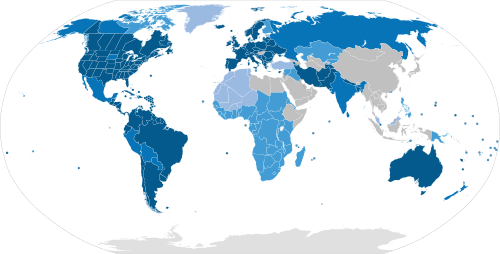
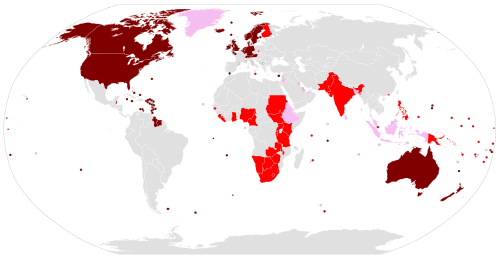
Germanic languages in the World. Countries and sub-national entities where one or more Germanic languages are spoken. Dark Red: First language; Red: Official or Co-Official language, Pink: Spoken by a significant minority as second language.
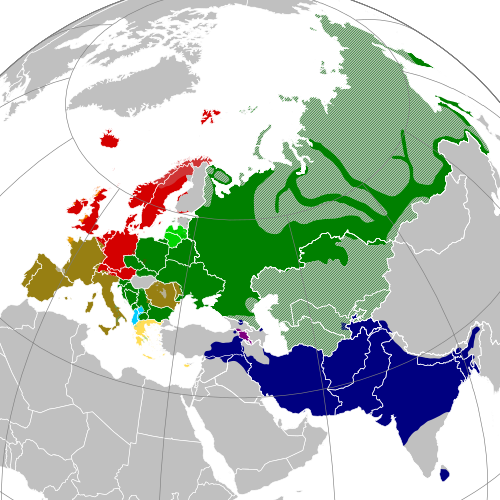
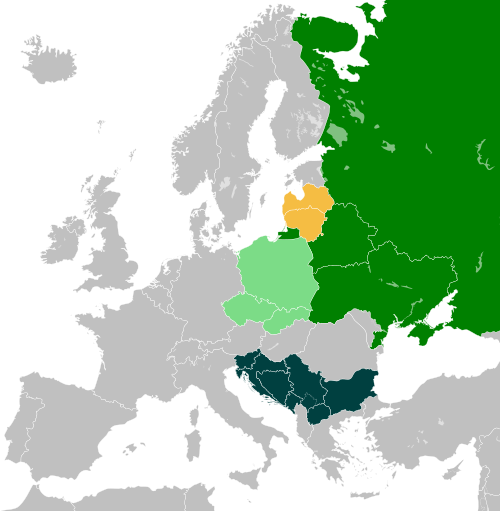
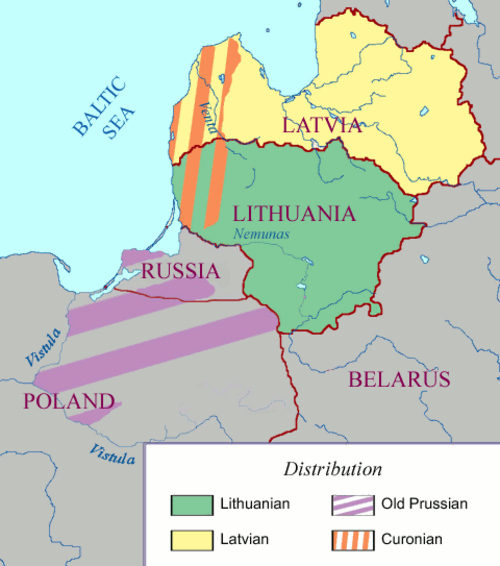
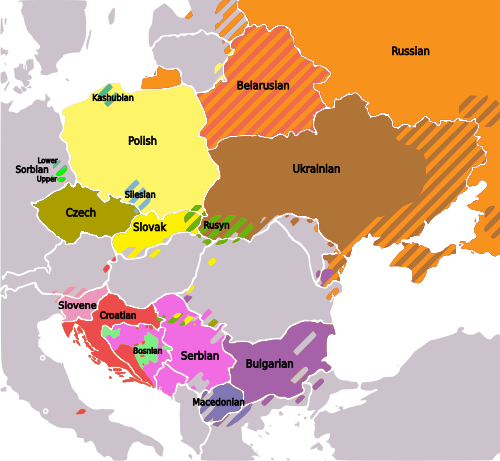
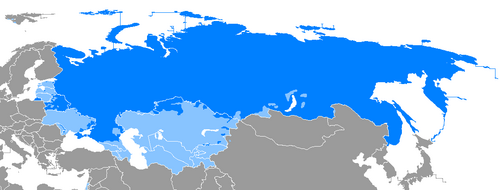
Area of Balto-Slavic dialect continuum with proposed material cultures correlating to speakers Balto-Slavic in Bronze Age . Red dots=archaic Slavic hydronyms.Political map of Europe with countries where a Slavic language is a national language marked in shades of green and where a Baltic language is a national language marked in light orange. Wood green represents East Slavic languages, pale green represents West Slavic languages, and sea green represents South Slavic languages. Contemporary Baltic languages are all from the same group: Eastern BalticBaltic languages (extinct languages shown in stripes).Slavic languages in Europe . Areas where languages overlap are shown in stripes.Russian Language – Map of all the areas where the Russian language is the language spoken by the majority of the population. Russian is the biggest Slavic language both in number of first language speakers and in geographical area where the language is spoken .
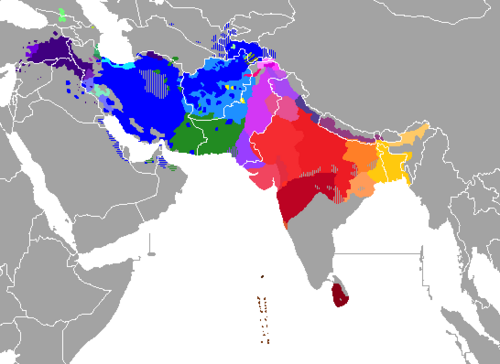
Geographic distribution of modern Indo-Iranian languages. Blue, dark purple and green colour shades: Iranic languages. Dark pink: Nuristani languages. Red, light purple and orange colour shades: Indo-Aryan languages. Areas where languages overlap are shown in stripes.
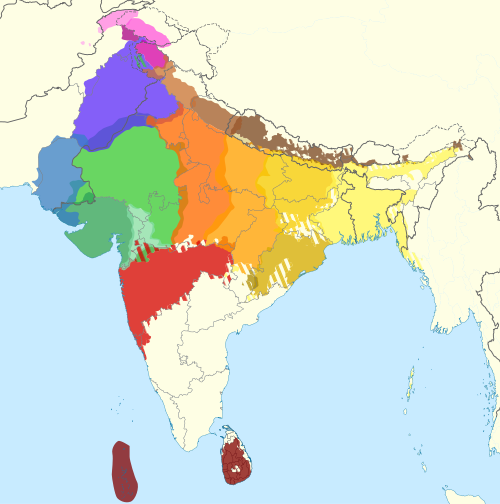
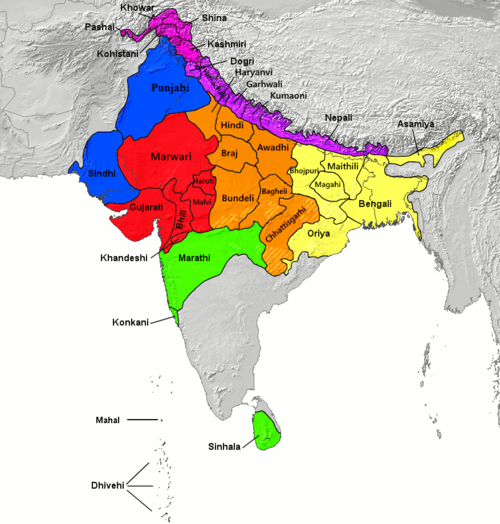
Present-day geographical distribution of the major Indo-Aryan language groups. Romani, Domari, Kholosi and Lomavren are outside the scope of the map. Colours indicate the branches – yellow is Eastern, purple is Dardic, blue is Northwestern, red is Southern, green is Western, brown is Northern and orange is Central. Data is from "The Indo Aryan Languages" as well as census data and previous linguistic maps. Dardic
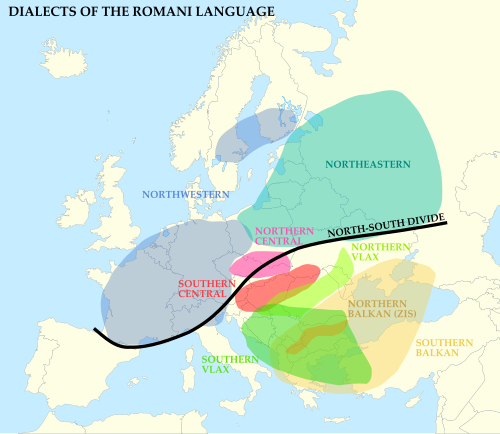
Romani languages and dialects in Europe. Romani languages are part of the Indo-Aryan branch of Indo-European languages but are spoken out of the Indian Subcontinent. They are related to the Domari languages and are scattered and minority languages in all regions, overlapping with other peoples and their languages in Europe. The Domari and Romani languages are spoken in a vast geographical area from Southwest Asia to Europe and North Africa but are minoritary and scattered in all the regions in part because Domari and Romani speakers, the Doma and the Roma, were traditionally nomadic peoples.
↑The inclusion of Wakhi among the Pamir languages is debated. Some scholars place it within the Pamir branch, others relate it more closely to Saka.[56]
References
12"Ethnologue report for Indo-European". Ethnologue.com. Archived from the original on 2012-01-06. Retrieved 2012-12-07.
↑Allentoft, Morten E.; Sikora, Martin; Sjögren, Karl-Göran; Rasmussen, Simon; Rasmussen, Morten; Stenderup, Jesper; Damgaard, Peter B.; Schroeder, Hannes; Ahlström, Torbjörn; Vinner, Lasse; Malaspinas, Anna-Sapfo; Margaryan, Ashot; Higham, Tom; Chivall, David; Lynnerup, Niels; Harvig, Lise; Baron, Justyna; Casa, Philippe Della; Dąbrowski, Paweł; Duffy, Paul R.; Ebel, Alexander V.; Epimakhov, Andrey; Frei, Karin; Furmanek, Mirosław; Gralak, Tomasz; Gromov, Andrey; Gronkiewicz, Stanisław; Grupe, Gisela; Hajdu, Tamás; etal. (2015). "Population genomics of Bronze Age Eurasia". Nature. 522 (7555): 167–172. Bibcode:2015Natur.522..167A. doi:10.1038/nature14507. PMID26062507. S2CID4399103. Archived from the original on 2019-03-29. Retrieved 2018-11-04.
↑KAPOVIĆ, Mate. (ed.) (2017). The Indo-European Languages. ISBN978-0-367-86902-1
12Anthony, David W. (2007), The Horse, the Wheel and Language: How Bronze-Age Riders from the Eurasian Steppes Shaped the Modern World, Princeton University Press
↑Ringe, Don; Warnow, Tandy.; Taylor, Ann. (2002). 'Indo-European and Computational Cladistics', Transactions of the Philological Society, n.º 100/1, 59-129.
↑Kloekhorst, Alwin (2022). "Anatolian". In Olander, Thomas (ed.). The Indo-European Language Family: A Phylogenetic Perspective. Cambridge: Cambridge University Press. doi:10.1017/9781108758666. ISBN 978-1-108-49979-8. S2CID 161016819
↑"New Indo-European Language Discovered". Archived from the original on 2023-09-26. Retrieved 2023-09-26.
↑"Kalasmaic, a New IE Language". Archived from the original on 2023-09-26. Retrieved 2023-09-26.
↑"A new Indo-European Language discovered in the Hittite capital Hattusa". 21 September 2023. Archived from the original on 2023-09-26. Retrieved 2023-09-26.
↑"New Indo-European Language Discovered in Ancient City of Hattusa". Archived from the original on 2023-09-26. Retrieved 2023-09-26.
↑Krause, Todd B.; Slocum, Jonathan. "Tocharian Online: Series Introduction". University of Texas at Austin. Retrieved 17 April 2020.
↑Beckwith, Christopher I. (2009), Empires of the Silk Road: A History of Central Asia from the Bronze Age to the Present, Princeton University Press, ISBN978-0-691-15034-5.
↑Voynikov, Zhivko. (?). Some ancient Chinese names in East Turkestan and Central Asia and the Tocharian question.
12"Niya Tocharian: language contact and prehistory on the Silk Road". cordis.europa.eu. Archived from the original on 2023-01-27. Retrieved 2023-01-05.
↑Dolatian, Hossep (2024). Adjarian's Armenian dialectology (1911): Translation and commentary. Berlin: Language Science Press. ISBN 978-3-96110-489-5.
↑"A Documentation of the Zok Language (otherwise known as the Armenian dialect of Agulis) | Endangered Languages Archive". www.elararchive.org. Retrieved 2023-03-07.
↑Vaux, Bert (2007). Zok: The Armenian dialect of Agulis. p. 2.
↑Bert Vaux, "Homshetsma, The language of the Armenians of Hamshen", in Hovann Simonian (2007). The Hemshin: History, Society and Identity in the Highlands of Northeast Turkey. Routledge. ISBN 978-1-135-79830-7.
↑Roger D. Woodard (2008), "Greek dialects", in: The Ancient Languages of Europe, ed. R. D. Woodard, Cambridge: Cambridge University Press, p. 51.
↑Nikolaos G. Kontosopoulos, "Dialects and Idioms of the Modern Greek", Papyros-Larousse-Britannica (in Greek), 2007, pp. 149–150. ISBN 978-960-6715-39-6.
↑Dawkins, R. M. 1916. Modern Greek in Asia Minor. A study of dialect of Silly, Cappadocia and Pharasa. Cambridge: Cambridge University Press.
↑Horrocks, Geoffrey (2014). Greek: A history of the language and its speakers, 2nd ed. Hoboken, NJ: Wiley Blackwell. ISBN 978-1-118-78515-7.
↑Roger D. Woodard (2008), "Greek dialects", in: The Ancient Languages of Europe, ed. R. D. Woodard, Cambridge: Cambridge University Press, p. 51.
↑Hadodo, M. J. (2020). Cosmopolitan Constantinopolitans: Istanbul Greek Language and Identity [Doctoral dissertation, University of Pittsburgh]. University of Pittsburgh Dietrich School of Arts and Sciences. 246 p.; 41-43. map
↑Peter Trudgill (2003): "Modern Greek dialects. A preliminary Classification". Journal of Greek Linguistics 4: 54–64
↑Petros Karatsareas. (2013): Understanding diachronic change in Cappadocian Greek: The dialectological perspective. Journal of Historical Linguistics 3:2 (2013), 192–229. doi 10.1075/jhl.3.2.02kar
↑ Guardiano, Cristina; Stavrou, Melita (2019-06-12). "Adjective-Noun combinations in Romance and Greek of Southern Italy: Polydefiniteness revisited". Journal of Greek Linguistics. 19 (1): 3–57. doi:10.1163/15699846-01901001. hdl:11380/1188377. ISSN 1569-9846
↑Nicholas, Nick (2019). "A critical lexicostatistical examination of Ancient and Modern Greek and Tsakonian". Journal of Applied Linguistics and Lexicography. 1 (1): 18–68. doi:10.33910/2687-0215-2019-1-1-18-68
↑"Ancient Macedonian". MultiTree: A Digital Library of Language Relationships. Archived from the original on February 8, 2016. Retrieved 28 March 2016.
↑Adelina ÇERPJA and Anila ÇEPANI, "Albanian dialect classifications" in Dialectologia. Special issue, 11 (2023), 51-87. ISSN: 2013-2247
↑Baldi, Benedetta; Savoia, Leonardo M. (2017). "Cultura e identità nella lingua albanese" [Culture and Identity in the Albanian Language]. LEA - Lingue e Letterature d'Oriente e d'Occidente. 6 (6): 45–77. doi:10.13128/LEA-1824-484x-22325. ISSN 1824-484X.
↑Bereznay, András (2011). Erdély történetének atlasza[Atlas of the History of Transylvania] (in Hungarian). Méry Ratio. p.63. ISBN978-80-89286-45-4.
↑Menéndez Pidal, Ramón. (2005). Historia de la Lengua Española (2 Vols.). Madrid: Fundación Ramón Menendez Pidal. ISBN84-89934-11-8
↑Marcos Marín, Francisco. (1998). "Romance andalusí y mozárabe: dos términos no sinónimos", Estudios de Lingüística y Filología Españolas. Homenaje a Germán Colón. Madrid: Gredos, 335–341. https://www.academia.edu/5101871/Romance_andalusi_y_mozarabe_dos_terminos_no_sinonimos_Archived 2022-01-07 at the Wayback Machine
12"Gothic language | Origins, History & Vocabulary". Britannica. 25 September 2023. Archived from the original on 21 December 2018. Retrieved 18 August 2023.
↑"East Germanic languages | History, Characteristics & Dialects". Britannica. Archived from the original on 2023-08-18. Retrieved 2023-08-18.
↑"The medieval 'New England': A forgotten Anglo-Saxon colony on the north-eastern Black Sea coast" https://www.caitlingreen.org/2015/05/medieval-new-england-black-sea.htmlArchived 2023-08-18 at the Wayback Machine
↑Harm, Volker, "Elbgermanisch", "Weser-Rhein-Germanisch" und die Grundlagen des Althochdeutschen, in Nielsen; Stiles (eds.), Unity and Diversity in West Germanic and the Emergence of English, German, Frisian and Dutch, North-Western European Language Evolution, vol. 66, pp. 79–99
↑C. A. M. Noble: Modern German Dialects. Peter Lang, New York / Berne / Frankfort on the Main, p. 131
↑Oxford English Dictionary, "Holland, n. 1", etymology.
↑Hendricks, Frank . "The nature and context of Kaaps: a contemporary, past and future perspective".Archived 2022-10-23 at the Wayback MachineMultilingual Margins: A Journal of Multilingualism from the Periphery. 3 (2): 6–39. doi:10.14426/mm.v3i2.38. ISSN 2221-4216. S2CID 197552885.
↑Instituut voor de Nederlandse Taal: De Geïntegreerde Taal-Bank:Woordenboek der Nederlandsche Taal, entry VlamingIArchived 2023-10-05 at the Wayback Machine;cp.: Oudnederlands Woordenboek, entry flāminkArchived 2023-10-05 at the Wayback Machine: "Morfologie: afleiding, basiswoord: flāma 'overstroomd gebied'; suffix: ink 'vormt afstammingsnamen'"; Vroegmiddelnederlands Woordenboek, entry VlaendrenArchived 2023-10-05 at the Wayback Machine: "Etymologie: Dat.pl. van flandr- 'overstroomd gebied' met het suffix -dr-.".Cognate to Middle English flēm 'current of a stream': Middle English Compendium → Middle English Dictionary: flēm n.(2)Archived 2023-12-09 at the Wayback Machine
↑Simpson, St John (2017). "The Scythians. Discovering the Nomad-Warriors of Siberia". Current World Archaeology. 84: 16–21. "nomadic people made up of many different tribes thrived across a vast region that stretched from the borders of northern China and Mongolia, through southern Siberia and northern Kazakhstan, as far as the northern reaches of the Black Sea. Collectively they were known by their Greek name: the Scythians. They spoke Iranian languages...."
↑""Unknown Kushan Script" Partially Deciphered - Archaeology Magazine". 18 July 2023. Archived from the original on 2023-09-26. Retrieved 2023-09-26.
↑"Welcome to Encyclopaedia Iranica". Archived from the original on 2020-11-12. Retrieved 2023-10-05.
↑"The Avestan texts contain no historical allusions and can therefore not be dated exactly, but Old Avestan is a language closely akin to the oldest Indic language, used in the oldest parts of the Rigveda, and should therefore probably be dated to about the same time. This date is also somewhat debated, though within a relatively small time span, and it seems probable that the oldest Vedic poems were composed over several centuries around the middle of the 2nd millennium B.C.E. (see, e.g., Witzel, 1995)", quoted in https://iranicaonline.org/articles/iran-vi1-earliest-evidenceArchived 2023-09-21 at the Wayback Machine
↑"Young Avestan is grammatically close to Old Persian, which ceased being spoken in the 5th-4th centuries B.C.E. These two languages were therefore probably spoken throughout the first half of the first millennium B.C.E. (see, e.g., Skjærvø, 2003-04, with further references)." in https://iranicaonline.org/articles/iran-vi1-earliest-evidenceArchived 2023-09-21 at the Wayback Machine
↑The Young Avesta contains a few geographical names, all belonging to roughly the area between Chorasmia and the Helmand, that is, the modern Central Asian republics and Afghanistan (see, e.g., Skjærvø, 1995; Witzel, 2000). We are therefore entitled to conclude that Young Avestan reflects the language spoken primarily by tribes from that area. The dialect position of the language also indicates that the language of the Avesta must have belonged to, or at least have been transmitted by, tribes from northeastern Iran (the change of proto-Iranian *-āḭā/ă- > *-ayā/ă- and *ǰīwa- > *ǰuwa- "live", for instance, is typical of Sogdian, Khotanese, Pashto, etc. in https://iranicaonline.org/articles/iran-vi1-earliest-evidenceArchived 2023-09-21 at the Wayback Machine).
↑It was long thought that Avestan represented "Old Bactrian", but this notion had "rightly fallen into discredit by the end of the 19th century", in Gershevitch, Ilya (1983), "Bactrian Literature", in Yarshater, Ehsan (ed.), Cambridge History of Iran, vol. 3, Cambridge: Cambridge UP, pp. 1250–1258, ISBN 0-511-46773-7.
↑Morgenstierne, Georg (1974). Etymological Vocabulary of the Shughni Group. Oslo: Norsk Videnskaps-Akademi. p.34. The Darwozi dialect of Tajik preserves words such as fraun kardan ("to pour water on") and frakondan ("to wash, rinse"), which are probably borrowed from the Shughni group (ŠGr), cf. Shughni firêwtow ("to wash, rinse").
↑ Burrow, T. (1936). "ニヤ・プラークリットの弁証法的立場". Bulletin of the School of Oriental Studies, University of London . 8 (2/3): 419– 435. doi : 10.1017/S0041977X00141060 . JSTOR 608051 . S2CID 170991822 .