Loading article…
| スペイン語 | |
|---|---|
| カスティーリャ語 | |
| |
| 発音 | [スペイン語] [カステアノ語] ,[カステアノ語] |
| スピーカー | 母語話者数:5億人(2023年)[1] 合計:6億人[1] 限られた能力を持つ1億人の話者(2,300万人の学生)[1] |
初期の形態 | |
| ラテン文字(スペイン語アルファベット) スペイン語点字 | |
| スペイン語の手話(現地語の手話を使用) | |
| 公式ステータス | |
公用語 | |
| 規制対象 | スペイン語アカデミー協会 (Real Academia Españolaおよび他の22の国立スペイン語アカデミー) |
| 言語コード | |
| 639-1 規格 | es |
| 639-2 規格 | spa |
| 639-3 規格 | spa |
spa | |
| グロトログ | stan1288 |
| リンガスフィア | 51-AAA-b |
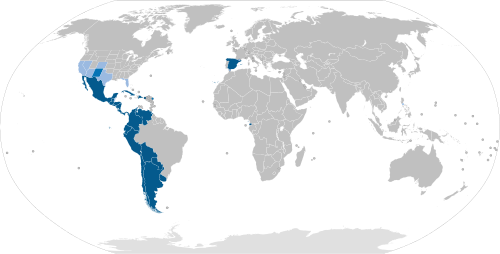 公用語の多数派言語
共同公用語または行政言語だが、多数派の母国語ではない
第二言語(スペイン語話者が20%以上)または文化的に重要な | |
スペイン語(español)またはカスティーリャ語(castellano)は、ヨーロッパのイベリア半島で話されていた俗ラテン語から発展したインド・ヨーロッパ語族のロマンス語である。今日、スペイン語は主にアメリカ大陸とスペインに約5億人のネイティブスピーカーがおり、第二言語の話者を含めると約6億人いる世界言語である。[4] [5]スペイン語は20カ国の公用語であり、国連の6つの公用語の1つである。[6] [7]スペイン語は、中国語(北京語)に次いで世界で2番目に多く話されているネイティブ言語である。[5] [8]英語、中国語(北京語)、ヒンドゥスターニー語(ヒンディー語-ウルドゥー語)に次いで世界で4番目に多く話されている言語であり、世界で最も広く話されているロマンス語である。ネイティブスピーカーの人口が最も多い国はメキシコである。[9]
スペイン語はイベロ・ロマンス語族に属し、その中ではカスティーリャ語( castellano )としても知られています。このグループは、5世紀の西ローマ帝国の崩壊後にイベリア半島の俗ラテン語のいくつかの方言から発展しました。スペイン語の痕跡のある最古のラテン語のテキストは、9世紀のイベリア半島北部中西部のものであり、[10]言語が初めて体系的に書かれたのは、13世紀のカスティーリャ王国の主要都市トレドでした。近世のスペインの植民地主義は、この言語の海外への導入、特にアメリカ大陸への導入を促進しました。[11]
ロマンス語であるスペイン語はラテン語の子孫です。現代スペイン語の語彙の約75%はラテン語に由来しており、古代ギリシャ語からのラテン語の借用語も含まれています。[12] [13]英語やフランス語と並んで、スペイン語は世界中で最も多く教えられている外国語の一つです。[14]スペイン語は人文科学や社会科学の分野でよく知られています。[15]スペイン語は、インターネット上でのユーザー数では英語と中国語に次いで3番目に多く使用されている言語であり[16]、ウェブサイト数では英語に次いで2番目に多く使用されている言語です。[17]
スペイン語は、国連、欧州連合、米州機構、南米諸国連合、ラテンアメリカ・カリブ諸国共同体、アフリカ連合など、多くの国際機関の公用語として使用されています。 [6]
言語名と語源
言語名
スペインやスペイン語圏の他の地域では、スペイン語はespañolだけでなく、カスティーリャ王国の言語であるcastellano (カスティーリャ語)とも呼ばれ、ガリシア語、バスク語、アストゥリアス語、カタロニア語/バレンシア語、アラゴン語、オック語、その他のマイナー言語など、スペインで話されている他の言語と対比されています。
1978 年のスペイン憲法では、スペイン全土の公用語を定義するために、 las demás lenguas españolas (直訳すると「その他のスペイン語」) とは対照的に、 castellanoという用語が使用されています。第 3 条は、次のようになっています。
El Castellano es la lengua española official del Estado。 ... Las demás lenguas españolas serán también oficiales en las respectivas Comunidades Autónomas...
カスティーリャ語は州の公用スペイン語です。 ... 他のスペイン語もそれぞれの自治コミュニティで公用語となります...
一方、スペイン王立アカデミー( Real Academia Española ) は現在、出版物でespañolという用語を使用しています。ただし、1713 年から 1923 年までは、この言語をcastellanoと呼んでいました。
王立スペインアカデミー発行の言語ガイド『Diccionario panhispánico de dudas』には、王立スペインアカデミーは出版物の中でスペイン語について言及する際にespañolという用語を使用することを好んでいるが、españolとcastellanoの両方の用語は同義語であり、同等に有効であると記載されている。[18]
語源
カステリャーノという用語は、この言語がもともと話されていた王国であるカスティーリャ( Castillaまたは古語ではCastiella )に関連しています。一方、カスティーリャという名前は、通常、カスティーリョ(「城」)に由来すると考えられています。
中世には、カスティーリャで話されていた言語は一般的にロマンス語と呼ばれ、後にLengua vulgarとも呼ばれました。[19]その後、この言語はRomance castellano(romanz castellano、romanz de Castiella)、lenguaje de Castiella、そして最終的には単にcastellano(名詞)として地理的に特定されるようになりました。[19]
スペイン語「español」という語には、さまざまな語源が提唱されている。スペイン王立アカデミーによると、españolはオック語のespaignolに由来し、さらに俗ラテン語のhispaniolus (「ヒスパニアの」)に由来している。[20] ヒスパニアは、イベリア半島全体のローマ名であった。
スペイン王立アカデミーが提唱したもの以外にも、いくつかの仮説があります。スペインの文献学者ラモン・メネンデス・ピダルは、古典語のhispanusまたはhispanicusが、 bretón(ブルトン語)やsajón (サクソン語)などの他の単語と同様に、俗ラテン語から接尾辞-oneを取ったのではないかと提唱しました。
歴史

他のロマンス語と同様に、スペイン語は俗ラテン語から発展した。俗ラテン語は、紀元前210年に始まった第二次ポエニ戦争中にローマ人によってイベリア半島にもたらされた。イベリア半島では、ローマ以前の言語(パレオヒスパニック語とも呼ばれる)がいくつか話されていた。その中には、インド・ヨーロッパ語族としてラテン語と遠縁のものもあれば、全く関係のない言語もあった。これらの言語には、バスク祖語、イベリア語、ルシタニア語、ケルト語、ガラエキア語などがある。
今日現代スペイン語の前身とみなされているものの痕跡を示す最初の文書は、9世紀のものである。中世から近代にかけて、スペイン語の語彙に最も重要な影響を与えたのは、近隣のロマンス語であるモサラベ語(アンダルシ・ロマンス語)、ナバーロ・アラゴン語、レオネ語、カタロニア語/バレンシア語、ポルトガル語、ガリシア語、オック語、そして後にはフランス語とイタリア語であった。スペイン語はまた、イベリア半島の西ゴート族支配の時代を通じて、アラビア語とバスク語からかなりの数の単語を、またゲルマン・ゴート語族の言語から少数の単語を借用した。さらに、書き言葉や教会の典礼言語の影響を通じて、ラテン語からさらに多くの単語を借用した。借用語は、古典ラテン語と当時使用されていたラテン語 であるルネサンス期ラテン語の両方から取られた。
ラモン・メネンデス・ピダルの理論によれば、イベリア半島北部のブルゴス市を中心とする地域で俗ラテン語の地方社会方言がスペイン語に発展し、この方言は後に13世紀にスペイン語の書き言葉が初めて開発されたトレド市にもたらされた。 [22]この形成段階で、スペイン語は近縁のレオネーゼ語とは大きく異なる変種を発達させ、一部の著者によると、強いバスク語の影響によって区別される(イベリア・ロマンス語を参照)。この独特の方言はレコンキスタの進展とともに南スペインに広がり、その間にアル・アンダルスのアラビア語からかなりの語彙的影響を受け、その多くはロマンス・モサラベ方言を通じて間接的に受けた(アラビア語由来の約4,000語は、今日の言語の約8%を占める)。[23]この新しい言語の標準的な書き言葉は、13世紀から16世紀にかけてトレド市で、 1570年代以降にはマドリード市で開発されました。 [22]
スペイン語の音声体系が俗ラテン語の音声体系から発展した過程には、母音間の子音の軟音化(ラテン語のvīta > スペイン語のvida )など、西欧ロマンス語に典型的な変化のほとんどが見られます。ラテン語の短いeとo の強勢の二重母音化は、フランス語とイタリア語では開音節に見られますが、カタロニア語やポルトガル語ではまったく見られませんが、次の表に示すように、スペイン語では開音節と閉音節の両方に見られます。

スペイン語は、ラテン語の二重子音(促音)nnとllの口蓋化が特徴です(したがって、ラテン語の annum > スペイン語のaño、ラテン語のanellum > スペイン語の anillo)。
ラテン語でuまたはvと書かれ、古典ラテン語で[w]と発音される子音は、俗ラテン語で両唇摩擦音/β/に「強化」されたと考えられます。初期のスペイン語では (カタロニア語やポルトガル語ではそうではありませんが)、この子音はbと書かれる子音(破裂音と摩擦音の異音を持つ両唇音) と融合しました。現代スペイン語では、正書法のbとvの発音に違いはありません。
スペイン語(また、ジロンド川の河口の北まで広がる隣国ガスコーニュや、カラブリア州の小さな地域に見られる)に典型的であるが、一部の学者はこれをバスク語の基層に起因するものとしている。ラテン語のfの後に二重母音が続かない母音が続く場合は常に、この語の頭文字がh-に変化する。綴りには現在も残っているh-は、現在ではほとんどの言語の変種で無音であるが、アンダルシア地方やカリブ海地方の一部の方言では、一部の単語でまだ有気音となっている。ラテン語や近隣のロマンス語からの借用語のため、現代スペイン語にはf -/ h -の二重語が多くあります。 FernandoとHernando (どちらもスペイン語で「フェルディナンド」)、ferreroとherrero (どちらもスペイン語で「鍛冶屋」)、fierroとhierro (どちらもスペイン語で「鉄」)、fondoとhondo (どちらもスペイン語で深さに関する単語ですが、fondo は「底」、hondoは「深い」を意味します)。さらに、hacer (「作る」) はsatisfacer (「満足する」)の語源と同源であり、hecho (「作られた」) も同様にsatisfecho (「満足した」)の語源と同源です。
次の表の例を比較してください。
ラテン語のいくつかの子音クラスターも、次の表の例に示すように、これらの言語では特徴的に異なる結果を生み出しました。
.jpg/500px-Juan_de_Z%C3%BA%C3%B1iga_dibujo_con_orla_(cropped).jpg)
15世紀と16世紀に、スペイン語では歯擦音の発音が劇的に変化した。これはスペイン語で「reajuste de las sibilantes」と呼ばれ、その結果、文字⟨j⟩が独特の軟口蓋音 [x]で発音されるようになり、スペインの大部分では文字⟨z⟩(および⟨e⟩や⟨i⟩の前の⟨c⟩ )が特徴的な歯間音[θ]で発音されるようになった。詳細については、スペイン語の歴史(古スペイン語の歯擦音の現代的発展)を参照。
1492年にサラマンカでエリオ・アントニオ・デ・ネブリハによって書かれた『カスティーリャ語の文法』は、近代ヨーロッパ言語のために書かれた最初の文法書であった。[25]有名な逸話によると、ネブリハがそれをイサベル1世女王に贈ったとき、女王は彼にそのような作品の用途を尋ね、彼は言語は帝国の道具であると答えた。[26] 1492年8月18日の文法書の序文で、ネブリハは「言語は常に帝国の伴侶であった」と書いている。[27]
16世紀以降、スペイン語はスペインのアメリカ大陸植民地化を通じて、スペイン人が発見したアメリカ大陸やスペイン領東インド諸島に持ち込まれた。『ドン・キホーテ』の著者ミゲル・デ・セルバンテスは世界中でよく知られた人物であるため、スペイン語はしばしば「セルバンテスの言語」と呼ばれる。 [ 28]
20世紀には、スペイン語は赤道ギニアや西サハラ、そしてニューヨーク市のスパニッシュ・ハーレムなどスペイン帝国の一部ではなかったアメリカの地域にも導入されました。借用語やスペイン語へのその他の外部からの影響の詳細については、「スペイン語への影響」を参照してください。
地理的分布
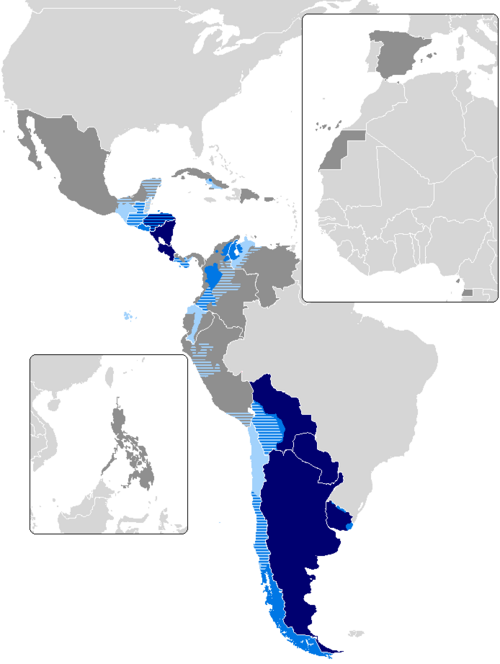
.svg/500px-El_espa%C3%B1ol_en_el_mundo_2023_(Anuario_del_Instituto_Cervantes).svg.png)
公用語または準公用語
重要な少数言語(25%以上)または多数言語だが、公用語ではない
注目すべき少数言語(25%未満だが、スペイン語話者は50万人以上)
スペイン語は世界20カ国で第一言語です。2023年時点で、約4億8600万人がスペイン語を母国語として話すと推定されており、母国語話者数では世界で2番目に多い言語となっています。[29]さらに7500万人がスペイン語を第二言語または外国語として話しており、話者総数は5億3800万人で、英語、中国語(北京語)、ヒンディー語に次いで世界で4番目に多く話されている言語となっています。 [30]スペイン語は、英語と中国語に次いでインターネットで3番目に多く使用されている言語でもあります。 [31]
ヨーロッパ

出身国
8.99%以上
4%から8.99%の間
1%から3.99%の間
1%未満
スペイン語はスペインの公用語である。中世末期にカスティーリャ王国がイベリア半島の支配的勢力として台頭すると、この政体に関連するロマンス語が威信と影響力を示す場面でますます使用されるようになり、「カスティーリャ語」と「スペイン語」の区別が曖昧になり始めた。[ 32 ] 18世紀以降、中央集権化が進むスペイン国家において、言語の覇権を強制する厳しい政策が確立された。[33]
この言語が広く話されている他のヨーロッパの地域としては、ジブラルタルとアンドラがある。[34]
スペイン語はイギリス、フランス、イタリア、ドイツなど他のヨーロッパ諸国の移民コミュニティでも話されています。[35]スペイン語は欧州連合の公用語です。
アメリカ大陸
ヒスパニック系アメリカ
今日、スペイン語話者の大半はヒスパニック系アメリカに住んでいる。国別に見ると、スペイン語はアルゼンチン、ボリビア( 36の先住民言語と共公用語)、チリ、コロンビア、コスタリカ、キューバ、ドミニカ共和国、エクアドル、エルサルバドル、グアテマラ、ホンジュラス、メキシコ(63の先住民言語と共公用語)、ニカラグア、パナマ、パラグアイ(グアラニー語と共公用語)[36]ペルー(ケチュア語、アイマラ語、および「その他の先住民言語」と共公用語)[37]プエルトリコ(英語と共公用語)[38]ウルグアイ、ベネズエラの事実上または法律上の公用語となっている。
アメリカ合衆国

スペイン語は、現在のアメリカ合衆国の領土において16世紀まで遡る長い歴史を持っています。[39] 1848年のグアダルーペ・イダルゴ条約をきっかけに、数十万人のスペイン語話者がアメリカ合衆国で少数派コミュニティになりました。[39] 20世紀には、それまでスペイン語話者が少なかった地域でスペイン語話者がさらに大幅に増加しました。[40]
2020年の国勢調査によると、米国の人口の6000万人以上がヒスパニック系またはヒスパニック系アメリカ人でした。[41]一方、米国では5歳以上の4180万人が家庭でスペイン語を話しており、これは人口の約13%に相当します。[42]プエルトリコの未編入地域ではスペイン語が主流であり、英語とともに公用語となっています。
スペイン語は、これまでのところ、この国で最も一般的な第二言語であり、非ネイティブまたは第二言語話者を含めると、話者数は合計5000万人を超えます。[43]英語が事実上の国語である一方、連邦および州レベルの公共サービスや通知ではスペイン語がよく使用されています。スペイン語はニューメキシコ州の行政でも使用されています。[44]この言語は、アリゾナ州サンコリドーのロサンゼルス、マイアミ、サンアントニオ、ニューヨーク、サンフランシスコ、ダラス、ツーソン、フェニックスなどの大都市圏、さらに最近ではシカゴ、ラスベガス、ボストン、デンバー、ヒューストン、インディアナポリス、フィラデルフィア、クリーブランド、ソルトレイクシティ、アトランタ、ナッシュビル、オーランド、タンパ、ローリー、ボルチモア・ワシントンDCでも強い影響力を持っています。
その他のアメリカ大陸
英語が唯一の公用語である旧イギリス植民地ベリーズ(1973年まではイギリス領ホンジュラスとして知られていた)ではスペイン語は公式に認められていないが、2022年の国勢調査によると、全人口の54%がスペイン語を話すことができる。[45]
トリニダード・トバゴはスペイン語圏の国々に近く、スペイン語を母国語とする少数民族も少ないことから、スペイン語教育を教育制度に取り入れている。トリニダード・トバゴ政府は2005年3月にスペイン語を第一外国語とする(SAFFL)イニシアチブを開始した。[46]
スペイン語は歴史的に、何世紀にもわたってそして現代でも、オランダ領カリブ海のアルバ、ボネール、キュラソー(ABC諸島)で大きな存在感を示してきました。各島(特にアルバ)の住民の大半は、程度の差はあるものの、多くの場合、非常に流暢にスペイン語を話します。 [47]現地語のパピアメント語(アルバ島ではパピアメント語)は、ベネズエラのスペイン語の影響を強く受けています。
ブラジルはスペイン語圏の国々と国境を接していることに加え、1990年代初頭のメルコスールの創設により、スペイン語教育の推進に好ましい状況が生まれた。[48] [49] 2005年、ブラジル国会は大統領の署名により法律として成立した法案を承認し、ブラジルの公立・私立の中等学校ではスペイン語を外国語の代替コースとして提供することが義務付けられた。 [50] 2016年9月、ジルマ・ルセフ大統領の弾劾後、ミシェル・テメル大統領によってこの法律は廃止された。 [51]パラグアイとウルグアイの国境沿いの多くの町や村では、ポルトニョールと呼ばれる混合言語が話されている。[ 52]
アフリカ
サハラ以南のアフリカ
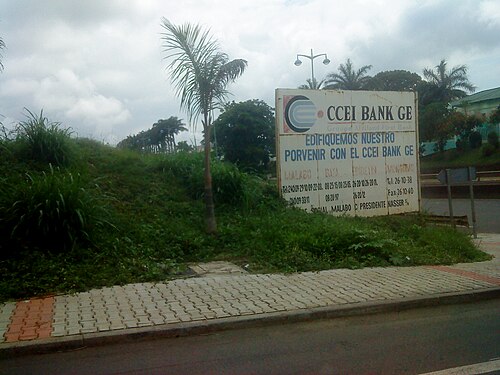
赤道ギニアは、完全にアフリカに位置する唯一のスペイン語圏の国であり、この言語はスペイン植民地時代に導入されました。[53]スペイン語は憲法で公用語として定められており(フランス語とポルトガル語とともに)、赤道ギニアの教育システムでは重要な位置を占めており、政府とビジネスで使用される主要言語です。[54]スペイン語は、話者のほとんどにとって母国語ではありませんが、人口の大多数はスペイン語に堪能です。[55]セルバンテス文化センターは、人口の87.7%がスペイン語に堪能であると推定しています。[56]赤道ギニアのスペイン語堪能な人の割合は、他の西アフリカおよび中央アフリカ諸国のそれぞれの植民地言語の堪能な人の割合を上回っています。[57]
スペイン語は、冷戦によるキューバの影響でアンゴラの非常に小さなコミュニティで話されており、南スーダンではスーダン戦争中にキューバに移住し、国の独立のために戻ってきた南スーダン出身者の間でも話されています。 [58]
北アフリカとマカロネシア
スペイン語は、アフリカのスペイン領土、すなわちセウタやメリリャの都市と、アフリカ本土の北西約100キロ(62マイル)沖の大西洋に位置するカナリア諸島でも話されている。カナリア諸島で話されているスペイン語は、15世紀のカスティーリャ人の征服に起源を遡り、西アンダルシア語の話し言葉に似ていることに加え、アメリカ大陸で話されているスペイン語の方言の影響も強く受けており、[59]カナリア諸島のスペイン語も歴史的に影響を受けてきた。[60]アラビア語またはベルベル語を母国語とし、第二言語としてスペイン語も話す北アフリカのスペイン語は、母音体系の多様性に特徴がある。[61]
スペイン語は、モロッコにおけるスペイン保護領時代の全盛期からは程遠いが、一部のスペイン語メディアの存在などから、モロッコ北部では一定の存在感を示している。 [62]モロッコ王立戦略研究所(IRES)の2012年の調査によると、モロッコにおけるスペイン語の普及率は人口の4.6%に達している。[63]多くの北部モロッコ人はスペイン語の基礎知識を持っており、[62]セウタとメリリャに隣接する地域では特にスペイン語が普及している。[64]スペイン語はまた、(主に北部に位置するスペインの教育システムを実施する選ばれた教育センターを通じて、または中等教育で外国語科目としてスペイン語を利用できることを通じて)同国の教育システムにも存在している。[62]
西サハラ(旧スペイン領サハラ)は、主にハサニア・アラビア語を話す地域で、19世紀後半から20世紀にかけては植民地行政の言語としてスペイン語が公用語として話されていました。今日、スペイン語は部分的に承認されているサハラ・アラブ民主共和国で第二公用語として使用されているほか、[65]ティンドゥフ(アルジェリア)のサハラ難民キャンプでも使用されており、そこでは主にキューバ人の教育者によってスペイン語が第二言語として教えられています。[66] [67] [68]スペイン語話者の数は不明です。[検証に失敗] [69] [70]
スペイン語はアフリカ連合の公用語でもある。[71]
アジア

スペイン語は、1565年のスペイン統治開始から1973年の憲法改正までフィリピンの公用語であった。スペインの植民地時代には、政府、貿易、教育の言語であり、スペイン人や教育を受けたフィリピン人(イルストラドス)の第一言語として話されていた。植民地政府によって設立された公教育制度にもかかわらず、1898年のスペイン統治の終わりまでに、スペイン語を知っているのは人口の約10%にすぎず、そのほとんどはスペイン系またはエリート層であった。[72]

スペイン語は米西戦争後のアメリカ統治の初期には公用語として使用され続け、フィリピンの文学や出版物で使用されていたが、1920年代までには行政と教育の主要言語として英語に取って代わられた。[73]とはいえ、影響力と話者の大幅な減少にもかかわらず、スペイン語は1946年のフィリピン独立後も英語やタガログ語の標準化版であるフィリピノ語と並んで公用語であり続けた。
スペイン語は1973年に一時的に公用語から外されたが、2ヵ月後、フェルディナンド・マルコス政権下で再導入された。 [74] 1987年に現憲法が批准されるまで公用語であり続けたが、その際に任意かつ選択的な補助言語として再指定された。[75]さらに、憲法第14条では、政府はフィリピン国民に国の憲法のスペイン語訳を提供しなければならないと規定されている。[76]近年、スペイン語を話さないフィリピン人の態度の変化が言語の復活に拍車をかけており、[77] [78] 2009年からは、スペイン語が多くの公立高校の基礎教育カリキュラムの一部として再導入され、公立学校システムが提供する最大の外国語プログラムとなり、[79] 2021〜2022学年だけで7,000人を超える生徒がスペイン語を学んでいる。[80]地元のビジネスプロセスアウトソーシング産業も、スペイン語の経済的見通しを押し上げるのに貢献しています。[81]現在、スペイン語を流暢に話せる人の実際の数は約40万人で、人口の0.5%未満ですが、[82]フィリピンでも同様に新しい世代のスペイン語話者が出現しています。ただし、話者の推定数は大きく異なります。[83]
標準スペイン語の他に、チャバカノ語と呼ばれるスペイン語ベースのクレオール語がフィリピン南部で発達した。しかし、スペイン語とは相互に理解できない。[84]チャバカノ語話者の数は1996年に120万人と推定された。[85]フィリピンの現地語もかなりのスペイン語の影響を残しており、多くの単語はメキシコのスペイン語に由来している。これは、1821年までヌエバ・エスパーニャを通じてスペインが島を統治し、その後1898年までマドリードが直接統治したためである。[86] [87]
オセアニア

イースター島は地理的にはオセアニアのポリネシアの一部であり、政治的にはチリの一部です。この島ではスペイン語が公用語であり、最も多く話されています。しかし、イースター島の伝統的な言語は東ポリネシアの言語であるラパ・ヌイ語です。
旧スペイン領東インド諸島の名残として、グアム、北マリアナ諸島、パラオ、マーシャル諸島、ミクロネシアの現地語にはスペイン語からの借用語が残っている。[88] [89]
さらに、オーストラリアとニュージーランドには、スペイン語圏の国々(主に南米諸国)からの移民によって形成された先住のスペイン人コミュニティが存在する。[90]
国別のスペイン語話者数
スペイン語は 20 か国と 1 つの米国領土で公式に話されており、アンドラ、ベリーズ、ジブラルタルの領土とともに米国の他の地域でも非公式に広く話されています。
文法

スペイン語の文法的特徴と類型的特徴のほとんどは、他のロマンス語と共有されています。スペイン語は融合言語です。名詞と形容詞のシステムには、2 つの性と 2 つの数があります。さらに、冠詞と一部の代名詞と限定詞は、単数形で中性になります。動詞ごとに約 50 の活用形があり、3 つの時制: 過去、現在、未来。過去の2 つの相:完了法、未完了法。4 つの法: 直説法、接続法、条件法、命令法。3 つの人称: 一人称、二人称、三人称。2 つの数: 単数、複数。3 つの動詞形: 不定詞、動名詞、過去分詞。直説法は指示法ではなく、仮定法は不確実性や不確定性を表現し、通常は条件法と対になって使われます。条件法は「~するだろう」を表現するのに使われます(「食べ物があれば食べるだろう」など)。命令法は命令を表現する法で、通常は「¡Di! 」(「話せ!」)という1語句です。
動詞は、正式な呼びかけと非公式な呼びかけで異なる人称を使用することで、テレビの区別を表現します。(動詞の詳細な概要については、「スペイン語の動詞」および「スペイン語の不規則動詞」を参照してください。)
スペイン語の構文は右分岐型であると考えられており、従属または修飾する構成 要素は主語の後に置かれる傾向があります。スペイン語では、(後置詞や格変化の名詞ではなく)前置詞を使用し、通常は(常にではないものの)他のほとんどのロマンス語と同様に、形容詞を名詞の後に配置します。
スペイン語は主語-動詞-目的語の言語に分類されるが、ほとんどのロマンス語と同様に、構成要素の順序は非常に多様で、主に話題化と焦点によって決まる。スペイン語は「プロドロップ」または「ヌル主語」言語であり、つまり、主語代名詞が実用上必要ない場合は削除できる。スペイン語は「動詞フレーム」言語と言われており、移動の方向は動詞で表され、移動のモードは副詞で表される(例:subir corriendoまたはsalir volando。これらの例の英語の同等語である「to run up」と「to fly out」は、対照的に英語が「衛星フレーム」であり、移動モードは動詞で、方向は副詞修飾語で表されていることを示す)。
音韻論
スペイン語の音韻体系は俗ラテン語の音韻体系から発展した。その発展には他の西方ロマンス語との共通点や、近隣のイスパノ語派、特にレオネ語とアラゴン語との共通点が見られるほか、スペイン語特有の特徴もある。スペイン語は近隣言語の中で唯一、ラテン語の頭子音/f/ の音を頻繁に気泡化し、最終的に消失した(例:カストル語harina対レオン語とアラゴン語farina)。[211]スペイン語のラテン語頭子音列pl-、cl-、fl- は通常ll-(本来は[ʎ]と発音)として統合されるが、アラゴン語ではほとんどの方言で保持され、レオネ語では[tʃ]、[ʃ]、[ʎ]などさまざまな結果を示す。ラテン語では母音の前に-li-が付く(例: filius)か、語尾に-iculus、-icula が付く(例:auricula)のに対し、古スペイン語では[ʒ]となり、これが現代スペイン語では軟口蓋摩擦音[x](hijo、oreja )となった。一方、近隣言語では口蓋側音[ʎ]が用いられる(例:ポルトガル語filho、orelha、カタロニア語fill、orella)。
分節音韻論

スペイン語の音素目録は、5つの母音音素(/a/、/e/、/i/、/o/、/u/)と17から19の子音音素(正確な数は方言によって異なる[212])で構成される。母音間の主な異音変化は、高母音/i/と/u/が、強勢がなく別の母音に隣接するときに、それぞれ滑音([j]と[w])に短縮されることである。語彙的に決定される中母音/e/と/o/のいくつかの例は、強勢があると、それぞれ二重母音/je/と/we/と交互になり、これは音韻論的というよりは形態音韻的として説明した方が適切であり、音韻論だけでは予測できない。
スペイン語の子音体系は、(1) 3つの鼻音素と、音節末尾でコントラストを失い、後続の子音と同化される1つまたは2つ(方言による)、 ( 2 ) 3つの無声破裂 音と破擦音 /tʃ/、(3) 3つまたは4つ(方言による)の無声 摩擦音、(4) 環境に応じて接近音と破裂音を交互に繰り返す有声阻害音のセット(/b/、/d/、/ɡ/、場合によっては/ʝ/) 、および(5) 「タップ音」と「震え音」のr音(正書法では単一の⟨r⟩と二重の⟨rr⟩ )の音韻的区別によって特徴付けられる。
以下の子音音素の表では、/ʎ/にアスタリスク (*) が付いており、一部の方言でのみ保持されていることを示しています。ほとんどの方言では、/ʝ/ はyeísmoと呼ばれる合併で/ʎ/と合併しています。同様に、/θ/にもアスタリスクが付いており、ほとんどの方言では/s/と区別されていないことを示しています( seseo を参照)。ただし、これは真の合併ではなく、南スペインにおける歯擦音の異なる進化の結果です。
音素/ʃ/ は、借用語にのみ現れることを示すために括弧 () で囲まれています。有声阻害音素/b/、/d/、/ʝ/、/ɡ/はそれぞれ、無声音素のペアの右側に現れ、無声音素が破裂音 (または破擦音) と摩擦音の音韻的対比を維持するのに対し、有声音素は破裂音と接近音の発音が異音的に(つまり音韻的対比なしに) 交互に現れることを示しています。
韻律
スペイン語はリズムによって音節拍言語に分類されます。各音節は強勢に関係なくほぼ同じ長さを持ちます。[214] [215]
スペイン語のイントネーションは方言によって大きく異なりますが、一般的に平叙文や疑問文(who、what、whyなど)では下降調、はい/いいえ疑問文では上昇調のパターンに従います。[216] [217]疑問文と陳述文を区別する統語マーカーは存在しないため、平叙文と疑問文の認識は完全にイントネーションに依存します。
ストレスは単語の最後の3音節に最も多く発生しますが、最後から4番目またはそれより前の音節に発生することもまれにあります。ストレスは次のように発生する傾向があります。[218] [より良い情報源が必要]
- 単母音で終わる単語の最後から2番目の音節
- 単語が二重母音で終わる場合、最後の音節が二重母音になります。
- 子音で終わる単語では、最後の音節に強勢が置かれます。ただし、2つの文法語尾、つまり、動詞の三人称複数を表す-nと、名詞と形容詞の複数形または動詞の二人称単数を表す -s は例外です。ただし、 -nで終わる名詞と形容詞の多くは、前置詞にも強勢が置かれますが ( joven、virgen、mitin )、 -nで終わる名詞と形容詞の大部分は、最後の音節に強勢が置かれます ( capitán、almacén、jardín、corazón )。
- 前二番目の強勢(最後から4番目の音節に強勢が置かれる)はまれで、接代名詞が付加された動詞にのみ現れます(例:guardándoselos「彼/彼女/彼ら/あなたのためにそれらを保存する」)。
これらの傾向には多くの例外がありますが、sábana (「シート」) とsabana (「サバンナ」)、límite (「境界」)、limite (「彼/彼女は制限する」)、limité (「私は制限する」)、líquido (「液体」)、liquido (「私は売り払う」)、liquidó (「彼/彼女は売り払う」) など、ストレスのみで対照的な極小語対も数多くあります。
正書法は、どこに強勢が生じるかを明確に反映しています。アクセント記号がない場合、最後の文字が⟨n⟩、⟨s⟩、または母音でない限り、最後の音節に強勢が置かれます。最後の文字が母音または母音の場合は、最後から2番目の音節に強勢が置かれます。これらの規則の例外は、強勢のある音節の母音の上に鋭アクセント記号を付けることで示されます。(スペイン語の正書法を参照。)
話者人口
スペイン語は、アメリカ大陸の18か国と1つの地域、スペイン、赤道ギニアで公用語または国語となっている。人口4億1000万人を超えるヒスパノフォンアメリカは、スペイン語話者の大多数を占めており、その中でもメキシコはスペイン語話者の人口が最も多い国である。欧州連合では、スペイン語は人口の8%の母国語であり、さらに7%が第二言語としてスペイン語を話している。[219]さらに、スペイン語は米国で2番目に多く話されている言語であり、学生の間で圧倒的に最も人気のある外国語である。[220] 2015年には、5000万人以上のアメリカ人がスペイン語を話し、そのうち約4100万人がネイティブスピーカーであると推定された。[221]移民が継続し、国内の公共の場やメディアでスペイン語の使用が増えているため、米国におけるスペイン語話者の数は今後数十年にわたって増加し続けると予想される。[222]
方言の違い

相互に理解可能である一方で、スペインのさまざまな地域およびアメリカ大陸のスペイン語圏全体で話されているスペイン語には、 重要な差異(音韻的、文法的、語彙的)があります。
最も多くの話者がいる国語はメキシコスペイン語である。世界中のスペイン語話者の20%以上(上記の表によると、総数5億人以上のうち1億1200万人以上)がこれを話している。主な特徴の1つは、主に/s/の音と接触する部分の無強勢母音が減少または消失することである。 [223] [224]
スペインでは、北部方言が標準に近いと一般に考えられているが、南部方言に対する好意的な見方は過去50年間で大幅に高まっている。マドリードの知識階級の話し言葉は、スペインのラジオやテレビで使用される標準方言であり、スペイン語の書き言葉の標準に最も影響を与えた方言であると多くの人に指摘されている。[225]中央(ヨーロッパ)スペイン語の話し言葉のパターンは、マドリードの伝統的な全国標準とセビリアの話し言葉の傾向の間に緩衝材として機能し、方言間の平準化されたコイネーが出現するにつれて、より革新的な南部方言(東アンダルシア語やムルシア語を含む)と融合しつつあることが指摘されている。[226]
音韻論
4つの主要な音韻区分は、それぞれ(1)音素/ θ /、(2)音節末尾の/s/の脱頬音化、(3)綴りの⟨s⟩の音、(4)音素/ ʎ /に基づいています。
- 音素/θ/(eやi の前ではc と綴られ、他の場所では⟨z⟩と綴られる)は、英語のth ingのような無声歯摩擦音であり、スペインの人口の大多数、特に国の北部と中央部で保持されている。他の地域(スペイン南部の一部、カナリア諸島、アメリカ大陸)では、/θ/ は存在せず、代わりに/s/が使用される。音素の対比が維持されることはスペイン語でdistinciónと呼ばれ、音素の融合は一般にseseo(融合した音素が通常[s]として実現されることに関連して)または、時折ceceo (スペイン南部の一部で歯間音[θ] として実現されることに関連して)と呼ばれる。ヒスパニック系アメリカのほとんどでは、⟨e⟩や⟨i⟩の前の⟨c⟩と綴られ、⟨z⟩と綴られる語は、常に無声歯擦音として発音されます。
- 音節末尾の/s/の脱頬音化 (発音は[h]または消失)は、スペイン南部およびアメリカ低地、すなわち中央アメリカ (コスタリカ中央部およびグアテマラを除く)、カリブ海、メキシコ南部の沿岸地域、およびアンデス高地を除く南アメリカに関連しています。脱頬音化は、英語では「aspiration」、スペイン語ではaspiraciónと呼ばれることがよくあります。脱頬音化がない場合、音節末尾の/s/ は、次の段落と同じように、無声「歯茎尖端音」歯擦音または無声歯歯擦音として発音されます。
- 文字⟨s⟩に対応する音は、スペイン北部と中部では、無声の「歯茎尖端音」歯擦音 [s̺](音響的には「grave」、調音的には「retracted」とも表現される)として発音され、後屈摩擦音を思わせる弱い「シューッ」という音を伴う。アンダルシア、カナリア諸島、およびヒスパニック系アメリカのほとんど(コロンビアのパイサ地域を除く)では、英語の /s/ の最も一般的な発音と同様に、無声歯擦音[ s]として発音される。
- 音素/ʎ/は、英語のmillionの⟨lli⟩の音に近似できる口蓋側方子音で、スペイン北部の都市化が進んでいない地域や南アメリカの高地、パラグアイ、ボリビア低地で維持される傾向がある。一方、他のほとんどのスペイン語話者の会話では、この音素は /ʝ/ (「巻き尾の j 」) と融合している。これは、非側方で、通常は有声で、通常は摩擦音の口蓋子音で、y achtのように英語の/j/ ( yod ) と比較され、スペイン語では⟨y⟩と綴られることがある。世界の言語における他の異音形式と同様に、綴りの⟨ll⟩と綴りの⟨y⟩の小さな違いは、それらを異なる音素として発音しない人々には通常は認識されない (違いが聞こえない)。このような音素の融合はスペイン語でyeísmoと呼ばれる。リオプラテンセ方言では、融合した音素は一般に後歯茎摩擦音として発音され、方言地域の中央部と西部では有声音[ʒ] (英語のmeasureやフランス語の⟨j⟩のように)で発音され( zheísmo)、ブエノスアイレスとモンテビデオ周辺では無声音[ʃ](フランス語の⟨ch⟩やポルトガル語の⟨x⟩のように)で発音される( sheísmo)。[227]
形態学
スペイン語の方言間の主な形態的差異は、代名詞、特に二人称代名詞、そして程度は低いが三人称目的語代名詞の使い方の違いです。
ヴォセオ
スペイン語のほぼすべての方言では、二人称単数において、正式なレジスターと親しいレジスターを区別しており、そのため「あなた」を意味する代名詞が2つある。正式な代名詞はustedで、親しい人称はtúまたはvosである (これら3つの代名詞にはそれぞれ関連する動詞形がある)。túまたはvosの選択は方言によって異なる。vosとその動詞形の使用は voseo と呼ばれる。いくつかの方言では、3つの代名詞すべてが使用され、usted、tú、vosはそれぞれ、形式、親しさ、親密さを表す。[228]
voseoでは、vosは主語の形 ( vos decís 、「あなたは言う」) と前置詞の目的語の形( voy con vos、「私はあなたと一緒に行きます」) であり、直接目的語と間接目的語の形、および所有格はtúに関連付けられているものと同じです: Vos sabés que tus amigos te respetan (「あなたはあなたの友人があなたを尊敬していることを知っている」)。
一般的なvoseoの動詞形は、現在時制(直説法と命令法)の動詞を除いて、 túで使用されるものと同じです。vosの形は、一般的にvosotros(伝統的な二人称の複数形)の形から、語尾に現れる滑音[i̯]または/d/を削除することで派生できます。vosotros pensá i s > vos pensás、vosotros volvé i s > vos volvés、pensa d !(vosotros)> pensá!(vos)、volve d !(vosotros)> volvé!(vos)。[229]
中米のvoseoでは、túとvos の形式は現在仮定法でも異なります。
チリ語のvoseoでは、ほぼすべてのvos形式が、対応する標準のtú形式とは異なります。
代名詞vosをtúの動詞形( vos piensas ) とともに使用することを「代名詞voseo 」といいます。逆に、 vosの動詞形を代名詞túとともに使用することを「動詞voseo 」といいます。たとえばチリでは、動詞voseoは代名詞vosの実際の使用よりもはるかに一般的であり、代名詞 vos は通常、非常に非公式な状況でのみ使用されます。
アメリカ大陸のスペイン語圏での分布
vosはスペインでは使用されていないが、アメリカ大陸の多くのスペイン語圏で、社会的配慮に大きな違いはあるものの、二人称単数親しい代名詞の主要な話し言葉として使用されている。[231] [より良い情報源が必要]一般的に、メキシコのほぼ全域、西インド諸島、パナマ、コロンビアの大部分、ペルー、ベネズエラ、エクアドル沿岸部では、 tuteo ( túの使用)のみが使用されている地域があると言える。
Tuteo as a cultured form alternates with voseo as a popular or rural form in Bolivia, in the north and south of Peru, in Andean Ecuador, in small zones of the Venezuelan Andes (and most notably in the Venezuelan state of Zulia), and in a large part of Colombia. Some researchers maintain that voseo can be heard in some parts of eastern Cuba, and others assert that it is absent from the island.[232]
Tuteo exists as the second-person usage with an intermediate degree of formality alongside the more familiar voseo in Chile, in the Venezuelan state of Zulia, on the Caribbean coast of Colombia, in the Azuero Peninsula in Panama, in the Mexican state of Chiapas, and in parts of Guatemala.
Areas of generalized voseo include Argentina, Nicaragua, eastern Bolivia, El Salvador, Guatemala, Honduras, Costa Rica, Paraguay, Uruguay and the Colombian departments of Antioquia, Caldas, Risaralda, Quindio and Valle del Cauca.[228]
Ustedes
Ustedes functions as formal and informal second-person plural in all of Hispanic America, the Canary Islands, and parts of Andalusia. It agrees with verbs in the 3rd person plural. Most of Spain maintains the formal/familiar distinction with ustedes and vosotros respectively. The use of ustedes with the second person plural is sometimes heard in Andalusia, but it is non-standard.
Usted
Usted is the usual second-person singular pronoun in a formal context, but it is used jointly with the third-person singular voice of the verb. It is used to convey respect toward someone who is a generation older or is of higher authority ("you, sir"/"you, ma'am"). It is also used in a familiar context by many speakers in Colombia and Costa Rica and in parts of Ecuador and Panama, to the exclusion of tú or vos. This usage is sometimes called ustedeo in Spanish.
In Central America, especially in Honduras, usted is often used as a formal pronoun to convey respect between the members of a romantic couple. Usted is also used that way between parents and children in the Andean regions of Ecuador, Colombia and Venezuela.
Third-person object pronouns
Most speakers use (and the Real Academia Española prefers) the pronouns lo and la for direct objects (masculine and feminine respectively, regardless of animacy, meaning "him", "her", or "it"), and le for indirect objects (regardless of gender or animacy, meaning "to him", "to her", or "to it"). The usage is sometimes called "etymological", as these direct and indirect object pronouns are a continuation, respectively, of the accusative and dative pronouns of Latin, the ancestor language of Spanish.
Deviations from this norm (more common in Spain than in the Americas) are called "leísmo", "loísmo", or "laísmo", according to which respective pronoun, le, lo, or la, has expanded beyond the etymological usage (le as a direct object, or lo or la as an indirect object).
Vocabulary
Some words can be significantly different in different Hispanophone countries. Most Spanish speakers can recognize other Spanish forms even in places where they are not commonly used, but Spaniards generally do not recognize specifically American usages. For example, Spanish mantequilla, aguacate and albaricoque (respectively, 'butter', 'avocado', 'apricot') correspond to manteca (word used for lard in Peninsular Spanish), palta, and damasco, respectively, in Argentina, Chile (except manteca), Paraguay, Peru (except manteca and damasco), and Uruguay. In the healthcare context, an assessment of the Spanish translation of the QWB-SA identified some regional vocabulary choices and US-specific concepts, which cannot be successfully implemented in Spain without adaptation.[233]
Vocabulary
Around 85% of everyday Spanish vocabulary is of Latin origin. Most of the core vocabulary and the most common words in Spanish comes from Latin. The Spanish words first learned by children as they learn to speak are mainly words of Latin origin. These words of Latin origin can be classified as heritage words, cultisms and semi-cultisms.
Most of the Spanish lexicon is made up of heritage lexicon. Heritage or directly inherited words are those whose presence in the spoken language has been continued since before the differentiation of the Romance languages. Heritage words are characterized by having undergone all the phonetic changes experienced by the language. This differentiates it from the cultisms and semi-cultisms that were no longer used in the spoken language and were later reintroduced for restricted uses. Because of this, cultisms generally have not experienced some of the phonetic changes and present a different form than they would have if they had been transmitted with heritage words.
In the philological tradition of Spanish, cultism is called a word whose morphology very strictly follows its Greek or Latin etymological origin, without undergoing the changes that the evolution of the Spanish language followed from its origin in Vulgar Latin. The same concept also exists in other Romance languages. Reintroduced into the language for cultural, literary or scientific considerations, cultism only adapts its form to the orthographic and phonological conventions derived from linguistic evolution, but ignores the transformations that the roots and morphemes underwent in the development of the Romance language.
In some cases, cultisms are used to introduce technical or specialized terminology that, present in the classical language, did not appear in the Romance language due to lack of use; This is the case of many of the literary, legal and philosophical terms of classical culture, such as ataraxia (from the Greek ἀταραξία, "dispassion") or legislar (built from the Latin legislator). In other cases, they construct neologisms, such as the name of most scientific disciplines.
A semi-cultism is a word that did not evolve in the expected way, in the vernacular language (Romance language), unlike heritage words; its evolution is incomplete. Many times interrupted by cultural influences (ecclesiastical, legal, administrative, etc.). For the same reason, they maintain some features of the language of origin. Dios is a clear example of semi-cultism, where it came from the Latin Deus. It is a semi-cultism, because it maintains (without fully adapting to Castilianization, in this case) some characteristics of the Latin language—the ending in -s—, but, at the same time, it undergoes slight phonetic modifications (change of eu for io). Deus > Dios (instead of remaining cultist: Deus > *Deus, or becoming a heritage word: Deus > *Dío). The Catholic Church influenced by stopping the natural evolution of this word, and, in this way, converted this word into a semi-cultism and unconsciously prevented it from becoming a heritage word.
Spanish vocabulary has been influenced by several languages. As in other European languages, Classical Greek words (Hellenisms) are abundant in the terminologies of several fields, including art, science, politics, nature, etc.[234] Its vocabulary has also been influenced by Arabic, having developed during the Al-Andalus era in the Iberian Peninsula, with around 8% of its vocabulary having Arabic lexical roots.[235][236][237][238] It has also been influenced by Basque, Iberian, Celtiberian, Visigothic, and other neighboring Ibero-Romance languages.[239][238] Additionally, it has absorbed vocabulary from other languages, particularly other Romance languages such as French, Mozarabic, Portuguese, Galician, Catalan, Occitan, and Sardinian, as well as from Quechua, Nahuatl, and other indigenous languages of the Americas.[240] In the 18th century, words taken from French referring above all to fashion, cooking and bureaucracy were added to the Spanish lexicon. In the 19th century, new loanwords were incorporated, especially from English and German, but also from Italian in areas related to music, particularly opera and cooking. In the 20th century, the pressure of English in the fields of technology, computing, science and sports was greatly accentuated.
In general, Latin America is more susceptible to loanwords from English or Anglicisms. For example: mouse (computer mouse) is used in Latin America, in Spain ratón is used. This happens largely due to closer contact with the United States. For its part, Spain is known by the use of Gallicisms or words taken from neighboring France (such as the Gallicism ordenador in European Spanish, in contrast to the Anglicism computador or computadora in American Spanish).
Relation to other languages
Spanish is closely related to the other West Iberian Romance languages, including Asturian, Aragonese, Galician, Ladino, Leonese, Mirandese and Portuguese. It is somewhat less similar, to varying degrees, from other members of the Romance language family.
It is generally acknowledged that Portuguese and Spanish speakers can communicate in written form, with varying degrees of mutual intelligibility.[241][242][243][244] Mutual intelligibility of the written Spanish and Portuguese languages is high, lexically and grammatically. Ethnologue gives estimates of the lexical similarity between related languages in terms of precise percentages. For Spanish and Portuguese, that figure is 89%, although phonologically the two languages are quite dissimilar. Italian on the other hand, is phonologically similar to Spanish, while sharing lower lexical and grammatical similarity of 82%. Mutual intelligibility between Spanish and French or between Spanish and Romanian is lower still, given lexical similarity ratings of 75% and 71% respectively.[245][246] Comprehension of Spanish by French speakers who have not studied the language is much lower, at an estimated 45%. In general, thanks to the common features of the writing systems of the Romance languages, interlingual comprehension of the written word is greater than that of oral communication.
The following table compares the forms of some common words in several Romance languages:
1. In Romance etymology, Latin terms are given in the Accusative since most forms derive from this case.
2. As in "us very selves", an emphatic expression.
3. Also nós outros in early modern Portuguese (e.g. The Lusiads), and nosoutros in Galician.
4. Alternatively nous autres in French.
5. noialtri in many Southern Italian dialects and languages.
6. Medieval Catalan (e.g. Llibre dels fets).
7. Modified with the learned suffix -ción.
8. Depending on the written norm used (see Reintegrationism).
9. From Basque esku, "hand" + erdi, "half, incomplete". This negative meaning also applies for Latin sinistra(m) ("dark, unfortunate").
10. Romanian caș (from Latin cāsevs) means a type of cheese. The universal term for cheese in Romanian is brânză (from unknown etymology).[247]
Judaeo-Spanish
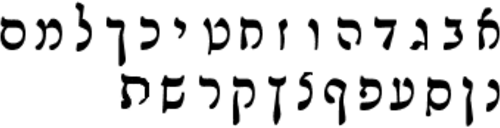

Judaeo-Spanish, also known as Ladino,[248] is a variety of Spanish which preserves many features of medieval Spanish and some old Portuguese and is spoken by descendants of the Sephardi Jews who were expelled from Spain in the 15th century.[248] While in Portugal the conversion of Jews occurred earlier and the assimilation of New Christians was overwhelming, in Spain the Jews kept their language and identity. The relationship of Ladino and Spanish is therefore comparable with that of the Yiddish language to German. Ladino speakers today are almost exclusively Sephardi Jews, with family roots in Turkey, Greece, or the Balkans, and living mostly in Israel, Turkey, and the United States, with a few communities in Hispanic America.[248] Judaeo-Spanish lacks the Native American vocabulary which was acquired by standard Spanish during the Spanish colonial period, and it retains many archaic features which have since been lost in standard Spanish. It contains, however, other vocabulary which is not found in standard Spanish, including vocabulary from Hebrew, French, Greek and Turkish, and other languages spoken where the Sephardim settled.
Judaeo-Spanish is in serious danger of extinction because many native speakers today are elderly as well as elderly olim (immigrants to Israel) who have not transmitted the language to their children or grandchildren. However, it is experiencing a minor revival among Sephardi communities, especially in music. In Latin American communities, the danger of extinction is also due to assimilation by modern Spanish.
A related dialect is Haketia, the Judaeo-Spanish of northern Morocco. This too, tended to assimilate with modern Spanish, during the Spanish occupation of the region.
Writing system
Spanish is written in the Latin script, with the addition of the character ⟨ñ⟩ (eñe, representing the phoneme /ɲ/, a letter distinct from ⟨n⟩, although typographically composed of an ⟨n⟩ with a tilde). Formerly the digraphs ⟨ch⟩ (che, representing the phoneme /t͡ʃ/) and ⟨ll⟩ (elle, representing the phoneme /ʎ/ or /ʝ/), were also considered single letters. However, the digraph ⟨rr⟩ (erre fuerte, 'strong r', erre doble, 'double r', or simply erre), which also represents a distinct phoneme /r/, was not similarly regarded as a single letter. Since 1994 ⟨ch⟩ and ⟨ll⟩ have been treated as letter pairs for collation purposes, though they remained a part of the alphabet until 2010. Words with ⟨ch⟩ are now alphabetically sorted between those with ⟨cg⟩ and ⟨ci⟩, instead of following ⟨cz⟩ as they used to. The situation is similar for ⟨ll⟩.[249][250]
Thus, the Spanish alphabet has the following 27 letters:
- A, B, C, D, E, F, G, H, I, J, K, L, M, N, Ñ, O, P, Q, R, S, T, U, V, W, X, Y, Z.
Since 2010, none of the digraphs (ch, ll, rr, gu, qu) are considered letters by the Royal Spanish Academy.[251]
The letters k and w are used only in words and names coming from foreign languages (kilo, folklore, whisky, kiwi, etc.).
With the exclusion of a very small number of regional terms such as México (see Toponymy of Mexico), pronunciation can be entirely determined from spelling. Under the orthographic conventions, a typical Spanish word is stressed on the syllable before the last if it ends with a vowel (not including ⟨y⟩) or with a vowel followed by ⟨n⟩ or an ⟨s⟩; it is stressed on the last syllable otherwise. Exceptions to this rule are indicated by placing an acute accent on the stressed vowel.
The acute accent is used, in addition, to distinguish between certain homophones, especially when one of them is a stressed word and the other one is a clitic: compare el ('the', masculine singular definite article) with él ('he' or 'it'), or te ('you', object pronoun) with té ('tea'), de (preposition 'of') versus dé ('give' [formal imperative/third-person present subjunctive]), and se (reflexive pronoun) versus sé ('I know' or imperative 'be').
The interrogative pronouns (qué, cuál, dónde, quién, etc.) also receive accents in direct or indirect questions, and some demonstratives (ése, éste, aquél, etc.) can be accented when used as pronouns. Accent marks used to be omitted on capital letters (a widespread practice in the days of typewriters and the early days of computers when only lowercase vowels were available with accents), although the Real Academia Española advises against this and the orthographic conventions taught at schools enforce the use of the accent.
When u is written between g and a front vowel e or i, it indicates a "hard g" pronunciation. A diaeresis ü indicates that it is not silent as it normally would be (e.g., cigüeña, 'stork', is pronounced [θiˈɣweɲa]; if it were written *cigueña, it would be pronounced *[θiˈɣeɲa]).
Interrogative and exclamatory clauses are introduced with inverted question and exclamation marks (¿ and ¡, respectively) and closed by the usual question and exclamation marks.
Organizations
Royal Spanish Academy
The Royal Spanish Academy (Real Academia Española), founded in 1713,[252] together with the 21 other national ones (see Association of Spanish Language Academies), exercises a standardizing influence through its publication of dictionaries and widely respected grammar and style guides.[253] Because of influence and for other sociohistorical reasons, a standardized form of the language (Standard Spanish) is widely acknowledged for use in literature, academic contexts and the media.
Association of Spanish Language Academies

The Association of Spanish Language Academies (Asociación de Academias de la Lengua Española, or ASALE) is the entity which regulates the Spanish language. It was created in Mexico in 1951 and represents the union of all the separate academies in the Spanish-speaking world. It comprises the academies of 23 countries, ordered by date of academy foundation: Spain (1713),[255] Colombia (1871),[256] Ecuador (1874),[257] Mexico (1875),[258] El Salvador (1876),[259] Venezuela (1883),[260] Chile (1885),[261] Peru (1887),[262] Guatemala (1887),[263] Costa Rica (1923),[264] Philippines (1924),[265] Panama (1926),[266] Cuba (1926),[267] Paraguay (1927),[268] Dominican Republic (1927),[269] Bolivia (1927),[270] Nicaragua (1928),[271] Argentina (1931),[272] Uruguay (1943),[273] Honduras (1949),[274] Puerto Rico (1955),[275] United States (1973)[276] and Equatorial Guinea (2016).[277]
Cervantes Institute
The Instituto Cervantes ('Cervantes Institute') is a worldwide nonprofit organization created by the Spanish government in 1991. This organization has branches in 45 countries, with 88 centers devoted to the Spanish and Hispanic American cultures and Spanish language.[278] The goals of the Institute are to promote universally the education, the study, and the use of Spanish as a second language, to support methods and activities that help the process of Spanish-language education, and to contribute to the advancement of the Spanish and Hispanic American cultures in non-Spanish-speaking countries. The institute's 2015 report "El español, una lengua viva" (Spanish, a living language) estimated that there were 559 million Spanish speakers worldwide. Its latest annual report "El español en el mundo 2018" (Spanish in the world 2018) counts 577 million Spanish speakers worldwide. Among the sources cited in the report is the U.S. Census Bureau, which estimates that the U.S. will have 138 million Spanish speakers by 2050, making it the biggest Spanish-speaking nation on earth, with Spanish the mother tongue of almost a third of its citizens.[279]
Official use by international organizations
Spanish is one of the official languages of the United Nations, the European Union, the World Trade Organization, the Organization of American States, the Organization of Ibero-American States, the African Union, the Union of South American Nations, the Antarctic Treaty Secretariat, the Latin Union, the Caricom, the North American Free Trade Agreement, the Inter-American Development Bank, and numerous other international organizations.
Sample text
Article 1 of the Universal Declaration of Human Rights in Spanish:
- Todos los seres humanos nacen libres e iguales en dignidad y derechos y, dotados como están de razón y conciencia, deben comportarse fraternalmente los unos con los otros.[280]
Article 1 of the Universal Declaration of Human Rights in English:
- All human beings are born free and equal in dignity and rights. They are endowed with reason and conscience and should act towards one another in a spirit of brotherhood.[281]
See also

References
Citations
- ^ a b c d e f g h i j k l m n o p q r s t u v w x y z aa ab ac ad ae af ag ah ai aj ak al am an ao ap aq ar as at au av aw ax ay az ba bb bc bd be bf bg bh bi bj bk bl bm bn bo bp Fernández Vítores, David (2023). El español: una lengua viva – Informe 2023 (PDF) (Report). Instituto Cervantes. pp. 23–142. Archived (PDF) from the original on 8 December 2023. Retrieved 2 December 2023.
- ^ Eberhard, Simons & Fennig (2020)
- ^ Hammarström, Harald; Forkel, Robert; Haspelmath, Martin; Bank, Sebastian, eds. (2022). "Castilic". Glottolog 4.6. Jena, Germany: Max Planck Institute for Evolutionary Anthropology. Archived from the original on 28 May 2022. Retrieved 19 June 2022.
- ^ "Ethnologue, 2022". Archived from the original on 7 May 2023. Retrieved 2 December 2023.
- ^ a b Eberhard, David M.; Simons, Gary F.; Fennig, Charles D. (2022). "Summary by language size". Ethnologue. SIL International. Archived from the original on 18 June 2023. Retrieved 2 December 2023.
- ^ a b "Official Languages". United Nations. Archived from the original on 5 January 2024. Retrieved 5 January 2024.
- ^ "In which countries of the world is this language spoken?". Archived from the original on 29 June 2023. Retrieved 23 January 2024.
- ^ Salvador, Yolanda Mancebo (2002). "Hacia una historia de la puesta en escena de La vida es sueño". Calderón en Europa (in Spanish). Vervuert Verlagsgesellschaft. pp. 91–100. doi:10.31819/9783964565013-007. ISBN 978-3-96456-501-3. Archived from the original on 3 March 2022. Retrieved 3 March 2022.
- ^ "Countries with most Spanish speakers 2021". Statista. Archived from the original on 17 May 2022. Retrieved 17 May 2022.
- ^ Vergaz, Miguel A. (7 November 2010), La RAE avala que Burgos acoge las primeras palabras escritas en castellano (in Spanish), ES: El Mundo, archived from the original on 24 November 2010, retrieved 24 November 2010
- ^ Rice, John (2010). "sejours linguistiques en Espagne". sejours-linguistiques-en-espagne.com. Archived from the original on 18 January 2013. Retrieved 3 March 2022.
- ^ Heriberto Robles; Camacho Becerra; Juan José Comparán Rizo; Felipe Castillo (1998). Manual de etimologías grecolatinas (3rd ed.). México: Limusa. p. 19. ISBN 968-18-5542-6. Archived from the original on 24 January 2023. Retrieved 9 January 2023.
- ^ Comparán Rizo, Juan José. Raices Griegas y latinas (in Spanish). Ediciones Umbral. p. 17. ISBN 978-968-5430-01-2. Archived from the original on 23 April 2017. Retrieved 22 August 2017.
- ^ Spanish in the World Archived 6 February 2021 at the Wayback Machine, Language Magazine, 18 November 2019.
- ^ "El español se atasca como lengua científica". Servicio de Información y Noticias Científicas (in Spanish). 5 March 2014. Archived from the original on 22 February 2019. Retrieved 29 January 2019.
- ^ Devlin, Thomas Moore (30 January 2019). "What Are The Most-Used Languages On The Internet?". +Babbel Magazine. Archived from the original on 6 December 2021. Retrieved 13 July 2021.
- ^ "Usage statistics of content languages for websites". 10 February 2024. Archived from the original on 17 August 2019. Retrieved 10 February 2024.
- ^ Diccionario panhispánico de dudas, 2005, p. 271–272.
- ^ a b Cano Aguilar, Rafael (2013). "De nuevo sobre los nombres medievales de la lengua de Castilla". E-Spania (15). doi:10.4000/e-spania.22518. ISSN 1951-6169. Archived from the original on 7 July 2022. Retrieved 7 July 2022.
- ^ "español, la". Diccionario de la lengua española. Real Academia Espańola. Archived from the original on 24 April 2017. Retrieved 13 July 2021.
- ^ "cartularioshistoria". www.euskonews.com. Archived from the original on 2 April 2016. Retrieved 22 September 2016.
- ^ a b Penny (2000:16)
- ^ "Concise Oxford Companion to the English Language". Oxford University Press. Archived from the original on 25 September 2008. Retrieved 24 July 2008.
- ^ "Harold Bloom on Don Quixote, the first modern novel | Books | The Guardian". London: Books.guardian.co.uk. 12 December 2003. Archived from the original on 14 June 2008. Retrieved 18 July 2009.
- ^ "Spanish Language Facts". Encyclopedia.com. Archived from the original on 22 May 2011. Retrieved 6 November 2010.
- ^ Crow, John A. (2005). Spain: the root and the flower. University of California Press. p. 151. ISBN 978-0-520-24496-2. Archived from the original on 17 August 2021. Retrieved 28 October 2020.
- ^ Thomas, Hugh (2005). Rivers of Gold: the rise of the Spanish empire, from Columbus to Magellan. Random House Inc. p. 78. ISBN 978-0-8129-7055-5. Archived from the original on 16 August 2021. Retrieved 28 October 2020.
- ^ "La lengua de Cervantes" (PDF) (in Spanish). Ministerio de la Presidencia de España. Archived from the original (PDF) on 3 October 2008. Retrieved 24 August 2008.
- ^ "Anuario instituto Cervantes 2023". Centro Virtual Cervantes (in Spanish). Archived from the original on 22 February 2023. Retrieved 6 November 2023. Estimate. Corrected as Equatorial Guinea is mistakenly included (no native speakers there)
- ^ "Summary by language size". Ethnologue. 3 October 2018. Archived from the original on 26 December 2018. Retrieved 14 November 2020.
- ^ "Internet World Users by Language". Miniwatts Marketing Group. 2008. Archived from the original on 26 April 2012. Retrieved 20 November 2007.
- ^ Mar-Molinero, Clara (2000). The Politics of Language in the Spanish-Speaking World. London: Routledge. pp. 19–20. ISBN 0-203-44372-1.
- ^ Mar-Molinero 2000, p. 21.
- ^ "Background Note: Andorra". U.S. Department of State: Bureau of European and Eurasian Affairs. January 2007. Archived from the original on 22 January 2017. Retrieved 20 August 2007.
- ^ "BBC Education — Languages Across Europe — Spanish". Bbc.co.uk. Archived from the original on 29 September 2012. Retrieved 20 August 2012.
- ^ Constitución de la República del Paraguay Archived 8 September 2014 at the Wayback Machine, Article 140
- ^ Constitución Política del Perú Archived 17 May 2014 at the Wayback Machine, Article 48
- ^ "Puerto Rico Elevates English". the New York Times. 29 January 1993. Archived from the original on 22 January 2008. Retrieved 6 October 2007.
- ^ a b Lamboy & Salgado-Robles 2020, p. 1.
- ^ Lamboy, Edwin M.; Salgado-Robles, Francisco (2020). "Introduction: Spanish in the United States and across Domains". In Salgado-Robles, Francisco; Lamboy, Edwin M. (eds.). Spanish across Domains in the United States. Education, Public Space, and Social Media. Leiden: Brill. p. 1. ISBN 978-90-04-43322-9.
- ^ "Racial and Ethnic Diversity in the United States: 2010 Census and 2020 Census". U.S. Census Bureau. 12 August 2021. Archived from the original on 15 August 2021. Retrieved 23 January 2021.
- ^ "American Community Survey Explore Census Data". Archived from the original on 17 October 2021. Retrieved 24 January 2022.
- ^ "Más 'speak spanish' que en España". Archived from the original on 20 May 2011. Retrieved 6 October 2007. (in Spanish)
- ^ Crawford, John (1992). Language loyalties: a source book on the official English controversy. Chicago: University of Chicago Press. p. 62. ISBN 9780226120164. Archived from the original on 30 November 2023. Retrieved 14 November 2023.
- ^ Languages spoken in Belize, 2022 Census (PDF) (Report). 2022. Retrieved 11 September 2024.
- ^ "FAQ". The Secretariat for The Implementation of Spanish. Trinidad and Tobago: Government of the Republic. Archived from the original on 3 November 2010. Retrieved 10 January 2012.
- ^ "Language and education on Aruba, Bonaire and Curaçao".
- ^ Valle & Villa 2006, p. 376.
- ^ Valle, José del; Villa, Laura (2006). "Spanish in Brazil: Language Policy, Business, and Cultural Propaganda". Language Policy. 5 (4): 376–377. doi:10.1007/s10993-006-9035-2. S2CID 144373408. Archived from the original on 24 January 2022. Retrieved 5 February 2022.
- ^ "Brazilian Law 11.161". Presidência da República. 5 August 2005. Archived from the original on 31 October 2013. Retrieved 31 March 2014.
- ^ "Novo ensino médio terá currículo flexível e mais horas de aula". O Globo. 23 September 2016. Archived from the original on 23 September 2016. Retrieved 23 September 2016.
- ^ Lipski, John M (2006). Face, Timothy L; Klee, Carol A (eds.). "Too close for comfort? the genesis of "portuñol/portunhol"" (PDF). Selected Proceedings of the 8th Hispanic Linguistics Symposium. Somerville, MA: Cascadilla Proceedings Project: 1–22. Archived (PDF) from the original on 16 December 2008. Retrieved 29 December 2008.
- ^ Lipski, John M. (2014). "¿Existe un dialecto "ecuatoguineano" del español?". Revista Iberoamericana. 80 (248–249): 865–882. doi:10.5195/REVIBEROAMER.2014.7202. Archived from the original on 24 January 2022. Retrieved 19 January 2022.
- ^ Bituga-Nchama, Pedro Bayeme; Nvé-Ndumu, Cruz Otu (2021). "The decline of the indigenous languages of Equatorial Guinea: a manifestation of the loss of cultural identity". Revista Cátedra. 4 (3): 41. Archived from the original on 24 January 2022. Retrieved 19 January 2022.
- ^ Quilis and Casado-Fresnillo, 1995, pp. 27–35; cfr Bituga-Nchama & Nvé-Ndumu (2021:41)
- ^ "Gloria Nistal Rosique: El caso del español en Guinea ecuatorial, Instituto Cervantes" (PDF). Archived (PDF) from the original on 26 October 2012. Retrieved 7 February 2010.
- ^ Lipski, John M. (2004). "The Spanish language of Equatorial Guinea" (PDF). Arizona Journal of Hispanic Cultural Studies. 8: 117. doi:10.1353/hcs.2011.0376. S2CID 144501371. Archived (PDF) from the original on 21 January 2022. Retrieved 19 January 2022.
- ^ Los cubanos, la élite de Sudán del Sur (in Spanish), FR: Radio France International, 6 July 2011, archived from the original on 12 January 2012, retrieved 20 December 2011
- ^ Medina López, Javier (1992–1993). "Estandarización lingüística en las hablas canarias". Universitas Tarraconensis. Revista de Filologia (14). Publicacions Universitat Rovira i Virgili: 175–176. ISSN 2604-3432. Archived from the original on 24 January 2022. Retrieved 19 January 2022.
- ^ Lipski, John (1994). Latin American Spanish (1st ed.). Longman. p. 55:
An indisputable influence in the formation of Latin American Spanish, often overshadowed by discussion of the 'Andalusian' contribution, is the Canary Islands.
- ^ Díaz-Campos, Manuel; Escalona Torres, Juan M.; Filimonova, Valentyna (2020). "Sociolinguistics of the Spanish-Speaking World". Annual Review of Linguistics. 6: 369. doi:10.1146/annurev-linguistics-011619-030547. ISSN 2333-9683. S2CID 210443649. Archived from the original on 9 December 2023. Retrieved 9 December 2023.
- ^ a b c Vicente 2011, p. 67.
- ^ Fernández Vítores, David (2018). "The endurance of Spanish in the Maghreb". The economic and commercial influence of Spanish-based languages (PDF). Madrid: Ministerio de Economía y Empresa. pp. 32–46. Archived (PDF) from the original on 13 January 2024. Retrieved 9 December 2023.
- ^ Fernández Vítores 2018, pp. 32–46.
- ^ "الوفد الصحراوي سيحضر لقاء جنيف بإرادة صادقة للتقدم نحو الحل الذي يضمن حق الشعب الصحراوي في تقرير المصير والاستقلال" [The Sahrawi delegation will attend the Geneva meeting with a sincere will to move towards a solution that guarantees the right of the Sahrawi people to self-determination and independence]. Sahara Press Service (in Arabic). 29 November 2018. Archived from the original on 25 November 2023. Retrieved 18 December 2023.
- ^ Carrión, Francisco (20 October 2021). "España se desentiende de la preservación del castellano en los campamentos saharauis". El Independiente. Archived from the original on 24 January 2022. Retrieved 19 January 2022.
- ^ Martos, Isabel. "Linguistic Policy in the Camps of Sahrawi Refugees". Universidad de Alcalá. Archived from the original on 22 May 2021. Retrieved 19 August 2018 – via researchgate.net.
- ^ "El Español en los Campamentos de Refugiados Saharauis (Tinduf, Algeria)" (PDF). Cvc.cervantes.es. Archived (PDF) from the original on 26 December 2016. Retrieved 20 May 2015.
- ^ "Como saharauis queremos conservar el español" (in Spanish). 3 March 2008. Archived from the original on 9 March 2016. Retrieved 15 March 2015.
- ^ "Historia de un país" (in Spanish). Archived from the original on 2 April 2015. Retrieved 15 March 2015.
- ^ "AU languages". African Union. Archived from the original on 7 April 2019. Retrieved 6 June 2024.
- ^ "Por qué Filipinas no es un país hispanoparlante si fue una colonia de España durante 300 años (y qué huellas quedan de la lengua de Cervantes)". BBC News Mundo (in Spanish). 30 January 2021. Archived from the original on 30 January 2021. Retrieved 31 January 2021.
- ^ Ocampo, Ambeth (4 December 2007). "The loss of Spanish". Philippine Daily Inquirer (INQUIRER.net). Makati City, Philippines. Opinion. Archived from the original on 11 March 2012. Retrieved 26 July 2010.
- ^ "Presidential Decree No. 155 : PHILIPPINE LAWS, STATUTES and CODES : CHAN ROBLES VIRTUAL LAW LIBRARY". Chanrobles.com. Archived from the original on 3 October 2013. Retrieved 24 March 2014.
- ^ Article XIV, Sec 7: "For purposes of communication and instruction, the official languages of the Philippines are Filipino and, until otherwise provided by law, English. The regional languages are the auxiliary official languages in the regions and shall serve as auxiliary media of instruction therein. Spanish and Arabic shall be promoted on a voluntary and optional basis."
- ^ Article XIV, Sec 8: "This Constitution shall be promulgated in Filipino and English and shall be translated into major regional languages, Arabic, and Spanish."
- ^ Rodríguez-Ponga, Rafael. "New Prospects for the Spanish Language in the Philippines". Archived from the original on 2 April 2015. Retrieved 1 March 2015.
- ^ Legaspi, Amita O. (3 July 2012). "PNoy (President Benigno Aquino III) and Spain's Queen Sofia welcome return of Spanish language in Philippine schools". GMA News. Archived from the original on 7 July 2012. Retrieved 8 August 2013.
- ^ "Spanish Language Program in Philippine Public Secondary Schools". SEAMEO Regional Center for Educational Innovation and Technology. Archived from the original on 22 January 2024. Retrieved 8 May 2023.
- ^ "Studying – In the Philippines". Ministry of Education and Vocational Training of Spain. Archived from the original on 8 April 2023. Retrieved 8 May 2023.
- ^ Weedon, Alan (10 August 2019). "The Philippines is fronting up to its Spanish heritage, and for some it's paying off". ABC News and Current Affairs. Archived from the original on 12 December 2021. Retrieved 18 January 2022.
- ^ Mojarro, Jorge (6 October 2020). "Spanish is an endangered Filipino language". The Manila Times. Archived from the original on 18 January 2022. Retrieved 18 January 2022.
- ^ Andrés Barrenechea, Clarissa (June 2013). La enseñanza del español como lengua extranjera en Filipinas. Estudio de caso de la Universidad Ateneo de Manila [The Teaching of Spanish as a Foreign Language in the Philippines: Case Study of the Ateneo de Manila University] (PDF) (Master) (in Spanish). Autonomous University of Zacatecas. Archived (PDF) from the original on 10 April 2023. Retrieved 8 May 2023.
- ^ Spanish creole: Quilis, Antonio (1996), La lengua española en Filipinas (PDF), Cervantes virtual, p. 54 and 55, archived (PDF) from the original on 6 August 2009, retrieved 1 December 2009
- ^ Rubino (2008:279)
- ^ 1973 Constitution of the Republic of the Philippines, The corpus juris, Article XV, Section 3(3), archived from the original on 17 April 2008, retrieved 6 April 2008
- ^ "Spanish Influence on Language, Culture, and Philippine History". Archived from the original on 5 March 2015. Retrieved 15 March 2015.
- ^ Engelberg, Stefan. "The Influence of German on the Lexicon of Palauan and Kosraean (Dissertation)" (PDF). Archived (PDF) from the original on 21 December 2012. Retrieved 23 August 2012.
- ^ "Spanish language in Philippines". Archived from the original on 18 March 2015. Retrieved 1 March 2015.
- ^ "cvc.cervantes (Spanish in Australia and New Zealand)" (PDF). Archived (PDF) from the original on 16 June 2022. Retrieved 25 May 2022.
- ^ "UN 2011 to 2100 estimate" (MS Excel PDF). UN Population data. Archived from the original on 10 May 2015. Retrieved 7 February 2018.
- ^ Ethnologue, 18th Ed.: es:Anexo:Hablantes de español según Ethnologue (edición 18).
- ^ a b *World Population Prospects, EU, archived from the original on 10 May 2015 *Eurobarometer (PDF), 2012, archived (PDF) from the original on 29 April 2013, retrieved 12 April 2013,
Page TS2: Population older than 15 years old of each country. page T74: Speakers who speak Spanish very well. Page T46: Speakers who speak well enough in order to be able to have a conversation.
- ^ a b c d e f g h i Demografía de la lengua española (PDF) (in Spanish), ES, p. 10, archived (PDF) from the original on 23 September 2010, retrieved 23 February 2010, to countries with official Spanish status.
- ^ 2024 population estimate (in Spanish), MX: CONAPO estimate, archived from the original on 10 February 2018, retrieved 30 January 2018
- ^ a b "MX", The World Factbook, USA: CIA, archived from the original on 26 January 2021, retrieved 1 May 2011: Spanish only 92.7%
- ^ (1 July, 2023), US: Census Bureau, archived from the original on 4 March 2021
- ^ Spanish speakers older than 5 years old (Table, US: Census Bureau, 2023, archived from the original on 18 September 2023)
- ^ Taylor, Paul (4 April 2012). "IV. Language Use among Latinos". pewhispanic.org. Archived from the original on 9 April 2014. Retrieved 24 March 2014.
- ^ "Census Bureau (01/July/2023)". Census.gov. Archived from the original on 18 September 2023.
- ^ Gonzalez, Ana (13 August 2013). "Spanish is the most spoken non-English language in U.S. homes, even among non-Hispanics". pewresearch.org. Archived from the original on 27 March 2014. Retrieved 24 March 2014.
- ^ "PROYECCIONES DE POBLACIÓN" (in Spanish). CO: DANE. 2024. Archived from the original on 22 March 2019.
- ^ "datosmundial.com (Colombia)". Archived from the original on 12 December 2023. Retrieved 24 October 2023.
- ^ "Census INE estimate for 1 July 2024". Archived from the original on 13 January 2022.
- ^ a b c INE (2021) Archived 2 November 2023 at the Wayback Machine: In Spain, 85.6% speak Spanish always or frequently in family (77.1% always and 8.5% frequently), 96% speak Spanish well, and 99.5% understand and speak, albeit with difficulty .
- ^ "Argentinian census INDEC estimate for 2024". INDEC. Archived from the original on 26 February 2014. Retrieved 26 February 2014.
- ^ Estimaciones y proyecciones de población 2010–2040: Total del país, INDEC, 2013, archived from the original on 1 October 2018, retrieved 22 February 2015
- ^ 40,872,286 people is the census population result for 2010[107]
- ^ "datosmundial.com (Argentina)". Archived from the original on 17 April 2023. Retrieved 24 October 2023.
- ^ "Proyecciones de Población". ine.gov.ve. Archived from the original on 13 November 2015. Retrieved 12 October 2014. (2020)
- ^ "Languages", VE, Ethnologue, archived from the original on 10 March 2013, retrieved 30 May 2013,
There are 1,098,244 people who speak other language as their mother tongue (main languages: Chinese 400,000, Portuguese 254,000, Wayuu 199,000, Arabic 110,000)
- ^ Quispe Fernández, Ezio (2024). "Cifras" [Numbers] (PDF) (in Spanish). PE: INEI. Archived from the original (PDF) on 10 October 2017.
- ^ "Census", The World factbook, US: CIA, 2007, archived from the original on 19 November 2021, retrieved 4 October 2011,
Spanish (official) 84.1%, Quechua (official) 13%, Aymara 1.7%, Ashaninka 0.3%, other native languages (includes a large number of minor Amazonian languages) 0.7%, other 0.2%
- ^ "PE", Country, Ethnologue, archived from the original on 2 December 2011, retrieved 21 September 2011,
There are 5,782,260 people who speak other language as mother tongue (main languages: Quechua (among 32 Quechua's varieties) 4,773,900, Aymara (2 varieties) 661,000, Chinese 100,000).
- ^ "Informes" [Reports]. Census estimate for 2024 (in Spanish). CL: INE. 2022. Archived from the original on 13 January 2022. Retrieved 13 January 2022.
- ^ "CL", Country, Ethnologue, archived from the original on 3 February 2013, retrieved 12 October 2011,
There are 281,600 people who speak another language, mainly Mapudungun (250.000)
- ^ "Estimate", Pop. clock (SWF), EC: INEC, archived from the original on 5 December 2015, retrieved 5 January 2016
- ^ CIA Factbook (19 February 1999). "(2019)". CIA Factbook. Archived from the original on 10 January 2021. Retrieved 24 March 2014.
- ^ "Guatemala: Estimaciones y proyecciones de población a largo plazo 1950–2050". www.oj.gob.gt (in Spanish). Instituto Nacional de Estadística. Archived (PDF) from the original on 23 July 2018.
- ^ "GT", The World factbook, CIA, archived from the original on 15 April 2021, retrieved 27 January 2021,
Spanish (official) 69.9%, Amerindian languages 40%
- ^ "31 December 2020 estimation". ONEI. Archived from the original on 14 March 2020.
- ^ "Census INE estimate for 2022". INE. Archived from the original on 11 October 2010. Retrieved 21 April 2010.
- ^ "South America :: Bolivia — The World Factbook – Central Intelligence Agency". www.cia.gov. Archived from the original on 27 September 2021. Retrieved 13 March 2020.
- ^ "Census ONE estimate for 2022" (in Spanish). Oficina Nacional de Estadística. Archived from the original on 14 November 2019. Retrieved 13 July 2021.
- ^ "INE (Pop clock)". Archived from the original on 19 May 2011. Retrieved 5 February 2011.
- ^ There are 207,750 people who speak another language, mainly Garifuna (98,000).: Ethnologue Archived 13 October 2011 at the Wayback Machine
- ^ "INSEE estimate to 2021". Insee.fr. Archived from the original on 5 November 2016. Retrieved 20 August 2012.
- ^ a b c Eurobarometr 2012 Archived 29 April 2013 at the Wayback Machine (page T40): Native speakers.
- ^ a b c d e f g h i j k l m n o p q r s t u v w x y z aa ab ac ad ae af ag ah ai aj ak al am an ao Eurobarometr 2012 Archived 29 April 2013 at the Wayback Machine (page TS2): Population older than 15. (age scale used for the Eurobarometer survey)
- ^ a b c d e f g h i j k l m n o Eurobarometr 2012 Archived 29 April 2013 at the Wayback Machine (page T74): Non native people who speak Spanish very well.
- ^ a b c d e f g h i j k l m n o p q r s t u v w Eurobarometr 2012 Archived 29 April 2013 at the Wayback Machine (page T64): Non native people who speak Spanish well enough in order to be able to have a conversation.
- ^ "Census estimate for 2022". Archived (PDF) from the original on 22 April 2020. Retrieved 18 March 2020.
- ^ "South America :: Paraguay — The World Factbook – Central Intelligence Agency". www.cia.gov. Archived from the original on 31 December 2018. Retrieved 18 March 2020.
- ^ "es.ripleybelieves.com". Archived from the original on 15 January 2022. Retrieved 14 January 2022.
- ^ www.abc.com.py Archived 13 January 2022 at the Wayback Machine According to DGEEC Census 2012, 7.93% is monolingual of Guarani.
- ^ "Census estimate for 2020" (PDF). Archived (PDF) from the original on 14 November 2021. Retrieved 13 January 2022.
- ^ There are 490,124 people who speak another language, mainly Mískito (154,000).: Ethnologue Archived 15 January 2013 at the Wayback Machine
- ^ "Census estimate for 2022". Archived from the original on 2 January 2022. Retrieved 13 January 2022.
- ^ There are 14,100 people who speak other language as their mother tongue (main language, Kekchí with 12,300 speakers): Ethnologue Archived 7 February 2016 at the Wayback Machine.
- ^ IBGE population estimations [The IBGE publishes the population estimates for municipalities in 2011] (in Portuguese), BR, 2022, archived from the original on 16 November 2015, retrieved 7 January 2016
{{citation}}: CS1 maint: location missing publisher (link) - ^ "El español: una lengua viva. Informe 2021 (Pág. 11 y 13)" (PDF). Archived (PDF) from the original on 15 October 2021. Retrieved 13 January 2022.
- ^ "Census 2021 estimate". Istat.it. Archived from the original on 7 August 2015. Retrieved 24 March 2014.
- ^ Languages of Italy
- ^ "INEC estimate for 2022". INEC. Archived from the original on 27 March 2012. Retrieved 5 February 2011.
- ^ "Costa Rica". Ethnologue. Archived from the original on 25 March 2015. Retrieved 1 March 2015.
- ^ Census INEC estimate for 2020 Archived 7 October 2011 at the Wayback Machine (véase "Proyección de Población por municipio 2008–2020")
- ^ There are 501,043 people who speak another language as mother tongue: PA, Ethnologue, archived from the original on 21 October 2011, retrieved 17 October 2011
- ^ "2016 INE estimate for 2022". 2022. Archived from the original on 22 March 2019.
- ^ There are 150,200 people who speak another language as mother tongue, UY, Ethnologue, archived from the original on 16 November 2011, retrieved 17 October 2011
- ^ "2020 US. census Bureau". Archived from the original (PDF) on 23 December 2015.
- ^ (US. Census Bureau 2017 Archived 24 September 2015 at the Wayback Machine)
- ^ "Annual Mid year Population Estimates: 2020". U.K. Gov. Census. 2020. Archived from the original on 15 May 2016.
- ^ Languages of the United Kingdom
- ^ German census, DE: Destatis, 2020, archived from the original on 28 June 2016
- ^ Native command group (GDL): 266,955 non-nationalized Spanish-speaking immigrants, 63,752 nationalized Spanish-speaking immigrants, 44,500 Spanish speakers of children of immigrants (second generation). 375,207 total native speakers, but there are another 37,047 non-mother-tongue speakers with native-level skills. Anuario del Instituto Cervantes 2020 (page 325). "Germany and their Spanish speakers" Archived 18 February 2020 at the Wayback Machine
- ^ Statcan, CA: GC, February 1995, archived from the original on 4 July 2016, retrieved 7 August 2012
- ^ "Mother tongue by geography, 2021 Census". Statistics Canada. 2021. Archived from the original on 14 January 2024. Retrieved 24 October 2023.
- ^ "Knowledge of languages by age and gender: Canada, provinces and territories, census divisions and census subdivisions". Statistics Canada. 2022. Archived from the original on 22 January 2024. Retrieved 24 October 2023.
- ^ cia.gov Archived 22 September 2021 at the Wayback Machine (3.2% speak Spanish in Canada)
- ^ "tln.ca" (PDF). Archived (PDF) from the original on 7 December 2023. Retrieved 24 October 2023.
- ^ "allontario.ca". 14 May 2020. Archived from the original on 27 September 2023. Retrieved 24 October 2023.
- ^ "Census estimate for 2020". HCP. Archived from the original on 20 March 2014.
- ^ a b El español en el mundo [Spanish in the world] (PDF), ES: Instituto Cervantes, 2012, p. 6, archived from the original (PDF) on 17 October 2012
- ^ El español en el contexto Sociolingüístico marroquí: Evolución y perspectivas (page 39): Between 4 and 7 million people have Spanish knowledge (M. Ammadi, 2002) Archived 6 November 2013 at the Wayback Machine
- ^ "Euromonitor, 2012" (PDF). exteriores.gob.es. p. 32. Archived (PDF) from the original on 25 April 2015. Retrieved 19 April 2015.
- ^ "Equatorial Guinea census estimate". Population statistics. 2021. Archived from the original on 6 August 2010. Retrieved 21 April 2010.
- ^ cvc.cervantes.es. Archived 27 December 2021 at the Wayback Machine. 13.7% of the country's Spanish speakers are proficient; the remaining 74% are limited-competence speakers.
- ^ "INE, 2019". Archived from the original on 5 November 2016. Retrieved 2 December 2023.
- ^ "cvc.cervantes.es" (PDF). Archived (PDF) from the original on 22 December 2023. Retrieved 2 December 2023.
- ^ "Eurostat (1/1/2012 estimate)". Epp.eurostat.ec.europa.eu. 17 October 2013. Archived from the original on 20 July 2011. Retrieved 24 March 2014.
- ^ "Netherland Census ClockPop". Cbs.nl. 31 August 2005. Archived from the original on 17 June 2009. Retrieved 20 August 2012.
- ^ "ins.ci Census, 2009". Archived from the original on 13 January 2012. Retrieved 20 April 2016.
- ^ "2011 Census". Censusdata.abs.gov.au. Archived from the original on 3 April 2014. Retrieved 24 March 2014.
- ^ Medium projection, PH: National Statistics Office, 2015, archived from the original on 3 April 2019, retrieved 8 June 2013
- ^ gob.mx Archived 26 March 2023 at the Wayback Machine (363 Mexican Spanish speakers)
- ^ "cvc.cervantes.es". Archived from the original on 16 August 2023. Retrieved 25 October 2023.
- ^ 2012 censusArchived 5 November 2013 at the Wayback Machine
- ^ "Eurostat estimate to 1/1/2011". Epp.eurostat.ec.europa.eu. 2 April 2012. Archived from the original on 20 July 2011. Retrieved 20 August 2012.
- ^ "Accueil – INSAE". www.insae-bj.org. Archived from the original on 17 December 2015. Retrieved 20 April 2016.
- ^ Spanish in belize (Report) (in Spanish). Archived from the original on 4 December 2015. Retrieved 3 February 2022.
- ^ a b Spanish in Belize. 52.1% speak Spanish with very well level. 10.7% speak Spanish with intermediate level (PDF) (Report) (in Spanish). 2000. Archived (PDF) from the original on 3 February 2022. Retrieved 3 February 2022.
- ^ "bfs.admin.ch". 19 September 2019. Archived from the original on 20 September 2019. Retrieved 3 February 2022.
- ^ Statistik, Bundesamt für. "Bevölkerung". www.bfs.admin.ch. Archived from the original on 14 January 2016.
- ^ exteriores.gob.es Archived 24 January 2022 at the Wayback Machine. 2.3% Spanish speakers as a native language according to 2018 census.
- ^ "cvc.cervantes.es (annuary 2006–07)" (PDF). Archived (PDF) from the original on 6 January 2012. Retrieved 25 September 2009.
- ^ Evolution de la population par sexe de 1976 à 2012 Archived 15 January 2013 at the Wayback Machine en: Annuaire Statistique du Cameroun 2010. Consultado el 23 August 2012.
- ^ "El español: Una lengua Viva. Informe 2020" (PDF). Archived (PDF) from the original on 18 February 2020. Retrieved 14 December 2020.
- ^ www.state.gov Archived 4 June 2019 at the Wayback Machine. 2015 estimate
- ^ "Cifras" (PDF), El español: una lengua viva (in Spanish), ES: Instituto Cervantes, p. 10, archived (PDF) from the original on 24 February 2016, retrieved 14 February 2016 Students across the World.
- ^ [1] Archived 30 November 2011 at the Wayback Machine
- ^ "czso.cz" (in Czech). czso.cz. 31 December 2013. Archived from the original on 31 March 2014. Retrieved 24 March 2014.
- ^ "Census estimate for 2021". rosstat.gov.ru. 1 January 2021. Archived from the original on 14 January 2022. Retrieved 14 January 2022.
- ^ "(2012)". ksh.hu. Archived from the original on 16 November 2013. Retrieved 24 March 2014.
- ^ "Resultado 2010 – Persona". Censo2010.aw. 6 October 2010. Archived from the original on 17 January 2012. Retrieved 20 August 2012.
- ^ CSO – Statistics. Archived 7 January 2012 at the Wayback Machine.
- ^ "Census estimate for 2020". Stats.gov.cn. Archived from the original on 11 May 2021. Retrieved 14 January 2022.
- ^ "Census of India, 2022". Archived from the original on 19 June 2016. Retrieved 14 January 2022.
- ^ "Statistics – FAQ's". Gibraltar.gov.gi. 12 November 2012. Archived from the original on 5 January 2014. Retrieved 24 March 2014.
- ^ www.um.es Archived 26 June 2014 at the Wayback Machine (5.2. Datos descriptivos de los usos de español e inglés, Gráfico 2). 77.3% of the Gibraltar population speak Spanish with their mother more, or equal than English.
- ^ "(2013)". db1.stat.gov.lt. Archived from the original on 19 August 2010. Retrieved 24 March 2014.
- ^ "2009 estimate" (PDF). UN. 2008. Archived (PDF) from the original on 18 March 2009. Retrieved 21 April 2010.
- ^ The 1970 Spanish census claims there were 16,648 Spanish speakers in Western Sahara at the time ([2]. Archived 17 September 2009 at the Wayback Machine), but most of them were probably people born in Spain who left after the Moroccan annexation.
- ^ "EL ESPAÑOL EN CIFRAS" (PDF). cvc.cervantes.es (in Spanish). pp. 25–32. Archived (PDF) from the original on 6 July 2016. Retrieved 3 February 2022.
- ^ "Population – Key Indicators | Latvijas statistika". Csb.gov.lv. Archived from the original on 28 June 2013. Retrieved 14 June 2013.
- ^ "Jamaican Population". Statinja.gov.jm. Archived from the original on 6 October 2014. Retrieved 24 March 2014.
- ^ El español en Namibia, 2005. Archived 2 March 2013 at the Wayback Machine Instituto Cervantes.
- ^ "cvc.cervantes.es" (PDF). Archived (PDF) from the original on 6 January 2012. Retrieved 24 March 2014.
- ^ "International Programs – People and Households – U.S. Census Bureau". Census.gov. 5 January 2016. Archived from the original on 19 August 2012. Retrieved 20 August 2012.
- ^ "The World Factbook World". The World Factbook. CIA (US). Archived from the original on 26 January 2021. Retrieved 14 November 2023.
- ^ Cervantes.es Archived 21 July 2017 at the Wayback Machine – Instituto Cervantes (2017)
- ^ Zamora Vicente (1967:117 and 222)
- ^ Hualde (2014:39)
- ^ Martínez-Celdrán, Fernández-Planas & Carrera-Sabaté (2003:255)
- ^ Cressey (1978:152)
- ^ Abercrombie (1967:98)
- ^ John B. Dabor (1997). "Ch. 7". Spanish Pronunciation: Theory and Practice (3rd ed.). Holt, Rinehart and Winston.
- ^ "John B. Dalbor's Voice Files to Accompany Spanish Pronunciation". Auburn.edu. Archived from the original on 8 March 2012. Retrieved 20 August 2012.
- ^ Eddington (2000:96)
- ^ "Europeans and their Languages" (PDF). Archived from the original (PDF) on 6 January 2016. Retrieved 2 January 2013.
- ^ "Most Studied Foreign Languages in the U.S". Infoplease.com. Archived from the original on 14 August 2012. Retrieved 20 August 2012.
- ^ "US now has more Spanish speakers than Spain – only Mexico has more". The Guardian. 29 June 2015. Archived from the original on 23 November 2018. Retrieved 24 January 2021.
- ^ Bureau, US Census. "Language Projections: 2010 to 2020". The United States Census Bureau. Archived from the original on 19 August 2019. Retrieved 19 August 2019.
{{cite web}}:|last=has generic name (help) - ^ Eleanor Greet Cotton, John M. Sharp (1988) Spanish in the Americas, Volume 2, pp. 154–155, Archived 15 September 2015 at the Wayback Machine
- ^ Lope Blanch, Juan M. (1972). "En torno a las vocales caedizas del español mexicano". Estudios sobre el español de México (PDF) (in Spanish). México: Universidad Nacional Autónoma de México. pp. 53–73. Archived from the original (PDF) on 5 February 2011.
- ^ Penny (2000:199): "whatever might be claimed by other centres, such as Valladolid, it was educated varieties of Madrid Spanish that were mostly regularly reflected in the written standard."
- ^ Hernández Campoy, Juan Manuel; Villena Ponsoda, Juan Andrés (2009). "Standardness and nonstandardness in Spain: dialect attrition and revitalization of regional dialects of Spanish". International Journal of the Sociology of Language (196–197): 185–186. doi:10.1515/IJSL.2009.021. S2CID 145000590. Archived from the original on 24 January 2022. Retrieved 24 January 2022.
- ^ Charles B. Chang, "Variation in palatal production in Buenos Aires Spanish" Archived 4 October 2013 at the Wayback Machine. Selected Proceedings of the 4th Workshop on Spanish Sociolinguistics, ed. Maurice Westmoreland and Juan Antonio Thomas, 54–63. Somerville, MA: Cascadilla Proceedings Project, 2008.
- ^ a b "Diccionario panhispánico de dudas" [Pan-Hispanic Dictionary of Doubts] (in Spanish). Real Academia Española y Asociación de Academias de la Lengua Española [Royal Spanish Academy and Association of Academies of the Spanish Language]. 11 June 2023 [October 2005]. Archived from the original on 5 March 2011. Retrieved 6 November 2023.
- ^ "Voseo según DPD" (in Spanish). Archived from the original on 4 November 2012. Retrieved 27 January 2022.
- ^ Baquero Velásquez, Julia M.; Westphal Montt, Germán F. (2014). "Un análisis sincrónico del voseo verbal chileno y rioplatense". Forma y Función (in Spanish). 27 (2): 11–40. doi:10.15446/fyf.v27n2.47558.
- ^ Andrew (10 April 2018). "A Brief Guide to Regional Variation of the Forms of Address (Tú, Vos, Usted) in Spanish". Learn Spanish with Andrew. Archived from the original on 9 November 2020. Retrieved 2 November 2020.
- ^ Katia Salamanca de Abreu, review of Humberto López Morales, Estudios sobre el español de Cuba Archived 21 December 2012 at the Wayback Machine (New York: Editorial Las Américas, 1970), in Thesaurus, 28 (1973), 138–146.
- ^ Congost-Maestre, Nereida (30 April 2020). Sha, Mandy (ed.). Sociocultural issues in adapting Spanish health survey translation: The case of the QWB-SA (Chapter 10) in The Essential Role of Language in Survey Research. RTI Press. pp. 203–220. doi:10.3768/rtipress.bk.0023.2004. ISBN 978-1-934831-24-3. Archived from the original on 11 December 2023. Retrieved 13 December 2023.
- ^ Bergua Cavero, J., Los helenismos del español : historia y sistema, Madrid (Gredos) 2004, ISBN 9788424927103
- ^ Versteegh, Kees (2003). The Arabic language (Repr. ed.). Edinburgh: Edinburgh University Press. p. 228. ISBN 0-7486-1436-2. Archived from the original on 26 June 2014. Retrieved 23 October 2016.
- ^ Lapesa, Raphael (1960). Historia de la lengua española. p. 97.
—OR—
Castro, Américo (1985). The Spaniards: An Introduction to Their History. Translated by Willard F. King; Selma Margaretten. University of California Press. ISBN 978-0-520-05469-1. Archived from the original on 24 January 2023. Retrieved 23 October 2016.[verification needed] - ^ Quintana, Lucía; Mora, Juan Pablo (2002). "Enseñanza del acervo léxico árabe de la lengua española" (PDF). ASELE. Actas XIII: 705. Archived (PDF) from the original on 28 May 2016. Retrieved 23 October 2016.: "El léxico español de procedencia árabe es muy abundante: se ha señalado que constituye, aproximadamente, un 8% del vocabulario total"
- ^ a b Dworkin, Steven N. (2012). A History of the Spanish Lexicon: A Linguistic Perspective. Oxford: Oxford University Press. p. 83. ISBN 978-0-19-954114-0. Archived from the original on 15 September 2015. Retrieved 17 June 2015.,Macpherson, I. R. (1980). Spanish phonology. Manchester: Manchester University Press. p. 93. ISBN 0-7190-0788-7. Archived from the original on 23 December 2016. Retrieved 23 October 2016.,Martínez Egido, José Joaquín (2007). Constitución del léxico español. Liceus, Servicios de Gestió. p. 15. ISBN 978-84-9822-653-9. Archived from the original on 26 June 2014. Retrieved 23 October 2016.
- ^ "La época visigoda / Susana Rodríguez Rosique". www.cervantesvirtual.com (in Spanish). Biblioteca Virtual Miguel de Cervantes. Archived from the original on 8 February 2017. Retrieved 7 February 2017.
- ^ Penny (1991:224–236)
- ^ Jensen (1989)
- ^ Penny (2000:14)
- ^ Dalby (1998:501)
- ^ Ginsburgh & Weber (2011:90)
- ^ "Spanish". Ethnologue. Archived from the original on 15 January 2013. Retrieved 19 April 2005.
- ^ "Similar languages to Spanish". EZGlot. Archived from the original on 21 June 2017. Retrieved 24 June 2017.
- ^ Often considered to be a substratum word. Other theories suggest, on the basis of what is used to make cheese, a derivation from Latin brandeum (originally meaning a linen covering, later a thin cloth for relic storage) through an intermediate root *brandea. For the development of the meaning, cf. Spanish manteca, Portuguese manteiga, probably from Latin mantica ('sack'), Italian formaggio and French fromage from formaticus. Romanian Explanatory Dictionary Archived 18 February 2020 at the Wayback Machine
- ^ a b c Alfassa, Shelomo (December 1999). "Ladinokomunita". Foundation for the Advancement of Sephardic Studies and Culture. Archived from the original on 2 April 2010. Retrieved 4 February 2010.
- ^ Diccionario Panhispánico de Dudas Archived 16 April 2008 at the Wayback Machine, 1st ed.
- ^ Real Academia Española Archived 11 October 2017 at the Wayback Machine, Explanation Archived 6 September 2007 at the Wayback Machine at Spanish Pronto Archived 14 September 2007 at the Wayback Machine (in Spanish and English)
- ^ "Exclusión de ch y ll del abecedario | Real Academia Española". www.rae.es. Archived from the original on 28 April 2020. Retrieved 1 April 2020.
- ^ "Scholarly Societies Project". Lib.uwaterloo.ca. Archived from the original on 23 September 2010. Retrieved 6 November 2010.
- ^ Batchelor, Ronald Ernest (1992). Using Spanish: a guide to contemporary usage. Cambridge University Press. p. 318. ISBN 0-521-26987-3. Archived from the original on 15 August 2021. Retrieved 28 October 2020.
- ^ "Association of Spanish Language Academies" (in Spanish). Asale. Archived from the original on 23 September 2010. Retrieved 5 February 2011.
- ^ "Real Academia Española". Spain: RAE. Archived from the original on 29 September 2010. Retrieved 6 November 2010.
- ^ "Presentación de la Academia Colombiana de la Lengua" (in Spanish). Colombia: Asociación de Academias de la Lengua Española. Archived from the original on 19 February 2008. Retrieved 5 February 2011.
- ^ "Academia Ecuatoriana de la Lengua" (in Spanish). Ecuador. Archived from the original on 27 May 2011. Retrieved 5 February 2011.
- ^ "Esbozo Histórico de la Academia Mexicana de la Lengua" (in Spanish). Mexico: Academia Mexicana de la Lengua. 22 September 2010. Archived from the original on 15 September 2010. Retrieved 6 November 2010.
- ^ "Informacion institucional" (in Spanish). El Salvador: Academia Salvadoreña de la Lengua. Archived from the original on 4 September 2011. Retrieved 5 February 2011.
- ^ "Academia Venezolana de la Lengua" (in Spanish). Venezuela. Archived from the original on 27 May 2011. Retrieved 5 February 2011.
- ^ "Academia Chilena de la Lengua". Chile. Archived from the original on 5 September 2010. Retrieved 6 November 2010.
- ^ "Academia Peruana de la Lengua". Peru. Archived from the original on 12 October 2010. Retrieved 6 November 2010.
- ^ "Academia Guatemalteca de la Lengua" (in Spanish). Guatemala. Archived from the original on 4 August 2008. Retrieved 5 February 2011.
- ^ "Academia Costarricense de la Lengua". Costa Rica. Archived from the original on 23 March 2010. Retrieved 6 November 2010.
- ^ "Academia Filipina de la Lengua Española" (in Spanish). Philippines. Archived from the original on 27 May 2011. Retrieved 5 February 2011.
- ^ "Academia Panameña de la Lengua". Panama. Archived from the original on 29 November 2010. Retrieved 6 November 2010.
- ^ "Academia Cubana de la Lengua". Cuba. Archived from the original on 19 December 2010. Retrieved 6 November 2010.
- ^ "Academia Paraguaya de la Lengua Española". Paraguay. Archived from the original on 28 July 2011. Retrieved 5 February 2011.
- ^ "Academia Dominicana de la Lengua". República Dominicana. Archived from the original on 22 December 2010. Retrieved 5 February 2011.
- ^ "Academia Boliviana de la Lengua". Bolivia. Archived from the original on 29 November 2010. Retrieved 5 February 2011.
- ^ "Academia Nicaragüense de la Lengua" (in Spanish). Nicaragua. Archived from the original on 27 May 2011. Retrieved 5 February 2011.
- ^ "Academia Argentina de Letras". Argentina. 25 March 2010. Archived from the original on 28 July 2011. Retrieved 5 February 2011.
- ^ "Academia Nacional de Letras del Uruguay". Uruguay. Archived from the original on 19 March 2011. Retrieved 5 February 2011.
- ^ "Academia Hondureña de la Lengua" (in Spanish). Honduras. Archived from the original on 27 May 2011. Retrieved 5 February 2011.
- ^ "Academia Puertorriqueña de la Lengua Española". Puerto Rico. Archived from the original on 24 August 2010. Retrieved 5 February 2011.
- ^ "Academia Norteamericana de la Lengua Española". United States. Archived from the original on 12 February 2011. Retrieved 5 February 2011.
- ^ "Academia Ecuatoguineana de la Lengua Española". Equatorial Guinea. Archived from the original on 31 March 2016. Retrieved 5 February 2016.
- ^ "Información sobre el Instituto Cervantes. Quiénes somos: qué es el Instituto Cervantes". www.cervantes.es. Archived from the original on 10 April 2019. Retrieved 22 March 2022.
- ^ Stephen Burgen, US now has more Spanish speakers than Spain – only Mexico has more Archived 23 November 2018 at the Wayback Machine, US News, 29 June 2015.
- ^ "Universal Declaration of Human Rights". ohchr.org. Archived from the original on 8 January 2022. Retrieved 8 January 2022.
- ^ "Universal Declaration of Human Rights". United Nations. Archived from the original on 16 March 2021. Retrieved 8 January 2022.
Sources
- Abercrombie, David (1967). Elements of General Phonetics. Edinburgh: Edinburgh University Press. ISBN 978-0-85224-451-7.
- Eberhard, David M.; Simons, Gary F.; Fennig, Charles D. (2020). Ethnologue: Languages of the World (23rd ed.). Dallas, Texas: SIL International. Archived from the original on 6 April 2006. Retrieved 22 June 2002.
- Butt, John; Benjamin, Carmen (2011). A New Reference Grammar of Modern Spanish (5th ed.). Oxford: Oxford University Press. ISBN 978-1-4441-3769-9.
- Cressey, William Whitney (1978). Spanish Phonology and Morphology: A Generative View. Washington, D.C.: Georgetown University Press. ISBN 0-87840-045-1.
- Dalby, Andrew (1998). Dictionary of Languages: The Definitive Reference to More Than 400 Languages. Columbia University Press. ISBN 0-231-11568-7. Archived from the original on 17 August 2021. Retrieved 28 October 2020.
- Eddington, David (2000). "Spanish Stress Assignment within the Analogical Modeling of Language" (PDF). Language. 76 (1): 92–109. doi:10.2307/417394. JSTOR 417394. Archived from the original (PDF) on 8 July 2013. Retrieved 7 April 2010.
- Ginsburgh, Victor; Weber, Shlomo (2011). How Many Languages Do We Need?: The Economics of Linguistic Diversity. Princeton University Press. ISBN 978-0-691-13689-9. Archived from the original on 16 August 2021. Retrieved 28 October 2020.
- Harris, James (1967). "Sound Change in Spanish and the Theory of Markedness". Language. 45 (3): 538–52. doi:10.2307/411438. JSTOR 411438.
- Hualde, José Ignacio (2014). Los sonidos del español. Cambridge University Press. ISBN 978-0-521-16823-6. Archived from the original on 10 December 2020. Retrieved 28 October 2020.
- Jensen, John B. (1989). "On the Mutual Intelligibility of Spanish and Portuguese". Hispania. 72 (4): 848–852. doi:10.2307/343562. JSTOR 343562.
- Ladefoged, Peter; Johnson, Keith (2010), A Course in Phonetics (6th ed.), Boston, Massachusetts: Wadsworth Publishing, ISBN 978-1-4282-3126-9, archived from the original on 24 March 2019, retrieved 17 June 2015
- Martínez-Celdrán, Eugenio; Fernández-Planas, Ana Ma.; Carrera-Sabaté, Josefina (2003). "Castilian Spanish". Journal of the International Phonetic Association. 33 (2): 255–59. doi:10.1017/S0025100303001373 (inactive 27 August 2024).
{{cite journal}}: CS1 maint: DOI inactive as of August 2024 (link) - Moreno Fernández, Francisco; Otero Roth, Jaime (2008), Atlas de la lengua española en el mundo, Barcelona: Ariel, ISBN 9788408084358, archived from the original on 22 January 2024, retrieved 4 December 2023
- Penny, Ralph (1991). A History of the Spanish Language. Cambridge University Press. ISBN 0-521-39784-7. Archived from the original on 14 August 2021. Retrieved 28 October 2020.
- Penny, Ralph (2000). Variation and Change in Spanish. Cambridge University Press. ISBN 0-521-78045-4.
- Population by age, both sexes, annual; estimate for 2012, UN, archived from the original (XLS) on 15 January 2013, retrieved 11 March 2012
- Rubino, Carl (2008), "Zamboangueño Chavacano and the Potentive Mode.", in Michaelis, Susanne (ed.), Roots of Creole Structures: Weighing the Contribution of Substrates and Superstrates, Amsterdam: Benjamins, pp. 279–299, ISBN 978-90-272-5255-5, archived from the original on 19 December 2020, retrieved 28 October 2020
- Vicente, Ángeles (2011). "La presencia de la lengua española en el Norte de África y su interacción con el árabe marroquí". Revista Internacional de Lingüística Iberoamericana. 9 (2): 62. JSTOR 41678471. Archived from the original on 22 January 2024. Retrieved 3 December 2023.
- Zamora Vicente, Alonso (1967), Dialectología española, Madrid: Gredos, ISBN 978-8-424-91115-7
External links
- Organizations
- Real Academia Española (RAE), Royal Spanish Academy. Spain's official institution, with a mission to ensure the stability of the Spanish language
- Instituto Cervantes, Cervantes Institute. A Spanish government agency, responsible for promoting the study and the teaching of the Spanish language and culture.
- FundéuRAE, Foundation of Emerging Spanish. A non-profit organization with collaboration of the RAE which mission is to clarify doubts and ambiguities of Spanish.
- Educational websites
- ProfeDeEle, Exercises targeted toward Spanish language teachers (ELE)
- AprenderEspanol, Spanish activities and material