
Loading article…
Walser German (German: Walserdeutsch) and Walliser German (Walliserdeutsch, locally Wallisertiitsch) are a group of Highest Alemannicdialects spoken in parts of Switzerland (Valais, Ticino, Grisons), Italy (Piedmont, Aosta Valley), Liechtenstein (Triesenberg, Planken), and Austria (Vorarlberg).[3]
Usage of the terms Walser and Walliser has come to reflect a difference of geography, rather than language. The term Walser refers to those speakers whose ancestors migrated into other Alpine valleys in medieval times, whereas Walliser refers only to a speaker from Upper Valais – that is, the upper Rhone valley. In a series of migrations during the Late Middle Ages, people migrated out of the Upper Valais, across the higher valleys of the Alps.
The Alemannic immigration to the Rhone valley started in the 8th century. There were presumably two different immigration routes, from what is now the Bernese Oberland, that led to two main groups of Walliser dialects. In the 12th or 13th century, the Walliser began to settle other parts of the Alps.[4] These new settlements are known as Walser migration. In many of these settlements, people still speak Walser.
Because the people who speak Walser German live in the isolated valleys of the high mountains, Walser German has preserved certain archaisms retained from Old High German which were lost in other variants of German.[4] The dialect of the Lötschental, for instance, preserved three distinct classes of weak verbs until the beginning of the 20th century.
Walser German dialects are considered endangered, and language shift to the majority language (French, Italian, Standard German) has taken place in the course of the later 20th century.[3]
Walser German is part of the Highest Alemannic group, most closely related to dialects spoken in the Bernese Oberland and in Central Switzerland (Uri, Schwyz, Unterwalden, Glarus).
There is limited mutual intelligibility with High Alemannic forms of Swiss German (whose speakers are called Üsserschwyzer "outer Swiss" by the Walliser), and barely any mutual intelligibility with Standard German.
In Italy, Walser German is almost never spoken among children of Walser people and is rarely spoken by their parents and most commonly by the grandparents. Often, older people will speak to younger people in Walser German, with the younger people responding in Italian. Walser German is most commonly but not exclusively used in private and familial settings when no non-speakers are present.[5]
The total number of speakers in the world estimated at 22,000 speakers (as of 2004), of whom about 10,000 are in Switzerland.[6] Because the dialect group is quite spread out, there is rarely any contact between the dialects. Therefore, the dialects that compose Walser German are very different from each other as well.[3] Specific Walser dialects can be traced to eastern or western dialects of the Upper Valais. Conservative Walser dialects are more similar to the respective groups of Wallis dialects than to neighboring Walser dialects.
ヴァルザードイツ語の方言はそれぞれ異なるため、すべての方言に当てはまる言語の一般化は困難です。このセクションでは、フォルマッツァ、またはポマターティッチのヴァルザードイツ語方言について説明します。ポマターティッチは、類似した特徴を共有する方言で構成される最高アレマン語( höchstalemannisch ) 方言グループの一部です。最高アレマン語グループには、ヴァレー州のドイツ語方言、イタリアとティチーノのヴァルザードイツ語方言、グラウビュンデン州、フォアアールベルク州、リヒテンシュタインの東部ヴァルザードイツ語方言が含まれます。このグループに共通する最初の特徴は、中高ドイツ語(MHG) -s-が-sch-に口蓋化することです。これは、ヴァルザードイツ語方言全般に非常に典型的なものです。しかし、ポマターティッチ語では、これは-s- を含むすべての単語に当てはまるわけではありません。su 「息子」、sunna「太陽」、si 「である」などです。2つ目の特徴は、 -nk-から-ch-または-h- への変化です。ドイツ語のdenken はポマターティッチ語のteche「考える」に、ドイツ語のtrinken はポマターティッチ語のtriche「飲む」になります。最後の特徴は、ドイツ語の単語に存在する二重母音がないことです。ドイツ語のbauen はポマターティッチ語のbüwe 「建てる」に、ドイツ語のschneien はポマターティッチ語のschnie 「雪」になります。[ 4 ]
このセクションでは、ヴァルザー・ドイツ語の方言であるポマターティッチ語について再び取り上げます。
ポマターティッチ語は、ドイツ語のほとんどの方言と同様に、名詞の数(単数と複数)と性(男性、女性、中性)を表します。また、格(主格/対格、属格、与格)も名詞に表しますが、これは時代とともに縮小しています。さらに、強変化名詞と弱変化名詞も区別します。
表1 名詞: [ 4 ]
ポマターティッチには、名詞と格、数、性で一致する定冠詞(英語の「the」)と不定冠詞(英語の「a」)があります。
表2 定冠詞: [ 4 ]
表3 不定冠詞: [ 4 ]
ポマターティッチ語では、形容詞は修飾する名詞と数と性において一致する。また、形容詞が修飾語として用いられる場合、強変化名詞と弱変化名詞、および格においても一致する。
表4 強い属性「疲れた」:[ 4 ]
表5 弱い属性「疲れた」:[ 4 ]
表6 述語「疲れた」:[ 4 ]
ポマターティッチ語では、人称代名詞と非人称代名詞が区別されています。非人称代名詞はmuで、三人称単数です。人称代名詞は数と格が一致し、三人称単数代名詞に限っては性も一致します。
表7 人称代名詞: [ 4 ]
ポマターティッチ語の動詞は、過去分詞と不定詞の語尾によって4つのクラスに分類できます。[ 4 ]
最も生産性の高いクラスは3と4である。3番目のクラスは名詞から動詞を派生させるのに最も生産性が高く、4番目のクラスはイタリア語からの借用語を派生させるのに最も生産性が高い。[ 4 ]
表8「通常の動詞」の現在形動詞活用: [ 4 ]
表9 特殊動詞の現在形動詞活用: [ 4 ]
ポマターティッチ語では、動詞の不定形に続く「ダミー」助動詞tö 「する」が、直説法、接続法、命令法の現在形によく見られます。この挿入は、動詞が通常通りに活用された場合と同じ意味を持ちます。ich tö zellä「私は話す/私は話す」。[ 4 ]
There is not a preterite form in Pomattertitsch. Instead, past tense is expressed using the present perfect, which is formed with auxiliaries 'to be' and 'to have' followed by the past participle. On the other hand, the future tense is expressed morphologically by adding the particle de at the end of an inflected verb and after enclitic pronouns, if there are any in the sentence.[4]
The passive is expressed in Pomattertitsch by using the auxiliary cho 'come' followed by the past participle of the verb, which agrees in gender and number with the subject of the sentence: der salam chun röwä gässä 'salami is eaten raw'. The causative is expressed using tö 'do' followed by the agent of the caused event, then the preposition z (separate word, not morpheme), and then the infinitive: und töt ds metjie z ässä 'and he makes the girl eat'. The imperative is expressed most commonly by using tö 'do' plus the infinitive, as stated above: tö frägä! 'do ask, ask!'. Another way is the bare indicative stem for the singular form, and the same present indicative form for the plural: zel titsch, dü! 'speak German, you!' and chomet hier! 'come (pl) here!'.[4]
There are two different subjunctive forms used in Pomattertitsch. The first form is used mainly in reported speech and in subordinate clauses that follow 'say' or 'think'. It also occurs in complement clauses that follow das 'that'. The second form is used for the conditional mood, where the conjunction wenn 'if' can be omitted without changing the meaning of the sentence.[4]
Table 10 Subjunctive 1:[4]
Table 11 Subjunctive 2:[4]
ヴァルザー・ドイツ語方言群は、大部分においてドイツ語と同じ語順である。しかし、一部の方言では、動詞の括弧構造の語順に変化が生じている。ドイツ語では、定形動詞が2番目の位置に、非定形動詞が最後の位置に現れる。[ 11 ]
Peter hat vorhin den Ball ins Tor geworfen
ピーターは今、投げたボールをゴールに投げ入れた
「ピーターが今、ボールをゴールに投げ入れた」
グレソネイ語、フォルマッツァ語、リメラ語など一部の方言では、定形動詞と非定形動詞が隣り合って出現し、補語と副詞句は文末に置かれます。リメラ語でのこの例を以下に示します。[ 11 ]
デ・パパ・オン・ド・マンマ・ヘイン・グマハト・DS・クリス・デム・チェン
父と母は子供に十字架をつけた
「父と母は子供のために十字架を作った」
これは、SOV(主語、目的語、動詞)からSVOへの語順の変化です。この変化は、ヴァルザードイツ語に対するイタリア語の影響の増大によるものです。ただし、否定や倒置主語の場合には、SOV語順が引き続き使用されます。[ 11 ]
ヴァルザー・ドイツ語の南部方言の中には、文の主語代名詞を省略し、動詞の活用形のみで主語を示すものが増えている。この現象はプロ・ドロップと呼ばれ、多くの言語で見られる。イタリア語はプロ・ドロップ言語だが、ドイツ語はそうではない[ 12 ]。つまり、イタリア語がヴァルザー・ドイツ語の南部方言に影響を与えているということである[ 11 ]。
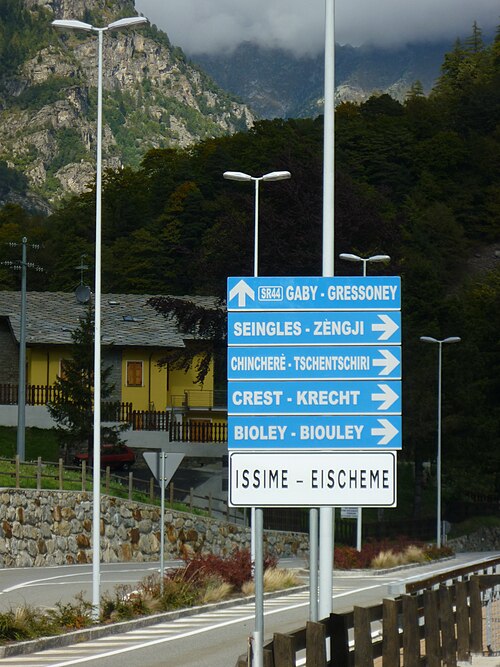
グレソネイ・サン=ジャン産のtitsch変種とイシメ産のtöitschu変種の比較:
以下に、様々な地域で見られるワルザー方言のいくつかの異本から、対応する翻訳とともにテキストの例をいくつか示します。
{{cite book}}: CS1 maint: publisher location (link){{cite book}}: CS1 maint: publisher location (link)