
Loading article…
ニュージーランド アオテアロア (マオリ) | |
|---|---|
| 国歌: 「神よニュージーランドを守護し給え」 (マオリ語:アオテアロア) 「神よ国王を守りたまえ」[n 1] | |
 | |
| 資本 | ウェリントン 41°18′S 174°47′E / 41.300°S 174.783°E / -41.300; 174.783 |
| 最大の都市 | オークランド |
| 公用語 |
|
| 民族グループ (2023年)[4] | |
| 宗教 (2018年)[5] | |
| 異名 | |
| 政府 | 単一議会制立憲君主制 |
• モナーク | シャルル3世 |
• 総督 | シンディ・キロ |
• 首相 | クリストファー・ラクソン |
| 立法府 | 議会 |
| 独立の段階 イギリスから | |
• ワイタンギ条約[6] | 1840年2月6日 |
• 責任ある政府 | 1856年5月7日 |
• ドミニオン | 1907年9月26日 |
| 1947年11月25日 | |
• 1986年憲法 | 1987年1月1日 |
| エリア | |
• 合計 | 268,021 [7] km 2 (103,483 平方マイル) ( 75 位) |
• 水 (%) | 1.6 [n 5] |
| 人口 | |
• 2024年9月推定 |  5,408,670 [9] ( 120位) 5,408,670 [9] ( 120位) |
• 2023年 国勢調査 | 4,993,923 [4] |
• 密度 | 19.5/km 2 (50.5/平方マイル) ( 167位) |
| GDP (購買力平価) | 2023年推定 |
• 合計 |  2,791億8,300万ドル [USD] [10] ( 63位) 2,791億8,300万ドル [USD] [10] ( 63位) |
• 一人当たり | 53,809ドル [USD] [10] ( 32位) |
| GDP (名目) | 2023年推定 |
• 合計 | 2494億1500万ドル [USD] [10] ( 51位) |
• 一人当たり | 48,071ドル [USD] [10] ( 23日) |
| ジーニ (2022) |  30.0 [11] 30.0 [11]中程度の不平等 |
| HDI (2022) | 0.939 [12]非常に高い (16位) |
| 通貨 | ニュージーランドドル($) ( NZD ) |
| タイムゾーン | UTC +12 ( NZST [n 6] ) |
• 夏 ( DST ) | UTC +13 ( NZDT [n 7] ) |
| 日付形式 | 年/月/日[14] |
| ドライブを続ける | 左 |
| 呼び出しコード | +64 |
| ISO 3166 コード | ニュージーランド |
| インターネットTLD | .ニュージーランド |


ニュージーランド(マオリ語:アオテアロア [aɔˈtɛaɾɔa])は、南西太平洋に浮かぶ島国である。北島(テ・イカ・ア・マウイ)と南島(テ・ワイポウナム)の2つの主要な陸地と、700を超える小島から構成される。面積では6番目に大きな島国であり、タスマン海を挟んでオーストラリアの東、ニューカレドニア島、フィジー島、トンガ島の南に位置する。国土の変化に富んだ地形や、サザンアルプスなどの険しい山々は、地殻変動と火山の噴火によるところが大きい。ニュージーランドの首都はウェリントンで、最も人口の多い都市はオークランドである。
ニュージーランドの島々は、人間が定住した最後の広大な居住可能な土地でした。1280年から1350年頃にポリネシア人が島々に定住し始め、その後独特のマオリ文化を発展させました。1642年、オランダの探検家アベル・タスマンがニュージーランドを視認し記録した最初のヨーロッパ人となりました。1769年、イギリスの探検家ジェームズ・クック船長がニュージーランドに足を踏み入れ地図を作成した最初のヨーロッパ人となりました。1840年、イギリスの代表とマオリの酋長がワイタンギ条約に調印し、同年後半のイギリスによる主権宣言と1841年のニュージーランド皇室植民地設立への道が開かれました。その後、植民地政府とマオリ部族の間で一連の紛争が発生し、マオリの土地の大部分が接収・没収されました。ニュージーランドは1907年に自治領となりました。ニュージーランドは1947年に完全な法的独立を獲得し、国王を国家元首として維持した。今日、ニュージーランドの人口525万人の大部分はヨーロッパ系であり、先住民のマオリが最大の少数民族であり、アジア人とパシフィカ人がそれに続く。これを反映して、ニュージーランドの文化は主にマオリと初期のイギリス人入植者に由来しているが、近年では国への移民の増加により文化が広がっている。公用語は英語、マオリ語、ニュージーランド手話であり、英語の方言が主流である。
ニュージーランドは先進国であり、世界で初めて最低賃金を導入し、女性に参政権を与えた国でもある。生活の質や人権に関する国際的な評価で非常に高い評価を得ており、腐敗の認識レベルは世界でも最も低い部類に入る。しかし、マオリ族とヨーロッパ系住民の間には構造的な格差があり、目に見えるレベルの不平等が残っている。ニュージーランドは1980年代に大きな経済的変化を経験し、保護主義から自由化された自由貿易経済へと変貌した。サービス部門が国民経済の大部分を占め、工業部門と農業がそれに続く。国際観光も重要な収入源となっている。ニュージーランドは、国連、イギリス連邦、ANZUS、UKUSA、OECD、ASEAN+6、アジア太平洋経済協力、太平洋共同体、太平洋諸島フォーラムの加盟国である。ニュージーランドは米国と特に緊密な関係を保っており、NATO以外の主要同盟国の一つである。[15]イギリス、サモア、フィジー、トンガ、そしてオーストラリアとの間で、何世紀にもわたるイギリスの植民地支配から生まれた「トランス・タスマン」のアイデンティティを共有している。 [16]
国全体としては、立法権は選挙で選ばれた一院制の 議会に与えられ、行政権は、現在クリストファー・ラクソン首相が率いる政府によって行使される。国王はチャールズ3世で、総督のシンディ・キロが代表を務める。さらに、ニュージーランドは地方自治を目的として11の地域議会と67の地方自治体に組織されている。ニュージーランド王国には、トケラウ(従属領)、クック諸島とニウエ(ニュージーランドと自由連合関係にある自治州)、およびニュージーランドが南極で領有権を主張しているロス属国も含まれる。
語源

ニュージーランドを訪れた最初のヨーロッパ人であるオランダ人探検家アベル・タスマンは、これらの島々をスタテンランドと名付けた。これは、これらの島々が、ヤコブ・ル・メールが南アメリカ南端沖で目撃したスタテンランドの一部であると信じていたからである。 [17] [18]ヘンドリック・ブラウワーは1643年にこの南アメリカの土地が小さな島であることを証明し、その後オランダの地図製作者はタスマンの発見地を、オランダのゼーラント州にちなんでラテン語のノヴァ・ゼーランディアと改名した。[17] [19]この名前は後に英語化されてニュージーランドとなった。[20] [21]
これはマオリ語でNu Tireni(Te Tiriti o WaitangiではNu Tiraniと綴られる)と書かれた。1834年にマオリ語で書かれた「 He Wakaputanga o te Rangatiratanga o Nu Tireni」と題された文書が英語に翻訳され、ニュージーランド独立宣言となった。これはニュージーランド連合部族によって準備され、その写しがニュージーランド連合部族の旗を既に承認していたウィリアム4世に送られ、グレネルグ卿からの手紙で宣言を承認した。[22] [23]
アオテアロア(マオリ語では[aɔˈtɛaɾɔa] 、英語では/ ˌ aʊ t ɛəˈr oʊ . ə /と発音され、しばしば「長く白い雲の国」と訳される)[24]は、現在のマオリ語によるニュージーランドの名前である。ヨーロッパ人が到着する前、マオリ語が国全体を指していたかどうかは不明である。アオテアロアはもともと北島だけを指していた。[25]マオリ語には、北島にはTe Ika-a-Māui(「マウイの魚」)、南島にはTe Waipounamu(「グリーンストーンの水」)またはTe Waka o Aoraki(「アオラキのカヌー」)島。[26]初期のヨーロッパの地図では、島々を北(北島)、中央(南島)、南(スチュアート島/ラキウラ)と表記していた。[27]1830年、地図製作者は2つの最大の島を区別するために「北」と「南」を地図上で使い始め、1907年までにこれが標準として受け入れられた。[21]ニュージーランド地理委員会は2009年に北島と南島の名称が正式に定められていなかったことを発見し、2013年に名称と別名が正式に定められた。これにより、北島またはテ・イカ・ア・マウイ、南島またはテ・ワイポウナムと定められた。[28]各島については、英語名またはマオリ語名のいずれかを使用することも、両方を併用することもできる。[28]同様に、国全体のマオリ語名と英語名が併用されることもある(アオテアロア・ニュージーランド)[29][30]ただし、これは公式には認められていない。[31]
歴史
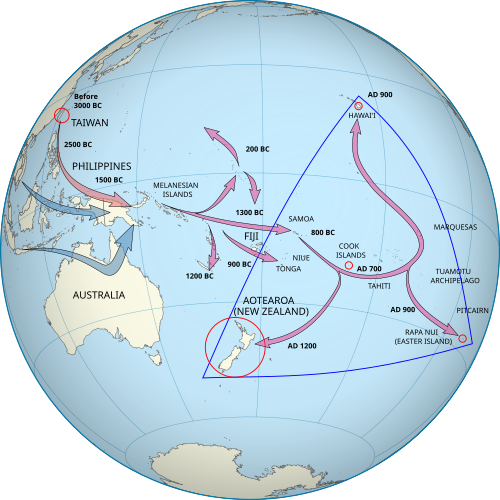
ニュージーランドに最初に到達したのは、外洋を航行するワカ(カヌー)に乗ったポリネシア人だった。彼らの到着は、おそらく西暦1280年から1350年頃、数回に分けて起こったと思われる。ニュージーランドで孤立したこれらのポリネシア人移住者は、後のマオリとなった。マオリのさまざまな伝承をヨーロッパ人が総合的に解釈した初期の解釈によると、西暦750年頃、英雄的な探検家クペがニュージーランドを発見し、その後、1350年頃、東ポリネシアのハワイキから移住者の大船団が出発した。 [35]しかし、20世紀後半から、この物語はますます伝説や神話の領域に追いやられてきた。新たな考古学的および科学的証拠から別の見解が浮上し、マオリを含む先住民の口述証拠から導き出された解釈の信頼性について、世界中の歴史家が提起した疑問と相関している。[36]
これらのポリネシア人移住者の到来に関しては、紀元1314年頃のタラウェラ山の噴火によって堆積した火山岩の層であるカハロア・テフラより古いものと確信できる人骨、遺物、構造物は存在しない。 [37]ネズミの骨、ネズミにかじられた貝殻、種子ケースのサンプルは、10年ほど前の3つを除いて、タラウェラの噴火よりも後の日付を示している。[38]噴火直前の広範囲にわたる森林火災の放射性 炭素年代測定と花粉の証拠も、噴火前に人間が存在していたことを示している可能性がある。[39] [40]さらに、マオリ集団内のミトコンドリアDNAの多様性は、東ポリネシア人が最初にニュージーランド諸島に定住したのは1250年から1300年の間であったことを示唆している。 [26] [41] [42]したがって、一部の入植者が1314年より前に到着したかどうかにかかわらず、主な定住期はその後の数十年間であり、協調的な大量移住が関与していた可能性があるというのが現在の見解である。また、ニュージーランドへのポリネシア人の定住は計画的かつ意図的であったというのも歴史家の幅広いコンセンサスである。[43] [44] [45] [46] [47]その後の数世紀にわたって、入植者は現在マオリとして知られる独特の文化を発展させた。このシナリオは、多くの議論を呼んだ疑わしい第三の口承証拠とも一致している。[36]伝統的な系図(ワカパパ)によると、多くのマオリがその祖先を辿る元となったカヌー(ワカ)の多くは、1350年頃に到着したとされている。 [48] [49]マオリの中には後にチャタム諸島に移住し、独特のモリオリ文化を発展させた者もいる。[50]その後、1835年にマオリが侵略し、モリオリは虐殺され、事実上絶滅した。[51]

1642年、ンガーティ・トゥマタコキリとオランダ人探検家アベル・タスマンの乗組員との間で敵対的な遭遇があり、 [52] [53]タスマンの乗組員4人が死亡し、少なくとも1人のマオリが散弾銃で撃たれた。[54]ヨーロッパ人がニュージーランドを再訪したのは、1769年にイギリスの探検家ジェームズ・クックがほぼ全海岸線の地図を作成した時だった。[53]クックの後、ニュージーランドには数多くのヨーロッパと北米の 捕鯨船、アザラシ漁船、貿易船が訪れた。彼らはヨーロッパの食料、金属工具、武器、その他の品物を、木材、マオリの食料、工芸品、水と交換した。[55]ジャガイモとマスケット銃の導入は、マオリの農業と戦争を一変させた。ジャガイモは安定した食糧余剰をもたらし、より長く持続的な軍事作戦を可能にした。[56]部族間のマスケット銃戦争は1801年から1840年の間に600回以上の戦闘を巻き起こし、3万~4万人のマオリ人が死亡した。[57] 19世紀初頭から、キリスト教宣教師がニュージーランドに定住し始め、最終的にマオリ人口のほとんどを改宗させた。 [58]マオリ人口は19世紀の間に接触前の約40%にまで減少したが、持ち込まれた病気が主な要因であった。[59]

1832年、イギリス政府はジェームズ・バスビーをニュージーランドのイギリス駐在員に任命した。 [60]シドニーのバーク総督から与えられた任務は、「評判の良い」入植者と貿易業者を保護し、マオリに対する「暴行」を防ぎ、逃亡した囚人を逮捕することだった。[60] [61] 1835年、シャルル・ド・ティエリーによるフランス人入植が差し迫っているとの発表を受けて、漠然としたニュージーランド部族連合はイギリス国王ウィリアム4世に独立宣言を送り、保護を求めた。[60]継続する不安、ニュージーランド会社によるニュージーランド入植の提案(同社はすでにマオリから土地を購入するために最初の測量船を派遣していた)、そして独立宣言の法的地位の疑わしさから、植民地省はウィリアム・ホブソン船長を派遣してイギリスの主権を主張し、マオリと条約を交渉させた。[62]ワイタンギ条約は1840年2月6日にベイ・オブ・アイランズで初めて調印された。[63]ニュージーランド会社がウェリントンに独立植民地を設立しようとしたことに応えて、[64] [65]ホブソンは1840年5月21日に、条約のコピーがまだマオリの署名を求めて全国に回覧されていたにもかかわらず、ニュージーランド全土に対するイギリスの主権を宣言した。[66]条約の調印と主権宣言により、特にイギリスからの移民の数が増加し始めた。[67]
ニュージーランドは、1841年5月3日に独立した王室植民地であるニュージーランド植民地になるまで、ニューサウスウェールズ植民地の属国として統治されていました。 [68] [69] 1843年、土地と主権をめぐる意見の相違から、植民地政府とマオリの間でワイラウ騒動が起こり、武力衝突が始まりました。主に北島で起こったこれらの紛争では、何千もの帝国軍とイギリス海軍がニュージーランドにやって来て、ニュージーランド戦争として知られるようになりました。これらの武力衝突の後、入植者の要求を満たすために、マオリの土地の広大な地域が政府によって没収されました。 [70]

1852年に植民地は代議制政府を獲得し、 1854年に最初の議会が開かれた。 [71] 1856年に植民地は事実上自治権を獲得し、国内のすべての事柄に対する責任を負うようになった(1860年代半ばに認められた先住民政策を除く)。 [71]南島が別の植民地になるかもしれないという懸念を受けて、首相アルフレッド・ドメットは首都をオークランドからクック海峡近くの地域に移す決議案を提出した。[72] [73]ウェリントンは中心的な場所として選ばれ、1865年に初めて議会が公式に開会された。[74]
1886年、ニュージーランドはオークランドの北東約1,000kmにある火山島ケルマディック諸島を併合した。1937年以来、ラウル島基地の約6人を除いて、島々は無人となっている。これらの島々により、ニュージーランドの北境は南緯29度となる。[75] 1982年の国連海洋法条約後、島々はニュージーランドの排他的経済水域に大きく貢献した。[76]
1891年、自由党が最初の組織政党として政権を握りました。[77]リチャード・セドンが政権の大半を率いた自由党政府は、[78]多くの重要な社会的、経済的措置を可決しました。1893年、ニュージーランドは世界で初めてすべての女性に選挙権を与えた国となり、 [77] 1894年には雇用者と労働組合の間の強制仲裁を採用した先駆者となりました。 [79]自由党は1894年に世界で初めて最低賃金を保証しました。[80]
1907年、ニュージーランド議会の要請により、エドワード7世国王はニュージーランドをイギリス帝国内の自治領と宣言し[81]、自治権を認めた。[82] 1947年、ニュージーランドはウェストミンスター憲章を採択し、イギリス議会はもはやニュージーランドの同意なしに立法を行うことはできないことを確認した。イギリス政府の残余立法権は後に1986年憲法によって剥奪され、イギリスの裁判所への最終的な上訴権は2003年に廃止された。[71]
20世紀初頭、ニュージーランドは世界情勢に巻き込まれ、第一次、第二次世界大戦に参戦し[83]、大恐慌にも見舞われた。[84]大恐慌により初の労働党政権が誕生し、包括的な福祉国家と保護主義経済が樹立された。[85]第二次世界大戦後、ニュージーランドはますます繁栄し、[86]マオリの人々は伝統的な田舎暮らしを捨て、仕事を求めて都市へと移住し始めた。[87]マオリの抗議運動が起こり、ヨーロッパ中心主義を批判し、マオリ文化とワイタンギ条約のさらなる認知を求めて活動した。 [88] 1975年にワイタンギ裁判所が条約違反の疑いを調査するために設置され、1985年には歴史的な苦情を調査する権限が与えられた。[63]政府は多くのイウィとこれらの苦情の解決について交渉してきたが、[89]マオリによる海岸線と海底の領有権の主張は2000年代に物議を醸した。[90] [91]
地理と環境

ニュージーランドは水半球の中心付近に位置し、2つの主な島と700を超える小島で構成されています。[92] 2つの主な島(北島、またはテ・イカ・ア・マウイ、南島、またはテ・ワイポウナム)は、最も狭い部分で幅22キロメートル(14マイル)のクック海峡によって隔てられています。 [93]北島と南島以外の5つの最大の有人島は、スチュアート島(フォーヴォー海峡の向かい)、チャタム島、グレートバリア島(ハウラキ湾)、[94] デュルヴィル島(マールボロ・サウンズ)[95]ワイヘキ島(オークランド中心部から約22キロメートル(14マイル))です。[96]
ニュージーランドは細長く、北北東軸の長さは1,600キロメートル(990マイル)、最大幅は400キロメートル(250マイル)[97]で、海岸線の長さは約15,000キロメートル(9,300マイル)[98]、総陸地面積は268,000平方キロメートル(103,500平方マイル)です。[99]遠く離れた離島と長い海岸線のため、この国は豊富な海洋資源に恵まれています。排他的経済水域は世界最大級で、陸地面積の15倍以上を占めています。[100]

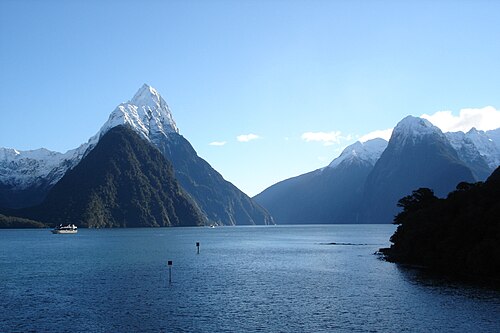
南島はニュージーランド最大の陸地で、長さに沿ってサザンアルプスに分断されています。[101]標高3,000メートル(9,800フィート)を超える山が18あり、そのうち最も高い山はアオラキ/マウントクックで、標高3,724メートル(12,218フィート)です。[102] フィヨルドランドの険しい山々と深いフィヨルドは、南島のこの南西隅の大規模な氷河期の氷河作用を記録しています。[103]北島はそれほど山が多くありませんが、火山活動が顕著です。[104]非常に活発なタウポ火山帯は、北島最高峰のルアペフ山(2,797メートル(9,177フィート))によって区切られた大きな火山台地を形成しています。この高原には、世界で最も活発な超巨大火山の一つのカルデラに囲まれた、国内最大の湖、タウポ湖[92]もあります。[ 105 ]ニュージーランドは地震が発生しやすい国です。
この国が多様な地形をしており、おそらく海上に出ているのも、太平洋プレートとインド・オーストラリアプレートにまたがるダイナミックな境界によるものでしょう。[106]ニュージーランドは、オーストラリアのほぼ半分の大きさの微小大陸であるジーランディアの一部で、ゴンドワナ超大陸から分離した後、徐々に沈んでいきました。[107] [108]約2500万年前、プレートテクトニクスの動きの変化により、この地域はねじれ、しわしわになりました。これは現在、アルプス断層の横の地殻の圧縮によって形成された南アルプスで最も顕著です。他の場所では、プレート境界により、一方のプレートがもう一方のプレートの下に沈み込み、南にピュイセギュール海溝、北島の東にヒクランギトラフ、さらに北にケルマデック海溝とトンガ海溝[109]が形成されています。[106]
ニュージーランドは、オーストラリアとともに、オーストラレーシアと呼ばれるより広い地域の一部です。[110]また、ポリネシアと呼ばれる地理的および民族学的地域の南西端を形成しています。[111] オセアニアは、オーストラリア大陸、ニュージーランド、および7大陸モデルに含まれない太平洋のさまざまな島国を含むより広い地域です。[112]
気候
ニュージーランドの気候は主に温帯海洋性気候(ケッペンの気候区分:Cfb)で、年間平均気温は南部の10℃(50℉)、北部の16℃(61℉)である。[113]過去の最高気温と最低気温は、カンタベリー地方のランギオラで42.4℃(108.32℉)、オタゴ地方のランファーリーで−25.6℃(−14.08℉)である。[ 114 ]気候条件は地域によって大きく異なり、南島の西海岸では極めて湿潤であるのに対し、セントラル・オタゴ地方とカンタベリー内陸部のマッケンジー盆地では半乾燥、ノースランド地方では亜熱帯となっている。[115] [116] 7大都市のうち、クライストチャーチは最も乾燥しており、年間平均降水量はわずか618ミリメートル(24.3インチ)です。一方、ウェリントンは最も雨が多く、そのほぼ2倍の雨が降ります。[117]オークランド、ウェリントン、クライストチャーチは、いずれも年間平均2,000時間以上の日照時間があります。南島の南部と南西部は涼しく曇りがちな気候で、日照時間は1,400~1,600時間ほどです。南島の北部と北東部は国内で最も日照時間が長く、日照時間は2,400~2,500時間ほどです。[118]一般的に雪が降る季節は6月上旬から10月上旬ですが、この季節以外でも寒波が発生することがあります。[119]南島の東部と南部、および全国の山岳地帯では降雪がよく見られます。[113]
生物多様性

ニュージーランドは8000万年もの間地理的に孤立しており[121]、島の生物地理学は、同国の動物、菌類、植物の種の進化に影響を与えてきました。物理的な孤立は生物学的孤立を引き起こし、独特な植物や動物、広範囲に分布する種の個体群など、動的な進化生態学をもたらしました。[122] [123]ニュージーランドの動植物は、もともとニュージーランドがゴンドワナ大陸から分裂したことに由来すると考えられていましたが、最近の証拠では種の分散によって生じたとされています。[124]ニュージーランド固有の維管束植物の約82%は固有種で、65属1,944種に及びます。[125] [126]ニュージーランドで記録されている菌類の数は、地衣類を形成する種も含めて不明であり、固有種の菌類の割合も不明であるが、ある推定によれば、ニュージーランドには約2,300種の地衣類を形成する菌類が存在し、そのうち40%が固有種である。[127]森林の主な2つのタイプは、マキ科植物が出現する広葉樹が優占する森林と、寒冷な気候の南部ブナが優占する森林である。 [128]残りの植生タイプは草原で構成され、その大部分は草むらである。[129]
人類が到着する前、土地の約80%が森林に覆われており、高山地帯、湿地、不毛地帯、火山地帯にのみ樹木が生えていたと推定されています。[130]人類が到着した後に大規模な森林伐採が起こり、ポリネシア人の入植後には森林の約半分が火災で失われました。 [131]残っていた森林の多くはヨーロッパ人の入植後に伐採されたり、牧畜用の土地を確保するために伐採されたりして、土地の23%しか森林が占めなくなりました。[132]

森林は鳥類が優勢で、哺乳類の捕食者がいなかったため、キーウィ、カカポ、ウェカ、タカヘなどの一部の鳥は飛べなくなりました。[133]人間の到来、それに伴う生息地の変化、ネズミ、フェレットなどの哺乳類の導入により、モアやハーストワシなどの大型鳥類を含む多くの鳥類が絶滅しました。[134] [135]
その他の固有の動物としては、爬虫類(ムカシトカゲ、トカゲ、ヤモリ)、カエル[ 136] (保護されている絶滅危惧種のハミルトンガエルなど) 、クモ[137]、昆虫(ウェタ)[138]、カタツムリ[139]などがあげられる。ムカシトカゲなど一部の種は非常にユニークであるため、生きた化石と呼ばれている。 [ 140] 2006年に少なくとも1600万年前のネズミ大のユニークな陸生哺乳類の骨が発見されるまで、ニュージーランド固有の陸生哺乳類は3種のコウモリ(1種は絶滅)のみであった。 [141] [142]しかし海洋哺乳類は豊富で、ニュージーランドの海域には世界の鯨類(クジラ、イルカ、ネズミイルカ)のほぼ半数と多数のオットセイが生息していると報告されている。[143]ニュージーランドでは多くの海鳥が繁殖しており、その3分の1はニュージーランド固有の種です。 [144]ニュージーランドには他のどの国よりも多くのペンギン種が生息しており、世界の18種のペンギンのうち13種がニュージーランドに生息しています。[145]
人間が到着して以来、少なくとも51種の鳥類、3種のカエル、3種のトカゲ、1種の淡水魚、1種のコウモリを含む、この国の脊椎動物種のほぼ半分が絶滅した。他の種も絶滅の危機に瀕しているか、生息域が大幅に減少している。[134]しかし、ニュージーランドの自然保護活動家は、島の保護区、害虫駆除、野生生物の移植、里親探し、島やその他の保護地域の生態系の回復など、絶滅の危機に瀕した野生生物の回復を支援するためのいくつかの方法を開拓してきた。[146] [147] [148] [149]
政府と政治
ニュージーランドは議会制民主主義の立憲君主制国家であるが、[150]憲法は成文化されていない。[ 151]チャールズ3世がニュージーランド国王であり[152]国家元首である。[ 153]国王は総督によって代表され、首相の助言に基づいて任命される。[154]総督は、不正事件の審査や大臣、大使、その他の主要公務員の任命などの国王大権を行使できるほか、[155] まれに、予備権(議会を解散したり、法案の国王の承認を拒否したりする権限など)を行使できる。 [ 156 ]国王と総督の権限は憲法上の制約によって制限されており、通常は大臣の助言なしに行使することはできない。[156]
ニュージーランド議会は立法権を持ち、国王と下院から構成される。 [ 157]上院である立法評議会も含まれていたが、1950年に廃止された。[157]国王およびその他の政府機関に対する議会の優位性は、1689年のイングランドの権利章典によって確立され、ニュージーランドでも法律として批准されている。[157]下院は民主的に選出され、議席の過半数を獲得した政党または連立政権によって政府が構成される。過半数に達しない場合は、信任投票および補充投票で他党の支持が得られれば少数派政権が構成される。[157]総督は慣例により与党または連立政権の議会指導者である首相の助言に基づいて大臣を任命する。 [158]内閣は大臣によって構成され、首相によって率いられ、政府における最高政策決定機関であり、重要な政府の行動を決定する責任がある。[159]内閣のメンバーは集団で主要な決定を下し、したがってこれらの決定の結果に対して集団的に責任を負う。 [160] 2023年11月27日以降、第42代首相であり現首相はクリストファー・ラクソンである。[161]

議会の総選挙は、前回の選挙から3年以内に招集されなければならない。[162] 1853年から1993年までの総選挙のほとんどが、小選挙区制で行われた。[163] 1996年の選挙以来、混合比例代表制(MMP)と呼ばれる比例代表制の形式が使用されている。[151] MMP制度では、各人が2票を持ち、1つは有権者の選挙区に立候補している候補者に、もう1つは政党に投票する。2018年の国勢調査データに基づくと、72の選挙区(マオリのみが任意で投票できる7つのマオリ選挙区を含む)があり、 [164] 120議席のうち残りの48議席は、政党の投票を反映するように議会での代表権が割り当てられ、政党が議席を獲得するには、少なくとも1つの選挙区で勝利するか、政党の総投票数の5%を獲得する必要があるという基準がある。[165] 1930年代以降の選挙は国民党と労働党の2つの政党が主導してきた。MMPの導入以来、より多くの政党が議会に代表されるようになった。[166]
ニュージーランドの司法は最高裁判所長官を筆頭に[167]、最高裁判所、控訴院、高等裁判所、下級裁判所から構成されています。[ 168 ]裁判官や司法官は政治的な判断ではなく、司法の独立性を保つために厳格な任期規定に基づいて任命されます。[151]これにより理論的には、司法は議会で制定された法律のみに基づいて法律を解釈することができ、他の影響を受けずに決定を下すことができます。[169]
ニュージーランドは、世界で最も安定し、統治の行き届いた国の一つとして知られています。[170] 2017年現在、[update]同国は民主制度の強さで第4位、[171]政府の透明性と腐敗の少なさで第1位にランクされています。[172]また、同国の LGBTの権利は、オセアニアで最も寛容な国の一つとして認められています。[173]ニュージーランドは、政治プロセスへの市民参加で高い評価を得ており、最近の総選挙の投票率は82%で、 OECD平均の69%を上回っています。[174]しかし、これは地方議会選挙には当てはまりません。 2022年の地方選挙では、ニュージーランドの有権者の投票率は歴史的に低い36%で、 2019年の投票率はすでに42%と低かったのに対し、さらに低い数字となっています。[175] [176] [177]米国国務省による2017年の人権報告書では、ニュージーランド政府は一般的に個人の権利を尊重しているが、マオリの人々の社会的地位については懸念を表明していると指摘されている。[178]構造的差別に関しては、ニュージーランド人権委員会は、それが現実的で進行中の社会経済的問題であるという強力で一貫した証拠があると主張している。[179]ニュージーランドの構造的不平等の一例は、刑事司法制度に見ることができる。法務省によると、マオリは過剰に代表されており、犯罪で有罪判決を受けたニュージーランド人の45%、投獄された人の53%を占めているが、人口の16.5%に過ぎない。[180] [181]
地域と外部領土

初期のヨーロッパ人入植者はニュージーランドを州に分割し、一定の自治権を与えた。[182]財政的圧力と鉄道、教育、土地売却、その他の政策を統合したいという願望から、政府は中央集権化され、1876年に州は廃止された。[183] 各州は地域の祝日[184]やスポーツのライバル関係で記憶されている。[185]
1876年以来、中央政府が定めた法律に基づき、様々な議会が地方自治体を統治してきた。[182] [186] 1989年、政府は地方自治体を現在の地域議会と地方自治体の2層構造に再編した。[187] 1975年に存在した249の自治体[187]は現在、67の地方自治体と11の地域議会に統合されている。[188]地域議会の役割は「資源管理に特に重点を置いた自然環境」を規制することであり、[187]地方自治体は下水道、水道、地方道路、建築許可、その他の地域事項を担当している。[189] [190]地方議会のうち5つは単一自治体であり、地域議会としても機能している。[190]地方自治体は13の市議会、53の地区議会、およびチャタム諸島議会で構成されている。チャタム諸島評議会は公式には単一の機関ではないが、地域評議会の多くの機能を担っている。[191]
ニュージーランド王国は、15の英連邦王国の1つであり、[192]ニュージーランドの国王または女王が主権を有する地域全体であり、ニュージーランド、トケラウ、ロス属領、クック諸島、ニウエで構成されています。[150]クック諸島とニウエは、ニュージーランドと自由連合関係にある自治国です。 [193] [194]ニュージーランド議会はこれらの国の法律を可決することはできませんが、これらの国の同意があれば、外交と防衛においてこれらの国に代わって行動することができます。トケラウは非自治地域に分類されていますが、3人の長老(各トケラウ環礁から1人ずつ)による評議会によって統治されています。 [195]ロス属領は、ニュージーランドが南極で領有権を主張している地域で、スコット基地研究施設を運営しています。[196] ニュージーランド国籍法は、ニュージーランド全土を平等に扱っているため、ニュージーランド、クック諸島、ニウエ、トケラウ、ロス属領で生まれた人のほとんどはニュージーランド国民である。[197] [n 8]
外交関係
.jpg/500px-P20220531AS-0492-2_(52245764500).jpg)
ニュージーランド植民地時代、対外貿易と外交関係はイギリスが担っていた。[199] 1923年と1926年の帝国会議では、ニュージーランドが独自の政治条約を交渉することを認めるべきであると決定され、最初の通商条約は1928年に日本との間で批准された。1939年9月3日、ニュージーランドはイギリスと同盟を組み、ドイツに宣戦布告し、マイケル・ジョセフ・サヴェージ首相は「彼女が行くところに我々は行く。彼女が立つところに我々は立つ」と宣言した。[200]

1951年、英国はますますヨーロッパの利益に重点を置くようになり、[201]ニュージーランドはオーストラリアと米国と共にANZUS安全保障条約に加入した。 [202]ベトナム戦争に対する抗議、[203]レインボー・ウォリアー号沈没後に米国がフランスを諫言しなかったこと、[204]環境問題と農業貿易問題に関する意見の相違、ニュージーランドの非核政策により、ニュージーランドに対する米国の影響力は弱まった。[205] [206]米国がANZUS義務を停止したにもかかわらず、ニュージーランドとオーストラリアの間では条約は有効のままであり、オーストラリアの外交政策も同様の歴史的傾向をたどっている。[207]両国の間には緊密な政治的接触が維持されており、自由貿易協定や旅行協定により、国民は制限なく両国を訪問、居住、就労できる。[208] 2013年には[update]オーストラリアに約65万人のニュージーランド人が住んでおり、これはニュージーランドの人口の15%に相当します。[209]
ニュージーランドは太平洋島嶼国で強い存在感を示しており、サモア、フィジー、トンガ、および小国と強い外交関係を保っている。[210]ニュージーランドの援助の大部分はこれらの国に向けられており、多くの太平洋諸島人が雇用のためにニュージーランドに移住している。1960年代以降、この増加により、ニュージーランドで4番目に大きな民族グループであるパシフィカ・ニュージーランド人汎民族グループが形成されました。 [211] [212]永住移住は、1970年のサモア人割当制度と2002年の太平洋アクセス・カテゴリーの下で規制されており、これにより、毎年最大1,100人のサモア国民と最大750人の他の太平洋諸島民がニュージーランドの永住者になることができます。一時移住のための季節労働者制度は2007年に導入され、2009年には約8,000人の太平洋諸島民がそれに基づいて雇用されました。[213]ニュージーランドは、太平洋諸島フォーラム、太平洋共同体、アジア太平洋経済協力、東南アジア諸国連合地域フォーラム(東アジアサミットを含む)に参加している。[208]ニュージーランドは、アジア太平洋地域の中堅国、[214]新興国と評されている。[215] [216]ニュージーランドは、国際連合、[217]英連邦[ 218]経済協力開発機構( OECD) [219]の加盟国であり、五カ国防衛協定に参加している。[220]
今日、ニュージーランドは米国と特に緊密な関係を保っており、 NATO以外の主要同盟国の一つとなっている。[15]また、オーストラリアとも緊密な関係にあり、オーストラリア国民の間では「トランス・タスマン」アイデンティティが一般的である。 [16]ニュージーランドは、正式にはUKUSA協定として知られるファイブアイズ情報共有協定の加盟国である。この協定の5カ国は、オーストラリア、カナダ、ニュージーランド、英国、米国の中核的なアングロスフィアを構成している。 [221]ニュージーランドは、2012年以来、パートナーシップ相互運用性イニシアチブに基づき、NATOとパートナーシップ協定を結んでいる。 [222] [223] [224] 2024年世界平和指数によると、ニュージーランドは世界で4番目に平和な国である。[225]
軍隊
.jpg/500px-ANZAC_Day_service_at_the_National_War_Memorial_-_Flickr_-_NZ_Defence_Force_(20).jpg)
ニュージーランドの軍隊、すなわちニュージーランド国防軍は、ニュージーランド陸軍、ニュージーランド空軍、ニュージーランド海軍で構成されている。[226]ニュージーランドの国防ニーズは、直接攻撃を受ける可能性が低いため、それほど大きくない。[227]しかし、その軍隊は世界的に展開している。同国は2つの世界大戦に参加し、ガリポリ、クレタ島、[228] エル・アラメイン、[229]カッシーノでの戦闘が特に目立った。 [ 230]ガリポリの戦いは、ニュージーランドの国民的アイデンティティを育む上で重要な役割を果たした。 [231] [232]また、オーストラリアと共有するANZACの伝統を強化した。 [233]
ベトナム戦争と2つの世界大戦に加えて、ニュージーランドは第二次ボーア戦争[234]、朝鮮戦争[ 235]、マラヤ非常事態[236]、 [湾岸戦争] 、アフガニスタン戦争にも従軍した。キプロス、ソマリア、ボスニア・ヘルツェゴビナ、シナイ、アンゴラ、カンボジア、イラン・イラク国境、ブーゲンビル、東ティモール、ソロモン諸島など、いくつかの地域的および世界的な平和維持活動に部隊を派遣してきた。[237]
経済

ニュージーランドは先進的な 市場経済を有しており、[238] 2021年の人間開発指数で13位、[239] 2022年の経済自由度指数で4位にランクされています。[240]一人当たりの名目国内総生産(GDP)は36,254米ドルの高所得経済です。[241]通貨はニュージーランドドルで、非公式には「キウイドル」と呼ばれています。また、クック諸島(クック諸島ドルを参照)、ニウエ、トケラウ、ピトケアン諸島でも流通しています。[242][update] [update]
歴史的に、採取産業はニュージーランド経済に大きく貢献しており、さまざまな時期にアザラシ猟、捕鯨、亜麻、金、カウリ樹脂、および天然木材に重点を置いてきました。[243] 1882年にダニーデンで冷蔵肉が初めて出荷されたことで、英国への肉と乳製品の輸出が確立され、ニュージーランドの力強い経済成長の基礎となった貿易となりました。[244]英国と米国からの農産物の需要が高かったため、ニュージーランド人は1950年代と1960年代にオーストラリアと西ヨーロッパの両方よりも高い生活水準を達成しました。[245] 1973年に英国が欧州経済共同体に加盟したためニュージーランドの輸出市場は縮小し[246] 、 1973年の石油危機や1979年のエネルギー危機などの他の複合要因により深刻な経済不況につながりました。[247]ニュージーランドの生活水準はオーストラリアや西ヨーロッパに遅れをとり、1982年には世界銀行の調査対象となった先進国の中で一人当たりの所得が最も低かった。[248] 1980年代半ば、ニュージーランドは3年間かけて補助金を段階的に廃止し、農業部門の規制緩和を実施した。 [249] [250] 1984年以降、歴代の政府は大規模なマクロ経済再編(最初はロジャーノミクス、次にルーサナシアとして知られる)に着手し、ニュージーランドを保護主義的で規制の厳しい経済から自由化された自由貿易経済へと急速に転換させた。[251] [252]
失業率は1987年の株価暴落後の1991年と1992年に10%をわずかに上回るピークに達したが[254]、最終的には2007年に3.7%に低下した(OECD加盟27カ国中3位)。[254]しかし、その後に続いた世界的金融危機はニュージーランドに大きな影響を及ぼし、GDPは5四半期連続で縮小し、30年以上で最も長い不況となり、[255] [256]失業率は2009年後半に7%まで上昇した。[257]現在の方法論を使用して記録された最低の失業率は、 COVID-19パンデミック中の2021年12月の3.2%であった。[258]異なる年齢層の失業率は同様の傾向を示しているが、若者の間で一貫して高くなっている。 2021年9月四半期の一般失業率は約3.2%、15歳から24歳の若者の失業率は9.2%だった。[254] [259]ニュージーランドは1970年代から一連の「頭脳流出」を経験しており[260]、それは現在も続いている。[261]高度技能労働者のほぼ4分の1が海外に住んでおり、そのほとんどはオーストラリアとイギリスで、これは先進国では最大の割合である。[262]しかし、ここ数十年で「頭脳獲得」により、ヨーロッパや発展途上国から教育を受けた専門家が流入してきた。[263] [264]今日、ニュージーランド経済は高いレベルのイノベーションの恩恵を受けている。[265]
ニュージーランドの貧困は所得格差の拡大を特徴とする。ニュージーランドの富は高度に集中しており[266]、人口の上位1%が国の富の16%を所有し、最も裕福な5%が38%を所有している。対照的に、国営受給者や年金受給者を含む人口の半数が24,000ドル未満を受け取っている。[267]さらに、ニュージーランドの子どもの貧困は政府によって主要な社会問題と認識されており[268] [269]、 2022年6月時点で、同国の子どもの12.0%が等価可処分世帯収入の中央値の50%未満の低所得世帯で暮らしている[update]。[270]貧困は少数民族世帯に不釣り合いに大きな影響を及ぼしており、2020年現在、マオリの子どもの4分の1(23.3%)と太平洋諸島の子どものほぼ3分の1(28.6%)が貧困状態にある[update]。[268]
貿易
ニュージーランドは国際貿易に大きく依存しており、[271]特に農産物において依存している。[272]輸出は生産量の24%を占め、[98]ニュージーランドは国際商品価格と世界経済の減速の影響を受けやすい。2014年、食品は同国の総輸出額の55%を占め、木材は2番目に大きな稼ぎ頭(7%)であった。[273] 2018年6月現在のニュージーランドの主な貿易相手国は、[update]中国(NZ$ 278億)、オーストラリア(262億米ドル)、欧州連合(229億米ドル)、米国(176億米ドル)、日本(84億米ドル)である。[274] 2008年4月7日、ニュージーランドと中国はニュージーランド・中国自由貿易協定に署名した。これは中国が先進国と署名した初の協定である。[275] 2023年7月、ニュージーランドと欧州連合はEU・ニュージーランド自由貿易協定を締結し、両地域間で取引されるいくつかの品目の関税を撤廃した。[276]この自由貿易協定は既存の自由貿易協定を拡大したものであり[277]、影響を受ける業界からのフィードバックに応えて肉類と乳製品の関税が引き下げられた[278]。[279]
サービス部門は経済の中で最大の部門であり、製造業と建設業、農業と原材料採掘業がそれに続く。[98] 観光業は経済において重要な役割を果たしており、2016年にはニュージーランドの総GDPに129億ドル(5.6%)貢献し、総労働力の7.5%を支えた。[280] 2017年には、海外からの訪問者数は2022年まで毎年5.4%の割合で増加すると予想された。[280]
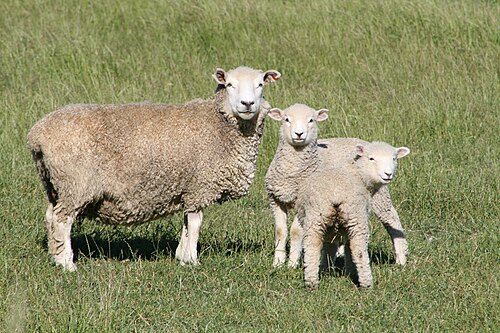
19世紀後半、ニュージーランドの主要な農産物輸出品は羊毛だった。[243] 1960年代になっても羊毛は全輸出収入の3分の1以上を占めていたが[243]、それ以降羊毛の価格は他の商品に比べて着実に下落し[281]、多くの農家にとって羊毛はもはや利益の出ない商品となっている。[282]対照的に酪農業は増加し、乳牛の数は1990年から2007年の間に倍増し[283] 、ニュージーランド最大の輸出収入源となった。[284] 2018年6月までの1年間で乳製品は総輸出の17.7%(141億ドル)を占め[274]、同国最大手のフォンテラ社は国際乳製品貿易のほぼ3分の1をコントロールしている。[285] 2017~2018年のその他の輸出品は、肉類(8.8%)、木材および木材製品(6.2%)、果物(3.6%)、機械類(2.2%)、ワイン(2.1%)であった。[274] ニュージーランドのワイン産業は乳製品と同様の傾向を示しており、同じ期間にブドウ園の数は倍増し、[286] 2007年に初めて羊毛輸出を上回った。[287] [288]
インフラストラクチャー
2015年、再生可能エネルギーはニュージーランドの総エネルギー供給の40.1%を生み出した。[289]国の電力供給の大半は水力発電で、ワイカト川、ワイタキ川、クルーサ川/マタアウ川、マナポウリ川で大規模な計画が進められている。地熱発電も重要な電力源であり、北島のタウポ火山地帯には大規模な発電所がいくつかある。発電および小売市場における主要4社は、コンタクト・エナジー、ジェネシス・エナジー、マーキュリー・エナジー、メリディアン・エナジーである。国営のトランスパワーは、北島と南島の高電圧送電網と、両島を結ぶ島間HVDCリンクを運営している。 [289]
給水と衛生設備は概して質が高い。地方自治体はほとんどの先進地域に水の汲み上げ、処理、配給インフラを提供している。[290] [291]
.jpg/500px-Air_New_Zealand,_Boeing_787-9_ZK-NZE_'All_Blacks'_NRT_(27091961041).jpg)
ニュージーランドの交通網は、199キロメートル(124マイル)の高速道路を含む94,000キロメートル(58,410マイル)の道路と、4,128キロメートル(2,565マイル)の鉄道線路から成ります。 [ 98]ほとんどの主要都市や町はバスで結ばれていますが、自家用車が主な交通手段です。[293]鉄道は1993年に民営化されましたが、2004年から2008年の間に政府によって段階的に再国有化されました。現在は国営企業のKiwiRailが鉄道を運営していますが、オークランドとウェリントンの通勤サービスはそれぞれオークランド・ワン・レールとトランスデブ・ウェリントンが運営しています。[294]鉄道は国土の全域に渡って走っていますが、ほとんどの路線は現在旅客ではなく貨物を運んでいます。[295]二つの主要島の道路と鉄道網は、ウェリントンとピクトンを結ぶロールオン/ロールオフフェリーで結ばれており、インターアイランダー(キウイレールの一部)とブルーブリッジが運航している。海外からの観光客のほとんどは飛行機で到着する。[296]ニュージーランドにはオークランド、クライストチャーチ、クイーンズタウン、ウェリントンの4つの国際空港があるが、オーストラリアとフィジー以外の国への直行便があるのはオークランドとクライストチャーチのみである。[297]
ニュージーランド郵便局は、 1987年にテレコム・ニュージーランドが設立されるまで、ニュージーランドの通信事業を独占していた。テレコム・ニュージーランドは当初は国営企業として設立され、1990年に民営化された。[298] 2011年にテレコム(現スパーク)から分離したコーラス[299]は、依然として通信インフラの大部分を所有しているが、他のプロバイダーとの競争は激化している。[298]超高速ブロードバンドと名付けられたギガビット対応ファイバーの大規模な構内展開は、2022年までに人口の87%が利用できることを目標に、2009年に始まりました。[300] 2017年現在、国連の国際電気通信連合は、ニュージーランドを情報通信インフラの発展において13位にランク付けしています。[301] [update]
科学技術
ニュージーランドにおける先住民の科学への初期の貢献は、農業慣行と病気の治療における薬草療法の効果に関する知識を蓄積したマオリのトフンガによるものでした。 [302] 1700年代の クックの航海と1835年のダーウィンの航海は、重要な科学的植物学と動物学の目的を持っていました。 [303] 19世紀の大学の設立は、原子分裂のアーネスト・ラザフォード、ロケット科学のウィリアム・ピカリング、DNAの発見に貢献したモーリス・ウィルキンス、銀河形成のベアトリス・ティンズリー、形成外科のアーチボルド・マッキンドー、導電性ポリマーのアラン・マクダーミドなど、著名なニュージーランド人による科学的発見を促進しました。[304]
クラウン研究所(CRI)は、既存の政府所有の研究機関から1992年に設立されました。その役割は、ニュージーランドの利益のために、経済、環境、社会、文化の分野にわたる新しい科学、知識、製品、サービスを研究および開発することです。[305]研究開発(R&D)への総支出額は、2015年の1.23%から2018年には1.37%に上昇しました。ニュージーランドは、GDPに対する総研究開発費の割合でOECDで21位にランクされています。[306]ニュージーランドは、 2023年のグローバルイノベーションインデックスで27位にランクされました。[307]
ニュージーランド宇宙庁は、宇宙政策、規制、および宇宙分野の発展を目的として2016年に政府によって設立されました。ロケットラボは、同国で注目される最初の商業用ロケット発射装置でした。[308]
ニュージーランドの民間および商業研究機関の大半は、農業および漁業分野に重点を置いています。例としては、カウトロン研究所、家畜改良公社、フォンテラ研究開発センター、ブラガト研究所、キウイフルーツ育種センター、B+LNZジェネティクスなどがあります。
人口統計

2023年のニュージーランド国勢調査では、居住人口は4,993,923人で、2018年の国勢調査の数字から6.3%増加しました。[4] 2024年9月現在、総人口は推定5,408,670人に増加しています。 [9]ニュージーランドの人口は、2020年6月までの7年間で年間1.9%の割合で増加しました。2020年9月、ニュージーランド統計局は、2018年の国勢調査に基づく人口推計によると、2019年9月の人口は500万人を超えたと報告しました。[309] [n 9]
ニュージーランドの人口は現在、国の北部に集中しており、2023年6月現在、人口の約76.5%が北島に、23.5%が南島に住んでいます。[311] 20世紀には、ニュージーランドの人口は北に移動しました。1921年には、国の人口の中心はマナワツ・ワンガヌイのレビンの西のタスマン海に位置していましたが、2017年までに280km北のワイカト地方のカフィアの近くに移動しました。[312]
ニュージーランドは主に都市部に住む国であり、人口の84.2%が都市部に住んでおり、人口の50.6%が人口10万人を超える7つの都市に住んでいます。[311] 140万人を超える住民を抱える オークランドは、群を抜いて最大の都市です。[311]ニュージーランドの都市は、国際的な住みやすさの指標で一般的に高い評価を受けています。たとえば、2016年には、オークランドは世界で3番目に住みやすい都市にランクされ、ウェリントンは12位にランクされました。[313]
2018年の国勢調査におけるニュージーランドの人口の中央年齢は37.4歳で、[ 314 ] 2017~2019年の平均寿命は男性が80.0歳、女性が83.5歳でした。[315]ニュージーランドは人口置換水準を下回る出生率を経験しており、2020年の合計特殊出生率は1.6ですが、出生率はOECD平均を上回っています。[316] [317] 2050年までに、中央年齢は43歳に上昇し、60歳以上の人の割合は18%から29%に増加すると予測されています。[318] 2016年、死亡原因の第1位はがんで30.3%、虚血性心疾患(14.9%)、脳血管疾患(7.4%)でした。[319] 2016年現在、医療費[update]総額(民間部門の支出を含む)はGDPの9.2%である。[320]
民族と移民

2023年の国勢調査では、ニュージーランドの住民の67.8%が民族的にヨーロッパ人、17.8%がマオリ人であると回答した。他の主要な民族グループには、アジア人(17.3%)と太平洋諸島人(8.9%)が含まれる。[n 3] [4]人口はここ数十年で多文化的かつ多様化しており、1961年の国勢調査では、ニュージーランドの人口はヨーロッパ人が92%、マオリ人が7%、アジア人と太平洋諸島人の少数民族が残りの1%を占めていると報告された。[321]しかし、ニュージーランドの非ヨーロッパ系人口は北島、特にオークランド地域に不釣り合いに集中している。オークランドにはニュージーランドの人口の33%が居住しているが、同国のパシフィカ人口の62%とアジア人人口の60%が居住している。[4]
ニュージーランド国民の愛称はニュージーランド人ですが、非公式の「キウイ」は国際的にも地元民の間でも一般的に使用されています。[322]マオリ語の借用語「パケハー」はヨーロッパ系のニュージーランド人を指すのに使われてきましたが、この呼び名を拒否する人もいます。今日では、この言葉はポリネシア系以外のニュージーランド人全員を指すためにますます使用されています。[324]
ニュージーランドに最初に到着した人々はマオリ族であり、その後に初期のヨーロッパ人入植者が続いた。植民地化後、移民は主にイギリス、アイルランド、オーストラリアから来たが、これは白豪主義政策に似た制限的な政策によるものであった。[325]また、オランダ人、ダルメシアン人、[326] ドイツ人、イタリア人からの移民も相当数おり、オーストラリア、北米、南米、南アフリカを経由した間接的なヨーロッパ人移民もあった。[327] [328]第二次世界大戦後、純移民が増加し、1970年代と1980年代には移民政策が緩和され、アジアからの移民が促進された。[328] [329] 2009~2010年には、ニュージーランド移民局によって、年間45,000~50,000件の永住権承認の目標が設定された。これは、ニュージーランド住民100人に対して1人以上の新規移民を意味する。[330] 2018年の国勢調査では、ニュージーランドで生まれていない人が27.4%おり、2013年の国勢調査の25.2%から増加している。ニュージーランドの海外生まれの人口の半分以上(52.4%)はオークランド地域に住んでいる。[331]英国は依然としてニュージーランドの移民人口の最大の供給源であり、海外生まれのニュージーランド人の約4分の1がそこで生まれている。ニュージーランドの海外生まれの人口の他の主な供給源は、中国、インド、オーストラリア、南アフリカ、フィジー、サモアである。[332]授業料を支払う留学生の数は1990年代後半に急増し、 2002年には2万人以上が公立の高等教育機関で学んでいた。 [333]
言語

5%未満
5%以上
10%以上
20%以上
30%以上
40%以上
50%以上
英語はニュージーランドの主要言語であり、人口の95.4%が話している。[335] ニュージーランド英語は、独特のアクセントと語彙を持つ言語の変種である。 [336]ニュージーランド英語はオーストラリア英語に似ており、北半球出身の話者の多くはアクセントを区別することができない。[337]ニュージーランド英語の方言と他の英語の方言との最も顕著な違いは、短前頭母音の変化である。短いi音( kitなど)はシュワー音(commaやaboutのa )に向かって中央化している。短いe音( dressなど)は短いi音に向かっている。短いa音( trapなど)は短いe音に向かっている。[338]
第二次世界大戦後、マオリ族は学校や職場で自分たちの言語(マオリ語)を話すことを奨励されなかったり強制されたりしたため、マオリ語は一部の辺境地域にのみコミュニティ言語として存在した。 [339] 1867年の原住民学校法はすべての学校で英語の授業を義務付け、子供がマオリ語を話すことを禁じる公式の方針はなかったが、そうすると多くの人が身体的虐待を受けた。 [340] [341] [342]マオリ語は最近再活性化の過程を経ており、[343] 1987年にニュージーランドの公用語の1つと宣言され、[344]人口の4.0%が話している。[335] [n 10]現在、マオリ語イマージョンスクールと、主にマオリ語で放送するテレビチャンネルが2つある。[346] 多くの場所では、マオリ語と英語の両方の名前が公式に認められている。[347]
2018年の国勢調査によると、[335] サモア語は最も広く話されている非公用語(2.2%)であり、次いで「華北語」(北京語を含む、2.0%)、ヒンディー語(1.5%)、フランス語(1.2%)となっている。ニュージーランド手話は22,986人(0.5%)が理解していると報告されており、2006年にニュージーランドの公用語の1つとなった。[348]
宗教

ニュージーランドの社会は世界で最も世俗的な部類に入るが、キリスト教は同国で主流の宗教である。 [350] [351] 2018年の国勢調査では、回答者の44.7%が1つ以上の宗教に属しており、そのうち37%がキリスト教徒であると回答した。さらに48.5%は無宗教であると回答した。[n 11] [335]特定のキリスト教宗派に属する人の主な回答は、英国国教会(6.7%)、[n 12] ローマカトリック(6.3%)、長老派教会(4.7%)であった。[335]マオリを基盤とするリンガトゥ派とラタナ派(1.2%)もキリスト教起源である。[335] [349]近年の移民と人口動態の変化により、ヒンズー教(2.6%)、イスラム教(1.3%)、仏教(1.1%)、シク教(0.9%)などの少数派宗教が増加しました。[335]オークランド地域は最も宗教の多様性が見られました。[352]
教育
6歳から16歳までの子供は初等・中等教育が義務教育であり、大多数の子供は5歳から通学する。[353]学校年度は13年で、ニュージーランド国民と永住者は5歳の誕生日から19歳の誕生日の翌年の終わりまで、公立学校に通うのは無料である。 [354]ニュージーランドの成人識字率は99%で、[98] 15歳から29歳の人口の半数以上が高等教育の資格を保持している。[353]政府が所有する高等教育機関には、大学、教育大学、専門学校、専門学校、ワナンガの5種類があり、[355]私立の訓練施設もある。[356] 2021年には、25歳から64歳の人口のうち、 13%は正式な資格を持っておらず、21%は学校の資格を持ち、28%は高等教育の証明書または卒業証書を持ち、35%は学士号以上を持っています。[357] OECDの国際生徒の学習到達度調査では、ニュージーランドは数学でOECD第28位、理科で第13位、読解で第11位にランクされています。[358]
文化

初期のマオリ族は、より大規模で多様な環境に伴う課題に合わせて、熱帯を基盤とする東ポリネシア文化を適応させ、最終的に独自の文化を発展させました。社会組織は主に共同体であり、家族(ファナウ)、亜部族(ハプ)、部族(イウィ)で構成され、首長(ランガティラ)によって統治され、その地位はコミュニティの承認が必要でした。[359]イギリス人とアイルランド人の移民はニュージーランドに彼ら自身の文化の側面をもたらし、マオリ文化にも影響を与えました。 [360] [361]特にキリスト教の導入により影響が及びました。[362]しかし、マオリ族は依然として部族グループへの忠誠を自分たちのアイデンティティの重要な部分と見なしており、マオリの親族関係の役割は他のポリネシア人のものと似ています。[363]最近では、アメリカ、オーストラリア、アジア、その他のヨーロッパの文化がニュージーランドに影響を及ぼしています。マオリ以外のポリネシア文化も顕著で、世界最大のポリネシア祭りであるパシフィカがオークランドで毎年開催されるようになりました。 [364]
初期のニュージーランドでは、主に田舎暮らしだったため、ニュージーランド人はたくましく、勤勉な問題解決者であるというイメージが定着した。[365]謙虚さが期待され、優秀な人は厳しい批判を受ける「背の高いポピー症候群」を通じて強制された。 [366]当時、ニュージーランドは知的な国として知られていなかった。[367] 20世紀初頭から1960年代後半まで、マオリ文化はイギリス系ニュージーランド人へのマオリの同化の試みによって抑圧された。 [339] 1960年代には、高等教育がより受けやすくなり、都市が拡大するにつれて[368]都市文化が優勢になり始めた。[369]しかし、田舎のイメージやテーマはニュージーランドの芸術、文学、メディアでよく見られる。[370]
ニュージーランドの国のシンボルは、自然、歴史、マオリの影響を受けています。銀色のシダは、軍の記章やスポーツチームのユニフォームに描かれています。[371]ニュージーランド特有だと考えられている大衆文化の特定のアイテムは、「キウィアナ」と呼ばれています。 [371]
美術

マオリ文化の復活の一環として、伝統的な彫刻や織物の工芸がより広く実践されるようになり、マオリの芸術家の数と影響力が増大している。[372]マオリの彫刻のほとんどは、一般的に3本の指と、自然に見える詳細な頭部、または様式化されたバージョンの人物像を特徴としている。[373]螺旋、隆起、刻み目、魚の鱗からなる表面模様が、ほとんどの彫刻を飾っている。[374]卓越したマオリ建築は、象徴的な彫刻やイラストで飾られた彫刻された集会所(ファレヌイ)で構成されていた。これらの建物はもともと、さまざまな気まぐれやニーズに合わせて変化し、適応しながら、絶えず再建されるように設計されていた。[375]
マオリ族は、建物、カヌー、慰霊碑の白い木材を赤(赤黄土とサメの脂肪の混合物)と黒(すすから作った)の塗料で装飾し、鳥、爬虫類、その他の模様の絵を洞窟の壁に描いた。[376]マオリのタトゥー(モコ)は、樹脂を混ぜた色のすすで構成されており、骨のノミで肉に彫られた。[377]ヨーロッパ人が到着して以来、絵画や写真は風景画が主流となっているが、もともとは芸術作品としてではなく、ニュージーランドの実際の描写であった。[378]マオリの肖像画もよく見られ、初期の画家たちは、彼らを文明に汚染されていない理想的な人種として描くことが多かった。[378]この国が孤立していたため、ヨーロッパの芸術的傾向の影響が遅れ、地元の芸術家が独自の地域主義的なスタイルを展開することができた。[379] 1960年代から1970年代にかけて、多くの芸術家が伝統的なマオリと西洋の技法を組み合わせ、ユニークな芸術形態を生み出した。[380]ニュージーランドの芸術と工芸は、 2001年のヴェネツィア・ビエンナーレや2004年のニューヨークでの「パラダイス・ナウ」展などで徐々に国際的な注目を集めるようになりました。 [372] [381]
マオリ族のマントは上質な亜麻の繊維で作られ、黒、赤、白の三角形、ダイヤモンド、その他の幾何学模様が施されている。[382] グリーンストーンはイヤリングやネックレスに加工され、最もよく知られているデザインはヘイティキで、あぐらをかいて頭を傾けた歪んだ人間の姿をしている。[383]ヨーロッパ人はイギリスのファッションエチケットをニュージーランドに持ち込み、1950年代までほとんどの人が社交の場ではドレスアップしていた。[384]それ以来基準は緩み、ニュージーランドのファッションはカジュアルで実用的でつまらないという評判を得ている。[385] [386]しかし、地元のファッション業界は2000年以降大幅に成長し、輸出は2倍になり、確立されたブランドは少数から約50に増加し、いくつかのブランドは国際的に認知されている。[386]
文学
マオリ族はすぐにアイデアを共有する手段として書くことを取り入れ、彼らの口承物語や詩の多くが書き言葉に翻訳された。[387]初期の英語文学のほとんどはイギリスから入手されたもので、ニュージーランド文学が広く知られるようになったのは、1950年代に地元の出版店が増えてからだった。[388]世界的な傾向(モダニズム)や出来事(大恐慌)の影響を依然として大きく受けていたものの、1930年代の作家たちはニュージーランドでの体験にますます焦点を当てた物語を作り始めた。この時期に、文学はジャーナリズム的な活動からより学術的な追求へと変化した。[389]世界大戦への参加は、一部のニュージーランドの作家にニュージーランド文化に対する新たな視点を与え、戦後の大学の拡大とともに地元文学が栄えた。[390]ダニーデンはユネスコ文学都市である。[391]
メディアとエンターテイメント

ニュージーランドの音楽は、ブルース、ジャズ、カントリー、ロックンロール、ヒップホップの影響を受けており、これらのジャンルの多くはニュージーランド独自の解釈を与えられている。[392]マオリ族は、儀式のパフォーマンス、哀歌、ラブソングなど、歌やチャントを中心とした多様な音楽の伝統を発展させた。 [393]フルートやパーカッションなどの楽器(タオンガ・プーロ)は、精神的な道具、娯楽、合図の手段として使われ始めた。[394] [395]初期の入植者は彼らの民族音楽を持ち込み、ブラスバンドや合唱音楽が人気を博し、ミュージシャンは1860年代にニュージーランドをツアーし始めた。[396] [397] パイプバンドは20世紀初頭に広まった。[398]ニュージーランドのレコード産業は1940年以降に発展し始め、多くのニュージーランドのミュージシャンがイギリスやアメリカで成功を収めている。[392]マオリ語の歌をリリースするアーティストもおり、マオリの伝統に基づいたカパハカ(歌と踊り)の芸術が復活している。[399]ニュージーランド・ミュージック・アワードは、Recorded Music NZによって毎年開催されている。この賞は、1965年にレキット&コルマンによってロクシーン・ゴールデン・ディスク・アワードとして初めて開催された。 [400] Recorded Music NZは、国の公式週間レコードチャートも発行している。[401]

ニュージーランドでは1922年に公共ラジオが導入されました。 [403]国営テレビサービスは1960年に始まりました。 [404] 1980年代の規制緩和により、ラジオ局とテレビ局の数が急増しました。[405]ニュージーランドのテレビは主にアメリカとイギリスの番組を放送していますが、オーストラリアと地元の番組も数多く放送されています。[406]ニュージーランド映画の数は1970年代に大幅に増加しました。1978年にニュージーランド映画委員会が地元の映画製作者を支援し始め、多くの映画が世界中の観客を獲得し、いくつかは国際的に評価されました。[405]ニュージーランドで最も興行収入の高い映画は、『ワイルド・スピード/スカイウォーカーの夜明け』 、『ボーイ』、『世界最速のインディアン』 、 『クジラの島の少女』 、『ワンス・ワー・ウォリアーズ』 、『天国の生き物』 、『ピアノ・レッスン』です。[407]ニュージーランドの多様な景観とコンパクトな国土、そして政府の優遇策により、[408]一部のプロデューサーは『ロード・オブ・ザ・リング』と『ホビット』の映画三部作、『アバター』、 『ナルニア国物語/第1章: キングコング』、『ウルヴァリン』、『ラストサムライ』、『パワー・オブ・ザ・ドッグ』など、予算規模が大きくよく知られた作品をニュージーランドで撮影するようになった。[409]ニュージーランドのメディア産業は少数の企業によって支配されており、そのほとんどは外資系であるが、国がいくつかのテレビ局とラジオ局の所有権を保持している。 [410]フリーダム・ハウスは1994年以来、ニュージーランドの報道の自由度を常にトップ20にランク付けしており、2015年時点では19番目に自由なメディアとなっている。[411][update]
料理

国民的料理は環太平洋地域料理と呼ばれ、先住民族のマオリ料理と、ヨーロッパ、ポリネシア、アジアからの入植者や移民によってもたらされた多様な料理の伝統が組み合わさっています。 [412]ニュージーランドは陸と海の産物を生産しており、トウモロコシ、ジャガイモ、豚などほとんどの作物と家畜は、初期のヨーロッパ人入植者によって徐々にもたらされました。[ 413]特徴的な食材や料理には、ラム肉、サーモン、コウラ(ザリガニ)、[414]ブラフオイスター、ホワイトベイト、パウア(アワビ)、ムール貝、ホタテ貝、ピピとトゥアトゥア(ニュージーランドの貝類)、[415]クマラ(サツマイモ)、キウイフルーツ、タマリロ、パブロバ(国民的デザートと考えられている)などがあります。[416] [412]ハンギは、穴オーブンに埋めた熱した石を使って食べ物を調理する伝統的なマオリの調理法であり、今でも特別な機会に大人数で食べるために使われています。[417]タンギハンガなど。[418]
スポーツ
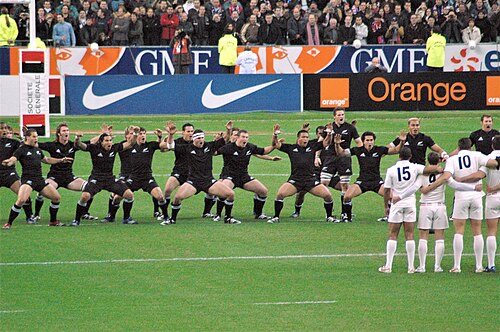
ニュージーランドでプレーされている主要なスポーツのほとんどはイギリス起源である。[419] ラグビーユニオンは国民的スポーツとみなされており[420]、最も多くの観客を集めている。[421] ゴルフ、ネットボール、テニス、クリケットは成人の参加率が最も高く、ネットボール、ラグビーユニオン、フットボール(サッカー)は特に若者の間で人気がある。[421] [422] 競馬はニュージーランドで最も人気のある観戦スポーツの一つであり、1960年代には「ラグビー、競馬、ビール」サブカルチャーの一部であった。[423]ニュージーランドの青少年の約54%が学校のスポーツに参加している。[422] 1880年代後半から1900年代初頭にかけてのオーストラリアとイギリスへのラグビーの勝利ツアーは、国民的アイデンティティを浸透させる初期の役割を果たした。[424]マオリのヨーロッパのスポーツへの参加はラグビーで特に顕著であり、同国のチームは国際試合の前に伝統的なマオリの挑戦であるハカを披露する。 [425]ニュージーランドはエクストリームスポーツ、アドベンチャーツーリズム[426] 、そして著名なニュージーランド人サー・エドモンド・ヒラリーの成功に見られるように強い登山の伝統で知られている。[427] [428]サイクリング、釣り、水泳、ランニング、トレッキング、カヌー、狩猟、スノースポーツ、サーフィン、セーリングなどの他のアウトドア活動も人気がある。 [429]ニュージーランドは1995年以来、アメリカズカップレガッタで定期的にセーリングの成功を収めている。[430]ポリネシアのスポーツであるワカアマレースは、1980年代からニュージーランドで関心が再燃している。[431]
ニュージーランドには、ラグビーユニオン、ラグビーリーグ、ネットボール、クリケット、ソフトボール、セーリングの国際チームがある。ニュージーランドは1908年と1912年にオーストラリアとの合同チームとして夏季オリンピックに参加し、 1920年に初めて単独で参加した。 [432]この国は最近のオリンピックでメダル獲得数と人口比で高い順位を獲得している。[433] [434]ラグビーユニオンのナショナルチームであるオールブラックスは、国際ラグビー史上最も成功したチームである。[435]彼らはラグビーワールドカップで3回優勝している。 [436]
参照
注記
- ^ 「ゴッド・セーブ・ザ・キング」は正式にはニュージーランドの2つの国歌のうちの1つですが、通常は君主制に関連する状況でのみ使用されます。[1] [2]
- ^ 英語は広く使用されているため、事実上の公用語となっている。 [3]
- ^ ab 国勢調査では複数の民族グループを選択できるため、民族の数字を合計すると 100% を超えます。
- ^ マオリを拠点とするラタナ教会とリンガトゥ教会を含む
- ^ ニュージーランドの土地被覆データベース[8]のデータに基づくと、ニュージーランドの河口を除く河川、湖沼、池で覆われた面積の割合は、(357526 + 81936) / (26821559 – 92499–26033 – 19216) = 1.6%です。河口の開水域、マングローブ、塩性草本植物を含めると、この数字は2.2%になります。
- ^ チャタム諸島には別のタイムゾーンがあり、ニュージーランドの他の地域より 45 分進んでいます。
- ^ 9月の最終日曜日から4月の第1日曜日まで時計は1時間進められます。[13]チャタム諸島でも夏時間が実施されており、ニュージーランド標準時より45分進んでいます。
- ^ 2006年1月1日以降に生まれた人は、少なくとも片方の親がニュージーランド国民または永住者である場合に限り、出生時にニュージーランド国籍を取得します。2005年12月31日以前に生まれた人はすべて出生時に国籍を取得しました(出生権)。[198]
- ^ 暫定的な推定では、人口推計が2013年の国勢調査から2018年の国勢調査に再計算される前の6か月後の2020年3月にこの節目が達成されたと示されていた。[310]
- ^ 2015年、マオリの成人(15歳以上)の55%がマオリ語を知っていると報告した。これらの話者のうち、64%が自宅でマオリ語を使用しており、5万人が「非常に上手に」または「上手に」マオリ語を話すことができる。[345]
- ^ 回答者が複数の宗教を信仰していると主張したり、質問への回答に異議を唱えたりする可能性があるため、宗教の割合は合計で 100% にならない場合があります。
- ^ これは国勢調査の回答者全体の割合であり、キリスト教徒の割合ではありません。
参考文献
- ^ 「ニュージーランド国歌の使用に関するプロトコル」。文化遺産省。2011年5月11日時点のオリジナルよりアーカイブ。2008年2月17日閲覧。
- ^ 「ニュージーランドの国歌」。NZHistory。ニュージーランド文化遺産省。 2024年9月18日閲覧。
- ^ 市民的及び政治的権利に関する国際規約ニュージーランド政府の第5回定期報告書(PDF) (報告書)。ニュージーランド政府。2007年12月21日。89頁。 2015年1月24日時点のオリジナル(PDF)よりアーカイブ。 2015年11月18日閲覧。
マオリ語に加えて、ニュージーランド手話もニュージーランドの公用語です。ニュージーランド手話法2006は、法的手続きにおけるNZSLの使用を許可し、その通訳の能力基準を促進し、政府機関によるNZSLの推進と使用をガイドしています。ほとんどの学校で教授と学習の媒体となっている英語は、その広範な使用により
事実上の
公用語となっています。これらの理由から、これら3つの言語はニュージーランドのカリキュラムで特別に言及されています。
- ^ abcde 「2023年国勢調査人口数(民族グループ、年齢、マオリ系別)および住居数」ニュージーランド統計局。2024年5月29日。 2024年5月29日閲覧。
- ^ 「ニュージーランドの宗教に関する簡単な統計(2018年国勢調査)」。ニュージーランド統計局。出典:Stats NZ。Stats NZによりクリエイティブ・コモンズ表示4.0国際ライセンスの下で再利用が認められています。2023年11月14日時点のオリジナルよりアーカイブ。2023年11月14日閲覧。
- ^ “ワイタンギ条約”. mch.govt.nz.マナトゥ・タオンガ文化遺産省. 2023年6月22日時点のオリジナルよりアーカイブ。 2023年6月22日閲覧。
- ^ "New Zealand country profile". BBC News. 20 November 2023. Archived from the original on 5 February 2024. Retrieved 20 November 2023.
- ^ "The New Zealand Land Cover Database". New Zealand Land Cover Database 2. Ministry for the Environment. 1 July 2009. Archived from the original on 14 March 2011. Retrieved 26 April 2011.
- ^ a b "Population clock". Statistics New Zealand. Archived from the original on 19 November 2022. Retrieved 15 May 2021. The population estimate shown is automatically calculated daily at 00:00 UTC and is based on data obtained from the population clock on the date shown in the citation.
- ^ a b c d "World Economic Outlook Database, October 2023 Edition. (NZ)". International Monetary Fund. 10 October 2023. Archived from the original on 19 October 2023. Retrieved 12 October 2023.
- ^ Household income and housing-cost statistics: Year ended June 2022. Statistics New Zealand. 23 March 2023. Archived from the original on 7 October 2023. Retrieved 22 September 2023.
- ^ "Human Development Report 2023/24" (PDF). United Nations Development Programme. 13 March 2024. p. 288. Archived (PDF) from the original on 13 March 2024. Retrieved 13 March 2024.
- ^ "New Zealand Daylight Time Order 2007 (SR 2007/185)". New Zealand Parliamentary Counsel Office. 6 July 2007. Archived from the original on 7 March 2017. Retrieved 6 March 2017.
- ^ There is no official all-numeric date format for New Zealand, but government recommendations generally follow Australian date and time notation. See The Govt.nz style guide, New Zealand Government, 22 July 2020, archived from the original on 25 July 2021, retrieved 9 July 2021.
- ^ a b "22 USC § 2321k – Designation of major non-NATO allies". law.cornell.edu. Legal Information Institute. Archived from the original on 17 September 2012. Retrieved 14 September 2012.
- ^ a b Lynch, Brian (2009). "THE TRANS-TASMAN WORLD: towards a closer understanding". New Zealand International Review. 34 (2): 25–27. JSTOR 45235895.
- ^ a b Wilson, John (March 2009). "European discovery of New Zealand – Tasman's achievement". Te Ara: The Encyclopedia of New Zealand. Archived from the original on 6 January 2012. Retrieved 24 January 2011.
- ^ Bathgate, John. "The Pamphlet Collection of Sir Robert Stout: Volume 44. Chapter 1, Discovery and Settlement". NZETC. Archived from the original on 24 July 2020. Retrieved 17 August 2018.
He named the country Staaten Land, in honour of the States-General of Holland, in the belief that it was part of the great southern continent.
- ^ Mackay, Duncan (1986). "The Search for the Southern Land". In Fraser, B. (ed.). The New Zealand Book of Events. Auckland: Reed Methuen. pp. 52–54.
- ^ Wood, James (1900). The Nuttall Encyclopaedia: Being a Concise and Comprehensive Dictionary of General Knowledge. London and New York: Frederick Warne & Co. p. iii. Retrieved 10 October 2016.
- ^ a b McKinnon, Malcolm (November 2009). "Place names – Naming the country and the main islands". Te Ara: The Encyclopedia of New Zealand. Archived from the original on 13 June 2018. Retrieved 24 January 2011.
- ^ Grant (Lord Glenelg), Charles (1836). "Extract of a Despatch from Lord Glenelg to Major-General Sir Richard Bourke, New South Wales". Archived from the original on 8 December 2021. Retrieved 20 March 2021 – via Waitangi Associates.
- ^ Palmer 2008, p. 41.
- ^ King 2003, p. 41.
- ^ Hay, Maclagan & Gordon 2008, p. 72.
- ^ a b Mein Smith 2005, p. 6.
- ^ Brunner, Thomas (1851). The Great Journey: An expedition to explore the interior of the Middle Island, New Zealand, 1846-8. Royal Geographical Society. Archived from the original on 31 October 2021. Retrieved 13 June 2010.
- ^ a b Williamson, Maurice (10 October 2013). "Names of NZ's two main islands formalised" (Press release). New Zealand Government. Archived from the original on 8 October 2014. Retrieved 1 May 2017.
- ^ Ministry of Health (24 June 2021). "COVID-19: Elimination strategy for Aotearoa New Zealand". Archived from the original on 2 December 2021. Retrieved 15 July 2021.
- ^ Larner, Wendy (31 May 2021). "COVID-19 in Aotearoa New Zealand". Journal of the Royal Society of New Zealand. 51 (sup1): S1–S3. Bibcode:2021JRSNZ..51S...1L. doi:10.1080/03036758.2021.1908208. ISSN 0303-6758.
- ^ "Using 'Aotearoa' and 'New Zealand' together 'as it should be' - Jacinda Ardern". Newshub. 17 December 2019. Archived from the original on 18 July 2021. Retrieved 18 July 2021.
- ^ Anderson, Atholl; Spriggs, Matthew (1993). "Late colonization of East Polynesia". Antiquity. 67 (255): 200–217. doi:10.1017/S0003598X00045324. ISSN 1745-1744. S2CID 162638670.
- ^ Jacomb, Chris; Anderson, Atholl; Higham, Thomas (1999). "Dating the first New Zealanders: The chronology of Wairau Bar". Antiquity. 73 (280): 420–427. doi:10.1017/S0003598X00088360. ISSN 1745-1744. S2CID 161058755.
- ^ Wilmshurst, J. M.; Hunt, T. L.; Lipo, C. P.; Anderson, A. J. (2010). "High-precision radiocarbon dating shows recent and rapid initial human colonization of East Polynesia". Proceedings of the National Academy of Sciences of the United States of America. 108 (5): 1815–20. Bibcode:2011PNAS..108.1815W. doi:10.1073/pnas.1015876108. PMC 3033267. PMID 21187404.
- ^ Howe, K.R. (2005). "'Ideas about Māori origins - 1840s–early 20th century: Māori tradition and the Great Fleet'". Te Ara - the Encyclopedia of New Zealand. Archived from the original on 29 May 2024. Retrieved 29 May 2024.
- ^ a b Moon, Paul (2013). "12 - The Great Fleet". Encounters: The Creation of New Zealand: The Creation of New Zealand ePub. Google Books: Penguin Random House New Zealand. ISBN 9781742539188. Archived from the original on 24 May 2024. Retrieved 24 May 2024.
- ^ Jacomb, Chris; Holdaway, Richard N.; Allentoft, Morten E.; Bunce, Michael; Oskam, Charlotte L.; Walter, Richard; Brooks, Emma (2014). "High-precision dating and ancient DNA profiling of moa (Aves: Dinornithiformes) eggshell documents a complex feature at Wairau Bar and refines the chronology of New Zealand settlement by Polynesians". Journal of Archaeological Science. 50: 24–30. Bibcode:2014JArSc..50...24J. doi:10.1016/j.jas.2014.05.023. Archived from the original on 1 October 2022. Retrieved 22 March 2020.
- ^ Lowe, David J. (November 2008). Polynesian settlement of New Zealand and the impacts of volcanism on early Maori society: an update (PDF). p. 142. ISBN 978-0-473-14476-0. Archived (PDF) from the original on 22 May 2010. Retrieved 18 January 2010.
{{cite book}}:|journal=ignored (help) - ^ McGlone, M.; Wilmshurst, J. M. (1999). "Dating initial Maori environmental impact in New Zealand". Quaternary International. 59 (1): 5–16. Bibcode:1999QuInt..59....5M. doi:10.1016/S1040-6182(98)00067-6.
- ^ Bunce, Michael; Beavan, Nancy R.; Oskam, Charlotte L.; Jacomb, Christopher; Allentoft, Morten E.; Holdaway, Richard N. (7 November 2014). "An extremely low-density human population exterminated New Zealand moa". Nature Communications. 5: 5436. Bibcode:2014NatCo...5.5436H. doi:10.1038/ncomms6436. ISSN 2041-1723. PMID 25378020.
- ^ Wilmshurst, J. M.; Anderson, A. J.; Higham, T. F. G.; Worthy, T. H. (2008). "Dating the late prehistoric dispersal of Polynesians to New Zealand using the commensal Pacific rat". Proceedings of the National Academy of Sciences of the United States of America. 105 (22): 7676–80. Bibcode:2008PNAS..105.7676W. doi:10.1073/pnas.0801507105. PMC 2409139. PMID 18523023.
- ^ Murray-McIntosh, Rosalind P.; Scrimshaw, Brian J.; Hatfield, Peter J.; Penny, David (1998). "Testing migration patterns and estimating founding population size in Polynesia by using human mtDNA sequences". Proceedings of the National Academy of Sciences of the United States of America. 95 (15): 9047–52. Bibcode:1998PNAS...95.9047M. doi:10.1073/pnas.95.15.9047. PMC 21200. PMID 9671802.
- ^ Walters, Richard; Buckley, Hallie; Jacomb, Chris; Matisoo-Smith, Elizabeth (7 October 2017). "Mass Migration and the Polynesian Settlement of New Zealand". Journal of World Prehistory. 30 (4): 351–376. doi:10.1007/s10963-017-9110-y.
- ^ Jacomb, Chris; Holdaway, Richard N.; Allentoft, Morten E.; Bunce, Michael; Oskam, Charlotte L.; Walter, Richard; Brooks, Emma (2014). "High-precision dating and ancient DNA profiling of moa (Aves: Dinornithiformes) eggshell documents a complex feature at Wairau Bar and refines the chronology of New Zealand settlement by Polynesians". Journal of Archaeological Science. 50: 24–30. Bibcode:2014JArSc..50...24J. doi:10.1016/j.jas.2014.05.023. Archived from the original on 1 October 2022. Retrieved 22 March 2020.
- ^ Walters, Richard; Buckley, Hallie; Jacomb, Chris; Matisoo-Smith, Elizabeth (7 October 2017). "Mass Migration and the Polynesian Settlement of New Zealand". Journal of World Prehistory. 30 (4): 351–376. doi:10.1007/s10963-017-9110-y.
- ^ Roberton, J. B. W. (1956). "Genealogies as a basis for Maori chronology". Journal of the Polynesian Society. 65 (1): 45–54. Archived from the original on 10 March 2020. Retrieved 22 March 2020.
- ^ Moodley, Y.; Linz, B.; Yamaoka, Y.; et al. (2009). "The Peopling of the Pacific from a Bacterial Perspective". Science. 323 (5913): 527–530. Bibcode:2009Sci...323..527M. doi:10.1126/science.1166083. PMC 2827536. PMID 19164753.
- ^ Ray, William (8 October 2019). "The Aotearoa History Show - 2: Tangata Whenua". RNZ History. RNZ. Archived from the original on 24 February 2023. Retrieved 24 May 2024.
- ^ McConnell, Joseph R.; Chellman, Nathan J.; Mulvaney, Robert; Eckhardt, Sabine; Stohl, Andreas; Plunkett, Gill; Kipfstuhl, Sepp; Freitag, Johannes; Isaksson, Elisabeth; Gleason, Kelly E.; Brugger, Sandra O.; McWethy, David B.; Abram, Nerilie J.; Liu, Pengfei; Aristarain, Alberto J. (6 October 2021). "Hemispheric black carbon increase after the 13th-century Māori arrival in New Zealand". Nature. 598 (7879): 82–85. Bibcode:2021Natur.598...82M. doi:10.1038/s41586-021-03858-9. PMID 34616056. S2CID 238421371. Archived from the original on 6 March 2023. Retrieved 24 May 2023.
- ^ Clark, Ross (1994). "Moriori and Māori: The Linguistic Evidence". In Sutton, Douglas (ed.). The Origins of the First New Zealanders. Auckland: Auckland University Press. pp. 123–135.
- ^ Davis, Denise (September 2007). "The impact of new arrivals". Te Ara: The Encyclopedia of New Zealand. Archived from the original on 19 April 2023. Retrieved 30 April 2010.
- ^ Mitchell, Hillary (10 February 2015). "Te Tau Ihu". Te Ara: The Encyclopedia of New Zealand. Ministry for Culture and Heritage. Archived from the original on 28 August 2016. Retrieved 15 September 2016.
- ^ a b Mein Smith 2005, p. 23.
- ^ Salmond, Anne (1991). Two Worlds: First Meetings Between Maori and Europeans 1642–1772. Auckland: Penguin Books. p. 82. ISBN 0-670-83298-7.
- ^ King 2003, p. 122.
- ^ Fitzpatrick, John (2004). "Food, warfare and the impact of Atlantic capitalism in Aotearo/New Zealand" (PDF). Australasian Political Studies Association Conference: APSA 2004 Conference Papers. Archived from the original (PDF) on 11 May 2011.
- ^ Brailsford, Barry (1972). Arrows of Plague. Wellington: Hick Smith and Sons. p. 35. ISBN 0-456-01060-2.
- ^ Wagstrom, Thor (2005). "Broken Tongues and Foreign Hearts". In Brock, Peggy (ed.). Indigenous Peoples and Religious Change. Boston: Brill Academic Publishers. pp. 71 and 73. ISBN 978-90-04-13899-5.
- ^ Lange, Raeburn (1999). May the people live: a history of Māori health development 1900–1920. Auckland University Press. p. 18. ISBN 978-1-86940-214-3.
- ^ a b c Orange, Claudia (1990). "Busby, James – Biography". In Oliver, W. H.; Orange, Claudia; Phillips, Jock (eds.). Dictionary of New Zealand Biography, Te Ara: The Encyclopedia of New Zealand. Archived from the original on 27 June 2013. Retrieved 7 January 2011.
- ^ "First British Resident comes ashore". NZHistory. New Zealand Ministry for Culture and Heritage. 24 December 2020. Archived from the original on 18 October 2021. Retrieved 19 October 2021.
- ^ Foster, Bernard John (April 2009) [1966]. "Sir George Gipps". In McLintock, Alexander Hare (ed.). An Encyclopaedia of New Zealand. Archived from the original on 17 January 2013. Retrieved 20 March 2021 – via TeAra.govt.nz.
- ^ a b Wilson, John (16 September 2016) [2005]. "Nation and government – The origins of nationhood". In Phillips, Jock (ed.). Te Ara: The Encyclopedia of New Zealand. Archived from the original on 24 May 2018. Retrieved 20 March 2021.
- ^ McLintock, Alexander Hare, ed. (April 2009) [1966]. "Settlement from 1840 to 1852". An Encyclopaedia of New Zealand. Archived from the original on 20 January 2013. Retrieved 7 January 2011 – via TeAra.govt.nz.
- ^ Foster, Bernard John (April 2009) [1966]. "Akaroa, French Settlement At". In McLintock, Alexander Hare (ed.). An Encyclopaedia of New Zealand. Archived from the original on 20 January 2013. Retrieved 7 January 2011 – via TeAra.govt.nz.
- ^ Simpson, K. A. (1990). "Hobson, William – Biography". In Oliver, W. H.; Orange, Claudia; Phillips, Jock (eds.). Dictionary of New Zealand Biography, Te Ara: The Encyclopedia of New Zealand. Archived from the original on 20 August 2017. Retrieved 20 March 2021.
- ^ Phillips, Jock (1 August 2015) [2005]. "History of immigration – British immigration and the New Zealand Company". In Phillips, Jock (ed.). Te Ara: The Encyclopedia of New Zealand. Archived from the original on 10 March 2021. Retrieved 20 March 2021.
- ^ "Crown colony era – the Governor-General". NZHistory. New Zealand Ministry for Culture and Heritage. March 2009. Archived from the original on 2 March 2011. Retrieved 7 January 2011.
- ^ Moon, Paul (2010). New Zealand Birth Certificates – 50 of New Zealand's Founding Documents. AUT Media. p. 66. ISBN 978-0-95829971-8.
- ^ "New Zealand's 19th-century wars – overview". NZHistory. New Zealand Ministry for Culture and Heritage. April 2009. Archived from the original on 14 November 2016. Retrieved 7 January 2011.
- ^ a b c Wilson, John (16 September 2016) [2005]. "Government and nation – From colony to nation". In Phillips, Jock (ed.). Te Ara: The Encyclopedia of New Zealand. Archived from the original on 26 December 2018. Retrieved 2 February 2011.
- ^ Temple, Philip (1980). Wellington Yesterday. John McIndoe. ISBN 0-86868-012-5.
- ^ Levine, Stephen (13 July 2012). "Capital city – A new capital". Te Ara: The Encyclopedia of New Zealand. Archived from the original on 5 May 2015. Retrieved 4 May 2015.
- ^ "Parliament moves to Wellington". NZHistory. New Zealand Ministry for Culture and Heritage. January 2017. Archived from the original on 25 April 2019. Retrieved 27 April 2017.
- ^ Jobberns, George (1966). "Kermadec Islands". In McLintock, A. H. (ed.). An Encyclopaedia of New Zealand, Te Ara. Archived from the original on 19 March 2022. Retrieved 18 March 2022.
- ^ "Pacific Island Exclusive Economic Zones". TEARA. Archived from the original on 24 October 2022. Retrieved 24 October 2022.
- ^ a b Wilson, John (March 2009). "History – Liberal to Labour". Te Ara: The Encyclopedia of New Zealand. Archived from the original on 27 April 2017. Retrieved 27 April 2017.
- ^ Hamer, David. "Seddon, Richard John". Dictionary of New Zealand Biography. Ministry for Culture and Heritage. Retrieved 27 April 2017.
- ^ Boxall, Peter; Haynes, Peter (1997). "Strategy and Trade Union Effectiveness in a Neo-liberal Environment". British Journal of Industrial Relations. 35 (4): 567–591. doi:10.1111/1467-8543.00069. Archived from the original (PDF) on 11 May 2011.
- ^ "A brief history of the minimum wage in New Zealand". Newshub. Archived from the original on 19 July 2022. Retrieved 19 July 2022.
- ^ "Proclamation". The London Gazette. No. 28058. 10 September 1907. p. 6149.
- ^ "Dominion status – Becoming a dominion". NZHistory. New Zealand Ministry for Culture and Heritage. September 2014. Archived from the original on 14 June 2020. Retrieved 26 April 2017.
- ^ "War and Society". New Zealand Ministry for Culture and Heritage. Archived from the original on 9 November 2016. Retrieved 7 January 2011.
- ^ Easton, Brian (April 2010). "Economic history – Interwar years and the great depression". Te Ara: The Encyclopedia of New Zealand. Archived from the original on 16 May 2011. Retrieved 7 January 2011.
- ^ Derby, Mark (May 2010). "Strikes and labour disputes – Wars, depression and first Labour government". Te Ara: The Encyclopedia of New Zealand. Archived from the original on 23 January 2011. Retrieved 1 February 2011.
- ^ Easton, Brian (November 2010). "Economic history – Great boom, 1935–1966". Te Ara: The Encyclopedia of New Zealand. Archived from the original on 16 May 2011. Retrieved 1 February 2011.
- ^ Keane, Basil (November 2010). "Te Māori i te ohanga – Māori in the economy – Urbanisation". Te Ara: The Encyclopedia of New Zealand. Archived from the original on 16 May 2011. Retrieved 7 January 2011.
- ^ Royal, Te Ahukaramū (March 2009). "Māori – Urbanisation and renaissance". Te Ara: The Encyclopedia of New Zealand. Archived from the original on 20 January 2013. Retrieved 1 February 2011.
- ^ Healing the Past, Building a Future: A Guide to Treaty of Waitangi Claims and Negotiations with the Crown (PDF). Office of Treaty Settlements. March 2015. ISBN 978-0-478-32436-5. Archived from the original (PDF) on 27 January 2018. Retrieved 26 April 2017.
- ^ Report on the Crown's Foreshore and Seabed Policy (Report). Ministry of Justice. Archived from the original on 1 February 2019. Retrieved 26 April 2017.
- ^ Barker, Fiona (June 2012). "Debate about the foreshore and seabed". Te Ara: The Encyclopedia of New Zealand. Archived from the original on 18 July 2023. Retrieved 26 April 2017.
- ^ a b Walrond, Carl (8 February 2005). "Natural environment – Geography and geology". Te Ara: The Encyclopedia of New Zealand. Archived from the original on 21 February 2022. Retrieved 26 December 2020.
- ^ McLintock, Alexander, ed. (April 2009) [1966]. "The Sea Floor". An Encyclopaedia of New Zealand. Archived from the original on 20 January 2013. Retrieved 13 January 2011.
- ^ "Hauraki Gulf islands". Auckland City Council. Archived from the original on 25 December 2010. Retrieved 13 January 2011.
- ^ Hindmarsh (2006). "Discovering D'Urville". Heritage New Zealand. Archived from the original on 11 May 2011. Retrieved 13 January 2011.
- ^ "Distance tables". Auckland Coastguard. Archived from the original on 23 January 2011. Retrieved 2 March 2011.
- ^ McKenzie, D. W. (1987). Heinemann New Zealand atlas. Heinemann Publishers. ISBN 0-7900-0187-X.
- ^ a b c d e "New Zealand". The World Factbook. US Central Intelligence Agency. 25 February 2021. Archived from the original on 9 January 2021. Retrieved 20 March 2021.
- ^ "Geography". Statistics New Zealand. 1999. Archived from the original on 22 May 2010. Retrieved 21 December 2009.
- ^ Offshore Options: Managing Environmental Effects in New Zealand's Exclusive Economic Zone (PDF). Wellington: Ministry for the Environment. 2005. ISBN 0-478-25916-6. Archived from the original (PDF) on 11 April 2019. Retrieved 23 June 2017.
- ^ Coates, Glen (2002). The rise and fall of the Southern Alps. Canterbury University Press. p. 15. ISBN 0-908812-93-0.
- ^ Garden 2005, p. 52.
- ^ Grant, David (March 2009). "Southland places – Fiordland's coast". Te Ara: The Encyclopedia of New Zealand. Archived from the original on 28 June 2012. Retrieved 14 January 2011.
- ^ "Central North Island volcanoes". New Zealand Department of Conservation. Archived from the original on 29 December 2010. Retrieved 14 January 2011.
- ^ "Taupō". GNS Science. Archived from the original on 24 March 2011. Retrieved 2 April 2011.
- ^ a b Lewis, Keith; Nodder, Scott; Carter, Lionel (March 2009). "Sea floor geology – Active plate boundaries". Te Ara: The Encyclopedia of New Zealand. Archived from the original on 20 January 2013. Retrieved 4 February 2011.
- ^ Wallis, G. P.; Trewick, S. A. (2009). "New Zealand phylogeography: Evolution on a small continent". Molecular Ecology. 18 (17): 3548–3580. Bibcode:2009MolEc..18.3548W. doi:10.1111/j.1365-294X.2009.04294.x. PMID 19674312. S2CID 22049973.
- ^ Mortimer, Nick; Campbell, Hamish (2014). Zealandia: Our Continent Revealed. Auckland: Penguin Books. ISBN 978-0-14-357156-8. OCLC 887230882.
- ^ Wright, Dawn; Bloomer, Sherman; MacLeod, Christopher; Taylor, Brian; Goodliffe, Andrew (2000). "Bathymetry of the Tonga Trench and Forearc: A Map Series". Marine Geophysical Researches. 21 (5): 489–512. Bibcode:2000MarGR..21..489W. doi:10.1023/A:1026514914220. S2CID 6072675.
- ^ Deverson, Tony; Kennedy, Graeme, eds. (2005). "The New Zealand Oxford Dictionary". Australasia. New Zealand Oxford Dictionary. Oxford University Press. doi:10.1093/acref/9780195584516.001.0001. ISBN 9780195584516.
- ^ Hobbs, Joseph J. (2016). Fundamentals of World Regional Geography. Cengage Learning. p. 367. ISBN 9781305854956.
- ^ Hillstrom, Kevin; Collier Hillstrom, Laurie (2003). Australia, Oceania, and Antarctica: A Continental Overview of Environmental Issues. Vol. 3. ABC-Clio. p. 25. ISBN 9781576076941.
... defined here as the continent nation of Australia, New Zealand, and twenty-two other island countries and territories sprinkled over more than 40 million square kilometres of the South Pacific.
- ^ a b Mullan, Brett; Tait, Andrew; Thompson, Craig (March 2009). "Climate – New Zealand's climate". Te Ara: The Encyclopedia of New Zealand. Archived from the original on 20 January 2013. Retrieved 15 January 2011.
- ^ "Summary of New Zealand climate extremes". National Institute of Water and Atmospheric Research. 2004. Archived from the original on 25 September 2023. Retrieved 30 April 2010.
- ^ Walrond, Carl (March 2009). "Natural environment – Climate". Te Ara: The Encyclopedia of New Zealand. Archived from the original on 20 January 2013. Retrieved 15 January 2011.
- ^ Orange, Claudia (1 May 2015). "Northland region". Te Ara: The Encyclopedia of New Zealand. Archived from the original on 11 August 2020. Retrieved 4 May 2020.
- ^ "Mean monthly rainfall". National Institute of Water and Atmospheric Research. Archived from the original (XLS) on 3 May 2011. Retrieved 4 February 2011.
- ^ "Mean monthly sunshine hours". National Institute of Water and Atmospheric Research. Archived from the original (XLS) on 15 October 2008. Retrieved 4 February 2011.
- ^ "New Zealand climate and weather". Tourism New Zealand. Archived from the original on 20 October 2016. Retrieved 13 November 2016.
- ^ "Climate data and activities". National Institute of Water and Atmospheric Research. 28 February 2007. Archived from the original on 7 January 2019. Retrieved 11 February 2016.
- ^ Cooper, R.; Millener, P. (1993). "The New Zealand biota: Historical background and new research". Trends in Ecology & Evolution. 8 (12): 429–33. Bibcode:1993TEcoE...8..429C. doi:10.1016/0169-5347(93)90004-9. PMID 21236222.
- ^ Trewick, S. A.; Morgan-Richards, M. (2014). New Zealand Wild Life. Penguin Books. ISBN 9780143568896.
- ^ Lindsey, Terence; Morris, Rod (2000). Collins Field Guide to New Zealand Wildlife. HarperCollins. p. 14. ISBN 978-1-86950-300-0.
- ^ McDowall, R. M. (2008). "Process and pattern in the biogeography of New Zealand – a global microcosm?". Journal of Biogeography. 35 (2): 197–212. Bibcode:2008JBiog..35..197M. doi:10.1111/j.1365-2699.2007.01830.x. ISSN 1365-2699. S2CID 83921062. Archived from the original on 18 August 2021. Retrieved 6 April 2021.
- ^ a b "Frequently asked questions about New Zealand plants". New Zealand Plant Conservation Network. May 2010. Archived from the original on 8 September 2012. Retrieved 15 January 2011.
- ^ De Lange, Peter James; Sawyer, John William David; Rolfe, Jeremy (2006). New Zealand Indigenous Vascular Plant Checklist. New Zealand Plant Conservation Network. ISBN 0-473-11306-6.
- ^ Wassilieff, Maggy (March 2009). "Lichens – Lichens in New Zealand". Te Ara: The Encyclopedia of New Zealand. Archived from the original on 17 January 2013. Retrieved 16 January 2011.
- ^ McLintock, Alexander, ed. (April 2010) [1966]. "Mixed Broadleaf Podocarp and Kauri Forest". An Encyclopaedia of New Zealand. Archived from the original on 17 January 2013. Retrieved 15 January 2011.
- ^ Mark, Alan (March 2009). "Grasslands – Tussock grasslands". Te Ara: The Encyclopedia of New Zealand. Archived from the original on 17 January 2013. Retrieved 17 January 2010.
- ^ "Commentary on Forest Policy in the Asia-Pacific Region (A Review for Indonesia, Malaysia, New Zealand, Papua New Guinea, Philippines, Thailand and Western Samoa)". Forestry Department. 1997. Archived from the original on 7 February 2019. Retrieved 4 February 2011.
- ^ McGlone, M. S. (1989). "The Polynesian settlement of New Zealand in relation to environmental and biotic changes" (PDF). New Zealand Journal of Ecology. 12(S): 115–129. Archived from the original (PDF) on 17 July 2014.
- ^ Taylor, R.; Smith, I. (1997). The state of New Zealand's environment 1997 (Report). Wellington: New Zealand Ministry for the Environment. Archived from the original on 22 January 2015. Retrieved 6 March 2011.
- ^ "New Zealand ecology: Flightless birds". TerraNature. Archived from the original on 8 April 2020. Retrieved 17 January 2011.
- ^ a b Holdaway, Richard (March 2009). "Extinctions – New Zealand extinctions since human arrival". Te Ara: The Encyclopedia of New Zealand. Archived from the original on 20 January 2013. Retrieved 4 February 2011.
- ^ Kirby, Alex (January 2005). "Huge eagles 'dominated NZ skies'". BBC News. Archived from the original on 4 April 2023. Retrieved 4 February 2011.
- ^ "Reptiles and frogs". New Zealand Department of Conservation. Archived from the original on 29 January 2015. Retrieved 25 June 2017.
- ^ Pollard, Simon (September 2007). "Spiders and other arachnids". Te Ara: The Encyclopedia of New Zealand. Archived from the original on 6 June 2017. Retrieved 25 June 2017.
- ^ "Wētā". New Zealand Department of Conservation. Archived from the original on 12 June 2017. Retrieved 25 June 2017.
- ^ Ryan, Paddy (March 2009). "Snails and slugs – Flax snails, giant snails and veined slugs". Te Ara: The Encyclopedia of New Zealand. Archived from the original on 17 January 2013. Retrieved 4 February 2011.
- ^ Herrera-Flores, Jorge A.; Stubbs, Thomas L.; Benton, Michael J.; Ruta, Marcello (May 2017). "Macroevolutionary patterns in Rhynchocephalia: Is the tuatara (Sphenodon punctatus) a living fossil?". Palaeontology. 60 (3): 319–328. Bibcode:2017Palgy..60..319H. doi:10.1111/pala.12284.
- ^ "Tiny Bones Rewrite Textbooks, first New Zealand land mammal fossil". University of New South Wales. 31 May 2007. Archived from the original on 31 May 2007.
- ^ Worthy, Trevor H.; Tennyson, Alan J. D.; Archer, Michael; Musser, Anne M.; Hand, Suzanne J.; Jones, Craig; Douglas, Barry J.; McNamara, James A.; Beck, Robin M. D. (2006). "Miocene mammal reveals a Mesozoic ghost lineage on insular New Zealand, southwest Pacific". Proceedings of the National Academy of Sciences of the United States of America. 103 (51): 19419–23. Bibcode:2006PNAS..10319419W. doi:10.1073/pnas.0605684103. PMC 1697831. PMID 17159151.
- ^ "Marine Mammals". New Zealand Department of Conservation. Archived from the original on 8 March 2011. Retrieved 17 January 2011.
- ^ "Sea and shore birds". New Zealand Department of Conservation. Archived from the original on 2 August 2015. Retrieved 7 March 2011.
- ^ "Penguins". New Zealand Department of Conservation. Archived from the original on 15 September 2015. Retrieved 7 March 2011.
- ^ Jones, Carl (2002). "Reptiles and Amphibians". In Perrow, Martin; Davy, Anthony (eds.). Handbook of Ecological Restoration: Principles of Restoration. Vol. 2. Cambridge University Press. p. 362. ISBN 0-521-79128-6.
- ^ Towns, D.; Ballantine, W. (1993). "Conservation and restoration of New Zealand Island ecosystems". Trends in Ecology & Evolution. 8 (12): 452–7. Bibcode:1993TEcoE...8..452T. doi:10.1016/0169-5347(93)90009-E. PMID 21236227.
- ^ Rauzon, Mark (2008). "Island restoration: Exploring the past, anticipating the future" (PDF). Marine Ornithology. 35: 97–107. Archived (PDF) from the original on 6 June 2023. Retrieved 17 January 2011.
- ^ Diamond, Jared (1990). "New Zealand as an Archipelago: An International Perspective". In Towns, D.; Daugherty, C.; Atkinson, I. (eds.). Ecological Restoration of New Zealand Islands (PDF). "Conservation Sciences Publications" series. Vol. Z. Wellington: New Zealand Department of Conservation. pp. 3–8. Archived (PDF) from the original on 11 January 2014. Retrieved 26 November 2013 – via Doc.Govt.nz.
- ^ a b "New Zealand's Constitution". Office of the Governor-General of New Zealand. Archived from the original on 6 April 2003. Retrieved 13 January 2010.
- ^ a b c "Factsheet – New Zealand – Political Forces". The Economist. 15 February 2005. Archived from the original on 14 May 2006. Retrieved 4 August 2009.
- ^ "Royal Titles Act 1974". New Zealand Parliamentary Counsel Office. February 1974. Section 1. Archived from the original on 20 October 2008. Retrieved 8 January 2011.
- ^ Constitution Act 1986. New Zealand Parliamentary Counsel Office. 1 January 1987. Section 2.1. Archived from the original on 23 December 2016. Retrieved 15 July 2018.
The Sovereign in right of New Zealand is the head of State of New Zealand, and shall be known by the royal style and titles proclaimed from time to time.
- ^ "The Role of the Governor-General". Office of the Governor-General of New Zealand. 27 February 2017. Archived from the original on 29 June 2017. Retrieved 6 July 2017.
- ^ Harris, Bruce (2009). "Replacement of the Royal Prerogative in New Zealand". New Zealand Universities Law Review. 23: 285–314. Archived from the original on 18 July 2011. Retrieved 28 August 2016.
- ^ a b "The Reserve Powers". Office of the Governor-General of New Zealand. Archived from the original on 7 July 2017. Retrieved 8 January 2011.
- ^ a b c d "Parliament Brief: What is Parliament?". New Zealand Parliament. Archived from the original on 29 October 2020. Retrieved 30 November 2016.
- ^ McLean, Gavin (February 2015). "Premiers and prime ministers". Te Ara: The Encyclopedia of New Zealand. Archived from the original on 17 May 2017. Retrieved 30 November 2016.
- ^ Wilson, John (November 2010). "Government and nation – System of government". Te Ara: The Encyclopedia of New Zealand. Archived from the original on 16 May 2011. Retrieved 9 January 2011.
- ^ "Principles of Cabinet decision making". Cabinet Manual. Department of the Prime Minister and Cabinet. 2008. Archived from the original on 20 December 2016. Retrieved 1 December 2016.
- ^ "Christopher Luxon sworn in as New Zealand's new prime minister". TVNZ. 1News. 27 November 2023. Archived from the original on 27 November 2023. Retrieved 27 November 2023.
- ^ "The electoral cycle". Cabinet Manual. Department of the Prime Minister and Cabinet. 2008. Archived from the original on 27 January 2018. Retrieved 30 April 2017.
- ^ "First past the post – the road to MMP". New Zealand Ministry for Culture and Heritage. September 2009. Archived from the original on 1 July 2010. Retrieved 9 January 2011.
- ^ "Number of electorates and electoral populations: 2018 Census". Stats.Govt.nz. Statistics New Zealand. 23 September 2019. Archived from the original on 13 December 2019. Retrieved 9 March 2021.
- ^ "Sainte-Laguë allocation formula". Electoral Commission. 4 February 2013. Archived from the original on 14 September 2013. Retrieved 31 May 2014.
- ^ Curtin, Jennifer; Miller, Raymond (21 July 2015). "Political parties". Te Ara: The Encyclopedia of New Zealand. Archived from the original on 17 June 2023. Retrieved 24 July 2023.
- ^ "Role of the Chief Justice". Courts of New Zealand. Archived from the original on 25 March 2020. Retrieved 9 June 2018.
- ^ "Structure of the court system". Courts of New Zealand. Archived from the original on 12 June 2018. Retrieved 9 June 2018.
- ^ "The Judiciary". Ministry of Justice. Archived from the original on 24 November 2010. Retrieved 9 January 2011.
- ^ "Fragile States Index Heat Map". Fragile States Index. Archived from the original on 14 August 2020. Retrieved 18 August 2020.
- ^ "Democracy Index 2017" (PDF). Economist Intelligence Unit. 2018. p. 5. Archived (PDF) from the original on 18 February 2018. Retrieved 9 December 2018.
- ^ "Corruption Perceptions Index 2017". Transparency International. 21 February 2018. Archived from the original on 21 February 2018. Retrieved 9 December 2018.
- ^ Carroll, Aengus (May 2016). "State Sponsored Homophobia 2016: A world survey of sexual orientation laws: criminalisation, protection and recognition" (PDF). International Lesbian, Gay, Bisexual, Trans and Intersex Association. p. 183. Archived (PDF) from the original on 2 September 2017. Retrieved 4 December 2016.
In Australia and New Zealand, lesbian, gay, and bisexual people continue to enjoy many legal rights denied to their comrades across the vast majority of the Pacific.
- ^ "New Zealand". OECD Better Life Index. Organisation for Economic Co-operation and Development. Archived from the original on 21 January 2023. Retrieved 31 January 2023.
- ^ "Council election turnout: Low participation revives call for online voting". RNZ. 10 October 2022. Archived from the original on 29 May 2023. Retrieved 29 May 2023.
- ^ "Auckland councillor says record low local election turnout 'extremely concerning'". NZ Herald. 30 May 2023. Archived from the original on 9 October 2022. Retrieved 29 May 2023.
- ^ "The media and low local election turnout". RNZ. 13 October 2022. Archived from the original on 29 May 2023. Retrieved 29 May 2023.
- ^ "New Zealand". Country Reports on Human Rights Practices for 2017. United States Department of State. Archived from the original on 1 January 2020. Retrieved 9 December 2018.
- ^ "A fair go for all? Rite tahi tätou katoa? Addressing Structural Discrimination in Public Services". Human Rights Commission. 2012. p. 50. Archived from the original on 30 March 2014. Retrieved 22 July 2023.
- ^ Cornish, Sophie (1 May 2022). "Māori even more overrepresented in prisons, despite $98m strategy". Stuff. Archived from the original on 29 May 2023. Retrieved 29 May 2023.
- ^ "Hāpaitia te Oranga Tangata | New Zealand Ministry of Justice". www.justice.govt.nz. Archived from the original on 1 June 2023. Retrieved 29 May 2023.
- ^ a b "New Zealand's Nine Provinces (1853–76)" (PDF). Friends of the Hocken Collections. University of Otago. March 2000. Archived from the original (PDF) on 5 February 2011. Retrieved 13 January 2011.
- ^ McLintock, Alexander, ed. (April 2009) [1966]. "Provincial Divergencies". An Encyclopaedia of New Zealand. Archived from the original on 20 January 2013. Retrieved 7 January 2011.
- ^ Swarbrick, Nancy (September 2016). "Public holidays". Te Ara: The Encyclopedia of New Zealand. Archived from the original on 6 June 2017. Retrieved 25 June 2017.
- ^ "Overview – regional rugby". New Zealand Ministry for Culture and Heritage. September 2010. Archived from the original on 22 August 2016. Retrieved 13 January 2011.
- ^ Dollery, Brian; Keogh, Ciaran; Crase, Lin (2007). "Alternatives to Amalgamation in Australian Local Government: Lessons from the New Zealand Experience" (PDF). Sustaining Regions. 6 (1): 50–69. Archived from the original (PDF) on 29 August 2007.
- ^ a b c Sancton, Andrew (2000). Merger mania: the assault on local government. McGill-Queen's University Press. p. 84. ISBN 0-7735-2163-1.
- ^ "Subnational population estimates at 30 June 2010 (boundaries at 1 November 2010)". Statistics New Zealand. 26 October 2010. Archived from the original on 10 June 2011. Retrieved 2 April 2011.
- ^ Smelt & Jui Lin 2009, p. 33.
- ^ a b "Glossary". Department of Internal Affairs. Archived from the original on 9 July 2023. Retrieved 28 August 2016.
- ^ "Chatham Islands Council Act 1995 No 41". New Zealand Parliamentary Counsel Office. 29 July 1995. Archived from the original on 8 August 2017. Retrieved 8 August 2017.
- ^ Gimpel, Diane (2011). Monarchies. ABDO Publishing Company. p. 22. ISBN 978-1-617-14792-0. Retrieved 18 November 2016.
- ^ "System of Government". Government of Niue. Archived from the original on 13 November 2010. Retrieved 13 January 2010.
- ^ "Government – Structure, Personnel". Government of the Cook Islands. Archived from the original on 20 January 2022. Retrieved 13 January 2010.
- ^ "Tokelau Government". Government of Tokelau. Archived from the original on 13 November 2016. Retrieved 16 November 2016.
- ^ "Scott Base". Antarctica New Zealand. Archived from the original on 29 March 2023. Retrieved 13 January 2010.
- ^ "Citizenship Act 1977 No 61". Zealand Parliamentary Counsel Office. 1 December 1977. Archived from the original on 25 February 2017. Retrieved 26 May 2017.
- ^ "Check if you're a New Zealand citizen". Department of Internal Affairs. Archived from the original on 23 September 2014. Retrieved 20 January 2015.
- ^ McLintock, Alexander, ed. (April 2009) [1966]. "External Relations". An Encyclopaedia of New Zealand. Archived from the original on 20 January 2013. Retrieved 7 January 2011.
- ^ "Michael Joseph Savage". New Zealand Ministry for Culture and Heritage. July 2010. Archived from the original on 27 September 2016. Retrieved 29 January 2011.
- ^ Patman, Robert (2005). "Globalisation, Sovereignty, and the Transformation of New Zealand Foreign Policy" (PDF). Working Paper 21/05. Centre for Strategic Studies, Victoria University of Wellington. p. 8. Archived from the original (PDF) on 25 September 2007. Retrieved 12 March 2007.
- ^ 「外務省:オーストラリア、ニュージーランド、アメリカ合衆国間の安全保障条約」オーストラリア政府。1951年9月。2011年6月29日時点のオリジナルよりアーカイブ。2011年1月11日閲覧。
- ^ 「ベトナム戦争」。ニュージーランドの歴史。ニュージーランド文化遺産省。2008年6月。2016年11月8日時点のオリジナルよりアーカイブ。2011年1月11日閲覧。
- ^ 「レインボー・ウォリアー号の沈没 ― 核兵器のないニュージーランド」ニュージーランドの歴史。ニュージーランド文化遺産省。2008年8月。2016年10月19日時点のオリジナルよりアーカイブ。 2011年1月11日閲覧。
- ^ 「核兵器禁止法 – 核兵器禁止のニュージーランド」ニュージーランドの歴史。ニュージーランド文化遺産省。2008年8月。2016年11月3日時点のオリジナルよりアーカイブ。 2011年1月11日閲覧。
- ^ ランゲ、デイビッド(1990年)。「核兵器のない世界:ニュージーランド流」ペンギンブックス。ISBN 0-14-014519-2。
- ^ 「オーストラリア概要」オーストラリア外務貿易省。2010年12月22日時点のオリジナルよりアーカイブ。2011年1月11日閲覧。
- ^ ab 「ニュージーランド国別概要」オーストラリア外務貿易省。2013年10月12日時点のオリジナルよりアーカイブ。2011年1月11日閲覧。
- ^ Collett, John (2013年9月4日). 「Kiwis face hurdles in Purchased of lost fund」。2013年9月6日時点のオリジナルよりアーカイブ。2013年10月4日閲覧。
- ^ Mark, Simon (2021年1月11日). 「ニュージーランドの太平洋地域における公共外交:リセットか、それとも同じことの繰り返しか?」. Place Branding and Public Diplomacy . 18 (2): 105–112. doi :10.1057/s41254-020-00196-x. ISSN 1751-8059. PMC 7798375 . 2024年2月21日時点のオリジナルよりアーカイブ。 2022年3月7日閲覧。
- ^ Bertram, Geoff (April 2010). "South Pacific economic relations – Aid, remittances and tourism". Te Ara: The Encyclopedia of New Zealand. Archived from the original on 20 January 2013. Retrieved 11 January 2011.
- ^ "2018 Census population and dwelling counts". www.stats.govt.nz. Statistics New Zealand. 23 September 2019. § Ethnicity. Archived from the original on 7 March 2023. Retrieved 2 June 2022.
- ^ Howes, Stephen (November 2010). "Making migration work: Lessons from New Zealand". Development Policy Centre. Archived from the original on 11 May 2011. Retrieved 23 March 2011.
- ^ Institute, Lowy. "New Zealand – Lowy Institute Asia Power Index". Lowy Institute Asia Power Index 2021. Archived from the original on 1 April 2022. Retrieved 7 March 2022.
- ^ "Caught between China and the US: The Kiwi place in a newly confrontational world". Stuff.co.nz. 7 June 2019. Archived from the original on 5 July 2019. Retrieved 1 May 2020.
- ^ Steff, Reuben (5 June 2018). "New Zealand's Pacific reset: strategic anxieties about rising China". University of Waikato. Archived from the original on 1 February 2019. Retrieved 1 May 2020.
- ^ "Member States of the United Nations". United Nations. Archived from the original on 30 December 2013. Retrieved 11 January 2011.
- ^ "New Zealand". The Commonwealth. 15 August 2013. Archived from the original on 1 December 2016. Retrieved 1 December 2016.
- ^ "Members and partners". Organisation for Economic Co-operation and Development. Archived from the original on 8 April 2011. Retrieved 11 January 2011.
- ^ "The Future of the Five Power Defence Arrangements". The Strategist. Australian Strategic Policy Institute. 8 November 2012. Archived from the original on 2 December 2016. Retrieved 1 December 2016.
- ^ "Five Eyes Intelligence Oversight and Review Council (FIORC)". www.dni.gov. Archived from the original on 21 January 2021. Retrieved 12 September 2022.
- ^ "Relations with New Zealand". NATO. Archived from the original on 3 April 2023. Retrieved 3 April 2023.
- ^ "Partnership arrangement signed with NATO". Beehive.co.nz. NZ Govt. Archived from the original on 3 April 2023. Retrieved 3 April 2023.
- ^ Scotcher, Katie (3 April 2023). "New Zealand's relationship to Nato is getting stronger, expert says". New Zealand Herald. Archived from the original on 3 April 2023. Retrieved 3 April 2023.
- ^ "2024 Global Peace Index" (PDF). Institute for Economics & Peace. 2024. Retrieved 26 August 2024.
- ^ "About Us: Role and Responsibilities". New Zealand Defence Force. Archived from the original on 8 February 2013. Retrieved 11 January 2011.
- ^ Ayson, Robert (2007). "New Zealand Defence and Security Policy, 1990–2005". In Alley, Roderic (ed.). New Zealand in World Affairs. Vol. IV: 1990–2005. Wellington: Victoria University Press. p. 132. ISBN 978-0-86473-548-5.
- ^ "The Battle for Crete". New Zealand History. New Zealand Ministry for Culture and Heritage. May 2010. Archived from the original on 21 April 2009. Retrieved 9 January 2011.
- ^ "El Alamein – The North African Campaign". New Zealand History. New Zealand Ministry for Culture and Heritage. May 2009. Archived from the original on 4 January 2011. Retrieved 9 January 2011.
- ^ Holmes, Richard (September 2010). "World War Two: The Battle of Monte Cassino". Archived from the original on 28 January 2011. Retrieved 9 January 2011.
- ^ "Gallipoli stirred new sense of national identity says Clark". The New Zealand Herald. April 2005. Archived from the original on 29 April 2020. Retrieved 9 January 2011.
- ^ Prideaux, Bruce (2007). Ryan, Chris (ed.). Battlefield Tourism: History, Place and Interpretation. Elsevier Science. p. 18. ISBN 978-0-08-045362-0.
- ^ Burke, Arthur. "The Spirit of ANZAC". ANZAC Day Commemoration Committee. Archived from the original on 26 December 2010. Retrieved 11 January 2011.
- ^ "South African War 1899–1902". New Zealand Ministry for Culture and Heritage. February 2009. Archived from the original on 3 January 2011. Retrieved 11 January 2011.
- ^ "New Zealand in the Korean War". New Zealand History. New Zealand Ministry for Culture and Heritage. Archived from the original on 9 May 2020. Retrieved 1 December 2016.
- ^ "NZ and the Malayan Emergency". New Zealand Ministry for Culture and Heritage. August 2010. Archived from the original on 3 January 2011. Retrieved 11 January 2011.
- ^ "New Zealand Defence Force Overseas Operations". New Zealand Defence Force. January 2008. Archived from the original on 25 January 2008. Retrieved 17 February 2008.
- ^ World Economic Outlook. International Monetary Fund. April 2018. p. 63. ISBN 978-1-48434-971-7. Archived from the original on 20 June 2018. Retrieved 21 June 2018.
- ^ Human Development Report 2021/2022 (PDF). United Nations Development Programme. 8 September 2022. ISBN 978-9211264517. Archived (PDF) from the original on 9 October 2022. Retrieved 8 September 2022.
- ^ "Country rankings". Index of Economic Freedom. The Heritage Foundation. 2022. Archived from the original on 21 May 2020. Retrieved 14 August 2022.
- ^ "Report for Selected Countries and Subjects: October 2020". International Monetary Fund. Archived from the original on 26 October 2020. Retrieved 21 October 2020.
- ^ "Currencies of the territories listed in the BS exchange rate lists". Bank of Slovenia. Archived from the original on 4 April 2023. Retrieved 22 January 2011.
- ^ a b c McLintock, Alexander, ed. (November 2009) [1966]. "Historical evolution and trade patterns". An Encyclopaedia of New Zealand. Archived from the original on 4 April 2023. Retrieved 10 February 2011.
- ^ Stringleman, Hugh; Peden, Robert (October 2009). "Sheep farming – Growth of the frozen meat trade, 1882–2001". Te Ara: The Encyclopedia of New Zealand. Archived from the original on 20 January 2013. Retrieved 6 May 2010.
- ^ Baker, John (February 2010) [1966]. "Some Indicators of Comparative Living Standards". In McLintock, Alexander (ed.). An Encyclopaedia of New Zealand. Archived from the original on 20 January 2013. Retrieved 30 April 2010. PDF Table Archived 25 July 2023 at the Wayback Machine
- ^ Wilson, John (March 2009). "History – The later 20th century". Te Ara: The Encyclopedia of New Zealand. Archived from the original on 17 January 2013. Retrieved 2 February 2011.
- ^ Nixon, Chris; Yeabsley, John (April 2010). "Overseas trade policy – Difficult times – the 1970s and early 1980s". Te Ara: The Encyclopedia of New Zealand. Archived from the original on 20 January 2013. Retrieved 22 January 2011.
- ^ Evans, N. R. (January 1994). "Up from Down Under: After a Century of Socialism, Australia and New Zealand are Cutting Back Government and Freeing Their Economies". National Review. Vol. 46, no. 16. pp. 47–51.
- ^ Trade, Food Security, and Human Rights: The Rules for International Trade in Agricultural Products and the Evolving World Food Crisis. Routledge. 2016. p. 125. ISBN 9781317008521.
- ^ Arnold, Wayne (2 August 2007). "Surviving Without Subsidies". The New York Times. Archived from the original on 5 June 2015. Retrieved 11 August 2015.
- ^ Easton, Brian (November 2010). "Economic history – Government and market liberalisation". Te Ara: The Encyclopedia of New Zealand. Archived from the original on 20 January 2013. Retrieved 1 February 2011.
- ^ Hazledine, Tim (1998). Taking New Zealand Seriously: The Economics of Decency (PDF). HarperCollins. ISBN 1-86950-283-3. Archived from the original (PDF) on 10 May 2011.
- ^ "NZ tops Travellers' Choice Awards". Stuff. May 2008. Archived from the original on 3 April 2017. Retrieved 30 April 2010.
- ^ a b c "Unemployment: the Social Report 2016 – Te pūrongo oranga tangata". New Zealand Ministry of Social Development. Archived from the original on 20 April 2023. Retrieved 18 August 2017.
- ^ "New Zealand Takes a Pause in Cutting Rates". The New York Times. 10 June 2009. Archived from the original on 13 June 2018. Retrieved 30 April 2010.
- ^ "New Zealand's slump longest ever". BBC News. 26 June 2009. Archived from the original on 12 June 2018. Retrieved 30 April 2010.
- ^ Bascand, Geoff (February 2011). "Household Labour Force Survey: December 2010 quarter – Media Release". Statistics New Zealand. Archived from the original on 29 April 2011. Retrieved 4 February 2011.
- ^ Pullar-Strecker, Tom (30 January 2023). "NZ unemployment expected to remain near record low despite chill wind". Stuff. Archived from the original on 12 March 2024. Retrieved 12 March 2024.
- ^ "Youth unemployment rate three times national average | Stats NZ". Statistics New Zealand. 2 December 2021. Archived from the original on 12 March 2024. Retrieved 12 March 2024.
- ^ Davenport, Sally (2004). "Panic and panacea: Brain drain and science and technology human capital policy". Research Policy. 33 (4): 617–630. doi:10.1016/j.respol.2004.01.006.
- ^ O'Hare, Sean (September 2010). "New Zealand brain-drain worst in world". The Daily Telegraph. Archived from the original on 10 January 2022.
- ^ Collins, Simon (March 2005). "Quarter of NZ's brightest are gone". The New Zealand Herald. Archived from the original on 2 June 2023. Retrieved 22 January 2011.
- ^ Winkelmann, Rainer (2000). "The labour market performance of European immigrants in New Zealand in the 1980s and 1990s". The International Migration Review. 33 (1). The Center for Migration Studies of New York: 33–58. doi:10.2307/2676011. JSTOR 2676011. Journal subscription required
- ^ Bain 2006, p. 44.
- ^ "GII 2016 Report" (PDF). Global Innovation Index. Archived from the original on 30 July 2017. Retrieved 21 June 2018.
- ^ "Income inequality". NZ Progress Indicators. Statistics New Zealand. Archived from the original on 31 July 2020.
- ^ Pearl, Harry (18 September 2013). "NZ income gap at crisis level – author". Stuff. Archived from the original on 23 July 2023. Retrieved 24 July 2023.
- ^ a b "NZ election: The people left behind in Ardern's 'kind' New Zealand". BBC News. 13 October 2020. Archived from the original on 27 October 2021. Retrieved 27 August 2021.
- ^ "Reducing child poverty". www.dpmc.govt.nz. Department of the Prime Minister and Cabinet (DPMC). 22 April 2022. Archived from the original on 23 July 2023. Retrieved 24 July 2023.
- ^ "Child poverty statistics show no annual change in the year ended June 2022 | Stats NZ". www.stats.govt.nz. Archived from the original on 29 May 2023. Retrieved 29 May 2023.
- ^ Groser, Tim (March 2009). "Speech to ASEAN-Australia-New Zealand Free Trade Agreement Seminars". New Zealand Government. Archived from the original on 10 July 2023. Retrieved 30 January 2011.
- ^ "Improving Access to Markets:Agriculture". New Zealand Ministry of Foreign Affairs and Trade. Archived from the original on 8 December 2015. Retrieved 22 January 2011.
- ^ "Standard International Trade Classification R4 – Exports (Annual-Jun)". Statistics New Zealand. April 2015. Archived from the original on 8 April 2015. Retrieved 3 April 2015.
- ^ a b c "Goods and services trade by country: Year ended June 2018 – corrected". Statistics New Zealand. Archived from the original on 31 March 2022. Retrieved 17 February 2019.
- ^ "China and New Zealand sign free trade deal". The New York Times. April 2008. Archived from the original on 3 April 2017. Retrieved 22 February 2017.
- ^ "EU and New Zealand sign ambitious free trade agreement" (PDF). European Commission. Archived (PDF) from the original on 19 October 2023. Retrieved 17 October 2023.
- ^ Ardern, Jacinda; O'Connor, Damien. "New Zealand secures major free trade deal with European Union". beehive.govt.nz. Archived from the original on 10 April 2023. Retrieved 17 October 2023.
- ^ "Key points from New Zealand's free trade agreement with the EU". myNZTE. Archived from the original on 19 October 2023. Retrieved 17 October 2023.
- ^ Gray, Jamie (1 July 2022). "Primary sector gives its verdict on NZ-EU Free Trade Agreement". nzherald. NZME. Retrieved 17 October 2023.[permanent dead link]
- ^ a b "Key Tourism Statistics" (PDF). Ministry of Business, Innovation and Employment. 26 April 2017. Archived from the original (PDF) on 27 April 2017. Retrieved 26 April 2017.
- ^ Easton, Brian (March 2009). "Economy – Agricultural production". Te Ara: The Encyclopedia of New Zealand. Archived from the original on 28 January 2013. Retrieved 22 January 2011.
- ^ Stringleman, Hugh; Peden, Robert (March 2009). "Sheep farming – Changes from the 20th century". Te Ara: The Encyclopedia of New Zealand. Archived from the original on 20 January 2013. Retrieved 22 January 2011.
- ^ Stringleman, Hugh; Scrimgeour, Frank (November 2009). "Dairying and dairy products – Dairying in the 2000s". Te Ara: The Encyclopedia of New Zealand. Archived from the original on 20 January 2013. Retrieved 22 January 2011.
- ^ Stringleman, Hugh; Scrimgeour, Frank (March 2009). "Dairying and dairy products – Dairy exports". Te Ara: The Encyclopedia of New Zealand. Archived from the original on 14 January 2013. Retrieved 4 February 2011.
- ^ Stringleman, Hugh; Scrimgeour, Frank (March 2009). "Dairying and dairy products – Manufacturing and marketing in the 2000s". Te Ara: The Encyclopedia of New Zealand. Archived from the original on 20 January 2013. Retrieved 22 January 2011.
- ^ Dalley, Bronwyn (March 2009). "Wine – The wine boom, 1980s and beyond". Te Ara: The Encyclopedia of New Zealand. Archived from the original on 20 January 2013. Retrieved 22 January 2011.
- ^ "Wine in New Zealand". The Economist. 27 March 2008. Archived from the original on 21 October 2017. Retrieved 29 April 2017.
- ^ "Agricultural and forestry exports from New Zealand: Primary sector export values for the year ending June 2010". New Zealand Ministry of Agriculture and Forestry. 14 January 2011. Archived from the original on 10 May 2011. Retrieved 8 April 2011.
- ^ a b Energy in New Zealand 2016 (PDF) (Report). New Zealand Ministry of Business, Innovation and Employment. September 2016. p. 47. ISSN 2324-5913. Archived from the original (PDF) on 3 May 2017.
- ^ "Appendix 1: Technical information about drinking water supply in the eight local authorities". Office of the Auditor-General. Archived from the original on 17 September 2016. Retrieved 2 September 2016.
- ^ "Water supply". Greater Wellington Regional Council. Archived from the original on 1 September 2016. Retrieved 2 September 2016.
- ^ "State highway frequently asked questions". NZ Transport Agency. Archived from the original on 7 May 2017. Retrieved 28 April 2017.
- ^ Humphris, Adrian (April 2010). "Public transport – Passenger trends". Te Ara: The Encyclopedia of New Zealand. Archived from the original on 20 January 2013. Retrieved 22 January 2011.
- ^ Atkinson, Neill (November 2010). "Railways – Rail transformed". Te Ara: The Encyclopedia of New Zealand. Archived from the original on 20 January 2013. Retrieved 22 January 2011.
- ^ Atkinson, Neill (April 2010). "Railways – Freight transport". Te Ara: The Encyclopedia of New Zealand. Archived from the original on 17 January 2013. Retrieved 22 January 2011.
- ^ "International Visitors" (PDF). Ministry of Economic Development. June 2009. Archived (PDF) from the original on 16 October 2011. Retrieved 30 January 2011.
- ^ "10. Airports". Infrastructure Stocktake: Infrastructure Audit. Ministry of Economic Development. December 2005. Archived from the original on 22 May 2010. Retrieved 30 January 2011.
- ^ a b Wilson, A. C. (March 2010). "Telecommunications – Telecom". Te Ara: The Encyclopedia of New Zealand. Archived from the original on 11 August 2017. Retrieved 11 August 2017.
- ^ "Telecom separation". New Zealand Ministry of Business, Innovation and Employment. 14 September 2015. Archived from the original on 11 August 2017. Retrieved 11 August 2017.
- ^ "Broadband and mobile programmes". MBIE.Govt.nz. New Zealand Ministry of Business, Innovation and Employment. Archived from the original on 19 December 2018. Retrieved 11 August 2017.
- ^ "2017 Global ICT Development Index". International Telecommunication Union. 2018. Archived from the original on 20 September 2018. Retrieved 18 September 2018.
- ^ Voyce, Malcolm (1989). "Maori Healers in New Zealand: The Tohunga Suppression Act 1907". Oceania. 60 (2): 99–123. doi:10.1002/j.1834-4461.1989.tb02347.x. ISSN 1834-4461. Archived from the original on 15 August 2021. Retrieved 6 April 2021.
- ^ McLintock, Alexander, ed. (April 2009) [1966]. "Science – History and Organisation in New Zealand". An Encyclopaedia of New Zealand. Archived from the original on 13 April 2020. Retrieved 14 April 2020.
- ^ Morton, Jamie (5 April 2017). "150 years of Kiwi science". The New Zealand Herald. Archived from the original on 5 August 2020. Retrieved 14 April 2020.
- ^ "Crown Research Institutes". MBIE.Govt.nz. New Zealand Ministry of Business, Innovation and Employment. Archived from the original on 27 May 2020. Retrieved 14 April 2020.
- ^ "Research and development (R&D) – Gross domestic spending on R&D – OECD Data". Organisation for Economic Co-operation and Development. 2018. Archived from the original on 14 January 2017. Retrieved 14 April 2020.
- ^ WIPO (2022). Global Innovation Index 2023, 15th Edition. World Intellectual Property Organization. doi:10.34667/tind.46596. ISBN 978-92-805-3432-0. Archived from the original on 22 October 2023. Retrieved 23 October 2023.
{{cite book}}:|website=ignored (help) - ^ "New Zealand Space Agency | Ministry of Business, Innovation & Employment". Archived from the original on 30 May 2023. Retrieved 7 July 2023.
- ^ "New Zealand's population nears 5.1 million" (Press release). Statistics New Zealand. 22 September 2020. Archived from the original on 4 April 2023. Retrieved 24 September 2020.
- ^ Pullar-Strecker, Tom (18 May 2020). "New Zealand population tops 5 million". Stuff.co.nz. Archived from the original on 12 February 2023. Retrieved 18 May 2020.
- ^ a b c d "Subnational population estimates (RC, SA2), by age and sex, at 30 June 1996-2023 (2023 boundaries)". Statistics New Zealand. Retrieved 25 October 2023. (regional councils); "Subnational population estimates (TA, SA2), by age and sex, at 30 June 1996-2023 (2023 boundaries)". Statistics New Zealand. Retrieved 25 October 2023. (territorial authorities); "Subnational population estimates (urban rural), by age and sex, at 30 June 1996-2023 (2023 boundaries)". Statistics New Zealand. Retrieved 25 October 2023. (urban areas)
- ^ "Three in four New Zealanders live in the North Island | Stats NZ". www.stats.govt.nz. 26 October 2017. Archived from the original on 7 October 2021. Retrieved 7 October 2021.
- ^ "Quality of Living Ranking 2016". New York / London: Mercer. 23 February 2016. Archived from the original on 19 October 2017. Retrieved 28 April 2017.
- ^ "2018 Census place summaries | Stats NZ". www.stats.govt.nz. Archived from the original on 14 November 2023. Retrieved 9 September 2021.
- ^ "National and subnational period life tables: 2017–2019 | Stats NZ". www.stats.govt.nz. Retrieved 9 September 2021.
- ^ de Jong, Eleanor (18 February 2021). "New Zealand birthrate sinks to its lowest ever". the Guardian. Archived from the original on 10 September 2021. Retrieved 9 September 2021.
- ^ "Demography – Fertility rates – OECD Data". theOECD. Retrieved 9 September 2021.
- ^ "World Population Prospects" (PDF). 2008 revision. United Nations Department of Economic and Social Affairs. 2009. Retrieved 29 August 2009.
- ^ "Mortality 2016 data tables". Ministry of Health NZ. Retrieved 9 September 2021.
- ^ "Health expenditure and financing". Stats.OECD.org. Organisation for Economic Co-operation and Development. 2016. Retrieved 8 December 2017.
- ^ Pool, Ian (May 2011). "Population change – Key population trends". Te Ara: The Encyclopedia of New Zealand. Archived from the original on 18 August 2017. Retrieved 18 August 2017.
- ^ Dalby, Simon (September 1993). "The 'Kiwi disease': Geopolitical discourse in Aotearoa/New Zealand and the South Pacific". Political Geography. 12 (5): 437–456. doi:10.1016/0962-6298(93)90012-V.
- ^ Callister, Paul (2004). "Seeking an Ethnic Identity: Is 'New Zealander' a Valid Ethnic Category?" (PDF). New Zealand Population Review. 30 (1 & 2): 5–22. Archived from the original (PDF) on 15 May 2011. Retrieved 18 January 2011.
- ^ Ranford, Jodie. "'Pakeha', Its Origin and Meaning". Māori News. Retrieved 20 February 2008.
Originally the Pakeha were the early European settlers, however, today 'Pakeha' is used to describe any peoples of non-Maori or non-Polynesian heritage. Pakeha is not an ethnicity but rather a way to differentiate between the historical origins of our settlers, the Polynesians and the Europeans, the Maori and the other.
- ^ Socidad Peruana de Medicina Intensiva (SOPEMI) (2000). Trends in international migration: Continuous reporting system on migration. Organisation for Economic Co-operation and Development. pp. 276–278.
- ^ Walrond, Carl (21 September 2007). "Dalmatians". Te Ara: The Encyclopedia of New Zealand. Retrieved 30 April 2010.
- ^ "Peoples". Te Ara: The Encyclopedia of New Zealand. 2005. Retrieved 2 June 2017.
- ^ a b Phillips, Jock (11 August 2015). "History of immigration". Te Ara: The Encyclopedia of New Zealand. Retrieved 2 June 2017.
- ^ Brawley, Sean (1993). "'No White Policy in NZ': Fact and Fiction in New Zealand's Asian Immigration Record, 1946–1978" (PDF). New Zealand Journal of History. 27 (1): 33–36. Archived from the original (PDF) on 8 October 2020. Retrieved 2 June 2017.
- ^ "International Migration Outlook: New Zealand 2009/10" (PDF). OECD Continuous Reporting System on Migration (SOPEMI). Organisation for Economic Co-operation and Development: 2. 2010. ISSN 1179-5085. Archived from the original (PDF) on 11 May 2011. Retrieved 16 April 2011 – via New Zealand Department of Labour.
- ^ "Birthplace (detailed), for the census usually resident population count, 2006, 2013, and 2018 Censuses (RC, TA, SA2, DHB)". nzdotstat.stats.govt.nz. Statistics New Zealand. Retrieved 22 July 2020.
- ^ "2018 Census totals by topic – national highlights". Statistics New Zealand. 23 September 2019. Archived from the original on 23 September 2019. Retrieved 22 July 2020.
- ^ Butcher, Andrew; McGrath, Terry (2004). "International Students in New Zealand: Needs and Responses" (PDF). International Education Journal. 5 (4). Archived from the original (PDF) on 9 March 2012. Retrieved 19 January 2011.
- ^ 2013 Census QuickStats. Statistics New Zealand. 2013. ISBN 978-0-478-40864-5.
- ^ a b c d e f g "Quick stats about ethnicity for New Zealand (2018 Census)". Statistics New Zealand. Source: Stats NZ and licensed by Stats NZ for reuse under the Creative Commons Attribution 4.0 International licence. Archived from the original on 14 November 2023. Retrieved 14 November 2023.
- ^ Bardsley, Dianne (7 October 2018). "English language in New Zealand – Characteristics of New Zealand English". Te Ara: The Encyclopedia of New Zealand. Retrieved 11 November 2021.
- ^ Hay, Maclagan & Gordon 2008, p. 14.
- ^ Bauer, Laurie; Warren, Paul; Bardsley, Dianne; Kennedy, Marianna; Major, George (2007). "New Zealand English". Journal of the International Phonetic Association. 37 (1): 97–102. doi:10.1017/S0025100306002830.
- ^ a b Phillips, Jock (March 2009). "The New Zealanders – Bicultural New Zealand". Te Ara: The Encyclopedia of New Zealand. Retrieved 21 January 2011.
- ^ "The Crown's legacy of beating Māori children for speaking their reo". NZ Herald. 30 May 2023. Retrieved 29 May 2023.
- ^ "Crown should apologise to Māori beaten as children for te reo, says Dover Samuels". Stuff. 3 September 2019. Retrieved 29 May 2023.
- ^ "Native Affairs – Silenced". Māori Television. 21 September 2015. Retrieved 29 May 2023.
- ^ Squires, Nick (May 2005). "British influence ebbs as New Zealand takes to talking Māori". The Daily Telegraph. Archived from the original on 10 January 2022. Retrieved 3 May 2017.
- ^ "Waitangi Tribunal claim – Māori Language Week". New Zealand Ministry for Culture and Heritage. July 2010. Archived from the original on 2 June 2023. Retrieved 19 January 2011.
- ^ "Ngā puna kōrero: Where Māori speak te reo – infographic". Statistics New Zealand. Retrieved 8 September 2016.
- ^ Drinnan, John (8 July 2016). "'Maori' will remain in the name Maori Television". The New Zealand Herald. Retrieved 28 August 2016.
According to 2015 figures supplied by Maori TV, its two channels broadcast an average of 72 per cent Māori language content – 59 per cent on the main channel and 99 per cent on Te Reo
- ^ "Ngāi Tahu Claims Settlement Act 1998". New Zealand Parliamentary Counsel Office. 20 May 2014 [1 October 1998]. Retrieved 10 March 2019.
- ^ "New Zealand Sign Language Act 2006". 1 July 2022. Parliamentary Counsel Office. 10 April 2006.
- ^ a b Kaa, Hirini (March 2017). "Ngā hāhi – Māori and Christian denominations – Ringatū and Rātana". Te Ara: The Encyclopedia of New Zealand. Retrieved 4 April 2020.
- ^ Zuckerman, Phil (2006). Martin, Michael (ed.). The Cambridge Companion to Atheism (PDF). Cambridge University Press. pp. 47–66. ISBN 978-0-521-84270-9. S2CID 16480812. Archived from the original (PDF) on 9 August 2017. Retrieved 8 August 2017.
- ^ Walrond, Carl (May 2012). "Atheism and secularism – Who is secular?". Te Ara: The Encyclopedia of New Zealand. Retrieved 8 August 2017.
- ^ "2018 Census place summaries". stats.govt.nz. Statistics New Zealand. 23 September 2019. Retrieved 30 March 2020.
- ^ a b Dench, Olivia (July 2010). "Education Statistics of New Zealand: 2009". Education Counts. Retrieved 19 January 2011.
- ^ "Education Act 1989 No 80". New Zealand Parliamentary Counsel Office. 1989. Section 3. Retrieved 5 January 2013.
- ^ "Education Act 1989 No 80 (as at 01 February 2011), Public Act. Part 14: Establishment and disestablishment of tertiary institutions, Section 62: Establishment of institutions". Education Act 1989 No 80. New Zealand Parliamentary Counsel Office. 1 February 2011. Retrieved 15 August 2011.
- ^ "Studying in New Zealand: Tertiary education". New Zealand Qualifications Authority. Retrieved 15 August 2011.
- ^ "Educational attainment of the adult population". educationcounts.govt.nz.
- ^ "PISA 2018 results". PISA. 2019. Retrieved 7 October 2023.
- ^ Kennedy 2007, p. 398.
- ^ Hearn, Terry (March 2009). "English – Importance and influence". Te Ara: The Encyclopedia of New Zealand. Retrieved 21 January 2011.
- ^ "Conclusions – British and Irish immigration". New Zealand Ministry for Culture and Heritage. March 2007. Retrieved 21 January 2011.
- ^ Stenhouse, John (November 2010). "Religion and society – Māori religion". Te Ara: The Encyclopedia of New Zealand. Retrieved 21 January 2011.
- ^ "Māori Social Structures". New Zealand Ministry of Justice. March 2001. Archived from the original on 10 June 2016. Retrieved 21 January 2011.
- ^ "Thousands turn out for Pasifika Festival". Radio New Zealand. 25 March 2017. Retrieved 18 August 2017.
- ^ Kennedy 2007, p. 400.
- ^ Kennedy 2007, p. 399.
- ^ Phillips, Jock (March 2009). "The New Zealanders – Post-war New Zealanders". Te Ara: The Encyclopedia of New Zealand. Retrieved 21 January 2011.
- ^ Phillips, Jock (March 2009). "The New Zealanders – Ordinary blokes and extraordinary sheilas". Te Ara: The Encyclopedia of New Zealand. Retrieved 21 January 2011.
- ^ Phillips, Jock (March 2009). "Rural mythologies – The cult of the pioneer". Te Ara: The Encyclopedia of New Zealand. Retrieved 21 January 2011.
- ^ Barker, Fiona (June 2012). "New Zealand identity – Culture and arts". Te Ara: The Encyclopedia of New Zealand. Retrieved 7 December 2016.
- ^ a b Wilson, John (September 2016). "Nation and government – Nationhood and identity". Te Ara: The Encyclopedia of New Zealand. Retrieved 3 December 2016.
- ^ a b Swarbrick, Nancy (June 2010). "Creative life – Visual arts and crafts". Te Ara: The Encyclopedia of New Zealand. Retrieved 4 February 2011.
- ^ McLintock, Alexander, ed. (April 2009) [1966]. "Elements of Carving". An Encyclopaedia of New Zealand. Retrieved 15 February 2011.
- ^ McLintock, Alexander, ed. (April 2009) [1966]. "Surface Patterns". An Encyclopaedia of New Zealand. Retrieved 15 February 2011.
- ^ McKay, Bill (2004). "Māori architecture: transforming western notions of architecture". Fabrications. 14 (1 & 2): 1–12. doi:10.1080/10331867.2004.10525189. S2CID 144007691. Archived from the original on 13 May 2011.
- ^ McLintock, Alexander, ed. (April 2009) [1966]. "Painted Designs". An Encyclopaedia of New Zealand. Retrieved 15 February 2011.
- ^ McLintock, Alexander, ed. (2009) [1966]. "Tattooing". An Encyclopaedia of New Zealand. Retrieved 15 February 2011.
- ^ a b "Beginnings – history of NZ painting". New Zealand Ministry for Culture and Heritage. December 2010. Retrieved 17 February 2011.
- ^ "A new New Zealand art – history of NZ painting". New Zealand Ministry for Culture and Heritage. November 2010. Retrieved 16 February 2011.
- ^ "Contemporary Maori art". New Zealand Ministry for Culture and Heritage. November 2010. Retrieved 16 February 2011.
- ^ Rauer, Julie. "Paradise Lost: Contemporary Pacific Art at the Asia Society". AsianArt.com. Santa Fe, New Mexico, US. Retrieved 17 February 2011.
- ^ McLintock, Alexander, ed. (April 2009) [1966]. "Textile Designs". An Encyclopaedia of New Zealand. Retrieved 15 February 2011.
- ^ Keane, Basil (March 2009). "Pounamu – jade or greenstone – Implements and adornment". Te Ara: The Encyclopedia of New Zealand. Retrieved 17 February 2011.
- ^ Wilson, John (March 2009). "Society – Food, drink and dress". Te Ara: The Encyclopedia of New Zealand. Retrieved 17 February 2011.
- ^ Swarbrick, Nancy (June 2010). "Creative life – Design and fashion". Te Ara: The Encyclopedia of New Zealand. Retrieved 22 January 2011.
- ^ a b "Fashion in New Zealand – New Zealand's fashion industry". The Economist. 28 February 2008. Retrieved 6 August 2009.
- ^ Swarbrick, Nancy (June 2010). "Creative life – Writing and publishing". Te Ara: The Encyclopedia of New Zealand. Retrieved 22 January 2011.
- ^ "The making of New Zealand literature". New Zealand Ministry for Culture and Heritage. November 2010. Archived from the original on 14 November 2016. Retrieved 22 January 2011.
- ^ "New directions in the 1930s – New Zealand literature". New Zealand Ministry for Culture and Heritage. August 2008. Retrieved 12 February 2011.
- ^ "The war and beyond – New Zealand literature". New Zealand Ministry for Culture and Heritage. November 2007. Retrieved 12 February 2011.
- ^ "28 cities join the UNESCO Creative Cities Network". United Nations Educational, Scientific and Cultural Organization. December 2014. Retrieved 7 March 2015.
- ^ a b Swarbrick, Nancy (June 2010). "Creative life – Music". Te Ara: The Encyclopedia of New Zealand. Archived from the original on 14 May 2011. Retrieved 21 January 2011.
- ^ McLean, Mervyn (1996). Maori Music. Auckland University Press. ISBN 978-1-86940-144-3.
- ^ Flintoff, Brian (22 October 2014). "Māori musical instruments – taonga puoro". Te Ara: The Encyclopedia of New Zealand. Retrieved 18 September 2024.
- ^ McLintock, Alexander, ed. (April 2009) [1966]. "Instruments Used for Non-musical Purposes". An Encyclopaedia of New Zealand. Retrieved 16 February 2011.
- ^ McLintock, Alexander, ed. (April 2009) [1966]. "Music: General History". An Encyclopaedia of New Zealand. Retrieved 15 February 2011.
- ^ McLintock, Alexander, ed. (April 2009) [1966]. "Music: Brass Bands". An Encyclopaedia of New Zealand. Retrieved 14 April 2011.
- ^ McLintock, Alexander, ed. (April 2009) [1966]. "Music: Pipe Bands". An Encyclopaedia of New Zealand. Retrieved 14 April 2011.
- ^ Swarbrick, Nancy (June 2010). "Creative life – Performing arts". Te Ara: The Encyclopedia of New Zealand. Archived from the original on 15 May 2011. Retrieved 21 January 2011.
- ^ "History – celebrating our music since 1965". Recording Industry Association of New Zealand. 2008. Archived from the original on 14 September 2011. Retrieved 23 January 2012.
- ^ "About RIANZ – Introduction". Recording Industry Association of New Zealand. Archived from the original on 21 December 2011. Retrieved 23 January 2012.
- ^ Downes, Siobhan (1 January 2017). "World famous in New Zealand: Hobbiton Movie Set". Stuff. Retrieved 6 July 2017.
- ^ Brian, Pauling (October 2014). "Radio – The early years, 1921 to 1932". Te Ara: The Encyclopedia of New Zealand. Retrieved 6 July 2017.
- ^ "New Zealand's first official TV broadcast". New Zealand Ministry for Culture and Heritage. December 2016. Retrieved 6 July 2017.
- ^ a b Swarbrick, Nancy (June 2010). "Creative life – Film and broadcasting". Te Ara: The Encyclopedia of New Zealand. Retrieved 21 January 2011.
- ^ Horrocks, Roger. "A History of Television in New Zealand". NZ On Screen. Retrieved 13 September 2017.
- ^ "Top 10 Highest Grossing New Zealand Movies Ever". Flicks.co.nz. May 2016. Retrieved 11 August 2017.
- ^ Cieply, Michael; Rose, Jeremy (October 2010). "New Zealand Bends and 'Hobbit' Stays". The New York Times. Retrieved 11 August 2017.
- ^ "Production Guide: Locations". Film New Zealand. Archived from the original on 7 November 2010. Retrieved 21 January 2011.
- ^ Myllylahti, Merja (December 2016). JMAD New Zealand Media Ownership Report 2016 (PDF) (Report). Auckland University of Technology. pp. 4–29. Archived from the original (PDF) on 21 May 2017. Retrieved 11 August 2017.
- ^ "Scores and Status Data 1980–2015". Freedom of the Press 2015. Freedom House. Retrieved 23 November 2016.
- ^ a b "New Zealand Cuisine". New Zealand Tourism Guide. Tourism New Zealand. January 2016. Retrieved 4 January 2016.
- ^ Petrie, Hazel (November 2008). "Kai Pākehā – Introduced foods". Te Ara: The Encyclopedia of New Zealand. Retrieved 27 June 2017.
- ^ Whaanga, Mere (June 2006). "Mātaitai – Shellfish gathering". Te Ara: The Encyclopedia of New Zealand. Retrieved 27 June 2017.
- ^ "Shellfish". Te Ara: The Encyclopedia of New Zealand. Retrieved 29 August 2016.
- ^ Burton, David (September 2013). "Cooking – Cooking methods". Te Ara: The Encyclopedia of New Zealand. Retrieved 11 December 2016.
- ^ Satyanand, Anand (17 January 2010). "Hangi for Prince William". Office of the Governor-General of New Zealand. Retrieved 9 November 2018.
- ^ Royal, Charles; Kaka-Scott, Jenny (September 2013). "Māori foods – kai Māori". Te Ara: The Encyclopedia of New Zealand. Retrieved 1 September 2016.
- ^ Hearn, Terry (March 2009). "English – Popular culture". Te Ara: The Encyclopedia of New Zealand. Retrieved 22 January 2012.
- ^ "Sport, Fitness and Leisure". New Zealand Official Yearbook. Statistics New Zealand. 2000. Archived from the original on 7 June 2011. Retrieved 21 July 2008.
Traditionally New Zealanders have excelled in rugby union, which is regarded as the national sport, and track and field athletics.
- ^ a b Phillips, Jock (February 2011). "Sports and leisure – Organised sports". Te Ara: The Encyclopedia of New Zealand. Retrieved 23 March 2011.
- ^ a b "More and more students wear school sports colours". New Zealand Secondary School Sports Council. Archived from the original on 18 May 2017. Retrieved 30 March 2015.
- ^ "Rugby, racing and beer". New Zealand Ministry for Culture and Heritage. August 2010. Retrieved 22 January 2011.
- ^ Crawford, Scott (January 1999). "Rugby and the Forging of National Identity" (PDF). In Nauright, John (ed.). Sport, Power and Society in New Zealand: Historical and Contemporary Perspectives. "ASSH Studies in Sports History" series. Australian Society for Sports History. Archived from the original (PDF) on 19 January 2012. Retrieved 22 January 2011 – via LA84Foundation.org (and Internet Archiave).
- ^ Derby, Mark (December 2010). "Māori–Pākehā relations – Sports and race". Te Ara: The Encyclopedia of New Zealand. Retrieved 4 February 2011.
- ^ Bain 2006, p. 69.
- ^ Langton, Graham (1996). A history of mountain climbing in New Zealand to 1953 (Thesis). Christchurch: University of Canterbury. p. 28. Retrieved 12 August 2017.
- ^ "World mourns Sir Edmund Hillary". The Age. Melbourne. 11 January 2008.
- ^ "Sport and Recreation Participation Levels" (PDF). Sport and Recreation New Zealand. 2009. Archived from the original (PDF) on 15 January 2015. Retrieved 27 November 2016.
- ^ "New Zealand and the America's Cup". New Zealand History. 17 May 2018.
- ^ Barclay-Kerr, Hoturoa (September 2013). "Waka ama – outrigger canoeing". Te Ara: The Encyclopedia of New Zealand. Retrieved 12 August 2017.
- ^ "NZ's first Olympic century". New Zealand Ministry for Culture and Heritage. August 2016. Retrieved 27 April 2017.
- ^ "London 2012 Olympic Games: Medal strike rate – Final count (revised)". Statistics New Zealand. 14 August 2012. Retrieved 4 December 2013.
- ^ "Rio 2016 Olympic Games: Medals per capita". Statistics New Zealand. 30 August 2016. Retrieved 27 April 2017.
- ^ Kerr, James (14 November 2013). "The All Blacks guide to being successful (off the field)". The Daily Telegraph. London. Archived from the original on 10 January 2022. Retrieved 4 December 2013.
- ^ "New Zealand". RugbyWorldCup.com. 2019. Archived from the original on 4 November 2019. Retrieved 3 November 2019.
Citations
- Bain, Carolyn (2006). New Zealand. Lonely Planet. ISBN 1-74104-535-5.
- Garden, Donald (2005). Stoll, Mark (ed.). Australia, New Zealand, and the Pacific: An Environmental History. "Nature and Human Societies" series. ABC-Clio/Greenwood. ISBN 978-1-57607-868-6.
- Hay, Jennifer; Maclagan, Margaret; Gordon, Elizabeth (2008). Dialects of English: New Zealand English. Edinburgh University Press. ISBN 978-0-7486-2529-1.
- Kennedy, Jeffrey (2007). "Leadership and Culture in New Zealand". In Chhokar, Jagdeep; Brodbeck, Felix; House, Robert (eds.). Culture and Leadership Across the World: The Globe Book of In-depth Studies of 25 Societies. Psychology Press. ISBN 978-0-8058-5997-3.
- King, Michael (2003). The Penguin History of New Zealand. Penguin Books. ISBN 978-0-14-301867-4.
- Mein Smith, Philippa (2005). A Concise History of New Zealand. Cambridge University Press. ISBN 0-521-54228-6.
- Palmer, Matthew (2008). The Treaty of Waitangi in New Zealand's Law and Constitution. Victoria University of Wellington Press. ISBN 978-0-86473-579-9.
- Smelt, Roselynn; Jui Lin, Yong (2009). New Zealand. "Cultures of the World" series (2nd ed.). New York: Marshall Cavendish. ISBN 978-0-7614-3415-3.
Further reading
- Alley, Roderic (2008). New Zealand in World Affairs IV 1990–2005. Victoria University Press. ISBN 978-0-864-73548-5.
- Bateman, David, ed. (2005). Bateman New Zealand Encyclopedia (6th ed.). David Bateman. ISBN 1-86953-601-0.
- Sinclair, Keith; Dalziel, Raewyn (2000). A History of New Zealand (revised ed.). Penguin Books. ISBN 978-0-14-029875-8.
- New Zealand Official Yearbook. Statistics New Zealand. 2010. ISBN 978-1-86953-776-0. (Annual.)
External links
New Zealand at Wikipedia's sister projects
 Definitions from Wiktionary
 Media from Commons
 News from Wikinews
 Quotations from Wikiquote
 Texts from Wikisource
 Textbooks from Wikibooks
 Resources from Wikiversity
 Travel information from Wikivoyage
 Data from Wikidata
Government
- Official website of the New Zealand Government
- New Zealand Ministry for Culture and Heritage – includes information on flag, anthems and coat of arms
- Statistics New Zealand
Travel
- Official website of New Zealand Tourism
General information
- "New Zealand". The World Factbook, Central Intelligence Agency.
- New Zealand at Curlie
- New Zealand country profile from BBC News
- Te Ara: The Encyclopedia of New Zealand
- New Zealand. OECD.
- New Zealand. Directory from UCB Libraries GovPubs. Archived 7 June 2008.
- Key Development Forecasts for New Zealand from International Futures
 Wikimedia Atlas of New Zealand
 Geographic data related to New Zealand at OpenStreetMap
42°S 173°E / 42°S 173°E / -42; 173