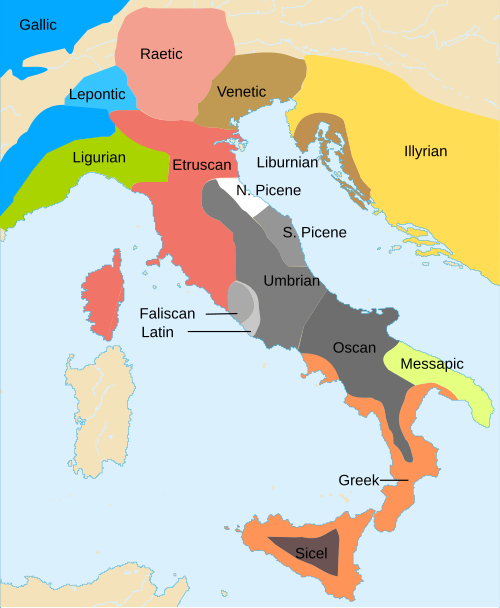
The language is attested by over 300short inscriptions dating from the 6th to the 1stcenturyBCE. Its speakers are identified with the ancient people called Veneti by the Romans and Enetoi by the Greeks. It became extinct around the 1stcentury when the local inhabitants assimilated into the Roman sphere. Inscriptions dedicating offerings to Reitia are one of the chief sources of knowledge of the Venetic language.[5]
The exact relationship of Venetic to other Indo-European languages is still being investigated, but the majority of scholars agree that Venetic, aside from Liburnian, shared some similarities with the Italic languages and so is sometimes classified as Italic. However, since it also shared similarities with other Western Indo-European branches (particularly Celtic languages and Germanic languages), some linguists prefer to consider it an independent Indo-European language. Venetic may also have been related to the Illyrian languages once spoken in the western Balkans, though the theory that Illyrian and Venetic were closely related is debated by current scholarship.
While some scholars consider Venetic plainly an Italic language, and Eric P. Hamp in 1954 thought it more closely related to Latino-Faliscan than to the Osco-Umbrian languages, many authorities suggest, in view of the divergent verbal system, that Venetic was not part of Italic proper, but split off from the core of Italic early.[6]
A 2012 study has suggested that Venetic was a relatively conservative language significantly similar to Celtic, on the basis of morphology, while it occupied an intermediate position between Celtic and Italic, on the basis of phonology. However these phonological similarities may have arisen as an areal phenomenon.[2] Phonological similarities to Rhaetian have also been pointed out.[7]
In 2016, CeltologistPeter Schrijver argued that Venetic and Italic together form one sub-branch of an Italo-Celtic branch of Indo-European, the other sub-branch being Celtic.[8]
Decline
During the period of Latin-Venetic bilingual inscriptions in the Roman script, i.e. 150–50BCE, Venetic became flooded with Latin loanwords. The shift from Venetic to Latin resulting in language death is thought by scholarship to have already been well under way by that time.[9]
Features
Venetic had about six, possibly seven, noun cases and four conjugations (similar to Latin). About 60words are known, but some were borrowed from Latin (liber.tos. < libertus) or Etruscan. Many of them show a clear Indo-European origin, such as vhraterei < PIE *bʰréh₂trey = to the brother.
Phonology
In Venetic, PIE stops *bʰ, *dʰ and *gʰ developed to /f/, /f/ and /h/, respectively, in word-initial position (as in Latin and Osco-Umbrian), but to /b/, /d/ and /ɡ/, respectively, in word-internal intervocalic position (as in Latin). For Venetic, at least the developments of *bʰ and *dʰ are clearly attested. Faliscan and Osco-Umbrian have /f/, /f/ and /h/ internally as well.
There are also indications of the developments of PIE *kʷ > kv, *gʷ- > w- and PIE *gʷʰ- > f- in Venetic, the latter two being parallel to Latin; as well as the regressive assimilation of the PIE sequence *p...kʷ... > *kʷ...kʷ..., a feature also found in Italic and Celtic.[10]:p.141
Language sample
A sample inscription in Venetic, found on a bronzenail at Este (Es 45):[3]:149
Another inscription, found on a situla (vessel such as an urn or bucket) at Cadore (Ca 4 Valle):[3]:464
Scholarship
The most prominent scholars who have deciphered Venetic inscriptions or otherwise contributed to the knowledge of the Venetic language are Pauli,[11]Krahe,[12] Pellegrini,[3] Prosdocimi,[3][13][14] and Lejeune.[10] Recent contributors include Capuis[15] and Bianchi.[16]
12Wallace, Rex (2004). "Venetic". In Woodard, Roger D. (ed.). The Cambridge Encyclopedia of the World's Ancient Languages. University of Cambridge. pp.840–856. ISBN0-521-56256-2. Archived from the original on 2008-12-08. Retrieved 2009-08-19.
12Gvozdanović, Jadranka (2012). "On the linguistic classification of Venetic"(PDF). Journal of Language Relationship. 7: 33–46. doi:10.31826/jlr-2012-070107. S2CID212688857.
12345Pellegrini, Giovanni Battista; Prosdocimi, Aldo Luigi (1967). La Lingua Venetica: I – Le iscrizioni; II – Studi. Padova: Istituto di glottologia dell'Università di Padova.
↑Wilkes, J.J. (9 January 1996). The Illyrians (1sted.). Wiley-Blackwell. p.77. ISBN0-631-19807-5– via Google Books.
↑Woodard, Roger D, ed. (2008). The Ancient Languages of Europe. Cambridge e‑Books. doi:10.1017/CBO9780511486814. ISBN9780511486814. Archived from the original on 2016-03-03. Retrieved 2010-11-30.
↑deMelo, Wolfgang David Cirilo (2007). "The sigmatic future and the genetic affiliation of Venetic: Latin faxō "I shall make" and Venetic vha.g.s. to "he made"". Transactions of the Philological Society. 105 (105): 1–21. doi:10.1111/j.1467-968X.2007.00172.x.
↑Silvestri, M.; Tomezzoli, G. (2007). Linguistic distances between Rhaetian, Venetic, Latin, and Slovenian languages(PDF). Int'l Topical Conf. Origin of Europeans. pp.184–190. Archived from the original(PDF) on 2021-07-25. Retrieved 2015-11-19.
↑Schrijver, Peter (2016). "17. Ancillary study: Sound Change, the Italo-Celtic Linguistic Unity, and the Italian Homeland of Celtic". In Koch, John T.; Cunliffe, Barry (eds.). Celtic from the West 3: Atlantic Europe in the Metal Ages – Questions of Shared Language. Oxford, UK: Oxbow Books. pp.489–502. ISBN978-1-78570-227-3. Retrieved May 12, 2019.
↑Woodard, Roger D., ed. (2008). The ancient languages of Europe. Cambridge University Press. p.139.
12Lejeune, Michel (1974). Manuel de la langue vénète. Heidelberg: Carl Winter – Universitätsverlag.
↑Pauli, Carl Eugen (1885–1894). Altitalische Forschungen. Leipzig: J.A. Barth.
↑Krahe, Hans (1954). Sprache und Vorzeit: europäische Vorgeschichte nach dem Zeugnis der Sprache (in German). Heidelberg: Quelle & Meyer.
↑Prosdocimi, Aldo Luigi (2002). Veneti, Eneti, Euganei, Ateste.
↑Prosdocimi, Aldo Luigi (2002). "Trasmissioni alfabetiche e insegnamento della scrittura". AKEO. I Tempi della Scrittura. Veneti Antichi: Alfabeti e Documenti. Montebelluna: 25–38. (Catalogue of an exposition at Montebelluna, 12/2001–05/2002)
↑Bianchi, Anna Maria Chieco; etal. (1988). Italia: omnium terrarum alumna: la civiltà dei Veneti, Reti, Liguri, Celti, Piceni, Umbri, Latini, Campani e Iapigi (in Italian). Milano: Scheiwiller.
Further reading
Beeler, Madison Scott (1949). The Venetic Language. Berkeley, CA: University of California Press. (archive.org)
Gambacurta, Giovanna (2013). "I Celti e il Veneto". Études Celtiques. 39: 31–40. doi:10.3406/ecelt.2013.2396. hdl:10278/3679708.
Gérard, Raphaël (2001). "Observations sur les inscriptions vénètes de Pannonie". Revue belge de philologie et d'histoire. Antiquité – Oudheid. 79 (1): 39–56. doi:10.3406/rbph.2001.4506.
Lejeune, Michel (1974). Manuel de la langue vénète [Handbook of the Venetic Language]. Heidelberg: Winter, ISBN3-533-02353-2.
Marinetti, Anna (2020). "Venetico". Palaeohispanica. Revista sobre lenguas y culturas de la Hispania Antigua (20): 367–401. doi:10.36707/palaeohispanica.v0i20.374. hdl:10278/3737688. ISSN1578-5386.
Prósper, Blanca Maria (Spring–Summer 2018). "The Venetic inscription from Monte Manicola and three termini publici from Padua: A reappraisal". Journal of Indo-European Studies. 46 (1–2): 1–61.
Prósper, Blanca Maria. "The Venetic Names of Roman Siscia". In: Voprosy onomastiki, 2018, Volume 15, Issue 3, pp.105–124. DOI: 10.15826/vopr_onom.2018.15.3.031
Prósper, Blanca María. "Celtic and Venetic in contact: the dialectal attribution of the personal names in the Venetic record". In: Zeitschrift für celtische Philologie 66, no. 1 (2019): 131-176. https://doi.org/10.1515/zcph-2019-0006
Šavli, Jožef; Bor, Matej; Tomažič, Ivan; Škerbinc, Anton (1996). Veneti: First builders of European community: Tracing the history and language of early ancestors of Slovenes. Wien: Editiones Veneti.
Untermann, Jürgen (1961). Die venetischen Personennamen [The Venetic Personal Names]. Heidelberg.
External links
"Languages and Cultures of Ancient Italy. Historical Linguistics and Digital Models", Project fund by the Italian Ministry of University and Research (P.R.I.N. 2017)
"Víteliú". The Languages of Ancient Italy.
Zavaroni, Adolfo. "Venetic inscriptions".
Babaev, Cyril. "Indo-European database: The Venetic language". Archived from the original on 2005-04-05.
"Additional reading". Encyclopædia Britannica. Italic languages. Archived from the original on 2008-08-27.
Categories:
Unclassified Indo-European languages
Languages of ancient Italy
Languages attested since the 5th century BC
Languages extinct in the 1st century BC
Este culture
Languages of Veneto
Italo-Celtic
Hidden categories:
Articles with short description
Short description is different from Wikidata
Articles needing additional references from August 2024
All articles needing additional references
Extinct ISO language articles citing sources other than Ethnologue
All articles with incomplete citations
Articles with incomplete citations from January 2021
All articles with unsourced statements
Articles with unsourced statements from August 2024