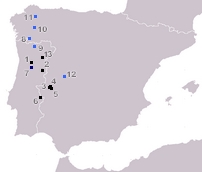
AMBATVS SCRIPSI CARLAE PRAISOM SECIAS ERBA MVITIE AS ARIMO PRAESO NDO SINGIETO INI AVA INDI VEA VN INDI VEDAGA ROM TEVCAECOM INDI NVRIM INDI VDEVEC RVRSENCO AMPILVA INDI LOEMINA INDI ENV PETANIM INDI AR IMOM SINTAMO M INDI TEVCOM SINTAMO
1 2 3ヴィラール、フランシスコ (2000)。Indoeuropeos y no indoeuropeos en la Hispania Prerromana (スペイン語) (第 1版)。サラマンカ: サラマンカエディシオネス大学。ISBN84-7800-968-X2015年12月31日にオリジナルからアーカイブされました。2014年9月22日に取得。
1 2スティフター、デイヴィッド (2006). Sengoídelc (Old Irish for Beginners) . シラキュース大学出版局. pp. 3, 7. ISBN0-8156-3072-7。
1 2 3 Stifter, David (2018). "106. ルシタニア語". Jared S. Klein; Brian Joseph; Matthias Fritz (編) 『比較・歴史インド・ヨーロッパ語学ハンドブック』pp. 1857–1862 . doi : 10.1515/9783110542431-027 . ISBN978-3-11-054243-1。
1 2 3 4 Koch, John T (2011). Tartessian 2: The Inscription of Mesas do Castelinho ro and the Verbal Complex. Preliminaries to Historical Phonology . Oxbow Books, Oxford, UK. pp. 33–34 . ISBN978-1-907029-07-32011年7月23日にオリジナルからアーカイブされました。
↑アンダーソン、JM (1985)。 「ヒスパニック半島のプレローマ語のインド・ヨーロッパ語族」。Revue des Études Anciennes。87 ( 3–4 ): 319–326 .土井: 10.3406/rea.1985.4212。
1 2アンダーソン、ジェームス M. (1985)。「ヒスパニック半島の先ローマ時代のインド・ヨーロッパ語族」。Revue des Études Anciennes。87 (3): 319–326 .土井: 10.3406/rea.1985.4212。
↑マルガリダ・ゴンサルベス・ミゲル、アナ (2013)。As epígrafes em língua lusitana: Memórias escritas da língua e da religião indígena (PDF) (論文) (ポルトガル語)。ポルト大学。2024 年3 月 12 日に取得。
1 2 Quintela, Marco V. García (2005). "ローマ時代以前のスペイン北西部におけるケルト的要素" . E-Keltoi: Journal of Interdisciplinary Celtic Studies . 6 (1). ウィスコンシン大学ミルウォーキー校ケルト研究センター。2011年1月6日のオリジナルからアーカイブ。 2010年5月12日取得。
↑ Koch, John T (2010). Celtic from the West Chapter 9: Paradigm Shift? Interpreting Tartessian as Celtic . Oxbow Books, Oxford, UK. p. 293. ISBN978-1-84217-410-4。
↑バレスター、X. (2004)。「問題のある問題を解決する */p/ en celtoide」. Studi Celtici . 3 : 45–56 .
↑ Luján, ER (2019). 「ルシタニア人の言語と文字」 『古スペイン語と碑文』 304–334頁。doi : 10.1093/oso/9780198790822.003.0011。ISBN978-0-19-879082-2。
↑ Witczak, Krzysztof Tomasz (1999). "On the Indo-European origin of two Lusitanian theonyms (Laebo and reve)" . Emerita . 67 : 65–73 . doi : 10.3989/emerita.1999.v67.i1.185 .
↑ Markey, Thomas (2008). Shared Symbolics, Genre Diffusion, Token Perception and Late Literacy in North-Western Europe . NOWELE.
↑ Prósper, Blanca María (1999). "The inscription of Cabeço das Fráguas revisited. Lusitanian and Alteuropäisch populations in the West of the Iberian Peninsula". Transactions of the Philological Society . 97 (2): 151– 184. doi : 10.1111/1467-968X.00047 .
↑サンチェス・サロール、ユースタキオ。エステバン・オルテガ、フリオ(2021)。 「Un testimonio del dios «Labbo» en una inscripción lusitana de Plasencia, Cáceres. ¿«Labbo» también en Cabeço das Fráguas?」。名誉。89 : 105–126 . doi : 10.3989/emerita.2021.05.2028。hdl : 10662/18053。
↑ James P. Mallory (2013). "The Indo-Europeanization of Atlantic Europe" . In JT Koch; B. Cunliffe (eds.). Celtic From the West 2: Rethinking the Bronze Age and the Arrival of Indo–European in Atlantic Europe . Oxford: Oxbow Books. pp. 17– 40. 2019年3月26日のオリジナルからアーカイブ済み。 2020年2月7日取得。
↑"The number of inscriptions written totally or partially in Lusitanian is limited: only six or seven with Lusitanian vocabulary and/or grammatical words, usually dated to the first two centuries CE. All are written in the Latin alphabet, and most are bilingual, displaying code-switching between Latin and Lusitanian. There are also many deity names in Latin inscriptions. The chapter summarizes Lusitanian phonology, morphology, and syntax, though entire categories are not attested at all. Scholarly debate about the classification of Lusitanian has focused on whether it should be considered a Celtic language. The chapter reviews the main issues, such as the fate of Indo-European */p/ or the outcome of voiced aspirate stops. The prevailing opinion is that Lusitanian was not Celtic. It must have diverged from western Indo-European dialects before the kernel of what would evolve into the Celtic and Italic families had been constituted. An appendix provides the text of extant Lusitanian inscriptions and representative Latin inscriptions displaying Lusitanian deity names and/or their epithets." E.R. Luján 2019: pp. 304–334
↑Witczak, Krzysztof (2005). "The Language and Religion of the Ancient Lusitanians". Academia.edu. Retrieved 27 June 2025.
↑Luján, E. R. (2019). "Language and writing among the Lusitanians". Palaeohispanic Languages and Epigraphies. Oxford University Press. p.318. doi:10.1093/oso/9780198790822.003.0011. ISBN978-0-19-879082-2. Retrieved 23 January 2022.
↑Wodtko, Dagmar (2020). "Lusitanisch". Palaeohispanica. Revista sobre lenguas y culturas de la Hispania Antigua (20): 689–719. doi:10.36707/palaeohispanica.v0i20.379. ISSN1578-5386. S2CID241467632. Retrieved 6 August 2021.
↑Ruiz, J. Siles. "Sobre la inscripción lusitano-latina de Visseu". In: Nuevas interpretaciones del Mundo Antiguo: papers in honor of professor José Luis Melena on the occasion of his retirement / coord. por Elena Redondo Moyano, María José García Soler, 2016. pp. 347-356. ISBN978-84-9082-481-8
↑Luján, Eugenio (28 February 2019). "Language and writing among the Lusitanians". Palaeohispanic Languages and Epigraphies. Oxford University Press. pp.304–334. doi:10.1093/oso/9780198790822.003.0011. ISBN978-0-19-879082-2.
↑ Hübner, E. (編) Corpus Inscriptionum Latinarum vol. II、補足。ベルリン: G. Reimer (1892)
↑ウンターマン、J. Monumenta Linguarum Hispanicarum (1980–97)
↑カルディム・リベイロ、ホセ (2021)。「A inscrição lusitana de Sansueña (「Arroyo I」)」。パレオヒスパニカ。 Revista Sobre Lenguas y Culturas de la Hispania Antigua。21 : 237–299 .土井: 10.36707/palaeohispanica.v21i0.420。
↑ Villar, F. と Pedrero, R. La nueva inscripción lusitana: Arroyo de la Luz III (2001) (スペイン語)
さらに読む
一般教養
アンダーソン、ジェームス M. (1985)。 「ヒスパニック半島のプレローマ語のインド・ヨーロッパ語族」。Revue des Études Anciennes。87 (3): 319–326 .土井: 10.3406/rea.1985.4212。。
ルハン、エウジェニオ(2019)。 「ルシタニア人の言語と文字」。古ヒスパニック言語と碑文。オックスフォード大学出版局。 pp. 304–334 .土井: 10.1093/oso/9780198790822.003.0011。ISBN9780191833274。。
Mallory, JP (2016):大西洋ヨーロッパにおける考古学と言語の変化、Koch, JT & Cunliffe, B. 編『西からのケルト語 3』所収、オックスフォード:Oxbow、pp. 387–406。
ヴァレーホ、ホセ M. è (2013)。「ハシア・ウナ・デフィニシオン・デル・ルシターノ」。パレオヒスパニカ。 Revista Sobre Lenguas y Culturas de la Hispania Antigua。13 (13): 273–91 .土井: 10.36707/palaeohispanica.v0i13.165。。
ウォットコ、ダグマー S. (2020)。「ルシターニッシュ」。Palaeohispanica: Revista sobre lenguas y cultures de la Hispania antigua。20 (20): 689–719 .土井: 10.36707/palaeohispanica.v0i20 .379 。ISSN 1578-5386。S2CID 241467632。。
カルディム・リベイロ、ホセ (2009)。 「古い歴史を調べて、(疑似)歴史的なロマンスを長期間にわたって解釈することはできますか?」。Acta Paleohispanica X - パレオヒスパニカ。9 : 247–270。ISSN 1578-5386。
カルディム、ホセ、ウーゴ・ピレス(2021)。 «Sobre La Fijación Textual De Las Inscripciones Lusitanas De Lamas De Moledo、Cabeço Das Fráguas Y Arronches: La Contribución Del "Modelo De Residuo Morfológico " (MRM)、Resultados Y Principales Consecuencias Interpretativa"。場所:パレオヒスパニカ。 Revista Sobre Lenguas Y Culturas De La Hispania Antigua 21 (12 月)、301-52。https://doi.org/10.36707/palaeohispanica.v21i0.416。
プロスパー、ブランカ M.ヴィラール、フランシスコ (2009)。「ヌエバ・インスクリプシオン・ルシターナ・プロセデンテ・デ・ポルタレグレ」。EMERITA、Revista de Lingüística y Filología Clásica。LXXVII (1): 1–32 . doi : 10.3989/emerita.2009.v77.i1.304。ISSN 0013-6662。。
サンチェス・サロール、ユースタキオ。エステバン・オルテガ、フリオ(2021)。「Un testimonio del dios Labbo en una inscripción lusitana de Plasencia, Cáceres. ¿Labbo también en Cabeço das Fráguas?」。名誉、Revista de Lingüística y Filología Clásica。LXXXIX (1): 105–126 . doi : 10.3989/emerita.2021.05.2028。hdl : 10662/18053。ISSN 0013-6662。S2CID 236256764。。
トヴァール、アントニオ (1966)。 「L'inscription du Cabeço das Fráguas et la langue des Lusitaniens」。エチュード セルティーク。11 (2): 237–268。土井: 10.3406/ecelt.1966.2167。。
ウンターマン、ユルゲン (1997): Monumenta Linguarum Hispanicarum。 IV Die Tartessischen、keltiberischen und lusitanischen Inschriften、ヴィースバーデン。