Loading article…


絵画の歴史は、先史時代の芸術家によって作られた工芸品や美術品にまで遡り、あらゆる文化に及んでいます。それは、古代から途切れることなく続く伝統を表しています。文化、大陸、そして数千年にわたって、絵画の歴史は21世紀まで続く創造性の絶え間ない流れで構成されています。[ 1 ] 20世紀初頭までは、主に具象的、宗教的、古典的なモチーフに依存していましたが、その後、より純粋に抽象的で概念的なアプローチが好まれるようになりました。
東洋絵画の発展は、歴史的に見て、数世紀前の西洋絵画の発展と概ね並行している。 [ 2 ]アフリカ美術、ユダヤ美術、イスラム美術、インドネシア美術、インド美術、[ 3 ]中国美術、日本美術[ 4 ]はそれぞれ西洋美術に大きな影響を与え、またその逆も然りである。[ 5 ]
当初は実用的な目的で、その後は帝国、個人、市民、宗教の庇護を受け、東洋と西洋の絵画は後に貴族や中産階級の観客を獲得しました。近代から中世、ルネサンス期にかけて、画家たちは教会や裕福な貴族のために働きました。[ 6 ]バロック時代から、芸術家たちはより教育を受けた裕福な中産階級から個人的な依頼を受けるようになりました。[ 7 ]そして最後に西洋では、「芸術のための芸術」[ 8 ]という考え方が、フランシスコ・デ・ゴヤ、ジョン・コンスタブル、JMWターナーなどのロマン派の画家の作品に表現され始めました。[ 9 ] 19世紀には商業的な画廊が台頭し、20世紀にはそれが庇護を提供しました。[ 10 ]


最も古い既知の絵画は4万~6万年以上前のもの(旧石器時代後期の芸術)で、マロス地区(インドネシア、スラウェシ島)の洞窟で発見されています。それらは手型と単純な幾何学的形状で構成されています。[ 11 ] [ a ]

2018 年 11 月、科学者たちは、インドネシアのボルネオ島にあるルバン・ジェリジ・サレー洞窟で、当時知られている最古の具象絵画、4 万年以上 (おそらく 5 万 2000 年) の未知の動物の絵を発見したと報告した。[ 13 ] [ 14 ] 2019 年 12 月、スラウェシ島のマロス・パンケップ・カルスト地域で豚狩りを描いた洞窟壁画がさらに古く、少なくとも 43,900 年と推定されることが判明した。この発見は、「物語を伝える最古の描写であり、人類史上最古の具象芸術の例」として認識された。[ 15 ] [ 16 ] 2021 年、インドネシアのスラウェシ島で発見された、45,500 年以上前の豚の洞窟壁画が報告された。[ 17 ] [ 18 ] 2024年7月3日、科学誌ネイチャーは、リアン・カランプアンにある豚と交流する人型像を描いた、縦36インチ、横15インチ(91cm×38cm )の洞窟壁画が約51,200年前のものであることを示す研究結果を発表し、世界最古の既知の絵画として確立した。[ 19 ] [ 20 ]
洞窟壁画の例は世界中に存在し、インドネシア、フランス、インド、スペイン、南アフリカ、中国、オーストラリアなどにも見られる。
これらの絵画が、制作した人々にとってどのような意味を持っていたのかについては、様々な推測がなされてきた。先史時代の芸術家たちは、動物の魂や精神を「捉え」 、より容易に狩猟できるようにするために動物を描いたのかもしれないし、あるいは、これらの絵画はアニミズム的な世界観や周囲の自然への敬意を表したものかもしれない。また、人間に本来備わっている表現欲求の表れであったり、実用的な情報を伝えるためのものであった可能性もある。
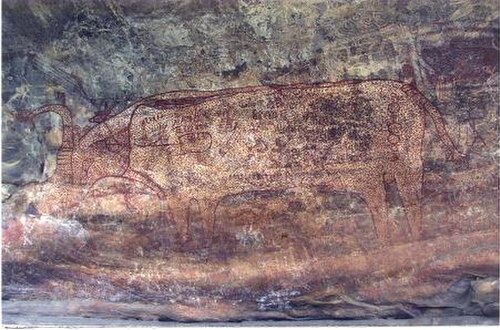
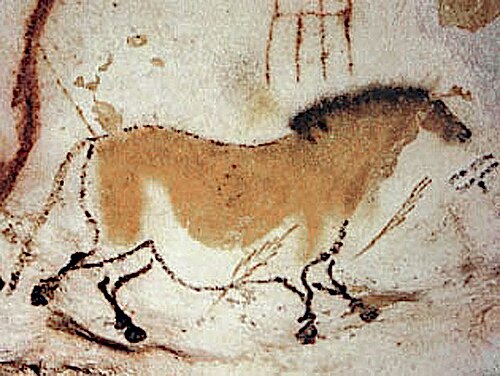


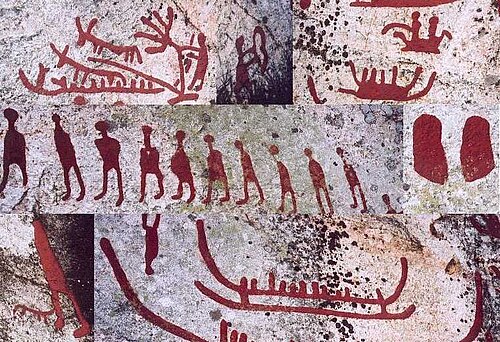

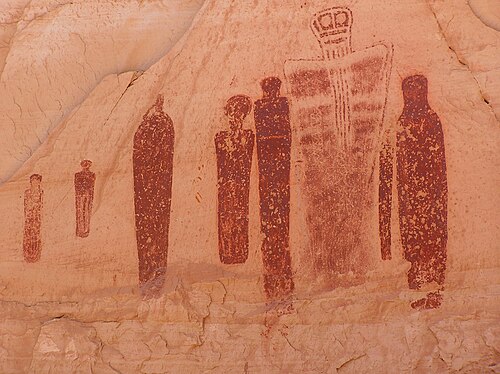


旧石器時代には、洞窟壁画に人間が描かれることは稀でした。主に動物が描かれ、食料として利用された動物だけでなく、ショーヴェ洞窟のようにサイや大型ネコ科動物など、力強さを象徴する動物も描かれました。点などの記号が描かれることもありました。稀な人間の描写としては、手形やステンシル、人間と動物のハイブリッドを描いた図像などがあります。フランスのアルデシュ 県にあるショーヴェ洞窟には、紀元前31,000年頃に描かれた、旧石器時代の最も重要な保存状態の良い洞窟壁画があります。スペインのアルタミラ洞窟の壁画は紀元前14,000年から12,000年に描かれ、バイソンなどが描かれています。フランスのドルドーニュ県にあるラスコー洞窟の雄牛の広間は、最もよく知られた洞窟壁画の1つで、紀元前15,000年から10,000年頃のものです。
絵画に意味があるかどうかは不明のままです。洞窟は居住地域にはなかったので、季節の儀式に使われていた可能性があります。動物には、魔法の使用を示唆する記号が添えられています。ラスコーの矢のようなシンボルは、カレンダーや暦として使用されていたと解釈されることもありますが、証拠は決定的なものではありません。[ 22 ]中石器時代の最も重要な作品は、紀元前7000年から4000年頃のスペイン、カステリョン県シングレ・デ・ラ・モラの岩絵「行進する戦士たち」です。使用された技法は、おそらく顔料を岩に吐きかけたり吹き付けたりすることだったと思われます。絵画は様式化されているものの、非常に写実的です。人物は重なり合っていますが、立体的ではありません。
インドで最も古い絵画として知られているのは、先史時代の岩絵、すなわちビムベトカの岩窟遺跡などで見られるペトログリフであり、中には紀元前5500年よりも古いものもある。こうした絵画制作はその後も続き、数千年後の7世紀には、マハラシュトラ州のアジャンターにある彫刻された柱が、インド絵画の優れた例となっている。色彩は主に様々な赤やオレンジ色で、鉱物から抽出されたものである。
東洋絵画の歴史には、さまざまな文化や宗教からの幅広い影響が含まれています。東洋絵画の発展は、歴史的に西洋絵画の発展と並行しており、一般的には数世紀早く発展しました。[ 2 ]アフリカ美術、ユダヤ美術、イスラム美術、インドネシア美術、インド美術[ 23 ]中国美術、韓国美術、日本美術[ 4 ]はそれぞれ西洋美術に大きな影響を与え、またその逆も然りです。[ 5 ]
中国絵画は、世界で最も古い継続的な芸術的伝統の1つです。初期の絵画は具象的ではなく装飾的であり、絵ではなく模様やデザインで構成されていました。初期の陶器には、螺旋、ジグザグ、点、動物などが描かれていました。芸術家が周囲の世界を表現し始めたのは、戦国時代(紀元前403年~221年)になってからです。日本絵画は、日本の芸術の中で最も古く、最も洗練されたものの1つであり、さまざまなジャンルとスタイルを包含しています。日本絵画の歴史は、日本固有の美意識と輸入されたアイデアの適応との間の統合と競争の長い歴史です。独立した形式としての朝鮮絵画は、古朝鮮の滅亡の頃、紀元前108年頃に始まり、世界で最も古いものの1つです。その時代の芸術は、朝鮮の三国時代を特徴づけるさまざまなスタイルに発展し、最も有名なのは高句麗の王族の墓を飾る絵画や壁画です。三国時代から高麗時代にかけて、朝鮮絵画は主に朝鮮風の風景画、人物描写、仏教を中心としたテーマ、そして朝鮮天文学の急速な発展によって促進された天体観測への重点が組み合わさったものであった。


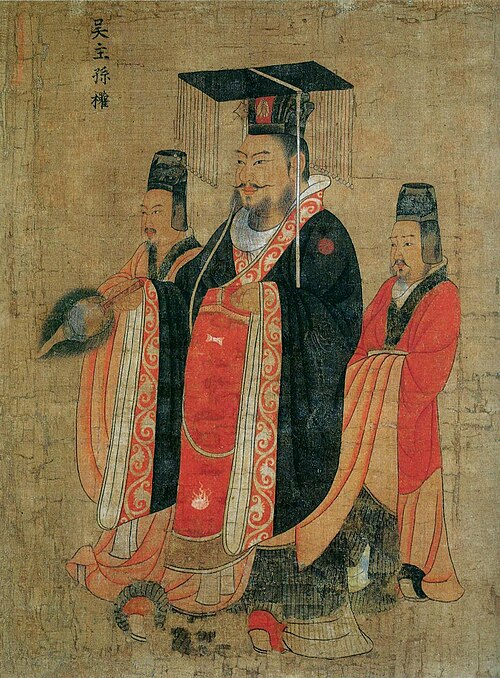


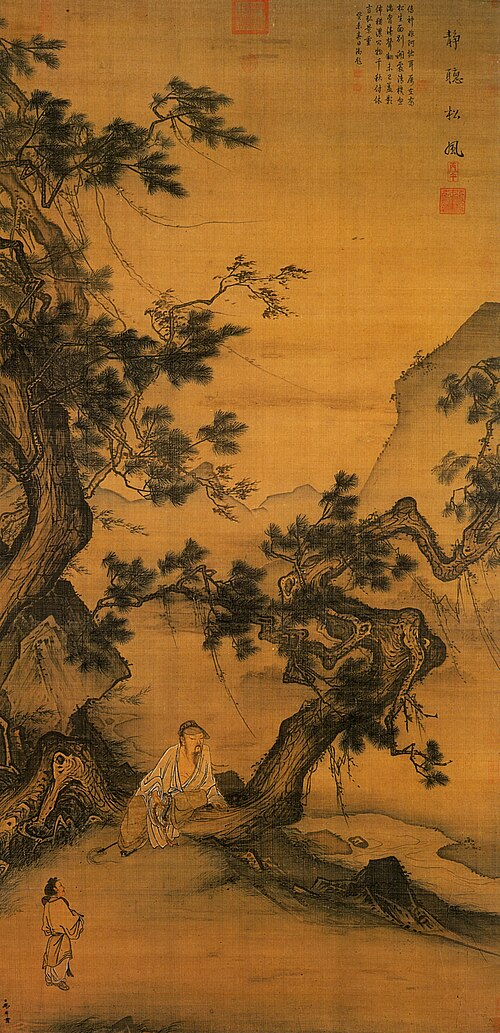


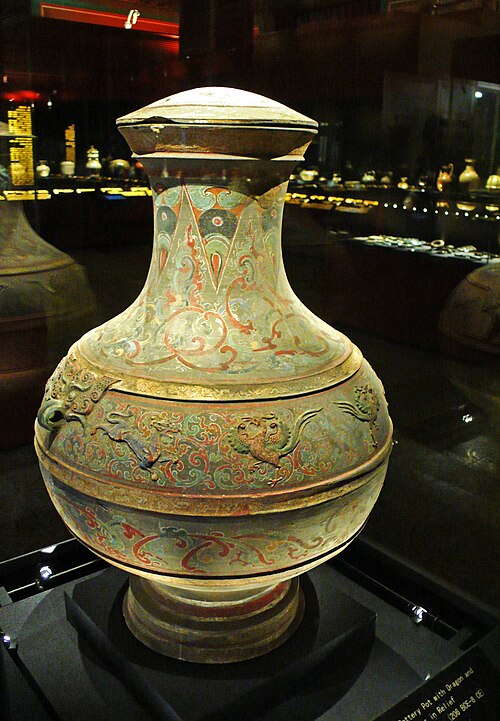
中国、日本、韓国には絵画の強い伝統があり、書道や版画の芸術とも深く結びついています(そのため、絵画とみなされることもよくあります)。極東の伝統的な絵画は、水性技法、写実性の低さ、「優雅」で様式化された主題、グラフィカルな表現方法、余白(またはネガティブスペース)の重要性、人物像ではなく風景を主題として好むことが特徴です。絹や紙の巻物に墨と色を用いるだけでなく、漆に金を用いるのも東アジアの絵画作品でよく用いられた技法でした。絹はかつては絵を描くにはやや高価な媒体でしたが、紀元1世紀に漢の宮廷宦官蔡倫によって紙が発明されたことで、安価で広く普及した筆記媒体だけでなく、安価で広く普及した絵画媒体も提供され(より一般の人々にとって身近なものとなりました)。
儒教、道教、仏教の思想は東アジア美術において重要な役割を果たしました。12世紀の林廷貴とその作品「羅漢洗濯図」(スミソニアン・フリーア美術館所蔵) [ 24 ]のような中世宋代の画家は、仏教思想が中国古典美術に融合した優れた例です。絹に描かれた後者の絵画(画像と説明はリンク先に掲載)では、禿頭の仏教徒である羅漢が川辺で洗濯をしている様子が描かれています。しかし、絵画自体は視覚的に非常に印象的で、羅漢は細部まで鮮やかで不透明な色彩で描かれており、ぼんやりとした茶色で単調な森の風景とは対照的です。また、木々の梢は渦巻く霧に覆われており、東アジア美術でよく見られる「ネガティブスペース」を生み出しています。
ジャポニズムにおいては、19世紀後半のゴッホやアンリ・ド・トゥールーズ=ロートレックといったポスト印象派の画家や、ジェームズ・マクニール・ホイッスラーといったトーナリズムの画家たちは、19世紀初頭の日本の浮世絵師である葛飾北斎(1760~1849年)や歌川広重(1797~1858年)を敬愛し、彼らから影響を受けた。

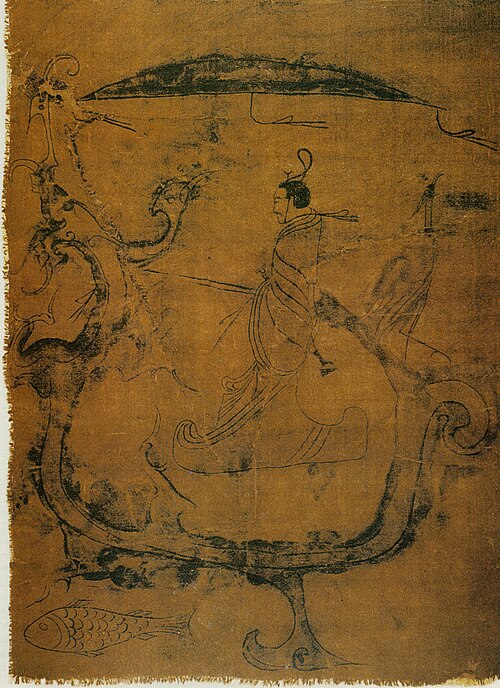
現存する中国絵画の最古の例は戦国時代(紀元前481年~221年)に遡り、絹に描かれた絵画や、岩、レンガ、石に描かれた墓壁画などがある。それらはしばしば簡素な様式化の形式で、多かれ少なかれ初歩的な幾何学模様で描かれていた。神話上の生き物、家庭の情景、労働の情景、宮廷の役人たちで満ちた宮殿の情景などが描かれることが多かった。この時代とそれに続く秦王朝(紀元前221年~207年)および漢王朝(紀元前202年~紀元後220年)の美術作品は、それ自体が手段であったり、より高次の個人的表現のためであったりしたのではなく、葬儀の儀式、神話上の神々や祖先の霊などを象徴し、敬うために制作された。漢王朝時代には、宮廷の役人や家庭の情景を描いた絹の絵画のほか、馬に乗って狩りをする男性や軍事パレードに参加する男性の情景も見られた。兵馬俑の兵士や馬の像を覆うオリジナルの彩色など、人形や彫像といった立体的な美術品にも彩色が施されていました。南京を拠点とした古代東晋王朝(西暦316年~420年)の社会文化的な風潮の中で、絵画は儒教の教育を受けた官僚や貴族の公式な娯楽の一つとなりました(古琴の演奏、華麗な書道、詩作と朗読などと共に)。絵画は一般的な芸術的自己表現の形態となり、この時代には宮廷や上流社会の画家たちは同業者によって評価され、格付けされていました。

中国の古典的な山水画の確立は、主に中国史上最も有名な画家の一人である東晋時代の画家、顧愷之(西暦344年 - 406年)に帰せられる。顧愷之の細長い巻物画のように、唐代(西暦618年 - 907年)の中国の画家、呉道子などは、唐代に非常に人気があった長い横長の巻物に、鮮やかで非常に詳細な絵を描き、例えば「八十七天人図」などがある。唐代の絵画作品は、理想化された風景環境の効果を伴い、物や人物の数、活動の少なさ、そして単色の性質を特徴としている(例:乾陵の義徳王墓の壁画)。また、唐代初期の画家、詹子謙のような人物もおり、写実主義の描写において当時をはるかに先取りした素晴らしい山水画を描いた。しかし、山水画が一般的に成熟度と写実性においてより高みに達したのは、五代十国時代(西暦907年~960年)になってからのことである。この時代には、董遠(彼の作品例についてはこの記事を参照)のような傑出した山水画家や、顧洪忠の『韓熙載夜宴図』のように、家庭生活をより生き生きと写実的に描いた画家がいた。

中国の宋王朝(西暦960~1279年)では、山水画が改良されただけでなく、肖像画も以前より標準化され洗練され(例えば、宋の徽宗皇帝を参照)、明王朝(西暦1368~1644年)で古典時代の円熟期を迎えた。13世紀後半から14世紀前半にかけて、モンゴルの支配下にあった元王朝の中国人は、政府の高位の役職に就くことが許されず(モンゴル人や中央アジアの他の民族のために留保されていた)、科挙も一時的に中止された。儒教教育を受けた多くの中国人は、職業を失い、代わりに絵画や演劇の芸術に転向した。元時代は、中国美術にとって最も活気に満ちた豊かな時代の一つとなった。宋王朝の官僚であった銭玄(西暦1235年~1305年)は、愛国心から元朝の宮廷に仕えることを拒否し、絵画に専念した。この時代の優れた芸術作品の例としては、ユネスコ世界遺産に登録されている永楽宮(西暦1262年建立、大春陽長寿宮)の豊かで緻密な壁画が挙げられる。宮殿内には1000平方メートルを超える面積に絵画が描かれており、そのほとんどが道教を題材としている。宋王朝時代には、画家たちが社交クラブや会合に集まり、自分たちの芸術や他人の芸術について議論し、その賞賛が貴重な芸術作品の売買につながることが多かった。しかし、他人の芸術を厳しく批判する者も多く、画家によってスタイルや趣味が異なることを示している。西暦1088年、博学者であり科学者、政治家でもあった沈括は、李成という人物の芸術作品について次のように批判した。
…それから李成という画家がいました。彼は山々に囲まれた楼閣や宿舎、高層建築物、塔などを描く際、常に軒を下から見上げるように描いていました。彼の考えは、「平地に立って塔の軒を見上げる人が垂木や片持ち梁を見るように、下から見上げるべきだ」というものでした。これは全くの間違いです。一般的に、風景画の正しい描き方は、庭園の人工の山々を(歩き回りながら)見るように、大きな視点から小さなものを見ることです。李成の方法を実際の山々の絵に適用し、下から見上げると、一度に一つの輪郭しか見えず、無数の斜面や輪郭の豊かさは見えず、谷や峡谷、住居や家々のある路地や中庭で起こっていることなど全く見えません。山の東側に立つと、その西側は遠方の境界線上にあり、その逆もまた然りです。これは決して成功した絵画とは言えないでしょう。李氏は「大きな視点から小さなものを見る」という原理を理解していませんでした。確かに彼は高さや距離を正確に縮小することには長けていましたが、建物の角度や角にそれほど重要性を置くべきでしょうか?[ 28 ]

中世の宋王朝以降、写実主義よりも様式化、神秘的な魅力、超現実的な優雅さが好まれることが多かったものの(山水様式など)、当時もその後も、生き生きとした写実的な自然の情景を描いた中国の画家は数多くいた。後の明王朝の画家たちは、この宋王朝の自然物に対する緻密なディテールと写実主義へのこだわりを受け継ぎ、特に鮮やかな花々や茂み、木の茂みの中にいる動物(アヒル、白鳥、スズメ、虎など)の描写にその傾向が顕著であった(ワシントンDCのスミソニアン博物館フリーア美術館に所蔵されている作者不詳の明王朝の絵画「鳥梅図」 [ 29 ]が良い例である)。明王朝には多くの著名な画家がいた。邱英は明代を代表する画家(当時から名声があった)の好例であり、家庭の情景、賑やかな宮廷の情景、霧と渦巻く雲に覆われた川の谷や険しい山々の自然風景などを作品に取り入れている。明代には、呉派や浙派など、絵画に関連する様々な、そして互いに競い合う流派も存在した。
古典的な中国絵画は、17世紀初頭の明朝末期に見られるような写実的な肖像画など、近代初期の清朝まで受け継がれました。康熙帝、雍正帝、乾隆帝の肖像画は、写実的な中国肖像画の優れた例です。乾隆帝の治世から19世紀にかけて、ヨーロッパのバロック様式の絵画は、特に光と影の表現において、中国の肖像画に顕著な影響を与えました。同様に、東アジアの絵画やその他の美術品(磁器や漆器など)は、16世紀に初めて接触して以来、ヨーロッパで高く評価されていました。
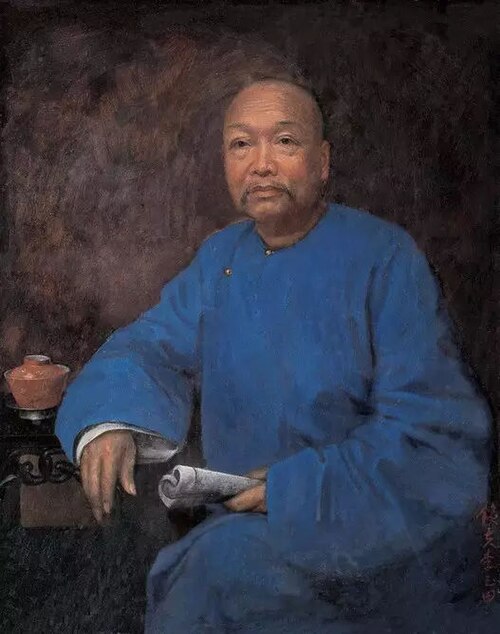
西洋の油絵技法は19世紀に中国に伝わり始め、20世紀初頭には中国の芸術家や美術学生の間で普及し、中国と西洋との関わりが深まる時期と重なった。李鉄夫、洪毅、徐悲鴻、厳文良、林風眠、方甘民、龐玉良といった芸術家たちは、主にパリや東京に渡り、西洋美術を学んだ。彼らを通して、印象派、キュビスム、フォーヴィスム、ポスト印象派といった芸術運動が中国で発展し、隆盛を極めたが、第二次世界大戦と中華人民共和国の建国によって、近代的な芸術様式は当時の政治的理想と相容れないものとみなされ、写実主義だけが唯一受け入れられる芸術形式となったため、その発展は一時的に止まった。しかしながら、20世紀初頭の西洋美術との密接な関わりの遺産は残り、油絵は中国の芸術界において重要な媒体として存続した。その結果、伝統的な中国水墨画も変化した。

日本の絵画は、日本の芸術の中でも最も古く、最も洗練されたもののひとつであり、さまざまなジャンルやスタイルを包含しています。日本の芸術全般と同様に、日本の絵画も、日本固有の美意識と輸入された思想の適応との間の長い歴史における融合と競争を通じて発展してきました。浮世絵、または「浮世の絵」は、17 世紀から 20 世紀にかけて制作された日本の木版画(または「木版画」)と絵画のジャンルであり、風景、劇場、遊郭のモチーフが特徴です。これは、日本の木版画の主要な芸術ジャンルです。日本の版画、特に江戸時代の版画は、19 世紀を通じてフランス絵画に多大な影響を与えました。19 世紀には、日本の画家が西洋の絵画技法や素材を大いに取り入れた「洋画」と呼ばれる新しい絵画技法を開発しましたが、その著名な画家には、原田直次郎、藤島武治、黒田清貴などがいます。
韓国絵画は、独立した芸術形式として、古朝鮮の滅亡前後である紀元前108年頃に始まり、世界で最も古い絵画の一つです。この時代の芸術は、朝鮮三国時代を特徴づける様々な様式へと発展し、中でも高句麗王家の墓を飾る絵画や壁画は特に有名です。三国時代から高麗時代にかけて、韓国絵画は主に、韓国風の風景画、人物描写、仏教を中心とするテーマ、そして急速な発展を遂げた朝鮮天文学によって促進された天体観測への重点が組み合わさったものでした。儒教のテーマが韓国絵画に根付き始めたのは朝鮮時代になってからで、土着の要素と調和して用いられるようになりました。
韓国絵画の歴史は、桑紙や絹地に黒一色の筆致で描かれた単色作品が特徴的である。この様式は、色彩豊かな民俗芸術である「民画」、墓碑画、そして儀式や祭礼の美術にも顕著に見られ、いずれも色彩をふんだんに用いている。


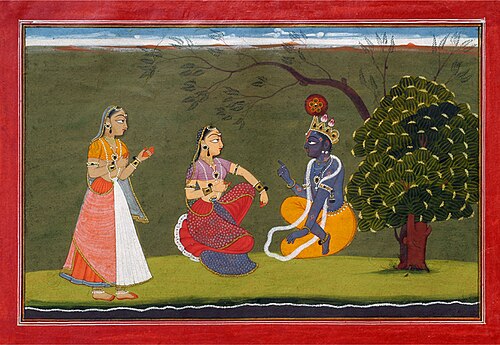


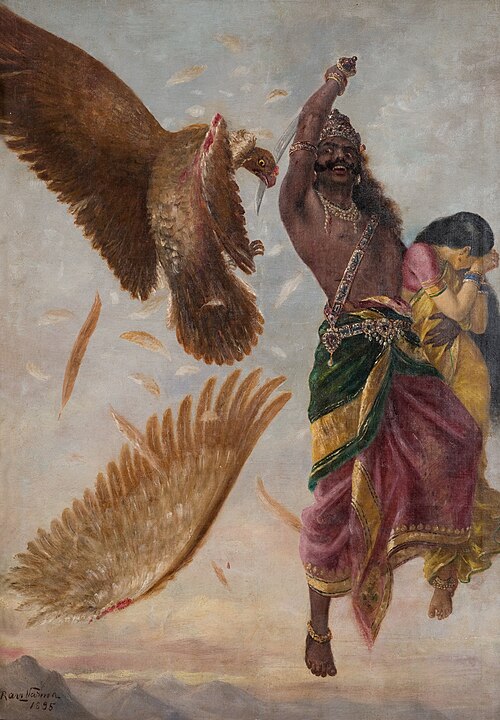


インド絵画は歴史的に宗教的な神々や王を中心に展開してきました。インド美術は、インド亜大陸に存在したいくつかの異なる美術流派の総称です。絵画は、アジャンターの大きなフレスコ画から、精緻なムガル細密画、タンジョール派の金属装飾作品まで多岐にわたります。ガンダール・タクシラの絵画は、西方のペルシャ作品の影響を受けています。東洋の絵画様式は、主にナーランダー美術派を中心に発展しました。作品は主にインド神話のさまざまな場面からインスピレーションを得ています。

インド最古の絵画は、先史時代の岩絵、すなわちビムベトカの岩窟遺跡などで見られる岩刻画であり、中には紀元前5500年よりも古いものもある。こうした作品はその後も制作され続け、数千年後の7世紀には、マハラシュトラ州のアジャンターにある彫刻された柱がインド絵画の優れた例となっている。その色彩は、主に赤やオレンジの様々な色合いで、鉱物から抽出されたものである。
インドのマハラシュトラ州にあるアジャンター石窟群は、紀元前2世紀に遡る岩窟遺跡であり、仏教美術[ 31 ]と普遍的な絵画芸術[ 32 ]の両方の傑作とみなされる絵画や彫刻が含まれている。
マドゥバニ絵画は、インドのビハール州ミティラ地方で実践されているインド絵画の様式です。マドゥバニ絵画の起源は古代に遡り、謎に包まれています。

ムガル絵画は、インド絵画の独特な様式であり、一般的には書籍の挿絵に限定され、細密画の形式で描かれる。この様式は、16世紀から19世紀にかけてのムガル帝国時代に出現、発展、確立された。
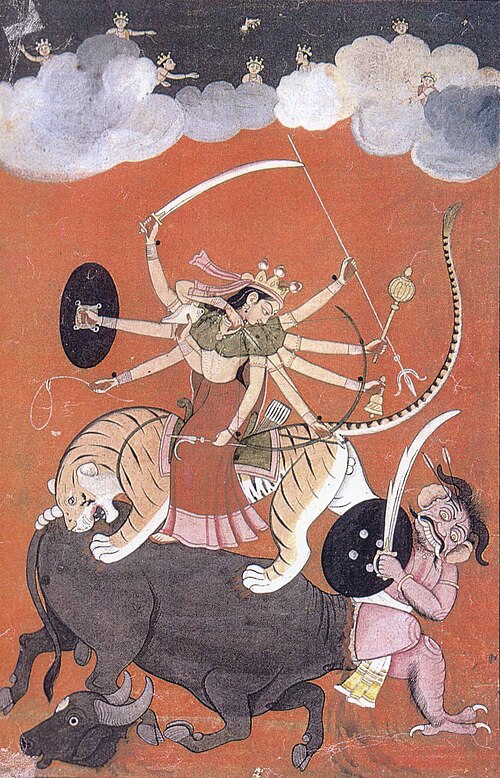
ラージプート絵画は、18世紀にインドのラージプーターナー地方の王宮で発展し、隆盛を極めました。各ラージプート王国はそれぞれ独自の様式を発展させましたが、いくつかの共通点も見られました。ラージプート絵画には、ラーマーヤナやマハーバーラタといった叙事詩の出来事、クリシュナの生涯、美しい風景、そして人物など、様々なテーマが描かれています。細密画がラージプート絵画の好む媒体でしたが、いくつかの写本にもラージプート絵画が収められており、宮殿の壁、砦の奥の部屋、ハヴェリ(邸宅)、特にシェカワイトのハヴェリにも絵画が描かれていました。
特定の鉱物、植物、巻貝から抽出された色素、さらには宝石、金、銀を加工して得られた色素が用いられた。目的の色素を準備するには長い時間がかかり、時には数週間を要した。使用された筆は非常に細いものだった。
タンジョール絵画は、タミル・ナードゥ州のタンジョールという町に伝わる、南インドの古典絵画の重要な形式です。この芸術形式は、芸術と文学を奨励したチョーラ朝の支配下にあった9世紀初頭に遡ります。これらの絵画は、優雅さ、豊かな色彩、そして細部へのこだわりで知られています。これらの絵画の主題の多くは、ヒンドゥー教の神々や女神、そしてヒンドゥー神話の場面です。現代では、これらの絵画は南インドの祝祭の際に非常に人気のあるお土産となっています。
タンジョール絵画の制作過程は多くの段階を経て行われます。最初の段階は、下絵を描くことです。下絵は、木製の土台に布を貼り付けたものです。次に、チョークの粉または酸化亜鉛を水溶性接着剤と混ぜて下地に塗ります。下地を滑らかにするために、研磨剤が使われることもあります。下絵が完成したら、半貴石を使って絵の中の宝飾品や衣服を装飾します。レースや糸も宝飾品の装飾に使われます。その上に金箔を貼り付けます。最後に、染料を使って絵の中の人物に色を付けます。
イギリスによるインド統治時代、王室はマドラスに世界でも有数の才能と知性にあふれた芸術家たちが集まっていることを発見しました。イギリスはマドラスとその周辺に大規模な居住地を築いていたため、ロンドンの王室の芸術的期待に応えるための機関を設立する場所としてジョージタウンが選ばれました。これが後にマドラス美術学校として知られるようになりました。当初は伝統的な芸術家たちが雇われ、精巧な家具、金属工芸品、骨董品などを制作し、その作品は女王の宮殿に送られました。
ベンガル学派では「模倣」が教育の規範となっているのに対し、マドラス学派は新しいスタイル、議論、トレンドを「創造」することによって発展してきた。

ベンガル派の美術は、20世紀初頭のイギリス統治下のインドで隆盛を極めた、影響力のある美術様式であった。インドのナショナリズムと結びついていたが、多くのイギリス人美術行政官によっても奨励・支援された。
ベンガル派は、ラジャ・ラヴィ・ヴァルマなどのインド人画家やイギリスの美術学校でそれまでインドで推進されてきたアカデミックな美術様式に反発する、前衛的で民族主義的な運動として出現した。インドの精神思想が西洋に広く浸透する中、イギリスの美術教師アーネスト・ビンフィールド・ハヴェルは、カルカッタ美術学校の教育方法を改革しようと、学生にムガル細密画を模倣するよう奨励した。これは大きな論争を巻き起こし、学生のストライキや地元報道機関からの苦情、そしてこれを時代錯誤的な動きとみなす民族主義者からの批判につながった。ハヴェルは、詩人ラビンドラナート・タゴールの甥である画家アバニンドラナート・タゴールに支持された。タゴールはムガル美術の影響を受けた作品を数多く描いた。彼とハヴェルは、ムガル美術こそが西洋の「物質主義」とは対照的に、インド独自の精神性を表現していると信じていた。タゴールの最も有名な絵画『バーラト・マタ(母なるインド)』は、ヒンドゥー教の神々のように四本の腕を持つ若い女性が、インドの国家的な願望を象徴する物を持っている姿を描いたものである。タゴールは後に、汎アジア主義的な芸術モデルを構築するという目標の一環として、日本の芸術家との交流を試みた。
1920年代に近代主義思想が広まるにつれ、インドにおけるベンガル派の影響力は衰退した。独立後、インドの芸術家たちはより適応力を発揮し、ヨーロッパの様式を自由に取り入れ、インドのモチーフと自由に融合させて新しい芸術形式を生み出した。フランシス・ニュートン・ソウザやタイエブ・メータのような芸術家は西洋的なアプローチをとったが、ガネーシュ・パインやマクブール・フィダ・フセインのような芸術家は完全にインド独自の様式を発展させた。今日、インドの市場自由化の過程を経て、芸術家たちは国際的なアートシーンに触れる機会が増え、これまでインドでは見られなかった新しい芸術形式を生み出すのに役立っている。ジティシュ・カラットは、 1990年代後半に、現代的でありながらジャンルの定義を超越した絵画で一躍有名になった。しかし、新世紀のインドの芸術家たちは新しいスタイル、テーマ、比喩を試みているものの、かつてないほど美術界に参入しつつある企業群の支援がなければ、これほど早く認知されることは不可能だっただろう。
アムリタ・シェルギルはインドの画家で、インドのフリーダ・カーロとも呼ばれ[ 33 ]、今日では20世紀インドの重要な女性画家とみなされており、その功績はベンガル・ルネッサンスの巨匠たちに匹敵する[ 34 ] [ 35 ] 。また、彼女はインドで「最も高価な」女性画家でもある[ 36 ]。
今日、彼女は1976年と1979年にインド考古調査局によって美術品として認定された9人の巨匠の一人であり[ 37 ]、現在、彼女の絵画100点以上がニューデリーの国立近代美術館に展示されている[ 38 ]。
植民地時代、西洋の影響がインド美術に現れ始めた。一部の芸術家は、西洋の構図、遠近法、写実主義の概念を用いてインドのテーマを表現する独自のスタイルを確立した。また、ジャミニ・ロイのように、民俗芸術から意識的にインスピレーションを得た芸術家もいた。
1947年の独立までに、インド国内のいくつかの美術学校は、近代的な技法や思想に触れる機会を提供していた。これらの芸術家を紹介するためのギャラリーも設立された。現代インド美術は、西洋様式の影響を色濃く受けているが、インドのテーマやイメージからインスピレーションを得ていることも多い。主要な芸術家たちは、当初はインド系移民の間で、そしてインド国外の観客の間でも、国際的な評価を得始めている。
1947年のインド独立直後に設立されたプログレッシブ・アーティスト・グループは、植民地時代後のインドを表現する新たな方法を確立することを目的としていました。創設者は、KH Ara、SK Bakre、HA Gade、MF Husain、SH Raza、FN Souzaの6人の著名な芸術家でした。グループは1956年に解散しましたが、インド美術の表現様式を変える上で大きな影響力を持っていました。1950年代のインドの主要な芸術家のほぼ全員がこのグループと関係がありました。今日よく知られている芸術家には、Bal Chabda、Manishi Dey、Mukul Dey、VS Gaitonde、Ram Kumar、Tyeb Mehta、Akbar Padamseeなどがいます。ジャハル・ダスグプタ、プロカシュ・カルマカール、ジョン・ウィルキンス、ナラヤナン・ラマチャンドラン、ビジョン・チョードゥリといった著名な画家たちは、インドの芸術文化を豊かにしました。彼らは現代インド美術の象徴的存在となっています。ライ・アナンド・クリシュナ教授のような美術史家も、インドの精神性を反映した現代アーティストの作品に言及しています。ギータ・ヴァデラは、スーフィー思想、ウパニシャッド、バガヴァッド・ギーターといった複雑なインドの精神的テーマをキャンバスに表現することで高い評価を得ています。
1990年代初頭からの経済自由化に伴い、インドの美術は大きな発展を遂げた。様々な分野のアーティストが、多様な作風の作品を発表し始めたのだ。自由化後のインドでは、抽象画家のナトヴァル・バヴサル、具象画家のデヴァジョティ・レイ、そして巨大なポストミニマリズム作品で注目を集める彫刻家のアニッシュ・カプーアなど、多くのアーティストが国際的な美術市場で地位を確立している。また、アメリカやヨーロッパにも、インドの美術作品を展示するアートハウスやギャラリーが数多くオープンしている。

最も古い洞窟壁画は44,000〜50,000年以上前のもので、マロス地区(インドネシア、スラウェシ島)の洞窟で発見されています。最も古いタイプの洞窟壁画は手形や単純な幾何学模様で、最も古いとされる具象的な洞窟壁画はそれよりやや新しく、約35,000年前のものです。[ 11 ]
当時、インドネシアのボルネオ島にあるルバン・ジェリジ・サレー洞窟で、4万年以上(おそらく5万2千年)前の未知の動物を描いた、当時知られている最古の具象絵画が発見された。しかし、2019年12月、スラウェシ島のマロス・パンケップ・カルストにある豚狩りを描いた具象洞窟壁画は、さらに古く、少なくとも4万3900年前のものと推定された。この発見は「物語を伝える最古の絵画記録であり、世界最古の具象芸術作品」であると注目された。[ 39 ] [ 16 ]
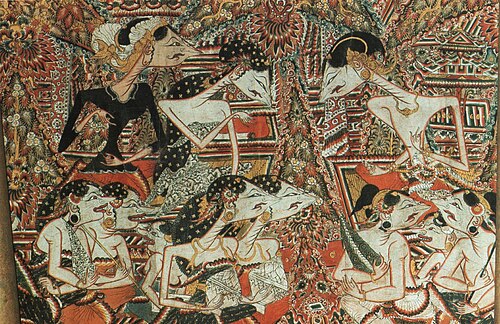
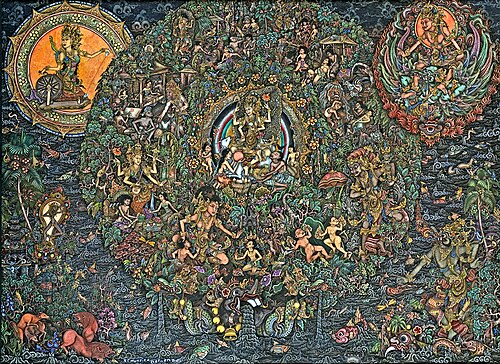
インドネシア絵画の他の例としては、ケニャー族の装飾芸術があり、シダやサイチョウなどの固有の自然モチーフに基づいており、ケニャー族のロングハウスの壁を飾っています。その他の注目すべき伝統芸術としては、幾何学的なトラジャ族の木彫りがあります。バリ絵画は、当初はバリの伝説や宗教的な文書の場面を描いた物語的なイメージでした。古典的なバリ絵画は、ロンタル写本や寺院のパビリオンの天井を飾ることがよくあります。ヨーロッパの伝統を受け継ぐ著名な現代インドネシア人画家には、ラデン・サレ、ジャン・トゥーロップ、バスキ・アブドゥラ、アブドゥラ・スリオスブロトなどがおり、彼らのテーマは風景画と肖像画です。

フィリピン絵画全体は、多くの文化的影響が融合したものと見なすことができるが、現在の形では東洋のルーツを持ちながらも、より西洋的な傾向が強い。
初期のフィリピン絵画は、マヌングル壺などのフィリピンの儀式用土器に施された赤いスリップ(水で混ぜた粘土)のデザインに見られます。紀元前6000年頃に遡るフィリピンの土器製作の証拠は、 スールーのサンガサンガ洞窟とカガヤンのローレンテ洞窟で発見されています。 紀元前5000年までには、土器製作は国中で行われていました。初期のフィリピン人は、カンボジアの隣人よりも早く、そしてタイ人とほぼ同時期に土器製作を始め、氷河期に広く発展した土器技術の一部であったようです。絵画のさらなる証拠は、初期のフィリピン人、特にスペインの探検家がピンタドスまたは「ペイントされた人々」と呼んだビサヤ人の刺青の伝統に現れています。 [ 40 ]彼らは、植物や動物、天体をモチーフにしたデザインで、さまざまな色の顔料で体を飾りました。古代フィリピン人が制作し、現在まで残っている最も精巧な絵画作品のいくつかは、マラナオ族の芸術と建築に見られます。マラナオ族は、彼らの王宮であるトロガンの美しいパノロンに彫刻され、彩色されたナーガ・ドラゴンやサリマノクでよく知られています。

フィリピン人は17世紀のスペイン時代にヨーロッパの伝統に倣って絵画を制作し始めた。[ 41 ]これらの絵画の最も初期のものは、教会のフレスコ画や聖書からの宗教的イメージ、キリスト教の聖像やヨーロッパの貴族を描いた版画、彫刻、石版画であった。19世紀から20世紀にかけての絵画や彫刻のほとんどは、宗教、政治、風景画が混ざり合ったもので、甘美さ、暗さ、明るさといった特徴を持っていた。ダミアン・ドミンゴのような初期のモダニズム画家は、宗教画と世俗画の両方で知られていた。フアン・ルナやフェリックス・イダルゴの芸術は、政治的な主張へと向かう傾向を示した。フェルナンド・アモルソロのような芸術家は、ポストモダニズムを用いてフィリピンの文化、自然、調和を描いた絵画を制作した。フェルナンド・ゾーベルのような他の芸術家は、作品の中で現実と抽象を融合させた。


古代エジプトは、建築と彫刻の非常に強い伝統を持つ文明であり(どちらも元々は鮮やかな色彩で彩色されていた)、神殿や建物には多くの壁画があり、パピルス写本には挿絵が描かれていた。エジプトの壁画や装飾画はしばしば図像的で、写実的というより象徴的な場合が多い。エジプトの絵画は、人物を太い輪郭と平面的なシルエットで描き、対称性が常に特徴となっている。エジプトの絵画は、エジプト象形文字と呼ばれる文字言語と密接な関係がある。描かれたシンボルは、文字言語の初期の形態の中に見られる。エジプト人はリネンにも絵を描き、その痕跡が今日まで残っている。古代エジプトの絵画は、極めて乾燥した気候のおかげで保存されてきた。古代エジプト人は、死者の来世を心地よい場所にするために絵画を制作した。テーマには、死後の世界を旅することや、守護神が死者を冥界の神々に紹介することなどが含まれる。こうした絵画の例としては、ラー、ホルス、アヌビス、ヌト、オシリス、イシスといった神々を描いた絵画が挙げられる。墓の壁画の中には、故人が生前行っていた活動や、死後も続けようと願っていた活動を描いたものもある。新王国時代以降は、死者の書が埋葬者と共に埋葬された。これは、死後の世界への入門書として重要視されていた。


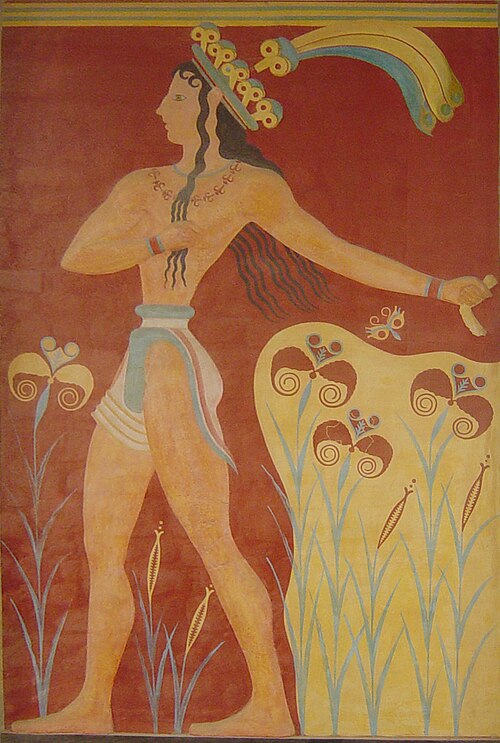

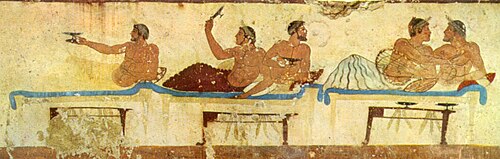
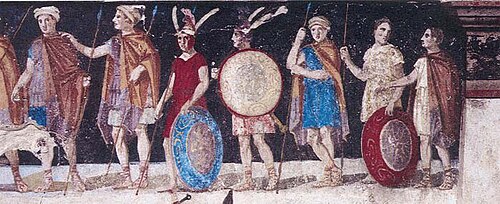


エジプトの北には、クレタ島を中心としたミノア文明がありました。クノッソス宮殿で発見された壁画はエジプトのものと似ていますが、様式ははるかに自由です。紀元前1600年頃から始まったミケーネ文明は、ミノア文明のクレタ島と似た芸術を生み出しました。ギリシャ暗黒時代の古代ギリシャ美術ははるかに単純化されましたが、アルカイック期に地中海全域でギリシャ文明が復興すると、オリエンタリズム様式の新しいギリシャ美術が生まれました。

古代ギリシャには熟練した画家、彫刻家(当時はどちらも単なる肉体労働と見なされていたが)、そして建築家がいた。パルテノン神殿は、現代まで残る彼らの建築の一例である。ギリシャの大理石彫刻は、古典美術の最高峰と評されることが多い。古代ギリシャの陶器や陶磁器に描かれた絵画は、古代ギリシャ社会の仕組みを知る上で特に有益な手がかりとなる。黒像式花瓶絵や赤像式花瓶絵は、ギリシャ絵画がどのようなものであったかを示す多くの現存例である。文献に名前が記されている有名な木板画のギリシャ人画家には、アペレス、ゼウクシス、パルラシオスなどがいるが、古代ギリシャの木板画の現存例は少なく、ほとんどが同時代人や後世のローマ人による記述のみである。ゼウクシスは紀元前5~6年に生きており、スフマート技法 を最初に用いた人物と言われている。大プリニウスによれば、彼の絵画の写実性は鳥が描かれたブドウを食べようとするほどであった。アペレスは、その完璧なデッサン技術、鮮やかな色彩、そして造形美によって、古代における最も偉大な画家と評されている。
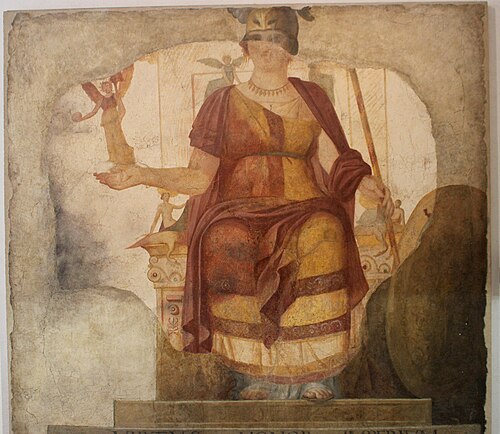
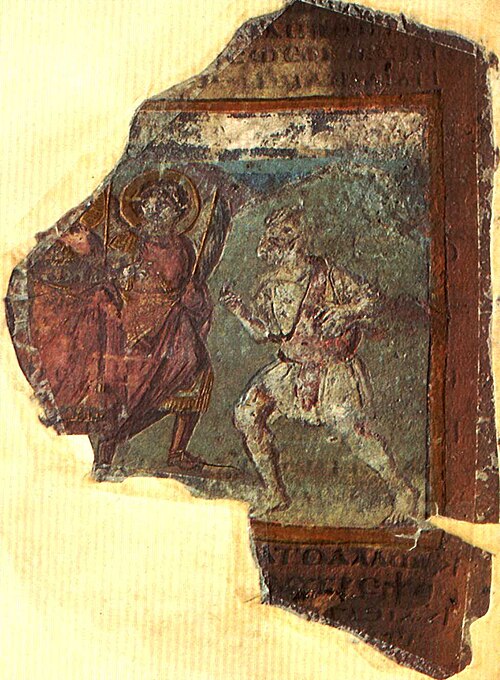
ローマ美術はギリシャの影響を受けており、部分的には古代ギリシャ絵画の子孫とみなすことができる。しかし、ローマ絵画には重要な独自の特徴がある。現存するローマ絵画には、カンパニア地方のヴィラや、南イタリアのポンペイやヘルクラネウムなどの遺跡にある壁画やフレスコ画などがある。こうした絵画は4つの主要な「様式」または時代に分類でき[ 42 ] 、トロンプルイユ、擬似遠近法、純粋な風景画の最初の例が含まれている可能性がある[ 43 ] 。古代世界から現存するほぼ唯一の絵画肖像画は、アル・ファユームの後期古代墓地で発見された多数の胸像棺肖像画である。これらは最高の時代でも最高品質でもなかったが、それ自体は印象的であり、最高の古代作品がどのような品質であったかを想像させてくれる。後期古代の挿絵入り書籍に収められていた細密画もごく少数ながら現存しており、中世初期のそれらの写本はそれよりもかなり多く残っている。

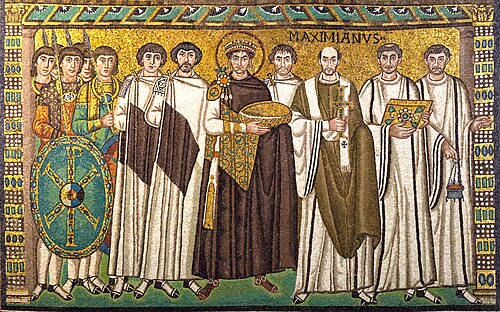
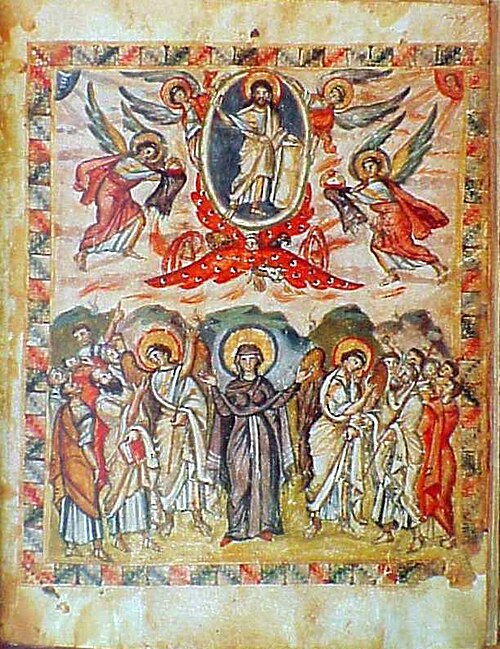




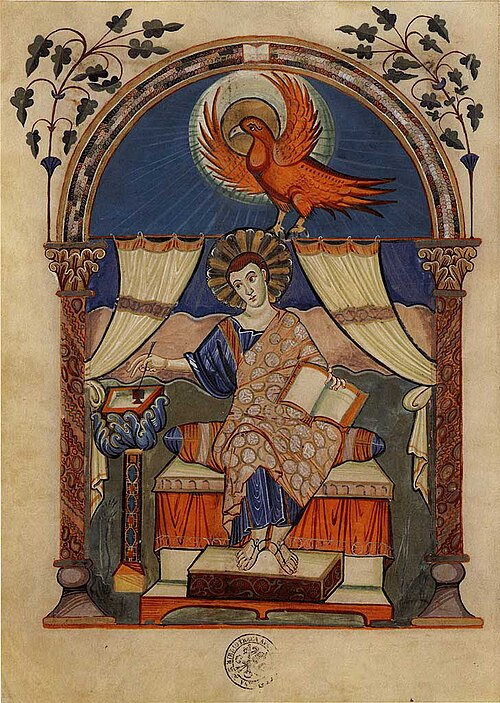




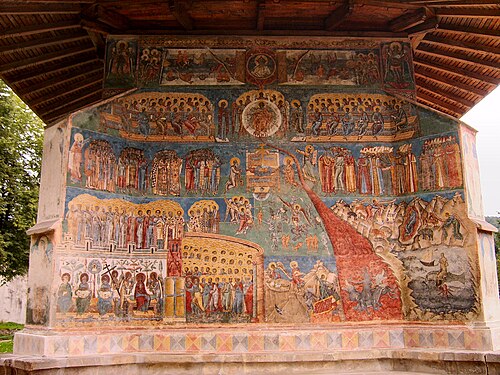
キリスト教の台頭は、絵画様式に異なる精神と目的をもたらした。ビザンチン美術は、6世紀までに様式が確立されると、伝統的な図像と様式の保持に重点を置き、ビザンチン帝国の千年とギリシャ正教およびロシア正教のイコン画の生きた伝統の中で徐々に進化していった。ビザンチン絵画は神聖な雰囲気を持ち、イコンは神の啓示の表現として見なされてきたし、今もそう見なされている。フレスコ画は数多くあったが、モザイク画よりも現存するものは少ない。ビザンチン美術は、平面的で人物や風景を高度に様式化した描写において、現代の抽象芸術と比較されることがある。ビザンチン美術のいくつかの時代、特に10世紀頃のいわゆるマケドニア美術は、より柔軟なアプローチをとっている。14世紀初頭のパレオロジアン・ルネサンスのフレスコ画は、イスタンブールのコーラ教会に現存している。
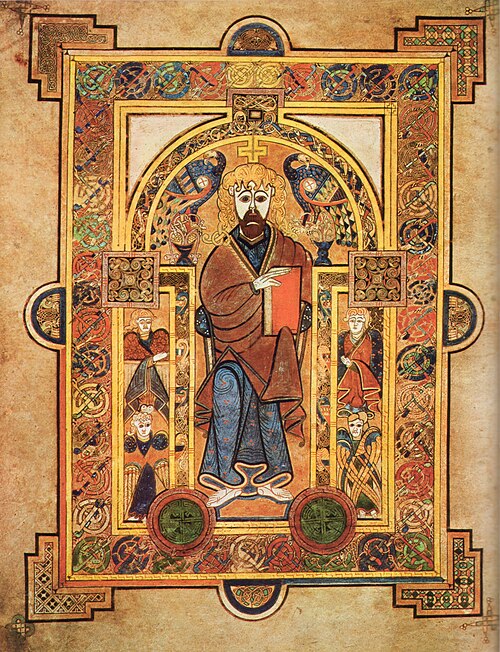
古代以降のカトリックのヨーロッパで、絵画を含む最初に現れた独特の芸術様式は、ブリテン諸島の島嶼芸術であり、現存する唯一の例は、ケルズの書などの装飾写本の細密画である。[ 44 ]これらは抽象的な装飾で最も有名だが、人物や時には場面も描かれており、特に福音書記者の肖像画に見られる。カロリング朝とオットー朝の芸術も、ほとんどが写本として現存しているが、壁画もいくつか残っており、記録されているものも多い。この時代の芸術は、島嶼芸術と「蛮族」の影響を、強いビザンチンの影響と古典的な壮大さと落ち着きを取り戻そうとする願望とが融合したものである。
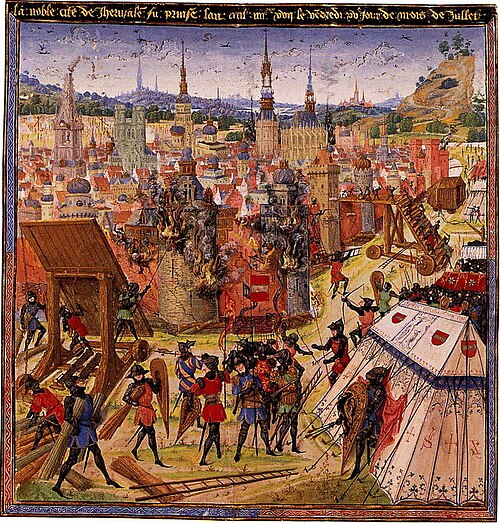
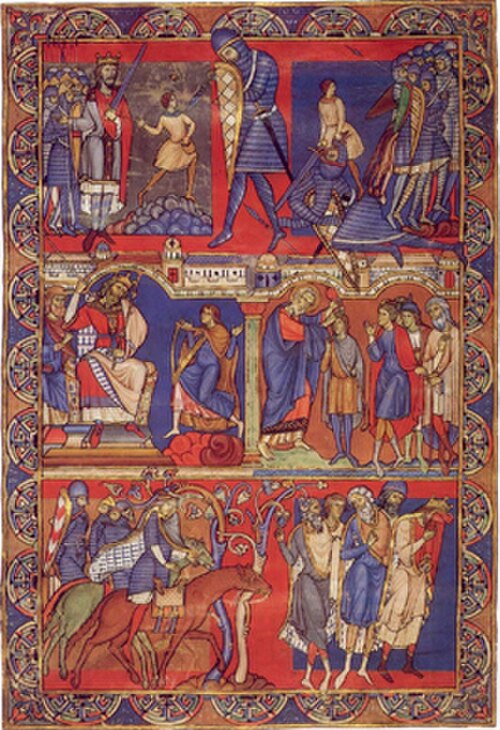
ロマネスク様式やゴシック様式の教会の壁は、彫刻だけでなくフレスコ画でも装飾されており、現存する数少ない壁画の多くは非常に力強く、島嶼美術の装飾的なエネルギーと人物描写における新たな記念碑性を兼ね備えている。この時代から残された装飾写本の細密画ははるかに多く、同様の特徴を示しており、それはゴシック時代へと引き継がれていく。
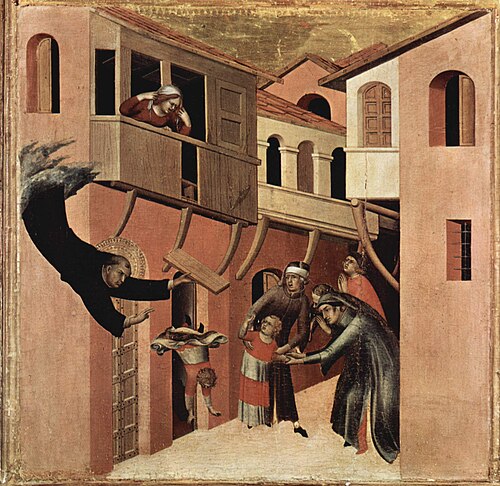
ロマネスク時代には、ビザンチン美術のイコンの影響を強く受けて、板絵がより一般的になりました。13世紀半ば頃、中世美術とゴシック絵画はより写実的になり、イタリアではチマブーエ、そしてその弟子ジョットによって、量感と遠近法の表現への関心が芽生えました。ジョット以降、最高の画家による構図の扱いも、より自由で革新的なものになりました。彼らは西洋文化において、中世絵画の二大巨匠とみなされています。ビザンチン美術の伝統の中で、チマブーエはより写実的で劇的なアプローチで芸術に取り組みました。彼の弟子ジョットは、これらの革新をより高いレベルに引き上げ、それが西洋絵画の伝統の基礎を築きました。両画家は自然主義への動きの先駆者でした。
教会はますます多くの窓を備えて建てられ、色鮮やかなステンドグラスが装飾の定番となった。その最も有名な例の一つが、パリのノートルダム大聖堂に見られる。14世紀までに、西洋社会はより豊かになり、教養も深まり、画家たちは貴族やブルジョワジーの中にも新たなパトロンを見出した。装飾写本は新たな特徴を帯び、風景の中にすらりとした、流行の服を着た宮廷女性が描かれるようになった。この様式はすぐにインターナショナル・スタイルとして知られるようになり、テンペラ画や祭壇画が重要性を増した。


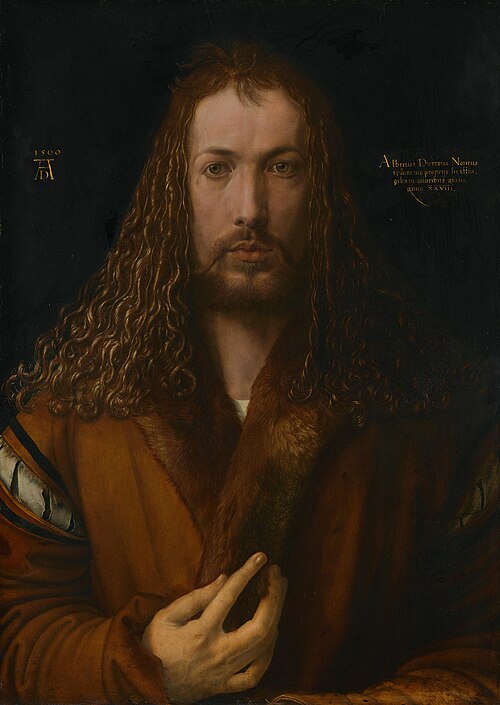


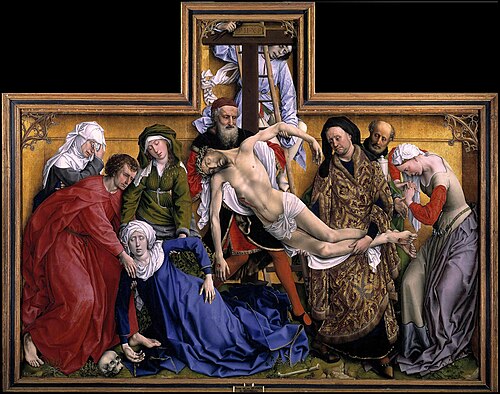
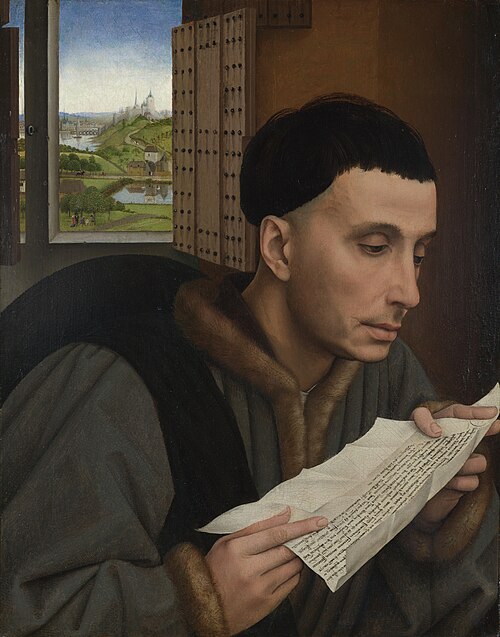
The Renaissance (French for 'rebirth'), a cultural movement roughly spanning the 14th through the mid-17th century, heralded the study of classical sources, as well as advances in science which profoundly influenced European intellectual and artistic life. In the Low Countries, especially in modern day Flanders, a new way of painting was established in the beginning of the 15th century. In the footsteps of the developments made in the illumination of manuscripts, especially by the Limbourg Brothers, artists became fascinated by the tangible in the visible world and began representing objects in an extremely naturalistic way.[45] The adoption of oil painting whose invention was traditionally, but erroneously, credited to Jan van Eyck, made possible a new verisimilitude in depicting this naturalism. The medium of oil paint was already present in the work of Melchior Broederlam, but painters like Jan van Eyck and Robert Campin brought its use to new heights and employed it to represent the naturalism they were aiming for. With this new medium the painters of this period were capable of creating richer colors with a deep intense tonality. The illusion of glowing light with a porcelain-like finish characterized Early Netherlandish painting and was a major difference to the matte surface of tempera paint used in Italy.[45] Unlike the Italians, whose work drew heavily from the art of Ancient Greece and Rome, the northerners retained a stylistic residue of the sculpture and illuminated manuscripts of the Middle Ages (especially its naturalism). The most important artist of this time was Jan van Eyck, whose work ranks among the finest made by artists who are now known as Early Netherlandish painters or Flemish Primitives (since most artists were active in cities in modern day Flanders). The first painter of this period was the Master of Flémalle, nowadays identified as Robert Campin, whose work follows the art of the International Gothic. Another important painter of this period was Rogier van der Weyden, whose compositions stressed human emotion and drama, demonstrated for instance in his Descent from the Cross, which ranks among the most famous works of the 15th century and was the most influential Netherlandish painting of Christ's crucifixion. Other important artists from this period are Hugo van der Goes (whose work was highly influential in Italy), Dieric Bouts (who was among the first northern painters to demonstrate the use of a single vanishing point),[45]Petrus Christus, Hans Memling and Gerard David.
In Italy, the art of Classical antiquity inspired a style of painting that emphasized the ideal. Artists such as Paolo Uccello, Masaccio, Fra Angelico, Piero della Francesca, Andrea Mantegna, Filippo Lippi, Sandro Botticelli, Leonardo da Vinci, Michelangelo Buonarroti, and Raphael took painting to a higher level through the use of perspective, the study of human anatomy and proportion, and through their development of an unprecedented refinement in drawing and painting techniques. A somewhat more naturalistic style emerged in Venice. Painters of the Venetian school, such as Giovanni Bellini, Giorgione, Titian, Tintoretto, and Veronese, were less concerned with precision in their drawing than with the richness of color and unity of effect that could be achieved by a more spontaneous approach to painting.
Flemish, Dutch and German painters of the Renaissance such as Hans Holbein the Younger, Albrecht Dürer, Lucas Cranach, Matthias Grünewald, Hieronymus Bosch, and Pieter Bruegel represent a different approach from their Italian colleagues, one that is more realistic and less idealized. Genre painting became a popular idiom amongst the Northern painters like Pieter Bruegel.
The French tradition of International Gothic, will develop a new style by integrating the strong chromatic tones of Gothic with the Italian perspective and volumes of the Quattrocento, as well as the naturalistic innovations of the Flemish primitives, called the École de Tours. Its main representatives are Jean Fouquet, Barthélemy d'Eyck from the Netherlands, Jean and François Clouet, Jean Perreal, Nicolas Froment and the École de Fontainebleau.
Renaissance painting reflects the revolution of ideas and science (astronomy, geography) that occurred in this period, the Reformation, and the invention of the printing press. Dürer, considered one of the greatest of printmakers, states that painters are not mere artisans but thinkers as well. With the development of easel painting in the Renaissance, painting gained independence from architecture. Easel paintings—movable pictures which could be hung easily on walls—became a popular alternative to paintings fixed to furniture, walls or other structures. Following centuries dominated by religious imagery, secular subject matter slowly returned to Western painting. Artists included visions of the world around them, or the products of their own imaginations in their paintings. Those who could afford the expense could become patrons and commission portraits of themselves or their family.
The High Renaissance gave rise to a stylized art known as Mannerism. In place of the balanced compositions and rational approach to perspective that characterized art at the dawn of the 16th century, the Mannerists sought instability, artifice, and doubt. The unperturbed faces and gestures of Piero della Francesca and the calm Virgins of Raphael are replaced by the troubled expressions of Pontormo and the emotional intensity of El Greco. Restless and unstable compositions, often extreme or disjunctive effects of perspective, and stylized poses are characteristic of Italian Mannerists such as Tintoretto, Pontormo, and Bronzino, and appeared later in the work of Northern Mannerists such as Hendrick Goltzius, Bartholomeus Spranger, and Joachim Wtewael.






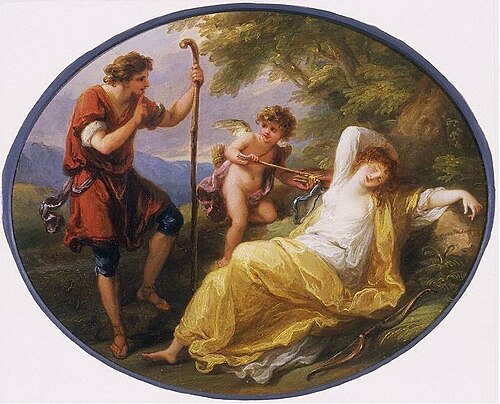
Baroque painting is associated with the Baroquecultural movement, a movement often identified with Absolutism and the Counter Reformation or Catholic Revival;[46][47] the existence of important Baroque painting in non-absolutist and Protestant states also, however, underscores its popularity, as the style spread throughout Western Europe.[48]
Baroque painting is characterized by great drama, rich, deep color, and intense light and dark shadows. Baroque art was meant to evoke emotion and passion instead of the calm rationality that had been prized during the Renaissance. During the period beginning around 1600 and continuing throughout the 17th century, painting is characterized as Baroque. Among the greatest painters of the Baroque are Caravaggio, Rembrandt, Frans Hals, Rubens, Velázquez, Poussin, and Johannes Vermeer. Caravaggio is an heir of the humanist painting of the High Renaissance. His realistic approach to the human figure, painted directly from life and dramatically spotlit against a dark background, shocked his contemporaries and opened a new chapter in the history of painting. Baroque painting often dramatizes scenes using light effects; this can be seen in works by Rembrandt, Vermeer, Le Nain, La Tour, and Jusepe de Ribera.

In Italy, the Baroque style is epitomized by religious and mythological paintings in the Grand Manner by artists such as the Carracci, Guido Reni, and Luca Giordano. Illusionistic church ceiling frescoes by Pietro da Cortona seemed to open to the sky. A much quieter type of Baroque emerged in the Dutch Republic, where easel paintings of everyday subjects were popular with middle-class collectors, and many painters became specialists in genre, others in landscape or seascape or still life. Vermeer, Gerard ter Borch, and Pieter de Hooch brought great technical refinement to the painting of domestic scenes, as did Willem Claesz. Heda to still life. In contrast, Rembrandt excelled in painting every type of subject, and developed an individual painterly style in which the chiaroscuro and dark backgrounds derived from Caravaggio and the Utrecht Caravaggists lose their theatrical quality.
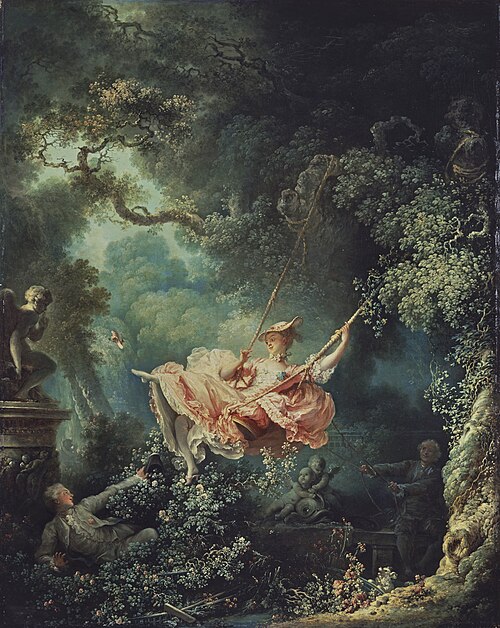
During the 18th century, Rococo followed as a lighter extension of Baroque, often frivolous and erotic. Rococo developed first in the decorative arts and interior design in France. Louis XV's succession brought a change in the court artists and general artistic fashion. The 1730s represented the height of Rococo development in France exemplified by the works of Antoine Watteau and François Boucher. Rococo still maintained the Baroque taste for complex forms and intricate patterns, but by this point, it had begun to integrate a variety of diverse characteristics, including a taste for Oriental designs and asymmetric compositions.
The Rococo style spread with French artists and engraved publications. It was readily received in the Catholic parts of Germany, Bohemia, and Austria, where it was merged with the lively German Baroque traditions. German Rococo was applied with enthusiasm to churches and palaces, particularly in the south, while Frederician Rococo developed in the Kingdom of Prussia.
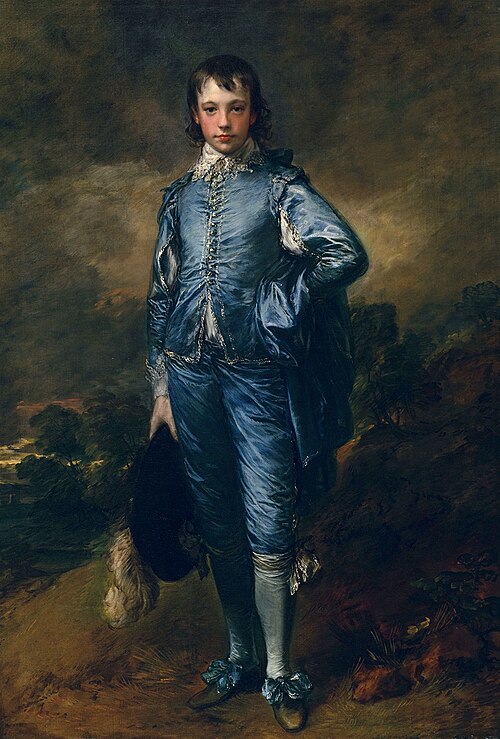
The French masters Watteau, Boucher and Fragonard represent the style, as do Giovanni Battista Tiepolo and Jean-Baptiste-Siméon Chardin who was considered by some as the best French painter of the 18th century – the Anti-Rococo. Portraiture was an important component of painting in all countries, but especially in England, where the leaders were William Hogarth, in a blunt realist style, and Francis Hayman, Angelica Kauffman (who was Swiss), Thomas Gainsborough and Joshua Reynolds in more flattering styles influenced by Anthony van Dyck. In France during the Rococo era Jean-Baptiste Greuze (the favorite painter of Denis Diderot),[49] excelled in portraits and history paintings, and Maurice Quentin de La Tour and Élisabeth Vigée-Lebrun were highly accomplished portrait painters. La Tour specialized in pastel painting, which became a popular medium during this period.
William Hogarth helped develop a theoretical foundation for Rococo beauty. Though not intentionally referencing the movement, he argued in his Analysis of Beauty (1753) that the undulating lines and S-curves prominent in Rococo were the basis for grace and beauty in art or nature (unlike the straight line or the circle in Classicism). The beginning of the end for Rococo came in the early 1760s as figures like Voltaire and Jacques-François Blondel began to voice their criticism of the superficiality and degeneracy of the art. Blondel decried the "ridiculous jumble of shells, dragons, reeds, palm-trees and plants" in contemporary interiors.[50]
By 1785, Rococo had passed out of fashion in France, replaced by the order and seriousness of Neoclassical artists like Jacques-Louis David.


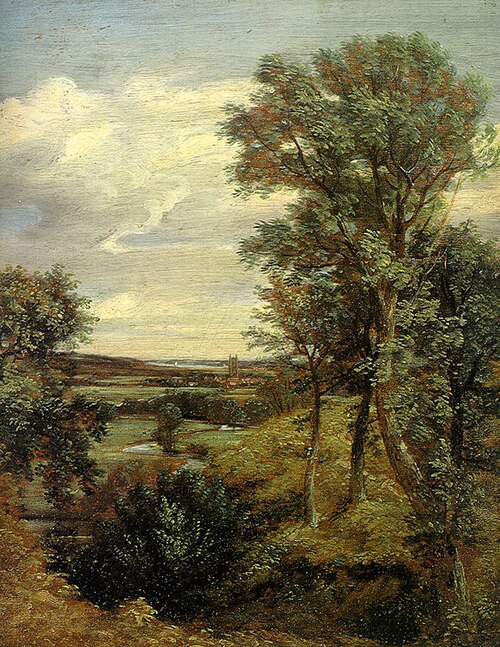


After Rococo there arose in the late 18th century, in architecture, and then in painting severe neo-classicism, best represented by such artists as David and his heir Ingres. Ingres' work already contains much of the sensuality, but none of the spontaneity, that was to characterize Romanticism. This movement turned its attention toward landscape and nature as well as the human figure and the supremacy of natural order above mankind's will. There is opposition to Enlightenment ideals, as humanity is seen being at the whim of nature's chaos. The idea that human beings are not above the forces of Nature is in contradiction to Ancient Greek and Renaissance ideals where mankind was above all things and owned his fate. This thinking led romantic artists to depict the sublime, ruined churches, shipwrecks, massacres and madness.
By the mid-19th-century painters became liberated from the demands of their patronage to only depict scenes from religion, mythology, portraiture or history. The idea "art for art's sake" began to find expression in the work of painters like Francisco de Goya, John Constable, and J.M.W. Turner. Romantic painters saw landscape painting as an important genre to express the vanity of mankind in opposition to the grandeur of nature. Until then, landscape painting wasn't considered the most important genre for painters (like portraiture or history painting). But painters like J.M.W. Turner and Caspar David Friedrich managed to elevate landscape painting to an eminence rivalling history painting. Some of the major painters of this period are Eugène Delacroix, Théodore Géricault, J. M. W. Turner, Caspar David Friedrich and John Constable. Francisco de Goya's late work demonstrates the Romantic interest in the irrational, while the work of Arnold Böcklin evokes mystery and the paintings of Aesthetic movement artist James McNeill Whistler evoke both sophistication and decadence. In the United States the Romantic tradition of landscape painting was known as the Hudson River School:[51] exponents include Thomas Cole, Frederic Edwin Church, Albert Bierstadt, Thomas Moran, and John Frederick Kensett. Luminism was a movement in American landscape painting related to the Hudson River School.

The leading Barbizon School painter Camille Corot painted in both a romantic and a realistic vein; his work prefigures Impressionism, as does the paintings of Eugène Boudin who was one of the first French landscape painters to paint outdoors. Boudin was also an important influence on the young Claude Monet, whom in 1857 he introduced to Plein air painting. A major force in the turn towards Realism at mid-century was Gustave Courbet. In the latter third of the century Impressionists like Édouard Manet, Claude Monet, Pierre-Auguste Renoir, Camille Pissarro, Alfred Sisley, Berthe Morisot, Mary Cassatt, and Edgar Degas worked in a more direct approach than had previously been exhibited publicly. They eschewed allegory and narrative in favor of individualized responses to the modern world, sometimes painted with little or no preparatory study, relying on deftness of drawing and a highly chromatic pallette. Manet, Degas, Renoir, Morisot, and Cassatt concentrated primarily on the human subject. Both Manet and Degas reinterpreted classical figurative canons within contemporary situations; in Manet's case the re-imaginings met with hostile public reception. Renoir, Morisot, and Cassatt turned to domestic life for inspiration, with Renoir focusing on the female nude. Monet, Pissarro, and Sisley used the landscape as their primary motif, the transience of light and weather playing a major role in their work. While Sisley most closely adhered to the original principals of the Impressionist perception of the landscape, Monet sought challenges in increasingly chromatic and changeable conditions, culminating in his series of monumental works of Water Lilies painted in Giverny.
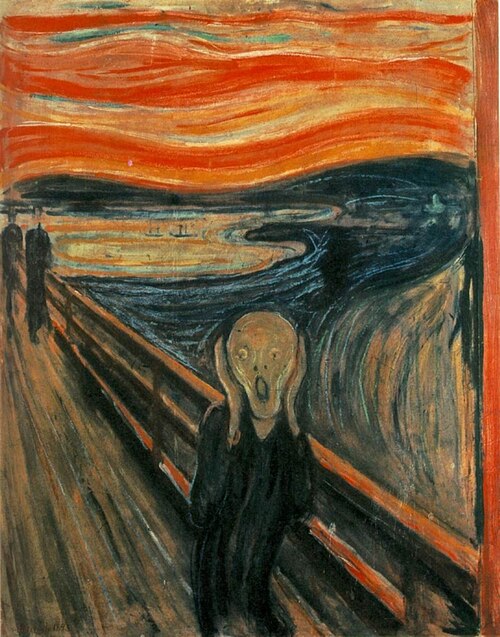
Pissarro adopted some of the experiments of Post-Impressionism. Slightly younger Post-Impressionists like Vincent van Gogh, Paul Gauguin, and Georges Seurat, along with Paul Cézanne led art to the edge of modernism; for Gauguin Impressionism gave way to a personal symbolism; Seurat transformed Impressionism's broken color into a scientific optical study, structured on frieze-like compositions; Van Gogh's turbulent method of paint application, coupled with a sonorous use of color, predicted Expressionism and Fauvism, and Cézanne, desiring to unite classical composition with a revolutionary abstraction of natural forms, would come to be seen as a precursor of 20th-century art. The spell of Impressionism was felt throughout the world, including in the United States, where it became integral to the painting of American Impressionists such as Childe Hassam, John Twachtman, and Theodore Robinson; and in Australia where painters of the Heidelberg School such as Arthur Streeton, Frederick McCubbin and Charles Conder painted en plein air and were particularly interested in the Australian landscape and light. It also exerted influence on painters who were not primarily Impressionistic in theory, like the portrait and landscape painter John Singer Sargent. At the same time in America at the turn of the 20th century there existed a native and nearly insular realism, as richly embodied in the figurative work of Thomas Eakins, the Ashcan School, and the landscapes and seascapes of Winslow Homer, all of whose paintings were deeply invested in the solidity of natural forms. The visionary landscape, a motive largely dependent on the ambiguity of the nocturne, found its advocates in Albert Pinkham Ryder and Ralph Albert Blakelock.
In the late 19th century there also were several, rather dissimilar, groups of Symbolist painters whose works resonated with younger artists of the 20th century, especially with the Fauvists and the Surrealists. Among them were Gustave Moreau, Odilon Redon, Pierre Puvis de Chavannes, Henri Fantin-Latour, Arnold Böcklin, Edvard Munch, Félicien Rops, and Jan Toorop, and Gustav Klimt amongst others including the Russian Symbolists like Mikhail Vrubel.
Symbolist painters mined mythology and dream imagery for a visual language of the soul, seeking evocative paintings that brought to mind a static world of silence. The symbols used in Symbolism are not the familiar emblems of mainstream iconography but intensely personal, private, obscure and ambiguous references. More a philosophy than an actual style of art, the Symbolist painters influenced the contemporary Art Nouveau movement and Les Nabis. In their exploration of dreamlike subjects, symbolist painters are found across centuries and cultures, as they are still today; Bernard Delvaille has described René Magritte's surrealism as "Symbolism plus Freud".[52]
The heritage of painters like Van Gogh, Cézanne, Gauguin, and Seurat was essential for the development of modern art. At the beginning of the 20th century Henri Matisse and several other young artists revolutionized the Paris art world with "wild", multi-colored, expressive, landscapes and figure paintings that the critics called Fauvism. Pablo Picasso made his first cubist paintings based on Cézanne's idea that all depiction of nature can be reduced to three solids: cube, sphere and cone.
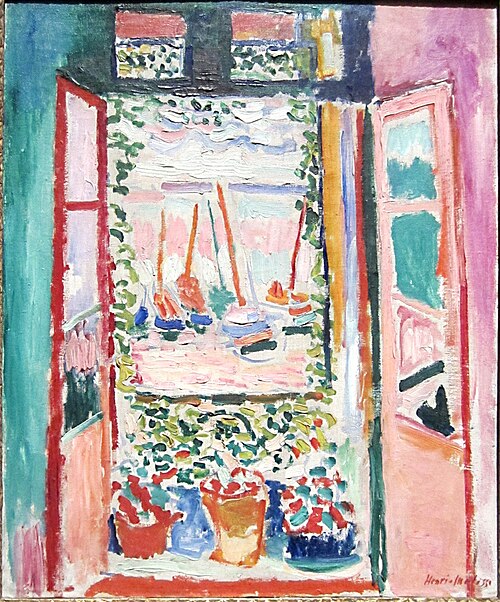


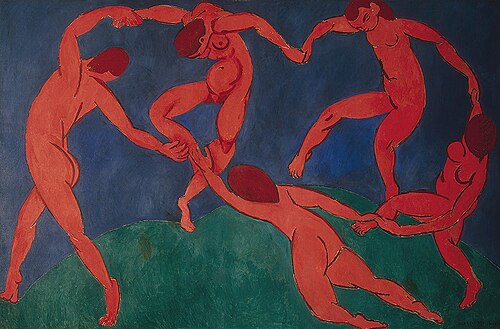
The heritage of painters like Van Gogh, Cézanne, Gauguin, and Seurat was essential for the development of modern art. At the beginning of the 20th century Henri Matisse and several other young artists including the pre-cubist Georges Braque, André Derain, Raoul Dufy and Maurice de Vlaminck revolutionized the Paris art world with "wild", multi-colored, expressive, landscapes and figure paintings that the critics called Fauvism. Henri Matisse's second version of The Dance signifies a key point in his career and in the development of modern painting.[53] It reflects Matisse's incipient fascination with primitive art: the intense warm colors against the cool blue-green background and the rhythmical succession of dancing nudes convey the feelings of emotional liberation and hedonism. Pablo Picasso made his first cubist paintings based on Cézanne's idea that all depiction of nature can be reduced to three solids: cube, sphere and cone. With the painting Les Demoiselles d'Avignon 1907, Picasso dramatically created a new and radical picture depicting a raw and primitive brothel scene with five prostitutes, violently painted women, reminiscent of African tribal masks and his own new Cubist inventions. analytic Cubism was jointly developed by Pablo Picasso and Georges Braque, exemplified by Violin and Candlestick, Paris, from about 1908 through 1912. Analytic cubism, the first clear manifestation of cubism, was followed by synthetic cubism, practised by Braque, Picasso, Fernand Léger, Juan Gris, Albert Gleizes, Marcel Duchamp and countless other artists into the 1920s. Synthetic cubism is characterized by the introduction of different textures, surfaces, collage elements, papier collé and a large variety of merged subject matter.

Les Fauves (French for The Wild Beasts) were early-20th-century painters, experimenting with freedom of expression through color. The name was given, humorously and not as a compliment, to the group by art critic Louis Vauxcelles. Fauvism was a short-lived and loose grouping of early-20th-century artists whose works emphasized painterly qualities, and the imaginative use of deep color over the representational values. Fauvists made the subject of the painting easy to read, exaggerated perspectives and an interesting prescient prediction of the Fauves was expressed in 1888 by Paul Gauguin to Paul Sérusier,
How do you see these trees? They are yellow. So, put in yellow; this shadow, rather blue, paint it with pure ultramarine; these red leaves? Put in vermilion.
The leaders of the movement were Henri Matisse and André Derain – friendly rivals of a sort, each with his own followers. Ultimately Matisse became the yang to Picasso's yin in the 20th century. Fauvist painters included Albert Marquet, Charles Camoin, Maurice de Vlaminck, Raoul Dufy, Othon Friesz, the Dutch painter Kees van Dongen, and Picasso's partner in Cubism, Georges Braque amongst others.[54]

Fauvism, as a movement, had no concrete theories, and was short lived, beginning in 1905 and ending in 1907, they only had three exhibitions. Matisse was seen as the leader of the movement, due to his seniority in age and prior self-establishment in the academic art world. His 1905 portrait of Mme. Matisse The Green Line, (above), caused a sensation in Paris when it was first exhibited. He said he wanted to create art to delight; art as a decoration was his purpose and it can be said that his use of bright colors tries to maintain serenity of composition. In 1906 at the suggestion of his dealer Ambroise Vollard, André Derain went to London and produced a series of paintings like Charing Cross Bridge, London (above) in the Fauvist style, paraphrasing the famous series by the Impressionist painter Claude Monet. Masters like Henri Matisse and Pierre Bonnard continued developing their narrative styles independent of any movement throughout the 20th century.
By 1907 Fauvism no longer was a shocking new movement, soon it was replaced by Cubism on the critics' radar screen as the latest new development in Contemporary Art of the time. In 1907 Apollinaire, commenting about Matisse in an article published in La Falange, said, "We are not here in the presence of an extravagant or an extremist undertaking: Matisse's art is eminently reasonable."[55]Analytic cubism was jointly developed by Pablo Picasso and Georges Braque from about 1908 through 1912. Analytic cubism, the first clear manifestation of cubism, was followed by Synthetic cubism, practised by Braque, Picasso, Fernand Léger, Juan Gris, Albert Gleizes, Marcel Duchamp and countless other artists into the 1920s. Synthetic cubism is characterized by the introduction of different textures, surfaces, collage elements, papier collé and a large variety of merged subject matter.
During the years between 1910 and the end of World War I and after the heyday of cubism, several movements emerged in Paris. Giorgio de Chirico moved to Paris in July 1911, where he joined his brother Andrea (the poet and painter known as Alberto Savinio). Through his brother he met Pierre Laprade a member of the jury at the Salon d'Automne, where he exhibited three of his dreamlike works: Enigma of the Oracle, Enigma of an Afternoon and Self-Portrait. During 1913 he exhibited his work at the Salon des Indépendants and Salon d'Automne, his work was noticed by Pablo Picasso and Guillaume Apollinaire and several others. His compelling and mysterious paintings are considered instrumental to the early beginnings of Surrealism. During the first half of the 20th century in Europe masters like Georges Braque, André Derain, and Giorgio de Chirico continued painting independent of any movement.


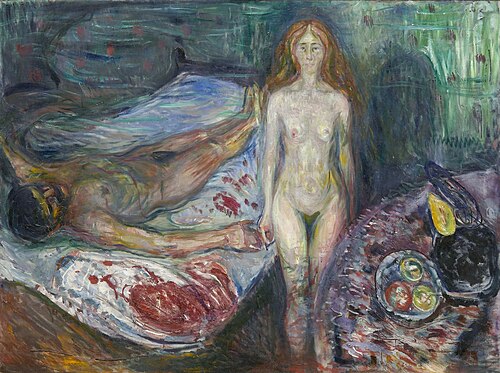


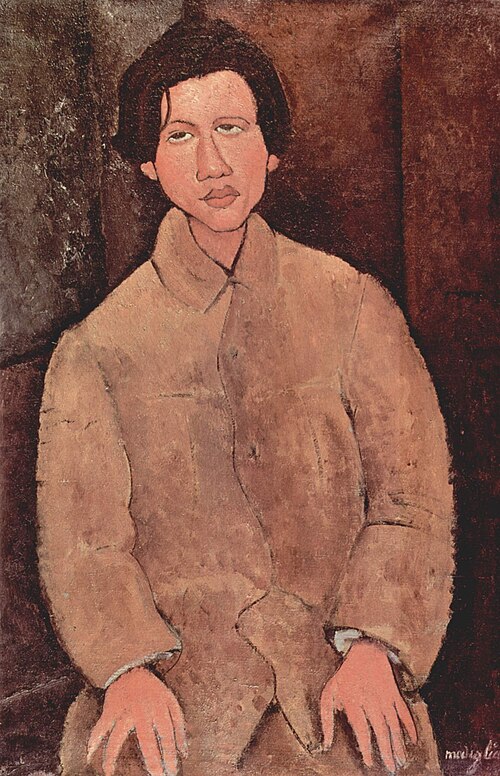

In the first two decades of the 20th century and after Cubism, several other important movements emerged; futurism (Balla), abstract art (Kandinsky), Der Blaue Reiter), Bauhaus, (Kandinsky) and (Klee), Orphism, (Robert Delaunay and František Kupka), Synchromism (Morgan Russell), De Stijl (Mondrian), Suprematism (Malevich), Constructivism (Tatlin), Dadaism (Duchamp, Picabia, Arp) and Surrealism (De Chirico, André Breton, Miró, Magritte, Dalí, Ernst). Modern painting influenced all the visual arts, from Modernist architecture and design, to avant-garde film, theatre and modern dance and became an experimental laboratory for the expression of visual experience, from photography and concrete poetry to advertising art and fashion. Van Gogh's painting exerted great influence upon 20th-century Expressionism, as can be seen in the work of the Fauves, Die Brücke (a group led by German painter Ernst Kirchner), and the Expressionism of Edvard Munch, Egon Schiele, Marc Chagall, Amedeo Modigliani, Chaïm Soutine and others..
Wassily Kandinsky a Russian painter, printmaker and art theorist, one of the most famous 20th-century artists is generally considered the first important painter of modern abstract art. As an early Modernist, in search of new modes of visual expression, and spiritual expression, he theorized as did contemporary occultists and theosophists, that pure visual abstraction had corollary vibrations with sound and music. They posited that pure abstraction could express pure spirituality. His earliest abstractions were generally titled as the example in the (above gallery) Composition VII, making connection to the work of the composers of music. Kandinsky included many of his theories about abstract art in his book Concerning the Spiritual in Art.Robert Delaunay was a French artist who is associated with Orphism, (reminiscent of a link between pure abstraction and cubism). His later works were more abstract, reminiscent of Paul Klee. His key contributions to abstract painting refer to his bold use of color, and a clear love of experimentation of both depth and tone. At the invitation of Wassily Kandinsky, Delaunay and his wife the artist Sonia Delaunay, joined The Blue Rider (Der Blaue Reiter), a Munich-based group of abstract artists, in 1911, and his art took a turn to the abstract.[56]
Other major pioneers of early abstraction include Russian painter Kasimir Malevich, who after the Russian Revolution in 1917, and after pressure from the Stalinist regime in 1924 returned to painting imagery and Peasants and Workers in the field, and Swiss painter Paul Klee whose masterful color experiments made him an important pioneer of abstract painting at the Bauhaus. Still other important pioneers of abstract painting include the Swedish artist Hilma af Klint, Czech painter František Kupka as well as American artists Stanton Macdonald-Wright and Morgan Russell who, in 1912, founded Synchromism, an art movement that closely resembles Orphism.
Expressionism and Symbolism are broad rubrics that involve several important and related movements in 20th-century painting that dominated much of the avant-garde art being made in Western, Eastern and Northern Europe. Expressionist works were painted largely between World War I and World War II, mostly in France, Germany, Norway, Russia, Belgium, and Austria. Expressionist artists are related to both Surrealism and Symbolism and are each uniquely and somewhat eccentrically personal. Fauvism, Die Brücke, and Der Blaue Reiter are three of the best known groups of Expressionist and Symbolist painters.
Artists as interesting and diverse as Marc Chagall, whose painting I and the Village, (above) tells an autobiographical story that examines the relationship between the artist and his origins, with a lexicon of artistic Symbolism. Gustav Klimt, Egon Schiele, Edvard Munch, Emil Nolde, Chaïm Soutine, James Ensor, Oskar Kokoschka, Ernst Ludwig Kirchner, Max Beckmann, Franz Marc, Käthe Schmidt Kollwitz, Georges Rouault, Amedeo Modigliani and some of the Americans abroad like Marsden Hartley, and Stuart Davis, were considered influential expressionist painters. Although Alberto Giacometti is primarily thought of as an intense Surrealist sculptor, he made intense expressionist paintings as well.
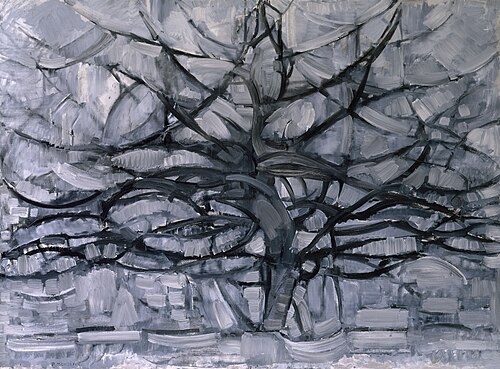


Piet Mondrian's art was also related to his spiritual and philosophical studies. In 1908 he became interested in the theosophical movement launched by Helena Petrovna Blavatsky in the late 19th century. Blavatsky believed that it was possible to attain a knowledge of nature more profound than that provided by empirical means, and much of Mondrian's work for the rest of his life was inspired by his search for that spiritual knowledge.

De Stijl also known as neoplasticism, was a Dutch artistic movement founded in 1917. The term De Stijl is used to refer to a body of work from 1917 to 1931 founded in the Netherlands.[57][58]
De Stijl is also the name of a journal that was published by the Dutch painter, designer, writer, and critic Theo van Doesburg propagating the group's theories. Next to van Doesburg, the group's principal members were the painters Piet Mondrian, Vilmos Huszár, and Bart van der Leck, and the architects Gerrit Rietveld, Robert van 't Hoff, and J. J. P. Oud. The artistic philosophy that formed a basis for the group's work is known as neoplasticism – the new plastic art (or Nieuwe Beelding in Dutch).
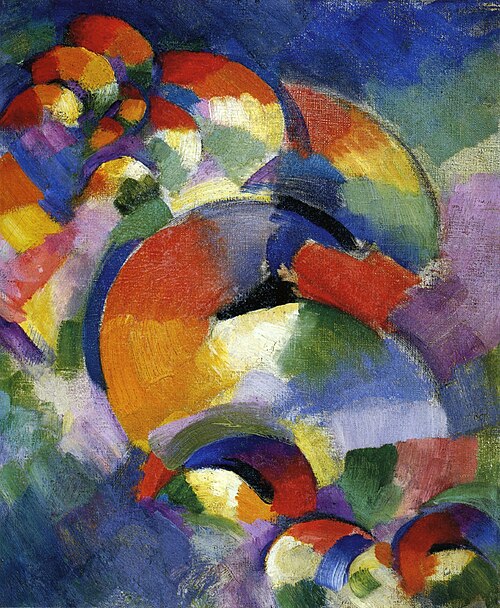
Proponents of De Stijl sought to express a new utopian ideal of spiritual harmony and order. They advocated pure abstraction and universality by a reduction to the essentials of form and colour; they simplified visual compositions to the vertical and horizontal directions, and used only primary colors along with black and white. Indeed, according to the Tate Gallery's online article on neoplasticism, Mondrian himself sets forth these delimitations in his essay "Neo-Plasticism in Pictorial Art". He writes, "... this new plastic idea will ignore the particulars of appearance, that is to say, natural form and colour. On the contrary, it should find its expression in the abstraction of form and colour, that is to say, in the straight line and the clearly defined primary colour." The Tate article further summarizes that this art allows "only primary colours and non-colours, only squares and rectangles, only straight and horizontal or vertical line."[59] The Guggenheim Museum's online article on De Stijl summarizes these traits in similar terms: "It [De Stijl] was posited on the fundamental principle of the geometry of the straight line, the square, and the rectangle, combined with a strong asymmetricality; the predominant use of pure primary colors with black and white; and the relationship between positive and negative elements in an arrangement of non-objective forms and lines."[60]
De Stijl movement was influenced by Cubist painting as well as by the mysticism and the ideas about "ideal" geometric forms (such as the "perfect straight line") in the neoplatonic philosophy of mathematicianM. H. J. Schoenmaekers. The works of De Stijl would influence the Bauhaus style and the international style of architecture as well as clothing and interior design. However, it did not follow the general guidelines of an "ism" (Cubism, Futurism, Surrealism), nor did it adhere to the principles of art schools like Bauhaus; it was a collective project, a joint enterprise.
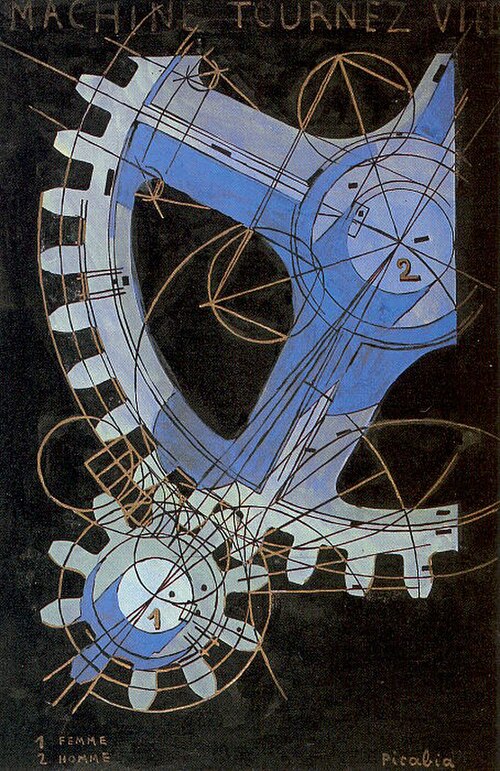
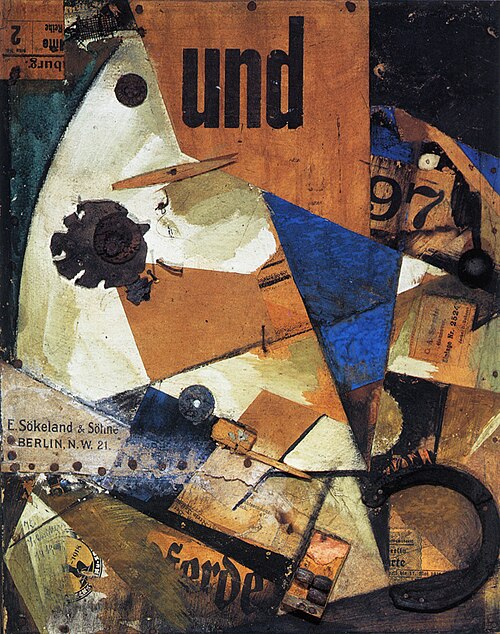


Marcel Duchamp, came to international prominence in the wake of his notorious success at the New York City Armory Show in 1913, (soon after he denounced artmaking for chess). After Duchamp's Nude Descending a Staircase became the international cause celebre at the 1913 Armory show in New York he created The Bride Stripped Bare by Her Bachelors, Even, Large Glass. The Large Glass pushed the art of painting to radical new limits being part painting, part collage, part construction. Duchamp became closely associated with the Dada movement that began in neutral Zürich, Switzerland, during World War I and peaked from 1916 to 1920. The movement primarily involved visual arts, literature (poetry, art manifestoes, art theory), theatre, and graphic design, and concentrated its anti war politic through a rejection of the prevailing standards in art through anti-art cultural works. Francis Picabia, Man Ray, Kurt Schwitters, Tristan Tzara, Hans Richter, Jean Arp, Sophie Taeuber-Arp, along with Duchamp and many others are associated with the Dadaist movement. Duchamp and several Dadaists are also associated with Surrealism, the movement that dominated European painting in the 1920s and 1930s.
In 1924 André Breton published the Surrealist Manifesto. The Surrealist movement in painting became synonymous with the avant-garde and which featured artists whose works varied from the abstract to the super-realist. With works on paper like Machine Turn Quickly, (above) Francis Picabia continued his involvement in the Dada movement through 1919 in Zürich and Paris, before breaking away from it after developing an interest in Surrealist art. Yves Tanguy, René Magritte and Salvador Dalí are particularly known for their realistic depictions of dream imagery and fantastic manifestations of the imagination. Joan Miró's The Tilled Field of 1923–1924 verges on abstraction, this early painting of a complex of objects and figures, and arrangements of sexually active characters; was Miró's first Surrealist masterpiece.[61] Miró's The Tilled Field also contains several parallels to Bosch's Garden of Earthly Delights: similar flocks of birds; pools from which living creatures emerge; and oversize disembodied ears all echo the Dutch master's work that Miró saw as a young painter in The Prado. The more abstract Joan Miró, Jean Arp, André Masson, and Max Ernst were very influential, especially in the United States during the 1940s. Throughout the 1930s, Surrealism continued to become more visible to the public at large. A Surrealist group developed in Britain and, according to Breton, their 1936 London International Surrealist Exhibition was a high water mark of the period and became the model for international exhibitions. Surrealist groups in Japan, and especially in Latin America, the Caribbean and in Mexico produced innovative and original works.
Dalí and Magritte created some of the most widely recognized images of the movement. The 1928/1929 painting This Is Not A Pipe, by Magritte is the subject of a Michel Foucault 1973 book, This is not a Pipe (English edition, 1991), that discusses the painting and its paradox. Dalí joined the group in 1929, and participated in the rapid establishment of the visual style between 1930 and 1935.
Surrealism as a visual movement had found a method: to expose psychological truth by stripping ordinary objects of their normal significance, in order to create a compelling image that was beyond ordinary formal organization, and perception, sometimes evoking empathy from the viewer, sometimes laughter and sometimes outrage and bewilderment.
1931 marked a year when several Surrealist painters produced works which marked turning points in their stylistic evolution: in one example, liquid shapes become the trademark of Dalí, particularly in his The Persistence of Memory, which features the image of watches that sag as if they are melting. Evocations of time and its compelling mystery and absurdity.[62]
The characteristics of this style – a combination of the depictive, the abstract, and the psychological – came to stand for the alienation which many people felt in the modernist period, combined with the sense of reaching more deeply into the psyche, to be "made whole with one's individuality."

Max Ernst whose 1920 painting Murdering Airplane, studied philosophy and psychology in Bonn and was interested in the alternative realities experienced by the insane. His paintings may have been inspired by the psychoanalystSigmund Freud's study of the delusions of a paranoiac, Daniel Paul Schreber. Freud identified Schreber's fantasy of becoming a woman as a castration complex. The central image of two pairs of legs refers to Schreber's hermaphroditic desires. Ernst's inscription on the back of the painting reads: The picture is curious because of its symmetry. The two sexes balance one another.[63]
During the 1920s André Masson's work was enormously influential in helping the newly arrived in Paris and young artist Joan Miró find his roots in the new Surrealist painting. Miró acknowledged in letters to his dealer Pierre Matisse the importance of Masson as an example to him in his early years in Paris.
Long after personal, political and professional tensions have fragmented the Surrealist group into thin air and ether, Magritte, Miró, Dalí and the other Surrealists continue to define a visual program in the arts. Other prominent surrealist artists include Giorgio de Chirico, Méret Oppenheim, Toyen, Grégoire Michonze, Roberto Matta, Kay Sage, Leonora Carrington, Dorothea Tanning, and Leonor Fini among others.


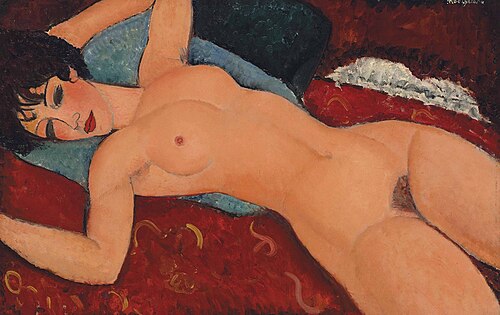


Der Blaue Reiter was a German movement lasting from 1911 to 1914, fundamental to Expressionism, along with Die Brücke which was founded the previous decade in 1905 and was a group of German expressionist artists formed in Dresden in 1905. Founding members of Die Brücke were Fritz Bleyl, Erich Heckel, Ernst Ludwig Kirchner and Karl Schmidt-Rottluff. Later members included Max Pechstein, Otto Mueller and others. The group was one of the seminal ones, which in due course had a major impact on the evolution of modern art in the 20th century and created the style of Expressionism.[64]
Wassily Kandinsky, Franz Marc, August Macke, Alexej von Jawlensky, whose psychically expressive painting of the Russian dancer Portrait of Alexander Sakharoff, 1909 is in the gallery above, Marianne von Werefkin, Lyonel Feininger and others founded the Der Blaue Reiter group in response to the rejection of Kandinsky's painting Last Judgement from an exhibition. Der Blaue Reiter lacked a central artistic manifesto, but was centered around Kandinsky and Marc. Artists Gabriele Münter and Paul Klee were also involved.

The name of the movement comes from a painting by Kandinsky created in 1903. It is also claimed that the name could have derived from Marc's enthusiasm for horses and Kandinsky's love of the colour blue. For Kandinsky, blue is the colour of spirituality: the darker the blue, the more it awakens human desire for the eternal.
In the USA during the period between World War I and World War II painters tended to go to Europe for recognition. Artists like Marsden Hartley, Patrick Henry Bruce, Gerald Murphy and Stuart Davis, created reputations abroad. In New York City, Albert Pinkham Ryder and Ralph Blakelock were influential and important figures in advanced American painting between 1900 and 1920. During the 1920s photographer Alfred Stieglitz exhibited Georgia O'Keeffe, Arthur Dove, Alfred Henry Maurer, Charles Demuth, John Marin and other artists including European Masters Henri Matisse, Auguste Rodin, Henri Rousseau, Paul Cézanne, and Pablo Picasso, at his gallery the 291.


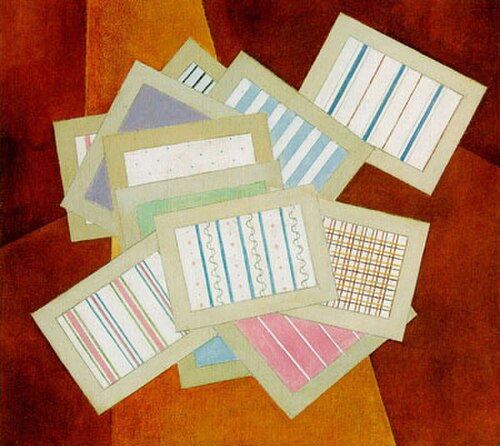

During the 1920s and the 1930s and the Great Depression, Surrealism, late Cubism, the Bauhaus, De Stijl, Dada, German Expressionism, Expressionism, and modernist and masterful color painters like Henri Matisse and Pierre Bonnard characterized the European art scene. In Germany Max Beckmann, Otto Dix, George Grosz and others politicized their paintings, foreshadowing the coming of World War II. While in America American Scene painting and the social realism and regionalism movements that contained both political and social commentary dominated the art world. Artists like Ben Shahn, Thomas Hart Benton, Grant Wood, George Tooker, John Steuart Curry, Reginald Marsh, and others became prominent. In Latin America besides the Uruguayan painter Joaquín Torres García and Rufino Tamayo from Mexico, the muralist movement with Diego Rivera, David Siqueiros, José Orozco, Pedro Nel Gómez and Santiago Martinez Delgado and the Symbolist paintings by Frida Kahlo began a renaissance of the arts for the region, with a use of color and historic, and political messages. Frida Kahlo's Symbolist works also relate strongly to Surrealism and to the Magic Realism movement in literature. The psychological drama in many of Kahlo's self portraits (above) underscore the vitality and relevance of her paintings to artists in the 21st century.

American Gothic is a painting by Grant Wood from 1930. Portraying a pitchfork-holding farmer and a younger woman in front of a house of Carpenter Gothic style, it is one of the most familiar images in 20th-century American art. Art critics had favorable opinions about the painting, like Gertrude Stein and Christopher Morley, they assumed the painting was meant to be a satire of rural small-town life. It was thus seen as part of the trend towards increasingly critical depictions of rural America, along the lines of Sherwood Anderson's 1919 Winesburg, Ohio, Sinclair Lewis' 1920 Main Street, and Carl Van Vechten's The Tattooed Countess in literature.[65] However, with the onset of the Great Depression, the painting came to be seen as a depiction of steadfast American pioneer spirit.
Diego Rivera is perhaps best known by the public world for his 1933 mural, "Man at the Crossroads", in the lobby of the RCA Building at Rockefeller Center. When his patron Nelson Rockefeller discovered that the mural included a portrait of Vladimir Lenin and other communist imagery, he fired Rivera, and the unfinished work was eventually destroyed by Rockefeller's staff. The film Cradle Will Rock includes a dramatization of the controversy. Frida Kahlo (Rivera's wife's) works are often characterized by their stark portrayals of pain. Of her 143 paintings 55 are self-portraits, which frequently incorporate symbolic portrayals of her physical and psychological wounds. Kahlo was deeply influenced by indigenous Mexican culture, which is apparent in her paintings' bright colors and dramatic symbolism. Christian and Jewish themes are often depicted in her work as well; she combined elements of the classic religious Mexican tradition—which were often bloody and violent—with surrealist renderings. While her paintings are not overtly Christian they certainly contain elements of the macabre Mexican Christian style of religious paintings.
Political activism was an important piece of David Siqueiros' life, and frequently inspired him to set aside his artistic career. His art was deeply rooted in the Mexican Revolution, a violent and chaotic period in Mexican history in which various social and political factions fought for recognition and power. The period from the 1920s to the 1950s is known as the Mexican Renaissance, and Siqueiros was active in the attempt to create an art that was at once Mexican and universal. He briefly gave up painting to focus on organizing miners in Jalisco.


During the 1930s radical leftist politics characterized many of the artists connected to Surrealism, including Pablo Picasso.[66] On 26 April 1937, during the Spanish Civil War, the Basque town of Gernika was the scene of the "Bombing of Gernika" by the Condor Legion of Nazi Germany's Luftwaffe. The Germans were attacking to support the efforts of Francisco Franco to overthrow the Basque Government and the Spanish Republican government. The town was devastated, though the Biscayan assembly and the Oak of Gernika survived. Pablo Picasso painted his mural sized Guernica to commemorate the horrors of the bombing.
In its final form, Guernica is an immense black and white, 3.5 metres (11 feet) tall and 7.8 metres (26 feet) wide mural painted in oil. The mural presents a scene of death, violence, brutality, suffering, and helplessness without portraying their immediate causes. The choice to paint in black and white contrasts with the intensity of the scene depicted and invokes the immediacy of a newspaper photograph.[67] Picasso painted the mural sized painting called Guernica in protest of the bombing. The painting was first exhibited in Paris in 1937, then Scandinavia, then London in 1938 and finally in 1939 at Picasso's request the painting was sent to the United States in an extended loan (for safekeeping) at MoMA. The painting went on a tour of museums throughout the USA until its final return to the Museum of Modern Art in New York City where it was exhibited for nearly thirty years. Finally in accord with Pablo Picasso's wish to give the painting to the people of Spain as a gift, it was sent to Spain in 1981.

During the Great Depression of the 1930s, through the years of World War II American art was characterized by Social Realism and American Scene Painting in the work of Grant Wood, Edward Hopper, Ben Shahn, Thomas Hart Benton, and several others. Nighthawks (1942) is a painting by Edward Hopper that portrays people sitting in a downtown diner late at night. It is not only Hopper's most famous painting, but one of the most recognizable in American art. It is currently in the collection of the Art Institute of Chicago. The scene was inspired by a diner (since demolished) in Greenwich Village, Hopper's home neighborhood in Manhattan. Hopper began painting it immediately after the attack on Pearl Harbor. After this event there was a large feeling of gloominess over the country, a feeling that is portrayed in the painting. The urban street is empty outside the diner, and inside none of the three patrons is apparently looking or talking to the others but instead is lost in their own thoughts. This portrayal of modern urban life as empty or lonely is a common theme throughout Hopper's work.
The Dynamic for artists in Europe during the 1930s deteriorated rapidly as the Nazi's power in Germany and across Eastern Europe increased. The climate became so hostile for artists and art associated with Modernism and abstraction that many left for the Americas. Degenerate art was a term adopted by the Nazi regime in Germany for virtually all modern art. Such art was banned on the grounds that it was un-German or Jewish Bolshevist in nature, and those identified as degenerate artists were subjected to sanctions. These included being dismissed from teaching positions, being forbidden to exhibit or to sell their art, and in some cases being forbidden to produce art entirely.
Degenerate Art was also the title of an exhibition, mounted by the Nazis in Munich in 1937, consisting of modernist artworks chaotically hung and accompanied by text labels deriding the art. Designed to inflame public opinion against modernism, the exhibition subsequently traveled to several other cities in Germany and Austria. German artist Max Beckmann and scores of others fled Europe for New York. In New York City a new generation of young and exciting Modernist painters led by Arshile Gorky, Willem de Kooning, and others were just beginning to come of age.
Arshile Gorky's portrait of someone who might be Willem de Kooning (above) is an example of the evolution of abstract expressionism from the context of figure painting, cubism and surrealism. Along with his friends de Kooning and John D. Graham Gorky created bio-morphically shaped and abstracted figurative compositions that by the 1940s evolved into totally abstract paintings. Gorky's work seems to be a careful analysis of memory, emotion and shape, using line and color to express feeling and nature.

The 1940s in New York City heralded the triumph of American abstract expressionism, a modernist movement that combined lessons learned from Henri Matisse, Pablo Picasso, Surrealism, Joan Miró, Cubism, Fauvism, and early Modernism via great teachers in America like Hans Hofmann and John D. Graham. American artists benefited from the presence of Piet Mondrian, Fernand Léger, Max Ernst and the André Breton group, Pierre Matisse's gallery, and Peggy Guggenheim's gallery The Art of This Century, as well as other factors. The figurative work of Francis Bacon, Frida Kahlo, Edward Hopper, Lucian Freud, Andrew Wyeth and others served as a kind of alternative to abstract expressionism.
Post-Second World War American painting called Abstract expressionism included artists like Jackson Pollock, Willem de Kooning, Arshile Gorky, Mark Rothko, Hans Hofmann, Clyfford Still, Franz Kline, Adolph Gottlieb, Mark Tobey, Barnett Newman, James Brooks, Philip Guston, Robert Motherwell, Conrad Marca-Relli, Jack Tworkov, William Baziotes, Richard Pousette-Dart, Ad Reinhardt, Hedda Sterne, Jimmy Ernst, Esteban Vicente, Bradley Walker Tomlin, and Theodoros Stamos, among others. American Abstract expressionism got its name in 1946 from the art critic Robert Coates. It is seen as combining the emotional intensity and self-denial of the German Expressionists with the anti-figurative aesthetic of the European abstract schools such as futurism, the Bauhaus and synthetic cubism. Abstract expressionism, action painting, and Color Field painting are synonymous with the New York School.
Technically Surrealism was an important predecessor for abstract expressionism with its emphasis on spontaneous, automatic or subconscious creation. Jackson Pollock's dripping paint onto a canvas laid on the floor is a technique that has its roots in the work of André Masson. Another important early manifestation of what came to be abstract expressionism is the work of American Northwest artist Mark Tobey, especially his "white writing" canvases, which, though generally not large in scale, anticipate the "all over" look of Pollock's drip paintings.
Additionally, Abstract expressionism has an image of being rebellious, anarchic, highly idiosyncratic and, some feel, rather nihilistic. In practice, the term is applied to any number of artists working (mostly) in New York who had quite different styles, and even applied to work which is not especially abstract nor expressionist. Pollock's energetic "action paintings", with their "busy" feel, are different both technically and aesthetically, to the violent and grotesque Women series of Willem de Kooning. As seen above in the gallery Woman V is one of a series of six paintings made by de Kooning between 1950 and 1953 that depict a three-quarter-length female figure. He began the first of these paintings, Woman I collection: The Museum of Modern Art, New York City, in June 1950, repeatedly changing and painting out the image until January or February 1952, when the painting was abandoned unfinished. The art historian Meyer Schapiro saw the painting in de Kooning's studio soon afterwards and encouraged the artist to persist. De Kooning's response was to begin three other paintings on the same theme; Woman II collection: The Museum of Modern Art, New York City, Woman III, Tehran Museum of Contemporary Art, Woman IV, Nelson-Atkins Museum of Art, Kansas City, Missouri. During the summer of 1952, spent at East Hampton, de Kooning further explored the theme through drawings and pastels. He may have finished work on Woman I by the end of June, or possibly as late as November 1952, and probably the other three women pictures were concluded at much the same time.[68] The Woman series are decidedly figurative paintings. Another important artist is Franz Kline, as demonstrated by his painting High Street, 1950 as with Jackson Pollock and other Abstract Expressionists, was labelled an "action painter" because of his seemingly spontaneous and intense style, focusing less, or not at all, on figures or imagery, but on the actual brush strokes and use of canvas.[69][70][71][72]
Clyfford Still, Barnett Newman, Adolph Gottlieb, and the serenely shimmering blocks of color in Mark Rothko's work (which is not what would usually be called expressionist and which Rothko denied was abstract), are classified as abstract expressionists, albeit from what Clement Greenberg termed the Color Field direction of abstract expressionism. Both Hans Hofmann and Robert Motherwell (gallery) can be comfortably described as practitioners of action painting and Color Field painting.
Abstract expressionism has many stylistic similarities to the Russian artists of the early 20th century such as Wassily Kandinsky. Although it is true that spontaneity or of the impression of spontaneity characterized many of the abstract expressionists works, most of these paintings involved careful planning, especially since their large size demanded it. An exception might be the drip paintings of Pollock.
Why this style gained mainstream acceptance in the 1950s is a matter of debate. American Social realism had been the mainstream in the 1930s. It had been influenced not only by the Great Depression but also by the Social Realists of Mexico such as David Alfaro Siqueiros and Diego Rivera. The political climate after World War II did not long tolerate the social protests of those painters. Abstract expressionism arose during World War II and began to be showcased during the early 1940s at galleries in New York like The Art of This Century Gallery. The late 1940s through the mid-1950s ushered in the McCarthy era. It was after World War II and a time of political conservatism and extreme artistic censorship in the United States. Some people have conjectured that since the subject matter was often totally abstract, Abstract expressionism became a safe strategy for artists to pursue this style. Abstract art could be seen as apolitical. Or if the art was political, the message was largely for the insiders. However, those theorists are in the minority. As the first truly original school of painting in America, Abstract expressionism demonstrated the vitality and creativity of the country in the post-war years, as well as its ability (or need) to develop an aesthetic sense that was not constrained by the European standards of beauty.
Although Abstract expressionism spread quickly throughout the United States, the major centers of this style were New York City and California, especially in the New York School, and the San Francisco Bay area. Abstract expressionist paintings share certain characteristics, including the use of large canvases, an "all-over" approach, in which the whole canvas is treated with equal importance (as opposed to the center being of more interest than the edges). The canvas as the arena became a credo of action painting, while the integrity of the picture plane became a credo of the Color Field painters. Many other artists began exhibiting their abstract expressionist related paintings during the 1950s including Alfred Leslie, Sam Francis, Joan Mitchell, Helen Frankenthaler, Cy Twombly, Milton Resnick, Michael Goldberg, Norman Bluhm, Ray Parker, Nicolas Carone, Grace Hartigan, Friedel Dzubas, and Robert Goodnough among others.
During the 1950s Color Field painting initially referred to a particular type of abstract expressionism, especially the work of Mark Rothko, Clyfford Still, Barnett Newman, Robert Motherwell and Adolph Gottlieb. It essentially involved abstract paintings with large, flat expanses of color that expressed the sensual, and visual feelings and properties of large areas of nuanced surface. Art critic Clement Greenberg perceived Color Field painting as related to but different from Action painting. The overall expanse and gestalt of the work of the early color field painters speaks of an almost religious experience, awestruck in the face of an expanding universe of sensuality, color and surface. During the early-to-mid-1960s, Color Field painting came to refer to the styles of artists like Jules Olitski, Kenneth Noland, and Helen Frankenthaler, whose works were related to second-generation abstract expressionism, and to younger artists like Larry Zox, and Frank Stella, – all moving in a new direction. Artists like Clyfford Still, Mark Rothko, Hans Hofmann, Morris Louis, Jules Olitski, Kenneth Noland, Helen Frankenthaler, Larry Zox, and others often used greatly reduced references to nature, and they painted with a highly articulated and psychological use of color. In general these artists eliminated recognizable imagery. In Mountains and Sea, from 1952, a seminal work of Color Field painting by Helen Frankenthaler the artist used the stain technique for the first time.
In Europe there was the continuation of Surrealism, Cubism, Dada and the works of Matisse. Also in Europe, Tachisme (the European equivalent to Abstract expressionism) took hold of the newest generation. Serge Poliakoff, Nicolas de Staël, Georges Mathieu, Vieira da Silva, Jean Dubuffet, Yves Klein and Pierre Soulages among others are considered important figures in post-war European painting.
Eventually abstract painting in America evolved into movements such as Neo-Dada, Color Field painting, Post painterly abstraction, Op art, hard-edge painting, Minimal art, shaped canvas painting, lyrical abstraction, Neo-expressionism and the continuation of Abstract expressionism. As a response to the tendency toward abstraction imagery emerged through various new movements, notably Pop art.
Earlier in England in 1956 the term Pop Art was used by Lawrence Alloway for paintings that celebrated consumerism of the post World War II era. This movement rejected abstract expressionism and its focus on the hermeneutic and psychological interior, in favor of art which depicted, and often celebrated material consumer culture, advertising, and iconography of the mass production age.[73] The early works of David Hockney and the works of Richard HamiltonPeter Blake and Eduardo Paolozzi were considered seminal examples in the movement.
Pop art in America was to a large degree initially inspired by the works of Jasper Johns, Larry Rivers, and Robert Rauschenberg. Although the paintings of Gerald Murphy, Stuart Davis and Charles Demuth during the 1920s and 1930s set the table for pop art in America. In New York City during the mid-1950s Robert Rauschenberg and Jasper Johns created works of art that at first seemed to be continuations of Abstract expressionist painting. Actually their works and the work of Larry Rivers, were radical departures from abstract expressionism especially in the use of banal and literal imagery and the inclusion and the combining of mundane materials into their work. The innovations of Johns' specific use of various images and objects like chairs, numbers, targets, beer cans and the American flag; Rivers paintings of subjects drawn from popular culture such as George Washington crossing the Delaware, and his inclusions of images from advertisements like the camel from Camel cigarettes, and Rauschenberg's surprising constructions using inclusions of objects and pictures taken from popular culture, hardware stores, junkyards, the city streets, and taxidermy gave rise to a radical new movement in American art. Eventually by 1963 the movement came to be known worldwide as pop art.
American pop art is exemplified by artists: Andy Warhol, Claes Oldenburg, Wayne Thiebaud, James Rosenquist, Jim Dine, Tom Wesselmann and Roy Lichtenstein among others. Lichtenstein's most important work is arguably Whaam! (1963, Tate Modern, London[74]), one of the earliest known examples of pop art, adapted a comic-book panel from a 1962 issue of DC Comics' All-American Men of War.[75] The painting depicts a fighter aircraft firing a rocket into an enemy plane, with a red-and-yellow explosion. The cartoon style is heightened by the use of the onomatopoeic lettering "Whaam!" and the boxed caption "I pressed the fire control... and ahead of me rockets blazed through the sky..."[74] Pop art merges popular and mass culture with fine art, while injecting humor, irony, and recognizable imagery and content into the mix. In October 1962 the Sidney Janis Gallery mounted The New Realists the first major pop art group exhibition in an uptown art gallery in New York City. Sidney Janis mounted the exhibition in a 57th Street storefront near his gallery at 15 E. 57th Street. The show sent shockwaves through the New York School and reverberated worldwide. Earlier in the fall of 1962 an historically important and ground-breaking New Painting of Common Objects exhibition of pop art, curated by Walter Hopps at the Pasadena Art Museum sent shock waves across the Western United States.
While in the downtown scene in New York City's East Village10th Street galleries artists were formulating an American version of Pop Art. Claes Oldenburg had his storefront and made painted objects, and the Green Gallery on 57th Street began to show Tom Wesselmann and James Rosenquist. Later Leo Castelli exhibited other American artists including the bulk of the careers of Andy Warhol and Roy Lichtenstein and his use of Benday dots, a technique used in commercial reproduction. There is a connection between the radical works of Duchamp, and Man Ray, the rebellious Dadaists – with a sense of humor; and pop artists like Alex Katz (who became known for his parodies of portrait photography and suburban life), Claes Oldenburg, Andy Warhol, Roy Lichtenstein and the others.
While throughout the 20th century many painters continued to practice landscape and figurative painting with contemporary subjects and solid technique, like Milton Avery, John D. Graham, Fairfield Porter, Edward Hopper, Balthus, Francis Bacon, Nicolas de Staël, Andrew Wyeth, Lucian Freud, Frank Auerbach, Philip Pearlstein, David Park, Nathan Oliveira, David Hockney, Malcolm Morley, Richard Estes, Ralph Goings, Audrey Flack, Chuck Close, Susan Rothenberg, Eric Fischl, Vija Celmins and Richard Diebenkorn.
During the 1930s through the 1960s abstract painting in America and Europe evolved into movements such as abstract expressionism, Color Field painting, Post painterly abstraction, Op art, hard-edge painting, Minimal art, shaped canvas painting, and lyrical abstraction. Other artists reacted as a response to the tendency toward abstraction, allowing figurative imagery to continue through various new contexts like the Bay Area Figurative Movement in the 1950s and new forms of expressionism from the 1940s through the 1960s. In Italy during this time, Giorgio Morandi was the foremost still life painter, exploring a wide variety of approaches to depicting everyday bottles and kitchen implements.[76] Throughout the 20th century many painters practiced Realism and used expressive imagery; practicing landscape and figurative painting with contemporary subjects and solid technique, and unique expressivity like still-life painter Giorgio Morandi, Milton Avery, John D. Graham, Fairfield Porter, Edward Hopper, Andrew Wyeth, Balthus, Francis Bacon, Leon Kossoff, Frank Auerbach, Lucian Freud, Philip Pearlstein, Willem de Kooning, Arshile Gorky, Grace Hartigan, Robert De Niro, Sr., Elaine de Kooning and others. Along with Henri Matisse, Pablo Picasso, Pierre Bonnard, Georges Braque, and other 20th-century masters. In particular Milton Avery through his use of color and his interest in seascape and landscape paintings connected with the Color field aspect of Abstract expressionism as manifested by Adolph Gottlieb and Mark Rothko as well as the lessons American painters took from the work of Henri Matisse.[77][78]
Head VI, 1949 is a painting by the Irish born artist Francis Bacon and is an example of Post World War II European Expressionism. The work shows a distorted version of the Portrait of Innocent X painted by the Spanish artist Diego Velázquez in 1650. The work is one of a series of variants of the Velázquez painting which Bacon executed throughout the 1950s and early 1960s, over a total of forty-five works.[79] When asked why he was compelled to revisit the subject so often, Bacon replied that he had nothing against the Popes, that he merely "wanted an excuse to use these colours, and you can't give ordinary clothes that purple colour without getting into a sort of false fauve manner."[80] The Pope in this version seethes with anger and aggression, and the dark colors give the image a grotesque and nightmarish appearance.[81] The pleated curtains of the backdrop are rendered transparent, and seem to fall through the Pope's face.[82] Italian painter Giorgio Morandi was an important 20th-century early pioneer of Minimalism. Born in Bologna, Italy, in 1890, throughout his career, Morandi concentrated almost exclusively on still lifes and landscapes, except for a few self-portraits. With great sensitivity to tone, color, and compositional balance, he would depict the same familiar bottles and vases again and again in paintings notable for their simplicity of execution. Morandi executed 133 etchings, a significant body of work in its own right, and his drawings and watercolors often approach abstraction in their economy of means. Through his simple and repetitive motifs and economical use of color, value and surface, Morandi became a prescient and important forerunner of Minimalism. He died in Bologna in 1964.
After World War II the term School of Paris often referred to Tachisme, the European equivalent of American Abstract expressionism and those artists are also related to Cobra. Important proponents being Jean Dubuffet, Pierre Soulages, Nicolas de Staël, Hans Hartung, Serge Poliakoff, and Georges Mathieu, among several others. During the early 1950s Dubuffet (who was always a figurative artist), and de Staël, abandoned abstraction, and returned to imagery via figuration and landscape. De Staël 's work was quickly recognised within the post-war art world, and he became one of the most influential artists of the 1950s. His return to representation (seascapes, footballers, jazz musicians, seagulls) during the early 1950s can be seen as an influential precedent for the American Bay Area Figurative Movement, as many of those abstract painters like Richard Diebenkorn, David Park, Elmer Bischoff, Wayne Thiebaud, Nathan Oliveira, Joan Brown and others made a similar move; returning to imagery during the mid-1950s. Much of de Staël 's late work – in particular his thinned, and diluted oil on canvas abstract landscapes of the mid-1950s predicts Color Field painting and Lyrical Abstraction of the 1960s and 1970s. Nicolas de Staël's bold and intensely vivid color in his last paintings predict the direction of much of contemporary painting that came after him including Pop art of the 1960s.

During the 1950s and 1960s as abstract painting in America and Europe evolved into movements such as Color Field painting, post-painterly abstraction, op art, hard-edge painting, minimal art, shaped canvas painting, lyrical abstraction, and the continuation of Abstract expressionism. Other artists reacted as a response to the tendency toward abstraction with art brut,[83] as seen in Court les rues, 1962, by Jean Dubuffet, fluxus, neo-Dada, New Realism, allowing imagery to re-emerge through various new contexts like pop art, the Bay Area Figurative Movement (a prime example is Diebenkorn's Cityscape I, (Landscape No. 1), 1963, Oil on canvas, 60 1/4 x 50 1/2 inches, collection: San Francisco Museum of Modern Art) and later in the 1970s Neo-expressionism. The Bay Area Figurative Movement of whom David Park, Elmer Bischoff, Nathan Oliveira and Richard Diebenkorn whose painting Cityscape 1, 1963 is a typical example were influential members flourished during the 1950s and 1960s in California. Although throughout the 20th century painters continued to practice Realism and use imagery, practicing landscape and figurative painting with contemporary subjects and solid technique, and unique expressivity like Milton Avery, Edward Hopper, Jean Dubuffet, Francis Bacon, Frank Auerbach, Lucian Freud, Philip Pearlstein, and others. Younger painters practiced the use of imagery in new and radical ways. Yves Klein, Martial Raysse, Niki de Saint Phalle, Wolf Vostell, David Hockney, Alex Katz, Malcolm Morley, Ralph Goings, Audrey Flack, Richard Estes, Chuck Close, Susan Rothenberg, Eric Fischl, John Baeder and Vija Celmins were a few who became prominent between the 1960s and the 1980s. Fairfield Porter was largely self-taught, and produced representational work in the midst of the Abstract Expressionist movement. His subjects were primarily landscapes, domestic interiors and portraits of family, friends and fellow artists, many of them affiliated with the New York School of writers, including John Ashbery, Frank O'Hara, and James Schuyler. Many of his paintings were set in or around the family summer house on Great Spruce Head Island, Maine.
Also during the 1960s and 1970s, there was a reaction against painting. Critics like Douglas Crimp viewed the work of artists like Ad Reinhardt, and declared the "death of painting". Artists began to practice new ways of making art. New movements gained prominence some of which are: Fluxus, Happening, Video art, Installation artMail art, the situationists, Conceptual art, Postminimalism, Earth art, arte povera, performance art and body art among others.[84][85]
Neo-Dada is also a movement that started in the 1950s and 1960s and was related to Abstract expressionism only with imagery. Featuring the emergence of combined manufactured items, with artist materials, moving away from previous conventions of painting. This trend in art is exemplified by the work of Jasper Johns and Robert Rauschenberg, whose "combines" in the 1950s were forerunners of Pop Art and Installation art, and made use of the assemblage of large physical objects, including stuffed animals, birds and commercial photography. Robert Rauschenberg, Jasper Johns, Larry Rivers, John Chamberlain, Claes Oldenburg, George Segal, Jim Dine, and Edward Kienholz among others were important pioneers of both abstraction and Pop Art; creating new conventions of art-making; they made acceptable in serious contemporary art circles the radical inclusion of unlikely materials as parts of their works of art.
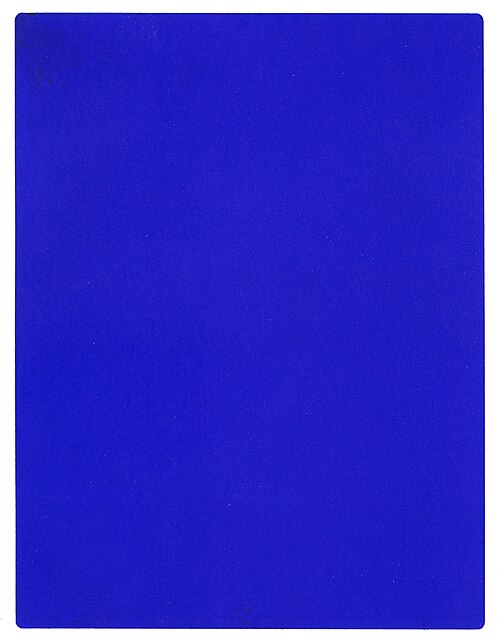
Color Field painting clearly pointed toward a new direction in American painting, away from abstract expressionism. Color Field painting is related to post-painterly abstraction, suprematism, abstract expressionism, hard-edge painting and Lyrical Abstraction. During the 1960s and 1970s abstract painting continued to develop in America through varied styles. Geometric abstraction, Op art, hard-edge painting, Color Field painting and minimal painting, were some interrelated directions for advanced abstract painting as well as some other new movements. Morris Louis was an important pioneer in advanced Color Field painting, his work can serve as a bridge between abstract expressionism, Color Field painting, and minimal art. Two influential teachers Josef Albers and Hans Hofmann introduced a new generation of American artists to their advanced theories of color and space. Josef Albers is best remembered for his work as a Geometric abstractionist painter and theorist. Most famous of all are the hundreds of paintings and prints that make up the series Homage to the Square. In this rigorous series, begun in 1949, Albers explored chromatic interactions with flat colored squares arranged concentrically on the canvas. Albers' theories on art and education were formative for the next generation of artists. His own paintings form the foundation of both hard-edge painting and Op art.
Josef Albers, Hans Hofmann, Ilya Bolotowsky, Burgoyne Diller, Victor Vasarely, Bridget Riley, Richard Anuszkiewicz, Frank Stella, Morris Louis, Kenneth Noland,[86]Ellsworth Kelly, Barnett Newman, Larry Poons, Ronald Davis, Larry Zox, Al Held and some others like Mino Argento,[87] are artists closely associated with Geometric abstraction, Op art, Color Field painting, and in the case of Hofmann and Newman Abstract expressionism as well.
In 1965, an exhibition called The Responsive Eye, curated by William C. Seitz, was held at the Museum of Modern Art, in New York City. The works shown were wide-ranging, encompassing the Minimalism of Frank Stella, the Op art of Larry Poons, the work of Alexander Liberman, alongside the masters of the Op Art movement: Victor Vasarely, Richard Anuszkiewicz, Bridget Riley and others. The exhibition focused on the perceptual aspects of art, which result both from the illusion of movement and the interaction of color relationships. Op art, also known as optical art, is a style present in some paintings and other works of art that use optical illusions. Op art is also closely akin to geometric abstraction and hard-edge painting. Although sometimes the term used for it is perceptual abstraction.
Op art is a method of painting concerning the interaction between illusion and picture plane, between understanding and seeing.[88] Op art works are abstract, with many of the better known pieces made in only black and white. When the viewer looks at them, the impression is given of movement, hidden images, flashing and vibration, patterns, or alternatively, of swelling or warping.
Color Field painting sought to rid art of superfluous rhetoric. Artists like Clyfford Still, Mark Rothko, Hans Hofmann, Morris Louis, Jules Olitski, Kenneth Noland, Helen Frankenthaler, John Hoyland, Larry Zox, and others often used greatly reduced references to nature, and they painted with a highly articulated and psychological use of color. In general these artists eliminated recognizable imagery. Certain artists quoted references to past or present art, but in general color field painting presents abstraction as an end in itself. In pursuing this direction of modern art, artists wanted to present each painting as one unified, cohesive, monolithic image.

The Washington Color School, was an art movement starting during the 1950s–1970s in Washington, D.C., in the United States, built of abstract expressionist artists. The movement emerged during a time when society, the arts, and people were changing quickly. The founders of this movement are Morris Louis and Kenneth Noland,[89][90] however four more artists were part of the initial art exhibition in 1965.[91]
Frank Stella, Kenneth Noland, Ellsworth Kelly, Barnett Newman, Ronald Davis, Neil Williams, Robert Mangold, Charles Hinman, Richard Tuttle, David Novros, and Alvin Loving are examples of artists associated with the use of the shaped canvas during the period beginning in the early 1960s. Many Geometric abstract artists, minimalists, and Hard-edge painters elected to use the edges of the image to define the shape of the painting rather than accepting the rectangular format. In fact, the use of the shaped canvas is primarily associated with paintings of the 1960s and 1970s that are coolly abstract, formalistic, geometrical, objective, rationalistic, clean-lined, brashly sharp-edged, or minimalist in character. The Andre Emmerich Gallery, the Leo Castelli Gallery, the Richard Feigen Gallery, and the Park Place Gallery were important showcases for Color Field painting, shaped canvas painting and Lyrical Abstraction in New York City during the 1960s. There is a connection with post-painterly abstraction, which reacted against abstract expressionisms' mysticism, hyper-subjectivity, and emphasis on making the act of painting itself dramatically visible – as well as the solemn acceptance of the flat rectangle as an almost ritual prerequisite for serious painting. During the 1960s Color Field painting and Minimal art were often closely associated with each other. In actuality by the early 1970s both movements became decidedly diverse.
Another related movement of the late 1960s, Lyrical Abstraction (the term being coined by Larry Aldrich, the founder of the Aldrich Contemporary Art Museum, Ridgefield Connecticut), encompassed what Aldrich said he saw in the studios of many artists at that time.[92] It is also the name of an exhibition that originated in the Aldrich Museum and traveled to the Whitney Museum of American Art and other museums throughout the United States between 1969 and 1971.[93]
Lyrical Abstraction in the late 1960s is characterized by the paintings of Dan Christensen, Ronnie Landfield, Peter Young and others, and along with the fluxus movement and postminimalism (a term first coined by Robert Pincus-Witten in the pages of Artforum in 1969)[94] sought to expand the boundaries of abstract painting and minimalism by focusing on process, new materials and new ways of expression. Postminimalism often incorporating industrial materials, raw materials, fabrications, found objects, installation, serial repetition, and often with references to Dada and Surrealism is best exemplified in the sculptures of Eva Hesse.[94] Lyrical Abstraction, conceptual art, postminimalism, Earth art, video, performance art, installation art, along with the continuation of fluxus, abstract expressionism, Color Field painting, hard-edge painting, minimal art, op art, pop art, photorealism and New Realism extended the boundaries of contemporary art in the mid-1960s through the 1970s.[95] Lyrical Abstraction is a type of freewheeling abstract painting that emerged in the mid-1960s when abstract painters returned to various forms of painterly, pictorial, expressionism with a predominate focus on process, gestalt and repetitive compositional strategies in general.
Lyrical Abstraction shares similarities with color field painting and abstract expressionism, Lyrical Abstraction as exemplified by the 1968 Ronnie Landfield painting For William Blake, (above) especially in the freewheeling usage of paint – texture and surface. Direct drawing, calligraphic use of line, the effects of brushed, splattered, stained, squeegeed, poured, and splashed paint superficially resemble the effects seen in abstract expressionism and color field painting. However, the styles are markedly different. Setting it apart from abstract expressionism and action painting of the 1940s and 1950s is the approach to composition and drama. As seen in action painting there is an emphasis on brushstrokes, high compositional drama, dynamic compositional tension. While in Lyrical Abstraction there is a sense of compositional randomness, all over composition, low key and relaxed compositional drama and an emphasis on process, repetition, and an all over sensibility.,[96][97]

Agnes Martin, Robert Mangold, Brice Marden, Jo Baer, Robert Ryman, Richard Tuttle, Neil Williams, David Novros, Paul Mogenson, Charles Hinman are examples of artists associated with Minimalism and (exceptions of Martin, Baer and Marden) the use of the shaped canvas also during the period beginning in the early 1960s. Many Geometric abstract artists, minimalists, and hard-edge painters elected to use the edges of the image to define the shape of the painting rather than accepting the rectangular format. In fact, the use of the shaped canvas is primarily associated with paintings of the 1960s and 1970s that are coolly abstract, formalistic, geometrical, objective, rationalistic, clean-lined, brashly sharp-edged, or minimalist in character. The Bykert Gallery, and the Park Place Gallery were important showcases for Minimalism and shaped canvas painting in New York City during the 1960s.
During the 1960s and 1970s artists such as Robert Motherwell, Adolph Gottlieb, Phillip Guston, Lee Krasner, Cy Twombly, Robert Rauschenberg, Jasper Johns, Richard Diebenkorn, Josef Albers, Elmer Bischoff, Agnes Martin, Al Held, Sam Francis, Ellsworth Kelly, Morris Louis, Helen Frankenthaler, Gene Davis, Frank Stella, Kenneth Noland, Joan Mitchell, Friedel Dzubas, and younger artists like Brice Marden, Robert Mangold, Sam Gilliam,[98]John Hoyland, Sean Scully, Pat Steir, Elizabeth Murray, Larry Poons, Walter Darby Bannard, Larry Zox, Ronnie Landfield, Ronald Davis, Dan Christensen, Joan Snyder, Ross Bleckner, Archie Rand, Susan Crile, and dozens of others produced a wide variety of paintings.

During the 1960s and 1970s, there was a reaction against abstract painting. Some critics viewed the work of artists like Ad Reinhardt, and declared the 'death of painting'. Artists began to practice new ways of making art. New movements gained prominence some of which are: postminimalism, Earth art, video art, installation art, arte povera, performance art, body art, fluxus, happening, mail art, the situationists and conceptual art among others.
However still other important innovations in abstract painting took place during the 1960s and the 1970s characterized by monochrome painting and hard-edge painting inspired by Ad Reinhardt, Barnett Newman, Milton Resnick, and Ellsworth Kelly. Artists as diverse as Agnes Martin, Al Held, Larry Zox, Frank Stella, Larry Poons, Brice Marden and others explored the power of simplification. The convergence of Color Field painting, minimal art, hard-edge painting, Lyrical Abstraction, and postminimalism blurred the distinction between movements that became more apparent in the 1980s and 1990s. The neo-expressionism movement is related to earlier developments in abstract expressionism, neo-Dada, Lyrical Abstraction and postminimal painting.
In the late 1960s an abstract expressionist painter Philip Guston helped to lead a transition from abstract expressionism to Neo-expressionism in painting, abandoning the so-called "pure abstraction" of abstract expressionism in favor of more cartoonish renderings of various personal symbols and objects. These works were inspirational to a new generation of painters interested in a revival of expressive imagery. His painting Painting, Smoking, Eating 1973, seen above in the gallery is an example of Guston's final and conclusive return to representation.
In the late 1970s and early 1980s, there was also a return to painting that occurred almost simultaneously in Italy, Germany, France and Britain. These movements were called Transavantguardia, Neue Wilde, Figuration Libre,[99]Neo-expressionism, the school of London, and in the late 1980s the Stuckists respectively. These paintings were characterized by large formats, free expressive mark making, figuration, myth and imagination. All work in this genre came to be labeled neo-expressionism. Critical reaction was divided. Some critics regarded it as driven by profit motivations by large commercial galleries. This type of art continues in popularity into the 21st century, even after the art crash of the late 1980s. Anselm Kiefer is a leading figure in European Neo-expressionism by the 1980s, Kiefer's themes widened from a focus on Germany's role in civilization to the fate of art and culture in general. His work became more sculptural and involves not only national identity and collective memory, but also occultsymbolism, theology and mysticism. The theme of all the work is the trauma experienced by entire societies, and the continual rebirth and renewal in life.
During the late 1970s in the United States painters who began working with invigorated surfaces and who returned to imagery like Susan Rothenberg gained in popularity, especially as seen above in paintings like Horse 2, 1979. During the 1980s American artists like Eric Fischl, David Salle, Jean-Michel Basquiat (who began as a graffiti artist), Julian Schnabel, and Keith Haring, and Italian painters like Mimmo Paladino, Sandro Chia, and Enzo Cucchi, among others defined the idea of Neo-expressionism in America.
Neo-expressionism was a style of modern painting that became popular in the late 1970s and dominated the art market until the mid-1980s. It developed in Europe as a reaction against the conceptual and minimalistic art of the 1960s and 1970s. Neo-expressionists returned to portraying recognizable objects, such as the human body (although sometimes in a virtually abstract manner), in a rough and violently emotional way using vivid colours and banal colour harmonies. The veteran painters Philip Guston, Frank Auerbach, Leon Kossoff, Gerhard Richter, A. R. Penck and Georg Baselitz, along with slightly younger artists like Anselm Kiefer, Eric Fischl, Susan Rothenberg, Francesco Clemente, Jean-Michel Basquiat, Julian Schnabel, Keith Haring, and many others became known for working in this intense expressionist vein of painting.
Painting still holds a respected position in contemporary art. Art is an open field no longer divided by the objective versus non-objective dichotomy. Artists can achieve critical success whether their images are representational or abstract. What has currency is content, exploring the boundaries of the medium, and a refusal to recapitulate the works of the past as an end goal.
At the beginning of the 21st century Contemporary painting and Contemporary art in general continues in several contiguous modes, characterized by the idea of pluralism. The "crisis" in painting and current art and current art criticism today is brought about by pluralism. There is no consensus, nor need there be, as to a representative style of the age. There is an anything goes attitude that prevails; an "everything going on", and consequently "nothing going on" syndrome; this creates an aesthetic traffic jam with no firm and clear direction and with every lane on the artistic superhighway filled to capacity. Consequently magnificent and important works of art continue to be made albeit in a wide variety of styles and aesthetic temperaments, the marketplace being left to judge merit.
Hard-edge painting, geometric abstraction, appropriation, hyperrealism, photorealism, expressionism, minimalism, Lyrical Abstraction, pop art, op art, abstract expressionism, Color Field painting, monochrome painting, neo-expressionism, collage, intermedia painting, assemblage painting, digital painting, postmodern painting, neo-Dada painting, shaped canvas painting, environmental mural painting, traditional figure painting, landscape painting, portrait painting, are a few continuing and current directions in painting at the beginning of the 21st century.

During the period before and after European exploration and settlement of the Americas, including North America, Central America, South America and the Islands of the Caribbean, the Antilles, the Lesser Antilles and other island groups, indigenous native cultures produced creative works including architecture, pottery, ceramics, weaving, carving, sculpture, painting and murals as well as other religious and utilitarian objects. Each continent of the Americas hosted societies that were unique and individually developed cultures; that produced totems, works of religious symbolism, and decorative and expressive painted works. African influence was especially strong in the art of the Caribbean and South America. The arts of the indigenous people of the Americas had an enormous impact and influence on European art and vice versa during and after the Age of Exploration. Spain, Portugal, France, The Netherlands, and England were all powerful and influential colonial powers in the Americas during and after the 15th century. By the 19th century cultural influence began to flow both ways across the Atlantic


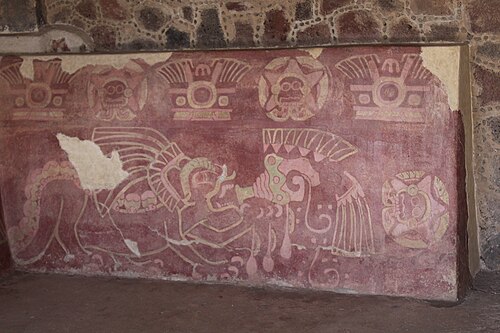
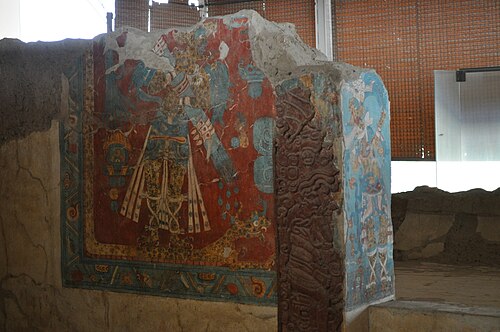
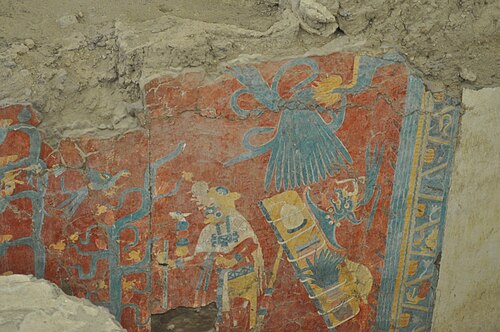


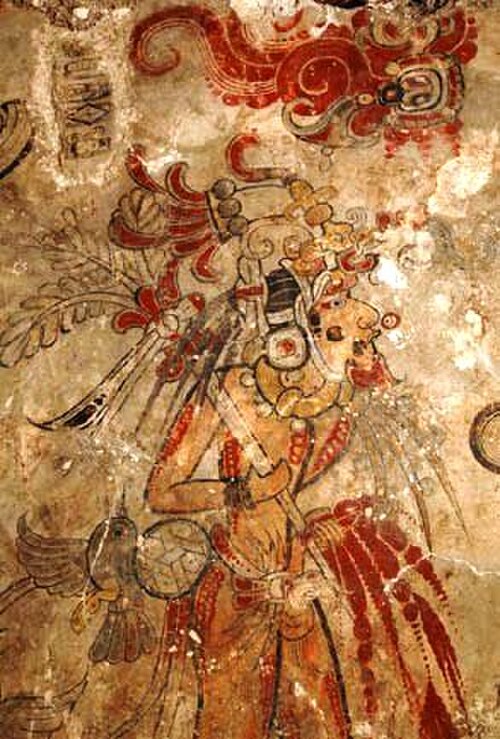


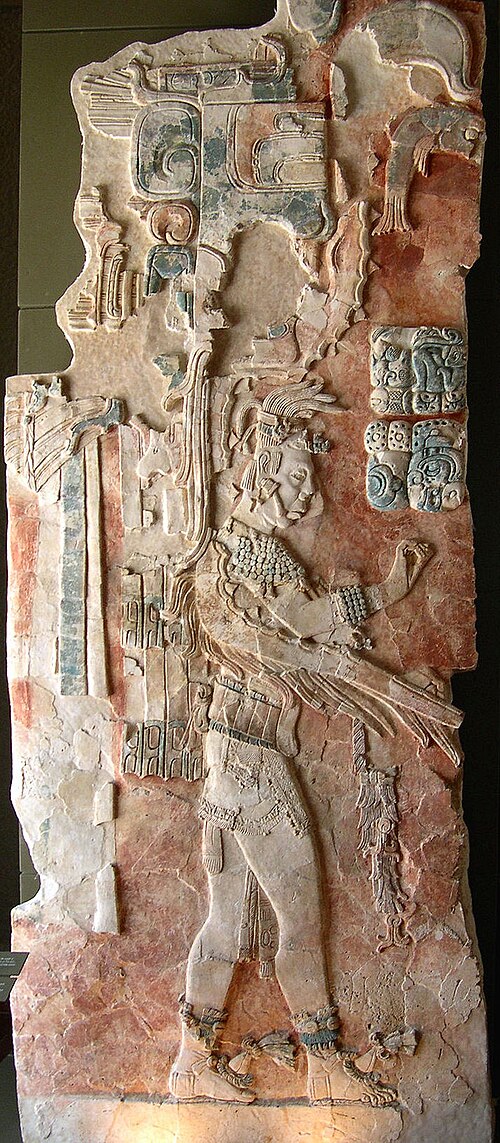


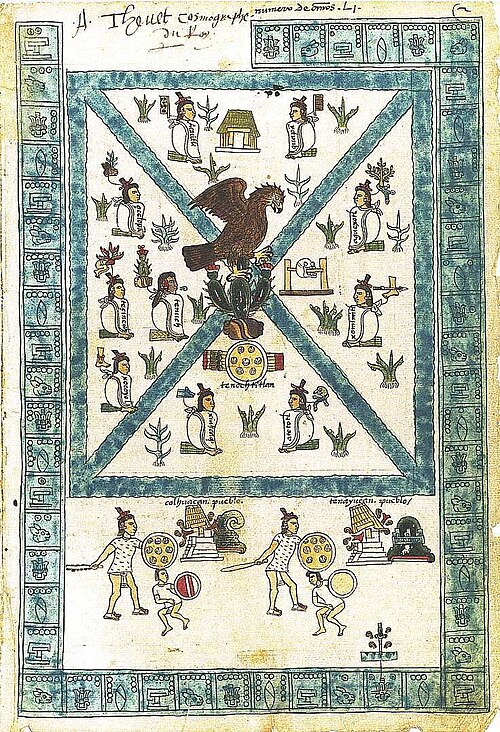


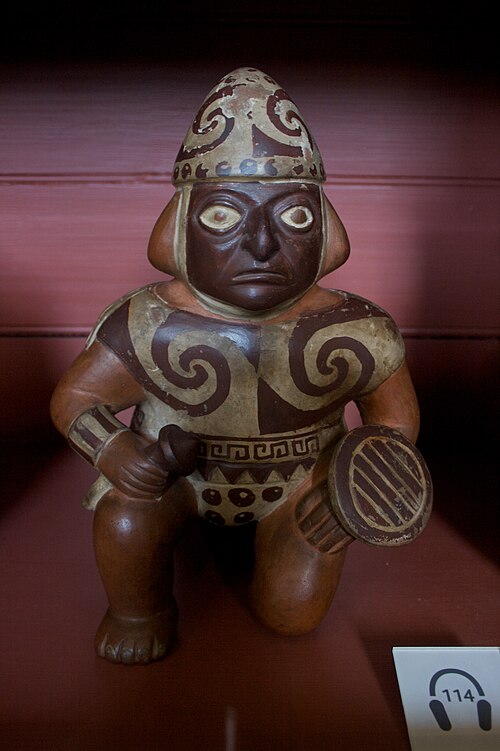

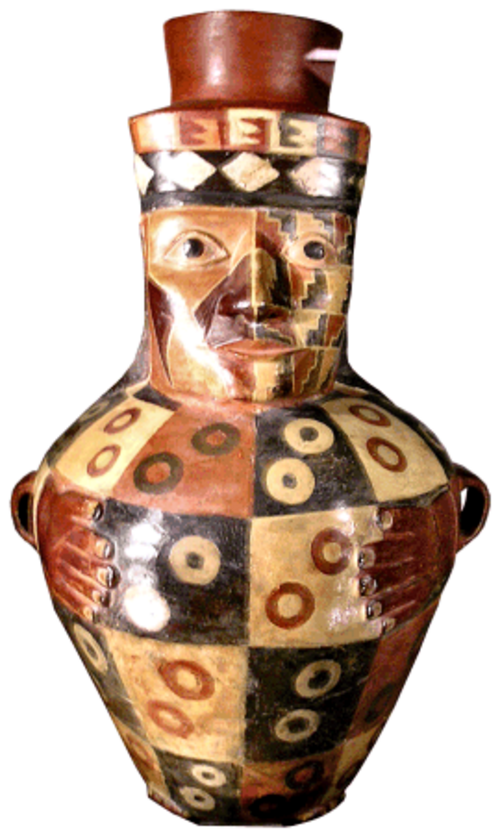

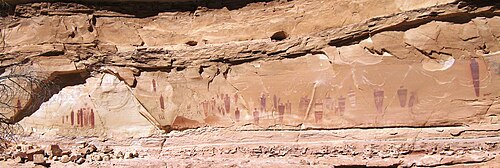
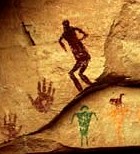

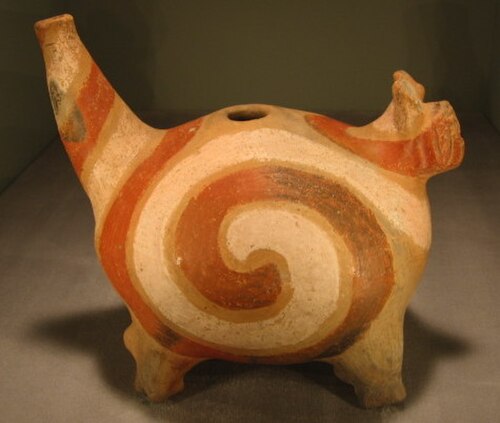


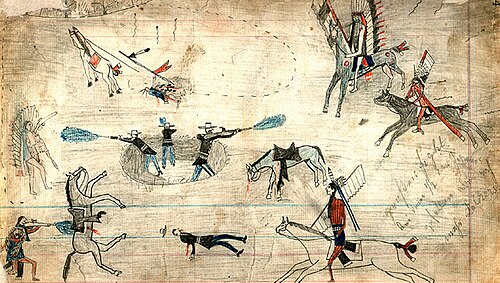


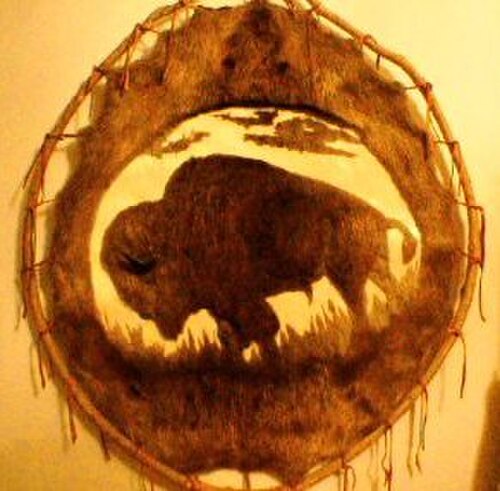


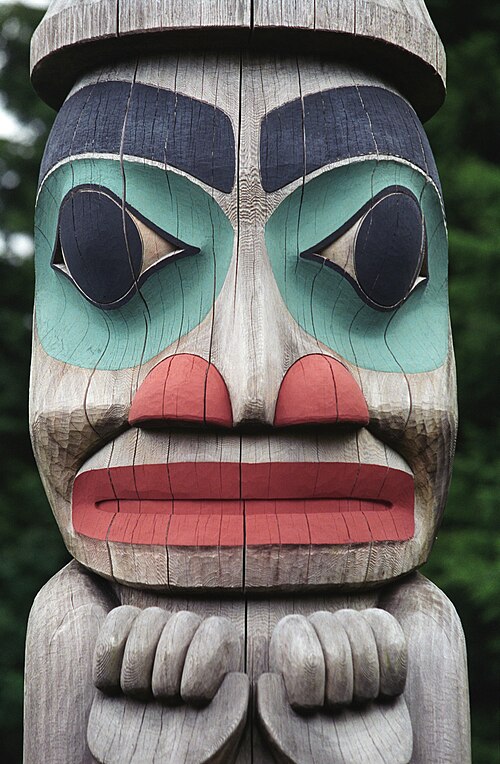


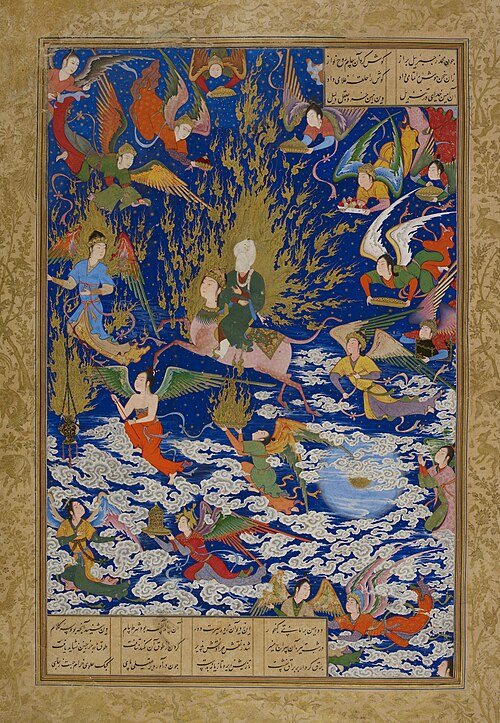


The depiction of humans, animals or any other figurative subjects is forbidden within Islam to prevent believers from idolatry so there is no religiously motivated painting (or sculpture) tradition within Muslim culture. Pictorial activity was reduced to Arabesque, mainly abstract, with geometrical configuration or floral and plant-like patterns. Strongly connected to architecture and calligraphy, it can be widely seen as used for the painting of tiles in mosques or in illuminations around the text of the Koran and other books. In fact, abstract art is not an invention of modern art but it is present in pre-classical, barbarian and non-western cultures many centuries before it and is essentially a decorative or applied art. Notable illustrator M. C. Escher was influenced by this geometrical and pattern-based art. Art Nouveau (Aubrey Beardsley and the architect Antonio Gaudí) re-introduced abstract floral patterns into western art.
Note that despite the taboo of figurative visualization, some Muslim countries did cultivate a rich tradition in painting, though not in its own right, but as a companion to the written word. Iranian or Persian art, widely known as Persian miniature, concentrates on the illustration of epic or romantic works of literature. Persian illustrators deliberately avoided the use of shading and perspective, though familiar with it in their pre-Islamic history, in order to abide by the rule of not creating any lifelike illusion of the real world. Their aim was not to depict the world as it is, but to create images of an ideal world of timeless beauty and perfect order.
Oriental historian Basil Gray believes "Iran has offered a particularly unique [sic] art to the world which is excellent in its kind". Caves in Iran's Lorestan province exhibit painted imagery of animals and hunting scenes. Some such as those in Fars Province and Sialk are at least 5,000 years old. Painting in Iran is thought to have reached a climax during the Tamerlane era, when outstanding masters such as Kamaleddin Behzad gave birth to a new style of painting.
Paintings of the Qajar period are a combination of European influences and Safavid miniature schools of painting such as those introduced by Reza Abbasi and classical works by Mihr 'Ali. Masters such as Kamal-ol-molk further pushed forward the European influence in Iran. It was during the Qajar era when "Coffee House painting" emerged. Subjects of this style were often religious in nature depicting scenes from Shia epics and the like.


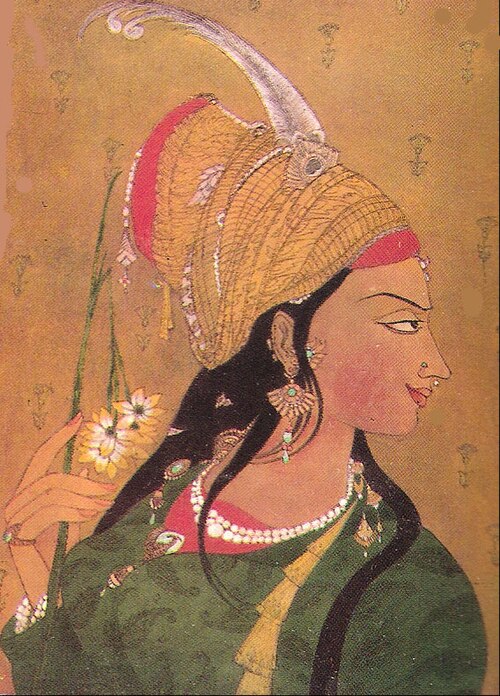


African traditional culture and tribes do not seem to have great interest in two-dimensional representations in favour of sculpture and relief. However, decorative painting in African culture is often abstract and geometrical. Another pictorial manifestation is body painting, and face painting present for example in Maasai and Kĩkũyũ culture in their ceremony rituals. Ceremonial cave painting in certain villages can be found to be still in use. Note that Pablo Picasso and other modern artists were influenced by African sculpture and masks in their varied styles. Contemporary African artists follow western art movements and their paintings have little difference from occidental art works.

The Kingdom of Kush in ancient Nubia (i.e. modern Sudan), bordering Ancient Egypt, produced a wide variety of arts, including wall paintings and painted objects. At the Sudanese site of Kerma, center of the Kerma culture that predated the Kingdom of Kush, a circa 1700 BC fragmentary painting from a royal tomb depicts a sailing ship and houses with ladders that are similar to scenes in reliefs from the reign of Egyptian queenHatshepsut (c. 1479–1458 BC).[100][101] The ancient tradition of wall paintings, first described by Abu Salih during the 12th century AD, continued into the period of medieval Nubia.[102]

The Christian tradition of painting in Ethiopia dates back to the 4th century AD, during the ancient Kingdom of Aksum.[103] During their exile to Axum, the 7th-century followers of Muhammad described paintings decorating the Church of Our Lady Mary of Zion.[104] However, the earliest surviving examples of church paintings in Ethiopia come from the church of Debre Selam Mikael in the Tigray Region, dated to the 11th century AD.[104] Ethiopian paintings in illuminated manuscripts predate the earliest surviving church paintings. For instance, the Ethiopian Garima Gospels of the 4th-6th centuries AD contain illuminated scenes imitating the contemporary Byzantine illuminated style.[105]


At the start of the 20th century, artists like Picasso, Matisse, Paul Gauguin and Modigliani became aware of, and were inspired by, African art.[106] In a situation where the established avant garde was straining against the constraints imposed by serving the world of appearances, African Art demonstrated the power of supremely well organised forms; produced not only by responding to the faculty of sight, but also and often primarily, the faculty of imagination, emotion and mystical and religious experience. These artists saw in African art a formal perfection and sophistication unified with phenomenal expressive power.[107][108][109][110][111]
{{cite news}}: CS1 maint: deprecated archival service (link)Les Demoiselles contains vestiges of Cézanne, El Greco, Gauguin and Ingres, among others, with the addition of conceptual aspects of primitive art properly represented with geometry.