
Loading article…
古代エジプト | |||||||||
|---|---|---|---|---|---|---|---|---|---|
| 紀元前 3150年頃 –紀元前332/30年[a] | |||||||||
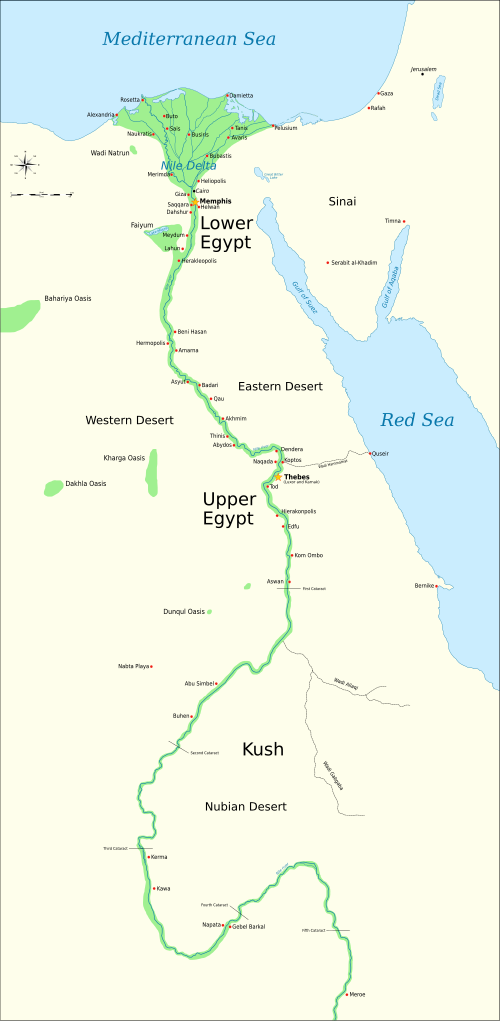 古代エジプトの地図。王朝時代(紀元前 3150 年頃~紀元前 30 年頃)の主要都市と遺跡を示してい ます。 | |||||||||
| 資本 | エジプトの歴史的首都の一覧を参照 | ||||||||
| 歴史時代 | 古代史 | ||||||||
• 設立 | 紀元前 3150年頃 | ||||||||
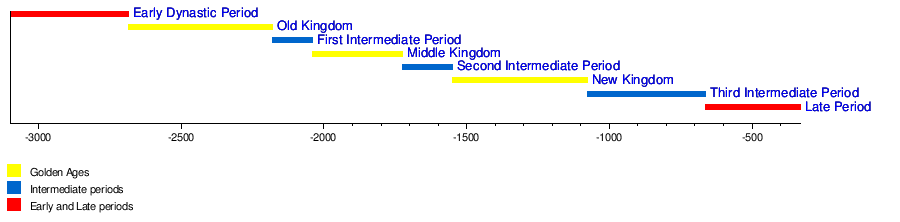
• 初期王朝時代 | 紀元前 3150年頃– 紀元前2686年頃 | ||||||||
• 古王国時代 | 紀元前2686年 – 紀元前2181年 | ||||||||
• 中王国時代 | 紀元前2134年 – 紀元前1690年 | ||||||||
• 新王国時代 | 紀元前1549年 – 紀元前1078/77年[b] | ||||||||
• 後期 | 紀元前664年 – 紀元前332年 | ||||||||
• プトレマイオス朝 | 紀元前332年 – 紀元前30年 | ||||||||
• 廃止 | 紀元前332/30年[a] | ||||||||
| |||||||||

古代エジプトは、古代北東アフリカの文明であった。ナイル川下流域に集中しており、現在のエジプトの領土内にある。古代エジプト文明は先史時代のエジプトに続き、紀元前3100年頃(エジプトの慣習的な年代学によれば)[1]にメネス(ナルメルと同一視されることが多い)による上下エジプトの政治的統一とともに融合した。[2]古代エジプトの歴史は、一連の安定した王国と、「中間期」と呼ばれる比較的不安定な期間が点在する形で展開した。さまざまな王国は、前期青銅器時代の古王国、中期青銅器時代の中王国、後期青銅器時代の新王国の3つのカテゴリのいずれかに分類される。
古代エジプトは新王国時代に最盛期を迎え、ヌビアの大部分とレバントのかなりの部分を支配した。この時期の後、緩やかな衰退期に入った。歴史の中で、古代エジプトはヒクソス、ヌビア人、アッシリア人、アケメネス朝ペルシア人、アレクサンドロス大王率いるマケドニア人など、多くの外国勢力の侵略や征服を受けた。アレクサンドロスの死後に形成されたギリシャのプトレマイオス王国は、紀元前30年まで支配したが、クレオパトラの下でローマ帝国の手に落ち、ローマの属州となった。[3]エジプトは640年代にラシドゥーン・カリフに征服されるまでローマの支配下にあった。
古代エジプト文明の成功は、ナイル川流域の農業条件に適応する能力に一部起因していた。肥沃な渓谷では予測可能な洪水と管理された灌漑により余剰作物が生産され、人口密度の上昇、社会の発展、文化の発展を支えた。行政は資源に余裕があったため、渓谷と周囲の砂漠地帯の鉱物資源の開発、独自の文字体系の早期開発、集団建設と農業プロジェクトの組織、周辺地域との貿易、エジプトの優位性を主張するための軍隊の育成を支援した。これらの活動の動機付けと組織化は、ファラオの支配下にあるエリート書記官、宗教指導者、行政官からなる官僚機構によるもので、ファラオは精巧な宗教的信念体系のもとでエジプト国民の協力と団結を確保した。[4]
古代エジプト人の多くの功績には、巨大なピラミッド、寺院、オベリスクの建造を支えた採石、測量、建設技術、数学体系、実用的で効果的な医療体系、灌漑システム、農業生産技術、最初の板張りの船、[5]エジプトのファイアンス焼きとガラス技術、新しい文学形態、ヒッタイトとの最も古い平和条約などがある。[6]古代エジプトは永続的な遺産を残した。その芸術と建築は広く模倣され、その遺物は世界の遠い隅々にまで運ばれた。その巨大な遺跡は何千年もの間、旅行者や作家の想像力を刺激してきた。近世のヨーロッパ人とエジプト人による遺物と発掘に対する新たな敬意は、エジプト文明の科学的調査とその文化的遺産へのより大きな認識につながった。[7]
歴史
ナイル川は人類の歴史の大部分において、この地域の生命線となってきました。[8]ナイル川の肥沃な氾濫原は、人類に安定した農業経済と、人類文明の歴史の礎となったより洗練された中央集権的な社会を発展させる機会を与えました。[9] 遊牧民である 現代の 狩猟採集民は、約12万年前の中期更新世の終わりまでナイル川流域に住み始めました。後期旧石器時代までに、北アフリカの乾燥した気候はますます暑く乾燥し、その地域の人口は川沿いに集中せざるを得なくなりました。
先王朝時代

先王朝時代と初期王朝時代のエジプトの気候は、今日ほど乾燥していなかった。エジプトの広大な地域は樹木が生い茂るサバンナに覆われ、草を食む有蹄類の群れが行き交っていた。周囲の植物や動物は今よりはるかに豊富で、ナイル川流域では水鳥の大きな群れが生息していた。エジプト人にとって狩猟は一般的なものであり、多くの動物が初めて家畜化されたのもこの時代である。[10]
紀元前5500年頃までに、ナイル渓谷に住んでいた小さな部族は、農業と畜産をしっかりと管理し、陶器や櫛、腕輪、ビーズなどの個人用品で識別できる一連の文化に発展しました。これらの上エジプト(南エジプト)の初期の文化の中で最大のものはバダリアン文化で、おそらく西部砂漠で始まり、高品質の陶器、石器、銅の使用で知られていました。[11]
バダリ文化の後にはナカダ文化が続き、ナカダ I (アムラティア)、ナカダ II (ゲルゼー)、ナカダ III (セマイネ) となった。[12]これらの文化は多くの技術的進歩をもたらした。ナカダ I 期には早くも、先王朝時代のエジプト人がエチオピアから黒曜石を輸入し、その薄片から刃物やその他の物体を成形するのに使用していた。[13] [14]レヴァントとの相互貿易はナカダ II (紀元前 3600 年 - 3350 年頃) の間に確立された。この時期はメソポタミアとの貿易の始まりでもあり、初期王朝時代以降まで続いた。[15]約 1,000 年の間に、ナカダ文化は少数の小さな農業コミュニティから、指導者がナイル渓谷の人々と資源を完全に支配する強力な文明へと発展した。 [ 16 ]ナカダ3世の指導者たちは、ネケン(ギリシャ語ではヒエラコンポリス)に、後にアビドスに権力の中心を築き、ナイル川に沿って北方へとエジプトの支配を拡大した。[17]彼らはまた、南のヌビア、西の西部砂漠のオアシス、東の地中海東部や近東の文化と交易を行った。[18] [いつ? ]
ナカダ文化では、エリート層の権力と富の増大を反映して、多様な物品が製造されたほか、櫛、小型彫像、彩色陶器、高品質の装飾用石花瓶、化粧用パレット、金、ラピスラズリ、象牙で作られた宝飾品など、社会の個人使用品も生産された。また、ファイアンス焼きと呼ばれる陶器の釉薬も開発され、ローマ時代までカップ、お守り、人形の装飾に使用されていた。[19] [20]最後の先王朝時代には、ナカダ文化は文字による記号を使い始め、最終的には古代エジプト語の表記に用いられる完全な象形文字体系へと発展した。[21]
.jpg/500px-Tomb_100_Hierakompolis,_Naqada_II_culture_(c._3500-3200_BCE).jpg)
初期王朝時代(紀元前 3150–2686紀元前)
初期王朝時代は、メソポタミアおよび古代エラムの初期シュメール・アッカド文明とほぼ同時期であった。紀元前3世紀のエジプトの神官マネトは、メネスから彼の時代までの長い王朝を30の王朝に分けたが、この体系は今日でも使用されている。彼は、上エジプトと下エジプトの2つの王国を統一したと信じられていた「メニ」(ギリシャ語ではメネス)という名の王から公式の歴史を始めた。[22]
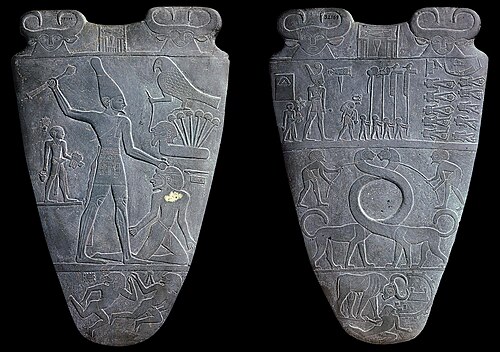
統一国家への移行は古代エジプトの著述家が記述するよりも緩やかに起こり、メネスに関する同時代の記録はない。しかしながら、一部の学者は現在、神話上のメネスはナルメル王であった可能性があると考えている。ナルメル王は、統一の象徴として、儀式用のナルメル・パレットに王家の衣装を身に着けている姿で描かれている。 [24]紀元前3000年頃に始まった初期王朝時代、最初の王朝の王はメンフィスに首都を建設して下エジプトの支配を強固なものにした。メンフィスから肥沃なデルタ地帯の労働力と農業、およびレバントへの有利で重要な貿易ルートを支配できた。初期王朝時代の王たちの権力と富の増大は、アビドスの精巧なマスタバ墓と葬祭殿の構造に反映されており、これらは神格化された王の死後にその王を称えるために使われた。[25]王によって確立された強力な王権制度は、古代エジプト文明の存続と成長に不可欠な土地、労働力、資源に対する国家の統制を正当化するのに役立ちました。[26]
古王国時代(紀元前2686年~2181年)
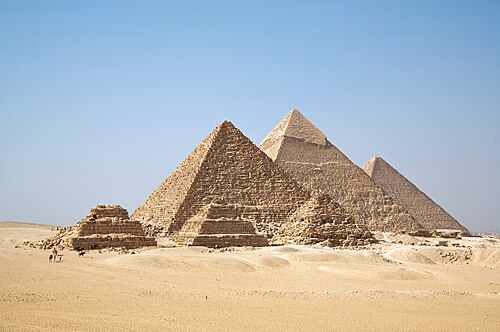
古王国時代には、中央集権化が進んだことで農業生産性と人口が増加し、建築、芸術、技術が大きく進歩した。 [27]古代エジプトの最高傑作であるギザのピラミッドやスフィンクスは古王国時代に建造された。宰相の指示のもと、国家の役人は税金を徴収し、作物の収穫量を増やすために灌漑事業を調整し、農民を建設事業に従事させ、平和と秩序を維持するための司法制度を確立した。[28]

エジプトで中央行政の重要性が高まるにつれ、教育を受けた書記官や役人の新しい階級が生まれ、彼らはその奉仕に対する報酬として国王から領地を与えられた。国王はまた、死後これらの機関が国王を崇拝するための資源を確保するために、葬祭儀礼や地方の寺院に土地を与えた。学者たちは、5世紀にわたるこれらの慣習がエジプトの経済的活力を徐々に蝕み、経済はもはや大規模な中央集権的な行政を支える余裕がなくなったと考えている。 [29]国王の権力が衰えると、ノマルクと呼ばれる地方の知事が国王の権威に異議を唱え始めた。これと紀元前2200年から2150年までの深刻な干ばつ が相まって、[30]国は第1中間期として知られる140年間の飢饉と紛争の時代に入ったと考えられている。[31]
第一中間期(紀元前2181年~2055年)
エジプトの中央政府が古王国末期に崩壊した後、行政はもはや国の経済を支えたり安定させたりすることができなくなった。地方の知事は危機の際に国王に助けを求めることができず、その結果生じた食糧不足と政治的紛争は飢饉と小規模な内戦へとエスカレートした。しかし困難な問題にもかかわらず、国王に貢物を納めていない地方の指導者たちは、新たに得た独立性を利用して、地方に繁栄する文化を確立した。自らの資源を管理できるようになると、地方は経済的に豊かになり、すべての社会階級において埋葬がより大規模で質が高くなったことでそれが示された。[32]地方の職人たちは創造性が爆発し、以前は古王国の王族に限定されていた文化的モチーフを採用、適応させ、書記官たちはその時代の楽観主義と独創性を表現する文学スタイルを開発した。 [33]
王への忠誠心から解放された地方の支配者たちは、領土の支配と政治権力をめぐって互いに競争し始めた。 紀元前2160年までに、ヘラクレオポリスの支配者たちは北の下エジプトを支配し、テーベを拠点とするライバル一族のインテフ家は南の上エジプトを支配した。インテフ家が勢力を拡大し、北方へと支配を拡大するにつれ、2つのライバル王朝の衝突は避けられなくなった。紀元前2055年頃、ネブヘペトレ・メンチュホテプ2世 率いるテーベ北部の勢力がついにヘラクレオポリスの支配者たちを打ち破り、2つの国を再び統一した。彼らは中王国として知られる経済的、文化的復興の時代を開始した。[34]
中王国時代(紀元前2134年~1690年)


中王国時代の王たちは国の安定と繁栄を回復し、それによって芸術、文学、記念碑的建築プロジェクトの復活を促した。[37]メンチュホテプ2世と第11王朝の後継者たちはテーベから統治したが、宰相アメンエムハト1世は紀元前1985年頃、第12王朝の初めに王位に就くと 、王国の首都をファイユームにあるイチタウィ市に移した。[38]イチタウィでは、第12王朝の王たちは、その地域の農業生産高を増やすために、先見の明のある干拓と灌漑計画に着手した。さらに、軍は採石場と金鉱が豊富なヌビアの領土を再征服し、労働者たちは外国の攻撃から守るために「支配者の壁」と呼ばれる東デルタの防御構造物を建設した。[39]
王たちは国を軍事的、政治的に安定させ、莫大な農産物や鉱物資源を自由に使えるようになり、国民の人口、芸術、宗教は繁栄した。古王国時代の神に対するエリート主義的な態度とは対照的に、中王国時代は個人的な信心深さの表現が増加した。[40]中王国時代の文学は、自信に満ちた雄弁な文体で書かれた洗練されたテーマと登場人物を特徴としていた。[ 33]この時代のレリーフや肖像彫刻は、技術的に洗練された新たな高みに達した、微妙で個々のディテールを捉えていた。[41]
中王国時代の最後の偉大な君主、アメンエムハト3世は、特に活発な採鉱と建築活動に十分な労働力を提供するために、近東からセム語を話すカナン人の移住者をデルタ地帯に受け入れた。しかし、この野心的な建築と採鉱活動は、彼の治世後期のナイル川の深刻な洪水と相まって経済を圧迫し、第13王朝と第14王朝の後半の第二中間期にかけて緩やかな衰退を早めた。この衰退期に、カナン人の移住者はデルタ地帯をより強固に支配し始め、最終的にヒクソスとしてエジプトで権力を握った。[42]
第2中間期(紀元前1674年~1549年)とヒクソス
紀元前1785年頃 、中王国の王たちの力が弱まると、デルタ地帯に既に定住していたヒクソスと呼ばれる西アジアの人々がエジプトを掌握し、アヴァリスに首都を置き、かつての中央政府をテーベに撤退させた。王は家臣として扱われ、貢物を納めることが求められた。[43]ヒクソス(「外国の支配者」)はエジプトの政治モデルを保持し、王として自認し、それによってエジプトの要素を彼らの文化に取り入れた。彼らと他の侵略者は、最も有名なのは複合弓と馬が引く戦車である。[44]
南に撤退した後、現地のテーベ王たちは、北を支配していたカナン人のヒクソスと、南を支配していたヒクソスのヌビア同盟者であるクシュ人 の間に挟まれてしまった。テーベは数年にわたる従属関係の後、ヒクソスに挑むのに十分な力を蓄え、紀元前1555年まで30年以上続いた紛争に臨んだ。[43]セケネンラー・タオ2世とカモセ王は最終的にエジプト南部のヌビア人を倒すことはできたが、ヒクソスを倒すことはできなかった。その任務はカモセの後継者であるアフメス1世に委ねられ、彼は一連の軍事作戦を成功させ、エジプトからヒクソスの存在を永久に根絶した。彼は新しい王朝を樹立し、その後の新王国では、軍事が王たちにとって最優先事項となり、エジプトの国境を拡大し、近東の支配権を獲得しようとした。 [ 45]
新王国時代(紀元前1549年~1069年)

新王国時代のファラオたちは、国境を守り、ミタンニ帝国、アッシリア、カナンなどの近隣諸国との外交関係を強化することで、前例のない繁栄の時代を築きました。トトメス1世とその孫のトトメス3世が行った軍事作戦により、ファラオたちの影響力はエジプト史上最大の帝国へと拡大しました。
彼らの治世の間に、ファラオとしての地位を確立したハトシェプスト女王は、ヒクソスによって破壊された寺院の修復を含む多くの建築プロジェクトを立ち上げ、プントとシナイに貿易遠征隊を派遣しました。[46]トトメス3世が紀元前1425年に亡くなったとき 、エジプトはシリア北西部のニヤからヌビアのナイル川第4急流まで広がる帝国を築き、忠誠心を固め、青銅や木材などの重要な輸入品へのアクセスを開きました。[47]
新王国時代のファラオたちは、カルナックを拠点として成長していたアメン神を宣伝するために、大規模な建築キャンペーンを開始しました。彼らはまた、現実と想像の両方で、自分たちの功績を称える記念碑を建設しました。カルナック神殿は、これまでに建てられたエジプト最大の神殿です。[48]
紀元前1350年頃 、アメンホテプ4世が即位し、一連の急進的で混沌とした改革を実施したことで、新王国の安定が脅かされた。アメンホテプ4世は名前をアクエンアテンと改め、それまで無名だった太陽神 アテンを最高神として宣伝し、他のほとんどの神々の崇拝を抑圧し、首都を新都市アケタテン(現在のアマルナ)に移した。[49]彼は新しい宗教と芸術スタイルに没頭した。彼の死後、アテン崇拝はすぐに放棄され、伝統的な宗教秩序が復活した。その後のファラオ、ツタンカーメン、アイ、ホルエムヘブは、現在アマルナ時代として知られるアクエンアテンの異端に関するすべての言及を消し去ろうとした。[50]
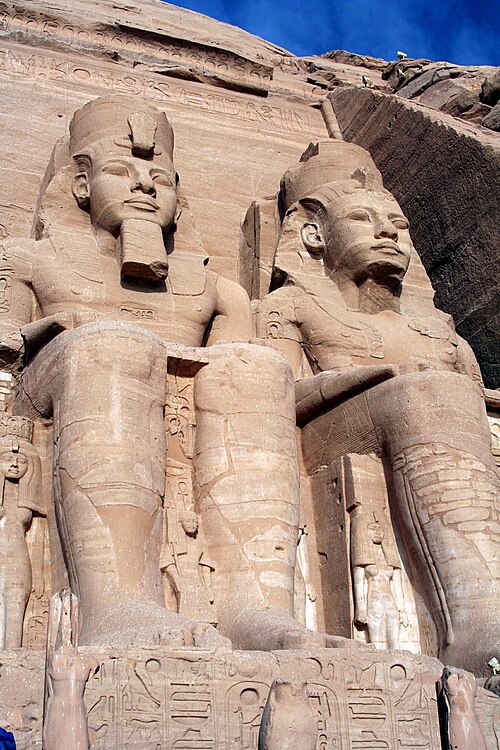
紀元前1279年頃 、ラムセス2世(ラムセス大王としても知られる)が王位に就き、歴史上他のどのファラオよりも多くの寺院を建設し、多くの彫像やオベリスクを建て、多くの子供をもうけた。[c]大胆な軍事指導者であったラムセス2世は、カデシュの戦い(現在のシリア)でヒッタイトに対して軍を率い、膠着状態まで戦った後、紀元前1258年頃、記録に残る最初の平和条約 にようやく同意した。[51]
しかし、エジプトの富は侵略の格好の標的となり、特に西方のリビア・ ベルベル人や、エーゲ海からの航海者連合とされる海の民が侵略した。[d]当初、軍はこれらの侵略を撃退できたが、エジプトは最終的に南カナンに残っていた領土の支配権を失い、その多くはアッシリア人の手に落ちた。外部からの脅威の影響は、腐敗、墓の略奪、内乱などの内部問題によって悪化した。権力を取り戻したテーベのアメン神殿の高僧たちは広大な土地と富を蓄積し、その拡大した権力は第3中間期に国を分裂させた。[52]
第三中間期(紀元前1069年~653年)
紀元前1078年にラムセス11世が死去した後 、スメンデスはエジプト北部の権力を掌握し、タニス市から統治した。南部はテーベのアメン大祭司によって実質的に支配され、彼らはスメンデスを名ばかり認めていた。[53]この頃、リビア人は西デルタに定住し始めており、これら定住者の族長たちは自治権を拡大し始めた。リビアの王子たちは紀元前945年にショシェンク1世 の下でデルタを掌握し、約200年間統治することになる、いわゆるリビア王朝またはブバスティテ王朝を建国した。ショシェンクはまた、家族を重要な祭司職に就かせることで南エジプトの支配権も獲得した。デルタ地帯でレオントポリスにライバル王朝が勃興し、クシュ人が南から脅威を与えると、 リビアの支配は弱まり始めた。

紀元前727年頃、 クシュ王ピイが北方に侵攻し、テーベとデルタを制圧し、第25王朝が成立した。[55]第25王朝の間、ファラオ・タハルカは新王国時代とほぼ同じ大きさの帝国を築いた。第25王朝のファラオは、メンフィス、カルナック、カワ、ジェベル・バルカルなど、ナイル渓谷全体に寺院や記念碑を建設または修復した。[56]この時期、ナイル渓谷では中王国時代以来初めてピラミッド(多くは現代のスーダンにある)が広範囲に建設された。 [57] [58] [59]
エジプトの広範な威信は、第三中間期の終わりに向かって大幅に低下した。その外国の同盟国はアッシリアの影響下に入り、 紀元前700年までに両国間の戦争は避けられなくなった。紀元前671年から667年の間に、アッシリア人はエジプトの征服を 開始した。タハルカとその後継者タヌタムンの統治下は、エジプトがアッシリアに対して何度も勝利したにもかかわらず、アッシリアとの絶え間ない紛争に満ちていた。最終的に、アッシリア人はクシュ人をヌビアに押し戻し、メンフィスを占領し、テーベの寺院を略奪した。[60]
後期(紀元前653年~332年)
アッシリア人はエジプトの支配権を一連の家臣に委ね、彼らは第26王朝のサイス朝の王として知られるようになった。紀元前653年までに 、サイス朝の王プサムティク1世は、エジプト初の海軍を結成するために雇われたギリシャ人傭兵の助けを借りてアッシリアを追い出すことができた。ナウクラティスの都市国家がナイル川デルタのギリシャ人の本拠地となったため、ギリシャの影響は大きく拡大した。新しい首都サイスに拠点を置いたサイス朝の王たちは、経済と文化の短いながらも活気に満ちた復活を目の当たりにしたが、紀元前525年、カンビュセス2世率いる強力なペルシア人がエジプト征服を開始し、最終的にペルシウムの戦いでファラオのプサムティク3世を捕らえた。その後、カンビュセス2世は正式にファラオの称号を得たが、エジプトをサトラップの支配下に置き、イランからエジプトを統治した。紀元前5世紀にはペルシャ人に対する反乱が数回成功したが、エジプトはペルシャ人を永久に打倒することはできなかった。[61]
ペルシアによる併合後、エジプトはキプロスとフェニキアとともにアケメネス朝ペルシア帝国の第6サトラップに加わった。第27王朝としても知られるペルシアによるエジプト支配の最初の時代は、エジプトが一連の土着王朝の下で独立を取り戻した紀元前402年に終わった 。これらの王朝の最後の第30王朝は、古代エジプトの最後の土着王家であることが判明し、ネクタネボ2世の王位で終わった。第31王朝としても知られるペルシアによる支配の短い復活は紀元前343年に始まりました が、その直後の紀元前332年にペルシアの支配者マザケスは戦うことなくエジプトをアレクサンダー大王 に引き渡しました。 [62]
プトレマイオス朝時代(紀元前332年~紀元前30年)
_-_2009.jpg/500px-Ring_with_engraved_portrait_of_Ptolemy_VI_Philometor_(3rd%E2%80%932nd_century_BCE)_-_2009.jpg)
紀元前332年 、アレクサンダー大王はペルシア人の抵抗をほとんど受けずにエジプトを征服し、エジプト人から救世主として歓迎された。アレクサンダーの後継者によって樹立されたマケドニア ・プトレマイオス朝はエジプトをモデルにしており、新しい首都アレクサンドリアを拠点としていた。この都市はヘレニズム統治の力と威信を誇示し、ムセイオンの一部として有名なアレクサンドリア図書館を含む学問と文化の中心地となった。[63]アレクサンドリアの灯台は、市内を通る貿易を続ける多くの船の道を照らした。プトレマイオス朝は商業と、パピルス製造などの収益を生み出す事業を最優先していたからである。[64]
ヘレニズム文化はエジプト土着の文化に取って代わることはなかった。プトレマイオス朝は民衆の忠誠心を確保するために昔からの伝統を支持した。彼らはエジプト風の新しい寺院を建て、伝統的な崇拝を支持し、自らをファラオに仕立てた。ギリシャとエジプトの神々がセラピスなどの合成神に融合され、古典ギリシャの彫刻が伝統的なエジプトのモチーフに影響を与えたなど、いくつかの伝統が融合した。エジプト人をなだめる努力にもかかわらず、プトレマイオス朝は土着の反乱、激しい一族間の対立、プトレマイオス4世の死後に形成されたアレクサンドリアの強力な暴徒に悩まされた。[65]さらに、ローマはエジプトからの穀物輸入に大きく依存していたため、ローマ人はエジプトの政治情勢に大きな関心を寄せていた。エジプトの反乱が続き、野心的な政治家や近東からの強力な反対勢力がこの状況を不安定にし、ローマはエジプトを帝国の属州として確保するために軍隊を派遣した。[66]
ローマ時代(紀元前30年~紀元後641年)

紀元前30年、アクティウムの海戦でオクタヴィアヌス(後のアウグストゥス帝)がマルクス・アントニウスとプトレマイオス朝クレオパトラ7世女王を破った後、エジプトはローマ帝国の属州となった。ローマ人はエジプトからの穀物輸送に大きく依存しており、皇帝が任命した長官の指揮下にあるローマ軍は反乱を鎮圧し、重税の徴収を厳格に執行し、当時悪名高かった盗賊の襲撃を防いだ。[67]ローマではエキゾチックな贅沢品の需要が高かったため、アレクサンドリアは東洋との貿易ルートの重要な中心地となっていった。[68]
ローマ人はエジプト人に対してギリシャ人よりも敵対的な態度をとっていたが、ミイラ作りや伝統的な神々の崇拝などの伝統は続いた。[69]ミイラ肖像画の芸術は栄え、ローマ皇帝の中にはプトレマイオス朝ほどではないにせよ、自らをファラオとして描いた者もいた。前者はエジプト国外に居住し、エジプト王権の儀式的な機能を果たしていなかった。地方行政はローマ風となり、エジプト原住民には閉ざされた。[69]
紀元1世紀半ばから、キリスト教がエジプトに根付き、当初は受け入れられるもう一つのカルトとみなされていた。しかし、キリスト教は、異教のエジプトやギリシャ・ローマの宗教からの改宗者を獲得しようとし、民衆の宗教的伝統を脅かす妥協のない宗教であった。これがキリスト教改宗者の迫害につながり、303年に始まったディオクレティアヌス帝による大粛清で頂点に達したが、最終的にはキリスト教が勝利した。[70] 391年、キリスト教徒の皇帝テオドシウスは、異教の儀式を禁止し寺院を閉鎖する法律を導入した。[71]アレクサンドリアは大規模な反異教徒暴動の舞台となり、公的および私的な宗教的イメージが破壊された。[72]その結果、エジプト固有の宗教文化は衰退の一途をたどった。原住民は引き続き彼らの言語を話していたが、エジプトの寺院の司祭と女司祭の役割が縮小するにつれて、ヒエログリフの読み書き能力は徐々に失われていった。寺院自体は教会に改築されたり、砂漠に放棄されたりすることもあった。[73]
4世紀、ローマ帝国が分裂すると、エジプトはコンスタンティノープルを首都とする東ローマ帝国の一部となった。帝国の衰退期、エジプトはササン朝によるエジプト征服(618-628年)でササン朝ペルシャ軍に陥落した。その後、ビザンチン皇帝ヘラクレイオス(629-639年)によって奪還され、最終的に639-641年にイスラム教徒のラシドゥーン軍によって占領され、ビザンチン帝国の支配と、一般的に古代エジプトと見なされる時代の終わりを告げた。[要出典]
政府と経済
行政と商業
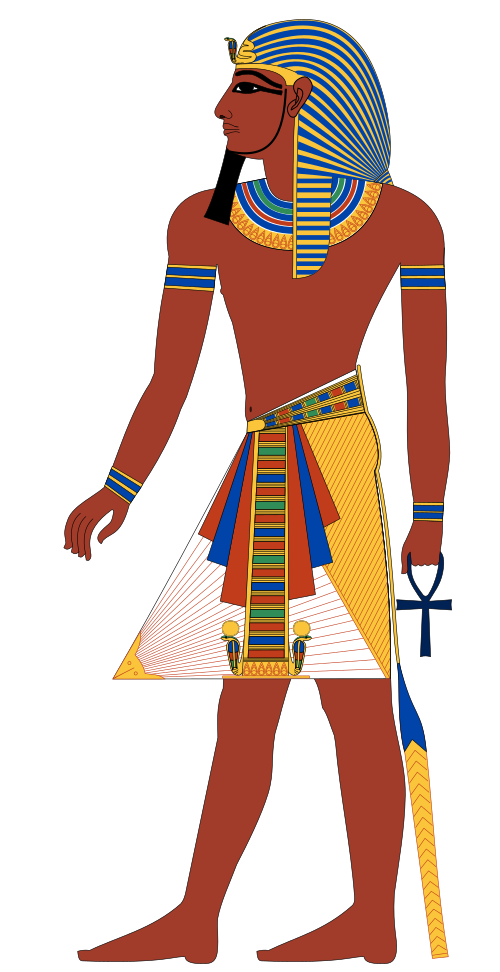
ファラオは国の絶対君主であり、少なくとも理論上は、土地とその資源を完全に支配していた。国王は最高軍事司令官であり政府の長であり、官僚組織に業務の管理を任せていた。行政を担当したのは副司令官の宰相で、宰相は国王の代理人として土地の測量、財務、建築プロジェクト、法制度、公文書の調整を行った。[74]地域レベルでは、国はノムと呼ばれる42もの行政地域に分かれており、各地域はノマルクによって統治され、ノマルクは宰相に対して管轄権の説明責任を負っていた。寺院は経済の屋台骨を形成していた。寺院は礼拝の場であっただけでなく、穀物や物資を再分配する監督官によって管理される穀倉と宝物庫のシステムで王国の富を集めて保管する役割も担っていた。[75]
経済の大部分は中央集権的に組織され、厳しく管理されていた。古代エジプト人は後期まで貨幣を使用しなかったが[76]、ある種の物々交換システムを使用していた[77]。穀物の標準袋と、約91グラム(3オンス)の銅または銀の重さであるデベンが共通の分母を形成していた[78] 。労働者は穀物で支払われた。単純な労働者は5ポンドを稼ぐことができた。+1 ⁄ 2 袋(200 kgまたは400ポンド)の穀物を月に稼ぐことができるのに対し、監督は7+エジプトでは、 1 ⁄ 2 袋(250 kgまたは550ポンド)の値段で取引されていました。価格は国中で固定され、取引を容易にするためにリストに記録されていました。たとえば、シャツは5銅デベンでしたが、牛は140 デベンでした。穀物は固定価格リストに従って他の商品と交換できました。 [78]紀元前5世紀には、外国から硬貨がエジプトに導入されました。最初は硬貨は真のお金ではなく標準化された貴金属として使用されていましたが、次の数世紀には国際貿易業者が硬貨に頼るようになりました。 [79]
社会的地位

エジプト社会は高度に階層化されており、社会的地位は明確に示されていた。人口の大部分は農民であったが、農産物は土地を所有する国家、寺院、または貴族が直接所有していた。 [80]農民は労働税の対象でもあり、灌漑や建設プロジェクトで賦役制度の下で働くことを義務付けられていた。[81]芸術家や職人は農民よりも高い地位にあったが、彼らも国家の管理下にあり、寺院に併設された店で働き、国庫から直接給料を受け取っていた。古代エジプトでは、書記官や役人が上流階級を形成し、彼らの地位を示す漂白された亜麻布の衣服にちなんで「白いキルト階級」と呼ばれていた。[82]上流階級は芸術や文学において社会的地位を顕著に示していた。貴族の下には、専門分野の訓練を受けた聖職者、医師、技術者がいた。今日理解されているような奴隷制度が古代エジプトに存在したかどうかは不明であり、著者の間で意見が分かれている。[83]
古代エジプト人は、あらゆる社会階級の人々を含め、男性と女性は法の下で本質的に平等であるとみなし、最も低い身分の農民でさえ、大臣とその裁判所に補償を請願する権利があった。 [84]奴隷は主に年季奉公人として使われていたが、奴隷状態を売買したり、自由人や貴族の地位まで働いたりすることができ、職場では通常医師の治療を受けていた。 [85]男性も女性も、財産を所有および売却する権利、契約を結ぶ権利、結婚および離婚する権利、相続を受ける権利、法廷で法的紛争を追求する権利を持っていた。結婚したカップルは財産を共有し、結婚契約に同意することで離婚から身を守ることができた。結婚契約では、結婚が終了した場合に夫が妻と子供に対して負う経済的義務が規定されていた。古代ギリシャ、ローマ、さらには世界中のより現代的な場所の女性と比較して、古代エジプトの女性は、より幅広い個人的な選択、法的権利、達成の機会を持っていた。ハトシェプストやクレオパトラ7世などの女性はファラオになったり、アメン神の妻として権力を振るったりした。こうした自由があったにもかかわらず、古代エジプトの女性は、王室の高位の女祭司を除いて行政の公式な役割に就くことはあまりなく、神殿では補助的な役割しか果たしていなかったようで(多くの王朝についてはあまりデータがない)、男性ほど教育を受けていなかった可能性が高い。[84]
法制度

法制度の長は正式にはファラオであり、法律を制定し、正義を実現し、法と秩序を維持する責任があり、古代エジプト人はこの概念をマアトと呼んでいた。[74]古代エジプトの法典は残っていないが、裁判所の文書は、エジプトの法律が複雑な法令集に厳密に従うのではなく、合意に達し紛争を解決することを重視する常識的な善悪の見方に基づいていたことを示している。[84]新王国時代にケンベットと呼ばれた地元の長老会議は、少額の請求や小さな紛争を含む訴訟の判決を下す責任を負っていた。[74]殺人、大規模な土地取引、墓の強盗を含むより深刻な事件は、宰相またはファラオが議長を務めるグレートケンベットに委ねられた。原告と被告は自分自身で弁護することが期待され、真実を語ったという宣誓を要求された。場合によっては、国家が検察官と裁判官の両方の役割を担い、自白と共謀者の名前を得るために被告人を殴打して拷問することもありえた。罪状が些細なものであろうと重大であろうと、法廷書記官は将来の参考のために事件の告訴、証言、判決を記録した。[86]
軽犯罪に対する刑罰は、罪の重さに応じて、罰金、殴打、顔面の切断、追放のいずれかであった。殺人や墓荒らしなどの重罪は、斬首、溺死、または犯罪者の杭打ちによる処刑で処罰された。刑罰は犯罪者の家族にまで及ぶこともあった。[74]新王国時代以降、神託は法制度において大きな役割を果たし、民事および刑事事件の両方で正義を執行した。手順は、問題の正誤に関して神に「はい」または「いいえ」で尋ねることであった。神は数人の神官に担がれ、どちらか一方を選んだり、前進または後退したり、パピルスまたはオストラコンに書かれた答えの1つを指し示したりして、裁きを下した。[ 87 ]
農業
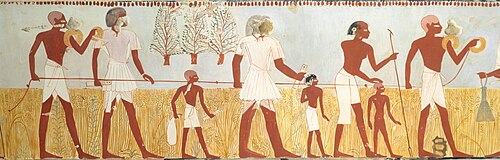

古代エジプト文化の成功には、有利な地理的条件の組み合わせが寄与したが、その中で最も重要なのは、ナイル川の毎年の氾濫によって生じた肥沃な土壌であった。古代エジプト人は、こうして豊富な食糧を生産することができ、国民は文化、技術、芸術の追求により多くの時間と資源を費やすことができた。古代エジプトでは、土地管理が極めて重要であった。なぜなら、税金は個人の所有する土地の面積に基づいて評価されたからである。[88]
エジプトの農業はナイル川の循環に依存していた。エジプト人は、アケト(洪水)、ペレト(植え付け)、シェム(収穫)の3つの季節を認識していた。洪水の季節は6月から9月まで続き、川岸に作物の栽培に最適なミネラル豊富な沈泥の層を堆積させた。洪水が引いた後、生育期は10月から2月まで続いた。農民は、溝や運河で灌漑された畑を耕し、種を植えた。エジプトは降雨量が少ないため、農民はナイル川の水に頼っていた。[89] 3月から5月まで、農民は鎌を使って作物を収穫し、次に殻を脱穀して穀物からわらを分離した。ふるい分けで穀物から籾殻を取り除き、穀物を挽いて小麦粉にしたり、醸造してビールを作ったり、後で使用するために貯蔵したりした。[90]
古代エジプト人は、エンマー麦や大麦、その他数種類の穀物を栽培し、それらはすべてパンとビールという二大主食を作るために使われた。[91]開花前に引き抜かれた 亜麻の植物は、茎の繊維を取るために栽培された。これらの繊維は長さに沿って分割され、糸に紡がれ、リネンのシーツを織ったり、衣服を作ったりするのに使われた。ナイル川の岸に生えるパピルスは紙を作るのに使われた。野菜や果物は、住居の近くや高台にある菜園で栽培され、手で水やりをしなければならなかった。野菜には、ワインを作るブドウに加えて、ネギ、ニンニク、メロン、カボチャ、豆類、レタスなどの作物が含まれていた。[92]

動物

エジプト人は、人間と動物の間のバランスのとれた関係は宇宙秩序の重要な要素であると信じていた。したがって、人間、動物、植物は単一の全体の一員であると信じられていた。[93]そのため、家畜と野生の両方の動物は、古代エジプト人にとって精神性、仲間意識、および栄養の重要な源であった。牛は最も重要な家畜であり、行政は定期的な国勢調査で家畜に税金を徴収し、群れの規模はそれらを所有する地所または寺院の威信と重要性を反映していた。牛に加えて、古代エジプト人は羊、山羊、豚を飼っていた。アヒル、ガチョウ、ハトなどの家禽は網で捕獲され、農場で飼育され、太らせるために生地を強制的に与えられていた。[94]ナイル川は豊富な魚の供給源であった。ミツバチも少なくとも古王国時代から家畜化されており、蜂蜜と蜜蝋の両方を提供していた。[95]
古代エジプト人はロバと牛を荷役動物として使い、畑を耕し、種を土に踏みつける役割を担っていた。肥えた牛を屠殺することも供物の儀式の中心的な部分だった。馬は第2中間期にヒクソスによって導入された。ラクダは新王国時代から知られていたが、末期洗礼までは荷役動物としては使われなかった。象も末期洗礼後に短期間使われていたが、放牧地不足のためほとんど放棄されたことを示す証拠もある。[94]猫、犬、猿は一般的な家庭のペットだったが、サハラ以南アフリカのライオンなどアフリカの中心部から輸入されたより珍しいペットは[96]王族だけのものだった。ヘロドトスは、エジプト人だけが家の中で動物を飼っていたと述べている。[93]末期王朝時代には、猫の女神バステトやトキの神トートなど、動物の姿をした神々の崇拝が非常に人気があり、これらの動物は儀式の犠牲として大量に飼育されていました。[97]
天然資源
エジプトは建築用・装飾用の石材、銅鉱石、鉛鉱石、金、半貴石が豊富。これらの天然資源のおかげで、古代エジプト人は記念碑を建て、彫像を彫刻し、道具を作り、宝飾品を作ることができた。[98]遺体 防腐処理師は、ワディ・ナトゥルンの塩をミイラ作りに使用したが、これは石膏を作るのに必要な石膏も供給した。[99]鉱石を含む岩層は、東部砂漠やシナイの遠く離れた過酷なワディで発見され、そこで見つかった天然資源を入手するには、大規模な国家管理の探検が必要だった。ヌビアには広大な金鉱山があり、知られている最初の地図の1つは、この地域の金鉱山のものである。ワディ・ハママットは、花崗岩、灰岩、金の有名な産地であった。フリントは、道具を作るために収集され使用された最初の鉱物であり、フリントハンドアックスは、ナイル渓谷での居住の最も古い証拠である。鉱物の塊は、銅がこの目的に採用された後も、適度な硬度と耐久性を備えた刃物や矢じりを作るために慎重に剥がされていました。[100]古代エジプト人は、硫黄などの鉱物を化粧品として使用した最初の人々の一人でした。[101]
エジプト人は、ゲベル・ロサスの鉛 鉱石である方鉛鉱の鉱床を採掘して、網おもり、下げ振り、小さな像を作った。銅は古代エジプトの道具作りに最も重要な金属であり、シナイで採掘された孔雀石鉱石から炉で精錬された。[102]労働者は、沖積鉱床の堆積物から金塊を洗い出すか、金を含む珪岩を粉砕して洗浄するというより労働集約的な方法で金を集めた。上エジプトで見つかった鉄鉱床は、末期王朝時代に使われた。[103]エジプトには高品質の建築用石材が豊富にあり、古代エジプト人はナイル渓谷一帯で石灰岩、アスワンで花崗岩、東部砂漠のワジで玄武岩と砂岩を採掘した。斑岩、灰岩、アラバスター、カーネリアンなどの装飾石の鉱床は東部砂漠に点在し、第一王朝以前から採掘されていました。プトレマイオス朝とローマ時代には、ワディ・シカイトのエメラルドとワディ・エル・フディのアメジストの鉱床で採掘が行われていました。[104]
貿易

古代エジプト人は、エジプトにはない珍しい異国情緒あふれる品物を手に入れるため、近隣諸国と貿易を行っていた。先王朝時代には、金や香料を得るためにヌビアとの貿易を確立した。また、第一王朝のファラオの埋葬地でパレスチナ風の油差しが発見されていることからもわかるように、パレスチナとの貿易も確立していた。[105]エジプト人の植民地が南カナンに駐留したのは、第一王朝の少し前である。[106] 現在のガザにあるテル・エ・サカンは、紀元前4千年紀後半にエジプト人の居住地として設立され、この地域におけるエジプト人の主要な植民地であったと推測されている。 [107] ナルメルはカナンでエジプトの陶器を生産させ、エジプトに輸出した。[108] [109]
遅くとも第2王朝までには、古代エジプトはビブロスとの貿易で、エジプトにはない良質の木材の重要な供給源を得ていた。第5王朝までには、プントとの貿易で金、芳香性樹脂、黒檀、象牙、サルやヒヒなどの野生動物が供給されていた。[110]エジプトは、青銅の製造に必要な金属である錫の必要量と銅の補助供給をアナトリアとの貿易に依存していた。古代エジプト人は青い石ラピスラズリを高く評価していたが、これは遠く離れたアフガニスタンから輸入しなければならなかった。エジプトの地中海貿易相手国にはギリシャとクレタ島も含まれており、他の品物とともにオリーブオイルの供給も行っていた。[111]
言語
歴史的発展
エジプト語は北方アフロアジア語族の言語で、ベルベル語やセム語と近縁である。[112]エジプト語は紀元前 3200年頃から中世にかけて書かれ、さらに長く話し言葉として使われてきた、最も長い歴史を持つ言語である。古代エジプト語には、古期エジプト語、中期エジプト語(古典エジプト語)、後期エジプト語、デモティック語、コプト語の段階がある。[113]コプト語以前のエジプトの文献には方言の違いは見られないが、メンフィス周辺、後にテーベ周辺ではおそらく地方の方言で話されていたと思われる。[114]
古代エジプト語は総合言語であったが、後に分析的になった。後期エジプト語では、古い語形変化接尾辞に代わって、接頭辞の定冠詞と不定冠詞が発達した。古い動詞-主語-目的語の 語順から、主語-動詞-目的語への変化があった。[115]エジプトの象形文字、ヒエラティック、デモティックは、最終的に、より表音的なコプト文字に置き換えられた。コプト文字は、エジプト正教会の典礼で今でも使用されており、現代エジプトアラビア語にもその痕跡が見られる。[116]
音と文法
古代エジプト語には、他のアフロ・アジア語族の言語と同様に25の子音がある。これらには、咽頭音と強勢音、有声破裂音と無声破裂音、無声摩擦音、有声破擦音と無声破擦音が含まれる。エジプト語には3つの長母音と3つの短母音があり、後期エジプト語では約9つにまで増えた。 [117]エジプト語の基本語は、セム語やベルベル語と同様に、子音と半子音の3文字または2文字の語根である。語尾に語尾を付けて単語を形成する。動詞の活用は人称に対応する。例えば、3子音の骨格S-Ḏ-Mは「聞く」という単語の意味の核であり、基本活用はsḏm、「彼は聞く」である。主語が名詞の場合、動詞に接尾辞は付加されません。[118] sḏm ḥmt、「女性は聞く」。
形容詞は、アラビア語との類似性からエジプト学者がニスバーションと呼ぶ過程を経て名詞から派生する。 [119]語順は、動詞および形容詞文では述語-主語、名詞および副詞文では主語-述語である。 [120]主語は、長い場合は文頭に移動し、その後に再帰代名詞が続く。[121]動詞と名詞は助詞nで否定されるが、副詞文と形容詞文ではnnが使用される。強勢は最後または最後から2番目の音節に置かれ、これらは開音節(CV)または閉音節(CVC)になる。[122]
書き込み
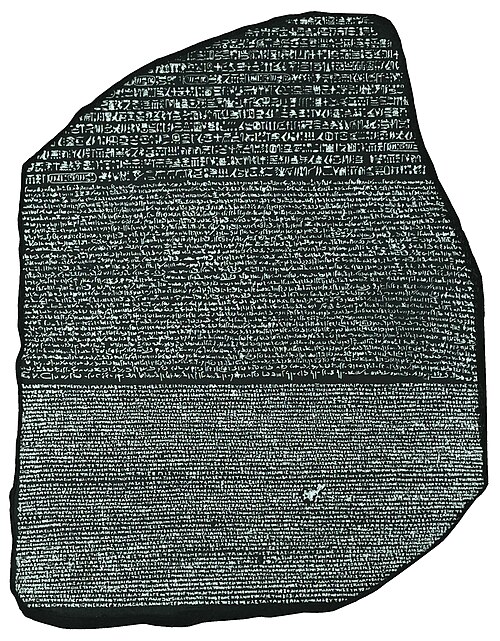
ヒエログリフは紀元前 3000年ごろから存在し 、数百の記号から成り立っている。ヒエログリフは単語、音、または無音の決定詞を表すことができ、同じ記号が異なる文脈で異なる目的を果たすことができる。ヒエログリフは石碑や墓に使われた正式な文字で、個々の芸術作品と同じくらい詳細なものもあった。日常の筆記では、筆記者はより速くて簡単なヒエラティックと呼ばれる筆記体を使用していた。正式なヒエログリフは行または列のどちらの方向にも読めるが(通常は右から左に書かれる)、ヒエラティックは常に右から左に書かれ、通常は横に並んでいた。新しい書体であるデモティックが一般的な書体となり、この書体と正式なヒエログリフがロゼッタストーンのギリシャ語のテキストに添えられている。[124]
紀元1世紀頃、コプト文字がデモティック文字と並行して使われ始めた。コプト文字はギリシャ文字にデモティック文字を加えたものである。[125]正式なヒエログリフは4世紀まで儀式で使われていたが、終わりに近づくにつれて、ほんの一握りの聖職者しか読めなくなっていた。伝統的な宗教組織が解散したため、ヒエログリフの知識はほとんど失われた。ヒエログリフを解読する試みはビザンチン時代[126]やエジプトのイスラム時代にまで遡るが[127] 、ロゼッタストーンが発見され、トーマス・ヤングとジャン=フランソワ・シャンポリオンが何年も研究を重ねた1820年代になって初めて、ヒエログリフは実質的に解読された。[128]
文学

文字は、王権に関連して、王家の墓で発見された品物のラベルやタグに初めて現れました。それは主に、ペル・アンク機関または生命の家で働いていた書記官の仕事でした。後者は、事務所、図書館(書物の家と呼ばれていました)、研究室、天文台で構成されていました。[129]ピラミッド・テキストや棺テキストなどの古代エジプト文学の最も有名な作品のいくつかは、古典エジプト語で書かれており、紀元前1300年頃まで文字の言語であり続けました 。後期エジプト語は新王国時代以降に話され、ラムセス朝の行政文書、恋愛詩や物語、デモティックやコプト語のテキストに表れています。この期間中、文字の伝統は、ハルクフやウェニの墓の自伝などに発展しました。セバイト(「指示」)として知られるジャンルは、有名な貴族からの教えや指導を伝えるために開発されました。自然災害や社会の混乱を描いた嘆きの詩であるイプウェル・パピルスは有名な例です。
中期エジプト語で書かれた『シヌヘの物語』は、エジプト文学の古典と言えるだろう。[130]また、この時期に書かれたのがウェストカー・パピルスで、これはクフ王の息子たちが神官たちによって行われた奇跡について語った一連の物語である。[131] 『アメンエムペの指示』は近東文学の傑作と考えられている。[132]新王国時代の終わりごろには、『ウェナムンの物語』や『アニーの指示』などの人気作品を書くのに現地語がより頻繁に使われるようになった。前者は、レバノンから杉を買う途中で強盗に遭った貴族がエジプトに帰国するために奮闘する物語である。紀元前700年頃からは、人気のあった『オンクシェションキの指示』などの物語や指示、個人文書やビジネス文書が、エジプトのデモティック文字と文字で書かれるようになった。ギリシャ・ローマ時代にデモティックで書かれた物語の多くは、エジプトがラムセス2世のような偉大なファラオによって統治されていた独立国家であった以前の歴史的時代を舞台としていた。[133]
文化
日常生活
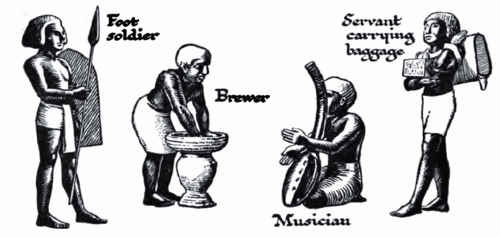
古代エジプト人の多くは土地に縛られた農民だった。彼らの住居は近親者に限られ、日中の暑さでも涼しく過ごせるよう日干しレンガで建てられていた。各家庭には屋根の開いた台所があり、そこには穀物を挽くための砥石とパンを焼くための小さなオーブンがあった。[134] 陶器は、食料、飲料、原材料の保管、調理、輸送、消費のための家庭用品として使われた。壁は白く塗られ、染めた麻の壁掛けで覆われることもあった。床は葦のマットで覆われ、木製のスツール、床から持ち上げたベッド、個別のテーブルが家具を構成していた。[135]

古代エジプト人は衛生と外見を非常に重視していた。ほとんどの人がナイル川で沐浴し、動物の脂肪とチョークから作られたペースト状の石鹸を使用していた。男性は清潔さを保つために全身を剃り、香水や芳香剤で悪臭を隠し、肌を落ち着かせた。[136]衣服は白く漂白されたシンプルなリネンのシーツで作られ、上流階級の男女はともにかつら、宝石、化粧品を身につけていた。子供は成人の12歳頃まで衣服を身につけず、この年齢になると男性は割礼を受け、頭を剃った。母親は子供の世話をする責任があり、父親は家族の収入を支えた。[137]
音楽とダンスは、余裕のある人々にとって人気の娯楽でした。初期の楽器にはフルートやハープなどがあり、トランペット、オーボエ、パイプに似た楽器は後に開発され、人気を博しました。新王国時代には、エジプト人は鐘、シンバル、タンバリン、太鼓を演奏し、アジアからリュートやリラを輸入しました。 [138]シストラムはガラガラのような楽器で、宗教儀式で特に重要でした。

古代エジプト人はゲームや音楽など、さまざまな余暇活動を楽しんでいた。駒がランダムに動くボードゲームのセネトは、特に初期から人気があった。円形のゲームボードを使った似たようなゲームにメヘンがある。58ホールズとしても知られる「ハウンド・アンド・ジャッカル」も、古代エジプトでプレイされたボードゲームの例である。このゲームの最初の完全なセットは、第13王朝のエジプトのファラオ、アメンエムハト4世のテーベの墓から発見された。[139]ジャグリングや球技は子供たちに人気があり、ベニ・ハサンの墓にはレスリングの記録もある。[140]古代エジプト社会の裕福な人々は、狩猟、釣り、ボート遊びも楽しんでいた。
デイル・エル・メディナの労働者村の発掘調査により、古代世界のほぼ400年にわたる共同体生活に関する最も詳細な記録が得られた。共同体の組織、社会的交流、労働および生活条件がこれほど詳細に研究された遺跡は他にはない。[141]
料理

エジプト料理は時を経ても驚くほど安定しており、実際、現代エジプトの料理は古代の料理と驚くほど類似している。主食はパンとビールで、玉ねぎやニンニクなどの野菜、ナツメヤシやイチジクなどの果物が添えられていた。ワインや肉は祝祭日には誰もが楽しんだが、上流階級はより日常的に楽しんでいた。魚、肉、鳥は塩漬けや乾燥が可能で、シチューにしたりグリルで焼いたりすることもできた。[142]
建築
古代エジプトの建築には、ギザの大ピラミッドやテーベの神殿など、世界で最も有名な建造物が含まれています。宗教的および記念的な目的だけでなく、ファラオの広範な権力を強化するために、国家が建設プロジェクトを組織し、資金を提供しました。古代エジプト人は熟練した建築家であり、シンプルだが効果的なツールと照準器のみを使用して、建築家は今日でも羨望の的となる高い精度と精密さで大きな石造りの建造物を建てることができました。 [143]
エジプトの上流階級や一般人の住居は、日干しレンガや木材などの腐りやすい材料で建てられており、現存していない。農民は質素な家に住んでいたが、上流階級やファラオの宮殿はより精巧な構造だった。マルカタやアマルナなどの現存する新王国時代の宮殿の壁や床には、人物、鳥、池、神々、幾何学模様などが豊かに描かれている。[144]寺院や墓など、永久に残ることを意図した重要な建造物は、日干しレンガではなく石で建てられた。世界初の大規模な石造建築物であるジェセル王の葬祭殿で使用された建築要素には、パピルスと蓮のモチーフの柱やまぐさの支えなどがある。 [要出典]
ギザの神殿など、現存する最古の古代エジプトの神殿は、柱で支えられた屋根板のある単一の囲まれた広間から成っている。新王国時代には、建築家らが神殿の聖域の正面に塔門、開いた中庭、囲まれた多柱式広間を加えたが、このスタイルはグレコ・ローマ時代まで標準的であった。[145]古王国時代における最古かつ最も人気のある墓の建築はマスタバであり、地下の埋葬室の上に建てられた日干しレンガまたは石でできた平らな屋根の長方形の建造物である。ジェセル王の階段ピラミッドは、一連の石のマスタバを積み重ねたものである。ピラミッドは古王国時代と中王国時代に建てられたが、後の支配者のほとんどは目立たない岩をくり抜いた墓を好み、ピラミッドを放棄した。[146]ピラミッド形式は、新王国時代の私的な墓の礼拝堂やヌビアの王家のピラミッドで引き続き使用された。[147]
-
 家庭のポーチと庭の模型、紀元前 1981年~1975年頃
 -
 デンドゥル神殿、紀元前10年完成、メトロポリタン美術館(ニューヨーク市)
 -

-
 カール・リチャード・レプシウスによる様々な種類の首都の図解
美術

古代エジプト人は機能的な目的のために芸術を制作した。3500年以上にわたり、芸術家たちは古王国時代に開発された芸術形式と図像学を固守し、外国の影響や内部の変化に抵抗する厳格な一連の原則に従った。 [148]これらの芸術的基準、つまり単純な線、形、平らな色面と、空間の奥行きを示さない特徴的な人物の平面投影が組み合わさることで、構成内に秩序とバランスの感覚が生まれた。画像とテキストは、墓や寺院の壁、棺、石碑、さらには彫像に密接に織り交ぜられていた。たとえば、ナルメル パレットには、象形文字としても読める人物が描かれている。[149]高度に様式化され象徴的な外観を支配する厳格な規則により、古代エジプト美術は政治的、宗教的目的を正確かつ明確に果たした。[150]
.jpg/500px-Calcite_Basin_Supporting_a_Boat_with_Shrine00_(6).jpg)
古代エジプトの職人は、彫像や精巧なレリーフを彫る材料として石を使用していましたが、安価で簡単に彫れる代用品として木材を使用していました。塗料は、鉄鉱石(赤と黄色の黄土色)、銅鉱石(青と緑)、すすまたは木炭(黒)、石灰岩(白)などの鉱物から得られました。塗料は、結合剤としてアラビアゴムと混ぜてケーキ状に圧縮することができ、必要に応じて水で湿らせることができました。[151]
ファラオは、戦いでの勝利、王の勅令、宗教的な場面を記録するためにレリーフを使用しました。一般市民は、シャブティ像や死者の書などの葬儀美術品にアクセスでき、来世で自分たちを守ってくれると信じていました。 [152]中王国時代には、日常生活の場面を描いた木製または粘土製の模型が墓に添えられることが多くなりました。来世での生者の活動を再現する試みとして、これらの模型には、労働者、家、船、さらには軍隊の隊形が描かれており、古代エジプトの理想的な来世を縮小して表現しています。[153]
古代エジプト美術の均質性にもかかわらず、特定の時代や場所のスタイルは、文化的または政治的態度の変化を反映することがありました。第2中間期のヒクソスの侵略後、ミノア様式のフレスコ画がアヴァリスで発見されました。[154]芸術形式における政治的動機による変化の最も顕著な例は、アマルナ時代のものであり、アクエンアテンの革命的な宗教的思想に合わせて人物像が根本的に変更されました。 [155]アマルナ美術として知られるこのスタイルは、アクエンアテンの死後すぐに放棄され、伝統的な形式に置き換えられました。[156]
-
 アメンエムハトの石碑像、紀元前 1500年頃
 -
 ネバムンが鳥を狩る様子を描いたフレスコ画。紀元前1350年頃
 -

-
 包装された内容物の入ったファルコンの箱; 紀元前 332~30 年
宗教的信仰

神と来世への信仰は、古代エジプト文明の始まりから根付いていた。ファラオによる統治は王権神授説に基づいていた。エジプトの神々は超自然的な力を持ち、助けや保護を求められる神々で占められていた。しかし、神々は常に慈悲深いとは見なされておらず、エジプト人は神々を供物や祈りでなだめる必要があると信じていた。この神々の構造は、新しい神々が階級制度の中で昇格するにつれて絶えず変化したが、神官たちは多様で時には矛盾する神話や物語を首尾一貫した体系にまとめようとはしなかった。 [157]これらの神性に関するさまざまな概念は矛盾しているのではなく、むしろ現実のさまざまな側面の層であると考えられていた。[158]

神々は、王に代わって司祭が管理するカルト寺院で崇拝された。寺院の中心には、神殿にカルト像があった。寺院は公の礼拝や集会の場ではなく、特定の祝祭日や祝賀の日にのみ、神の像を載せた神殿が公の礼拝のために持ち出された。通常、神の領域は外界から封鎖されており、寺院の役人しかアクセスできなかった。一般市民は自宅で私的な像を崇拝することができ、お守りは混沌の力に対する保護を提供した。[159]新王国時代以降、宗教的慣習が神々を直接崇拝する方向に移行したため、ファラオの精神的な仲介者としての役割は重視されなくなった。その結果、司祭は神々の意志を人々に直接伝えるための神託のシステムを開発した。 [160]
エジプト人は、すべての人間は肉体と霊的部分または相から成り立っていると信じていた。肉体に加えて、各人はšwt (影)、ba (人格または魂)、ka (生命力)、および名前を持っていた。[161]脳ではなく心臓が、思考と感情の座であると考えられていた。死後、霊的相は肉体から解放され、自由に動くことができるが、それらは永久的な住処として肉体の残骸 (または彫像などの代替物) を必要とした。死者の究極の目標は、kaとbaに再び結合し、「祝福された死者」の 1 人となり、 akhまたは「有効な者」として生き続けることであった。これが起こるためには、死者は心臓を「真実の羽」と比較する裁判で価値があると判断されなければならなかった。価値があると判断された場合、死者は霊的な形で地球上で存在し続けることができた。[162]価値がないと判断された場合、その心臓は貪食者アムミットに食べられ、宇宙から消滅させられました。[要出典]
埋葬の習慣

古代エジプト人は、死後の不死を確実にするために必要だと信じていた複雑な埋葬習慣を維持していた。これらの習慣には、ミイラ化による遺体の保存、埋葬の儀式の実施、死者が来世で使用する遺品と一緒に埋葬することが含まれていた。[152]古王国時代以前は、砂漠の穴に埋葬された遺体は乾燥によって自然に保存されていた。乾燥した砂漠の条件は、古代エジプトの歴史を通じて、エリート層が利用できるような手の込んだ埋葬準備を行う余裕のない貧しい人々の埋葬には有利だった。裕福なエジプト人は、死者を石の墓に埋葬し、内臓を取り除き、遺体を亜麻布で包み、長方形の石棺または木製の棺に埋葬する人工ミイラ化を行うようになった。第4王朝以降、遺体の一部はカノプス壺に別々に保存された。[163]
新王国時代までに、古代エジプト人はミイラ化の技術を完成させた。最良の技法は70日かかり、内臓を取り除き、鼻から脳を取り除き、ナトロンと呼ばれる塩の混合物で体を乾燥させるというものである。その後、死体は亜麻布で包まれ、層の間には護符が挟まれ、装飾された類人猿の棺に納められた。末期王朝時代のミイラは、彩色されたカルトナージュのミイラケースにも納められた。プトレマイオス朝とローマ時代には実際の保存方法は衰退し、装飾されたミイラの外観に重点が置かれた。[164]
裕福なエジプト人は大量の贅沢品とともに埋葬されたが、社会的地位に関係なく、すべての埋葬には死者のための品々が含まれていた。墓には葬送文がしばしば入れられ、新王国時代以降は死後の世界で死者のために肉体労働を行うと信じられていたシャブティ像も入れられた。 [165]死者が魔法で蘇る儀式が埋葬に付随した。埋葬後、生きている親族は時折墓に食べ物を持って行き、死者に代わって祈りを唱えることが求められた。[166]
軍隊

The ancient Egyptian military was responsible for defending Egypt against foreign invasion, and for maintaining Egypt's domination in the ancient Near East. The military protected mining expeditions to the Sinai during the Old Kingdom and fought civil wars during the First and Second Intermediate Periods. The military was responsible for maintaining fortifications along important trade routes, such as those found at the city of Buhen on the way to Nubia. Forts also were constructed to serve as military bases, such as the fortress at Sile, which was a base of operations for expeditions to the Levant. In the New Kingdom, a series of pharaohs used the standing Egyptian army to attack and conquer Kush and parts of the Levant.[167]
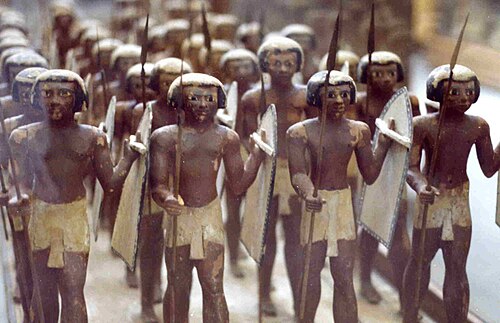
Typical military equipment included bows and arrows, spears, and round-topped shields made by stretching animal skin over a wooden frame. In the New Kingdom, the military began using chariots that had earlier been introduced by the Hyksos invaders. Weapons and armor continued to improve after the adoption of bronze: shields were now made from solid wood with a bronze buckle, spears were tipped with a bronze point, and the khopesh was adopted from Asiatic soldiers.[168] The pharaoh was usually depicted in art and literature riding at the head of the army; it has been suggested that at least a few pharaohs, such as Seqenenre Tao II and his sons, did do so.[169] However, it has also been argued that "kings of this period did not personally act as frontline war leaders, fighting alongside their troops".[170] Soldiers were recruited from the general population, but during, and especially after, the New Kingdom, mercenaries from Nubia, Kush, and Libya were hired to fight for Egypt.[171]
Technology, medicine and mathematics
Technology

In technology, medicine, and mathematics, ancient Egypt achieved a relatively high standard of productivity and sophistication. Traditional empiricism, as evidenced by the Edwin Smith and Ebers papyri (c. 1600 BC), is first credited to Egypt. The Egyptians created their own alphabet and decimal system.
Faience and glass
Even before the Old Kingdom, the ancient Egyptians had developed a glassy material known as faience, which they treated as a type of artificial semi-precious stone. Faience is a non-clay ceramic made of silica, small amounts of lime and soda, and a colorant, typically copper.[172] The material was used to make beads, tiles, figurines, and small wares. Several methods can be used to create faience, but typically production involved application of the powdered materials in the form of a paste over a clay core, which was then fired. By a related technique, the ancient Egyptians produced a pigment known as Egyptian blue, also called blue frit, which is produced by fusing (or sintering) silica, copper, lime, and an alkali such as natron. The product can be ground up and used as a pigment.[173]
The ancient Egyptians could fabricate a wide variety of objects from glass with great skill, but it is not clear whether they developed the process independently.[174] It is also unclear whether they made their own raw glass or merely imported pre-made ingots, which they melted and finished. However, they did have technical expertise in making objects, as well as adding trace elements to control the color of the finished glass. A range of colors could be produced, including yellow, red, green, blue, purple, and white, and the glass could be made either transparent or opaque.[175]
Medicine
The medical problems of the ancient Egyptians stemmed directly from their environment. Living and working close to the Nile brought hazards from malaria and debilitating schistosomiasis parasites, which caused liver and intestinal damage. Dangerous wildlife such as crocodiles and hippos were also a common threat. The lifelong labors of farming and building put stress on the spine and joints, and traumatic injuries from construction and warfare all took a significant toll on the body. The grit and sand from stone-ground flour abraded teeth, leaving them susceptible to abscesses (though caries were rare).[176]
The diets of the wealthy were rich in sugars, which promoted periodontal disease.[177] Despite the flattering physiques portrayed on tomb walls, the overweight mummies of many of the upper class show the effects of a life of overindulgence.[178] Adult life expectancy was about 35 for men and 30 for women, but reaching adulthood was difficult as about one-third of the population died in infancy.[e]
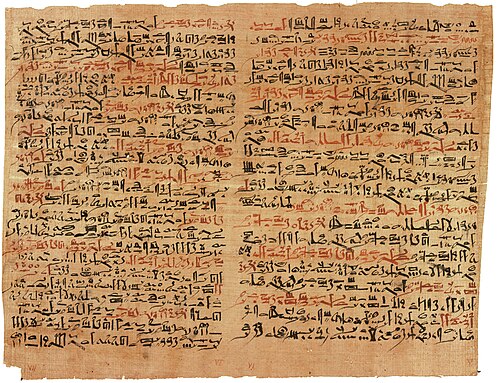
Ancient Egyptian physicians were renowned in the ancient Near East for their healing skills, and some, such as Imhotep, remained famous long after their deaths.[179] Herodotus remarked that there was a high degree of specialization among Egyptian physicians, with some treating only the head or the stomach, while others were eye-doctors and dentists.[180] Training of physicians took place at the Per Ankh or "House of Life" institution, most notably those headquartered in Per-Bastet during the New Kingdom and at Abydos and Saïs in the Late period. Medical papyri show empirical knowledge of anatomy, injuries, and practical treatments.[181]
Wounds were treated by bandaging with raw meat, white linen, sutures, nets, pads, and swabs soaked with honey to prevent infection,[182] while opium, thyme, and belladona were used to relieve pain. The earliest records of burn treatment describe burn dressings that use the milk from mothers of male babies. Prayers were made to the goddess Isis. Moldy bread, honey, and copper salts were also used to prevent infection from dirt in burns.[183] Garlic and onions were used regularly to promote good health and were thought to relieve asthma symptoms. Ancient Egyptian surgeons stitched wounds, set broken bones, and amputated diseased limbs, but they recognized that some injuries were so serious that they could only make the patient comfortable until death occurred.[184]
Maritime technology
Early Egyptians knew how to assemble planks of wood into a ship hull and had mastered advanced forms of shipbuilding as early as 3000 BC. The Archaeological Institute of America reports that the oldest planked ships known are the Abydos boats.[5] A group of 14 discovered ships in Abydos were constructed of wooden planks "sewn" together. Discovered by Egyptologist David O'Connor of New York University,[185] woven straps were found to have been used to lash the planks together,[5] and reeds or grass stuffed between the planks helped to seal the seams.[5] Because the ships are all buried together and near a mortuary belonging to Pharaoh Khasekhemwy, originally they were all thought to have belonged to him, but one of the 14 ships dates to 3000 BC, and the associated pottery jars buried with the vessels also suggest earlier dating. The ship dating to 3000 BC was 75 feet (23 m) long and is now thought to perhaps have belonged to an earlier pharaoh, perhaps one as early as Hor-Aha.[185]
Early Egyptians also knew how to assemble planks of wood with treenails to fasten them together, using pitch for caulking the seams. The "Khufu ship", a 43.6-metre (143 ft) vessel sealed into a pit in the Giza pyramid complex at the foot of the Great Pyramid of Giza in the Fourth Dynasty around 2500 BC, is a full-size surviving example that may have filled the symbolic function of a solar barque. Early Egyptians also knew how to fasten the planks of this ship together with mortise and tenon joints.[5]

Large seagoing ships are known to have been heavily used by the Egyptians in their trade with the city states of the eastern Mediterranean, especially Byblos (on the coast of modern-day Lebanon), and in several expeditions down the Red Sea to the Land of Punt. In fact one of the earliest Egyptian words for a seagoing ship is a "Byblos Ship", which originally defined a class of Egyptian seagoing ships used on the Byblos run; however, by the end of the Old Kingdom, the term had come to include large seagoing ships, whatever their destination.[186]
In 1977, an ancient north–south canal was discovered extending from Lake Timsah to the Ballah Lakes.[187] It was dated to the Middle Kingdom of Egypt by extrapolating dates of ancient sites constructed along its course.[187][f]
In 2011, archaeologists from Italy, the United States, and Egypt, excavating a dried-up lagoon known as Mersa Gawasis, unearthed traces of an ancient harbor that once launched early voyages, such as Hatshepsut's Punt, expedition onto the open ocean. Some of the site's most evocative evidence for the ancient Egyptians' seafaring prowess include large ship timbers and hundreds of feet of ropes, made from papyrus, coiled in huge bundles.[188] In 2013, a team of Franco-Egyptian archaeologists discovered what is believed to be the world's oldest port, dating back about 4500 years, from the time of King Khufu, on the Red Sea coast, near Wadi el-Jarf (about 110 miles south of Suez).[189]
Mathematics
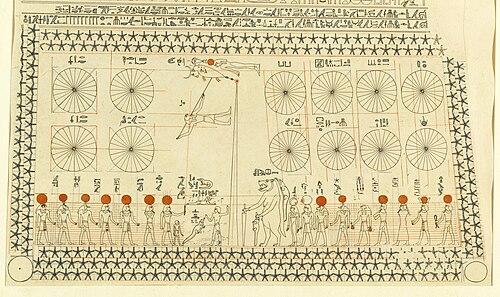
The earliest attested examples of mathematical calculations date to the predynastic Naqada period, and show a fully developed numeral system.[g] The importance of mathematics to an educated Egyptian is suggested by a New Kingdom fictional letter in which the writer proposes a scholarly competition between himself and another scribe regarding everyday calculation tasks such as accounting of land, labor, and grain.[191] Texts such as the Rhind Mathematical Papyrus and the Moscow Mathematical Papyrus show that the ancient Egyptians could perform the four basic mathematical operations—addition, subtraction, multiplication, and division—use fractions, calculate the areas of rectangles, triangles, and circles and compute the volumes of boxes, columns and pyramids. They understood basic concepts of algebra and geometry, and could solve systems of equations.[192]
Mathematical notation was decimal, and based on hieroglyphic signs for each power of ten up to one million. Each of these could be written as many times as necessary to add up to the desired number; so to write the number eighty or eight hundred, the symbol for ten or one hundred was written eight times respectively.[193] Because their methods of calculation could not handle most fractions with a numerator greater than one, they had to write fractions as the sum of several fractions. For example, they resolved the fraction two-fifths into the sum of one-third + one-fifteenth. Standard tables of values facilitated this.[194] Some common fractions, however, were written with a special glyph—the equivalent of the modern two-thirds is shown on the right.[195]
Ancient Egyptian mathematicians knew the Pythagorean theorem as an empirical formula. They were aware, for example, that a triangle had a right angle opposite the hypotenuse when its sides were in a 3–4–5 ratio.[196] They were able to estimate the area of a circle by subtracting one-ninth from its diameter and squaring the result:
- Area ≈ [(8⁄9)D]2 = (256⁄81)r2 ≈ 3.16r2,
a reasonable approximation of the formula πr2.[197]
Population

Estimates of the size of the population range from 1–1.5 million in the 3rd millennium BC to possibly 2–3 million by the 1st millennium BC, before growing significantly towards the end of that millennium.[198]
Archaeogenetics
According to historian William Stiebling and archaeologist Susan N. Helft, conflicting DNA analysis on recent genetic samples such as the Amarna royal mummies has led to a lack of consensus on the genetic makeup of the ancient Egyptians and their geographic origins.[199]
The genetic history of Ancient Egypt remains a developing field, and is relevant for the understanding of population demographic events connecting Africa and Eurasia. To date, the amount of genome-wide aDNA analyses on ancient specimens from Egypt and Sudan remain scarce, although studies on uniparental haplogroups in ancient individuals have been carried out several times, pointing broadly to affinities with other African and Eurasian groups.[200][201]
The currently most advanced full genome analyses was made on three ancient specimens recovered from the Nile River Valley, Abusir el-Meleq, Egypt. Two of the individuals were dated to the Pre-Ptolemaic Period (New Kingdom to Late Period), and one individual to the Ptolemaic Period, spanning around 1300 years of Egyptian history. These results point to a genetic continuity of Ancient Egyptians with modern Egyptians. The results further point to a close genetic affinity between ancient Egyptians and Middle Eastern populations, especially ancient groups from the Levant (Natufian culture).[200][201]

Ancient Egyptians also displayed affinities to Nubians to the south of Egypt, in modern-day Sudan. Archaeological and historical evidence support interactions between Egyptian and Nubian populations more than 5000 years ago, with socio-political dynamics between Egyptians and Nubians ranging from peaceful coexistence to variably successful attempts of conquest. A study on sixty-six ancient Nubian individuals revealed significant contact with ancient Egyptians, characterized by the presence of c. 57% Neolithic/Bronze Age Levantine ancestry in these individuals. Such geneflow of Levantine-like ancestry corresponds with archaeological and botanic evidence, pointing to a Neolithic movement around 7,000 years ago.[200][201]
Genetic data on other Northern African specimens, such as the c. 15,000 year old Iberomaurusian Taforalt man, but also specimens from the "last Green Sahara" and the Savanna Pastoral Neolithic, point to the widespread presence of an (Western) Eurasian ancestry component distributed throughout Northern Africa, the Sahara, and the Horn of Africa, having arrived via back migration(s) from the Middle East starting as early as c. 23,000 years ago.[202][203][204][205]
Modern Egyptians, like modern Nubians, underwent subsequent admixture events, contributing both "Sub-Saharan" African-like and West Asian-like ancestries, since the Roman period, with significance on the African Slave Trade and the Spread of Islam.[200][201]
Some scholars, such as Christopher Ehret, caution that a wider sampling area is needed and argue that the current data is inconclusive on the origin of ancient Egyptians. They also point out issues with the previously used methodology such as the sampling size, comparative approach and a "biased interpretation" of the genetic data. They argue in favor for a link between Ancient Egypt and the northern Horn of Africa. This latter view has been attributed to the corresponding archaeological, genetic, linguistic and biological anthropological sources of evidence which broadly indicate that the earliest Egyptians and Nubians were the descendants of populations in northeast Africa.[206][207][208][199]
Legacy
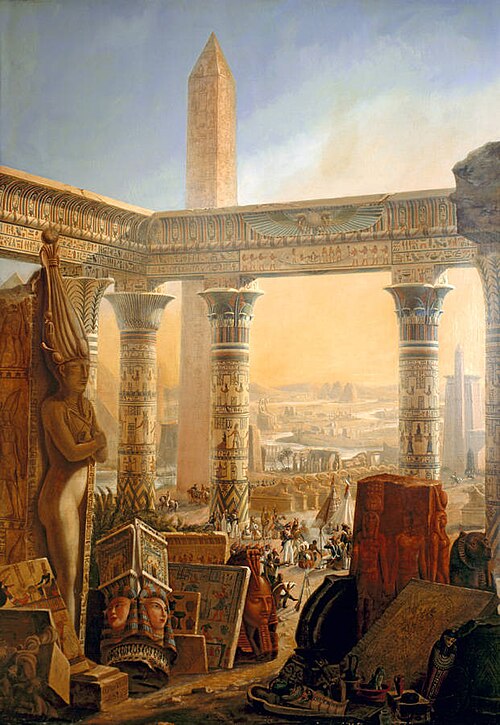
The culture and monuments of ancient Egypt have left a lasting legacy on the world. Egyptian civilization significantly influenced the Kingdom of Kush and Meroë with both adopting Egyptian religious and architectural norms (hundreds of pyramids (6–30 meters high) were built in Egypt/Sudan), as well as using Egyptian writing as the basis of the Meroitic script.[209] Meroitic is the oldest written language in Africa, other than Egyptian, and was used from the 2nd century BC until the early 5th century AD.[210] The cult of the goddess Isis, for example, became popular in the Roman Empire, as obelisks and other relics were transported back to Rome.[211] The Romans also imported building materials from Egypt to erect Egyptian-style structures. Early historians such as Herodotus, Strabo, and Diodorus Siculus studied and wrote about the land, which Romans came to view as a place of mystery.[212]
During the Middle Ages and the Renaissance, Egyptian pagan culture was in decline after the rise of Christianity and later Islam, but interest in Egyptian antiquity continued in the writings of medieval scholars such as Dhul-Nun al-Misri and al-Maqrizi.[213] In the seventeenth and eighteenth centuries, European travelers and tourists brought back antiquities and wrote stories of their journeys, leading to a wave of Egyptomania across Europe, as evident in symbolism such as the Eye of Providence and the Great Seal of the United States. This renewed interest sent collectors to Egypt, who took, purchased, or were given many important antiquities.[214] Napoleon arranged the first studies in Egyptology when he brought some 150 scientists and artists to study and document Egypt's natural history, which was published in the Description de l'Égypte.[215]
In the 20th century, the Egyptian Government and archaeologists alike recognized the importance of cultural respect and integrity in excavations. Since the 2010s, the Ministry of Tourism and Antiquities has overseen excavations and the recovery of artifacts.[216]
-
 The Abu Haggag Mosque is integrated into the Luxor temple from the 14th century BC, which has made it the oldest continuously used temple.
 -
![Cleopatra Testing Poisons on Condemned Prisoners (1887), by Alexandre Cabanel[217]](https://img-server.japedia.wiki/wikipedia/commons/thumb/e/e7/Alexandre_Cabanel_-_Cl%C3%A9opatre_essayant_des_poisons_sur_des_condamn%C3%A9s_%C3%A0_mort.jpg/500px-Alexandre_Cabanel_-_Cl%C3%A9opatre_essayant_des_poisons_sur_des_condamn%C3%A9s_%C3%A0_mort.jpg) Cleopatra Testing Poisons on Condemned Prisoners (1887), by Alexandre Cabanel[217]
Cleopatra Testing Poisons on Condemned Prisoners (1887), by Alexandre Cabanel[217] -
 Tourists at the pyramid complex of Khafre near the Great Sphinx of Giza
.jpg/500px-The_Sphinx_and_Pyramid_of_Khafre_(8838365561).jpg)
See also

.jpg/500px-Lascar_Avenue_of_the_Dead_and_the_Pyramid_of_the_Sun_in_the_background_(4566574277).jpg)
- Egyptology
- Glossary of ancient Egypt artifacts
- Index of ancient Egypt–related articles
- Outline of ancient Egypt
- List of ancient Egyptians
- List of Ancient Egyptian inventions and discoveries
- Archaeology of Ancient Egypt
- Archeological Map of Egypt
- British school of diffusionism
Notes
- ^ Depending on the definition, 332 BC with the end of the Late Period, 30 BC with the end of the Ptolemaic Kingdom
- ^ With the death of Ramesses XI
- ^ With his two principal wives and large harem, Ramesses II sired more than 100 children. (Clayton (1994), p. 146)
- ^ From Killebrew & Lehmann (2013), p. 2: "First coined in 1881 by the French Egyptologist G. Maspero (1896), the somewhat misleading term "Sea Peoples" encompasses the ethnonyms Lukka, Sherden, Shekelesh, Teresh, Eqwesh, Denyen, Sikil / Tjekker, Weshesh, and Peleset (Philistines). Footnote: The modern term "Sea Peoples" refers to peoples that appear in several New Kingdom Egyptian texts as originating from "islands"... The use of quotation marks in association with the term "Sea Peoples" in our title is intended to draw attention to the problematic nature of this commonly used term. It is noteworthy that the designation "of the sea" appears only in relation to the Sherden, Shekelesh, and Eqwesh. Subsequently, this term was applied somewhat indiscriminately to several additional ethnonyms, including the Philistines, who are portrayed in their earliest appearance as invaders from the north during the reigns of Merenptah and Ramesses III."
• From Drews (1993), pp. 48–61: "The thesis that a great "migration of the Sea Peoples" occurred ca. 1200 B.C. is supposedly based on Egyptian inscriptions, one from the reign of Merneptah and another from the reign of Ramesses III. Yet in the inscriptions themselves such a migration nowhere appears. After reviewing what the Egyptian texts have to say about 'the sea peoples', one Egyptologist (Wolfgang Helck) recently remarked that although some things are unclear, "eins ist aber sicher: Nach den agyptischen Texten haben wir es nicht mit einer 'Volkerwanderung' zu tun." Thus the migration hypothesis is based not on the inscriptions themselves but on their interpretation." - ^ Figures are given for adult life expectancy and do not reflect life expectancy at birth. (Filer (1995), p. 25)
- ^ See Suez Canal.
- ^ Understanding of Egyptian mathematics is incomplete due to paucity of available material and lack of exhaustive study of the texts that have been uncovered (Imhausen (2007), p. 13).
References
Citations
- ^ Chronology (2000).
- ^ Dodson & Hilton (2004), p. 46.
- ^ Clayton (1994), p. 217.
- ^ James (2005), p. 8; Manuelian (1998), pp. 6–7.
- ^ a b c d e Ward (2001).
- ^ Clayton (1994), p. 153.
- ^ James (2005), p. 84.
- ^ Shaw (2003), pp. 17, 67–69.
- ^ Shaw (2003), p. 17.
- ^ Ikram (1992), p. 5.
- ^ Hayes (1964), p. 220.
- ^ Kemp (1989), p. 14.
- ^ Aston, Harrell & Shaw (2000), pp. 46–47.
- ^ Aston (1994), pp. 23–26.
- ^ Ataç (2014), pp. 424–425.
- ^ Chronology of the Naqada Period (2001).
- ^ Shaw (2003), p. 61.
- ^ Shaw (2003), p. 61; Ataç (2014), pp. 424–425.
- ^ Nicholson & Peltenburg (2000), pp. 178–179.
- ^ Faience in different Periods (2000).
- ^ Allen (2000), p. 1.
- ^ Clayton (1994), p. 6.
- ^ Robins (2008), p. 32.
- ^ Clayton (1994), pp. 12–13.
- ^ Shaw (2003), p. 70.
- ^ Early Dynastic Egypt (2001).
- ^ James (2005), p. 40.
- ^ Shaw (2003), p. 102.
- ^ Shaw (2003), pp. 116–117.
- ^ Hassan (2011).
- ^ Clayton (1994), p. 69.
- ^ Shaw (2003), p. 120.
- ^ a b Shaw (2003), p. 146.
- ^ Clayton (1994), p. 29.
- ^ Guardian Figure 14.3.17 (2022).
- ^ Grajetzki 2007, pp. 41–54.
- ^ Shaw (2003), p. 148.
- ^ Clayton (1994), p. 79.
- ^ Shaw (2003), p. 158.
- ^ Shaw (2003), pp. 179–182.
- ^ Robins (2008), p. 90.
- ^ Shaw (2003), p. 188.
- ^ a b Ryholt (1997), p. 310.
- ^ Shaw (2003), p. 189.
- ^ Shaw (2003), p. 224.
- ^ Clayton (1994), pp. 104–107.
- ^ James (2005), p. 48.
- ^ Bleiberg (2005), p. 49-50.
- ^ Aldred (1988), p. 259.
- ^ O'Connor & Cline (2001), p. 273.
- ^ Tyldesley (2001), pp. 76–77.
- ^ James (2005), p. 54.
- ^ Cerny (1975), p. 645.
- ^ Bonnet (2006), p. 128.
- ^ Shaw (2003), p. 345.
- ^ Bonnet (2006), pp. 142–154.
- ^ Mokhtar (1990), pp. 161–163.
- ^ Emberling (2011), pp. 9–11.
- ^ Silverman (1997), pp. 36–37.
- ^ Shaw (2003), p. 358.
- ^ Shaw (2003), p. 383.
- ^ Shaw (2003), p. 385.
- ^ Shaw (2003), p. 405.
- ^ Shaw (2003), p. 411.
- ^ Shaw (2003), p. 418.
- ^ James (2005), p. 62.
- ^ James (2005), p. 63.
- ^ Shaw (2003), p. 426.
- ^ a b Shaw (2003), p. 422.
- ^ Shaw (2003), p. 431.
- ^ Chadwick (2001), p. 373.
- ^ MacMullen (1984), p. 63.
- ^ Shaw (2003), p. 445.
- ^ a b c d Manuelian (1998), p. 358.
- ^ Manuelian (1998), p. 363.
- ^ Egypt: Coins of the Ptolemies (2002).
- ^ Meskell (2004), p. 23.
- ^ a b c Manuelian (1998), p. 372.
- ^ Turner (1984), p. 125.
- ^ Manuelian (1998), p. 383.
- ^ James (2005), p. 136.
- ^ Billard (1978), p. 109.
- ^ Social classes in ancient Egypt (2003).
- ^ a b c Johnson (2002).
- ^ Slavery (2012).
- ^ Oakes & Gahlin (2003), p. 472.
- ^ McDowell (1999), p. 168.
- ^ Manuelian (1998), p. 361.
- ^ Nicholson & Shaw (2000), p. 514.
- ^ Nicholson & Shaw (2000), p. 506.
- ^ Nicholson & Shaw (2000), p. 510.
- ^ Nicholson & Shaw (2000), pp. 577, 630.
- ^ a b Strouhal (1989), p. 117.
- ^ a b Manuelian (1998), p. 381.
- ^ Nicholson & Shaw (2000), p. 409.
- ^ Heptner & Sludskii (1992), pp. 83–95.
- ^ Oakes & Gahlin (2003), p. 229.
- ^ Greaves & Little (1930), p. 123.
- ^ Lucas (1962), p. 413.
- ^ Nicholson & Shaw (2000), p. 28.
- ^ Hogan (2011), "Sulphur".
- ^ Scheel (1989), p. 14.
- ^ Nicholson & Shaw (2000), p. 166.
- ^ Nicholson & Shaw (2000), p. 51.
- ^ Shaw (2003), p. 72.
- ^ Porat (1992), pp. 433–440.
- ^ de Miroschedji & Sadeq (2008).
- ^ Porat (1986), pp. 109–129.
- ^ Egyptian pottery of the beginning of the First Dynasty, found in South Palestine (2000).
- ^ Shaw (2003), p. 322.
- ^ Manuelian (1998), p. 145.
- ^ Loprieno (1995b), p. 2137.
- ^ Loprieno (2004), p. 161.
- ^ Loprieno (2004), p. 162.
- ^ Loprieno (1995b), pp. 2137–2138.
- ^ Vittman (1991), pp. 197–227.
- ^ Loprieno (1995a), p. 46.
- ^ Loprieno (1995a), p. 74.
- ^ Loprieno (2004), p. 175.
- ^ Allen (2000), pp. 67, 70, 109.
- ^ Loprieno (1995b), p. 2147.
- ^ Loprieno (2004), p. 173.
- ^ Allen (2000), p. 13.
- ^ Loprieno (1995a), pp. 10–26.
- ^ Allen (2000), p. 7.
- ^ Loprieno (2004), p. 166.
- ^ El-Daly (2005), p. 164.
- ^ Allen (2000), p. 8.
- ^ Strouhal (1989), p. 235.
- ^ Lichtheim (1975), p. 11.
- ^ Lichtheim (1975), p. 215.
- ^ Day, Gordon & Williamson (1995), p. 23.
- ^ Lichtheim (1980), p. 159.
- ^ Manuelian (1998), p. 401.
- ^ Manuelian (1998), p. 403.
- ^ Manuelian (1998), p. 405.
- ^ Manuelian (1998), pp. 406–407.
- ^ Music in Ancient Egypt (2003).
- ^ Metcalfe (2018); Seaburn (2018).
- ^ Manuelian (1998), p. 126.
- ^ Hayes (1973), p. 380.
- ^ Manuelian (1998), pp. 399–400.
- ^ Clarke & Engelbach (1990), pp. 94–97.
- ^ Badawy (1968), p. 50.
- ^ Types of temples in ancient Egypt (2003).
- ^ Dodson (1991), p. 23.
- ^ Dodson & Ikram (2008), pp. 218, 275–276.
- ^ Robins (2008), p. 29.
- ^ Robins (2008), p. 21.
- ^ Robins (2008), p. 12.
- ^ Nicholson & Shaw (2000), p. 105.
- ^ a b James (2005), p. 122.
- ^ Robins (2008), p. 74.
- ^ Shaw (2003), p. 216.
- ^ Robins (2008), p. 149.
- ^ Robins (2008), p. 158.
- ^ James (2005), p. 102.
- ^ Redford (2003), p. 106.
- ^ James (2005), p. 117.
- ^ Shaw (2003), p. 313.
- ^ Allen (2000), pp. 79, 94–95.
- ^ Wasserman (1994), pp. 150–153.
- ^ Ikram & Dodson (1998), p. 29.
- ^ Ikram & Dodson (1998), pp. 40, 51, 138.
- ^ Shabtis (2001).
- ^ James (2005), p. 124.
- ^ Shaw (2003), p. 245.
- ^ Manuelian (1998), pp. 366–367.
- ^ Clayton (1994), p. 96.
- ^ Shaw (2009).
- ^ Shaw (2003), p. 400.
- ^ Nicholson & Shaw (2000), p. 177.
- ^ Nicholson & Shaw (2000), p. 109.
- ^ Nicholson & Shaw (2000), p. 195.
- ^ Nicholson & Shaw (2000), p. 215.
- ^ Filer (1995), p. 94.
- ^ Filer (1995), pp. 78–80.
- ^ Filer (1995), p. 21.
- ^ Filer (1995), p. 39.
- ^ Strouhal (1989), p. 243.
- ^ Strouhal (1989), pp. 244–246.
- ^ Strouhal (1989), p. 250.
- ^ Pećanac et al. (2013), pp. 263–267.
- ^ Filer (1995), p. 38.
- ^ a b Schuster (2000).
- ^ Wachsmann (2009), p. 19.
- ^ a b Shea (1977), pp. 31–38.
- ^ Curry (2011).
- ^ Boyle (2013); Lorenzi (2013).
- ^ Astronomical Ceiling (2020).
- ^ Imhausen (2007), p. 11.
- ^ Clarke & Engelbach (1990), p. 222.
- ^ Clarke & Engelbach (1990), p. 217.
- ^ Clarke & Engelbach (1990), p. 218.
- ^ Gardiner (1957), p. 197.
- ^ Strouhal (1989), p. 241.
- ^ Strouhal (1989), p. 241; Imhausen (2007), p. 31.
- ^ Bowman (2020).
- ^ a b Stiebing & Helft (2023).
- ^ a b c d Sirak, Sawchuk & Prendergast (2022), p. 20-22.
- ^ a b c d Prendergast, Sawchuk & Sirak (2022), p. 13.
- ^ Hodgson et al. (2014), p. 13.
- ^ Fregel (2021), p. 214-216.
- ^ Skoglund et al. (2017), p. 65.
- ^ D’Atanasio et al. (2023).
- ^ Eltis et al. (2021).
- ^ Keita (2022).
- ^ Ehret (2023).
- ^ Török (1998), pp. 62–67, 299–314, 500–510, 516–527.
- ^ Török (1998), pp. 62–65.
- ^ Siliotti (1998), p. 8.
- ^ Siliotti (1998), p. 10.
- ^ El-Daly (2005), p. 112.
- ^ Siliotti (1998), p. 13.
- ^ Siliotti (1998), p. 100.
- ^ Mohamed (2022).
- ^ Anderson (2003), p. 36.
Works cited
- Aldred, Cyril (1988). Akhenaten, King of Egypt. Thames and Hudson. ISBN 978-0-500-05048-4.
- Allen, James P. (2000). Middle Egyptian: An Introduction to the Language and Culture of Hieroglyphs. Cambridge University Press. ISBN 978-0-521-77483-3.
- Anderson, Jaynie (2003). Tiepolo's Cleopatra. Melbourne: Macmillan. ISBN 978-1-876832-44-5. Archived from the original on 7 October 2019. Retrieved 15 November 2015.
- Aston, Barbara G. (1994). Ancient Egyptian Stone Vessels: Materials and Forms. Studien zur Archäologie und Geschichte Altägyptens. Vol. 5. Heidelberger Orientverlag. pp. 23–26. ISBN 978-3-927552-12-8.
- Aston, Barbara G.; Harrell, James A.; Shaw, Ian (2000). "Stone: Obsidian". In Nicholson, Paul T.; Shaw, Ian (eds.). Ancient Egyptian Materials and Technology. Cambridge University Press. pp. 46–47. ISBN 978-0-521-45257-1.
- "Astronomical Ceiling". Metropolitan Museum of Art. Archived from the original on 17 May 2020.
- Ataç, Mehmet-Ali (2014). "Egyptian Connections with the Larger World: Ancient Near East". In Hartwig, Melinda K. (ed.). A Companion to Ancient Egyptian Art. John Wiley & Sons. pp. 423–446. ISBN 978-1-4443-3350-3.
- Badawy, Alexander (1968). A History of Egyptian Architecture. Vol. III. University of California Press. ISBN 978-0-520-00057-5.
- Billard, Jules B. (1978). Ancient Egypt, Discovering Its Splendors. National Geographic Society. ISBN 978-0-87044-220-9.
- Bleiberg, Edward (2005). Arts and Humanities Through the Eras: Ancient Egypt 2675–332 B.C.E. Vol. 1. Thomson/Gale. ISBN 978-0-7876-5698-0.
- Bonnet, Charles (2006). The Nubian Pharaohs. New York: The American University in Cairo Press. pp. 142–154. ISBN 978-977-416-010-3.
- Bowman, Alan K. (22 October 2020). "Ancient Egypt". Encyclopædia Britannica. Retrieved 3 January 2021.
- Boyle, Alan (15 April 2013). "4,500-year-old harbor structures and papyrus texts unearthed in Egypt". NBC News.
- Cerny, J. (1975). "Egypt from the Death of Ramesses III to the End of the Twenty-First Dynasty". In I.E.S. Edwards (ed.). The Cambridge Ancient History: Volume II, Part 2. History of the Middle East and the Aegean Region, c. 1380–1000 B.C (third ed.). Cambridge University Press. pp. 606–. ISBN 978-0-521-08691-2.
- Chadwick, Henry (2001). The Church in Ancient Society: From Galilee to Gregory the Great. Oxford University Press. p. 373. ISBN 978-0-19-152995-5.
- "Chronology". Digital Egypt for Universities. University College London. 2000. Archived from the original on 16 March 2008.
- "Chronology of the Naqada Period". Digital Egypt for Universities. University College London. 2001. Archived from the original on 28 March 2008.
- Clarke, Somers; Engelbach, Reginald (1990) [1930]. Ancient Egyptian Construction and Architecture (Unabridged reprint of Ancient Egyptian Masonry: The Building Craft originally published by Oxford University Press ed.). Dover Publications. ISBN 978-0-486-26485-1.
- Clayton, Peter A. (1994). Chronicle of the Pharaohs. London: Thames and Hudson. ISBN 978-0-500-05074-3.
- Curry, Andrew (5 September 2011). "Egypt's Ancient Fleet: Lost for Thousands of Years, Discovered in a Desolate Cave". Discover.
- "Faience in different Periods". Digital Egypt for Universities. University College London. 2000. Archived from the original on 30 March 2008.
- D’Atanasio, Eugenia; Risi, Flavia; Ravasini, Francesco; Montinaro, Francesco; Hajiesmaeil, Mogge; Bonucci, Biancamaria; Pistacchia, Letizia; Amoako-Sakyi, Daniel; Bonito, Maria; Onidi, Sara; Colombo, Giulia; Semino, Ornella; Destro Bisol, Giovanni; Anagnostou, Paolo; Metspalu, Mait (18 December 2023). "The genomic echoes of the last Green Sahara on the Fulani and Sahelian people". Current Biology. 33 (24): 5495–5504.e4. Bibcode:2023CBio...33E5495D. doi:10.1016/j.cub.2023.10.075. ISSN 0960-9822. PMID 37995693. S2CID 265356320.
- Day, John; Gordon, Robert P.; Williamson, H.G.M., eds. (1995). Wisdom in Ancient Israel. Cambridge University Press. p. 23. ISBN 978-0-521-62489-3.
- Dodson, Aidan (1991). Egyptian Rock-cut Tombs. Shire. ISBN 978-0-7478-0128-3.
- Dodson, Aidan; Hilton, Dyan (2004). The Complete Royal Families of Ancient Egypt. Thames & Hudson. ISBN 978-0-500-05128-3.
- Dodson, Aidan; Ikram, Salima (2008). The Tomb in Ancient Egypt: Royal and Private Sepulchres from the Early Dynastic Period to the Romans. Thames & Hudson. ISBN 978-0-500-05139-9.
- Drews, Robert (1993). The End of the Bronze Age: Changes in Warfare and the Catastrophe Ca. 1200 B.C. Princeton University Press. pp. 48–61. ISBN 978-0-691-02591-9.
- "Egyptian pottery of the beginning of the First Dynasty, found in South Palestine". Digital Egypt for Universities. University College London. 2000. Archived from the original on 31 May 2013. Retrieved 11 February 2022.
- El-Daly, Okasha (2005). Egyptology: The Missing Millennium: Ancient Egypt in Medieval Arabic Writings. Routledge. ISBN 978-1-315-42976-2.
- Eltis, David; Bradley, Keith R.; Engerman, Stanley L.; Perry, Craig; Cartledge, Paul; Richardson, David; Drescher, Seymour (2021). The Cambridge World History of Slavery: Volume 2, AD 500–AD 1420. Cambridge University Press. p. 150. ISBN 978-0-521-84067-5.
- Emberling, Geoff (2011). Nubia: Ancient Kingdoms of Africa. New York: Institute for the Study of the Ancient World. ISBN 978-0-615-48102-9.
- Filer, Joyce (1995). Disease. University of Texas Press. ISBN 978-0-292-72498-3.
- Fregel, Rosa (17 November 2021). "Paleogenomics of the Neolithic Transition in North Africa". Africa, the Cradle of Human Diversity. Brill: 213–235. doi:10.1163/9789004500228_009. ISBN 978-90-04-50022-8. Retrieved 9 January 2024.
- Gardiner, Sir Alan (1957). Egyptian Grammar: Being an Introduction to the Study of Hieroglyphs. Published on behalf of the Griffith Institute, Ashmolean Museum, Oxford, by Oxford University Press. ISBN 978-0-900416-35-4.
- Grajetzki, W. (2007). "Box Coffins in the Late Middle Kingdom and Second Intermediate Period". Egitto e Vicino Oriente. 30: 41–54. JSTOR 24233566.
- Greaves, R. H.; Little, O. H. (1930). "Gold Resources of Egypt". Compte Rendu of the XV Session, South Africa, 1929. By International Geological Congress. Pretoria: Wallach. p. 123.
- "Guardian Figure". Metropolitan Museum of Art. Retrieved 9 February 2022.
- Hassan, Fekri (17 February 2011). "The Fall of the Old Kingdom". BBC.
- Hayes, William C. (October 1964). "Most Ancient Egypt: Chapter III. The Neolithic and Chalcolithic Communities of Northern Egypt". Journal of Near Eastern Studies. 23 (4): 217–272. doi:10.1086/371778. ISSN 0022-2968. S2CID 161307683.
- Hayes, William C. (1973). "Egypt: Internal affairs from Tuthmosis I to the death of Amenophis III". In Edwards, I.E.S.; Gadd, C.J.; Hammond, N.G.L.; Sollberger, E. (eds.). The Cambridge Ancient History: Volume II part I: History of the Middle East and the Aegean Region c. 1800–1380 (3rd ed.). Cambridge University Press. p. 380. ISBN 978-0-521-08230-3.
- Heptner, V.G.; Sludskii, A.A. (1992) [1972]. "Lion". Mammals of the Soviet Union. Volume II, Part 2. Carnivora (Hyaenas and Cats). Washington, DC: Smithsonian Institution and the National Science Foundation. pp. 83–95.
- Hodgson, Jason A.; Mulligan, Connie J.; Al-Meeri, Ali; Raaum, Ryan L. (12 June 2014). "Early Back-to-Africa Migration into the Horn of Africa". PLOS Genetics. 10 (6): e1004393. doi:10.1371/journal.pgen.1004393. ISSN 1553-7404. PMC 4055572. PMID 24921250.
- Hogan, C.Michael (2011). "Sulfur". In A. Jorgensen; C.J. Cleveland (eds.). Encyclopedia of Earth. Washington DC: National Council for Science and the Environment. Archived from the original on 28 October 2012.
- Ikram, Salima (1992). Choice Cuts: Meat Production in Ancient Egypt. University of Cambridge. p. 5. ISBN 978-90-6831-745-9.
- Ikram, Salima; Dodson, Aidan (1998). The Mummy in Ancient Egypt : equipping the dead for eternity. London: Thames & Hudson. ISBN 978-0-500-05088-0. Retrieved 28 November 2023.
- Ehret, Christopher (2023). Ancient Africa: A Global History, to 300 CE. Princeton University Press. pp. 82–90, 97, 167. ISBN 978-0-691-24409-9.
- Imhausen, Annette (2007). "Egyptian Mathematics". In Victor J. Katz (ed.). The Mathematics of Egypt, Mesopotamia, China, India, and Islam: A Sourcebook. Princeton University Press. ISBN 978-0-691-11485-9.
- James, T.G.H. (2005). The British Museum Concise Introduction to Ancient Egypt. University of Michigan Press. ISBN 978-0-472-03137-5.
- Johnson, Janet H. (2002). "Women's Legal Rights in Ancient Egypt". Fathom Archive. University of Chicago.
- Keita, Shomarka (2022). Ancient Egyptian 'Origins and "Identity"'. In Ancient Egyptian society : challenging assumptions, exploring approaches. Abingdon, Oxon: Routledge. pp. 111–122. ISBN 978-0367434632.
- Kemp, Barry J. (1989). Ancient Egypt: Anatomy of a Civilization. London: Routledge. ISBN 978-0-415-06346-3.
- Killebrew, Ann E.; Lehmann, Gunnar, eds. (2013). The Philistines and Other Sea Peoples in Text and Archaeology. Vol. 15. Society of Biblical Literature. ISBN 978-1-58983-721-8.
- Lichtheim, Miriam (1975). Ancient Egyptian Literature: The Old and Middle Kingdoms. University of California Press. ISBN 978-0-520-02899-9.
- Lichtheim, Miriam (1980). Ancient Egyptian Literature: A Book of Readings. University of California Press. ISBN 978-0-520-04020-5.
- Loprieno, Antonio (1995a). Ancient Egyptian: A Linguistic Introduction. Cambridge University Press. ISBN 978-0-521-44849-9.
- Loprieno, Antonio (1995b). "Ancient Egyptian and other Afroasiatic Languages". In Jack M. Sasson (ed.). Civilizations of the ancient Near East. Vol. 4. Scribner. pp. 2137–2150. ISBN 978-0-684-19723-4.
- Loprieno, Antonio (2004). "Ancient Egyptian and Coptic". In Roger D. Woodard (ed.). The Cambridge Encyclopedia of the World's Ancient Languages. Cambridge University Press. pp. 160–192. ISBN 978-0-521-56256-0.
- Lorenzi, Rossella (12 April 2013). "Most Ancient Port, Hieroglyphic Papyri Found". Seeker.com.
- Lucas, Alfred (1962). Ancient Egyptian Materials and Industries (4th ed.). London: Edward Arnold. ISBN 978-1-85417-046-0.
- MacMullen, Ramsay (1984). Christianizing the Roman Empire: (A.D. 100–400). Yale University Press. p. 63. ISBN 978-0-300-03642-8.
- Manuelian, Peter Der (1998). Regine Schulz; Matthias Seidel (eds.). Egypt: The World of the Pharaohs. Cologne: Könemann. ISBN 978-3-89508-913-8.
- McDowell, A. G. (1999). Village Life in Ancient Egypt: Laundry Lists and Love Songs. Oxford University Press. ISBN 978-0-19-924753-0.
- Meskell, Lynn (2004). Object Worlds in Ancient Egypt: Material Biographies Past and Present. Berg. ISBN 978-1-85973-867-2.
- Metcalfe, Tom (10 December 2018). "16 of the Most Interesting Ancient Board and Dice Games". Live Science.
- de Miroschedji, Pierre; Sadeq, Moain (2008). "Sakan, Tell es-". The New Encyclopedia of Archaeological Excavations in the Holy Land. Vol. 5: Supplementary Volume. Israel Exploration Society/Biblical Archaeology Society (BAS). Retrieved 23 June 2024 – via BAS Library.
- Mohamed, Gobran (8 September 2022). "Egypt recovers 16 historic artifacts from US". Arab News. Retrieved 14 January 2023.
- Mokhtar, G. (1990). General History of Africa. California: University of California Press. ISBN 978-0-520-06697-7.
- "Music in Ancient Egypt". Digital Egypt for Universities. University College London. 2003. Archived from the original on 28 March 2008.
- Nicholson, Paul T.; Shaw, Ian, eds. (2000). Ancient Egyptian Materials and Technology. Cambridge University Press. ISBN 978-0-521-45257-1.
- Nicholson, Paul T.; Peltenburg, Edgar (2000). "Egyptian faience". In Nicholson, Paul T.; Shaw, Ian (eds.). Ancient Egyptian Materials and Technology. Cambridge University Press. pp. 177–194. ISBN 978-0-521-45257-1.
- Prendergast, Mary E.; Sawchuk, Elizabeth A.; Sirak, Kendra A. (19 October 2022). "Genetics and the African Past" (PDF). Oxford Research Encyclopedia of African History. doi:10.1093/acrefore/9780190277734.013.143. ISBN 978-0-19-027773-4. Retrieved 9 January 2024.
- Oakes, Lorna; Gahlin, Lucia (2003). Ancient Egypt: An Illustrated Reference to the Myths, Religions, Pyramids and Temples of the Land of the Pharaohs. Barnes & Noble. ISBN 978-0-7607-4943-2.
- O'Connor, David; Cline, Eric H. (2001). Amenhotep III: Perspectives on His Reign. University of Michigan Press. p. 273. ISBN 978-0-472-08833-1.
- Pećanac, Marija; Janjić, Zlata; Komarcević, Aleksandar; et al. (May 2013). "Burns treatment in ancient times". Medicinski Pregled. 66 (5–6): 263–267. PMID 23888738.
- Porat, Naomi (1986). "Local Industry of Egyptian Pottery in Southern Palestine During the Early Bronze I Period". Bulletin of the Egyptological Seminar. Vol. 8. Scholars Press. pp. 109–129.
- Porat, Naomi (1992). "An Egyptian colony in southern Palestine during the Late Predynastic/Early Dynastic period". In Edwin C. M. van den Brink (ed.). The Nile Delta in Transition: 4th.–3rd. Millennium B.C.: Proceedings of the Seminar Held in Cairo, 21–24 October 1990, at the Netherlands Institute of Archaeology and Arabic Studies. Brink. pp. 433–440. ISBN 978-965-221-015-9.
- Redford, Donald B. (2003). The Oxford Essential Guide to Egyptian Mythology. Berkley. ISBN 978-0-425-19096-8.
- Robins, Gay (2008). The Art of Ancient Egypt (revised ed.). Harvard University Press. ISBN 978-0-674-03065-7.
- Ryholt, K.S.B. (1997). The Political Situation in Egypt During the Second Intermediate Period, c. 1800–1550 B.C. Museum Tusculanum Press. ISBN 978-87-7289-421-8.
- Scheel, Bernd (1989). Egyptian Metalworking and Tools. Shire Publications. ISBN 978-0-7478-0001-9.
- Schuster, Angela M.H. (11 December 2000). "This Old Boat". Archaeology.
- Seaburn, Paul (21 November 2018). "4,000-Year-Old Board Game Called 58 Holes Discovered in Azerbaijan". Mysterious Universe.
- "Shabtis". Digital Egypt for Universities. University College London. 2001. Archived from the original on 24 March 2008.
- Shaw, Ian, ed. (2003). The Oxford History of Ancient Egypt. Oxford: Oxford University Press. ISBN 978-0-19-280458-7.
- Shaw, Garry J. (2009). "The Death of King Seqenenre Tao". Journal of the American Research Center in Egypt. 45: 159–176. JSTOR 25735452.
- Shea, William H. (April 1977). "A Date for the Recently Discovered Eastern Canal of Egypt". Bulletin of the American Schools of Oriental Research. 226: 31–38. doi:10.2307/1356573. JSTOR i258744. S2CID 163869704.
- Siliotti, Alberto (1998). The Discovery of Ancient Egypt. Edison, NJ: Book Sales, Inc. ISBN 978-0-7858-1360-6.
- Silverman, David (1997). Ancient Egypt. New York: Oxford University Press. ISBN 978-0-19-521270-9.
- "Slavery". An introduction to the history and culture of Pharaonic Egypt. Archived from the original on 30 August 2012.
- Sirak, Kendra A.; Sawchuk, Elizabeth A.; Prendergast, Mary E. (18 May 2022). "Ancient Human DNA and African Population History" (PDF). Oxford Research Encyclopedia of Anthropology. doi:10.1093/acrefore/9780190854584.013.484. ISBN 978-0-19-085458-4. Retrieved 9 January 2024.
- "Social classes in ancient Egypt". Digital Egypt for Universities. University College London. 2003. Archived from the original on 13 December 2007.
- Skoglund, Pontus; Thompson, Jessica C.; Prendergast, Mary E.; Mittnik, Alissa; Sirak, Kendra; Hajdinjak, Mateja; Salie, Tasneem; Rohland, Nadin; Mallick, Swapan; Peltzer, Alexander; Heinze, Anja; Olalde, Iñigo; Ferry, Matthew; Harney, Eadaoin; Michel, Megan (September 2017). "Reconstructing Prehistoric African Population Structure". Cell. 171 (1): 59–71.e21. doi:10.1016/j.cell.2017.08.049. ISSN 0092-8674. PMC 5679310. PMID 28938123.
- Stiebing, William H. Jr; Helft, Susan N. (2023). Ancient Near Eastern History and Culture. Taylor & Francis. pp. 209–212. ISBN 978-1-000-88066-3.
- Strouhal, Eugen (1989). Life in Ancient Egypt. Norman: University of Oklahoma Press. ISBN 978-0-8061-2475-9.
- Török, László (1998). The Kingdom of Kush: Handbook of the Napatan-Meroitic Civilization. Leiden: Brill. ISBN 978-90-04-10448-8.
- Tyldesley, Joyce (2001). Ramesses: Egypt's Greatest Pharaoh. Penguin Books Ltd. pp. 76–77. ISBN 978-0-14-194978-9.
- "Types of temples in ancient Egypt". Digital Egypt for Universities. University College London. 2003. Archived from the original on 19 March 2008.
- Vittman, Günther (1991). "Zum koptischen Sprachgut im Ägyptisch-Arabisch" [the Coptic language in Egyptian Arabic]. Wiener Zeitschrift für die Kunde des Morgenlandes (in German). 81: 197–227. JSTOR 23865622.
- Wachsmann, Shelley (2009). Seagoing Ships & Seamanship in the Bronze Age Levant. Texas A&M University Press. ISBN 978-1-60344-080-6.
- Turner, E.G. (1984) [1928]. "Ptolemaic Egypt". In Walbank, F. W.; Astin, A. E.; Fredericksen, M. W.; Ogilvie, R.M. (eds.). The Cambridge Ancient History: Volume VII, Part 1, The Hellenic World (2nd ed.). Cambridge University Press. p. 125. ISBN 978-0-521-23445-0.
- "Early Dynastic Egypt". Digital Egypt for Universities. University College London. 2001. Archived from the original on 4 March 2008.
- "Egypt: Coins of the Ptolemies". Digital Egypt for Universities. University College London. 2002.
- Ward, Cheryl (May 2001). "World's Oldest Planked Boats". Archaeology. 54 (3).
- Wasserman, James, ed. (1994). The Egyptian Book of the Dead: The Book of Going Forth by Day. Translated by Raymond Faulkner. San Francisco: Chronicle Books. ISBN 978-0-8118-0767-8.
Further reading
- Baines, John; Málek, Jaromír (2000). Cultural Atlas of Ancient Egypt. Checkmark Books. ISBN 978-0-8160-4036-0.
- Bard, Kathryn A., ed. (1999). Encyclopedia of the Archaeology of Ancient Egypt. Routledge. ISBN 978-1-134-66525-9.
- Grimal, Nicolas (1994) [1988]. A History of Ancient Egypt. Wiley. ISBN 978-0-631-19396-8.
- Helck, Wolfgang; Otto, Eberhard, eds. (1972–1992). Lexikon der Ägyptologie. O. Harrassowitz. ISBN 978-3-447-01441-0.
- Lehner, Mark (1997). The Complete Pyramids. London: Thames & Hudson. ISBN 978-0-500-05084-2.
- Mallory-Greenough, Leanne M. (December 2002). "The Geographical, Spatial, and Temporal Distribution of Predynastic and First Dynasty Basalt Vessels". Journal of Egyptian Archaeology. 88 (1): 67–93. doi:10.2307/3822337. JSTOR 3822337.
- Midant-Reynes, Beatrix (2000). The Prehistory of Egypt: From the First Egyptians to the First Pharaohs. Wiley. ISBN 978-0-631-21787-9.
- Redford, Donald B., ed. (2001). The Oxford Encyclopedia of Ancient Egypt. Oxford University Press. ISBN 978-0-19-510234-5.
- Schuenemann, Verena J.; Peltzer, Alexander; Welte, Beatrix; et al. (2017). "Ancient Egyptian mummy genomes suggest an increase of Sub-Saharan African ancestry in post-Roman periods". Nature Communications. 8: 15694. Bibcode:2017NatCo...815694S. doi:10.1038/ncomms15694. PMC 5459999. PMID 28556824.
- Wilkinson, R.H. (2000). The Complete Temples of Ancient Egypt. London: Thames and Hudson. ISBN 978-0-500-05100-9.
- Wilkinson, R.H. (2003). The Complete Gods and Goddesses of Ancient Egypt. London: Thames and Hudson. ISBN 978-0-500-05120-7.
- Zakrzewski, Sonia (2007). "Population continuity or population change: Formation of the ancient Egyptian state" (PDF). American Journal of Physical Anthropology. 132 (4): 501–509. doi:10.1002/ajpa.20569. PMID 17295300. Archived (PDF) from the original on 9 October 2022.
External links
Ancient Egypt at Wikipedia's sister projects
 Definitions from Wiktionary
 Media from Commons
 News from Wikinews
 Quotations from Wikiquote
 Texts from Wikisource
 Textbooks from Wikibooks
 Resources from Wikiversity
 Travel information from Wikivoyage
- . Encyclopædia Britannica. Vol. 9 (11th ed.). 1911.
- BBC History: Egyptians – provides a reliable general overview and further links
- Ancient Egyptian Science: A Source Book Door Marshall Clagett, 1989
- Napoleon on the Nile: Soldiers, Artists, and the Rediscovery of Egypt, Art History.
- Digital Egypt for Universities. Scholarly treatment with broad coverage and cross references (internal and external). Artifacts used extensively to illustrate topics.
- Priests of Ancient Egypt Archived 22 March 2022 at the Wayback Machine In-depth-information about Ancient Egypt's priests, religious services and temples. Much picture material and bibliography. In English and German.
- UCLA Encyclopedia of Egyptology
- Ancient Egypt and the Role of Women by Dr Joann Fletcher
- "Full-length account of Ancient Egypt as part of history of the world". Archived from the original on 24 May 2021.
{{cite web}}: CS1 maint: unfit URL (link)