
Loading article…
パブロ・ピカソ | |
|---|---|
 1908年のピカソ | |
| 生まれる | パブロ・ディエゴ ホセ・フランシスコ・デ・パウラ フアン・ネポムセノ マリア・デ・ロス・レメディオス シプリアーノ・デ・ラ・サンティシマ トリニダード・ルイス・イ・ピカソ[1] 1881年10月25日 |
| 死亡 | 1973年4月8日(享年91歳) ムージャン、フランス |
| 休憩所 | ヴォーヴナルグ城 43°33′15″N 5°36′16″E / 43.554142°N 5.604438°E / 43.554142; 5.604438 |
| 教育 | |
| 活動年数 | 1897–1973 |
| 知られている | 絵画、デッサン、彫刻、版画、陶芸、舞台美術、執筆 |
| 注目すべき作品 | |
| 動き | キュビズム、シュルレアリスム |
| 配偶者たち | |
| パートナー |
|
| 子供たち |
|
| 家族 |
|
| 受賞歴 | |
| パトロン | |
| サイン | |
 | |
パブロ・ルイス・ピカソ[a] [b](1881年10月25日 - 1973年4月8日)は、スペインの画家、彫刻家、版画家、陶芸家、舞台デザイナーであり、成人期のほとんどをフランスで過ごした。20世紀で最も影響力のある芸術家の一人であり、キュビズム運動の共同創始者、構築彫刻の発明、[8] [9]コラージュの共同発明、そして彼が発展と探求に貢献した多種多様なスタイルで知られている。彼の最も有名な作品には、プロトキュビズムの 『アヴィニョンの娘たち』 (1907年)や、スペイン内戦中のドイツ軍とイタリア軍によるゲルニカの爆撃を劇的に描いた反戦画『ゲルニカ』 (1937年)がある。
ピカソは幼少期から自然主義的な絵を描き、その才能は幼少期から青年期にかけて顕著であった。20世紀の最初の10年間、彼は様々な理論、技法、アイデアを試し、作風を変えていった。1906年以降、年上の画家アンリ・マティスのフォーヴィスム作品に触発されてピカソはより過激な作風を模索するようになり、2人の画家の間に実りある競争が始まった。その後、2人は批評家から現代美術のリーダーとしてしばしば対比されるようになった。[10] [11] [12] [13]
ピカソの作品、特に初期の作品は、しばしば時代区分される。後期の作品の名称については議論があるが、最も一般的に受け入れられているのは、青の時代(1901年 - 1904年) 、バラ色の時代(1904年 - 1906年)、アフリカの影響を受けた時代(1907年 - 1909年)、分析的キュビズム(1909年 - 1912年)、総合的キュビズム(1912年 - 1919年)で、結晶時代とも呼ばれる。1910年代後半から1920年代前半のピカソの作品の多くは新古典主義様式であり、1920年代半ばの作品にはシュルレアリスムの特徴がよく見られる。後期の作品には、初期のスタイルの要素が組み合わされていることが多い。
ピカソは長い生涯を通じて並外れた多作さを誇り、革命的な芸術的業績により世界的な名声と莫大な富を獲得し、20世紀芸術界で最もよく知られた人物の一人となった。
若いころ

ピカソは1881年10月25日23時15分、スペイン南部アンダルシアのマラガ市で生まれた。 [2]彼はドン・ホセ・ルイス・イ・ブラスコ(1838年 - 1913年)とマリア・ピカソ・イ・ロペスの最初の子供であった。[14]ピカソの家族は中流階級の出身であった。彼の父親は鳥やその他の狩猟動物の自然主義的な描写を専門とする画家であった。ルイスは生涯のほとんどを工芸学校の美術教授と地元の博物館の学芸員として過ごした。 [1]
ピカソの出生証明書と洗礼の記録には、様々な聖人や親戚の名前を組み合わせた非常に長い名前が記載されている。[a] [c] ルイスとピカソはスペインの慣習に従い、父方と母方の姓である。姓「ピカソ」はイタリア北西部の沿岸地域リグーリアに由来する。 [16]パブロの母方の曽祖父、トマソ・ピカソは1807年頃にスペインに移住した。[16]
ピカソは幼い頃から絵を描くことに情熱と才能を示していた。母親によると、彼の最初の言葉は「piz、piz」だった。これはスペイン語で「鉛筆」を意味するlápizの短縮形である。 [17]ピカソは7歳の時から、人物デッサンと油絵の正式な芸術教育を父親から受けた。ルイスは伝統的なアカデミックな芸術家であり指導者で、適切な教育には巨匠の模写と石膏像や生きたモデルから人体を描くことが必要だと信じていた。彼の息子は芸術に夢中になり、授業がおろそかになった。[18]
1891年、家族はア・コルーニャに移り、父親は美術学校の教授となった。彼らはほぼ4年間そこに住んでいた。ある時、父親は息子が鳩の未完成のスケッチに絵を描いているのを見つけた。息子の技法の正確さを見て、ルイスは13歳のピカソが自分を超えたと感じ、絵を描くのをやめると誓ったという伝説がある[19]。しかし、後年のピカソの絵は残っている[20] 。
1895年、ピカソは7歳の妹コンチータがジフテリアで亡くなったことで大きなショックを受けた。[21]彼女の死後、家族はバルセロナに移り、ルイスはバルセロナ美術学校で職を得た。ピカソはバルセロナで育ち、悲しみや郷愁の時にはここが本当の故郷だと考えた。[22]ルイスはアカデミーの職員を説得し、息子が上級クラスの入学試験を受けられるようにした。この手続きには1か月かかることが多かったが、ピカソは1週間で完了し、わずか13歳にして入学を許可された。学生時代のピカソは規律に欠けていたが、後の人生に影響を与える友情を築いた。父親はピカソが一人で作業できるように自宅近くに小さな部屋を借りたが、1日に何度も息子の様子を見て、絵を審査した。2人はよく口論した。[23]
ピカソの父と叔父は、この若い芸術家をマドリードの王立サンフェルナンド美術アカデミーに入学させることを決めた。このアカデミーはスペイン最高峰の美術学校である。 [22] 16歳でピカソは初めて独り立ちしたが、正式な指導を嫌い、入学後すぐに授業に出席しなくなった。マドリードには他にも多くの魅力があった。プラド美術館にはディエゴ・ベラスケス、フランシスコ・ゴヤ、フランシスコ・スルバランらの絵画が収蔵されていた。ピカソは特にエル・グレコの作品を賞賛しており、その長い手足、目を引く色彩、神秘的な表情などの要素はピカソの後期の作品にも反映されている。[24]
キャリア
1900年以前

ピカソは1890年より前に父のもとで修行を始めた。彼の進歩はバルセロナのピカソ美術館が所蔵する初期作品のコレクションでたどることができる。このコレクションは、主要な芸術家の始まりに関する現存する最も包括的な記録の一つである。[25] 1893年の間に、彼の初期の作品の幼稚な性質は消え去り、1894年までに彼の画家としてのキャリアが始まったと言える。[26] 1890年代半ばの作品に顕著なアカデミックなリアリズムは、妹のローラを描いた大作『初聖体拝領』(1896年)によく表れている。同年、14歳の時に描いた『叔母ペパの肖像』は、力強くドラマチックな肖像画で、フアン・エドゥアルド・シルロはこれを「スペイン絵画史上間違いなく最も偉大な作品の一つ」と評した。[27]
1897年、彼の写実主義は象徴主義の影響を示し始め、例えば、非自然主義的な紫と緑の色調で描かれた一連の風景画がそれである。その後、モダニズム時代(1899-1900年)と呼ばれる時代が続いた。ロセッティ、スタンラン、トゥールーズ=ロートレック、エドヴァルド・ムンクの作品に触れ、エル・グレコなどのお気に入りの巨匠たちを崇拝したことが相まって、ピカソはこの時期の作品で独自のモダニズムを追求するようになった。[28]
ピカソは1900年に、当時ヨーロッパの芸術の中心地であったパリを初めて訪れた。そこで彼はパリで最初の友人であり、ジャーナリストで詩人のマックス・ヤコブと出会い、ピカソがパリ語と文学を学ぶのを助けた。すぐに彼らはアパートをシェアするようになり、マックスは夜寝、ピカソは昼間寝て、夜に仕事をした。当時は極度の貧困と寒さ、そして絶望の時代だった。彼の作品の多くは、狭い部屋を暖かく保つために焼かれた。1901年の最初の5か月間、ピカソはマドリードに住み、そこでアナキストの友人であるフランシスコ・デ・アシス・ソレルと雑誌「アルテ・ホベン(若い芸術)」を創刊し、5号発行した。ソレルは記事を募集し、ピカソは雑誌にイラストを描き、そのほとんどは貧困者の状態を描写し同情する陰鬱な漫画を寄稿した。最初の号は1901年3月31日に発行され、その頃には芸術家は作品に「ピカソ」という署名を入れ始めていた。[29] 1898年から彼は作品に「パブロ・ルイス・ピカソ」と署名し、その後1901年まで「パブロ・R・ピカソ」と署名した。この変更は父親像の拒絶を意味しているようには見えない。むしろ彼は、自分を他の人と区別したかったのだ。そのきっかけは、カタルーニャ人の友人たちが彼を母方の姓で呼ぶ習慣があったことだった。母方の姓は父方のルイスよりあまり一般的ではなかった。[30]
青の時代: 1901–1904
ピカソの青の時代(1901-1904年)は、青と青緑の色合いで描かれ、時折他の色で暖色を帯びる陰鬱な絵画で特徴付けられ、1901年初頭にスペインで、または同年後半にパリで始まった。[31]痩せこけた母親と子供を描いた多くの絵画は、ピカソがバルセロナとパリを行き来していた青の時代のものである。彼の厳格な色使いと、時には悲しげな主題(売春婦や乞食がよく描かれている)は、スペイン旅行と友人カルレス・カサジェマスの自殺に影響されている。1901年秋から、彼はカサジェマスの死後の肖像画を数点描き始め、現在クリーブランド美術館に所蔵されている陰鬱な寓意画「人生」(1903年)で最高潮に達した。[32]
同じ雰囲気は、よく知られたエッチング『質素な食事』(1904年)[33]にも漂っており、やせ衰えた盲目の男性と目の見える女性が、ほとんど何も置かれていないテーブルに座っている様子が描かれている。この時期のピカソの作品に繰り返し登場するテーマである盲目は、『盲人の食事』(1903年、メトロポリタン美術館)や『チェレスティーナの肖像画』(1903年)にも表れている。青の時代の他の作品には、『ソレルの肖像』や『スザンヌ・ブロックの肖像』などがある。
ローズ時代: 1904–1906
,_oil_on_canvas,_99.1_x_100.3_cm,_Metropolitan_Museum_of_Art.jpg/500px-Pablo_Picasso,_1905,_Au_Lapin_Agile_(At_the_Lapin_Agile),_oil_on_canvas,_99.1_x_100.3_cm,_Metropolitan_Museum_of_Art.jpg)
バラ色の時代(1904-1906年)[34]は、オレンジやピンク色を使い、サーカス団員や曲芸師、フランスでサルタンバンクとして知られる道化師を多く登場させるなど、より明るい色調と作風が特徴である。チェック柄の服を着て描かれることが多い道化師は、ピカソの個人的なシンボルとなった。ピカソは1904年にパリで、後に愛人となるボヘミアン芸術家のフェルナンド・オリヴィエと出会った。[ 21 ]オリヴィエはバラ色の時代の作品の多くに登場しており、その多くはピカソと彼女との温かい関係、さらにフランス絵画への露出が増えたことから影響を受けている。この時期の絵画の全般的に明るく楽観的な雰囲気は、1899-1901年(すなわち青の時代の直前)を彷彿とさせ、1904年は2つの時代の移行期とみなすことができる。
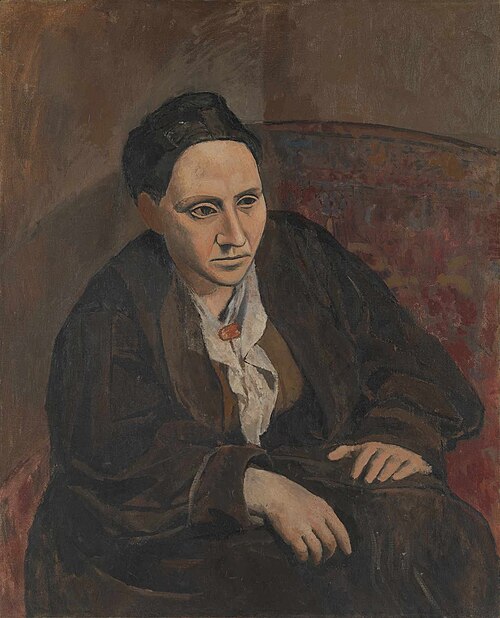
1905年までに、ピカソはアメリカの美術収集家であるレオとガートルード・スタインのお気に入りとなった。彼らの兄であるマイケル・スタインとその妻サラもピカソの作品の収集家となった。ピカソはガートルード・スタインと彼女の甥の一人であるアラン・スタインの肖像画を描いた。ガートルード・スタインはピカソの主なパトロンとなり、彼の絵やスケッチを購入してパリの自宅にある非公式のサロンで展示した。 [36] 1905年の彼女の集まりの1つで、ピカソは生涯の友人でありライバルとなるアンリ・マティスと出会った。スタイン夫妻はピカソをアメリカの美術収集家であるクラリベル・コーンとその妹エッタに紹介し、彼らもピカソとマティスの絵を購入し始めた。最終的にレオ・スタインはイタリアに移住した。マイケルとサラ・スタインはマティスのパトロンとなり、ガートルード・スタインはピカソの作品の収集を続けた。[37]
1907年、ピカソは、20世紀フランスの第一級の美術商の一人となったドイツの美術史家、美術収集家、ダニエル・ヘンリー・カーンワイラーがパリにオープンしたばかりのアートギャラリーに参加した。カーンワイラーは、パブロ・ピカソ、ジョルジュ・ブラック、そして彼らが共同で発展させたキュビズムの最初の支持者の一人だった。カーンワイラーは、当時世界中からモンパルナスに住み、働いていたアンドレ・ドラン、ケース・ファン・ドンゲン、フェルナン・レジェ、フアン・グリ、モーリス・ド・ヴラマンクなど、新進気鋭の芸術家たちを宣伝した。 [38]
アフリカの芸術と原始主義: 1907-1909

ピカソのアフリカ影響期(1907-1909年)は、絵画『アヴィニョンの娘たち』から始まる。左側の3人の人物はイベリアの彫刻に触発されたが、ピカソは1907年6月にトロカデロ宮殿の民族学博物館で見たアフリカの工芸品に強い感銘を受け、右側の2人の人物の顔を描き直した。[39]その年の後半に彼がスタジオで知人たちにこの絵を見せたところ、ほぼ全員が衝撃と嫌悪感を示した。マティスはこの作品を偽物として怒って却下した。[40]ピカソは1916年まで 『娘たち』を公に展示しなかった。
この時期の他の作品には、両手を挙げた裸体(1907年)や三人の女性(1908年)などがある。この時期に発展した形式的な考え方は、その後のキュビズムの時代に直接つながっていった。[41] 分析的キュビズム(1909年 - 1912年)は、ピカソがジョルジュ・ブラックと共同で開発した、単色の茶色がかった色と中間色を使った絵画スタイルである。どちらの芸術家も物体を分解し、その形状の観点から「分析」した。この時期のピカソとブラックの絵画には多くの類似点がある。[42]
パリでは、ピカソはモンマルトルやモンパルナス地区でアンドレ・ブルトン、詩人ギヨーム・アポリネール、作家アルフレッド・ジャリ、ガートルード・スタインなど、一流の友人たちをもてなした。1911年、ピカソはルーブル美術館からモナ・リザを盗んだ件で逮捕され、尋問を受けた。この犯罪の容疑は当初、美術館から窃盗をした経歴を持つ画家ジェリー・ピエレットとのつながりがあったアポリネールにかけられた。アポリネールは今度は、過去にピカソから盗まれた美術品を購入していた親友のピカソを関与させた。有罪判決を受けてスペインに強制送還されるのを恐れたピカソは、アポリネールに会ったことはないと否定した。後に両者とも絵画の消失への関与は否定された。[43] [44]
総合キュビズム: 1912-1919

総合的キュビズム(1912-1919)は、キュビズムのジャンルをさらに発展させたもので、切り取った紙片(多くの場合、壁紙や新聞の一部)を作品に貼り付けたもので、美術におけるコラージュの最初の使用例となった。 [要出典]
1915年から1917年にかけて、ピカソは、パイプ、ギター、グラスなど、高度に幾何学的でミニマリスト的なキュビズムのオブジェクトを描いた一連の絵画を制作し始めた。コラージュの要素も散りばめられている。美術史家ジョン・リチャードソンは「角ばった角切りダイヤモンド」と記している。「これらの宝石には、必ずしも上面や下面があるわけではない」。 [45] [46]「これらを表す新しい名前が必要だ」とピカソはガートルード・スタインに書いた。「クリスタル・キュビズム」という用語は、当時、クリスタルとの視覚的な類似性から後に使われた。[47] [45] [48]これらの「小さな宝石」は、戦後のいわゆる秩序への回帰の中で古典主義の実験を行ったことで、彼が運動から離脱したと主張する批評家への返答としてピカソが制作したのかもしれない。[45] [47]
名声と富を得た後、ピカソはオリヴィエのもとを去り、エヴァ・グエルとしても知られるマルセル・アンベールと結婚した。ピカソは多くのキュビズム作品にエヴァへの愛を告白した。1915年、30歳で病気により早すぎる死を迎えた彼女は、ピカソにとって大きな打撃となった。[49]
1914年8月に第一次世界大戦が勃発したとき、ピカソはアヴィニョンに住んでいた。ブラックとドランは動員され、アポリネールはフランス砲兵隊に入隊したが、スペイン人のフアン・グリスはキュビズム界から残った。戦争中、ピカソはフランスの同志たちと違い、中断することなく絵を描き続けることができた。彼の絵はより陰鬱になり、彼の人生は劇的な結果とともに変化した。カーンヴァイラーとの契約はフランスからの亡命とともに終了していた。この時点で、ピカソの作品は美術商のレオンス・ローゼンベルグが引き継ぐことになった。エヴァ・グエルを失った後、ピカソはギャビー・レスピナスと情事を持った。1916年の春、アポリネールは負傷して前線から戻った。彼らは友情を復活させたが、ピカソは新しい社交界に頻繁に出入りするようになった。[50]

第一次世界大戦の終わりごろ、ピカソはセルゲイ・ディアギレフのバレエ・リュスに関わるようになった。この時期の友人にはジャン・コクトー、ジャン・ユゴー、フアン・グリスなどがいた。1918年の夏、ピカソはローマでセルゲイ・ディアギレフの一座のバレリーナ、オルガ・ホフロワと結婚した。ピカソは彼女のためにエリック・サティの『パレード』というバレエをデザインしていた。二人はビアリッツ近郊の魅力的なチリの芸術パトロン、エウヘニア・エラスリスの別荘で新婚旅行を過ごした。[51]
ホフロワはピカソを1920年代のパリの上流社会、フォーマルな晩餐会、その他の富裕層の生活に引き入れた。二人の間には息子パウロ・ピカソが生まれた[52]。彼は成長してオートバイレーサーとなり、父親の運転手となった。ホフロワの社交上の礼儀に対するこだわりはピカソのボヘミアンな傾向と衝突し、二人は常に対立した。ピカソがディアギレフの一座とコラボレーションしていたのと同じ時期に、ピカソは1920年にイーゴリ・ストラヴィンスキーとプルチネッラでコラボレーションした。ピカソはこの機会を利用して作曲家の絵を数枚描いた[53] 。
1927年、ピカソは17歳のマリー=テレーズ・ワルテルと出会い、秘密の関係を持ち始めた。ピカソとホフロワの結婚は、離婚ではなく別居で終わりを迎えた。フランスの法律では離婚の際には財産を平等に分けることが義務付けられており、ピカソはホフロワに財産の半分を譲ることを望まなかったためである。2人はホフロワが1955年に亡くなるまで法的に結婚していた。ピカソはマリー=テレーズ・ワルテルとの長年にわたる関係を続け、マヤという名の娘をもうけた。マリー=テレーズはピカソがいつか結婚してくれるという希望を捨てきれず、ピカソの死後4年で首を吊って自殺した。[54]
-

-
 1909年〜1910年、「座る裸婦像」、キャンバスに油彩、92.1×73cm(36×28インチ)、テート・モダン、ロンドン。ヴィルヘルム・ウーデのコレクションにあったこの絵画はフランス政府に没収され、 1921年にオテル・ドゥルーオで売却された。
 -
 1910年、「マスタードポットを持つ女性」(La Femme au pot de moutarde)、キャンバスに油彩、73 × 60 cm(28 × 23インチ)、ハーグ市立美術館。1913年にニューヨーク、シカゴ、ボストンのアーモリーショーに出展。
 -
 1910年、マンドリンを持つ少女(ファニー・テリエ)、キャンバスに油彩、100.3 × 73.6 cm(39 × 28インチ)、ニューヨーク近代美術館
 -
 1910 年、ダニエル・ヘンリー・カーンワイラーの肖像画、シカゴ美術館。ピカソはカーンワイラーについて「カーンワイラーにビジネスセンスがなかったら、我々はどうなっていただろう」と書いている。
 -
 1910–11年、「ギタリスト、マンドリン奏者(ギターまたはマンドリンを弾く女性)」、キャンバスに油彩
 -

-
 1911年、「ラム酒の瓶のある静物画」、キャンバスに油彩、61.3 × 50.5 cm (24 × 19 in)、メトロポリタン美術館、ニューヨーク
 -
 1911年、「詩人」(Le poète)、リネンに油彩、131.2 × 89.5 cm(51 5/8 × 35 1/4インチ)、ソロモン・R・グッゲンハイム財団、ペギー・グッゲンハイム・コレクション、ヴェネツィア
 -
 1911年〜1912年、「ヴァイオリン」、キャンバスに油彩、100 × 73 cm(楕円形)、クレラー・ミュラー美術館、オッテルロー、オランダ。ヴィルヘルム・ウーデのコレクションにあったこの絵画はフランス政府に没収され、1921年にオテル・ドルーオで売却された。
 -
 1913年、ブテイユ、クラリネット、ヴィオロン、日記、ヴェール、55 × 45 cm(21 × 17インチ)。ヴィルヘルム・ウーデのコレクションにあったこの絵画はフランス政府に没収され、1921年にオテル・ドゥルーオで売却されました。
 -
 1913年、「肘掛け椅子に座る女性(エヴァ)」、キャンバスに油彩、149.9 × 99.4 cm(59 × 39インチ)、レナード A. ローダー キュビズム コレクション、メトロポリタン美術館
 -
 1913–14年、「頭部」(Tête)、切り貼りされた色紙、グアッシュ、木炭、板紙、43.5 × 33 cm(17 × 12.9インチ)、スコットランド国立近代美術館、エディンバラ
 -
 1913–14年、「カード遊びをする男」、キャンバスに油彩、108 × 89.5 cm (42 × 35 インチ)、ニューヨーク近代美術館
 -
 1914–15年、「Nature morte au compotier(コンポートとグラスのある静物)」、キャンバスに油彩、63.5 × 78.7 cm(25 × 31インチ)、オハイオ州コロンバス美術館
 -
 1916年、「アニス・デル・モノ(アニス・デル・モノの瓶)」、キャンバスに油彩、46 × 54.6 cm(18 × 21インチ)、デトロイト美術館、ミシガン州
 -
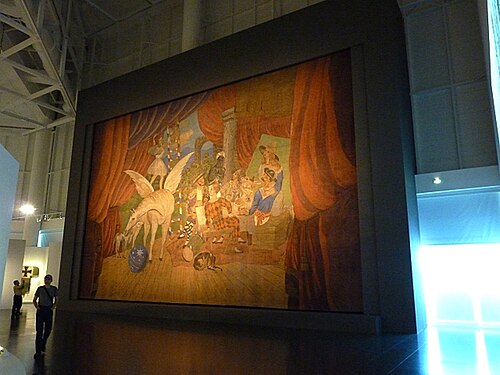 パレード、1917年、バレエ「パレード」のためにデザインされたカーテン。この作品はピカソの絵画の中で最大のものです。ポンピドゥー・センター・メス、メス、フランス、2012年5月
,_oil_on_canvas,_100_x_80_cm,_Staatliche_Museen_zu_Berlin,_Neue_Nationalgalerie.jpg/500px-Pablo_Picasso,_1909,_Femme_assise_(Sitzende_Frau),_oil_on_canvas,_100_x_80_cm,_Staatliche_Museen_zu_Berlin,_Neue_Nationalgalerie.jpg)
,_oil_on_canvas,_92.1_x_73_cm,_Tate_Modern,_London.jpg/500px-Pablo_Picasso,_1909-10,_Figure_dans_un_Fauteuil_(Seated_Nude,_Femme_nue_assise),_oil_on_canvas,_92.1_x_73_cm,_Tate_Modern,_London.jpg)
,_oil_on_canvas,_73_x_60_cm,_Gemeentemuseum,_The_Hague._Exhibited_at_the_Armory_Show,_New_York,_Chicago,_Boston_1913.jpg/500px-thumbnail.jpg)
,_oil_on_canvas,_100.3_x_73.6_cm,_Museum_of_Modern_Art_New_York..jpg/500px-Pablo_Picasso,_1910,_Girl_with_a_Mandolin_(Fanny_Tellier),_oil_on_canvas,_100.3_x_73.6_cm,_Museum_of_Modern_Art_New_York..jpg)


,_C%C3%A9ret,_oil_on_linen,_131.2_%C3%97_89.5_cm,_The_Solomon_R._Guggenheim_Foundation,_Peggy_Guggenheim_Collection,_Venice.jpg/500px-Pablo_Picasso,_1911,_The_Poet_(Le_po%C3%A8te),_C%C3%A9ret,_oil_on_linen,_131.2_%C3%97_89.5_cm,_The_Solomon_R._Guggenheim_Foundation,_Peggy_Guggenheim_Collection,_Venice.jpg)
,_oil_on_canvas,_Kr%C3%B6ller-M%C3%BCller_Museum,_Otterlo,_Netherlands.jpg/500px-Pablo_Picasso,_1911-12,_Violon_(Violin),_oil_on_canvas,_Kr%C3%B6ller-M%C3%BCller_Museum,_Otterlo,_Netherlands.jpg)


,_cut_and_pasted_colored_paper,_gouache_and_charcoal_on_paperboard,_43.5_x_33_cm,_Scottish_National_Gallery_of_Modern_Art,_Edinburgh.jpg/500px-thumbnail.jpg)
,_oil_on_canvas,_108_x_89.5_cm,_Museum_of_Modern_Art,_New_York.jpg/500px-Pablo_Picasso,_1913-14,_L'Homme_aux_cartes_(Card_Player),_oil_on_canvas,_108_x_89.5_cm,_Museum_of_Modern_Art,_New_York.jpg)
,_oil_on_canvas,_63.5_x_78.7_cm_(25_x_31_in),_Columbus_Museum_of_Art,_Ohio.jpg/500px-thumbnail.jpg)
_oil_on_canvas,_46_x_54.6_cm,_Detroit_Institute_of_Arts,_Michigan.jpg/500px-Pablo_Picasso,_1916,_L'anis_del_mono_(Bottle_of_Anis_del_Mono)_oil_on_canvas,_46_x_54.6_cm,_Detroit_Institute_of_Arts,_Michigan.jpg)
新古典主義とシュルレアリスム: 1919-1929
,_pastel,_66_x_50.8_cm,_Berggruen_Museum.jpg/500px-Pablo_Picasso,_1921,_Nu_assis_s'essuyant_le_pied_(Seated_Nude_Drying_her_Foot),_pastel,_66_x_50.8_cm,_Berggruen_Museum.jpg)
1917年2月、ピカソは初めてイタリアを訪れた。[55]第一次世界大戦の混乱後の時期に、ピカソは新古典主義様式の作品を制作した。この「秩序への回帰」は、アンドレ・ドラン、ジョルジョ・デ・キリコ、ジーノ・セヴェリーニ、ジャン・メッツィンガー、新即物主義運動やノヴェチェント・イタリアーノ運動の芸術家など、1920年代の多くのヨーロッパの芸術家の作品に明らかである。この時期のピカソの絵画や素描は、ラファエロやアングルの作品を彷彿とさせることが多い。[56]
1925年、シュルレアリストの作家で詩人のアンドレ・ブルトンは、雑誌『シュルレアリスト革命』に発表した論文『シュルレアリスムと絵画』の中で、ピカソを「我々の仲間」と評した。『娘たち』は、同号で初めてヨーロッパで再版された。しかし、ピカソは1925年の最初のシュルレアリストのグループ展でキュビズムの作品を展示した。『シュルレアリスム宣言』で定義された「純粋な精神的オートマティズム」という概念は、ピカソにはまったく魅力的ではなかった。当時、彼は感情的に自分を表現するための新しいイメージと形式的な構文を開発し、「1909年以来、大部分抑制または昇華されていた暴力、精神的恐怖、エロティシズムを解放した」と美術史家メリッサ・マッキランは書いている。ピカソの作品におけるこの変遷はキュビスムの空間的関係に影響を受けたが、「イメージにおける儀式と放縦の融合は『娘たち』の原始主義と象徴主義作品の捉えどころのない心理的共鳴を思い起こさせる」とマックィランは書いている。シュルレアリスムはピカソの原始主義とエロティシズムへの興味を復活させた。[57]
-
 パブロ・ピカソ、1918年、ピエロ、キャンバスに油彩、92.7 × 73 cm、ニューヨーク近代美術館
 -
 パブロ・ピカソ、1918年、肖像ドルガ・ダン・アン・フォートゥイユ(肘掛け椅子に座るオルガ)、ピカソ美術館、パリ、フランス
 -
 パブロ・ピカソ、1919年、「眠る農民」、グアッシュ、水彩、鉛筆、紙、31.1 × 48.9 cm、近代美術館

,_oil_on_canvas,_130_x_88.8_cm,_Mus%C3%A9e_Picasso,_Paris,_France.jpg/500px-Pablo_Picasso,_1917-18,_Portrait_d'Olga_dans_un_fauteuil_(Olga_in_an_Armchair),_oil_on_canvas,_130_x_88.8_cm,_Mus%C3%A9e_Picasso,_Paris,_France.jpg)

大恐慌、ゲルニカ、そしてMoMA展:1930-1939
1930年代には、ミノタウロスがハーレクインに代わってピカソの作品の一般的なモチーフとなった。ミノタウロスの使用は、シュルレアリストとの交流に一部起因しており、彼らはしばしばミノタウロスをシンボルとして用いており、ピカソのゲルニカにもミノタウロスが登場する。ミノタウロスとピカソの愛人マリー=テレーズ・ワルテルは、彼の有名なエッチング作品「ヴォラール組曲」に頻繁に登場している。[58]

ピカソの最も有名な作品は、スペイン内戦中のドイツ軍によるゲルニカ爆撃を描いた『ゲルニカ』であると言っても過言ではない。この大きなキャンバスは、多くの人にとって戦争の非人道性、残虐性、絶望を体現している。その象徴性について説明を求められ、ピカソは「画家がシンボルを定義する必要はない。そうでなければ、彼がそれを言葉で書き表した方がよいだろう!絵を見る観客が、自分が理解できるようにシンボルを解釈しなければならない」と答えた。[59] [60]
ゲルニカは1937年7月にパリ万国博覧会のスペイン館で展示され、その後、ピカソ、マティス、ブラック、アンリ・ローランの作品118点を集めた展覧会の目玉となり、スカンジナビアとイギリスを巡回した。フランシスコ・フランコがスペインで勝利した後、この絵画はスペイン難民への資金集めと支援のため米国に送られた。1981年まで、この絵画はニューヨーク近代美術館(MoMA)に預けられていたが、これはスペインで自由と民主主義が確立されるまでこの絵画をスペインに引き渡さないというピカソの明確な希望によるものであった。[61]
ゲルニカ以前、ピカソは芸術において政治的なテーマを扱ったことはなかった。この作品の政治的な性質は、主に当時のフランスの反ファシスト活動家でシュールレアリストの写真家ドラ・マールとの恋愛関係に起因する。[62]さらに、彼女の白黒写真は、ピカソの通常の色彩豊かな絵画とはまったく対照的に、ゲルニカの白黒の配色に影響を与えた可能性が高い。「マールの写真術はピカソの芸術に影響を与えました。彼女は彼の作品に多大な影響を与えました」とドラ・マールの専門家であるアントワーヌ・ロマンドは述べた。「彼女はピカソに異議を唱えました。彼女はピカソに何か新しいことをし、政治的にもっと創造的になるように促したのです。」[62]マールはピカソのスタジオに独占的に出入りし、ゲルニカの制作を観察し、写真を撮った。[63]ピカソの要請により、マールは死にゆく馬の一部を描いた。[63]
1939年と1940年、ニューヨーク近代美術館は、ピカソ愛好家であったアルフレッド・バー館長の指揮のもと、それまでのピカソの主要作品の大規模な回顧展を開催した。この展覧会はピカソを称賛し、彼の芸術性の範囲をアメリカで広く一般に公開し、現代美術史家や学者による彼の作品の再解釈をもたらした。[64]ジョナサン・ワインバーグによると、「展覧会の並外れた質と、ゲルニカの政治的影響によって高められたピカソの絶大な名声を考えると...批評家は驚くほど曖昧だった」。[65]ピカソの「多様なスタイル」は、あるジャーナリストを不安にさせた。別のジャーナリストは彼を「気まぐれで悪意さえある」と表現した。ARTnewsのアルフレッド・フランケンシュタインのレビューは、ピカソはペテン師であると同時に天才であると結論付けた。[65]
第二次世界大戦と1940年代後半: 1939年~1949年


第二次世界大戦中、ドイツ軍がパリを占領している間、ピカソはパリに留まった。ピカソの芸術スタイルはナチスの芸術の理想に合わなかったため、この間は展示を行わなかった。彼はゲシュタポから頻繁に嫌がらせを受けた。あるとき、彼のアパートを捜索した警官が絵画『ゲルニカ』の写真を見た。「あなたがそれをしたのですか?」とドイツ兵はピカソに尋ねた。「いいえ」とピカソは答えた。「あなたがやったのです。」[68]
アトリエに引きこもりながら絵を描き続け、ギターのある静物画(1942年)や納骨堂(1944年 - 48年)などの作品を制作した。ドイツ軍はパリでのブロンズ鋳造を禁止したが、ピカソはフランスレジスタンスが密輸したブロンズを使い、制作を続けた。[69]
この頃、ピカソは別の表現方法として詩を書いた。1935年から1959年の間に、彼は300以上の詩を書いた。日付と、時には執筆場所(例えば「パリ1936年5月16日」)を除いて、大部分は無題で、これらの作品は味覚的で、エロチックで、時にはスカトロ的だった。彼の2つの長編劇『しっぽにつかまれた欲望』(1941年)、『4人の少女』(1949年)、『オルガス伯爵の埋葬』(1959年)も同様だった。[70]
1944年、パリ解放後、当時63歳だったピカソは、フランソワーズ・ジローという名の若い美術学生と恋愛関係になり始めた。彼女は彼より40歳も若かった。ピカソは愛人のドラ・マールに飽きてしまい、ピカソとジローは一緒に暮らし始めた。やがて、2人の間には1947年生まれのクロード・ピカソと1949年生まれのパロマ・ピカソという2人の子供が生まれた。1964年の著書『ピカソとの生活』 [71]で、ジローはピカソからの虐待と数々の不貞が原因で子供たちを連れて彼のもとを去ったと述べている。これはピカソにとって大きな打撃だった。[要出典]
_-_BEIC_6356204.jpg/500px-Vincenzo_Carrerese_Paolo_Monti_-_Servizio_fotografico_(Milano,_1953)_-_BEIC_6356204.jpg)
ピカソは、ジローとの情事よりもさらに年齢差のある女性と関係を持っていた。ジローとの関係が続いていた1951年、ピカソはジローより4歳年下のジュヌヴィエーヴ・ラポルトと6週間の情事を持った。70代までには、多くの絵画、インク画、版画のテーマは、若く美しいモデルを溺愛する年老いたグロテスクな小人である。ジャクリーヌ・ロック(1927年 - 1986年)は、フランスのリビエラにあるヴァロリスのマドゥラ陶器工場で働き、ピカソはそこで陶器を制作し、絵付けをした。彼女はピカソの愛人となり、1961年に2度目の妻となった。2人はピカソの生涯を共に過ごした。[72]
ロックとの結婚はジローに対する復讐でもあった。ピカソの勧めで、ジローは当時の夫リュック・シモンと離婚し、子供たちをピカソの正当な相続人として権利を確保するためにピカソと結婚する計画を立てていた。ジローが離婚を申請した後、ピカソはすでにロックと密かに結婚していた。クロードとパロマとの緊張した関係は修復されなかった。[73]
この頃までにピカソは巨大なゴシック様式の家を建て、南フランスのムージャン郊外のマ・ノートルダム・ド・ヴィやプロヴァンス=アルプ=コート・ダジュールに大きな別荘を建てる余裕があった。彼は国際的な有名人であり、芸術と同じくらい私生活にも関心を持っていた。[74]
晩年の作品: 1949–1973

ピカソは、1949 年半ばにフィラデルフィア美術館で開催された第3 回国際彫刻展に出展した 250 人の彫刻家の 1 人でした。1950 年代には、ピカソのスタイルが再び変化し、巨匠たちの芸術を再解釈した作品を制作するようになりました。彼はベラスケスの絵画「ラス・メニーナス」を基にした一連の作品を制作しました。また、ゴヤ、プッサン、マネ、クールベ、ドラクロワの作品を基にした絵画も制作しました。[出典が必要]
芸術的な業績に加えて、ピカソはジャン・コクトーの『オルフェウスの遺言』 (1960年)へのカメオ出演を含め、常に本人役で映画に出演しています。1955年には、アンリ=ジョルジュ・クルーゾー監督の映画『ピカソの謎』の制作に協力しました。

彼はシカゴに建設される予定の、高さ50フィート(15メートル)の巨大な公共彫刻(通称シカゴ・ピカソ)の模型の制作を依頼された。彼はこのプロジェクトに非常に熱心に取り組み、曖昧でやや物議を醸す彫刻をデザインした。ピカソによると、この人物像はカブールという名のアフガン・ハウンドの頭を表現しているという。[75]シカゴのダウンタウンで最もよく知られているランドマークの1つであるこの彫刻は、1967年に公開された。ピカソはこれに10万ドルの支払いを拒否し、市の人々に寄付した。[76]
ピカソの最後の作品はさまざまなスタイルが混在しており、表現方法は生涯を通じて絶えず変化していた。全力を注いだピカソはより大胆になり、作品はより色彩豊かで表現力豊かになり、1968年から1971年にかけて大量の絵画と数百枚の銅版画を制作した。当時、これらの作品はほとんどの人から、無力な老人のポルノ的幻想、あるいは全盛期を過ぎた芸術家のいい加減な作品として退けられた。[77] [78]ピカソの死後、芸術界の他の部分が抽象表現主義から移行して初めて、批評家たちはピカソの晩年の作品を新表現主義の先駆けとみなすようになった。[79]
死
パブロ・ピカソは1973年4月8日、フランスのムージャンで、妻ジャクリーヌと友人を夕食に招いた翌朝、肺水腫と心臓発作で亡くなった。ピカソはエクスアンプロヴァンス近郊のヴォーヴナルグ城に埋葬された。ピカソは1958年にこの地所を取得し、1959年から1962年までジャクリーヌと住んでいた。ジャクリーヌは、ピカソの子供であるクロードとパロマが葬儀に参列するのを阻止した。[80]ピカソの死後、悲しみと孤独に打ちひしがれたジャクリーヌは、1986年に59歳で銃で自殺した。[81]
政見

ピカソは若い頃、カタルーニャ独立運動を全面的に支持し、運動家たちと親しくしていたにもかかわらず、運動から距離を置いていた。 [82]彼は第一次世界大戦、スペイン内戦、第二次世界大戦の間、どの側や国にも従軍しなかった。フランスに住むスペイン国民として、ピカソはどちらの世界大戦でも侵略してきたドイツ軍と戦うことを強制されなかった。1940年にフランス国籍を申請したが、「共産主義に向かう過激な思想」を理由に拒否された。この情報は2003年まで明らかにされなかった。[83]
1936年にスペイン内戦が始まったとき、ピカソは54歳だった。戦闘が始まって間もなく、共和党は彼を「欠席ではあったがプラド美術館の館長」に任命し、ジョン・リチャードソンによれば「彼は職務を非常に真剣に受け止め」、美術館のコレクションをジュネーブに避難させる資金を提供した。[84]この戦争はピカソの最初のあからさまな政治的作品のきっかけとなった。彼はフランシスコ・フランコとファシストに対する怒りと非難を「特にプロパガンダと資金集めの目的で」制作された『フランコの夢と嘘』(1937年)で表現した。 [85]この言葉とイメージのシュールな融合は、スペイン共和党の目的のために資金を集めるための一連のポストカードとして販売されることが意図されていた。[85] [86]
1944年、ピカソはフランス共産党に入党した。 1948年、ポーランドで開催された世界平和擁護知識人会議に出席し、1950年にはソ連政府からスターリン平和賞を受賞した。 [87] 1953年にピカソが描いたヨシフ・スターリンの肖像画は、リアリティに欠けるとして党から批判されたが、彼は死ぬまで共産党の忠実な党員であり続けた。[84]ピカソの画商で社会主義者のD・H・カーンヴァイラーは、ピカソの共産主義を「感傷的」で政治的ではないと評し、「彼はカール・マルクスを一行も読んだことがないし、もちろんエンゲルスも読んだことがない」と述べた。[84] 1945年にジェローム・セックラーとのインタビューで、ピカソは次のように述べている。「私は共産主義者であり、私の絵は共産主義の絵です。…しかし、私が靴職人で、王党派や共産主義者であったとしても、必ずしも自分の政治姿勢を示すために特別な方法で靴を叩くことはないでしょう。」[88]当時の大陸の知識人や芸術家の間では一般的だった彼の共産主義への傾倒は、長い間論争の的となってきました。その顕著な例は、サルバドール・ダリ(ピカソとはかなり緊張した関係にあった[89] )の引用です。
ピカソ、ピントール、よタンビエン。 ... スペインのピカソ、旅を楽しみましょう。ピカソ エス コムニスタ、よタンポコ。
(ピカソは画家であり、私も同じです。...ピカソはスペイン人です、私もそうです。ピカソは共産主義者ですが、私も同じです。) [90] [91] [92]
1940年代後半、トロツキストで反スターリン主義者で、ピカソの旧友でシュールレアリストの詩人アンドレ・ブルトンはより率直だった。[93]ピカソとの握手を拒否し、ブルトンは彼にこう言った。「私はあなたが共産党に入党することも、解放後の知識人粛清に関してあなたが取った立場も承認しません。」[94] 共産主義者であったピカソは、朝鮮戦争への国連と米国の介入に反対し、朝鮮大虐殺でそれを描いた。[95] [96]美術評論家のキルステン・ホーヴィング・キーンは、この作品は「アメリカの残虐行為の報告に触発された」と書き、ピカソの共産主義的作品の1つであるとみなした。[97]
1949年1月9日、ピカソは白黒のリトグラフ「鳩」を制作した。この作品は1949年の世界平和会議のポスターの挿絵として使用され、当時の象徴的なイメージとなり、「平和の鳩」として知られるようになった。ピカソの作品は平和会議と共産主義のシンボルとして世界中で使用された。[98]
1962年、彼はレーニン平和賞を受賞した。[99]伝記作家で美術評論家のジョン・バーガーは、彼の芸術家としての才能が共産主義者によって「無駄にされた」と感じた。[100]ジャン・コクトーの日記によると、ピカソはかつて共産主義者についてこう言ったことがある。「私は家族に加わったが、他の家族と同じように、それはクソだらけだ。」[101]
スタイルとテクニック
ピカソは長い生涯を通じて並外れた多作だった。死去時に彼の遺産には45,000点以上の売れ残りの作品があり、その内訳は絵画1,885点、彫刻1,228点、陶器3,222点、素描7,089点、スケッチブック150冊、版画数千点、タペストリーや絨毯数枚だった。[102]最も完全な(ただし網羅的ではない)作品目録であるクリスチャン・ゼルヴォスが編纂したカタログ・レゾネには、16,000点以上の絵画と素描が掲載されている。[103]ピカソの作品数は同時代のほとんどの芸術家より数倍多かった。少なくとも1つの報告によると、ピカソの作品数に匹敵するのはアメリカ人芸術家のボブ・ロスだけであり、ロスの作品は特に大量生産が容易で迅速に行えるようにデザインされていた。[104]
ピカソが最も重要な貢献をした媒体は絵画であった。[105]ピカソは絵画において色彩を表現要素として用いたが、形態や空間を作り出すためには色の微妙な違いよりも描画に頼っていた。[105]質感を変えるために絵の具に砂を加えることもあった。シカゴ美術館所蔵のピカソの『赤い肘掛け椅子』(1931年)のナノプローブを2012年にアルゴンヌ国立研究所の物理学者が行った調査により、ピカソが多くの絵画で一般的な家庭用塗料を使用していたという美術史家の考えが裏付けられた。[106] [107]彼の絵画の多くは夜間に人工照明の下で描かれた。
ピカソの初期の彫刻は木彫りか、蝋や粘土で型取りされていたが、1909年から1928年にかけてピカソは型取りをやめ、代わりに多様な材料を使った彫刻作品を制作した。[105]一例として、金属板とワイヤーで作られたレリーフ構造のギター(1912年)が挙げられ、ジェーン・フリューゲルはこれを「キュビズム絵画の3次元平面版」と呼び、「型取りと彫刻という伝統的な手法からの革命的な脱却」を示している。[108]

ピカソは、そのキャリアの初めからあらゆる種類の主題に興味を示し、[109]一度に複数のスタイルで作業することを可能にする優れたスタイルの多様性を示しました。たとえば、1917年の彼の絵画には、点描画の 「マンティージャの女性」、キュビズムの「肘掛け椅子の人物」、自然主義的な「道化師」(すべてバルセロナのピカソ美術館)が含まれています。1919年には、彼は、ポーズをとった写真のスタイルの慣習と静的な特徴への関心を反映して、ポストカードや写真から多くのドローイングを制作しました。[110] 1921年には、数枚の大型の新古典主義の絵画と、キュビズムの構図である「3人の音楽家」の2つのバージョンを同時に描きました(ニューヨーク近代美術館、フィラデルフィア美術館)。[55] 1923年に出版されたインタビューでピカソは「私が芸術で用いた様々な手法は、絵画の進化や未知の理想への一歩として考えるべきではない...私が表現したい主題が様々な表現方法を示唆していたら、私はそれを採用することを躊躇しなかった」と語っている。[55]
ピカソのキュビズム作品は抽象化に近づいているが、現実世界の物体を主題として放棄することはなかった。彼のキュビズム絵画で目立つのは、ギター、バイオリン、ボトルなど、簡単に認識できる形である。[111]ピカソが複雑な物語の場面を描くときは、通常、版画、素描、小規模な作品であった。ゲルニカ(1937年)は、彼の数少ない大きな物語画の1つである。[110]
ピカソは主に想像や記憶から絵を描いた。ウィリアム・ルービンによれば、ピカソは「本当に自分が関わっている主題からしか偉大な芸術を作れなかった...マティスとは違い、ピカソは成人してからほぼずっとモデルを避け、自分の人生に影響を与え、自分の人生にとって本当に重要な人物を描くことを好んだ」という。 [112]美術評論家のアーサー・ダントーは、ピカソの作品は「広大な絵画的自伝」であり、「ピカソは新しい女性に恋をするたびに新しいスタイルを発明した」という一般的な概念の根拠となると述べた。 [112]ピカソの芸術の自伝的性質は、作品に日付を付ける習慣、多くの場合日付を付ける習慣によって強化されている。彼は次のように説明した。「私は後世にできるだけ完全な記録を残したい。だから私は自分の作品すべてに日付を付けるのだ。」[112]
芸術的遺産
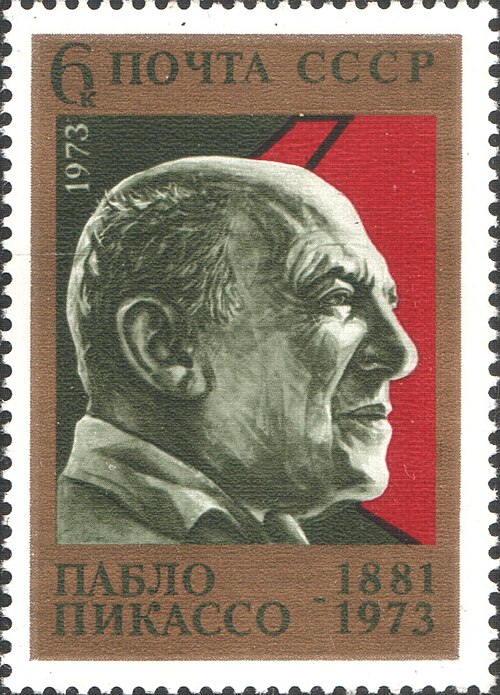
ピカソの影響力は当時も今も計り知れず、彼を崇拝する者も批判する者も広く認めている。1939年にニューヨーク近代美術館で行われた回顧展の際、ライフ誌は次のように書いた。「ピカソがヨーロッパ近代美術界を席巻した25年間、彼の敵は彼が腐敗した影響を与えたと言う。一方、彼の友人は、同じように激しく、彼は現存する最も偉大な芸術家だと言う。」[113]ピカソはパリのルーブル美術館のグランドギャラリーで90歳の記念特別展を開催された最初の芸術家である。[114] 1998年、ロバート・ヒューズは彼について次のように書いている。「パブロ・ピカソが20世紀の西洋美術を支配したというのは、今ではごく普通のことだ。…画家や彫刻家は誰も、ミケランジェロでさえ、生前はこれほど有名ではなかった。…概念的な皮肉のあのずる賢い老狐、マルセル・デュシャンは、確かに過去30年間、名目上の前衛芸術にピカソ以上の影響を与えてきたが、スペイン人は、絵画や彫刻の言語は、その信奉者以外の人々にとっても本当に重要であるという信念の最後の偉大な受益者だった。」[115]

At the time of Picasso's death many of his paintings were in his possession, as he had kept off the art market what he did not need to sell. In addition, Picasso had a considerable collection of the work of other famous artists, some his contemporaries, such as Henri Matisse, with whom he had exchanged works. Since Picasso left no will, his death duties (estate tax) to the French state were paid in the form of his works and others from his collection. These works form the core of the immense and representative collection of the Musée Picasso in Paris.[citation needed] In 2003, relatives of Picasso inaugurated a museum dedicated to him in his birthplace, Málaga, Spain, the Museo Picasso Málaga.[116]

The Museu Picasso in Barcelona features many of his early works, created while he was living in Spain, including many rarely seen works which reveal his firm grounding in classical techniques. The museum also holds many precise and detailed figure studies done in his youth under his father's tutelage, as well as the extensive collection of Jaime Sabartés, his close friend and personal secretary.[citation needed]
Guernica was on display in New York's Museum of Modern Art for many years. In 1981, it was returned to Spain and was on exhibit at the Casón del Buen Retiro of the Museo del Prado. In 1992, the painting was put on display in the Reina Sofía Museum when it opened.[citation needed]

In 1985, a museum was established in Buitrago del Lozoya by Picasso's friend Eugenio Arias Herranz.[117]
It was announced on 22 September 2020 that the project for a new Picasso Museum due to open in Aix-en-Provence in 2021, in a former convent (Couvent des Prêcheurs), which would have held the largest collection of his paintings of any museum, had been scrapped due to the fact that Catherine Hutin-Blay, Jacqueline Picasso's daughter, and the City Council had failed to reach an agreement.[118]
In the 1996 movie Surviving Picasso, Picasso is portrayed by actor Anthony Hopkins.[119] Picasso is also a character in Steve Martin's 1993 play, Picasso at the Lapin Agile. In A Moveable Feast by Ernest Hemingway, Hemingway tells Gertrude Stein that he would like to have some Picassos, but cannot afford them. Later in the book, Hemingway mentions looking at one of Picasso's paintings. He refers to it as Picasso's nude of the girl with the basket of flowers, possibly related to Young Naked Girl with Flower Basket. On 8 October 2010, Picasso: Masterpieces from the Musée National Picasso, Paris, an exhibition of 150 paintings, sculptures, drawings, prints and photographs from the Musée National Picasso in Paris, opened at the Seattle Art Museum, Seattle, Washington, US. The exhibition subsequently travelled to the Virginia Museum of Fine Arts, Richmond, Virginia: the M.H. de Young Memorial Museum, San Francisco, California, US.;[120] the Art Gallery of New South Wales, Sydney, Australia;[121] and the Art Gallery of Ontario, Toronto, Ontario, Canada.[citation needed]
As of 2015[update], Picasso remained the top-ranked artist (based on sales of his works at auctions) according to the Art Market Trends report.[122] More of his paintings have been stolen than any other artist's;[123] in 2012, the Art Loss Register had 1,147 of his works listed as stolen.[124] The Picasso Administration functions as his official Estate. The US copyright representative for the Picasso Administration is the Artists Rights Society.[125]
Picasso is played by Antonio Banderas in the 2018 season of Genius which focuses on his life and art.[citation needed]
The Basel vote

In the 1940s, a Swiss insurance company based in Basel had bought two paintings by Picasso to diversify its investments and serve as a guarantee for the insured risks. Following an air disaster in 1967, the company had to pay out heavy reimbursements. The company decided to part with the two paintings, which were deposited in the Kunstmuseum Basel. In 1968, a large number of Basel citizens called for a local referendum on the purchase of the Picassos by the Canton of Basel-Stadt, which was successful, making it the first time in democratic history that the population of a city voted on the purchase of works of art for a public art museum.[126] The paintings therefore remained in the museum in Basel. Informed of this, Picasso donated three paintings and a sketch to the city and its museum and was later made an honorary citizen by the city.[127]
Auction history

Several paintings by Picasso rank among the most expensive paintings in the world. Garçon à la pipe sold for US$104 million at Sotheby's on 4 May 2004. Dora Maar au Chat sold for US$95.2 million at Sotheby's on 3 May 2006.[128] On 4 May 2010, Nude, Green Leaves and Bust was sold at Christie's for US$106.5 million. The 1932 work, which depicts Picasso's mistress Marie-Thérèse Walter reclining and as a bust, was in the personal collection of Los Angeles philanthropist Frances Lasker Brody, who died in November 2009.[129] On 11 May 2015 his painting Women of Algiers set the record for the highest price ever paid for a painting when it sold for US$179.3 million at Christie's in New York.[130]
On 21 June 2016, a painting by Pablo Picasso titled Femme Assise (1909) sold for £43.2 million ($63.4 million) at Sotheby's London, exceeding the estimate by nearly $20 million, setting a world record for the highest price ever paid at auction for a Cubist work.[131][132]
On 17 May 2017, The Jerusalem Post in an article titled "Picasso Work Stolen By Nazis Sells for $45 Million at Auction" reported the sale of a portrait painted by Picasso, the 1939 Femme assise, robe bleu, which was previously misappropriated during the early years of WWII. The painting has changed hands several times since its recovery, most recently through auction in May 2017 at Christie's in New York City.[133]
In March 2018, his Femme au Béret et à la Robe Quadrillée (1937), a portrait of Marie-Thérèse Walter, sold for £49.8m at Sotheby's in London.[134]
Personal life
From early adolescence, Picasso maintained both superficial and intense amatory and sexual relationships. Biographer John Richardson stated that 'work, sex and tobacco' were his addictions.[135] Picasso was married twice and had four children by three women:
- Paulo (4 February 1921 – 5 June 1975, Paul Joseph Picasso) – with Olga Khokhlova
- Maya (5 September 1935 – 20 December 2022, Maria de la Concepcion Picasso) – with Marie-Thérèse Walter
- Claude (15 May 1947 – 24 August 2023, Claude Pierre Pablo Picasso) and Paloma (born 19 April 1949, Anne Paloma Picasso) – with Françoise Gilot
Photographer and painter Dora Maar was a constant companion and lover of Picasso. The two were closest in the late 1930s and early 1940s, and it was Maar who documented the painting of Guernica.[136]
The women in Picasso's life played an important role in the emotional and erotic aspects of his creative expression, and the tumultuous nature of these relationships has been considered vital to his artistic process. Many of these women functioned as muses for him, and their inclusion in his extensive oeuvre granted them a place in art history.[137] A largely recurring motif in his body of work is the female form. The variations in his relationships informed and collided with his progression of style throughout his career. For example, portraits created of his first wife, Olga, were rendered in a naturalistic style during his Neoclassical period. His relationship with Marie-Thérèse Walter inspired many of his surrealist pieces, as well as what is referred to as his "Year of Wonders".[138] Reappearance of acrobats theme in 1905 put an end to his "Blue Period" and transitioned into his "Rose Period". This transition has been incorrectly attributed to the presence of Fernande Olivier in his life.[139]
Picasso has been characterised as a womaniser and a misogynist, being quoted as saying to long-time partner Françoise Gilot that "women are machines for suffering."[140] He later allegedly told her, "For me there are only two kinds of women: goddesses and doormats."[141] In her memoir, Picasso, My Grandfather, Marina Picasso writes of his treatment of women, "He submitted them to his animal sexuality, tamed them, bewitched them, ingested them, and crushed them onto his canvas. After he had spent many nights extracting their essence, once they were bled dry, he would dispose of them."[142]
Of the several important women in his life, two – lover Marie-Thèrése Walter and his second wife Jacqueline Roque – died by suicide. Others, notably his first wife Olga Khokhlova and lover Dora Maar, succumbed to nervous breakdowns. His son, Paulo, developed a fatal alcoholism due to depression. His grandson, Pablito, also died by suicide that same year by ingesting bleach when he was barred by Jacqueline Roque from attending the artist's funeral.[140]
Catalogue raisonné
Picasso entrusted Christian Zervos to constitute the catalogue raisonné of his work (painted and drawn). The first volume of the catalogue, Works from 1895 to 1906, published in 1932, entailed the financial ruin of Zervos, self-publishing under the name Cahiers d'art, forcing him to sell part of his art collection at auction to avoid bankruptcy.[143][144]
From 1932 to 1978, Zervos constituted the catalogue raisonné of the complete works of Picasso in the company of the artist who had become one of his friends in 1924. Following the death of Zervos, Mila Gagarin supervised the publication of 11 additional volumes from 1970 to 1978.[145]
The 33 volumes cover the entire work from 1895 to 1972, with close to 16,000 black and white photographs, in accord with the will of the artist.[146]
- 1932: tome I, Œuvres de 1895 à 1906. Introduction p. XI–[XXXXIX], 185 pages, 384 reproductions
- 1942: tome II, vol.1, Œuvres de 1906 à 1912. Introduction p. XI–[LV], 172 pages, 360 reproductions
- 1944: tome II, vol.2, Œuvres de 1912 à 1917. Introduction p. IX–[LXX–VIII], 233 p. pp. 173 to 406, 604 reproductions
- 1949: tome III, Œuvres de 1917 à 1919. Introduction p. IX–[XIII], 152 pages, 465 reproductions
- 1951: tome IV, Œuvres de 1920 à 1922. Introduction p. VII–[XIV], 192 pages, 455 reproductions
- 1952: tome V, Œuvres de 1923 à 1925. Introduction p. IX–[XIV], 188 pages, 466 reproductions
- 1954: tome VI, Supplément aux tomes I à V. Sans introduction, 176 pages, 1481 reproductions
- 1955: tome VII, Œuvres de 1926 à 1932. Introduction p. V–[VII], 184 pages, 424 reproductions
- 1978: Catalogue raisonné des œuvres de Pablo Picasso, Paris, Éditions Cahiers d'art[147]
Further publications by Zervos
- Picasso. Œuvres de 1920 à 1926, Cahiers d'art, Paris
- Dessins de Picasso 1892–1948, Paris, Éditions Cahiers d'art, 1949
- Picasso. Dessins (1892–1948), Hazan, 199 reproductions, 1949
See also
Notes and references
Notes
- ^ a b Picasso's full name includes various saints and relatives. According to his birth certificate, issued on 28 October 1881, he was born Pablo Diego José Francisco de Paula Juan Nepomuceno Cipriano de la Santísima Trinidad Ruiz Picasso.[2] According to the record of his baptism, he was named Pablo Diego José Francisco de Paula Juan Nepomuceno Crispín Cipriano (other sources: Crispiniano) de la Santísima Trinidad María de los Remedios Alarcón y Herrera Ruiz Picasso.[3][2][4] He was named Juan Nepomuceno after his godfather, a lawyer, friend of the family, called Juan Nepomuceno Blasco y Barroso.[2] He was named Crispín Cipriano after the twin saints celebrated on 25 October, his birth date.[3] Nepomuceno's wife and Picasso's godmother, María de los Remedios Alarcón y Herrera, was also honored in Picasso's baptismal name.[2]
- ^ His name is pronounced UK: /ˈpæbloʊ pɪˈkæsoʊ/, US: /ˈpɑːbloʊ pɪˈkɑːsoʊ, -ˈkæs-/;[5][6][7] Spanish: [ˈpaβlo piˈkaso].
- ^ Though baptized a Catholic, Picasso would later become an atheist.[15]
References
- ^ a b Daix, Pierre (1988). Picasso, 1900–1906: catalogue raisonné de l'oeuvre peint (in French). Editions Ides et Calendes. pp. 1–106.
- ^ a b c d e Cabanne, Pierre (1977). Pablo Picasso: His Life and Times. Morrow. p. 15. ISBN 978-0-688-03232-6.
- ^ a b McCully, Marilyn. "Pablo Picasso, Additional Information: Researcher's Note: Picasso's full name". Britannica.
- ^ Lyttle, Richard B. (1989). Pablo Picasso: The Man and the Image. Atheneum. p. 2. ISBN 978-0-689-31393-6.
- ^ "Picasso". Collins English Dictionary. HarperCollins. Retrieved 3 June 2019.
- ^ "Picasso, Pablo" (US) and "Picasso, Pablo". Lexico UK English Dictionary. Oxford University Press. Archived from the original on 18 January 2021.
- ^ "Picasso". The American Heritage Dictionary of the English Language (5th ed.). HarperCollins. Retrieved 3 June 2019.
- ^ "The Guitar, MoMA". Moma.org. Retrieved 3 February 2012.
- ^ "Sculpture, Tate". Tate.org.uk. Archived from the original on 3 February 2012. Retrieved 3 February 2012.
- ^ "Matisse Picasso – Exhibition at Tate Modern". Tate.
- ^ Green, Christopher (2003), Art in France: 1900–1940, New Haven, Conn: Yale University Press, p. 77, ISBN 0-300-09908-8, retrieved 10 February 2013
- ^ Searle, Adrian (7 May 2002). "A momentous, tremendous exhibition". The Guardian. UK. Retrieved 13 February 2010.
- ^ "Matisse and Picasso Paul Trachtman, Smithsonian, February 2003" (PDF).
- ^ Hamilton, George H. (1976). "Picasso, Pablo Ruiz Y". In William D. Halsey (ed.). Collier's Encyclopedia. Vol. 19. New York: Macmillan Educational Corporation. pp. 25–26.
- ^ Cox, Neil (2010). The Picasso Book. Tate Publishing. p. 124. ISBN 978-1-85437-843-9.
Unlike Matisse's chapel, the ruined Vallauris building had long since ceased to fulfill a religious function, so the atheist Picasso no doubt delighted in reinventing its use for the secular Communist cause of 'Peace'.
- ^ a b "Antepasados y familiares de Picasso, Fundación Picasso, Museo Casa Natal, Ayuntamiento de Málaga" (PDF). 21 October 2023.
- ^ Wertenbaker 1967, 9.
- ^ "15 Pablo Picasso Fun Facts". www.pablopicasso.org. Retrieved 22 September 2023.
- ^ Wertenbaker 1967, 11.
- ^ "15 Pablo Picasso Fun Facts". www.pablopicasso.org. Retrieved 22 September 2023.
- ^ a b "Picasso: Creator and Destroyer – 88.06". Theatlantic.com. June 1988. Retrieved 21 December 2009.
- ^ a b Wertenbaker 1967, 13.
- ^ Isabelle de Maison Rouge, Picasso, Le Cavalier Bleu, 2005, p. 50.
- ^ Marie-Laure Bernadac, Androula Michael, Picasso. Propos sur l'art, Éditions Gallimard, 1998, p. 108, ISBN 978-2-07-074698-9.
- ^ Cirlot 1972, p. 6.
- ^ Cirlot 1972, p. 14.
- ^ Cirlot 1972, p. 37.
- ^ Cirlot 1972, pp. 87–108.
- ^ Cirlot 1972, p. 125.
- ^ Fermigier, André (1969). Picasso, Le Livre de Poche, Série Art. Paris, Librairie Génerale Française, p. 9, ISBN 2-253-02455-4.
- ^ Cirlot 1972, p. 127.
- ^ Wattenmaker, Distel, et al. 1993, p. 304.
- ^ The Frugal Repast, Metropolitan Museum of Art. Retrieved 11 March 2010.
- ^ Wattenmaker, Distel, et al. 1993, p. 194.
- ^ "Portrait of Gertrude Stein". Metropolitan Museum. Retrieved 26 August 2010.
- ^ "Special Exhibit Examines Dynamic Relationship Between the Art of Pablo Picasso and Writing" (PDF). Yale University Art Gallery (Press release). Archived from the original (PDF) on 26 May 2013.
- ^ Mellow, James R. (May 2003). Charmed Circle. Gertrude Stein and Company. ISBN 978-0-8050-7351-5.
- ^ "Cubism and its Legacy". Tate Liverpool. Retrieved 26 August 2010.
- ^ Rubin 1980, p. 87.
- ^ "Culture Shock", pbs.org. Retrieved 7 January 2017.
- ^ Wattenmaker, Distel, et al. 1993, p. 207.
- ^ Picasso A Retrospective, Museum of Modern Art, edited by William Rubin, copyright MoMA 1980, p. 123.
- ^ Charney, Noah (23 January 2014). "Pablo Picasso, art thief: the "affaire des statuettes" and its role in the foundation of modernist painting". Arte, Individuo y Sociedad. 26 (2): 187–197.
- ^ Richard Lacayo (7 April 2009). "Art's Great Whodunit: The Mona Lisa Theft of 1911". TIME. Archived from the original on 29 April 2009. Retrieved 28 June 2013.
- ^ a b c John Richardson, A Life of Picasso: The Triumphant Years, 1917–1932, Knopf Doubleday Publishing Group, Dec 24, 2008, pp. 77–78, ISBN 0-307-49649-X.
- ^ Letter from Juan Gris to Maurice Raynal, 23 May 1917, Kahnweiler-Gris 1956, 18.
- ^ a b Green, Christopher, Cubism and its Enemies, Modern Movements and Reaction in French Art, 1916–1928, Yale University Press, New Haven and London, 1987, pp. 13–47.
- ^ Paul Morand, 1996, 19 May 1917, pp. 143–144.
- ^ Harrison, Charles; Frascina, Francis; Perry, Gillian (1993). Primitivism, Cubism, Abstraction. Yale University Press. 1993. p. 147. Retrieved 26 August 2010 – via Internet Archive.
- ^ "Melissa McQuillan, Primitivism and Cubism, 1906–15, War Years, From Grove Art Online, MoMA". Moma.org. 14 December 1915. Retrieved 17 July 2014.
- ^ Picasso A Retrospective, Museum of Modern Art, edited by William Rubin, copyright MoMA 1980, p. 198.
- ^ "Paul (Paolo) Picasso is born". Xtimeline.com. Archived from the original on 2 April 2012. Retrieved 3 February 2012.
- ^ Berggruen, Olivier (2018). "Stravinsky and Picasso: Elective Affinities". In Berggruen, Olivier (ed.). Picasso: Between Cubism and Neoclassicism, 1915–1925. Milan: Skira. ISBN 978-88-572-3693-3.
- ^ Huffington, Arianna (1 June 1988). "Picasso: Creator and Destroyer". The Atlantic. Retrieved 22 September 2023.
- ^ a b c Cowling & Mundy 1990, p. 201.
- ^ Cowling, Elizabeth (2009). Picasso: Challenging the Past. National Gallery. p. 70. ISBN 978-1-85709-452-7.
- ^ "Melissa McQuillan, Pablo Picasso, Interactions with Surrealism, 1925–35, from Grove Art Online, 2009 Oxford University Press, MoMA". Moma.org. 12 January 1931. Retrieved 17 July 2014.
- ^ Dorment, Richard (8 May 2012). "Picasso, The Vollard Suite, British Museum, review". The Daily Telegraph. Archived from the original on 10 January 2022. Retrieved 19 May 2012.
- ^ "Guernica Introduction". Pbs.org. Retrieved 21 December 2009.
- ^ The Spanish Wars of Goya and Picasso, Costa Tropical News Archived 9 May 2010 at the Wayback Machine. Retrieved 4 June 2010.
- ^ "Guernica Introduction". www.pbs.org. Retrieved 22 September 2023.
- ^ a b Ferguson, Donna (16 June 2024). "Rare photographs by Dora Maar cast Picasso's tormented muse in a new light". The Observer. ISSN 0029-7712. Retrieved 25 June 2024.
- ^ a b Millington, Ruth (2 May 2022). "Dora Maar's Anti-Fascist Worldview Influenced Picasso's Art". TIME. Retrieved 25 June 2024.
- ^ The MoMA retrospective of 1939–40 – see Michael C. FitzGerald, Making Modernism: Picasso and the Creation of the Market for Twentieth-Century Art (New York: Farrar, Straus and Giroux, 1995; Berkeley: University of California Press, 1996), pp. 243–262.
- ^ a b Weinberg, Jonathan (2001). Ambition & Love in Modern American Art. New Haven, CN: Yale University Press. p. 33. ISBN 0-300-08187-1.
- ^ Lorentz, Stanisław (2002). Sarah Wilson (ed.). Paris: capital of the arts, 1900–1968. Royal Academy of Arts. p. 429. ISBN 0-900946-98-9.
- ^ "Degenerate Art: The Fate of the Avant-Garde in Nazi Germany, LACMA, 1991" (PDF).
- ^ Regan, Geoffrey (1992). Military Anecdotes. Guinness Publishing. p. 25. ISBN 0-85112-519-0.
- ^ Stern, Fred (25 February 1999). "Picasso and the War Year". Artnet. Retrieved 30 March 2011.
- ^ Rothenberg, Jerome. Pablo Picasso, The Burial of the Count of Orgaz & other poems. Exact Exchange Books, Cambridge, Massachusetts, 2004, vii–xviii
- ^ Françoise Gilot and Carlton Lake, Life with Picasso, Random House. May 1989. ISBN 0-385-26186-1; first published in November 1964.
- ^ AnOther (23 June 2016). "The Women Behind the Work: Picasso and His Muses". AnOther. Retrieved 22 September 2023.
- ^ Pukas, Anna (1 December 2010). "Picasso's true passion". Daily Express.
- ^ Witham, Larry, and Pablo Picasso (2013). Picasso and the Chess Player: Pablo Picasso, Marcel Duchamp and the Battle for the Soul of Modern Art. Hanover [u.a.]: Univ. Press of New England. p. 254. ISBN 978-1-61168-253-3.
- ^ Coren, Stanley. "Muse and mascot: the artist's life-long love affair with his canine companions". Modern Dog. Archived from the original.
- ^ "Chicago Picasso, 1962-64 by Pablo Picasso". www.pablopicasso.org. Retrieved 25 January 2024.
- ^ O'Brian, Patrick (1994). Pablo Ruiz Picasso: A Biography. New York: W.W. Norton. p. 472. ISBN 0-393-31107-4
- ^ Filler, Martin (11 June 2009). "The Late Show". The New York Review of Books 56 (10): 28–29.
- ^ Martin Filler says "the new constituency for late Picasso had much to do with new directions in avant-garde painting since his death, which made many people look quite differently at this startling final output." "The Late Show". The New York Review of Books 56 (10): 28–29.
- ^ Zabel, William D (1996).The Rich Die Richer and You Can too. John Wiley and Sons, p. 1. ISBN 0-471-15532-2.
- ^ Kimmelman, Michael (28 April 1996). "Picasso's Family Album". The New York Times. Retrieved 26 August 2010.
- ^ O'Brian, Patrick (1976). Pablo Ruiz Picasso: a Biography. New York: G.P. Putnam's Sons. p. 72. OCLC 68744938.
- ^ Broughton, Philip Delves (19 May 2003). "Picasso not the patriot he painted". The Sydney Morning Herald. Retrieved 18 April 2016.
- ^ a b c Richardson, John (25 November 2010). "How Political Was Picasso?". The New York Review of Books, pp. 27–30.
- ^ a b "Picasso's commitment to the cause". Treasures of the World. PBS. 1999.
- ^ National Gallery of Victoria (2006). "An Introduction to Guernica". Retrieved 2 April 2013.
- ^ Eakin, Hugh (November 2000). "Picasso's Party Line". ARTnews. Vol. 99, no. 10. Archived from the original on 25 July 2011.
- ^ Ashton, Dore; Picasso, Pablo (1988). Picasso on Art: A Selection of Views. Da Capo Press. p. 140. ISBN 0-306-80330-5.
- ^ "Pablo Picasso desairó a Salvador Dalí" [Failed attempts at correspondence between Dalí and Picasso]. La República (in Spanish). 14 April 2006. Archived from the original on 14 February 2017. Retrieved 14 February 2017.
- ^ "Study on Salvador Dalí". Monografias.com. 7 May 2007. Retrieved 26 August 2010.
- ^ "Article on Dalí in 'El Mundo'". Elmundo.es. Retrieved 26 August 2010.
- ^ Dannatt, Adrian (7 June 2010), Picasso: Peace and Freedom. Tate Liverpool, 21 May – 30 August 2010, Studio International, retrieved 14 February 2017
- ^ Rivera, Breton and Trotsky Archived 27 September 2011 at the Wayback Machine Retrieved 9 August 2010
- ^ Huffington, Arianna S. (1988). Picasso: Creator and Destroyer. Simon and Schuster. p. 390. ISBN 978-0-7861-0642-4.
- ^ David Hopkins, After modern art: 1945–2000 (Oxford University Press, 2000), p. 15. ISBN 0-19-284234-X, 978-0-19-284234-3
- ^ Picasso A Retrospective, Museum of Modern Art, edited by William Rubin, copyright MoMA 1980, p. 383.
- ^ Keen, Kirsten Hoving. "Picasso's Communist Interlude: The Murals of War and Peace". The Burlington Magazine, Vol. 122, No. 928, Special Issue Devoted to Twentieth Century Art, July 1980. p. 464.
- ^ "Pablo Picasso Dove 1949". Tate. Retrieved 20 December 2020.
- ^ "Pablo Ruiz Picasso (1881–1973) | Picasso gets Stalin Peace Prize | Event view". Xtimeline.com. Archived from the original on 19 March 2012. Retrieved 3 February 2012.
- ^ Berger, John (1965). The Success and Failure of Picasso. Penguin Books, Ltd. p. 175. ISBN 978-0-679-73725-4.
- ^ Higgins, Charlotte (28 May 2010). "Picasso nearly risked his reputation for Franco exhibition". The Guardian. UK.
- ^ Esterow, Milton (7 March 2016). "The Battle for Picasso's Multi-Billion Dollar Empire". Vanity Fair. Retrieved 29 July 2021.
- ^ Stolz, George (3 June 2014). "The $20,000 Picasso Catalogue the Art World Was Waiting For". Artnews. Retrieved 29 July 2021.
- ^ Crockett, Zachary (1 May 2021). "Why it's nearly impossible to buy an original Bob Ross painting". The Hustle. Retrieved 7 May 2021.
- ^ a b c McQuillan, Melissa. "Picasso, Pablo". Grove Art Online. Oxford Art Online. Oxford University Press. Retrieved 1 February 2014.
- ^ Picasso, Pablo. "The Red Armchair". The Art Institute of Chicago. Retrieved 24 May 2021.
- ^ Moskowitz, Clara (8 February 2013). "Picasso's Genius Revealed: He Used Common House Paint", Live Science. Retrieved 9 February 2013.
- ^ Rubin 1980, pp. 150–151.
- ^ Cirlot 1972, p. 164.
- ^ a b Cowling & Mundy 1990, p. 208.
- ^ Cirlot 1972, pp. 158–159.
- ^ a b c Danto, Arthur (26 August/2 September 1996). "Picasso and the Portrait". The Nation 263 (6): 31–35.
- ^ Life 4 March 1940 "Picasso: Spanish Painter's Big Show Tours the Nation". Retrieved 12 January 2017.
- ^ "15 Pablo Picasso fun facts". Pablopicasso.org. Retrieved 23 January 2021.
- ^ Hughes, Robert (8 June 1998). "The Artist Pablo Picasso". Time. Retrieved 12 January 2017.
- ^ The Collection: History Archived 2010-01-25 at the Wayback Machine, Museo Picasso Málaga. Accessed online 2010-01-16.
- ^ "Obituary: Eugenio Arias, amigo y peluquero de Picasso" (in Spanish). El Pais. 28 April 2008. Retrieved 28 January 2023.
- ^ Harris, Gareth (22 September 2020). "Plans for world's biggest Picasso museum in south of France scuppered". The Art Newspaper.
- ^ [1]IMDb
- ^ "Picasso: Masterpieces from the Musée National Picasso, Paris". deYoung Museum. Archived from the original on 28 June 2011. Retrieved 24 July 2011.
- ^ "Art Gallery of New South Wales". Artgallery.nsw.gov.au. Retrieved 17 July 2014.
- ^ Artprice and AMMA. "The Art Market in 2015" (PDF). Retrieved 14 February 2017.
- ^ S. Goodenough, 1500 Fascinating Facts, Treasure Press, London, 1987, p. 241.
- ^ "Art Loss Register Lists Most Stolen Artists". ArtLyst. 28 January 2012.
- ^ "Frequently Requested Member Artists". Artists Rights Society. March 2015. Retrieved 14 February 2017.
- ^ "50th Anniversary of the Picasso Gift".
- ^ "The miracle of Picasso in Basel". 6 October 2017.
- ^ "Picasso portrait sells for $95.2 million". Today. Associated Press. 4 May 2006. Retrieved 5 May 2006.
- ^ Vogel, Carol (9 March 2010). "Christie's Wins Bid to Auction $150 Million Brody Collection". The New York Times. Retrieved 3 February 2012.
- ^ Justice, Adam (12 May 2015). "Picasso painting smashes art auction record in $179.4m sale". International Business Times UK.
- ^ "Early Picasso work sells for record $63.4M". 20 June 2016.
- ^ "Pablo Picasso, Femme Assise (1909), 43.269,000 GBP (Hammer Price with Buyer's Premium), Sotheby's London, 21 June 2016".
- ^ "Picasso Work Stolen By Nazis Sells for $45 Million at Auction", The Jerusalem Post, 17 May 2017.
- ^ Neate, Rupert (1 March 2018). "13 Picasso works bought for £113m by one London buyer". The Guardian. Retrieved 3 March 2018.
- ^ Richardson, John (1991). A Life of Picasso Volume 1: 1881 - 1906. London: Jonathan Cape. p. 325. ISBN 0-224-03024-8.
- ^ "Guernica Introduction". www.pbs.org. Retrieved 22 September 2023.
- ^ Epps, Philomena (23 June 2016). "The Women Behind the Work: Picasso and His Muses". AnOther. Retrieved 25 April 2020.
- ^ Borchardt-Hume, Achim (7 March 2018). "Picasso 1932: The Year of Wonders – Tate Etc". Tate. Retrieved 25 April 2020.
- ^ Franck, Dan (2003). Bohemian Paris: Picasso, Modigliani, Matisse, and the Birth of Modern Art. Grove Press. ISBN 978-0-8021-3997-9.
- ^ a b Delistraty, Cody (9 November 2017). "How Picasso Bled the Women in His Life for Art". The Paris Review. Retrieved 25 April 2020.
- ^ Schwartz, Alexandra (16 July 2019). "How Picasso's Muse Became a Master". The New Yorker. Retrieved 25 April 2020.
- ^ Picasso, Marina (2001). Picasso: My Grandfather. New York: Riverhead. ISBN 1-57322-953-9.
- ^ Sale of the collection of Cahiers d'art at the Hôtel Drouot (Vente de la collection des Cahiers d'art à l'Hôtel Drouot), Wednesday 12 April 1933
- ^ Javier Mañero Rodicio, Christian Zervos y Cahiers d’Art. La invención del arte contemporáneo, CU Felipe II, Universidad Complutense de Madrid, 2009–10 (Spanish)
- ^ "À la découverte de Picasso, au travers des 16 000 œœuvres recensées dans le catalogue établi par Christian Zervos".
- ^ Belcove, Julie L. (22 May 2013). "A Tome to Rival the Artist Himself". The New York Times.
- ^ "Zervos Catalogue raisonné Pablo Picasso, une source". 17 June 2014.
Sources
- Becht-Jördens, Gereon; Wehmeier, Peter M. (2003). Picasso und die christliche Ikonographie: Mutterbeziehung und künstlerische Position. Berlin: Dietrich Reimer Verlag. ISBN 978-3-496-01272-6.
- Berger, John (1989). The Success and Failure of Picasso. Pantheon Books. ISBN 978-0-679-72272-4.
- Cirlot, Juan Eduardo (1972). Picasso, Birth of a Genius. New York and Washington: Praeger.
- Cowling, Elizabeth; Mundy, Jennifer (1990). On Classic Ground: Picasso, Léger, de Chirico and the New Classicism, 1910–1930. London: Tate Gallery. ISBN 978-1-85437-043-3.
- Daix, Pierre (1994). Picasso: Life and Art. Icon Editions. ISBN 978-0-06-430201-2.
- FitzGerald, Michael C. (1996). Making Modernism: Picasso and the Creation of the Market for Twentieth-century Art. Berkeley: University of California Press. ISBN 978-0-520-20653-3.
- Gether, Christian, ed. (2019). Beloved by Picasso: The Power of the Model. ARKEN Museum of Modern Art. 978-87-78751-34-8.
- Granell, Eugenio Fernández (1981). Picasso's Guernica: The End of a Spanish Era. Ann Arbor, Mich.: UMI Research Press. ISBN 978-0-8357-1206-4.
- Jackson, Jeffrey B. (2016). "Chronology" in: The Picasso Project: Synthetic Cubism, 1912-1917. Alan Wofsy Fine Arts. ISBN 978-1-55660-332-7.
- Krauss, Rosalind E. (1999). The Picasso Papers. MIT Press. ISBN 978-0-262-61142-8.
- Mallén, Enrique (2003). The Visual Grammar of Pablo Picasso. New York: Peter Lang. ISBN 978-0-8204-5692-8.
- Mallén, Enrique (2005). La sintaxis de la carne: Pablo Picasso y Marie-Thérèse Walter. Santiago de Chile: Red Internacional del Libro. ISBN 978-956-284-455-0.
- Mallén, Enrique (2009). A Concordance of Pablo Picasso's Spanish Writings. Lewiston, New York: Edwin Mellen Press. ISBN 978-0-7734-4713-4.
- Mallén, Enrique (2010). A Concordance of Pablo Picasso's French Writings. Lewiston, New York: Edwin Mellen Press. ISBN 978-0-7734-1325-2. Retrieved 8 October 2010.
- Nill, Raymond M. (1987). A Visual Guide to Pablo Picasso's Works. New York: B&H Publishers.
- Picasso, Olivier Widmaier (2004). Picasso: The Real Family Story. Prestel. ISBN 978-3-7913-3149-2.
- Rubin, William (1981). Pablo Picasso: A Retrospective. Little Brown & Co. ISBN 978-0-316-70703-9.
- Wattenmaker, Richard J. (1993). Great French Paintings from the Barnes Foundation: Impressionist, Post-impressionist, and Early Modern. New York: Alfred A. Knopf. ISBN 978-0-679-40963-2.
- Wertenbaker, Lael Tucker (1967). The World of Picasso (1881– ). Time-Life Books.
Further reading
- Gedo, Mary Matthews (2009). Picasso: Art as Autobiography. Chicago: University of Chicago Press. ISBN 9780226284828.
- Penrose, Roland; Golding, John, eds. (1980). Picasso in Retrospect (Icon ed.). New York, NY: Harper & Row. ISBN 978-0064301015.
- Alexandra Schwartz, "Painted Love: The artist Françoise Gilot was Picasso's lover, helpmate, and muse. Then she wanted more", The New Yorker, 22 July 2019, pages 62–66. "[L]ives were trampled. Picasso died, at the age of ninety-one, in 1973. In 1977, Marie-Thérèse Walter hanged herself; eight years later, Jacqueline Roque, Gilot's successor and Picasso's second wife, shot herself in the head. Paulo, his son with Olga [Khokhlova], drank himself to death, in 1975, and Paulo's son, Pablito, killed himself by swallowing bleach when he was barred from attending his grandfather's funeral." (p. 66.)
External links

Wikimedia Commons has media related to Pablo Picasso.

Wikiquote has quotations related to Picasso.
- Works by or about Pablo Picasso at the Internet Archive
- Picasso discography at Discogs
- Picasso at IMDb
- Picasso in American public collections, on the French Sculpture Census website
- "On-line Picasso Project".
- Picasso at the Guggenheim Museum
- Picasso at the Los Angeles County Museum of Art (LACMA)
- Picasso at Metropolitan Museum of Art (New York City, New York)
- Picasso at the Museum of Modern Art (MoMA) (New York City, New York)
- Musée National Picasso Archived 11 December 2017 at the Wayback Machine (Paris, France)
- Museo Picasso Málaga (Málaga, Spain)
- Museu Picasso (Barcelona, Spain)
- Museo Picasso (Buitrago de Lozoya, Spain)
- Picasso at the National Gallery of Art (Washington, DC)
- Picasso, L'Esprit nouveau: revue internationale d'esthétique, 1920. Gallica, Bibliothèque nationale de France
- W. H. Crain Costume and Scene Design Collection at the Harry Ransom Center
- Picasso: Painting the Blue Period at The Phillips Collection, Washington, D.C., 26 February – 12 June 2022.
- Young Picasso in Paris at the Guggenheim, New York, 12 May – 6 August 2023.
- 6 Picasso Shows to See This Year, The New York Times, 6 April 2023.
- Picasso: A Rebel in Paris, 2024 film.