
Loading article…
アリゾナ | |
|---|---|
| ニックネーム: | |
| モットー: ディタット・デウス(神は豊かにする) | |
| 国歌:「アリゾナ行進曲」と「アリゾナ」 | |
 アリゾナ州が強調表示されたアメリカ合衆国の地図 | |
| 国 | アメリカ合衆国 |
| 州になる前 | アリゾナ準州 |
| 連合に加入 | 1912年2月14日(48日) |
| 首都 (最大の都市) | フェニックス |
| 最大の郡または同等の郡 | マリコパ |
| 最大の大都市圏と都市圏 | フェニックス |
| 政府 | |
| • 知事 | ケイティ・ホッブス( D ) |
| • 国務長官 | エイドリアン・フォンテス(D) |
| 立法府 | アリゾナ州議会 |
| • 上院 | 上院 |
| • 下院 | 衆議院 |
| 司法 | アリゾナ州最高裁判所 |
| 米国上院議員 | キルステン・シネマ( I ) マーク・ケリー( D ) |
| 米国下院代表団 | 共和党6 民主党 3 (リスト) |
| エリア | |
| • 合計 | 113,998 [4] 平方マイル (295,254 km 2 ) |
| • ランク | 6位 |
| 寸法 | |
| • 長さ | 400マイル(645 km) |
| • 幅 | 310マイル(500 km) |
| 標高 | 4,100 フィート (1,250 メートル) |
| 最高標高 (ハンフリーズピーク[5] [6] [a]) | 12,637 フィート (3,852 メートル) |
| 最低標高 | 72フィート(22メートル) |
| 人口 (2020年) | |
| • 合計 | 7,151,502 [7] |
| • ランク | 14日 |
| • 密度 | 63/平方マイル(24/km 2) |
| • ランク | 33日 |
| • 世帯収入の中央値 | 61,500ドル[8] |
| • 所得順位 | 28日 |
| 異名 | アリゾナ人[9] |
| 言語 | |
| • 公用語 | 英語 |
| • 話し言葉 | 2010年現在
|
| タイムゾーン | |
| 州の大部分 | UTC−07:00 (山岳部) |
| ナバホ族 | UTC−07:00 (山岳部) |
| • 夏 ( DST ) | UTC−06:00 ( MDT ) |
| USPSの略称 | AZ |
| ISO 3166 コード | 米国-アリゾナ州 |
| 伝統的な略語 | アリゾナ州 |
| 緯度 | 北緯31度20分から北緯37度 |
| 経度 | 西経109°03′から西経114°49′ |
| Webサイト | az.gov |
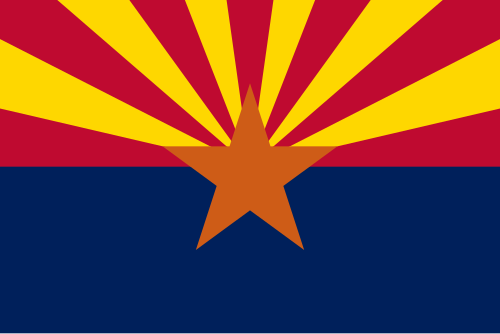
アリゾナ( / ˌ ær ɪ ˈ z oʊ n ə / ARR-iz-OH-nə;ナバホ語:Hoozdo Hahoodzo [hoː˥z̥to˩ ha˩hoː˩tso˩];[10] オーダム語:Alĭ ṣonak [ˈaɭi̥ ˈʂɔnak])[11]はアメリカ合衆国南西部の州あり、コロラド州、ニューメキシコ州、ユタ州とともにアメリカ西部フォーコーナーズ地域を。他の隣接する州は、北西はネバダ州西はカリフォルニア州南と南西ではメキシコのソノラとバハカリフォルニア州と国境を州の6番目に大きく、14番目に人口が多い州都および最大の都市はフェニックスであり、米国で最も人口の多い州都である。
アリゾナ州は1912年2月14日に連邦に加盟した48番目の州であり、隣接州の中では最後に州となった。歴史的にはヌエバ・エスパーニャのアルタ・カリフォルニアおよびヌエボ・メキシコの領土の一部であったが、1821年に独立したメキシコの一部となった。米墨戦争で敗れた後、メキシコは1848年にこの地域の大半を米国に割譲し、この地域はニューメキシコの領土の一部となった。州の最南端は1853年にガズデン購入によって獲得された。
南アリゾナ州は、夏は非常に暑く、冬は穏やかな砂漠気候で知られています。北アリゾナ州は、松、ダグラスモミ、トウヒの森、コロラド高原、山脈 (サンフランシスコ山脈など)、大きく深い渓谷を特徴とし、夏の気温ははるかに穏やかで、冬にはかなりの降雪があります。フラッグスタッフ、サンライズ、ツーソンの各地域にはスキー場があります。世界七不思議の一つとして国際的に知られるグランドキャニオン国立公園に加えて、国有林、国立公園、国定記念物がいくつかあります。
アリゾナ州には多様な人々が住んでいます。州の約4分の1 [12] [13]はインディアン居留地で、連邦政府が認定した27のネイティブアメリカン部族が住んでいます。その中には、州および国内で最大のナバホ族の居住地があり、人口は30万人を超えます。1980年代以降、メキシコや中央アメリカからの移住により、ヒスパニック系の割合が大幅に増加しました。人口のかなりの部分がローマカトリック教会と末日聖徒イエス・キリスト教会の信者です。アリゾナ州の人口と経済は、移住により1950年代以降劇的に成長し、現在ではサンベルトの主要な拠点となっています。フェニックスやツーソンなどの都市では、広大な郊外地域が開発されています。ペットスマートやサークルK [14]など多くの大企業がアリゾナ州に本社を置いており、アリゾナ大学、アリゾナ州立大学、ノーザンアリゾナ大学などの主要大学がアリゾナ州にあります。この州はバリー・ゴールドウォーターやジョン・マケインなどの保守政治家の歴史で知られていますが、1990年代以降は激戦州となっています。
語源
州名は、以前のスペイン語名Arizonacに由来しているようで、これは「小さな泉」を意味するオオダム語のalĭ ṣonakに由来している。当初、この用語はスペイン人入植者によって、ソノラ州プランチャス・デ・プラタの銀鉱山キャンプ付近の地域にのみ適用された。[15] [16] [17] [18]ヨーロッパ人入植者にとって、オオダム語の発音はArissonaのように聞こえた。[19]この地域は、現在でもオオダム語でalĭ ṣonakとして知られている。 [11]
もう一つの語源は、バスク語のharitz ona 「良い樫の木」で、この地域には多くのバスク人の羊飼いがいたためである。[20] [21] [22]バスク系メキシコ人が1734年から1736年の間に、現在のメキシコのソノラ州にアリゾナのランチェリア (小さな田舎の集落)を設立した。1737年頃にそこで銀が大量に発見されてから、アリゾナは有名になった。[23]
州名はスペイン語のÁrida Zona (乾燥地帯)に由来するという誤解は、民間語源の例であると考えられている。[19]
歴史
現代以前の数千年にわたり、アリゾナ州は多くの古代ネイティブアメリカン文明の故郷でした。ホホカム、モゴヨン、先祖プエブロ文化は、州全体で栄えた文化の一部です。彼らのプエブロ、崖の住居、岩絵、その他の先史時代の宝物の多くは今も残っており、毎年何千人もの観光客を魅了しています。[要出典]

1539年、スペインのフランシスコ会修道士マルコス・デ・ニサが、アメリカ先住民と接触した最初のヨーロッパ人となった。彼は現在の州の一部を探検し、おそらくソバイプリ族と思われる先住民と接触した。スペインの探検家コロナドの遠征隊は、シボラの探索中に1540年から1542年にかけてこの地域に入った。[24]アリゾナに移住したスペイン人入植者は少数であった。アリゾナの最初の入植者の1人はホセ・ロモ・デ・ビバールであった。[25]
キノ神父は、この地域に次にやってきたヨーロッパ人でした。イエズス会(「イエズス会」)のメンバーであった彼は、この地域での一連の伝道活動の発展を先導しました。彼は、1690年代から18世紀初頭にかけて、ピメリア・アルタ(現在のアリゾナ州南部とソノラ州北部)の多くのインディアンをキリスト教に改宗させました。スペインは、1752年にトゥバクに、1775年にツーソンにプレシディオ(「要塞化された町」)を建設しました。[26]
1821年にメキシコがスペイン王国とスペイン帝国から独立すると、現在のアリゾナ州はヌエバ・カリフォルニア(「ニュー・カリフォルニア」)の一部となり、アルタ・カリフォルニア(「アッパー・カリフォルニア」)としても知られるようになった。[27]植民地時代のスペイン系および混血入植者の子孫は、後にアメリカからヨーロッパ系アメリカ人移民が到着した当時もこの地域に住んでいた。 [要出典]
.png/500px-Mexico_1824_(equirectangular_projection).png)
米墨戦争(1847-1848年)の間、米軍は首都メキシコシティを占領し、 1863年にアリゾナ準州、1912年にアリゾナ州となった地域を含むメキシコ北部の大部分に対する領有権を主張した。 [28]グアダルーペ・イダルゴ条約(1848年)では、元メキシコ市民の現住民の言語および文化的権利は不可侵とみなされることに加え、 補償金として1500万ドル(2023年時点で5億2823万769.23ドルに相当)をメキシコ共和国に支払うことが規定された。[29] 1853年、米国はガズデン購入により、南国境地域に沿ったヒラ川南下の土地を、大陸横断鉄道の将来の南ルートとして最適であるとしてメキシコから取得した。[30]
現在のアリゾナ州は、1850年からニューメキシコ準州の一部として米国政府によって統治されていたが、その地域の南部が連邦から脱退してアリゾナ準州となった。[31]この新しく設立された準州は、1862年1月18日土曜日、ジェファーソン・デイヴィス大統領がアリゾナ準州を組織する法律を承認し署名した際に、南部連合の連邦政府によって正式に組織され、[32]「アリゾナ準州」という名称が初めて公式に使用された。南部準州は、南部連合政府に兵士、馬、装備を供給した。1862年に結成されたアリゾナの偵察隊は、アメリカ南北戦争中に南軍に従軍した。アリゾナは、南北戦争中にピカチョ峠の戦い(1862年)で記録に残る最も西での軍事交戦を記録している。[33]
_and_his_warriors_in_1886.jpg/500px-Apache_chieff_Geronimo_(right)_and_his_warriors_in_1886.jpg)
連邦政府は1863年2月24日、ワシントンDCで、以前のニューメキシコ準州の西半分からなる新しい米国アリゾナ準州を宣言した。 [34]これらの新しい境界は後に州の基礎を形成することになる。最初の準州都プレスコットは、アリゾナ中央部へのゴールドラッシュの後の1864年に設立された。[35]準州の成長と発展に伴って準州のさまざまな地域が政治的影響力を獲得したり失ったりしたため、その後、首都はツーソンに移され、再びプレスコットに戻り、最終的にフェニックスに移されたが、一連の物議を醸す移転があった。[36]
この地域には「ガドソニア」、「ピメリア」、「モンテスマ」、「アリズマ」などの名称が検討されていたが、[37]第16代大統領エイブラハム・リンカーンが最終法案に署名した際に「アリゾナ」と記され、その名称が採用された。(モンテスマはアステカ皇帝に由来するものではなく、ヒラ川渓谷のピマ族にとって神聖な英雄の聖なる名前であった。議会が「アリゾナ」という名称に落ち着く前に、その感傷的な価値が検討され、却下されたと思われる。) [要出典]
ユタ州ソルトレークシティの末日聖徒イエス・キリスト教会の指導者ブリガム・ヤングは、19世紀中期から後半にかけて、モルモン教徒をアリゾナに派遣した。彼らはメサ、スノーフレーク、ヒーバー、サフォードなどの町を建設した。また、フェニックス渓谷(別名「太陽の谷」)、テンピ、プレスコットなどの地域にも定住した。モルモン教徒は、後にアリゾナ北部とニューメキシコ北部となった地域に定住した。当時、これらの地域は旧ニューメキシコ準州の一部であった。
19世紀、この地域では金と銀のラッシュが相次いだ。最も有名なのは1870年代、アリゾナ州南東部にあるトゥームストーンの銀の宝庫への殺到だ。トゥームストーンは伝説的な無法者や保安官でも知られている。[38] 1880年代後半には、ビスビーやジェロームなどの銅採掘場の台頭により、銅の生産が貴金属の生産を上回った。[39] [40]鉱業の好況と不況により、この地域には何百ものゴーストタウンができたが、銅鉱山は繁栄を続け、1907年までにこの地域は他のどの州よりも多くの銅を生産し、州昇格時にアリゾナは「銅の州」というあだ名が付けられた。[41] [42]州昇格後最初の数年間、銅産業は成長痛と労働争議を経験し、 1917年には銅鉱山労働者のストライキによりビスビー追放が起こった。[43]

20世紀から現在まで
1910 年から 1920 年にかけてのメキシコ革命の間、アリゾナの入植地から国境を越えたメキシコの町々でいくつかの戦闘が繰り広げられました。革命の間中、多くのアリゾナ人がメキシコで戦っているいくつかの軍隊の 1 つに入隊しました。アメリカとメキシコの軍隊の間でアメリカ領土で起こった重要な戦闘は、ニューメキシコでのパンチョ ビリャの 1916 年のコロンバス襲撃と、アリゾナでの 1918 年のアンボス ノガレスの戦いの2 つだけです。
メキシコ連邦軍がアメリカ兵に発砲した後、アメリカ軍守備隊はメキシコのノガレスへの攻撃を開始した。メキシコ軍は双方とも多数の死傷者を出し、最終的に降伏した。その数か月前、ノガレスのすぐ西でインディアン戦争の戦闘が起こった。これは1775 年から 1918 年まで続いたアメリカインディアン戦争の最後の戦闘とされている。国境に駐留していたアメリカ兵は、対メキシコ戦争の一環としてアリゾナを拠点として近隣のメキシコ人居住地を襲撃していたヤキ族インディアンと対峙した。[要出典]
アリゾナ州は、1912 年 2 月 14 日、バレンタインデーに米国の州となった。アリゾナ州は米国に加盟した 48 番目の州であり、隣接する州の中では最後に加盟した州である。[出典が必要]

アリゾナ州で最も重要な州全体の産業である綿花栽培と銅鉱山は、大恐慌の間に大きな打撃を受けた。[44]しかし、1920年代、さらには1930年代には、観光業が今日のアリゾナの重要な産業として発展し始めた。ウィッケンバーグのKLバーやレミューダ、ツーソンのフライングVやタンクヴェルデなどの観光牧場は、観光客に「古き良き西部」の雰囲気とアクティビティに参加する機会を提供した。この時期には高級ホテルやリゾートがいくつか開業し、そのうちのいくつかは今でも観光客に人気の高い場所となっている。フェニックス中心部のアリゾナ ビルトモア ホテル(1929年開業)やフェニックス地域の西側にあるウィグワム リゾート(1936年開業)などである。[45] [46]
アリゾナ州には第二次世界大戦中にドイツ軍捕虜収容所が置かれ 、日系アメリカ人強制収容所もあった。[47]戦時中、日本軍が米国西海岸に侵攻するのではないかという懸念から(これは1942年6月のアリューシャン列島作戦で現実のものとなった)、1942年から1945年にかけて日系人は内陸部に建設された強制収容所に強制的に住まわされた。多くの人が家や仕事を失った。収容所は 第二次世界大戦後に廃止された。[48]
フェニックス地域のドイツ人捕虜収容所は、戦後、メイタグ家(大手家電メーカーで有名)に購入され、フェニックス動物園の敷地として開発された。日系アメリカ人の強制収容所は、州南東部のツーソン市郊外のマウント・レモンにあった。別の捕虜収容所は、ユマ郡東部のヒラ川近くにあった。アリゾナ州には、フェニックス・インディアン・スクールもあった。これは、ネイティブ・アメリカンの子供たちを主流のヨーロッパ系アメリカ人文化に同化させるために設計された、連邦インディアン寄宿学校の1つである。子供たちは、両親や家族の意に反して、これらの学校に入学することが多かった。ネイティブのアイデンティティを抑圧する試みには、子供たちに髪を切ること、英語の名前を名乗ること、英語のみを話すこと、そしてネイティブの宗教ではなくキリスト教を実践することが含まれていた。[49]
第二次世界大戦中、アリゾナ州出身の多くのネイティブアメリカンが米国のために戦った 。彼らの経験は、州に帰還した後の待遇改善と公民権獲得を求める戦後の運動の高まりにつながった。マリコパ郡が彼らの投票登録を認めなかったため、1948年にフォートマクドウェルインディアン居留地のモハベ・アパッチ族の退役軍人フランク・ハリソンとハリー・オースティンは、この排除に異議を唱える訴訟(ハリソンとオースティン対ラビーン)を起こした。アリゾナ州最高裁判所は彼らに有利な判決を下した。[50]
アリゾナ州の人口は、第二次世界大戦後に住宅と商業の発展とともに飛躍的に増加しました。これは、猛暑の夏を快適にするエアコン の普及によるものです。アリゾナ州務長官事務所が毎年発行するアリゾナ ブルー ブックによると、1910 年の州人口は 294,353 人でした。1970 年には 1,752,122 人になりました。10 年ごとの増加率は、最初の 10 年間は平均約 20%、それ以降は 10 年ごとに約 60% でした。[引用が必要]
1960 年代には、退職者コミュニティが開発されました。これらの年齢制限のある区画は、高齢者のニーズに特化しており、中西部や北東部の厳しい冬から逃れたい多くの退職者を引き付けました。開発者のデル ウェッブによって設立され、1960 年にオープンしたサン シティは、そのようなコミュニティの最初の 1 つです。ツーソンの南にあるグリーン バレーも、アリゾナ州の教師のための退職者用区画として設計されたコミュニティです。毎年冬になると、米国やカナダ全土から多くの高齢者がアリゾナにやって来て、冬の間だけ滞在します。彼らはスノーバードと呼ばれています。[出典が必要]
2000年3月、アリゾナ州は、公職候補者を指名するための、史上初の法的拘束力のあるインターネット選挙の開催地となった。[51] 2000年のアリゾナ州民主党予備選挙では、世界中の注目の下、アル・ゴアがビル・ブラッドリーを破った。この州の予備選挙の投票率は、1996年の予備選挙と比べて500%以上増加した。
21世紀、アリゾナ州は不法移民の流入を抑える取り組みで全国的に注目を集めてきた。2004年、有権者は投票登録に市民権の証明を義務付ける提案200を可決した。米国最高裁判所は2013年にこの制限を無効とした。[52] 2010年、アリゾナ州はすべての移民に移民書類を常に携帯することを義務付けるSB1070を制定したが、最高裁判所は2012年にアリゾナ州対アメリカ合衆国の訴訟でこの法律の一部を無効とした。 [53]
2011年1月8日、ツーソンでの集会で銃撃犯がギャビー・ギフォーズ下院議員と18人を銃撃した。ギフォーズは重傷を負った。この事件は扇動的な政治的言説に関する全国的な注目を集めた。[54]
USSアリゾナと名付けられた3隻の船は、この州に敬意を表して命名されましたが、USSアリゾナ(BB-39)のみが、州昇格後にこの名前が付けられました。
地理


アリゾナ州は、アメリカ合衆国南西部のフォーコーナーズ州の一つである。面積ではニューメキシコ州に次いでネバダ州より6番目に大きい州である。州面積113,998平方マイル(295,000 km 2)のうち、約15%が私有地である。残りの地域は公有林と公園、州信託地、ネイティブアメリカン居留地である。アリゾナ州には、グランドキャニオン国立公園、サワロ国立公園、化石の森国立公園の3つの国立公園を含む、国立公園局が管理する24のサイトがある。[55]
アリゾナ州は、州南部の砂漠地帯である 盆地と山脈地帯でよく知られており、サボテンなどの乾生植物が生い茂っています。この地域の地形は、先史時代の火山活動と、それに続く寒冷化とそれに伴う地盤沈下によって形成されました。気候は、夏は非常に暑く、冬は穏やかです。コロラド高原の高地の北中部に広がる松林は、あまり知られていません(アリゾナ山脈の森林を参照)。
アメリカ南西部の他の州と同様に、アリゾナ州は高い山々、コロラド高原、メサで特徴づけられています。州全体が乾燥しているにもかかわらず、アリゾナ州の27%は森林で、[56]これは現代のルーマニアやギリシャに匹敵する割合です。[57]世界最大のポンデローサ松の林はアリゾナ州にあります。[58]
モゴリオン・リム(/ ˌmoʊ gəˈyoʊn /)は、高さ1,998フィート(609メートル)の断崖で、コロラド州の中央部を横切り、コロラド高原の南西端を形成している。2002年には、この一帯がロデオ・チェディスキー火災の被災地となり、2011年まで州史上最悪の火災となった。
アリゾナ州北部に位置するグランドキャニオンは、コロラド川によって削られた色鮮やかで深く、険しい峡谷です。この峡谷は世界の七不思議の一つで、 アメリカ合衆国で最初の国立公園の一つであるグランドキャニオン国立公園に大部分が含まれています。セオドア・ルーズベルト大統領はグランドキャニオン地域を国立公園に指定することの大きな提唱者で、しばしばピューマ狩りや景色を楽しむために訪れていました。この峡谷はコロラド川が何百万年もかけて水路を切り開いて作ったもので、長さは約277マイル (446 km)、幅は4~18マイル (6~29 km)、深さは1マイル (1.6 km) 以上あります。コロラド高原が隆起するにつれてコロラド川とその支流が堆積物を何層にも切り開いたため、地球 のほぼ20億年の歴史が明らかになりました。
アリゾナ州には、世界でも最もよく保存された隕石衝突跡がある。約5万年前に形成されたバリンジャー隕石クレーター(通称「隕石クレーター」)は、ウィンスローの西約25マイル(40キロ)のコロラド高原の高原の真ん中にある巨大な穴である。[59]砕けて崩れた岩の縁は、小さな家ほどの大きさもあり、周囲の平原より150フィート(46メートル)も高くそびえている。クレーター自体は幅約1マイル(1.6キロ)、深さ570フィート(170メートル)である。
アリゾナ州はハワイ州とともに、夏時間を採用していない米国の2州のうちの1つである。ただし、同州の北東部にある 広大なナバホ族居住地は夏時間を採用している。
.jpg/500px-Sycamore_Canyon_(5416824896).jpg)
.jpg/500px-Lockett_Meadow_(29830270612).jpg)
.jpg/500px-Mogollon_Rim_Panorama_(37352744001).jpg)
_(48952747716).jpg/500px-Chiricahua_Mountains_(10-21-2019)_(48952747716).jpg)


隣接州
気候
州は面積が広く、標高も異なるため、地域によって気候条件が多様です。標高の低い地域では主に砂漠気候で、冬は穏やかで夏は非常に暑いです。晩秋から早春にかけては天候は穏やかで、平均最低気温は60°F (16°C) です。11月から2月は最も寒い月で、気温は通常40°Fから75°F (4°Cから24°C) で、時折霜が降ります。[60]
2月も半ばになると気温が上がり始め、日中は暖かく、夜は涼しく風が吹く。6月から9月の夏季は乾燥した暑さとなり、気温は90~120 °F(32~49 °C)となり、砂漠地帯では時折125 °F(52 °C)を超える高温が観測されている。[60]アリゾナ州の最高気温は1994年6月29日と2007年7月5日にレイクハバスシティで記録された128 °F(53 °C)である。最低気温は1971年1月7日にホーリー湖で記録された−40 °F(−40 °C)である。[61]
主に乾燥した気候のため、標高 2,500 フィート (760 メートル) 以上の砂漠の開発されていない地域では、日中の気温の大きな変動が見られます。夏季には、気温の変動は 83 °F (46 °C) にも達することがあります。州の都市部では、局所的な温暖化 の影響により、最近よりも夜間の最低気温がはるかに高くなっています。
アリゾナ州の年間平均降水量は12.7インチ(323 mm)で、[62]冬には太平洋から寒冷前線が流れ込み、夏にはモンスーンが吹く2つの雨季の間に降る。 [63]モンスーンの季節は夏の終わり頃に起こる。7月か8月には、短期間で露点が劇的に上昇する。この時期、空気は大量の水蒸気を含む。フェニックスの モンスーンシーズンには、露点が81 °F(27 °C)[64]まで上昇したことが記録されている。この高温多湿により、雷、雷雨、風、そして通常は短時間ではあるが集中豪雨が発生する。これらの豪雨はしばしば鉄砲水を引き起こし、致命的となることがある。アリゾナ州議会は、ドライバーが氾濫した川を渡らないようにするため、「愚かな運転手法」を制定した。アリゾナ州で竜巻やハリケーンが発生することはまれである。
アリゾナ州の北部3分の1は低地砂漠よりもかなり標高の高い高原で、冬は寒く夏は穏やかとかなり涼しい気候だが、半乾燥から乾燥気候である。極端に低い気温も珍しくなく、北部諸州やカナダからの寒気が時折州内に流れ込み、州北部の気温は0°F(-18°C)を下回る。[65]
気候の変化を示す例として、アリゾナ州は、気温が100°F(38°C)を超える日が最も多い都市圏(フェニックス)と、アメリカ本土48州の中で気温が氷点下になる日が最も多い都市圏(フラッグスタッフ)の両方を有する州である。[66]
都市と町

マリコパ郡にあるフェニックスは、アリゾナ州の州都であり最大の都市である。フェニックス都市圏の他の主要都市には、メサ(アリゾナ州で3番目に大きい都市)、チャンドラー(アリゾナ州で4番目に大きい都市)、グレンデール、ピオリア、バックアイ、サンシティ、サンシティウェスト、ファウンテンヒルズ、サプライズ、ギルバート、エルミラージュ、アボンデール、テンピ、トーレソン、スコッツデールがあり、都市圏の人口は合計で470万人をわずかに超える。[68] 7月の平均最高気温は106 °F(41 °C)で、米国の都市圏で最も高い部類に入るが、1月の平均最高気温が67 °F(19 °C)で相殺され、冬の魅力の基礎となっている。
ツーソンは、都市圏人口が100 万人強で、アリゾナ州で2番目に大きい都市です。フェニックスの南東約180 km (110マイル) のピマ郡に位置し、1877年に法人化されたアリゾナ州で最も古い法人都市です。アリゾナ大学はツーソンにあります。ツーソンの主要な法人化された郊外には、市の北西にあるオロバレーとマラナ、市の南にあるサフアリータ、ダウンタウンの南にある飛び地のサウスツーソンがあります。7月の平均気温は100 °F (38 °C)、冬の平均気温は65 °F (18 °C)です。市のすぐ西、ツーソン山脈にあるサワロ国立公園には、世界最大のサワロサボテンのコレクションがあります。
プレスコット都市圏には、プレスコット市、コットンウッド市、キャンプベルデ市、およびヤバパイ郡の8,123 平方マイル (21,000 km 2 ) の地域にある他の多くの町が含まれます。212,635 人の住民を擁するこの町群は、州で 3 番目に大きな都市圏です。プレスコット市 (人口 41,528 人) は、フェニックス都市圏の北西約 100 マイル (160 km) に位置しています。標高約 5,500 フィート (1,700 m) の松林に位置するプレスコットは、フェニックスよりもずっと涼しい気候で、夏の平均最高気温は約 88 °F (31 °C)、冬の平均気温は 50 °F (10 °C) です。
ユマはアリゾナ州で4番目に大きい都市圏の中心です。ユマ郡に位置し、カリフォルニア州とメキシコの国境に近いです。ユマは米国で最も暑い都市の1つで、7月の平均最高気温は107°F (42°C) です。比較すると、デスバレーの同じ月の平均気温は115°F (46°C) です。この都市では、年間の約90%が晴天です。ユマ都市圏の人口は16万人です。ユマは米国全土から多くの冬の観光客を引き付けています。
ココニノ郡にあるフラッグスタッフは、アリゾナ州北部最大の都市で、標高約 7,000 フィート (2,100 m) にあります。広大なポンデローサ松の森、雪に覆われた冬の天候、絵のように美しい山々があり、アリゾナ州によく見られる砂漠地帯とは対照的です。フラッグスタッフは、アリゾナ州で最も高い山脈であるサンフランシスコピークスの麓に位置しており、この山脈には、アリゾナ州で最も高い標高 12,633 フィート (3,851 m) のハンフリーズピークがあります。フラッグスタッフは、グランドキャニオン国立公園、セドナ、オーククリークキャニオンなど、数多くの観光名所に近いため、観光業が盛んです。歴史あるアメリカ国道 66 号線は、町を東西に貫く主要道路です。フラッグスタッフ都市圏には 134,421 人の住民が住み、ノーザンアリゾナ大学のメインキャンパスがあります。
「アリゾナの遊び場」として知られるモハーヴェ郡のレイクハバスシティは、コロラド川沿いに開発され、レイクハバスにちなんで名付けられました。レイクハバスシティの人口は約57,000人です。春休みの大規模なパーティー、夕日、イギリスのロンドンから移設されたロンドン橋で有名です。レイクハバスシティは、 1963年に不動産開発者のロバート・P・マカロックによって設立されました。[69]レイクハバスシティには、モハーヴェコミュニティカレッジとアリゾナ州立大学カレッジの2つの大学があります。 [70]
人口統計
-
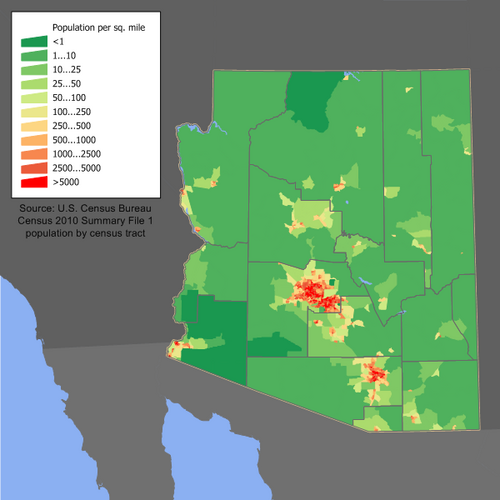 アリゾナ州の人口密度地図
 -
 2020年米国国勢調査による、人種の多さで見たアリゾナ州の郡の地図伝説
- 非ヒスパニック系白人 40~50%50~60%60~70%70~80%ネイティブアメリカン40~50%70~80%ヒスパニックまたはラテン系60~70%80~90%
- 非ヒスパニック系白人
-
 アリゾナ州におけるスペイン語の普及率
アメリカ合衆国国勢調査局は、 2020年の国勢調査でアリゾナ州の人口を7,151,502人と記録しており、[7] 2010年の米国国勢調査から12%増加している。[72]
アリゾナ州は19世紀のほとんどの間、人口がまばらなままだった。[74] 1860年の国勢調査では、「アリゾナ郡」の人口は6,482人で、そのうち4,040人が「インディアン」、21人が「自由有色人種」、2,421人が「白人」と記載されている。[75] [76]アリゾナ州の継続的な人口増加は、州の水供給に大きな負担をかけている。[77] 2011年現在[update]、アリゾナ州の1歳未満の子供の61%が有色人種グループに属している。[78]
フェニックス都市圏の人口は1991年から2001年にかけて45%増加し、アリゾナ州は1990年代に米国で2番目に人口増加率の高い州となった(最も急成長したのはネバダ州)。[79]
2010年の米国国勢調査によると、アリゾナ州の人口は6,392,017人であった。2010年には、不法移民は人口の約8%を占めたと推定されている。これは、米国の州の中で2番目に高い割合であった[80] [b]
フェニックス大都市圏 (470 万人) とツーソン大都市圏 (100 万人) には、アリゾナ州の人口の約 6 分の 5 が居住しています (2010 年の国勢調査時点)。フェニックス大都市圏だけで、アリゾナ州の人口の 3 分の 2 を占めています。
HUDの2022年ホームレス評価報告書によると、アリゾナ州には推定13,553人のホームレスが住んでいた。[81] [82]
2018年現在、アリゾナ州の移民人口の出身国上位はメキシコ、カナダ、インド、フィリピン、中国である。[83]
人種と民族
2022年現在[update]、アリゾナ州の最大の祖先グループは以下の通りである。[89] [90] [91] [92]
- メキシコ人(27.7%)
- ドイツ語 (12%)
- 英語 (9.8%)
- アイルランド人(8.5%)
- アフリカ人(6.4%)
- ナバホ族 (2.2%)
言語

2010年時点で[update]、アリゾナ州の5歳以上の住民の73% (4,215,749人) は家庭で英語のみを話し、21% (1,202,638人) はスペイン語、2% (85,602人) はナバホ語、<1% (22,592人) はドイツ語、<1% (22,426人)は中国語(北京語を含む)、<1% (19,015人)はタガログ語、<1% (17,603人) はベトナム語、<1% (15,707人)はその他の北米先住民の言語(特にアリゾナ州の先住民の言語) を話し、5歳以上の人口の<1% (15,062人) はフランス語を主要言語として話していた。合計で、アリゾナ州の5歳以上の人口の27% (1,567,548人) は英語以外の母語を話していた。 [93]
アリゾナ州は、48の隣接州の中で最も多くのネイティブアメリカン言語話者が住む州であり、2005年には85,000人以上がナバホ語を話し、10,403人がアパッチ語を家庭で話していると報告している。 [94]アリゾナ州のアパッチ郡は、アメリカ国内で最もネイティブアメリカン・インディアン言語の話者が集中している州である。[95]
宗教

ARDAによる2010年の米国宗教国勢調査:宗教団体と会員調査によると、アリゾナ州で最大の3つの宗派はカトリック教会、末日聖徒イエス・キリスト教会、無宗派福音派プロテスタントである。アリゾナ州で信者数が最も多いのはカトリック教会(930,001人)で、次いで末日聖徒イエス・キリスト教会が392,918人、無宗派福音派プロテスタント教会が281,105人の信者を報告している。最も多くの会衆を持つ宗教団体は末日聖徒イエス・キリスト教会(811会衆)で、次いで南部バプテスト連盟(323会衆)である。[97]この国勢調査では、2010年のアリゾナ州の住民640万人のうち約240万人が対象となった。
調査によると、2010年と2000年に信者数が最も多かった15の宗派は以下の通りである。[98] [99]
ヒンドゥー教は2010年に32,000人以上の信者を抱え、非キリスト教系宗教(全宗派を合わせた)の中で最大の宗教となり、次いでユダヤ教が20,000人以上、仏教が19,000人以上となった。[98] [102] [103]
公共宗教研究所の2020年の調査の発表によると、人口の68%がキリスト教徒であると自認している。 [104]ピュー研究所の2014年の調査では、アリゾナ州の67%がキリスト教徒であった。[105] 2014年から2020年までの両調査によると、無宗教人口のうち、自らを無宗教または不可知論者と認識しているアリゾナ州民は、人口の27%から24%に減少している。さらに、宗教データアーカイブ協会による2020年の3番目の別の調査では、キリスト教が州の主要な宗教であり、カトリック教徒は1,522,410人、非宗派のキリスト教徒は402,842人に増加していると判定された。[106]
ネイティブアメリカンの部族
ヨーロッパ人の植民地化が始まった頃、現在のアリゾナ州には多くのネイティブアメリカンの部族が住んでいた。主にナバホ族、アパッチ族、アキメル・オオダム族、ココパ族、ハルキドマ族、ハバスパイ族、ヤバパイ族、ワラパイ族、ホピ族、ジョコメ族、ジャノ族、マリコパ族、モハーベ族、南部パイユート族、トホノ・オオダム族、ヤキ族、ユマ族、ズニ・プエブロ族などが含まれていた。[107]彼らの一部は現在もアリゾナ州に住んでいる。
2010年の国勢調査によると、アリゾナ州で最大のネイティブアメリカンの部族は以下の表の通りである。[108]
経済

アリゾナ州の2023年の州総生産 は5080億ドルでした。[109]州の経済構成は適度に多様ですが、医療、交通、政府が依然として最大のセクターです。[110]
アリゾナ州の一人当たり所得は2023年に61,652ドルで、全米で33位にランクされています[111] 。同州の2023年の世帯所得の中央値は74,568ドルで、全米で19位、米国全国平均をわずかに下回っています。[112]
アリゾナ州の歴史の初期には、同州の経済は「5つのC」、すなわち銅(アリゾナ州の銅採掘を参照)、綿、牛、柑橘類、気候(観光)に依存していました。銅は今でも多くの広大な露天掘りや地下鉱山で広く採掘されており、国内の産出量の3分の2を占めています。
雇用
- 総雇用数(2016年):2,379,409
- 雇用主事業所総数(2016年):139,134 [113]
州政府はアリゾナ州最大の雇用主であり、バナーヘルスは39,000人以上の従業員を抱える州最大の民間雇用主である(2016年)。2020年8月現在[update]、州の失業率は5.9%であった。[114]
アリゾナ州における最大の雇用セクターは以下のとおりです(2020年8月、非農業部門雇用):[114]
最大の雇用主
アリゾナ・リパブリック紙によると、2019年時点で州内の最大の民間雇用主は[update]以下の通りである。[115]
農業
(NRCS_Photo_Gallery).tif/lossless-page1-1280px-NRCSAZ02010_-_Arizona_(303)(NRCS_Photo_Gallery).tif.png)
アリゾナ州ではレタス、ほうれん草、メロン、ブロッコリー、カリフラワー、キャベツ、スイカなど多様な作物が栽培されている。[116]
連邦農作物保険は、ここではブドウ( Vitis viniferaおよび他のVitis spp.)について説明しています。 [117]カリフォルニア州の農作物とともに、関連する農作物保険法の特別規定の対象となります。 [117]害虫や病気は補償されますが、フィロキセラ( Daktulosphaira vitifoliae)や害虫駆除や病気駆除の不備は補償されません。 [117]
コナジラミのBemisia tabaci Bは1980年代にポインセチアの取引を通じて導入され、以前のAバイオタイプに取って代わりました。[118] 2004年にQバイオタイプ(地中海原産)がここで初めて発見され、これもポインセチアで発見されました。[118]
のコロラドハムシ( Leptinotarsa decemlineata)は、この地の在来種か、あるいは早期に導入された種である。 [119]珍しいことに、この地の個体群は、通常、シルバーリーフナイトシェード( Solanum elaeagnifolium)は、通常、この甲虫にとってあまり魅力的な宿主ではありません。 [119] CPBはトマトの害虫となることもあります。 [119]
交通機関

高速道路
州間高速道路
 I-8 | I-10 |将来 I-11 | I-15 | I-17 | I-19 | I-40
.svg/500px-I-11_(Future).svg.png)

米国路線
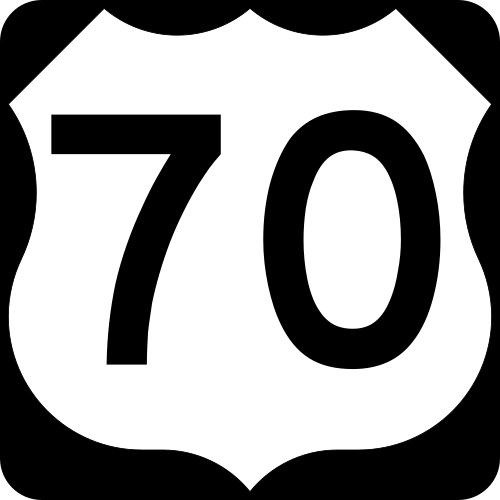
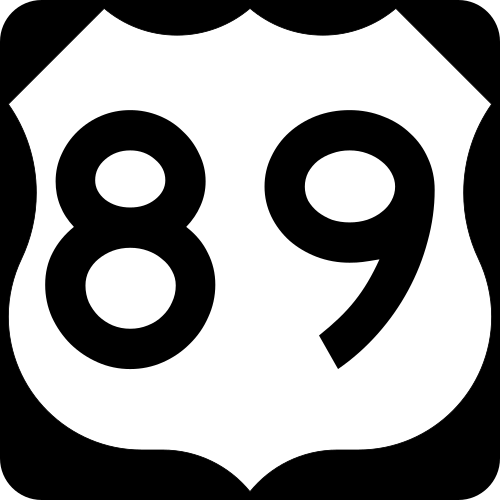
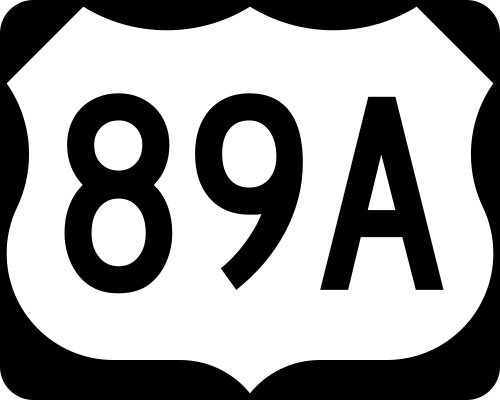
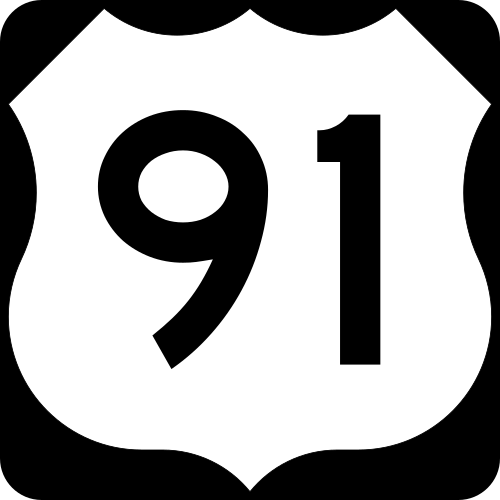
 US 60 | US 64 |歴史的 US 66 | US 70 |歴史的 US 80 | US 89 | US 89A | US 91 | US 93 | US 95 | US 160 | US 163 | US 180 | US 191
.svg/500px-US_66_(AZ_historic).svg.png)
.svg/500px-US_80_(AZ_historic).svg.png)

主要な州間高速道路には、南北を走るI-17とI-19、東西を走るI-8、I-10、I-40、そして州の北西端を北東から南西に走るI-15の短い区間がある。さらに、さまざまな都市部には、フェニックスの広大なフリーウェイシステムの一部であるループ101などの州道と高速道路の複雑なネットワークが張り巡らされている。[120]
公共交通機関、アムトラック、都市間バス
フェニックスとツーソンの都市圏には公共バス交通システムが整備されています。ユマとフラッグスタッフにも公共バスシステムがあります。グレイハウンド ラインズは、フェニックス、ツーソン、フラッグスタッフ、ユマ、および州内のいくつかの小規模なコミュニティにサービスを提供しています。
バレーメトロレールと呼ばれるライトレールシステムが2008年12月に完成し、フェニックス中心部と近隣のメサ市やテンピ市を結んでいる。[121]
ツーソンでは、サンリンク路面電車システムがダウンタウンエリアを走り、アリゾナ大学のメインキャンパスとツーソンダウンタウンの西端にあるサンアグスティン市場を結んでいる。サンリンクはポートランド路面電車をベースにしており、2014年7月に運行を開始した。[122]
アムトラックの サウスウェストチーフ路線は州の北部を走り、ウィンスロー、フラッグスタッフ、ウィリアムズ、キングマンに停車する。テキサスイーグルとサンセットリミテッド路線は南中央アリゾナを走り、ツーソン、マリコパ、ユマ、ベンソンに停車する。フェニックスは1996年にサンセットリミテッドのルート変更によりアムトラックのサービスを失い、現在はフェニックスとマリコパの駅の間をアムトラックのバスが走っている。2021年現在、アムトラックはフェニックスとツーソン間の鉄道サービスを復活させることを提案している。[123]
法律と政府
国会議事堂

The capital of Arizona is Phoenix. The original Capitol building, with its distinctive copper dome, was dedicated in 1901 (construction was completed for $136,000 in 1900) when the area was a territory. Phoenix became the official state capital with Arizona's admission to the union in 1912.[124]
The House of Representatives and Senate buildings were dedicated in 1960, and an Executive Office Building was dedicated in 1974 (the ninth floor of this building is where the Office of the Governor is located). The original Capitol building was converted into a museum.
The Capitol complex is fronted and highlighted by the richly landscaped Wesley Bolin Memorial Plaza, named after Wesley Bolin, a governor who died in office in the 1970s. The site also includes many monuments and memorials, including the anchor and signal mast from the USS Arizona (one of the U.S. Navy ships sunk in Pearl Harbor) and a granite version of the Ten Commandments.
State legislative branch
The Arizona Legislature is bicameral and consists of a thirty-member Senate and a 60-member House of Representatives. Each of the thirty legislative districts has one senator and two representatives. Legislators are elected for two-year terms.[125]
Each Legislature covers a two-year period. The first session following the general election is known as the first regular session, and the session convening in the second year is known as the second regular session. Each regular session begins on the second Monday in January and adjourns sine die (terminates for the year) no later than Saturday of the week in which the 100th day from the beginning of the regular session falls. The President of the Senate and Speaker of the House, by rule, may extend the session up to seven additional days. Thereafter, the session can be extended only by a majority vote of members present of each house.
The majority party is the Republican Party, which has held power in both houses since 1993. The Democratic Party picked up several legislative seats in recent elections, bringing both chambers one seat away from being equally divided as of 2021.[126]
Arizona state senators and representatives are elected for two-year terms and are limited to four consecutive terms in a chamber, though there is no limit on the total number of terms. When a lawmaker is term-limited from office, it is common for him or her to run for election in the other chamber.
State executive branch
Arizona's executive branch is headed by a governor, who is elected to a four-year term. The governor may serve any number of terms, though no more than two in a row. Arizona is one of the few states that has no governor's mansion. During their term, the governors reside within their private residence, with executive offices housed in the executive tower at the state capitol. The governor of Arizona is Katie Hobbs (D).
Governor Jan Brewer assumed office in 2009 after Janet Napolitano had her nomination by Barack Obama for Secretary of Homeland Security confirmed by the Senate.[127] Arizona has had four female governors and a fifth currently serving, more than any other state.
Other elected executive officials include the Secretary of State, State Treasurer, State Attorney General, Superintendent of Public Instruction, State Mine Inspector, and a five-member Corporation Commission. All elected officials hold a term of four years, and are limited to two consecutive terms (except the office of the State Mine Inspector, which is limited to four terms).[128]
Arizona is one of five states that do not have a lieutenant governor. The elected secretary of state is first in line to succeed the governor in the event of death, disability, resignation, or removal from office. If appointed, the Secretary of State is not eligible and the next governor is selected from the next eligible official in the line of succession, including the attorney general, state treasurer, and superintendent of public instruction. Since 1977, four secretaries of state and one attorney general have succeeded to the state's governorship.
On November 8, 2022, Arizona voters approved a state constitutional amendment (Proposition 131) that created the position and office of the lieutenant governor beginning with the 2026 elections. The position will be elected on a joint ticket with the governor. The lieutenant governor ascends to the governorship if the incumbent governor dies, resigns, or is removed (via impeachment conviction) from office. The proposition, through a law pre-passed by the state legislature, also tasks the governor with assigning a job to her or his running mate, such as chief of staff, the director of the state Department of Administration, or "any position" to which the governor can appoint someone by law.[129]
State judicial branch
The Arizona Supreme Court is the highest court in Arizona, consisting of a chief justice, a vice chief justice, and five associate justices. Justices are appointed by the governor from a list recommended by a bipartisan commission and must be sustained in office by election after the first two years following their appointment. Subsequent sustaining elections occur every six years. The supreme court has appellate jurisdiction in death penalty cases, but nearly all other appellate cases go through the Arizona Court of Appeals first. The court has original jurisdiction in a few other circumstances, as outlined in the state constitution. The court meets in the Arizona Supreme Court Building at the capitol complex (at the southern end of Wesley Bolin Plaza).
The Arizona Court of Appeals, subdivided into two divisions, is the intermediate court in the state. Division One is based in Phoenix, consists of nineteen judges, and has jurisdiction in the Western and Northern regions of the state, along with the greater Phoenix area. Division Two is based in Tucson, consists of nine judges, and has jurisdiction over the Southern regions of the state, including the Tucson area. Judges are selected in a method similar to the one used for state supreme court justices.
Each county of Arizona has a superior court, the size and organization of which are varied and generally depend on the size of the particular county.
Counties

Arizona is divided into 15 counties, ranging in size from 1,238 square miles (3,210 km2) to 18,661 square miles (48,330 km2).
Federal representation
Arizona's two United States senators are Kyrsten Sinema (I) and Mark Kelly (D).
Arizona's United States representatives are David Schweikert (R-1), Eli Crane (R-2), Ruben Gallego (D-3), Greg Stanton (D-4), Andy Biggs (R-5), Juan Ciscomani (R-6), Raul Grijalva (D-7), Debbie Lesko (R-8), and Paul Gosar (R-9). Arizona gained a ninth seat in the House of Representatives due to redistricting based on the 2010 United States census.
Political culture

Democrat ≥ 30%
Democrat ≥ 40%
Democrat ≥ 50%
Republican ≥ 30%
Republican ≥ 40%
Republican ≥ 50%
Unaffiliated ≥ 30%
From statehood through the late 1940s, Arizona was primarily dominated by the Democratic Party. During this time, the Democratic candidate for the presidency carried the state each election, the only exceptions being the elections of 1920, 1924 and 1928 – all three were national Republican landslides.
In 1924, Congress had passed a law granting citizenship and suffrage to all Native Americans, some of whom had previously been excluded as members of tribes on reservations. Legal interpretations of Arizona's constitution prohibited Native Americans living on reservations from voting, classifying them as being under "guardianship".[50] This interpretation was overturned as being incorrect and unconstitutional in 1948 by the Arizona Supreme Court, following a lawsuit by World War II Indian veterans Frank Harrison and Harry Austin, both of the Fort McDowell Yavapai Nation. The landmark case is Harrison and Austin v. Laveen. After the men were refused the opportunity to register in Maricopa County, they filed lawsuit against the registrar. The National Congress of American Indians, the Department of Justice, the Department of the Interior, and the American Civil Liberties Union all filed amicus curiae (friends of the court) briefs in the case. The State Supreme Court established the rights of Native Americans to vote in the state; at the time, they comprised about 11% of the population.[50] That year, a similar provision was overturned in New Mexico when challenged by another Indian veteran in court. These were the only two states that had continued to prohibit Native Americans from voting.[132][50]
Arizona voted Republican in every presidential election from 1952 to 1992, with Richard Nixon and Ronald Reagan winning the state by particularly large margins. During this forty-year span, it was the only state not to be carried by a Democrat at least once.
Democrat Lyndon Johnson, in 1964, lost the state by fewer than 5,000 votes to Arizona Senator and native Barry Goldwater. (This was the most closely contested state in what was otherwise a landslide victory for Johnson that year.) Democrat Bill Clinton ended this streak in 1996, when he won Arizona by a little over two percentage points (Clinton had previously come within less than two percent of winning Arizona's electoral votes in 1992). From 2000 until 2016, the majority of the state continued to support Republican presidential candidates by solid margins. In the 2020 United States presidential election, Joe Biden again broke the streak by becoming the first Democratic presidential candidate to win Arizona since 1996.[134]
Since the mid 20th century, the Republican Party has also dominated Arizona politics in general. The fast-growing Phoenix and Tucson suburbs became reliably Republican areas from the 1950s onward. During this time, many "Pinto Democrats", or conservative Democrats from rural areas, became increasingly willing to support Republicans at the state and national level. While the state normally supports Republicans at the federal level, Democrats are often competitive in statewide elections. Two of the last six governors have been Democrats.
On March 4, 2008, Senator John McCain effectively clinched the Republican nomination for 2008, becoming the first major party presidential nominee from the state since Barry Goldwater in 1964.
Arizona politics is dominated by a longstanding rivalry between its two largest counties, Maricopa and Pima – home to Phoenix and Tucson, respectively. The two counties have almost 75 percent of the state's population and cast almost 80 percent of the state's vote. They also elect a substantial majority of the state legislature.
Maricopa County is home to almost 60 percent of the state's population, and most of the state's elected officials live there. Before Joe Biden won Maricopa County in 2020, it had voted Republican in every presidential election since 1952. This includes the 1964 run of native son Barry Goldwater; he would not have carried his home state without his 20,000-vote margin in Maricopa County. Similarly, McCain won Arizona by eight percentage points in 2008, aided by his 130,000-vote margin in Maricopa County.
In contrast, Pima County, home to Tucson, and most of southern Arizona have historically voted more Democratic. While Tucson's suburbs lean Republican, they hold to a somewhat more moderate brand of Republicanism than is common in the Phoenix area.
.jpg/500px--RedForEd_(41008219574).jpg)
Arizona rejected a same-sex marriage ban in a referendum as part of the 2006 elections. Arizona was the first state in the nation to do so. Same-sex marriage was not recognized in Arizona, but this amendment would have denied any legal or financial benefits to unmarried homosexual or heterosexual couples.[135] In 2008, Arizona voters passed Proposition 102, an amendment to the state constitution to define marriage as a union of one man and one woman. It passed by a more narrow majority than similar votes in a number of other states.[136]
In 2010, Arizona adopted SB 1070, called the "toughest immigration law" in the United States. A fierce debate erupted between supporters and detractors of SB 1070.[137] The United States Supreme Court struck down portions of the Arizona law, which required all immigrants to carry immigration papers at all times, in Arizona v. United States.[138]
The West Virginia teachers' strike in 2018 inspired teachers in other states, including Arizona, to take similar action.[139]
Arizona retains the death penalty. There is currently a gubernatorial hold on executions. Authorized methods of execution include the gas chamber.[140]
Same-sex marriage and civil unions
In 2006, Arizona became the first state in the United States to reject a proposition, Prop 107, that would have banned same-sex marriage and civil unions.[141] However, in 2008, Arizona voters approved of Prop 102, a constitutional amendment that prohibited same-sex marriage but not other unions.[142] Prior to same-sex marriage being legal, the City of Bisbee became the first jurisdiction in Arizona to approve of civil unions.[143] The state's Attorney General at the time, Tom Horne, threatened to sue, but rescinded the threat once Bisbee amended the ordinance; Bisbee approved of civil unions in 2013.[144] The municipalities of Clarkdale, Cottonwood, Jerome, Sedona, and Tucson also passed civil unions.[145]
A November 2011 Public Policy Polling survey found 44% of Arizona voters supported the legalization of same-sex marriage, while 45% opposed it and 12% were not sure. A separate question on the same survey found 72% of respondents supported legal recognition of same-sex couples, with 40% supporting same-sex marriage, 32% supporting civil unions, 27% opposing all legal recognition and 1% not sure. Arizona Proposition 102, known by its supporters as the Marriage Protection Amendment, appeared as a legislatively referred constitutional amendment on the November 4, 2008 ballot in Arizona, where it was approved: 56–43%. It amended the Arizona Constitution to define marriage as between one man and one woman.[146]
On October 17, 2014, Arizona Attorney General Tom Horne announced his office would no longer object to same-sex marriage, in response to a U.S. District Court Ruling on Arizona Proposition 102. On that day, each county's Clerk of the Superior Court began to issue same-sex marriage licenses, and Arizona became the 31st state to legalize same-sex marriage.[147]
The 2023 American Values Atlas by Public Religion Research Institute found that an overwhelming majority of residents support same-sex marriage.[148]
Education
Elementary and secondary education
Public schools in Arizona are separated into about 220 local school districts which operate independently, but are governed in most cases by elected county school superintendents; these are in turn overseen by the Arizona State Board of Education and the Arizona Department of Education. A state Superintendent of Public Instruction (elected in partisan elections every even-numbered year when there is not a presidential election, for a four-year term). In 2005, a School District Redistricting Commission was established with the goal of combining and consolidating many of these districts.[149]
Higher education


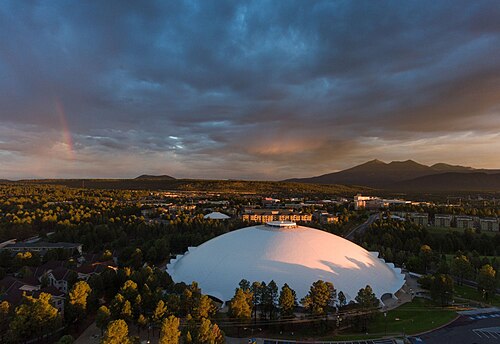
Arizona is served by three public universities: The University of Arizona, Arizona State University, and Northern Arizona University. These schools are governed by the Arizona Board of Regents.
Private higher education in Arizona is dominated by a large number of for-profit and "chain" (multi-site) universities.[150]
Embry–Riddle Aeronautical University, Prescott and Prescott College are Arizona's only non-profit four-year private colleges.[151]
Arizona has a wide network of two-year vocational schools and community colleges. These colleges were governed historically by a separate statewide board of directors but, in 2002, the state legislature transferred almost all oversight authority to individual community college districts.[152] The Maricopa County Community College District includes 11 community colleges throughout Maricopa County and is one of the largest in the nation.
Public universities in Arizona
- Arizona State University, (Sun Devils) Tempe/Phoenix/Mesa/Glendale/Lake Havasu
- Northern Arizona University, (Lumberjacks) Flagstaff/Yuma/Prescott
- University of Arizona, (Wildcats) Tucson/Sierra Vista, MD college in downtown Phoenix and UA Agricultural Center in Yuma/Maricopa
Private colleges and universities in Arizona
- American Indian College
- Carrington College
- Arizona Christian University
- Art Center College of Design
- Art Institute of Tucson
- Art Institute of Phoenix
- A.T. Still University
- Brookline College
- Brown Mackie College
- Embry-Riddle Aeronautical University
- Grand Canyon University
- Midwestern University
- Northcentral University
- Ottawa University
- Park University
- University of Phoenix
- Penn Foster College[153]
- Prescott College
- Southwest College of Naturopathic Medicine
- Thunderbird School of Global Management
- University of Advancing Technology
- Western International University
- Conservatory of Recording Arts and Sciences
Community colleges
Art and culture
Visual arts and museums
Phoenix Art Museum, on the historic Central Avenue Corridor in Phoenix, is the Southwest's largest collection of visual art from across the world. The museum displays international exhibitions alongside the museum's collection of more than 18,000 works of American, Asian, European, Latin American, Western American, modern and contemporary art, and fashion design. With a community education mandate since 1951, Phoenix Art Museum holds a year-round program of festivals, live performances, independent art films and educational programs. The museum also has PhxArtKids, an interactive space for children; photography exhibitions through the museum's partnership with the Center for Creative Photography; the landscaped Sculpture Garden and dining at Arcadia Farms.[154]
Arizona is a recognized center of Native American art, with a number of galleries showcasing historical and contemporary works. The Heard Museum, also in Phoenix, is a major repository of Native American art. Some of the signature exhibits include a full Navajo hogan, the Mareen Allen Nichols Collection containing 260 pieces of contemporary jewelry, the Barry Goldwater Collection of 437 historic Hopi kachina dolls, and an exhibit on the 19th-century boarding school experiences of Native Americans. The Heard Museum has about 250,000 visitors a year.
Sedona, Jerome, and Tubac are known as budding artist colonies, and small arts scenes exist in the larger cities and near the state universities.[155]
Film
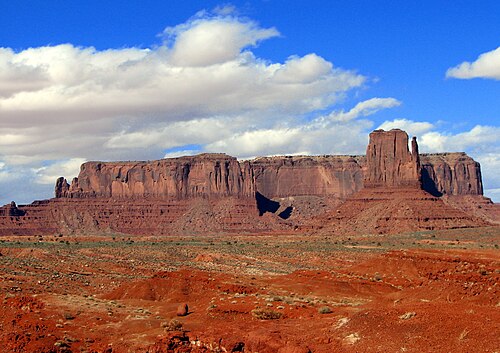
Several major Hollywood films, such as Billy Jack, U Turn, Waiting to Exhale, Just One of the Guys, Can't Buy Me Love, Bill & Ted's Excellent Adventure, The Scorpion King, The Banger Sisters, Used Cars, and Raising Arizona have been made there (as have many Westerns). The 1993 science fiction movie Fire in the Sky, based on a reported alien abduction in the town of Snowflake, was set in Snowflake. It was filmed in the Oregon towns of Oakland, Roseburg, and Sutherlin.
The 1974 film Alice Doesn't Live Here Anymore, for which Ellen Burstyn won the Academy Award for Best Actress, and also starring Kris Kristofferson, was set in Tucson. The climax of the 1977 Clint Eastwood film The Gauntlet takes place in downtown Phoenix. The final segments of the 1984 film Starman take place at Meteor Crater outside Winslow. The Jeff Foxworthy comedy documentary movie Blue Collar Comedy Tour was filmed almost entirely at the Dodge Theatre. Some of Alfred Hitchcock's classic film Psycho was shot in Phoenix, the ostensible home town of the main character.
Some of the television shows filmed or set in Arizona include The New Dick Van Dyke Show, Medium, Alice, The First 48, Insomniac with Dave Attell, Cops, and America's Most Wanted. The TV sitcom Alice, which was based on the movie was set in Phoenix. Twilight had passages set in Phoenix at the beginning and the end of the film.
Music
Arizona is prominently featured in the lyrics of many Country and Western songs, such as Jamie O'Neal's hit ballad "There Is No Arizona". George Strait's "Oceanfront Property" uses "ocean front property in Arizona" as a metaphor for a sucker proposition. The line "see you down in Arizona Bay" is used in a Tool song in reference to the possibility (expressed as a hope by comedian Bill Hicks) that Southern California will one day fall into the ocean. Glen Campbell, a notable resident, popularized the song "By The Time I Get To Phoenix".
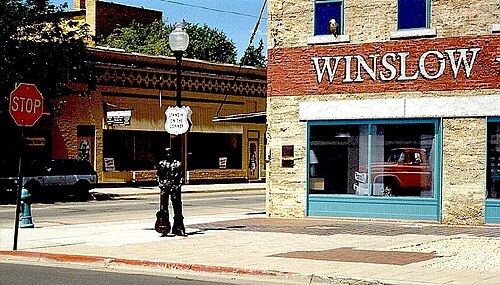
"Arizona" was the title of a popular song recorded by Mark Lindsay. Arizona is mentioned by the hit song "Take It Easy", written by Jackson Browne and Glenn Frey and performed by the Eagles. Arizona is also mentioned in the Beatles' song "Get Back", credited to John Lennon and Paul McCartney; McCartney sings: "JoJo left his home in Tucson, Arizona, for some California grass." "Carefree Highway", released in 1974 by Gordon Lightfoot, takes its name from Arizona State Route 74 north of Phoenix.[156]
Arizona's budding music scene is helped by emerging bands, as well as some well-known artists. The Gin Blossoms, Chronic Future, Roger Clyne and the Peacemakers, Jimmy Eat World, Caroline's Spine, and others began their careers in Arizona. Also, a number of punk and rock bands got their start in Arizona, including JFA, The Feederz, Sun City Girls, The Meat Puppets, The Maine, The Summer Set, and more recently Authority Zero and Digital Summer.
Arizona also has many singers and other musicians. Singer, songwriter and guitarist Michelle Branch is from Sedona. Chester Bennington, the former lead vocalist of Linkin Park, and mash-up artist DJ Z-Trip are both from Phoenix. One of Arizona's better known musicians is shock rocker Alice Cooper, who helped define the genre. Maynard James Keenan, the lead singer of the bands Tool, A Perfect Circle, and Puscifer, calls the town of Cornville home.
Other notable singers include country singers Dierks Bentley and Marty Robbins, folk singer Katie Lee, Fleetwood Mac's Stevie Nicks, CeCe Peniston, Rex Allen, 2007 American Idol winner Jordin Sparks, and Linda Ronstadt.
Arizona is also known for its heavy metal scene, which is centered in and around Phoenix. In the early to mid-1990s, it included bands such as Job for a Cowboy, Knights of the Abyss, Greeley Estates, Eyes Set To Kill, blessthefall, The Word Alive, The Dead Rabbitts, and Abigail Williams. The band Soulfly calls Phoenix home and Megadeth lived in Phoenix for about a decade. Beginning in and around 2009, Phoenix began to host a burgeoning desert rock and sludge metal underground, (ala' Kyuss in 1990s California) led by bands like Wolves of Winter, Asimov, and Dead Canyon.
American composer Elliott Carter composed his first String Quartet (1950–51) while on sabbatical (from New York) in Arizona. The quartet won a Pulitzer Prize and other awards and is now a staple of the string quartet repertoire.[citation needed]
Sports

Four Super Bowls have been held in Arizona, including Super Bowl LVII which was held at State Farm Stadium on February 12, 2023.[157]
Due to its numerous golf courses, Arizona is home to several stops on the PGA Tour, most notably the Phoenix Open, held at the TPC of Scottsdale, and the WGC-Accenture Match Play Championship at the Ritz-Carlton Golf Club in Marana.[158]
Auto racing is another sport known in the state. Phoenix Raceway in Avondale is home to NASCAR race weekends twice a year. Firebird International Raceway near Chandler is home to drag racing and other motorsport events.[159]
College sports
College sports are also prevalent in Arizona. The Arizona State Sun Devils and the Arizona Wildcats belong to the Pac-12 Conference while the Northern Arizona Lumberjacks compete in the Big Sky Conference and the Grand Canyon Antelopes compete in the Western Athletic Conference. The rivalry between Arizona State Sun Devils and the Arizona Wildcats predates Arizona's statehood, and is the oldest rivalry in the NCAA.[160] The Territorial Cup, first awarded in 1889 and certified as the oldest trophy in college football,[161] is awarded to the winner of the annual football game between the two schools.
Arizona also hosts several college football bowl games. The Fiesta Bowl, originally held at Sun Devil Stadium, is now held at State Farm Stadium in Glendale. The Fiesta Bowl is part of the new College Football Playoff (CFP). University of Phoenix Stadium was also home to the 2007 and 2011 BCS National Championship Games.
State Farm Stadium hosted the Final Four of the NCAA Division I men's basketball tournament in 2017 and is scheduled to host it again in 2024.[162]
Baseball
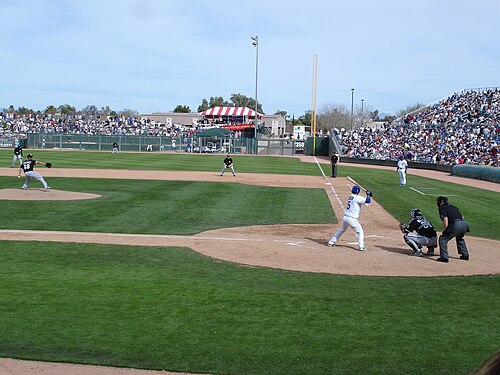
Arizona is a popular location for Major League Baseball spring training, as it is the site of the Cactus League. Spring training was first started in Arizona in 1947, when Brewers owner Veeck sold them in 1945 but went on to purchase the Cleveland Indians in 1946. He decided to train the Cleveland Indians in Tucson and convinced the New York Giants to give Phoenix a try. Thus, the Cactus League was born.[163]
On March 9, 1995, Arizona was awarded a franchise to begin to play for the 1998 season. A $130 million franchise fee was paid to Major League Baseball and on January 16, 1997, the Diamondbacks were officially voted into the National League.
Since their debut, the Diamondbacks have won five National League West titles, two National League Championship pennants, and the 2001 World Series.[164][165]
Notable people
See also
Notes
- ^ a b Elevation adjusted to North American Vertical Datum of 1988.
- ^ second to Nevada with 9% in 2010
- ^ Persons of Hispanic or Latino origin are not distinguished between total and partial ancestry.
- ^ In 2000, this designation was broken into two groups: Independent, Non-Charismatic Churches (34,130 adherents) and Independent, Charismatic Churches (29,755 adherents)
References
- ^ "Grand canyon state". statesymbolusa. April 30, 2014. Archived from the original on December 13, 2021. Retrieved December 2, 2021.
- ^ "Copper state". kgj. November 25, 2019. Archived from the original on December 28, 2021. Retrieved December 2, 2021.
- ^ "Valentine state". novemberproject. February 15, 2017. Archived from the original on December 28, 2021. Retrieved December 2, 2021.
- ^ "State Area Measurements and Internal Point Coordinates".
- ^ "Frisco". NGS Data Sheet. National Geodetic Survey, National Oceanic and Atmospheric Administration, United States Department of Commerce. Retrieved October 20, 2011.
- ^ a b "Elevations and Distances in the United States". United States Geological Survey. 2001. Archived from the original on October 15, 2011. Retrieved December 28, 2011.
- ^ a b "Change in Resident Population of the 50 States, the District of Columbia, and Puerto Rico: 1910 to 2020" (PDF). Census.gov. United States Census Bureau. Archived (PDF) from the original on April 26, 2021. Retrieved April 27, 2020.
- ^ "US Census Bureau QuickFacts". Archived from the original on May 9, 2022. Retrieved April 30, 2022.
- ^ "Arizona – Definition and More from the Free Merriam-Webster Dictionary". Merriam-webster.com. April 25, 2007. Archived from the original on January 12, 2012. Retrieved December 28, 2011.
- ^ "Arizona in Navajo". Glosbe. Archived from the original on February 20, 2021. Retrieved November 6, 2020.
- ^ a b Saxton, Dean; Saxton, Lucille; Enos, Susie (1983). Dictionary: Tohono O'odham/Pima to English, English to Tohono O'odham/Pima. Tucson: University of Arizona Press. ISBN 9780816519422.
- ^ "All about Arizona". Sheppard Software. Archived from the original on November 20, 2017. Retrieved September 21, 2010.
- ^ "Federally Recognized Tribes in Arizona". Arizona State Museum. Archived from the original on September 26, 2021. Retrieved September 26, 2021.
- ^ "The 50 biggest companies in Arizona". AZBigMedia. Archived from the original on December 8, 2020. Retrieved January 24, 2021.
- ^ Bright, William (2004). Native American Place Names of the United States. Norman, OK: University of Oklahoma Press. p. 47. ISBN 9780806135984.
- ^ Kitt, E.O.; Pearce, T.M. (1952). "Arizona Place Name Records". Western Folklore. 11 (4): 284–287. doi:10.2307/1496233. ISSN 0043-373X. JSTOR 1496233.
- ^ Harper, Douglas. "Arizona". Online Etymology Dictionary. Archived from the original on July 28, 2011. Retrieved December 28, 2011.
- ^ McClintock, James (1916). Arizona, Prehistoric, Aboriginal, Pioneer, Modern: The Nation's Youngest Commonwealth within a Land of Ancient Culture. Chicago: The S.J. Clarke Publishing Co. Archived from the original on February 1, 2015. Retrieved November 9, 2019.
- ^ a b Thompson, Clay (February 25, 2007). "No, 'arid zone' not the basis of state's name". The Arizona Republic. Archived from the original on December 29, 2014. Retrieved March 14, 2023.
- ^ Thompson, Clay (February 25, 2007). "A sorry state of affairs when views change". The Arizona Republic. Archived from the original on June 4, 2012. Retrieved March 3, 2007.
- ^ Turner, Jim. "How Arizona Did NOT Get Its Name . . ". Arizona Historical Society. Archived from the original on October 13, 2007. Retrieved March 3, 2007.
- ^ Garate, Donald (2005). "Arizonac, a twentieth-century myth". Journal of Arizona History. 46 (2): 161–184. JSTOR 41696897.
- ^ "The Meaning of Arizona". Arizona Almanac. Arizona State Library Archives & Public Records. Archived from the original on July 16, 2019. Retrieved March 20, 2019.
- ^ Borrens, Lobby. "Francisco Vázquez de Coronado expedition to arizona". History. Archived from the original on December 7, 2021. Retrieved December 23, 2021.
- ^ Martínez Laínez, Fernando and Canales Torres, Carlos. Banderas lejanas: La exploración, conquista y defensa por parte de España del Territorio de los actuales Estados Unidos (in Spanish: Far flags. The exploration, conquest and defense by Spain of the Territory of the present United States). pp. 145–146. Fourth edition: September 2009.
- ^ "Father Kino converted many Indians to Christians". nps. Archived from the original on October 19, 2021. Retrieved December 10, 2021.
- ^ Timothy Anna et al., Historia de México. Barcelona: Critica, 2001, p. 10.
- ^ "United States conqures arizona". history. Archived from the original on January 21, 2022. Retrieved December 10, 2021.
- ^ Mexican–American War as accessed on March 16, 2007, at 7:33 MST AM
- ^ "Gadsden purchase". historytoday. Archived from the original on December 28, 2021. Retrieved December 2, 2021.
- ^ "Arizona Ordinance of secession presented by the Col. Sherod Hunter Camp 1525, SCV, Phoenix, Arizona". Members.tripod.com. July 23, 2007. Archived from the original on October 2, 2006. Retrieved July 25, 2010.
- ^ United States. Cong. Senate (1904) [1st pub. Confederate States. Cong.: 1861–1862]. Journal of the Congress of the Confederate States of America, 1861–1865. Volume I. 58th Cong. 2d sess. S. Doc. 234. Washington: Government Printing Office. p. 691. LCCN 05012700. Archived from the original on February 22, 2019. Retrieved August 11, 2017 – via Internet Archive.
- ^ "Picacho Peak". American Battlefield Trust. Retrieved August 10, 2023.
- ^ Bates, Al (April 14, 2019). "Arizona becomes a territory". AP News. Archived from the original on March 31, 2022. Retrieved December 10, 2021.
- ^ Henson, Pauline (1965). Founding a Wilderness Capital, Prescott, A. T., 1864. Flagstaff, AZ: Northland Press. pp. passim. LCCN 65-17578.
- ^ Arroyo Rodriguez, Nadine (September 26, 2014). "Did You Know: Capital Of Arizona Moved 4 Times Before Settling In Phoenix". kjzz. Archived from the original on January 14, 2019. Retrieved January 9, 2019.
- ^ "Preserving Cultural and Historic Resources – A Conservation Objective of the Sonoran Desert Conservation Plan". pima.gov. Archived from the original on July 3, 2010. Retrieved November 13, 2016.
- ^ Shillingberg, William (1999). Tombstone, A. T., A History of Early Mining, Milling and Mayhem. Spokane, WA: Arthur Clark. p. passim. ISBN 0870622730.
- ^ Bailey, Lynn (2002). Bisbee, Queen of the Copper Camps. Tucson: Westernlore Press. p. passim. ISBN 0870260588.
- ^ Clements, Eric (2003). After the Boom in Tombstone and Jerome, Arizona. Reno, NV: University of Nevada Press. p. passim. ISBN 0874175712.
- ^ Varney, Philip (1994). Arizona Ghost Towns and Mining Camps. Phoenix: Arizona Highways, DOT. p. passim. ISBN 0916179443.
- ^ Ascarza, William (2015). In Search of Fortunes, a Look at the History of Arizona Mining. Evansville, IN: M. T. Publishing. p. Passim. ISBN 978-1938730696.
- ^ Byrkit, James (1982). Forging the Copper Collar, Arizona's Labor-Management War, 1901–1921. Tucson: University of Arizona Press. p. passim. ISBN 08165-07457.
- ^ tan, bri. "Arizona economy during great depression". Britannica. Archived from the original on August 31, 2021. Retrieved December 20, 2021.
- ^ "Biltomore hotel history". arizonabiltmore. Archived from the original on December 26, 2021. Retrieved December 10, 2021.
- ^ "Wigman resort history". wigmanresort. Archived from the original on November 4, 2021. Retrieved December 10, 2021.
- ^ Hobbs, Katie. "Arizona concentration camps". azliabary. Archived from the original on December 31, 2021. Retrieved December 20, 2021.
- ^ central, AZ. "Arizona concentration camps shut down". azcentral. Archived from the original on May 9, 2022. Retrieved December 20, 2021.
- ^ "Archaeology of the Phoenix Indian School". Archaeology.org. March 27, 1998. Archived from the original on November 3, 2009. Retrieved July 25, 2010.
- ^ a b c d Harrison v. Laveen, July 1948 Archived August 17, 2016, at the Wayback Machine, Arizona Supreme Court
- ^ "Arizona Democrats authorize Internet Voting for March 11 Advisory Primary" Archived November 6, 2010, at the Wayback Machine, The Green Papers
- ^ "Supreme Court strikes down Arizona voting law". CBS News. June 17, 2013. Archived from the original on August 11, 2020. Retrieved February 7, 2021.
- ^ ncsl, ncsl. "Arizona immigration law". ncsl. Archived from the original on January 20, 2022. Retrieved January 26, 2022.
- ^ Hulse, Carl; Zernike, Kate (January 9, 2011). "Bloodshed Puts New Focus on Vitriol in Politics". The New York Times. Archived from the original on January 25, 2021. Retrieved February 7, 2021.
- ^ "National Park Service – Arizona". National Park Service. Archived from the original on February 15, 2021. Retrieved January 10, 2021.
- ^ "Urban and Community Forestry Division". Arizona State Forestry Division. Archived from the original on July 14, 2014. Retrieved July 6, 2014.
- ^ "The World Factbook". Cia.gov. Archived from the original on April 30, 2020. Retrieved April 18, 2020.
- ^ "Prescott Overview". Ncsu.edu. May 15, 2002. Archived from the original on January 18, 2010. Retrieved July 25, 2010.
- ^ "Meteor Crater Arizona - World's Best Meteorite Impact Crater". www.meteorite.com. Archived from the original on September 13, 2022. Retrieved September 13, 2022.
- ^ a b "Arizona Climate". Desert Research Institute, Western Regional Climate Center, Reno, Nevada. December 7, 2001. Archived from the original on December 22, 2011. Retrieved December 28, 2011.
- ^ beat, your. "Climate records az". nyourcitybeat. Archived from the original on December 28, 2021. Retrieved December 2, 2021.
- ^ Climate Assessment for the Southwest (December 1999). "The Climate of the Southwest". University of Arizona. Archived from the original on October 12, 2007. Retrieved March 21, 2006.
- ^ United States Geological Survey (September 2005). "Hydrologic Conditions in Arizona During 1999–2004: A Historical Perspective" (PDF). Archived (PDF) from the original on November 4, 2011. Retrieved December 28, 2011.
- ^ "History for Phoenix, AZ". Weather Underground. August 31, 2006. Archived from the original on August 7, 2013. Retrieved December 28, 2011.
- ^ Hedding. "The Weather and Climate in Arizona: Too Hot to Handle?". TripSavvy. Archived from the original on September 14, 2022. Retrieved September 14, 2022.
- ^ "Mean number of Days with Minimum Temperature Below 32F National Oceanic and Atmospheric Administration, Retrieved March 24, 2007". Lwf.ncdc.noaa.gov. August 20, 2008. Archived from the original on December 17, 2001. Retrieved December 28, 2011.
- ^ "Arizona climate averages". Weatherbase. Archived from the original on October 9, 2015. Retrieved November 11, 2015.
- ^ "Phoenix Business Journal". September 2, 2011. p. 4.
- ^ "Welcome to Lake Havasu City". Lake Havasu City. Archived from the original on August 23, 2015. Retrieved July 5, 2015.
- ^ "ASU@Lake Havasu". Arizona Board of Regents. Archived from the original on March 20, 2019. Retrieved March 20, 2019.
- ^ "City and Town Population Totals: 2020-2021". United States Census Bureau. Archived from the original on July 11, 2022. Retrieved September 6, 2022.
- ^ a b "Historical Population Change Data (1910–2020)". Census.gov. Archived from the original on April 29, 2021.
- ^ "QuickFacts: Arizona". United States Census Bureau. Retrieved April 2, 2024.
- ^ Arizona (state, United States) Archived February 26, 2010, at the Wayback Machine. Encyclopædia Britannica Online.
- ^ "Arizona – Race and Hispanic Origin: 1860 to 1990." (PDF). U.S. Census Bureau. Archived February 9, 2018, at the Wayback Machine.
- ^ Census.gov Arizona – Race and Hispanic Origin: 1860 to 1990 Archived January 12, 2012, at the Wayback Machine
- ^ "Arizona at a crossroads over water and growth". The Arizona Republic. March 9, 2008.
- ^ "Americans under age one now mostly minorities, but not in Ohio: Statistical Snapshot Archived July 14, 2016, at the Wayback Machine". The Plain Dealer. June 3, 2012.
- ^ "Ranking Tables for Metropolitan Areas: 1990 and 2000 Archived July 19, 2018, at the Wayback Machine." United States Census Bureau. April 2, 2001. Retrieved on July 8, 2006.
- ^ Slevin, Peter (April 30, 2010). "New Arizona law puts police in 'tenuous' spot". Washington Post. Washington, DC. p. A4. Archived from the original on January 31, 2011. Retrieved December 28, 2011.
- ^ "2007-2022 PIT Counts by State". Archived from the original on March 14, 2023. Retrieved March 11, 2023.
- ^ "The 2022 Annual Homelessness Assessment Report (AHAR) to Congress" (PDF). Archived (PDF) from the original on March 11, 2023. Retrieved March 11, 2023.
- ^ "Immigrants in Arizona" (PDF).
- ^ "Race and Ethnicity in the United States: 2010 Census and 2020 Census". census.gov. United States Census Bureau. August 12, 2021. Archived from the original on August 15, 2021. Retrieved September 26, 2021.
- ^ Historical Census Statistics on Population Totals By Race, 1790 to 1990, and By Hispanic Origin, 1970 to 1990, For The United States, Regions, Divisions, and States Archived December 24, 2014, at the Wayback Machine
"Table 17. Arizona – Race and Hispanic Origin: 1860 to 1990 Archived May 14, 2015, at the Wayback Machine". (PDF) - ^ a b c "CensusScope -- Population by Race". censusscope.org. Retrieved June 28, 2024.
- ^ "2010 Census Data". Archived from the original on May 22, 2017. Retrieved February 18, 2018.
- ^ "Profile of General Population and Housing Characteristics: 2020 Demographic Profile Data (DP-1): Arizona". United States Census Bureau. Retrieved April 2, 2024.
- ^ "Grid View: Table B04006 - Census Reporter". censusreporter.org. Retrieved June 28, 2024.
- ^ "Grid View: Table B02009 - Census Reporter". censusreporter.org. Retrieved June 28, 2024.
- ^ "Grid View: Table B03001 - Census Reporter". censusreporter.org. Retrieved June 28, 2024.
- ^ "Grid View: Table B02017 - Census Reporter". censusreporter.org. Retrieved June 28, 2024.
- ^ a b "Arizona". Modern Language Association. Archived from the original on December 1, 2007. Retrieved October 15, 2013.
- ^ a b 2005 American Community Survey. Retrieved from the data of the MLA Archived December 1, 2007, at the Wayback Machine, July 13, 2010
- ^ Arizona has most Indian language speakers Archived December 12, 2011, at the Wayback Machine. upi.com Accessed December 12, 2011.
- ^ "American Values Atlas: Religious Tradition in Arizona". Public Religion Research Institute. February 24, 2023. Archived from the original on April 4, 2017. Retrieved April 14, 2023.
- ^ "The Association of Religion Data Archives | State membership Report". www.Thearda.com. Archived from the original on December 7, 2014. Retrieved November 7, 2013. For 2010, it uses data in the 2010 U.S. Religion Census: Religious Congregations & Membership Study produced by the Association of Statisticians of American Religious Bodies (ASARB) which depends on reporting by the religious bodies.
- ^ a b "Arizona – Religious Traditions, 2010". Association of Religion Data Archives. Archived from the original on August 2, 2017. Retrieved August 2, 2017.
- ^ "Arizona – Religious Traditions, 2010". Association of Religion Data Archives. Archived from the original on August 2, 2017. Retrieved August 2, 2017.
- ^ "The Association of Religion Data Archives | Maps & Reports". Archived from the original on August 10, 2022. Retrieved August 10, 2022.
- ^ "The Association of Religion Data Archives | Maps and Reports | Reports | Denomination Listing: Unclaimed". Archived from the original on August 10, 2022. Retrieved August 10, 2022.
- ^ "How Hindus Grew into Second-Largest Faith in Arizona & Delaware". NBC News. June 24, 2014. Archived from the original on August 2, 2017. Retrieved August 2, 2017.
- ^ "U.S. Religion Census 2010: Summary Findings" (PDF). Association of Statisticians of American Religious Bodies. May 1, 2012. p. 16. Archived from the original (PDF) on February 1, 2017. Retrieved August 2, 2017.
- ^ "PRRI – American Values Atlas". ava.prri.org. Archived from the original on April 4, 2017. Retrieved September 17, 2022.
- ^ "Religious Landscape Study". Pew Research Center's Religion & Public Life Project. Archived from the original on April 1, 2022. Retrieved September 17, 2022.
- ^ "Maps and data files for 2020 | U.S. Religion Census | Religious Statistics & Demographics". www.usreligioncensus.org. Archived from the original on January 15, 2023. Retrieved January 17, 2023.
- ^ "Arizona Indian Tribes and Languages". www.native-languages.org. Retrieved September 2, 2024.
- ^ "American Indian and Alaska Native Tribes in the United States and Puerto Rico: 2010".
- ^ "GDP by State". GDP by State | U.S. Bureau of Economic Analysis (BEA). Bureau of Economic Analysis. Retrieved May 20, 2024.
- ^ Research, Economy (January 1997). "Arizona gross production". stlouisfed. Archived from the original on December 16, 2021. Retrieved December 2, 2021.
- ^ Account, Economic (March 29, 2024). "Personal Income by State". U.S. Bureau of Economic Analysis (BEA). Retrieved May 20, 2024.
- ^ Bureau, U.S. Census. "S1901: Income in the Past 12 Months". Explore Census Data. Retrieved May 20, 2024.
{{cite web}}:|last=has generic name (help) - ^ "QuickFacts Arizona". Archived from the original on November 9, 2019. Retrieved November 11, 2019.
- ^ a b "Arizona Economy at a Glance". Bls.gov. Archived from the original on October 24, 2020. Retrieved October 28, 2020.
- ^ "Arizona Republic 100: State's biggest employers" . The Arizona Republic.
- ^ "USDA/NASS 2021 State Agriculture Overview for Arizona". USDA, National Agricultural Statistics Service. Archived from the original on July 5, 2022. Retrieved June 29, 2022.
- ^ a b c "7 CFR § 457.138 - Grape crop insurance provisions". Legal Information Institute (LII). July 25, 2016. Archived from the original on October 5, 2022. Retrieved June 28, 2022.
- ^ a b
- • Navas-Castillo, Jesús; Fiallo-Olivé, Elvira; Sánchez-Campos, Sonia (2011). "Emerging Virus Diseases Transmitted by Whiteflies". Annual Review of Phytopathology. 49 (1). Annual Reviews: 219–248. doi:10.1146/annurev-phyto-072910-095235. ISSN 0066-4286. PMID 21568700.
- • Dennehy, T. J.; DeGain, B.; Harpold, G.; Brown, J. K.; Byrne, F.; Morin, S.; Nichols, R. (September 9, 2006). "First New World Report of Q Biotype of Bemisia tabaci (Gennadius) Reveals High Levels of Resistance to Insecticides". Resistant Pest Management Newsletter. Michigan State University. Archived from the original on September 9, 2006. Retrieved August 1, 2022.
- • Dalton, Rex (2006). "The Christmas Invasion". Nature. 443 (7114). Nature Portfolio: 898–900. doi:10.1038/443898a. ISSN 0028-0836. PMID 17066003. S2CID 11918900.
- ^ a b c
- • Hufbauer, Ruth A.; Facon, Benoît; Ravigné, Virginie; Turgeon, Julie; Foucaud, Julien; Lee, Carol E.; Rey, Olivier; Estoup, Arnaud (2011). "Anthropogenically induced adaptation to invade (AIAI): contemporary adaptation to human-altered habitats within the native range can promote invasions". Evolutionary Applications. 5 (1). Blackwell: 89–101. doi:10.1111/j.1752-4571.2011.00211.x. ISSN 1752-4571. PMC 3353334. PMID 25568032. S2CID 18005520.
- • Hare, J. Daniel (1990). "Ecology and Management of the Colorado Potato Beetle". Annual Review of Entomology. 35 (1). Annual Reviews: 81–100. doi:10.1146/annurev.en.35.010190.000501. ISSN 0066-4170. S2CID 83991465.
- • Hsiao, T. H. (1978). Host plant adaptations among geographic populations of the Colorado potato beetle. Proceedings of the Fourth Insect/Host Plant Symposium. Entomologia Experimentalis et Applicata. Vol. 24, no. 3. Wiley (Netherlands Entomological Society). pp. 437–447. doi:10.1111/j.1570-7458.1978.tb02804.x. ISSN 0013-8703. S2CID 84910076.
- ^ "Arizonas Interstate Highways". azdot. Archived from the original on December 31, 2019. Retrieved March 5, 2014.
- ^ Metro, Valley (May 19, 2021). "Valley metro rail opens". ValleyMetro. Archived from the original on February 7, 2022. Retrieved January 31, 2022.
- ^ "Tucson: Streetcar Plan Wins With 60% of Vote". Lightrailnow.org. Archived from the original on January 4, 2012. Retrieved December 28, 2011.
- ^ Cortez, Alexis. "Amtrak plan would include stations in Queen Creek, Phoenix, Tempe, Goodyear". azfamily.com. Archived from the original on August 12, 2021. Retrieved August 12, 2021.
- ^ "Arizona government". artsandculture. Archived from the original on December 28, 2021. Retrieved December 2, 2021.
- ^ "State Senators & Representatives | Citizens Clean Elections Commission". www.azcleanelections.gov. Archived from the original on November 9, 2022. Retrieved November 9, 2022.
- ^ "Party Government Since 1857 | US House of Representatives: History, Art & Archives". history.house.gov. Archived from the original on November 9, 2022. Retrieved November 9, 2022.
- ^ "Ariz. GOP would gain if Napolitano gets Obama post". KTAR. Associated Press. November 20, 2008. Archived from the original on November 21, 2011. Retrieved December 28, 2011.
- ^ "Format Document". Azleg.gov. January 1, 1993. Archived from the original on September 17, 2016. Retrieved September 9, 2016.
- ^ Stern, Ray (November 8, 2022). "Arizona voters approve Proposition 131 to create lieutenant governor position". The Arizona Republic. Retrieved November 12, 2023.
- ^ ""QuickFacts". U.S. Census Bureau. Retrieved August 12, 2021". Archived from the original on February 3, 2020. Retrieved May 31, 2018.
- ^ "Voter Registration Statistics". Arizona Secretary of State Elections Bureau. Archived from the original on August 2, 2019. Retrieved August 1, 2024.
- ^ Dr. Dean Chavers, "History of Indian voting rights and why it's important" Archived July 7, 2016, at the Wayback Machine, Indian Country Today, October 29, 2012; accessed July 17, 2016. See Trujillo v. Garley (1948)
- ^ Leip, David. "Presidential General Election Results Comparison – Arizona". US Election Atlas. Archived from the original on October 27, 2022. Retrieved October 26, 2022.
- ^ Merica, Dan (November 13, 2020). "Biden carries Arizona, flipping a longtime Republican stronghold". CNN. Archived from the original on November 13, 2020. Retrieved November 13, 2020.
- ^ "Arizona stands alone against marriage ban – Queer Lesbian Gay News". Gay.com. Archived from the original on January 8, 2007. Retrieved July 25, 2010.
- ^ "Ban on gay unions solidly supported in most of Arizona". Archived from the original on November 8, 2008.
- ^ Archibold, Randal C. (April 23, 2010). "Arizona Enacts Stringent Law on Immigration". The New York Times. Archived from the original on January 1, 2012. Retrieved December 28, 2011.
- ^ "High court to weigh Arizona voter registration case". Reuters. March 15, 2013. Archived from the original on March 17, 2013. Retrieved March 17, 2013.
- ^ "Inspired by West Virginia Strike, Teachers in Oklahoma and Kentucky Plan Walk Out". KTLA. April 2, 2018. Archived from the original on August 12, 2019. Retrieved September 4, 2019.
- ^ "Methods of Execution". Archived from the original on July 1, 2018. Retrieved March 20, 2023.
- ^ "Why Arizona Flipped on Gay Marriage". Archived from the original on November 15, 2017. Retrieved November 15, 2017.
- ^ McKinley, Jesse; Goodstein, Laurie (November 5, 2008). "Bans in 3 States on Gay Marriage". The New York Times. ISSN 0362-4331. Archived from the original on January 5, 2018. Retrieved November 15, 2017.
- ^ "Arizona city poised to pass state's first civil union ordinance". Reuters. April 2, 2013. Archived from the original on November 15, 2017. Retrieved November 15, 2017.
- ^ "Bisbee, Arizona same-sex marriage: Council approves civil unions measure". KNXV. Associated Press. June 5, 2013. Archived from the original on November 15, 2017. Retrieved November 15, 2017.
- ^ "Legal Recognition of Same-Sex Relationships" (PDF). samesexrelationshipguide.com. August 31, 2015. Archived from the original (PDF) on September 24, 2015. Retrieved October 14, 2017.
- ^ "AZ pro-civil unions, remembers Goldwater fondly" (PDF). Archived (PDF) from the original on May 13, 2012. Retrieved April 5, 2012.
- ^ Rau, Alia. "Same sex marriage legal in Arizona". azcentral. Archived from the original on May 9, 2022. Retrieved January 31, 2022.
- ^ "American Values Atlas: Approval of Same-Sex Marriage in Arizona". Public Religion Research Institute. February 24, 2023. Archived from the original on April 4, 2017. Retrieved April 12, 2023.
- ^ Roberts, Laurie. "Number of schools in arizona". azcentreal. Retrieved December 2, 2021.
- ^ "College Navigator – Search Results". nces.ed.gov. Archived from the original on May 11, 2011. Retrieved February 3, 2009.
- ^ "College Navigator – Prescott College". nces.ed.gov. Archived from the original on May 11, 2011. Retrieved February 3, 2009.
- ^ 2002 Legislature – HB 2710, which later became ARS 15-1444
- ^ "AZ Private Postsecondary Institutions". Azhighered.org. Archived from the original on October 18, 2016. Retrieved September 9, 2016.
- ^ ART, PHOENIX. "Art history". phxart. Archived from the original on December 27, 2021. Retrieved December 2, 2021.
- ^ "Arizonas Budding Art Colonists". visitarizona. Archived from the original on January 25, 2021. Retrieved March 1, 2021.
- ^ "Crawdaddy". April 1975.
- ^ Teope, Herbie (May 23, 2018). "Arizona, New Orleans Saints chosen as Super Bowl hosts". National Football League. Archived from the original on February 2, 2020. Retrieved May 23, 2018.
- ^ web-admin (February 22, 2012). "Accenture Match Play Championship begins at The Ritz-Carlton Golf Club Dove Mountain". Nicklaus Design. Archived from the original on September 22, 2022. Retrieved September 22, 2022.
- ^ rhorton. "2022 NASCAR Championship Weekend". Phoenix Raceway. Archived from the original on September 22, 2022. Retrieved September 22, 2022.
- ^ Knauer, Tom (November 22, 2006). "What is the Territorial Cup?". The Wildcat Online. Archived from the original on October 8, 2008. Retrieved April 2, 2007.
- ^ Official 2007 NCAA Division I Football Records Book (PDF). National Collegiate Athletic Association. 2007. Archived from the original (PDF) on June 25, 2008.
- ^ "Arizona earns hosting duties for 2024 NCAA Tournament Final Four". Arizona Sports. July 16, 2018. Archived from the original on September 22, 2022. Retrieved September 22, 2022.
- ^ "Buckhorn Baths: A unique Mesa landmark". www.azcentral.com. Archived from the original on February 20, 2021. Retrieved December 7, 2019.
- ^ "Jeff Munn". Sportscasters Talent Agency of America. Archived from the original on September 22, 2022. Retrieved September 22, 2022.
- ^ "Arizona Diamondbacks are National League Champions, advance to the World Series for the second time in franchise history". MLB.com. Retrieved June 14, 2024.
Further reading
- Bayless, Betsy, 1998, Arizona Blue Book, 1997–1998. Phoenix: Office of the Arizona Secretary of State.
- McIntyre, Allan J., 2008, The Tohono O'odham and Pimeria Alta. Charleston, SC: Arcadia Publishing. (ISBN 978-0738556338).
- Miller, Tom (editor), 1986, Arizona: The Land and the People. Tucson: University of Arizona Press. (ISBN 978-0816510047).
- Officer, James E., 1987, Hispanic Arizona, 1536–1856. Tucson: University of Arizona Press. (ISBN 978-0816509812).
- Plascencia, Luis F.B. and Gloria H. Cuádraz (eds.), 2018, Mexican Workers and the Making of Arizona. Tucson: University of Arizona Press.
- Thomas, David M. (editor), 2003, Arizona Legislative Manual. In Arizona Phoenix: Arizona Legislative Council. Google Print. Retrieved January 16, 2006.
- Trimble, Marshall, 1998, Arizona, A Cavalcade of History. Tucson: Treasure Chest Publications. (ISBN 978-0918080431).
- Woosley, Anne I., 2008, Early Tucson. Charleston, SC: Arcadia Publishing. (ISBN 978-0738556468).
External links
Arizona at Wikipedia's sister projects
 Definitions from Wiktionary
 Media from Commons
 News from Wikinews
 Quotations from Wikiquote
 Texts from Wikisource
 Textbooks from Wikibooks
 Resources from Wikiversity
 Travel information from Wikivoyage
- Official website
- Arizona State Guide, from the Library of Congress
- "Arizona Regional Accounts Data". Archived from the original on August 19, 2002. Retrieved February 19, 2003.
- Arizona Demographic Data from FedStats
- Arizona USDA State Fact Sheet
- Arizona Indicators
- Energy Data & Statistics for Arizona
- Arizona State Databases
- Arizona State Library, Archives and Public Records
- Arizona at Ballotpedia
- Arizona at Curlie
 Geographic data related to Arizona at OpenStreetMap
- Official Arizona Office of Tourism
- Arizona Game & Fish Department
- Arizona State Parks
- National Park Service Travel Itinerary
35°N 112°W / 35°N 112°W / 35; -112 (State of Arizona)