
Loading article…
 | |
| 宗教 | マヤの宗教 |
|---|---|
| 地理的範囲 | マヤ地域、メソアメリカ |
| 期間 | メソアメリカの先古典期から植民地期まで |
| 日付 | 紀元前 2000年頃 –西暦1697年 |
| タイプサイト | ウアシャクトゥン、ジビルチャルトゥン |
| 先行 | 古代 |
| 崩壊の原因 | スペインによるマヤ征服 |
マヤ文明(/ ˈ m aɪ ə /)は、古代から近世初期にかけて存在したメソアメリカ文明です。古代の寺院と象形文字(文字)で知られています。マヤ文字は、コロンブス以前のアメリカ大陸で最も洗練され、高度に発達した文字体系です。この文明は、芸術、建築、数学、暦、天文学のシステムでも知られています。
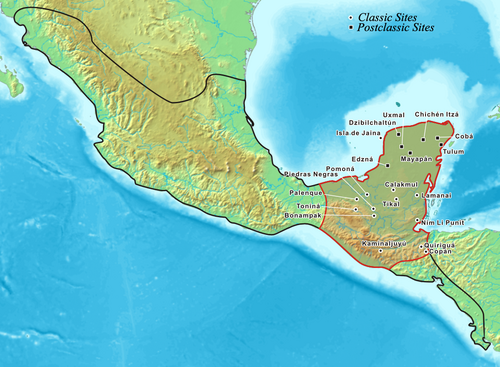
マヤ文明はマヤ地域で発展しました。この地域は現在、メキシコ南東部、グアテマラとベリーズの全域、ホンジュラスとエルサルバドルの西部に及びます。ユカタン半島の北部低地、グアテマラのシエラマドレ高地、メキシコのチアパス州、グアテマラ南部、エルサルバドル、太平洋沿岸平野の南部低地が含まれます。今日、総称してマヤ人として知られるその子孫は600万人を優に超え、28を超える現存するマヤ言語を話し、祖先とほぼ同じ地域に住んでいます。
紀元前2000年以前の古典期には、農業が初めて発達し、最も古い村落が形成された。先古典期(紀元前2000年頃から紀元後250年頃)には、マヤ地域で最初の複雑な社会が築かれ、トウモロコシ、豆、カボチャ、トウガラシなど、マヤ人の主食である作物が栽培された。 最初のマヤ都市は紀元前750年頃に発達し、紀元前500年までには、これらの都市は精巧なスタッコのファサードを持つ大きな寺院など、記念碑的な建築物を備えるようになった。マヤ地域では、紀元前3世紀までにヒエログリフ文字が使用されていた。後期先古典期には、ペテン盆地に多くの大都市が発達し、グアテマラ高地ではカミナルフユ市が台頭した。古典期は西暦250年頃から始まり、おおむねマヤ人がロングカウントの年代を刻んだ彫刻の記念碑を建てていた時代と定義される。この時代、マヤ文明は複雑な交易ネットワークで結ばれた多くの都市国家を発展させた。マヤ低地では、ティカルとカラクムルという2つの大きなライバル都市が勢力を強めた。古典期にはまた、メキシコ中部の都市テオティワカンがマヤ王朝の政治に介入した。9世紀には、中央マヤ地域で広範囲にわたる政治的崩壊が起こり、その結果、内戦、都市の放棄、および北方への人口移動が起きた。後古典期には、北部でチチェン・イッツァが台頭し、グアテマラ高地では攻撃的なキチェ王国が拡大した。 16 世紀、スペイン帝国はメソアメリカ地域を植民地化し、長期にわたる一連の軍事作戦の結果、最後のマヤ都市である ノジペテンは 1697 年に陥落しました。
古典期の統治は「神の王」という概念を中心に展開され、この王は人間と超自然界の仲介役を務めると考えられていた。王権は通常(ただし、排他的ではない)[1] 父系制であり、権力は長男に継承されるのが通例であった。将来の王は統治者であると同時に戦争の指導者としても有能であることが求められた。マヤの政治では閉鎖的な後援制度が支配的であったが、後援が王国の政治的構成に及ぼす影響は都市国家によって異なっていた。後期古典期までに貴族階級は規模を拡大し、それまで独占的であった王の権力は縮小した。マヤでは木材、翡翠、黒曜石、陶磁器、彫刻された石碑、スタッコ、精巧に描かれた壁画など、腐りやすい素材と腐らない素材の両方を使った洗練された芸術形態が発達した。
マヤの都市は有機的に拡大する傾向があった。都市の中心部は儀式や行政の複合施設で構成され、その周囲を不規則な形の住宅地区が広がっていた。都市のさまざまな部分はしばしば土手道で結ばれていた。建築的には、都市の建物には宮殿、ピラミッド寺院、儀式用の舞踏場、天文観測用に特別に配置された構造物などがあった。マヤのエリート層は読み書きができ、複雑な象形文字の体系を発達させた。彼らの文字はコロンブス以前のアメリカ大陸で最も進んだ文字体系だった。マヤ人は歴史や儀式の知識を折り畳み本に記録したが、そのうち異論のない例はわずか 3 つしか残っておらず、残りはスペイン人によって破壊された。さらに、マヤのテキストの非常に多くの例が石碑や陶器に見ることができる。マヤ人は高度に複雑な一連の連動した儀式用暦を発達させ、人類史上最も古い明示的なゼロの例を含む数学を採用した。マヤ族は宗教の一環として人身御供を行っていた。
語源
「マヤ」は、この地域に住んでいたさまざまな人々を総称して指すために使われる現代の用語である。マヤ人は、その歴史の大部分において、共通の民族的アイデンティティや政治的統一感を持っていなかったからである。[2]ユカタン半島の初期のスペイン語およびマヤ語植民地資料では、 「マヤ」という用語を、ユカテク・マヤ人が話していた言語と、この用語の由来となった当時は廃墟となっていたマヤパンの都市周辺地域の両方を指すために使用していた。植民地マヤ語資料の中には、「マヤ」を他のマヤのグループを指すために使用したものもあり、スペイン統治に対してより抵抗するマヤのグループを軽蔑的に指す場合もあった。[3]
地理

マヤ文明は、メキシコ南東部と中央アメリカ北部を含む広い領域を占めていました。この地域には、ユカタン半島全体と、現在のグアテマラとベリーズの領土全体、およびホンジュラスとエルサルバドルの西部が含まれていました。[4]半島の大部分は、丘や山がほとんどなく、一般的に低い海岸線の広大な平野で構成されています。[5]マヤの領土はメソアメリカの3分の1を占め、[6]マヤはオルメカ、ミシュテカ、テオティワカン、アステカなどの近隣の文化とダイナミックな関係を築いていました。[7]前期古典期には、ティカルとカミナルフユのマヤ都市が、中央メキシコの高地に広がるネットワークの重要な拠点でした。[8]テオティワカンのテティトラ複合施設には、マヤ人の存在が強くありました。[9]マヤの都市チチェン・イッツァと遠く離れたトルテカの首都トゥーラは特に密接な関係にあった。[10]
ペテン地域は、低地の石灰岩の平野と密林で覆われている。 [11]ペテンの中央流域には、14の湖が連なっている。[12]南に向かうにつれて、平野はグアテマラ高地に向かって徐々に高くなる。[13]密集したマヤの森は、ペテン北部とベリーズ、キンタナ・ロー州の大部分、カンペチェ南部、ユカタン州南部の一部を覆っている。さらに北に行くと、植生は密集した低木林に変わる。[14]
ソコヌスコの沿岸地帯はシエラ・マドレ・デ・チアパスの南に位置し、[15]狭い海岸平野とシエラ・マドレの麓の丘陵地帯で構成されています。[16]マヤ高原はチアパスから東にグアテマラまで広がり、シエラ・デ・ロス・クチュマタネスで最高点に達します。コロンブス以前の主要な人口中心地は、グアテマラ渓谷やケツァルテナンゴ渓谷など、最大の高原渓谷でした。南部の高原では、火山円錐の帯が太平洋岸と平行に走っています。高原は北にベラパスまで広がり、東に向かって徐々に下っていきます。[17]
歴史
マヤ文明の歴史は、前古典期、古典期、後古典期の3つの主要な時期に分けられます。[18]これらの時期には、最初の定住村落と農業の初期の発展がみられた古代期が先行していました。[19]現代の学者は、これらの期間は文化の進化や衰退を示すものではなく、マヤ年代記の恣意的な区分であると考えています。[20]期間の開始日と終了日の定義は、著者によって1世紀も異なる場合があります。[21]
先古典期(紀元前2000年頃~紀元後250年)
マヤ人は先古典期に最初の文明を発展させた。[25]学者たちは、マヤ文明のこの時代がいつ始まったのかを議論し続けている。クエロ(現在のベリーズ)におけるマヤ人の居住地は、炭素年代測定により紀元前2600年頃と判明している。[26]太平洋沿岸のソコヌスコ地域に紀元前1800年頃に集落が築かれ、マヤ人はすでにトウモロコシ、豆、カボチャ、唐辛子といった主要作物を栽培していた。[27]この時代は定住社会と陶器や焼き土偶の導入が特徴的であった。 [28]
中期先古典期には、小さな村が成長して都市を形成し始めた。[29] グアテマラのペテン県にあるナクベは、マヤ低地で最も古い、よく記録に残る都市である。 [30]ここでは、大きな建造物が紀元前750年頃のものとされている。[29]ユカタン半島の北部低地には、中期先古典期までに広く人が定住した。[31]紀元前400年頃までに、初期のマヤの支配者たちは石碑を建てていた。[32]ペテンでは、紀元前3世紀までに、発達した文字がすでに使用されていた。[33]後期先古典期には、エル・ミラドールの巨大な都市が、およそ16平方キロメートル(6.2平方マイル)の面積を占めるまでに成長した。[34]ティカルはそれほど大きくはないが、紀元前350年頃にはすでに重要な都市であった。[35]
高地では、カミナルフユが後期先古典期の主要中心地として台頭した。[36] タカリク・アバジとチョコラは太平洋沿岸平野で最も重要な都市の2つであり、[37]コムチェンはユカタン北部の重要な場所へと成長した。[38]後期先古典期の文化的繁栄は西暦1世紀に崩壊し、その時代のマヤの偉大な都市の多くは放棄されたが、この崩壊の原因は不明である。[39]
古典期(西暦250~900年頃)

古典期は、主に低地マヤ人がロングカウント暦を使用して日付の記された記念碑を建てた時期として定義されます。[41]この時期は、大規模な建設と都市化、記念碑的な碑文の記録のピークであり、特に南部の低地で著しい知的および芸術的発展を示しました。[41]古典期のマヤの政治的状況は、ルネサンス期のイタリアや古典期のギリシャに例えられており、複数の都市国家が複雑な同盟と敵対のネットワークに従事していました。[42]最大の都市は5万人から12万人が住み、補助的な遺跡のネットワークにつながっていました。[43]
前期古典期には、マヤ地方の都市は遠くメキシコ渓谷にある大都市テオティワカンの影響を受けていた。[44] 378年、テオティワカンはティカルや近隣の都市に決定的な介入を行い、支配者を退け、テオティワカンが支援する新しい王朝を樹立した。[45]この介入は、378年初頭にティカルに到着したシヤジ・カク(「火の生まれ」)が主導した。ティカル王チャク・トク・イチャク1世は同日に死去しており、暴力的な乗っ取りが示唆されている。[46] 1年後、シヤジ・カクは新しい王ヤクス・ヌーン・アヒイン1世の樹立を監督した。 [47]これにより、ティカルが中央低地で最も強力な都市となり、政治的支配の時代が到来した。 [ 47 ]
ティカルの最大のライバルは、ペテン盆地のもう一つの強大な都市、カラクムルであった。[48]ティカルとカラクムルはどちらも同盟国と従属国の広範なシステムを発展させ、これらのネットワークのいずれかに参加した小規模な都市は、最上位の都市とのつながりから名声を得て、ネットワークのメンバーと平和的な関係を維持した。[49]ティカルとカラクムルは、同盟ネットワークを互いに操作した。古典期のさまざまな時点で、これらの大国のいずれかが強力なライバルに対して戦略的勝利を収め、それぞれ繁栄と衰退の時代をもたらした。[50]
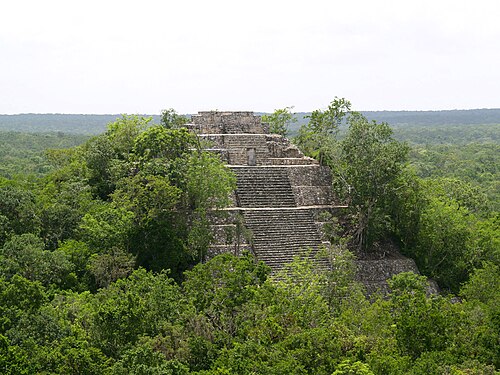
629年、ティカル王キニチ・ムワン・ジョル2世の息子であるバラジ・チャン・カウィールは、ペテクバトゥン地域のドス・ピラスに新しい都市を建設するために派遣されました。これは明らかに、ティカルの力をカラクムルの手が届かないところまで広げるための前哨基地としてでした。[51]その後20年間、彼はティカルで兄と領主のために忠実に戦いました。 648年、カラクムルの王ユクヌーム・チェーン2世はバラジ・チャン・カウィールを捕らえました。 その後、ユクヌーム・チェーン2世はバラジ・チャン・カウィールをドス・ピラスの王位に家臣として復帰させました。[52]彼はその後、カラクムルの忠実な同盟者として仕えました。[53]
南東部では、コパンが最も重要な都市であった。[48]古典期の王朝は、426年にキニチ・ヤックス・クク・モによって建国された。この新しい王は、ペテン中心部やテオティワカンと強いつながりを持っていた。[54]コパンは、695年から738年まで統治したウアハクラジュン・ウバア・カウィールの統治下で、文化的、芸術的発展の頂点に達した。 [55]彼の統治は、家臣であるキリグアの王カク・ティリウ・チャン・ヨパアトに捕らえられたことで悲惨な終わりを迎えた。[56]捕らえられたコパンの領主はキリグアに連れ戻され、公開の儀式で斬首された。[57]このクーデターは、ティカルの強力な同盟国を弱体化させるために、カラクムルの支援を受けた可能性が高い。[58]パレンケとヤシュチランはウスマシンタ地域で最も強力な都市でした。[48]高地では、グアテマラ渓谷のカミナルフユは300年までにすでに広大な都市でした。[59]マヤ地域の北部では、コバが最も重要な首都でした。[60]
古典的マヤ崩壊

9世紀、中央マヤ地域は大きな政治的崩壊を経験し、都市の放棄、王朝の終焉、活動の北方への移行が見られました。[44]この崩壊を説明する普遍的に受け入れられた理論はありませんが、風土病のような内紛、深刻な環境悪化をもたらした人口過剰、干ばつなど、複数の原因が重なっていた可能性があります。[61]末期古典期として知られるこの期間中、チチェン・イッツァとウシュマルの北部の都市では活動が活発化しました。[44]ユカタン半島北部の主要都市には、南部の低地の都市が記念碑を建てなくなった後も長く人が住んでいました。[62]
古典期マヤ社会組織は、貿易や食糧配給の中央管理ではなく、統治者の儀式的権威に基づいていた。このモデルは、統治者の行動が伝統的に建設、儀式、戦争などの活動に限定されていたため、変化に対応するには構造が不十分であった。これは、組織的問題を悪化させるだけだった。[63] 9世紀と10世紀までに、この統治システムは崩壊した。ユカタン北部では、個人統治に代わって、エリートの家系から構成される統治評議会が設立された。ユカタン南部とペテン中部では、王国が衰退し、ペテン西部と他のいくつかの地域では、変化が壊滅的で、都市の急速な人口減少を招いた。[64]数世代のうちに、中央マヤ地域の広大な地域がほぼ放棄された。[65]首都とその副中心地は、一般的に50年から100年以内に放棄された。[43]都市は次々と日付を刻む記念碑を建てるのをやめていった。最後の長期暦の日付は909年にトニナに刻まれた。石碑は建てられなくなり、不法占拠者は廃墟となった王宮に移り住んだ。メソアメリカの交易路は変化し、ペテンを迂回するようになった。[66]
後古典期(西暦950年頃~1539年)
マヤ人の人口は大幅に減少したものの、古典期の主要都市が放棄された後も後古典期までかなりの規模で存在し、人口は恒久的な水源の近くに特に集中していた。[68]以前の縮小サイクルとは異なり、後古典期には放棄された土地がすぐに再定住することはなかった。[43]活動は北部の低地とマヤ高地に移行したが、これは南部の低地からの移住を伴っていた可能性がある。なぜなら、後古典期のマヤの多くのグループには移住の神話があったからである。 [69]チチェン・イッツァとその近隣のプーク族は11世紀に劇的に衰退し、これが古典期崩壊の最後のエピソードを表しているのかもしれない。チチェン・イッツァの衰退後、マヤ地域は12世紀にマヤパンの都市が台頭するまで支配的な勢力を欠いていた。カリブ海とメキシコ湾岸の近くに新しい都市が出現し、新しい貿易ネットワークが形成された。[70]
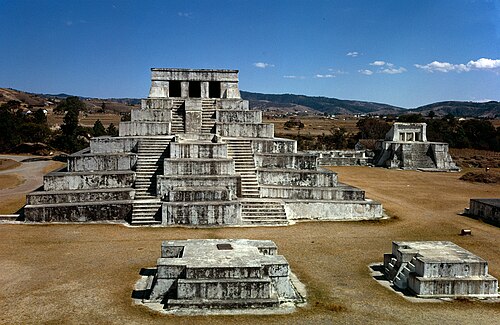
後古典期は、その前の古典期からの変化が特徴的であった。[71]グアテマラ渓谷のかつての大都市カミナルフユは、ほぼ2000年間の継続的な占領の後に放棄された。[72]高地と隣接する太平洋沿岸全体で、風にさらされた場所にあった長年占領されていた都市は、明らかに戦争の増加により移転した。[要出典]都市は、深い峡谷に囲まれた、より守りやすい丘の上の場所に占拠されるようになり、時には溝と壁の防御が自然の地形を補完した。[72]当時のグアテマラ高地で最も重要な都市の1つは、攻撃的なキチェ王国の首都であるクマルカイであった。[71]ユカタンからグアテマラ高地までのマヤ諸国の政府は、しばしば評議会による共同統治として組織された。しかし、実際には評議会のメンバーの1人が最高統治者として行動し、他のメンバーは顧問として彼に仕えることができました。[73]
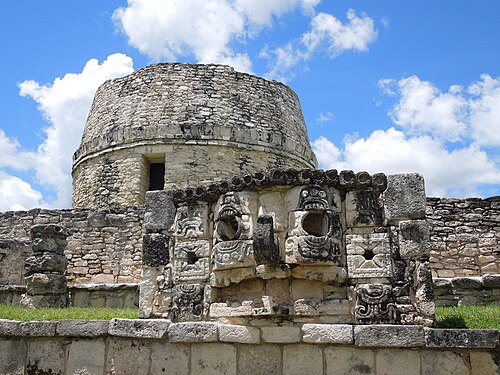
マヤパンは、多くの点で古典期のマヤ南部の崩壊を彷彿とさせる政治的、社会的、環境的混乱の時期を経て、1448年頃に放棄された。都市の放棄に続いて、ユカタン半島では戦争、疾病、自然災害が長引いたが、1511年にスペイン人と接触する直前に終わった。[74]有力な地域首都がなかったにもかかわらず、初期のスペイン人探検家は裕福な沿岸都市と活気のある市場を報告している。[70]後古典期後期には、ユカタン半島は共通の文化を共有しながらも内部の社会政治的組織が多様な、いくつかの独立した州に分割されていた。[75]スペインによる征服前夜、グアテマラの高地はいくつかの強力なマヤ国家によって支配されていた。[76]キチェ族はグアテマラ高地西部と隣接する太平洋沿岸平野の大部分を占める小さな帝国を築き上げました。しかし、スペインによるカクチケル王国の征服の数十年前から、キチェ王国は着実に侵食されていました。[77]
接触期とスペインの征服(1511年~1697年)

1511年、カリブ海でスペインのキャラベル船が難破し、12人ほどの生存者がユカタン半島の海岸に上陸した。彼らはマヤの領主に捕らえられ、2人が逃れたものの、ほとんどが犠牲になった。1517年から1519年にかけて、3回のスペイン遠征隊がユカタン半島の海岸を探検し、マヤの住民と数々の戦闘を行った。[78] 1521年にアステカの首都テノチティトランがスペインの手に落ちた後、エルナン・コルテスはペドロ・デ・アルバラードを中央メキシコから180人の騎兵、300人の歩兵、4門の大砲、数千人の同盟戦士とともにグアテマラに派遣した。 [79]彼らは1523年にソコヌスコに到着した。[80]キチェ族の首都クマルカイは1524年にアルバラードの手に落ちた。 [81]その後まもなく、スペイン人は同盟国としてカクチケル・マヤの首都イシムチェに招かれた。 [82]スペインが貢物として金を過度に要求したため、良好な関係は続かず、数か月後には都市は放棄された。[83]これに続いて1525年にマム・マヤの首都ザクレウが陥落した。 [84] フランシスコ・デ・モンテホとその息子、小フランシスコ・デ・モンテホは1527年にユカタン半島の政体に対して長期にわたる一連の戦役を開始し、最終的に1546年に半島北部の征服を完了した。 [85]これにより、ペテン盆地のマヤ王国だけが独立した。[86] 1697年、マルティン・デ・ウルスアはイツァの首都ノジペテンへの攻撃を開始し、最後の独立したマヤの都市はスペインの手に落ちた。[87]
マヤ文化の存続
スペインの征服により、マヤ文明の特徴のほとんどが剥ぎ取られた。しかし、多くのマヤの村はスペインの植民地当局から離れた場所に留まり、ほとんどの場合、独自の管理を続けた。マヤのコミュニティと核家族は伝統的な日常生活を維持した。[88]トウモロコシと豆というメソアメリカの基本的な食事は続いたが、農業生産は鋼鉄の道具の導入によって向上した。織物、陶器、籠細工などの伝統工芸は引き続き実践された。コミュニティ市場と地元製品の取引は征服後も長く続いた。植民地政府は、陶器や綿織物の形で貢物を引き出すために、伝統的な経済を奨励することもあったが、これらは通常、ヨーロッパの仕様で作られたものだった。カトリック宣教師の精力的な努力にもかかわらず、マヤの信仰と言語は変化に抵抗した。[89] 260日間のツォルキン暦は、グアテマラとチアパスの高地にある現代のマヤのコミュニティで引き続き使用されており、[90]数百万人のマヤ語話者が、祖先が文明を発展させた地域に住んでいます。[91]
マヤ文明の調査

カトリック教会の代理人は、キリスト教化とマヤ人のスペイン帝国への吸収の取り組みを支援するために、マヤに関する詳細な記録を残しました。[92]これに続いて、ユカタン半島や中央アメリカで訪れた遺跡の記述を残したスペインの司祭や植民地の役人が続きました。[93] 1839年、アメリカの旅行家で作家のジョン・ロイド・スティーブンスは、イギリスの建築家で製図家のフレデリック・キャサウッドとともに、マヤの遺跡をいくつか訪問しました。[94]彼らの遺跡のイラスト入りの記述は、大衆の強い関心を呼び起こし、マヤが世界の注目を集めるようになりました。[92] 19世紀後半には、マヤの民族史的記述の記録と復元が行われ、マヤの象形文字の解読の第一歩が踏み出されました。[95]
19世紀最後の20年間は、アルフレッド・モーズレーとテオベルト・マラーの綿密な研究により、マヤ地域で近代科学的考古学が誕生した時期であった。[96] 20世紀初頭までに、ピーボディ博物館はコパンとユカタン半島での発掘調査を後援していた。[97] 20世紀の最初の20年間で、マヤ暦の解読、神々、日付、宗教的概念の特定が進歩した。 [98] 1930年代以降、考古学的探査は劇的に増加し、マヤ地域全体で大規模な発掘調査が行われた。 [ 99 ]
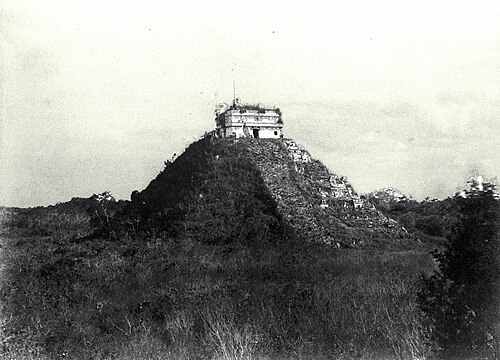
1960年代、マヤ学者のJ・エリック・S・トンプソンは、マヤの都市は本質的には森の中に散在する住民に奉仕する空の儀式の中心地であり、マヤ文明は平和的な天文学者兼司祭によって統治されていたという考えを広めた。[100]これらの考えは、20世紀後半にハインリッヒ・ベルリン、タチアナ・プロスコウリアコフ、ユーリ・クノロゾフが先駆けとなってマヤ文字の解読が大きく進んだことで崩れ始めた。[101] 1950年代以降、マヤ文字の理解が飛躍的に進み、テキストから古典期マヤの王たちの好戦的な活動が明らかになり、マヤが平和的だったという見方が揺らいだ。[102]
政治
アステカやインカとは異なり、マヤの政治体制はマヤ文化圏全体を単一の国家や帝国に統合することはなかった。むしろ、その歴史を通じて、マヤ地域には国家と首長国の両方を含むさまざまな政治的複雑さが混在していた。これらの政体は互いの関係において大きく変動し、複雑な対立、支配または服従の期間、家臣、同盟の網に巻き込まれていた。時には、カラクムル、カラコル、マヤパン、ティカルなどの異なる政体が地域的な支配権を獲得した。最初に確実に証拠が残る政体は、紀元前9世紀にマヤ低地に形成された。[103]
先古典期後期には、マヤの政治体制は神政形式へと融合し、エリート層のイデオロギー[要説明]が統治者の権威を正当化し、公の場での誇示、儀式、宗教によって強化された。[104]神聖な王は政治権力の中心であり、行政、経済、司法、軍事機能の最終的な統制を行使した。統治者に与えられた神聖な権威は、王が貴族と平民の両方を動員して、警察や常備軍を持たずに大規模なインフラプロジェクトを実行することができるほどのものであった。[105]一部の政体は、行政を拡大し、血縁者ではなく忠実な支持者を行政職に就かせる戦略を採用した。[106]政体の中では、中位の人口中心地が資源管理と内部紛争で重要な役割を果たしたであろう。[107]
マヤの政治情勢は非常に複雑で、マヤのエリートたちは近隣諸国に対して経済的、社会的に優位に立つために政治的陰謀を企てた。[108]後期古典期には、カラコルが半世紀にわたってナランホを支配したように、いくつかの都市が他の大都市に対して長期にわたる支配を確立した。他の場合には、支配的な都市の周りに緩やかな同盟ネットワークが形成された。 [109]国境の集落は通常、近隣の首都のほぼ中間に位置し、歴史の中で忠誠先を変えることが多く、時には独立して行動した。[110]支配的な首都は、征服した人口の中心地から贅沢品の形で貢物を強要した。[111]政治力は軍事力によって強化され、敵の戦士を捕らえて屈辱を与えることはエリート文化において重要な役割を果たした。武士階級の間に圧倒的な誇りと名誉意識があったため、長期にわたる確執や復讐心が生まれ、政治的不安定と政体の分裂を引き起こした。[112]
社会
先古典期初期から、マヤ社会はエリート層と庶民に明確に分かれていた。人口が時間とともに増加するにつれ、社会のさまざまな部門がますます専門化され、政治組織はますます複雑になっていった。[113]後期古典期には、人口が飛躍的に増加し、何百もの都市が複雑な政治階層の網でつながっており、社会の富裕層は倍増した。[114]職人、下級の僧侶や役人、商人、兵士を含む中流階級が形成された可能性がある。庶民には、農民、召使、労働者、奴隷が含まれていた。[115]先住民の歴史によると、土地は貴族の家や氏族によって共同で所有されていた。そのような氏族は、土地は先祖の財産であると信じており、土地と先祖のつながりは、居住区域内での死者の埋葬によって強化された。[116]
国王と宮廷

古典期マヤの統治は、古典期マヤ美術のあらゆる分野に見られる王室文化を中心としていた。王は最高の統治者であり、半神的な地位を占めていたため、人間界と神々の界との仲介者であった。非常に古い時代から、王は特に若いトウモロコシの神と同一視されており、トウモロコシの贈り物はメソアメリカ文明の基礎となった。マヤの王位継承は父系制で、王権はそうしなければ王朝が滅亡することになる場合にのみ女王に引き継がれた。通常、権力は長男に引き継がれた。若い王子はチョク(「若者」)と呼ばれていたが、この言葉は後に貴族一般を指すようになった。王家の後継者はバーチョク(「若者の長」)と呼ばれた。王子の幼少期のさまざまな時期には儀式が行われていたが、最も重要なのは5歳か6歳のときに行われる瀉血の儀式であった。王家の血統であることは最も重要であったが、後継者は捕虜を捕らえることで示されるような優れた戦争指導者でなければならなかった。新しい王の即位は非常に手の込んだ儀式であり、ジャガーの皮のクッションの上での即位、人間の犠牲、いわゆる「道化神」の翡翠の表現が付いたヘッドバンド、ケツァールの羽で飾られた精巧な頭飾り、カウィール神を表す王笏など、王権の象徴を受け取ることを含む一連の個別の行為が含まれていた。[118]
マヤの政治行政は王宮を中心としていたが、官僚的な性格ではなかった。政府は階層制で、公職は貴族階級の上位者によって後援されていた。役人は生涯を通じてより高い地位に昇進する傾向があった。役人は後援者によって「所有」されていると言われ、この関係は後援者の死後も続いた。[119]マヤの王宮は活気に満ちたダイナミックな政治機関だった。[120]マヤの王宮には普遍的な構造はなく、それぞれの政治組織がそれぞれの状況に適した王宮を形成した。[121]古典期マヤの碑文を翻訳した碑文学者によって、王族や貴族の称号がいくつか特定されている。アジャウは通常「領主」または「王」と翻訳される。古典期初期には、アジャウは都市の支配者であった。後に、社会の複雑さが増すにつれて、アジャウは支配階級の一員となり、大都市には複数のアジャウが存在し、それぞれが異なる地区を統治するようになった。[122]最高位の統治者は、アジャウの称号にクフルという語を接頭語として付けることで、拡大した貴族階級と区別した。クフル・アジャウは「神聖な君主」を意味し、もともと最も権威のある古い王家の王に限定されていた。[123]カロムテは王家の称号であり、その正確な意味はまだ解読されていないが、最も強力な王朝の最も強力な王だけが持つ称号であった。それは君主、または高位の王を意味し、古典期にのみ使用されていた。[124]後期古典期までに、クフル・アジャウの絶対的な権力は弱まり、政治制度はより広範な貴族階級を含むように多様化しており、この時点で貴族階級は不釣り合いに拡大していた可能性がある。[125]

サジャルはアジョウより下位に位置づけられ、従属的な領主を示した。サジャルは第2、第3階層の領主で、アジョウに服従し、アジョウ自身もカロムテに従属していた可能性がある。[122]サジャルは戦争の指揮官か地方知事であることが多く、碑文ではサジャルの称号が戦争と結び付けられていることが多く、戦争捕虜の保持者として言及されている。[127] サジャルは「恐れられる者」を意味する。[128]ア・ツィーブとア・チュル・フンの称号はどちらも書記官に関連している。ア・ツィーブは王室の書記官で、通常は王族の一員であった。ア・チュル・フンは聖典の管理者であり、アジョウの称号と密接に関連している。これは、アジョウが常にア・チュル・フンの称号を同時に保持していたことを示している。[129 ]その他の宮廷称号は、その機能が十分に解明されていないが、ヤジャウ・カフク(「火の王」)、ティフーン、ティサクーンである。最後の2つは同じ称号のバリエーションである可能性があり、[130]マーク・ゼンダーは、この称号の保持者は統治者のスポークスマンであった可能性があると示唆している。[131]宮廷称号は圧倒的に男性向けであり、女性に適用される場合が比較的まれであるが、女性王族に対する敬称として使用されているようだ。[132]古典期の都市の象形文字の碑文では、称号を持つエリート層が特定の建造物と関連付けられることが多く、そのような役職の持ち主がその建造物を所有していたか、その建造物が彼らの活動の重要な拠点であったことを示しています。[ 133]ラカム、つまり旗手は、おそらく王宮で唯一の非エリートの役職者でした。[119]ラカムは大規模な遺跡でのみ発見され、地方地区の課税を担当していたようです。[119]
王宮にはさまざまな派閥が存在した可能性がある。クフル・アハウとその一族が権力の中央基盤を形成したが、他の重要なグループとしては聖職者、戦士貴族、その他の貴族廷臣がいた。チチェン・イッツァやコパンのように統治評議会が存在した場所では、これらがさらに派閥を形成した可能性がある。異なる派閥間の対立は妥協や意見の相違が繰り広げられる中でダイナミックな政治制度をもたらしただろう。そのような状況では、公衆の前でのパフォーマンスが不可欠だった。そのようなパフォーマンスには、儀式の踊り、戦争捕虜の提示、貢物の供物、人身御供、宗教儀式などが含まれていた。[134]
庶民
平民は人口の90%以上を占めていたと推定されているが、彼らについては比較的ほとんど知られていない。彼らの家は一般に腐りやすい材料で建てられており、彼らの遺物は考古学的記録にほとんど痕跡を残していない。一部の平民の住居は低い台の上に建てられており、これらは特定できるが、特定できない平民の家は不明なほど多い。そのような身分の低い住居は、明らかに何もない土地を広範囲にリモートセンシング調査することによってのみ発見できる。 [135]平民の範囲は広く、貴族の生まれではないすべての人で構成されていたため、最も貧しい農民から裕福な職人、官僚職に任命された平民まですべてが含まれていた。[136]平民は、綿やカカオなどエリート向けの製品や、自分たちが使用する自給作物、陶器や石器などの実用品など、重要な生産活動に従事していた。[137]庶民は戦争に参加し、優れた戦士であることを証明することで社会的に昇進することができました。[138]庶民はトウモロコシ、小麦粉、狩猟肉などの主食の形で上流階級に税金を納めました。[111]並外れたスキルとイニシアチブを発揮した勤勉な庶民は、マヤ社会の有力なメンバーになることができた可能性があります。[139]
戦争
マヤ世界では戦争が蔓延していた。軍事作戦は、交易路や貢物の支配、捕虜を捕らえるための襲撃、敵国の完全な破壊にまで及ぶなど、さまざまな理由で開始された。マヤの軍事組織、兵站、訓練についてはほとんどわかっていない。戦争は古典期のマヤ美術に描かれており、戦争や勝利は象形文字の碑文に記されている。[140]残念ながら、碑文には戦争の原因や戦争の形態に関する情報は記されていない。[141] 8世紀から9世紀にかけて、激しい戦争によりペテン西部のペテクスバトゥン地域の王国は崩壊した。[141]アグアテカの住民が急速に放棄したことで、現地でマヤの兵器の遺物を調査するまれな機会が生まれた。[142]アグアテカは西暦810年頃に正体不明の敵に襲撃され、その強固な防御を突破され、王宮を焼き払われた。街のエリート層は逃亡するか捕らえられ、放棄した財産を回収するために戻ってくることはなかった。周辺の住民はすぐにその場所を放棄した。これは、マヤ国家を征服するのではなく、排除するために敵が行った激しい戦争の例である。アグアテカでの研究は、古典期の戦士は主にエリート層のメンバーであったことを示している。[143]
先古典期の早い時期から、マヤ国家の統治者は優れた戦争指導者であることが期待され、ベルトから戦利品の首を下げた姿で描かれていた。古典期には、そのような戦利品の首はもはや王のベルトには見られなくなったが、古典期の王は屈辱を受けた戦争捕虜の上に立っている姿で描かれることが多い。 [140]後古典期の終わりまで、マヤの王は戦争の指揮官として指揮を執っていた。古典期のマヤの碑文には、敗れた王が捕らえられ、拷問され、生贄にされたことが示されている。[138]スペイン人は、マヤの指導者が絵本に軍隊の動きを記録していたと記録している。[144]
軍事作戦の成功の結果が敗戦国に与える影響は様々である。アグアテカの場合のように、都市全体が略奪され、二度と再定住されなかったケースもある。[145]また、勝者は敗戦国支配者とその家族、守護神を捕らえる。捕らえられた貴族とその家族は投獄されるか、生贄にされることもある。最も軽い罰では、敗戦国は勝者に貢物を納める義務を負う。[146]
戦士
接触期には、特定の軍事的地位は貴族階級のメンバーによって担われ、父系継承によって受け継がれた。戦略、儀式、戦いの踊りなど、特定の軍事的役割に固有の専門知識が後継者に教えられた可能性が高い。[138]接触期のマヤ軍は非常に規律が厳しく、戦士は定期的な訓練演習や訓練に参加した。すべての健康な成人男性は軍務に就くことができた。マヤ国家は常備軍を維持せず、戦士は任命された戦争指導者に報告する地方の役人によって召集された。常任指導者に従うフルタイムの傭兵部隊もあった。[147]しかし、ほとんどの戦士はフルタイムではなく、主に農民であった。通常、彼らの作物の必要性は戦争よりも優先された。[148]マヤの戦争は敵の殲滅よりも捕虜の捕獲と略奪を目的としていた。[149]
古典期には女性が戦争で補助的な役割を果たしていたという証拠がいくつかあるが、稀な統治女王を除いて、女性が軍人として行動することはなかった。[150]後古典期になると、現地の年代記には女性が時折戦闘に参加していたことが示唆されている。[138]
兵器

アトラトル(槍投げ器)は、前期古典期にテオティワカンによってマヤ地域に導入された。[ 152]これは、ダーツやジャベリンを挿すための切り込みの入った、長さ0.5メートル(1.6フィート)の棒であった。[153]この棒は、単に腕で投げるよりも強力かつ正確に矢を発射するために使用された。[152]アグアテカで発見された石の刃先という証拠は、ダーツと槍が古典期マヤの戦士の主な武器であったことを示している。[154]庶民は吹き矢を戦争に使用し、狩猟用の武器としても使用した。[152]古代マヤでは、弓矢は戦争と狩猟の両方に使用された。[ 141 ]古典期のマヤ地域には存在していたが、戦争の武器としての使用は好まれなかった。[155]後古典期まで一般的な武器にはならなかった。[152]接触期のマヤ人は、刃が黒曜石で作られた丈夫な木材で作られた両手剣も使用しており、[156]アステカのマクアウィトルに似ています。マヤの戦士は、塩水に浸して強化したキルティングコットンの鎧を着用していました。その結果できた鎧は、スペイン人がこの地域を征服したときに着用した鋼鉄の鎧に匹敵しました。[157]戦士は、羽や動物の皮で飾られた木製または動物の皮の盾を持っていました。[148]
貿易
貿易はマヤ社会、そしてマヤ文明の発展において重要な要素であった。最も重要な都市に成長した都市は、通常、重要な交易品や運搬ルートへのアクセスを管理していた。グアテマラ高地のカミナルフユやクマルカイ、エルサルバドルのチャルチュアパなどの都市は、マヤの歴史のさまざまな時点で黒曜石の産地へのアクセスをさまざまに管理していた。[158]マヤは綿花の主要生産者であり、綿花はメソアメリカ全土で取引される織物を作るのに使われた。[159]ユカタン半島北部の最も重要な都市は、塩の産地へのアクセスを管理していた。[158]後古典期には、マヤはメソアメリカ全域との奴隷貿易が盛んであった。[160]
マヤ人はマヤ地域、さらにメソアメリカ全域、さらにはその先まで長距離貿易を行っていた。一例として、中央メキシコのテオティワカンという遠く離れた大都市で、古典期初期のマヤ商人の居住区が確認されている。[161]マヤ地域を越えたメソアメリカ内では、交易路は特に中央メキシコとメキシコ湾岸に集中していた。古典期初期には、チチェン・イッツァはコロンビアやパナマから金の円盤、ニューメキシコ州ロス・セリージョスからトルコ石を輸入する広範な交易ネットワークの中心地であった。贅沢品と実用品の両方の長距離貿易は、おそらく王室によって管理されていた。交易で得られた威信の高い品々は、都市の支配者の消費用として、また家臣や同盟者の忠誠心を固めるための贅沢な贈り物として使われた。[158]
交易路は物理的な商品を供給しただけでなく、メソアメリカ全土における人々や思想の移動を促進した。[162]交易路の変化はマヤ地域の重要な都市の興亡とともに起こり、先古典期マヤ文明の興隆、古典期への移行、古典期末期の崩壊など、マヤ文明のあらゆる主要な再編で確認されている。[158]スペインによる征服でさえ、マヤの交易活動を直ちに終わらせたわけではなかった。[158]例えば、接触期のマンチェ・チョルは、カカオ、アナトー、バニラといった高級農作物を植民地のベラパスに交易した。[163]
商人
マヤの商人についてはほとんど知られていないが、マヤの陶器には精巧な貴族の衣装をまとった彼らの姿が描かれているため、少なくとも一部はエリート層に属していたと考えられる。マヤとの接触期には、マヤの貴族が長距離貿易遠征に参加した。[164]商人の大半は中流階級だったが、エリート層だけが行う名声ある長距離貿易よりも、主に地元や地域の貿易に従事していた。[165]商人が危険な外国の領土に旅することは、冥界を通ることに例えられ、商人の守護神は、バックパックを背負った2人の冥界の神々であった。商人が旅をするときは、守護神と同じように体を黒く塗り、重武装していた。[161]
マヤ族には荷役動物がいなかったため、陸路を移動する際には交易品はすべて荷運び人の背中に担がれていた。交易路が川や海岸を通る場合は、品物はカヌーで運ばれた。[166]クリストファー・コロンブスの第4次航海で、大きな木の幹をくり抜いて作られたマヤの立派な交易カヌーがホンジュラス沖で発見された。カヌーは幅2.5メートル(8.2フィート)あり、25人の漕ぎ手が動力となっていた。運ばれた交易品には、カカオ、黒曜石、陶磁器、織物、銅の鐘や斧などがあった。[167]カカオは通貨として使われていたが(通貨だけではない)、その価値は高く、莢から果肉を取り除き、土やアボカドの皮を詰めることで偽造が行われた。[168]
マーケットプレイス
考古学的に市場を特定することは難しい。[169]しかし、スペイン人はこの地域に到着した際に、市場経済が繁栄していたと報告している。 [170]古典期のいくつかの都市では、考古学者は、正式なアーケード様式の石造建築と、散在する石の平行配置が市場の屋台の恒久的な基礎であると暫定的に特定している。[171] 2007 年の研究では、現代のグアテマラの市場の土壌とチュンチュクミルの古代の市場と提案されている場所の土壌を比較した。両方の場所で亜鉛とリンの異常に高いレベルは、同様の食料生産と野菜販売活動を示している。チュンチュクミルの市場の屋台の計算された密度は、古典期初期にすでに繁栄した市場経済が存在していたことを強く示唆している。[172]考古学者は、考古学と土壌分析を組み合わせることにより、ますます多くのマヤ都市で市場を暫定的に特定している。[173]スペイン人が到着すると、高地の後古典期の都市には常設の広場に市場があり、紛争を解決し、規則を施行し、税金を徴収する役人が配置されていました。[174]
美術
マヤ美術は本質的には宮廷美術である。それはほとんどマヤのエリート層とその世界だけを扱っている。マヤ美術は腐りやすい素材と腐りにくい素材の両方から作られ、マヤ人とその祖先を結びつける役割を果たした。現存するマヤ美術はマヤ人が創作した美術のほんの一部に過ぎないが、アメリカ大陸の他のどの美術伝統よりも幅広い主題を扱っている。[177]マヤ美術には多くの地域的スタイルがあり、古代アメリカ大陸では物語文を載せているのが特徴である。[178]現存する最も優れたマヤ美術は後期古典期のものである。[179]
マヤ人は緑や青緑色を好み、青と緑に同じ言葉を使った。同様に、彼らはリンゴ色の翡翠やその他の緑色の石を高く評価し、それらを太陽神キニチ・アジャウと関連付けた。彼らは、細かいテッセラやビーズから、重さ4.42キログラム(9.7ポンド)の彫刻された頭部まで、さまざまな工芸品を彫刻した。[180]マヤの貴族は歯の修正を習慣にしており、一部の領主は歯に翡翠をちりばめていた。モザイクの葬祭用マスクも翡翠で作られ、パレンケ王キニチ・ジャナアブ・パカルのマスクがその一例である。 [181]
マヤの石の彫刻は、完全に発達した伝統として考古学的記録に現れており、木を彫刻する伝統から発展した可能性があることを示唆している。[183] 木材の生分解性のため、マヤの木工品の全体はほぼ完全に消滅した。生き残った数少ない木工品には、立体彫刻や象形文字のパネルがある。[184]マヤの石碑は都市の遺跡に広く存在し、文献では祭壇と呼ばれる低い円形の石と対になっていることが多い。[185]石の彫刻は、パレンケやピエドラス・ネグラスの石灰岩のレリーフパネルなど、他の形もとった。[186]ヤシュチラン、ドス・ピラス、コパンなどの遺跡では、石の階段が彫刻で飾られていた。[187]コパンの象形文字の階段は、現存するマヤの象形文字の中で最も長いもので、2,200個の個別の象形文字で構成されています。[188]
マヤの最大の彫刻は、スタッコで作られた建築物のファサードである。壁の無地の漆喰の下地の上に大まかな形が置かれ、小さな石を使って立体的な形が作られる。最後に、これにスタッコを塗り、完成形に成形する。人体の形は最初にスタッコで形作られ、その後衣装が付け加えられる。最終的なスタッコの彫刻は、その後鮮やかな色で塗装される。[189]後期先古典期には、巨大なスタッコの仮面が寺院のファサードを飾るために使用され、そのような装飾は古典期まで続いた。[190]
マヤには長い壁画の伝統があり、サン・バルトロでは紀元前300年から200年の間に描かれた多色彩豊かな壁画が発掘されている。[191]壁は漆喰で覆われ、滑らかな仕上げの上に多色のデザインが描かれていた。そのような壁画のほとんどは現存していないが、クリーム色、赤、黒で塗られた古典期初期の墓がカラコル、リオ・アスール、ティカルで発掘されている。最も保存状態の良い壁画の中には、ボナンパクにある古典期後期の絵画のフルサイズシリーズがある。[192]
フリント、チャート、黒曜石はいずれもマヤ文化において実用的な目的で使われたが、多くの作品は道具として使われることを意図しない形に精巧に作られていた。[194] 偏心フリントは古代マヤが作った石器の中でも最も優れたものの一つである。[195]製作は技術的に非常に難しく、[196]職人にかなりの技術が要求された。大きな黒曜石の偏心石は長さが30センチメートル(12インチ)を超えることもある。[197]実際の形は大きく異なるが、一般的にはマヤの宗教に関連する人間、動物、幾何学的形状を描いている。[196]偏心フリントには三日月、十字架、蛇、サソリなど多種多様な形がある。[198]最も大きく精巧な例には複数の人間の頭が描かれており、小さな頭は大きな頭から枝分かれしていることもある。[199]
マヤの織物は考古学的記録にほとんど残っていないが、アステカやアンデス地方などのコロンブス以前の他の文化と比較すると、高価な品物であった可能性が高い。[200]織物の断片は発見されているが、織物芸術の最良の証拠は、壁画や陶器など他の媒体で表現されているものである。このような二次的な表現では、マヤ宮廷のエリートたちが豪華な布で身を飾っている様子が描かれており、通常は綿布であったが、ジャガーの毛皮や鹿の皮も描かれている。[201]
陶器は、マヤ美術の中で最も一般的に現存するものである。マヤ人はろくろを知らず、マヤの器は粘土の細片を巻いて望みの形にすることで作られた。マヤの陶器には釉薬はかけられていなかったが、磨くことで上質な仕上がりになることが多かった。マヤの陶器には、鉱物や着色粘土を混ぜた粘土スリップで彩色されていた。古代マヤの焼成技術はまだ再現されていない。[202]ユカタン半島北部のジャイナ島にある後期古典期の墓からは、極めて精巧な陶像が多数発掘されている。高さは10~25センチメートルで、精巧なディテールで手作業で造られていた。[203]精巧に彩色された皿や円筒形の器などを含むイク様式の多色陶器群は、後期古典期のモトゥル・デ・サン・ホセに起源を持つ。ピンクや淡い赤色で描かれた象形文字や、仮面をつけた踊り子のシーンなど、一連の特徴が含まれています。最も特徴的な特徴の1つは、実物の姿で写実的に表現されていることです。容器の主題には、外交会議、宴会、流血、戦士のシーン、戦争捕虜の犠牲など、西暦8世紀のペテン地方の宮廷生活が含まれています。[204]
人間の骨も動物の骨も彫刻された。人間の骨は戦利品か祖先の遺物だったのかもしれない。[183] マヤ人はスポンディルスの貝殻を高く評価し、白い外側と棘を取り除き、オレンジ色の内側を露出させた。[205]西暦10世紀頃、南米からメソアメリカに冶金術が伝わり、マヤ人は金、銀、銅で小さな物を作り始めた。マヤ人は一般的に金属板を叩いてビーズ、ベル、ディスクなどの物を作っていた。スペインによる征服前の最後の数世紀、マヤ人はロストワックス法を使って小さな金属片を鋳造し始めた。 [206]
マヤの民俗芸術であまり研究されていない分野の一つがグラフィティである。[207]計画された装飾の一部ではない追加のグラフィティは、寺院、住居、倉庫など、さまざまな建物の内壁、床、ベンチのスタッコに刻まれている。グラフィティは51のマヤ遺跡で記録されており、特にペテン盆地とカンペチェ南部、ユカタン北西部のチェネス地域に集中している。大量のグラフィティが記録されているティカルでは、寺院、人々、神々、動物、旗、担架、王座などの絵が題材となっている。グラフィティは無計画に刻まれていることが多く、絵が重なり合っており、粗雑で未熟な芸術と古典期の芸術的慣習に精通した芸術家による作品が混在している。[208]
建築
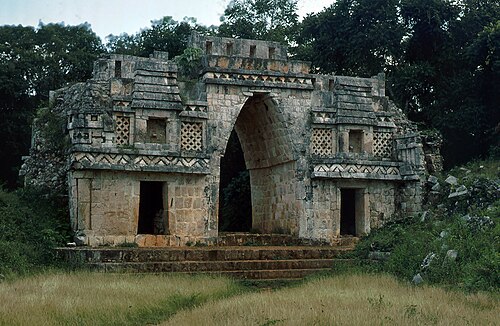
マヤ人は多種多様な建造物を造り、膨大な建築遺産を残した。マヤ建築には、さまざまな芸術形式や象形文字も取り入れられている。マヤ人が建てた石造建築は、マヤ社会における職人の専門化、中央集権化された組織、そして大規模な労働力を動員する政治的手段を証明している。コパンの大規模なエリート邸宅の建設には、推定10,686人日が必要だったと推定されているが、庶民の小屋の場合は67人日である。[209]さらに、貴族の邸宅の建設に要した労働の65%は、建設に使用した石の採石、輸送、仕上げに使用され、24%は石灰岩ベースの漆喰の製造と塗布に必要だったと推定されている。全体として、コパンのこの貴族一人の邸宅の建設には、80〜130人のフルタイム労働者を使って2〜3か月かかったと推定されている。ティカルのような古典期の都市は、20平方キロメートル(7.7平方マイル)に広がっており、都市中心部は6平方キロメートル(2.3平方マイル)を占めています。このような都市を建設するために必要な労働力は膨大で、何百万日もの労働に及びました。[210]マヤ人が建てた最も巨大な建造物は、先古典期に建てられました。[211]工芸の専門化には、後期先古典期までに献身的な石工と左官が必要であり、計画者と建築家も必要でした。[210]
都市デザイン
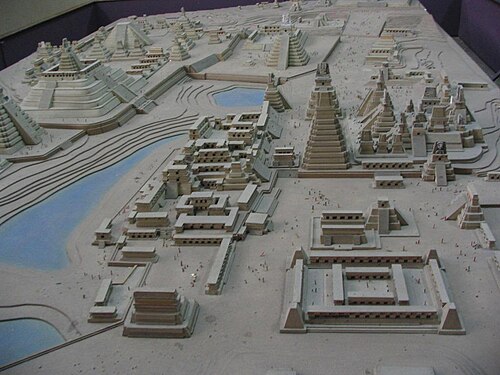
マヤの都市は正式に計画されたものではなく、宮殿、寺院、その他の建物が無計画に追加されるなど、不規則に拡張されました。[212]ほとんどのマヤの都市は、中心部から外側に向かって成長し、新しい構造が以前の建築物の上に重ねられるにつれて上向きに成長する傾向がありました。[213]マヤの都市には通常、広大で不規則な住宅団地に囲まれた儀式と行政の中心地がありました。[212]すべてのマヤの都市の中心部には神聖な領域があり、時には壁で近くの住宅地から仕切られていました。[214]これらの領域には、ピラミッド寺院や、行政またはエリートの住宅団地を支える基底プラットフォームなど、エリートの活動に捧げられたその他の記念碑的な建築物がありました。支配王朝の業績を記録するために彫刻された記念碑が建てられました。都市の中心部には、広場、神聖な舞踏場、市場や学校として使用される建物もありました。[215]多くの場合、中心部と都市の郊外を結ぶ道路が舗装されていました。[214]これらの建築様式のいくつかは、都市の郊外に小規模なグループを形成し、非王族の聖地として機能していました。これらの聖地の隣接地域には、裕福な一族が住む住宅団地がありました。これらのエリートの居住区の中で最も大きく最も豊かな場所には、王族の芸術に匹敵する彫刻や工芸品が備わっていることがありました。[215]
マヤ都市の儀式の中心地は、支配階級の人々が住み、宗教儀式とともに都市の行政機能が遂行された場所であった。また、都市の住民が公共活動のために集まる場所でもあった。[212]エリート層の住宅団地は都市中心部周辺の最良の土地を占め、一般の人々は儀式の中心地から離れた場所に住居を分散させた。住宅ユニットは、雨期の洪水の水位よりも高い位置にある石の台座の上に建てられた。[216]
建築材料と工法

マヤ人は新石器時代の技術で都市を建設した。 [217]彼らは腐りやすい材料と石の両方を使って建造物を建てた。石積み建築に使われる石の正確な種類は、現地で入手できる資源によって異なり、これも建築様式に影響を与えた。マヤ地域の広い範囲で、石灰岩がすぐに入手できた。[218]現地の石灰岩は切りたてのときは比較的柔らかいが、露出すると硬くなる。石灰岩の品質には大きなばらつきがあり、ウスマシンタ地域では良質の石が手に入ったが、ユカタン北部では、建設に使われた石灰岩は比較的質が悪かった。[217]コパンでは火山性凝灰岩が使用され、近くのキリグアでは砂岩が使用された。[218]コマルカルコでは、適切な石が現地で入手できなかったため、[219] 焼成レンガが使用された。[218]石灰岩は、セメント、漆喰、スタッコを製造するために高温で焼かれた。[219]石灰セメントは石積みを固定するために使用され、石のブロックはロープと水による研磨と黒曜石の道具を使用して作られました。マヤ人は実用的な車輪を使用していなかったため、すべての荷物は担架、はしけ、または丸太の上で転がされて運ばれました。重い荷物はロープで持ち上げられましたが、滑車は使用されなかったと思われます。[217]
木材は梁やまぐさに使われ、石造建築物にも使われた。[220]マヤの歴史を通じて、一般的な小屋や一部の寺院は木の棒と茅葺きで建てられ続けた。また、アドービも使用された。これはわらで強化した泥で構成されており、石造建築が発達した後も、小屋の編み棒の壁を覆うために使用された。南マヤ地域では、適切な石が地元で入手できなかったときに、アドービが記念碑的な建築に使用された。[219]
主な建設タイプ
マヤ文明の偉大な都市は、ピラミッド型の寺院、宮殿、舞踏場、サクベオブ(土手道)、パティオ、広場で構成されていました。一部の都市には、大規模な水利システムや防御壁もありました。ほとんどの建物の外装は、単色または多色、あるいはイメージで塗装されていました。多くの建物は、彫刻や漆喰のレリーフで飾られていました。[221]
宮殿とアクロポリス
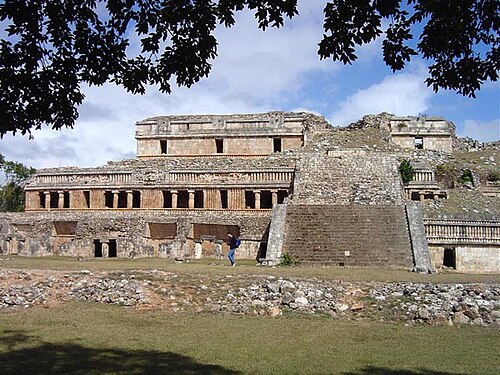
これらの複合施設は通常、主要な広場の横にある遺跡の中心部に位置していた。マヤの宮殿は、複数の部屋からなる一連の構造を支えるプラットフォームで構成されていた。マヤの文脈では、アクロポリスという用語は、さまざまな高さのプラットフォーム上に建てられた構造物の複合体を指す。宮殿とアクロポリスは、本質的にはエリートの居住用複合施設であった。それらは通常、そびえ立つマヤのピラミッドとは対照的に水平に伸びており、アクセスが制限されていることが多かった。マヤのアクロポリスの一部の構造物は、屋根の櫛を支えていた。部屋には寝るための石のベンチが置かれていることが多く、カーテンがかつて掛けられていた場所を示す穴がある。パレンケなどの大きな宮殿には給水装置が備え付けられていることがあり、複合施設内または近くに汗風呂がよく見られた。古典期初期には、支配者がアクロポリス複合施設の下に埋葬されることもあった。[223]宮殿のいくつかの部屋は真の玉座室であり、パレンケの王宮には、新しい王の就任式など、重要な行事のために使用された玉座室がいくつかあった。[224]
宮殿は通常、1つまたは複数の中庭を囲むように配置されており、正面は内側を向いています。いくつかの例では、彫刻で飾られています。[225]一部の宮殿には、名前の付いた支配者の王宮であることを示す象形文字の説明があります。宮殿は単なるエリートの住居以上のものであり、謁見、正式なレセプション、重要な儀式など、さまざまな宮廷行事が宮殿で行われていたことを示す証拠が豊富にあります。[226]
ピラミッドと寺院

寺院は、象形文字のテキストでは「神の家」を意味するkʼuh nahと表現されることもあった。寺院は台座の上に建てられ、ほとんどの場合ピラミッドの上に建てられた。最も初期の寺院は、低い台座の上に建てられた茅葺きの小屋だったと思われる。後期先古典期までに、寺院の壁は石造りとなり、コーベルアーチの発達により茅葺き屋根が石造りに置き換えられた。古典期までに、寺院の屋根は、寺院の高さを延長し、記念碑的な芸術の基礎となる屋根櫛で覆われるようになった。寺院の神殿には 1 つから 3 つの部屋があり、重要な神々に捧げられていた。そのような神は、都市の守護神の 1 人、または神格化された祖先である可能性がある。[228]一般的に、独立したピラミッドは、強力な祖先を称える神殿であった。[229]
Eグループと観測所
マヤ人は太陽、星、惑星の熱心な観察者でした。[230] Eグループは、マヤ地域で比較的一般的だった特別な寺院の配置でした。[231]これらは、ワシャクトゥンのグループEにちなんで名付けられました。[232]これらは、4つ目の構造物に面した3つの小さな構造物で構成され、夏至と冬至、春分と秋分を示すために使用されました。最も古い例は先古典期に遡ります。[231]ティカルのロストワールド複合施設は、中期先古典期の終わり頃に建てられたEグループとして始まりました。[233]その性質上、Eグループの基本的なレイアウトは一定でした。構造物は広場の西側に建てられ、通常は放射状のピラミッドで、階段は方位に面していました。それは広場の向こう側にある3つの小さな寺院の東を向いていました。西のピラミッドからは、夏至と冬至、春分と秋分にこれらの寺院の上に太陽が昇るのが見えました。[230] Eグループは1000年以上にわたって中央マヤと南部マヤ地域全体に建てられましたが、すべてが天文台として適切に配置されていたわけではなく、その機能は象徴的なものだった可能性があります。[234]
Eグループ以外にも、マヤ人は天体の動きを観測するための建造物を建てた。[230]マヤの建造物の多くは、金星や様々な星座などの天体に合わせて建てられた。 [235] [231]チチェン・イッツァのカラコル構造は、円錐形の上部構造を持つ円形の多階建ての建物だった。金星の動きを示すスリット窓がある。コパンでは、春分と秋分の日に沈む太陽の位置を示すために一対の石碑が建てられた。[230]
三角錐

三角錐は先古典期に初めて現れた。それらは、単一の基底プラットフォーム上に設置された、内側を向いた2つの小さな建物に挟まれた支配的な構造物から成っていた。最大の三角錐ピラミッドはペテン盆地のエル・ミラドールに建てられ、ティカル最大のピラミッドである第4神殿の6倍の面積を占めている。[236] 3つの上部構造にはすべて、基底プラットフォームの上にある中央広場から上に向かう階段がある。[237]三角錐グループの確実に確立された先駆者は知られていないが、Eグループ複合体の東側の建物から発展した可能性がある。[238]三角錐形式は、後期先古典期のペテン地域で支配的な建築形式であった。 [239]三角錐ピラミッドの例は、88か所もの考古学的遺跡で知られている。[240]ナクベには、少なくとも12の三位一体の複合体の例があり、市内で最も大きい4つの構造物は三位一体の性質を持っています。[241]エルミラドールには、おそらく36もの三位一体の構造があります。[242]三位一体形式の例は、ユカタン半島の最北端のジビルチャルトゥンや、グアテマラ高地のクマルカイでも知られています。 [243]三位一体のピラミッドは、最初の例が建てられた後も数世紀にわたって人気のある建築形式であり続けました。 [238]それは古典期まで使用され続け、後の例はワシャクトゥン、カラコル、セイバル、ナクム、ティカル、パレンケで発見されています。[244]クマルカイの例は、後古典期のものとされている唯一のものです。[245]三重神殿のピラミッドはマヤ神話と関係があるようです。[246]
ボールコート
球技場は、メソアメリカ全域に見られる特徴的な建築様式である。マヤの球技場のほとんどは古典期に遡るが、[247]最も古い例は、中期先古典期のユカタン半島北西部で紀元前1000年頃に出現した。[248]スペイン人と接触した頃には、球技場はグアテマラ高地のクマルカイやイシムチェなどの都市でのみ使用されていた。[247]マヤの歴史を通じて、球技場はɪ字型の特徴的な形状を維持し、中央の競技場は2つの横方向のエンドゾーンで終わっていた。[249]中央の競技場は通常、長さが20〜30メートル(66〜98フィート)で、高さ3〜4メートル(9.8〜13.1フィート)の2つの側面構造が両側にある。[250]側面のプラットフォームは、特権的な観客を収容していた可能性のある構造物を支えていることが多かった。 [ 251]チチェン・イッツァの大球技場はメソアメリカ最大のもので、長さ83メートル(272フィート)、幅30メートル(98フィート)、壁の高さは8.2メートル(27フィート)である。[252]
地域の建築様式
マヤの都市には多くの共通点があったが、建築様式にはかなりのばらつきがあった。[253]こうした様式は、現地で入手可能な建築資材、気候、地形、地元の嗜好に影響を受けた。後期古典期には、こうした地域的な違いが、独特の地域建築様式へと発展した。[254]
セントラルペテン
中央ペテン様式の建築は、偉大な都市ティカルをモデルにしています。この様式は、高いピラミッドが頂上の神殿を支え、神殿は屋根の櫛で飾られ、1つの出入り口からアクセスされるのが特徴です。追加の特徴は、石碑と祭壇の組み合わせの使用、および建築ファサード、まぐさ、屋根の櫛に統治者と神々のレリーフ彫刻が施されていることです。[254]中央ペテン様式の建築の最も優れた例の1つは、ティカル神殿Iです。[255]中央ペテン様式の遺跡の例には、アルトゥンハ、カラクムル、ホルムル、イシュクン、ナクム、ナランホ、ヤシュハなどがあります。[256]
プウク
プウク様式建築の典型はウシュマルである。この様式はユカタン北西部のプウク丘陵で発達し、末期古典期にはこの中核地域を越えてユカタン半島北部に広がった。[254]プウク遺跡は石灰セメントで瓦礫の芯材を置き換え、その結果壁が強化され、またコーベルアーチも強化された。[257]これにより、プウク様式の都市は独立した入口のアーチを建設することができた。建物の上部ファサードは、中心部を覆うように建てられたプレカット石のモザイク様式で装飾され、雨神チャクや主鳥神などの長い鼻を持つ神々の精巧な構成を形成した。モチーフには幾何学模様、格子、糸巻きも含まれており、マヤ地域外のオアハカ高地の様式の影響を受けている可能性がある。対照的に、下部ファサードは装飾されていない。プウク遺跡では屋根の櫛形は比較的まれであった。[258]
シェーヌ
チェネス様式はプウク様式に非常に似ているが、プウク地方のモザイクファサードの使用よりも古い。建物の上部と下部の両方に完全に装飾されたファサードが特徴である。いくつかの出入り口は山や空の神を表すモンスターのモザイクマスクに囲まれており、出入り口が超自然的な領域への入り口であることを示しています。[259]いくつかの建物には、異なる階層にアクセスできる内部階段がありました。[260]チェネス様式はユカタン半島の南部で最も一般的に見られますが、半島の他の場所でもこの様式の建物が個別に見られます。[259]チェネス遺跡の例には、ジビルノカック、ホホブ、サンタローザ・スタンパク、タバスケーニョなどがあります。[260]
リオベック
リオ・ベック様式はチェネス様式のサブリージョンを形成し、[259]中央ペテン様式の要素も備えており、目立つ屋根の櫛形などがある。[261]その宮殿は偽の塔の装飾が特徴的で、内部の部屋はなく、急勾配でほぼ垂直の階段と偽の扉がある。[262]これらの塔は神の仮面で飾られており、実用的な機能を果たすというよりも、見る人に印象を与えるために建てられた。このような偽の塔はリオ・ベック地域でのみ発見されている。[259]リオ・ベックの遺跡には、チカンナ、オルミゲロ、シュプヒルなどがある。[261]
ウスマシンタ
ウスマシンタ様式はウスマシンタ流域の丘陵地帯で発達した。パレンケやヤシュチランのように、都市は丘陵地帯を利用して主要な建築物を維持した。遺跡はコーベル ヴォールトを改良して壁を薄くし、寺院への出入り口を複数設けた。ペテンのように、主要な構造物は屋根の櫛形装飾で飾られた。宮殿には複数の入口があり、コーベル ヴォールトではなく柱とまぐさ石の入口が使われた。多くの遺跡で石碑が建てられたが、パレンケでは建物を飾るために細かく彫刻された羽目板が発達した。[254]
言語
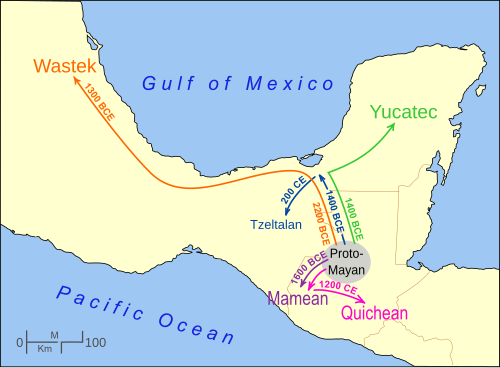
紀元前2000年以前、マヤ人は言語学者によって原マヤ語と呼ばれる単一の言語を話していました。 [263]復元された原マヤ語の語彙の言語分析によると、元々の原マヤ語の故郷はグアテマラ高地の西部または北部にあったことが示唆されていますが、証拠は決定的ではありません。[264]原マヤ語は先古典期に分岐し、ワステカ語、大キチェ語、大カンホバラン語、マメアン語、ツェルタラン・チョラン語、ユカテカン語を含む主要なマヤ語族を形成しました。[4]これらのグループは先コロンブス期にさらに分岐し、現代まで残っている30以上の言語を形成しました。[265]マヤ地域全体のほぼすべての古典期マヤ語のテキストの言語はチョラン語であると特定されています。[266]高地のカミナルジュユで発見された後期先古典期のテキストも、チョーラン語で書かれているか、チョーラン語と関連があるようです。[267]マヤのテキストでチョーラン語が使われていたからといって、必ずしも地元の民衆が一般的に使用していた言語だったというわけではありません。儀式や威信語として中世ラテン語と同等だったのかもしれません。[268]古典期チョーラン語は、外交や貿易などの政体間のコミュニケーションに使われた古典期マヤのエリート層の威信言語だったのかもしれません。[269]後古典期までに、ユカテク語もチョーラン語と並んでマヤの写本に書かれるようになりました。[270]
書くことと読み書き

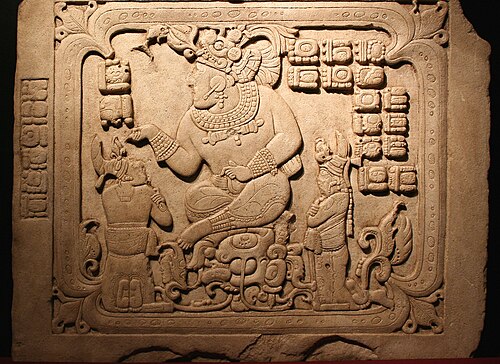

マヤ文字は、コロンブス以前のアメリカ大陸の住民の傑出した功績の一つである。[272]これは、メソアメリカで発達した12以上の文字体系の中で最も洗練され、高度に発達した文字体系であった。[273]マヤ文字と特定される最も古い碑文は、紀元前300~200年にペテン盆地で発見された。[274]しかし、これに先立って、エピ・オルメカ文字やサポテク文字など、他のメソアメリカの文字体系がいくつか存在していた。初期のマヤ文字は、西暦1世紀後半、または2世紀初頭までにグアテマラの太平洋岸に出現していた。[275]太平洋岸のイストミア文字と初期のマヤ文字の類似点は、この2つの文字体系が同時に発達したことを示唆している。[276]西暦250年頃までに、マヤ文字はより形式化され、一貫性のある文字体系となっていた。[277]
カトリック教会と植民地当局、特にディエゴ・デ・ランダ司教は、マヤの文書を発見した場所すべてで破壊し、マヤ文字に関する知識も破壊したが、偶然にも、後古典期のものとされるコロンブス以前の4冊の本が保存されていた。これらは、マドリード・コーデックス、ドレスデン・コーデックス、パリ・コーデックス、メキシコのマヤ・コーデックス(以前はグロリエ・コーデックスとして知られ、2018年まで真正性が争われていた)として知られている。[278] [279]マヤ遺跡で行われた考古学調査では、コーデックスであった他の断片、長方形の石膏の塊や塗料の破片がしばしば発見される。しかし、これらの魅力的な遺跡は、碑文が残るには損傷がひどく、ほとんどの有機物が腐敗している。[280]現存する数少ないマヤの文書について、マイケル・D・コーは次のように述べている。
古代マヤ思想に関する私たちの知識は、全体像のほんの一部に過ぎないに違いありません。彼らの学問と儀式の全容が記録された何千冊もの本のうち、現代まで残っているのはたった 4 冊だけだからです (まるで後世の人々が私たちについて知っていることのすべてが、3 冊の祈祷書と『天路歴程』に基づいているかのようです)。
— マイケル・D・コー『マヤ』ロンドン:テムズ・アンド・ハドソン、第6版、1999年、199~200ページ。
Most surviving pre-Columbian Maya writing dates to the Classic period and is contained in stone inscriptions from Maya sites, such as stelae, or on ceramics vessels. Other media include the aforementioned codices, stucco façades, frescoes, wooden lintels, cave walls, and portable artefacts crafted from a variety of materials, including bone, shell, obsidian, and jade.[281]
Writing system
The Maya word Bʼalam ("jaguar") written twice in the Maya script. The first glyph writes the word logographicaly with the jaguar head standing for the entire word. The second glyph block writes the word phonetically using the three syllable signs BA, LA and MA.
The Maya writing system (often called hieroglyphs from a superficial resemblance to Ancient Egyptian writing)[282] is a logosyllabic writing system, combining a syllabary of phonetic signs representing syllables with logogram representing entire words.[281][283] Among the writing systems of the Pre-Columbian New World, Maya script most closely represents the spoken language.[284] At any one time, no more than around 500 glyphs were in use, some 200 of which (including variations) were phonetic.[281]
The Maya script was in use up to the arrival of the Europeans, its use peaking during the Classic Period.[285] In excess of 10,000 individual texts have been recovered, mostly inscribed on stone monuments, lintels, stelae and ceramics.[281] The Maya also produced texts painted on a form of paper manufactured from processed tree-bark generally now known by its Nahuatl-language name amatl used to produce codices.[286][287] The skill and knowledge of Maya writing persisted among segments of the population right up to the Spanish conquest. The knowledge was subsequently lost, as a result of the impact of the conquest on Maya society.[288]
The decipherment and recovery of the knowledge of Maya writing has been a long and laborious process.[289] Some elements were first deciphered in the late 19th and early 20th century, mostly the parts having to do with numbers, the Maya calendar, and astronomy.[290] Major breakthroughs were made from the 1950s to 1970s, and accelerated rapidly thereafter.[291] By the end of the 20th century, scholars were able to read the majority of Maya texts, and ongoing work continues to further illuminate the content.[292][293]
Logosyllabic script
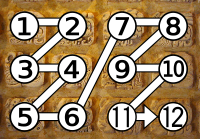
The basic unit of Maya logosyllabic text is the glyph block, which transcribes a word or phrase. The block is composed of one or more individual glyphs attached to each other to form the glyph block, with individual glyph blocks generally being separated by a space. Glyph blocks are usually arranged in a grid pattern. For ease of reference, epigraphers refer to glyph blocks from left to right alphabetically, and top to bottom numerically. Thus, any glyph block in a piece of text can be identified. C4 would be third block counting from the left, and the fourth block counting downwards. If a monument or artefact has more than one inscription, column labels are not repeated, rather they continue in the alphabetic series; if there are more than 26 columns, the labelling continues as A', B', etc. Numeric row labels restart from 1 for each discrete unit of text.[294]
Although Mayan text may be laid out in varying manners, generally it is arranged into double columns of glyph blocks. The reading order of text starts at the top left (block A1), continues to the second block in the double-column (B1), then drops down a row and starts again from the left half of the double column (A2), and thus continues in zig-zag fashion. Once the bottom is reached, the inscription continues from the top left of the next double column (C1). Where an inscription ends in a single (unpaired) column, this final column is usually read straight downwards.[294]
Individual glyph blocks may be composed of a number of elements. These consist of the main sign, and any affixes. Main signs represent the major element of the block, and may be a noun, verb, adverb, adjective, or phonetic sign. Some main signs are abstract, some are pictures of the object they represent, and others are "head variants", personifications of the word they represent. Affixes are smaller rectangular elements, usually attached to a main sign, although a block may be composed entirely of affixes. Affixes may represent a wide variety of speech elements, including nouns, verbs, verbal suffixes, prepositions, and pronouns. Small sections of a main sign could be used to represent the whole main sign. Maya scribes were highly inventive in their usage and adaptation of glyph elements.[295]
Writing tools
Although the archaeological record does not provide examples of brushes or pens, analysis of ink strokes on the Postclassic codices suggests that it was applied with a brush with a tip fashioned from pliable hair.[287] A Classic period sculpture from Copán, Honduras, depicts a scribe with an inkpot fashioned from a conch shell.[296] Excavations at Aguateca uncovered a number of scribal artefacts from the residences of elite status scribes, including palettes and mortars and pestles.[143]
Scribes and literacy
Commoners were illiterate; scribes were drawn from the elite. It is not known if all members of the aristocracy could read and write, although at least some women could, since there are representations of female scribes in Maya art.[297] Maya scribes were called aj tzʼib, meaning "one who writes or paints".[298] There were probably scribal schools where members of the aristocracy were taught to write.[299] Scribal activity is identifiable in the archaeological record; Jasaw Chan Kʼawiil I, king of Tikal, was interred with his paint pot. Some junior members of the Copán royal dynasty have also been found buried with their writing implements. A palace at Copán has been identified as that of a noble lineage of scribes; it is decorated with sculpture that includes figures holding ink pots.[300]
Although not much is known about Maya scribes, some did sign their work, both on ceramics and on stone sculpture. Usually, only a single scribe signed a ceramic vessel, but multiple sculptors are known to have recorded their names on stone sculpture; eight sculptors signed one stela at Piedras Negras. However, most works remained unsigned by their artists.[301]
Mathematics
In common with the other Mesoamerican civilizations, the Maya used a base 20 (vigesimal) system.[302] The bar-and-dot counting system that is the base of Maya numerals was in use in Mesoamerica by 1000 BC;[303] the Maya adopted it by the Late Preclassic, and added the symbol for zero.[304] This may have been the earliest known occurrence of the idea of an explicit zero worldwide,[305] although it may have been later than the Babylonian system.[306] The earliest explicit use of zero occurred on monuments dated to 357 AD.[307] In its earliest uses, the zero served as a place holder, indicating an absence of a particular calendrical count. This later developed into a numeral that was used to perform calculation,[308] and was used in hieroglyphic texts for more than a thousand years, until the writing system was extinguished by the Spanish.[309]
The basic number system consists of a dot to represent one, and a bar to represent five.[310] By the Postclassic period a shell symbol represented zero; during the Classic period other glyphs were used.[311] The Maya numerals from 0 to 19 used repetitions of these symbols.[310] The value of a numeral was determined by its position; as a numeral shifted upwards, its basic value multiplied by twenty. In this way, the lowest symbol would represent units, the next symbol up would represent multiples of twenty, and the symbol above that would represent multiples of 400, and so on. For example, the number 884 would be written with four dots on the lowest level, four dots on the next level up, and two dots on the next level after that, to give 4×1 + 4×20 + 2×400 = 884. Using this system, the Maya were able to record huge numbers.[302] Simple addition could be performed by summing the dots and bars in two columns to give the result in a third column.[312]
Calendar
The Maya calendrical system, in common with other Mesoamerican calendars, had its origins in the Preclassic period. However, it was the Maya that developed the calendar to its maximum sophistication, recording lunar and solar cycles, eclipses and movements of planets with great accuracy. In some cases, the Maya calculations were more accurate than equivalent calculations in the Old World; for example, the Maya solar year was calculated to greater accuracy than the Julian year. The Maya calendar was intrinsically tied to Maya ritual, and it was central to Maya religious practices.[313] The calendar combined a non-repeating Long Count with three interlocking cycles, each measuring a progressively larger period. These were the 260-day tzolkʼin,[314] the 365-day haabʼ,[315] and the 52-year Calendar Round, resulting from the combination of the tzolkʼin with the haab'.[316] There were also additional calendric cycles, such as an 819-day cycle associated with the four quadrants of Maya cosmology, governed by four different aspects of the god Kʼawiil.[317]
The basic unit in the Maya calendar was one day, or kʼin, and 20 kʼin grouped to form a winal. The next unit, instead of being multiplied by 20, as called for by the vigesimal system, was multiplied by 18 in order to provide a rough approximation of the solar year (hence producing 360 days). This 360-day year was called a tun. Each succeeding level of multiplication followed the vigesimal system.[318]
The 260-day tzolkʼin provided the basic cycle of Maya ceremony, and the foundations of Maya prophecy. No astronomical basis for this count has been proved, and it may be that the 260-day count is based on the human gestation period. This is reinforced by the use of the tzolkʼin to record dates of birth, and provide corresponding prophecy. The 260-day cycle repeated a series of 20-day-names, with a number from 1 to 13 prefixed to indicated where in the cycle a particular day occurred.[317]
The 365-day haab was produced by a cycle of eighteen named 20-day winals, completed by the addition of a 5-day period called the wayeb.[319] The wayeb was considered to be a dangerous time, when the barriers between the mortal and supernatural realms were broken, allowing malignant deities to cross over and interfere in human concerns.[316] In a similar way to the tzʼolkin, the named winal would be prefixed by a number (from 0 to 19), in the case of the shorter wayeb period, the prefix numbers ran 0 to 4. Since each day in the tzʼolkin had a name and number (e.g. 8 Ajaw), this would interlock with the haab, producing an additional number and name, to give any day a more complete designation, for example 8 Ajaw 13 Keh. Such a day name could only recur once every 52 years, and this period is referred to by Mayanists as the Calendar Round. In most Mesoamerican cultures, the Calendar Round was the largest unit for measuring time.[319]
As with any non-repeating calendar, the Maya measured time from a fixed start point. The Maya set the beginning of their calendar as the end of a previous cycle of bakʼtuns, equivalent to a day in 3114 BC. This was believed by the Maya to be the day of the creation of the world in its current form. The Maya used the Long Count Calendar to fix any given day of the Calendar Round within their current great Piktun cycle consisting of either 20 bakʼtuns. There was some variation in the calendar, specifically texts in Palenque demonstrate that the piktun cycle that ended in 3114 BC had only 13 bakʼtuns, but others used a cycle of 13 + 20 bakʼtun in the current piktun.[320] Additionally, there may have been some regional variation in how these exceptional cycles were managed.[321]
A full long count date consisted of an introductory glyph followed by five glyphs counting off the number of bakʼtuns, katʼuns, tuns, winals, and kʼins since the start of the current creation. This would be followed by the tzʼolkin portion of the Calendar Round date, and after a number of intervening glyphs, the Long Count date would end with the Haab portion of the Calendar Round date.[322]
Correlation of the Long Count calendar
Although the Calendar Round is still in use today,[323] the Maya started using an abbreviated Short Count during the Late Classic period. The Short Count is a count of 13 kʼatuns. The Book of Chilam Balam of Chumayel[324] contains the only colonial reference to classic long-count dates. The most generally accepted correlation is the Goodman-Martínez-Thompson, or GMT, correlation. This equates the Long Count date 11.16.0.0.0 13 Ajaw 8 Xul with the Gregorian date of 12 November 1539.[325] Epigraphers Simon Martin and Nikolai Grube argue for a two-day shift from the standard GMT correlation.[326] The Spinden Correlation would shift the Long Count dates back by 260 years; it also accords with the documentary evidence, and is better suited to the archaeology of the Yucatán Peninsula, but presents problems with the rest of the Maya region.[325] The George Vaillant Correlation would shift all Maya dates 260 years later, and would greatly shorten the Postclassic period.[325] Radiocarbon dating of dated wooden lintels at Tikal supports the GMT correlation.[325]
Astronomy
The famous astrologer John Dee used an Aztec obsidian mirror to see into the future. We may look down our noses at his ideas, but one may be sure that in outlook he was far closer to a Maya priest astronomer than is an astronomer of our century.
— J. Eric S. Thompson, Maya Astronomy: Philosophical Transactions of the Royal Society, 1974[327]
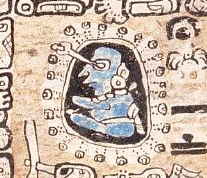
The Maya made meticulous observations of celestial bodies. This information was used for divination, so Maya astronomy was essentially for astrological purposes. Although Maya astronomy was mainly used by the priesthood to comprehend past cycles of time, and project them into the future to produce prophecy, it also had some practical applications, such as providing aid in crop planting and harvesting.[329] The priesthood refined observations and recorded eclipses of the sun and moon, and movements of Venus and the stars; these were measured against dated events in the past, on the assumption that similar events would occur in the future when the same astronomical conditions prevailed.[330] Illustrations in the codices show that priests made astronomical observations using the naked eye, assisted by crossed sticks as a sighting device.[331] Analysis of the few remaining Postclassic codices has revealed that, at the time of European contact, the Maya had recorded eclipse tables, calendars, and astronomical knowledge that was more accurate at that time than comparable knowledge in Europe.[332]
The Maya measured the 584-day Venus cycle with an error of just two hours. Five cycles of Venus equated to eight 365-day haab calendrical cycles, and this period was recorded in the codices. The Maya also followed the movements of Jupiter, Mars and Mercury. When Venus rose as the Morning Star, this was associated with the rebirth of the Maya Hero Twins.[333] For the Maya, the heliacal rising of Venus was associated with destruction and upheaval.[331] Venus was closely associated with warfare, and the hieroglyph meaning "war" incorporated the glyph-element symbolizing the planet.[334] Sight-lines through the windows of the Caracol building at Chichen Itza align with the northernmost and southernmost extremes of Venus' path.[331] Maya rulers launched military campaigns to coincide with the heliacal or cosmical rising of Venus, and would also sacrifice important captives to coincide with such conjunctions.[334]
Solar and lunar eclipses were considered to be especially dangerous events that could bring catastrophe upon the world. In the Dresden Codex, a solar eclipse is represented by a serpent devouring the kʼin ("day") hieroglyph.[335] Eclipses were interpreted as the sun or moon being bitten, and lunar tables were recorded in order that the Maya might be able to predict them, and perform the appropriate ceremonies to ward off disaster.[334]
Religion and mythology
In common with the rest of Mesoamerica, the Maya believed in a supernatural realm inhabited by an array of powerful deities who needed to be placated with ceremonial offerings and ritual practices.[336] At the core of Maya religious practice was the worship of deceased ancestors, who would intercede for their living descendants in dealings with the supernatural realm.[337] The earliest intermediaries between humans and the supernatural were shamans.[338] Maya ritual included the use of hallucinogens for chilan, oracular priests. Visions for the chilan were likely facilitated by consumption of water lilies, which are hallucinogenic in high doses.[339] As the Maya civilization developed, the ruling elite codified the Maya world view into religious cults that justified their right to rule.[336] In the Late Preclassic,[340] this process culminated in the institution of the divine king, the kʼuhul ajaw, endowed with ultimate political and religious power.[338]
The Maya viewed the cosmos as highly structured. There were thirteen levels in the heavens and nine in the underworld, with the mortal world in between. Each level had four cardinal directions associated with a different colour; north was white, east was red, south was yellow, and west was black. Major deities had aspects associated with these directions and colours.[341]
Maya households interred their dead underneath the floors, with offerings appropriate to the social status of the family. There the dead could act as protective ancestors. Maya lineages were patrilineal, so the worship of a prominent male ancestor would be emphasised, often with a household shrine. As Maya society developed, and the elite became more powerful, Maya royalty developed their household shrines into the great pyramids that held the tombs of their ancestors.[337]
Belief in supernatural forces pervaded Maya life, from the simplest day-to-day activities such as cooking, to trade, politics, and elite activities. Maya deities governed all aspects of the world, both visible and invisible.[342] The Maya priesthood was a closed group, drawing its members from the established elite; by the Early Classic they were recording increasingly complex ritual information in their hieroglyphic books, including astronomical observations, calendrical cycles, history and mythology. The priests performed public ceremonies that incorporated feasting, bloodletting, incense burning, music, ritual dance, and, on certain occasions, human sacrifice. During the Classic period, the Maya ruler was the high priest, and the direct conduit between mortals and the gods. It is highly likely that, among commoners, shamanism continued in parallel to state religion. By the Postclassic, religious emphasis had changed; there was an increase in worship of the images of deities, and more frequent recourse to human sacrifice.[343]
Archaeologists painstakingly reconstruct these ritual practices and beliefs using several techniques. One important, though incomplete, resource is physical evidence, such as dedicatory caches and other ritual deposits, shrines, and burials with their associated funerary offerings.[344] Maya art, architecture, and writing are another resource, and these can be combined with ethnographic sources, including records of Maya religious practices made by the Spanish during the conquest.[342]
Human sacrifice

Blood was viewed as a potent source of nourishment for the Maya deities, and the sacrifice of a living creature was a powerful blood offering. By extension, the sacrifice of a human life was the ultimate offering of blood to the gods, and the most important Maya rituals culminated in human sacrifice. Generally only high status prisoners of war were sacrificed, with lower status captives being used for labour.[345]
Important rituals such as the dedication of major building projects or the enthronement of a new ruler required a human offering. The sacrifice of an enemy king was the most prized, and such a sacrifice involved decapitation of the captive ruler, perhaps in a ritual reenactment of the decapitation of the Maya maize god by the death gods.[345] In AD 738, the vassal king Kʼakʼ Tiliw Chan Yopaat of Quiriguá captured his overlord, Uaxaclajuun Ubʼaah Kʼawiil of Copán and a few days later ritually decapitated him.[57] Sacrifice by decapitation is depicted in Classic period Maya art, and sometimes took place after the victim was tortured, being variously beaten, scalped, burnt or disembowelled.[346] Another myth associated with decapitation was that of the Hero Twins recounted in the Popol Vuh: playing a ballgame against the gods of the underworld, the heroes achieved victory, but one of each pair of twins was decapitated by their opponents.[347][345]
During the Postclassic period, the most common form of human sacrifice was heart extraction, influenced by the rites of the Aztecs in the Valley of Mexico;[345] this usually took place in the courtyard of a temple, or upon the summit of the pyramid.[348] In one ritual, the corpse would be skinned by assistant priests, except for the hands and feet, and the officiating priest would then dress himself in the skin of the sacrificial victim and perform a ritual dance symbolizing the rebirth of life.[348] Archaeological investigations indicate that heart sacrifice was practised as early as the Classic period.[349]
Deities
The Maya world was populated by a great variety of deities, supernatural entities and sacred forces. The Maya had such a broad interpretation of the sacred that identifying distinct deities with specific functions is inaccurate.[351] The Maya interpretation of deities was closely tied to the calendar, astronomy, and their cosmology.[352] The importance of a deity, its characteristics, and its associations varied according to the movement of celestial bodies. The priestly interpretation of astronomical records and books was therefore crucial, since the priest would understand which deity required ritual propitiation, when the correct ceremonies should be performed, and what would be an appropriate offering. Each deity had four manifestations, associated with the cardinal directions, each identified with a different colour. They also had a dual day-night/life-death aspect.[341]
Itzamna was the creator god, but he also embodied the cosmos, and was simultaneously a sun god;[341] Kʼinich Ahau, the day sun, was one of his aspects. Maya kings frequently identified themselves with Kʼinich Ahau. Itzamna also had a night sun aspect, the Night Jaguar, representing the sun in its journey through the underworld.[353] The four Pawatuns supported the corners of the mortal realm; in the heavens, the Bacabs performed the same function. As well as their four main aspects, the Bakabs had dozens of other aspects that are not well understood.[354] The four Chaacs were storm gods, controlling thunder, lightning, and the rains.[355] The nine lords of the night each governed one of the underworld realms.[354] Other important deities included the moon goddess, the maize god, and the Hero Twins.[356]
The Popol Vuh was written in the Latin script in early colonial times, and was probably transcribed from a hieroglyphic book by an unknown Kʼicheʼ Maya nobleman.[357] It is one of the most outstanding works of indigenous literature in the Americas.[298] The Popul Vuh recounts the mythical creation of the world, the legend of the Hero Twins, and the history of the Postclassic Kʼicheʼ kingdom.[357] Deities recorded in the Popul Vuh include Hun Hunahpu, believed by some to be the Kʼicheʼ maize god,[358] and a triad of deities led by the Kʼicheʼ patron Tohil, and also including the moon goddess Awilix, and the mountain god Jacawitz.[359]
In common with other Mesoamerican cultures, the Maya worshipped feathered serpent deities. Such worship was rare during the Classic period,[360] but by the Postclassic the feathered serpent had spread to both the Yucatán Peninsula and the Guatemalan Highlands. In Yucatán, the feathered serpent deity was Kukulkan,[361] among the Kʼicheʼ it was Qʼuqʼumatz.[362] Kukulkan had his origins in the Classic period War Serpent, Waxaklahun Ubah Kan, and has also been identified as the Postclassic version of the Vision Serpent of Classic Maya art.[363] Although the cult of Kukulkan had its origins in these earlier Maya traditions, the worship of Kukulkan was heavily influenced by the Quetzalcoatl cult of central Mexico.[364] Likewise, Qʼuqʼumatz had a composite origin, combining the attributes of Mexican Quetzalcoatl with aspects of the Classic period Itzamna.[365]
Agriculture
.jpg/500px-D%C3%ADa_Internacional_de_los_Pueblos_Ind%C3%ADgenas_(7852553230).jpg)
The ancient Maya had diverse and sophisticated methods of food production. It was believed that shifting cultivation (swidden) agriculture provided most of their food,[366] but it is now thought that permanent raised fields, terracing, intensive gardening, forest gardens, and managed fallows were also crucial to supporting the large populations of the Classic period in some areas.[367] Indeed, evidence of these different agricultural systems persist today: raised fields connected by canals can be seen on aerial photographs.[368] Contemporary rainforest species composition has significantly higher abundance of species of economic value to ancient Maya in areas that were densely populated in pre-Columbian times,[369] and pollen records in lake sediments suggest that maize, manioc, sunflower seeds, cotton, and other crops have been cultivated in association with deforestation in Mesoamerica since at least 2500 BC.[370]
The basic staples of the Maya diet were maize, beans, and squashes. These were supplemented with a wide variety of other plants either cultivated in gardens or gathered in the forest. At Joya de Cerén, a volcanic eruption preserved a record of foodstuffs stored in Maya homes, among them were chilies and tomatoes. Cotton seeds were in the process of being ground, perhaps to produce cooking oil. In addition to basic foodstuffs, the Maya also cultivated prestige crops such as cotton, cacao and vanilla. Cacao was especially prized by the elite, who consumed chocolate beverages.[371] Cotton was spun, dyed, and woven into valuable textiles in order to be traded.[372]
The Maya had few domestic animals; dogs were domesticated by 3000 BC, and the Muscovy duck by the Late Postclassic.[373] Ocellated turkeys were unsuitable for domestication, but were rounded up in the wild and penned for fattening. All of these were used as food animals; dogs were additionally used for hunting. It is possible that deer were also penned and fattened.[374]
Maya sites
There are hundreds of Maya sites spread across five countries: Belize, El Salvador, Guatemala, Honduras and Mexico.[375] The six sites with particularly outstanding architecture or sculpture are Chichen Itza, Palenque, Uxmal, and Yaxchilan in Mexico, Tikal in Guatemala and Copán in Honduras. Other important, but difficult to reach, sites include Calakmul and El Mirador. The principal sites in the Puuc region, after Uxmal, are Kabah, Labna, and Sayil. In the east of the Yucatán Peninsula are Coba and the small site of Tulum.[376] The Río Bec sites of the base of the peninsula include Becan, Chicanná, Kohunlich, and Xpuhil. The most noteworthy sites in Chiapas, other than Palenque and Yaxchilan, are Bonampak and Toniná. In the Guatemalan Highlands are Iximche, Kaminaljuyu, Mixco Viejo, and Qʼumarkaj (also known as Utatlán).[377] In the northern Petén lowlands of Guatemala there are many sites, though apart from Tikal access is generally difficult. Some of the Petén sites are Dos Pilas, Seibal, and Uaxactún.[378] Important sites in Belize include Altun Ha, Caracol, and Xunantunich.[379]
Museum collections

There are many museums across the world with Maya artefacts in their collections. The Foundation for the Advancement of Mesoamerican Studies lists over 250 museums in its Maya Museum database,[380] and the European Association of Mayanists lists just under 50 museums in Europe alone.[381]
See also
.jpg/500px-Lascar_Avenue_of_the_Dead_and_the_Pyramid_of_the_Sun_in_the_background_(4566574277).jpg)
- Entheogenics and the Maya
- Huastec civilization
- Index of Mexico-related articles
- Maya codices
- Maya peoples
- Maya music
- Songs of Dzitbalché
References
- ^ The Ancient Maya Kinship System, Per Hage. The University of New Mexico 2003 [1]
- ^ Restall and Asselbergs 2007, p. 4.
- ^ Restall and Gabbert 2017, p. 92–97.
- ^ Thompson 1966, p. 25.
- ^ Foster 2002, p. 5.
- ^ Sharer and Traxler 2006, p. 29. Foster 2002, p. 5.
- ^ Marcus 2004b, pp. 342.
- ^ Taube 2004, p. 273.
- ^ Kristan-Graham and Kowalski 2007, pp. 13–14.
- ^ Lovell 2005, p. 17.
- ^ Sharer and Traxler 2006, pp. 46–47.
- ^ Rice and Rice 2009, p. 5.
- ^ Quezada 2011, p. 17.
- ^ Lovell 2000, p. 400.
- ^ Viqueira 2004, p. 21.
- ^ Sharer and Traxler 2006, pp. 34–36.
- ^ Estrada-Belli 2011, pp. 1, 3.
- ^ Sharer and Traxler 2006, p. 98. Estrada-Belli 2011, p. 38.
- ^ Estrada-Belli 2011, p. 1.
- ^ Demarest 2004, p. 17.
- ^ Estrada-Belli 2011, p. 3.
- ^ Sharer and Traxler 2006, p. 98.
- ^ Masson 2012, p. 18238. Pugh and Cecil 2012, p. 315.
- ^ Estrada-Belli 2011, p. 28.
- ^ Hammond et al. 1976, pp. 579–81.
- ^ Drew 1999, p. 6.
- ^ Coe 1999, p. 47.
- ^ a b Olmedo Vera 1997, p. 26.
- ^ Sharer and Traxler 2006, p. 276.
- ^ Sharer and Traxler 2006, pp. 182, 197.
- ^ Saturno, Stuart and Beltrán 2006, pp. 1281–83.
- ^ Olmedo Vera 1997, p. 28.
- ^ Martin and Grube 2000, pp. 25–26.
- ^ Love 2007, pp. 293, 297. Popenoe de Hatch and Schieber de Lavarreda 2001, p. 991.
- ^ Sharer and Traxler 2006, p. 236.
- ^ Sharer and Traxler 2006, p. 275.
- ^ Martin and Grube 2000, p. 8.
- ^ Schele and Mathews 1999, pp. 179, 182–83.
- ^ a b Coe 1999, p. 81.
- ^ Martin and Grube 2000, p. 21.
- ^ a b c Masson 2012, p. 18237.
- ^ a b c Martin and Grube 2000, p. 9.
- ^ Demarest 2004, p. 218. Estrada-Belli 2011, pp. 123–26.
- ^ Sharer and Traxler 2006, p. 322. Martin and Grube 2000, p. 29.
- ^ a b c Olmedo Vera 1997, p.36.
- ^ Foster 2002, p. 133.
- ^ Demarest 2004, pp. 224–26.
- ^ Sharer and Traxler 2006, pp. 383, 387.
- ^ Salisbury, Koumenalis & Barbara Moffett 2002. Martin & Grube 2000, p. 108. Sharer & Traxler 2006, p. 387.
- ^ Martin and Grube 2000, pp. 54–55.
- ^ Martin and Grube 2000, pp. 192–93. Sharer and Traxler 2006, p. 342.
- ^ Martin and Grube 2000, pp. 200, 203.
- ^ Martin and Grube 2000, pp. 203, 205.
- ^ a b Miller 1999, pp. 134–35. Looper 2003, p. 76.
- ^ Looper 1999, pp. 81, 271.
- ^ Demarest 2004, p. 75.
- ^ Coe 1999, pp. 151–55.
- ^ Becker 2004, p. 134.
- ^ Demarest 2004, p. 246.
- ^ Demarest 2004, p. 248.
- ^ Martin and Grube 2000, p. 226.
- ^ Foster 2002, p. 60.
- ^ Sharer 2000, p. 490.
- ^ Sharer and Traxler 2006, pp. 613, 616.
- ^ Foias 2014, p. 15.
- ^ a b Masson 2012, p. 18238.
- ^ a b Arroyo 2001, p. 38.
- ^ Foias 2014, pp. 100–02.
- ^ Masson and Peraza Lope 2014.
- ^ Andrews 1984, p. 589.
- ^ Sharer and Traxler 2006, p. 717.
- ^ Restall and Asselbergs 2007, p. 5.
- ^ Sharer and Traxler 2006, pp. 759–60.
- ^ Sharer and Traxler 2006, p. 763. Lovell 2005, p. 58. Matthew 2012, pp. 78–79.
- ^ Sharer and Traxler 2006, p. 763.
- ^ Sharer and Traxler 2006, pp. 764–65. Recinos 1986, pp. 68, 74.
- ^ Schele and Mathews 1999, p. 297. Guillemín 1965, p. 9.
- ^ Schele and Mathews 1999, p. 298.
- ^ Recinos 1986, p. 110. del Águila Flores 2007, p. 38.
- ^ Sharer and Traxler 2006, pp. 766–72.
- ^ Sharer and Traxler 2006, pp. 772–73.
- ^ Jones 1998, p. xix.
- ^ Sharer and Traxler 2006, p. 9.
- ^ Sharer and Traxler 2006, p. 10.
- ^ Zorich 2012, p. 29. Thompson 1932, p. 449.
- ^ Sharer and Traxler 2006, p. 11.
- ^ a b Demarest 2004, p. 31.
- ^ Demarest 2004, pp. 32–33.
- ^ Koch 2013, pp. 1, 105.
- ^ Demarest 2004, pp. 33–34.
- ^ Demarest 2004, pp. 37–38.
- ^ Demarest 2004, p. 38.
- ^ Demarest 2004, p. 39.
- ^ Demarest 2004, p. 42.
- ^ Demarest 2004, p. 44.
- ^ Demarest 2004, p. 45.
- ^ Foster 2002, p. 8.
- ^ Cioffi-Revilla and Landman 1999, p. 563.
- ^ Oakley and Rubin 2012, p. 81.
- ^ Oakley and Rubin 2012, p. 82.
- ^ Foias 2014, p. 162.
- ^ Foias 2014, p. 60.
- ^ Chase and Chase 2012, p. 265.
- ^ Chase and Chase 2012, p. 264.
- ^ Foias 2014, p. 64.
- ^ a b Foias 2014, p. 161.
- ^ Foias 2014, p. 167.
- ^ Foster 2002, p. 121.
- ^ Foster 2002, pp. 121–22.
- ^ Foster 2002, p. 122.
- ^ Gillespie 2000, pp. 470, 473–74.
- ^ Martin and Grube 2000, p. 178. Witschey and Brown 2012, p. 321.
- ^ Martin and Grube 2000, p. 14.
- ^ a b c Foias 2014, p. 224.
- ^ Jackson 2013, pp. 142, 144.
- ^ Jackson 2013, p. 144.
- ^ a b D'Arcy Harrison 2003, p. 114.
- ^ Martin and Grube 2000, p. 17.
- ^ D'Arcy Harrison 2003, p. 114. Martin and Grube 2000, p. 17.
- ^ Jackson 2013, pp. 4–5.
- ^ Kimbell Art Museum 2015. Martin and Grube 2000, p. 135.
- ^ Jackson 2013, pp. 65–66.
- ^ Jackson 2013, p. 12.
- ^ D'Arcy Harrison 2003, pp. 114–15.
- ^ Jackson 2013, pp. 13–14.
- ^ Jackson 2013, p. 15.
- ^ Jackson 2013, p. 77.
- ^ Jackson 2013, p. 68.
- ^ Foias 2014, p. 226.
- ^ Sharer and Traxler 2006, p. 97.
- ^ Marcus 2004a, p. 277.
- ^ Masson and Peraza Lope 2004, p. 213.
- ^ a b c d Foster 2002, p. 144.
- ^ Marcus 2004a, p. 255.
- ^ a b Foster 2002, p. 143.
- ^ a b c Aoyama 2005, p. 291.
- ^ Aoyama 2005, p. 292.
- ^ a b Aoyama 2005, p. 293.
- ^ Webster 2000, p. 66.
- ^ Foias 2014, pp. 167–68.
- ^ Foias 2014, p. 168.
- ^ Wise and McBride 2008, p. 32.
- ^ a b Wise and McBride 2008, p. 34.
- ^ Phillips 2007, p. 95.
- ^ Foster 2002, p. 145.
- ^ Martin and Grube 2000, 128, 132.
- ^ a b c d Foster 2002, p. 146.
- ^ Foster 2002, pp. 146–47.
- ^ Aoyama 2005, p. 294.
- ^ Aoyama 2005, pp. 294, 301
- ^ Rice, Rice, Pugh and Sánchez Polo 2009, p. 129.
- ^ Phillips 2007, p. 94.
- ^ a b c d e Foster 2002, p. 319.
- ^ Sharer and Traxler 2006, p. 51.
- ^ Foias 2014, p. 18.
- ^ a b Foster 2002, p. 322.
- ^ Sharer and Traxler 2006, p. 660.
- ^ Caso Barrera and Aliphat Fernández 2006, pp. 31, 36. Caso Barrera and Aliphat Fernández 2007, p. 49.
- ^ Foster 2002, p. 320.
- ^ Foster 2002, pp. 319–20.
- ^ Foster 2002, p. 323.
- ^ Foster 2002, p. 324.
- ^ Foster 2002, p. 325.
- ^ Dahlin et al. 2007, p. 363.
- ^ Dahlin et al. 2007, p. 365.
- ^ Dahlin et al. 2007, p. 367.
- ^ Dahlin et al. 2007, pp. 363, 369, 380.
- ^ Foias 2014, p. 14. Sharer and Traxler 2006, 659.
- ^ Sharer and Traxler 2006, 658.
- ^ Miller 1999, p. 131.
- ^ Stuart and Stuart 2008, p. 201.
- ^ Miller 1999, p. 10.
- ^ Miller 1999, p. 11.
- ^ Miller 1999, p. 105.
- ^ Miller 1999, pp. 73–75.
- ^ Miller 1999, p. 75.
- ^ Miller 1999, p. 92.
- ^ a b Miller 1999, p. 78.
- ^ Miller 1999, pp. 78–80.
- ^ Miller 1999, pp. 9, 80.
- ^ Miller 1999, pp. 80–81.
- ^ Miller 1999, pp. 80–81. Sharer and Traxler 2006, p. 340.
- ^ Sharer and Traxler 2006, p. 340.
- ^ Miller 1999, p. 84.
- ^ Estrada-Belli pp. 44, 103–04.
- ^ Saturno, Stuart and Beltrán 2006, 1281–82.
- ^ Miller 1999, pp. 84–85.
- ^ Martin and Grube 2000, p. 36.
- ^ Miller 1999, p. 83.
- ^ a b SFU Museum of Archaeology and Ethnology.
- ^ Williams 2010.
- ^ Thompson 1990, p. 147.
- ^ Miller 1999, p. 228.
- ^ Miller 1999, pp. 86–87.
- ^ Miller 1999, p. 87.
- ^ Miller 1999, p. 86.
- ^ Sharer and Traxler 2006, p. 378.
- ^ Reents-Budet et al. 2007, pp. 1417–18.
- ^ Miller 1999, p. 77.
- ^ Miller 1999, p. 76.
- ^ Hutson 2011, p. 403.
- ^ Hutson 2011, pp. 405–06.
- ^ Foster 2002, p. 215. Abrams 1994, pp. 60, 130.
- ^ a b Foster 2002, p. 216.
- ^ Foster 2002, pp. 216–17.
- ^ a b c Olmedo Vera 1997, p. 34.
- ^ Miller 1999, p. 25.
- ^ a b Schele and Mathews 1999, p. 23.
- ^ a b Schele and Mathews 1999, p. 24.
- ^ Olmedo Vera 1997, p. 35.
- ^ a b c Foster 2002, p. 238.
- ^ a b c Hohmann-Vogrin 2011, p. 195.
- ^ a b c Foster 2002, p. 239.
- ^ Foster 2002, pp. 238–39.
- ^ Fuente, Staines Cicero and Arellano Hernández 1999, p. 142.
- ^ Sharer and Traxler 2006, p. 546.
- ^ Foster 2002, p. 232.
- ^ Christie 2003, pp. 315–16.
- ^ Christie 2003, p. 316.
- ^ Christie 2003, p. 315.
- ^ Sharer and Traxler 2006, pp. 395, 397.
- ^ Foster 2002, p. 231.
- ^ Miller 1999, p. 32.
- ^ a b c d Foster 2002, p. 235.
- ^ a b c Demarest 2004, p. 201.
- ^ Doyle 2012, p. 358.
- ^ Drew 1999, p. 186. Laporte and Fialko 1994, p. 336.
- ^ Foster 2002, pp. 235–36.
- ^ Šprajc 2018
- ^ Sharer and Traxler 2006, p. 253.
- ^ Coe 1999, p. 77.
- ^ a b Hansen 1998, p. 78.
- ^ Forsyth 1993, p. 113. Szymanski 2013, pp. 23–37.
- ^ Valdés 1994, p. 101. Szymanski 2013.
- ^ Hansen 1991, p. 166. Hansen 1998, p. 78.
- ^ Szymanski 2013, p. 65.
- ^ Hansen 1998, p. 80. Szymanski 2013, p. 35.
- ^ Hansen 1998, p. 80.
- ^ Szymanski 2013, p. 35.
- ^ Hansen 1991, p. 166.
- ^ a b Colas and Voß 2011, p. 186.
- ^ Sharer and Traxler 2006, p. 207.
- ^ Foster 2002, p. 233.
- ^ Colas and Voß 2011, p. 189. Taladoire and Colsenet 1991, p. 165.
- ^ Colas and Voß 2011, p. 189.
- ^ Coe 1999, p. 175.
- ^ Foster 2002, p. 223.
- ^ a b c d Foster 2002, p. 224.
- ^ Fuente, Staines Cicero and Arellano Hernández 1999, pp. 144–45.
- ^ Fuente, Staines Cicero and Arellano Hernández 1999, p. 146.
- ^ Foster 2002, pp. 224–25.
- ^ Foster 2002, p. 225.
- ^ a b c d Foster 2002, p. 226.
- ^ a b Fuente, Staines Cicero and Arellano Hernández 1999, p. 150.
- ^ a b Fuente, Staines Cicero and Arellano Hernández 1999, p. 149.
- ^ Foster 2002, p. 226. Fuente, Staines Cicero and Arellano Hernández 1999, p. 150.
- ^ Foster 2002, p. 274.
- ^ Foster 2002, p. 274. Sharer and Traxler 2006, p. 26.
- ^ Sharer and Traxler 2006, p. 132.
- ^ Estrada-Belli 2011, p. 112.
- ^ Houston, Robertson and Stuart 2000, p. 326.
- ^ Houston, Robertson and Stuart 2000, p. 338.
- ^ Bricker 2007, p. 143.
- ^ Demarest, Barrientos and Fahsen 2006, pp. 832–33.
- ^ Sharer and Traxler 2006, p. 125.
- ^ Diehl 2004, p. 183.
- ^ Saturno, Stuart and Beltrán 2006, p. 1282.
- ^ Love 2007, p. 293. Schieber Laverreda and Orrego Corzo 2010, p. 2.
- ^ Kettunen and Helmke 2008, p. 10.
- ^ Romero, Laura; Saavedra, Diana (24 September 2018). "El Códice Maya de México, auténtico y el más antiguo" [The Maya Codex of Mexico, authentic and the oldest one]. Gaceta UNAM (in Spanish). Retrieved 17 November 2022.
- ^ Sharer and Traxler 2006, p. 126. Foster 2002, p. 297.
- ^ a b c d Kettunen and Helmke 2008, p. 6.
- ^ Ellsworth Hamann 2008, pp. 6–7.
- ^ Tanaka 2008, pp. 30, 53.
- ^ Macri and Looper 2003, p. 5.
- ^ Sharer and Traxler 2006, pp. 120, 123.
- ^ Miller and Taube 1993, p. 131.
- ^ a b Tobin 2001.
- ^ Sharer and Traxler 2006, p. 120.
- ^ Coe 1994, pp. 245–46.
- ^ Sharer and Traxler 2006, pp. 135–36.
- ^ Foster 2002, pp. 271–72.
- ^ Macri and Looper 2003, p. 11.
- ^ Kettunen & Helmke 2014, p. 9.
- ^ a b Kettunen & Helmke 2014, p. 16.
- ^ Kettunen & Helmke 2014, pp. 24–25.
- ^ a b Webster et al. 1989, p. 55.
- ^ Foster 2002, p. 331.
- ^ Drew 1999, p. 322.
- ^ Drew 1999, p. 323.
- ^ Foster 2002, p. 278.
- ^ a b Foster 2002, p. 249.
- ^ Blume 2011, p. 53.
- ^ Blume 2011, p. 53. Sharer and Traxler 2006, p. 101.
- ^ Sharer and Traxler 2006, p. 101. Justeson 2010, p. 46.
- ^ Justeson 2010, p. 46.
- ^ Justeson 2010, p. 49.
- ^ Justeson 2010, p. 50.
- ^ Justeson 2010, p. 52.
- ^ a b Foster 2002, p. 248.
- ^ Foster 2002, p. 248. Sharer and Traxler 2006, p. 101.
- ^ Foster 2002, p. 250.
- ^ Foster 2002, p. 251.
- ^ Foster 2002, p. 252.
- ^ a b Foster 2002, p. 253.
- ^ Carter 2014 "A single passage on a Late Classic hieroglyphic panel at Palenque makes two further points clear; first, that the count of bakʼtuns will accumulate to 19, as before the present era, before the number in the piktuns place will change; and second, that that number will change to 1, not to 14, just as the bakʼtuns did in 2720 BC. In other words, all piktuns except the present one contained 20 bakʼtuns, but the current one contains 33; all previous kalabtuns, the next place up, contained 20 piktuns, but the current kalabtun contains 33 of those. Presumably the same pattern obtains for the rest of the higher places. This staggered resetting of the higher-order cycles, so jarringly unexpected from a contemporary, Western perspective, suggests an attitude towards time more numerological than mathematical. 13 and 20, after all, are the key numbers of the tzolkʼin, so it is fitting that they should be incorporated into the Long Count at enormous temporal scales."
- ^ Van Stone 2011
- ^ Tedlock 1992, p. 1. Miles 1952, p. 273.
- ^ Roys 1933, pp. 79, 83.
- ^ Martin and Grube 2000, p. 13.
- ^ Thompson 1974, p. 88.
- ^ Milbrath 1999, pp. 252–53.
- ^ Van Stone 2016, p. 265.
- ^ Demarest 2004, p. 192.
- ^ a b c Foster 2002, p. 261.
- ^ Demarest 2004, p. 193.
- ^ Foster 2002, p. 260.
- ^ a b c Foster 2002, p. 262.
- ^ Finley, Michael John
- ^ a b Demarest 2004, p. 176.
- ^ Emboden 1979, pp. 50–52.
- ^ Sharer and Traxler 2006, p. 721.
- ^ a b c Demarest 2004, p. 179.
- ^ Sharer and Traxler 2006, pp. 91–92.
- ^ Miller and Taube 1993, p. 96.
- ^ Gillespie 1991, pp. 322–23.
- ^ Tiesler and Cucina 2006, p. 493.
- ^ Fox 2008, pp. 60, 249.
- ^ Demarest 2004, p. 177.
- ^ Demarest 2004, pp. 177, 179.
- ^ Demarest 2004, p. 181.
- ^ a b Demarest 2004, p. 182.
- ^ Demarest 2004, pp. 182–83.
- ^ Demarest 2004, pp. 181–83.
- ^ a b Miller and Taube 1993, p. 134.
- ^ Sharer and Traxler 2006, p. 729.
- ^ Christenson 2007, pp. 61n65, 228n646. Miller and Taube 1993, p. 170. Carmack 2001, pp. 275, 369.
- ^ Miller and Taube 1993, p. 150.
- ^ Miller and Taube 1993, p. 142.
- ^ Christenson 2007, pp. 52–53n20.
- ^ Freidel, Schele and Parker 1993, pp. 289, 325, 441n26.
- ^ Sharer and Traxler 2006, pp. 582–83.
- ^ Fox 2008, pp. 60, 121, 220.
- ^ Fisher 2014, p. 196.
- ^ Sharer and Traxler 2006, pp. 81–82. Demarest 2004, pp. 130–38. Ross 2011, p. 75.
- ^ Adams, Brown and Culbert 1981, p. 1460.
- ^ Ross 2011, p. 75.
- ^ Colunga-García Marín and Zizumbo-Villarreal 2004, pp. S102–S103
- ^ Foster 2002, p. 310.
- ^ Foster 2002, pp. 310–11.
- ^ Foster 2002, pp. 311–312.
- ^ Foster 2002, p. 312.
- ^ Coe 1999, p. 243.
- ^ Coe 1999, p. 244.
- ^ Coe 1999, p. 245.
- ^ Coe 1999, pp. 245–46.
- ^ Coe 1999, p. 246.
- ^ Ros.
- ^ WAYEB.
Bibliography
- Abrams, Elliot M. (1994). How the Maya Built Their World: Energetics and Ancient Architecture. Austin: University of Texas Press. ISBN 978-0-292-70461-9. OCLC 29564628.
- Adams, Richard E. W. (2005) [1977]. Prehistoric Mesoamerica (3rd ed.). Norman: University of Oklahoma Press. ISBN 978-0-8061-3702-5. OCLC 58975830.
- Adams, R. E. W.; W. E. Brown; T. Patrick Culbert (25 September 1981). "Radar mapping, Archaeology, and Ancient Maya Land Use" (PDF). Science. New Series. 213 (4515): 1457–1463. Bibcode:1981Sci...213.1457A. doi:10.1126/science.213.4515.1457. ISSN 1095-9203. OCLC 863047799. PMID 17780866. S2CID 24698299. Archived from the original (PDF) on 12 March 2015. Retrieved 12 March 2015.
- Andrews, Anthony P. (Winter 1984). "The Political Geography of the Sixteenth Century Yucatan Maya: Comments and Revisions". Journal of Anthropological Research. 40 (4): 589–596. doi:10.1086/jar.40.4.3629799. ISSN 0091-7710. JSTOR 3629799. OCLC 1787802. S2CID 163743879.
- Aoyama, Kazuo (July 2005). "Classic Maya Warfare and Weapons: Spear, dart, and arrow points of Aguateca and Copan". Ancient Mesoamerica. 16 (2): 291–304. doi:10.1017/S0956536105050248. ISSN 0956-5361. OCLC 43698811. S2CID 162394344.
- Arroyo, Bárbara (July–August 2001). Enrique Vela (ed.). "El Poslclásico Tardío en los Altos de Guatemala" [The Late Postclassic in the Guatemalan Highlands]. Arqueología Mexicana (in Spanish). IX (50): 38–43. ISSN 0188-8218. OCLC 40772247.
- "Scientists discover ancient Mayan city hidden under Guatemalan jungle". The Guardian. Associated Press. 2018. Retrieved 4 February 2018.
- Becker, Marshall Joseph (2004). "Maya Heterarchy as Inferred from Classic-Period Plaza Plans". Ancient Mesoamerica. 15: 127–138. doi:10.1017/S0956536104151079. ISSN 0956-5361. OCLC 43698811. S2CID 162497874.
- Berlo, Janet Catherine (1989). "Early Writing in Central Mexico: 'In Tlilli, In Tlapalli before A.D. 1000". In Richard A. Diehl; Janet Catherine Berlo (eds.). Mesoamerica after the Decline of Teotihuacan, A.D. 700–900. Washington, D.C.: Dumbarton Oaks, Trustees for Harvard University. pp. 19–48. ISBN 978-0-88402-175-9. OCLC 18557289.
- Blanton, Richard E.; Stephen A. Kowalewski; Gary M. Feinman; Laura M. Finsten (1993) [1981]. Ancient Mesoamerica: A Comparison of Change in Three Regions. Cambridge: Cambridge University Press. ISBN 978-0-521-44053-0. OCLC 470193044.
- Blume, Anna (March 2011). "Maya Concepts of Zero". Proceedings of the American Philosophical Society. 155 (1): 51–88. ISSN 0003-049X. JSTOR 23056849. OCLC 1480553.
- Bricker, Victoria R. (December 2007). "A Quarter-Century of Mayan Linguistics". Mexicon. 29 (6): 138–47. ISSN 0720-5988. JSTOR 23759758. OCLC 5821915.
- Brittenham, Claudia (Spring–Autumn 2009). Francesco Pellizzi (ed.). Style and substance, or why the Cacaxtla paintings were buried. Vol. 55/56 Absconding. Cambridge, Massachusetts: The Peabody Museum of Archaeology and Ethnology and the Harvard Art Museum. pp. 135–55. doi:10.1086/RESvn1ms25608840. ISBN 978-0-87365-854-6. ISSN 0277-1322. OCLC 601057415. S2CID 192220187.
{{cite book}}:|journal=ignored (help) - Carmack, Robert M. (2001). Kikʼulmatajem le Kʼicheʼaabʼ: Evolución del Reino Kʼicheʼ [Evolution of the Kʼiche Kingdom] (in Spanish). Guatemala City, Guatemala: Cholsamaj. ISBN 978-99922-56-22-0. OCLC 253481949.
- Carter, Nicholas P. (2014). "Sources and Scales of Classic Maya History". In Kurt Raaflaub (ed.). Thinking, Recording, and Writing History in the Ancient World. New York: Wiley-Blackwell. pp. 340–71.
- Caso Barrera, Laura; Mario Aliphat Fernández (2006). "Cacao, vanilla and annatto: three production and exchange systems in the Southern Maya lowlands, XVI–XVII centuries". Journal of Latin American Geography. 5 (2): 29–52. doi:10.1353/lag.2006.0015. ISSN 1545-2476. JSTOR 25765138. OCLC 356573308. S2CID 201743707.
- Caso Barrera, Laura; Aliphat, Mario (2007). J. P. Laporte; B. Arroyo; H. Mejía (eds.). "Relaciones de Verapaz y las Tierras Bajas Mayas Centrales en el siglo XVII" [Relation between Verapaz and the Central Maya Lowlands in the 17th Century] (PDF). Simposio de Investigaciones Arqueológicas en Guatemala (in Spanish). XX (2006): 48–58. OCLC 173275417. Archived from the original (PDF) on 17 October 2013. Retrieved 26 June 2014.
- Chase, Arlen F.; Diane Z. Chase (2012). "Complex Societies in the Southern Maya Lowlands: Their Development and Florescence in the Archaeological Record". In Deborah L. Nichols; Christopher A. Pool (eds.). The Oxford Handbook of Mesoamerican Archaeology. New York: Oxford University Press. pp. 255–67. ISBN 978-0-19-539093-3. OCLC 761538187.
- Christenson, Allen J. (2007) [2003]. "Popul Vuh: Sacred Book of the Quiché Maya People" (PDF). Mesoweb articles. Mesoweb: An Exploration of Mesoamerican Cultures. Archived from the original (PDF) on 24 October 2014. Retrieved 23 January 2010.
- Christie, Jessica Joyce (2003). "Conclusions". In Jessica Joyce Christie (ed.). Maya Palaces and Elite Residences: An interdisciplinary approach. Linda Schele series in Maya and pre-Columbian studies. Austin: University of Texas Press. pp. 315–336. ISBN 978-0-292-71244-7. OCLC 55889753.
- Cioffi-Revilla, Claudio; Todd Landman (December 1999). "Evolution of Maya Polities in the Ancient Mesoamerican System". International Studies Quarterly. 43 (4): 559–598. doi:10.1111/0020-8833.00137. ISSN 1468-2478. JSTOR 3014022. OCLC 52067195.
- Coe, Michael D. (1994) [1992]. Breaking the Maya Code. London: Thames & Hudson. ISBN 978-0-14-023481-7. OCLC 31288285.
- Coe, Michael D. (1999). The Maya (Sixth ed.). New York: Thames & Hudson. ISBN 978-0-500-28066-9. OCLC 40771862.
- Colas, Pierre R.; Alexander Voß (2011) [2006]. "Un juego de vida o muerte: El juego de pelota maya". In Nikolai Grube (ed.). Los Mayas: Una Civilización Milenaria [A Game of Life or Death: The Maya Ballgame] (hardback) (in Spanish). Potsdam, Germany: Tandem Verlag. pp. 186–91. ISBN 978-3-8331-6293-0. OCLC 828120761.
- Colunga-García Marín, Patricia; Daniel Zizumbo-Villarreal (Winter 2004). "Domestication of Plants in Maya Lowlands". Economic Botany. 58, Supplement: S101–S110. doi:10.1663/0013-0001(2004)58[s101:dopiml]2.0.co;2. JSTOR 4256911. S2CID 25771956.
- D'Arcy Harrison, Peter (2003). "Palaces of the Royal Court at Tikal". In Jessica Joyce Christie (ed.). Maya Palaces and Elite Residences: An interdisciplinary approach. Linda Schele series in Maya and pre-Columbian studies. Austin, Texas: University of Texas Press. pp. 98–119. ISBN 978-0-292-71244-7. OCLC 55889753.
- Dahlin, Bruce H.; Christopher T. Jensen; Richard E. Terry; David R. Wright; Timothy Beach (December 2007). "In Search of an Ancient Maya Market". Latin American Antiquity. 18 (4): 363–84. doi:10.2307/25478193. ISSN 2325-5080. JSTOR 25478193. S2CID 161238112.
- del Águila Flores, Patricia (2007). "Zaculeu: Ciudad Postclásica en las Tierras Altas Mayas de Guatemala" [Zaculeu: Postclassic City in the Maya Highlands of Guatemala] (PDF) (in Spanish). Guatemala City, Guatemala: Ministerio de Cultura y Deportes. OCLC 277021068. Archived from the original (PDF) on 21 July 2011. Retrieved 6 August 2011.
- Demarest, Arthur (2004). Ancient Maya: The Rise and Fall of a Rainforest Civilization. Cambridge, UK: Cambridge University Press. ISBN 978-0-521-53390-4. OCLC 51438896.
- Demarest, Arthur A.; Tomás, Barrientos; Federico Fahsen (2006). Laporte, J.P.; Arroyo, B.; Mejía, H. (eds.). "El apogeo y el Colapso del reinado de Cancuen: Resultados e interpretaciones del Proyecto Cancuen, 2004–2005" [The Apogee and Collapse of the Kingdom of Cancuen: Results and Interpretations of the Cancuen Project, 2004–2005] (PDF). Simposio de Investigaciones Arqueológicas en Guatemala (in Spanish). XIX (2005): 826–37. OCLC 71050804. Archived from the original (PDF) on 23 September 2015.
- Diehl, Richard A. (2004). The Olmecs: America's First Civilization. Ancient peoples and places series. London: Thames & Hudson. ISBN 978-0-500-02119-4. OCLC 56746987.
- Doyle, James A. (December 2012). "Regroup on "E-Groups": Monumentality and Early Centers in the Middle Preclassic Maya Lowlands". Latin American Antiquity. 23 (4): 355–79. doi:10.7183/1045-6635.23.4.355. ISSN 2325-5080. JSTOR 23645603. OCLC 54395676. S2CID 164102473.
- Drew, David (1999). The Lost Chronicles of the Maya Kings. London, UK: Phoenix Press. ISBN 978-0-7538-0989-1. OCLC 59565970.
- Ellsworth Hamann, Byron (March 2008). "How Maya Hieroglyphs Got Their Name: Egypt, Mexico, and China in Western Grammatology since the Fifteenth Century". Proceedings of the American Philosophical Society. 152 (1). ISSN 0003-049X. OCLC 1480557.
- Emboden, William A. (1 January 1979). "Nymphaea ampla and other Narcotics in Maya Ritual and Shamanism". Mexicon. 1 (4): 50–52. ISSN 0720-5988. JSTOR 23757393. OCLC 5821915.
- Emmerich, André (2005). "Improving the Odds: Preservation through Distribution". In Kate Fitz Gibbon (ed.). Who Owns the Past?: Cultural Policy, Cultural Property, and the Law. New Brunswick, New Jersey and London: Rutgers University Press. ISBN 978-0-8135-3687-3. OCLC 57893247.
- Estrada-Belli, Francisco (2011). The First Maya Civilization: Ritual and Power Before the Classic Period. Abingdonm and New York: Routledge. ISBN 978-0-415-42994-8. OCLC 614990197.
- Finley, Michael John. "Maya Astronomy". ircamera.as.arizona.edu. Department of Astronomy and Steward Observatory, University of Arizona. Archived from the original on 23 October 2020. Retrieved 24 August 2020.
- Fisher, Chelsea (December 2014). "The role of infield agriculture in Maya cities". Journal of Anthropological Archaeology. 36: 196–210. doi:10.1016/j.jaa.2014.10.001.
- Foias, Antonia E. (2014) [2013]. Ancient Maya Political Dynamics. Gainesville: University Press of Florida. ISBN 978-0-8130-6089-7. OCLC 878111565.
- Forsyth, Donald W. (1993). J. P. Laporte; H. Escobedo; S. Villagrán de Brady (eds.). "La arquitectura Preclásica en Nakbe: Un estudio comparativo de dos periodos" [The Preclassic Architecture of Nakbe: A Comparative Study of Two Periods] (PDF). Simposio de Investigaciones Arqueológicas en Guatemala (in Spanish). VI (1992): 113–21. OCLC 30671693. Archived from the original (PDF) on 4 September 2011. Retrieved 21 July 2010.
- Foster, Lynn (2002). Handbook to Life in the Ancient Maya World. New York: Oxford University Press. ISBN 978-0-19-518363-4. OCLC 57319740.
- Fox, John W. (2008) [1987]. Maya Postclassic state formation. Cambridge, UK and New York: Cambridge University Press. ISBN 978-0-521-10195-0. OCLC 297146853.
- Freidel, David A.; Linda Schele; Joy Parker (1993). Maya Cosmos: Three Thousand Years on the Shaman's Path. New York: William Morrow & Co. ISBN 978-0-688-10081-0. OCLC 27430287.
- Fuente, Beatriz de la; Leticia Staines Cicero & Alfonso Arellano Hernández (1999). "Art: Sentries of Eternity". In A. Arellano Hernández; et al. (eds.). The Mayas of the Classic Period. Mexico City, Mexico: Consejo Nacional para la Cultura y las Artes (CONACULTA). pp. 141–226. ISBN 978-970-18-3005-5. OCLC 42213077.
- Gillespie, Susan D. (1991). "Ballgames and Boundaries". In Vernon Scarborough; David R. Wilcox (eds.). The Mesoamerican Ballgame. Tucson, Arizona: University of Arizona Press. pp. 317–45. ISBN 978-0-8165-1360-4. OCLC 51873028.
- Gillespie, Susan D. (September 2000). "Rethinking Ancient Maya Social Organization: Replacing "Lineage" with "House"". American Anthropologist. 102 (3): 467–484. doi:10.1525/aa.2000.102.3.467. ISSN 0002-7294. JSTOR 683405. OCLC 1479294.
- Guillemín, Jorge F. (1965). Iximché: Capital del Antiguo Reino Cakchiquel [Iximche: Capital of the Ancient Kaqchikel Kingdom] (in Spanish). Guatemala City, Guatemala: Tipografía Nacional de Guatemala. OCLC 1498320.
- Hammond, Norman; Duncan Pring; Rainer Berger; V. R. Switsur; A. P. Ward (15 April 1976). "Radiocarbon chronology for early Maya occupation at Cuello, Belize". Nature. 260 (5552): 579–581. Bibcode:1976Natur.260..579H. doi:10.1038/260579a0. ISSN 0028-0836. S2CID 4270766.
- Hansen, Richard D. (1991). J.P. Laporte; S. Villagrán; H. Escobedo; D. de González; J. Valdés (eds.). "Resultados preliminares de las investigaciones arqueológicas en el sitio Nakbe, Petén, Guatemala" [Preliminary Results of the Archaeological Investigations of Nakbe, Peten, Guatemala] (PDF). Simposio de Investigaciones Arqueológicas en Guatemala (in Spanish). II (1988): 163–178. OCLC 27267772. Archived from the original (PDF) on 7 July 2011. Retrieved 21 July 2010.
- Hansen, Richard D. (1998). "Continuity and Disjunction: The Pre-Classic Antecedents of Classic Maya Architecture" (PDF). In Stephen D. Houston (ed.). Function and Meaning in Classic Maya Architecture. Washington, DC: Dumbarton Oaks Research Library and Collection. pp. 49–122. ISBN 978-0-88402-254-1. OCLC 318200121. Archived from the original (PDF) on 10 June 2015. Retrieved 10 June 2015.
- Hohmann-Vogrin (2011) [2006]. "Unidad de espacio y tiempo: la arquitectura Maya". In Nikolai Grube (ed.). Los Mayas: Una Civilización Milenaria [Unity of Space and Time: Maya Architecture] (hardback) (in Spanish). Potsdam: Tandem Verlag. pp. 194–215. ISBN 978-3-8331-6293-0. OCLC 828120761.
- Houston, Stephen; John Robertson; David Stuart (June 2000). "The Language of Classic Maya Inscriptions". Current Anthropology. 41 (3): 321–356. doi:10.1086/300142. ISSN 0011-3204. JSTOR 10.1086/300142. PMID 10768879. S2CID 741601.
- Hutson, Scott R. (December 2011). "The Art of Becoming: The Graffiti of Tikal, Guatemala". Latin American Antiquity. 22 (4): 403–426. doi:10.7183/1045-6635.22.4.403. ISSN 2325-5080. JSTOR 23072567. S2CID 163256732.
- Jackson, Sarah E. (2013). Politics of the Maya Court: Hierarchy and Change in the Late Classic Period. Norman, Oklahoma: University of Oklahoma Press. ISBN 978-0-8061-4341-5. OCLC 813300656.
- Jones, Grant D. (1998). The Conquest of the Last Maya Kingdom. Stanford, California: Stanford University Press. ISBN 978-0-8047-3522-3.
- Justeson, John (2010). "Numerical cognition and the development of 'zero' in Mesoamerica". The Archaeology of Measurement: Comprehending Heaven, Earth and Time in Ancient Societies. New York: Cambridge University Press. pp. 43–53. ISBN 978-0-521-11990-0. OCLC 501396677.
- Kettunen, Harri; Helmke, Christopher (2008). "Introduction to Maya Hieroglyphs: Workshop handbook" (PDF). Mesoweb articles. Mesoweb: An Exploration of Mesoamerican Cultures. Archived from the original (PDF) on 8 August 2014. Retrieved 8 March 2015.
- Kettunen, Harri; Helmke, Christopher (2014). "Introduction to Maya Hieroglyphs: Workshop handbook" (PDF). Mesoweb articles (14th ed.). Mesoweb: An Exploration of Mesoamerican Cultures. Archived from the original (PDF) on 1 May 2015. Retrieved 8 March 2015. Alt URL
- Kimbell Art Museum (2015). "Presentation of Captives to a Maya Ruler". Fort Worth, Texas: Kimbell Art Museum. Archived from the original on 7 March 2015. Retrieved 7 March 2015.
- Koch, Peter O. (2013). John Lloyd Stephens and Frederick Catherwood: Pioneers of Mayan Archaeology. Jefferson, North Carolina: McFarland. ISBN 978-0-7864-7107-2. OCLC 824359844.
- Kristan-Graham, Cynthia; Jeff Karl Kowalski (2007). "Chichén Itzá, Tula, and Tollan: Changing Perspectives on a Recurring Problem in Mesoamerican Archaeology and Art History". Twin Tollans: Chichén Itzá, Tula, and the Epiclassic to Early Postclassic Mesoamerican World. Washington, DC: Trustees for Harvard University. pp. 13–84. ISBN 978-0-88402-323-4. OCLC 71243931.
- Laporte, Juan Pedro; Vilma Fialko (1994). J.P. Laporte; H. Escobedo (eds.). "Mundo Perdido, Tikal: Los enunciados actuales" [Mundo Perdido, Tikal: Current questions] (PDF). Simposio de Investigaciones Arqueológicas en Guatemala (in Spanish). VII (1993): 335–48. OCLC 33865804. Archived from the original (PDF) on 15 September 2011. Retrieved 26 February 2012.
- Looper, Matthew G. (1999). "New Perspectives on the Late Classic Political History of Quirigua, Guatemala". Ancient Mesoamerica. 10 (2): 263–280. doi:10.1017/S0956536199101135. ISSN 0956-5361. OCLC 86542758. S2CID 161977572.
- Looper, Matthew G. (2003). Lightning Warrior: Maya Art and Kingship at Quirigua. Linda Schele series in Maya and pre-Columbian studies. Austin: University of Texas Press. ISBN 978-0-292-70556-2. OCLC 52208614.
- Love, Michael (December 2007). "Recent Research in the Southern Highlands and Pacific Coast of Mesoamerica". Journal of Archaeological Research. 15 (4): 275–328. doi:10.1007/s10814-007-9014-y. ISSN 1573-7756. S2CID 144511056.
- Lovell, W. George (2000). "The Highland Maya". In Richard E.W. Adams; Murdo J. Macleod (eds.). The Cambridge History of the Native Peoples of the Americas, Vol. II: Mesoamerica, part 2. Cambridge: Cambridge University Press. pp. 392–444. ISBN 978-0-521-65204-9. OCLC 33359444.
- Lovell, W. George (2005). Conquest and Survival in Colonial Guatemala: A Historical Geography of the Cuchumatán Highlands, 1500–1821 (3rd ed.). Montreal, Canada: McGill-Queen's University Press. ISBN 978-0-7735-2741-6. OCLC 58051691.
- Macri, Martha J.; Matthew George Looper (2003). The New Catalog of Maya Hieroglyphs. The civilization of the American Indian series. Vol. 1: The Classic period inscriptions. Norman, Oklahoma: University of Oklahoma Press. ISBN 978-0-8061-3497-0. OCLC 773482216.
- Marcus, Joyce (2004a). "Maya Commoners: The Stereotype and the Reality" (PDF). In Jon C. Lohse; Fred Valdez Jr. (eds.). Ancient Maya Commoners. Austin: University of Texas Press. pp. 255–84. ISBN 978-0-292-70571-5. OCLC 60745417 – via Project MUSE.
- Marcus, Joyce (2004) [2003]. "The Maya and Teotihuacan". In Geoffrey E. Braswell (ed.). The Maya and Teotihuacan : reinterpreting early classic interaction. Austin: University of Texas Press. pp. 337–356. ISBN 978-0-292-70587-6. OCLC 254181446.
- Martin, Simon; Nikolai Grube (2000). Chronicle of the Maya Kings and Queens: Deciphering the Dynasties of the Ancient Maya. London and New York: Thames & Hudson. ISBN 978-0-500-05103-0. OCLC 47358325.
- Masson, Marilyn A.; Carlos Peraza Lope (2004). "Commoners in Postclassic Maya society: Social versus economic class constructs". In Jon C. Lohse; Fred Valdez Jr. (eds.). Ancient Maya Commoners. Austin: University of Texas Press. pp. 197–223. ISBN 978-0-292-70571-5. OCLC 803179517.
- Masson, Marilyn A. (6 November 2012). "Maya collapse cycles". Proceedings of the National Academy of Sciences of the United States of America. 109 (45): 18237–18238. Bibcode:2012PNAS..10918237M. doi:10.1073/pnas.1213638109. ISSN 1091-6490. JSTOR 41829886. PMC 3494883. PMID 22992650.
- Masson, Marilyn A.; Carlos Peraza Lope (2014). "Militarism, Misery and Collapse". In Marilyn A. Masson; Carlos Peraza Lope (eds.). Kukulcan's Realm: Urban Life at Ancient Mayapán. Boulder: University Press of Colorado. ISBN 978-1-60732-319-8. OCLC 892430422.
- Matthew, Laura E. (2012). Memories of Conquest: Becoming Mexicano in Colonial Guatemala (hardback). First Peoples. Chapel Hill: University of North Carolina Press. ISBN 978-0-8078-3537-1. OCLC 752286995.
- McVicker, Donald (January 1985). "The "Mayanized" Mexicans". American Antiquity. 50 (1): 82–101. doi:10.2307/280635. ISSN 2325-5080. JSTOR 280635. S2CID 163756728.
- Milbrath, Susan (1999). "Stars, the Milky Way, Comets, and Meteors" (PDF). Star Gods of the Maya: Astronomy in Art, Folklore, and Calendars. Austin: University of Texas Press. pp. 249–293. ISBN 978-0-292-75225-2. OCLC 40848420 – via Project MUSE.
- Miles, Susanna W. (1952). "An Analysis of the Modern Middle American Calendars: A Study in Conservation". In Sol Tax (ed.). Acculturation in the Americas. Proceedings and selected papers of the International Congress of Americanists. Chicago: University of Chicago Press. pp. 273–284. OCLC 180504894.
- Miller, Mary (1999). Maya Art and Architecture. London and New York: Thames & Hudson. ISBN 978-0-500-20327-9. OCLC 41659173.
- Miller, Mary; Karl Taube (1993). The Gods and Symbols of Ancient Mexico and the Maya. Londo: Thames and Hudson. ISBN 978-0-500-05068-2. OCLC 901448866.
- Oakley, Francis; Rubin, Benjamin B. (2012). "Sacral Kingship and the Origins of Religious, Social, and Political Orders". In Patrick McNamara; Wesley J. Wildman (eds.). Science and the World's Religions: Origins and Destinies. Vol. 1. Santa Barbara, California: Praeger/ABC-CLIO. pp. 69–90. ISBN 978-0-313-38732-6. OCLC 768417915.
- Olmedo Vera, Bertina (1997). A. Arellano Hernández; et al. (eds.). The Mayas of the Classic Period. Mexico City: Consejo Nacional para la Cultura y las Artes (CONACULTA). pp. 9–99. ISBN 978-970-18-3005-5. OCLC 42213077.
- Phillips, Charles (2007) [2006]. The Complete Illustrated History of the Aztecs & Maya: The definitive chronicle of the ancient peoples of Central America & Mexico – including the Aztec, Maya, Olmec, Mixtec, Toltec & Zapotec. London: Anness Publishing Ltd. ISBN 978-1-84681-197-5. OCLC 642211652.
- Popenoe de Hatch, Marion; Christa Schieber de Lavarreda (2001). J.P. Laporte; A.C. Suasnávar; B. Arroyo (eds.). "Una revisión preliminar de la historia de Takʼalik Abʼaj, departamento de Retalhuleu" [A Preliminary Revision of the History of Takalik Abaj, Retalhuleu Department] (PDF). Simposio de Investigaciones Arqueológicas en Guatemala (in Spanish). XIV (2000): 990–1005. OCLC 49563126. Archived from the original (PDF) on 11 December 2009. Retrieved 1 February 2009.
- Pugh, Timothy W.; Leslie G. Cecil (2012). "The contact period of central Petén, Guatemala in color". Social and Cultural Analysis, Department of. Faculty Publications. Paper 6.
- Quezada, Sergio (2011). La colonización de los mayas peninsulares [The Colonisation of the Peninsula Maya] (PDF). Biblioteca Básica de Yucatán (in Spanish). Vol. 18. Merida, Yucatan, Mexico: Secretaría de Educación del Gobierno del Estado de Yucatán. ISBN 978-607-7824-27-5. OCLC 796677890. Archived from the original (PDF) on 4 November 2013. Retrieved 20 January 2013.
- Recinos, Adrian (1986) [1952]. Pedro de Alvarado: Conquistador de México y Guatemala [Pedro de Alvarado: Conqueror of Mexico and Guatemala] (in Spanish) (2nd ed.). Antigua Guatemala, Guatemala: CENALTEX Centro Nacional de Libros de Texto y Material Didáctico 'José de Pineda Ibarra'. OCLC 243309954.
- Reents-Budet, Dorie; Antonia E. Foias; Ronald L. Bishop; M. James Blackman; Stanley Guenter (2007). J.P. Laporte; B. Arroyo; H. Mejía (eds.). "Interacciones políticas y el Sitio Ikʼ (Motul de San José): Datos de la cerámica" [Political Interactions and the Ikʼ Site (Motul de San Jose): Ceramic Data] (PDF). Simposio de Investigaciones Arqueológicas en Guatemala (in Spanish). XX (2006): 1416–1436. OCLC 173275417. Archived from the original (PDF) on 14 September 2011. Retrieved 14 November 2009.
- Restall, Matthew; Florine Asselbergs (2007). Invading Guatemala: Spanish, Nahua, and Maya Accounts of the Conquest Wars. University Parkv: Pennsylvania State University Press. ISBN 978-0-271-02758-6. OCLC 165478850.
- Restall, Matthew; Gabbert Wolfgang (2007). "The Only True People": Linking Maya Identities Past and Present. University Press of Colorado. ISBN 1-60732-566-7.
- Rice, Prudence M.; Don S. Rice (2009). "Introduction to the Kowoj and their Petén Neighbors". In Prudence M. Rice; Don S. Rice (eds.). The Kowoj: identity, migration, and geopolitics in late postclassic Petén, Guatemala. Boulder: University Press of Colorado. pp. 3–15. ISBN 978-0-87081-930-8. OCLC 225875268.
- Rice, Prudence M.; Don S. Rice; Timothy W. Pugh; Rómulo Sánchez Polo (2009). "Defensive Architecture and the Context of Warfare at Zacpetén". In Prudence M. Rice; Don S. Rice (eds.). The Kowoj: identity, migration, and geopolitics in late postclassic Petén, Guatemala. Boulder: University Press of Colorado. pp. 123–140. ISBN 978-0-87081-930-8. OCLC 225875268.
- Ros, Narin. "Maya Museum Database". Foundation for the Advancement of Mesoamerican Studies. Archived from the original on 8 July 2014. Retrieved 8 June 2015. Full list from FAMSI archived from the original on 2015-06-08.
- Rosenwig, Robert M. (2010). The Beginnings of Mesoamerican Civilization: Inter-Regional Interaction and the Olmec. New York: Cambridge University Press. ISBN 978-0-521-11102-7. OCLC 402542556.
- Ross, Nanci J. (January 2011). "Modern tree species composition reflects ancient Maya 'forest gardens' in northwest Belize". Ecological Applications. 21 (1): 75–84. doi:10.1890/09-0662.1. ISSN 1051-0761. JSTOR 29779638. PMID 21516889.
- Roys, Ralph L. (1933). The Book of Chilam Balam of Chumayel. Washington, D.C.: Carnegie Institution. OCLC 760592295.
- Salisbury, David; Mimi Koumenalis; Barbara Moffett (19 September 2002). "Newly revealed hieroglyphs tell story of superpower conflict in the Maya world" (PDF). Exploration: The Online Research Journal of Vanderbilt University. OCLC 50324967. Archived from the original (PDF) on 2 November 2014. Retrieved 20 May 2015.
- Saturno, William A.; David Stuart; Boris Beltrán (3 March 2006). "Early Maya Writing at San Bartolo, Guatemala". Science. New Series. 311 (5765): 1281–1283. Bibcode:2006Sci...311.1281S. doi:10.1126/science.1121745. ISSN 1095-9203. JSTOR 3845835. OCLC 863047799. PMID 16400112. S2CID 46351994.
- Schele, Linda; Peter Mathews (1999). The Code of Kings: The language of seven Maya temples and tombs. New York: Simon & Schuster. ISBN 978-0-684-85209-6. OCLC 41423034.
- SFU Museum of Archaeology and Ethnology. "Featured Artifacts: Mayan Eccentric Flints". Burnaby, British Columbia, Canada: Simon Fraser University Museum of Archaeology and Ethnology. Archived from the original on 2 November 2014. Retrieved 31 March 2015.
- Sharer, Robert J. (2000). "The Maya Highlands and the Adjacent Pacific Coast". In Richard E.W. Adams; Murdo J. Macleod (eds.). The Cambridge History of the Native Peoples of the Americas, Vol. II: Mesoamerica, part 1. Cambridge: Cambridge University Press. pp. 449–499. ISBN 978-0-521-35165-2. OCLC 33359444.
- Sharer, Robert J.; Loa P. Traxler (2006). The Ancient Maya (6th, fully revised ed.). Stanford, California: Stanford University Press. ISBN 978-0-8047-4817-9. OCLC 57577446.
- Šprajc, Ivan (2018). "Astronomy, architecture, and landscape in Prehispanic Mesoamerica". Journal of Archaeological Research. 26 (2): 197–251. doi:10.1007/s10814-017-9109-z. S2CID 149439162.
- Stuart, David; George Stuart (2008). Palenque: Eternal City of the Maya. London: Thames & Hudson. ISBN 978-0-500-05156-6. OCLC 227016561.
- Szymanski, Jan (2013). "Between Death and Divinity. Rethinking the Significance of Triadic Groups in Ancient Maya Culture" (PDF). PhD Dissertation. Warsaw: University of Warsaw. Archived from the original (PDF) on 3 November 2014. Retrieved 13 January 2014.
- Taladoire, Eric; Benoit Colsenet (1991). "'Bois Ton Sang, Beaumanoir': The Political and Conflictual Aspects of the Ballgame in the Northern Chiapas Area". In Vernon Scarborough; David R. Wilcox (eds.). The Mesoamerican Ballgame. Tucson: University of Arizona Press. pp. 161–74. ISBN 978-0-8165-1360-4. OCLC 51873028.
- Tanaka, Yuki (2008). A Comparative Study of Maya Hieroglyphic Writing and Japanese Orthography in the Quirigua Hieroglyphic Corpus. Ann Arbor, Michigan. ISBN 978-0-549-99989-8.
{{cite book}}: CS1 maint: location missing publisher (link) - Taube, Karl A. (2004) [2003]. "Tetitla and the Maya Presence at Teotihuacan". In Geoffrey E. Braswell (ed.). The Maya and Teotihuacan : reinterpreting early classic interaction. Austin: University of Texas Press. pp. 273–314. ISBN 978-0-292-70587-6. OCLC 254181446.
- Tedlock, Barbara (1992) [1982]. Time and the Highland Maya (Revised ed.). Albuquerque, New Mexico: University of New Mexico Press. ISBN 978-0-8263-1358-4. OCLC 45732799.
- Thompson, J. Eric S. (July–September 1932). "A Maya Calendar from the Alta Vera Paz, Guatemala". American Anthropologist. New Series. 34 (3): 449–454. doi:10.1525/aa.1932.34.3.02a00090. ISSN 0002-7294. JSTOR 661903. OCLC 1479294.
- Thompson, J. Eric S. (1966). "The Maya Central Area at the Spanish Conquest and Later: A Problem in Demography". Proceedings of the Royal Anthropological Institute of Great Britain and Ireland (1966): 23–37. doi:10.2307/3031712. JSTOR 3031712.
- Thompson, J. Eric S. (1990) [1970]. Maya History and Religion. Norman: University of Oklahoma Press. ISBN 978-0-8061-2247-2. OCLC 715926981.
- Thompson, J. Eric S. (2 May 1974). "Maya Astronomy". Philosophical Transactions of the Royal Society of London. Series A, Mathematical and Physical Sciences. 276 (1257, The Place of Astronomy in the Ancient World): 83–98. Bibcode:1974RSPTA.276...83T. doi:10.1098/rsta.1974.0011. ISSN 0261-0523. JSTOR 74276. S2CID 202574557.
- Tiesler, Vera; Andrea Cucina (December 2006). "Procedures in Human Heart Extraction and Ritual Meaning: A Taphonomic Assessment of Anthropogenic Marks in Classic Maya Skeletons". Latin American Antiquity. 17 (4): 493–510. doi:10.2307/25063069. ISSN 2325-5080. JSTOR 25063069. S2CID 163730170.
- Tobin, Thomas J. (2001). "The Construction of the Codex in Classic- and Postclassic-Period Maya Civilization". Pittsburgh: Duquesne University. Archived from the original on 17 October 2002. Retrieved 9 March 2015.
- Valdés, Juan Antonio (1994). J.P. Laporte; H. Escobedo; S. Villagrán (eds.). "El Grupo A de Uaxactun: Manifestaciones arquitectónicas y dinásticas durante el Clásico Temprano" [Uaxactun Group A: Architectural Manifestations and Dynasties during the Early Classic] (PDF). I Simposio de Investigaciones Arqueológicas en Guatemala, 1987 (in Spanish): 98–111. OCLC 31177419. Archived from the original (PDF) on 3 November 2014. Retrieved 21 July 2010.
- Van Stone, Mark (2011). "It's not the End of the World: emic evidence for local diversity in the Maya Long Count". Proceedings of the International Astronomical Union. 7 (278): 186–191. Bibcode:2011IAUS..278..186V. doi:10.1017/S1743921311012610.
- Van Stone, Mark (January 2016). "What We Think We Know About Maya Mathematics and Astronomy". Inspiration of Astronomical Phenomena VIII: City of Stars. 501: 265. Bibcode:2016ASPC..501..265V. ISSN 1050-3390.
- Viqueira, Juan Pedro (2004) [1995]. "Chiapas y sus regiones" [Chiapas and its Regions]. In Juan Pedro Viqueira; Mario Humberto Ruz (eds.). Chiapas: los rumbos de otra historia [Chiapas: The courses of a different history] (in Spanish). Mexico City: Centro de Investigaciones Filológicas with Centro de Investigaciones y Estudios Superiores en Antropología Social (CIESAS). pp. 19–40. ISBN 978-968-36-4836-5. OCLC 36759921.
- WAYEB. "Museums & Collections". European Association of Mayanists (WAYEB). Archived from the original on 11 May 2015. Retrieved 8 June 2015.
- Webster, David (March 2000). "The Not So Peaceful Civilization: A Review of Maya War". Journal of World Prehistory. 14 (1): 65–119. doi:10.1023/a:1007813518630. ISSN 1573-7802. JSTOR 25801154. S2CID 159563593.
- Webster, David; William L. Fash Jr.; Claude F. Baudez; Berthold Riese; William T. Sanders (1989). The House of the Bacabs, Copan, Honduras. Dumbarton Oaks, Trustees for Harvard University. pp. i–iv, 1–111, 113–116. ISBN 978-0-88402-177-3. JSTOR 41263469. OCLC 18557303.
{{cite book}}:|journal=ignored (help) - Williams, Josh (2010). "Mississippian and Maya Eccentric Flints". Springfield: Board of Governors, Missouri State University. Archived from the original on 2 November 2014. Retrieved 29 December 2012.
- Wise, Terence; McBride, Angus (2008) [1980]. The Conquistadores. Men-at-Arms. Vol. 101. Oxford and New York: Osprey Publishing. ISBN 978-0-85045-357-7. OCLC 12782941.
- Witschey, Walter R. T.; Clifford T. Brown (2012). Historical Dictionary of Mesoamerica. Plymouth, Devon, UK: Scarecrow Press. ISBN 978-0-8108-7167-0. OCLC 754105610.
- Zorich, Zach (November–December 2012). "The Maya Sense of Time". Archaeology. Vol. 65, no. 6. New York: Archaeological Institute of America. pp. 25–29. ISSN 0003-8113. JSTOR 41804605. OCLC 1481828.
Further reading
- Braswell, Geoffrey E. (2003). The Maya and Teotihuacan: Reinterpreting Early Classic Interaction. Austin: University of Texas Press. ISBN 978-0-292-70914-0. OCLC 49936017.
- Braswell, Geoffrey E. (2014). The Maya and their Central American Neighbors: Settlement patterns, architecture, hieroglyphic texts, and ceramics. Oxford & New York: Routledge. ISBN 978-0-415-74487-4. OCLC 857897947.
- Christie, Jessica Joyce (2003). Maya Palaces and Elite Residences: An Interdisciplinary Approach. Austin: University of Texas Press. ISBN 978-0-292-71244-7. OCLC 50630511.
- Demarest, Arthur Andrew; Prudence M. Rice & Don Stephen Rice (2004). The Terminal Classic in the Maya Lowlands: Collapse, Transition, and Transformation. Boulder: University Press of Colorado. ISBN 978-0-87081-739-7. OCLC 52311867.
- Fitzsimmons, James L. (2009). Death and the Classic Maya Kings. Austin, Texas: University of Texas Press. ISBN 978-0-292-71890-6. OCLC 699216836.
- Garber, James (2004). The Ancient Maya of the Belize Valley: Half a Century of Archaeological Research. Gainesville: University Press of Florida. ISBN 978-0-8130-2685-5. OCLC 52334723.
- Herring, Adam (2005). Art and Writing in the Maya cities, AD 600–800: A Poetics of Line. Cambridge & New York: Cambridge University Press. ISBN 978-0-521-84246-4. OCLC 56834579.
- Lohse, Jon C. & Fred Valdez (2004). Ancient Maya Commoners. Austin: University of Texas Press. ISBN 978-0-292-70571-5. OCLC 54529926.
- Lucero, Lisa Joyce (2006). Water and Ritual: The Rise and Fall of Classic Maya Rulers. Austin: University of Texas Press. ISBN 978-0-292-70999-7. OCLC 61731425.
- McKillop, Heather Irene (2005). In Search of Maya Sea Traders. College Station: Texas A & M University Press. ISBN 978-1-58544-389-5. OCLC 55145823.
- McKillop, Heather Irene (2002). Salt: White Gold of the Ancient Maya. Gainesville: University Press of Florida. ISBN 978-0-8130-2511-7. OCLC 48893025.
- Rice, Prudence M. (2004). Maya Political Science: Time, Astronomy, and the Cosmos. Austin: University of Texas Press. ISBN 978-0-292-70261-5. OCLC 54753496.
- Tiesler, Vera & Andrea Cucina (2006). Janaabʼ Pakal of Palenque: Reconstructing the Life and Death of a Maya Ruler. Tucson: University of Arizona Press. ISBN 978-0-8165-2510-2. OCLC 62593473.
- Webster, David L. (2002). The Fall of the Ancient Maya. London: Thames & Hudson. ISBN 978-0-500-05113-9.
External links

Wikimedia Commons has media related to Maya.

Wikisource has several original texts related to
Maya civilization.

Wikiquote has quotations related to Maya civilization.
- Foundation for the Advancement of Mesoamerican Studies, Inc. (FAMSI)
- Primary sources of Maya history – part one by Ronald A. Barnett
- Mesoweb by Joel Skidmore.
- Maya Map – A map of the Maya civilization.