Loading article…
中国美術とは、中国、中華圏、または中国人芸術家によって生み出された、あるいは実践されている視覚芸術のことです。中国国外に居住する中国人によって制作された芸術も、中国の文化、遺産、歴史に基づいている、あるいはそれらから着想を得ている場合は、中国美術の一部とみなされます。主な芸術形式には、絵画、書道、彫刻、建築、庭園設計、家具、陶磁器、青銅器、漆器、織物などがあり、モチーフや美的原理を共有し、建築から庭園、室内装飾、そして室内のオブジェに至るまで、統一された環境を作り出すために統合されることがよくあります。[ 1 ]
初期の「石器時代美術」は紀元前1万年に遡り、主にシンプルな陶器や彫刻で構成されています。それ以降、中国美術は中国の歴史と同様に、中国皇帝の王朝の継承によって分類されるのが一般的で、そのほとんどは数百年続きました。北京の故宮博物院と台北の国立故宮博物院には、中国美術の膨大なコレクションが収蔵されています。[ 2 ] [ 3 ]
中国美術は、西洋美術の古典様式の崩壊と緩やかな復興に相当するものがなく、伝統の連続性と伝統に対する意識が並外れて高いことが特徴である。装飾美術は中国美術において極めて重要であり、特に中国陶磁器においては、技術的な熟練がより広範な美的理想、釉薬の繊細さ、形態の純粋さに貢献し、工芸を瞑想の媒体へと高めた、ほとんど無名の芸術家によって、最高級の作品の多くが大規模な工房や工場で制作された。[ 4 ]
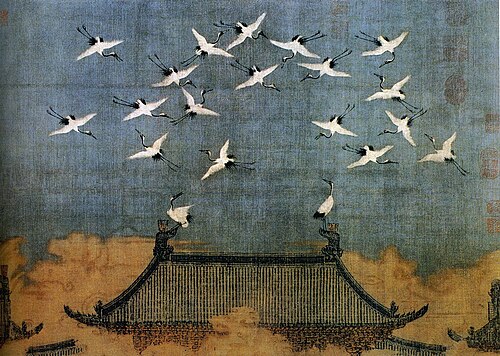
技術的に最も精巧な陶磁器の多くは帝国の窯で生産されたが、民窯や地方の工房でも芸術的に優れた作品が生み出された。一方、水墨画の伝統は、主に官僚や宮廷画家によって、特に風景、花、鳥などを題材として行われ、画家の個人的な想像力と客観的な観察に基づいた美的価値を発展させた。その美的価値は西洋のものと類似しているが、西洋における水墨画の発展よりもはるか以前に存在していた。
1949年の中華人民共和国建国後、社会主義リアリズムが公式に認められた主流の様式となり、伝統芸術はイデオロギー的な精査の対象となった。特に文化大革命(1966年~1976年)の間は、中国の芸術遺産の多くが積極的に抑圧または破壊された。1980年代以降、幅広い伝統芸術が復興・復活を遂げるとともに、現代のアバンギャルド運動も出現し、中国の芸術遺産と急速に変化する社会の両方に批判的に取り組む作品で国際的な評価を得ている。[ 5 ]
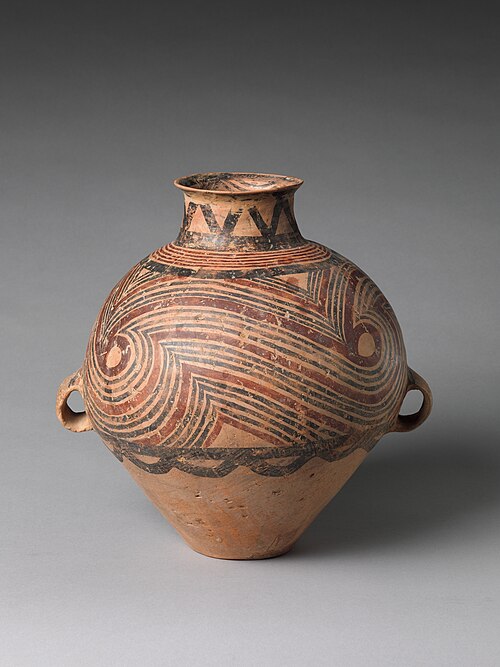
中国における初期の芸術は、紀元前6千年紀に遡る新石器時代の仰韶文化に見られます。半坡遺跡などの考古学的発見から、仰韶文化の人々が土器を作っていたことが明らかになっています。初期の土器は無彩色で、ほとんどが紐状模様でした。最初の装飾は魚、人の顔、植物で、農業中心の生活を送っていた仰韶文化の人々にとって馴染みのあるイメージでした。これらはやがて、幾何学模様や天文学に着想を得た模様を特徴とする、より色彩豊かで複雑な抽象的なデザインへと発展しました。後の龍山文化とは異なり、仰韶文化では土器作りにろくろは使用せず、むしろ紐作りなどの手作業による技法に頼っていました。しかし、仰韶文化の後期に平行線や格子模様のある土器が発掘されたことから、回転させて土器に絵付けをしていたことが示唆されています。[ 6 ]
描かれたシンボルやデザインの多くは、宗教的および精神的な意味を持っていた。カエルや魚をモチーフにした模様は繁栄を表し、鳥や水をモチーフにした模様は自然への敬意を表していた。踊りや狩りなど、コミュニティに関わる日常生活の場面は、仰韶文化の儀式や祭礼において重要な意味を持っていたと考えられる。[ 7 ]
発掘調査により、仰韶文化では壺葬の形で土器が用いられていたことが判明している。彩色された壺の模様の分析から、そのデザインは埋葬された人物の歴史的出来事や生活経験を反映していた可能性が高いことが分かっている。この意味で、壺葬は社会階級の指標としても機能し、埋葬された人物の権力、英雄性、社会における重要性を示していたと考えられる。同様に、龍山文化の人々も、高位の人物の埋葬に、翡翠などの美術品とともに土器を含めていた。 [ 7 ]



良渚文化は長江デルタにおける最後の新石器時代の玉器文化であり、約1300年にわたって栄えた。この文化の玉器は、琮円筒、璧、岳斧といった精巧に加工された大型の儀式用玉器に加え、彫刻を施した透かし彫りの板や皿、小鳥、亀、魚などを象ったペンダントや装飾品が特徴である。良渚玉器は、透閃石を起源とし、埋葬地で水系の液体の影響を受けたため、白く乳白色の骨のような外観を呈している。


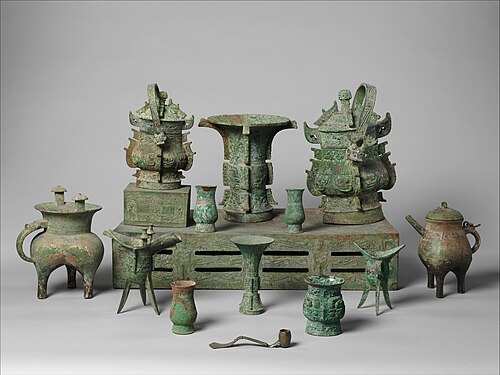
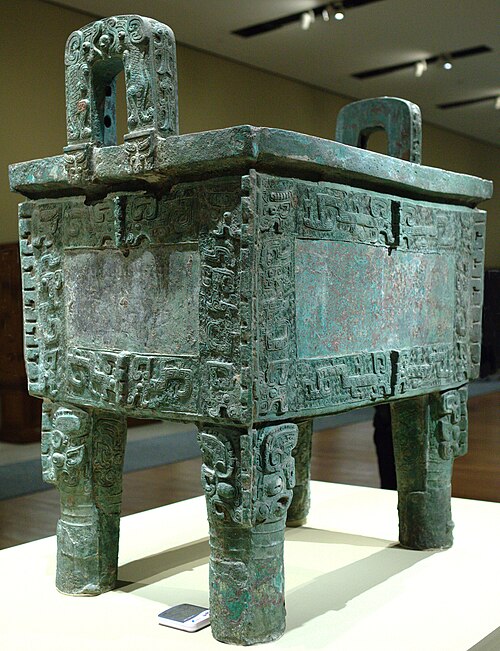
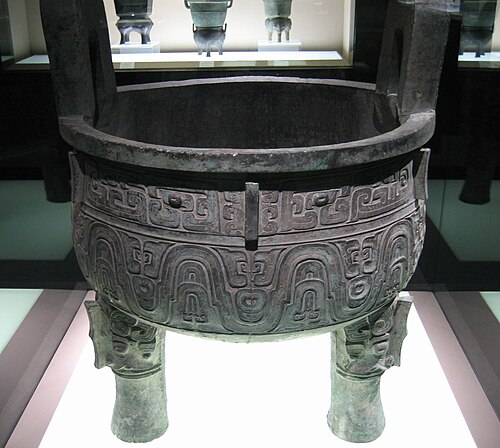
中国の青銅器時代は夏王朝から始まった。この時代の遺物は山西省の二里頭文化の遺跡から出土しており、複雑だが装飾のない実用的な品々が含まれている。続く殷王朝では、多くの儀式用器を含む、より精巧な品々が作られた。殷王朝は、細部まで鮮明な青銅鋳造で知られている。殷の青銅器職人は通常、都市外の鋳造所で儀式用器を製作し、時には武器や戦車の装飾品も製作した。青銅器は、神聖な儀式を行う際に使用される様々な固形物や液体を保管または提供するための容器であった。坤や奎などの形状は非常に優美であるが、最も力強いのは鼎であり、時に「獰猛な威厳」を湛えていると評される。
発展した殷様式の特徴は、利用可能な空間すべてが装飾され、多くの場合、実在または想像上の動物を様式化した形で表現されている点である。最も一般的なモチーフは饕餮(とうてつ)で、これは神話上の生き物を正面から、まるで水平面に押しつぶされたかのように対称的なデザインとして表現したものである。饕餮の初期の意義は明らかではないが、周王朝末期頃にはそれに関する神話が存在していた。それは、邪悪な怪物から天界の一角を守るために追放された貪欲な男、あるいは頭しか持たず人間を食い尽くそうとするものの、結局は自分自身を傷つけるだけの怪物など、様々な解釈がなされていた。
青銅器の機能と外観は、殷から周にかけて徐々に変化していった。宗教儀式での使用から、より実用的な用途へと移行し、戦国時代には、美的鑑賞の対象となった。宴会や狩猟といった社会的な場面を描いたものもあれば、金、銀、貴石や半貴石を象嵌した抽象的な模様を施したものもあった。
青銅器も漢王朝において重要な意味と役割を果たしました。人々は葬儀にこれらを使用し、漢王朝の美的および芸術的特質を反映しました。[ 10 ]中国江蘇省の墓から発掘された多くの青銅器は、丁、胡、迅などさまざまな形をしており、伝統的な中国の美意識を表しています。[ 10 ]これらの器は、古代中国人が祖先の霊と交信する上で大きな役割を果たした中国の天体芸術の古典的な表現です。[ 10 ]器以外にも、青銅製の武器、日用品、楽器も江蘇省の漢王朝の王族の墓から発見されています。完全な一式を墓に納めることができることは、漢王朝におけるその人の地位と階級を示しています。なぜなら、この種の楽器は王族や富裕層のみが入手し所有していたからです。[ 10 ]どうやら、ビアンジョンと音楽は、漢の支配者が神々と交信するための手段としても使われていたようです。[ 10 ]古代中国で発見された典型的な王室楽器であるビアンジョンの発掘は、漢王朝における複雑な音楽システムの発展を強調しています。[ 10 ]ビアンジョンのセットは多くの場合異なります。たとえば、江蘇省の特定のビアンジョンの発掘では、牛中や永中などの異なるセットの鐘が含まれており、その多くは中国の伝統的な霊獣である龍などの動物の形をしています。[ 10 ]
殷王朝の青銅器は、宋王朝以降、美術品として高く評価されるようになった。その形状やデザインだけでなく、地中に埋もれた際に化学反応によって生じた緑、青緑、さらには赤みがかった緑青といった様々な色合いも、収集され、珍重されたのである。中国初期の青銅鋳造の研究は、美術史における専門分野の一つである。






周の時代には、現存する考古学資料には彫刻、特に人間や動物の形の彫刻はほとんど記録されておらず、彫刻の伝統はほとんどなかったようです。[ 13 ] [ 14 ]周の時代以前に中国で知られている数少ない彫刻の中には、陝西省韓城市梁帶村から出土した4体の木製小像[ 15](紀元前9世紀頃)、陝西省龍県の秦の国陵から出土した2体の外国人の木製人型像(おそらく駕籠担ぎ)、浙江省紹興市のミニチュアハウスから出土した5世紀頃の青銅製の音楽家の小像、河北省平山県の王陵から出土した4世紀の人型のランプスタンドなどがあります。タエルポ騎馬像は、紀元前4世紀から3世紀にかけての、陝西省咸陽近郊のタエルポ墓地(塔兒坡墓)にある墓から出土した周時代の秦の武者国家のテラコッタ像である。同じ墓からは、これとほぼ同じ像がもう一体出土している。手に小さな穴が開いていることから、元々は片手に手綱、もう片方の手に武器を持っていたと考えられる。[ 16 ]これは中国で知られている最古の騎兵像である。[ 16 ]

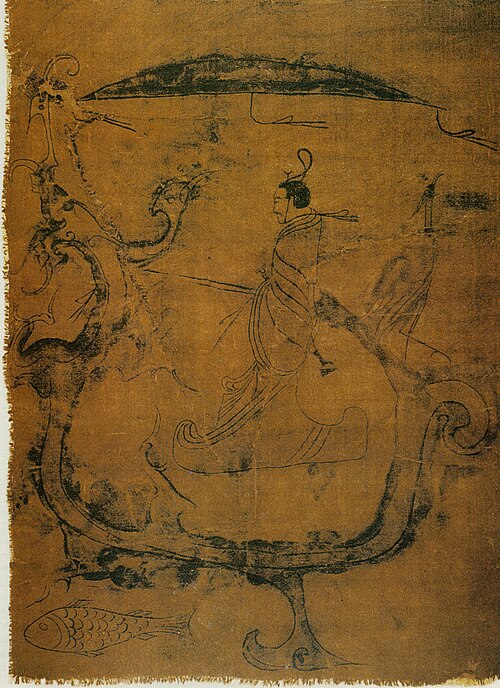


古代中国における芸術の宝庫の一つは、長江流域で発展した楚国であった。楚の墓の発掘調査では、彩色された木彫りの彫刻、玉盤、ガラス玉、楽器、そして様々な漆器が発見されている。漆器の多くは精緻な彩色が施されており、黒地に赤、あるいは赤地に黒の配色となっている。湖南省長沙の遺跡からは、現在までに発見された中で最も古い絹絵がいくつか見つかっている。


秦始皇帝陵にある兵馬俑は、紀元前210~209年に中国最初の皇帝を自称した秦始皇帝とともに埋葬された、7,000体以上の等身大の兵馬俑で構成されています。これらの兵馬俑は、納骨堂に納められる前に彩色されていました。発掘当初は元の色が確認できましたが、空気にさらされたことで顔料が退色し、現在ではテラコッタ色になっています。兵馬俑は、立っている歩兵や跪いている弓兵、馬に乗った御者など、さまざまなポーズをとっています。それぞれの兵馬俑の頭部は独特で、さまざまな顔の特徴や表情、髪型が見られます。これらの彫刻が示す驚くべき写実性は、秦王朝時代の芸術の進歩の証拠です。[ 17 ]東アジアの美術史において、前例のないものです。[ 13 ] [ 14 ]
秦の時代に秦琴と呼ばれる楽器が開発されました。中国の歴史において、楽器の美的要素は機能的な部分と同じくらい重要視されてきました。秦琴には7本の弦があります。秦琴は時に腐敗した歴史を連想させることもありますが、平和と調和をもたらす楽器としてしばしば考えられています。[ 18 ]

秦王朝時代には、さらなる統一を図るため、中国語のフォント、計測システム、通貨がすべて標準化された。[ 20 ]万里の長城は、北からの侵略者に対する防御施設として拡張された。[ 20 ]
漢王朝は翡翠の埋葬服で知られていた。中国美術における風景の最も初期の描写の一つは、紀元前60年の鄭州近郊の西漢時代の墓から出土した一対の中空タイル扉パネルである。 [ 21 ]道や庭の壁を表すジグザグの線によって連続的な奥行きの後退が表現され、丘の上から見下ろしているような印象を与える。[ 21 ]この芸術的な風景は、粘土がまだ柔らかく焼成されていない状態で、標準的なスタンプを繰り返し押して作られた。[ 21 ]しかし、古典的な意味での風景画の最も古い伝統は、隋王朝(581~618年)の詹子謙の作品である。
翡翠の工芸品以外にも、青銅は硬くて耐久性があるため、芸術家にとって好まれる素材です。青銅鏡は漢王朝で大量生産され、漢王朝のものとされている発掘された墓のほぼすべてに鏡が副葬品として納められています。[ 22 ]反射面は通常、青銅、銅、錫、鉛の混合物で作られています。[ 22 ]「鏡」という言葉は中国語で「映す」または「覗き込む」という意味なので、青銅鏡は現実を映し出す比喩として使われてきました。[ 22 ]古代中国人は、鏡は現実の表現として機能し、現在の状況をよりよく認識できると信じていました。また、鏡は過去の出来事の反映を伝えたり提示したりする媒体としても使われていました。[ 22 ]漢王朝で作られた青銅鏡は、反射しない面には常に複雑な装飾が施されており、物語を語る物語が含まれているものもあります。[ 22 ]物語自体は常に、漢民族の生活における共通かつ本質的な理論を反映している。[ 23 ]


中国ではテラコッタ像は古くから知られていたが、漢の武帝の将軍で匈奴と戦うために西域へ赴いた霍去兵(紀元前140~117年)の陵墓にある石像以前に、記念碑的な石像の例は知られていない。[ 24 ]文献資料には、紀元3~4世紀の記録が1つだけあり、秦始皇帝の陵墓の上に麒麟(中国のユニコーン)の記念碑的な石像が2体設置されたとされている。[ 25 ]霍去兵の像の中で最も有名なのは、馬が匈奴の戦士を踏みつけている像である。[ 24 ]
霍去病陵(茂陵、漢武帝陵に位置)には、さらに15体の石像がある。これらは「馬が匈奴を踏みつける」ほど写実的ではなく、石の自然な形状に沿って作られており、人物の細部は高浮彫りでのみ表現されている。[ 26 ]これらの初期の試みの後、記念碑的な石像の使用は西漢末期から東漢にかけて発展することになる。[ 27 ]
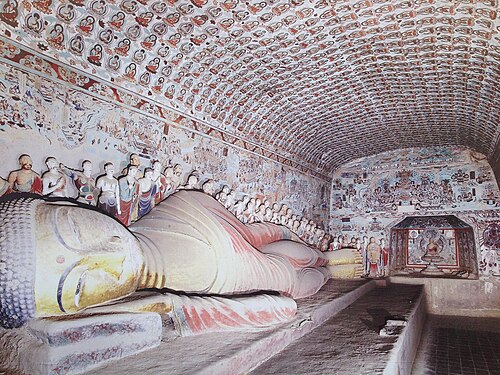
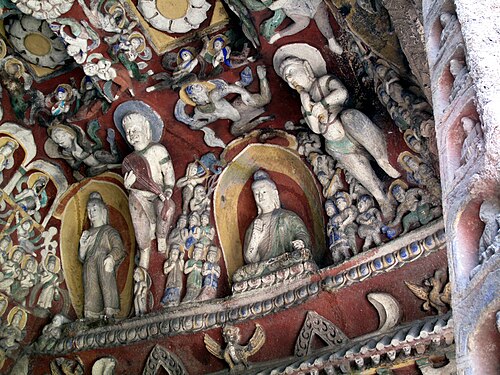
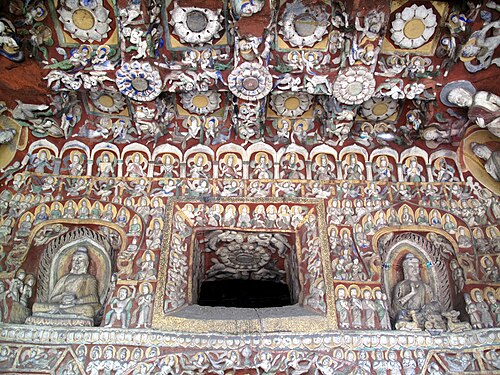
仏教は紀元1世紀頃に中国に伝来した(ただし、アショーカ王の治世中に僧侶が中国を訪れたという伝承もある)。そして8世紀にかけて、仏教は仏教美術、特に仏像の分野で非常に活発かつ創造的な発展を遂げた。遠く離れたこの宗教を受け入れた中国は、すぐにその芸術表現に強い中国的な特徴を取り入れた。
5世紀から6世紀にかけて、北朝は本来の源泉からやや離れ、図式的な線を用いた象徴的で抽象的な表現様式を発展させる傾向にあった。その様式は荘厳で威厳に満ちているとも言われている。この芸術の具象性の欠如、そして悟りの純粋な理想を分かりやすく写実的に表現するという仏教本来の目的からかけ離れていたことが、次第に自然主義と写実主義への探求へと繋がり、唐代仏教美術の表現へと至ったのである。
古代中国では、絵画と書道は宮廷で最も高く評価された芸術であり、優れた筆遣いに必要な技術と感性を磨く時間的余裕があったのは、主にアマチュア、貴族、官僚といった人々だけであった。書道は絵画の最高峰かつ最も純粋な形態と考えられていた。筆は動物の毛で作られ、墨は松の煤と動物の膠から作られていた。書道も絵画も絹に行われた。しかし、1世紀に紙が発明されると、絹は徐々に新しく安価な素材に取って代わられた。著名な書家による直筆は中国の歴史を通じて高く評価され、絵画と同様に巻物に巻かれて壁に掛けられた。
王羲之は、西暦4世紀に活躍した中国の著名な書家である。彼の最も有名な作品は、詩集の序文である『蘭庭序』である。この書体は、中国書道の歴史において、半草書体である「行体」の最高傑作としてしばしば称賛されている。
魏朔は東晋時代の著名な書家で、楷書に関する重要な規則を確立した人物である。彼女の代表作には、『名姫帖』や『衛氏和南帖』などがある。
顧愷之は無錫生まれの古代中国の著名な画家である。彼は絵画理論に関する3冊の著書、『画論』、『魏晋名画記』、『雲台山画記』を著した。彼は「人物画において、衣服や外見はそれほど重要ではない。目は精神であり、決定的な要素である」と記している。顧の絵画のうち、『女官訓令』、『洛神賦』、『賢慈女』の3点が今日まで残っている。
晋代の墓絵には他にも例がある。例えば、現在の南京近郊の墓のレンガ壁に描かれた「竹林七賢図」は、現在陝西省博物館に所蔵されている。それぞれの人物には名前が記されており、酒を飲んだり、書物を書いたり、楽器を演奏したりしている様子が描かれている。また、他の墓絵には、牛のチームを使って畑を耕す男たちなど、日常生活の場面を描いたものもある。

隋王朝の変遷を経て、唐代の仏像彫刻は著しく写実的な表現へと発展した。王朝がシルクロードを通じた外国貿易や影響に寛容であった結果、唐代の仏像彫刻は中央アジアのギリシャ・仏教美術に触発された、むしろ古典的な様式を帯びるようになった。
しかし、唐王朝末期になると、外国の影響は否定的に捉えられるようになった。845年、唐の武宗皇帝は、土着の道教を支援するため、すべての「外国」宗教(ネストリウス派キリスト教、ゾロアスター教、仏教を含む)を禁止した。彼は仏教徒の財産を没収し、信仰を地下に潜らせたため、中国における道教とその芸術のその後の発展に影響を与えた。
唐代の釉薬をかけた陶器や彩色陶器の墓碑は有名で、世界中の博物館に数多く所蔵されている。唐代の木彫のほとんどは現存していないが、日本の奈良では唐代国際様式の作品を見ることができる。石彫ははるかに長く保存されている。洛陽近郊の龍門、大同近郊の雲崗、甘粛省の炳霊寺などで、最高級の石彫を見ることができる。中国で最も有名な仏塔の一つは、西暦652年に建立された大雁塔である。

唐代(618~907年)以降、絵画の主要な主題は山水画として知られる風景画となった。これらの風景画は通常、単色で簡素な構成であり、自然の外観を正確に再現することではなく、自然の「リズム」を捉えるために、感情や雰囲気を表現することを目的としていた。
伝統的な絵画様式は、基本的に書道と同じ技法を用い、黒または色のついた墨をつけた筆で描かれました。油絵具は使用されませんでした。書道と同様に、絵画の素材として最もよく用いられたのは紙と絹でした。完成した作品は巻物に巻かれ、掛けたり巻き上げたりして飾られました。伝統的な絵画は、画帖、壁画、漆器など、他の媒体にも用いられました。
董源は南唐時代に活躍した画家である。人物画と山水画の両方で知られ、その後900年にわたり中国の水墨画の標準となる優雅な様式を確立した。中国の多くの画家と同様に、董源も官吏として、李思訓や王維といった既存の画家の様式を学んだ。しかし、彼はより洗練された遠近法、点描、ハッチングなどの技法を取り入れ、生き生きとした効果を生み出した。
詹子謙は隋代の画家である。現存する彼の唯一の作品は、山々を遠近法で配置した「春の散策図」である。17世紀までヨーロッパでは純粋な風景画はほとんど見られなかったため、 「春の散策図」は世界初の風景画である可能性が高い。


宋代(960~1279年)には、より繊細な表現の風景画が現れた。ぼやけた輪郭、霧の中に消えゆく山並み、そして印象派的な自然現象の描写を通して、計り知れない距離感が表現された。絵画の精神的な側面、そして道教や仏教の概念に基づき、人間と自然の内なる調和を描き出す画家の能力が重視された。
梁楷は13世紀(宋代)に生きた中国の画家です。彼は自らを「狂人梁」と称し、生涯を酒と絵に捧げました。やがて隠居し、禅僧となりました。梁楷は中国美術の禅宗を創始した人物として知られています。文統は11世紀に生きた画家です。彼は竹の墨絵で有名でした。彼は片手に2本の筆を持ち、異なる距離にある2本の竹を同時に描くことができました。彼は多くの竹を見てきたため、描く際に竹を見る必要はありませんでした。
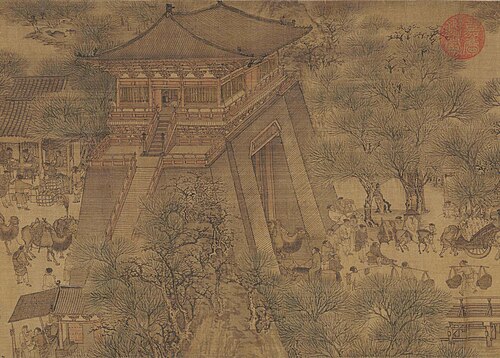
張沢端は、横長の風景画「清明節の河畔図」で有名な画家です。これは中国で最も有名な絵画の1つと考えられており、中国の歴史を通じて多くの有名なリメイクが作られてきました。 [ 29 ]他の有名な絵画には、10 世紀の南唐の画家、顧洪忠が描いた「韓熙載夜宴」があり、彼の絵画の有名なバージョンは、12 世紀の宋王朝によるリメイクです。これは、貴族階級の男性が女中によって提供された食べ物、飲み物、洗面器を楽しみながら、音楽家や踊り子に楽しませてもらっている家庭の情景を描いた大きな横長の手巻です。2000 年、現代アーティストの王慶松は、現代の服を着た人々が元の絵画と同様の表情、ポーズ、手のジェスチャーをしている横長の写真でこの絵画のパロディを作成しました。


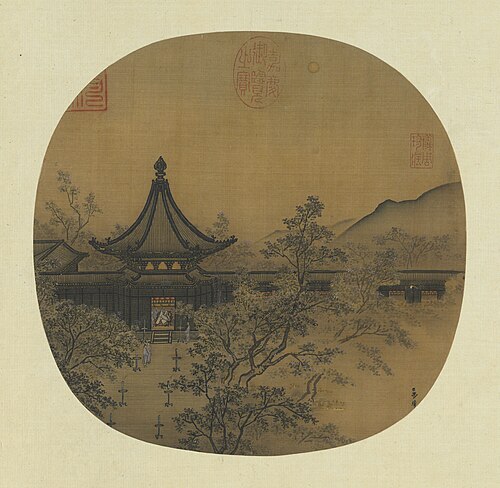


1279年の宋王朝の滅亡と、モンゴル征服者による元王朝の建国によって引き起こされた混乱により、多くの宮廷芸術家や文芸家は社会生活から身を引き、山水画を通して自然に回帰し、唐時代の「青緑」様式を刷新した。[ 30 ]
王蒙はそのような画家の一人で、彼の最も有名な作品の一つは「森の洞窟」である。趙孟甫は元代の中国の学者、画家、書家であった。彼が当時の洗練された柔らかな筆致を拒否し、8世紀の粗野な様式を好んだことが、近代中国山水画を生み出す革命をもたらしたと考えられている。宋朝に仕え、愛国心からモンゴルへの仕えを拒否し、絵画に転向した銭玄(1235年 - 1305年)による鮮やかで緻密な作品もあった。彼は唐代の絵画様式を復興・再現したことでも有名である。
元朝後期は、いわゆる「四大巨匠」の作品によって特徴づけられる。その中でも最も著名なのは黄公望(1269-1354)で、彼の涼やかで抑制された山水画は同時代の人々や後世の中国の文人画家たちに賞賛された。もう一人大きな影響力を持ったのは倪瓚(1301-1374)で、彼はしばしば力強く明確な前景と背景を持つ構図を用い、中景を空白のままにした。この手法は後の明朝や清朝の画家たちにもしばしば採用された。[ 30 ]
中国の磁器は、カオリンという粘土とペトゥンツェと呼ばれる長石から作られた硬いペーストで作られ、これが器を固め、あらゆる気孔を塞ぎます。中国は高品質の磁器の代名詞となっています。ほとんどの陶磁器は江西省の景徳鎮市で生産されています。景徳鎮磁器は、さまざまな名称で呼ばれていますが、少なくとも元王朝以来、中国の磁器生産の中心となっています。
明王朝時代には、中国文化が花開いた。宋代の絵画よりも色彩の幅が広く、構図もはるかに複雑な物語画が、当時非常に人気を博した。
文正明(1470年 - 1559年)は蘇州で呉派の様式を発展させ、16世紀の中国絵画を支配した。[ 31 ]
董啓昌(1555年 - 1636年)は、禅宗の思想を取り入れ、「南北派」理論を提唱することで、東アジア美術史にさらに影響を与えた。 [ 32 ]
この時期にヨーロッパ文化が中国美術に影響を与え始めた。イエズス会司祭のマテオ・リッチは多くの西洋美術品を持って南京を訪れ、遠近法や陰影表現のさまざまな技法を示す上で影響を与えた。[ 33 ]


清朝初期の絵画は、正統派と個人主義派という二つの主要な流れに分かれて発展した。どちらも董啓昌の理論を踏襲していたが、強調する側面は大きく異なっていた。[ 34 ]清朝の宮廷絵画は、ジャン・ドニ・アティレ(1702-1768)やジュゼッペ・カスティリオーネ(1688-1766)といった西洋の画家からも大きな影響を受けていた。[ 32 ]
王建(1598-1677)や王世民(1592-1680)を含む四王は、正統派で特に名高く、過去の様式、特に古代の巨匠の筆遣いや書道の技術を再現することにインスピレーションを求めた。弟の王元祁(1642-1715)は、古代の巨匠の作品に取り組み、そこからインスピレーションを得るという手法を儀式化した。彼自身の作品には、自分の絵画が巨匠のモデルとどのように関連しているかについての理論がしばしば注釈として書き込まれていた。[ 35 ]
個人主義の画家には、八大山人(1626年~1705年)や石濤(1641年~1707年)などがいる。彼らは伝統を超越して独自の個人主義的なスタイルを確立するという革命的な思想をより強く受け継いでおり、その点では正統派(董啓昌の公式な直弟子)よりも董啓昌の道を忠実に辿っていた。[ 36 ]
文人や貴族の伝統にとらわれない画家たちも名声を得ており、中には金銭目的で絵を描いた画家もいた。その一人に馬泉(17世紀後半~18世紀)がおり、彼女は学者の間では一般的ではなかった花、鳥、昆虫などを描いた。しかし、こうした画家たちは正式な絵画流派から切り離されていたわけではなく、通常は芸術様式や技法に精通していた。例えば、馬泉は宋代の作例を参考に筆遣いをしていた。[ 37 ]同時に、唐代に金線画を描く際の準備段階として始まったと考えられている無骨画(中国語:沒骨畫)は、雲寿平(1633~1690)やその子孫である雲冰などの画家によって受け継がれた。[ 38 ]
色彩印刷の技術が完成するにつれ、絵画技法に関する図解入りの手引書が出版されるようになった。 1679年に初版が刊行された全5巻の『芥子園花伝』は、以来、画家や学生のための技術教科書として用いられ続けている。

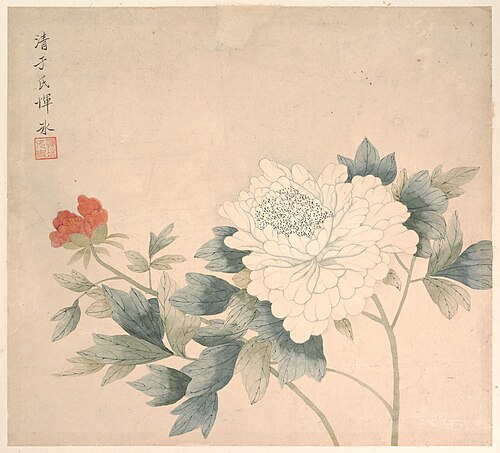

清朝末期とは、一般的に1840年のアヘン戦争から1912年の清朝滅亡までの期間を指す。この期間、清朝の国力は衰退し、内外の混乱が絶えず、戦争が頻繁に起こり、国は開国を余儀なくされた。[ 39 ]西洋文化と商業経済が大量に中国に流入し、伝統的な封建社会構造は徐々に崩壊した。都市商業、特に上海のような貿易港では急速に発展した。
社会情勢の劇的な変化は絵画の発展に直接的な影響を与えた。かつて宮廷や学者、文人のために制作されていた伝統的な絵画は、高尚で閉鎖的な様式にとどまらず、庶民や市場へと向かうようになった。中国と西洋の文化の衝突もまた、絵画が古来の技法に固執しなくなるきっかけとなり、美意識と様式に大きな変革をもたらした。世俗化、商業化、そして中国と西洋文化の融合は、清朝末期の絵画の最も顕著な特徴となった。
清朝末期の最も代表的な絵画流派は、上海の貿易港を中心として出現した上海派(海派)であった。[ 40 ]上海の商業発展と都市中産階級の拡大に伴い、書画は取引可能な商品となった。画家たちはもはや学者の高尚な芸術的概念を追求するだけでなく、一般大衆の美的基準に応えるようになった。題材はより大衆的になり、色彩はより鮮やかになり、絵画はより生き生きとして魅力的になった。
上海派の代表的な人物としては、任伯年、呉長朔、徐固、趙志謙などが挙げられる。様式面では、清朝中期と比べて大きな変化が見られる。もはや盲目的に優雅さと冷たさを追求するのではなく、色彩は豊かで明るく、筆遣いは自由奔放である。[ 41 ]主題は、伝統的な山水隠遁から庶民、花鳥、吉祥獣、民間の吉祥題へと拡大した。同時に、金属や石の書道の力強い筆遣いを取り入れ、洗練された趣味と庶民の趣味の両方に訴える、豊かで壮大な構図となっている。文人画の伝統的な筆墨の基盤を維持しつつ、市民の生活や商業市場と密接に結びついており、近代中国絵画の変革の重要な基盤を築いている。

年画は中国の彩色木版画の一種で、旧正月の装飾に用いられる絵柄が描かれていた。19世紀には、年画はニュース媒体としても利用された。
上海派は、清朝時代から20世紀にかけての中国伝統芸術において非常に重要な流派です。この流派の巨匠たちの尽力により、中国の伝統芸術は新たな頂点を迎え、中国絵画(中國画)、略して国画(国画)という形で現代まで受け継がれています。上海派は、中国芸術における文人主義の伝統に挑戦し、それを打破すると同時に、古代の巨匠たちに技術的な敬意を払い、既存の伝統技法を改良しました。この流派のメンバーは、自らの地位や芸術の意義に疑問を抱き、迫り来る中国社会の近代化を予見していた、教養ある文人たちでした。急速な社会変化の時代において、上海派の作品は革新的で多様性に富み、しばしば思慮深くも繊細な社会批評を含んでいました。この学校の最も有名な人物は、Ren Xiong、Ren Bonian、Zhao Zhiqian、Wu Changshuo、Sha Menghai、Pan Tianshou、Fu Baoshi、He Tianjian、およびXie Zhiliuです。その他の有名な画家としては、王振、張雄、楊伯潤などが挙げられます。

中国の伝統的な絵画は、中国の書道と同様に、黒または色のついた墨をつけた筆で描かれ、油絵具は使用されません。書道と同様に、絵画の素材として最もよく用いられるのは紙と絹です。完成した作品は、掛け軸や巻物などの巻物に貼り付けられます。また、伝統的な絵画は、画帖、壁、漆器、屏風など、様々な媒体に描かれます。
中国絵画の主な技法は以下の2つです。
漢王朝から唐王朝にかけての画家たちは、主に人物像を描いた。初期の中国人物画について知られていることの多くは、埋葬地から出土したもので、そこには絹の旗、漆器、墓の壁などに描かれた絵画が保存されている。初期の墓絵の多くは、死者を守護したり、魂が天国へ行けるように助けることを目的としていた。また、中国の哲学者孔子の教えを描いたものや、日常生活の場面を描いたものもあった。中国の肖像画のほとんどは、正面からの正式な全身像で、家族内で祖先崇拝に用いられた。皇帝の肖像画はより自由であったが、一般的には宮廷の外で見られることはなく、他の文化圏とは異なり、肖像画は皇帝のプロパガンダの一部ではなかった。
多くの批評家は、山水画を中国絵画の最高峰とみなしている。五代十国時代から北宋時代(907年~1127年)にかけての時代は、「中国山水画の黄金時代」として知られている。北では、景浩、李成、范寛、郭熙といった画家たちが、力強い黒線、水墨画、鋭い点描を用いて険しい岩肌を表現し、そびえ立つ山々を描いた。一方、南では、董源、巨然らが、故郷の田園地帯のなだらかな丘陵や河川を、柔らかな筆致で穏やかな情景として描いた。これら二種類の情景と技法が、中国山水画の古典的な様式となった。


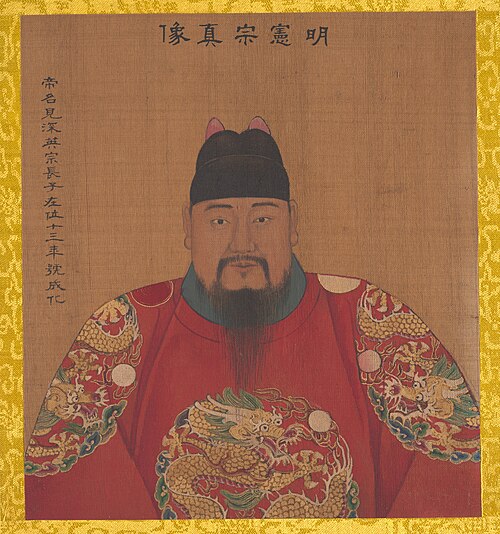


殷王朝と西周王朝の中国の儀式用青銅器は、紀元前1500年頃から千年以上にわたって作られ、中国美術に継続的な影響を与えてきました。複雑な模様や動物をモチーフにした装飾が施されていますが、最近三星堆で発見された巨大な像とは異なり、人間の姿は描かれていません。[ 46 ]壮大な兵馬俑は、紀元前221年から210年にかけて統一中国を統治した最初の皇帝、秦始皇の墓のために集められました。これは、死者が生前と同じ生活を来世でも楽しめるように、古くから墓に置かれてきた像の壮大な皇帝版であり、非常に初期の時代の実際の供犠に取って代わるものでした。陶器や木製の小さな像はその後何世紀にもわたって墓に置かれ、唐王朝の墓像でその質が最高潮に達しました。[ 47 ]
中国の土着宗教では、通常、神々の崇拝像を使用したり、神々を表現したりすることはなく、大型の宗教彫刻はほぼすべて仏教のもので、主に4世紀から14世紀にかけてのもので、当初はシルクロード経由で伝わったギリシャ仏教のモデルを使用していた。仏教はまた、すべての大型肖像彫刻の背景でもある。中世中国の他の地域とは全く対照的に、皇帝の絵画でさえ私的なものと見なされていた。皇帝の陵墓には、エジプトに匹敵する規模で実在および神話上の動物が並ぶ壮大な参道があり、より小さなバージョンが寺院や宮殿を飾っている。[ 48 ] 小型の仏像や群像は、さまざまな素材で非常に高い品質で制作され、[ 49 ]あらゆる種類の物品、特に金属細工や翡翠の浮彫装飾も同様であった。[ 50 ]あらゆる種類の彫刻家は職人と見なされており、名前が記録されているものはごくわずかである。[ 51 ]


Chinese ceramic ware shows a continuous development since the pre-dynastic periods, and is one of the most significant forms of Chinese art. China is richly endowed with the raw materials needed for making ceramics. The first types of ceramics were made during the Palaeolithic era, and in later periods range from construction materials such as bricks and tiles, to hand-built pottery vessels fired in bonfires or kilns, to the sophisticated Chinese porcelain wares made for the imperial court. Most later Chinese ceramics, even of the finest quality, were made on an industrial scale, thus very few individual potters or painters are known. Many of the most renowned workshops were owned by or reserved for the Emperor, and large quantities of ceramics were exported as diplomatic gifts or for trade from an early date.
The Song dynasty (960–1279) is often regarded as the golden age of Chinese ceramics, particularly for its refined monochrome wares. The "Five Great Kilns", Ru, Guan, Ge, Jun, and Ding, produced wares for the imperial court that have been prized by collectors for centuries.[52]
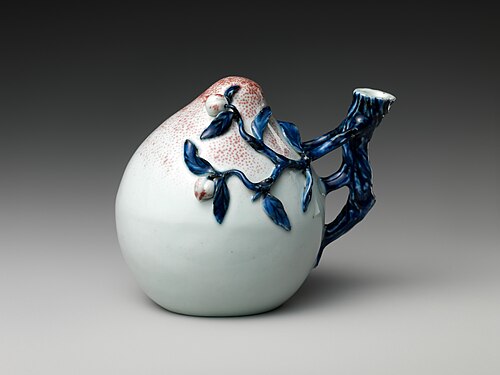
With the advent of the Ming Dynasty (1368-1644), Chinese ceramic art ushered in another golden age. Supported by the imperial court, the official kilns were defined by rigorous craftsmanship and strict regulations.[53] Ming Dynasty blue-and-white porcelain, notable for its balanced blue glaze and dynamic patterns, became a signature category. Themes included landscapes, flowers and birds, figures, and auspicious designs. This not only highlighted royal grandeur but also integrated folk aesthetics. Additionally, underglaze red porcelain, using copper for its vivid color, stands out for its firing difficulty and rarity. In the late Ming Dynasty, polychrome porcelain emerged, introducing rich colors, strong contrasts, and elaborate decorations. This innovation broke away from monochrome styles and advanced ceramic decorative art.
As China entered the modern era, ceramic craftsmanship continued to evolve, blending traditional manual skills with modern industrial technology. Despite these changes, Jing De Zhen's role as the porcelain capital remains unchanged. It preserves the essence of traditional ceramic craftsmanship and classic production techniques, such as blue-and-white porcelain and powder enamel, while embracing innovation through modern design concepts.[54] This enables the development of ceramic works that suit contemporary lifestyles and tastes. In this new context, Jing De Zhen serves as both the core base for China's ceramic production and research and a key platform for cultural exchange between Chinese and foreign ceramics. Traditional handcrafted kilns coexist with modern ceramic enterprises, retaining time-honored processes such as "throwing, glazing, and firing" while integrating modern technology to optimize processes and improve quality.[54] Through continuous innovation and inheritance, Chinese ceramic art maintains its unique charm, becoming a cultural bridge connecting the past, present, and world.


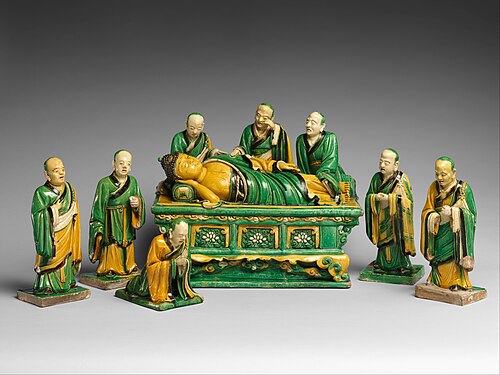

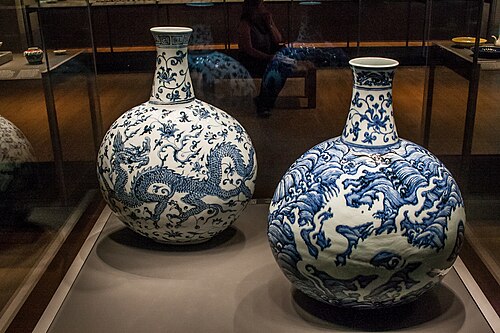

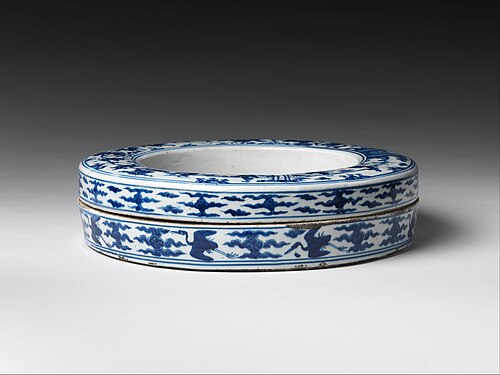


Chinese furniture, particularly from the Ming dynasty (1368–1644), is regarded as one of the highest achievements in furniture design and craftsmanship. Ming furniture is characterized by elegant proportions, minimal ornamentation, and sophisticated joinery techniques that require no nails or glue. Its aesthetic principles, emphasizing negative space, structural honesty, and the natural beauty of materials, have influenced modern designers, including Danish furniture maker Hans Wegner.[55] The modern systematic study of classical Chinese furniture began with scholar Wang Shixiang (王世襄, 1914–2009), whose Classic Chinese Furniture: Ming and Early Qing Dynasties (1985) established the field.[56][57]
The most prized materials are huanghuali (黃花梨, a type of rosewood) and zitan (紫檀, padauk), both dense hardwoods with distinctive grain patterns, Hongmu (紅木, blackwood) was also widely used for fine furniture, particularly in the Qing dynasty. These woods were scarce even during the Ming dynasty and are now extremely rare. The refined aesthetics of Ming furniture—clean lines, subtle curves, and respect for natural wood grain—reflect the tastes of the scholar-official class and literati culture.[58]
Construction relies on complex mortise-and-tenon joinery (榫卯結構), with dozens of distinct joint types developed over centuries. This interlocking system allows furniture to expand and contract with humidity changes while maintaining structural integrity for hundreds of years.[59]
Qing dynasty furniture (1644–1912) shifted toward heavier proportions, more elaborate carving, and the use of lacquer and inlay decoration, reflecting Manchu court tastes and increased contact with European design.[60][61]


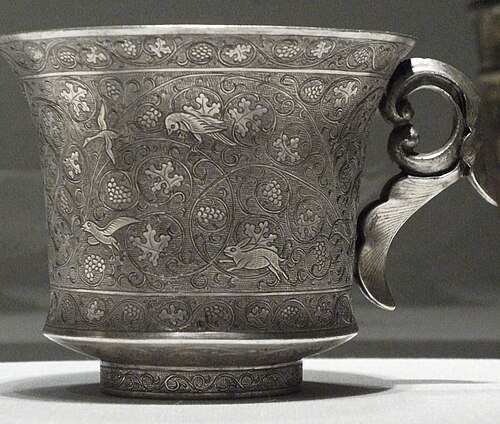
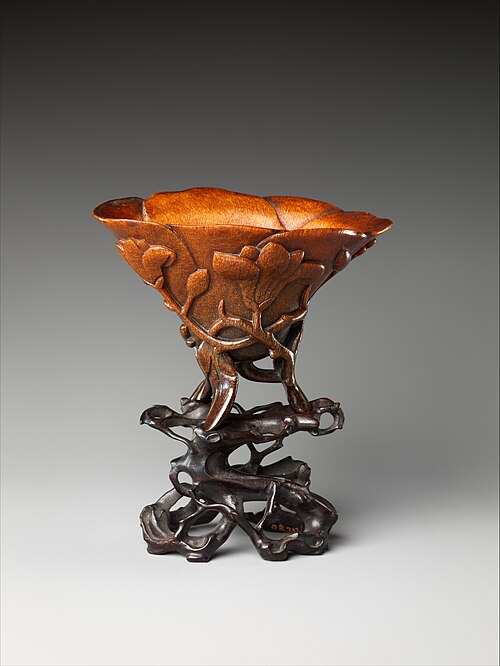
As well as porcelain, a wide range of materials that were more valuable were worked and decorated with great skill for a range of uses or just for display.[50] Chinese jade was attributed with magical powers, and was used in the Stone and Bronze Ages for large and impractical versions of everyday weapons and tools, as well as the bi disks and cong vessels.[62] Later a range of objects and small sculptures were carved in jade, a difficult and time-consuming technique. Bronze, gold and silver, rhinoceros horn, Chinese silk, ivory, lacquer and carved lacquer, cloisonne enamel and many other materials had specialist artists working in them. Cloisonne underwent an interesting process of artistic hybridization in China, particularly in the pieces promoted by missionaries and Chinese Christian communities.[63]
Folding screens (Chinese:屏風; pinyin:píngfēng) are often decorated with beautiful art; major themes include mythology, scenes of palace life, and nature. Materials such as wood panel, paper and silk are used in making folding screens. They were considered ideal ornaments for many painters to display their paintings and calligraphy.[64][65] Many artists painted on paper or silk and applied it onto the folding screen.[64] There were two distinct artistic folding screens mentioned in historical literature of the era.



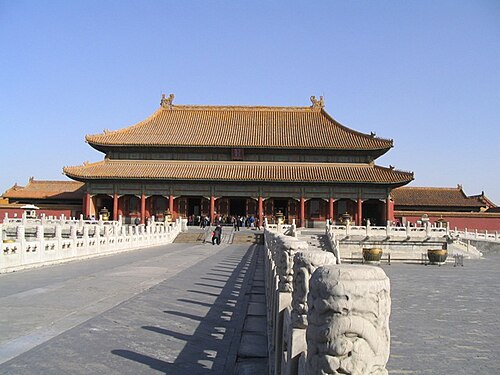
Chinese architecture refers to a style of architecture that has taken shape in East Asia over many centuries. Especially Japan, Korea, Vietnam and Ryukyu. The structural principles of Chinese architecture have remained largely unchanged, the main changes being only the decorative details. Since the Tang dynasty, Chinese architecture has had a major influence on the architectural styles of Korea, Vietnam, and Japan.
From the Neolithic era Longshan culture and Bronze Age era Erlitou culture, the earliest rammed earth fortifications exist, with evidence of timber architecture. The subterranean ruins of the palace at Yinxu dates back to the Shang. In historic China, architectural emphasis was laid upon the horizontal axis, in particular the construction of a heavy platform and a large roof that floats over this base, with the vertical walls not as well emphasized. This contrasts Western architecture, which tends to grow in height and depth. Chinese architecture stresses the visual impact of the width of the buildings. The deviation from this standard is the tower architecture of the Chinese tradition, which began as a native tradition and was eventually influenced by the Buddhist building for housing religious sutras—the stupa—which came from Nepal. Ancient Chinese tomb model representations of multiple story residential towers and watchtowers date to the Han. However, the earliest extant Buddhist Chinese pagoda is the Songyue Pagoda, a 40 m (130 ft) tall circular-based brick tower built in Henan in the year 523 CE From the 6th century onwards, stone-based structures become more common, while the earliest are from stone and brick arches found in Han dynasty tombs. The Zhaozhou Bridge built from 595 to 605 CEis China's oldest extant stone bridge, as well as the world's oldest fully stone open-spandrel segmental arch bridge.
The vocational trade of architect, craftsman, and engineer was not as highly respected in premodern Chinese society as the scholar-bureaucrats who were drafted into the government by the civil service examination system. Much of the knowledge about early Chinese architecture was passed on from one tradesman to his son or associative apprentice. However, there were several early treatises on architecture in China, with encyclopedic information on architecture dating back to the Han dynasty. The height of the classical Chinese architectural tradition in writing and illustration can be found in the Yingzao Fashi, a building manual written by 1100 and published by Li Jie (1065–1110) in 1103. In it there are numerous and meticulous illustrations and diagrams showing the assembly of halls and building components, as well as classifying structure types and building components.
There were certain architectural features that were reserved solely for buildings built for the Emperor of China. One example is the use of yellow roof tiles; yellow having been the Imperial color, yellow roof tiles still adorn most of the buildings within the Forbidden City. The Temple of Heaven, however, uses blue roof tiles to symbolize the sky. The roofs are almost invariably supported by brackets, a feature shared only with the largest of religious buildings. The wooden columns of the buildings, as well as the surface of the walls, tend to be red in colour.
Modern Chinese architecture has been shaped by multiple influences: Soviet-style architecture dominated the 1950s, exemplified by the Ten Great Buildings of Beijing (1959); since the Reform and Opening (1978), post-modern and Western styles have become prevalent, with international architects such as I. M. Pei, Rem Koolhaas, and Zaha Hadid contributing major projects.


The movement to modernize Chinese art started toward the end of the Qing dynasty. The traditional art form started to lose its appeal as the feudalistic structure of the society was dissolving. The modern view of the world had to be expressed in a different form. The explorations went on two main paths: one was to draw from the past to enrich the present (汲古潤今)*, the other was to "learn the new methods" (學習新法).*[66]

The literati art for the social elite was not appealing to the bourgeois patrons. Wu Changshuo (1844–1927) was among the Shanghai-based artists responsible for flowers and plants as the subject matter. His paintings used bold colors and energetic brush strokes, making them more accessible to the general public. Qi Baishi (1864–1957) painted images like crabs and shrimps that were even more approachable to the common people. Huang Binhong (1865–1955) denounced the literati paintings of the Qing dynasty and created his own style of landscape paintings by extensive investigations in Chinese art history. Zhang Daqian (1899–1983) used wall paintings in the Dunhuang (敦煌) caves to help him move beyond the literati tradition.
The Lingnan School (岭南画派) made some borrowings from the language of Western art in their ink paintings. Gao Jianfu (1879–1951), one of the founders of Lingnan School, was an active participant in the revolutionary movement of Sun Yat-sen (1866–1925). He was innovative in that he intended to use his paintings to highlight national issues, a medium for positive change in society.


A more radical style change started with Kang Youwei (1858–1927), a reformer who admired the more reality-based art of the Song dynasty. He believed that Chinese art could be rejuvenated by employing the reality-oriented art techniques of Europe. Xu Beihong (1895–1953) took this idea to heart and went to Paris to acquire the necessary skills. Liu Haisu (1896–1994), on the other hand, went to Japan to learn western techniques. Both Xu, and Liu became presidents of prestigious art schools, instilling new concepts and skills in the next generation of artists. Cai Yuanpei (1868–1940) was one of the leaders in the New Culture Movement (新文化运动). Those involved believed that intellectual activities should benefit all, not just the elites. Cai's belief that art could play a public, socially reformist role was adopted by Lin Fengmian (1900–1991).
Together with Yan Wenliang (1893–1988), Xu, Liu, and Lin were considered the "Four Great Academy Presidents" (四大校長), who spearheaded the national modern art movement. However, the subsequent upheaval caused by the Sino–Japanese war and the civil war did not allow this movement to grow. The Chinese modern art movement after the war developed differently in the four the regions: the Mainland, Taiwan, Hong Kong, and overseas.
The postwar era is roughly from 1949, the end of Chinese civil war, to 1976, the opening of mainland China to the outside world.
The postwar era in mainland China could be divided into two periods: 1949 to 1966 is generally called "The 17 Years"; 1966 to 1976 is the period of the "Cultural Revolution".
Chinese artists adopted social realism as a form of expression; it was a combination of revolutionary realism and revolutionary romanticism. Artwork was not valued on its own terms but was subservient to a political purpose. According to Mao Zedong, art should be a "powerful weapon for uniting and educating the people, fighting and destroying the enemy". Praising political leaders and celebrating the achievements of socialism became the theme of all artwork. Western art forms, including Cubism, Fauvism, Abstraction, and Expressionism were deemed superficial and were categorized as formalism.
The biggest blow to art was the Anti-Rightist Campaign of 1957. Artists who were labeled as rightists were stripped of their right to create and even their jobs, and worse, the social standing of the artists and their families was placed at the lowest level, causing great mental suffering.
Some influential paintings from this period are:
These ten years could also be called the "Ten Years of Calamity" (十年浩劫). In order to destroy everything that supported the old social order, countless temples, historic sites, artworks, and books were ravaged and burnt. During this period the portrait of Mao and propaganda posters of revolution were everywhere. Anything that was remotely suspected of being out of line was destroyed, and the person behind it was prosecuted. For example, Owl by Huang Yongyu had one eye open and one eye closed; it was deemed an expression of dissatisfaction with current events. Zong Qixiang's painting, which shows three tigers, was deemed critical of the leader Lin Biao, whose name contained a character that had three tigers in it. Residual Lotus by Li Kuchan had eight lotus flowers; it was deemed to be critical of the eight communist approved movies (样板戏). Many prominent artists were persecuted during this time. For example, Yan, Xu, Liu, and Lin, the "Four Great Academy Presidents" 四大校長 (except for Xu who died before the Cultural Revolution), were all prosecuted and jailed, and all their work was destroyed during this time. However, despite the difficult environment, some noteworthy paintings were created. The following are some examples:
Hong Kong was a British colony from 1842 to 1997. The local art organizations were mostly run by Westerners who outnumbered Chinese painters until a large migration of Chinese from Southern China during Sino–Japanese War. Innovative art colleges were established after the war. The shows organized by local artists started in the early 1960s. After a reaction against the traditional Western artistic practices of the 1940s and the 1950s, some experimental works that combined both western and eastern techniques were made. Then came the call for a return to Chinese traditional art and the creation of forms of art that Hong Kong could call its own. The trend was led by Lui Shou Kwan. Some western concepts were incorporated into his Chinese ink paintings.[67]
Many Chinese artists went to study western art in Paris in the early 1900s, for example: Fang Ganmin (方幹民), Wu Dayu (吳大羽), Ong Schan Tchow (翁占秋), Lin Fengmian (林風眠), Yan Wenliang (顏文樑), Wu Guanzhong (吳冠中), Zao Wou-Ki (趟無極). All except Zao completed their education before 1949 and returned to become leaders in the modern art movement. (Zao happened to be in Paris in 1949 and did not return.) Some Chinese artists went to stay there because of the rich international art environment, for example: Sanyu, Pan Yuliang (潘玉良), Chu Teh-Chun (朱德群). Zao, Sanyu, Pang, and Chu all had shows in Paris and the Republic. All their paintings had varying degrees of Chinese elements in them. These artists not only had a profound influence in Chinese modern art, but they also continued to engage Parisians with modern art from the East.[68]
Li Tiefu (1869–1952) was an accomplished oil painter educated in Canada and the United States. He was an active participant in the revolutionary movement of Sun Yat-sen (1866–1925).
Zeng Youhe 曾佑和 (1925–2017)[69] was born in Beijing. She started receiving international recognition in 1946, when Michael Sullivan began praising and writing about her work. Zeng moved to Honolulu in 1949 and visited Hong Kong and Taiwan in 1960. Like those of the Fifth Moon Group (五月畫會), her paintings were abstract; but the flavor of traditional Chinese ink paintings were not as pronounced.
Because of its history, traditional Chinese art does not have strong roots in Taiwan. The art forms in Taiwan were generally decorative, until youths growing up under the Japanese occupation received formal art education in Japan. Not burdened with traditional art form, their exploration generally followed the path of "learning the new methods" (學習新法). When the Nationalists arrived in Taiwan, a group of ambitious youths who came with the Nationalists continued the modern art movement. The most notable were the Fifth Moon Group (五月畫會) and the Ton-Fan Art Group (東方畫會).

The original members of the group were alumni with art majors from the Academic Teachers College (師範大學), the only university with an art major at the time. Their first intention was to show that the effort to create new art was worthwhile in itself, even if it did not directly enhance art pedagogy. Later, it became a movement to modernize Chinese art.
The members of the Fifth Moon Group studied western art movements, and concluded that the abstract art form was the best medium for modern Chinese art. They felt the best the Chinese paintings were ones that de-emphasized realistic representation, and emphasized atmosphere and "vividness", which comes from the brush strokes and the natural interaction between ink and paper. To further that idea, one does not need representation of objects in painting, or strictly use ink and paper. The beauty of a painting can be appreciated directly from the forms, textures, and colors on the canvas without their relation to real objects. The group was active from 1957 to 1972. The main members are Liu Guosong, Chuang Che (莊喆), Hu Chi-Chung (胡奇中), Fong Chung-ray (馮鍾睿), and Han Hsiang-ning.
The members of this group were students who attended private art classes offered by Li Zhongsheng (李仲生), a mainland-born artist who had been one of the active participants in the modern art movement. He and a number of mainland artists who painted in a western style continued the modern art movement by publishing magazines and writing articles to introduce modern art to Taiwan. His teaching style was unconventional and socratic in nature.
The original intention of the group was to introduce modern art to the public. They believed there should be no restriction on the form or style of a modern Chinese painting, as long as the painting expressed meaning that was Chinese in nature. The group was active from 1957 to 1971. The main members were: Ho Kan (霍剛), Li Yuan-chia, Wu Hao (吳昊),[70] Oyan Wen-Yuen (歐陽文苑), Hsia Yan (夏陽), Hsiao Chin (蕭勤), Tommy Chen (陳道明),[71] and Hsiao Ming-Hsien (蕭明賢). The following are a sample of their paintings from that period:
Contemporary Chinese art (Chinese:中國當代藝術; pinyin:Zhongguo Dangdai Yishu) often referred to as Chinese avant-garde art, continued to develop since the 1980s as an outgrowth of modern art developments post-Cultural Revolution.

Contemporary Chinese art fully incorporates painting, film, video, photography, and performance. Until recently, art exhibitions deemed controversial have been routinely shut down by police, and performance artists in particular faced the threat of arrest in the early 1990s. More recently there has been greater tolerance by the Chinese government, though many internationally acclaimed artists are still restricted from media exposure at home or have exhibitions ordered closed. Leading contemporary visual artists include Ai Weiwei, Cai Guoqiang, Cai Jin, Chan Shengyao, Concept 21, Ding Yi, Fang Lijun, Fu Wenjun, He Xiangyu, Huang Yan, Huang Yong Ping, Han Yajuan, Kong Bai Ji, Li Hongbo, Li Hui, Liu Bolin, Lu Shengzhong, Ma Liuming, Qiu Deshu, Qiu Shihua, Shen Fan, Shen Shaomin, Shi Jinsong, Song Dong, Li Wei, Wang Guangyi, Wenda Gu, Xu Bing, Yang Zhichao, Zhan Wang, Zheng Lianjie, Zhang Dali, Zhang Xiaogang, Zhang Huan, Zhu Yu, Wu Shaoxiang, Ma Kelu, Ding Fang, Shang Yang, Gao Minglu, and Guo Jian.
Beginning in the late 1980s, there was unprecedented exposure for younger Chinese visual artists in the west to some degree through the agency of curators based outside the country such as Hou Hanru. Local curators within the country such as Gao Minglu and critics such as Li Xianting reinforced this promotion of particular brands of painting that had recently emerged, while also spreading the idea of art as a strong social force within Chinese culture. There was some controversy as critics identified these imprecise representations of contemporary Chinese art as having been constructed out of personal preferences, a kind of programmatized artist-curator relationship that only further alienated the majority of the avant-garde from Chinese officialdom and western art market patronage.
Chinoiserie is the European interpretation and imitation of Chinese and East Asian artistic traditions, especially in the decorative arts, garden design, architecture, literature, theatre, and music.[72] The aesthetic of Chinoiserie has been expressed in different ways depending on the region. It is related to the broader current of Orientalism, which studied Far East cultures from a historical, philological, anthropological, philosophical, and religious point of view. First appearing in the 17th century, this trend was popularized in the 18th century due to the rise in trade with China and East Asia.[73]
As a style, chinoiserie is related to the rococo style.[74] Both styles are characterized by exuberant decoration, asymmetry, a focus on materials, and stylized nature and subject matter that focuses on leisure and pleasure. Chinoiserie focuses on subjects that were thought by colonial-era Europeans to be typical of Chinese culture.


Today, the market for Chinese art, both antique and contemporary, is widely reported to be among the hottest and fastest-growing in the world, attracting buyers all over the world.[75][76][77] The Voice of America reported in 2006 that modern Chinese art is raking in record prices both internationally and in domestic markets, some experts even fearing the market might be overheating.[78]The Economist reported that Chinese art has become the latest darling in the world market according to the record sales from Sotheby's and Christie's, the biggest fine-art auction houses.[79]
Contemporary Chinese art saw record sales throughout the 2000s. In 2007, it was estimated that 5 of the world's 10 best selling living artists at art auction were from China, with artists such as Zhang Xiaogang whose works were sold for a total of $56.8 million at auction in 2007.[80] In terms of buying-market, China overtook France in the late 2000s as the world's third-largest art market, after the United States and the United Kingdom, due to the growing middle-class in the country.[81][82]Sotheby's noted that contemporary Chinese art has rapidly changed the contemporary Asian art world into one of the most dynamic sectors on the international art market.[83] During the global economic crisis, the contemporary Asian art market and the contemporary Chinese art market experienced a slow down in late 2008.[84][85] The market for Contemporary Chinese and Asian art saw a major revival in late 2009 with record level sales at Christie's.[86]
For centuries largely made-up of European and American buyers, the international buying market for Chinese art has also begun to be dominated by Chinese dealers and collectors in recent years.[87] It was reported in 2011, China has become the world's second biggest market for art and antiques, accounting for 23 percent of the world's total art market, behind the United States (which accounts for 34 percent of the world's art market).[88] Another transformation driving the growth of the Chinese art market is the rise of a clientele no longer mostly European or American. New fortunes from countries once thought of as poor often prefer non-Western art; a large gallerist in the field has offices in both New York and Beijing, but clients mainly hailing from Latin America, Asia and the Middle East.[89]
One of the areas that has revived art concentration and also commercialized the industry is the 798 Art District in Dashanzi of Beijing. The artist Zhang Xiaogang sold a 1993 painting for US$2.3 million in 2006, which included blank faced Chinese families from the Cultural Revolution era,[90] while Yue Minjun's work Execution in 2007 was sold for a then record of nearly $6 million at Sotheby's.[91] Collectors including Stanley Ho,[92] the owner of the Macau Casinos, investment manager Christopher Tsai,[93] and casino developer Steve Wynn,[94] would capitalize on the art trends. Items such as Ming dynasty vases and assorted Imperial pieces were auctioned off.
Other art works were sold in places such as Christie's including a Chinese porcelain piece with the mark of the Qianlong Emperor sold for HKD $ $151.3 million. Sotheby's and Christie's act as major market platforms for classical Chinese porcelain art pieces to be sold, including Ming dynasty, Xuande mark and period (1426–35) Blue and White jar (Five-Clawed Dragon Print), which was auctioned for Approx. USD 19,224,491.2, through Christie's in Spring 2016[95] The International Herald Tribune reported that Chinese porcelains were fought over in the art market as "if there was no tomorrow".[96]
A 1964 painting by Li Keran"All the Mountains Blanketed in Red" was sold for HKD $35 million. Auctions were also held at Sotheby's where Xu Beihong's 1939 masterpiece "Put Down Your Whip" sold for HKD $72 million.[97] The industry is not limited to fine arts, as many other types of contemporary pieces were also sold. In 2000, a number of Chinese artists were included in Documenta and the Venice Biennale of 2003. China now has its own major contemporary art showcase with the Venice Biennale. Fuck Off was a notorious art exhibition which ran alongside the Shanghai Biennial Festival in 2000 and was curated by independent curator Feng Boyi and contemporary artist Ai Weiwei.
Sculpture as an artistic medium was widely employed in the arts of Greece and the Hellenistic East, but played only a minor role in ancient East Asia. This changed dramatically with the First Emperor of China (...) Naturalistic sculpture was entirely unknown. No long-standing sculptural tradition preceded the making of the First Emperor's famous terracotta warriors. No earlier or contemporary member of the Chinese elite had demonstrated any significant interest in sculpture at all.
From the centuries immediately preceding the Qin Dynasty again we know of only a few depictions of the human figure (...) figures of people and animals were very rare exceptions to the conventional imagery of the Zhou period (...) Depictions of the human figure were not a common part of the representational canon in China before the Qin Dynasty (...) In von Falkenhausen's words, "nothing in the archaeological record prepares one for the size, scale, and technically accomplished execution of the First Emperor's terracotta soldiers". For his contemporaries, the First Emperor's sculptures must have been something dramatically new.
Other noteworthy terracotta figurines were found in 1995 in a 4th–3rd century BCE tomb in the Taerpo cemetery near Xianyang in Shaanxi Province, where the last Qin capital of the same name was located from 350 to 207 BCE. These are the earliest representations of cavalrymen in China discovered up to this day. One of this pair can now be seen at the exhibition in Bern (Fig. 4). A small, ca. 23 cm tall, figurine represents a man sitting on a settled horse. He stretches out his left hand, whereas his right hand points downwards. Holes pierced through both his fists suggest that he originally held the reins of his horse in one hand and a weapon in the other. The rider wears a short jacket, trousers and boots – elements of the typical outfit of the inhabitants of the Central Asian steppes. Trousers were first introduced in the early Chinese state of Zhao during the late 4th century BCE, as the Chinese started to learn horse riding from their nomadic neighbours. The state of Qin should have adopted the nomadic clothes about the same time. But the figurine from Taerpo also has some other features that may point to its foreign identity: a hood-like headgear with a flat wide crown framing his face and a high, pointed nose.Also in Khayutina, Maria (2013). Qin: the eternal emperor and his terracotta warriors (1. Aufl ed.). Zürich: Neue Zürcher Zeitung. p. cat. no. 314. ISBN 978-3-03823-838-6.
Before the appearance of the large-scale stone sculptures in front of the tomb of Huo Qubing 霍去病 (d. 117 BCE) of the middle Western Han period (see Figure 9), no monumental works of sculptural stone art like this had ever been seen in Qin culture or in those of the other Warring States polities.
The sixteen large stone sculptures in front of the tomb of the Han general Huo Qubing 霍去病 (ca. 117 BCE), are mostly sculpted following the form of the original stone (see Figure 9). They employ techniques such as sculpting in the round, raised relief, and engraved intaglio lines to carve stone sculptures of oxen, horses, pigs, tigers, sheep, a fantastic beast eating a sheep, a man fighting a bear, a horse trampling a Xiongnu warrior, and other images. It is hard to find any evidence in China for this type of crude but concise lifelike rendering before these monuments.
近年来,考古发现的一些西汉墓葬,如陕西咸阳西汉阳陵、河南商丘梁孝王陵园、[32] 江苏盱眙江都王刘非陵园、江西南昌海昏侯刘贺墓园等,都发现墓葬周围有冢茔、庙寝、门阙、司马道等,此时墓上石刻还没有发展起来,除汉武帝时期的霍去病墓、张骞墓外,其他墓葬均未发现墓上石刻。西汉晚期至东汉时期,墓上石刻逐渐发展起来
{{cite web}}: CS1 maint: url-status (link){{cite web}}: CS1 maint: bot: original URL status unknown (link)