
Loading article…


古代ギリシャ美術は、自然主義的でありながらも理想化された人体描写の発達により、他の古代文化の中でも際立っており、その多くは男性の裸体像に革新が集中していた。紀元前750年から紀元前300年頃までの様式の発達速度は古代の基準からすると驚くべきもので、現存する作品の中では彫刻にその顕著な特徴が見られる。絵画にも重要な革新があったが、彩色陶器という独特の分野を除いて、質の高いオリジナルの遺物がないため、基本的に再構築する必要がある。
ギリシャ建築は技術的には非常に単純でしたが、ローマ建築に広く採用され、現代の建物にも今も受け継がれている数多くの詳細な慣習を伴う調和のとれたスタイルを確立しました。ギリシャ建築は、陶器、金属細工、その他の媒体と共有される装飾用語を使用し、特にアレクサンダー大王によって作られた拡大したギリシャ世界を超えて仏教が広まった後、ユーラシア美術に多大な影響を与えました。ギリシャ美術の社会的背景には、急進的な政治的発展と繁栄の大幅な増加が含まれ、哲学、文学、その他の分野における同様に印象的なギリシャの業績はよく知られています。
ギリシア人による最古の芸術は一般に「古代ギリシア芸術」から除外され、代わりにギリシャ新石器時代芸術、次いでエーゲ海芸術として知られている。後者には、キクラデス美術、ギリシア青銅器時代のミノア文化とミケーネ文化の芸術が含まれる。[1]古代ギリシアの芸術は、通常、様式的に幾何学様式、アルカイック様式、古典様式、ヘレニズム様式の4つの期間に分けられる。幾何学様式の時代は通常、紀元前1000年頃から始まるとされるが、実際には、伝統的にギリシャ暗黒時代として知られる、その前の200年間のギリシャの芸術についてはほとんど知られていない。紀元前7世紀には、黒絵式の壺絵に代表されるアルカイック様式の緩やかな発展が見られた。ペルシア戦争(紀元前 480 年から紀元前 448 年)が始まる直前の紀元前 500 年頃が、通常、アルカイック時代と古典時代を分ける境界線とされ、アレクサンダー大王の治世(紀元前 336 年から紀元前 323 年) が、古典時代とヘレニズム時代を分ける境界線とされる。紀元前 1 世紀のある時点から、「グレコ・ローマ」、つまり東ギリシャ世界を指すよりローカルな用語が使用されるようになった。[2]
実際には、ある時代から別の時代への急激な移行はなかった。ギリシャ世界のさまざまな地域では、芸術の形態がさまざまな速度で発展し、どの時代でもそうであるように、一部の芸術家は他の芸術家よりも革新的なスタイルで作品を制作した。地元の強い伝統と地元の宗教の要件により、歴史家は、その起源の地から遠く離れた場所で発見された芸術作品の起源を突き止めることができる。さまざまな種類のギリシャ芸術が広く輸出された。この期間全体を通じて、ギリシャ世界内および近隣の文化との繁栄と貿易のつながりが概ね着実に増加した。
ギリシャ美術の残存率は媒体によって大きく異なります。膨大な量の陶器や貨幣、多くの石の彫刻(ローマ時代のコピーはさらに多い)、そしていくつかの大きな青銅の彫刻があります。絵画、美しい金属製の容器、木材などの腐りやすい素材で作られたものはほとんど失われています。多くの寺院や劇場の石造りの外壁は残っていますが、その大規模な装飾はほとんど残っていません。[3]
陶器

慣例により、あらゆる形状の精巧に彩色された容器は「花瓶」と呼ばれ、10万点以上の完全な状態で現存する作品があり、[5]ギリシャ人の生活のさまざまな側面について比類のない洞察を与えてくれる(多くの作品に刻まれた銘文とともに)。彫刻や建築用の陶器も彩色されていることが非常に多く、テラコッタと呼ばれ、大量に現存している。文献の多くでは、「陶器」は彩色された容器、または「花瓶」のみを意味する。陶器は、火葬された遺灰を入れる「葬儀用の壷」として墓に納められる副葬品の主な形態であり、広く輸出された。
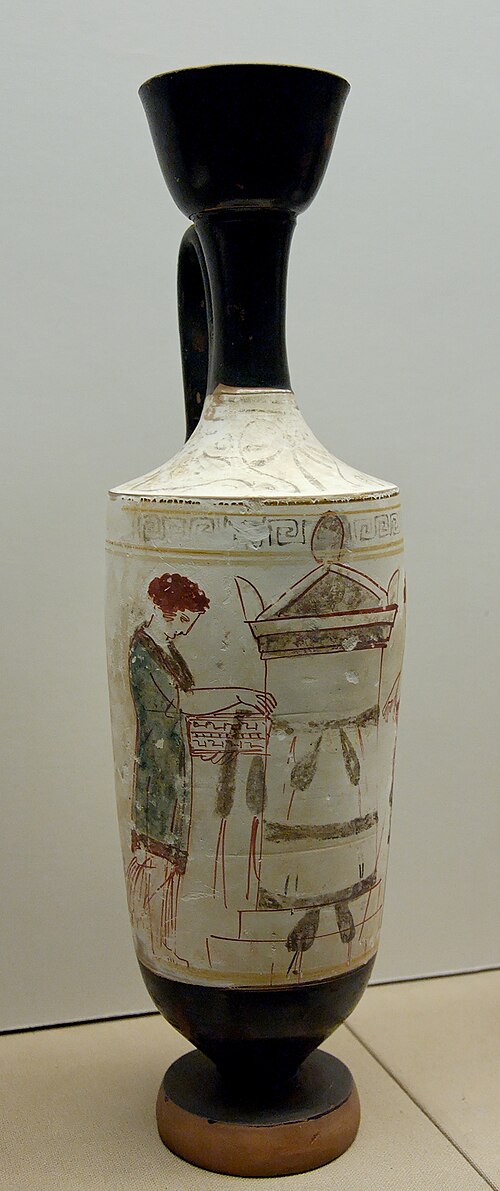
ギリシアの壺絵の有名で独特なスタイルは、人物が強い輪郭線で描かれ、輪郭線の中に細い線が描かれ、紀元前600年から350年頃に最盛期を迎え、黒絵式と赤絵式のほぼ逆の2つの主要なスタイルに分かれ、どちらの場合ももう一方の色は背景を形成していた。他の色は非常に限られており、通常は小さな部分が白、大きな部分は別の赤紫色だった。これらの技法やその他の強い慣習の制約の中で、壺絵師たちは洗練さと力強い表現を組み合わせた素晴らしい成果を上げた。白地技法ではより自由に描写できたが、耐久性が悪く、ほとんどが埋葬用に作られた。[6]
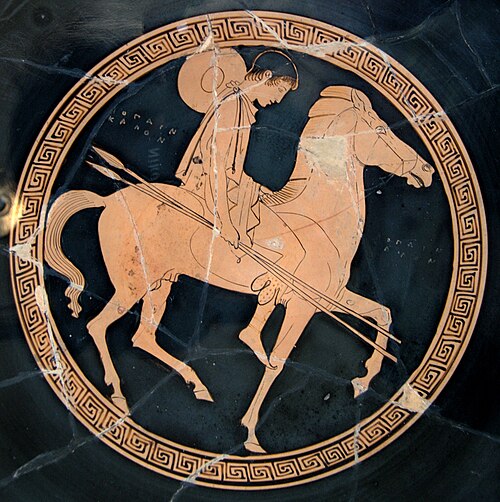
慣習的に、古代ギリシャ人はほとんどの陶器を展示用ではなく日常使用のために作ったと言われている。例外は、墓標として作られた大型のアルカイック記念碑的な壺、オリーブ油で満たされたパナシナイコアンフォラなどの競技で獲得したトロフィー、墓に置くために特別に作られた作品などである。香水瓶の中には、口のすぐ下に節約用の底があり、少量を入れるといっぱいに見えるものもある。[7]ここ数十年、多くの学者がこれに疑問を呈しており、ギリシャとエトルリアの両方で、金属製品の安価な代替品として墓に置くために作られたと考えられていたよりもはるかに多くの香水が生産されているのを見てきています。[8]
現存する陶器のほとんどは、アンフォラ、クラテール(ワインと水を混ぜるボウル)、ヒュドリア(水差し)、献酒ボウル、トイレ用の油や香水の瓶、水差し、カップなど、液体を保管したり、提供したり、飲んだりするための容器です。食べ物を提供したり、食べたりするための絵付けされた容器はそれほど一般的ではありません。絵付けされた陶器は一般の人々でも購入でき、「約5〜6人の人物できちんと装飾された」作品は、約2〜3日分の賃金で済みました。[9]ミニチュアも大量に生産され、主に寺院の供物として使用されました。[10]ヘレニズム時代にはより幅広い種類の陶器が生産されましたが、そのほとんどは芸術的価値がほとんどありません。

初期の時代では、ギリシャの非常に小さな都市でさえ、それぞれの地域のために陶器を生産していた。そのスタイルや基準は多種多様だった。芸術として認められる独特の陶器は、エーゲ海の島々、クレタ島、南イタリアやシチリア島の裕福なギリシャ植民地で生産された。[12]しかし、後期アルカイック期から初期古典期にかけて、コリントスとアテネという二大商業国が優位に立つようになった。彼らの陶器はギリシャ世界中に輸出され、地元の品種を駆逐した。コリントスとアテネの壺は、スペインやウクライナまで遠くまで見つかっており、イタリアでは非常に一般的であるため、18世紀に初めて「エトルリアの花瓶」として収集された。[13]これらの壺の多くは、低品質の大量生産品である。実際、紀元前5世紀までに陶器は産業となり、陶器の絵付けは重要な芸術形式ではなくなった。
壺に使用できる色の範囲は焼成技術によって制限されており、黒、白、赤、黄色が最も一般的でした。初期の3つの時代では、壺は自然な明るい色のままで、窯の中で黒くなる泥で装飾されていました。[6]
ギリシャの陶器には署名が頻繁に見られるが、陶工や陶工の親方による署名もあるが、絵付け師による署名はまれである。しかし、何百人もの絵付け師は、その芸術的個性によって識別できる。署名が残っていない絵付け師は、題材の選択によって「アキレスの画家」、後期アルカイックの「クレオフラデスの画家」のように、絵付け師が働いていた陶工によって、あるいは後期アルカイックの「ベルリンの画家」のように、現代の場所によっても名前が付けられている。[14]
歴史

古代ギリシャの陶器の歴史は、様式的に 5 つの時期に分けられます。
- 紀元前1050年頃の原幾何学模様
- 紀元前900年頃の幾何学模様
- 紀元前750年頃の後期幾何学文体またはアルカイック文体
- 紀元前7世紀初頭の黒像
- 紀元前530年頃の赤像
プロト幾何学様式と幾何学様式の時代、ギリシャの陶器は抽象的なデザインで装飾されていた。プロト幾何学様式では通常、エレガントで大きく、未塗装のスペースがたっぷりあったが、幾何学様式では、 750年頃に活躍したディピュロンの巨匠による大型の壺のように、表面のほとんどを密に覆うことが多かった。彼と同時代の他の陶工たちは、人間や動物、特に馬の非常に様式化されたシルエット像を導入し始めた。これらは葬列や戦いを表していることが多く、おそらく死者が戦った戦いを表していると思われる。[15]
幾何学的段階の後には、8世紀後半の東洋化の時代が続き、スフィンクスやライオンなどギリシャ原産ではない神話上の動物が近東から取り入れられ、蓮やパルメットなどの装飾的なモチーフが添えられた。これらの動物は以前の人物像よりもはるかに大きく描かれていた。野生のヤギのスタイルは地域的な変種で、ヤギがよく描かれている。人物像は東洋の影響をあまり受けなかったが、より大きく、より詳細に描かれるようになった。[16]
完全に成熟した黒絵式技法は、赤と白のディテールが加えられ、輪郭とディテールを刻み込むもので、紀元前7世紀初頭にコリントスで生まれ、約1世代後にアッティカに導入され、紀元前6世紀末まで栄えた。[17]紀元前530年頃に発明された赤絵式技法は、この伝統を覆し、壺は黒く塗られ、人物は赤く塗られた。赤絵式の花瓶は徐々に黒絵式に取って代わっていった。時には、より大きな容器には、絵付けだけでなく彫刻が施されることもあった。異性愛と男性同性愛の両方のエロティックなテーマが一般的になった。[18]
紀元前320年頃までに、アテネや他のギリシャの中心地では、多色のケルチ様式が最後の盛り上がりを見せたのを最後に、精巧な具象的な壺絵付けは廃れ、その機能のほとんどが金属細工に取って代わられたものと思われる。黒釉をかけた器に装飾的なモチーフを描いた西斜面陶器は、その後も1世紀以上にわたって続いた。[19]イタリアの赤絵式絵画は紀元前300年頃には終焉し、次の世紀には、おそらくクレタ島産の比較的原始的なハドラ壺、シチリア島のセンチュリーペ陶器、そして現在は伝統が途絶えてしまったパナシナイコアンフォラだけが、まだ作られていた大型の絵付け壺だった。[20]
-

-
 コリント式の東洋化水差し、紀元前 620 年頃、ミュンヘン古代博物館
 -

-

-

-
-
 ヘレニズム時代の浮彫りの鉢、メナドの頭部、紀元前 2 世紀 (?)、大英博物館
金属細工
.jpg/500px-The_Derveni_krater,_late_4th_century_B.C.,_side_A,_Dionysus_and_Ariadne,_Archaeological_Museum,_Thessaloniki,_Greece_(7457851940).jpg)
古代ギリシャでは精巧な金属細工が重要な芸術であったが、後世の作品はほとんど残っておらず、そのほとんどはギリシャ世界の端っこや、フランスやロシアなど遠く離れたところから来ている。器や宝飾品は高い水準で作られ、遠くへ輸出された。当時、現代よりも金に比べて価値が高かった銀の品々には、製作者によって重量が刻まれていることが多かった。銀は主に価値の貯蔵庫として扱われ、すぐに売却されるか、再び溶かされる可能性があったからである。[22]
幾何学様式とアルカイック様式の時代、大型の金属製容器の製作はギリシャの創造性の重要な表現であり、鋳造や打ち出し鍛造などの青銅細工技術の発展における重要な段階であった。初期の聖域、特にオリンピアからは、奉納物として納められた、主に青銅製の三脚鉢または供儀用の三脚鉢が何百個も出土した。これらには、3本の脚の上に高く上げられた2つの取っ手が付いた浅い鉢があったが、後期のバージョンでは、台と鉢が別の部分になった。オリエンタリズム化の時代には、このような三脚鉢は、グリフィン、スフィンクス、その他の空想上の生き物の形をした人物像の原型で頻繁に装飾された。 [23]
剣、ギリシャのヘルメット、筋肉胸甲などの鎧は青銅で作られ、3世紀のクソール・エセフ胸甲のように貴金属で装飾されることもあった。[24]鎧と「盾帯」は、アルカイックの低浮き彫りの場面の2つの文脈であり、木製のさまざまな物体にも取り付けられていた。ヴィックス・クラテルの帯は大きな例である。[25]磨かれた青銅の鏡は、最初は装飾された背面とコレの取っ手を備えており、もう1つの一般的なアイテムであった。後の「折りたたみ式鏡」タイプには蝶番で留められたカバーピースがあり、通常はエロチックな浮き彫りの場面で装飾されることが多かった。[26]コインについては以下で説明する。
後期アルカイック時代から、最高の金属細工は彫刻やその他の芸術の様式的発展と歩調を合わせ、フィディアスはそれを実践した彫刻家の一人として知られています。[27]ヘレニズム時代の趣味は、非常に複雑な技術的美徳の表現を奨励し、「巧妙さ、奇抜さ、または過剰な優雅さ」に傾いていました。[28]ギリシャの陶器の形状の多く、またはほとんどは、最初に金属で使用された形状から取られており、ここ数十年、最も優れた花瓶の絵付けの多くは、描かれたデザインから作業して、銀細工師が彫刻を施し、別の金属でメッキした容器のデザインを再利用したという見方が増えています。[29]
比較的一般的な種類の大型青銅器であったと思われる例外的な現存品としては、ワインや水を混ぜるための渦巻き形のクラテルが2つある。 [30]これらは紀元前 530年頃のヴィクス・クラテルで、高さ1.63メートル(5フィート4インチ)、重さ200キログラム(440ポンド)以上、容量約1,100リットルで、現代フランスのケルト人女性の埋葬地で発見された。[31]および紀元前4世紀のデルヴェニ・クラテルで、高さ90.5センチメートル(35.6インチ)である。[32]トラキア人やスキタイ人など、ギリシア人の他の近隣諸国のエリート層はギリシアの金属細工の熱心な消費者であり、おそらく彼らの領土に定住したギリシアの金細工師が彼らに仕え、地元の嗜好や用途に合わせて製品を改良していたものと思われる。こうした混合作品は、パナギュリシテの財宝、ボロヴォの財宝、その他のトラキアの財宝、そしておそらく黒海沿岸のギリシャ人居住地を拠点としたギリシャ人芸術家の作品が含まれていたと思われるいくつかのスキタイ人の埋葬地など、現存する遺物の大部分を占めています。[33]他の贅沢な芸術品と同様に、ヴェルギナのマケドニア王家の墓地からは、古典期とヘレニズム期の変わり目に最高品質の品々が出土しています。[34]
ギリシャ市場向けの宝飾品は、多くの場合、非常に質の高いものである。[35]珍しいものとしては、頭にかぶる、植物の形を模した複雑で非常に繊細な金の冠がある。これらは、生前にかぶることはほとんどなかったと思われるが、奉納物として贈られ、死後にかぶった。[36]ファイユームのミイラ肖像画の多くは、これをかぶっている。特にヘレニズム時代の作品の中には、人物を描く余地があるほど大きなものもあり、スキタイ人は比較的しっかりした金の作品を好んだ。[37]
-

-
 ヴィックス・クラテルは、フランスのケルト人に輸出された後期アルカイック時代の記念碑的な青銅器である。
 -
 紀元前 460 年頃の、人間のカリアティード柄の付いた初期古典派の青銅鏡
 -
 黄金の花輪、370~360年、南イタリア
 -
![トラキア市場向けの銀のリュトン、4世紀末[38]](https://img-server.japedia.wiki/wikipedia/commons/thumb/b/b7/Rhyton_Greek_Thracian_silver%2C_end_of_4th_c_BC%2C_Prague_Kinsky%2C_NM-HM10_1407%2C_140856.jpg/500px-Rhyton_Greek_Thracian_silver%2C_end_of_4th_c_BC%2C_Prague_Kinsky%2C_NM-HM10_1407%2C_140856.jpg) トラキア市場向けの銀のリュトン、4世紀末[38]
トラキア市場向けの銀のリュトン、4世紀末[38] -
 紀元前4世紀ギリシャの金と青銅のリュトンとディオニュソスの頭部、タモイキン美術基金
 -

-
 金の髪飾りと網、紀元前3世紀
 -
 後期ヘレニズム時代の銀メダル
.jpg/500px-Olympiamuseum030_(cropped).jpg)
.jpg/500px-Chatillon-sur-Seine_-_Mus%C3%A9e_du_Pays_chatillonnais_-_Crat%C3%A8re_de_Vix_-_012_(cropped).jpg)
![トラキア市場向けの銀のリュトン、4世紀末[38]](https://img-server.japedia.wiki/wikipedia/commons/thumb/b/b7/Rhyton_Greek_Thracian_silver,_end_of_4th_c_BC,_Prague_Kinsky,_NM-HM10_1407,_140856.jpg/500px-Rhyton_Greek_Thracian_silver,_end_of_4th_c_BC,_Prague_Kinsky,_NM-HM10_1407,_140856.jpg)

記念碑的な彫刻

ギリシア人は、人間の姿こそが芸術にとって最も重要な主題であると、かなり早い段階から決めていた。[39]彼らの神は人間の姿をしているとみなしていたため、芸術において神聖なものと世俗的なものの区別はほとんどなく、人体は世俗的であると同時に神聖なものだった。アポロやヘラクレスの男性ヌードは、その年のオリンピックのボクシングチャンピオンのヌードと扱いにわずかな違いがあっただけだった。アルカイック期において最も重要な彫刻形態は、男性の裸の立像であるクーロス(複数形はクーロイ)であった(例えばビトンやクレオビスを参照)。服を着た女性の立像であるコーレ(複数形はコライ)も一般的であったが、ギリシア社会では女性の裸体を公に見せることが紀元前4世紀まで認められなかったため、コーレは彫刻の発展においてそれほど重要ではなかったと考えられている。[40]アルカイック期の終わりまでに、寺院の建築彫刻が重要になってきた。
陶器と同様、ギリシャ人は単に芸術的な展示のためだけに記念碑的な彫刻を制作したわけではない。彫像は貴族や国家によって発注され、公共の記念碑、寺院、神託所、聖域への供物(彫像の碑文によく見られるように)、あるいは墓標として使われた。アルカイック期の彫像は、すべて特定の個人を表現することを意図していたわけではない。美、敬虔さ、名誉、犠牲といった理想を描いたものだった。これらは常に青年期から早熟期まで幅広い年齢の若者を描いたもので、(おそらく)高齢者の墓に置かれる場合もそうだった。クーロイはすべて様式的に似ていた。彫像を発注した人物の社会的地位の段階は、芸術的革新ではなく大きさで示された。[41]
作家とは異なり、彫刻を含む視覚芸術に携わる人々の古代ギリシャにおける社会的地位は当初は低かったが、一流の彫刻家は次第に有名になり、かなり裕福になり、作品に署名することが多かった(台座に署名することが多く、台座は彫像本体から分離していた)。[42] プルタルコス(『ペリクレスの生涯』第2章)は「我々は芸術作品を賞賛するが、その作者を軽蔑する」と述べたが、これは古代世界では一般的な考え方であった。古代ギリシャの彫刻は、通常の様式の時代区分である「アルカイック」、「古典」、「ヘレニズム」に加え、主に彫刻に適用されるいくつかの追加様式、例えば東洋化したダイダリス様式や初期古典彫刻の厳格様式などによって分類されている。[43]
材料、形状

現存する古代ギリシャ彫刻は、主に2種類の素材で作られている。最も頻繁に使用されたのは石、特に大理石やその他の高品質の石灰岩で、金属工具を使って手彫りされた。石の彫刻は、完全に円形に彫られた独立したもの(彫像)もあれば、建築のフリーズや墓の石碑のように、背景の銘板にまだ付いている部分的なレリーフのみの彫刻もあった。[44]
ブロンズ像はより高貴な地位にあったが、金属の再利用性のため、現存する数ははるかに少ない。これらは通常、ロストワックス技法で作られていた。金象牙像は寺院の祭祀用像であり、彫刻の最高峰とみなされていたが、断片が残っているのみである。これらは通常、実物大以上の大きさで、木製の枠で作られ、薄い象牙の彫刻板で肉体を表現し、おそらく木の上に金箔を貼って衣服、鎧、髪、その他の細部を表現していた。[45]
場合によっては、ガラスペースト、ガラス、貴石や半貴石が目や宝石、武器などの細部に使用されました。他の大型のアクロリティック彫像では、肉体部分に石、その他の部分に木が使用され、大理石の彫像にはスタッコの髪型が施されることもありました。ほとんどの彫刻は彩色されており(下記参照)、本物の宝石を身に着け、目やその他の要素をさまざまな素材で象嵌していました。[46]
テラコッタは、大きな彫像に時々使われた。テラコッタの彫像は、壊れやすいという理由もあって、ほとんど残っていない。最も有名な例外は、紀元前470年頃に制作された、オリンピアで発見されたガニュメデスを運ぶゼウスの彫像である。この場合、テラコッタには彩色がされている。木だけで作られた彫刻も間違いなく存在し、初期の時代には非常に重要だったかもしれないが、実質的には現存していない。[47]
アルカイック

紀元前 1100 年頃までの青銅器時代のキクラデス美術では、すでに人体への異例の重点が置かれており、通常は腕をお腹の前で組んだ正面からの直立姿勢で描かれていた。小さな特徴としては、鼻、時には目、女性の胸のみが彫られていたが、人物像は通常は彩色されていたようで、元々はかなり違った外見だった可能性がある。
エジプトとメソポタミアの記念碑的な石の彫刻に触発され、アルカイック期にギリシャ人は再び石に彫刻を彫り始めた。ギリシャの傭兵と商人は、エジプトのファラオ・プサムティク1世(紀元前664-610年)に仕えるなど海外で活動し、これらの国の記念碑的な芸術に触れた。[48] [49]「紀元前2千年紀のエジプトの彫像は、7世紀後半のアルカイック期における等身大および超大型のギリシャ彫刻の革新に決定的な刺激を与えた」ことは一般的に認められている。[48]自立型の人物像は、東洋のモデルの特徴である堅牢性と正面からの姿勢を共有しているが、その形状はエジプトの彫刻よりも動的であり、たとえばオセールの貴婦人やヘラのトルソ(初期アルカイック期、紀元前 660 -580年頃、どちらもパリのルーブル美術館所蔵)がそうだ。紀元前575年頃以降、男性、女性ともに、このような人物像はいわゆるアルカイック・スマイルを浮かべていた。この表情は、描かれた人物や状況に特に適切というわけではないが、人物像に独特の人間的特徴を与えるための工夫だったのかもしれない。[50]
3種類の人物像が使われた。裸の若者の立像(kouros)、衣服をまとって立つ少女(kore)、そしてそれほど頻繁ではないが、座る女性である。[51]これらすべてが人体の本質的な特徴を強調し一般化しており、人体構造に対するより正確な理解を示している。若者は墓碑銘または奉納彫像であった。例としては、初期の作品であるアポロ(ニューヨーク、メトロポリタン美術館)、ずっと後の作品であるアナフィ島のストラングフォードのアポロ(ロンドン、大英博物館)、アナヴィソスのクーロス(アテネ国立考古学博物館)がある。この彫像では、初期の作品よりも筋肉と骨格構造がよりよく見える。衣服をまとって立つ少女は、アテネのアクロポリス博物館の彫刻のように、幅広い表現をしている。彼女たちの衣服は、この時代彫刻の細部に共通する繊細さと細心の注意を払って彫刻され、塗装されている。[52]
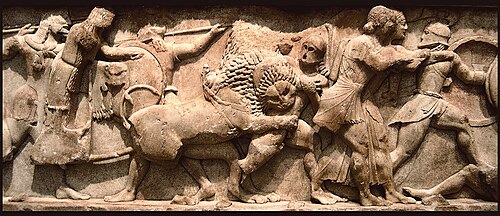
古代のレリーフは、多くの墓や、イタリアのフォチェ・デル・セレ(現在はパエストゥム国立考古学博物館所蔵)にある、紀元前550年と510年ごろの2組のメトープパネルがある大きな建物、およびフリーズと小さなペディメントがあるデルフィのシフニア宝物庫から現存している。巨大なゴルゴンが目立つコルフ島のアルテミス神殿(紀元前 580年ごろ)とアテネのアテナ古神殿(紀元前 530年- 500年ごろ)の大きな三角形のペディメント群の一部は、現在はすべて地元の博物館に残っている。[53]
-
 ディピュロン・クーロス、紀元前 600年頃、アテネ、ケラメイコス博物館
 -

-

-
-
 ストラングフォードのアポロ、500-490年、最後のクーロイの1つ
 -
 サブロフの頭部、紀元前 550 年- 525 年頃の、後期アルカイック期ギリシャの大理石彫刻の重要な例。
 -
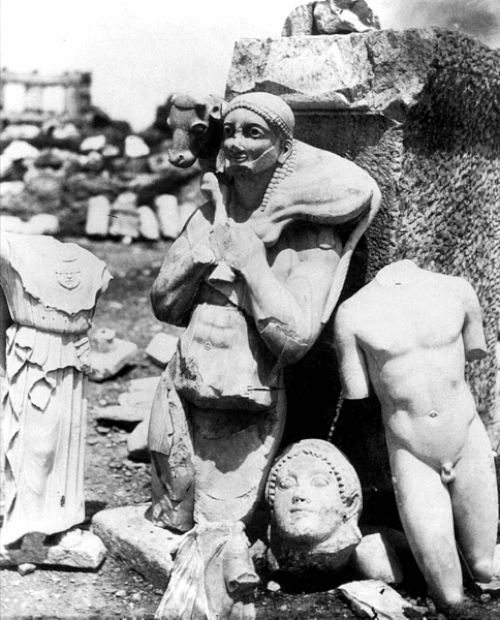 ペルサーシュット、つまり「ペルシャの瓦礫」は、紀元前480年から479年にかけてのギリシャへの第二次ペルシャ侵攻中にアテネが破壊された際に発見されたもので、アルカイック時代の彫像の明確な年代測定マーカーとなっている。
クラシック

古典期にはギリシャの彫像に革命が起こり、それは民主主義の導入とクーロイに関連する貴族文化の終焉と関連づけられることが多い。古典期には彫刻のスタイルと機能に変化が見られた。ポーズはより自然主義的になり(デルポイの戦車兵はより自然主義的な彫刻への移行の例として参照)、ギリシャの彫刻家がさまざまなポーズで人間の姿を描写する技術力は大幅に向上した。紀元前500年頃から彫像は実在の人物を描写し始めた。アテネで暴政の打倒を記念して建てられたハルモディオスとアリストゲイトンの彫像は、実在の人物を描いた最初の公共記念碑と言われている。[54]

同時に、彫刻や彫像の用途も広がった。アテネのパルテノン神殿やオリンピアのゼウス神殿など、古典期の偉大な神殿では、装飾的なフリーズにはレリーフ彫刻が、ペディメントの三角形の領域を埋めるには円形彫刻が必要だった。難しい美的、技術的挑戦は、彫刻の革新を大いに刺激した。これらの作品は断片としてのみ現存しており、最も有名なのはパルテノン神殿の彫刻で、その半分は大英博物館にある。[57]
この時期、葬儀用の彫像は、アルカイック時代の厳格で非人格的なクーロスから、古典期の非常に個人的な家族グループへと進化しました。これらの記念碑は、古代には都市の郊外の墓地であったアテネ郊外でよく見られます。それらの中には「理想的な」タイプ、つまり悲しむ母親や孝行息子を描いたものもありますが、現実の人間を描いたものが増え、典型的には、亡くなった人が家族から威厳をもって別れを告げる様子が描かれています。これらは、古代ギリシャの最も親密で感動的な遺物の一つです。[58]
古典期には初めて彫刻家の名前が知られるようになった。ペイディアスはパルテノン神殿の設計と建設を監督した。プラクシテレスは後期古典期(4世紀半ば)に初めて女性の裸体を尊厳あるものにした。彼のクニドスのアフロディーテ像は複製が残っており、プリニウスによれば世界最高の彫像である。[59]
同時代の人々にとって古典期の最も有名な作品は、オリンピアの巨大なゼウス像とパルテノン神殿のアテナ・パルテノス像である。どちらも象牙細工で、ペイディアスか彼の指揮下で制作されたもので、現在は失われているが、小さな複製(他の資料)と詳細な説明が残っている。その大きさと壮大さから、ビザンチン時代に皇帝が押収し、コンスタンティノープルに移されたが、後に火災で焼失した。[60]
-

-

-
 マラソンの若者、紀元前4世紀のブロンズ像、おそらくプラクシテレス作、アテネ国立考古学博物館
 -

-

-
 アテネのアクロポリス博物館にあるパルテノン神殿の西フリーズブロック VI。
ヘレニズム時代

古典期からヘレニズム期への移行は紀元前4世紀に起こった。アレクサンダー大王(紀元前336年 - 紀元前323年)の征服に続いて、ギリシャ文化はインドにまで広がった。これは東アフガニスタンのアイ・ハヌムの発掘や、グレコ・バクトリア人およびインド・ギリシア人の文明によって明らかになった。ギリシャ仏教美術は、ギリシャ美術と仏教の視覚的表現の融合を表していた。こうしてギリシャ美術は、ギリシャの軌道に引き込まれた人々の文化により多様化し、より影響を受けるようになった。[61]
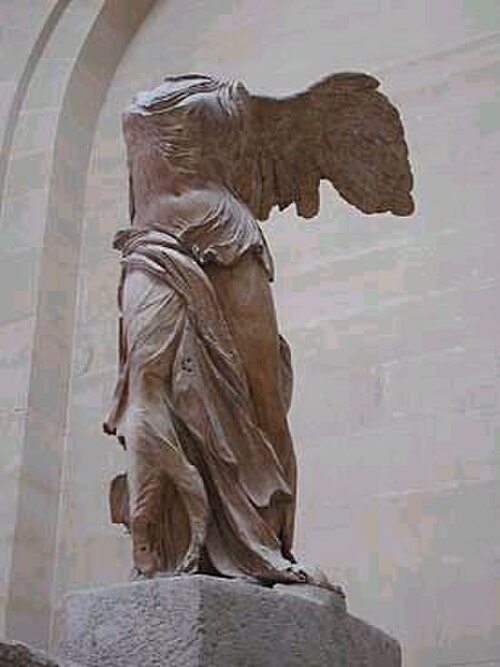
一部の美術史家は、質と独創性も低下したと見ている。しかし、これは当時の芸術家や芸術愛好家が共有しなかった判断である。実際、以前は古典の傑作と考えられていた多くの彫刻が、現在ではヘレニズム時代のものと認識されている。ヘレニズム彫刻家の技術的能力は、サモトラケのニケやペルガモンの祭壇などの主要作品にはっきりと表れている。アレクサンドリア、アンティオキア、ペルガモンなどの都市では、新しい君主が惜しみないパトロンとなり、ギリシャ文化、特に彫刻の中心地が生まれた。 [62] 2世紀までには、台頭するローマ帝国もギリシャの伝統の多くを吸収し、その製品の割合も増加した。[63]
この時期、彫刻はより自然主義的になり、また表現豊かになった。感情の極限を描くことへの関心は、時には極端にまで押し進められた。庶民、女性、子供、動物、家庭の風景といった風俗画は、彫刻の題材として受け入れられるようになり、裕福な家庭が家や庭の装飾として注文した。その一例が「とげのある少年」である。あらゆる年齢の男性と女性の写実的な肖像画が制作され、彫刻家はもはや人々を美の理想や肉体の完璧さとして描く義務を感じなくなった。[64]
ディオニュソスの世界は、サテュロス、メナド、ニンフ、シレーノが住む田園詩であり、以前の花瓶画やフィギュアにはよく描かれていたが、等身大の彫刻で描かれることは稀だった。この時代、そのような作品が作られ、バルベリーニの牧神、ベルヴェデーレのトルソ、休息するサテュロスなどの複製が現存している。また、フリエッティのケンタウロスや眠るヘルマフロディートスは、関連するテーマを反映している。[65]同時に、エジプト、シリア、アナトリアの各地に出現した新しいヘレニズム都市では、寺院や公共の場所にギリシャの神々や英雄を描いた彫像が必要となった。これにより、陶器と同様に彫刻が産業となり、結果として標準化され、品質が低下した。これらの理由から、古典期の場合よりも多くのヘレニズム彫像が現存している。
ヘレニズム時代の彫刻で最もよく知られているのは、サモトラケのニケ(紀元前2世紀または1世紀)[66] 、メロス島のアフロディーテ像でミロのヴィーナスとして知られる像(紀元前2世紀半ば)、[67]、瀕死のガリア人(紀元前230年頃)、ラオコーンとその息子たちの記念碑的群像(紀元前1世紀後半)などである。これらの彫像はすべて古典時代のテーマを描いているが、その扱い方は古典時代の厳格な趣味や当時の技術が許すよりもはるかに官能的で感情的である。
多人数の彫像群は、おそらく3世紀のヘレニズム時代の革新であり、以前の寺院のペディメントの壁のレリーフの壮大な戦いを取り除いて、等身大の彫像群として配置したものです。そのスタイルはしばしば「バロック」と呼ばれ、体の姿勢が極端にねじれ、顔に激しい表情があります。ペルガモン祭壇のレリーフは、現存するオリジナルに最も近いものですが、いくつかの有名な作品は、ヘレニズム時代のオリジナルのローマによるコピーであると考えられています。これには、「瀕死のガリア人」と「ルドヴィージのガリア人」、およびあまり知られていない「ひざまずくガリア人」などがあり、すべて、おそらく2つのグループで構成されていたガラティアのガリア人に対する紀元前241年頃の勝利を記念してアッタロス1世がペルガモンに依頼した作品を模倣したものと考えられています。[67]
その他の例としては、ラオコーン像、ファルネーゼの雄牛、パトロクロスの体を支えるメネラオス(「パスクィーノ像」)、アロティーノ、スペルロンガの彫刻などがある。[68] 2世紀以降、新アッティカ様式または新古典主義様式は、バロック様式の過剰に対する反応、古典主義様式への回帰、あるいは宗教的彫像の伝統的な様式の継続のいずれかとして、さまざまな学者によって見なされている。[69]この様式の工房は、主にローマ市場向けの複製品の製作者となった。ローマ市場は、ヘレニズム時代の作品よりも古典主義の作品の複製品を好んだ。[70]
19世紀末以降、エジプトの古代都市ヘラクレウム(現在は水没)周辺で発見されたものには、紀元前4世紀の、非常に官能的で、詳細かつフェミニズム的な(神格化されたものではなく)イシスの描写があり、アレクサンダー大王によるエジプト征服の頃から始まったエジプトとヘレニズム様式の融合を示している。しかし、これはプトレマイオス朝の宮廷彫刻の典型ではなく、エジプト様式とかなり慣習的なヘレニズム様式を混ぜることは一般的に避けられており、[71]エジプトの他の地域の寺院では伝統的なエジプト様式の後期バージョンが引き続き使用されていた。[72]学者はヘレニズム彫刻に「アレクサンドリア様式」を提案しているが、実際にはアレクサンドリアとそれを結びつけるものはほとんどない。[73]
ヘレニズム時代の彫刻も規模の拡大が目立ち、自由の女神像と同じ大きさのロドス島の巨像(3世紀後半)が完成しました。地震と略奪の複合的な影響で、この時代における他の非常に大きな作品と同様に、この巨像も破壊されました。
-
 ヘレニズム時代の王子。もともとはセレウコス朝の王子、あるいはペルガモン王アッタロス2世の像と考えられていたが、現在はローマの将軍の肖像画であると考えられている。紀元前2世紀にローマで活動していたギリシャ人芸術家によって制作された。
 -
-
 ラオコーンとその息子たち(後期ヘレニズム時代)、バチカン美術館
 -
 後期ヘレニズム時代の騎手ブロンズ像、アテネ国立考古学博物館
フィギュア
テラコッタの置物

Clay is a material frequently used for the making of votive statuettes or idols, even before the Minoan civilization and continuing until the Roman period. During the 8th century BC tombs in Boeotia often contain "bell idols", female statuettes with mobile legs: the head, small compared to the remainder of the body, is perched at the end of a long neck, while the body is very full, in the shape of a bell.[74] Archaic heroon tombs, for local heroes, might receive large numbers of crudely-shaped figurines, with rudimentary figuration, generally representing characters with raised arms.
By the Hellenistic period most terracotta figurines have lost their religious nature, and represent characters from everyday life. Tanagra figurines, from one of several centres of production, are mass-manufactured using moulds, and then painted after firing. Dolls, figures of fashionably-dressed ladies and of actors, some of these probably portraits, were among the new subjects, depicted with a refined style. These were cheap, and initially displayed in the home much like modern ornamental figurines, but were quite often buried with their owners. At the same time, cities like Alexandria, Smyrna or Tarsus produced an abundance of grotesque figurines, representing individuals with deformed members, eyes bulging and contorting themselves. Such figurines were also made from bronze.[75]
For painted architectural terracottas, see Architecture below.
Metal figurines
Figurines made of metal, primarily bronze, are an extremely common find at early Greek sanctuaries like Olympia, where thousands of such objects, mostly depicting animals, have been found. They are usually produced in the lost wax technique and can be considered the initial stage in the development of Greek bronze sculpture. The most common motifs during the Geometric period were horses and deer, but dogs, cattle and other animals are also depicted. Human figures occur occasionally. The production of small metal votives continued throughout Greek antiquity. In the Classical and Hellenistic periods, more elaborate bronze statuettes, closely connected with monumental sculpture, also became common. High quality examples were keenly collected by wealthy Greeks, and later Romans, but relatively few have survived.[76]
-
 Bell Idol, 7th century BC
 -
 8th-century BC bronze votive horse from Olympia
 -
 Actor from the New Comedy, about 200 BC
 -
 Tanagra figurine of fashionable lady, 32.5 cm (12.8 in), 330-300 BC
Architecture

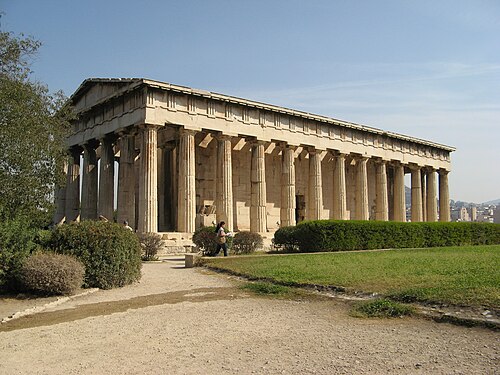
Architecture (meaning buildings executed to an aesthetically considered design) ceased in Greece from the end of the Mycenaean period (about 1200 BC) until the 7th century, when urban life and prosperity recovered to a point where public building could be undertaken. Since most Greek buildings in the Archaic and Early Classical periods were made of wood or mudbrick, nothing remains of them except a few ground-plans, and there are almost no written sources on early architecture or descriptions of buildings. Most of our knowledge of Greek architecture comes from the surviving buildings of the Late Archaic, Classical, Hellenistic and Roman periods (since ancient Roman architecture heavily used Greek styles), and from late written sources such as Vitruvius (1st century BC). This means that there is a strong bias towards temples, the most common major buildings to survive. Here the squared blocks of stone used for walls were useful for later buildings, and so often all that survives are parts of columns and metopes that were harder to recycle.[77]
For most of the period a strict stone post and lintel system of construction was used, held in place only by gravity. Corbelling was known in Mycenean Greece, and the arch was known from the 5th century at the latest, but hardly any use was made of these techniques until the Roman period.[78] Wood was only used for ceilings and roof timbers in prestigious stone buildings. The use of large terracotta roof tiles, only held in place by grooving, meant that roofs needed to have a low pitch.[79]
Until Hellenistic times only public buildings were built using the formal stone style; these included above all temples, and the smaller treasury buildings which often accompanied them, and were built at Delphi by many cities. Other building types, often not roofed, were the central agora, often with one or more colonnaded stoa around it, theatres, the gymnasium and palaestra or wrestling-school, the ekklesiasterion or bouleuterion for assemblies, and the propylaea or monumental gateways.[80] Round buildings for various functions were called a tholos,[81] and the largest stone structures were often defensive city walls.
Tombs were for most of the period only made as elaborate mausolea around the edges of the Greek world, especially in Anatolia.[82] Private houses were built around a courtyard where funds allowed, and showed blank walls to the street. They sometimes had a second story, but very rarely basements. They were usually built of rubble at best, and relatively little is known about them; at least for males, much of life was spent outside them.[83] A few palaces from the Hellenistic period have been excavated.[84]
.jpg/500px-Treasury_house_of_Athens_in_Delphi_(July_2018).jpg)
Temples and some other buildings such as the treasuries at Delphi were planned as either a cube or, more often, a rectangle made from limestone, of which Greece has an abundance, and which was cut into large blocks and dressed. This was supplemented by columns, at least on the entrance front, and often on all sides.[85] Other buildings were more flexible in plan, and even the wealthiest houses seem to have lacked much external ornament. Marble was an expensive building material in Greece: high quality marble came only from Mt Pentelus in Attica and from a few islands such as Paros, and its transportation in large blocks was difficult. It was used mainly for sculptural decoration, not structurally, except in the very grandest buildings of the Classical period such as the Parthenon in Athens.[86]
There were two main classical orders of Greek architecture, the Doric and the Ionic, with the Corinthian order only appearing in the Classical period, and not becoming dominant until the Roman period. The most obvious features of the three orders are the capitals of the columns, but there are significant differences in other points of design and decoration between the orders.[87] These names were used by the Greeks themselves, and reflected their belief that the styles descended from the Dorian and Ionian Greeks of the Dark Ages, but this is unlikely to be true. The Doric was the earliest, probably first appearing in stone in the earlier 7th century, having developed (though perhaps not very directly) from predecessors in wood.[88] It was used in mainland Greece and the Greek colonies in Italy. The Ionic style was first used in the cities of Ionia (now the west coast of Turkey) and some of the Aegean islands, probably beginning in the 6th century.[89] The Doric style was more formal and austere, the Ionic more relaxed and decorative. The more ornate Corinthian order was a later development of the Ionic, initially apparently only used inside buildings, and using Ionic forms for everything except the capitals. The famous and well-preserved Choragic Monument of Lysicrates near the Acropolis of Athens (335/334) is the first known use of the Corinthian order on the exterior of a building.[90]
Most of the best known surviving Greek buildings, such as the Parthenon and the Temple of Hephaestus in Athens, are Doric. The Erechtheum, next to the Parthenon, however, is Ionic. The Ionic order became dominant in the Hellenistic period, since its more decorative style suited the aesthetic of the period better than the more restrained Doric. Some of the best surviving Hellenistic buildings, such as the Library of Celsus, can be seen in Turkey, at cities such as Ephesus and Pergamum.[91] But in the greatest of Hellenistic cities, Alexandria in Egypt, almost nothing survives.
-
![Model of the processional way at Ancient Delphi, without much of the statuary shown.[92]](https://img-server.japedia.wiki/wikipedia/commons/thumb/1/15/Santuario_Delfos.jpg/500px-Santuario_Delfos.jpg) Model of the processional way at Ancient Delphi, without much of the statuary shown.[92]
Model of the processional way at Ancient Delphi, without much of the statuary shown.[92] -
 The Ancient Theatre of Epidaurus, 4th century BC
 -
 The Erechtheion on the Acropolis of Athens, late 5th century BC
 -
 Choragic Monument of Lysicrates, Athens, 335/334
.jpg/500px-The_great_theater_of_Epidaurus,_designed_by_Polykleitos_the_Younger_in_the_4th_century_BC,_Sanctuary_of_Asklepeios_at_Epidaurus,_Greece_(14015010416).jpg)

Coin design
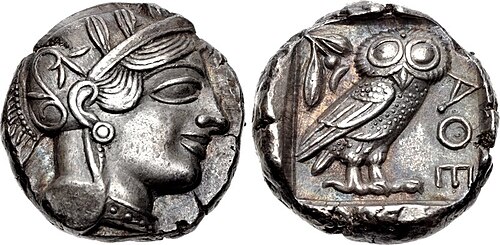

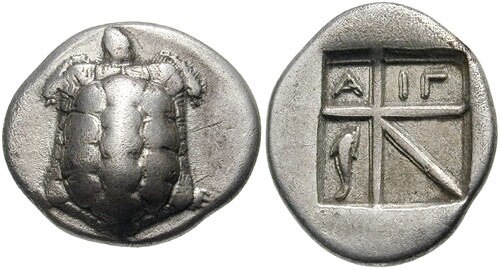
Coins were (probably) invented in Lydia in the 7th century BC, but they were first extensively used by the Greeks,[93] and the Greeks set the canon of coin design which has been followed ever since. Coin design today still recognisably follows patterns descended from ancient Greece. The Greeks did not see coin design as a major art form, although some were expensively designed by leading goldsmiths, especially outside Greece itself, among the Central Asian kingdoms and in Sicilian cities keen to promote themselves. Nevertheless, the durability and abundance of coins have made them one of the most important sources of knowledge about Greek aesthetics.[94] Greek coins are the only art form from the ancient Greek world which can still be bought and owned by private collectors of modest means.
The most widespread coins, used far beyond their native territories and copied and forged by others, were the Athenian tetradrachm, issued from c. 510 to c. 38 BC, and in the Hellenistic age the Macedonian tetradrachm, both silver.[95] These both kept the same familiar design for long periods.[96] Greek designers began the practice of putting a profile portrait on the obverse of coins. This was initially a symbolic portrait of the patron god or goddess of the city issuing the coin: Athena for Athens, Apollo at Corinth, Demeter at Thebes and so on. Later, heads of heroes of Greek mythology were used, such as Heracles on the coins of Alexander the Great.
The first human portraits on coins were those of Achaemenid Empire Satraps in Asia Minor, starting with the exiled Athenian general Themistocles who became a Satrap of Magnesia c. 450 BC, and continuing especially with the dynasts of Lycia towards the end of the 5th century.[97] Greek cities in Italy such as Syracuse began to put the heads of real people on coins in the 4th century BC, as did the Hellenistic successors of Alexander the Great in Egypt, Syria and elsewhere.[98] On the reverse of their coins the Greek cities often put a symbol of the city: an owl for Athens, a dolphin for Syracuse and so on. The placing of inscriptions on coins also began in Greek times. All these customs were later continued by the Romans.[94]
The most artistically ambitious coins, designed by goldsmiths or gem-engravers, were often from the edges of the Greek world, from new colonies in the early period and new kingdoms later, as a form of marketing their "brands" in modern terms.[99] Of the larger cities, Corinth and Syracuse also issued consistently attractive coins. Some of the Greco-Bactrian coins are considered the finest examples of Greek coins with large portraits with "a nice blend of realism and idealization", including the largest coins to be minted in the Hellenistic world: the largest gold coin was minted by Eucratides (reigned 171–145 BC), the largest silver coin by the Indo-Greek king Amyntas Nikator (reigned c. 95–90 BC). The portraits "show a degree of individuality never matched by the often bland depictions of their royal contemporaries further West".[100]
-

-
-
 Heracles fighting the Nemean lion. Silver coin from Heraclea Lucania
 -
 Arethusa on a coin of Syracuse, Sicily, 415–400
Painting
Macedonian tomb fresco from Agios Athanasios, Thessaloniki, Greece, 4th century BC.
The Greeks seem to have valued painting above even sculpture, and by the Hellenistic period the informed appreciation and even the practice of painting were components in a gentlemanly education. The ekphrasis was a literary form consisting of a description of a work of art, and we have a considerable body of literature on Greek painting and painters, with further additions in Latin, though none of the treatises by artists that are mentioned have survived.[101] We have hardly any of the most prestigious sort of paintings, on wood panel or in fresco, that this literature was concerned with, and very few of the copies that undoubtedly existed, equivalent to those which give us most of our knowledge of Greek sculpture.
The contrast with vase-painting is total. There are no mentions of that in literature at all, but over 100,000 surviving examples, giving many individual painters a respectable surviving oeuvre.[102] Our idea of what the best Greek painting was like must be drawn from a careful consideration of parallels in vase-painting, late Greco-Roman copies in mosaic and fresco, some very late examples of actual painting in the Greek tradition, and the ancient literature.[103]
There were several interconnected traditions of painting in ancient Greece. Due to their technical differences, they underwent somewhat differentiated developments. Early painting seems to have developed along similar lines to vase-painting, heavily reliant on outline and flat areas of colour, but then flowered and developed at the time that vase-painting went into decline. By the end of the Hellenistic period, technical developments included modelling to indicate contours in forms, shadows, foreshortening, some probably imprecise form of perspective, interior and landscape backgrounds, and the use of changing colours to suggest distance in landscapes, so that "Greek artists had all the technical devices needed for fully illusionistic painting".[104]
Panel and wall painting

The most common and respected form of art, according to authors like Pliny or Pausanias, were panel paintings, individual, portable paintings on wood boards. The techniques used were encaustic (wax) painting and tempera. Such paintings normally depicted figural scenes, including portraits and still-lifes; we have descriptions of many compositions. They were collected and often displayed in public spaces. Pausanias describes such exhibitions at Athens and Delphi. We know the names of many famous painters, mainly of the Classical and Hellenistic periods, from literature (see expandable list to the right). The most famous of all ancient Greek painters was Apelles of Kos, whom Pliny the Elder lauded as having "surpassed all the other painters who either preceded or succeeded him."[105][106]
Due to the perishable nature of the materials used and the major upheavals at the end of antiquity, not one of the famous works of Greek panel painting has survived. We have slightly more significant survivals of mural compositions. The most important surviving Greek examples from before the Roman period are the fairly low-quality Pitsa panels from c. 530 BC,[107] the Tomb of the Diver from Paestum, and various paintings from the royal tombs at Vergina. More numerous paintings in Etruscan and Campanian tombs are based on Greek styles. In the Roman period, there are a number of wall paintings in Pompeii and the surrounding area, as well as in Rome itself, some of which are thought to be copies of specific earlier masterpieces.[108]
In particular copies of specific wall-paintings have been confidently identified in the Alexander Mosaic and Villa Boscoreale.[109] There is a large group of much later Greco-Roman archaeological survivals from the dry conditions of Egypt, the Fayum mummy portraits, together with the similar Severan Tondo, and a small group of painted portrait miniatures in gold glass.[110] Byzantine icons are also derived from the encaustic panel painting tradition, and Byzantine illuminated manuscripts sometimes continued a Greek illusionistic style for centuries.
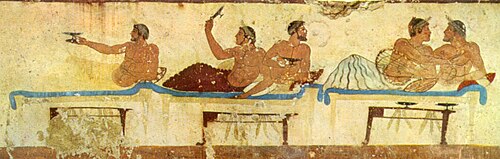
The tradition of wall painting in Greece goes back at least to the Minoan and Mycenaean Bronze Age, with the lavish fresco decoration of sites like Knossos, Tiryns and Mycenae. It is not clear, whether there is any continuity between these antecedents and later Greek wall paintings.
Wall paintings are frequently described in Pausanias, and many appear to have been produced in the Classical and Hellenistic periods. Due to the lack of architecture surviving intact, not many are preserved. The most notable examples are a monumental Archaic 7th-century BC scene of hoplite combat from inside a temple at Kalapodi (near Thebes), and the elaborate frescoes from the 4th-century "Grave of Phillipp" and the "Tomb of Persephone" at Vergina in Macedonia, or the tomb at Agios Athanasios, Thessaloniki, which are sometimes suggested to be closely linked to the high-quality panel paintings mentioned above. The unusual survival of the Tomb of the Palmettes (3rd-century BC, excavated in 1971) with painting in good condition includes portraits of the couple buried inside on the tympanum.
Greek wall painting tradition is also reflected in contemporary grave decorations in the Greek colonies in Italy, e.g. the famous Tomb of the Diver at Paestum. Scholars believe that the celebrated Roman frescoes at sites like Pompeii are descendants of the Greek tradition, and some copy particular famous panel paintings. These Roman copies are all loose adaptations, however, with extra figures added, poses altered, and colouring changed.

-

-
 Ancient Macedonian paintings of armour, arms, and gear from the Tomb of Lyson and Kallikles in ancient Mieza (modern-day Lefkadia), Imathia, Central Macedonia, Greece, 2nd century BC.
 -
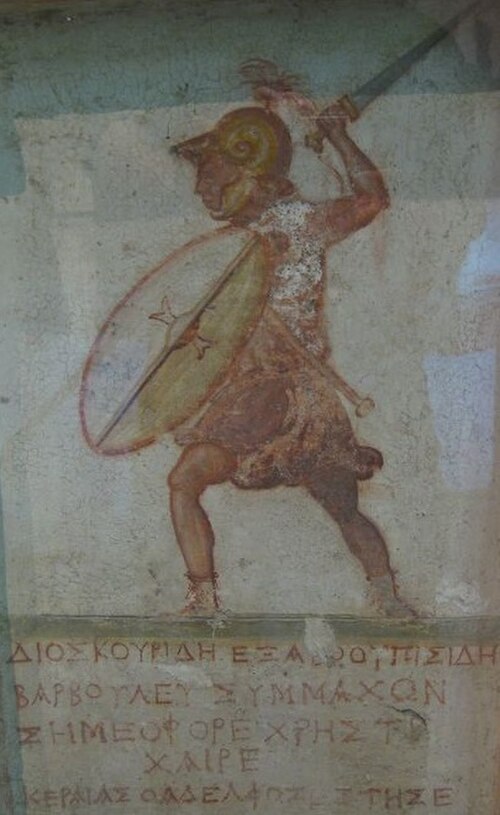 A stele of Dioskourides, dated 2nd century BC, showing a Ptolemaic thyreophoros soldier, a characteristic example of the "Romanization" of the Ptolemaic army
 -
 Fresco from the Tomb of Judgment in ancient Mieza (modern-day Lefkadia), Imathia, Central Macedonia, Greece, depicting religious imagery of the afterlife, 4th century BC
 -
 A fresco showing Hades and Persephone riding in a chariot, from the tomb of Queen Eurydice I of Macedon at Vergina, Greece, 4th century BC
 -
![A banquet scene from a Macedonian tomb of Agios Athanasios, Thessaloniki, 4th century BC; six men are shown reclining on couches, with food arranged on nearby tables, a male servant in attendance, and female musicians providing entertainment.[111]](https://img-server.japedia.wiki/wikipedia/commons/thumb/c/c6/Banquet%2C_tombe_d%27Agios_Athanasios.jpg/500px-Banquet%2C_tombe_d%27Agios_Athanasios.jpg) A banquet scene from a Macedonian tomb of Agios Athanasios, Thessaloniki, 4th century BC; six men are shown reclining on couches, with food arranged on nearby tables, a male servant in attendance, and female musicians providing entertainment.[111]
A banquet scene from a Macedonian tomb of Agios Athanasios, Thessaloniki, 4th century BC; six men are shown reclining on couches, with food arranged on nearby tables, a male servant in attendance, and female musicians providing entertainment.[111] -
 Fresco of an ancient Macedonian soldier (thorakitai) wearing chainmail armor and bearing a thureos shield, 3rd century BC
 -
![The Sampul tapestry, a woollen wall hanging from Lop County, Hotan Prefecture, Xinjiang, China, showing a possibly Greek soldier from the Greco-Bactrian kingdom (250–125 BC), with blue eyes, wielding a spear, and wearing what appears to be a diadem headband; depicted above him is a centaur, from Greek mythology, a common motif in Hellenistic art;[112] Xinjiang Region Museum.](https://img-server.japedia.wiki/wikipedia/commons/thumb/0/0b/UrumqiWarrior.jpg/500px-UrumqiWarrior.jpg) The Sampul tapestry, a woollen wall hanging from Lop County, Hotan Prefecture, Xinjiang, China, showing a possibly Greek soldier from the Greco-Bactrian kingdom (250–125 BC), with blue eyes, wielding a spear, and wearing what appears to be a diadem headband; depicted above him is a centaur, from Greek mythology, a common motif in Hellenistic art;[112] Xinjiang Region Museum.
The Sampul tapestry, a woollen wall hanging from Lop County, Hotan Prefecture, Xinjiang, China, showing a possibly Greek soldier from the Greco-Bactrian kingdom (250–125 BC), with blue eyes, wielding a spear, and wearing what appears to be a diadem headband; depicted above him is a centaur, from Greek mythology, a common motif in Hellenistic art;[112] Xinjiang Region Museum. -
 A Hellenistic Greek encaustic painting on a marble tombstone depicting the portrait of a young man named Theodoros, dated 1st century BC during the period of Roman Greece, Archaeological Museum of Thebes


![A banquet scene from a Macedonian tomb of Agios Athanasios, Thessaloniki, 4th century BC; six men are shown reclining on couches, with food arranged on nearby tables, a male servant in attendance, and female musicians providing entertainment.[111]](https://img-server.japedia.wiki/wikipedia/commons/thumb/c/c6/Banquet,_tombe_d'Agios_Athanasios.jpg/500px-Banquet,_tombe_d'Agios_Athanasios.jpg)

Polychromy: painting on statuary and architecture

Much of the figural or architectural sculpture of ancient Greece was painted colourfully. This aspect of Greek stonework is described as polychrome (from Greek πολυχρωμία, πολύ = many and χρώμα = colour). Due to intensive weathering, polychromy on sculpture and architecture has substantially or totally faded in most cases.
Although the word polychrome is created from the combining of two Greek words, it was not used in ancient Greece. The term was coined in the early nineteenth century by Antoine Chrysostôme Quatremère de Quincy.[113]
Architecture
Painting was also used to enhance the visual aspects of architecture. Certain parts of the superstructure of Greek temples were habitually painted since the Archaic period. Such architectural polychromy could take the form of bright colours directly applied to the stone (evidenced e.g. on the Parthenon, or of elaborate patterns, frequently architectural members made of terracotta (Archaic examples at Olympia and Delphi). Sometimes, the terracottas also depicted figural scenes, as do the 7th-century BC terracotta metopes from Thermon.[114]
Sculpture
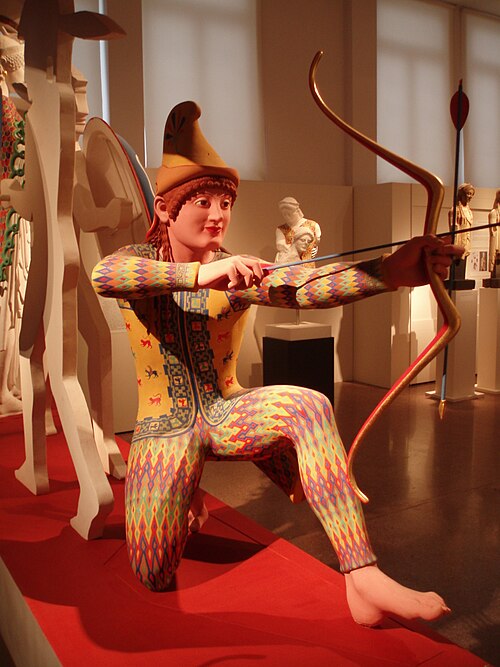
Most Greek sculptures were painted in strong and bright colors; this is called "polychromy". The paint was frequently limited to parts depicting clothing, hair, and so on, with the skin left in the natural color of the stone or bronze, but it could also cover sculptures in their totality; female skin in marble tended to be uncoloured, while male skin might be a light brown. The painting of Greek sculpture should not merely be seen as an enhancement of their sculpted form, but has the characteristics of a distinct style of art.[115]
For example, the pedimental sculptures from the Temple of Aphaia on Aegina have recently been demonstrated to have been painted with bold and elaborate patterns, depicting, amongst other details, patterned clothing. The polychromy of stone statues was paralleled by the use of different materials to distinguish skin, clothing and other details in chryselephantine sculptures, and by the use of different metals to depict lips, fingernails, etc. on high-quality bronzes like the Riace bronzes.[115]
Vase painting
The most copious evidence of ancient Greek painting survives in the form of vase paintings. These are described in the "pottery" section above. They give at least some sense of the aesthetics of Greek painting. The techniques involved, however, were very different from those used in large-format painting. The same probably applies to the subject matter depicted. Vase painters appear to have usually been specialists within a pottery workshop, neither painters in other media nor potters. It should also be kept in mind that vase painting, albeit by far the most conspicuous surviving source on ancient Greek painting, was not held in the highest regard in antiquity, and is never mentioned in Classical literature.[116]
Mosaics


Mosaics were initially made with rounded pebbles, and later glass with tesserae which gave more colour and a flat surface. They were popular in the Hellenistic period, at first as decoration for the floors of palaces, but eventually for private homes.[118] Often a central emblema picture in a central panel was completed in much finer work than the surrounding decoration.[119] Xenia motifs, where a house showed examples of the variety of foods guests might expect to enjoy, provide most of the surviving specimens of Greek still-life. In general mosaic must be considered as a secondary medium copying painting, often very directly, as in the Alexander Mosaic.[120]
The Unswept Floor by Sosus of Pergamon (c. 200 BC) was an original and famous trompe-l'œil piece, known from many Greco-Roman copies. According to John Boardman, Sosus is the only mosaic artist whose name has survived; his Doves are also mentioned in literature and copied.[121] However, Katherine M. D. Dunbabin asserts that two different mosaic artists left their signatures on mosaics of Delos.[122] The artist of the 4th-century BC Stag Hunt Mosaic perhaps also left his signature as Gnosis, although this word may be a reference to the abstract concept of knowledge.[123]
Mosaics are a significant element of surviving Macedonian art, with a large number of examples preserved in the ruins of Pella, the ancient Macedonian capital, in today's Central Macedonia.[124] Mosaics such as the "Stag Hunt Mosaic and Lion Hunt" mosaic demonstrate illusionist and three dimensional qualities generally found in Hellenistic paintings, although the rustic Macedonian pursuit of hunting is markedly more pronounced than other themes.[125] The 2nd-century-BC mosaics of Delos, Greece were judged by François Chamoux as representing the pinnacle of Hellenistic mosaic art, with similar styles that continued throughout the Roman period and perhaps laid the foundations for the widespread use of mosaics in the Western world through to the Middle Ages.[118]
-
 A mosaic of the Kasta Tomb in Amphipolis depicting the abduction of Persephone by Pluto, 4th century BC
 -
![Alexander the Great (left), wearing a kausia and fighting an Asiatic lion with his friend Craterus (detail); late 4th-century BC mosaic from Pella[126]](https://img-server.japedia.wiki/wikipedia/commons/thumb/3/3d/Lion_hunt_mosaic_from_Pella.jpg/500px-Lion_hunt_mosaic_from_Pella.jpg) Alexander the Great (left), wearing a kausia and fighting an Asiatic lion with his friend Craterus (detail); late 4th-century BC mosaic from Pella[126]
Alexander the Great (left), wearing a kausia and fighting an Asiatic lion with his friend Craterus (detail); late 4th-century BC mosaic from Pella[126] -

-

-
 Detail of floor panel with Alexandrine parakeet, Pergamon modern Turkey, middle 2nd century BC (reigns of Eumenes II and Attalus II)
 -
 Ptolemaic mosaic of a dog and askos wine vessel from Hellenistic Egypt, dated 200-150 BC
 -
![Hellenistic mosaic from Thmuis (Mendes), Egypt, signed by Sophilos c. 200 BC; Ptolemaic Queen Berenice II (joint ruler with her husband Ptolemy III) as the personification of Alexandria.[127]](https://img-server.japedia.wiki/wikipedia/commons/thumb/2/27/Mosaic_of_Berenice_II%2C_Ptolemaic_Queen_and_joint_ruler_with_Ptolemy_III_of_Egypt%2C_Thmuis%2C_Egypt.jpg/500px-Mosaic_of_Berenice_II%2C_Ptolemaic_Queen_and_joint_ruler_with_Ptolemy_III_of_Egypt%2C_Thmuis%2C_Egypt.jpg) Hellenistic mosaic from Thmuis (Mendes), Egypt, signed by Sophilos c. 200 BC; Ptolemaic Queen Berenice II (joint ruler with her husband Ptolemy III) as the personification of Alexandria.[127]
Hellenistic mosaic from Thmuis (Mendes), Egypt, signed by Sophilos c. 200 BC; Ptolemaic Queen Berenice II (joint ruler with her husband Ptolemy III) as the personification of Alexandria.[127]

.jpg/500px-Hellenistic_mosaic_floor_panel_of_an_Alexandrine_parakeet_from_Pergamon,_2nd_century_BC,_Pergamon_Museum_(8408107096).jpg)

![Hellenistic mosaic from Thmuis (Mendes), Egypt, signed by Sophilos c. 200 BC; Ptolemaic Queen Berenice II (joint ruler with her husband Ptolemy III) as the personification of Alexandria.[127]](https://img-server.japedia.wiki/wikipedia/commons/thumb/2/27/Mosaic_of_Berenice_II,_Ptolemaic_Queen_and_joint_ruler_with_Ptolemy_III_of_Egypt,_Thmuis,_Egypt.jpg/500px-Mosaic_of_Berenice_II,_Ptolemaic_Queen_and_joint_ruler_with_Ptolemy_III_of_Egypt,_Thmuis,_Egypt.jpg)
Engraved gems

The engraved gem was a luxury art with high prestige; Pompey and Julius Caesar were among later collectors.[128] The technique has an ancient tradition in the Near East, and cylinder seals, whose design only appears when rolled over damp clay, from which the flat ring type developed, spread to the Minoan world, including parts of Greece and Cyprus. The Greek tradition emerged under Minoan influence on mainland Helladic culture, and reached an apogee of subtlety and refinement in the Hellenistic period.[129]
Round or oval Greek gems (along with similar objects in bone and ivory) are found from the 8th and 7th centuries BC, usually with animals in energetic geometric poses, often with a border marked by dots or a rim.[130] Early examples are mostly in softer stones. Gems of the 6th century are more often oval,[131] with a scarab back (in the past this type was called a "scarabaeus"), and human or divine figures as well as animals; the scarab form was apparently adopted from Phoenicia.[132]
The forms are sophisticated for the period, despite the usually small size of the gems.[96] In the 5th century gems became somewhat larger, but still only 2–3 centimetres tall. Despite this, very fine detail is shown, including the eyelashes on one male head, perhaps a portrait. Four gems signed by Dexamenos of Chios are the finest of the period, two showing herons.[133]
Relief carving became common in 5th century BC Greece, and gradually most of the spectacular carved gems were in relief. Generally a relief image is more impressive than an intaglio one; in the earlier form the recipient of a document saw this in the impressed sealing wax, while in the later reliefs it was the owner of the seal who kept it for himself, probably marking the emergence of gems meant to be collected or worn as jewellery pendants in necklaces and the like, rather than used as seals – later ones are sometimes rather large to use to seal letters. However, inscriptions are usually still in reverse ("mirror-writing") so they only read correctly on impressions (or by viewing from behind with transparent stones). This aspect also partly explains the collecting of impressions in plaster or wax from gems, which may be easier to appreciate than the original.
Larger hardstone carvings and cameos, which are rare in intaglio form, seem to have reached Greece around the 3rd century; the Farnese Tazza is the only major surviving Hellenistic example (depending on the dates assigned to the Gonzaga Cameo and the Cup of the Ptolemies), but other glass-paste imitations with portraits suggest that gem-type cameos were made in this period.[134] The conquests of Alexander had opened up new trade routes to the Greek world and increased the range of gemstones available.[135]
Ornament

The synthesis in the Archaic period of the native repertoire of simple geometric motifs with imported, mostly plant-based, motifs from further east created a sizeable vocabulary of ornament, which artists and craftsmen used with confidence and fluency.[136] Today this vocabulary is seen above all in the large corpus of painted pottery, as well as in architectural remains, but it would have originally been used in a wide range of media, as a later version of it is used in European Neoclassicism.
Elements in this vocabulary include the geometrical meander or "Greek key", egg-and-dart, bead and reel, Vitruvian scroll, guilloche, and from the plant world the stylized acanthus leaves, volute, palmette and half-palmette, plant scrolls of various kinds, rosette, lotus flower, and papyrus flower. Originally used prominently on Archaic vases, as figurative painting developed these were usually relegated to serve as borders demarcating edges of the vase or different zones of decoration.[137] Greek architecture was notable for developing sophisticated conventions for using mouldings and other architectural ornamental elements, which used these motifs in a harmoniously integrated whole.
Even before the Classical period, this vocabulary had influenced Celtic art, and the expansion of the Greek world after Alexander, and the export of Greek objects still further afield, exposed much of Eurasia to it, including the regions in the north of the Indian subcontinent where Buddhism was expanding, and creating Greco-Buddhist art. As Buddhism spread across Central Asia to China and the rest of East Asia, in a form that made great use of religious art, versions of this vocabulary were taken with it and used to surround images of buddhas and other religious images, often with a size and emphasis that would have seemed excessive to the ancient Greeks. The vocabulary was absorbed into the ornament of India, China, Persia and other Asian countries, as well as developing further in Byzantine art.[138] The Romans took over the vocabulary more or less in its entirety, and although much altered, it can be traced throughout European medieval art, especially in plant-based ornament.
Islamic art, where ornament largely replaces figuration, developed the Byzantine plant scroll into the full, endless arabesque, and especially from the Mongol conquests of the 14th century received new influences from China, including the descendants of the Greek vocabulary.[139] From the Renaissance onwards, several of these Asian styles were represented on textiles, porcelain and other goods imported into Europe, and influenced ornament there, a process that still continues.
Other arts
Left: A Hellenistic glass amphora excavated from Olbia, Sardinia, dated to the 2nd century BC
Right: Hellenistic satyr who wears a rustic perizoma (loincloth) and carries a pedum (shepherd's crook). Ivory appliqué, probably for furniture.
Right: Hellenistic satyr who wears a rustic perizoma (loincloth) and carries a pedum (shepherd's crook). Ivory appliqué, probably for furniture.
Although glass was made in Cyprus by the 9th century BC, and was considerably developed by the end of the period, there are only a few survivals of glasswork from before the Greco-Roman period that show the artistic quality of the best work.[140] Most survivals are small perfume bottles, in fancy coloured "feathered" styles similar to other Mediterranean glass.[141] Hellenistic glass became cheaper and accessible to a wider population.
No Greek furniture has survived, but there are many images of it on vases and memorial reliefs, for example that to Hegeso. It was evidently often very elegant, as were the styles derived from it from the 18th century onwards. Some pieces of carved ivory that were used as inlays have survived, as at Vergina, and a few ivory carvings; this was a luxury art that could be of very fine quality.[142]
It is clear from vase paintings that the Greeks often wore elaborately patterned clothes, and skill at weaving was the mark of the respectable woman. Two luxurious pieces of cloth survive, from the tomb of Philip of Macedon.[143] There are numerous references to decorative hangings for both homes and temples, but none of these have survived.
Diffusion and legacy
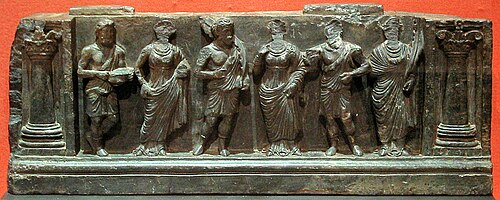

Ancient Greek art has exercised considerable influence on the culture of many countries all over the world, above all in its treatment of the human figure. In the West Greek architecture was also hugely influential, and in both East and West the influence of Greek decoration can be traced to the modern day. Etruscan and Roman art were largely and directly derived from Greek models,[144] and Greek objects and influence reached into Celtic art north of the Alps,[145] as well as all around the Mediterranean world and into Persia.[146]
In the East, Alexander the Great's conquests initiated several centuries of exchange between Greek, Central Asian and Indian cultures, which was greatly aided by the spread of Buddhism, which early on picked up many Greek traits and motifs in Greco-Buddhist art, which were then transmitted as part of a cultural package to East Asia, even as far as Japan, among artists who were no doubt completely unaware of the origin of the motifs and styles they used.[147]
Following the Renaissance in Europe, the humanist aesthetic and the high technical standards of Greek art inspired generations of European artists, with a major revival in the movement of Neoclassicism which began in the mid-18th century, coinciding with easier access from Western Europe to Greece itself, and a renewed importation of Greek originals, most notoriously the Elgin Marbles from the Parthenon. Well into the 19th century, the classical tradition derived from Greece dominated the art of the western world.[148]
Historiography
The Hellenized Roman upper classes of the Late Republic and Early Empire generally accepted Greek superiority in the arts without many quibbles, though the praise of Pliny for the sculpture and painting of pre-Hellenistic artists may be based on earlier Greek writings rather than much personal knowledge. Pliny and other classical authors were known in the Renaissance, and this assumption of Greek superiority was again generally accepted. However, critics in the Renaissance and much later were unclear which works were actually Greek.[149]
As a part of the Ottoman Empire, Greece itself could only be reached by a very few western Europeans until the mid-18th century. Not only the Greek vases found in the Etruscan cemeteries, but also (more controversially) the Greek temples of Paestum were taken to be Etruscan, or otherwise Italic, until the late 18th century and beyond, a misconception prolonged by Italian nationalist sentiment.[149]
The writings of Johann Joachim Winckelmann, especially his books Thoughts on the Imitation of Greek Works in Painting and Sculpture (1750) and Geschichte der Kunst des Alterthums ("History of Ancient Art", 1764) were the first to distinguish sharply between ancient Greek, Etruscan, and Roman art, and define periods within Greek art, tracing a trajectory from growth to maturity and then imitation or decadence that continues to have influence to the present day.[150]
The full disentangling of Greek statues from their later Roman copies, and a better understanding of the balance between Greekness and Roman-ness in Greco-Roman art was to take much longer, and perhaps still continues.[151] Greek art, especially sculpture, continued to enjoy an enormous reputation, and studying and copying it was a large part of the training of artists, until the downfall of Academic art in the late 19th century. During this period, the actual known corpus of Greek art, and to a lesser extent architecture, has greatly expanded. The study of vases developed an enormous literature in the late 19th and 20th centuries, much based on the identification of the hands of individual artists, with Sir John Beazley the leading figure. This literature generally assumed that vase-painting represented the development of an independent medium, only in general terms drawing from stylistic development in other artistic media. This assumption has been increasingly challenged in recent decades, and some scholars now see it as a secondary medium, largely representing cheap copies of now lost metalwork, and much of it made, not for ordinary use, but to deposit in burials.[152]
See also

Wikimedia Commons has media related to Ancient Greek art.
- Dionysian art
- Death in ancient Greek art
- Parthian art
- List of ancient Greek temples
- National Archaeological Museum of Athens
- Classical architecture
Notes
- ^ Boardman, 3–4; Cook, 1–2
- ^ Cook, 12
- ^ Cook, 14–18
- ^ Athena wearing the aegis, detail from a scene representing Heracles and Iolaos escorted by Athena, Apollo and Hermes. Belly of an Attic black-figured hydria, Cabinet des Médailles, Paris, Inv. 254.
- ^ Home page Archived 2019-05-18 at the Wayback Machine of the Corpus vasorum antiquorum, accessed 16 May 2016
- ^ a b Cook, 24–26
- ^ Cook, 27–28; Boardman, 26, 32, 108–109; Woodford, 12
- ^ Preface to Ancient Greek Pottery (Ashmolean Handbooks) by Michael Vickers (1991)
- ^ Boardman, 86, quoted
- ^ Cook, 24–29
- ^ Apollo wearing a laurel or myrtle wreath, a white peplos and a red himation and sandals, seating on a lion-pawed diphros; he holds a kithara in his left hand and pours a libation with his right hand. Facing him, a black bird identified as a pigeon, a jackdaw, a crow (which may allude to his love affair with Coronis) or a raven (a mantic bird). Tondo of an Attic white-ground kylix attributed to the Pistoxenos Painter (or the Berlin Painter, or Onesimos). Diam. 18 cm (7.1 in)
- ^ Cook, 30, 36, 48–51
- ^ Cook, 37–40, 30, 36, 42–48
- ^ Cook, 29; Woodward, 170
- ^ Boardman, 27; Cook, 34–38; Williams, 36, 40, 44; Woodford, 3–6
- ^ Cook, 38–42; Williams, 56
- ^ Woodford, 8–12; Cook, 42–51
- ^ Woodford, 57–74; Cook, 52–57
- ^ Boardman, 145–147; Cook, 56-57
- ^ Trendall, Arthur D. (April 1989). Red Figure Vases of South Italy: A Handbook. Thames and Hudson. p. 17. ISBN 978-0500202258.
- ^ Boardman, 185–187
- ^ Boardman, 150; Cook, 159; Williams, 178
- ^ Cook, 160
- ^ Cook, 161–163
- ^ Boardman, 64–67; Karouzou, 102
- ^ Karouzou, 114–118; Cook, 162–163; Boardman, 131–132
- ^ Cook, 159
- ^ Cook, 159, quoted
- ^ Rasmussen, xiii. However, since the metal vessels have not survived, "this attitude does not get us very far".
- ^ Sowder, Amy. "Ancient Greek Bronze Vessels", in Heilbrunn Timeline of Art History. New York: The Metropolitan Museum of Art, 2000–. online (April 2008)
- ^ Cook, 162; Boardman, 65–66
- ^ Boardman, 185–187; Cook, 163
- ^ Boardman, 131–132, 150, 355–356
- ^ Boardman, 149–150
- ^ Boardman, 131, 187; Williams, 38–39, 134–135, 154–155, 180–181, 172–173
- ^ Boardman, 148; Williams, 164–165
- ^ Boardman, 131–132; Williams, 188–189 for an example made for the Iberian Celtic market.
- ^ Rhyton. The upper section of the luxury vessel used for drinking wines is wrought from silver plate with gilded edge with embossed ivy branch. The lower part goes in the cast Protoma horse. The work of the Greek master, probably for Thracian aristocrat. Perhaps Thrace, the end of the 4th century BC. NG Prague, Kinský Palace, NM-HM10 1407.
- ^ Cook, 19
- ^ Woodford, 39–56
- ^ Cook, 82–85
- ^ Smith, 11
- ^ Cook, 86–91, 110–111
- ^ Cook, 74–82
- ^ Kenneth D. S. Lapatin. Chryselephantine Statuary in the Ancient Mediterranean World. Oxford University Press, 2001. ISBN 0-19-815311-2
- ^ Cook, 74–76
- ^ Boardman, 33–34
- ^ a b Connor, Simon (1 January 2019). "Ashmawy, Aiman, Simon Connor, and Dietrich Raue 2019. Psamtik I in Heliopolis. Egyptian Archaeology 55, 34-39". Egyptian Archaeology: 38–39.
- ^ Smith, William Stevenson; Simpson, William Kelly (1 January 1998). The Art and Architecture of Ancient Egypt. Yale University Press. p. 235. ISBN 978-0-300-07747-6.
- ^ Cook, 99; Woodford, 44, 75
- ^ Cook, 93
- ^ Boardman, 47–52; Cook, 104–108; Woodford, 38–56
- ^ Boardman, 47–52; Cook, 104–108; Woodford, 27–37
- ^ Boardman, 92–103; Cook, 119–131; Woodford, 91–103, 110–133
- ^ Tanner, Jeremy (2006). The Invention of Art History in Ancient Greece: Religion, Society and Artistic Rationalisation. Cambridge University Press. p. 97. ISBN 9780521846141.
- ^ CAHN, HERBERT A.; GERIN, DOMINIQUE (1988). "Themistocles at Magnesia". The Numismatic Chronicle. 148: 19. JSTOR 42668124.
- ^ Boardman, 111–120; Cook, 128; Woodford, 91–103, 110–127
- ^ Boardman, 135, 141; Cook, 128–129, 140; Woodford, 133
- ^ Woodford, 128–134; Boardman, 136–139; Cook, 123–126
- ^ Boardman, 119; Woodford, 128–130
- ^ Smith, 7, 9
- ^ Smith, 11, 19–24, 99
- ^ Smith, 14–15, 255–261, 272
- ^ Smith, 33–40, 136–140
- ^ Smith, 127–154
- ^ Smith, 77–79
- ^ Smith, 99–104; Photo of Kneeling youthful Gaul, Louvre
- ^ Smith, 104–126
- ^ Smith, 240–241
- ^ Smith, 258-261
- ^ Smith, 206, 208-209
- ^ Smith, 210
- ^ Smith, 205
- ^ "Bell idol", Louvre
- ^ Williams, 182, 198–201; Boardman, 63–64; Smith, 86
- ^ Williams, 42, 46, 69, 198
- ^ Cook, 173–174
- ^ Cook, 178, 183–184
- ^ Cook, 178–179
- ^ Cook, 184–191; Boardman, 166–169
- ^ Cook, 186
- ^ Cook, 190–191
- ^ Cook, 241–244
- ^ Boardman, 169–171
- ^ Cook, 185–186
- ^ Cook, 179–180, 186
- ^ Cook, 193–238 gives a comprehensive summary
- ^ Cook, 191–193
- ^ Cook, 211–214
- ^ Cook, 218
- ^ Boardman, 159–160, 164–167
- ^ another reconstruction
- ^ Howgego, 1–2
- ^ a b Cook, 171–172
- ^ Howgego, 44–46, 48–51
- ^ a b Boardman, 68–69
- ^ "A rare silver fraction recently identified as a coin of Themistocles from Magnesia even has a bearded portrait of the great man, making it by far the earliest datable portrait coin. Other early portraits can be seen on the coins of Lycian dynasts." Carradice, Ian; Price, Martin (1988). Coinage in the Greek World. Seaby. p. 84. ISBN 9780900652820.
- ^ Howgego, 63–67
- ^ Williams, 112
- ^ Roger Ling, "Greece and the Hellenistic World"
- ^ Cook, 22, 66
- ^ Cook, 24, says over 1,000 vase-painters have been identified by their style
- ^ Cook, 59–70
- ^ Cook, 59–69, 66 quoted
- ^ Bostock, John. "Natural History". Perseus. Tufts University. Retrieved 23 March 2017.
- ^ Leonard Whibley, A Companion to Greek Studies 3rd ed. 1916, p. 329.
- ^ Cook, 61;
- ^ Boardman, 177–180
- ^ Boardman, 174–177
- ^ Boardman, 338–340; Williams, 333
- ^ Cohen, 28
- ^ Christopoulos, Lucas (August 2012). Mair, Victor H. (ed.). "Hellenes and Romans in Ancient China (240 BC – 1398 AD)" (PDF). Sino-Platonic Papers (230). University of Pennsylvania Department of East Asian Languages and Civilizations: 15–16. ISSN 2157-9687.
- ^ Sabatini, Paolo (2 May 2012). "Antoine Chrysostôme Quatremère de Quincy (1755-1849) and the Rediscovery of Polychromy in Grecian Architecture: Colour Techniques and Archaeological Research in the Pages of "Olympian Zeus."" (PDF).
- ^ Cook, 182–183
- ^ a b Woodford, 173–174; Cook, 75–76, 88, 93–94, 99
- ^ Cook, 59–63
- ^ See: Chugg, Andrew (2006). Alexander's Lovers. Raleigh, N.C.: Lulu. ISBN 978-1-4116-9960-1, pp 78-79.
- ^ a b Chamoux, 375
- ^ Boardman, 154
- ^ Boardman, 174–175, 181–185
- ^ Boardman, 183–184
- ^ Dunbabin, 33
- ^ Cohen, 32
- ^ Hardiman, 517
- ^ Hardiman, 518
- ^ Palagia, Olga (2000). "Hephaestion's Pyre and the Royal Hunt of Alexander". In Bosworth, A.B.; Baynham, E.J. (eds.). Alexander the Great in Fact and Fiction. Oxford University Press. p. 185. ISBN 9780198152873.
- ^ Fletcher, Joann (2008). Cleopatra the Great: The Woman Behind the Legend. New York: Harper. ISBN 978-0-06-058558-7, image plates and captions between pp. 246-247.
- ^ for Caesar: De Vita Caesarum, Divus Iulius, (The Lives of the Caesars, The Deified Julius), Fordham online text; for Pompey: Chapters 4–6 of Book 37 of the Natural History of Pliny the Elder give a summary art history of the Greek and Roman tradition, and of Roman collecting
- ^ Boardman, 39, 67–68, 187, 350
- ^ Boardman, 39 See Beazley for more detail.
- ^ "Lenticular" or "lentoid" gems have the form of a lens.
- ^ Beazley, Later Archaic Greek gems: introduction.
- ^ Boardman, 129–130
- ^ Boardman, 187–188
- ^ Beazley, "Hellenistic gems: introduction"
- ^ Cook, 39–40
- ^ Rawson, 209–222; Cook, 39
- ^ Rawson, throughout, but for quick reference: 23, 27, 32, 39–57, 75–77
- ^ Rawson, 146–163, 173–193
- ^ Williams, 190
- ^ Williams, 214
- ^ Boardman, 34, 127, 150
- ^ Boardman, 150
- ^ Boardman, 349–353; Cook, 155–156; Williams, 236–248
- ^ Boardman, 353–354
- ^ Boardman, 354–369
- ^ Boardman, 370–377
- ^ Cook, 157–158
- ^ a b Ceserani, Giovanna (2012). Italy's Lost Greece: Magna Graecia and the Making of Modern Archaeology. Oxford University Press. pp. 49–66. ISBN 978-0-19-987679-2.
- ^ Honour, 57–62
- ^ See Classical Art from Greece to Rome by John Henderson and Mary Beard, 2001), ISBN 0-19-284237-4; Honour, 45–46
- ^ See Rasmussen, "Adopting an Approach", by Martin Robertson and Mary Beard, also the preface to Ancient Greek Pottery (Ashmolean Handbooks) by Michael Vickers (1991)
References
- "Beazley" The Classical Art Research Centre, Oxford University. Beazley Archive Archived 2010-08-19 at the Wayback Machine – Extensive website on classical gems; page titles used as references
- Boardman, John ed., The Oxford History of Classical Art, Oxford University Press, 1993, ISBN 0198143869
- Burnett, Andrew, Coins; Interpreting the Past, University of California/British Museum, 1991, ISBN 0520076281
- Chamoux, Françios, Hellenistic Civilization, translated by Michel Roussel, Oxford: Blackwell Publishing, 2002 [1981], ISBN 0631222421.
- Cohen, Ada, Art in the Era of Alexander the Great: Paradigms of Manhood and Their Cultural Traditions, New York: Cambridge University Press, 2010, ISBN 9780521769044
- Cook, R.M., Greek Art, Penguin, 1986 (reprint of 1972), ISBN 0140218661
- Dunbabin, Katherine, M. D., Mosaics of the Greek and Roman World, Cambridge: Cambridge University Press, 1999, ISBN 0521002303
- Hardiman, Craig I., (2010). "Classical Art to 221 BC", In Roisman, Joseph; Worthington, Ian, A Companion to Ancient Macedonia, Oxford: Wiley-Blackwell, 2010, ISBN 9781405179362.
- Honour, Hugh, Neo-classicism. Style and Civilisation 1968 (reprinted 1977), Penguin
- Howgego, Christopher, Ancient History from Coins, Routledge, 1995, ISBN 041508993X
- Karouzou, Semni, National Museum : Illustrated Guide to the Museum (NM of Athens), 1980, Ekdotike Athenon S.A., ISBN 9789602130049 (later edition)
- Rasmussen, Tom, Spivey, Nigel, eds., Looking at Greek Vases, 1991, Cambridge University Press, ISBN 9780521376792, google books
- Rawson, Jessica, Chinese Ornament: The Lotus and the Dragon, 1984, British Museum Publications, ISBN 0714114316
- Smith, R.R.R., Hellenistic Sculpture, a handbook, Thames & Hudson, 1991, ISBN 0500202494
- Williams, Dyfri. Masterpieces of Classical Art, 2009, British Museum Press, ISBN 9780714122540
- Woodford, Susan, An Introduction To Greek Art, 1986, Duckworth, ISBN 9780801419942
- Greece: From Mycenae to the Parthenon, Henri Stierlin, TASCHEN, 2004
Further reading
- Shanks, Michael (1999). Art and the Greek City State. Cambridge: Cambridge University Press. ISBN 0-521-56117-5.
- Betancourt, Philip P. Introduction to Aegean Art. Philadelphia: INSTAP Academic Press, 2007.
- Burn, Lucilla. Hellenistic Art: From Alexander the Great to Augustus. Los Angeles: J. Paul Getty Museum, 2004.
- Coldstream, J. N. Geometric Greece: 900-700 BC. 2nd ed. London: Routledge, 2003.
- Jenkins, Ian, Celeste Farge, and Victoria Turner. Defining Beauty: The Body In Ancient Greek Art. London: British Museum, 2015.
- Langdon, Susan Helen. Art and Identity In Dark Age Greece, 1100--700 B.C.E. Cambridge: Cambridge University Press, 2008.
- Ling, Roger. Making Classical Art: Process & Practice. Stroud, Gloucestershire: Tempus, 2000.
- Moon, Warren G. Ancient Greek Art and Iconography. Madison: University of Wisconsin Press, 1983.
- Pedley, John Griffiths. Greek Art and Archaeology. 5th ed. Upper Saddle River, N.J.: Prentice Hall, 2012.
- Plantzos, Dimitris. Hellenistic Engraved Gems. Oxford: Clarendon Press, 1999.
- Pollitt, J. J. Art In the Hellenistic Age. Cambridge: Cambridge University Press, 1986.
- --. Art and Experience In Classical Greece. Cambridge: Cambridge University Press, 1972.
- Smith, Tyler Jo, and Dimitris Plantzos. A Companion to Greek Art. Somerset: Wiley, 2012.
- Stewart, Andrew F. Classical Greece and the Birth of Western Art. Cambridge: Cambridge University Press, 2008.
- Yatromanolakis, Dimitrios. Epigraphy of Art: Ancient Greek Vase-Inscriptions and Vase-Paintings. Oxford: Archaeopress, 2016.
External links
- Greek Art History Resource
- Ancient Greek Ceramics
- Chisholm, Hugh, ed. (1911). . Encyclopædia Britannica (11th ed.). Cambridge University Press.