
Loading article…
インド | |||||||||||||||||||||
|---|---|---|---|---|---|---|---|---|---|---|---|---|---|---|---|---|---|---|---|---|---|
| 1858–1947 | |||||||||||||||||||||
 | |||||||||||||||||||||
 1909 年のイギリス帝国との関係におけるイギリス領インド帝国 | |||||||||||||||||||||
| 状態 | 帝国の政治構造(イギリス領インド[a]と藩王国[b] [1]で構成) | ||||||||||||||||||||
| 資本 | カルカッタ[2] [c] (1858–1911) ニューデリー (1911/1931 [d] –1947) | ||||||||||||||||||||
| 公用語 |
| ||||||||||||||||||||
| 異名 | インド人、イギリス系インド人 | ||||||||||||||||||||
| 政府 | イギリス植民地政府 | ||||||||||||||||||||
| 女王/女王皇后/国王皇帝 | |||||||||||||||||||||
• 1858–1876 (女王)、1876–1901 (女王皇后) | ビクトリア | ||||||||||||||||||||
• 1901–1910 | エドワード7世 | ||||||||||||||||||||
• 1910–1936 | ジョージ5世 | ||||||||||||||||||||
• 1936 | エドワード8世 | ||||||||||||||||||||
• 1936–1947 (最後) | ジョージ6世 | ||||||||||||||||||||
| 総督 | |||||||||||||||||||||
• 1858–1862 (最初) | チャールズ・カニング | ||||||||||||||||||||
• 1947年(最後) | ルイス・マウントバッテン | ||||||||||||||||||||
| 国務長官 | |||||||||||||||||||||
• 1858–1859 (最初) | エドワード・スタンリー | ||||||||||||||||||||
• 1947年(最後) | ウィリアム・ヘア | ||||||||||||||||||||
| 立法府 | 帝国立法評議会 | ||||||||||||||||||||
| 歴史 | |||||||||||||||||||||
• インド反乱 | 1857年5月10日 | ||||||||||||||||||||
• インド政府法 | 1858年8月2日 | ||||||||||||||||||||
• インド独立法 | 1947年7月18日 | ||||||||||||||||||||
• インド分割 | 1947年8月14日~15日深夜発効 | ||||||||||||||||||||
| エリア | |||||||||||||||||||||
• 合計 | 4,993,650 km 2 (1,928,060 平方マイル) | ||||||||||||||||||||
| 通貨 | インドルピー | ||||||||||||||||||||
| |||||||||||||||||||||

イギリス領インド帝国(/ r ɑː dʒ / RAHJ ;ヒンドゥスターニー語の rāj、「統治」、「支配」、「政府」に由来)[10] は、インド亜大陸におけるイギリス王室の統治であり、[11] 1858年から1947年まで続いた。[12]これは、インドにおける王室統治[13] 、またはインドにおける直接統治[14 ] とも呼ばれる。イギリスの支配下にあった地域は、当時の用法では一般的にインドと呼ばれ、イギリスが直接統治する地域(総称してイギリス領インド)と、現地の統治者によって統治されているがイギリスの覇権下にある地域(藩王国)が含まれていた。この地域は、正式ではないが、インド帝国と呼ばれることもあった。 [15]
この統治システムは、1857年のインド大反乱の後、東インド会社の統治権がヴィクトリア女王[16](1876年にインド女帝と宣言された)の手に渡り、1858年6月28日に制定された。このシステムは、イギリス領インド帝国がインド連邦(後のインド共和国)とパキスタン(後のパキスタン・イスラム共和国)の2つの主権国家に分割された1947年まで続いた。後に、バングラデシュ人民共和国がパキスタンから独立した。1858年のインド帝国発足当時、下ビルマはすでにイギリス領インドの一部であった。 1886年に上ビルマが加わり、その結果生まれた連合体ビルマは、1937年に独立したイギリス植民地になるまで自治州として統治され、1948年に独立した。1989年にミャンマーに改名された。総督府のアデン州もイギリス領インド帝国の始まりの時点ではイギリス領インドの一部であったが、1937年に アデン植民地として知られる独立した植民地となった。
インドは国際連盟の創設メンバーであり、1945年にサンフランシスコで設立された国際連合の創設メンバーでもありました。[17]インドは1900年、1920年、1928年、1932年、1936年の夏季オリンピックに参加しました。
地理的範囲
イギリス領インド帝国は、ゴアやポンディシェリなど他のヨーロッパ諸国の小規模な領土を除き、現在のインド、パキスタン、バングラデシュ、ミャンマーのほぼ全域に及んでいた。[18]この地域は非常に多様で、ヒマラヤ山脈、肥沃な氾濫原、インド・ガンジス平原、長い海岸線、熱帯乾燥林、乾燥した高地、タール砂漠などがある。[19]さらに、様々な時期に、アデン(1858年から1937年)、[20] 下ビルマ(1858年から1937年)、上ビルマ(1886年から1937年)、イギリス領ソマリランド(1884年から1898年の短期間)、海峡植民地(1858年から1867年の短期間)も含まれていた。ビルマは1937年から1948年の独立までインドから分離され、イギリス王室によって直接統治されていた。ペルシャ湾休戦諸国とペルシャ湾駐在国は理論上は1947年までイギリス領インドの首相府および州であると同時に藩王国であり、通貨単位としてルピーを使用していた。 [21]
この地域の他の国々の中で、当時は島の沿岸地域と北部を指していたセイロン(現在のスリランカ)は、1802年のアミアン条約でイギリスに割譲された。これらの沿岸地域は1793年から1798年まで一時的にマドラス総督府の管轄下にあったが[22] 、その後の期間、イギリスの総督はロンドンに報告し、インド帝国の一部ではなかった。ネパール王国とブータン王国はイギリスと戦争をした後、後にイギリスと条約を結び、イギリスに独立国家として承認された。[23] [24]シッキム王国は1861年の英シッキム条約後に藩王国として建国されたが、主権の問題は未定義のままであった。[25]モルディブ諸島は1887年から1965年までイギリスの保護領であったが、イギリス領インドの一部ではなかった。[26]
-
 1909 年のイギリス領インド帝国とその周辺諸国が描かれています。
歴史
1858-1868: 反乱の余波、批判、反応
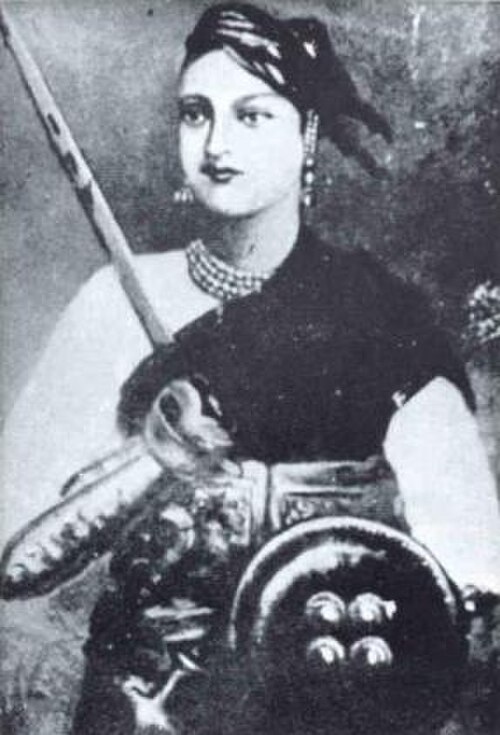

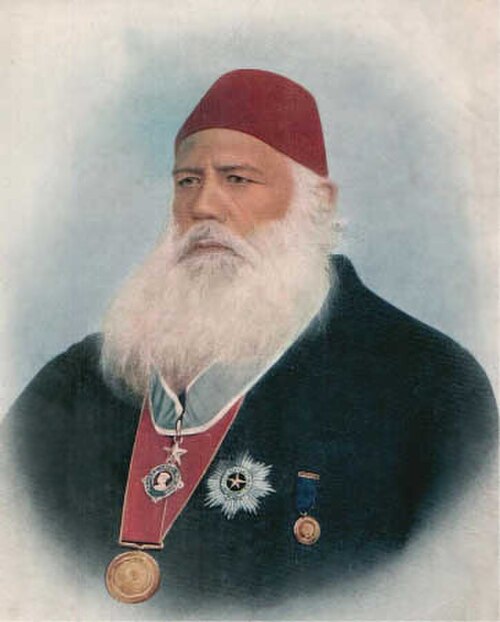

1857年のインド大反乱は、インドにおけるイギリスの事業を揺るがしたものの、それを挫折させたわけではなかった。1857年まで、特にダルハウジー卿の指揮下でイギリスは、経済的および社会的制度の質と強さにおいてイギリス自身と同等となることを構想したインドを急いで建設していた。反乱の後、彼らはより慎重になった。反乱の原因については多くの考察が払われ、3つの主要な教訓が導き出された。第一に、実際的なレベルでは、イギリス人とインド人の間にもっとコミュニケーションと友情が必要だと感じられた。イギリス軍の将校とインド人スタッフの間だけでなく、民間生活においてもそうであった。[27]インド軍は完全に再編成され、反乱の中核をなしていたアグラ・アウド連合州のイスラム教徒とバラモンで構成された部隊は解散された。シク人やバルーチ人のような、イギリスの評価では不屈の精神を示したインド人で構成される新しい連隊が結成された。それ以降、インド軍は1947年まで組織が変更されなかった。[28] 1861年の国勢調査では、インドにおけるイギリス人の人口は125,945人であることが明らかになった。このうち民間人はわずか約41,862人で、陸軍のヨーロッパ人将校と兵士は約84,083人であった。[29] 1880年、常備のインド軍は66,000人のイギリス兵、130,000人の現地人、および350,000人の王侯軍兵士で構成されていた。[30]
第二に、反乱に加わらなかった王子たちと大地主たちは、カニング卿の言葉を借りれば「嵐の中の防波堤」となったと感じられた。[27]彼らもまた、イギリス領インド帝国の新たな統治下で、イギリス・インド政治体制に統合され、領土を保証されるという恩恵を受けた。[31]同時に、連合諸州の大規模な土地改革は彼らの利益のために実施されたが、多くの場合、彼らは以前の地主のためにイギリスに対抗して戦うことで、不忠を示したと感じられた。その結果、その後90年間、土地改革は実施されなかった。ベンガルとビハールは、大地主の領域のままとなった(パンジャブやウッタル・プラデーシュとは異なり)。[32]
第三に、イギリスは社会変革に対するインドの反応に幻滅を感じていた。反乱が起こるまで、イギリスはウィリアム・ベンティンク卿によるサティ禁止法のような社会改革を熱心に推し進めていた。[33]インドの伝統や慣習は簡単に変えるにはあまりにも強くて硬直しすぎていると感じられた。その結果、特に宗教に関する問題では、イギリスが社会介入することはなくなった。[34]たとえイギリスがその問題に強い感情を抱いていたとしても(ヒンズー教徒の未亡人の再婚の例のように)。[35]このことは、反乱直後に出されたヴィクトリア女王の宣言にもさらに例証されている。宣言には「我々は、我々の信念をいかなる臣民にも押し付ける権利と欲求を同様に放棄する」と記されており、[36]インドへの社会介入を控えるというイギリスの公式の公約を示している。
1858–1880: 鉄道、運河、飢饉法
-
 1909 年のインド鉄道の地図。世界で 4 番目に大きい。鉄道の建設は 1853 年に始まりました。
 -

-
 アグラ運河( 1873年頃)は完成の1年後、飢饉の際の灌漑を増やすために1904年に航行禁止となった。
 -
 飢餓法を制定したインドの自由主義総督リポン卿。1880年。
19世紀後半、イギリス王室によるインドの直接統治と産業革命によってもたらされた技術革新は、インドとイギリスの経済を密接に絡み合わせる効果をもたらした。[37]実際、輸送と通信における主要な変化(インドの王室統治に典型的に関連付けられる)の多くは、反乱以前にすでに始まっていた。ダルハウジーが当時イギリスで猛威を振るっていた技術革新を受け入れていたため、インドでもそれらすべての技術が急速に発展した。インドでは鉄道、道路、運河、橋が急速に建設され、電信回線も同様に急速に確立されたため、インドの内陸部からの綿などの原材料は、その後イギリスに輸出するために、ボンベイなどの港に効率的に輸送されるようになった。 [38]同様に、イギリスからの完成品は、急成長するインド市場で販売するために輸送された。[39]インフラ整備の市場リスクを民間投資家が負った英国とは異なり、インドでは、リスクを負ったのは納税者、主に農民と農場労働者であり、その額は最終的に5000万ポンドに達した。[40]これらのコストにもかかわらず、インド人のための熟練雇用はほとんど創出されなかった。1920年までに、世界で4番目に大きな鉄道網と60年の歴史を持つインド鉄道の「上級職」のわずか10%がインド人によって占められていた。[41]
テクノロジーの急速な進歩はインドの農業経済にも変化をもたらしていた。19世紀最後の10年までに、綿花だけでなく一部の食用穀物など、原材料の大部分が遠方の市場に輸出されるようになった。[42]こうした市場の気まぐれに依存していた多くの小規模農家が、土地、家畜、設備を金貸しに奪われた。[42] 19世紀後半には、インドで大規模な飢饉の数も増加した。飢饉は亜大陸では目新しいものではなかったが、特に深刻で、数千万人が死亡し[要出典]、イギリス人、インド人の多くの批評家がその責任を鈍い植民地政権に押し付けた。[42]有益な効果もあった。特に運河が新設されたパンジャブ地方での商業栽培により、国内消費用の食糧生産が増加した。[43]鉄道網は飢餓の救済に大きく貢献し、[44]貨物輸送コストを大幅に削減し、[44]新興のインド人所有産業を助けた。[43] 1876年から1878年にかけての大飢饉の後、1880年にインド飢饉委員会の報告書が発行され、最も初期の飢饉の尺度と飢饉防止プログラムであるインド飢饉法が制定された。 [45]何らかの形で、これらは1970年代までずっと国連と食糧農業機関によって世界中で実施された。[要出典]
1880年代~1890年代: 中流階級、インド国民会議
-

-
-
 インドにおける貧困と非英国統治、1901年、ナオロジー著、英国議会議員(1892-1895年)、国民会議議長(1886、1893、1906年)
 -
 メータ、弁護士、実業家、1890年インド国民会議第6回会議議長
.jpg/500px-Pherozeshah_Mehta_(portrait).jpg)
1880 年までに、インドでは新しい中産階級が生まれ、国中に薄く広がった。さらに、その構成員の間では「励ましと苛立ちの共同刺激」によって結束が強まっていた。[46]この階級が感じた励ましは、教育での成功と、インド公務員への就職など、その教育の恩恵を享受する能力から来たものだった。また、1858 年のヴィクトリア女王の宣言からも来たものだった。「我々は、他のすべての臣民に我々を縛り付けるのと同じ義務を、インド領土の原住民に我々自身を縛り付ける」と彼女は宣言した。[47]インド人は、1867 年にカナダが自治領の地位を与えられ、自治民主憲法を制定したときに特に勇気づけられた。 [47]最後に、モニエ・モニエ・ウィリアムズやマックス・ミュラーのような同時代の東洋学者の著作から来た励ましも、その励ましとなった。彼らは著作の中で、古代インドを偉大な文明として紹介していた。一方、インドにおけるイギリス人による人種差別事件だけでなく、インド軍を帝国の軍事作戦に投入したこと(例えば第二次アフガン戦争)や、母国語による報道を統制しようとしたこと(例えば1878年の母国語報道法)などの政府の行動からも怒りが湧き起こった。[48]
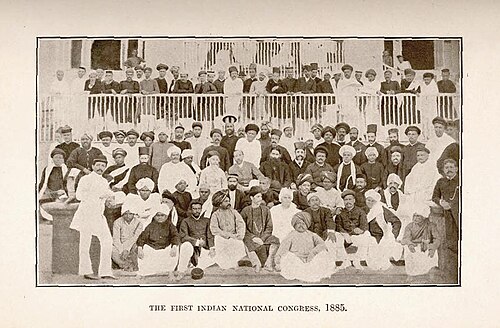
しかし、インド人の裁判官をベンガル州で英国人と同等の立場に置くことを提案した立法措置であるイルバート法案(1883年)をリポン総督が部分的に撤回したことで、不満は政治行動へと変わった。 [49] 1885年12月28日、この中流階級の専門家や知識人(多くはボンベイ、カルカッタ、マドラスにある英国が設立した新しい大学で教育を受け、ボンベイに集まった功利主義者をはじめとする英国の政治哲学者の考えに精通していた)がインド国民会議を設立した。70人の男性はウォメシュ・チャンダー・ボネルジーを初代議長に選出した。メンバーは西洋化したエリートで構成され、この時点では基盤を広げる努力は行われなかった。[要出典]
最初の20年間、議会は主にイギリスの対インド政策を議論した。その議論は、インドから富を吸い上げた責任はイギリスにあるとする新たなインド観を生み出した。ナショナリストたちは、イギリスは不公平な貿易、インド国内の産業の抑制、そしてインドに駐在するイギリス公務員の高額な給与を支払うためにインドの税金を利用したことで、富を吸い上げたのだと主張した。[50]
トーマス・ベアリングは1872年から1876年までインド総督を務めた。ベアリングの主な功績は、イギリス領インド帝国の政府の質の向上に尽力した精力的な改革者としての功績である。彼は大規模な飢餓救済、減税を開始し、官僚的障害を克服して飢餓と広範囲にわたる社会不安の両方を軽減しようと努めた。自由党政権によって任命されたが、彼の政策は保守党政権によって任命された総督とほとんど同じであった。[51]
1880年代までには社会改革の気運が高まっていた。例えば、詩人でありサンスクリット語学者で、インド人女性解放運動の推進者でもあったパンディタ・ラマバイは、未亡人の再婚、特に後にキリスト教に改宗したバラモン教徒の未亡人の再婚を訴えた。 [52] 1900年までには、インド国民会議派内に改革運動が根付いていた。国民会議派の議員ゴパール・クリシュナ・ゴーカレーはインド奉仕者協会を設立し、立法改革(例えば、ヒンドゥー教徒の未亡人の再婚を認める法律の制定)を働きかけ、会員は清貧の誓いを立て、不可触民の間で活動した。[53]
1905年までに、ゴカール率いる穏健派(民衆の扇動を軽視)と、扇動を主張するだけでなく社会改革の追求をナショナリズムの妨げとみなす新たな「過激派」との間に深い溝が開いた。過激派の中で目立っていたのはバル・ガンガダル・ティラクで、彼は西インドで毎年開催するガナパティ祭など、明確にヒンドゥー教の政治的アイデンティティを訴えてインド国民を動員しようとした。[54]
1905–1911: ベンガル分割、スワデシ、暴力
-
-
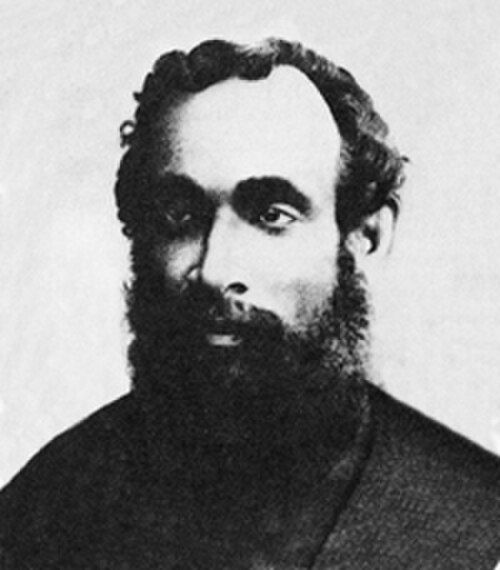 インド国民会議派穏健派のサー・スレンドラナート・バネルジー氏がスワデシ運動を率いて野党を率いた。
 -
 タミル語の雑誌「ヴィジャヤ」(1909 年)には、「母なるインド」とその子孫、そして「バンデ マタラム」というスローガンが掲載されている。
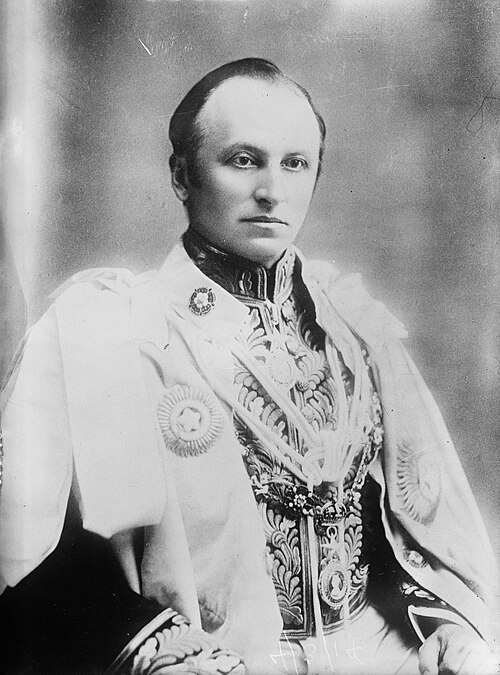
総督カーゾン卿(1899-1905)は、効率と改革の追求に並外れて精力的だった。[55]彼の政策課題には、北西辺境州の創設、行政サービスの小規模な変更、事務局の業務の迅速化、通貨の安定を確保するための金本位制の確立、鉄道委員会の創設、灌漑改革、農民の負債の削減、電報のコスト削減、考古学的研究と遺物の保存、大学の改善、警察改革、先住民族の役割の向上、新しい商工省、産業の促進、土地収入政策の見直し、税金の引き下げ、農業銀行の設立、農業省の創設、農業研究の支援、帝国図書館の設立、帝国士官候補生団の創設、新しい飢餓法、そして、カルカッタの煙害の削減が含まれていた。[56]
カーゾンにとって問題となったのは、イギリス領インド最大の行政区分であるベンガル州を、イスラム教徒が多数を占める東ベンガル州とアッサム州、ヒンドゥー教徒が多数を占める西ベンガル州(現在のインド西ベンガル州、ビハール州、オリッサ州)に分割した時であった。カーゾンの行為であるベンガル分割は、ウィリアム・ベンティンク卿の時代から様々な植民地政権によって検討されていたが、実行には至らなかった。行政上は適切だと考える者もいたが、宗派間で非難が集まった。この行為はベンガルのインド人の間に分裂の種をまき、民族主義政治をこれまでにないほど変容させた。ベンガルのヒンドゥー教徒エリート層、その中にはイスラム教徒の農民に貸し出されていた東ベンガルの土地を所有していた者も多く、激しく抗議した。[57]
ベンガル分割はカーゾン卿が民族主義運動を弱めるために立てた戦略であったが、その後ティラクはスワデシ運動とボイコット運動を奨励した。[58]この運動は外国製品のボイコットと、外国製品を使用するインド人に対する社会的ボイコットから成っていた。スワデシ運動は国産品の使用から成っていた。外国製品がボイコットされると、インド国内でそれらの製品を生産することで埋めなければならない空白が生じた。バル・ガンガダル・ティラクは、スワデシ運動とボイコット運動はコインの裏表であると述べた。ベンガル人の大規模なヒンドゥー中流階級(バドラロック)は、新しいベンガル州でベンガル人がビハリ族とオリヤ族に数で劣勢になる見通しに憤慨し、カーゾンの行為は自分たちの政治的主張に対する罰だと感じた。カーゾンの決定に対する広範な抗議は、主に2度大統領を務めたスレンドラナート・バネルジーが率いるスワデシ(「インド製品を買え」)運動の形をとり、イギリス製品のボイコットを伴った。[59]
どちらのタイプの抗議活動も、スローガンは「母に万歳」で、ベンガル、インド、ヒンズー教の女神カーリーなど、さまざまな母なる女神を称えた。シュリー・オーロビンドは「バンデ・マタラム」誌の編集にあたり、法律を逸脱することはなかった。同誌は独立を説いたが、可能な限り平和の範囲内でのことだった。その目標は受動的抵抗だった。[60]学生たちが故郷の村や町に戻ると、騒乱はカルカッタからベンガルの周辺地域に広がった。当時ベンガルで台頭しつつあった地元の政治青年クラブに参加する者もいれば、武器の調達資金を調達するために強盗に手を染める者、さらにはインド政府高官の命を狙う者もいた。しかし、陰謀は警察の集中的な捜査の前に概ね失敗に終わった。[61]スワデシのボイコット運動により、イギリスの繊維製品の輸入が 25% 減少した。スワデシ布はランカシャーの同業他社のものより高価で着心地もやや劣るものの、インド全土の人々によって国民的誇りの象徴として着用された。[62]
1870年代~1906年: イスラム社会運動、ムスリム連盟
-

-
 1909 年の主流宗教、1909 年のイギリス領インド帝国の地図。1901 年の国勢調査に基づいて、多数派の宗教を示しています。
 -
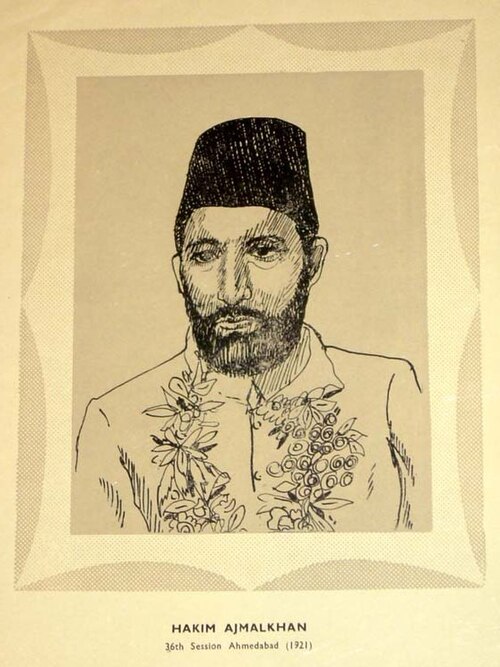 ムスリム連盟の創設者であるハキム・アジマル・カーンは、 1921年にインド国民会議の議長にも就任した。
ベンガル分割に対する圧倒的だが主にヒンズー教徒による抗議と、その結果としてヒンズー教徒多数派に有利な改革が行われることへの恐れから、 1906年にインドのムスリムエリートは新総督ミントー卿と会見し、ムスリムのための別個の選挙区を求めた。 [39]同時に彼らは、以前の統治者としての地位と英国との協力実績の両方を反映した比例代表制の立法府を要求した。これが[要出典] 、1906年12月にダッカで全インド・ムスリム連盟の設立につながった。この時までにカーゾンは軍の最高司令官キッチナー卿との論争で辞職し英国に帰国していたが、連盟はカーゾンの分割案を支持していた。[63]ムスリムエリート層の立場は、連盟の立場にも反映されており、1871年の英領インドの国勢調査で初めてムスリムが多数派を占める地域の人口が推定されたことに始まり、過去30年間にわたって徐々に結晶化してきた[要出典] (カーゾンが東ベンガルのムスリムの支持を得ようとした理由は、1871年の国勢調査以来のイギリス人の不安から生じたものであり、 1857年の反乱や第二次アフガン戦争でムスリムがイギリスと戦った歴史を踏まえると、インド人ムスリムが国王に反乱を起こすのではないかという懸念から生じたものであった)。[要出典]それからの30年間、北インド各地のムスリム指導者たちは、新しいヒンズー教徒の政治・社会グループから断続的に公の敵意にさらされてきた。[63]例えば、アーリア・サマージは、牛保護協会の運動を支援しただけでなく、[ 64 ] 1871年の国勢調査でイスラム教徒の数が多かったことに動揺し、イスラム教徒をヒンドゥー教に呼び戻す目的で「再改宗」イベントを組織した。[63] 1905年、ティラクとラジパト・ライが議会で指導的地位に就こうとし、議会自体がカリの象徴を中心に結集したとき、イスラム教徒の恐怖は増大した。[65]例えば、多くのイスラム教徒は、結集のスローガン「バンデ・マタラム」が、ヒンドゥー教徒がイスラム教徒の抑圧者と戦った小説「アナンド・マート」で初めて登場したことを見逃さなかった。 [65]最後に、イスラムのエリート、その中には、シャーバグの邸宅でリーグの最初の会合を主催したダッカ・ナワーブ、ホワジャ・サリムッラーもいた。は、イスラム教徒が多数派を占める新しい州が、政治権力を目指すイスラム教徒に直接利益をもたらすことを認識していた。[65]
19世紀後半、イギリス領インドにおける自治に向けた最初の一歩として、イギリス総督に助言するインド人顧問官の任命と、インド人メンバーによる地方議会の設立が行われた。その後、イギリスは1892年のインド議会法により、立法議会への参加を拡大した。地方行政のために市町村法人と地区委員会が設立され、選出されたインド人メンバーも含まれた。
1909年のインド評議会法はモーリー・ミント改革(ジョン・モーリーはインド担当大臣、ミントは総督)として知られ、インド人に中央および州議会で限定的な役割を与えた。上流階級のインド人、裕福な地主、実業家が優遇された。イスラム教徒コミュニティは別の選挙区となり、二重代表が認められた。目標は非常に保守的だったが、選挙制の原則を推進した。[66]
ベンガル分割は1911年に撤回され、デリーのダルバールで発表された。このときジョージ5世が自ら来訪し、インド皇帝に即位した。彼は首都をカルカッタからデリーに移すと発表した。この時期、ベンガルのアヌシラン・サミティやパンジャブのガダル党など、革命グループの活動が活発化した。しかし、イギリス当局は暴力的な反乱者を速やかに鎮圧することができ、その理由の1つは、教育を受けたインドの政治家の主流が暴力的な革命に反対していたことであった。[67]
1914–1918: 第一次世界大戦、ラクナウ条約、ホームルール同盟
-

-

-
 アニー・ベサントは、インド自治連盟を設立する4年前の1912年にマドラスのアディヤールで神智学者たちと一緒でした。 [h]
 -

第一次世界大戦は、イギリスとインドの帝国関係の分岐点となった。開戦直前、インド政府は2個師団と騎兵旅団を供給し、緊急時にはさらに1個師団を配備する意向を示していた。[68]約140 万人のイギリス軍とイギリス軍の兵士が、イラクと中東を中心に戦争に参加した。彼らの参加は、イギリス軍やカナダ、オーストラリアなどの自治領の兵士とともに勇敢に戦い、命を落とした兵士たちのニュースが広まり、より広い文化的影響をもたらした。[69] 1920年代、インドは国際連盟の創設メンバーとなり、「Les Indes Anglaises」(イギリス領インド)の名で1920年アントワープ夏季オリンピックに参加したため、インドの国際的知名度は上昇した。[70]インドでは、特にインド国民会議の指導者の間で、戦争をきっかけにインド人の自治権拡大を求める声が高まりました。[69]
第一次世界大戦の勃発に伴い、インド駐留のイギリス軍の大半がヨーロッパとメソポタミアに再配置されたため、前総督ハーディング卿は「インドから軍隊を撤退させることに伴うリスク」を懸念した。[69] 革命による暴力は既にイギリス領インドで懸念されていた。そのため、1915年、インド政府は、脆弱性が高まった時期に権力を強化するため、1915年インド国防法を可決した。この法律により、政府は政治的に危険な反体制派を適正手続きなしに抑留することを認め、1910年のインド報道法に基づいて既に有していた、裁判なしでジャーナリストを投獄し報道を検閲する権限も強化された。[71] 1916年にアリ兄弟が投獄されたのはインド防衛法の下でのことであり、ヨーロッパ人女性で通常は投獄するのがより問題となるアニー・ベサントが1917年に逮捕された。 [71]さて、憲法改正が本格的に議論され始めたとき、イギリスは新しい穏健派インド人を憲法政治の枠組みに取り込む方法と、同時に既存の憲法主義者の力を強化する方法を検討し始めた。しかし、インド政府は過激派による改革プロセスの妨害を確実に防ぎたいと考えていたし、その改革計画が政府の統制強化の結果として過激派の暴力が弱まっていた時期に考案されたため、政府は戦時権限の一部を平時に拡大する方法も検討し始めた。[71]
1906年にインド国民会議派の穏健派と過激派が分裂した後、1914年にバル・ガンガダル・ティラクが釈放され、他のインド国民会議派の指導者に再統一の可能性を打診するまで、インド国民会議派による組織的な政治活動は断片化したままだった。しかし、それはティラクの主要な穏健派の反対派であるゴパール・クリシュナ・ゴーカレーとフェロゼシャー・メータが1915年に亡くなるまで待たなければならなかった。その時点で、ティラクの追放されたグループがインド国民会議派に復帰する合意が成立した。[69] 1916年のインド国民会議派ラクナウ会議で、ティラクの支持者は、イギリスに「インドに早期に自治権を与えることが彼らの目的であり意図である」と宣言するよう求める、より急進的な決議を通過させることができた。[69]すぐに、他の同様のうわさが公の声明に現れ始めました。1917年、帝国立法評議会で、マダン・モハン・マラヴィヤは、戦争がインドに生み出した期待について次のように語りました。「戦争は時計を50年早めたと私はあえて言います...戦後の改革は、インド国民が自国の統治に正当な役割を果たしたいという願望を満たすものでなければなりません。」[69]
1916年のラクナウ会議は、ドイツとトルコの戦時協力によって機会が与えられた、会議とムスリム連盟による予期せぬ相互努力の場でもあった。トルコのスルタン、つまりカリフもまた、イスラム教の聖地であるメッカ、メディナ、エルサレムの守護者を散発的に主張していたこと、そして英国とその同盟国がトルコと対立していたことから、インドのムスリムの中には、英国の「宗教的中立」に対する疑念が高まり始めた。この疑念は、ムスリムに不利とみなされた1911年のベンガル再統一の結果としてすでに表面化していた。[72]ラクナウ協定において、ムスリム連盟は、ティラクとその支持者によって運動されていたより大規模な自治の提案において会議に加わった。その代わりに、インド国民会議は州議会と帝国立法評議会にイスラム教徒のための別個の選挙区を設けることを承認した。1916年、ムスリム連盟の 会員数は500人から800人の間で、後年享受したようなインド人イスラム教徒の幅広い支持はまだ得られなかった。連盟自体も、この協定は全会一致の支持を得ていたわけではなく、主に統一州(UP)の「青年党」イスラム教徒のグループ、特に汎イスラム主義を信奉していたモハメッド・アリとシャウカット・アリの兄弟によって交渉された。 [72]しかし、ボンベイ出身の若い弁護士、ムハンマド・アリ・ジンナーの支持は得ており、ジンナーは後に連盟とインド独立運動の両方で指導的役割を果たすことになる。後年、協定の全容が明らかになるにつれ、協定はパンジャブやベンガルのイスラム教徒多数派よりもウッタル・プラデーシュ州やビハール州などのイスラム教徒少数派エリート層に利益をもたらすものと見なされるようになった。しかし、当時、「ラクナウ協定」は民族主義運動の重要な節目であり、イギリスもそう見ていた。[72]
1916年、インド国民会議内にティラクとアニー・ベサントによって2つの自治連盟がそれぞれ設立された。インド人の間で自治を推進し、また会議自体の中で創設者の地位を高めることが目的だった。[73]一方ベサントは、アイルランドの自治運動で一定の成功を収めたこの新しい形態の組織的煽動が、1907年から1914年にかけてインド亜大陸を断続的に悩ませた政治的暴力よりも優れていることを示すことに熱心だった。[73] 2つの連盟は地理的に補完的な地域に注意を向けた。ティラクはインド西部、南部ボンベイ管区に、ベサントはインドの他の地域、特にマドラス管区や、これまで会議によって政治的に休眠状態にあるとみなされていたシンドやグジャラートなどの地域に重点を置いた。[73]両リーグは急速に新会員を獲得し( 1年ちょっとでそれぞれ約3万人)、安価な新聞を発行し始めた。彼らの宣伝活動はポスター、パンフレット、政治宗教歌にも広がり、後には大衆集会へと移行した。集会は以前の議会会期よりも多くの人々を引きつけただけでなく、非バラモン、商人、農民、学生、下級政府職員など、まったく新しい社会集団も引きつけた。[73]全国規模の大衆運動ほどの規模や性格は達成しなかったものの、ホームルールリーグはインドにおける自治を求める組織的な政治運動を深め、拡大させた。英国当局はリーグに対して学生の集会への参加を禁じ、両リーダーの特定州への渡航を禁止するなど、制限を課すことで対応した。[73]
1915-1918年: ガンジーの帰還

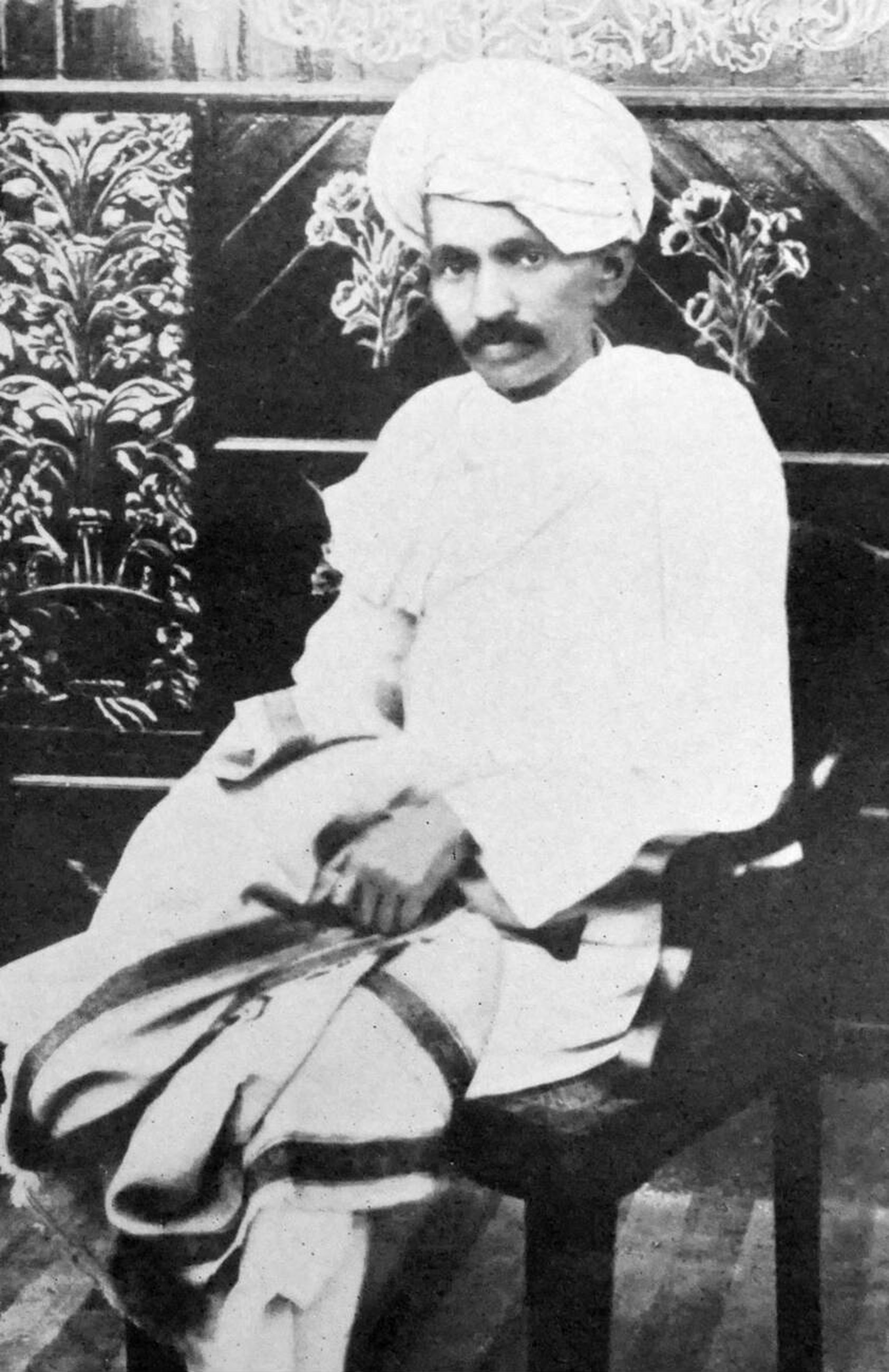
1915 年には、モハンダス・カラムチャンド・ガンジーがインドに戻った。南アフリカのインド人のために公民権運動を行ったことでインドではすでに知られていたガンジーは、師であるゴパール・クリシュナ・ゴーカレーの助言に従い、帰国後 1 年間は公の場で発言せず、旅行して国を直接観察し、執筆活動を行った。[74]以前、南アフリカ滞在中に、弁護士であったガンジーは、小規模ではあるものの、インドの縮図ともいえるほど多様性に富んだインド人コミュニティの代表を務めた。このコミュニティをまとめながら同時に植民地当局と対峙するという課題に取り組む中で、ガンジーは非暴力抵抗の手法を生み出し、それをサティヤーグラハ(真実を求める闘争) と名付けた。[75]ガンジーにとって、サティヤーグラハは、当時よく知られた社会的抗議の手法である「受動的抵抗」とは異なっていた。ガンジーは、受動的抵抗を、力の強さを前にして弱者が採用する実際的な戦略とみなしていた。一方、サティヤーグラハは、彼にとって「真理のために苦しみに耐えるほど強い者が真実に献身する最後の手段」だった。[75] サティヤーグラハの基盤をなすアヒンサー、つまり「非暴力」は、真実とともに、ガンジーの非正統的な宗教的人生観の二本柱をなすようになった。[75] 1907年から1914年にかけて、ガンジーは、南アフリカのインド人コミュニティを代表して、不当な人種差別法に反対する数々の抗議活動で、サティヤーグラハの手法を試した。[75]
また、南アフリカ滞在中、ガンジーはエッセイ『ヒンド・スワラージ』(1909年)で、インドのスワラージ、つまり「自治」のビジョンを3つの重要な要素に基づいてまとめた。それは、異なる信仰を持つインド人、とりわけヒンズー教徒とイスラム教徒の間の連帯、インド社会からの不可触民の排除、そしてスワデシ(外国製品のボイコットとインドの家内工業の復活)の実践である。[74]最初の2つは、インドが平等で寛容な社会、真実と非暴力の原則にふさわしい社会になるために不可欠であり、最後のものは、インド人の自立を促すことで、インドにおけるイギリス統治の方向性と傾向だけでなく、イギリスの統治への関与をも永続させている依存の悪循環を断ち切るだろうと彼は感じた。[74]少なくとも1920年までは、イギリスの存在そのものはガンジーのスワラージの概念の障害ではなく、むしろインド人が近代社会を創造できないことが障害となっていた。[74]
ガンジーは1917年、ネパール国境に近いビハール州チャンパラン県でインドでの政治デビューを果たした。その地で彼は、長年土地の一部に藍(染料用)を植えることを強制され、土地を貸していたイギリス人農園主に市場価格以下で売っていた不満を抱いた小作農の集団に招かれたのだった。 [76]ガンジーがこの地区に到着すると、他の運動家たちが加わり、その中にはビハール州出身の若きインド国民会議派の指導者ラジェンドラ・プラサードもいた。プラサードはガンジーの忠実な支持者となり、インド独立運動で重要な役割を果たすことになる。地元のイギリス当局から立ち退きを命じられたガンジーは、道徳的な理由でこれを拒否し、それを個人的なサティヤーグラハの形として位置づけた。間もなく、戦時中の国内平和維持に懸命だったデリーの総督の圧力を受けて、州政府はガンジーの追放命令を取り消し、後にこの件について公式の調査に同意した。イギリスの農園主たちは最終的には屈服したものの、農民の大義には賛同できず、ガンジーが望んだサティヤーグラハの最良の結果は生まれなかった。同様に、農民たち自身もこの解決には満足していたものの、ガンジーがスワラージの理想に沿って開始した農村の権利向上と教育の同時プロジェクトにはあまり熱心に反応しなかった。翌年、ガンジーはさらに2つのサティヤーグラハを開始した。どちらも故郷のグジャラートで、1つは農村のカイラ地区で、土地所有農民が土地収入の増加に抗議しており、もう1つはアフマダーバード市で、インド人所有の繊維工場の労働者が低賃金に悩んでいた。アフマダーバードでのサティヤーグラハは、ガンジーの断食と労働者のストライキ支援という形をとり、最終的には和解に至った。対照的にカイラでは、農民の大義はガンジーの存在によって宣伝されたものの、支払いを差し控えるという農民の集団的決定から成るサティヤーグラハ自体は、イギリス当局が引き下がろうとしなかったため、すぐには成功しなかった。カイラでの運動は、ガンジーに、農民を組織し、インド独立運動で指導的役割を果たすことになるサルダール・ヴァッラブバーイー・パテルというもう一人の生涯の協力者を得た。[77]
1916-1919: モンタギュー・チェルムズフォード改革
1916年、ラクナウ条約の調印や自治同盟の設立など、国民党が新たな力を発揮し、メソポタミア戦役での大敗で戦争が長期化するとの認識が広がる中、新総督チェルムズフォード卿はインド政府がインドの意見にもっと耳を傾ける必要があると警告した。[78]年末にロンドン政府と協議した後、彼はインドでの戦争での役割に鑑み、王子への称号や栄誉の授与、インド人への陸軍への任命、非難の多かった綿花物品税の撤廃など、いくつかの公的行動を通じて英国が誠意を示すよう提案したが、最も重要なのは、英国のインドに対する将来計画の発表と、いくつかの具体的措置の示唆であった。さらに議論を重ねた後、1917年8月、自由党の新インド担当大臣エドウィン・モンタギューは、「インドを大英帝国の不可分の一部とする責任ある政府の漸進的実現を目指し、行政のあらゆる部門でインド人の連携を増やし、自治機関を徐々に発展させる」というイギリスの目標を発表した。[78]この計画は当初、インドを大英帝国の一部とする限定的な自治を州のみに想定していたが、非白人植民地における代表制政府の形態に関するイギリスの最初の提案となった。
モンタギューとチェルムズフォードは、前年の冬にインドを長期間調査した後、1918年7月に報告書を提出した。[79]英国政府と議会によるさらなる議論と、将来の選挙でインド国民のうち誰が投票できるかを確認するための選挙権・職務委員会による別の視察を経て、1919年12月にインド統治法(モンタギュー・チェルムズフォード改革とも呼ばれる)が可決された。 [79]この新法は、州議会と帝国議会の両方を拡大し、インド政府が反対票を投じる際に「公式多数派」に頼るという規定を廃止した。[79]防衛、外交、刑法、通信、所得税などの部門はニューデリーの総督と中央政府に留まったが、公衆衛生、教育、地代、地方自治などの部門は州に移管された。[79]各州自体は新たな二元制の下で運営されることとなり、教育、農業、インフラ整備、地方自治などの分野はインド人大臣や議会、最終的にはインド人有権者の管轄となり、一方で灌漑、地代、警察、刑務所、メディア統制などの分野はイギリス総督とその行政評議会の管轄下に留まった。[79]この新法により、インド人が公務員や陸軍将校団に入隊することも容易になった。
より多くのインド人が参政権を与えられたが、全国レベルでの投票権は成人男性人口全体のわずか10%に過ぎず、その多くは依然として文盲であった。[79]州議会では、イギリスは協力的または有益とみなした特別利益団体に議席を割り当てることで、ある程度の統制を続けた。特に、イギリス統治に概ね同情的で対立的ではない地方の候補者には、都市部の候補者よりも多くの議席が割り当てられた。[79]議席は、バラモン以外の人々、地主、実業家、大学卒業生にも留保された。ミントー・モーリー改革、そして最近では議会とムスリム連盟ラクナウ協定の不可欠な要素である「共同体代表」の原則が再確認され、州議会と帝国議会の両方で、イスラム教徒、シク教徒、インド系キリスト教徒、アングロ・インド人、および定住ヨーロッパ人のために議席が留保された。[79]モンタギュー・チェルムズフォード改革は、インド人に、特に州レベルで立法権を行使するこれまでで最も重要な機会を提供した。しかし、その機会は、有権者の数がまだ限られていること、州議会に利用可能な予算が少ないこと、イギリスの支配の手段と見なされていた地方議席や特別利益議席の存在によって制限されていた。[79]その範囲はインド政治指導者にとって満足のいくものではなく、アニー・ベサントが「イギリスが提供し、インドが受け入れるに値しないもの」と有名に表現した。[80]
1917-1919: ローラット法
.jpg/500px-Sir_Sidney_Arthur_Taylor_Rowlatt_(cropped).jpg)
1917年、モンタギューとチェルムズフォードが報告書をまとめている間、イギリス人判事のシドニー・ローラットが委員長を務める委員会が「革命的陰謀」の調査を任されたが、暗黙の目標は政府の戦時権力の拡大だった。[78]ローラット委員会は、ボンベイ高等裁判所とマドラス高等裁判所の現首席判事サー・バジル・スコットとディワン・バハドゥール・サー・CV・クマラスワミ・サストリを含む4人のイギリス人と2人のインド人で構成されていた。委員会は1918年7月に報告書を提出し、陰謀による反乱の3つの地域、ベンガル、ボンベイ管区、パンジャブを特定した。[78]これらの地域での破壊行為に対抗するため、委員会は満場一致で、政府が戦時権限に類似した緊急権限を行使することを勧告した。これには、扇動事件を陪審員なしで3人の裁判官の審理部会で審理する権限、容疑者から保証金を徴収する権限、容疑者の住居を政府が監視する権限、[78]および州政府が容疑者を逮捕し、裁判なしで短期拘置所に拘留する権限が含まれていた。[81]
第一次世界大戦の終結とともに、経済情勢にも変化が生じた。1919年末までに、150 万人のインド人が戦闘員または非戦闘員として軍隊に従軍し、インドは 戦争のために1億4600万ポンドの収入を提供した。[82]増税と国内外の貿易の混乱により、1914年から1920年の間にインドの総物価指数はほぼ2倍になった。[82]特にパンジャブ地方の帰還兵により失業危機が拡大し、[83]戦後のインフレによりボンベイ、マドラス、ベンガル各州で食糧暴動が発生した。[83]この状況は、1918~1919年のモンスーンの失敗と暴利と投機によってさらに悪化した。[82]世界的インフルエンザの流行と1917年のボルシェビキ革命により、一般の不安は増大した。前者はすでに経済危機を経験している国民の間で、後者はインドで同様の革命が起こることを恐れる政府関係者の間で起こった。[84 ]
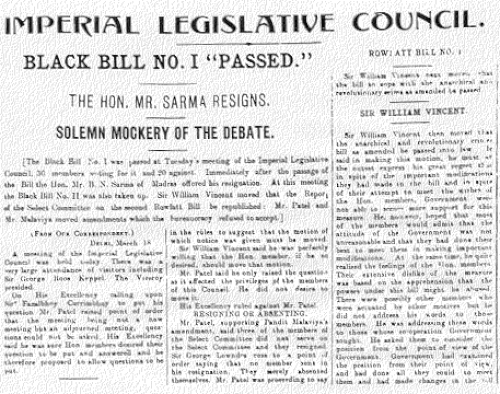
政府は、迫り来る危機と見なした事態に対抗するため、ローラット委員会の勧告を2つのローラット法案にまとめた。[81]法案はエドウィン・モンタギューによって立法審議の承認を受けたが、不本意ながら承認され、「ローラットとその友人らが必要と考える程度にまで平時にインド防衛法を維持するという提案は、一見して嫌悪感を抱く」という宣言が添えられた。[78]その後の帝国立法評議会での議論と投票では、インド人議員全員が法案に反対を表明した。インド政府は、それでもなお、1919年初頭に法案を可決するために「公式多数派」を行使することができた。[78]しかし、インド政府の反対に配慮して可決されたのは、最初の法案の縮小版であり、法廷外の権限を認めるものの、その期間はちょうど3年間で、訴追対象は「無政府主義的および革命的運動」のみに限定され、インド刑法の改正を伴う2番目の法案は完全に削除された。[78]それでも、可決された新しいローラット法は、インド全土で広範な憤りを引き起こし、ガンジーを民族主義運動の最前線に押し上げた。[81]
1919-1929: ジャリアンワーラ、非協力
-

-
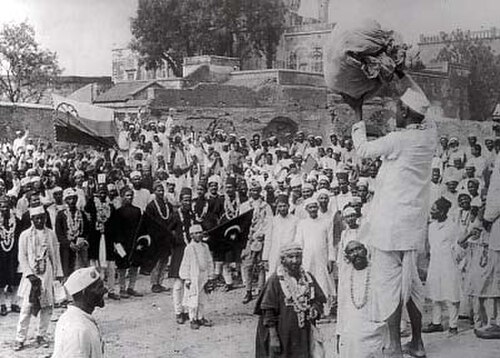
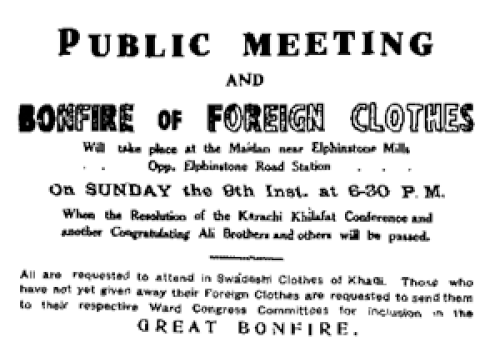 1920 年代初頭、ボンベイで行われた、議会非協力の「公開集会」と「外国の衣服の焚き火」を宣伝し、「カラチ カリファット会議」への支持を表明するポスター。
 -
-

ジャリアンワーラ・バーグ虐殺、または「アムリトサル虐殺」は、シク教徒が多数を占める北部の都市アムリトサルのジャリアンワーラ・バーグ公共庭園で起こった。数日間の騒乱の後、准将レジナルド・E・H・ダイアーは集会を禁止し、1919年4月13日日曜日、ダイアーの指揮下にある50人のイギリスインド軍兵士が、何千人もの非武装の男性、女性、子供の集会に警告なしに発砲し始めた。死傷者の推定は大きく異なり、インド政府は379人が死亡、1,100人が負傷したと報告している。[85]インド国民会議は、死者数を3倍と推定した。ダイアーは任務から外されたが、インドとつながりのある人々の間ではイギリスの英雄として称賛された。[86]歴史家は、この事件がインドにおけるイギリス統治の終焉への決定的な一歩であったと考えている。[87]
1920年、英国政府が譲歩を拒否した後、ガンジーは非協力運動を開始し、多くのインド人が英国の賞や栄誉を返上し、公務員を辞職し、再び英国製品をボイコットするようになった。さらに、ガンジーはインド国民会議を再編して大衆運動へと変貌させ、最貧困層のインド人にもその会員資格を与えた。ガンジーは1922年にチャウリチャウラでの暴力事件の後、非協力運動を中止したが、運動は1920年代半ばに再び復活した。
1928年、インド憲法改正の実施を任務とする英国サイモン委員会がインドを訪問したことにより、インド全土で抗議活動が広がった。 [88]これに先立ち、1925年には、今度はグジャラート州で、農民を組織して地税の増額支払いを拒否するよう指導したパテル率いるインド国民会議派の非暴力抗議運動も再開された。この抗議運動、バルドーリ・サティヤーグラハの成功により、ガンジーは再び政治活動の場に復帰した。[88]
ジャワハルラール・ネルー議長率いるインド国民会議は、ラホールでの年次総会で、プルナ・スワラージ(ヒンドゥスターニー語で「完全な独立」)またはプルナ・スワラージヤの要求を出した。この宣言は、ガンジー、ネルー、パテル、チャクラヴァルティ・ラージャゴーパラチャリを含むインド国民会議の作業部会によって起草された。ガンジーはその後、拡大した市民的不服従運動を主導し、1930年に塩のサティヤーグラハで頂点に達した。このサティヤーグラハでは、数千人のインド人が塩税に反抗し、海まで行進し、海水を蒸発させて独自の塩を作った。ガンジーを含む多くの人が逮捕されたが、英国政府は最終的に屈服し、1931年にガンジーは円卓会議で新たな改革を交渉するためにロンドンを訪れた。[要出典]
1935年インド政府法
現地では、イギリスの統制はインド行政機関(ICS)にかかっていたが、困難が増すばかりだった。参加を希望するイギリスの若者はますます少なくなり、インド人に対する不信感が続いたため、質と量の両面で基盤が衰退していった。1945年までに、ICSではインド人が数的に優位に立ち、帝国と独立への忠誠心が争点となった。[89]インド領の財政は土地税に依存していたが、1930年代にはこれが問題となった。エプスタインは、1919年以降、土地収入の徴収がますます困難になったと論じている。1934年以降、インド政府が市民的不服従を抑圧したことで、一時的に歳入官の権力が強まったが、1937年以降、議会が支配する新しい州政府により、歳入官は没収した土地を返還するよう強制された。再び戦争が勃発し、徴税官たちはインド独立運動に直面して軍事力に頼らざるを得なくなり、1946年から1947年までにはイギリスの直接的な支配は田舎の多くで急速に消滅していった。[90]
1935年、円卓会議の後、議会は1935年インド統治法を可決し、イギリス領インドのすべての州に独立した立法議会を設立し、イギリス領の州と藩王国の両方を統合した中央政府を創設し、イスラム教徒の少数派を保護することを認可した。独立インドの将来の憲法はこの法律に基づいていた。[91]しかし、この法律は有権者を19の宗教的および社会的カテゴリー(イスラム教徒、シク教徒、インド人キリスト教徒、被抑圧階級、地主、商工業者、ヨーロッパ人、アングロインド人など)に分割し、それぞれに州立法議会での別々の代表権を与えた。有権者は自分のカテゴリーの候補者にのみ投票できた。[要出典]
1935年の法律は、インド各州の自治権を拡大し、民族主義的感情を鎮めることを目的とした。同法は、英国政府の管轄下にある国会と行政府を規定したが、藩王国の統治者はその実施を阻止した。これらの州は世襲統治者の完全な支配下にあり、民衆による政府は存在しなかった。選挙に備えて、議会は草の根の会員数を1935年の47万3000人から 1939年には450万人に増やした。 [92]
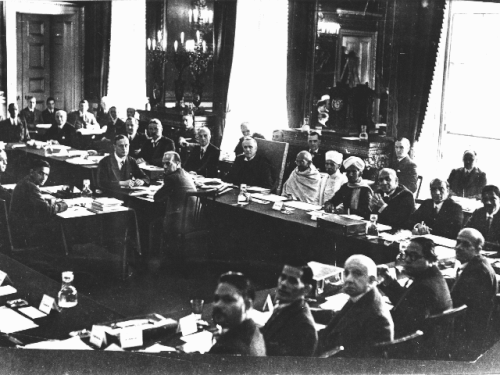
1937年の選挙では、インド国民会議派が英領インドの11州のうち7州で勝利した。 [ 93]これらの州では広範な権限を有するインド国民会議派の政府が形成された。インド国民会議派に対する幅広い有権者の支持は、それまでインド国民会議派を小さなエリート組織と見なしていたインド政府の役人たちを驚かせた。[94]イギリスは1937年にビルマ州を英領インドから分離し、植民地に新しい憲法を与えて完全に選挙で選ばれた議会を定め、多くの権限をビルマ人に与えたが、これはビルマ人をインドのさらなる改革から排除するための策略として分裂を招く問題であることが判明した。[95]
-
-

-
 1937年4月1日にビルマがイギリス領インド帝国から分離したことを記念して発行された初日の表紙
1939年~1945年: 第二次世界大戦
1939年に第二次世界大戦が勃発すると、総督リンリスゴー卿はインドの指導者に相談することなくインドを代表して宣戦布告し、これに抗議してインド国民会議派の州大臣らは辞任した。対照的にムスリム連盟はイギリスの戦争遂行を支持し、ベンガル、シンド、パンジャブの3つの主要州で政府を掌握し続けた。[96]
1927 年、ムスリム連盟はわずか 1300 人の会員からなる小さなエリート集団であったが 、大衆に働きかける組織になると急速に成長し、 1944 年にはベンガルで 50 万人、パンジャブで 20 万人、その他の地域では数十万人の会員を擁するようになった。[97]ジンナーは、権力の座からイギリスと交渉する立場に立った。[98]ジンナーは、インド独立後のインドではムスリムが議会に支配され不当に扱われるだろうと繰り返し警告した。1940 年 3 月 24 日、ラホールで同連盟は「ラホール決議」を可決し、「北西部や東部のようにムスリムが多数派を占める地域は、独立国家としてグループ化し、構成単位が自治権と主権を持つようにすべきである」と要求した。[99]他にもインド国民会議派の指導者アブ・ウル・カラム・アザドのような重要な全国的なイスラム政治家や、ベンガルの左派クリシャク・プラジャ党のAKファズルル・ハク、地主が支配するパンジャブ統一党のファズル・イ・フセイン、北西辺境州の親インド国民会議派のクダイ・キドマトガル(通称「赤シャツ」)のアブドゥルガッファール・カーンのような影響力のある地方のイスラム政治家がいたが、[100]イギリスはその後6年間にわたって、イスラム教インドの主要な代表として連盟をますます見るようになった。
インド国民会議は世俗主義で、いかなる宗教国家の設立にも強く反対した。[97]インドには自然な統一性があると主張し、イスラム教徒に自分たちをヒンズー教徒とは異質であると考えるよう仕向ける「分割統治」戦術をイギリスが繰り返し非難した。[要出典]ジンナーは統一インドという概念を否定し、宗教共同体は人為的なナショナリズムよりも基本的であると強調した。彼は2国家理論を唱え、[101] 1940年3月23日にラホールで次のように述べた。
[イスラム教とヒンズー教]は厳密な意味での宗教ではなく、実際には異なる独自の社会秩序であり、ヒンズー教徒とイスラム教徒が共通の国民性を形成することは夢のまた夢である...ヒンズー教徒とイスラム教徒は、2つの異なる宗教、哲学、社会慣習、文学に属している。彼らは結婚もせず、一緒に食事をすることもない。実際、彼らは主に相反する考えや概念に基づく2つの異なる文明に属している。彼らの生活や人生観は異なる...一方が数の少数派、他方が多数派として、このような2つの国民を1つの国家の下に束ねることは、不満の増大と、そのような国家の統治のために構築されたあらゆる構造の最終的な破壊につながるに違いない。[102]
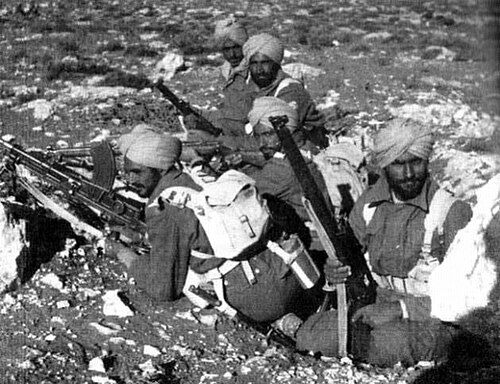
1939年のインド正規軍には約22万人の 現地兵士が含まれていたが、戦争中に10倍に拡大し[103]、海軍と空軍の小規模な部隊が創設された。200 万人以上のインド人がイギリス軍に志願兵として入隊した。彼らは特に中東と北アフリカでの数々の作戦で大きな役割を果たした。死傷者は中程度(世界大戦の観点から)で、24,000人が 死亡、64,000人が負傷、12,000人が 行方不明(おそらく死亡)、 1942年にシンガポールで60,000人が捕虜となった[104]。
インド軍の費用の大半を英国が負担したため、インドの国家債務は帳消しとなり、戦争終了時には13億ポンドの黒字となった 。さらに、インドで生産された軍需品(制服、ライフル、機関銃、野砲、弾薬など)への英国の多額の支出により、繊維(16%増)、鉄鋼(18%増)、化学薬品(30%増)などの工業生産が急拡大した。小型軍艦が建造され、バンガロールに航空機工場が開設された。70万人の従業員を抱える鉄道システムは、輸送需要が急増したため、限界まで課税された。[105]
1942年、イギリス政府はインド国民の戦争協力と引き換えに戦争終結後の独立を約束するためクリップス使節団を派遣した。イギリス高官、特にウィンストン・チャーチル首相はクリップス使節団を支持せず、議会との交渉はすぐに決裂した。[106]
1942年7月、インド離脱運動を開始した国民会議派は、イギリス軍がインドから即時撤退しなければ全国的な不服従に直面すると要求した。8月8日、インド政府はインド全国、州、地方の国民会議派指導者全員を逮捕し、1945年まで数万人を拘束した。学生、後には農民政治団体が主導する暴力的なデモが国内で勃発し、特に東部連合州、ビハール州、西ベンガル州で顕著となった。戦時中の大規模なイギリス軍の駐留により、この運動は6週間余りで鎮圧されたが[107]、運動の一部は一時、ネパールとの国境に地下暫定政府を結成した[107] 。インドの他の地域では、運動はそれほど自発的ではなく、抗議もそれほど激しくはなかったが、1943年夏まで散発的に続いた[108]。
これに先立ち、1920年代後半から1930年代にかけてインド国民会議派の若手急進派の指導者であったスバス・チャンドラ・ボースは、1938年から1939年にかけてインド国民会議派の議長にまで上り詰めた。 [109]しかし、彼は上層部との意見の相違から1939年に会議派から追放され、[110]その後イギリス軍によって自宅軟禁され、1941年初めにインドから逃亡した。[111]彼はナチスドイツと大日本帝国に助けを求め、武力でインドの独立を勝ち取った。[112]彼は日本の支援を受けて、シンガポールの戦いで日本軍に捕虜となったイギリス領インド軍のインド人兵士を大部分とするインド国民軍を組織した。戦争が不利に転じるにつれ、日本はビルマ、フィリピン、ベトナムを含む占領地域の傀儡政府や臨時政府、さらにはボースが議長を務めるアザド・ヒンド臨時政府を支援するようになった。[112]
しかし、ボースの努力は長くは続かなかった。1944年半ば、イギリス軍はまず日本軍のU-Go攻勢を阻止し、その後逆転させ、ビルマ作戦の成功部分を開始した。その後のビルマでの戦闘でボースのインド国民軍はほぼ崩壊し、残存部隊は1945年9月のシンガポール奪還とともに降伏した。ボースは8月に台湾で墜落した過積載の日本軍機で脱出を試みた際に受けた第三度の火傷で死亡したが[113] 、多くのインド人はこれは起こらなかったと信じている。[114] [115] [116]ボースは失敗したが、インドで愛国心を喚起した。[117]
-

-

-
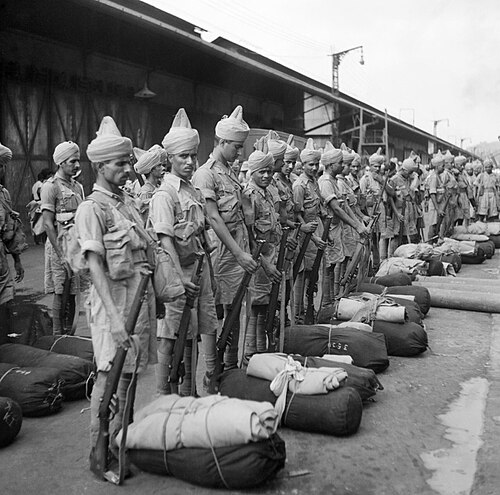 1941 年 11 月、シンガポールの埠頭に到着したばかりのインド軍兵士たち
 -
1946年~1947年: 独立、分割
1946年1月、イギリスへの送還が遅いことに不満を抱いたイギリス空軍兵士たちの反乱を皮切りに、軍隊内で数件の反乱が勃発した。[118]反乱は1946年2月にボンベイで起きたインド海軍の反乱で頂点に達し、続いてカルカッタ、マドラス、カラチでも反乱が起こった。反乱はすぐに鎮圧されたものの、イギリスの新労働党政権を行動に駆り立てる結果となり、インド担当大臣ペシック・ローレンス卿率いる内閣使節団がインドを訪問することになり、4年前にインドを訪れていたスタッフォード・クリップス卿も同行した。 [118]
また、1946年初頭には、インドで新たな選挙が実施された。それより前、1945年の戦争末期に、植民地政府は、反逆罪で告発されたボース率いる敗戦国インド国民軍の上級将校3名の公開裁判を発表していた。裁判が始まると、インド国民軍に対して曖昧な態度をとりながらも、国民会議派指導部は、告発された将校らを弁護することを選んだ。 [119]その後の将校らの有罪判決、有罪判決に対する国民の抗議、そして最終的な刑罰の免除は、国民会議派にとって好ましい宣伝となり、それが11州のうち8州での同党のその後の選挙勝利につながった。[120]しかし、国民会議派とムスリム連盟との交渉は、分割問題で行き詰まった。ジンナーは、1946年8月16日を直接行動の日と宣言し、平和的に、英領インドにおけるイスラム教徒の祖国を求める声を強調することを目標とした。翌日、カルカッタでヒンドゥー教徒とイスラム教徒の暴動が勃発し、すぐにイギリス領インド全土に広がった。インド政府とインド国民会議はともにこの事態に動揺したが、9月にインド国民会議主導の暫定政府が樹立され、ジャワハルラール・ネルーが統一インドの首相に就任した。[121]
その年の後半、第二次世界大戦でイギリスの財政が疲弊し、労働党政権は、ますます不安定化するイギリス領インドを統治し続けるには国内の権限も国際的支援も現地の軍隊の信頼もないことに気づき、 [122] [123]イギリスによるインド統治を終わらせることを決定し、1947年初頭にイギリスは遅くとも1948年6月までに権力を移譲する意向を発表した。[96]
独立が近づくにつれ、パンジャブ州とベンガル州におけるヒンズー教徒とイスラム教徒の間の暴力は衰えることなく続いた。イギリス軍は暴力が激化する可能性に備えていなかったため、新総督ルイス・マウントバッテンが権力移譲の時期を早め、独立に向けた双方の合意計画に6ヶ月もかけなかった。[124] [96] 1947年8月のインド分割により、イギリスによるインド統治は終わり、インドとパキスタンという2つの独立した国家が誕生した。[125]
1947年8月15日、ムハンマド・アリー・ジンナーを総督とするパキスタン自治領(後のパキスタン・イスラム共和国)と、ジャワハルラール・ネルーを首相とし、ルイス・マウントバッテン副王を初代総督として留任させるインド自治領(後のインド共和国)が発足し、8月14日にカラチで、8月15日にニューデリーで公式式典が行われた。これはマウントバッテンが両方の式典に出席するためであった。[126]
インド人の大多数は独立後もその地に留まったが、国境地帯では何百万人もの人々(イスラム教徒、シク教徒、ヒンズー教徒)が新たに引かれた国境を越えて移住した。新しい国境線がシク教徒の地域を半分に分けたパンジャブでは多くの流血があったが、ガンジーの存在が宗派間の感情を和らげたベンガルとビハールでは暴力はより限定的だった。全体として、新しい国境の両側で、難民と3つの宗教の居住者の両方で25万人から50万人が暴力で亡くなった。[127]
-
 1901 年の地区別のイスラム教徒の割合
 -
 1901 年の地区別のヒンズー教徒の割合
 -
 1901 年の地区全体の仏教徒、シク教徒、ジャイナ教徒の割合
 -

主要な出来事、法律、公共事業のタイムライン
- 1858年から1947年までのイギリス領時代の君主を描いた1ルピー銀貨。
-
 イギリス統治時代のインドで使用された銀貨 1 ルピー 2 枚。左はヴィクトリア女王、1862 年、右はヴィクトリア皇后。
 -
 国王兼皇帝エドワード 7 世を描いた 1 ルピー銀貨、1903 年 (左) と 1908 年 (右)
 -
 イギリス統治時代のインドで使用された銀貨 1 ルピー。国王兼皇帝ジョージ 5 世が描かれている。1913 年 (左) と 1919 年 (右)
 -
![1940年のジョージ6世国王兼皇帝を描いた1ルピー硬貨(左)と1947年のインド独立直前のインド皇帝を描いた1ルピー硬貨(右)[i]](https://img-server.japedia.wiki/wikipedia/commons/thumb/9/9c/GeorgeVIKingEmperorIndia1940and1947.jpg/500px-GeorgeVIKingEmperorIndia1940and1947.jpg) 1940年のジョージ6世国王皇帝を描いた1ルピー硬貨(左)と1947年のインド独立直前のインド皇帝を描いた1ルピー硬貨(右)[i]
1940年のジョージ6世国王皇帝を描いた1ルピー硬貨(左)と1947年のインド独立直前のインド皇帝を描いた1ルピー硬貨(右)[i]
British India and the princely states
India during the British Raj was made up of two types of territory: British India and the Native States (or Princely States).[139] In its Interpretation Act 1889, the British Parliament adopted the following definitions in Section 18:
(4.) The expression "British India" shall mean all territories and places within Her Majesty's dominions which are for the time being governed by Her Majesty through the Governor-General of India or through any governor or other officer subordinates to the Governor-General of India.
(5.) The expression "India" shall mean British India together with any territories of any native prince or chief under the suzerainty of Her Majesty exercised through the Governor-General of India, or through any governor or other officer subordinates to the Governor-General of India.[1]
In general, the term "British India" had been used (and is still used) to refer also to the regions under the rule of the British East India Company in India from 1600 to 1858.[140] The term has also been used to refer to the "British in India".[141]
The terms "Indian Empire" and "Empire of India" (like the term "British Empire") were not used in legislation. The monarch was officially known as Empress or Emperor of India and the term was often used in Queen Victoria's Queen's Speeches and Prorogation Speeches. In addition, an order of knighthood, the Most Eminent Order of the Indian Empire, was set up in 1878.
Suzerainty over 175 princely states, some of the largest and most important, was exercised (in the name of the British Crown) by the central government of British India under the viceroy; the remaining approximately 500 states were dependents of the provincial governments of British India under a governor, lieutenant-governor, or chief commissioner (as the case might have been).[142] A clear distinction between "dominion" and "suzerainty" was supplied by the jurisdiction of the courts of law: the law of British India rested upon the laws passed by the British Parliament and the legislative powers those laws vested in the various governments of British India, both central and local; in contrast, the courts of the Princely States existed under the authority of the respective rulers of those states.[142]
Major provinces
At the turn of the 20th century, British India consisted of eight provinces that were administered either by a governor or a lieutenant-governor.
During the partition of Bengal (1905–1913), the new provinces of Assam and East Bengal were created as a Lieutenant-Governorship. In 1911, East Bengal was reunited with Bengal, and the new provinces in the east became: Assam, Bengal, Bihar and Orissa.[143]
Minor provinces
In addition, there were a few minor provinces that were administered by a chief commissioner:[144]
Princely states
A Princely State, also called a Native State or an Indian State, was a British vassal state in India with an indigenous nominal Indian ruler, subject to a subsidiary alliance.[145] There were 565 princely states when India and Pakistan became independent from Britain in August 1947. The princely states did not form a part of British India (i.e. the presidencies and provinces), as they were not directly under British rule. The larger ones had treaties with Britain that specified which rights the princes had; in the smaller ones the princes had few rights. Within the princely states external affairs, defence and most communications were under British control.[citation needed] The British also exercised a general influence over the states' internal politics, in part through the granting or withholding of recognition of individual rulers. Although there were nearly 600 princely states, the great majority were very small and contracted out the business of government to the British. Some two hundred of the states had an area of less than 25 square kilometres (10 square miles).[145] The last vestige of the Mughal Empire in Delhi which was under Company authority prior to the advent of British Raj was finally abolished and seized by the Crown in the aftermath of the Sepoy Mutiny of 1857 for its support to the rebellion.[146][147]
The princely states were grouped into agencies and residencies.
Organisation

Following the Indian Rebellion of 1857 (usually called the Indian Mutiny by the British), the Government of India Act 1858 made changes in the governance of India at three levels:
- in the imperial government in London,
- in the central government in Calcutta, and
- in the provincial governments in the presidencies (and later in the provinces).[148]
In London, it provided for a cabinet-level Secretary of State for India and a fifteen-member Council of India, whose members were required, as one prerequisite of membership, to have spent at least ten years in India and to have done so no more than ten years before.[149] Although the secretary of state formulated the policy instructions to be communicated to India, he was required in most instances to consult the Council, but especially so in matters relating to spending of Indian revenues. The Act envisaged a system of "double government" in which the Council ideally served both as a check on excesses in imperial policy-making and as a body of up-to-date expertise on India. However, the secretary of state also had special emergency powers that allowed him to make unilateral decisions, and, in reality, the Council's expertise was sometimes outdated.[150] From 1858 until 1947, twenty-seven individuals served as Secretary of State for India and directed the India Office; these included: Sir Charles Wood (1859–1866), the Marquess of Salisbury (1874–1878; later British prime minister), John Morley (1905–1910; initiator of the Minto–Morley Reforms), E. S. Montagu (1917–1922; an architect of the Montagu–Chelmsford Reforms), and Frederick Pethick-Lawrence (1945–1947; head of the 1946 Cabinet Mission to India). The size of the Advisory Council was reduced over the next half-century, but its powers remained unchanged. In 1907, for the first time, two Indians were appointed to the Council.[151] They were K.G. Gupta and Syed Hussain Bilgrami.

.jpg/500px-Robert-Gascoyne-Cecil-3rd-Marquess-of-Salisbury_(cropped).jpg)
In Calcutta, the governor-general remained head of the Government of India and now was more commonly called the viceroy on account of his secondary role as the Crown's representative to the nominally sovereign princely states; he was, however, now responsible to the secretary of state in London and through him to Parliament. A system of "double government" had already been in place during the Company's rule in India from the time of Pitt's India Act of 1784. The governor-general in the capital, Calcutta, and the governor in a subordinate presidency (Madras or Bombay) was each required to consult his advisory council; executive orders in Calcutta, for example, were issued in the name of "Governor-General-in-Council" (i.e. the Governor-General with the advice of the Council). The Company's system of "double government" had its critics, since, from the time of the system's inception, there had been intermittent feuding between the governor-general and his Council; still, the Act of 1858 made no major changes in governance.[151] However, in the years immediately thereafter, which were also the years of post-rebellion reconstruction, Viceroy Lord Canning found the collective decision making of the Council to be too time-consuming for the pressing tasks ahead, so he requested the "portfolio system" of an Executive Council in which the business of each government department (the "portfolio") was assigned to and became the responsibility of a single council member.[151] Routine departmental decisions were made exclusively by the member, but important decisions required the consent of the governor-general and, in the absence of such consent, required discussion by the entire Executive Council. This innovation in Indian governance was promulgated in the Indian Councils Act 1861.
If the Government of India needed to enact new laws, the Councils Act allowed for a Legislative Council—an expansion of the Executive Council by up to twelve additional members, each appointed to a two-year term—with half the members consisting of British officials of the government (termed official) and allowed to vote, and the other half, comprising Indians and domiciled Britons in India (termed non-official) and serving only in an advisory capacity.[152] All laws enacted by Legislative Councils in India, whether by the Imperial Legislative Council in Calcutta or by the provincial ones in Madras and Bombay, required the final assent of the secretary of state in London; this prompted Sir Charles Wood, the second secretary of state, to describe the Government of India as "a despotism controlled from home".[151] Moreover, although the appointment of Indians to the Legislative Council was a response to calls after the 1857 rebellion, most notably by Sayyid Ahmad Khan, for more consultation with Indians, the Indians so appointed were from the landed aristocracy, often chosen for their loyalty, and far from representative.[153] Even so, the "... tiny advances in the practice of representative government were intended to provide safety valves for the expression of public opinion, which had been so badly misjudged before the rebellion".[154] Indian affairs now also came to be more closely examined in the British Parliament and more widely discussed in the British press.[155]
With the promulgation of the Government of India Act 1935, the Council of India was abolished with effect from 1 April 1937 and a modified system of government enacted. The secretary of state for India represented the Government of India in the UK. He was assisted by a body of advisers numbering from 8–12 individuals, at least half of whom were required to have held office in India for a minimum of 10 years, and had not relinquished office earlier than two years prior to their appointment as advisers to the secretary of state.[156]
The viceroy and governor-general of India, a Crown appointee, typically held office for five years though there was no fixed tenure, and received an annual salary of Rs. 250,800 p.a. (£18,810 p.a.).[156][157] He headed the Viceroy's Executive Council, each member of which had responsibility for a department of the central administration. From 1 April 1937, the position of Governor-General in Council, which the viceroy and governor-general concurrently held in the capacity of representing the Crown in relations with the Indian princely states, was replaced by the designation of "HM Representative for the Exercise of the Functions of the Crown in its Relations with the Indian States", or the "Crown Representative". The Executive Council was greatly expanded during the Second World War, and in 1947 comprised 14 members (secretaries), each of whom earned a salary of Rs. 66,000 p.a. (£4,950 p.a.). The portfolios in 1946–1947 were:
- External Affairs and Commonwealth Relations
- Home and Information and Broadcasting
- Food and transportation
- Transport and Railways
- Labour
- Industries and Supplies
- Works, Mines and Power
- Education
- Defence
- Finance
- Commerce
- Communications
- Health
- Law
Until 1946, the viceroy held the portfolio for External Affairs and Commonwealth Relations, as well as heading the Political Department in his capacity as the Crown representative. Each department was headed by a secretary excepting the Railway Department, which was headed by a Chief Commissioner of Railways under a secretary.[158]
The viceroy and governor-general was also the head of the bicameral Indian Legislature, consisting of an upper house (the Council of State) and a lower house (the Legislative Assembly). The viceroy was the head of the Council of State, while the Legislative Assembly, which was first opened in 1921, was headed by an elected president (appointed by the Viceroy from 1921 to 1925). The Council of State consisted of 58 members (32 elected, 26 nominated), while the Legislative Assembly comprised 141 members (26 nominated officials, 13 others nominated and 102 elected). The Council of State existed in five-year periods and the Legislative Assembly for three-year periods, though either could be dissolved earlier or later by the Viceroy. The Indian Legislature was empowered to make laws for all persons resident in British India including all British subjects resident in India, and for all British Indian subjects residing outside India. With the assent of the King-Emperor and after copies of a proposed enactment had been submitted to both houses of the British Parliament, the Viceroy could overrule the legislature and directly enact any measures in the perceived interests of British India or its residents if the need arose.[158]
Effective from 1 April 1936, the Government of India Act created the new provinces of Sind (separated from the Bombay Presidency) and Orissa (separated from the Province of Bihar and Orissa). Burma and Aden became separate Crown Colonies under the Act from 1 April 1937, thereby ceasing to be part of the Indian Empire. From 1937 onwards, British India was divided into 17 administrations: the three Presidencies of Madras, Bombay and Bengal, and the 14 provinces of the United Provinces, Punjab, Bihar, the Central Provinces and Berar, Assam, the North-West Frontier Province (NWFP), Orissa, Sind, British Baluchistan, Delhi, Ajmer-Merwara, Coorg, the Andaman and Nicobar Islands and Panth Piploda. The Presidencies and the first eight provinces were each under a governor, while the latter six provinces were each under a chief commissioner. The viceroy directly governed the chief commissioner provinces through each respective chief commissioner, while the Presidencies and the provinces under governors were allowed greater autonomy under the Government of India Act.[159] Each Presidency or province headed by a governor had either a provincial bicameral legislature (in the Presidencies, the United Provinces, Bihar and Assam) or a unicameral legislature (in the Punjab, Central Provinces and Berar, NWFP, Orissa and Sind). The governor of each presidency or province represented the Crown in his capacity, and was assisted by a ministers appointed from the members of each provincial legislature. Each provincial legislature had a life of five years, barring any special circumstances such as wartime conditions. All bills passed by the provincial legislature were either signed or rejected by the governor, who could also issue proclamations or promulgate ordinances while the legislature was in recess, as the need arose.[160]
Each province or presidency comprised a number of divisions, each headed by a commissioner and subdivided into districts, which were the basic administrative units and each headed by a district magistrate, collector or deputy commissioner; in 1947, British India comprised 230 districts.[160]
Legal system

Singha argues that after 1857 the colonial government strengthened and expanded its infrastructure via the court system, legal procedures, and statutes. New legislation merged the Crown and the old East India Company courts and introduced a new penal code as well as new codes of civil and criminal procedure, based largely on English law. In the 1860s–1880s the Raj set up compulsory registration of births, deaths, and marriages, as well as adoptions, property deeds, and wills. The goal was to create a stable, usable public record and verifiable identities. However, there was opposition from both Muslim and Hindu elements who complained that the new procedures for census-taking and registration threatened to uncover female privacy. Purdah rules prohibited women from saying their husband's name or having their photograph taken. An all-India census was conducted between 1868 and 1871, often using total numbers of females in a household rather than individual names. Select groups which the Raj reformers wanted to monitor statistically included those reputed to practice female infanticide, prostitutes, lepers, and eunuchs.[161]
Murshid argues that women were in some ways more restricted by the modernisation of the laws. They remained tied to the strictures of their religion, caste, and customs, but now with an overlay of British Victorian attitudes. Their inheritance rights to own and manage property were curtailed; the new English laws were somewhat harsher. Court rulings restricted the rights of second wives and their children regarding inheritance. A woman had to belong to either a father or a husband to have any rights.[162]
Official flags and emblems
The government of India used a variety of flags for different purposes. The Viceroy flew an official banner based on the Union Jack,[163] featuring the Star of India badge; this flag was also considered to represent India itself.[164][165] In 1921 the Viceroy, Lord Reading, declared[166] the government's intention to retain this design as the flag for imperial India, a purpose it began to serve after 1861.[165] The Governor-General was also assigned an official badge, defined and published in the British Admiralty flag book.[167] A Red Ensign bearing the star emblem was also used as an Indian flag prior to 1947, particularly at international events.[168]
The rulers of the Princely states also had their own banners, ceremonially presented to them during Queen Victoria's 1877 Durbar,[169] and the states also had their own official emblems.[170] The Royal Indian Navy flew a blue jack flag bearing the Star of India,[171] which was also used as an ensign.[172]
-
![Flag of the Governor General of India, held at the National Maritime Museum in London. The central badge was based on the Star of India; this flag was also used by the provincial governors.[173]](https://img-server.japedia.wiki/wikipedia/commons/thumb/4/47/Flag_of_the_Governor_General_of_India_RMG_RP-35-18_%28crop%29.jpg/500px-Flag_of_the_Governor_General_of_India_RMG_RP-35-18_%28crop%29.jpg) Flag of the Governor General of India, held at the National Maritime Museum in London. The central badge was based on the Star of India; this flag was also used by the provincial governors.[173]
Flag of the Governor General of India, held at the National Maritime Museum in London. The central badge was based on the Star of India; this flag was also used by the provincial governors.[173] -
![Ensign of the Royal Indian Marine, held at the National Maritime Museum in London.[174] The same design also served as the jack of the Royal Indian Navy.[175]](https://img-server.japedia.wiki/wikipedia/commons/thumb/5/53/Ensign_of_the_Royal_Indian_Marine_%281927-1947%29_RMG_RP_18_21.jpg/500px-Ensign_of_the_Royal_Indian_Marine_%281927-1947%29_RMG_RP_18_21.jpg) Ensign of the Royal Indian Marine, held at the National Maritime Museum in London.[174] The same design also served as the jack of the Royal Indian Navy.[175]
Ensign of the Royal Indian Marine, held at the National Maritime Museum in London.[174] The same design also served as the jack of the Royal Indian Navy.[175] -
![The Viceroy's Star of India banner being used to represent India at the 1936 Olympics in Berlin.[176]](https://img-server.japedia.wiki/wikipedia/commons/thumb/9/9f/Viceroy_of_India_Flag_hoist.jpg/500px-Viceroy_of_India_Flag_hoist.jpg) The Viceroy's Star of India banner being used to represent India at the 1936 Olympics in Berlin.[176]
The Viceroy's Star of India banner being used to represent India at the 1936 Olympics in Berlin.[176] -
![Badge of the Governor General of India, published in the 1916[177] and 1930[178] editions of the British Admiralty flag book. It was used on the Viceroy's flag,[179] and was also known as the "Badge of India."[180]](https://img-server.japedia.wiki/wikipedia/commons/thumb/2/2c/Badge_of_the_Governor_General_of_India.svg/500px-Badge_of_the_Governor_General_of_India.svg.png) Badge of the Governor General of India, published in the 1916[177] and 1930[178] editions of the British Admiralty flag book. It was used on the Viceroy's flag,[179] and was also known as the "Badge of India."[180]
Badge of the Governor General of India, published in the 1916[177] and 1930[178] editions of the British Admiralty flag book. It was used on the Viceroy's flag,[179] and was also known as the "Badge of India."[180]
![Flag of the Governor General of India, held at the National Maritime Museum in London. The central badge was based on the Star of India; this flag was also used by the provincial governors.[173]](https://img-server.japedia.wiki/wikipedia/commons/thumb/4/47/Flag_of_the_Governor_General_of_India_RMG_RP-35-18_(crop).jpg/500px-Flag_of_the_Governor_General_of_India_RMG_RP-35-18_(crop).jpg)
![Ensign of the Royal Indian Marine, held at the National Maritime Museum in London.[174] The same design also served as the jack of the Royal Indian Navy.[175]](https://img-server.japedia.wiki/wikipedia/commons/thumb/5/53/Ensign_of_the_Royal_Indian_Marine_(1927-1947)_RMG_RP_18_21.jpg/500px-Ensign_of_the_Royal_Indian_Marine_(1927-1947)_RMG_RP_18_21.jpg)
Economy
Economic trends

All three sectors of the economy—agriculture, manufacturing, and services—accelerated in the postcolonial India. In agriculture a huge increase in production took place in the 1870s. The most important difference between colonial and postcolonial India was the use of land surplus with productivity-led growth by using high-yielding variety seeds, chemical fertilizers and more intensive application of water. All these three inputs were subsidised by the state.[181] The result was, on average, no long-term change in per capita income levels, though cost of living had grown higher. Agriculture was still dominant, with most peasants at the subsistence level. Extensive irrigation systems were built, providing an impetus for switching to cash crops for export and for raw materials for Indian industry, especially jute, cotton, sugarcane, coffee and tea.[182] India's global share of GDP fell drastically from above 20% to less than 5% in the colonial period.[183] Historians have been bitterly divided on issues of economic history, with the Nationalist school (following Nehru) arguing that India was poorer at the end of British rule than at the beginning and that impoverishment occurred because of the British.[184]
Mike Davis writes that much of the economic activity in British India was for the benefit of the British economy and was carried out relentlessly through repressive British imperial policies and with negative repercussions for the Indian population. This is reified in India's large exports of wheat to Britain: despite a major famine that claimed between 6 and 10 million lives in the late 1870s, these exports remained unchecked. A colonial government committed to laissez-faire economics refused to interfere with these exports or provide any relief.[185]
Industry
With the end of the state-granted monopoly of the East India Trading Company in 1813, the importation into India of British manufactured goods, including finished textiles, increased dramatically, from approximately 1 million yards of cotton cloth in 1814 to 13 million in 1820, 995 million in 1870, to 2050 million by 1890. The British imposed "free trade" on India, while continental Europe and the United States erected stiff tariff barriers ranging from 30% to 70% on the importation of cotton yarn or prohibited it entirely. As a result of the less expensive imports from more industrialized Britain, India's most significant industrial sector, textile production, shrank, such that by 1870–1880 Indian producers were manufacturing only 25%–45% of local consumption. Deindustrialization of India's iron industry was even more extensive during this period.[186]
Jamsetji Tata (1839–1904) began his industrial career in 1877 with the Central India Spinning, Weaving, and Manufacturing Company in Bombay. While other Indian mills produced cheap coarse yarn (and later cloth) using local short-staple cotton and cheap machinery imported from Britain, Tata did much better by importing expensive longer-stapled cotton from Egypt and buying more complex ring-spindle machinery from the United States to spin finer yarn that could compete with imports from Britain.[187]
In the 1890s, he launched plans to move into heavy industry using Indian funding. The Raj did not provide capital, but, aware of Britain's declining position against the US and Germany in the steel industry, it wanted steel mills in India. It promised to purchase any surplus steel Tata could not otherwise sell.[188] The Tata Iron and Steel Company (TISCO), now headed by his son Dorabji Tata (1859–1932), began constructing its plant at Jamshedpur in Bihar in 1908, using American technology, not British.[189] According to The Oxford Dictionary of National Biography, TISCO became the leading iron and steel producer in India, and "a symbol of Indian technical skill, managerial competence, and entrepreneurial flair".[187] The Tata family, like most of India's big businessmen, were Indian nationalists but did not trust the Congress because it seemed too aggressively hostile to the Raj, too socialist, and too supportive of trade unions.[190]
Railways

British India built a modern railway system in the late 19th century, which was the fourth largest in the world. At first the railways were privately owned and operated. They were run by British administrators, engineers and craftsmen. At first, only the unskilled workers were Indians.[191]
The East India Company (and later the colonial government) encouraged new railway companies backed by private investors under a scheme that would provide land and guarantee an annual return of up to 5% during the initial years of operation. The companies were to build and operate the lines under a 99-year lease, with the government having the option to buy them earlier.[192] Two new railway companies, the Great Indian Peninsular Railway (GIPR) and the East Indian Railway Company (EIR) began to construct and operate lines near Bombay and Calcutta in 1853–54. The first passenger railway line in North India, between Allahabad and Kanpur, opened in 1859. Eventually, five British companies came to own all railway business in India,[193] and operated under a profit maximization scheme.[194] Further, there was no government regulation of these companies.[193]
In 1854, Governor-General Lord Dalhousie formulated a plan to construct a network of trunk lines connecting the principal regions of India. Encouraged by the government guarantees, investment flowed in and a series of new rail companies was established, leading to rapid expansion of the rail system in India.[195] Soon several large princely states built their own rail systems and the network spread to the regions that became the modern-day states of Assam, Rajasthan and Andhra Pradesh. The route mileage of this network increased from 1,349 to 25,495 kilometres (838 to 15,842 mi) between 1860 and 1890, mostly radiating inland from the three major port cities of Bombay, Madras, and Calcutta.[196]
After the Sepoy Rebellion in 1857, and subsequent Crown rule over India, the railways were seen as a strategic defense of the European population, allowing the military to move quickly to subdue native unrest and protect Britons.[197] The railway thus served as a tool of the colonial government to control India as they were "an essential strategic, defensive, subjugators and administrative 'tool'" for the Imperial Project.[198]
Most of the railway construction was done by Indian companies supervised by British engineers.[199] The system was heavily built, using a broad gauge, sturdy tracks and strong bridges. By 1900 India had a full range of rail services with diverse ownership and management, operating on broad, metre and narrow gauge networks. In 1900, the government took over the GIPR network, while the company continued to manage it.[199] During the First World War, the railways were used to transport troops and grain to the ports of Bombay and Karachi en route to Britain, Mesopotamia, and East Africa.[citation needed] With shipments of equipment and parts from Britain curtailed, maintenance became much more difficult; critical workers entered the army; workshops were converted to making munitions; the locomotives, rolling stock, and track of some entire lines were shipped to the Middle East. The railways could barely keep up with the increased demand.[200] By the end of the war, the railways had deteriorated for lack of maintenance and were not profitable. In 1923, both GIPR and EIR were nationalised.[201][202]
Headrick shows that until the 1930s, both the Raj lines and the private companies hired only European supervisors, civil engineers, and even operating personnel, such as locomotive engineers. The hard physical labor was left to the Indians. The colonial government was chiefly concerned with the welfare of European workers, and any Indian deaths were "either ignored or merely mentioned as a cold statistical figure."[203][204] The government's Stores Policy required that bids on railway contracts be made to the India Office in London, shutting out most Indian firms.[202] The railway companies purchased most of their hardware and parts in Britain. There were railway maintenance workshops in India, but they were rarely allowed to manufacture or repair locomotives.[205]
After independence in 1947, forty-two separate railway systems, including thirty-two lines owned by the former Indian princely states, were amalgamated to form a single nationalised unit named the Indian Railways.
India provides an example of the British Empire pouring its money and expertise into a very well-built system designed for military purposes (after the Rebellion of 1857), in the hope that it would stimulate industry. The system was overbuilt and too expensive for the small amount of freight traffic it carried. Christensen (1996), who looked at colonial purpose, local needs, capital, service, and private-versus-public interests, concluded that making the railways a creature of the state hindered success because railway expenses had to go through the same time-consuming and political budgeting process as did all other state expenses. Railway costs could therefore not be tailored to the current needs of the railways or of their passengers.[206]
Irrigation
The British Raj invested heavily in infrastructure, including canals and irrigation systems.[207] The Ganges Canal reached 560 kilometres (350 miles) from Haridwar to Cawnpore (now Kanpur), and supplied thousands of kilometres of distribution canals. By 1900 the Raj had the largest irrigation system in the world. One success story was Assam, a jungle in 1840 that by 1900 had 1,600,000 hectares (4,000,000 acres) under cultivation, especially in tea plantations. In all, the amount of irrigated land rose eightfold. Historian David Gilmour says:[208]
By the 1870s the peasantry in the districts irrigated by the Ganges Canal were visibly better fed, housed and dressed than before; by the end of the century the new network of canals in the Punjab had produced an even more prosperous peasantry there.
Policies

In the second half of the 19th century, both the direct administration of India by the British Crown and the technological change ushered in by the industrial revolution had the effect of closely intertwining the economies of India and Great Britain.[209] In fact many of the major changes in transport and communications (that are typically associated with Crown rule of India) had already begun before the Rebellion. Since Dalhousie had embraced the technological revolution underway in Britain, India too saw rapid development of all those technologies. Railways, roads, canals, and bridges were rapidly built in India and telegraph links equally rapidly established so that raw materials, such as cotton, from India's hinterland could be transported more efficiently to ports, such as Bombay, for subsequent export to England.[210] Likewise, finished goods from England, were transported back, just as efficiently, for sale in the burgeoning Indian markets. Massive railway projects were begun in earnest and government railway jobs and pensions attracted a large number of upper caste Hindus into the civil services for the first time. The Indian Civil Service was prestigious and paid well. It remained politically neutral.[211] Imports of British cotton cloth captured more than half the Indian market in the late 19th and early 20th centuries.[212] Industrial production as it developed in European factories was unknown until the 1850s when the first cotton mills were opened in Bombay, posing a challenge to the cottage-based home production system based on family labour.[213]
Taxes in India decreased during the colonial period for most of India's population; with the land tax revenue claiming 15% of India's national income during Mughal times compared with 1% at the end of the colonial period. The percentage of national income for the village economy increased from 44% during Mughal times to 54% by the end of colonial period. India's per capita GDP decreased from 1990 Int'l$550 in 1700 to $520 by 1857, although it later increased to $618, by 1947.[214]
Economic impact of the Raj
Historians continue to debate whether the long-term intention of British rule was to accelerate the economic development of India, or to distort and delay it. In 1780, the conservative British politician Edmund Burke raised the issue of India's position: he vehemently attacked the East India Company, claiming that Warren Hastings and other top officials had ruined the Indian economy and society. Indian historian Rajat Kanta Ray (1998) continues this line of attack, saying the new economy brought by the British in the 18th century was a form of "plunder" and a catastrophe for the traditional economy of the Mughal Empire.[215] Ray accuses the British of depleting the food and money stocks and of imposing high taxes that helped cause the terrible Bengal famine of 1770, which killed a third of the people of Bengal.[216]
P. J. Marshall shows that recent scholarship has reinterpreted the view that the prosperity of the formerly benign Mughal rule gave way to poverty and anarchy.[217] He argues the British takeover did not make any sharp break with the past, which largely delegated control to regional Mughal rulers and sustained a generally prosperous economy for the rest of the 18th century. Marshall notes the British went into partnership with Indian bankers and raised revenue through local tax administrators and kept the old Mughal rates of taxation.
The East India Company inherited an onerous taxation system that took one-third of the produce of Indian cultivators.[215] Instead of the Indian nationalist account of the British as alien aggressors, seizing power by brute force and impoverishing all of India, Marshall presents the interpretation (supported by many scholars in India and the West) that the British were not in full control but instead were players in what was primarily an Indian play and in which their rise to power depended upon excellent co-operation with Indian elites.[217] Marshall admits that much of his interpretation is still highly controversial among many historians.[218]
Studies suggest that from 1765 to 1938 around $45 trillion was stolen by the British as a result of their direct control of India.[219][220][221]
Demography

The population of the territory that became the British Raj was 100 million by 1600 and remained nearly stationary until the 19th century. The population of the Raj reached 255 million according to the first census taken in 1881 of India.[222][223][224][225]
Studies of India's population since 1881 have focused on such topics as total population, birth and death rates, growth rates, geographic distribution, literacy, the rural and urban divide, cities of a million, and the three cities with populations over eight million: Delhi, Greater Bombay, and Calcutta.[226]
Mortality rates fell in the 1920–1945 era, primarily due to biological immunisation. Other factors included rising incomes and better living conditions, improved nutrition, a safer and cleaner environment, and better official health policies and medical care.[227]
Severe overcrowding in the cities caused major public health problems, as noted in an official report from 1938:[228]
- In the urban and industrial areas ... cramped sites, the high values of land and the necessity for the worker to live in the vicinity of his work ... all tend to intensify congestion and overcrowding. In the busiest centres houses are built close together, eave touching eave, and frequently back to back .... Space is so valuable that, in place of streets and roads, winding lanes provide the only approach to the houses. Neglect of sanitation is often evidenced by heaps of rotting garbage and pools of sewage, whilst the absence of latrines enhance the general pollution of air and soil.
Religion
Famines, epidemics, and public health
During the British Raj, India experienced some of the worst famines ever recorded, including the Great Famine of 1876–1878, in which 6.1 million to 10.39 million Indians perished[251] and the Indian famine of 1899–1900, in which 1.25 to 10 million Indians perished.[252] Recent research, including work by Mike Davis and Amartya Sen,[253] argue that famines in India were made more severe by British policies in India.

The first cholera pandemic began in Bengal, then spread across India by 1820. Ten thousand British troops and countless Indians died during this pandemic.[citation needed] Estimated deaths in India between 1817 and 1860 exceeded 15 million. Another 23 million died between 1865 and 1917.[254] The Third plague pandemic which started in China in the middle of the 19th century, eventually spread to all inhabited continents and killed 10 million Indians in India alone.[255] Waldemar Haffkine, who mainly worked in India, became the first microbiologist to develop and deploy vaccines against cholera and bubonic plague. In 1925 the Plague Laboratory in Bombay was renamed the Haffkine Institute.
Fevers ranked as one of the leading causes of death in India in the 19th century.[256] Britain's Sir Ronald Ross, working in the Presidency General Hospital in Calcutta, finally proved in 1898 that mosquitoes transmit malaria, while on assignment in the Deccan at Secunderabad, where the Centre for Tropical and Communicable Diseases is now named in his honour.[257]
In 1881 there were around 120,000 leprosy patients. The central government passed the Lepers Act of 1898, which provided legal provision for forcible confinement of people with leprosy in India.[258] Under the direction of Mountstuart Elphinstone a program was launched to propagate smallpox vaccination.[259] Mass vaccination in India resulted in a major decline in smallpox mortality by the end of the 19th century.[260] In 1849 nearly 13% of all Calcutta deaths were due to smallpox.[261] Between 1868 and 1907, there were approximately 4.7 million deaths from smallpox.[262]
Sir Robert Grant directed his attention to establishing a systematic institution in Bombay for imparting medical knowledge to the natives.[263] In 1860, Grant Medical College became one of the four recognised colleges for teaching courses leading to degrees (alongside Elphinstone College, Deccan College and Government Law College, Mumbai).[217]
Massacres of Indian civilians by the army
This is the list of civilian massacre of Indians, in most cases unarmed peaceful crowds, by the army.
- Jallianwala Bagh massacre on 13 April 1919, Brigadier General Reginald Dyer's troops consisting of the 9th Gurkha Rifles and 54th Sikhs[264] massacred 379 to more than 1,500 unarmed peaceful civilians,[265] and wounded over 1,200 other Indian civilians.[266] Dyer was relieved of his command and told to resign,[267] and widely condemned in both India and Britain. The level of casual brutality stunned the entire nation,[268] resulting in a wrenching loss of faith of the general Indian public in the intentions of the United Kingdom.[269]
- Munshiganj Raebareli massacre on 7 January 1921 at Munshiganj in Raebareli in Uttar Pradesh:[270] The official death toll of Indian farmers is shown minimal by the British historians whereas other estimates put the death toll in the hundreds,[270] causing the nearby Sai River turn red from the blood.[271]
- Salanga massacre[272] on 27 January 1922 in Salanga bazaar in Raiganj Upazila in Bengal Province:[273] The Indian Imperial Police opened fire killing hundreds,[274] death toll ranged from 1,500 to 4,500 people.[275] A mass graveyard remains near Salanga Bazar at Rahmatganj,[275] where Salanga Day is commemorated annually on 27 January in the memory of victims.[272]
- Qissa Khwani massacre on 23 April 1930 in North West Frontier Province: In this armoured vehicle-ramming attack and mass shooting of the unarmed civilian Khudai Khidmatgar freedom fighters by the army, in which the civilian death toll was 20 according to official government sources and 400 by contemporary Indian sources.[276] The shooting of unarmed people triggered protests across British India.
- Spin Tangi massacre on 24 August 1930 at the Spin Tangi village near Domel in Bannu district of the North-West Frontier Province: 80 non-violent Khudai Khidmatgar Pashtun protesters were killed by the Army.[277][278]
- Takkar massacre on 28 May 1930 at Takkar in Mardan tehsil in North-West Frontier Province: When local villagers attempted to stop soldiers from arresting freedom fighter activists of the Khudai Khidmatgar movement, in the ensuing shooting an English police officer called Murphy was killed, three days later, a large force of troops attacked the village in retaliation,[279] killing 70 and wounding another 150 people in the massacre. A monument has been built in the memory of victims.[280]
- Vidurashwatha massacre on 25 April 1938 at Vidurashwatha in the Bombay Province: troops fired 90 rounds on unarmed people who had assembled to hoist the flag of the Indian National Congress, killing 33 and wounding more than 100 people.[281]
Education
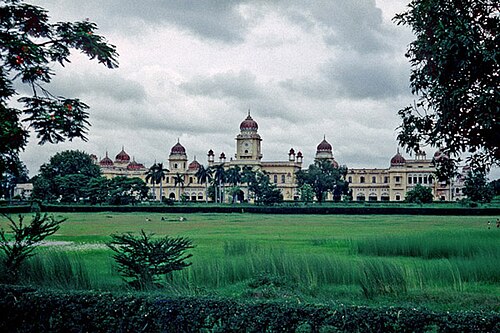
Thomas Babington Macaulay (1800–1859) presented his Whiggish interpretation of English history as an upward progression always leading to more liberty and more progress. Macaulay simultaneously was a leading reformer involved in transforming the educational system of India. He would base it on the English language so that India could join the mother country in a steady upward progress. Macaulay took Burke's emphasis on moral rule and implemented it in actual school reforms, giving the British Empire a profound moral mission to "civilise the natives".
Yale professor Karuna Mantena has argued that the civilising mission did not last long, for she says that benevolent reformers were the losers in key debates, such as those following the 1857 rebellion in India, and the scandal of Edward Eyre's brutal repression of the Morant Bay rebellion in Jamaica in 1865. The rhetoric continued but it became an alibi for British misrule and racism. No longer was it believed that the natives could truly make progress, instead, they had to be ruled by heavy hand, with democratic opportunities postponed indefinitely. As a result:
The central tenets of liberal imperialism were challenged as various forms of rebellion, resistance and instability in the colonies precipitated a broad-ranging reassessment....the equation of 'good government' with the reform of native society, which was at the core of the discourse of liberal empire, would be subject to mounting scepticism.[282]
English historian Peter Cain, has challenged Mantena, arguing that the imperialists truly believed that British rule would bring to the subjects the benefits of 'ordered liberty', thereby Britain could fulfil its moral duty and achieve its own greatness. Much of the debate took place in Britain itself, and the imperialists worked hard to convince the general population that the civilising mission was well under-way. This campaign served to strengthen imperial support at home, and thus, says Cain, to bolster the moral authority of the gentlemanly elites who ran the Empire.[283]

Universities in Calcutta, Bombay, and Madras were established in 1857, just before the Rebellion. By 1890 some 60,000 Indians had matriculated, chiefly in the liberal arts or law. About a third entered public administration, and another third became lawyers. The result was a very well educated professional state bureaucracy. By 1887 of 21,000 mid-level civil services appointments, 45% were held by Hindus, 7% by Muslims, 19% by Eurasians (European father and Indian mother), and 29% by Europeans. Of the 1000 top-level civil services positions, almost all were held by Britons, typically with an Oxbridge degree.[284] The government, often working with local philanthropists, opened 186 universities and colleges of higher education by 1911; they enrolled 36,000 students (over 90% men). By 1939 the number of institutions had doubled and enrolment reached 145,000. The curriculum followed classical British standards of the sort set by Oxford and Cambridge and stressed English literature and European history. Nevertheless, by the 1920s the student bodies had become hotbeds of Indian nationalism.[285]
Missionary work
_-_1865.jpg/500px-St._Paul's_Cathedral_-_Calcutta_(Kolkata)_-_1865.jpg)
In 1889, the Prime Minister of the United Kingdom, Robert Gascoyne-Cecil, 3rd Marquess of Salisbury stated, "It is not only our duty but is in our interest to promote the diffusion of Christianity as far as possible throughout the length and breadth of India".[287]
The growth of the British Indian Army led to the arrival of many Anglican chaplains in India.[288] Following the arrival of the Church of England's Church Mission Society in 1814, the Diocese of Calcutta of the Church of India, Burma and Ceylon (CIBC) was erected, with its St. Paul's Cathedral being built in 1847.[289] By 1930, the Church of India, Burma and Ceylon had fourteen dioceses across the Indian Empire.[290]
Missionaries from other Christian denominations came to British India as well; Lutheran missionaries, for example, arrived in Calcutta in 1836 and by "the year 1880 there were over 31,200 Lutheran Christians spread out in 1,052 villages".[287] Methodists began arriving in India in 1783 and established missions with a focus on "education, health ministry, and evangelism".[291][292] In the 1790s, Christians from the London Missionary Society and Baptist Missionary Society, began doing missionary work in the Indian Empire.[293] In Neyoor, the London Missionary Society Hospital "pioneered improvements in the public health system for the treatment of diseases even before organised attempts were made by the colonial Madras Presidency, reducing the death rate substantially".[294]
Christ Church College (1866) and St. Stephen's College (1881) are two examples of prominent church-affiliated educational institutions founded during the British Raj.[295] Within educational institutions established during the British Raj, Christian texts, especially the Bible, were a part of the curricula.[296] During the British Raj, Christian missionaries developed writing systems for Indian languages that previously did not have one.[297][298] Christian missionaries in India also worked to increase literacy and also engaged in social activism, such as fighting against prostitution, championing the right of widowed women to remarry, and trying to stop early marriages for women.[299] Among British women, zenana missions became a popular method to win converts to Christianity.[296]
Legacy
The old consensus among historians held that British imperial authority was quite secure from 1858 to World War II. Recently, however, this interpretation has been challenged. For example, Mark Condos and Jon Wilson argue that imperial authority was chronically insecure. Indeed, the anxiety of generations of officials produced a chaotic administration with minimal coherence. Instead of a confident state capable of acting as it chose, these historians find a psychologically embattled one incapable of acting except in the abstract, small scale, or short term. Meanwhile, Durba Ghosh offers an alternative approach.[300]
Ideological impact
At independence and after the independence of India, the country has maintained such central British institutions as parliamentary government, one-person, one-vote and the rule of law through nonpartisan courts.[215] It retained as well the institutional arrangements of the Raj such as the civil services, administration of sub-divisions, universities and stock exchanges. One major change was the rejection of its former separate princely states. Metcalf shows that over the course of two centuries, British intellectuals and Indian specialists made the highest priority bringing peace, unity and good government to India.[301] They offered many competing methods to reach the goal. For example, Cornwallis recommended turning Bengali Zamindar into the sort of English landlords that controlled local affairs in England.[301] Munro proposed to deal directly with the peasants. Sir William Jones and the Orientalists promoted Sanskrit, while Macaulay promoted the English language.[302] Zinkin argues that in the long-run, what matters most about the legacy of the Raj is the British political ideologies which the Indians took over after 1947, especially the belief in unity, democracy, the rule of law and a certain equality beyond caste and creed.[301] Zinkin sees this not just in the Congress party but also among Hindu nationalists in the Bharatiya Janata Party, which specifically emphasises Hindu traditions.[303][304]
Cultural impact

The British colonisation of India influenced South Asian culture noticeably. The most noticeable influence is the English language which emerged as the administrative and lingua franca of India and Pakistan (and which also greatly influenced the native South Asian languages)[306] followed by the blend of native and gothic/sarcenic architecture. Similarly, the influence of the South Asian languages and culture can be seen on Britain, too; for example, many Indian words entering the English language,[307] and also the adoption of South Asian cuisine.[308]
British sports (particularly hockey early on, but then largely replaced by cricket in recent decades, with football also popular in certain regions of the subcontinent)[309][310] were cemented as part of South Asian culture during the British Raj, with the local games largely having been diminished in the process.[311] During the Raj, soldiers would play British sports as a way of maintaining fitness, since the mortality rate for foreigners in India was high at the time, as well as to maintain a sense of Britishness; in the words of an anonymous writer, playing British sports was a way for soldiers to "defend themselves from the magic of the land".[312] Though the British had generally excluded Indians from their play during the time of Company rule, over time they began to see the inculcation of British sports among the native populace as a way of spreading British values.[312][313] At the same time, some of the Indian elite began to move towards British sports as a way of adapting to British culture and thus helping themselves to rise up the ranks;[314][315] later on, more Indians began to play British sports in an effort to beat the British at their own sports,[316] as a way of proving that the Indians were equal to their colonisers.[317]
See also



- Colonial India
- Direct colonial rule
- Glossary of the British Raj (Hindi-Urdu words)
- Historiography of the British Empire
- Legislatures of British India
- List of governors-general of India
- Subsidiary alliance, the status of princely states
- Star of India flag used during the British Raj
- British North America
Notes
- ^ a quasi-federation of presidencies and provinces directly governed by the British Crown through the Viceroy and Governor-General of India
- ^ governed by Indian rulers, under the suzerainty of The British Crown exercised through the Viceroy of India)
- ^ Simla was the summer capital of the Government of British India, not of the British Raj, i.e. the British Indian Empire, which included the Princely States.[3]
- ^ The proclamation for New Delhi to be the capital was made in 1911, but the city was inaugurated as the capital of the Raj in February 1931.
- ^ English was the language of the courts and government.
- ^ Urdu was also given official status in large parts of northern India, as were vernaculars elsewhere.[4][5][6][7][8][page needed][9]
- ^ Outside northern India, the local vernaculars were used as official language in the lower courts and in government offices.[8]
- ^ Seated l. to r. are: Jiddhu Krisnamurthi, Besant, and Charles Webster Leadbeater.
- ^ The only other emperor during this period, Edward VIII (reigned January to December 1936), did not issue any Indian currency under his name.
- ^ 1872 census: Includes all "Hindu" (187,937,450 persons), "Brahmo" (1,147 persons), "Satnami" (398,409 persons), "Kabirpanthi" (347,994 persons), and "Kumbhipatia" (913 persons) responses.
1891 census: Includes all "Brahmanic" (207,688,724 persons), "Arya" (39,952 persons), and "Brahmo" (1,147 persons) responses.
1901 census:Includes all "Brahmanic" (207,050,557 persons), "Arya" (92,419 persons), and "Brahmo" (4,050 persons) responses.
1911 census: Includes all "Brahmanic" (217,337,943 persons), "Arya" (243,445 persons), and "Brahmo" (5,504 persons) responses.
1921 census: Includes all "Brahmanic" (216,260,620 persons), "Arya" (467,578 persons), and "Brahmo" (6,388 persons) responses.
1931 census: Includes all "Brahmanic" (219,300,645 persons), "Arya" (990,233 persons), "Brahmo" (5,378 persons), "Ad-Dharmi" (418,789 persons), and "Other Hindu" (18,898,884 persons) responses.
1941 census: Includes all "Scheduled Caste" (48,813,180 persons), "Ad-Dharmi" (349,863 persons), and "Other Hindu" (206,117,326 persons) responses. - ^ 1941 census: Includes all "Indian Christian" (6,040,665 persons), "Anglo-Indian" (140,422 persons), and "Other Christian" (135,462 persons) responses.
- ^ 1881 census: Includes all "Tribal" (6,426,511 persons) and "Nat Worship" (143,581 persons) responses.
- ^ 1872 census: Includes all "Others" (5,025,721 persons) and "Not Known" (425,175 persons) responses.
1891 census: Includes all "Unitarians" (5 persons), "Theists" (47 persons), "Deists" (12 persons), "Atheists" (27 persons), "Freethinkers" (5 persons), "Agnostics" (69 persons), "Positivists" (2 persons), "No religion" (18 persons), and "Religion not Returned" (42,578 persons) responses.
1931 census: Includes all "No religion" (153 persons), "Indefinite Beliefs" (940 persons), "Chinese (Confucian, Ancestor Worship, and Taoist)" (150,240 persons), and "Others" (1,065 persons) responses.
References
- ^ a b Interpretation Act 1889 (52 & 53 Vict. c. 63), s. 18.
- ^ "Calcutta (Kalikata)", The Imperial Gazetteer of India, vol. IX, Published under the Authority of His Majesty's Secretary of State for India in Council, Oxford at the Clarendon Press, 1908, p. 260, archived from the original on 24 May 2022, retrieved 24 May 2022,
—Capital of the Indian Empire, situated in 22° 34' N and 88° 22' E, on the east or left bank of the Hooghly river, within the Twenty-four Parganas District, Bengal
- ^ "Simla Town", The Imperial Gazetteer of India, vol. XXII, Published under the Authority of His Majesty's Secretary of State for India in Council, Oxford at the Clarendon Press, 1908, p. 260, archived from the original on 24 May 2022, retrieved 24 May 2022,
—Head-quarters of Simla District, Punjab, and the summer capital of the Government of India, situated on a transverse spur of the Central Himālayan system system, in 31° 6' N and 77° 10' E, at a mean elevation above sea-level of 7,084 feet.
- ^ Lelyveld, David (1993). "Colonial Knowledge and the Fate of Hindustani". Comparative Studies in Society and History. 35 (4): 665–682. doi:10.1017/S0010417500018661. ISSN 0010-4175. JSTOR 179178. S2CID 144180838. Archived from the original on 8 April 2023. Retrieved 8 April 2023.
The earlier grammars and dictionaries made it possible for the British government to replace Persian with vernacular languages at the lower levels of the judicial and revenue administration in 1837, that is, to standardize and index terminology for official use and provide for its translation to the language of the ultimate ruling authority, English. For such purposes, Hindustani was equated with Urdu, as opposed to any geographically defined dialect of Hindi and was given official status through large parts of north India. Written in the Persian script with a largely Persian and, via Persian, an Arabic vocabulary, Urdu stood at the shortest distance from the previous situation and was easily attainable by the same personnel. In the wake of this official transformation, the British government began to make its first significant efforts on behalf of vernacular education.
- ^ Dalby, Andrew (2004) [1998]. "Hindi". A Dictionary of Languages: The definitive reference to more than 400 languages. A & C Black Publishers. p. 248. ISBN 978-0-7136-7841-3.
In the government of northern India Persian ruled. Under the British Raj, Persian eventually declined, but, the administration remaining largely Muslim, the role of Persian was taken not by Hindi but by Urdu, known to the British as Hindustani. It was only as the Hindu majority in India began to assert itself that Hindi came into its own.
- ^ Vejdani, Farzin (2015), Making History in Iran: Education, Nationalism, and Print Culture, Stanford, CA: Stanford University Press, pp. 24–25, ISBN 978-0-8047-9153-3,
Although the official languages of administration in India shifted from Persian to English and Urdu in 1837, Persian continued to be taught and read there through the early twentieth century.
- ^ Everaert, Christine (2010), Tracing the Boundaries between Hindi and Urdu, Leiden and Boston: BRILL, pp. 253–254, ISBN 978-90-04-17731-4,
It was only in 1837 that Persian lost its position as official language of India to Urdu and to English in the higher levels of administration.
- ^ a b Dhir, Krishna S. (2022). The Wonder That Is Urdu. Delhi: Motilal Banarsidass. ISBN 978-81-208-4301-1.
The British used the Urdu language to effect a shift from the prior emphasis on the Persian language. In 1837, the British East India Company adopted Urdu in place of Persian as the co-official language in India, along with English. In the law courts in Bengal and the North-West Provinces and Oudh (modern day Uttar Pradesh) a highly technical form of Urdu was used in the Nastaliq script, by both Muslims and Hindus. The same was the case in the government offices. In the various other regions of India, local vernaculars were used as official language in the lower courts and in government offices. ... In certain parts South Asia, Urdu was written in several scripts. Kaithi was a popular script used for both Urdu and Hindi. By 1880, Kaithi was used as court language in Bihar. However, in 1881, Hindi in Devanagari script replaced Urdu in the Nastaliq script in Bihar. In Panjab, Urdu was written in Nastaliq, Devanagari, Kaithi, and Gurumukhi.
In April 1900, the colonial government of the North-West Provinces and Oudh granted equal official status to both, Devanagari and Nastaliq scripts. However, Nastaliq remained the dominant script. During the 1920s, Mohandas Karamchand Gandhi deplored the controversy and the evolving divergence between Urdu and Hindi, exhorting the remerging of the two languages as Hindustani. However, Urdu continued to draw from Persian, Arabic, and Chagtai, while Hindi did the same from Sanskrit. Eventually, the controversy resulted in the loss of the official status of the Urdu language. - ^ Bayly, C. A. (1988). Indian Society and the making of the British Empire. New Cambridge History of India series. Cambridge University Press. p. 122. ISBN 0-521-25092-7.
The use of Persian was abolished in official correspondence (1835); the government's weight was thrown behind English-medium education and Thomas Babington Macaulay's Codes of Criminal and Civil Procedure (drafted 1841–2, but not completed until the 1860s) sought to impose a rational, Western legal system on the amalgam of Muslim, Hindu and English law which had been haphazardly administered in British courts. The fruits of the Bentinck era were significant. But they were only of general importance in so far as they went with the grain of social changes which were already gathering pace in India. The Bombay and Calcutta intelligentsia were taking to English education well before the Education Minute of 1836. Flowery Persian was already giving way in north India to the fluid and demotic Urdu. As for changes in the legal system, they were only implemented after the Rebellion of 1857 when communications improved and more substantial sums of money were made available for education.
- ^
- "Raj, the". The Oxford Dictionary of Phrase and Fable (2nd ed.). Oxford University Press. 2005. ISBN 978-0-19-860981-0.
Raj, the: British sovereignty in India before 1947 (also called, the British Raj). The word is from Hindi rāj 'reign'
- "RAJ definition and meaning". Collins Online Dictionary.
raj: (often cap; in India) rule, esp. the British rule prior to 1947
- "Raj, the". The Oxford Dictionary of Phrase and Fable (2nd ed.). Oxford University Press. 2005. ISBN 978-0-19-860981-0.
- ^
- Hirst, Jacqueline Suthren; Zavros, John (2011), Religious Traditions in Modern South Asia, London and New York: Routledge, ISBN 978-0-415-44787-4, archived from the original on 23 September 2023, retrieved 24 May 2022,
As the (Mughal) empire began to decline in the mid-eighteenth century, some of these regional administrations assumed a greater degree of power. Amongst these ... was the East India Company, a British trading company established by Royal Charter of Elizabeth I of England in 1600. The Company gradually expanded its influence in South Asia, in the first instance through coastal trading posts at Surat, Madras and Calcutta. (The British) expanded their influence, winning political control of Bengal and Bihar after the Battle of Plassey in 1757. From here, the Company expanded its influence dramatically across the subcontinent. By 1857, it had direct control over much of the region. The great rebellion of that year, however, demonstrated the limitations of this commercial company's ability to administer these vast territories, and in 1858 the Company was effectively nationalized, with the British Crown assuming administrative control. Hence began the period known as the British Raj, which ended in 1947 with the partition of the subcontinent into the independent nation-states of India and Pakistan.
- Salomone, Rosemary (2022), The Rise of English: Global Politics and the Power of Language, Oxford University Press, p. 236, ISBN 978-0-19-062561-0, archived from the original on 23 September 2023, retrieved 24 May 2022,
Between 1858, when the British East India Company transferred power to British Crown rule (the "British Raj"), and 1947, when India gained independence, English gradually developed into the language of government and education. It allowed the Raj to maintain control by creating an elite gentry schooled in British mores, primed to participate in public life, and loyal to the Crown.
- Hirst, Jacqueline Suthren; Zavros, John (2011), Religious Traditions in Modern South Asia, London and New York: Routledge, ISBN 978-0-415-44787-4, archived from the original on 23 September 2023, retrieved 24 May 2022,
- ^
- Vanderven, Elizabeth (2019), "National Education Systems: Asia", in Rury, John L.; Tamura, Eileen H. (eds.), The Oxford Handbook of the History of Education, Oxford University Press, pp. 213–227, 222, ISBN 978-0-19-934003-3, archived from the original on 23 September 2023, retrieved 24 May 2022,
During the British East India Company's domination of the Indian subcontinent (1757–1858) and the subsequent British Raj (1858–1947), it was Western-style education that came to be promoted by many as the base upon which a national and uniform education system should be built.
- Lapidus, Ira M. (2014), A History of Islamic Societies (3 ed.), Cambridge University Press, p. 393, ISBN 978-0-521-51430-9, retrieved 24 May 2022,
Table 14. Muslim India: outline chronology
Mughal Empire ... 1526–1858
Akbar I ... 1556–1605
Aurengzeb ... 1658–1707
British victory at Plassey ... 1757
Britain becomes paramount power ... 1818
British Raj ... 1858–1947
- Vanderven, Elizabeth (2019), "National Education Systems: Asia", in Rury, John L.; Tamura, Eileen H. (eds.), The Oxford Handbook of the History of Education, Oxford University Press, pp. 213–227, 222, ISBN 978-0-19-934003-3, archived from the original on 23 September 2023, retrieved 24 May 2022,
- ^
- Steinback, Susie L. (2012), Understanding the Victorians: Politics, Culture and Society in Nineteenth-Century Britain, London and New York: Routledge, p. 68, ISBN 978-0-415-77408-6, archived from the original on 23 September 2023, retrieved 24 May 2022,
The rebellion was put down by the end of 1858. The British government passed the Government of India Act, and began direct Crown rule. This era was referred to as the British Raj (though in practice much remained the same).
- Ahmed, Omar (2015), Studying Indian Cinema, Auteur (now an imprint of Liverpool University Press), p. 221, ISBN 978-1-80034-738-0, archived from the original on 23 September 2023, retrieved 24 May 2022,
The film opens with what is a lengthy prologue, contextualising the time and place through a detailed voice-over by Amitabh Bachchan. We are told that the year is 1893. This is significant as it was the height of the British Raj, a period of crown rule lasting from 1858 to 1947.
- Wright, Edmund (2015), A Dictionary of World History, Oxford University Press, p. 537, ISBN 978-0-19-968569-1,
More than 500 Indian kingdoms and principalities [...] existed during the 'British Raj' period (1858–1947) The rule is also called Crown rule in India
- Fair, C. Christine (2014), Fighting to the End: The Pakistan Army's Way of War, Oxford University Press, p. 61, ISBN 978-0-19-989270-9,
[...] by 1909 the Government of India, reflecting on 50 years of Crown rule after the rebellion, could boast that [...]
- Steinback, Susie L. (2012), Understanding the Victorians: Politics, Culture and Society in Nineteenth-Century Britain, London and New York: Routledge, p. 68, ISBN 978-0-415-77408-6, archived from the original on 23 September 2023, retrieved 24 May 2022,
- ^
- Glanville, Luke (2013), Sovereignty and the Responsibility to Protect: A New History, University of Chicago Press, p. 120, ISBN 978-0-226-07708-6, archived from the original on 23 September 2023, retrieved 23 August 2020 Quote: "Mill, who was himself employed by the British East India company from the age of seventeen until the British government assumed direct rule over India in 1858."
- Pykett, Lyn (2006), Wilkie Collins, Oxford World's Classics: Authors in Context, Oxford University Press, p. 160, ISBN 978-0-19-284034-9,
In part, the Mutiny was a reaction against this upheaval of traditional Indian society. The suppression of the Mutiny after a year of fighting was followed by the break-up of the East India Company, the exile of the deposed emperor and the establishment of the British Raj, and direct rule of the Indian subcontinent by the British.
- Lowe, Lisa (2015), The Intimacies of Four Continents, Duke University Press, p. 71, ISBN 978-0-8223-7564-7,
Company rule in India lasted effectively from the Battle of Plassey in 1757 until 1858, when following the 1857 Indian Rebellion, the British Crown assumed direct colonial rule of India in the new British Raj.
- ^ Bowen, H. V.; Mancke, Elizabeth; Reid, John G. (2012), Britain's Oceanic Empire: Atlantic and Indian Ocean Worlds, C. 1550–1850, Cambridge University Press, p. 106, ISBN 978-1-107-02014-6 Quote: "British India, meanwhile, was itself the powerful 'metropolis' of its own colonial empire, 'the Indian empire'."
- ^ Kaul, Chandrika. "From Empire to Independence: The British Raj in India 1858–1947". Archived from the original on 17 June 2016. Retrieved 3 March 2011.
- ^ Mansergh, Nicholas (1974), Constitutional relations between Britain and India, London: His Majesty's Stationery Office, p. xxx, ISBN 978-0-11-580016-0, retrieved 19 September 2013 Quote: "India Executive Council: Sir Arcot Ramasamy Mudaliar, Sir Firoz Khan Noon and Sir V. T. Krishnamachari served as India's delegates to the London Commonwealth Meeting, April 1945, and the U.N. San Francisco Conference on International Organisation, April–June 1945."
- ^ Smith, George (1882). The Geography of British India, Political & Physical. London: John Murray. Retrieved 2 August 2014.
- ^ Baten, Jörg (2016). A History of the Global Economy. From 1500 to the Present. Cambridge University Press. p. 247. ISBN 978-1-107-50718-0.
- ^ Marshall (2001), p. 384
- ^ Subodh Kapoor (January 2002). The Indian encyclopaedia: biographical, historical, religious ..., Volume 6. Cosmo Publications. p. 1599. ISBN 978-81-7755-257-7.
- ^ Codrington, 1926, Chapter X:Transition to British administration
- ^ "Nepal: Cultural life". Encyclopædia Britannica Online. 2008. Archived from the original on 24 November 2015.
- ^ "Bhutan". Encyclopædia Britannica Online. 2008. Archived from the original on 2 June 2022. Retrieved 2 June 2022.
- ^ "Sikkim | History, Map, Capital, & Population". Britannica. Archived from the original on 1 August 2017. Retrieved 2 December 2022.
- ^ "Maldives | History, Points of Interest, Location, & Tourism". Britannica. Archived from the original on 2 December 2022. Retrieved 2 December 2022.
- ^ a b Spear 1990, p. 147
- ^ Spear 1990, pp. 145–46: "The army took on the form which survived till independence... The Bengal army was completely recast... The Brahmin element from Uttar Pradesh, the core of the original mutiny, was heavily reduced and its place taken by Gurkhas, Sikhs, and Punjabis."
- ^ Ernst, W. (1996). "European Madness and Gender in Nineteenth-century British India". Social History of Medicine. 9 (3): 357–82. doi:10.1093/shm/9.3.357. PMID 11618727.
- ^ Robinson, Ronald Edward, & John Gallagher. 1968. Africa and the Victorians: The Climax of Imperialism. Garden City, NY: Doubleday "'Send the Mild Hindoo:' The Simultaneous Expansion of British Suffrage and Empire∗" (PDF). Archived from the original (PDF) on 25 February 2009. Retrieved 15 February 2009.
- ^ Spear 1990, pp. 149–150
- ^ Spear 1990, pp. 150–151
- ^ Spear 1990, p. 150
- ^ Spear 1990, pp. 147–48
- ^ Spear 1990, p. 151
- ^ "East India Proclamations" (PDF). sas.ed.ac.uk. Archived (PDF) from the original on 4 March 2012. Retrieved 6 November 2021.
- ^ Stein 2001, p. 259, Oldenburg 2007
- ^ Oldenburg 2007, Stein 2001, p. 258
- ^ a b Oldenburg 2007
- ^ Stein 2001, p. 258
- ^ Stein 2001, p. 159
- ^ a b c Stein 2001, p. 260
- ^ a b Metcalf & Metcalf 2006, p. 126.
- ^ a b Metcalf & Metcalf 2006, p. 97.
- ^ Brennan, L. (1984). "The Development of the Indian Famine Codes: Personalities, Politics, and Policies". In Currey, Bruce; Hugo, Graeme (eds.). Famine: As a Geographical Phenomenon. Springer Dordrecht. ISBN 978-94-009-6395-5.
- ^ Spear 1990, p. 169
- ^ a b Majumdar, Raychaudhuri & Datta 1950, p. 888
- ^ F.H. Hinsley, ed. The New Cambridge Modern History, Vol. 11: Material Progress and World-Wide Problems, 1870–98 (1962) contents Archived 18 October 2017 at the Wayback Machine pp. 411–36.
- ^ Spear 1990, p. 170
- ^ Bose & Jalal 2004, pp. 80–81
- ^ James S. Olson and Robert S. Shadle, Historical Dictionary of the British Empire (1996) p. 116
- ^ Helen S. Dyer, Pandita Ramabai: the story of her life (1900) online
- ^ Ludden 2002, p. 197
- ^ Stanley A. Wolpert, Tilak and Gokhale: revolution and reform in the making of modern India (1962) p 67
- ^ Michael Edwardes, High Noon of Empire: India under Curzon (1965) p. 77
- ^ Moore, "Imperial India, 1858–1914", p. 435
- ^ McLane, John R. (July 1965). "The Decision to Partition Bengal in 1905". Indian Economic and Social History Review. 2 (3): 221–37. doi:10.1177/001946466400200302. S2CID 145706327.
- ^ Ranbir Vohra, The Making of India: A Historical Survey (Armonk: M.E. Sharpe, Inc, 1997), 120
- ^ V. Sankaran Nair, Swadeshi movement: The beginnings of student unrest in South India (1985) excerpt and text search
- ^ Peter Heehs, The lives of Sri Aurobindo (2008) p. 184
- ^ Bandyopadhyay 2004, p. 260 A distinct group within the Calcutta Anushilan Samiti ... soon started action ... robbery to raise funds ... Attempts to assassinate oppressive officials ... became the main features of the revolutionary activities ... arrest of the entire Maniktala group ... dealt a great blow to such terrorist activities. In terms of direct gains, the terrorists achieved precious little; most of their attempts were either aborted or failed.
- ^ Wolpert 2004, pp. 273–274
- ^ a b c d Ludden 2002, p. 200
- ^ Stein 2001, p. 286
- ^ a b c Ludden 2002, p. 201
- ^ a b Manmath Nath Das (1964). India under Morley and Minto: politics behind revolution, repression and reforms. G. Allen and Unwin. ISBN 978-0-04-954002-6. Retrieved 21 February 2012.
- ^ Robb 2002, p. 174: Violence too could be ... repressed, partly because it was eschewed by the mainstream of educated politicians – despite the attraction to some of them of ... movements such as Bengal's Anusilan Samiti or Punjab's Ghadr Party.
- ^ India's contribution to the Great War. Calcutta: Govt of India. 1923. p. 74.
- ^ a b c d e f Brown 1994, pp. 197–98
- ^ Belgium Olympic Committee (1957). "Olympic Games Antwerp. 1920: Official Report" (PDF). LA84 Foundation. Archived from the original (PDF) on 7 October 2018. Retrieved 9 December 2016.
- ^ a b c Brown 1994, pp. 201–02
- ^ a b c Brown 1994, pp. 200–01
- ^ a b c d e Brown 1994, p. 199
- ^ a b c d Brown 1994, pp. 214–15
- ^ a b c d Brown 1994, pp. 210–13
- ^ Brown 1994, pp. 216–17
- ^ Balraj Krishna, India's Bismarck, Sardar Vallabhbhai Patel (2007) ch. 2
- ^ a b c d e f g h Brown 1994, pp. 203–04
- ^ a b c d e f g h i Brown 1994, pp. 205–07
- ^ Chhabra 2005, p. 2
- ^ a b c d Spear 1990, p. 190
- ^ a b c Brown 1994, pp. 195–96
- ^ a b c Stein 2001, p. 304
- ^ Ludden 2002, p. 208
- ^ Nick Lloyd (2011). The Amritsar Massacre: The Untold Story of One Fateful Day p. 180
- ^ Sayer, Derek (May 1991). "British Reaction to the Amritsar Massacre 1919–1920". Past & Present (131): 130–64. doi:10.1093/past/131.1.130. JSTOR 650872.
- ^ Bond, Brian (October 1963). "Amritsar 1919". History Today. Vol. 13, no. 10. pp. 666–76.
- ^ a b Markovits 2004, pp. 373–74
- ^ Potter, David C. (January 1973). "Manpower Shortage and the End of Colonialism: The Case of the Indian Civil Service". Modern Asian Studies. 7 (1): 47–73. doi:10.1017/S0026749X00004388. JSTOR 312036. S2CID 146445282.
- ^ Epstein, Simon (May 1982). "District Officers in Decline: The Erosion of British Authority in the Bombay Countryside, 1919 to 1947". Modern Asian Studies. 16 (3): 493–518. doi:10.1017/S0026749X00015286. JSTOR 312118. S2CID 143984571.
- ^ Low 1993, pp. 40, 156
- ^ Brendon 2008, p. 394.
- ^ Low 1993, p. 154
- ^ Muldoon, Andrew (2009). "Politics, Intelligence and Elections in Late Colonial India: Congress and the Raj in 1937" (PDF). Journal of the Canadian Historical Association. 20 (2): 160–88. doi:10.7202/044403ar. S2CID 154900649. Archived (PDF) from the original on 15 September 2018. Retrieved 15 September 2018.; Muldoon, Empire, politics and the creation of the 1935 India Act: last act of the Raj (2009)
- ^ "Sword For Pen". Time. 12 April 1937.
- ^ a b c Dr Chandrika Kaul (3 March 2011). "From Empire to Independence: The British Raj in India 1858–1947". History. BBC. Archived from the original on 17 June 2016. Retrieved 2 August 2014.
- ^ a b "India and Pakistan win independence". History.com. History. Archived from the original on 5 July 2014. Retrieved 2 August 2014.
- ^ Ramachandra Guha, India After Gandhi: The History of the World's Largest Democracy (2007) p. 43
- ^ "Muslim Case for Pakistan". University of Columbia. Archived from the original on 15 July 2019. Retrieved 10 June 2019.
- ^ Robb 2002, p. 190
- ^ Stephen P. Cohen (2004). The Idea of Pakistan. Brookings Institution Press. p. 28. ISBN 978-0-8157-1502-3.
- ^ D. N. Panigrahi (2004). India's partition: the story of imperialism in retreat. Routledge. pp. 151–52. ISBN 978-1-280-04817-3.
- ^ Recruitment was especially active in the Punjab province of British India, under the leadership of Premier Sir Sikandar Hayat Khan, who believed in cooperating with the British to achieve eventual independence for the Indian nation. For details of various recruitment drives by Sir Sikandar between 1939 and 1942, see Tarin, Omer; Dando, Neal (Autumn 2010). "Memoirs of the Second World War: Major Shaukat Hayat Khan". Durbar: Journal of the Indian Military Historical Society (Critique). 27 (3): 136–37.
- ^ Roy, Kaushik (2009). "Military Loyalty in the Colonial Context: A Case Study of the Indian Army during World War II". Journal of Military History. 73 (2): 497–529. doi:10.1353/jmh.0.0233. S2CID 153886117.
- ^ John F. Riddick, The history of British India: a chronology (2006) p. 142
- ^ Gupta, Shyam Ratna (January 1972). "New Light on the Cripps Mission". India Quarterly. 28 (1): 69–74. doi:10.1177/097492847202800106. S2CID 150945957.
- ^ a b Metcalf & Metcalf 2006, pp. 206–07
- ^ Bandyopadhyay 2004, pp. 418–20
- ^ Stein 2010, pp. 305, 325": Jawaharlal Nehru and Subhas Bose were among those who, impatient with Gandhi's programmes and methods, looked upon socialism as an alternative for nationalistic policies capable of meeting the country's economic and social needs, as well as a link to potential international support. (p. 325) (p. 345)"
- ^ Low 2002, p. 297.
- ^ Low 2002, p. 313.
- ^ a b Low 1993, pp. 31–31.
- ^ Wolpert 2006, p. 69.
- ^ Bandyopadhyay 2004, p. 427.
- ^ Bayly & Harper 2007, p. 2.
- ^ Bose, Sugata (2011), His Majesty's Opponent: Subhas Chandra Bose and India's Struggle against Empire, Harvard University Press, p. 320, ISBN 978-0-674-04754-9, retrieved 21 September 2013
- ^ Stein 2001, p. 345.
- ^ a b Judd 2004, pp. 172–73
- ^ Judd 2004, pp. 170–71
- ^ Judd 2004, p. 172
- ^ Sarvepalli Gopal (1976). Jawaharlal Nehru: A Biography. Harvard University Press. p. 362. ISBN 978-0-674-47310-2. Retrieved 21 February 2012.
- ^ Hyam 2007, p. 106 Quote: By the end of 1945, he and the Commander-in-Chief of India, General Auckinleck were advising that there was a real threat in 1946 of large-scale anti-British disorder amounting to even a well-organised rising aiming to expel the British by paralysing the administration.
Quote:...it was clear to Attlee that everything depended on the spirit and reliability of the Indian Army:"Provided that they do their duty, armed insurrection in India would not be an insoluble problem. If, however, the Indian Army was to go the other way, the picture would be very different...
Quote:...Thus, Wavell concluded, if the army and the police "failed" Britain would be forced to go. In theory, it might be possible to revive and reinvigorate the services, and rule for another fifteen to twenty years, but:It is a fallacy to suppose that the solution lies in trying to maintain status quo. We have no longer the resources, nor the necessary prestige or confidence in ourselves. - ^ Brown 1994, p. 330 Quote: "India had always been a minority interest in British public life; no great body of public opinion now emerged to argue that war-weary and impoverished Britain should send troops and money to hold it against its will in an empire of doubtful value. By late 1946 both Prime Minister and Secretary of State for India recognized that neither international opinion no their own voters would stand for any reassertion of the raj, even if there had been the men, money, and administrative machinery with which to do so." Sarkar 2004, p. 418 Quote: "With a war weary army and people and a ravaged economy, Britain would have had to retreat; the Labour victory only quickened the process somewhat." Metcalf & Metcalf 2006, p. 212 Quote: "More importantly, though victorious in war, Britain had suffered immensely in the struggle. It simply did not possess the manpower or economic resources required to coerce a restive India."
- ^ "Indian Independence". British Library: Help for Researchers. Archived from the original on 11 August 2018. Retrieved 2 August 2014.
portal to educational sources available in the India Office Records
- ^ "The Road to Partition 1939–1947". Nationalarchives.gov.uk Classroom Resources. National Archives. Archived from the original on 14 February 2015. Retrieved 2 August 2014.
- ^ Ian Talbot and Gurharpal Singh, The Partition of India (2009), passim
- ^ Maria Misra, Vishnu's crowded temple: India since the Great Rebellion (2008) p. 237
- ^ Michael Maclagan (1963). "Clemency" Canning: Charles John, 1st Earl Canning, Governor-General and Viceroy of India, 1856–1862. Macmillan. p. 212. Retrieved 21 February 2012.
- ^ William Ford (1887). John Laird Mair Lawrence, a viceroy of India, by William St. Clair. pp. 186–253.
- ^ a b Sir William Wilson Hunter (1876). A life of the Earl of Mayo, fourth viceroy of India. Smith, Elder, & Company. pp. 181–310.
- ^ Sarvepalli Gopal (1953). The viceroyalty of Lord Ripon, 1880–1884. Oxford University Press. Retrieved 21 February 2012.
- ^ Briton Martin, Jr. "The Viceroyalty of Lord Dufferin", History Today, (Dec 1960) 10#12 pp. 821–30, and (Jan 1961) 11#1 pp. 56–64
- ^ Sir Alfred Comyn Lyall (1905). The life of the Marquis of Dufferin and Ava. Vol. 2. pp. 72–207.
- ^ Sir George Forrest (1894). The administration of the Marquis of Lansdowne as Viceroy and Governor-general of India, 1888–1894. Office of the Supdt. of Government Print. p. 40.
- ^ Michael Edwardes, High Noon of Empire: India under Curzon (1965)
- ^ H. Caldwell Lipsett (1903). Lord Curzon in India: 1898–1903. R.A. Everett.
- ^ The Imperial Gazetteer of India. Vol. I. Oxford: Clarendon Press. 1909. p. 449. Archived from the original on 24 February 2021. Retrieved 20 February 2021.
- ^ Ernest Hullo, "India", in Catholic Encyclopedia (1910) vol. 7 online Archived 23 February 2021 at the Wayback Machine
- ^ "India". World Digital Library. Archived from the original on 25 August 2014. Retrieved 24 January 2013.
- ^ 1. Imperial Gazetteer of India, volume IV, published under the authority of the Secretary of State for India-in-Council, 1909, Oxford University Press. p. 5. Quote: "The history of British India falls, as observed by Sir C. P. Ilbert in his Government of India, into three periods. From the beginning of the seventeenth century to the middle of the eighteenth century the East India Company is a trading corporation, existing on the sufferance of the native powers and in rivalry with the merchant companies of Holland and France. During the next century, the Company acquires and consolidates its dominion, shares its sovereignty in increasing proportions with the Crown, and gradually loses its mercantile privileges and functions. After the mutiny of 1857 the remaining powers of the Company are transferred to the Crown, and then follows an era of peace in which India awakens to new life and progress." 2. The Statutes: From the Twentieth Year of King Henry the Third to the ... by Robert Harry Drayton, Statutes of the Realm – Law – 1770 p. 211 (3) "Save as otherwise expressly provided in this Act, the law of British India and of the several parts thereof existing immediately before the appointed ..." 3. Edney, Matthew H. (1997). Mapping an Empire: The Geographical Construction of British India, 1765–1843. University of Chicago Press. ISBN 978-0-226-18488-3. 4. Hawes, Christopher J. (1996). Poor Relations: The Making of a Eurasian Community in British India, 1773–1833. Routledge. ISBN 978-0-7007-0425-5. Archived from the original on 23 September 2023. Retrieved 9 November 2020.
- ^ The Imperial Gazetteer of India. Vol. II. Oxford: Clarendon Press. 1908. pp. 463, 470. Quote1: "Before passing on to the political history of British India, which properly begins with the Anglo-French Wars in the Carnatic, ... (p. 463)" Quote2: "The political history of the British in India begins in the eighteenth century with the French Wars in the Carnatic. (p. 471)"
- ^ a b Imperial Gazetteer of India vol. IV 1909, p. 60
- ^ a b Imperial Gazetteer of India vol. IV 1909, p. 46
- ^ Imperial Gazetteer of India vol. IV 1909, p. 56
- ^ a b Markovits 2004, pp. 386–409
- ^ Ahmed, Waqas; Khan, Muhammad Hayat; Ul Haq, Sami (1 June 2022). "علم الإشارة في سورة الفاتحة من خلال تفسير معارف القرآن للکاندهلوي نموذجا". Al-Duhaa. 3 (1): 90–103. doi:10.51665/al-duhaa.003.01.0186. ISSN 2710-3617. S2CID 251601027.
- ^ Kumari, Savita (2016). "Art and Politics: British Patronage in Delhi (1803–1857)". Art of the Orient. 5: 217–229. doi:10.11588/ao.2016.0.8820. ISSN 2658-1671. Archived from the original on 17 November 2022. Retrieved 17 November 2022.
- ^ Moore 2001a, pp. 422–46
- ^ Moore 2001a, pp. 424
- ^ Brown 1994, p. 96
- ^ a b c d Moore 2001a, pp. 426
- ^ Metcalf & Metcalf 2006, p. 104
- ^ Peers 2006, p. 76
- ^ Bayly 1990, p. 195
- ^ Peers 2006, p. 72, Bayly 1990, p. 72
- ^ a b Steinberg 1947, pp. 103–105, "India – Government and Constitution".
- ^ Steinberg 1947, pp. 133–34, "India – Currency, Weights and Measures".
- ^ a b Steinberg 1947, pp. 106–107, "India – Government and Constitution".
- ^ Steinberg 1947, pp. 104–105, 108, "India – Government and Constitution".
- ^ a b Steinberg 1947, p. 108, "India – Government and Constitution".
- ^ Singha, Radhika (February 2003). "Colonial Law and Infrastructural Power: Reconstructing Community, Locating the Female Subject". Studies in History. 19 (1): 87–126. doi:10.1177/025764300301900105. S2CID 144532499.
- ^ Tazeen M. Murshid, "Law and Female Autonomy in Colonial India", Journal of the Asiatic Society of Bangladesh: Humanities, (June 2002), 47#1 pp. 25–42
- ^ "Flag of the Governor General of India". www.rmg.co.uk. National Maritime Museum: Royal Museums Greenwich. Archived from the original on 24 July 2022. Retrieved 7 September 2024.
- ^ "Question whether the flag of India (Union Viceroy) should be flown by unofficial persons..." National Archives of India. PR_000000603614. Repository II. 1936. Archived from the original on 23 September 2024.
- ^ a b Thapliyal, Uma Prasad (2011). Military Flags of India: From the Earliest Times. Delhi: B.R. Publishing Corporation. p. 110. ISBN 978-81-7646-742-1.
The standard of the Viceroy...served as the official flag of British India after 1861
- ^ Virmani, Arundhati (1999). "National Symbols under Colonial Domination: The Nationalization of the Indian Flag, March-August 1923". Past & Present (164): 169–197. doi:10.1093/past/164.1.169. ISSN 0031-2746. JSTOR 651278.
In August [1921], the new viceroy, Lord Reading, declared his government's intention of retaining the Union Jack, with the Star of India as the flag for India
- ^ Great Britain. Admiralty (1916). Drawings of the flags in use at the present time by various nations. London : H.M. Stationery, Eyre and Spottiswoode, limited, printers. p. 72.
- ^ "Flag - Indian flag, 1945 circa". Victorian Collections. 8th/13th Victorian Mounted Rifles Regimental Collection. Archived from the original on 13 October 2023. Retrieved 23 September 2024.
- ^ Virmani, Arundhati (1999). "National Symbols under Colonial Domination: The Nationalization of the Indian Flag, March-August 1923". Past & Present (164): 169–197. doi:10.1093/past/164.1.169. ISSN 0031-2746. JSTOR 651278.
- ^ Phillips, David F. (2011). "Emblems of the Indian States" (PDF). Winchester, Massachusetts: Flag Heritage Foundation.
- ^ "Royal Indian Navy Jack with Star of India Badge". www.flagcollection.com. Zaricor Flag Collection. Archived from the original on 7 September 2024. Retrieved 13 September 2024.
- ^ "Ensign of the Royal Indian Marine (1927-1947)". www.rmg.co.uk. National Maritime Museum: Royal Museums Greenwich. Archived from the original on 7 September 2024. Retrieved 8 September 2024.
- ^ "Flag of the Governor General of India". www.rmg.co.uk. National Maritime Museum: Royal Museums Greenwich. Archived from the original on 24 July 2022. Retrieved 7 September 2024.
- ^ "Ensign of the Royal Indian Marine (1927-1947)". www.rmg.co.uk. National Maritime Museum: Royal Museums Greenwich. Archived from the original on 7 September 2024. Retrieved 8 September 2024.
- ^ "Royal Indian Navy Jack with Star of India Badge". www.flagcollection.com. Zaricor Flag Collection. Archived from the original on 7 September 2024. Retrieved 13 September 2024.
- ^ "1936 Berlin Olympic Games". www.bharatiyahockey.org. Archived from the original on 2 March 2024. Retrieved 14 September 2024.
- ^ British Admiralty (1916). Drawings of the flags in use at the present time by various nations. London : H.M. Stationery, Eyre and Spottiswoode, limited, printers.
- ^ British Admiralty (1930). Drawings Of The Flags Of All Nations. London: His Majesty's Stationery Office.
- ^ "Flag of the Governor General of India". www.rmg.co.uk. National Maritime Museum: Royal Museums Greenwich. Archived from the original on 24 July 2022. Retrieved 7 September 2024.
- ^ McCandless, Byron; Grosvenor, Gilbert (1917). Flags of the World. Washington, D.C.: National Geographic Society. p. 384.
- ^ Baten, Jörg (2016). A History of the Global Economy. From 1500 to the Present. Cambridge University Press. p. 267. ISBN 978-1-107-50718-0.
- ^ Tomlinson 1975, pp. 337–80
- ^ Maddison, Angus (2006). The World Economy Volumes 1–2. OECD Publishing. p. 638. doi:10.1787/456125276116. ISBN 978-92-64-02261-4.
- ^ Peter Robb (November 1981). "British Rule and Indian "Improvement"". The Economic History Review. 34 (4): 507–23. doi:10.1111/j.1468-0289.1981.tb02016.x. JSTOR 2595587.
- ^ Davis 2001, p. 37
- ^ Paul Bairoch, "Economics and World History: Myths and Paradoxes", (1995: University of Chicago Press, Chicago) p. 89
- ^ a b Brown, F. H.; Tomlinson, B. R. (23 September 2004). "Tata, Jamshed Nasarwanji [Jamsetji] (1839–1904)". Oxford Dictionary of National Biography (online ed.). Oxford University Press. doi:10.1093/ref:odnb/36421. Retrieved 28 January 2012. (Subscription or UK public library membership required.)
- ^ Bahl, Vinay (October 1994). "The Emergence of Large-Scale Steel Industry in India Under British Colonial Rule, 1880–1907". Indian Economic and Social History Review. 31 (4): 413–60. doi:10.1177/001946469403100401. S2CID 144471617.
- ^ Headrick 1988, p. 291–92.
- ^ Markovits, Claude (1985). Indian Business and Nationalist Politics 1931–39: The Indigenous Capitalist Class and the Rise of the Congress Party. Cambridge University Press. pp. 160–66. ISBN 978-0-511-56333-1.
- ^ I. D. Derbyshire (1987). "Economic Change and the Railways in North India, 1860–1914". Modern Asian Studies. 21 (3): 521–45. doi:10.1017/s0026749x00009197. JSTOR 312641. S2CID 146480332.
- ^ R.R. Bhandari (2005). Indian Railways: Glorious 150 years. Ministry of Information and Broadcasting, Government of India. pp. 1–19. ISBN 978-81-230-1254-4.
- ^ a b Satya 2008, p. 72.
- ^ Hurd, John M. (1983). "Irrigation and Railways: Railways". In Kumar, Dharma; Desai, Meghnad (eds.). The Cambridge Economic History of India. Vol. 2. Cambridge University Press. p. 751. ISBN 978-0-521-22802-2.
- ^ Thorner, Daniel (2001). "The pattern of railway development in India". In Kerr, Ian J. (ed.). Railways in Modern India. New Delhi: Oxford University Press. pp. 83–85. ISBN 978-0-19-564828-7.
- ^ Hurd, John (2001). "Railways". In Kerr, Ian J. (ed.). Railways in Modern India. New Delhi: Oxford University Press. p. 149. ISBN 978-0-19-564828-7.
- ^ Barbara D Metcalf and Thomas R Metcalf, A Concise History of India (Cambridge: Cambridge University Press, 2002), 96.
- ^ Ian Derbyshire, 'The Building of India's Railways: The Application of Western Technology in the Colonial Periphery, 1850–1920', in Technology and the Raj: Western Technology and Technical Transfers to India 1700–1947 ed, Roy Macleod and Deepak Kumar (London: Sage, 1995), 203.
- ^ a b "History of Indian Railways". Irfca.org. IRFCA. Archived from the original on 25 November 2012. Retrieved 2 August 2014.
- ^ Headrick 1988, p. 78–79.
- ^ Appletons' annual cyclopaedia and register of important events of the year: 1862. New York: D. Appleton & Company. 1863. p. 690.
- ^ a b Khan, Shaheed (18 April 2002). "The great Indian Railway bazaar". The Hindu. Archived from the original on 16 July 2008. Retrieved 2 August 2014.
- ^ Satya 2008, p. 73.
- ^ Derbyshire, 157-67.
- ^ Headrick 1988, p. 81–82.
- ^ Christensen, R. O. (September 1981). "The State and Indian Railway Performance, 1870–1920: Part I, Financial Efficiency and Standards of Service". The Journal of Transport History. 2 (2): 1–15. doi:10.1177/002252668100200201. S2CID 168461253.
- ^ for the historiography, see D'Souza, Rohan (2006). "Water in British India: the making of a 'colonial hydrology'" (PDF). History Compass. 4 (4): 621–28. CiteSeerX 10.1.1.629.7369. doi:10.1111/j.1478-0542.2006.00336.x. Archived from the original on 23 September 2023. Retrieved 20 January 2015.
- ^ Gilmour, David (2007) [First published 2005]. The Ruling Caste: Imperial Lives in the Victorian Raj. Macmillan. p. 9. ISBN 978-0-374-53080-8.
- ^ Stein 2001, p. 259
- ^ Bear, Laura (2007). Lines of the Nation: Indian Railway Workers, Bureaucracy, and the Intimate Historical Self. Columbia University Press. pp. 25–28. ISBN 978-0-231-14002-7.
- ^ Burra, Arudra (November 2010). "The Indian Civil Service and the nationalist movement: neutrality, politics and continuity". Commonwealth and Comparative Politics. 48 (4): 404–32. doi:10.1080/14662043.2010.522032. S2CID 144605629.
- ^ Tomlinson 1993, pp. 105, 108
- ^ Brown 1994, p. 12
- ^ Maddison, Angus (2006). The World Economy Volumes 1–2. OECD Publishing. pp. 111–14. doi:10.1787/456125276116. ISBN 978-92-64-02261-4.
- ^ a b c "Britain in India, Ideology and Economics to 1900". Fsmitha. F. Smith. Archived from the original on 7 October 2014. Retrieved 2 August 2014.
- ^ Rajat Kanta Ray, "Indian Society and the Establishment of British Supremacy, 1765–1818", in The Oxford History of the British Empire: vol. 2, "The Eighteenth Century" ed. by P. J. Marshall, (1998), pp. 508–29
- ^ a b c "Impact of British Rule on India: Economic, Social and Cultural (1757–1857)" (PDF). Nios.ac.uk. NIOS. Archived (PDF) from the original on 8 August 2014. Retrieved 2 August 2014.
- ^ P.J. Marshall (1998). "The British in Asia: Trade to Dominion, 1700–1765", in The Oxford History of the British Empire: vol. 2, The Eighteenth Century ed. by P. J. Marshall, pp. 487–507
- ^ Hickel, Jason. "How Britain stole $45 trillion from India". Al Jazeera (Opinion). Retrieved 14 February 2024.
- ^ "Independence Day: How the British pulled off a $45 trillion heist in India". The Economic Times. 15 August 2023. ISSN 0013-0389. Retrieved 14 February 2024.
- ^ "Did the British loot India? - History Reclaimed". 2 November 2022. Retrieved 14 February 2024.
- ^ Romaniuk, Anatole (2014). "Glimpses of Indian Historical Demography". Canadian Studies in Population. 40 (3–4): 248–51. doi:10.25336/p6hw3r. Archived from the original on 2 April 2015. Retrieved 25 January 2015.
- ^ Parameswara Krishnan, Glimpses of Indian Historical Demography (Delhi: B.R. Publishing Corporation 2010) ISBN 978-8176466387
- ^ Kingsley Davis, The Population of India and Pakistan (Princeton University Press, 1951).
- ^ Kingsley Davis (19 April 1943). "The population of India". Far Eastern Survey. 12 (8): 76–79. doi:10.2307/3022159. JSTOR 3022159.
- ^ Khan, J.H. (2004). "Population growth and demographic change in India". Asian Profile. 32 (5): 441–60.
- ^ Klein, Ira (1990). "Population growth and mortality in British India: Part II: The demographic revolution". Indian Economic and Social History Review. 27 (1): 33–63. doi:10.1177/001946469002700102. S2CID 144517813.
- ^ Klein, "Population growth and mortality in British India: Part II: The demographic revolution", p. 42
- ^ Waterfield, Henry; Great Britain India Office Statistics AND Commerce Department (1872). "Memorandum on the census of British India of 1871-72". pp. 50–54. JSTOR saoa.crl.25057647. Retrieved 20 May 2024.
- ^ "Report on the census of British India, taken on the 17th February 1881 ..., Vol. 2". 1881. pp. 9–18. JSTOR saoa.crl.25057654. Retrieved 20 May 2024.
- ^ Baines, Jervoise Athelstane; India Census Commissioner (1891). "Census of India, 1891. General tables for British provinces and feudatory states". pp. 87–95. JSTOR saoa.crl.25318666. Retrieved 20 May 2024.
- ^ Frazer, R.W. (1897). British India. The story of nations. G. P. Putnam's sons. p. 355. Archived from the original on 8 May 2023. Retrieved 8 May 2023.
- ^ "Census of India 1901. Vol. 1A, India. Pt. 2, Tables". 1901. pp. 57–62. JSTOR saoa.crl.25352838. Retrieved 20 May 2024.
- ^ Edward Albert Gait, Sir; India Census Commissioner (1911). "Census of India, 1911. Vol. 1., Pt. 2, Tables". Calcutta, Supt. Govt. Print., India, 1913. pp. 37–42. JSTOR saoa.crl.25393779. Retrieved 20 May 2024.
- ^ "Census of India 1921. Vol. 1, India. Pt. 2, Tables". 1921. pp. 39–44. JSTOR saoa.crl.25394121. Retrieved 20 May 2024.
- ^ United States Department of Commerce (1924). Trade and Economic Review for 1922 No.34 (Supplement to Commerce Reports ed.). Bureau of Foreign and Domestic Commerce. p. 46. Archived from the original on 13 May 2023. Retrieved 8 May 2023.
- ^ "Census of India 1931. Vol. 1, India. Pt. 2, Imperial tables". 1931. pp. 513–519. JSTOR saoa.crl.25793234. Retrieved 20 May 2024.
- ^ India Census Commissioner (1941). "Census of India, 1941. Vol. 1, India". pp. 97–101. JSTOR saoa.crl.28215532. Retrieved 20 May 2024.
- ^ Kumar & Desai 1983, p. 528.
- ^ Grove 2007, p. 80.
- ^ Grove 2007, p. 83.
- ^ a b c d Fieldhouse 1996, p. 132.
- ^ Kumar & Desai 1983, p. 529.
- ^ Imperial Gazetteer of India vol. III 1907, p. 488.
- ^ Davis 2001, p. 7.
- ^ Kumar & Desai 1983, pp. 530.
- ^ Kumar & Desai 1983, p. 531.
- ^ Bose 1916, pp. 79–81.
- ^ Rai 2008, pp. 263–281.
- ^ Koomar 2009, pp. 13–14.
- ^ Davis 2001, p. 7
- ^ Davis 2001, p. 173
- ^ Sen, Amartya. Development as Freedom. ISBN 978-0-385-72027-4 ch 7
- ^ The 1832 Cholera Epidemic in New York State Archived 13 May 2015 at the Wayback Machine, By G. William Beardslee
- ^ Infectious Diseases: Plague Through History Archived 17 August 2008 at the Wayback Machine, sciencemag.org
- ^ Malaria Archived 10 September 2007 at the Wayback Machine – Medical History of British India, National Library of Scotland 2007.
- ^ "Biography of Ronald Ross". The Nobel Foundation. Archived from the original on 29 April 2012. Retrieved 15 June 2007.
- ^ Leprosy – Medical History of British India Archived 10 September 2007 at the Wayback Machine, National Library of Scotland 2007
- ^ "Other histories of smallpox in South Asia". Smallpoxhistory.ucl.ac.uk. 18 July 2006. Archived from the original on 16 April 2012. Retrieved 29 April 2012.
- ^ "Feature Story: Smallpox". Vigyanprasar.gov.in. Archived from the original on 5 March 2012. Retrieved 29 April 2012.
- ^ Rogers, L (January 1945). "Smallpox and Vaccination in British India During the Last Seventy Years". Proc. R. Soc. Med. 38 (3): 135–40. doi:10.1177/003591574503800318. PMC 2181657. PMID 19993010.
- ^ "Smallpox – some unknown heroes in smallpox eradication". Archived from the original on 9 January 2015. Retrieved 9 January 2015.
- ^ "Sir JJ Group of Hospitals". Grantmedicalcollege-jjhospital.org. Archived from the original on 20 April 2012. Retrieved 29 April 2012.
- ^ "Punjab disturbances, April 1919; compiled from the Civil and military gazette". Lahore Civil and Military Gazette Press 1921. Retrieved 18 August 2022.
- ^ Nigel Collett (2006). The Butcher of Amritsar: General Reginald Dyer. A&C Black. p. 263. ISBN 978-1-85285-575-8.
- ^ Dolly, Sequeria (2021). Total History & Civics 10 ICSE. New Delhi: Morning Star. p. 71.
- ^ Jones, Phillip E. (2011). Mariners, Merchants and the Military Too. P. J. Publishing. ISBN 978-0956554949.
- ^ Bipan Chandra et al, India's Struggle for Independence, Viking 1988, p. 166
- ^ Metcalf & Metcalf 2006, p. 169.
- ^ a b "History". District Raebareli. NIC. Retrieved 16 August 2022.
- ^ "Raebarali Munshiganj Massacre which reminded of Jallianwala Bagh". I G News. 3 March 2022. Archived from the original on 16 August 2022. Retrieved 16 August 2022.
- ^ a b "Salanga Day today", The Daily Star (Dhaka, Bangladesh), 27 January 2009
- ^ "The Salanga Massacre of 1922: Bangladesh's forgotten bloodbath", by Shahnawaz Khan Chandan, The Daily Star (Dhaka, Bangladesh), 25 January 2019
- ^ Kabir Topu, Ahmed Humayun (19 February 2021). "The Salanga Massacre of 1922: History needs to be preserved". The Daily Star. Retrieved 19 August 2023.
- ^ a b "An almost forgotten part of our glorious past", by Pradip Kumar Dutta, The Asian Age (Delhi)
- ^ "Peshawar: Qissa Khwani martyrs remembered". Dawn. 24 April 2008. Archived from the original on 10 April 2018. Retrieved 24 April 2008.
- ^ "In remembrance: ANP chief commemorates 1930 massacre". The Express Tribune. 24 August 2016. Retrieved 4 December 2016.
- ^ "ANP to honour Hathi Khel massacre victims today - Newspaper". Dawn. 24 August 2016. Retrieved 4 December 2016.
- ^ Civilian Jihad: Non-violent Struggle, Democrat Maria J. Stephan
- ^ "Residents remember Takkar martyrs of 1930.A monument has been built in order to praise the martyrs of the Takkar massacre", The News - Jang group, 29 May 2010.
- ^ Newsfact, India (20 April 2021). "Vidurashwatha Massacre, the Forgotten Jallianwala Bagh of South India". Hindustan Times. Hindustan Times. Retrieved 18 August 2022.
- ^ Mantena, Karuna (2010). "The Crisis of Liberal Imperialism" (PDF). Histoire@Politique. 11 (2): 3. doi:10.3917/hp.011.0002. Archived from the original (PDF) on 19 October 2017. Retrieved 1 February 2016.
- ^ Cain, Peter J. (2012). "Character, 'Ordered Liberty', and the Mission to Civilise: British Moral Justification of Empire, 1870–1914". Journal of Imperial and Commonwealth History. 40 (4): 557–78. doi:10.1080/03086534.2012.724239. S2CID 159825918.
- ^ Moore 2001a, p. 431
- ^ Zareer Masani (1988). Indian Tales of the Raj p. 89
- ^ Buchanan, Colin (2015). Historical Dictionary of Anglicanism. Rowman & Littlefield Publishers. p. 117. ISBN 978-1-4422-5016-1.
- ^ a b Kanjamala, Augustine (2014). The Future of Christian Mission in India. Wipf and Stock Publishers. pp. 117–19. ISBN 978-1-62032-315-1.
- ^ Tovey, Phillip (2017). Anglican Baptismal Liturgies. Canterbury Press. p. 197. ISBN 978-1-78622-020-2.
The growth of the army in India also led to many army chaplains. After the change in the Charter in 1813, Anglican missionaries began to work across North India. The missionaries translated the Book of Common Prayer into various Indian languages. The first Anglican diocese was Calcutta in 1813, and bishops from India were at the first Lambeth conference. In 1930 the Church of India, Burma and Ceylon became an independent Province and created its own Book of Common Prayer, which was translated into several languages.
- ^ Dalal, Roshen (2014). The Religions of India. Penguin Books Limited. p. 177. ISBN 978-8184753967.
- ^ The Indian Year Book. Bennett, Coleman & Company. 1940. p. 455. Archived from the original on 23 September 2023. Retrieved 10 February 2018.
The three dioceses thus formed have been repeatedly subdivided, until in 1930 there were fourteen dioceses, the dates of their creation being as follows : Calcutta 1814; Madras 1835; Bombay 1837; Colombo 1845; Lahore 1877; Rangoon 1877; Travancore 1879; Chota Nagpur 1890; Lucknow 1893; Tinnevelly 1896; Nagpur 1903; Dornakal 1912; Assam 1915; Nasik 1929.
- ^ Abraham, William J.; Kirby, James E. (2009). The Oxford Handbook of Methodist Studies. Oxford University Press. p. 93. ISBN 978-0-19-160743-1.
- ^ Yrigoyen, Charles Jr. (2014). T&T Clark Companion to Methodism. Bloomsbury Publishing. p. 400. ISBN 978-0-567-66246-0.
- ^ Frykenberg, Robert Eric; Low, Alaine M. (2003). Christians and Missionaries in India: Cross-cultural Communication Since 1500, with Special Reference to Caste, Conversion, and Colonialism. William B. Eerdmans Publishing Company. p. 127. ISBN 978-0-8028-3956-5.
- ^ Lucyk, Kelsey; Loewenau, Aleksandra; Stahnisch, Frank W. (2017). The Proceedings of the 21st Annual History of Medicine Days Conference 2012. Cambridge Scholars Publishing. p. 237. ISBN 978-1-4438-6928-7.
- ^ Carpenter, Joel; Glanzer, Perry L.; Lantinga, Nicholas S. (2014). Christian Higher Education. Wm. B. Eerdmans Publishing. p. 103. ISBN 978-1-4674-4039-4.
- ^ a b Crane, Ralph; Mohanram, Radhika (2013). Imperialism as Diaspora: Race, Sexuality, and History in Anglo-India. Oxford University Press. p. 86. ISBN 978-1-78138-563-0.
- ^ Kanjamala, Augustine (2014). The Future of Christian Mission in India. Wipf and Stock Publishers. p. 120. ISBN 978-1-63087-485-8.
- ^ Bhaṭṭācāryya, Haridāsa (1969). The Cultural Heritage of India. Ramakrishna Mission Institute of Culture. p. 60. ISBN 978-0-8028-4900-7.
- ^ Mullin, Robert Bruce (2014). A Short World History of Christianity. Westminster John Knox Press. p. 231. ISBN 978-1-61164-551-4.
- ^ Joshua Ehrlich, "Anxiety, Chaos, and the Raj." Historical Journal 63.3 (2020): 777–787.
- ^ a b c "Ideology and Empire in Eighteenth-Century India: the British in Bengal". History.ac.uk. History. Archived from the original on 8 August 2014. Retrieved 2 August 2014.
- ^ Thomas R. Metcalf, The New Cambridge History of India: Ideologies of the Raj (1995), pp. 10–12, 34–35
- ^ Zinkin, Maurice (October 1995). "Legacies of the Raj". Asian Affairs (Book Review). 26 (3): 314–16. doi:10.1080/714041289. ISSN 0306-8374.
- ^ Y. K. Malik and V. B. Singh, Hindu Nationalists in India: the rise of the Bharatiya Janata Party (Westview Press, 1994), p. 14
- ^ "The unifying power of South Asian cricket". Nikkei Asia. Retrieved 7 May 2024.
- ^ Hodges, Amy; Seawright, Leslie (26 September 2014). Going Global: Transnational Perspectives on Globalization, Language, and Education. Cambridge Scholars Publishing. ISBN 978-1-4438-6761-0.
- ^ "How India changed the English language". www.bbc.com. Retrieved 31 August 2024.
- ^ "Cricket, curry and cups of tea: India's influence on Victorian Britain". HistoryExtra. Retrieved 31 August 2024.
- ^ "What India was crazy about: Hockey first, Cricket later, Football, Kabaddi now?". India Today. 14 August 2017. Archived from the original on 4 January 2023. Retrieved 4 January 2023.
- ^ "World Cup 2022: How football fever is gripping cricket-crazy India". BBC News. 19 November 2022. Archived from the original on 4 January 2023. Retrieved 4 January 2023.
- ^ Love, Adam; Dzikus, Lars (26 February 2020). "How India came to love cricket, favored sport of its colonial British rulers". The Conversation. Archived from the original on 31 December 2022. Retrieved 4 January 2023.
- ^ a b Sen, Ronojoy (27 October 2015). Nation at Play: A History of Sport in India. Columbia University Press. ISBN 978-0-231-53993-7.
- ^ "Batting for the British Empire: how Victorian cricket was more than just a game". HistoryExtra. Archived from the original on 4 January 2023. Retrieved 4 January 2023.
- ^ Disappearance of Traditional games by the imitation of Colonial Culture through the Historical parameters of Cultural Colonialism Archived 26 November 2022 at the Wayback Machine Md Abu Nasim https://dergipark.org.tr/ Archived 1 August 2019 at the Wayback Machine
- ^ "Beating British at their own game". The Tribune. Archived from the original on 4 January 2023. Retrieved 4 January 2023.
- ^ "Why Indians love cricket". The Economist. ISSN 0013-0613. Archived from the original on 4 January 2023. Retrieved 4 January 2023.
- ^ "'The Revenge of Plassey': Football in the British Raj". LSE International History. 20 July 2020. Archived from the original on 8 February 2023. Retrieved 4 January 2023.
Bibliography
Surveys
- Allan, J., T. Wolseley Haig, H. H. Dodwell. The Cambridge Shorter History of India (1934), 996 pp.
- Bandhu, Deep Chand. History of Indian National Congress (2003), 405 pp.
- Bandyopadhyay, Sekhar (2004), From Plassey to Partition: A History of Modern India, Orient Longman. pp. xx, 548., ISBN 978-81-250-2596-2.
- Bayly, C. A. (1990), Indian Society and the Making of the British Empire (The New Cambridge History of India), Cambridge and London: Cambridge University Press. pp. 248, ISBN 978-0-521-38650-0.
- Brendon, Piers (28 October 2008). The Decline and Fall of the British Empire, 1781-1997. Knopf Doubleday Publishing Group. ISBN 978-0-307-27028-3.
- Brown, Judith M. (1994) [First published 1984], Modern India: The Origins of an Asian Democracy, Oxford University Press. pp. xiii, 474, ISBN 978-0-19-873113-9.
- Bose, Sugata; Jalal, Ayesha (2004) [1998], Modern South Asia: History, Culture, Political Economy (2nd ed.), Routledge, ISBN 978-0-415-30787-1
- Chhabra, G. S. (2005) [1971], Advanced Study in the History of Modern India, vol. III (Revised ed.), New Delhi: Lotus Press, p. 2, ISBN 978-81-89093-08-2, archived from the original on 23 September 2023, retrieved 15 September 2018
- Copland, Ian (2001), India 1885–1947: The Unmaking of an Empire (Seminar Studies in History Series), Harlow and London: Pearson Longmans. pp. 160, ISBN 978-0-582-38173-5
- Coupland, Reginald. India: A Re-Statement (Oxford University Press, 1945)
- Dodwell H. H., ed. The Cambridge History of India. Volume 6: The Indian Empire 1858–1918. With Chapters on the Development of Administration 1818–1858 (1932) 660 pp. online edition; also published as vol 5 of the Cambridge History of the British Empire
- Gilmour, David. The British in India: A Social History of the Raj (2018); expanded edition of The Ruling Caste: Imperial Lives in the Victorian Raj (2007) Excerpt and text search
- Herbertson, A.J. and O.J.R. Howarth. eds. The Oxford Survey of the British Empire (6 vol 1914) online vol 2 on Asia pp. 1–328 on India
- James, Lawrence. Raj: The Making and Unmaking of British India (2000)
- Judd, Denis (2004), The Lion and the Tiger: The Rise and Fall of the British Raj, 1600–1947, Oxford and New York: Oxford University Press. pp. xiii, 280, ISBN 978-0-19-280358-0.
- Louis, William Roger, and Judith M. Brown, eds. The Oxford History of the British Empire (5 vol 1999–2001), with numerous articles on the Raj
- Low, D. A. (1993), Eclipse of Empire, Cambridge University Press, ISBN 978-0-521-45754-5
- Ludden, David E. (2002), India And South Asia: A Short History, Oxford: Oneworld, ISBN 978-1-85168-237-9
- Majumdar, Ramesh Chandra; Raychaudhuri, Hemchandra; Datta, Kalikinkar (1950), An advanced history of India
- Majumdar, R. C. ed. (1970). British paramountcy and Indian renaissance. (The History and Culture of the Indian People) Bombay: Bharatiya Vidya Bhavan.
- Mansingh, Surjit The A to Z of India (2010), a concise historical encyclopaedia
- Marshall, P. J. (2001), The Cambridge Illustrated History of the British Empire, 400 pp., Cambridge and London: Cambridge University Press., ISBN 978-0-521-00254-7.
- Markovits, Claude (2004), A History of Modern India, 1480–1950, Anthem Press, ISBN 978-1-84331-004-4, archived from the original on 22 September 2023, retrieved 18 June 2015
- Metcalf, Barbara D.; Metcalf, Thomas R. (2006), A Concise History of Modern India (Cambridge Concise Histories), Cambridge and New York: Cambridge University Press. pp. xxxiii, 372, ISBN 978-0-521-68225-1
- Moon, Penderel. The British Conquest and Dominion of India (2 vol. 1989) 1235 pp. the fullest scholarly history of political and military events from a British top-down perspective;
- Oldenburg, Philip (2007), "India: Movement for Freedom", Encarta Encyclopedia, archived from the original on 24 May 2024
- Panikkar, K. M. (1953). Asia and Western dominance, 1498–1945, by K.M. Panikkar. London: G. Allen and Unwin.
- Peers, Douglas M. (2006), India under Colonial Rule 1700–1885, Harlow and London: Pearson Longmans. pp. xvi, 163, ISBN 978-0-582-31738-3.
- Riddick, John F. The history of British India: a chronology (2006) excerpt and text search, covers 1599–1947
- Riddick, John F. Who Was Who in British India (1998), covers 1599–1947
- Robb, Peter (2002), A History of India, Palgrave Macmillan, ISBN 978-0-230-34549-2
- Sarkar, Sumit (2004) [1983], Modern India, 1885–1947, Delhi: Macmillan, ISBN 978-0-333-90425-1
- Smith, Vincent A. (1958) The Oxford History of India (3rd ed.) the Raj section was written by Percival Spear
- Somervell, D.C. The Reign of King George V, (1936) covers Raj 1910–35 pp. 80–84, 282–291, 455–464 online free
- Spear, Percival (1990) [1965], A History of India, Volume 2, New Delhi and London: Penguin Books. pp. 298, ISBN 978-0-14-013836-8.
- Stein, Burton (2001) [1998], A History of India, Oxford University Press, ISBN 978-0-19-565446-2.
- Stein, Burton (2010) [1998], A History of India (2nd ed.), John Wiley & Sons, ISBN 978-1-4443-2351-1, archived from the original on 12 July 2023, retrieved 13 February 2016.
- Thompson, Edward, and G.T. Garratt. Rise and Fulfilment of British Rule in India (1934) 690 pages; scholarly survey, 1599–1933 excerpt and text search
- Wolpert, Stanley (2004), A New History of India (7th ed.), Oxford and New York: Oxford University Press, ISBN 978-0-19-516677-4.
- Wolpert, Stanley, ed. Encyclopedia of India (4 vol. 2005) comprehensive coverage by scholars
- Wolpert, Stanley A. (2006), Shameful Flight: The Last Years of the British Empire in India, Oxford University Press, ISBN 978-0-19-539394-1
Specialised topics
- Baker, David (1993), Colonialism in an Indian Hinterland: The Central Provinces, 1820–1920, Delhi: Oxford University Press. pp. xiii, 374, ISBN 978-0-19-563049-7
- Bayly, Christopher (2000), Empire and Information: Intelligence Gathering and Social Communication in India, 1780–1870 (Cambridge Studies in Indian History and Society), Cambridge University Press. pp. 426, ISBN 978-0-521-66360-1
- Bayly, Christopher; Harper, Timothy (2005), Forgotten Armies: The Fall of British Asia, 1941–1945, Harvard University Press, ISBN 978-0-674-01748-1, archived from the original on 12 July 2023, retrieved 22 September 2013
- Bayly, Christopher; Harper, Timothy (2007), Forgotten Wars: Freedom and Revolution in Southeast Asia, Harvard University Press, ISBN 978-0-674-02153-2, retrieved 21 September 2013
- Bayly, Christopher Alan. Imperial Meridian: The British Empire and the World 1780–1830. (Routledge, 2016).
- Bose, Sudhindra (1916), Some Aspects of British Rule in India, Studies in the Social Sciences, vol. V, Iowa City: The University, pp. 79–81, archived from the original on 23 September 2023, retrieved 15 September 2018
- Bosma, Ulbe (2011), Emigration: Colonial circuits between Europe and Asia in the 19th and early 20th century, EGO – European History Online, Mainz: Institute of European History, retrieved: 25 March 2021 (pdf).
- Brown, Judith M. Gandhi: Prisoner of Hope (1991), scholarly biography
- Brown, Judith M.; Louis, Wm. Roger, eds. (2001), Oxford History of the British Empire: The Twentieth Century, Oxford University Press. pp. 800, ISBN 978-0-19-924679-3
- Buckland, C.E. Dictionary of Indian Biography (1906) 495 pp. full text
- Carrington, Michael (May 2013), "Officers, Gentlemen, and Murderers: Lord Curzon's campaign against "collisions" between Indians and Europeans, 1899–1905", Modern Asian Studies, 47 (3): 780–819, doi:10.1017/S0026749X12000686, S2CID 147335168
- Chandavarkar, Rajnarayan (1998), Imperial Power and Popular Politics: Class, Resistance and the State in India, 1850–1950, (Cambridge Studies in Indian History & Society). Cambridge University Press. pp. 400, ISBN 978-0-521-59692-3.
- Chatterji, Joya (1993), Bengal Divided: Hindu Communalism and Partition, 1932–1947, Cambridge University Press. pp. 323, ISBN 978-0-521-52328-8.
- Copland, Ian (2002), Princes of India in the Endgame of Empire, 1917–1947, (Cambridge Studies in Indian History & Society). Cambridge University Press. pp. 316, ISBN 978-0-521-89436-4.
- Das, Manmath Nath (1964). India under Morley and Minto: politics behind revolution, repression and reforms. G. Allen and Unwin. ISBN 978-0-04-954002-6.
- Davis, Mike (2001), Late Victorian Holocausts, Verso Books, ISBN 978-1-85984-739-8
- Dewey, Clive. Anglo-Indian Attitudes: The Mind of the Indian Civil Service (2003)
- Ewing, Ann. "Administering India: The Indian Civil Service", History Today, June 1982, 32#6 pp. 43–48, covers 1858–1947
- Fieldhouse, David (1996), "For Richer, for Poorer?", in Marshall, P. J. (ed.), The Cambridge Illustrated History of the British Empire, Cambridge: Cambridge University Press. pp. 400, pp. 108–146, ISBN 978-0-521-00254-7, archived from the original on 23 September 2023, retrieved 9 November 2020
- Gilmartin, David. 1988. Empire and Islam: Punjab and the Making of Pakistan. University of California Press. 258 pages. ISBN 978-0-520-06249-8.
- Gilmour, David. Curzon: Imperial Statesman (2006) excerpt and text search
- Gopal, Sarvepalli. British Policy in India 1858–1905 (2008)
- Gopal, Sarvepalli (1976), Jawaharlal Nehru: A Biography, Harvard U. Press, ISBN 978-0-674-47310-2, retrieved 21 February 2012
- Gopal, Sarvepalli. Viceroyalty of Lord Irwin 1926–1931 (1957)
- Gopal, Sarvepalli (1953), The Viceroyalty of Lord Ripon, 1880–1884, Oxford U. Press, retrieved 21 February 2012
- Gould, William (2004), Hindu Nationalism and the Language of Politics in Late Colonial India, Cambridge U. Press. pp. 320, ISBN 978-1-139-45195-6.
- Grove, Richard H. (2007), "The Great El Nino of 1789–93 and its Global Consequences: Reconstructing an Extreme Climate Even in World Environmental History", The Medieval History Journal, 10 (1&2): 75–98, doi:10.1177/097194580701000203, hdl:1885/51009, S2CID 162783898
- Hall-Matthews, David (November 2008), "Inaccurate Conceptions: Disputed Measures of Nutritional Needs and Famine Deaths in Colonial India", Modern Asian Studies, 42 (6): 1189–1212, doi:10.1017/S0026749X07002892, S2CID 146232991
- Headrick, Daniel R. (1988), The tentacles of progress: technology transfer in the age of imperialism, 1850–1940, Oxford University Press, ISBN 0-19-505115-7
- Hyam, Ronald (2007), Britain's Declining Empire: The Road to Decolonisation, 1918–1968, Cambridge University Press, ISBN 978-0-521-86649-1
- Imperial Gazetteer of India vol. III (1907), The Indian Empire, Economic (Chapter X: Famine), pp. 475–502, Published under the authority of His Majesty's Secretary of State for India in Council, Oxford at the Clarendon Press. pp. xxx, 1 map, 552.
- The Imperial Gazetteer of India, vol. IV, Oxford: Clarendon Press, 1909
- Jalal, Ayesha (1993), The Sole Spokesman: Jinnah, the Muslim League and the Demand for Pakistan, Cambridge U. Press, 334 pages.
- Kaminsky, Arnold P. The India Office, 1880–1910 (1986) excerpt and text search, focus on officials in London
- Khan, Yasmin (2007), The Great Partition: The Making of India and Pakistan, Yale U. Press, 250 pages, ISBN 978-0-300-12078-3
- Khan, Yasmin. India At War: The Subcontinent and the Second World War (2015), wide-ranging scholarly survey excerpt; also published as Khan, Yasmin. The Raj at War: A People's History Of India's Second World War (2015) a major, comprehensive scholarly study
- Klein, Ira (July 2000), "Materialism, Mutiny and Modernization in British India", Modern Asian Studies, 34 (3): 545–580, doi:10.1017/S0026749X00003656, JSTOR 313141, S2CID 143348610
- Koomar, Roy Basanta (2009), The Labor Revolt in India, BiblioBazaar, LLC, pp. 13–14, ISBN 978-1-113-34966-8
- Kumar, Deepak. Science and the Raj: A Study of British India (2006)
- Lipsett, Chaldwell. Lord Curzon in India 1898–1903 (1903) excerpt and text search 128 pp
- Low, D. A. (2002), Britain and Indian Nationalism: The Imprint of Ambiguity 1929–1942, Cambridge University Press. pp. 374, ISBN 978-0-521-89261-2.
- MacMillan, Margaret. Women of the Raj: The Mothers, Wives, and Daughters of the British Empire in India (2007)
- Metcalf, Thomas R. (1991), The Aftermath of Revolt: India, 1857–1870, Riverdale Co. Pub. pp. 352, ISBN 978-81-85054-99-5
- Metcalf, Thomas R. (1997), Ideologies of the Raj, Cambridge University Press, pp. 256, ISBN 978-0-521-58937-6
- Moore, Robin J. (2001a), "Imperial India, 1858–1914", in Porter, Andrew N. (ed.), Oxford History of the British Empire, vol. III, Oxford University Press, pp. 422–446, ISBN 978-0-19-924678-6
- Moore, Robin J. "India in the 1940s", in Robin Winks, ed. Oxford History of the British Empire: Historiography, (2001b), pp. 231–242
- Nehru, Jawaharlal (1946), Discovery of India, Delhi: Oxford University Press
- Porter, Andrew, ed. (2001), Oxford History of the British Empire: Nineteenth Century, Oxford University Press. pp. 800, ISBN 978-0-19-924678-6
- Raghavan, Srinath. India's War: World War II and the Making of Modern South Asia (2016). wide-ranging scholarly survey excerpt Archived 23 September 2023 at the Wayback Machine
- Rai, Lajpat (2008), England's Debt to India: A Historical Narrative of Britain's Fiscal Policy in India, BiblioBazaar, LLC, pp. 263–281, ISBN 978-0-559-80001-6
- Raja, Masood Ashraf (2010), Constructing Pakistan: Foundational Texts and the Rise of Muslim National Identity, 1857–1947, Oxford University Press, ISBN 978-0-19-547811-2
- Ramusack, Barbara (2004), The Indian Princes and their States (The New Cambridge History of India), Cambridge University Press. pp. 324, ISBN 978-0-521-03989-5
- Read, Anthony, and David Fisher; The Proudest Day: India's Long Road to Independence (W. W. Norton, 1999) Archive.org, borrowable
- Riddick, John F. The History of British India: A Chronology (2006) excerpt Archived 23 September 2023 at the Wayback Machine
- Riddick, John F. Who Was Who in British India (1998); 5000 entries excerpt
- Satya, Laxman D. (2008). "British Imperial Railways in Nineteenth Century South Asia". Economic and Political Weekly. 43 (47): 69–77. ISSN 0012-9976. JSTOR 40278213.
- Shaikh, Farzana (1989), Community and Consensus in Islam: Muslim Representation in Colonial India, 1860–1947, Cambridge University Press. pp. 272., ISBN 978-0-521-36328-0.
- Talbot, Ian; Singh, Gurharpal, eds. (1999), Region and Partition: Bengal, Punjab and the Partition of the Subcontinent, Oxford University Press. pp. 420, ISBN 978-0-19-579051-1.
- Thatcher, Mary. Respected Memsahibs: an Anthology (Hardinge Simpole, 2008)
- Tinker, Hugh (October 1968), "India in the First World War and after", Journal of Contemporary History, 3 (4, 1918–19: From War to Peace): 89–107, doi:10.1177/002200946800300407, JSTOR 259853, S2CID 150456443.
- Voigt, Johannes. India in The Second World War (1988)
- Wolpert, Stanley A. (2007), "India: British Imperial Power 1858–1947 (Indian nationalism and the British response, 1885–1920; Prelude to Independence, 1920–1947)", Encyclopædia Britannica, archived from the original on 7 June 2008, retrieved 2 June 2022.
- Wolpert, Stanley A. Jinnah of Pakistan (2005)
- Wolpert, Stanley A. Tilak and Gokhale: revolution and reform in the making of modern India (1962) full text online
Economic and social history
- Anstey, Vera. The economic development of India (4th ed. 1952), 677 pp. thorough scholarly coverage; focus on 20th century down to 1939
- Ballhatchet, Kenneth. Race, Sex, and Class under the Raj: Imperial Attitudes and Policies and Their Critics, 1793–1905 (1980).
- Chaudhary, Latika, et al. eds. A New Economic History of Colonial India (2015)
- Derbyshire, I. D. (1987), "Economic Change and the Railways in North India, 1860–1914", Population Studies, 21 (3): 521–545, doi:10.1017/s0026749x00009197, JSTOR 312641, S2CID 146480332
- Chaudhuri, Nupur. "Imperialism and Gender." in Encyclopedia of European Social History, edited by Peter N. Stearns, (vol. 1, 2001), pp. 515–521. online emphasis on Raj.
- Dutt, Romesh C. The Economic History of India under early British Rule (1901); The Economic History of India in the Victorian Age (1906) online
- Gupta, Charu, ed. Gendering Colonial India: Reforms, Print, Caste and Communalism (2012)
- Hyam, Ronald. Empire and Sexuality: The British Experience (1990).
- Kumar, Dharma; Desai, Meghnad (1983), The Cambridge Economic History of India, vol. 2, Cambridge University Press, ISBN 978-0-521-22802-2, archived from the original on 23 September 2023, retrieved 15 September 2018
- Lockwood, David. The Indian Bourgeoisie: A Political History of the Indian Capitalist Class in the Early Twentieth Century (I.B. Tauris, 2012) 315 pages; focus on Indian entrepreneurs who benefited from the Raj, but ultimately sided with the Indian National Congress.
- O'Dell, Benjamin D (2014). "Beyond Bengal: Gender, Education, And The Writing Of Colonial Indian History". Victorian Literature and Culture. 42 (3): 535–551. doi:10.1017/S1060150314000138. S2CID 96476257.
- Roy, Tirthankar (Summer 2002), "Economic History and Modern India: Redefining the Link", The Journal of Economic Perspectives, 16 (3): 109–130, doi:10.1257/089533002760278749, JSTOR 3216953
- Sarkar, J. (2013, reprint). Economics of British India ... 3rd ed. Calcutta: M.C. Sarkar & Sons.
- Simmons, Colin (1985), "'De-Industrialization', Industrialization and the Indian Economy, c. 1850–1947", Modern Asian Studies, 19 (3): 593–622, doi:10.1017/s0026749x00007745, JSTOR 312453, S2CID 144581168
- Sinha, Mrinalini. Colonial Masculinity: The 'Manly Englishman' and the 'Effeminate Bengali' in the Late Nineteenth Century (1995).
- Strobel, Margaret. European Women and the Second British Empire (1991).
- Tirthankar, Roy (2014), "Financing the Raj: the City of London and colonial India 1858–1940", Business History, 56 (6): 1024–1026, doi:10.1080/00076791.2013.828424, S2CID 153716644
- Tomlinson, Brian Roger (1993), The Economy of Modern India, 1860–1970, New Cambridge History of India, vol. III.3, Cambridge University Press, p. 109, ISBN 978-0-521-36230-6
- Tomlinson, Brian Roger (October 1975), "India and the British Empire, 1880–1935", Indian Economic and Social History Review, 12 (4): 337–380, doi:10.1177/001946467501200401, S2CID 144217855
Historiography and memory
- Andrews, C.F. (2017). India and the Simon Report. Routledge reprint of 1930 first edition. p. 11. ISBN 978-1-315-44498-7.
- Durant, Will (2011, reprint). The case for India. New York: Simon and Schuster.
- Ellis, Catriona (2009). "Education for All: Reassessing the Historiography of Education in Colonial India". History Compass. 7 (2): 363–375. doi:10.1111/j.1478-0542.2008.00564.x.
- Gilmartin, David (2015). "The Historiography of India's Partition: Between Civilization and Modernity". The Journal of Asian Studies. 74 (1): 23–41. doi:10.1017/s0021911814001685. S2CID 67841003.
- Major, Andrea (2011). "Tall tales and true: India, historiography and British imperial imaginings". Contemporary South Asia. 19 (3): 331–332. doi:10.1080/09584935.2011.594257. S2CID 145802033.
- Mantena, Rama Sundari. The Origins of Modern Historiography in India: Antiquarianism and Philology (2012).
- Moor-Gilbert, Bart. Writing India, 1757–1990: The Literature of British India (1996) on fiction written in English.
- Mukherjee, Soumyen. "Origins of Indian Nationalism: Some Questions on the Historiography of Modern India". Sydney Studies in Society and Culture 13 (2014). online.
- Nawaz, Rafida, and Syed Hussain Murtaza. "Impact of Imperial Discourses on Changing Subjectivities in Core and Periphery: A Study of British India and British Nigeria". Perennial Journal of History 2.2 (2021): 114–130. online.
- Nayak, Bhabani Shankar. "Colonial world of postcolonial historians: reification, theoreticism, and the neoliberal reinvention of tribal identity in India". Journal of Asian and African Studies 56.3 (2021): 511–532. online.
- Parkash, Jai. "Major trends of historiography of revolutionary movement in India – Phase II". (PhD dissertation, Maharshi Dayanand University, 2013). online.
- Philips, Cyril H. ed. Historians of India, Pakistan and Ceylon (1961), reviews the older scholarship.
- Stern, Philip J (2009). "History and Historiography of the English East India Company: Past, Present, and Future". History Compass. 7 (4): 1146–1180. doi:10.1111/j.1478-0542.2009.00617.x.
- Stern, Philip J. "Early Eighteenth-Century British India: Antimeridian or antemeridiem?". Journal of Colonialism and Colonial History 21.2 (2020), pp. 1–26, focus on C.A. Bayly, Imperial Meridian online.
- Whitehead, Clive (2005). "The historiography of British imperial education policy, Part I: India". History of Education. 34 (3): 315–329. doi:10.1080/00467600500065340. S2CID 144515505.
- Winks, Robin, ed. Historiography (1999), vol. 5 in William Roger Louis, eds. The Oxford History of the British Empire.
- Winks, Robin W. The Historiography of the British Empire-Commonwealth: Trends, Interpretations and Resources (1966).
- Young, Richard Fox, ed. (2009). Indian Christian Historiography from Below, from Above, and in Between India and the Indianness of Christianity: Essays on Understanding – Historical, Theological, and Bibliographical – in Honor of Robert Eric Frykenberg.
Miscellaneous
- Steinberg, S. H. (1947). The Statesman's Year-Book: Statistical and Historical Annual of the States of the World for the Year 1947. Springer. ISBN 978-0-230-27076-3.
Further reading
 Media related to British Raj at Wikimedia Commons
 Quotations related to British Raj at Wikiquote
 British Raj travel guide from Wikivoyage
 The dictionary definition of british raj at Wiktionary
- Judd, Denis. The lion and the tiger: the rise and fall of the British Raj, 1600–1947 (Oxford University Press, 2005). online
- Malone, David M., C. Raja Mohan, and Srinath Raghavan, eds. The Oxford handbook of Indian foreign policy (2015) excerpt pp 55–79.
- Simon Report (1930) vol 1, wide-ranging survey of conditions
- Editors, Charles Rivers (2016). The British Raj: The History and Legacy of Great Britain's Imperialism in India and the Indian subcontinent.
- Keith, Arthur Berriedale (1912). Responsible government in the dominions. The Clarendon press., major primary source
Year books and statistical records
- Indian Year-book for 1862: A review of social, intellectual, and religious progress in India and Ceylon (1863), ed. by John Murdoch online edition 1861 edition
- The Year-book of the Imperial Institute of the United Kingdom, the colonies and India: a statistical record of the resources and trade of the colonial and Indian possessions of the British Empire (2nd ed.). 1893. pp. 375–462.
- The Imperial Gazetteer of India (26 vol, 1908–31), highly detailed description of all of India in 1901. online edition
- Statistical abstract relating to British India, from 1895 to 1896 to 1904–05 (London, 1906) full text online,
- The Cyclopedia of India: biographical, historical, administrative, commercial (1908) business history, biographies, illustrations
- The Indian Year Book: 1914 (1914)
- The Indian Annual Register: A digest of public affairs of India regarding the nation's activities in the matters, political, economic, industrial, educational, etc. during the period 1919–1947 online
- 1930 edition
- 1921 edition
- 1919–1947 editions