Loading article…
| キリスト教 | |
|---|---|
.jpg/500px-Church_of_the_Holy_Sepulchre_by_Gerd_Eichmann_(cropped).jpg) | |
| 分類 | アブラハムの |
| 神学 | 一神教 |
| 地域 | 全世界[1] |
| 言語 | 聖書ヘブライ語、聖書アラム語、コイネーギリシャ語、古典ラテン語 |
| 地域 | キリスト教世界 |
| 創設者 | イエス・キリスト |
| 起源 | 1世紀 ユダヤ、ローマ帝国 |
| から分離 | ユダヤ教[注1] |
| 分離 | ユニテリアン・ユニバーサリズム[7] |
| フォロワー数 | 推定 24億人  (キリスト教徒と呼ばれる) (キリスト教徒と呼ばれる) |
キリスト教はアブラハムの 一神教であり、イエス・キリストは死から蘇り、神の子であると公言しており[8] [9] [10] [注 2]、彼が救世主として来ることはヘブライ語聖書(キリスト教では旧約聖書と呼ばれる)で預言され、新約聖書に記録されている。キリスト教は世界最大かつ最も広く信じられている宗教であり、信者は24億人を超え、世界人口の約31.2%を占めている[11]。キリスト教徒として知られるその信奉者は、 157の国と地域で人口の過半数を占めると推定されている。
キリスト教は、西洋と東洋の分派で文化的に多様であり、義認と救済の性質、教会論、聖職叙任、キリスト論に関して教義的にも多様である。さまざまなキリスト教宗派の信条は、一般的に、イエスを神の子[注 2]、つまり受肉したロゴスとして、奉仕し、苦しみ、十字架上で死んだが、人類の救済のために死からよみがえったという共通点を持ち、福音、つまり「良い知らせ」として言及している。マタイ、マルコ、ルカ、ヨハネの4 つの正典福音書は、初期キリスト教の伝統に残されたイエスの生涯と教えを、旧約聖書を福音書の尊重された背景として記述している。
キリスト教は、イエスの死後、1世紀に、ローマ帝国のユダヤ属州でヘレニズムの影響を受けたユダヤ教の一派として始まりました。イエスの弟子たちは、激しい迫害にもかかわらず、東地中海地域に信仰を広めました。異邦人がキリスト教に加わったことで、キリスト教は徐々にユダヤ教から分離していきました(2世紀)。コンスタンティヌス1世は、ミラノ勅令(313年)によってローマ帝国におけるキリスト教を非犯罪化し、後にニカイア公会議(325年)を招集して、初期キリスト教をローマ帝国の国教(380年)となるものに統合しました。東方教会と東方正教会は、キリスト論の違いから分裂し(5世紀)、東方正教会とカトリック教会は東西教会分裂(1054年)で分離しました。プロテスタントは、宗教改革時代(16世紀)にカトリック教会から多くの宗派に分裂しました。大航海時代(15世紀~ 17世紀)以降、キリスト教は宣教、伝道、移民、広範囲にわたる貿易を通じて世界中に広まりました。キリスト教は西洋文明の発展、特にヨーロッパでは古代後期から中世にかけて重要な役割を果たしました。[12] [13] [14]
キリスト教の6大宗派は、ローマ・カトリック(13億人)、プロテスタント(11億7000万人)[注 3] [16] [17] [18] 東方正教会(2億3000万人)、東方正教会(6000万人)、復古主義(3500万人)[注 4]、東方教会(60万人)[21]である。 統一(エキュメニズム)に向けた努力にもかかわらず、小規模な教会コミュニティの数は数千に上る。西洋では、信者は減少しているものの、キリスト教が依然として主要な宗教であり、その人口の約70%がキリスト教徒であると自認している。キリスト教は、世界で最も人口の多い大陸であるアフリカとアジアで成長している。 キリスト教徒は、世界の多くの地域、特に中東、北アフリカ、東アジア、南アジアで依然として大きな迫害を受けている。
語源
初期のユダヤ教徒は自分たちを「道」(コイネー、ギリシア語:τῆς ὁδοῦ、ローマ字: tês hodoû)と呼んでいたが、これはおそらくイザヤ書40章3節の「主の道を備えよ」という言葉に由来している。[注 5]使徒行伝11章26節によると、「キリストの追随者」を意味する「クリスチャン」(Χρῑστῐᾱνός、Khrīstiānós )という用語は、イエスの弟子たちを指して、アンティオキア市で非ユダヤ人の住民によって初めて使用された。[27] 「キリスト教/キリスト教主義」( Χρῑστῐᾱνισμός、Khrīstiānismós )という用語が記録に残る最も古い使用例は、紀元後100年頃 のアンティオキアのイグナティウスによるものです。[28]イエスの名はギリシャ語のἸησοῦς Iēsousに由来し、おそらくヘブライ語/アラム語のיֵשׁוּעַ Yēšūaʿに由来します。
歴史
初期キリスト教
使徒時代

キリスト教は、第二神殿時代のユダヤ教のヘレニズムの影響を受けたユダヤ教の一派として、紀元1世紀に発展しました。[29] [30] [ 31]初期のユダヤ教コミュニティは、教会の柱である義人ヤコブ、イエスの兄弟、ペテロ、ヨハネの指導の下、エルサレムに設立されました。 [32]
ユダヤ教キリスト教はすぐに神を畏れる異邦人を引きつけ、ユダヤ教の戒律を厳守することを主張するユダヤ教の宗教観にとって問題を引き起こした。使徒パウロは、キリストを信じる信仰による救済と、洗礼によるキリストの死と復活への参加で十分であると主張することでこの問題を解決した。 [33]最初は初期のキリスト教徒を迫害したが、改宗体験の後は異邦人に説教し、ユダヤ教とは別の新たなキリスト教のアイデンティティの形成に影響を与えたと考えられている。最終的に、ユダヤの慣習からの離脱は、キリスト教を独立した宗教として確立する結果となった。[34]
ニカイア以前の時代
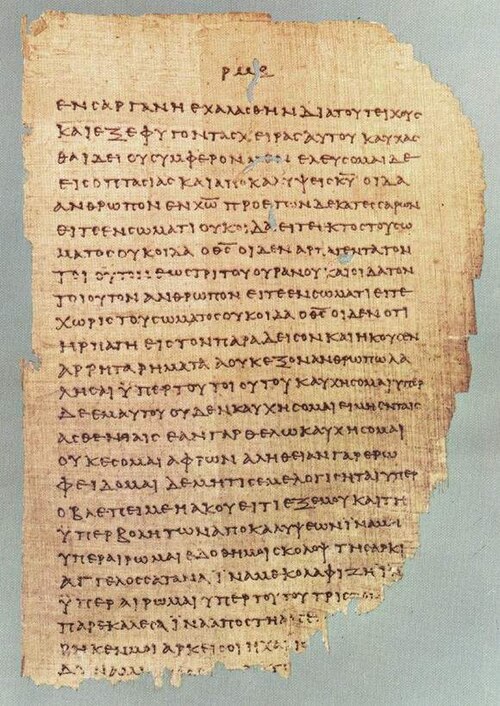
この形成期の後には、キリスト教徒がキリストの使徒の後継者とみなす初期の司教たちが続いた。150年以降、キリスト教の教師たちは、信仰を擁護することを目的とした神学および弁証論の著作を著し始めた。これらの著者は教父として知られ、彼らの研究は教父学と呼ばれている。著名な初期の教父には、アンティオキアのイグナティウス、ポリュカルポス、殉教者ユスティノス、エイレナイオス、テルトゥリアヌス、アレクサンドリアのクレメンス、オリゲネスなどがいる。
キリスト教徒に対する迫害はユダヤ教とローマ教皇の双方から断続的に小規模に行われ、ローマ教皇の迫害は西暦64年のローマ大火の時に始まった。新約聖書にはユダヤ教の権威による初期の処刑の例として、聖ステファノ[35]やゼベダイの子ヤコブ[36]の死が記されている。デキウス帝の迫害は帝国全体で起きた最初の紛争[37]であり、西暦250年のデキウス帝の勅令により、ローマ帝国のすべての住民(ユダヤ人を除く)はローマの神々に供物を捧げることが義務付けられた。西暦303年に始まったディオクレティアヌス帝の迫害も特に厳しかった。ローマ教皇の迫害はミラノ勅令により313年に終了した。
原正統派キリスト教が支配的になりつつあった一方で、根本的に異なる信念を持つ異端の宗派も同時に存在していた。グノーシス派キリスト教は、罪の赦しではなく幻想と啓蒙に基づいた二神論の教義を展開した。発展途上の正統派正典と重なる聖典はわずかであったため、グノーシス派のテキストとグノーシス派の福音書のほとんどは最終的に異端とみなされ、主流派キリスト教徒によって抑圧された。異邦人キリスト教が徐々に分裂したため、ユダヤ人キリスト教徒は割礼などの慣習を含め、モーセの律法に従い続けた。5世紀までには、彼らとユダヤ教とキリスト教の福音書は、ユダヤ教とキリスト教の両方の支配的な宗派によって大幅に抑圧された。
ローマ帝国での普及と受容
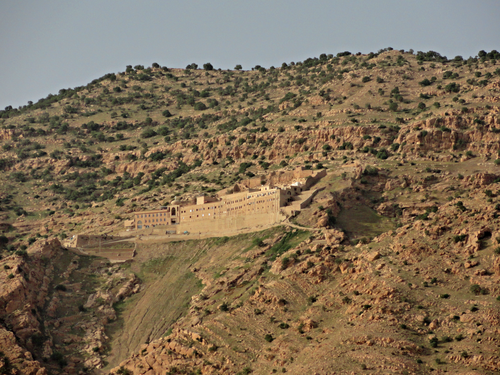
キリスト教は、地中海沿岸のアラム語を話す民族やローマ帝国の内陸部に広まり、さらにパルティア帝国、後のササン朝帝国、メソポタミアを含むこれらの帝国にさまざまな時期にさまざまな程度で支配された地域にまで広がりました。 [39]アフリカにおけるキリスト教の存在は、1世紀半ばのエジプトで始まり、2世紀末にはカルタゴ周辺の地域で始まりました。福音記者マルコは、西暦43年頃にアレクサンドリアの教会を創設したと言われています。コプト正教会を含む後の様々な教会が、これを自らの遺産であると主張しています。[40] [41] [42]キリスト教の初期の発展に影響を与えた重要なアフリカ人には、テルトゥリアヌス、アレクサンドリアのクレメンス、アレクサンドリアのオリゲネス、キプリアヌス、アタナシウス、ヒッポのアウグスティヌスなどがいます。

ティリダテス3世は4世紀初頭にキリスト教をアルメニアの国教とし、アルメニアを最初の公式キリスト教国家とした。 [43] [44]キリスト教はアルメニアにおいて全く新しい宗教ではなく、少なくとも3世紀から国内に浸透していたが、それ以前から存在していた可能性もある。[45]
コンスタンティヌス1世は若い頃にキリスト教に触れ、生涯を通じてキリスト教への支持を深め、死の床で洗礼を受けた。[46]彼の治世中、国家公認のキリスト教徒迫害は311年の寛容勅令と313年のミラノ勅令で終結した。その時点ではキリスト教はまだ少数派の信仰で、ローマ人口のわずか5%を占める程度だった。[47]顧問のマルドニオスの影響を受けたコンスタンティヌスの甥ユリアヌスはキリスト教を抑圧しようとしたが失敗した。[48] 380年2月27日、テオドシウス1世、グラティアヌス、ウァレンティニアヌス2世はニカイア・キリスト教をローマ帝国の国教会とした。[49]キリスト教は国家と結びつくとすぐに裕福になり、教会は金持ちから寄付を募り、土地を所有できるようになった。[50]
コンスタンティヌスは325年の第一ニカイア公会議の招集にも尽力した。この公会議はアリウス派の問題に対処しようとし、ニカイア信条を策定した。この信条は現在でもカトリック、東方正教会、ルター派、英国国教会、その他多くのプロテスタント教会で使用されている。[51] [52]ニカイア公会議は一連のエキュメニカル公会議の最初のものであり、特にキリスト論に関して、教会の神学の重要な要素を正式に定義した。[53]東方教会は第三回以降のエキュメニカル公会議を受け入れず、今日でも後継者(アッシリア東方教会)によって分離している。
繁栄と文化生活の面では、ビザンチン帝国はキリスト教の歴史とキリスト教文明の頂点のひとつであり、[54]コンスタンティノープルは規模、富、文化においてキリスト教世界の主要都市であり続けた。 [55] 古典ギリシャ哲学への関心が新たに高まり、ギリシャ語の文学作品の増加も見られた。 [56]ビザンチン美術と文学はヨーロッパで卓越した地位を占め、この時期のビザンチン美術の西洋への文化的影響は大きく、長期にわたる意義を持つものであった。[57]その後、北アフリカでイスラム教が台頭したことで、キリスト教会の規模と数は減少し、その多くはエジプトのコプト教会、アフリカの角のエチオピア正教会テワヘド教会、スーダンの ヌビア教会(ノバティア、マクリア、アロディア)のみが残った。
中世
中世初期
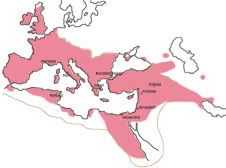
西ローマ帝国の衰退と崩壊とともに、教皇庁は政治的な役割を果たすようになり、それは教皇レオ1世のフン族やヴァンダル族との外交交渉に初めて現れた。[58]教会はまた、さまざまな部族の間で長い布教活動と拡大の時代に入った。アリウス派が異教徒に死刑を課した一方で(例えばフェルデンの虐殺を参照)、カトリックはハンガリー人、ゲルマン人、[58]ケルト人、バルト人、一部のスラブ人の間でも広まった。
500年頃、キリスト教はビザンチンとイタリア王国の文化に完全に統合され[59]、ヌルシアのベネディクトゥスは修道院規則を制定し、修道院の設立と運営に関する規則のシステムを確立しました。[58] 修道院制度はヨーロッパ全土で強力な勢力となり、[58]アイルランド、スコットランド、ガリアで最も有名な多くの初期の学問の中心地を生み出し、 9世紀の カロリング朝ルネサンスに貢献しました。
7世紀、イスラム教徒はシリア(エルサレムを含む)、北アフリカ、スペインを征服し、イスラム以前のアラビアのキリスト教徒の一部を含むキリスト教徒の一部をイスラム教に改宗させ、残りを別の法的地位の下に置いた。イスラム教徒の成功の一部は、ペルシャとの数十年に及ぶ紛争でビザンチン帝国が疲弊していたことによるものであった。[60] 8世紀初頭、カロリング朝指導者の台頭により、教皇庁はフランク王国でより大きな政治的支援を求めた。[61]
中世には教会に大きな変化が起こった。[62] [63] [64] [65] グレゴリウス1世は教会の構造と運営を劇的に改革した。 [66] 8世紀初頭、聖像破壊はビザンチン皇帝の支援を受けて分裂を招く問題となった。第二ニカイア公会議(787年)は最終的に聖像を支持すると宣言した。[67] 10世紀初頭、西方キリスト教の修道制度はクリュニーの偉大なベネディクト会修道院の指導を通じてさらに活性化した。[68]
中世盛期と後期


西洋では、11世紀以降、古い大聖堂学校が大学になった(例えば、オックスフォード大学、パリ大学、ボローニャ大学を参照)。それ以前は、高等教育は修道士や修道女が率いるキリスト教の大聖堂学校または修道院学校(Scholae monasticae )の領域であった。そのような学校の証拠は西暦6世紀にまで遡る。[69]これらの新しい大学はカリキュラムを拡大し、聖職者、弁護士、公務員、医師のための学術プログラムを含めた。[70]大学は一般に、中世キリスト教の環境に起源を持つ機関と見なされている。[71] [72] [73]
ヨーロッパ全土で「新都市」が出現するのに伴い、托鉢修道会が設立され、修道院から新しい都市環境へと聖別された宗教生活が持ち込まれた。2つの主要な托鉢修道会は、フランシスコ会[74]とドミニコ会[75]であり、それぞれアッシジのフランチェスコとドミニコによって設立された。両修道会は、ヨーロッパの偉大な大学の発展に大きく貢献した。もう1つの新しい修道会はシトー会であり、その大きな孤立した修道院は、かつての荒野の開拓の先駆けとなった。この時期に、教会建築と教会建築は新たな高みに達し、ロマネスク様式とゴシック様式の建築とヨーロッパの偉大な大聖堂の建設に至った。[76]
キリスト教ナショナリズムは、キリスト教徒が歴史的にキリスト教が栄えた土地を取り戻したいという願望を感じたこの時代に現れた。[77] 1095年からウルバヌス2世の教皇在位中に第1回十字軍が開始された。[78]これは聖地やその他の場所での一連の軍事作戦であり、ビザンチン皇帝アレクシオス1世からのトルコの拡大に対する援助の嘆願に応えて開始された。十字軍は最終的にイスラムの侵略を阻止することに失敗し、第4回十字軍の間にコンスタンティノープルが略奪されたことでキリスト教徒の敵意を助長することさえあった。[79]
キリスト教会は7世紀から13世紀にかけて内部対立を経験し、その結果、西方キリスト教のラテン教会支部(現在のカトリック教会)と、東方、主にギリシャの支部(東方正教会)との間で分裂が生じた。両者は、行政、典礼、教義上の多くの問題で意見が合わなかったが、最も顕著だったのは、東方正教会が教皇の優位性に反対していたことである。[80] [81]第二リヨン公会議(1274年)とフィレンツェ公会議(1439年)は、教会の再統合を試みたが、どちらの場合も、東方正教会は決定の実施を拒否し、2つの主要教会は今日まで分裂したままである。しかし、カトリック教会は、さまざまな小規模な東方教会との統合を達成している。
13世紀には、フランシスコ会の説教に代表されるイエスの苦しみへの新たな強調が、キリスト教徒がイエスの死の責任を負わせていたユダヤ人に信者の注意を向けさせる結果となった。キリスト教のユダヤ人に対する限定的な寛容は新しいものではなく、ヒッポのアウグスティヌスは、ユダヤ人がキリスト教徒が当然としている市民権を享受するべきではないと述べた。しかし、ユダヤ人に対する反感の高まりは、1290年にイングランドからユダヤ人を追放する要因となり、ヨーロッパで多くのユダヤ人追放が行われた最初のものとなった。[82] [83]
1184年頃から、カタリ派異端に対する十字軍に続いて[84] 、異端を抑圧し、改宗と訴追を通じてキリスト教内の宗教的・教義的統一を確保することを目的として、広く異端審問所と呼ばれる様々な機関が設立されました[85]。
現代
プロテスタントの宗教改革と反宗教改革

15世紀のルネッサンスは、古代および古典学問への新たな関心をもたらした。宗教改革の間、マルティン・ルターは免罪符の販売に反対する1517年の95ヶ条の提題を掲示した。[86]印刷されたコピーはすぐにヨーロッパ中に広まった。1521年のヴォルムス勅令はルターとその追随者を非難し破門し、その結果、西方キリスト教世界はいくつかの宗派に分裂した。[87]
ツヴィングリ、エコランパディウス、カルヴァン、ノックス、アルミニウスなどの他の改革者もカトリックの教えと礼拝をさらに批判した。これらの批判はプロテスタントと呼ばれる運動に発展し、教皇の首位権、伝統の役割、7つの秘跡、その他の教義と慣習を否定した。[86]イングランドの宗教改革は1534年にヘンリー8世がイングランド国教会の長であると宣言したときに始まった。1536年から、イングランド、ウェールズ、アイルランド中の修道院が解散した。[88]
トーマス・ミュンツァー、アンドレアス・カールシュタット、その他の神学者たちは、カトリック教会と教会改革の信仰告白がともに堕落していると認識した。彼らの活動は急進的な宗教改革をもたらし、さまざまなアナバプテスト派を生み出した。

プロテスタントの宗教改革への反応として、カトリック教会は対抗宗教改革またはカトリック改革として知られる改革と刷新の大きな過程に取り組みました。[92]トレント公会議はカトリックの教義を明確にし、再主張しました。その後の数世紀の間、カトリックとプロテスタントの競争はヨーロッパ諸国間の政治闘争と深く絡み合うようになりました。[93]
一方、1492年にクリストファー・コロンブスがアメリカ大陸を発見したことで、新たな宣教活動の波が起こりました。宣教師たちの熱意もあって、またヨーロッパ列強による植民地拡大の推進力もあって、キリスト教はアメリカ大陸、オセアニア、東アジア、サハラ以南のアフリカに広まりました。
ヨーロッパ全土で、宗教改革によって引き起こされた分裂は、宗教的暴力の勃発とヨーロッパでの別々の国教会の設立につながった。ルター派は、現在のドイツ、リヴォニア、スカンジナビアの北部、中央、東部に広がった。英国国教会は1534年にイングランドで設立された。カルヴァン主義とその変種である長老派は、スコットランド、オランダ、ハンガリー、スイス、フランスに導入された。アルミニウス主義は、オランダとフリースラントで信者を獲得した。最終的に、これらの違いは、宗教が主要な要因となる紛争の勃発につながった。三十年戦争、イングランド内戦、フランス宗教戦争は、その顕著な例である。これらの出来事は、迫害と寛容に関するキリスト教の議論を激化させた。[94]
新プラトン主義の復活において、ルネサンス人文主義者はキリスト教を拒絶しなかった。むしろ逆に、ルネサンス期の最高傑作の多くはキリスト教に捧げられ、カトリック教会はルネサンス美術の多くの作品を後援した。[95]新しい美術の多くは、教会の委託を受けたか、教会に献呈された。[95]学者や歴史家の中には、キリスト教が科学革命の勃興に貢献したと考える者もいる。[96]ニコラウス・コペルニクス、[97]ガリレオ・ガリレイ、[98]ヨハネス・ケプラー、[99]アイザック・ニュートン[100]ロバート・ボイルなど、西洋科学に影響を与えた多くの著名な歴史上の人物は、自らをキリスト教徒とみなしていた。[101]
啓蒙主義以後

西洋では啓蒙時代と科学革命が大きな社会的変化をもたらした「大分岐」と呼ばれる時代に、キリスト教は様々な形の懐疑主義や、社会主義や自由主義などの特定の近代政治イデオロギーに直面した。[102]出来事は単なる反聖職者主義から、フランス革命中のフランスの非キリスト教化、[103]スペイン内戦、そして特定のマルクス主義運動、特にロシア革命と国家無神論下のソ連におけるキリスト教徒の迫害など、キリスト教に対する暴力的な爆発まで多岐にわたる。[104] [105] [106] [107]
ヨーロッパで特に差し迫っていたのは、ナポレオン時代後の国民国家の形成でした。ヨーロッパのどの国でも、さまざまなキリスト教宗派が、多かれ少なかれ互いに、そして国家と競争していました。変数は、宗派の相対的な規模と、国家の宗教的、政治的、イデオロギー的志向でした。フリブール大学のウルス・アルターマットは、ヨーロッパのカトリックに特に注目し、ヨーロッパ諸国の4つのモデルを特定しました。ベルギー、スペイン、オーストリアなど、伝統的にカトリックが多数派の国では、ある程度、宗教的コミュニティと国家コミュニティは多かれ少なかれ同一です。文化的な共生と分離は、競合する宗派があるポーランド、アイルランド共和国、スイスで見られます。競争は、多かれ少なかれ国家と同一視されている少数派カトリック人口を持つ国、ドイツ、オランダ、そして再びスイスで見られます。最後に、宗教(特にカトリック)と国家の分離は、フランスとイタリアで顕著に見られるが、これらの国では国家がカトリック教会の権威に積極的に反対している。[108]
国民国家の形成と超山岳主義という複合的な要因は、特にドイツとオランダで顕著でしたが、イギリスでも、はるかに少ない程度ではありましたが、[109]カトリック教会、組織、信者は、国家の国民的要求と教会、特に教皇の権威との間で選択を迫られることが多かったのです。この対立は第1バチカン公会議で頂点に達し、ドイツでは文化闘争に直接つながりました。[110]

ヨーロッパでは、近代化と世俗主義が浸透するにつれ、キリスト教への信仰は低下し、[111]特にチェコ共和国とエストニアで顕著であったが、[112]アメリカではヨーロッパに比べて宗教的信仰が全般的に高かった。過去 1 世紀のキリスト教の世界的変化は大きく、1900 年以降、キリスト教は南半球と第三世界の国々に急速に広まった。[113] 20 世紀後半には、キリスト教徒の信仰が第三世界と南半球全般に移行し、 [114] [115]西洋はもはやキリスト教の主要な旗手ではなくなった。アラブ人の約 7 ~ 10% がキリスト教徒であり、[116]最も多くがエジプト、シリア、レバノンに居住している。
信念
世界中のキリスト教徒は基本的な信念を共有していますが、キリスト教の基盤となっている聖書や神聖な伝統に対する解釈や意見には違いがあります。 [117]
信条

Wikisource にはこの記事に関連する原文があります:
使徒信条
Wikisource にはこの記事に関連する原文があります:
ニカイア信条
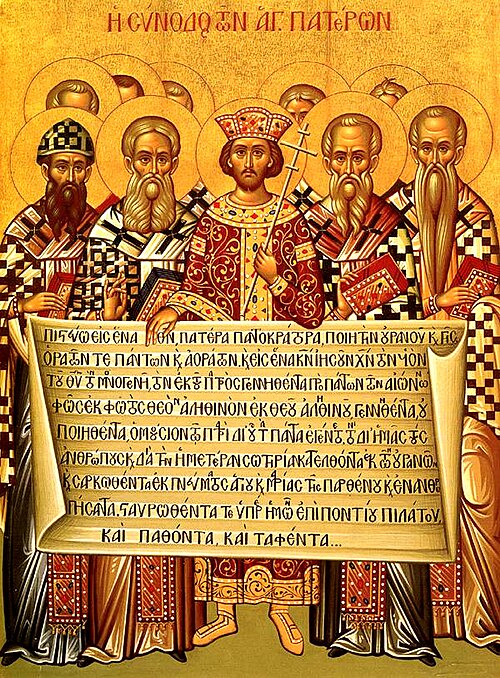
簡潔な教義の声明や宗教的信念の告白は信条として知られています。信条は洗礼の式文として始まり、後に4世紀と5世紀のキリスト教論争の間に信仰の声明へと拡大されました。「イエスは主である」はキリスト教の最も古い信条であり、世界教会協議会と同様に現在も使用されています。[118]
使徒信条は、キリスト教の信仰箇条の中で最も広く受け入れられている文言です。多くのキリスト教宗派で典礼と教理教育の両方の目的で使用されており、最も顕著なのはカトリック教会のラテン教会、ルーテル教会、英国国教会、西方典礼正教会など、西方キリスト教の伝統の典礼教会です。また、長老派教会、メソジスト教会、会衆派教会でも使用されています。
この信条は2世紀から9世紀の間に発展した。その中心となる教義は三位一体と創造主である神である。この信条に見られる教義はいずれも使徒時代に流行した言葉に遡ることができる。この信条はローマ教会の洗礼志願者のためのキリスト教教義の要約として使われていたようだ。[119]その要点は以下の通りである。
ニカイア信条は、主にアリウス派への反応として、 325年のニカイア公会議と381年のコンスタンティノープル公会議で策定され、 [120] [121] 431年の第一エフェソス公会議でキリスト教世界の普遍信条として批准されました。 [122]
カルケドンの定義、またはカルケドン信条は、451年のカルケドン公会議で策定されましたが[123] 、東方正教会によって拒否され、[124]キリストは「混同せず、不変で、分割できず、分離できない2つの性質を持つ」と教えています。1つは神であり、もう1つは人間であり、両方の性質はそれ自体が完全であるにもかかわらず、1人の人物に完全に結合されています。[125]
西方教会でニカイア信条やカルケドン信条と同等の地位にあるとされるアタナシウス信条は、「我々は三位一体の唯一の神を崇拝し、三位一体の一体を崇拝する。位格を混同したり、本質を分割したりしない。」と述べています。[126]
ほとんどのキリスト教徒(カトリック、東方正教会、東方正教会、プロテスタント)は信条の使用を受け入れており、上記の信条の少なくとも1つを信仰しています。[52]
福音派プロテスタントの中には、全員ではないが、信条の内容の一部または全部に同意しながらも、信条を信仰の決定的な表明として拒否する者もいる。また、キリスト教会(キリストの弟子)、カナダ福音派キリスト教会、キリスト教会など、復興運動にルーツを持つグループも信条を拒否している。 [127] [128] : 14–15 [129] : 123
イエス
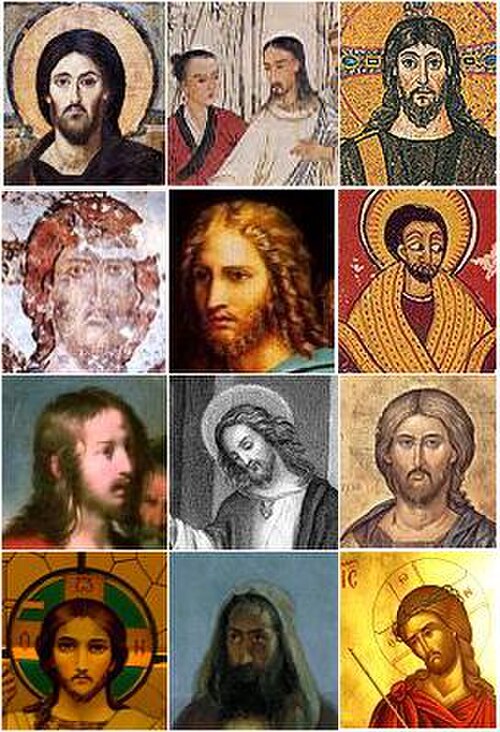
キリスト教の中心的な教義は、イエスを神の子[注 2]であり、救世主(キリスト)であると信じることである。[130] [131]キリスト教徒は、イエスが救世主として神に任命され、人類の救世主となったと信じており、イエスの到来は旧約聖書の救世主預言の成就であると考えている。キリスト教の救世主の概念は、現代のユダヤ教の概念とは大きく異なる。キリスト教の中心的な信仰は、イエスの死と復活を信じ受け入れることによって、罪深い人間は神と和解することができ、それによって救済と永遠の命の約束が与えられるというものである。[132]
キリスト教史の初期の世紀には、イエスの本質をめぐって多くの神学上の論争があったが、一般的にキリスト教徒は、イエスは神の化身であり、「真の神であり真の人」(または完全な神であり完全な人である)であると信じている。完全な人間となったイエスは、死すべき人間の苦痛と誘惑に苦しんだが、罪を犯さなかった。完全な神として、イエスは再び生き返った。新約聖書によれば、イエスは死からよみがえり、 [133]天に昇り、父の右に座り、[134]そして最終的には戻ってきて[135] 、死者の復活、最後の審判、そして神の王国の最終的な確立を含む、メシアの預言の残りを成就する。
マタイとルカによる正典福音書によれば、イエスは聖霊によって宿り、処女マリアから生まれた。イエスの幼少期についてはほとんど正典福音書には記録されていないが、古代には幼少期の福音書が人気があった。[136]それに比べて、イエスの成人期、特に死の前の1週間は、新約聖書に含まれる福音書に詳しく記録されている。なぜなら、その時期がイエスの生涯で最も重要だと考えられているからである。聖書には、イエスの宣教活動について、洗礼、奇跡、説教、教え、行為 などが記されている。
死と復活

キリスト教徒は、イエスの復活を信仰の礎(コリントの信徒への手紙一第15章参照)であり、歴史上最も重要な出来事であると考えています。[137]キリスト教の信仰の中で、イエスの死と復活は、キリスト教の教義と神学の多くが基づいている2つの中核的な出来事です。[138]新約聖書によると、イエスは十字架にかけられ、肉体的に亡くなり、墓に埋葬され、3日後に復活しました。[139]
新約聖書には、イエスが復活後、昇天する前に「一度に五百人以上の兄弟たち」を含む、12人の使徒と弟子たちに何度か現れたことが記されている[140] 。キリスト教徒はイエスの死と復活をすべての礼拝で記念しているが、聖金曜日と復活祭の日曜日を含む聖週間には特に重点が置かれている。
イエスの死と復活は、キリスト教神学において最も重要な出来事とみなされることが多い。その理由の1つは、イエスが生と死を支配する力を持ち、したがって人々に永遠の命を与える権威と力を持っていることを示しているからである。[141]
キリスト教会は、ごくわずかな例外を除いて、新約聖書のイエスの復活の記述を受け入れ、教えている。 [142]現代の学者の中には、イエスの信者の復活の信仰を、歴史上のイエスと初期教会の宣教の連続性を確立するための出発点として用いる者もいる。[143]リベラルなキリスト教徒の中には、文字通りの肉体の復活を受け入れない者もいる。 [144] [145]この物語は象徴性に富み、精神的に滋養を与える神話であると考えている。死と復活の主張をめぐる議論は、多くの宗教論争や異宗教間の対話で起こる。[146]初期キリスト教改宗者で宣教師であった 使徒パウロは、「キリストが復活されなかったなら、私たちの説教はすべて無駄であり、神への信頼も無駄である」と書いている。[147] [148]
救い
「神は、その独り子をお与えになったほどに、世を愛された。独り子を信じる者が一人も滅びないで、永遠の命を得るためである。」
— ヨハネ3:16、NIV [149]
_-_The_Law_and_the_Gospel.jpg/500px-Lucas_Cranach_(I)_-_The_Law_and_the_Gospel.jpg)
使徒パウロは、当時のユダヤ人やローマの異教徒と同様に、犠牲が新しい血縁関係、純潔、永遠の命をもたらすと信じていました。 [150]パウロにとって、必要な犠牲はイエスの死でした。「キリストの」異邦人は、イスラエルと同様に、アブラハムの子孫であり、「約束による相続人」です。[151] [152]イエスを死から蘇らせた神は、イスラエルとともに「神の子」となり、もはや「肉体」ではなくなった異邦人キリスト教徒の「死すべき体」にも新しい命を与えます。[153] [150]
現代のキリスト教会は、ユダヤ人と異邦人の両方が神の家族の一員となるにはどうすればよいかという問題よりも、人類が普遍的な罪と死の状態からどのように救われるかということに関心を寄せる傾向がある。東方正教会の神学によれば、イレネオスの再現理論によって提唱された贖罪の理解に基づき、イエスの死は身代金である。これにより、愛に満ち人類に手を差し伸べる神との関係が修復され、神が人類に望むような人間になるという神化(神化)の可能性がもたらされる。カトリックの教義によれば、イエスの死は、人間の罪深さによって神の名誉が侵害されたことによって引き起こされた神の怒りを満足させるものである。カトリック教会は、キリスト教徒の側の忠実さなしには救いは得られないと教えている。改宗者は愛の原則に従って生活し、通常は洗礼を受けなければならない。[154]プロテスタント神学では、イエスの死は、人類が神の道徳律を破ったときに支払わなければならない負債に対する、イエスが負った代償刑とみなされています。 [155]
キリスト教徒は、個人の救済が神によってどの程度定められているかという点について見解が異なります。改革派神学は、個人は自己救済が全く不可能であるが、聖化の恩恵は抗えないと教え、恩恵に明確な重点を置いています。[156]対照的に、カトリック、正教会、アルミニウス派プロテスタントは、イエスを信じるには自由意志の行使が必要であると信じている。 [157]
三位一体
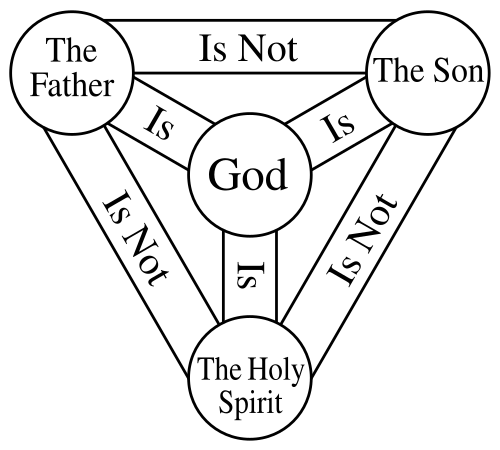
三位一体とは、一つの神[159]が、父、子(イエス・キリストに受肉)、聖霊という、永遠に共存する三つの別個の位格から成るという教えを指す。これら三つの位格は、まとめて神格と呼ばれることもあるが[160] [161] [162]、聖書には統一された神格を表す単一の用語は使われていない。[163]キリスト教信仰の初期の声明であるアタナシウス信条の言葉によれば、「父は神であり、子は神であり、聖霊も神である。しかし、三つの神は存在せず、一つの神である」。[164]これらは互いに別個である。父には源がなく、子は父から生まれ、聖霊は父から発する。三つの位格は別個であるが、存在においても機能においても互いに分離することはできない。キリスト教徒の中には、旧約聖書では神が父として現れたと信じている者もいるが、新約聖書では神が子として現れ、現在でも聖霊として現れ続けるという点では一致している。しかし、神はこれらの時代それぞれにおいて三位一体として存在していた。[165]しかし、伝統的には、旧約聖書に現れたのは子であったという信念がある。なぜなら、例えば、三位一体が芸術で描かれるとき、子は典型的にはキリストを識別する十字形の光輪という特徴的な外見をしており、エデンの園の描写では、これはまだ起こっていない受肉を予感させるからである。初期キリスト教の 石棺の中には、ロゴスがひげで区別されており、「これにより、彼は古代、さらには先在するように見える」ものがある。[166]
三位一体は主流キリスト教の重要な教義である。ニカイア信条(325)の時代より以前から、キリスト教は[167]三位一体の神秘、すなわち神の本質を信仰の規範的な告白として主張してきた。ロジャー・E・オルソンとクリストファー・ホールによれば、祈り、瞑想、研究、実践を通して、キリスト教共同体は「神は一体性と三位一体性の両方で存在しなければならない」という結論に達し、4世紀末のエキュメニカル会議でこれを成文化した。[168] [169]
この教義によれば、神は各位格が全体の 3 分の 1 を持っているという意味で分割されているのではなく、むしろ各位格は完全に神であると考えられています (ペリコレーシスを参照)。違いは、父は無子であり、子は父から生まれ、聖霊は父から (西洋キリスト教神学では)子から発せられるという関係にあります。この明らかな違いにかかわらず、3 つの「位格」はそれぞれ永遠かつ全能です。ユニテリアン ユニバーサリズム、エホバの証人、モルモン教などの他のキリスト教の宗教は、三位一体に関するこれらの見解を共有していません。
ギリシャ語のtrias [170] [注 6]が、この意味で初めて登場するのは、アンティオキアのテオフィロスの著作である。その本文には、「三位一体、神、神の言葉、神の知恵」とある。[174]この用語は、この時代以前に使用されていた可能性がある。ラテン語の同義語である[注 6] trinitas [172]は、父、子、聖霊を明示的に指してテルトゥリアヌスに登場している。[175] [176]次の世紀には、この語は一般的に使用されるようになった。オリゲネスの多くの箇所に見られる。[177]
三位一体論
三位一体論は、三位一体の概念を信じるキリスト教徒を指す。ほとんどすべてのキリスト教宗派と教会は三位一体の信仰を抱いている。「三位一体」や「三一」という言葉は聖書には出てこないが、3世紀初頭から神学者たちは、父、子、聖霊という新約聖書の教えを理解しやすくするために、この用語と概念を発展させた。それ以来、キリスト教神学者たちは、三位一体は3人の神がいることを意味するものではない(三位一体に反対する異端の三神論)、三位一体の各位格が無限の神の3分の1であることを意味するものではない(部分主義)、子と聖霊が父によって創造され父に従属する存在であることを意味するものではない(アリウス主義)ことを強調してきた。むしろ、三位一体は3つの位格を持つ1人の神として定義されている。[178]
非三位一体論
非三位一体論(または反三位一体論)は、三位一体の教義を否定する神学を指す。初期のキリスト教には、養子論や様相論などのさまざまな非三位一体論的見解が存在し、キリスト論に関する論争を引き起こした。[179]非三位一体論は、11世紀から13世紀にかけてのカタリ派のグノーシス主義、 16世紀の宗教改革におけるユニテリアン神学のグループ、 [180] 18世紀の啓蒙主義、 19世紀の第二次大覚醒の間に発生した復古主義グループ、そして最近ではワンネス・ペンテコステ派の教会で再登場した。
終末論
物事の終わり、つまり個人の人生の終わり、時代の終わり、あるいは世界の終わりは、広い意味ではキリスト教の終末論、つまり聖書に明らかにされている人間の運命の研究です。キリスト教の終末論における主要な問題は、艱難、死と来世、(主に福音派にとって)千年王国とそれに続く携挙、イエスの再臨、死者の復活、天国、(典礼派にとって)煉獄、そして地獄、最後の審判、世界の終わり、そして新天と新地です。
キリスト教徒は、キリストの再臨は、厳しい迫害(大艱難)の期間の後の世の終わりに起こると信じている。死んだ者はすべて、最後の審判のために肉体的に復活する。イエスは、聖書の預言を成就して、神の王国を完全に確立する。[181] [182]
死と来世
ほとんどのキリスト教徒は、人間は神の審判を受け、永遠の命か永遠の滅びのいずれかの報いを受けると信じている。これには死者の復活における一般的な審判だけでなく、肉体の死に際して個々の魂に特有の審判が下されるという信仰(カトリック教徒[183] [184] 、正教会[185] [186]、およびほとんどのプロテスタントが信じている)も含まれる。
キリスト教のカトリック派では、恩寵の状態で、つまり神と隔てる大罪を犯さずに死んだが、罪の影響から完全に浄化されていない人々は、中間状態の煉獄を経て浄化を受け、神の前に出るために必要な神聖さを獲得する。[187]この目標を達成した人々は聖人(ラテン語のサンクトゥス、「聖なる」)と呼ばれる。[188]
セブンスデー・アドベンチストなどのキリスト教団体は、人間の魂は本来不滅ではなく、肉体の死と復活の間の中間状態では無意識であるという死すべき存在論を信奉している。また、これらのキリスト教徒は、最後の審判の後、悪人は永遠の苦しみを受けるのではなく、存在しなくなるという消滅論を信奉している。エホバの証人も同様の見解を信奉している。[189]
実践
.jpg/500px-Complete-church-midnight-mass_(3135957575).jpg)

キリスト教の宗派によって異なりますが、洗礼、聖餐(聖餐または主の晩餐)、祈り(主の祈りを含む)、告解、堅信礼、埋葬の儀式、結婚式、子供の宗教教育などの儀式が含まれます。ほとんどの宗派には、定期的な共同礼拝を主導する聖職者がいます。 [191]
キリスト教の儀式、儀礼、式典は、単一の聖なる言語で執り行われるわけではない。多くの儀式主義的なキリスト教会は、聖なる言語、典礼言語、および現地語を区別している。初期キリスト教時代の3つの重要な言語は、ラテン語、ギリシャ語、およびシリア語であった。[192] [193] [194]
共同礼拝
礼拝は典礼と呼ばれるパターンや形式に従うのが一般的です。[注 7] ユスティノス殉教者は、アントニヌス・ピウス皇帝への第一弁明( 150年頃)の中で2世紀のキリスト教の典礼について記述しており、その記述はキリスト教の典礼礼拝の基本構造に今も関連しています。
そして日曜日には、都市や田舎に住むすべての人が一箇所に集まり、使徒の回想録や預言者の書が、時間の許す限り読み上げられます。そして、朗読が終わると、司会者が口頭で教え、これらの良いことを真似するように勧めます。それから、私たちは全員一緒に立ち上がり、祈ります。そして、前に述べたように、祈りが終わると、パンとワインと水が運ばれ、司会者が同様に、自分の能力に応じて祈りと感謝を捧げ、人々は「アーメン」と言って同意します。そして、各人に分配があり、感謝が捧げられたものに参加し、欠席者には執事から分け前が送られます。そして、裕福で進んで行う人は、各自が適切だと思うものを寄付します。そして集められたお金は会長に預けられ、会長は孤児や未亡人、病気やその他の理由で困っている人、拘束されている人、私たちの間で滞在している外国人を助け、一言で言えば困っている人全員の世話をするのです。[196]
したがって、ジャスティンが述べたように、キリスト教徒は典礼のために典礼を行うために典礼書に集まるのが典型的で、復活の日である日曜日であるが、他の典礼慣習は、この場以外で行われることが多い。聖書の朗読は旧約聖書と新約聖書から取られているが、特に福音書が多い。[注 8] [197]これらの朗読に基づいて、説教や説教の形で指導が行われる。会衆の祈りには感謝、告白、執り成しなどさまざまなものがあり、礼拝中は暗唱、応答、黙祷、歌唱などさまざまな形式をとる。[191] 詩篇、賛美歌、礼拝歌、その他の教会音楽が歌われることもある。[198] [199]重要な祝祭日などの特別な行事では、礼拝内容が変化することもある。[200]
ほとんどすべての礼拝形式には、食事から成る聖餐が組み込まれている。これは、イエスが最後の晩餐で弟子たちにパンを与えて「これは私の体である」と言い、ワインを与えて「これは私の血である」と言ったように、イエスの教えに従って追随者たちがイエスを記念して行うという再現である。[201]初期の教会では、キリスト教徒とまだ入信を終えていない人々は、礼拝の聖餐の部分では別々に行われた。[202]告白派ルーテル教会などの一部の宗派は、 「閉鎖的な聖餐」を実践し続けている。 [203]これらの宗派では、すでにその宗派または時には個々の教会に所属している人々に聖餐を提供する。カトリックでは、参加を大罪を犯していない信者のみに制限している。[204]英国国教会やメソジスト教会(フリーメソジスト教会やユナイテッドメソジスト教会など)などの他の多くの教会は、聖餐を目的ではなく団結の手段と見なし、すべての信仰を持つキリスト教徒に参加を呼びかけているため、「オープン・コミュニオン」を実践しています。 [205] [206] [207]
聖礼典または儀式
2世紀の聖餐の記述
そして、この食物は私たちの間ではエウカリスティア[聖餐]と呼ばれており、私たちの教える事が真実であると信じ、罪の赦しと再生のための洗いをもって洗われ、キリストが命じたとおりに生きている人以外には、それを受けることが許されていません。私たちは、これを普通のパンや飲み物として受け取るのではなく、私たちの救い主イエス・キリストが神の言葉によって肉となり、私たちの救いのために肉と血を持っておられたのと同じように、神の言葉の祈りによって祝福され、変化によって私たちの血と肉が養われる食物は、肉となったイエスの肉と血であると教えられています。
殉教者ユスティノス[196]
キリスト教の信仰と実践において、サクラメントとはキリストによって制定された儀式であり、恵みを与え、神聖な神秘を構成する。この用語はラテン語のsacramentumに由来し、これはギリシャ語の神秘を翻訳するために使用された。どの儀式がサクラメントであるか、また行為がサクラメントである意味は何かという見解は、キリスト教の宗派や伝統によって異なる。[208]
最も伝統的な機能的定義は、聖礼典はキリストによって制定され、キリストを通して内なる霊的恩寵を伝える外的なしるしであるというものである。最も広く受け入れられている二つの聖礼典は洗礼と聖体拝領であるが、大多数のキリスト教徒は、堅信礼(東方伝統では堅信礼)、聖職叙任(叙階)、懺悔(告解)、病者の塗油、結婚(結婚に関するキリスト教の見解を参照)という5つの追加の聖礼典も認めている。[208]
これらを合わせると、カトリック、東方正教会、東方正教会、独立カトリック、古カトリック、一部のルーテル教会、英国国教会などの高教会派の教会が認める七つの秘跡となる。他の宗派や伝統のほとんどは、典型的には洗礼と聖餐のみを秘跡として認めているが、クエーカー教徒などの一部のプロテスタント団体は秘跡神学を否定している。[208]アナバプテストなどのキリスト教の特定の宗派は、キリスト教徒が守るべきイエスが制定した儀式を指すのに「儀式」という用語を使用する。 [209]多くの保守派メノナイト・アナバプテスト教会では、七つの儀式が教えられており、これには「洗礼、聖餐、足洗い、結婚、油塗り、聖なる接吻、祈りの覆い」が含まれる。[190]
これに加えて、東方教会には、結婚と病者の塗油という伝統的な秘跡の代わりに、聖パン種(メルカ)と十字架の印という2つの追加の秘跡があります。[210]シュヴァルツェナウ兄弟派アナバプテスト教会、例えばダンカード兄弟教会は、アガペーの祝宴(愛の祝宴)を守っていますが、これはモラヴィア教会やメソジスト教会でも守られている儀式です。[211]
典礼暦
カトリック、東方キリスト教徒、ルーテル派、英国国教会、その他の伝統的なプロテスタントコミュニティは、典礼年を中心に礼拝を構成しています。[212]典礼周期は一年を一連の季節に分割し、それぞれに神学的な重点と祈りの様式があり、教会の装飾方法、聖職者の祭服や衣装の色、 [213]聖書の朗読、説教のテーマ、さらには個人的にまたは家庭でよく見られるさまざまな伝統や慣習によって表すことができます。
西方キリスト教の典礼暦はカトリック教会のローマ典礼の周期に基づいており、 [213]東方キリスト教徒はそれぞれの典礼の周期に基づいた類似の暦を使用している。暦は、イエスやマリア、聖人の生涯の出来事を記念する厳粛な日、四旬節などの断食期間、メモリアなどの敬虔な行事、聖人を記念する小祭日などの聖日を別に設けている。典礼の伝統に従わないキリスト教のグループは、クリスマス、イースター、ペンテコステなどの特定の祝祭を保持することが多い。これらはそれぞれキリストの生誕、復活、教会への聖霊降臨を祝うものである。クエーカー教徒などのいくつかの宗派は典礼暦を使用していない。[214]
シンボル
ほとんどのキリスト教宗派は、一般的に無像崇拝[215] 、つまり信仰の対象である像を避けたり禁止したりする習慣を実践していない。たとえ初期のユダヤ教キリスト教徒が十戒の偶像崇拝の禁止を引用して、シンボルに人物を避けていたとしてもである。[216]
十字架は、今日最も広く認識されているシンボルの一つであり、キリスト教徒は最古の時代から使用していました。[217] [218]テルトゥリアヌスは著書『コロナについて』の中で、キリスト教徒が額に十字架の印を描くのがすでに伝統であったと述べています。[219]十字架は初期のキリスト教徒に知られていましたが、十字架像が使用されるようになったのは5世紀になってからでした。[220]
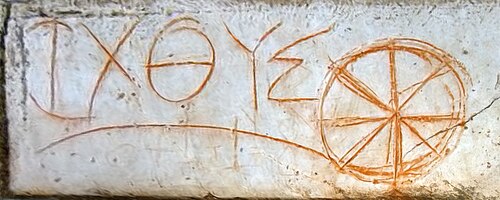
最古のキリスト教のシンボルの中で、魚またはイクティスは、2世紀の最初の数十年間の墓などの記念碑的な資料に見られるように、重要性において第一位に位置付けられていたようです。[221]その人気は、ギリシャ語のichthys(魚)という単語が、ギリシャ語のフレーズIesous Christos Theou Yios Soter(Ἰησοῦς Χριστός, Θεοῦ Υἱός, Σωτήρ)[注 9] (イエス・キリスト、神の子、救世主)の頭字語を形成したことから生じたようです。これはキリスト教の信仰を簡潔に要約したものです。[221]
その他の主要なキリスト教のシンボルには、カイ・ロー・モノグラム、鳩とオリーブの枝(聖霊の象徴)、犠牲の子羊(キリストの犠牲を表す)、ブドウの木(キリストとキリストのつながりを象徴)などがあります。これらはすべて新約聖書の一節に由来しています。[220]

いくつかの資料によれば、キリスト教徒は、ローマ帝国の時代にまで遡って、5 つのギリシャ文字を重ねて表すために 8 本スポークの車輪を使用していたそうです。
洗礼
洗礼は、水を用いた儀式的な行為であり、それによって人は教会の会員として認められる。洗礼に関する信条は宗派によって異なる。第一に、その行為に精神的な意味があるかどうかで相違が生じる。カトリック教会や東方正教会、ルーテル教会や英国国教会など一部の教会は、洗礼による再生の教義を堅持しており、洗礼は人の信仰を創造または強化し、救いと密接に関連していると主張する。バプテスト派とプリマス・ブレザレン派は、洗礼を純粋に象徴的な行為、つまり、人の中で起こった内面的な変化を外部に公に宣言するものと見なしているが、霊的に効力があるとは考えていない。第二に、その行為の方法論(または様式)に関する意見の相違がある。これらの様式は、浸水、完全浸水の場合は水没、注水(注ぐ)、散布(振りかける)である。最初の見解を支持する人々は、幼児洗礼の伝統にも固執するかもしれない。[222] [223] [224] [225]正教会はすべて幼児洗礼を実施しており、常に父と子と聖霊の名において3回繰り返される全身浸漬による洗礼を行っている。[226] [227]ルーテル教会とカトリック教会も幼児洗礼を実施しており、[228] [229] [230]通常は浸漬によって、三位一体の方式を用いている。[231] アナバプテストのキリスト教徒は信者の洗礼を実施しており、成人はイエスに従う決心をした後に儀式を受けることを選択する。[232]メノナイト派、アーミッシュ派、フッター派などのアナバプテスト派は信者の洗礼を司る方法として水を注ぐ方法を採用しているが、シュヴァルツェナウ兄弟派やリバー兄弟派のアナバプテスト派は浸礼で洗礼を行っている。[233] [234] [235] [236]
祈り
「...『天におられるわたしたちの父よ、御名が崇められますように。御国が来ますように。御心が天で行われるとおり、地にも行われますように。わたしたちの日ごとの糧を今日もお与えください。わたしたちの負債をお赦しください。わたしたちも自分に負債のある人を赦します。わたしたちを誘惑に陥らせず、悪からお救いください』」
マタイによる福音書では、イエスは主の祈りを教えており、これはキリスト教の祈りのモデルとみなされている。[238]キリスト教徒が主の祈りを1日3回祈るようにという命令はディダケーに記されており、キリスト教徒は午前9時、午後12時、午後3時にこれを唱えるようになった。[239] [240]
2世紀の使徒伝承では、ヒッポリュトスはキリスト教徒に7つの決まった祈りの時間に祈るよう指示した。それは「起床時、夕方のランプが灯った時、就寝時、真夜中」、そして「キリストの受難に関連する時間である、1日の3時間目、6時間目、9時間目」である。[241]初期教会の時代から、ひざまずく、立つ、平伏すなどの祈りの姿勢が、この7つの決まった祈りの時間に使われてきた。 [242] 東方正教会のキリスト教徒は、シェヒモやアグペヤなどの祈祷書を使って、東の方向を向いてこれらの典礼時刻に祈る。[243] [244]
使徒伝承では、洗礼の際の小悪魔祓いの際、決まった祈りの時間に祈る前の沐浴の際、そして誘惑の時にキリスト教徒が十字架の印を使うように指示している。 [245]
執り成しの祈りは、他の人々のために捧げられる祈りです。聖書には、病人のために捧げられた使徒ペテロの祈り[246]や、他の人々のために捧げられた旧約聖書の預言者の祈りなど、多くの執り成しの祈りが記録されています。 [247]ヤコブの手紙では、一般の信者が捧げる執り成しの祈りと、旧約聖書の著名な預言者エリヤが捧げる執り成しの祈りの間に区別はありません。[248]キリスト教における祈りの有効性は、祈る人の地位ではなく、神の力から生まれます。[249]
古代の教会は、東方キリスト教と西方キリスト教の両方において、 (亡くなった)聖人のとりなしを祈る伝統を発展させ、これはほとんどの東方正教会、東方正教会、カトリック教会、および一部のルーテル派と英国国教会で今も実践されている。[250]しかし、後者の2つの宗派内の特定の分野は別として、他のプロテスタント改革派の教会は、主にキリストが唯一の仲介者であるという理由で、聖人への祈りを拒否した。[251]改革者フルドリッヒ・ツヴィングリは、聖書を読んでそれが偶像崇拝であると確信するまで、聖人に祈りを捧げていたことを認めた。[252]
カトリック教会のカテキズムによると、「祈りとは、神に心と精神を捧げること、または神に良いことを願うことである」。[253]英国国教会の伝統における祈祷書は、定められた礼拝の順序を定めたガイドであり、定められた祈り、聖書の朗読、賛美歌または詩篇の歌唱が含まれている。[254]西洋キリスト教では、祈るとき、封建時代の表彰式のように、手のひらを合わせて前に出すことが多い。他の場合には、手のひらを上にして肘を内側に入れる、より古いオランスの姿勢が使用されることもある。
聖書

キリスト教には、他の宗教と同様に、信奉者によって信仰や聖書の解釈が異なる。キリスト教は、聖書の正典である旧約聖書と新約聖書を、神の霊感を受けた言葉とみなしている。霊感に関する伝統的な見解は、神が人間の著者を通して働き、彼らが書いたものが神が伝えたかったものであるというものである。テモテへの手紙二第3章16節で霊感を指すギリシャ語は、文字通り「神の息吹」を意味するtheopneustosである。 [255]
神の啓示によって現在の聖書は無謬であると信じる者もいる。また、聖書の原本は無謬であると主張する者もいるが、そのような原本は現存していない。さらに、ジェームズ王訳聖書など特定の翻訳のみが無謬であると主張する者もいる。[256] [257] [258]もう一つの密接に関連した見解は、聖書の無謬性または限定的無謬性であり、これは、救済への導きとして聖書は誤りがないが、歴史、地理、科学などの事柄に関する誤りを含む可能性があると主張する。
プロテスタント教会が認める旧約聖書の正典はタナハ(ヘブライ語聖書の正典)のみで、正教会やカトリック教会が認める正典(七十人訳聖書に登場する第二正典も含む)よりも短く、正教会の正典はカトリックの正典よりわずかに長い。[259]プロテスタントはカトリックを外典、つまり彼らの構想が生まれた歴史的時期に使われた言葉、文法、構文を理解する上で役立つ重要な歴史的文書とみなしている。聖書のバージョンによっては、旧約聖書と新約聖書の間に外典のセクションが別個に設けられている。[260]もともとコイネーギリシャ語で書かれた新約聖書は、すべての主要教会が同意する27巻から構成されている。
いくつかの宗派では、聖書のほかに、末日聖徒運動の標準聖典や統一教会の原理講論など、追加の正典聖典を持っています。[261]
カトリックの解釈

古代には、アレクサンドリアとアンティオキアで2つの解釈学派が発達した。オリゲネスに代表されるアレクサンドリアの解釈は聖書を寓話的に読む傾向があり、一方アンティオキアの解釈は文字通りの意味に固執し、他の意味(テオリアと呼ばれる)は文字通りの意味に基づいている場合にのみ受け入れられると主張した。[262]
カトリック神学では、聖書の文字通りの意味と精神的な意味という2つの意味を区別しています。[263]
聖書を文字通り理解するということは、聖書の言葉によって伝えられる意味を理解することです。霊的な意味はさらに次のように細分化されます。
- 寓意的な意味には類型論が含まれる。例としては、紅海の分割が洗礼の「型」(しるし)として理解されることが挙げられる。[264]
- 道徳感覚。聖書には何らかの倫理的な教えが含まれていると理解する。
- 終末論、永遠、世界の完成に当てはまる、アナゴギカルな意味。
聖書解釈に関しては、健全な解釈の規則に従って、カトリック神学は次のように主張しています。
- 聖書の他の意味はすべて文字通りの意味に基づいているという戒律[265] [266]
- 福音書の歴史性は絶対的に、そして常に保持されなければならないこと[267]
- その聖書は「全教会の生きた伝統」[268]の中で読まれなければならない。
- 「解釈の任務は、ローマ司教ペトロの後継者と交わりのある司教たちに委ねられている」[269]
プロテスタントの解釈
聖書の特徴
ルーテル派[270]や改革派などの多くのプロテスタント・キリスト教徒は、聖書は自己充足的な啓示であり、すべてのキリスト教教義の最終的な権威であり、救済に必要なすべての真理を明らかにしているという聖書のみの教義を信じている。 [271] [272]メソジスト派や英国国教会などの他のプロテスタント・キリスト教徒は、聖書がキリスト教教義の第一の源泉であるが、「伝統、経験、理性」が聖書と調和している限りキリスト教を育むことができると教える、原初聖書の教義を肯定している。[ 271] [273]プロテスタントの特徴は、聖書自体の意味が明確であるため(または「明瞭」であるため)、一般の信者は聖書を十分に理解できると信じていることである。マルティン・ルターは、神の助けがなければ、聖書は「暗闇に包まれる」と信じていた。[274]彼は「聖書の明確で単純な理解」を主張した。[274] ジャン・カルヴァンは「聖霊を導きとして従うことを拒む者はすべて、聖書の中に明確な光を見出す」と書いた。[275]これに関連して、「効力」、つまり聖書は人々を信仰に導くことができるということと、「十分性」、つまり聖書には救いを得てキリスト教徒として生きるために必要なことすべてが含まれているということがあげられる。[276]
聖書の本来の意図
プロテスタントは、聖書の言葉が伝える意味、すなわち歴史的文法的方法を重視します。[277]歴史的文法的方法または文法歴史的方法は、聖書解釈学において、テキストの本来の意図された意味を見つけようとする試みです。[278]このテキストの本来の意図された意味は、文法的および統語的側面、歴史的背景、文学ジャンル、ならびに神学(正典)的考慮に照らして、その節を調べることによって引き出されます。 [279]歴史的文法的方法は、一つの本来の意味とテキストの重要性を区別します。テキストの重要性には、テキストのその後の使用または適用が含まれます。元の節は、単一の意味または感覚のみを持つと見なされます。ミルトン・S・テリーはこう言っている。「文法的・歴史的解説の基本原則は、単語や文が一つのつながりの中で持つ意味は一つだけであるということ。この原則を無視した瞬間、私たちは不確実性と推測の海に漂流することになる」[280]技術的に言えば、文法的・歴史的解釈法は、その解釈に照らして文章の意味を決定することとは別物である。両者を合わせると、(聖書)解釈学という用語が定義される。[278]プロテスタントの解釈者の中には類型論 を利用する者もいる。[281]
人口統計
ピュー研究所の2020年の推計によると、信者数は約24億人で、[282] [283] [11] [284] [285] [286] [287]カトリック、プロテスタント、東方正教会の3つの主要な宗派に分かれたキリスト教は、世界最大の宗教です。[288]キリスト教徒の人口増加の理由として、南半球の高い出生率と改宗が挙げられました。 [289] [290]過去100年間、キリスト教徒の割合は世界人口の約33%で推移しています。これは、キリスト教の人口動態の大きな変化を隠しています。発展途上国での大幅な増加は、主に西ヨーロッパと北アメリカの先進国での大幅な減少を伴っています。[291] 2015年のピュー研究所の調査によると、今後40年間、キリスト教は最大の宗教であり続け、2050年までにキリスト教徒の人口は30億人を超えると予想されています。[292] : 60
.jpg/500px-Reabertura_Museu_de_Arte_Sacra_(18626301050).jpg)

.jpg/500px-Auto_de_P%C3%A1scoa_-_IgrejaDaCidade_(crop).jpg)
一部の学者によると、キリスト教は改宗による純増数で第1位である。[294] [295]キリスト教徒の割合で見ると、カトリック教会と正教会(東方正教会と東洋正教会の両方)は世界の一部の地域で減少している(カトリックはアジアやアフリカで増加しており、東ヨーロッパでは活発であるなど)一方、プロテスタントや他のキリスト教徒は発展途上国で増加している。[296] [297] [298]いわゆる民衆プロテスタント[注 10]は、世界で最も急速に成長している宗教カテゴリーの1つである。[299] [300] [301]それにもかかわらず、世界キリスト教研究センターのトッド・ジョンソンによると、カトリックも2050年までに16億3000万人にまで成長し続けるだろう。[302]アフリカだけでも、2015年までに2億3000万人のアフリカ人カトリック教徒が存在することになる。[303]そして、2018年に国連がアフリカの人口が2100年までに45億人に達すると予測した場合(2004年に予測された20億人ではなく)、カトリックは確かに成長し、他の宗教グループも成長するでしょう。[304]ピュー研究所によると、アフリカには2050年までに11億人のアフリカ人キリスト教徒が住むと予想されています。[292]
2010年、世界のキリスト教徒の87%はキリスト教徒が多数派を占める国に住み、13%はキリスト教徒が少数派を占める国に住んでいました。[1]キリスト教は、ヨーロッパ、アメリカ大陸、オセアニア、サハラ以南のアフリカで支配的な宗教です。[1]中央アジア、中東および北アフリカ、東アジア、東南アジア、インド亜大陸など、世界の他の地域にも大規模なキリスト教コミュニティがあります。[1]アジアでは、アルメニア、キプロス、ジョージア、東ティモール、フィリピンでキリスト教が支配的な宗教です。[305]しかし、アメリカ北部と西部、[306]オセアニアの一部(オーストラリア[307]とニュージーランド[308])、北ヨーロッパ(イギリス[309] 、スカンジナビア半島など)、フランス、ドイツ、カナダ[310] 、アジアの一部(特にキリスト教徒の移住による中東[311] [312] [313]、マカオ[314])など、一部の地域では減少傾向にあります。
ブラジルとアメリカ南部ではキリスト教徒の総数は減少していないが、[315]キリスト教徒であると自認する人口の割合は減少している。共産主義の崩壊以来、チェコ共和国を除き、中央ヨーロッパではキリスト教徒の割合はほぼ安定している。[316]一方、東ヨーロッパでは、キリスト教徒の数と割合の両方が急速に増加しており、[316] [293]中国、[317] [288]その他のアジア諸国、[288] [318]サハラ以南のアフリカ、[288] [319]ラテンアメリカ、[288]北アフリカ(マグレブ)、[320] [319]湾岸協力会議諸国、[288]オセアニア[319]
西側諸国での信者数が減少しているにもかかわらず、キリスト教は依然としてこの地域の主要な宗教であり、人口の約70%がキリスト教徒であると自認している。[1] [321]キリスト教は依然として西ヨーロッパで最大の宗教であり、2018年には西ヨーロッパ人の71%がキリスト教徒であると自認した。 [322] 2011年のピュー研究所の調査によると、ヨーロッパ人の76%、オセアニア人の73%、アメリカ大陸の約86%(ラテンアメリカでは90%、北米では77%)がキリスト教徒であると自認している。[288] [1] 2010年までに、世界で約157の国と地域でキリスト教徒が多数派となった。[288]
アフリカ、ラテンアメリカ、アジアを中心に、世界の大部分で定着したカリスマ運動が数多くある。 [323] [324] [325] [326] [327] [1] 1900年以降、主に改宗により、プロテスタントはアフリカ、アジア、オセアニア、ラテンアメリカで急速に広まった。[328] 1960年から2000年にかけて、報告されている福音派プロテスタントの世界的な増加率は、世界人口の3倍、イスラム教の2倍に達した。[329]メルボルン大学の歴史家ジェフリー・ブレイニーによると、1960年代以降、イスラム教からキリスト教への改宗者数が大幅に増加しており、そのほとんどは福音派とペンテコステ派への改宗である。[330]セント・メアリーズ大学が実施した調査では、2015年に 約1,020万人のイスラム教徒がキリスト教に改宗したと推定されている。 [320] [331]調査によると、アフガニスタン、[320] [332]アゼルバイジャン、[320] [332]中央アジア(カザフスタン、キルギスタン、その他の国を含む)、[320] [332]インドネシア、[320] [332] マレーシア、[320] [332 ]中東(イラン、サウジアラビア、トルコ、[333]およびその他の国を含む)、[320] [332]北アフリカ(アルジェリア、モロッコ、 [334] [335 ]チュニジア[336]を含む)、[320] [332]サハラ以南のアフリカ、[320 ] [332]および西洋諸国(アルバニア、ベルギー、フランス、ドイツ、コソボ、オランダ、ロシア、スカンジナビア、英国、米国を含む)で、かなりの数のイスラム教徒からキリスト教に改宗した人が見つかります。キリスト教はアフリカやアジアのさまざまな背景を持つ人々の間で人気があるとも報告されている。シンガポール経営大学の報告によると、東南アジアではキリスト教に改宗する人が増えており、その多くは若者で大学の学位を持っている。[318]アムステルダム自由大学の学者ジュリエット・コーニングとハイディ・ダーレスによると、シンガポール、中国、香港、台湾、インドネシアではキリスト教が「急速に拡大」している。 、マレーシア、韓国です。[318]東南アジア研究所の学者テレンス・チョンによると、1980年代以降、キリスト教は中国、シンガポール、[337]インドネシア、日本、[338] [339]マレーシア、台湾、韓国、[1]ベトナムで拡大しています。[340]
先進国のほとんどの国では、過去数十年にわたって、キリスト教徒であると自認し続ける人々の教会への出席が減少している。 [341]一部の情報源はこれを伝統的な会員組織からの離脱の一環と見ており、[342]他の情報源はこれを宗教全般の重要性に対する信念の低下の兆候に関連付けている。[343]ヨーロッパのキリスト教徒人口は減少しているものの、依然としてこの宗教の最大の地理的構成要素となっている。[344] 2012年のヨーロッパ社会調査のデータによると、ヨーロッパのキリスト教徒の約3分の1が月に1回以上礼拝に出席しているという。[345]逆に、世界価値観調査によると、ラテンアメリカのキリスト教徒の約3分の2以上と、アフリカのキリスト教徒(ガーナ、ナイジェリア、ルワンダ、南アフリカ、ジンバブエ)の約90%が定期的に教会に通っていると答えている。[345]ピュー研究所の2018年の調査によると、アフリカ、ラテンアメリカ、米国のキリスト教徒は信仰に対して高いレベルの献身を持っています。[346]
キリスト教は、何らかの形で、以下の国々の唯一の国教となっている:アルゼンチン(カトリック)[347] 、 コスタリカ(カトリック)[348] 、デンマーク王国(ルーテル派)[349] 、 イングランド(英国国教会)[350] 、 ギリシャ(ギリシャ正教)[351] 、 アイスランド(ルーテル派)[352]、リヒテンシュタイン(カトリック)[353] 、 マルタ(カトリック)[354] 、モナコ(カトリック)[355] 、 ノルウェー(ルーテル派) [356 ] 、サモア[357] 、 トンガ(メソジスト派)、ツバル(改革派)、バチカン市国(カトリック) [358]。
キプロスのように国教会を持たないにもかかわらず、特定のキリスト教宗派を公式に承認し支援している国は数多くあります。[359]

-
 キリスト教徒が 50% 以上いる国は紫色で表示され、キリスト教徒が 10% から 50% の国はピンク色で表示されます。
 -
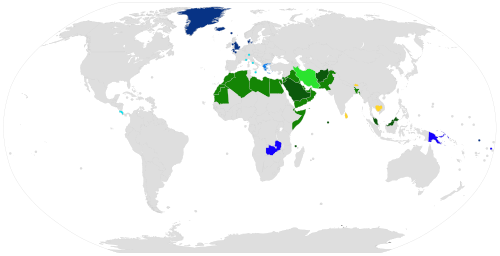 キリスト教を国教とする国は青色で表示されます。
 -
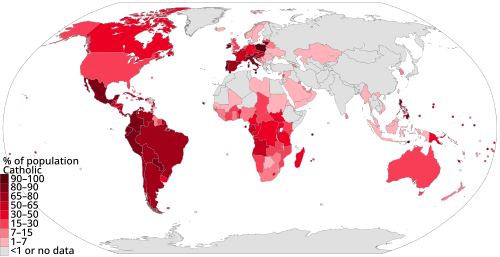 カトリック教徒の分布
 -
 プロテスタントの分布
 -
 東方正教会の分布
 -
 東方正教会の分布
 -
 他のキリスト教徒の分布
.svg/500px-Countries_by_percentage_of_Protestants_(2010).svg.png)
教会と宗派
キリスト教は分類学的に6つの主要なグループに分けられる:ローマカトリック、プロテスタント、東方正教会、東方教会、復古主義。[362] [363]時々描かれるより広い区別は、東方キリスト教と西方キリスト教であり、これは11世紀の東西分裂(大分裂)に起源を持つ。最近では、西方世界キリスト教も東方世界キリスト教も、例えばアフリカ発祥の教会では目立っていない。しかし、これらの主要なカテゴリの1つにうまく当てはまらない 他の現在[364]および歴史的[365]キリスト教グループも存在する。
キリスト教徒と自称するグループの間でも、教義や典礼慣行は多様である。これらのグループは、キリスト教宗派の分類に関して、教会論的に異なる見解を持つことがある。[366]しかし、ニカイア信条(325)は、カトリック、東方正教会、東方正教会、およびルター派や英国国教会などの主要なプロテスタントを含むほとんどのキリスト教徒によって権威あるものとして一般的に受け入れられている。[367]
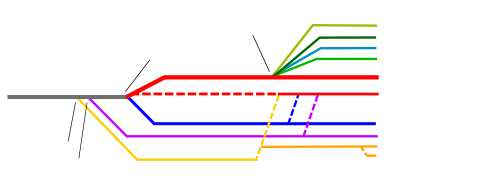
- (ニカイア以前の宗派、非三位一体論、および復古主義の宗派は示されていません。)
カトリック教会

カトリック教会は、信仰、道徳、教会統治の最高権威であるローマ司教である教皇と交わりを持ち、司教を長とする特定の教会で構成されています。 [368] [369]東方正教会と同様に、カトリック教会は使徒継承を通じて、イエス・キリストによって設立されたキリスト教共同体に起源をたどります。[370] [371]カトリック教徒は、イエスによって設立された「唯一の、聖なる、カトリックの、使徒的な教会」がカトリック教会に完全に存続していると主張しますが、他のキリスト教の教会や共同体も認めており[372] [373] 、すべてのキリスト教徒の和解に取り組んでいます。[372]カトリックの信仰は、カトリック教会のカテキズムに詳しく記載されています。[374] [375]
カトリック教会の七つの秘跡のうち、聖体は主要なものであり、ミサの中で典礼的に執り行われる。[376]教会は、司祭による聖別を通して、犠牲のパンとワインがキリストの体と血になると教えている。聖母マリアはカトリック教会で神の母、天の女王として崇敬されており、教義や信心の中で尊ばれている。[377]その教えには、神の慈悲、信仰による聖化、福音の伝道、ならびに肉体的および精神的な慈善活動を通じて病人、貧者、苦しんでいる人への自発的な支援を強調するカトリックの社会教義が含まれている。カトリック教会は世界中で何千ものカトリック学校、大学、病院、孤児院を運営しており、世界最大の非政府教育・医療提供者である。 [378]その他の社会奉仕活動の中には、数多くの慈善団体や人道団体がある。
教会法(ラテン語:jus canonicum)[379]は、カトリック教会の階層的権威によって制定され施行された法律と法的原則の体系であり、教会の外部組織と統治を規制し、教会の使命に向けたカトリック信者の活動を秩序立てて指導するものである。[380]ラテン教会の教会法は最初の近代的な西洋法体系であり、[381]西洋で継続的に機能している最古の法体系である。[382] [383]一方、東方カトリック教会法の独特の伝統は、23の東方カトリック個別教会sui iurisを統治している。
世界で最も古く、最大の継続して機能している国際機関として、[384]西洋文明の歴史と発展において重要な役割を果たしてきました。[385] 2,834の教区[386]は24の特定の自治教会(最大のものはラテン教会)に分類され、それぞれが典礼と秘跡の執行に関して独自の伝統を持っています。[387] 11億人以上の洗礼を受けた信者を擁するカトリック教会は、最大のキリスト教教会であり、すべてのキリスト教徒の50.1% [1]と世界人口の16.7%を占めています。[388] [389] [390]カトリック教徒は、宣教、ディアスポラ、改宗を通じて世界中に住んでいます。
東方正教会
.jpg/500px-Church_of_St._George,_Istanbul_(August_2010).jpg)
東方正教会は、コンスタンティノープル総主教区など、東方の総主教区と交わりを持つ教会から構成されています。[392]カトリック教会と同様に、東方正教会も使徒継承を通じてキリスト教の創始にその伝統をたどり、司教制の構造を持っていますが、その構成要素の自治が強調されており、そのほとんどは国教会です。
東方正教会の神学は、 7つの全地公会議の教義、聖書、教父の教えを組み込んだ聖なる伝統に基づいています。教会は、自らがイエス・キリストの大宣教命令により設立された唯一の、聖なる、カトリックの、使徒的な教会であり、[393]その司教はキリストの使徒の後継者であると教えています。[394]聖なる伝統によって受け継がれた本来のキリスト教の信仰を実践していると主張しています。五大正教会を彷彿とさせる総主教区やその他の自立教会、自治教会は、さまざまな階層組織を反映しています。教会は7つの主要な秘跡を認めており、そのうちの主要なものは聖体であり、合同の典礼で執り行われます。教会は、司祭によって祈願された聖別を通して、犠牲のパンとワインがキリストの体と血になると教えています。聖母マリアは東方正教会では「神を宿す者」を意味する「テオトコス」として崇拝されており、信仰の中で尊ばれています。
東方正教会はキリスト教で2番目に大きな宗派で、推定2億3千万人の信者がいるが、プロテスタントの総数はそれを大幅に上回っている。[1] [395]世界で最も古い現存する宗教機関の一つとして、東方正教会は東ヨーロッパ、南東ヨーロッパ、コーカサス、近東の歴史と文化において重要な役割を果たしてきた。[396]東方正教会の信者の大半は主に東南ヨーロッパ、キプロス、グルジア、コーカサス地方の一部、シベリア、極東ロシアに居住している。東方正教会の信者の半数以上はロシア正教会の信者であり、大多数はロシア国内に居住している。[397]アフリカの旧ビザンチン地域、東地中海、中東にもコミュニティがある。東方正教会のコミュニティは、ディアスポラ、改宗、宣教活動を通じて形成されたもので、特に北米、西ヨーロッパ、オーストラリアなど世界の他の多くの地域にも存在しています。 [398]
東方正教

東方正教会(「古東方」教会とも呼ばれる)は、最初の3つのエキュメニカル公会議(ニカイア公会議、コンスタンティノープル公会議、エフェソス公会議)を認めるが、カルケドン公会議の教義的定義を拒否し、代わりにミアフィジストのキリスト論を支持する東方教会である。
東方正教会は、シリア正教会、コプト正教会、エチオピア正教会、エリトリア正教会、シリアのマランカラ正教会(インド)、アルメニア使徒教会の6つのグループで構成されています。[399]これらの6つの教会は、互いに交わりを持ちながらも、階層的には完全に独立しています。[400]これらの教会は、東方正教会とは一般的に交わりを持たず、交わりを築くために対話を行っています。[401]これら6つの教会を合わせると、世界中に約6,200万人の信者がいます。[402] [403] [404] [405] [395]
世界で最も古い宗教組織の一つである東方正教会は、アルメニア、エジプト、トルコ、エリトリア、エチオピア、スーダン、イラン、アゼルバイジャン、中東およびインドの一部の歴史と文化において重要な役割を果たしてきた。[406] [407] [408]東方キリスト教の独立教会の団体であり、その主教は司教任命によって平等であり、その教義は、教会が最初の3つの公会議の正当性のみを認めるという点に要約できる。[409]
コプト正教会、エチオピア正教会、エリトリア正教会などの一部の東方正教会は、他のキリスト教宗派よりも旧約聖書の教えを重視しており、その信者はユダヤ教のカシュルートに似た食事規則に従う、男性信者は割礼を受ける、儀式的な浄化を守るなどの特定の慣習を守っています。[ 410 ]
東方教会

東方教会は大教会の一部であり、[414]エフェソス公会議でネストリウスが431年に非難されるまで、ローマ帝国の教会と交わりを保っていた。イスラム教徒によるペルシア征服(633-654年)後もラシドゥーン・カリフ制下のズィンミー共同体として存続した東方教会は、アジアのキリスト教史において重要な役割を果たした。9世紀から14世紀にかけて、東方教会は地理的範囲で世界最大のキリスト教宗派であった。地中海、現在のイラクとイランからインド(ケララ州の聖トマス・シリア・クリスチャン)、中央アジアのモンゴル王国、そして唐代(7-9世紀)の中国にまで及ぶ教区と共同体を設立した。 13 世紀と 14 世紀には、モンゴル帝国の支配下で教会は最後の拡大期を迎え、東方教会の有力な聖職者がモンゴルの宮廷に座った。
アッシリア東方教会は、17世紀に確立された連続した総主教区を持ち、東方教会からの継続性を主張する独立した東方キリスト教宗派である。16世紀に確立されたカトリック総主教区は、教皇と完全な交わりを持つ東方カトリック教会であるカルデアカトリック教会へと発展した。これは、歴史的な東方教会の伝統的なキリスト論と教会論に従う東方キリスト教の教会である。大部分は非聖像的で他のどの教会とも交わりを持たず、シリア語キリスト教の東方支部に属し、その典礼では東シリア典礼を使用している。[415]

主な言語は東アラム語の方言であるシリア語で、信者の大半はイラン、イラク、シリア、トルコ、インド(シリア・カルデア教会)、およびアッシリア人ディアスポラに住む民族的アッシリア人である。[416]正式な本部はイラク北部クルディスタンの都市アルビルにあり、元々の領域は古代アッシリアに相当するトルコ南東部とイラン北西部にも広がっている。そのヒエラルキーは大主教と教区主教で構成され、下級聖職者は司祭と助祭で構成され、中東、インド、北米、オセアニア、ヨーロッパ(コーカサスとロシアを含む)の各地の教区(エパルキア)と小教区で奉仕している。[417]
古代東方教会は1964年にアッシリア東方教会から分離した。メソポタミア最古のキリスト教会の一つである歴史的な東方教会との連続性を主張するアッシリア教会の一つである。 [418]公式の本部はイラクのバグダッド市にある。[419]信者の大半はアッシリア民族である。[419]
プロテスタント
1521年、ヴォルムス勅令によりマルティン・ルターは非難され、神聖ローマ帝国の市民は正式にルターの思想を擁護または広めることが禁じられた。[420]このローマカトリック教会内の分裂は現在、宗教改革と呼ばれている。著名な改革者には、マルティン・ルター、フルドリヒ・ツヴィングリ、ジャン・カルヴァンなどがいる。1529年にシュパイヤーで破門に反対する抗議が行われ、この一派はプロテスタントと呼ばれるようになった。ルターの主要な神学的継承者はルター派として知られている。ツヴィングリとカルヴァンの後継者は宗派的にははるかに広く、改革派の伝統と呼ばれている。[421]英国国教会は英国国教会の流れを汲み、英国国教会として組織された。ルター派の中には福音派カトリック教徒を自認する者もおり、すべてではないが一部の英国国教会信者はプロテスタントとカトリックの両方であると考えている。[422] [423] [424]プロテスタントは独自の文化を発展させ、教育、人文科学、政治社会秩序、経済、芸術、その他多くの分野に大きな貢献をしてきました。 [425] [426]
英国国教会、ルーテル教会、改革派プロテスタントは、大部分が政府との協力で始まったため、これらの運動は「マジステラル・リフォーム」と呼ばれている。一方、アナバプテストなどのグループは、プロテスタントであるとは考えていないことが多いが、急進的宗教改革に端を発しており、寛容法の下で保護されることはあるものの、国教会に由来する歴史はない。彼らはさらに、幼児洗礼を拒否することでも区別され、成人信者の洗礼、すなわち信条洗礼のみを信じている(アナバプテストには、アーミッシュ、使徒派、ブルーダーホフ、メノナイト、フッター派、リバー・ブレザレン、シュヴァルツェナウ・ブレザレンの各グループが含まれる。)[427] [428] [429] [430]
プロテスタントという用語は、後に形成された、マジストリアル派またはラディカル派の伝統を持つあらゆる教会を指す。例えば、18世紀には、メソジスト派は英国国教会の牧師ジョン・ウェスレーの福音主義リバイバル運動から生まれた。[431]聖霊の浄化力を強調するいくつかのペンテコステ派および無宗派教会は、メソジスト派から生まれた。[432]メソジスト、ペンテコステ派、その他の福音主義者は、「イエスを自分の主であり救世主として受け入れること」を強調する。[433]これはウェスレーが強調した新生から来ており、[434]彼らはしばしば自分たちを生まれ変わった者と称する。[435] [436]
プロテスタントは信者数でカトリックに次いで2番目に大きいキリスト教徒の主要グループであるが、東方正教会はどのプロテスタント宗派よりも信者数が多い。[389]推定値は、主にどの宗派をプロテスタントに分類するかという問題に関して様々である。プロテスタントの総人口は2024年に11億7千万人に達し、世界のキリスト教徒の約44%に相当する。[16] [395] [296] [17] [437]プロテスタントの大多数は、ほんの一握りの宗派に属しており、すなわち、アドベンチスト派、アナバプテスト派(アーミッシュ派、アポストリック派、ブルーダーホフ派、フッター派、メノナイト派、リバー・ブレザレン派、シュヴァルツェナウ・ブレザレン派)、英国国教会、バプテスト派、ルーテル派、メソジスト派、モラヴィア派/フス派、ペンテコステ派、プリマス・ブレザレン派、クエーカー派、改革派キリスト教(会衆派、大陸改革派、改革派英国国教会、長老派)、[438]およびワルドー派がプロテスタントの主な宗派である。[15] [296] 非宗派、福音派、カリスマ派、新カリスマ派、独立派などの教会が増加しており、プロテスタント系キリスト教の重要な部分を占めています。[439]
プロテスタントの基本教義を信奉する個人集団の中には、自らを「キリスト教徒」または「新生キリスト教徒」と称する者もいる。彼らは通常、自らを「非宗派」または「福音派」と称することで、他のキリスト教コミュニティの告白主義や信条主義から距離を置いている[440]。彼らは個人の牧師によって設立されることが多く、歴史的な宗派とはほとんど関係がない[441] 。
主なプロテスタント宗派の歴史図

復古主義

1800年代初頭に米国で起こった宗教復興の時代である第二次大覚醒では、無関係な教会が数多く誕生した。これらの教会は一般的に、既存の教会を改革するのではなく、イエス・キリストの本来の教会を復興しているとみなしていた。[ 442 ]復興主義者の共通の信念は、キリスト教の他の分派がキリスト教に教義上の欠陥を持ち込んだというもので、これは大背教として知られている。[443]アジアでは、イグレシア・ニ・クリストが1900年代初頭に設立された復興主義の宗派として知られている。復興主義の宗派の他の例としては、アーヴィング主義やスウェーデンボルグ主義などがある。[444] [20]
この時期に生まれた教会の中には、19世紀初頭の中西部やニューヨーク州北部の野外集会と歴史的に結びついたものがある。この運動から生まれた最大の教会の一つが、末日聖徒イエス・キリスト教会である。[445]福音派プロテスタントから生まれたアメリカの千年王国論とアドベンチストは、エホバの証人の運動に影響を与え、特にウィリアム・ミラーへの反応として、セブンスデー・アドベンチストにも影響を与えた。キリスト教会(キリストの弟子)、カナダ福音派キリスト教会、[446] [447] キリスト教会、キリスト教会とキリスト教会は、ケンタッキー州とテネシー州を中心とする同時代のストーン・キャンベル復興運動にその起源を持つ。この時期に生まれた他のグループには、クリスタデルフィアンや前述の末日聖徒運動がある。第二次大覚醒に端を発する教会は表面的には類似点があるものの、その教義や実践は大きく異なっています。[448]
他の

イタリア、ポーランド、リトアニア、トランシルヴァニア、ハンガリー、ルーマニア、イギリスでは、16世紀に改革派の伝統からユニテリアン教会が生まれました。 [449]トランシルヴァニアのユニテリアン教会は、この時代に生まれたそのような宗派の一例です。[450]彼らは、アナバプテストの信条洗礼の教義を採用しました。[451]
古カトリック教会[452]などの様々な小規模な独立カトリック教会は、名称にカトリックという言葉を含んでおり、多かれ少なかれカトリック教会と共通の典礼慣行を持っていると主張できますが、もはや聖座との完全な交わりはありません。[453]
ドゥホボル派やモロカン派などの精神的キリスト教徒はロシア正教会から離脱し、同様の宗教的慣習からメノナイト派やクエーカー教徒と密接な関係を維持している。さらに、これらのグループはすべて平和主義を信じていることから、総合的に平和教会と見なされている。[454] [455]
メシアニック・ユダヤ教(またはメシアニック運動)は、いくつかの流れから成り、そのメンバーはユダヤ人であると考えることもあるキリスト教運動の名称である。この運動は1960年代から1970年代に始まり、ユダヤ教の宗教的慣習と福音主義キリスト教の要素を融合している。メシアニック・ユダヤ教は、救世主としての「イェシュア」(イエスのヘブライ名)の神性と三位一体の神性といったキリスト教の信条を肯定する一方で、ユダヤ教の食事に関する法律や習慣も遵守している。[456]
キリスト教共同体のような秘教的キリスト教徒は[457]キリスト教を神秘宗教とみなし[458] [459] 、ある種の秘教的教義や実践の存在と所有を公言しているが[460] [461]、それらは一般の人々からは隠されており、「啓蒙された」、「入信者となった」、あるいは高度な教育を受けた人々の狭い範囲にしかアクセスできない。[462] [463]
非宗派キリスト教または非宗派キリスト教は、特定のキリスト教宗派に正式に属さないことで、他のキリスト教コミュニティの告白主義や信条主義から距離を置く教会で構成されています。 [ 440 ]非宗派キリスト教は、18世紀にストーン・キャンベル復興運動を通じて初めて発生し、信者は「キリスト教徒」や「キリストの弟子」として組織化されましたが、[注11] [464] [465]多くは典型的には福音派キリスト教を信奉しています。[466] [467] [468]
文化の影響
キリスト教世界の歴史は約1700年に及び、様々な社会的・政治的発展、ならびに芸術、建築、文学、科学、哲学、技術の進歩を含む。[469] [470] [471]初期ローマ帝国の間にキリスト教がレバント地方からヨーロッパと北アフリカに広まって以来、キリスト教世界は以前から存在していた東ギリシャと西ラテンに分裂してきた。その結果、独自の儀式や慣習を伴うキリスト教文化の異なるバージョンが生まれ、ローマ(西方キリスト教)とカルタゴの都市を中心として、そのコミュニティは西方またはラテンキリスト教世界と呼ばれ、[472]コンスタンティノープル(東方キリスト教)、アンティオキア(シリアのキリスト教)、ケララ(インドのキリスト教)、アレクサンドリア(コプト教)のコミュニティは東方または東洋キリスト教世界と呼ばれた。[473] [474] [475]ビザンチン帝国はキリスト教の歴史と東方キリスト教文明の頂点の一つでした。[54] 11世紀から13世紀にかけて、ラテンキリスト教世界は西洋世界の中心的な役割を担うようになりました。
聖書は西洋文明と世界中の文化に大きな影響を与え、西洋の法律、芸術、テキスト、教育の形成に貢献してきました。[476] [477] [478] 2000年にわたる文学的伝統を持つ聖書は、これまでに書かれた作品の中で最も影響力のある作品の一つです。個人の衛生習慣から哲学や倫理まで、聖書は政治や法律、戦争と平和、性道徳、結婚と家族生活、トイレのエチケット、文学と学問、芸術、経済、社会正義、医療などに直接的または間接的に影響を与えてきました。[478]
Christians have made a myriad of contributions to human progress in a broad and diverse range of fields, including philosophy,[479] science and technology,[480][481][482][483] medicine,[484] fine arts and architecture,[485] politics, literatures, music,[486] and business.[487][488] According to 100 Years of Nobel Prizes a review of the Nobel Prizes award between 1901 and 2000 reveals that (65.4%) of Nobel Prizes Laureates, have identified Christianity in its various forms as their religious preference.[489]
Outside the Western world, Christianity has had an influence on various cultures, such as in Africa, the Near East, Middle East, East Asia, Southeast Asia, and the Indian subcontinent.[490][491] Eastern Christian scientists and scholars of the medieval Islamic world (particularly Jacobite and Nestorian Christians) contributed to the Arab Islamic civilization during the reign of the Ummayyads and the Abbasids, by translating works of Greek philosophers to Syriac and afterwards, to Arabic.[492][493][494] They also excelled in philosophy, science, theology, and medicine.[495][496][497] Scholars and intellectuals agree Christians in the Middle East have made significant contributions to Arab and Islamic civilization since the introduction of Islam, and they have had a significant impact contributing the culture of the Mashriq, Turkey, and Iran.[498][490]
Influence on Western culture
Western culture, throughout most of its history, has been nearly equivalent to Christian culture, and a large portion of the population of the Western Hemisphere can be described as practicing or nominal Christians. The notion of "Europe" and the "Western World" has been intimately connected with the concept of "Christianity and Christendom". Many historians even attribute Christianity for being the link that created a unified European identity.[499]
Though Western culture contained several polytheistic religions during its early years under the Greek and Roman Empires, as the centralized Roman power waned, the dominance of the Catholic Church was the only consistent force in Western Europe.[500] Until the Age of Enlightenment,[500] Christian culture guided the course of philosophy, literature, art, music and science.[500][469] Christian disciplines of the respective arts have subsequently developed into Christian philosophy, Christian art, Christian music, Christian literature, and so on.
Christianity has had a significant impact on education, as the church created the bases of the Western system of education,[501] and was the sponsor of founding universities in the Western world, as the university is generally regarded as an institution that has its origin in the Medieval Christian setting.[71] Historically, Christianity has often been a patron of science and medicine; many Catholic clergy,[502] Jesuits in particular,[503][504][505] have been active in the sciences throughout history and have made significant contributions to the development of science.[506][507] Some scholars state that Christianity contributed to the rise of the Scientific Revolution.[508] Protestantism also has had an important influence on science. According to the Merton Thesis, there was a positive correlation between the rise of English Puritanism and German Pietism on the one hand, and early experimental science on the other.[509][510][511] The civilizing influence of Christianity includes social welfare,[501] contribution to the medical and health care,[512] founding hospitals,[501] economics (as the Protestant work ethic),[501][513][514] architecture,[515] literature,[516] personal hygiene (ablution),[517][518] and family life.[501][519] Historically, extended families were the basic family unit in the Christian culture and countries.[520]
Cultural Christians are secular people with a Christian heritage who may not believe in the religious claims of Christianity, but who retain an affinity for the popular culture, art, music, and so on related to the religion.[521]
Postchristianity is the term for the decline of Christianity, particularly in Europe, Canada, Australia, and to a minor degree the Southern Cone, in the 20th and 21st centuries, considered in terms of postmodernism. It refers to the loss of Christianity's monopoly on values and world view in historically Christian societies.[522]
Ecumenism
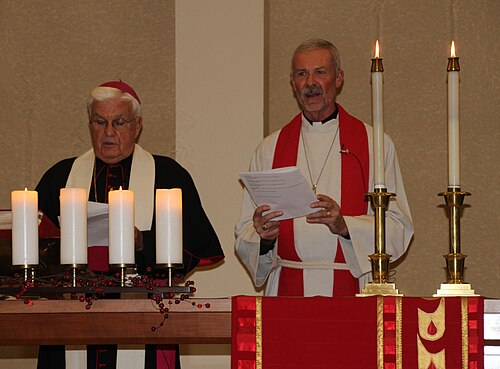
Christian groups and denominations have long expressed ideals of being reconciled, and in the 20th century, Christian ecumenism advanced in two ways.[523][524][525] One way was greater cooperation between groups, such as the World Evangelical Alliance founded in 1846 in London or the Edinburgh Missionary Conference of Protestants in 1910, the Justice, Peace and Creation Commission of the World Council of Churches founded in 1948 by Protestant and Orthodox churches, and similar national councils like the National Council of Churches in Australia, which includes Catholics.[524]
The other way was an institutional union with united churches, a practice that can be traced back to unions between Lutherans and Calvinists in early 19th-century Germany. Congregationalist, Methodist, and Presbyterian churches united in 1925 to form the United Church of Canada,[526] and in 1977 to form the Uniting Church in Australia. The Church of South India was formed in 1947 by the union of Anglican, Baptist, Methodist, Congregationalist, and Presbyterian churches.[527]
The Christian Flag is an ecumenical flag designed in the early 20th century to represent all of Christianity and Christendom.[528]
The ecumenical, monastic Taizé Community is notable for being composed of more than one hundred brothers from Protestant and Catholic traditions.[529] The community emphasizes the reconciliation of all denominations and its main church, located in Taizé, Saône-et-Loire, France, is named the "Church of Reconciliation".[529] The community is internationally known, attracting over 100,000 young pilgrims annually.[530]
Steps towards reconciliation on a global level were taken in 1965 by the Catholic and Orthodox churches, mutually revoking the excommunications that marked their Great Schism in 1054;[531] the Anglican Catholic International Commission (ARCIC) working towards full communion between those churches since 1970;[532] and some Lutheran and Catholic churches signing the Joint Declaration on the Doctrine of Justification in 1999 to address conflicts at the root of the Protestant Reformation. In 2006, the World Methodist Council, representing all Methodist denominations, adopted the declaration.[533]
Criticism, persecution, and apologetics
Criticism

Criticism of Christianity and Christians goes back to the Apostolic Age, with the New Testament recording friction between the followers of Jesus and the Pharisees and scribes (e.g., Matthew 15:1–20 and Mark 7:1–23).[534] In the 2nd century, Christianity was criticized by the Jews on various grounds, e.g., that the prophecies of the Hebrew Bible could not have been fulfilled by Jesus, given that he did not have a successful life.[535] Additionally, a sacrifice to remove sins in advance, for everyone or as a human being, did not fit the Jewish sacrifice ritual; furthermore, God in Judaism is said to judge people on their deeds instead of their beliefs.[536][537] One of the first comprehensive attacks on Christianity came from the Greek philosopher Celsus, who wrote The True Word, a polemic criticizing Christians as being unprofitable members of society.[538][539][540] In response, the church father Origen published his treatise Contra Celsum, or Against Celsus, a seminal work of Christian apologetics, which systematically addressed Celsus's criticisms and helped bring Christianity a level of academic respectability.[541][540]
By the 3rd century, criticism of Christianity had mounted. Wild rumors about Christians were widely circulated, claiming that they were atheists and that, as part of their rituals, they devoured human infants and engaged in incestuous orgies.[542][543] The Neoplatonist philosopher Porphyry wrote the fifteen-volume Adversus Christianos as a comprehensive attack on Christianity, in part building on the teachings of Plotinus.[544][545]
By the 12th century, the Mishneh Torah (i.e., Rabbi Moses Maimonides) was criticizing Christianity on the grounds of idol worship, in that Christians attributed divinity to Jesus, who had a physical body.[546] In the 19th century, Nietzsche began to write a series of polemics on the "unnatural" teachings of Christianity (e.g. sexual abstinence), and continued his criticism of Christianity to the end of his life.[547] In the 20th century, the philosopher Bertrand Russell expressed his criticism of Christianity in Why I Am Not a Christian, formulating his rejection of Christianity.[548]
Criticism of Christianity continues to date, e.g. Jewish and Muslim theologians criticize the doctrine of the Trinity held by most Christians, stating that this doctrine in effect assumes that there are three gods, running against the basic tenet of monotheism.[549] New Testament scholar Robert M. Price has outlined the possibility that some Bible stories are based partly on myth in The Christ Myth Theory and its problems.[550]
Persecution

Christians are one of the most persecuted religious groups in the world, especially in the Middle-East, North Africa and South and East Asia.[552][553][554] In 2017, Open Doors estimated approximately 260 million Christians are subjected annually to "high, very high, or extreme persecution"[555] with North Korea considered the most hazardous nation for Christians.[556][557] In 2019, a report[558][559] commissioned by the United Kingdom's Secretary of State of the Foreign and Commonwealth Office (FCO) to investigate global persecution of Christians found persecution has increased, and is highest in the Middle East, North Africa, India, China, North Korea, and Latin America, among others, and that it is global and not limited to Islamic states.[560][559] This investigation found that approximately 80% of persecuted believers worldwide are Christians.[554]
Apologetics

Christian apologetics aims to present a rational basis for Christianity. The word "apologetic" (Greek: ἀπολογητικός apologētikos) comes from the Greek verb ἀπολογέομαι apologeomai, meaning "(I) speak in defense of".[561] Christian apologetics has taken many forms over the centuries, starting with Paul the Apostle. The philosopher Thomas Aquinas presented five arguments for God's existence in the Summa Theologica, while his Summa contra Gentiles was a major apologetic work.[562][563] Another famous apologist, G. K. Chesterton, wrote in the early twentieth century about the benefits of religion and, specifically, Christianity. Famous for his use of paradox, Chesterton explained that while Christianity had the most mysteries, it was the most practical religion.[564][565] He pointed to the advance of Christian civilizations as proof of its practicality.[566] The physicist and priest John Polkinghorne, in his Questions of Truth, discusses the subject of religion and science, a topic that other Christian apologists such as Ravi Zacharias, John Lennox, and William Lane Craig have engaged, with the latter two men opining that the inflationary Big Bang model is evidence for the existence of God.[567] Creationist apologetics is apologetics that aims to defend creationism.
See also
- Outline of Christianity
- Christian atheism
- Christians of Saint John
- Christianity and Islam
- Christianity and Judaism
- Christianity and politics
- Christian mythology
- Christianisation
- One true church
- Prophets of Christianity
- Jamieson-Fausset-Brown Bible Commentary
Notes
- ^ Christianity originated in 1st-century Judea from the Jewish Christian sect of Second Temple Judaism.[2][3][4][5][6]
- ^ a b c d The doctrine of the Trinity is not universally accepted among Christians. Nontrinitarian Christian groups include the Church of Jesus Christ of Latter-day Saints, Unitarians and Jehovah's Witnesses.[568]
- ^ The denominations of Adventism, Anabaptism (Amish, Apostolic, Bruderhof, Hutterites, Mennonites, River Brethren, and Schwarzenau Brethren), Anglicanism, Baptists, Lutheranism, Methodism, Moravianism/Hussites, Pentecostalism, Plymouth Brethren, Quakerism, Reformed Christianity (Congregationalists, Continental Reformed, and Presbyterians), and Wa`ldensianism are the main families of Protestantism. Other groups that are sometimes regarded as Protestant include non-denominational Christian congregations.[15]
- ^ The denominations of Restorationism include the Irvingians, Swedenborgians, Christadelphians, Latter Day Saints, Jehovah's Witnesses, La Luz del Mundo, and Iglesia ni Cristo.[19][20]
- ^ It appears in the Acts of the Apostles, Acts 9:2, Acts 19:9 and Acts 19:23. Some English translations of the New Testament capitalize 'the Way' (e.g. the New King James Version and the English Standard Version), indicating that this was how 'the new religion seemed then to be designated'[22] whereas others treat the phrase as indicative—'the way',[23] 'that way'[24] or 'the way of the Lord'.[25] The Syriac version reads, "the way of God" and the Vulgate Latin version, "the way of the Lord".[26]
- ^ a b The Latin equivalent, from which English trinity is derived,[171][better source needed] is trinitas[172] though Latin also borrowed Greek trias verbatim.[173]
- ^ Frequently a distinction is made between "liturgical" and "non-liturgical" churches based on how elaborate or antiquated the worship; in this usage, churches whose services are unscripted or improvised are described as "non-liturgical".[195]
- ^ Often these are arranged on an annual cycle, using a book called a lectionary.
- ^ Iesous Christos Theou Hyios Soter may be a more complete transliteration; in Koine Greek, the daseia or spiritus asper had largely ceased being pronounced and was not—commonly—marked in the majuscule script of the time.
- ^ A flexible term, defined as all forms of Protestantism with the notable exception of the historical denominations deriving directly from the Protestant Reformation.
- ^ The first Nondenominational Christian churches which emerged through the Stone-Campbell Restoration Movement are tied to associations such as the Churches of Christ or the Christian Church (Disciples of Christ).[464][465]
References
- ^ a b c d e f g h i j k "Global Christianity – A Report on the Size and Distribution of the World's Christian Population" (PDF). Pew Research Center. Archived (PDF) from the original on 1 August 2019.
- ^ Ehrman, Bart D. (2005) [2003]. "At Polar Ends of the Spectrum: Early Christian Ebionites and Marcionites". Lost Christianities: The Battles for Scripture and the Faiths We Never Knew. Vol. 74. Oxford University Press. pp. 95–112. doi:10.1017/s0009640700110273. ISBN 978-0-19-518249-1. S2CID 152458823. Retrieved 20 January 2021.
{{cite book}}:|journal=ignored (help) - ^ Hurtado, Larry W. (2005). "How on Earth Did Jesus Become a God? Approaches to Jesus-Devotion in Earliest Christianity". How on Earth Did Jesus Become a God? Historical Questions about Earliest Devotion to Jesus. Grand Rapids and Cambridge: Wm. B. Eerdmans. pp. 13–55. ISBN 978-0-8028-2861-3. Retrieved 20 July 2021.
- ^ Freeman, Charles (2010). "Breaking Away: The First Christianities". A New History of Early Christianity. New Haven and London: Yale University Press. pp. 31–46. doi:10.12987/9780300166583. ISBN 978-0-300-12581-8. JSTOR j.ctt1nq44w. S2CID 170124789. Retrieved 20 January 2021.
- ^ Wilken, Robert Louis (2013). "Beginning in Jerusalem". The First Thousand Years: A Global History of Christianity. New Haven and London: Yale University Press. pp. 6–16. ISBN 978-0-300-11884-1. JSTOR j.ctt32bd7m. S2CID 160590164. Retrieved 20 January 2021.
- ^ Lietaert Peerbolte, Bert Jan (2013). "How Antichrist Defeated Death: The Development of Christian Apocalyptic Eschatology in the Early Church". In Krans, Jan; Lietaert Peerbolte, L. J.; Smit, Peter-Ben; Zwiep, Arie W. (eds.). Paul, John, and Apocalyptic Eschatology: Studies in Honour of Martinus C. de Boer. Novum Testamentum: Supplements. Vol. 149. Leiden: Brill. pp. 238–255. doi:10.1163/9789004250369_016. ISBN 978-90-04-25026-0. ISSN 0167-9732. S2CID 191738355. Retrieved 13 February 2021.
- ^ Willsky-Ciollo, Lydia (2015). "Epilogue: Seeking Authority in Contemporary Unitarian Universalism". American Unitarianism and the Protestant Dilemma: The Conundrum of Biblical Authority. Lanham, MD: Lexington. pp. 241–245. ISBN 978-0-7391-8892-7.[permanent dead link]
- ^ Jan Pelikan, Jaroslav (13 August 2022). "Christianity". Christianity | Definition, Origin, History, Beliefs, Symbols, Types, & Facts | Britannica. Encyclopædia Britannica.
...there is a core of ideas that all New Testament scholars and believers would agree are central to ancient Christian beliefs. One British scholar, James G. Dunn, for example, says they would all agree that "the Risen Jesus is the Ascended Lord." That is to say, there would have been no faith tradition and no scriptures had not the early believers thought that Jesus was "Risen," raised from the dead, and, "Ascended," somehow above the ordinary plane of mortal and temporal experience.
- ^ Young, Frances M. (2006). "Prelude: Jesus Christ, foundation of Christianity". In Mitchell, M.; Young, F. (eds.). The Cambridge History of Christianity. Vol. 1. Cambridge University Press. p. 1. doi:10.1017/CHOL9780521812399.002. ISBN 978-1-139-05483-6.
The death of Jesus Christ by crucifixion, together with bhis resurrection from the dead, lies at the heart of Christianity.
- ^ "Christianity - The Oxford Dictionary of Phrase and Fable". Oxford Reference. Oxford University Press. 2005. Retrieved 6 August 2024.
The religion based on the person and teachings of Jesus of Nazareth, or its beliefs and practices.
- ^ a b "World's largest religion by population is still Christianity". Pew Research Center. 5 April 2017. Retrieved 1 January 2020.
- ^ Perry, Marvin (2012). Western Civilization: A Brief History, Volume I: To 1789. Cengage. p. 33. ISBN 978-1-111-83720-4.
- ^ Bokenkotter 2004, Preface.
- ^ Hayes, Carlton J. H. (1954). Christianity and Western Civilization. Stanford University Press. p. 2. ISBN 978-0-7581-3510-0.
- ^ a b Melton, J. Gordon (2005). Encyclopedia of Protestantism. Infobase. p. 398. ISBN 978-0-8160-6983-5.
- ^ a b "Status of Global Christianity, 2024, in the Context of 1900–2050" (PDF). Center for the Study of Global Christianity, Gordon-Conwell Theological Seminary. Retrieved 23 May 2024.
Protestants: 625,606,000; Independents: 421,689,000; Unaffiliated Christians: 123,508,000
- ^ a b Kim, Hyun-Sook; Osmer, Richard R.; Schweitzer, Friedrich (2018). The Future of Protestant Religious Education in an Age of Globalization. Waxmann Verlag. p. 8. ISBN 978-3-8309-8876-2.
- ^ Walsham, Alexandra; Cummings, Brian; Law, Ceri; Riley, Karis (4 June 2020). Remembering the Reformation. Routledge. p. 18. ISBN 978-0-429-61992-2.
- ^ Lewis, Paul W.; Mittelstadt, Martin William (27 April 2016). What's So Liberal about the Liberal Arts?: Integrated Approaches to Christian Formation. Wipf & Stock. ISBN 978-1-4982-3145-9.
The Second Great Awakening (1790-1840) spurred a renewed interest in primitive Christianity. What is known as the Restoration Movement of the nineteenth century gave birth to an array of groups: Mormons (The Latter Day Saint Movement), the Churches of Christ, Adventists, and Jehovah's Witnesses. Though these groups demonstrate a breathtaking diversity on the continuum of Christianity they share an intense restorationist impulse.
- ^ a b Spinks, Bryan D. (2 March 2017). Reformation and Modern Rituals and Theologies of Baptism: From Luther to Contemporary Practices. Routledge. ISBN 978-1-351-90583-1.
However, Swedenborg claimed to receive visions and revelations of heavenly things and a 'New Church', and the new church which was founded upon his writings was a Restorationist Church. The three nineteenth-century churches are all examples of Restorationist Churches, which believed they were refounding the Apostolic Church, and preparing for the Second Coming of Christ.
- ^ Gao, Ronnie Chuang-Rang; Sawatsky, Kevin (7 February 2023). "Motivations in Faith-Based Organizations". Houston Christian University. Retrieved 29 August 2024.
For example, Christianity comprises six major groups: Church of the East, Oriental Orthodoxy, Eastern Orthodoxy, Roman Catholicism, Protestantism and Restorationism.
Gao and Sawatsky refer to Ellwood, Robert S., The Encyclopedia of World Religions, New York: Infobase Publishing (2008) as their source for this taxonomy. - ^ "Acts 19 | Jamieson-Fausset-Brown Bible Commentary". biblehub.com. Retrieved 8 October 2015.
- ^ Jubilee Bible 2000
- ^ American King James Version
- ^ Douai-Rheims Bible
- ^ "Online Bible Study Suite | Gill, J., Gill's Exposition of the Bible, commentary on Acts 19:23". Retrieved 8 October 2015.
- ^ E. Peterson (1959), "Christianus." In: Frühkirche, Judentum und Gnosis, publisher: Herder, Freiburg, pp. 353–72
- ^ Elwell & Comfort 2001, pp. 266, 828.
- ^ "Evodius of Antioch → Antioch, Church of". Evodius of Antioch → Antioch, Church of. Brill Encyclopedia of Early Christianity Online. 2018. doi:10.1163/2589-7993_eeco_dum_00001220.
- ^ Cory, Catherine (2015). Christian Theological Tradition. Routledge. p. 20 and forward. ISBN 978-1-317-34958-7.
- ^ Benko, Stephen (1984). Pagan Rome and the Early Christians. Indiana University Press. p. 22 and forward. ISBN 978-0-253-34286-7.
- ^ McGrath, Alister E. (2006), Christianity: An Introduction, Wiley-Blackwell, p. 174, ISBN 1-4051-0899-1
- ^ Seifrid, Mark A. (1992). "'Justification by Faith' and The Disposition of Paul's Argument". Justification by Faith: The Origin and Development of a Central Pauline Theme. Novum Testamentum. Leiden: Brill. pp. 210–211, 246–247. ISBN 9004095217. ISSN 0167-9732.
- ^ Wylen, Stephen M., The Jews in the Time of Jesus: An Introduction, Paulist Press (1995), ISBN 0809136104, pp. 190–192; Dunn, James D.G., Jews and Christians: The Parting of the Ways, A.D. 70 to 135, Wm. B. Eerdmans Publishing (1999), ISBN 0802844987, [pp. 33–34.; Boatwright, Mary Taliaferro & Gargola, Daniel J & Talbert, Richard John Alexander, The Romans: From Village to Empire, Oxford University Press (2004), ISBN 0195118758, p. 426.
- ^ Acts 7:59
- ^ Acts 12:2
- ^ Martin, D. 2010. The "Afterlife" of the New Testament and Postmodern Interpretation Archived 8 June 2016 at the Wayback Machine (lecture transcript Archived 12 August 2016 at the Wayback Machine). Yale University.
- ^ "Monastère de Mor Mattai – Mossul – Irak" (in French). Archived from the original on 3 March 2014.
- ^ Michael Whitby, et al. eds. Christian Persecution, Martyrdom and Orthodoxy (2006) online edition Archived 24 June 2011 at the Wayback Machine
- ^ Eusebius of Caesarea, the author of Ecclesiastical History in the 4th century, states that St. Mark came to Egypt in the first or third year of the reign of Emperor Claudius, i.e. 41 or 43 AD. "Two Thousand years of Coptic Christianity" Otto F.A. Meinardus p. 28.
- ^ Lettinga, Neil. "A History of the Christian Church in Western North Africa". Archived from the original on 30 July 2001.
- ^ "Allaboutreligion.org". Allaboutreligion.org. Archived from the original on 16 November 2010. Retrieved 19 November 2010.
- ^ a b "Armenia". The World Factbook (2024 ed.). Central Intelligence Agency. Retrieved 8 October 2011. (Archived 2011 edition.)
- ^ a b Brunner, Borgna (2006). Time Almanac with Information Please 2007. New York: Time Home Entertainment. p. 685. ISBN 978-1-933405-49-0.
- ^ van Lint, Theo Maarten (2009). "The Formation of Armenian Identity in the First Millennium". Church History and Religious Culture. 89 (1/3): 269.
- ^ Harris, Jonathan (2017). Constantinople: Capital of Byzantium (2nd ed.). Bloomsbury Academic. p. 38. ISBN 978-1-4742-5467-0.
- ^ Chidester, David (2000). Christianity: A Global History. HarperOne. p. 91.
- ^ Ricciotti 1999
- ^ Theodosian Code XVI.i.2 Archived 14 August 2014 at the Wayback Machine, in: Bettenson. Documents of the Christian Church. p. 31.
- ^ Burbank, Jane; Copper, Frederick (2010). Empires in World History: Power and the Politics of Difference. Princeton University Press. p. 64.
- ^ McTavish, T. J. (2010). A Theological Miscellany: 160 Pages of Odd, Merry, Essentially Inessential Facts, Figures, and Tidbits about Christianity. Thomas Nelson. ISBN 978-1-4185-5281-7.
The Nicene Creed, as used in the churches of the West (Anglican, Catholic, Lutheran, and others), contains the statement, "We believe [or I believe] in the Holy Spirit, the Lord, the giver of life, who proceeds from the Father and the Son."
- ^ a b "Our Common Heritage as Christians". The United Methodist Church. Archived from the original on 14 January 2006. Retrieved 31 December 2007.
- ^ McManners, Oxford Illustrated History of Christianity, pp. 37ff.
- ^ a b Cameron 2006, p. 42.
- ^ Cameron 2006, p. 47.
- ^ Browning 1992, pp. 198–208.
- ^ Browning 1992, p. 218.
- ^ a b c d González 1984, pp. 238–242
- ^ Harari, Yuval Noah (2015). Sapiens: A Brief History of Humankind. Translated by Harari, Yuval Noah; Purcell, John; Watzman, Haim. London: Penguin Random House. pp. 243, 247. ISBN 978-0-09-959008-8.
- ^ Mullin 2008, p. 88.
- ^ Mullin 2008, pp. 93–94.
- ^ Religions in Global Society. p. 146, Peter Beyer, 2006
- ^ Cambridge University Historical Series, An Essay on Western Civilization in Its Economic Aspects, p. 40: Hebraism, like Hellenism, has been an all-important factor in the development of Western Civilization; Judaism, as the precursor of Christianity, has indirectly had had much to do with shaping the ideals and morality of western nations since the christian era.
- ^ Caltron J.H Hayas, Christianity and Western Civilization (1953), Stanford University Press, p. 2: "That certain distinctive features of our Western civilization—the civilization of western Europe and of America—have been shaped chiefly by Judaeo – Graeco – Christianity, Catholic and Protestant."
- ^ Fred Reinhard Dallmayr, Dialogue Among Civilizations: Some Exemplary Voices (2004), p. 22: Western civilization is also sometimes described as "Christian" or "Judaeo- Christian" civilization.
- ^ González 1984, pp. 244–47
- ^ González 1984, p. 260
- ^ González 1984, pp. 278–281
- ^ Riché, Pierre (1978): "Education and Culture in the Barbarian West: From the Sixth through the Eighth Century", Columbia: University of South Carolina Press, ISBN 0872493768, pp. 126–127, 282–298
- ^ Rudy, The Universities of Europe, 1100–1914, p. 40
- ^ a b Verger, Jacques [in French] (1999). Culture, enseignement et société en Occident aux XIIe et XIIIe siècles (in French) (1st ed.). Presses universitaires de Rennes in Rennes. ISBN 978-2868473448. Retrieved 17 June 2014.
- ^ Verger, Jacques. "The Universities and Scholasticism", in The New Cambridge Medieval History: Volume V c. 1198–c. 1300. Cambridge University Press, 2007, 257.
- ^ Rüegg, Walter: "Foreword. The University as a European Institution", in: A History of the University in Europe. Vol. 1: Universities in the Middle Ages, Cambridge University Press, 1992, ISBN 0521361052, pp. xix–xx
- ^ González 1984, pp. 303–307, 310ff., 384–386
- ^ González 1984, pp. 305, 310ff., 316ff
- ^ González 1984, pp. 321–323, 365ff
- ^ Parole de l'Orient. Vol. 30. Université Saint-Esprit. 2005. p. 488.
- ^ González 1984, pp. 292–300
- ^ Riley-Smith. The Oxford History of the Crusades.
- ^ "The Great Schism: The Estrangement of Eastern and Western Christendom". Orthodox Information Centre. Archived from the original on 29 June 2007. Retrieved 26 May 2007.
- ^ Duffy, Saints and Sinners (1997), p. 91
- ^ MacCulloch, Diarmaid (2011). Christianity: The First Three Thousand Years. Penguin. ISBN 978-1-101-18999-3.
- ^ Telushkin, Joseph (2008). Jewish Literacy. HarperCollins. pp. 192–193. ISBN 978-0-688-08506-3.
- ^ González 1984, pp. 300, 304–305
- ^ González 1984, pp. 310, 383, 385, 391
- ^ a b Simon. Great Ages of Man: The Reformation. pp. 39, 55–61.
- ^ Simon. Great Ages of Man: The Reformation. p. 7.
- ^ Schama. A History of Britain. pp. 306–310.
- ^ National Geographic, 254.
- ^ Jensen, De Lamar (1992), Renaissance Europe, ISBN 0395889472
- ^ Levey, Michael (1967). Early Renaissance. Penguin.
- ^ Bokenkotter 2004, pp. 242–244.
- ^ Simon. Great Ages of Man: The Reformation. pp. 109–120.
- ^ A general overview about the English discussion is given in Coffey, Persecution and Toleration in Protestant England 1558–1689.
- ^ a b Open University, Looking at the Renaissance: Religious Context in the Renaissance (Retrieved 10 May 2007)
- ^ Some scholars and historians attribute Christianity to having contributed to the rise of the Scientific Revolution:
- Harrison, Peter (8 May 2012). "Christianity and the rise of western science". Australian Broadcasting Corporation. Retrieved 28 August 2014.
- Noll, Mark, Science, Religion, and A.D. White: Seeking Peace in the "Warfare Between Science and Theology" (PDF), The Biologos Foundation, p. 4, archived from the original (PDF) on 22 March 2015, retrieved 14 January 2015
- Lindberg, David C.; Numbers, Ronald L. (1986), "Introduction", God & Nature: Historical Essays on the Encounter Between Christianity and Science, Berkeley and Los Angeles: University of California Press, pp. 5, 12, ISBN 978-0-520-05538-4
- Gilley, Sheridan (2006). The Cambridge History of Christianity: Volume 8, World Christianities c. 1815 – c. 1914. Brian Stanley. Cambridge University Press. p. 164. ISBN 0-521-81456-1.
- Lindberg, David. (1992). The Beginnings of Western Science. University of Chicago Press. p. 204.
- ^ Pro forma candidate to Prince-Bishop of Warmia, cf. Dobrzycki, Jerzy, and Leszek Hajdukiewicz, "Kopernik, Mikołaj", Polski słownik biograficzny (Polish Biographical Dictionary), vol. XIV, Wrocław, Polish Academy of Sciences, 1969, p. 11.
- ^ Sharratt, Michael (1994). Galileo: Decisive Innovator. Cambridge University Press. pp. 17, 213. ISBN 0-521-56671-1.
- ^ "Because he would not accept the Formula of Concord without some reservations, he was excommunicated from the Lutheran communion. Because he remained faithful to his Lutheranism throughout his life, he experienced constant suspicion from Catholics." John L. Treloar, "Biography of Kepler shows man of rare integrity. Astronomer saw science and spirituality as one." National Catholic Reporter, 8 October 2004, p. 2a. A review of James A. Connor Kepler's Witch: An Astronomer's Discovery of Cosmic Order amid Religious War, Political Intrigue and Heresy Trial of His Mother, Harper San Francisco.
- ^ Richard S. Westfall – Indiana University The Galileo Project. Rice University. Retrieved 5 July 2008.
- ^ "The Boyle Lecture". St. Marylebow Church. Archived from the original on 22 December 2017. Retrieved 18 February 2022.
- ^ Novak, Michael (1988). Catholic social thought and liberal institutions: Freedom with justice. Transaction. p. 63. ISBN 978-0-88738-763-0.
- ^ Mortimer Chambers, The Western Experience (vol. 2) chapter 21.
- ^ Religion and the State in Russia and China: Suppression, Survival, and Revival, by Christopher Marsh, p. 47. Continuum International Publishing Group, 2011.
- ^ Inside Central Asia: A Political and Cultural History, by Dilip Hiro. Penguin, 2009.
- ^ Adappur, Abraham (2000). Religion and the Cultural Crisis in India and the West. Intercultural Publications. ISBN 978-8185574479.
Forced Conversion under Atheistic Regimes: It might be added that the most modern example of forced "conversions" came not from any theocratic state, but from a professedly atheist government—that of the Soviet Union under the Communists.
- ^ Geoffrey Blainey 2011). A Short History of Christianity; Viking; p. 494
- ^ Altermatt, Urs (2007). "Katholizismus und Nation: Vier Modelle in europäisch-vergleichender Perspektive". In Altermatt, Urs; Metzger, Franziska (eds.). Religion und Nation: Katholizismen im Europa des 19. und 20. Jahrhundert (in German). Kohlhammer Verlag. pp. 15–34. ISBN 978-3-17-019977-4.
- ^ Heimann, Mary (1995). Catholic Devotion in Victorian England. Clarendon. pp. 165–173. ISBN 978-0-19-820597-5.
- ^ The Oxford Handbook of Modern German History Helmut Walser Smith, p. 360, OUP Oxford, 2011
- ^ "Religion may become extinct in nine nations, study says". BBC News. 22 March 2011.
- ^ 図録▽世界各国の宗教 (in Japanese). .ttcn.ne.jp. Archived from the original on 18 August 2012. Retrieved 17 August 2012.
- ^ Jenkins, Philip (2011). "The Rise of the New Christianity". The Next Christendom: The Coming of Global Christianity. Oxford University Press. pp. 101–133. ISBN 978-0-19-976746-5.
- ^ Kim, Sebastian; Kim, Kirsteen (2008). Christianity as a World Religion. London: Continuum. p. 2.
- ^ Hanciles, Jehu (2008). Beyond Christendom: Globalization, African Migration, and the Transformation of the West. Orbis. ISBN 978-1-60833-103-1.
- ^ Fargues, Philippe (1998). "A Demographic Perspective". In Pacini, Andrea (ed.). Christian Communities in the Middle East. Oxford University Press. ISBN 978-0-19-829388-0.
- ^ Olson, The Mosaic of Christian Belief.
- ^ Tayviah, Frederick K. D. (1995). Why Do Bad Things Keep on Happening?. CSS Publishing. p. 29. ISBN 978-1-55673-979-8.
- ^ Pelikan/Hotchkiss, Creeds and Confessions of Faith in the Christian Tradition.
- ^ ""We Believe in One God....": The Nicene Creed and Mass". Catholics United for the Fath. February 2005. Archived from the original on 19 August 2014. Retrieved 16 June 2014.
- ^ Encyclopedia of Religion, "Arianism".
- ^ Catholic Encyclopedia, "Council of Ephesus".
- ^ Christian History Institute, First Meeting of the Council of Chalcedon.
- ^ Peter Theodore Farrington (February 2006). "The Oriental Orthodox Rejection of Chalcedon". Glastonbury Review (113). Archived from the original on 19 June 2008.
- ^ Pope Leo I, Letter to Flavian Archived 20 June 2022 at the Wayback Machine
- ^ Catholic Encyclopedia, "Athanasian Creed".
- ^ White, Howard A. The History of the Church Archived 30 November 2017 at the Wayback Machine.
- ^ Cummins, Duane D. (1991). A handbook for Today's Disciples in the Christian Church (Disciples of Christ) (Revised ed.). St Louis, MO: Chalice. ISBN 978-0-8272-1425-5.
- ^ Ron Rhodes, The Complete Guide to Christian Denominations, Harvest House Publishers, 2005, ISBN 0736912894
- ^ Woodhead 2004, p. 45
- ^ Woodhead 2004, p. n.p
- ^ Metzger/Coogan, Oxford Companion to the Bible, pp. 513, 649.
- ^ Acts 2:24, 2:31–32, 3:15, 3:26, 4:10, 5:30, 10:40–41, 13:30, 13:34, 13:37, 17:30–31, Romans 10:9, 1 Cor. 15:15, 6:14, 2 Cor. 4:14, Gal 1:1, Eph 1:20, Col 2:12, 1 Thess. 11:10, Heb. 13:20, 1 Pet. 1:3, 1:21
- ^ s:Nicene Creed
- ^ Acts 1:9–11
- ^ Gambero, Luigi (1999). Mary and the Fathers of the Church: The Blessed Virgin Mary in Patristic Thought. Ignatius. ISBN 978-0-89870-686-4 – via Google Books.
- ^ Hanegraaff, Hank (2002). Resurrection: The Capstone in the Arch of Christianity. Thomas Nelson. ISBN 978-1-4185-1723-6.
- ^ "The Significance of the Death and Resurrection of Jesus for the Christian". Australian Catholic University National. Archived from the original on 1 September 2007. Retrieved 16 May 2007.
- ^ Jn. 19:30–31 Mk. 16:1 16:6
- ^ 1Cor 15:6
- ^ John 3:16, 5:24, 6:39–40, 6:47, 10:10, 11:25–26, and 17:3
- ^ This is drawn from a number of sources, especially the early Creeds, the Catechism of the Catholic Church, certain theological works, and various Confessions drafted during the Reformation including the Thirty Nine Articles of the Church of England, works contained in the Book of Concord.
- ^ Fuller, The Foundations of New Testament Christology, p. 11.
- ^ A Jesus Seminar conclusion held that "in the view of the Seminar, he did not rise bodily from the dead; the resurrection is based instead on visionary experiences of Peter, Paul, and Mary."
- ^ Funk. The Acts of Jesus: What Did Jesus Really Do?.
- ^ Lorenzen. Resurrection, Discipleship, Justice: Affirming the Resurrection Jesus Christ Today, p. 13.
- ^ 1Cor 15:14
- ^ Ball/Johnsson (ed.). The Essential Jesus.
- ^ "John 3:16 New International Version". Bible Gateway. Retrieved 21 October 2022.
- ^ a b Eisenbaum, Pamela (Winter 2004). "A Remedy for Having Been Born of Woman: Jesus, Gentiles, and Genealogy in Romans" (PDF). Journal of Biblical Literature. 123 (4): 671–702. doi:10.2307/3268465. ISSN 0021-9231. JSTOR 3268465. Archived (PDF) from the original on 9 October 2022. Retrieved 3 April 2009.
- ^ Gal. 3:29
- ^ Wright, N.T. What Saint Paul Really Said: Was Paul of Tarsus the Real Founder of Christianity? (Oxford, 1997), p. 121.
- ^ Rom. 8:9,11,16
- ^ Catechism of the Catholic Church (2nd ed.). Libreria Editrice Vaticana. 2019. Paragraph 846.
- ^ L. W. Grensted, A Short History of the Doctrine of the Atonement (Manchester: Manchester University Press, 1920), p. 191: 'Before the Reformation only a few hints of a Penal theory can be found.'
- ^ Westminster Confession, Chapter X Archived 28 May 2014 at the Wayback Machine;
Spurgeon, A Defense of Calvinism Archived 10 April 2008 at the Wayback Machine. - ^ "Grace and Justification". Catechism of the Catholic Church. Archived from the original on 15 August 2010.
- ^ Definition of the Fourth Lateran Council quoted in Catechism of the Catholic Church (2nd ed.). Libreria Editrice Vaticana. 2019. Paragraph 253..
- ^ Christianity's status as monotheistic is affirmed in, among other sources, the Catholic Encyclopedia (article "Monotheism"); William F. Albright, From the Stone Age to Christianity; H. Richard Niebuhr; Kirsch, God Against the Gods; Woodhead, An Introduction to Christianity; The Columbia Electronic Encyclopedia Monotheism; The New Dictionary of Cultural Literacy, monotheism; New Dictionary of Theology, Paul Archived 20 July 2016 at the Wayback Machine, pp. 496–499; Meconi. "Pagan Monotheism in Late Antiquity". pp. 111ff.
- ^ Kelly. Early Christian Doctrines. pp. 87–90.
- ^ Alexander. New Dictionary of Biblical Theology. pp. 514ff.
- ^ McGrath. Historical Theology. p. 61.
- ^ Metzger/Coogan. Oxford Companion to the Bible. p. 782.
- ^ Kelly. The Athanasian Creed.
- ^ Bowden, John Stephen (2005). Encyclopedia of Christianity. Internet Archive. Oxford University Press. p. 1207. ISBN 978-0-19-522393-4.
- ^ Heidi J. Hornik and Mikeal Carl Parsons, Interpreting Christian Art: Reflections on Christian art, Mercer University Press, 2003, ISBN 0865548501, pp. 32–35.
- ^ Examples of ante-Nicene statements:
Hence all the power of magic became dissolved; and every bond of wickedness was destroyed, men's ignorance was taken away, and the old kingdom abolished God Himself appearing in the form of a man, for the renewal of eternal life.
— St. Ignatius of Antioch in Letter to the Ephesians, ch.4, shorter version, Roberts-Donaldson translationWe have also as a Physician the Lord our God Jesus the Christ the only-begotten Son and Word, before time began, but who afterwards became also man, of Mary the virgin. For 'the Word was made flesh.' Being incorporeal, He was in the body; being impassible, He was in a passable body; being immortal, He was in a mortal body; being life, He became subject to corruption, that He might free our souls from death and corruption, and heal them, and might restore them to health, when they were diseased with ungodliness and wicked lusts
— St. Ignatius of Antioch in Letter to the Ephesians, ch.7, shorter version, Roberts-Donaldson translationThe Church, though dispersed throughout the whole world, even to the ends of the earth, has received from the apostles and their disciples this faith: ...one God, the Father Almighty, Maker of heaven, and earth, and the sea, and all things that are in them; and in one Christ Jesus, the Son of God, who became incarnate for our salvation; and in the Holy Spirit, who proclaimed through the prophets the dispensations of God, and the advents, and the birth from a virgin, and the passion, and the resurrection from the dead, and the ascension into heaven in the flesh of the beloved Christ Jesus, our Lord, and His manifestation from heaven in the glory of the Father 'to gather all things in one,' and to raise up anew all flesh of the whole human race, in order that to Christ Jesus, our Lord, and God, and Savior, and King, according to the will of the invisible Father, 'every knee should bow, of things in heaven, and things in earth, and things under the earth, and that every tongue should confess; to him, and that He should execute just judgment towards all...
— St. Irenaeus in Against Heresies, ch.X, v.I, Donaldson, James (1950), Ante Nicene Fathers, Volume 1: Apostolic Fathers, Justin Martyr, Irenaeus, William B. Eerdmans, ISBN 978-0-8028-8087-1For, in the name of God, the Father and Lord of the universe, and of our Savior Jesus Christ, and of the Holy Spirit, they then receive the washing with water
— Justin Martyr in First Apology, ch. LXI, Donaldson, James (1950), Ante Nicene Fathers, Volume 1: Apostolic Fathers, Justin Martyr, Irenaeus, Wm. B. Eerdmans, ISBN 978-0-8028-8087-1 - ^ Olson, Roger E. (2002). The Trinity. Wm. B. Eerdmans. p. 15. ISBN 978-0-8028-4827-7.
- ^ Fowler. World Religions: An Introduction for Students. p. 58.
- ^ τριάς. Liddell, Henry George; Scott, Robert; A Greek–English Lexicon at the Perseus Project.
- ^ Harper, Douglas. "trinity". Online Etymology Dictionary.
- ^ a b trinitas. Charlton T. Lewis and Charles Short. A Latin Dictionary on Perseus Project.
- ^ trias. Charlton T. Lewis and Charles Short. A Latin Dictionary on Perseus Project.
- ^ Theophilus of Antioch. "Book II.15". Apologia ad Autolycum. Patrologiae Graecae Cursus Completus (in Greek and Latin). Vol. 6.
Ὡσαύτως καὶ αἱ τρεῖς ἡμέραι τῶν φωστήρων γεγονυῖαι τύποι εἰσὶν τῆς Τριάδος, τοῦ Θεοῦ, καὶ τοῦ Λόγου αὐτοῦ, καὶ τῆς Σοφίας αὐτοῦ.
- ^ McManners, Oxford Illustrated History of Christianity. p. 50.
- ^ Tertullian, "21", De Pudicitia (in Latin),
Nam et ipsa ecclesia proprie et principaliter ipse est spiritus, in quo est trinitas unius diuinitatis, Pater et Filius et Spiritus sanctus.
. - ^ McManners, Oxford Illustrated History of Christianity, p. 53.
- ^ Moltmann, Jürgen. The Trinity and the Kingdom: The Doctrine of God. Tr. from German. Fortress Press, 1993. ISBN 080062825X
- ^ Harnack, History of Dogma.
- ^ Pocket Dictionary of Church History Nathan P. Feldmeth p. 135 "Unitarianism. Unitarians emerged from Protestant Christian beginnings in the sixteenth century with a central focus on the unity of God and subsequent denial of the doctrine of the Trinity"
- ^ Thomas Aquinas, Summa Theologicum, Supplementum Tertiae Partis questions 69 through 99
- ^ Calvin, John. "Institutes of the Christian Religion, Book Three, Ch. 25". reformed.org. Archived from the original on 10 December 2007. Retrieved 1 January 2008.
- ^ Catholic Encyclopedia, "Particular Judgment".
- ^ Ott, Grundriß der Dogmatik, p. 566.
- ^ David Moser, What the Orthodox believe concerning prayer for the dead.
- ^ Ken Collins, What Happens to Me When I Die? Archived 28 September 2008 at the Wayback Machine.
- ^ "Audience of 4 August 1999". Vatican.va. 4 August 1999. Retrieved 19 November 2010.
- ^ Catholic Encyclopedia, "The Communion of Saints".
- ^ "The death that Adam brought into the world is spiritual as well as physical, and only those who gain entrance into the Kingdom of God will exist eternally. However, this division will not occur until Armageddon, when all people will be resurrected and given a chance to gain eternal life. In the meantime, "the dead are conscious of nothing." What is God's Purpose for the Earth?" Official Site of Jehovah's Witnesses. Watchtower, 15 July 2002.
- ^ a b Hartzler, Rachel Nafziger (2013). No Strings Attached: Boundary Lines in Pleasant Places: A History of Warren Street / Pleasant Oaks Mennonite Church. Wipf & Stock. ISBN 978-1-62189-635-7.
- ^ a b White 2010, pp. 71–82
- ^ Buck, Christopher (1999). Paradise and Paradigm: Key Symbols in Persian Christianity and the Baha'i Faith. State University of New York Press. p. 6. ISBN 978-0-7914-4062-9.
- ^ Nakashima Brock, Rita (2008). Saving Paradise: How Christianity Traded Love of this World for Crucifixion and Empire. Beacon. p. 446. ISBN 978-0-8070-6750-5.
the ancient church had three important languages: Greek, Latin, and Syriac.
- ^ A. Lamport, Mark (2020). The Rowman & Littlefield Handbook of Christianity in the Middle East. Rowman & Littlefield. p. 135. ISBN 978-0-8070-6750-5.
the ancient church had three important languages: Greek, Latin, and Syriac.
- ^ Russell, Thomas Arthur (2010). Comparative Christianity: A Student's Guide to a Religion and Its Diverse Traditions. Universal-Publishers. p. 21. ISBN 978-1-59942-877-2.
- ^ a b Justin Martyr, First Apology §LXVII
- ^ White 2010, p. 36
- ^ Witvliet, John D. (2007). The Biblical Psalms in Christian Worship: A Brief Introduction and Guide to Resources. Wm. B. Eerdmans. p. 11. ISBN 978-0-8028-0767-0. Retrieved 24 June 2020.
- ^ Wallwork, Norman (2019). "The Purpose of a Hymn Book" (PDF). Joint Liturgical Group of Great Britain. Archived (PDF) from the original on 9 October 2022. Retrieved 24 June 2020.
- ^ For example, The Calendar, Church of England, retrieved 25 June 2020
- ^ Ignazio Silone, Bread and Wine (1937).
- ^ Benz, Ernst (2008). The Eastern Orthodox Church: Its Thought and Life. Transaction Publishers. p. 35. ISBN 978-0-202-36575-6.
- ^ Understanding Closed Communion, stating "Therefore, our Congregation and our Denomination practices what is called 'close or closed Communion', meaning that before you take Communion at our Churches, we ask you to take a Communion Class first to properly learn what Communion is all about.", by Archive.org
- ^ Catechism of the Catholic Church (2nd ed.). Libreria Editrice Vaticana. 2019. Paragraph 1415.
- ^ "An open table: How United Methodists understand communion – The United Methodist Church". United Methodist Church. Retrieved 24 June 2020.
- ^ "Order of Worship". Wilmore Free Methodist Church. Retrieved 21 June 2023.
- ^ "Canon B28 of the Church of England".
- ^ a b c Cross/Livingstone. The Oxford Dictionary of the Christian Church. pp. 1435ff.
- ^ Krahn, Cornelius; Rempel, John D. (1989). Ordinances. Global Anabaptist Mennonite Encyclopedia.
The term "ordinance" emphasizes the aspect of institution by Christ and the symbolic meaning.
- ^ Holy Apostolic Catholic Assyrian Church of the East, Archdiocese of Australia, New Zealand and Lebanon.
- ^ "Love Feast of the Dunkards; Peculiar Ceremonies of a Peculiar Sect of Christians". The New York Times. 26 April 1891. Retrieved 25 December 2023.
- ^ Senn, Frank C. (2012). Introduction to Christian Liturgy. Fortress. p. 103. ISBN 978-1-4514-2433-1.
For example, days of Mary, Joseph, and John the Baptist (e.g., August 15, March 19, June 24, respectively) are ranked as solemnities in the Roman Catholic calendar; in the Anglican and Lutheran calendars they are holy days or lesser festivals respectively.
- ^ a b Fortescue, Adrian (1912). "Christian Calendar". CATHOLIC ENCYCLOPEDIA: Christian Calendar. The Catholic Encyclopedia. Robert Appleton. Retrieved 18 July 2014.
- ^ Hickman. Handbook of the Christian Year.
- ^ Kitzinger, Ernst (1954). "The Cult of Images in the Age before Iconoclasm". Dumbarton Oaks Papers. 8: 83–150. doi:10.2307/1291064. ISSN 0070-7546. JSTOR 1291064.
- ^ Freedberg, David (1977). "The Structure of Byzantine and European Iconoclasm". In Bryer, Anthony; Herrin, Judith (eds.). Iconoclasm. Centre for Byzantine Studies, University of Birmingham. p. 176. ISBN 0-7044-0226-2.
- ^ "ANF04. Fathers of the Third Century: Tertullian, Part Fourth; Minucius Felix; Commodian; Origen, Parts First and Second | Christian Classics Ethereal Library". Ccel.org. 1 June 2005. Retrieved 5 May 2009.
- ^ Minucius Felix speaks of the cross of Jesus in its familiar form, likening it to objects with a crossbeam or to a man with arms outstretched in prayer (Octavius of Minucius Felix, chapter XXIX).
- ^ "At every forward step and movement, at every going in and out, when we put on our clothes and shoes, when we bathe, when we sit at table, when we light the lamps, on couch, on seat, in all the ordinary actions of daily life, we trace upon the forehead the sign." (Tertullian, De Corona, chapter 3)
- ^ a b Dilasser. The Symbols of the Church.
- ^ a b Hassett, Maurice M. (1913). . In Herbermann, Charles (ed.). Catholic Encyclopedia. New York: Robert Appleton Company.
- ^ Catechism of the Catholic Church (2nd ed.). Libreria Editrice Vaticana. 2019. Paragraph 1213.
Through Baptism we are freed from sin and reborn as sons of God; we become members of Christ, are incorporated into the Church and made sharers in her mission.
- ^ "Holy Baptism is the sacrament by which God adopts us as his children and makes us members of Christ's Body, the Church, and inheritors of the kingdom of God" (Book of Common Prayer, 1979, Episcopal) Archived 19 February 2022 at the Wayback Machine
- ^ "Baptism is the sacrament of initiation and incorporation into the body of Christ" (By Water and The Spirit – The Official United Methodist Understanding of Baptism (PDF) Archived 13 March 2016 at the Wayback Machine
- ^ "As an initiatory rite into membership of the Family of God, baptismal candidates are symbolically purified or washed as their sins have been forgiven and washed away" (William H. Brackney, Doing Baptism Baptist Style – Believer's Baptism Archived 7 January 2010 at the Wayback Machine)
- ^ "After the proclamation of faith, the baptismal water is prayed over and blessed as the sign of the goodness of God's creation. The person to be baptized is also prayed over and blessed with sanctified oil as the sign that his creation by God is holy and good. And then, after the solemn proclamation of "Alleluia" (God be praised), the person is immersed three times in the water in the name of the Father, the Son and the Holy Spirit" (Orthodox Church in America: Baptism). Archived 12 October 2010 at the Wayback Machine
- ^ "In the Orthodox Church we totally immerse, because such total immersion symbolizes death. What death? The death of the "old, sinful man". After Baptism we are freed from the dominion of sin, even though after Baptism we retain an inclination and tendency toward evil.", Greek Orthodox Archdiocese of Australia, article "Baptism Archived 30 September 2014 at the Wayback Machine".
- ^ Olson, Karen Bates (12 January 2017). "Why infant baptism?". Living Lutheran. Retrieved 11 May 2022.
- ^ Catechism of the Catholic Church (2nd ed.). Libreria Editrice Vaticana. 2019. Paragraph 403.
- ^ Catechism of the Catholic Church (2nd ed.). Libreria Editrice Vaticana. 2019. Paragraphs 1231, 1233, 1250, 1252.
- ^ Catechism of the Catholic Church (2nd ed.). Libreria Editrice Vaticana. 2019. Paragraph 1240.
- ^ Eby, Edwin R. "Early Anabaptist Positions on Believer's Baptism and a Challenge for Today". Pilgrim Mennonite Conference. Archived from the original on 11 May 2022. Retrieved 11 May 2022.
They concluded according to the Scriptures that baptism must always follow a conscious decision to take up "following Christ." They believed that a regenerated life becomes the experience of an adult who counts the cost of following Christ, exercises obedience to Christ, and is therefore baptized as a sign of such commitment and life.
- ^ Kurian, George Thomas; Day, Sarah Claudine (14 March 2017). The Essential Handbook of Denominations and Ministries. Baker. ISBN 978-1-4934-0640-1.
The Conservative Mennonite Conference practices believer's baptism, seen as an external symbol of internal spiritual purity and performed by immersion or pouring of water on the head; Communion; washing the feet of the saints, following Jesus's example and reminding believers of the need to be washed of pride, rivalry, and selfish motives; anointing the sick with oil – a symbol of the Holy Spirit and of the healing power of God—offered with the prayer of faith; and laying on of hands for ordination, symbolizing the imparting of responsibility and of God's power to fulfill that responsibility.
- ^ Kraybill, Donald B. (2010). Concise Encyclopedia of Amish, Brethren, Hutterites, and Mennonites. JHU Press. p. 23. ISBN 978-0-8018-9911-9.
All Amish, Hutterites, and most Mennonites baptized by pouring or sprinkling.
- ^ Nolt, Steven M.; Loewen, Harry (2010). Through Fire and Water: An Overview of Mennonite History. MennoMedia. ISBN 978-0-8316-9701-3.
...both groups practiced believers baptism (the River Brethren did so by immersion in a stream or river) and stressed simplicity in life and nonresistance to violence.
- ^ Brackney, William H. (3 May 2012). Historical Dictionary of Radical Christianity. Scarecrow. p. 279. ISBN 978-0-8108-7365-0.
The birthdate in 1708 marked the baptism by immersion of the group in the River Eder, thus believer's baptism became one of the primary tenets of The Brethren.
- ^ "Matthew 6:9–13 Evangelical Heritage Version (EHV)". Retrieved 10 March 2020.
- ^ Jordan, Anne (2000). Christianity. Nelson Thornes. ISBN 978-0-7487-5320-8.
When he was standing on a hillside, Jesus explained to his followers how they were to behave as God would wish. The talk has become known as the Sermon on the Mount, and is found in the Gospel of Matthew, chapter 5, 6 and 7. During the talk Jesus taught his followers how to pray and he gave them an example of suitable prayer. Christians call the prayer the Lord's Prayer, because it was taught by the Lord, Jesus Christ. It is also known as the Pattern Prayer as it provides a pattern for Christians to follow in prayer, to ensure that they pray in the way God and Jesus would want.
- ^ Milavec, Aaron (2003). The Didache: Faith, Hope, & Life of the Earliest Christian Communities, 50–70 C.E. Paulist. ISBN 978-0-8091-0537-3.
Given the placement of the Lord's Prayer in the Didache, it was to be expected that the new member of the community would come to learn and to pray the Lord's Prayer at the appointed hours three times each day only after baptism (8:2f.).
- ^ Beckwith, Roger T. (2005). Calendar, Chronology And Worship: Studies in Ancient Judaism And Early Christianity. Brill. ISBN 978-90-04-14603-7.
So three minor hours of prayer were developed, at the third, sixth and ninth hours, which, as Dugmore points out, were ordinary divisions of the day for worldly affairs, and the Lord's Prayer was transferred to those hours.
- ^ Chadwick, Henry (1993). The Early Church. Penguin. ISBN 978-1-101-16042-8.
Hippolytus in the Apostolic Tradition directed that Christians should pray seven times a day – on rising, at the lighting of the evening lamp, at bedtime, at midnight, and also, if at home, at the third, sixth and ninth hours of the day, being hours associated with Christ's Passion. Prayers at the third, sixth, and ninth hours are similarly mentioned by Tertullian, Cyprian, Clement of Alexandria and Origen, and must have been very widely practised. These prayers were commonly associated with private Bible reading in the family.
- ^ Lössl, Josef (2010). The Early Church: History and Memory. A&C Black. p. 135. ISBN 978-0-567-16561-9.
Not only the content of early Christian prayer was rooted in Jewish tradition; its daily structure too initially followed a Jewish pattern, with prayer times in the early morning, at noon and in the evening. Later (in the course of the second century), this pattern combined with another one; namely prayer times in the evening, at midnight and in the morning. As a result seven 'hours of prayer' emerged, which later became the monastic 'hours' and are still treated as 'standard' prayer times in many churches today. They are roughly equivalent to midnight, 6 a.m., 9 a.m., noon, 3 p.m., 6 p.m. and 9 p.m. Prayer positions included prostration, kneeling and standing. ... Crosses made of wood or stone, or painted on walls or laid out as mosaics, were also in use, at first not directly as objections of veneration but in order to 'orientate' the direction of prayer (i.e. towards the east, Latin oriens).
- ^ Kurian, Jake. ""Seven Times a Day I Praise You" – The Shehimo Prayers". Diocese of South-West America of the Malankara Orthodox Syrian Church. Retrieved 2 August 2020.
- ^ Mary Cecil, 2nd Baroness Amherst of Hackney (1906). A Sketch of Egyptian History from the Earliest Times to the Present Day. Methuen. p. 399.
Prayers 7 times a day are enjoined, and the most strict among the Copts recite one of more of the Psalms of David each time they pray. They always wash their hands and faces before devotions, and turn to the East.
{{cite book}}: CS1 maint: numeric names: authors list (link) - ^ Hippolytus. "Apostolic Tradition" (PDF). St. John's Episcopal Church. pp. 8, 16, 17. Archived (PDF) from the original on 9 October 2022. Retrieved 5 September 2020.
- ^ Acts 9:40
- ^ 1Kings 17:19–22
- ^ James 5:16–18
- ^ Alexander, T. D.; Rosner, B. S., eds. (2001). "Prayer". New Dictionary of Biblical Theology. Downers Grove, IL: Intervarsity.
- ^ "What We Believe". Evangelical Community Church-Lutheran. Archived from the original on 18 May 2007. Retrieved 12 May 2022.
- ^ Ferguson, S. B. & Packer, J. (1988). "Saints". New Dictionary of Theology. Downers Grove, IL: Intervarsity.
- ^ Madeleine Gray, The Protestant Reformation, (Sussex Academic Press, 2003), p. 140.
- ^ Catechism of the Catholic Church (2nd ed.). Libreria Editrice Vaticana. 2019. Paragraph 2559.
- ^ "The Book of Common Prayer". Church of England. Retrieved 24 June 2020.
- ^ Virkler, Henry A. (2007). Ayayo, Karelynne Gerber (ed.). Hermeneutics: Principles and Processes of Biblical Interpretation (2nd ed.). Grand Rapids, MI: Baker. p. 21. ISBN 978-0-8010-3138-0.
- ^ "Inspiration and Truth of Sacred Scripture". Catechism of the Catholic Church. Archived from the original on 9 September 2010.(§ 105–108)
- ^ Second Helvetic Confession, Of the Holy Scripture Being the True Word of God
- ^ Chicago Statement on Biblical Inerrancy, online text Archived 29 January 1998 at the Wayback Machine
- ^ Kimbrough, S. T. (2005). Orthodox And Wesleyan Scriptural Understanding And Practice. St Vladimir's Seminary Press. p. 23. ISBN 978-0-88141-301-4.
- ^ Metzger/Coogan, Oxford Companion to the Bible. p. 39.
- ^ John Bowker, 2011, The Message and the Book, UK, Atlantic Books, pp. 13–14
- ^ Kelly. Early Christian Doctrines. pp. 69–78.
- ^ Catechism of the Catholic Church, The Holy Spirit, Interpreter of Scripture § 115–118. Archived 25 March 2015 at the Wayback Machine
- ^ 1Cor 10:2
- ^ Thomas Aquinas, "Whether in Holy Scripture a word may have several senses" Archived 6 September 2006 at the Wayback Machine
- ^ Catechism of the Catholic Church, § 116 Archived 25 March 2015 at the Wayback Machine
- ^ Second Vatican Council, Dei Verbum (V.19) Archived 31 May 2014 at the Wayback Machine.
- ^ Catechism of the Catholic Church, "The Holy Spirit, Interpreter of Scripture". Archived 9 June 2010 at the Wayback Machine
- ^ Catechism of the Catholic Church, "The Interpretation of the Heritage of Faith" § 85. Archived 3 April 2015 at the Wayback Machine
- ^ "Sola Scriptura?". WELS Topical Q&A. Wisconsin Evangelical Lutheran Synod. 15 May 2006. Archived from the original on 27 September 2009. Retrieved 26 May 2024.
[M]any passages...state sola scriptura, such as Revelation 22:18-19. If we cannot add anything to the words of Scripture and we cannot take anything away from them, that is Scripture alone.
- ^ a b "Methodist Beliefs: In what ways are Lutherans different from United Methodists?". Wisconsin Evangelical Lutheran Synod. 2014. Archived from the original on 22 May 2014. Retrieved 22 May 2014.
The United Methodists see Scripture as the primary source and criterion for Christian doctrine. They emphasize the importance of tradition, experience, and reason for Christian doctrine. Lutherans teach that the Bible is the sole source for Christian doctrine. The truths of Scripture do not need to be authenticated by tradition, human experience, or reason. Scripture is self authenticating and is true in and of itself.
- ^ Mathison, Keith A. (2001). "Introduction". The Shape of Sola Scriptura. Canon Press. p. 15. ISBN 978-1-885767-74-5.
- ^ Humphrey, Edith M. (15 April 2013). Scripture and Tradition. Baker. p. 16. ISBN 978-1-4412-4048-4.
historically Anglicans have adopted what could be called a prima Scriptura position.
- ^ a b Foutz, Scott David. "Martin Luther and Scripture". Quodlibet Journal. Archived from the original on 14 April 2000. Retrieved 16 June 2014.
- ^ John Calvin, Commentaries on the Catholic Epistles 2 Peter 3:14–18
- ^ Engelder, Theodore E. W. (1934). Popular Symbolics: The Doctrines of the Churches of Christendom and of Other Religious Bodies Examined in the Light of Scripture. Saint Louis, MO: Concordia Publishing House. p. 28.
- ^ Sproul. Knowing Scripture, pp. 45–61; Bahnsen, A Reformed Confession Regarding Hermeneutics (article 6) Archived 4 December 2014 at the Wayback Machine.
- ^ a b Elwell, Walter A. (1984). Evangelical Dictionary of Theology. Grand Rapids, MI: Baker. p. 565. ISBN 978-0-8010-3413-8.
- ^ Johnson, Elliott (1990). Expository hermeneutics : an introduction. Grand Rapids, MI: Academie Books. ISBN 978-0-310-34160-4.
- ^ Terry, Milton (1974). Biblical hermeneutics: a treatise on the interpretation of the Old and New Testaments. Grand Rapids, MI: Zondervan. p. 205. (1890 edition page 103, view1, view2)
- ^ e.g., in his commentary on Matthew 1 (§III.1). Matthew Henry interprets the twin sons of Judah, Phares and Zara, as an allegory of the Gentile and Jewish Christians. For a contemporary treatment, see Glenny, Typology: A Summary Of The Present Evangelical Discussion.
- ^ a b "Religion Information Data Explorer | GRF". www.globalreligiousfutures.org. Archived from the original on 13 October 2022. Retrieved 13 October 2022.
- ^ Jan Pelikan, Jaroslav (13 August 2022). "Christianity". Christianity | Definition, Origin, History, Beliefs, Symbols, Types, & Facts | Britannica. Encyclopædia Britannica.
It has become the largest of the world's religions and, geographically, the most widely diffused of all faiths.
- ^ Johnson, Todd M.; Grim, Brian J., eds. (2020). "All Religions (global totals)". World Religion Database. Leiden, Boston: Brill, Boston University.
- ^ 31.4% of ≈7.4 billion world population (under the section 'People') "World". The World Factbook (2024 ed.). Central Intelligence Agency. 14 December 2021. (Archived 2021 edition.)
- ^ "World's largest religion by population is still Christianity". Pew Research Center. 5 April 2017. Retrieved 1 January 2020.
- ^ Johnson, Todd M.; Grim, Brian J., eds. (2020). "All Religions (global totals)". World Religion Database. Leiden, Boston: Brill, Boston University.
- ^ a b c d e f g h i j k Analysis (19 December 2011). "Global religious landscape: Christians" (PDF). Pewforum.org. Archived (PDF) from the original on 23 March 2018. Retrieved 17 August 2012.
- ^ W. Kling, David (2020). A History of Christian Conversion. Oxford University Press. pp. 586–587. ISBN 978-0-19-532092-3.
- ^ R. Ross, Kenneth (2017). Christianity in Sub-Saharan Africa: Edinburgh Companions to Global Christianity. Edinburgh University Press. p. 17. ISBN 978-1-4744-1204-9.
- ^ Werner Ustorf. "A missiological postscript", in McLeod and Ustorf (eds), The Decline of Christendom in (Western) Europe, 1750–2000, (Cambridge University Press, 2003) pp. 219–20.
- ^ a b "The Future of World Religions: Population Growth Projections, 2010–2050" (PDF). Archived from the original (PDF) on 6 May 2015. Retrieved 24 June 2016.
- ^ a b "Religious Belief and National Belonging in Central and Eastern Europe". Pew Research Center's Religion & Public Life Project. 10 May 2017.
- ^ Rambo, Lewis Ray; Farhadian, Charles E., eds. (2014). The Oxford Handbook of Religious Conversio. Oxford University Press. pp. 58–61. ISBN 978-0-19-533852-2.
- ^ Carla Gardina Pestana, ed. (2010). Evangelicalism and Conversion: Oxford Bibliographies Online Research Guide. Oxford University Press. ISBN 978-0-19-980834-2.
- ^ a b c "Pewforum: Christianity (2010)" (PDF). Archived from the original (PDF) on 5 August 2013. Retrieved 14 May 2014.
- ^ Johnstone, Patrick (2011). The Future of the Global Church: History, Trends and Possibilities. InterVarsity. p. 100. ISBN 978-0-8308-5695-4 – via Google Books.
- ^ Hillerbrand, Hans J., "Encyclopedia of Protestantism: 4-volume Set", p. 1815, "Observers carefully comparing all these figures in the total context will have observed the even more startling finding that for the first time ever in the history of Protestantism, Wider Protestants will by 2050 have become almost exactly as numerous as Catholics – each with just over 1.5 billion followers, or 17 percent of the world, with Protestants growing considerably faster than Catholics each year."
- ^ Some scholars suggest that Pentecostalism is the fastest growing religion in the world:
- Miller, Donald E.; Sargeant, Kimon H.; Flory, Richard, eds. (2013). Spirit and Power: The Growth and Global Impact of Pentecostalism. Oxford University Press. doi:10.1093/acprof:oso/9780199920570.001.0001. ISBN 978-0-19-934563-2.
Pentecostalism is the fastest-growing religious movement in the world
- Anderson, Allan; Bergunder, Michael; Droogers, Andre (2010). Studying Global PentecostalismTheories and Methods. University of California Press Scholarship. doi:10.1525/california/9780520266612.001.0001. ISBN 978-0-520-26661-2.
With its remarkable ability to adapt to different cultures, Pentecostalism has become the world's fastest growing religious movement.
- "Pentecostalism—the fastest growing religion on earth". ABC. 30 May 2021.
- "Pentecostalism: Massive Global Growth Under the Radar". Pulitzer Center. 9 March 2015.
Today, one quarter of the two billion Christians in the world are Pentecostal or Charismatic. Pentecostalism is the fastest growing religion in the world.
- "Max Weber and Pentecostals in Latin America: The Protestant Ethic, Social Capital and Spiritual Capital Ethic, Social Capital and Spiritual Capital". Georgia State University. 9 May 2016.
Many scholars claim that Pentecostalism is the fastest growing religious phenomenon in human history.
- Miller, Donald E.; Sargeant, Kimon H.; Flory, Richard, eds. (2013). Spirit and Power: The Growth and Global Impact of Pentecostalism. Oxford University Press. doi:10.1093/acprof:oso/9780199920570.001.0001. ISBN 978-0-19-934563-2.
- ^ Juergensmeyer, Mark (2005). Religion in Global Civil Society. Oxford University Press. p. 16. ISBN 978-0-19-804069-9.
- ^ Barker, Isabelle V. (2005). "Engendering Charismatic Economies: Pentecostalism, Global Political Economy, and the Crisis of Social Reproduction". American Political Science Association. pp. 2, 8 and footnote 14 on page 8. Archived from the original on 17 December 2013. Retrieved 25 March 2010.
- ^ Todd M. Johnson, Gina A Zurlo, Albert W. Hickman, and Peter F. Grossing, "Christianity 2016: Latin America and Projecting Religions to 2050", International Bulletin of Mission Research, 2016, Vol. 40 (1) 22–29.
- ^ Barrett, 29.
- ^ Ross Douthat, "Fear of a Black Continent", The New York Times, 21 October 2018, 9.
- ^ Encyclopædia Britannica table of religions, by region. Retrieved November 2007. Archived 18 February 2008 at the Wayback Machine
- ^ ARIS 2008 Report: Part IA – Belonging. "American Religious Identification Survey 2008". B27.cc.trincoll.edu. Archived from the original on 18 May 2011. Retrieved 19 November 2010.
{{cite web}}: CS1 maint: numeric names: authors list (link) - ^ "Australian 2006 census – Religion". Censusdata.abs.gov.au. Retrieved 19 November 2010.[permanent dead link]
- ^ Table 28, 2006 Census Data – QuickStats About Culture and Identity – Tables. Archived 24 July 2011 at the Wayback Machine
- ^ "New UK opinion poll shows continuing collapse of 'Christendom'". Ekklesia.co.uk. 23 December 2006. Retrieved 19 November 2010.
- ^ "The Canadian census: A rich portrait of the country's religious and ethnocultural diversity". Statistics Canada. Government of Canada. 26 October 2022. Archived from the original on 17 November 2023. Retrieved 18 November 2023.
- ^ Barrett/Kurian.World Christian Encyclopedia, p. 139 (Britain), 281 (France), 299 (Germany).
- ^ "Christians in the Middle East". BBC News. 15 December 2005. Retrieved 19 November 2010.
- ^ Katz, Gregory (25 December 2006). "Is Christianity dying in the birthplace of Jesus?". Chron.com. Retrieved 19 November 2010.
- ^ Greenlees, Donald (26 December 2007). "A Gambling-Fueled Boom Adds to a Church's Bane". The New York Times. Macao. Retrieved 30 June 2011.
- ^ Kosmin, Barry A.; Keysar, Ariela (2009). "American Religious Identification Survey (ARIS) 2008" (PDF). Hartford, CN: Trinity College. Archived from the original (PDF) on 7 April 2009. Retrieved 1 April 2009.
- ^ a b "Eastern and Western Europeans Differ on Importance of Religion, Views of Minorities, and Key Social Issues". Pew Research Center. 29 October 2018.
- ^ Yang, Fenggang (20 January 2017). "Chinese Conversion to Evangelical Christianity: The Importance of Social and Cultural Contexts". Sociology of Religion. 59 (3). Oxford University Press: 237–257. doi:10.2307/3711910. JSTOR 3711910.
- ^ a b c "Understanding the rapid rise of Charismatic Christianity in Southeast Asia". Singapore Management University. 27 October 2017.
- ^ a b c The Next Christendom: The Rise of Global Christianity. New York: Oxford University Press. 2002. 270 pp.
- ^ a b c d e f g h i j k Johnstone, Patrick; Miller, Duane Alexander (2015). "Believers in Christ from a Muslim Background: A Global Census". IJRR. 11 (10): 1–19. Retrieved 30 October 2015.
- ^ Henderso, Errol A; Maoz, Zeev (2020). Scriptures, Shrines, Scapegoats, and World Politics: Religious Sources of Conflict and Cooperation in the Modern Era. University of Michigan Press. pp. 129–130. ISBN 978-0-472-13174-7.
- ^ "Being Christian in Western Europe". Pew Research Center's Religion & Public Life Project. 29 May 2018. Retrieved 21 January 2021.
- ^ David Stoll, "Is Latin America Turning Protestant?" published Berkeley: University of California Press. 1990
- ^ Hadden, Jeff (1997). "Pentecostalism". Archived from the original on 27 April 2006. Retrieved 24 September 2008.
- ^ Pew Forum on Religion; Public Life (24 April 2006). "Moved by the Spirit: Pentecostal Power and Politics after 100 Years". Retrieved 24 September 2008.
- ^ "Pentecostalism". Britannica Concise Encyclopedia. 2007. Archived from the original on 12 January 2009. Retrieved 21 December 2008.
- ^ Ed Gitre, Christianity Today Magazine (13 November 2000). "The CT Review: Pie-in-the-Sky Now".
- ^ Melton, J. Gordon (2005). Encyclopedia of Protestantism. Infobase. p. 11. ISBN 978-0-8160-6983-5.
- ^ Milne, Bruce (2010). Know the Truth: A Handbook of Christian Belief. InterVarsity. p. 332. ISBN 978-0-8308-2576-9.
- ^ Blainey, Geoffrey (2011). A Short History of Christianity. Penguin Random House. ISBN 978-1-74253-416-9.
Since the 1960s, there has been a substantial increase in the number of Muslims who have converted to Christianity
- ^ Miller, Duane Alexander (2016). Living among the Breakage: Contextual Theology-Making and Ex-Muslim Christians. Edinburgh University Press. pp. 435–481. ISBN 978-1-4982-8417-2.
- ^ a b c d e f g h i Miller, Duane Alexander; Koepping, Elizabeth (2014). "Believers in Christ from a Muslim Background: A Global Census". University of Edinburgh School of Divinity: 88–89.
- ^ White, Jenny (2014). Muslim Nationalism and the New Turks. Princeton University Press. ISBN 978-1-4008-5125-6. Retrieved 18 March 2015.
- ^ "Christian Converts in Morocco Fear Fatwa Calling for Their Execution". Morning Star News. 9 May 2013 – via Christianity Today.
- ^ "'House-Churches' and Silent Masses —The Converted Christians of Morocco Are Praying in Secret". www.vice.com. 23 March 2015.
- ^
 This article incorporates text from this source, which is in the public domain: International Religious Freedom Report 2007: Tunisia. United States Bureau of Democracy, Human Rights and Labor (14 September 2007).
- ^ "Christianity, non-religious register biggest growth: Census 2010". Newnation.sg. 13 January 2011. Archived from the original on 24 January 2012. Retrieved 17 August 2012.
- ^ "More People Claim Christian Faith in Japan". 19 March 2006.
- ^ W. Robinson, David (2012). International Handbook of Protestant Education. Springer. p. 521. ISBN 978-9400723870.
A 2006 Gallup survey, however, is the largest to date and puts the number at 6%, which is much higher than its previous surveys. It notes a major increase among Japanese youth professing Christ.
- ^ "The State Of Pentecostalism In Southeast Asia: Ethnicity, Class And Leadership – Analysis". Eurasia Review. 28 September 2015.
- ^ Putnam, Democracies in Flux: The Evolution of Social Capital in Contemporary Society, p. 408.
- ^ McGrath, Christianity: An Introduction, p. xvi.
- ^ Peter Marber, Money Changes Everything: How Global Prosperity Is Reshaping Our Needs, Values and Lifestyles, p. 99.
- ^ Philip Jenkins God's Continent, Oxford: Oxford University Press, 2007, p. 56
- ^ a b "The future of the world's most popular religion is African". The Economist. 25 December 2015.
- ^ "The world's most committed Christians live in Africa, Latin America – and the U.S." Pew Research Center. 22 August 2018.
- ^ "Argentina". Encyclopædia Britannica. Retrieved 11 May 2008.
- ^ "Costa Rica". Encyclopædia Britannica. Retrieved 11 May 2008.
- ^ "Denmark". Encyclopædia Britannica. Retrieved 11 May 2008.
- ^ "Church and State in Britain: The Church of privilege". Centre for Citizenship. Archived from the original on 11 May 2008. Retrieved 11 May 2008.
- ^ "El Salvador". Encyclopædia Britannica. Retrieved 11 May 2008.
- ^ "Iceland". Encyclopædia Britannica. Retrieved 11 May 2008.
- ^ "Liechtenstein". U.S. Department of State. Retrieved 11 May 2008.
- ^ "Malta". Encyclopædia Britannica. Retrieved 11 May 2008.
- ^ "Monaco". Encyclopædia Britannica. Retrieved 11 May 2008.
- ^ Løsere bånd, men fortsatt statskirke Archived 8 January 2014 at the Wayback Machine, ABC Nyheter
- ^ Feagaimaali'i-Luamanu, Joyetter (8 June 2017). "Constitutional Amendment Passes; Samoa Officially Becomes 'Christian State'". Pacific Islands Report. Archived from the original on 11 November 2020. Retrieved 15 November 2022.
- ^ "Vatican". Encyclopædia Britannica. Retrieved 11 May 2008.
- ^ "Cyprus". U.S. Department of State. Retrieved 11 May 2008.
- ^ Analysis (19 December 2011). "Table: Religious Composition by Country, in Percentages". Pewforum.org. Retrieved 17 August 2012.
- ^ "Status of Global Christianity, 2024, in the Context of 1900–2050" (PDF). Center for the Study of Global Christianity, Gordon-Conwell Theological Seminary. Retrieved 23 May 2024.
Christian total 2,631,941,000, Catholic total 1,278,009,000 (48.6%), Wider Protestant total including Independents 1,047,295,000 (39.8%), Orthodox total including Eastern and Oriental 293,158,000 (11.1%)
- ^ Riswold, Caryn D. (1 October 2009). Feminism and Christianity: Questions and Answers in the Third Wave. Wipf & Stock. ISBN 978-1-62189-053-9.
- ^ Mitchell, Lynn (8 December 2010). "Christian Denominations by Dr. Lynn Mitchell". Dialogue Society. Retrieved 23 January 2021.
- ^ "The LDS Restorationist movement, including Mormon denominations". Religious Tolerance. Retrieved 31 December 2007.
- ^ Ehrman, Bart D. (2003). Lost Christianities: The Battles for Scripture and the Faiths We Never Knew. Oxford University Press. p. 1. ISBN 978-0-19-514183-2.
- ^ Sydney E. Ahlstrom, characterized denominationalism in America as "a virtual ecclesiology" that "first of all repudiates the insistences of the Catholic Church, the churches of the 'magisterial' Reformation, and of most sects that they alone are the true Church." (Ahlstrom, Sydney E.; Hall, David D. (2004). A Religious History of the American People (Revised ed.). Yale University Press. p. 381. ISBN 978-0-300-10012-9.);
- Nash, Donald A. Why the Churches of Christ are Not a Denomination (PDF). pp. 1–3. Archived from the original (PDF) on 28 January 2010. Retrieved 17 June 2014.;
- Wendell Winkler, Christ's Church is not a Denomination;
- Pratte, David E. (1999). "Jesus Is Lord Free Online Bible Study Course Lesson 8, II. How Did Modern Denominations Begin?". biblestudylessons.com. Retrieved 17 June 2014.
- ^ "Nicene Creed". Encyclopædia Britannica. 2007. Retrieved 31 December 2007.
- ^ Second Vatican Council, Lumen Gentium Archived 6 September 2014 at the Wayback Machine.
- ^ Duffy, Saints and Sinners, p. 1.
- ^ Hitchcock, Geography of Religion, p. 281.
- ^ Norman, The Roman Catholic Church an Illustrated History, pp. 11, 14.
- ^ a b Second Vatican Council, Lumen Gentium Archived 6 September 2014 at the Wayback Machine, chapter 2, paragraph 15.
- ^ Catechism of the Catholic Church, paragraph 865. Archived 12 August 2015 at the Wayback Machine
- ^ Marthaler, Introducing the Catechism of the Catholic Church, Traditional Themes and Contemporary Issues (1994), preface.
- ^ John Paul II (1997). "Laetamur Magnopere" (in Latin). Vatican. Archived from the original on 11 February 2008. Retrieved 9 March 2008.
- ^ Catechism of the Catholic Church (2nd ed.). Libreria Editrice Vaticana. 2019. Paragraphs 1322–1327.
[T]he Eucharist is the sum and summary of our faith
- ^ "The Four Marian Dogmas". Catholic News Agency. Retrieved 25 March 2017.
- ^ Agnew, John (12 February 2010). "Deus Vult: The Geopolitics of Catholic Church". Geopolitics. 15 (1): 39–61. doi:10.1080/14650040903420388. S2CID 144793259.
- ^ Black's Law Dictionary, 5th Edition, pg. 771: "Jus canonicum"
- ^ Della Rocca, Manual of Canon Law, p. 3.
- ^ Berman, Harold J. Law and Revolution, pp. 86, 115.
- ^ Edward N. Peters, CanonLaw.info Home Page, accessed 11 June 2013.
- ^ Raymond Wacks, Law: A Very Short Introduction, 2nd Ed. (Oxford University Press, 2015) p. 13.
- ^ Mark A. Noll. The New Shape of World Christianity (Downers Grove, IL: IVP Academic, 2009), 191.
- ^ O'Collins, p. v (preface).
- ^ Annuario Pontificio (2012), p. 1142.
- ^ Barry, One Faith, One Lord (2001), p. 71
- ^ Central Intelligence Agency, CIA World Factbook (2007).
- ^ a b Adherents.com, Religions by Adherents
- ^ Zenit.org, "Number of Catholics and Priests Rises Archived 25 February 2008 at the Wayback Machine", 12 February 2007.
- ^ Eastern Churches Journal: A Journal of Eastern Christendom. Society of Saint John Chrysostom. 2004. p. 181.
His All Holiness Ecumenical Patriarch Bartholomew is the 270th successor to the Apostle Andrew and spiritual leader of 300 million Orthodox Christians worldwide.
- ^ Cross/Livingstone. The Oxford Dictionary of the Christian Church, p. 1199.
- ^ "The Orthodox Faith – Volume I – Doctrine and Scripture – The Symbol of Faith – Church". www.oca.org. Retrieved 27 July 2020.
- ^ Meyendorff, John (1983). Byzantine Theology: Historical Trends and Doctrinal Themes. Fordham University Press.
- ^ a b c "Status of Global Christianity, 2019, in the Context of 1900–2050" (PDF). Center for the Study of Global Christianity.
- ^ Ware, Kallistos (1993). The Orthodox Church. Penguin. p. 8. ISBN 978-0-14-014656-1.
- ^ Peter, Laurence (17 October 2018). "Orthodox Church split: Five reasons why it matters". BBC.
The Moscow-based Russian Orthodox Church has at least 150 million followers – more than half the total of Orthodox Christians. ... But Mr Shterin, who lectures on trends in ex-Soviet republics, says some Moscow-linked parishes will probably switch to a new Kiev-led church, because many congregations 'don't vary a lot in their political preferences.'
- ^ Bautista, Julius; Gee Lim, Francis Khek (2009). Christianity and the State in Asia: Complicity and Conflict. Taylor & Francis. p. 28. ISBN 978-1-134-01887-1.
Nevertheless, it is clear in Asia that Christianity spread as a result of both trade and military power.
- ^ "Oriental Orthodox Churches". Wcc-coe.org. Archived from the original on 6 April 2010. Retrieved 19 November 2010.
- ^ "An Introduction to the Oriental Orthodox Churches". Pluralism.org. 15 March 2005. Archived from the original on 8 July 2012. Retrieved 19 November 2010.
- ^ OONS. "Syrian Orthodox Resources – Middle Eastern Oriental Orthodox Common Declaration". Sor.cua.edu. Archived from the original on 26 June 2010. Retrieved 19 November 2010.
- ^ Lamport, Mark A. (2018). Encyclopedia of Christianity in the Global South. Rowman & Littlefield. p. 601. ISBN 978-1-4422-7157-9.
Today these churches are also referred to as the Oriental Orthodox Churches and are made up of 50 million Christians.
- ^ "Orthodox Christianity in the 21st Century". Pew Research Center's Religion & Public Life Project. 8 November 2017.
Oriental Orthodoxy has separate self-governing jurisdictions in Ethiopia, Egypt, Eritrea, India, Armenia and Syria, and it accounts for roughly 20% of the worldwide Orthodox population.
- ^ "Orthodox churches (Oriental) — World Council of Churches". www.oikoumene.org.
- ^ "Christian Traditions". Pew Research Center's Religion & Public Life Project. 19 December 2011.
About half of all Christians worldwide are Catholic (50%), while more than a third are Protestant (37%). Orthodox communions comprise 12% of the world's Christians.
- ^ Betts, Robert B. (1978). Christians in the Arab East: A Political Study (2nd ed.). Athens: Lycabettus. ISBN 978-0-8042-0796-6.
- ^ Meyendorff, John (1989). Imperial unity and Christian divisions: The Church 450-680 A.D. The Church in history. Vol. 2. Crestwood, NY: St Vladimir's Seminary Press. ISBN 978-0-88141-055-6.
- ^ Barry, James (2019). Armenian Christians in Iran. Cambridge University Press. pp. 241–242. ISBN 9781108429047.
- ^ Hindson, Ed; Mitchell, Dan (2013). The Popular Encyclopedia of Church History. Harvest House. ISBN 978-0-7369-4806-7.
- ^ Appiah, Anthony; Gates, Henry Louis (2005). Africana: The Encyclopedia of the African and African American Experience. Oxford University Press. p. 566. ISBN 978-0-19-517055-9.
- ^ N. Stearns, Peter (2008). The Oxford Encyclopedia of the Modern World. Oxford University Press. p. 179. ISBN 978-0-19-517632-2.
Uniformly practiced by Jews, Muslims, and the members of Coptic, Ethiopian, and Eritrean Orthodox Churches, male circumcision remains prevalent in many regions of the world, particularly Africa, South and East Asia, Oceania, and Anglosphere countries.
- ^ Bradley, Ian (2012). Water: A Spiritual History. Bloomsbury. ISBN 978-1-4411-6767-5.
- ^ H. Bulzacchelli, Richard (2006). Judged by the Law of Freedom: A History of the Faith-works Controversy, and a Resolution in the Thought of St. Thomas Aquinas. University Press of America. p. 19. ISBN 978-0-7618-3501-1.
The Ethiopian and Coptic Churches distinguishes between clean and unclean meats, observes days of ritual purification, and keeps a kind of dual Sabbath on both Saturday and Sunday.
- ^ S. T. Kimbrough, ed. (2005). Orthodox and Wesleyan Scriptural understanding and practice. St Vladimir's Seminary Press. ISBN 978-0-88141-301-4.
- ^ Baumer, Christoph (2006). The Church of the East: An Illustrated History of Assyrian Christianity. London & New York: Tauris. ISBN 978-1-84511-115-1.
- ^ Eduardo Campo, Juan (2009). Encyclopedia of Islam. Infobase. p. 142. ISBN 978-1-4381-2696-8.
the Assyrian Church of the East (found mainly in northern Iraq, southern Turkey, Iran, southwest India, and now the United States).
- ^ Hunter, Erica C.D. (2014). "The Holy Apostolic Catholic Assyrian Church of the East". In Leustean, Lucian N. (ed.). Eastern Christianity and Politics in the Twenty-First Century. London & New York: Routledge. pp. 601–620. ISBN 978-1-317-81866-3.
- ^ "CNEWA: Ronald G. Roberson, C.S.P. – The Assyrian Church of the East". Archived from the original on 16 March 2012. Retrieved 15 August 2018.
- ^ a b Parry, Ken; Melling, David J.; Brady, Dimitri; Griffith, Sidney H.; Healey, John F., eds. (2017) [1999]. "Church of the East". The Blackwell Dictionary of Eastern Christianity. Oxford: Blackwell. pp. 122–123. doi:10.1002/9781405166584. ISBN 978-1-4051-6658-4.
- ^ Fahlbusch, Erwin, and Bromiley, Geoffrey William, The Encyclopedia of Christianity, Volume 3. Grand Rapids, Michigan: Eerdmans, 2003. p. 362.
- ^ McManners, Oxford Illustrated History of Christianity. pp. 251–259.
- ^ Mulvaine, Troy A. (2013). "Evangelical Catholic". Church of the Apostles, Lutheran. Archived from the original on 3 September 2018. Retrieved 29 November 2023.
- ^ Sykes/Booty/Knight. The Study of Anglicanism, p. 219. Some Anglicans consider their church a branch of the "One Holy Catholic Church" alongside of the Catholic, Scandinavian Lutheran and Eastern Orthodox churches, a concept rejected by the Catholic Church, some Eastern Orthodox, and many evangelical Anglicans themselves, for more on this, see Gregory Hallam, Orthodoxy and Ecumenism.
- ^ Gregory Mathewes-Green, "Whither the Branch Theory?", Anglican Orthodox Pilgrim Vol. 2, No. 4. Archived 19 May 2012 at the Wayback Machine
- ^ Karl Heussi, Kompendium der Kirchengeschichte, 11. Auflage (1956), Tübingen (Germany), pp. 317–319, 325–326.
- ^ E. Marty, Martin (13 August 2022). "Protestantism's influence in the modern world". Encyclopædia Britannica.
- ^ Gertz, Steven (2004). "Outsider's Guide to America's Anabaptists". Christianity Today. Retrieved 20 May 2021.
- ^ Benedetto, Robert; Duke, James O. (2008). The New Westminster Dictionary of Church History. Westminster John Knox Press. p. 22. ISBN 978-0-664-22416-5.
- ^ Littell, Franklin H. (2000). The Anabaptist View of the Church. The Baptist Standard Bearer. p. 79. ISBN 978-1-57978-836-0.
In reviewing the records, the reader is struck with the Anabaptists' acute consciousness of separation from the "fallen" church—in which they included the Reformers as well as the Roman institution. Some writers have therefore concluded that Anabaptism is not merely a variant form of Protestantism, but rather an ideology and practice quite different in kind from those of both Rome and the Reformers.
- ^ "Who We Are: A Quick Visual Guide". Mennonite Church US. 2018. Retrieved 26 April 2018.
Anabaptists: We are neither Catholic nor Protestant, but we share ties to those streams of Christianity. We cooperate as a sign of our unity in Christ and in ways that extend the reign of God's Kingdom on earth. We are known as "Anabaptists" (not anti-Baptist)—meaning "rebaptizers."
- ^ "About The Methodist Church". Methodist Central Hall Westminster. Archived from the original on 21 January 2007. Retrieved 31 December 2007.
- ^ "Christianity: Pentecostal Churches". GodPreach. Archived from the original on 11 February 2015. Retrieved 31 December 2007.
- ^ "Statement of Belief". Cambridge Christ United Methodist Church. Archived from the original on 28 September 2007. Retrieved 31 December 2007.
- ^ "The New Birth by John Wesley (Sermon 45)". The United Methodist Church GBGM. Archived from the original on 13 September 2007. Retrieved 31 December 2007.
- ^ "God's Preparing, Accepting, and Sustaining Grace". The United Methodist Church GBGM. Archived from the original on 9 January 2008. Retrieved 31 December 2007.
- ^ "Total Experience of the Spirit". Warren Wilson College. Archived from the original on 3 September 2006. Retrieved 31 December 2007.
- ^ Noll, Mark A. (2011). Protestantism: A Very Short Introduction. Oxford University Press. p. 9. ISBN 978-0-19-162013-3.
- ^ This branch was first called Calvinism by Lutherans who opposed it, and many within the tradition would prefer to use the word Reformed.
- ^ World Council of Churches: Evangelical churches: "Evangelical churches have grown exponentially in the second half of the 20th century and continue to show great vitality, especially in the global South. This resurgence may in part be explained by the phenomenal growth of Pentecostalism and the emergence of the charismatic movement, which are closely associated with evangelicalism. However, there can be no doubt that the evangelical tradition "per se" has become one of the major components of world Christianity. Evangelicals also constitute sizable minorities in the traditional Protestant and Anglican churches. In regions like Africa and Latin America, the boundaries between "evangelical" and "mainline" are rapidly changing and giving way to new ecclesial realities."
- ^ a b Confessionalism is a term employed by historians to refer to "the creation of fixed identities and systems of beliefs for separate churches which had previously been more fluid in their self-understanding, and which had not begun by seeking separate identities for themselves—they had wanted to be truly Catholic and reformed." (MacCulloch, The Reformation: A History, p. xxiv.)
- ^ "Classification of Protestant Denominations" (PDF). Pew Forum on Religion & Public Life / U.S. Religious Landscape Survey. Archived from the original (PDF) on 9 October 2009. Retrieved 27 September 2009.
- ^ McManners, Oxford Illustrated History of Christianity, pp. 91ff.
- ^ "The Restorationist Movements". Religious Tolerance. Retrieved 31 December 2007.
- ^ Bloesch, Donald G. (2 December 2005). The Holy Spirit: Works Gifts. InterVarsity Press. p. 158. ISBN 978-0-8308-2755-8.
- ^ "The Church of Jesus Christ of Latter-Day Saints Statistics and Church Facts | Total Church Membership". newsroom.churchofjesuschrist.org. Retrieved 3 November 2020.
- ^ Sydney E. Ahlstrom, A Religious History of the American People (2004)
- ^ Melton's Encyclopedia of American Religions (2009)
- ^ Manuscript History of the Church, LDS Church Archives, book A-1, p. 37; reproduced in Dean C. Jessee(comp.) (1989). The Papers of Joseph Smith: Autobiographical and Historical Writings(Salt Lake City, Utah: Deseret Book) 1:302–303.
- ^ J. Gordon Melton, Encyclopedia of Protestantism, 2005, p. 543: "Unitarianism – The word unitarian [italics] means one who believes in the oneness of God; historically it refers to those in the Christian community who rejected the doctrine of the Trinity (one God expressed in three persons). Non-Trinitarian Protestant churches emerged in the 16th century in ITALY, POLAND, and TRANSYLVANIA."
- ^ Fahlbusch, Erwin; Bromiley, Geoffrey William; Lochman, Jan Milic; Mbiti, John; Pelikan, Jaroslav (2008). The Encyclopedia of Christianity, Vol. 5. Wm. B. Eerdmans. p. 603. ISBN 978-0-8028-2417-2.
- ^ Bochenski, Michael I. (14 March 2013). Transforming Faith Communities: A Comparative Study of Radical Christianity in Sixteenth-Century Anabaptism and Late Twentieth-Century Latin America. Wipf & Stock. ISBN 978-1-62189-597-8.
- ^ Jarvis, Edward (2018), God, Land & Freedom: The True Story of ICAB, Berkeley, CA: The Apocryphile Press, ISBN 978-1-947826-90-8
- ^ Plummer, John P. (2004). The Many Paths of the Independent Sacramental Movement. Berkeley, CA: The Apocryphile Press. p. 86. ISBN 0-9771461-2-X.
- ^ Fahlbusch, Erwin (2008). The Encyclodedia of Christianity. Wm. B. Eerdmans. p. 208. ISBN 978-0-8028-2417-2.
- ^ Fleming, John A.; Rowan, Michael J.; Chambers, James Albert (2004). Folk Furniture of Canada's Doukhobors, Hutterites, Mennonites and Ukrainians. University of Alberta. p. 4. ISBN 978-0-88864-418-3.
The English Quakers, who had made contact with the Doukhobors earlier, as well as the Philadelphia Society of Friends, also determined to help with their emigration from Russia to some other country—the only action which seemed possible.
- ^ Ariel, Yaakov (2006). "Judaism and Christianity Unite! The Unique Culture of Messianic Judaism". In Gallagher, Eugene V.; Ashcraft, W. Michael (eds.). Jewish and Christian Traditions. Introduction to New and Alternative Religions in America. Vol. 2. Westport, CN: Greenwood. p. 208. ISBN 978-0-275-98714-5. Retrieved 9 September 2015.
For example, Messianic Jews, without exception, believe that the way to eternal life is through the acceptance of Jesus as one's personal savior and that no obedience to the Jewish law or "works" is necessary in order to obtain that goal....Remarkably, it has been exactly this adherence to the basic Christian evangelical faith that has allowed Messianic Jews to adopt and promote Jewish rites and customs. They are Christians in good standing and can retain whatever cultural attributes and rites they choose.
- ^ Melton, J. Gordon; Baumann, Martin (2010). Religions of the World: A Comprehensive Encyclopedia of Beliefs and Practices (2nd ed.). ABC-CLIO. p. 620. ISBN 978-1-59884-204-3.
- ^ Western Esotericism and the Science of Religion: Selected Papers Presented at the 17th Congress
- ^ Besant, Annie (2001). Esoteric Christianity or the Lesser Mysteries. Adamant Media. ISBN 978-1-4021-0029-1.
- ^ From the Greek ἐσωτερικός (esôterikos, "inner"). The term esotericism itself was coined in the 17th century. (Oxford English Dictionary Compact Edition, Volume 1, Oxford University Press, 1971, p. 894.)
- ^ Wouter J. Hanegraaff, Antoine Faivre, Roelof van den Broek, Jean-Pierre Brach, Dictionary of Gnosis & Western Esotericism, Brill 2005.
- ^ "Merriam-Webster Online Dictionary: esotericism". Webster.com. 13 August 2010. Archived from the original on 2 December 2008. Retrieved 19 November 2010.
- ^ "Merriam-Webster Online Dictionary: esoteric". Webster.com. Archived from the original on 7 September 2008. Retrieved 19 November 2010.
- ^ a b c The Journal of American History. Oxford University Press. 1997. p. 1400.
Richard T. Hughes, professor of religion at Pepperdine University, argues that the Churches of Christ built a corporate identity around "restoration" of the primitive church and the corresponding belief that their congregations represented a nondenominational Christianity.
- ^ a b Barnett, Joe R. (2020). "Who are the Churches of Christ". Southside Church of Christ. Archived from the original on 19 February 2022. Retrieved 7 December 2020.
Not A Denomination: For this reason, we are not interested in man-made creeds, but in the New Testament pattern. We do not conceive of ourselves as being a denomination–nor as Catholic, Protestant, or Jewish—but as members of the church which Jesus established and for which he died. And that, incidentally, is why we wear his name. The term "church of Christ" is not used as a denominational designation, but rather as a descriptive term indicating that the church belongs to Christ.
- ^ Nash, Donald A. "Why the Churches of Christ Are Not A Denomination" (PDF). The Christian Restoration Association. Retrieved 7 December 2020.
- ^ Hughes, Richard Thomas; Roberts, R. L. (2001). The Churches of Christ. Greenwood. p. 63. ISBN 978-0-313-23312-8.
Barton Stone was fully prepared to ally himself with Alexander Campbell in an effort to promote nondenominational Christianity, though it is evident that the two men came to this emphasis by very different routes.
- ^ Cherok, Richard J. (14 June 2011). Debating for God: Alexander Campbell's Challenge to Skepticism in Antebellum America. ACU Press. ISBN 978-0-89112-838-0.
Later proponents of Campbell's views would refer to themselves as the "Restoration Movement" because of the Campbellian insistence on restoring Christianity to its New Testament form. ... Added to this mix were the concepts of American egalitarianism, which gave rise to his advocacy of nondenominational individualism and local church autonomy, and Christian primitivism, which led to his promotion of such early church practices as believer's baptism by immersion and the weekly partaking of the Lord's Supper.
- ^ a b Dawson, Christopher; Olsen, Glenn (1961). Crisis in Western Education (Reprint ed.). CUA Press. ISBN 978-0-8132-1683-6.
- ^ E. McGrath, Alister (2006). Christianity: An Introduction. John Wiley & Sons. p. 336. ISBN 1-4051-0899-1.
- ^ "Review of How the Catholic Church Built Western Civilization by Thomas Woods Jr". National Review Book Service. Archived from the original on 22 August 2006. Retrieved 16 September 2006.
- ^ Chazan, Robert (2006). The Jews of Medieval Western Christendom: 1000–1500. Cambridge University Press. p. xi. ISBN 978-0-521-61664-5. Retrieved 26 January 2018.
- ^ Encarta-encyclopedie Winkler Prins (1993–2002) s.v. "christendom. § 1.3 Scheidingen". Microsoft Corporation/Het Spectrum.
- ^ Meyendorff, John (1982). The Byzantine Legacy in the Orthodox Church. Yonkers: St Vladimir's Seminary Press. p. 19. ISBN 978-0-913836-90-3.
- ^ Cameron 2006, pp. 42–49.
- ^ G. Koenig, Harold (2009). Religion and Spirituality in Psychiatry. Cambridge University Press. p. 31. ISBN 978-0-521-88952-0.
The Bible is the most globally influential and widely read book ever written. ... it has been a major influence on the behavior, laws, customs, education, art, literature, and morality of Western civilization.
- ^ Burnside, Jonathan (2011). God, Justice, and Society: Aspects of Law and Legality in the Bible. Oxford University Press. p. XXVI. ISBN 978-0-19-975921-7.
- ^ a b Riches 2000, ch. 1.
- ^ A. Spinello, Richard (2012). The Encyclicals of John Paul II: An Introduction and Commentary. Rowman & Littlefield. p. 147. ISBN 978-1-4422-1942-7.
... The insights of Christian philosophy "would not have happened without the direct or indirect contribution of Christian faith" (FR 76). Typical Christian philosophers include St. Augustine, St. Bonaventure, and St. Thomas Aquinas. The benefits derived from Christian philosophy are twofold....
- ^ Gilley, Sheridan; Stanley, Brian (2006). World Christianities c. 1815–c.1914. The Cambridge History of Christianity. Vol. 8. Cambridge University Press. p. 164. ISBN 0-521-81456-1.
... Many of the scientists who contributed to these developments were Christians...
- ^ Steane, Andrew (2014). Faithful to Science: The Role of Science in Religion. Oxford University Press. p. 179. ISBN 978-0-19-102513-6.
... the Christian contribution to science has been uniformly at the top level, but it has reached that level and it has been sufficiently strong overall ...
- ^ Graves, Daniel (7 July 1998). "Christian Influences in the Sciences". rae.org. Archived from the original on 24 September 2015.
- ^ "50 Nobel Laureates and Other Great Scientists Who Believe in God". Archived from the original on 17 June 2019.
{{cite web}}: CS1 maint: unfit URL (link) Many well-known historical figures who influenced Western science considered themselves Christian such as Nicolaus Copernicus, Galileo Galilei, Johannes Kepler, Isaac Newton, Robert Boyle, Alessandro Volta, Michael Faraday, William Thomson, 1st Baron Kelvin and James Clerk Maxwell. - ^ S. Kroger, William (2016). Clinical and Experimental Hypnosis in Medicine, Dentistry and Psychology. Pickle Partners Publishing. ISBN 978-1-78720-304-4.
Many prominent Catholic physicians and psychologists have made significant contributions to hypnosis in medicine, dentistry, and psychology.
- ^ "Religious Affiliation of the World's Greatest Artists". Archived from the original on 11 December 2005.
{{cite web}}: CS1 maint: unfit URL (link) - ^ Suzel Ana Reily, Jonathan M. Dueck, The Oxford Handbook of Music and World Christianities, Oxford University Press, USA, 2016, p. 443
- ^ "Wealthy 100 and the 100 Most Influential in Business". Archived from the original on 19 November 2005.
{{cite web}}: CS1 maint: unfit URL (link) - ^ W. Williams, Peter (2016). Religion, Art, and Money: Episcopalians and American Culture from the Civil War to the Great Depression. University of North Carolina Press. p. 176. ISBN 978-1-4696-2698-7.
- ^ Baruch A. Shalev, 100 Years of Nobel Prizes (2003), Atlantic Publishers & Distributors, p. 57: between 1901 and 2000 reveals that 654 Laureates belong to 28 different religions. Most (65.4%) have identified Christianity in its various forms as their religious preference. ISBN 978-0935047370
- ^ a b Curtis, Michael (2017). Jews, Antisemitism, and the Middle East. Routledge. p. 173. ISBN 978-1-351-51072-1.
- ^ D. Barr, Michael (2012). Cultural Politics and Asian Values. Routledge. p. 81. ISBN 978-1-136-00166-6.
- ^ Hill, Donald. Islamic Science and Engineering. 1993. Edinburgh Univ. Press. ISBN 0748604553, p. 4
- ^ Brague, Rémi (2009). The Legend of the Middle Ages. University of Chicago Press. p. 164. ISBN 978-0-226-07080-3.
- ^ Ferguson, Kitty (2011). Pythagoras: His Lives and the Legacy of a Rational Universe. Icon. p. 100. ISBN 978-1-84831-250-0.
It was in the Near and Middle East and North Africa that the old traditions of teaching and learning continued, and where Christian scholars were carefully preserving ancient texts and knowledge of the ancient Greek language
- ^ Kaser, Karl (2011). The Balkans and the Near East: Introduction to a Shared History. LIT Verlag Münster. p. 135. ISBN 978-3-643-50190-5.
- ^ Rémi Brague, Assyrians contributions to the Islamic civilization Archived 27 September 2013 at the Wayback Machine
- ^ Britannica, Nestorian
- ^ Pacini, Andrea (1998). Christian Communities in the Arab Middle East: The Challenge of the Future. Clarendon. pp. 38, 55. ISBN 978-0-19-829388-0.
- ^ Dawson, Christopher; Olsen, Glenn (1961). Crisis in Western Education (Reprint ed.). CUA Press. p. 108. ISBN 978-0-8132-1683-6.
- ^ a b c Koch, Carl (1994). The Catholic Church: Journey, Wisdom, and Mission. Early Middle Ages: St. Mary's Press. ISBN 978-0-88489-298-4.
- ^ a b c d e Jan Pelikan, Jaroslav (13 August 2022). "The Christian community and the world". Christianity - Church, State, History | Britannica. Encyclopædia Britannica.
- ^ Hough, Susan Elizabeth (2007), Richter's Scale: Measure of an Earthquake, Measure of a Man, Princeton University Press, p. 68, ISBN 978-0-691-12807-8
- ^ Woods 2005, p. 109.
- ^ Wright, Jonathan (2004). God's Soldiers: Adventure, Politics, intrigue and Power: A History of the Jesuits. HarperCollins. p. 200.
- ^ "Jesuit". Jesuit | History, Definition, Order, Catholic, Slavery, & Facts | Britannica. Encyclopædia Britannica. 16 May 2023.
- ^ Rodney Stark, For the Glory of God: How Monotheism Led to Reformations, Science, Witch-Hunts and the End of Slavery, 2003, Princeton University Press, ISBN 0691114366, p. 123
- ^ Wallace, William A. (1984). Prelude, Galileo and his Sources. The Heritage of the Collegio Romano in Galileo's Science. NJ: Princeton University Press.
- ^ Lindberg, David C.; Numbers, Ronald L. (1986), "Introduction", God & Nature: Historical Essays on the Encounter Between Christianity and Science, Berkeley and Los Angeles: University of California Press, pp. 5, 12, ISBN 978-0-520-05538-4
- ^ Cohen, I. Bernard (1990). Puritanism and the rise of modern science: the Merton thesis. New Brunswick, NJ: Rutgers University Press. ISBN 978-0-8135-1530-4.
- ^ Cohen, H. (1994). The scientific revolution: a historiographical inquiry. University of Chicago Press. pp. 320–321. ISBN 978-0-226-11280-0. Google Print, pp. 320–321
- ^ Ferngren, Gary B. (2002). Science and religion: a historical introduction. Baltimore, MD: Johns Hopkins University Press. p. 125. ISBN 978-0-8018-7038-5. Google Print, p.125
- ^ Crislip, Andrew T. (2005). From Monastery to Hospital: Christian Monasticism & the Transformation of Health Care in Late Antiquity. Ann Arbor: University of Michigan Press. p. 3. ISBN 978-0-472-11474-0.
- ^ Weber, Max (1905). The Protestant Ethic and the Spirit of Capitalism.
- ^ Hillerbrand, Hans J. (2016). Encyclopedia of Protestantism: 4-volume Set. Pickle Partners Publishing. p. 174. ISBN 978-1-78720-304-4.
... In the centuries succeeding the holy Reformation the teaching of Protestantism was consistent on the nature of work. Some Protestant theologians also contributed to the study of economics, especially the nineteenth-century Scottish minister Thomas Chalmers ....
- ^ Hopkins, Owen (2014). Architectural Styles: A Visual Guide. Laurence King. pp. 23, 25. ISBN 978-1-78067-163-5.
- ^ Buringh, Eltjo; van Zanden, Jan Luiten: "Charting the 'Rise of the West': Manuscripts and Printed Books in Europe, A Long-Term Perspective from the Sixth through Eighteenth Centuries", The Journal of Economic History, Vol. 69, No. 2 (2009), pp. 409–445 (416, table 1)
- ^ Christianity has always placed a strong emphasis on hygiene:
- Warsh, Cheryl Krasnick; Strong-Boag, Veronica (2006). Children's Health Issues in Historical Perspective. Wilfrid Laurier University Press. p. 315. ISBN 978-0-88920-912-1.
... From Fleming's perspective, the transition to Christianity required a good dose of personal and public hygiene ...
- Warsh, Cheryl Krasnick (2006). Children's Health Issues in Historical Perspective. Veronica Strong-Boag. Wilfrid Laurier University Press. p. 315. ISBN 978-0-88920-912-1.
... Thus bathing also was considered a part of good health practice. For example, Tertullian attended the baths and believed them hygienic. Clement of Alexandria, while condemning excesses, had given guidelines for Christians who wished to attend the baths ...
- Squatriti, Paolo (2002). Water and Society in Early Medieval Italy, AD 400–1000, Parti 400–1000. Cambridge University Press. p. 54. ISBN 978-0-521-52206-9.
... but baths were normally considered therapeutic until the days of Gregory the Great, who understood virtuous bathing to be bathing "on account of the needs of body" ...
- Eveleigh, Bogs (2002). Baths and Basins: The Story of Domestic Sanitation. Stroud, England: Sutton.
- Bradley, Ian (2012). Water: A Spiritual History. Bloomsbury. ISBN 978-1-4411-6767-5.
- Channa, Subhadra (2009). The Forger's Tale: The Search for Odeziaku. Indiana University Press. p. 284. ISBN 978-8177550504.
A major contribution of the Christian missionaries was better health care of the people through hygiene. Soap, tooth–powder and brushes came to be used increasingly in urban areas.
- Thomas, John (2015). Evangelising the Nation: Religion and the Formation of Naga Political Identity. Routledge. p. 284. ISBN 978-1-317-41398-1.
cleanliness and hygiene became an important marker of being identified as a Christian
- Warsh, Cheryl Krasnick; Strong-Boag, Veronica (2006). Children's Health Issues in Historical Perspective. Wilfrid Laurier University Press. p. 315. ISBN 978-0-88920-912-1.
- ^ Gariepy, Henry (2009). Christianity in Action: The History of the International Salvation Army. Wm. B. Eerdmans. p. 16. ISBN 978-0-8028-4841-3.
- ^ Rawson, Beryl (2010). A Companion to Families in the Greek and Roman Worlds. John Wiley & Sons. p. 111. ISBN 978-1-4443-9075-9.
...Christianity placed great emphasis on the family and on all members from children to the aged...
- ^ Pritchard, Colin (2006). Mental Health Social Work: Evidence-Based Practice. Routledge. p. 111. ISBN 978-1-134-36544-9.
- ^ James D. Mallory, Stanley C. Baldwin, The kink and I: a psychiatrist's guide to untwisted living, 1973, p. 64
- ^ G.C. Oosthuizen. Postchristianity in Africa. C Hurst & Co Publishers Ltd (1968). ISBN 0903983052
- ^ Peter, Laurence (17 October 2018). "Orthodox Church split: Five reasons why it matters". BBC. Retrieved 17 October 2018.
- ^ a b McManners, Oxford Illustrated History of Christianity, pp. 581–584.
- ^ Pizzey, Antonia (2019). Receptive Ecumenism and the Renewal of the Ecumenical Movement: The Path of Ecclesial Conversion. Brill. p. 131. ISBN 978-9004397804.
- ^ McManners, Oxford Illustrated History of Christianity. pp. 413ff.
- ^ McManners, Oxford Illustrated History of Christianity, p. 498.
- ^ "Resolution". Federal Council Bulletin. 25–27. Religious Publicity Service of the Federal Council of the Churches of Christ in America. 1942.
- ^ a b The Oxford Companion to Christian thought. Oxford University Press. 2000. p. 694. ISBN 978-0-19-860024-4.
- ^ Oxford, "Encyclopedia of Christianity, p. 307.
- ^ McManners, Oxford Illustrated History of Christianity, p. 373.
- ^ McManners, Oxford Illustrated History of Christianity, p. 583.
- ^ "Methodist Statement" (PDF). Archived from the original (PDF) on 16 January 2010. Retrieved 19 November 2010.
- ^ International Standard Bible Encyclopedia: E-J by Geoffrey W. Bromiley 1982 ISBN 0-8028-3782-4 p. 175
- ^ Jews and Christians: The Parting of the Ways, A.D. 70 to 135 by James D.G. Dunn 1999 ISBN 0802844987 pp. 112–113
- ^ Asher Norman Twenty-six Reasons why Jews Don't Believe in Jesus Feldheim Publishers 2007 ISBN 978-0977193707 p. 11
- ^ Keith Akers The Lost Religion of Jesus: Simple Living and Nonviolence in Early Christianity. Lantern Books 2000 ISBN 978-1930051263 p. 103
- ^ Ferguson, Everett (1993). Backgrounds of Early Christianity (second ed.). Grand Rapids, MI: William B. Eerdmans. pp. 562–564. ISBN 978-0-8028-0669-7.
- ^ Thomas, Stephen (2004). "Celsus". In McGuckin, John Anthony (ed.). The Westminster Handbook to Origen. Louisville, KY: Westminster John Knox Press. pp. 72–73. ISBN 978-0-664-22472-1.
- ^ a b Olson, Roger E. (1999), The Story of Christian Theology: Twenty Centuries of Tradition & Reform, Downers Grove, IL: InterVarsity, p. 101, ISBN 978-0-8308-1505-0
- ^ McGuckin, John Anthony (2004). "The Scholarly Works of Origen". The Westminster Handbook to Origen. Louisville, KY: Westminster John Knox Press. pp. 32–34. ISBN 978-0-664-22472-1.
- ^ Ferguson, Everett (1993). Backgrounds of Early Christianity (second ed.). Grand Rapids, MI: William B. Eerdmans. pp. 556 561. ISBN 978-0-8028-0669-7.
- ^ Sherwin-White, A. N. (April 1964). "Why Were the Early Christians Persecuted? – An Amendment". Past and Present (27): 23–27. doi:10.1093/past/27.1.23. JSTOR 649759.
- ^ The Encyclopedia of Christian Literature, Volume 1 by George Thomas Kurian and James Smith 2010 ISBN 081086987X p. 527
- ^ Apologetic Discourse and the Scribal Tradition by Wayne Campbell Kannaday 2005 ISBN 9004130853 pp. 32–33
- ^ A Dictionary of Jewish-Christian Relations by Edward Kessler, Neil Wenborn 2005 ISBN 0521826926 p. 168
- ^ The Cambridge Companion to Nietzsche by Bernd Magnus, Kathleen Marie Higgins 1996 ISBN 0521367670 pp. 90–93
- ^ Russell on Religion: Selections from the Writings of Bertrand Russell by Bertrand Russell, Stefan Andersson and Louis Greenspan 1999 ISBN 0415180910 pp. 77–87
- ^ Christianity: An Introduction by Alister E. McGrath 2006 ISBN 1405108991 pp. 125–126.
- ^ " The Christ Myth Theory and its Problems ", published 2011 by American Atheist Press, Cranford, NJ, ISBN 1578840171
- ^ James L. Barton, Turkish Atrocities: Statements of American Missionaries on the Destruction of Christian Communities in Ottoman Turkey, 1915–1917. Gomidas Institute, 1998, ISBN 1884630049.
- ^ Kaplan, S. (2005). ""Religious Nationalism": A Textbook Case from Turkey". Comparative Studies of South Asia, Africa and the Middle East. 25 (3): 665–676. doi:10.1215/1089201x-25-3-665. ISSN 1089-201X. S2CID 144003006.
- ^ "Christian persecution 'at near genocide levels'". BBC News. 3 May 2019. Retrieved 7 October 2019.
- ^ a b Wintour, Patrick. "Persecution of Christians coming close to genocide' in Middle East – report". The Guardian. 2 May 2019. Retrieved 7 October 2019.
- ^ Weber, Jeremy. "'Worst year yet': the top 50 countries where it's hardest to be a Christian". Christianity Today. 11 January 2017. Retrieved 7 October 2019.
- ^ Enos, Olivia. "North Korea is the world's worst persecutor of Christians". Forbes. 25 January 2017. Retrieved 7 October 2019.
- ^ Worldwatchlist2020, Most dangerous countries for Christians. "Serving Persecuted Christians – Open Doors USA". www.opendoorsusa.org. Archived from the original on 2 March 2000. Retrieved 24 March 2020.
{{cite web}}: CS1 maint: numeric names: authors list (link) - ^ Mounstephen, Philip. "Interim report". Bishop of Truro's Independent Review for the Foreign Secretary of FCO Support for Persecuted Christians. April 2019. Retrieved 7 October 2019.
- ^ a b Mounstephen, Philip. "Final Report and Recommendations". Bishop of Truro's Independent Review for the Foreign Secretary of FCO Support for Persecuted Christians. July 2019. Retrieved 7 October 2019.
- ^ Kay, Barbara. "Our politicians may not care, but Christians are under siege across the world". National Post. 8 May 2019. Retrieved 7 October 2019.
- ^ ἀπολογητικός, ἀπολογέομαι in Liddell and Scott.
- ^ Dulles, Avery Robert Cardinal (2005). A History of Apologetics. San Francisco: Ignatius. p. 120. ISBN 978-0-89870-933-9.
- ^ Bush, L. Russ, ed. (1983). Classical Readings in Christian Apologetics. Grand Rapids: Zondervan. p. 275. ISBN 978-0-310-45641-4.
- ^ "Why I Believe in Christianity – Society of Gilbert Keith Chesterton". 6 December 2010.
- ^ Hauser, Chris (History major, Dartmouth College class of 2014) (Fall 2011). "Faith and Paradox: G.K. Chesterton's Philosophy of Christian Paradox". The Dartmouth Apologia: A Journal of Christian Thought. 6 (1): 16–20. Archived from the original on 14 July 2015. Retrieved 29 March 2015.
{{cite journal}}: CS1 maint: multiple names: authors list (link) CS1 maint: numeric names: authors list (link) - ^ "Christianity". 6 December 2010.
- ^ Howson, Colin (2011). Objecting to God. Cambridge University Press. p. 92. ISBN 978-1-139-49856-2.
Nor is the agreement coincidental, according to a substantial constituency of religious apologists, who regard the inflationary Big Bang model as direct evidence for God. John Lennox, a mathematician at the University of Oxford, tells us that 'even if the non-believers don't like it, the Big Bang fits in exactly with the Christian narrative of creation'. ... William Lane Craig is another who claims that the Biblical account is corroborated by Big Bang cosmology. Lane Craig also claims that there is a prior proof that there is a God who created this universe.
- ^ Halsey, A. (1988). British Social Trends since 1900: A Guide to the Changing Social Structure of Britain. Palgrave Macmillan UK. p. 518. ISBN 978-1-349-19466-7.
his so called 'non-Trinitarian' group includes the Jehovah's Witnesses, Mormons, Christadelphians, Apostolics, Christian Scientists, Theosophists, Church of Scientology, Unification Church (Moonies), the Worldwide Church of God and so on.
Bibliography
- Bahnsen, Greg. A Reformed Confession Regarding Hermeneutics (article 6) Archived 4 December 2014 at the Wayback Machine.
- Ball, Bryan; Johnsson, William (ed.). The Essential Jesus. Pacific Press (2002). ISBN 0816319294.
- Barrett, David; Kurian, Tom and others. (ed.). World Christian Encyclopedia. Oxford University Press (2001).
- Barry, John F. One Faith, One Lord: A Study of Basic Catholic Belief. William H. Sadlier (2001). ISBN 0821522078
- Benton, John. Is Christianity True? Darlington, Eng.: Evangelical Press (1988). ISBN 0-85234-260-8
- Bettenson, Henry (ed.). Documents of the Christian Church. Oxford University Press (1943).
- Bokenkotter, Thomas (2004). A Concise History of the Catholic Church. Doubleday. ISBN 978-0-385-50584-0.
- Browning, Robert (1992). The Byzantine Empire. Washington, D.C.: The Catholic University of America Press. ISBN 978-0-8132-0754-4.
- Cameron, Averil (2006). The Byzantines. Oxford: Blackwell. ISBN 978-1-4051-9833-2.
- Chambers, Mortimer; Crew, Herlihy, Rabb, Woloch. The Western Experience. Volume II: The Early Modern Period. Alfred A. Knopf (1974). ISBN 0394317343.
- Coffey, John. Persecution and Toleration in Protestant England 1558–1689. Pearson Education (2000).
- Cross, F.L.; Livingstone, E.A. (ed.). The Oxford Dictionary of the Christian Church. Oxford University Press (1997). ISBN 019211655X.
- Deppermann, Klaus. Melchior Hoffman: Social Unrest and Apocalyptic Vision in the Age of Reformation. ISBN 0567086542.
- Dilasser, Maurice. The Symbols of the Church. Collegeville, MN: Liturgical Press (1999). ISBN 081462538X
- Duffy, Eamon. Saints and Sinners, a History of the Popes. Yale University Press (1997). ISBN 0300073321
- Elwell, Walter; Comfort, Philip Wesley (2001). Tyndale Bible Dictionary. Tyndale House. ISBN 0-8423-7089-7.
- Esler, Philip F. The Early Christian World. Routledge (2004).
- Farrar, F.W. Mercy and Judgment. A Few Last Words On Christian Eschatology With Reference to Dr. Pusey's, "What Is Of Faith?". Macmillan, London/New York (1904).
- Ferguson, Sinclair; Wright, David, eds. New Dictionary of Theology. consulting ed. Packer, James. Leicester: Inter-Varsity Press (1988). ISBN 0-85110-636-6
- Foutz, Scott. Martin Luther and Scripture.
- Fowler, Jeaneane D. World Religions: An Introduction for Students, Sussex Academic Press (1997). ISBN 1898723486.
- Fuller, Reginald H. The Foundations of New Testament Christology Scribners (1965). ISBN 068415532X.
- Froehle, Bryan; Gautier, Mary, Global Catholicism, Portrait of a World Church, Orbis books; Center for Applied Research in the Apostolate, Georgetown University (2003) ISBN 157075375X
- Funk, Robert. The Acts of Jesus: What Did Jesus Really Do?. Polebridge Press (1998). ISBN 0060629789.
- Glenny, W. Edward. Typology: A Summary of the Present Evangelical Discussion.
- González, Justo L. (1984). The Story of Christianity (1st ed.). Harper & Row. ISBN 0-06-063315-8.
- Hanegraaff, Hank. Resurrection: The Capstone in the Arch of Christianity. Thomas Nelson (2000). ISBN 0849916437.
- Harnack, Adolf von. History of Dogma (1894).
- Hickman, Hoyt L. and others. Handbook of the Christian Year. Abingdon Press (1986). ISBN 068716575X
- Hitchcock, Susan Tyler. Geography of Religion. National Geographic Society (2004) ISBN 0792273133
- Kelly, J.N.D. Early Christian Doctrines.
- Kelly, J.N.D. The Athanasian Creed. Harper & Row, New York (1964).
- Kirsch, Jonathan. God Against the Gods.
- Kreeft, Peter. Catholic Christianity. Ignatius Press (2001) ISBN 0898707986
- Letham, Robert. The Holy Trinity in Scripture, History, Theology, and Worship. P & R Publishing (2005). ISBN 0875520006.
- Lorenzen, Thorwald. Resurrection, Discipleship, Justice: Affirming the Resurrection Jesus Christ Today. Smyth & Helwys (2003). ISBN 1573123994.
- McLaughlin, R. Emmet, Caspar Schwenckfeld, reluctant radical: his life to 1540, New Haven: Yale University Press (1986). ISBN 0300033672.
- MacCulloch, Diarmaid, The Reformation: A History. Viking Adult (2004).
- MacCulloch, Diarmaid, A History of Christianity: The First Three Thousand Years. London, Allen Lane. 2009. ISBN 978-0713998696
- Marber, Peter. Money Changes Everything: How Global Prosperity Is Reshaping Our Needs, Values and Lifestyles. FT Press (2003). ISBN 0130654809
- Marthaler, Berard. Introducing the Catechism of the Catholic Church, Traditional Themes and Contemporary Issues. Paulist Press (1994). ISBN 0809134950
- Mathison, Keith. The Shape of Sola Scriptura (2001).
- McClintock, John, Cyclopaedia of Biblical, Theological, and Ecclesiastical Literature. Harper &Brothers, original from Harvard University (1889)
- McManners, John. Oxford Illustrated History of Christianity. Oxford University Press (1990). ISBN 0198229283.
- Metzger, Bruce M., Michael Coogan (ed.). Oxford Companion to the Bible. Oxford University Press (1993). ISBN 0195046455.
- Mullin, Robert Bruce (2008). A short world history of Christianity. Westminster John Knox Press..
- Norman, Edward. The Roman Catholic Church, An Illustrated History. University of California (2007) ISBN 978-0520252516
- Olson, Roger E., The Mosaic of Christian Belief. InterVarsity Press (2002). ISBN 978-0830826957.
- Orlandis, Jose, A Short History of the Catholic Church. Scepter Publishers (1993) ISBN 1851821252
- Otten, Herman J. Baal or God? Liberalism or Christianity, Fantasy vs. Truth: Beliefs and Practices of the Churches of the World Today.... Second ed. New Haven, Mo.: Lutheran News, 1988.
- Pelikan, Jaroslav; Hotchkiss, Valerie (ed.) Creeds and Confessions of Faith in the Christian Tradition. Yale University Press (2003). ISBN 0300093896.
- Putnam, Robert D. Democracies in Flux: The Evolution of Social Capital in Contemporary Society. Oxford University Press (2002).
- Ricciotti, Giuseppe (1999). Julian the Apostate: Roman Emperor (361–363). TAN Books. ISBN 978-1-5051-0454-7.
- Riley-Smith, Jonathan. The Oxford History of the Crusades. New York: Oxford University Press, (1999).
- Schama, Simon. A History of Britain. Hyperion (2000). ISBN 0786866756.
- Servetus, Michael. Restoration of Christianity. Lewiston, New York: Edwin Mellen Press (2007).
- Simon, Edith. Great Ages of Man: The Reformation. Time-Life Books (1966). ISBN 0662278208.
- Spitz, Lewis. The Protestant Reformation. Concordia Publishing House (2003). ISBN 0570033209.
- Spurgeon, Charles. A Defense of Calvinism.
- Sykes, Stephen; Booty, John; Knight, Jonathan. The Study of Anglicanism. Augsburg Fortress Publishers (1998). ISBN 080063151X.
- Talbott, Thomas. Three Pictures of God in Western Theology (1995).
- Ustorf, Werner. "A missiological postscript", in: McLeod, Hugh; Ustorf, Werner (ed.). The Decline of Christendom in Western Europe, 1750–2000. Cambridge University Press (2003).
- Walsh, Chad. Campus Gods on Trial. Rev. and enl. ed. New York: Macmillan Co., 1962, t.p. 1964. xiv, [4], 154 p.
- White, James F. (2010). Introduction to Christian Worship Third Edition: Revised and Expanded (3rd ed.). Abingdon. ISBN 978-1-4267-2285-1.
- Woodhead, Linda (2004). Christianity: A Very Short Introduction. Oxford University Press. ISBN 978-0-19-280322-1.
- Lim, Timothy H. (2017) [2005]. The Dead Sea Scrolls: a very short introduction (2nd ed.). Oxford University Press. ISBN 978-0-19-877952-0.
- Woods, Thomas E. (2005). How the Catholic Church Built Western Civilization. Washington, D.C.: Regnery.
- Riches, John (2000). The Bible: A Very Short Introduction. Oxford University Press. ISBN 978-0-19-285343-1.
Further reading
- Challoner, Richard (1801). . Think Well On't or, Reflections on the great truths of the Christian religion for every day of the month. T. Haydock.
- Gill, Robin (2001). The Cambridge companion to Christian ethics. Cambridge University Press. ISBN 978-0-521-77918-0.
- Gunton, Colin E. (1997). The Cambridge companion to Christian doctrine. Cambridge University Press. ISBN 978-0-521-47695-9.
- MacCulloch, Diarmaid. Christianity: The First Three Thousand Years (Viking; 2010) 1,161 pp.; survey by leading historian
- MacMullen, Ramsay (2006). Voting About God in Early Church Councils. New Haven, CT: Yale University Press. ISBN 978-0-300-11596-3.
- Padgett, Alan G.; Bruyneel, Sally (2003). Introducing Christianity. Maryknoll, NY: Orbis. ISBN 978-1-57075-395-4.
- Price, Matthew Arlen; Collins, Michael (1999). The story of Christianity. New York: Dorling Kindersley. ISBN 978-0-7513-0467-1.
- Ratzinger, Joseph (2004). Introduction To Christianity (Communio Books). San Francisco: Ignatius. ISBN 978-1-58617-029-5.
- Roper, J.C., Bp. (1923), et al.. Faith in God, in series, Layman's Library of Practical Religion, Church of England in Canada, vol. 2. Toronto, Ont.: Musson Book Co. N.B.: The series statement is given in the more extended form which appears on the book's front cover.
- Robinson, George (2000). Essential Judaism: A Complete Guide to Beliefs, Customs and Rituals. New York: Pocket. ISBN 978-0-671-03481-8.
- Rüegg, Walter (1992). "Foreword. The University as a European Institution", in: A History of the University in Europe. Vol. 1, Universities in the Middle Ages. Cambridge University Press. ISBN 0-521-36105-2.
- Tucker, Karen; Wainwright, Geoffrey (2006). The Oxford History of Christian Worship. Oxford University Press. ISBN 978-0-19-513886-3.
- Verger, Jacques (1999). Culture, enseignement et société en Occident aux XIIe et XIIIe siècles (in French). Presses universitaires de Rennes in Rennes. ISBN 978-2868473448.
- Wagner, Richard (2004). Christianity for Dummies. For Dummies. ISBN 978-0-7645-4482-8.
- Webb, Jeffrey B. (2004). The Complete Idiot's Guide to Christianity. Indianapolis: Alpha. ISBN 978-1-59257-176-5.
- Wills, Garry, "A Wild and Indecent Book" (review of David Bentley Hart, The New Testament: A Translation, Yale University Press, 577 pp.), The New York Review of Books, vol. LXV, no. 2 (8 February 2018), pp. 34–35. Discusses some pitfalls in interpreting and translating the New Testament.
External links
- "Christianity". Encyclopædia Britannica
- Religion & Ethics – Christianity A number of introductory articles on Christianity from the BBC