Loading article…
_circa_1045.png/500px-Map_of_the_Great_Church_of_Christ_(Orthodox_Catholic_Church)_circa_1045.png) | |
| 日付 | 1054年7月16日 – 現在 |
|---|---|
| 別名 | 大分裂、 1054年の分裂、 東方分裂、 ラテン分裂 |
| タイプ | キリスト教の分裂 |
| 原因 | 教会間の相違 神学と典礼に関する論争 |
| 参加者 | 教皇レオ9世 エキュメニカル総主教 ミカエル1世 ケルラリウス |
| 結果 | 二つの教会は現代のカトリック教会と東方正教会に分裂し、現在に至っている。 |
東西教会分裂は、大教会分裂または1054年の教会分裂としても知られ、1054年以来カトリック教会と東方正教会の交わりが断絶したことを指す。[1] 1054年に正式な分裂が起こる前に、東方ギリシャ教会と西方ラテン教会の間で一連の教会上の相違と神学上の論争があった。 [1] [2] [3]これらの中で目立ったものとしては、聖霊降臨祭(フィリオクエ)、聖餐式でパン種を入れたパンと入れないパンのどちらを使うべきか、[a]偶像破壊、 800年のカール大帝のローマ皇帝戴冠、教皇の普遍的管轄権の主張、五大教会との関係におけるコンスタンティノープル座の位置づけなどがある。[7]
正式な分裂につながる最初の行動は1053年にとられた。コンスタンティノープル総主教ミカエル1世ケルラリウスがコンスタンティノープルのすべてのラテン教会の閉鎖を命じた。[8] [9] [10] 1054年、レオ9世が派遣した教皇特使がコンスタンティノープルを訪れ、とりわけケルラリウスの「エキュメニカル総主教」の称号を否定し、すべての教会の長であるという教皇の主張をケルラリウスに認めさせるよう強く求めた。[1]教皇特使団の主な目的は、ノルマン人の南イタリア征服を考慮してビザンチン皇帝コンスタンティノス9世モノマコスに援助を求めることと、ケルラリウスが支持していた無酵母パンの使用やその他の西洋の慣習に対するレオ1世オフリドの攻撃に対応することであった。[11]歴史家アクセル・バイエルによれば、使節団は2通の手紙に応えて派遣された。1通は皇帝から、ノルマン人に対する東西帝国の共同軍事作戦の組織化に協力を求める手紙で、もう1通はケルラリウスからの手紙だった。[12]使節団長の枢機卿ハンバート・オブ・シルバ・カンディダ(OSB )は、ケルラリウスが要求を拒否したことを知ると、彼を破門し、それに応じてケルラリウスはハンバートと他の使節団を破門した。 [1]ウェアによると、「1054年以降も東西の友好関係は続いた。キリスト教世界の2つの部分は、まだ互いの間に大きな隔たりがあることに気づいていなかった...この紛争は、東西の一般のキリスト教徒がほとんど気づかないままだった」。[13]
西方使節の行為の正当性は疑わしい。なぜなら、教皇レオはすでに亡くなっており、ケルラリウスの破門は使節個人にのみ適用されたからである。[1]それでも、教会は教義、神学、言語、政治、地理的線に沿って分裂し、根本的な亀裂は癒されることはなかった。双方は時折、相手が異端を犯し、分裂を引き起こしたと非難している。ラテン人が率いた十字軍、 1182年のラテン人虐殺、 1185年のテッサロニキ略奪による西方からの報復、 1204年の第4回十字軍によるコンスタンティノープルの占領と略奪、ラテン人総主教の任命により、和解はさらに困難になった。[1]時が経つにつれ、十字軍国家ではギリシャとラテンの階層構造 が競合し、特にアンティオキア、コンスタンティノープル、エルサレムの総主教座を主張する者が2人現れ、分裂の存在が明らかになった。[14]和解の試みは何度か行われたが、実を結ばなかった。
1965年、パウロ6世教皇とエキュメニカル総主教アテナゴラス1世は1054年の破門令を無効にしたが[1]、これは少数の個人に対してとられた措置を無効にしたにすぎず、単に善意のしるしとしてであり、いかなる種類の再統合も意味しなかった。教会間の完全な交わりの欠如は、教会法典がカトリックの聖職者に、東方正教会(東方正教会と東方教会も含む)などの東方教会の信者と古カトリック教会などの西方教会の信者が自発的に要求した場合に、告解、聖体拝領、病者の塗油の秘跡を執行する許可を与えているときにさえ明示的に言及されている。[15]両者の接触は続いている。毎年、それぞれの代表団が、ローマでは聖ペトロと聖パウロ(6月29日) 、コンスタンティノープルでは聖アンドレ(11月30日)という守護聖人の祝日の祝典に参加し、それぞれの長が相手方を何度か訪問している。エキュメニカル総主教によるカトリック教会との和解に向けた努力は、しばしば一部の正教徒から厳しい批判の対象となっている。[16]
学者たちは大分裂の時期について、1009年から1204年までの範囲でさまざまな説を唱えている。
分裂の根底にある相違点
ヤロスラフ・ペリカンは、「東西の分裂は主に政治と教会の不和から生じたが、この不和は基本的な神学上の相違も反映していた」と強調している。ペリカンはさらに、11 世紀の敵対者は神学上の相違を不適切に誇張したが、現代の歴史家はそれを軽視する傾向があると主張している。ペリカンは、その時代の文書は「キリスト教世界の 2 つの部分の間に生じた知的疎外の深さ」を証明していると主張している。両者は厳密には異端よりも分裂の罪を犯していたが、冒涜の疑いで互いに非難し合うことが多かった。ペリカンは、論争の多くは「慣習や習慣の地域的な違い」を扱っており、その一部はアディアフォラ (つまり、命令も禁止もされていない) であったと述べている。しかし、彼はさらに、アディアフォラの存在を原則的に受け入れるのは簡単だったが、実際には無害なアディアフォラの習慣と教義上の意味合いを持つ習慣を区別するのは困難だったと述べている。[17]
教会論上の論争
東方正教会の神学者フィリップ・シェラードは、東西教会の分裂の根本原因は「根本的に相容れない二つの教会論の衝突」であり、現在もそうであると主張する。ロジャー・ヘイトは、教会における司教の権威の問題は「深刻」であり、「ローマとコンスタンティノープルの相対的な立場が繰り返し緊張の原因となっている」と特徴づけている。ヘイトは、教会論の違いを「普遍的な管轄権を持つ教皇と、キプリアヌスに見られるような司教制とシノドスの共同体教会論と家父長制の上部構造の組み合わせとの間の対比」と特徴づけている。[18]しかし、ニコラス・アファンシエフは、カトリック教会と正教会の両方が「唯一の真の普遍的な教会が存在できるというカルタゴの聖キプリアヌスの普遍的な教会論に賛同している」と批判している。[19]
もう一つの論点は、東方教会の規律では教区司祭は既婚男性でも構わないのに対し、西方教会の司祭(修道院と教区の両方)は独身であるという点である。しかし、ラテン教会には常に法的に結婚している司祭がいた。12 世紀以来、彼らは少数派であった。[要出典]
教会構造
教会論にはいくつかの種類があります。「聖体拝領教会論」、「聖餐教会論」、「洗礼教会論」、「三位一体教会論」、「ケリグマ神学」です。[20]その他の教会論には、「階層的・制度的」および「有機的・神秘的」教会論、[21]および「会衆派教会論」があります。[22]
東方教会は、司教、司祭、助祭、聖餐式を行う人々を含む各地方都市教会が教会全体を構成しているという考えを維持した。聖餐式教会論(または最近ではホログラフィック教会論)と呼ばれるこの見解では、すべての司教は教会(「教会」)における聖ペテロの後継者であり、教会はエウセビオスが言うところの教会の共通連合を形成する。これは、機能的に特定の司教が他の司教から特別な特権を与えられ、大主教、大司教、または総主教として奉仕することはできるが、すべての司教は存在論的に平等であることを意味した。ローマ帝国では、コンスタンティヌス帝の時代から1453年の帝国崩壊まで、聖餐式ではなく普遍的な教会論が運用原則となった。[23] [24]
「ローマ帝国がキリスト教化されたとき、神が望んだ完璧な世界秩序が達成された。すなわち、一つの普遍的な帝国が主権を持ち、それと境界を接する一つの普遍的な教会があった」という見解が広まった。[25]初期のローマ教会の教会論は普遍的であり、教会は神によって(機能的にではなく)任命された中心、すなわちローマ教会/司教を持つ世界的な組織であるという考えであった。この二つの見解は現代の東方正教とカトリックにまだ存在しており、東西間の分裂と大分裂の根本的な原因と見ることができる。
正教会は、1870年のバチカン公会議で定められ、今日カトリック教会で教えられている教皇の権威の教義を受け入れていない。[26]正教会は常に司教の合議制という本来の立場を維持しており、その結果、教会の構造は連合体に近いものとなっている。正教会には各教会共同体の最高権威者が集まるシノドスがあるが、カトリック教会とは異なり、中心人物や人物が教会の教義について絶対的かつ絶対的な最終決定権を持つことはない。実際には、中央権威がさまざまな内部紛争の仲裁役を務めることができないため、ギリシャ、ロシア、ブルガリア、ウクライナの正教会の間で分裂が生じることもあった。[要出典]
20世紀後半から、聖体教会論はカトリック神学者によって支持されるようになった。アンリ・ド・リュバックは次のように書いている。「教会は聖体と同様に、統一の神秘である。同じ神秘であり、尽きることのない豊かさを持つ神秘である。教会と聖体はキリストの体であり、同じ体である。」[27] ヨゼフ・ラッツィンガーは聖体教会論を「十字架に関する第二バチカン公会議の教えの真の核心」と呼んだ。 [21]ラッツィンガーによれば、神の唯一の教会は、さまざまな個々の地方教会以外には存在しない。[28]これらの教会では、至る所で教会と一体となって聖体が執り行われる。[29]聖体礼儀の教会論は、公会議に「地方教会の神学的意義を確認する」よう導いた。「聖体礼儀の儀式が祭壇上のキリストの秘跡的な存在だけでなく、集まった共同体におけるキリストの教会的な存在でもあるならば、地方の聖体礼儀の教会は普遍的な教会の一部分以上のものでなければならない。それは『その場所』におけるキリストの体でなければならない。」[30]
東西教会の分裂の教会論的側面は、司教区内の司教の権威[31]と、異なる教区の司教間の権威の線を中心に展開している。カトリック教徒は、教父の著作や公会議の文書に基づいて、ローマと教皇の権威の優位性を主張するのが一般的である[32] 。
教皇の特権と権威
東方正教会には受け入れられない、教皇の特権と権力に関するカトリック教会の現在の公式の教えは、全教会が保持すべき信仰と道徳の問題について「ペトロの座(ex cathedra Petri)」から公式に話すときの教皇の不可謬性の教義であり、そのためそのような定義は「教会の同意ではなく、それ自体で」変更不可能であり(ex sese et non-ex consensu ecclesiae)[33]、世界中のすべての(カトリック)キリスト教徒に対して拘束力を持つものであること、教皇が世界中のすべての(カトリック)キリスト教徒に対して直接司教権を持つこと、教皇が総主教区の領域を除くすべての(カトリック)キリスト教会の司教を任命する(そして解任する) [要出典]権限を持つことである。 [34]そして、世界中のすべての(カトリック)キリスト教司教の正当性と権威は、ローマ教皇庁とその司教、すなわち地上におけるペトロの唯一の後継者でありキリストの代理人である最高司教との結合から生じるという主張。[要出典]
二つの教会を隔てる教会の問題の中で主要なものは、将来の統一教会における教皇の首位権の意味である。正教会は、教皇の首位権は「権威の首位権」ではなく「名誉の首位権」であるべきだと主張する。[35]一方、カトリックは、教皇の役割は権力と権威を行使するために必要なものであり、その正確な形態は他のキリスト教徒との議論に委ねられている。[b]東方正教会の信仰によれば、カトリックの基準は聖書の権威への忠誠であり、次に教会の聖なる伝統への忠誠である。特定の教区への忠誠によって定義されるものではない。教皇を教会全体の 法的な指導者として受け入れたことがないというのが正教会の立場である。
アンティオキアのイグナティウス[38]についてカールトンはこう言う。
一般的な考えに反して、カトリックという言葉は「普遍的」という意味ではなく、「完全で、完全で、何も欠けていない」という意味です。...したがって、教会がカトリックであると告白することは、教会がキリスト教の信仰の完全性を備えていると言うことです。しかし、正教会とローマが同じ教会の2つの肺を構成していると言うことは、どちらかの教会が別々にカトリックであるという用語の意味を否定することになります。これは正教会の教えに反するだけでなく、真にカトリックであると自認していたローマカトリック教会の教えにも完全に反しています。
— カールトン 2007、p.22
教会は三位一体[39]のイメージであり、受肉の現実を反映しています。
キリストの体は、常にそれ自身と同等でなければなりません...キリストの体を現す地方教会は、完全なカトリック性と完全な統一の原則がすでにそこに内在しているという単純な理由から、それをよりカトリック的でより統一性のあるものにするより大きな組織や集団に組み入れられることはできません。
— シェラード 1996、15 ページ
神学上の問題
726年から729年にかけてレオ3世皇帝が出した一連の勅令によって施行された偶像破壊政策は西方で抵抗を受け、787年に第二ニカイア公会議で偶像は崇敬されるべきだが崇拝されるべきではないと再確認されたことで摩擦は終結した。カール大帝の委託により刊行された『カロリーナ書』は、誤った翻訳が公会議の決定として伝えたものを批判したが、その異議は教皇ハドリアヌス1世によって反駁された。
カトリック教会の視点から見ると、教会論上の問題が中心的であり、そのため両教会の分裂を分裂と特徴づけている。彼らの見解では、東方正教会は神学においてカトリック教会と非常に近いため、カトリック教会は東方正教会の信仰を異端とは見なしていない。しかし、東方正教会の神学者の視点から見ると、教皇の首位権をめぐる神学よりもずっと深い神学的問題がある。実際、これはカトリック教徒とは対照的であり、カトリック教徒は一般に正教会を異端とは見なさず、代わりに東方「分裂」について語る。[40]
カトリック教会の中にも、東方正教会とその神学を軽蔑的に語る著者がいるかもしれないが、これらの著者は少数派である。[41]
カトリック教会の公式見解は、第2バチカン公会議の「Unitatis redintegratio」の教令に表明されている。
啓示の研究において、東方と西方は異なる方法に従い、神の真理に対する理解と告白を異なる形で展開してきました。したがって、ある伝統が他の伝統よりも啓示の神秘のいくつかの面について十分な理解に近づいたり、それをより有利に表現したりすることが時々あったとしても、驚くには当たりません。そのような場合、これらのさまざまな神学的表現は、しばしば相反するものではなく、相互に補完するものとみなされるべきです。東方教会の正統な神学的伝統に関しては、それが聖書に根ざし、典礼生活の中で育まれ表現されているという素晴らしい方法を認識しなければなりません。それらの伝統は、使徒たちの生きた伝統と、東方教会の教父や霊的著述家の著作からもその力を得ています。このように、それらはキリスト教生活の正しい秩序を促進し、キリスト教の真理の完全なビジョンへの道を切り開きます。[42]
三位一体
西方教会は東方と西方の三位一体の理解が根本的に異なるとは考えていないが、ジョン・ロマニデスやマイケル・ポマザンスキーなどの東方神学者は、フィリオクエ条項は西方理解の致命的な欠陥の兆候であり、アウグスティヌスの影響、さらにはトマス・アクィナスの影響によるものだと主張している。[43] [44] [45]
フィリオクェ(ラテン語で「そして(子から)は」)は、西方キリスト教においてニカイア・コンスタンティノープル信条のラテン語本文に加えられたものであるが、このニカイア・コンスタンティノープル信条は、元のギリシャ語本文とは異なっており、デウム・デオ(神は神から)という語句が追加されている[46] [47 ] ほか、単数形の「われは信じん」(ギリシア語Πιστεύομεν)の代わりに単数形の「われは信じん」(ラテン語クレド、ギリシア語Πιστεύω)が使用されている。 [47]東方正教会はこれを保持している。[c]東方正教会とも東方正教会とも交わりを結んでいないアッシリア東方教会は「われは信じん」を使用している。[ 52]
フィリオクェは、聖霊は父からだけでなく子からも発せられると述べており、カトリック教会[53]、英国国教会[ 54]、そしてプロテスタント教会全般[d]で受け入れられている教義である。 これらのグループのキリスト教徒は、ニカイア信条を朗読する際に通常フィリオクェを含める。しかし、これらのグループは、フィリオクェが381年の第1コンスタンティノープル公会議で確立された原文の一部ではないことを認識しており、[58]、他の人々もニカイア信条を朗読する際にフィリオクェを使うことを要求していない。[59]カトリック教会は、ラテン教会カトリック教徒のローマ典礼を含め、信条のギリシャ語テキストにフィリオクェ(καὶ τοῦ Υἱοῦ)に相当する語句を追加していない。[60]
879年から880年のコンスタンティノープル公会議で、東方正教会はフィリオクエのフレーズを「信条の新奇性と増大」として破門し、1848年の回勅では東方総主教がこれを異端と呼んだ。[61]東方正教会の聖人の中には、コンスタンティノープルのフォティオス1世、エフェソスのマルコ、グレゴリウス・パラマスなど、正教の三柱と呼ばれている聖人もこれを異端とみなした。東方教会は、西方教会が(東方教会と協議も会議もせずに)一方的にフィリオクエを信条に挿入したことにより、西方教会は東方教会との交わりを断ったと信じている。[62]
ウラジミール・ロスキーのような東方正教会の神学者は、西洋の神学が「創造されていない本質の神」に焦点を当てていることを誤りだと批判し、それは様相論的であり、したがって神の思弁的な表現であり、サベリウス派の異端を示唆していると主張している。[63]東方正教会の神学者マイケル・ポマザンスキーは、信条において聖霊が父と子から発せられるためには、神性には2つの源泉(二重の進行)が必要であるが、唯一の神には神性の源泉は1つしかなく、それは三位一体の父位格であり、神の本質そのものではないと主張している。[43]これとは対照的に、カリストス・ウェア司教は、問題は基本的な教義の違いというよりも、むしろ意味論の領域にあると示唆している。
何世紀にもわたって私たちを隔ててきたフィリオクエ論争は、単なる技術的な問題以上のものですが、解決不可能というわけではありません。20年前に『正教会』を執筆した際に取った確固たる立場を補足すると、さらなる研究を経て、問題は基本的な教義上の相違というよりもむしろ意味論の領域にあると私は考えています。
— カリストス・ウェア司教、ディアコニア、ゾグビー 1992年、43ページ
神の経験とスコラ哲学
ロスキーは、東西の違いはカトリック教会がカトリックキリスト教の神学的教義を正当化するために、神を実際に体験する「テオリア」ではなく、異教の形而上学的哲学(およびスコラ哲学)を使用しているためであると主張している。このため、ロスキーは東方正教徒とカトリック教徒は「異なる人々」になったと述べている。 [64]ロマニデス[45]やナフパクトスのヒエロテオス大主教などの他の東方正教会の神学者も同様の発言をしている。[65]正教の教えによると、テオリアはヘシュカズムのような禁欲的な実践を通じて達成できるが、セミナラのバルラームはこれを異端として非難した。
東方正教会の神学者たちは、東方正教会の神学とは対照的に、西洋の神学は人間性と自然を冷たく機械的な概念に還元する哲学的言説に基づいていると非難している。[66]
ローマカトリックは聖餐の秘跡さえも合理化しています。つまり、霊的行為を純粋に物質的なものとして解釈し、聖餐をその見解では一種の原子論的奇跡になるほどに貶めています。正教会には形而上学的実体変化理論はなく、そのような理論は必要ありません。キリストは元素の主であり、その力によって「あらゆるものは、その物理的実体を少しも変えることなく」キリストの体になることができます。聖餐におけるキリストの体は肉体ではありません。
— ロスキー 1969、p.87
東方正教の神学者は、西洋神学の焦点は心(理性、合理性)であるのに対し、東洋神学では心は心の中に置かなければならないと主張し、心と心はヌースと呼ばれるものに統合される。この心としての統合は東方正教キリスト教の焦点であり、[67]心の絶え間ない祈りを伴う。正教神学、東方禁欲主義の伝統では、禁欲的実践の目標の1つは意識の冷静さ、覚醒(ネプシス)を得ることである。人類にとって、これは魂/心を包含する人全体の治癒によって達成される。人の心が精神と和解すると、これはヌース、つまり「心または魂の目、焦点」の治癒と呼ばれる。[68] [69]
この過程の一部は、人類の理性(ロゴスまたはディアノイア)と心や魂の癒しと和解である。 [70]人間の精神と肉体は魂によって活性化されたエネルギーであるが、正教は、罪、苦しみ、悲しみは心と精神の葛藤によって引き起こされると教える。[69]正教神学によれば、ノエティックな理解の欠如(病気)は、合理的または論理的思考(すなわち体系化)によって回避または満たされることはない。[68]人間の心の必要性(魂の必要性)を否定することは、依存症、無神論、邪悪な考えなど、さまざまな否定的または破壊的な兆候を引き起こすと考えられている。 [71] [72]浄化され、癒され、回復されたヌースは、精神の 冷静さ、つまりネプシスの状態を作り出す。
創造されない光
正統派の神学者たちは、東方と西方の神学上の分裂が、 1341年から1351年にかけてコンスタンティノープルで行われた数回の公会議で、ヘシュカズム論争として知られる直接的な神学上の対立にまで発展したと主張する。彼らは、この論争が、カトリック教会が正しい(または正統な)神学的教義として受け入れているものと、東方正教会が神学を正当化する方法との間の鋭い対照を浮き彫りにしたと主張する。意見の相違の本質は、東方では、神のビジョン(テオリア)として定義される神を体験せずには、真の神学者になることも、神の知識を教えることもできないということである。この問題の核心は、グレゴリー・パラマスによる本質とエネルギーの区別の教え(被造物は神の創造されていない本質を知ることはできないが、神の創造されていないエネルギーを知ることはできると述べている)であった。
原罪、自由意志、そして無原罪懐胎
アウグスティヌスの原罪の教義
東方正教会の論客の中には、東方正教会はアウグスティヌスの原罪の教えを受け入れていないと主張する者もいる。アウグスティヌスの先祖の罪の解釈は東方でも否定されている。また、西方ではアウグスティヌスの教えが全面的に受け入れられているわけではない。[73]カトリック教会は伝承説を否定し、魂の創造論を肯定している。その原罪に関する教えは、アウグスティヌスの教えに大きく基づいているが、同一ではなく、マルティン・ルターやジャン・カルヴァンが主張したアウグスティヌスの解釈とは対立している。その教えはいくつかの点でアウグスティヌスの考えから逸脱している。[73] [74]
東方正教会の別の見解は、クリストス・ヤンナラスによって表現されており、彼はアウグスティヌスを「西方教会の真理のあらゆる歪曲と改変の源泉」と評している。[75]この見解は非歴史的である。実際、アウグスティヌスの原罪に関する教えはエフェソス公会議で厳粛に肯定されており、[76] [77]また、コンスタンティノープル第二公会議では、聖アウグスティヌスをアレクサンドリアのアタナシウス、ポワティエのヒラリウス、カイサリアのバシレイオス、ナジアンゾスのグレゴリウス、ニュッサのグレゴリウス、聖アンブロシウス、テオフィロス、ヨハネス・クリュソストムス、アレクサンドリアのキュリロス、教皇レオ1世と並んで教会の偉大な博士の一人に数えている。[78]後期近代において、東方正教会の一部の著述家が原罪に関するいわゆる「西洋」の教えを否定したことは、一部の伝統主義的な東方正教会からは近代主義の一形態とみなされている。[79] [80]
原罪に関する東方正教会の教え
東方正教会が受け入れているのは、先祖の罪が各人が生まれながらに持つ存在(肉体と環境)を堕落させ、したがって私たちは堕落した存在(アダムとイブの先祖の罪によって)に生まれてくるということである[81]。そして「原罪は遺伝する。それはアダムとイブだけに留まらなかった。命が彼らから彼らの子孫すべてに受け継がれるように、原罪もそうである。私たちは皆、同じ祖先であるアダムの子孫であるため、原罪に加担している」[82]。東方正教会の教えは、アダムの罪の結果として「遺伝する罪は彼の子孫に受け継がれ、肉に従って生まれたすべての人がこの重荷を負い、現世でその果実を経験する」というものである[83] 。
同様に、カトリック教会が信じているのは、私たちが受け継いだアダムの罪、そしてその赦しのために個人的な罪を犯さない赤ん坊でさえ洗礼を受けるというものである[84]。それは、アダムとイブの個人的な罪のように犯された行為ではなく、本来の神聖さと正義を奪われた人間性の伝達によって生じた堕落した状態であるため、類推的な意味でのみ「罪」と呼ばれている。[85]
東洋[要出典]と西洋[85]のどちらも、アダムとイブが犯した実際の罪を償うために各人が呼び出されることはないと考えています。
西方教会によれば、「原罪はアダムの子孫の誰にとっても個人的な過失という性格を持っていない」[85]。東方教会は「これらの果実とこの重荷によって、我々は[実際の]罪を理解するのではない」と教えている。[83]正教会[要出典]とカトリック[86]は、人々はアダムとイブの霊的な病(すべての人が苦しみ、罪を犯す)のみを受け継いでいると信じている。その病は彼らの先祖の罪(彼らに流れ込んだもの)によって引き起こされ、彼らの力を弱め、無知に陥り、死の支配に苦しみ、罪に傾く病である。[86]
無原罪懐胎
カトリックの無原罪懐胎の教義は、神が聖母マリアを原罪から守ったのはマリア自身の功績によるものではないと主張しており、[87] [88] 1854年に教皇ピウス9世によって教義的に定義された。正統派神学は、マリアが純潔と従順さによって神の恵みを得て、キリストを産むために選ばれたと宣言している。[89] [90] [91] [92] [93] [94]
罪、煉獄、そして地獄
煉獄
西方教会と東方教会の間の神学上の論争のもう一つの点は、煉獄の教義である(これは第2リヨン公会議およびフェラーラ・フィレンツェ公会議で示された)。[95]これは、西方神学において時を経て発展したもので、それによれば、「神の恩寵と友情のうちに死に、まだ不完全な浄化を受けた者は皆、永遠の救済を保証されている。しかし、死後、彼らは浄化を受け、天国の喜びに入るために必要な聖性を達成する」。[96]しかし、東方神学者の中には、死後も信者が完成され、完全な神性へと導かれる状態があることに同意しながらも、それは罰ではなく成長の状態であると考えている者もいる。[97]彼らは、苦しみは罪を浄化できないと考えている。なぜなら、彼らは罪に対する見方が異なり、苦しみは霊的な病の結果であると考えているからである。[90]西方神学では、罪は弱体化や妨害をもたらす病であるだけでなく、罰に値するものでもあると通常考えている。[98]
東方正教会は、「死を超えた状態があり、信者はそこで完成され、完全な神化へと導かれる」と信じている。[97] [要出典]一部の正教会[誰? ]はこの中間状態を煉獄と表現しているが、他の正教会はこれを西方で関連する側面と区別している。フェラーラ・フィレンツェ公会議で、エフェソスの正教会司教マルコは、煉獄には浄化の火はないと主張した。[99]
正教会のキリスト教徒の中には、魂が天国へ向かう途中で悪魔に試されるという 空中の料金所の信仰を信奉する者もいる。この概念はローマカトリックには見られない。
天罰
伝統的な正教の教えでは、キリストを拒否する者はキリストの不在に苦しむことになる。ドシテウスの告白によれば、「人は直ちにキリストの喜びに陥るか、あるいは罰の苦痛に陥るかのどちらかである」。[97]正教の教義では、神のいない場所は存在しない。永遠には神から隠れることはできない。カトリックの神学では、神はその力だけでなく、神自身によってどこにでも存在する。[100]地獄は、自ら選択した神からの分離の状態である。
東洋の神学では、罪を犯す欲望は(アダムとイブの傲慢さによって引き起こされた)精神的な病の結果であり、治癒する必要があるとみなしています。[101]そのような神学者の一人は、西洋の神学の解釈を次のように述べています。「教会の聖なる父たちによれば、フランコ・ラテンの伝統が教えるように、創造されていない楽園や創造された地獄は存在しません。」[102]東方教会は、地獄と天国は神と共にあることに関連して存在し、正義の人にとって至福と慰めの源である(彼らは神を愛しているので、神の愛は彼らにとって天国です)まさに同じ神の愛(神の創造されていないエネルギー)が、罪人にとっては苦痛の源(または「火の池」)でもあると信じています。[103] [44] [102] [104]西方教会は天国[105]と地獄[106]を場所としてではなく存在の状態として語りますが、東方正教会では地獄そのものは存在せず、神の恩寵がなければ「地獄」が存在するとしています。ダマスコの聖ヨハネの言葉を引用すると、「神は罰せず、各人が神を受け入れるかどうかを決める。各人が神を受け入れることは喜びであり、不在は地獄(ギリシャ語 κόλασις)である」。[要出典]
ガバナンス
ビザンチン帝国は神政政治であり、皇帝は教会と国家の両方において最高権力者であった。[107] [108] [109] [110]「王は人間の中の神ではなく、神の総督である。彼はロゴスの化身ではないが、ロゴスと特別な関係にある。彼は特別に任命され、神から絶えずインスピレーションを受けており、神の友であり、神の言葉の解釈者である。彼の目は上を向いて、神のメッセージを受け取る。彼は神の地上のコピーにふさわしい尊敬と栄光に囲まれていなければならない。そして彼は「神のオリジナルのパターンに従って地上の政府を形作り、神の君主制との適合に強さを見出す」だろう。」[111] [112]
東方では、教会を支配的な政治体制の宗教的要求に従属させる皇帝教皇主義の是認が、1千年紀末のビザンチン帝国で最も顕著であったが[113]、西方では、帝国の権威の衰退により教会が比較的独立し、[114] [115] [116] [117]、教皇権の力が強まった。イスラム教徒がアレクサンドリア、アンティオキア、エルサレムの総主教区の領土を征服した結果、教会の権威の対立する強力な中心地はコンスタンティノープルとローマの2つだけになった[118]。これが起こるまで、ローマは東方総主教区間の紛争において中立的な調停者として行動しようとした。
東方キリスト教では、教皇至上主義の教えは、偽イシドール教令[119]に基づいていると言われている。これは初期の教皇に帰せられているが、実際にはおそらく9世紀の第2四半期に、大主教や世俗の権威に対して司教の地位を守る目的で偽造された文書である。東方正教会は、ペトロがローマ総主教であったという教えに異議を唱えているが、西方正教会も彼にその称号を与えていない。聖イレネオスなどの初期の資料は、教皇リヌスがローマの最初の司教であり、教皇クレトゥスが2番目の司教であると述べていると解釈できる。 [120]
オックスフォード教皇辞典には次のように記されている。「2世紀後半または3世紀初頭の伝統では、ペテロがローマの最初の司教とされていた。これは、2世紀半ばにローマでついに君主制司教制、すなわち長老司教のグループとは別に、一人の司教による地方教会の統治が出現したため、自然な展開であった。しかし、ペテロとパウロをローマ教会とその聖職を共に設立した先駆者として別格に位置づけた以前の伝統は、決して見落とされることはなかった。」[120]
伝承によれば、聖ペテロはかつてアンティオキアの司教であり、その後エボディウスとイグナティウスが後を継いだ。東方正教会はローマ教皇が東方教会に対して優位であると信じておらず、ローマ教皇が同等の者の中で第一であると教えている。最初の7回の公会議は東方で開催され、東方皇帝によって招集された。ローマ教皇が公会議の議長を務めたことは一度もない。[e]
歴史
西地中海キリスト教徒と東地中海キリスト教徒の分裂は、何世紀にもわたって生じたさまざまな政治的、文化的、神学的要因から生じた。[122]歴史家は、1054年の相互破門を最終的な出来事と見なしている。[18]分裂の始まりが明らかだった出来事の日付について合意することは困難である。[123]それは、ローマのヴィクトル1世(180年頃)の時代の[要出典] クワトデシマン論争の頃から始まっていた可能性がある。正統派の弁護者は、この事件をローマによる教皇の首位権の主張と東方教会によるその拒否の例として指摘している。
4世紀と5世紀には、教皇ダマスス1世の治世中に、共同連合における散発的な分裂が起こった。 [124] [125] [126]神学やその他の問題に関する論争により、482年から519年までの37年間、ローマとコンスタンティノープルの教会の間で分裂が起こった(アカシア分裂)。ほとんどの資料は、東西の分離は863年から867年のフォティアン分裂によって明確に示されたことに同意している。
ローマ教皇庁の主張
ローマ教会は他の教会に対して特別な権威を主張していたが、その時代の現存する文書には「教皇の首位権についての明確な主張や承認は見当たらない」と記されている。[127] [128]
2 世紀末頃、ローマ司教ヴィクトルは、クワトデシマン論争の解決を試みた。問題は、ローマ帝国のアジア属州のキリスト教徒が行ったように、ユダヤ教の過越祭と同時にイースターを祝うべきか、それとも、パレスチナやポントスなどの他の東方属州で開催された教会会議で定められたように、翌日曜日まで待つべきかであった。その会議の法令は、エウセビオスの時代およびローマでまだ有効であった。[129] [130]教皇は、日曜日の祝典を拒否したアジアの教会を破門しようとした。他の司教たちは、教皇がそうしたことを非難した。 [131]ローラン・クレネヴェルクは次のようにコメントしている。
ウィクトルは明らかに、おそらく聖ペテロから与えられた優位な権威を主張し、異なる伝統に従い従うことを拒否した教会群全体を破門することを決定した、あるいは少なくとも「試みた」。したがって、大分裂はウィクトルから始まり、ステファンに引き継がれ、9 世紀まで地下に潜伏していたと主張することもできる。しかし、疑問はこれだ。ウィクトルが賢明な行動をしていなかったとしても、「全教会を断絶する」権限はなかったのだろうか。ローマ カトリック教徒は、このような破門は存在論的に意味があり、誰かを「カトリック教会の外」に置くことになると示唆して、これを主張している。しかし、司教たちが「嘆願」するのではなく、実際に「厳しく叱責」し「戒め」ているのを見る。最終的に、これが彼の破門状が効力を持たなかった理由である。それでも、エウセビオスの記述から、聖イレネオスがウィクトルが実際に「全教会を断絶する」ことができ、そのような破門が存在論的に意味があったことを認識していた可能性を読み取ることは可能である。 ...結局、ヴィクトルが破門の脅しで達成できなかったことを達成するには、ある程度の忍耐とエキュメニカル評議会が必要でした。 [132]
ヴィクトルがアジアの教会を破門するという意図を果たせなかったにもかかわらず、多くのカトリックの弁護者は、司教たちが誰も彼の破門の権利に異議を唱えず、むしろ彼の行動の賢明さと慈悲深さを疑問視したという事実を挙げ、このエピソードを初期教会における教皇の首位権と権威の証拠であると指摘している。[132]英国国教会の弁護者は、ヴィクトルが自分が想像していた優位性を主張したという前提に疑問を呈している。
ヴィクトルの行動は、教皇の君主制が神による行為であるという仮説では説明がつかない。もしそうなら、彼は最高司牧者としての義務を果たすために、まったく異なる方針をとったに違いない。最高裁判官である彼は、アジアの諸教会に対して「直接的」、「通常的」、「真に司教的」な「最高管轄権」を有しており、彼の「全共同体が従う義務のある真の主権」によって、教会の慣習を彼の判断に従わせるよう命じたはずである。この判断は、再検討することはできない。彼のような気質の人間であれば、自分が持つどんな権威も最大限に行使しないはずはない。彼の行動は、彼が不寛容でどれほど厳しく問題に迫ったとしても、彼がそのような「主権」の権力を自分が持っているとは明らかに知らなかったことを示している。[要出典]
ローマ司教の意見が求められることが多かった。特に東地中海地域の総主教たちが激しい論争に巻き込まれていたときはそうだった。しかし、ローマ司教の意見が必ずしも自動的に受け入れられたわけではない。ローマ司教たちは、アンティオキア派やアレクサンドリア派の神学派のいずれかに明確に属することはなく、通常は、どちらかの学派の神学者が唱える両極端の意見の間の中道をなんとか舵取りしていた。ローマは東地中海地域のキリスト教の中心地から遠く離れていたため、ローマの司教はより公平であることがしばしば期待された。例えば、431年、アレクサンドリア総主教キュリロスは、他の総主教と同様に教皇ケレスティヌス1世に訴え、コンスタンティノープル総主教ネストリウスを異端の罪で告発した。これはエフェソス公会議で扱われた。それでも彼は、ネストリウスを破門するローマの権限は西方でのみ有効であると信じていた。[要出典]
342年、教皇ユリウス1世は次のように書いている。「告発された司教の場合、特に使徒教会の場合、まず私たち宛に手紙が書かれ、それからこの場所から正当な判決が下されるのが慣例となっている」。[133]これはサルディカ公会議でも定められており、聖アタナシウスがアレクサンドリアの正当な司教であると宣言された。[134]
382年、ローマの教会会議はコンスタンティノープルをアレクサンドリアより上位に格上げすることに抗議し、ローマを「使徒座」と呼んだ。[135] 教皇シリキウス(384-399)は教皇の布告は教会会議の決定と同じ拘束力を持つと主張し、教皇インノケンティウス1世(401-417)はすべての主要な司法事件はローマの司教座に留保されるべきであると述べ、教皇ボニファティウス1世(418-422)はローマ教会は「世界中の教会の教会員の頭として」存在し、世界中の司教は司教職を一つだけ保持しながらも「教会の規律のために従わなければならない人々を認めなければならない」と宣言した。[136]
ケレスティヌス1世(在位 422-432)は、430年に自身のローマ教会会議でネストリウスを非難したことは十分だと考えていたが、一般公会議には「信仰を表明する上で有益」だとして同意した。[f] 教皇レオ1世とその後継者はカルケドン公会議の教会法第28条を拒絶し、その結果、6世紀まで東方でも公式に記録されなかった。[138] [139]「初めて西が東に明確に対抗した」[140]アカシア分裂は、教皇ホルミスダス(514-523)が主張した「キリスト教の完全で真実で完璧な安定性が見出される使徒座との交わりを維持することを望む」という宣言の受諾で終わった。[141] [142] [143]しかし、「東方教会の司教の大多数は全く異なる公式に同意した。」[要出典]
以前、494年に教皇ゲラシウス1世(492-496)はビザンチン皇帝アナスタシウスに手紙を書き、宗教問題では司教(文書では「司祭」と呼ばれている)の権力と民間統治者の権力を区別し、後者が最高権力を持つとした。彼は手紙の最後を次のように締めくくっている。「そして、もし信者の心が、神の事柄を適切に管理するすべての司祭に服従するのがふさわしいのであれば、至高なる神が他のすべての司教よりも上位に任命し、その結果、全教会の信仰によって忠実に尊敬されている司教座の司教には、どれほど従順であるべきであろうか。」[144] 教皇ニコラウス1世(858-867)は、教皇の権力が「全地、すなわちすべての教会」に及ぶと信じていることを明らかにした。[145] [146]
コンスタンティノープル司教座の主張
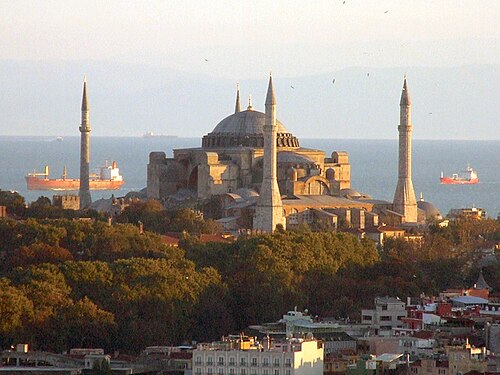
330年、コンスタンティヌス帝 は帝国の首都をビザンチウムに移し、ビザンチウムは後にコンスタンティノープルとなった。[147]帝国の重心は東地中海に完全に移ったことが十分に認識された。ローマは元老院をコンスタンティノープルに奪われ、帝国の首都としての地位と威厳を失った。[g]
コンスタンティヌス帝がビザンティウムに移ったとき、ビザンティウムの司教はヘラクレア大主教の権威の下にあった。 [35]その後、司教は帝国宮廷とのつながりにより、ヘラクレアへの教会の従属から解放され、半世紀余りで、新首都で開催されたコンスタンティノープル第1公会議(381) でローマに次ぐ地位を認められることとなった。公会議では「しかし、コンスタンティノープルの司教はローマの司教に次ぐ名誉の特権を持つ。なぜなら、コンスタンティノープルは新ローマだからである」と定められ、[137]アレクサンドリアやアンティオキアの司教区よりも上位に位置づけられた。これが、東西の分裂につながる要因となったコンスタンティノープルとローマの教会間の対立の種をまいたとされている。[148] [149]アメリカ正教会のウェブサイトによると、ビザンツの司教はコンスタンティヌス帝の時代にすでに総主教に昇格していたという。 [150]
ローマ帝国の分裂は教会の分裂を招いた。380年にニカイア・キリスト教をローマ帝国の国教として制定した(テサロニケ勅令参照)テオドシウス大帝は、統一されたローマ帝国を統治した最後の皇帝であった。395年にテオドシウスが死去した後、帝国は最終的に西半分と東半分に分割された。4世紀には、(コンスタンティノープルを統治していた)ローマ皇帝が領土内の教会を統制し始めた。[151]
コンスタンティノープル総主教は他の総主教に対してしばしば命令的立場を取ろうとし、抵抗を招いた。例えば、431年にアレクサンドリア総主教キュリロスはコンスタンティノープル総主教ネストリウスを異端の罪で弾劾した。[152]
5世紀前半、コンスタンティノープルの昇格に対するアレクサンドリアの反対は、両司教区の間で絶え間ない争いを招いたが[153] 、ローマはこれを支持し、ローマ、アンティオキア、アレクサンドリアの3つのペトロス司教区が最重要司教区であるという説を提唱した[154]。
しかし、コンスタンティノープル総主教の権力は拡大し続けた。[155]東方正教会は、カルケドン公会議(451年)[156]の第28条はローマとコンスタンティノープルの司教の平等を明確に宣言し、コンスタンティノープルに最高教会法廷を設立したと述べている。[156]帝都総主教は、ビザンチン帝国の指導的司教になるための努力に成功し[116]、「彼は広大な教区を率い、コンスタンティノープルに住む他の司教たちは常設の教会会議を構成し、それが教会の実質的な統治機関となった」。[25]
595年に亡くなったコンスタンティノープル総主教ヨハネス4世は「エキュメニカル総主教」の称号を継承した。[138]
帝国の首都がローマからコンスタンティノープルに移ったことで、教会の首位権も移ったという考えは、ヨハネス・フィロポノス(490年頃~570年頃)の時代には未発達の形で見られ、最も進んだ形ではコンスタンティノープルのフォティオス1世(810年頃~893年頃)によって表明された。帝国の、そしてそれゆえ世界の支配者の座であるコンスタンティノープルは、総主教区の中で最も高位にあり、皇帝と同様に総主教区を統治する権利を持っていた。[157]
ニカイア公会議 (325)
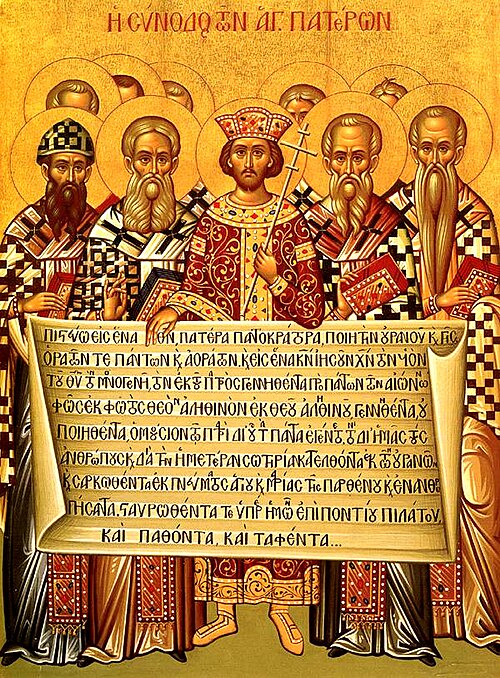
ローマ皇帝コンスタンティヌス大帝は、ミラノ勅令によりキリスト教を公認した後、 325年にニカイアで第1回全地公会議を招集した。公会議の司教たちは、ローマとアレクサンドリアの大主教区が自らの属州外でも権威を持つ地位にあること、またアンティオキアと他の属州の教会が持つ既存の特権を確認した。[158]これらの教区は後に総主教区と呼ばれるようになった。[要出典]これらには優先順位が与えられ、帝国の首都であるローマが当然第一位となり、次にアレクサンドリアとアンティオキアが続いた。公会議は別の規則で、同じ大主教の管轄下にある他の教区よりもエルサレムに特別な栄誉を与えることも承認した。 [159]
第一コンスタンティノープル公会議(381)
ローマ帝国の皇帝 テオドシウス 1世は、381年に帝都コンスタンティノープルで第2回全地公会議(第1回コンスタンティノープル会議)を招集した。この会議はコンスタンティノープルの司教区をローマを除く他の主要大都市の司教区よりも上位に昇格させ、アレクサンドリアやアンティオキアの司教区よりも上位に位置付けた。 [h]この行動はコンスタンティノープルとローマの教会間の対立の種をまいたと言われており、最終的には東西の分裂につながる要因となった。[148] [149] [137]
この公会議は、東方プラエトリアニ管区内の領域を、 5つの民間教区に対応する5つの教会法上の領域に区分した。エジプト教区(アレクサンドリアの大都市)、東方教区(アンティオキアの大都市)、アジア教区(エフェソスの大都市)、ポントス教区(カエサレア・カッパドキアの大都市)、トラキア教区(ヘラクレアの大都市、後にコンスタンティノープルの管轄)である[要出典] 。 [160]公会議は、アジア、ポントス、トラキアの民間教区の教会について言及し、各州の教会会議は、アレクサンドリアとアンティオキアの司教区に既に認められている特権を除き、その州の教会問題を単独で管理することを布告した。[160]
一般的に、西方司教は公会議に出席しなかったが[161]、テッサロニキ(当時ローマの管轄下にあった都市)のアスコリウスは出席し、教皇ダマススから「完全に非難の余地のない司教」がコンスタンティノープルに選出されることを確実にするよう命じられた。 [要出典]ラテン教会は当初、この公会議の規範を受け入れていたようで、カルケドン公会議中にローマの使節が規範の1つを引用したことが証拠となっている[要出典]。現存するすべての資料にはこれらの規範が含まれている。[162]
カルケドン公会議(451)
ローマの『レオの書』(449)は高く評価され、カルケドン公会議の定式化の基礎となった。しかし、それは普遍的に受け入れられたわけではなく、それを承認し受け入れた公会議を非難する人々からは「不敬虔」で「冒涜的」とさえ呼ばれた。[163]次の公会議は、教皇レオのプレゼンテーションの不均衡を修正した。ローマ司教はこの早い時期から尊敬されていたが、東方では、ローマ教皇座の優位性と教皇の不可謬性の概念はずっと後になってから発展したとされている。
451年のカルケドン公会議の論争の的となった[138] [164]第28条は、コンスタンティノープルがすでに持っていた権威を確認し、その大司教にポントゥスとトラキアの管轄権を与えた。[156]
公会議はまた、アンティオキアとエルサレムの間の協定を批准し、それによってエルサレムは3つの州を管轄し、[165] 5つの大司教区の中に数えられた。[166]このように解釈されると、ビザンチン帝国内の教会を統括する総主教は、ローマ総主教、コンスタンティノープル総主教、アレクサンドリア総主教、アンティオキア総主教、エルサレム総主教の順で5人いたことになる。
この決議が可決されたとき、代表団は欠席していたレオ1世は、公会議をエキュメニカルなものとして認め、その教義上の法令を確認したが、ニカイア公会議の第6条に違反し、アレクサンドリアとアンティオキアの権利を侵害しているという理由で、公会議の規則28を拒否した。[161]
この教会法は、1054年の相互破門によってその点で無関係になるまで、東西間の絶え間ない摩擦の原因であり続けました。 [167]しかし、コンスタンティノープル総主教区の権威への適用性についての論争は今も続いています。[168]
論争の的となった同じ教会法典では、コンスタンティノープルが「蛮族」の教区の司教に対して権威を持つことも認められていたが、これはビザンチン帝国外のすべての地域を指すものと解釈されているほか、ポントゥス、アジア、トラキアの近隣地域のみを指すものとも、帝国内の非ギリシャ人を指すものとも解釈されている。[138]
公会議のカノン9では、「司教または聖職者が属州大主教と意見の相違がある場合、その司教は教区総督またはコンスタンティノープル帝国都市の王座に訴え、そこで審理を受けるものとする」とも宣言されている。これは、コンスタンティノープル司教区に、ローマに与えたどの公会議よりも大きな特権を与えた、あるいはそれよりもずっと重要性の低い特権を与えたと解釈されている。[169]
西ローマ帝国からの分離
476年、ローマ帝国西部の最後の皇帝が退位し、西ローマ帝国の紋章がコンスタンティノープルに送られると、再びローマ皇帝が一人だけになった。しかし、西ローマ帝国はゲルマン諸部族によってほぼ完全に支配されており、皇帝の権力は西ローマ帝国ではほとんどなかった。ランドール・R・クラウドの意見では、ギリシャ東部とラテン西部の永久的な分離が「ギリシャ人とラテン人のキリスト教徒の間にすぐに生じた疎遠の根本的な原因」であった。[170]
西方ではラテン語が、東方ではギリシャ語が優勢であった。西方侵略者の侵略により陥落すると、両言語を話す人の数は減り、東西間の意思疎通はより困難になった。言語的統一が失われるとともに、文化的統一も崩れ始めた。教会の両派は、自然に同じような線に沿って分裂した。それぞれ異なる儀式を発展させ、宗教的教義に対するアプローチも異なっていた。分裂はまだ数世紀先のことであったが、その輪郭はすでに感じられた。[171]
ユスティニアヌス1世は、支配地域において、教会の憲法として皇帝教皇制を確立した。その制度によれば、皇帝は「礼拝と規律の細部を法律で規制する権利と義務を持ち、また教会で保持されるべき神学的見解を指示する権利と義務を持つ」とされた。 [172]ウェストミンスター神学用語辞典によると、この皇帝教皇制は「ローマとコンスタンティノープルの争いの原因となり、1054年の分裂につながった」。[173]帝国内の司教の叙階には、コンスタンティノープルの皇帝の明確な承認が必要であった。ビザンチン教皇制と呼ばれる時代には、これはローマの司教に適用され、そのほとんどはギリシャ人またはシリア人であった。ビザンチン皇帝による教会統治に対する西方における憤りは、6世紀にまで遡り、「アリウス派ゴート王の寛容さがコンスタンティノープルの皇帝教皇の主張よりも好まれた」時代にまで遡る。[174]西方と東方の異なる態度の起源は、時にはヒッポのアウグスティヌスにまで遡る。アウグスティヌスは「教会と国家の関係を『神の都』と『世界の都』の間の緊張関係とみなした」し、エウセビオスは「国家を教会の守護者、皇帝を地上における神の代理人とみなした」。[175]
3つの総主教区の衰退
661年までに、アラブ系イスラム教徒はアレクサンドリア、アンティオキア、エルサレムの総主教区に割り当てられた領土を占領したが、これらの領土はその後、部分的に、かつ一時的に回復されたに過ぎなかった。732年、イサウリアのレオ3世皇帝は、皇帝の偶像破壊政策に対する教皇グレゴリウス3世の反対に対する報復として、シチリア、カラブリア、イリュリアをローマ総主教区(その管轄は当時は東はテッサロニキまで及んでいた)からコンスタンティノープル総主教区に移管した。[176]コンスタンティノープル総主教区は、カルケドン公会議の時に東に拡大して、当時まだ皇帝の支配下にあったポントスとローマ属州アジアを併合した後、西にも同様に拡大し、実質的にビザンチン帝国とほぼ同じ広さになった。
トゥルッロの評議会 (クイニセクスト、692)
西方教会が692年の第五十六回公会議を拒否したことで、東ローマ帝国は西方教会に対し、多くのラテン慣習を非正統派として拒否するよう圧力をかけた。他の総主教区の注目を集め[要出典]、この公会議で非難されたラテン慣習には、四旬節に平日にミサを行う慣習(聖化前の典礼を行わない)[177]、年間を通じて土曜日に断食すること[178] 、四旬節に「アレルヤ」を省略すること、キリストを子羊として描くこと[179]、無酵母パンを使用すること[180]などがあった。
司祭と助祭の独身制に対する東西の考え方に関して、より大きな論争が明らかになりました。公会議は、既婚男性が司祭になる権利を認め(ただし、司祭の結婚と司教の妻との同居は禁じた)[181] [182]、司教以外の聖職者を妻から引き離そうとする者、または妻を解雇した司教以外の聖職者には罷免を命じました。[183]
シリア系教皇セルギウス1世は公会議を拒否した。 [184]ユスティニアヌス2世皇帝は彼の逮捕を命じたが[185] 、これは阻止された。[186] [187]
694年、西ゴート王国 スペインでは、ウィティサ王の要請により、第18回トレド公会議でこの公会議が批准された。アストゥリアス王フルエラ1世は、その治世中(757-768年)のある時点でトレドの決定を覆した。[要出典]
教皇の至上権と五大政翼賛
分裂の主な原因は、管轄権の相反する主張、特に教皇の権威(教皇レオ9世は東方4総主教よりも権威があると主張した)と、1014年に西方総主教がニカイア信条にフィリオクエ条項を挿入したことをめぐる論争であった。 [188]今日の東方正教会は、カルケドン公会議の規則28がローマとコンスタンティノープルの司教の平等を明示的に宣言し、コンスタンティノープルに教会の最高控訴裁判所を設立したと述べている。[189]エフェソス公会議の規則7は次のように宣言した。
ニカイアで聖霊とともに集まった聖なる父祖たちによって確立された信仰に対抗するものとして、異なる( ἑτέραν )信仰を提唱したり、書いたり、創作したりすることは、いかなる者にとっても違法である。しかし、異教やユダヤ教、あるいはいかなる異端からであろうと、真理を認めることを望む人々に、異なる信仰をあえて創作したり、それを紹介したり、提供したりする者は、司教または聖職者であれば解任され、司教は司教職から、聖職者は聖職者から解任され、平信徒であれば破門される。
— Schaff 1916、p. 197、第4章 エフェソス公会議、第1会期 使徒言行録からの抜粋
今日の東方正教会は、エフェソス公会議のこの教会法は、 325年の第1回全地公会議で起草されたニカイア信条の修正を明示的に禁止していると主張している。ニカイア信条の文言は第2回全地公会議で修正されたが、内容は修正され、「父から出た者」などの追加があったと主張されている。
東方正教会は、第1エフェソス公会議第7条が、325年の第1回全地公会議で起草されたニカイア信条を(全地公会議以外で)いかなる人間によっても改変することを明示的に禁じていると主張している。 [190]実際には、公会議は全地公会議や他の司教団に対して例外を設けておらず、[191]フィレンツェ公会議に参加したギリシャ人は、全地公会議でさえ信条に何かを加える権限を持っていなかったことを強く否定した。[192]
431年のエフェソス公会議(第三回公会議)で引用されている信条は、381年にコンスタンティノープルで開催された第二回公会議で「父から出た者」という文言が追加されたとされる修正が加えられていない第一回公会議の信条である。[193]東方正教会の神学者は、教会の元の信条の文言のこの変更は、教会外のさまざまな教え、具体的にはコンスタンティノープルのマケドニオス1世の教えに対処するために行われたと述べている。公会議は、この教えは聖霊に関する教会の教えを歪曲していると主張した。これは、教会の元の信条の正統性の変更ではなかった。[194]
したがって、後のエフェソス公会議の第 7 典礼文のἑτέρανという語は、「異なる」または「矛盾する」という意味で理解されており、既存の信条に単に説明を加えるという意味での「別の」という意味ではない。 [192]一部の学者は、コンスタンティノープル公会議によるものとされる追加は、エフェソス公会議の 20 年後の451 年カルケドン公会議でのみ採用されたと主張している。 [195] [196]また、アレクサンドリアの影響が支配的だったエフェソス公会議では、この典礼文によってコンスタンティノープル信条が除外され、最終的にニカイアで採用された信条の名前と名声が併合されたとさえ主張している。[197]
フィリオクエと優位性の問題(867–879)
3回の公会議が開催され、2回はコンスタンティノープルで、1回はローマで開催されました。[198]ローマは、フィリオクエ論争に賛成する人物と、現職の総主教の交代を試みました。正教会は、この交代を非難し、ローマ公会議を招集した教皇を破門し、ローマの管轄外の事柄を統制しようとする教皇の試みを非難し、フィリオクエの追加を異端として非難することで対応しました。各教会は、自らの公会議を正当と認め、他の教会の公会議は認めていません。[199] [200] [201] [202] [199] [203]
1054年の相互破門

西ローマ帝国の終焉; 550 ユスティニアヌス1世の征服; 717 イサウリアヌス帝レオの即位; 867 バシレイオス1世の即位; 1025 バシレイオス2世の死; 1095 第1回十字軍前夜; 1170 マヌエル1世の治世; 1270 ミカエル8世パレオロゴスの治世; 1400 コンスタンティノープル陥落前
1053年、 JBベリーによれば、オフリドのレオはコンスタンティノープル総主教ミカエル・ケルラリウスの唆しを受けて[204] 、教皇を含むすべてのラテン司教に宛てた手紙をトラニのヨハネス司教に書き送り、聖餐に無酵母パンを使用することや、コンスタンティノープルとは異なる断食規則などの西洋の慣習を攻撃した。一方、ケルラリウス自身はコンスタンティノープルのすべてのラテン教会を閉鎖した。
これに応えて、レオ9世は1053年9月2日付けの「In terra pax」[205]という書簡をケルラリウスとオフリドのレオに宛てて書き、その中で聖ペトロを通してローマ教皇に与えられた特権について長々と述べている。書簡の41節のうちの1つでは、皇帝から与えられた特権についても触れており、本物だと信じていたコンスタンティヌスの寄進文書を引用している(第20節)。 [206]一部の学者は、この書簡は実際には発送されず、保管され、教皇が実際に送った返信は1054年1月のより穏やかだが依然として厳しい書簡「Scripta tuae」だったと述べている。 [207]
ノルマン人の南イタリア征服の進展は、ビザンツ帝国と教皇庁の双方の領土にとって脅威となり、両者は互いに支援を求めていた。そのため、皇帝とケルラリウスは教皇に和解の書簡を書いたが、その本文は保存されていない。1054年1月の皇帝への返答「クァンタス・グラティアス」[205]で、レオ9世はノルマン人に対する援助を求め、教皇がケルラリウスの傲慢さだと見なしたことを訴えている。ケルラリウスへの返答[208]では、アレクサンドリアとアンティオキアの総主教を自分に従わせようとしたこと、エキュメニカル総主教の称号を採用したことについてケルラリウスを非難し、ローマ教区の優位性を主張した[206] 。
これら2通の手紙は、外交官ではない枢機卿のウンベルト・ディ・シルヴァ・カンディダを団長とし、教皇秘書官でサンタ・マリア・イン・ドミニカの枢機卿助祭であったフリードリヒ・ド・ロレーヌ、アマルフィ大司教ペテロを含む3人の使節の代表団に託された。彼らは皇帝からは友情と支援を与えられたが、総主教からは拒絶された。そしてついに、1054年4月に教皇レオが死去してから3か月後、次期教皇が就任する9か月前の1054年7月16日、[207]彼らは、聖体礼儀の挙行のために準備されていたアヤソフィアの祭壇に、ケルラリウスとその支持者に対する破門勅書を捧げた。1054年7月20日に開催されたシノドスで、ケルラリウスは今度は使節たちを破門した。[206] [210]実際には、ミカエルだけが当時生きていた信奉者とともに破門された可能性がある。[i]
1054年以来の東と西
分裂のきっかけとなった出来事は一つもなかった。むしろ、数世紀にわたって両教会は分裂したり、そこから抜け出したりを繰り返し、一時的な和解が繰り返された。その後数世紀にわたって、皇帝、教皇、総主教らが両教会の亀裂を癒そうと努力した。しかし、多くの要因と歴史的出来事が、時とともに分裂を広げていった。[211] 1054年には、世界中のキリスト教徒の過半数が東方派キリスト教徒で、残りの大部分が西方派キリスト教徒だったと推定されている。 [212]ティモシー・ウェアが指摘しているように、これらの人々のうち、違いに気付いた者はほとんどいなかっただろう。「1054年以降も東方と西方の友好関係は続いた。キリスト教世界の2つの部分は、まだ両者の間に大きな隔たりがあることを意識していなかった。…この論争は、東方と西方の一般キリスト教徒がほとんど気付いていないままだった」[13]
破門の当時、ビザンチンの年代記作者を含む多くの同時代の歴史家は、この出来事を重要視していなかった。[213] [214] [215] [13]関係は通常通り継続され、例えば聖墳墓教会などの東方教会への寄付はそのまま維持され、グレゴリウス7世はピレネー山脈のマルケにある教会に対するエルサレム総主教の所有権を認めた。[216]
1080年代に皇帝アレクシオス・コムネノスがローマとの関係を断つという教会法上の決定がなされたかどうかを尋ねたとき、コンスタンティノープル会議の参加者はノーと答えた。[217] 12世紀のラテン十字軍と現地住民との交流を見ると、前者が後者を異端者や分離主義者とみなしたのではなく、むしろ彼らは地元の階層を自分たちのものに取り入れていたことがわかる。[218]
11世紀から12世紀のビザンチン帝国における宗派間の緊張
11世紀後半から、ビザンツ帝国はヴェネツィア共和国、そして程度は低いもののジェノヴァ共和国とピサ共和国の海軍に依存していたため、1080年代から大きな貿易特権を得ていたビザンツ帝国ではカトリック商人が優勢となり、経済的、社会的混乱を引き起こした。イタリア人の傲慢さも相まって、地方と都市の両方で中流階級と下層階級の人々の反感をあおった。[219]
12 世紀後半までに、さまざまな都市国家の競争者間の事実上制御不能な対立は、イタリア人が首都の他のイタリア人の居住区を襲撃するまでにまで悪化し、ビザンチン当局による報復的な厳格な措置により、市内の宗教間の関係が悪化しました。
1182年、ラテン商人や大地主貴族を優遇することで悪名高かったフランス系フランス人のマリア皇后の摂政が、民衆の支持を受けてアンドロニコス1世コムネノスによって廃位されると、新皇帝は暴徒に嫌われていた外国人を虐殺することを許した。それ以来、ビザンチン帝国の外交政策は西洋では常に不吉で反ラテン的なものとして認識されるようになった。[220]ビザンチン帝国の神学者テオドール・バルサモンは1190年に、ラテン人がラテンの教義や慣習を捨てて東方の慣習に従うと宣言しない限り、ラテン人に秘跡を与えるべきではないと書いている。しかし、彼は、ラテン人が異端者として非難されておらず、完全な分裂状態にはない、と指摘したデメトリオス・チョマテノス大司教などの同時代の人々から、過度の厳しさであると批判された。ただし、彼はラテン人に聖体拝領を与えるべきか、あるいはその逆かについては明言しなかった。[221]
第4回十字軍(1204年)とその他の軍事紛争
1202年から1204年にかけての第4回十字軍の過程で、ラテン十字軍とヴェネツィア商人はコンスタンティノープル自体を略奪し(1204年)、聖叡智教会やその他の正教会の聖地を略奪し、[222]ラテンカトリックの礼拝に改宗させた。ノルマン十字軍はコンスタンティノープル帝国図書館も破壊した。[223] [224] [225]これらの正教会の聖地からのさまざまな聖遺物が西へ持ち出された。十字軍はまた、コンスタンティノープルのラテン総主教を任命した。[222]コンスタンティノープルの征服と最終条約により、東方ラテン帝国とコンスタンティノープルのラテン総主教が(他のさまざまな十字軍国家とともに)設立された。その後、ビザンツ帝国の資金源として、ヨーロッパで宗教遺物の一部が売却された。コンスタンティノープル皇帝ボードゥアン2世(在位 1228-1261)がフランスでビザンツ帝国の支配を維持するための新たな資金を調達しようとしていたとき、茨の冠の聖遺物を売却したのがその例である。 [226] 1261年、ビザンツ皇帝ミカエル8世パレオロゴスはラテン帝国を滅ぼした。しかし、ビザンツ帝国の中心部に対する西側からの攻撃は、最終的に15世紀にオスマン帝国のイスラム教徒による征服につながった要因と見なされている[誰が? ] 。 [要出典]多くの学者は、1054年の出来事よりも1204年のコンスタンティノープルの略奪の方が分裂に大きく寄与したと考えている。 [227]
北ヨーロッパでは、ドイツ騎士団が12世紀と13世紀の北方十字軍での勝利の後、[228]東方正教会ロシア共和国プスコフとノヴゴロドの征服を(1240年に)試み、この企てはグレゴリウス9世[228](在位 1227-1241)によってある程度支持された。ドイツ騎士団が受けた大きな敗北の一つは、1242年の氷河の戦いである。カトリックのスウェーデンも、正教会ノヴゴロドに対して数回の遠征を行った。カトリックのポーランドと正教会ロシアの間でも紛争があり、東西の分裂を強固なものにした。
第二リヨン公会議(1272年)
第二リヨン公会議は、ミカエル8世が東方教会と西方教会を再統合するという誓約を実行するために召集された。[229]ローマとコンスタンティノープルを分断していた大分裂を終わらせたいと考えたグレゴリウス10世は、コンスタンティノープルを再征服して東方におけるラテン帝国の残党に終止符を打ったミカエル8世に使節を派遣し、東方におけるラテン暴君たちに野心を抑えるよう求めた。
6月29日(教皇の守護聖人である聖ペトロと聖パウロの祝日)、グレゴリウス10世は聖ヨハネ教会でミサを執り行い、双方が参加した。公会議は、ローマ教会が「普遍的なカトリック教会に対する最高かつ完全な首位権と権威」を有していると宣言した。
成立した統合は「見せかけの政治的策略」であり、皇帝が10年以上前の1261年に失ったコンスタンティノープルの街を西洋人が取り戻すのを防ぐために主張した虚構であった。[230] [231] [232]統合は聖職者と人々から激しく反対され[233] [231]、統合の理念に転向したコンスタンティノープル総主教ヨハネス11世(ヨハネス・ベッコス)による統合を知的に擁護する継続的な運動と、ミカエルによる反対者への強力で残忍な弾圧にもかかわらず、実行されなかった。[234] [233] [235] 1278年、ギリシャ人の服従が虚偽であることを知った教皇ニコラウス3世は、 [236]コンスタンティノープルに使節を派遣し、すべての正教会の聖職者に個人的な服従とフィリオクエの採用を要求した。[237]すでにリヨンのギリシャ代表はフィリオクエを含めた信条を暗唱し、さらに2回繰り返すよう求められていた。[238]分裂を解決しようとするミカエル帝の試みは、合同が見せかけに過ぎないことを知った教皇マルティヌス4世が、ミカエル8世に、ミカエルに奪われた東ローマ帝国の属州を奪還する新たな作戦を開始しようとするアンジュー公シャルルの試みを支持するよう、1281年に破門したことで終わった。[233] [239] [240] [241] [242] [243] [244] [245]ミカエル8世の息子で後継者のアンドロニコス2世は結婚を拒否し、ベッコスは退位を余儀なくされ、最終的には追放され、1297年に死ぬまで投獄された。
フェラーラ・フィレンツェ公会議(1439年)
15世紀、東方教会の皇帝ヨハネス8世パレオロゴスは、オスマン・トルコから強い圧力を受け、西方教会との同盟に熱心で、教皇エウゲニウス4世と再び再統合について話し合うよう取り計らった。この会議はフェラーラ・フィレンツェ公会議で開かれた。数回にわたる長い話し合いの末、皇帝は東方教会の代表者たちを説得し、西方教会のフィリオクエ、煉獄、教皇至上主義の教義を受け入れさせた。1439年6月6日、エフェソスのマルコを除くすべての東方教会の司教が協定に署名したが、マルコはローマは異端と分裂を継続していると主張した。大分裂は終わったかに思われた。しかし、帰国した東方司教たちは、西方教会との合意が民衆や行政当局から広く拒否されていることを知った( 20年後のコンスタンティノープル陥落まで統一を貫いた東方皇帝は例外)。フィレンツェで調印された統一は、東方教会によって決して受け入れられなかった。
コンスタンティノープル陥落(1453年)とその後
1453年5月にコンスタンティノープルがオスマン帝国の侵攻により陥落した時点では、ロシア正教はすでにロシアに根付いており、ロシアの政治的、事実上の宗教的中心地はキエフからモスクワに移っていた。15世紀半ばまでコンスタンティノープル教会の一部であったロシア教会は、1589年に完全な独立(独立)を認められ、総主教に昇格した。ロシアの政治および教会のエリートたちは、モスクワをコンスタンティノープルとビザンチン帝国の正当な後継者である第三のローマとみなすようになった。[236]
オスマン帝国の支配下で、正教会は自治ミレット、具体的にはルームミレットの地位を獲得した。エキュメニカル総主教は、非ギリシャ人を含む帝国のすべての正教徒の支配者 (ミレット・バシュ) となった。コンスタンティノープルを征服すると、メフメト2世はビザンチン皇帝の法的機能を引き継ぎ、ゲンナディウス2世を総主教に任命した。スルタンはギリシャ正教のヒエラルキーの世俗的な権力を強化し、政治的にはオスマン帝国のスルタンのみに従うようになり、他のオスマン帝国のギリシャ 貴族とともに、オスマン帝国のバルカン半島正教会の領土を統治するようになった。ロシアでは、 17世紀初頭の動乱期のポーランドの介入によって反カトリック感情が定着したが、これはモスクワをカトリックに改宗させようとする試みと見なされた。現代のロシアの国民の祝日である統一の日(ロシア正教会の祝日)は、1612年にモスクワをポーランドの完全な征服から奇跡的に救ったと信じられているカザンの聖母のイコンを記念する教会の祝典の日として制定された。この時期にモスクワ総主教ヘルモゲネスはポーランド人とその支持者によって処刑された(ポーランド・リトアニア・モスクワ共和国も参照)。[246] [247]
16世紀と17世紀には、ローマ教会と東方正教会内の様々なグループとの統合の試みがあった。カトリック教会と東方正教会の最終的な分離は18世紀になってから起こった。1729年、ローマ教会はベネディクトゥス13世教皇のもとで正教会との交わりを禁止し、1755年にはアレクサンドリア、エルサレム、コンスタンティノープルの総主教が報復としてローマ教会との聖体拝領の最終的な中断を宣言し、カトリックを異端と宣言した。[248]
第一バチカン公会議(1870年)
教皇の首位権の教義は第1バチカン公会議でさらに発展し、「神の定めにより、ローマ教会は他のすべての教会に対して通常権力の優位性を持つ」と宣言された。この公会議では教皇不可謬性の教義も確認され、キリスト教共同体の不可謬性は、教皇が全教会が保持すべき信仰や道徳に関する教義を定義する際に教皇自身にも及ぶと宣言された。この新しい教義は、数年前に『神は不可謬』で公布された無原罪懐胎の教義と同様に、東方教会によって異端として明確に拒絶された。[61] [検証失敗]
相互破門の無効化(1965年)
第二バチカン公会議(第2バチカン公会議)の主要行事は、 1965年に教皇パウロ6世とコンスタンティノープル正教会総主教アテナゴラス1世がカトリックと正教会の共同宣言を発布したことである。同時に、彼らは11世紀に遡る相互破門を解除した。[249]この行為によって聖体拝領は回復されなかった。
東方カトリック教会
東方カトリック教会は、歴史的に正教会によって「統一教会」と呼ばれており、ローマ司教の首位権を受け入れつつ、正教会で普及しているビザンチン典礼などの東方伝統に沿った教会法や典礼慣行の一部を保持することで、東西の分裂を和解させたと考えている。東方正教会の中には、この統一に加わることは、重要な教義上の違いや過去の残虐行為を無視するという代償を伴うと非難する者もいる。
ウクライナとベラルーシでは、当時ポーランドの支配下にあった正教会と東方カトリック教会の間で定期的に紛争が起きており[250]、後にはトランシルヴァニアでも紛争が起きている(ルーマニアのギリシャカトリック教会はローマと合体したを参照)。ロシア帝国、そして後にはソ連において、ウクライナのギリシャカトリック教会などの東方カトリック教会に対して圧力と政府支援による報復が行われた。[251] 1980年代後半以来、モスクワ総主教区(ロシア正教会)は、ウクライナにおける「ユニエイト」教会構造の復興方法と、ロシアにおけるいわゆるカトリック改宗活動を批判してきた。[252]
In 1993, a report written by the Joint International Commission for Theological Dialogue Between the Catholic Church and the Orthodox Church during its 7th plenary session at the Balamand School of Theology in Lebanon stated:[253][j] "Because of the way in which Catholics and Orthodox once again consider each other in their relationship to the mystery of the Church and discover each other once again as Sister Churches, this form of 'missionary apostolate' described above, and which has been called 'uniatism', can no longer be accepted either as a method to be followed nor as a model of the unity our Churches are seeking". At the same time, the document inter alia stated:
- Concerning the Oriental Catholic Churches, it is clear that they, as part of the Catholic Communion, have the right to exist and to act in answer to the spiritual needs of their faithful.
- The Oriental Catholic Churches who have desired to re-establish full communion with the See of Rome and have remained faithful to it, have the rights and obligations which are connected with this communion. The principles determining their attitude towards Orthodox Churches are those which have been stated by the Second Vatican Council and have been put into practice by the Popes who have clarified the practical consequences flowing from these principles in various documents published since then. These Churches, then, should be inserted, on both local and universal levels, into the dialogue of love, in mutual respect and reciprocal trust found once again, and enter into the theological dialogue, with all its practical implications.
In February 2016, Pope Francis and Patriarch Kirill of the Russian Orthodox Church (ROC), had a meeting in Cuba and signed a joint declaration that stated inter alia: "It is our hope that our meeting may also contribute to reconciliation wherever tensions exist between Greek Catholics and Orthodox. It is today clear that the past method of 'uniatism', understood as the union of one community to the other, separating it from its Church, is not the way to re-establish unity. Nonetheless, the ecclesial communities which emerged in these historical circumstances have the right to exist and to undertake all that is necessary to meet the spiritual needs of their faithful, while seeking to live in peace with their neighbours. Orthodox and Greek Catholics are in need of reconciliation and of mutually acceptable forms of co-existence."[254][255][256] Meanwhile, in the interview published on the eve of the meeting in Cuba, Metropolitan Hilarion Alfeyev, the chairman of the Department of External Church Relations and a permanent member of the Holy Synod of the ROC, said that tensions between the Ukrainian Greek Catholic Church and the ROC's Ukrainian Orthodox Church had been recently heightened mainly due to the conflict in Ukraine.[257] The declaration was sharply criticised by Sviatoslav Shevchuk, the Primate of the Ukrainian Greek Catholic Church, who said that his flock felt "betrayed" by the Vatican.[258][259][260]
Recent efforts at reconciliation
Joint Theological Commission
Inspired by Vatican II that adopted the Unitatis Redintegratio decree on ecumenism in 1964 as well as the change of heart toward Ecumenism on the part of the Moscow Patriarchate that had occurred in 1961, the Vatican and 14 universally recognised autocephalous Orthodox Churches established the Joint International Commission for Theological Dialogue Between the Catholic Church and the Orthodox Church that first met in Rhodes in 1980 and is an ongoing endeavour.
Other moves toward reconciliation
On a number of occasions, Pope John Paul II recited the Nicene Creed with patriarchs of the Eastern Orthodox Church in Greek according to the original text.[261] Both he and his successor, Pope Benedict XVI, have recited the Nicene Creed jointly with Patriarchs Demetrius I and Bartholomew I in Greek without the Filioque clause, "according to the usage of the Byzantine Churches".[262][263] This accords with the Catholic Church's practice of including the clause when reciting the Creed in Latin,[264] but not when reciting it in Greek.[265]
In June 1995, Patriarch Bartholomew I, of Constantinople, visited Vatican City for the first time, and joined in the historic inter-religious day of prayer for peace at Assisi. John Paul II and Bartholomew I explicitly stated their mutual "desire to relegate the excommunications of the past to oblivion and to set out on the way to re-establishing full communion".[266] In May 1999, John Paul II was the first pope since the Great Schism to visit an Eastern Orthodox country: Romania. Upon greeting John Paul II, the Romanian Patriarch Teoctist stated: "The second millennium of Christian history began with a painful wounding of the unity of the Church; the end of this millennium has seen a real commitment to restoring Christian unity." John Paul II visited other heavily Orthodox areas such as Ukraine, despite lack of welcome at times, and he said that healing the divisions between Western and Eastern Christianity was one of his fondest wishes.
In June 2004, Bartholomew I's visit to Rome for the Feast of Saints Peter and Paul (29 June) afforded him the opportunity for another personal meeting with John Paul II, for conversations with the Pontifical Council for Promoting Christian Unity and for taking part in the celebration for the feast day in St. Peter's Basilica.
The Patriarch's partial participation in the Eucharistic liturgy at which the Pope presided followed the program of the past visits of Patriarch Dimitrios (1987) and Patriarch Bartholomew I himself: full participation in the Liturgy of the Word, a joint proclamation by the Pope and by the Patriarch of the profession of faith according to the Nicene-Constantinopolitan Creed in Greek and as the conclusion, the final Blessing imparted by both the Pope and the Patriarch at the Altar of the Confessio.[267] The Patriarch did not fully participate in the Liturgy of the Eucharist involving the consecration and distribution of the Eucharist itself.[266]
Prospects for reconciliation
Despite efforts on the part of Catholic popes and Orthodox patriarchs to heal the schism, only limited progress towards reconciliation has been made over the last half-century. One stumbling block is the fact that the Orthodox and the Catholics have different perceptions of the nature of the divide. The official Catholic teaching is that the Orthodox are schismatic, meaning that there is nothing heretical about their theology, and their unwillingness to accept the supremacy of the Pope is presented in Catholic teaching as chiefly an ecclesiological issue, not so much a theological one. The Orthodox object to the Catholic doctrines of purgatory, substitutionary atonement, the immaculate conception, and papal supremacy, among others, as heretical doctrines.[268] With respect to primacy of the pope, the two churches agree that the pope, as Bishop of Rome, has primacy although they continue to have different interpretations of what that primacy entails.
The Catholic Church's attitude was expressed by John Paul II in the image of the Church "breathing with her two lungs".[269] He meant that there should be a combination of the more rational, juridical, organization-minded "Latin" temperament with the intuitive, mystical and contemplative spirit found in the East.[270]
In the Orthodox view, the Bishop of Rome (i.e. the Pope) would have universal primacy in a reunited Christendom, as primus inter pares without the power of jurisdiction.[271]
Ecclesiological reconciliation
The Eastern Orthodox insist that the primacy is largely one of honor, the Pope being "first among equals" primus inter pares. The Catholic Church, on the other hand, insists on the doctrine of supremacy. It is widely understood that, if there is to be reconciliation, both sides will have to compromise on this doctrine. Although some commentators have proposed ways in which such compromise can be achieved, there is no official indication that such compromise is being contemplated.
In his book Principles of Catholic Theology, Pope Benedict XVI (then Cardinal Ratzinger) assessed the range of "possibilities that are open to Christian ecumenism." He characterized the "maximum demand" of the West as the recognition by the East of and submission to the "primacy of the bishop of Rome in the full scope of the definition of 1870..." The "maximum demand" of the East was described as a declaration by the West of the 1870 doctrine of papal primacy as erroneous along with the "removal of the Filioque from the Creed and including the Marian dogmas of the nineteenth and twentieth centuries." Ratzinger asserted that "(n)one of the maximum solutions offers any real hope of unity."[272] Ratzinger wrote that "Rome must not require more from the East than had been formulated and what was lived in the first millennium." He concluded that "Reunion could take place in this context if, on the one hand, the East would cease to oppose as heretical the developments that took place in the West in the second millennium and would accept the Catholic Church as legitimate and orthodox in the form she had acquired in the course of that development, while on the other hand, the West would recognize the Church of the East as orthodox in the form she has always had."[273]
The declaration of Ravenna in 2007 re-asserted the belief that the bishop of Rome is indeed the protos, although future discussions are to be held on the concrete ecclesiological exercise of papal primacy.
Theological reconciliation
Some scholars such as Jeffrey Finch assert that "the future of East–West rapprochement appears to be overcoming the modern polemics of neo-scholasticism and neo-Palamism".[274]
These doctrinal issues center around the Orthodox perception that the Catholic theologians lack the actual experience of God called theoria and thereby fail to understand the importance of the heart as a noetic or intuitive faculty. It is what they consider to be the Catholic Church's reliance on pagan metaphysical philosophy and rational methods such as scholasticism rather than on the intuitive experience of God (theoria) that causes Orthodox to consider the Catholic Church heretical. Other points of doctrinal difference include a difference regarding human nature as well as a difference regarding original sin, purgatory, and the nature of Hell.
One point of theological difference is embodied in the dispute regarding the inclusion of the Filioque in the Nicene Creed. In the view of the Catholic Church, what it calls the legitimate complementarity of the expressions "from the Father" and "from the Father and the Son" does not provide it does not become rigid, affect the identity of faith in the reality of the same mystery confessed.[275][clarification needed] The Orthodox, on the other hand, view inclusion of the phrase to be almost heretical (see also the Trinity section).
More importantly, the Orthodox see the Filioque as just the tip of the iceberg and really just a symptom of a much more deeply rooted problem of theology, one so deeply rooted that they consider it to be heretical and even, by some characterizations, an inability to "see God" and know God. This heresy is allegedly rooted in Frankish paganism, Arianism, Platonist and Aristotelian philosophy and Thomist rational and objective Scholasticism. In opposition to what they characterize as pagan, heretical and "godless" foundations, the Orthodox rely on intuitive and mystical knowledge and vision of God (theoria) based on hesychasm and noesis.[citation needed] Catholics accept as valid the Eastern Orthodox intuitive and mystical understanding of God and consider it complementary to the rational Western reflection.[270][276]
Sacraments
Most Orthodox Churches through economy do not require baptism in the Orthodox Church for one who has been previously baptized in the Catholic Church. Most Orthodox jurisdictions, based on that same principle of economy, allow a sacramental marriage between an Orthodox Christian and some non-Orthodox Christians. The Catholic Church allows its clergy to administer the sacraments of Penance, the Eucharist and Anointing of the Sick to members of the Eastern Orthodox Church, if these spontaneously ask for the sacraments and are properly disposed.[277] It also allows Catholics who cannot approach a Catholic minister to receive these three sacraments from the clergy of the Eastern Orthodox Church, whenever necessity requires or a genuine spiritual advantage commends it, and provided the danger of error or indifferentism is avoided.[277] Catholic canon law allows marriage between a Catholic and an Orthodox.[278] The Orthodox Church will only administer the sacraments to Christians who aren't Orthodox if there is an emergency.
The Code of Canons of the Eastern Churches authorizes the local Catholic bishop to permit a Catholic priest, of whatever rite, to bless the marriage of Orthodox faithful who being unable without great difficulty to approach a priest of their own Church, ask for this spontaneously.[279] In exceptional circumstances Catholics may, in the absence of an authorized priest, marry before witnesses. If a priest who is not authorized for the celebration of the marriage is available, he should be called in, although the marriage is valid even without his presence.[280] The Code of Canons of the Eastern Churches specifies that, in those exceptional circumstances, even a "non-Catholic" priest (and so not necessarily one belonging to an Eastern Church) may be called in.[280]
Criticism of reconciliation efforts
The efforts of Orthodox patriarchs towards reconciliation with the Catholic Church has been strongly criticized by some elements of Eastern Orthodoxy, such as the Metropolitan of Kalavryta, Greece, in November 2008.[281]
In 2010, Patriarch Bartholomew I issued an encyclical lauding the ongoing dialogue between the Orthodox Church and other Christian churches and lamenting that the dialogues between the two churches were being criticized in "an unacceptably fanatical way" by some who claim to be defenders of Orthodoxy despite the fact that these dialogues are being conducted "with the mutual agreement and participation of all local Orthodox Churches". The Patriarch warned that "such opponents raise themselves above episcopal synods and risk creating schisms". He further accused some critics of distorting reality to "deceive and arouse the faithful" and of depicting theological dialogue not as a pan-Orthodox effort, but an effort of the Ecumenical Patriarchate alone. As an example, he pointed to "false rumors that union between the Roman Catholic and Orthodox Churches is imminent" claiming that the disseminators of such rumors were fully aware that "the differences discussed in these theological dialogues remain numerous and require lengthy debate". The Patriarch re-emphasized that "union is not decided by theological commissions but by Church Synods".[282]
References
Notes
- ^ A late 11th-century pamphlet, Against the Franks[4] that was falsely attributed to Photios I of Constantinople lists this as the second point, right after the Filioque.[5][6]
- ^ In 1995, John Paul II wrote: "With the power and the authority without which such an office would be illusory, the Bishop of Rome must ensure the communion of all the Churches." He invited "Church leaders and their theologians to examine with me in a patient and fraternal dialogue on this subject, a dialogue in which, leaving useless controversies behind, we could listen to one another, keeping before us only the will of Christ for his Church and allowing ourselves to be deeply moved by his plea 'that they may all be one ... so that the world may believe that you have sent me'[36] The Ravenna document of 13 October 2007[37] is one response to this invitation.
- ^ Oriental Orthodox churches
- ^ Protestant churches
- Lutheranism[55]
- Presbyterianism[56]
- Methodism[57]
- ^ The Orthodox attitude to the papacy is expressed by a 12th-century writer, Nicetas, Archbishop of Nicomedia
My dearest brother, we do not deny to the Roman Church the primacy amongst the five sister Patriarchates; and we recognize her right to the most honorable seat at an Ecumenical Council. But she has separated herself from us by her own deeds, when through pride she assumed a monarchy which does not belong to her office... How shall we accept decrees from her that have been issued without consulting us and even without our knowledge? If the Roman Pontiff, seated on the lofty throne of his glory, wishes to thunder at us and, so to speak, hurl his mandates at us from on high, and if he wishes to judge us and even to rule us and our Churches, not by taking counsel with us but at his own arbitrary pleasure, what kind of brotherhood, or even what kind of parenthood can this be? We should be the slaves, not the sons, of such a Church, and the Roman See would not be the pious mother of sons but a hard and imperious mistress of slaves
— [121] - ^ The First Council of Ephesus in 431 stated that it condemned Nestorius "compelled thereto by the canons and by the letter of our most holy father and fellow-servant Coelestine, the Roman bishop"[137][136]
- ^ See also the Fall of Rome
- ^ Following the establishment of Constantinople (the ancient city of Byzantium) as the state capital of the Roman Empire in the early part of the 4th century, a series of significant ecclesiastical events saw the status of the Bishop of New Rome (as Constantinople was then called) elevated to its current position and privilege.[155]
- ^ "[...] the Roman legates excommunicated him [...] But [...] there was no [...] general excommunication of the Byzantine Church, still less of all the East. The legates carefully provided against that in their Bull. [...] They excommunicated Caerularius, Leo of Achrida, and their adherents. [...] The real tragedy is that gradually all the other Eastern patriarchs took sides with Caerularius, [...] and chose [...] to share his schism. [...] The emperor (not Constantine IX, but his successor) was on the side of his patriarch and they had learned too well to consider the emperor as their over-lord in spiritual matters too. [...] it was the usurped authority of Constantinople, the Erastianism of the East that turned a personal quarrel into a great schism."[40]
- ^ The report contains unofficial suggestions of the commission, "until the competent organs of the Catholic Church and of the Orthodox Churches express their judgement in regard to it."[253]
Citations
- ^ a b c d e f g Cross & Livingstone 2005, p. 706.
- ^ D'Agostino 2008.
- ^ Bayer 2004.
- ^ Palatianos n.d.
- ^ Hergenröther 1869, pp. 62–71.
- ^ Beck 1982, pp. 245–247.
- ^ Lembke 2010.
- ^ Dragani 2005, p. 44.
- ^ Bihlmeyer & Tüchle 1967, p. 102.
- ^ Bury 1923, p. 267.
- ^ Siecienski 2010, p. 113.
- ^ Bayer 2004, p. 80.
- ^ a b c Ware 1963, p. 67.
- ^ Nichols 2010, p. 281.
- ^ "Canon 844 §3". Code of Canons of Oriental Churches. 2007. Retrieved 9 March 2020.
- ^ Anon. 2001, p. 149.
- ^ Pelikan 1971, p. 170.
- ^ a b Haight 2004, p. 289.
- ^ Doyle, Furry & Bazzell 2012, p. 311.
- ^ Millet 2010, pp. 43–44.
- ^ a b Volf 1998, p. 42.
- ^ Volf 1998, p. 44.
- ^ Cleenewerck 2007, pp. 107–108, 209–.
- ^ Ferencz 2006, pp. 21–22.
- ^ a b Becchio & Schadé 2006, §8.
- ^ Ware 1963, p. 27.
- ^ McPartlan 1995, p. xv.
- ^ Volf 1998, p. 43.
- ^ Garuti 2004, p. 66, Note 276.
- ^ Gaillardetz 2006, p. 46.
- ^ Cleenewerck 2007, p. 22.
- ^ Shaw 2000, p. 40.
- ^ "Dogmatic Constitution on the Church of Christ, Chapter 4 – On Faith and Reason". First Vatican Council (1869–1870). Archived from the original on 7 February 2006.
- ^ "Canon 181". Code of Canons of Oriental Churches. 2007. Retrieved 9 March 2020.
- ^ a b Ware 1963.
- ^ John Paul II 1995, para 96.
- ^ "Ecclesiological and Canonical Consequences of the Sacramental Nature of the Church. Ecclesial Communion, Conciliarity and Authority". Europaica Bulletin. Ravenna: Department for External Church Relations of the Moscow Patriarchate. 13 October 2007. Retrieved 4 March 2020.
- ^ Ignatius of Antioch 1846, p. 116.
- ^ Lossky 1976, p. 176.
- ^ a b Fortescue 1912.
- ^ Guimarães, Atila Sinke. "Curiosities from the 'Orthodox' Arena". Tradition in Action.
- ^ Pope Paul VI (21 November 1964), Decree on Ecumenism : Unitatis Redintegratio, Rome: The Vatican, n. 17
- ^ a b Pomazansky 1984, p. 14, On the procession of the Holy Spirit.
- ^ a b Romanides, John S. "Filioque". Archived from the original on 29 July 2009.
- ^ a b Romanides, John S. Franks, Romans, Feudalism, and Doctrine – Part 2. Empirical Theology versus Speculative Theology – Empirical Theology.
- ^ Bindley 1980, p. 78.
- ^ a b Schaff 1877, p. 24, § 8. The Nicene Creed.
- ^ "Nicene Creed" (PDF). armenianchurchlibrary.com. Retrieved 8 March 2020.
- ^ "About Us". Saint Mary & Archangel Michael Coptic Orthodox Church. Retrieved 9 March 2020.
- ^ "A Brief History of the 1st Universial Council of Nicea". Nine Saints Ethiopian Orthodox Monastery. Archived from the original on 26 January 2011.
- ^ "The Nicene Creed". Syriac Orthodox Resources. 8 June 1997. Archived from the original on 7 May 2012.
- ^ "Creed of Nicaea". Holy Apostolic Catholic Assyrian Church of the East – Archdiocese of Australia, New Zealand and Lebanon. Archived from the original on 3 July 2020. Retrieved 9 March 2020.
- ^ Catholic Church 1994, p. 65, para 246.
- ^ "The 39 Articles of Religion (1562)". The Victorian Web. December 2001. Retrieved 9 March 2020.
- ^ "The Three Ecumenical Creeds". Book of Concord : The Confessions of the Luthernan Church. Retrieved 9 March 2020.
- ^ Ashley, Greg. "The Nicene Creed". Saint Andrews Reformed Presbyterian Church. Retrieved 9 March 2020.
- ^ "United Methodist Hymnal". Archived from the original on 5 February 2012. Retrieved 22 January 2009.
- ^ Catholic Church 1994, p. 65, para 247.
- ^ "Q & A on the Reformed Chaldean Mass". Archived from the original on 2 January 2009.
- ^ "The Greek and the Latin Traditions regarding the Procession of the Holy Spirit". L'Osservatore Romano. 20 September 1995. Archived from the original on 26 October 2009.
- ^ a b "Encyclical of the Eastern Patriarchs, 1848 : A Reply to the Epistle of Pope Pius IX, "to the Easterns"". sourcebooks.fordham.edu. Retrieved 27 May 2019.
- ^ Quoting Aleksey Khomyakov on the Filioque and economy of the Eastern Churches and Roman Catholicism Lossky 1969, p. 87
- ^ Lossky 1976.
- ^ Lossky 1976, p. 21.
- ^ Vlachos 1994, Ch. VI.
- ^ Pomazansky 1984, p. 2, Philosophy and Theology.
- ^ "The Relationship between Prayer and Theology". The American Carpatho-Russian Orthodox Diocese of the U.S.A. 9 May 2000. Archived from the original on 11 October 2007. Retrieved 23 February 2013.
- ^ a b Georgios, Archimandrite (n.d.). "The Neptic and Hesychastic Character of Orthodox Athonite Monasticism". greekorthodoxchurch.org. Retrieved 9 March 2020.
- ^ a b Vlachos 1994, Ch. III.
- ^ Romanides 2008, pp. 19–23.
- ^ Romanides 1983, p. 232.
- ^ Vlachos 1993, The Fall of man.
- ^ a b Romanide, John S. (n.d.). "The Cure of the Neurobiological Sickness of Religion". The Council Of Orange 529 Condemned Augustine's Interpretation of Romans 5:12. Retrieved 9 March 2020.
- ^ Hughes n.d.
- ^ Giannaras 1984, p. 151.
- ^ "Original Sin and Orthodoxy: Reflections on Carthage – Orthodoxy and Heterodoxy". 20 June 2016. Archived from the original on 20 June 2016. Retrieved 13 June 2021.
- ^ "Original Sin and Ephesus: Carthage's Influence on the East – Journal". 4 January 2019. Retrieved 13 June 2021.
- ^ "Philip Schaff: NPNF2-14. The Seven Ecumenical Councils – Christian Classics Ethereal Library". www.ccel.org. Retrieved 13 June 2021.
- ^ "Metropitan Ephraim and Original Sin". www.orthodoxchristianbooks.com. Retrieved 13 June 2021.
- ^ "Romanides on Original Sin". www.orthodoxchristianbooks.com. Retrieved 13 June 2021.
- ^ Rōmanidēs & Gabriel 2002, p. 8.
- ^ Original Sin And Its Consequences. Metropolitan Archbishop Sotirios, Orthodox Catechism: Basic Teachings of the Orthodox Faith
- ^ a b Bratcher 2018.
- ^ Catholic Church 1994, p. 102, para 403.
- ^ a b c Catholic Church 1994, p. 102, para 405.
- ^ a b Catholic Church 1994, p. 105, para 418.
- ^ Trigilio & Brighenti 2011.
- ^ Macquarrie 2001, p. 75.
- ^ Ware 1995, p. 77.
- ^ a b Azkoul 1994.
- ^ "An Orthodox View of the Virgin Mary". orthodoxinfo.com. Retrieved 2 March 2020.
- ^ "The Patriarchal Encyclical of 1895". orthodoxinfo.com. Retrieved 3 March 2020.
- ^ Sparks 2008, p. 1363.
- ^ Luke 1:30–31
- ^ Rausch & Clifford 2003, p. 20.
- ^ Catholic Church 1994, p. 268, para 1030.
- ^ a b c Campbell 1996, p. 54.
- ^ Catholic Church 1994, p. 456, para 1863.
- ^ Vlachos 1996, 2. The teaching of St. Mark Eugenicus about the purifying fire.
- ^ Toner 1913.
- ^ "An Online Orthodox Catechism". Department for External Church Relations of the Moscow Patriarchate. Retrieved 9 March 2020.
- ^ a b Vlachos 1996, Ch.7 Paradise and Hell.
- ^ "An Online Orthodox Catechism". Department for External Church Relations of the Moscow Patriarchate. Retrieved 9 March 2020.
- ^ Lossky 1976, p. 234.
- ^ Catholic Church 1994, p. 267, para 1024.
- ^ Catholic Church 1994, p. 269, para 1033.
- ^ Herrin 2013, p. 11.
- ^ VanVoorst 2012, p. 14.
- ^ Stefoff 2008, p. 62.
- ^ Dawson 2008, p. 140.
- ^ Schaff 1904.
- ^ Runciman 2004.
- ^ "Church and State in the Byzantine Empire". Encarta. Archived from the original on 29 October 2009.
- ^ "Church and State in Western Europe". Encarta. Archived from the original on 29 October 2009.
- ^ Dwyer 1998, p. 118.
- ^ a b Bunson 2014, p. 115.
- ^ Geanakoplos 1989, p. 226.
- ^ Knowles & Cunningham 2019.
- ^ Krehel 2017.
- ^ a b Kelly & Walsh 2005, p. 6.
- ^ Runciman 1955, p. 116 and Ware 1963
- ^ Phan 2000, p. 37.
- ^ Becchio & Schadé 2006, p. 805.
- ^ Soloviev 2009, p. 14.
- ^ Makrides 2009, p. 68.
- ^ Nichols 2010, pp. 227–272.
- ^ Kling 2004, p. 61.
- ^ Hopko 2005.
- ^ Schaff 1904, p. 241, Ch. XXIII.
- ^ "An Orthodox Christian Historical Timeline". Orthodox Answers. Archived from the original on 23 July 2012. Retrieved 23 February 2013.
- ^ Schaff 1904, p. 242, Ch. XXIV.
- ^ a b Cleenewerck 2007, p. 156.
- ^ Nichols 2010, p. 199.
- ^ Schaff 1916, pp. 413–414, Ch. IX Council of Sardica.
- ^ Nichols 2010, p. 202.
- ^ a b Nichols 2010, p. 203.
- ^ a b c Schaff 1916, p. 178, Ch. III The First Council of Constantinople, Canon III.
- ^ a b c d Michalopulos 2009.
- ^ Nichols 2010, p. 208.
- ^ Nichols 2010, pp. 209–210.
- ^ Nichols 2010, p. 210.
- ^ Whitehead 2000, pp. 244–.
- ^ Ayer 1941, p. 537.
- ^ Robinson 1905, pp. 72–73.
- ^ Ware 1963, p. 51.
- ^ Galli 1997.
- ^ Rautman 2006, p. 17.
- ^ a b Geanakoplos 1989, p. 172.
- ^ a b Baker & Landers 2005, p. 110.
- ^ "Saint Metrophanes, first Patriarch of Constantinople". oca.org. Retrieved 2 March 2020.
- ^ Binns 2002, pp. 162–164.
- ^ McGuckin 1994, p. 173.
- ^ Schatz 1990, Part II.
- ^ Gaillardetz & Wilson 2003, p. 211.
- ^ a b "History of the Ecumenical Patriarchate". The Ecumenical Patriarchate of Constantinople. Archived from the original on 10 May 2010.
- ^ a b c Schaff 1916, p. 287, Ch. V. The Council of Chalcedon, Canon XXVIII.
- ^ Anastos 2001.
- ^ Schaff 1916, p. 15, Ch. I: The First Council of Nice.
- ^ Schaff 1916, p. 17, The First Council of Nice, Canon VII.
- ^ a b Schaff 1916, pp. 176–177, Ch. III The First Council of Constantinople, Canon II.
- ^ a b Collier 1911.
- ^ https://biblehub.com/library/schaff/the_seven_ecumenical_councils/introduction_on_the_number_of.htm Hefele, History of the Councils, Vol. II., p.351.
- ^ Severus 1903, p. 254.
- ^ Patriarch Alexis of Moscow and All Russia (1 February 2005). "A Letter To The Ecumenical Patriarch Concerning The Situation Of The Diaspora". orthodoxytoday.org. Retrieved 7 March 2020.
- ^ Schaff 1916, p. 266, Ch. V. The Council of Chalcedon, Decree on the Jurisdiction of Jerusalem and Antioch.
- ^ Ware 1963, p. 34.
- ^ McGuckin 2010, pp. 32, 137.
- ^ McGuckin 2010, p. 137.
- ^ Schaff 1916, p. 274, Ch. V. The Council of Chalcedon, Canon IX, Notes.
- ^ Cloud 2009, p. 222.
- ^ "Orthodox Church in the Philippines – East–West Schism 01". Orthodox.org.ph. Archived from the original on 5 September 2012. Retrieved 23 February 2013.
- ^ Ayer 1941, p. 325.
- ^ McKim 1996, p. 35.
- ^ Wolfram 1990, p. 328.
- ^ Volz 2011, p. 73.
- ^ Kaegi 2019.
- ^ Schaff 1916, p. 391, Ch. VIII The Canons of the Council in Trullo, Canon LII.
- ^ Schaff 1916, p. 389, Ch. VIII The Canons of the Council in Trullo, Canon LV.
- ^ Schaff 1916, p. 401, Ch. VIII The Canons of the Council in Trullo, Canon LXXXII.
- ^ Schaff 1916, p. 370, Ch. VIII The Canons of the Council in Trullo, Canon XI.
- ^ Schaff 1916, p. 364, Ch. VIII The Canons of the Council in Trullo, Canon VI.
- ^ Schaff 1916, p. 370, Ch. VIII The Canons of the Council in Trullo, Canon XII.
- ^ Schaff 1916, p. 371, Ch. VIII The Canons of the Council in Trullo, Canon XIII.
- ^ Ekonomou 2007, p. 222.
- ^ Ekonomou 2007, p. 223.
- ^ Ekonomou 2007, p. 224.
- ^ Ullmann 2004, p. 64.
- ^ Papadakis & Meyendorff 1994, p. 14.
- ^ Hartmann & Pennington 2012, p. 63.
- ^ Schaff 1916, p. 161, Ch. III The First Council of Constantinople.
- ^ Schaff 1916, p. 231, Ch. IV The Council of Ephesus, Canon VII.
- ^ a b Schaff 1916, p. 232, Ch. IV The Council of Ephesus, Excursus on the words πίστιν ἑτέραν.
- ^ Schaff 1916, p. 197, Ch. IV The Council of Ephesus, Session I Extracts from the Acts.
- ^ Pomazansky 1984, p. 17, The equality of honor and the Divinity of the Holy Spirit..
- ^ Kelly 2006, p. 296.
- ^ Leith 1982, p. 31.
- ^ Hussey 1967, p. 177.
- ^ Wilhelm 1908.
- ^ a b Fortescue 1907, pp. 147–148.
- ^ Louth 2007, p. 171.
- ^ Tougher 1997, p. 69.
- ^ Siecienski 2010, p. 103.
- ^ Vauchez & Lapidge 2000, p. 1016.
- ^ Bury 1923, p. 200.
- ^ a b Migne 1882, pp. 744–769.
- ^ a b c Kidd 2013, pp. 208–213.
- ^ a b Setton & Baldwin 1969, pp. 209–210.
- ^ Migne 1882, pp. 773–777.
- ^ Smith 1915, Plate 58A.
- ^ Previté-Orton 1975, p. 276.
- ^ Jeffreys, Haldon & Cormack 2008, p. 596.
- ^ Johnstone, Patrick (2014). The Future of the Global Church: History, Trends and Possibilities. InterVarsity Press. pp. 100, 115.
- ^ Binns 2002, p. 203.
- ^ Dvorník 1945, pp. 29–30: In spite of what happened in 1054, the faithful of both church remained long unaware of any change in their relations and acts of intercommunion were so numerous that 1054 as the date of the schism becomes inadmissible.
- ^ King 2006, p. 6.
- ^ Pohl, Walter; Kramer, Rutger (2021). Empires and Communities in the Post-Roman and Islamic World, C. 400-1000 CE. Oxford University Press. p. 214. ISBN 978-0-19-006794-6. Retrieved 19 January 2024.
- ^ Stopka, Krzysztof (2016). Armenia Christiana: Armenian Religious Identity and the Churches of Constantinople and Rome (4th–15th Century) Volumen 8 de Jagiellonian Studies in History. Wydawnictwo UJ. p. 109. ISBN 978-8323395553. Retrieved 25 December 2022.
- ^ MacEvitt, Christopher (24 November 2010). The Crusades and the Christian World of the East: Rough Tolerance. University of Pennsylvania Press. pp. 111–114. ISBN 978-0-8122-0269-4. Retrieved 9 January 2024.
- ^ Fossier 1986, pp. 506–508.
- ^ Harris 2006, p. 112.
- ^ Andrew P. Roach, James R. Simpson (2016). Heresy and the Making of European Culture: Medieval and Modern Perspectives. Routledge. p. 42. ISBN 9781317122500.
- ^ a b Schaff 1913, p. 320.
- ^ Howard 2011, p. 21.
- ^ Murray 2009, p. 53.
- ^ Bradford 2013, p. 3.
- ^ Nicol 1993, p. 169.
- ^ A. Edward Siecienski (2019). Orthodox Christianity: A Very Short Introduction. Oxford University Press. p. 24. ISBN 978-0190883294.
- ^ a b Christiansen 1997, p. 287.
- ^ Wetterau 1994.
- ^ Nicol 1996, p. 38.
- ^ a b Previté-Orton 1975, p. 735.
- ^ Nicol 1993, p. 63.
- ^ a b c Nicol 1993, p. 79.
- ^ Treadgold 1973, p. 2.
- ^ Schaff 1910a, §18 The Council of Ferrara–Florence. 1438–1445.
- ^ a b Nicol 1993, p. 72.
- ^ Siecienski 2010, p. 140.
- ^ Siecienski 2010, p. 137.
- ^ Williams 2004, p. 37.
- ^ Penn 2007, p. 134.
- ^ Hughes 1979, p. 29.
- ^ Bunson 2004, p. 24.
- ^ Nicol 1971, p. 136.
- ^ Walsh 2006, p. 107.
- ^ Ott 1910.
- ^ Thornton 1854, p. 3.
- ^ Mouravieff 1842, p. 165.
- ^ Encyclopedia Britannica, "Orthodoxy under the Ottomans (1453–1821). Relations with the West"
- ^ Paul VI 1965.
- ^ Pospielovsky 1998, p. 96.
- ^ "The Ukrainian Greek Catholics: A Historical Survey". risu.org.ua. Archived from the original on 20 April 2005. Retrieved 2 June 2012.
- ^ Dikarev 2010.
- ^ a b "Communiqué". Uniatism, method of union of the past, and the present search for full communion. Joint International Commission for the Theological Dialogue between the Roman Catholic Church and the Orthodox Church: 7th plenary session, June 17–24, 1993, Balamand, Lebanon. Vatican City. 24 June 1993. Archived from the original on 23 December 2003.
- ^ "Unity call as Pope Francis holds historic talks with Russian Orthodox Patriarch". BBC News. 13 February 2016. Retrieved 3 March 2020.
- ^ "Historic encounter between the Pope and Patriarch of Moscow and All Russia: Orthodox and Catholics are brothers, not competitors". visnews-en.blogspot.com. Vatican City: Vatican Information Service. 13 February 2016. Archived from the original on 13 February 2016. Retrieved 13 February 2016. Includes full text of the Joint Declaration.
- ^ "Совместное заявление Папы Римского Франциска и Патриарха Московского и всея Руси Кирилла" [Joint statement by Pope Francis and Patriarch of Moscow and All Russia Kirill]. mospat.ru (in Russian). 13 February 2016. Retrieved 4 March 2020.
- ^ "Противоречия полностью не преодолены":Глава церковного МИДа митрополит Иларион об отношениях между Московским патриархатом и Ватиканом [Contradictions are not fully overcome ": Church Foreign Minister Metropolitan Hilarion on relations between the Moscow Patriarchate and the Vatican] (in Russian). Kommersant. 11 February 2016.
- ^ Agence France-Presse (14 February 2016). "Ukrainian Greek Catholics 'betrayed' by pope-patriarch meeting". Hürriyet Daily News. Retrieved 3 March 2020.
- ^ Olson 2016.
- ^ Украинские греко-католики чувствуют себя преданными Ватиканом Подробнее [Ukrainian Greek Catholics feel betrayed by the Vatican] (in Russian). NEWSru. 15 February 2016.
- ^ "The Filioque: A Church Dividing Issue?: An Agreed Statement". United States Conference of Catholic Bishops. 25 October 2003. Archived from the original on 7 March 2012. Retrieved 17 October 2012.
- ^ "Presentation of the Celebration". vatican.va. 29 June 2004. Retrieved 9 March 2020.
Solemnity of the Feast of St. Peter and St. Paul (June 29, 2004)
- ^ Benedict XVI and Bartholomew I recite the Creed in Greek on YouTube
- ^ Missale Romanum 2002 (Roman Missal in Latin), p. 513
- ^ Ρωμαϊκό Λειτουργικό 2006 (Roman Missal in Greek), vol. 1, p. 347
- ^ a b John Paul II 2004.
- ^ Fortino 2005, p. 11.
- ^ "Two Orthodox bishops accuse the Pope of heresy". Vatican Insider. 15 April 2014. Archived from the original on 4 February 2017 – via La Stampa.
- ^ John Paul II 1995, para 54.
- ^ a b Stanford, Hebblethwaite & Hebblethwaite 2005.
- ^ Clapsis 2005.
- ^ Cleenewerck 2007, p. 120.
- ^ Ratzinger, Boeve & Mannion 2010, p. 162.
- ^ Christensen & Wittung 2007, p. 244.
- ^ Catholic Church 1994, p. 64, para 248.
- ^ Nichols 1996, pp. 264–275.
- ^ a b Cassidy & Duprey 1993.
- ^ "Canon 813". Code of Canons of Oriental Churches. 2007. Retrieved 9 March 2020.
- ^ "Canon 833". Code of Canons of Oriental Churches. 2007. Retrieved 9 March 2020.
- ^ a b "Chapter V : The Form of the Celebration of Marriage". Code of Canons of Oriental Churches. 2007. Retrieved 9 March 2020.
- ^ Metropolitan of Kalavryta and Aigialia Ambrosio (20 November 2008). "ΕΙΝΑΙ ΔΥΝΑΤΗ Η ΕΝΩΣΗ ΤΩΝ ΕΚΚΛΗΣΙΩΝ" [Is Union of Churches Possible?]. mkka.blogspot.com. Retrieved 9 March 2020.
- ^ "Patriarch of Constantinople's new encyclical defends Catholic-Orthodox dialogue". Catholic News Agency. 20 February 2010. Retrieved 27 January 2011.
Sources
- Anastos, Milton V (2001). Aspects of the Mind of Byzantium (Political Theory, Theology, and Ecclesiastical Relations with the See of Rome). Variorum Collected Studies. Ashgate Publications. ISBN 0-86078-840-7.
- Anon. (2001). "Chronicle of the Eastern Churches". Eastern Churches Journal. 8 (1–2). Society of Saint John Chrysostom: 147–.
- Ayer, Joseph Cullen (1941). A source book for ancient church history... Scribner.
- Azkoul, Michael (1994). "What are the differences between Orthodoxy and Roman Catholicism". The Orthodox Christian Witness. 27 (48). Archived from the original on 3 June 2004. Retrieved 12 February 2009.
- Baker, Robert Andrew; Landers, John M. (2005). A Summary of Christian History. B&H. ISBN 978-0-8054-3288-6.
- Bayer, Axel (2004). Spaltung der Christenheit: das sogenannte Morgenländische Schisma von 1054 [Christianity split : the so-called Oriental Schism of 1054] (in German). Böhlau. ISBN 978-3-412-14204-9.
- Becchio, Bruno; Schadé, Johannes P. (2006). Encyclopedia of World Religions. Foreign Media Group. ISBN 978-1-60136-000-7.
- Beck, Hans-Georg (1982), Byzantinisches Lesebuch (in German), München
{{citation}}: CS1 maint: location missing publisher (link) - Bihlmeyer, Karl; Tüchle, Hermann (1967). Church History: The Middle Ages. Newman Press.
- Bindley, Thomas Herbert (1980). The Oecumenical Documents of the Faith. Greenwood Press. ISBN 978-0-313-22197-2.
- Binns, John (2002). An Introduction to the Christian Orthodox Churches. Cambridge: University Press. ISBN 978-0-521-66738-8.
- Bradford, Ernle (2013). The Great Betrayal: The Great Siege of Constantinople. E-Reads. ISBN 978-1-61756-800-8.[permanent dead link]
- Bratcher, Dennis (2018). "The Confession of Dositheus (Eastern Orthodox)". crivoice.org. Retrieved 9 March 2020.
- Brujić, Dragan (2004). Vodič kroz svet Vizantije: od Konstantina do pada Carigrada [A guide to the world of Byzantium: from Constantine to the fall of Constantinople] (in Bosnian). Beograd: Dina. ISBN 978-86-85275-02-9.
- Bunson, Matthew (2004). OSV's Encyclopedia of Catholic History. Our Sunday Visitor. ISBN 978-1-59276-026-8.[permanent dead link]
- Bunson, Matthew (2014). Encyclopedia of the Roman Empire. Infobase. ISBN 978-1-4381-1027-1.
- Bury, John Bagnell (1923). The Cambridge Medieval History. Vol. IV. Cambridge: University Press.
- Campbell, Ted (1996). Christian Confessions: A Historical Introduction. Westminster John Knox Press. ISBN 978-0-664-25650-0.
- Carlton, Clark (2007). The Truth: What Every Roman Catholic Should Know about the Orthodox Church. Regina Orthodox Press. ISBN 978-0-9649141-8-6.
- Cassidy, Edward Idris Cardinal; Duprey, Pierre (25 March 1993). "Principles and Norms on Ecumenism". vatican.va. Retrieved 9 March 2020.
- Catholic Church (1994). Catechism of the Catholic Church. Liguori. ISBN 978-1884660016.
- Clapsis, Emmanuel (2005). "Papal primacy". Greek Orthodox Archdiocese of America. Archived from the original on 17 June 2008. Retrieved 16 October 2008.
- Cleenewerck, Laurent (2007). His Broken Body: Understanding and Healing the Schism Between the Roman Catholic and Eastern Orthodox Churches. Euclid University Press. ISBN 978-0-615-18361-9. [self-published source].
- Cloud, Randall R. (2009). Aristotle's Journey to Europe: A Synthetic History of the Role Played by the Islamic Empire in the Transmission of Western Educational Philosophy Sources from the Fall of Rome Through the Medieval Period. University Microfilms.
- Collier, Theodore Freylinghuysen (1911). . In Chisholm, Hugh (ed.). Encyclopædia Britannica. Vol. 5 (11th ed.). Cambridge University Press. p. 803.
- Christiansen, Eric (1997). The Northern Crusades. Penguin. ISBN 978-0-14-026653-5.
- Christensen, Michael J.; Wittung, Jeffery A. (2007). Partakers of the Divine Nature: The History and Development of Deificiation in the Christian Traditions. Fairleigh Dickinson Univ Press. ISBN 978-0-8386-4111-8.
- Cross, Frank Leslie; Livingstone, Elizabeth A. (2005). "Great Schism". The Oxford Dictionary of the Christian Church. Oxford: University Press. ISBN 978-0-19-280290-3.
- D'Agostino, Michele Giuseppe (2008). "it". Il primato della sede di Roma in Leone IX (1049-1054): studio dei testi latini nella controversia greco-romana nel periodo pregregoriano [The primacy of the Roman see in Leo IX (1049–54). Study of the Latin texts in the Greek-Roman controversy in the pre-Gregorian period]. San Paolo. ISBN 978-88-215-6062-0. OCLC 470997792.
- Dawson, Christopher (2008). The Formation of Christendom. Ignatius Press. ISBN 978-1-58617-239-8.
- Dikarev, Alexey Viktorovich (16 February 2010). Современное состояние отношений между Русской Православной и Римско-Католической Церквами: официальный взгляд, Алексей Дикарев [The current state of relations between the Russian Orthodox and the Roman Catholic Churches: official view] (in Russian). The official web site of the Moscow Patriarchate.
- Doyle, Dennis Michael; Furry, Timothy J.; Bazzell, Pascal D. (2012). Ecclesiology and Exclusion: Boundaries of Being and Belonging in Postmodern Times. Orbis. ISBN 978-1-60833-217-5.
- Dragani, Anthony (2005). Adrian Fortescue and the Eastern Christian Churches. Gorgias. ISBN 978-1-59333-345-4.
- Dvorník, František (1945). The Study of Church History and Christian Reunion ... Reprinted from The Eastern Churches Quarterly, Etc. Exeter.
- Dwyer, John C. (1998). Church History: Twenty Centuries of Catholic Christianity. Paulist Press. ISBN 978-0-8091-3830-2.
- Ekonomou, Andrew J. (2007). Byzantine Rome and the Greek Popes: Eastern Influences on Rome and the Papacy from Gregory the Great to Zacharias, A.D. 590-752. Lexington Books. ISBN 978-0-7391-1977-8.
- Ferencz, Nicholas (2006). American Orthodoxy and Parish Congregationalism. Gorgias Press. ISBN 978-1-59333-195-5.[permanent dead link]
- Fortescue, Adrian (1907). The Orthodox Eastern Church. Catholic Truth Society.
- Fortescue, Adrian (1912). . In Herbermann, Charles (ed.). Catholic Encyclopedia. Vol. 13. New York: Robert Appleton Company.
- Fortino, Eleuterio F. (9 February 2005). "Report on Catholic-Orthodox Relations". L'Osservatore Romano. Archived from the original on 4 March 2016.
- Fossier, Robert (1986). The Cambridge Illustrated History of the Middle Ages. Cambridge University Press. ISBN 978-0-521-26645-1.
- Gaillardetz, Richard; Wilson, Kenneth (2003). Readings in Church Authority: Gifts and Challenges for Contemporary Catholicism. Ashgate. ISBN 978-0-7546-0530-0.
- Gaillardetz, Richard R. (2006). The Church in the Making: Lumen Gentium, Christus Dominus, Orientalium Ecclesiarum. Paulist Press. ISBN 978-0-8091-4276-7.
- Galli, Mark (1 April 1997). "The Great Divorce". Ctlibrary.com. Archived from the original on 14 September 2011. Retrieved 2 June 2012.
- Garuti, Adriano (2004). The Primacy of the Bishop of Rome and the Ecumenical Dialogue. Ignatius Press. p. 66. ISBN 978-0-89870-879-0.
- Geanakoplos, Deno John (1989). Constantinople and the West: Essays on the Late Byzantine (Palaeologan) and Italian Renaissances and the Byzantine and Roman Churches. Univ of Wisconsin Press. ISBN 978-0-299-11884-6.
- Giannaras, Chrēstos (1984). The Freedom of Morality. St. Vladimir's Seminary Press. ISBN 978-0-88141-028-0.
- Haight, Roger (2004). Christian Community in History. Vol. 1: Historical Ecclesiology. A&C Black. ISBN 978-0-8264-1630-8.
- Harris, Jonathan (2006). Byzantium and the Crusades. A&C Black. ISBN 978-1-85285-501-7.
- Hartmann, Wilfried; Pennington, Kenneth (2012). The History of Byzantine and Eastern Canon Law to 1500. CUA Press. ISBN 978-0-8132-1679-9.
- Hergenröther, J (1869). Monumenta Graeca ad Photium eiusque historiam pertinentiam (in Latin). Regensburg.
{{cite book}}: CS1 maint: location missing publisher (link) - Herrin, Judith (2013). Margins and Metropolis: Authority Across the Byzantine Empire. Princeton University Press. ISBN 978-0-691-15301-8.
- Hopko, Thomas (25 September 2005). "Roman Presidency and Christian Unity in our Time". orthodoxytoday.org. Retrieved 7 March 2020.
- Howard, Jonathan (2011). The Crusades: A History of One of the Most Epic Military Campaigns of All Time. BookCaps Study Guides. ISBN 978-1-61042-804-0.
- Hughes, Antony (n.d.). "Ancestral Versus Original Sin: An Overview with Implications for Psychotherapy". St. Mary Antiochian Orthodox Church. Cambridge, Massachusetts.
- Hughes, Philip (1979). History of the Church. Vol. 3: The Revolt Against The Church: Aquinas To Luther. A&C Black. ISBN 978-0-7220-7983-6.
- Hussey, Joan Mervyn (1967). The Cambridge Medieval History. Vol. 8. Cambridge: University Press. GGKEY:W8456N5J140.
- Ignatius of Antioch (1846). "The Epistle of Ignatius to the Smyrnaeans". In William Wake (ed.). Genuine Epistles of the Apostolic Fathers. Davis.
- Jeffreys, Elizabeth; Haldon, John F.; Cormack, Robin (2008). The Oxford Handbook of Byzantine Studies. Oxford University Press. ISBN 978-0-19-925246-6.
- John Paul II (25 May 1995). "Ut unum sint" [In order to be one!]. 54. Retrieved 4 March 2020.
- John Paul II (29 June 2004). "Common Declaration signed by the Holy Father and the Ecumenical Patriarch His Holiness Bartholomew I". vatican.va. Retrieved 9 March 2020.
- Kaegi, Walter Emil (14 June 2019). "Leo III". Leo III | Byzantine emperor. Encyclopædia Britannica. Retrieved 7 March 2020.
- Kelly, John Norman Davidson; Walsh, Michael J. (2005). The Oxford dictionary of popes. Oxford University Press. doi:10.1093/acref/9780199295814.001.0001. ISBN 978-0-19-861433-3.
- Kelly, J.N.D. (2006). Early Christian Creeds. A&C Black. ISBN 978-0-8264-9216-6.
- Kidd, B.J. (2013). Churches Of Eastern Christendom. Routledge. ISBN 978-1-136-21278-9.
- King, Archdale (2006). The Rites of Eastern Christendom. Vol. 1. Gorgias Press. ISBN 978-1-59333-390-4.
- Kling, David W. (2004). The Bible in History: How the Texts Have Shaped the Times. Oxford: University Press. ISBN 978-0-19-988096-6.
- Knowles, Michael David; Cunningham, Lawrence; et al. (29 November 2019). "Roman Catholicism". Encyclopædia Britannica. Retrieved 8 March 2020.
- Krehel, Damian (2017). "Orthodox Catholic Interpretation of Roman Catholic Claims of Papal Primacy and Jurisdiction". Orthodox Research Institute. Retrieved 8 March 2020.
- Leith, John H. (1982). Creeds of the Churches: A Reader in Christian Doctrine, from the Bible to the Present. Westminster John Knox Press. ISBN 978-0-8042-0526-9.
- Lembke, Martin (Spring 2010), Meetings with the World's Religions (lecture), Lund University: Centre for Theology and Religious Studies
- Lossky, Nicholas O. (1969). History of Russian Philosophy. International Universities Press. ISBN 978-0-8236-8074-0.
- Lossky, Vladimir (1976). The Mystical Theology of the Eastern Church. St Vladimir's Seminary Press. ISBN 978-0-913836-31-6.
- Louth, Andrew (2007). Greek East and Latin West: The Church, AD 681–1071. St Vladimir's Seminary Press. ISBN 978-0-88141-320-5.
- Macquarrie, John (2001). Mary for All Christians. A&C Black. ISBN 978-0-567-08751-5.
- Makrides, Vasilios (2009). Hellenic Temples and Christian Churches: A Concise History of the Religious Cultures of Greece from Antiquity to the Present. NYU Press. ISBN 978-0-8147-9568-2.
- McBrien, Richard P. (1995). The HarperCollins Encyclopedia of Catholicism. HarperCollins. p. 529. ISBN 978-0-06-065338-5.
- McGuckin, John (1994). St. Cyril of Alexandria: The Christological Controversy: Its History, Theology, and Texts. BRILL. ISBN 978-90-04-31290-6.
- McGuckin, John Anthony (2010). The Orthodox Church: An Introduction to its History, Doctrine, and Spiritual Culture. John Wiley & Sons. ISBN 978-1-4443-3731-0.
- McKim, Donald K. (1996). "caesaropapism". Westminster Dictionary of Theological Terms. Westminster John Knox Press. ISBN 978-0-664-25511-4.
- McPartlan, Paul (1995). Sacrament of Salvation: An Introduction to Eucharistic Ecclesiology. A&C Black. ISBN 978-0-567-29299-5.
- Michalopulos, George C. (11 September 2009). "Canon 28 and Eastern Papalism: Cause or Effect?". Aoiusa.org. Archived from the original on 10 January 2013. Retrieved 23 February 2013.
- Migne, J-P, ed. (1882). Patrologiae cursus completus: sive biblioteca universalis, integra uniformis, commoda, oeconomica... Paris: Garnier.
- Millet, Robert L. (2010). By what Authority?: The Vital Question of Religious Authority in Christianity. Mercer University Press. ISBN 978-0-88146-201-2.
- Mouravieff, Andreĭ Nikolaevich (1842). A History of the Church of Russia. John Henry Parker. p. 165.
- Murray, Stuart (2009). The Library: An Illustrated History. Skyhorse. ISBN 978-1-60239-706-4.
- Nicol, Donald M. (1971). "The Byzantine Reaction to the Second Council of Lyons, 1274". In Cuming, G.J.; Baker, Derek (eds.). Councils and Assemblies: Papers Read at the Eighth Summer Meeting and the Ninth Winter Meeting of the Ecclesiastical History Society. Cambridge: University Press. ISBN 978-0-521-08038-5.
- Nicol, Donald M. (1988). Byzantium and Venice: A Study in Diplomatic and Cultural Relations. Cambridge: Cambridge University Press. ISBN 0-521-34157-4.
- Nicol, Donald M. (1993). The Last Centuries of Byzantium, 1261–1453 (Second ed.). London: Rupert Hart-Davis Ltd. ISBN 0-246-10559-3.
- Nicol, Donald M. (1994). The Byzantine Lady: Ten Portraits, 1250–1500. Cambridge and New York: Cambridge University Press. ISBN 0-521-45531-6.
- Nicol, Donald M. (1996). The Byzantine Lady: Ten Portraits, 1250–1500. Cambridge University Press. ISBN 978-0-521-57623-9.
- Nichols, Aidan (June 1996). "A Catholic View of Orthodoxy". New Blackfriars. 77 (905): 264–275. doi:10.1111/j.1741-2005.1996.tb01555.x. JSTOR 43249880.
- Nichols, Aidan (2010). Rome and the Eastern Churches: a study in schism. Ignatius Press. ISBN 978-1-58617282-4.
- Olson, Carl E. (14 February 2016). "His Beatitude Sviatoslav disappointed in Joint Declaration; laments Vatican's "weaker team"". catholicworldreport.com. Retrieved 9 March 2020.
- Ott, Michael (1910). . In Herbermann, Charles (ed.). Catholic Encyclopedia. Vol. 9. New York: Robert Appleton Company.
- Palatianos, Sidney (n.d.), The Photian Schism leading to the Great Schism of 1054 (PDF), Stockton, archived from the original (PDF) on 20 July 2011, retrieved 9 July 2010
- Papadakis, Aristeides; Meyendorff, John (1994). The Christian East and the Rise of the Papacy: The Church 1071–1453 A.D. St. Vladimir's Seminary Press. ISBN 978-0-88141-058-7.
- Paul VI (7 December 1965). "Conclusion of the II Vatican Council: Joint Catholic-Orthodox declaration, approved by Pope Paul VI and Ecumenical Patriarch Athenagoras I of Constantinople". vatican.va. Retrieved 9 March 2020.
- Pelikan, Jaroslav (1971). The Christian Tradition: A History of the Development of Doctrine. Vol. 2: The Spirit of Eastern Christendom (600–1700). University of Chicago Press. ISBN 978-0-226-65373-0.
- Penn, Imma (2007). Dogma Evolution & Papal Fallacies. AuthorHouse. ISBN 978-1-4520-5994-5.
- Phan, Peter C. (2000). The Gift of the Church: A Textbook on Ecclesiology in Honor of Patrick Granfield, O.S.B. Liturgical Press. ISBN 978-0-8146-5931-1.
- Pomazansky, Michael (1984). Orthodox Dogmatic Theology: A Concise Exposition. Saint Herman of Alaska Brotherhood. ISBN 978-0-938635-69-7.
- Pospielovsky, Dimitry (1998). The Orthodox Church in the History of Russia. St. Vladimir's Seminary Press. ISBN 978-0-88141-179-9.
- Previté-Orton, C. W. (1975). The Shorter Cambridge Medieval History. Vol. 1: The Later Roman Empire to the Twelfth Century. Cambridge: University Press. ISBN 978-0-521-09976-9.
- Ratzinger, Joseph; Boeve, Lieven; Mannion, Gerard (2010). The Ratzinger Reader: Mapping a Theological Journey. Continuum International. ISBN 978-0-567-03214-0.
- Rausch, Thomas P.; Clifford, Catherine E. (2003). Catholicism in the Third Millennium. Liturgical Press. ISBN 978-0-8146-5899-4.
- Rautman, Marcus Louis (2006). Daily Life in the Byzantine Empire. Greenwood. ISBN 978-0-313-32437-6.
- Robinson, J. H. (1905). Readings in European History. Boston: Ginn.
- Romanides, John S. (1983). "Jesus Christ – The Life of the World". In Hannu T. Kamppuri (ed.). Xenia Oecumenica in Honorem Joannis Metropolitae Helsingiensis Sexagenarii. Missiologian ja Ekumeniikan Seura. ISBN 978-9519520643.
- Rōmanidēs, Iōannēs S.; Gabriel, George S. (2002). The Ancestral Sin. Zephyr. ISBN 978-0-9707303-1-2. OCLC 50239361.
- Romanides, John (2008). "Ch. 1 What is the Human Nous?". Patristic Theology – The University Lectures of Father John Romanides. Thessaloniki: Uncut Mountain Press – via orthodoxinfo.com.
- Runciman, Steven (1955). The Eastern Schism: A Study of the Papacy and the Eastern Churches During the XIth and XIIth Centuries. Oxford: Clarendon Press. ISBN 978-0198264170.
- Runciman, Steven (2004). The Byzantine Theocracy: The Weil Lectures, Cincinnati. Cambridge University Press. ISBN 978-0-521-54591-4.
- Schaff, Philip (1877). The creeds of Christendom. New York: Harper.
- Schaff, Philip (1913). History of the Christian church. Vol. IV: Mediaeval Christianity from Gregory I to Gregory VII, A.D. 590–1073. New York: Scribner's Sons.
- Schaff, Philip (1910a). History of the Christian church. Vol. VI. The Middle Ages from Boniface VIII, 1294 to the Protestant Reformation, 1517. New York: Scribner's Sons.
- Schaff, Philip (1910). History of the Christian church. Vol. V Part 2: From Boniface VIII, 1294 to the Protestant Reformation, 1517. New York: Scribner's Sons.
- Schaff, Philip, ed. (1904). A Select library of Nicene and post-Nicene fathers of the Christian church. Second series. Vol. I : Eusebius Pamphilius: Church History, Life of Constantine, Oration in Praise of Constantine. New York: Scribner's Sons.
- Schaff, Philip, ed. (1916). A Select library of Nicene and post-Nicene fathers of the Christian church. Second series. Vol. XIV : The Seven Ecumenical Councils. New York: Scribner's Sons.
- Schatz, Klaus (1990). "Zweiter Hauptteil Unterschiedliche Einheitsfunktion In Ost Und West". Der päpstliche Primat: seine Geschichte von den Ursprüngen bis zur Gegenwart [History of the papal primacy] (in German). Echter. ISBN 978-3-429-01274-8. Archived from the original on 1 November 2012. Retrieved 1 February 2013.
- Setton, Kenneth Meyer; Baldwin, Marshall W. (1969). A History of the Crusades. Univ of Wisconsin Press. ISBN 978-0-299-04834-1.
- Severus (1903). E.W. Brooks (ed.). The Sixth Book of the Select Letters of Severus, Patriarch of Antioch. Vol. II. Published for the Textand translation societyby Williams and Norgate.
- Shaw, Russell B. (2000). Papal Primacy in the Third Millennium. Our Sunday Visitor. p. 40. ISBN 978-0-87973-555-5.
- Sherrard, Philip (1996). Church, Papacy, and Schism: A Theological Enquiry. Denise Harvey. ISBN 978-960-7120-11-3.
- Siecienski, Anthony Edward (2010). The Filioque: History of a Doctrinal Controversy. Oxford University Press. ISBN 978-0195372045.
- Smith, George Adam (1915). Atlas of the historical geography of the Holy Land. Hodder & Stoughton.
- Soloviev, V. S. (2009). Vladimir Wozniuk (ed.). Freedom, Faith, and Dogma: Essays by V. S. Soloviev on Christianity and Judaism. SUNY Press. ISBN 978-0-7914-7536-2.
- Sparks, Jack Norman, ed. (2008). The Orthodox Study Bible, eBook: Ancient Christianity Speaks to Today's World. Thomas Nelson. ISBN 978-1-4185-7636-3.
- Stanford, Peter; Hebblethwaite, Peter; Hebblethwaite, Margaret (2 April 2005). "Obituary: Pope John Paul II". The Guardian. Retrieved 2 March 2020.
- Stefoff, Rebecca (2008). Monarchy. Marshall Cavendish. ISBN 978-0-7614-2630-1.
- Taft, Robert F (2010), Perceptions and Realities in Orthodox–Catholic Relations Today (PDF), Fordham[dead link]
- Thornton, Robinson (1854). "Nikon, sixth Patriarch of Moscow". Lives of eminent Russian prelates. London: Joseph Masters. OCLC 721101635.
- Toner, Patrick Joseph (1913). . In Herbermann, Charles (ed.). Catholic Encyclopedia. New York: Robert Appleton Company.
- Tougher, Shaun (1997). The Reign of Leo VI (886–912): Politics and People. Brill. ISBN 90-04-10811-4.
- Treadgold, Donald W. (1973). The West in Russia and China: Russia, 1472–1917. Cambridge: University Press. p. 2. ISBN 978-0-521-09725-3.
- Trigilio, John; Brighenti, Kenneth (2011). Catholicism For Dummies. John Wiley & Sons. ISBN 978-1-118-05378-2.
- Ullmann, Walter (2004). A Short History of the Papacy in the Middle Ages. Taylor & Francis. ISBN 978-0-203-34952-6.
- VanVoorst, Jenny Fretland (2012). The Byzantine Empire. Capstone. ISBN 978-0-7565-4565-9.
- Vauchez, André; Lapidge, Michael (2000). Encyclopedia of the Middle Ages. Fitzroy Dearborn. ISBN 978-1-57958-282-1.
- Vlachos, Hierotheos (1993). The Illness and Cure of the Soul in the Orthodox Tradition. Birth of the Theotokos Monastery Press. ISBN 978-960-7070-18-0.
- Vlachos, Hierotheos (1994). Orthodox Psychotherapy: (the Science of the Fathers). Translated by Esther Williams. Birth of the Theotokos Monastery. ISBN 978-960-7070-27-2. Archived from the original on 25 February 2009.
- Vlachos, Hierotheos (1996). Life After Death. Birth of the Theotokos Monastery. ISBN 978-960-7070-34-0.
- Volf, Miroslav (1998). After Our Likeness: The Church as the Image of the Trinity. Wm. B. Eerdmans. ISBN 978-0-8028-4440-8.
- Volz, Carl A. (2011). The Medieval Church: From the Dawn of the Middle Ages to the Eve of the Reformation. Abingdon Press. ISBN 978-1-4267-2477-0.
- Walsh, Michael J. (2006). Pocket Dictionary of Popes. A&C Black. ISBN 978-0-86012-420-7.
- Ware, Timothy (1963). The Orthodox Church. Penguin. ISBN 978-0140205923.
- Ware, Timothy (1995). The Orthodox Way. St Vladimir's Seminary Press. p. 77. ISBN 978-0-913836-58-3.
- Wetterau, Bruce (1994). World History: A Dictionary of Important People, Places, and Events from Ancient Times to the Present. H. Holt. ISBN 978-0-8050-2350-3.
- Whitehead, K. D. (2000). One, Holy, Catholic, and Apostolic: The Early Church was the Catholic Church. Ignatius Press. ISBN 978-0-89870-802-8.
- Wilhelm, Joseph (1908). . In Herbermann, Charles (ed.). Catholic Encyclopedia. Vol. 4. New York: Robert Appleton Company.
- Williams, George L. (2004). Papal Genealogy: The Families and Descendants of the Popes. McFarland. ISBN 978-0-7864-2071-1.
- Wolfram, Wolfram (1990). History of the Goths. University of California Press. ISBN 978-0-520-06983-1.
- Zoghby, Elias (1992). A Voice from the Byzantine East. Educational Services, Diocese of Newton. ISBN 978-1-56125-018-9.
Further reading
- Bremer, Thomas The "West" as the Archetypal Enemy in the Theological and Philosophical Discourse of Orthodox Christianity, EGO – European History Online, Mainz: Institute of European History, 2017, retrieved: March 8, 2021 (pdf).
- Henry Chadwick. East and West: The Making of a Rift in the Church: From Apostolic Times until the Council of Florence. Oxford University Press, 2003.
- Chrysostom Frank. Orthodox–Catholic Relations: An Orthodox Reflection. 1998
- Joseph P. Farrell. God, History, & Dialectic: The Theological Foundations of the Two Europes and Their Cultural Consequences. Bound edition 1997. Electronic edition 2008.
- Gilbert, Philip (2004). "The Prerogratives of the Papal Office as the Prime Perpetuating Cause of the East–West Schism in the Modern Day". Academia.edu. Retrieved 7 November 2019.
- John Romanides, The Cure of the Neurobiological Sickness of Religion, the Hellenic Civilization of the Roman Empire, Charlemagne's Lie of 794 and His Lie Today
- Eugene Webb. In Search of The Triune God: The Christian Paths of East and West. University of Missouri Press, 2014.
External links
- Ware, Bp. Kallistos, Byzantium: The Great Schism, Father Alexander.
- Encyclopædia Britannica: Schism of 1054
- Joint Catholic-Orthodox Declaration of Pope Paul VI and Ecumenical Patriarch Athenagoras I, 7 December 1965
- BBC Radio 4 round table: In Our Time: Schism (16 October 2003) (audio)
- East–West Schism, Orthodox Church in the Philippines, archived from the original on 5 September 2012.
- The Great Schism, Orthodox SCOBA.