
Loading article…
ローマ司教 最高神 法王 | |
|---|---|
| カトリック | |
_FXD.jpg/500px-Portrait_of_Pope_Francis_(2021)_FXD.jpg) 2021年のフランシスコ教皇 | |
 ローマ教皇庁(紋章) | |
| 現職: フランシス 、2013年3月13日より | |
| スタイル | 法王 |
| 位置 | |
| 教会管区 | ローマ教会管区 |
| 住居 |
|
| 本部 | バチカン市国、使徒宮殿 |
| 情報 | |
| 最初の所有者 | 聖ペテロ[1] |
| 宗派 | カトリック教会 |
| 設立 | 1世紀 |
| 教区 | ローマ |
| 大聖堂 | サン・ジョバンニ・イン・ラテラノ大聖堂 |
| ガバナンス | ローマ教皇庁 |
| Webサイト | |
| 教皇様 | |
| 教皇の教皇スタイル | |
|---|---|
 | |
| 参照スタイル | 法王 |
| 話し方 | 法王陛下 |
| 宗教的なスタイル | 教皇様 |
教皇 (ラテン語:papa、古代ギリシア語:πάππας、ローマ字表記: páppas、文字通り「父」)[2] [3] は、ローマの司教であり、世界中のカトリック教会の目に見える長[a]です。教皇は、最高司教[b] 、ローマ教皇[c] 、または主権者教皇としても知られています。8世紀から1870年まで、教皇は教皇領の君主または国家元首であり、1929年以降は、はるかに小さなバチカン市国の君主または国家元首でした。[4] [5]現在の教皇はフランシスコで、2013年3月13日に選出されました。[6]
カトリックの観点から見ると、ローマ司教の首位権は、聖ペテロの使徒的後継者としての役割に大きく由来しており、ペテロに首位権はイエスによって授けられ、イエスはペテロに天国の鍵と「結びつける、解く」力を与え、教会が築かれる「岩」と名付けました。
教皇の職は教皇庁と呼ばれているが、司教座の管轄は聖座と呼ばれている。[7]聖座は、国際法上の主権国家であり、明確に独立したバチカン市国に本部を置いている。バチカン市国は、ローマ都市圏内の地理的な飛び地を形成する都市国家であり、1929年にファシストイタリアと聖座の間で聖座の現世的および精神的独立を保証するために締結されたラテラノ条約によって設立された。聖座は、さまざまなレベルで国際機関に加入していること、および多くの独立国との外交関係や政治協定を通じて認められている。
カトリックの伝統によれば、ローマの使徒座は1世紀に聖ペテロと聖パウロによって設立されました。教皇庁は世界で最も永続的な機関の1つであり、人類の歴史において重要な役割を果たしてきました。[8]古代では、教皇はキリスト教の普及に貢献し、さまざまな教義上の紛争の解決に介入しました。[9]中世では、教皇は西ヨーロッパで世俗的な重要な役割を果たし、キリスト教の君主間の仲裁役を務めることが多かったです。[10] [11] [d]キリスト教の信仰と教義の拡大に加えて、現代の教皇はエキュメニズムや宗教間対話、慈善活動、人権擁護に携わっています。 [12]
時が経つにつれ、教皇は広範な世俗的、政治的影響力を獲得し、最終的には領土の支配者たちに匹敵するようになった。ここ数世紀、教皇の世俗的権威は衰え、その職は現在、主に宗教問題に重点を置いている。[9]対照的に、教皇の精神的権威の主張は時とともにますます明確に表明されるようになり、1870年には、教皇が信仰や道徳の正式な定義を出すためにex cathedra — 文字通り「 (聖ペテロの)椅子から」 —で話す稀な機会に、教皇不可謬性の教義を公布して頂点に達した。[9]教皇は、13億人のカトリック信者とカトリック信者以外の人々に対するその地位による広範な外交的、文化的、精神的な影響力により、世界で最も影響力のある人物の一人とみなされています。[13] [14] [15] [16]また、教皇は世界最大の非政府教育・医療提供機関を率いており、[17]広大な慈善団体のネットワークを有しています。
歴史
タイトルと語源
教皇という言葉は、ギリシャ語の πάππας ( páppas )に由来し、「父」を意味します。キリスト教の初期の世紀には、この称号は、特に東方ではすべての司教[18]と他の上級聖職者に適用され、後に西方では教皇レオ1世(440–461)の治世中にローマの司教に限定されました[19]。この限定は11世紀になって初めて公式になりました。[20] [21] [22] [ 23] [24]「教皇」という称号の使用に関する最も古い記録は、当時亡くなっていたアレクサンドリア総主教ヘラクレス( 232–248) に関するものです。[25]英語で「教皇」という称号が使われた最も古い記録は10世紀半ばに遡り、ベーダの『アングロ・カトリック教会史』の古英語訳で7世紀のローマ教皇ウィタリアヌスを指して使われた。[26]
教会内での立場
カトリック教会は、教会を牧する牧会職は、聖ペテロを長とする集団または「団体」として使徒たちが担っていたが、現在はローマ司教(教皇)を長とする後継者である司教たちが担っていると教えている。[27]教皇が「最高司教」と呼ばれるようになったのは、このためである。
カトリック教会は、イエスが自らペトロを教会の目に見える長として任命したと教えている。[e]また、カトリック教会の教義憲章「教会憲章」は使徒と司教を明確に区別し、使徒を使徒の後継者とし、教皇をペトロの後継者としている。ペトロが使徒の長であったように、教皇は司教の長である。[29]歴史家の中には、ローマの司教座は3世紀以前には遡れないと指摘し、ペトロがローマの最初の司教であったという考えに反対する者もいる。[30]
教父 イレナエウスが紀元180年頃に書いた書物には、ペテロがローマ教会を「創設し、組織した」という信念が反映されている。 [31]さらに、イレナエウスは、初期のローマ教会におけるペテロの存在について書いた最初の人物ではない。ローマ教会は、コリント人への手紙(伝統的にローマのクレメンス 96年頃の作とされている)[32]の中で、ローマにおけるキリスト教徒の迫害を「現代の闘争」として書き、コリント人にその英雄である「第一に、最も偉大で、最も正義の集団」である「善良な使徒」ペテロとパウロを紹介した。[33]アンティオキアのイグナティウスはクレメンスのすぐ後に書いた。スミルナ市からローマ人に宛てた手紙の中で、彼はペテロとパウロのようにローマ人に命令することはないと述べた。[34]
このことや、ローマのキリスト教共同体によって伝えられた、コンスタンティヌス帝が聖ペテロの墓の場所に「旧サン・ピエトロ大聖堂」を建てたことなどの他の証拠を考慮すると、多くの学者はペテロがネロの治世中にローマで殉教したことに同意しているが、一部の学者は彼がパレスチナで殉教した可能性があると主張している。[35] [36] [37]
歴史的に議論の余地はあるものの、1世紀のキリスト教共同体には、地方教会の指導者として機能していた長老司教のグループがあった可能性がある。徐々に、大都市圏に司教座が設立された。[38]アンティオキアはローマより前にそのような構造を発展させていた可能性がある。[38]ローマでは、時間の経過とともにさまざまな節目で正当な司教であると主張する者がいたが、ここでもイレナエウスは聖ペテロの時代から同時代の教皇ウィクトル1世までの一族の司教の正当性を強調し、彼らをリストアップした。[39]ローマで単独の司教が現れたのはおそらく2世紀半ばまでではなかったと主張する著述家もいる。彼らの見解では、リヌス、クレトゥス、クレメンスはおそらく著名な長老司教であったが、必ずしも君主制の司教ではなかった。[30]
1世紀と2世紀初頭の文書は、ローマ司教が教会全体の中で何らかの卓越性と卓越性を持っていたことを示している。アンティオキアの司教または総主教からの手紙でさえ、ローマ司教を「同等者の中で第一人者」と認めているが[40] 、これが何を意味しているかの詳細は不明である。[f]
初期キリスト教(紀元前 30~325)
資料によれば、最初はエピスコポスと長老という用語は互換的に使用されていたようです。[44]学者の間では、1世紀から2世紀の変わり目までに、地元の会衆は司教と長老によって率いられ、彼らの職務は重複しているか、互いに区別がつかなかったというのがコンセンサスでした。[45]一部の人々[誰? ]は、「2世紀半ば以前にはローマに単独の『君主制』司教は存在しなかったでしょう...そしておそらくそれ以降も」と述べています。[46]
初期キリスト教時代、ローマと他のいくつかの都市は、世界教会の指導権を主張していた。「主の兄弟」として知られる義人ヤコブは、正教会の伝統において今でも「母教会」として尊敬されているエルサレム教会の長を務めた。アレクサンドリアはユダヤ教の学問の中心地であったが、キリスト教の学問の中心地となった。使徒時代の初期にはローマに大規模な会衆がおり、使徒パウロはローマ人への手紙の中で彼らに宛てた手紙を書いた。そして、伝承によれば、パウロはそこで殉教した。[47]
教会の1世紀( 30年頃 ~130年)には、ローマの首都はキリスト教の中心地として非常に重要な場所として認識されるようになりました。その世紀の終わりに、コリントの教会はコリントの教会に手紙を書き、大きな紛争に介入し、もっと早く行動を起こさなかったことを謝罪しました。[48]ローマ以外の地域で ローマ教皇庁の権威が認められていたことについては、当時、他にもいくつかの文献で言及されています。
2007年10月13日のラヴェンナ文書では、カトリック教会と東方正教会が選んだ神学者たちが次のように述べている。[49]
両者とも、この正典のタキシスは、統一教会の時代には誰もが認めていたという点で一致している。さらに、アンティオキアの聖イグナチオ(『ローマ人への手紙』序文)の言葉によれば、「愛をもって司祭する」教会としてローマがタキシスにおいて第一位を占め、したがってローマ司教は総主教の中でプロトスであったという点でも一致している。しかし、プロトスとしてのローマ司教の特権に関するこの時代からの歴史的証拠の解釈については意見が一致していない。この問題は、すでに1千年紀にさまざまな形で理解されていた。
— ラヴェンナ文書、41
西暦195年、教皇ウィクトル1世は、他の教会に対するローマの権威の行使と見なされる形で、福音記者ヨハネによって伝えられた伝統であるユダヤ教の過越祭の日であるニサン14日にイースターを祝ったクワトデシマン修道会を破門した(イースター論争を参照)。教皇が主張したように、日曜日にイースターを祝うという制度が、現在も続いている(コンピュトゥスを参照)。
ニカイアから東西分裂まで(325-1054)
313年のミラノ勅令はローマ帝国のすべての宗教に自由を与え、[50]教会の平和が始まった。325年、第一ニカイア公会議はアリウス派を非難し、三位一体論を教義と宣言し、その第六教会法典でローマ、アレクサンドリア、アンティオキアの司教区の特別な役割を認めた。[51]三位一体信仰の偉大な擁護者には教皇、特にコンスタンティウス2世によって三位一体信仰のためにベレアに追放されたリベリウス、[52]ダマスス1世、および他の多くの司教がいた。[53]
380年、テッサロニキ勅令により、ニカイア派キリスト教が帝国の国教と宣言され、「カトリック・キリスト教徒」という名称はその信仰を受け入れる人々に留保された。 [54] [55]東ローマ帝国では民権が教会を統制し、首都コンスタンティノープルの総主教が大きな権力を握っていたが、[56]西ローマ帝国では、ローマの司教たちがすでに持っていた影響力と権力を強化することができた。[56]西ローマ帝国の崩壊後、蛮族はアリウス派キリスト教またはニカイア派キリスト教に改宗した。[57] フランク王クローヴィス1世は、アリウス派ではなく主流派教会に改宗した最初の重要な蛮族支配者であり、教皇と同盟を結んだ。西ゴート族などの他の部族は後にアリウス派を放棄し、国教会を支持した。[57]
中世
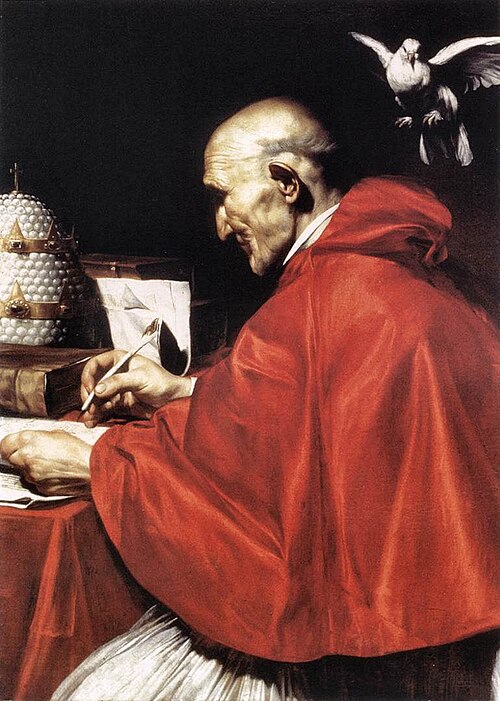
西ローマ帝国の崩壊後、教皇は権威と継続性の源泉として機能した。教皇グレゴリウス1世( 540年頃-604年)は厳格な改革で教会を統治した。古くからの元老院議員の家系出身のグレゴリウスは、古代ローマの統治に典型的な厳格な判断と規律を持って活動した。神学的には、彼は古典から中世の見方への移行を代表しており、彼の人気のある著作は劇的な奇跡、強力な聖遺物、悪魔、天使、幽霊、そして迫り来る世界の終わりに満ちている。[58]
グレゴリウスの後継者は、イタリア半島におけるビザンチン皇帝の代表であるラヴェンナ総督によって主に支配された。これらの屈辱、イスラム教徒の征服に直面したビザンチン帝国の弱体化、そして皇帝が教皇領をランゴバルド人から守ることができなかったため、教皇ステファノ2世はコンスタンティノス5世から離反した。彼はフランク人に領土の保護を求めた。ピピン3世はランゴバルド人を征服し、イタリアの土地を教皇に寄進した。教皇レオ3世がカール大帝(800年)を皇帝に戴冠したとき、西ヨーロッパでは教皇から戴冠を受けなければ皇帝にはなれないという前例が確立された。[58]
教皇制の最低期は867年から1049年であった。[59]この期間には、サエクラム・オブスクルム、クレセンティウス朝、トゥスクラ朝が含まれる。教皇制は争う政治派閥の支配下に入った。教皇は様々に投獄され、飢えさせられ、殺され、そして力ずくで廃位された。ある教皇官僚[誰? ]の一族は50年間教皇を任命したり解任したりした。その官僚の曾孫である教皇ヨハネス12世はラテラノ宮殿で放蕩の宴を開いた。皇帝オットー1世はヨハネスを教会法廷で告発し、法廷は彼を廃位して平信徒を教皇レオ8世に選出した。ヨハネスはローマの帝国代表者を傷つけ、自ら教皇に復帰した。皇帝と教皇庁の対立は続き、最終的には皇帝と結託した公爵たちが司教や教皇をほぼ公然と買収するようになった。[60]
1049年、レオ9世はヨーロッパの主要都市を旅し、教会の道徳的問題、特に聖職売買や聖職者の結婚と妾制度に直接対処した。この長い旅で、彼は北ヨーロッパにおける教皇の威信を回復した。[60]
7世紀以降、ヨーロッパの君主や貴族が教会を設立し、自国や領地で聖職者の叙任や解任を行うことが一般的になり、彼らの個人的な利益が聖職者の間で腐敗を引き起こした。 [61] [62]この慣行が一般的になったのは、高位聖職者や世俗の統治者も公的生活に参加していたためである。[63]
900年から1050年の間に教会を腐敗させるとされたこうした慣習やその他の慣習と戦うために、教会改革を推進する中心地が出現した。その中でも最も重要なのがクリュニー修道院であり、その理想をヨーロッパ中に広めた。 [62]この改革運動は、1073年の教皇グレゴリウス7世の選出によって勢いを増し、グレゴリウス7世は聖職売買や公権力の濫用に強く反対し、聖職者の独身制を含む教会の規律を回復しようと、グレゴリオ改革として知られる一連の措置を講じた。[53]
教皇と神聖ローマ皇帝ハインリヒ4世やイングランド王ヘンリー1世などの世俗の独裁者との間のこの対立は叙任権論争として知られ、1122年にヴォルムス協約によってようやく解決された。この協約で、教皇カリクストゥス2世は、聖職者は聖職者指導者によって叙任され、世俗の統治者は信徒による叙任権によって叙任されるべきであると布告した。[61]その後すぐに、教皇アレクサンデル3世は教会法の確立につながる改革を開始した。[58]
7世紀初頭以来、イスラム教徒の征服により地中海南部の大部分が支配され、キリスト教にとって脅威となっていた。[64] 1095年、ビザンチン皇帝アレクシオス1世コムネノスは、進行中のビザンチン・セルジューク戦争において教皇ウルバヌス2世に軍事援助を要請した。[65]ウルバヌスはクレルモン公会議で、ビザンチン帝国が旧キリスト教領、特にエルサレムを奪還するのを支援するため、第1回十字軍を召集した。 [66]
東西分裂から宗教改革まで(1054年~1517年)

1054年、東西教会分裂により、東方正教会とカトリック教会は決定的に分裂した。この分裂は、信条のわずかな相違よりも、政治的な出来事によって引き起こされた。教皇は、フランク王の側に立ったり、ライバルのローマ皇帝に戴冠したり、ラヴェンナ総督府を占拠したり、ギリシャ領イタリアに侵攻したりして、ビザンチン皇帝を怒らせていた。[60]
中世では、教皇は権力をめぐって君主と争った。[9]
1309年から1377年まで、教皇はローマではなくアヴィニョンに住んでいた。アヴィニョン教皇庁は貪欲と腐敗で悪名高かった。[67]この期間中、教皇は事実上フランス王国の同盟国であり、イングランド王国などのフランスの敵国とは疎遠になっていた。[68]
教皇は聖人とキリストによって築かれた功徳の宝庫から引き出し、免罪符を与えて煉獄での時間を短縮する権限を持っていると理解されていた。痛悔、告解、祈りに金銭的な罰金や寄付が伴うという考えは、免罪符は単純な金銭的寄付に依存するという一般的な考えに取って代わられた。教皇は誤解や濫用を非難したが、免罪符を効果的に管理するには収入があまりにも不足していた。[67]
教皇は枢機卿とも争った。枢機卿は教皇よりもカトリック教会の公会議の権威を主張しようとした。公会議主義は、教会の最高権威は教皇ではなく公会議にあるとしている。その基礎は13世紀初頭に築かれ、15世紀にはジャン・ジェルソンを代表者として頂点に達した。15世紀以降、公会議主義が広く受け入れられなかったことは、プロテスタント宗教改革の一因とみなされている。[69]
西方教会分裂(1378-1417年)の間、さまざまな対立教皇が教皇の権威に異議を唱えた。西方教会分裂は、公会議制の頂点にあったコンスタンツ公 会議で教皇の権威を主張する者たちの間で決着がついたことで終結した。
東方教会は東ローマ帝国(ビザンチン帝国)とともに衰退を続け、コンスタンティノープルのローマとの平等の主張を弱めた。東方皇帝は二度、東方教会に西方教会との再統一を強制しようとした。最初は第2回リヨン公会議(1272年 - 1274年)、二度目はフィレンツェ公会議(1431年 - 1449年)である。教皇の優位性の主張は再統一の障害となり、いずれにせよ失敗した。15世紀、オスマン帝国がコンスタンティノープルを占領し、ビザンチン帝国は滅亡した。[70]
宗教改革から現在まで(1517年から今日まで)

プロテスタントの改革者たちは教皇制が腐敗していると批判し、教皇を反キリストと特徴づけた。[71] [72] [73] [74]
教皇はカトリックの宗教改革[9](1560-1648)を開始し、プロテスタントの宗教改革の課題に対処し、内部改革を実施しました。教皇パウロ3世はトレント公会議(1545-1563)を開始し、その教義の定義と改革により、プロテスタントとの和解を求め、教皇の主張に反対する教会の勢力に対する教皇の勝利が確定しました。[75]
次第に自己主張を強めるヨーロッパの国家に世俗的な権力を明け渡すことを余儀なくされた教皇たちは、精神的な問題に焦点を合わせた。[9] 1870年、第一バチカン公会議は、教皇が信仰や道徳の定義を公布する際に教皇座から話す最も厳粛な機会に、教皇不可謬性の教義を宣言した。 [9]同年後半、イタリアのヴィットーリオ・エマヌエーレ2世がローマを教皇の支配から奪い、イタリア統一を実質的に完了させた。[9]
1929年、イタリア王国とローマ教皇庁の間でラテラノ条約が締結され、バチカン市国は独立した都市国家として設立され、教皇の世俗的な支配からの独立が保証されました。[9]
1950年、教皇ピウス12世は聖母マリアの被昇天を教義と定義したが、これは教皇の不可謬性が明確に宣言されて以来、教皇が教皇座から発言した唯一の例である。
教皇の権威の根拠となる物議を醸している教義上の 聖ペテロの首位権は、東方教会と西方教会を分裂させ、プロテスタントをローマから分離させ続けている。
初期キリスト教の言及
教父たち
初期教会の父たちの著作には、ローマ司教の権威と独自の地位についての言及があり、初期キリスト教時代の教皇の認識と重要性について貴重な洞察を提供している。[76]これらの情報源は、ローマ司教が教会内で影響力のある人物として認められていたことを証明しており、ローマの教えと決定に従うことの重要性を強調しているものもある。このような言及は教皇の首位権の概念を確立するのに役立ち、カトリックの神学と実践に影響を与え続けている。[77] [78]
カルタゴのキプリアヌス( 210年頃-258年)は、ローマ教皇コルネリウスに宛てた手紙55(251年頃)、 [79] [80]初期キリスト教会における彼の独特の権威を肯定した。 [81]
コルネリウス(ローマ司教)は、神とキリストの選択、ほとんどすべての聖職者の好意的な証言、出席した人々の投票、そして古い司祭と善良な人々の集会によって司教に任命されました。そして、ファビアンの地位、つまりペトロの地位と司教の椅子の職が空いていたとき、彼以前に誰も司教に任命されていなかったときに、彼は司教に任命されました。しかし、その地位は神の意志によって一度満たされ、その任命は私たち全員の同意によって承認されたので、その後誰かが司教に任命されたい場合は、教会の外で行われなければなりません。教会の統一の統一を守らない人は、教会の叙階を受けることはできません。
— カルタゴのキプリアヌス、手紙55、8.4
2世紀の著名なキリスト教神学者リヨンのエイレナイオス( 130年頃 - 202年頃)は、著書『異端反駁III』の中で初期の教皇のリストを提供している。このリストは、聖ペテロから174年から189年まで在位した教皇エレウテリウスまでの期間をカバーしている。 [82] [83]
祝福された使徒たち(ペトロとパウロ)は、ローマの教会を創設し、築き上げ、司教職をリヌスに託した。このリヌスについて、パウロはテモテへの手紙の中で言及している。彼の後をアナクレトゥスが継ぎ、その次に使徒たちの中で3番目にクレメンスが司教職に就いた。[...] このクレメンスの後をエウィリストゥスが継いだ。アレクサンダーがエウィリストゥスの後を継ぎ、次に使徒たちの中で6番目にシクストゥスが任命され、その次にテレフォロスが栄えある殉教を遂げ、次にヒュギヌス、その次にピウス、そしてその次にアニケトゥス。ソテルがアニケトゥスの後を継ぎ、エレウテリウスは現在、使徒たちの中で12番目に司教職を継承している。
— リヨンのイレナエウス『異端反駁』第3章第2節
アンティオキアのイグナティウス(108年/140年頃死去)は『ローマ人への手紙』の中で、ローマの教会は「愛を司る教会」であると書いている。 [84] [85]
...私たちの神であるイエス・キリストの愛に従ってすべてのことを意図する方の意志によって愛され、照らされている教会は、ローマの領域の場所を司り、神にふさわしく、名誉にふさわしく、最高の幸福にふさわしく、賞賛にふさわしく、すべての願いをかなえるにふさわしく、聖なるものとみなされるにふさわしく、愛を司るものであり、キリストと父によって名付けられ、私は父の子であるイエス・キリストの名において、肉においても霊においても、神の戒めの一つ一つに従って結ばれている人々に挨拶します。
— アンティオキアのイグナティウス、ローマ人への手紙
ヒッポのアウグスティヌス(354年 - 430年)は、書簡53で、聖ペテロからシリキウスまでの38人の教皇のリストを記している。このリストの順序は、エイレナイオスのリストや教皇紀録のリストとは異なっている。アウグスティヌスのリストでは、エウセビオスのリストと同様に、リヌスの後継者はクレメンス、クレメンスの後継者はアナクレトゥスであるとされているが、他の2つのリストでは、クレメンスとアナクレトゥスの位置が入れ替わっている。 [86]
というのは、もし司教の直系継承を考慮するなら、ペテロ自身まで遡って計算する方が、教会にとってどれほど確実で有益であろうか。ペテロは、教会全体を象徴する存在として、主がこう言われた。「わたしはこの岩の上にわたしの教会を建てる。陰府の門もこれに打ち勝つことはできないだろう」マタイ16:18。ペテロの後継者はリヌスであり、その後継者は途切れることなく、クレメンス、アナクレトゥス、エヴァリストス…
— ヒッポのアウグスティヌス、手紙53、段落2
その他の初期キリスト教の言及
エウセビオス( 260年頃/265年頃 - 339年)著書『教会史』の中で、リヌスを聖ペテロの後継者、クレメンスをローマの3番目の司教として言及している。エウセビオスの記録によると、クレメンスは聖パウロの「同労者」として働いていた。 [87]
パウロの残りの信奉者に関しては、クレスケンスがガリアに派遣されたと証言しています。しかし、テモテへの第二の手紙でローマでの同行者として言及されているリヌスは、すでに述べたように、ローマの教会の司教職におけるペテロの後継者でした。ローマの教会の三番目の司教に任命されたクレメンスもまた、パウロの証言によると、彼の同労者であり、戦友でした。
— カイサリアのエウセビオス『教会史』第3巻第4章9-10節
テルトゥリアヌス( 155年頃- 220年頃)は、著書『異端者に対する処方箋』の中で、ローマ教会の権威について書いている。この著書の中でテルトゥリアヌスは、ローマ教会は使徒的基盤に基づいているため、使徒の権威を持っていると述べている。 [88]
さらに、あなた方はイタリアに近いので、ローマがあり、そこから(使徒たちの)権威そのものが私たちの手の中に入っているのです。使徒たちがそのすべての教えを血とともに注ぎ出したローマの教会はなんと幸福なのでしょう!ペテロが主と同じような苦しみに耐えた場所!使徒ヨハネが最初に無傷で沸騰する油に投げ込まれ、そこから流刑地に戻されたヨハネのような死でパウロが王冠を勝ち取った場所!
— テルトゥリアヌス『異端者に対する処方箋』第32章
同書によれば、ローマのクレメンスは聖ペテロによってローマの司教に任命された。
というのは、これは使徒教会がその記録を伝える方法である。スミルナ教会は、ポリュカルポスがヨハネによってそこに任命されたと記録している。また、ローマ教会は、クレメンスがペテロによって同様に叙階されたとしている。
— テルトゥリアヌス『異端者に対する処方箋』第32章
ヌミディア(現在のアルジェリア)のミレヴィスの司教であり、ドナトゥス派分裂と同時代の人であったオプタトゥスは、著書『ドナトゥス派の分裂』(367年)の中で、ドナトゥス派の起源、信念、実践、および分裂をめぐる出来事や議論について詳細な分析を行っている。この本の中でオプタトゥスは、教会の統一を維持する上でのローマ司教の立場について書いている。 [89] [90]
ローマ市で司教の座が最初にペテロに与えられたことをあなたは知っていることを否定できません。ペテロが座ったのは使徒たちの頭であり、それゆえ彼はケファ(「岩」)とも呼ばれています。その座ですべての者の一致が保たれます。
— オプタトゥス『ドナトゥス派の分裂』2:2
聖ペテロと教皇職の起源
カトリック教会は、キリスト教共同体の中で、司教団が使徒団(使徒継承)を継承し、ローマの司教が聖ペテロを継承したと教えています。[4]
教会に対するペテロの特別な立場を支持するために提案された聖書のテキストには、次のものがあります。
- マタイ16 :
わたしはあなたに言います。あなたはペテロです。わたしはこの岩の上にわたしの教会を建てます。陰府の門もそれに打ち勝つことはできません。わたしはあなたに天国の鍵を授けます。あなたが地上でつなぐものは天でもつながれ、あなたが地上で解くものは天でも解かれます。[91]
- ルカ22章:
シモン、シモン、見よ、サタンはあなたがたを麦のようにふるいにかけることを求めた。しかし、わたしはあなたの信仰がなくならないように、あなたのために祈った。あなたが立ち直ったら、兄弟たちを力づけてやりなさい。[92]
- ヨハネ21章:
私の羊を養いなさい。[93]
教皇の紋章に描かれた象徴的な鍵は、これらのテキストの最初の「天国の鍵」というフレーズに言及している。一部のプロテスタント作家は、このテキストでイエスが語る「岩」はイエス自身、またはペテロが表明した信仰であると主張している。 [94] [95] [96] [ 97] [98] [99]この考えは、聖書でペテロを表すのにアラム語の「岩」の男性形である「ケファ」が使われていることで弱められている。[100] [101] [102]ブリタニカ百科事典は、「今日の学者の大多数のコンセンサスは、最も明白で伝統的な理解、すなわち岩はペテロの人格を指すと解釈すべきだということである」と述べている。[103]
ニューエリアキム
カトリック教会によれば、教皇は旧約聖書に登場する、宮廷の事務を指揮し、宮殿の職員を管理し、国政を扱った人物、新しいエリアキムでもある。イザヤ書では教皇がダビデの家の鍵を持っているとも記されており、これは教皇の権威と権力を象徴している。[104]

マタイ 16:18–19 とイザヤ 22:22 はどちらも、エリアキムとペテロが権力を象徴する鍵を受け取るという類似点を示しています。エリアキムは閉じたり開いたりする力を受け取り、ペテロは縛ったり解いたりする力を受け取ります。
イザヤ書によれば、エリアキムは鍵と開閉の力を受け取ります。
わたしはダビデの家の鍵を彼の肩に置く。彼が開けたものは、だれも閉じることができず、彼が閉じたものは、だれも開けることができない。[105]
— イザヤ書 22:22
マタイの福音書によれば、ペテロも鍵と、縛ったり解いたりする力を得ます。
わたしはあなたに天の王国の鍵を授けます。あなたが地上でつなぐことは天でもつながれ、あなたが地上で解くことは天でも解かれるでしょう。」[106]
— マタイ16:19
イザヤ書 22:3 とマタイ 16:18 では、エリアキムとペテロは両方とも物体に例えられています。エリアキムは杭 (支えと安定性を提供するために壁や他の構造物に打ち込まれる構造物) に例えられ、ペテロは岩に例えられています。
そしてわたしは彼を釘のように安全な場所に固定し、彼は父の家の栄誉ある王座となるであろう。[107]
— イザヤ書 22:23
マタイ16章18節ではペテロは岩に例えられています。
わたしはあなたに言います、あなたはペテロです。わたしはこの岩の上にわたしの教会を建てます。そして地獄の門もそれに打ち勝つことはできません。[108]
— マタイ16:18
選挙、死、そして辞任
選挙

教皇はもともとローマとその近郊に住む高位聖職者によって選ばれていた。1059年、選挙権は神聖ローマ教会の枢機卿に限定され、1179年にはすべての選挙枢機卿の個人投票権が平等になった。現在、選挙権は教皇の死去または辞任の前日に80歳に達していない者に限られている。[109]教皇は選挙枢機卿や枢機卿である必要はない。教皇はローマの司教であるため、司教に叙階されることができる者だけが選出され、つまり洗礼を受けたカトリックの男性であれば誰でも資格がある。司教でないときに最後に選出されたのは1831年のグレゴリウス16世、司祭ですらないときに最後に選出されたのは1513年のレオ10世、枢機卿でないときに最後に選出されたのは1378年のウルバヌス6世である。 [110]司教でない者が選出される場合は、選挙が人々に発表される前に司教叙階を受けなければならない。[111]
1274年5月7日、教皇の選出を規制するため、第二リヨン公会議が招集された。この公会議は、教皇の死後10日以内に選帝侯が会合し、教皇が選出されるまで隠遁生活を送ることを定めた。これは、1268年にクレメンス4世が死去した後、3年間教皇が空位となったことを受けてのものである。16世紀半ばまでに、選挙の手続きは現在の形に進化し、教皇の死去から選帝侯の会合までの期間に変化が認められるようになった。[112]伝統的に、投票は喝采、選出(委員会による)、または本会議によって行われた。喝采は最も単純な手続きで、完全に発声投票で構成されていた。

1878年以来、教皇の選挙はシスティーナ礼拝堂で「コンクラーベ」と呼ばれる隔離された会合で行われている(枢機卿たちは理論上、新しい教皇を選出するまで、鍵をかけて閉じ込められるため、このように呼ばれる)。3人の枢機卿がくじ引きで選ばれ、病気のため欠席した教皇の票を集め、3人がくじ引きで選ばれて票を数え、3人がくじ引きで選ばれて票の集計を行う。投票用紙が配られ、各枢機卿は投票用紙に自分の選んだ枢機卿の名前を書き、「神の下で私が選出されるべきだと思う人」に投票することを声に出して誓い、折りたたんで祭壇に置かれた大きな聖杯の上の皿に投票用紙を置く。2005年の教皇選挙では、聖杯と皿の代わりに特別な壷がこの目的で使用された。次に、皿を使って投票用紙を聖杯に落とすので、選挙人が複数の投票用紙を入れることが難しくなります。投票用紙は読み上げられる前に折りたたまれたまま数えられます。投票用紙の数が選挙人の数と一致しない場合は、投票用紙は開封せずに焼却され、新しい投票が行われます。そうでない場合は、議長の枢機卿が各投票用紙を声に出して読み上げます。枢機卿は針と糸で投票用紙に穴を開け、すべての投票用紙をつなぎ合わせて糸の端を結び、正確性と誠実性を確保します。投票は、3分の2の多数決で誰かが選出されるまで続きます。( 1996年のUniversi Dominici Gregisの発布により、12日間の膠着状態の後の単純多数決が認められましたが、これは2007年に 教皇ベネディクト16世の教令により取り消されました。)

教皇選挙の過程で最も重要な側面の 1 つは、投票結果を世界に発表する手段である。投票用紙は数えられ、束ねられた後、システィーナ礼拝堂に設置された特別なストーブで燃やされ、その煙はサン・ピエトロ広場から見える小さな煙突から排出される。無効となった投票用紙は、黒い煙、つまりフマータ・ネラを発生させる化学物質と一緒に燃やされる。(伝統的に、黒い煙を発生させるために湿った藁が使われていたが、これは完全に信頼できるものではなかった。化学物質の方が藁よりも信頼性が高い。)投票が成功すると、投票用紙だけが燃やされ、白い煙(フマータ・ビアンカ)が煙突から出て、新しい教皇が選出されたことを世界に発表する。[113] 2005 年の教皇選挙から、[114] 教会の鐘も鳴らされ、新しい教皇が選ばれたことを知らせる。[115] [116]
枢機卿団の長は、選出された人物に2つの厳粛な質問をする。まず、「教皇に選出されたことを喜んで受け入れますか?」と尋ねる。「受け入れます」と答えれば、その瞬間から彼の統治が始まる。実際には、受け入れない意向のある枢機卿は、教皇になるのに十分な票数を得る前に、その旨をはっきりと表明する。 [117] [118]
続いて、学長は「あなたはどのような名前で呼ばれるのでしょうか?」と尋ねます。新教皇は自分が選んだ法名を発表します。学長自身が教皇に選出された場合、副学長がこの任務を遂行します。[119]
新教皇は涙の部屋、つまり3組の白い法服(イマンタティオ)が3つのサイズで用意された更衣室に案内される。[120]適切な法服を着てシスティーナ礼拝堂に再び姿を現した新教皇は、神聖ローマ教会のカメルレンゴから「漁師の指輪」を授けられる。[121]教皇は名誉ある席に着き、他の枢機卿たちは順番に最初の「服従」(アドロティオ)を捧げて祝福を受けるのを待つ。[122]
枢機卿長助祭はサン・ピエトロ広場のバルコニーから次の宣言を発表する。「私は皆さんに大きな喜びを告げます!私たちには教皇がいます!」彼は新しい教皇の洗礼名と新たに選ばれた法名を発表する。 [ 123 ] [ 124]
1978 年までは、教皇の選出の数日後に教皇戴冠式が行われ、システィーナ礼拝堂からサン・ピエトロ大聖堂まで、新教皇が聖体容器に乗せられて盛大な行列で始まりました。厳粛な教皇ミサの後、新教皇は三冠(教皇冠)を戴き、教皇として初めて有名なウルビ・エト・オルビ(「ローマ市と世界へ」)の祝福を与えました。戴冠式のもう一つの有名な部分は、金メッキの棒の先端で亜麻の束に火を灯すことで、一瞬明るく燃え上がり、その後すぐに消え、教皇は「こうして現世の栄光は過ぎ去る」と言いました。この機会に教皇の傲慢さに対する同様の警告として、伝統的な叫び「Annos Petri non-videbis」が発せられた。これは新しく戴冠した教皇に、彼の統治が聖ペテロの統治ほど長く続くのを見ることはないだろうと思い出させるものだった。伝統によれば、彼は35年間教会を率いており、これまでのところカトリック教会の歴史上最も長く在位した教皇である。[125]
ラテン語のsede vacante(「教皇座が空位の間」)[126]は、教皇の死去または辞任から後継者の選出までの期間である教皇空位期間を指す。この用語からsedevacantism(教皇空位主義)という用語が派生し、これは教会法に基づいて合法的に選出された教皇は存在せず、したがってsede vacanteが存在すると主張する異端のカトリック教徒のカテゴリを指す。
1378年以降、何世紀にもわたって教皇に選出されたのは主にイタリア人だった。1978年にポーランド生まれのヨハネ・パウロ2世が選出される前は、 1522年に選出されたオランダのアドリアン6世が最後の非イタリア人だった。ヨハネ・パウロ2世の後にはドイツ生まれのベネディクト16世が選出され、その次にはアルゼンチン生まれのフランシスコが選出された。フランシスコは1272年ぶりの非ヨーロッパ人であり、イタリア系では初のラテンアメリカ人だった。[127] [128]
死

教皇空位期間、すなわち「空席」に関する現在の規則は、 1996年に教皇ヨハネ・パウロ2世が『Universi Dominici Gregis』という文書で公布した。空位期間中、枢機卿団は、神聖ローマ教会のカメルレンゴの指導の下、教会とバチカン自体の統治に共同で責任を負う。教会法は、教皇座空位期間中に枢機卿が教会の統治にいかなる革新も持ち込むことを特に禁じている。教皇の同意を必要とする決定は、新教皇が選出され、その職に就くまで待たなければならない。[129]
近年、教皇が死亡したと判断された場合、カメルレンゴ枢機卿が銀のハンマーで教皇の頭を3回軽く叩き、そのたびに生名を呼ぶことで儀式的に死亡を確認するのが伝統だったと伝えられている。[130]これはヨハネ・パウロ1世[131]とヨハネ・パウロ2世の死去時には行われなかった。 [132]カメルレンゴ枢機卿は漁師の指輪を回収し、枢機卿たちの前でそれを2つに切断する。教皇の印章は二度と使用されないように汚され、教皇の私室は封印される。[133]
遺体は主要な教会や大聖堂の地下室に埋葬される前に数日間安置される。20世紀と21世紀に亡くなった教皇はすべてサン・ピエトロ大聖堂に埋葬されている。埋葬後9日間の喪に服す(ノヴェンディアリス)。[133]
辞任
教皇が辞任するのは極めて異例である。[134] 1983年の教会法典[ 135]には、「ローマ教皇が辞任する場合、その辞任は自由かつ適切に表明され、誰かに受諾される必要はない」と規定されている。 2013年2月28日に教皇座を退位したベネディクト16世は、最も最近の退位者であり、1415年のグレゴリウス12世の退位以来の退位者であった。 [136]
タイトル
| 教皇のスタイル | |
|---|---|
 | |
| 参照スタイル | 法王 |
| 話し方 | 法王陛下 |
| 宗教的なスタイル | 教皇様 |
| 死後スタイル | こちらをご覧ください |
王名
教皇は即位時に、イタリア語とラテン語で教皇名と呼ばれる新しい名前を採用します。現在、新しい教皇が選出され、選出を受諾した後、「あなたはどのような名前で呼ばれますか?」と尋ねられます。新しい教皇は、その時点から知られる名前を選択します。次に、上級助祭枢機卿、またはプロトデアコン枢機卿がサンピエトロ大聖堂のバルコニーに現れ、新しい教皇を生名で宣言し、ラテン語で教皇名を発表します。教皇に言及するときは、在位名をすべての現地の言語に翻訳するのが慣例です。たとえば、現在の教皇は、ラテン語でPapa Franciscus、イタリア語でPapa Francescoという教皇名を持ちますが、母国語のスペイン語ではPapa Francisco、英語ではPope Francisなどです。
公式タイトルリスト
教皇の正式な称号リストは、「教皇紀」に記載されている順序で次のとおりです。
ローマ司教、イエス・キリストの代理、使徒の君主の後継者、世界教会の最高教皇、西方総主教、イタリア大主教、ローマ管区大司教および大主教、バチカン市国の統治者、神の僕たちの僕。[137]
最もよく知られている称号である「教皇」は、公式のリストには載っていないが、文書のタイトルでよく使われ、署名にも省略形で登場する。例えばパウロ6世は「Paulus PP. VI」と署名しており、「PP.」は「papa pontifex」(「教皇と法王」)の略である。[138] [139] [140] [141] [142]
「教皇」という称号は、3世紀初頭から西方ではどの司教に対しても使われる敬称であった。 [18]東方では、アレクサンドリア司教に対してのみ使われた。[18] マルケリヌス(304年没)は、史料に「教皇」という称号が使われた最初のローマ司教である。6世紀以降、コンスタンティノープル帝国法務局は、この称号を通常ローマ司教のために留保していた。[18] 6世紀初頭から、西方ではローマ司教に限定され始め、11世紀までにこの慣習は定着した。[18]
東方キリスト教では「教皇」という称号がアレクサンドリアの司教にも使われており、話し手や筆者がローマと交わりを持っているかどうかに関わらず、ローマの司教はしばしば「ローマの教皇」と呼ばれる。[143]
イエス・キリストの代理
「イエス・キリストの代理者」(Vicarius Iesu Christi )は、教皇紀に記された教皇の公式称号の一つである。これは、やや省略された「キリストの代理者」( vicarius Christi )という形でよく使われる。これは教皇が「代理者」と呼ばれるときに使われる用語の一つに過ぎないが、「教皇がキリストの委任と彼から授かった代理権によって担う地上の教会の最高の指導者としての地位をよりよく表現している」。代理権は、キリストが聖ペテロに「私の子羊を養いなさい...私の羊を養いなさい」と言ったときに授けられたと信じられている。[144] [145]
この称号がローマ司教に適用された最初の記録は、495年の教会会議でゲラシウス1世について言及されている。[146]しかし、当時から9世紀にかけて、他の司教たちも自分たちをキリストの代理人と呼び、さらに4世紀にわたって、この表現は王や裁判官にさえ使われることがあった。[147 ] これは、5世紀と6世紀にビザンチン皇帝を指して使われていたのと同じである。[148]さらに前の3世紀には、テルトゥリアヌスが「キリストの代理人」をイエスが遣わした聖霊を指して使った。 [149] [150 ]この語が教皇に特に使われるようになったのは、13世紀に教皇インノケンティウス3世の改革に関連して現れ、[148]これは、1199年にアルメニア王レオ1世に宛てた手紙にすでに見られる。[152]他の歴史家は、この称号がすでにエウゲニウス3世(1145-1153)の教皇在位中にこのように使用されていたと示唆している。 [146]
したがって、この「キリストの代理人」という称号は教皇だけに使われるものではなく、初期の数世紀からすべての司教に使われてきました。[153]第二バチカン公会議はすべての司教を「キリストの代理人および大使」と呼びました。[154]そして、この司教の描写はヨハネ・パウロ2世の回勅「Ut unum sint」 95でも繰り返されています。違いは、他の司教はそれぞれの地方教会のキリストの代理人であるのに対し、教皇は全教会のキリストの代理人であるということです。[155]
少なくとも一度は教皇に対して「神の代理人」(キリストを神として指す)という称号が使われた。[145]
「ペトロの代理」という称号(vicarius Petri)は教皇にのみ用いられ、他の司教には用いられない。この称号の派生語には、「使徒の君主の代理」 ( Vicarius Principis Apostolorum ) や「使徒座の代理」 ( Vicarius Sedis Apostolicae ) などがある。[145] 聖ボニファティウスは、722年に教皇グレゴリウス2世が行った忠誠の誓いの中で、ペトロの代理と表現している。 [156]今日のローマミサ典書では、「ペトロの代理」という表現は、教皇であった聖人のためのミサの集会文にも見られる。[157]
最高法王

「教皇」という用語はラテン語のpontifexに由来し、文字通りには「橋を架ける者」(pons + facere )を意味し、異教のローマにおける主要な司祭団のメンバーを指していた。 [158] [159]このラテン語は古代ギリシャ語に様々に翻訳された:古代ギリシャ語:ἱεροδιδάσκαλος、古代ギリシャ語:ἱερονόμος、古代ギリシャ語:ἱεροφύλαξ、古代ギリシャ語:ἱεροφάντης(法王)、[160]または古代ギリシャ語:ἀρχιερεύς(高僧)[161] [162] 。団の長はラテン語でPontifex Maximus(最も偉大な教皇)として知られていた。 [163]
キリスト教では、ポンティフェクスは新約聖書のウルガタ訳にイスラエルの大祭司(原典のコイネーギリシャ語ではἀρχιερεύς )を指して使われている。[164]この用語はキリスト教の司教全般に適用されるようになったが、[165] 11世紀以降は特にローマの司教を指すことが多くなり、[166]より厳密には「ローマ教皇」と呼ばれる。司教全般を指すこの用語の使用は、「ローマ教皇典」(堅信式や叙階など司教専用の儀式を記した書物)や「ポンティフィカルス」(司教の記章)という用語に反映されている。[167]
教皇年報には、教皇の公式称号の一つとして「普遍教会の最高位の教皇」(ラテン語:Summus Pontifex Ecclesiae Universalis)と記載されている。[168]また、教皇は最高位の教皇、または最高位の教皇(ラテン語: summus pontifex )とも呼ばれる。[169]
ポンティフェクス・マクシムスは、意味がスムス・ポンティフェクスに似ており、教皇庁の建物、絵画、彫像、貨幣の碑文によく見られる称号で、通常「ポント・マックス」または「PM」と略される。ポンティフェクス・マクシムス、つまり教皇庁の長の職は、ユリウス・カエサルが務め、その後はローマ皇帝が務めたが、グラティアヌス(375-383)がそれを手放した。[160] [170] [171]テルトゥリアヌスは、モンタヌス主義者になったとき、教皇またはカルタゴの司教を嘲笑してこの称号を使用した。[172]教皇がこの称号を定期的に使用し始めたのは、15世紀になってからである。[172]
神のしもべのしもべ
「神のしもべのしもべ」(ラテン語:servusservorum Dei )という表現は、ヒッポのアウグスティヌスやヌルシアのベネディクトゥスなど他の教会指導者たちも使っていたが、教皇の称号として広く使われたのはグレゴリウス1世で、コンスタンティノープル総主教のヨハネス・ファスター(エキュメニカル総主教)に謙虚さを教えるためだったと伝えられている。12世紀には教皇専用となり、教皇勅書や同様の重要な教皇文書で使われている。 [173]
西方の総主教
1863年から2005年まで、そして2024年にも、教皇年鑑には「西方総主教」という称号も含まれていた。この称号は、642年に教皇テオドロス1世によって初めて使用され、時折使用されただけだった。実際、教皇の年鑑にこの称号が登場し始めたのは1863年になってからである。2006年3月22日、バチカンは「歴史的および神学的現実」を表現し、「エキュメニカルな対話に有用である」という理由で、この省略を説明する声明を発表した。西方総主教という称号は、教皇とラテン教会との特別な関係と管轄権を象徴しており、称号の省略は、この関係の変化を象徴するものでも、第二バチカン公会議で厳粛に宣言された聖座と東方教会の関係を歪めるものでもない。[174]「西方総主教」は、2024年版の教皇年報で教皇の称号リストに再導入された。バチカンは、なぜこの称号が再び使用されたのかを説明する声明を出していない。[175]
その他のタイトル
よく使われる他の称号は、「法王」(単独で使用されるか、「 フランシスコ法王 」のように敬称として使用され、また、呼び名として「 法王様 」としても使用される)、「 聖父 」である。スペイン語とイタリア語では、「サンティシモ/サンティッシモ・パードレ」(聖なる父)よりも「ベアティシモ/ベアティッシモ・パードレ」(至福の父)が使われることが多い。中世には、 「 使徒の主 」である「 ドミヌス・アポストリクス 」も使用されていた。
サイン
フランシスコ教皇は、ラテン語(2013年6月29日の回勅では「フランシスコ」)[176]または他の言語で、自分の名前だけでいくつかの文書に署名しています。[177]他の文書は、ラテン語のみを使用し、ラテン語のPapa(「教皇」)の省略形「PP.」を含めるという伝統に従って署名しています。 [178]名前に序数を持つ教皇は、伝統的に「PP」という略語を使用します。序数の前に「Benedictus PP. XVI」(教皇ベネディクト16世)のように記名するが、列聖勅書や公会議の布告では、教皇は「Ego N. Episcopus Ecclesiae catholicae」という式文で署名し、数字は使用しない。「Ego Benedictus Episcopus Ecclesiae catholicae」(私、ベネディクト、カトリック教会の司教)のように記名する。
王冠と記章
- 漁師の指輪、船に乗って網を投げている聖ペテロの絵が描かれた金または鍍金の指輪で、その周りに教皇の名前が刻まれている。[179]
- アンブラクルム(イタリア語ではオンブレリーノとして知られる)は、赤と金の縞模様が交互に並んだ天蓋または傘で、教皇の行列の上を運ばれていた。 [180]
- セディア・ゲスタトリアは、赤い制服を着た12人の従者(パラフレニエリ)が運ぶ移動式の玉座で、2人の従者がフラベラ(白いダチョウの羽で作られた扇)を持ち、時には8人の従者が大きな天蓋を運ぶこともあった。フラベラの使用はヨハネ・パウロ1世によって廃止された。セディア・ゲスタトリアの使用はヨハネ・パウロ2世によって廃止された。 [181]
紋章学では、各教皇は独自の紋章を持っている。各教皇ごとに異なるが、数世紀にわたり、紋章には伝統的に、盾の後ろに十字形の鍵 2 つ (つまり、X 字型に交差) (銀色の鍵 1 つと金色の鍵 1 つで、赤い紐で結ばれている) が付いており、その上には銀色の三連紋と 3 つの金の王冠、赤いインフルエ(三連紋の後ろから垂れ下がる 2 本の布の帯で、着用時に首や肩に垂れる) が付いている。これは次のように記されている: 「十字形の鍵 2 つ、または銀色、輪の中で絡み合っている、または、銀色のティアラの下に冠が付いている」。21 世紀には、この伝統から逸脱した例が見られた。2005 年、ベネディクト 16 世は、盾の後ろの交差した鍵はそのままに、個人の紋章から教皇のティアラを削除し、代わりに3 本の横線のミトラを付けた。教皇は盾の下にパリウムを加えた。パリウムはティアラよりも古い教皇の権威の象徴で、ローマ教皇座との交わりの印として大司教にも使用が認められている。教皇個人の紋章ではティアラは省略されたが、ティアラを含む聖座の紋章は変更されなかった。2013年、フランシスコ教皇はティアラに代わるミトラを維持したが、パリウムは省略した。
教皇と最もよく関連付けられる旗は、バチカン市国の黄白旗で、旗の右側(「旗揚げ」)の白い半分(左側の「旗揚げ」は黄色)に、聖座の紋章(「赤、十字形の2つの鍵、または銀色、輪の中で絡み合う、または銀色のティアラの下に冠をかぶる」と描かれている。教皇の盾は旗には描かれていない。この旗は1808年に初めて採用されたが、それ以前の旗は赤と金色だった。ベネディクト16世は自身の紋章の三位一体をミトラに置き換えたが、旗にはそのまま残っている。[183]
教皇の衣装
教皇ピウス5世(在位1566-1572年)は、教皇に選出された後もドミニコ会の白い修道服を着用し続けたことにより、教皇が白を着る慣習を始めたとよく言われる。実際には、教皇の基本的な服装はそれよりずっと以前から白だった。そのように記述した最古の文書は、 1274年頃に編纂された儀式書であるオルドXIIIである。後の儀式書では、教皇は赤いマント、モゼッタ、カマウロ、靴、白いカソックとストッキングを着用していたと記述されている。[184] [185] 15世紀と16世紀のピウス5世の前任者の同時代の肖像画の多くには、ピウス5世のものと似た白いカソックを着用している姿が描かれている。[186]
地位と権威
発達
第一バチカン公会議

カトリック教会における教皇の地位と権威は、1870年7月18日に開かれた第1バチカン公会議で教義的に定義された。同公会議はキリスト教会の教義憲章において、以下の規範を定めた。[187]
もし誰かが、祝福された使徒ペトロが主キリストによってすべての使徒の長、そして全戦闘的教会の目に見える長として任命されなかったと言うなら、あるいは、彼は大きな名誉を受けたが、私たちの主イエス・キリストから直接、真実で適切な管轄権における首位権を直接かつ即座に受けなかったと言うなら、その人は呪われよ。[188]
もし誰かが、聖ペトロが普遍教会の首位権において永遠の後継者を持つのは主キリスト自身の制定によるものではなく、神の権利によるものではない、あるいはローマ教皇は聖ペトロの首位権における後継者ではないと言うなら、その人は呪われよ。[189]
もし誰かが、ローマ教皇は監督や指導の職務しか持たず、普遍教会に対する管轄権の完全かつ最高権力を持っていない、信仰や道徳に関することだけでなく、全世界に広がる教会の規律と統治に関することに関しても管轄権を持っていない、あるいは、教皇は重要な部分だけを持ち、この最高権力の全容を持っていない、あるいは、教皇のこの権力は一般的かつ直接的なものではなく、教会全体に対しても個別にも、牧師や信徒全体に対しても個別にも行使できない、などと言うならば、その人は呪われよ。[190]
我々は、キリスト教信仰の始まりから受け継がれてきた伝統に忠実に従い、我々の救い主である神の栄光、カトリック教の高揚、そしてキリスト教の人々の救済のために、聖なる公会議の承認を得て、教義は神によって啓示されたものであることを教え、説明する。すなわち、ローマ教皇が教皇座から話すとき、すなわち、使徒としての最高権威によってすべてのキリスト教徒の牧者および教師としての義務を遂行するとき、聖ペトロにおいて約束された神の助けによって、普遍教会が保持すべき信仰または道徳の教義を定義するとき、神の救い主が自身の教会に信仰と道徳の教義を定義するよう望んだその絶対確実性をもって行動する。したがって、ローマ教皇が自ら定義したものであり、教会の総意によるものではない定義は変更できない。しかし、もし誰かが我々の定義に反することを敢えてするならば、それは神が禁じられるであろうが、その者は呪われよ。[191]
第二バチカン公会議

第二バチカン公会議は『教会憲章』(1964年)の中で次のように宣言した。
司教の主な義務の中で、福音の説教は重要な位置を占めています。なぜなら、司教は信仰の説教者であり、新しい弟子をキリストに導く者であり、真の教師、つまりキリストの権威を授かった教師であり、彼らに託された人々に、彼らが信じ、実践しなければならない信仰を説教し、聖霊の光によってその信仰を例示する者だからです。彼らは、黙示録の宝庫から新しいものも古いものも取り出し、それを実らせ、彼らの群れを脅かす誤りを注意深く防ぎます。ローマ教皇と交わりをもって教える司教は、神とカトリックの真理の証人としてすべての人から尊敬されるべきです。信仰と道徳の問題では、司教はキリストの名において語り、信者は彼らの教えを受け入れ、宗教的な同意をもってそれに従うべきです。この宗教的な精神と意志の服従は、教皇が教皇座から話をしていないときでも、ローマ教皇の正統な教導権に対して特別な方法で示されなければなりません。つまり、教皇の最高の教導権が敬意をもって認められ、教皇の明白な精神と意志に従って、教皇が下した判断が誠実に遵守されるように示されなければなりません。この問題に関する教皇の精神と意志は、文書の性質、同じ教義の頻繁な繰り返し、または話し方から知ることができます。... 信仰と道徳の教義を定義するために神の救い主が教会に授けようとしたこの不可謬性は、黙示録の遺産が及ぶ限りに及び、それは宗教的に守られ、忠実に説明されなければなりません。そして、これこそが、司教団の長であるローマ教皇が、すべての信者の最高の牧者および教師として、兄弟たちの信仰を強めるために、決定的な行為によって信仰または道徳の教義を宣言するときに、その職務のおかげで享受する不可謬性である。したがって、教会の同意によるものではなく、それ自体としての彼の定義は、正当に改正不可能であると言われる。なぜなら、それらは聖ペトロにおいて彼に約束された聖霊の助けによって宣言され、したがって他人の承認を必要とせず、他の判断に訴えることもできないからである。そのとき、ローマ教皇は一個人として判断を下しているのではなく、教会自体の不可謬性のカリスマが個別に存在している普遍教会の最高の教師として、カトリック信仰の教義を解説または擁護しているからである。教会に約束された無謬性は、司教団がペトロの後継者とともに最高教導権を行使するときにも、司教団の中に存在します。これらの定義には、キリストの群れ全体が信仰の一致の中で守られ、進歩するのと同じ聖霊の働きのゆえに、教会の同意が欠けることはありません。[192]
On 11 October 2012, on the occasion of the 50th anniversary of the opening of the Second Vatican Council 60 prominent theologians, (including Hans Küng), put out a Declaration, stating that the intention of Vatican II to balance authority in the Church has not been realized. "Many of the key insights of Vatican II have not at all, or only partially, been implemented... A principal source of present-day stagnation lies in misunderstanding and abuse affecting the exercise of authority in our Church."[193]
Politics of the Holy See

Residence and jurisdiction
The pope's official seat is in the Archbasilica of Saint John Lateran, considered the cathedral of the Diocese of Rome, and his official residence is the Apostolic Palace. He also possesses a summer residence at Castel Gandolfo, situated on the site of the ancient city of Alba Longa.
The names "Holy See" and "Apostolic See" are ecclesiastical terminology for the ordinary jurisdiction of the bishop of Rome (including the Roman Curia); the pope's various honours, powers, and privileges within the Catholic Church and the international community derive from his Episcopate of Rome in lineal succession from the Saint Peter, one of the twelve apostles.[194] Consequently, Rome has traditionally occupied a central position in the Catholic Church, although this is not necessarily so. The pope derives his pontificate from being the bishop of Rome but is not required to live there; according to the Latin formula ubi Papa, ibi Curia, wherever the pope resides is the central government of the Church. As such, between 1309 and 1378, the popes lived in Avignon, France,[195] a period often called the "Babylonian captivity" in allusion to the Biblical narrative of Jews of the ancient Kingdom of Judah living as captives in Babylonia.
Though the pope is the diocesan bishop of Rome, he delegates most of the day-to-day work of leading the diocese to the cardinal vicar, who assures direct episcopal oversight of the diocese's pastoral needs, not in his own name but in that of the pope. The most recent cardinal vicar was Angelo De Donatis, who served from 2017 until 2024.
Political role
| Sovereign of the Vatican City State | |
|---|---|
 Coat of arms of the Vatican | |
| Incumbent | Francis |
| Style | His Holiness |
| Residence | Apostolic Palace |
| First Sovereign | Pope Pius XI |
| Formation | 11 February 1929 |
| Website | vaticanstate.va |
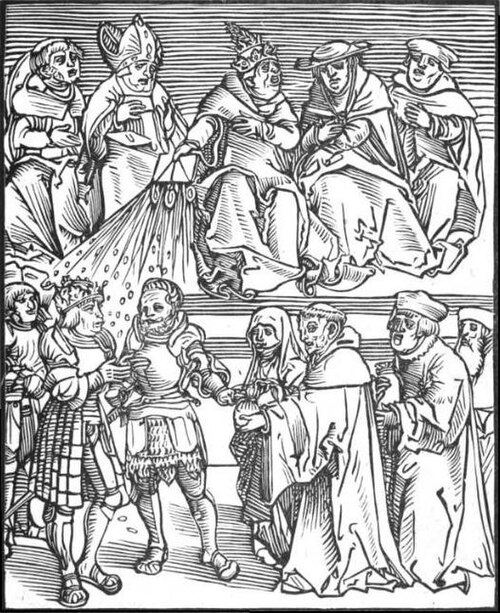
Though the progressive Christianization of the Roman Empire in the 4th century did not confer upon bishops civil authority within the state, the gradual withdrawal of imperial authority during the 5th century left the pope the senior imperial civilian official in Rome, as bishops were increasingly directing civil affairs in other cities of the Western Empire. This status as a secular and civil ruler was vividly displayed by Pope Leo I's confrontation with Attila in 452. The first expansion of papal rule outside of Rome came in 728 with the Donation of Sutri, which in turn was substantially increased in 754, when the Frankish ruler Pippin the Younger gave to the pope the land from his conquest of the Lombards. The pope may have utilized the forged Donation of Constantine to gain this land, which formed the core of the Papal States. This document, accepted as genuine until the 15th century, states that Constantine the Great placed the entire Western Empire of Rome under papal rule. In 800, Pope Leo III crowned the Frankish ruler Charlemagne as Roman emperor, a major step toward establishing what later became known as the Holy Roman Empire; from that date onward the popes claimed the prerogative to crown the emperor, though the right fell into disuse after the coronation of Charles V in 1530. Pius VII was present at the coronation of Napoleon I in 1804 but did not actually perform the crowning. As mentioned above, the pope's sovereignty over the Papal States ended in 1870 with their annexation by Italy.
Popes like Alexander VI, an ambitious if spectacularly corrupt politician, and Julius II, a formidable general and statesman, were not afraid to use power to achieve their own ends, which included increasing the power of the papacy. This political and temporal authority was demonstrated through the papal role in the Holy Roman Empire (especially prominent during periods of contention with the emperors, such as during the pontificates of Pope Gregory VII and Pope Alexander III).
Papal bulls, interdict, and excommunication (or the threat thereof) have been used many times to exercise papal power. The bull Laudabiliter in 1155 authorized King Henry II of England to invade Ireland. In 1207, Innocent III placed England under interdict until King John made his kingdom a fiefdom to the pope, complete with yearly tribute, saying, "we offer and freely yield...to our lord Pope Innocent III and his catholic successors, the whole kingdom of England and the whole kingdom of Ireland with all their rights and appurtenences for the remission of our sins".[196] The Bull Inter caetera in 1493 led to the Treaty of Tordesillas in 1494, which divided the world into areas of Spanish and Portuguese rule. The bull Regnans in Excelsis in 1570 excommunicated Queen Elizabeth I of England and declared that all her subjects were released from allegiance to her. The bull Inter gravissimas in 1582 established the Gregorian calendar.[197]
In recent decades, although the papacy has become less directly involved in politics, popes have nevertheless retained significant political influence. They have also served as mediators, with the support of the Catholic establishment.[198][199] John Paul II, a native of Poland, was regarded as influential in the fall of Communism in Eastern Europe.[200] He also mediated the Beagle conflict between Argentina and Chile, two predominantly Catholic countries.[201] In the 21st century, Francis played a role in brokering the 2015 improvement in relations between the United States and Cuba.[202][203]
International position
Under international law, a serving head of state has sovereign immunity from the jurisdiction of the courts of other countries, though not from that of international tribunals.[204][205] This immunity is sometimes loosely referred to as "diplomatic immunity", which is, strictly speaking, the immunity enjoyed by the diplomatic representatives of a head of state.
International law treats the Holy See, essentially the central government of the Catholic Church, as the juridical equal of a state. It is distinct from the state of Vatican City, existing for many centuries before the foundation of the latter. (It is common for publications and news media to use "the Vatican", "Vatican City", and even "Rome" as metonyms for the Holy See.) Most countries of the world maintain the same form of diplomatic relations with the Holy See that they entertain with other states. Even countries without those diplomatic relations participate in international organizations of which the Holy See is a full member.
It is as head of the state-equivalent worldwide religious jurisdiction of the Holy See (not of the territory of Vatican City) that the U.S. Justice Department ruled that the pope enjoys head-of-state immunity.[206] This head-of-state immunity, recognized by the United States, must be distinguished from that envisaged under the United States' Foreign Sovereign Immunities Act of 1976, which, while recognizing the basic immunity of foreign governments from being sued in American courts, lays down nine exceptions, including commercial activity and actions in the United States by agents or employees of the foreign governments. It was in relation to the latter that, in November 2008, the United States Court of Appeals in Cincinnati decided that a case over sexual abuse by Catholic priests could proceed, provided the plaintiffs could prove that the bishops accused of negligent supervision were acting as employees or agents of the Holy See and were following official Holy See policy.[207][208][209]
In April 2010, there was press coverage in Britain concerning a proposed plan by atheist campaigners and a prominent barrister, Geoffrey Robertson, to have Pope Benedict XVI arrested and prosecuted in the UK for alleged offences, dating from several decades before, in failing to take appropriate action regarding Catholic sex abuse cases and concerning their disputing his immunity from prosecution in that country.[210] This was generally dismissed as "unrealistic and spurious".[211] Another barrister said that it was a "matter of embarrassment that a senior British lawyer would want to allow himself to be associated with such a silly idea".[212]
Sovereign immunity does not apply to disputes relating to commercial transactions, and governmental units of the Holy See can face trial in foreign commercial courts. The first such trial to take place in the English courts is likely to occur in 2022 or 2023.[213][214]
Objections to the papacy

The pope's claim to authority is either disputed or rejected outright by other churches, for various reasons.
Orthodox, Anglican and Old Catholic churches
Other traditional Christian churches (Assyrian Church of the East, the Oriental Orthodox Church, the Eastern Orthodox Church, the Old Catholic Church, the Anglican Communion, the Independent Catholic churches, etc.) accept the doctrine of Apostolic succession and, to varying extents, papal claims to a primacy of honour, while generally rejecting the pope as the successor to Peter in any other sense than that of other bishops. Primacy is regarded as a consequence of the pope's position as bishop of the original capital city of the Roman Empire, a definition explicitly spelled out in the 28th canon of the Council of Chalcedon. These churches see no foundation to papal claims of universal immediate jurisdiction, or to claims of papal infallibility. Several of these churches refer to such claims as ultramontanism.
Protestant denominations
In 1973, the United States Conference of Catholic Bishops' Committee on Ecumenical and Interreligious Affairs and the USA National Committee of the Lutheran World Federation in the official Catholic–Lutheran dialogue included this passage in a larger statement on papal primacy:
In calling the pope the "Antichrist", the early Lutherans stood in a tradition that reached back into the eleventh century. Not only dissidents and heretics but even saints had called the bishop of Rome the "Antichrist" when they wished to castigate his abuse of power. What Lutherans understood as a papal claim to unlimited authority over everything and everyone reminded them of the apocalyptic imagery of Daniel 11, a passage that even prior to the Reformation had been applied to the pope as the Antichrist of the last days.[215]
Protestant denominations of Christianity reject the claims of Petrine primacy of honour, Petrine primacy of jurisdiction, and papal infallibility. These denominations vary from rejecting the legitimacy of the pope's claim to authority, to believing that the pope is the Antichrist[216] from 1 John 2:18, the Man of Sin from 2 Thessalonians 2:3–12,[217] and the Beast out of the Earth from Revelation 13:11–18.[218]
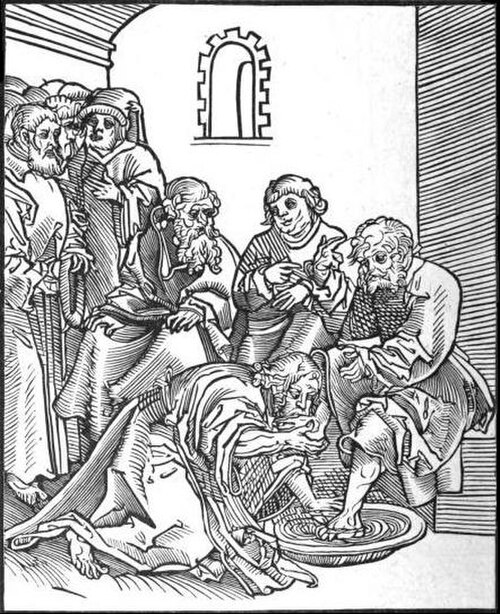
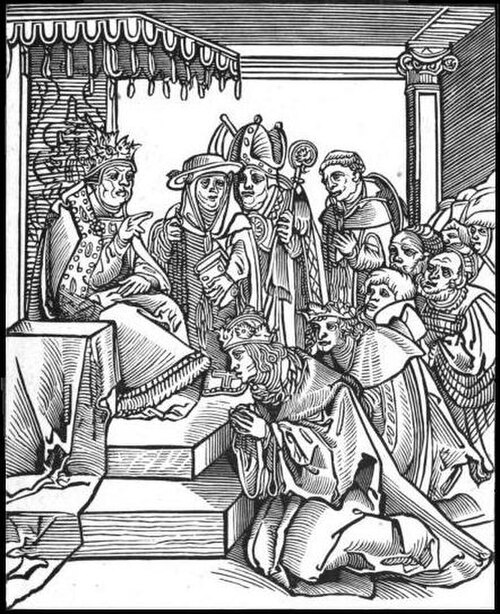
This sweeping rejection is held by, among others, some denominations of Lutherans: Confessional Lutherans hold that the pope is the Antichrist, stating that this article of faith is part of a quia ("because") rather than quatenus ("insofar as") subscription to the Book of Concord. In 1932, one of these Confessional churches, the Lutheran Church–Missouri Synod (LCMS), adopted A Brief Statement of the Doctrinal Position of the Missouri Synod, which a small number of Lutheran church bodies now hold. The Lutheran Churches of the Reformation,[220] the Concordia Lutheran Conference,[221] the Church of the Lutheran Confession,[222] and the Illinois Lutheran Conference[223] all hold to the Brief Statement, which the LCMS places on its website.[224] The Wisconsin Evangelical Lutheran Synod (WELS), another Confessional Lutheran church that declares the Papacy to be the Antichrist, released its own statement, the "Statement on the Antichrist", in 1959. The WELS still holds to this statement.[225]
Historically, Protestants objected to the papacy's claim of temporal power over all secular governments, including territorial claims in Italy,[226] the papacy's complex relationship with secular states such as the Roman and Byzantine empires, and the autocratic character of the papal office.[227] In Western Christianity these objections both contributed to and are products of the Protestant Reformation.
Antipopes
Groups sometimes form around antipopes, who claim the Pontificate without being canonically and properly elected to it.
Traditionally, this term was reserved for claimants with a significant following of cardinals or other clergy. The existence of an antipope is usually due either to doctrinal controversy within the Church (heresy) or to confusion as to who is the legitimate pope at the time (schism). Briefly in the 15th century, three separate lines of popes claimed authenticity.[228]
Other uses of the title "Pope"
In the earlier centuries of Christianity, the title "Pope", meaning "father", had been used by all bishops. Some popes used the term and others did not. Eventually, the title became associated especially with the bishop of Rome. In a few cases, the term is used for other Christian clerical authorities.
In English, Catholic priests are still addressed as "father", but the term "pope" is reserved for the head of the church hierarchy.
In the Catholic Church
"Black Pope" is a name that was popularly, but unofficially, given to the superior general of the Society of Jesus due to the Jesuits' importance within the Church. This name, based on the black colour of his cassock, was used to suggest a parallel between him and the "White Pope" (since the time of Pius V the popes dress in white) and the cardinal prefect of the Congregation for the Evangelization of Peoples (formerly called the Sacred Congregation for the Propagation of the Faith), whose red cardinal's cassock gave him the name of the "Red Pope" in view of the authority over all territories that were not considered in some way Catholic. In the present time this cardinal has power over mission territories for Catholicism, essentially the Churches of Africa and Asia,[229] but in the past his competence extended also to all lands where Protestants or Eastern Christianity was dominant. Some remnants of this situation remain, with the result that, for instance, New Zealand is still in the care of this Congregation.
In the Eastern Churches
Since the papacy of Heraclas in the 3rd century, the bishop of Alexandria in both the Coptic Orthodox Church and the Greek Orthodox Church of Alexandria continues to be called "pope", the former being called "Coptic pope" or, more properly, "Pope and Patriarch of All Africa on the Holy Orthodox and Apostolic Throne of Saint Mark the Evangelist and Holy Apostle" and the latter called "Pope and Patriarch of Alexandria and All Africa".[230]
In the Bulgarian Orthodox Church, Russian Orthodox Church, Serbian Orthodox Church and Macedonian Orthodox Church, it is not unusual for a village priest to be called a "pope" ("поп" pop). This is different from the words used for the head of the Catholic Church (Bulgarian "папа" papa, Russian "папа римский" papa rimskiy).
In new religious movements and other Christian-related new religious movements
Some new religious movements within Christianity, especially those that have disassociated themselves from the Catholic Church yet retain a Catholic hierarchical framework, have used the designation "pope" for a founder or current leader. Examples include the African Legio Maria Church and the European Palmarian Catholic Church in Spain. The Cao Dai, a Vietnamese faith that duplicates the Catholic hierarchy, is similarly headed by a pope.
Lengths of papal reign
Longest-reigning popes
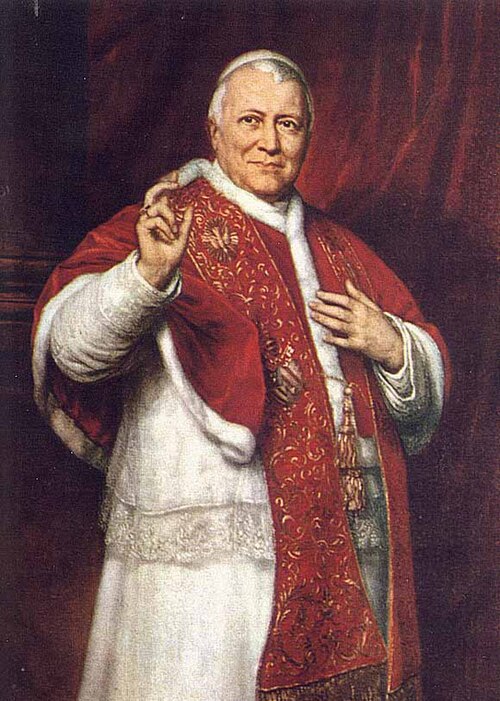
The longest papal reigns of those whose reign lengths can be determined from contemporary historical data are the following:
- Saint Peter (c. 30–64/68): c. 34 – c. 38 years (Around 12,000–14,000 days)[231]
- Bl. Pius IX (1846–1878): 31 years, 7 months and 23 days (11,560 days)
- St. John Paul II (1978–2005): 26 years, 5 months and 18 days (9,665 days)
- Leo XIII (1878–1903): 25 years, 5 months and 1 day (9,281 days)
- Pius VI (1775–1799): 24 years, 6 months and 15 days (8,962 days)
- Adrian I (772–795): 23 years, 10 months and 25 days (8,729 days)
- Pius VII (1800–1823): 23 years, 5 months and 7 days (8,560 days)
- Alexander III (1159–1181): 21 years, 11 months and 24 days (8,029 days)
- St. Sylvester I (314–335): 21 years, 11 months and 1 day (8,005 days)
- St. Leo I (440–461): 21 years, 1 month, and 13 days (7,713 days)
During the Western Schism, Avignon Pope Benedict XIII (1394–1423) ruled for 28 years, 7 months and 12 days, which would place him third in the above list. Since he is regarded as an anti-pope, he is not included there.
Shortest-reigning popes
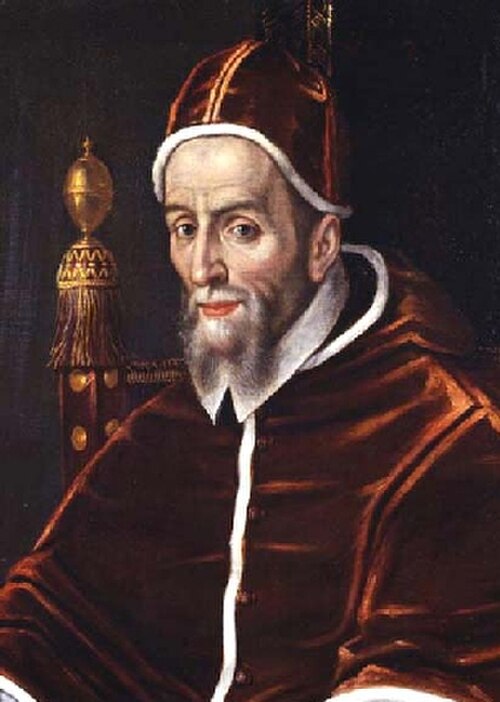
There have been a number of popes whose reign lasted about a month or less. In the following list the number of calendar days includes partial days. Thus, for example, if a pope's reign commenced on 1 August and he died on 2 August, this counts as reigning for two calendar days.
- Urban VII (15–27 September 1590): reigned for 13 calendar days, died before coronation.
- Boniface VI (April 896): reigned for 16 calendar days
- Celestine IV (25 October – 10 November 1241): reigned for 17 calendar days, died before coronation.
- Theodore II (December 897): reigned for 20 calendar days
- Sisinnius (15 January – 4 February 708): reigned for 21 calendar days
- Marcellus II (9 April – 1 May 1555): reigned for 23 calendar days
- Damasus II (17 July – 9 August 1048): reigned for 24 calendar days
- Pius III (22 September – 18 October 1503) and Leo XI (1–27 April 1605): both reigned for 27 calendar days
- Benedict V (22 May – 23 June 964): reigned for 33 calendar days
- Bl. John Paul I (26 August – 28 September 1978): reigned for 34 calendar days
Stephen (23–26 March 752) died of stroke three days after his election, and before his consecration as a bishop. He is not recognized as a valid pope, but was added to the lists of popes in the 15th century as Stephen II, causing difficulties in enumerating later popes named Stephen. The Holy See's Annuario Pontificio, in its list of popes and antipopes, attaches a footnote to its mention of Pope Stephen II:
On the death of Zachary the Roman priest Stephen was elected; but, since four days later he died, before his consecratio, which according to the canon law of the time was the true commencement of his pontificate, his name is not registered in the Liber Pontificalis nor in other lists of the popes.[232]
Published every year by the Roman Curia, the Annuario Pontificio attaches no consecutive numbers to the popes, stating that it is impossible to decide which side represented at various times the legitimate succession, in particular regarding Pope Leo VIII, Pope Benedict V and some mid-11th-century popes.[233]
See also
- Bishops in the Catholic Church
- Caesaropapism
- Index of Vatican City-related articles
- Legends surrounding the papacy
- List of canonized popes
- List of current Christian leaders
- List of popes
- Papal inauguration
- Papal name
- Papal slippers
- Prophecy of the Popes
- Pope of the Coptic Orthodox Church
- Pope Night
- List of popes who died violently
- Pope Joan
- Cadaver Synod
Notes
- ^ According to Catholic ecclesiology, Jesus Christ is the "invisible head" of the Church, while the Pope is the "visible head".
- ^ pontifex maximus or summus pontifex
- ^ Romanus pontifex
- ^ The papacy was an influence in regulating the colonization of the New World. See Treaty of Tordesillas and Inter caetera.
- ^ "Continuing in that same undertaking, this Council is resolved to declare and proclaim before all men the doctrine concerning bishops, the successors of the apostles, who together with the successor of Peter, the Vicar of Christ, the visible Head of the whole Church, govern the house of the living God."[28]
- ^ "From an historical perspective, there is no conclusive documentary evidence from the first century or the early decades of the second century of the exercise of, or even the claim to, a primacy of the Roman bishop or to a connection with Peter, although documents from this period accord the church at Rome some kind of pre‑eminence";[41] and "The see of Rome, whose prominence was associated with the deaths of Peter and Paul, became the principal center in matters concerning the universal Church".[42] The same writer quotes with approval the words of Joseph Ratzinger: "In Phanar, on 25 July 1976, when Patriarch Athenegoras addressed the visiting pope as Peter's successor, the first in honor among us, and the presider over charity, this great church leader was expressing the essential content of the declarations of the primacy of the first millennium".[43]
References
- ^ Wilken, p. 281, quote: "Some (Christian communities) had been founded by Peter, the disciple Jesus designated as the founder of his church. [...] Once the position was institutionalized, historians looked back and recognized Peter as the first Pope of the Christian church in Rome"
- ^ "CATHOLIC ENCYCLOPEDIA: The Pope". New Advent. Retrieved 27 May 2024.
- ^ Levillain, Philippe (2002). The Papacy: An Encyclopedia. Vol. 2. Routledge. p. 1227. ISBN 978-0-415-92228-9.
- ^ a b "Christ's Faithful – Hierarchy, Laity, Consecrated Life: The episcopal college and its head, the pope". Catechism of the Catholic Church. Vatican City: Libreria Editrice Vaticana. 1993. Archived from the original on 3 March 2021. Retrieved 14 April 2013.
- ^ "In Biden's visit with the pope, a page from Reagan's playbook?". theconversation.com. 27 October 2021. Archived from the original on 7 May 2022. Retrieved 8 May 2022.
- ^ "News from The Associated Press". Archived from the original on 15 March 2013.
- ^ "Definition of Holy See". Archived from the original on 18 January 2017. Retrieved 17 January 2017.
- ^ Collins, Roger. Keepers of the keys of heaven: a history of the papacy. Introduction (One of the most enduring and influential of all human institutions, [...] No one who seeks to make sense of modern issues within Christendom – or, indeed, world history – can neglect the vital shaping role of the popes.) Basic Books. 2009. ISBN 978-0-465-01195-7.
- ^ a b c d e f g h i Wetterau, Bruce. World history. New York: Henry Holt & Co. 1994.
- ^ Faus, José Ignacio Gonzáles. "Autoridade da Verdade – Momentos Obscuros do Magistério Eclesiástico". Chapter 8: Os papas repartem terras, pp. 64–65 and chapter 6: O papa tem poder temporal absoluto, pp. 49–55. Edições Loyola. ISBN 85-15-01750-4. Although Faus is deeply critical of the temporal power of the popes ("Once again this highlights one of the greatest drawbacks of the political status of Peter's successors" – p. 64), he also admits a positive secular role on the part of the popes ("We cannot deny that papal interventions of this kind prevented more than one war in Europe" – p. 65).
- ^ Jarrett, Bede (1913). . In Herbermann, Charles (ed.). Catholic Encyclopedia. New York: Robert Appleton Company.
- ^ História das Religiões. Crenças e práticas religiosas do século XII aos nossos dias. Grandes Livros da Religião. Editora Folio. 2008. pp. 89, 156–157. ISBN 978-84-413-2489-3
- ^ "The Role of the Vatican in the Modern World". Archived from the original on 4 May 2005.
- ^ "The World's Most Powerful People". Forbes. November 2014. Archived from the original on 30 December 2012. Retrieved 6 November 2014.
- ^ "The World's Most Powerful People". Forbes. January 2013. Archived from the original on 30 December 2012. Retrieved 21 January 2013.
- ^ "The World's Most Powerful People". Forbes. Archived from the original on 25 December 2018. Retrieved 27 November 2023.
- ^ Agnew, John (12 February 2010). "Deus Vult: The Geopolitics of Catholic Church". Geopolitics. 15 (1): 39–61. doi:10.1080/14650040903420388. ISSN 1465-0045. S2CID 144793259.
- ^ a b c d e "Pope", Oxford Dictionary of the Christian Church, Oxford University Press, 2005, ISBN 978-0-19-280290-3
- ^ Asimov, Isaac (1967) The Roman Empire, Houghton Mifflin: Boston, p. 236
- ^ Elwell, Walter A. (2001). Evangelical Dictionary of Theology. Baker Academic. p. 888. ISBN 978-0-8010-2075-9.
- ^ Greer, Thomas H.; Gavin Lewis (2004). A Brief History of the Western World. Cengage Learning. p. 172. ISBN 978-0-534-64236-5.
- ^ Mazza, Enrico (2004). The Eucharistic Prayers of the Roman Rite. Liturgical Press. p. 63. ISBN 978-0-8146-6078-2.
- ^ O'Malley, John W. (2009). A History of the Popes. Government Institutes. p. xv. ISBN 978-1-58051-227-5.
- ^ Schatz, Klaus (1996). Papal Primacy. Liturgical Press. pp. 28–29. ISBN 978-0-8146-5522-1.
- ^ Eusebius, Historia Ecclesiastica Book VII, chapter 7.4
- ^ "pope, n.1". Oxford English Dictionary Online. September 2011. Oxford University Press. 21 November 2011
- ^ "Catechism of the Catholic Church – Christ's Faithful – Hierarchy, Laity, Consecrated Life". Archived from the original on 6 September 2010. Retrieved 15 March 2020.
- ^ (Lumen Gentium, Pope Paul VI 1964, Chapter 3)
- ^ "Lumen gentium, 22". Vatican.va. Archived from the original on 6 September 2014. Retrieved 11 August 2010.
- ^ a b O'Grady, John (1997). The Catholic church: its origins and nature. Paulist Press. p. 146. ISBN 978-0-8091-3740-4.
- ^ Stevenson, J (1957). A New Eusebius. p. 114. ISBN 978-0-281-00802-5.
- ^ "Letter to the Corinthians (Clement)". Catholic Encyclopedia: The Fathers of the Church. New Advent. Archived from the original on 25 November 2019. Retrieved 14 April 2013.
- ^ Gröber, 510
- ^ "Letter of Ignatius of Antioch to the Romans". Crossroads Initiative. Archived from the original on 8 July 2011. Retrieved 21 February 2006.
- ^ O'Connor, Daniel William (2013). "Saint Peter the Apostle". Encyclopædia Britannica. Encyclopædia Britannica Online. p. 5. Archived from the original on 6 January 2019. Retrieved 14 April 2013.
[M]any scholars [...> accept Rome as the location of the martyrdom and the reign of Nero as the time.
- ^ Zeitschr. fur Kirchengesch. (in German), 1901, pp. 1 sqq., 161 sqq
- ^ The Secrets of the 12 Disciples, Channel 4, transmitted on 23 March 2008.
- ^ a b O'Grady, John (1997). The Catholic church: its origins and nature. Paulist Press. p. 140. ISBN 978-0-8091-3740-4.
- ^ Stevenson, J (1957). A New Eusebius. pp. 114–115. ISBN 978-0-281-00802-5.
- ^ The Early Christian Church by Chadwick
- ^ (Emmanuel Clapsis, Papal Primacy Archived 3 December 2008 at the Wayback Machine, extract from Orthodoxy in Conversation (2000), p. 110)
- ^ (Clapsis, p. 102)
- ^ (Clapsis, p. 113)
- ^ Oxford Dictionary of the Christian Church, 1997 edition revised 2005, p. 211
- ^ Cambridge History of Christianity, volume 1, 2006
- ^ Cambridge History of Christianity, volume 1, 2006, p. 418
- ^ "Saint Paul the Apostle | Biography & Facts". Encyclopedia Britannica. Archived from the original on 30 April 2015. Retrieved 22 January 2021.
- ^ Chadwick, Henry, Oxford History of Christianity, Oxford University Press, quote: "Towards the latter part of the 1st century, Rome's presiding cleric, named Clement, wrote on behalf of his church to remonstrate with the Corinthian Christians who had ejected clergy without either financial or charismatic endowment in favor of a fresh lot; Clement apologized not for intervening but for not having acted sooner. Moreover, during the 2nd century the Roman community's leadership was evident in its generous alms to poorer churches. About 165, they erected monuments to their martyred apostles, to Peter in a necropolis on the Vatican Hill, to Paul on the road to Ostia, at the traditional sites of their burial. Roman bishops were already conscious of being custodians of the authentic tradition of true interpretation of the apostolic writings. In the conflict with Gnosticism Rome played a decisive role, and likewise in the deep division in Asia Minor created by the claims of the Montanist prophets."
- ^ "Ravenna Document | Ecclesiological and Canonical Consequences of the Sacramental Nature of the Church. Ecclesial Communion, Conciliarity and Authority". www.christianunity.va. Retrieved 26 May 2024.
- ^ Davidson, Ivor (2005). The Birth of the Church. Monarch. p. 341. ISBN 1-85424-658-5.
- ^ "Let the ancient customs in Egypt, Libya and Pentapolis prevail, that the Bishop of Alexandria has jurisdiction over them all, since a similar arrangement is the custom for the Bishop of Rome. Likewise let the churches in Antioch and the other provinces retain their privileges" (Canons of the Council of Nicaea Archived 15 February 2012 at the Wayback Machine).
- ^ Chapman, Henry Palmer (1913). . In Herbermann, Charles (ed.). Catholic Encyclopedia. New York: Robert Appleton Company.
- ^ a b Alves J. Os Santos de Cada Dia (10 edição). Editora Paulinas. pp. 296, 696, 736. ISBN 978-85-356-0648-5.
- ^ Theodosian Code Archived 27 February 2007 at the Wayback Machine XVI.i.2, Medieval Sourcebook: Banning of Other Religions by Paul Halsall, June 1997, Fordham University, retrieved 4 September 2007
- ^ Wilken, Robert (2004). "Christianity". in Hitchcock, Susan Tyler; Esposito, John. Geography of Religion. National Geographic Society. p. 286. ISBN 0-7922-7317-6.
- ^ a b Gaeta, Franco; Villani, Pasquale. Corso di Storia, per le scuole medie superiori. Milão. Editora Principato. 1986.
- ^ a b Le Goff, Jacques (2000). Medieval Civilization. Barnes & Noble. pp. 14, 21. ISBN 0-631-17566-0.
- ^ a b c Durant 1950, pp. 517–551.
- ^ Durant 1950, chpt. 4.
- ^ a b c Durant 1950, chapter 4.
- ^ a b História Global Brasil e Geral. pp. 101, 130, 149, 151, 159. Volume one. Gilberto Cotrim. ISBN 978-85-02-05256-7
- ^ a b Movimentos de Rennovação e Reforma Archived 16 January 2012 at the Wayback Machine. 1 October 2009.
- ^ "Feudalismo". Portalsaofrancisco.com.br. Archived from the original on 4 February 2013. Retrieved 18 February 2013.
- ^ Vidmar, John (2005). The Catholic Church Through the Ages. Paulist Press. p. 94. ISBN 0-8091-4234-1.
- ^ Riley-Smith, Jonathan (1997). The First Crusaders. Cambridge University Press. p. 6. ISBN 978-0-511-00308-0.
- ^ Bokenkotter 2004, pp. 140–141, 192.
- ^ a b Durant 1957, pp. 3–25.
- ^ Durant 1957, pp. 26–57.
- ^ "Conciliar theory". Cross, FL, ed. The Oxford Dictionary of the Christian Church. New York: Oxford University Press. 2005. [page needed]
- ^ "Fall of Constantinople | Summary". Encyclopedia Britannica. Archived from the original on 19 August 2020. Retrieved 13 June 2019.
- ^ Boyer, Paul (2009). When Time Shall be No More: Prophecy Belief in Modern American Culture. Harvard University Press. p. 61; cf. pp. 62, 274. ISBN 978-0-674-02861-6. Archived from the original on 19 August 2020. Retrieved 15 August 2015.
- ^ Edwards, Mark U. Jr. (2004). Printing, Propaganda and Martin Luther. Fortress Press. p. 90. ISBN 978-1-4514-1399-1. Archived from the original on 19 March 2021. Retrieved 18 February 2013.
- ^ Hillerbrand, Hans J. (2004). Encyclopedia Of Protestantism. Routledge. p. 124. ISBN 0203484312.
- ^ Osborne, John (1967). Luther. Taylor & Francis. p. 301. Archived from the original on 19 March 2021. Retrieved 18 February 2013.
- ^ "Counter-Reformation". Cross, FL, ed., The Oxford Dictionary of the Christian Church. New York: Oxford University Press. 2005
- ^ "Authority of the Pope". Church Fathers. Archived from the original on 29 March 2023. Retrieved 29 March 2023.
- ^ "What the Early Church Believed: The Authority of the Pope". Catholic Answers. Archived from the original on 29 March 2023. Retrieved 29 March 2023.
- ^ Wilken, Robert Louis (2012). The First Thousand Years: A Global History of Christianity. Yale University Press. pp. 47–48. ISBN 978-0-300-11884-1. Archived from the original on 5 November 2022. Retrieved 8 May 2021.
- ^ Cartago), Cipriano (Santo, Obispo de (1984). The Letters of St. Cyprian of Carthage. Paulist Press. p. 38. ISBN 978-0-8091-0369-0. Archived from the original on 16 August 2023. Retrieved 9 May 2023.
{{cite book}}: CS1 maint: multiple names: authors list (link) - ^ Fisher, George Park (1880). Discussions in History and Theology. Scribner. p. 147. ISBN 978-0-7905-4033-7. Archived from the original on 16 August 2023. Retrieved 9 May 2023.
- ^ "Cyprian and Other Bishops at the Council of Carthage to Stephen", Letters (1–81) (The Fathers of the Church, Volume 51), Catholic University of America Press, pp. 265–268, 1 April 2010, doi:10.2307/j.ctt284z4s.75, retrieved 1 March 2023
- ^ "Church Fathers: Against Heresies, III.3 (St. Irenaeus)". www.newadvent.org. Archived from the original on 1 March 2023. Retrieved 8 May 2023.
- ^ Irenaeus. Ante-Nicene Fathers Vol. I, Against Heresies: Book III. Archived from the original on 22 March 2023. Retrieved 8 May 2023.
- ^ "Ignatius to the Romans", Ignatius of Antioch, 1517 Media, pp. 163–192, 18 May 2016, doi:10.2307/j.ctvb936zj.10, retrieved 8 March 2023
- ^ "Church Fathers: Epistle to the Romans (St. Ignatius)". www.newadvent.org. Archived from the original on 7 December 2019. Retrieved 8 March 2023.
- ^ "Church Fathers: Letter 53 (St. Augustine)". www.newadvent.org. Archived from the original on 28 March 2023. Retrieved 10 November 2023.
- ^ al, Philip Schaff et. Nicene and Post-Nicene Fathers: Series II/Volume I/Church History of Eusebius/Book III. Archived from the original on 29 April 2023. Retrieved 31 July 2023.
- ^ "Church Fathers: The Prescription Against Heretics (Tertullian)". www.newadvent.org. Archived from the original on 17 March 2023. Retrieved 8 March 2023.
- ^ "Catholic Encyclopedia: St. Optatus". www.newadvent.org. Archived from the original on 27 February 2023. Retrieved 9 April 2023.
- ^ "What the Early Church Believed: Peter's Roman Residency". Catholic Answers. Archived from the original on 9 April 2023. Retrieved 9 April 2023.
- ^ Matthew 16:18–19
- ^ Luke 22:31–32
- ^ John 21:17
- ^ Lightfoot, John. "Commentary on Matthew 16:18". Commentary on the Gospels. StudyLight.org. Archived from the original on 14 May 2013. Retrieved 23 May 2013.
It is readily answered by the Papists, that "Peter was the rock." But let them tell me why Matthew used not the same word in Greek, if our Saviour used the same word in Syriac. If he had intimated that the church should be built upon Peter, it had been plainer and more agreeable to be the vulgar idiom to have said, "Thou art Peter, and upon thee I will build my church.
- ^ Robertson, Archibald Thomas. "Commentary on Matthew 16:18". Word Pictures of the New Testament. StudyLight.org. Archived from the original on 14 May 2013. Retrieved 23 May 2013.
- ^ Gill, John. "Commentary on Matthew 16:18". Exposition of the Whole Bible. StudyLight.org. Archived from the original on 14 May 2013. Retrieved 23 May 2013.
by the rock, is meant, either the confession of faith made by Peter; not the act, nor form, but the matter of it, it containing the prime articles of Christianity, and which are as immoveable as a rock; or rather Christ himself, who points, as it were, with his finger to himself, and whom Peter had made such a glorious confession of; and who was prefigured by the rock the Israelites drank water out of in the wilderness; and is comparable to any rock for height, shelter, strength, firmness, and duration; and is the one and only foundation of his church and people, and on whom their security, salvation, and happiness entirely depend.
- ^ Wesley, John. "Commentary on Matthew 16:18". Wesley's Notes on the Bible. Christian Classics Ethereal Library. Archived from the original on 13 November 2012. Retrieved 23 May 2013.
On this rock – Alluding to his name, which signifies a rock, namely, the faith which thou hast now professed; I will build my Church – But perhaps when our Lord uttered these words, he pointed to himself, in like manner as when he said, Destroy this temple, John 2:19; meaning the temple of his body. And it is certain, that as he is spoken of in Scripture, as the only foundation of the Church, so this is that which the apostles and evangelists laid in their preaching. It is in respect of laying this, that the names of the twelve apostles (not of St. Peter only) were equally inscribed on the twelve foundations of the city of God, Revelation 21:14. The gates of here – As gates and walls were the strength of cities, and as courts of judicature were held in their gates, this phrase properly signifies the power and policy of Satan and his instruments. Shall not prevail against it – Not against the Church universal, so as to destroy it. And they never did. There hath been a small remnant in all ages.
- ^ Scofield, C. I. "Commentary on Matthew 16:18". Scofield's Reference Notes. 1917 edition. StudyLight.org. Archived from the original on 14 May 2013. Retrieved 23 May 2013.
There is the Greek a play upon the words, "thou art Peter petros – literally 'a little rock', and upon this rock Petra I will build my church." He does not promise to build His church upon Peter, but upon Himself, as Peter is careful to tell us (1 Peter 2:4–9).
- ^ Henry, Matthew. "Commentary on Matthew 16:18". Matthew Henry's Complete Commentary on the Bible. StudyLight.org. Archived from the original on 14 May 2013. Retrieved 23 May 2013.
First, Some by this rock understand Peter himself as an apostle, the chief, though not the prince, of the twelve, senior among them, but not superior over them. The church is built upon the foundation of the apostles, Ephesians 2:20. The first stones of that building were laid in and by their ministry; hence their names are said to be written in the foundations of the new Jerusalem, Revelation 21:14... First, Some by this rock understand Peter himself as an apostle, the chief, though not the prince, of the twelve, senior among them, but not superior over them. The church is built upon the foundation of the apostles, Ephesians 2:20. The first stones of that building were laid in and by their ministry; hence their names are said to be written in the foundations of the new Jerusalem, Revelation 21:14. ... Thirdly, Others by this rock understand this confession which Peter made of Christ, and this comes all to one with understanding it of Christ himself. It was a good confession which Peter witnessed, Thou art the Christ, the Son of the living God; the rest concurred with him in it. "Now", saith Christ, "this is that great truth upon which I will build my church." 1. Take away this truth itself, and the universal church falls to the ground. If Christ be not the Son of God, Christianity is a cheat, and the church is a mere chimera; our preaching is vain, your faith is vain, and you are yet in your sins, 1 Corinthians 15:14–17. If Jesus be not the Christ, those that own him are not of the church, but deceivers and deceived. 2. Take away the faith and confession of this truth from any particular church, and it ceases to be a part of Christ's church, and relapses to the state and character of infidelity. This is articulus stantis et cadentis ecclesia – that article, with the admission or the denial of which the church either rises or falls; "the main hinge on which the door of salvation turns;" those who let go this, do not hold the foundation; and though they may call themselves Christians, they give themselves the lie; for the church is a sacred society, incorporated upon the certainty and assurance of this great truth; and great it is, and has prevailed.
- ^ John 1:42 Archived 16 January 2014 at the Wayback Machine. Bible Hub.
- ^ "Cephas" Archived 16 January 2014 at the Wayback Machine. Dictionary.com.
- ^ "Cephas" Archived 16 January 2014 at the Wayback Machine. Behind the Name.
- ^ O'Connor, Daniel William (2013). "Saint Peter the Apostle". Encyclopædia Britannica. Encyclopædia Britannica Online. Archived from the original on 28 March 2013. Retrieved 14 April 2013.
- ^ "Where Is the Papacy in the Old Testament?". Catholic Answers. 2023. Archived from the original on 16 March 2023. Retrieved 16 March 2023.
- ^ Isaiah 22:22
- ^ Matthew 16:19
- ^ Isaiah 22:23
- ^ Matthew 16:18
- ^ John Paul II 1996, p. Introduction.
- ^ "Popes and conclaves: everything you need to know". 3 March 2013. Archived from the original on 15 July 2017. Retrieved 17 January 2017.
- ^ John Paul II 1996, pp. 88–89.
- ^ Kelly, Joseph Francis (2009). The Ecumenical Councils of the Catholic Church: A History. Liturgical Press. p. 96. ISBN 978-0-8146-5376-0. Archived from the original on 16 August 2023. Retrieved 9 May 2023.
- ^ Effron, Lauren (March 2013). "White Smoke, Pope; Black Smoke, Nope: How Conclave Smoke Gets Its Color". ABC News. Archived from the original on 6 August 2020. Retrieved 28 June 2020.
- ^ "Press Conference on the Tenth General Congregations of the College of Cardinals (11 March) and Regarding Events of the Coming Days: Tenth and Last General Congregation". Holy See Press Office. Archived from the original on 5 May 2013. Retrieved 15 April 2013.
- ^ "Vatican: Bells Will Also Announce Election of New Pope". Archived 25 July 2021 at the Wayback Machine voanews.com. 30 October 2009. Retrieved 24 July 2021.
- ^ "A quick course in 'Conclave 101'" Archived 25 July 2021 at the Wayback Machine. Ncronline.com. 15 February 2013. Retrieved 24 July 2021.
- ^ Thomas J. Reese SJ, Inside The Vatican: The Politics and Organization of the Catholic Church, Harvard University Press (1996), p. 99.
- ^ Menachery George, Vatican Adventure http://www.indianchristianity.com/html/menachery/html/GeorgeMenachery.htm Archived 14 December 2017 at the Wayback Machine
- ^ "What Does Cardinal Sodano's Departure as Dean of the College of Cardinals Mean?" Archived 13 July 2021 at the Wayback Machine ncregister.com. 27 December 2019. Retrieved 24 July 2021.
- ^ "Papal Transition: Traditional Path Sharply Defined" Archived 25 July 2021 at the Wayback Machine. nytimes.com. 2 April 2005. Retrieved 24 July 2021.
- ^ Catholic Online. "The Ring of the Fisherman". Archived from the original on 25 July 2021. Retrieved 25 July 2021.
- ^ "Papal Transition" Archived 25 July 2021 at the Wayback Machine. americamagazine.org. 24 January 2013. Retrieved 24 July 2021.
- ^ "The Process of Electing the New Pope" Archived 25 July 2021 at the Wayback Machine. christianitytoday.com. 5 April 2005. Retrieved 25 July 2021.
- ^ Ap. Const. Universi Dominici Gregis, No. 89 Archived 8 April 2012 at the Wayback Machine.
- ^ St Augustine of Hippo, speaking of the honours paid to bishops in his time, mentions the absides gradatae (Apses with steps, a reference to the seating arrangement for the presbyters in the apse of the church, with the bishop in the middle (William Smith, Samuel Cheetham, Encyclopaedic Dictionary of Christian Antiquities Archived 19 August 2020 at the Wayback Machine, "elevated stalls" in the Sparrow-Simpson translation Archived 5 March 2016 at the Wayback Machine (p. 83), and appearing as "thrones ascended by flights of steps" in the Cunningham translation Archived 28 June 2011 at the Wayback Machine), and cathedrae velatae (canopied thrones, appearing as "canopied pulpits" in both those translations) – oogle.com/books?id=_Ms7AAAAcAAJ Letter 203 in the old arrangement, 23 in the chronological rearrangement
- ^ Ablative absolute, equivalent to a temporal clause
- ^ "Profile: Pope Francis". BBC News. 1 December 2017. Archived from the original on 19 July 2018. Retrieved 19 May 2018.
- ^ Fisher, Max. "Sorry, Jorge Mario Bergoglio is not the first non-European pope". The Washington Post. Archived from the original on 18 July 2021. Retrieved 21 April 2019.
- ^ "John Paul II. Universi Dominici Gregis, Chapter 1". Archived from the original on 22 November 2019. Retrieved 19 September 2022.
- ^ "Hammer Time". Snopes.com. 5 April 2005. Archived from the original on 16 August 2023. Retrieved 2 November 2014.
- ^ Sullivan, George E. Pope John Paul II: The People's Pope. Boston: Walker & Company, 1984.
- ^ "The Path to a New Pontiff Retrieved: 2010-03-29". Time.com. 3 April 2005. Archived from the original on 6 April 2005. Retrieved 11 August 2010.
- ^ a b "Global Catholic Network | EWTN". ewtn.com. Archived from the original on 15 January 2020. Retrieved 15 January 2020.
- ^ As the reign of the pope has conventionally been from election until death, papal resignation is an uncommon event. Before the 21st century, only five popes unambiguously resigned with historical certainty, all between the 10th and 15th centuries.
- ^ "Code of Canon Law – IntraText". Archived from the original on 16 May 2020. Retrieved 15 March 2020.
- ^ Brown, Andrew (11 February 2013). "Benedict, the placeholder pope who leaves a battered, weakened church". The Guardian. Archived from the original on 1 March 2013. Retrieved 12 February 2013.
- ^ Annuario Pontificio, published annually by Libreria Editrice Vaticana, p. 23. ISBN 978-88-209-8722-0.
- ^ Shahan, Thomas Joseph (1907). . In Herbermann, Charles (ed.). Catholic Encyclopedia. Vol. 1. New York: Robert Appleton Company.
- ^ "Pope". Encyclopædia Britannica. Encyclopædia Britannica Online. 2013. Archived from the original on 12 June 2013. Retrieved 14 April 2013.
- ^ Adriano Cappelli. "Lexicon Abbreviaturarum". p. 283. Archived from the original on 25 July 2013. Retrieved 18 February 2013.
- ^ "Contractions and Abbreviations". Ndl.go.jp. 4 August 2005. Archived from the original on 10 December 2011. Retrieved 21 November 2011.
- ^ "What Does PP Stand For?". Acronyms.thefreedictionary.com. Archived from the original on 30 November 2011. Retrieved 21 November 2011.
- ^ "pope | Definition, Title, & List of Popes". Encyclopedia Britannica. Archived from the original on 11 July 2017. Retrieved 17 February 2021.
- ^ John 21:16–17
- ^ a b c Fanning, William Henry Windsor (1913). . In Herbermann, Charles (ed.). Catholic Encyclopedia. New York: Robert Appleton Company.
- ^ a b McBrien, Richard P. Os Papas. Os Pontífices de São Pedro a João Paulo II (original title: Lives of the Popes. The Pontiffs from St. Peter to John Paul II 1997. ISBN 0-06-065303-5), pp. 37, 85.
- ^ Oxford Dictionary of the Christian Church (Oxford University Press 2005 ISBN 978-0-19-280290-3), article Vicar of Christ
- ^ a b Beal, John P.; Coriden, James A.; Green, Thomas J. (2002). New Commentary on the Code of Canon Law. Paulist Press. p. 432. ISBN 978-0-8091-4066-4. Archived from the original on 19 March 2021. Retrieved 18 February 2010.
- ^ "Prescription against Heretics (Chapter 28)". Catholic Encyclopedia: The Fathers of the Church. New Advent. Archived from the original on 17 October 2012. Retrieved 14 April 2013.
- ^ "On the Veiling of Virgins (Chapter 1)". Catholic Encyclopedia: The Fathers of the Church. New Advent. Archived from the original on 20 May 2013. Retrieved 14 April 2013.
- ^ see John 16:7–14
- ^ Faus, José Ignacio Gonzáles. "Autoridade da Verdade – Momentos Obscuros do Magistério Eclesiástico" (Edições Loyola. ISBN 85-15-01750-4), p. 33.
- ^ Untener, Ken; Picken, Elizabeth (2007). The Practical Prophet: Pastoral Writings. New York: Paulist Press. p. 264. ISBN 978-0-8091-4429-7. Archived from the original on 19 March 2021. Retrieved 21 November 2011.
- ^ "Second Vatican Council, Dogmatic Constitution Lumen gentium, 27". Archived from the original on 6 September 2014. Retrieved 27 January 2010.
- ^ Shaw, Russell B. (1979). Church & State: A Novel of Politics and Power. Huntington, Ind: Our Sunday Visitor. p. 991. ISBN 978-0-87973-669-9. Archived from the original on 26 May 2013. Retrieved 14 April 2013.
- ^ "Medieval Sourcebook". Fordham.edu. Archived from the original on 27 November 2011. Retrieved 21 November 2011.
- ^ "Missale Romanum, Vatican City, 2008, p. 928". Clerus.org. Archived from the original on 30 November 2011. Retrieved 21 November 2011.
- ^ "Pontifex". Encyclopædia Britannica. Encyclopædia Britannica Online. 2013. Archived from the original on 13 June 2013. Retrieved 14 April 2013.
- ^ The bridge making has been interpreted in terms of "one who smoothes the way for the gods and to the gods" (Van Haeperen, Françoise, 2002. Le collège pontifical: 3ème s. a. C. – 4ème s. p. C. in series Études de Philologie, d'Archéologie et d'Histoire Anciennes, no. 39. (Brussels: Brepols) ISBN 90-74461-49-2, reviewed in Bryn Mawr Classical review, 2003 Archived 7 November 2003 at the Wayback Machine)
- ^ a b Smith, William, ed. (1875). "Pontifex". Dictionary of Greek and Roman Antiquities. London: J. Murray. pp. 939–942.
- ^ Liddell, Henry George; Scott, Robert (eds.). A Greek English Lexicon. Oxford University Press. Archived from the original on 21 May 2013. Retrieved 18 February 2013 – via perseus.uchicago.edu.
- ^ Polybius 23.1.2 and 32.22.5; Corpus Inscriptionum Atticarum 3.43, 3.428 und 3.458
- ^ Translated literally into Greek as Ancient Greek: ἀρχιερεὺς μέγιστος (greatest high priest) in Corpus Inscriptionum Graecarum 2.2696 and 3.346; Plutarch Numa 9.4 – Liddell and Scott: ἀρχιερεύς Archived 21 May 2013 at the Wayback Machine
- ^ There are 35 instances of the use of this term in the Vulgate: Mark 15:11; John 7:45, 11:47,11:49, 11:51, 11:57, 18:3, 18:10, 18:13, 18:15–16, 18:22, 18:24, 18:26, 18:35, 19:6, 19:15, 19:21; Hebrews 2:17, 3:1, 4:14–15, 5:1, 5:5, 5:10, 6:20, 7:26, 8:1, 8:3, 9:7, 9:11, 9:25, 13:11
- ^ Joyce, G. H. (1913). . In Herbermann, Charles (ed.). Catholic Encyclopedia. New York: Robert Appleton Company.
- ^ "Dictionary definition". Dictionary.reference.com. Archived from the original on 22 November 2010. Retrieved 7 November 2010.
- ^ "pontifical". Oxford Dictionaries. Oxford University Press. Archived from the original on 27 April 2013. Retrieved 15 April 2013.
- ^ Annuario Pontificio 2008 (Libreria Editrice Vaticana ISBN 978-88-209-8021-4), p. 23*
- ^ Adeleye, Gabriel; Acquah-Dadzie, Kofi (1999). World Dictionary of Foreign Expressions: A Resource for Readers and Writers. Bolchazy-Carducci Publishers. p. 375. ISBN 978-0-86516-423-9.
- ^ "Gratian". Encyclopædia Britannica. Encyclopædia Britannica Online. 2013. Archived from the original on 18 March 2013. Retrieved 14 April 2013.
- ^ Pontifex Maximus Archived 3 March 2013 at the Wayback Machine Livius.org article by Jona Lendering retrieved 15 August 2006
- ^ a b Oxford Dictionary of the Christian Church (Oxford University Press 2005 ISBN 978-0-19-280290-3), article Pontifex Maximus
- ^ Meehan, Andrew Brennan (1913). . In Herbermann, Charles (ed.). Catholic Encyclopedia. New York: Robert Appleton Company.
- ^ "Communiqué concernant la suppression du titre "Patriarche d'Occident" dans l'Annuaire pontifical 2006". Vatican.va. Archived from the original on 3 March 2021. Retrieved 11 August 2010.
- ^ "Why is Pope Francis embracing the patriarchy (of the West)?". The Pillar. 10 April 2024. Retrieved 10 April 2024.
- ^ "Encyclical letter Lumen fidei". Archived from the original on 15 January 2021. Retrieved 15 January 2021.
- ^ Examples are "Francesco" in the frontispiece of the 2013 Annuario Pontificio published in Italian shortly after his election (Annuario Pontificio 2013, Libreria Editrice Vaticana, 2013, ISBN 978-88-209-9070-1) and a letter in Italian dated 1 April 2014 Archived 24 February 2021 at the Wayback Machine.
- ^ "Catholic Encyclopedia:Ecclesiastical Abbreviations". Archived from the original on 7 July 2014. Retrieved 14 May 2014.
- ^ "Dictionary : Ring of the Fisherman". catholicculture.org. Archived from the original on 28 March 2019. Retrieved 23 October 2020.
- ^ "Umbraculum – Definition and synonyms of umbraculum in the English dictionary". educalingo.com. Archived from the original on 19 March 2021. Retrieved 23 October 2020.
- ^ "Vatican: The Possible Return of the Sedia Gestatoria". Society of Saint Pius X. 2 April 2020. Archived from the original on 22 September 2020. Retrieved 2 December 2020.
- ^ "Vatican City (Holy See) – The Keys and Coat of Arms". Fotw.net. Archived from the original on 23 September 2010. Retrieved 11 August 2010.
- ^ "The Vatican (Holy See)". Archived from the original on 26 February 2020. Retrieved 15 April 2020.
- ^ Bagliani, Agostino Paravicini (21 August 2013). "From red to white". Osservatore Romano. Archived from the original on 17 August 2014. Retrieved 29 June 2014.
- ^ "Vatican newspaper examines history of red, white papal garb". Catholic Culture. 2 September 2013. Archived from the original on 24 December 2014. Retrieved 29 June 2014.
- ^ Compare the portrait reproduced in the article on Pius V with those in the articles on his immediate predecessors Pope Pius IV and Pope Paul IV and in the articles on Pope Julius III, Pope Paul III, Pope Clement VII, Pope Adrian VI, Pope Leo X, Pope Julius II, Pope Pius II, Pope Callixtus III, Pope Nicholas V, and Pope Eugene IV.
- ^ The texts of these canons are given in Denzinger, Latin original Archived 3 February 2008 at the Wayback Machine; English translation Archived 23 April 2013 at the Wayback Machine
- ^ Denzinger 3055 (old numbering, 1823)
- ^ Denzinger 3058 (old numbering, 1825)
- ^ Denzinger 3064 (old numbering, 1831)
- ^ Denzinger 3073–3075 (old numbering, 1839–1840)
- ^ "Lumen gentium, 25". Vatican.va. Archived from the original on 6 September 2014. Retrieved 11 August 2010.
- ^ "the Jubilee Declaration". Archived from the original on 15 October 2012. Retrieved 5 November 2012.
- ^ see Apostolic succession
- ^ see Avignon Papacy
- ^ Quoted from the Medieval Sourcebook Archived 14 August 2014 at the Wayback Machine
- ^ See selection from Concordia Cyclopedia: Roman Catholic Church, History of Archived 16 July 2011 at the Wayback Machine
- ^ Byrnes, Timothy (26 November 2019). "The Enduring Power of the Papacy: Pope Francis and International Relations". Berkley Center for Religion, Peace and World Affairs. Archived from the original on 21 March 2023. Retrieved 16 August 2023.
- ^ Toosi, Nahal (18 February 2016). "The pope flashes his political passions". Politico. Archived from the original on 5 December 2022. Retrieved 16 August 2023.
- ^ Judt, Tony (2006). Postwar: a history of Europe since 1945. New York: Penguin Books. pp. 584–595. ISBN 978-0-14-303775-0.
- ^ Andersen, Martin (19 October 1984). "Chile, Argentina Sign Protocol on Beagle". Washington Post. ISSN 0190-8286. Archived from the original on 2 December 2015. Retrieved 16 August 2023.
- ^ Hooper, John (17 December 2014). "Pope Francis and the Vatican played key roles in US-Cuba thaw, leaders reveal". The Guardian. ISSN 0261-3077. Archived from the original on 14 June 2023. Retrieved 16 August 2023.
- ^ Chandler, Adam (17 December 2014). "How the Pope Helped Bring the United States and Cuba Together". The Atlantic. Archived from the original on 28 January 2023. Retrieved 16 August 2023.
- ^ Dworkin, Anthony; Iliopoulos, Katherine. "The International Criminal Court, Bashir, and the Immunity of Heads of State". Crimesofwar.org. Archived from the original on 9 August 2011. Retrieved 11 August 2010.
- ^ Simbeye, Yitiha (2004). Immunity and International Criminal Law. Ashgate. p. 94. ISBN 9780754624332. Archived from the original on 28 July 2020. Retrieved 14 November 2015.
- ^ "U.S. Says Pope Immune From Molestation Lawsuit". Fox News. 20 September 2005. Archived from the original on 28 January 2011. Retrieved 11 August 2010.
- ^ Allen, John L. (21 May 2010). "The autonomy of bishops, and suing the Vatican". National Catholic Review. Archived from the original on 24 May 2010. Retrieved 23 May 2010.
- ^ McKiggan, John (27 November 2008). "Vatican Can Be Sued For Priest Sexual Abuse: U.S. Court of Appeals". Sexual Abuse Claims Blog. McKiggan Hebert Lawyers. Archived from the original on 22 August 2016.
- ^ Winfield, Nicole (30 March 2010). "Vatican offers 3 reasons it's not liable in U.S. abuse case". USA Today. Archived from the original on 13 April 2013. Retrieved 15 April 2013.
- ^ Horne, Mark (10 April 2010). "Richard Dawkins calls for arrest of Pope Benedict XVI". The Times. London. Archived from the original on 23 April 2014. Retrieved 15 April 2013 – via Richard Dawkins.
- ^ Roberts, Ivor (13 April 2010). "Is the Holy See above the law?". The Times. London. Archived from the original on 23 February 2015. Retrieved 15 April 2013.
- ^ Pentin, Edward (15 April 2010). "Arrest the Pope?". Zenit News Agency. Archived from the original on 20 April 2010.
- ^ Hymas, Charles (6 August 2022). "Vatican's £124m property case to be heard in UK in 'trial of the century'". The Daily Telegraph. Archived from the original on 8 August 2022. Retrieved 8 August 2022.
- ^ "Court of Appeal sets aside stay of proceedings in Vatican London property dispute". Littleton Chambers. 26 July 2022. Archived from the original on 13 August 2022. Retrieved 8 August 2022.
- ^ "Differing Attitudes Toward Papal Primacy". Archived from the original on 18 December 2018. Retrieved 17 December 2018.
- ^ "Therefore, on the basis of a renewed study of the pertinent Scriptures we reaffirm the statement of the Lutheran Confessions, that 'the Pope is the very Antichrist'" from Statement on the Antichrist Archived 22 February 2013 at the Wayback Machine from the Wisconsin Evangelical Lutheran Synod, also Ian Paisley, The Pope is the Antichrist Archived 16 September 2017 at the Wayback Machine
- ^ See Kretzmann's Popular Commentary Archived 12 September 2007 at the Wayback Machine, 2 Thessalonians chapter two and An Exegesis of 2 Thessalonians 2:1–10 Archived 21 March 2014 at the Wayback Machine by Mark Jeske
- ^ See See Kretzmann's Popular Commentary Archived 12 September 2007 at the Wayback Machine, Revelation Chapter 13
- ^ Passional Christi und Antichristi Archived 19 July 2019 at the Wayback Machine Full view on Google Books
- ^ "Brief Statement of the Doctrinal Position of the Missouri Synod". Lutheran Churches of the Reformation. Archived from the original on 21 January 2019.
- ^ "Brief Statement of the Doctrinal Position of the Missouri Synod in the By-Gone Days of Its Orthodoxy (1932): Still by God's Grace the Scriptural Position of the Concordia Lutheran Conference". Concordia Lutheran Conference. Archived from the original on 3 December 2015. Retrieved 24 February 2013.
- ^ "The Brief Statement of 1932". Church of the Lutheran Confession. 10 December 2011. Archived from the original on 13 August 2020. Retrieved 4 August 2020.
- ^ "Doctrinal Position". The Illinois Lutheran Conference. Archived from the original on 19 August 2007.
- ^ "Doctrinal Position – The Lutheran Church – Missouri Synod". Archived from the original on 15 January 2013. Retrieved 18 February 2013.
- ^ "Antichrist". Archived from the original on 17 November 2016. Retrieved 1 December 2016.
- ^ See the Baltimore Catechism Archived 19 September 2015 at the Wayback Machine on the temporal power of the pope over governments and Innocent III's Letter to the prefect Acerbius and the nobles of Tuscany Archived 14 August 2014 at the Wayback Machine. For objection to this, see the Concordia Cyclopedia, pp. 564, 750.
- ^ See Luther, Smalcald Articles, Article four Archived 10 October 2008 at the Wayback Machine
- ^ see Papal Schism
- ^ Sandro Magister Archived 21 June 2006 at the Wayback Machine, Espresso Online.
- ^ "The Greek Orthodox Patriarchate of Alexandria and All Africa". Archived from the original on 5 July 2013. Retrieved 25 June 2013.
- ^ "Saint Peter : The First Pope (Successors of Peter - Part 1)". Archived from the original on 30 April 2023. Retrieved 30 April 2023.
- ^ Annuario Pontificio 2012 (Libreria Editrice Vaticana 2012 ISBN 978-88-209-8722-0), p. 11*
- ^ Annuario Pontificio 2012 (Libreria Editrice Vaticana 2012 ISBN 978-88-209-8722-0), p. 12*
Bibliography
- Barry, Rev. Msgr. John F. (2002). One Faith, One Lord: A Study of Basic Catholic Belief. New York: William H. Sadlier. ISBN 978-0-8215-2207-3.
- Bokenkotter, Thomas (2004). A Concise History of the Catholic Church. New York: Doubleday. ISBN 978-0-385-50584-0.
- Chadwick, Henry (1990). "The Early Christian Community". In John McManners (ed.). The Oxford Illustrated History of Christianity. Oxford University Press. ISBN 978-0-19-822928-5.
- Duffy, Eamon (1997). Saints and Sinners, a History of the Popes. Yale University Press. ISBN 978-0-300-07332-4.
- Durant, William James (1950). The Story of Civilization. Vol. IV. The Age of Faith: A History of Medieval Civilization – Christian, Islamic, and Judaic – from Constantine to Dante, A.D. 325–1300. New York: Simon & Schuster. ISBN 978-0-671-01200-7.
- Durant, William James (1957). The Story of Civilization. Vol. VI. The Reformation. New York: Simon & Schuster. ISBN 978-0-671-61050-0.
- Franzen, August; Dolan, John (1969). A History of the Church. Herder and Herder.
- Granfield, Patrick (1987). The Limits of the Papacy: Authority and Autonomy in the Church. New York: Crossroad. ISBN 978-0-8245-0839-5.
- Grisar, Hartmann (1912). History of Rome and the Popes in the Middle Ages. London: Kegan Paul, Trench, Trübner. OCLC 11025456.
- John Paul II, Pope (22 February 1996). "Universi Dominici Gregis". Vatican Publishing House. Archived from the original on 8 April 2012. Retrieved 15 March 2020.
- Kelly, J. N. (1986). Oxford Dictionary of the Popes. Prentice Hall. ISBN 978-0-19-190935-1.
- Kerr, William Shaw (1950). A Handbook on the Papacy. London: Marshall, Morgan & Scott. OCLC 51018118.
- Küng, Hans (2003). The Catholic Church: A Short History. Random House. ISBN 978-0-8129-6762-3.
- Loomis, Louise Ropes (2006) [1916]. The Book of the Popes (Liber Pontificalis): To the Pontificate of Gregory I. Merchantville, New Jersey: Evolution Publishing. ISBN 978-1-889758-86-2.
- Noble, Thomas; Strauss, Barry (2005). Western Civilization. Houghton Mifflin. ISBN 978-0-618-43277-6.
- Orlandis, José (1993). A Short History of the Catholic Church. Scepter. ISBN 978-1-85182-125-9.
- Pastor, Ludwig von (1891–1930). The History of the Popes, from the Close of the Middle Ages: Drawn from the Secret Archives of the Vatican and Other Original Sources. London: J. Hodges. OCLC 270566224.
- Walsh, James Joseph (1908). The Popes and Science: The History of the Papal Relations to Science During the Middle Ages and Down to Our Own Time. New York: Fordham University Press. OCLC 08015255. Archived from the original on 25 January 2022. Retrieved 15 August 2015.
Further reading
- Brusher, Joseph S. (1959). Popes Through the Ages. Princeton, N.J: Van Nostrand. OCLC 742355324.
- Chamberlin, E. R. (1969). The Bad Popes. New York: Dial Press. OCLC 647415773.
- Dollison, John (1994). Pope-pourri. New York: Simon & Schuster. ISBN 978-0-671-88615-8.
- Maxwell-Stuart, P. G. (1997). Chronicle of the Popes: The Reign-by-Reign Record of the Papacy from St. Peter to the Present. London: Thames and Hudson. ISBN 978-0-500-01798-2.
- Norwich, John Julius (2011). The Popes: A History. London: Chatto & Windus. ISBN 978-0-7011-8290-8.
External links

Wikimedia Commons has media related to Papae.

Wikisource has the text of the 1913 Catholic Encyclopedia article Pope.
- Pope Endurance League – Sortable list of Popes
- Data Base of more than 23,000 documents of the Popes in Latin and modern languages
- The Holy See – The Holy Father – website for the past and present Holy Fathers (since Pope Leo XIII)
- Origins of Peter as Pope (archived 6 October 2011)
- The Authority of the Pope: Part I (archived 30 October 2011)
- The Authority of the Pope: Part II (archived 21 October 2011)
.svg/500px-Coat_of_arms_of_the_Holy_See_(2).svg.png)
.svg/500px-Flag_of_Vatican_City_(2001%E2%80%932023).svg.png)