
Loading article…
 カトリック教会 | |
|---|---|
| エクレシア・カトリカ | |
 バチカン市国のサン・ピエトロ大聖堂は世界最大のカトリック教会の建物です。 | |
| 分類 | カトリック |
| 聖書 | カトリック聖書 |
| 神学 | カトリック神学 |
| 政治体制 | 聖公会[1] |
| ガバナンス | ローマ教皇庁とローマ教皇庁 |
| 法王 | フランシス |
| 特定の教会は 独立している | ラテン教会と23の東方カトリック教会 |
| 教区 | |
| 教区 | 約221,700 |
| 地域 | 全世界 |
| 言語 | 教会ラテン語と現地語 |
| 典礼 | 西洋と東洋 |
| 本部 | バチカン市国 |
| 創設者 | |
| 起源 | 1世紀 ユダヤ、ローマ帝国[2] [3] |
| 分離 | |
| メンバー | 世界キリスト教データベース(2024年)によると12億8000万人[4]教皇年報(2022年) によると13億9000万人[5] [6] |
| 聖職者 | |
| 病院 | 5,500 [7] |
| 小学校 | 95,200 [8] |
| 中等学校 | 43,800 |
| 公式サイト | バチカン |
カトリック教会は、ローマカトリック教会としても知られ、2024年の時点で世界中に12億8000万〜13億9000万人の洗礼を受けたカトリック教徒を擁する最大のキリスト教会です。 [4] [5] [9]世界で最も古く、最大の国際機関の一つであり、西洋文明の歴史と発展において重要な役割を果たしてきました。[10] [11] [12] [13]教会は、ラテン教会と23の東方カトリック教会を含む24の直轄教会で構成されており、世界中に約3,500の教区と教区を構成しています。[14]ローマの司教である教皇が教会の主任司祭です。[ 15 ]ローマ教区は、聖座として知られ、教会の中央統治機関です。聖座の行政機関であるローマ教皇庁は、イタリアの首都ローマ内の小さな独立都市国家であり飛び地であるバチカン市国に主要な事務所を置いており、その国家元首は教皇である。
カトリックの核となる信条はニカイア信条に見出される。カトリック教会は、自らがイエス・キリストの大宣教命令により設立された唯一の、聖なる、カトリックの、使徒的な教会であること、[16] [17] [注 1]、司教はキリストの使徒の後継者であり、教皇はイエス・キリストによって首位権を授けられた聖ペテロの後継者であると教えている。[20]使徒によって教えられた本来のキリスト教の信仰を実践し、教会の教導権によって真正に解釈された聖書と聖なる伝統を通してその信仰を誤りなく保持していると主張している。 [21]ローマ典礼やラテン教会の他の典礼、東方カトリックの典礼、托鉢修道会、閉鎖修道会、第三会などの制度は、教会のさまざまな神学的、精神的な重点を反映している。 [22] [23]
カトリック教会の七つの秘跡のうち、聖体は主要なものであり、ミサの中で典礼的に執り行われる。[24]教会は、司祭による聖別によって、犠牲のパンとワインがキリストの体と血になると教えている。聖母マリアは永遠の処女、神の母、天の女王として崇敬されており、教義や信心の中で称えられている。[25]カトリックの社会教義は、肉体的および精神的な慈善活動を通じて、病人、貧者、苦しんでいる人々を自発的に支援することを強調している。カトリック教会は、世界中で何万ものカトリック学校、大学、病院、孤児院を運営しており、世界最大の非政府教育・医療提供者である。 [26]その他の社会福祉事業には、多数の慈善団体や人道団体がある。
カトリック教会は、西洋の哲学、文化、芸術、文学、音楽、法律、[27]および科学、[13]に大きな影響を与えてきました。カトリック教徒は、宣教、移民、ディアスポラ、改宗を通じて世界中に住んでいます。20世紀以降、大多数は、ヨーロッパと北米の世俗化により、グローバルサウスに居住しています。カトリック教会は、 1054年の東西分裂まで東方正教会と交わりを共有し、特に教皇の権威について論争しました。西暦431年のエフェソス公会議の前には東方教会もこの交わりを共有しており、西暦451年のカルケドン公会議の前には東方正教会も共有していましたが、すべて主にキリスト論の違いにより分裂しました。東方カトリック教会は、合計で約1,800万人の信者を擁し、さまざまな歴史的状況により、分裂中または分裂後に教皇のもとに戻ったり、教皇との交わりを維持したりした東方キリスト教徒の集団を代表している。16世紀には、宗教改革により、別々のプロテスタントグループが形成された。20世紀後半から、カトリック教会は、性に関する教え、女性の叙任に反対する教義、聖職者による性的虐待事件の扱いについて批判されてきた。
名前
.jpg/500px-Ignatius_of_Antiochie,_poss._by_Johann_Apakass_(17th_c.,_Pushkin_museum).jpg)
カトリック(ギリシャ語:καθολικός、ローマ字: katholikos、文字通り 「普遍的な」)は、2世紀初頭に初めて教会を説明するために使用されました。[30] 「カトリック教会」(ギリシャ語:καθολικὴ ἐκκλησία、ローマ字: katholikḕ ekklēsía )という語句の最初の既知の使用は、西暦110年頃にアンティオキアの聖イグナチオがスミルナ人に書いた手紙の中に見られ、[注 2]次のように書かれています。「司教が現れるところには、民もそこにいなさい。イエスがいるところには、普遍的な[カトリックのような]教会があるのと同じです。」[31]エルサレムの聖キュリロスのカテキズム講義( 350年頃)では、「カトリック教会」という名称が、自分たちを「教会」と呼ぶ他のグループと区別するために使われました。[31] [32]「カトリック」という概念は、ローマ帝国の東西両半分を統治した最後の皇帝テオドシウス1世が380年にローマ帝国の国教会を設立した際に発布した勅令「カトリック信仰」でさらに強調されました。[33]
1054年の東西教会分裂以来、東方正教会は「正教会」という形容詞を独自の称号として採用しており、正式名称は今も正教会カトリック教会である。[34]ラテン教会はカトリックと表現され、16世紀のプロテスタント改革以降、聖座と交わりを持つ者もカトリックと表現され、聖座との交わりを失った者はプロテスタントとして知られるようになった。[35] [36]
ローマ教会は西ローマ帝国の崩壊から中世初期(6世紀から10世紀)まで教皇のローマ教区を指すのに使われてきたが、ローマカトリック教会は16世紀後半の宗教改革以来、英語では教会全体を指すようになった。[37]さらに、東方カトリック教会と区別するためにラテン教会をローマカトリックと呼ぶ人もいる。 [38]「ローマカトリック」は、ローマ教皇庁が作成した文書にも時折登場し、[注3]、特に一部の国の司教会議や地方の教区で使用されている。[注4]
カトリック教会という名称は、カトリック教会のカテキズム(1990年)と教会法典(1983年)で教会全体を指すために使用されている。「カトリック教会」は、第二バチカン公会議(1962年 - 1965年)[39] 、第一バチカン公会議(1869年 - 1870年)[40] 、トレント公会議(1545年 - 1563年)[41] 、その他多数の公式文書でも使用されている。[42] [43]
歴史
使徒時代と教皇制
.jpg/500px-Perugino_-_Entrega_de_las_llaves_a_San_Pedro_(Capilla_Sixtina,_1481-82).jpg)

新約聖書、特に福音書には、イエスの活動と教え、十二使徒の任命、使徒への大宣教命令、そしてイエスの働きを継続するよう使徒たちに指示したことが記録されている。[44] [45]使徒言行録には、キリスト教会の創設とローマ帝国へのメッセージの広がりが記されている。[46] カトリック教会は、キリストが復活したと信じられている日から50日後のペンテコステに公の宣教が始まったと教えている。[47]ペンテコステでは、使徒たちは聖霊を受け、教会を導く使命に備えたと信じられている。[48] [49]カトリック教会は、ローマ司教が率いる司教団が使徒の後継者であると教えている。 [50]
マタイによる福音書にあるペトロの告白の記述では、キリストはペトロを「岩」と呼び、その上にキリストの教会が建てられると述べています。[51] [52]カトリック教会はローマの司教、教皇を聖ペトロの後継者と見なしています。[53]ペトロがローマの最初の司教であったと主張する学者もいます。[54]他の[誰? ]は、教皇制の制度はペトロがローマの司教であったという考えや、彼がローマにいたことさえも関係ないと言います。[55]多くの学者は、ローマでは複数の長老/司教による教会構造が2世紀半ばまで存続し、その後、単独の司教と複数の長老の構造が採用され、[56]後の著述家が「ローマの司教」という用語を、初期の聖職者の最も著名なメンバーとペトロ自身に遡及的に適用したと考えています。[56]これに基づいて、プロテスタントの学者オスカー・クルマン[57]、ヘンリー・チャドウィック[58]、バート・D・アーマン[59]は、ペテロと現代の教皇の間に正式なつながりがあったかどうか疑問視しています。レイモンド・E・ブラウンも、ペテロをローマの地方司教として語るのは時代錯誤であると述べていますが、当時のキリスト教徒はペテロを「その後の教会における教皇の役割の発展に不可欠な形で貢献する役割」を持つ人物と見なしていたでしょう。ブラウンによると、これらの役割は「ローマの司教、つまりペテロが亡くなり、パウロがキリストの真実を証言した都市の司教を、普遍的な教会の世話をするペテロの後継者と見なすのに大きく貢献しました」。[56]
古代とローマ帝国

ローマ帝国の状況は、新しいアイデアの普及を促進しました。帝国の道路と水路のネットワークは旅行を容易にし、パックス・ロマーナは旅行を安全にしました。帝国はギリシャにルーツを持つ共通文化の普及を奨励し、アイデアをより簡単に表現し理解できるようにしました。[60]
しかし、ローマ帝国のほとんどの宗教とは異なり、キリスト教はユダヤ教から取り入れた慣習である他のすべての神々を放棄することを信者に要求した(偶像崇拝を参照)。キリスト教徒が異教の祝祭に参加することを拒否したことは、彼らが公的生活の多くに参加できなかったことを意味し、政府当局を含む非キリスト教徒は、キリスト教徒が神々を怒らせ、それによって帝国の平和と繁栄を脅かしているのではないかと恐れた。結果として生じた迫害は、 4世紀にキリスト教が合法化されるまで、キリスト教徒の自己認識の決定的な特徴であった。[61]
313年、コンスタンティヌス1世皇帝のミラノ勅令によりキリスト教が公認され、330年にコンスタンティヌスは帝国の首都をコンスタンティノープル(現在のトルコのイスタンブール)に移した。380年、テッサロニキ勅令によりニカイア・キリスト教がローマ帝国の国教会となった。この立場は、ビザンチン帝国の縮小する領土内では、帝国自体が1453年にコンスタンティノープル陥落で終わるまで続いたが、他の地域では教会は帝国から独立しており、これは東西教会分裂で特に明らかになった。七回全地公会議の期間中に5つの主要司教区が出現し、6世紀半ばにユスティニアヌス1世皇帝によりローマ、コンスタンティノープル、アンティオキア、エルサレム、アレクサンドリアの五大教区として正式化された。[62] [63] 451年、カルケドン公会議は、その正当性が議論された教会法において、[64]コンスタンティノープル司教区を「ローマ司教に次ぐ権威と権力」の地位に昇格させた。 [65] 350年頃から 500 年頃にかけて、ローマの司教、あるいは教皇は、神学上の論争において正統派指導者を支援するために一貫して介入することで、着実に権威を増していき、彼らへの訴えを促した。[66]ユスティニアヌス帝は、支配地域において、ある種の皇帝教皇制を決定的に確立し、[67]「礼拝と規律の細部を法律で規制し、教会が持つべき神学的見解を指示する権利と義務を有していた」[68] 。そしてローマと西方の他の地域に対する皇帝の権力を回復し、ビザンチン教皇制(537–752) と呼ばれる時代を開始した。この時代、ローマの司教、つまり教皇は、コンスタンティノープルの皇帝またはラヴェンナの皇帝の代表の承認を得て叙任され、そのほとんどは皇帝によってギリシャ語を話す臣民から選出された[69] 。その結果、芸術と典礼において、西方と東方のキリスト教の伝統の「るつぼ」が生まれた。[70]
その後数世紀にローマ帝国を侵略したゲルマン諸部族のほとんどは、アリウス派のキリスト教を採用していたが、ニカイア公会議はこれを異端と宣言した。[71]その結果生じたゲルマン人の統治者とカトリックの臣民の間の宗教的不和[72]は、497年にフランク人の統治者クローヴィス1世が教皇庁と修道院と同盟を結び、正統派カトリックに改宗したことにより回避された。[73]スペインの西ゴート族は589年に彼に倣い、[74]イタリアのロンゴバルド族は7世紀の間にそれに倣った。[75]
西洋キリスト教は、特に修道院を通じて、芸術(装飾写本参照)と識字能力を備えた古典文明を保存する上で大きな要因でした。 [76]西洋修道制度の創始者の一人であるヌルシアのベネディクトゥス( 480年頃- 543年)は、その統治を通じて、初期カトリック教会の修道院の精神的遺産の流用を通じて、またベネディクト会の伝統の普及による古代文化の保存と伝達を通じて、ヨーロッパ文化に多大な影響を及ぼしました。この期間中、修道院のあるアイルランドは学問の中心地となり、コロンバヌスやコロンバなどの初期のアイルランド人宣教師がキリスト教を広め、ヨーロッパ大陸中に修道院を設立しました。[76]
中世とルネサンス
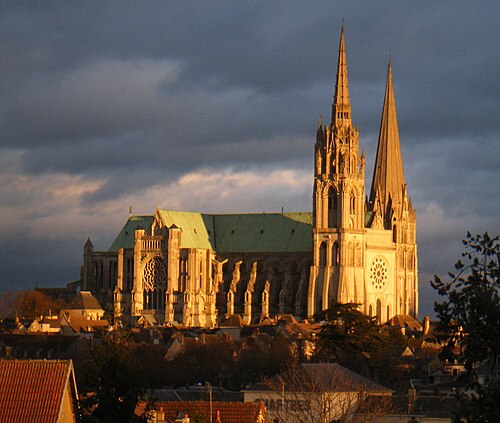
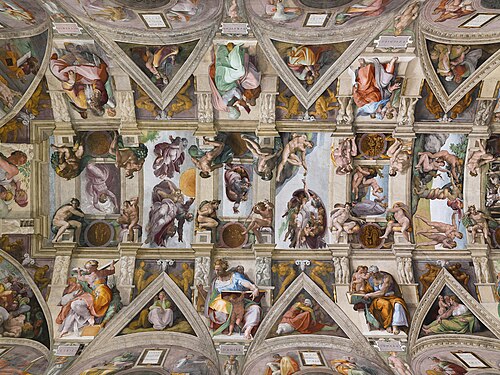
カトリック教会は、後期古代から近代の幕開けまで、西洋文明に最も大きな影響を与えた。[13]カトリック教会は、芸術、建築、音楽におけるロマネスク、ゴシック、ルネッサンス、マニエリスム、バロック様式の主要な後援者であった。[77]ラファエロ、ミケランジェロ、レオナルド・ダ・ヴィンチ、ボッティチェリ、フラ・アンジェリコ、ティントレット、ティツィアーノ、ベルニーニ、カラヴァッジョなどのルネッサンスの人物は、教会が後援した数多くの視覚芸術家の例である。[78]スタンフォード大学の歴史家ポール・レグトコは、カトリック教会は「西洋文明と呼ばれるものを構成する価値観、思想、科学、法律、制度の発展の中心にある」と述べた。[79]
西方キリスト教世界では、ヨーロッパで最初の大学は修道士によって設立された。[80] [81] [82] 11世紀初頭、オックスフォード大学、パリ大学、ボローニャ大学など、いくつかの古い大聖堂学校が大学になった。それ以前の高等教育は、修道士や修道女が率いるキリスト教の大聖堂学校または修道院学校の領域であった。そのような学校の証拠は西暦6世紀にまで遡る。[83]これらの新しい大学はカリキュラムを拡大し、聖職者、弁護士、公務員、医師のための学術プログラムを含めた。[84]大学は一般的に中世キリスト教の環境に起源を持つ機関と見なされている。[85] [86] [87]
7世紀半ばの大規模なイスラム侵攻により、地中海沿岸全域でキリスト教とイスラム教の長い闘争が始まった。ビザンチン帝国はすぐにエルサレム、アレクサンドリア、アンティオキアの東方総主教区の領土を失い、帝国の首都コンスタンティノープルのみに縮小された。地中海におけるイスラム支配の結果、地中海から離れた場所に中心を置いたフランク王国は、中世の西ヨーロッパを形作る支配的な勢力として発展することができた。[88]トゥールーズとポワティエの戦いで西方におけるイスラムの進出が阻止され、コンスタンティノープル包囲の失敗で東方におけるイスラムの進出が阻止された。20年から30年後の751年、ビザンチン帝国は、その主権を認めていたローマを含むイタリアの小さな断片を統治していたラヴェンナ市をロンゴバルド人に奪われた。ラヴェンナ陥落は、752年の教皇ステファヌス2世の選挙の際、もはや存在しない総督による承認が求められなかったことを意味し、教皇庁はそれを守るための民権を他に求めざるを得なかった。[89] 754年、教皇ステファヌスの緊急要請により、フランク王ピピン1世はロンゴバルド人を征服した。彼はその後、旧総督領の領土を教皇に贈与し、教皇領を開始した。ローマと東ビザンチンは、860年代のフォティオス分裂でさらに対立を深め、このときフォティオスは、ニコラウス1世によって破門された後、ラテン西ローマがフィリオクエ条項を追加したことを批判した。分裂は和解したものの、未解決の問題がさらなる分裂を招いた。[90]
11世紀、ヒルデブラント・フォン・ソヴァナの尽力により、1061年の教皇選挙で教皇アレクサンデル2世が教皇を選出する枢機卿団が設立された。アレクサンデル2世が死去すると、ヒルデブラントが後継者としてグレゴリウス7世として教皇に選出された。グレゴリウス7世が設立に貢献した枢機卿団の基本的な選挙制度は、21世紀まで機能し続けている。グレゴリウス7世はさらに、聖職者の世俗権力からの独立に関するグレゴリオ改革を開始した。これは、司教と教皇の任命権を持つ神聖ローマ皇帝と教会との間で叙任権論争を引き起こした。 [91] [92]
1095年、ビザンチン皇帝アレクシオス1世は、ビザンチン・セルジューク戦争におけるイスラム教徒の新たな侵略に対抗するために教皇ウルバヌス2世に援助を求めた。[93]これを受けてウルバヌスは、ビザンチン帝国を支援し聖地をキリスト教の支配下に返すことを目的とした第1回十字軍を派遣した。[94] 11世紀には、主にギリシャ教会とラテン教会の関係が緊張し、教皇の権威をめぐる対立もあって東西教会分裂が起こった。第4回十字軍と背信の十字軍によるコンスタンティノープルの略奪が最終的な決裂となった。[95]この時代、フランスの大きなゴシック様式の大聖堂はキリスト教信仰に対する民衆の誇りの表現であった。
13世紀初頭、アッシジのフランチェスコとドミニコ・デ・グスマンが托鉢修道会を設立した。托鉢修道会のスタディオ・コンベントゥアリアとスタディオ・ジェネラリアは、教会が後援する大聖堂学校やカール大帝のアーヘンのような宮廷学校をヨーロッパの著名な大学に変える上で大きな役割を果たした。[96]ドミニコ会の司祭トマス・アクィナスなどのスコラ学の神学者や哲学者は、これらのスタディオで学び、教えた。アクィナスの『神学大全』は、プラトンやアリストテレスなどの古代ギリシャの哲学者の遺産とキリスト教の啓示の内容を統合した知的な画期的な作品であった。 [97]
14世紀は教会と国家の対立意識が高まった時期だった。ローマの不安定さから逃れるため、クレメンス5世は1309年に7人の教皇のうち最初の1人として南フランスの要塞都市アヴィニョンに住み、アヴィニョン教皇制として知られる時代を過ごした。アヴィニョン教皇制は教皇がローマに戻った1376年に終わったが、[99] 1378年には38年にわたる西方教会分裂が続き、ローマ、アヴィニョン、そして(1409年以降は)ピサに教皇位を主張する者がいた。[99]この問題は1415年から1417年にかけてのコンスタンツ公会議でほぼ解決され、ローマとピサの教皇位主張者は辞任に同意し、3人目の主張者は枢機卿らによって破門され、枢機卿らは新たな選挙でマルティヌス5世を教皇に指名した。[100]
1438年にフィレンツェ公会議が開催され、東西の神学的な違いを理解することに焦点を当てた強力な対話が行われ、カトリック教会と正教会の再統合が期待されました。[101]いくつかの東方教会が再統合し、東方カトリック教会の大部分を形成しました。[102]
大航海時代
15世紀に始まった大航海時代は、西ヨーロッパの政治的、文化的影響力が世界中に拡大した時代だった。カトリックの強い国であったスペインとポルトガルが西洋の植民地主義で重要な役割を果たしたため、探検家、征服者、宣教師、また植民地支配の社会的政治的メカニズムを通じた社会の変革によって、カトリックはアメリカ大陸、アジア、オセアニアに広まった。教皇アレクサンデル6世は、新たに発見された土地のほとんどに対する植民地権をスペインとポルトガルに与えており[103]、その後のパトロナート制度により、バチカンではなく国家当局が新しい植民地のすべての聖職者の任命を管理することができた。[104] 1521年、ポルトガルの探検家フェルディナンド・マゼランがフィリピンで最初のカトリック改宗者を出した[105]。他の地域では、スペインのイエズス会士フランシスコ・ザビエルの指導の下、ポルトガルの宣教師がインド、中国、日本で布教した。[106] 16世紀に始まったフランスによるアメリカ大陸の植民地化により、フランス語を話すカトリック教徒の人口が定着し、非カトリック教徒がケベックに定住することは禁じられました。[107]
プロテスタントの宗教改革と反宗教改革
1517年、元はアウグスティノ会の修道士だったマルティン・ルター(左)は、95ヶ条の論題(右)を掲示・出版し、カトリック教会の聖職者による不正行為と腐敗、購入者やその近親者が犯した罪に対する煉獄での現世の罰を軽減する証明書である免罪符の販売などに対するルターの反対を詳述した。ルターによるこの文書の出版と発表は、宗教改革のきっかけとなったと広く考えられている。
1415年、ヤン・フスは異端の罪で火あぶりにされたが、彼の改革努力は現代のドイツのアウグスティノ派の修道士であるマルティン・ルターに勇気を与え、彼は1517年に95ヶ条の論題を数人の司教に送った。 [108]彼の論題はカトリックの教義の要点と免罪符の販売に抗議しており、ライプツィヒ論争と合わせて1521年に破門につながった。 [108] [109]スイスでは、フルドリヒ・ツヴィングリ、ジャン・カルヴァン、その他のプロテスタントの改革者たちがカトリックの教えをさらに批判した。これらの異議申し立ては宗教改革へと発展し、プロテスタントの宗派の大多数が誕生し[110]、カトリック教会内に隠れプロテスタントも生まれた。 [111]一方、ヘンリー8世は教皇クレメンス7世にキャサリン・オブ・アラゴンとの結婚の無効宣言を請願した。これが否定されると、彼は国王至上法を可決させて自らをイングランド国教会の最高指導者とし、イングランドの宗教改革と英国国教会の発展を促した。[112]
宗教改革は、プロテスタントのシュマルカルデン同盟とカトリックの皇帝カール5世とその同盟者との衝突の一因となった。最初の9年間の戦争は1555年にアウクスブルクの和約で終結したが、緊張が続いたことでさらに深刻な紛争、三十年戦争が1618年に勃発した。[113]フランスでは、1562年から1598年にかけて、ユグノー(フランスのカルヴァン派)とフランスカトリック同盟の勢力との間でフランス宗教戦争と呼ばれる一連の紛争が戦われた。フランスカトリック同盟は歴代の教皇によって支援され資金提供を受けていた。[114]これは、アンリ4世が1598年に出したフランスのプロテスタントに対する市民的および宗教的寛容を認めるナントの勅令をためらいながら受け入れた教皇クレメンス8世の時代に終結した。[113] [114]
トリエント公会議( 1545-1563)は、プロテスタント運動に対抗する宗教改革の原動力となった。教義的には、聖体変化や、救済を得るには信仰だけでなく愛と希望が必要であることなど、カトリックの中心的な教えを再確認した。[115]その後の数世紀、カトリックは宣教師や帝国主義を通じて世界中に広まったが、啓蒙時代中および啓蒙時代以降に宗教的懐疑主義が高まったため、ヨーロッパの人々に対するカトリックの影響力は低下した。[116]
啓蒙時代と近代
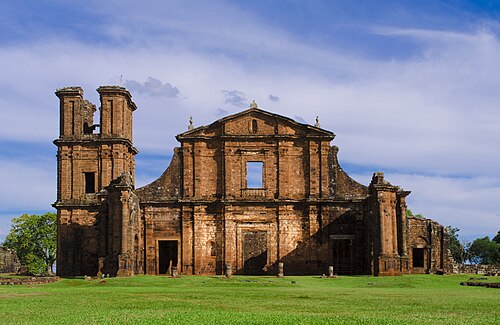
17世紀以降、啓蒙主義は西洋社会に対するカトリック教会の権力と影響力に疑問を投げかけた。[117] 18世紀には、ヴォルテールや百科全書家などの作家が、宗教とカトリック教会の両方に対して痛烈な批判を書いた。彼らの批判の対象の一つは、1685年にフランス国王ルイ14世がプロテスタントのユグノーに対する1世紀に及ぶ宗教的寛容政策を終わらせたナントの勅令の廃止であった。教皇庁がガリカニズムの推進に抵抗したため、 1789年のフランス革命で権力が国家に移行し、教会の破壊、理性崇拝の確立、[118]恐怖政治中の修道女の殉教を引き起こした。[119] 1798年、ナポレオン・ボナパルトの将軍ルイ・アレクサンドル・ベルティエがイタリア半島に侵攻し、教皇ピウス6世を投獄したが、教皇は捕虜として死亡した。ナポレオンは後に1801年の協約を通じてフランスのカトリック教会を再建した。[120]ナポレオン戦争の終結によりカトリックの復興と教皇領の復活がもたらされた。[121]
1854年、教皇ピウス9世は、1851年から1853年にかけて協議したカトリック司教の圧倒的多数の支持を得て、無原罪懐胎をカトリック教会の教義として宣言した。[122] 1870年、第1バチカン公会議は、特定の宣言で行使される場合の教皇不可謬性の教義を確認し、 [123] [124]対抗する公会議主義の立場に打撃を与えた。この問題やその他の問題をめぐる論争の結果、古カトリック教会と呼ばれる分離運動が起こった。[125]
1860年代のイタリア統一により、1870年からはローマ自体も含め教皇領がイタリア王国に編入され、教皇の世俗権力は終焉した。これに対して教皇ピウス9世は国王ヴィットーリオ・エマヌエーレ2世を破門し、土地の代金の支払いを拒否し、彼に特別な特権を与えていたイタリアの保証法を拒否した。イタリア当局に目に見える形で服従することを避けるため、彼は「バチカンの囚人」のままだった。[126]ローマ問題と呼ばれたこの対立は、1929年のラテラノ条約によって解決され、ローマ教皇庁は代金の支払いと引き換えに旧教皇領に対するイタリアの主権を認め、イタリアはバチカン市国を新しい主権独立国家として教皇の主権を認めた。[127]
カトリック宣教師は、 19世紀後半のヨーロッパ帝国のアフリカ征服を一般的に支持し、促進しようとした。宗教史家エイドリアン・ヘイスティングスによると、カトリック宣教師は、植民地の不正に反対するプロテスタント宣教師とは対照的に、アフリカ人の権利を擁護したり、アフリカ人がヨーロッパ人と同等であると認識するよう促したりすることに一般的に消極的だったという。[128]
20世紀


20世紀の間、反カトリックの権威主義体制の台頭とヨーロッパ帝国の崩壊、それに伴った西洋における宗教的慣習の全般的な衰退にもかかわらず、教会の世界的な影響力は拡大し続けた。ベネディクト15世とピウス12世の指揮下で、聖座は世界大戦を通じて公的中立を維持し、和平の仲介役を務め、紛争の被害者に援助を届けようと努めた。1960年代には、ヨハネ23世が第二バチカン公会議を招集し、教会の儀式と慣習に根本的な変化をもたらした。そして20世紀後半には、ヨハネ・パウロ2世の長期にわたる統治により、ヨーロッパにおける共産主義の崩壊と、教皇の公的かつ国際的な役割が新たに生まれた。 [129] [130] 20世紀後半から、カトリック教会は性に関する教義、女性の叙任ができない、性的虐待事件の扱いなどで批判されてきた。
ピウス10世(1903–1914)は、教皇選挙におけるカトリック勢力の拒否権を廃止することで教皇職の独立性を新たにし、その後継者のベネディクトゥス15世(1914–1922)とピウス11世(1922–1939)は、イタリア国内におけるバチカン国家の近代的独立を完結した。[131]ベネディクトゥス15世は第一次世界大戦の勃発時に選出された。彼は列強間の調停を試み、戦争の犠牲者を助け家族を再会させるためにバチカン救援事務所を設立した。[132]戦間期のピウス11世は教皇制を近代化し、40人の現地人司教を任命し、バチカン市国を設立したイタリアとのラテラノ条約を含む15の協約を締結した。[133]
後継者の教皇ピウス12世は、第二次世界大戦と冷戦初期を通じてカトリック教会を率いた。前任者同様、ピウス12世は戦争において公的にはバチカンの中立を保とうとし、被害者を助けるための援助ネットワークを設立したが、秘密裏に反ヒトラー抵抗運動を支援し、連合国と情報を共有した。[132]ピウス12世が最初に発布した回勅「スミ・ポンティフィカトゥス」(1939年)では、1939年のポーランド侵攻に失望を表明し、人種差別に反対するカトリックの教えを繰り返した。[134]バチカンのラジオで人種差別による殺害に懸念を表明し、1942年から1944年にかけて様々な国でナチスによるユダヤ人の移送を阻止しようと外交的に介入した。しかし、教皇が公的中立と外交言語にこだわったことは、多くの批判と議論の種となった。[135]それでも、ドイツ占領下のどの国でも、司祭たちはユダヤ人の救出に大きな役割を果たした。[136]イスラエルの歴史家ピンカス・ラピデは、カトリック教徒が救出したユダヤ人の数は70万人から86万人に上ると推定している。 [137]
ナチスのカトリック教会への迫害が最も激しかったのはポーランドで、ナチズムに対するカトリックの抵抗は様々な形で行われた。約2,579人のカトリック聖職者がダッハウ強制収容所の司祭宿舎に送られ、そのうち400人はドイツ人だった。[138] [139]聖マクシミリアン・コルベや聖エディット・シュタインを含む数千人の司祭、修道女、修道士が投獄され、強制収容所に連行され、拷問を受け、殺害された。[ 140] [141]カトリック教徒は紛争の両側で戦った。カトリック聖職者はファシストのスロバキア国家政府で指導的役割を果たし、同国はナチスと協力し、その反ユダヤ主義政策を模倣し、スロバキアでのホロコーストの実行を助けた。スロバキア国家の大統領でありカトリックの司祭でもあるヨゼフ・ティソは、政府によるスロバキアのユダヤ人の絶滅収容所への移送を支持した。 [142]バチカンは、スロバキアやヴィシー・フランス、クロアチア、ブルガリア、イタリア、ハンガリーなどの他のナチス傀儡政権におけるユダヤ人の移送に抗議した。[143] [144]
1943年頃、アドルフ・ヒトラーは教皇の誘拐とドイツでの抑留を計画した。ヒトラーはSS将軍ヴォルフにその準備命令を出した。[145] [146]教皇ピウス12世はホロコースト中に何十万人ものユダヤ人を救ったとされているが、[147] [148]教会は教えによって何世紀にもわたる反ユダヤ主義を助長し[149]、ナチスの残虐行為を阻止するのに十分ではなかったと非難されている。[150]多くのナチスの犯罪者は第二次世界大戦後に海外に逃亡したが、これはバチカンに強力な支持者がいたためでもある。[151] [152] [153]教皇大使、枢機卿、教皇としての任期に関する教会の文書は一部非公開か、まだ処理されていないため、情報源によってピウス12世の判断はより困難になっている。[154]
第二バチカン公会議(1962-65)は、4世紀前のトレント公会議以来、カトリックの慣習に最も重大な変化をもたらしました。[155]ヨハネ23世教皇によって始められたこのエキュメニカルな公会議は、カトリック教会の慣習を近代化し、ミサを現地語(現地語)で行うことを許可し、「典礼の儀式への完全に意識的で積極的な参加」を奨励しました。[156]この公会議は、教会を現代世界(アジョルナメント)とより密接に結びつけることを意図しており、その支持者らはこれを「窓の開放」と表現しました。[157]典礼の変化に加えて、教会のエキュメニズムへのアプローチの変化をもたらし、[158]文書「ノストラ・アエターテ」で、非キリスト教宗教、特にユダヤ教との関係改善を呼びかけました。[159]
しかし、公会議は改革の実施において大きな論争を巻き起こした。スイスの神学者ハンス・キュングのような「第2バチカン公会議の精神」の支持者は、第2バチカン公会議は教会の政策を変えるには「十分ではなかった」と述べた。[160]しかし、マルセル・ルフェーブル大司教のような伝統主義カトリック教徒は、公会議の典礼改革が「ミサの聖なる犠牲と秘跡の破壊」など他の問題を引き起こしたと主張して、公会議を強く批判した。[161]避妊の道徳に関する教えも精査された。一連の意見の相違の後、「フマネ・ヴィタエ」は教会によるあらゆる形態の避妊の禁止を支持した。[162] [163] [注 5] [164]
1978年、ポーランド人民共和国のクラクフ大司教であったヨハネ・パウロ2世教皇は、455年ぶりにイタリア人以外の教皇となった。26年半の在位は歴史上最長の1つであり、ヨーロッパにおける共産主義の崩壊を早めたとされている。[165] [166]ヨハネ・パウロ2世は、ますます世俗化が進む世界への福音化に努めた。他のどの教皇よりも多く旅行し、129か国を訪問し、[167]テレビやラジオを教会の教えを広める手段として使用した。また、「労働の尊厳」の中で、労働の尊厳と労働者が公正な賃金と安全な労働条件を得る自然な権利を強調した。[168] 「生命の福音」では、中絶、安楽死、死刑の広範な使用に反対する道徳的勧告など、いくつかの教会の教えを強調した。[169]
21世紀
2005年に選出されたベネディクト16世は、世俗化に反対して伝統的なキリスト教の価値観を擁護したことで知られており、[170] 1962年のローマミサ典礼書に記載されているトリエントミサの使用を増やし、「特別な形式」と名付けました。[171]ベネディクトは高齢による虚弱を理由に2013年に辞任し、約600年ぶりに教皇を辞任しました。[172]
カトリック教会の現教皇であるフランシスコは、2013年にアメリカ大陸出身の初の教皇、南半球出身の初の教皇、そして8世紀のグレゴリウス3世以来のヨーロッパ以外出身の初の教皇となった。[173] [174]フランシスコは、カトリックと東方諸教会の疎遠をさらに縮める努力をしてきた。[175]フランシスコの着任式には東方正教会のコンスタンティノープル総主教バルトロメオス1世が立ち会った。 [176 ] 東方正教会コンスタンティノープル総主教が教皇着任式に出席したのは1054年の大分裂以来初めてであった。 [177]また、フランシスコは2016年に最大の東方正教会の長であるモスクワ総主教キリルとも会見している。これは1054年の大分裂以来、両教会間の初の高官級会合と報じられた。[178] 2017年、エジプト訪問中に、フランシスコ教皇はコプト正教会との洗礼の相互承認を再確立した。[179]
組織
カトリック教会は司教制を採用しており、司教は聖職の秘跡を受け、教会内で正式な統治権を与えられている。 [180] [181]聖職者には3つの階級がある。司教区は、司教区または教区と呼ばれる地理的領域を管轄する司教で構成される。司教区は、司教によって叙階され、地元の教区または修道会で働く司祭で構成される。助祭区は、司教や司祭を補佐して様々な聖職を務める。最終的にカトリック教会全体を率いるのは、ローマの司教であり、教皇(ラテン語:papa、文字通り 「父」)と呼ばれ、その管轄権は聖座(ラテン語でSancta Sedes)と呼ばれる。[182]教区構造と並行して、自律的に機能するさまざまな宗教団体があり、多くの場合教皇の権威にのみ従いますが、時には地元の司教の権威に従わなければなりません。ほとんどの宗教団体は男性または女性のメンバーのみで構成されていますが、両方が所属する団体もあります。さらに、信徒のメンバーは礼拝中に多くの典礼機能を補助します。カトリック教会は、世界最古の多国籍組織と言われています。 [183] [184] [185]
聖座、教皇庁、ローマ教皇庁、枢機卿団
.jpg/500px-Canonization_2014-The_Canonization_of_Saint_John_XXIII_and_Saint_John_Paul_II_(14036966125).jpg)
カトリック教会の位階制は、 2013年3月13日の教皇選挙で選出された現在の教皇フランシスコによって率いられています[注 6]。[191]教皇の職は教皇庁として知られています。カトリック教会は、キリストが聖ペテロに天国の鍵を与えて教皇庁を設立したと信じています。彼の教会管轄は聖座、または使徒座(使徒ペテロの座を意味する)と呼ばれています。[192] [193]教皇に直接仕えるのは、カトリック教会の日常業務を管理する中央統治機関であるローマ教皇庁です。
教皇はバチカン市国の統治者でもある[194]。バチカン市国はローマ市内に完全に囲まれた小さな都市国家であり、教皇庁とは別の存在である。教皇が各国の大使を迎え入れ、自らの外交代表を派遣するのは、バチカン市国の長としてではなく、教皇庁の長としてである。[195]教皇庁はまた、中世に起源を持つ騎士団の勲章などの勲章や装飾品、メダルを授与する。
有名なサン・ピエトロ大聖堂はバチカン市国のサン・ピエトロの墓の伝統的な場所の上に位置しているが、ローマ教皇庁の大聖堂はサン・ジョバンニ・イン・ラテラノ大聖堂であり、ローマ市内に位置しているものの、ローマ教皇庁に認可された治外法権を 享受している。
枢機卿の地位は、ローマ教皇庁の指導者、主要都市の司教、著名な神学者など、特定の聖職者に教皇から授与される名誉ある地位である。教皇は、統治に関する助言や援助を求めて枢機卿団に頼ることができる。[196]
教皇が死去または辞任すると、[注 7] 80歳未満の枢機卿団のメンバーが選挙人団として活動し、教皇選挙会議で後継者を選出する。[198]選挙会議ではカトリック教徒の男性であれば誰でも教皇に選出できるが、1389年以降は枢機卿のみが選出されている。[199]
教会法
カトリック教会法(ラテン語:jus canonicum)[200]は、カトリック教会の階層的権威によって制定され施行された法律と法的原則の体系であり、教会の外部組織と統治を規制し、教会の使命に向けたカトリック信者の活動を秩序立てて指導するものである。[201]ラテン教会の教会法は最初の近代的な西洋法体系であり、[202]西洋で継続的に機能している最古の法体系でもある。[203] [204]一方、東方カトリック教会法の独特の伝統は、23の東方カトリック個別教会sui iurisを統制している。
実定法の教会法は、不変の神法または自然法に直接的または間接的に基づいており、普遍法の場合、立法、行政、司法の全権を自ら有する最高立法者、すなわち教皇による公布から正式な権威を得ている。 [205]一方、個別法は、通常の立法者であれ委任された立法者であれ、最高立法者より下位の立法者による公布から正式な権威を得ている。教会法の実際の主題は、教義や道徳的な性質だけでなく、人間の状態をすべて網羅している。そこには成熟した法制度の通常の要素がすべて備わっています。[206]法律、裁判所、弁護士、裁判官、[206]ラテン教会のための明確に定義された法典[207]および東方カトリック教会のための法典[207]、 [207]法解釈の原則、[208]および強制的な刑罰[209] [210]。
教会法はカトリック教会の生活と組織に関するものであり、民法とは区別される。教会法は、その分野において、未成年者の後見などの問題に関して、特定の制定法によってのみ民法に効力を与える。[211]同様に、民法は教会法にその分野において効力を与えることができるが、教会法上の結婚に関してのように、特定の制定法によってのみである。[212]現在、1983年の教会法典がラテン教会に適用される。[213]独立した東方カトリック教会には、1990年の東方教会法典(ラテン語の頭文字をとってCCEO )が適用される。 [214]
ラテン教会と東方教会
カトリックの歴史の最初の千年間に、ヨーロッパ、アジア、アフリカの西方キリスト教地域と東方キリスト教地域で、さまざまなキリスト教が発展した。1054年の大分裂(およびそれ以前のネストリウス派分裂とカルケドン派分裂)以降、ほとんどの東方伝統教会はカトリック教会との交わりを失っているが、23の東方伝統の自治的個別教会がカトリックの交わりに参加しており、これらは「churches sui iuris」(ラテン語で「自らの権利」)としても知られている。最大で最もよく知られているのは、世界中に10億人以上の信者を擁する唯一の西方伝統教会であるラテン教会である。信者数ではラテン教会に比べて比較的少ないが、23の自治的東方カトリック教会は、2010年時点で合計1,730万人の信者を擁している[update]。[215] [216] [217] [218]
ラテン教会は教皇と教皇が直接任命した教区司教によって統治されている。教皇はラテン教会に対して直接的な家父長的役割を担っており、ラテン教会は西方キリスト教の原点であり、今もなお主要な部分を形成していると考えられている。ラテン教会はヨーロッパと北西アフリカに起源を持つ特定の信仰と慣習の遺産であり、その一部はプロテスタント宗教改革に起源を持つ多くのキリスト教宗派に受け継がれている。[219]
東方カトリック教会は東方キリスト教の伝統と精神性に従い、常にカトリック教会との完全な交わりを保ってきた教会、または東西教会分裂やそれ以前の分裂後の数世紀に再び完全な交わりに入ることを選んだ教会である。これらの教会はカトリック教徒の共同体であり、その礼拝形態は教義の違いではなく、独特の歴史的、文化的影響を反映している。しかし、教皇による東方カトリック教会の承認は、東方正教会や他の東方教会とのエキュメニカルな関係において論争を引き起こした。歴史的に、多数派のラテン教会が実践する西方キリスト教の規範に従わなければならないという圧力は、東方カトリックの伝統の一部に対するある程度の侵害(典礼のラテン化)につながった。第2バチカン公会議の文書であるOrientalium Ecclesiarumは、以前の改革に基づいて、東方カトリック教徒が独自の典礼慣行を維持する権利を再確認した。[220]
東方教会の教会法典では、教会の教義に関する最高権威者として教皇に認められた「階層制で結ばれたキリスト教信者の集団」と定義されている。 [221]東方カトリック教会は教皇と完全な交わりを保っているが、ラテン教会とは別の統治構造と典礼の伝統を持っている。[216]ラテン教会の教会法典ではこの用語を明示的に使用していないが、暗黙のうちに同等のものとして認められている。
東方カトリック教会の中には、その教会の司教会議によって選出された総主教によって統治されているものもあれば、[222]大司教によって率いられているもの、 [223]大司教の指揮下にあるもの、[224]個々の教区として組織されているものもある。[225]各教会は、その内部組織の詳細、典礼儀式、典礼暦、その他の霊性に関する事項について権限を持ち、教皇の権威にのみ従う。[226]ローマ教皇庁には、東方教会との関係を維持するための特別の部門である東方教会省がある。 [227]教皇は、東方カトリック教会の内部統治構造に従い、通常、司教や聖職者の任命を行わないが、必要と感じた場合は介入することができる。
教区、教区、組織、研究所
カトリック教徒の分布[228]
個々の国、地域、主要都市は、ラテン教会では教区、東方カトリック教会では教区と呼ばれる特定の教会によって統治されており、それぞれの教区は司教によって監督されています。2021年現在、カトリック教会は世界中に3,171の教区を持っています。 [229]特定の国の司教は、国または地域の司教会議のメンバーです。[230][update]
教区は小教区に分かれており、各小教区には1人以上の司祭、助祭、または信徒の教会奉仕者がいます。[231]小教区は、日々の秘跡の執行と信徒の司牧に責任を負っています。[232] 2016年現在[update]、世界中に221,700の小教区があります。[8]
ラテン教会では、カトリックの男性は聖職叙階を受けることで助祭または司祭として奉仕することができます。男性と女性は聖体拝領の臨時奉仕者、朗読者(朗読者)、または祭壇奉仕者として奉仕することができます。歴史的に、祭壇奉仕者として奉仕することは少年と男性のみに許可されていましたが、1990年代以降、少女と女性も許可されています。[233] [注 8]
聖職者や信徒は、個人として隠者や聖別された処女として、あるいは聖別された生活を送る修道会(修道会または世俗の修道会)に入会して、貞潔、清貧、従順という福音の三つの勧告に従う意志を確認する誓願を立てることで、聖別された生活に入ることができる。[234]聖別された生活を送る修道会の例としては、ベネディクト会、カルメル会、ドミニコ会、フランシスコ会、神の愛の宣教者会、キリスト軍団、慈悲の姉妹会などがある。[234]
「宗教団体」は、かつて教会法で区別されていた「宗教組織」と「宗教団体」の両方を包括する現代的な用語である。[235]「宗教組織」と「宗教団体」という用語は、口語的には同義語として使用される傾向がある。[236]
カトリック教会は、カトリック慈善団体などを通じて、世界最大の非政府教育・医療提供者である。 [26]
メンバーシップ
2020年現在、カトリックはスンニ派イスラム教に次いで世界で2番目に大きな宗教団体です。[237]カトリック教徒は全キリスト教徒の約半数を占めています。[238]世界キリスト教データベースによると、2024年現在、世界には12億7800万人のカトリック教徒がいます。 [4] Annuario Pontificioによると、洗礼を受けたカトリック教徒として定義される教会の会員数は2021年末時点で13億7800万人で、世界人口の17.7%でした。[5]
ブラジルは世界で最も多くのカトリック教徒を抱えており、次いでメキシコ、フィリピン、アメリカ合衆国となっている。[239]
世界中のカトリック教徒の地理的分布は変化し続けており、アフリカでは19.3% 、アメリカ大陸では48.0%、アジアでは11.0% 、ヨーロッパでは20.9% 、オセアニアでは0.8%となっている。[5]
カトリックの聖職者には、叙階された聖職者、平信徒の教会の聖職者、宣教師、カテキストが含まれる。また、2021年末の時点で、叙階された聖職者は462,388人で、そのうち司教は5,353人、司祭(教区司祭および修道司祭)は407,730人、助祭(常任)は50,150人であった。[5]叙階されていない聖職者には、カテキストが3,157,568人、平信徒宣教師が367,679人、平信徒の教会の聖職者が39,951人含まれていた。[240]
生活様式または人間関係の使命として、結婚や独身生活ではなく修道生活または奉献生活に身を捧げたカトリック教徒には、49,414人の男性修道者と599,228人の女性修道者が含まれる。これらの人々は叙階されておらず、上記の一般聖職者カテゴリーのいずれかに従事していない限り、一般的に聖職者とは見なされていない。[5]
教義
カトリックの教義は、初期キリスト教徒の直接の教え、公会議や教皇勅書による異端と正統の信仰の正式な定義、学者による神学論争を反映して、何世紀にもわたって発展してきました。教会は、新たな神学的問題を識別する際に聖霊によって常に導かれ、問題に関して確固たる決定が下された際には教義上の誤りに陥らないように確実に保護されていると信じている。[ 241] [242]
それは、啓示には神という共通の源があり、聖書と聖伝という2つの異なる伝達方法があり、[243] [244]これらは教導権によって真正に解釈されると教えている。[245] [246]聖書はカトリック聖書の73巻で構成され、46の旧約聖書と27の新約聖書の書物からなる。聖伝は、使徒の時代から伝えられてきたと教会が信じている教えからなる。[247]聖書と聖伝はまとめて「信仰の遺産」(ラテン語でdepositum fidei )として知られている。これらは、教導権(ラテン語で「教師」を意味するmagisterから)によって解釈される。教導権は、ローマ司教である教皇と、教皇と結びついた司教団によって行使される教会の教育権である。[248]カトリックの教義は、ローマ教皇庁が発行する『カトリック教会のカテキズム』に権威を持って要約されている。 [249] [250]
神の性質

カトリック教会は、永遠の神は1人しかおらず、父なる神、子なる神、聖霊なる神という3つの位格、すなわち「位格」の相互内在として存在すると信じている。これら3つの位格は「三位一体」と呼ばれている。[251]
カトリック教徒は、イエス・キリストが三位一体の「第二位格」、神の子であると信じている。受肉として知られる出来事において、聖霊の力により、神は聖母マリアの子宮内でのキリストの受胎を通して人間性と一体となった。したがって、キリストは人間の魂を持つことを含め、完全に神であり、完全に人間であると理解されている。キリストの地上での使命には、四福音書に記録されているように、人々に教えを与え、従うべき模範を示すことが含まれていたと教えられている。[252]イエスは地上にいる間は罪を犯さず、人類を神と和解させるために自らを犠牲にして不当に十字架刑に処せられたと信じられており、この和解は復活祭の神秘として知られている。[253]ギリシャ語の「キリスト」とヘブライ語の「メシア」はどちらも「油を注がれた者」を意味し、イエスの死と復活が旧約聖書の救世主預言の成就であるというキリスト教の信仰を指しています。[254]
カトリック教会は教義的に「聖霊は父と子から永遠に発するが、二つの原理からではなく、一つの原理から発する」と教えている。[255]カトリック教会は、父は「原理のない原理」として聖霊の最初の起源であるが、また父は唯一の子の父として、子とともに聖霊が発する唯一の原理でもあるとしている。[256]この信念は、381年のニカイア信条のラテン語版に追加されたフィリオクエ節に表現されているが、東方キリスト教で使用されている信条のギリシャ語版には含まれていない。[257]
教会の性質
カトリック教会は、自らが「唯一の真の教会」[16] [258]「人類の救済の普遍的な秘跡」[259] [260]「唯一の真の宗教」[261]であると教えている。カテキズムによれば、カトリック教会はニカイア信条でさらに「唯一の、聖なる、公同の、使徒的な教会」と表現されている。[262]これらは総称して教会の四つの特徴として知られている。教会は、その創始者はイエス・キリストであると教えている。[263] [44]新約聖書には、カトリック教会の設立に不可欠とされるいくつかの出来事が記録されており、その中にはイエスの活動と教え、そして使徒たちを宣教、苦しみ、復活の証人として任命したことなどがある。イエスの復活後、大宣教命令は使徒たちにイエスの働きを続けるように指示した。ペンテコステとして知られる出来事で使徒たちに聖霊が降臨したことは、カトリック教会の公の宣教の始まりとみなされている。[47]教会は、正式に叙階されたすべての司教はキリストの使徒からの直系継承権、すなわち使徒継承権を持っていると教えている。[264]特に、ローマ司教(教皇)は使徒シモン・ペテロの後継者とみなされており、その地位から教会に対する優位性を得ている。 [265]
カトリックの信仰では、教会は「地上におけるイエスの継続的な存在」であり[266]、教会だけが完全な救済手段を持っているとされています。[267]福音書に記されているように、十字架刑に至るキリストの受難(苦しみ)を通して、キリストは人類を神と和解させるために父なる神への捧げ物となったと言われています。 [268]イエスの復活により、彼は死者の中から最初に生まれた者、多くの兄弟たちの中で最初の者となりました。[269]神と和解し、キリストの言葉と行いに従うことで、人は神の国に入ることができます。[270]教会は、典礼と秘跡を、キリストの犠牲を通して得られた恵みを永続させ、キリストとの関係を強化し、罪を克服するのを助けるものと見なしています。[271]
最終判決
カトリック教会は、死後すぐに、各人の魂は、その人の罪とキリストとの関係に基づいて、神から特定の裁きを受けると教えています。 [272] [273]この教えはまた、キリストが全人類の普遍的な裁きを下す別の日を証明しています。教会の教えによれば、この最後の審判は人類の歴史に終止符を打ち、神が正義をもって統治する新しいより良い天と地の始まりとなるでしょう。[274]
死後に下される審判に応じて、魂は死後の世界の 3 つの状態のいずれかに入ると考えられています。
- 天国とは、存在論的にではなく、神の恩寵によって、神の神聖な性質と永遠に一体化した状態です。それは魂が絶え間ない至福の中で神を観想する永遠の生命です。[275]
- 煉獄は、天国に行く運命にあるものの、罪から完全に解放されておらず、そのためすぐに天国に入ることができない魂を浄化するための一時的な状態です。 [276]煉獄では、魂は苦しみ、浄化され、完成されます。煉獄にいる魂は、地上の信者の祈りと聖人の執り成しによって天国に行くのを助けられることがあります。[277]
- 最終的な罰:最後に、大罪を犯したまま生き続け、死ぬ前に悔い改めない者は、地獄に落ち、神から永遠に引き離される。[278]教会は、神を拒絶することを自由に決めない限り、地獄に落ちる運命にある者はいないと教えている。[279]地獄に落ちる運命にある者は誰もおらず、地獄に落ちる運命にある者を絶対的に確実に判断できる者は誰もいない。[280]カトリックは、神の慈悲により、人は死ぬ前のどの時点でも悔い改め、カトリック信仰の真理に照らされ、救済を受けることができると教えている。[281]カトリックの神学者の中には、洗礼を受けていない幼児や、大罪を犯さずに原罪のまま死んだ非キリスト教徒の魂は、地獄に送られると推測する者もいるが、これは教会の公式の教義ではない。 [282]
カトリック教会は、自分たちだけが救済の完全な手段を持っていると教えているが[267]、聖霊が自分たちから離れたキリスト教共同体を利用して「カトリックの統一を促し」 、「カトリック教会に導き」[283] 、人々を救済に導くことができることも認めている。なぜなら、これらの離れた共同体には、誤りが混じっているとはいえ、正しい教義の要素がいくらか含まれているからである。カトリック教会は、救われる人は誰でもカトリック教会を通して救われるが、人々は願望の洗礼として知られる通常の手段以外、血の洗礼として知られる洗礼前の殉教、および無敵の無知の状態が存在する場合にも救われると教えている。ただし、無敵の無知自体は救済の手段ではない。[284]
聖人と信仰
聖人(歴史的には聖人としても知られる)は、並外れた神聖さ、神に似た性質、神との近さを持つと認められる人物であり、列聖はキリスト教会が亡くなった人物が聖人であったと宣言する行為であり、その宣言により、その人物は認められた聖人の「正典」またはリストに加えられる。[285] [286]聖人として崇められた最初の人物は殉教者たちであった。彼らの死に関する敬虔な伝説は、キリストへの信仰が真実であることを確証するものとみなされた。しかし、4世紀までには、「告解師」(死ぬことによってではなく、苦しみによって信仰を告白した人々)が公的に崇拝されるようになった。
カトリック教会では、ラテンカトリック教会と東方カトリック教会の両方において、列聖の行為は使徒座に留保されており、列聖候補者が模範的かつ神聖な方法で生き、死んだため、聖人として認められるにふさわしいという広範な証明を必要とする長いプロセスの最後に行われます。教会が正式に聖性を認定するということは、その人物が今は天国にいるということ、そして教会の典礼、聖人連祷を含む典礼で公的にその人物を呼び出し、公式に言及できることを意味します。列聖により、ローマ典礼の典礼で聖人を普遍的に崇敬できるようになります。単に地域的に崇敬する許可を得るには、列福のみが必要です。[287]
信心とは「外的な信心の実践」であり、カトリック教会の公式の典礼の一部ではないが、カトリック教徒の一般的な精神的実践の一部である。[288]これらには、聖人、特に聖母マリアへの崇拝に関するさまざまな実践が含まれる。その他の信心深い実践には、十字架の道行き、イエスの聖心、イエスの聖顔、[289]さまざまなスカプラリオ、さまざまな聖人へのノベナ、[290] 巡礼[291]と聖体への信心、[290]サントスなどの聖像への崇拝が含まれる。[292]第二バチカン公会議の司教たちはカトリック教徒に、「信心は典礼の季節と調和し、聖なる典礼に一致し、何らかの形で典礼から派生し、人々を典礼に導くように作成されるべきである。なぜなら、実際、典礼はその性質上、それらのどれよりも優れているからである」と注意を促した。[293]
聖母マリア

カトリックの聖母学は、イエスの母マリアの生涯に関する教義と教え、および信者によるマリアへの崇拝を扱っています。マリアは特別な尊敬を集め、神の母(ギリシャ語:Θεοτόκος、ローマ字: Theotokos、文字通り「神を産む者」)と宣言され、生涯を通じて処女であったことが教義として信じられています。[294]さらに、無原罪の御宿り(原罪の汚れのないマリア自身の受胎)と聖母被昇天(マリアの生涯の終わりに彼女の遺体が天に直接上げられた)の教義が含まれます。これらの教義は両方とも、1854年に教皇ピウス9世、1950年に教皇ピウス12世によって、絶対確実な教義として定義されましたが、 [295]これは、これがカトリックの信仰であることを確認するために世界中のカトリック司教と協議した後のことでした。[296]しかし、東方カトリック教会では、聖母被昇天祭を聖母被昇天祭の名で同日に祝い続けています。[297]聖母被昇天前に聖母マリアが亡くなったという教えは、聖母マリアが亡くなったわけではないという考えよりかなり先行しています。聖ヨハネ・ダマスコは次のように書いています。「エルサレム司教聖ユウェナリスはカルケドン公会議 (451) で、聖母マリアの遺体を所有しようとした皇帝マルキアヌスとプルケリアに、聖母マリアは使徒たち全員の前で亡くなったが、聖トマスの要請で墓を開けたところ空であることがわかり、使徒たちは遺体が天に上げられたと結論付けた」[298]
マリアへの信仰はカトリックの信心の一部であるが、神への崇拝とは異なる。[299]実践には祈りとマリア芸術、音楽、建築が含まれる。教会暦を通じていくつかの典礼上のマリア祭が祝われ、マリアは天の女王など多くの称号で称えられている。教皇パウロ6世は、キリストを生んだことでキリストの体を構成する各メンバーの精神的な母であると考えられているため、マリアを教会の母と呼んだ。[295]イエスの生涯におけるマリアの影響力のある役割のため、アヴェ・マリア、ロザリオ、サルヴェ・レジーナ、メモラーレなどの祈りや信仰はカトリックの一般的な実践である。[300]ルルド、ファティマ、グアダルーペなど、教会が認めるいくつかのマリア出現の場所への巡礼[301]もカトリックの信仰として人気がある。[302]
聖礼典

カトリック教会は、キリストによって制定された7つの秘跡が教会に託されたと教えている。秘跡の数と性質は、いくつかのエキュメニカル公会議、最近ではトレント公会議によって定義された。[303] [注 9]これらは、洗礼、堅信礼、聖体拝領、懺悔、病者の塗油(以前は終油と呼ばれ、「最後の儀式」の1つ)、聖職叙階、聖婚である。秘跡は、カトリック教徒が神の存在のしるしと、適切な心構え(エクス・オペレ・オペラト)でそれを受けるすべての人に対する神の恵みの効果的な経路とみなす目に見える儀式である。[304]カトリック教会のカテキズムは、秘跡を「キリスト教入信の秘跡」、「治癒の秘跡」、「信者の交わりと使命に役立つ秘跡」の3つのグループに分類している。これらのグループは、それぞれの秘跡が奉仕することを意図している人々の自然的および精神的な生活の段階を広く反映しています。[305]
秘跡の典礼は教会の使命の中心です。カテキズムによると、
新約聖書の典礼では、すべての典礼行為、特に聖体と秘跡の執行は、キリストと教会との出会いです。典礼集会は、神の子供たちをキリストの唯一の体に集める「聖霊の交わり」からその一体性を得ています。この集会は、人種、文化、社会、そして実際、すべての人間の親和性を超越しています。[306]
教会の教義によれば、教会の秘跡は、有効に執り行われるためには、適切な形式、内容、意図が必要である。[307]さらに、ラテン教会と東方カトリック教会の両方の教会法は、特定の秘跡を合法的に執り行える者と、秘跡を受けることができる者に関する厳格な規則を規定している。[308]特に、教会はキリストが聖体の中に存在すると教えているため、 [309]大罪の状態にあることを自覚している者は、和解の秘跡(懺悔)によって赦免を受けるまで、秘跡を受けることを禁じられている。 [310]カトリック教徒は通常、秘跡を受ける前に少なくとも 1 時間は食事を控える義務がある。[310]非カトリック教徒も、聖体を受けることを通常禁じられている。[308] [311]
カトリック教徒は、たとえ死の危険にさらされ、カトリックの聖職者に近づくことができなかったとしても、カトリックの叙階の教えに沿って有効に叙階されたことが知られていないプロテスタントの聖職者のような人物に、聖餐の秘跡、懺悔、または病者の塗油を求めることはできない。[312] [313]同様に、重大で差し迫った必要があっても、カトリックの聖職者は、秘跡に対するカトリックの信仰を表明しない人々にこれらの秘跡を執行することはできない。聖座と交わりのない東方キリスト教の教会に関しては、カトリック教会はそれほど制限的ではなく、「適切な状況と教会当局の承認があれば、聖餐、したがって聖体拝領における一定の交わりは可能であるだけでなく、奨励される」と宣言している。[314]
入信の秘跡
洗礼

カトリック教会の見解では、洗礼はキリスト教徒としての入信の三つの秘跡の最初のものである。[315]洗礼は原罪と個人的な実際の罪の両方を含むすべての罪を洗い流す。 [316]洗礼によって人は教会のメンバーになる。[317]洗礼は、洗礼を受ける人の側の功績を必要とせず、無償で神から与えられる賜物であるため、子供にも授けられる。[318]子供は個人的な罪を犯していなくても、原罪のために洗礼を必要とする。[319]新生児が死の危険にさらされている場合、誰でも、医師、看護師、親など、誰でもその子供に洗礼を施すことができる。[320]洗礼は人に永久に印を残すものであり、繰り返すことはできない。[321]カトリック教会は、カトリック教徒やキリスト教徒ではない人であっても、洗礼を意図し(「教会が洗礼を施す際に行うことを行う」)、三位一体の洗礼式を使用する限り、授けられた洗礼を有効なものとして認めます。[322]
確認
カトリック教会は、堅信礼は洗礼で与えられた恩寵を完結するために必要であると考えている。[323]成人が洗礼を受けると、堅信礼は通常その直後に行われ、[324]東方カトリック教会では洗礼を受けたばかりの幼児にもこの慣習が踏襲されている。[325]西方では、子供の堅信礼は彼らが理解できる年齢になるまで、または司教の判断で延期される。[326]西方キリスト教、特にカトリックでは、堅信礼は洗礼の恩寵を確認し強化するため堅信礼と呼ばれている。東方教会では、本質的な儀式が司教によって祝福されたオリーブ油と香料(通常はバルサム)の混合物である聖油を塗ることであるため、聖別と呼ばれている。[327] [327] [328]堅信礼を受ける者は恩寵の状態になければなりません。それは、理性年齢に達した者にとっては、まず告解の秘跡によって霊的に清められ、また秘跡を受ける意志を持ち、生活の中でキリスト教徒であることを示す用意ができていることを意味します。[329]
聖体拝領
.jpg/500px-BentoXVI-51-11052007_(frag).jpg)
カトリック教徒にとって、聖餐はキリスト教の入信を完了させる秘跡である。それは「キリスト教生活の源泉であり頂点」と表現される。[330]カトリック教徒が初めて聖餐を受ける儀式は初聖体拝領として知られている。[331]
ミサや聖体礼儀とも呼ばれる聖餐式には、祈りや聖書朗読、パンとワインの捧げ物が含まれます。パンとワインは祭壇に運ばれ、司祭によって聖別されてイエス・キリストの体と血となり、この変化は全質変化と呼ばれます。[332] [注 10]聖別の言葉は、最後の晩餐でイエスが語った言葉を反映しています。最後の晩餐では、キリストは十字架刑の前夜に使徒たちに体と血を捧げました。聖餐は、十字架上のイエスの犠牲を再現し(現在に戻し)、[333]それを永続させます。キリストの死と復活は、聖餐を通して恵みを与え、信者をキリストと互いに結びつけ、小罪を赦し、道徳的罪を犯さないように助けます(大罪自体は懺悔の秘跡を通して赦されます)。[334]

癒しの秘跡
癒しの秘跡は二つあり、それは、ゆるしの秘跡と病者の塗油の秘跡です。
苦行
告解の秘跡(和解、赦し、告白、回心とも呼ばれる)は、洗礼を受けた後、罪によってキリストから離れてしまった人々の回心のために存在します。[336]この秘跡に不可欠なのは、罪人(良心の省察、二度と罪を犯さないという決意による悔悟、司祭への告解、罪によって生じた損害を修復するための何らかの行為の実行)と司祭(実行すべき償いの行為の決定と赦免)の両方の行為です。[337]重大な罪(大罪)は少なくとも年に一度、聖体拝領の前に告白すべきであり、小罪の告白も推奨されています。[338]司祭は、告解で明らかにされた罪について「告解の封印」、つまり絶対的な秘密を守るために、最も厳しい罰則を受けます。 [339]
病者の塗油
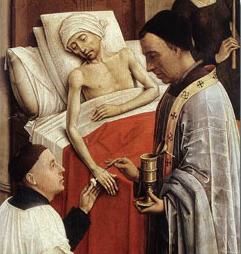
聖油は繰り返すことのできない3つの秘跡にのみ使用されるが、病気や老齢のために死の危険にさらされ始めたカトリック信者を祝福するために司祭や司教が別の油を使用する。[340]病者の塗油として知られるこの秘跡は、慰め、平和、勇気を与え、病人が告解できない場合には罪の赦しさえも与えると信じられている。[341]
この秘跡は塗油とも呼ばれ、過去には終油とも呼ばれ、告解と聖体とともに終末の典礼を構成する3つの秘跡のうちの1つです。[342]
聖餐の儀式における秘跡
カテキズムによれば、他者の救済に向けられた聖体拝領の秘跡は二つある。司祭職と結婚である。 [343]キリスト教徒になるという一般的な召命の中で、これら二つの秘跡は「神の民の間での特定の使命または召命に捧げられる。男性は言葉と恵みによって教会を養うために聖職を受ける。配偶者は愛を強め、国家の義務を果たすために結婚する」。[344]
聖職

聖職叙階の秘跡は、一部のキリスト教徒を聖別し、司教(司教)、司祭(司祭)、助祭(助祭)の3つの位階または聖職者の一員として全教会に奉仕するよう任命する。[345] [346]教会は、誰が聖職者に叙階されるかについての規則を定めている。ラテン教会では、司祭職は一般的に独身男性に限定されており、司教職は常に独身男性に限定されている。[347]既婚男性は、ほとんどの国にある特定の東方カトリック教会で叙階される可能性があり、[348]ラテン教会でも個人叙階され、助祭になることができる[349] [350](聖職者の結婚を参照)。しかし、カトリック司祭になった後は、正式に俗人化されない限り 、男性は結婚することができない(聖職者の独身制を参照)。
助祭、司祭、司教を問わず、すべての聖職者は説教、教育、洗礼、結婚の立会、葬儀の典礼の司式を行うことができます。 [351]聖体、ゆるし(告解)、病者の塗油の秘跡を執行できるのは司教と司祭のみです。[352] [353]聖職者に叙任する聖職叙階の秘跡を執行できるのは司教のみです。 [354]
結婚

The Catholic Church teaches that marriage is a social and spiritual bond between a man and a woman, ordered towards the good of the spouses and procreation of children; according to Catholic teachings on sexual morality, it is the only appropriate context for sexual activity. A Catholic marriage, or any marriage between baptized individuals of any Christian denomination, is viewed as a sacrament. A sacramental marriage, once consummated, cannot be dissolved except by death.[355][note 11] The church recognizes certain conditions, such as freedom of consent, as required for any marriage to be valid; In addition, the church sets specific rules and norms, known as canonical form, that Catholics must follow.[358]
The church does not recognize divorce as ending a valid marriage and allows state-recognized divorce only as a means of protecting the property and well-being of the spouses and any children. However, consideration of particular cases by the competent ecclesiastical tribunal can lead to declaration of the invalidity of a marriage, a declaration usually referred to as an annulment. Remarriage following a divorce is not permitted unless the prior marriage was declared invalid.[359]
Liturgy

Among the 24 autonomous (sui iuris) churches, numerous liturgical and other traditions exist, called rites, which reflect historical and cultural diversity rather than differences in belief.[360] In the definition of the Code of Canons of the Eastern Churches, "a rite is the liturgical, theological, spiritual, and disciplinary patrimony, culture and circumstances of history of a distinct people, by which its own manner of living the faith is manifested in each Church sui iuris".[361]
The liturgy of the sacrament of the Eucharist, called the Mass in the West and Divine Liturgy or other names in the East, is the principal liturgy of the Catholic Church.[362] This is because it is considered the propitiatory sacrifice of Christ himself.[363] Its most widely used form is that of the Roman Rite as promulgated by Paul VI in 1969 (see Missale Romanum) and revised by Pope John Paul II in 2002 (see Liturgiam Authenticam). In certain circumstances, the 1962 form of the Roman Rite remains authorized in the Latin Church. Eastern Catholic Churches have their own rites. The liturgies of the Eucharist and the other sacraments vary from rite to rite, reflecting different theological emphases.
Western rites
The Roman Rite is the most common rite of worship used by the Catholic Church, with the Ordinary Form of the Roman Rite form of the Mass. Its use is found worldwide, originating in Rome and spreading throughout Europe, influencing and eventually supplanting local rites.[364] The present ordinary form of Mass in the Roman Rite, found in the post-1969 editions of the Roman Missal, is usually celebrated in the local vernacular language, using an officially approved translation from the original text in Latin. An outline of its major liturgical elements can be found in the sidebar.
In 2007, Pope Benedict XVI affirmed the licitness of continued use of the 1962 Roman Missal as an "extraordinary form" (forma extraordinaria) of the Roman Rite, speaking of it also as an usus antiquior ("older use"), and issuing new more permissive norms for its employment.[365] An instruction issued four years later spoke of the two forms or usages of the Roman Rite approved by the pope as the ordinary form and the extraordinary form ("the forma ordinaria" and "the forma extraordinaria").[366]
The 1962 edition of the Roman Missal, published a few months before the Second Vatican Council opened, was the last that presented the Mass as standardized in 1570 by Pope Pius V at the request of the Council of Trent and that is therefore known as the Tridentine Mass.[309] Pope Pius V's Roman Missal was subjected to minor revisions by Pope Clement VIII in 1604, Pope Urban VIII in 1634, Pope Pius X in 1911, Pope Pius XII in 1955, and Pope John XXIII in 1962. Each successive edition was the ordinary form of the Roman Rite Mass until superseded by a later edition. When the 1962 edition was superseded by that of Paul VI, promulgated in 1969, its continued use at first required permission from bishops;[367] but Pope Benedict XVI's 2007 motu proprio Summorum Pontificum allowed free use of it for Mass celebrated without a congregation and authorized parish priests to permit, under certain conditions, its use even at public Masses. Except for the scriptural readings, which Pope Benedict allowed to be proclaimed in the vernacular language, it is celebrated exclusively in liturgical Latin.[368] These permissions were largely removed by Pope Francis in 2021, who issued the motu proprio Traditionis custodes to emphasize the Ordinary Form as promulgated by Popes Paul VI and John Paul II.[369]
Since 2014, clergy in the small personal ordinariates set up for groups of former Anglicans under the terms of the 2009 document Anglicanorum Coetibus[370] are permitted to use a variation of the Roman Rite called "Divine Worship" or, less formally, "Ordinariate Use",[371] which incorporates elements of the Anglican liturgy and traditions,[note 12] an accommodation protested by Anglican leaders.
In the Archdiocese of Milan, with around five million Catholics the largest in Europe,[372] Mass is celebrated according to the Ambrosian Rite. Other Latin Church rites include the Mozarabic[373] and those of some religious institutes.[374] These liturgical rites have an antiquity of at least 200 years before 1570, the date of Pope Pius V's Quo primum, and were thus allowed to continue.[375]
Eastern rites

The Eastern Catholic Churches share common patrimony and liturgical rites as their counterparts, including Eastern Orthodox and other Eastern Christian churches who are no longer in communion with the Holy See. These include churches that historically developed in Russia, Caucasus, the Balkans, North Eastern Africa, India and the Middle East. The Eastern Catholic Churches are groups of faithful who have either never been out of communion with the Holy See or who have restored communion with it at the cost of breaking communion with their associates of the same tradition.[376]
The liturgical rites of the Eastern Catholic Churches include the Byzantine Rite (in its Antiochian, Greek and Slavonic recensions), the Alexandrian Rite, the West Syrian Rite, the Armenian Rite, and the East Syriac Rite. Eastern Catholic Churches have the autonomy to set the particulars of their liturgical forms and worship, within certain limits to protect the "accurate observance" of their liturgical tradition.[377] In the past some of the rites used by the Eastern Catholic Churches were subject to a degree of liturgical Latinization. However, in recent years Eastern Catholic Churches have returned to traditional Eastern practices in accord with the Vatican II decree Orientalium Ecclesiarum.[378] Each church has its own liturgical calendar.[379]
Social and cultural issues
Catholic social teaching
Catholic social teaching, reflecting the concern Jesus showed for the impoverished, places a heavy emphasis on the corporal works of mercy and the spiritual works of mercy, namely the support and concern for the sick, the poor and the afflicted.[380][381] Church teaching calls for a preferential option for the poor while canon law prescribes that "The Christian faithful are also obliged to promote social justice and, mindful of the precept of the Lord, to assist the poor."[382] Its foundations are widely considered to have been laid by Pope Leo XIII's 1891 encyclical letter Rerum novarum which upholds the rights and dignity of labour and the right of workers to form unions.
Catholic teaching regarding sexuality calls for a practice of chastity, with a focus on maintaining the spiritual and bodily integrity of the human person. Marriage is considered the only appropriate context for sexual activity.[383] Church teachings about sexuality have become an issue of increasing controversy, especially after the close of the Second Vatican Council, due to changing cultural attitudes in the Western world described as the sexual revolution.
The church has also addressed stewardship of the natural environment, and its relationship to other social and theological teachings. In the document Laudato si', dated 24 May 2015, Pope Francis critiques consumerism and irresponsible development, and laments environmental degradation and global warming.[384] The pope expressed concern that the warming of the planet is a symptom of a greater problem: the developed world's indifference to the destruction of the planet as humans pursue short-term economic gains.[385]
Social services

The Catholic Church is the largest non-government provider of education and medical services in the world.[26] In 2010, the Catholic Church's Pontifical Council for Pastoral Assistance to Health Care Workers said that the church manages 26% of health care facilities in the world, including hospitals, clinics, orphanages, pharmacies and centres for those with leprosy.[386]
The church has always been involved in education, since the founding of the first universities of Europe.[83] It runs and sponsors thousands of primary and secondary schools, colleges and universities throughout the world[387][8] and operates the world's largest non-governmental school system.[388]
Religious institutes for women have played a particularly prominent role in the provision of health and education services,[389] as with orders such as the Sisters of Mercy, Little Sisters of the Poor, the Missionaries of Charity, the Sisters of St. Joseph of the Sacred Heart, the Sisters of the Blessed Sacrament and the Daughters of Charity of Saint Vincent de Paul.[390] The Catholic nun Mother Teresa of Calcutta, India, founder of the Missionaries of Charity, was awarded the Nobel Peace Prize in 1979 for her humanitarian work among India's poor.[391] Bishop Carlos Filipe Ximenes Belo won the same award in 1996 for "work towards a just and peaceful solution to the conflict in East Timor".[392]
The church is also actively engaged in international aid and development through organizations such as Catholic Relief Services, Caritas Internationalis, Aid to the Church in Need, refugee advocacy groups such as the Jesuit Refugee Service and community aid groups such as the Saint Vincent de Paul Society.[393]
Sexual morality

The Catholic Church calls all members to practise chastity according to their state in life. Chastity includes temperance, self-mastery, personal and cultural growth, and divine grace. It requires refraining from lust, masturbation, fornication, pornography, prostitution and rape. Chastity for those who are not married requires living in continence, abstaining from sexual activity; those who are married are called to conjugal chastity.[394]
In the church's teaching, sexual activity is reserved to married couples, whether in a sacramental marriage among Christians or in a natural marriage where one or both spouses are unbaptized. Even in romantic relationships, particularly engagement to marriage, partners are called to practise continence, in order to test mutual respect and fidelity.[395] Chastity in marriage requires in particular conjugal fidelity and protecting the fecundity of marriage. The couple must foster trust and honesty as well as spiritual and physical intimacy. Sexual activity must always be open to the possibility of life;[396] the church calls this the procreative significance. It must likewise always bring a couple together in love; the church calls this the unitive significance.[397]
Contraception and certain other sexual practices are not permitted, although natural family planning methods are permitted to provide healthy spacing between births, or to postpone children for a just reason.[398] Pope Francis said in 2015 that he is worried that the church has grown "obsessed" with issues such as abortion, same-sex marriage and contraception, and for prioritizing moral doctrines over helping the poor and marginalized.[399][400]
Homosexuality
The Catholic Church also teaches that "homosexual acts" are "contrary to the natural law", "acts of grave depravity" and "under no circumstances can they be approved", but that persons experiencing homosexual tendencies must be accorded respect and dignity.[401] According to the Catechism of the Catholic Church,
The number of men and women who have deep-seated homosexual tendencies is not negligible. This inclination, which is objectively disordered, constitutes for most of them a trial. They must be accepted with respect, compassion, and sensitivity. Every sign of unjust discrimination in their regard should be avoided... Homosexual persons are called to chastity. By the virtues of self-mastery that teach them inner freedom, at times by the support of disinterested friendship, by prayer and sacramental grace, they can and should gradually and resolutely approach Christian perfection.[401]
This part of the Catechism was quoted by Pope Francis in a 2013 press interview in which he remarked, when asked about an individual:
I think that when you encounter a person like this [the individual he was asked about], you must make a distinction between the fact of a person being gay from the fact of being a lobby, because lobbies, all are not good. That is bad. If a person is gay and seeks the Lord and has good will, well who am I to judge them?[402]
This remark and others made in the same interview were seen as a change in the tone, but not in the substance of the teaching of the church,[403] which includes opposition to same-sex marriage.[404] Certain dissenting Catholic groups oppose the position of the Catholic Church and seek to change it.[405]
Divorce and declarations of nullity
Canon law makes no provision for divorce between baptized individuals, as a valid, consummated sacramental marriage is considered to be a lifelong bond.[406] However, a declaration of nullity may be granted when the proof is produced that essential conditions for contracting a valid marriage were absent from the beginning—in other words, that the marriage was not valid due to some impediment. A declaration of nullity, commonly called an annulment, is a judgement on the part of an ecclesiastical tribunal determining that a marriage was invalidly attempted.[407] In addition, marriages among unbaptized individuals may be dissolved with papal permission under certain situations, such as a desire to marry a Catholic, under Pauline or Petrine privilege.[356][357] An attempt at remarriage following divorce without a declaration of nullity places "the remarried spouse ... in a situation of public and permanent adultery". An innocent spouse who lives in continence following divorce, or couples who live in continence following a civil divorce for a grave cause, do not sin.[408]
Worldwide, diocesan tribunals completed over 49000 cases for nullity of marriage in 2006. Over the past 30 years about 55 to 70% of annulments have occurred in the United States. The growth in annulments has been substantial; in the United States, 27,000 marriages were annulled in 2006, compared to 338 in 1968. However, approximately 200,000 married Catholics in the United States divorce each year; 10 million total as of 2006[update].[409][note 13] Divorce is increasing in some predominantly Catholic countries in Europe.[411] In some predominantly Catholic countries, it is only in recent years that divorce was introduced (Italy (1970), Portugal (1975), Brazil (1977), Spain (1981), Ireland (1996), Chile (2004) and Malta (2011)), while the Philippines and the Vatican City have no procedure for divorce (The Philippines does, however, allow divorce for Muslims.).
Contraception
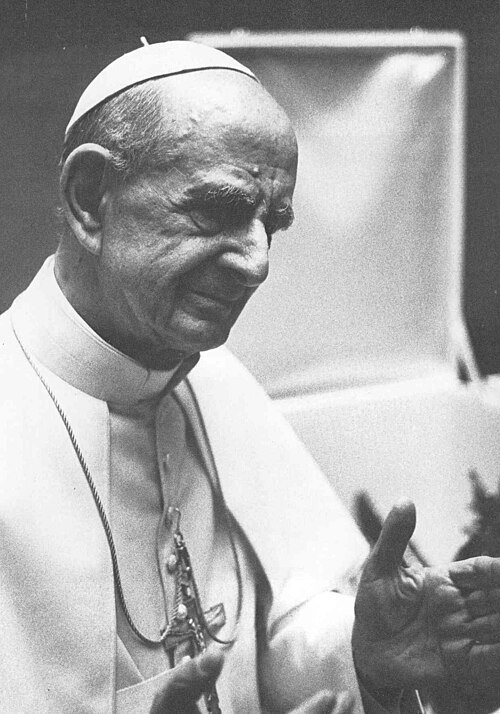
The church teaches that sexual intercourse should only take place between a man and woman who are married to each other, and should be without the use of birth control or contraception. In his encyclical Humanae vitae[412] (1968), Pope Paul VI firmly rejected all contraception, thus contradicting dissenters in the church that saw the birth control pill as an ethically justifiable method of contraception, though he permitted the regulation of births by means of natural family planning. This teaching was continued especially by John Paul II in his encyclical Evangelium Vitae, where he clarified the church's position on contraception, abortion and euthanasia by condemning them as part of a "culture of death" and calling instead for a "culture of life".[413]
Many Western Catholics have voiced significant disagreement with the church's teaching on contraception.[414] Overturning the church's teaching on this point features high on progressive agendas.[415] Catholics for Choice, a political lobbyist group that is not associated with the Catholic Church, stated in 1998 that 96% of U.S. Catholic women had used contraceptives at some point in their lives and that 72% of Catholics believed that one could be a good Catholic without obeying the church's teaching on birth control.[416] Use of natural family planning methods among United States Catholics purportedly is low, although the number cannot be known with certainty.[note 14] As Catholic health providers are among the largest providers of services to patients with HIV/AIDS worldwide, there is significant controversy within and outside the church regarding the use of condoms as a means of limiting new infections, as condom use ordinarily constitutes prohibited contraceptive use.[419]
Similarly, the Catholic Church opposes artificial insemination regardless of whether it is homologous (from the husband) or heterologous (from a donor) and in vitro fertilization (IVF), saying that the artificial process replaces the love and conjugal act between a husband and wife.[420] In addition, it opposes IVF because it might cause disposal of embryos; Catholics believe an embryo is an individual with a soul who must be treated as such.[421] For this reason, the church also opposes abortion.[422]
Due to the anti-abortion stance, some Catholics oppose receiving vaccines derived from fetal cells obtained via abortion. On 21 December 2020, and regarding COVID-19 vaccination, the Congregation for the Doctrine of the Faith emitted a document stating that "it is morally acceptable to receive Covid-19 vaccines that have used cell lines from aborted fetuses in their research and production process" when no alternative vaccine is available, since "the moral duty to avoid such passive material cooperation is not obligatory if there is a grave danger, such as the otherwise uncontainable spread of a serious pathological agent."[423][424] The document states that receiving the vaccine does not constitute endorsement of the practice of abortion, and that "the morality of vaccination depends not only on the duty to protect one's own health, but also on the duty to pursue the common good."[424] The document cautions further:
Those who, however, for reasons of conscience, refuse vaccines produced with cell lines from aborted fetuses, must do their utmost to avoid, by other prophylactic means and appropriate behavior, becoming vehicles for the transmission of the infectious agent. In particular, they must avoid any risk to the health of those who cannot be vaccinated for medical or other reasons, and who are the most vulnerable.[424]
Death penalty and euthanasia
The Catholic Church is committed to the worldwide abolition of the death penalty in any circumstance.[425] The current Catechism of the Catholic Church teaches that "in the light of the Gospel" the death penalty is "inadmissible because it is an attack on the inviolability and dignity of the person" and that the Catholic Church "works with determination for its abolition worldwide."[426] In his 2020 encyclical Fratelli tutti, Francis repeated that the death penalty is "inadmissible" and that "there can be no stepping back from this position".[427] On 9 January 2022, Pope Francis stated in his annual speech to Vatican ambassadors: "The death penalty cannot be employed for a purported state justice, since it does not constitute a deterrent nor render justice to victims, but only fuels the thirst for vengeance".[428]
There is controversy about whether the Catholic Church considers the death penalty intrinsically evil.[429] American Archbishop José Horacio Gómez[429] and Catholic philosopher Edward Feser argue that this is a matter of prudential judgement and that the church does not teach this as a de fide statement;[430] others, such as Cardinals Charles Maung Bo and Rino Fisichella, state that it does.[429]
The Catholic Church opposes active euthanasia and physician-assisted suicide on the grounds that life is a gift from God and should not be prematurely shortened. However, the church allows dying people to refuse extraordinary treatments that would minimally prolong life without hope of recovery.[431][432]
Holy orders and women
Women and men religious engage in a variety of occupations such as contemplative prayer, teaching, providing health care, and working as missionaries.[389][433] While Holy Orders are reserved for men, Catholic women have played diverse roles in the life of the church, with religious institutes providing a formal space for their participation and convents providing spaces for their self-government, prayer and influence through many centuries. Religious sisters and nuns have been extensively involved in developing and running the church's worldwide health and education service networks.[434]
Efforts in support of the ordination of women to the priesthood led to several rulings by the Roman Curia or popes against the proposal, as in Declaration on the Question of the Admission of Women to the Ministerial Priesthood (1976), Mulieris Dignitatem (1988) and Ordinatio sacerdotalis (1994). According to the latest ruling, found in Ordinatio sacerdotalis, Pope John Paul II affirmed that the Catholic Church "does not consider herself authorised to admit women to priestly ordination".[435] In defiance of these rulings, opposition groups such as Roman Catholic Womenpriests have performed ceremonies they affirm as sacramental ordinations (with, reputedly, an ordaining male Catholic bishop in the first few instances) which, according to canon law, are both illicit and invalid and considered mere simulations[436] of the sacrament of ordination.[437][note 15] The Congregation for the Doctrine of the Faith responded by issuing a statement clarifying that any Catholic bishops involved in ordination ceremonies for women, as well as the women themselves if they were Catholic, would automatically receive the penalty of excommunication (latae sententiae, literally "with the sentence already applied", i.e. automatically), citing canon 1378 of canon law and other church laws.[438]
Sexual abuse cases
From the 1990s, the issue of sexual abuse of minors by Catholic clergy and other church members has become the subject of civil litigation, criminal prosecution, media coverage and public debate in countries around the world. The Catholic Church has been criticized for its handling of abuse complaints when it became known that some bishops had shielded accused priests, transferring them to other pastoral assignments where some continued to commit sexual offences.
In response to the scandal, formal procedures have been established to help prevent abuse, encourage the reporting of any abuse that occurs and to handle such reports promptly, although groups representing victims have disputed their effectiveness.[439] In 2014, Pope Francis instituted the Pontifical Commission for the Protection of Minors for the safeguarding of minors.[440]
See also

- Catholic Church and politics
- Catholic Church and race
- Glossary of the Catholic Church
- List of Catholic religious institutes
- Lists of Catholics
- Role of Christianity in civilization
- Catholic peace traditions
Notes
- ^ While the Catholic Church considers itself to be the authentic continuation of the Christian community founded by Jesus Christ, it teaches that other Christian churches and communities can be in an imperfect communion with the Catholic Church.[18][19]
- ^ Quote of St Ignatius to the Smyrnaeans (c. 110 AD)
- ^ Examples uses of "Roman Catholic" by the Holy See: the encyclicals Divini Illius Magistri Archived 23 September 2010 at the Wayback Machine of Pope Pius XI and Humani generis Archived 19 April 2012 at the Wayback Machine of Pope Pius XII; joint declarations signed by Pope Benedict XVI with Archbishop of Canterbury Rowan Williams on 23 November 2006 Archived 2 March 2013 at the Wayback Machine and Patriarch Bartholomew I of Constantinople on 30 November 2006. Archived 30 April 2011 at the Wayback Machine
- ^ Example use of "Roman" Catholic by a bishop's conference: The Baltimore Catechism, an official catechism authorized by the Catholic bishops of the United States, states: "That is why we are called Roman Catholics; to show that we are united to the real successor of St Peter" (Question 118) and refers to the church as the "Roman Catholic Church" under Questions 114 and 131 (Baltimore Catechism). Archived 23 September 2015 at the Wayback Machine
- ^ While ruling contraception to be prohibited, Pope Paul VI did, however, consider natural family planning methods to be morally permissible if used with just cause.
- ^ According to Catholic teaching, Jesus Christ is the 'invisible Head' of the Church[186][187][188] while the pope is the 'visible Head'.[189][190]
- ^ The last resignation occurred on 28 February 2013, when Pope Benedict XVI retired, citing ill health in his advanced age. The next most recent resignation occurred in 1415, as part of the Council of Constance's resolution of the Avignon Papacy.[197]
- ^ In 1992, the Vatican clarified the 1983 Code of Canon Law removed the requirement that altar servers be male; permission to use female altar servers within a diocese is at the discretion of the bishop.[233]
- ^ Other councils that addressed the sacraments include the Second Council of Lyon (1274); Council of Florence (1439); as well as the Council of Trent (1547)[303]
- ^ For an outline of the Eucharistic liturgy in the Roman Rite, see the side bar in the "Worship and liturgy".
- ^ Marriages involving unbaptized individuals are considered valid, but not sacramental. While sacramental marriages are insoluble, non-sacramental marriages may be dissolved under certain situations, such as a desire to marry a Catholic, under Pauline or Petrine privilege.[356][357]
- ^ The Divine Worship variant of the Roman Rite differs from the "Anglican Use" variant, which was introduced in 1980 for the few United States parishes established in accordance with a pastoral provision for former members of the Episcopal Church (the American branch of the Anglican Communion). Both uses adapted Anglican liturgical traditions for use within the Catholic Church.
- ^ With regard to divorce in the United States, according to the Barna Group, among all who have been married, 33% have been divorced at least once; among American Catholics, 28% (the study did not track religious annulments).[410]
- ^ Regarding use of natural family planning, in 2002, 24% of the U.S. population identified as Catholic,[417] but according to a 2002 study by the Centers for Disease Control and Prevention, of sexually active Americans avoiding pregnancy, only 1.5% were using NFP.[418]
- ^ According to Roman Catholic Womanpriests: "The principal consecrating Roman Catholic male bishop who ordained our first women bishops is a bishop with apostolic succession within the Roman Catholic Church in full communion with the pope."[437]
References
NOTE: CCC stands for Catechism of the Catholic Church. The number following CCC is the paragraph number, of which there are 2865. The numbers cited in the Compendium of the CCC are question numbers, of which there are 598. Canon law citations from the 1990 Code of Canons of the Eastern Churches are labelled "CCEO, Canon xxx", to distinguish from canons of the 1983 Code of Canon Law, which are labelled "Canon xxx".
- ^ Marshall, Thomas William (1844). Notes of the Episcopal Polity of the Holy Catholic Church. London: Levey, Rossen and Franklin. ASIN 1163912190.
- ^ Stanford, Peter. "Roman Catholic Church". BBC Religions. BBC. Archived from the original on 6 January 2021. Retrieved 1 February 2017.
- ^ Bokenkotter 2004, p. 18.
- ^ a b c "Status of Global Christianity, 2024, in the Context of 1900–2050" (PDF). Center for the Study of Global Christianity, Gordon-Conwell Theological Seminary. Retrieved 23 May 2024.
Christian total 2,631,941,000, Catholic total 1,278,009,000 (48.6%)
- ^ a b c d e f g h "The Pontifical Yearbook 2024 and the Annuarium Statisticum Ecclesiae 2022". L'Osservatore Romano (in Italian). 4 April 2024. Retrieved 29 April 2024.
- ^ "New Church statistics reveal more Catholics, fewer vocations". Vatican News. 4 April 2024. Archived from the original on 2 July 2024. Retrieved 2 July 2024.
- ^ Calderisi, Robert. Earthly Mission – The Catholic Church and World Development; TJ International Ltd; 2013; p. 40
- ^ a b c "Laudato Si". Vermont Catholic. 8 (4) (Winter ed.): 73. 2016–2017. Retrieved 19 December 2016.
- ^ Marty, Martin E. (2021). "Roman Catholicism". Encyclopedia Britannica. Archived from the original on 15 June 2015. Retrieved 17 June 2021.
- ^ Mark A. Noll. The New Shape of World Christianity (Downers Grove, IL: IVP Academic, 2009), 191.
- ^ Haynes, Jeffrey (2016). Routledge Handbook of Religion and Politics. Routledge. ISBN 978-1-317-28746-9. Archived from the original on 26 December 2022. Retrieved 8 December 2022.
- ^ Varghese, Alexander P. (2008). India : History, Religion, Vision And Contribution To The World. Atlantic Publishers & Dist. ISBN 978-81-269-0904-9. Archived from the original on 26 December 2022. Retrieved 8 December 2022.
- ^ a b c O'Collins, p. v (preface).
- ^ "Statistics by Country, by Catholic Population [Catholic-Hierarchy]". Catholic-Hierarchy.org. David M. Cheney. 20 November 2005. Archived from the original on 4 March 2023. Retrieved 4 March 2023.
- ^ "Lumen gentium". www.vatican.va. Archived from the original on 6 September 2014. Retrieved 11 October 2020.
- ^ a b "Vatican congregation reaffirms truth, oneness of Catholic Church". Catholic News Service. Archived from the original on 10 July 2007. Retrieved 17 March 2012.
- ^ Bokenkotter 2004, p. 7.
- ^ "Responses to Some Questions regarding Certain Aspects of the Doctrine of the Church". Vatican.va. Archived from the original on 13 August 2013.
It is possible, according to Catholic doctrine, to affirm correctly that the Church of Christ is present and operative in the churches and ecclesial communities not yet fully in communion with the Catholic Church, on account of the elements of sanctification and truth that are present in them.
- ^ "Declaration on the Unicity and Salvific Universality of Jesus Christ and the Church Dominus Iesus § 17". Vatican.va.
Therefore, there exists a single Church of Christ, which subsists in the Catholic Church, governed by the Successor of Peter and by the Bishops in communion with him. The Churches which, while not existing in perfect Koinonia with the Catholic Church, remain united to her by means of the closest bonds, that is, by apostolic succession and a valid Eucharist, are true particular churches. Therefore, the Church of Christ is present and operative also in these Churches, even though they lack full communion with the Catholic Church since they do not accept the Catholic doctrine of the Primacy, which, according to the will of God, the Bishop of Rome objectively has and exercises over the entire Church. ... 'The Christian faithful are therefore not permitted to imagine that the Church of Christ is nothing more than a collection—divided, yet in some way one—of Churches and ecclesial communities; nor are they free to hold that today the Church of Christ nowhere really exists, and must be considered only as a goal which all Churches and ecclesial communities must strive to reach.'
- ^ Holy Bible: Matthew 16:19
- ^ Catechism of the Catholic Church (2nd ed.). Libreria Editrice Vaticana. 2019. Paragraph 890.
- ^ Catechism of the Catholic Church (2nd ed.). Libreria Editrice Vaticana. 2019. Paragraph 835.
The rich variety of ... theological and spiritual heritages proper to the local churches 'unified in a common effort shows all the more resplendently the catholicity of the undivided Church'.(cf. Second Vatican Council, Dogmatic Constitution on the Church Lumen gentium, 23)
- ^ Colin Gunton. "Christianity among the Religions in the Encyclopedia of Religion", Religious Studies, Vol. 24, no. 1, p. 14. In a review of an article from the Encyclopedia of Religion, Gunton writes: "[T]he article [on Catholicism in the encyclopedia] rightly suggests caution, suggesting at the outset that Roman Catholicism is marked by several different doctrinal, theological and liturgical emphases."
- ^ Catechism of the Catholic Church (2nd ed.). Libreria Editrice Vaticana. 2019. Paragraphs 1322–27.
[T]he Eucharist is the sum and summary of our faith
- ^ "The Four Marian Dogmas". Catholic News Agency. Retrieved 25 March 2017.
- ^ a b c Agnew, John (12 February 2010). "Deus Vult: The Geopolitics of Catholic Church". Geopolitics. 15 (1): 39–61. doi:10.1080/14650040903420388. ISSN 1465-0045. S2CID 144793259.
- ^ Raymond Wacks, Law: A Very Short Introduction, 2nd Ed. (Oxford University Press, 2015) p. 13.
- ^ John Meyendorff, Catholicity and the Church, St Vladimirs Seminary Press, 1997, ISBN 0-88141-006-3, p. 7
- ^ Elwell, Walter; Comfort, Philip Wesley (2001), Tyndale Bible Dictionary, Tyndale House Publishers, pp. 266, 828, ISBN 0-8423-7089-7
- ^ MacCulloch, Christianity, p. 127.
- ^ a b Thurston, Herbert (1908). "Catholic". In Knight, Kevin (ed.). The Catholic Encyclopedia. Vol. 3. New York: Robert Appleton Company. Archived from the original on 3 January 2024. Retrieved 17 August 2012.
- ^ "Cyril of Jerusalem, Lecture XVIII, 26". Tertullian.org. 6 August 2004. Archived from the original on 8 June 2023. Retrieved 17 August 2012.
- ^ "Edictum de fide catholica". Archived from the original on 8 February 2012. Retrieved 9 October 2017.
- ^ "Eastern Orthodoxy" Archived 31 May 2020 at the Wayback Machine, Encyclopædia Britannica online.
- ^ "catholic, adj. and n." Oxford English Dictionary Online. Oxford University Press, June 2014. Web. 7 August 2014. Excerpt: "After the separation of East and West 'Catholic' was assumed as its descriptive epithet by the Western or Latin Church, as 'Orthodox' was by the Eastern or Greek. At the Reformation, the term 'Catholic' was claimed as its exclusive right by the body remaining under the Roman obedience, in opposition to the 'Protestant' or 'Reformed' National Churches. These, however, also retained the term, giving it, for the most part, a wider and more ideal or absolute sense, as the attribute of no single community, but only of the whole communion of the saved and saintly in all churches and ages. In England, it was claimed that the Church, even as Reformed, was the national branch of the 'Catholic Church' in its proper historical sense." Note: The full text of the OED definition of "catholic" can be consulted here.
- ^ McBrien, Richard (2008). The Church. Harper Collins. p. xvii. Online version available Browseinside.harpercollins.com Archived 27 August 2009 at the Wayback Machine. Quote: "[T]he use of the adjective 'Catholic' as a modifier of 'Church' became divisive only after the East–West Schism... and the Protestant Reformation. ... In the former case, the Western Church claimed for itself the title Catholic Church, while the East appropriated the name Orthodox Church. In the latter case, those in communion with the Bishop of Rome retained the adjective "Catholic", while the churches that broke with the Papacy were called Protestant."
- ^ "Roman Catholic, n. and adj". Oxford English Dictionary. Archived from the original on 25 June 2023. Retrieved 24 October 2017.
- ^ "Eastern Catholics: Where are they? Where should they be?". Catholic News Herald. Diocese of Charlotte. 12 March 2020. Archived from the original on 4 January 2024. Retrieved 19 March 2022.
- ^ "Documents of the II Vatican Council". Vatican.va. Archived from the original on 5 June 2004. Retrieved 4 May 2009.
Note: The pope's signature appears in the Latin version.
- ^ "Decrees of the First Vatican Council – Papal Encyclicals". 29 June 1868. Archived from the original on 8 January 2024. Retrieved 29 July 2018.
- ^ "The Bull of Indiction of the Sacred Oecumenical and General Council of Trent under the Sovereign Pontiff, Paul III." Archived 30 July 2018 at the Wayback Machine The Council of Trent: The Canons and Decrees of the Sacred and Oecumenical Council of Trent. Ed. and trans. J. Waterworth. London: Dolman, 1848. Retrieved from History. Hanover.edu, 12 September 2018.
- ^ "Catholic Encyclopedia: Roman Catholic". New Advent. Archived from the original on 1 April 2019. Retrieved 11 October 2017.
- ^ "Kenneth D. Whitehead". www.ewtn.com. Archived from the original on 20 November 2023. Retrieved 11 October 2017.
- ^ a b Bokenkotter 2004, p. 30.
- ^ Kreeft, p. 980.
- ^ Burkett, p. 263
- ^ a b Barry, p. 46.
- ^ Catechism of the Catholic Church (2nd ed.). Libreria Editrice Vaticana. 2019. Paragraph 1076.
The Church was made manifest to the world on the day of Pentecost by the outpouring of the Holy Spirit...
- ^ Herbermann, Charles, ed. (1913). . Catholic Encyclopedia. New York: Robert Appleton Company.
"He [the Holy Spirit] is essentially the Spirit of truth (John 14:16–17; 15:26), Whose office it is to ... to teach the Apostles the full meaning of it [of the truth] (John 14:26; 16:13). With these Apostles, He will abide forever (John 14:16). Having descended on them at Pentecost, He will guide them in their work (Acts 8:29)... - ^ Catechism of the Catholic Church (2nd ed.). Libreria Editrice Vaticana. 2019. Paragraphs 880, 883.
- ^ Christian Bible, Matthew 16:13–20
- ^ "Saint Peter the Apostle: Incidents important in interpretations of Peter". Encyclopædia Britannica. Archived from the original on 10 November 2014. Retrieved 8 November 2014.
- ^ Catechism of the Catholic Church (2nd ed.). Libreria Editrice Vaticana. 2019. Paragraphs 880–81.
- ^ Joyce, George (1913). . In Herbermann, Charles (ed.). Catholic Encyclopedia. New York: Robert Appleton Company.
- ^ "Was Peter in Rome?". Catholic Answers. 10 August 2004. Archived from the original on 12 December 2016. Retrieved 9 November 2014.
if Peter never made it to the capital, he still could have been the first pope, since one of his successors could have been the first holder of that office to settle in Rome. After all, if the papacy exists, it was established by Christ during his lifetime, long before Peter is said to have reached Rome. There must have been a period of some years in which the papacy did not yet have its connection to Rome.
- ^ a b c Brown, Raymond E. (2003). 101 Questions and Answers on the Bible. Paulist Press. pp. 132–34. ISBN 978-0-8091-4251-4.
- ^ Oscar Cullmann (1962), Peter: Disciple, Apostle, Martyr (2nd ed.), Westminster Press, p. 234
- ^ Henry Chadwick (1993), The Early Church, Penguin Books, p. 18
- ^ Ehrman, Bart D (2006). Peter, Paul, and Mary Magdalene: The Followers of Jesus in History and Legend. US: Oxford University Press. p. 84. ISBN 978-0-19-530013-0.
Peter, in short, could not have been the first bishop of Rome, because the Roman church did not have anyone as its bishop until about a hundred years after Peter's death.
- ^ Bokenkotter 2004, p. 24.
- ^ MacCulloch, Christianity, pp. 155–59, 164.
- ^ Valliere, Paul (2012). Conciliarism. Cambridge University Press. p. 92. ISBN 978-1-107-01574-6.
- ^ Patriarch, Bartholomew (2008). Encountering the Mystery. Random House. p. 3. ISBN 978-0-385-52561-9. Archived from the original on 10 March 2024. Retrieved 31 March 2021.
- ^ Michalopulos, George C. (11 September 2009). "Canon 28 and Eastern Papalism: Cause or Effect?". Archived from the original on 10 January 2013.
- ^ Noble, p. 214.
- ^ "Rome (early Christian)". Cross, F.L., ed., The Oxford Dictionary of the Christian Church. New York: Oxford University Press. 2005
- ^ Ayer, Joseph Cullen Jr. (1913). A Source Book for Ancient Church History: From the Apostolic Age to the Close of the Conciliar Period. New York: Charles Scribner's Sons. p. 538.
- ^ Ayer, p. 553
- ^ Baumgartner, Frederic J. (2003). Behind Locked Doors: A History of the Papal Elections. Palgrave Macmillan. pp. 10–12. ISBN 978-0-312-29463-2.
- ^ Duffy, Eamon. 1997. Saints & Sinners: A History of the Popes. Yale University Press. pp. 66–67
- ^ Le Goff, p. 14: "The face of the barbarian invaders had been transformed by another crucial fact. Although some of them had remained pagan, another part of them, not the least, had become Christian. But, by a curious chance, which was to leave serious consequences, these converted barbarians—the Ostrogoths, Visigoths, Burgundians, Vandals, and later the Lombards—had been converted to Arianism, which had become a heresy after the council of Nicaea. They had in fact been converted by followers of the 'apostle of the Goths', Wulfilas."
- ^ Le Goff, p. 14: "Thus what should have been a religious bond was, on the contrary, a subject of discord and sparked off bitter conflicts between Arian barbarians and Catholic Romans."
- ^ Le Goff, p. 21: "Clovis' master-stroke was to convert himself and his people not to Arianism, like the other barbarian kings, but to Catholicism."
- ^ Le Goff, p. 21
- ^ Drew, Katherine Fischer (2014). The Lombard Laws. University of Pennsylvania Press. p. xviii. ISBN 978-0-8122-1055-2.
- ^ a b Cahill, Thomas (1995). How The Irish Saved Civilization: The Untold Story of Ireland's Heroic Role from the Fall of Rome to the Rise of Medieval Europe. New York City: Penguin Random House.
- ^ Woods, pp. 115–27
- ^ Duffy, p. 133.
- ^ Woods, Thomas Jr. "Review of How the Catholic Church Built Western Civilisation". National Review Book Service. Archived from the original on 22 August 2006. Retrieved 16 September 2006.
- ^ Den Heijer, Alexandra (2011). Managing the University Campus: Information to Support Real Estate Decisions. Academische Uitgeverij Eburon. ISBN 9789059724877.
Many of the medieval universities in Western Europe were born under the aegis of the Catholic Church, usually as cathedral schools or by papal bull as Studia Generali.
- ^ A. Lamport, Mark (2015). Encyclopedia of Christian Education. Rowman & Littlefield. p. 484. ISBN 9780810884939.
All the great European universities—Oxford, to Paris, to Cologne, to Prague, to Bologna—were established with close ties to the Church.
- ^ B M. Leonard, Thomas (2013). Encyclopedia of the Developing World. Routledge. p. 1369. ISBN 9781135205157.
Europe established schools in association with their cathedrals to educate priests, and from these emerged eventually the first universities of Europe, which began forming in the eleventh and twelfth centuries.
- ^ a b Riché, Pierre (1978): "Education and Culture in the Barbarian West: From the Sixth through the Eighth Century", Columbia: University of South Carolina Press, ISBN 0-87249-376-8, pp. 126–27, 282–98
- ^ Rudy, The Universities of Europe, 1100–1914, p. 40
- ^ Verger, Jacques [in French] (1999). Culture, enseignement et société en Occident aux XIIe et XIIIe siècles (in French) (1st ed.). Presses universitaires de Rennes in Rennes. ISBN 978-2-86847-344-8. Archived from the original on 13 March 2020. Retrieved 17 June 2014.
- ^ Verger, Jacques. "The Universities and Scholasticism", in The New Cambridge Medieval History: Volume V c. 1198–c. 1300. Cambridge University Press, 2007, 257.
- ^ Rüegg, Walter: "Foreword. The University as a European Institution", in: A History of the University in Europe. Vol. 1: Universities in the Middle Ages, Cambridge University Press, 1992, ISBN 0-521-36105-2, pp. xix–xx
- ^ Pirenne, Henri (1980) [1925]. Medieval Cities: Their Origins and the Revival of Trade. Frank D. Halsey (trans.). Princeton, NJ: Princeton University Press. pp. 27–32. ISBN 978-0-691-00760-1.
- ^ Richards, Jeffrey (2014). The Popes and the Papacy in the Early Middle Ages. Routledge. p. 230. ISBN 978-1-317-67817-5.
- ^ Walker, Willston (1985). History of the Christian Church. Simon and Schuster. pp. 250–51. ISBN 978-0-684-18417-3. Archived from the original on 10 March 2024. Retrieved 31 March 2021.
- ^ Vidmar, The Catholic Church Through the Ages (2005), pp. 107–11
- ^ Duffy, Saints and Sinners (1997), p. 78, quote: "By contrast, Paschal's successor Eugenius II (824–27), elected with imperial influence, gave away most of these papal gains. He acknowledged the Emperor's sovereignty in the papal state, and he accepted a constitution imposed by Lothair which established imperial supervision of the administration of Rome, imposed an oath to the Emperor on all citizens, and required the pope–elect to swear fealty before he could be consecrated. Under Sergius II (844–47) it was even agreed that the pope could not be consecrated without an imperial mandate and that the ceremony must be in the presence of his representative, a revival of some of the more galling restrictions of Byzantine rule."
- ^ Riley-Smith, p. 8
- ^ Bokenkotter 2004, pp. 140–41.
- ^ Phillips, Jonathan (2005). The Fourth Crusade and the Sack of Constantinople. Penguin Books. p. PT19. ISBN 978-1-101-12772-8.
- ^ Woods, pp. 44–48
- ^ Bokenkotter 2004, pp. 158–59.
- ^ Duffy, Saints and Sinners (1997), p. 122
- ^ a b Morris, p. 232
- ^ McManners, p. 240
- ^ Geanakoplos, Deno John (1989). Constantinople and the West. Madison: University of Wisconsin Press. ISBN 978-0-299-11880-8.
- ^ Collinge, William J. (2012). Historical Dictionary of Catholicism. Scarecrow Press. p. 169. ISBN 978-0-8108-5755-1. Archived from the original on 8 September 2023. Retrieved 31 March 2021.
- ^ Koschorke, pp. 13, 283
- ^ Hastings (1994), p. 72
- ^ Koschorke, p. 21
- ^ Koschorke, pp. 3, 17
- ^ Lyons (2013), p. 17
- ^ a b Bokenkotter 2004, p. 215.
- ^ Vidmar, p. 184.
- ^ Bokenkotter 2004, pp. 223–24.
- ^ Fernández, Luis Martínez (2000). "Crypto-Protestants and Pseudo-Catholics in the Nineteenth-Century Hispanic Caribbean". Journal of Ecclesiastical History. 51 (2): 347–65. doi:10.1017/S0022046900004255. S2CID 162296826.
- ^ Bokenkotter 2004, pp. 235–37.
- ^ a b Vidmar, The Catholic Church Through the Ages (2005), p. 233
- ^ a b Duffy, Saints and Sinners (1997), pp. 177–78
- ^ Bokenkotter 2004, pp. 242–44.
- ^ Maxwell, Melvin. Bible Truth or Church Tradition, p. 70
- ^ Pollard, pp. 7–8
- ^ Bokenkotter 2004, pp. 283–85.
- ^ Herbermann, Charles, ed. (1913). . Catholic Encyclopedia. New York: Robert Appleton Company.
- ^ Collins, p. 176
- ^ Duffy, pp. 214–16
- ^ "John Paul II, General Audience". Vatican.va. 24 March 1993. Archived from the original on 10 August 2011. Retrieved 30 June 2011.
- ^ Leith, Creeds of the Churches (1963), p. 143
- ^ Duffy, Saints and Sinners (1997), p. 232
- ^ Fahlbusch, The Encyclopedia of Christianity (2001), p. 729
- ^ Kertzer, David I. (2006). Prisoner of the Vatican. Houghton Mifflin Harcourt. p. PT155. ISBN 978-0-547-34716-5. Archived from the original on 10 March 2024. Retrieved 31 March 2021.
- ^ D'Agostino, Peter R. (2010). "'Utterly Faithless Specimens': Italians in the Catholic Church in America". In Connell, William J.; Gardaphé, Fred (eds.). Anti-Italianism: Essays on a Prejudice. Palgrave Macmillan. pp. 33–34. ISBN 978-0-230-11532-3. Archived from the original on 10 March 2024. Retrieved 31 March 2021.
- ^ Adrian Hastings, The Church in Africa, 1450–1950, Oxford: Clarendon, 1996, 394–490
- ^ Geoffrey Blainey; A Short History of Christianity; Viking; 2011
- ^ "Pope Stared Down Communism in Homeland – and Won". CBC News. April 2005. Archived from the original on 23 December 2007. Retrieved 31 January 2008.
- ^ Lives of the Popes; Michael J Walsh, Universal International; 1998; pp. 239, 241
- ^ a b Lives of the Popes; Michael J Walsh, Universal International; 1998; p. 240
- ^ Lives of the Popes; Michael J Walsh, Universal International; 1998; pp. 241–42
- ^ Cook, p. 983
- ^ Hitler's Pope? Archived 2 November 2022 at the Wayback Machine; Martin Gilbert; The American Spectator; 18 August 2006
- ^ Gilbert, Martin (2004). The Righteous: The Unsung Heroes of the Holocaust. Henry Holt and Company. ISBN 978-1-4299-0036-2, p. 299
- ^ Lapomarda, Vincent A. (2005). The Jesuits and the Third Reich. E. Mellen Press. p. 3. ISBN 978-0-7734-6265-6.
- ^ Ian Kershaw; Hitler a Biography; 2008 Edn; W.W. Norton & Company; London; pp. 210–11
- ^ Berben, Paul (1975). Dachau, 1933–1945: the official history. Norfolk Press. ISBN 978-0-85211-009-6, pp. 276–77
- ^ "Non-Jewish Victims of Persecution in Germany". Yad Vashem. Archived from the original on 29 November 2010. Retrieved 28 October 2010.
- ^ Erika Weinzierl: Kirchlicher Widerstand gegen den Nationalsozialismus. In: Themen der Zeitgeschichte und der Gegenwart. Vienna 2004, ISBN 3-8258-7549-0, p. 76.
- ^ James Ward, Priest, Politician, Collaborator: Jozef Tiso and the Making of Fascist Slovakia, Ithaca: Cornell University Press, 2013, 202–45
- ^ Martin Gilbert; The Holocaust: The Jewish Tragedy; Collins; London; 1986; pp. 202, 203, 206–07, 212–14, 451, 466.
- ^ Mark Mazower; Hitler's Empire – Nazi Rule in Occupied Europe; Penguin; 2008; ISBN 978-0-7139-9681-4; p. 395
- ^ Iken, Katja (7 July 2016). "Pius XII: Wie Adolf Hitler den Papst entführen lassen wollte". Der Spiegel. Archived from the original on 13 August 2021. Retrieved 5 February 2021.
- ^ Online, Wiener Zeitung (9 September 1998). "Hitler plante Entführung Pius' XII. – "Streng geheime" Berichte faschistischer Parteigrößen entdeckt". Weltpolitik Nachrichten – Wiener Zeitung Online. Archived from the original on 24 June 2021. Retrieved 5 February 2021.
- ^ Bokenkotter 2004, p. 192.
- ^ Deák, p. 182
- ^ Eakin, Emily (1 September 2001). "New Accusations Of a Vatican Role In Anti-Semitism; Battle Lines Were Drawn After Beatification of Pope Pius IX". The New York Times. Archived from the original on 25 January 2009. Retrieved 9 March 2008.
- ^ Phayer (2000), pp. 50–57
- ^ Welle, Deutsche (1 March 2020). "The ratlines: What did the Vatican know about Nazi escape routes?". DW.COM. Archived from the original on 4 October 2023. Retrieved 7 February 2021.
- ^ Opitz, Manuel (15 February 2014). "Rattenlinien: Fluchthilfe für Nazis – vom Vatikan und US-Agenten". Die Welt. Archived from the original on 27 November 2020. Retrieved 5 February 2021.
- ^ "NS-Fluchthelfer: Der "braune Bischof" und die Rattenlinie". Der Standard. Archived from the original on 11 April 2021. Retrieved 5 February 2021.
- ^ Rome, Philip Willan. "Judgment day: Vatican ready to open its Holocaust files to the world". The Times. Archived from the original on 1 February 2021. Retrieved 5 February 2021.
- ^ The Second Vatican Council Celebrating Its Achievements and the Future. p. 86
- ^ "Constitution on the Sacred Liturgy Sacrosanctum Concilium". Vatican.va. 4 December 1963. Archived from the original on 21 February 2008. Retrieved 12 January 2012.
- ^ Duffy, pp. 270–76
- ^ Duffy, Saints and Sinners (1997), pp. 272, 274
- ^ Pope Paul VI (28 October 1965). "Nostra aetate: Declaration on the Relation of the Church to Non-Christian Religions". Archived from the original on 20 December 2008. Retrieved 16 June 2011.
According to Section 4: "True, the Jewish authorities and those who followed their lead pressed for the death of Christ; still, what happened in His passion cannot be charged against all the Jews, without distinction, then alive, nor against the Jews of today. Although the Church is the new people of God, the Jews should not be presented as rejected or accursed by God, as if this followed from the Holy Scriptures."
- ^ Bauckham, p. 373
- ^ O'Neel, Brian (3 April 2003). "Holier Than Thou: How Rejection of Vatican II Led Lefebvre into Schism". This Rock. 14 (4). San Diego: Catholic Answers. Archived from the original on 10 May 2010.
- ^ May, John F. (2012). World Population Policies: Their Origin, Evolution, and Impact. Springer. pp. 202–03. ISBN 978-94-007-2837-0. Archived from the original on 10 March 2024. Retrieved 31 March 2021.
- ^ Kinkel, R. John (2014). Papal Paralysis: How the Vatican Dealt with the AIDS Crisis. Lexington. p. 2. ISBN 978-0-7391-7684-9.
- ^ "Germain Grisez on "Humanae Vitae", Then and Now: The Dust Still Hasn't Settled, But There Are Signs of Hope". Zenit: The World Seen from Rome. 14 July 2003. Archived from the original on 29 November 2014. Retrieved 16 November 2014.
- ^ "2 April – This Day in History". History.co.uk. Archived from the original on 13 May 2011. Retrieved 28 October 2010.
- ^ Peter and Margaret Hebblethwaite and Peter Stanford (2 April 2005). "Obituary: Pope John Paul II". The Guardian. London. Archived from the original on 29 August 2013. Retrieved 28 October 2010.
- ^ Maxwell-Stuart, P.G. (2006). Chronicle of the Popes: Trying to Come Full Circle. London: Thames & Hudson. p. 234. ISBN 978-0-500-28608-1.
- ^ John Paul II (15 May 1981). "Laborem exercens". Libreria Editrice Vaticana. Archived from the original on 27 October 2014. Retrieved 16 November 2014.
- ^ John Paul II (25 March 1995). "Evangelium Vitae". Libreria Editrice Vaticana. Archived from the original on 27 October 2014. Retrieved 16 November 2014.
- ^ Johnston, Jerry Earl (18 February 2006). "Benedict's encyclical offers hope for world". Deseret News. Archived from the original on 2 April 2015. Retrieved 12 September 2010. WebCitation archive
- ^ Gledhill, Ruth "Pope set to bring back Latin Mass that divided the Church" The Times 11 October 2006. Retrieved 21 November 2010 WebCitation archive
- ^ Smith-Spark, Laura; Messia, Hada (13 February 2013). "Pope's resignation was not forced by health issues, spokesman says". CNN. Archived from the original on 2 April 2015. Retrieved 30 March 2015.
- ^ Donadio, Rachel (27 October 2019). "Pope Francis, the Revolutionary, Takes On the Traditionalists". The Atlantic. Archived from the original on 28 July 2021. Retrieved 19 June 2021.
- ^ Ambrosino, Brandon (13 July 2018). "Everything you need to know about Pope Francis". Vox. Archived from the original on 24 June 2021. Retrieved 19 June 2021.
- ^ Ritter, Karl, "Pope Francis reaches out to Jews" Archived 15 February 2016 at the Wayback Machine, huffingtonpost.com, 16 March 2013. Retrieved 16 March 2013.
- ^ Demacopoulos, George E., "The extraordinary historical significance of His Holiness' presence at Pope Francis' installation as Bishop of Rome" Archived 18 October 2017 at the Wayback Machine, Archon News (Order of St. Andrew the Apostle), 19 March 2013. Retrieved 19 March 2013.
- ^ Pelowski, Alton J. (May 2013). "Our Eastern Brothers". Columbia. pp. 20–23. Archived from the original on 25 May 2017. Retrieved 17 March 2017.
- ^ "Unity call as Pope Francis holds historic talks with Russian Orthodox Patriarch". BBC. 12 February 2016. Archived from the original on 12 February 2016. Retrieved 13 February 2016.
- ^ Miille, Andrew (3 May 2017). "Catholics and Copts Recognise Shared Baptism". The Philadelphia Trumpet. Archived from the original on 25 May 2017. Retrieved 22 May 2017.
- ^ Catechism of the Catholic Church (2nd ed.). Libreria Editrice Vaticana. 2019. Paragraphs 880–883.
'[T]he Roman Pontiff [the pope], ... has full, supreme, and universal power over the whole Church, a power which he can always exercise unhindered.' 'The college or body of bishops has no authority unless united with the Roman Pontiff, Peter's successor, as its head.' As such, this college has 'supreme and full authority over the universal Church; but this power cannot be exercised without the agreement of the Roman Pontiff.'
- ^ Van Hove, A. (1913). . In Herbermann, Charles (ed.). Catholic Encyclopedia. New York: Robert Appleton Company. "It is usual to distinguish a twofold hierarchy in the Church, that of order and that of jurisdiction, corresponding to the twofold means of sanctification, grace, which comes to us principally through the sacraments, and good works, which are the fruit of grace."
- ^ "Christ's Faithful – Hierarchy, Laity, Consecrated Life: The episcopal college and its head, the Pope". Catechism of the Catholic Church. Vatican City: Libreria Editrice Vaticana. 1993. Archived from the original on 3 March 2021. Retrieved 14 April 2013.
- ^ Robinson, Paula (April 2017). "Globalization of the Catholic Church: Implications for managing a large multinational organization for a long period of time". Bryant Digital Repository. Archived from the original on 21 May 2023. Retrieved 30 July 2023.
- ^ "Pope, CEO". The Economist. ISSN 0013-0613. Archived from the original on 30 July 2023. Retrieved 30 July 2023.
- ^ Yglesias, Matthew (13 March 2013). "The New Pope Runs One of America's Largest Businesses". Slate. ISSN 1091-2339. Archived from the original on 30 July 2023. Retrieved 30 July 2023.
- ^ "Lesson 11: On the Church". Catholic News Agency. Archived from the original on 9 August 2020. Retrieved 3 September 2020.
- ^ Most, William G. "The Catholic Church is the Mystical Body of Christ". ewtn.com. Global Catholic Network. Archived from the original on 4 August 2020. Retrieved 3 September 2020.
- ^ "Christ's Headship". catholicculture.org. Archived from the original on 23 October 2020. Retrieved 3 September 2020.
- ^ "The Pope". newadvent.org. Archived from the original on 7 October 2018. Retrieved 3 September 2020.
- ^ "Lumen Gentium". The Holy See. Archived from the original on 6 September 2014. Retrieved 15 March 2020.
- ^ "Habemus Papam! Cardinal Bergoglio Elected Pope Francis". News.va. Archived from the original on 16 March 2013. Retrieved 14 March 2013.
- ^ Pelikan, Jaroslav (1985). Christian Tradition: A History of the Development of Doctrine, Volume 4: Reformation of Church and Dogma (1300–1700). University of Chicago Press. p. 114. ISBN 978-0-226-65377-8.[permanent dead link]
- ^ Feduccia, Robert, ed. (2005). Primary Source Readings in Catholic Church History. Saint Mary's Press. p. 85. ISBN 978-0-88489-868-9. Archived from the original on 10 March 2024. Retrieved 31 March 2021.
- ^ "Vatican City State – State and Government". Vaticanstate.va. Archived from the original on 22 July 2010. Retrieved 11 August 2010.
- ^ "Country Profile: Vatican City State/Holy See | Travel and Living Abroad". British Foreign and Commonwealth Office. 27 February 2012. Archived from the original on 31 December 2010. Retrieved 26 June 2012.
- ^ McDonough (1995), p. 227
- ^ Duffy (1997), p. 415
- ^ Duffy (1997), p. 416
- ^ Duffy (1997), pp. 417–18
- ^ Black's Law Dictionary, 5th ed., p. 771: "Jus canonicum"
- ^ Della Rocca 1959, p. 3.
- ^ Berman, Harold J. (1983). Law and Revolution: The Formation of the Western Legal Tradition. Harvard University Press. pp. 86, 115. ISBN 978-0674517769.
- ^ Peters, Edward N. "CanonLaw.info Home Page". Archived from the original on 28 September 2011. Retrieved 11 June 2013.
- ^ Wacks, Raymond (2015). Law: A Very Short Introduction (2nd ed.). Oxford University Press. p. 13. ISBN 978-0198745624.
- ^ "Canon 331 – 1983 Code of Canon Law". Vatican.va. Segreteria per la Comunicazione. Archived from the original on 2 April 2007. Retrieved 15 March 2020.
- ^ a b Peters, Edward N. "A Catechist's Introduction to Canon Law". CanonLaw.info. Archived from the original on 2 August 2017. Retrieved 11 June 2013.
- ^ a b Della Rocca 1959, p. 49.
- ^ "Code of Canon Law: text – IntraText CT". intratext.com. Archived from the original on 11 December 2020. Retrieved 18 June 2014.
- ^ "Canonical Basics" (PDF). Christifidelis. Vol. 30, no. 7. St. Joseph Foundation. 25 December 2012. p. 3. Archived from the original (PDF) on 14 July 2014.
- ^ Pink, Thomas (1 August 2012). "Conscience and Coercion". First Things. The Institute on Religion and Public Life. Archived from the original on 2 April 2015. Retrieved 24 March 2015.
The 1983 Code of Canon Law still teaches that the Church has a coercive authority over the baptized, with the authority to direct and to punish, by temporal as well as spiritual penalties, for culpable apostasy or heresy.
- ^ Beal, John P. (2000). New Commentary on the Code of Canon Law. Paulist Press. p. 85. ISBN 978-0-8091-4066-4. Archived from the original on 10 March 2024. Retrieved 31 March 2021.
- ^ "Agreement between the Holy See and the Republic of Malta on the recognition of civil effects to canonical marriages and to the decisions of the ecclesiastical authorities and tribunals about the same marriages". Vatican.va. Secretariat of State. 3 February 1993. Archived from the original on 16 February 2014. Retrieved 6 August 2014.
- ^ "Code of Canon Law: Book I General Norms (1–6)". Intratext Library. Archived from the original on 29 April 2015. Retrieved 3 April 2015.
- ^ "1990 Code of Canons of Oriental churches". jgray.org. Jason Gray. Archived from the original on 12 March 2015. Retrieved 3 April 2015.
- ^ Ronald G. Roberson. "Eastern Catholic Churches Statistics 2010". CNEWA. Archived from the original on 18 May 2019. Retrieved 30 April 2011.
- ^ a b Colin Gunton. "Christianity among the Religions in the Encyclopedia of Religion", Religious Studies, Vol. 24, no. 1, p. 14. In a review of an article from the Encyclopedia of Religion, Gunton writes "... [T] he article [on Catholicism in the encyclopedia] rightly suggests caution, suggesting at the outset that Roman Catholicism is marked by several different doctrinal and theological emphases."
- ^ "Orientalium Ecclesiarum". Vatican Council II. 2. Archived from the original on 1 September 2000. Retrieved 30 April 2011.
- ^ Kevin R. Yurkus. "The Other Catholics: A Short Guide to the Eastern Catholic Churches". Catholic Education Resource Center. Archived from the original on 27 February 2021. Retrieved 20 June 2017.
- ^ "General Essay on Western Christianity" Archived 28 April 2017 at the Wayback Machine, "Western Church/Roman Catholicism" Archived 25 February 2021 at the Wayback Machine Overview of World Religions. Division of Religion and Philosophy, University of Cumbria. 1998/9 ELMAR Project. Accessed 26 March 2015.
- ^ Parry, Ken; David Melling, eds. (1999). The Blackwell Dictionary of Eastern Christianity. Malden, MA: Blackwell Publishing. ISBN 0-631-23203-6.
- ^ "Code of Canons for the Eastern Churches, Title 2". intratext.com. 1992.
- ^ "CCEO, Canons 55–150" Archived 24 February 2021 at the Wayback Machine. Intratext.com (English Translation). 1990.
- ^ "CCEO, Canons 151–154". 1990.
- ^ "CCEO, Canons 155–173". 1990.
- ^ "CCEO, Canons 174–176". 1990.
- ^ "CCEO, Canon 27–28." Archived 22 July 2011 at the Wayback Machine. Intratext.com (English Translation). 1990.
- ^ "Congregation for the Oriental Churches: Profile". Rome: Vatican.va. Archived from the original on 14 May 2011. Retrieved 2 April 2015.
- ^ "PEW Research Center: Christian Population as Percentages of Total Population by Country 2010". Retrieved 13 October 2015.
- ^ Vatican, Annuario Pontificio 2009, p. 1172.
- ^ Annuario Pontifico per l'anno 2010 (Città di Vaticano: Libreria Editrice Vaticana, 2010)
- ^ Barry, p. 52
- ^ "Canon 519 1983 Code of Canon Law". Intratext.com. Archived from the original on 31 January 2021. Retrieved 25 March 2015.
The parish priest is the proper clergyman in charge of the congregation of the parish entrusted to him. He exercises the pastoral care of the community entrusted to him under the authority of the diocesan bishop, whose ministry of Christ he is called to share, so that for this community he may carry out the offices of teaching, sanctifying and ruling with the cooperation of other priests or deacons and with the assistance of lay members of Christ's faithful, in accordance with the law.
- ^ a b Acta Apostolicae Sedis 86 (PDF). 1994. pp. 541–42. Archived from the original (PDF) on 21 July 2015.; English translation Archived 9 February 2021 at the Wayback Machine)
- ^ a b "Canon 573–746". 1983 Code of Canon Law. Vatican.va. Archived from the original on 18 April 2016. Retrieved 9 March 2008.
- ^ "Google Scholar". scholar.google.com. Archived from the original on 5 June 2022. Retrieved 5 June 2022.
- ^ Cafardi, Nicolas P. "Catholic Law Schools and Ex Corde Ecclesiae" Archived 24 February 2021 at the Wayback Machine, Theological Exploration, vol. 2. no. 1 of Duquesne University and in Law Review of University of Toledo, vol. 33
- ^ "Definition of Catholic Church on the Your Dictionary website". Yourdictionary.com. Archived from the original on 8 March 2021. Retrieved 3 June 2020.
The Roman Catholic Church, which consists of 23 particular Churches in full communion with the Bishop of Rome. The Catholic Church is the world's second largest religious body after Sunni Islam.
- ^ Chryssides, George D.; Wilkins, Margaret Z. (2014). Christians in the Twenty-First Century. Routledge. p. 9. ISBN 978-1-317-54558-3.
Roughly half of all Christians worldwide are Roman Catholics
- ^ "The Global Catholic Population". Pew Research Center. 13 February 2013. Archived from the original on 28 September 2013. Retrieved 4 April 2021.
- ^ "News – Agenzia Fides". www.fides.org. Archived from the original on 21 February 2021. Retrieved 12 September 2016.
- ^ Catechism of the Catholic Church (2nd ed.). Libreria Editrice Vaticana. 2019. Paragraph 889.
[I]n order to preserve the Church in the purity of the faith handed on by the apostles, Christ who is the Truth willed to confer on her a share in his own infallibility.
- ^ Second Vatican Council. "Chapter III, paragraph 25". Lumen Gentium. Vatican. Archived from the original on 6 September 2014. Retrieved 24 July 2010.
by the light of the Holy Spirit ... vigilantly warding off any errors that threaten their flock.
- ^ Catechism of the Catholic Church (2nd ed.). Libreria Editrice Vaticana. 2019. Paragraphs 80–81.
- ^ Paul VI, Pope (1964). "Lumen Gentium chapter 2, Paragraph 14". Vatican. Archived from the original on 6 September 2014. Retrieved 9 March 2008.
- ^ Catechism of the Catholic Church (2nd ed.). Libreria Editrice Vaticana. 2019. Paragraphs 888–92.
- ^ Catechism of the Catholic Church (2nd ed.). Libreria Editrice Vaticana. 2019. Paragraphs 85–88.
- ^ Schreck, pp. 15–19
- ^ Schreck, p. 30
- ^ Marthaler, preface
- ^ John Paul II, Pope (1997). "Laetamur Magnopere". Vatican. Archived from the original on 14 March 2015. Retrieved 21 March 2015.
- ^ Catechism of the Catholic Church (2nd ed.). Libreria Editrice Vaticana. 2019. Paragraphs 232–37, 252.
- ^ McGrath, pp. 4–6.
- ^ Catechism of the Catholic Church (2nd ed.). Libreria Editrice Vaticana. 2019. Paragraph 595.
- ^ Kreeft, pp. 71–72
- ^ "Greek and Latin Traditions on Holy Spirit". ewtn.com. Archived from the original on 3 September 2004. Retrieved 12 February 2015.
- ^ Catechism of the Catholic Church (2nd ed.). Libreria Editrice Vaticana. 2019. Paragraph 248.
- ^ Catechism of the Catholic Church (2nd ed.). Libreria Editrice Vaticana. 2019. Paragraphs 245–48.
- ^ William Cardinal Levada (29 June 2007). "Responses to Some Questions Regarding Certain Aspects of the Doctrine of the Church". Rome: Congregation for the Doctrine of the Faith. Archived from the original on 13 August 2013. Retrieved 26 November 2014.
- ^ "Pastoral Constitution on the Church in the Modern World GAUDIUM ET SPES § 45". Vatican.va. 7 December 1965. Archived from the original on 17 October 2012. Retrieved 4 April 2015.
- ^ Felici, Pericle, ed. (21 November 1964). "Dogmatic Constitution on the Church Lumen Gentium". Archived from the original on 6 September 2014. Retrieved 4 April 2015.
- ^ Para. 2, 2nd sentence: "Dignitatis humanae". Archived from the original on 11 February 2012. Retrieved 20 June 2015.
- ^ Catechism of the Catholic Church (2nd ed.). Libreria Editrice Vaticana. 2019. Paragraph 811.
- ^ Kreeft, p. 98, quote "The fundamental reason for being a Catholic is the historical fact that the Catholic Church was founded by Christ, was God's invention, not man's;... As the Father gave authority to Christ (Jn 5:22; Mt 28:18–20), Christ passed it on to his apostles (Lk 10:16), and they passed it on to the successors they appointed as bishops." (see also Kreeft, p. 980)
- ^ Barry, p. 46
- ^ Catechism of the Catholic Church (2nd ed.). Libreria Editrice Vaticana. 2019. Paragraph 880.
- ^ Schreck, p. 131
- ^ a b Catechism of the Catholic Church (2nd ed.). Libreria Editrice Vaticana. 2019. Paragraph 816.
The Second Vatican Council's Decree on Ecumenism explains: 'For it is through Christ's Catholic Church alone, which is the universal help toward salvation, that the fullness of the means of salvation can be obtained. It was to the apostolic college alone, of which Peter is the head, that we believe that our Lord entrusted all the blessings of the New Covenant, in order to establish on earth the one Body of Christ into which all those should be fully incorporated who belong in any way to the People of God.' [Unitatis redintegratio 3 § 5.]
- ^ Catechism of the Catholic Church (2nd ed.). Libreria Editrice Vaticana. 2019. Paragraph 608.
- ^ Colossians 1.18
- ^ Barry, p. 26
- ^ "The paschal mystery in the sacraments of the church". Compendium of the Catechism of the Catholic Church. Vatican.va. 2005. Archived from the original on 22 January 2021. Retrieved 14 December 2014.
- ^ Catechism of the Catholic Church (2nd ed.). Libreria Editrice Vaticana. 2019. Paragraphs 1021–22, 1039, 1051.
The Last Judgment will reveal even to its furthest consequences the good each person has done or failed to do during his earthly life
- ^ Schreck, p. 397
- ^ Catechism of the Catholic Church (2nd ed.). Libreria Editrice Vaticana. 2019. Paragraphs 1038–41.
- ^ Catechism of the Catholic Church (2nd ed.). Libreria Editrice Vaticana. 2019. Paragraphs 1023–29, 1042–50.
- ^ Catechism of the Catholic Church (2nd ed.). Libreria Editrice Vaticana. 2019. Paragraphs 1030–32, 1054.
- ^ "Saints' Prayers for Souls in Purgatory". Ewtn.com. Archived from the original on 30 April 2011. Retrieved 28 October 2010.
- ^ Catechism of the Catholic Church (2nd ed.). Libreria Editrice Vaticana. 2019. Paragraphs 1033–37, 1057.
- ^ Catechism of the Catholic Church (2nd ed.). Libreria Editrice Vaticana. 2019. Paragraph 1058.
- ^ Catechism of the Catholic Church (2nd ed.). Libreria Editrice Vaticana. 2019. Paragraph 1037.
- ^ Christian Bible, Luke 23:39–43
- ^ "Library: The Hope of Salvation for Infants Who Die Without Being Baptised". Catholic Culture. 19 January 2007. Archived from the original on 1 May 2011. Retrieved 28 October 2010.
- ^ a b "Christ's Church Subsists in the Catholic Church". ewtn.com. Archived from the original on 20 November 2018. Retrieved 27 August 2015.
- ^ Fanning, William (1913). . In Herbermann, Charles (ed.). Catholic Encyclopedia. New York: Robert Appleton Company. (See: "Necessity of baptism" and "Substitutes for the sacrament")
- ^ Wilson, Douglas; Fischer, Ty (2005). Omnibus II: Church Fathers Through the Reformation. Veritas Press. p. 101. ISBN 978-1-932168-44-0. Archived from the original on 10 March 2024. Retrieved 31 March 2021.
The word 'hallow' means 'saint,' in that 'hallow' is just an alternative form of the word 'holy' ('hallowed be Thy name').
- ^ Diehl, Daniel; Donnelly, Mark (2001). Medieval Celebrations. Stackpole Books. p. 13. ISBN 978-0-8117-2866-9.
The word hallow was simply another word for saint.
[permanent dead link] - ^ "Beatification, in the present discipline, differs from canonization in this: that the former implies (1) a locally restricted, not a universal, permission to venerate, which is (2) a mere permission, and no precept; while canonization implies a universal precept" (Beccari, Camillo. "Beatification and Canonisation". Archived 24 July 2018 at the Wayback Machine The Catholic Encyclopedia. Vol. 2. New York, New York: Robert Appleton Company, 1907. Accessed 27 May 2009.).
- ^ Carroll, Michael P. (1989). Catholic Cults and Devotions: A Psychological Inquiry. McGill-Queen's University Press. p. 7. ISBN 978-0-7735-0693-0. Archived from the original on 10 March 2024. Retrieved 31 March 2021.
- ^ "Catholic Prayers, Novenas, Prayers of Jesus, Marian Prayers, Prayers of the Saints". EWTN. Archived from the original on 7 April 2015. Retrieved 4 April 2015.
- ^ a b "Popular Devotions". New Advent. Archived from the original on 24 April 2015. Retrieved 4 April 2015.
- ^ "Pilgrimages". New Advent. Archived from the original on 11 February 2021. Retrieved 4 April 2015.
- ^ Knight, Christopher (15 September 1994). "Art Review: Images of 'Santos': Fascinating Portrait of Catholic Devotion". Los Angeles Times. Archived from the original on 16 April 2015. Retrieved 4 April 2015.
- ^ Sacrosanctum Concilium, 13
- ^ "Pope Benedict XVI. 1 January 2012 – Feast of Solemnity of the Blessed Virgin Mary". Vatican.va. 1 January 2012. Archived from the original on 2 July 2012. Retrieved 17 August 2012.
- ^ a b Barry, p. 106
- ^ Schaff, Philip (2009). The Creeds of Christendom. ISBN 1-115-46834-0, p. 211.
- ^ "People, Look East: The Dormition of Mary". CNEWA. 15 August 2021. Archived from the original on 21 August 2021. Retrieved 22 August 2021.
- ^ "What do we mean by "the sleep of Mary" or "the dormition of Mary"?". Catholic Straight Answers. 21 May 2013. Archived from the original on 21 August 2021. Retrieved 22 August 2021.
- ^ Schreck, pp. 199–200
- ^ Barry, pp. 122–23
- ^ Schreck, p. 368
- ^ Baedeker, Rob (21 December 2007). "World's most-visited religious destinations". USA Today. Archived from the original on 8 March 2008. Retrieved 3 March 2008.
- ^ a b Catechism of the Catholic Church (2nd ed.). Libreria Editrice Vaticana. 2019. Paragraphs 1113–14, 1117.
- ^ Kreeft, pp. 298–99
- ^ Catechism of the Catholic Church (2nd ed.). Libreria Editrice Vaticana. 2019. Paragraphs 1210–11.
- ^ Catechism of the Catholic Church (2nd ed.). Libreria Editrice Vaticana. 2019. Paragraph 1097.
- ^ Herbermann, Charles, ed. (1913). . Catholic Encyclopedia. New York: Robert Appleton Company.
- ^ a b "CoCC 291". Vatican.va.
To receive Holy Communion one must be fully incorporated into the Catholic Church and be in the state of grace, that is, not conscious of being in mortal sin. Anyone who is conscious of having committed a grave sin must first receive the sacrament of Reconciliation before going to Communion. Also important for those receiving Holy Communion are a spirit of recollection and prayer, observance of the fast prescribed by the Church, and an appropriate disposition of the body (gestures and dress) as a sign of respect for Christ.
- ^ a b Kreeft, p. 326
- ^ a b Kreeft, p. 331
- ^ Catechism of the Catholic Church (2nd ed.). Libreria Editrice Vaticana. 2019. Paragraphs 1400–01.
- ^ "Principles and Norms on Ecumenism – 132". vatican.va. Archived from the original on 16 August 2010. Retrieved 12 February 2016.
- ^ Catechism of the Catholic Church (2nd ed.). Libreria Editrice Vaticana. 2019. Paragraph 1400.
- ^ Catechism of the Catholic Church (2nd ed.). Libreria Editrice Vaticana. 2019. Paragraph 1399.
- ^ Catechism of the Catholic Church (2nd ed.). Libreria Editrice Vaticana. 2019. Paragraph 1275.
- ^ Catechism of the Catholic Church (2nd ed.). Libreria Editrice Vaticana. 2019. Paragraph 1263.
- ^ Catechism of the Catholic Church (2nd ed.). Libreria Editrice Vaticana. 2019. Paragraph 1267.
- ^ Catechism of the Catholic Church (2nd ed.). Libreria Editrice Vaticana. 2019. Paragraph 1282.
- ^ Catechism of the Catholic Church (2nd ed.). Libreria Editrice Vaticana. 2019. Paragraph 1250.
- ^ Lazowski, Philip (2004). Understanding Your Neighbor's Faith: What Christians and Jews Should Know About Each Other. KTAV Publishing House. p. 157. ISBN 978-0-88125-811-0.
- ^ Catechism of the Catholic Church (2nd ed.). Libreria Editrice Vaticana. 2019. Paragraph 1272.
- ^ Catechism of the Catholic Church (2nd ed.). Libreria Editrice Vaticana. 2019. Paragraph 1256.
- ^ Catechism of the Catholic Church (2nd ed.). Libreria Editrice Vaticana. 2019. Paragraph 1285.
- ^ "Canon 883". 1983 Code of Canon Law. Intratext.com. 4 May 2007. Retrieved 30 June 2011.
- ^ "CCEO, Canon 695". Intratext.com (English translation). 1990. Retrieved 30 June 2011.
- ^ "Canon 891". 1983 Code of Canon Law. Vatican.va. Archived from the original on 28 June 2011. Retrieved 30 June 2011.
- ^ a b "Compendium of the CCC, 267". Vatican.va. Retrieved 30 June 2011.
- ^ "Council of Florence: Bull of union with the Armenians". Ewtn.com. Retrieved 30 June 2011.
- ^ Catechism of the Catholic Church (2nd ed.). Libreria Editrice Vaticana. 2019. Paragraph 1310.
- ^ Catechism of the Catholic Church (2nd ed.). Libreria Editrice Vaticana. 2019. Paragraphs 1322–24.
- ^ "Catholic Activity: Preparing for First Holy Communion". Catholicculture.org. Retrieved 25 March 2015.
- ^ Pohle, Joseph (1913). . In Herbermann, Charles (ed.). Catholic Encyclopedia. New York: Robert Appleton Company.
- ^ Catechism of the Catholic Church (2nd ed.). Libreria Editrice Vaticana. 2019. Paragraphs 1365–1372.
Because it is the memorial of Christ's Passover, the Eucharist is also a sacrifice, thus, in the ritual text of the Mass, the priest asks of the congregation present, 'Pray, brothers and sisters, that this my sacrifice and yours may be acceptable to God, the Almighty Father.' The sacrificial character of the Eucharist is manifested in the very words of institution: 'This is my body which is given for you' and 'This cup which is poured out for you is the New Covenant in my blood.' [Lk 22:19–20] In the Eucharist, Christ gives us the very body which he gave up for us on the cross, the very blood which he 'poured out for many for the forgiveness of sins.' [Mt 26:28]
- ^ Catechism of the Catholic Church (2nd ed.). Libreria Editrice Vaticana. 2019. Paragraphs 1392–95.
- ^ "Compendium of the CCC, 296". Vatican.va. Retrieved 30 June 2011.
- ^ "Compendium of the CCC, 297". Vatican.va. Retrieved 30 June 2011.
- ^ "Compendium of the CCC, 302–03". Vatican.va. Retrieved 30 June 2011.
- ^ "Compendium of the CCC, 304–06". Vatican.va. Retrieved 30 June 2011.
- ^ "Compendium of the CCC, 309". Vatican.va. Retrieved 30 June 2011.
- ^ "Compendium of the CCC, 316". Vatican.va. Retrieved 30 June 2011.
- ^ "Compendium of the CCC, 319". Vatican.va. Retrieved 30 June 2011.
- ^ Toner, Patrick (1913). . In Herbermann, Charles (ed.). Catholic Encyclopedia. New York: Robert Appleton Company.
- ^ Catechism of the Catholic Church (2nd ed.). Libreria Editrice Vaticana. 2019. Paragraph 1534.
- ^ Catechism of the Catholic Church (2nd ed.). Libreria Editrice Vaticana. 2019. Paragraph 1535.
- ^ "Canon 1008–1009". 1983 Code of Canon Law. Vatican.va. Archived from the original on 2 March 2016. Retrieved 12 February 2016. (As modified by the 2009 motu proprio Archived 16 June 2011 at the Wayback Machine Omnium in mentem)
- ^ Catechism of the Catholic Church (2nd ed.). Libreria Editrice Vaticana. 2019. Paragraph 1536.
- ^ Karl Keating, "What Catholics Really Believe: Setting the Record Straight: Chapter 46: Priestly Celibacy". ewtn.com. Retrieved on 27 August 2015.
- ^ Niebuhr, Gustav (16 February 1997). "Bishop's Quiet Action Allows Priest Both Flock And Family". The New York Times. Retrieved 4 April 2008.
- ^ Canon 1031 Archived 21 February 2008 at the Wayback Machine Catholic Church Canon Law. Retrieved 9 March 2008.
- ^ Canon 1037 Archived 18 February 2008 at the Wayback Machine, Catholic Church Canon Law. Retrieved 9 March 2008.
- ^ Committee on the Diaconate. "Frequently Asked Questions About Deacons". United States Conference of Catholic Bishops. Retrieved 9 March 2008.
- ^ Canon 42 Catholic Church Canon Law. Retrieved 9 March 2008.
- ^ Canon 375 Archived 19 February 2008 at the Wayback Machine, Catholic Church Canon Law. Retrieved 9 March 2008.
- ^ Barry, p. 114.
- ^ Catechism of the Catholic Church (2nd ed.). Libreria Editrice Vaticana. 2019. Paragraphs 1601, 1614.
The matrimonial covenant, by which a man and a woman establish between themselves a partnership of the whole of life, is by its nature ordered toward the good of the spouses and the procreation and education of offspring; this covenant between baptized persons has been raised by Christ the Lord to the dignity of a sacrament.
- ^ a b Rev. Mark J. Gantley. "Petrine or Pauline Privilege". EWTN Global Catholic Network. 3 September 2004. Accessed 15 November 2014.
- ^ a b "Canon 1141–1143". 1983 Code of Canon Law. Catholicdoors.com.
- ^ Catechism of the Catholic Church (2nd ed.). Libreria Editrice Vaticana. 2019. Paragraph 1631.
- ^ Catechism of the Catholic Church (2nd ed.). Libreria Editrice Vaticana. 2019. Paragraph 1629.
- ^ Catechism of the Catholic Church (2nd ed.). Libreria Editrice Vaticana. 2019. Paragraphs 1200–09.
- ^ "CCEO, Canon 28 § 1". Vatican.va (official text Archived 4 June 2011 at the Wayback Machine). Intratext.com (English translation). 1990. Excerpt: "Ritus est patrimonium liturgicum, theologicum, spirituale et disciplinare cultura ac rerum adiunctis historiae populorum distinctum, quod modo fidei vivendae uniuscuiusque Ecclesiae sui iuris proprio exprimitur." (A rite is the liturgical, theological, spiritual and disciplinary heritage, differentiated by peoples' culture and historical circumstances, that finds expression in each sui iuris Church's own way of living the faith).
- ^ "Catechism of the Catholic Church – IntraText – 1362–64". vatican.va. Archived from the original on 1 January 2015.
- ^ Catechism of the Catholic Church (2nd ed.). Libreria Editrice Vaticana. 2019. Paragraph 1367.
- ^ Dobszay, Laszlo (2010). "3". The Restoration and Organic Development of the Roman Rite. New York: T&T Clark International. pp. 3–5. ISBN 978-0-567-03385-7.
- ^ "Letter of Pope Benedict XVI to bishops". 7 July 2007. Archived from the original on 29 September 2010. "The last version of the Missale Romanum prior to the Council, which was published with the authority of Pope John XXIII in 1962 and used during the Council, will now be able to be used as a Forma extraordinaria of the liturgical celebration. [...] As for the use of the 1962 Missal as a forma extraordinaria of the liturgy of the Mass, I would like to draw attention to the fact that this Missal was never juridically abrogated and, consequently, in principle, was always permitted."—Pope Benedict XVI
- ^ "Instruction on the application of the Apostolic Letter Summorum Pontificum of His Holiness Pope Benedict XVI given Motu Proprio". vatican.va. Archived from the original on 23 February 2016. Retrieved 12 February 2016.
- ^ "BBC Religions: What is the Tridentine Mass?". 23 June 2009. Retrieved 27 March 2015.
- ^ "Summorum Pontificum". 7 July 2007. Archived from the original on 1 January 2015. Retrieved 27 March 2015.
- ^ "New norms regarding use of 1962 Roman Missal: Bishops given greater responsibility". Vatican News. Vatican City. 16 July 2021. Retrieved 16 July 2021.
- ^ ""Anglicanorum Coetibus: Providing for Personal Ordinariates for Anglicans Entering into Full Communion with the Catholic Church"". Apostolic Constitution of Pope Benedict XVI. vatican.va. 4 November 2009. Archived from the original on 27 October 2014. Retrieved 31 July 2011.
- ^ "Personal Ordinariate of Our Lady of Walsingham". ordinariate.org.uk. Retrieved 12 February 2016.
- ^ "News Headlines". www.catholicculture.org.
- ^ "Mozarabic Rite". New Advent. Retrieved 29 March 2015.
- ^ "Western Catholic Liturgics/Early Western Liturgics". Liturgica.com. Archived from the original on 21 May 2015. Retrieved 29 March 2015.
- ^ "Quo primum". New Advent. Retrieved 29 March 2015.
- ^ Fortescue, Adrian (1913). . In Herbermann, Charles (ed.). Catholic Encyclopedia. New York: Robert Appleton Company. See "Eastern Catholic Churches"; In part: "The definition of an Eastern-Rite Catholic is: A Christian of any Eastern Catholic churches in union with the pope: i.e. a Catholic who belongs not to the Roman, but to an Eastern rite. They differ from other Eastern Christians in that they are in communion with Rome, and from Latins in that they have other rites"
- ^ "CCEO, Canon 40". Intratext.com (English translation). 1990.
- ^ Parry, Ken; David Melling; et al., eds. (1999). The Blackwell Dictionary of Eastern Christianity. Malden, MA: Blackwell Publishing. pp. 357–85. ISBN 978-0-631-23203-2.
- ^ "Eastern Rite Catholicism" (PDF). Catholic Conference of Kentucky. Archived from the original (PDF) on 10 April 2015. Retrieved 4 April 2015.
- ^ Delany, Joseph (1913). . In Herbermann, Charles (ed.). Catholic Encyclopedia. New York: Robert Appleton Company.
- ^ "Compendium of the CCC, 388". Vatican.va. Retrieved 30 June 2011.
- ^ "Canon 222 § 2". 1983 Code of Canon Law. Vatican.va. Archived from the original on 3 March 2016. Retrieved 12 February 2016.
- ^ Catechism of the Catholic Church (2nd ed.). Libreria Editrice Vaticana. 2019. Paragraphs 2337, 2349.
'People should cultivate [chastity] in the way that is suited to their state of life. Some profess virginity or consecrated celibacy which enables them to give themselves to God alone with an undivided heart in a remarkable manner. Others live in the way prescribed for all by the moral law, whether they are married or single.' (CDF, Persona humana 11.) Married people are called to live conjugal chastity; others practise chastity in continence: 'There are three forms of the virtue of chastity: the first is that of spouses, the second that of widows, and the third that of virgins. We do not praise any one of them to the exclusion of the others. ... This is what makes for the richness of the discipline of the Church.' (St. Ambrose, De viduis 4,23:PL 16,255A.)
- ^ Yardley, Jim; Goodstein, Laurie (18 June 2015). "Pope Francis, in Sweeping Encyclical, Calls for Swift Action on Climate Change". The New York Times.
- ^ Vallely, Paul (28 June 2015). "The Pope's Ecological Vow". The New York Times. Retrieved 29 June 2015.
- ^ "Catholic hospitals comprise one quarter of world's healthcare, council reports". Catholic News Agency. 10 February 2010. Retrieved 17 August 2012.
- ^ "Catholic Education" (PDF).
- ^ Gardner, Roy; Lawton, Denis; Cairns, Jo (2005), Faith Schools, Routledge, p. 148, ISBN 978-0-415-33526-3
- ^ a b Zieglera, J. J. (12 May 2012). "Nuns Worldwide". Catholic World Report.
- ^ "Vocations Online Internet Directory of Women's Religious Communities". Joliet Diocese Vocation Office. 2010. Archived from the original on 10 September 2018. Retrieved 14 June 2018.
- ^ "Press Release – The Nobel Peace Prize 1979". Nobelprize.org. 27 October 1979. Retrieved 28 October 2010.
- ^ "Press Release – Nobel Peace Prize 1996". Nobelprize.org. 11 October 1996. Retrieved 28 October 2010.
- ^ "International Catholic Peacebuilding Organisations (directory)". Notre Dame, IN: Catholic Peacebuilding Network. 2015. Archived from the original on 3 April 2015. Retrieved 2 April 2015.
- ^ Catechism of the Catholic Church (2nd ed.). Libreria Editrice Vaticana. 2019. Paragraph 2332.
Sexuality affects all aspects of the human person in the unity of his body and soul. It especially concerns affectivity, the capacity to love and to procreate, and in a more general way the aptitude for forming bonds of communion with others.
- ^ Catechism of the Catholic Church (2nd ed.). Libreria Editrice Vaticana. 2019. Paragraphs 2348–50.
- ^ "Church teaching about contraception". Roman Catholic Diocese of Helena. Archived from the original on 19 December 2014. Retrieved 19 December 2014.
- ^ "Humanae Vitae". vatican.va. 25 July 1968. Archived from the original on 3 March 2011.
- ^ Catechism of the Catholic Church (2nd ed.). Libreria Editrice Vaticana. 2019. Paragraphs 2364–72.
- ^ "A Big Heart Open to God: An interview with Pope Francis". America. 30 September 2013. Retrieved 16 February 2021.
- ^ "Pope Says Church Is 'Obsessed' With Gays, Abortion and Birth Control". The New York Times. 20 September 2013.
- ^ a b Catechism of the Catholic Church (2nd ed.). Libreria Editrice Vaticana. 2019. Paragraphs 2357–59.
- ^ "Full transcript of Pope's in-flight press remarks released". Catholic News Agency. 5 August 2013. Retrieved 12 October 2013.
- ^ "Pope on gays: A shift in tone, not substance". CNN. 29 July 2013. Archived from the original on 5 December 2020. Retrieved 12 October 2013.
- ^ Catechism of the Catholic Church (2nd ed.). Libreria Editrice Vaticana. 2019. Paragraphs 1601–05.
- ^ Sources regarding opposition to the church's position on homosexuality: Kuruvilla, Carol (22 December 2012). "Pope Benedict denounces gay marriage during his annual Christmas message". NY Daily News. New York., "Catholic Group Provokes Debate on Homosexuals". The New York Times. 26 September 1982. Retrieved 4 May 2010., Rachel Zoll (25 May 2002). "Abuse scandal leads to church debate on homosexuality". Boulder Daily Camera. Archived from the original on 5 January 2004. Retrieved 5 December 2011.
- "WYD site limits gay debate". Star Observer. 8 July 2008. Retrieved 5 December 2011.
- ^ Catechism of the Catholic Church (2nd ed.). Libreria Editrice Vaticana. 2019. Paragraph 1640.
- ^ Catechism of the Catholic Church (2nd ed.). Libreria Editrice Vaticana. 2019. Paragraphs 1625–32.
- ^ Catechism of the Catholic Church (2nd ed.). Libreria Editrice Vaticana. 2019. Paragraphs 2384–86.
- ^ Soule, W. Becket. "Preserving the Sanctity of Marriage" (PDF). 2009. Knights of Columbus. Retrieved 6 January 2014.
- ^ "New Marriage and Divorce Statistics Released". Barna Group. 2008. Archived from the original on 19 December 2014.
- ^ "Divorces rising in Catholic Europe". Los Angeles Times. 24 May 2006.
- ^ Paul VI, Pope (1968). "Humanae vitae". Vatican. Archived from the original on 3 March 2011. Retrieved 2 February 2008.
- ^ Bokenkotter 2004, pp. 27, 154, 493–94.
- ^ A summary and restatement of the debate is available in Roderick Hindery. "The Evolution of Freedom as Catholicity in Catholic Ethics." Anxiety, Guilt, and Freedom. Eds. Benjamin Hubbard and Brad Starr, UPA, 1990.
- ^ "Front Page". Ten Commandments for Church Reform. Retrieved 8 November 2022.
- ^ Catholics for a Choice (1998). "A Matter of Conscience: Catholics on Contraception" (PDF). Archived from the original (PDF) on 11 October 2006. Retrieved 1 October 2006.
- ^ Largest Religious Groups in the USA. Accessed 13 November 2005.
- ^ Chandra, A.; Martinez G.M.; Mosher W.D.; Abma J.C.; Jones J. (2005). "Fertility, Family Planning, and Reproductive Health of U.S. Women: Data From the 2002 National Survey of Family Growth" (PDF). Vital and Health Statistics. 23 (25). National Center for Health Statistics. Retrieved 20 May 2007. See Table 56.
- ^ "Pope speaks out on condoms". The Catholic Leader. CNS. 29 March 2009. Retrieved 27 March 2017.
Pope Benedict XVI's declaration that distribution of condoms only increases the problem of AIDS is the latest and one of the strongest statements in a simmering debate inside the church... he was asked whether the church's approach to AIDS prevention—which focuses primarily on sexual responsibility and rejects condom campaigns—was unrealistic and ineffective... The pope did not get into the specific question of whether in certain circumstances condom use was morally licit or illicit in AIDS prevention, an issue that is still under study by Vatican theologians.
- ^ "Pope Benedict XVI Declares Embryos Developed For In Vitro Fertilisation Have Right To Life". Medical News Today. Archived from the original on 29 December 2008.
- ^ Allen, John L., The Future Church: How Ten Trends are Revolutionising the Catholic Church, p. 223.
- ^ USCCB Committee on Pro-Life Activities. "Respect for Unborn Human Life: The Church's Constant Teaching". United States Conference of Catholic Bishops. Retrieved 14 October 2021.
- ^ "Pontifical Academy for Life Statement: Moral Reflections on Vaccines Prepared from Cells Derived from Aborted Human Foetuses". The Linacre Quarterly. 86 (2–3): 182–87. 1 May 2019. doi:10.1177/0024363919855896. ISSN 0024-3639. PMC 6699053. PMID 32431408.
- ^ a b c Congregation for the Doctrine of the Faith (21 December 2020). "Note on the morality of using some anti-Covid-19 vaccines (21 December 2020)". Vatican. Retrieved 23 June 2021.
- ^ Brockhaus, Hannah (2 August 2018). "Vatican changes Catechism teaching on death penalty, calls it 'inadmissible'". Catholic News Agency. Retrieved 2 August 2018.
- ^ Harlan, Chico (2 August 2018). "Pope Francis changes Catholic Church teaching to say death penalty is 'inadmissible'". The Washington Post. Retrieved 2 August 2018.
- ^ Pentin, Edward (4 October 2020). "Pope's New Encyclical 'Fratelli Tutti' Outlines Vision for a Better World". National Catholic Register. Retrieved 6 October 2020.
- ^ Pullella, Philip (9 January 2023). "Pope condemns Iran's use of death penalty against protesters". Reuters. Retrieved 13 January 2023.
- ^ a b c Trabbic, Joseph G. (16 August 2018). "Capital punishment: Intrinsically evil or morally permissible?". Catholic World Report. Retrieved 27 February 2023.
The revision of no. 2267 of the Catechism of the Catholic Church recently authorized by Pope Francis to develop magisterial teaching on the death penalty has generated a variety of conflicting interpretations. These interpretations could be divided up in different ways. One division might note that some interpretations claim—or strongly imply—that the revision teaches that the death penalty is intrinsically evil, whereas others claim that it continues to teach, in line with past magisterial declarations, that the death penalty is morally permissible in certain circumstances.
- ^ Feser, Edward (3 August 2018). "Pope Francis and Capital Punishment". First Things. Retrieved 26 February 2023.
- ^ Dowbiggin 2003, p. 98
- ^ "Religious Groups' Views on End-of-Life Issues". Pew Research Center. 21 November 2013. Retrieved 7 August 2022.
- ^ "Europe – Catholic nuns and monks decline". BBC News. 5 February 2008. Retrieved 12 March 2013.
- ^ Sack, Kevin (20 August 2011). "Nuns, a 'Dying Breed,' Fade From Leadership Roles at Catholic Hospitals". The New York Times.
- ^ Apostolic Letter Ordinatio Sacerdotalis of John Paul II to the Bishops of the Catholic Church on Reserving Priestly Ordination to Men Alone Archived 25 November 2015 at the Wayback Machine Copyright 1994 Libreria Editrice Vaticana. Retrieved 25 March 2015
- ^ "Canon 1379". 1983 Code of Canon Law. Vatican.va. Archived from the original on 20 October 2012. Retrieved 17 August 2012.
- ^ a b "Ordinations: Response Regarding Excommunication Decree" Archived 1 February 2019 at the Wayback Machine. 2011 Roman Catholic Womenpriests-USA, Inc. Retrieved 5 June 2011
- ^ "Vatican decrees excommunication for participation in 'ordination' of women". Catholic News Agency. 29 May 2008. Retrieved 6 June 2011.
- ^ David Willey (15 July 2010). "Vatican 'speeds up' abuse cases". BBC News. Retrieved 28 October 2010.
- ^ "Comunicato della Sala Stampa: Istituzione della Pontificia Commissione per la Tutela dei Minori" [Press Release: Establishment of the Pontifical Commission for the Protection of Minors] (Press release) (in Italian). Holy See Press Office. 22 March 2014. B0199/00444. Retrieved 30 March 2014.
Bibliography
- Asci, Donald P. (2002) The Conjugal Act as Personal Act. A Study of the Catholic Concept of the Conjugal Act in the Light of Christian anthropology, San Francisco: Ignatius Press. ISBN 0-89870-844-3
- "Canon 42". 1983 Code of Canon Law. Vatican. Archived from the original on 20 February 2008. Retrieved 9 March 2008.
- "Catechism of the Catholic Church". Libreria Editrice Vaticana. 1994. Archived from the original on 6 February 2012. Retrieved 1 May 2011.
- Barry, Rev. Msgr. John F (2001). One Faith, One Lord: A Study of Basic Catholic Belief. Gerard F. Baumbach, Ed.D. ISBN 0-8215-2207-8.
- Bauer, Susan Wise (2010). The History of Medieval World: From the Conversion of Constantine to the First Crusade. Norton. ISBN 978-0-393-05975-5.
- Baumgartner, Frederic J. (2003). Behind Locked Doors: A History of the Papal Elections. Palgrave Macmillan. ISBN 0-312-29463-8.
- Bethell, Leslie (1984). The Cambridge History of Latin America. Cambridge University Press. ISBN 0-521-23225-2.
- Bokenkotter, Thomas (2004). A Concise History of the Catholic Church. Doubleday. ISBN 0-385-50584-1.
- Bunson, Matthew (2008). Our Sunday Visitor's Catholic Almanac. Our Sunday Visitor Publishing. ISBN 1-59276-441-X.
- Bruni, Frank; Burkett, Elinor (2002). A Gospel of Shame: Children, Sexual Abuse and the Catholic Church. Harper Perennial. p. 336. ISBN 978-0-06-052232-2.
- Chadwick, Owen (1995). A History of Christianity. Barnes & Noble. ISBN 0-7607-7332-7.
- Clarke, Graeme (2005), "Third-Century Christianity", in Bowman, Alan K., Peter Garnsey and Averil Cameron. The Cambridge Ancient History 2nd ed., volume 12: The Crisis of Empire, A.D. 193–337, Cambridge University Press, pp. 589–671, ISBN 978-0-521-30199-2.
- Collinge, William J. Historical dictionary of Catholicism (1997) online free
- Collins, Michael; Price, Mathew A. (1999). The Story of Christianity. Dorling Kindersley. ISBN 0-7513-0467-0.
- Coriden, James A; Green, Thomas J; Heintschel, Donald E. (1985). The Code of Canon Law: A Text and Commentary, Study Edition. Paulist Press. ISBN 978-0-8091-2837-2.
- Davidson, Ivor (2005). The Birth of the Church. Monarch. ISBN 1-85424-658-5.
- Della Rocca, Fernando (1 January 1959). Manual of Canon Law. Bruce Pub. Co.
- Derrick, Christopher (1967). Trimming the Ark: Catholic Attitudes and the Cult of Change. New York: P.J. Kennedy & Sons. ISBN 978-0-09-096850-3.
- Duffy, Eamon (1997). Saints and Sinners, a History of the Popes. Yale University Press. ISBN 0-300-07332-1.
- Dowbiggin, Ian (2003). A Merciful End: The Euthanasia Movement in Modern America. Oxford: Oxford University Press. pp. 182–183. ISBN 9780195154436.
- Dussel, Enrique (1981). A History of the Church in Latin America. Wm. B. Eerdmans. ISBN 0-8028-2131-6.
- Fahlbusch, Erwin (2007). The Encyclopedia of Christianity. Wm. B. Eerdmans. ISBN 0-8028-2415-3.
- Froehle, Bryan; Mary Gautier (2003). Global Catholicism, Portrait of a World Church. Orbis books; Center for Applied Research in the Apostolate, Georgetown University. ISBN 1-57075-375-X.
- Gale Group. (2002) New Catholic Encyclopedia, 15 vol, with annual supplements; highly detailed coverage
- Hastings, Adrian (2004). The Church in Africa 1450–1950. Oxford University Press. ISBN 0-19-826399-6.
- Herring, George (2006). An Introduction to the History of Christianity. Continuum International. ISBN 0-8264-6737-7.
- Koschorke, Klaus; Ludwig, Frieder; Delgado, Mariano (2007). A History of Christianity in Asia, Africa, and Latin America, 1450–1990. Wm B Eerdmans Publishing Co. ISBN 978-0-8028-2889-7.
- Kreeft, Peter (2001). Catholic Christianity. Ignatius Press. ISBN 0-89870-798-6.
- Latourette, by Kenneth Scott. Christianity in a Revolutionary Age: A History of Christianity in the 19th and 20th centuries (5 vol. 1969); detailed coverage of Catholicism in every major country
- Ulrich L. Lehner, (2016) The Catholic Enlightenment. The Forgotten History of a Global Movement ISBN 978-0-19-023291-7
- Leith, John (1963). Creeds of the Churches. Aldine Publishing Co. ISBN 0-664-24057-7.
- MacCulloch, Diarmaid (2010). Christianity: The First Three Thousand Years. Viking. ISBN 978-0-670-02126-0. originally published 2009 by Allen Lane, as A History of Christianity
- MacCulloch, Diarmaid (2003). The Reformation. Viking. ISBN 0-670-03296-4.
- MacMullen, Ramsay (1984), Christianising the Roman Empire: (A.D. 100–400). New Haven, CT: Yale University Press, ISBN 978-0-585-38120-6
- Marthaler, Berard (1994). Introducing the Catechism of the Catholic Church, Traditional Themes and Contemporary Issues. Paulist Press. ISBN 0-8091-3495-0.
- McBrien, Richard and Harold Attridge, eds. (1995) The HarperCollins Encyclopedia of Catholicism. HarperCollins. ISBN 978-0-06-065338-5.
- McManners, John, ed. The Oxford Illustrated History of Christianity. (Oxford University Press 1990). ISBN 0-19-822928-3.
- Norman, Edward (2007). The Roman Catholic Church, An Illustrated History. University of California Press. ISBN 978-0-520-25251-6.
- O'Collins, Gerald; Farrugia, Maria (2003). Catholicism: The Story of Catholic Christianity Oxford University Press. ISBN 978-0-19-925995-3.
- Perreau-Saussine, Emile (2012). Catholicism and Democracy: An Essay in the History of Political Thought. ISBN 978-0-691-15394-0.
- Phayer, Michael (2000). The Catholic Church and the Holocaust, 1930–1965. Indiana University Press. ISBN 0-253-33725-9.
- Pollard, John Francis (2005). Money and the Rise of the Modern Papacy, 1850–1950. Cambridge University Press. ISBN 978-0-521-81204-7.
- Rhodes, Anthony (1973). The Vatican in the Age of the Dictators (1922–1945). Holt, Rinehart and Winston. ISBN 0-03-007736-2.
- Riley-Smith, Jonathan (1997). The First Crusaders. Cambridge University Press. ISBN 978-0-511-00308-0.
- Schreck, Alan (1999). The Essential Catholic Catechism.Servant Publications. ISBN 1-56955-128-6.
- Schwaller, John Frederick. (2011) The history of the Catholic Church in Latin America: from conquest to revolution and beyond (NYU Press)
- Smith, Janet, ed. (1993) Why "Humanae Vitae" Was Right, San Francisco: Ignatius Press.
- Smith, Janet (1991) "Humanae Vitae", a Generation Later, Washington, DC: Catholic University of America Press,
- Stewart, Cynthia (2008) The Catholic Church: A Brief Popular History 337 pp.
- Tausch, Arno, Global Catholicism in the Age of Mass Migration and the Rise of Populism: Comparative Analyses, Based on Recent World Values Survey and European Social Survey Data (24 November 2016). Available at https://mpra.ub.uni-muenchen.de/75243/1/MPRA_paper_75243.pdf IDEAS/RePEc, University of Connecticut
- Tausch, Arno, The Effects of 'Nostra Aetate:' Comparative Analyses of Catholic Antisemitism More Than Five Decades after the Second Vatican Council (8 January 2018). Available at SSRN 3098079 or doi:10.2139/ssrn.3098079
- Tausch, Arno, Are Practicing Catholics More Tolerant of Other Religions than the Rest of the World? Comparative Analyses Based on World Values Survey Data (21 November 2017). Available at SSRN 3075315 or doi:10.2139/ssrn.3075315
- Vatican, Central Statistics Office (2007). Annuario Pontificio (Pontifical Yearbook). Libreria Editrice Vaticana. ISBN 978-88-209-7908-9.
- Vidmar, John (2005). The Catholic Church Through the Ages. Paulist Press. ISBN 0-8091-4234-1.
- Wilken, Robert (2004). "Christianity". in Hitchcock, Susan Tyler; Esposito, John. Geography of Religion. National Geographic Society. ISBN 0-7922-7317-6.
External links
Catholic Church at Wikipedia's sister projects
 Media from Commons
 News from Wikinews
 Quotations from Wikiquote
 Texts from Wikisource
 Textbooks from Wikibooks
- Vatican.va Holy See official website
- The Vatican's channel on YouTube