
Loading article…
トルクラー | |
|---|---|
 世界中のトルコ人の地図 | |
| 総人口 | |
| 約 8000万 | |
| 人口の多い地域 | |
 トルコ 60,000,000~65,000,000 [1] [2] 北キプロス 315,000人[3] トルコ 60,000,000~65,000,000 [1] [2] 北キプロス 315,000人[3] | |
| 現代のトルコ人ディアスポラ: | |
 ドイツ ドイツ | 3,000,000から7,000,000以上[4] [5] [6] [7] |
 アメリカ合衆国 アメリカ合衆国 | 1,000,000 ~ 3,000,000 [8] [9] [10] [11] |
 オランダ オランダ | 50万人から200万人以上[12] [13] [14] [15] |
 フランス フランス | 1,000,000以上[16] [17] [18] |
 イギリス イギリス | 50万b [19] [20] |
 オーストリア オーストリア | 36万~50万人[21] [22] |
.svg/500px-Flag_of_Belgium_(civil).svg.png) ベルギー ベルギー | 25万~50万人[23] [24] |
.svg/500px-Flag_of_Australia_(converted).svg.png) オーストラリア オーストラリア | 32万c [25] [26] |
 カザフスタン カザフスタン | 25万日[27] |
 スウェーデン スウェーデン | 185,000 e [28] [29] [30] |
 ロシア ロシア | 109,883~150,000 [31] [32] |
 アゼルバイジャン アゼルバイジャン | 13万日[27] |
.svg/500px-Flag_of_Switzerland_(Pantone).svg.png) スイス スイス | 120,000 [33] |
.svg/500px-Flag_of_Canada_(Pantone).svg.png) カナダ カナダ | 10万人以上[34] |
 デンマーク デンマーク | 70,000~75,000 [35] [36] |
 キルギスタン キルギスタン | 55,000日[27] |
 イタリア イタリア | 50,000 [37] |
 ウズベキスタン ウズベキスタン | 25,000日[27] |
 ノルウェー ノルウェー | 16,500 [38] |
 ウクライナ ウクライナ | 8,844~15,000 [39] [27] |
 トルクメニスタン トルクメニスタン | 13,000 [40] |
 フィンランド フィンランド | 10,000 [41] |
 ポーランド ポーランド | 5,000 [42] |
 ニュージーランド ニュージーランド | 3,600 ~ 4,600人[43] [26] |
 アイルランド アイルランド | 2,000~3,000 [44] |
 ブラジル ブラジル | 2,000-6,300 [45] [46] |
 リヒテンシュタイン リヒテンシュタイン | 1,000 [47] |
| MENA 地域のトルコ系少数民族: | |
 イラク イラク | 3,000,000~5,000,000 [48] [49] [50] |
 シリア シリア | 1,000,000~1,700,000グラム[51] [52] |
 リビア リビア | 1,000,000~1,400,000時間[53] [54] |
 エジプト エジプト | 10万~150万[55] |
 レバノン レバノン | 280,000 i [56] [57] |
 サウジアラビア サウジアラビア | 270,000~350,000 [58] [59] |
 イエメン イエメン | 10,000-100,000 [60] |
 ヨルダン ヨルダン | 50,000 [61] |
| バルカン半島のトルコ系少数民族: | |
 ブルガリア ブルガリア | 588,318~800,000 [62] [63] [64] |
 北マケドニア 北マケドニア | 77,959~200,000 [65] [66] |
 ギリシャ ギリシャ | 49,000~130,000 [67] [68] [69] [70] |
 ルーマニア ルーマニア | 28,226~80,000 [71] [72] [73] |
 コソボ コソボ | 18,738~60,000 [74] [75] [76] |
 ボスニア・ヘルツェゴビナ ボスニア・ヘルツェゴビナ | 1,108 [77] |
 セルビア セルビア | 850 [78] |
 アルバニア アルバニア | 714 [79] |
 クロアチア クロアチア | 367 [80] |
 モンテネグロ モンテネグロ | 104 [81] |
| 言語 | |
| トルコ語 | |
| 宗教 | |
| 主にイスラム教[82] (スンニ派、アレヴィー派、無宗派) 少数派は無宗教[83] [84] | |
| 関連民族 | |
| トルクメン人[85]とアゼルバイジャン人[85] | |
a約20万人がトルコ系キプロス人で、残りはトルコ人入植者です。 [82] bトルコ系キプロス人は、トルコ系イギリス人のうち30万人[86]から40万人[87]を占めています。次に多いのはトルコ本土人で、トルコ系ブルガリア人、トルコ系ルーマニア人が続きます。 [88]イラク[89]、ギリシャ[90]などからのトルコ系少数民族も入植しています。 cトルコ系オーストラリア人には、20万人のトルコ本土人[25]、12万人のトルコ系キプロス人[26] 、ブルガリア[91]、ギリシャ[92]、北マケドニア[92] 、シリア[93]、西ヨーロッパからのより小規模なトルコ人グループが含まれます。 [92] dこれらの数字にはトルコ系メスヘティア人のみが含まれています。公式の国勢調査は、多くのトルコ人が誤って「アゼルバイジャン人」 [94] [95]「カザフ人」 [96] 「キルギス人」 [97]「ウズベク人」 [97]として登録されているため、信頼できないと考えられています。 eトルコ系スウェーデン人コミュニティには、15万人のトルコ本土人[28]、3万人のトルコ系ブルガリア人[29]、5,000人のトルコ系マケドニア人[30] 、およびイラクとシリアからのより小さなグループが含まれます。 f 2,000~3,000人のトルコ本土人[43]と1,600人のトルコ系キプロス人を含みます。 [26] gこれにはトルコ語を話す少数民族のみがれます(つまり、シリアのトルコ人の30%)。 [98]アラブ化したトルコ人を含めた推定値は、350万~600万人に及びます。 [99 [100] i 8万人のトルコ系レバノン人[56]と20万人のシリアからの最近の難民が含まれる。 [57] | |
トルコ人またはトルコ人(トルコ語:Türkler)はトルコ語の様々な方言を話し、トルコと北キプロスで多数派を形成する最大のテュルク系民族である。さらに、何世紀も前から続く民族的トルコ人コミュニティが、オスマン帝国の他の旧領土に今も居住している。トルコ憲法第66条は、トルコ人をトルコ国民と定義している。 [101]トルコ国民に関するトルコという用語の法的使用は、その民族的定義とは異なるが、[102] [103]トルコ人口の大半(推定70〜75パーセント)はトルコ民族である。[104] [105]トルコ人の大多数はイスラム教徒であり、スンニ派の信仰を奉じている。[82]
したがって、民族トルコ人は、多くの文化的および地域的な変種によって区別されるが、別個の民族グループとして機能するわけではない。[106] [82]特に、小アジアのアナトリア・トルコ人の文化は、トルコの民族主義イデオロギーの根底にあり、影響を与えている。[106]他のトルコ人グループには、歴史的にバルカン半島に居住していたルメリア・トルコ人(バルカン・トルコ人とも呼ばれる)、[82] [107]キプロス島のトルコ系キプロス人、もともとジョージアのメスヘティに拠点を置いていたメスヘティア・トルコ人、[108]中東全域に住む民族トルコ人([82]レバントではトルクメン人またはトルクマン人とも呼ばれる(イラク・トルクメン、シリア・トルクメン、レバノン・トルクメンなど))。[109]その結果、トルコ人はブルガリアで最大の少数民族グループを形成し、[63] イラクで2番目に大きな少数民族グループ、[48] リビア、[110] 北マケドニア、[66] シリア、[ 98 ]コソボで3番目に大きな少数民族グループを形成しています。[75]彼らはまた、ギリシャの西トラキア地域、ルーマニアのドブルジャ地域、レバノンのアッカル地域、およびその他の旧オスマン帝国のバルカン半島および中東諸国の少数民族グループにかなりのコミュニティを形成しています。 トルコ人の大量移民により、オーストリア、[111]デンマーク、[112]ドイツ、[113]オランダでも最大の民族的少数民族グループが形成されました。[113]ヨーロッパの他の地域、北米、オーストラリア、旧ソ連諸国にもトルコ人コミュニティがあります。 トルコ人は世界で13番目に大きな民族グループです。
11世紀、セルジューク朝による征服を通じて、中央アジアからのトルコ人がアナトリアに定住した。これにより、それまでギリシャ化されていた後に主にギリシャ語圏であったこの地域は、トルコ系イスラム教徒の地域へと変貌し始めた。[114] [115] [116]オスマン帝国は、数世紀にわたって西アジア、南東ヨーロッパ、北アフリカの一部に拡大した。19世紀から20世紀初頭にかけて、オスマン帝国の縮小とロシア帝国におけるイスラム教徒の迫害により、バルカン半島、コーカサス、クリミアから現代のトルコへの大規模な死者と大量移住が発生した。移住者はトルコ人と非トルコ人の両方であり、圧倒的にイスラム教徒であった。[117]帝国は第一次世界大戦の終わりまで存続し、連合国に敗れて分割された。トルコ独立戦争はトルコ国民運動が連合国に奪われた領土の多くを奪還して終結し、同運動は1922年11月1日にオスマン帝国を終わらせ、1923年10月29日にトルコ共和国を宣言した。
語源と定義
語源
民族名としてのテュルクの語源は未だ不明である。[118]中国の文献では、テュルクは突厥(中国語:突厥、ウェード・ジャイルズ訳:T'u-chüe )として登場し、突厥を指す。[119] [120]テュルク系言語におけるテュルク(𐱅𐰇𐰺𐰜、türü̲k̲、または𐱅𐰇𐰼𐰚、türk/tẄrk)の最も古い言及は 、第二次突厥国に遡る。[121]オルホン碑文にはkök türü̲k̲ ( 𐰚𐰇𐰚𐱅𐰇𐰼𐰜 ) も記載されており、これは「アシナ族率いるトルコ人」または「アシナ族とトルコ人」を指している可能性がある。[122]
民族名「トルコ人」の起源についてはいくつかの説がある。ヘロドトス(紀元前 484年頃 - 紀元前 425年頃) がスキタイ王タルギタオスに言及したことに関連しているとする主張がある。[123]しかし、マイヤーホファー(アプード・リンカーン)はタルギタオス( Ταργιτάος )のイラン語語源を、古イラン語の* darga-tavah- (「その強さは長続きする者」を意味する) に帰した。[124]紀元1世紀には、ポンポニウス・メラがアゾフ海の北の森に住むトルカエ族について言及しており、大プリニウスは同地域の民族の中にティルカエ族を挙げている。 [123]しかしイギリスの考古学者エリス・ミンズは、ティルカエはヘロドトス(『歴史』第4巻22節)によれば、ティッサゲタイの向こう側に住んでいた人々であるイルカイ/イルカイ(Ἱύρκαι)の「 誤った訂正」であると主張した。 [125]古代には、トガルマ、トゥルカ/トゥルシュカ、トゥルックなど、Tür(ü)kの外国語表記である可能性のある特定のグループについての言及があるが、アメリカの歴史家ピーター・B・ゴールデンによると、これらの古代の人々の一部とトルコ人とのつながりは可能ではあるものの、可能性は低いとのことである。[126]
テュルク語の単語として、Turkは「強い、力強い、熟した」または「繁栄している、完全な力で」を意味する場合があります。[127]また、果物の場合のように熟している、または人の場合「人生の最盛期、若くて元気な」という意味もあります。[128]
意味
19世紀には、トルコ語はアナトリアの農民を指していました。オスマン帝国の支配階級は、自分たちをトルコ人ではなくオスマン人であると認識していました。[ 129] [130] 19世紀後半、オスマン帝国の上流階級がヨーロッパのナショナリズムの考え方を取り入れると、トルコ語はより肯定的な意味合いを持つようになりました。[131]
オスマン帝国時代、ミレット制度は宗教に基づいてコミュニティを定義しました。20世紀初頭、青年トルコ人はオスマン帝国のナショナリズムを放棄し、トルコのナショナリズムを支持し、トルコ人という名前を採用しました。これは最終的に新しいトルコ共和国の名前に使用されました。
ムスタファ・ケマル・アタテュルクはトルコ国民を「トルコ共和国を建国した人々(halk )」と定義した。さらに、「トルコ国民の建国( teessüs )に影響を与えた自然的・歴史的事実」は「(a)政治的存在の統一、(b)言語の統一、(c)祖国の統一、(d)人種と出自( menşe )の統一、(e)歴史的に関連があること、および(f)道徳的に関連していること」であった。[132]
トルコ憲法第66条では、トルコ人を「市民権の絆を通じてトルコ国家に結びついている者」と定義している。[133]
歴史
先史時代、古代、中世初期
アナトリアには旧石器時代に狩猟採集民が最初に住み、ハッティ人[115]や古代アナトリア人[134]などの様々な文明が住んでいました。[a]紀元前334年のアレクサンダー大王の征服後、この地域は文化的にギリシャ化され、紀元前1世紀までには、インド・ヨーロッパ語族の移住に続いてこの地域に新しく到来した先住民のアナトリア語族は絶滅したと一般に考えられています。[114] [115] [116] [135] [136]
歴史家や言語学者によると、テュルク祖語は中央東アジアで発生し、[137]おそらくはアルタイ・サヤン地域、モンゴル、またはトゥヴァ共和国で発生した。[138] [139] [140]当初、テュルク祖語の話者は狩猟採集民と農耕民の両方であった可能性があり、後に遊牧民となっ た。[141]初期および中世のテュルク系民族は、イラン人、モンゴル人、トカラ人、ウラル人、エニセイ人などの近隣民族との長期にわたる接触を通じて、東アジアと西ユーラシアの両方の身体的特徴と遺伝的起源を幅広く示していた。[142]中央アジアでは、8世紀のオルホン碑文記念碑で発見された、現存する最古のテュルク語のテキストは、 6世紀に突厥によって建てられたもので、テュルク語には一般的ではないが無関係な内アジア言語に見られる単語が含まれています。 [143]古代テュルク人は遊牧民でしたが、羊毛、皮革、カーペット、馬を穀物、絹、木材、野菜と交換し、600年代にはアルタイ山脈の南に大規模な製鉄所もありました。テュルク系の人々のほとんどはテングリ教の信者であり、天空の神テングリの崇拝を共有していましたが、マニ教、ネストリウス派キリスト教、仏教の信者もいました。[144] [123]しかし、イスラム教徒の征服の間、トルコ人は奴隷、アラブの襲撃と征服の戦利品としてイスラム世界に入りました。 [123]イスラム教徒によるトランスオクシアナの征服後、トルコ人は宣教師、スーフィー、商人の努力によりイスラム教に改宗し始めました。アラブ人によって始められたにもかかわらず、トルコ人のイスラム教への改宗はペルシャと中央アジアの文化を通してフィルタリングされました。ウマイヤ朝の下では、ほとんどが家事使用人でしたが、アッバース朝の下では、兵士として訓練される人が増えました。[123] 9世紀までに、トルコの指揮官はカリフを率いていました' トルコ軍を戦闘に投入した。アッバース朝が衰退するにつれ、トルコの将校たちはトルコ軍の部隊を率いて地方王朝を乗っ取ったり設立したりすることで、軍事力と政治力を強化した。[123]
セルジューク朝時代
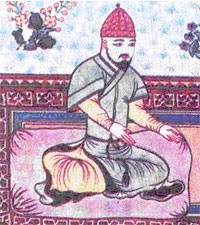
11世紀、ペルシア文明に多くの影響を受けたセルジューク・トルコ人は勢力を増し、アッバース朝の東部州を占領することに成功した。1055年までにセルジューク朝はバグダードを占領し、アナトリアへの最初の侵攻を開始した。[145] 1071年にビザンチン帝国とのマンジケルトの戦いに勝利すると、アナトリアへの門戸が開かれた。[146]民族的にはトルコ人であったが、セルジューク・トルコ人はトルコ文化よりもペルシア文化を評価し、その担い手となった。[147] [148]それにもかかわらず、トルコ語とイスラム教が伝わり、徐々にこの地域に広まり、主にキリスト教徒とギリシャ語を話すアナトリアから主にイスラム教徒とトルコ語を話すアナトリアへの緩やかな移行が進行していた。 [146]
窮地に陥ったビザンチン帝国は西方に助けを求め、第1回十字軍につながる嘆願を開始した。[149]十字軍がイズニクを占領すると、セルジューク・トルコ人は1097年に新たな首都コンヤにルーム・スルタン国を樹立した。 [146] 12世紀までには、ヨーロッパ人はアナトリア地方をトゥルキア、つまりトルコ人地と呼ぶようになった。[150]アナトリアのトルコ人社会は都市部、農村部、遊牧民に分かれていた。[151]セルジューク朝と同時にアナトリアに到着した他のトルクメン族は遊牧生活を続けた。 [146]これらの部族はセルジューク族よりも数が多く、定住生活を拒否し、中央アジアの草原地帯に起源を持つアニミズムとシャーマニズムが染み込んだイスラム教を信奉し、その後、新しいキリスト教の影響も加わりました。神秘的で革命的な側面を持つこの大衆的で融合主義的なイスラム教から、アレヴィー派やベクタシュ派などの宗派が生まれました。[146]さらに、トルコ人と地元住民との結婚や、多くの人々のイスラム教への改宗により、アナトリアのトルコ語を話すイスラム教徒の人口も増加しました。[146] [152]
1243年、キョセダグの戦いでモンゴル人はセルジューク朝を破り、アナトリアの新しい支配者となった。そして1256年、アナトリアへの第二次モンゴル侵攻は広範囲にわたる破壊を引き起こした。特に1277年以降、セルジューク朝領土内の政治的安定は急速に崩壊し、アナトリア西部と南部の「ベイリク」と呼ばれるトルコ人の公国が強化された。[153]
ベイリク朝

モンゴル人がセルジューク・トルコを破ってアナトリアを征服すると、トルコ人はイルハン朝の家臣となり、イルハン朝は現在のアフガニスタンから現在のトルコに至る広大な地域に独自の帝国を築きました。[154]モンゴル人が小アジアのより多くの土地を占領するにつれて、トルコ人はアナトリア西部にさらに進出し、セルジューク・ビザンチン国境に定住しました。[154] 13世紀の最後の数十年までに、イルハン朝とそのセルジューク朝の家臣は、アナトリアの大部分の支配権をこれらのトルコ人に奪われました。[154]多くのトルコの領主が「ベイリク」または首長国として知られるさまざまな公国の支配者としての地位を確立しました。これらのベイリクの中には、エーゲ海沿岸に沿って北から南にかけて、カラシ、サルハン、アイドゥン、メンテシェ、テケのベイリクが広がっていた。テケの内陸にはハミドがあり、カラシの東にはゲルミヤンのベイリクがあった。
アナトリアの北西、ソグート周辺には、小規模で、この時点では取るに足らないオスマン帝国のベイリクがあった。東側は、クズルルマク川から地中海までを支配していたイコニウムのカラマンのような、より強力な勢力に囲まれていた。オスマン帝国は、数多くのトルコのベイリクの中では小さな公国にすぎず、したがってビザンチン帝国の権威に対する脅威は最も小さかったが、アナトリア北西部、旧ビザンチン領ビテュニア地方に位置していたことは、将来の征服にとって有利な位置となった。1204年の第4回十字軍でコンスタンティノープルを征服したラテン人は、ラテン帝国(1204-1261)を建国し、バルカン半島とエーゲ海沿岸の旧ビザンチン領を分割し、ビザンチン皇帝をニカイア(現在のイズニク)に追放した。1261年以降、ビザンチン人はバルカン半島の支配権を取り戻すことに全力を注いだ。[154] 13世紀末にモンゴルの勢力が衰え始めると、トルコ人の首長たちはより大きな独立を獲得した。[155]
オスマン帝国


創設者オスマン1世の治世下、遊牧民のオスマン帝国のベイリクはサカリヤ川沿いに西のマルマラ海へと拡大した。こうして、小アジア西部の住民は大部分がトルコ語を話し、イスラム教徒となった。[154]オスマン帝国が大きく発展したのは、1326年に重要な都市中心地であるブルサを攻撃して征服し、オスマン帝国の首都と宣言した息子オルハン1世の治世下であった。1354年、オスマン帝国はヨーロッパに渡り、ガリポリ半島に足場を築き、同時に東に進軍してアンカラを占領した。[156] [157]オスマン帝国の侵攻前にトラキアから逃げた住民が放棄した地域に、アナトリアから多くのトルコ人が定住し始めた。[158]しかし、オスマン帝国の進撃で苦しんだのはビザンツ帝国だけではなかった。1330年代半ば、オルハンはトルコ領カラシを併合した。この進撃はムラト1世によって維持され、彼は直接統治する領土を3倍以上に拡大し、ヨーロッパと小アジアに均等に分布する約10万平方マイル(26万km 2 )に達した。[159]アナトリアでの利益はヨーロッパでの利益に匹敵した。オスマン帝国軍が1365年にオスマン帝国の首都となったエディルネ(アドリアノープル)を占領すると、1371年のマリツァの戦いでブルガリアとマケドニアへの道が開かれた。[160]トラキア、マケドニア、ブルガリアの征服により、かなりの数のトルコ人移民がこれらの地域に定住した。 [158]この形態のオスマン・トルコ植民地化は、バルカン半島における彼らの地位と権力を強化するための非常に効果的な手段となった。入植者は兵士、遊牧民、農民、職人、商人、修道僧、説教師、その他の宗教関係者、行政職員で構成されていた。 [161]
1453年、メフメト2世率いるオスマン帝国軍はコンスタンティノープルを征服した。[159]メフメトは都市を再建して再び人口を増やし、ここをオスマン帝国の新しい首都とした。[162]コンスタンティノープル陥落後、オスマン帝国は長い征服と拡大の時代に入り、その国境は最終的にヨーロッパ、中東、北アフリカの奥深くまで広がった。[163] セリム1世は、カルディラーンの戦いで帝国の東部と南部の国境を劇的に拡大し、聖地メッカとメディナの守護者としての認知を得た。[164]彼の後継者であるスレイマン1世は、 1521年にベオグラードを占領し、モハーチの戦いで勝利した後、その領土基盤を利用してハンガリーと他の中央ヨーロッパの領土を征服し、帝国の国境を東に押し広げて征服をさらに拡大しました。[165]スレイマンの死後も、オスマン帝国の勝利は、以前ほど頻繁ではなかったものの続きました。キプロス島は1571年に征服され、東地中海の海路に対するオスマン帝国の優位性を強化しました。[166]しかし、1683年のウィーンの戦いで敗北した後、オスマン帝国軍は待ち伏せやさらなる敗北に見舞われました。 1699年のカルロヴィッツ条約ではオーストリアにハンガリーとトランシルヴァニアの領有権が認められ、オスマン帝国が実際に領土を放棄したのは歴史上初めてのことであった。[167]
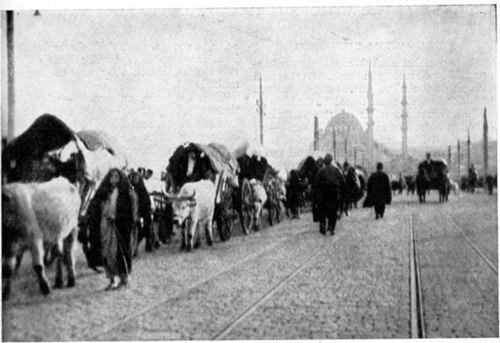
19世紀までに、オスマン帝国は全土で民族主義的な反乱が起こり、衰退し始めた。19世紀から20世紀初頭にかけて、オスマン帝国の縮小とロシア帝国におけるイスラム教徒の迫害により、推定500万人が死亡し、[168] [169]バルカン半島では300万人以上が死亡した。 [170]犠牲者にはトルコ人も含まれていた。[171] 500万から700万、あるいは700万から900万人の難民がバルカン半島、コーカサス、クリミア、地中海の島々から現代のトルコに移住し、 [172]オスマン帝国の中心はアナトリアに移った。[173]少数のユダヤ人を除いて、難民は圧倒的にイスラム教徒であり、トルコ人と非トルコ人、例えばチェルケス人やクリミア・タタール人が混在していた。[174] [175]ポール・モイゼスはバルカン戦争を「認識されていない大量虐殺」と呼び、複数の側が被害者であると同時に加害者でもあったと述べている。[176]
1913年までに、統一進歩委員会の政府は、非トルコ系少数民族の強制的なトルコ化計画を開始した。 [177] [178] 1914年までに第一次世界大戦が勃発し、 1915年のダーダネルス海峡の戦いでトルコ人はガリポリでいくらかの成功を収めた。第一次世界大戦中、統一進歩委員会の政府はトルコ化政策を実施し続け、アルメニア人虐殺の際のアルメニア人や、民族浄化と追放の様々なキャンペーンの際のギリシャ人など、非トルコ系少数民族に影響を与えた。[179] [180] [181] [182] [183] 1918年、オスマン政府は連合国とのムドロス休戦協定に同意した。
1920年にメフメト6世の政府によって調印されたセーヴル条約はオスマン帝国を解体した。ムスタファ・ケマル・パシャ率いるトルコ人は条約を拒否し、トルコ独立戦争を戦った。その結果、条約は破棄され、批准されることはなかった[184] 。そしてスルタン国は廃止された。こうして、623年続いたオスマン帝国は終焉を迎えた[185] 。
現代
.jpg/500px-Anafartalar_Boulevard,_K%C3%B6kl%C3%BC_Office_Building_and_shops,_1950s_(16645159247).jpg)
ムスタファ・ケマルは、旧オスマン帝国を占領していた連合軍に対するトルコ独立戦争を率いた後、トルコのイスラム教徒の多数派を団結させ、1919年から1922年にかけて、トルコ民族運動がトルコの祖国と考えていた場所から占領軍を打倒することに成功した。 [186] 1923年にローザンヌ条約が調印され、新設のトルコ共和国が正式に設立されたとき、トルコのアイデンティティは統合の力となった。アタテュルクの大統領職は、一連の急進的な政治・社会改革によって特徴づけられ、トルコを宗派的少数派と女性に市民的・政治的平等をもたらす世俗的で近代的な共和国に変えた。[187]
1920年代から1930年代にかけて、バルカン半島、黒海、エーゲ海諸島、キプロス島、アレクサンドレッタ(ハタイ)のサンジャク、中東、ソ連からのトルコ人やその他のイスラム教徒がトルコに引き続き移住し、そのほとんどは北西アナトリアの都市部に定住した。[ 188] [189]これらの移民の大部分は「ムハジル」と呼ばれ、故郷で嫌がらせや差別に直面したバルカン半島のトルコ人であった。[188]しかし、これらの国の多くには依然としてトルコ人人口の残余が存在していた。トルコ政府はこれらのコミュニティを保護し、近隣地域のトルコ人としての性格を維持したいと考えたからである。 [ 190]トルコへのトルコ系民族の移住の最終段階の一つは、1940年から1990年の間にブルガリアから約70万人のトルコ人が到着した時でした。今日、トルコの人口の3分の1から4分の1はこれらの移民の子孫です。[189]
地理的分布
トルコ人の居住地の伝統的な地域
七面鳥
.jpg/500px-Protect_Your_Republic_Protest_-_1_(2007-04-14).jpg)
トルコ人はトルコ最大の民族であり、その数はおよそ6000万人[1]から6500万人[2]である。11世紀のセルジューク朝による征服から現在まで続く継続的なトルコ人移住(特に近隣諸国からのトルコ難民)まで、この地域へのトルコ人の歴史的移住の多様性により、地理的サブグループごとにトルコ人を区別できる様々なアクセントや習慣がある。[106]たとえば、最も重要なのはアジアトルコの中心部に住むアナトリア・トルコ人で、彼らの文化はトルコの民族主義イデオロギーのルーツを強調する上で影響力を持っていた。[106]また、中央アジアから直接の子孫である遊牧民のトルコ系部族、例えばヨルク人や、[106]北部の黒海トルコ人は「他の地域で重視される母音調和がほとんどない」。[106] 19世紀から20世紀初頭にかけて旧オスマン帝国領からの迫害から逃れたムハシル(トルコ難民)の子孫。 [106]そして、1900年代半ば以降も差別や迫害から逃れ続けている最近の難民。
当初、東トラキアとアナトリアにやってきたムハシルは、ヨーロッパの植民地勢力(アルジェリアのフランスやクリミアのロシアなど)に併合された旧オスマン帝国領から逃れてきた人々であった。しかし、トルコ民族の移住の最大の波は、バルカン戦争によってこの地域のほとんどがオスマン帝国の支配から独立した19世紀後半から20世紀初頭にかけてバルカン半島から来た。 [191]ムハシルの最大の波はバルカン半島(特にブルガリア、ギリシャ、ルーマニア、ユーゴスラビア)から来た。しかし、キプロス[192] 、アレクサンドレッタのサンジャク[ 192]、中東(トランスヨルダン[192]やイエメン[ 192]を含む) 、北アフリカ(アルジェリア[193]やリビア[194]など)、ソ連(特にメスヘティ) [192]からも相当数の難民が来ていた。
旧オスマン帝国領内に留まっていたトルコ人は、その後も差別や迫害を受け続けたため、多くがトルコに避難した。特に、1944年にヨシフ・スターリンによって国外追放されたトルコ系メスヘティア人、1950年代にヨシップ・ブロズ・チトー政権から逃れたユーゴスラビアのトルコ系少数民族(すなわち、トルコ系ボスニア人、トルコ系クロアチア人、トルコ系コソボ人、トルコ系マケドニア人、トルコ系モンテネグロ人、トルコ系セルビア人) 、 [195] 1955~1974年のキプロス人民族間暴力から逃れたトルコ系キプロス人、[196] 1950年代と1970年代のアラブ民族主義の台頭とそれに続く1980~1988年のイラン・イラク戦争中の差別から逃れたトルコ系イラク人。[197] 1980年代に共産主義指導者トドル・ジヴコフの下で行われたいわゆる「復興プロセス」によるブルガリア化政策から逃れたトルコ系ブルガリア人、[91] 1998年から1999年のコソボ戦争から逃れたトルコ系コソボ人。[198]
現在、トルコに住む約1500万~2000万人のトルコ人はバルカン半島からの難民の子孫である。[199]また、メスヘティ出身の150万人の子孫[200]やキプロス出身の60万人以上の子孫がいる。 [201]トルコ共和国は、迫害や戦争から逃れてきたトルコ系民族の移住地であり続けている。例えば、現在のシリア内戦の影響で、トルコには約100万人のシリア・トルクメン人が住んでいる。[202]
キプロス
トルコ系キプロス人は、オスマントルコ人の祖先が1571年にキプロス島を植民地化したトルコ民族である。約3万人のトルコ軍兵士はキプロスに定住すると土地を与えられ、かなりの数のトルコ人コミュニティが形成された。1960年に新共和国政府による国勢調査で、トルコ系キプロス人が島の人口の18.2%を占めていることが明らかになった。 [203]しかし、1963年から1974年にかけてトルコ系キプロス人とギリシャ系キプロス人の間で「キプロス紛争」として知られるコミュニティ間の戦闘と民族間の緊張が発生すると、ギリシャ系キプロス政府は1973年に国勢調査を実施したが、トルコ系キプロス人は調査対象に含まれていなかった。1年後の1974年、キプロス政府統計調査局は、トルコ系キプロス人の人口は118,000人(18.4%)と推定した。[204] 1974年7月15日、ギリシャ人とギリシャ系キプロス人がギリシャとの統合を支持するクーデター(「エノシス」としても知られる)がキプロスで発生し、トルコ軍が介入して島の北部にトルコ系キプロス人の支配を確立した。 [205]そのため、キプロス共和国が実施した国勢調査では、未承認の北キプロス・トルコ共和国に定住していたトルコ系キプロス人は除外されている。[204] 1975年から1981年の間、トルコは自国民に北キプロスへの定住を奨励した。CIAの報告書によると、キプロス住民の20万人はトルコ人である。
バルカン半島
トルコ系民族は、オスマン帝国時代に最初に定住して以来、ギリシャ、北マケドニア、コソボ、ルーマニア、ブルガリアの特定の地域に住み続けている。2019年現在、バルカン半島のトルコ系人口は100万人を超えている。 [206]バルカン半島のトルコ人の大半は、オスマン帝国の縮小中にイスラム教徒の迫害で殺害または追放され、ムハジルとしてトルコにやって来た。[207] [208]
ルメリア/バルカン・トルコ人の大半はオスマン帝国の移住者の子孫である。しかし、バルカン半島へのアナトリア・トルコ人の最初の重要な移住の波は、1262年にミカエル8世パレオロゴスの宮廷に逃げたセルジューク朝のスルタン、カイカウス2世(1237年生まれ - 1279年/80年没)の定住者および遊牧民の大量移住にまで遡る。[209]
アルバニア
トルコ系アルバニア人はバルカン半島で最も小さなトルコ人コミュニティの一つである。アルバニアがオスマン帝国の支配下に入ると、トルコ人の入植はほとんどなくなったが、1415年から1430年にかけてアナトリアのトルコ人入植者が到着し、ティマール領地を与えられた。[210] 2011年の国勢調査によると、トルコ語はアルバニア語、ギリシャ語、マケドニア語、ロマ語、アルーマニア語に次いで、アルバニアで6番目に多く話されている言語であった。[79]
ボスニア・ヘルツェゴビナ
トルコ系ボスニア人は、ボスニア・ヘルツェゴビナがオスマン帝国に支配されていた時代からこの地域に住んでいます。したがって、トルコ人はこの国で最も古い民族的少数派を形成しています。[211 ]ボスニア・ヘルツェゴビナがオーストリア・ハンガリー帝国の支配下に入ったとき、トルコへの大量移住により、トルコ系ボスニア人コミュニティは劇的に減少しました。[211]
2003年、ボスニア・ヘルツェゴビナ議会は「少数民族の権利保護に関する法律」を採択し、トルコ系少数民族の文化的、宗教的、教育的、社会的、経済的、政治的自由を正式に保護した。[212]
ブルガリア
.png/500px-Percentage_of_Ethnic_Turks_in_Bulgaria_by_Province_(2011).png)
ブルガリアのトルコ人はバルカン半島最大のトルコ人コミュニティを形成し、ブルガリア最大の民族的少数派グループでもある。2011年の国勢調査によると、彼らはクルジャリ州(66.2%)とラズグラト州(50.02%)で多数派を形成し、シリストラ州(36.09%)、タルゴヴィシュテ州(35.80%)、シュメン州(30.29%)にもかなりのコミュニティがある。彼らはオスマン帝国の縮小期のイスラム教徒迫害中に民族浄化され、その後、彼らをブルガリア人のアイデンティティに同化させることを目的とした復興プロセスで標的にされた。[207] [213]
クロアチア
トルコ系クロアチア人は、クロアチア・オスマン戦争の時期にこの地域に定住し始めた。少数民族ではあるが、トルコ人はクロアチアで公式に認められた22の少数民族の1つである。[214]
ギリシャ
コソボ
トルコ系コソボ人は、コソボで3番目に大きい民族的少数派です(セルビア人とボスニア人に次ぐ)。彼らはマムシャの町と自治体で多数派を形成しています。
モンテネグロ
トルコ系モンテネグロ人はバルカン半島で最小のトルコ系少数民族である。彼らはオスマン帝国によるモンテネグロ統治後にこの地域に定住し始めた。1707年にはモンテネグロのトルコ人殺害とイスラム教徒全員の殺害という歴史的事件が起きた。この民族浄化の初期の事例は叙事詩『山の花輪』(1846年)に描かれている。[215]オスマン帝国の撤退後、残っていたトルコ人の大部分はイスタンブールやイズミルに移住した。[216]現在、残っていたトルコ系モンテネグロ人は主に海岸沿いの町バールに住んでいる。
北マケドニア

トルコ系マケドニア人は、バルカン半島で2番目に大きなトルコ人コミュニティを形成し、北マケドニアで2番目に大きな少数民族グループです。彼らは、センタル・ジュパ市とプラスニツァ市で多数派を形成し、マヴロヴォ市とロストゥシャ市、ストゥデニチャニ市、ドルネニ市、カルビンツィ市、ヴァシレヴォ市にも大きなコミュニティを形成しています。
ルーマニア
トルコ系ルーマニア人は、北ドブロジャ地方に集中しています。現在でもトルコ系住民が多数派を占める唯一の居住地は、コンスタンツァ県のドブロミルです。歴史的に、トルコ系ルーマニア人は、ルーマニア政府によって鉄門I水力発電所の建設のために破壊され、水没したアダ・カレ島など、他の地域でも多数派を形成していました。
セルビア
トルコ系セルビア人は、オスマン帝国によるこの地域の征服以来、セルビアに居住している。彼らは伝統的にセルビアの都市部に居住してきた。1830年にセルビア公国が自治権を付与されると、ほとんどのトルコ人は「ムハジル」(難民)としてオスマントルコに移住し、1862年までに残っていたほぼすべてのトルコ人が中央セルビアを去り、ベオグラードの3,000人ものトルコ人が去った。[217]現在、残っているコミュニティのほとんどはベオグラードとサンジャクに住んでいる。
コーカサス
アゼルバイジャン
トルコ系アゼルバイジャン人は、1578年から1603年まで続いたオスマン帝国の統治時代にこの地域に定住し始めた。1615年までにサファヴィー朝の統治者、シャー・アッバース1世がこの地方の支配を固め、数千人の人々をアゼルバイジャンから追放した。[218] 1998年には、オスマン帝国の元移住者の子孫である約19,000人のトルコ人がまだアゼルバイジャンに住んでいた。彼らはスンニ派イスラム教(国内で支配的なシーア派ではなく)を信仰しているため、アゼルバイジャン社会の残りの人々とは区別されている。[219]
第二次世界大戦以降、ソ連統治時代に大量のトルコ系メスヘティア難民が到着したことにより、トルコ系アゼルバイジャン人コミュニティは大幅に増加した。
ジョージア
アブハジア
トルコ系アブハジア人は16世紀にオスマン帝国の支配下でアブハジアに住み始めました。 [220]今日でも、この地域にはトルコ人が住み続けています。[221]
メスヘティ
オスマン帝国がジョージアのメスヘティを征服する以前、13世紀から数十万人のトルコ人侵略者がこの地域に定住していた。[222]当時、主要都市アハルツィヘは、トルコ語で「アクシカ」または「白い要塞」という名前で文献に登場していた。したがって、これが、現在トルコ人がこの地域を「アヒスカ」と呼んでいる理由である。[222]地元の指導者にはトルコ語で「アタベク」という称号が与えられ、これは、かつてジョージアであった4つの王国のうちの1つ、サムツヘ・サータバゴの15世紀の名称、「サムツヘ(メスヘティア)と呼ばれるアタベク人の土地」に由来している。[222] 1555年、アマスィヤ条約の後、オスマン帝国はメスヘティの西部を獲得し、サファヴィー朝は東部を獲得した。[223]その後1578年にオスマン帝国がサファヴィー朝支配地域を攻撃し、オスマン・サファヴィー朝戦争(1578-1590)が始まった。1639年にイランとの条約締結によりイランによるこの地域占領の試みが終結し、メスヘティはオスマン帝国に完全に確保された。トルコ人入植者がさらに増え、トルコ系メスヘティ人コミュニティは大幅に増加した。[224]
しかし、1883年にオスマン帝国がこの地域の支配権を失うと、多くのトルコ系メスヘティア人がグルジアからトルコへ移住した。トルコへの移住は露土戦争(1877-1878)の後、ボルシェビキ革命(1917年)、そしてグルジアがソビエト連邦に編入された後も続いた。 [ 224]この期間中、コミュニティのメンバーの一部は他のソビエト国境にも移住し、グルジアに残った人々はソビエト化キャンペーンの対象となった。[224]その後、第二次世界大戦中の1944年、ソビエト政府は残りのトルコ系メスヘティア人11万5000人の大量追放を開始し、[225]彼らをコーカサスと中央アジアのソビエト共和国に再定住させた。[224]
そのため、今日では数十万人のトルコ系メスヘティア人が旧ソ連諸国(特にカザフスタン、アゼルバイジャン、ロシア、キルギスタン、ウズベキスタン、ウクライナ)に散らばっている。さらに、多くがトルコや米国に定住している。彼らをジョージアに送還する試みとして、ジョージア当局は2年間の申請期間(2010年1月1日まで)内に9,350人からの申請を受けた。[226]
レヴァント
イラク

一般的にイラク・トルクメン人と呼ばれるトルコ人は、イラクで2番目に大きい民族的少数派グループです(つまり、クルド人に次ぐ)。その大部分は、アナトリアからイラクに連れてこられたオスマン帝国の入植者(兵士、商人、公務員など)の子孫です。[227]今日、ほとんどのイラク・トルクメン人は、イラクの中央部を北西から東に広がる「トルクメンエリ」と呼ばれる地域に住んでおり、キルクークが彼らの文化の中心地となっています。
歴史的に、イラクへのトルコ人の移住は、ウバイド・アッラー・イブン・ズィヤードのウマイヤ朝軍にトルコ人が徴兵され、その後アッバース朝の支配下で数千人以上のトルクメン戦士が到着した7世紀にまで遡る。しかし、これらのトルコ人のほとんどは地元のアラブ人住民に同化してしまった。[227]次の大規模な移住は、 1055年のスルタン・トゥールル・ベイの侵攻後、大セルジューク帝国下で起こった。 [227]その後150年間、セルジューク・トルコ人はイラク北部の最も重要なルート沿いに大規模なトルクメン人コミュニティを配置した。[228]しかし、トルコ人の移住の最大の波は、4世紀にわたるオスマン帝国の支配下(1535-1919)で起こった。[227] [229] 1534年、スレイマン1世はオスマン帝国内でモスルを確保し、モスルは地域の行政区を管轄する主要州(エヤレット)となった。オスマン帝国はアナトリアからの移住とイラク北部に沿ったトルコ人の定住を奨励した。 [230] 89年間の平和の後、オスマン・サファヴィー戦争(1623-1639)でムラト4世がバグダードを奪還し、イラクの恒久的な支配権を握り、1919年にオスマン帝国の支配が終わるまでトルコ人入植者が継続的に流入した。[229] [228] [231]
1923年にトルコ共和国が成立した後、イラク・トルクメン人は当初、トルコによるモスル地区の併合を求めた。[229]しかし、彼らは、キルクーク行政におけるトルコ的性格の保持と、トルコ語をリワの公用語として承認するという条件で、制憲議会選挙に参加した。 [232] 1925年の憲法では、イラク・トルクメン人はアラブ人やクルド人とともにイラクの構成民族として認められていたが、後にこの地位を否定された。[229]その後、イラク・トルクメン人は、1923年、1947年、1959年のキルクーク虐殺や、1979年にバアス党が同コミュニティを差別した際など、歴代政権の政策により、ますます差別を受けるようになった。 [229]
このように、イラク・トルクメン人の立場は、歴史的にオスマン帝国の行政・ビジネス階級であったものから、ますます差別される少数派へと変化した。[229] アラブ化・クルド化政策により、イラク・トルクメン人は祖国から追い出され、政治的迫害や追放からテロや民族浄化まで、さまざまな程度の抑圧と同化が行われてきた。[233]その結果、多くのイラク・トルクメン人がトルコに避難する一方、西ヨーロッパ(特にデンマーク、ドイツ、オランダ、スウェーデン、イギリス)やカナダ、アメリカ、オーストラリア、ニュージーランドへの移住も増加している。
エジプト
トルコ系エジプト人は、オスマン帝国統治時代(1517~1867年および1867~1914年)にエジプトに移住したトルコ人入植者の子孫がほとんどです。しかし、エジプトのファーティマ朝統治を除けば、この地域はトゥールーン朝時代(868~905年)から1952年まで、トルコ系かトルコ国家の伝統に従って育てられた人々によって代々統治されていました。[234]そのため、マムルーク朝時代のアラビア語の資料によると、バハリ朝の時代、その王朝はトルコ人の国(アラビア語:دولة الاتراك、ダウラト・アル・アトラク; دولة الترك、ダウラト・アル・トゥルク)またはトルコの国(الدولة التركية、アル・ダウラ・アル・トゥルキヤ)と呼ばれていました。[235] [236]それにもかかわらず、オスマン帝国の遺産は、今日でも目にすることができるエジプトのトルコ文化の保存において最も重要なものでした。[237]
ヨルダン
レバノン
レバノン・トルクメン人は、レバノンの民族グループのひとつを構成するトルコ人である。この地域におけるいくつかのトルコ系王朝の歴史的統治では、トゥールーン朝(868年~905年)、イフシード朝(935年~969年)、セルジューク朝(1037年~1194年)、マムルーク朝(1291年~1515年)、オスマン帝国( 1516年~ 1918年)の統治下で、レバノンへのトルコ人移住の波が絶え間なく続いた。今日、トルコ系レバノン人コミュニティのほとんどは、アナトリアからレバノンに移住したオスマントルコ人の子孫である。しかし、19世紀にオスマン帝国の領土が衰退すると、旧オスマン帝国領の他の地域から来たトルコ系少数民族がオスマン帝国領レバノンに避難した。特にアルジェリア・トルコ人は1830年のフランスによる北アフリカの植民地化後に、クレタ島トルコ人は1897年にギリシャの騒乱により避難した。 [193]
パレスチナ
パレスチナは1517年から1922年まで4世紀以上にわたりオスマン帝国の支配下にあった。そのため、多くのパレスチナ人家族はトルコ系である。[ 238]しかし、オスマン帝国時代が終わった後もトルコ人の移住は単純に止まったわけではない。むしろ、イギリスによるキプロス統治(1878-1960年)の間、大恐慌とその余波に苦しんだ多くのトルコ系キプロス人家族は、より良い生活を期待して、娘をイギリス領パレスチナのアラブ人と結婚させられた。 [239]こうして、1950年代後半まで何千人ものトルコ系キプロス人女性と少女がパレスチナに送られた。[240]
パレスチナのトルコ人の姓は、多くの場合、文字の「ji」で終わります(例:al-Batniji、al-Shorbaji)。また、他の一般的な姓には、al-Gharbawi、Tarzi、Turk、Birkdar、Jukmadar、Radwan、Jasir、al-Jamasiなどがあります。[238]
2022年現在、ガザには依然としてトルコ系のパレスチナ人家族が何千人もいます。[238]
シリア
トルコ語を話すシリア・トルクメン人は、シリアで2番目に大きな少数民族グループを形成している(すなわち、クルド人に次ぐ)。[98]しかし、一部の推計では、トルコ語を話さなくなったアラブ化トルコ人を含めると、彼らがシリアで最大の少数民族を形成すると示唆されている。 [98]シリア・トルクメン人の大多数は、オスマン帝国統治時代(1516-1918)にこの地域に到着したアナトリアのトルコ人入植者の子孫である。今日、彼らは主にシリアとトルコの国境近く、北西部のイドリブ県とアレッポ県からラッカ県まで広がっている。また、ラタキア近郊のトルクメン山地、ホムス市とその周辺からハマ、ダマスカス、南西部のダラア県(ヨルダンと国境を接する)とクネイトラ県(イスラエルと国境を接する)にも多くの人々が住んでいる。[98]
シリアへのトルコ人の移住は11世紀に始まった。特にセルジューク朝が1071年に北シリアに入り、1078年にダマスカス、1086年にアレッポを占領した後、トルコ系遊牧民の大量移住の道が開かれた。 [241] 12世紀までに、トルコ系のゼンギー朝は、十字軍の攻撃に対抗するため、アレッポにトルコ人を定住させ続けた。[242] 1260年にマムルーク朝がシリアに入った後も、さらなる移住が起こった。しかし、最大のトルクメン人の移住は、オスマン帝国のスルタン、セリム1世が1516年にシリアを征服した後に起こった。アナトリアからオスマン帝国のシリアへのトルコ人の移住は、オスマン帝国の支配が1918年に終わるまで、ほぼ400年間続いた。[243]
1921年、アンカラ条約により、アレクサンドレッタ(現在のハタイ)はフランス委任統治領シリアの自治政府の下に設立された。第7条ではトルコ語が公認言語となることが宣言された。[244]しかし、フランスがシリアに完全な独立を与えると発表した後、ムスタファ・ケマルはアレクサンドレッタの独立を要求した。その結果、 1938年にハタイ国家が樹立され、その後、アンカラにハタイをトルコ共和国に統合するよう請願した。フランスは1939年7月23日にトルコの併合に同意した。[245]
その後、アラブ化政策により、シリアのトルコ人村落の名前はアラビア語の名前に改名され、トルクメン人の土地の一部は国有化され、トルコ国境付近のアラブ人とともに再定住した。[246] 1945年から1953年の間にシリアのトルクメン人の大量脱出が起こり、その多くがトルコ南部に定住した。[247]シリア内戦(2011年~現在)以来、多くのシリアのトルクメン人が国内避難民となり、トルコ、ヨルダン、レバノン、イラク北部、[248]や西ヨーロッパ諸国[249]、オーストラリアに亡命を求めた者もいる。[93]
マグリブ
オスマン帝国は 1515 年にアルジェリアを、1534 年にチュニジアを支配し (後者は 1574 年に完全支配)、その結果、この地域、特に沿岸の町の周辺にトルコ人が定住するようになった。これらの地域がフランスの植民地になると、フランスは支配下の住民を「アラブ人」または「ベルベル人」に分類したが、これらの国々には民族的にトルコ人とクルーリ人(つまり部分的にトルコ系の人々) も含まれていた。ジェーン E グッドマンは次のように述べている。
フランス人は早くから北アフリカをマニ教のレンズを通して見ていた。アラブ人とベルベル人がフランス人が人口を分類する主な民族カテゴリーとなった(Lorcin 1995: 2)。これは、多様で断片的な人口がさまざまなアラブ人とベルベル人の部族グループだけでなく、トルコ人、アンダルシア人(十字軍の時代にスペインから追放されたムーア人の子孫)、クルフリ人(トルコ人男性と北アフリカ人女性の子孫)、黒人(ほとんどが奴隷または元奴隷)、ユダヤ人で構成されていたにもかかわらず起こった。[250]
アルジェリア
米国国務省によると、「アルジェリアの人口は、アラブ人、ベルベル人、トルコ人の混血である」とのことである。[251]一方、オーストラリア外務省は、アルジェリア(およびチュニジア)の人口統計には「強いトルコ人の混血」が含まれていると報告している。[252]
今日、アルジェリアのトルコ系家族は、イスラム教のハナフィー学派を信仰し続けている(マリキ学派を信仰するアラブ人やベルベル人とは対照的である)。さらに、多くはトルコ起源の姓を保持している。これは主にアナトリア地方の起源または民族的トルコ人起源を表している。[253] [254]
リビア
トルコ系リビア人はリビアで2番目に大きな民族的少数派グループ(ベルベル人に次ぐ)を形成し、主にミスラタ、トリポリ、ザウィヤ、ベンガジ、デルナに居住している。[110]トルコ系リビア人の中には、アウバリの町にあるトルコ人居住区ヘイ・アル・アトラクなど、より辺鄙な地域に住む者もいる。[255]彼らは、1555年から1911年まで続いたオスマン帝国の統治下でアナトリアからリビアへの移住を奨励されたトルコ人入植者の子孫である。[256]
現在、ミスラタ市は「リビアのトルコ系コミュニティの中心地」と考えられている。[257]ミスラタの人口40万人のうち、トルコ系住民はおよそ3分の2(推定27万人[258] )を占めている。 [258]その結果、2011年にリビア内戦が勃発して以来、ミスラタは「抵抗の拠点」となり、トルコ系リビア人が戦争で重要な役割を果たした。[194] 2014年、元カダフィ軍将校はニューヨークタイムズ紙に、内戦は今やアラブ部族(ジンタニ人など)とトルコ系部族(ミスラティ人など)およびベルベル人やチェルケス人との間の「民族闘争」になっていると報告した。[259]
チュニジア
チュニジアの人口は「主にアラブ人、ベルベル人、トルコ人の子孫」で構成されている。[260]トルコ系チュニジア人は、スペインの侵攻を恐れてトルコ人の助けを求めるチュニジア住民の呼びかけにオスマン帝国が応えた1534年に、約1万人のトルコ兵とともにこの地域に定住し始めた。 [261]オスマン帝国の統治下、トルコ人コミュニティは何世紀にもわたってこの地域の政治生活を支配していた。その結果、アナトリアやオスマン帝国領の他の地域からのトルコ人の継続的な移住により、チュニジアの民族構成は300年以上にわたって大きく変化した。さらに、一部のトルコ人は地元住民と結婚し、その男性の子孫は「クルーリ」と呼ばれた。[262]
現代のディアスポラ
ヨーロッパ
現代のトルコ人の西ヨーロッパへの移民は、1914年に大英帝国がキプロスを併合し、キプロスの住民が王室の臣民となった1920年代初頭に、トルコ系キプロス人がイギリスに移住したことに始まる。しかし、キプロス紛争により、1940年代と1950年代にはトルコ系キプロス人の移住が大幅に増加した。逆に、1944年には、第二次世界大戦中にジョージアのメスヘティから強制的に追放されたメスヘティ・トルコ人として知られるトルコ人が、東ヨーロッパ(特にロシアとウクライナ)に定住した。1960年代初頭までに、 1961年にドイツとの「労働力輸出協定」に基づいてトルコ人の「外国人労働者」が到着し、続いて1964年にオランダ、ベルギー、オーストリア、 1965年にフランスと同様の協定が結ばれると、トルコから西ヨーロッパと北ヨーロッパへの移住が大幅に増加した。1967年にはスウェーデンにも移住した。 [263] [264] [265]最近では、ブルガリア・トルコ人、ルーマニア・トルコ人、西トラキア・トルコ人も西ヨーロッパに移住している。
1997年にセルベット・バイラム教授とバーバラ・シールズ教授は、西ヨーロッパとバルカン半島(キプロスとトルコを除く)には1000万人のトルコ人が住んでいると述べた。[266] 2010年までに、民族政治科学研究センターのボリス・ハルコフスキー氏は、欧州連合には最大1500万人のトルコ人が住んでいると述べた。[267]アラクス・パシャヤン博士によると、2012年にはドイツ、フランス、オランダ、ベルギーだけで1000万人の「ユーロ・トルコ人」が住んでいた。 [268]しかし、オーストリア、イギリス、スイス、イタリア、リヒテンシュタイン、スカンジナビア諸国、旧ソ連諸国にもかなりのトルコ人コミュニティが住んでいる。
北米
2000年の米国国勢調査では、117,575人のアメリカ人が自発的に民族をトルコ人と申告した。[269]しかし、実際のトルコ系アメリカ人の数はこれよりかなり多く、大半は民族を申告していない。そのため、トルコ系アメリカ人は「数えにくい」コミュニティとみなされてきた。[270] 1996年、ジョン・J・グラボウスキー教授はトルコ人の数を50万人と推定した。[271] 2009年までに、公的機関はその数を85万人から90万人としているが、米国のトルコ系非政府組織は米国に少なくとも300万人のトルコ人がいると主張している。[10]最近では、2012年に米国商務長官ジョン・ブライソンがトルコ系アメリカ人コミュニティは100万人以上であると述べた。[8]一方、2021年にブライアン・フェルドマン上院議員は「200万人以上のトルコ系アメリカ人」がいると述べた。[9]トルコ系アメリカ人が最も集中しているのは、ニューヨーク市、ニューヨーク州ロチェスター、ワシントンDC、ミシガン州デトロイトである。さらに、サウスカロライナ州のタークスは、サムター郡に住むトルコ系であると自認する英国化した孤立したコミュニティであり、200年以上にわたってそこに住んでいます。[272]
トルコ系カナダ人コミュニティに関して、カナダ統計局は、2016年の国勢調査で63,955人のカナダ人が民族的起源としてトルコ人を挙げており、その中には複数の起源を挙げた人も含まれていると報告している。 [273]しかし、トルコ駐在カナダ大使のクリス・クーターは、2018年には10万人を超えるトルコ系カナダ人がいると述べた。 [34]大多数はオンタリオ州、主にトロントに住んでおり、ケベック州モントリオールにもかなりの数のトルコ系コミュニティがある。
オセアニア
1940年代後半、トルコ系キプロス人が経済的な理由でキプロス島を離れ始め、その後キプロス紛争中に政治的な理由でオーストラリアへのトルコ系キプロス人の移民傾向が始まったため、オーストラリアへのトルコ系キプロス人の移住が目立った。 [274]トルコ系キプロス人コミュニティは、白オーストラリア政策の下で受け入れられた唯一のイスラム教徒であった。[275]これら初期移民の多くは、工場や畑、または国家インフラの建設に従事した。[276] 1967年、オーストラリア政府とトルコ政府は、トルコ国民のオーストラリアへの移住を認める協定に署名した。[277]この募集協定以前は、オーストラリアには3,000人未満のトルコ系がいた。[278]オーストラリア統計局によると、1968年から1974年の間に約19,000人のトルコ人移民が到着しました。 [277]彼らは主にトルコの農村部から来ており、約30%が熟練労働者で、70%が非熟練労働者でした。[279]しかし、1980年代にオーストラリアへの入国を申請する熟練トルコ人の数が大幅に増加したことで状況が変わりました。[279]その後35年間でトルコ人の人口はほぼ10万人に増加しました。 [278]トルコ人コミュニティの半分以上がビクトリア州、主にメルボルンの北西郊外に定住しました。[ 278] 2006年のオーストラリア国勢調査によると、59,402人がトルコ系を主張しています。[280]しかし、これはオーストラリアのトルコ系コミュニティの真の姿を反映したものではない。オーストラリアには4万人から12万人のトルコ系キプロス人[281] [282] [283] [284]と15万人から20万人のトルコ本土人[285] [286]が住んでいると推定されている。さらに、ブルガリア、[287] 、ギリシャ、[288] 、イラク、[289]、北マケドニアからオーストラリアに移住したトルコ系民族もいる。[288]
旧ソ連諸国
1944年、第二次世界大戦中に11万5千人以上のメスヘティア・トルコ人が祖国から強制追放されたため、その大半はソ連崩壊後のコーカサスや中央アジア諸国に定住した。[225] 1989年のソ連国勢調査(最後のソ連国勢調査)によると、ウズベキスタンには10万6千人のメスヘティア・トルコ人が、カザフスタンには5万人、キルギスタンには2万1千人のメスヘティア・トルコ人が住んでいた。[225]しかし、1989年、ウズベク人による民族主義の蜂起の後、ウズベキスタンに定住したメスヘティア・トルコ人は、メスヘティア・トルコ人追放者の主な目的地であったフェルガナ渓谷でポグロムの標的となった。[225]暴動により数百人のトルコ人が死亡または負傷し、1,000件近くの財産が破壊されたため、数千人のメスヘティア・トルコ人が新たな亡命を余儀なくされた。[225]ソ連当局は多くのメスヘティア・トルコ人を「アゼルバイジャン人」、「カザフスタン人」、「キルギス人」、「ウズベク人」などの他の国籍に属するものとして記録した。[225] [290]
文化
言語

地理的な差異に基づいて、トルコ人はトルコ語のさまざまな方言を話します。2021年現在、トルコ語は「8000万人以上が話す最大かつ最も活発なトルコ語」のままです。 [291]
歴史的に、オスマントルコ語はオスマン帝国領土全体の公用語および共通語であり、オスマントルコ語のアルファベットはペルシア語・アラビア語の文字を使用していました。しかし、19世紀にトルコのナショナリズムが台頭すると、トルコの知識人は書き言葉の簡素化を模索しました。[292]
20世紀までに、徹底的な言語改革が行われた。最も重要なのは、1928年にムスタファ・ケマルがトルコ語の文字をラテン語ベースの現代トルコ語アルファベットに変更したことだ。[293 ]それ以来、改革活動を主導する規制機関は、1932年に設立されたトルコ語協会である。[291]
現代の標準トルコ語はイスタンブール方言に基づいています。[294]しかし、 1930年代以降、マスメディアやトルコの教育システムで使用されている標準の均一化の影響にもかかわらず、方言の変異は残っています。 [295] ağızまたはşiveという用語は、多くの場合、さまざまなタイプのトルコ語の方言を指します。
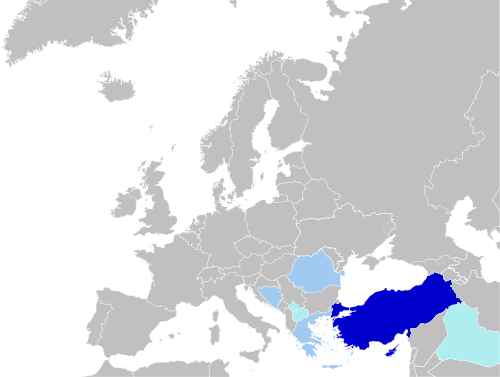
トルコ語が公用語となっている国
少数言語として認められている国
少なくとも1つの自治体で少数言語として公用語として認められている国
公式ステータス
今日、現代トルコ語はトルコと北キプロスの公用語として使われている。また、キプロス共和国でも(ギリシャ語と並んで)公用語となっている。[296]コソボでは、プリズレン、マムシャ、ギラン、ミトロヴィツァ、プリシュティナ、ヴシュトリの各自治体でトルコ語が公用語として認められているが、[297]国内の他の地域では少数言語として認められている。[291]同様に、北マケドニアでは、トルコ人が人口の20%以上を占める地域ではトルコ語が公用語となっているが(プラスニツァ自治体、センタル・ジュパ自治体、マヴロヴォ・ロストゥシャ自治体を含む)、国内の他の地域では少数言語にとどまっている。[298] [291]イラクは、トルコ人が人口の多数を占めるすべての地域でトルコ語を公用語として認めており、[299]その他の地域では少数言語として認めている。[291]ボスニア・ヘルツェゴビナ、[300]クロアチア、[301] [302]ルーマニアなど、いくつかの国ではトルコ語は少数言語としてのみ正式に認められている。[291] [303]しかし、ギリシャではトルコ語を使用する権利は西トラキアでのみ認められており、国内の他の地域(ロードス島やコス島など)の大規模で長年の少数民族は、この同様の承認の恩恵を受けていない。[304]
オスマン帝国崩壊後の国の中には、トルコ語を公式に認めていないものの、トルコ系少数民族に自国語を学ぶ権利(国の公用語の義務学習と並行して)を与えている国もいくつかある。これはブルガリア[305]やチュニジア[306]で実践されている。
トルコ語の様々な変種は西ヨーロッパの何百万人ものトルコ移民とその子孫によっても使用されていますが、これらの国では公式に認められていません。[291]
トルコ語の方言

トルコで話されているアナトリア・トルコ語の方言は3つの主要なグループに分かれている。西アナトリア方言(ユーフラテス川のほぼ西側)、東アナトリア方言(ユーフラテス川の東側)、そしてトラブゾン、リゼ、アルトヴィン沿岸地域など黒海東岸の方言を含む北東アナトリア方言である。[307] [308]
バルカン・トルコ語方言は、ルメリア・トルコ語方言とも呼ばれ、主に「西ルメリア・トルコ語」と「東ルメリア・トルコ語」の2つのグループに分けられます。[309]西方言は、北マケドニア、コソボ、西ブルガリア、北ルーマニア、ボスニア、アルバニアで話されています。東方言は、ギリシャ、北東ブルガリア/南ブルガリア、南東ルーマニアで話されています。 [309]この区分は、おおよそ西ブルガリアと東ブルガリアの境界線に沿っており、ロムの東から始まり、南に進んでヴラツァ、ソフィア、サモコフの東に至り、西に曲がってセルビアと北マケドニアの国境に近いキュステンディルの南に達します。[309]東方言には、西部に見られる音声上の特殊性がいくつか欠けています。そのため、その方言は中央アナトリア方言に近い。黒海西部地域(ルドゴリエ、ドブルジャ、ベッサラビアなど)で話されているトルコ語の方言は、北東アナトリア黒海方言と類似点がある。[309]
キプロス・トルコ語方言は、主にコンヤ・アンタルヤ・アダナ地域から来たオスマン帝国の移住者たちのそれぞれの地方方言の特徴を維持している。[309]さらに、キプロス・トルコ語はキプロス・ギリシャ語の影響も受けている。[309]今日、北キプロスで話されている方言は、標準トルコ語の影響をますます受けている。キプロス・トルコ語方言は、トルコからの移民、新しいマスメディア、新しい教育機関を通じて、標準トルコ語にさらされつつある。[310]

イラク・トルコ語の方言は、ウルファとディヤルバクルの地域周辺の南東アナトリア方言と類似点がある。[311]一部の言語学者は、イラク・トルコ語の方言を「アナトリア語」[312]または「東アナトリア方言」と表現している。[313]歴史的に、イラク・トルコ語はオスマン・トルコ語と近隣のアゼルバイジャン・テュルク語の影響を受けてきた。[314]しかし、イスタンブール・トルコ語は現在、それらの方言に大きな影響を与える権威ある言語となっている。 [315]そのため、イラク・トルコ語の統語論は近隣のイラン・テュルク諸語とは大きく異なり、 [315]トルコのトルコ語方言と類似した特徴を共有している。[316]全体として、イラク・トルコ語の方言は、様相に関してキプロス・トルコ語やバルカン・トルコ語とも類似点を示している。[317]イラク・トルクメン人の書き言葉は、現代のトルコ語アルファベットを使用したイスタンブール・トルコ語に基づいています。[318]
メスヘティア・トルコ語の方言は、もともとグルジアで話されていたが、トルコ系メスヘティア人が強制的に追放され、その後トルコ、ロシア、中央アジア、アゼルバイジャン、ウクライナ、アメリカ合衆国に分散した。[319]彼らはトルコ語の東アナトリア方言を話しており、カルス、アルダハン、アルトヴィン地方が起源である。[320]メスヘティア・トルコ語の方言は、ロシアとソビエト統治時代にメスヘティア・トルコ人が接触してきた他の言語(アゼルバイジャン語、グルジア語、カザフ語、キルギス語、ロシア語、ウズベク語など)からも借用している。[320]
シリア・トルコ語方言はシリア全土で話されている。アレッポ、テル・アビヤド、ラッカ、バイルブチャクでは南東アナトリア方言(キリス、アンテプ、ウルファ、ハタイ、ヤイラダールに相当)が話されている。[321]ダマスカスではヨルク方言のトルコ語が話されている。[321]現在、トルコ語はシリアで3番目に広く使用されている言語である(アラビア語、クルド語に次ぐ)。[322]
宗教


トルコ系民族のほとんどは、イスラム教スンニ派ハナフィー学派の教えに従う、実践的あるいは非実践的なイスラム教徒である。[82]彼らはトルコと北キプロスで最大のイスラム教徒コミュニティを形成しているほか、オーストリア、 [323]ブルガリア、[324]チェコ共和国、[325]デンマーク、[326]ドイツ、 [327] リヒテンシュタイン、 [ 328 ]オランダ、[327]ルーマニア[329]スイスでも最大のイスラム教徒グループを形成している。[323]スンニ派トルコ人に加えて、アナトリアに土着のイスラム伝統を持つアレヴィー派トルコ人や、伝統的にアナトリアとバルカン半島を中心とするベクタシ派がいる。[330]
一般的に、「トルコのイスラム教」は他の中東イスラム社会よりも「より穏健で多元的」であると考えられている。[331]歴史的に、トルコのスーフィー運動はリベラルな形態のイスラム教を推進した。[332]たとえば、メヴレヴィー派(ルーミーに従う旋回修道僧)、ベクタシュ派、ユヌス・エムレなどのトルコのヒューマニスト団体や思想家は、イスラム教の実践よりも信仰を重視した。[332]セルジューク朝支配下のこの寛容な環境の中で、13世紀にアナトリアにやってきたトルコの部族は、リベラルなスーフィー版のイスラム教がシャーマニズムの伝統に近いと感じ、自分たちの文化の一部(ダンスや音楽など)を保存することを選んだ。[332]オスマン帝国後期には、オスマン帝国の知識人によって導入されたタンジマート政策によってイスラム教が近代化改革と融合した。20世紀にはアタチュルクによる世俗主義改革が続いた。 [331]
その結果、政治的に世俗的な傾向のある、信仰を実践していないトルコ系ムスリムも多く存在する。例えば、キプロスでは、トルコ系キプロス人は一般的に非常に世俗的であり、特別な機会(結婚式、葬儀、地域の集まりなど)にのみモスクに通う。[333]それでも、ラルナカのハラ・スルタン・テッケは、ウンム・ハラムの眠る場所で、イスラム教で最も神聖な場所の一つと考えられており、世俗的なトルコ系キプロス人コミュニティにとっても重要な巡礼地であり続けている。[334]同様に、イラクなどレバントの他の都市部では、トルコ系少数派は主に世俗的であり、 1923年のトルコ共和国建国以来実践されてきた国と宗教の問題に関する世俗主義的な解釈を内面化している。[335]
.jpg/500px-Westermoskee_-_Amsterdam_(26579109769).jpg)
北アフリカでは、トルコ系少数民族は伝統的に、マリキ派を信仰するアラブ系ベルベル人とは区別されてきた。これは、トルコ人がオスマン帝国統治時代に先祖によってこの地域にもたらされたハナフィー派の教えを守り続けているためである。[336]実際、この地域のオスマン・トルコ系モスクは、ハナフィー派の伝統に従って建てられた鉛筆のような形をした八角形のミナレットで区別できることが多い。[337] [338]
オスマン様式(イスタンブールのモスクをベースとした帝国様式、または地方様式)のモスクを建てる伝統は、伝統的な居住地域(トルコ、バルカン半島、キプロス、レバントの他の地域など)だけでなく、移民コミュニティがかなり多い西ヨーロッパや北アメリカでも今日まで続いています。 [339]
1960年代以降、イスラム教は特定の「トルコ的特徴」と視覚的な建築様式を持つと考えられていたため、ドイツなどの国では「トルコ」は「イスラム」と同義語とさえみなされていました。[340]
芸術と建築

トルコ建築はオスマン帝国時代に最盛期を迎えた。セルジューク朝、ビザンチン朝、イスラム建築の影響を受け、オスマン建築は独自のスタイルを確立した。[342]全体として、オスマン建築は地中海と中東の建築の伝統を統合したものと評されている。[343]
トルコが宗教を基盤とした旧オスマン帝国から、政教分離の厳格な近代国民国家へと変貌を遂げるにつれ、芸術表現の形態も増加した。共和国成立後最初の数年間、政府は美術館、劇場、オペラハウス、建築などの美術に多額の資源を投入した。多様な歴史的要因が、現代トルコのアイデンティティを定義する上で重要な役割を果たしている。トルコ文化は、伝統的な宗教的、歴史的価値観を維持しながら、「近代的」な西洋国家になろうとする努力の産物である。[344]文化的影響の混合は、例えば、 2006年のノーベル文学賞を受賞したオルハン・パムクの作品に描かれた「文化の衝突と絡み合いの新たな象徴」の形でドラマ化されている。[345]伝統的なトルコ音楽には、トルコの民俗音楽(ハルク・ムジギ)、ファスル、オスマン帝国の宮廷に由来するオスマン帝国の古典音楽(サナット・ムジギ) がある。 [346]現代トルコ音楽には、トルコのポップミュージック、ロック、トルコのヒップホップのジャンルが含まれます。 [346]
科学
トルコの研究開発費の対GDP比は、2000年の0.47%から2021年には1.40%に上昇した。[347] トルコは、科学技術雑誌の論文数で世界第16位、ネイチャーインデックスでは35位にランクされている。[348] [349]トルコ特許庁は、特許出願全体で世界第21位、意匠出願では第3位にランクされている。トルコ特許庁への出願人の大多数はトルコ居住者である。世界中のすべての特許庁において、トルコ居住者は特許出願全体で第21位にランクされている。[350] 2023年、トルコはグローバルイノベーションインデックスで世界第39位、上位中所得国グループの中で第4位にランクされた。[351]トルコは、過去10年間で顕著な増加を記録した国の一つであった。[352]
現代のトルコの科学者には、細胞が損傷したDNAを修復する仕組みを研究しノーベル化学賞を受賞したアジズ・サンジャルがいる。 [353]彼はトルコ人ノーベル賞受賞者2人のうちの1人であり、科学分野では初の受賞者である。免疫学者のウグル・シャヒンとオズレム・トゥレチは、COVID-19に対する最初の有効なワクチンの1つを開発した会社であるBioNTechを設立した。[354]エルダル・アリカンは極性符号を発明した。 [355]これは5G技術の重要な構成要素である。 [356] [357]数学者のジャヒト・アルフは、ハッセ・アルフの定理とアルフ不変量で知られている。[358] [359]医師のフルシ・ベーチェットはベーチェット病を発見した。[360]他の現代科学者には、神経学者のガジ・ヤシャルギル[361]物理学者のフェザ・ギュルシー[362]と ベーラム・クルシュノオール[363]、天体物理学者のブルシン・ムトゥル・パクディル[364]とフェリャル・エゼルが含まれる。[365]
遺伝学
トルコ人のゲノム変異は、他のいくつかの西アジア人集団とともに、南イタリア人などの南ヨーロッパ人集団のゲノム変異に最も類似している。 [366]旧石器時代、新石器時代、青銅器時代をカバーする古代DNAのデータによると、トルコ人を含む西アジア人のゲノムは、その地域の初期の農耕民族から大きな影響を受けており、トルコ語話者などの後期の人口移動も寄与していることが明らかになった。[366]
2014年に行われたトルコ人遺伝学の全ゲノム配列解析研究(16人)では、トルコ人は南ヨーロッパ/地中海の集団とクラスターを形成しており、祖先の東アジア人集団(おそらく中央アジア人)の寄与は21.7%と予測されるという結論が出ている。[367]しかし、元々寄与していた集団が不明であるなどの理由により、これは移住率の直接的な推定ではない。[367]さらに、中央アジアのさまざまな集団の遺伝的変異は「十分に特徴付けられていない」ため、西アジア人集団も「東部の集団と密接に関連している」可能性がある。[366]一方、中央アジアには「東ユーラシア人(EEA)と西ユーラシア人(WEA)の混合人類学的特徴を示す」多数の集団が居住しており、2つの研究によると、ウイグル人の祖先は40~53%が東アジア人、残りがヨーロッパ人に分類されている。[368] 2006年の研究では、アナトリアにおける中央アジア人の真の貢献は男性で13%、女性で22%(信頼区間の範囲は広い)であり、トルコとアゼルバイジャンでの言語の置き換えはエリート優位モデルに沿ったものではない可能性があることが示唆されている。[369]
2021年に行われた別の研究では、 3,362の無関係なトルコ人サンプルの全ゲノムと全エクソームを調べた結果、初のトルコ人バリオームが確立され、トルコの歴史に沿って、南東ヨーロッパ人、コーカサス人、中東人、その他のヨーロッパ人集団の間で広範な混合が見つかった。[370]さらに、かなりの数の希少ゲノムおよびエクソーム変異が、現代のトルコ人集団に特有であった。[370]東西の近隣集団とイタリアのトスカーナ人は、遺伝的類似性の点でトルコ人集団に最も近かった。[370]母系、父系、常染色体遺伝子への中央アジアの寄与が検出され、これは中央アジアからのオグズ・トルコ人の歴史的な移住と拡大と一致している。 [370]著者らは、現代のトルコ人と現代のヨーロッパ人の遺伝的類似性は、新石器時代のアナトリア農民がヨーロッパに広がり、それが現代のヨーロッパ人の遺伝的構成に影響を与えたためではないかと推測した。[370]さらに、この研究ではトルコのさまざまな地域の間に明確な遺伝的分離は見られなかったため、著者らはトルコ国内での最近の移住が遺伝的均質化をもたらしたと示唆している。[370] 2022年の研究では、現代の人口と、11,000年間にわたる南ヨーロッパと西アジアの700以上の古代ゲノムを調査し、トルコ人は「私たちの研究でカバーされている何千年もの間アナトリアに住んでいた古代人と、トルコ語系言語を持つ中央アジアから来た人々の両方」の遺伝的遺産を持っていることが判明した。[371]
参照
注記
^ a: 「トルコの歴史は、第一に、トルコ人が来る前のアナトリアの歴史と、トルコ民族が同化または模範として継承したヒッタイト、トラキア、ヘレニズム、ビザンチンの文明の歴史を網羅しています。第二に、アナトリアにイスラム教とトルコ語をもたらしたセルジューク朝を含むトルコ人の歴史が含まれます。第三に、アナトリアの小さなトルコの首長国から発展し、何世紀にもわたって世界大国であった広大で国際的な汎イスラム国家、オスマン帝国の歴史です。」 [372]
参考文献
- ^ ab Garibova, Jala (2011)、「汎テュルク語の夢:トルコ人の言語統一」、フィッシュマン、ジョシュア、ガルシア、オフェリア(編)、言語と民族的アイデンティティのハンドブック:言語と民族的アイデンティティの取り組みにおける成功と失敗の連続、オックスフォード大学出版局、p. 268、ISBN 9780199837991人口は約 2 億人で
、約 40 のトルコ語と方言を話します。トルコは最大のトルコ系国家であり、その領土内には約 6,000 万人のトルコ人が住んでいます。
- ^ ab Hobbs, Joseph J. (2017)、世界地域地理学の基礎、Cengage、p. 223、ISBN 9781305854956最も偉大なのは
、トルコ語系トルコ語を話すトルコの 6,500 万人のトルコ人です...
- ^ 「KKTC 2011 NÜFUS VE KONUT SAYIMI」(PDF) 。 2013年9月27日時点のオリジナルよりアーカイブ(PDF) 。 2014年2月14日閲覧。
- ^ オーヴィス、スティーブン、ドロガス、キャロル・アン(2018年)。比較政治学入門:文脈における概念と事例。CQプレス。305ページ。ISBN 978-1-5443-7444-4現在、
約300万人のトルコ系民族がドイツに住んでおり、その多くがドイツで子供を育てています。
- ^ Engstrom, Aineias (2021年1月12日)、「初のCOVID-19ワクチンを支えるトルコ・ドイツ「ドリームチーム」」、Portland State Vanguard、ポートランド州立大学、2021年3月27日時点のオリジナルよりアーカイブ、 2021年3月27日閲覧。
ドイツの国勢調査では民族に関するデータは収集されていないが、推定によると、トルコ系ルーツを持つ400万~700万人、つまり人口の5~9%がドイツに住んでいる。
- ^ Zestos, George K.; Cooke, Rachel N. (2020)、「ドイツが不況に近づくにつれ、EUはどのような課題に直面するか」(PDF)、Levy Economics Institute、p. 22、
現在(2020年)、700万人以上のトルコ人がドイツに住んでいます。
- ^ シシュコヴィッツ、テッサ(2005)、「ドイツ」、フォン・ヒッペル、カリン(編)、ヨーロッパはテロリズムに立ち向かう、パルグレイブ・マクミラン、p. 53、ISBN 978-0230524590すでに700万人のトルコ人がドイツに住んでいる今、
移民国家であるかどうかについての議論を始めるのは少し遅すぎる。
- ^ ab Bryson, John (2012)、「2012年4月5日、ブライソン商務長官の発言」、Foreign Policy Bulletin、22 (3)、ケンブリッジ大学出版局:137、
ここ米国では、人と人とのつながりが日々強くなっているのがわかります。米国で学んでいる13,000人のトルコ人学生を見ればそれがわかります。コカコーラのCEO、ムフタール・ケントのような企業リーダーを見ればそれがわかります。そして、我が国の豊かな文化と構造に貢献している100万人を超えるトルコ系アメリカ人を見ればそれがわかります。
この引用は、アメリカ進歩センターとトルコ実業家連盟(TUSKON)昼食会での発言、米国商務省、2012年、2020年11月13日取得にも掲載されています。 - ^ ab フェルドマン、ブライアン(2022)、第15地区代表団は木曜日、トルコ系アメリカ人200万人以上とトルコの視聴者に届くテレビ番組に出演します!、Facebook 、 2022年11月3日閲覧
- ^ ab Erdal、Şafak (2009)、ABD'de kaç Türk var?、サバ州、2020年 11 月 30 日取得、 Biraz
bilmece gibi mi oldu;アカリム。 Resmi kurumlarımıza göre ABD'de "Tahmini" 850 ile 900 bin arası Türk yaşıyor。彼女の仕事は彼女の仕事に影響を与えます。ブナ カルシュルク アブダビ トルコのシヴィル トップラム イェニ ドゥニャダキ ヴァルルリドゥック ヴァルルジグ ヤプトゥクラルダン エルデ ティクレリ ソヌチャール、レスミ クルムラルン ベリレリニン ソック アマ ソック シュトゥンデ。 Onlara gore、ABD'de halen en az 3 million Turk var.オクヤン、チャリシャン ヴェヤ ヤシャヤン。
- ^ Lucena, Jorge (2022), MEET MURAD ISLAMOV: THE FOUNDER AND CEO OF MAYA BAGEL EXPRESS、Flaunt、2022年3月26日時点のオリジナルよりアーカイブ。 2022年3月26日閲覧。300
万人を超えるトルコ系アメリカ人が米国のさまざまな州に住んでいます。彼らは米国の文化、業績、歴史に大きな影響を与えてきました。
- ^ Aalberse, Suzanne; Backus, Ad; Muysken, Pieter [オランダ語] (2019)、Heritage Languages: A language Contact Approach、John Benjamins Publishing Company、p. 90、ISBN 978-9027261762オランダ系トルコ人コミュニティーは
、長年にわたり 50 万人に上る人口のうちの 1 人です。
- ^ トッチ、ナタリー(2004)、EU加盟のダイナミクスと紛争解決:キプロスにおける平和の促進か分割の強化か?、アッシュゲート出版、p. 130、ISBN 9780754643104オランダ政府は、
オランダに200万人のトルコ人が居住し、トルコとのビジネス上のつながりが強いことを念頭に置き、キプロスに関する欧州理事会の結論に対するトルコの反応を懸念していた。
- ^ van Veen、Rita (2007)、「De koningin heeft oog voor andere culturen」、Trouw、2021年4月12日のオリジナルからアーカイブ、 2020年12月25日取得、
Erol kan niet voor alle twee miljoen Turken in Nederland spreken、maar hij denktベアトリクスは、ヴィル・ヴァン・ジンの土地に行きました。
- ^ Baker, Rauf (2021)、「オランダ:EUの「ニューブリテン」?」、ベギン・サダット戦略研究センター、バール・イラン大学、
オランダの総人口は1,700万人で、そのうち約200万人はトルコ人である...
- ^ ヘンツ、ジャン=ギュスターヴ;ハッセルマン、ミシェル (2010)。異文化、宗教、伝統は死と再生の中で起こっています。Springer-Verlag フランス。土井:10.1007/978-2-287-99072-4_33。ISBN 978-2-287-99072-4。
ラ・フランスは、多文化社会と多民族の富を持ち、人口の 8% を占める環境を代表する 490 万人の移住者がいます。ヨーロッパの大量の人口をカトリック教会の後に移民し、北アフリカの数百万人、アフリカノワールの重要なトルコ人や派遣部隊の数百万人の到着を監視します。 et d'Asie qui ont impampé en France un islam Majoritairement sunnite (Maghrébins et Africains de l'Ouest) mais aussi chiite (Pakistanais et Africains de l'Est)。
- ^ ジョセフ・ガラード; Nguyen, Julien (2020)、「Il est temps que la France appelle à de véritables sanctions contre le jeu d'Erdogan」、Marianne、オリジナルから 2021 年 2 月 14 日にアーカイブされ、 2020 年11 月 25 日に取得、
... et ce grâce à特にフランスとアレマーニュの非国民ディアスポラトルコ。ヘキサゴンの何百万もの未来の環境、そして最も困難な問題:アレマーニュの膨大な人口、メルケル首相の900万人以上の評価。トルキエの計画を立てる前に計画を立てる必要があります。
- ^ Contrat d'objectifs et de moyens (COM) 2020-2022 de France Médias Monde: Mme Joëlle Garriaud-Maylam、co-rapporteur、Sénat、2021、2021年5 月 7日取得、
Enfin、comme vous l'avez dit au sujet de laトルコは、フランスの最も重要な地域であるフランスの領土を投資します。フランスのトルコの最新情報。 Ils ne partagent pas toujours nos objectifs and nos valeurs, parce qu'ils subissent l'influence d'une presse qui ne nous est pas toujours très . Il est donc très util de les prendre en compte dans le developpement de nos medias.
- ^ 「英国議員、トルコの合法移民に関する英国移民分析が必要と主張」ガーディアン2011年8月1日2011年8月1日閲覧。
- ^ 英国トルコ協会連合(2008年6月19日)。「英国トルコ協会連合の短い歴史」。2012年1月10日時点のオリジナルよりアーカイブ。2011年4月13日閲覧。
- ^ ヴァルム・ディ・テュルケン? (PDF)、vol. 78、Initiative Minderheiten、2011年、 2021年1月18日にオリジナル(PDF)からアーカイブ、 2021年8月17日に取得、
Was sind die Gründe für dieses huge Unbehagen angesichts von rund 360.000 Menschen türkischer Herkunft?
- ^ メルツァー、アンドレアス。 「Österreich leben geschätzte 500.000 Türken、aber kaum mehr als 10–12.000 Slowenen」。 2018年12月25日のオリジナルからアーカイブ。2020 年10 月 30 日に取得。
- ^ アルタイ州マンソ; Taş, Ertugrul (2019)、「Migrations Matrimoniales: Facteurs de Risque en Sante´ Mentale」、The Canadian Journal of Psychiatry、64 (6)、SAGE Publishing : 444、doi :10.1177/0706743718802800、PMC 6591757、PMID 30380909
- ^ Debels、Thierry [オランダ語] (2021)、Operati Rebel: toen de Belgische heroïnehandel in Turkse handen was、PMagazine、2021 年 8 月 16 日にオリジナルからアーカイブ、 2021 年8 月 16 日に取得、
Volgens 多様なブロンネン・ゾウデン・エルスト・イーン・ハーフ・ミルジョエン・トゥルケン・ダイベルギー語で toen、verbleven – Belgen van Turkse afkomst en aanverwanten – gescreend zijn。
- ^ ab Lennie, Soraya (2017). 「オーストラリアのトルコ人ディアスポラ、国民投票で投票」TRT World . p. 28 . 2020年11月14日閲覧。
推定20万人のトルコ人がオーストラリアに住んでおり、そのほとんどはメルボルンの北部郊外に拠点を置いています。
- ^ abcd Vahdettin, Levent; Aksoy, Seçil; Öz, Ulaş; Orhan, Kaan (2016)、「体内のボリューム レンダリング プログラムから再構築された CBCT 画像を使用したトルコ系キプロス人の 3 次元頭蓋計測基準」、トルコ科学技術研究評議会、
最近の推定によると、現在トルコには 50 万人のトルコ系キプロス人が住んでおり、英国には 30 万人、オーストラリアには 12 万人、米国には 5,000 人、ドイツには 2,000 人、カナダには 1,800 人、ニュージーランドには 1,600 人がおり、南アフリカにも小規模なコミュニティが存在します。
- ^ abcde Karcı, Durmuş (2018)、「カザフスタンにおけるメスヘティア語の言語特性とアイデンティティの影響」、The Journal of Kesit Academy、4 (13): 301–303
- ^ ab Sayıner, Arda (2018). 「トルコにおけるスウェーデンの雰囲気」Daily Sabah . 2021年9月6日閲覧。
- ^ ab Laczko, Frank; Stacher, Irene; Klekowski von Koppenfels, Amanda (2002)、「中央および東ヨーロッパにおける移民政策の新たな課題」、ケンブリッジ大学出版局、p. 187、ISBN 978-90-6704-153-9
- ^ ab ウィディング、ラース。 「ヒストリック」。 KSF プレスパ ビルリク。2020 年11 月 17 日に取得。
- ^ Демоскоп 週刊。 2010 年に公開されました。 Национальный состав населения Российской Федерации. 2012 年 5 月 21 日のオリジナルからアーカイブ。2012 年1 月 30 日に取得。
- ^ リャザンツェフ2009年、172ページ。
- ^ Schweizer Nein könnte Europa-Skeptiker stärken、Der Tagesspiegel、2009 年、2021 年5 月 26 日取得、
Dabei erwarten Vertreter der rund 120.000 Türken in der Schweiz nach dem住民投票 keine gravierenden Änderungen in ihrem Alltag。
- ^ ab Aytaç, Seyit Ahmet (2018), 「共通の課題、より強い絆:カナダのトルコ特使」、Anadolu Agency 、 2021年2月7日閲覧。
「トロント在住のトルコ人約10万人のトルコ人ディアスポラが増加しています、とカナダ大使クリス・クーター氏は語る
...」トルコ人ディアスポラは増加しており、カナダでは非常にうまくやっています。その数は10万人で、ほとんどがトロント在住です。カナダには数千人のトルコ人留学生もいます。
- ^ Larsen、Nick Aagaard (2008)、Tyrkisk afstand fra Islamisk Trossamfund、デンマーク放送協会、 2020 年11 月 1 日取得、
Ud af cirka 200,000 muslimer i Danmark har 70,000 tyrkiske rødder、og de udgør dermed langt den størsteインドヴァンドラーグループ。
- ^ Türk kadınının derdi Danimarka'da da aynı、Milliyet、2015 年、 2021 年9 月 7 日取得、
Danimarka'da yaşayan 75 bin Türk nüfusunda、...
- ^ Seçkin、Barış (2020)、İtalya'daki Türk vatandaşları Kovid-19 nedeniyle kayıp vermedi、Anadolu Agency 、 2021 年9 月 6 日取得、
İtalya'da yaşayan 50 bin kadar Türk vatandaşının
- ^ ノルウェーとトルコの協力、ノルウェー王室、2013年、 2021年9月6日閲覧
- ^ ウクライナ国家統計局。「ウクライナ国勢調査(2001年):国籍および母国語による人口分布」。2008年5月1日時点のオリジナルよりアーカイブ。2012年1月16日閲覧。
- ^ アスガバット。 「Национальный и религиозный состав населения Туркменистана сегодня」。 2016 年 6 月 24 日のオリジナルからアーカイブ。2016 年5 月 27 日に取得。
- ^ Kütük、Zeki (2010)、Finlandiya'da Yabancı Düşmanlığı、Sosyal Dışlanma ve Türk Diasporası、Türk Asya Stratejik Araştırmalar Merkezi 、 2020 年11 月 8 日取得、
Toplam Sayılarının 10 000 civarındaユー・ターミン・エディレン・テュルクラーリン...
- ^ Pawłowska-Salińska、Katarzyna (2013)、Nie pytaj Turka o kebab i język arabski、Gazeta Wyborcza 、 2020 年11 月 3 日取得、
Turków jest w Polsce ok。 5タイ。 – wynika z danych opracowanych przez Instytut Spraw Publicznych。
- ^ ab 「ニュージーランドにはトルコ人が何人住んでいるのか?」パール・オブ・ザ・アイランズ財団。2010年5月13日時点のオリジナルよりアーカイブ。2008年10月29日閲覧。
- ^ レイシー、ジョナサン(2007)、「アイルランドのトルコ系宗教文化コミュニティの国際的な関与の探求」(PDF)、トランスロケーション:アイルランドの移住、人種、社会変革レビュー、1 (2)、 2011年7月21日のオリジナル(PDF)からアーカイブ、 2010年9月6日取得
- ^ “ブラジルの登録移民者”. www.nepo.unicamp.br 。2021 年8 月 20 日に取得。
- ^ “ブラジルの登録移民者” . 2022 年7 月 7 日に取得。
- ^ Bir masal ülkesinde yaşam öğretisi.、Milliyet、2009年、 2021年9月6日取得、
Bu küçücük ülkede yaşayan 1000 Türk'ten...
- ^ ab Triana, María (2017)、「組織における多様性の管理:グローバルな視点」、Taylor & Francis、p. 168、ISBN 978-1-317-42368-3トルコ系イラク国民であるトルクメン人は
、アラブ人とクルド人に次いでイラクで3番目に大きい民族であり、イラク計画省によれば、イラクの国民3,470万人のうち約300万人を占めると言われている。
- ^ Bassem, Wassim (2016). 「イラクのトルクメン人が独立州を要求」Al-Monitor。2016年10月17日時点のオリジナルよりアーカイブ。
トルクメン人はスンニ派とシーア派の混血で、イラクではアラブ人とクルド人に次いで3番目に多い民族であり、イラク計画省の2013年のデータによると、総人口約3,470万人のうち約300万人を占めている。
- ^ Tastekin, Fehim (2018). 「なぜイラクのトルクメン人は新政府から排除されるのか」。Al-Monitor。2021年9月12日時点のオリジナルよりアーカイブ。 2021年9月12日閲覧。
トルクメン人はイラク全人口の10~13%(すなわち、総人口4000万人のうち400~500万人)を占めると言われているが、その比率は議会に反映されていない。
- ^ Taef, El-Azhari (2005). 「15世紀中東におけるトルクメンのアイデンティティ危機: トルクメンとトルコの覇権争い」(PDF) . Chronica . 5 . 2018年6月12日時点のオリジナルよりアーカイブ(PDF) . 2018年6月9日閲覧。
トルクメン人は人口が多いにもかかわらず、この地域では常に忘れられた少数派だった。公式記録がないためその数は計算できないが、イラクでは300万人を超え、シリアやその他の国では100万人を超えると広く認められている。
- ^ エイクマン、デイビッド(2014)、平和の幻影:中東の終わりなき紛争を理解する、ベイカー出版グループ、ISBN 9781441223555シリア
にはトルコ人が約170万人、ドゥルーズ派が約80万人いる。
- ^ ラシャド、サラ(2020年)。「クルフリス:トルコのリビア介入への架け橋」中東研究センター(CEMO) 。 2021年8月19日閲覧。
- ^ Scipione、Alessandro (2019)、リビア、la mappa dei Combattenti stranieri、Inside Over 、2019 年9 月 26 日取得、
La Turchia peraltro può vantare in Livia una numerosa comunità dei "Koroglu" (i libici di discendenza turca) che conterrebbe ben 1、トリポリの 180 キロメトリあたり、ミスラタに集中した 400 万人の個人、「都市状態」の状況: リビアの起源は、リビアでの実践的な活動です。
- ^ Gamal, Gamal, Did the Turks sweeten Egypt's kitty?, Al-Ahram Weekly 、 2018年5月1日閲覧。
現在、エジプトのトルコ系住民の数は10万人から150万人と推定されており、かなり幅がある。そのほとんどはエジプト社会に溶け込んでおり、トルコ系エジプト人の中にはバイリンガルもかなりいるものの、非トルコ系エジプト人とほとんど区別がつかない。
- ^ ab Al-Akhbar. 「レバノンのトルコ人、政治的・社会的承認を求める」。Al Akhbar。2018年6月20日時点のオリジナルよりアーカイブ。2012年3月2日閲覧。
エルドアンの特使は、100年前に移住したトルコ人が現在約8万人いることを知って驚いた。
- ^ ab "Suriye Türkmenlerinin sorunlarına ilişkin gündem dışı konuşması".トルコ大国民議会。 2018年。2020 年12 月 17 日に取得。
Yaklaşık olarak 200 bin Türkmen'in Lübnan'da yaşadığı tahmin edilmektedir。
- ^ アカール 1993、95ページ。
- ^ カルパット2004、12ページ。
- ^ イエメン ラポル、イスラム世界の NGO 連合、2014 年、p. 26、
ブ ノクタダン ハレケトル、10 ビン 100 ビン アラシンダ テュルク アスドゥル ヴァタンダシュ ブルンドゥウ タフミン エディルメクテディル。
- ^ アラカ、メフメット (2019). 「『Ürdün'de Kadim Türk Varlığı ve Akraba Topluluklar』 raporu tanıtıldı」。アナドル代理店。2021 年9 月 6 日に取得。
- ^ ブルガリア国立統計研究所 (2011)。「ブルガリア共和国の2011年人口調査 (最終データ)」(PDF)。ブルガリア国立統計研究所。
- ^ ab Aydinli-Karakulak, Arzu; Baylar, Ayben; Keleş, Seray Çağla; Dimitrova, Radosveta (2018)、「ポジティブな感情と学校関連の結果:気分が良いとトルコ系ブルガリア少数派の青少年の学校への関与が促進される」、Dimitrova, Radosveta (ed.)、文化を超えた若者と新成人の幸福:ヨーロッパ、アジア、アフリカ、アメリカからの新たなアプローチと発見、Springer、p. 149、ISBN 9783319683638ブルガリア
のトルコ人は国内最大の少数民族グループであり、ブルガリアの総人口700万人の約10%を占めています。
- ^ ボコバ2010、170ページ。
- ^ 「マケドニア共和国の人口、世帯、住居に関する国勢調査、2002年」(PDF)。マケドニア共和国 – 国家統計局。2005年。 2017年12月12日閲覧。
- ^ ab ノウルトン、メアリーリー; ネビンズ、デビー(2020)、北マケドニア、キャベンディッシュスクエアパブリッシング、ISBN 9781502655905トルコ
人はマケドニアで2番目に大きい少数民族です。他の民族グループと同様に、彼らの人口は国勢調査で示されているよりも多く、17万人から20万人の間だと主張しています。
- ^ 「GREEK HELSINKI MONITOR」Minelres.lv . 2017年12月12日閲覧。
- ^ 「ギリシャの人口統計」。欧州連合の国語。 2010年12月19日閲覧。
- ^ 「民族的アイデンティティの破壊:ギリシャのトルコ人」(PDF)。ヒューマン・ライツ・ウォッチ。 2018年1月3日閲覧。
- ^ 「西トラキアのトルコ人」。ヒューマン・ライツ・ウォッチ。 2018年1月3日閲覧。
- ^ 国立統計研究所 (2011)、Comunicat de presă privind rezuultatele provizorii ale Recensământului Populaţiei şi Locuinţelor – 2011 (PDF)、ルーマニア国立統計研究所、p. 10、2019年 8 月 2 日にオリジナル(PDF)からアーカイブ、2012 年5 月 14 日に取得
- ^ フィンモア、デイビッド(2006)、EUとルーマニア:加盟とその後、連邦教育研究信託、p. 157、ISBN 978-1-903403-78-5現在、
ルーマニアには約55,000人のトルコ人が住んでおり、彼らは議会では少数派として代表されています。
- ^ Constantin, Daniela L.; Goschin, Zizi; Dragusin, Mariana (2008)、「市民社会への統合要因および宗教的寛容への入り口としての民族的起業。ルーマニアのトルコ人起業にスポットライトを当てる」、Journal for the Study of Religions and Ideologies、7 (20): 59、
ルーマニアに住むトルコ人の人口は相当数に上ります (移民を含めて約 80,000 人)...
- ^ コソボ共和国の2011年国勢調査。[全文引用が必要]
- ^ a b OSCE (2010), "Community Profile: Kosovo Turks", Kosovo Communities Profile, Organization for Security and Co-operation in Europe, p. 3,
Approximately 30,000 Kosovo Turks live in Kosovo today, while up to 250,000 people from different Kosovo communities speak or at least understand the Turkish language...The Turkish language has been granted official language status in the municipalities of Prizren and Vushtrri/ Vučitrn.
- ^ Kibaroğlu, Mustafa; Kibaroğlu, Ayșegül (2009), Global Security Watch—Turkey: A Reference Handbook, Greenwood Publishing Group, p. 107, ISBN 9780313345609,
Turks themselves are also an important ethnic minority in the region... In Kosovo, their number is estimated to be around 60,000...
- ^ "1. Stanovništvo prema etničkoj/nacionalnoj pripadnosti – detaljna klasifikacija Archived 20 June 2018 at the Wayback Machine". Popis.gov.ba.
- ^ "Population by ethnicity". Statistical Office of the Republic of Serbia. Retrieved 3 September 2023.
- ^ a b "Population and Housing Census 2011" (PDF). Institute of Statistics (Albania). 2012. p. 72. Archived from the original (PDF) on 14 November 2014. Retrieved 2 November 2013.
- ^ "Stanovništvo prema narodnosti, popisi 1971. – 2011". Census of Population, Households and Dwellings 2011. Zagreb: Croatian Bureau of Statistics. December 2012. Retrieved 22 November 2015.
- ^ Statistical Office of Montenegro. "Population of Montenegro by sex, type of settlement, etnicity, religion and mother tongue, per municipalities" (PDF). p. 7. Retrieved 21 September 2011.
- ^ a b c d e f g Mayer, Ann Elizabeth (2010), "Turks", The Contemporary Middle East: A Westview Reader, Westview Press, p. 27, ISBN 9780813344652,
Generally, they speak Turkish as a primary language, are Muslims (90% are Sunni), claim a Turkish heritage... Four groups of Turks can be identified through cultural and geographic differences. First, the Anatolian Turks in Asia Minor...Second, the Rumelian Turks (from Rum, meaning "Roman", or European) are European Turks who remained in Europe after the Ottoman days... Third are descendants of Turks who stayed in various parts of the Middle East separated from the Ottoman Empire after World War I. Fourth are some 200,000 Turkish Cypriots...
- ^ Girit, Selin (10 May 2018). "Losing their religion: The young Turks rejecting Islam". BBC News. London. Archived from the original on 6 December 2021. Retrieved 17 January 2022.
- ^ McKernan, Bethan (29 April 2020). "Turkish students increasingly resisting religion, study suggests". The Guardian. London. ISSN 1756-3224. OCLC 60623878. Archived from the original on 22 November 2021. Retrieved 17 January 2022.
- ^ a b Barthold (1962)""The book of my grandfather Korkut" ("Kitab-i dedem Korkut") is an outstanding monument of the medieval Oghuz heroic epic. Three modern Turkic-speaking peoples - Turkmens, Azerbaijanis and Turks - are ethnically and linguistically related to the medieval Oghuzes. For all these peoples, the epic legends deposited in the "Book of Korkut" represent an artistic reflection of their historical past."
- ^ Freeman, Michael; Ellena, Katherine; Kator-Mubarez, Amina (2021), The Global Spread of Islamism and the Consequences for Terrorism, University of Nebraska Press, p. 83, ISBN 9781640124165,
there are now around 300,000 Turkish Cypriots in the United Kingdom.
- ^ Scott-Geddes, Arthur (2019), London's Turkish restaurants take a hit in uncertain times, The National, retrieved 10 January 2021,
Almost 90 per cent of the UK's Turkish population lives in London, including as many as 400,000 Turkish Cypriots concentrated in areas of north and north-east London including Hackney, Enfield and Haringey.
- ^ Home Affairs Committee (1 August 2011). "Implications for the Justice and Home Affairs area of the accession of Turkey to the European Union" (PDF). The Stationery Office. p. Ev 34. Retrieved 11 April 2012.
- ^ International Organization for Migration (2007). "Iraq: Mapping exercise" (PDF). London: International Organization for Migration. p. 5. Archived from the original (PDF) on 16 July 2011. Retrieved 3 July 2010.
- ^ Avrupa'da Batı Trakya Batı Trakya Türkleri Gerçeği ve Avrupa Batı Trakya Türk Federasyonu, Avrupa Batı Trakya Türk Federasyonu, archived from the original on 11 May 2021, retrieved 8 May 2021,
Avustralya ve Amerika Birleşik Devletleri, Kanada gibi uzak ülkelerin dışında aralarında Hollanda, İngiltere, İsveç, Fransa, Belçika ve Avusturya gibi ülkelerde de sayısı yadsınamayacak bir Batı Trakyalı Türk kitlesi yaşamaktadır.
- ^ a b Maeva, Mila (2008), "Modern Migration Waves of Bulgarian Turks", in Marushiakova, Elena (ed.), Dynamics of National Identity and Transnational Identities in the Process of European Integration, Cambridge Scholars Publishing, pp. 227–229, ISBN 9781847184719
- ^ a b c Inglis, K. S. (2008), Sacred Places: War Memorials in the Australian Landscape, The Miegunyah Press, p. 108, ISBN 978-0-522-85479-4
- ^ a b Crowe, David (2015). "First Syrian refugees here for Christmas: Tony Abbott". The Australian. Retrieved 15 July 2018.
- ^ Helton, Arthur C. (1998). "Chapter Two: Contemporary Conditions and Dilemmas". Meskhetian Turks: Solutions and Human Security. Open Society Institute. Archived from the original on 15 April 2007. Retrieved 17 January 2012.
An estimated 20,000 to 25,000 Meskhetian Turks settled in Azerbaijan between 1958 and 1962. The inflow continued over the years, although pinpointing precise numbers is difficult because many were officially registered as Azerbaijani. Vatan leaders in Azerbaijan asserted that close to 40,000 Meskhetian Turks were living in the republic in 1989, the time of the last Soviet census. Those numbers were then augmented by the more than 45,000 who arrived in Azerbaijan to escape the Uzbekistan troubles. Up to 5,000 more have come to Azerbaijan from Russia during the 1990s, according to some estimates.
- ^ UNHCR (1999), Background Paper on Refugees and Asylum Seekers from Azerbaijan (PDF), United Nations High Commissioner for Refugees, p. 14
- ^ Khazanov, Anatoly Michailovich (1995), After the USSR: Ethnicity, Nationalism and Politics in the Commonwealth of Independent States, University of Wisconsin Press, p. 202, ISBN 978-0-299-14894-2,
Because of the high birthrates their number is constantly increasing and, according to sources, has already reached 400,000. ... It is true that the last Soviet census of 1989 gives a lower figure – 207,369; however, one should take into account that far from all Meskhetian Turks have been registered as such. For years many were even denied the right to register their nationality in legal documents. Thus, by 1988 in Kazakhstan, only one third of them were recorded as Turks on their passports. The rest had been arbitrarily declared members of other ethnic groups.
- ^ a b Aydıngün et al. 2006: This figure, however, does not reflect the real population of Meskhetian Turks, because Soviet authorities recorded many of them as belonging to other nationalities such as Azeri, Kazakh, Kyrgyz, and Uzbek."
- ^ a b c d e Khalifa, Mustafa (2013), "The impossible partition of Syria", Arab Reform Initiative: 3–5, archived from the original on 27 March 2019, retrieved 27 March 2019,
Turkmen are the third largest ethnic group in Syria, making up around 4–5% of the population. Some estimations indicate that they are the second biggest group, outnumbering Kurds, drawing on the fact that Turkmen are divided into two groups: the rural Turkmen who make up 30% of the Turkmen in Syria and who have kept their mother tongue, and the urban Turkmen who have become Arabized and no longer speak their mother language.
- ^ Piccinin, Pierre [in French] (2011), Après avoir été sur le terrain, La Libre Belgique,
Les Turcomans pratiquant exclusivement leur dialecte turc sont 1 500 000. L'ensemble des Turcomans de Syrie (y compris ceux qui ont adopté l'arabe comme langue usuelle), sont estimés entre 3,5 et 6 millions, soit de 15 à 20 % de la population. C'est le troisième groupe de population en importance.
- ^ Ahmida, Ali Abdullatif (2011), The Making of Modern Libya: State Formation, Colonization, and Resistance, Second Edition, State University of New York, p. 44, ISBN 9781438428932,
The majority of the population came from Turkish, Arab Berber, or black backgrounds, in addition to the religious minorities... Some inhabitants, like the Cologhli, were descendants of the old Turkish ruling class...
- ^ CONSTITUTION OF THE REPUBLIC OF TURKEY (PDF). Grand National Assembly of Turkey, Department of Laws and Resolutions. May 2019. Retrieved 20 February 2024.
- ^ Akgönül, Samim (2013). The minority concept in the Turkish context: practices and perceptions in Turkey, Greece, and France. Translated by Sila Okur. Leiden: Brill. p. 136. ISBN 978-9004222113.
- ^ Bayir, Derya (22 April 2016). Minorities and Nationalism in Turkish Law. Routledge. ISBN 978-1317095798.
- ^ "Turkey". The World Factbook. Central Intelligence Agency. Archived from the original on 10 January 2021. Retrieved 12 December 2017.
- ^ "Turkey Demographics". World Population Review. Retrieved 26 September 2022.
- ^ a b c d e f g Nyrop, Richard F.; Benderly, Beryl Lieff; Cover, Willian W.; Cutter, Melissa J.; Evin, Ahmet Ö.; Parker, Newton B.; Teleki, Suzanne (1973), "Area Handbook for the Republic of Turkey", Pamphlet, 550 (80), United States Government Publishing Office, ISSN 0892-8541,
Among the Turks may be distinguished a number of regional variants that do not function as ethnic groups but merely reflect differing historical and ecological circumstances. To some extent, differences of accent, customs, and outlook distinguish the regions and are popularly expressed in regional stereotypes. Three of the most important of these variants are Anatolian Turks, the peasantry of central core of Asiatic Turkey, whose culture is said to underlie Turkish nationalism; Rumelian Turks, primarily immigrants from Balkan territories of the empire of their descendants; and central Asian Turks, the assorted Turkic tibesmen from Asia who have come to Turkey. Others, such as the Black Sea Turks, whose speech largely lacks the vowel harmony valued elsewhere and whose natural predilections are thought to be toward extremely devout religion and the sea, are also distinguished.
- ^ Şimşir, Bilal (1989), "The Turks of Bulgaria, 1878–1985", Turkish Quarterly Review Digest, 3 (15), Directorate General of Press and Information: 6,
The Balkan Turks and the Anatolian Turks together constituted the core of the Ottoman Empire and its founding element.
- ^ Cornell, Svante E. (2005), Small Nations and Great Powers: A Study of Ethnopolitical Conflict in the Caucasus, Routledge, p. 171, ISBN 9781135796693,
Many Georgians have advocated that the Meskhetian Turks should be sent to Turkey, 'where they belong'. The Turkish authorities have, nevertheless, been reluctant to accept them, probably as they are afraid of experiencing a massive migration of ethnic Turks from different parts of the Balkans, the Middle East and the CIS. Other examples are that Turks in Western Thrace and Bulgaria, as well as Turkish Cypriots, face difficulties in obtaining Turkish citizenship. Rather, Turkey wants these minority groups, perhaps for strategic reasons, to remain in or return to their ancestral lands.
- ^ Saatçi, Suphi (2018), "The Turkman of Iraq", in Bulut, Christiane (ed.), Linguistic Minorities in Turkey and Turkic-Speaking Minorities of the Periphery, Harrassowitz Verlag, p. 331, ISBN 978-3447107235
- ^ a b Pan, Chia-Lin (1949), "The Population of Libya", Population Studies, 3 (1): 100–125, doi:10.1080/00324728.1949.10416359
- ^ "Austria", Annual Report on International Religious Freedom 2007, February 2008, 110–2 Report, United States Government Publishing Office, 2008, p. 253,
By far the largest ethnic group is Turkish, of which 123,000 have Turkish citizenship, Many more ethnic Turks are Austrian citizens.
- ^ Liversage, Anika (2013), "Transnational Families Breaking Up: Divorce among Turkish Immigrants in Denmark", in Charsley, Katharine (ed.), Transnational Marriage: New Perspectives from Europe and Beyond, Routledge, p. 146, ISBN 9781136279744,
Turkish immigrants began arriving in Denmark in the late 1960s. After subsequent family migration, people of Turkish descent now make up the largest ethnic minority group in Denmark.
- ^ a b Friedrichs, Jürgen; Klöckner, Jennifer; Şen, Mustafa; de Witte, Nynke (2012), "Turkish Islamic Organisations: A Comparative Study in Germany, the Netherlands and Turkey", in Beaumon, Justin; Cloke, Paul J. (eds.), Faith-based Organisations and Exclusion in European Cities, Policy Press, p. 219, ISBN 9781847428349,
Turks are the largest immigrant group in both Germany and the Netherlands.
- ^ a b Davison, Roderic H. (2013). Essays in Ottoman and Turkish History, 1774–1923: The Impact of the West. University of Texas Press. pp. 3–4. ISBN 978-0292758940. Archived from the original on 6 August 2018. Retrieved 22 September 2016.
So the Seljuk sultanate was a successor state ruling part of the medieval Greek empire, and within it the process of Turkification of a previously Hellenized Anatolian population continued. That population must already have been of very mixed ancestry, deriving from ancient Hittite, Phrygian, Cappadocian, and other civilizations as well as Roman and Greek.
- ^ a b c Leonard, Thomas M. (2006). "Turkey". Encyclopedia of the Developing World, Volume 3. Routledge. p. 1576. ISBN 9781579583880.
Turkey's diversity is derived from its central location near the world's earliest civilizations as well as a history replete with population movements and invasions. The Hattite culture was prominent during the Bronze Age prior to 2000 BCE, but was replaced by the Indo-European Hittites who conquered Anatolia by the second millennium ... Subsequently, Hellenization of the elites transformed Anatolia into a largely Greek-speaking region
- ^ a b Sahadeo, Jeff; Zanca, Russell (2007). Everyday life in Central Asia : past and present. Bloomington: Indiana University Press. pp. 22–23. ISBN 978-0253013538.
- ^
- Kaser 2011, p. 336: "The emerging Christian nation states justified the prosecution of their Muslims by arguing that they were their former “suppressors”. The historical balance: between about 1820 and 1920, millions of Muslim casualties and refugees back to the remaining Ottoman Empire had to be registered; estimations speak about 5 million casualties and the same number of displaced persons"
- Gibney & Hansen 2005, p. 437: ‘Muslims had been the majority in Anatolia, the Crimea, the Balkans, and the Caucasus and a plurality in southern Russia and sections of Romania. Most of these lands were within or contiguous with the Ottoman Empire. By 1923, “only Anatolia, eastern Thrace, and a section of the southeastern Caucasus remained to the Muslim land....Millions of Muslims, most of them Turks, had died; millions more had fled to what is today Turkey. Between 1821 and 1922, more than five million Muslims were driven from their lands. Five and one-half million Muslims died, some of them killed in wars, others perishing as refugees from starvation and disease” (McCarthy 1995, 1). Since people in the Ottoman Empire were classified by religion, Turks, Albanians, Bosnians, and all other Muslim groups were recognized—and recognized themselves—simply as Muslims. Hence, their persecution and forced migration is of central importance to an analysis of “Muslim migration.”’
- Karpat 2001, p. 343: "The main migrations started from Crimea in 1856 and were followed by those from the Caucasus and the Balkans in 1862 to 1878 and 1912 to 1916. These have continued to our day. The quantitative indicators cited in various sources show that during this period a total of about 7 million migrants from Crimea, the Caucasus, the Balkans, and the Mediterranean islands settled in Anatolia. These immigrants were overwhelmingly Muslim, except for a number of Jews who left their homes in the Balkans and Russia in order to live in the Ottoman lands. By the end of the century the immigrants and their descendants constituted some 30 to 40 percent of the total population of Anatolia, and in some western areas their percentage was even higher." ... "The immigrants called themselves Muslims rather than Turks, although most of those from Bulgaria, Macedonia, and eastern Serbia descended from the Turkish Anatolian stock who settled in the Balkans in the fifteenth and sixteenth centuries."
- Karpat 2004, pp. 5–6: "Migration was a major force in the social and cultural reconstruction of the Ottoman state in the nineteenth century. While some seven to nine million, mostly Muslim, refugees from lost territories in the Caucasus, Crimea, Balkans and Mediterranean islands migrated to Anatolia and Eastern Thrace, during the last quarter of the nineteenth and the early part of the twentieth centuries..."
- Pekesen 2012: "The immigration had far-reaching social and political consequences for the Ottoman Empire and Turkey." ... "Between 1821 and 1922, some 5.3 million Muslims migrated to the Empire.50 It is estimated that in 1923, the year the republic of Turkey was founded, about 25 per cent of the population came from immigrant families.51"
- Biondich 2011, p. 93: "The road from Berlin to Lausanne was littered with millions of casualties. In the period between 1878 and 1912, as many as two million Muslims emigrated voluntarily or involuntarily from the Balkans. When one adds those who were killed or expelled between 1912 and 1923, the number of Muslim casualties from the Balkan far exceeds three million. By 1923 fewer than one million remained in the Balkans"
- Armour 2012, p. 213: "To top it all, the Empire was host to a steady stream of Muslim refugees. Russia between 1854 and 1876 expelled 1.4 million Crimean Tartars, and in the mid-1860s another 600,000 Circassians from the Caucasus. Their arrival produced further economic dislocation and expense."
- ^ Tasar, Frank & Eden 2021, pp. 6–7
- ^ Stokes & Gorman 2010a, p. 707.
- ^ Findley 2005, p. 21.
- ^ Tasar, Frank & Eden 2021, pp. 9, 16
- ^ Tasar, Frank & Eden 2021, p. 10
- ^ a b c d e f Leiser 2005, p. 837.
- ^ Lincoln, Bruce (2014). "Once again 'the Scythian' myth of origins (Herodotus 4.5–10)". Nordlit. 33 (33): 19–34. doi:10.7557/13.3188.
- ^ Minns, Ellis Hovell (1911). . In Chisholm, Hugh (ed.). Encyclopædia Britannica. Vol. 15 (11th ed.). Cambridge University Press. p. 102.
- ^ An Introduction to the History of the Turkic Peoples:Ethnogenesis and State-Formation in Medieval and Early Modern Eurasia and the Middle East. Wiesbaden, Germany: Otto Harrassowitz. 1992. p. 116.
- ^ Tasar, Frank & Eden 2021, p. 30
- ^ Clauson 1972, pp. 542–543
- ^ Kushner 1997, p. 219.
- ^ Meeker 1971, p. 322.
- ^ Kushner 1997, pp. 220–221.
- ^ Derya Bayir (2013). Minorities and Nationalism in Turkish Law. p. 110.
- ^ "Turkish Citizenship Law" (PDF). 29 May 2009. Retrieved 17 June 2012.
- ^ Stokes & Gorman 2010b, p. 721.
- ^ Theo van den Hout (27 October 2011). The Elements of Hittite. Cambridge University Press. p. 1. ISBN 978-1-139-50178-1. Retrieved 24 March 2013.
- ^ Sharon R. Steadman; Gregory McMahon (15 September 2011). The Oxford Handbook of Ancient Anatolia: (10,000–323 BCE). Oxford University Press. ISBN 978-0-19-537614-2. Retrieved 23 March 2013.
- ^ Uchiyama et al. 2020: "Most linguists and historians agree that Proto-Turkic, the common ancestor of all ancient and contemporary Turkic languages, must have been spoken somewhere in Central-East Asia (e.g. Róna-Tas, Reference Róna-Tas1991, p. 35; Golden, Reference Golden1992, pp. 124–127; Menges, Reference Menges1995, pp. 16–19)."
- ^ Golden, Peter B. (2011). Studies on the Peoples and Cultures of the Eurasian Steppes. Editura Academiei Române. pp. 37–38. ISBN 978-973-27-2152-0.
- ^ Uchiyama et al. 2020: "The ultimate Proto-Turkic homeland may have been located in a more compact area, most likely in Eastern Mongolia"
- ^ Lee & Kuang 2017: "The best candidate for the Turkic Urheimat would then be northern and western Mongolia and Tuva, where all these haplogroups could have intermingled, rather than eastern and southern Mongolia..."
- ^ Uchiyama et al. 2020:"To sum up, the palaeolinguistic reconstruction points to a mixed subsistence strategy and complex economy of the Proto-Turkic-speaking community. It is likely that the subsistence of the Early Proto-Turkic speakers was based on a combination of hunting–gathering and agriculture, with a later shift to nomadic pastoralism as an economy basis, partly owing to the interaction of the Late Proto-Turkic groups with the Iranian-speaking herders of the Eastern Steppe."
- ^
- Lee 2023, p. 4: "It should also be noted that even the early Turkic peoples, including the Tiele and the Türks, were made up of heterogeneous elements. Importantly, DNA studies demonstrate that the expansion process of the Turkic peoples involved the Turkicization of various non-Turkic-speaking groups. The “Turks” intermixed with and Turkicized various indigenous groups across Eurasia: Uralic hunter-gatherers in northern Eurasia; Mongolic nomads in Mongolia; Indo-European-speaking nomads and sedentary populations in Xinjiang, Transoxiana, Iran, Kazakhstan, and South Siberia; and Indo-European elements (the Byzantine subjects, among others) in Anatolia and the Balkans.11"
- Findley 2005, p. 18: "Moreover, Turks do not all physically look alike. They never did. The Turks of Turkey are famous for their range of physical types. Given the Turks' ancient Inner Asian origins, it is easy to imagine that they once presented a uniform Mongoloid appearance. Such traits seem to be more characteristic in the eastern Turkic world; however, uniformity of type can never have prevailed there either. Archeological evidence indicates that Indo-Europeans, or certainly Europoid physical types, inhabited the oases of the Tarim basin and even parts of Mongolia in ancient times. In the Tarim basin, persistence of these former inhabitants' genes among the modern Uyghurs is both observable and scientifically demonstrable.32 Early Chinese sources describe the Kirghiz as blue-eyed and blond or red-haired. The genesis of Turkic ethnic groups from earliest times occurred in confederations of diverse peoples. As if to prove the point, the earliest surviving texts in Turkic languages are studded with terms from other languages."
- Golden, Peter B. (25 July 2018). "The Ethnogonic Tales of the Türks". The Medieval History Journal. 21 (2): 291–327. doi:10.1177/0971945818775373. ISSN 0971-9458. S2CID 166026934.「DNA検査の結果、アシナ族とアシデ族のイランとのつながりが指摘されており、133 トルコ人は全体として「異質で体格的に異なる集団で構成されていた」ことがさらに強調されている。134 地理的には、この記録は内モンゴル、甘粛、新疆、エニセイ地域、アルタイの地域をカバーしており、トルコ語族、インド・ヨーロッパ語族(イラン語族(サカ語)とトカラ語族)、エニセイ語族、ウラル語族などの集団が居住している。民族言語が混在するほとんどのステップ国家と同様に、ウースン族の要素も基盤的な役割を果たしていた可能性がある。」
- Lee & Kuang 2017: 「中国の歴史と現代の DNA 研究は、初期および中世のトルコ系民族が異質な集団で構成されていたことを示している」
- ^ フィンドレー2005、39ページ。
- ^ コーエン、フレデリック(2009年)。コーカサス入門。テイラー&フランシス。77ページ。
- ^ Duiker & Spielvogel 2012、p. 192.
- ^ abcdef Darke 2011、p.16。
- ^ チャウラシア 2005年、181ページ。
- ^ ベインブリッジ 2009、33ページ。
- ^ Duiker & Spielvogel 2012、p. 193.
- ^ アゴストン 2010、574ページ。
- ^ Delibaşı 1994、7ページ。
- ^ トルコ外交政策と政府ガイド。国際ビジネス出版。2004年、p.64。ISBN 978-0739762820。
- ^ ソメル2003、266ページ。
- ^ abcde アゴストン 2010、p. xxv。
- ^ Kia 2011、1ページ。
- ^ フリート1999、5ページ。
- ^ Kia 2011、2ページ。
- ^ Köprülü 1992、p. 110より。
- ^ Ágoston 2010、p. xxviより。
- ^ フリート1999、6ページ。
- ^ エミノフ 1997、27ページ。
- ^ ケルメリ2010、111ページ。
- ^ Kia 2011、5ページ。
- ^ Quataert 2000、21ページ。
- ^ Kia 2011、6ページ。
- ^ Quataert 2000、24ページ。
- ^ レヴァイン2010、28頁。
- ^ ケーサー 2011、336 ページ
- ^ ギブニー & ハンセン 2005、p. 437
- ^ ビオンディッチ 2011、93 ページ
- ^ ギブニー & ハンセン 2005、p. 437
- ^
- ペケセン 2012
- ケーザー 2011、336 ページ
- カルパット 2001、343 ページ
- カルパット 2004、pp.5-6
- ^ ハワード 2016、70 ページ
- ^ カルパット 2001、343 ページ
- ^ アーマー 2012、p. 213
- ^ Mojzes, Paul (2013年11月). 「バルカン半島における民族浄化、なぜ起こったのか、そして再び起こる可能性があるのか」(PDF)。Cicero Foundation 。 2024年2月23日時点のオリジナルよりアーカイブ(PDF) 。 2024年2月23日閲覧。
- ^ サミュエル・トッテン、ウィリアム・S・パーソンズ編(2012年)。『ジェノサイドの世紀』ラウトレッジ、pp.118-124。ISBN 978-11352455041913年までに、
自由主義
の支持者は、強制的なトルコ化計画を推進する党内の急進派に敗北した。
- ^ Jwaideh, Wadie (2006). クルド民族運動:その起源と発展(第1版)。ニューヨーク州シラキュース:シラキュース大学出版局。p. 104。ISBN 978-0815630937青年トルコ人は反対派を粉砕すると同時に、
強制的なトルコ化と高度に中央集権化された行政システムの創設の計画を開始した。
- ^ アクチャム、タネル(2012年)。『ヤング・タークスの人道に対する罪:オスマン帝国におけるアルメニア人虐殺と民族浄化』プリンストン、ニュージャージー:プリンストン大学出版局。29ページ。ISBN 978-0691153339。
- ^ Bjornlund, Matthias (2008 年 3 月)。「 1914年のエーゲ海ギリシャ人浄化は暴力的なトルコ化の事例である」。Journal of Genocide Research。10 ( 1): 41–57。doi : 10.1080 /14623520701850286。ISSN 1462-3528。S2CID 72975930。1914年のトルコ化の目的は 、
絶滅ではなく、エーゲ海地域のギリシャ人をできるだけ多く追放することであった。これは「安全対策」としてだけでなく、経済的および文化的ボイコット政策の延長としてであり、同時に、同様に残酷な状況下で家を追われたムハジールのために居住スペースを作ることであった。
- ^ アクチャム、タネル(2005年)。帝国から共和国へ:トルコのナショナリズムとアルメニア人虐殺。ロンドン:ゼッドブックス。115ページ。ISBN 9781842775271...
帝国のトルコ化の初期段階は、帝国の非常に異質な構造に対する攻撃の影響を受け、それによって容赦ない民族浄化のプロセスがもたらされ、最終的には第一次世界大戦の緊急事態と機会を通じてアルメニア人虐殺に至りました。
- ^ ルメル、ルドルフ・J. (1996)。『政府による死』。トランザクション・パブリッシャーズ。p. 235。ISBN 9781412821292この大量虐殺とギリシャ人の強制追放を通じて、
民族主義者はトルコのトルコ化と大国による干渉の口実の排除という青年トルコ人の計画を完成させた。
- ^ JM Winter編 (2003)。アメリカと1915年のアルメニア人虐殺。ニューヨーク:ケンブリッジ大学出版局。60ページ。ISBN 9780511163821帝国、あるいは帝国の残存部分を相関的にトルコ化する計画の立案には、
帝国に残る非トルコ人勢力の清算という基本目標が含まれていた。その数、地政学的に重要な場所への集中、そしてアルメニア問題の厄介な遺産を考慮すると、アルメニア人はそのような清算の主な対象として狙われた。
- ^ ロザケス、クリストス・L(1987年8月31日)。トルコ海峡。マルティヌス・ナイホフ出版社。ISBN 978-9024734641. 2015年3月18日閲覧。
- ^ レヴァイン2010、29頁。
- ^ ゴジェック2011、22ページ。
- ^ ゴジェック2011、23ページ。
- ^ Çaǧaptay 2006、82ページより。
- ^ ab ボスマ、ルカッセン、オースティンディ 2012、p. 17.
- ^ チャプタイ2006年、84ページ。
- ^ ボスマ、ルカッセン、オースティンディ 2012.
- ^ abcde Cagaptay, Soner (2011)、「現代トルコにおけるイスラム教、世俗主義、ナショナリズム:トルコ人とは誰か?」、Routledge、p. 82、ISBN 9781134174485
- ^ ab Kateb、Kamel (2001)、Européens: "Indigènes" et juifs en Algérie (1830-1962) : Représentations et Réalités des Populations、INED、pp. 50–53、ISBN 273320145X
- ^ ab Tastekin, Fehim (2019). 「リビア・トルコ人はアンカラのトロイの木馬か?」Al-Monitor . 2019年9月15日閲覧。
- ^ コーエン、ロビン(1995)、ケンブリッジ世界移住調査、ケンブリッジ大学出版局、p.476、ISBN 97805214440571950年代には、
約30万人のトルコ人がボスニア、マケドニア、ユーゴスラビア南東部の他の地域からトルコへ移住した。
- ^ Bilge、Ali Suat (1961)、Le Conflit de Chypre et les Chypriotes Turcs、Ajans Türk、p. 5
- ^ Çataloğlu, Seher; Bulut, Meryem (2016)、「人工的な国境とナショナリズム:イラクからイスタンブールへのトルクメン人の移住」、Bulut, Meryem、Şahin, Kadriye(編)、トルコにおけるトランスナショナルな出会いに関する人類学的視点:戦争、移住、共存の経験、Transnational Press London、p. 21、ISBN 9781912997268
- ^ ビネ、ローレンス(2014)、コソボのアルバニア人に対する暴力、NATOの介入1998-1999 (PDF)、国境なき医師団、p. 261、
UNHCRは、トルコ系コソボ人コミュニティーのメンバーの多くが(戦争前には約6万人)トルコに逃れたと指摘している。このコミュニティーは、特にコソボ解放軍(KLA)からの圧力が高まっており、彼らは彼らを「アルバニア人化」し、言語を放棄させようとしているとAFPは伝えた。
- ^ ラインコウスキー、マウルス(2011)「トルコの観点から見たオスマン帝国と南東ヨーロッパ」、帝国の遺産のイメージ:オスマン帝国とハプスブルク家の統治が南東ヨーロッパに与えた社会的、文化的影響に関する現代の言説、LIT Verlag、p. 27、ISBN 978-3643108500トルコの人口の急激な増加を
考えると、今日、1,500万から2,000万人のトルコ人は南東ヨーロッパからの移民の子孫である可能性がある。
- ^ Bursa'da Ahıskalıların vatandaşlık kuyruğu!、Bursada Bugün、2018 年、 2021 年8 月 30 日取得
- ^ Kanlı, Yusuf (2018). 「キプロスの人口ギャップを埋める」Hurriyet Daily News 。 2018年4月8日閲覧。
1931年にキプロスからトルコに移住した人々の子孫を含めると、「母国」に住むトルコ系キプロス人の数は60万人を超えるとよく言われます。
- ^ エルクルチ、オルハン (2020). 「テュルキエデキ・スリイェリ・テュルクメンラー・デ・ヴァタンダシュルク・イスティヨール」。ボイス・オブ・アメリカ。2020 年12 月 17 日に取得。
1 ミリヨン・スリイェリ・テュルクメン・ヴァタンダシュルク・ハッキンダン・ヤラルランマク・イスティヨール。
- ^ ハタイ2007、22ページ。
- ^ ハタイ2007、23ページ。
- ^ 「UNFICYP: キプロスにおける国連平和維持軍」。国連。
- ^ Dursun-Özkanca, Oya (2019)、「トルコと西側諸国の関係:同盟内反対派の政治」、ケンブリッジ大学出版局、p. 40、ISBN 978-1108488624トルコ人の5分の1はバルカン半島出身者と推定されています。また、
100万人以上のトルコ人がバルカン半島諸国に住んでおり、これらの国々とトルコの架け橋となっています。
- ^ ab 中東、抄録と索引。ノーサンバーランド・プレス。1999年。
- ^ ビオンディッチ 2011
- ^ シュクロフ、ルスタム(2016)、ビザンチン・トルコ人、1204-1461、ブリル出版社、p.99、ISBN 9789004307759
- ^ マドゲアル、アレクサンドル(2008)、バルカン半島の戦争:中世の起源、スケアクロウプレス、p. 38、ISBN 9780810858466
- ^ ab 欧州評議会。「欧州地域言語・少数言語憲章:ボスニア・ヘルツェゴビナ言語」(PDF) 。 2011年10月16日閲覧。
- ^ OSCE. 「ボスニア・ヘルツェゴビナの少数民族」。2016年7月11日時点のオリジナルよりアーカイブ。2013年12月29日閲覧。
- ^ ビオンディッチ 2011
- ^ ファーリー、ブリジット(2013)、「クロアチア」、カール・スクッチ(編)、世界の少数民族百科事典、第1巻、ラウトレッジ、344ページ、ISBN 9781135193881
- ^ ラーセン、モーゲンス・トロル(2014年)、アッシリアの征服:古代の地での発掘、ラウトレッジ、p. 42、ISBN 9781317949954
- ^ “Adriyatik’te unutulan Türkler”.ミリエット。 2011年。2017 年11 月 25 日に取得。
- ^ Vuletić, Aleksandra (2012)、「19世紀セルビアの国勢調査:保存されたマイクロデータの目録(PDF)」、マックス・プランク人口統計研究所、p. 7
- ^ ケーター、マーガレット(2004)、コーカサス共和国、インフォベース出版、p. 15、ISBN 9780816052684
- ^ ミナハン、ジェームズ(1998)、ミニチュア帝国:新独立国家の歴史辞典、グリーンウッド出版グループ、p. 19、ISBN 0313306109
- ^ Today's Zaman. 「Abkhazian President Bagapsh in Ankara」。2011年4月10日時点のオリジナルよりアーカイブ。 2012年3月6日閲覧。
- ^ ゴジア、ジョルジ(2011年)。ジョージア/アブハジア:宙ぶらりんの生活 - アブハジアのガリ地区に帰還したジョージア系民族の権利(PDF)。ニューヨーク、ニューヨーク:ヒューマン・ライツ・ウォッチ。9ページ。ISBN 978-1-56432-790-1. 2017年10月17日時点のオリジナルよりアーカイブ(PDF) 。2016年11月29日閲覧。
- ^ abc トムリンソン、キャサリン(2005)、「今日と明日に生きる昨日:南ロシアのメスヘティア・トルコ人」、クロスリー、ジェームズ・G、カーナー、クリスチャン(編)、歴史を書き、宗教を構築する、ラウトレッジ、pp. 110-111、ISBN 9781351142748
- ^ ミカベリゼ、アレクサンダー (2015)。ジョージア歴史辞典(第2版)。ロウマン&リトルフィールド。ISBN 978-1442241466。
- ^ abcd ピルツカラヴァ、エカテリーネ(2019)、「新しい環境における国外追放者のアイデンティティの再形成」、ジョンソン、ニュートナ(ティナ); シンプソン、ショーン(編)、違いをつなぐ:グローバル化された世界における文化的相互作用の理解、BRILL、ISBN 9781848883680
- ^ abcdef UNHCR 1999b、20ページ。
- ^ メスヘティア・トルコ人のジョージアへの帰還問題(PDF)、国連人権理事会、2015年、2ページ、 2021年9月8日閲覧。
- ^ abcd テイラー、スコット(2004)、Among the Others:イラクの忘れられたトルクメン人との出会い、Esprit de Corps、pp. 31-32、ISBN 1-895896-26-6
- ^ ab アンダーソン、リアム・D.; スタンスフィールド、ガレス・RV (2009)、「キルクークの危機:紛争と妥協の民族政治」、ペンシルバニア大学出版局、pp. 16-17、ISBN 978-0-8122-4176-1
- ^ abcdef スタンスフィールド、ガレスRV(2007)、イラク:人々、歴史、政治、政治体制、pp. 70-72、ISBN 978-0-7456-3227-8
- ^ ファッタ、ハラ、カソ、フランク(2009)「トルコの部族の移住と初期のオスマン帝国」イラク小史、インフォベース出版、116ページ、ISBN 978-0-8160-5767-2
- ^ タラバニー、ヌーリ(2007年)「キルクークは誰のものか?クルド人のケース」、中東季刊誌、中東季刊誌、2007年冬号:75
- ^ ルキッツ、リオラ(1995)、イラク:国家アイデンティティの探求、ラウトレッジ、p. 41、ISBN 0-7146-4550-8
- ^ アンダーソン&スタンスフィールド 2009、62。
- ^ イフサノール、エクメレッディン(2012)、エジプトのトルコ人とその文化的遺産、デイヴィス、ハンフリー訳、カイロ・アメリカン大学出版局、p. 1、ISBN 9789774163975
- ^ ニコル、デイヴィッド (2014)。マムルーク朝アスカリ 1250–1517。オスプレイ出版。p. 4。ISBN 9781782009290。
- ^ ペトリー、カール F. (1998)。「後期マムルーク朝の軍事制度と革新」。ペトリー、カール F. (編)。ケンブリッジエジプト史第 1 巻: イスラム時代のエジプト、640-1517。ケンブリッジ大学出版局。250 ページ。ISBN 9780521068857。
- ^ エレン・ハリット(2012)「序文」『エジプトのトルコ人とその文化的遺産』デイヴィス・ハンフリー訳、アメリカン大学カイロ出版、p. xv、ISBN 9789774163975
- ^ abc Al Gherbawi、Hadeel(2022)、パレスチナ人とトルコ人の民族混合は時代を超えて存続、Al-Monitor 、 2022年11月3日閲覧
- ^ アンドレウ、エヴィー(2018年7月29日)。「キプロスの行方不明の花嫁を探して」 。 2019年9月10日閲覧。
- ^ サバ州。 「Küçük adanın talihsiz kızları」。2015 年10 月 26 日に取得。
- ^ コミンズ、デイビッド・ディーン(2004年)。シリア歴史辞典。スケアクロウ・プレス。p.231。ISBN 978-0-8108-4934-1。
- ^ ジアデ、ニコラ A. (1953)。初期マムルーク朝時代のシリアの都市生活。ベイルート・アメリカン大学。p. 45。ISBN 978-0-8371-3162-7。
- ^ オズテュルクメン、アリ;ドゥマン、ビルゲイ。 Orhan、Oytun (2015)、「Suriye'de Değişimin Ortaya Çıkardığı Toplum: Suriye Türkmenleri」(PDF)、Ortadoğu Stratejik Araştırmalar Merkezi (ORSAM)、83 : 5、2016年6 月16 日のオリジナル(PDF)からアーカイブ10月6日2016年
- ^ 1921年10月20日にアンゴラで締結されたフランス・トルコ協定(PDF)、The Stationery Office、1921年、6~7ページ、2013年1月16日のオリジナルからアーカイブ(PDF) 、 2016年10月16日取得
- ^ ショー、スタンフォード J.; ショー、エゼル・クラル (1977)。オスマン帝国と近代トルコの歴史: 第 2 巻、改革、革命、共和国: 近代トルコの台頭 1808-1975。ケンブリッジ大学出版局。377 ページ。ISBN 978-0-521-29166-8。
- ^ Yılmaz、Meşküre (2015)、Suriye Türkleri、21. Yüzyıl Türkiye Enstitüsü
- ^ 複雑な民族性:シリアのトルクメン人の物語、エナブ・バラディ、2019年
- ^ Wahby, Sarah; Ahmadzadeh, Hashem; Çorabatır, Metin; Hashem, Leen; Al Husseini, Jalal (2014)、「シリアからの難民(12~25歳)のための質の高い教育の確保:マッピング演習」、オックスフォード大学難民研究センター、2018年4月25日時点のオリジナルよりアーカイブ、 2018年4月25日閲覧。
- ^ Hatahet, Sinan; Aldassouky, Ayman (2017). 「シリアにおける強制的な人口動態の変化」Al Sharq Forum。2018年6月12日時点のオリジナルよりアーカイブ。 2018年6月7日閲覧。
- ^ グッドマン、ジェーン E. (2005)、「世界舞台におけるベルベル文化:村からビデオまで」、インディアナ大学出版、p. 7、ISBN 0253111455
- ^ アルジェリア:ポストレポート、外交サービスシリーズ256、米国国務省(9209)、1984年、p. 1、
アルジェリアの人口は、アラブ人、ベルベル人、トルコ人の混血で、約2100万人で、ほぼ全員がイスラム教徒です。
- ^ Current Notes on International Affairs、第25巻、オーストラリア外務省、1954年、613ページ、
ただし、アルジェリアとチュニジアでは、アラブ人とベルベル人の要素が完全に混ざり合い、さらに強いトルコ人の混血が加わっています。
- ^ Parzymies、Anna (1985)、Anthroponymie Algérienne: Noms de Famille Modernes d'origine Turque、Éditions scientifiques de Pologne、p. 109、ISBN 83-01-03434-3、
Parmi les noms de famille d'origine turque、les plus nombreux Sont ceux qui expriment une provenance ou une Origine Ethnique、c.-à-d.、les noms qui Sont dérivés de toponymes ou d'ethnonymes turcs。
- ^ アマリ、チャウキ (2012)、Quereste-t-il des Turcs et des Français en Algérie?、Slate Afrique、
Les Turcs ou leurs子孫 en Algérie Sont bien considérés、ont même une association (Association des Turcs algériens)、sont souvent自然を愛する人々と社会社会...Les Kouloughlis (kulughlis en Turc) Sont des de Turcs ayant épousé des autochtones ペンダント la植民地化 (la régence) au XVIème et XVIIème siècle...Ce qu'ilreste des Turcs enアルジェリア?文化、料理、建築、音楽、... 語彙と語彙、父の名前、オスマン帝国 (オスマン帝国)、スタンブーリ (イスタンブール)、トルキ (トルコ) などメティエの名前と機能、家族の名前はすべて一時的なものです。
- ^ 「リビアの人権状況に関する報告書」(PDF)。国連人権高等弁務官事務所。2015年、13ページ。 2019年9月27日閲覧。
- ^ マルコム、ピーター; ロスレーベン、エリザベス (2004)、リビア、マーシャル・キャベンディッシュ、p. 62、ISBN 0-7614-1702-8
- ^ デ・ジョヴァンナンジェリ、ウンベルト (2019). 「Al-Sarraj vola a Milano per incontrare Salvini, l'uomo forte d'Italia」。ハフィントンポスト。2019 年9 月 26 日に取得。
... ミスラタ (リビアの起源のトゥルカ中心部と都市の中心部)
- ^ ab ロッシ、デビッド (2019). 「ペルシェ・ネスノ・パルラ・デッラ・リビア?」。ディフェサオンライン。2019 年9 月 26 日に取得。
リビアの状況に応じてデモグラフィカを作成し、270,000 ドル (400,000 ドル) で、元のトゥルカとトゥットラのトゥルコフォーニを非ペルデラー マイ イル ソステニョ ディ アンカラで処理せず、抵抗力を維持し、サラージを訪問します。
- ^ カークパトリック、デビッド・D. (2014)。「リビアの争いは長期の内戦の前兆となる可能性がある」ニューヨーク・タイムズ。 2019年9月18日閲覧。
- ^ 「チュニジアに焦点を当てる」、The Rotarian、1969年12月号、56ページ、1969年、
460万人を超える人口の大部分は、アラブ人、ベルベル人、トルコ人系の人々で構成されています。
- ^ ユネスコ 2009年12月。
- ^ 今日のチュニジア。 「Vient de paraître "Tribus : des Origines à la dislocation"」。 2020年4月7日のオリジナルからアーカイブ。2012 年4 月 18 日に取得。
- ^ Akgündüz 2008、61ページ。
- ^ 笠場 2008、192頁。
- ^ Twigg et al. 2005、33ページ。
- ^ Bayram, Servet; Seels, Barbara (1997)、「トルコにおける教育技術の利用」、教育技術研究開発、45 (1)、Springer : 112、doi :10.1007/BF02299617、S2CID 62176630、
現在、南東ヨーロッパのバルカン半島地域と西ヨーロッパには約1,000万人のトルコ人が住んでいます。
- ^ 52%のヨーロッパ人がトルコのEU加盟に反対、Aysor、2010年、 2020年11月7日閲覧。
これは突然の出来事ではないと、民族政治科学研究センターの専門家ボリス・ハルコフスキー氏は言う。「現在、最大1500万人のトルコ人がEU諸国に住んでいます...
- ^ パシャヤン、アラクス(2012)「ヨーロッパのイスラム教徒の統合とギュレン」、ウェラー、ポール、イフサン、ユルマズ(編)、ヨーロッパのイスラム教徒、礼儀正しさ、公共生活:ギュレン運動の視点、コンティニュアム・インターナショナル・パブリッシング・グループ、ISBN 978-1-4411-0207-2欧州連合諸国のドイツ、
フランス、オランダ、ベルギーには約 1,000 万人のユーロ・トルコ人が住んでいます。
- ^ 米国国勢調査局。「Ancestry: 2000」(PDF) 。 2004年9月20日時点のオリジナル(PDF)からアーカイブ。 2012年5月16日閲覧。
- ^ The Washington Diplomat. "Census Takes Aim to Tally'Hard to Count' Populations". Retrieved 5 May 2011.
- ^ Grabowski, John J. (1996), "Turks in Cleveland", in Van Tassel, David Dirck; Grabowski, John J. (eds.), Encyclopedia of Cleveland History, John Wiley & Sons, ISBN 0253330564,
Currently, the Turkish population of northeast Ohio is estimated at about 1,000 (an estimated 500,000 Turks live in the United States).
- ^ Ognibene, Terri Ann; Browder, Glen (2018), South Carolina's Turkish People: A History and Ethnology, University of South Carolina, p. 103, ISBN 9781611178593
- ^ "Immigration and Ethnocultural Diversity Highlight Tables". statcan.gc.ca. 25 October 2017.
- ^ Hüssein 2007, p. 17.
- ^ Cleland 2001, p. 24.
- ^ Hüssein 2007, p. 19.
- ^ a b Hüssein 2007, p. 196.
- ^ a b c Hopkins 2011, p. 116.
- ^ a b Saeed 2003, p. 9.
- ^ Australian Bureau of Statistics. "20680-Ancestry (full classification list) by Sex Australia". Retrieved 13 July 2011.
- ^ TRNC Ministry of Foreign Affairs. "Briefing Notes on the Cyprus Issue". Retrieved 3 October 2010.
- ^ Kibris Gazetesi. "Avustralya'daki Kıbrıslı Türkler ve Temsilcilik..." Archived from the original on 21 July 2011. Retrieved 31 May 2011.
- ^ "AVUSTURALYA'DA KIBRS TÜRKÜNÜN SESİ". BRT. Retrieved 18 July 2011.
- ^ "Sözünüzü Tutun". Star Kıbrıs. Retrieved 10 September 2012.
- ^ "Old foes, new friends". The Sydney Morning Herald. 23 April 2005. Retrieved 26 December 2008.
- ^ "Avustralyalı Türkler'den, TRT Türk'e tepki". Milliyet. Retrieved 16 May 2012.
- ^ Department of Immigration and Citizenship (2006). "Community Information Summary:Bulgaria" (PDF). Australian Government. p. 2. Archived from the original (PDF) on 16 March 2011. Retrieved 16 May 2012.
- ^ a b Australian Bureau of Statistics (27 June 2007). "2006 Census Ethnic Media Package". Retrieved 13 July 2011.
- ^ Department of Immigration and Citizenship (2006). "Community Information Summary:Iraq" (PDF). Australian Government. p. 1. Archived from the original (PDF) on 13 February 2014. Retrieved 16 May 2012.
- ^ Aydıngün et al. 2006, p. 1.
- ^ a b c d e f g Johanson, Lars (2021), Turkic, Cambridge University Press, pp. 98–99, ISBN 9781009038218,
Turkish is the largest and most vigorous Turkic language, spoken by over 80 million people, a third of the total number of Turkic-speakers... Turkish is a recognized regional minority language in North Macedonia, Kosovo, Romania, and Iraq.
- ^ Kushner, David (1977), The Rise of Turkish Nationalism, 1876–1908, Cass, ISBN 9780714630755
- ^ Lewis, Geoffrey (1999), The Turkish Language Reform: A Catastrophic Success, Oxford University Press, ISBN 9780191583223
- ^ George L. Campbell (1 September 2003). Concise Compendium of the World's Languages. Taylor & Francis. pp. 547–. ISBN 978-0-415-11392-2. Retrieved 28 July 2013.
- ^ Johanson 2001, p. 16.
- ^ Presidency of the Republic of Cyprus. "The Constitution of the Republic of Cyprus" (PDF). Archived from the original (PDF) on 3 December 2013. Retrieved 26 April 2016.
Article 1...the Greek and the Turkish Communities of Cyprus respectively...Article 3 (4) Judicial proceedings shall be conducted or made and judgements shall be drawn up in the Greek language if the parties are Greek, in the Turkish language if the parties are Turkish, and in both the Greek and the Turkish languages if the parties are Greek and Turkish. The official language or languages to be used for such purposes in all other cases shall be specified by the Rules of Court made by the High Court under Article 163.
- ^ Municipal language compliance in Kosovo, Organization for Security and Co-operation in Europe, 2014, p. 10,
The Turkish language is currently official in Prizren and Mamuşa/Mamushë/Mamuša municipalities. In 2007 and 2008, the municipalities of Gjilan/Gnjilane, southern Mitrovicë/Mitrovica, Prishtinë/Priština and Vushtrri/Vučitrn also recognized Turkish asa language in official use.
- ^ Dzankic, Jelena (2016), Citizenship in Bosnia and Herzegovina, Macedonia and Montenegro: Effects of Statehood and Identity Challenges, Routledge, p. 81, ISBN 978-1317165798,
With the 2001 amendments, in those municipalities where minorities constituted 20 per cent of the overall population, minority languages became official
- ^ History and Legal Dimension of Turkish Education in Iraq, Center for Middle Eastern Strategic Studies, 2017, retrieved 25 August 2021
- ^ "Bosnia and Herzegovina", The European Charter for Regional Or Minority Languages: Collected Texts, Council of Europe, 2010, pp. 107–108, ISBN 9789287166715
- ^ Rehm, Georg; Uszkoreit, Hans, eds. (2012), "The Croatian Language in the European Information Society", The Croatian Language in the Digital Age, Springer, p. 51, ISBN 9783642308826
- ^ Franceschini, Rita (2014). "Italy and the Italian-Speaking Regions". In Fäcke, Christiane (ed.). Manual of Language Acquisition. Walter de Gruyter GmbH. p. 546. ISBN 9783110394146.
In Croatia, Albanian, Bosnian, Bulgarian, Czech, German, Hebrew, Hungarian, Italian, Macedonian, Polish, Romanian, Romany, Rusyn, Russian, Montenegrin, Slovak, Slovenian, Serbian, Turkish, and Ukrainian are recognized (EACEA 2012, 18, 50s)
- ^ "Romania", The European Charter for Regional Or Minority Languages: Collected Texts, Council of Europe, 2010, pp. 135–136, ISBN 9789287166715
- ^ Trudgill, Peter; Schreier, Daniel (2006), "Greece and Cyprus / Griechenland und Zypern", in Ulrich, Ammon (ed.), Sociolinguistics / Soziolinguistik, Walter de Gruyter, pp. 1885–1886, ISBN 3110199874,
Hundreds of thousands of Turkish speakers left Greece in the period 1821–1923. In the Peloponnese, they had constituted more than 10 % of the population in 1820 (Clogg 1979, 35). Today most Turkish speakers in Greece are in western (Greek) Thrace (SellaMazi 1992). Here, alone of all Greek minorities, they have protected status, with rights to practise their religion and to use their language, including in the education system, as a result of the Treaty of Lausanne. They also elect members to the national parliament in Athens. It is sometimes difficult to distinguish between Turks and the Slavic-speaking Pomaks, who tend to be able to speak Turkish as well. Census returns give figures for native Turkish speakers of 190000 in 1928, 230000 in 1940, and 180000 in 1951. They look to Istanbul rather than Athens for many purposes, and young people go there to study rather than to universities in Greece. There are also sizeable and longstanding but officially unrecognised communities of Moslem Turkish-speakers on the islands of Rhodes and Kos.
- ^ Schwartz, Herman (2002), The Struggle for Constitutional Justice in Post-Communist Europe, University of Chicago Press, p. 184, ISBN 0226741966
- ^ Benrabah, Mohamed (2013), Language Conflict in Algeria: From Colonialism to Post-Independence, Multilingual Matters, p. 186, ISBN 978-1847699664,
As a result of this, the Tunisian authorities decreed in June 2012 the introduction of the Turkish language in all Tunisian secondary schools, as of September 2012.
- ^ Brendemoen 2002, p. 27.
- ^ Brendemoen 2006, p. 227.
- ^ a b c d e f Johanson, Lars (2021), "4.3.1.1 Turkish Dialect Areas", Turkic, Cambridge University Press, pp. 44–49, ISBN 9781009038218
- ^ Johanson 2011, p. 738.
- ^ Bulut, Christiane (1999), "Klassifikatorische Merkmale des Iraktürkischen", Orientalia Suecana, 48: 5–27
- ^ Gülensoy, Tuncer (1981), Anadolu ve Rumeli Ağızları Bibliyografyası: Anadolu, Kıbrıs, Suriye, Irak, Bulgaristan, Yunanistan, ve Romanya Türk Ağızları, Kültür Bakanlığı, p. 7
- ^ Brendemon, Bernt (2005), "Consonant Assimilations: A possible Parameter for the Classification of Turkish dialects", in Johanson, Lars (ed.), Turkic Languages, vol. 9, Harrassowitz Verlag, p. 178
- ^ Bulut, Christiane (2007), "Iraqi Turkman" (PDF), in Postgate, J.N. (ed.), Languages of Iraq: Ancient and Modern, British School of Archaeology in Iraq, p. 167, ISBN 978-0903472210, archived from the original (PDF) on 2 August 2019, retrieved 24 August 2021
- ^ a b Johanson 2001.
- ^ Stein, Heidi (2010), "Optativ versus Voluntativ-Imperativ in irantürkischen Texten", in Boeschoten, Hendrik; Rentzsch, Julian (eds.), Turcology in Mainz, Otto Harrassowitz Verlag, p. 244, ISBN 978-3447061131,
Damit weist das Iraktürkische hier - wie auch bei einigen anderen Merkmalen - eine großere Nähe zum Türkeitürkischen auf.
- ^ Johanson, Lars (2009), "Modals in Turkic", in Hansen, Björn; de Haan, Ferdinand (eds.), Modals in the Languages of Europe: A Reference Work, Walter de Gruyter, pp. 502–504, ISBN 978-3110219203
- ^ Bulut, Christiane (2018), "Iraq-Turkic", in Haig, Geoffrey; Khan, Geoffrey (eds.), The Languages and Linguistics of Western Asia: An Areal Perspective, Walter de Gruyter, p. 357, ISBN 978-3110421682
- ^ Dobrushina, Nina; Daniel, Michael; Koryakov, Yuri (2020), "Language and Sociolinguistics of the Caucasus", in Polinsky, Maria (ed.), The Oxford Handbook of Languages of the Caucasus, Oxford University Press, p. 33, ISBN 9780190690694
- ^ a b Aydıngün et al. 2006, p. 23.
- ^ a b Abdurrahman Mustafa: Turkmens' Survival Can Be Ensured by Syria's Territorial Integrity (PDF), ORSAM, 2015, p. 3, archived (PDF) from the original on 10 October 2016, retrieved 10 October 2016
- ^ Behnstedt, Peter (2008). "Syria". In Versteegh, Kees; Eid, Mushira; Elgibali, Alaa; Woidich, Manfred; Zaborski, Andrzej (eds.). Encyclopedia of Arabic Language and Linguistics. Vol. 4. Brill Publishers. p. 402. ISBN 978-90-04-14476-7.
- ^ a b Rabasa, Angel; Benard, Cheryl (2015), Eurojihad, Cambridge University Press, pp. 20–21, ISBN 9781107078932
- ^ Zhelyazkova, Antonina (2015), "Bulgaria", in Cesari, Jocelyne (ed.), The Oxford Handbook of European Islam, Oxford University Press, p. 574, ISBN 9780199607976,
Turks are the largest Muslim community. They are furthermore the most strongly consolidated community in the state with a very clear and unambiguous understanding of its ethnic identity. The only differences stem from affiliation to various Islamic movements. Some of in-group competition exist between Sunni Turks and Alevi/Kızılbashi/Bektashi. The Kızılbashi, a minority within a minority, have freely practiced their specific rituals with no visible confrontation with the Sunni Turks.
- ^ Tungul, Lucie (2020), "Turkish Community in the Czech Republic: A Diaspora in the Making?", Politics in Central Europe, 16 (2): 499, doi:10.2478/pce-2020-0025, S2CID 229051057,
...the position of Turkish migrants, the single largest Muslim community in the Czech Republic, in the specific context of the Czech Republic.
- ^ Jacobsen, Brian Arly (2012), "Muslims in Denmark: A Critical Evaluation of Estimations", in Nielsen, Jørgen S. (ed.), Islam in Denmark: The Challenge of Diversity, Lexington Books, p. 47, ISBN 9780739150924
- ^ a b Arab, Pooyan Tamimi (2021), "Strict Neutrality Reconsidered: Religion and Political Belonging in the Netherlands", in Medovoi, Leerom; Bentley, Elizabeth (eds.), Religion, Secularism, and Political Belonging, Duke University Press, p. 56, ISBN 9781478012986,
The construction of mosques by citizens with a Turkish migration background, the larges Muslim constituents in the Netherlands and in Germany, is well suited to clarify the idea of disentangling political and cultural or religious belonging
- ^ Schmidinger, Thomas (2010), "Liechtenstein", in Nielsen, Jørgen; Akgönül, Samim; Alibašić, Ahmet; Maréchal, Brigitte; Moe, Christian (eds.), Yearbook of Muslims in Europe, vol. 2, Brill Publishers, pp. 311–17, ISBN 9789004184763
- ^ Cupcea, Adriana (6 June 2018), "The Turkish Diyanet and its Activities in the Muslim Community in Dobruja (Romania)", in Aslan, Ednan; Rausch, Margaret (eds.), Religious Education: Between Radicalism and Tolerance, Springer, p. 292, ISBN 9783658216771
- ^ Poulton, Hugh (1997), Muslim Identity and the Balkan State, C. Hurst & Co., ISBN 9781850652762
- ^ a b Rabasa, Angel; Larrabee, F. Stephen (2008), The Rise of Political Islam in Turkey, RAND Corporation, p. 96, ISBN 9780833044570
- ^ a b c Cagaptay, Soner (2014), The Rise of Turkey: The Twenty-First Century's First Muslim Power, Potomac Books, p. 85, ISBN 9781612346519
- ^ Henry Dodd, Clement (1993), The Political, Social and Economic Development of Northern Cyprus, Eothen Press, p. 266, ISBN 9780906719183
- ^ Muslim Places of Worship in Cyprus, Association of Cypriot Archaeologists, 1991, p. 7, ISBN 9789963380565
- ^ Oğuzlu, Tarik H. (2004), "Endangered community:The Turkoman identity in Iraq" (PDF), Journal of Muslim Minority Affairs, 24 (2), Routledge: 313, doi:10.1080/1360200042000296681, hdl:11693/49129, S2CID 56385519
- ^ Gordon, Louis A.; Oxnevad, Ian (2016), Middle East Politics for the New Millennium: A Constructivist Approach, Lexington Books, p. 72, ISBN 978-0739196984,
An Ottoman military class that separated itself from the general Algerian population through language, dress and religious affiliation... Unlike the Maliki Algerian masses, the Ottoman-Algerians remained affiliated with the Hanafi school of Islamic jurisprudence, and went to great lengths to replenish their ranks with Ottoman Turks from Anatolia...
- ^ Cantone, Cleo (2002), Making and Remaking Mosques in Senegal, BRILL, p. 174, ISBN 9004203370,
Octagonal minarets are generally an anomaly in the Maliki world associated with the square tower. Algeria, on other hand had Ottoman influence...
- ^ Migeon, Gaston; Saladin, Henri (2012), Art of Islam, Parkstone International, p. 28, ISBN 978-1780429939,
It was not until the 16th century, when the protectorate of the Grand Master appointed Turkish governors to the regencies of Algiers and Tunis, that some of them constructed mosques according to the Hanefit example. The resulting structures had octagonal minarets...
- ^ Rizvi, Kishwar (2015), The Transnational Mosque: Architecture and Historical Memory in the Contemporary Middle East, University of North Carolina Press, pp. 33–68, ISBN 9781469621173
- ^ Byrnes, Timothy; Katzenstein, Peter (2006), Religion in an Expanding Europe, Cambridge University Press, p. 211, ISBN 978-0-521-85926-4
- ^ "Odunpazari Historical Urban Site". UNESCO. 13 April 2012.
- ^ Necipoğlu, Gülru (1995). Muqarnas: An Annual on Islamic Art and Architecture. Volume 12. Leiden: E.J. Brill. p. 60. ISBN 9789004103146. OCLC 33228759. Retrieved 7 July 2008.
- ^ Grabar, Oleg (1985). Muqarnas: An Annual on Islamic Art and Architecture. Volume 3. Leiden : E.J. Brill. ISBN 978-9004076112. Retrieved 7 July 2008.
- ^ Ibrahim Kaya (2004). Social Theory and Later Modernities: The Turkish Experience. Liverpool University Press. pp. 57–58. ISBN 978-0-85323-898-0. Retrieved 12 June 2013.
- ^ "Pamuk wins Nobel Literature prize". BBC. 12 October 2006. Retrieved 12 December 2006.
- ^ a b Martin Dunford; Terry Richardson (3 June 2013). The Rough Guide to Turkey. Rough Guides. pp. 647–. ISBN 978-1-4093-4005-8. Retrieved 25 July 2013.
- ^ OECD (2024). "Gross domestic spending on R&D (indicator)". doi:10.1787/d8b068b4-en. Retrieved 16 May 2024.
- ^ "Scientific and technical journal articles". The World Bank. Retrieved 15 May 2024.
- ^ "Nature Index | Country/Territory tables". Nature. Retrieved 15 May 2024.
- ^ World Intellectual Property Organization (WIPO) (2023). "Intellectual property statistical country profile 2022: Türkiye" (PDF). Archived (PDF) from the original on 28 March 2024.
- ^ World Intellectual Property Organization (WIPO) 2023, p. 19
- ^ World Intellectual Property Organization (WIPO) 2023, p. 50
- ^ Broad, William J. (7 October 2015). "Nobel Prize in Chemistry Awarded to Tomas Lindahl, Paul Modrich and Aziz Sancar for DNA Studies". The New York Times. Retrieved 19 July 2024.
- ^ Gelles, David (10 November 2020). "The Husband-and-Wife Team Behind the Leading Vaccine to Solve Covid-19". The New York Times. Retrieved 19 July 2024.
- ^ Gibson 2017, p. 128
- ^ Levy, Steven (16 November 2020). "Huawei, 5G, and the Man Who Conquered Noise". Wired. Retrieved 19 July 2024.
- ^ Sin, Ben (27 July 2018). "The Key For Huawei, And China, In 5G Race Is A Turkish Professor". Forbes. Retrieved 20 July 2024.
- ^ Heper, Öztürk-Tunçel & Criss 2018, Arf, Cahit
- ^ Lorenz, Falko; Roquette, Peter (2010). "On the Arf invariant in historical perspective". Mathematische Semesterberichte. 57: 73–102. doi:10.1007/s00591-010-0072-8.
- ^ Law & Martin 2020, Behçet’s syndrome
- ^ Heper, Öztürk-Tunçel & Criss 2018, Yaşargil, M. Gazi
- ^ Heper, Öztürk-Tunçel & Criss 2018, Gürsey, Feza
- ^ Nagourney, Eric (3 November 2003). "B. N. Kursunoglu, 81, Physicist Who Led Noted Research Center". The New York Times. Retrieved 20 July 2024.
- ^ Zakeer, Fehmida (21 November 2018). "Meet the woman who discovered a whole new type of galaxy". National Geographic. Retrieved 20 July 2024.
- ^ Canikligil, Razi (11 April 2019). "Turkish woman professor among scientists who revealed first photo of black hole". Hürriyet Daily News. Retrieved 20 July 2024.
- ^ a b c Taskent RO, Gokcumen O (2017). "The Multiple Histories of Western Asia: Perspectives from Ancient and Modern Genomes". Hum Biol. 89 (2): 107–117. doi:10.13110/humanbiology.89.2.01. PMID 29299965. S2CID 6871226.
- ^ a b Alkan, Can; Kavak, Pinar; Somel, Mehmet; Gokcumen, Omer; Ugurlu, Serkan; Saygi, Ceren; Dal, Elif; Bugra, Kuyas; Güngör, Tunga; Sahinalp, S.; Özören, Nesrin; Bekpen, Cemalettin (2014). "Whole genome sequencing of Turkish genomes reveals functional private alleles and impact of genetic interactions with Europe, Asia and Africa". BMC Genomics. 15 (1): 963. doi:10.1186/1471-2164-15-963. PMC 4236450. PMID 25376095.
- ^ Xu S (2012). "Human population admixture in Asia". Genomics Inform. 10 (3): 133–44. doi:10.5808/GI.2012.10.3.133. PMC 3492649. PMID 23166524.
- ^ Berkman, Ceren Caner (September 2006). Comparative Analyses For The Central Asian Contribution To Anatolian Gene Pool With Reference To Balkans (PDF) (PhD). Retrieved 30 October 2020.
- ^ a b c d e f Kars, M. Ece; Başak, A. Nazlı; Onat, O. Emre; Bilguvar, Kaya; Choi, Jungmin; Itan, Yuval; Çağlar, Caner; Palvadeau, Robin; Casanova, Jean-Laurent; Cooper, David N.; Stenson, Peter D.; Yavuz, Alper; Buluş, Hakan; Günel, Murat; Friedman, Jeffrey M. (7 September 2021). "The genetic structure of the Turkish population reveals high levels of variation and admixture". Proceedings of the National Academy of Sciences. 118 (36): e2026076118. Bibcode:2021PNAS..11826076K. doi:10.1073/pnas.2026076118. ISSN 0027-8424. PMC 8433500. PMID 34426522.
- ^ Lazaridis I, Alpaslan-Roodenberg S, Acar A, Açıkkol A, Agelarakis A, Aghikyan L; et al. (2022). "A genetic probe into the ancient and medieval history of Southern Europe and West Asia". Science. 377 (6609): 940–951. Bibcode:2022Sci...377..940L. doi:10.1126/science.abq0755. PMC 10019558. PMID 36007020.
{{cite journal}}: CS1 maint: multiple names: authors list (link) - ^ Steven A. Glazer (22 March 2011). "Turkey: Country Studies". Federal Research Division, Library of Congress. Retrieved 15 June 2013.
Bibliography
- Abadan-Unat, Nermin (2011), Turks in Europe: From Guest Worker to Transnational Citizen, Berghahn Books, ISBN 978-1-84545-425-8.
- Abazov, Rafis (2009), Culture and Customs of Turkey, Greenwood Publishing Group, ISBN 978-0313342158.
- Abrahams, Fred (1996), A Threat to "Stability": Human Rights Violations in Macedonia, Human Rights Watch, ISBN 978-1-56432-170-1.
- Ágoston, Gábor (2010), "Introduction", in Ágoston, Gábor; Masters, Bruce Alan (eds.), Encyclopedia of the Ottoman Empire, Infobase Publishing, ISBN 978-1438110257.
- Akar, Metin (1993), "Fas Arapçasında Osmanlı Türkçesinden Alınmış Kelimeler", Türklük Araştırmaları Dergisi, 7: 91–110.
- Akgündüz, Ahmet (2008), Labour migration from Turkey to Western Europe, 1960–1974: A multidisciplinary analysis, Ashgate Publishing, ISBN 978-0-7546-7390-3.
- Armour, Ian D. (2012). A History of Eastern Europe 1740-1918. London New York: Bloomsbury Academic. ISBN 978-1-84966-661-9.
- Aydıngün, Ayşegül; Harding, Çiğdem Balım; Hoover, Matthew; Kuznetsov, Igor; Swerdlow, Steve (2006), Meskhetian Turks: An Introduction to their History, Culture, and Resettelment Experiences, Center for Applied Linguistics, archived from the original on 29 October 2013.
- Babak, Vladimir; Vaisman, Demian; Wasserman, Aryeh (2004), Political Organization in Central Asia and Azerbaijan: Sources and Documents, Routledge, ISBN 978-0-7146-4838-5.
- Baedeker, Karl (2000), Egypt, Elibron, ISBN 978-1402197055.
- Bainbridge, James (2009), Turkey, Lonely Planet, ISBN 978-1741049275.
- Baran, Zeyno (2010), Torn Country: Turkey Between Secularism and Islamism, Hoover Press, ISBN 978-0817911447.
- Barthold, V., ed. (1962), The book of my grandfather Korkut, Moscow and Leningrad: USSR Academy of Sciences
- Bennigsen, Alexandre; Broxup, Marie (1983), The Islamic threat to the Soviet State, Taylor & Francis, ISBN 978-0-7099-0619-3.
- Biondich, Mark (2011). The Balkans Revolution, War, and Political Violence Since 1878. The United States: Oxford University Press. ISBN 978-0-19-929905-8.
- Blacklock, Denika (2005), Finding Durable Solutions for the Meskhetians (PDF), European Centre for Minority Issues, archived from the original (PDF) on 2 June 2010.
- Bokova, Irena (2010), "Reconstructions of Identities: Regional vs. National or Dynamics of Cultural Relations", in Ruegg, François; Boscoboinik, Andrea (eds.), From Palermo to Penang: A Journey Into Political Anthropology, LIT Verlag Münster, pp. 167–178, ISBN 978-3643800626
- Bogle, Emory C. (1998), Islam: Origin and Belief, University of Texas Press, ISBN 978-0292708624.
- Bosma, Ulbe; Lucassen, Jan; Oostindie, Gert (2012), "Introduction. Postcolonial Migrations and Identity Politics: Towards a Comparative Perspective", Postcolonial Migrants and Identity Politics: Europe, Russia, Japan and the United States in Comparison, Berghahn Books, ISBN 978-0857453273.
- Brendemoen, Bernt (2002), The Turkish Dialects of Trabzon: Analysis, Otto Harrassowitz Verlag, ISBN 978-3447045704.
- Brendemoen, Bernt (2006), "Ottoman or Iranian? An example of Turkic-Iranian language contact in East Anatolian dialects", in Johanson, Lars; Bulut, Christiane (eds.), Turkic-Iranian Contact Areas: Historical and Linguistic Aspects, Otto Harrassowitz Verlag, ISBN 978-3447052764.
- Brizic, Katharina; Yağmur, Kutlay (2008), "Mapping linguistic diversity in an emigration and immigration context: Case studies on Turkey and Austria", in Barni, Monica; Extra, Guus (eds.), Mapping Linguistic Diversity in Multicultural Contexts, Walter de Gruyter, p. 248, ISBN 978-3110207347.
- Brozba, Gabriela (2010), Between Reality and Myth: A Corpus-based Analysis of the Stereotypic Image of Some Romanian Ethnic Minorities, GRIN Verlag, ISBN 978-3-640-70386-9.
- Bruce, Anthony (2003), The Last Crusade. The Palestine Campaign in the First World War, John Murray, ISBN 978-0719565052.
- Çaǧaptay, Soner (2006), "Passage to Turkishness: immigration and religion in modern Turkey", in Gülalp, Haldun (ed.), Citizenship And Ethnic Conflict: Challenging the Nation-state, Taylor & Francis, ISBN 978-0415368971.
- Çaǧaptay, Soner (2006a), Islam, Secularism, and Nationalism in Modern Turkey: Who is a Turk?, Taylor & Francis, ISBN 978-0415384582.
- Campbell, George L. (1998), Concise Compendium of the World's Languages, Psychology Press, ISBN 978-0415160490.
- Cassia, Paul Sant (2007), Bodies of Evidence: Burial, Memory, and the Recovery of Missing Persons in Cyprus, Berghahn Books, ISBN 978-1845452285.
- Chaurasia, Radhey Shyam (2005), History Of Middle East, Atlantic Publishers & Dist, ISBN 978-8126904488.
- Clauson, Gerard (1972). An Etymological Dictionary of Pre-thirteenth-century Turkish. Oxford University Press. ISBN 978-0-19-864112-4.
- Cleland, Bilal (2001), "The History of Muslims in Australia", in Saeed, Abdullah; Akbarzadeh, Shahram (eds.), Muslim Communities in Australia, University of New South Wales, ISBN 978-0-86840-580-3.
- Clogg, Richard (2002), Minorities in Greece, Hurst & Co. Publishers, ISBN 978-1-85065-706-4.
- Constantin, Daniela L.; Goschin, Zizi; Dragusin, Mariana (2008), "Ethnic entrepreneurship as an integration factor in civil society and a gate to religious tolerance. A spotlight on Turkish entrepreneurs in Romania", Journal for the Study of Religions and Ideologies, 7 (20): 28–41
- Cornell, Svante E. (2001), Small Nations and Great Powers: A Study of Ethnopolitical Conflict in the Caucasus, Routledge, ISBN 978-0-7007-1162-8.
- Council of Europe (2006), Documents: working papers, 2005 ordinary session (second part), 25-29 April 2005, Vol. 3: Documents 10407, 10449-10533, Council of Europe, ISBN 92-871-5754-5.
- Damgaard, P. B.; et al. (9 May 2018), "137 ancient human genomes from across the Eurasian steppes", Nature, 557 (7705), Nature Research: 369–373, Bibcode:2018Natur.557..369D, doi:10.1038/s41586-018-0094-2, hdl:1887/3202709, PMID 29743675, S2CID 13670282, retrieved 11 April 2020.
- Darke, Diana (2011), Eastern Turkey, Bradt Travel Guides, ISBN 978-1841623399.
- Delibaşı, Melek (1994), "The Era of Yunus Emre and Turkish Humanism", Yunus Emre: Spiritual Experience and Culture, Università Gregoriana, ISBN 978-8876526749.
- Duiker, William J.; Spielvogel, Jackson J. (2012), World History, Cengage Learning, ISBN 978-1111831653.
- Elsie, Robert (2010), Historical Dictionary of Kosovo, Scarecrow Press, ISBN 978-0-8108-7231-8.
- Eminov, Ali (1997), Turkish and other Muslim minorities in Bulgaria, C. Hurst & Co. Publishers, ISBN 978-1-85065-319-6.
- Ergener, Rashid; Ergener, Resit (2002), About Turkey: Geography, Economy, Politics, Religion, and Culture, Pilgrims Process, ISBN 978-0971060968.
- Evans, Thammy (2010), Macedonia, Bradt Travel Guides, ISBN 978-1-84162-297-2.
- Farkas, Evelyn N. (2003), Fractured States and U.S. Foreign Policy: Iraq, Ethiopia, and Bosnia in the 1990s, Palgrave Macmillan, ISBN 978-1403963734.
- Faroqhi, Suraiya (2005), Subjects Of The Sultan: Culture And Daily Life In The Ottoman Empire, I.B.Tauris, ISBN 978-1850437604.
- Findley, Carter V. (2005), The Turks in World History, Oxford University Press, ISBN 978-0195177268.
- Fleet, Kate (1999), European and Islamic Trade in the Early Ottoman State: The Merchants of Genoa and Turkey, Cambridge University Press, ISBN 978-0521642217.
- Friedman, Victor A. (2003), Turkish in Macedonia and Beyond: Studies in Contact, Typology and other Phenomena in the Balkans and the Caucasus, Otto Harrassowitz Verlag, ISBN 978-3447046404.
- Friedman, Victor A. (2006), "Western Rumelian Turkish in Macedonia and adjacent areas", in Boeschoten, Hendrik; Johanson, Lars (eds.), Turkic Languages in Contact, Otto Harrassowitz Verlag, ISBN 978-3447052122.
- Gibney, Matthew J.; Hansen, Randall (2005). Immigration and asylum: from 1900 to the present. Santa Barbara: ABC-CLIO. ISBN 978-1-57607-796-2.
- Gibson, Jerry D., ed. (2017). Mobile Communications Handbook (3 ed.). CRC Press. ISBN 978-1-4398-1724-7.
- Gogolin, Ingrid (2002), Guide for the Development of Language Education Policies in Europe: From Linguistic Diversity to Plurilingual Education (PDF), Council of Europe.
- Göcek, Fatma Müge (2011), The Transformation of Turkey: Redefining State and Society from the Ottoman Empire to the Modern Era, I.B.Tauris, ISBN 978-1848856110.
- Hatay, Mete (2007), Is the Turkish Cypriot Population Shrinking? (PDF), International Peace Research Institute, ISBN 978-82-7288-244-9, archived from the original (PDF) on 1 January 2014, retrieved 29 July 2013.
- Haviland, William A.; Prins, Harald E. L.; Walrath, Dana; McBride, Bunny (2010), Anthropology: The Human Challenge, Cengage Learning, ISBN 978-0-495-81084-1.
- Heper, Metin; Öztürk-Tunçel, Duygu; Criss, Nur Bilge (2018). Historical Dictionary of Turkey (4 ed.). Rowman & Littlefield. ISBN 978-1-5381-0225-1.
- Hizmetli, Sabri (1953), "Osmanlı Yönetimi Döneminde Tunus ve Cezayir'in Eğitim ve Kültür Tarihine Genel Bir Bakış" (PDF), Ankara Üniversitesi İlahiyat Fakültesi Dergisi, 32: 1–12.
- Hodoğlugil, Uğur; Mahley, Robert W. (2012), "Turkish Population Structure and Genetic Ancestry Reveal Relatedness among Eurasian Populations", Annals of Human Genetics, 76 (2): 128–141, doi:10.1111/j.1469-1809.2011.00701.x, PMC 4904778, PMID 22332727.
- Home Affairs Committee (2011), Implications for the Justice and Home Affairs area of the accession of Turkey to the European Union (PDF), The Stationery Office, ISBN 978-0-215-56114-5.
- Hopkins, Liza (2011), "A Contested Identity: Resisting the Category Muslim-Australian", Immigrants & Minorities, 29 (1): 110–131, doi:10.1080/02619288.2011.553139, S2CID 145324792.
- Howard, Douglas A. (2016). The History of Turkey (2nd ed.). Santa Barbara, California: Greenwood. ISBN 978-1-4408-3466-0.
- Hüssein, Serkan (2007), Yesterday & Today: Turkish Cypriots of Australia, Serkan Hussein, ISBN 978-0-646-47783-1.
- İhsanoğlu, Ekmeleddin (2005), "Institutionalisation of Science in the Medreses of Pre-Ottoman and Ottoman Turkey", in Irzik, Gürol; Güzeldere, Güven (eds.), Turkish Studies in the History And Philosophy of Science, Springer, ISBN 978-1402033322.
- Ilican, Murat Erdal (2011), "Cypriots, Turkish", in Cole, Jeffrey (ed.), Ethnic Groups of Europe: An Encyclopedia, ABC-CLIO, ISBN 978-1598843026.
- Jawhar, Raber Tal’at (2010), "The Iraqi Turkmen Front", in Catusse, Myriam; Karam, Karam (eds.), Returning to Political Parties?, Co-éditions, The Lebanese Center for Policy Studies, pp. 313–328, ISBN 978-1-886604-75-9.
- Johanson, Lars (2001), Discoveries on the Turkic Linguistic Map (PDF), Stockholm: Svenska Forskningsinstitutet i Istanbul
- Johanson, Lars (2011), "Multilingual states and empires in the history of Europe: the Ottoman Empire", in Kortmann, Bernd; Van Der Auwera, Johan (eds.), The Languages and Linguistics of Europe: A Comprehensive Guide, Volume 2, Walter de Gruyter, ISBN 978-3110220254
- Kaplan, Robert D. (2002), "Who Are the Turks?", in Villers, James (ed.), Travelers' Tales Turkey: True Stories, Travelers' Tales, ISBN 978-1885211828.
- Karpat, Kemal H. (2000), "Historical Continuity and Identity Change or How to be Modern Muslim, Ottoman, and Turk", in Karpat, Kemal H. (ed.), Studies on Turkish Politics and Society: Selected Articles and Essays, BRILL, ISBN 978-9004115620.
- Karpat, K.H. (2001). The Politicization of Islam: Reconstructing Identity, State, Faith, and Community in the Late Ottoman State. Studies in Middle Eastern history. Oxford University Press. ISBN 978-0-19-513618-0.
- Karpat, Kemal H. (2004), Studies on Turkish Politics and Society: Selected Articles and Essays, Leiden Boston: BRILL, ISBN 978-9004133228.
- Kasaba, Reşat (2008), The Cambridge History of Turkey: Turkey in the Modern World, Cambridge University Press, ISBN 978-0-521-62096-3.
- Kasaba, Reşat (2009), A Moveable Empire: Ottoman Nomads, Migrants, and Refugees, University of Washington Press, ISBN 978-0295989488.
- Kaser, Karl (2011). The Balkans and the Near East: Introduction to a Shared History. Berlin Wien: LIT Verlag Münster. ISBN 978-3-643-50190-5.
- Kermeli, Eugenia (2010), "Byzantine Empire", in Ágoston, Gábor; Masters, Bruce Alan (eds.), Encyclopedia of the Ottoman Empire, Infobase Publishing, ISBN 978-1438110257.
- Khazanov, Anatoly Michailovich (1995), After the USSR: Ethnicity, Nationalism and Politics in the Commonwealth of Independent States, University of Wisconsin Press, ISBN 978-0-299-14894-2.
- Kia, Mehrdad (2011), Daily Life in the Ottoman Empire, ABC-CLIO, ISBN 978-0313064029.
- Kirişci, Kemal (2006), "Migration and Turkey: the dynamics of state, society and politics", in Kasaba, Reşat (ed.), The Cambridge History of Turkey: Turkey in the Modern World, Cambridge University Press, ISBN 978-0521620963.
- Knowlton, MaryLee (2005), Macedonia, Marshall Cavendish, ISBN 978-0-7614-1854-2.
- Köprülü, Mehmet Fuat (1992), The Origins of the Ottoman Empire, SUNY Press, ISBN 978-0791408209.
- Kötter, I; Vonthein, R; Günaydin, I; Müller, C; Kanz, L; Zierhut, M; Stübiger, N (2003), "Behçet's Disease in Patients of German and Turkish Origin- A Comparative Study", in Zouboulis, Christos (ed.), Advances in Experimental Medicine and Biology, Volume 528, Springer, ISBN 978-0-306-47757-7.
- Kurbanov, Rafik Osman-Ogly; Kurbanov, Erjan Rafik-Ogly (1995), "Religion and Politics in the Caucasus", in Bourdeaux, Michael (ed.), The Politics of Religion in Russia and the New States of Eurasia, M.E. Sharpe, ISBN 978-1-56324-357-8.
- Kushner, David (1997), "Self-Perception and Identity in Contemporary Turkey", Journal of Contemporary History, 32 (2): 219–233, doi:10.1177/002200949703200206, S2CID 159374632
- Laczko, Frank; Stacher, Irene; von Koppenfels, Amanda Klekowski (2002), New challenges for Migration Policy in Central and Eastern Europe, Cambridge University Press, p. 187, ISBN 978-9067041539.
- Law, Jonathan; Martin, Elizabeth, eds. (2020). Concise Medical Dictionary (10 ed.). Oxford University Press. doi:10.1093/acref/9780198836612.001.0001. ISBN 978-0-19-883661-2.
- Lee, Joo-Yup; Kuang, Shuntu (18 October 2017), "A Comparative Analysis of Chinese Historical Sources and Y-DNA Studies with Regard to the Early and Medieval Turkic Peoples", Inner Asia, 19 (2), Brill: 197–239, doi:10.1163/22105018-12340089, ISSN 2210-5018, retrieved 20 June 2020.
- Lee, Joo-Yup (2023). The Turkic Peoples in World History. Routledge. doi:10.4324/9781003256496. ISBN 978-1-000-90421-5.
- Leiser, Gary (2005), "Turks", in Meri, Josef W. (ed.), Medieval Islamic Civilization, Routledge, p. 837, ISBN 978-0415966900.
- Leveau, Remy; Hunter, Shireen T. (2002), "Islam in France", in Hunter, Shireen (ed.), Islam, Europe's Second Religion: The New Social, Cultural, and Political Landscape, Greenwood Publishing Group, ISBN 978-0275976095.
- Levine, Lynn A. (2010), Frommer's Turkey, John Wiley & Sons, ISBN 978-0470593660.
- Li, Tao; et al. (June 2020), "Millet agriculture dispersed from Northeast China to the Russian Far East: Integrating archaeology, genetics, and linguistics", Archaeological Research in Asia, 22 (100177), Elsevier: 100177, doi:10.1016/j.ara.2020.100177, hdl:21.11116/0000-0005-D82B-8.
- Minahan, James (2002), Encyclopedia of the Stateless Nations: L-R, Greenwood Publishing Group, ISBN 978-0-313-32111-5.
- Meeker, M. E. (1971), "The Black Sea Turks: Some Aspects of Their Ethnic and Cultural Background", International Journal of Middle East Studies, 2 (4): 318–345, doi:10.1017/s002074380000129x, S2CID 162611158.
- Nelson, Sarah; et al. (14 February 2020), "Tracing population movements in ancient East Asia through the linguistics and archaeology of textile production", Evolutionary Human Sciences, 2 (e5), Cambridge University Press: e5, doi:10.1017/ehs.2020.4, PMC 10427276, PMID 37588355.
- Oçak, Ahmet Yaçar (2012), "Islam in Asia Minor", in El Hareir, Idris; M'Baye, Ravane (eds.), Different Aspects of Islamic Culture: Vol.3: The Spread of Islam Throughout the World, UNESCO, ISBN 978-9231041532.
- Orhan, Oytun (2010), The Forgotten Turks: Turkmens of Lebanon (PDF), ORSAM, archived from the original (PDF) on 3 March 2016.
- Özkaya, Abdi Noyan (2007), "Suriye Kürtleri: Siyasi Etkisizlik ve Suriye Devleti'nin Politikaları" (PDF), Review of International Law and Politics, 2 (8), archived from the original (PDF) on 24 January 2011.
- Öztürkmen, Ali; Duman, Bilgay; Orhan, Oytun (2011), Suriye'de değişim ortaya çıkardığı toplum: Suriye Türkmenleri, ORSAM.
- Pan, Chia-Lin (1949), "The Population of Libya", Population Studies, 3 (1): 100–125, doi:10.1080/00324728.1949.10416359.
- Park, Bill (2005), Turkey's policy towards northern Iraq: problems and perspectives, Taylor & Francis, ISBN 978-0-415-38297-7.
- Pekesen, Berna (7 March 2012). "Expulsion and Emigration of the Muslims from the Balkans". European History Online. Leibniz Institute of European History. Archived from the original on 20 February 2024. Retrieved 20 February 2024.
- Pentikäinen, Oskari; Trier, Tom (2004), Between Integration and Resettlement: The Meskhetian Turks, European Centre For Minority Issues.
- Phillips, David L. (2006), Losing Iraq: Inside the Postwar Reconstruction Fiasco, Basic Books, ISBN 978-0-465-05681-1.
- Phinnemore, David (2006), The EU and Romania: Accession and Beyond, The Federal Trust for Education & Research, ISBN 978-1-903403-78-5.
- Polian, Pavel (2004), Against Their will: The History and Geography of Forced Migrations in the USSR, Central European University Press, ISBN 978-963-9241-68-8.
- Quataert, Donald (2000), The Ottoman Empire, 1700–1922, Cambridge University Press, ISBN 978-0521633284.
- Ryazantsev, Sergey V. (2009), "Turkish Communities in the Russian Federation" (PDF), International Journal on Multicultural Societies, 11 (2): 155–173.
- Robbeets, Martine (1 January 2017), "Austronesian influence and Transeurasian ancestry in Japanese", Language Dynamics and Change, 8 (2), Brill: 210–251, doi:10.1163/22105832-00702005, hdl:11858/00-001M-0000-002E-8635-7, ISSN 2210-5832, retrieved 20 June 2020.
- Robbeets, Martine (2020), "The Transeurasian homeland: where, what and when?", in Robbeets, Martine; Savelyev, Alexander (eds.), The Oxford Guide to the Transeurasian Languages, Oxford University Press, ISBN 9780198804628.
- Saeed, Abdullah (2003), Islam in Australia, Allen & Unwin, ISBN 978-1-86508-864-8.
- Saunders, John Joseph (1965), "The Turkish Irruption", A History of Medieval Islam, Routledge, ISBN 978-0415059145.
- Scarce, Jennifer M. (2003), Women's Costume of the Near and Middle East, Routledge, ISBN 978-0700715602.
- Seher, Cesur-Kılıçaslan; Terzioğlu, Günsel (2012), "Families Immigrating from Bulgaria to Turkey Since 1878", in Roth, Klaus; Hayden, Robert (eds.), Migration In, From, and to Southeastern Europe: Historical and Cultural Aspects, Volume 1, LIT Verlag Münster, ISBN 978-3643108951.
- Shaw, Stanford J. (1976), History of the Ottoman Empire and Modern Turkey Volume 1, Empire of the Gazis: The Rise and Decline of the Ottoman Empire 1280–1808, Cambridge University Press, ISBN 978-0521291637.
- Somel, Selçuk Akşin (2003), Historical Dictionary of the Ottoman Empire, Scarecrow Press, ISBN 978-0810843325.
- Sosyal, Levent (2011), "Turks", in Cole, Jeffrey (ed.), Ethnic Groups of Europe: An Encyclopedia, ABC-CLIO, ISBN 978-1598843026.
- Stansfield, Gareth R. V. (2007), Iraq: People, History, Politics, Polity, ISBN 978-0-7456-3227-8.
- Stavrianos, Leften Stavros (2000), The Balkans Since 1453, C. Hurst & Co. Publishers, ISBN 978-1850655510.
- Stokes, Jamie; Gorman, Anthony (2010a), "Turkic Peoples", Encyclopedia of the Peoples of Africa and the Middle East, Infobase Publishing, ISBN 978-1438126760.
- Stokes, Jamie; Gorman, Anthony (2010b), "Turks: nationality", Encyclopedia of the Peoples of Africa and the Middle East, Infobase Publishing, ISBN 978-1438126760.
- Tasar, Eren; Frank, Allen J.; Eden, Jeff, eds. (2021). From the Khan's Oven: Studies on the History of Central Asian Religions in Honor of Devin Deweese. BRILL. ISBN 978-90-04-47018-7.
- Taylor, Scott (2004), Among the Others: Encounters with the Forgotten Turkmen of Iraq, Esprit de Corps Books, ISBN 978-1-895896-26-8.
- Tomlinson, Kathryn (2005), "Living Yesterday in Today and Tomorrow: Meskhetian Turks in Southern Russia", in Crossley, James G.; Karner, Christian (eds.), Writing History, Constructing Religion, Ashgate Publishing, ISBN 978-0-7546-5183-3.
- Twigg, Stephen; Schaefer, Sarah; Austin, Greg; Parker, Kate (2005), Turks in Europe: Why are we afraid? (PDF), The Foreign Policy Centre, ISBN 978-1903558799, archived from the original (PDF) on 9 July 2011
- Uchiyama, Junzo; et al. (21 May 2020). "Populations dynamics in Northern Eurasian forests: a long-term perspective from Northeast Asia". Evolutionary Human Sciences. 2. Cambridge University Press: e16. doi:10.1017/ehs.2020.11. PMC 10427466. PMID 37588381.
 Text was copied from this source, which is available under a Creative Commons Attribution 4.0 International License.
 - UNESCO (2009), Diversité culturelle et dialogue interculturel en Tunisie, Commission nationale tunisienne pour l'éducation
- UNHCR (1999a), Background Paper on Refugees and Asylum Seekers from Azerbaijan (PDF), United Nations High Commissioner for Refugees.
- UNHCR (1999b), Background Paper on Refugees and Asylum Seekers from Georgia (PDF), United Nations High Commissioner for Refugees.
- Whitman, Lois (1990), Destroying ethnic identity: the Turks of Greece, Human Rights Watch, ISBN 978-0-929692-70-8.
- Wolf-Gazo, Ernest (1996), "John Dewey in Turkey: An Educational Mission", Journal of American Studies of Turkey, 3: 15–42, archived from the original on 27 April 2014, retrieved 6 March 2006
- World Intellectual Property Organization (WIPO) (2023). Global Innovation Index 2023: Innovation in the face of uncertainty (PDF) (Report). Geneva: WIPO. doi:10.34667/tind.48220. Archived (PDF) from the original on 25 April 2024.
- Yardumian, Aram; Schurr, Theodore G. (2011), "Who Are the Anatolian Turks? A Reappraisal of the Anthropological Genetic Evidence", Anthropology & Archeology of Eurasia, 50 (1): 6–42, doi:10.2753/AAE1061-1959500101, S2CID 142580885[permanent dead link]
- Yiangou, Anastasia (2010), Cyprus in World War II: Politics and Conflict in the Eastern Mediterranean, I.B.Tauris, ISBN 978-1848854369.
- Zeytinoğlu, Güneş N.; Bonnabeau, Richard F.; Eşkinat, Rana (2012), "Ethnopolitical Conflict in Turkey: Turkish Armenians: From Nationalism to Diaspora", in Landis, Dan; Albert, Rosita D. (eds.), Handbook of Ethnic Conflict: International Perspectives, Springer, ISBN 978-1461404477.
Further reading
- Cezayir Ülke Raporu 2008, Algeria Embassy Trade Consultancy, archived from the original on 29 September 2013.
- "Community Profile: Kosovo Turks", Kosovo Communities Profile 2010, Organization for Security and Co-operation in Europe, 8 February 2011.
- "COMUNICAT DE PRESĂ – privind rezultatele provizorii ale Recensământului Populaţiei şi Locuinţelor – 2011" [PRESS RELEASE – on the provisional results of the Population and Housing Census – 2011] (PDF) (Press release) (in Romanian). Romania: Central Commission for the Census of Population and Housing. 2 February 2012. Archived from the original (PDF) on 2 August 2019. Retrieved 14 May 2012.
- Cyprus: Bridging the Property Divide (Report). Europe Report N°210. International Crisis Group. 9 December 2010. Archived from the original on 3 November 2011.
- Turkey and the Iraqi Kurds: Conflict or Cooperation? (Report). Middle East Report N°81. International Crisis Group. 13 November 2008. Archived from the original on 12 January 2011.
- Population by ethnic groups, regions, counties and areas (PDF), Romania: National Institute of Statistics, 2002
- The Report: Algeria 2008, Oxford Business Group, 2008, ISBN 978-1-902339-09-2.
External links
 Media related to People of Turkey at Wikimedia Commons