
Loading article…


A monk (/mʌŋk/; from Greek: μοναχός, monachos, "single, solitary" via Latin monachus)[1][2] is a man who is a member of a religious order and lives in a monastery.[3] A monk usually lives his life in prayer and contemplation. The concept is ancient and can be seen in many religions and in philosophy.
The Greek word for "monk" may be applied to men or women. In English, however, "monk" is applied mainly to men, while nun is typically used for female monastics.
Although the term monachos is of Christian origin, in the English language monk tends to be used loosely also for both male and female ascetics from other religious or philosophical backgrounds.[citation needed] However, being generic, it is not interchangeable with terms that denote particular kinds of monk, such as cenobite, hermit, anchorite, hesychast, or solitary.
Traditions of Christian monasticism exist in major Christian denominations, with religious orders being present in Catholicism, Lutheranism, Oriental Orthodoxy, Eastern Orthodoxy, Reformed Christianity (Calvinism), Anglicanism and Methodism. Indian religions, including Hinduism, Buddhism and Jainism, also have monastic traditions as well.
Buddhism

In Theravada Buddhism, bhikkhu is the term for monk. Their disciplinary code is called the patimokkha, which is part of the larger Vinaya. They live lives of mendicancy, and go on a morning almsround (Pali: pindapata) every day. The local people give food for the monks to eat, though the monks are not permitted to positively ask for anything. The monks live in monasteries, and have an important function in traditional Asian society. Young boys can be ordained as samaneras. Both bhikkhus and samaneras eat only in the morning, and are not supposed to lead a luxurious life. Their rules forbid the use of money, although this rule is nowadays not kept by all monks. The monks are part of the Sangha, the third of the Triple Gem of Buddha, Dhamma, Sangha.
In Mahayana Buddhism, the term 'Sangha' strictly speaking refers to those who have achieved certain levels of understanding. They are therefore called 'community of the excellent ones' (Standard Tibetan: mchog kyi tshogs); however, these in turn need not be monks (i.e., hold such vows). Several Mahayana orders accept female practitioners as monks, instead of using the normal title of "nun", and they are considered equal to male ascetics in all respects.

The Bhikkhus are only allowed 4 items (other than their robes): a razor, a sewing needle, an alms bowl and a water strainer.[citation needed]
In Vajrayana Buddhism, monkhood is part of the system of 'vows of individual liberation'; these vows are taken in order to develop one's own personal ethical discipline. The monks and nuns form the (ordinary) sangha. As for the Vajrayana vows of individual liberation, there are four steps: A lay person may take the 5 vows called 'approaching virtue' (in Tibetan 'genyen' < dge snyan>). The next step is to enter the monastic way of life (Tib. rabjung) which includes wearing monk's or nun's robes. After that, one can become a 'novice' (Pali samanera, Tib. getshül); the last and final step is to take all vows of the 'fully ordained monk' (gelong). This term 'gelong' (Tib. < dge long>, in the female form gelongma) is the translation of Skt. bikshu (for women bikshuni) which is the equivalent of the Pali term bhikkhuni; bhikkhu is the word used in Theravada Buddhism (Sri Lanka, Burma, Thailand).

Chinese Buddhist monks have been traditionally and stereotypically linked with the practice of the Chinese martial arts or Kung fu, and monks are frequently important characters in martial arts films. This association is focused around the Shaolin Monastery. The Buddhist monk Bodhidharma, traditionally credited as the founder of Zen Buddhism in China, is also claimed to have introduced Kalaripayattu (which later evolved into Kung Fu) to the country. This latter claim has however been a source of much controversy (see Bodhidharma, the martial arts, and the disputed India connection). One more feature about the Chinese Buddhist monks is that they practice the burning marks on their scalp, finger or part of the skin on their anterior side of the forearm with incense as a sign of ordination.
In Thailand and Burma, it is common for boys to spend some time living as a monk in a monastery. Most stay for only a few years and then leave, but a number continue on in the ascetic life for the rest of their lives.
In Mongolia during the 1920s, there were about 110,000 monks, including children, who made up about one-third of the male population,[4] many of whom were killed in the purges of Choibalsan.
Christianity
Western Christianity
Catholicism
_-_WGA21567.jpg/500px-Sodoma_-_Life_of_St_Benedict,_Scene_4_-_The_Monk_Romanus_Dresses_Benedict_(detail)_-_WGA21567.jpg)
Within Catholicism, a monk is a member of a religious order who lives a communal life in a monastery under a monastic rule of life. Benedict of Nursia, (480-543 or 547 AD) is considered to be the originator of western monasticism. Benedict's rule,[5] is the foundation for the Benedictines and all of its reform groups such as the Cistercians and the Trappists. Benedict founded the great Monte Cassino in 529.

Benedict pointed out in his rule stability, conversion of life and obedience as promises.[6] Obedience calls for the monk to obey Christ, as represented by the superior person of the monastery, which is an abbot or a prior. Conversion of life means, generally, that the monk converts himself to the way of a monk, which is death to self and to the world and life to God and to his work. A monk is to be an instrument of God's work. Stability entails that the monk commit himself to the monastery for the remainder of his life, and so, upon death, will be buried at its cemetery. The vow of stability (stabilitas loci) is unique to Benedictines.

The solemn vows in other religious orders were eventually established as vows of poverty, chastity and obedience. Poverty requires that they renounce any ownership of property or assets, except for items that were allowed to them by their superior (such as a habit, books etc.), and to live meekly, sharing whatever they might have with the poor. Chastity requires that since they were willing to dedicate their lives to God, they sacrificed the love between men and women and stay either virginal or chaste.
To become a monk, one first must be accepted by a community as a postulant. During the time of postulancy the man lives at the monastery to test his vocation, to get to know the community and the community to get to know him. If the postulant and the community agree that the postulant should become a novice, he is received as such. At this time he is usually given the habit and a religious name. Both the community and the novice evaluate further whether the man is called to become a monk and he begins to participate more fully in the life of the community. As a postulant and novice, the man is free to leave the community at any time or the institute can dismiss him.[7] Following the novitiate, which must last at least one canonical year (but not longer than two years) in the community of the novitiate[8] the novice may profess first vows, if he is accepted to do so. After a few years (usually three) the monk makes solemn vows, which are binding for life.
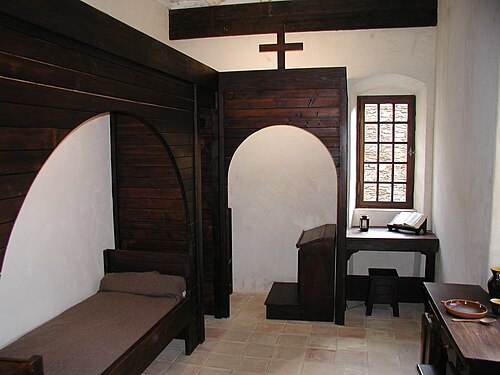
The monastic life generally consists of prayer in the form of the Liturgy of the Hours (also known as the Divine Office, reading of the divine scriptures (lectio divina) and labor. Among most religious orders, monks live in simple, austere rooms called cells and come together daily to celebrate and to recite the Liturgy of the Hours and the Mass. Usually, the monks take their meals together in the refectory. Many communities have a period of silence lasting from evening until the next morning and some others restrict talking to only when it is necessary for the monks to perform their work and during weekly recreation.
Monks who have been or will be ordained into Holy Orders as priests or deacons were traditionally referred to as "choir monks". Those monks who are not ordained into Holy Orders are referred to as lay brothers. In most monastic communities today, little distinction exists between the lay brothers and the choir monks, as they all have the obligation to celebrate the entire Divine Office daily in choir. However, historically, the roles of the two groups of monks within the monastery differed. The work of the choir monks was considered to be prayer, chanting the hours of the Divine Office, whereas the lay brothers provided for the material needs of the community by growing food, preparing meals, maintaining the monastery and the grounds. This distinction arose historically because generally those monks who could read Latin typically became choir monks, while those mon