
Loading article…
| |
|---|---|
.jpg/500px-Ireland_(MODIS).jpg) 衛星画像、2010年10月 | |
 アイルランドの位置 (濃い緑) ヨーロッパ(濃い 灰色) | |
| 地理 | |
| 位置 | 北西ヨーロッパ |
| 座標 | 北緯53度26分58秒 西経07度30分11秒 / 北緯53.44944度 西経7.50306度 / 53.44944; -7.50306 |
| 諸島 | イギリス諸島 |
| 隣接 | 大西洋 |
| エリア | 84,421 km 2 (32,595平方マイル) [1] |
| エリアランク | 20日[2] |
| 海岸線 | 7,527 km (4677.1 マイル) [3] [4] |
| 最高標高 | 1,041メートル(3,415フィート) |
| 最高点 | カラントゥーヒル |
| 管理 | |
| 最大の都市 | ダブリン、人口1,458,154人都市圏(2022年)[5] |
| 国 | 北アイルランド |
| 最大の都市 | ベルファスト、人口671,559人都市圏(2011年)[6] |
| 人口統計 | |
| 異名 | アイルランド語 |
| 人口 | 7,185,600(2023年推定)[a] [7] |
| 人口順位 | 19日 |
| 人口密度 | 82.2/km 2 (212.9/平方マイル) |
| 言語 | |
| 民族グループ | |
| 追加情報 | |
| タイムゾーン | |
| • 夏 ( DST ) | |
アイルランド( / ˈ aɪər l ə n d / IRE-lənd;アイルランド語:エール [ˈeːɾʲə] ;アルスター・スコットランド語:Airlann [ˈɑːrlən]北大西洋、北西ヨーロッパに浮かぶ島。東はノース・チャンネル、アイリッシュ海、セント・ジョージ海峡イギリス。アイルランドはブリテン諸島で2番目、3番目、世界で20番目[10]地政学的には、島は島の6分の5を占める主権国家でアイルランド共和国(正式名称はアイルランドイギリスの一部である北アイルランド。2022年現在、島全体の人口は次いで2番目に人口の多い島となっている[11]
アイルランドの地理は、中央平野を囲む比較的標高の低い山々から成り、内陸部には航行可能な川がいくつか伸びています。その豊かな植生は、極端な気温の変化のない、温暖で変わりやすい気候の産物です。アイルランドの大部分は中世の終わりまで森林でした。今日、森林は島の約10%を占めていますが、ヨーロッパの平均は33%以上です。[12]そのほとんどは外来の針葉樹の植林地です。[13] [14]アイルランドの気候は大西洋の影響を受けているため非常に穏やかで、[15]冬はそのような北方の地域としては予想よりも穏やかですが、夏はヨーロッパ大陸よりも涼しいです。降雨量と雲量は豊富です。
ゲール語圏のアイルランドは紀元1世紀までに出現した。島は5世紀以降キリスト教化された。この時期、アイルランドは多くの小王国に分割され、地方王権(伝統的な地方の「5番目」のCúige)の下で、支配権とアイルランド大王の称号を争った。紀元8世紀後半から11世紀前半にかけて、ヴァイキングの襲撃と入植が起こり、1014年4月23日のクロンターフの戦いで最高潮に達し、アイルランドにおけるヴァイキングの勢力は終焉を迎えた。12世紀のアングロ・ノルマン人の侵略の後、イングランドが主権を主張した。しかし、イングランドの支配が島全体に及んだのは、16世紀から17世紀のテューダー朝の征服で、イギリスからの入植者による植民地化が始まった。 1690年代、プロテスタントによるイングランド統治のシステムは、カトリックの多数派とプロテスタントの非国教徒に物質的に不利になるように設計され、18世紀を通じて拡大されました。 1801年の合同法により、アイルランドは英国の一部となりました。20世紀初頭の独立戦争の後、島の分割によりアイルランド自由国が誕生しました。アイルランド自由国はその後数十年にわたって主権を強め、1948年に共和国を宣言し(1948年アイルランド共和国法)、北アイルランドは英国の一部として残りました。北アイルランドでは、1960年代後半から1990年代にかけて多くの内乱がありました。これは、 1998年の聖金曜日合意後に沈静化しました。 1973年、アイルランド共和国と英国(その一部として北アイルランドを含む)の両国が、欧州経済共同体に加盟しました。 2016年の国民投票の結果、北アイルランドを含む英国は2020年に欧州連合(EU)を離脱した。北アイルランドには限定的な特別地位が与えられ、欧州連合に加盟せずにEU単一市場内での物品の活動が許可された。[16]
アイルランド文化は、特に文学の分野で他の文化に大きな影響を与えてきました。主流の西洋文化と並んで、ゲール語のゲーム、アイルランド音楽、アイルランド語、アイルランドダンスを通して表現される強い土着文化が存在します。島の文化は、英語、サッカー、ラグビー、競馬、ゴルフ、ボクシングなどのスポーツなど、イギリスの文化と多くの共通点があります。
この国は2024年の世界平和指数で第2位にランクされています。[17]
語源
アイルランドとアイルランドという名前は、9世紀に初めて記録されたアイルランド神話の女神、古アイルランド語の エリウに由来しています。エリウの語源は議論の余地がありますが、流れる水を意味するインド・ヨーロッパ祖語の語根* h2uerに由来している可能性があります。[18]
歴史
先史時代のアイルランド
最終氷河期から紀元前16,000年頃まで、アイルランドの大部分は定期的に氷に覆われていました。[19]相対的な海面は50メートル未満低かったため、アイルランドとイギリスの間に氷の橋(陸橋ではない)が形成されました。[20]紀元前14,000年までに、この氷の橋は北アイルランドとスコットランドの間にのみ存在し、紀元前12,000年までにアイルランドはイギリスから完全に分離しました。[21]その後、紀元前6,100年頃、イギリスはヨーロッパ大陸から分離しました。[22]最近まで、アイルランドにおける人間の活動の最も古い証拠は12,500年前のものであり、クレア州の洞窟で見つかった屠殺されたクマの骨によって証明されています。[23] 2021年以降、アイルランドにおける人間の活動の最も古い証拠は33,000年前のものです。[24]
紀元前8000年頃までに、島の周囲に中石器時代のコミュニティが存在していた証拠が示され、島でのより持続的な居住が明らかになった。 [25]
紀元前4000年より前のある時期に、新石器時代の 移住者が穀物の栽培品種、牛や羊などの家畜を持ち込み、大きな木造建築物や石の記念碑を建てた。[26] [19]アイルランドやグレートブリテンにおける最古の農業の証拠は、ケリー州フェリターズ・コーブのものであり、そこでは火打ち石のナイフ、牛の骨、羊の歯が炭素年代測定で紀元前4350年頃のものと判明している。[27]圃場システムはアイルランドのさまざまな地域で開発され、その中には現在のティラウェイの泥炭層の下に保存されているセイデ・フィールズも含まれる。おそらく世界最古とも言える大規模な圃場システム[28]は、石垣で区切られた小さな区画で構成されていた。畑は紀元前3500年から紀元前3000年の間の数世紀にわたって耕作された。小麦と大麦が主な作物であった。[19]
青銅器時代は紀元前2500年頃に始まり、この時代に車輪、牛の操縦、織物の織り、アルコールの醸造、金属加工などの技術革新を通じて人々の日常生活を変えました。[19]新しい武器や道具、ブローチや首輪などの金の装飾品や宝飾品が生まれました。
ケルト系アイルランドの出現
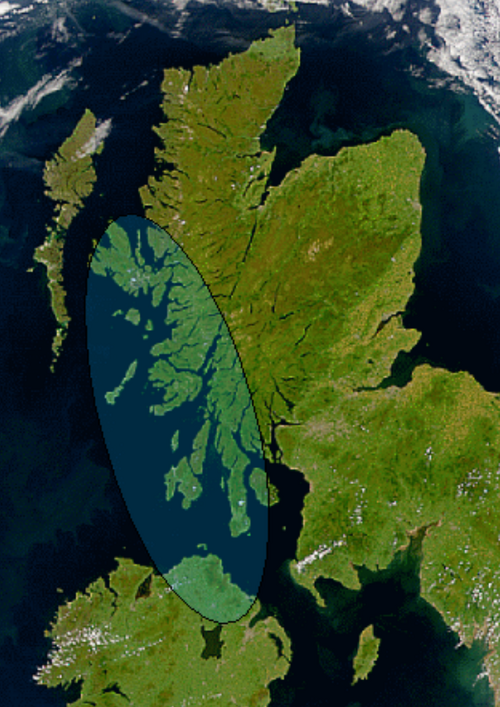
島がいつ、どのようにしてケルト文化になったのかは、ほぼ1世紀にわたって議論されてきました。ケルト人の移住は、考古学や言語学の研究において、最も永続的なテーマの1つです。最新の遺伝子研究では、西ヨーロッパを通じたインド・ヨーロッパ語族(ケルト語を含む)の広がりは、複合的なビーカー文化をもたらした人々と強く関連しており、その文化がブリテン島とアイルランドに到達したのは、紀元前3千年紀の中頃とされています。[29]ジョン・T・コッホらによると、後期青銅器時代のアイルランドは、ブリテン島、フランス西部、イベリア半島も含む大西洋青銅器時代と呼ばれる海洋交易ネットワーク文化の一部であり、ここでケルト語が発達しました。[30] [31] [32] [33]これは、ケルト語の起源がハルシュタット文化とともにヨーロッパ本土にあるという従来の見解とは対照的です。[34]
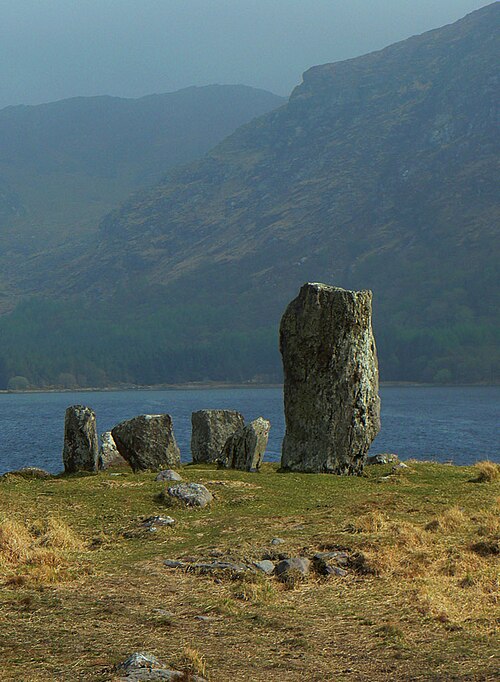
長年の伝統的な見解では、ケルト語、オガム文字、および文化は、ヨーロッパ本土から侵入または移住してきたケルト人の波によってアイルランドにもたらされたとされています。この理論は、アイルランドの中世キリスト教の疑似歴史であるレボル・ガバラ・エーレンと、アイルランドで発見されたケルト文化、言語、およびケルトの青銅の槍、盾、首輪、その他の精巧に作られたケルト関連の所有物などの工芸品の存在に基づいています。この理論では、アイルランドへのケルト人の侵入は4回別々に行われたとされています。プリテニ人が最初と言われ、次に北ガリアとブリテンからのベルガエ人が続きました。後に、アルモリカ(現在のブルターニュ)のレイギン族がほぼ同時にアイルランドとブリテンを侵略したと言われています。最後に、ミレトス人(ゲール人)が北イベリアか南ガリアからアイルランドに到達したと言われています。[35]紀元前6世紀頃、北ガリアのベルガエ人に属するエウエルニと呼ばれる第二波が到着し始めたと主張されている。彼らが島に名前を付けたと言われている。[36] [37]
この理論が提唱されたのは、大規模なケルト人の移住に関する考古学的証拠が不足していたためでもあるが、そのような移動を特定するのは非常に難しいことは認められている。歴史言語学者は、この方法だけではケルト語の吸収を説明できないと懐疑的で、ケルト語の形成をプロセス的に捉えることは「特に危険な試み」だと述べる者もいる。[38] [39]ケルト人のアイルランド移住地域に関する遺伝子系統調査の結果、 Y染色体パターンの一部とは対照的に、アイルランドとヨーロッパ大陸の広い地域との間でミトコンドリアDNAに大きな違いは見られなかった。両方を考慮すると、ある研究では、アイルランドの現代のケルト語話者は、実質的に中央ヨーロッパ人ではなく、北イベリアから西スカンジナビアに至る大西洋地域全体で共通の祖先を示すヨーロッパの「大西洋ケルト人」と考えられると結論づけた。[40] 2012年の研究で、最古の農民の遺伝子マーカーの出現はビーカー文化の移民によってほぼ排除されたことが示された。彼らは、当時新しいY染色体R1bマーカーを持っていた。これは、紀元前2,500年頃にイベリア半島で発生したと考えられている。現代のアイルランド人男性におけるこの変異の蔓延率は驚くべきことに84%で、世界で最も高く、大西洋沿岸からスペインまでの他の集団とほぼ一致している。同様の遺伝子置換がミトコンドリアDNAの系統でも起こった。[27] [41]この結論は、遺伝学者デイビッド・ライヒによる最近の研究によって裏付けられている。ライヒは次のように述べている。「ビーカー期に続く青銅器時代の英国人とアイルランド人の骨格は、これらの島々の最初の農民の祖先が最大で10%、残りの90%はオランダのベル・ビーカー文化に関連する人々のような人々からの祖先であった。」彼は、ケルト語に代表されるインド・ヨーロッパ語族の言語(つまり、移住と遺伝子の置き換えによって直接もたらされた新しい言語と文化)を導入したのはビーカー石器時代の使用者であったと示唆している。[29]
古代後期と中世初期
アイルランドに関する最古の記録は、古代ギリシャ・ローマの地理学者によるものである。プトレマイオスは著書『アルマゲスト』の中で、アイルランドを「小さなブリテン」の意味で「ミクラ・ブレタニア」と呼んでおり、より大きな島を「メガレ・ブレタニア」と呼んでいた。[42]プトレマイオスは後年の著作『地理学』のアイルランド地図で、アイルランドを「イオウニア」、グレートブリテンを「アルビオン」と呼んでいる。これらの「新しい」名前は、当時の島々の現地名であった可能性が高い。対照的に、以前の名前は、現地の人々と直接接触する前に作られた可能性が高い。[43]
ローマ人もアイルランドをラテン語化したこの名前、ヒベルニア、またはスコティアと呼んでいた。[44] [45]プトレマイオスは、西暦100年にはアイルランド全土に16の民族が住んでいたと記録している。[46]ローマ帝国と古代アイルランドの王国との関係は不明である。しかし、ゴウランとニューグレンジの近くにある鉄器時代の集落フリーストーンヒルなどでは、ローマの硬貨が数多く発見されている。[47]
アイルランドは、敵対する王国の寄せ集めのままであったが、7世紀以降、アイルランドの上級王という概念を通じて、国家の王権という概念が徐々に明確になってきた。中世アイルランド文学では、数千年にわたる上級王の連続がほぼ途切れることなく描かれているが、現代の歴史家の中には、この枠組みは、支配の起源を遠い過去に投影することで、強力な政治集団の地位を正当化するために8世紀に構築されたと考える者もいる。[48]
アイルランドの王国はすべて独自の王を持っていたが、名目上は上王の支配下にあった。上王は地方王の中から選ばれ、タラの丘を儀礼上の首都とするミース王国も統治した。この概念はヴァイキング時代まで政治的に現実のものとはならず、その時代でさえ一貫性がなかった。[49]アイルランドには文化的に統一された法の支配があった。それは、ブレホンと呼ばれる専門の法律家階級によって執行された、初期の成文司法制度であるブレホン法であった。[50]
アイルランド年代記には、431年にパラディウス司教が教皇ケレスティヌス1世の使節としてアイルランドに到着し、「すでにキリストを信じている」アイルランド人を牧師として導いたと記録されている。 [51]同じ年代記には、アイルランドの最も有名な守護聖人である聖パトリックが翌年到着したことも記録されている。パラディウスとパトリックの使節については議論が続いているが、両者とも実際に行われたという点と、古いドルイド教の伝統が新しい宗教の前に崩壊したという点が一致している。 [53]アイルランドのキリスト教学者は、ラテン語とギリシャ語の学問とキリスト教神学の研究に優れていた。アイルランドのキリスト教化に続く修道院文化では、西ローマ帝国の崩壊後に暗黒時代が続いた西ヨーロッパの他の地域とは対照的に、ラテン語とギリシャ語の学問が中世初期にアイルランドで保存された。 [53] [54] [ページが必要]
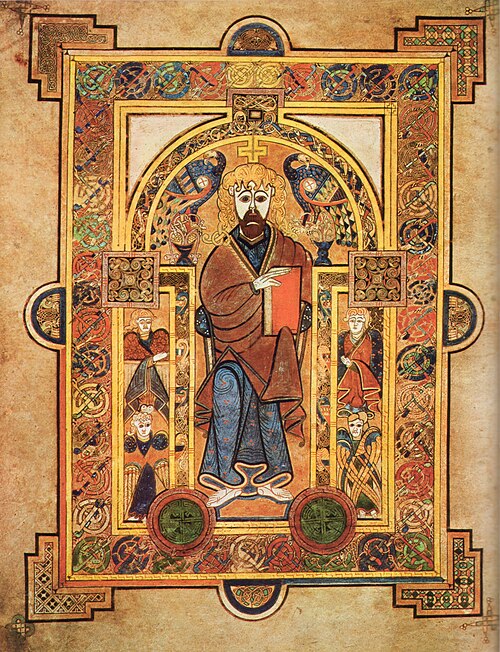
写本装飾、金属細工、彫刻の芸術が栄え、ケルズの書、華麗な宝飾品、そして今日でも島中に点在する多くの石の十字架[55]などの宝物が生み出された。563年にアイルランドの修道士聖コルンバによってアイオナ島に設立された伝道所は、アイルランドの布教活動の伝統の始まりであり、ローマ帝国の崩壊後、ケルト人のキリスト教と学問をスコットランド、イングランド、そしてヨーロッパ大陸のフランク王国に広めた。 [56]これらの伝道所は中世後期まで続き、修道院や学問の中心地を設立し、セドゥリウス・スコットゥスやヨハネス・エリウゲナなどの学者を輩出し、ヨーロッパに大きな影響を与えた。[要出典]
9世紀から、ヴァイキングの襲撃者がアイルランドの修道院や町を次々と略奪した。[57]これらの襲撃は、アイルランドにすでに深く根付いていた襲撃と風土病のような戦争のパターンをさらに悪化させた。ヴァイキングは、アイルランドの海岸沿いの主要集落のほとんど、すなわちダブリン、リムリック、コーク、ウェックスフォード、ウォーターフォード、およびその他の小規模な集落の設立に関与していた。 [58] [信頼できない情報源? ]
ノルマン人とイングランド人の侵略
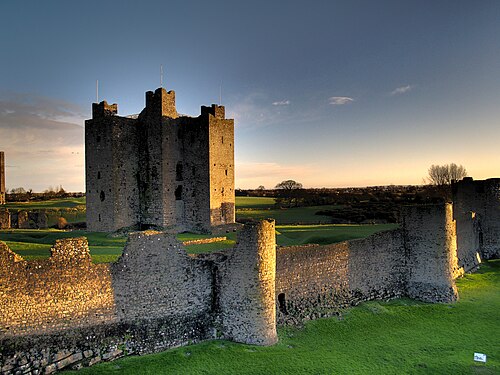
1169年5月1日、カンブロ=ノルマン騎士団の遠征隊が約600人の軍隊を率いて、現在のウェックスフォード州バナウ・ストランドに上陸した。この遠征隊を率いたのは、弓の腕前が優れていたことから「ストロングボウ」の愛称で知られるリチャード・ド・クレアだった。 [59]この侵攻は、ノルマン人の領土拡大が再燃した時期と重なり、レンスター王ダーモット・マク・マローの招待によるものだった。[60]
1166年、マック・マローは、ブリーフネのティガーナン・ウア・ルアークとの戦争の後、フランスのアンジューに逃れ、王国の奪還のためにアンジュー家のヘンリー2世に援助を求めた。1171年、ヘンリーは遠征の全体的な進捗状況を確認するためにアイルランドに到着した。ヘンリーは、自分の制御を超えて拡大していた侵略に対して、王権を再び行使したかった。ヘンリーは、ストロングボウとカンブロ・ノルマン人の軍閥に対する権威を再び発揮することに成功し、多くのアイルランド王を説得して彼を君主として受け入れさせ、この取り決めは1175年のウィンザー条約で確認された。
この侵略は、1155年にイギリス人のエイドリアン4世が出したとされる教皇勅書 「ラウダビリター」の条項を参照して正当化された。この文書は明らかにヘンリー8世にアイルランド教会の財政的・行政的再編とローマ教会制度への統合を監督するためにアイルランドを掌握するよう促していた。[61] 1152年のケルズの会議に続いて教会レベルでの再編がすでに始まっていた。[62] 「ラウダビリター」の信憑性については大きな論争があり、[63]勅書が本物か偽物かについては一般的な合意はない。[64] [65]さらに、この勅書はアイルランドの法制度において何の根拠もなかった。
1172年、教皇アレクサンダー3世はヘンリーにアイルランド教会とローマの統合を進めるようさらに奨励した。ヘンリーは炉1つにつき1ペンスの十分の一税を毎年の寄付として課す権限を与えられていた。ピーターズ・ペンスと呼ばれるこの教会の課税は、自発的な寄付としてアイルランドに現存している。その代わりにヘンリーはアイルランド卿の称号を引き継ぎ、1185年にヘンリーはそれを次男のジョン・ラックランドに授けた。これにより、アイルランドにおけるアングロ・ノルマン人の統治はアイルランド卿として定義された。[要出典]ヘンリーの後継者が1199年に突然死去すると、ジョンはイングランドの王位を継承し、アイルランド卿の地位を保持した。その後の1世紀にわたって、ノルマン人の封建法が広い地域で徐々にゲール語のブレホン法に取って代わり、13世紀後半までにはノルマン・アイルランド人がアイルランドの大半の地域で封建制度を確立していた。ノルマン人の入植地は、男爵領、荘園、町、そして現代の郡制度の原型が確立されたことを特徴としていました。ロンドンをダブリンに、当時のイングランド教会であったカトリック教会をアイルランド教会に置き換えたマグナ・カルタ(アイルランド大憲章)のバージョンが1216年に発行され、アイルランド議会が1297年に設立されました。
ゲール語化
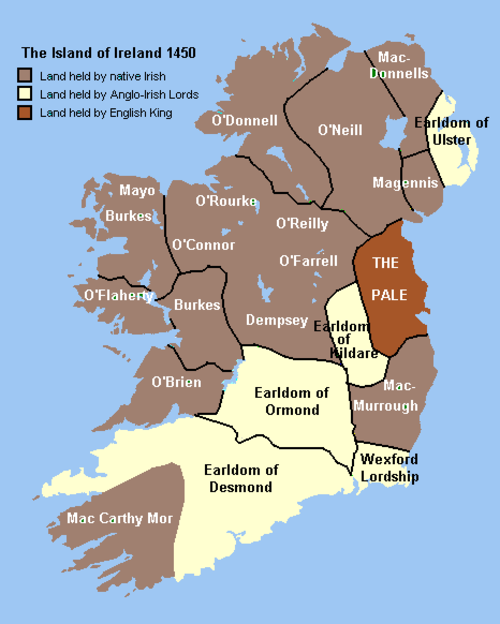
14世紀半ばの黒死病後、アイルランドのノルマン人の居住地は衰退期に入った。ノルマン人の支配者とゲール語を話すアイルランドのエリート層は結婚し、ノルマン人の支配下にあった地域はゲール語化した。一部の地域では、アイルランドとノルマン人の混血文化が生まれた。これに対応して、アイルランド議会は1367年にキルケニー法を可決した。これは、アイルランドのイギリス国民に英語を話し、イギリスの習慣に従い、イギリスの法律を遵守することを義務付けることで、ノルマン人がアイルランド社会に同化するのを防ぐことを目的とした一連の法律であった。[66]
15世紀末までに、アイルランドにおけるイングランドの中央権力はほぼ消滅し、ノルマンの影響はあるものの、新たなアイルランド文化と言語が再び支配的になった。イングランド王室の統制は、ダブリン周辺の漠然とした拠点「ザ・ペイル」で比較的揺るぎなく維持され、1494年のポイニングス法の規定により、アイルランド議会の立法はイングランド枢密院の承認を必要とした。[67]
アイルランド王国
.jpg/500px-Archive-ugent-be-79D46426-CC9D-11E3-B56B-4FBAD43445F2_DS-25_(cropped).jpg)
アイルランド王の称号は、1542年に当時のイングランド王、テューダー朝のヘンリー8世によって再創設された。16世紀後半にはアイルランドにおけるイングランドの支配が強化・拡大され、テューダー朝によるアイルランド征服へとつながった。 9年戦争と伯爵の逃亡を経て、17世紀初頭までにほぼ完全な征服が達成された。
この支配は、アイルランド植民地におけるイングランドとスコットランドの植民地化、三王国戦争、ウィリアマイト戦争を含む17世紀の戦争と紛争の間に強化された。三王国戦争(アイルランドでは、アイルランド同盟とクロムウェルによるアイルランド征服を含む)中のアイルランドの損失には、2万人の戦場での死傷者が含まれていると推定されている。戦争中の戦争関連の飢餓、避難、ゲリラ活動、疫病の組み合わせの結果、20万人の民間人が死亡したと推定されている。さらに5万人[b]が西インド諸島で年季奉公に送られた。ウィリアム・ペティ医師総監は、戦争の結果、504,000人のカトリック教徒のアイルランド人と112,000人のプロテスタント入植者が死亡し、10万人が移送されたと推定している。[71]戦前の人口を150万人と仮定すると、人口はほぼ半減したことになる。
17世紀の宗教闘争は、アイルランドに深い宗派間の分裂を残した。宗教的忠誠心が、アイルランド国王と議会に対する忠誠の法的認識を決定するようになった。1672年のテスト法の可決と、ウィリアムとメアリーの二重君主制の勢力がジャコバイトに勝利した後、ローマカトリック教徒と非順応的なプロテスタント非国教徒は、アイルランド議会で議員になることを禁じられた。新たに制定された刑罰法の下で、アイルランドのローマカトリック教徒と非国教徒は、世襲財産の所有権さえも含め、さまざまな公民権をますます奪われていった。1703年、1709年、1728年には、さらに逆進的な懲罰的立法が続いた。これにより、ローマカトリック教徒とプロテスタント非国教徒を物質的に不利にする包括的かつ組織的な取り組みが完了し、一方で英国国教会順応主義者からなる新しい支配階級が富を得た。 [ 72 ]

1739年12月から1741年9月にかけて、比較的穏やかな冬が10年続いた後、アイルランドとヨーロッパの他の地域を「大寒波」が襲った。冬は貯蔵されていたジャガイモやその他の主食を壊滅させ、不作な夏は収穫に深刻な被害をもたらした。 [73] [要ページ]この結果、1740年の飢饉が起きた。推定25万人(人口の約8人に1人)が、その後の疫病や疾病で死亡した。[74]アイルランド政府はトウモロコシの輸出を停止し、軍隊を宿営させたが、それ以上のことはしなかった。[74] [ 75]地元の貴族や慈善団体が救援活動を行ったが、その後の死亡率をほとんど防ぐことはできなかった。[74] [75]
飢饉の余波で、工業生産の増加と貿易の急増により、建設ブームが続いた。今世紀後半には人口が急増し、ジョージ王朝時代のアイルランドの建築遺産が築かれた。1782年、ポイニングス法が廃止され、アイルランドは1495年以来初めてイギリスから立法上の独立を獲得した。しかし、イギリス政府は依然として、アイルランド議会の同意なしにアイルランド政府を指名する権利を保持していた。
1798年の反乱
_p130_Camp_on_Vinegar_Hill.jpg/500px-MAXWELL(1845)_p130_Camp_on_Vinegar_Hill.jpg)
1798年、プロテスタントの非国教徒(主に長老派)は、アイルランド統一協会の指導の下、ローマカトリック教徒と共和主義の反乱を起こし、アイルランドの独立を目指した。フランスの支援があったにもかかわらず、反乱はイギリスとアイルランドの政府、およびヨーマンリー軍によって鎮圧された。反乱はその年の5月24日から10月12日まで続き、コノート地方に短命のアイルランド共和国(1798年)が樹立された。島中で数多くの戦闘が行われ、推定3万人が死亡した。以下にその一部を挙げる(全リストは本文を参照)。
イギリスとの連合
1798年の反乱の直接的な結果として、1800年にイギリス議会とアイルランド議会は合同法を可決し、1801年1月1日に発効してアイルランド王国とグレートブリテン王国を合併し、グレートブリテンおよびアイルランド連合王国を創設した。[76]
アイルランド議会でのこの法律の可決は、1799年の最初の試みでは失敗したものの、最終的にはかなりの賛成多数で達成された。当時の文書と歴史的分析によると、これはかなりの賄賂、英国諜報部からの資金提供、票を確保するための貴族の称号、地位、栄誉の授与によって達成された。[76]こうしてアイルランド議会は廃止され、ロンドンのウェストミンスターの統一議会に置き換えられたが、1803年のロバート・エメットの失敗したアイルランド反乱が示すように、抵抗は残った。
リネン産業の発展を除けば、アイルランドは産業革命の影響をほとんど受けなかった。その理由の一部は石炭や鉄資源がなかったこと[77] [78]と、構造的に優れた経済を持つイングランドとの突然の統合の影響[79]であり、イングランドはアイルランドを農産物と資本の供給源とみなしていた。[80] [81]
_p118_THE_FAMINE_AT_BOFIN.jpg/500px-FRENCH(1891)_p118_THE_FAMINE_AT_BOFIN.jpg)
1845年から1851年にかけての大飢饉はアイルランドを壊滅させ、その年アイルランドの人口は3分の1に減少した。100万人以上が飢餓と病気で亡くなり、飢饉の間にさらに100万人が移住し、その多くは米国とカナダに移住した。[82]次の世紀には、飢饉による経済不況により、さらに100万人が移住した。[83] 10年後には、米国への移民の半数がアイルランドからであった。19世紀末まで続いた内乱の期間は、土地戦争と呼ばれている。大量移住は深く根付き、人口は20世紀半ばまで減少し続けた。飢饉直前の1841年の国勢調査では、人口は820万人と記録されていた。[84]人口はそれ以来、このレベルに戻ることはなかった。[85]人口は1961年まで減少し続けた。リートリム州は、2006 年に飢饉後に人口増加を記録した最後のアイルランドの州でした。
19世紀から20世紀初頭にかけて、主にローマカトリック教徒の間で、近代アイルランドナショナリズムが台頭した。アイルランド統合後のアイルランドの著名な政治家はダニエル・オコンネルであった。彼は、ローマカトリック教徒として議席に就けなかったにもかかわらず、意外な結果でエニス選挙区の国会議員に選出された。オコンネルは、アイルランド生まれの軍人で政治家である首相ウェリントン公爵が引き継いだ精力的な運動の先頭に立った。ウェリントン公爵は、後の首相ロバート・ピールの助けを借りてカトリック救済法案を議会で通過させ、乗り気ではなかったジョージ4世を説得して法案に署名させ、法律として公布させた。ジョージの父は、 1801年の統合後にそのような法案を提出するという前首相小ピットの計画に反対しており、カトリック解放が1701年のアイルランド定住法と矛盾することを懸念していた。
ダニエル・オコンネルはその後、連合法の廃止を求める運動を主導したが、失敗に終わった。世紀の後半には、チャールズ・スチュワート・パーネルらが連合内の自治権、すなわち「自治」を求めて運動した。連合主義者、特にアルスター在住の人々は、カトリックの利益が支配すると考えていた自治に強く反対した。[86]議会で自治法案を通過させようとする試みが何度かあったが、1914年にようやく通過することが確実視された。これを防ぐために、エドワード・カーソンの指導の下、1913年にアルスター義勇軍が結成された。[87]
1914年にアイルランド義勇軍が結成され、その目的はアイルランド自治法案の成立を確実にすることだった。法案は成立したが、後に北アイルランドとなるアルスターの6つの州は「一時的に」除外された。しかし、法案が施行される前に、第一次世界大戦中は停止された。アイルランド義勇軍は2つのグループに分かれた。ジョン・レドモンド率いる約17万5千人の大多数は国民義勇軍と名乗り、アイルランドの戦争関与を支持した。約1万3千人の少数派はアイルランド義勇軍の名称を保持し、アイルランドの戦争関与に反対した。[87]

1916年のイースター蜂起は、後者のグループと、より小規模な社会主義民兵組織であるアイルランド市民軍によって実行された。イギリスはこれに対し、蜂起の指導者15人を10日間で処刑し、1000人以上を投獄または抑留することで対応し、国の雰囲気を反乱軍に有利なものにした。ヨーロッパで戦争が続いていたことや、1918年の徴兵危機により、アイルランド共和主義への支持はさらに高まった。[88]
独立派の共和党シン・フェイン党は1918年の総選挙で圧倒的支持を得て、1919年にアイルランド共和国を宣言し、独自の議会( Dáil Éireann )と政府を設立した。同時に、アイルランド共和軍(IRA)として知られるようになった義勇軍は3年間のゲリラ戦を開始し、1921年7月に休戦で終了した(ただし、暴力は1922年6月まで、主に北アイルランドで続いた)。[88]
パーティション
1921年12月、イギリス政府と第2下院の代表者の間で英愛条約が締結された。この条約はアイルランドに内政の完全な独立と外交政策の実質的な独立を与えたが、北アイルランドは離脱条項によってイギリスに留まることが認められ、直ちにこれを行使した。さらに、自由国議会の議員はアイルランド自由国憲法への忠誠の誓いを立て、国王への忠誠を表明する必要があった。 [89]これらの条項をめぐる意見の相違から、民族主義運動は分裂し、アイルランド自由国の新政府とエアモン・デ・ヴァレラ率いる条約反対派との間でアイルランド内戦が勃発した。内戦は1923年5月、デ・ヴァレラが停戦命令を発令して正式に終結した。[90]
独立
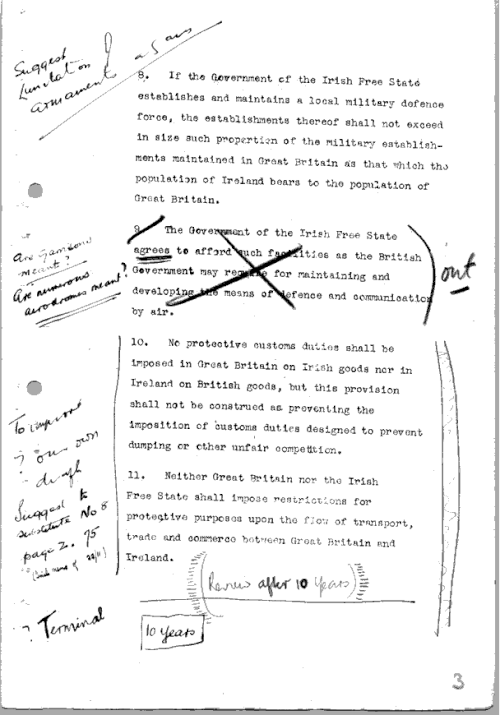
新しく形成されたアイルランド自由国は、最初の10年間、内戦の勝者によって統治された。デ・ヴァレラが権力を握ると、ウェストミンスター憲章と政治的状況を利用して、前政権による主権拡大への進出を基盤に築き上げた。宣誓は廃止され、1937年に新憲法が採択された。[88]これにより、独立以来政府が進めてきた大英帝国からの段階的な分離のプロセスが完了した。しかし、1949年になってようやく、この国は正式にアイルランド共和国と宣言された。
アイルランドは第二次世界大戦中は中立を保っていたが、連合国に対して秘密裏に援助を行っており、特に北アイルランドの防衛に尽力していた。アイルランドが中立であったにもかかわらず、独立国アイルランドから約5万人[91]の志願兵が戦争中にイギリス軍に加わり、そのうち4人がヴィクトリア十字章を授与された。
ドイツの諜報機関はアイルランドでも活動していた。[92]諜報活動は1941年9月、ダブリンの主要外交公館で行われた監視活動に基づいて警察が逮捕を行ったことで終了した。当局にとって、防諜は防衛の基本線だった。戦争開始時の正規軍はわずか7千人強で、近代兵器の供給も限られていたため、国家は紛争のどちらの側からの侵略からも自国を守るのに非常に困難を極めただろう。[92] [93]
第二次世界大戦後のほとんどの期間(特に1950年代と1980年代)は大規模な移民が続いたが、1987年以降は経済が改善し、1990年代には大幅な経済成長が始まった。この成長期は「ケルトの虎」として知られるようになった。[94]ケルトの実質GDPは1995年から1999年の間に年平均9.6%増加し、[95]この年にケルト共和国はユーロに加盟した。2000年には、一人当たりGDPで世界で6番目に豊かな国となった。[96]歴史家のRFフォスターは、その原因は新たな自発性とアメリカ企業の参入の組み合わせであると主張している。彼は、主な要因は低税、企業に有利な規制政策、そして若くハイテクに精通した労働力であると結論付けている。多くの多国籍企業にとって、アイルランドで事業を行うという決断は、産業開発庁からの寛大なインセンティブによってさらに容易になった。さらに、欧州連合加盟も役立ち、アイルランドはこれまで英国経由でしかアクセスできなかった市場への有利なアクセスを獲得し、アイルランド経済に巨額の補助金と投資資本を注ぎ込んだ。[97]
近代化は世俗化をもたらした。伝統的に高かった宗教心は急激に低下した。フォスターは3つの要因を指摘している。第一に、避妊、中絶、離婚に関してリベラルな立場をとるアメリカから輸入されたアイルランドのフェミニズムが、司教や司祭の権威を弱めた。第二に、小児性愛スキャンダルの不適切な処理が教会の名誉を傷つけ、司教たちは被害者よりも誤った司祭の隠蔽に関心があるように見えた。第三に、繁栄は快楽主義と物質主義をもたらし、聖なる清貧の理想を弱めた。[98]
2008年に始まった金融危機により、この好景気は劇的に終焉を迎えた。GDPは2008年に3%、2009年には7.1%減少し、記録が始まって以来最悪の年となった(ただし、外資系企業の収益は引き続き増加している)。[99]その後、州は深刻な不況に見舞われ、失業率は2009年に倍増し、2012年も14%を超えた。[100]
北アイルランド
北アイルランドは、1920年のアイルランド統治法によるイギリスの分割により誕生し、1972年まではイギリス内の自治領として独自の議会と首相を有していた。イギリスの一部であった北アイルランドは第二次世界大戦中は中立国ではなかったため、ベルファストは1941年に4回の爆撃を受けた。徴兵制度は北アイルランドには及ばず、北アイルランドからの志願兵数はアイルランド共和国からの志願兵数とほぼ同数であった。

北アイルランドは内戦の争いからほぼ逃れたが、分割後の数十年間にコミュニティ間の暴力が散発的に発生した。主にローマカトリック教徒のナショナリストはアイルランドを独立共和国として統一することを望んだが、主にプロテスタントのユニオニストは北アイルランドが英国に留まることを望んだ。北アイルランドのプロテスタントとカトリックのコミュニティは主に宗派の線に沿って投票したため、北アイルランド政府( 1929年から「小選挙区制」で選出)はアルスターユニオニスト党によって支配された。時間の経過とともに、少数派のカトリックコミュニティはますます疎外感を感じ、ゲリマンダーや住宅や雇用における差別などの慣行によってさらに不満が高まった。[101] [102] [103]
1960年代後半、国民主義者の不満は、大規模な公民権運動で公然と表明され、しばしばロイヤリストの対抗抗議と対峙した。[104]政府の対決に対する反応は、ユニオニストに有利な一方的で高圧的なものと見られていた。不安とコミュニティ間の暴力が増大するにつれ、法と秩序は崩壊した。[105]北アイルランド政府は、警察の支援とアイルランド国民主義者の保護をイギリス軍に要請した。1969年、統一アイルランドの創設を支持する準軍事組織である暫定IRAが、アイルランド共和軍の分裂から生まれ、いわゆる「6つの州のイギリス占領」に反対する運動を開始した。[要出典]
ユニオニストとナショナリストの両方を含む他のグループが暴力に参加し、「トラブル」として知られる時代が始まった。その後の30年間の紛争で3,600人以上が死亡した。[106]トラブル中の市民の不安のため、英国政府は1972年に自治権を停止し、直接統治を実施した。1973年のサニングデール合意など、トラブルを政治的に終わらせようとする試みは何度か失敗した。1998年、IRA暫定派による停戦と多党協議の後、多党協議で合意された文書を添付した聖金曜日合意が英国政府とアイルランド政府の間で条約として締結された。
協定(正式にはベルファスト協定と呼ばれた)の実質は、後にアイルランド両地域で行われた国民投票で承認された。協定は、新しい北アイルランド議会の主要政党から選出された地域執行部による権力分担を基本として、2つの主要コミュニティに対する確固たる保護のもと、北アイルランドに自治を回復させた。執行部は、ユニオニスト党とナショナリスト党から選出された首相と副首相が共同で率いる。1994年の暫定IRAとロイヤリストの停戦後、暴力は大幅に減少し、2005年には暫定IRAが武装作戦の終了を発表し、独立委員会が暫定IRAと他のナショナリストおよびユニオニスト準軍事組織の武装解除を監督した。[107]
議会と権力分担の執行部は数回停止されたが、2007年に再び復活した。その年、英国政府は北アイルランド警察への軍事支援(バナー作戦)を正式に終了し、軍隊の撤退を開始した。2012年6月27日、北アイルランド副首相でIRA元司令官のマーティン・マクギネスはベルファストでエリザベス2世女王と握手し、両者の和解を象徴した。[108]
政治

アイルランド島は、独立国家であるアイルランド共和国と、イギリスの構成国である北アイルランドに分かれています。両国は国境が開かれており、共通通行地域の一部であるため、国境を越えて 人、物、サービス、資本が自由に移動できます。
アイルランド共和国は欧州連合の加盟国であり、英国は元加盟国である。両国とも1973年にその前身である欧州経済共同体(EEC)に加盟したが、2016年に実施されたEU加盟に関する国民投票で英国有権者の51.9%が離脱を選択したため、英国は2020年に欧州連合を離脱した。
アイルランド共和国

アイルランド共和国はウェストミンスター制度に基づく議会制民主主義国家であり、成文憲法と、役割が主に儀礼的な、民選大統領を有する。アイルランド議会は二院制議会であり、下院であるDáil Éireann (下院)と上院であるSeanad Éireann(上院)で構成される。政府は下院の指名に基づいて大統領が任命する首相、Taoiseachによって率いられる。首都はダブリン。
アイルランド共和国は、今日、一人当たりGDPで世界で最も裕福な国の一つに数えられており[109]、2015年には国連の人間開発指数で世界で6番目に発展した国にランクされました。[110] 1995年以降の急速な経済拡大の時代はケルトの虎時代として知られるようになり、2008年に前例のない金融危機と2009年の経済不況で終焉を迎えました。2024年世界平和指数によると、アイルランドは世界で2番目に平和な国です。[111]
北アイルランド
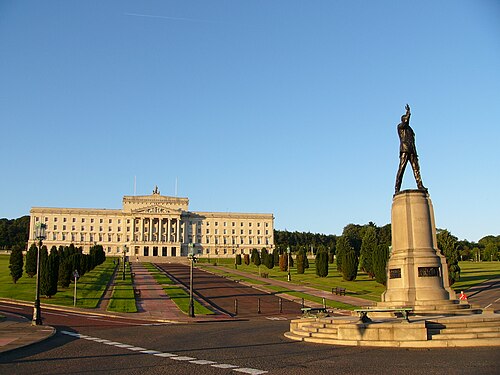
北アイルランドは英国の一部であり、地方の行政機関と議会が権限を委譲されている。行政機関は第一大臣と副第一大臣が共同で率いており、各省庁は議会における各政党の代表数に応じて割り当てられている。首都はベルファスト。
最終的に政治権力は英国政府が握っており、北アイルランドは権限委譲が停止されていた断続的な直接統治期間を経てきた。北アイルランドは英国下院の議員650人のうち18人を選出している。北アイルランド大臣は英国政府の閣僚級の役職である。
北アイルランドは、イングランド、ウェールズ、スコットランドとともに、英国の 3 つの独立した法域のうちの 1 つを形成しており、これら 3 つの法域はすべて、最終上訴裁判所として英国最高裁判所を共有しています。
全島機関
聖金曜日合意の一環として、英国とアイルランド政府は全島機関および協力分野の創設に合意した。北/南閣僚会議は、アイルランド政府と北アイルランド政府の大臣が全島政策に合意するための機関である。これらの政策分野のうち少なくとも 6 つには、関連する全島「実施機関」が必要であり、他の少なくとも 6 つは各管轄区域で個別に実施する必要がある。実施機関は、Waterways Ireland、食品安全推進委員会、InterTradeIreland、特別欧州連合プログラム機関、北/南言語機関、およびFoyle、Carlingford、および Irish Lights Commission である。
英国・アイルランド政府間会議は、アイルランド政府と英国政府の間で、特に北アイルランドに関する相互利益のあらゆる問題に関して協力することを規定している。アイルランド共和国が北アイルランドの統治に特に関心を持っていることを考慮して、設立条約に基づき、アイルランド外務大臣と英国北アイルランド担当大臣が共同議長を務め、北アイルランドに関する非委譲事項および非委譲全アイルランド問題を扱う「定期的かつ頻繁な」会議を開催することが義務付けられている。
北・南議会連合は、アイルランド島の合同議会フォーラムです。正式な権限はありませんが、それぞれの議会間で共通の関心事項を議論するフォーラムとして機能します。
地理
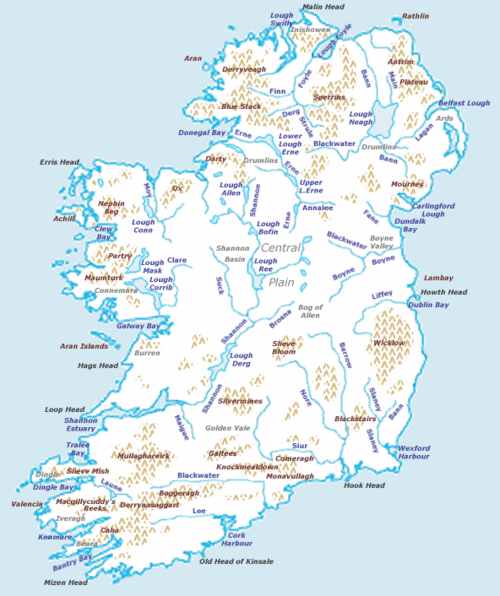
アイルランドはヨーロッパの北西部、北緯51度から56度、西経11度から5度の間に位置する。アイルランドはアイリッシュ海とノース・チャンネルによってイギリスから隔てられており、ノース・チャンネルの幅は最も狭い部分で23キロメートル(14マイル)[112]である。西には北大西洋、南にはアイルランドとフランスのブルターニュの間にあるケルト海がある。アイルランドの総面積は84,421 km 2 (32,595平方マイル)で[1] [2] [113]、そのうちアイルランド共和国が83パーセントを占めている。[114]アイルランドとイギリスは、近隣の多くの小さな島々とともに、総称してブリテン諸島として知られている。[115]ブリテン諸島という用語はアイルランドとの関係で議論の余地があるため、島々の中立的な用語としてブリテンおよびアイルランドという代替用語が使用されることがある。[116]
島の中央部には、海岸山脈が低地を取り囲んでいる。このうち最も高い山は、ケリー州のカラントゥーヒル(アイルランド語:Corrán Tuathail)で、海抜1,039メートル(3,409フィート)に達する。[117]最も耕作に適した土地は、レンスター州にある。[118]西部は主に山岳地帯で岩が多く、緑のパノラマの景色が広がる。島最長の川であるシャノン川は、長さ360.5キロメートル(224マイル)で、北西部のカバン州に源を発し、中西部のリムリックを流れる。 [117] [119]
地質学

島は多様な地質学的地域から成り立っている。西部のゴールウェイ県とドニゴール県の周辺には、スコットランド高地と似た、カレドニア紀に類似した中高度の変成岩と火成岩複合体がある。アルスター南東部を横切り、南西はロングフォード、南はナヴァンまで広がる地域は、スコットランドのサザンアップランズ地域と類似したオルドビス紀とシルル紀の岩石の地域である。さらに南のウェックスフォード県の海岸線沿いには、ウェールズで見られるものと同様の、よりオルドビス紀とシルル紀の岩石に貫入した花崗岩の地域がある。[120] [121]
南西部、バントリー湾とマクギリカディーズ・リークス山脈の周辺には、デボン紀の岩石が大きく変形し、軽度に変成した 地域がある。[122]この「ハードロック」地質の部分的なリングは、国土の中央を覆う石炭紀の石灰岩の毛布で覆われており、比較的肥沃で緑豊かな景観を生み出している。リスドゥーンバーナ周辺のバレン西海岸地域には、よく発達したカルスト地形がある。[123]シルバーマインズとティナ周辺の石灰岩には、顕著な層状の鉛亜鉛鉱化が見られる。
炭化水素の探査は、 1970年代半ばにコーク沖のキンセールヘッドガス田で最初の大規模な発見があった後も継続している。 [124] [125] 1999年には、メイヨー州沖のコリブガス田で経済的に重要な天然ガスが発見された。これにより、北海炭化水素地域からの「シェトランド諸島西部」のステップアウト開発と並行して、西海岸沖での活動が増加した。2000年には、2,800万バレル(4,500,000 m 3 )を超える石油が含まれていると推定されるヘルヴィック油田が発見された。[126]
気候
島の豊かな植生は、その温暖な気候と頻繁な降雨によるもので、エメラルド島というあだ名が付けられています。アイルランドは全体的に、極端に寒暖差の少ない、温暖で変わりやすい海洋性気候です。気候は典型的には島嶼性で温暖であり、世界の同様の緯度にある他の多くの地域のような極端な気温は避けられています。[127]これは、通常、南西大西洋から吹く湿った風によるものです。
降水量は年間を通じて少ないが、特に東部では全体的に少ない。西部は平均して雨が多く、特に晩秋から冬にかけては大西洋の嵐が発生しやすい。これらの嵐は時折、これらの地域に破壊的な風と降水量の増加をもたらし、時には雪や雹も降る。ゴールウェイ州北部とメイヨー州東部の地域は、島内で年間最も多くの雷の発生が記録されており、これらの地域では年間約5日から10日雷が発生している。[128]南部の マンスターでは雪が最も少なく、北部の アルスターでは最も多く降雪が記録される。
内陸部は夏は暖かく、冬は寒い。通常、内陸部の気象観測所では年間約40日が氷点下0℃ (32℉)であるのに対し、沿岸部の観測所では10日である。アイルランドは時々熱波の影響を受け、最近では1995年、2003年、2006年、2013年、2018年に熱波が発生した。ヨーロッパの他の国々と同様、アイルランドも2010~2011年の冬は異常に寒い天候に見舞われた。12月20日にはメイヨー州で気温が−17.2℃(1℉)まで下がり[129]、山岳地帯では最大1メートル(3フィート)の積雪があった。
動植物
_(4).jpg/500px-Red_Fox_(Vulpes_vulpes)_(4).jpg)
ヨーロッパ大陸と陸橋があったイギリスとは異なり、アイルランドには最終氷河期の終わりの約14,000年前に終わった氷橋しかなく、その結果、イギリスやヨーロッパ大陸よりも陸上の動物や植物の種類が少ない。[20] [21]アイルランドには55種の哺乳類がおり、そのうち26種の陸生哺乳類のみがアイルランド原産であると考えられている。[132]アカギツネ、ハリネズミ、アナグマなど一部の種は非常に一般的であるが、アイルランドノウサギ、アカシカ、マツテンなど他の種はそれほど一般的ではない。ウミガメ、サメ、アザラシ、クジラ、イルカなどの水生野生生物は、海岸沖で一般的である。約400種の鳥類がアイルランドで記録されている。これらの多くは、ツバメを含む渡り鳥である。

アイルランドには、農地、開けた森林地帯、温帯の広葉樹林と混交林、針葉樹林、泥炭地、さまざまな沿岸生息地など、いくつかの異なる生息地タイプが存在します。しかし、農業がアイルランドの現在の土地利用パターンを推進しており、特に大きな領土を必要とする大型野生哺乳類の自然生息地保護区が制限されています[133] 。アイルランドには人間と犬以外の大型頂点捕食者がいないため、キツネなどの小型捕食者が制御できない半野生のシカなどの動物の個体数は、毎年の駆除によって制御されています。
アイルランドにはヘビは生息しておらず、爬虫類は1種(トカゲ)のみが島固有の種である。絶滅した種には、アイルランドヘラジカ、オオウミスズメ、ヒグマ、オオカミなどがある。イヌワシなど、以前に絶滅した鳥類の中には、数十年にわたる絶滅の後に再導入された種もある。[134]
アイルランドは現在、ヨーロッパで最も森林の少ない国の一つである。[135] [136]中世の終わりまで、アイルランドは森林が密集していた。在来種には、オーク、トネリコ、ハシバミ、カバノキ、ハンノキ、ヤナギ、ポプラ、ナナカマド、サンザシなどの落葉樹と、ヨーロッパアカマツ、イチイ、ヒイラギ、イチゴノキなどの常緑樹がある。[ 137 ]今日、アイルランドの約10%のみが森林である。[12]このほとんどが非在来針葉樹の植林地であり、在来林はわずか2%である。[13] [14]ヨーロッパ諸国の平均森林被覆率は33%を超えている。[12]アイルランド共和国では、約389,356ヘクタール(3,893.56 km 2)が国有地であり、主に林業サービスのコイルテが所有している。[12]原生林の残骸は島中に点在しており、特にキラーニー国立公園で見ることができます。

土地の多くは現在牧草地に覆われており、野生の花の種類も豊富である。野生のハリエニシダの一種であるハリエニシダ (Ulex europaeus) は高地でよく見られ、シダは特に西部の湿潤な地域に豊富に見られる。この地には何百もの植物種が生息しており、その中には島固有のものもあるが、Spartina anglicaなどのイネ科植物に「侵略」されている。[138]
藻類と海藻の植物相は冷温帯のものである。種の総数は574種である[139]。島はいくつかの藻類に侵略されており、そのうちのいくつかは現在定着している。[140]
アイルランドは気候が温暖なため、ヤシの木などの亜熱帯種を含む多くの種が栽培されています。植物地理学的には、アイルランドは北方王国内の環北方地域の大西洋ヨーロッパ州に属しています。島は、ケルト広葉樹林と北大西洋湿潤混合林の2つの生態地域に分けられます。
農業の影響

農業生産の長い歴史は、殺虫剤や肥料の使用、汚染物質の小川、川、湖への流出などの現代の集約的農業方法と相まって、アイルランドの生物多様性に圧力をかけてきました。[141] [142]作物栽培と牛の飼育のための緑の野原の土地は、在来の野生種の定着に利用できる空間を制限します。しかし、伝統的に土地の境界を維持および画定するために使用されている生け垣は、在来の野生植物の避難所としての役割を果たしています。この生態系は田園地帯全体に広がり、かつて島を覆っていた生態系の名残を保存するためのつながりのネットワークとして機能しています。生け垣の環境を保存する農業慣行を支援した共通農業政策による補助金は改革されています。共通農業政策は過去に、例えば肥料と殺虫剤の無差別な使用に制限を設けずに生産を重視することによって、潜在的に破壊的な農業慣行を補助していました。しかし改革により、補助金は徐々に生産レベルから切り離され、環境やその他の要件が導入されました。[143]アイルランドの温室効果ガス排出量の32%は農業に関連しています。[144]森林地帯は通常、外来種の単一栽培農園で構成されており、その結果、在来種の無脊椎動物の生息に適さない生息地になる可能性があります。自然地域では、未耕作地域を歩き回る鹿や羊による過度の放牧を防ぐために柵が必要です。このような放牧は、国の多くの地域で森林の自然再生を妨げる主な要因の1つです。[145]
人口統計

アイルランドの人口は700万人強で、そのうち約510万人がアイルランド共和国に居住し、190万人が北アイルランドに居住しています。[11]
アイルランドには9,000年以上前から人々が住んでいます。初期の歴史的および系図的記録には、クルシン、コルク・ロイグデ、ダール・リアタ、ダイリン、デイルグティン、デルブナ、エライン、ライギン、ウライドなどの主要な集団の存在が記されている。後の主要なグループには、コナフタ、シアンナフタ、エオガナフタが含まれます。より小さなグループには、aithechthúatha ( Attacotti を参照)、Cálraighe、Cíarraige、Conmaicne、Dartraighe、Déisi、Éile、Fir Bolg、Fortuatha、Gailenga、Gamanraige、Mirtine、Múscraige、Partraige、Soghain、Uaithni、 Uí Maineが含まれます。リアテイン。多くは中世後期まで生き残りましたが、政治的に重要ではなくなったため消滅した者もいました。過去1,200年間、バイキング、ノルマン人、ウェールズ人、フラマン人、スコットランド人、イングランド人、アフリカ人、東ヨーロッパ人が人口を増やし、アイルランドに大きな影響を与えてきました。文化。
アイルランドの人口は16世紀から19世紀半ばまで急速に増加したが、1740年から1741年にかけての飢饉により一時的に中断され、島の人口の約5分の2が死亡した。人口は次の世紀に回復して増加したが、1840年代の大飢饉では100万人が死亡し、その直後に100万人以上が移住を余儀なくされた。次の世紀には人口は半分以上減少したが、当時のヨーロッパ諸国では人口が平均3倍に増加するのが一般的だった。
アイルランド最大の宗教グループはキリスト教である。最大の宗派はローマカトリックで、島の73%以上(アイルランド共和国の約87%)を占めている。残りの人口の大部分は、さまざまなプロテスタント宗派のいずれかを信仰している(北アイルランドの約48%)。[146]最大の宗派はアイルランド国 教会である。イスラム教徒のコミュニティはアイルランドで成長しており、主に移民の増加によっており、2006年の国勢調査から2011年の国勢調査の間に共和国では50%増加した。[147]島には小さなユダヤ人コミュニティがある。共和国の人口の約4%、北アイルランドの人口の約14%[146]は、無宗教であると述べている。アイリッシュタイムズの依頼で2010年に実施された調査では、回答者の32%が週に1回以上宗教的な儀式に参加していると答えた。
分割と和解


伝統的に、アイルランドは4つの州に分かれている:コノート(西)、レンスター(東)、マンスター(南)、アルスター(北)。13世紀から17世紀にかけて発展したシステムでは、[148]アイルランドには32の伝統的な郡がある。これらの郡のうち26はアイルランド共和国にあり、6つは北アイルランドにある。北アイルランドを構成する6つの郡はすべてアルスター州(合計9つの郡がある)にある。そのため、アルスターは北アイルランドの同義語としてよく使われるが、両者は境界が一致していない。アイルランド共和国では、郡が地方自治制度の基礎となっている。ダブリン、コーク、リムリック、ゴールウェイ、ウォーターフォード、ティペラリーの各郡は、より小さな行政区域に分割されている。しかし、文化的な目的や、郵便住所やアイルランド測量局による公的な目的など、一部の目的では、依然として郡として扱われている。北アイルランドの郡はもはや地方自治の目的には使われていないが[149]、アイルランド共和国と同様に、その伝統的な境界はスポーツリーグや文化、観光などの非公式な目的に今でも使われている[150] 。
アイルランドの都市としての地位は、立法府または王室の勅許状によって決定される。ダブリン市は、ダブリン大都市圏に100万人以上の住民を抱え、島で最大の都市である。ベルファスト市は、579,726人の住民を抱え、北アイルランドで最大の都市である。都市としての地位は、人口規模と直接結びつくものではない。例えば、人口14,590人のアーマー市は、アイルランド国教会と全アイルランド大主教区の所在地であり、1994年に エリザベス2世女王によって都市としての地位を再付与された( 1840年の地方自治改革でその地位を失った)。アイルランド共和国では、バトラー王朝の所在地であるキルケニーは、行政上はもはや都市ではないが(2001年の地方自治法)、法律により引き続き都市という呼称を使用する権利を有している。
移住
アイルランドの人口は 19 世紀後半に劇的に減少しました。1841 年に 800 万人を超えていた人口は、1921 年には 400 万人をわずかに上回るまでに減少しました。人口減少の原因の一部は、1845 年から 1852 年にかけての大飢饉によるもので、この大飢饉ではおよそ 100 万人が亡くなりました。残りの約 300 万人の減少は、国の悲惨な経済状況によって移民文化が定着したことによるもので、この人口減少は 20 世紀後半まで続きました。
19世紀のアイルランドからの移民は、イギリス、アメリカ、カナダ、オーストラリアの人口増加に貢献し、これらの国々には大規模なアイルランド系移民が居住している。2006年時点で[update]、カナダ人の430万人、つまり人口の14%がアイルランド系であり、[153]オーストラリアの人口の約3分の1がアイルランド系の要素を持っていた。[154] 2013年時点で[update]、アイルランド系アメリカ人は4000万人[155]、アイルランド系を主張するアメリカ人は3300万人であった。[156]
20世紀最後の10年間の繁栄とともに、アイルランドは移民の目的地となった。2004年に欧州連合がポーランドを含むように拡大して以来、ポーランド人は中央ヨーロッパからの移民の中で最大の数(15万人以上)を占めている[157]。リトアニア、チェコ共和国、ラトビアからの移民もかなり多い[158] 。
特にアイルランド共和国では大規模な移民が見られ、2006年時点で外国人は42万人で、人口の約10%を占めている。[159] 2009年の出生の約4分の1(24%)はアイルランド国外で生まれた母親によるものであった。[160]アイルランドの金融危機を受けて、東欧および中欧から最大5万人の移民労働者がアイルランドを離れた。[161]
言語

アイルランド共和国の公用語は、アイルランド語と英語の 2 つです。それぞれの言語から、注目すべき文学作品が生まれています。アイルランド語は、現在では少数民族の言語に過ぎませんが、何千年もの間アイルランド人の母語であり、おそらく鉄器時代に導入されたと考えられます。5 世紀のキリスト教化後には書き留められるようになり、スコットランドとマン島に広まり、そこでそれぞれスコットランド ゲール語とマン島語に発展しました。
アイルランド語は、何世紀にもわたる膨大な文献の宝庫であり、言語学者によって、6世紀から10世紀の古期アイルランド語、10世紀から13世紀の中期アイルランド語、17世紀までの初期近代期アイルランド語、そして今日話されている近代期アイルランド語に分類されています。アイルランド語は、ラテン語、古ノルド語、フランス語、英語の影響を受けながら、それらの期間のほとんどでアイルランドの主要言語であり続けました。イギリス統治下では衰退しましたが、19世紀初頭までは多数派言語であり、それ以降は少数派言語となっています。
19世紀後半から20世紀初頭にかけてのゲール語復興は長期的な影響を及ぼした。アイルランド語はアイルランドの主流の学校で必修科目として教えられているが、その教授法は効果がないとして批判されており、ほとんどの生徒は14年間の指導を受けても流暢に話せるようになる兆候がほとんど見られない。[162]
現在、アイルランド共和国と北アイルランドの両方で、特にダブリン[163] [164]とベルファスト[165]で都市部のアイルランド語話者の人口が増加しており、そのようなアイルランド語話者の子供はアイルランド語を教える学校(ゲールズコイル)に通うこともあります。彼らは英語を話す人よりも高学歴である傾向があると主張されてきました。[166]最近の研究では、都市部のアイルランド語は発音と文法の両方で独自の方向に発展していることが示唆されています。[167]
ゲールタハトとして総称される伝統的なアイルランド語圏の農村地域では、言語が衰退している。主なゲールタハト地域は西部、南西部、北西部、ゴールウェイ、メイヨー、ドニゴール、コーク西部、ケリーにあり、ウォーターフォードのダンガーヴァン近くとミースにも小規模なゲールタハト地域がある。 [168]
アイルランドに英語が初めて導入されたのは、ノルマン人の侵攻の時である。英語はイングランドから連れてこられた少数の農民と商人によって話されていたが、テューダー朝によるアイルランド征服以前には大部分がアイルランド語に置き換えられていた。英語はテューダー朝とクロムウェル朝の征服の際に公用語として導入された。アルスター植民地はアルスターに英語を永続的に定着させ、アイルランド語を話す首長や貴族が追放された後も、他の地域でも公用語および上流階級の言語として残った。19世紀の言語の変化により、人口の大多数にとって第一言語はアイルランド語から英語に取って代わられた。[169]
現在、アイルランド共和国の人口のうち、日常的にアイルランド語を話す人は2%未満で、教育制度以外で定期的に話す人は10%未満である[170]。また、15歳以上の38%が「アイルランド語話者」に分類されている。北アイルランドでは、英語が事実上の公用語であるが、アイルランド語は欧州地域言語・少数言語憲章第3部に基づく特定の保護措置を含め、公式に認められている。アルスター・スコットランド方言は、憲章第2部に基づく承認を含め、より低い地位に置かれている。アルスター・スコットランド方言は、北アイルランド住民の約2%が話し、アイルランド共和国でも一部が話している。[171] 1960年代以降、移民が増加し、特にアジアや東ヨーロッパに由来する言語がさらに多く導入された。
アイルランド原産の言語には、遊牧民アイルランド人の言語であるシェルタ語、[172]アイルランド手話、北アイルランド手話などがあります。
文化
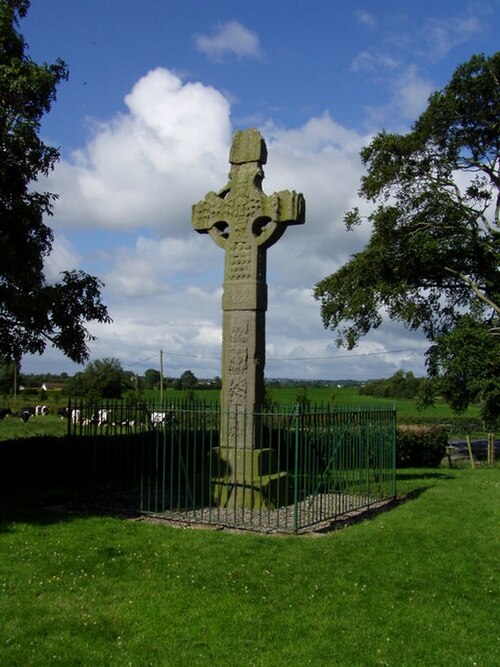
アイルランドの文化は、古代民族の文化、その後の移民や広まった文化的影響(主にゲール文化、英語化、アメリカ化、そしてより広範なヨーロッパ文化の側面)の要素から成り立っています。広義では、アイルランドはスコットランド、ウェールズ、コーンウォール、マン島、ブルターニュとともに、ヨーロッパのケルト国家の 1 つと見なされています。この文化的影響の組み合わせは、アイリッシュインターレースまたはケルト ノットワークと呼ばれる複雑なデザインに見られます。これらは中世の宗教的および世俗的な作品の装飾に見ることができます。このスタイルは今日でもジュエリーやグラフィック アートで人気があり、[173]伝統的なアイルランドの音楽とダンスの独特のスタイルと同様に、現代の「ケルト」文化全般を示すものとなっています。
宗教は古代から島の文化生活において重要な役割を果たしてきました (そして 17 世紀のプランテーション以来、島の政治的アイデンティティと分裂の焦点となってきました)。アイルランドのキリスト教以前の遺産は、5 世紀の聖パトリックの宣教に続いてケルト教会と融合しました。アイルランドの修道士聖コルンバによって始められたアイルランド・スコットランド宣教は、キリスト教に対するアイルランドの考えを異教徒のイングランドとフランク王国に広めました。これらの宣教は、ローマ帝国の崩壊に続く暗黒時代に、ヨーロッパの文盲の人々に書き言葉をもたらし、アイルランドに「聖人と学者の島」というあだ名を与えました。
20 世紀以降、世界中のアイリッシュ パブ、特に幅広い文化や美食を提供するパブは、アイルランド文化の拠点となっています。
芸術
文学
Ireland has made a substantial contribution to world literature in all its branches, both in Irish and English. Poetry in Irish is among the oldest vernacular poetry in Europe, with the earliest examples dating from the 6th century.[citation needed] Irish remained the dominant literary language down to the nineteenth century, despite the spread of English from the seventeenth century on. Prominent names from the medieval period and later include Gofraidh Fionn Ó Dálaigh (fourteenth century), Dáibhí Ó Bruadair (seventeenth century) and Aogán Ó Rathaille (eighteenth century). Eibhlín Dubh Ní Chonaill (c. 1743 – c. 1800) was an outstanding poet in the oral tradition. The latter part of the nineteenth century saw a rapid replacement of Irish by English. [citation needed] By 1900, however, cultural nationalists had begun the Gaelic revival, which saw the beginnings of modern literature in Irish. This was to produce a number of notable writers, including Máirtín Ó Cadhain, Máire Mhac an tSaoi and others. Irish-language publishers such as Coiscéim and Cló Iar-Chonnacht continue to produce scores of titles every year.
In English, Jonathan Swift, often called the foremost satirist in the English language, gained fame for works such as Gulliver's Travels and A Modest Proposal. Other notable 18th-century writers of Irish origin included Oliver Goldsmith and Richard Brinsley Sheridan, though they spent most of their lives in England. The Anglo-Irish novel came to the fore in the nineteenth century, featuring such writers as Charles Kickham, William Carleton, and (in collaboration) Edith Somerville and Violet Florence Martin. The playwright and poet Oscar Wilde, noted for his epigrams, was born in Ireland.
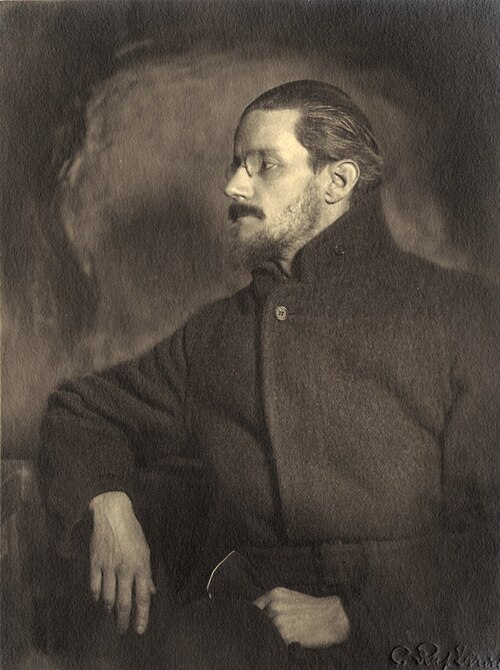
In the 20th century, Ireland produced four winners of the Nobel Prize for Literature: George Bernard Shaw, William Butler Yeats, Samuel Beckett and Seamus Heaney. Although not a Nobel Prize winner, James Joyce is widely considered to be one of the most significant writers of the 20th century. Joyce's 1922 novel Ulysses is considered one of the most important works of Modernist literature and his life is celebrated annually on 16 June in Dublin as "Bloomsday".[174] A comparable writer in Irish is Máirtín Ó Cadhain, whose 1949 novel Cré na Cille is regarded as a modernist masterpiece and has been translated into several languages.
Modern Irish literature is often connected with its rural heritage[175] through English-language writers such as John McGahern and Seamus Heaney and Irish-language writers such as Máirtín Ó Direáin and others from the Gaeltacht.
Music and dance
Music has been in evidence in Ireland since prehistoric times.[176] Although in the early Middle Ages the church was "quite unlike its counterpart in continental Europe",[177] there was a considerable interchange between monastic settlements in Ireland and the rest of Europe that contributed to what is known as Gregorian chant. Outside religious establishments, musical genres in early Gaelic Ireland are referred to as a triad of weeping music (goltraige), laughing music (geantraige) and sleeping music (suantraige).[178] Vocal and instrumental music (e.g. for the harp, pipes, and various string instruments) was transmitted orally, but the Irish harp, in particular, was of such significance that it became Ireland's national symbol. Classical music following European models first developed in urban areas, in establishments of Anglo-Irish rule such as Dublin Castle, St Patrick's Cathedral and Christ Church as well as the country houses of the Anglo-Irish ascendancy, with the first performance of Handel's Messiah (1742) being among the highlights of the baroque era. In the 19th century, public concerts provided access to classical music to all classes of society. Yet, for political and financial reasons Ireland has been too small to provide a living to many musicians, so the names of the better-known Irish composers of this time belong to emigrants.
Irish traditional music and dance have seen a surge in popularity and global coverage since the 1960s. In the middle years of the 20th century, as Irish society was modernising, traditional music had fallen out of favour, especially in urban areas.[179] However during the 1960s, there was a revival of interest in Irish traditional music led by groups such as the Dubliners, the Chieftains, the Wolfe Tones, the Clancy Brothers, Sweeney's Men and individuals like Seán Ó Riada and Christy Moore. Groups and musicians including Horslips, Van Morrison and Thin Lizzy incorporated elements of Irish traditional music into contemporary rock music and, during the 1970s and 1980s, the distinction between traditional and rock musicians became blurred, with many individuals regularly crossing over between these styles of playing. This trend can be seen more recently in the work of artists like Enya, the Saw Doctors, the Corrs, Sinéad O'Connor, Clannad, the Cranberries and the Pogues among others.
Art
The earliest known Irish graphic art and sculpture are Neolithic carvings found at sites such as Newgrange[180] and is traced through Bronze Age artefacts and the religious carvings and illuminated manuscripts of the medieval period. During the course of the 19th and 20th centuries, a strong tradition of painting emerged, including such figures as John Butler Yeats, William Orpen, Jack Yeats and Louis le Brocquy. Contemporary Irish visual artists of note include Sean Scully, Kevin Abosch, and Alice Maher.
Drama and theatre
The Republic of Ireland's national theatre is the Abbey Theatre, which was founded in 1904, and the national Irish-language theatre is An Taibhdhearc, which was established in 1928 in Galway.[181][182] Playwrights such as Seán O'Casey, Brian Friel, Sebastian Barry, Conor McPherson and Billy Roche are internationally renowned.[183]
Science

The Irish philosopher and theologian Johannes Scotus Eriugena was considered one of the leading intellectuals of the early Middle Ages. Sir Ernest Henry Shackleton, an Irish explorer, was one of the principal figures of Antarctic exploration. He, along with his expedition, made the first ascent of Mount Erebus and the discovery of the approximate location of the South Magnetic Pole. Robert Boyle was a 17th-century natural philosopher, chemist, physicist, inventor and early gentleman scientist. He is largely regarded as one of the founders of modern chemistry and is best known for the formulation of Boyle's law.[184]
19th-century physicist, John Tyndall, discovered the Tyndall effect. Father Nicholas Joseph Callan, professor of natural philosophy in Maynooth College, is best known for his invention of the induction coil, transformer and he discovered an early method of galvanisation in the 19th century.
Other notable Irish physicists include Ernest Walton, winner of the 1951 Nobel Prize in Physics. With Sir John Douglas Cockcroft, he was the first to split the nucleus of the atom by artificial means and made contributions to the development of a new theory of wave equation.[185] William Thomson, or Lord Kelvin, is the person whom the absolute temperature unit, the kelvin, is named after. Sir Joseph Larmor, a physicist and mathematician, made innovations in the understanding of electricity, dynamics, thermodynamics and the electron theory of matter. His most influential work was Aether and Matter, a book on theoretical physics published in 1900.[186]
George Johnstone Stoney introduced the term electron in 1891. John Stewart Bell was the originator of Bell's Theorem and a paper concerning the discovery of the Bell-Jackiw-Adler anomaly and was nominated for a Nobel prize.[187] The astronomer Jocelyn Bell Burnell, from Lurgan, County Armagh, discovered pulsars in 1967. Notable mathematicians include Sir William Rowan Hamilton, famous for work in classical mechanics and the invention of quaternions. Francis Ysidro Edgeworth's contribution, the Edgeworth Box. remains influential in neo-classical microeconomic theory to this day; while Richard Cantillon inspired Adam Smith, among others. John B. Cosgrave was a specialist in number theory and discovered a 2000-digit prime number in 1999 and a record composite Fermat number in 2003. John Lighton Synge made progress in different fields of science, including mechanics and geometrical methods in general relativity. He had mathematician John Nash as one of his students. Kathleen Lonsdale, born in Ireland and most known for her work with crystallography, became the first female president of the British Association for the Advancement of Science.[188]
Ireland has nine universities, seven in the Republic of Ireland and two in Northern Ireland, including Trinity College Dublin and the University College Dublin, as well as numerous third-level colleges and institutes and a branch of the Open University, the Open University in Ireland. Ireland was ranked 22nd in the Global Innovation Index in 2023, down from 12th in 2019.[189][190]
Sports
Gaelic football is the most popular sport in Ireland in terms of match attendance and community involvement, with about 2,600 clubs on the island. In 2003 it represented 34% of total sports attendances at events in Ireland and abroad, followed by hurling at 23%, soccer at 16% and rugby at 8%.[191] The All-Ireland Football Final is the most watched event in the sporting calendar.[192] Soccer is the most widely played team game on the island and the most popular in Northern Ireland.[191][193]
Other sporting activities with the highest levels of playing participation include swimming, golf, aerobics, cycling, and billiards/snooker.[194] Many other sports are also played and followed, including boxing, cricket, fishing, greyhound racing, handball, hockey, horse racing, motor sport, show jumping and tennis.
The island fields a single international team in most sports. One notable exception to this is association football, although both associations continued to field international teams under the name "Ireland" until the 1950s. The sport is also the most notable exception where the Republic of Ireland and Northern Ireland field separate international teams. Northern Ireland has produced two World Snooker Champions.
Field sports
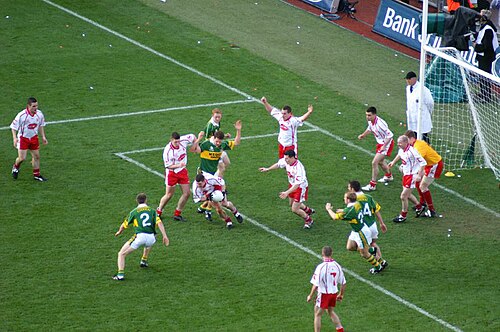
Gaelic football, hurling and Gaelic handball are the best-known Irish traditional sports, collectively known as Gaelic games. Gaelic games are governed by the Gaelic Athletic Association (GAA), with the exception of women's Gaelic football and camogie (women's variant of hurling), which are governed by separate organisations. The headquarters of the GAA (and the main stadium) is located at[195] Croke Park in north Dublin and has a capacity of 82,500. Many major GAA games are played there, including the semi-finals and finals of the All-Ireland Senior Football Championship and All-Ireland Senior Hurling Championship. During the redevelopment of the Lansdowne Road stadium in 2007–2010, international rugby and soccer were played there.[196] All GAA players, even at the highest level, are amateurs, receiving no wages, although they are permitted to receive a limited amount of sport-related income from commercial sponsorship.
The Irish Football Association (IFA) was originally the governing body for soccer across the island. The game has been played in an organised fashion in Ireland since the 1870s, with Cliftonville F.C. in Belfast being Ireland's oldest club. It was most popular, especially in its first decades, around Belfast and in Ulster. However, some clubs based outside Belfast thought that the IFA largely favoured Ulster-based clubs in such matters as selection for the national team. In 1921, following an incident in which, despite an earlier promise, the IFA moved an Irish Cup semi-final replay from Dublin to Belfast,[197] Dublin-based clubs broke away to form the Football Association of the Irish Free State. Today the southern association is known as the Football Association of Ireland (FAI). Despite being initially blacklisted by the Home Nations' associations, the FAI was recognised by FIFA in 1923 and organised its first international fixture in 1926 (against Italy). However, both the IFA and FAI continued to select their teams from the whole of Ireland, with some players earning international caps for matches with both teams. Both also referred to their respective teams as Ireland.

In 1950, FIFA directed the associations only to select players from within their respective territories and, in 1953, directed that the FAI's team be known only as "Republic of Ireland" and that the IFA's team be known as "Northern Ireland" (with certain exceptions). Northern Ireland qualified for the World Cup finals in 1958 (reaching the quarter-finals), 1982 and 1986 and the European Championship in 2016. The Republic qualified for the World Cup finals in 1990 (reaching the quarter-finals), 1994, 2002 and the European Championship in 1988, 2012 and 2016. Across Ireland, there is significant interest in the English and, to a lesser extent, Scottish soccer leagues.
Ireland fields a single national rugby team and a single association, the Irish Rugby Football Union, governs the sport across the island. The Irish rugby team have played in every Rugby World Cup, making the quarter-finals in eight of them.[198] Ireland also hosted games during the 1991 and the 1999 Rugby World Cups (including a quarter-final). There are four professional Irish teams; all four play in the Pro14 and at least three compete for the Heineken Cup. Irish rugby has become increasingly competitive at both the international and provincial levels since the sport went professional in 1994. During that time, Ulster (1999),[199] Munster (2006[200] and 2008)[199] and Leinster (2009, 2011 and 2012)[199] have won the Heineken Cup. In addition to this, the Irish International side has had increased success in the Six Nations Championship against the other European elite sides. This success, including Triple Crowns in 2004, 2006 and 2007, culminated with a clean sweep of victories, known as a Grand Slam, in 2009 and 2018.[201]
Boxing
Amateur boxing on the island of Ireland is governed by the Irish Athletic Boxing Association. Ireland has won more medals in boxing than in any other Olympic sport. Michael Carruth won a gold medal and Wayne McCullough won a silver medal in the Barcelona Olympic Games. In 2008 Kenneth Egan won a silver medal in the Beijing Games.[202] Paddy Barnes secured bronze in those games and gold in the 2010 European Amateur Boxing Championships (where Ireland came 2nd in the overall medal table) and 2010 Commonwealth Games. Katie Taylor has won gold in every European and World championship since 2005. In August 2012 at the Olympic Games in London, Taylor created history by becoming the first Irish woman to win a gold medal in boxing in the 60 kg lightweight.[203] More recently, Kellie Harrington won a gold medal at the 2020 Tokyo Olympics.[204]
Other sports

Horse racing and greyhound racing are both popular in Ireland. There are frequent horse race meetings and greyhound stadiums are well-attended. The island is noted for the breeding and training of race horses and is also a large exporter of racing dogs.[205] The horse racing sector is largely concentrated in the County Kildare.[206]
Irish athletics is an all-Ireland sport governed by Athletics Ireland. Sonia O'Sullivan won two medals at 5,000 metres on the track; gold at the 1995 World Championships and silver at the 2000 Sydney Olympics. Gillian O'Sullivan won silver in the 20k walk at the 2003 World Championships, while sprint hurdler Derval O'Rourke won gold at the 2006 World Indoor Championship in Moscow. Olive Loughnane won a silver medal in the 20k walk at the World Athletics Championships in Berlin in 2009.[207]
Golf is very popular, and golf tourism is a major industry attracting more than 240,000 golfing visitors annually.[208] The 2006 Ryder Cup was held at The K Club in County Kildare.[209] Pádraig Harrington became the first Irishman since Fred Daly in 1947 to win the British Open at Carnoustie in July 2007.[210] He successfully defended his title in July 2008[211] before going on to win the PGA Championship in August.[212] Harrington became the first European to win the PGA Championship in 78 years and was the first winner from Ireland. Three golfers from Northern Ireland have been particularly successful. In 2010, Graeme McDowell became the first Irish golfer to win the U.S. Open, and the first European to win that tournament since 1970. Rory McIlroy, at the age of 22, won the 2011 U.S. Open, while Darren Clarke's latest victory was the 2011 Open Championship at Royal St. George's. In August 2012, McIlroy won his 2nd major championship by winning the USPGA Championship by a record margin of 8 shots.
Recreation
The west coast of Ireland, Lahinch and Donegal Bay in particular, have popular surfing beaches, being fully exposed to the Atlantic Ocean. Donegal Bay is shaped like a funnel and catches west/south-west Atlantic winds, creating good surf, especially in winter. Since just before the year 2010, Bundoran has hosted European championship surfing. Scuba diving is increasingly popular in Ireland with clear waters and large populations of sea life, particularly along the western seaboard. There are also many shipwrecks along the coast of Ireland, with some of the best wreck dives being in Malin Head and off the County Cork coast.[213]
With thousands of lakes, over 14,000 kilometres (8,700 mi) of fish-bearing rivers and over 7,500 kilometres (4,660 mi) of coastline, Ireland is a popular angling destination. The temperate Irish climate is suited to sport angling. While salmon and trout fishing remain popular with anglers, salmon fishing, in particular, received a boost in 2006 with the closing of the salmon driftnet fishery. Coarse fishing continues to increase its profile. Sea angling is developed with many beaches mapped and signposted,[214] and the range of sea angling species is around 80.[215]
Food and drink

Food and cuisine in Ireland take their influence from the crops grown and animals farmed in the island's temperate climate and from the social and political circumstances of Irish history. For example, whilst from the Middle Ages until the arrival of the potato in the 16th century the dominant feature of the Irish economy was the herding of cattle, the number of cattle a person owned was equated to their social standing.[216] Thus herders would avoid slaughtering a milk-producing cow.[216]
For this reason, pork and white meat were more common than beef, and thick fatty strips of salted bacon (known as rashers) and the eating of salted butter (i.e. a dairy product rather than beef itself) have been a central feature of the diet in Ireland since the Middle Ages.[216] The practice of bleeding cattle and mixing the blood with milk and butter (not unlike the practice of the Maasai) was common[217] and black pudding, made from blood, grain (usually barley) and seasoning, remains a breakfast staple in Ireland. All of these influences can be seen today in the phenomenon of the "breakfast roll".
The introduction of the potato in the second half of the 16th century heavily influenced cuisine thereafter. Great poverty encouraged a subsistence approach to food, and by the mid-19th century, the vast majority of the population sufficed with a diet of potatoes and milk.[218] A typical family, consisting of a man, a woman and four children, would eat 18 stone (110 kg) of potatoes per week.[216] Consequently, dishes that are considered as national dishes represent a fundamental simplicity to cooking, such as the Irish stew, bacon and cabbage, boxty, a type of potato pancake, or colcannon, a dish of mashed potatoes and kale or cabbage.[216]
Since the last quarter of the 20th century, with a re-emergence of wealth in Ireland, a "New Irish Cuisine" based on traditional ingredients incorporating international influences[219] has emerged.[220] This cuisine is based on fresh vegetables, fish (especially salmon, trout, oysters, mussels and other shellfish), as well as traditional soda breads and the wide range of hand-made cheeses that are now being produced across the country. An example of this new cuisine is "Dublin Lawyer": lobster cooked in whiskey and cream.[221] The potato remains however a fundamental feature of this cuisine and the Irish remain the highest per capita[216] consumers of potatoes in Europe. Traditional regional foods can be found throughout the country, for example coddle in Dublin or drisheen in Cork, both a type of sausage, or blaa, a doughy white bread particular to Waterford.

Ireland once dominated the world's market for whiskey, producing 90% of the world's whiskey at the start of the 20th century. However, as a consequence of bootleggers during the prohibition in the United States (who sold poor-quality whiskey bearing Irish-sounding names thus eroding the pre-prohibition popularity for Irish brands)[222] and tariffs on Irish whiskey across the British Empire during the Anglo-Irish Trade War of the 1930s,[223] sales of Irish whiskey worldwide fell to a mere 2% by the mid-20th century.[224] In 1953, an Irish government survey, found that 50% of whiskey drinkers in the United States had never heard of Irish whiskey.[225]
Irish whiskey, as researched in 2009 by the CNBC American broadcaster, remains popular domestically and has grown in international sales steadily over a few decades.[226] Typically CNBC states Irish whiskey is not as smoky as a Scotch whisky, but not as sweet as American or Canadian whiskies.[226] Whiskey forms the basis of cream liqueurs, such as Baileys, and the "Irish coffee" (a cocktail of coffee and whiskey reputedly invented at Foynes flying-boat station) is probably the best-known Irish cocktail.
Stout, a kind of porter beer, particularly Guinness, is typically associated with Ireland, although historically it was more closely associated with London. Porter remains very popular, although it has lost sales since the mid-20th century to lager. Cider, particularly Magners (marketed in the Republic of Ireland as Bulmers), is also a popular drink. Red lemonade, a soft-drink, is consumed on its own and as a mixer, particularly with whiskey.[227]
Economy
The GDP of the Republic of Ireland as of 2021[update] was €423.5 billion (nominal),[228] and in Northern Ireland in 2021, it was £52 billion (GVA Balanced).[229] The GDP per capita in the Republic of Ireland was €84,049.9 (nominal) as of 2021[update],[228] and in Northern Ireland 2021 was £27,154 (GVA Balanced).[229] The Republic of Ireland and the United Kingdom measure these numbers differently.
Despite the two jurisdictions using two distinct currencies (the euro and pound sterling), a growing amount of commercial activity is carried out on an all-Ireland basis. This has been facilitated by the two jurisdictions' former shared membership of the European Union, and there have been calls from members of the business community and policymakers for the creation of an "all-Ireland economy" to take advantage of economies of scale and boost competitiveness.[230]
Regional economics
Below is a comparison of the regional GDP on the island of Ireland.
Northern Ireland trade comparison
Below is a comparison of the goods being sold and purchased between Northern Ireland and the United Kingdom, compared with the goods being exported and imported between Northern Ireland and the Republic of Ireland:
Cost of living comparison
Below is a comparison of the monthly cost of living and average wage after tax in Northern Ireland versus those in the Republic of Ireland in 2023:
Economic history
Prior to partition in 1921, Ireland had a long history as an economic colony – first, partially, of the Norse, via their cities (9th to 10th centuries CE), and later, to varying extents, of polities related to England. Though the climate and soil favoured certain forms of agriculture,[236] trade barriers frequently hobbled its development. Repeated invasions and plantations disrupted land-ownership, and multiple failed uprisings also contributed to repeated phases of deportation and of emigration.
Salient events in the economic history of Ireland include:
- 16th and 17th centuries: confiscation and redistribution of land in the Plantations of Ireland
- 1845–1849: The Great Famine occasioned depopulation and mass emigration
- 1846: Westminster's repeal of the Corn Laws disrupted Irish agriculture[237]
Major industries
Tourism
There are two World Heritage Sites on the island: the Brú na Bóinne complex and the Giant's Causeway.[238] Several other places are on the tentative list, for example the Burren, the Ceide Fields[239] and Mount Stewart.[240]
Some of the most visited sites in Ireland include Bunratty Castle, the Rock of Cashel, the Cliffs of Moher, Holy Cross Abbey and Blarney Castle.[241] Historically important monastic sites include Glendalough and Clonmacnoise, which are maintained as national monuments in the Republic of Ireland.[242]
The Dublin region receives the most tourists[241] and is home to several of the most popular attractions such as the Guinness Storehouse and Book of Kells.[241] The west and south west, which includes the Lakes of Killarney and the Dingle peninsula in County Kerry and Connemara and the Aran Islands in County Galway, are also popular tourist destinations.[241]
Stately homes, built during the 17th, 18th and 19th centuries in Palladian, Neoclassical and neo-Gothic styles, such as Castle Ward, Castletown House, Bantry House, Strokestown Park and Glenveagh Castle are also of interest to tourists. Some have been converted into hotels, such as Ashford Castle,[243] Castle Leslie[244] and Dromoland Castle.[245]
Energy
Although for most of their existence electricity networks in the Republic of Ireland and Northern Ireland were entirely separate, the island has operated for some time as a single market for electricity.[246] Both networks were designed and constructed independently post-partition but they are now connected with three interlinks[247] and are also connected through Great Britain to mainland Europe. The situation in Northern Ireland is complicated by the issue of private companies not supplying Northern Ireland Electricity with enough power. In the Republic of Ireland, the ESB has failed to modernise its power stations, and the availability of power plants has recently averaged only 66%, one of the worst such rates in Western Europe. EirGrid has started building a HVDC transmission line between Ireland and Great Britain with a capacity of 500 MW,[248] about 10% of Ireland's peak demand.
As with electricity, the natural gas distribution network is also now all-island, with a pipeline linking Gormanston, County Meath, and Ballyclare, County Antrim.[249] Most of Ireland's gas comes through interconnectors between Twynholm in Scotland and Ballylumford, County Antrim and Loughshinny, County Dublin. Supplies come from the Corrib Gas Field, off the coast of County Mayo, with a supply previously also coming from the Kinsale gas field off the County Cork coast.[250][251] The County Mayo field faces some localised opposition over a controversial decision to refine the gas onshore.

Ireland has an ancient industry based on peat (known locally as "turf") as a source of energy for home fires. A form of biomass energy, this source of heat is still widely used in rural areas. However, because of the ecological importance of peatlands in storing carbon and their rarity, the EU is attempting to protect this habitat by fining Ireland for digging up peat. In cities, heat is generally supplied by natural gas or heating oil, although some urban suppliers distribute sods of turf as "smokeless fuel" for domestic use.
The Republic has a strong commitment to renewable energy and ranks as one of the top 10 markets for clean-technology investment in the 2014 Global Green Economy Index.[252] Research and development in renewable energy (such as wind power) has increased since 2004. Large wind farms have been constructed in Cork, Donegal, Mayo and Antrim. The construction of wind farms has in some cases been delayed by opposition from local communities, some of whom regard the wind turbines as unsightly. The Republic is hindered by an ageing network that was not designed to handle the varying availability of power that comes from wind farms. The ESB's Turlough Hill facility is the only power-storage facility in the state.[253]
Notes
- ^ Including surrounding islands
- ^ Numbers vary, from a low of 12,000.[69] Giovanni Battista Rinuccini wrote 50,000,[70] T. N. Burke said 80,000 to 100,000.[70]
- ^ a b Part of Belfast metropolitan area
References
- ^ a b Nolan, William. "Geography of Ireland". Government of Ireland. Archived from the original on 24 November 2009. Retrieved 11 November 2009.
- ^ a b Royle, Stephen A. (1 December 2012). "Beyond the boundaries in the island of Ireland". Journal of Marine and Island Cultures. 1 (2): 91–98. Bibcode:2012JMICu...1...91R. doi:10.1016/j.imic.2012.11.005. ISSN 2212-6821.
- ^ "Irish Coastal Habitats: A Study of Impacts on Designated Conservation Areas" (PDF). heritagecouncil.ie. Heritage Council. Archived (PDF) from the original on 3 December 2020. Retrieved 2 November 2020.
- ^ Neilson, Brigitte; Costello, Mark J. (22 April 1999). "The Relative Lengths of Seashore Substrata Around the Coastline of Ireland as Determined by Digital Methods in a Geographical Information System". Estuarine, Coastal and Shelf Science. 49 (4). Environmental Sciences Unit, Trinity College, Dublin: 501–508. Bibcode:1999ECSS...49..501N. doi:10.1006/ecss.1999.0507. S2CID 128982465. Archived from the original on 13 July 2021. Retrieved 13 July 2021.
- ^ "Population at Each Census by Sex and County, 1841 to 2022".
- ^ "Belfast Metropolitan Area Plan" (PDF). Planningni.gov. Archived (PDF) from the original on 7 November 2017. Retrieved 11 April 2018.
- ^ "Population and Migration Estimates, April 2023". Central Statistics Office. 25 September 2023. Archived from the original on 25 September 2023. Retrieved 17 January 2024.
- ^ "Population Usually Resident and Present in the State". Central Statistics Office. 30 May 2023. Archived from the original on 31 May 2023. Retrieved 7 October 2023.
- ^ "Census 2021 Main statistics for Northern Ireland, Statistical bulletin, Ethnic group" (PDF). Northern Ireland Statistics and Research Agency. September 2022. p. 4. Archived (PDF) from the original on 5 December 2022. Retrieved 7 October 2023.
- ^ "Islands by Area". UN System-Wide Earthwatch. United Nations Environment Programme. 18 February 1998. Archived from the original on 1 December 2015. Retrieved 30 August 2008.
- ^ a b The 2022 population of the Republic of Ireland was 5,123,536 and that of Northern Ireland in 2021 was 1,903,100. These are Census data from the official governmental statistics agencies in the respective jurisdictions:
- Central Statistics Office, Ireland (23 June 2022). "Census of Population 2022 – Preliminary Results". Dublin: Central Statistics Office, Ireland. Archived from the original on 23 June 2022. Retrieved 23 June 2022.
- Northern Ireland Statistics and Research Agency (2022). "2021 Census". Belfast: Department of Finance. Archived from the original on 3 July 2017. Retrieved 23 June 2022.
- ^ a b c d "Forest Statistics – Ireland 2017" (PDF). Department of Agriculture, Food and the Marine. pp. 3, 63. Archived (PDF) from the original on 20 October 2019. Retrieved 29 January 2019.
- ^ a b "Native trees cover just 2% of Ireland. How can this be increased?" Archived 4 March 2020 at the Wayback Machine. The Irish Times, 6 July 2018. Retrieved 29 January 2019.
- ^ a b "Ireland's native woodlands are quietly disappearing" Archived 16 February 2019 at the Wayback Machine. The Irish Times, 19 June 2018. Retrieved 29 January 2019.
- ^ "Climate of Ireland Archived 16 April 2018 at the Wayback Machine. Met Éireann. Retrieved 25 November 2017
- ^ "Brexit Questions and Answers | Northern Ireland Assembly". www.niassembly.gov.uk. Archived from the original on 27 July 2023. Retrieved 31 July 2023.
- ^ "https://publ.icgbio.ru/wp-content/uploads/2024/09/BGRSSB_2024_Abstracts-137-140.pdf". Четырнадцатая международная мультиконференция : Тез. докл. ИЦиГ СО РАН. 19 September 2024. doi:10.18699/bgrs2024-1.2-05.
{{cite journal}}: External link in|title= - ^ Ní Mhurchú, Síle (2017). "Ériu". In Echard, Sian; Rouse, Robert (eds.). The Encyclopedia of Medieval Literature in Britain, 4 Volume Set. Chichester: John Wiley & Sons. p. 750. ISBN 978-1-118-39698-8. Archived from the original on 5 February 2021. Retrieved 26 October 2020.
- ^ a b c d "Prehistoric Details". National Museum of Ireland. Archived from the original on 5 October 2022. Retrieved 12 February 2023.
- ^ a b Andrew Cooper & D. Jackson (2006). "Sea-level change and inner shelf stratigraphy off Northern Ireland". Marine Geology. 232 (1–2): 1. Bibcode:2006MGeol.232....1K. doi:10.1016/j.margeo.2006.04.002. S2CID 128396341. Archived from the original on 18 April 2023. Retrieved 25 February 2022.
- ^ a b Edwards, Robin & al. "The Island of Ireland: Drowning the Myth of an Irish Land-bridge? Archived 19 March 2014 at the Wayback Machine" Accessed 15 February 2013.
- ^ Lane, Megan. "The moment Britain became an island". BBC News. Archived from the original on 7 July 2017. Retrieved 19 July 2017.
- ^ "Earliest evidence of humans in Ireland". BBC News. 21 March 2016. Archived from the original on 3 April 2017. Retrieved 21 March 2016.
- ^ Roseingrave, Louise (18 April 2021). "Reindeer bone found in north Cork to alter understanding of Irish human history". Irish Examiner. Archived from the original on 22 April 2021. Retrieved 24 April 2021.
- ^ Driscoll, Killian. "The early prehistory in the west of Ireland: Investigations into the social archaeology of the Mesolithic, west of the Shannon, Ireland". LithicsIreland.ie. Lithics Ireland Consultancy. Archived from the original on 19 October 2017. Retrieved 19 July 2017.
- ^ Cooney, Gabriel (2000). Landscapes of Neolithic Ireland. London: Routledge. ISBN 978-0-415-16977-6.
- ^ a b "Prehistoric Genocide in Ireland?" (PDF). Ireland's DNA. Archived from the original (PDF) on 11 April 2019. Retrieved 27 June 2015.
- ^ Heritage Ireland. "Céide Fields". Office of Public Works. Archived from the original on 2 March 2015. Retrieved 23 October 2008.
- ^ a b Reich, David (2018). Who We Are and How We Got Here: Ancient DNA and the New Science of the Human Past. Oxford: Oxford University Press. p. 115. ISBN 978-0-19-882125-0.
- ^ "O'Donnell Lecture 2008 Appendix" (PDF). Archived (PDF) from the original on 9 July 2012. Retrieved 27 May 2010.
- ^ Koch, John (2009). "Tartessian: Celtic from the Southwest at the Dawn of History" (PDF). Palaeohispanica. 9 (Acta Palaeohispanica X): 339–351. ISSN 1578-5386. Archived (PDF) from the original on 23 June 2010. Retrieved 17 May 2010.
- ^ John T. Koch; Barry Cunliffe, eds. (2010). Celtic from the West: Alternative Perspectives from Archaeology, Genetics, Language and Literature. Oxbow Books and Celtic Studies Publications. p. 384. ISBN 978-1-84217-529-3. Retrieved 28 October 2016.
- ^ Cunliffe, Barry (2008). A Race Apart: Insularity and Connectivity in Proceedings of the Prehistoric Society 75, 2009, pp. 55–64. The Prehistoric Society. p. 61.
- ^ Burton, Holly (1979). "The Arrival of the Celts in Ireland". Penn Museum. Archived from the original on 27 November 2020. Retrieved 12 December 2020.
- ^ The Celts: A History, by Dáithí Ó hÓgáin
- ^ Early Peoples of Britain and Ireland: A-G Christopher Allen Snyder
- ^ "A History of Ireland: From the Earliest Times to 1922" By Edmund Curtis
- ^ Waddell, John (April 1995). Ireland in the Bronze Age (PDF). Dublin: Irish Government Stationery Office. Archived from the original (PDF) on 19 March 2015.
- ^ Waddell, John (September 1992). The Question of the Celticization of Ireland (PDF). Emania. Archived from the original (PDF) on 21 July 2015.
- ^ McEvoy, B.; Richards, M.; Forster, P.; Bradley, D.G. (October 2004). "The Longue Durée of Genetic Ancestry: Multiple Genetic Marker Systems and Celtic Origins on the Atlantic Facade of Europe". American Journal of Human Genetics. 75 (4): 693–702. doi:10.1086/424697. PMC 1182057. PMID 15309688.
- ^ Hay, Maciamo. "Haplogroup R1b (Y-DNA)". Eupedia. Archived from the original on 22 August 2015. Retrieved 1 August 2015.
- ^ Freeman, Philip (2001). Ireland and the classical world. Austin, Texas: University of Texas Press. p. 65. ISBN 978-0-292-72518-8. Archived from the original on 27 July 2020. Retrieved 26 October 2020.
- ^ Freeman, Philip (2001). Ireland and the Classical World. Austin: University of Texas Press.
- ^ O'Hart, John (1892). Irish Pedigrees: or, The Origin and Stem of the Irish Nation. Dublin: J. Duffy and Co. p. 725.
- ^ Bury, J.B. (1922). "Tacitus, Agricola, C. 24". Journal of Roman Studies. 12: 57–59. JSTOR 296171. S2CID 163531116. Archived from the original on 1 May 2023. Retrieved 17 October 2018 – via uchicago.edu.
- ^ Darcy, R.; Flynn, William (March 2008). "Ptolemy's Map of Ireland: a Modern Decoding". Irish Geography. 14 (1): 49–69. doi:10.1080/00750770801909375 – via Informaworld.com.
- ^ Carson, R.A.G. and O'Kelly, Claire: A catalogue of the Roman coins from Newgrange, Co. Meath and notes on the coins and related finds, pp. 35–55. Proceedings of the Royal Irish Academy, volume 77, section C
- ^ Dáibhí Ó Cróinín, "Ireland, 400–800", in Dáibhí Ó Cróinín (ed.), A New History of Ireland 1: Prehistoric and Early Ireland, Oxford University Press, 2005, pp. 182–234.
- ^ Jaski, Bart (2005). "Kings and kingship". In Seán Duffy (ed.). Medieval Ireland. An Encyclopedia. Abingdon and New York. pp. 251–254 [253].
{{cite encyclopedia}}: CS1 maint: location missing publisher (link) - ^ Ginnell, Laurence (1894). The Brehon Laws: A Legal Handbook. T. Fisher Unwin. p. 81.
- ^ Moran, Patrick Francis (1913). . In Herbermann, Charles (ed.). Catholic Encyclopedia. New York: Robert Appleton Company.
- ^ De Paor, Liam (1993). Saint Patrick's World: The Christian culture of Ireland's Apostolic Age. Dublin: Four Courts Press. pp. 78, 79. ISBN 978-1-85182-144-0.
- ^ a b Cahill, Tim (1996). How the Irish Saved Civilization. Anchor Books. ISBN 978-0-385-41849-2.
- ^ Dowley, Tim; et al., eds. (1977). Eerdman's Handbook to the History of Christianity. Grand Rapids, Michigan: Wm. B. Eerdmans Publishing. ISBN 978-0-8028-3450-8.
- ^ Stokes, Margaret (1888). Early Christian Art in Ireland. London: Chapman and Hall. pp. 9, 87, 117. Archived from the original on 5 February 2021. Retrieved 26 October 2020.
- ^ Bartlett, Thomas (2010). Ireland: A History. Cambridge University Press. ISBN 978-0-521-19720-5.
- ^ Ó Corráin, Donnchadh. "Vikings & Ireland" (PDF). Archived (PDF) from the original on 3 April 2017. Retrieved 19 March 2010.
- ^ "Ireland's History in Maps (800 AD)". Rootsweb.ancestry.com. Ancestry Publishing. 6 December 1998. Archived from the original on 9 August 2011. Retrieved 15 August 2011.
- ^ Chrisafis, Angelique (25 January 2005). "Scion of traitors and warlords: Why Bush is coy about his Irish links". The Guardian. London. Archived from the original on 29 August 2013. Retrieved 8 November 2008.
- ^ Previté-Orton, Charles (1975). The Shorter Cambridge Medieval History. Cambridge University Press. p. 810. ISBN 978-0-521-09977-6.
- ^ Curtis, Edmund (2002). A History of Ireland from Earliest Times to 1922. New York: Routledge. p. 49. ISBN 978-0-415-27949-9.
- ^ Edwards, Ruth; et al. (2005). An Atlas of Irish History. Routledge. p. 106. ISBN 978-0-415-33952-0.
- ^ Ó Clabaigh, Colmán N. (2005). "Papacy". In Seán Duffy (ed.). Medieval Ireland. An Encyclopedia. Abingdon and New York. pp. 361–362.
{{cite encyclopedia}}: CS1 maint: location missing publisher (link) - ^ Hosler, John D.; et al. (2007). Henry II: A Medieval Soldier at War, 1147–1189. Brill Academic Publishers. p. 239. ISBN 978-90-04-15724-8.
- ^ Bolton, Brenda (2003). Adrian IV, the English Pope, 1154–1159: Studies and Texts. Ashgate Publishing. p. 149. ISBN 978-0-7546-0708-3.
- ^ "The Great Irish Famine: Laws that Isolated and Impoverished the Irish" (PDF). Irish Famine Curriculum Committee. New Jersey Commission on Holocaust Education. 1998. Archived (PDF) from the original on 19 March 2014. Retrieved 9 September 2011.
- ^ Pack, Mark (2001). "Charles James Fox, the Repeal of Poynings Law, and the Act of Union: 1782–1801". Journal of Liberal History. 33: 6. Archived from the original on 2 April 2015. Retrieved 23 March 2015.
- ^ "Théâtre de tous les peuples et nations de la terre avec leurs habits et ornemens divers, tant anciens que modernes, diligemment depeints au naturel par Luc Dheere peintre et sculpteur Gantois[manuscript]". lib.ugent.be. Archived from the original on 29 October 2020. Retrieved 25 August 2020.
- ^ Foster, Robert Fitzroy (1989). Modern Ireland. Penguin Books. p. 107. ISBN 978-0-14-013250-2.
'[S]lave-hunts' certainly happened, though their extent has been exaggerated; there were probably 12,000 Irish in the West Indies by the late 1600s
- ^ a b O'Callaghan, Sean (2000). To Hell or Barbados. Brandon. p. 85. ISBN 978-0-86322-287-0.
- ^ "A Short History of Ireland: The Curse of Cromwell". BBC News. Archived from the original on 2 March 2012. Retrieved 8 November 2008.
- ^ "Laws in Ireland for the Suppression of Popery". University of Minnesota Law School. Archived from the original on 25 January 2010. Retrieved 23 January 2009.
- ^ Dickson, David (1997). Arctic Ireland: The Extraordinary Story of the Great Frost and Forgotten Famine of 1740–41. Belfast: White Row Press. ISBN 978-1-870132-85-5.
- ^ a b c Ó Gráda, Cormac (1989). The Great Irish Famine. Cambridge University Press. p. 12. ISBN 978-0-521-55266-0.
- ^ a b Clarkson, Leslie; Crawford, Margaret (2001). Feast and Famine: Food and Nutrition in Ireland, 1500–1920. Oxford University Press. p. 274. ISBN 978-0-19-822751-9.
- ^ a b Ward, Alan J. (1994). The Irish Constitutional Tradition: Responsible Government and Modern Ireland, 1782–1992. Washington, DC: Catholic University of America Press. p. 28. ISBN 978-0-8132-0784-1.
- ^ "Ireland AD 1750–1900 The Industrial Age". WorldTimelines.org.uk. The British Museum. Archived from the original on 26 December 2010. Retrieved 28 March 2010.
- ^ Ó Gráda, Cormac (1994). Ireland: A New Economic History, 1780–1939. Oxford University Press. pp. 314–330. ISBN 978-0-19-820598-2. Archived from the original on 6 February 2021. Retrieved 26 October 2020.
- ^ Keating, Paul; Desmond, Derry (1993). Culture and Capitalism in Contemporary Ireland. Hampshire, UK: Avebury Press. p. 119. ISBN 978-1-85628-362-5.
- ^ Jacobsen, John (1994). Chasing Progress in the Irish Republic. Cambridge University Press. p. 47.
- ^ Mokyr, Joel (1983). Why Ireland Starved: A Quantitative and Analytical History of the Irish Economy, 1800–1850. Oxon: Taylor and Francis. p. 152.
- ^ "The Irish Potato Famine". Digital History. University of Houston. 7 November 2008. Archived from the original on 23 February 2013. Retrieved 8 November 2008.
- ^ "Effects of the Famine: Emigration". wesleyjohnston.com. Archived from the original on 28 December 2019. Retrieved 18 December 2019.
- ^ Vallely, Paul (25 April 2006). "1841: A window on Victorian Britain – This Britain". The Independent. London. Archived from the original on 17 June 2015. Retrieved 16 April 2009.
- ^ Quinn, Eamon (19 August 2007). "Ireland Learns to Adapt to a Population Growth Spurt". The New York Times. Archived from the original on 16 April 2009. Retrieved 8 November 2008.
- ^ Kee, Robert (1972). The Green Flag: A History of Irish Nationalism. London: Weidenfeld & Nicolson. pp. 376–400. ISBN 978-0-297-17987-0.
- ^ a b Kee, Robert (1972). The Green Flag: A History of Irish Nationalism. London: Weidenfeld & Nicolson. pp. 478–530. ISBN 978-0-297-17987-0.
- ^ a b c Morough, Michael (December 2000). "The Anglo-Irish Treaty of 1921". History Review (38): 34–36. Archived from the original on 25 September 2022. Retrieved 13 October 2022.
- ^ Kee, Robert (1972). The Green Flag: A History of Irish Nationalism. London: Weidenfeld & Nicolson. pp. 719–748. ISBN 978-0-297-17987-0.
- ^ Gwynn, Stephen (January 1934). "Ireland Since the Treaty". Foreign Affairs. 12 (2): 322. doi:10.2307/20030588. JSTOR 20030588.
- ^ Connolly, Kevin (1 June 2004). "Irish who fought on the beaches". BBC News. Archived from the original on 17 December 2008. Retrieved 8 November 2008.
- ^ a b Hull, Mark: "The Irish Interlude: German Intelligence in Ireland, 1939–1943", Journal of Military History, Vol. 66, No. 3 (July 2002), pp. 695–717
- ^ Carroll, Joseph T. (2002). Ireland in the War Years 1939–1945. San Francisco: International Scholars Publishers. p. 190. ISBN 978-1-57309-185-5.
- ^ Clancy, Patrick; Drudy, Sheelagh; Lynch, Kathleen; O'Dowd, Liam (1997). Irish Society: Sociological Perspectives. Institute of Public Administration. pp. 68–70. ISBN 978-1-872002-87-3.
- ^ Schmied, Doris (2005). Winning and Losing: the Changing Geography of Europe's Rural Areas. Chippenham, UK: Ashgate. p. 234. ISBN 978-0-7546-4101-8.
- ^ The Future of International Migration to OECD Countries. Paris: Organisation for Economic Co-operation and Development (OECD). 2009. p. 67. ISBN 978-92-64-04449-4. Archived from the original on 5 February 2021. Retrieved 26 October 2020.
- ^ R. F. Foster, Luck and the Irish: A Brief History of Change 1970–2000 (2007), pp 7–36
- ^ Foster, Luck and the Irish pp 37–66.
- ^ Pogatchnik, Shawn (25 March 2010). "Ireland's Economy Suffered Record Slump in 2009". Bloomberg BusinessWeek. Archived from the original on 8 February 2015. Retrieved 6 April 2010.
- ^ "Measuring Ireland's Progress 2011" (PDF). CSO.ie. Central Statistics Office. October 2012. p. 36. ISSN 1649-6728. Archived (PDF) from the original on 23 September 2015. Retrieved 30 August 2015.
- ^ Whyte, John (1983). "How much discrimination was there under the Unionist regime, 1921–1968?". In Gallagher, Tom; O'Connell, James (eds.). Contemporary Irish Studies. Manchester University Press. ISBN 0-7190-0919-7. Archived from the original on 14 May 2011. Retrieved 30 April 2019 – via Conflict Archive on the Internet.
- ^ Northern Ireland Office (1988). Fair Employment in Northern Ireland. Her Majesty's Stationery Office. ISBN 0-10-103802-X. Archived from the original on 4 January 2012. Retrieved 23 October 2008 – via Conflict Archive on the Internet.
- ^ "'We Shall Overcome' ... The History of the Struggle for Civil Rights in Northern Ireland 1968–1978". Northern Ireland Civil Rights Association. 1978. Archived from the original on 31 May 2011. Retrieved 23 October 2008 – via Conflict Archive on the Internet.
- ^ Taylor, Peter (1997). Provos: The IRA and Sinn Féin. London: Bloomsbury Publishing. pp. 33–56. ISBN 978-0-7475-3392-4.
- ^ Taylor, Peter (1997). Provos: The IRA and Sinn Féin. London: Bloomsbury Publishing. pp. 56–100. ISBN 978-0-7475-3392-4.
- ^ "Turning the pages on lost lives". BBC News. 8 October 1999. Archived from the original on 17 December 2008. Retrieved 4 January 2010.
- ^ Nieminen, Tauno; de Chastelain, John; Andrew D. Sens. "Independent International Commission on Decommissioning" (PDF). Archived (PDF) from the original on 11 March 2011. Retrieved 15 October 2008.
- ^ "Queen and Martin McGuinness shake hands". BBC News. 27 June 2012. Archived from the original on 20 August 2021. Retrieved 22 June 2021.
- ^ "Country Comparison: GDP – per capita (PPP)". The World Factbook. Central Intelligence Agency. Archived from the original on 19 November 2011. Retrieved 29 August 2011.
- ^ "Human Development Report 2015: Table A1.1" (PDF). Human Development Index and its components. United Nations Development Programme (UNDP). 2015. p. 47. Archived (PDF) from the original on 1 March 2017. Retrieved 30 November 2016 – via Jewish Virtual Library.
- ^ "2024 Global Peace Index" (PDF).
- ^ Ritchie, Heather; Ellis, Geraint (2009). Across the waters (PDF). Archived (PDF) from the original on 5 February 2011. Retrieved 14 September 2010.
- ^ "Area and Land Mass". Ordnance Survey of Ireland. Archived from the original on 10 November 2012. Retrieved 18 November 2013.
- ^ "Ireland Facts, Ireland Flag". National Geographic. Archived from the original on 24 June 2017. Retrieved 28 June 2017.
- ^ "A Beginners Guide to UK Geography (2023)". Open Geography Portal. Office for National Statistics. 24 August 2023. Retrieved 9 December 2023.
The British Isles are the islands of North-Western Europe comprising all of the UK, the Irish Republic, the Isle of Man and the Channel Islands.
- ^ "Guardian Style Guide". The Guardian. London. Archived from the original on 21 January 2014. Retrieved 2 June 2014.
British Isles: A geographical term taken to mean Great Britain, Ireland and some or all of the adjacent islands such as Orkney, Shetland and the Isle of Man. The phrase is best avoided, given its (understandable) unpopularity in the Irish Republic. Alternatives adopted by some publications are British and Irish Isles or simply Britain and Ireland
- ^ a b "FAQ: What is the longest river in Ireland?". Ordnance Survey Ireland. Archived from the original on 29 September 2015. Retrieved 30 May 2014.
- ^ Meally, Victor (1968). Encyclopaedia of Ireland. Dublin: Allen Figgis & Co. p. 240.
- ^ "Landscape of the River". Inland Waterways Association of Ireland. 2014. Archived from the original on 19 March 2015. Retrieved 30 May 2014.
- ^ "Geology of Ireland". Geology for Everyone. Geological Survey of Ireland. Archived from the original on 27 March 2008. Retrieved 5 November 2008.
- ^ "Bedrock Geology of Ireland" (PDF). Geology for Everyone. Geological Survey of Ireland. Archived (PDF) from the original on 28 October 2008. Retrieved 5 November 2008.
- ^ "Geology of Kerry-Cork – Sheet 21". Maps. Geological Survey of Ireland. 2007. Archived from the original on 12 December 2007. Retrieved 9 November 2008.
- ^ Karst Working Group (2000). "The Burren". The Karst of Ireland: Limestone Landscapes, Caves and Groundwater Drainage System. Geological Survey of Ireland. Archived from the original on 18 October 2009. Retrieved 5 November 2008.
- ^ "Ireland: North West Europe". EnergyFiles.com. Archived from the original on 13 March 2016. Retrieved 30 August 2015.
- ^ Shannon, Pat; Haughton, P. D. W.; Corcoran, D. V. (2001). The Petroleum Exploration of Ireland's Offshore Basins. London: Geological Society. p. 2. ISBN 978-1-4237-1163-6.
- ^ "Providence sees Helvick oil field as key site in Celtic Sea". Irish Examiner. 17 July 2000. Archived from the original on 19 January 2012. Retrieved 27 January 2008.
- ^ "Climate of Ireland". Climate. Met Éireann. Archived from the original on 9 February 2010. Retrieved 11 November 2008.
- ^ "Rainfall". Climate. Met Éireann. Archived from the original on 2 June 2007. Retrieved 5 November 2008.
- ^ Keane, Kevin (28 December 2010). "Sub-zero temperatures make 2010 a record-breaking year". Irish Independent. Archived from the original on 9 March 2013. Retrieved 21 July 2011.
- ^ "Irish Weather Extremes". Met Éireann. Archived from the original on 16 December 2016. Retrieved 15 December 2016.
- ^ Dan Griffin (2 November 2015). "Balmy start to November sees record temperatures". The Irish Times. Archived from the original on 4 March 2016. Retrieved 2 November 2015.
- ^ Costello, M.J. and Kelly, K.S., 1993 Biogeography of Ireland: past, present and future Irish Biogeographic Society Occasional Publications Number 2
- ^ "Land cover and land use". Environmental Assessment. Wexford: Environmental Protection Agency [Ireland]. 2011. Archived from the original on 16 September 2008. Retrieved 15 August 2011.
- ^ M Lehane; O Le Bolloch; P Crawley (eds.). "Environment in Focus 2002: Key Environmental Indicators for Ireland" (PDF). Archived from the original (PDF) on 29 January 2017. Retrieved 28 October 2016.
- ^ "Ireland now has the 'second-smallest' forest area in Europe". The Journal. 30 August 2012. Archived from the original on 10 January 2014. Retrieved 30 August 2015.
- ^ Forestry in the EU and the world, Eurostat, 2011, ISBN 978-92-79-19988-2, archived from the original on 4 September 2015, retrieved 30 August 2015
- ^ Native Species Archived 9 April 2022 at the Wayback Machine. Tree Council of Ireland.
- ^ Hackney, Paul. "Spartina Anglica". Invasive Alien Species in Northern Ireland. National Museums Northern Ireland. Archived from the original on 19 May 2011. Retrieved 1 January 2009.
- ^ Guiry, M. D.; Nic Dhonncha, E. N. (2001). "The Marine Macroalgae of Ireland: Biodiversity and Distribution in Marine Biodiversity in Ireland and Adjacent Waters". Proceedings of a Conference 26–27 April 2001 (Publication No. 8).
- ^ Minchin, D. (2001). "Biodiversity and Marine Invaders". Proceedings of a Conference 26–27 April 2001 (Publication No. 8).
- ^ "Biodiversity". Clare County Council. Archived from the original on 28 June 2010. Retrieved 26 March 2010.
- ^ "Otter Lutra Lutra" (PDF). Northern Ireland Species Action Plan. Environment and Heritage Service. 2007. Archived from the original (PDF) on 5 February 2011. Retrieved 1 January 2010.
- ^ "CAP Reform – A Long-term Perspective for Sustainable Agriculture". Agriculture and Rural Development. European Commission. Archived from the original on 22 December 2009. Retrieved 30 July 2007.
- ^ "Climate Change Causes". Environmental Protection Agency (Ireland). 2014. Archived from the original on 15 December 2017. Retrieved 4 December 2017.
- ^ Roche, Dick (8 November 2006). National Parks. Vol. 185. Seanad Éireann. Archived from the original on 11 May 2011. Retrieved 30 July 2007. Seanad Debate involving Former Minister for Environment Heritage and Local Government
- ^ a b McKittrick, David (19 December 2002). "Census Reveals Northern Ireland's Protestant Population is at Record Low". The Independent. London. Archived from the original on 24 June 2011. Retrieved 30 December 2009.
- ^ Counihan, Patrick (30 March 2012). "Divorce rates soar in Ireland as population continues to expand". Irish Central. Archived from the original on 19 September 2016. Retrieved 7 June 2014.
- ^ Crawford, John (1993). Anglicizing the Government of Ireland: The Irish Privy Council and the Expansion of Tudor Rule 1556–1578. Irish Academic Press. ISBN 978-0-7165-2498-4.
- ^ "The Gazetteer of British Place Names: Main features of the Gazetteer". Gazetteer of British Place Names. Association of British Counties. Archived from the original on 11 January 2010. Retrieved 23 January 2010.
- ^ "NI by County". Discover Northern Ireland. Northern Ireland Tourist Board. Archived from the original on 23 October 2010. Retrieved 15 October 2010.
- ^ "Population". Central Statistics Office. Archived from the original on 25 August 2021. Retrieved 2 August 2023.
- ^ "Settlement 2015". NISRA. Archived from the original on 20 August 2023. Retrieved 17 August 2023.
- ^ "Ethnic origins, 2006 counts, for Canada, provinces and territories – 20% sample data Archived 18 August 2016 at the Wayback Machine". Statistics Canada.
- ^ McDonald, Ronan (16 March 2015). "Has Australia forgotten its Irish past?". The Sydney Morning Herald. Archived from the original on 31 January 2019. Retrieved 31 January 2019.
- ^ "Rank of States for Selected Ancestry Groups with 100,000 or more persons: 1980" (PDF). United States Census Bureau. Retrieved 30 November 2012.
- ^ Kliff, Sarah (17 March 2013). "The Irish-American population is seven times larger than Ireland". The Washington Post. Archived from the original on 13 April 2016. Retrieved 6 August 2014.
- ^ Sullivan, Kevin (24 October 2007). "Hustling to Find Classrooms For All in a Diverse Ireland". The Washington Post. Archived from the original on 29 June 2011. Retrieved 9 November 2008.
- ^ Tovey, Hilary; Share, Perry (2003). A Sociology of Ireland. Dublin: Gill & Macmillan. p. 156. ISBN 978-0-7171-3501-1. Archived from the original on 29 September 2013. Retrieved 9 September 2011.
- ^ Seaver, Michael (5 September 2007). "Ireland Steps Up as Immigration Leader". The Christian Science Monitor. Archived from the original on 8 March 2009. Retrieved 30 December 2009.
- ^ "24% of boom births to 'new Irish'". Irish Examiner. 28 June 2011. Archived from the original on 23 June 2013. Retrieved 9 December 2012.
- ^ Henry, McDonald (5 April 2009). "Ireland's Age of Affluence Comes to an End". The Guardian. London. Archived from the original on 6 September 2013. Retrieved 30 December 2009.
- ^ "Head-to-Head: The Irish Language Debate". UniversityTimes.ie. 21 February 2011. Archived from the original on 2 April 2015. Retrieved 31 March 2015.
- ^ Ó Broin, Brian (16 January 2010). "Schism fears for Gaeilgeoirí". The Irish Times. Archived from the original on 16 February 2018. Retrieved 16 February 2018.
- ^ John Walsh; Bernadette OʼRourke; Hugh Rowland, Research Report on New Speakers of Irish Archived 8 March 2021 at the Wayback Machine
- ^ McKinney, Seamus (16 May 2020). "Belfast Gaeltacht inspired Irish speakers all over North". Northern Ireland News. Irish News. Archived from the original on 21 June 2023. Retrieved 7 May 2023.
- ^ "Press Statement: Census 2011 Results" (PDF). CSO.ie. Dublin: Central Statistics Office. 22 November 2012. Archived from the original (PDF) on 28 March 2016. Retrieved 6 October 2017.
- ^ Ó Broin, Brian. "Schism fears for Gaeilgeoirí". The Irish Times. Archived from the original on 21 October 2012. Retrieved 31 March 2015.
- ^ "Where are Ireland's Gaeltacht areas?". FAQ. Údarás na Gaeltachta. 2015. Archived from the original on 7 September 2015. Retrieved 9 September 2015.
- ^ Spolsky, Bernard (2004). Language policy. Cambridge University Press. p. 191. ISBN 978-0-521-01175-4.
- ^ "Table 15: Irish speakers aged 3 years and over in each Province, County and City, classified by frequency of speaking Irish, 2006". Census 2006. Central Statistics Office. Archived from the original on 27 February 2009. Retrieved 9 November 2008.
- ^ "Northern Ireland Life and Times Survey, 1999". Access Research Knowledge Northern Ireland (Queen's University Belfast / Ulster University). 9 May 2003. Archived from the original on 8 January 2011. Retrieved 20 October 2013.
- ^ McArthur, Tom, ed. (1992). The Oxford Companion to the English Language. Oxford University Press. ISBN 978-0-19-214183-5.
- ^ "Tionchar na gCeilteach". BBC News. 23 May 2009. Archived from the original on 16 April 2012. Retrieved 23 January 2010.
- ^ "What is Bloomsday?". James Joyce Centre. Archived from the original on 16 September 2014. Retrieved 4 October 2014.
- ^ Higgins Wyndham, Andrew (2006). Re-imagining Ireland. Charlottesville: University of Virginia Press.
- ^ O'Dwyer, Simon: Prehistoric Music in Ireland (Stroud, Gloucestershire: Tempus Publishing, 2004), ISBN 0-7524-3129-3.
- ^ Brannon, Patrick V.: "Medieval Ireland: Music in Cathedral, Church and Cloister", in: Early Music 28.2 (May 2000), p. 193.
- ^ Buckley, Ann: "Medieval Ireland, Music in", in: The Encyclopaedia of Music in Ireland, ed. by Harry White and Barra Boydell (Dublin: UCD Press, 2013), ISBN 978-1-906359-78-2, p. 659.
- ^ Geraghty, Des (1994). Luke Kelly: A Memoir. Basement Press. pp. 26–30. ISBN 978-1-85594-090-1.
- ^ O'Kelly, Michael J.; O'Kelly, Claire (1982). Newgrange: Archaeology Art and Legend. London: Thames and Hudson. ISBN 978-0-500-27371-5. Archived from the original on 7 December 2022. Retrieved 28 April 2023.
- ^ "Stair na Taibhdheirce". An Taibhdheirce. 2014. Archived from the original on 29 May 2014. Retrieved 28 May 2014.
- ^ "An Taibhdhearc". Fodor's. Archived from the original on 2 October 2014. Retrieved 4 October 2014.
- ^ Houston, Eugenie (2001). Working and Living in Ireland. Working and Living Publications. p. 253. ISBN 978-0-9536896-8-2.
- ^ Reville, William (14 December 2000). "Ireland's Scientific Heritage" (PDF). Understanding Science: Famous Irish Scientists. University College Cork, Faculty of Science. Archived (PDF) from the original on 4 September 2015. Retrieved 30 August 2015.
- ^ Waller, Professor I. (1951). "Nobel Prize in Physics 1951 – Presentation Speech". NobelPrize.org. Alfred Nobel Memorial Foundation. Archived from the original on 11 May 2012. Retrieved 4 April 2012.
- ^ McCartney, Mark (1 December 2002). "William Thomson: king of Victorian physics". Physics World. Archived from the original on 15 July 2008. Retrieved 22 November 2008.(subscription required)
- ^ "John Bell: Belfast street named after physicist who proved Einstein wrong". BBC News. 19 February 2015. Archived from the original on 24 September 2015. Retrieved 30 August 2015.
- ^ "Five Irish Scientists Who Put Chemistry on the Map". Science.ie. Science Foundation Ireland. Archived from the original on 29 January 2017. Retrieved 24 November 2016.
- ^ "Global Innovation Index 2019". World Intellectual Property Organization. Archived from the original on 2 September 2021. Retrieved 2 September 2021.
- ^ WIPO (12 December 2023). Global Innovation Index 2023, 15th Edition. World Intellectual Property Organization. doi:10.34667/tind.46596. ISBN 9789280534320. Archived from the original on 22 October 2023. Retrieved 23 October 2023.
{{cite book}}:|website=ignored (help) - ^ a b "The Social Significance of Sport" (PDF). Economic and Social Research Institute. Archived from the original (PDF) on 12 July 2015. Retrieved 21 October 2008.
- ^ "Initiative's latest ViewerTrack study shows that in Ireland GAA and soccer still dominate the sporting arena, while globally the Superbowl (sic) was the most watched sporting event of 2005". FinFacts.com. Finfacts Multimedia. 4 January 2006. Archived from the original on 2 November 2019. Retrieved 24 January 2010.
- ^ "Soccer in Northern Ireland". Culture Northern Ireland. Derry/Londonderry: Nerve Centre. 14 July 2008. Archived from the original on 16 October 2011. Retrieved 8 June 2011.
- ^ "Sports Participation and Health Among Adults in Ireland" (PDF). Economic and Social Research Institute. Archived from the original (PDF) on 4 September 2015. Retrieved 15 October 2008.
- ^ "Croke Park. Not just a venue. A destination". Croke Park Stadium / Gaelic Athletic Association. Archived from the original on 1 October 2007. Retrieved 3 October 2007.
- ^ Moynihan, Michael (6 February 2007). "For First Time, Croke Park Is Ireland's Common Ground". The Washington Post. Archived from the original on 11 November 2012. Retrieved 14 August 2008.
- ^ "FAI History: 1921–1930". Football Association of Ireland. 5 June 2009. Archived from the original on 2 October 2017. Retrieved 30 December 2009.
- ^ Aylwin, Michael (14 October 2023). "New Zealand hold off Ireland in titanic battle to reach World Cup semi-finals". The Guardian. Retrieved 25 January 2024.
let the record state: eight quarter-finals, eight defeats.
- ^ a b c "Champions of Europe". ERCRugby.com. European Club Rugby. 2014. Archived from the original on 6 October 2014. Retrieved 4 October 2014.
- ^ "Munster 23–19 Biarritz". BBC News. 20 May 2006. Archived from the original on 24 October 2016. Retrieved 13 October 2011.
- ^ "Six Nations roll of honour". BBC News. 2014. Archived from the original on 8 November 2015. Retrieved 28 May 2014.
- ^ "RTÉ News: Irish boxer loses out on Olympic gold". RTÉ News. Raidió Teilifís Éireann. 28 August 2008. Archived from the original on 20 December 2013. Retrieved 28 February 2010.
- ^ "Katie Taylor wins World Boxing Championships". RTÉ Sport. Raidió Teilifís Éireann. 18 September 2010. Archived from the original on 23 September 2012. Retrieved 20 September 2010.
- ^ "Tokyo 2020: Kellie Harrington lands lightweight Olympic gold after dominant display". RTÉ News. 8 August 2021. Archived from the original on 11 August 2021. Retrieved 14 August 2021.
- ^ FGS Consulting (May 2009). Review of the Horse and Greyhound Racing Fund (PDF) (Report). Department of Arts, Sport and Tourism. p. 11. Archived from the original (PDF) on 23 July 2011. Retrieved 29 March 2010.
- ^ "Kildare at the heart of the Irish bloodstock industry". The Curragh Racecourse. Archived from the original on 20 June 2017. Retrieved 29 March 2010.
- ^ "Loughnane claims silver medal in Berlin". RTÉ. 16 August 2009. Archived from the original on 16 August 2021. Retrieved 16 August 2021.
- ^ "Golfing in Ireland". Ireland.com. Tourism Ireland. Archived from the original on 29 May 2014. Retrieved 28 May 2014.
- ^ "2006 Ryder Cup Team Europe". PGA of America, Ryder Cup Limited, and Turner Sports Interactive. 23 January 2006. Archived from the original on 19 November 2008. Retrieved 8 November 2008.
- ^ Brennan, Séamus (22 July 2007). "Séamus Brennan, Minister for Arts, Sport and Tourism comments on victory by Padraig Harrington in the 2007 British Open Golf Championship". arts-sport-tourism.gov.ie. Dublin: Department of Arts, Sport and Tourism. Archived from the original on 23 July 2011. Retrieved 8 November 2008.
- ^ "Peter Dawson speaks about golf's Olympic ambition". OpenGolf.com. R&A Championships Ltd. 16 December 2009. Archived from the original on 3 April 2015. Retrieved 26 March 2010.
- ^ "In Pictures: Harrington wins US PGA". RTÉ News. 11 August 2008. Archived from the original on 2 November 2012. Retrieved 14 August 2008.
- ^ McDaid, Brendan (9 June 2004). "Shipwrecks ahoy in area". Belfast Telegraph. Archived from the original on 21 December 2013. Retrieved 27 March 2010.
- ^ "Fishing in Ireland". Central and Regional Fisheries Boards. Archived from the original on 14 March 2010. Retrieved 26 March 2010.
- ^ "Sea Fishing in Ireland". Central and Regional Fisheries Boards. Archived from the original on 23 March 2010. Retrieved 26 March 2010.
- ^ a b c d e f Davidson, Alan; Jaine, Tom (2006). The Oxford Companion to Food. Oxford University Press. pp. 407–408. ISBN 978-0-19-280681-9.
- ^ Salaman, Redcliffe Nathan; Burton, William Glynn; Hawkes, John Gregory (1985). The History and Social Influence of the Potato. Cambridge University Press. pp. 218–219.
- ^ Garrow, John (March 2002). "Feast and Famine: a History of Food and Nutrition in Ireland 1500–1920". Journal of the Royal Society of Medicine. 95 (3): 160–161. doi:10.1177/014107680209500320. ISSN 1758-1095. PMC 1279494.
- ^ Albertson, Elizabeth (2009). Ireland for Dummies. Hoboken: Wiley Publishing. p. 34. ISBN 978-0-470-10572-6.
- ^ Davenport, Fionn (2008). Ireland. London: Lonely Planet. p. 65. ISBN 978-1-74104-696-0.
- ^ Davenport, Fionn; Smith, Jonathan (2006). Dublin. London: Lonely Planet. p. 15. ISBN 978-1-74104-710-3.
- ^ McCormack, W. J. (2001). The Blackwell Companion to Modern Irish Culture. Oxford: Blackwell. p. 170. ISBN 978-0-631-16525-5.
- ^ Leavy, Brian; Wilson, David (1994). Strategy and Leadership. London: Routledge. p. 63. ISBN 9780415070911.
- ^ O'Clery, Conor (25 February 2009). "Whiskey Resists the Downturn". GlobalPost. Public Radio International (PRI). Archived from the original on 3 January 2016. Retrieved 5 April 2010.
- ^ Blocker, Jack; Fahey, David; Tyrrell, Ian (2003). Alcohol and Temperance in Modern History. Santa Barbara: ABC-CLIO. p. 653. ISBN 978-1-57607-833-4.
- ^ a b Berk, Christina (19 March 2009). "Irish Whiskey's Growth Not Just About Luck". CNBC. Archived from the original on 10 October 2013. Retrieved 4 April 2010.
- ^ Davenport, Fionn (2010). Discover Ireland. London: Lonely Planet. p. 348. ISBN 978-1-74179-998-9. Archived from the original on 4 September 2015. Retrieved 27 June 2015.
- ^ a b "Report for Selected Countries and Subjects". IMF. Archived from the original on 5 February 2023. Retrieved 9 February 2023.
- ^ a b c d "Regional economic activity by gross domestic product, UK: 1998 to 2021". 25 April 2023. Archived from the original on 25 April 2023. Retrieved 20 July 2023.
- ^ "National Competitiveness Council Submission on the National Development Plan 2007–2013" (PDF). National Competitiveness Council. 2006. Archived from the original (PDF) on 28 October 2008. Retrieved 28 October 2016.
- ^ a b c "County Incomes and Regional GDP 2018". Central Statistics Office. 27 February 2020. Archived from the original on 8 December 2020. Retrieved 4 July 2021.
- ^ a b c "Regional GDP GDP per capita in the EU in 2011: seven capital regions among the ten most prosperous". Europa.eu. European Commission. Archived from the original on 15 August 2017. Retrieved 10 May 2015.
- ^ a b "Overview of Northern Ireland Trade" (PDF). Archived from the original (PDF) on 25 July 2023. Retrieved 25 July 2023.
- ^ "Cost of living in Northern Ireland". livingcost.org. 27 July 2020. Archived from the original on 1 August 2023. Retrieved 1 August 2023.
- ^ "Cost of living in the Republic of Ireland". livingcost.org. 27 July 2020. Archived from the original on 1 August 2023. Retrieved 1 August 2023.
- ^ Kinealy, Christine (1998). "Peel, rotten potatoes, and providence: the repeal of the Corn Laws and the irish Famine". In Marrison, Andrew (ed.). Freedom and Trade: Free trade and its reception, 1815–1960. Free trade and its reception 1815–1960 : freedom and trade. Vol. 1. London: Psychology Press. p. 52. ISBN 978-0-415-15527-4. Archived from the original on 22 May 2020. Retrieved 17 August 2019.
All agricultural produce in Ireland [in the early-19th century], in fact, outperformed that of other European countries (it was twice that of France, for example).
- ^ Battersby, Thomas Stephenson Francis (1912). Sixty Points Against Home Rule: A "modern-eye"-opener. Unionist assoc. of Ireland. p. 7. Archived from the original on 22 May 2020. Retrieved 17 August 2019.
It was inevitable [...] that the depression of agriculture which followed the repeal should fall with greater severity on Ireland than on Great Britain.
- ^ "World Heritage List". World Heritage. UNESCO World Heritage Centre. Archived from the original on 23 August 2015. Retrieved 30 August 2015.
- ^ "Ireland: Tentative Lists". World Heritage. UNESCO World Heritage Centre. Archived from the original on 1 September 2015. Retrieved 30 August 2015.
- ^ "Mount Stewart's world-class gardens Archived 10 December 2017 at the Wayback Machine". National Trust. Retrieved 9 December 2017
- ^ a b c d "Tourism Facts 2006". Fáilte Ireland. National Tourism Development Authority. 2006. Archived from the original on 12 January 2012. Retrieved 22 October 2008.
- ^ National Monuments Service. "Search by County". National Monuments. Department of Environment, Heritage and Local Government. Archived from the original on 20 February 2010. Retrieved 1 January 2010.
- ^ "Ashford Castle, Cong". Buildings of Ireland Survey Data. National Inventory of Architectural Heritage. 17 September 2008. Retrieved 7 May 2023.
- ^ "Luxury hotels included in "significant buildings" list". Sunday Business Post. Archiseek.ie. 10 May 2009. Archived from the original on 7 May 2023. Retrieved 7 May 2023.
- ^ "Dromoland Castle Hotel is a dreamland for golfers". Coventry Telegraph. 5 November 2012. Archived from the original on 22 October 2013. Retrieved 7 May 2023.
- ^ "About SEMO: The Single Electricity Market". Single Electricity Market Operator (SEMO). Archived from the original on 30 November 2010. Retrieved 13 January 2011.
- ^ "Interconnection". Commission for Energy Regulation. 28 January 2011. Archived from the original on 28 January 2011. Retrieved 30 March 2010.
- ^ "Interconnection: East-West Interconnector". EirGrid. Archived from the original on 22 February 2020. Retrieved 19 September 2016.
- ^ "Bord Gáis Marks Completion of South-North Pipeline". Bord Gáis. 1 November 2007. Archived from the original on 29 May 2014. Retrieved 27 May 2014.
- ^ "Northern Ireland Energy Holdings – Frequently Asked Questions". Northern Ireland Energy Holdings. Archived from the original on 14 July 2011. Retrieved 8 May 2009.
- ^ Gas Capacity Statement 2007, Commission for Energy Regulation, pp. 22, 24, 26, archived from the original on 5 March 2012, retrieved 8 May 2009
- ^ "2014 Global Green Economy Index" (PDF). Dual Citizen LLC. Archived (PDF) from the original on 28 October 2014. Retrieved 20 October 2014.
- ^ "Options For Future Renewable Energy Policy, Targets And Programmes issued by Department of Communications, Energy and Natural Resources" (PDF). Hibernian Wind Power Ltd. 27 February 2004. Archived from the original (PDF) on 17 March 2012. Retrieved 11 November 2008.
Bibliography
- Arnold, Bruce (1977). Irish Art: A Concise History. London: Thames & Hudson. p. 180. ISBN 978-0-500-20148-0.
- Beckett, J.C. The making of Modern Ireland 1603-1923 (1971).
- Becker, Annette; Wang, Wilfried (1997). 20th-century Architecture: Ireland. Munich: Prestel. p. 198. ISBN 978-3-7913-1719-9.
- Bew, Paul. Ireland: The Politics of Enmity 1789-2006 (2007).
- Collins, Neil; Cradden, Terry (2001). Irish Politics Today. Manchester University Press. p. 163. ISBN 978-0-7190-6174-5. Archived from the original on 1 August 2020. Retrieved 26 October 2020.
- Daly, Mary E. Sixties Ireland: reshaping the economy, state and society, 1957–1973 (Cambridge University Press, 2016).
- Dennison, Gabriel; Ni Fhloinn, Baibre (1994). Traditional Architecture in Ireland. Dublin: Environmental Institute, University College Dublin. p. 94. ISBN 978-1-898473-09-1.
- Dooney, Sean; O'Toole, John (1992). Irish Government Today. Dublin: Gill and Macmillan. p. 247. ISBN 978-0-7171-1703-1.
- Ellis, Steven G. (1921). The Story of the Irish Race: A Popular History of Ireland. Ireland: The Irish Publishing Co. p. 768. ISBN 978-0-517-06408-5. Archived from the original on 5 February 2021. Retrieved 26 October 2020.
- Ferriter, Diarmaid. "Women and political change in Ireland since 1960." Éire-Ireland 43.1 (2008): 179–204.
- Foster, Robert Fitzroy (1988). Modern Ireland, 1600–1972. Penguin Books. p. 688. ISBN 978-0-7139-9010-2.
- Foster, R. F. Luck and the Irish: A Brief History of Change 1970-2000 (2007) excerpt Archived 30 November 2018 at the Wayback Machine
- Herm, Gerhard (2002). The Celts. Ireland: St. Martin's Press. ISBN 978-0-312-31343-2.
- O'Croinin, Daibhi (2005). Prehistoric and Early Ireland. Oxford University Press. p. 1219. ISBN 978-0-19-821737-4. Archived from the original on 5 February 2021. Retrieved 26 October 2020.
- Ó Gráda, Cormac (1997). A Rocky Road: The Irish Economy Since the 1920s. Manchester University Press. p. 246. ISBN 978-0-7190-4584-4. Archived from the original on 16 April 2021. Retrieved 26 October 2020.
- Oppenheimer, Stephen (2006). Origins of the British: A Genetic Detective Story. New York: Carroll & Graf. p. 534. ISBN 978-0-7867-1890-0.
- O'Rahilly, T. F. (1947). Early Irish History and Mythology. Medieval Academy of America.
- Woodcock, N. H.; Strachan, Robin A. (2000). Geological History of Britain and Ireland. Hoboken, NJ: Blackwell Publishing. p. 423. ISBN 978-0-632-03656-1. Archived from the original on 5 February 2021. Retrieved 26 October 2020.
- Wallis, Geoff; Wilson, Sue (2001). The Rough Guide to Irish Music. Rough Guides. p. 599. ISBN 978-1-85828-642-6.
External links

Wikivoyage has a travel guide for Republic of Ireland.
Wikivoyage has a travel guide for Northern Ireland.

Wikiquote has quotations related to Ireland.
Wikimedia Commons has media related to Ireland.
 Wikimedia Atlas of Ireland
- Government of Ireland
- Northern Ireland Executive