
Loading article…
海の提督 クリストファー・コロンブス | |
|---|---|
 セバスティアーノ・デル・ピオンボの死後の肖像画、1519年[a] | |
| インド諸島の初代総督 | |
| 在任期間 1492–1499 | |
| 任命者 | カスティーリャ女王イサベル1世 |
| 先行 | 事務所設立 |
| 後継者 | フランシスコ・デ・ボバディージャ |
| 個人情報 | |
| 生まれる | 1451年8月25日から10月31日まで ジェノヴァ、ジェノヴァ共和国 |
| 死亡 | 1506年5月20日(54歳) バリャドリッド、カスティーリャ |
| 休憩所 | セビリア大聖堂、セビリア、スペイン |
| 配偶者 | |
| 同棲相手 | ベアトリス・エンリケス・デ・アラナ |
| 子供たち | |
| 両親 |
|
| 親族 | バーソロミュー・コロンブス(兄弟) |
| 職業 | 海洋探検家 |
| サイン |  |
クリストファー・コロンブス[b](/ k ə ˈ l ʌ m b ə s / ; [2] 1451年8月25日から10月31日 - 1506年5月20日)は、ジェノヴァ共和国出身のイタリア人[3] [c]探検家、航海士であり、カトリック両王の支援を受けてスペインを拠点に大西洋を横断する4回の航海を成し遂げ、アメリカ大陸の広範なヨーロッパ人による探検と植民地化への道を開いた。彼の探検は、ヨーロッパ人がカリブ海、中南米と接触した最初の例として知られている。
クリストファー・コロンブスという名前は、ラテン語のChristophorus Columbusの英語化である。リグーリア海岸で育ったコロンブスは、若い頃に海に出て、北はイギリス諸島、南は現在のガーナまで広く旅をした。コロンブスはポルトガルの貴族女性フィリパ・モニス・ペレストレロと結婚し、息子ディエゴをもうけ、数年間リスボンに住んでいた。後にカスティーリャ人の愛人ベアトリス・エンリケス・デ・アラナを娼婦に迎え、息子フェルディナンドをもうけた。[5] [6] [7]
コロンブスは主に独学で、地理、天文学、歴史に精通していました。彼は、儲かる香辛料貿易で利益を上げようと、東インドへの西航路を探す計画を立てました。グラナダ戦争と、コロンブスが複数の王国で粘り強く働きかけた結果、カトリック両王、イサベル1世女王とフェルナンド2世国王は西への旅を後援することに同意しました。コロンブスは1492年8月に3隻の船でカスティーリャを出発し、10月12日にアメリカ大陸に上陸し、現在では先コロンブス時代と呼ばれるアメリカ大陸における人間の居住期間に終止符を打ちました。彼が上陸したのはバハマ諸島の島で、現地の住民からはグアナハニと呼ばれていました。彼はその後、現在キューバとイスパニョーラとして知られる島々を訪れ、現在のハイチに植民地を築きました。コロンブスは1493年初めに、捕らえた原住民を連れてカスティーリャに戻りました。彼の航海の噂はすぐにヨーロッパ中に広まった。
コロンブスはアメリカ大陸への航海を 3 回続け、1493 年に小アンティル諸島、1498 年にトリニダード島と南アメリカ北岸、1502 年に中央アメリカ東岸を探検しました。コロンブスが地形、特に島に付けた名前の多くは、今でも使われています。コロンブスは出会った先住民をインディオ(「インディアン」)と名付けました。アメリカ大陸が完全に独立した陸地であることをコロンブスがどの程度認識していたかは定かではありません。コロンブスは極東に到達したという信念をはっきりと放棄したことはありませんでした。植民地総督として、コロンブスは同時代の人々から著しい残虐行為を非難され、その職を解かれました。コロンブスとカスティーリャ王国およびアメリカ植民地行政官との緊張関係により、コロンブスは1500年に逮捕されイスパニョーラ島から追放され、その後、コロンブスとその相続人が王国から当然受けるべきであると主張した特権をめぐって 長期にわたる訴訟に発展した。
コロンブスの探検は、数世紀にわたって続いた探検、征服、植民地化の時代を開始し、アメリカ大陸をヨーロッパの影響圏に持ち込んだ。コロンブスの最初の航海に続いて旧世界と新世界の間で起こった植物、動物、貴金属、文化、人口、技術、病気、思想の移転はコロンブス交換として知られている。これらの出来事と現在まで続く影響は、しばしば近代時代の始まりとして引用される。[8] [9]
コロンブスは死後数世紀にわたって広く讃えられたが、21世紀にはコロンブスの統治下で引き起こされた危害、特に旧世界の疾病や奴隷制などの虐待によって引き起こされたイスパニョーラ島の先住民であるタイノ族の人口減少の始まりに注目が集まり、世間の認識は分裂した。南米の国コロンビア、カナダのブリティッシュコロンビア州、アメリカの都市オハイオ州コロンバス、米国の首都コロンビア特別区など、西半球の多くの場所にコロンブスの名がつけられている。
若いころ

コロンブスの幼少期についてはよくわかっていないが、学者たちは1451年8月25日から10月31日の間にジェノヴァ共和国で生まれたと考えている。 [12]父のドメニコ・コロンボはジェノヴァとサヴォーナで働いていた羊毛織り職人で、幼いクリストファーが働いていたチーズ屋台を経営していた。母はスザンナ・フォンタナロッサ。[13]コロンブスには、バルトロマイ、ジョヴァンニ・ペレグリーノ、ジャコモ(別名ディエゴ)[14]の3人の兄弟と、ビアンキネッタという姉妹がいた。[15]バルトロマイは成人してから少なくとも一部の間、リスボンで地図作成の工房を経営していた。 [16]
彼の母国語はジェノバ方言(リグリア語)だったと推定されているが、コロンブスはおそらくその言語で文章を書いたことはない。[17] 15世紀のジェノバ語での彼の名前はCristoffa Corombo、[18]イタリア語ではCristoforo Colombo、スペイン語ではCristóbal Colónであった。[19] [20]
彼の著作の一つには、14歳で海に出たことが記載されている。[17] 1470年に家族はサヴォーナに移り、ドメニコはそこで居酒屋を経営した。現代の著述家の中には、彼はジェノヴァ出身ではなく、スペインのアラゴン地方出身[21] 、あるいはポルトガル出身[ 22]であると主張する者もいる。これらの相反する仮説は、ほとんどの学者によって否定されている。[23] [24]

1473年、コロンブスはジェノヴァの裕福なスピノラ家、センチュリーネ家、ディ・ネグロ家の商売代理人として修行を始めた。[25]その後、当時ジェノヴァが支配していたエーゲ海のギリシャ領キオス島を訪れた。 [26] 1476年5月、コロンブスはジェノヴァから北ヨーロッパへ貴重な貨物を運ぶために派遣された武装護送隊に参加した。おそらくイギリスのブリストル[27]とアイルランドのゴールウェイ[28]を訪れ、そこで聖ニコラス教会を訪れた可能性がある。[29] 1477年にアイスランドに行ったのではないかと推測されているが、多くの学者はこれを疑っている。[30] [31] [32] [33] 1477年の秋、コロンブスはポルトガル船でゴールウェイからリスボンへ航海し、そこで兄のバルトロメオと再会し、センチュリー家のために貿易を続けたことが知られている。コロンブスは1477年から1485年までリスボンを拠点とした。1478年、センチュリー家はコロンブスをマデイラ島への砂糖買い付けの旅に派遣した。[34]彼は、ポルト・サント島の寄進船長を務めていたロンバルディア出身のポルトガル貴族バルトロメウ・ペレストレロの娘フェリパ・ペレストレロ・エ・モニスと結婚した。[ 35]
1479年か1480年にコロンブスの息子ディエゴが生まれた。1482年から1485年にかけてコロンブスは西アフリカの海岸沿いで貿易を行い、現在のガーナにあるギニア海岸のポルトガルの交易拠点エルミナに到着した。[37] 1484年より前にコロンブスはポルトサント島に戻ったが、妻が亡くなっていた。[38]彼は妻の財産を整理し、ディエゴを連れてポルトガルに戻った。[39]
彼は1485年にポルトガルを離れカスティーリャに向かい、1487年に20歳の孤児ベアトリス・エンリケス・デ・アラナを愛人とした。[7]ベアトリスがコロンブスと出会ったのは、ジェノバ商人が集まりカトリック両王の宮廷が時折開かれていたコルドバにいた頃の可能性が高い。当時未婚だったベアトリスは、1488年7月にアラゴン王にちなんで名付けられたコロンブスの次男フェルナンド・コロンブスを出産した。コロンブスは少年を自分の子と認識した。コロンブスは、ベアトリスの世話と、自身の死後に彼女のために取っておいた年金の支払いを、年長の嫡子ディエゴに託したが、ディエゴはその義務を怠った。[40]
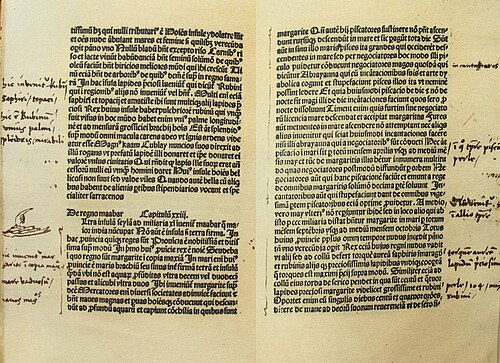
コロンブスはラテン語、ポルトガル語、カスティーリャ語を学んだ。彼は天文学、地理学、歴史について幅広く読書し、その中にはプトレマイオスの著作、ピエール・ダイイの『世界の想像』 、マルコ・ポーロとジョン・マンデヴィル卿の旅行記、プリニウスの『博物誌』、教皇ピウス2世の『世界の全史』などが含まれていた。歴史家エドマンド・モーガンによれば、
コロンブスは学者ではありませんでした。しかし、彼はこれらの本を研究し、何百もの欄外書き込みを行い、特徴的に単純で強力で、時には間違った世界についての考えを生み出しました... [41]
アジアへの探求
背景

モンゴル帝国のアジア覇権とモンゴルの平和のもと、ヨーロッパ人は長い間、インド、中国を含む東アジアの一部、東南アジアの海洋地域への安全なシルクロードの陸路を享受しており、これらは貴重な品物の供給源であった。 1453年にコンスタンティノープルがオスマン帝国に陥落すると、シルクロードはキリスト教徒の貿易業者に対して閉ざされた。[42]
1474年、フィレンツェの天文学者パオロ・ダル・ポッツォ・トスカネッリはポルトガル国王アフォンソ5世に、大西洋を西に渡って航海する方が、アフリカを回るルートよりもマルク諸島、中国、日本、インドに早く到着できると提案したが、アフォンソは提案を拒否した。 [43] [44] 1480年代、コロンブスと彼の兄弟は西に航海して東インド諸島に到達する計画を提案した。コロンブスは1481年にトスカネッリに手紙を書き、激励を受けたとされ、天文学者がアフォンソに送った地図のコピーでは、アジアへの西回りルートが可能であることが示唆されていた。[45]コロンブスの計画は、 1488年にバルトロメウ・ディアスが喜望峰を回航し、アフリカを回ってアジアに至るケープ・ルートが示唆されたことで複雑になった。[46]
コロンブスは、金、香辛料、東へのより安全な航路、そしてキリスト教への改宗者を見つけるために大西洋を横断する航海をスペインのフェルナンド王とイザベラ女王が支援するまで、1492年まで待たなければなりませんでした。[47] [48] [49] [50]
キャロル・デラニーと他の評論家は、コロンブスはキリスト教の千年王国論者であり終末論者で、これらの信念がさまざまな形で彼のアジア探検の動機となったと主張している。コロンブスは航海の航海日誌に金の探索について頻繁に書き、それを「君主たちが聖墳墓征服に着手し準備するほどの量」獲得したことについて書いている。これは聖書の予言の成就である。 [d]コロンブスはすべての人種をキリスト教に改宗させることについて頻繁に書いている。 [52]アバス・ハマンディは、コロンブスは「新たに発見された土地の資源を利用して」エルサレムをイスラム教徒の手から[解放する]という希望に動機づけられていたと主張している。[53]
地理的考慮
一般に誤解されているにもかかわらず、コロンブスの時代の知識のある西洋人のほとんどは、地球が球体であることを知っていた。この概念は古代から理解されていた。[54]太陽と空の星の位置を利用する天体航法の技術は、天文学者によって長い間使用されており、船乗りによっても実践され始めていた。[55] [56]
しかし、コロンブスは地球の大きさ、大陸が東に広がる距離、そして目的地に到達するために西にどれだけの距離が必要かを計算する際にいくつかの間違いを犯しました。
まず、紀元前3世紀に遡って、エラトステネスは単純な幾何学を用いて、2つの離れた場所にある物体の影を研究することで、地球の円周を正確に計算していました。[57] [58]紀元前1世紀、ポセイドニオスは2つの別々の場所での星の観測を比較することでエラトステネスの結果を確認しました。これらの測定値は学者の間で広く知られていましたが、プトレマイオスがより小さくて古い距離単位を使用したため、コロンブスは地球の大きさを約3分の1ほど過小評価することになったのです。[59]
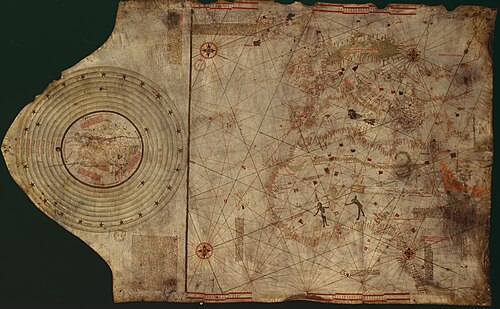
第二に、コロンブスの冒険の範囲を決定づけたのは、 3つの宇宙論的パラメータであった。それは、ヨーロッパとアジアの間の海を隔てた距離(オイクメネ、すなわちスペインと中国の間に東西に広がるユーラシア大陸の範囲によって決まる)、地球の円周、そして、中世のアリストテレスの信奉者たちが唱えた水面と陸地の大きさの関係に関する理論から推測できる経度1度のマイル数またはリーグ数である。[61]
コロンブスはピエール・ダイイの『世界の想像』(1410年)から、緯度1度(赤道に沿った経度1度にほぼ相当)は56.67アラビアマイル(66.2海里、122.6キロメートル、76.2マイルに相当)に及ぶというアルフラガヌスの推定を知ったが、これが彼がよく知っていたより短いローママイル(約1,480メートル)ではなくアラビアマイル(約1,830メートル、1.14マイル)で表現されていることに気づかなかった。 [ 62]そのためコロンブスは地球の大きさをエラトステネスの計算の約75%と推定した。[63]
第三に、当時の学者の大半は、ユーラシア大陸の経度が180度であるとするプトレマイオスの推定[64]を受け入れていたが、実際の130度(中国本土)や150度(スペインの緯度にある日本)は受け入れていなかった。コロンブスはそれよりも高い推定を信じ、水の割合を少なくした。[65]ダイイの『世界の想像』の中で、コロンブスはティルスのマリヌスがユーラシア大陸の経度がロードス島の緯度で225度であると推定しているのを読んでいる。[66]サミュエル・エリオット・モリソンなどの歴史家の中には、コロンブスは外典のエズラ記第二(6:42)の「地球の6つの部分は居住可能で、7番目の部分は水で覆われている」という記述に従ったのではないかと示唆している。 [67]彼はまた、マルコ・ポーロが日本(彼は「チパング」と呼んだ)は中国(「キャセイ」)の東約2,414km(1,500マイル)にあり、[68]実際よりも赤道に近いと主張していたことも知っていた。彼は、日本よりもさらに東に人が住んでいる島々があるというトスカネッリの考えに影響を受けた。その中には、アゾレス諸島より西にそれほど遠くないところにあるかもしれないと考えた伝説のアンティリア島も含まれていた。[69]また、カナリア諸島からインド諸島までの西の距離はわずか68度で、3,080海里(5,700km、3,540マイル)に相当する(58%の誤差)。[63]
コロンブスは情報源に基づいて、カナリア諸島から日本西方までの距離を2,400海里(4,400キロメートル、2,800マイル)と見積もったが、実際の距離は10,600海里(19,600キロメートル、12,200マイル)である。[70] [71] 15世紀の船では、これほど長い航海に必要な食料と真水を積むことはできなかったし、[72]地図にない海を航行する危険は非常に大きかっただろう。ほとんどのヨーロッパの航海士は、ヨーロッパからアジアへの西向きの航海は不可能であると合理的に結論付けた。しかし、カトリック両王は、イベリア半島のムーア人との多額の費用をかけた戦争であるレコンキスタを完了しており、インドとの貿易を求めて他のヨーロッパ諸国に対する競争上の優位性を獲得することに熱心だった。コロンブスの計画は、非現実的ではあったが、そのような優位性を約束するものだった。[73]

航海上の考慮事項
コロンブスはヨーロッパと極東を隔てる経度の度数と、各度が表す距離については間違っていたが、貿易風を利用した。これが大西洋航海の成功の鍵となる。彼はまずカナリア諸島まで航海し、その後北東貿易風に乗って西へ進む計画を立てた。[74]スペインへの帰路の一部には、ビーティングと呼ばれる困難な航海技術を使って風に逆らって航海する必要があり、その間進むのは非常に遅い。[75]帰路を効果的にするには、コロンブスは北東の湾曲した貿易風に沿って北大西洋の中緯度まで行き、そこで西ヨーロッパの海岸に向かって東に吹く「偏西風」を捉える必要があった。[76]
大西洋を航海するための航海技術は、最初にポルトガル人によって利用されたようで、彼らはそれを「海の曲がり角」と呼んでいました。コロンブスは最初の妻フェリパ・ペレストレロとの結婚を通じて、彼女の亡き父バルトロメウ・ペレストレロが所有していた海図や航海日誌を見ることができました。バルトロメウ・ペレストレロは、エンリケ航海王子の下でポルトガル海軍の艦長を務めていました。コロンブスは兄バルトロメオとともに働いていた地図製作所で、年老いた船乗りから西の海への航海の話を聞く機会も十分にありましたが、[77]最初の航海の時点では大西洋の風のパターンに関する彼の知識はまだ不完全でした。ハリケーンの季節にカナリア諸島から真西に航海し、大西洋中部のいわゆる馬緯度を迂回したため、凪と熱帯低気圧に遭遇する危険があったが、どちらも偶然に回避した。[78]
航海のための資金援助を求めて
.png/500px-Columbus_offers_his_services_to_the_King_of_Portugal_-_Daniel_Nicholas_Chodowiecki_(cropped).png)
1484年頃、コロンブスは計画中の航海をポルトガル国王ジョアン2世に提案した。[79]国王はコロンブスの提案を顧問に提出したが、顧問はコロンブスの見積もった2,400海里は本来の航海の4分の1に過ぎないという理由で、当然ながらそれを却下した。[80] 1488年、コロンブスは再びポルトガルの宮廷に上訴し、ジョアン2世は再びコロンブスに謁見を許可した。この会談も不成功に終わったが、その理由の1つは、それから間もなくバルトロメウ・ディアスがアフリカ南端(喜望峰付近)の回航に成功したという知らせをポルトガルに持ち帰ったことだった。[81] [82]
コロンブスは、結婚によってイベリア半島のいくつかの王国を統一し、今や共に統治していたアラゴン王フェルナンド2世とカスティーリャ王イサベル1世の両君主に謁見を求めた。1486年5月1日、許可が下りたコロンブスは、イサベル女王に計画を提示し、女王はそれを委員会に付託した。スペインの学者たちは、ポルトガルの学者たちと同様、コロンブスはアジアまでの距離を著しく過小評価していると答えた。彼らはその考えは非現実的であると断言し、カトリック両王に提案された冒険を断念するよう助言した。コロンブスがその考えを他の場所に持ち出さないように、そしておそらく選択肢を残しておくために、君主たちはコロンブスに年間約14,000マラベディ、つまり船員の年俸に相当する手当を与えた。 [83] 1489年5月、女王は彼にさらに1万マラヴェディを送り、同年、君主たちは彼に、支配下にあるすべての都市と町に食料と宿泊施設を無償で提供するよう命じる書簡を送った。[84]
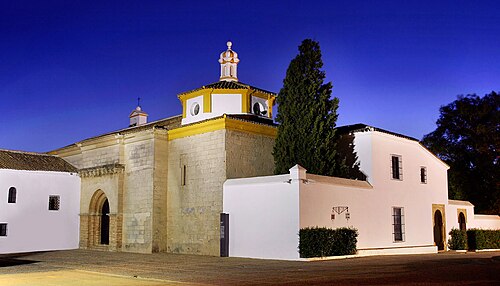
コロンブスは弟のバーソロミューをイングランド国王ヘンリー7世の宮廷に派遣し、イングランド王室が彼の遠征を後援してくれるかどうか尋ねたが、途中で海賊に捕まり、到着したのは1491年初頭になってからだった。[85]その頃、コロンブスはラ・ラビダ修道院に撤退しており、スペイン王室はコロンブスに新しい衣服を買うための2万マラベディと、再度の話し合いのためにスペイン宮廷に戻るよう指示を送った。[86]
スペイン王室との協定

コロンブスはフェルナンド王の陣営で待機し、フェルナンド王とイサベル女王が1492年1月にイベリア半島最後のイスラム教拠点であるグラナダを征服した。イサベル女王の聴罪司祭エルナンド・デ・タラベラが率いる評議会は、コロンブスのインド到達の提案は実現不可能と判断した。コロンブスがフランスに向けて出発した時にフェルナンド王が介入し、[e]まずタラベラと司教ディエゴ・デサを女王に訴えに派遣した。[88]イサベル女王は最終的に、コロンブスがその考えを他の場所に持ち込むと主張した王の書記官ルイス・デ・サンタンヘルの説得を受け、資金の手配を手伝うと申し出た。その後、イサベル女王はコルドバ方面に2リーグ(10km以上)旅してきたコロンブスを連れ戻すために王室の護衛を派遣した。[88]
1492年4月の「サンタフェ条約」では、フェルナンド王とイサベル女王がコロンブスに、もし彼が成功すれば、大洋の提督の地位を与え、スペインのために要求するすべての新しい土地の副王と総督に任命すると約束した。 [89]彼は、新しい土地のあらゆる役職に3人を指名する権利を持ち、その中から君主が1人を選ぶ。彼は、新しい土地からのすべての収入の10%(diezmo )を永久に受け取る権利を持つ。また、新しい土地のあらゆる商業事業の8分の1の権益を購入し、利益の8分の1( ochavo )を受け取る権利も持つ。 [90] [91] [92]
1500年、コロンブスはアメリカ大陸への3度目の航海中に逮捕され、職を解かれた。その後、コロンブスと息子のディエゴとフェルナンドは、カスティーリャ王室がコロンブスとその相続人に対する契約上の義務を違法に放棄したとして、プレトス・コロンビーノスとして知られる一連の長期にわたる訴訟を起こした。 [93]コロンブス家は最初の訴訟である程度勝利し、1511年の判決でディエゴの副王としての地位は確認されたものの、その権限は縮小された。ディエゴは1512年に訴訟を再開し、それは1536年まで続いた。さらに相続人によって起こされた紛争は1790年まで続いた。[94]
航海


1492年から1504年にかけて、コロンブスはスペインとアメリカ大陸の間を4回往復航海したが、その航海はいずれもカスティーリャ王国の支援を受けたものだった。最初の航海でコロンブスはアメリカ大陸に到達し、ヨーロッパ人による大陸の探検と植民地化、そしてコロンブス交換のきっかけを作った。コロンブスが歴史に果たした役割は、大航海時代、西洋史、そして人類史全体にとって重要である。[95]
コロンブスがスペインに最初に戻った後に出版された最初の航海に関する手紙の中で、彼はマルコ・ポーロや他のヨーロッパ人が以前に述べたように、アジアに到達したと主張した。[ 96]その後の航海でコロンブスは、彼が訪れてスペイン領であると主張した土地がアジアの一部ではないことを認めなかった。それに反する証拠が積み重なっていったにもかかわらず。[97]これは、アメリカ大陸がコロンブスではなくフィレンツェの探検家アメリゴ・ヴェスプッチにちなんで名付けられた理由の一部かもしれない。ヴェスプッチは、アメリカ大陸を「新世界」として認識したことで名声を得た。[98] [f]
最初の航海(1492年~1493年)

1492年8月3日の夕方、コロンブスは3隻の船を率いてパロス・デ・ラ・フロンテーラを出発した。最大のものはキャラック船のサンタ・マリア号で、フアン・デ・ラ・コサが所有し船長を務め、コロンブスの直接指揮下にあった。[102]他の2隻はより小型のキャラベル船のピンタ号とニーニャ号で、[103]ピンソン兄弟が操縦していた。[102]コロンブスはまずカナリア諸島へ航海した。そこで食料を補給し、修理をした後、 9月6日にサン・セバスティアン・デ・ラ・ゴメラ島を出発し、 [104] 5週間に及ぶ大洋横断の航海に出た。
10月7日、乗組員は「鳥の大群」を目撃した。[105] 10月11日、コロンブスは艦隊の進路を真西に変え、まもなく陸地が見つかるだろうと考えて夜通し航海した。翌朝2時頃、ピンタ号の見張り、ロドリゴ・デ・トリアナが陸地を発見した。ピンタ号の船長、マルティン・アロンソ・ピンソンが陸地の発見を確認し、コロンブスに知らせた。[106] [107]コロンブスは後に、数時間前にすでに陸地の光を見ていたと主張し、フェルディナンドとイザベラが陸地を最初に発見した者に約束した終身年金を請求した。[46] [108]コロンブスはこの島(現在のバハマ諸島)をサン・サルバドル(「聖なる救世主」の意)と名付けたが、原住民はグアナハニと呼んだ。[109] [h] クリストファー・コロンブスの1492年10月12日の日記にはこう記されている。
私は身体に傷跡のある人たちを見かけたので、彼らに手振りをして、それが何なのか尋ねました。すると彼らは、近くの他の島々から人々がやって来て、彼らを捕らえようとし、彼らがどのように身を守ったかを私に見せてくれました。そして私は彼らがティエラ・フィメから捕虜にするためにここに来たと信じています。彼らは善良で聡明な召使であるはずです。なぜなら、彼らは言われたことをすべてすぐに話すからです。また、彼らはすぐにキリスト教徒になると思います。なぜなら、彼らには宗教がないように見えたからです。主の御心ならば、私が出発するときに、彼らのうちの6人をここから陛下のところに連れて行き、話せるようにしてあげましょう。[111]
コロンブスは自分が訪れた土地の住民をロス・インディオス(スペイン語で「インディアン」)と呼んだ。[112]コロンブスは最初にルカヤン、タイノ、アラワク族と出会った。 [113]彼らの金の耳飾りに気づいたコロンブスは、アラワク族の何人かを捕虜にし、金の産地まで案内するよう要求した。[114]コロンブスは要塞化された前哨地を作る必要はないと考え、「ここの人々は戦争に関しては単純だ...私は50人の男で彼らをすべて征服し、好きなように統治することができる」と書いた。[115]タイノ族はコロンブスに、別の先住民族であるカリブ族は凶暴な戦士で人食い人種であり、タイノ族を頻繁に襲撃し、しばしば女性を捕らえると語ったが、これはスペイン人が奴隷化を正当化するために永続させた信念だったのかもしれない。[116] [117]
コロンブスはキューバ北東海岸も探検し、10月28日に上陸した。11月26日の夜、マルティン・アロンソ・ピンソンはピンタ号を無許可の探検に乗せ、「バベケ」または「バネケ」と呼ばれる島を探す旅に出した。[118]現地の人々は、この島には金が豊富だと彼に話していた。[119]一方コロンブスはイスパニョーラ島の北岸まで進み、12月6日に上陸した。[120]そこでサンタ・マリア号は1492年12月25日に座礁し、放棄せざるを得なくなった。沈没船は、現地の人々に印象づけるための大砲の標的にされた。[121]コロンブスは現地のカシケ、 グアカナガリに迎えられ、部下数名を残して行くことを許可された。コロンブスは通訳のルイス・デ・トーレスを含む39人の部下を残して[122] [i]、現在のハイチにラ・ナビダッドの入植地を設立した。[123] [124]コロンブスはさらに多くの原住民を捕虜にして探検を続けた。[114]彼は1隻の船でイスパニョーラ島の北岸に沿って航海を続け、1月6日にピンソンとピンタに遭遇した。 [125]
1493年1月13日、コロンブスはアメリカ大陸でのこの航海の最後の目的地、イスパニョーラ島北東部のリンコン湾に到着した。 [126]そこでコロンブスはシグアヨ族と遭遇した。彼らはこの航海中に唯一激しく抵抗した原住民だった。[127]シグアヨ族はコロンブスが要求した量の弓矢の交換を拒否した。衝突の結果、シグアヨ族の1人が尻を刺され、もう1人が胸に矢を受けて負傷した。[128]これらの出来事から、コロンブスはこの入り江をゴルフォ・デ・ラス・フレチャス(矢の湾)と呼んだ。[129]
コロンブスはニーニャ号に乗ってスペインに向かったが、嵐でピンタ号と離れ離れになり、ニーニャ号はアゾレス諸島のサンタマリア島で停泊せざるを得なくなった。乗組員の半数が嵐を生き延びたことに感謝し、礼拝堂で祈りを捧げるために上陸した。しかし、祈りの最中に島の知事によって海賊の疑いで投獄された。2日間のにらみ合いの後、囚人は解放され、コロンブスは再びスペインに向けて出航した。[130]
再び嵐が起こり、コロンブスはリスボンの港に入港せざるを得なくなった。[46]そこから彼はリスボンの北にあるヴァレ・ド・パライソに行き、ポルトガル王ジョアン2世に会った。ジョアン2世はコロンブスの航海が1479年のアルカソバス条約に違反していると考えていると告げた。ポルトガルで1週間以上過ごした後、コロンブスはスペインに向けて出航した。1493年3月15日にパロスに戻ったコロンブスは英雄として歓迎され、その後すぐにバルセロナでイザベラとフェルナンドに迎えられた。[131]彼は彼らに誘拐したタイノ族や収集した様々な植物や品物を贈った。[132] : 54
コロンブスの最初の航海に関する手紙は、おそらくリスボン到着後にスペイン宮廷に送られたもので、彼の航海のニュースをヨーロッパ中に広めるのに役立った。彼がスペインに到着してすぐに印刷版が出版され始め、彼の航海の知らせは急速に広まった。[133]当初、ほとんどの人は彼がアジアに到着したと信じていた。[96]寄進勅書は、1493年に教皇アレクサンデル6世が発布した3通の教皇勅書で、ポルトガルとスペインのカトリック両王に海外領土を与えることを目的としていた。これらは1494年のトルデシリャス条約によって置き換えられた。[134]
コロンブスがニーニャ号に乗って最初の航海をした際に書いた手紙の最も古い出版された2部は、2017年にジェイ・I・キスラック財団からフロリダ州コーラルゲーブルズのマイアミ大学図書館に寄贈され、保管されています。[135]
第二航海(1493年~1496年)
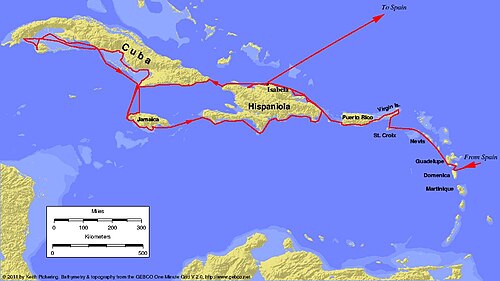
1493年9月24日、コロンブスは17隻の船とアメリカ大陸に恒久的な植民地を築くための物資を積んでカディスを出航した。彼は船員、兵士、司祭、大工、石工、金属加工業者、農民を含む約1,500人の男たちを率いて航海した。探検隊のメンバーには、第2回航海の詳細な記録を書いた医師のアルバレス・チャンカ、プエルトリコとフロリダの初代総督でバルトロメ・デ・ラス・カサスの父であるフアン・ポンセ・デ・レオン、新世界を描いた最初の世界地図を作成したとされる地図製作者のフアン・デ・ラ・コサ、そしてコロンブスの末弟ディエゴがいた。[137]艦隊はさらなる物資を積むためにカナリア諸島に立ち寄り、10月7日に再び出航したが、第1回航海よりも意図的に南寄りの航路を取った。[138]
11月3日、彼らはウィンドワード諸島に到着した。最初に出会った島はコロンブスによってドミニカと名付けられたが、そこに良い港が見つからなかったため、近くの小さな島に停泊し、マリアガラントと名付けた。現在はグアドループの一部でマリーガラントと呼ばれている。コロンブスがこの航海で名付けた他の島には、モンセラート、アンティグア、サンマルタン、ヴァージン諸島などがある。[138]
11月17日、コロンブスはプエルトリコ島の東海岸を初めて視認した。この島は原住民のタイノ族からはボリケンと呼ばれていた。彼の艦隊は島の南岸に沿って丸一日航海し、11月19日早朝にアニャスコ湾の北西岸に上陸した。上陸後、コロンブスは島を洗礼者ヨハネにちなんでサン・ファン・バウティスタと名付け、11月20日から21日までの2日間そこに停泊し、艦隊の船の樽に水を満たした。[139]

11月22日、コロンブスはイスパニョーラ島に戻り、現在のハイチにあるラ・ナビダッドを訪れた。そこには最初の航海で残された39人のスペイン人がいた。コロンブスは砦が廃墟になっているのを発見した。地元の部族長であるグアカナガリクスから、部下たちが金をめぐって争い、部族の女性を奪い、何人かがカオナボの領土へ去った後、カオナボがやって来て砦を焼き、そこにいた残りの男たちを殺害したと聞いた。 [140] [123] [141] [142]
コロンブスはその後、東のラ・イサベラ[137]に、現在のドミニカ共和国にある、立地の悪い短命の入植地を設立しました。[143] 1494年末までに、病気と飢餓により、そこにいたスペイン人入植者の3分の2が死亡しました。[144]
1494 年 4 月から 8 月にかけて、コロンブスはキューバとジャマイカを探検し、その後イスパニョーラ島に戻った。[145 ]キューバへの探検に出発する前に、コロンブスはペドロ・マルガリットの指揮する大勢の部下に対し、「島を縦横に巡り、スペインの支配を強化し、すべての人々をスペインの支配下に置く」よう命じていた。[146]これらの部下は、コロンブスの不在中に女性を強姦し、男性を捕虜にして召使いにし、先住民から盗みを働いた。報復として多くのスペイン人が殺害された。コロンブスがキューバ探検から戻る頃には、イスパニョーラ島のアラワク族の 4 人の主要指導者が、島からスペインを追い出そうと戦争のために集結していた。コロンブスは多数の軍隊を組織し、唯一の先住民の同盟者である首長 [グアカナガリクス] と合流して戦いに臨んだ。スペイン人は、数で大きく劣勢であったにもかかわらず、この戦いに勝利し、その後9か月間、コロンブスはイスパニョーラ島の原住民タイノ族に対して、彼らが降伏して貢物を払うことに同意するまで戦争を続けた。[147]
コロンブスはエンコミエンダ制[148] [149]を施行した。これは征服者に非キリスト教徒の労働を報酬として与えるスペインの労働制度である。また、スペイン人と原住民の両方に対する罰として鞭打ちや身体切断(鼻や耳の切断)が含まれていたと記録されている。[150] [151]
コロンブスと入植者たちは、多くの先住民を奴隷にした。 [152]子どもも奴隷にされた。 [153]想像上の金の在り処をめぐって、先住民は殴打され、強姦され、拷問を受けた。[154]何千人もの人々が、抑圧に耐えるよりも自殺した。[155] [k]
1495年2月、コロンブスは大規模な奴隷狩りで約1,500人のアラワク族を捕らえたが、その中には反乱を起こした者もいた。最も強かった約500人が奴隷としてスペインに送られたが、[157]そのうち約200人が途中で死亡した。[114] [158]
1495年6月、スペイン国王はイスパニョーラ島に船と物資を送った。10月、コロンブスの第2回航海の艦隊とイスパニョーラ島の植民地への物資供給の契約を勝ち取ったフィレンツェの商人ジャノット・ベラルディは、4万マラベディ相当の奴隷インディアンを受け取った。ベラルディはコロンブスに物資を届ける努力を再開し、艦隊を組織しようとしていたが、12月に急死した。[159] 1496年3月10日、約30か月の航海を経て、[160]艦隊はラ・イサベラ島を出発した。6月8日、乗組員はリスボンとサン・ビンセント岬の間のどこかに陸地を発見し、6月11日にカディスに上陸した。[161]
第三次航海(1498年~1500年)
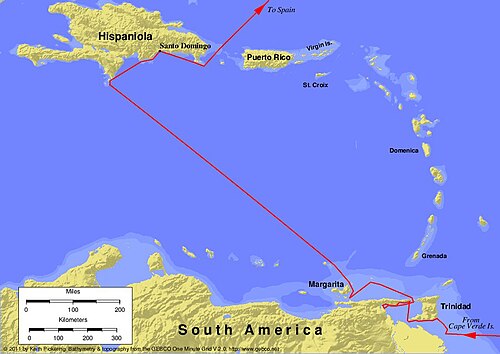
1498年5月30日、コロンブスは6隻の船を率いてスペインのサンルーカルを出発した。艦隊はマデイラ島とカナリア諸島に寄港し、そこで2つに分かれ、3隻はイスパニョーラ島に向かい、コロンブスが指揮する他の3隻は南のカーボベルデ諸島に向かい、その後西に向かって大西洋を横断した。この遠征は、カリブ海の南に大きな大陸、つまり南アメリカがあるという噂を少なくとも部分的に確認することが目的であった可能性が高い。[162]
7月31日、彼らはカリブ海諸島の最南端であるトリニダード島[163]を視認した。8月5日、コロンブスは数隻の小型船を現在のベネズエラにあるパリア半島の南側、 [164] [165]オリノコ川の河口付近に上陸させた。[162]これは南アメリカ本土へのヨーロッパ人による最初の上陸記録であり、[164]コロンブスはそれが大陸であるに違いないと認識していた。[166] [167]その後、艦隊はチャカチャカレ島とマルガリータ島へ航海し、後者には8月14日に到着し、[168]遠くからトバゴ島とグレナダを視認したと一部の学者は述べている。[169] [164]
8月19日、コロンブスはイスパニョーラ島に戻った。そこで彼は、コロンブスの統治と果たされなかった富の約束に反抗する入植者たちを見つけた。コロンブスはヨーロッパ人の一部を不服従の罪で裁判にかけ、少なくとも1人の反乱指導者は絞首刑に処された。[170]
1499年10月、コロンブスはスペインに2隻の船を派遣し、統治を助ける王室委員を任命するようスペイン宮廷に要請した。[171]この時までに、コロンブスの専横と無能さに対する非難も宮廷に届いていた。君主たちは、コロンブスのパトロンでありイサベル女王の親友でもあったマルケサ・ベアトリス・デ・ボバディージャの親戚であるフランシスコ・デ・ボバディージャを派遣し、[172] [173]提督に対する残虐行為の告発を調査させた。コロンブスが留守の間にサントドミンゴに到着したボバディージャは、すぐにコロンブスの3兄弟全員に対する苦情に直面した。 [ 174]彼はコロンブスの家に入り込んで財産を押収し、提督の敵から証言を取り、自らを総督と宣言した。[164]
ボバディラはスペインに、コロンブスがかつてトウモロコシを盗んだ罪で有罪となった男の耳と鼻を切り落として奴隷として売ったことがあると報告した。彼は、コロンブスはイスパニョーラ島を統治するために拷問と身体の切断を日常的に行っていたと主張した。[l]報告書に記録された証言によると、コロンブスは兄のバーソロミューが女性を裸で通りを行進させ、その後「提督とその兄弟の悪口を言った」という理由で舌を切り落とすよう命じたとき、兄のバーソロミューが「家族を守った」ことを祝福したという。[176]この文書には、コロンブスが原住民の不安と反乱を鎮圧した方法も記述されている。彼はまず、多くの原住民が殺害された反乱を残忍に鎮圧するよう命じ、次にそれ以上の反乱を阻止しようと、彼らのバラバラになった死体を通りで行進させた。[177]コロンブスは容疑を激しく否定した。[178] [179]スペイン人の反イタリア感情とボバディーリャがコロンブスの地位を奪おうとしていたことを考えると、コロンブスとその兄弟に対するボバディーリャの告発と調査の中立性と正確性は歴史家によって議論されてきた。[180] [181] [182]
1500年10月初旬、コロンブスとディエゴはボバディーヤの前に姿を現し、ボバディーヤがサントドミンゴに到着したのに乗船したキャラベル船ラ・ゴルダ号の上で鎖につながれた。 [183] [184]彼らはスペインに送還され、フェルナンド国王が釈放を命じるまで6週間監獄で苦しんだ。それから間もなく、国王と王妃はコロンブス兄弟をグラナダのアルハンブラ宮殿に召喚した。君主たちはボバディーヤの行為に憤慨し、ボバディーヤは召還され、コロンブスから没収した財産の返還を命じられた。[178]国王夫妻は兄弟の嘆願を聞き、自由と財産を取り戻し、何度も説得された後、コロンブスの4回目の航海に資金を提供することに同意した。[185]しかし、ニコラス・デ・オバンドがボバディーヤに代わり、西インド諸島の新しい総督となることになっていた。[186]
コロンブスとその兄弟であるアデランタード・バルトロマイの押収事件に新たな光が当てられたのは、1500年にサントドミンゴでフランシスコ・デ・ボバディージャが集めた彼らに対する証言の不完全なコピーを公文書管理人のイサベル・アギーレが発見したことだ。彼女はスペインのシマンカス公文書館でこの調査書の手書きのコピーを発見したが、彼女とコンスエロ・バレラが2006年に『クリストファー・コロンの失脚:ボバディージャの判決』を出版するまでは未分類だった。 [187] [188]
第四次航海(1502年~1504年)

.svg/500px-House_of_Colon_COA_(2).svg.png)
1502年5月9日[189] 、コロンブスは旗艦サンタ・マリア号と他の3隻の船とともにカディスを出港した。船には140人の乗組員が乗っており、副船長の弟バーソロミューと息子のフェルナンドも含まれていた。[190]彼は、ムーア人に包囲されていると言われているポルトガル兵を救出するためにモロッコ海岸のアシラに航海した。彼らが到着したときには包囲は解かれていたため、スペイン人は1日だけ滞在し、カナリア諸島へ向かった。[191]
6月15日、艦隊はマルティニーク島に到着し、数日間停泊した。ハリケーンが発生しつつあったため、コロンブスは西進を続け、[190]イスパニョーラ島に避難できることを期待した。 6月29日にサントドミンゴに到着したが、入港を拒否され、新総督フランシスコ・デ・ボバディージャはハリケーンが近づいているという警告に耳を貸さなかった。その代わりに、コロンブスの船がハイナ川の河口に避難している間に、最初のスペイン宝物船団がハリケーンの中へと航海した。コロンブスの船は軽微な損傷で生き残ったが、総督の艦隊30隻のうち20隻が失われ、500人の命(フランシスコ・デ・ボバディージャを含む)が失われた。生き残った数隻の船はなんとかサントドミンゴ、アグハまでたどり着いたが、コロンブスの私物と4,000ペソの金を積んだ脆弱な船がスペインに到着した唯一の船だった。[192] [193]この金はコロンブスがイスパニョーラ島で得た利益の10分の1(デシモ)で、24万マラベディに相当し、[194] 1492年にカトリック両王によって保証された。[195]
ジャマイカに短期間滞在した後、コロンブスは中央アメリカへ航海し、7月30日にホンジュラスの海岸に到着した。ここでバーソロミューは現地の商人と大きなカヌーを見つけた。8月14日、コロンブスはホンジュラスのプンタ・カシナス(現在のプエルト・カスティーリャ)で大陸本土に上陸した。[196]彼は2か月間ホンジュラス、ニカラグア、コスタリカの海岸を探検し、インド洋へ航行できる西カリブ海の海峡を探した。ニカラグアの海岸に沿って南へ航行し、 10月5日にパナマのアルミランテ湾に通じる水路を発見した。[197] [198]
アルミランテ湾に船が停泊するとすぐに、コロンブスはカヌーに乗った金の装飾品をつけたンガベ族に遭遇した。 [199] 1503年1月、コロンブスはベレン川の河口に駐屯地を置いた。4月16日、コロンブスはイスパニョーラ島に向けて出発した。5月10日、コロンブスはケイマン諸島を発見し、そこに生息する多数のウミガメにちなんで「ラス・トルトゥガス」と名付けた。[200]コロンブスの船はキューバ沖で嵐に遭い、それ以上航行できなくなり、1503年6月25日、ジャマイカのセント・アン教区に座礁した。[201]
コロンブスと230人の部下は6か月間ジャマイカに取り残されたままだった。コロンブスの個人秘書として出航していたディエゴ・メンデス・デ・セグラと、スペイン人の船員仲間バルトロメ・フリスコは、6人の原住民とともにカヌーを漕いでイスパニョーラ島に助けを求めた。[202]知事ニコラス・デ・オバンド・イ・カセレスはコロンブスを嫌悪し、コロンブスと部下を救出するあらゆる努力を妨害した。[203]一方、コロンブスは、自分と飢えた部下への食糧供給を継続するよう原住民を説得しようと必死になり、アブラハム・ザクトの天文図を使って1504年2月29日の月食を予言し、彼らの好意を得た。 [204] [205] [206]総督の妨害にもかかわらず、クリストファー・コロンブスとその部下は1504年6月28日に救出され、11月7日にスペインのサンルーカルに到着した。[203]
晩年、病気、そして死

コロンブスは、非信者の改宗が探検の理由の一つであると常に主張しており、晩年はますます信仰深くなっていった。[207]おそらく息子のディエゴと友人のカルトジオ会修道士ガスパール・ゴリシオの助けもあって、コロンブスは晩年に2冊の本を著した。1冊目は『特権の書』(1502年)で、コロンブスは自分と子孫がスペイン王室から受け取る権利があると信じていた褒賞の詳細と記録を記しており、もう1冊は『予言の書』 (1505年)で、聖書の一節を用いて探検家としてのコロンブスの業績をキリスト教終末論の文脈に位置付けている。[208]
晩年、コロンブスはサンタフェ条約に定められた通り、カスティーリャ王国に新大陸で得た富と交易品の10分の1を譲るよう要求した。[91]コロンブスは総督の職を解かれていたため、王国はその契約に縛られるとは思わず、コロンブスの要求は却下された。コロンブスの死後、相続人たちはアメリカとの貿易で得た利益の一部とその他の報酬を求めて王国を訴えた。これが、プレトス・コロンビーノス(「コロンブス訴訟」)として知られる長期にわたる一連の法的紛争につながった。[94]
.jpg/500px-IL_CONSOLE_USA_IN_VISITA_ALL%E2%80%99UNIVERSIT%C3%80_DI_PAVIA_(28250236188).jpg)
コロンブスは最初の帰航中に激しい嵐に遭遇し、当時41歳だったが、当時痛風だと考えられていた病気にかかった。その後数年間、彼はインフルエンザと思われる症状やその他の高熱、目からの出血、一時的な失明、痛風の長期発作に悩まされた。発作は期間と重症度を増し、時にはコロンブスは一度に何ヶ月も寝たきりになることもあった。そして14年後に死に至った。
コロンブスの生活習慣や記述された症状に基づいて、現代の評論家の中には、彼が痛風ではなく反応性関節炎を患っていたのではないかと疑う者もいる。 [209] [210]反応性関節炎は、腸内細菌感染、または特定の性感染症(主にクラミジアや淋病)に感染した後に起こる関節炎である。2006年、医師のフランク・C・アーネットと歴史家のチャールズ・メリルは、コロンブスが反応性関節炎の一種を患っていたとする論文を『アメリカ医学雑誌』に発表した。メリルは同じ論文の中で、コロンブスはカタロニア人の息子であり、母親は著名な改宗ユダヤ人(ユダヤ教徒への改宗者)の家族の一員だった可能性があると主張した。[211]「コロンブスは、不衛生な環境と不適切な食事の調理により、航海中に食中毒を起こし、反応性関節炎を発症した可能性が高い」とテキサス大学ヒューストン校医学部のリウマチ専門医で内科、病理学、臨床検査医学の教授であるアーネット氏は言う。[209]
H・マイケル・ターバーやエミリー・スレイプなどの歴史家[212]や、アーネットやアントニオ・ロドリゲス・クアルテロなどの医師[213]は、コロンブスがそのような反応性関節炎を患っていたと信じているが、他の権威者によると、これは「推測的」[214]または「非常に推測的」[215]である。
4回目の航海(およびイサベル女王の死)からサンルーカルに到着した後、病に倒れたコロンブスは1505年4月にセビリアに定住した。彼は頑固に王室に自分と家族の特権を守るよう嘆願し続けた。[216]彼は1506年初頭までにラバに乗ってセゴビア(当時宮廷があった場所)に移動し、[217] 1506年3月にスペインのバリャドリッドでフェルナンド王とジェルメーヌ・ド・フォワの結婚式が行われた際に、コロンブスは要求を貫くためにその都市に移動した。[218] 1506年5月20日、コロンブスは54歳でバリャドリッドで亡くなった。[219]
遺体の所在
コロンブスの遺体は最初バリャドリッドの聖フランシスコ修道院の驚異の礼拝堂に埋葬されたが[220] 、その後、息子ディエゴの遺言により、セビリア(南スペイン)のラ・カルトゥーハ修道院に移された。 [221]遺体は1513年に掘り起こされ、セビリア大聖堂に埋葬された可能性がある。1536年頃、コロンブスと息子ディエゴの遺体は、現在のドミニカ共和国にあるコロニアル・サント・ドミンゴの大聖堂に移された。コロンブスは島に埋葬されることを希望していた。[222]いくつかの記録によると、1793年にフランスがイスパニョーラ島全体を占領したとき、コロンブスの遺体はキューバのハバナに移された。[223] [224] 1898年の米西戦争後にキューバが独立した後、これらの遺骨の少なくとも一部はセビリア大聖堂に移され、[220] [225]精巧なカタファルクに納められました。
2003年6月、セビリアの遺体から、コロンブスの兄弟ディエゴと次男フェルナンドの遺体とともにDNAサンプルが採取された。 [222]当初の観察では、骨はコロンブスの体格や死亡時の年齢と一致しないように見えた。[226] DNA抽出は困難であることが判明し、ミトコンドリアDNAの短い断片しか分離できなかった。これらはコロンブスの兄弟の対応するDNAと一致し、2人が同じ母親から生まれたことを裏付けた。[225]このような証拠と人類学的および歴史的分析から、研究者は遺体がクリストファー・コロンブスのものであると結論付けた。[227] [m]
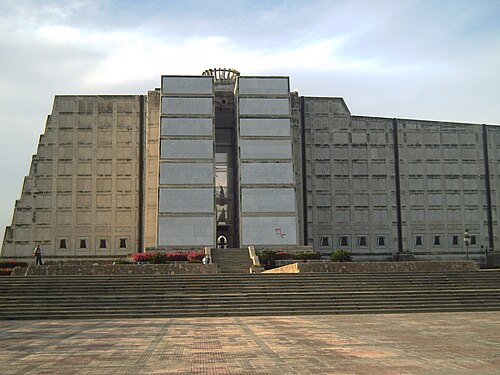
1877年、ある司祭がサントドミンゴで「アメリカ大陸の発見者、最初の提督」と刻まれた鉛の箱を発見した。翌年発見された碑文には「最初の提督、発見者、父クリストファー・コロンブスの最後の遺体」とあった。[229]箱の中には腕と足の骨、そして弾丸が入っていた。[n]これらの遺体は医師で米国務次官補のジョン・ユージン・オズボーンによって本物とみなされ、1913年に開通式の一部としてパナマ運河を通って運ばれることを提案した。 [231] [o]これらの遺体はサンタ・マリア・ラ・メノール大聖堂(サントドミンゴ植民地都市)に保管された後、コロンブス灯台(サントドミンゴエステ、1992年に開通)に移された。サントドミンゴ当局はこれらの遺体のDNA検査を許可したことがないため、これらもコロンブスの遺体であるかどうかは確認されていない。[225] [233] [p]
記念


.jpg/500px-Columbus_Day_in_New_York_City_2009_(4014723409).jpg)
植民地時代のイギリス植民地ではコロンブスの人物像は無視されなかった。コロンブスは、清教徒の説教師たちが彼の生涯を「発展するアメリカ精神」のモデルとして使い始めたとき、アメリカ合衆国となった植民地の歴史の初期に統合のシンボルとなった。[235] 1692年の春、清教徒の説教師コットン・マザーは、コロンブスの航海を近代を形成する3つの出来事の1つと表現し、コロンブスの航海と清教徒の北アメリカへの移住を結び付け、両者を壮大な計画の鍵とみなした。[236]
アメリカ独立戦争後、コロンブスを新世界の建国の人物として用いることは急速に広まった。これは、英国とのつながりを少なくした国家の歴史と建国の神話を発展させたいという願望から生まれたものであった。 [237] [238] [239]彼の名前は、アメリカ合衆国を擬人化した女性の名前「コロンビア」のベースとなり、[240] 1730年代から元々の13植民地を指して使われており、アメリカ大陸と新世界に付けられた歴史的な名前でもある。コロンビア、サウスカロライナ、そしてコロンビア川の名前の由来となった船「コロンビア・レディヴィヴァ」は、コロンブスにちなんで名付けられている。[241]
コロンブスの名は、革命家フランシスコ・デ・ミランダが大陸のヒスパニック系アメリカ解放のために展開した政治計画「コロンベイア」に触発され、19世紀初頭に新しく誕生したコロンビア共和国に付けられた。 [242]
コロンブス上陸400周年を記念して、[243] 1893年のシカゴ万国博覧会は世界コロンブス博覧会と名付けられた。[244]米国郵政公社は米国初の記念切手であるコロンブス号を発行した。[245]コロンブス、イザベラ女王、その他を描いた数々の航海の旅が描かれている。[246] 19世紀後半の王政復古期にスペインで行われた国家主義的プロジェクトの手段としてのスペイン植民地帝国の祝賀に関する政策は、1892年10月12日の建国400周年記念(保守党政権によりコロンブスの像が称賛された)で形になり、最終的にまさに同じ国民の祝日となった。[247] 400周年の前後に、パロス、バルセロナ、グラナダ、マドリード、サラマンカ、バリャドリッド、セビリアなどの都市に「発見」を記念する記念碑がいくつか建てられました。[248] [q]
1992年のコロンブス生誕500周年を記念して、イタリア、ポルトガル、スペインと共同で第2弾のコロンブス版が発行された。[249]コロンブスはセビリア万博とジェノバ万博で祝われた。
1951年に設立されたボアル・マンション博物館には、コロンブスの子孫とその一族の近縁種に関する資料が収蔵されている。博物館には、ディエゴ・コロンが所有していたとされるスペインの城にあった16世紀の礼拝堂があり、コロンブスの子孫の住居となった。礼拝堂の内部は1909年にスペインから解体・移設され、ペンシルベニア州ボアルズバーグのボアル邸宅に再建された。内部には、聖十字架のものと思われる木片が入った聖遺物箱など、数多くの宗教画やその他の品々が収蔵されている。博物館には、18世紀後半から19世紀初頭のコロンブスの子孫に関する文書のコレクションも収蔵されている。[250]
アメリカ大陸の多くの国、そしてスペインやイタリアでは、コロンブスデーは1492年10月12日のコロンブスがアメリカ大陸に到着した記念日を祝う日となっている。[251]
遺産
コロンブスの航海は人類史の転換点と考えられており、[252]グローバリゼーションの始まりとそれに伴う人口、商業、経済、社会、政治の変化を示しています。[253]
.jpg/500px-Landing_of_Columbus_(2).jpg)
彼の探検により、南北両半球の恒久的な接触が生まれ、「プレコロンブス」という用語は、コロンブスとその後継者であるヨーロッパ人が到着する前のアメリカ大陸の文化を指すのに使われています。[254]その後のコロンブス交流では、動物、植物、菌類、病気、技術、鉱物資源、アイデアの大規模な交換が行われました。[255]
コロンブスの活躍から1世紀後、コロンブスの人物像は歴史の片隅に埋もれ、植民地行政官としての失敗によって評判は地に落ちた。16世紀後半以降、コロンブスはイタリアやスペインの劇や詩に登場人物として登場し始め、コロンブスの遺産は忘れ去られることからいくらか救われた。[256]
コロンブスは西洋の植民地化と帝国建設の物語に組み込まれ、誰が「文明人」とみなされ、誰がそうでないかを強調するために、 translatio imperiiとtranslatio studiiの概念が呼び出されました。[257]
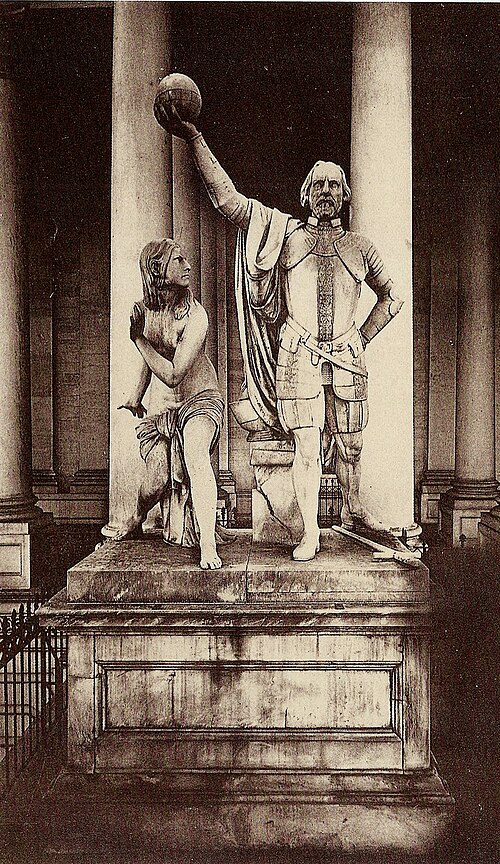
コロンブスのアメリカ化は、アメリカ合衆国の独立戦争期を経た18世紀後半の数十年に始まり、[258]彼の名声は国民的神話、ホモ・アメリカヌスへと高められた。[259]彼の上陸は「アメリカ創世記のイメージ」として強力な象徴となった。[258] コロンブスと怯える原住民の乙女を描いたアメリカ発見の彫刻は、1837年4月3日に発注され、当時、マーティン・ヴァン・ビューレン米大統領はルイジ・ペルシコの設計を認可した。コロンブスの勝利と原住民の反撃を描いたこの彫刻は、野蛮で素朴な原住民に対する白人の優位性を示すものである。[260] 1844年の除幕式の記録によると、この彫刻は「2つの人種の出会いを表す」ものとなっており、ペルシコは彼らの最初の交流を捉え、先住民の「道徳的、知的劣等性」を強調している。[261] 20世紀半ばに撤去されるまで米国議会議事堂の外に置かれていたこの彫刻は、当時の米国白人の先住民に対する見方を反映しており、米国独立宣言では先住民を「無慈悲なインディアン野蛮人」と呼んでいる。[262] 1836年、この彫刻を提案したペンシルベニア州の上院議員で後にアメリカ大統領となるジェームズ・ブキャナンは、この彫刻について「偉大な発見者がこれまでの苦労の末、初めて海岸で恍惚とした表情で飛び跳ね、驚いた世界にアメリカという名前が刻まれた半球を提示した時の姿を表現している。彼が海岸に立っている間、女性の野蛮人が畏敬の念と驚嘆の表情で彼を見つめている」と説明した。[263]
アメリカのコロンブスの神話は、19世紀後半に再構成され、ユダヤ系、イタリア系、アイルランド系などアングロサクソン系ではないアメリカ移民によって、コロンブスは民族の創始者のような存在であると主張し、民族の英雄として崇められた。[264] [265]カトリック教徒は19世紀にコロンブスの列聖を推進しようとしたが、失敗した。 [266] [267]
1990年代以降、コロンブスが先住民の大量虐殺と環境破壊の責任を負っているという物語が、コロンブスがキリストの担い手、科学者、またはアメリカの父であるという当時の支配的な言説と競合し始めました。[268]この物語は、コロンブスの征服が先住民に与えた悪影響を特徴としています。[154]旧世界の病気にさらされて、新世界の先住民は崩壊し、[269]ヨーロッパ人とアフリカ人が大部分を占め、[270]農業、ビジネス、統治、宗教的崇拝の新しい方法をもたらしました。
アメリカ発見の独創性

西洋の大衆文化では、クリストファー・コロンブスはヨーロッパ人によるアメリカ大陸の発見者とみなされるようになったが、彼の歴史的遺産はより微妙なものである。[271]アイスランドに定住した後、ノルウェー人は10世紀初頭にグリーンランドの無人南部に定住した。 [272]ノース人はその後、グリーンランドとアイスランドから出航し、コロンブスがカリブ海に到達する約500年前に、北米本土に到達した最初のヨーロッパ人となったと考えられている。[273] 1960年代にニューファンドランド島のランス・オ・メドーで紀元1000年頃のノルウェー人集落が発見されたが、これはアイスランドの伝説にある赤毛のエイリークによるグリーンランドの植民地化と、その後の息子レイフ・エリクソンがヴィンランドと名付けた場所の探検の記述を部分的に裏付けている。[274]
19世紀、北欧文化への関心が再燃する中、カール・クリスチャン・ラフンとベンジャミン・フランクリン・デコスタは、コロンブスより先に北欧人がアメリカ大陸を植民地化していたことを証明する著作を書いた。[275] [276]これに続いて、1874年にラスムス・ビョルン・アンダーソンは、コロンブスが探検の航海を始める前に北アメリカ大陸について知っていたに違いないと主張した。[32] [273]現代の学者のほとんどは、コロンブスがアメリカ大陸の北欧人居住地について知っていたことを疑っており、大陸への到着はおそらく独自の発見であったとされている。[30] [31] [32] [33] [277]
ヨーロッパ人は、アメリカ先住民の起源と地理的分布について、古代の知的基盤の上に築かれた彼ら自身の先入観を強化する物語で説明を考案した。[278]現代のラテンアメリカでは、一部の国の非先住民は、コロンブスのいわゆる「発見」とそれに続く植民地時代に関する先住民の見解に対して曖昧な態度を示すことが多い。[279]メキシコの哲学者で歴史家のエドムンド・オゴーマンは、 1960年のモノグラフで、コロンブスがアメリカを発見したという考えは、19世紀のアメリカの作家ワシントン・アーヴィングの作品を通じて大衆の心に定着した誤解を招く伝説であると主張し、コロンブスの発見神話を明確に否定している。オゴーマンは、コロンブスが「アメリカを発見した」と主張することは、1492年の出来事に関する事実を、何年も後に生まれた解釈に合わせるために形作ることであると主張している。[280]彼にとって、アメリカ大陸の発見に関するヨーロッパ中心主義的な見方は、ヨーロッパ人に有利な形で支配体制を維持している。 [281] 1992年にユネスコ・クーリエ紙に寄稿した記事で、フェリックス・フェルナンデス・ショーは、「発見」という言葉は、旧世界と新世界の接触の「英雄」としてヨーロッパの探検家を優先していると主張している。彼は、「遭遇」という言葉の方が適切であり、物語にネイティブ・アメリカンも含まれるより普遍的な言葉だと主張している。[282]
独自の国としてのアメリカ

歴史家たちは伝統的に、コロンブスは死ぬまで、当初の計画どおりにアジア東海岸に沿って航海していたと確信していたと主張してきた[283] [239] (アンダーソンのような議論は除く)。[32] 3 回目の航海で、彼は南アメリカを「これまで知られていなかった」大陸と簡単に言及し[f] 、同時に「東洋の果て」にある地上の楽園(エデン) であるとも合理化した。 [166]コロンブスはその後の著作でもアジアに到達したと主張し続けた。1502 年に教皇アレクサンデル 6 世に宛てた手紙では、キューバがアジア東海岸であると主張している。 [45]一方、特権の書(1502 年) の文書では、コロンブスは新世界を「全世界に知られていなかった」インドシナ(「西インド諸島」) と呼んでいる。[284]
地球の形
ワシントン・アーヴィングが1828年に書いたコロンブスの伝記は、多くのカトリック神学者が地球は平面だと主張したためコロンブスは計画の支持を得るのに苦労したという考えを広めたが[285]、これは17世紀のプロテスタントがカトリックに反対する運動を起こしたことに由来する一般的な誤解である。[286]実際、地球が球形であることは古代から学者には知られており、コロンブスを含む船乗りの間では常識だった。[287]偶然にも、現存する最古の地球儀であるエルダプフェルは、コロンブスが最初の航海からヨーロッパに戻る直前の1492年に作られた。そのため、地球儀にはアメリカ大陸の痕跡はないが、地球が球形であるという一般的な信念を示している。[288]
1492年、コロンブスは北極星の直径がほぼ7°であると正確に測定した。 [ 289 ] 1498年、7月に北緯8°の無風帯を西に航行し、8月には再び北緯13°の貿易風を航行した際、コロンブスは北極星の直径が10°の日周運動を見たと報告した。彼はこの変化について、地球の形は洋ナシ型で、茎の部分(女性の胸に似ている)が天国に最も近く、地上の楽園がそこを中心に位置していると結論付けた。[290] [291] [292]コロンブスの後年の測定は間違っていたが、20世紀の衛星データはたまたま地球がわずかに洋ナシ型であることを示している。[293] [294] [295]
批判と擁護
コロンブスは、その残忍さだけでなく、持ち込まれた病気や意図的な暴力によってカリブ海原住民の人口減少を引き起こしたとして批判されてきた。アメリカ先住民史の学者ジョージ・ティンカーとマーク・フリードマンによると、コロンブスはカリブ海諸島の資源を最大限に利用するために「殺人、暴力、奴隷制」のサイクルを作り出した責任があり、今回のような規模の原住民の死は、新たな病気だけが原因ではなかったという。さらに、彼らは、大量虐殺ではなく病気がこれらの死を引き起こしたという主張を「アメリカのホロコースト否定論」と表現している。[296]歴史家クリス・レーンは、残虐行為がコロンブスの意図ではなく、彼の布告、家族のビジネスの目的、怠慢の結果である場合、「大量虐殺」という用語を使用するのが適切かどうかについて異論を唱えている。[297]他の学者はコロンブスの行動を擁護し、彼に対する最悪の非難は事実に基づいていないと主張し、また「彼は自分の理解や知識を超えた出来事で非難されている」と主張する者もいる。[298]
2020年のジョージ・フロイド殺害に続く抗議と暴動の結果、クリストファー・コロンブスの公共記念碑の多くが撤去されました。[299]
残忍

歴史家の中には、コロンブスがアメリカ大陸の広範な植民地化を開始し、その先住民を虐待したと批判する者もいる。[300] [114] [301] [302]セントクロイ島では、コロンブスの友人ミケーレ・ダ・クーネオが捕らえた先住民の女性を監禁し、コロンブスが「彼に与え」、残酷に強姦したと、彼自身の説明にある。[303] [r] [s]
一部の歴史家によると、14歳以上の原住民が(バルトロメ・デ・ラス・カサスの記述に基づく)半年ごとに鷹の鈴またはカスカベラ[306]に相当する金粉を払わない場合の罰として、トークンを持たない者の手を切り落とし、しばしば出血多量で死なせることになっていたという。[ 296 ] [ 114 ] [307]他の歴史家はそのような記述に異議を唱えている。例えば、スペインの公文書資料の研究は、カスカベラの割当量を課したのはコロンブスではなくグアリオネックスであり、一次資料には支払いの不履行に対する手切りの罰については何も触れられていないことを示した。 [308]コロンブスはイスパニョーラ島の原住民の奴隷化に経済的利益を持っていたため、彼らに洗礼を授けることに熱心ではなかったが、それが一部の聖職者から批判を浴びた。[309]スペインの歴史家コンスエロ・バレラは、「コロンブスの統治は一種の専制政治を特徴としていた。彼を愛する者でさえ、起こった残虐行為を認めざるを得なかった」と述べた。[175]他の歴史家は、コロンブスとその兄弟の残虐行為に関する記述の一部は、16世紀まで遡る歴史的資料における反スペイン、反カトリック感情の歴史的傾向である黒い伝説の一部として誇張されており、それが今日まで学問を汚し続けているのではないかと推測している。[310] [311] [312]
歴史家エミリー・バークイスト・ソウルによると、西アフリカ沿岸のアフリカ人奴隷の海上貿易でポルトガルが得た莫大な利益は、コロンブスがアメリカ先住民奴隷を使って新世界にこの制度に相当するものを作るきっかけとなった。[313]歴史家ウィリアム・J・コネルは、コロンブスが「奴隷制の起業家的形態を新世界にもたらした」が、これは「当時の現象」であり、「20世紀の道徳観を15世紀の道徳観に当てはめることには細心の注意を払わなければならない」と主張している。[314]あまり知られていない植民地化擁護として、スペイン大使マリア・ヘスス・フィガは「通常、我々はアメリカの文化と融合し、そこに留まり、我々の言語、文化、宗教を広めた」と主張している。[315]
British historian Basil Davidson has dubbed Columbus the "father of the slave trade",[316][317] citing the fact that the first license to ship enslaved Africans to the Caribbean was issued by the Catholic Monarchs in 1501 to the first royal governor of Hispaniola, Nicolás de Ovando.[318]
Depopulation
Around the turn of the 21st century, estimates for the pre-Columbian population of Hispaniola ranged between 250,000 and two million,[157][319][320][t] but genetic analysis published in late 2020 suggests that smaller figures are more likely, perhaps as low as 10,000–50,000 for Hispaniola and Puerto Rico combined.[321][322] Based on the previous figures of a few hundred thousand, some have estimated that a third or more of the natives in Haiti were dead within the first two years of Columbus's governorship.[114][157] Contributors to depopulation included disease, warfare, and harsh enslavement.[323][324] Indirect evidence suggests that some serious illness may have arrived with the 1,500 colonists who accompanied Columbus' second expedition in 1493.[323] Charles C. Mann writes that "It was as if the suffering these diseases had caused in Eurasia over the past millennia were concentrated into the span of decades."[325] A third of the natives forced to work in gold and silver mines died every six months.[326][327] Within three to six decades, the surviving Arawak population numbered only in the hundreds.[326][157][328] The indigenous population of the Americas overall is thought to have been reduced by about 90% in the century after Columbus's arrival.[329] Among indigenous peoples, Columbus is often viewed as a key agent of genocide.[330] Samuel Eliot Morison, a Harvard University historian and author of a multivolume biography on Columbus, writes, "The cruel policy initiated by Columbus and pursued by his successors resulted in complete genocide."[331]
According to Noble David Cook, "There were too few Spaniards to have killed the millions who were reported to have died in the first century after Old and New World contact." He instead estimates that the death toll was caused by smallpox,[332] which may have caused a pandemic only after the arrival of Hernán Cortés in 1519.[333][334][335] According to some estimates, smallpox had an 80–90% fatality rate in Native American populations.[336] The natives had no acquired immunity to these new diseases and suffered high fatalities. There is also evidence that they had poor diets and were overworked.[144][337][338] Historian Andrés Reséndez of University of California, Davis, says the available evidence suggests "slavery has emerged as major killer" of the indigenous populations of the Caribbean between 1492 and 1550 more so than diseases such as smallpox, influenza and malaria.[339] He says that indigenous populations did not experience a rebound like European populations did following the Black Death because unlike the latter, a large portion of the former were subjected to deadly forced labor in the mines.[327]
The diseases that devastated the Native Americans came in multiple waves at different times, sometimes as much as centuries apart, which would mean that survivors of one disease may have been killed by others, preventing the population from recovering.[340] Historian David Stannard describes the depopulation of the indigenous Americans as "neither inadvertent nor inevitable", saying it was the result of both disease and intentional genocide.[341]
Navigational expertise
Biographers and historians have a wide range of opinions about Columbus's expertise and experience navigating and captaining ships. One scholar lists some European works ranging from the 1890s to 1980s that support Columbus's experience and skill as among the best in Genoa, while listing some American works over a similar timeframe that portray the explorer as an untrained entrepreneur, having only minor crew or passenger experience prior to his noted journeys.[342] According to Morison, Columbus's success in utilizing the trade winds might owe significantly to luck.[343]
Physical appearance
Contemporary descriptions of Columbus, including those by his son Fernando and Bartolomé de las Casas, describe him as taller than average, with light skin (often sunburnt), blue or hazel eyes, high cheekbones and freckled face, an aquiline nose, and blond to reddish hair and beard (until about the age of 30, when it began to whiten).[344][345] One Spanish commentator described his eyes using the word garzos, now usually translated as "light blue", but it seems to have indicated light grey-green or hazel eyes to Columbus's contemporaries. The word rubios can mean "blond", "fair", or "ruddy".[346] Although an abundance of artwork depicts Columbus, no authentic contemporary portrait is known.[347]
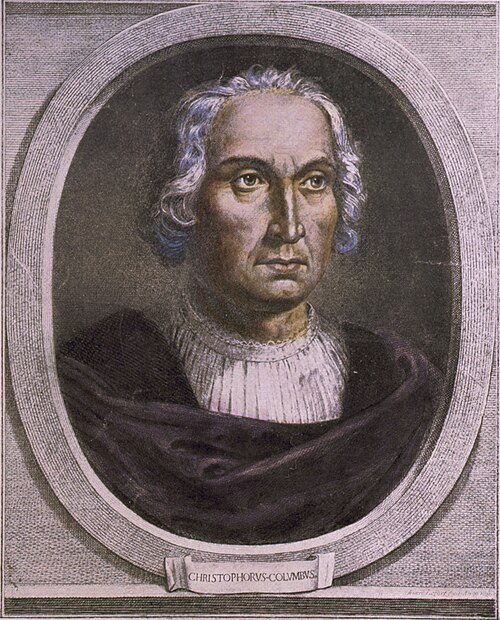
A well-known image of Columbus is a portrait by Sebastiano del Piombo, which has been reproduced in many textbooks. It agrees with descriptions of Columbus in that it shows a large man with auburn hair, but the painting dates from 1519 so cannot have been painted from life. Furthermore, the inscription identifying the subject as Columbus was probably added later, and the face shown differs from that of other images.[348]
Sometime between 1531 and 1536, Alejo Fernández painted an altarpiece, The Virgin of the Navigators, that includes a depiction of Columbus.[349] The painting was commissioned for a chapel in Seville's Casa de Contratación (House of Trade) in the Alcázar of Seville and remains there.[350]
At the World's Columbian Exposition in 1893, 71 alleged portraits of Columbus were displayed; most of them did not match contemporary descriptions.[351]
See also
- Christopher Columbus in fiction
- List of monuments and memorials to Christopher Columbus
- Egg of Columbus
- Diego Columbus
- Ferdinand Columbus
- Columbus's letter on the first voyage
- Christopher Columbus House
- History of the Americas
- Peopling of the Americas
- Lugares colombinos
Notes
- ^ There are no known authentic portraits of Columbus.[1]
- ^ In other relevant languages:
- Italian: Cristoforo Colombo [kriˈstɔːforo koˈlombo]
- Ligurian: Cristoffa C(or)ombo [kɾiˈʃtɔffa kuˈɾuŋbu, – ˈkuŋbu]
- Spanish: Cristóbal Colón [kɾisˈtoβal koˈlon]
- Portuguese: Cristóvão Colombo [kɾiʃˈtɔvɐ̃w kuˈlõbu]
- Catalan: Cristòfor (or Cristòfol) Colom [kɾisˈtɔfuɾ kuˈlom, -ful k-]
- Latin: Christophorus Columbus.
- ^ Though the modern state of Italy had yet to be established, the Latin equivalent of the term Italian had been in use for natives of the region since antiquity; most scholars believe Columbus was born in the Republic of Genoa.[4]
- ^ In an account of his fourth voyage, Columbus wrote that "Jerusalem and Mount Sion must be rebuilt by Christian hands".[51]
- ^ Ferdinand later claimed credit for being "the principal cause why those islands were discovered."[88]
- ^ a b Felipe Fernández-Armesto points out that Columbus briefly described South America as an unknown continent after seeing the mainland for the first time. Vespucci seems to have modeled his naming of the "new world" after Columbus's description of this discovery. Further, mapmaker Martin Waldseemüller eventually retracted his naming of the continent after Vespucci, seemingly after it came to light that a claim that Vespucci visited the mainland before Columbus had been falsified. In his new map, Waldseemüller labelled the continent as Terra Incognita ('unknown land'), noting that it had been discovered by Columbus.[99]
- ^ This map is based on the premise that Columbus first landed at Plana Cays.[100] The island considered by Samuel Eliot Morison to be the most likely location of first contact[101] is the easternmost land touching the top edge of this image.
- ^ According to Samuel Eliot Morison, San Salvador Island, renamed from Watling's Island in 1925 in the belief that it was Columbus's San Salvador,[110] is the only island fitting the position indicated by Columbus's journal. Other candidates are the Grand Turk, Cat Island, Rum Cay, Samana Cay, or Mayaguana.[101]
- ^ Torres spoke Hebrew and some Arabic; the latter was then believed to be the mother tongue of all languages.[122]
- ^ Omitted from this image, Columbus returned to Guadeloupe at the end of his second voyage before sailing back to Spain.[136]
- ^ The tribute system had all but collapsed by 1497.[156]
- ^ Bobadilla's 48-page report, derived from the testimonies of 23 people who had seen or heard about the treatment meted out by Columbus and his brothers—had originally been lost for centuries, but was rediscovered in 2005 in the Spanish archives in Valladolid. It contained an account of Columbus's seven-year reign as the first governor of the Indies. Consuelo Varela, a Spanish historian, states: "Even those who loved him [Columbus] had to admit the atrocities that had taken place."[175]
- ^ DNA from Columbus's presumed remains in Seville were to be used to conduct further ancestral studies, with results initially expected in 2021.[228]
- ^ This same year, dust collected from these remains was placed in a locket, which was placed inside the stern of a silver model caravel. Two tiny portions of dust from the same source were placed in separate vials.[230]
- ^ Osborne erroneously cited the bullet as evidence that the remains belonged to Columbus.[231][229] (England's Francis Drake, a subsequent infamous explorer, took the ball of an arquebus in the Indies.)[232]
- ^ In his 2008 book, author Tony Horwitz recounts his attempt to see these remains, which are apparently briefly displayed in their crypt (behind a sheet of glass) once a year on Columbus Day.[234]
- ^ See: Columbus Monument, Barcelona (1888), Monument to the Discoverers (1892), Monument to Columbus (Madrid) (1892), Monument to Isabella the Catholic (Granada) (1892), Monument to Columbus (Salamanca) (1893), Monument to Columbus (Valladolid) (inaugurated in 1905, but whose inception dates to an earlier date and a tentative location in Spanish Havana).
- ^ Cuneo wrote,
While I was in the boat, I captured a very beautiful Carib woman, whom the said Lord Admiral gave to me. When I had taken her to my cabin she was naked—as was their custom. I was filled with a desire to take my pleasure with her and attempted to satisfy my desire. She was unwilling, and so treated me with her nails that I wished I had never begun. But—to cut a long story short—I then took a piece of rope and whipped her soundly, and she let forth such incredible screams that you would not have believed your ears. Eventually we came to such terms, I assure you, that you would have thought that she had been brought up in a school for whores.[304]
- ^ Author Tony Horwitz notes that this is the first recorded instance of sexuality between a European and Native American.[305]
- ^ Bartolomé de las Casas estimated that there were three to four million Taínos in Hispaniola, and said 500,000 Lucayans were killed in the Bahamas. Most modern historians reject his figures.[320]
References
- ^ Lester, Paul M. (January 1993). "Looks are deceiving: The portraits of Christopher Columbus". Visual Anthropology. 5 (3–4): 211–227. doi:10.1080/08949468.1993.9966590. ISSN 0894-9468.
- ^ "Columbus" Random House Webster's Unabridged Dictionary
- ^ Delaney, Carol (2011). Columbus and the Quest for Jerusalem (1st ed.). United States of America: Free Press/Simon and Schuster. p. 74. ISBN 978-1-4391-0237-4.
- ^ Flint, Valerie I.J. (16 May 2021). "Christopher Columbus". Encyclopedia Britannica. Retrieved 2 January 2022.
- ^ Fernández-Armesto, Felipe (2010). Columbus on Himself. Hackett Publishing. p. 270. ISBN 978-1-60384-317-1.
The date of Fernando's birth, November 1488, gives a terminus ante quem early in that year for the start of Columbus's liaison with Beatriz Enríquez. She was of peasant parentage, but, when Columbus met her, was the ward of a well-to-do relative in Cordoba. A meat business gave her income of her own, mentioned in the only other record of Columbus's solicitude for her: a letter to Diego, written in 1502, just before departure on the fourth Atlantic crossing, in which the explorer enjoins his son to 'take Beatriz Enriquez in your care for love of me, as you your own mother'. Varela, Cristóbal Colón, p. 309.
- ^ Taviani, Paolo Emilio (2016). "Beatriz de Arana". In Bedini, Silvio A. (ed.). The Christopher Columbus Encyclopedia. Springer. pp. 24–25. ISBN 978-1-349-12573-9.
Columbus never married Beatriz. When he returned from the first voyage, he was given the greatest of honors and elevated to the highest position in Spain. Because of his discovery, he became one of the most illustrious persons at the Spanish court and had to submit, like all the great persons of the time, to customary legal restrictions on matters of marriage and extramarital relations. The Alphonsine laws forbade extramarital relations of concubinage for "illustrious people" (king, princes, dukes, counts, marquis) with plebeian women, if they themselves were or their forefathers had been of inferior social condition.
- ^ a b Phillips & Phillips 1992, p. 126.
- ^ Caf Dowlah (2020). Cross-Border Labor Mobility: Historical and Contemporary Perspectives. Palgrave Macmillan. ISBN 9783030365066.
Most researchers however trace the beginning of the early modern era to Christopher Columbus's discovery of the Americas in the 1490s
- ^ Mills, Keneth and Taylor, William B., Colonial Spanish America: A Documentary History, p. 36, SR Books, 1998, ISBN 0-8420-2573-1
- ^ Praga, Corinna; Laura Monac (1992). Una Giornata nella Città [A Day in the City] (in Italian). Genoa: Sagep Editrice. p. 14.
- ^ Preste, Alfredo; Alessandro Torti; Remo Viazzi (1997). "Casa di Colombo". Sei itinerari in Portoria [Six itineraries in Portoria] (PDF) (in Italian). Genova: Grafiche Frassicomo. Archived (PDF) from the original on 9 October 2022.
- ^ Edwards, J. (2014). Ferdinand and Isabella. Routledge. p. 118. ISBN 978-1-317-89345-5.
- ^ Phillips & Phillips 1992, p. 91.
- ^
 Gilman, D. C.; Peck, H. T.; Colby, F. M., eds. (1905). "Columbus, Diego (brother)". New International Encyclopedia (1st ed.). New York: Dodd, Mead. – The names Giacomo and Diego are cognates, along with James, all sharing a common origin. See Behind the Name, Mike Campbell, pages Giacomo, Diego, and James. All retrieved 3 February 2017.
- ^ Bergreen 2011, p. 56.
- ^ King, Ross (2021). The Bookseller of Florence: The Story of the Manuscripts That Illuminated the Renaissance. Atlantic Monthly Press. p. 264. ISBN 978-0-8021-5853-6.
- ^ a b Phillips & Phillips 1992, p. 96.
- ^ Galante, John Starosta (2022). On the Other Shore: The Atlantic Worlds of Italians in South America During the Great War. Univ of Nebraska Press. p. 13. ISBN 978-1-4962-2958-8. Ligurian pronunciation: [kriˈʃtɔffa kuˈɹuŋbu] Consulta Ligure (1982). Vocabolario delle parlate liguri [Vocabulary of Ligurian Speech: Specialized Vocabulary]. Sage. ISBN 978-8-8705-8044-0.
- ^ Sánchez, Joseph P.; Gurulé, Jerry L.; Broughton, William H. (1990). Bibliografia Colombina, 1492–1990: Books, Articles and Other Publications on the Life and Times of Christopher Columbus. National Park Service, Spanish Colonial Research Center. p. ix.
- ^ Bedini, Silvio A. (2016). Bedini, Silvio A. (ed.). The Christopher Columbus Encyclopedia. Springer. p. viii. ISBN 978-1-349-12573-9.
- ^ Wilgus, Alva Curtis (1973). Latin America, 1492–1942: A Guide to Historical and Cultural Development Before World War II. Scarecrow Reprint Corporation. p. 71. ISBN 978-0-8108-0595-8.
- ^ (in Portuguese) "Armas e Troféus." Revista de História, Heráldica, Genealogia e Arte. 1994, VI serie – Tomo VI, pp. 5–52. Retrieved 21 November 2011.[verification needed]
- ^ Davidson 1997, p. 3.
- ^ Phillips & Phillips 1992, p. 85.
- ^ Lyon, Eugene (1992). "Navigation and Ships in the Age of Columbus". In McGovern, James R. (ed.). The World of Columbus. Mercer University Press. pp. 90–91. ISBN 978-0-86554-414-7.
- ^ Phillips & Phillips 1992, p. 93.
- ^ Vigneras, L. A. (2016). "Columbus in Portugal". In Bedini, Silvio A. (ed.). The Christopher Columbus Encyclopedia. Springer. p. 175. ISBN 978-1-349-12573-9.
It is most probable that Columbus visited Bristol, where he was introduced to English commerce with Iceland.
- ^ Ureland, P. Sture (2011). "Introduction". In Ureland, P. Sture; Clarkson, Iain (eds.). Language Contact across the North Atlantic: Proceedings of the Working Groups held at the University College, Galway (Ireland), 1992 and the University of Göteborg (Sweden), 1993. Walter de Gruyter. p. 14. ISBN 978-3-11-092965-2.
- ^ Graves, Charles (1949). Ireland Revisited. Hutchinson. p. 151.
- ^ a b Enterline, James Robert (2003). Erikson, Eskimos & Columbus: Medieval European Knowledge of America. Johns Hopkins University Press+ORM. p. 247. ISBN 978-0-8018-7547-2.
Some writers have suggested that it was during this visit to Iceland that Columbus heard of land in the west. Keeping the source of his information secret, they say, he concocted a plan to sail westward. Certainly the knowledge was generally available without attending any saga-telling parties. That this knowledge reached Columbus seems unlikely, however, for later, when trying to get backing for his project, he went to great lengths to unearth even the slightest scraps of information that would add to the plausibility of his scheme. Knowledge of the Norse explorations could have helped.
- ^ a b Paolucci, Anne; Paolucci, Henry (1992). Columbus, America, and the World. Council on National Literatures. p. 140. ISBN 978-0-918680-33-4.
Many Columbists ... have doubted that Columbus could ever have gone to Iceland.
- ^ a b c d Kolodny, Annette (2012). In Search of First Contact: The Vikings of Vinland, the Peoples of the Dawnland, and the Anglo-American Anxiety of Discovery. Duke University Press. pp. 226–227. ISBN 978-0-8223-5286-0.
- ^ a b Quinn, David B. (1992). "Columbus and the North: England, Iceland, and Ireland". The William and Mary Quarterly. 49 (2): 278–297. doi:10.2307/2947273. ISSN 0043-5597. JSTOR 2947273.
- ^ Fernández-Armesto, Felipe (1991). Columbus. Oxford University Press. p. xvii. ISBN 978-0-19-215898-7.
- ^ Freitas, Antonio Maria de; Maney, Regina (1893). The Wife of Columbus: With Genealogical Tree of the Perestrello and Moniz Families. New York City: Stettinger, Lambert & Co. p. 32.
- ^ Alessandrini, Nunziatella (1 January 2012). "Os Perestrello: uma família de Piacenza no Império Português (século XVI)" [The Perestrellos: A Piacenza family in the Portuguese Empire (16th century)] (in Portuguese). Lisbon: Universidade NOVA de Lisboa. p. 90.
Finally, the most famous son of Filippone, Bartolomeu Perestrello (I), who participated in the rediscovery of the island of Madeira in 1418, and was captain and feitor [administrator] of Porto Santo until, by a letter of 1 November 1446 from Infante Henrique, he became the first donatary captain of the island, a privilege that continued until the 19th century, with the last donatary captain Manuel da Câmara Bettencourt Perestrello in 1814.
- ^ Suranyi, Anna (2015). The Atlantic Connection: A History of the Atlantic World, 1450–1900. Routledge. p. 17. ISBN 978-1-317-50066-7.
- ^ Dyson 1991, p. 63.
- ^ Taviani, Paolo Emilio (2016). "Beatriz Arana". In Bedini, Silvio A. (ed.). The Christopher Columbus Encyclopedia. Springer. p. 24. ISBN 978-1-349-12573-9.
- ^ Taviani, "Beatriz Arana" in The Christopher Columbus Encyclopedia, vol. 1, pp. 24–25.
- ^ Morgan, Edmund S. (October 2009). "Columbus' Confusion About the New World". Smithsonian Magazine.
- ^ Davidann, Jon; Gilbert, Marc Jason (2019). Cross-Cultural Encounters in Modern World History, 1453–Present. Routledge. p. 39. ISBN 978-0-429-75924-6.
- ^ Phillips & Phillips 1992, p. 108.
- ^ Boxer, Charles Ralph (1967). The Christian Century in Japan, 1549–1650. University of California Press.
- ^ a b Phillips & Phillips 1992, p. 227.
- ^ a b c Murphy & Coye 2013.
- ^ Muzio, Tim Di (12 December 2017). The Tragedy of Human Development: A Genealogy of Capital as Power. Rowman & Littlefield. p. 58. ISBN 978-1-78348-715-8.
- ^ Echevarría, Roberto Gonzalez; Pupo-Walker, Enrique (13 September 1996). The Cambridge History of Latin American Literature. Cambridge University Press. p. 63. ISBN 978-0-521-34069-4.
- ^ Johanyak, D.; Lim, W. (29 March 2010). The English Renaissance, Orientalism, and the Idea of Asia. Springer. p. 136. ISBN 978-0-230-10622-2.
- ^ King, William Casey (29 January 2013). Ambition, A History: From Vice to Virtue. Yale University Press. ISBN 978-0-300-18984-1.
- ^ Sheehan, Kevin Joseph (2008). Iberian Asia: the strategies of Spanish and Portuguese empire building, 1540–1700 (Thesis). OCLC 892835540. ProQuest 304693901.[page needed]
- ^ Delaney, Carol (8 March 2006). "Columbus's Ultimate Goal: Jerusalem" (PDF). Comparative Studies in Society and History. 48 (2). Cambridge University Press: 260–92. doi:10.1017/S0010417506000119. JSTOR 3879352. S2CID 144148903. Archived from the original (PDF) on 26 February 2020.
- ^ Hamdani, Abbas (1979). "Columbus and the Recovery of Jerusalem". Journal of the American Oriental Society. 99 (1). Ann Arbor, Michigan: American Oriental Society: 39–48. doi:10.2307/598947. JSTOR 598947.
- ^ Murphy & Coye 2013, p. 244.
- ^ Willoz-Egnor, Jeanne (2013). "Mariner's Astrolabe". Institute of Navigation. Archived from the original on 29 October 2013. Retrieved 5 July 2021.
- ^ Smith, Ben (1 January 2002). "An astrolabe from Passa Pau, Cape Verde Islands". International Journal of Nautical Archaeology. 31 (1): 99–107. Bibcode:2002IJNAr..31...99S. doi:10.1006/ijna.2002.1021.
- ^ Ridpath, Ian (2001). The Illustrated Encyclopedia of the Universe. New York: Watson-Guptill. p. 31. ISBN 978-0-8230-2512-1.
- ^ Sagan, Carl (1980). Cosmos. New York City: Random House. pp. 34–35. ISBN 978-0-3945-0294-6. Retrieved 20 February 2022.
- ^ Freely, John (2013). Before Galileo: The Birth of Modern Science in Medieval Europe. New York City: Abrams Books. p. 36. ISBN 978-1-4683-0850-1.
- ^ "Marco Polo et le Livre des Merveilles", p. 37. ISBN 978-2-35404-007-9
- ^ Randles, W. G. L. (January 1990). "The Evaluation of Columbus' 'India' Project by Portuguese and Spanish Cosmographers in the Light of the Geographical Science of the Period" (PDF). Imago Mundi. 42 (1): 50. doi:10.1080/03085699008592691. ISSN 0308-5694. S2CID 129588714. Archived (PDF) from the original on 9 October 2022.
- ^ Khairunnahar; Mahmud, Khandakar Hasan; Islam, Md Ariful (2017). "Error calculation of the selected maps used in the Great Voyage of Christopher Columbus". The Jahangirnagar Review, Part II. XLI. Jahangirnagar University: 67. ISSN 1682-7422. Retrieved 9 January 2022.
- ^ a b McCormick, Douglas (9 October 2012). "Columbus's Geographical Miscalculations". IEEE Spectrum. Retrieved 9 January 2022.
- ^ Gunn, Geoffrey C. (2018). Overcoming Ptolemy: The Revelation of an Asian World Region. Rowman & Littlefield. pp. 77–78. ISBN 978-1-4985-9014-3.
Constructed on a framework of latitude and longitude, the Ptolemy-revival map projections revealed the extent of the known world in relation to the whole. Typically, they displayed a Eurasian landmass extending through 180° of longitude from a prime meridian in the west (variously the Canary Islands or Cape Verde) to a location in the "Far East."
- ^ Zacher, Christian K. (2016). Bedini, Silvio A. (ed.). The Christopher Columbus Encyclopedia. Springer. pp. 676–677. ISBN 978-1-349-12573-9.
- ^ Dilke, O. A. W. (2016). "Marinus of Tyre". In Bedini, Silvio A. (ed.). The Christopher Columbus Encyclopedia. Springer. p. 452. ISBN 978-1-349-12573-9.
- ^ Morison, Samuel Eliot (1974). The European Discovery of America: The Southern Voyages A.D. 1492–1616. Oxford University Press. p. 31. ISBN 978-0-19-501377-1.
- ^ Butel, Paul (2002). The Atlantic. Routledge. p. 47. ISBN 978-1-134-84305-3.
- ^ Morison 1991.
- ^ Phillips & Phillips 1992, p. 110.
- ^ Edson, Evelyn (2007). The World Map, 1300–1492: The Persistence of Tradition and Transformation. JHU Press. p. 205. ISBN 978-0-8018-8589-1.
- ^ Taylor, Alan (2002). American Colonies: The Settling of North America (The Penguin History of the United States, Volume 1). Penguin. p. 34. ISBN 978-0-14-200210-0.
- ^ Jensen, De Lamar (1992). Renaissance Europe (2nd ed.). Lexington, Massachusetts: D.C. Heath and Company. p. 341. ISBN 9780669200072.
- ^ Gómez, Nicolás Wey (2008). The Tropics of Empire: Why Columbus Sailed South to the Indies. MIT Press. p. 37. ISBN 978-0-262-23264-7.
It is also known that wind patterns and water currents in the Atlantic were crucial factors for launching an outward passage from the Canaries: Columbus understood that his chance of crossing the ocean was significantly greater just beyond the Canary calms, where he expected to catch the northeastern trade winds—although, as some authors have pointed out, "westing" from the Canaries, instead of dipping farther south, was hardly an optimal sailing choice, since Columbus's fleet was bound to lose, as soon it did, the northeasterlies in the mid-Atlantic.
- ^ Morison 1991, p. 132.
- ^ Morison 1991, p. 314.
- ^ Rickey, V. Frederick (1992). "How Columbus Encountered America". Mathematics Magazine. 65 (4): 219–225. doi:10.2307/2691445. ISSN 0025-570X. JSTOR 2691445.
- ^ Morison 1991, pp. 198–99.
- ^ Rickey, V. Frederick (1992). "How Columbus Encountered America". Mathematics Magazine. 65 (4): 224. doi:10.2307/2691445. ISSN 0025-570X. JSTOR 2691445.
- ^ Morison 1991, pp. 68–70.
- ^ Pinheiro-Marques, Alfredo (2016). "Diogo Cão". In Bedini, Silvio A. (ed.). The Christopher Columbus Encyclopedia. Springer. p. 97. ISBN 978-1-349-12573-9.
- ^ Symcox, Geoffrey; Sullivan, Blair (2016). Christopher Columbus and the Enterprise of the Indies: A Brief History with Documents. Springer. pp. 11–12. ISBN 978-1-137-08059-2.
in 1488 Columbus returned to Portugal and once again put his project to João II. Again it was rejected. In historical hindsight this looks like a fatally missed opportunity for the Portuguese crown, but the king had good reason not to accept Columbus's project. His panel of experts cast grave doubts on the assumptions behind it, noting that Columbus had underestimated the distance to China. And then in December 1488 Bartolomeu Dias returned from his voyage around the Cape of Good Hope. Certain now that they had found the sea route to India and the east, João II and his advisers had no further interest in what probably seemed to them a hare-brained and risky plan.
- ^ Dyson 1991, p. 84.
- ^ Durant, Will The Story of Civilization vol. vi, "The Reformation". Chapter XIII, p. 260.
- ^ Dyson 1991, pp. 86, 92.
- ^ Dyson 1991, p. 92.
- ^ Morrison, Geoffrey (15 October 2015). "Exploring The Alhambra Palace And Fortress In Granada, Spain". Forbes. Archived from the original on 16 October 2015. Retrieved 24 May 2021.
- ^ a b c Phillips & Phillips 1992, pp. 131–32.
- ^ Lantigua, David M. (2020). Infidels and Empires in a New World Order: Early Modern Spanish Contributions to International Legal Thought. Cambridge University Press. p. 53. ISBN 978-1-108-49826-5.
The Capitulaciones de Santa Fe appointed Columbus as the official viceroy of the Crown, which entitled him, by virtue of royal concession, to all the honors and jurisdictions accorded the conquerors of the Canaries. Usage of the terms "to discover" (descubrir) and "to acquire" (ganar) were legal cues indicating the goals of Spanish possession through occupancy and conquest.
- ^ Morison 1991, p. 662.
- ^ a b González Sánchez, Carlos Alberto (2006). "Capitulations of Santa Fe". In Kaufman, Will; Francis, John Michael (eds.). Iberia and the Americas: Culture, Politics, and History: a Multidisciplinary Encyclopedia. ABC-CLIO. pp. 175–176. ISBN 978-1-85109-421-9.
- ^ Sánchez-Barba, Mario Hernández (2006). "Cristóbal Colón en presencia de la muerte (1505–1506)" (PDF). Cuadernos Monográficos del Instituto de Historia y Cultural Naval (50). Madrid: 51. Archived (PDF) from the original on 9 October 2022.
- ^ Márquez, Luis Arranz (1982). Don Diego Colón, almirante, virrey y gobernador de las Indias (in Spanish). Editorial CSIC – CSIC Press. p. 175, note 4. ISBN 978-84-00-05156-3.
- ^ a b McDonald, Mark P. (2005). Ferdinand Columbus: Renaissance Collector (1488–1539). British Museum Press. p. 41. ISBN 978-0-7141-2644-9.
- ^ Specht, Joshua; Stockland, Etienne (2017). The Columbian Exchange. CRC Press. p. 23. ISBN 978-1-351-35121-8.
- ^ a b Morison 1991, p. 381.
- ^ Horodowich, Elizabeth (2017). "Italy and the New World". In Horodowich, Elizabeth; Markey, Lia (eds.). The New World in Early Modern Italy, 1492–1750. Cambridge University Press. p. 23. ISBN 978-1-108-50923-7.
- ^ Cohen, Jonathan. "The Naming of America". Umc.sunysb.edu. Archived from the original on 29 October 2013. Retrieved 10 April 2011.
- ^ Fernández-Armesto, Felipe (2007). Amerigo: The Man Who Gave His Name to America (1st ed.). New York: Random House. pp. 143–44, 186–87. ISBN 978-1-4000-6281-2. OCLC 608082366.
- ^ Pickering, Keith A. (August 1994). "Columbus's Plana landfall: Evidence for the Plana Cays as Columbus's 'San Salvador'" (PDF). DIO – the International Journal of Scientific History. 4 (1): 13–32. Archived (PDF) from the original on 9 October 2022. Retrieved 16 March 2009.
- ^ a b Morison 1991, p. 228.
- ^ a b Dyson 1991, p. 102.
- ^ "The Original Niña". The Niña & Pinta. British Virgin Islands: The Columbus Foundation. Archived from the original on 26 May 2015. Retrieved 12 October 2013.
- ^ Phillips & Phillips 1992, pp. 146–47.
- ^ Nicholls, Steve (2009). Paradise Found: Nature in America at the Time of Discovery. Chicago: University of Chicago Press. pp. 103–104. ISBN 978-0-226-58340-2.
- ^ Morison 1991, p. 226.
- ^ Lopez, (1990, p. 14); Columbus & Toscanelli (2010, p. 35)
- ^ Lopez, (1990, p. 15)
- ^ Bergreen 2011, p. 99.
- ^ William D. Phillips Jr., 'Columbus, Christopher', in David Buisseret (ed.), The Oxford Companion to World Exploration, (Oxford: Oxford University Press, online edition 2012).
- ^ Dunn, Oliver; Kelley, James E. Jr. (1989). The Diario of Christopher Columbus's First Voyage to America, 1492–1493. University of Oklahoma Press. pp. 67–69. ISBN 978-0-8061-2384-4.
- ^ Hoxie, Frederick (1996). Encyclopedia of North American Indians. Boston: Houghton Mifflin Co. p. 568. ISBN 978-0-395-66921-1.
- ^ Keegan, William F. (1 January 2015). "Mobility and Disdain: Columbus and Cannibals in the Land of Cotton". Ethnohistory. 62 (1): 1–15. doi:10.1215/00141801-2821644.
- ^ a b c d e f Zinn 2003, pp. 1–22
- ^ Columbus (1991, p. 87). Or "these people are very simple as regards the use of arms ... for with fifty men they can all be subjugated and made to do what is required of them." (Columbus & Toscanelli, 2010, p. 41)
- ^ Figueredo, D. H. (2008). A Brief History of the Caribbean. Infobase Publishing. p. 9. ISBN 978-1438108315.
- ^ Deagan, Kathleen A. (2008). Columbus's Outpost Among the Taínos: Spain and America at La Isabela, 1493-1498. Yale University Press. p. 32. ISBN 978-0300133899.
- ^ Hunter, Douglas (2012). The Race to the New World: Christopher Columbus, John Cabot, and a Lost History of Discovery. Macmillan. p. 62. ISBN 978-0-230-34165-4.
- ^ Magasich-Airola, Jorge; Beer, Jean-Marc de (2007). America Magica (2nd edition): When Renaissance Europe Thought It Had Conquered Paradise. Anthem Press. p. 61. ISBN 978-1-84331-292-5.
- ^ Anderson-Córdova, Karen F. (2017). Surviving Spanish Conquest: Indian Fight, Flight, and Cultural Transformation in Hispaniola and Puerto Rico. University of Alabama Press. p. 55. ISBN 978-0-8173-1946-5.
- ^ Murphy & Coye 2013, pp. 31–32.
- ^ a b Morison 1991, p. 145.
- ^ a b Deagan, Kathleen; Cruxent, José Maria (1993). "From Contact to Criollos: The Archaeology of Spanish Colonization in Hispaniola" (PDF). Proceedings of the British Academy. 81: 73. Archived (PDF) from the original on 9 October 2022.
- ^ Maclean, Frances (January 2008). "The Lost Fort of Columbus". Smithsonian Magazine. Retrieved 24 January 2008.
- ^ Gužauskytė, Evelina (2014). Christopher Columbus's Naming in the 'diarios' of the Four Voyages (1492–1504): A Discourse of Negotiation. University of Toronto Press. p. 96. ISBN 978-1-4426-6825-6.
- ^ Fuson, Robert. The Log of Christopher Columbus (Camden, International Marine, 1987) 173.
- ^ Yewell, John; Chris Dodge (1992). Confronting Columbus: An Anthology. Jefferson, NC: McFarland & Company. p. 33. ISBN 978-0-89950-696-8. Retrieved 28 February 2016.
- ^ Markham, Clements R. (1893). The Journal of Christopher Columbus. London: Hakluyt Society. pp. 159–160. Retrieved 28 February 2016.
- ^ Dunn, Oliver; Kelley, James E. Jr. (1989). The Diario of Christopher Columbus's First Voyage to America, 1492–1493. University of Oklahoma Press. p. 341. ISBN 978-0-8061-2384-4.
- ^ Catz, Rebecca (1990). "Columbus in the Azores". Portuguese Studies. 6: 19–21. JSTOR 41104900.
- ^ Kamen, Henry (2014). Spain, 1469–1714: A Society of Conflict. Routledge. p. 51. ISBN 978-1-317-75500-5.
- ^ Fernández-Armesto, Felipe (2007). Amerigo: The Man Who Gave His Name to America. New York: Random House. ISBN 978-1-4000-6281-2.
- ^ Ife, Barry (1992). "Early Modern Spain: Introduction to the Letters from America". King's College London. Archived from the original on 24 April 2021. Retrieved 15 January 2022.
- ^ Diffie, Bailey Wallys (1977). Foundations of the Portuguese Empire, 1415–1580. Winius, George D. Minneapolis: University of Minnesota Press. p. 173. ISBN 0-8166-0782-6. OCLC 3488742.
- ^ Veciana-Suarez, Ana (22 January 2017). "This college donation is truly historic. And it's not just the artifacts involved". Miami Herald. Archived from the original on 23 February 2017. Retrieved 22 February 2017.
- ^ Morison 1991, pp. 498–501.
- ^ a b Deagan, Kathleen A.; Cruxent, José María (2008). Archaeology at La Isabela: America's First European Town. Yale University Press. p. xxxix (5). ISBN 978-0-300-13391-2.
- ^ a b Bedini, Silvio A. (2016). Bedini, Silvio A. (ed.). The Christopher Columbus Encyclopedia. Springer. p. 705. ISBN 978-1-349-12573-9.
- ^ Morison, Samuel Eliot (1986). The Great Explorers: The European Discovery of America. Oxford University Press. pp. 440, 448, 449. ISBN 978-0-19-504222-1.
- ^ Morison 1991, pp. 423–27.
- ^ Antonio de la Cova. "The Spanish Conquest of the Tainos". Latin American Studies. Antonio Rafael de la Cova. Retrieved 10 July 2011.
- ^ Las Casas, Bartolomé, Las Casas on Columbus: Background and the 2nd and 4th Voyages (consisting of a section of History of the Indies by Las Casas, and commentary), Translated and Edited by Nigel Griffen, Brepols Publishers, Turnhout, Belgium, 1999 (original work: 1535), pg 96-97
- ^ "Teeth Of Columbus's Crew Flesh Out Tale Of New World Discovery". ScienceDaily. 20 March 2009.
- ^ a b Austin Alchon, Suzanne (2003). A Pest in the Land: New World Epidemics in a Global Perspective. University of New Mexico Press. p. 62. ISBN 978-0-8263-2871-7. Retrieved 28 February 2016.
- ^ Las Casas, Las Casas on Columbus, Background and the 2nd and 4th Voyages, pg 118-130
- ^ Las Casas, Las Casas on Columbus, Background and the 2nd and 4th Voyages, pg 117-118
- ^ Las Casas, Las Casas on Columbus, Background and the 2nd and 4th Voyages, pg 130-134, 137-138, 147-149
- ^ Yeager, Timothy J. (3 March 2009). "Encomienda or Slavery? The Spanish Crown's Choice of Labor Organization in Sixteenth-Century Spanish America". The Journal of Economic History. 55 (4): 842–859. doi:10.1017/S0022050700042182. JSTOR 2123819. S2CID 155030781.
- ^ Lyle N. McAlister (1984). Spain and Portugal in the New World, 1492–1700. University of Minnesota Press. p. 164. ISBN 0-8166-1218-8.
- ^ De Cuneo, Michele. "Michel de Cuneo's Letter on the Second Voyage, 28 October 1495." Journal and other Documents in the Life of Christopher Columbus. Edited and Translated by Samuel Eliot Morison. New York: The Heritage Press, 1963. pg 215
- ^ Cólon, Ferdinand. The Life of The Admiral Christopher Columbus by His Son Ferdinand. Edited and translated by Benjamin Keen. New Jersey: Rutgers University Press, 1959 (Originally published 1571), pg 129
- ^ Morison 1991, pp. 482–85.
- ^ Olson, Julius E. and Edward G. Bourne (editors). "The Northmen, Columbus and Cabot, 985–1503", in The Voyages of the Northmen; The Voyages of Columbus and of John Cabot. (New York: Charles Scribner's Sons, 1906), pp. 369–383.
- ^ a b Stannard, David E. (1993). American Holocaust: The Conquest of the New World. Oxford, England: Oxford University Press. p. 69. ISBN 978-0-19-983898-1.
- ^ Koning, Hans. Columbus, His Enterprise: Exploding the Myth. New York: Monthly Review Press, 1976: 83–83.
- ^ Deagan, Kathleen A.; Cruxent, José María (2008). Columbus's Outpost Among the Taínos: Spain and America at La Isabela, 1493–1498. New Haven, CT: Yale University Press. p. 62. ISBN 978-0-300-13389-9.
- ^ a b c d Dyson 1991, pp. 183, 190.
- ^ Cohen, Rhaina; Penman, Maggie; Boyle, Tara; Vedantam, Shankar (20 November 2017). "An American Secret: The Untold Story Of Native American Enslavement". NPR. Archived from the original on 21 November 2017. Retrieved 25 May 2021.
- ^ Fernández-Armesto, Felipe (2007). Amerigo: The Man Who Gave His Name to America. New York: Random House. pp. 54–55. ISBN 978-1-4000-6281-2.
- ^ Morison 1991, p. 497.
- ^ Cook, Noble David (1998). Born to Die: Disease and New World Conquest, 1492–1650. Cambridge, England: Cambridge University Press. p. 36. ISBN 978-0-521-62730-6.
- ^ a b Saunders, Nicholas J. (2005). The Peoples of the Caribbean: An Encyclopedia of Archaeology and Traditional Culture. ABC-CLIO. pp. 75–76. ISBN 978-1-57607-701-6.
- ^ Flint, Valerie Irene Jane (2017). The Imaginative Landscape of Christopher Columbus. Princeton University Press. p. 158. ISBN 978-1-4008-8717-0.
- ^ a b c d Fuson, Robert H. (1997). "The Columbian Voyages". In Allen, John Logan (ed.). North American Exploration. U of Nebraska Press. pp. 180–181. ISBN 978-0-8032-1015-8.
- ^ Bergreen 2011, p. 249.
- ^ a b Zerubavel, Eviatar (2003). Terra Cognita: The Mental Discovery of America. Transaction Publishers. pp. 90–91. ISBN 978-0-7658-0987-2.
- ^ Cervantes, Fernando (2021). Conquistadores: A New History of Spanish Discovery and Conquest. Penguin. p. 41. ISBN 978-1-101-98128-3.
- ^ Bergreen 2011, p. 258.
- ^ Morison, Samuel Eliot; Obregón, Mauricio (1964). The Caribbean as Columbus Saw it. Little, Brown. p. 11.
- ^ Bergreen 2011, pp. 284–85.
- ^ Brink, Christopher (2019). Christopher Columbus: Controversial Explorer of the Americas. Cavendish Square Publishing. p. 78.
- ^ Hofmann, Heinz (1994). "Columbus in Neo-Latin Epic Poetry". In Haase, Wolfgang; Meyer, Reinhold (eds.). The Classical Tradition and the Americas: European Images of the Americas and the Classical Tradition (2 pts.). Walter de Gruyter. ISBN 978-3-11-011572-7.
- ^ Phillips & Phillips 1992, p. 125.
- ^ Bergreen 2011, pp. 276–77.
- ^ a b Tremlett, Giles (7 August 2006). "Lost document reveals Columbus as tyrant of the Caribbean". The Guardian. Retrieved 16 May 2013.
- ^ Bergreen 2011, pp. 283.
- ^ "Columbus Controversy". A&E Television Networks. Retrieved 12 August 2013.
- ^ a b Hale, Edward Everett (1 January 2021). The Life of Christopher Columbus. Prabhat Prakashan.
- ^ Columbus, Christopher (2010). Select Letters of Christopher Columbus : With Other Original Documents, Relating to his Four Voyages to the New World. Richard Henry Major, Diego Alvarez Chanca. Cambridge: Cambridge University Press. ISBN 978-0-511-70808-4. OCLC 889952068.
- ^ Felipe Fernández-Armesto (2010). Columbus on himself. Christopher Columbus. Indianapolis: Hackett Pub. Co. p. 186. ISBN 978-1-60384-317-1. OCLC 794493189.
Bobadilla was prejudiced in advance by what he heard, or what the monarchs relayed, from Columbus detractors. HIs brief was to conduct a judicial inquiry into Columbus' conduct, an unjust proceeding, in the Admiral's submission, since Bobadilla had a vested interest in an outcome that would keep him in power. [...] Motivated by self-interest or excessive zeal, Bobadilla clapped Columbus in irons with his brothers, gathered depositions against them, and shipped them back to Spain.
- ^ "National Association of Scholars – Remembering Columbus: Blinded by Politics by Robert Carle". www.nas.org. Retrieved 18 June 2020.
- ^ Cervantes, Fernando (2021). Conquistadores: A New History of Spanish Discovery and Conquest. [New York, New York]: Penguin. pp. 46–47. ISBN 978-1-101-98128-3.
- ^ Bergreen 2011, p. 276.
- ^ Gužauskytė, Evelina (2014). Christopher Columbus's Naming in the 'diarios' of the Four Voyages (1492–1504): A Discourse of Negotiation. University of Toronto Press. p. 179. ISBN 978-1-4426-6825-6.
- ^ Cervantes, Fernando (2021). Conquistadores : a new history of Spanish discovery and conquest (1 ed.). New York, New York: Penguin Publishing Group. ISBN 978-1-101-98126-9. OCLC 1258043161.
- ^ Noble, David Cook. "Nicolás de Ovando" in Encyclopedia of Latin American History and Culture, vol.4, p. 254. New York: Charles Scribner's Sons 1996.
- ^ Leon, Istvan Szaszdi (1 January 2012). "Castilian Justice and Columbian Injustice. The end of the Columbian Government in Hispaniola". Journal on European History of Law. 3 (2): 9.
- ^ Varela, Consuelo; Aguirre, Isabel (2006). La caída de Cristóbal Colón: el juicio de Bobadilla (in Spanish). Marcial Pons Historia. p. 175. ISBN 978-84-96467-28-6.
- ^ Some scholars, including Sauer, say the fleet sailed 11 May; Cook says 9 May.
- ^ a b Sauer, Carl Ortwin (2008). The Early Spanish Main. Cambridge University Press. pp. 121–122. ISBN 978-0-521-08848-0.
- ^ Cook, Noble David (1998). Born to Die: Disease and New World Conquest, 1492–1650. Cambridge University Press. p. 46. ISBN 978-0-521-62730-6.
- ^ Bergreen 2011, pp. 288–89, 302–3.
- ^ Gužauskytė, Evelina (2014). Christopher Columbus's Naming in the 'diarios' of the Four Voyages (1492–1504): A Discourse of Negotiation. University of Toronto Press. p. 185. ISBN 978-1-4426-6825-6.
- ^ Bedini, Silvio A. (2016). Bedini, Silvio A. (ed.). The Christopher Columbus Encyclopedia. Springer. p. 200. ISBN 978-1-349-12573-9.
- ^ Armas, Antonio Rumeu de (1985). Nueva luz sobre las capitulaciones de Santa Fe de 1492 concertadas entre los Reyes Católicos y Cristóbal Colón: estudio institucional y diplomático (in Spanish). Editorial CSIC – CSIC Press. p. 201. ISBN 978-84-00-05961-3.
- ^ Colindres, Enrique Ortez (1975). Integración Política de Centroamérica (in Spanish). Editorial Universitaria Centroamericana. p. 20.
El 14 de agosto de 1502 Cristóbal Colón descubrió Punta Caxinas, hoy Punta Castilla o Cabo de Honduras.
- ^ Calvo, Alfredo Castillero (2004). Historia general de Panamá: Tomo 1. Las sociedades originarias; El orden colonial. Tomo 2. El orden colonial (in Spanish). Comité Nacional del Centenario de la República. p. 86. ISBN 978-9962-02-581-8.
- ^ Bedini, Silvio A. (2016). Bedini, Silvio A. (ed.). The Christopher Columbus Encyclopedia. Springer. pp. 720, 724. ISBN 978-1-349-12573-9.
- ^ Stirling, Matthew Williams; Stirling, Marion (1964). Archeological Notes on Almirante Bay, Bocas Del Toro, Panama. U.S. Government Printing Office.
- ^ Bergreen 2011, p. 330.
- ^ Bergreen 2011, p. 330–332.
- ^ Méndez, Diego (2020). "VIII: Shipwrecked by Worms, Saved by Canoe: The Last Voyage of Columbus". In Roorda, Paul (ed.). The Ocean Reader: History, Culture, Politics. Duke University Press. p. 300. doi:10.1515/9781478007456-065. ISBN 978-1-4780-0745-6. S2CID 241132438.
- ^ a b Vigneras, Louis André (1 November 1978). "Diego Méndez, Secretary of Christopher Columbus and Alguacil Mayor of Santo Domingo: A Biographical Sketch". Hispanic American Historical Review. 58 (4): 680. doi:10.1215/00182168-58.4.676. ISSN 0018-2168. Retrieved 26 January 2022.
- ^ Hakim, Joy (2002). The First Americans. Oxford University Press. p. 85. ISBN 978-0-19-515319-4.
- ^ Clayton J., Drees, The Late Medieval Age of Crisis and Renewal: 1300–1500 a Biographical Dictionary, 2001, p. 511
- ^ Kadir, Djelal (1992). "IV: Charting the Conquest". Columbus and the Ends of the Earth: Europe's Prophetic Rhetoric as Conquering Ideology. Berkeley, California: University of California Press. p. 67.
- ^ Rivera, Luis N.; Pagán, Luis Rivera (1992). A Violent Evangelism: The Political and Religious Conquest of the Americas. Westminster John Knox Press. p. 5. ISBN 978-0-664-25367-7.
- ^ Watts, Pauline Moffitt (1985). "Prophecy and Discovery: On the Spiritual Origins of Christopher Columbus's "Enterprise of the Indies"". The American Historical Review. 90 (1): 92. doi:10.2307/1860749. ISSN 0002-8762. JSTOR 1860749.
- ^ a b "Christopher Columbus Suffered From a Fatal Form of Arthritis" (Press release). University of Maryland School of Medicine. 6 May 2005. Archived from the original on 23 January 2018.
- ^ Hoenig, Leonard J. (1 February 1992). "The Arthritis of Christopher Columbus". Archives of Internal Medicine. 152 (2): 274–277. doi:10.1001/archinte.1992.00400140028008. PMID 1472175.
- ^ Arnett, F.; Merrill, C.; Albardaner, Francesc; Mackowiak, P. (September 2006). "A Mariner with Crippling Arthritis and Bleeding Eyes". The American Journal of the Medical Sciences. 332 (3): 125. doi:10.1097/00000441-200609000-00005. PMID 16969141. S2CID 6358022.
- ^ Tarver, H. Micheal; Slape, Emily (2016). Tarver, H. Micheal; Slape, Emily (eds.). The Spanish Empire: A Historical Encyclopedia [2 volumes]: A Historical Encyclopedia. ABC-CLIO. p. 143. ISBN 978-1-61069-422-3.
- ^ "Esclarecen causas de muerte de Cristóbal Colón". El Universal (in Spanish). 25 February 2007. Retrieved 2 February 2022.
- ^ Scott, Ian C.; Galloway, James B.; Scott, David L. (2015). Inflammatory Arthritis in Clinical Practice. Springer. p. 4. ISBN 978-1-4471-6648-1.
- ^ Ritchlin, Christopher T.; FitzGerald, Oliver (2007). Psoriatic and Reactive Arthritis: A Companion to Rheumatology. Elsevier Health Sciences. p. 132. ISBN 978-0-323-03622-1.
- ^ Cuartero y Huerta 1988, p. 74.
- ^ Kadir, Djelal (1992). "Chapter VII Making Ends Meet: The Dire Unction of Prophecy". Columbus and the Ends of the Earth: Europe's Prophetic Rhetoric as Conquering Ideology. Berkeley, California: University of California Press. pp. 193–194.
- ^ Cuartero y Huerta, Baltasar (1988). "Los Colón en la Cartuja" (PDF). Boletín de la Real Academia Sevillana de Buenas Letras: Minervae Baeticae. 16: 74. Archived (PDF) from the original on 9 October 2022.
- ^ Dyson 1991, p. 194.
- ^ a b Dyson 1991, p. 196.
- ^ Nash, Elizabeth (2005). Seville, Cordoba, and Granada: A Cultural History. Oxford University Press, USA. p. 73. ISBN 978-0-19-518204-0.
- ^ a b "'Columbus bones' for DNA tests". The Guardian. 3 June 2003. Archived from the original on 27 August 2013. Retrieved 20 March 2022.
- ^ Olaya, Vicente G. (24 May 2021). "Study of Christopher Columbus' DNA set to reveal his true origins". El País. Retrieved 3 February 2022.
- ^ Captain George Farquar of Lord Stanley brought the news to Liverpool in 1796 that while he had been at Havana, the Spanish ship of the line San Lorenzo had arrived there carrying the "coffin, bones and fetters of Christopher Columbus" from San Domingo to be re-interred at Havana with "the highest military honours."
- ^ a b c Associated Press (20 May 2006). "DNA verifies Columbus' remains in Spain". MSNBC. Archived from the original on 31 October 2013. Retrieved 15 August 2020.
- ^ Tremlett, Giles (11 August 2004). "Young bones lay Columbus myth to rest". The Guardian. Retrieved 26 October 2014.
- ^ Álvarez-Cubero, M.J.; Martinez-Gonzalez, L.J.; Saiz, M.; Álvarez, J.C.; Lorente, J.A. (June 2010). "Nuevas aplicaciones en identificación genética" [New applications in genetic identification]. Cuadernos de Medicina Forense (in Spanish). 16 (1–2). doi:10.4321/S1135-76062010000100002.
- ^ "Countdown begins to discover where Columbus came from". AP News. 19 May 2021. Archived from the original on 19 May 2021. Retrieved 21 May 2021.
- ^ a b Bergreen 2011, pp. 363–64.
- ^ Thacher, John Boyd (1904). Christopher Columbus: his life, his works, his remains: as revealed by original printed and manuscript records, together with an essay on Peter Martyr of Anghera and Bartolomé de las Casas, the first historians of America. New York: G. P. Putnam's Sons. pp. 570–73.
- ^ a b "Columbus Buried In San Domingo?". Evening Star. 17 July 1913. p. 11. Archived from the original on 2 January 2020. Retrieved 15 August 2020 – via Newspapers.com.
- ^ Bergreen, Laurence (2021). In Search of a Kingdom. Boston: Mariner Books. p. 188. ISBN 978-0062875358.
- ^ Álvarez-Cubero, M.J.; Mtnez.-Gonzalez, L.J.; Saiz, M.; Álvarez, J.C.; Lorente, J.A. (June 2010). "Nuevas aplicaciones en identificación genética" [New applications in genetic identification]. Cuadernos de Medicina Forense (in Spanish). 16 (1–2). doi:10.4321/S1135-76062010000100002.
- ^ Horwitz 2008, pp. 89–90, 92.
- ^ West, Delno (April 1992). "Christopher Columbus and His Enterprise to the Indies: Scholarship of the Last Quarter Century". The William and Mary Quarterly. 49 (2): 254–277. doi:10.2307/2947272. ISSN 0043-5597. JSTOR 2947272.
Christopher Columbus did not discover a new world, nor did he ever set foot on the North American continent. Rather, he established continuous contact between two continents, each with major populations. But he became a national hero for the United States, and, as such, he has frequently been placed on the same level with George Washington and Abraham Lincoln by Americans who prefer mythology to facts. Early in our history, he became a unifying symbol to the struggling English colonies when Puritan preachers began to use his life as an exemplum of the developing American spirit. On the eve of the American Revolution, poems, songs, sermons, and polemic essays in which Columbus was idealized as the discoverer of a new land for a new people flowed from New England. Such veneration culminated in a movement to name the nation "Columbia."
- ^ Bercovitch, Sacvan (2014). The Rites of Assent: Transformations in the Symbolic Construction of America. Routledge. p. 68. ISBN 978-1-317-79619-0.
Thinking back in spring 1692 to "the antiquities of New England," Cotton Mather came upon a crucial connection, as he saw it, between the voyage of Columbus two centuries before and the Puritans' Great Migration. Considered together, the founding of the Massachusetts Bay Colony and the landing at San Salvador held the key to a great design. To begin with, Columbus's voyage was one of three shaping events of the modern age, all of which occurred in rapid succession at the turn of the sixteenth century: (1) "the Resurrection of Literature",... (2) the discovery of America, ... and (3) the Protestant Reformation.
- ^ Bushman, Claudia L. (1992). America Discovers Columbus: How an Italian Explorer Became an American Hero. University Press of New England. p. 41. ISBN 978-0-87451-576-3.
- ^ Bartosik-Vélez, Elise (2014). "The Incorporation of Columbus into the Story of Western Empire". The Legacy of Christopher Columbus in the Americas. New Nations and a Transatlantic Discourse of Empire (PDF). Nashville: Vanderbilt University Press. p. 2. ISBN 978-0-8265-1953-5.
- ^ a b Burmila, Edward (9 October 2017). "The Invention of Christopher Columbus, American Hero". The Nation.
- ^ Dewey, Donald (2007). The Art of Ill Will: The Story of American Political Cartoons. NYU Press. pp. 12–13. ISBN 978-0-8147-1985-5.
- ^ Stanford, Jack A.; Hauer, F. Richard; Gregory, Stanley V.; Snyder, Eric B. (2011). "Columbia River Basin". In Benke, Arthur C.; Cushing, Colbert E. (eds.). Rivers of North America. Elsevier. p. 501. ISBN 978-0-08-045418-4.
- ^ Zeuske, Michael; Otálvaro, Andrés (2017). "La construcción de Colombeia: Francisco de Miranda y su paso por el Sacro Imperio Romano Germánico, 1785–1789". Anuario Colombiano de Historia Social y de la Cultura. 44: 177. doi:10.15446/achsc.v44n1.61224. ISSN 0120-2456.
- ^ "Bird's-Eye View of the World's Columbian Exposition, Chicago, 1893". World Digital Library. 1893. Retrieved 17 July 2013.
- ^ Bolotin, Norm; Laing, Christine (2002). The World's Columbian Exposition: The Chicago World's Fair of 1893. University of Illinois Press. p. 7. ISBN 978-0-252-07081-5.
- ^ Handler, Richard (June 2016). "Mining the time-space matrix: Commemorative postage stamps and US world's fairs, 1893–1915". HAU: Journal of Ethnographic Theory. 6 (1): 296–300. doi:10.14318/hau6.1.017. S2CID 159668550.
- ^ West, Chris (2014). A History of America in Thirty-six Postage Stamps. Macmillan. p. 89. ISBN 978-1-250-04368-9.
- ^ Marcilhacy 2011, pp. 135–138.
- ^ Marcilhacy, David (2011). "Las fiestas del 12 de octubre y las conmemoraciones americanistas bajo la restauración borbónica: España frente a su pasado colonial" (PDF). Jerónimo Zurita. 86: 135–138. ISSN 0044-5517. Archived (PDF) from the original on 9 October 2022.
- ^ "Columbian Exposition Souvenir Sheets", Arago: people, postage & the post, National Postal Museum online, viewed 18 April 2014.
- ^ Bedini, Silvio A. (2016). Bedini, Silvio A. (ed.). The Christopher Columbus Encyclopedia. Springer. p. 489. ISBN 978-1-349-12573-9.
- ^ "Columbus Day". Encyclopædia Britannica. Retrieved 5 July 2022.
- ^ Bello, Manuel; Shaver, Annis N. (2011). "Representation of Columbus in History Textbboks". In Provenzo, Eugene F. Jr.; Shaver, Annis N; Bello, Manuel (eds.). The Textbook as Discourse: Sociocultural Dimensions of American Schoolbooks. Routledge. p. 152. ISBN 978-1-136-86063-8.
- ^ Boivin, Nicole; Fuller, Dorian Q; Crowther, Alison (September 2012). "Old World globalization and the Columbian exchange: comparison and contrast". World Archaeology. 44 (3): 452–469. doi:10.1080/00438243.2012.729404. JSTOR 42003541. S2CID 3285807.
- ^ McFarlane, Anthony (2004). "Pre-Columbian and colonial Latin America". In King, John (ed.). The Cambridge Companion to Modern Latin American Culture. Cambridge University Press. p. 9. ISBN 978-0-521-63651-3.
- ^ Nunn, Nathan; Qian, Nancy (Spring 2010), "The Columbian Exchange: A History of Disease, Food, and Ideas" (PDF), Journal of Economic Perspectives, 24 (2): 163–188, doi:10.1257/jep.24.2.163
- ^ Wilford, John Noble (1991). "Columbus and the Labyrinth of History" (PDF). The Wilson Quarterly. 15 (4): 79–80. Archived (PDF) from the original on 9 October 2022.
- ^ Bartosik-Vélez, Elise (2014). "The Incorporation of Columbus into the Story of Western Empire". The Legacy of Christopher Columbus in the Americas. New Nations and a Transatlantic Discourse of Empire (PDF). Nashville: Vanderbilt University Press. p. 45. ISBN 978-0-8265-1953-5.
- ^ a b Paul, Heike (2014). "Christopher Columbus and the Myth of Discovery'". The Myths That Made America (PDF). transcript Verlag. pp. 53, 59. ISBN 978-3-8394-1485-9. Archived (PDF) from the original on 9 October 2022.
- ^ Paul 2014, pp. 58, 60.
- ^ Fryd, Vivienne (2001). Art and Empire: The Politics of Ethnicity in the United States Capitol, 1815–1860. Athens, OH: Ohio University Press. pp. 37, 89, 91, 94, 99, 100, 105.
- ^ "Persico's Columbus". The United States Magazine and Democratic Review. 15: 95–97. November 1844 – via Google Books.
- ^ Out West. University of Nebraska Press. 2000. p. 96.
- ^ Congressional Globe, 28 April 1836, p. 1316.
- ^ Paul 2014, pp. 63–64.
- ^ Dennis, Matthew (2018). Red, White, and Blue Letter Days: An American Calendar. Cornell University Press. pp. 119–120. ISBN 978-1-5017-2370-4.
- ^ Wilford 1991, p. 80.
- ^ Connell, William J. (2013). "Who's Afraid of Columbus?". Italian Americana. 31 (2): 136–147. JSTOR 41933001.
- ^ Armitage, David (1992). "Christopher Columbus" (PDF). History Today. 42 (5): 55. Archived (PDF) from the original on 9 October 2022.
- ^ Axtell, James (1992). "Moral Reflections on the Columbian Legacy". The History Teacher. 25 (4): 407–425. doi:10.2307/494350. ISSN 0018-2745. JSTOR 494350.
... Alfred Crosby, a scholar with the mind of a scientist and the heart of a humanist. He writes that "the major initial effect of the Columbian voyages was the transformation of America into a charnel house." The cataclysmic loss of native life, largely to imported diseases, "was surely the greatest tragedy in the history of the human species.
- ^ Houbert, Jean (2003). "Creolisation and Decolonisation". In Jayasuriya, Shihan de S.; Pankhurst, Richard (eds.). The African Diaspora in the Indian Ocean. Africa World Press. p. 176. ISBN 978-0-86543-980-1.
- ^ Phillips, William D. (2000). Testimonies from the Columbian Lawsuits. Brepols. p. 25. ISBN 978-2-503-51028-6.
When we speak today of the "legacy" of Christopher Columbus, we usually refer to the broadly historic consequences of his famous voyages, meaning the subsequent European conquest and colonization of the Americas.
- ^ Nedkvitne, Arnved (2018). Norse Greenland: Viking Peasants in the Arctic. Routledge. p. 13. ISBN 978-1-351-25958-3.
- ^ a b Little, Becky (11 October 2015). "Why Do We Celebrate Columbus Day and Not Leif Erikson Day?". National Geographic. Archived from the original on 7 August 2019. Retrieved 12 October 2015.
- ^ "History – Leif Erikson (11th century)". BBC. Retrieved 12 October 2015.
- ^ "Rafn, Carl Christian, 1795–1864". Wisconsin Historical Society. Archived from the original on 26 February 2014. Retrieved 22 March 2022.
- ^ Chisholm, Hugh, ed. (1911). "De Costa, Benjamin Franklin". Encyclopædia Britannica. Vol. 7 (11th ed.). Cambridge University Press. p. 915.
- ^ Restall, Matthew (2021). Seven Myths of the Spanish Conquest: Updated Edition. Oxford University Press. p. 4. ISBN 978-0-19-753729-9.
- ^ Berkhofer, Robert F. (1979). The White Man's Indian: Images of the American Indian, from Columbus to the Present. Vintage Books. p. 34. ISBN 978-0-394-72794-3.
- ^ Coronil, Fernando (1989). "Discovering America Again: The Politics of Selfhood in the Age of Post-Colonial Empires". Dispositio. 14 (36/38). Center for Latin American and Caribbean Studies, University of Michigan, Ann Arbor: 315–331. ISSN 0734-0591. JSTOR 41491365.
When referring to the conquest, Venezuelans tend to side with the original "Indians" inhabiting the territory, even though "we" are generally careful to distinguish ourselves from them, and above all from their contemporary descendants. This tactical identification suggests that the force of this rejoinder comes not just from the hold of the familiar — Columbus already discovered America, so what's new — but from the appeal of a more exclusive familiarity evoked by a shift of location — he only "discovered" it for Europe, not for "us". It is as if we viewed Columbus's arrival from two perspectives, his own, and that of the natives. When we want to privilege "our" special viewpoint, we claim as ours the standpoint of the original Americans, the view not from the foreign ship but from our "native" land.
- ^ Nuccetelli, Susana (31 October 2020). "Setting the Scene: The Iberian Conquest". An Introduction to Latin American Philosophy. pp. 16–17. doi:10.1017/9781107705562.002. ISBN 9781107705562. S2CID 234937836.
- ^ Lazo, Rodrigo (1 December 2013). "The Invention of America Again: On the Impossibility of an Archive". American Literary History. 25 (4): 755. doi:10.1093/alh/ajt049.
- ^ Fernández-Shaw, Félix (May 1992). "Five hundred years from now | From Discovery to Encounter". The UNESCO Courier. 45 (5, Rediscovering 1492). UNESCO Digital Library: 45. Retrieved 8 February 2022.
The encounter between two worlds is a fact that cannot be denied... The word discovery gives prominence to the heroes of the enterprise; the word encounter gives more emphasis to the peoples who actually "encountered" each other and gave substance to a New World. Whereas discovery marks a happening, an event, encounter conveys better the idea of the political journey that has brought us to the reality of today, spanning the five hundred years since 1492... These historical and political milestones are valuable because they relate the present to both the past and the future. It was inevitable that history written from a Eurocentric standpoint should speak in terms of discovery and it is equally inevitable that, as history has now come to be seen in universal terms, we should have adopted so evocative a term as encounter.
- ^ Thomas F. McIlwraith; Edward K. Muller (2001). North America: The Historical Geography of a Changing Continent. Rowman & Littlefield. p. 35. ISBN 978-0-7425-0019-8.
- ^ Sale, Kirkpatrick (1991) [1990]. The Conquest of Paradise: Christopher Columbus and the Columbian Legacy. New York: Plume. pp. 204–209. ISBN 0-452-26669-6. OCLC 23940970.
- ^ Boller, Paul F. (1995). Not So!: Popular Myths about America from Columbus to Clinton. New York, Oxford: Oxford University Press. ISBN 978-0-19-509186-1.
- ^ Hannam, James (18 May 2010). "Science Versus Christianity?". Patheos.com. Retrieved 5 September 2020.
- ^ Bergreen 2011, p. 244.
- ^ Russell, Jeffrey Burton (1991). Inventing the Flat Earth: Columbus and modern historians. New York City: Praeger. ISBN 978-0-275-95904-3.
- ^ Morison 1942a, pp. 241–242, 270–271.
- ^ Randles, W.G.L. (2011). "Classical Geography and Discovery of America". In Haase, Wolfgang; Meyer, Reinhold (eds.). European Images of the Americas and the Classical Tradition. Walter de Gruyter. ISBN 978-3-11-087024-4.
- ^ Morison 1942b, pp. 513–515, 517, 544–546.
- ^ Willingham, Elizabeth Moore (2015). Mythical Indies and Columbus's Apocalyptic Letter: Imagining the Americas in the Late Middle Ages. Liverpool University Press. p. 293. ISBN 978-1-78284-037-4.
- ^ Tyson, Neil deGrasse (2014) [2007]. Death By Black Hole: And Other Cosmic Quandaries (1st ed.). New York: W. W. Norton. p. 52. ISBN 978-0-393-06224-3. OCLC 70265574.
- ^ O'Keefe, J. A., Eckeis, A., and Squires, R. K. (1959). "Vanguard Measurements Give Pear-Shaped Component of Earth's Figure". Science, 129 (3348), 565–566. doi:10.1126/science.129.3348.565.
- ^ Defense Mapping Agency (1983). Geodesy for the Layman (Report) (4th ed.). United States Air Force.
- ^ a b Tinker, George E.; Freeland, Mark (2008). "Thief, Slave Trader, Murderer: Christopher Columbus and Caribbean Population Decline" (PDF). Wíčazo Ša Review. 23 (1): 37. doi:10.1353/wic.2008.0002. S2CID 159481939. Archived (PDF) from the original on 9 October 2022.
Colón was directly responsible for instituting this cycle of violence, murder, and slavery... This cycle of violence, intentionally created to maximize the extraction of wealth from the islands, in combination with the epidemic diseases that were running rampant through the Taino population, together promoted the genocide of the Taino people... Disease, only in combination with this cycle of brutal colonial violence, could produce the death toll that we see on the island of Española. Therefore, at best, the theory that disease did the business of killing and not the invaders can only be seen as a gratuitous colonizer apologetic designed to absolve the guilt of the continued occupation and exploitation of the indigenous people of this continent. However, the truth of the matter is much worse and should be called by its appropriate name: American holocaust denial.
- ^ Lane, Kris (8 October 2015). "Five myths about Christopher Columbus". The Washington Post. Retrieved 4 August 2018.
- ^ Flint, Valerie I.J. (26 July 1999). "Legacy of Christopher Columbus". Encyclopedia Britannica. Retrieved 9 January 2022.
- ^ Brito, Christopher (25 September 2020). "Dozens of Christopher Columbus statues have been removed since June". CBS News. Retrieved 26 September 2020.
- ^ Bigelow, Bill (1992). "Once upon a Genocide: Christopher Columbus in Children's Literature". Social Justice. 19 (2): 106–121. JSTOR 29766680..
- ^ Weatherford, Jack (20 April 2001). "Examining the reputation of Christopher Columbus". Hartford-hwp.com. Retrieved 29 July 2009.
- ^ "Pre-Columbian Hispaniola – Arawak/Taino Indians". Hartford-hwp.com. 15 September 2001. Retrieved 29 July 2009.
- ^ Morison 1991, p. 417.
- ^ Cohen, J.M. (1969). The Four Voyages of Christopher Columbus. NY: Penguin. p. 139. ISBN 978-0-14-044217-5.
- ^ Horwitz 2008, p. 69.
- ^ Deagan, Kathleen A.; Cruxent, José María (2002). Archaeology at La Isabela: America's First European Town. Yale University Press. p. 201. ISBN 978-0-300-09041-3.
- ^ Koning, Hans (1976). Columbus. Monthly Review Press. p. 86. ISBN 978-0-85345-600-1. Retrieved 1 May 2015.
- ^ Lynch, Lawrence Dixson (1993). "Columbus in Myth and History". In McCrank, Lawrence J. (ed.). Discovery in the Archives of Spain and Portugal: Quincentenary Essays, 1492–1992. Primary Sources & Original Works. Vol. 2. Haworth Press. p. 265. doi:10.1300/J269v02n01_09. ISBN 9781560246435.
- ^ Varela, Consuelo; Aguirre, Isabel (2006). "La venta de esclavos" [The sale of slaves]. La caída de Cristóbal Colón: el juicio de Bobadilla [The fall of Christopher Columbus: the Bobadilla trial] (in Spanish). Marcial Pons Historia. pp. 111–118. ISBN 978-84-96467-28-6.
- ^ Hanke, Lewis (1 February 1971). "A Modest Proposal for a Moratorium on Grand Generalizations: Some Thoughts on the Black Legend". Hispanic American Historical Review. 51 (1). Durham, North Carolina: Duke University Press: 112–127. doi:10.1215/00182168-51.1.112. JSTOR 2512616.
- ^ Keen, Benjamin (1 November 1969). "The Black Legend Revisited: Assumptions and Realities". Hispanic American Historical Review. 49 (4). Durham, North Carolina: Duke University Press: 703–719. doi:10.1215/00182168-49.4.703. JSTOR 2511162.
- ^ Keen, Benjamin (1 May 1971). "The White Legend Revisited: A Reply to Professor Hanke's 'Modest Proposal'". Hispanic American Historical Review. 51 (2). Durham, North Carolina: Duke University Press: 336–355. doi:10.1215/00182168-51.2.336. JSTOR 2512479.
- ^ Soule, Emily Berquist (23 April 2017). "From Africa to the Ocean Sea: Atlantic slavery in the origins of the Spanish Empire". Atlantic Studies. 15 (1): 16–39. doi:10.1080/14788810.2017.1315514. S2CID 218620874. Retrieved 29 March 2022.
- ^ Fusco, Mary Ann Castronovo (8 October 2000). "In Person; In Defense Of Columbus". The New York Times. Retrieved 9 August 2018.
- ^ Horwitz 2008, p. 84.
- ^ Davidson, Basil (January 1992). "Columbus: the bones and blood of racism". Race & Class. 33 (3). Thousand Oaks, California: SAGE Publishers: 17–25. doi:10.1177/030639689203300303. S2CID 145462012.
- ^ Bigelow, Bill (10 October 2015). "Columbus Day must be abolished". The Ottawa Herald. Archived from the original on 24 May 2021. Retrieved 16 July 2021.
- ^ Jennings, Evelyn (2020). Constructing the Spanish Empire in Havana: State Slavery in Defense and Development, 1762–1835. LSU Press. ISBN 978-0-8071-7464-7.
- ^ Zinn 2003, p. 5.
- ^ a b Keegan, William F., "Destruction of the Taino" in Archaeology. January/February 1992, pp. 51–56.
- ^ Fernandes, D.M.; Sirak, K.A.; Ringbauer, H.; et al. (23 December 2020). "A genetic history of the pre-contact Caribbean". Nature. 590 (7844): 103–110. doi:10.1038/s41586-020-03053-2. PMC 7864882. PMID 33361817.
- ^ Dutchen, Stephanie (23 December 2020). "Ancient DNA shines light on Caribbean history, prehistory". Harvard Gazette. Archived from the original on 23 December 2020. Retrieved 27 May 2021.
- ^ a b Horwitz 2008.
- ^ Crosby, Alfred W. (1972). The Columbian Exchange. Westport, Connecticut: Greenwood Publishing Group. p. 47. ISBN 978-0837172286.
- ^ Mann, Charles C. (2011). 1493: Uncovering the New World Columbus Created. New York City: Alfred A. Knopf. p. 12. ISBN 978-0307278241.
- ^ a b Hickel, Jason (2018). The Divide: A Brief Guide to Global Inequality and its Solutions. London, England: Windmill Books. p. 70. ISBN 978-1-78609-003-4.
- ^ a b Treuer, David (13 May 2016). "The new book 'The Other Slavery' will make you rethink American history". Los Angeles Times. Retrieved 21 June 2019.
- ^ Crosby (1972) p. 45.
- ^ Koch, Alexander; Brierley, Chris; Maslin, Mark; Lewis, Simon (1 March 2019). "Earth system impacts of the European arrival and Great Dying in the Americas after 1492". Quaternary Science Reviews. 207: 13–36. Bibcode:2019QSRv..207...13K. doi:10.1016/j.quascirev.2018.12.004.
- ^ Schuman, H.; Schwartz, B.; D'Arcy, H. (28 February 2005). "Elite Revisionists and Popular Beliefs: Christopher Columbus, Hero or Villain?" (PDF). Public Opinion Quarterly. 69 (1): 2–29. doi:10.1093/poq/nfi001. S2CID 145447081. Archived from the original (PDF) on 26 February 2020.
- ^ Morison, Samuel Eliot (1955). Christopher Columbus, Mariner. New York City: Little Brown & Co (T); First edition. ISBN 978-0-316-58356-5.
- ^ Cook, Noble David (1998). Born to Die: Disease and New World Conquest, 1492–1650. Cambridge, England: Cambridge University Press. pp. 9–14. ISBN 978-0-521-62730-6.
- ^ Fenner F, Henderson DA, Arita I, Ježek Z, Ladnyi ID (1988). "The History of Smallpox and its Spread Around the World" (PDF). Smallpox and its eradication. History of International Public Health. Vol. 6. Geneva: World Health Organization. p. 236. hdl:10665/39485. ISBN 978-92-4-156110-5. Archived (PDF) from the original on 9 October 2022. Retrieved 29 April 2021.
- ^ Oliver, José R. (2009). Caciques and Cemí idols: the web spun by Taíno rulers between Hispaniola and Puerto Rico ([Online-Ausg.]. ed.). Tuscaloosa: University of Alabama Press. p. 192. ISBN 978-0-8173-5515-9. Retrieved 25 December 2017.
- ^ "Deadly Diseases: Epidemics throughout history". CNN. Retrieved 25 December 2017.
- ^ Aufderheide, Arthur C.; Rodríguez-Martín, Conrado; Langsjoen, Odin (1998). The Cambridge encyclopedia of human paleopathology. Cambridge, England: Cambridge University Press. p. 205. ISBN 0-521-55203-6.
- ^ Crosby (1972) pp. 39, 47
- ^ Martin, Debra L.; Goodman, Alan H. (2002). "Health conditions before Columbus: paleopathology of native North Americans". Western Journal of Medicine. 176 (1). London, England: BMJ: 65–68. doi:10.1136/ewjm.176.1.65. PMC 1071659. PMID 11788545.
- ^ Reséndez, Andrés (2016). The Other Slavery: The Uncovered Story of Indian Enslavement in America. Houghton Mifflin Harcourt. p. 17. ISBN 978-0-547-64098-3.
- ^ Koch, Alexander; Brierley, Chris; Maslin, Mark; Lewis, Simon (1 March 2019). "Earth system impacts of the European arrival and Great Dying in the Americas after 1492". Quaternary Science Reviews. 207. Wollongong, New South Wales: Elsevier: 13–36. Bibcode:2019QSRv..207...13K. doi:10.1016/j.quascirev.2018.12.004.
While most of the other epidemics in history however were confined to a single pathogen and typically lasted for less than a decade, the Americas differed in that multiple pathogens caused multiple waves of virgin soil epidemics over more than a century. Those who survived influenza, may later have succumbed to smallpox, while those who survived both, may then have caught a later wave of measles. Hence, there were documented disease outbreaks in the Americas that killed 30% of the remaining indigenous population over 50 years after initial contact, i.e. between 1568 CE and 1605 CE
- ^ Stannard, David E. (1993). American Holocaust: The Conquest of the New World. Oxford, England: Oxford University Press. p. xii. ISBN 978-0-19-983898-1.
- ^ Peck, Douglas T. (2009). "The Controversial Skill of Columbus as a Navigator: An Enduring Historical Enigma" (PDF). The Journal of Navigation. 62 (3): 417–425. Bibcode:2009JNav...62..417P. doi:10.1017/S0373463309005359. S2CID 59570444. Archived from the original (PDF) on 5 July 2020. Retrieved 4 July 2020.
- ^ Morison 1991, pp. 59, 198–199.
- ^ Morison 1991, pp. 43–45.
- ^ Bartolomé de Las Casas, Historia de las Indias, ed. Agustín Millares Carlo, 3 vols. (Mexico City, 1951), book 1, chapter 2, 1:29.
- ^ Phillips & Phillips 1992, pp. 85–86.
- ^ Wilson, Ian (1991). The Columbus Myth: Did Men of Bristol Reach America Before Columbus?. Simon & Schuster. p. 151. ISBN 978-0-671-71067-5.
Of Columbus, too, none of the familiarly reproduced portraits is thought to have been made in his lifetime.
- ^ "Portrait of a Man, Said to be Christopher Columbus (born about 1446, died 1506)"
- ^ Hall, Linda B. (2004). Mary, Mother and Warrior: The Virgin in Spain and the Americas. University of Texas Press. p. 46. ISBN 978-0-292-70595-1.
- ^ Phillips, Carla Rahn (20 November 2018). "Visualizing Imperium: The Virgin of the Seafarers and Spain's Self-Image in the Early Sixteenth Century *". Renaissance Quarterly. 58 (3): 816. doi:10.1353/ren.2008.0864. ISSN 0034-4338. S2CID 233339652.
- ^ Morison 1991, pp. 47–48.
Sources
- Bergreen, Lawrence (2011). Columbus: The Four Voyages, 1493–1504. Penguin Group US. ISBN 978-1-101-54432-7.
- Columbus, Christopher (1847). Major, Richard Henry (ed.). Select Letters of Christopher Columbus: With Other Original Documents, Relating to His Four Voyages to the New World. London: The Hakluyt Society.
- Columbus, Christopher; Toscanelli, Paolo (2010) [1893]. Markham, Clements R. (ed.). The Journal of Christopher Columbus (During His First Voyage). Cambridge University Press. ISBN 978-1-108-01284-3.
- Columbus, Christopher (1991) [1938]. First Voyage to America: From the log of the "Santa Maria". Dover. ISBN 978-0-486-26844-6.
- Columbus, Ferdinand (1571). A History of the Life and Actions of Adm. Christopher Columbus. in Churchill, Awnsham (1732). A Collection of voyages and travels. Vol. 2. London : Printed by assignment from Messrs. Churchill for John Walthoe ..., Tho. Wotton ..., Samuel Birt ..., Daniel Browne ..., Thomas Osborn ..., John Shuckburgh ... and Henry Lintot ... pp. 501–624. ISBN 978-0-665-33298-2.
- Crosby, A.W. (1987) The Columbian Voyages: the Columbian Exchange, and their Historians. Washington, DC: American Historical Association.
- Davidson, Miles H. (1997). Columbus then and now: a life reexamined. Norman, OK: University of Oklahoma Press. ISBN 978-0-8061-2934-1.
- Dyson, John (1991). Columbus: For Gold, God and Glory. Madison Press Books. ISBN 978-0-670-83725-0.
- Fuson, Robert H. (1992) The Log of Christopher Columbus. International Marine Publishing
- Horwitz, Tony (2008). A Voyage Long and Strange: Rediscovering the New World (1st ed.). New York: Henry Holt and Co. ISBN 978-0-8050-7603-5. OCLC 180989602.
- Joseph, Edward Lanzar (1838). History of Trinidad. A.K. Newman & Co.
- Lopez, Barry (1990). The Rediscovery of North America. Lexicon, KY: University Press of Kentucky. ISBN 978-0-8131-1742-3.
- Morison, Samuel Eliot (1991) [1942]. Admiral of the Ocean Sea: A Life of Christopher Columbus. Boston: Little, Brown and Company. ISBN 978-0-316-58478-4. OCLC 1154365097.
- ——— (1942). Admiral of the Ocean Sea: A Life of Christopher Columbus. Vol. 1. New York: Little, Brown and Company.
- ——— (1942). Admiral of the Ocean Sea: A Life of Christopher Columbus. Vol. 2. New York: Time.
- Murphy, Patrick J.; Coye, Ray W. (2013). Mutiny and Its Bounty: Leadership Lessons from the Age of Discovery. New Haven, CT: Yale University Press. ISBN 978-0-300-17028-3.
- Phillips, William D. Jr.; Phillips, Carla Rahn (1992). The Worlds of Christopher Columbus. Cambridge, UK: Cambridge University Press. ISBN 978-0-521-35097-6.
- Zinn, Howard (2003) [1980]. A People's History of the United States. New York: HarperCollins. ISBN 978-0-06-052837-9.
Further reading
- The Life of the Admiral Christopher Columbus by His Son Ferdinand. Translated by Keen, Benjamin. Westport, CT: Greenwood Press. 1978 [1959]. ISBN 978-0-313-20175-2.
- Beazley, Charles Raymond (1911). . Encyclopædia Britannica. Vol. 6 (11th ed.). pp. 741–746.
- Ruddock, Alwyn A. (1970). "Columbus and Iceland: New Light on an Old Problem". The Geographical Journal. 136 (2): 177–189. Bibcode:1970GeogJ.136..177R. doi:10.2307/1796276. ISSN 0016-7398. JSTOR 1796276.
- Smith, Walter George (1906). "Christopher Columbus: An Address Delivered Before the American Catholic Historical Society". Records of the American Catholic Historical Society of Philadelphia. 17 (4): 374–398. JSTOR 44208924.
- Wey, Gómez Nicolás (2008). The tropics of empire: Why Columbus sailed south to the Indies. Cambridge, MA: MIT Press. ISBN 978-0-262-23264-7
- Wilford, John Noble (1991), The Mysterious History of Columbus: An Exploration of the Man, the Myth, the Legacy, New York: Alfred A. Knopf.
- Winsor, Justin (1891). Christopher Columbus and How He Received and Imparted the Spirit of Discovery. Boston: Houghton Mifflin.
External links
Wikisource has original works by or about:
Christopher Columbus
Christopher Columbus
Wikimedia Commons has media related to Christopher Columbus.

Wikiquote has quotations related to Christopher Columbus.
- Works by Christopher Columbus at Project Gutenberg
- Works by or about Christopher Columbus at the Internet Archive
- Works by Christopher Columbus at LibriVox (public domain audiobooks)

- Journals and Other Documents on the Life and Voyages of Christopher Columbus, translated and edited by Samuel Eliot Morison in PDF format
- Excerpts from the log of Christopher Columbus's first voyage
- The Letter of Columbus to Luis de Sant Angel Announcing His Discovery
- Columbus Monuments Pages (overview of monuments for Columbus all over the world)
- "But for Columbus There Would Be No America", Tiziano Thomas Dossena, Bridgepugliausa.it, 2012.