
Loading article…

移民とは、人々が通常の居住者ではない国や国籍を有さない国に永住者として定住するために国際的に移動することです。[1] [2] [3] [4] 通勤者、観光客、その他の短期滞在者は移民や移住の定義に該当しませんが、季節労働移民は含まれることがあります。
経済効果に関しては、研究では移民は受け入れ国と送り出し国の両方に有益であることが示されている。[5] [6] [7]研究では、いくつかの例外を除き、移民は平均して現地の人々にプラスの経済効果をもたらすが、低技能移民が恵まれない現地の人々に悪影響を与えるかどうかについては意見が分かれている。[8] [9] [10] [11] [12]研究によると、移住障壁の撤廃は世界GDPに大きな影響を与え、開発途上国の労働者の37〜53%が先進国に移住するシナリオでは67〜147%の増加が見込まれる。[13] [14] [15] [16]開発経済学者の中には、開発途上国と先進国の間の労働移動の障壁を減らすことが貧困削減の最も効率的な手段の一つであると主張する者もいる。 [17] [18] [19] [20]正の純移民は高齢化が進む北半球の人口動態のジレンマを緩和することができる。[21] [22]
学術文献では、世界的に移民と犯罪の関係についてさまざまな研究結果が出ているが、米国では移民は犯罪率に影響を与えないか、犯罪率を低下させるとの結果が出ている。[23] [ 24]研究によると、移民の同化の速度と深さには出身国が関係しているが、第一世代と第二世代の移民の両方で全体的にかなりの同化が見られる。[25] [26]
研究では、米国とヨーロッパの刑事司法、ビジネス、経済、住宅、医療、メディア、政治の分野で、外国生まれの人々や少数民族に対する差別の証拠が数多く発見されている。 [27] [28] [29] [30]
歴史
移民という用語は17世紀に造られ、新興国民国家間の非戦争的な人口移動を指した。移住中に国境を越える人々は、移住先国の観点から移民または移民(ラテン語のmigrare 、「放浪者」に由来)と呼ばれる。対照的に、出発国の観点からは移民または出国者と呼ばれる。[31]
人間の移住とは、人々が新しい場所に一時的または永久的に定住する目的で、ある場所から別の場所、特に異なる国へ移動することである。通常は、長距離の移動や、ある国または地域から別の国または地域への移動が伴う。移民の波ごとに関係する人数は、具体的な状況に応じて異なる。
歴史的に、初期の人類の移動には、後期旧石器時代の世界への移住、すなわちそれまで人類が居住していなかった世界地域への移住が含まれる。新石器時代以降、ほとんどの移住(北極や太平洋などの遠隔地への移住を除く)は主に戦争を伴い、拡大する人口による征服や土地の取得で構成されていた。[要出典]植民地主義には、それまでまばらにしか人が住んでいなかった地域や恒久的な居住地のない地域への定住人口の拡大が含まれる。近代における人類の移動は、既存の主権国家内および主権国家間の移動という形を主にとっており、管理された(合法的な移民)か、管理されずに移民法に違反した(違法な移民)かのいずれかである。
移住には自発的なものと非自発的なもの とがあります。非自発的な移住には強制移住(国外追放、奴隷貿易、逃亡(戦争難民、民族浄化)などさまざまな形態)が含まれ、これらはすべてディアスポラの形成につながる可能性があります。統計
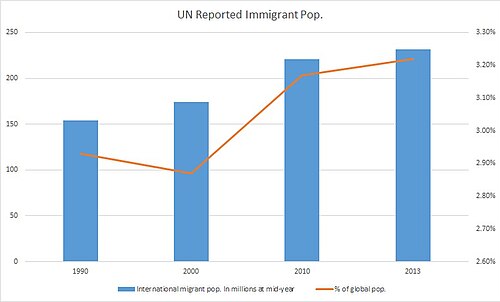
2015年現在[update]、世界の国際移民の数は2億4,400万人に達し、2000年以降41%増加している。国際移民の数が最も多いのは米国で、世界全体の19%を占めている。世界の国際移民の3分の1は、わずか20カ国に住んでいる。ドイツとロシアはそれぞれ1,200万人の移民を受け入れており、世界で最も多くの移民を抱える国の中で2位と3位となっている。サウジアラビアは1,000万人の移民を受け入れており、これにイギリス( 900万人)、アラブ首長国連邦(800万人)が続いている。[33]世界のほとんどの地域では、移住は同じ主要地域内にある国の間で行われている。2000年から2015年 の間に、アジアは世界の他のどの主要地域よりも多くの国際移民を追加し、2,600万人増加した。
2015年、20歳未満の国際移民の数は3,700万人に達し、20歳から64歳までの移民は1億7,700万人に達した。アフリカに住む国際移民の平均年齢は29歳と最も若く、次いでアジア(35歳)、ラテンアメリカ/カリブ海(36歳)となっている。一方、北米(42歳)、ヨーロッパ(43歳)、オセアニア(44歳)では移民の年齢が高くなっている。[33]

国際移民のほぼ半数(43%)はアジア出身で、ヨーロッパは2番目に多い移民の出身地(25%)で、次いでラテンアメリカ(15%)となっている。インドは世界最大の移民国(1600万人)で、メキシコ(1200万人)、ロシア(1100万人)がそれに続いている。[33]
2012年調査
ギャラップ社による2012年の調査では、機会があれば6億4000万人の成人が他国に移住したいとしており、そのうち23%の移住希望者が米国を将来の居住地として選び、4500万人にあたる回答者の7%が英国を選ぶとの結果が出ている。カナダ、フランス、サウジアラビア、オーストラリア、ドイツ、スペイン、イタリア、アラブ首長国連邦が、移住希望国トップ10の残りを占めた。[34]
現在

米国司法省によると、米国では2023年に1,197,254件の移民申請が初回受理され、523,477件の移民案件が完了し、2,464,021件の移民案件が保留中だった。[36]
移民の推進要因と引き寄せ要因


移民に関するある理論では、プッシュ要因とプル要因を区別し、人々が特定の国から、または特定の国へ移住する際の経済的、政治的、社会的影響について言及している。[40]移民が以前の市民権国または常居所国を離れる動機は、さまざまなもので、現地での資源へのアクセスの欠如、経済的繁栄への願望、有給の仕事を見つけるまたは従事すること、生活水準の向上、家族の再統合、退職、気候や環境によって引き起こされる移住、亡命、偏見や紛争や自然災害からの逃避、または単に生活の質を変えたいという願望などがある。通勤者、観光客、および目的国へのその他の短期滞在は、移民または移住の定義に該当しないが、季節労働移民は含まれる場合がある。
プッシュ要因(または決定要因)は、主に出身国を離れる動機(自発的または非自発的)を指します。一方、プル要因(または魅力要因)は、特定の国に移住する動機またはそれを促すものを指します。
経済移住(通常は労働移住)の場合、賃金率の差は一般的です。新しい国の賃金の価値が母国の賃金の価値を上回っている場合、コストが高すぎない限り、移住を選択することができます。特に19世紀には、米国の経済拡大により移民の流入が増加し、人口の約15%が外国生まれとなり、[41]労働力のかなりの部分を占めるようになりました。
輸送技術が進歩するにつれ、18世紀から20世紀初頭にかけて、移動時間と費用は劇的に減少した。18世紀には大西洋を横断するのに5週間もかかったが、20世紀頃にはわずか8日間で済むようになった。[42]機会費用が低い場合、移民率は高くなる傾向がある。[42]貧困からの脱出(個人または残された親族の)は伝統的なプッシュ要因であり、仕事の可用性は関連するプル要因である。自然災害は貧困に起因する移住の流れを増幅させる可能性がある。研究によると、中所得国では気温の上昇により都市部や他の国への移住率が上昇する。低所得国では気温の上昇により移住が減少する。[43]
移住や移民は雇用契約で義務付けられている場合があります。宗教の宣教師や多国籍企業、国際非政府組織、外交官の従業員は、定義上、「海外」で働くことが期待されています。彼らはしばしば「海外駐在員」と呼ばれ、彼らの雇用条件は通常、受入国で同様の仕事に就く場合と同等か、それよりも良いものです。[要出典]
非経済的なプッシュ要因としては、迫害(宗教的なものも含む)、頻繁な虐待、いじめ、抑圧、民族浄化、大量虐殺、戦争中の民間人への危険、社会的疎外などが挙げられる。[44]伝統的に、政治的動機が難民の流入の動機となっている。例えば、独裁政権から逃れるために移住する人もいる。[45]
移住には個人的な理由によるものもあり、家族の再統合や国際結婚(特に男女比の不均衡の場合)など、関係性(家族やパートナーと一緒にいるなど)に基づく。最近の研究では、移住したいという思いの持ち主には性別、年齢、異文化間の違いがあることが明らかになっている。[46]少数のケースでは、個人が移転された愛国心の形で新しい国に移住したいと望むこともある。刑事司法の回避(逮捕の回避など)は個人的な動機である。犯罪が国際的に認められている場合、この種の移住や移民は通常は合法ではないが、犯罪者は身元を偽ったり、検出を逃れるための抜け道を見つけたりすることはある。例えば、戦争犯罪者が戦争や紛争の犠牲者を装い、別の国で亡命を求めたという報告がある。[47] [48] [49]
移民に対する障壁は、法的または政治的な形態だけではありません。移民に対する自然的および社会的障壁も非常に強力になることがあります。移民は、母国を離れる際に、家族、友人、支援ネットワーク、文化など、慣れ親しんだものすべてを残して出国します。また、資産を処分する必要があり、移動費用もかかります。新しい国に到着すると、仕事を見つけること、[50]どこに住むか、新しい法律、新しい文化的規範、言語やアクセントの問題、人種差別の可能性、および移民や家族に対するその他の排他的行動など、多くの不確実性を伴うことがよくあります。[51] [52] [53]

移民政策は、特に西ヨーロッパでは、イスラム教が新たな主要宗教として登場したことで、国家安全保障やテロリズムなどの他の問題とますます結びついている。安全保障上の懸念を持つ人々は、 2005年のフランス暴動やユランズ・ポステン紙のムハンマド風刺画論争を、西ヨーロッパにおけるイスラム教徒の移民から生じる価値観の衝突の例として挙げている。これらすべての関連性により、移民は多くのヨーロッパ諸国で感情的な政治問題となっている。[55] [56]
研究によると、一部の特別利益団体は、労働力の競争の激化など移民の影響が、自分たちのグループには有害だが、他のグループには有益であると考えているため、自分 たちのグループには移民を減らし、他のグループには移民を増やすようロビー活動を行っている。2010年のヨーロッパの研究では、「移民がすでに国内にいる従業員と競合すると考えられる場合、雇用主は従業員よりも移民に賛成する傾向がある。あるいは、移民が従業員ではなく雇用主と競合すると考えられる場合、雇用主は従業員よりも移民に反対する傾向がある」と示唆されている。[57]移民政策に関する米国議員の投票を調査した2011年の研究では、「熟練労働者が豊富な地区の議員は、非熟練労働者に対するオープンな移民政策を支持する傾向があるが、非熟練労働者が豊富な地区の議員はその逆である」と示唆されている。[58]
もう一つの要因は、以前の移民によるロビー活動かもしれない。移民に対するより寛容な規則やアイルランド人だけのための特別措置を求めてロビー活動を行っている米国アイルランド移民改革ロビーの会長は、「アイルランドロビーは、国内の他のすべての民族グループと同様に、得られる特別措置を推進するだろう」と述べている。[ 59 ] [60]
外国の関与
いくつかの国は分裂を起こすために他国への移民を奨励していると非難されている。[61]
経済移民

経済移民という用語は、雇用や生活の質の向上、資源へのアクセスを求めて、ある地域から別の地域へ移動した人を指します。経済移民は、迫害から逃れてきた難民とは異なります。
多くの国では、有効な就労ビザを持たずに仕事を得る目的で入国することを禁止する入国およびビザ制限を設けています。国の移民法に違反するため、経済移民と宣言された人は入国を拒否されることがあります。
世界銀行は、2009年の送金総額は4200億ドルで、そのうち3170億ドルが開発途上国に送られたと推定している。 [62]
経済効果
国全体への影響
ヨーロッパの経済学者への調査では、ヨーロッパ内で国境を越えて自由に生活し働く人々の移動が自由になったことで、平均的なヨーロッパ人の生活が豊かになり、低技能のヨーロッパ人の生活が悪くなっていないという考えが強く支持されているというコンセンサスが示された。 [10]デビッド・カード、クリスチャン・ダストマン、イアン・プレストンによると、「移民の経済的影響に関する既存の研究のほとんどは、これらの影響は小さく、平均して現地の住民に利益をもたらすことを示唆している」。[8]オルン・B・ボドヴァルソンとヘンドリック・ファン・デン・ベルグは、既存の文献の調査で、「すべての研究からの証拠を比較すると、ごくわずかな例外を除いて、移民は移住先の国の現地生まれの労働者に悪影響を与えるという、多くの国民の見解を強く統計的に裏付けるものはないことが明らかになった」と書いている。[63] 研究では、多様性と移民は生産性[64] [65] [66] [67] [68] [69]と経済的繁栄に正の影響を与えることも示唆されています。[70] [71] [72] [73] [74]移民はオフショアリングの削減にも関連しています。[69]ある研究によると、大量移民の時代 (1850-1920) は、短期的には「所得の増加、生産性の向上、イノベーションの増加、工業化の促進」に、長期的には「所得の増加、貧困の減少、失業の減少、都市化率の上昇、教育水準の向上」に米国に貢献しました。[75]研究では、大量移民の時代のラテンアメリカへの移住が長期的な経済発展にプラスの影響を与えたことも示されています。[76]南デンマーク大学とコペンハーゲン大学の経済学者による2016年の論文では、 1924年に米国で制定された移民制限が経済に悪影響を及ぼしたことが判明した。 [77] [78]
平均的な出身者への経済的影響は小さくプラスにしかならないという見解は、オランダの過去の移民データの2023年の統計分析など、いくつかの研究によって異論が唱えられています。この分析では、移民の過去の教育や収入などのさまざまな要因に応じて、一人当たりの正と負の純寄与が大きい経済効果が見つかりました。 [79]影響は、移民の年齢、教育、移住の理由、 [80]経済の強さ、移住が行われた時期などの要因によって異なる場合があります。 [81]
移民全体は、現地の賃金格差の上昇に比較的小さな割合しか寄与していないことが判明したが[82] [83]、低技能移民は現地人口の所得格差の拡大と関連している。 [84] [85]
移民が国内総GDPの変化に及ぼす影響や一人当たりGDPの変化に及ぼす影響を測定すると、異なる結果が得られる可能性がある。[86]
研究方法
デビッド・カードの1990年の研究[87]は、このテーマにおける画期的な研究と考えられている。それは、マリエルのボートリフトという、移民規則が突然緩和された後に125,000人のキューバ人(マリエリトス)がマイアミに来たという自然実験を追跡した。それは、移民はしばしば高賃金の都市を選ぶので、賃金の上昇は移民ではなく都市の経済的成功の結果である可能性があるなど、以前の研究の限界を持たなかった。しかし、マリエリトスがマイアミを選んだのは、高給のためではなく、単にキューバに近いからだった。以前の研究はまた、企業や原住民がより収益性の高い地域に移動することで移民とその影響に対応する可能性があるという点で限界があった。しかし、この移住の6か月の期間は、ほとんどの企業や個人がマイアミを離れるには短すぎた。[88] [89] 別の自然実験は、ベルリンの壁崩壊後間もなく、チェコに住み続けながらも突然ドイツで働くことができるようになったチェコ人労働者のグループを追跡した。その結果、現地の賃金と雇用が大幅に減少したことが判明した。[90]移民は雇用国で賃金を消費して経済を刺激し、その影響を相殺する必要があるとも主張されている。[88]
世界への影響
経済学者のマイケル・クレメンスとラント・プリチェットによると、「人々が生産性の低い場所から生産性の高い場所へ移動できるようにすることは、限界的に見て、貧困削減のための最も効率的な一般政策ツールであるように思われる」。[19]たとえば、 2年間の現地での貧困対策プログラムが成功すると、貧困層は先進国で1日働くのと同等の収入を1年で得ることができる。[19]発展途上国と先進国間の労働移動の障壁をわずかに減らすことで、残っている貿易自由化よりも発展途上国の貧困削減に大きく貢献できる可能性がある。 [91]研究によると、移住障壁の撤廃は世界のGDPに大きな影響を与える可能性があり、増加率は67~147.3%と推定されている。[13] [14] [15] [92] [93] [94]研究では、移住によって商品やサービスの貿易が増加し、[95] [96] [97] [98] [99]移住者と受入国の間の資金の流れが増加することもわかっています。[100] [101]
裕福な国が低技能移民に対してより開放的になれば、世界の所得格差は劇的に縮小する可能性がある。[85] [102]ブランコ・ミラノビッチによれば、居住国は世界の所得格差を決定づける最も重要な要因であり、労働障壁の削減が世界の所得格差を大幅に縮小する可能性があることを示唆している。[17] [103]
移民への影響
トンガ人がニュージーランドに移住できる移住抽選に関する調査では、抽選に当選した人は当選しなかった人に比べて移住による収入が263%増加した(ニュージーランドに移住してわずか1年後)ことがわかった。[104]トンガの抽選当選者に関する長期研究では、当選者は「非移住者よりもほぼ300%多く稼ぎ続け、精神状態が良く、支出が250%以上高い世帯に住み、より多くの車を所有し、より耐久資産を持っている」ことがわかった。[105]移住による生涯の利益は、控えめに見積もっても、正味現在価値でNZ$315,000(約US$237,000)である。[105]
2017年に米国に移住したメキシコ移民世帯を対象に行われた調査では、米国に移住したことにより、世帯の収入が即座に5倍以上に増加したことが判明した。[106]また、この調査では、「移民が得る平均的な利益は、現在の最も成功した経済開発プログラムの利益をも上回っている」ことも判明した。[106]
2017年に英国で行われたヨーロッパからの移民労働者に関する調査では、EU加盟後、移民労働者の収入にかなりのプラスの影響が出ていることが示されています。データは、EU加盟資格を取得すると労働者に自由に転職する権利が与えられ、収入が上がることを示しています。[107]
2017年にQuarterly Journal of Economics誌に掲載された研究によると、中低所得国から米国に移住した移民の賃金は移住後に2~3倍に増加したという。[108]
個人グループ向け
著名な経済学者への調査では、高技能移民は平均的なアメリカ人の生活を豊かにするという見解で一致していることが示されています。[109]同じ経済学者への調査では、低技能移民は平均的なアメリカ人の生活を豊かにし、他者から補償されない限り、多くの低技能アメリカ人労働者の生活は大幅に悪化するという考え方にも支持が示されています。[110]
研究では、低技能のネイティブについてはより複雑な結果が示されているが、その影響がプラスであろうとマイナスであろうと、どちらにしても小さい傾向がある。[111] [112] [113] [114] [115] [116]研究によると、移民は米国生まれの労働者よりも危険な仕事に就く可能性が高いが、これは移民の英語力や教育達成度の低さなど、平均的な特徴の違いによるところが大きい。[117] 2017年に既存の経済文献を調査したところ、高技能移民に関する研究では「賃金や雇用への悪影響はほとんど見られず、より長い期間で見ると利益が大きい傾向がある」という。[118]
特定の職業における移民との競争は、その職業における不完全雇用を悪化させる可能性があるが[119]、他の出身者の賃金は上昇する。[118]例えば、2017年にサイエンス誌に発表された研究では、「1990年代初頭以降、外国生まれのコンピューター科学者の流入により、米国のIT部門の規模が拡大し、価格の低下と製品の効率化により消費者に利益をもたらし、労働者の全体的な収入は0.2~0.3%上昇したが、米国のコンピューター科学者の賃金は2.6~5.1%減少した」と結論付けられている。[120] 2019年の研究では、STEM職に就く外国人大学生は、STEM職に就くネイティブの大学生に取って代わることはなく、むしろ後者のグループの賃金にプラスの影響を与えていることが判明した。[121] 2021年の研究では、同様に、スイスへの高学歴移民が、高学歴スイス出身者の賃金上昇を引き起こしていることが判明した。[122] 2019年の研究では、移民の増加により企業による海外移転が減少することが判明した。[123]
全体的な需要を増やすことで、移民は原住民を低技能の肉体労働からより高給の職業に押し出すことができる。[124] [125] 2018年にアメリカ経済レビュー誌で行われた調査によると、ブラセロ計画(約50万人のメキシコ人労働者が米国で季節労働をすることを認めた)は、米国生まれの農業労働者の労働市場の結果に悪影響を及ぼさなかったことが判明した。[126]経済史家による2019年の調査では、1920年代に実施された移民制限が米国生まれの労働者の収入に悪影響を及ぼしたことが判明した。[127]
財政的影響
2011年に行われた移民の経済的影響に関する文献レビューでは、移民の純財政的影響は研究によって異なるが、最も信頼性の高い分析では、平均して小さくプラスの財政的影響が見られることがわかった。[128]著者らによると、「移民の生涯にわたる純社会的影響は、移民の到着時の年齢、教育、移住理由などに大きく、予測可能な形で左右される」という。[ 128]議会予算局による2007年の文献レビューによると、「過去20年間、米国における移民の財政的影響を推定するほとんどの取り組みでは、全体として、長期的には、合法移民と非合法移民の両方を含む移民によって生み出されるあらゆる種類の税収が、彼らが利用するサービスのコストを上回るという結論が出ている」。[129] 2022年の研究では、難民受け入れの急激な減少が米国のあらゆるレベルの政府で公金に悪影響を及ぼしていることが判明した。[130]
2018年の研究では、1985年から2015年にかけて西ヨーロッパに流入した難民申請者は、財政に正味でプラスの影響を与えたことが判明した。[131] [132]研究によると、EU移民はデンマーク[133]と英国に正味でプラスの財政貢献をしたことがわかっている。 [134] [135] 2017年の研究では、2014年に英国に移住したルーマニア人とブルガリア人の移民が福祉給付の取得許可を得たとき、移民の福祉給付の利用に目立った影響はなかったことが判明した。[136]フランスの経済学者グループによる論文によると、1980年から2015年にかけて「国際移住はOECD諸国の経済と財政のパフォーマンスにプラスの影響を与えた」という。[137]オランダで2023年に行われた研究では、移民の過去の教育と収入に応じて、財政に大きなプラスの影響と大きなマイナスの影響の両方があることが判明した。[79]
難民の影響
2017年に一流経済学者を対象に行われた調査によると、経済学者の34%が「2015年夏に始まったドイツへの難民流入は、今後10年間でドイツ国民に純経済的利益をもたらすだろう」という意見に同意したのに対し、38%は不明、6%は反対した。[138]難民が現地の福祉に与える影響に関する研究は乏しいが、既存の文献ではさまざまな結果(マイナス、プラス、有意な影響なし)が示されている。[139] [140] [141] [142] [143] [144] [145] [146] [147] [148] [149]経済学者マイケル・クレメンスによると、「経済学者が過去の難民や移民の流入を研究したところ、労働市場への影響は多様ではあるものの、非常に限られており、実際にはプラスになる可能性があることがわかった」という。[150] 2018年にエコノミックジャーナルに掲載された研究によると、ベトナム難民が米国に流入したことで米国の輸出にプラスの影響を与えた。ベトナムへの輸出が最も伸びたのは、ベトナム人の人口が多い米国の州だったからである。[99] 2018年にサイエンスアドバンス誌に掲載された研究によると、1985年から2015年の間に西ヨーロッパに入国した亡命希望者は、マクロ経済的および財政的にプラスの影響を与えた。[131] [132] 2019年の研究では、130万人のシリア難民がヨルダン(総人口660万人)に大量に流入したことで、ヨルダン出身者の労働市場の結果に悪影響はなかったことがわかった。[141] 2020年の研究では、トルコへのシリア難民がトルコ企業の生産性を向上させたことが明らかになった。[151]
エヴァンスとフィッツジェラルドによる2017年の論文によると、米国に難民が移住してから最初の20年間で支払う税金は「受け取る給付金よりも21,000ドル多い」という。[148]トランプ政権下で保健福祉省が実施した内部調査は公表されなかったが、難民が米国にもたらした歳入は、彼らが負担した額よりも630億ドル多いことが分かった。[152]カリフォルニア大学デービス校の労働経済学者ジョバンニ・ペリによると、既存の文献では、米国の労働市場が1年間で10万人のシリア難民を容易に受け入れることができない経済的な理由はないと示唆されている。[要出典] 1980年から2010年にかけての難民が米国の労働市場に与えた長期的な影響を調べた2017年の論文では、「難民が米国の労働市場に与える長期的な悪影響はない」と結論付けられた。[153]経済学者マイケル・クレメンスによる2022年の研究によると、2017年以降の米国における難民受け入れの急激な減少により、米国経済は年間91億ドル以上、国庫は年間20億ドル以上の損失を被ったという。[130]
難民は労働移民よりも受け入れ国の労働市場にゆっくりと溶け込むが、これは庇護手続き中に人的資本や資格が失われたり価値が下がったりすることが一因である。 [154]難民は、たとえ彼らが現地人と同じスキルや言語能力を持っていたとしても、経済的には現地人よりも悪い結果になる傾向がある。例えば、第二次世界大戦中および戦後に東欧から避難した西ドイツ在住のドイツ人を対象にした2013年の研究では、強制移住させられたドイツ人は、数十年後に現地の西ドイツ人よりも経済的にはるかに悪い結果になったことが示された。[155]強制移住させられた第二世代のドイツ人も、現地人よりも経済的に悪い結果となった。[155]米国への難民に関する研究では、「14歳未満で米国に入国した難民は、高校を卒業し大学に進学する割合が現地人と同率である。10代後半で入国した難民は、言語の壁と、このグループの多くが米国に親と一緒に来ていないことによるところが大きいため、学力が低い」ことがわかった。[148] 18~45歳で米国に入国した難民は、「現地人よりも教育レベルがはるかに低く、言語能力も劣っており、就職率が低く、福祉の利用率が高く、収入も低いため、当初は成績が悪い」。 [148]しかし、この研究の著者らは、「難民が年を取るにつれて、成績は大幅に改善する」ことを発見した。[148 ]
2017年の調査では、1970年代半ばにモザンビークとアンゴラからポルトガルに帰国した50万人のポルトガル人が労働生産性と賃金を低下させたことが判明した。[156] 2018年の論文では、 1919年から1922年のギリシャ・トルコ戦争からギリシャ正教の難民を多く受け入れたギリシャの地域は「今日、より高い収入、より高い世帯資産、より高い教育水準、そしてより大きな金融・製造部門を有している」ことが判明した。[157]
不法移民の影響
不法移民の経済効果に関する研究は乏しいが、既存の研究ではその影響は現地住民と公的資金にプラスであると示唆されている。[158] [ 159] [ 129] [160] 2015年の研究では、「国外追放率の増加と国境管理の強化により、低技能労働市場が弱まり、現地の低技能労働者の失業が増加する。逆に、合法化により、低技能現地人の失業率が低下し、現地人一人当たりの所得が増加する」と示されている。[161]研究によると、不法移民の合法化は米国経済を活性化させる可能性がある。 2013年の研究では、不法移民に合法的な地位を与えると、彼らの収入が4分の1増加する可能性があることが判明しました(10年間で米国のGDPが約1.4兆ドル増加します)[162]。また、2016年の研究では、「合法化により、不法移民の経済的貢献は約20%増加し、民間部門のGDPの3.6%になります。」[163] 2018年の全米経済研究所の論文によると、米国への不法移民は「米国企業にネイティブと比較して高い余剰を生み出すため、彼らの入国を制限すると雇用創出に抑制効果があり、ひいてはネイティブの労働市場に抑制効果があります。」[164]
米国では、不法移民の排除を支援するために移民改革管理法が可決された。彼らは、合法的な地位を与えるか、不法移民を故意に雇用する雇用主に罰則を課すことで、これを実行しようとした。しかし、IRCAは、目的の達成に問題を引き起こした現実や代償については触れなかった。[165]
2017年に公共経済ジャーナルに掲載された研究では、移民法の執行が強化されると、不法移民の両親を持つ米国生まれの子供たちが貧困に陥る可能性が高まることが明らかになった。[166]
スペインの経済学者による論文によると、スペインで不法移民を合法化すると、新規合法移民1人当たりの財政収入が約4,189ユーロ増加したという。[160]論文によると、新規合法移民の賃金は合法化後に上昇し、低技能の現地人の一部は労働市場での結果が悪化し、高技能の現地人は労働市場での結果が改善したという。[160]
2018年の研究では、米国の地区で不法移民を逮捕しても、アメリカ先住民の労働市場の成果が改善されたという証拠は見つからなかった。[167] 2020年の研究では、米国での移民取り締まりが米国の酪農業界の生産量の減少につながり、酪農家は移民取り締まりに対して(新しい労働者を雇うのではなく)業務を自動化することで対応していることが判明した。[168]
2021年にアメリカ経済ジャーナルに掲載された研究では、不法移民がアメリカ先住民の雇用と賃金に有益な影響を与えていることが判明した。移民法の厳格化はアメリカ先住民の雇用と賃金に悪影響を及ぼした。[169]
派遣国への影響
研究によると、移民は受け入れ国と送出国の両方に利益をもたらすことが示唆されている。[6] [7]ある研究によると、どちらのタイプの国でも福祉は向上する。「観察された移民レベルの福祉への影響は大きく、主な受け入れ国では約5%から10%、送金が多い国では約10%である」。[6]米国と42の開発途上国の同等の労働者に関する研究では、「開発途上国で生まれ教育を受けた、男性、未熟練(学校教育9年)、35歳の都市部のフォーマルセクター労働者の平均賃金格差は、購買力平価で年間15,400ペソである」ことがわかった。[170] 2014年に行われた移民に関する既存文献の調査では、10%の移民供給ショックにより、送出国の賃金が2~5.5%上昇することがわかった。[18]
送金は送金元国の生活水準を向上させる。送金は多くの発展途上国のGDPの大きな割合を占めている。[171]メキシコへの送金に関する研究では、送金によってメキシコの公共サービスの利用可能性が大幅に向上し、一部の地域では政府支出を上回っていることが判明した。[172]
研究によると、移民と移住障壁の低さは、送出国における人的資本形成に正味でプラスの影響を与えることがわかっている。[173] [174] [175] [176]これは、移民への「頭脳流出」ではなく「頭脳獲得」があることを意味する。移民が海外でスキルを習得した後に母国に戻る場合、移民はイノベーションにも結びついている。[177] [178]
ある研究によると、熟練労働者の移住は、熟練労働者が先進国でより多くのイノベーションを起こすことができるため、送り出し国は長期的には間接的に利益を得ることになる。その結果、熟練労働者の移住が増えれば、長期的には経済成長と福祉の向上につながる。[179]高技能移民の悪影響は、ほとんど根拠がないままである。経済学者マイケル・クレメンスによると、高技能移民の制限が出身国の人材不足を軽減するという証拠は示されていない。[180]
研究によれば、移住、送金、帰国は出身国の政治制度や民主化に良い影響を与える可能性がある。[181] [182] [183] [184] [185] [ 186] [ 187] [188] [ 189] [190] [191]アベル・エスクリバ=フォルチ、ジョセフ・ライト、コバドンガ・メセゲルによれば、送金は「政治的反対を可能にする資源を提供し、政府への依存を減らし、権威主義の基盤となっている縁故主義戦略を弱める」。[181]研究によれば、送金は出身国での内戦のリスクを下げることもできる。[192]
Research suggests that emigration causes an increase in the wages of those who remain in the country of origin. A 2014 survey of the existing literature on emigration finds that a 10 percent emigrant supply shock would increase wages in the sending country by 2–5.5%.[18] A study of emigration from Poland shows that it led to a slight increase in wages for high- and medium-skilled workers for remaining Poles.[193] A 2013 study finds that emigration from Eastern Europe after the 2004 EU enlargement increased the wages of remaining young workers in the country of origin by 6%, while it had no effect on the wages of old workers.[194] The wages of Lithuanian men increased as a result of post-EU enlargement emigration.[195] Return migration is associated with greater household firm revenues.[196] Emigration leads to boosts in foreign direct investment to their home country.[197]
Some research shows that the remittance effect is not strong enough to make the remaining natives in countries with high emigration flows better off.[6]
Innovation and entrepreneurship
A 2017 survey of the existing economic literature found that "high-skilled migrants boost innovation and productivity outcomes."[118] According to a 2013 survey of the existing economic literature, "much of the existing research points towards positive net contributions by immigrant entrepreneurs."[198] Areas where immigrant are more prevalent in the United States have substantially more innovation (as measured by patenting and citations).[199] Immigrants to the United States create businesses at higher rates than natives.[200] A 2010 study showed "that a 1 percentage point increase in immigrant college graduates' population share increases patents per capita by 9–18 percent."[201] Mass migration can also boost innovation and growth, as shown by the Jewish, Huguenot and Bohemian diasporas in Berlin and Prussia,[202][203][204] German Jewish Émigrés in the US,[205] the Mariel boatlift,[206] the exodus of Soviet Jews to Israel in the 1990s,[68] European migration to Argentina during the Age of Mass Migration (1850–1914),[207] west-east migration in the wake of German reunification,[208] German migration to Russian Empire,[209] and Polish immigration to Germany after joining the EU.[210] A 2018 study in the Economic Journal found that "a 10% increase in immigration from exporters of a given product is associated with a 2% increase in the likelihood that the host country starts exporting that good 'from scratch' in the next decade."[211]
Immigrants have been linked to greater invention and innovation.[212][213][214][215][216][217] According to one report, "immigrants have started more than half (44 of 87) of America's startup companies valued at $1 billion dollars or more and are key members of management or product development teams in over 70 percent (62 of 87) of these companies."[218] One analysis found that immigrant-owned firms had a higher innovation rate (on most measures of innovation) than firms owned by U.S.-born entrepreneurs.[219] Research also shows that labor migration increases human capital.[175][173][174][176][220] Foreign doctoral students are a major source of innovation in the American economy.[221] In the United States, immigrant workers hold a disproportionate share of jobs in science, technology, engineering, and math (STEM): "In 2013, foreign-born workers accounted for 19.2 percent of STEM workers with a bachelor's degree, 40.7 percent of those with a master's degree, and more than half—54.5 percent—of those with a PhD"[222]
A number of countries across the globe offer Economic Citizenship Programs where in return for investing into the local economy, foreign investors are awarded citizenship. Such programs encourage innovation and entrepreneurship from foreign investors and high net worth individuals who as new citizens in the country can offer unique perspectives. St. Kitts and Nevis was the first country to offer economic citizenship back in 1984 creating a new market for citizenship and by the early 2000s other Caribbean countries joined them.[223]
Using 130 years of data on historical migrations to the United States, one study finds "that a doubling of the number of residents with ancestry from a given foreign country relative to the mean increases by 4.2 percentage points the probability that at least one local firm invests in that country, and increases by 31% the number of employees at domestic recipients of FDI from that country. The size of these effects increases with the ethnic diversity of the local population, the geographic distance to the origin country, and the ethno-linguistic fractionalization of the origin country."[224] A 2017 study found that "immigrants' genetic diversity is significantly positively correlated with measures of U.S. counties' economic development [during the Age of Mass Migration]. There exists also a significant positive relationship between immigrants' genetic diversity in 1870 and contemporaneous measures of U.S. counties' average income."[225]
Some research suggests that immigration can offset some of the adverse effects of automation on native labor outcomes.[124][125]
Laws and ethics

Legislation regarding the protection of rights of immigrants and equal access to justice differs per nation. International law – the product of the United Nations and other multinational organizations – creates protocols governing immigrant rights. International law and the European Convention of Human Rights state that immigrants can only be detained for 'legitimate aims' of the state. It also notes that vulnerable people should be protected from unreasonable punishment and lengthy detention. International law outlines requirements for due process and suitable conditions. However, nations are sovereign, and the protocols of international law cannot be enforced upon them. Nations have the freedom to handle immigrants as they choose, and to structure how any legal aid is distributed. Human rights organizations strongly criticize individual nation-states for the limitations of their immigration policies and practices.[226]
Entry (top) and Exit (bottom) passport stamps issued to a citizen of Germany by Indian immigration authorities at New Delhi airport.
Treatment of migrants in host countries, both by governments, employers, and original population, is a topic of continual debate and criticism, and the violation of migrant human rights is an ongoing crisis.[227] The United Nations Convention on the Protection of the Rights of All Migrant Workers and Members of Their Families, has been ratified by 48 states, most of which are heavy exporters of cheap labor. Major migrant-receiving countries and regions—including Western Europe, North America, Pacific Asia, Australia, and the Gulf States—have not ratified the convention, even though they are host to the majority of international migrant workers.[228][229] Although freedom of movement is often recognized as a civil right in many documents such as the Universal Declaration of Human Rights (1948) and the International Covenant on Civil and Political Rights (1966), the freedom only applies to movement within national borders and the ability to return to one's home state.[230][231]
Some proponents of immigration argue that the freedom of movement both within and between countries is a basic human right, and that the restrictive immigration policies, typical of nation-states, violate this human right of freedom of movement.[232] Such arguments are common among ideologies like anarchism and libertarianism.[233][234] As philosopher and open borders activist Jacob Appel has written, "Treating human beings differently, simply because they were born on the opposite side of a national boundary, is hard to justify under any mainstream philosophical, religious or ethical theory."[citation needed]
Where immigration is permitted, it is typically selective. As of 2003[update], family reunification accounted for approximately two-thirds of legal immigration to the US every year.[235] Ethnic selection, such as the White Australia policy, has generally disappeared, but priority is usually given to the educated, skilled, and wealthy. Less privileged individuals, including the mass of poor people in low-income countries, cannot avail themselves of the legal and protected immigration opportunities offered by wealthy states. This inequality has also been criticized as conflicting with the principle of equal opportunities. The fact that the door is closed for the unskilled, while at the same time many developed countries have a huge demand for unskilled labor, is a major factor in illegal immigration. The contradictory nature of this policy—which specifically disadvantages the unskilled immigrants while exploiting their labor—has also been criticized on ethical grounds.[citation needed]
Immigration policies which selectively grant freedom of movement to targeted individuals are intended to produce a net economic gain for the host country. They can also mean net loss for a poor donor country through the loss of the educated minority—a "brain drain". This can exacerbate the global inequality in standards of living that provided the motivation for the individual to migrate in the first place. One example of competition for skilled labour is active recruitment of health workers from developing countries by developed countries.[236][237] There may however also be a "brain gain" to emigration, as migration opportunities lead to greater investments in education in developing countries.[173][174][175][176] Overall, research suggests that migration is beneficial both to the receiving and sending countries.[6]
Quality of institutions
A 2015 study finds "some evidence that larger immigrant population shares (or inflows) yield positive impacts on institutional quality. At a minimum, our results indicate that no negative impact on economic freedom is associated with more immigration."[238] Another study, looking at the increase in Israel's population in the 1990s due to the unrestricted immigration of Jews from the Soviet Union, finds that the mass immigration did not undermine political institutions, and substantially increased the quality of economic institutions.[239] A 2017 study in the British Journal of Political Science argued that the British American colonies without slavery adopted better democratic institutions in order to attract migrant workers to their colonies.[240][241] A 2018 study fails to find evidence that immigration to the United States weakens economic freedom.[242] A 2019 study of Jordan found that the massive influx of refugees into Jordan during the Gulf War had long-lasting positive effects on Jordanian economic institutions.[243]
Welfare
Some research has found that as immigration and ethnic heterogeneity increase, government funding of welfare and public support for welfare decrease.[244][245][246][247][248][249] Ethnic nepotism may be an explanation for this phenomenon. Other possible explanations include theories regarding in-group and out-group effects and reciprocal altruism.[250]
Research however also challenges the notion that ethnic heterogeneity reduces public goods provision.[251][252][253][254] Studies that find a negative relationship between ethnic diversity and public goods provision often fail to take into account that strong states were better at assimilating minorities, thus decreasing diversity in the long run.[251][252] Ethnically diverse states today consequently tend to be weaker states.[251] Because most of the evidence on fractionalization comes from sub-Saharan Africa and the United States, the generalizability of the findings is questionable.[253] A 2018 study in the American Political Science Review cast doubts on findings that ethnoracial homogeneity led to greater public goods provision.[255]
Research finds that Americans' attitudes towards immigration influence their attitudes towards welfare spending.[256]
Education
A 2016 study found that immigration in the period 1940–2010 in the United States increased the high school completion of natives: "An increase of one percentage point in the share of immigrants in the population aged 11–64 increases the probability that natives aged 11–17 eventually complete 12 years of schooling by 0.3 percentage point."[257] A 2019 NBER paper found little evidence that exposure to foreign-born students had an impact on US-born students.[258]
Studies have found that non-native speakers of English in the UK have no causal impact on the performance of other pupils,[259] immigrant children have no significant impact on the test scores of Dutch children,[260] no effect on grade repetition among native students exposed to migrant students in Austrian schools,[261] that the presence of Latin American children in schools had no significant negative effects on peers, but that students with limited English skills had slight negative effects on peers,[262] and that the influx of Haitians to Florida public schools after the 2010 Haiti earthquake had no effects on the educational outcomes of incumbent students.[263]
A 2018 study found that the "presence of immigrant students who have been in the country for some time is found to have no effect on natives. However, a small negative effect of recent immigrants on natives' language scores is reported."[264] Another 2018 study found that the presence of immigrant students to Italy was associated with "small negative average effects on maths test scores that are larger for low ability native students, strongly non-linear and only observable in classes with a high (top 20%) immigrant concentration. These outcomes are driven by classes with a high average linguistic distance between immigrants and natives, with no apparent additional role played by ethnic diversity."[265]
After immigrant children's scores were included in Programme for International Student Assessment (PISA) 15-year-old school pupils' educational evaluations in Sweden the Swedish PISA scores significantly decreased.[266]
Social capital
There is some research that suggests that immigration adversely affects social capital.[267] One study, for instance, found that "larger increases in US states' Mexican population shares correspond to larger decreases in social capital over the period" 1986–2004.[268] A 2017 study in the Journal of Comparative Economics found that "individuals whose ancestors migrated from countries with higher autocracy levels are less likely to trust others and to vote in presidential elections in the U.S. The impact of autocratic culture on trust can last for at least three generations while the impact on voting disappears after one generation. These impacts on trust and voting are also significant across Europe."[269] A 2019 study found that "humans are inclined to react negatively to threats to homogeneity... in the short term. However, these negative outcomes are compensated in the long term by the beneficial influence of intergroup contact, which alleviates initial negative influences."[270]
Health
Research suggests that immigration has positive effects on native workers' health.[271][272] As immigration rises, native workers are pushed into less demanding jobs, which improves native workers' health outcomes.[271][272]
A 2018 study found that immigration to the United Kingdom "reduced waiting times for outpatient referrals and did not have significant effects on waiting times in accident and emergency departments (A&E) and elective care."[273] The study also found "evidence that immigration increased waiting times for outpatient referrals in more deprived areas outside of London" but that this increase disappears after 3 to 4 years.[273]
A 2018 systemic review and meta-analysis in The Lancet found that migrants generally have better health than the general population.[274]
In the EU, the use of personal health records for migrants is being tested in the new REHEALTH 2 project.[275]
High immigration can cause higher stress on highly regulated sectors such as healthcare, education, and housing, leading to negative effects.[276]
Housing
Immigration tends to increase both local rents and house prices,[277] but this dependency varies depending on factors including price elasticity of new housing supply,[278] socioeconomics of immigrants, and internal migration of natives.[277]
Crime
Immigration and crime explores whether there is a relationship between criminal activity and the phenomenon of immigration. Most studies show that immigration has either no or minimal impact on crime, while other studies have found it increases crime under certain conditions.[279][280] Immigrants are disproportionately represented in the prison populations of many Western countries, with the notable exception of the United States.[280][281] There is little evidence that migration unconditionally leads to more terrorist activity, especially in Western countries, and the effectiveness of stopping migration on preventing terrorism is rather limited.[282] Research on the relationship between refugee migration and crime is ambiguous, and does not increase crime in resettlement programs like that of the United States, which screen-out high-risk individuals.[283]
Some scholars argue that data of crime rates among immigrants is often inflated because it includes imprisonment for migration offenses or due to racial and ethnic discrimination by police and the judicial system, which can result in higher conviction rates for immigrants relative to the actual number of crimes committed.[284][285] Research suggests that people overestimate the impact of immigration on crime, in part due to sensational media coverage or narratives pushed by politicians. This fear of crime can lead to increases in hate crimes against immigrants, as well as harsher immigration policies like family separation.[286]Bogus recruitment agencies and rogue recruitment agencies make fake promises of better opportunities, education, income, some of the abuses and crimes experienced by immigrants are the followed:
- Employees are forced to work in activities that were not included in their contracts, where workplace harassment is openly allowed, tolerated and even promoted.
- Workers are forced to work more than 20 hours a day with low wages or no payment,
- Slavery,
- human trafficking,
- Sexual harassment, sexual abuse, sexual assault, sexual exploitation.
- Offering fake immigrant visas in order to make it impossible for employees to return to their countries.
In many countries there is a lack of prosecution of this crimes, since these countries obtain benefits and taxes paid by these companies that benefit the economies and also because of the current shortage of workers.[287][288][289][290]
Impact on demographic tension
Assimilation
A 2019 review of existing research in the Annual Review of Sociology on immigrant assimilation in the United States, the United Kingdom, France, Germany, Sweden, Norway, Belgium, the Netherlands and Spain concluded "we find an overall pattern of intergenerational assimilation in terms of socioeconomic attainment, social relations, and cultural beliefs."[291]
Country of origin
Return migration from countries with liberal gender norms has been associated with the transfer of liberal gender norms to the home country.[292]
United States
A 2018 study in the American Sociological Review found that within racial groups, most immigrants to the United States had fully assimilated within a span of 20 years.[25] Immigrants arriving in the United States after 1994 assimilate more rapidly than immigrants who arrived in previous periods.[25] Measuring assimilation can be difficult due to "ethnic attrition", which refers to when descendants of migrants cease to self-identify with the nationality or ethnicity of their ancestors. This means that successful cases of assimilation will be underestimated. Research shows that ethnic attrition is sizable in Hispanic and Asian immigrant groups in the United States.[293][294] By taking account of ethnic attrition, the assimilation rate of Hispanics in the United States improves significantly.[293][295] A 2016 paper challenges the view that cultural differences are necessarily an obstacle to long-run economic performance of migrants. It finds that "first generation migrants seem to be less likely to success the more culturally distant they are, but this effect vanishes as time spent in the US increases."[296]
A 2018 study found that Chinese nationals in the United States who received permanent residency permits from the US government amid the Tiananmen Square protests (and subsequent Chinese government clampdown) experienced significant employment and earnings gains relative to similar immigrant groups who did not have the same residency rights.[297]
During the Age of Mass Migration, infant arrivals to the United States had greater economic success over their lifetime than teenage arrivals.[298]
Europe
A 2015 report by the National Institute of Demographic Studies finds that an overwhelming majority of second-generation immigrants of all origins in France feel French, despite the persistent discrimination in education, housing and employment that many of the minorities face.[299]
Research shows that country of origin matters for speed and depth of immigrant assimilation but that there is considerable assimilation overall.[26] Research finds that first generation immigrants from countries with less egalitarian gender cultures adopt gender values more similar to natives over time.[300][301] According to one study, "this acculturation process is almost completed within one generational succession: The gender attitudes of second generation immigrants are difficult to distinguish from the attitudes of members of mainstream society. This holds also for children born to immigrants from very gender traditional cultures and for children born to less well integrated immigrant families."[300] Similar results are found on a study of Turkish migrants to Western Europe.[301] The assimilation on gender attitudes has been observed in education, as one study finds "that the female advantage in education observed among the majority population is usually present among second-generation immigrants."[302]

A 2017 study of Switzerland found that naturalization strongly improves long-term social integration of immigrants: "The integration returns to naturalization are larger for more marginalized immigrant groups and when naturalization occurs earlier, rather than later in the residency period."[303] A separate study of Switzerland found that naturalization improved the economic integration of immigrants: "winning Swiss citizenship in the referendum increased annual earnings by an average of approximately 5,000 U.S. dollars over the subsequent 15 years. This effect is concentrated among more marginalized immigrants."[304]
First-generation immigrants tend to hold less accepting views of homosexuality but opposition weakens with longer stays.[305] Second-generation immigrants are overall more accepting of homosexuality, but the acculturation effect is weaker for Muslims and to some extent, Eastern Orthodox migrants.[305]
A study of Bangladeshi migrants in East London found they shifted towards the thinking styles of the wider non-migrant population in just a single generation.[306]
A study on Germany found that foreign-born parents are more likely to integrate if their children are entitled to German citizenship at birth.[307] A 2017 study found that "faster access to citizenship improves the economic situation of immigrant women, especially their labour market attachment with higher employment rates, longer working hours and more stable jobs. Immigrants also invest more in host country-specific skills like language and vocational training. Faster access to citizenship seems a powerful policy instrument to boost economic integration in countries with traditionally restrictive citizenship policies."[308] Naturalization is associated with large and persistent wage gains for the naturalized citizens in most countries.[309] One study of Denmark found that providing immigrants with voting rights reduced their crime rate.[310]
Studies on programs that randomly allocate refugee immigrants across municipalities find that the assignment of neighborhood impacts immigrant crime propensity, education and earnings.[311][312][313][314][315][316] A 2019 study found that refugees who resettled in areas with many conationals were more likely to be economically integrated.[317]
Research suggests that bilingual schooling reduces barriers between speakers from two different communities.[318]
Research suggests that a vicious cycle of bigotry and isolation could reduce assimilation and increase bigotry towards immigrants in the long-term. For instance, University of California, San Diego political scientist Claire Adida, Stanford University political scientist David Laitin and Sorbonne University economist Marie-Anne Valfort argue "fear-based policies that target groups of people according to their religion or region of origin are counter-productive. Our own research, which explains the failed integration of Muslim immigrants in France, suggests that such policies can feed into a vicious cycle that damages national security. French Islamophobia—a response to cultural difference—has encouraged Muslim immigrants to withdraw from French society, which then feeds back into French Islamophobia, thus further exacerbating Muslims' alienation, and so on. Indeed, the failure of French security in 2015 was likely due to police tactics that intimidated rather than welcomed the children of immigrants—an approach that makes it hard to obtain crucial information from community members about potential threats."[319][320]
A study which examined Catalan nationalism examined the Catalan Government's policy towards the integration of immigrants during the start of the 1990s. At this time the Spanish region of Catalonia was experiencing a large influx in the number of immigrants from Northern Africa, Latin America and Asia. The Spanish government paid little attention to this influx of immigrants. However, Catalan politicians began discussing how the increase in immigrants would effect Catalan identity. Members of the Catalan parliament petitioned for a plan to integrate these immigrants into Catalan society. Crucially, the plan did not include policies regarding naturalisation, which were key immigration policies of the Spanish government. The plan of the Catalan parliament aimed to create a shared Catalan identity which included both the native Catalan population and immigrant communities. This meant that immigrants were encouraged to relate as part of the Catalan community but also encouraged to retain their own culture and traditions. In this way assimilation of immigrant cultures in Catalonia was avoided.[321]
A 2018 study in the British Journal of Political Science found that immigrants in Norway became more politically engaged the earlier that they were given voting rights.[322]
A 2019 study in the European Economic Review found that language training improved the economic assimilation of immigrants in France.[323]
A 2020 study using data from large-scale comparative surveys in Germany, France, and United Kingdom found that sampled households with a language barrier tend to have poor living conditions and are migrants. Inferences about their demographic, attitudinal, or behavioral traits cannot be made because the ability to speak the official language(s) of the country is one of the criteria for survey participation.[324]
A 2020 paper on reforms of refugee policy in Denmark found that language training boosted the economic and social integration of refugees, whereas cuts to refugees' welfare benefits had no impact, except to temporarily increase property crimes.[325]
Discrimination
Europe
Research suggests that police practices, such as racial profiling, over-policing in areas populated by minorities and in-group bias may result in disproportionately high numbers of racial minorities among crime suspects in Sweden, Italy, and England and Wales.[326][327][328][329][330] Research also suggests that there may be possible discrimination by the judicial system, which contributes to a higher number of convictions for racial minorities in Sweden, the Netherlands, Italy, Germany, Denmark and France.[326][328][329][331][332][333][334] A 2018 study found that the Dutch are less likely to reciprocate in games played with immigrants than the native Dutch.[335]
Several meta-analyses find extensive evidence of ethnic and racial discrimination in hiring in the North-American and European labor markets.[28][27][336] A 2016 meta-analysis of 738 correspondence tests in 43 separate studies conducted in OECD countries between 1990 and 2015 finds that there is extensive racial discrimination in hiring decisions in Europe and North-America.[27] Equivalent minority candidates need to send around 50% more applications to be invited for an interview than majority candidates.[27]
A 2014 meta-analysis found extensive evidence of racial and ethnic discrimination in the housing market of several European countries.[28]
United Kingdom
Since 2010, the United Kingdom's policies surrounding immigrant detention have come under fire for insufficiently protecting vulnerable groups. In the early 2000s, the United Kingdom adopted the Detention Duty Advice (DDA) scheme in order to provide free, government-funded, legal aid to immigrants. The DDA scheme at face value granted liberty on administrative grounds by considering immigrant merits, nature of their work, their financial means, and other factors that would then determine how much free legal aid detainees were granted. Recent research by the Organization for Economic Cooperation and Development (OECD), demonstrates that marginalized groups have been barred from legal assistance in detention centers. The barriers immigrants face in order to access justice through the DDA disproportionately impacted underrepresented groups of immigrants, and the language barrier and lack of interpreters led to further hurdles that detainees were unable to jump through.[226]
Canada
In Canada immigrant detainees face barriers to justice due to a lack of international enforcement. Canada's immigration detention system has significant legal and normative problems, and the rubric of 'access to justice' that is presented by international law fails to identify these faults. There is a lack of access to legal aid for immigrants in detention, as well as inhumane treatment in detention centers. Research has demonstrated irreparable psychological, physical, and social damage to immigrants, and the international community ignores these injustices.[337]
United States
Business
A 2014 meta-analysis of racial discrimination in product markets found extensive evidence of minority applicants being quoted higher prices for products.[28] A 1995 study found that car dealers "quoted significantly lower prices to white males than to black or female test buyers using identical, scripted bargaining strategies."[338] A 2013 study found that eBay sellers of iPods received 21 percent more offers if a white hand held the iPod in the photo than a black hand.[339]
Criminal justice system
Research suggests that police practices, such as racial profiling, over-policing in areas populated by minorities and in-group bias may result in disproportionately high numbers of racial minorities among crime suspects.[340][341][342][343] Research also suggests that there may be possible discrimination by the judicial system, which contributes to a higher number of convictions for racial minorities.[344][345][346][347][348] A 2012 study found that "(i) juries formed from all-white jury pools convict black defendants significantly (16 percentage points) more often than white defendants, and (ii) this gap in conviction rates is entirely eliminated when the jury pool includes at least one black member."[346] Research has found evidence of in-group bias, where "black (white) juveniles who are randomly assigned to black (white) judges are more likely to get incarcerated (as opposed to being placed on probation), and they receive longer sentences."[348] In-group bias has also been observed when it comes to traffic citations, as black and white cops are more likely to cite out-groups.[342]
Education
A 2015 study using correspondence tests "found that when considering requests from prospective students seeking mentoring in the future, faculty were significantly more responsive to White males than to all other categories of students, collectively, particularly in higher-paying disciplines and private institutions."[349]
According to an analysis of the National Study of College Experience, elite colleges may favor minority applicants due to affirmative action policies.[350]
A 2018 National Bureau of Economic Research paper found that math teachers discriminate against the children of immigrants. When the teachers were informed about negative stereotypes towards the children of immigrants, they gave higher grades to the children of immigrants.[351]
As of 2020, 2 percent of all students enrolled in U.S. higher education. That comes out to about 454,000 students. Fewer than half of the undocumented are eligible for the DACA program. DACA is formally known as Deferred Action for Childhood Arrivals.[352]
Housing
A 2014 meta-analysis found extensive evidence of racial discrimination in the American housing market.[28] Minority applicants for housing needed to make many more enquiries to view properties.[28] Geographical steering of African-Americans in US housing remained significant.[28] A 2003 study finds "evidence that agents interpret an initial housing request as an indication of a customer's preferences, but also are more likely to withhold a house from all customers when it is in an integrated suburban neighborhood (redlining). Moreover, agents' marketing efforts increase with asking price for white, but not for black, customers; blacks are more likely than whites to see houses in suburban, integrated areas (steering); and the houses agents show are more likely to deviate from the initial request when the customer is black than when the customer is white. These three findings are consistent with the possibility that agents act upon the belief that some types of transactions are relatively unlikely for black customers (statistical discrimination)."[353]
A report by the federal Department of Housing and Urban Development where the department sent African-Americans and whites to look at apartments found that African-Americans were shown fewer apartments to rent and houses for sale.[354]
Labor market
Several meta-analyses find extensive evidence of ethnic and racial discrimination in hiring in the American labor market.[28][336][27] A 2016 meta-analysis of 738 correspondence tests—tests where identical CVs for stereotypically black and white names were sent to employers—in 43 separate studies conducted in OECD countries between 1990 and 2015 finds that there is extensive racial discrimination in hiring decisions in Europe and North-America.[27] These correspondence tests showed that equivalent minority candidates need to send around 50% more applications to be invited for an interview than majority candidates.[27][355] A study that examine the job applications of actual people provided with identical résumés and similar interview training showed that African-American applicants with no criminal record were offered jobs at a rate as low as white applicants who had criminal records.[356]
Iran
Iranian companies faced a mass exodus of youth and skilled labor out of the country in recent years.[357] In June 2023 Iranian parliament illegalized immigration ads online.[358][359] [360][361][362]
See also
- Criticism of multiculturalism
- Immigration law
- Immigration reform
- List of sovereign states by net migration rate
- List of countries and dependencies by population density
- Multiculturalism
- Opposition to immigration
- People smuggling
- Repatriation
- Replacement migration
- Non-citizen suffrage
- Non-resident citizen voting
- White genocide conspiracy theory
- Women migrant workers from developing countries
- Xenophobia
References
- ^ "immigration". OxfordDictionaries.com. Oxford University Press. Archived from the original on 5 November 2013. Retrieved 11 May 2016.
- ^ "immigrate". Merriam-Webster.com. Merriam-Webster, In. Retrieved 27 March 2014.
- ^ "Who's who: Definitions". London, England: Refugee Council. 2016. Retrieved 7 September 2015.
- ^ "International Migration Law No. 34 – Glossary on Migration". International Organization for Migration. 19 June 2019. ISSN 1813-2278.
- ^ Koczan, Zsoka; Peri, Giovanni; Pinat, Magali; Rozhkov, Dmitriy (2021), "Migration", in Valerie Cerra; Barry Eichengreen; Asmaa El-Ganainy; Martin Schindler (eds.), How to Achieve Inclusive Growth, Oxford University Press, doi:10.1093/oso/9780192846938.003.0009, ISBN 978-0-19-284693-8
- ^ a b c d e di Giovanni, Julian; Levchenko, Andrei A.; Ortega, Francesc (1 February 2015). "A Global View of Cross-Border Migration" (PDF). Journal of the European Economic Association. 13 (1): 168–202. doi:10.1111/jeea.12110. hdl:10230/22196. ISSN 1542-4774. S2CID 3465938.
- ^ a b Andreas, Willenbockel, Dirk; Sia, Go, Delfin; Amer, Ahmed, S. (11 April 2016). "Global migration revisited: short-term pains, long-term gains, and the potential of south-south migration". The World Bank.
{{cite web}}: CS1 maint: multiple names: authors list (link) - ^ a b Card, David; Dustmann, Christian; Preston, Ian (1 February 2012). "Immigration, Wages, and Compositional Amenities" (PDF). Journal of the European Economic Association. 10 (1): 78–119. doi:10.1111/j.1542-4774.2011.01051.x. ISSN 1542-4774. S2CID 154303869.
- ^ Bodvarsson, Örn B; Van den Berg, Hendrik (2013). The economics of immigration: theory and policy. New York; Heidelberg [u.a.]: Springer. p. 157. ISBN 978-1-4614-2115-3. OCLC 852632755.
- ^ a b "Migration Within Europe | IGM Forum". www.igmchicago.org. Retrieved 7 December 2016.
- ^ "Poll Results | IGM Forum". www.igmchicago.org. Retrieved 19 September 2015.
- ^ "Poll Results | IGM Forum". www.igmchicago.org. Retrieved 19 September 2015.
- ^ a b Iregui, Ana Maria (1 January 2003). "Efficiency Gains from the Elimination of Global Restrictions on Labour Mobility: An Analysis using a Multiregional CGE Model". Wider Working Paper Series.
- ^ a b Clemens, Michael A (1 August 2011). "Economics and Emigration: Trillion-Dollar Bills on the Sidewalk?". Journal of Economic Perspectives. 25 (3): 83–106. doi:10.1257/jep.25.3.83. ISSN 0895-3309. S2CID 59507836.
- ^ a b Hamilton, B.; Whalley, J. (1 February 1984). "Efficiency and distributional implications of global restrictions on labour mobility: calculations and policy implications". Journal of Development Economics. 14 (1–2): 61–75. doi:10.1016/0304-3878(84)90043-9. ISSN 0304-3878. PMID 12266702.
- ^ Dustmann, Christian; Preston, Ian P. (2 August 2019). "Free Movement, Open Borders, and the Global Gains from Labor Mobility". Annual Review of Economics. 11 (1): 783–808. doi:10.1146/annurev-economics-080218-025843. ISSN 1941-1383.
- ^ a b Milanovic, Branko (7 January 2014). "Global Inequality of Opportunity: How Much of Our Income Is Determined by Where We Live?". Review of Economics and Statistics. 97 (2): 452–460. doi:10.1162/REST_a_00432. hdl:10986/21484. ISSN 0034-6535. S2CID 11046799.
- ^ a b c Mishra, Prachi (2014). "Emigration and wages in source countries: A survey of the empirical literature". International Handbook on Migration and Economic Development. Edward Elgar Publishing. pp. 241–266. doi:10.4337/9781782548072.00013. ISBN 978-1-78254-807-2. S2CID 143429722.
- ^ a b c Clemens, Michael A.; Pritchett, Lant (2019). "The New Economic Case for Migration Restrictions: An Assessment". Journal of Development Economics. 138 (9730): 153–164. doi:10.1016/j.jdeveco.2018.12.003. ISSN 0304-3878. S2CID 204418677.
- ^ Pritchett, Lant; Hani, Farah (30 July 2020). The Economics of International Wage Differentials and Migration. doi:10.1093/acrefore/9780190625979.013.353. ISBN 978-0-19-062597-9. Retrieved 11 August 2020.
{{cite book}}:|website=ignored (help) - ^ Peri, Giovanni. "Can Immigration Solve the Demographic Dilemma?". www.imf.org. IMF. Retrieved 16 July 2020.
- ^ Harvey, Fiona (15 July 2020). "World population in 2100 could be 2 billion below UN forecasts, study suggests". The Guardian. ISSN 0261-3077. Retrieved 16 July 2020.
- ^ The Integration of Immigrants into American Society. National Academies of Sciences, Engineering, and Medicine. 2015. doi:10.17226/21746. ISBN 978-0-309-37398-2.
Americans have long believed that immigrants are more likely than natives to commit crimes and that rising immigration leads to rising crime... This belief is remarkably resilient to the contrary evidence that immigrants are in fact much less likely than natives to commit crimes.
- ^ Lee, Matthew T.; Martinez Jr., Ramiro (2009). "Immigration reduces crime: an emerging scholarly consensus". Immigration, Crime and Justice. Emerald Group Publishing. pp. 3–16. ISBN 978-1-84855-438-2.
- ^ a b c Villarreal, Andrés; Tamborini, Christopher R. (2018). "Immigrants' Economic Assimilation: Evidence from Longitudinal Earnings Records". American Sociological Review. 83 (4): 686–715. doi:10.1177/0003122418780366. PMC 6290669. PMID 30555169.
- ^ a b Blau, Francine D. (2015). "Immigrants and Gender Roles: Assimilation vs. Culture" (PDF). IZA Journal of Migration. 4 (1): 1–21. doi:10.1186/s40176-015-0048-5. S2CID 53414354. Retrieved 13 October 2018.
- ^ a b c d e f g Zschirnt, Eva; Ruedin, Didier (27 May 2016). "Ethnic discrimination in hiring decisions: a meta-analysis of correspondence tests 1990–2015". Journal of Ethnic and Migration Studies. 42 (7): 1115–1134. doi:10.1080/1369183X.2015.1133279. hdl:10419/142176. ISSN 1369-183X. S2CID 10261744.
- ^ a b c d e f g h Rich, Judy (October 2014). "What Do Field Experiments of Discrimination in Markets Tell Us? A Meta Analysis of Studies Conducted since 2000". IZA Discussion Papers (8584). SSRN 2517887. Retrieved 24 April 2016.
- ^ Rehavi, M. Marit; Starr, Sonja B. (2014). "Racial Disparity in Federal Criminal Sentences". Journal of Political Economy. 122 (6): 1320–1354. doi:10.1086/677255. ISSN 0022-3808. S2CID 3348344.
- ^ Enos, Ryan D. (1 January 2016). "What the Demolition of Public Housing Teaches Us about the Impact of Racial Threat on Political Behavior". American Journal of Political Science. 60 (1): 123–142. doi:10.1111/ajps.12156. S2CID 51895998.
- ^ "outmigrant". OxfordDictionaries.com. Oxford University Press. Archived from the original on 18 July 2012. Retrieved 11 May 2016.
- ^ "United Nations Population Division | Department of Economic and Social Affairs". www.un.org. Retrieved 28 August 2019.
- ^ a b c d "Trends in international migration, 2015" (PDF). UN.org. United Nations Department of Economic and Social Affairs, Population Division. December 2015. Retrieved 16 May 2016.
- ^ "150 Million Adults Worldwide Would Migrate to the U.S". Gallup.com. 20 April 2012. Retrieved 14 May 2014.
- ^ Leonhardt, David (12 June 2024). "The Force Shaping Western Politics". The New York Times. Archived from the original on 12 June 2024.
- ^ Pending Cases, New Cases and Total Completions, Executive Office For Immigration Review, Adjuction Statistics, U.S. Department of Justice
- ^ Bilefsky, Dan (5 June 2009). "Crisis Strands Vietnamese Workers in a Czech Limbo". The New York Times. Retrieved 11 May 2016.
- ^ "White ethnic Britons in minority in London". Financial Times. 11 December 2012.
- ^ Graeme Paton (1 October 2007). "One fifth of children from ethnic minorities". The Daily Telegraph. London. Archived from the original on 6 December 2008. Retrieved 7 June 2008.
- ^ See the NIDI/Eurostat "push and pull study" for details and examples: [1] Archived 9 December 2006 at the Wayback Machine
- ^ York, Harlan (4 July 2015). "How Many People are Immigrants?". Harlan York and Associates. Archived from the original on 9 September 2015. Retrieved 30 July 2015.
- ^ a b Boustan, Adain May (15 January 2009). Fertility and Immigration. UCLA.
- ^ Cattaneo, Cristina; Peri, Giovanni (2016). "The Migration Response to Increasing Temperatures" (PDF). Journal of Development Economics. 122 (C): 127–146. doi:10.1016/j.jdeveco.2016.05.004. hdl:10419/130264.
- ^ Chiswick, Barry (March 2000). "The Earnings of Male Hispanic Immigrants in the United States". Social Science Research Network (Working paper). University of Illinois at Chicago Institute for the Study of Labor. SSRN 224241.
- ^ Borjas, George J. (1 April 1982). "The Earnings of Male Hispanic Immigrants in the United States". Industrial & Labor Relations Review. 35 (3): 343–353. doi:10.1177/001979398203500304. ISSN 0019-7939. S2CID 36445207.
- ^ Rubin, Mark (July 2013). ""It Wasn't My Idea to Come Here!": Young Women Lack Ownership of the Idea to Immigrate – Mark Rubin's Social Psychology Research". International Journal of Intercultural Relations. 37 (4): 497–501. doi:10.1016/j.ijintrel.2013.02.001. ISSN 0147-1767. Retrieved 3 October 2018.
- ^ Haskell, Leslie (18 September 2014). "EU asylum and war criminals: No place to hide". EUobserver.com. EUobserver. Retrieved 13 May 2016.
- ^ Knight, Ben (11 April 2016). "Refugees in Germany reporting dozens of war crimes". Deutsche Welle. Retrieved 13 May 2016.
- ^ Porter, Tom (26 February 2016). "Sweden: Syrian asylum seeker suspected of war crimes under Assad regime arrested in Stockholm". International Business Times. Retrieved 13 May 2016.
- ^ May, Julia. "Lack of network hurting migrant workers". The Sydney Morning Herald. Retrieved 2 January 2017.
- ^ Nunez, Christina (12 December 2014). "The 7 biggest challenges facing refugees and immigrants in the US". Global Citizen. Global Poverty Project. Retrieved 16 May 2016.
- ^ Charles Rodriguez, U.; Venegas de la Torre, M. D. L. P.; Hecker, V.; Laing, R. A.; Larouche, R. (2022). "The Relationship Between Nature and Immigrants' Integration, Wellbeing and Physical Activity: A Scoping Review". Journal of Immigrant and Minority Health. 25 (1): 190–218. doi:10.1007/s10903-022-01339-3. PMID 35201532. S2CID 247060104.
- ^ Djajić, Slobodan (1 September 2013). "Barriers to immigration and the dynamics of emigration". Journal of Macroeconomics. 37: 41–52. doi:10.1016/j.jmacro.2013.06.001.
- ^ Anita Böcker (1998) Regulation of migration: international experiences. Het Spinhuis. p. 218. ISBN 90-5589-095-2
- ^ "Migration, refugees, Europe – waves of emotion". Euranet Plus inside. Euranet Plus Network. 7 May 2015. Retrieved 16 May 2016.
- ^ Nowicki, Dan. "Europe learns integration can become emotional". AZCentral.com. Retrieved 16 May 2016.
- ^ Tamura, Yuji (29 July 2010). "Do Employers Support Immigration?". Trinity Economics Papers (1107). doi:10.2139/ssrn.1021941. ISSN 1556-5068. S2CID 55485879. Retrieved 29 October 2018.
- ^ Facchini, G.; Steinhardt, M. F. (2011). "What drives U.S. Immigration policy? Evidence from congressional roll call votes". Journal of Public Economics. 95 (7–8): 734. CiteSeerX 10.1.1.585.3903. doi:10.1016/j.jpubeco.2011.02.008. S2CID 6940099.
- ^ Bernstein, Nina (16 March 2006). "An Irish Face on the Cause of Citizenship". The New York Times. Retrieved 11 May 2016.
- ^ National Council of La Raza. "Action on Immigration Reform". National Council of La Raza. Archived from the original on 13 April 2011. Retrieved 29 October 2018.
- ^ Migrant crisis: Russia and Syria 'weaponising' migration, BBC, 2016
- ^ Remittance Prices Worldwide MAKING MARKETS MORE TRANSPARENT (28 April 2014). "Remittance Prices Worldwide". Remittanceprices.worldbank.org. Retrieved 14 May 2014.
- ^ Bodvarsson, Örn B; Van den Berg, Hendrik (2013). The economics of immigration: theory and policy. New York; Heidelberg [u.a.]: Springer. p. 157. ISBN 978-1-4614-2115-3. OCLC 852632755.
- ^ Bahar, Dany; Hauptmann, Andreas; Özgüzel, Cem; Rapoport, Hillel (2022). "Migration and Knowledge Diffusion: The Effect of Returning Refugees on Export Performance in the Former Yugoslavia". The Review of Economics and Statistics. 106 (2): 287–304. doi:10.1162/rest_a_01165. ISSN 0034-6535. S2CID 246564474.
- ^ Ottaviano, Gianmarco I. P.; Peri, Giovanni (1 January 2006). "The economic value of cultural diversity: evidence from US cities" (PDF). Journal of Economic Geography. 6 (1): 9–44. doi:10.1093/jeg/lbi002. ISSN 1468-2702.
- ^ Peri, Giovanni (7 October 2010). "The Effect of Immigration on Productivity: Evidence From U.S. States" (PDF). Review of Economics and Statistics. 94 (1): 348–358. doi:10.1162/REST_a_00137. ISSN 0034-6535. S2CID 17957545.
- ^ Mitaritonna, Cristina; Orefice, Gianluca; Peri, Giovanni (2017). "Immigrants and Firms' Outcomes: Evidence from France" (PDF). European Economic Review. 96: 62–82. doi:10.1016/j.euroecorev.2017.05.001. S2CID 157561906.
- ^ a b Razin, Assaf (February 2018). Israel's Immigration Story: Winners and Losers. National Bureau of Economic Research (Report). doi:10.3386/w24283.
- ^ a b Ottaviano, Gianmarco I. P.; Perie, Giovanni; Wright, Greg C. (2018). "Immigration, Trade and Productivity in Services: Evidence from U.K. Firms" (PDF). Journal of International Economics. 112: 88–108. doi:10.1016/j.jinteco.2018.02.007. S2CID 153400835.
- ^ Alesina, Alberto; Harnoss, Johann; Rapoport, Hillel (17 February 2016). "Birthplace diversity and economic prosperity". Journal of Economic Growth (Submitted manuscript). 21 (2): 101–138. doi:10.1007/s10887-016-9127-6. ISSN 1381-4338. S2CID 34712861.
- ^ "Multiculturalism and Growth: Skill-Specific Evidence from the Post-World War II Period" (PDF).
- ^ Bove, Vincenzo; Elia, Leandro (1 January 2017). "Migration, Diversity, and Economic Growth". World Development. 89: 227–239. doi:10.1016/j.worlddev.2016.08.012.
- ^ Bove, Vincenzo; Elia, Leandro (16 November 2016). "Cultural heterogeneity and economic development". VoxEU.org. Retrieved 16 November 2016.
- ^ Boubtane, Ekrame; Dumont, Jean-Christophe; Rault, Christophe (1 April 2016). "Immigration and economic growth in the OECD countries 1986–2006" (PDF). Oxford Economic Papers. 68 (2): 340–360. doi:10.1093/oep/gpw001. ISSN 0030-7653. S2CID 208009990. Archived from the original (PDF) on 29 April 2019. Retrieved 23 July 2019.
- ^ Qian, Nancy; Nunn, Nathan; Sequeira, Sandra (2019). "Immigrants and the Making of America". The Review of Economic Studies. 87: 382–419. doi:10.1093/restud/rdz003. S2CID 53597318.
- ^ SÁNCHEZ-ALONSO, BLANCA (11 November 2018). "The age of mass migration in Latin America". The Economic History Review. 72: 3–31. doi:10.1111/ehr.12787. hdl:10637/11782. ISSN 0013-0117. S2CID 158530812.
- ^ "One Sure Way to Hurt the U.S. Economy? Cut Immigration". Bloomberg.com. Retrieved 22 July 2018.
- ^ Ager, Philipp; Hansen, Casper Worm (8 November 2016). "National Immigration Quotas and Local Economic Growth". SSRN 2866411.
- ^ a b Borderless Welfare State, The Consequences of Immigration for Public Finances, Jan H. van de Beek, Hans, Roodenburg, Joop Hartog, Gerri W. Kreffer, 2023, Demo-Demo publisher, Zeist, Netherlands, ISBN 978908333482, Statistical data by Project Agreement 8290 Budgetary consequences of immigration in the Netherlands (University of Amsterdam and CBS Microdata Services, 19 June 2018)
- ^ Kerr, Sari Pekkala; Kerr, William R. (2011). "Economic Impacts of Immigration: A Survey" (PDF). Finnish Economic Papers. 24 (1): 1–32.
- ^ Devlin, Ciaran; Bolt, Olivia; Patel, Dhiren; Harding, David; Hussain, Ishtiaq (March 2014). "Impacts of migration on UK native employment: An analytical review of the evidence" (PDF). The Home Office. Archived (PDF) from the original on 12 January 2024. Retrieved 12 January 2024.
- ^ Card, David (1 April 2009). "Immigration and Inequality". American Economic Review. 99 (2): 1–21. CiteSeerX 10.1.1.412.9244. doi:10.1257/aer.99.2.1. ISSN 0002-8282. S2CID 154716407.
...the presence of immigration can account for a relatively small share (4–6 percent) of the rise in overall wage inequality over the past 25 years
- ^ Green, Alan G.; Green, David A. (1 June 2016). "Immigration and the Canadian Earnings Distribution in the First Half of the Twentieth Century". The Journal of Economic History. 76 (2): 387–426. doi:10.1017/S0022050716000541. ISSN 1471-6372. S2CID 156620314.
- ^ Xu, Ping; Garand, James C.; Zhu, Ling (23 September 2015). "Imported Inequality? Immigration and Income Inequality in the American States". State Politics & Policy Quarterly (Submitted manuscript). 16 (2): 147–171. doi:10.1177/1532440015603814. ISSN 1532-4400. S2CID 155197472.
- ^ a b Glen Weyl, E. (17 January 2018). "The Openness-equality Trade-off in Global Redistribution". The Economic Journal. 128 (612): F1–F36. doi:10.1111/ecoj.12469. ISSN 0013-0133. S2CID 51027330.
- ^ Jiří, Mazurek. "On some issues concerning definition of an economic recession." (2012).
- ^ Card, David (1990). "The Impact of the Mariel Boatlift on the Miami Labor Market" (PDF). Industrial and Labor Relations Review. 43 (2): 245–257. doi:10.1177/001979399004300205. S2CID 15116852 – via JSTOR.
- ^ a b Banerjee, Abhijit; Duflo, Esther (2019). Good Economics for Hard Times. London: Penguin.
- ^ Borjas, George J. (2017). "The Wage Impact of the Marielitos: A Reappraisal". ILR Review. 70 (5): 1077–1110. doi:10.1177/0019793917692945. ISSN 0019-7939. JSTOR 26944704.
- ^ Dustmann, C; Schonberg, U; Stuhler, J (2017). "Labor Supply Shocks, Native Wages, and the Adjustment of Local Employment'". The Quarterly Journal of Economics. 132 (1): 435–483. doi:10.1093/qje/qjw032.
- ^ Walmsley, Terrie L.; Winters, L. Alan (1 January 2005). "Relaxing the Restrictions on the Temporary Movement of Natural Persons: A Simulation Analysis". Journal of Economic Integration. 20 (4): 688–726. doi:10.11130/jei.2005.20.4.688. JSTOR 23000667.
- ^ Clemens, Michael A.; Montenegro, Claudio; Pritchett, Lant (2 November 2018). "The Place Premium: Bounding the Price Equivalent of Migration Barriers". The Review of Economics and Statistics. 101 (2): 201–213. doi:10.1162/rest_a_00776. ISSN 0034-6535. S2CID 109938634.
- ^ Borjas, G. J. (2015). "Immigration and Globalization: A Review Essay". Journal of Economic Literature. 53 (4): 965. doi:10.1257/jel.53.4.961.
- ^ Bradford, Scott (2021). "A global model of migration and poverty". The World Economy. 44 (4): 1018–1030. doi:10.1111/twec.13051. ISSN 1467-9701. S2CID 225163119.
- ^ Aner, Emilie; Graneli, Anna; Lodefolk, Magnus (14 October 2015). "Cross-border movement of persons stimulates trade". VoxEU.org. Centre for Economic Policy Research. Retrieved 19 October 2015.
- ^ Bratti, Massimiliano; Benedictis, Luca De; Santoni, Gianluca (18 April 2014). "On the pro-trade effects of immigrants" (PDF). Review of World Economics. 150 (3): 557–594. doi:10.1007/s10290-014-0191-8. hdl:11393/195448. ISSN 1610-2878. S2CID 4981719.
- ^ Foley, C. Fritz; Kerr, William R. (2013). "Ethnic Innovation and U.S. Multinational Firm Activity". Management Science. 59 (7): 1529–1544. CiteSeerX 10.1.1.361.36. doi:10.1287/mnsc.1120.1684. S2CID 7275466.
- ^ Dunlevy, James A.; Hutchinson, William K. (December 1999). "The Impact of Immigration on American Import Trade in the Late Nineteenth and Early Twentieth Centuries". The Journal of Economic History. 59 (4): 1043–1062. doi:10.1017/S002205070002413X. ISSN 1471-6372. S2CID 154985080.
- ^ a b Parsons, Christopher; Vézina, Pierre-Louis (2018). "Migrant Networks and Trade: The Vietnamese Boat People as a Natural Experiment" (PDF). The Economic Journal. 128 (612): F210–F234. doi:10.1111/ecoj.12457. hdl:10419/145246. ISSN 1468-0297. S2CID 154442776. Archived from the original (PDF) on 28 November 2020. Retrieved 26 August 2020.
- ^ Kugler, Maurice; Levintal, Oren; Rapoport, Hillel (2017). "Migration and Cross-Border Financial Flows" (PDF). The World Bank Economic Review. 32: 148–162. doi:10.1093/wber/lhx007. hdl:10419/90017.
- ^ Egger, Peter H.; Erhardt, Katharina; Lassmann, Andrea (2018). "Immigration and Firms' Integration in International Production Networks". European Economic Review. 111: 1–34. doi:10.1016/j.euroecorev.2018.08.009. hdl:20.500.11850/293259. ISSN 0014-2921. S2CID 158560371.
- ^ "How Do Migration and Remittances Affect Inequality? A Case Study of Mexico". IMF. Retrieved 18 August 2018.
- ^ Milanovic, Branko (20 April 2016). "There is a trade-off between citizenship and migration". Financial Times. ISSN 0307-1766. Archived from the original on 11 December 2022. Retrieved 21 April 2016.
- ^ McKenzie, David; Stillman, Steven; Gibson, John (1 June 2010). "How Important is Selection? Experimental VS. Non-Experimental Measures of the Income Gains from Migration" (PDF). Journal of the European Economic Association. 8 (4): 913–945. doi:10.1111/j.1542-4774.2010.tb00544.x. hdl:10289/1638. ISSN 1542-4774. S2CID 14629302.
- ^ a b Gibson, John; Mckenzie, David J.; Rohorua, Halahingano; Stillman, Steven (2017). "The long-term impacts of international migration: evidence from a lottery". The World Bank Economic Review. 32: 127–147. doi:10.1093/wber/lhx003. hdl:10986/32168.
- ^ a b Gove, Michael (18 April 2017). "Migration as Development: Household Survey Evidence on Migrants' Wage Gains". Social Indicators Research. 137 (3): 1033–1060. doi:10.1007/s11205-017-1630-4. ISSN 0303-8300. S2CID 157541486.
- ^ Ruhs, Martin (1 February 2017). "The Impact of Acquiring EU Status on the Earnings of East European Migrants in the UK: Evidence from a Quasi-Natural Experiment". British Journal of Industrial Relations. 55 (4): 716–750. doi:10.1111/bjir.12223. ISSN 1467-8543. S2CID 157615154.
- ^ Hendricks, Lutz; Schoellman, Todd (2017). "Human Capital and Development Accounting: New Evidence from Wage Gains at Migration". The Quarterly Journal of Economics. 133 (2): 665–700. doi:10.1093/qje/qjx047. S2CID 157828205.
- ^ "Poll Results | IGM Forum". www.igmchicago.org. Retrieved 19 September 2015.
- ^ "Poll Results | IGM Forum". www.igmchicago.org. Retrieved 19 September 2015.
- ^ Longhi, Simonetta; Nijkamp, Peter; Poot, Jacques (1 October 2010). "Meta-Analyses of Labour-Market Impacts of Immigration: Key Conclusions and Policy Implications". Environment and Planning C: Government and Policy. 28 (5): 819–833. Bibcode:2010EnPlC..28..819L. doi:10.1068/c09151r. ISSN 0263-774X. S2CID 154749568.
- ^ Okkerse, Liesbet (1 February 2008). "How to Measure Labour Market Effects of Immigration: A Review". Journal of Economic Surveys. 22 (1): 1–30. doi:10.1111/j.1467-6419.2007.00533.x. ISSN 1467-6419. S2CID 55145701.
- ^ Battisti, Michele; Felbermayr, Gabriel; Peri, Giovanni; Poutvaara, Panu (1 May 2014). Immigration, Search, and Redistribution: A Quantitative Assessment of Native Welfare. National Bureau of Economic Research (Report). doi:10.3386/w20131.
- ^ Dustmann, Christian; Glitz, Albrecht; Frattini, Tommaso (21 September 2008). "The labour market impact of immigration". Oxford Review of Economic Policy. 24 (3): 477–494. CiteSeerX 10.1.1.521.9523. doi:10.1093/oxrep/grn024. ISSN 0266-903X.
- ^ Immigration, Panel on the Economic and Fiscal Consequences of; Statistics, Committee on National; Education, Division of Behavioral and Social Sciences and; Sciences, National Academies of; Engineering; Medicine, and (2017). Blau, Francine D; MacKie, Christopher (eds.). The Economic and Fiscal Consequences of Immigration (PDF). doi:10.17226/23550. hdl:10919/83151. ISBN 978-0-309-44442-2. Archived from the original (PDF) on 9 June 2022. Retrieved 12 September 2019.
- ^ Edo, Anthony (2018). "The Impact of Immigration on the Labor Market". Journal of Economic Surveys. 33 (3): 922–948. doi:10.1111/joes.12300. ISSN 1467-6419. S2CID 158532621.
- ^ Pia m. Orrenius, P. M.; Zavodny, M. (2009). "Do Immigrants Work in Riskier Jobs?". Demography. 46 (3): 535–551. CiteSeerX 10.1.1.529.311. doi:10.1353/dem.0.0064. PMC 2831347. PMID 19771943.
- ^ a b c Kerr, Sari Pekkala; Kerr, William; Özden, Çağlar; Parsons, Christopher (2017). "High-Skilled Migration and Agglomeration". Annual Review of Economics (Submitted manuscript). 9 (1): 201–234. doi:10.1146/annurev-economics-063016-103705. S2CID 157793269.
- ^ Birrell, Bob (8 March 2016). "Australia's Skilled Migration Program: Scarce Skills Not Required" (PDF). The Australian Population Research Institute. Monash University. Retrieved 15 June 2018.
The great majority of those visaed in the skill program are professionals, an increasing share of whom hold occupations that are oversupplied.
- ^ Bound, John; Khanna, Gaurav; Morales, Nicolas (19 May 2017). "Reservoir of foreign talent". Science. 356 (6339): 697. Bibcode:2017Sci...356..697B. doi:10.1126/science.aan2956. ISSN 0036-8075. PMID 28522491. S2CID 206659473.
- ^ Lin, Gary C. (18 June 2019). "High-skilled immigration and native task specialization in U.S. cities". Regional Science and Urban Economics. 77: 289–305. doi:10.1016/j.regsciurbeco.2019.06.004. ISSN 0166-0462. S2CID 197794882.
- ^ Beerli, Andreas; Ruffner, Jan; Siegenthaler, Michael; Peri, Giovanni (2021). "The Abolition of Immigration Restrictions and the Performance of Firms and Workers: Evidence from Switzerland". American Economic Review. 111 (3): 976–1012. doi:10.1257/aer.20181779. ISSN 0002-8282. S2CID 242370156.
- ^ Olney, William W.; Pozzoli, Dario (21 August 2019). "The Impact of Immigration on Firm-Level Offshoring" (PDF). The Review of Economics and Statistics. 103: 177–195. doi:10.1162/rest_a_00861. hdl:10398/9656. ISSN 0034-6535. S2CID 13743885.
- ^ a b Basso, Gaetano; Peri, Giovanni; Rahman, Ahmed (October 2017). Computerization and Immigration: Theory and Evidence from the United States. National Bureau of Economic Research (Report). doi:10.3386/w23935.
- ^ a b Basso, Gaetano; Peri, Giovanni; Rahman, Ahmed (12 January 2018). "The impact of immigration on wage distributions in the era of technical automation". VoxEU.org. Retrieved 12 January 2018.
- ^ Clemens, Michael A.; Lewis, Ethan G.; Postel, Hannah M. (2018). "Immigration Restrictions as Active Labor Market Policy: Evidence from the Mexican Bracero Exclusion". American Economic Review. 108 (6): 1468–1487. doi:10.1257/aer.20170765. hdl:10419/161135. ISSN 0002-8282. PMC 6040835. PMID 30008480.
- ^ Abramitzky, Ran; Ager, Philipp; Boustan, Leah Platt; Cohen, Elior; Hansen, Casper W (2019). The Effects of Immigration on the Economy: Lessons from the 1920s Border Closure. National Bureau of Economic Research (Report). doi:10.3386/w26536. S2CID 208979065.
- ^ a b Kerr, Sari Pekkala; Kerr, William R. (2011). "Economic Impacts of Immigration: A Survey" (PDF). Finnish Economic Papers. 24 (1): 1–32.
- ^ a b "The Impact of Unauthorized Immigrants on the Budgets of State and Local Governments". 6 December 2007. Retrieved 28 June 2016.
- ^ a b Clemens, Michael Andrew (2022). "The Economic and Fiscal Effects on the United States from Reduced Numbers of Refugees and Asylum Seekers". Oxford Review of Economic Policy. 38 (3): 449–486. doi:10.1093/oxrep/grac012. hdl:10419/263533. ISSN 1556-5068.
- ^ a b d'Albis, Hippolyte; Boubtane, Ekrame; Coulibaly, Dramane (1 June 2018). "Macroeconomic evidence suggests that asylum seekers are not a "burden" for Western European countries". Science Advances. 4 (6): eaaq0883. Bibcode:2018SciA....4..883D. doi:10.1126/sciadv.aaq0883. ISSN 2375-2548. PMC 6010334. PMID 29938219.
- ^ a b Maxmen, Amy (20 June 2018). "Migrants and refugees are good for economies". Nature. doi:10.1038/d41586-018-05507-0. ISSN 0028-0836. S2CID 169653469.
- ^ Martinsen, Dorte Sindbjerg; Pons Rotger, Gabriel (5 July 2017). "The fiscal impact of EU immigration on the tax-financed welfare state: Testing the 'welfare burden' thesis" (PDF). European Union Politics. 18 (4): 1465116517717340. doi:10.1177/1465116517717340. ISSN 1465-1165. S2CID 157127175.
- ^ "The Fiscal Impact of Immigration in the UK". Migration Observatory. Retrieved 6 July 2017.
- ^ "The effects of EU migration on Britain in 5 charts: Did migrants really force down wages and are they a drain on the UK exchequer?". Financial Times. 18 September 2018. Archived from the original on 11 December 2022. Retrieved 19 September 2018.
- ^ Ruhs, Martin; Wadsworth, Jonathan (10 October 2017). "The Impact of Acquiring Unrestricted Work Authorization on Romanian and Bulgarian Migrants in the United Kingdom". ILR Review. 71 (4): 823–852. doi:10.1177/0019793917735100. ISSN 0019-7939. S2CID 158420236.
- ^ "Immigration and Government Spending in OECD Countries".
- ^ "Refugees in Germany | IGM Forum". www.igmchicago.org. Retrieved 25 July 2017.
- ^ Foged, Mette; Peri, Giovanni (2016). "Immigrants' Effect on Native Workers: New Analysis on Longitudinal Data" (PDF). American Economic Journal: Applied Economics. 8 (2): 1–34. doi:10.1257/app.20150114. hdl:10419/110686. S2CID 5245205.
- ^ Taylor, J. Edward; Filipski, Mateusz J.; Alloush, Mohamad; Gupta, Anubhab; Valdes, Ruben Irvin Rojas; Gonzalez-Estrada, Ernesto (5 July 2016). "Economic impact of refugees". Proceedings of the National Academy of Sciences. 113 (27): 7449–7453. Bibcode:2016PNAS..113.7449T. doi:10.1073/pnas.1604566113. ISSN 0027-8424. PMC 4941434. PMID 27325782.
- ^ a b Fallah, Belal; Krafft, Caroline; Wahba, Jackline (1 June 2019). "The impact of refugees on employment and wages in Jordan" (PDF). Journal of Development Economics. 139: 203–216. doi:10.1016/j.jdeveco.2019.03.009. ISSN 0304-3878. S2CID 159084500.
- ^ Fakih, Ali; Ibrahim, May (2 January 2016). "The impact of Syrian refugees on the labor market in neighboring countries: empirical evidence from Jordan" (PDF). Defence and Peace Economics. 27 (1): 64–86. doi:10.1080/10242694.2015.1055936. hdl:10419/130351. ISSN 1024-2694. S2CID 1672742.
- ^ Inan, Osman Kaan; Yang, Judy (28 January 2016). "What are the impacts of Syrian refugees on host community welfare in Turkey ? a subnational poverty analysis (English) | The World Bank". documents.worldbank.org: 1–38. Retrieved 15 February 2016.
- ^ Tumen, Semih (1 May 2016). "The Economic Impact of Syrian Refugees on Host Countries: Quasi-Experimental Evidence from Turkey". American Economic Review. 106 (5): 456–460. doi:10.1257/aer.p20161065. ISSN 0002-8282. S2CID 2938529.
- ^ Clemens, Michael A.; Hunt, Jennifer (May 2017). The Labor Market Effects of Refugee Waves: Reconciling Conflicting Results. NBER Working Paper No. 23433 (Report). doi:10.3386/w23433.
- ^ "What the Mariel Boatlift of Cuban Refugees Can Teach Us about the Economics of Immigration: An Explainer and a Revelation". Center For Global Development. Retrieved 22 May 2017.
- ^ Card, David (1990). "The Impact of the Mariel Boatlift on the Miami Labor Market". Industrial and Labor Relations Review. 43 (2): 245–257. doi:10.1177/001979399004300205. S2CID 15116852.
- ^ a b c d e Evans, William N.; Fitzgerald, Daniel (June 2017). The Economic and Social Outcomes of Refugees in the United States: Evidence from the ACS. National Bureau of Economic Research (Report). doi:10.3386/w23498.
- ^ Azarnert, Leonid V. (2018). "Refugee resettlement, redistribution and growth" (PDF). European Journal of Political Economy. 54: 89–98. doi:10.1016/j.ejpoleco.2018.03.007. hdl:10419/162191. ISSN 0176-2680. S2CID 157461167.
- ^ "The Real Economic Cost of Accepting Refugees". Center For Global Development. Retrieved 16 September 2017.
- ^ Altındağ, Onur; Bakis, Ozan; Rozo, Sandra (2020). "Blessing or burden? Impacts of refugees on businesses and the informal economy". Journal of Development Economics. 146: 102490. doi:10.1016/j.jdeveco.2020.102490. ISSN 0304-3878. S2CID 226191631.
- ^ Davis, Julie Hirschfeld; Sengupta, Somini (18 September 2017). "Trump Administration Rejects Study Showing Positive Impact of Refugees". The New York Times. ISSN 0362-4331. Retrieved 19 September 2017.
- ^ Mayda, Anna Maria; Parsons, Chris; Peri, Giovanni; Wagner, Mathis (August 2017). "The Labor Market Impact of Refugees: Evidence from the U.S. Resettlement Program" (PDF). OCE Working Paper 2017-04. Archived from the original (PDF) on 8 February 2019.
- ^ Bevelander, Pieter; Malmö, University of (1 May 2016). "Integrating refugees into labor markets". IZA World of Labor. doi:10.15185/izawol.269.
- ^ a b Bauer, Thomas K.; Braun, Sebastian; Kvasnicka, Michael (1 September 2013). "The Economic Integration of Forced Migrants: Evidence for Post-War Germany". The Economic Journal. 123 (571): 998–1024. doi:10.1111/ecoj.12023. hdl:10419/61358. ISSN 1468-0297. S2CID 812620.
- ^ Mäkelä, Erik (1 September 2017). "The effect of mass influx on labor markets: Portuguese 1974 evidence revisited". European Economic Review. 98: 240–263. doi:10.1016/j.euroecorev.2017.06.016. S2CID 102491721.
- ^ Murard, Elie; Sakalli, Seyhun Orcan (June 2018). "Mass Refugee Inflow and Long-Run Prosperity: Lessons from the Greek Population Resettlement". IZA Discussion Papers (11613). Retrieved 13 October 2018.
- ^ Palivos, Theodore (4 June 2008). "Welfare effects of illegal immigration" (PDF). Journal of Population Economics. 22 (1): 131–144. doi:10.1007/s00148-007-0182-3. ISSN 0933-1433. S2CID 154625546. Archived from the original (PDF) on 12 December 2019. Retrieved 23 July 2019.
- ^ Liu, Xiangbo (1 December 2010). "On the macroeconomic and welfare effects of illegal immigration" (PDF). Journal of Economic Dynamics and Control. 34 (12): 2547–2567. doi:10.1016/j.jedc.2010.06.030.
- ^ a b c Monras, Joan; Vázquez-Grenno, Javier; Elias, Ferran (15 May 2018). "Understanding the effects of legalising undocumented immigrants". VoxEU.org. Retrieved 16 May 2018.
- ^ Chassamboulli, Andri; Peri, Giovanni (1 October 2015). "The labor market effects of reducing the number of illegal immigrants". Review of Economic Dynamics (Submitted manuscript). 18 (4): 792–821. doi:10.1016/j.red.2015.07.005. S2CID 16242107.
- ^ "The Economic Effects of Granting Legal Status and Citizenship to Undocumented Immigrants" (PDF). Archived from the original (PDF) on 14 September 2022. Retrieved 14 November 2016.
- ^ Edwards, Ryan; Ortega, Francesc (November 2016). The Economic Contribution of Unauthorized Workers: An Industry Analysis. National Bureau of Economic Research (Report). doi:10.3386/w22834.
- ^ Chassamboulli, Andri; Peri, Giovanni (2018). The Economic Effect of Immigration Policies: Analyzing and Simulating the U.S. Case. National Bureau of Economic Research (Report). doi:10.3386/w25074. S2CID 240281198.
- ^ Chiswick, Barry R. (September 1988). "Illegal Immigration and Immigration Control". Journal of Economic Perspectives. 2 (3): 101–115. doi:10.1257/jep.2.3.101. ISSN 0895-3309.
- ^ Amuedo-Dorantes, Catalina; Arenas-Arroyo, Esther; Sevilla, Almudena (2018). "Immigration enforcement and economic resources of children with likely unauthorized parents". Journal of Public Economics. 158: 63–78. doi:10.1016/j.jpubeco.2017.12.004. S2CID 158175416.
- ^ "Do Apprehensions of Undocumented Immigrants Reduce Crime and Create Jobs? Evidence from U.S. Districts, 2000–2015" (PDF). UC Davis Law Review. 2018.
- ^ Charlton, Diane; Kostandini, Genti (2020). "Can Technology Compensate for a Labor Shortage? Effects of 287(g) Immigration Policies on the U.S. Dairy Industry". American Journal of Agricultural Economics. 103: 70–89. doi:10.1111/ajae.12125. ISSN 1467-8276. S2CID 225430289.
- ^ Albert, Christoph (2021). "The Labor Market Impact of Immigration: Job Creation versus Job Competition". American Economic Journal: Macroeconomics. 13 (1): 35–78. doi:10.1257/mac.20190042. ISSN 1945-7707. S2CID 210054914.
- ^ Clemens, Michael (15 January 2009). "The Place Premium: Wage Differences for Identical Workers Across the US Border". Harvard Kennedy School.
- ^ Ratha, Dilip; Silwal (2012). "Remittance flows in 2011" (PDF). Migration and Development Brief –Migration and Remittances Unit, the World Bank. 18: 1–3.
- ^ Adida, Claire L.; Girod, Desha M. (1 January 2011). "Do Migrants Improve Their Hometowns? Remittances and Access to Public Services in Mexico, 1995–2000". Comparative Political Studies. 44 (1): 3–27. doi:10.1177/0010414010381073. ISSN 0010-4140. S2CID 154767019.
- ^ a b c Shrestha, Slesh A. (1 April 2016). "No Man Left Behind: Effects of Emigration Prospects on Educational and Labour Outcomes of Non-migrants". The Economic Journal. 127 (600): 495–521. doi:10.1111/ecoj.12306. ISSN 1468-0297. S2CID 154362034.
- ^ a b c Beine, Michel; Docquier, Fréderic; Rapoport, Hillel (1 April 2008). "Brain Drain and Human Capital Formation in Developing Countries: Winners and Losers" (PDF). The Economic Journal. 118 (528): 631–652. doi:10.1111/j.1468-0297.2008.02135.x. hdl:2078.1/5768. ISSN 1468-0297. S2CID 28988486.
- ^ a b c Dinkelman, Taryn; Mariotti, Martine (2016). "The Long Run Effects of Labor Migration on Human Capital Formation in Communities of Origin" (PDF). American Economic Journal: Applied Economics. 8 (4): 1–35. doi:10.1257/app.20150405. S2CID 5140105.
- ^ a b c Batista, Catia; Lacuesta, Aitor; Vicente, Pedro C. (1 January 2012). "Testing the 'brain gain' hypothesis: Micro evidence from Cape Verde". Journal of Development Economics. 97 (1): 32–45. doi:10.1016/j.jdeveco.2011.01.005. hdl:10419/44193. S2CID 4489444.
- ^ Grönberg, Per-Olof (2019). The Peregrine Profession: Transnational Mobility of Nordic Engineers and Architects, 1880–1930. Brill. ISBN 978-90-04-38520-7.
- ^ Thorhallsson, Baldur (2018). Small States and Shelter Theory: Iceland's External Affairs. Routledge. ISBN 978-0-429-46316-7.
- ^ Xu, Rui. "High-Skilled Migration and Global Innovation" (PDF). Archived from the original (PDF) on 4 January 2016.
- ^ Clemens, Michael; Development, Center for Global; USA (2015). "Smart policy toward high-skill emigrants". IZA World of Labor. doi:10.15185/izawol.203.
- ^ a b Escribà-Folch, Abel; Wright, Joseph; Meseguer, Covadonga (2022). Migration and Democracy: How Remittances Undermine Dictatorships. Princeton University Press. ISBN 978-0-691-22305-6.
- ^ Docquier, Frédéric; Lodigiani, Elisabetta; Rapoport, Hillel; Schiff, Maurice (1 May 2016). "Emigration and democracy" (PDF). Journal of Development Economics. 120: 209–223. doi:10.1016/j.jdeveco.2015.12.001. S2CID 15380816.
- ^ Escribà-Folch, Abel; Meseguer, Covadonga; Wright, Joseph (1 September 2015). "Remittances and Democratization" (PDF). International Studies Quarterly. 59 (3): 571–586. doi:10.1111/isqu.12180. ISSN 1468-2478. S2CID 28432111.[permanent dead link]
- ^ "Mounir Karadja". sites.google.com. Retrieved 20 September 2015.
- ^ "Can emigration lead to political change in poor countries? It did in 19th century Sweden: Guest Post by Mounir Karadja". Impact Evaluations. December 2015. Retrieved 4 December 2015.
- ^ Tuccio, Michele; Wahba, Jackline; Hamdouch, Bachir (1 January 2016). "International Migration: Driver of Political and Social Change?". IZA Discussion Papers (9794). Retrieved 13 October 2018.
- ^ "Migration, Political Institutions, and Social Networks in Mozambique".
- ^ Batista, Catia; Vicente, Pedro C. (1 January 2011). "Do Migrants Improve Governance at Home? Evidence from a Voting Experiment". The World Bank Economic Review. 25 (1): 77–104. doi:10.1093/wber/lhr009. hdl:10419/36182. ISSN 0258-6770. S2CID 1813461.
- ^ Mahmoud, Omar; Toman; Rapoport, Hillel; Steinmayr, Andreas; Trebesch, Christoph (18 September 2013). "The Effect of Labor Migration on the Diffusion of Democracy: Evidence from a Former Soviet Republic". SSRN 2327441.
- ^ Escribà-Folch, Abel; Meseguer, Covadonga; Wright, Joseph (18 August 2018). "Remittances and Protest in Dictatorships". American Journal of Political Science. 62 (4): 889–904. doi:10.1111/ajps.12382. ISSN 0092-5853. S2CID 158602666.
- ^ Grewal, Sharan (2020). "From Islamists to Muslim Democrats: The Case of Tunisia's Ennahda". American Political Science Review. 114 (2): 519–535. doi:10.1017/S0003055419000819. ISSN 0003-0554.
- ^ Regan, Patrick M.; Frank, Richard W. (1 November 2014). "Migrant remittances and the onset of civil war". Conflict Management and Peace Science. 31 (5): 502–520. doi:10.1177/0738894213520369. ISSN 0738-8942. S2CID 154500219.
- ^ Dustmann, Christian; Frattini, Tommaso; Rosso, Anna (1 April 2015). "The Effect of Emigration from Poland on Polish Wages". The Scandinavian Journal of Economics (Submitted manuscript). 117 (2): 522–564. doi:10.1111/sjoe.12102. hdl:2434/271640. ISSN 1467-9442. S2CID 7253614.
- ^ Elsner, Benjamin (1 September 2013). "Emigration and wages: The EU enlargement experiment" (PDF). Journal of International Economics. 91 (1): 154–163. doi:10.1016/j.jinteco.2013.06.002. hdl:10419/48716.
- ^ Elsner, Benjamin (10 November 2012). "Does emigration benefit the stayers? Evidence from EU enlargement". Journal of Population Economics. 26 (2): 531–553. doi:10.1007/s00148-012-0452-6. hdl:10419/67322. ISSN 0933-1433. S2CID 155884602.
- ^ Bensassi, Sami; Jabbour, Liza (15 July 2015). "The effects of return migration on Egyptian household revenues" (PDF). Retrieved 11 May 2016.
- ^ Mayda, Anna Maria; Parsons, Christopher; Pham, Han; Vézina, Pierre-Louis (20 January 2020). "Refugees and foreign investment: Quasi-experimental evidence from the US Refugee Resettlement Program". VoxEU.org. Retrieved 20 January 2020.
- ^ Fairlie, Robert W.; Lofstrom, Magnus (2015). "Immigration and Entrepreneurship". Handbook on the Economics of International Immigration. Handbook of the Economics of International Migration. 1 (7669): 877–911. doi:10.1016/B978-0-444-53768-3.00017-5. ISBN 978-0-444-63372-9. S2CID 152830080.
- ^ Ufuk, Akcigit; John, Grigsby; Tom, Nicholas (1 May 2017). "Immigration and the Rise of American Ingenuity" (PDF). American Economic Review. 107 (5): 327–331. doi:10.1257/aer.p20171021. ISSN 0002-8282. S2CID 35552861.
- ^ Kerr, Sari Pekkala; Kerr, William R. (June 2016). "Immigrant Entrepreneurship". Harvard Business School Working Paper Series # 17-011.
- Kerr, Sari Pekkala; Kerr, William R. (July 2016). Immigrant Entrepreneurship (Report). doi:10.3386/w22385.
- ^ Hunt, Jennifer; Gauthier-Loiselle, Marjolaine (1 January 2010). "How Much Does Immigration Boost Innovation?" (PDF). American Economic Journal: Macroeconomics. 2 (2): 31–56. doi:10.1257/mac.2.2.31. JSTOR 25760296. S2CID 15707203.
- ^ Hornung, Erik (2014). "Immigration and the Diffusion of Technology: The Huguenot Diaspora in Prussia" (PDF). American Economic Review. 104 (1): 84–122. doi:10.1257/aer.104.1.84. hdl:10419/37227.
- ^ Hornung, Erik (2018). "Diasporas, Diversity, and Economic Activity: Evidence from 18th-century Berlin". Explorations in Economic History. 73: 101261. doi:10.1016/j.eeh.2018.10.001. ISSN 0014-4983. S2CID 53649771.
- ^ de Vries, Jan (1976). The Economy of Europe in an Age of Crisis, 1600–1750. Cambridge University Press. pp. 87–88. doi:10.1017/cbo9781107049772. ISBN 978-0-521-21123-9.
- ^ Moser, Petra; Voena, Alessandra; Waldinger, Fabian (2014). "German Jewish Émigrés and US Invention". American Economic Review. 104 (10): 3222–3255. doi:10.1257/aer.104.10.3222.
- ^ Harris, Rachel Anne. "The Mariel Boatlift – A Natural Experiment in Low-Skilled Immigration and Innovation" (PDF). Archived from the original (PDF) on 17 February 2016.
- ^ Droller, Federico (1 March 2017). "Migration, Population Composition, and Long Run Economic Development: Evidence from Settlements in the Pampas". The Economic Journal. 128 (614): 2321–2352. doi:10.1111/ecoj.12505. ISSN 1468-0297. S2CID 53352818.
- ^ Hausmann, Ricardo; Neffke, Frank M. H. (2019). "The workforce of pioneer plants: The role of worker mobility in the diffusion of industries". Research Policy. 48 (3): 628–648. doi:10.1016/j.respol.2018.10.017. ISSN 0048-7333. S2CID 158524654.
- ^ Natkhov, Timur; Vasilenok, Natalia (2021). "Skilled immigrants and technology adoption: Evidence from the German settlements in the Russian Empire". Explorations in Economic History. 81: 101399. doi:10.1016/j.eeh.2021.101399. ISSN 0014-4983. S2CID 233521311.
- ^ "Polish immigrants stimulate innovation in Germany". LSE Business Review. 10 May 2018. Retrieved 30 September 2018.
- ^ Bahar, Dany; Rapoport, Hillel (2018). "Migration, Knowledge Diffusion and the Comparative Advantage of Nations". The Economic Journal. 128 (612): F273–F305. doi:10.1111/ecoj.12450. hdl:10419/130392. ISSN 1468-0297. S2CID 54856798.
- ^ Kerr, William R. (1 January 2010). "Breakthrough inventions and migrating clusters of innovation". Journal of Urban Economics. Special Issue: Cities and Entrepreneurship – Sponsored by the Ewing Marion Kauffman Foundation (www.kauffman.org). 67 (1): 46–60. CiteSeerX 10.1.1.461.9614. doi:10.1016/j.jue.2009.09.006.
- ^ Khanna, Gaurav; Lee, Munseob (2018). High-Skill Immigration, Innovation, and Creative Destruction. National Bureau of Economic Research (Report). doi:10.3386/w24824.
- ^ Kerr, William (2018). The Gift of Global Talent: How Migration Shapes Business, Economy & Society. Stanford University Press. ISBN 978-1-5036-0502-2.
- ^ Dimmock, Stephen G; Huang, Jiekun; Weisbenner, Scott J (2019). Give Me Your Tired, Your Poor, Your High-Skilled Labor: H-1B Lottery Outcomes and Entrepreneurial Success. National Bureau of Economic Research (Report). doi:10.3386/w26392.
- ^ Bahar, Dany; Choudhury, Raj; Rapoport, Hillel (28 February 2020). "How migration helps countries become competitive at innovating in new technologies". VoxEU.org. Retrieved 2 March 2020.
- ^ Burchardi, Konrad B; Chaney, Thomas; Hassan, Tarek Alexander; Tarquinio, Lisa; Terry, Stephen J (2020). Immigration, Innovation, and Growth. National Bureau of Economic Research (Report). doi:10.3386/w27075. S2CID 85560970.
- ^ "Immigrants and Billion Dollar Startups" (PDF).
- ^ Brown, J. David; Earle, John S; Kim, Mee Jung; Lee, Kyung Min (2019). Immigrant Entrepreneurs and Innovation in the U.S. High-Tech Sector. National Bureau of Economic Research (Report). doi:10.3386/w25565. hdl:10419/196688. S2CID 169210007.
- ^ "Skilled Emigration and Skill Creation: A quasi-experiment – Working Paper 152". Retrieved 3 July 2016.
- ^ Stuen, Eric T.; Mobarak, Ahmed Mushfiq; Maskus, Keith E. (1 December 2012). "Skilled Immigration and Innovation: Evidence from Enrollment Fluctuations in US Doctoral Programmes". The Economic Journal. 122 (565): 1143–1176. CiteSeerX 10.1.1.712.2787. doi:10.1111/j.1468-0297.2012.02543.x. ISSN 1468-0297. S2CID 19741509.
- ^ "Immigrants Play a Key Role in STEM Fields". NBER.
- ^ Insider, Investment Migration (25 April 2017). "Future of the Citizenship-by-Investment Market: Predictions for 2027". Investment Migration Insider. Retrieved 24 April 2020.
- ^ Burchardi, Konrad B.; Chaney, Thomas; Hassan, Tarek A. (January 2016). Migrants, Ancestors, and Investments. National Bureau of Economic Research (Report). doi:10.3386/w21847.
- ^ Ager, Philipp; Brueckner, Markus (2017). "Immigrants' Genes: Genetic Diversity and Economic Development in the United States". Economic Inquiry. 56 (2): 1149–1164. doi:10.1111/ecin.12540. ISSN 1465-7295. S2CID 158553197.
- ^ a b Lindley, Anna (5 April 2022). "'Hit and Miss'? Access to Legal Assistance in Immigration Detention". Journal of Human Rights Practice. 13 (3): 629–653. doi:10.1093/jhuman/huab045. ISSN 1757-9627.
- ^ "Amnesty International State of the World 2015–2016". AmnestyUSA.org. Amnesty International USA. 23 February 2016. Retrieved 11 May 2016.
- ^ Truong, Thanh-Dam; Gasper, Des (2011). Transnational Migration and Human Security: The Migration-Development-Security Nexus. Springer Science & Business Media. ISBN 978-3-642-12757-1.
- ^ "International Convention on the Protection of the Rights of All Migrant Workers and Members of their Families". Treaties.UN.org. New York: United Nations. 18 December 1990. Archived from the original on 28 May 2016. Retrieved 11 May 2016.
- ^ "The Universal Declaration of Human Rights". UN.org. Paris: United Nations. 10 December 1948. Retrieved 11 May 2016.
- ^ "International Covenant on Civil and Political Rights". OHCHR.org. Office of the United Nations High Commissioner for Human Rights. 16 December 1966. Retrieved 11 May 2016.
- ^ Hayter, Theresa (2000). Open Borders: The Case Against Immigration Controls. London: Pluto Press.
- ^ "Anarchism and Immigration". theanarchistlibrary. 1 January 2005. Archived from the original on 27 May 2015. Retrieved 26 May 2015.
- ^ Griswold, Dan (2008). "Immigration". In Hamowy, Ronald (ed.). Nozick, Robert (1938–2002). The Encyclopedia of Libertarianism. Thousand Oaks, CA: SAGE Publications, Cato Institute. pp. 235–257. doi:10.4135/9781412965811.n220. ISBN 978-1-4129-6580-4. LCCN 2008009151. OCLC 750831024.
- ^ McKay, Ramah (1 May 2003). "Family Reunification". migrationpolicy.org. Migration Policy Institute.
- ^ Krotz, Larry (12 September 2012). "Poaching Foreign Doctors". The Walrus. Retrieved 16 May 2016.
- ^ Stilwell, Barbara; Diallo, Khassoum; Zurn, Pascal; Vujicic, Marko; Adams, Orvill; Dal Poz, Mario (2004). "Migration of health-care workers from developing countries: strategic approaches to its management" (PDF). Bulletin of the World Health Organization (82): 595–600. Retrieved 16 May 2016.
- ^ Clark, J.R.; Lawson, Robert; Nowrasteh, Alex; Powell, Benjamin; Murphy, Ryan (June 2015). "Does immigration impact institutions?" (PDF). Public Choice. 163 (3): 321–335. doi:10.1007/s11127-015-0254-y. S2CID 55968273.
- ^ Powell, Benjamin; Clark, J.R.; Nowrasteh, Alex (1 September 2017). "Does mass immigration destroy institutions? 1990s Israel as a natural experiment". Journal of Economic Behavior & Organization. 141: 83–95. doi:10.1016/j.jebo.2017.06.008. ISSN 0167-2681.
- ^ Nikolova, Elena (1 January 2017). "Destined for Democracy? Labour Markets and Political Change in Colonial British America". British Journal of Political Science. 47 (1): 19–45. doi:10.1017/S0007123415000101. ISSN 0007-1234. S2CID 17112994.
- ^ Nikolova, Elena; Nikolova, Milena (1 September 2017). "Suffrage, labour markets and coalitions in colonial Virginia". European Journal of Political Economy. 49: 108–122. doi:10.1016/j.ejpoleco.2017.01.002. hdl:10419/147912. S2CID 157369080.
- ^ Padilla, Alexandre; Cachanosky, Nicolás (5 February 2018). "The Grecian horse: does immigration lead to the deterioration of American institutions?". Public Choice. 174 (3–4): 351–405. doi:10.1007/s11127-018-0509-5. ISSN 0048-5829. S2CID 157264613.
- ^ Blondin, Cole; Forrester, Andrew C.; Nowrasteh, Alex (2019). "How Mass Immigration Affects Countries with Weak Economic Institutions: A Natural Experiment in Jordan" (PDF). The World Bank Economic Review. 34 (2): 533–549. doi:10.1093/wber/lhy032. hdl:10986/31559.
- ^ Fighting Poverty in the US and Europe: A World of Difference. Oxford University Press. 2004. Archived from the original on 4 October 2018. Retrieved 14 January 2016.
{{cite book}}:|website=ignored (help) - ^ Schmidt-Catran, Alexander W.; Spies, Dennis C. (4 March 2016). "Immigration and Welfare Support in Germany". American Sociological Review. 81 (2): 0003122416633140. doi:10.1177/0003122416633140. ISSN 0003-1224. S2CID 155433506.
- ^ Lee, Woojin; Roemer, John E. (1 August 2006). "Racism and redistribution in the United States: A solution to the problem of American exceptionalism" (PDF). Journal of Public Economics. 90 (6): 1027–1052. doi:10.1016/j.jpubeco.2005.08.008. S2CID 10965659.
- ^ Alesina, Alberto; Glaeser, Edward (2004). Fighting Poverty in the US and Europe: A World of Difference. Oxford Scholarship. doi:10.1093/0199267669.001.0001. ISBN 978-0-19-926766-8. S2CID 156474870.
- ^ Habyarimana, James; Humphreys, Macartan; Posner, Daniel N.; Weinstein, Jeremy M. (2007). "Why Does Ethnic Diversity Undermine Public Goods Provision?". American Political Science Review. 101 (4): 709–725. doi:10.1017/S0003055407070499. ISSN 1537-5943. S2CID 4498060.
- ^ Laitin, David (2007). Nations, States and Violence. OUP Oxford. ISBN 978-0-19-922823-2. Retrieved 10 November 2019.
{{cite book}}:|website=ignored (help) - ^ Freeman, G. P. (2009). "Immigration, Diversity, and Welfare Chauvinism". The Forum. 7 (3). doi:10.2202/1540-8884.1317. S2CID 144470028.
- ^ a b c Wimmer, Andreas (28 July 2015). "Is Diversity Detrimental? Ethnic Fractionalization, Public Goods Provision, and the Historical Legacies of Stateness". Comparative Political Studies. 49 (11): 1407–1445. doi:10.1177/0010414015592645. ISSN 0010-4140. S2CID 7998506.
- ^ a b Pardelli, Giuliana; Kustov, Alexander (2022). "When Coethnicity Fails". World Politics. 74 (2): 249–284. doi:10.1017/S0043887121000241. ISSN 0043-8871. S2CID 246855942.
- ^ a b Kymlicka, Will; Banting, Keith (1 September 2006). "Immigration, Multiculturalism, and the Welfare State". Ethics & International Affairs. 20 (3): 281–304. doi:10.1111/j.1747-7093.2006.00027.x. ISSN 1747-7093. S2CID 154547573.
- ^ Gisselquist, Rachel M. (29 July 2014). "Ethnic divisions and public goods provision, revisited". Ethnic and Racial Studies. 37 (9): 1605–1627. doi:10.1080/01419870.2012.762106. ISSN 0141-9870. S2CID 145381859.
- ^ Kustov, Alexander; Pardelli, Giuliana (2018). "Ethnoracial Homogeneity and Public Outcomes: The (Non)effects of Diversity". American Political Science Review. 112 (4): 1096–1103. doi:10.1017/S0003055418000308. ISSN 0003-0554. S2CID 149495272.
- ^ Garand, James C.; Xu, Ping; Davis, Belinda C. (1 December 2015). "Immigration Attitudes and Support for the Welfare State in the American Mass Public". American Journal of Political Science. 61: 146–162. doi:10.1111/ajps.12233. ISSN 1540-5907.
- ^ Hunt, Jennifer (2 September 2016). "The Impact of Immigration on the Educational Attainment of Natives". Journal of Human Resources. 52 (4): 0115–6913R1. doi:10.3368/jhr.52.4.0115-6913R1. hdl:10419/67241. ISSN 0022-166X.
- ^ Fletcher, Jason; Kim, Jinho; Nobles, Jenna; Ross, Stephen; Shaorshadze, Irina (2019). The Effects of Foreign-Born Peers in US High Schools and Middle Schools. National Bureau of Economic Research (Report). doi:10.3386/w26491. S2CID 213323363.
- ^ Geay, Charlotte; McNally, Sandra; Telhaj, Shqiponja (1 August 2013). "Non-native Speakers of English in the Classroom: What Are the Effects on Pupil Performance?" (PDF). The Economic Journal. 123 (570): F281–F307. doi:10.1111/ecoj.12054. ISSN 1468-0297. S2CID 14306752. Archived from the original (PDF) on 17 October 2019. Retrieved 23 July 2019.
- ^ Ohinata, Asako; van Ours, Jan C. (1 August 2013). "How Immigrant Children Affect the Academic Achievement of Native Dutch Children" (PDF). The Economic Journal. 123 (570): F308–F331. doi:10.1111/ecoj.12052. ISSN 1468-0297. S2CID 29570106.
- ^ Schneeweis, Nicole (1 August 2015). "Immigrant concentration in schools: Consequences for native and migrant students" (PDF). Labour Economics. 35: 63–76. doi:10.1016/j.labeco.2015.03.004. hdl:10419/115095. S2CID 74494602.
- ^ Diette, Timothy M.; Uwaifo Oyelere, Ruth (January 2016). "Gender and Racial Differences in Peer Effects of Limited English Students: A Story of Language or Ethnicity?". IZA Discussion Papers (9661). Retrieved 21 January 2016.
- ^ Figlio, David; Özek, Umut (2019). "Unwelcome Guests? The Effects of Refugees on the Educational Outcomes of Incumbent Students" (PDF). Journal of Labor Economics. 37 (4): 1061–1096. doi:10.1086/703116. S2CID 158575753.
- ^ Bossavie, Laurent (5 September 2018). "The Effect of Immigration on Natives' School Performance: Does Length of Stay in the Host Country Matter?". Journal of Human Resources: 1017–9151R2. doi:10.3368/jhr.55.3.1017-9151R2. ISSN 0022-166X. S2CID 159010723.
- ^ Frattini, Tommaso; Meschi, Elena (25 December 2018). "The effect of immigrant peers in vocational schools#" (PDF). European Economic Review. 113: 1–22. doi:10.1016/j.euroecorev.2018.12.005. hdl:2434/608118. ISSN 0014-2921. S2CID 85504429.
- ^ "Sveriges PISA-framgång bygger på falska siffror". 2 June 2020.
- ^ Algan, Yann; Hémet, Camille; Laitin, David D. (4 May 2016). "The Social Effects of Ethnic Diversity at the Local Level: A Natural Experiment with Exogenous Residential Allocation". Journal of Political Economy. 124 (3): 000. doi:10.1086/686010. ISSN 0022-3808. S2CID 15590490.
- ^ Levy, Morris (1 December 2015). "The Effect of Immigration from Mexico on Social Capital in the United States". International Migration Review. 51 (3): 757–788. doi:10.1111/imre.12231. ISSN 1747-7379. S2CID 155253270.
- ^ Xu, Xu; Jin, Xin (2018). "The autocratic roots of social distrust". Journal of Comparative Economics. 46 (1): 362–380. doi:10.1016/j.jce.2017.12.002. ISSN 0147-5967. S2CID 157751513.
- ^ Hewstone, Miles; Massey, Douglas S.; Bennett, Matthew R.; Ramos, Miguel R. (9 May 2019). "Humans adapt to social diversity over time". Proceedings of the National Academy of Sciences. 116 (25): 12244–12249. Bibcode:2019PNAS..11612244R. doi:10.1073/pnas.1818884116. ISSN 0027-8424. PMC 6589669. PMID 31072924.
- ^ a b Giuntella, Osea; Mazzonna, Fabrizio; Nicodemo, Catia; Vargas-Silva, Carlos (1 July 2019). "Immigration and the reallocation of work health risks". Journal of Population Economics. 32 (3): 1009–1042. doi:10.1007/s00148-018-0710-3. ISSN 1432-1475.
- ^ a b Gunadi, Christian (2020). "Immigration and the Health of U.S. Natives". Southern Economic Journal. 86 (4): 1278–1306. doi:10.1002/soej.12425. ISSN 2325-8012. S2CID 214313284.
- ^ a b Giuntella, Osea; Nicodemo, Catia; Vargas-Silva, Carlos (1 March 2018). "The effects of immigration on NHS waiting times". Journal of Health Economics. 58: 123–143. doi:10.1016/j.jhealeco.2018.02.001. ISSN 0167-6296. PMID 29477952.
- ^ Abubakar, Ibrahim; Friedland, Jon S.; Tollman, Stephen; Miranda, J. Jaime; Hargreaves, Sally; Burns, Rachel; Patel, Parth; Barr, Anna Louise; Bartlett, Sean (5 December 2018). "Global patterns of mortality in international migrants: a systematic review and meta-analysis". The Lancet. 392 (10164): 2553–2566. doi:10.1016/S0140-6736(18)32781-8. ISSN 1474-547X. PMC 6294735. PMID 30528484.
- ^ "PHR for migrants".
- ^ Doyle, Matthew, Mikal Skuterud, and Christopher Worswick. The economics of Canadian immigration levels. No. 58. Working Paper Series, 2023.
- ^ a b Sá, Filipa (1 September 2015). "Immigration and House Prices in the UK". The Economic Journal. 125 (587): 1393–1424. doi:10.1111/ecoj.12158. hdl:10419/51818. ISSN 1468-0297. S2CID 11283393.
- ^ Cochrane, William; Poot, Jacques (2021). "Effects of Immigration on Local Housing Markets" (PDF). The Economic Geography of Cross-Border Migration. Footprints of Regional Science. pp. 269–292. doi:10.1007/978-3-030-48291-6_12. ISBN 978-3-030-48290-9.
- ^ Lange, Martin; Sommerfeld, Katrin (2024). "Do refugees impact crime? Causal evidence from large-scale refugee immigration to Germany". Labour Economics. 86. Elsevier BV: 102466. doi:10.1016/j.labeco.2023.102466. ISSN 0927-5371.
Previous studies about the effect of immigration on crime show mixed results. Part of the literature finds the effects of immigration on crime in host countries to be close to zero in general ... Other studies tend to conclude that immigration increases crime under certain circumstances, particularly if immigrants have poor prospects on the labor market or if they face labor market restrictions.
- ^ a b Marie, Olivier; Pinotti, Paolo (1 February 2024). "Immigration and Crime: An International Perspective". Journal of Economic Perspectives. 38 (1): 181–200. doi:10.1257/jep.38.1.181. ISSN 0895-3309.
On one side, in most countries—with the notable exception of the United States—immigrants exhibit a disproportionate involvement in criminal activity compared to natives, as measured by the relative incarceration rate of the two groups. In addition, certain kinds of immigrants, including young and less-educated men and those with irregular legal status, display a much higher propensity to commit crimes than those with documented status. These factors would seem to suggest a positive link between immigration and crime. On the other side, studies designed to measure the effect of immigration inflow effects on local crime rates do not, in general, find any detectable causal effect of immigration on local crime rates. For example, all previous studies relying on the shift-share instrumental variable approach estimate crime elasticities close to zero in various countries, and we further confirm this result on new data across European countries and regions.
- ^ Cohn, Ellen G.; Coccia, Mario; Kakar, Suman (2024). "Disparate incarceration rates of foreign citizens in Europe compared to Anglo-Saxon countries". Sociology Compass. 18 (1). doi:10.1111/soc4.13167. ISSN 1751-9020.
The principal findings suggest, in most European countries, a significantly higher rate of foreign citizens held in prison compared to non‐immigrants.
- ^ Helbling, Marc; Meierrieks, Daniel (2020). "Terrorism and Migration: An Overview". British Journal of Political Science. 52 (2): 977–996. doi:10.1017/S0007123420000587. ISSN 0007-1234.
1) there is little evidence that more migration unconditionally leads to more terrorist activity, especially in Western countries... (3) the effectiveness of stricter migration policies in deterring terrorism is rather limited
- ^ Masterson, Daniel; Yasenov, Vasil (2021). "Does Halting Refugee Resettlement Reduce Crime? Evidence from the US Refugee Ban". American Political Science Review. 115 (3): 1066–1073. doi:10.1017/S0003055421000150. ISSN 0003-0554.
- ^ Crocitti, Stefania (2014). Immigration, Crime, and Criminalization in Italy – Oxford Handbooks. doi:10.1093/oxfordhb/9780199859016.013.029.
- ^ West, Jeremy (February 2018). "Racial Bias in Police Investigations" (PDF). Working Paper. Archived (PDF) from the original on 23 March 2019. Retrieved 16 March 2018.
- ^ Ajzenman, Nicolas (29 January 2023). "Migrants don't cause crime rates to increase — but false perceptions endure anyway". The Conversation. Retrieved 5 August 2024.
Although most research shows immigration has either no impact or a minimal impact on crime, many people seem to believe the connection exists. It seems hostility against immigrants isn't crime itself but false perceptions about crime.
- ^ "Forced labour, modern slavery and human trafficking (Forced labour, modern slavery and human trafficking)". www.ilo.org. 28 January 2024.
- ^ Archived at Ghostarchive and the Wayback Machine: "Landmark Forced Labour Protocol enters into force". YouTube. 10 November 2016.
- ^ Hill, Angela (2011). "This Modern Day Slavery": Sex Trafficking and Moral Panic in the United Kingdom (PhD dissertation). University of California, Berkeley.
- ^ Hidden Slaves: Forced Labor in the United States University of California Berkeley, September 2004
- ^ Drouhot, Lucas G.; Nee, Victor (2019). "Assimilation and the Second Generation in Europe and America: Blending and Segregating Social Dynamics Between Immigrants and Natives". Annual Review of Sociology. 45 (1): 177–199. doi:10.1146/annurev-soc-073117-041335. S2CID 150635159.
- ^ Tuccio, Michele; Wahba, Jackline (2018). "Return migration and the transfer of gender norms: Evidence from the Middle East" (PDF). Journal of Comparative Economics. 46 (4): 1006–1029. doi:10.1016/j.jce.2018.07.015. ISSN 0147-5967. S2CID 158958516.
- ^ a b Duncan, Brian; Trejo, Stephen J (2011). "Tracking Intergenerational Progress for Immigrant Groups: The Problem of Ethnic Attrition". American Economic Review. 101 (3): 603–608. doi:10.1257/aer.101.3.603. S2CID 46552371.
- ^ Alba, Richard; Islam, Tariqul (1 January 2009). "The Case of the Disappearing Mexican Americans: An Ethnic-Identity Mystery". Population Research and Policy Review. 28 (2): 109–121. doi:10.1007/s11113-008-9081-x. JSTOR 20616620. S2CID 154929099.
- ^ Duncan, Brian; Trejo, Stephen (2017). "The Complexity of Immigrant Generations: Implications for Assessing the Socioeconomic Integration of Hispanics and Asians". ILR Review. 70 (5): 1146–1175. CiteSeerX 10.1.1.403.8151. doi:10.1177/0019793916679613. PMC 5602570. PMID 28935997.
- ^ "Achieving the American Dream: Cultural Distance, Cultural Diversity and Economic Performance | Oxford Economic and Social History Working Papers | Working Papers". www.economics.ox.ac.uk. Archived from the original on 7 August 2016. Retrieved 18 May 2016.
- ^ Orrenius, Pia; Zavodny, Madeline; Kerr, Emily (June 2012). "Chinese Immigrants in the U.S. Labor Market: Effects of Post-Tiananmen Immigration Policy". International Migration Review. 46 (2): 456–482. doi:10.1111/j.1747-7379.2012.00893.x. hdl:10419/58772. ISSN 0197-9183. S2CID 145589806.
- ^ Alexander, Rohan; Ward, Zachary (2018). "Age at Arrival and Assimilation During the Age of Mass Migration" (PDF). The Journal of Economic History. 78 (3): 904–937. doi:10.1017/S0022050718000335. ISSN 0022-0507. S2CID 158352415.
- ^ Bohlen, Celestine (25 January 2016). "Study Finds Children of Immigrants Embracing 'Frenchness'". The New York Times. ISSN 0362-4331. Retrieved 19 April 2016.
- ^ a b Röder, Antje; Mühlau, Peter (1 March 2014). "Are They Acculturating? Europe's Immigrants and Gender Egalitarianism". Social Forces. 92 (3): 899–928. doi:10.1093/sf/sot126. ISSN 0037-7732. S2CID 145434097.
- ^ a b Spierings, Niels (16 April 2015). "Gender Equality Attitudes among Turks in Western Europe and Turkey: The Interrelated Impact of Migration and Parents' Attitudes" (PDF). Journal of Ethnic and Migration Studies. 41 (5): 749–771. doi:10.1080/1369183X.2014.948394. ISSN 1369-183X. S2CID 146326410.
- ^ Fleischmann, Fenella; Kristen, Cornelia; Contributions, With; Research, Including the Provision of Data and Analyses Instrumental to The; by; Heath, Anthony F.; Brinbaum, Yaël; Deboosere, Patrick; Granato, Nadia (1 July 2014). "Gender Inequalities in the Education of the Second Generation in Western Countries". Sociology of Education (Submitted manuscript). 87 (3): 143–170. doi:10.1177/0038040714537836. hdl:1874/301991. ISSN 0038-0407. S2CID 59353417.
- ^ Hainmueller, Jens; Hangartner, Dominik; Pietrantuono, Giuseppe (1 February 2017). "Catalyst or Crown: Does Naturalization Promote the Long-Term Social Integration of Immigrants?". American Political Science Review. 111 (2): 256–276. doi:10.1017/S0003055416000745. hdl:20.500.11850/235430. ISSN 0003-0554. S2CID 229169145.
- ^ "Citizenship Increases the Long-Term Earnings of Marginalized Immigrants". Immigration Policy Lab. Retrieved 1 March 2019.
- ^ a b Röder, Antje (1 December 2015). "Immigrants' Attitudes toward Homosexuality: Socialization, Religion, and Acculturation in European Host Societies". International Migration Review. 49 (4): 1042–1070. doi:10.1111/imre.12113. ISSN 1747-7379. S2CID 144531409.
- ^ Mesoudi, Alex; Magid, Kesson; Hussain, Delwar (13 January 2016). "How Do People Become W.E.I.R.D.? Migration Reveals the Cultural Transmission Mechanisms Underlying Variation in Psychological Processes". PLOS ONE. 11 (1): e0147162. Bibcode:2016PLoSO..1147162M. doi:10.1371/journal.pone.0147162. PMC 4711941. PMID 26760972.
- ^ Avitabile, Ciro; Clots-Figueras, Irma; Masella, Paolo (1 August 2013). "The Effect of Birthright Citizenship on Parental Integration Outcomes". The Journal of Law and Economics. 56 (3): 777–810. doi:10.1086/673266. hdl:1814/13410. ISSN 0022-2186. S2CID 19012438.
- ^ Gathmann, Christina; Keller, Nicolas (2017). "Access to Citizenship and the Economic Assimilation of Immigrants". The Economic Journal. 128 (616): 3141–3181. doi:10.1111/ecoj.12546. ISSN 1468-0297. S2CID 157082274.
- ^ Gathmann, Christina (1 February 2015). "Naturalization and citizenship: Who benefits?". IZA World of Labor. doi:10.15185/izawol.125.
- ^ Slotwinski, Michaela; Stutzer, Alois; Gorinas, Cédric (27 February 2017). "Democratic Involvement and Immigrants' Compliance with the Law". SSRN 2923633.
- ^ Damm, Anna Piil; Dustmann, Christian (2014). "Does Growing Up in a High Crime Neighborhood Affect Youth Criminal Behavior?". American Economic Review (Submitted manuscript). 104 (6): 1806–1832. doi:10.1257/aer.104.6.1806.
- ^ Åslund, Olof; Edin, Per-Anders; Fredriksson, Peter; Grönqvist, Hans (2011). "Peers, Neighborhoods, and Immigrant Student Achievement: Evidence from a Placement Policy" (PDF). American Economic Journal: Applied Economics. 3 (2): 67–95. doi:10.1257/app.3.2.67. hdl:2445/116663. S2CID 31236419.
- ^ Damm, Anna Piil (1 January 2014). "Neighborhood quality and labor market outcomes: Evidence from quasi-random neighborhood assignment of immigrants" (PDF). Journal of Urban Economics. Spatial Dimensions of Labor Markets. 79: 139–166. doi:10.1016/j.jue.2013.08.004.
- ^ Damm, Anna Piil (1 April 2009). "Ethnic Enclaves and Immigrant Labor Market Outcomes: Quasi-Experimental Evidence". Journal of Labor Economics. 27 (2): 281–314. doi:10.1086/599336. ISSN 0734-306X. S2CID 17521852.
- ^ Edin, Per-Anders; Fredriksson, Peter; Åslund, Olof (1 February 2003). "Ethnic Enclaves and the Economic Success of Immigrants—Evidence from a Natural Experiment". The Quarterly Journal of Economics. 118 (1): 329–357. doi:10.1162/00335530360535225. hdl:10419/82170. ISSN 0033-5533. S2CID 16520774.
- ^ Jones, Will; Teytelboym, Alexander (2017). "The Local Refugee Match: Aligning Refugees' Preferences with the Capacities and Priorities of Localities". Journal of Refugee Studies. 31 (2): 152–178. doi:10.1093/jrs/fex022. S2CID 111381382.
- ^ Hangartner, Dominik; Hainmueller, Jens; Martén, Linna (24 July 2019). "Ethnic networks can foster the economic integration of refugees". Proceedings of the National Academy of Sciences. 116 (33): 16280–16285. Bibcode:2019PNAS..11616280M. doi:10.1073/pnas.1820345116. ISSN 0027-8424. PMC 6697878. PMID 31358632.
- ^ Cappellari, Lorenzo; Di Paolo, Antonio (October 2015). "Bilingual Schooling and Earnings: Evidence from a Language-in-Education Reform". IZA Discussion Papers (9431). Retrieved 22 March 2016.
- ^ Adida, Claire L.; Laitin, David D.; Valfort, Marie-Anne (1 February 2017). "The Wrong Way to Stop Terrorism". Foreign Affairs.
- ^ "AdidaLaitinValfort2017 ForeignAffairs.pdf". Google Docs. Retrieved 4 February 2017.
- ^ Coversi; et al. (2017). "Despite the crisis: The resilience of intercultural nationalism in Catalonia". International Migration. 55 (2): 53–67. doi:10.1111/imig.12323. S2CID 151628467.
- ^ Ferwerda, Jeremy; Finseraas, Henning; Bergh, Johannes (2018). "Voting Rights and Immigrant Incorporation: Evidence from Norway". British Journal of Political Science. 50 (2): 713–730. doi:10.1017/S0007123417000643. ISSN 0007-1234. S2CID 158137269.
- ^ Alexia Lochmann; Hillel Rapoport; Biagio Speciale (April 2019). "The effect of language training on immigrants' economic integration: Empirical evidence from France". European Economic Review. 113: 265–296. doi:10.1016/j.euroecorev.2019.01.008. S2CID 149045384.
- "The effect of language training on immigrants' economic integration: Empirical evidence from France". Paris School of Economics. March 2019.
- ^ Heck-Grossek, Nicholas; Dardha, Sonia (30 April 2020). Sha, Mandy (ed.). Void of the voiceless: An analysis of residents with a language barrier in Germany, France, and the United Kingdom (Chapter 6) in The Essential Role of Language in Survey Research. RTI Press. pp. 117–126. doi:10.3768/rtipress.bk.0023.2004. ISBN 978-1-934831-24-3.
- ^ Arendt, Jacob Nielsen; Bolvig, Iben; Foged, Mette; Hasager, Linea; Peri, Giovanni (2020). Integrating Refugees: Language Training or Work-First Incentives?. National Bureau of Economic Research (Report). doi:10.3386/w26834. S2CID 216251239.
- ^ a b "Diskriminering i rättsprocessen – Brå". www.bra.se (in Swedish). Archived from the original on 17 March 2017. Retrieved 26 January 2016.
- ^ Hällsten, Martin; Szulkin, Ryszard; Sarnecki, Jerzy (1 May 2013). "Crime as a Price of Inequality? The Gap in Registered Crime between Childhood Immigrants, Children of Immigrants and Children of Native Swedes". British Journal of Criminology. 53 (3): 456–481. doi:10.1093/bjc/azt005. ISSN 0007-0955.
- ^ a b Crocitti, Stefania (2013). Immigration, Crime, and Criminalization in Italy. Oxford Handbooks. doi:10.1093/oxfordhb/9780199859016.013.029.
- ^ a b Colombo, Asher (1 November 2013). "Foreigners and immigrants in Italy's penal and administrative detention systems". European Journal of Criminology. 10 (6): 746–759. doi:10.1177/1477370813495128. ISSN 1477-3708. S2CID 145099179.
- ^ Parmar, Alpa (2013). "Ethnicities, Racism, and Crime in England and Wales – Oxford Handbooks". The Oxford Handbook of Ethnicity, Crime, and Immigration. doi:10.1093/oxfordhb/9780199859016.013.014. ISBN 978-0-19-985901-6. Archived from the original on 18 June 2019. Retrieved 5 May 2016.
- ^ Holmberg, Lars; Kyvsgaard, Britta (2003). "Are Immigrants and Their Descendants Discriminated against in the Danish Criminal Justice System?". Journal of Scandinavian Studies in Criminology and Crime Prevention. 4 (2): 125–142. doi:10.1080/14043850310020027. S2CID 143646955.
- ^ Roché, Sebastian; Gordon, Mirta B.; Depuiset, Marie-Aude (2013). "Case Study". The Oxford Handbook of Ethnicity, Crime, and Immigration. Oxford Handbooks. doi:10.1093/oxfordhb/9780199859016.013.030. ISBN 978-0-19-985901-6.
- ^ Light, Michael T. (1 March 2016). "The Punishment Consequences of Lacking National Membership in Germany, 1998–2010". Social Forces. 94 (3): 1385–1408. doi:10.1093/sf/sov084. ISSN 0037-7732. S2CID 155814847.
- ^ Wermink, Hilde; Johnson, Brian D.; Nieuwbeerta, Paul; Keijser, Jan W. de (1 November 2015). "Expanding the scope of sentencing research: Determinants of juvenile and adult punishment in the Netherlands". European Journal of Criminology. 12 (6): 739–768. doi:10.1177/1477370815597253. ISSN 1477-3708. S2CID 143366742.
- ^ Cettolin, Elena; Suetens, Sigrid (18 July 2018). "Return on Trust is Lower for Immigrants". The Economic Journal. 129 (621): 1992–2009. doi:10.1111/ecoj.12629. ISSN 0013-0133.
- ^ a b Riach, P. A.; Rich, J. (1 November 2002). "Field Experiments of Discrimination in the Market Place". The Economic Journal. 112 (483): F480–F518. CiteSeerX 10.1.1.417.9100. doi:10.1111/1468-0297.00080. ISSN 1468-0297. S2CID 19024888.
- ^ Silverman, Stephanie J.; Molnar, Petra (29 February 2016). "Everyday Injustices: Barriers to Access to Justice for Immigration Detainees in Canada". Refugee Survey Quarterly. 35 (1): 109–127. doi:10.1093/rsq/hdv016. ISSN 1020-4067.
- ^ Ayres, Ian; Siegelman, Peter (1 January 1995). "Race and Gender Discrimination in Bargaining for a New Car". American Economic Review. 85 (3): 304–21.
- ^ Doleac, Jennifer L.; Stein, Luke C.D. (1 November 2013). "The Visible Hand: Race and Online Market Outcomes". The Economic Journal. 123 (572): F469–F492. doi:10.1111/ecoj.12082. ISSN 1468-0297. S2CID 154984687.
- ^ Warren, Patricia Y.; Tomaskovic-Devey, Donald (1 May 2009). "Racial profiling and searches: Did the politics of racial profiling change police behavior?". Criminology & Public Policy. 8 (2): 343–369. doi:10.1111/j.1745-9133.2009.00556.x. ISSN 1745-9133.
- ^ Statistics on Race and the Criminal Justice System 2008/09, p. 8., 22
- ^ a b West, Jeremy (November 2015). "Racial Bias in Police Investigations" (PDF). MIT.edu (Working paper). Massachusetts Institute of Technology. Archived from the original (PDF) on 7 March 2016. Retrieved 13 May 2016.
- ^ Donohue III, John J.; Levitt, Steven D. (1 January 2001). "The Impact of Race on Policing and Arrests". The Journal of Law & Economics. 44 (2): 367–394. doi:10.1086/322810. JSTOR 10.1086/322810. S2CID 1547854.
- ^ Abrams, David S.; Bertrand, Marianne; Mullainathan, Sendhil (1 June 2012). "Do Judges Vary in Their Treatment of Race?". The Journal of Legal Studies. 41 (2): 347–383. doi:10.1086/666006. ISSN 0047-2530. S2CID 2338687.
- ^ Mustard, David B. (1 April 2001). "Racial, Ethnic, and Gender Disparities in Sentencing: Evidence from the U.S. Federal Courts". The Journal of Law and Economics. 44 (1): 285–314. doi:10.1086/320276. ISSN 0022-2186. S2CID 154533225.
- ^ a b Anwar, Shamena; Bayer, Patrick; Hjalmarsson, Randi (1 May 2012). "The Impact of Jury Race in Criminal Trials". The Quarterly Journal of Economics. 127 (2): 1017–1055. doi:10.1093/qje/qjs014. ISSN 0033-5533.
- ^ Daudistel, Howard C.; Hosch, Harmon M.; Holmes, Malcolm D.; Graves, Joseph B. (1 February 1999). "Effects of Defendant Ethnicity on Juries' Dispositions of Felony Cases". Journal of Applied Social Psychology. 29 (2): 317–336. doi:10.1111/j.1559-1816.1999.tb01389.x. ISSN 1559-1816.
- ^ a b Depew, Briggs; Eren, Ozkan; Mocan, Naci (2017). "Judges, Juveniles, and In-Group Bias" (PDF). Journal of Law and Economics. 60 (2): 209–239. doi:10.1086/693822. S2CID 147631237.
- ^ Milkman, Katherine L.; Akinola, Modupe; Chugh, Dolly (1 November 2015). "What happens before? A field experiment exploring how pay and representation differentially shape bias on the pathway into organizations". The Journal of Applied Psychology. 100 (6): 1678–1712. doi:10.1037/apl0000022. ISSN 1939-1854. PMID 25867167.
- ^ Espenshade, Thomas J.; Radford, Alexandria Walton (2009). Espenshade, T.J. and Radford, A.W.: No Longer Separate, Not Yet Equal: Race and Class in Elite College Admission and Campus Life. (eBook, Paperback and Hardcover). Princeton University Press. ISBN 978-0-691-14160-2. Retrieved 24 April 2016.
- ^ Alesina, Alberto; Carlana, Michela; Ferrara, Eliana La; Pinotti, Paolo (2018). Revealing Stereotypes: Evidence from Immigrants in Schools. National Bureau of Economic Research (Report). doi:10.3386/w25333. S2CID 145030825.
- ^ "Report estimates that more than 450,000 undocumented immigrants are enrolled in higher ed". www.insidehighered.com. 17 April 2020. Retrieved 1 November 2021.
- ^ Ondrich, Jan; Ross, Stephen; Yinger, John (1 November 2003). "Now You See It, Now You Don't: Why Do Real Estate Agents Withhold Available Houses from Black Customers?" (PDF). Review of Economics and Statistics. 85 (4): 854–873. doi:10.1162/003465303772815772. ISSN 0034-6535. S2CID 8524510.
- ^ "Housing Discrimination against Racial and Ethnic Minorities 2012: Full Report". www.urban.org. 4 June 2016. Retrieved 23 April 2016.
- ^ Bertrand, Marianne; Mullainathan, Sendhil (2004). "Are Emily and Greg More Employable Than Lakisha and Jamal? A Field Experiment on Labor Market Discrimination". American Economic Review. 94 (4): 991–1013. CiteSeerX 10.1.1.321.8621. doi:10.1257/0002828042002561.
- ^ Pager, Devah; Western, Bruce; Bonikowski, Bart (1 October 2009). "Discrimination in a Low-Wage Labor Market A Field Experiment". American Sociological Review. 74 (5): 777–799. doi:10.1177/000312240907400505. ISSN 0003-1224. PMC 2915472. PMID 20689685.
- ^ "20 نکته دربارۀ آمار تکاندهندۀ مهاجرت ایرانیان/ چمدانهایم کو؟!".
- ^ "مرکز پژوهشهای مجلس خواهان «ممنوعیت هرگونه تبلیغات درباره مهاجرت» شد!". محبت نیوز (in Persian). 12 June 2023. Retrieved 12 June 2023.
- ^ "جوان ایرانی هیچ دلیلی برای ماندن در کشور ندارد / مهاجرت پاشنه آشیل زیستبوم نوآوری – تجارتنیوز". tejaratnews.com (in Persian). 12 June 2023. Retrieved 12 June 2023.
- ^ "روزنامه اعتماد: موج مهاجرت از ایران به دانشآموزان و کودکان رسیده است". ایران اینترنشنال (in Persian). 12 June 2023. Retrieved 12 June 2023.
- ^ فردا, رادیو (7 June 2023). "«کاهش سن مهاجرت» در ایران؛ گزارشها از مهاجرت دانشآموزان به کانادا و ترکیه". رادیو فردا (in Persian). Retrieved 12 June 2023.
- ^ گلمکانی, سپهر (10 June 2023). "قوانین جدید برای اینفلوئنسرها: تبلیغ مهاجرت ممنوع!". سخت افزار مگ (in Persian). Retrieved 12 June 2023.
Further reading
- Bartram, David; Poros, Maritsa; Monforte, Pierre (2014). Key Concepts in Migration. London: Sage. ISBN 978-0-85702-079-6.
- Bauder, H. (2006). Labor Movement: How Migration Regulates Labor Markets. Oxford University Press. ISBN 978-0-19-020835-6. Retrieved 20 May 2023.
- Borjas, George J. (2014). Immigration Economics. Cambridge, MA: Harvard University Press. ISBN 978-0-674-04977-2.
- Borjas, George. "Increasing the Supply of Labor Through Immigration" Archived 19 October 2020 at the Wayback Machine. Center for Immigration Studies, May 2004.
- Burtless, Gary (1 December 2009). "Impact of Immigration on the Distribution of American Well-Being" (PDF). Center for Retirement Research at Boston College. SSRN 1553271. Retrieved 15 October 2018.
- Torre, Miguel A. De La (2009). Trails of Hope and Terror. Orbis Books. ISBN 978-1-57075-798-3.
- Esbenshade, Jill. Division and Dislocation: Regulating Immigration through Local Housing Ordinances. Immigration Policy Center, American Immigration Law Foundation, Summer 2007.
- Ewing, Walter A. Border Insecurity: U.S. Border-Enforcement Policies and National Security, Immigration Policy Center, American Immigration Law Foundation, Spring 2006.
- Fell, Peter and Hayes, Debra. What are they Doing Here? A Critical Guide to Asylum and Immigration, Birmimgham, Venture Press, 2007.
- Fitzgerald, David Scott; Cook-Martin, David (2014). Culling the Masses: The Democratic Origins of Racist Immigration Policy in the Americas. Cambridge, MA: Harvard University Press. ISBN 978-0-674-72904-9.
- Immigration Policy Center. Economic Growth & Immigration: Bridging the Demographic Divide. Immigration Policy Center, American Immigration Law Foundation, November 2005.
- "Immigration: The Demographic and Economic Facts". Cato Institute. 1995. Archived from the original on 1 July 2010.
- Karakayali, Nedim (2005). "Duality and Diversity in the Lives of Immigrant Children: Rethinking the 'Problem of Second Generation' in Light of Immigrant Autobiographies". Canadian Review of Sociology and Anthropology. 42 (3): 325–344. doi:10.1111/j.1755-618X.2005.tb00843.x. hdl:11693/38069.
- Kolb, Eva (2009). The Evolution of New York City's Multiculturalism: Melting Pot or Salad Bowl: Immigrants in New York from the 19th Century until the End of the Gilded Age (1. Aufl ed.). Books on Demand. ISBN 978-3-8370-9303-2.
- Legrain, Philippe (2007). Immigrants: your country needs them (First Princetonition ed.). Little Brown. ISBN 978-0-316-73248-2.
- Massey, Douglas S. Beyond the Border Buildup: Towards a New Approach to Mexico-U.S. Migration. Immigration Policy Center, American Immigration Law Foundation, September 2005.
- Massey, Douglas S.; Arango, Joaquín; Graeme, Hugo; Kouaouci, Ali; Adela, Pellegrino; Taylor, J. Edward (2005). Worlds in Motion: Understanding International Migration at the End of the Millennium. New York: Oxford University Press. ISBN 978-0-19-928276-0.
- Meilander, Peter C. (2001). Toward a theory of immigration (1st ed.). Palgrave Macmillan. ISBN 978-0-312-24034-9.
- Molina, N. (2006). Fit to Be Citizens?: Public Health and Race in Los Angeles, 1879–1939. American Crossroads. University of California Press. ISBN 978-0-520-24649-2. Retrieved 20 May 2023.
- Myers, Dowell (2007). Immigrants and Boomers: Forging a New Social Contract for the Future of America. Russell Sage Foundation. ISBN 978-0-87154-636-4.
- Passel, Jeffrey S. Estimates of the Size and Characteristics of the Undocumented Population. Pew Hispanic Center, March 2005.
- Passel, Jeffrey S. Growing Share of Immigrants Choosing Naturalization. Pew Hispanic Center, March 2007.
- Passel, Jeffrey S. and Roberto Suro. Rise, Peak and Decline: Trends in U.S. Immigration. Pew Hispanic Center, September 2005.
- Pearce, Susan C. Immigrant Women in the United States: A Demographic Portrait. Immigration Policy Center, American Immigration Law Foundation, Summer 2006.
- Portes, Alejandro; Böröcz, József (1989). "Contemporary Immigration: Theoretical Perspectives on Its Determinants and Modes of Incorporation" (PDF). The International Migration Review. 23 (3 (Special Silver Anniversary Issue: International Migration an Assessment for the 90's )): 606–630. doi:10.2307/2546431. JSTOR 2546431. PMID 12282796. Archived from the original (PDF) on 16 February 2008. Retrieved 15 October 2018.
- Rumbaut, Ruben and Walter Ewing. "The Myth of Immigrant Criminality and the Paradox of Assimilation: Incarceration Rates among Native and Foreign-Born Men." The Immigration Policy Center, Spring 2007.
- Sintès Pierre, La raison du mouvement : territoires et réseaux de migrants albanais en Grèce, Karthala, Maison Méditerranéenne des sciences de l'homme, Ecole française d'Athènes, Paris – Aix-en-Provence – Athens, 2010.
- Sirkeci, Ibrahim (2006). The Environment of Insecurity in Turkey and the Emigration of Turkish Kurds to Germany. New York: Edwin Mellen Press. ISBN 978-0-7734-5739-3. Retrieved 15 October 2018.
- Valle, Isabel (1994). Fields of Toil: A Migrant Family's Journey. Washington State University Press. ISBN 978-0-87422-101-5.
- Zolberg, Aristide R. (2006). A Nation by Design: Immigration Policy in the Fashioning of America. Harvard University Press. ISBN 978-0-674-02218-8.
External links

Look up immigration in Wiktionary, the free dictionary.

Wikiquote has quotations related to Immigration.

Wikisource has the text of an 1879 American Cyclopædia article about Immigration.
 Media related to Immigration at Wikimedia Commons