
Loading article…
キリスト教神学は、キリスト教の信仰と実践に関する神学(神と宗教の体系的研究)である。 [1]キリスト教神学は、主に旧約聖書と新約聖書のテキスト、およびキリスト教の伝統に焦点を当てている。キリスト教神学者は、聖書の解釈、合理的な分析、および議論を使用する。神学者がキリスト教神学の研究を行う理由はさまざまであるが、例えば次のような理由がある。
- キリスト教の教義をよりよく理解するのを助ける[2]
- キリスト教と他の伝統を比較する[3]
- 反対や批判に対してキリスト教を擁護する
- キリスト教会の改革を促進する[4]
- キリスト教の布教に協力する[5]
- キリスト教の伝統の資源を活用して、現在の状況や認識された必要性に対処する[6]
- キリスト教哲学、特に新プラトン主義哲学の教育[7] [8]
キリスト教は世界的な宗教であるが、キリスト教神学は非教会的な西洋文化、特に近代以前のヨーロッパに広く浸透している。
神学のスペクトル
キリスト教の伝統
キリスト教神学は、キリスト教の伝統の主要な分派であるカトリック、正教会、プロテスタントの間で大きく異なります。それぞれの伝統には、神学校や聖職者養成に対する独自のアプローチがあります。
組織神学
組織神学はキリスト教神学の一分野として、キリスト教の信仰と信念について、秩序立った、合理的で首尾一貫した説明を定式化します。[9]組織神学はキリスト教の基礎となる聖典を利用しながら、同時に歴史を通じてのキリスト教の教義の発展、特に初期教会の公会議(ニカイア公会議など)と哲学的進化を調査します。神学思想の体系には、広くも具体的にも適用できる方法の開発が内在しています。キリスト教組織神学では、通常、以下のことを探求します。
- 神(本来の神学)
- 神の属性
- 三位一体論を信奉するキリスト教徒が唱える三位一体
- 啓示
- 聖書解釈学– 聖書のテキストの解釈
- 創造
- 神の摂理
- 神学論– 全能の神の創造と悪に対する寛容を説明する
- 哲学
- 罪の研究 -罪の研究
- 父祖学-父の研究
- キリスト論–イエス・キリスト/御子の性質と人格の研究
- 霊的学–聖霊の研究
- 救済論–救済の研究
- 教会論– キリスト教教会の研究
- 宣教学– キリスト教のメッセージと宣教の研究
- 精神性と神秘主義
- 聖礼典神学
- 終末論– 人類の究極の運命
- 道徳神学
- キリスト教人類学
- 来世
プロレゴメナ:キリスト教神学の第一の基盤としての聖書
聖書の啓示
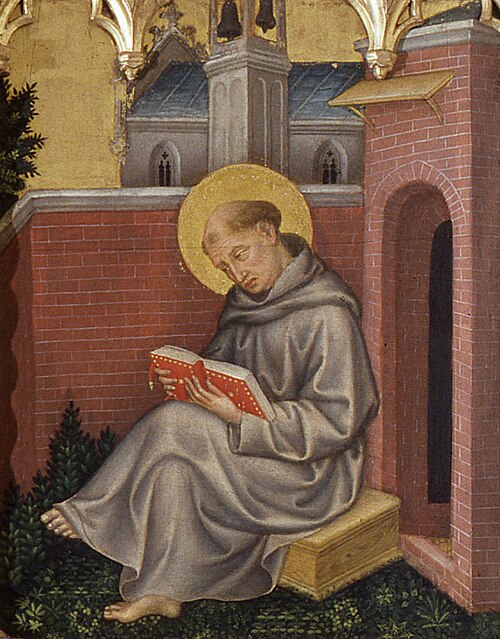
啓示とは、神との能動的または受動的なコミュニケーションを通じて何かを明らかにしたり、開示したり、明らかにすることであり、神から直接発生することもあれば、天使などの代理人を通じて発生することもあります。[10]そのような接触を経験したと認められた人は、しばしば預言者と呼ばれます[誰によって? ]。キリスト教では一般的に、聖書は神的または超自然的に啓示された、またはインスピレーションを受けたものであると考えています。そのような啓示には、必ずしも神や天使の存在は必要ありません。たとえば、カトリック教徒が内なる発話と呼ぶ概念では、超自然的な啓示には、受信者が聞いた内なる声だけが含まれることがあります。
トマス・アクィナス(1225-1274)は、キリスト教における啓示を一般啓示と特別啓示という2つの種類に初めて定義した。[11]
- 一般啓示は、創造された秩序の観察を通じて起こります。そのような観察は、論理的に、神の存在や神のいくつかの属性などの重要な結論につながります。一般啓示は、キリスト教の弁証論の要素でもあります。[要出典]
- 聖書の教えの中で明らかにされている三位一体や受肉などの特定の事柄は、特別な啓示によってのみ推論することができます。
聖書の啓示

聖書には、著者が自分のメッセージは神の啓示によるものだと主張したり、他の人にそのような啓示が及ぼした影響について報告している箇所が数多くあります。直接書かれた啓示の記述(モーセが石板に刻まれた十戒を受け取ったなど)のほかに、旧約聖書の預言者たちは、啓示の前に「主はこう仰せられる」というフレーズを添えて、そのメッセージが神の起源であると主張しました(たとえば、列王記上 12:22–24、歴代誌上 17:3–4、エレミヤ 35:13、エゼキエル 2:4、ゼカリヤ書 7:9 など)。ペトロの第二の手紙は、「聖書の預言は、人間の意志によって書かれたものではなく、聖霊に動かされた人々が神からのことを語ったものである」と主張しています[12]。ペトロの第二の手紙はまた、パウロの著作が霊感を受けたものであることを示唆しています(ペトロの第二の手紙 3:16)。
多くのキリスト教徒は、パウロがテモテに宛てた手紙のテモテへの手紙 2 章 3 節 16 ~ 17 節を「聖書はすべて神の霊感を受けて書かれたもので、有益です」という証拠として挙げています。ここで聖パウロは旧約聖書を指しています。なぜなら、聖書はテモテが「幼少のころ」から知っていたからです (15 節)。この一節について別の読み方を提案する人もいます。たとえば、神学者のCH Dodd は、この一節を「おそらく次のように訳すべきでしょう」と示唆しています。「霊感を受けた聖書はすべて有益です」[13]。同様の翻訳は、新英語聖書、改訂英語聖書、および (脚注の代替として)新改訂標準訳聖書にあります。ラテン語のウルガタ聖書もそのように読むことができます。[14]さらに、「伝統的な」解釈を擁護する人もいます。Daniel B. Wallace は、この代替訳を「おそらく最良の翻訳ではない」と呼んでいます。[15]
聖書の現代英語版の中には、theopneustosを「神の息吹」(NIV)または「神によって吹き出された」(ESV)と訳し、ラテン語の語源inspīrāre (「吹き込む、息を吹き込む」)というインスピレーションという言葉を避けているものがある。[16]
聖書の権威
キリスト教では一般的に、聖書として知られる合意された書物の集まりが権威があり、聖霊の啓示を受けて人間の著者によって書かれたものであるとみなしています。一部のキリスト教徒は、聖書は無謬(歴史的および科学的部分を含め、完全に誤りがなく矛盾がない)[17]または絶対確実(信仰と実践の問題では無謬だが、歴史や科学の問題では必ずしもそうではない)であると信じています。[18] [検証には引用が必要] [19] [20] [21] [22]
キリスト教徒の中には、聖書は神の啓示を受けたものであると言いながら、誤りや誤謬を犯すことはできないと推測する者もいる。なぜなら、聖書が神の啓示を受けたものであるなら、啓示の源泉が神であるなら、生み出されたものに誤りや誤謬が生じることはないはずだからだ。彼らにとって、神の啓示、無謬性、無謬性の教義は、切り離せない関係にある。聖書の完全性という考えは、現在の聖書本文が完全で誤りがなく、聖書本文の完全性が損なわれたり劣化したりしたことがないことを示唆する、無謬性のさらなる概念である。[17]歴史家は、聖書の無謬性の教義が採用されたのは、聖書が書かれた数百年後の [ いつ ] であると指摘、または主張している。[議論中(出典の誤記のため) –議論] [ 23]
聖書正典
プロテスタントの旧約聖書の内容は、区分と書の順序が変更されている以外はヘブライ語聖書正典と同じですが、カトリックの旧約聖書には、第二正典として知られる追加のテキストが含まれています。プロテスタントは39冊を旧約聖書正典として認めていますが、ローマカトリックと東方キリスト教徒は46冊を正典として認めています。[要出典]カトリックとプロテスタントはどちらも同じ27冊の新約聖書正典を使用しています。
初期のキリスト教徒は、ヘブライ語聖書のコイネーギリシャ語訳である七十人訳聖書を使用していました。キリスト教はその後、新約聖書となるさまざまな追加の書物を承認しました。4世紀には、一連のシノドス、最も有名なのは西暦393年のヒッポシノドスで、カトリック教徒が現在使用している旧約聖書の46巻の正典(およびすべてのカトリック教徒が使用している新約聖書の27巻の正典)に等しいテキストのリストが作成されました。決定的なリストは、初期のエキュメニカル評議会からは出ませんでした。[24] 400年頃、ヒエロニムスは、ローマ司教の強い要望により、以前のシノドスの決定に従った内容の、聖書の決定的なラテン語版であるウルガタ訳を作成しました。このプロセスにより、事実上、新約聖書の正典が確立されましたが、この時期以降に使用された他の正典リストの例も存在します。[要出典]
16 世紀のプロテスタント宗教改革の際、一部の改革者が旧約聖書の異なる正典リストを提案しました。ユダヤ教正典にはないが七十人訳聖書にはあるテキストは不評となり、最終的にプロテスタントの正典から姿を消しました。カトリックの聖書ではこれらのテキストを第二正典として分類していますが、プロテスタントでは外典として分類しています。
本来の神学:神
キリスト教では、神は宇宙の創造者であり、宇宙の維持者です。神は宇宙で唯一の 究極の力ですが、宇宙とは別物です。聖書は神を非人格的なものとして語ることはありません。代わりに、神は話し、見て、聞いて、行動し、愛する人格的な言葉で言及しています。神は意志と人格を持ち、全能で神聖で慈悲深い存在であると理解されています。聖書では、神は主に人々とその救済に関心を持っていると表現されています。 [25]
神の属性
分類
多くの改革派神学者は、伝達可能な属性(人間も持つことができる属性)と伝達不可能な属性(神のみに属する属性)を区別しています。 [26]
列挙
キリスト教神学[27]において神に帰せられる属性には次のようなものがある。
- 自己存在性- 「神は非常に独立しているので、私たちを必要としない」[28]これは使徒言行録17章25節に基づいており、そこには「神は何かを必要とするかのように、人の手によって仕えられることはない」と書かれています(NIV )。これはしばしば神の自己存在と自給自足に関連しています。
- 永遠— 神は時間の領域を超えて存在する。
- 慈悲深さ— 神は無条件にも条件付きにも人類にその恵みと賜物を与えてくださる。
- 聖性— 神は罪から分離しており、腐敗しない。イザヤ書6章3節と黙示録4章8節の「聖なるかな、聖なるかな、聖なるかな」という繰り返しに注目すると、
- 内在性— 神は超越的で神聖であるが、同時にアクセス可能であり、動的に体験できるものである。
- 不変性— 神の本質は不変である。
- 無感動性- 神は感情や苦しみを経験しない(より物議を醸す教義であり、特にオープン神論によって異論が唱えられている)。
- 非の打ち所がない— 神は間違い (罪) を犯すことができない。
- 無形性— 神は物理的な構成を持たない。関連する概念は神の霊性であり、これはヨハネ4:24 の「神は霊である」というイエスの言葉に由来する。
- 愛— 神は思いやりと慈悲です。ヨハネの手紙第一4:16 には「神は愛です」とあります。
- 使命— 神は最高の解放者である。神の使命は伝統的にこのリストには含まれていないが、デイヴィッド・ボッシュは「使命は主に教会の活動ではなく、神の属性である」と主張している。[29]
- 全知全能— 神は全知全能です。神の全知全能とは、神が「すべて善良」であることを意味します。
- 全能性- 神は至高、あるいは全能である。
- 遍在性— 神は至高の存在であり、いつでもどこにでも存在し、すべてを知覚し、すべてを構想する現実の基盤である。
- 全知- 神は至高の、あるいは全知である。
- 唯一性 - 神は比類のない存在であり、また、あらゆる神の属性は、その全体が具体化されている(神の質的無限性)。一神教と神の単純性も参照してください。
- 摂理— 神は関心と献身をもって創造物を見守る。神の摂理は通常、世界における神の活動を指すが、宇宙に対する神の配慮も意味し、したがって属性である。通常、神が宇宙の存在と自然の秩序を継続的に維持する「一般的な摂理」と、人々の生活に対する神の並外れた介入を指す「特別な摂理」とが区別される。[30]主権も参照。
- 正義— 神は人間の行為の最大の、あるいは唯一の基準です。神の正義とは、神の神聖さ、神の正義、あるいはキリストを通しての神の救いの働きを指す場合があります。
- 超越性—神は物理法則の自然領域を超えて存在し、したがって物理法則に縛られないこと。[31]神はまた、一般的または特別な自己啓示を除いては完全に他者であり、理解不能である。
- 三位一体— キリスト教の神は、(三位一体を信じるキリスト教徒によって)父、子、聖霊の「三位一体」であると理解されており、これは神の「一体性」と完全に一致しています。つまり、自然の内と外の両方に存在する単一の無限の存在です。三位一体の位格は、神自身に対するレベルでも個人的な関係を表しているため、神は私たちとの関係においても、神自身に対する関係においても個人的な存在です。
- 真実性— 神はすべての人類が追い求める真実であり、また非の打ちどころのない正直者です。テトス1:2 は「神は偽りを言われない」と述べています。
- 知恵— 神は人間の本質と世界を完全に理解しており、その意志が天と地で実現されるのを見届けます。ローマ人への手紙16:27 は「唯一の知恵ある神」について語っています。
一神教

キリスト教徒の中には、キリスト教以前の時代のヘブライ人が崇拝していた神は、イエスを通して常に自らを現していたが、イエスが生まれるまでそのことは明らかではなかったと信じている者もいる(ヨハネ1章参照)。また、主の天使が族長たちに語りかけて神を現したにもかかわらず、後になって人々が神自らが自分たちを訪れたことを知覚できたのは、 神の霊が彼らに理解を与えたからに過ぎないと信じる者もいる。
この信仰は徐々に現代の三位一体論へと発展しました。三位一体論とは、神は単一の存在 (ヤハウェ) であるが、神の単一の存在には三位一体性があり、その意味は常に議論されてきたという教義です。この神秘的な「三位一体」は、ギリシャ語では位格(ラテン語では実体)、英語では「人格」として説明されてきました。それにもかかわらず、キリスト教徒は、自分たちが信じているのは唯一の神だけであることを強調しています。
ほとんどのキリスト教会は、ユニテリアンの一神教とは対照的に、三位一体を説いています。歴史的に、ほとんどのキリスト教会は、神の性質は神秘であり、一般啓示によって推論されるのではなく、特別啓示によって明らかにされなければならないものであると教えてきました。
キリスト教正統派(カトリック、東方正教会、プロテスタント)はこの考えに従っており、これは 381 年に成文化され、カッパドキア教父の活動を通じて完全に発展しました。彼らは、神は三位一体と呼ばれる三位一体の存在であり、父なる神、子なる神、聖霊なる神という 3 つの「位格」から成り、「同一実体」( ὁμοούσιος )であると説明されています。しかし、無限の神の真の性質は、一般的に定義を超えていると説明されており、「位格」という言葉はその考えの不完全な表現です。
批評家の中には、キリスト教は三位一体の神の概念を採用しているため、三神論または多神教の一形態であると主張する者もいる。この概念はアリウス派の教えに由来し、聖書の中で父よりも後に登場したイエスは、二次的で劣位の、したがって別個の神でなければならないと主張した。ユダヤ教徒とイスラム教徒にとって、三位一体の神という考えは異端であり、多神教に類似していると見なされている。キリスト教徒は圧倒的に一神教がキリスト教信仰の中心であると主張しており、正統派キリスト教の三位一体の定義を与えるニカイア信条(およびその他の信条)は、「私は唯一の神を信じます」で始まっている。
3世紀、テルトゥリアヌスは神は父、子、聖霊の3つのペルソナとして存在し、これらは同一実体であると主張した。[32]三位一体論のキリスト教徒にとって、父なる神は、キリスト教の神格の他の位格(ペルソナ)である子なる神(イエスはその化身)と聖霊とはまったく別の神ではない。[32]ニカイア信条によれば、子(イエス・キリスト)は「父から永遠に生まれた」ものであり、彼らの神聖な父と子の関係は時間や人類の歴史における出来事に結びついていないことを示している。
キリスト教では、三位一体の教義によれば、神は一つの存在であり、父、子(イエスの受肉)、聖霊(または聖霊)の三つの位格が相互に内在し、同時に永遠に存在するとされています。キリスト教の初期の頃から、人の救いは三位一体の神の概念と非常に密接に関係していましたが、三位一体の教義は 4 世紀まで公式化されませんでした。当時、コンスタンティヌス帝は第一ニカイア公会議を招集し、帝国のすべての司教が出席するよう招かれました。教皇シルウェステル 1 世は出席しませんでしたが、特使を派遣しました。この公会議では、とりわけ、オリジナルのニカイア信条が制定されました。
三位一体
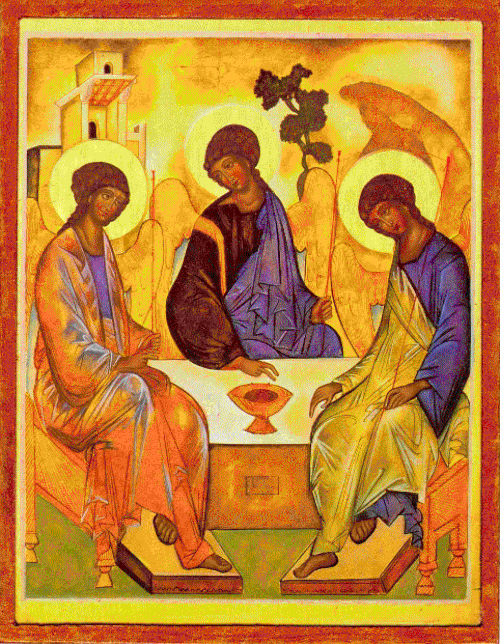
ほとんどのキリスト教徒にとって、神についての信仰は三位一体論の教義に定められており、この教義では、神の三つの位格が一緒になって一つの神を形成するとされている。三位一体論の見解では、神には意志があり、子なる神には神の意志と人の意志という二つの意志があるが、これらが決して矛盾することはない(位格の結合を参照)と強調されている。しかし、この点は東方正教会のキリスト教徒によって異論があり、彼らは子なる神には神性と人性が統一された一つの意志しかないとしている(三位一体論を参照)。
キリスト教の三位一体の教義は、父、子、聖霊の三つの位格が一つの神格の中にあると教えている。[33]この教義では、神は三位一体の神であり、三つの位格、またはギリシャ語で言うところの ヒュポスタシス[34]として存在するが、一つの存在であるとされている。[35]三位一体における人格は、英語で使われる「人格」の一般的な西洋的理解とは一致しない。つまり、それは「自由意志と意識的活動の、個人的で自己実現した中心」を意味するものではない。[36] : 185–186。 古代人にとって、人格は「ある意味では個人的だが、常に共同体でもあった」。[36] : p.186 各人格は、単に類似した性質ではなく、一つの同一の本質または性質を持っていると理解されている。3世紀初頭から[37]三位一体の教義は「父、子、聖霊という三つの位格と一つの本質を持つ一つの神が存在する」と述べられてきました[38] 。
三位一体論、つまり三位一体を信じる信仰は、カトリック、東方正教会、東洋正教会、およびプロテスタント宗教改革から生じた英国国教会、メソジスト教会、ルーテル教会、バプテスト教会、長老派教会などの他の著名なキリスト教宗派の特徴である。オックスフォード・キリスト教辞典は、三位一体を「キリスト教神学の中心教義」と表現している。[38]この教義は、ユニテリアン主義、一神教、様相主義などの非三位一体論の立場とは対照的である。キリスト教徒のごく少数は非三位一体論の見解を持ち、その多くはユニテリアン主義に分類される。
すべてではないにしてもほとんどのキリスト教徒は、神は霊であり、[39]創造されていない、全能で永遠の存在であり、すべてのものの創造者であり維持者であり、御子イエス・キリストを通して世界の救済を行う存在であると信じています。このような背景から、キリストと聖霊の神性に対する信仰は三位一体の教義として表現され、[40]単一の神のousia (実体) が、父、子 (ロゴスであるイエス・キリスト)、聖霊という 3 つの別個かつ分離不可能な位格(人格)として存在すると説明しています。[41]
三位一体の教義は、ほとんどのキリスト教徒にとって信仰の核となる教義であると考えられています。非三位一体論者は、父なる神が至高であり、イエスは神の主であり救世主であるものの、神の子であり、聖霊は地上における神の意志に似た現象である、と一般的に信じています。聖なる三者は別々ですが、子と聖霊は依然として父なる神から生じたものと考えられています。
新約聖書には「三位一体」という言葉はなく、三位一体そのものについて論じている箇所はどこにもありません。しかし、新約聖書では父、子、聖霊について繰り返し言及し、「神を三位一体として理解することを強いる」と強調する人もいます。[42]この教義は、マタイ伝28章19節の洗礼の式文など、新約聖書の箇所で使用されている聖書の言葉から発展し、 4世紀末までに現在の形で広く信じられるようになりました。
父なる神
多くの一神教では、神は父と呼ばれている。それは、父親が自分を頼りにしている子供たちに関心を持ち、父親として人類、つまり子供たちに応え、彼らの最善の利益のために行動するのと同じように、神が人間の営みに積極的に関心を持っているためでもある。[43]キリスト教では、神は創造主であり、被造物の養育者であり、子供たちの養育者であるだけでなく、より文字通りの意味で「父」と呼ばれている。[44]父は、独り子(モノゲネス)であるイエス・キリストと特別な関係にあると言われており、それは排他的で親密な親しさを意味している。「父のほかに子を知る者はなく、子と子が父を明かそうと選んだ者のほかに、父を知る者はいない。」[45]
キリスト教では、父なる神と人類との関係は、これまで聞いたことのない意味で、子供たちの父親のようなものであり、創造主であり、被造物の養育者であり、子供たち、つまり人々の養育者というだけではない。したがって、人間は一般的に神の子供と呼ばれることがある。キリスト教徒にとって、父なる神と人類との関係は、創造主と被造物の関係であり、その点で父はすべてのものの父である。この意味で、新約聖書は、家族という概念自体が、どこに現れようとも、その名前は父なる神に由来しており、[46]したがって神自身が家族のモデルであると述べています。
しかし、キリスト教徒は、霊的な花嫁であるイエス・キリストを通して父と子の特別な関係に参加していると信じているという、より深い「法的」な意味があります。キリスト教徒は自分たちを神の養子と呼びます。[47]
新約聖書では、父なる神は息子との関係において特別な役割を担っており、イエスは神の息子であり相続人であると信じられています。[48]ニカイア信条によれば、息子(イエス・キリスト)は「父から永遠に生まれた」存在であり、神聖な父と息子の関係は時間や人類の歴史の中での出来事に結びついていないことを示しています。キリスト論を参照してください 。聖書は、神の創造の初めに存在した「言葉」と呼ばれるキリストについて述べています。 [49]キリスト自身は創造物ではありませんが、三位一体の人格において同等です。
東方正教の神学では、父なる神は「プリンキピウム」(始まり)であり、子と聖霊の「源」または「起源」であり、三位一体を直観的に強調しています。これに対して、西洋の神学では、3つの位格または位格すべての「起源」は神の性質にあると説明しており、神の存在の一体性を直観的に強調しています。 [引用が必要]
キリスト論とキリスト
キリスト論はキリスト教神学の研究分野であり、キリスト教徒が神の子とみなすイエス・キリストの性質、人格、および行為を主に扱っています。キリスト論は、イエスの人格における人間性(人の子)と神性(神の子または神の言葉)の出会いに関わっています。
主な検討事項には、受肉、イエスの性質と人格と神の性質と人格との関係、そしてイエスの救済活動が含まれる。そのため、キリスト論は一般に、イエスの生涯(何をしたか)や教えの詳細よりも、イエスが誰であるか、あるいは何であるかに関心がある。イエスの昇天後に教会が始まって以来、イエスの信奉者を主張する人々によって、さまざまな見解が存在してきたし、現在も存在している。論争は最終的に、人間の性質と神の性質が一人の人格の中に共存できるかどうか、またどのように共存できるかということに焦点が当てられた。これら二つの性質の相互関係の研究は、多数派の伝統の関心事の1つである。
イエスについての教えと、イエスが3年間の公の宣教活動で成し遂げたことについての証言は、新約聖書の至る所に見いだされる。イエス・キリストという人物についての聖書の核となる教えは、イエス・キリストは、罪のない一人の人物において、かつて、そして永遠に、完全に神(神性)であり、同時に完全に人間であったということ、そしてイエスの死と復活を通して、罪深い人間は神と和解することができ、それによってイエスの新契約を通して救いと永遠の命の約束が与えられるということに要約できる。イエスの性質については神学上の論争があったが、キリスト教徒は、イエスが受肉した神であり、「真の神であり、真の人」(または完全に神性であり、完全に人間である)であると信じている。あらゆる点で完全に人間となったイエスは、死すべき人間の苦痛と誘惑に苦しんだが、罪を犯さなかった。完全に神であったイエスは、死を克服し、再び生き返った。聖書は、イエスが聖霊によって、人間の父親なしに処女である母マリアから懐胎され生まれたと主張している。[51]聖書には、イエスの宣教活動に関する奇跡、説教、教え、癒し、死、そして復活が記されている。使徒ペテロは、1世紀以来キリスト教徒の間で有名な信仰宣言となった「あなたはキリスト、生ける神の子です」と語った。[52]現在、ほとんどのキリスト教徒は、キリストの再臨が残りの救世主の預言を成就すると信じて、キリストの再臨を待っている。
キリスト
キリストは、ギリシャ語の Χριστός ( Khristós )の英語の用語で、 「油を注がれた者」を意味します。[53]これはヘブライ語の מָשִׁיחַ ( Māšîaḥ )の翻訳であり、通常英語ではMessiahと音訳されます。この単語は、キリスト教の聖書でイエス・キリストについて何度も言及されているため、イエスの姓であると誤解されることがよくあります。この単語は実際には称号として使用されているため、一般的に相互にChrist Jesusとして使用され、これは油を注がれたイエスまたは救世主イエスを意味します。イエスの信奉者は、イエスが旧約聖書、つまりタナハで預言されたキリスト、または救世主であると信じていたため、クリスチャンとして知られるようになりました。
三位一体のエキュメニカル評議会
キリスト論の論争は、神格と神格同士の関係をめぐって頂点に達した。キリスト論は、第 1 ニカイア公会議(325)から第 3 コンスタンティノープル公会議(680) まで、基本的な関心事であった。この時期に、より広範なキリスト教共同体内のさまざまなグループのキリスト論的見解が異端の告発につながり、まれに宗教的迫害に至った。場合によっては、宗派独自のキリスト論がその宗派の主な特徴となることがあり、このような場合、宗派はキリスト論に与えられた名前で知られるのが一般的である。
ニカイア公会議でなされ、数十年にわたる論争の末、アタナシウスとカッパドキア教父の著作が影響を与えた第1回コンスタンティノープル公会議で再承認された決定。使用された言葉は、唯一の神が3つの位格(父、子、聖霊)で存在するというもので、特に子は父とホモウシオス(同一実体)であることが確認された。ニカイア公会議信条は、イエスの完全な神性と完全な人性について述べており、キリストの位格において神と人がいかにして一体となるのか(キリスト論)についての議論への道筋を準備した。
ニカイア公会議は、イエスが完全に神であり、また人間でもあると主張しました。しかし、一人の人間がどのようにして神であり人間であることができるのか、また、その一人の人間の中で神と人間がどのように関係しているのかについては明らかにしませんでした。これが、キリスト教時代の 4世紀と5 世紀のキリスト論論争につながりました。
カルケドン信条は、キリスト論に関するすべての議論に終止符を打ったわけではありませんが、使用される用語を明確にし、他のすべてのキリスト論の基準となりました。キリスト教の主要宗派のほとんど、つまりカトリック、東方正教会、英国国教会、ルーテル派、改革派は、カルケドン信条のキリスト論の定式化を支持していますが、東方キリスト教の多くの宗派、つまりシリア正教会、アッシリア教会、コプト正教会、エチオピア正教会、アルメニア使徒教会は、カルケドン信条のキリスト論の定式化を拒否しています。
キリストの特質
神の子としての
聖書によれば、三位一体の第二位格は、第一位格(父なる神)との永遠の関係から、神の子である。彼は(三位一体論者によって)父と聖霊と同等であると考えられている。彼は完全に神であり、完全に人間である。つまり、神の性質に関しては神の子であり、人間の性質に関してはダビデの血統である。[54] [55]イエスの自己解釈の核心は、彼の「子としての意識」、つまり、彼と神との関係が、ある独特な意味での子と親の関係であった[25](フィリオクエ論争を参照)。彼の地上での使命は、人々が神を父として知ることができるようにすることであったことが判明した。これは、キリスト教徒が永遠の命の本質であると信じている。[56]
キリスト教神学では、子なる神は三位一体の第二位格である。三位一体の教義は、ナザレのイエスを子なる神と見なし、父なる神と聖霊なる神(三位一体の第一位格と第三位格)に関して、本質的には一体であるが人格的には別個の存在としている。子なる神は、天地創造の前も終末の後も、父なる神(および聖霊)と共に永遠である(終末論を参照)。したがって、イエスは常に「子なる神」であったが、受肉によって「神の子」にもなって初めて、そのように啓示された。「神の子」は彼の人間性に注目させるが、「子なる神」はより一般的に、受肉前の存在を含む彼の神性を指す。したがって、キリスト教神学では、イエスは常に「子なる神」であったが、[57]受肉によって神の子にもなって初めて、そのように啓示された。
「神の子」という正確な表現は新約聖書にはない。この表現の後の神学的使用は、新約聖書の言及の標準的な解釈を反映しており、イエスの神性を暗示していると理解されているが、イエスの人格は、イエスが父と呼んだ唯一の神とは区別されている。そのため、この称号は、キリスト論の議論よりも、三位一体の教義の発展とより関連している。新約聖書には、イエスに「神の子」という称号が与えられている箇所が 40 箇所以上あるが、学者たちはこれを同等の表現とは考えていない。「神の子」は反三位一体論者によって拒否されており、彼らはキリストの最も一般的な用語のこの逆転は教義の倒錯であり、三神論に傾くと見ている。
マタイはイエスの言葉を引用しています。「平和を実現する人たちは幸いである、その人たちは神の子と呼ばれるであろう(5:9)」。福音書は、イエスが神の子であるかどうかについて、独特の方法で多くの論争を記録しています。しかし、使徒行伝と新約聖書の手紙は、初期のキリスト教徒の初期の教えを記録しています。彼らはイエスを神の子、救世主、神に任命された人であると同時に神自身であると信じていました。これは多くの箇所で明らかですが、ヘブライ人への手紙の最初の部分では、ヘブライ語聖書の聖句を権威として引用しながら、慎重で持続的な議論でこの問題に取り組んでいます。たとえば、著者はイスラエルの神がイエスに語った詩篇 45:6 を引用しています。
- ヘブル人への手紙1:8。息子について彼はこう言っています。「神よ、あなたの王座は永遠に続きます。」
ヘブル人への手紙の著者は、イエスを神の父の正確な表現として描写していますが、コロサイ人への手紙の一節にも同様の記述があります。
- コロサイ2:9–10。「キリストのうちに、神の満ちあふれる豊かさが、形をとって宿っているのです。」
ヨハネの福音書には、イエスと天の父との関係について長々と引用されています。また、イエスの神性に関する有名な 2 つの記述も含まれています。
- ヨハネ1:1。「言葉は神であった」[文脈上、言葉はイエスです。ロゴスであるキリストを参照してください]
- ヨハネ20:28。「トマスはイエスに言った。『わたしの主、わたしの神よ。』」
イエスが神であるという最も直接的な言及は、さまざまな手紙の中に見つかります。
後の信条における三位一体の記述の聖書的根拠は、マタイ伝 28 章にある初期の洗礼の式文です。
キリストの人
- 神のみ?
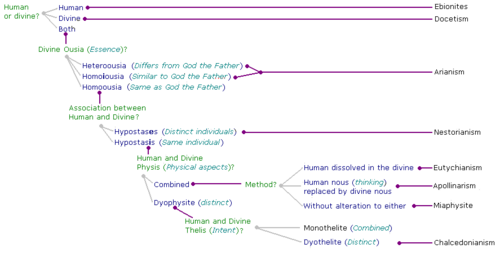
ドケティズム(ギリシャ語の動詞「見える」に由来)は、イエスは完全に神であり、イエスの人間としての肉体は幻影に過ぎないと説いた。非常に早い段階で、さまざまなドケティズムのグループが出現した。特に、西暦 2 世紀に栄えたグノーシス派は、ドケティズムの神学を持つ傾向があった。ドケティズムの教えは、アンティオキアの聖イグナチオ(2 世紀初頭)によって攻撃され、正典のヨハネの手紙でも攻撃対象となっているようである(日付は議論の余地があるが、伝統主義の学者の間では 1 世紀後半、批判的な学者の間では 2 世紀後半とされている)。
ニカイア公会議は、キリストの人間性を完全に否定する神学を否定し、ニカイア信条において三位一体の教義の一部として受肉の教義を肯定しました。つまり、三位一体の第二位格がイエスという人物に受肉し、完全な人間となったということです。
- 人間だけ?
キリスト教史の初期の数世紀には、イエスは普通の人間であったと主張する、スペクトルの対極に位置するグループもあった。養子論者は、イエスは完全な人間として生まれ、その生き方ゆえに洗礼者ヨハネによって洗礼を受けた際に神の子として養子にされたと教えた[58] 。エビオン派として知られる別のグループは、イエスは神ではなく、ヘブライ語聖書で約束された人間であるモシェ(救世主、油を注がれた者)預言者であると教えた。
これらの見解の中には、神の唯一性を主張する点でユニテリアン主義(これは現代の用語ですが)と表現できるものもあります。神性に対する理解に直接影響を与えるこれらの見解は、ニカイア公会議で異端であると宣言されました。キリスト教の古代史の残りのほとんどの期間を通じて、キリストの神性を否定するキリスト論は、教会の生活に大きな影響を与えなくなりました。
- どうして彼は両方になれるのでしょうか?
-
- 何の神性ですか?
アリウス主義は、イエスが神であることを認めたが、イエスは創造された存在であり(イエスが存在しなかった時代もあった)、したがって父なる神よりも神性が低いと教えた。この問題は、アリウス主義がホモ・イ・ウシア(イエスの神性が父なる神と同じであるという信仰)を教えたのに対し、ホモウシア(イエスの神性が父なる神と同じであるという信仰)を教えたという点に集約された。アリウスの反対者はさらに、イエスの神性が父なる神の神性と異なる(ヘテロウシア)という信仰もアリウス主義という用語に含めた。
アリウス派はニカイア公会議で非難されたが、帝国の北部および西部の属州では依然として人気があり、6 世紀に入っても西ヨーロッパでは大多数の見解であり続けた。実際、コンスタンティヌス帝の臨終の洗礼に関するキリスト教の伝説にも、歴史の記録によるとアリウス派の司教が登場する。
現代では、キリスト教徒やエホバの証人を含む多くの宗派がニカイアの三位一体の教義を否定している。[59]
- どのような合併ですか?
ニカイア公会議後のキリスト論的論争は、三位一体の教義を堅持しながら、キリストの人格における人間性と神性の相互作用を理解しようとした。ラオデキアのアポリナリス(310-390)は、イエスにおいては、神の要素が人間のヌース(思考。意図を意味するテリスと混同しないように)に取って代わったと教えた。しかし、これはイエスの真の人間性を否定するものとみなされ、この見解は第1コンスタンティノープル公会議で非難された。
その後、コンスタンティノープルのネストリウス(386年 - 451年)は、イエスを神と人間の2つの位格に事実上分けるという見解を始めた。この結合の仕組みは、ヒュポスタス・エス(Hyputas e s)として知られ、分離はないとするヒュポスタス・イズ(Hyputas i s)とは対照的である。ネストリウスの神学は、第1エフェソス公会議(431年)で異端とみなされた。大ババイの著作に見られるように、東方教会のキリスト論はカルケドン公会議のものと非常に似ているが、多くの正統派キリスト教徒(特に西方)は、このグループがネストリウス派の存続であると考えている。現代のアッシリア東方教会は、ネストリウスの神学全体を受け入れることを意味するため、この用語を避けることがある。
様々な形態の単性論では、キリストはただ一つの性質しか持たないと教えられており、すなわち、神は消滅した(エウテュキス主義)か、キリストという人物において神が人間と一つの性質として結合した(ミアフィジティスム)かのどちらかであった。著名な単性論の神学者はエウテュケス( 380年頃- 456年)である。単性論は451年のカルケドン公会議で異端として拒絶され、同公会議では、イエス・キリストは二つの性質(神性と人性)が一つの位格に結合され、位格的結合をしていると断言された(カルケドン信条を参照)。エウテュキス主義はカルケドン派とミアフィジティスによって忘却の淵に追いやられたが、カルケドン派の定式に異議を唱えたミアフィジティス派のグループは東方正教会として存続した。
神学者たちがカルケドン派の定義と単性論の間の妥協点を模索し続ける中で、キリストの完全な人間性を部分的に否定する他のキリスト論が発展した。単性論は、イエスの一人の人格には2つの性質があるが、神の意志だけがあると教えた。これに密接に関連しているのは単精論で、単性論と同じ教義を保持していたが、用語が異なっていた。これらの立場は、第3回コンスタンティノープル公会議(第6回全地公会議、680-681年) で異端と宣言された。
化身
受肉とは、キリスト教の神格の第二位格である神の子またはロゴス(言葉)が、聖母マリアの胎内に奇跡的に宿ったときに「肉となった」というキリスト教の信仰である。受肉という言葉は、ラテン語(in = in または into、caro、carnis = 肉)に由来し、「肉にする」または「肉になる」という意味である。受肉は、新約聖書の理解に基づく正統派(ニカイア派)キリスト教の基本的な神学的教えである。受肉は、三位一体の神の非創造的第二位格であるイエスが人間の体と性質を帯び、人間と神の両方になったという信仰を表す。聖書で最も明確な教えは、ヨハネ1:14である。「そして、言葉は肉となり、私たちの間に住まわれた。」[60]

受肉は、伝統的に定義されているように、御子の神性と人間性が結合したが、混ざり合わなかった[61] 。イエス・キリストは「真の神であり、真の人」である一人の神格であった。受肉は毎年クリスマスに記念され、祝われ、また受胎告知の祝日にも言及することができる。「受肉の神秘のさまざまな側面」がクリスマスと受胎告知で祝われる。[62]
これは、ほとんどのキリスト教徒が持つ伝統的な信仰の中心です。この問題に関する別の見解(エビオン派とヘブライ人による福音書を参照)は何世紀にもわたって提案されてきましたが(下記参照)、そのすべてが主流のキリスト教団体によって拒否されました。
近年、「ワンネス」として知られる代替の教義が、さまざまなペンテコステ派のグループ(下記参照)の間で支持されてきましたが、キリスト教世界の残りの部分では拒否されています。
- 伝統的教義の説明と発展
初期キリスト教時代、キリストの受肉の性質に関してキリスト教徒の間でかなりの意見の相違がありました。すべてのキリスト教徒がイエスが確かに神の子であると信じていた一方で、イエスが子であるという正確な性質は、新約聖書で言及されている「父」、「子」、「聖霊」の正確な関係とともに、論争の的となりました。イエスが「子」であることは明らかでしたが、これは正確には何を意味していたのでしょうか? この主題に関する議論は、キリスト教の最初の 4 世紀に特に激しく行われ、ユダヤ教徒、グノーシス主義者、アレクサンドリアの長老アリウスの信奉者、聖アタナシウス大王の信奉者などが関与しました。
最終的に、キリスト教会は、キリストは三位一体の永遠の第二位格の化身であり、完全な神であると同時に完全な人であるという、聖アタナシウスとその同盟者の教えを受け入れた。すべての相反する信念は異端と定義された。これには、イエスは人間の外見をとったが肉体をとらなかった神的存在であるとするドケティズム、キリストは創造された存在であるとするアリウス主義、そして神の子と人間であるイエスは同じ肉体を共有しながらも2つの別々の性質を保持していると主張するネストリウス派が含まれていた。特定の現代のペンテコステ派教会が抱く一体性信仰も、ほとんどの主流キリスト教団体から異端と見なされている。
最も広く受け入れられていた初期キリスト教会は、 325年の第1ニカイア公会議、431年のエフェソス公会議、451年のカルケドン公会議で、イエスの受肉と性質についての定義を行った。これらの公会議は、イエスが完全な神(父から生まれたが父によって創造されたわけではない)であり、完全な人間(聖母マリアから肉体と人間性を授かった)であると宣言した。人間と神というこの2つの性質は、位格的にイエス・キリストの1つの人格に統合された。[63]
- 偶然と必然の化身
組織的神学思想における受肉と贖罪の関係は複雑です。身代わり、償い、勝利のキリストなど、贖罪の伝統的なモデルでは、十字架の犠牲が有効であり、人間の罪が「取り除かれる」または「克服される」ためには、キリストが神でなければなりません。ユルゲン・モルトマンは著書『三位一体と神の王国』で、彼が「偶然の」受肉と「必然の」受肉と呼ぶものを区別しました。後者は受肉に救済論的な重点を置いています。神の子は私たちを罪から救うために人間になりました。一方、前者は受肉を神の愛の実現、つまり人間の中に存在し生きたいという神の望み、私たちと一緒に「園を歩く」こととして語っています。
モルトマンは「偶然の」受肉を支持するが、それは主に「必然」の受肉について語ることはキリストの生涯を軽視することだと考えているからである。モルトマンの著作は、他の組織神学者とともに、キリスト論の解放への道を切り開いている。
位格結合

簡単に言えば、この教義は、人間性と神性の 2 つの性質がキリストの 1 人の人格に統合されているとしています。公会議はさらに、人間性と神性の 2 つの性質はそれぞれ別個で完全であると教えました。この見解は、それを否定する人々によって、 Dyophysite (2 つの性質を意味する) と呼ばれることもあります。
位格的結合(ギリシャ語で実体を意味する)は、キリスト教神学の専門用語で、主流のキリスト論で、イエス・キリストにおける人間性と神性の二つの性質の結合を説明するために用いられている。二つの性質の教義の簡潔な定義は、「子と同一であるイエス・キリストは、人間性と神性という二つの性質を持つ一つの位格であり一つの位格である」である。[64]
エフェソス第一公会議はこの教義を認め、その重要性を確認し、キリストの人間性と神性はロゴスにおける本性と位格に従って一体化されていると述べた。
第一ニカイア公会議は、父と子は同一実体であり、共に永遠であると宣言しました。この信仰はニカイア信条に表現されています。
ラオデキアのアポリナリスは、受肉を理解しようとする際に、ヒュポスタシスという用語を最初に使用しました。[65]アポリナリスは、キリストにおける神と人の結合は単一の性質と単一の本質、つまり単一のヒュポスタシスであると説明しました。
ネストリウス派のモプスエスティアのテオドロスは反対の方向に進み、キリストには二つの性質(二性性)(人間と神)と二つの位格(「本質」または「人格」の意味で)が共存していると主張した。[66]
カルケドン信条は、受肉には二つの性質があるというテオドロスの考えに同意した。しかし、カルケドン公会議は、三位一体の定義にあるように、位格をアポリナリウスのように性質ではなく人格を示すために使用することも主張した。
このように、公会議はキリストには二つの性質があり、それぞれが独自の特性を保持しながら、一つの存在と一人の位格に結びついていると宣言した。[67]
この結合の正確な性質は人間の理解力では到底及ばないと考えられるため、位格的結合は「神秘的結合」という別名でも呼ばれます。
東方正教会はカルケドン信条を拒否し、受肉した子が一つの性質を持つという定義のみを受け入れることから、単性論派として知られていた。カルケドンの「二つの性質」という定式は、ネストリウス派のキリスト論に由来し、それと類似していると考えられていた。[68]対照的に、カルケドン派は東方正教会がエウティキスの単性論に傾倒していると見ていた。しかし、東方正教会は現代のエキュメニカルな対話において、エウティキスの教義を信じたことはなく、キリストの人間性は人間の人間性と同質であると常に主張しており、したがって自分たちを指すのに「ミアフィジテ」という用語を好むと明言している(「ミア・フィジス・トゥ・テオ・ロゴウ・セサルコメネ」というフレーズを使用するキリル派のキリスト論への言及)。
最近、東方正教会と東方正教会の指導者たちは、統一に向けて取り組むための共同声明に署名した。
その他のキリスト教的関心事
- キリストの罪のなさ
キリスト教正統派はイエスが完全に人間であったとしているが、例えばヘブライ人への手紙では、キリストは「聖にして悪を知らず」であったと述べている(7:26)。イエス・キリストの罪のなさに関する疑問は、この一見矛盾する点に焦点が当てられている。完全に人間であるためには、アダムの「堕落」に加わる必要があるのか、それとも創世記2~3章によれば、アダムとイブが「堕落」する前のように、イエスは「堕落していない」状態で存在できたのか?
- 罪のなさの種類
福音派の作家ドナルド・マクラウドは、イエス・キリストの罪のない性質には2つの要素が含まれていると示唆している。「第一に、キリストは実際の罪から自由であった。」[69]福音書を研究すると、イエスが罪の赦しを祈ったり、罪を告白したりしたという記述はない。イエスは罪を犯しておらず、罪を犯したと証明することもできない、つまり悪徳はなかったという主張である。実際、ヨハネによる福音書第8章46節では、イエスは「あなたがたのうち、だれかが私に罪があると証明できますか」と尋ねたと引用されている。「第二に、イエスは生来の罪(「原罪」または「先祖の罪」)から自由であった。」[69]
- キリストの誘惑
福音書に記されたキリストの誘惑は、彼が誘惑されたことを裏付けている。確かに、誘惑は本物であり、人間が通常経験するよりも激しいものであった。 [70]彼は人間の脆弱な弱さをすべて経験した。イエスは飢えや渇き、痛み、そして友人の愛によって誘惑された。このように、人間の弱さは誘惑を生み出す可能性がある。[71]しかし、マクラウドは「キリストが私たちと異なる決定的な点の1つは、自分自身のいかなるものによっても誘惑されなかったことだ」と指摘している。[71]
キリストが直面した誘惑は、神の子として受肉したキリストの人格とアイデンティティーに焦点を当てたものでした。マクラウドは、「キリストは神の子としての立場を通して誘惑を受けることができた」と書いています。荒野での誘惑とゲッセマネでの誘惑は、この誘惑の領域を例示しています。神殿の頂上から身を投げて神の子としての立場を確証するしるしを行うという誘惑に関して、マクラウドは、「そのしるしは自分自身に対するものでした。『本当の問題は、私自身が神の子であるということ。それが明らかになるまで、私は他のすべてのこと、他のすべてのこと、そしてそれ以上の奉仕をすべて忘れなければならない』と言っているかのように、確信を求める誘惑でした」と述べています。 [72]マクラウドは、この葛藤を受肉の文脈に位置付け、「…彼は人間となり、外見だけでなく現実も受け入れなければならない」と述べています。[72]
- 属性の伝達
カルケドン神学によれば、キリストの神性と人性の属性の交わり ( Communicatio idiomatum ) は、どちらも他方に優先することなく共存することを意味すると理解されています。つまり、両方が一人の人格の中に保存され、共存しています。キリストは神と人間のすべての特性を持っていました。神は神であることをやめて人間になったわけではありません。キリストは半分神で半分人間ではありませんでした。2 つの性質が混ざり合って新しい第 3 の性質になることはありませんでした。それらは独立していましたが、完全に一致して行動しました。つまり、一方の性質が行動すると、もう一方も行動しました。性質は混ざり合ったり、融合したり、相互に浸透したり、置き換えられたりすることはありませんでした。一方が他方に変換されることはありませんでした。それらは別個のままでした (しかし、一致して行動しました)。
- 処女懐胎
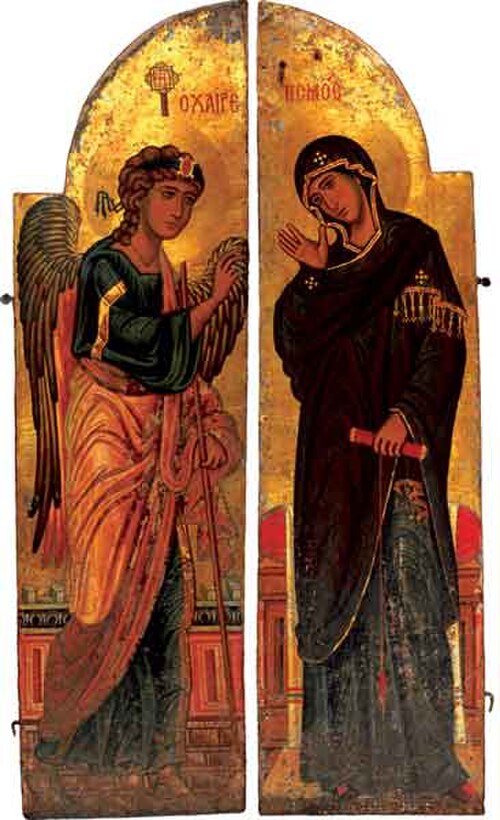
マタイによる福音書とルカによる福音書は、イエス・キリストの処女懐胎を示唆しています。現在、キリスト教のほとんどの宗派が信じているこの「教義」を無視したり、反対したりする人もいます。このセクションでは、処女懐胎の信憑性に関するキリスト論上の問題について考察します。
処女懐胎でない場合、何らかの形の養子縁組が必要になると思われます。これは、人間による受胎と誕生によって、イエスは完全に人間として誕生すると思われるためであり、イエスを神にするためには、他の何らかのメカニズムも必要となると思われます。
処女懐胎でなかったことは、イエスの完全な人間性を支持するように思われる。ウィリアム・バークレーは、「処女懐胎の最大の問題は、それがイエスを他の人間と明確に区別しているということである。それは私たちに不完全な受肉を残すことになる。」と述べている。[73]
バルトは処女懐胎を「御子の受肉の神秘を伴い、それを示す」神のしるしであると語っている。[74]
ドナルド・マクラウド[75]は処女懐胎のいくつかのキリスト教的意味を述べている。
- 救いは人間の行為ではなく、神の超自然的な行為であることを強調します。
- 養子縁組を回避します(通常の出産の場合は事実上必須です)。
- 特にキリストがアダムの罪(原罪)の外にいることに関連して、キリストの罪のなさを強調します。
- 人物関係
三位一体の神における三つの別個の位格が、比較してより大きいか、等しいか、あるいは小さいかという議論もまた、初期キリスト論の他の多くの分野と同様に、論争の的となっていた。アテネのアテナゴラス( 133年頃-190年)の著作には、非常に発達した三位一体の教義が見られる。[76] [77]スペクトルの一方の端には様相論があり、これは三位一体の三つの位格は、その相違や区別を消し去るほど等しいとする教義である。スペクトルのもう一方の端には三神論といくつかの急進的な従属主義の見解があり、後者は、創造の父がキリストの神性よりも優位であることと、イエスが聖霊よりも権威を持つことを強調した。ニカイア公会議の間、様相論のローマとアレクサンドリアの司教たちは、政治的にアタナシウスと連携した。一方、コンスタンティノープル(ニコメディア)、アンティオキア、エルサレムの司教たちは、アリウスとアタナシウスの間の中道として従属主義者の側に立った。
キリスト論へのアプローチ
ユルゲン・モルトマンやウォルター・カスパーのような神学者は、キリスト論を人類学的または宇宙論的なものとして特徴づけています。これらはそれぞれ「下からのキリスト論」と「上からのキリスト論」とも呼ばれています。人類学的キリスト論はイエスの人間性から始まり、イエスの人生と奉仕から、イエスが神であることの意味へと向かっていきます。一方、宇宙論的キリスト論は逆の方向に進みます。永遠のロゴスから始まり、宇宙論的キリスト論はイエスの人間性へと向かいます。神学者は通常、どちらかの側から始め、その選択が必然的に結果として生じるキリスト論に色を添えます。出発点として、これらの選択肢は「多様でありながら補完的な」アプローチを表しています。それぞれに独自の困難があります。「上からの」キリスト論と「下からの」キリスト論はどちらも、キリストの 2 つの性質、つまり人間性と神性を受け入れなければなりません。光が波として、または粒子として認識されるのと同じように、イエスは神性と人間性の両方の観点から考えなければなりません。 「どちらか一方」について話すことはできませんが、「両方」について話さなければなりません。[78]
- 宇宙論的アプローチ
上からのキリスト論は、三位一体の第二位格であるロゴスから始まり、ロゴスの永遠性、創造における行為、経済的な子としての立場を確立する。神のロゴスが人間の性質を帯びることにより、イエスと神との一体性が確立される。このアプローチは、初期の教会では一般的であった。例えば、福音書の聖パウロと聖ヨハネである。イエスに完全な人間性を帰属させることは、2つの性質が相互にその特性を共有すると述べることによって解決される(コミュニケーション・イディオマトゥムと呼ばれる概念)。[79]
- 人類学的アプローチ
下からのキリスト論は、既存のロゴスではなく、新しい人類の代表としての人間イエスから始まります。イエスは模範的な人生を生き、それは私たちが宗教体験で目指すものです。この形のキリスト論は神秘主義に向いており、そのルーツの一部は6世紀の東方におけるキリスト神秘主義の出現に遡りますが、西方では11世紀から14世紀の間に繁栄しました。最近の神学者ウォルフハルト・パンネンベルクは、復活したイエスは「神の近くに生きるという人間の運命の終末論的成就」であると主張しています。[80]
- 政治的アプローチ
キリスト教の信仰は本質的に政治的である。なぜなら、復活した主であるイエスに忠誠を誓うことで、地上のあらゆる支配と権威が相対化されるからである。パウロの手紙だけでもイエスは「主」と呼ばれており、パウロの手紙の中では信仰告白の主たるものである。さらに、NT ライトは、このパウロの告白が救いの福音の核心であると主張している。このアプローチの弱点は、この現世とこれから到来する未来の神の支配との間の終末論的緊張が失われることである。これは、帝国主義的キリスト論でよく見られたように、国家がキリストの権威を横取りするときに起こり得る。現代の政治的キリスト論は、帝国主義的イデオロギーを克服しようとしている。[81]
キリストの働き
- イエスの復活
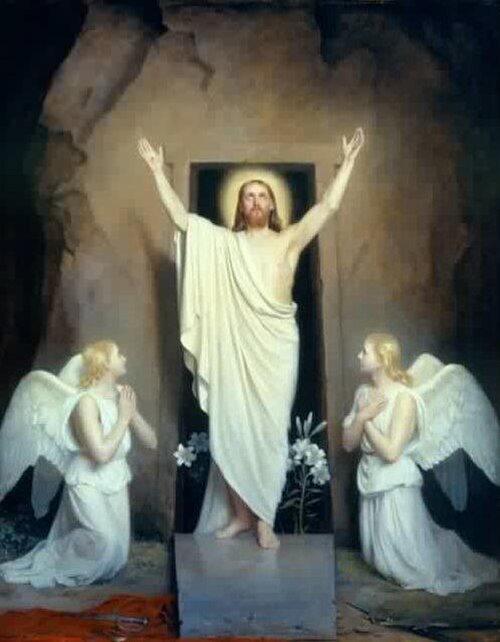
復活は、おそらくイエス・キリストの生涯で最も議論の多い側面です。キリスト教は、特定の歴史への応答として、また信仰告白の応答として、キリスト論のこの点にかかっています。[82]キリスト教徒の中には、イエスが復活したために世界の未来が永遠に変わったと主張する人もいます。ほとんどのキリスト教徒は、イエスの復活は神との和解(コリント人への手紙第二 5:18)、死の滅び(コリント人への手紙第一 15:26)、そしてイエス・キリストの信者の罪の赦しをもたらすと信じている。
新約聖書には、イエスが亡くなり埋葬された後、イエスが肉体を持って他の人々の前に現れたと記されています。懐疑論者の中には、イエスの出現は心や霊でのみ弟子たちに知覚されたと主張する人もいます。福音書には、弟子たちがイエスの復活した体を目撃したと信じ、それが信仰の始まりにつながったと記されています。彼らはイエスの死後、迫害を恐れて隠れていました。イエスを見た後、彼らは大きな危険を冒してイエス・キリストのメッセージを大胆に宣べ伝えました。彼らは悔い改め(ルカ 24:47)、洗礼、従順(マタイ 28:19–20)を通して神と和解するというイエスの命令に従いました。
- 預言者、祭司、王としての職務
人類の仲介者であるイエス・キリストは、預言者、祭司、王の3つの職務を果たします。初期教会のエウセビオスはこの3つの分類を考案し、宗教改革の時代には、スコラ哲学のルター派キリスト論、ジャン・カルヴァン[ 83]やジョン・ウェスレーのキリスト論[84]において重要な役割を果たしました。
霊的神学:聖霊
霊的神学は聖霊の研究です。プネウマ(πνεῦμα) はギリシャ語で「息」を意味し、比喩的に非物質的存在または影響力を表します。キリスト教神学では、霊的神学は聖霊の研究を指します。キリスト教では、聖霊 (または聖霊) は神の精神です。主流 (三位一体論) のキリスト教信仰では、聖霊は三位一体の第三位格です。神の一部として、聖霊は父なる神および子なる神と同等です。キリスト教の聖霊神学は、完全に開発された三位一体神学の最後の部分でした。
主流派(三位一体論)キリスト教では、聖霊は神の唯一の本質を構成する三位一体の3つの位格のうちの1つです。そのため、聖霊は人格を持ち、神格の一部として、父なる神および神の子である神と同等かつ永遠である完全な神です。[85] [86] [87]聖霊は、ニカイア信条に記されているように、父(または父と子)から発しているという点で、父や子とは異なります。[86]聖霊の神聖さは、聖霊に対する冒涜は許されないと宣言する新約聖書の福音書に反映されています。 [88 ]
英語の単語は、2つのギリシャ語、πνευμα ( pneuma、霊) と λογος ( logos、教え) から来ています。聖霊論には通常、聖霊の位格と聖霊の働きの研究が含まれます。この後者のカテゴリには通常、新生、霊的賜物(カリスマ)、聖霊洗礼、聖化、預言者の啓示、聖三位一体の内在 (それ自体が多くの異なる側面をカバー) に関するキリスト教の教えが含まれます。キリスト教の宗派が異なれば、神学的なアプローチも異なります。
キリスト教徒は、聖霊が人々をイエスへの信仰に導き、キリスト教徒らしい生活を送る能力を与えると信じています。聖霊はすべてのキリスト教徒の内に宿り、各人の体は聖霊の神殿です。[89]イエスは聖霊をラテン語で[90]パラクレトスと表現しました。これはギリシャ語に由来しています。この言葉は慰め主、助言者、教師、弁護者など様々に翻訳され、[91]人々を真理の道に導きます。聖霊が人の人生に働きかけると、聖霊の実として知られる良い結果がもたらされると信じられています。聖霊は、罪の影響をまだ受けているキリスト教徒に、自分では決してできなかったことを可能にします。これらの霊的賜物は、聖霊によって「解き放たれた」生来の能力ではなく、悪霊を追い出す能力や単に大胆な発言など、まったく新しい能力です。聖霊の影響により、人は周囲の世界をより明確に見ることができ、以前の能力を超えた方法で心と体を使用することができます。授けられる賜物のリストには、預言、異言、癒し、知識といったカリスマ的な賜物が含まれる。終焉主義と呼ばれる見解を持つキリスト教徒は、これらの賜物は新約聖書の時代にのみ与えられたと信じている。キリスト教徒は、奉仕、教え、寄付、指導、慈悲といった賜物を含む特定の「霊的賜物」が今日でも有効であることにほぼ普遍的に同意している。 [92]聖霊の経験は、油を注がれることと呼ばれることもある。
キリストは復活後、弟子たちに「聖霊のバプテスマを受け」、この出来事から力を受けるだろうと告げた。 [93]この約束は使徒言行録第2章に記された出来事で実現した。最初のペンテコステの日、イエスの弟子たちがエルサレムに集まっていたとき、激しい風が聞こえ、彼らの頭上に炎の舌が現れた。多言語の群衆が弟子たちの話を聞き、それぞれが自分の母国語で話しているのを聞いた。
聖霊は、キリスト教徒や教会の生活において、特定の神聖な機能を果たすと信じられています。これには以下が含まれます。
- 罪の確信。聖霊は、救われていない人に、彼らの行為の罪深さと、神の前に罪人としての彼らの道徳的立場の両方を確信させるために働きます。[94]
- 改宗に導く。聖霊の働きは、人をキリスト教の信仰に導くための不可欠な部分であると考えられています。[95]新しい信者は「聖霊によって生まれ変わる」のです。[96]
- キリスト教生活を可能にする。聖霊は個々の信者の中に宿り、彼らが正しく忠実な生活を送ることを可能にすると信じられています。[95]
- 慰め手またはパラクレートとして、特に試練の時に仲裁したり、支援したり、弁護人として行動する人。
- 聖書の霊感と解釈。聖霊は聖書の執筆を霊感し、キリスト教徒と教会に聖書を解釈します。 [97]
聖霊は、特にイエス・キリストの生涯において活動し、地上での働きを成し遂げることを可能にしたと信じられています。聖霊の具体的な働きには、以下のものがあります。
- 彼の誕生の原因。福音書のイエスの誕生の記述によれば、「彼の受肉した存在の始まり」は聖霊によるものでした。[98] [99]
- 洗礼の際に彼に油を塗る。[95]
- イエスの宣教活動の権限委譲。イエスの洗礼後の宣教活動(福音書では聖霊が「鳩のようにイエスの上に降りてきた」と記されている)は、聖霊の力と導きによって行われた。[95]
- 御霊の実
キリスト教徒は、「聖霊の実」は聖霊の働きによってキリスト教徒に生み出される徳の高い特性から成ると信じている。それはガラテヤ人への手紙第5章22節から23節に挙げられているものである。「しかし、聖霊の実は、愛、喜び、平和、寛容、親切、善意、誠実、柔和、自制である。」[100]ローマカトリック教会は、このリストに寛大さ、謙虚さ、貞潔さを加えている。[101]
- 聖霊の賜物
キリスト教徒は、聖霊がキリスト教徒に「賜物」を与えると信じている。これらの賜物は、個々のキリスト教徒に与えられた特定の能力から成り立っている。[95]これらはしばしば賜物を意味するギリシャ語のカリスマで知られ、カリスマ的という言葉はそこから派生している。新約聖書は、そのような賜物について3つの異なるリストを提供している。それらは超自然的なもの(治癒、預言、異言)から特定の召命に関連するもの(教え)を経て、ある程度すべてのキリスト教徒に期待されるもの(信仰)まで多岐にわたる。ほとんどの人はこれらのリストが網羅的ではないと考えており、他の人は独自のリストをまとめている。聖アンブローズは、洗礼の際に信者に注がれる聖霊の7つの賜物について書いている。1. 知恵の霊、2. 理解の霊、3. 助言の霊、4. 強さの霊、5. 知識の霊、6. 敬虔の霊、7.聖なる恐れの霊。[102]
これらの賜物、特に超自然的な賜物(カリスマ的賜物と呼ばれることもある)の性質と発生については、聖霊に関してキリスト教徒の間で最も大きな意見の相違がある。
一つの見解は、超自然の賜物は使徒時代における特別な特質であり、当時の教会の特異な状況のために授けられたものであり、現代では極めて稀にしか授けられないというものである。[103]これはカトリック教会の一部の人々[87]や他の多くの主流キリスト教グループの見解である。ペンテコステ派やカリスマ運動が主に支持する別の見解は、超自然の賜物がないのは教会が聖霊とその働きを無視したためだというものである。モンタニストなどのいくつかの小グループは超自然の賜物を実践していたが、 19世紀後半にペンテコステ運動が成長するまではそれらは稀であった。[103]
超自然的賜物の関連性を信じる人々は、聖霊の洗礼や聖霊の満たしについて語ることがありますが、キリスト教徒はこれらの賜物を受け取るために、それを経験する必要があります。多くの教会は、聖霊の洗礼は改宗と同一であり、すべてのキリスト教徒は定義上、聖霊の洗礼を受けていると考えています。[103]
宇宙論:創造されたもの
神は言われた、「光あれ」。すると光があった。神は光を見て、良かった。神は光と闇を分けられた。神は光を昼と名づけ、闇を夜と名づけられた。夕となり、朝となり、これが第一日であった。 創世記1:3–5
旧約聖書と新約聖書のさまざまな著者は、宇宙論に関する洞察を垣間見ることができます。宇宙は神の命令によって創造されました。これは聖書の中で最もよく知られ、最も完全な記述である創世記 1 章で述べられています。
世界
しかし、この幅広い理解の中で、この教義を正確にどのように解釈すべきかについては、さまざまな見解があります。
- 一部のキリスト教徒、特に若い地球創造論者と古い地球創造論者は、創世記を創造の正確かつ文字通りの記述として解釈しています。
- 他の人々は、これらを、より漠然と定義された精神的な洞察であると理解するかもしれません。
キリスト教(カトリック、東方正教会、プロテスタント)の信条は、神はすべてのものを無から創造し、神の似姿として人間を創造したということである。このことから、神は人間の魂の源でもあると推論される。カルケドン派のキリスト論では、イエスは神の言葉であり、初めに存在したため創造されておらず、したがって神であり、したがって無から世界を創造した者と同一である。
ローマカトリック教会は、各人間の魂が直接または特別に創造されたという教義を指すのに「特別創造」という語句を使用しています。2004年、当時議長を務めていたジョセフ・ラッツィンガー枢機卿の指揮下にあった国際神学委員会は、約150億年前のビッグバンで始まった宇宙の歴史、および約40億年前に始まった微生物からの人間を含む地球上のすべての生命の進化に関する現在の科学的説明を受け入れるという論文を発表しました。[104]ローマカトリック教会は、創世記の文字通りの解釈と寓話的な解釈の両方を認めており、長い時間にわたる進化のプロセスによる創造の可能性、別名有神論的進化論を認めています。[疑わしい–議論する]ローマカトリック教会は、世界の創造はロゴス、言葉(アイデア、知性、理性、論理)を通じた神の業であると信じている。
- 「初めに言葉があった...言葉は神であった...すべてのものは彼によって造られた。造られたもののうち、彼によらないものは一つもなかった。」
新約聖書は、神が永遠の言葉である神の愛する子イエス・キリストによってすべてのものを創造したと主張しています。
- 「天にあるものも地にあるものも、すべては彼によって、また彼のために創造された。彼はすべてのものより先に存在し、すべてのものは彼によって成り立っている。」[105]
人類学:人間性
キリスト教人類学は、人間性、特に神との関係を研究する学問です。この神学的人類学は、神との関係における人間の研究(「人類学」)を指します。これは、時代や場所を超えた人類の身体的および社会的特徴の比較研究を主に扱う社会科学の人類学とは異なります。
一つの側面は、人間の本質として知られる、人間の生来の性質や構成を研究する。それは、聖書の記述に基づいて、一緒になって人間を形成する身体、魂、精神などの概念の関係に関係している。人間の構成については、三分論、二分論、一元論(人類学の意味で)という3つの伝統的な見解がある。 [106]
コンポーネント
- 魂
聖書における魂の意味領域は、ヘブライ語のnepesに基づいており、これはおそらく「息」または「呼吸する存在」を意味します。[107]この言葉は、不滅の魂[108]や、死者の霊魂のように肉体の死後も生き続ける人間の無形の部分[109]を意味することはありません。 [110]この言葉は通常、人全体[111]またはその肉体的な生命を指します。七十人訳聖書では、 nepes は主にpsyche ( ψυχή )と翻訳され、例外的にヨシュア記ではempneon (ἔμπνεον)、つまり「呼吸する存在」と翻訳されています。 [112]
新約聖書は七十人訳聖書の用語法に従っており、そのため、 psycheという語をギリシャ語ではなくヘブライ語の意味領域で使用しています。 [113] psycheとは目に見えない力(あるいはプラトン主義者にとっては不滅で非物質的な力)であり、身体に生命と運動を与え、その属性を司っています。
教父思想では、2世紀末ごろには、精神はヘブライ的というよりはギリシャ的に理解され、肉体と対比されていた。3世紀には、オリゲネスの影響により、魂の本来の不滅性と神性に関する教義が確立された。[114]オリゲネスは魂の輪廻と先在性も説いたが、これらの見解は553年の第5回全地公会議で正式に否定された。魂の本来の不滅性は、中世を通じて、そして宗教改革後にも、西洋と東洋の神学者の間で受け入れられ、ウェストミンスター信仰告白にその証拠が残されている。
- 精神
霊魂(ヘブライ語ではruach、ギリシャ語ではπνεῦμα、pneuma で、「息」を意味することもある)も、同様に非物質的な要素である。霊魂はしばしば「魂」、 psycheと互換的に使用されるが、三分論者は霊魂は魂とは異なると信じている。
- 「パウロが人間のプネウマについて語るとき、彼は人間の中にある高次の原理や、人間の特別な知的または精神的能力を意味しているのではなく、単に人間の自己を意味している。そして唯一の疑問は、それがプネウマと呼ばれるとき、自己が何らかの特別な側面で捉えられているかどうかである。第一に、それは明らかに、プシケーと呼ばれるときと同じように、すなわち、人間の態度、意志の方向性の中に生きる自己として捉えられている。」[115]
- 体、肉
肉体(ギリシャ語σῶμα ソーマ)は、人間の肉体的または物理的な側面です。キリスト教徒は伝統的に、世の終わりに 肉体が復活すると信じてきました。
肉(ギリシャ語σάρξ、sarx)は通常、「体」と同義語とみなされ、人間の肉体的な側面を指します。使徒パウロはローマ人への手紙 7-8 章で肉と霊を対比しています。
人類の起源
聖書の創世記では、人間は神によって創造されたと教えられています。キリスト教徒の中には、これには奇跡的な創造行為が関係していたに違いないと信じている人もいますが、神が進化の過程を通じて創造したという考えに納得している人もいます。
創世記はまた、人間は男も女も神の似姿として創造されたと教えています。このことの正確な意味は、教会の歴史を通じて議論されてきました。
死と来世
キリスト教の人類学は、死と来世についての信仰に影響を与えます。キリスト教会は伝統的に、各個人の魂は死時に肉体から離れ、復活時に再び結合すると教えてきました。これは魂の不滅の教義と密接に関係しています。たとえば、ウェストミンスター信仰告白(第 32 章)には次のように記されています。
- 「人間の肉体は死後、塵に戻り、朽ち果てる。しかし、彼らの魂は死ぬことも眠ることもなく、不滅の存在であり、彼らを授けた神のもとに直ちに帰る。」
- 中間状態
すると、次のような疑問が湧いてくる。肉体を失った魂は、死後、いったいどこへ行くのか?神学者たちは、この主題を中間状態と呼ぶ。旧約聖書には、死者の霊魂が住むシェオルと呼ばれる場所について書かれている。新約聖書では、古代ギリシャの死者の領域であるハデスがシェオルの代わりとなっている。特に、ルカ16:19–31(ラザロとディベス)で、イエスはハデスが2つの別々の「セクション」から成り、1つは義人用、もう1つは不義人用であると教えている。イエスの教えは、この主題に関する旧約聖書と旧約聖書の間のユダヤ教の考えと一致している。 [116]
完全に発達したキリスト教神学はさらに一歩進んでおり、ルカによる福音書 23:43 やピリピ人への手紙 1:23 などの聖句に基づいて、死者の魂はすぐに天国か地獄に迎え入れられ、復活前に永遠の運命を予感すると伝統的に教えられてきました。(ローマカトリックは、3 番目の場所として煉獄を教えていますが、プロテスタントと東方正教会はこれを否定しています。)
- 「義人の魂は、そのとき神聖さにおいて完全なものとされ、至高の天国に迎え入れられ、そこで光と栄光の中で神の御顔を見ながら、肉体の完全な救済を待ちます。そして邪悪な者の魂は地獄に投げ込まれ、そこで苦しみと完全な暗闇の中に留まり、大いなる日の審判まで留保されます。」(ウェストミンスター信仰告白)
一元論的な人類学を強調するキリスト教団体の中には、魂が肉体から離れて意識的に存在できるということを否定するところもあります。例えば、セブンスデー・アドベンチスト教会は、中間状態は無意識の眠りであると教えています。この教えは非公式に「魂の眠り」と呼ばれています。
- 最終状態
キリスト教の信仰では、最後の審判で義人も不義人も復活する。義人は朽ちることのない不死の体を得る(コリントの信徒への手紙一 15章)が、不義人は地獄に送られる。キリスト教徒は伝統的に、地獄は永遠の肉体的・精神的懲罰を受ける場所であると信じてきた。過去2世紀の間に、絶滅論が人気を博した。
マリア学
聖母マリア、彼女に関する教義、そして彼女が教会、キリスト、個々のキリスト教徒とどのように関係しているかを研究する学問は、マリア学と呼ばれます。カトリックのマリア学は、特にカトリック教会の文脈におけるマリア研究です。マリア学の例には、マリアの永遠の処女、神の母性(ひいてはすべてのキリスト教徒に対する母性/執り成し)、無原罪懐胎、天への昇天に関する研究や教義が含まれます。
天使学
聖書における天使の描写のほとんどは、軍事的な観点から表現されています。たとえば、陣地(創世記 32:1–2)、指揮系統(詩篇 91:11–12、マタイ 13:41、黙示録 7:2)、戦闘(士師記 5:20、ヨブ 19:12、黙示録 12:7)などの用語です。
その具体的な階層は天使の階層とは若干異なり、より軍事的なサービスに関係しているのに対し、天使の階層は神に対する非軍事的なサービスに天使を分類したものです。
天の軍勢の一員
ケルビムは神の戦車の玉座に付き従うものとして描かれている(詩篇80:1)。出エジプト記25:18–22には契約の箱の上に置かれた2体のケルビム像について言及されており、2体のケルビムは通常神の玉座を守っていると解釈されている。他の警備員のような任務にはエデンの門のような場所に配置されることが含まれる(創世記3:24)。ケルビムは古代近東の伝統の一部であった神話上の翼のある雄牛または他の獣であった。[117]
この天使の呼称は、様々な階級の天使に与えられる可能性があります。例えば、ラファエルはセラフィム、ケルビム、大天使など様々な階級にランク付けされています。 [118]これは通常、天使の階層構造の矛盾の結果です。
天使が何人いるかは知られていないが、黙示録 5:11 に記されている「玉座のまわりに輪をなす多くの天使と生き物と長老たち」の数は「一万の 1 万倍」、つまり 1 億である。
悪魔学: 堕天使

キリスト教の多くでは、堕天使とは天国から追放または追放された天使のことである。このような追放は、神に背いたり反抗したりしたことに対する罰であることが多い(『天国での戦い』を参照)。最もよく知られている堕天使はルシファーである。ルシファーはキリスト教の信仰においてサタンによくつけられる名前である。この用法は、聖書の一節(イザヤ書 14:3–20)を堕天使への言及として特定の解釈から生じたもので、その一節では「明けの明星」(ラテン語ではルシファー)という名前を与えられた人物が天国から落ちたと語られている。ルシファーのギリシャ語の語源同義語は Φωσφόρος (フォスフォロス、「光を運ぶ者」)である。[119] [120]はペテロの第二の手紙 1:19 など、サタンとは関係なく明けの明星を指して使われている。しかし、聖書より後の多くの著作、特にミルトンの『失楽園』(7.131–134 など)では、サタンはルシファーと呼ばれています。これは、ミルトンによれば、サタンは「かつて天使の群れの中にいたとき、その星々よりも輝いていた」ためです。
堕天使は七つの大罪のうちの一つを犯した者たちだと言われている。そのため、彼らは天国から追放され、永遠に地獄で苦しむ。地獄の悪魔は、堕天使の翼を無価値と低位の印として引き裂くことで罰する。 [121]
天国
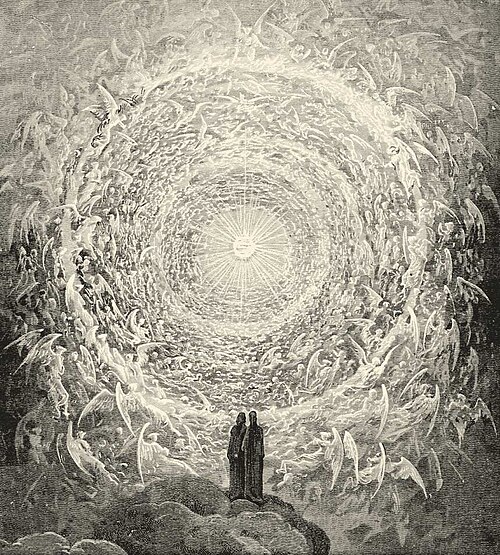
キリスト教は天国を永遠の命の場であると教えており、天国は選ばれた者全員が到達すべき共通の境地である(理想の個々の概念に関連した抽象的な経験ではない)。キリスト教会は、人々がこの永遠の命を得る方法について意見が分かれている。16世紀から19世紀後半にかけて、キリスト教世界はカトリックの見解、東方正教会の見解、コプト派の見解、ジャコバイト派の見解、アビシニア派の見解、プロテスタントの見解に分かれた。キリスト教の宗派も参照。
天国とは、人間の生活を超越した人間が来世で暮らす超越的な領域の英語名です。聖書と英語では、「天国」という用語は、英語のこの用語の伝統的な文字通りの意味である、物理的な天空、空、またはその向こうにある無限に広がる宇宙を指す場合があります。
キリスト教は、天国に入るには「この世の姿が過ぎ去ったとき」が来ると主張しています。(*ヨハネ第二書) 聖書に述べられている見解の一つは、キリストの再臨の日に、まず義なる死者が復活し、その後、生きていて義と判断された者たちが連れて行かれ、彼らに加わり、天国に連れて行かれるというものです。(テサロニケ第一 4:13–18)
キリスト教における天国の概念は、関連し、しばしば混同される 2 つがありますが、聖書にのみ由来する「肉体の復活」と、ギリシャの伝統にも見られる「魂の不滅」とを対比して説明するのが適切です。最初の概念では、魂は最後の審判、つまり「時の終わり」に (肉体とともに) 復活して裁かれるまで天国に入りません。2 番目の概念では、魂は死後すぐに中間状態などの別の次元にある天国に行きます。これらの 2 つの概念は、一般に二重審判の教義で組み合わされています。この教義では、魂は死時に一度審判を受け、一時的な天国に行き、世界の終わりに 2 度目の最終的な肉体的審判を待ちます。(*「ヨハネ 2 世、終末論、来世も参照」)
中世に広く信じられていた天国の見方の一つは、天国は雲の上の物理的な場所として存在し、神と天使は物理的にその上にいて人間を見守っているというものでした。天国は物理的な場所として、宇宙のはるか遠くに位置し、星は「天から輝く光」であるという概念の中で生き残りました。
NTライトなど、今日の聖書学者の多くは、天国の概念をユダヤのルーツまで遡って考察し、地球と天国は重なり合っている、あるいは連動していると考えています。天国は神の空間、神の次元として知られており、人間の技術で到達できる場所ではありません。この信念によれば、天国は神が地球上の人々と共に活動し、働きながら生き、統治する場所であるとされています。神がすべてのものを回復させる日が来ると、天国と地球は永遠に結合し、来世の新しい天と新しい地球[122]になります。
天国について教える宗教は、人がどのようにして天国に入るか(そして天国に入ることができるかどうか)について、典型的には死後の世界で、それぞれ異なります。ほとんどの宗教では、天国に入るには「良い人生」(精神体系の用語の範囲内)を送ることが条件となります。これに対する注目すべき例外は、多くの主流プロテスタントの「信仰のみ」の信仰です。これは、人は完全に「良い人生」を送る必要はないが、イエス・キリストを自分の主であり救世主として受け入れなければならないと教え、そうすればイエス・キリストが人の罪の責任を負ってくれると教えています。信者は、自分が参加した「善行」や「悪行」に関係なく、許されると信じられています。[123]
多くの宗教では、天国に行けなかった者は「神のいない」場所、つまり永遠の地獄に行くと説いている(消滅論を参照)。一部の宗教では、天国と地獄に加えて煉獄など他の来世が存在すると信じている。普遍主義という信仰では、地上で何をしたか、何を信じたかに関係なく、最終的には誰もが天国に行くと信じている。キリスト教の一部では、地獄は魂の終焉であると信じている。
様々な聖人が天国の夢を見ています(コリントの信徒への手紙二 12:2–4)。東方正教会の天国での生活の概念は、死者のための祈りの一つに次のように記されています。「...光の場所、緑の牧草地、安息の場所、そこからすべての病気、悲しみ、嘆きが逃げ去る場所。」[124]
教会は、ヘブライ語とキリスト教の聖書(旧約聖書と新約聖書)の主要な聖書の一節と教会の知恵の集大成に基づいて天国を信じている。天国は、三位一体の神、天使[125]、聖人[126]の領域である。
天国の本質的な喜びは至福のビジョンと呼ばれ、神の本質のビジョンから派生しています。魂は神に完全に安らぎ、神以外のものを望むことはありませんし、望むこともできません。最後の審判の後、魂が肉体と再び結合すると、肉体は魂の幸福にあずかります。肉体は腐敗せず、栄光に満ち、完全になります。肉体が抱えていたあらゆる身体的欠陥は消去されます。天国は場合によっては楽園としても知られています。大きな湾が天国と地獄を隔てています。
死ぬと、それぞれの魂は「個別の審判」と呼ばれる審判を受け、そこで自身の来世が決定されます(つまり、煉獄の後に天国に行くか、天国に直接行くか、地獄に行くか)。これは、キリストがすべての生者と死者を裁くために戻ってくるときに行われる「最後の審判」としても知られる「一般的な審判」とは異なります。
天国という言葉(「天国」とは異なります。以下の注釈を参照)は、聖書の著者によって、神が現在おられる領域に当てはめられています。これとは対照的に、永遠の命は、新しくなり、汚れのない、完全な創造物の中で起こります。黙示録 21:3 に見られるように、神はそこに永遠に人々とともに住むことを選ばれるので、天国と呼ぶことができます。神と人間の間にはもはや隔たりはありません。信者自身は、腐敗しない、復活した、新しい体で存在し、病気も死も涙もありません。死そのものは人生の自然な一部ではなく、アダムとイブが神に背いた後(原罪を参照)、人類が罪の状態、つまり神から離れた状態で永遠に生きることがないように、死が許されたと教える人もいます。
多くの福音主義者は、この来世は2つの異なる期間に分けられると理解しています。1つ目は、黙示録20章1~10節で言及されている、この地上におけるキリストの千年王国(1000年)。2つ目は、黙示録21章と22章で言及されている、新しい天と新しい地です。この千年王国説(または千年王国説)は、ヒッポの聖アウグスティヌスとその後のローマカトリック教会によって否定された、 初期教会[127]の強力な伝統の復活です。
信者は神と共に永遠を過ごすだけでなく、互いと共に永遠を過ごす。黙示録に記録されているヨハネの幻は、天から新地球に来る新エルサレムを描写しており、これは神の民が互いに共同体として暮らすことを象徴していると考えられる。「天国」は設計者が計画した通りに人生を最大限に生きる場所であり、信者一人一人が「心を尽くし、魂を尽くし、思いを尽くして主なる神を愛し」、「隣人を自分と同じく愛し」(マタイによる福音書第22章37~38節、大いなる戒めから引用)、地上生活の否定的な側面のない大いなる喜びの場となる。 「来世」も参照。
- 煉獄
煉獄とは、恩寵の状態で死んだ人々の魂が天国に行く準備を整える状態、あるいは一時的な罰である[33] 。これは古代に起源を持つ神学的な考えであり、初期キリスト教の文献によく見られる。一方、煉獄を地理的な場所として詩的に捉える概念は、中世キリスト教の信心深さと想像力が生み出したものにすぎない[33] 。
煉獄の概念は、特にカトリック教会のラテン教会と関連している(東方カトリック教会では、煉獄という名前は使わないことが多いが、教義となっている)。アングロカトリックの伝統を持つ英国国教会も、一般的にこの信仰を抱いている。[要出典]メソジスト教会の創始者ジョン・ウェスレーは、死と最後の審判の間に中間の状態があり、「そこで神聖さを増し続ける」可能性があると信じていた。[128] [129]東方正教会は、生きている者の祈りと聖体礼儀の捧げ物によって死者の魂の状況が変化する可能性があると信じており、[130]多くの東方正教会信者、特に禁欲主義者は、一般的な終末を望み、祈っている。[131]少なくともすべての人に最終的な救済があるという同様の信念は、モルモン教でも抱かれている。[132]ユダヤ教も死後の浄化の可能性を信じており[133] 、ゲヘナの意味についての理解を示すために「煉獄」という言葉を使用することさえあります。[134]しかし、魂の「浄化」の概念は、これらの他の信仰の伝統では明確に否定される場合があります。
地獄

キリスト教の信仰における地獄は、救われない者の魂が罪の結果に苦しむ場所または状態である。キリスト教の地獄の教義は新約聖書の教えに由来し、そこでは地獄は典型的にはギリシャ語のゲヘナまたはタルタロスで表現される。ハデス、シェオル、煉獄とは異なり、地獄は永遠であり、地獄に堕ちた者は希望を持たない。新約聖書では、地獄は死後の罰、またはイエスを拒絶した者に対する最後の審判の場所または状態として表現されている。 [135]多くの古典的および一般的な描写では、地獄はサタンや悪霊の住処でもある。 [136]黙示録ではそうではなく、そこではサタンはキリストのこの地球での千年にわたる統治の終わりにのみ地獄に投げ込まれる。[137]
地獄は一般的に、悔い改めない罪人がこの世を去った後の永遠の運命として定義される。[138]地獄の特徴は聖書の教えから推測されるが、それはしばしば文字通りに理解されてきた。[138]魂は死後すぐに(個別審判)あるいは一般審判において、神の取り消し不可能な審判によって地獄に行くと言われている。[138]現代の神学者は一般的に、地獄は魂が自由意志を使って神の意志を拒否した論理的帰結であると説明する。 [138]神は魂の自由な選択に干渉しないので、それは神の正義と慈悲と両立すると考えられている。 [ 138 ]
キング・ジェームズ版聖書でのみ、「地獄」という言葉が、シェオル(ヘブライ語)やハデスとゲヘナ(ギリシャ語)などの特定の単語の翻訳に使用されています。他のすべての翻訳では、ゲヘナについて言及されている場合にのみ地獄が使用されています。シェオルとハデスはどちらも、通常は永遠の罰の場所ではなく、冥界または死者の一時的な住居を指すことが一般的に認められています。[139]
伝統的に、大多数のプロテスタントは、地獄は肉体的にも精神的にも終わりのない意識的な苦痛を受ける場所であると信じてきましたが[140]、最近の作家の中には(CSルイス[141]やJPモアランド[142]など)、地獄を神からの「永遠の分離」と表現する人もいます。聖書の特定のテキストから、地獄での罰は永遠で取り返しのつかないものであるものの、各魂の行いに比例するという結論に至った神学者もいます(マタイ10:15、ルカ12:46–48など)。[143]
もう一つの議論の領域は、福音を聞かなかった人々(つまり、キリスト教の福音を聞く機会がなかった人々)、幼児期に亡くなった人々、知的障害者の運命である。プロテスタントの中には、これらのカテゴリーに属する人々は原罪のために地獄に堕ちるというアウグスティヌスの考えに同意する者もいれば、これらのケースでは神が例外を設けると信じる者もいる。[140]
「かなりの少数派」は条件付き不死の教義を信じている。[144 ]これは、地獄に送られた者は永遠の意識のある罰を受けるのではなく、「限定された意識のある罰」の期間の後に消滅または消滅すると教えるものである。 [145]条件付き不死の信念を採用した著名な福音主義神学者には、ジョン・ウェンハム、エドワード・ファッジ、クラーク・ピノック、ジョン・ストット(ただし、ストットは消滅論の問題に関して「不可知論者」であると自称している)がいる。[140]条件付き不死の教義は、通常、魂の不滅という伝統的な概念を拒否する。
ただし少数派ではあるが、一部のプロテスタント(ジョージ・マクドナルド、カール・ランドール、キース・デローズ、トーマス・タルボットなど)も、ゲヘナで刑期を終えた後、すべての魂は神と和解して天国に入れられる、あるいは死の時にすべての魂を悔い改めに導く方法が見つかり、「地獄のような」苦しみを経験しなくて済むと信じている。この見解はしばしばキリスト教普遍主義と呼ばれ、その保守派はより具体的には「聖書的あるいは三位一体的普遍主義」と呼ばれており、ユニテリアン普遍主義と混同してはならない。普遍的和解、終末論、地獄の問題を参照。
神学:悪の許容
神学は、悪の存在を前提として神の善良さと全能性を擁護するものと言えます。具体的には、神学は神への信仰と悪の存在の認識を調和させようとする神学と哲学の特定の分野です。[146]そのため、神学は神の行動を正当化しようとするものと言えます(少なくとも神が悪を許す限りにおいて)。
悪の問題に対する応答は、時には防御や神学論として分類される。しかし、正確な定義については著者の間で意見が分かれている。[147] [148] [149]一般的に、防御は、悪の存在と神の存在の間に論理的な矛盾がないことを示そうとする。防御は、これがありそうな説明であると主張する必要はなく、防御が論理的に可能であることだけを主張すればよい。防御は、悪の 論理的問題に答えようとする。
一方、神学は、悪の存在をもっともらしく正当化しようとする、より野心的な試みである。神学は、悪の証拠問題に答えようとするものである。[148] リチャード・スウィンバーンは、より大きな善が何であるかを知らない限り、つまり、成功した神学を持っていない限り、より大きな善があると仮定するのは意味がないと主張している。[150]
例えば、悪魔や人間の堕落を含む議論は、論理的に不可能ではないが、世界についての私たちの知識を考慮するとあまり妥当ではないと考える著者もいます。したがって、それらは防御策ではあっても、良い神学論ではないと見なされます。[148] CSルイスは著書『痛みの問題』で次のように書いています。
おそらく、神がその被造物による自由意志の乱用の結果を常に正す世界を想像できるだろう。つまり、木の梁を武器として使うと草のように柔らかくなり、私が嘘や侮辱を運ぶ音波を空気中に発しようとしても空気は私に従わない。しかし、そのような世界では、間違った行為は不可能であり、したがって意志の自由は無効である。いや、その原理が論理的結論まで実行されれば、邪悪な考えは不可能である。なぜなら、私たちが思考に使う脳の物質は、私たちがそれらを形作ろうとするとその仕事を拒否するからである。[151]
もう一つの可能な答えは、世界が人類の罪のために堕落しているというものです。罪のせいで世界は神の恵みから堕落し、完全ではないと答える人もいます。したがって、世界が堕落しているために悪と不完全さが存続します。[要出典] ウィリアム・A・デムスキーは、創世記に記録されているアダムの罪の影響は神によって「遡及」され、したがって宇宙の初期の歴史に適用されたと主張しています。[152]
悪は、人間にとっての試練や試練とみなされることがあります。リヨンのエイレナイオスや、最近ではジョン・ヒックは、悪と苦しみは精神的な成長に必要であると主張しました。これは、そのような精神的な成長には自由意志による決定が必要であるという自由意志の議論としばしば結び付けられます。これの問題は、多くの悪は、生まれたときから虐待され、一見必然的に残忍な大人になる子供の場合のように、いかなる種類の精神的成長も引き起こさない、あるいは精神的成長を許さないように見えることです。
悪の問題は、なぜ善良な人々に悪いことが起こるのかという形で表現されることが多い。キリスト教は、人間の堕落と原罪により、すべての人は本質的に罪深いと教えている。例えば、カルヴァン主義神学は、最初の人間であるアダムが全人類の法的代表者であると主張する連邦的頭権と呼ばれる教義に従っている。この原則の基本的なバージョンに対する反論は、全知の神は世界を創造したときにこれを予測していたはずであり、全能の神であればそれを防ぐことができたはずだというものである。
イザヤ書は、神が少なくともいくつかの自然災害の原因であると明確に主張しているが、イザヤは悪の創造の背後にある動機を説明しようとはしていない。[153]対照的に、ヨブ記は西洋思想における悪の問題の最も広く知られた定式化の一つである。その中で、サタンは神の僕ヨブに関して神に挑戦し、ヨブが神から受ける祝福と保護のためにのみ神に仕えていると主張する。神はサタンがヨブとその家族をさまざまな方法で苦しめることを許すが、サタンはヨブの命を奪うことはできない(ただし、ヨブの子供たちは殺される)という制限がある。ヨブはこのことを三人の友人と話し合い、自分が不当だと感じる苦しみについて神に問いただす。神は演説でそれに応え、ヨブの以前の健康と富を回復させる以上のことをし、ヨブに新しい子供たちを与える。
バート・D・アーマンは、聖書のさまざまな部分が異なる答えを与えていると主張している。一例は、罪に対する罰または罪の結果としての悪である。アーマンは、これは自由意志という概念に基づいているようだが、この議論は聖書で明確に言及されたことはないと書いている。別の議論は、苦しみは最終的に、おそらく苦しむ人以外の人にとって、そうでなければ不可能だったより大きな善を達成するというものである。ヨブ記は2つの異なる答えを提示している。苦しみはテストであり、それをパスすると後で報われる。もう1つは、神はその力で理由を明かさないことを選んだということである。伝道の書は、苦しみは人間の理解能力を超えたものであると見ている。新約聖書を含む黙示録の部分では、苦しみは宇宙の邪悪な力によるものであり、神は神秘的な理由で世界を支配する力を与えたが、すぐに打ち負かされ、物事が正されると考えている。[154]
ハマリティオロジー:罪
新約聖書で「罪」と英語に翻訳されているギリシャ語はハマルティアで、文字通りには的を外すことを意味します。ヨハネの手紙一第3章4節には、「罪を犯す者はみな律法を破ります。罪とは不法です」とあります。イエスは律法の根拠を定義することで律法を明確にしました。「イエスは答えられた。『心を尽くし、精神を尽くし、思いを尽くして、あなたの神である主を愛しなさい。』これが最も重要な第一の戒めである。第二もこれと同様である。『隣人をあなた自身のように愛しなさい。』律法全体と預言者は、この二つの戒めにかかっている。」(マタイによる福音書第22章36~40節)
罪論(ギリシア語:ἁμαρτία、hamartia、「的を外す」、「罪」、+ -λογια、-logia 、「ことわざ」または「談話」)は、キリスト教神学の一分野であり、より具体的には組織神学であり、罪の教義を明確にすることを目的とした 罪の研究です。
ハマリティオロジーの理解の実質的な分派は、原罪の教義を支持しており、これは使徒パウロがローマ人への手紙5章12~19節で教え、聖アウグスティヌスによって広められた。アウグスティヌスは、アダムとイブの子孫は皆、自分の選択に関わらずアダムの罪を犯していると教えた。[155]
対照的に、ペラギウスは、人間は本質的にtabulae rasaeとして人生に入ると主張した。彼のグループでは、アダムとイブが神に背いたときに起こった堕落は、人類に最小限の影響しか与えなかったと考えられていた。しかし、このハマリティオロジー的見解を持ち続けている神学者はほとんどいない。
3 番目の考え方は中間的な立場をとり、アダムとイブの堕落の後、人間は罪の影響を受けて生まれ、罪を犯す傾向が非常に強くなる (イエスを除くすべての責任ある人間は個人の選択により、すぐに罪を犯すことを選択する) と主張します。
キリスト教徒が、人類が文字通りまたは比喩的な「堕落」によって影響を受けると信じる程度によって、救済、正当化、神聖化などの関連する神学的な概念に対する理解が決まります。
キリスト教における罪の見方は、主に法律違反または契約違反として理解されており、そのため救いはユダヤ教の考え方と同様に法的な観点から見られる傾向があります。
罪
宗教において、罪とは神の掟に違反する行為の概念です。また、罪という用語は、そのような違反を犯した状態を指すこともあります。一般的に、道徳的行為規範は神の存在、つまり神の法によって定められます。
罪は、禁止されている、または間違っているとみなされる行為を意味するためによく使用されます。一部の宗教 (特にキリスト教のいくつかの宗派) では、罪は物理的な行為だけでなく、考えや内面化された動機や感情も指します。口語的には、不道徳、恥ずべき、有害、または疎外的であると考えられる考え、言葉、または行為はすべて「罪深い」と呼ばれることがあります。
「罪」の基本的な概念は、超越的生活に持ち込むことのできない地上生活の行為や要素に関するものです。たとえば、食べ物は超越的生活のものではないため、食べ物を過度に味わうことは罪と見なされます。より発展した「罪」の概念は、死の罪(大罪)と人間の生活の罪(小罪)を区別するものです。その文脈では、大罪は死刑という悲惨な結果をもたらすと言われ、一方、生活の罪(食べ物、気軽な性行為、遊び、酩酊)は、人間の生活の文脈では破壊的である可能性がある(肥満、不貞)場合でも、超越的生活には欠かせないスパイスと見なされることがあります。
さまざまな宗教における罪に関する一般的な考え方には、次のようなものがあります。
- 罪に対する罰、他人からの罰、生きている間または来世での神からの罰、あるいは宇宙全体からの罰。
- 行為が罪となるためには意図的でなければならないかどうかという疑問。
- 意識的な罪の行為に対して良心が罪悪感を抱くべきであるという考え。
- 罪の重大さを決定するための仕組み。
- 罪を悔い改め(後悔し、二度と犯さないと決意すること)、過去の行いを償うこと。
- 多くの場合、神や仲介者とのコミュニケーションを通じて罪が許される可能性。キリスト教では救済と呼ばれることが多い。犯罪と正義は関連する世俗的な概念である。
西洋キリスト教では、「罪とは不法である」(ヨハネの手紙一 3:4)ので、救いはユダヤ法と同様に法的な観点から理解される傾向があります。罪は罪人を神から遠ざけます。罪は人類と神との関係を傷つけ、完全に断ち切りました。その関係は、イエス・キリストを受け入れ、人類の罪の犠牲として十字架上で死んだことによってのみ回復できます(「救い」および「代償的贖罪」を参照)。
In Eastern Christianity, sin is viewed in terms of its effects on relationships, both among people and between people and God. Sin is seen as the refusal to follow God's plan, and the desire to be like God and thus in direct opposition to him (see the account of Adam and Eve in the Book of Genesis). To sin is to want control of one's destiny in opposition to the will of God, to do some rigid beliefs.
In the Russian variant of Eastern Orthodox Christianity, sin sometimes is regarded as any mistake made by people in their life. From this point of view every person is sinful because every person makes mistakes during his life. When person accuses others in sins he always must remember that he is also sinner and so he must have mercy for others remembering that God is also merciful to him and to all humanity.
Fall of man
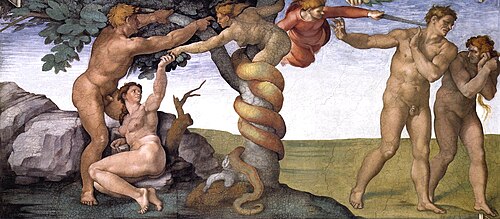
The fall of man or simply the fall refers in Christian doctrine to the transition of the first humans from a state of innocent obedience to God, to a state of guilty disobedience to God. In the Book of Genesis chapter 2, Adam and Eve live at first with God in a paradise, but are then deceived or tempted by the serpent to eat fruit from the Tree of Knowledge of Good and Evil, which had been forbidden to them by God. After doing so they become ashamed of their nakedness, and God consequently expelled them from paradise. The fall is not mentioned by name in the Bible, but the story of disobedience and expulsion is recounted in both Testaments in different ways. The Fall can refer to the wider theological inferences for all humankind as a consequence of Eve and Adam's original sin. Examples include the teachings of Paul in Romans 5:12–19 and 1 Cor. 15:21–22.
Some Christian denominations believe the fall corrupted the entire natural world, including human nature, causing people to be born into original sin, a state from which they cannot attain eternal life without the gracious intervention of God. Protestants hold that Jesus' death was a "ransom" by which humanity was offered freedom from the sin acquired at the fall. In other religions, such as Judaism, Islam, and Gnosticism, the term "the fall" is not recognized and varying interpretations of the Eden narrative are presented.
Christianity interprets the fall in a number of ways. Traditional Christian theology accepts the teaching of St Paul in his letter to the Romans[156][better source needed] "For all have sinned and fall short of the glory of God" and of St John's Gospel that "God so loved the world that he sent his only son (Jesus Christ) that whoever believes in him should not perish, but have everlasting life".[157][better source needed]
The doctrine of original sin, as articulated by Augustine of Hippo's interpretation of Paul of Tarsus, provides that the fall caused a fundamental change in human nature, so that all descendants of Adam are born in sin, and can only be redeemed by divine grace. Sacrifice was the only means by which humanity could be redeemed after the fall. Jesus, who was without sin, died on the cross as the ultimate redemption for the sin of humankind.
Original sin
Thus, the moment Adam and Eve ate the fruit from the tree—which God had commanded them not to do—sinful death was born; it was an act of disobedience, thinking they could become like gods, that was the sin. Since Adam was the head of the human race, he is held responsible for the evil that took place, for which reason the fall of man is referred to as the "sin of Adam". This sin caused Adam and his descendants to lose unrestricted access to God Himself. The years of life were limited. "Wherefore, as by one man sin entered into the world, and death by sin; and so death passed upon all men, for that all have sinned" (Romans 5:12). In Christian theology, the death of Jesus on the cross is the atonement to the sin of Adam. "For as in Adam all die, even so in Christ shall all be made alive." (1 Corinthians 15:22). As a result of that act of Christ, all who put their trust in Christ alone now have unrestricted access to God through prayer and in presence.
Original sin, which Eastern Christians usually refer to as ancestral sin,[158] is, according to a doctrine proposed in Christian theology, humanity's state of sin resulting from the fall of man.[159] This condition has been characterized in many ways, ranging from something as insignificant as a slight deficiency, or a tendency toward sin yet without collective guilt, referred to as a "sin nature," to something as drastic as total depravity or automatic guilt by all humans through collective guilt.[160]
Those who uphold the doctrine look to the teaching of Paul the Apostle in Romans 5:12–21 and 1 Corinthians 15:22 for its scriptural base,[38] and see it as perhaps implied in Old Testament passages such as Psalm 51:5 and Psalm 58:3.

The Apostolic Fathers and the Apologists mostly dealt with topics other than original sin.[38] The doctrine of original sin was first developed in 2nd-century Bishop of Lyon Irenaeus's struggle against Gnosticism.[38] The Greek Fathers emphasized the cosmic dimension of the fall, namely that since Adam human beings are born into a fallen world, but held fast to belief that man, though fallen, is free.[38] It was in the West that precise definition of the doctrine arose.[38] Augustine of Hippo taught that original sin was both an act of foolishness (insipientia) and of pride and disobedience to the God of Adam and Eve. He thought it was a most subtle job to discern what came first: self-centeredness or failure in seeing truth.[161] The sin would not have taken place, if satan hadn't sown into their senses "the root of evil" (radix Mali).[162] The sin of Adam and Eve wounded their nature, affecting human intelligence and will, as well as affections and desires, including sexual desire. The consequences of the fall were transmitted to their descendants in the form of concupiscence, which is a metaphysical term, and not a psychological one. Thomas Aquinas explained Augustine's doctrine pointing out that the libido (concupiscence), which makes the original sin pass from parents to children, is not a libido actualis, i.e. sexual lust, but libido habitualis, i.e. a wound of the whole of human nature.[163] Augustine insisted that concupiscence was not a being but bad quality, the privation of good or a wound.[164] The bishop of Hippo admitted that sexual concupiscence (libido) might have been present in the perfect human nature in the paradise, and that only later it had become disobedient to human will as a result of the first couple's disobedience to God's will in the original sin.[165] The original sin have made humanity a massa damnata[38] (mass of perdition, condemned crowd). In Augustine's view (termed "Realism"), all of humanity was really present in Adam when he sinned, and therefore all have sinned. Original sin, according to Augustine, consists of the guilt of Adam which all humans inherit. As sinners, humans are utterly depraved in nature, lack the freedom to do good, and cannot respond to the will of God without divine grace. Grace is irresistible, results in conversion, and leads to perseverance.[166]
Augustine's formulation of original sin was popular among Protestant reformers, such as Martin Luther and John Calvin, and also, within Roman Catholicism, in the Jansenist movement, but this movement was declared heretical by the Catholic Church.[167] There are wide-ranging disagreements among Christian groups as to the exact understanding of the doctrine about a state of sinfulness or absence of holiness affecting all humans, even children, with some Christian groups denying it altogether.
The notion of original sin as interpreted by Augustine of Hippo was affirmed by the Protestant Reformer John Calvin. Calvin believed that humans inherit Adamic guilt and are in a state of sin from the moment of conception. This inherently sinful nature (the basis for the Calvinistic doctrine of "total depravity") results in a complete alienation from God and the total inability of humans to achieve reconciliation with God based on their own abilities. Not only do individuals inherit a sinful nature due to Adam's fall, but since he was the federal head and representative of the human race, all whom he represented inherit the guilt of his sin by imputation.
- New Testament
The scriptural basis for the doctrine is found in two New Testament books by Paul the Apostle, Romans 5:12–21 and 1 Corinthians 15:22, in which he identifies Adam as the one man through whom death came into the world.[38] [168]
Total depravity
Total depravity (also called absolute inability and total corruption) is a theological doctrine that derives from the Augustinian concept of original sin. It is the teaching that, as a consequence of the fall of man, every person born into the world is enslaved to the service of sin and, apart from the efficacious or prevenient grace of God, is utterly unable to choose to follow God or choose to accept salvation as it is freely offered.
It is also advocated to various degrees by many Protestant confessions of faith and catechisms, including those of Lutheranism,[169] Arminianism,[170] and Calvinism.[171]
Total depravity is the fallen state of man as a result of original sin. The doctrine of total depravity asserts that people are by nature not inclined or even able to love God wholly with heart, mind, and strength, but rather all are inclined by nature to serve their own will and desires and to reject the rule of God. Even religion and philanthropy are wicked to God to the extent that these originate from a human imagination, passion, and will and are not done to the glory of God. Therefore, in Reformed theology, if God is to save anyone He must predestine, call, elect individuals to salvation since fallen man does not want to, indeed is incapable of choosing God.[172]
Total depravity does not mean, however, that people are as evil as possible. Rather, it means that even the good which a person may intend is faulty in its premise, false in its motive, and weak in its implementation; and there is no mere refinement of natural capacities that can correct this condition. Thus, even acts of generosity and altruism are in fact egoist acts in disguise. All good, consequently, is derived from God alone, and in no way through man.[173]
Comparison among Protestants
This table summarizes three Protestant beliefs on depravity.
Soteriology: Salvation
Christian soteriology is the branch of Christian theology that deals with one's salvation.[183] It is derived from the Greek sōtērion (salvation) (from sōtēr savior, preserver) + English -logy.[184]
Atonement is a doctrine that describes how human beings can be reconciled to God. In Christian theology the atonement refers to the forgiving or pardoning of one's sin through the death of Jesus Christ by crucifixion, which made possible the reconciliation between God and creation. Within Christianity there are three main theories for how such atonement might work: the ransom theory, the satisfaction theory and the moral influence theory. Christian soteriology is unlike and not to be confused with collective salvation.
Traditional focus
Christian soteriology traditionally focuses on how God ends the separation people have from him due to sin by reconciling them with himself. (Rom. 5:10–11). Many Christians believe they receive the forgiveness of sins (Acts 2:38), life (Rom. 8:11), and salvation (1 Thess. 5:9) bought by Jesus through his innocent suffering, death, and resurrection from the dead three days later (Matt. 28).
Christ's death, resurrection, ascension, and sending of the Holy Spirit, is called The Paschal Mystery. Christ's human birth is called the Incarnation. Either or both are considered in different versions of soteriology.
While not neglecting the Paschal Mystery, many Christians believe salvation is brought through the Incarnation itself, in which God took on human nature so that humans could partake in the divine nature (2 Peter 1.4). As St. Athanasius put it, God became human so that we might become divine (St. Athanasius, De inc. 54, 3: PG 25, 192B.). This grace in Christ (1 Cor. 1:4) is received as a gift of God that cannot be merited by works done prior to one's conversion to Christianity (Eph. 2:8–9), which is brought about by hearing God's Word (Rom. 10:17) and harkening to it. This involves accepting Jesus Christ as the personal saviour and Lord over one's life.
Distinct schools
Protestant teaching, originating with Martin Luther, teaches that salvation is received by grace alone and that one's sole necessary response to this grace is faith alone. Older Christian teaching, as found in Catholic and Orthodox theology, is that salvation is received by grace alone, but that one's necessary response to this grace comprises both faith and works (James 2:24, 26; Rom 2:6–7; Gal 5:6).
Catholic soteriology
Human beings exists because God wanted to share His life with them. In this sense, every human being is God's child. In a fuller sense, to come to salvation is to be reconciled to God through Christ and to be united with His divine Essence via Theosis in the beatific vision of the Godhead. The graces of Christ's passion, death, and resurrection are found in the seven sacraments of the Catholic Church.
Comparison among Protestants
Ecclesiology: Church
Ecclesiology (from Greek ἐκκλησίᾱ, ekklēsiā, "congregation, church"; and -λογία, -logia) is the study of the theological understanding of the Christian church, including the institutional structure, sacraments and practices (especially the worship of God) thereof. Specific areas of concern include the church's role in salvation, its origin, its relationship to the historical Christ, its discipline, its destiny, and its leadership. Ecclesiology is, therefore, the study of the church as a thing in, and of, itself.
Different ecclesiologies give shape to very different institutions. Thus, in addition to describing a broad discipline of theology, ecclesiology may be used in the specific sense of a particular church or denomination's character, self-described or otherwise. This is the sense of the word in such phrases as Roman Catholic ecclesiology, Lutheran ecclesiology, and ecumenical ecclesiology.
- Issues addressed by ecclesiology
Ecclesiology asks the questions:
- Who is the Church? Is it a visible or earthly corporation or a unified, visible society—a "church" in the sense of a specific denomination or institution, for instance? Or is it the body of all believing Christians (see invisible church) regardless of their denominational differences and disunity? What is the relationship between living Christians and departed Christians (the "cloud of witnesses")– do they (those on Earth and those in Heaven) constitute together the Church?
- Must one join a church? That is, what is the role of corporate worship in the spiritual lives of believers? Is it in fact necessary? Can salvation be found outside of formal membership in a given faith community, and what constitutes "membership?" (Baptism? Formal acceptance of a creed? Regular participation?)
- What is the authority of the Church? Who gets to interpret the doctrines of the Church? Is the organizational structure itself, either in a single corporate body, or generally within the range of formal church structures, an independent vehicle of revelation or of God's grace? Or is the Church's authority instead dependent on and derivative of a separate and prior divine revelation external to the organization, with individual institutions being "the Church" only to the extent that they teach this message? For example, is the Bible a written part of a wider revelation entrusted to the Church as faith community, and therefore to be interpreted within that context? Or is the Bible the revelation itself, and the Church is to be defined as a group of people who claim adherence to it?
- What does the Church do? What are the sacraments, divine ordinances, and liturgies, in the context of the Church, and are they part of the Church's mission to preach the Gospel? What is the comparative emphasis and relationship between worship service, spiritual formation, and mission, and is the Church's role to create disciples of Christ or some other function? Is the Eucharist the defining element of the rest of the sacramental system and the Church itself, or is it secondary to the act of preaching? Is the Church to be understood as the vehicle for salvation, or the salvific presence in the world, or as a community of those already "saved?"
- How should the Church be governed? What was the mission and authority of the Apostles, and is this handed down through the sacraments today? What are the proper methods of choosing clergy such as bishops and priests, and what is their role within the context of the Church? Is an ordained clergy necessary? * Who are the leaders of a church? Must there be a policy-making board of "leaders" within a church and what are the qualifications for this position, and by what process do these members become official, ordained "leaders"? Must leaders and clergy be "ordained," and is this possible only by those who have been ordained by others?
Ecclesiastical polity
Ecclesiastical polity is the operational and governance structure of a church or Christian denomination. It also denotes the ministerial structure of the church and the authority relationships between churches. Polity is closely related to Ecclesiology, the study of doctrine and theology relating to church organization.
Issues of church governance appear in the first chapters of the Acts of the Apostles; the first act recorded after the ascension is the election of Matthias to replace Judas Iscariot. Over the years a system of episcopal polity developed.
During the Protestant Reformation, arguments were made that the New Testament prescribed structures quite different from that of the Catholic Church of the day, and different Protestant bodies used different types of polity. It was during this period that Richard Hooker wrote Of the Laws of Ecclesiastical Polity to defend the polity of the Church of England against the Puritans.
Episcopal polity is used in several closely related senses. Most commonly it refers to the field of church governance in the abstract, but it also can refer to the governance of a particular Christian body. In this sense it is used as a term in civil law. "Polity" is sometimes used as a shorthand for the church governance structure itself.
Though each church or denomination has its own characteristic structure, there are three general types of polity.
- Episcopal polity
Churches having episcopal polity are governed by bishops. The title bishop comes from the Greek word episkopos, which literally translates into overseer.[215] In regard to Catholicism, bishops have authority over the diocese, which is both sacramental and political; as well as performing ordinations, confirmations, and consecrations, the bishop supervises the clergy of the diocese and represents the diocese both secularly and in the hierarchy of church governance.
Bishops in this system may be subject to higher ranking bishops (variously called archbishops, metropolitans or patriarchs, depending upon the tradition; see also Bishop for further explanation of the varieties of bishops.) They also meet in councils or synods. These synods, subject to presidency by higher ranking bishops, may govern the dioceses which are represented in the council, though the synod may also be purely advisory.
Note that the presence of the office of "bishop" within a church is not proof of episcopal polity. For example, in Mormonism, the "bishop" occupies the office that in an Anglican church would be occupied by a priest.
Also, episcopal polity is not usually a simple chain of command. Instead, some authority may be held, not only by synods and colleges of bishops, but by lay and clerical councils. Further, patterns of authority are subject to a wide variety of historical rights and honors which may cut across simple lines of authority.
Episcopal polity is the predominant pattern in Catholic, Eastern Orthodox, Oriental Orthodox and Anglican churches. It is also common in Methodist and Lutheran churches. Among churches with episcopal polity, different theories of autonomy are expressed. So in Roman Catholicism the church is viewed as a single polity headed by the pope, but in Eastern Orthodoxy the various churches retain formal autonomy but are held to be unified by shared doctrine and conciliarity—that is, the authority of councils, such as ecumenical councils, Holy Synods and the former standing council, the Endemusa Synod.
- Presbyterian polity
Many Reformed churches, notably those in the Presbyterian and Continental Reformed traditions, are governed by a hierarchy of councils. The lowest level council governs a single local church and is called the session or consistory; its members are called elders. The minister of the church (sometimes referred to as a teaching elder) is a member of and presides over the session; lay representatives (ruling elders or, informally, just elders) are elected by the congregation. The session sends representatives to the next level higher council, called the presbytery or classis. In some Presbyterian churches there are higher level councils (synods or general assemblies). Each council has authority over its constituents, and the representatives at each level are expected to use their own judgment. Hence higher level councils act as courts of appeal for church trials and disputes, and it is not uncommon to see rulings and decisions overturned.
Presbyterian polity is, of course, the characteristic governance of Presbyterian churches, and also of churches in the Continental Reformed tradition. Elements of presbyterian polity are also found in other churches. For example, in the Episcopal Church in the United States of America governance by bishops is paralleled by a system of deputies, who are lay and clerical representatives elected by parishes and, at the national level, by the dioceses. Legislation in the general convention requires the separate consent of the bishops and of the deputies.
Note that, in episcopal polity, a presbyter refers to a priest.
- Congregational polity
Congregationalist polity dispenses with titled positions such as bishop as a requirement of church structure. The local congregation rules itself, though local leaders and councils may be appointed.
Members may be sent from the congregation to associations that are sometimes identified with the church bodies formed by Lutherans, Presbyterians, Anglicans, and other non-congregational Protestants. The similarity is deceptive, however, because the congregationalist associations do not exercise control over their members (other than ending their membership in the association). Many congregationalist churches are completely independent in principle. One major exception is Ordination, where even congregationalist churches often invite members of the vicinage or association to ordain their called pastor.
It is a principle of congregationalism that ministers do not govern congregations by themselves. They may preside over the congregation, but it is the congregation which exerts its authority in the end.
Congregational polity is sometimes called "Baptist polity", as it is the characteristic polity of Baptist churches.
Priesthood
Church discipline
Missiology
Missiology is the interdisciplinary study of Christian mission history and methodology, emerging as an academic discipline in the 19th century. It examines the missionary work of various Christian denominations, focusing on themes like inculturation, contextualization, and interfaith relations, while engaging with social sciences.[216][217] Notable figures include Alexander Duff and Gustav Warneck, who were pivotal in establishing missiology as a formal field of study.
Sacrament
A sacrament, as defined in Hexam's Concise Dictionary of Religion, is what Roman Catholics believe to be "a rite in which God is uniquely active". Augustine of Hippo defined a Christian sacrament as "a visible sign of an invisible reality". The Anglican Book of Common Prayer speaks of them as "an outward and visible sign of an inward and invisible Grace." Examples of sacraments would be Baptism and the Eucharist."[218] Therefore a sacrament is a religious symbol or often a rite which conveys divine grace, blessing, or sanctity upon the believer who participates in it, or a tangible symbol which represents an intangible reality. As defined above, an example would be baptism in water, representing (and conveying) the grace of the gift of the Holy Spirit, the Forgiveness of Sins, and membership into the Church. Anointing with holy anointing oil is another example which is often synonymous with receiving the Holy Spirit and salvation. Another way of looking at Sacraments is that they are an external and physical sign of the conferral of Sanctifying Grace.[219]
Throughout the Christian faith, views concerning which rites are sacramental, that is conferring sanctifying grace, and what it means for an external act to be sacramental vary widely. Other religious traditions also have what might be called "sacraments" in a sense, though not necessarily according to the Christian meaning of the term.
- General definitions and terms
In the majority of Western Christianity, the generally accepted definition of a sacrament is that it is an outward sign that conveys spiritual grace through Christ. Christian churches, denominations, and sects are divided regarding the number and operation of the sacraments. Sacraments are generally held to have been instituted by Jesus Christ, although in some cases this point is debated. They are usually administered by the clergy to a recipient or recipients, and are generally understood to involve visible and invisible components. The invisible component (manifested inwardly) is understood to be brought about by the action of the Holy Spirit, God's grace working in the sacrament's participants, while the visible (or outward) component entails the use of such things as water, oil, and bread and wine that is blessed or consecrated; the laying-on-of-hands; or a particularly significant covenant that is marked by a public benediction (such as with marriage or absolution of sin in the reconciliation of a penitent).
As defined by the Roman Catholic Church, recognised by the Eastern Orthodox churches, Oriental Orthodox, (though these two do not categorically define the number), and Independent Catholic and Old Catholic Church.
The Orthodox Churches (Eastern and Oriental) typically do not limit the number of sacraments, viewing all encounters with reality in life as sacramental in some sense, and their acknowledgement of the number of sacraments at seven as an innovation of convenience not found in the Church Fathers. It came into use, although infrequently, later on from later encounters with the West and its Sacramental Theology.[220] Other denominations and traditions, both in eastern and western Christianity may affirm only Baptism and Eucharist as sacraments, these include many of the Protestant denominations and some of the Old Believers in the Orthodox communion, some of whom reject all sacraments except Baptism.
Since some post-Reformation denominations do not regard clergy as having a classically sacerdotal or priestly function, they avoid the term "sacrament," preferring the terms "sacerdotal function," "ordinance," or "tradition." This belief invests the efficacy of the ordinance in the obedience and participation of the believer and the witness of the presiding minister and the congregation. This view stems from a highly developed concept of the priesthood of all believers. In this sense, the believer himself or herself performs the sacerdotal role [citation needed].
Eucharist
- Transsubstantiation (Roman Catholicism)
- Anglican Eucharistic theology
- Sacramental Union (Lutheran)
Eucharist, also called Communion, or the Lord's Supper, and other names, is a Christian sacrament or ordinance, generally considered to be a re-enactment of the Last Supper, the final meal that Jesus Christ shared with his disciples before his arrest and eventual crucifixion. The consecration of bread and a cup within the rite recalls the moment at the Last Supper when Jesus gave his disciples bread, saying, "This is my body", and wine, saying, "This is my blood".[33][221]
There are different interpretations of the significance of the Eucharist, but "there is more of a consensus among Christians about the meaning of the Eucharist than would appear from the confessional debates over the sacramental presence, the effects of the Eucharist, and the proper auspices under which it may be celebrated."[222]
The phrase "the Eucharist" may refer not only to the rite but also to the consecrated bread (leavened or unleavened) and wine (or, in some Protestant denominations, unfermented grape juice) used in the rite,[223] and, in this sense, communicants may speak of "receiving the Eucharist", as well as "celebrating the Eucharist".
Eucharist is from Greek εὐχαριστία (eucharistia), meaning thanksgiving. The verb εὐχαριστῶ, the usual word for "to thank" in the Septuagint and the New Testament, is found in the major texts concerning the Lord's Supper, including the earliest:
For I received from the Lord what I also delivered to you, that the Lord Jesus on the night when he was betrayed took bread, and when he had given thanks, he broke it, and said, "This is my body which is for you. Do this in remembrance of me." (1 Corinthians 11:23–24)
The Lord's Supper (Κυριακὸν δεῖπνον) derives from 1 Corinthians 11:20–21.
When you come together, it is not the Lord's Supper you eat, for as you eat, each of you goes ahead without waiting for anybody else. One remains hungry, another gets drunk.
Communion is a translation; other translations are "participation", "sharing", "fellowship"[224] of the Greek κοινωνία (koinōnía) in 1 Corinthians 10:16. The King James Version has
The cup of blessing which we bless, is it not the communion of the blood of Christ? The bread which we break, is it not the communion of the body of Christ?[225]

The Last Supper appears in all three Synoptic Gospels: Matthew, Mark, and Luke; and in the First Epistle to the Corinthians,[33][226][227] while the last-named of these also indicates something of how early Christians celebrated what Paul the Apostle called the Lord's Supper. As well as the Eucharistic dialogue in John chapter 6.
In his First Epistle to the Corinthians (c. 54–55), Paul the Apostle gives the earliest recorded description of Jesus's Last Supper: "The Lord Jesus on the night when he was betrayed took bread, and when he had given thanks, he broke it, and said, 'This is my body which is for you. Do this in remembrance of me.' In the same way also the cup, after supper, saying, 'This cup is the new covenant in my blood. Do this, as often as you drink it, in remembrance of me'."[228]
The synoptic gospels, first Mark,[229] and then Matthew[230] and Luke,[231] depict Jesus as presiding over the Last Supper. References to Jesus's body and blood foreshadow his crucifixion, and he identifies them as a new covenant.[232] In the gospel of John, the account of the Last Supper has no mention of Jesus taking bread and wine and speaking of them as his body and blood; instead it recounts his humble act of washing the disciples' feet, the prophecy of the betrayal, which set in motion the events that would lead to the cross, and his long discourse in response to some questions posed by his followers, in which he went on to speak of the importance of the unity of the disciples with him and each other.[232][233]
The expression The Lord's Supper, derived from St. Paul's usage in 1 Corinthians 11:17–34, may have originally referred to the Agape feast, the shared communal meal with which the Eucharist was originally associated.[234] The Agape feast is mentioned in Jude 12. But The Lord's Supper is now commonly used in reference to a celebration involving no food other than the sacramental bread and wine.
The Didache (Greek: teaching) is an early Church order, including, among other features, instructions for baptism and the Eucharist. Most scholars date it to the early 2nd century,[235] and distinguish in it two separate Eucharistic traditions, the earlier tradition in chapter 10 and the later one preceding it in chapter 9.[236] The Eucharist is mentioned again in chapter 14.
Ignatius of Antioch, one of the Apostolic Fathers and a direct disciple of the Apostle John, mentions the Eucharist as "the flesh of our Saviour Jesus Christ",[237] and Justin Martyr speaks of it as more than a meal: "the food over which the prayer of thanksgiving, the word received from Christ, has been said ... is the flesh and blood of this Jesus who became flesh ... and the deacons carry some to those who are absent."[238]
- Eucharistic theology
Many Christian denominations classify the Eucharist as a sacrament.[239] Some Protestants prefer to call it an ordinance, viewing it not as a specific channel of divine grace but as an expression of faith and of obedience to Christ.
Most Christians, even those who deny that there is any real change in the elements used, recognize a special presence of Christ in this rite, though they differ about exactly how, where, and when Christ is present.[240] Roman Catholicism and Eastern Orthodoxy teach that the consecrated elements truly become the body and blood of Jesus Christ. Transubstantiation is the metaphysical explanation given by Roman Catholics as to how this transformation occurs. Lutherans believe that the body and blood of Jesus are present "in, with and under" the forms of bread and wine, a concept known as the sacramental union. The Reformed churches, following the teachings of John Calvin, believe in a spiritual (or "pneumatic") real presence of Christ by the power of the Holy Spirit and received by faith. Anglicans adhere to a range of views although the Anglican church officially teaches the real presence. Some Christians reject the concept of the real presence, believing that the Eucharist is only a memorial of the death of Christ.
The Baptism, Eucharist and Ministry document of the World Council of Churches, attempting to present the common understanding of the Eucharist on the part of the generality of Christians, describes it as "essentially the sacrament of the gift which God makes to us in Christ through the power of the Holy Spirit", "Thanksgiving to the Father", "Anamnesis or Memorial of Christ", "the sacrament of the unique sacrifice of Christ, who ever lives to make intercession for us", "the sacrament of the body and blood of Christ, the sacrament of his real presence", "Invocation of the Spirit", "Communion of the Faithful", and "Meal of the Kingdom".
Baptism
Eschatology

Eschatology (derived from the Greek roots ἔσχατος "last" and λογία "discourse," "study") is the study of the end of things, whether the end of an individual life, the end of the age, or the end of the world. Broadly speaking, it is the study of the destiny of man as revealed in the Bible.
Eschatology is concerned with the afterlife, beginning with death and the personal judgment which follows the death of the individual, and which is followed by the destination of heaven or hell. (In Catholic theology, heaven is sometimes preceded by purgatory.) Eschatology also concerns itself with events which are said to happen at the end of this age: the return of Jesus, the resurrection of the dead, the Rapture, the Tribulation, and following these things, the Millennium, or thousand years of peace, which has been interpreted both literally and symbolically. Finally, eschatology concerns itself with the end of the world and its associated events: the Last Judgment; the banishment of Death, Hades, and Satan and his followers to the Lake of Fire; and the creation of a new heaven and earth. Millenarianists, Seventh Day Adventists, Jehovah's Witnesses, and other recently founded sects have been influential in the modern development of these doctrines, though their roots are biblical.
Eschatology is an ancient branch of study in Christian theology, with study of the "last things" and the Second Coming of Christ first touched on by Ignatius of Antioch (c. 35–107 AD), then given more consideration by the Christian apologist in Rome, Justin Martyr (c. 100–165).[241] Treatment of eschatology continued in the West in the teachings of the influential theologian of Roman North Africa, Tertullian (c. 160–225), and was given fuller reflection and speculation soon after in the East by the master theologian, Origen (c. 185–254).[242]
Martin Luther, John Calvin, and other 16th-century reformers wrote long tracts about the End Times, but interest in eschatology dwindled after the Reformation until the late 19th century, when it became popular in the Reformed, Pentecostal, and Evangelical sects. It was increasingly recognized as a formal division of theological study during the 20th century.
The second coming of Christ is the central event in Christian eschatology. Most Christians believe that death and suffering will continue to exist until Christ's return. Others believe that suffering will gradually be eliminated prior to his coming, and that the elimination of injustice is our part in preparing for that event. Needless to say, there are a variety of viewpoints concerning the order and significance of eschatological events.
Approaches to interpretation
- The Preterist approach (from the Latin praeteritus "gone by") seeks parallels between Revelation and the events of the 1st century, such as Herod's attempt to kill the infant Christ, the struggle of Christianity to survive the persecutions of Judaism and the Roman Empire, the fall of Jerusalem in 70 AD, the desecration of the temple in the same year, and the growth of Christianity from a sect within Judaism to an independent religion.
- The Historicist method takes a broader historical approach and seeks parallels between Revelation and the major people and events of history, especially those which have had a direct effect on Israel and the Church.
- The Futurist method approaches Revelation as chiefly referring to events that have not yet come to pass but will take place at the end of this age and at the end of the world. The main focus is the return of Christ.
- The Idealist model, also known as Spiritualist or Symbolic model, approaches the images of Revelation as symbols representing larger themes and concepts, rather than actual people and events. It sees in Revelation an allegorical representation of the ongoing struggle of the forces of light and darkness, and the ultimate triumph of good over evil.
See also

- Biblical law in Christianity
- Eastern Orthodox – Roman Catholic theological differences
- Lists of Christian theologians
- New Testament theology
- Old Testament theology
- Outline of theology
References
- ^ Entwistle, David N. (30 June 2015). Integrative Approaches to Psychology and Christianity. Cascade Books. p. 148. ISBN 9781498223485.
- ^ See, e.g., Daniel L. Migliore, Faith Seeking Understanding: An Introduction to Christian Theology (Grand Rapids: Eerdmans, 2004)
- ^ See, e.g., David Burrell, Freedom and Creation in Three Traditions (Notre Dame: University of Notre Dame Press, 1994)
- ^ See for example John Shelby Spong, Why Christianity Must Change or Die (New York: Harper Collins, 2001)
- ^ See, e.g., Duncan Dormor et al. (eds), Anglicanism, the Answer to Modernity (London: Continuum, 2003)
- ^ For example, see Timothy Gorringe, Crime, Changing Society and the Churches Series (London: SPCK, 2004).
- ^ Louth, Andrew. The Origins of the Christian Mystical Tradition: From Plato to Denys. Oxford: Oxford University Press, 1983.
- ^ Armstrong, Karen (1993). A History of God. New York: Alfred A. Knopf. ISBN 978-0345384560.
- ^
Compare:
Jenson, Robert W. (1997). "1: What Systematic Theology Is About". Systematic Theology. Vol. 1: The Triune God (revised ed.). Oxford: Oxford University Press (published 2001). p. 22. ISBN 9780195145984. Retrieved 5 February 2019.
Systematic theology is so called because it takes up questions posed not only by current urgency but also by perceived inherent connections of the faith. Thus systematic theology may raise problems that have not yet emerged in the church's life, and maintain discussions whose immediate ecclesial-pastoral challenge is in abeyance. [...] 'Systematic' theology is [...] concerned with the truth of the gospel, whether dogmatically defined or not.
- ^ Dr, STEVE ESOMBA (6 June 2012). THE BOOK OF LIFE, KNOWLEDGE AND CONFIDENCE. Lulu.com. ISBN 978-1-4717-3463-2.
- ^ "Thomas Aquinas (1224/6—1274)". Internet Encyclopedia of Philosophy. Retrieved 7 August 2024.
- ^ 2 Pet 1:20–21 Archived 11 April 2021 at the Wayback Machine.
- ^ Dodd, Charles Harold (1978). The Authority of the Bible. London: Collins. p. 25. ISBN 0-00-625195-1.
- ^ The Douay–Rheims Bible, relying on the Vulgate, has "All scripture, inspired of God, is profitable to teach ...". See the comment in the New Jerusalem Bible study edition - footnote 'e', page 1967, Darton Longman Todd, 1985. ISBN 0-232-52077-1, but with the caution "less probably".
- ^
Daniel B. Wallace (1996). Greek Grammar Beyond the Basics: An Exegetical Syntax of the New Testament. Grand Rapids, Michigan: Zondervan. pp. 313–314. ISBN 0-310-21895-0.
Many scholars feel that the translation should be: 'Every inspired scripture is also profitable.' This is probably not the best translation, however, for the following reasons: (1) Contextually [...] (2) Grammatically [...]
- ^ "inspire". Oxford English Dictionary (Online ed.). Oxford University Press. (Subscription or participating institution membership required.)
- ^ a b Geisler & Nix (1986). A General Introduction to the Bible. Moody Press, Chicago. ISBN 0-8024-2916-5.
- ^ Coleman (1975). "Biblical Inerrancy: Are We Going Anywhere?". Theology Today. 31 (4): 295–303. doi:10.1177/004057367503100404. S2CID 170389190.
- ^ Catechism of the Catholic Church, Inspiration and Truth of Sacred Scripture (§105–108) Archived 9 September 2010 at the Wayback Machine
- ^ Heinrich Bullinger's Second Helvetic Confession (1566), Of the Holy Scripture Being the True Word of God - "We believe and confess the canonical Scriptures of the holy prophets and apostles of both Testaments to be the true Word of God, and to have sufficient authority of themselves, not of men. [...] And in this Holy Scripture, the universal Church of Christ has the most complete exposition of all that pertains to a saving faith, and also to the framing of a life acceptable to God [...]."
- ^ Chicago Statement on Biblical Inerrancy (1978), Online text Archived 17 January 2022 at the Wayback Machine: "Article XI
We affirm that Scripture, having been given by divine inspiration, is infallible, so that, far from misleading us, it is true and reliable in all the matters it addresses." - ^ Catechism of the Catholic Church: "Catechism of the Catholic Church - Sacred Scripture". Archived from the original on 9 June 2010. Retrieved 15 March 2020.
{{cite web}}: CS1 maint: bot: original URL status unknown (link) - "107 The inspired books teach the truth. 'Since therefore all that the inspired authors or sacred writers affirm should be regarded as affirmed by the Holy Spirit, we must acknowledge that the books of Scripture firmly, faithfully, and without error teach that truth which God, for the sake of our salvation, wished to see confided to the Sacred Scriptures.'" - ^
Compare:
"Bible Infallibility - 'Evangelical' Defenders of the Faith". The Westminster Review. 75. Leonard Scott Publication: 49. January 1861. Retrieved 6 September 2020.
[...] the doctrine of the infallibility of the Bible, a doctrine which, according to Mr. Ayre and his school, the apostles held and Christ sanctioned; which from the earliest times the Church has adopted, and which the plenary as well as the verbal inspirationists still maintain.
- ^ Catholic Encyclopedia: Canon of the New Testament Archived 18 January 2019 at the Wayback Machine: "The idea of a complete and clear-cut canon of the New Testament existing from the beginning, that is from Apostolic times, has no foundation in history."
- ^ a b Stagg, Frank. New Testament Theology, Nashville: Broadman, 1962.
- ^ Herman Bavinck, The Doctrine of God. Edinburgh: The Banner of Truth Trust, 1979.
- ^ The Westminster Shorter Catechism's definition of God is merely an enumeration of his attributes: "God is a Spirit, infinite, eternal, and unchangeable in his being, wisdom, power, holiness, justice, goodness, and truth."Westminster Shorter Catechism, Question and Answer 4. The Westminster Larger Catechism adds certain attributes to this description, such as "all-sufficient", "incomprehensible", "every where present" and "knowing all things". Westminster Larger Catechism, Question and Answer 7. This answer has been criticised, however, as having "nothing specifically Christian about it."James B. Jordan, "What is God? Archived 22 December 2010 at the Wayback Machine," Biblical Horizons Newsletter, No. 82.
- ^ D. A. Carson, The Gagging of God (Grand Rapids: Zondervan), 1996.
- ^ David J. Bosch, Transforming Mission (Maryknoll: Orbis Books, 1991), 390.
- ^ Providence Archived 17 April 2011 at the Wayback Machine in The Concise Oxford Dictionary of World Religions.
- ^ Gresham, Machen, J. (1998). God Transcendent. Banner of Truth publishers. ISBN 0-85151-355-7.
{{cite book}}: CS1 maint: multiple names: authors list (link) - ^ a b Critical Terms for Religious Studies. Chicago: The University of Chicago Press, 1998. Credo Reference. 27 July 2009
- ^ a b c d e Encyclopædia Britannica: Purgatory in world religions: Archived 20 August 2008 at the Wayback Machine "The idea of purification or temporary punishment after death has ancient roots and is well-attested in early Christian literature. The conception of purgatory as a geographically situated place is largely the achievement of medieval Christian piety and imagination."
- ^ See discussion in Herbermann, Charles, ed. (1913). . Catholic Encyclopedia. New York: Robert Appleton Company.
- ^ Grudem, Wayne A. 1994. Systematic Theology: An Introduction to Biblical Doctrine. Leicester, England: Inter-Varsity Press; Grand Rapids, MI: Zondervan. p. 226.
- ^ a b Olson, Roger E. (1999). The Story of Christian Theology: Twenty Centuries of Tradition & Reform. InterVarsity Press. ISBN 978-0-8308-1505-0.
- ^ "Tertullian, Against Praxeas, chapter II". Ccel.org. 1 June 2005. Retrieved 8 August 2010.
- ^ a b c d e f g h i j "Trinity, doctrine of the". The Oxford Dictionary of the Christian Church. Oxford University Press. 2005. ISBN 978-0-19-280290-3.
- ^ John 4:24
- ^ J.N.D. Kelly, Early Christian Doctrines pp. 87–90; T. Desmond Alexander, New Dictionary of Biblical Theology pp. 514–515; Alister E. McGrath, Historical Theology p. 61.
- ^ 1 Jn 5:7
- ^ Stagg, Frank (1962). New Testament Theology. Broadman Press. p. 38 ff. ISBN 978-0-8054-1613-8.
- ^ Diana L. Eck (2003) Encountering God: A Spiritual Journey from Bozeman to Banaras. p. 98
- ^ Heb 1:2–5, Gal 4:1–7
- ^ Mt. 11:27
- ^ Eph 3:15
- ^ "God sent forth His Son... that we might receive the adoption as sons. And because you are sons, God has sent forth the Spirit of His Son into your hearts crying out, "Abba, Father!" Therefore you are no longer a slave but a son, and if a son, then an heir of God through Christ."; Galatians 4:4–7
- ^ Heb. 1:2–5
- ^ John 1:1
- ^ Grudem, Wayne A. (1994). Systematic Theology: An Introduction to Biblical Doctrine. Zondervan. ISBN 0-310-28670-0.
- ^ Matthew 1:18–25, Luke 1:35, Luke 3:23
- ^ Matt 16:16
- ^ "Etymology Online: Christ". Etymonline.com. Retrieved 8 August 2010.
- ^ Rom 1:3–4
- ^ Compare.Galatians 4:4;Jn 1:1–14;5:18–25;10:30–38
- ^ Jn 17:3
- ^ "A brief account of the early Church councils and the Church fathers shows that they adopted the doctrine of the eternal subordination of the Son, and that this doctrine continues in the Church as orthodoxy to this day." Stephen D. Kovach and Peter R. Schemm Jr., "A Defense of the Doctrine of the Eternal Subordination of the Son", Journal of the Evangelical Theological Society 42 (1999): 461–476.
- ^ Mark 1:10
- ^ Bruce Milne (1999). Know the Truth. Inter-Varsity Press. pp. 181–182. ISBN 0-8308-1793-X.
- ^ McKim, Donald K. 1996. Westminster dictionary of theological terms. Louisville, KY: Westminster John Knox Press. p. 140.
- ^ "Jacques Maritain Center: GC 4.54". .nd.edu. Archived from the original on 22 June 2015. Retrieved 8 August 2010.
- ^ "Advent Prayer and the Incarnation". Ewtn.com. Retrieved 8 August 2010.
- ^ * The Seven Ecumenical Councils Archived 29 April 2019 at the Wayback Machine, from the Nicene and Post-Nicene Fathers, vols. 2–14 (CCEL.org) Contains detailed statements from each of these councils. The First Council of Nicaea, Council of Ephesus and Council of Chalcedon are the "First," "Third" and "Fourth" Ecumenical Councils, respectively.
- ^ Martin Lembke, lecture in the course "Meetings with the World's Religions", Centre for Theology and Religious Studies, Lund University, Spring Term 2010.
- ^ Gregory of Nyssa, Antirrheticus adversus Apollinarem.
- ^ "Theodore" in The Westminster Dictionary of Christian History, ed. J. Brauer. Philadelphia: Westminster Press, 1971.
- ^ Denzinger, ed. Bannwart, 148
- ^ "The Oriental Orthodox Rejection of Chalcedon". Archived from the original on 19 June 2008. Retrieved 5 October 2006.
- ^ a b Donald Macleod, The Person of Christ (InterVarsity Press, 1998), 220.
- ^ NRSV; Matthew 4.1–11.
- ^ a b Macleod 1998, p. 226
- ^ a b Macleod 1998, p. 227
- ^ Barclay 1967, p. 81
- ^ Barth 1956, p. 207
- ^ MacLeod 1998, pp. 37–41
- ^ Kesich, Veselin (2007). Formation and struggles : the church, A.D. 33–450. Crestwood, N.Y.: St. Vladimir's Seminary Press. p. 159. ISBN 978-0-88141-319-9.
- ^ "Athenagoras of Athens: A Plea for the Christians". Earlychristianwritings.com. 2 February 2006. Retrieved 8 August 2010.
- ^ Greene, Colin J. D. (2003). Christology in Cultural Perspective: Marking Out the Horizons. London: Paternoster Press. p. 30. ISBN 978-1842270158.
- ^ Greene, pp. 31–43, 324
- ^ Greene, pp. 43–51
- ^ Greene, pp. 51–71, 325
- ^ Fuller 1965, p. 15
- ^ John Calvin, Calvins Calvinism BOOK II Chapter 15 Centers for Reformed Theology and Apologetics [resource online] (1996–2002, accessed 3 June 2006);available from http://www.reformed.org/books/institutes/books/book2/bk2ch15.html#one.htm Archived 12 June 2010 at the Wayback Machine
- ^ H. Orton Wiley, Christian Theology Chapter 22 [resource online] (Nampa, Idaho: 1993–2005, accessed 3 June 2006); available from http://wesley.nnu.edu/holiness_tradition/wiley/wiley-2-22.htm Archived 18 May 2009 at the Wayback Machine
- ^ Millard J. Erickson (1992). Introducing Christian Doctrine. Baker Book House. p. 103. ISBN 0-8010-3215-6.
- ^ a b T C Hammond (1968). David F Wright (ed.). In Understanding be Men:A Handbook of Christian Doctrine (sixth ed.). Inter-Varsity Press. pp. 54–56, 128–131.
- ^ a b "Catholic Encyclopedia:Holy Spirit".
- ^ Mark 3:28–30, Matthew 12:30–32, Luke 12:8–10
- ^ 1 Cor 3:16
- ^ Jn 14:26
- ^ Spurgeon, Charles H. "The Comforter", 1855. Online: http://www.spurgeon.org/sermons/0005.htm Archived 27 June 2010 at the Wayback Machine Accessed 29 April 2009
- ^ Rom 12:6–8
- ^ Acts 1:4–8
- ^ The Holy Spirit and His Gifts. J. Oswald Sanders. Inter-Varsity Press. chapter 5.
- ^ a b c d e Millard J. Erickson (1992). Introducing Christian Doctrine. Baker Book House. pp. 265–270. ISBN 0-8010-3215-6.
- ^ Though the term "born again" is most frequently used by evangelical Christians, most denominations do consider that the new Christian is a "new creation" and "born again". See for example the Catholic Encyclopedia [1] Archived 28 February 2009 at the Wayback Machine
- ^ T C Hammond (1968). David F Wright (ed.). In Understanding be Men:A Handbook of Christian Doctrine (sixth ed.). Inter-Varsity Press. p. 134.
- ^ Millard J. Erickson (1992). Introducing Christian Doctrine. Baker Book House. pp. 267–268. ISBN 0-8010-3215-6.
- ^ Karl Barth (1949). Dogmatics in Outline. New York Philosophical Library. p. 95. ISBN 0-334-02838-8.
- ^ Stephen F. Winward (1981). Fruit of the Spirit. Inter-Varsity Press. ISBN 0-85110-430-4.
- ^ Catechism of the Catholic Church, Section 1832.
- ^ De Sacramentis 3.8.
- ^ a b c Millard J. Erickson (1992). Introducing Christian Doctrine. Baker Book House. pp. 265–275. ISBN 0-8010-3215-6.
- ^ Communion and Stewardship: Human Persons Created in the Image of God Archived 21 June 2014 at the Wayback Machine,(23 July 2004), International Theological Commission, La Civiltà Cattolica 2004, IV, 254–286
- ^ "CCC Search Result– Paragraph # 291". Scborromeo.org. Retrieved 8 August 2010.
- ^ Millard Erickson, Christian Theology 2nd edn, 537
- ^ Hebrew–English Lexicon, Brown, Driver & Briggs, Hendrickson Publishers.
- ^ Baker's Evangelical Dictionary of Biblical Theology.
- ^ Dictionary of Biblical Theology, Father Xavier Leon Dufour, 1985.
- ^ New International Dictionary.
- ^ New Dictionary of Biblical Theology
- ^ "A careful examination of the biblical material, particularly the words nefesh, neshama, and ruaḥ, which are often too broadly translated as "soul" and "spirit," indicates that these must not be understood as referring to the psychical side of a psychophysical pair. A man did not possess a nefesh but rather was a nefesh, as Gen. 2:7 says: "wayehi ha-adam le-nefesh ḥayya" (". . . and the man became a living being"). Man was, for most of the biblical writers, what has been called "a unit of vital power," not a dual creature separable into two distinct parts of unequal importance and value. While this understanding of the nature of man dominated biblical thought, in apocalyptic literature (2nd century BC–2nd century AD) the term nefesh began to be viewed as a separable psychical entity with existence apart from body.... The biblical view of man as an inseparable psychosomatic unit meant that death was understood to be his dissolution."—Britannica, 2004.
- ^ Exegetical Dictionary of the New Testament
- ^ The early Hebrews apparently had a concept of the soul but did not separate it from the body, although later Jewish writers developed the idea of the soul further. Old Testament references to the soul are related to the concept of breath and establish no distinction between the ethereal soul and the corporeal body. Christian concepts of a body-soul dichotomy originated with the ancient Greeks andwere introduced into Christian theology at an early date by St. Gregory of Nyssa and by St. Augustine.—Britannica, 2004
- ^ Bultmann, I:206
- ^ D. K. Innes, "Sheol" in New Bible Dictionary, IVP 1996.
- ^ Freedman, David Noel; Myers, Allen C.; Beck, Astrid B. (2000). "Cherubim". Eerdmans Dictionary of the Bible. Wm. B. Eerdmans Publishing. ISBN 978-0-8028-2400-4.
- ^ Davidson, Gustav (1994) [1967]. A Dictionary of Fallen Angels, Including the Fallen Angels. New York, NY: Macmillan, Inc. ISBN 978-0-02-907052-9.
- ^ "ScriptureText.com". ScriptureText.com. Retrieved 8 August 2010.
- ^ "Etymonline.com". Etymonline.com. Retrieved 8 August 2010.
- ^ "Online-Literature.com". Online-Literature.com. Retrieved 8 August 2010.
- ^ "Bible Gateway passage: Revelation 21:1-4 - New International Version". Bible Gateway. Retrieved 10 June 2024.
- ^ "What do you think?". AllAboutJesusChrist.org. Retrieved 5 October 2008.
- ^ Book for Commemoration of the Living and the Dead, trans. Father Lawrence (Holy Trinity Monastery, Jordanville NY), p. 77.
- ^ Treated extensively in C. S. Lewis, The Discarded Image: An Introduction to Medieval and Renaissance Literature (1964).
- ^ See discussion at http://forums.catholic.com/showthread.php?p=3322510 Archived 9 May 2011 at the Wayback Machine, where a.o. Hebrews 12:22–24 is quoted.
- ^ For instance, with Justin Martyr. See: Philippe Bobichon, "Millénarisme et orthodoxie dans les écrits de Justin Martyr" in Mélanges sur la question millénariste de l'Antiquité à nos jours, Martin Dumont (dir.) [Bibliothèque d'étude des mondes chrétiens, 11], Paris, 2018, pp. 61-82
- ^ "What happens after a person dies?". The United Methodist Church. Retrieved 10 March 2011.
Purgatory is believed to be a place where the souls of the faithful dead endure a period of purification and cleansing, aided by the prayers of the living, prior to their entrance into heaven. Although John Wesley believed in an intermediate state between death and the final judgment, that idea is not formally affirmed in Methodist doctrine, which "reject the idea of purgatory but beyond that maintain silence on what lies between death and the last judgment." (Methodist Doctrine: The Essentials by Ted A. Campbell)
- ^ Robin Russell. "Heavenly minded: It's time to get our eschatology right, say scholars, authors". UM Portal. Archived from the original on 22 July 2011. Retrieved 10 March 2011.
John Wesley believed in the intermediate state between death and the final judgment "where believers would share in the 'bosom of Abraham' or 'paradise,' even continuing to grow in holiness there," writes Ted Campbell, a professor at Perkins School of Theology, in his 1999 book Methodist Doctrine: The Essentials (Abingdon). That view has not been officially affirmed by the Church.
- ^ Orthodox Confession of Faith Archived 21 April 1999 at the Wayback Machine, questions 64–66.
- ^ Olivier Clément, L'Église orthodoxe. Presses Universitaires de France, 2006, Section 3, IV
- ^ See, for instance, LDS Life After Death Archived 14 July 2009 at the Wayback Machine
- ^ "GEHENNA - JewishEncyclopedia.com". jewishencyclopedia.com.
- ^ "Browse by Subject". www.chabad.org.
- ^ "Biblical Reference: John 3:18". Ibs.org. Archived from the original on 4 August 2012. Retrieved 8 August 2010.
- ^ "hell– Definitions from Dictionary.com". Dictionary.reference.com. Retrieved 8 August 2010.
- ^ "Bible Gateway passage: Revelation 20:7-10 - New International Version". Bible Gateway. Retrieved 10 June 2024.
- ^ a b c d e "Hell." Cross, F. L., ed. The Oxford dictionary of the Christian church. New York: Oxford University Press. 2005
- ^ New Bible Dictionary third edition, IVP 1996. Articles on "Hell", "Sheol".
- ^ a b c Evangelical Alliance Commission on Unity and Truth among Evangelicals (2000). The Nature of Hell. Acute, Paternoster (London). ISBN 0-9532992-2-8.
- ^ C. S. Lewis, The Great Divorce, 1946
- ^ Lee Strobel, The Case for Faith, 2000
- ^ Millard Erickson (2001). Introducing Christian Doctrine, 2nd ed. Baker Academic.
- ^ "The Nature of Hell. Conclusions and Recommendations". Evangelical Alliance. 2000. Archived from the original on 22 February 2012. Retrieved 11 June 2019.
{{cite journal}}: Cite journal requires|journal=(help) - ^ New Dictionary of Biblical Theology; IVP Leicester 2000, "Hell"
- ^ Encyclopædia Britannica: Theodicy
- ^ The Stanford Encyclopedia of Philosophy, "The Problem of Evil Archived 6 September 2018 at the Wayback Machine", Michael Tooley
- ^ a b c The Internet Encyclopedia of Philosophy, "The Evidential Problem of Evil Archived 10 April 2009 at the Wayback Machine", Nick Trakakis
- ^ Honderich, Ted (2005). "theodicy". The Oxford Companion to Philosophy. ISBN 0-19-926479-1.
John Hick, for example, proposes a theodicy, while Alvin Plantinga formulates a defense. The idea of human free will often appears in both of these strategies, but in different ways.
- ^ Swinburne, Richard (2005). "evil, the problem of". In Ted Honderich (ed.). The Oxford Companion to Philosophy. ISBN 0-19-926479-1.
- ^ Lewis, C. S., The Problem of Pain HarperCollins:New York, 1996 pp. 24–25
- ^ William A. Dembski, The End of Christianity: Finding a Good God in an Evil World. (Nashville: Broadman and Holman, 2009
- ^ "Bible Gateway passage: Isaiah 45:7 – King James Version". Bible Gateway.
- ^ Ehrman, Bart D., God's Problem: How the Bible Fails to Answer Our Most Important Question – Why We Suffer. HarperOne, 2008
- ^ Bavinck, Herman. Reformed Dogmatics Vol. 3. (Grand Rapids: Baker Academic, 2004) pp. 75–125 detail the historical development of Hamartiology, including Pelagius's position and the mediating positions)
- ^ Paul's Epistle to the Romans, chapter 3 verse 23
- ^ John 3:16
- ^ The term "ancestral sin" is also used, as in Greek προπατορικὴ ἁμαρτία (e.g. Πόλεμος και φτώχεια– η ορθόδοξη άποψη, Archived 21 July 2011 at the Wayback Machine Η νηστεία της Σαρακοστής Archived 17 June 2016 at the Wayback Machine, Πώς στράφηκε ο Λούθηρος κατά του Μοναχισμού– του Γεωργίου Φλωρόφσκυ Archived 15 February 2017 at the Wayback Machine) or προπατορικὸ ἁμάρτημα (e.g. Απαντήσεις σε ερωτήματα δογματικά– Ανδρέα Θεοδώρου, εκδ. Αποστολικής Διακονίας, 1997, σελ. 156–161 Archived 21 September 2020 at the Wayback Machine, Θεοτόκος και προπατορικό αμάρτημα Archived 27 April 2010 at the Wayback Machine)
- ^ "Original Sin". Oxford Dictionary of the Christian Church. Oxford University Press. 2005. ISBN 978-0-19-280290-3.
- ^ Brodd, Jeffrey (2003). World Religions. Winona, MN: Saint Mary's Press. ISBN 978-0-88489-725-5.
- ^ Augustine wrote to Julian of Eclanum: Sed si disputatione subtilissima et elimatissima opus est, ut sciamus utrum primos homines insipientia superbos, an insipientes superbia fecerit. (Contra Julianum, V, 4.18; PL 44, 795)
- ^ Nisi radicem mali humanus tunc reciperet sensus ("Contra Julianum", I, 9.42; PL 44, 670)
- ^ Libido quae transmittit peccatum originale in prolem, non-est libido actualis, quia dato quod virtute divina concederetur alicui quod nullam inordinatam libidinem in actu generationis sentiret, adhuc transmitteret in prolem originale peccatum. Sed libido illa est intelligenda habitualiter, secundum quod appetitus sensitivus non-continetur sub ratione vinculo originalis iustitiae. Et talis libido in omnibus est aequalis (STh Iª-IIae q. 82 a. 4 ad 3).
- ^ Non substantialiter manere concupiscentiam, sicut corpus aliquod aut spiritum; sed esse affectionem quamdam malae qualitatis, sicut est languor. (De nuptiis et concupiscentia, I, 25. 28; PL 44, 430; cf. Contra Julianum, VI, 18.53; PL 44, 854; ibid. VI, 19.58; PL 44, 857; ibid., II, 10.33; PL 44, 697; Contra Secundinum Manichaeum, 15; PL 42, 590.
- ^ Augustine wrote to Julian of Eclanum: Quis enim negat futurum fuisse concubitum, etiamsi peccatum non-praecessisset? Sed futurus fuerat, sicut aliis membris, ita etiam genitalibus voluntate motis, non-libidine concitatis; aut certe etiam ipsa libidine– ut non-vos de illa nimium contristemus– non-qualis nunc est, sed ad nutum voluntarium serviente (Contra Julianum, IV. 11. 57; PL 44, 766). See also his late work: Contra secundam Iuliani responsionem imperfectum opus, II, 42; PL 45,1160; ibid. II, 45; PL 45,1161; ibid., VI, 22; PL 45, 1550–1551. Cf.Schmitt, É. (1983). Le mariage chrétien dans l'oeuvre de Saint Augustin. Une théologie baptismale de la vie conjugale. Études Augustiniennes. Paris. p. 104.
{{cite book}}: CS1 maint: location missing publisher (link) - ^ Justo L. Gonzalez (1970–1975). A History of Christian Thought: Volume 2 (From Augustine to the eve of the Reformation). Abingdon Press.
- ^
 Forget, Jacques (1910). "Jansenius and Jansenism". In Herbermann, Charles (ed.). Catholic Encyclopedia. Vol. 8. New York: Robert Appleton Company. Retrieved 8 August 2010.
- ^ Therefore, just as sin came into the world through one man, and death through sin, and so death spread to all men because all sinned—for sin indeed was in the world before the law was given, but sin is not counted where there is no law. Yet death reigned from Adam to Moses, even over those whose sinning was not like the transgression of Adam, who was a type of the one who was to come.—Romans 5:12–14, ESV "Therefore, as one trespass led to condemnation for all men, so one act of righteousness leads to justification and life for all men. For as by the one man's disobedience the many were made sinners, so by the one man's obedience the many will be made righteous. Now the law came in to increase the trespass, but where sin increased, grace abounded all the more, so that, as sin reigned in death, grace also might reign through righteousness leading to eternal life through Jesus Christ our Lord."—Rom. 5:18–21, ESV
- ^ The Book of Concord, "The Thorough Declaration of the Formula of Concord," chapter II, sections 11 and 12 Archived 16 May 2008 at the Wayback Machine; The Augsburg Confession, Article 2 Archived 12 June 2010 at the Wayback Machine
- ^ Arminius, James The Writings of James Arminius (three vols.), tr. James Nichols and William R. Bagnall (Grand Rapids: Baker, 1956), I:252
- ^ Canons of Dordrecht, "The Third and Fourth Main Points of Doctrine" Archived 29 July 2013 at the Wayback Machine; Westminster Confession of Faith, chapter 6 Archived 13 June 2010 at the Wayback Machine; Westminster Larger Catechism, Question 25 Archived 13 June 2010 at the Wayback Machine; Heidelberg Catechism, question 8 Archived 3 September 2020 at the Wayback Machine
- ^ The Westminster Confession of Faith, 9.3 Archived 13 June 2010 at the Wayback Machine
- ^ Ra McLaughlin. "Total Depravity, part 1". Reformed Perspectives. Retrieved 14 July 2008.
[Any person] can do outwardly good works, but these works come from a heart that hates God, and therefore fail to meet God's righteous standards.
- ^ Charles Partee, The Theology of John Calvin (Westminster John Knox, 2008), 129. "By total depravity Calvin means totally susceptible to sin."
- ^ John Calvin, Institutes of the Christian Religion, trans. Henry Beveridge, III.23.2.
- ^ John Calvin, Institutes of the Christian Religion, trans. Henry Beveridge, II.3.5.
- ^ John Calvin, Institutes of the Christian Religion, trans. Henry Beveridge, III.3.6.
- ^ a b c d "Calvinism and Lutheranism Compared". WELS Topical Q&A. Wisconsin Evangelical Lutheran Synod. Archived from the original on 27 September 2009. Retrieved 26 January 2015.
"Total Depravity – Lutherans and Calvinists agree." Yes this is correct. Both agree on the devastating nature of the fall and that man by nature has no power to aid in his conversions...and that election to salvation is by grace. In Lutheranism the German term for election is Gnadenwahl, election by grace--there is no other kind.
- ^ Robert L. Browning and Roy A. Reed, Forgiveness, Reconciliation, and Moral Courage (Eerdmans, 2004), 113. "Luther did not mean by 'total depravity' that everything a person did was depraved. He meant that depravity, sin and wickedness can invade any and every part of life."
- ^ Henry Cole, trans, Martin Luther on the Bondage of the Will (London, T. Bensley, 1823), 66. The controversial term liberum arbitrium was translated "free-will" by Cole. However Ernest Gordon Rupp and Philip Saville Watson, Luther and Erasmus: Free Will and Salvation (Westminster, 1969) chose "free choice" as their translation.
- ^ Roger E. Olson, Arminian Theology: Myths and Realities (InterVarsity Press, 2009), 17. "Arminians of the heart emphatically do not deny total depravity," but prefer not to use the word.
- ^ Keith D. Stanglin and Thomas H. McCall, Jacob Arminius: Theologian of Grace (Oxford University, 2012), 157–158.
- ^ Soteriology. Dictionary.com. WordNet 3.0. Princeton University. http://dictionary.reference.com/browse/Soteriology Archived 13 November 2007 at the Wayback Machine (accessed: 2 March 2008).
- ^ "soteriology– Definition from the Merriam-Webster Online Dictionary". Merriam-webster.com. 25 April 2007. Retrieved 8 August 2010.
- ^ Table drawn from, though not copied, from Lange, Lyle W. God So Loved the World: A Study of Christian Doctrine. Milwaukee: Northwestern Publishing House, 2006. p. 448.
- ^ John Calvin, Institutes of the Christian Religion, trans. Henry Beveridge, III.23.2.
- ^ John Calvin, Institutes of the Christian Religion, trans. Henry Beveridge, II.3.5.
- ^ John Calvin, Institutes of the Christian Religion, trans. Henry Beveridge, III.3.6.
- ^ Morris, J.W., The Historic Church: An Orthodox View of Christian History, p267, "The Book of Concord became the official statement of doctrine for most of the world's Lutherans. The Formula of Concord reaffirmed the traditional Lutheran doctrine of total depravity in very clear terms"
- ^ Melton, J.G., Encyclopedia of Protestantism, p229, on Formula of Concord, "the 12 articles of the formula focused on a number of newer issues such as original sin (in which total depravity is affirmed)"
- ^ "WELS vs Assembly of God". WELS Topical Q&A. Archived from the original on 14 July 2014.
[P]eople by nature are dead in their transgressions and sin and therefore have no ability to decide of Christ (Ephesians 2:1, 5). We do not choose Christ, rather he chose us (John 15:16) We believe that human beings are purely passive in conversion.
- ^ Augsburg Confessional, Article XVIII, Of Free Will, saying: "(M)an's will has some liberty to choose civil righteousness, and to work things subject to reason. But it has no power, without the Holy Ghost, to work the righteousness of God, that is, spiritual righteousness; since the natural man receiveth not the things of the Spirit of God (1 Cor. 2:14); but this righteousness is wrought in the heart when the Holy Ghost is received through the Word."
- ^ Henry Cole, trans., Martin Luther on the Bondage of the Will (London, T. Bensley, 1823), 66. The controversial term liberum arbitrium was translated "free-will" by Cole. However Ernest Gordon Rupp and Philip Saville Watson, Luther and Erasmus: Free Will and Salvation (Westminster, 1969) chose "free choice" as their translation.
- ^ Stanglin, Keith D.; McCall, Thomas H. (15 November 2012). Jacob Arminius: Theologian of Grace. New York: Oxford University Press USA. pp. 157–158.
- ^ The Book of Concord: The Confessions of the Lutheran Church, XI. Election. "Predestination" means "God's ordination to salvation".
- ^ Olson, Roger E. (2009). Arminian Theology: Myths and Realities. Downers Grove: InterVarsity Press. p. 63.
Arminians accepts divine election, [but] they believe it is conditional.
- ^ The Westminster Confession, III:6, says that only the "elect" are "effectually called, justified, adopted, sanctified, and saved." However in his Calvin and the Reformed Tradition (Baker, 2012), 45, Richard A. Muller observes that "a sizeable body of literature has interpreted Calvin as teaching "limited atonement", but "an equally sizeable body . . . [interprets] Calvin as teaching "unlimited atonement".
- ^ "Justification / Salvation". WELS Topical Q&A. Wisconsin Evangelical Lutheran Synod. Archived from the original on 27 September 2009. Retrieved 29 January 2015.
Romans 3:23-24, 5:9, 18 are other passages that lead us to say that it is most appropriate and accurate to say that universal justification is a finished fact. God has forgiven the sins of the whole world whether people believe it or not. He has done more than "made forgiveness possible." All this is for the sake of the perfect substitutionary work of Jesus Christ.
- ^ "IV. Justification by Grace through Faith". This We Believe. Wisconsin Evangelical Lutheran Synod. Retrieved 5 February 2015.
We believe that God has justified all sinners, that is, he has declared them righteous for the sake of Christ. This is the central message of Scripture upon which the very existence of the church depends. It is a message relevant to people of all times and places, of all races and social levels, for "the result of one trespass was condemnation for all men" (Romans 5:18]). All need forgiveness of sins before God, and Scripture proclaims that all have been justified, for "the result of one act of righteousness was justification that brings life for all men" (Romans 5:18). We believe that individuals receive this free gift of forgiveness not on the basis of their own works, but only through faith (Ephesians 2:8–9). ... On the other hand, although Jesus died for all, Scripture says that "whoever does not believe will be condemned" (Mark 16:16). Unbelievers forfeit the forgiveness won for them by Christ (John 8:24).
- ^ Becker, Siegbert W. "Objective Justification" (PDF). Wisconsin Lutheran Seminary. p. 1. Retrieved 26 January 2015.
- ^ "Universal Justification". WELS Topical Q&A. Wisconsin Evangelical Lutheran Synod. Archived from the original on 27 September 2009. Retrieved 5 February 2015.
Christ paid for all our sins. God the Father has therefore forgiven them. But to benefit from this verdict we need to hear about it and trust in it. If I deposit money in the bank for you, to benefit from it you need to hear about it and use it. Christ has paid for your sins, but to benefit from it you need to hear about it and believe in it. We need to have faith but we should not think of faith as our contribution. It is a gift of God which the Holy Spirit works in us.
- ^ Augsburg Confession, Article V, Of Justification. People "cannot be justified before God by their own strength, merits, or works, but are freely justified for Christ's sake, through faith, when they believe that they are received into favor, and that their sins are forgiven for Christ's sake. ..."
- ^ Stanglin, Keith D.; McCall, Thomas H. (15 November 2012). Jacob Arminius: Theologian of Grace. New York: Oxford University Press USA. p. 136.
Faith is a condition of justification
- ^ Paul ChulHong Kang, Justification: The Imputation of Christ's Righteousness from Reformation Theology to the American Great Awakening and the Korean Revivals (Peter Lang, 2006), 70, note 171. Calvin generally defends Augustine's "monergistic view".
- ^ Diehl, Walter A. "The Age of Accountability". Wisconsin Lutheran Seminary. Retrieved 10 February 2015.
In full accord with Scripture the Lutheran Confessions teach monergism. "In this manner, too, the Holy Scriptures ascribe conversion, faith in Christ, regeneration, renewal and all the belongs to their efficacious beginning and completion, not to the human powers of the natural free will, neither entirely, nor half, nor in any, even the least or most inconsiderable part, but in solidum, that is, entirely, solely, to the divine working and the Holy Ghost" (Trigl. 891, F.C., Sol. Decl., II, 25).
- ^ Monergism; thefreedictionary.com
- ^ "Calvinism and Lutheranism Compared". WELS Topical Q&A. Wisconsin Evangelical Lutheran Synod. Archived from the original on 27 September 2009. Retrieved 9 February 2015.
- ^ Olson, Roger E. (2009). Arminian Theology: Myths and Realities. Downers Grove: InterVarsity Press. p. 18.
Arminian synergism" refers to "evangelical synergism, which affirms the prevenience of grace.
- ^ Olson, Roger E. (2009). Arminian Theology: Myths and Realities. Downers Grove: InterVarsity Press. p. 165.
[Arminius]' evangelical synergism reserves all the power, ability and efficacy in salvation to grace, but allows humans the God-granted ability to resist or not resist it. The only "contribution" humans make is nonresistance to grace.
- ^ The Westminster Confession of Faith, Ch XVII, "Of the Perseverance of the Saints".
- ^ "Once saved always saved". WELS Topical Q&A. Wisconsin Evangelical Lutheran Synod. Archived from the original on 27 September 2009. Retrieved 7 February 2015.
People can fall from faith. The Bible warns, "If you think you are standing firm, be careful that you don't fall" (1 Corinthians 10:12). Some among the Galatians had believed for a while, but had fallen into soul-destroying error. Paul warned them, "You who are trying to be justified by law have been alienated from Christ; you have fallen away from grace" (Galatians 5:4). In his explanation of the parable of the sower, Jesus says, "Those on the rock are the ones who receive the word with joy when they hear it, but they have no root. They believe for a while, but in time of testing they fall away" (Luke 8:13). According to Jesus a person can believe for a while and then fall away. While they believed they possessed eternal salvation, but when they fell from faith they lost God's gracious gift.
- ^ "Perseverence of the Saints (Once Saved Always Saved)". WELS Topical Q&A. Wisconsin Evangelical Lutheran Synod. Archived from the original on 27 September 2009. Retrieved 7 February 2015.
We cannot contribute one speck to our salvation, but by our own arrogance or carelessness we can throw it away. Therefore, Scripture urges us repeatedly to fight the good fight of faith (Ephesians 6 and 2 Timothy 4 for example). My sins threaten and weaken my faith, but the Spirit through the gospel in word and sacraments strengthens and preserves my faith. That's why Lutherans typically speak of God's preservation of faith and not the perseverance of the saints. The key is not our perseverance but the Spirit's preservation.
- ^ Demarest, Bruce A. (1997). The Cross and Salvation: The Doctrine of Salvation. Crossway Books. pp. 437–438.
- ^ Demarest, Bruce A. (1997). The Cross and Salvation: The Doctrine of Salvation. Crossway Books. p. 35.
Many Arminians deny the doctrine of the perseverance of the saints.
- ^ "Bishop– Definition and More from the Free Merriam-Webster Dictionary". Merriam-webster.com. 25 April 2007. Retrieved 8 August 2010.
- ^ Kim, Kirsteen; Fitchett-Climenhaga, Alison (2022). "Introduction to Mission Studies: Analyzing Missiology's Current Configuration and Charting Future Prospects". In Kim, Kirsteen; Jørgensen, Knud; Fitchett-Climenhaga, Alison (eds.). The Oxford Handbook of Mission Studies. Oxford University Press. p. 3. ISBN 978-0-19-256757-4.
- ^ Morreau, A. S. (2001). "Missiology". In Elwell, Walter A. (ed.). Evangelical Dictionary of Theology (2nd ed.). Grand Rapids, MI: Baker Academic. pp. 780–783. ISBN 978-0-8010-2075-9.
- ^ Hexam's Concise Dictionary of Religion "Sacrament" obtained at https://www.ucalgary.ca/~nurelweb/concise/WORDS-S.html Archived 3 March 2009 at the Wayback Machine
- ^ Catholic Encyclopaedia: "Sacraments" http://www.newadvent.org/cathen/13295a.htm Archived 14 July 2010 at the Wayback Machine
- ^ The Sacraments http://www.oca.org/QA.asp?ID=122&SID=3 Archived 17 June 2010 at the Wayback Machine
- ^ Ignazio Silone, Bread and Wine (1937).
- ^ Encyclopædia Britannica. "Encyclopædia Britannica, s.v. Eucharist". Britannica.com. Retrieved 8 August 2010.
- ^ cf. The American Heritage Dictionary of the English Language: Fourth Edition 2000 Archived 10 February 2009 at the Wayback Machine
- ^ "Parallel Translations". Bible.cc. Retrieved 8 August 2010.
- ^ 1 Corinthians 10:16
- ^ Comfort, Philip Wesley (2001). "Lord's Supper, The". In Comfort, Philip W.; Elwell, Walter A. (eds.). Tyndale Bible Dictionary. ISBN 0-8423-7089-7.
- ^ Cross, Frank Leslie; Livingstone, Elizabeth A. (2005). "Eucharist". In Cross, F. L.; Livingstone, E. A. (eds.). Oxford Dictionary of the Christian Church. ISBN 978-0-19-280290-3.
- ^ (1 Corinthians 11:23–25
- ^ And as they were eating, he took bread, and blessed (εὐλογήσας– eulogēsas), and broke it, and gave it to them, and said, "Take; this is my body." And he took a cup, and when he had given thanks (εὐχαριστήσας– eucharistēsas) he gave it to them, and they all drank of it. And he said to them, "This is my blood of the covenant, which is poured out for many. Truly, I say to you, I shall not drink again of the fruit of the vine until that day when I drink it new in the kingdom of God." Mark 14:22–25
- ^ Now as they were eating, Jesus took bread, and blessed (εὐλογήσας– eulogēsas), and broke it, and gave it to the disciples and said, "Take, eat; this is my body." And he took a cup, and when he had given thanks (εὐχαριστήσας– eucharistēsas) he gave it to them, saying, "Drink of it, all of you; for this is my blood of the covenant, which is poured out for many for the forgiveness of sins. I tell you I shall not drink again of this fruit of the vine until that day when I drink it new with you in my Father's kingdom." Matthew 26:26–29
- ^ They prepared the passover. And when the hour came, he sat at table, and the apostles with him. And he said to them, "I have earnestly desired to eat this passover with you before I suffer; for I tell you I shall not eat it until it is fulfilled in the kingdom of God." And he took a cup, and when he had given thanks (εὐχαριστήσας– eucharistēsas) he said, "Take this, and divide it among yourselves; for I tell you that from now on I shall not drink of the fruit of the vine until the kingdom of God comes." And he took bread, and when he had given thanks (εὐχαριστήσας– eucharistēsas) he broke it and gave it to them, saying, "This is my body which is given for you. Do this in remembrance of me." And likewise the cup after supper, saying, "This cup which is poured out for you is the new covenant in my blood. ..." Luke 22:13–20
- ^ a b Harris, Stephen L., Understanding the Bible. Palo Alto: Mayfield. 1985.
- ^ Comfort, Philip Wesley (2001). "John, Gospel of". In Comfort, Philip W.; Elwell, Walter A. (eds.). Tyndale Bible Dictionary. ISBN 0-8423-7089-7.
- ^ Lambert, J. C. (1978). The International Standard Bible Encyclopedia (reprint ed.). Wm. B. Eerdmans Publishing Co. ISBN 0-8028-8045-2.
- ^ Bruce Metzger. The canon of the New Testament. 1997
- ^ "There are now two quite separate Eucharistic celebrations given in Didache 9–10, with the earlier one now put in second place." Crossan. The historical Jesus. Citing Riggs, John W. 1984
- ^ " ... (t)he eucharist is the flesh of our Saviour Jesus Christ, which flesh suffered for our sins, and which in His loving-kindness the Father raised up. ... Let that eucharist alone be considered valid which is under the bishop or him to whom he commits it. ... It is not lawful apart from the bishop either to baptize, or to hold a love-feast. But whatsoever he approves, that also is well-pleasing to God, that everything which you do may be secure and valid." Letter to the Smyrnaeans, 6, 8 Archived 25 February 2021 at the Wayback Machine "Give heed to keep one Eucharist. For there is one flesh of our Lord Jesus Christ, and one cup unto union with His blood. There is one altar, as there is one bishop, together with the presbytery and deacons, my fellow-servants; that whatsoever you do, you may do according unto God."Letter to the Philadelphians, 4 Archived 29 November 2010 at the Wayback Machine
- ^ First Apology Archived 31 July 2017 at the Wayback Machine, 65–67
- ^ For example, Roman Catholics, Eastern Orthodox, Oriental Orthodox, Anglo-Catholics, Old Catholics; and cf. the presentation of the Eucharist as a sacrament in the Baptism, Eucharist and Ministry document Archived 9 July 2008 at the Wayback Machine of the World Council of Churches
- ^ "Most Christian traditions also teach that Jesus is present in the Eucharist in some special way, though they disagree about the mode, the locus, and the time of that presence" (Encyclopædia Britannica Online) Archived 19 May 2008 at the Wayback Machine.
- ^ Bobichon, Philippe. "Philippe Bobichon, Millénarisme et orthodoxie dans les écrits de Justin Martyr". In Mélanges Sur la Question Millénariste de l'Antiquité À Nos Jours, Martin Dumont (Dir.) [Bibliothèque d'Étude des Mondes Chrétiens, 11], Paris, 2018, P. 61-82. Archived from the original on 14 April 2021. Retrieved 23 March 2021.
- ^ Alexander Roberts & James Donaldson, eds. Ante-Nicene Fathers. (16 vol.) Peabody, Massachusetts: Hendrickson, 1994. The writings of Ignatius and Justin Martyr can be found in Vol. 1; Tertullian, in Volumes 3–4; and Origen, in Volume 4.
Bibliography
- Berkhof, Louis. (1996). The History of Christian Doctrine. Banner of Truth. ISBN 0-85151-005-1.
- Demarest, Bruce A. (1997). The Cross and Salvation: The Doctrine of Salvation. Crossway Books. ISBN 978-0-89107-937-8.
- Edwards, Mark (2009). Catholicity and Heresy in the Early Church. Ashgate. ISBN 9780754662914.
- Hill, Jonathan (2003). The History of Christian Thought. Lion Books. ISBN 0-7459-5093-0.
- Kang, Paul ChulHong (2006). Justification: The Imputation of Christ's Righteousness from Reformation Theology to the American Great Awakening and the Korean Revivals. New York: Peter Lang. ISBN 978-0-8204-8605-5.
- Lange, Lyle W. (2005). God So Loved the World: A Study of Christian Doctrine. Milwaukee: Northwestern Publishing House. ISBN 978-0-8100-1744-3.
- Luther, Martin (1823). Martin Luther on the Bondage of the Will: Written in Answer to the Diatribe of Erasmus on Free-will. First Pub. in the Year of Our Lord 1525. Translated by Cole, Henry. London: T. Bensley.
- McGrath, Alister (7 March 2011). The Christian Theology Reader. Wiley. ISBN 978-0470654842.
- McGrath, Alister (4 October 2010). Christian Theology: An Introduction. Wiley. ISBN 978-1444335149.
- Muller, Richard A. (2012). Calvin and the Reformed Tradition: On the Work of Christ and the Order of Salvation. Baker Books. ISBN 978-1-4412-4254-9.
- Olson, Roger E. (2009). Arminian Theology: Myths and Realities. Downers Grove: InterVarsity Press.
- Rupp, Ernest Gordon; Watson, Philip Saville (1969). Luther and Erasmus: Free Will and Salvation. Louisville: Westminster John Knox Press. ISBN 978-0-664-24158-2.
- Stanglin, Keith D.; McCall, Thomas H. (15 November 2012). Jacob Arminius: Theologian of Grace. New York: OUP USA. ISBN 978-0-19-975567-7.
- See the Christian Theology Reading Room (Tyndale Seminary) for an extensive collection of online resources for Christian Theology.
- Christian Classics Ethereal Library
- Jonathan Hayward, contemporary Orthodox theologian
- Orthodox Church Fathers: Christian Theology Classics Search Engine
External links
- Table of Christian theological terms in Argumentrix (archived 31 January 2013)