Loading article…
| 冷戦と1989年の革命の一部 | |
 | |
| 日付 | 1988年11月16日~1991年12月26日 (3年1ヶ月10日) |
|---|---|
| 位置 | ソビエト連邦
|
| 参加者 | |
| 結果 |
|
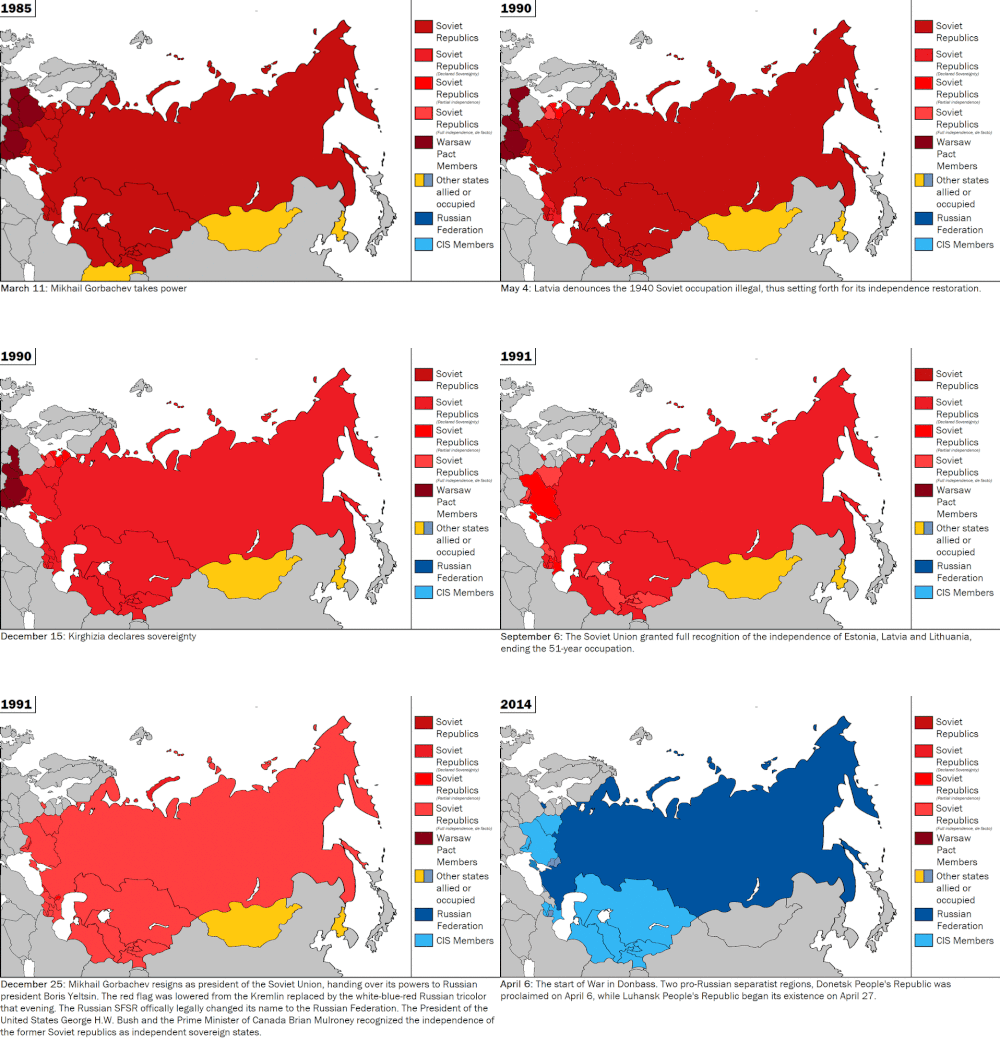
ソビエト社会主義共和国連邦(USSR)は、1991年12月26日にソビエト連邦最高会議の共和国ソビエト宣言第142-Н号によって、主権国家および国際法の対象として正式に解体されました。[1]これにより、ソビエト連邦の連邦政府と、政治的膠着状態と経済的後退を阻止するためのソビエトの政治および経済システムの改革に向けたミハイル・ゴルバチョフ書記長(兼大統領)の努力も終わりを迎えました。ソビエト連邦は内部停滞と民族分離主義を経験していました。最後の数年間まで高度に中央集権化されていましたが、国はさまざまな民族の故郷として機能する15のトップレベルの共和国で構成されていました。 1991年後半、いくつかの共和国がすでに連邦を離脱し、ゴルバチョフが中央集権的な権力の衰退を続ける中、破滅的な政治危機の中、その創設メンバーであるロシア、ベラルーシ、ウクライナの3共和国の指導者は、ソビエト連邦はもはや存在しないと宣言した。その後まもなく、さらに8つの共和国が宣言に加わった。ゴルバチョフは1991年12月25日に辞任し、ソビエト議会の残党は連邦の解体に投票した。
このプロセスは、国を構成するさまざまな国民共和国で不安が高まり、中央政府との間で絶え間ない政治的、立法的な対立に発展したことから始まりました。エストニアは、1988 年 11 月 16 日にソ連内で国家主権を宣言した最初のソ連共和国でした。リトアニアは、1990 年 3 月 11 日の法令によりソ連からの完全独立を宣言した最初の共和国であり、その後 2 か月以内に バルト海沿岸諸国と南コーカサスのジョージア共和国もこれに加わりました。
1991年8月のクーデター未遂の際、共産主義強硬派と軍エリートはゴルバチョフを打倒し、改革の失敗を阻止しようとした。しかし、この混乱によりモスクワ中央政府の影響力は低下し、最終的にはその後数日から数ヶ月の間に多くの共和国が独立を宣言する結果となった。バルト諸国の分離は1991年9月に承認された。12月8日、ロシアのボリス・エリツィン大統領、ウクライナのクラフチュク大統領、ベラルーシのシュシケヴィッチ議長によってベラルーシ協定が調印され、相互の独立を承認し、ソ連に代わる独立国家共同体(CIS)を創設した。 [2]カザフスタンは12月16日に独立を宣言し、最後にソ連を離脱した共和国となった。ジョージアとバルト諸国を除く旧ソ連諸国はすべて、12月21日にアルマアタ議定書に署名し、CISに加盟した。ロシアは、これまでで最大かつ最も人口の多い共和国として、事実上のソ連の後継国となった。12月25日、ゴルバチョフは辞任し、核発射コードの管理を含む大統領権限を、ロシア連邦初代大統領となったエリツィンに引き渡した。その夜、ソ連国旗がクレムリンから最後に降ろされ、ロシアの三色旗に置き換えられた。翌日、ソ連最高会議の上院である共和国会議は、正式に連邦を解体した。[1]解体の結果、15の構成共和国は完全な独立を獲得し、これは1989年の革命の主要な結末と冷戦の終結をも意味した。[3]
冷戦後も、旧ソ連諸国の多くはロシアと密接な関係を維持し、経済・軍事協力のため、CIS、集団安全保障条約機構(CSTO)、ユーラシア経済同盟(EAEU)、連合国家などの多国間組織を形成した。一方、バルト諸国とその他の旧ワルシャワ条約機構加盟国はすべて欧州連合(EU)に加盟し、 NATOにも加盟した。また、ウクライナ、ジョージア、モルドバなどその他の旧ソ連諸国も、ロシアの説得にもかかわらず、1990年代から同様の道をたどることに関心を示している。
背景

1985年: ゴルバチョフが選出
.jpg/500px-RIAN_archive_850809_General_Secretary_of_the_CPSU_CC_M._Gorbachev_(cropped).jpg)
ミハイル・ゴルバチョフは1985年3月11日、前任者のコンスタンチン・チェルネンコが73歳で死去したわずか4時間後に、政治局によって書記長に選出された。 [4] 54歳のゴルバチョフは、政治局の最年少メンバーだった。書記長としての彼の最初の目標は、停滞していたソ連経済を再生させることであり、そのためには根本的な政治および社会構造の改革が必要であることを認識していた。[5]改革は、政治的および経済的変化の妨げとなるブレジネフ時代の高官の人事変更から始まった。[6] 1985年4月23日、ゴルバチョフは2人の弟子、エゴール・リガチョフとニコライ・ルイシュコフを政治局の正式メンバーとして迎え入れた。彼はKGB長官ヴィクトル・チェブリコフを候補者から正式メンバーに昇格させ、国防相セルゲイ・ソコロフ元帥を政治局候補に任命することで、各省庁の「権力」を有利に保った。ゴルバチョフの改革によってもたらされた言論の自由は、ソ連国内の民族主義運動や民族紛争が表現され、支配的な政治運動に成長することを可能にした。 [7]また、それは間接的に1989年の革命につながり、ワルシャワ条約機構のソ連が押し付けた社会主義政権が平和的に打倒され(ルーマニアは例外)、[8]ソ連を構成する共和国にさらなる民主主義と自治権を導入するようゴルバチョフに圧力をかけることとなった。ゴルバチョフの指導の下、ソビエト連邦共産党(CPSU)は1989年に新しい中央立法機関である人民代議員会議に限定的な競争選挙を導入した[9](ただし、他の政党の禁止は1990年まで解除されなかった)。[10]
1985年7月1日、ゴルバチョフは主要なライバルであるグリゴリー・ロマノフを政治局から外し、ボリス・エリツィンを中央委員会事務局に迎え入れた。1985年12月23日、ゴルバチョフはヴィクトル・グリシンに代わりエリツィンをモスクワ共産党第一書記に任命した。
1986年: サハロフの復帰
ゴルバチョフはさらなる自由化を推し進めた。1986年12月23日、ソ連の最も著名な反体制派であるアンドレイ・サハロフは、ゴルバチョフから個人的な電話を受け、当局に反抗したために7年近く国内追放されていた生活が終わったと告げられ、すぐにモスクワに戻った。 [11]
1987年: 一党独裁制
1月28日から30日にかけて開催された中央委員会総会で、ゴルバチョフはソビエト社会全体に新しい民主化政策を提案した。彼は将来の共産党選挙では秘密投票で選出される複数の候補者の中から選択できるようにすることを提案した。しかし、総会に出席した党代表はゴルバチョフの提案を骨抜きにし、共産党内での民主的な選択は実質的には実施されなかった。
ゴルバチョフはまたグラスノスチの範囲を大幅に拡大し、メディアで公開討論できるテーマは何もないと明言した。2月7日には1950年代半ばのフルシチョフ雪解け以来初めて、数十人の政治犯が集団釈放された。 [12]
9月10日、ボリス・エリツィンはゴルバチョフに辞表を書いた。[13] 10月27日の中央委員会総会で、エリツィンはゴルバチョフが辞表に記した問題にまったく対処しなかったことに不満を抱き、改革の遅さと書記長への従順さを批判した。[14]ゴルバチョフは返答でエリツィンを「政治的に未熟」で「まったくの無責任」だと非難した。しかし、エリツィンの不服従と「秘密の演説」のニュースは広まり、すぐに地下出版版が出回り始めた。これがエリツィンが反逆者として再認識され、反体制派として人気が高まった始まりだった。その後4年間続いたエリツィンとゴルバチョフの政治闘争は、ソ連の崩壊に大きな役割を果たした。[15] 11月11日、エリツィンはモスクワ共産党第一書記の職を解かれた。
抗議活動
.jpg/500px-Metsamor_nuclear_power_plant,_cooling_towers_(Armenia,_June_2015).jpg)
解体に至るまでの数年間、ソビエト連邦全土でさまざまな抗議活動や抵抗運動が起こり、あるいは定着したが、それらはさまざまに抑圧されたり、容認されたりした。
CTAG(ラトビア語:Cilvēktiesību aizstāvības grupa、直訳すると 「人権擁護グループ」)ヘルシンキ86は、1986年7月にラトビアの港町リエパーヤで設立されました。ヘルシンキ86はソ連で最初の公然とした反共産主義組織であり、ソビエト政権に対する最初の公然とした反対組織であり、他の少数民族の独立運動の模範となりました。[16]
1986年12月26日、300人のラトビアの若者がリガの大聖堂広場に集まり、「ソ連は出て行け!ラトビアを解放せよ!」と叫びながら、レーニン通りを自由の記念碑に向かって行進した。治安部隊が行進者と対峙し、数台の警察車両が転覆した。[17]
1986年のジェルトクサン(「12月」)は、カザフスタンのアルマアタで起きた暴動であり、ゴルバチョフがカザフスタン共産党第一書記でカザフ民族のディンムハメド・クナエフを解任し、ロシアSFSR出身の部外者であるゲンナジー・コルビンを後任に据えたことに端を発している。[18]デモは1986年12月17日の朝に始まり、200人から300人の学生がブレジネフ広場の中央委員会ビルの前に集まった。翌日の12月18日、抗議行動は暴動に変わり、軍隊、義勇兵、民兵部隊、カザフスタン人学生の間で大規模な衝突が起こった。衝突は3日目になってようやく制御可能になった。
1987年5月6日、ロシアの民族主義団体パミャートがモスクワで無許可のデモを行った。当局はデモを解散させず、デモ参加者がボリス・エリツィンとの即席の会談に向かう間、交通を遮断した。[19]
1987年7月25日、300人のクリミア・タタール人がクレムリンの壁の近くで数時間にわたって騒々しいデモを行い、1944年に追放された祖国への帰還の権利を要求した。警察と兵士が見守っていた。[20]
1987年8月23日、1939年のモロトフ条約の秘密議定書の48周年記念日に、何千人ものデモ参加者がバルト三国の首都で独立歌を歌い、スターリンの犠牲者を追悼する演説に参加した。集会は公式報道機関から厳しく非難され、警察の監視も厳重だったが、妨害されることはなかった。[21]
1987年6月14日、約5,000人が再びリガの自由記念碑に集まり、 1941年にスターリンがラトビア人を大量追放した記念日を記念して花を捧げた。当局はデモ参加者を厳しく取り締まらなかったため、バルト諸国全体でデモがさらに大規模になった。1987年11月18日、数百人の警官と民兵が中央広場を封鎖し、自由記念碑でのデモを阻止しようとしたが、数千人がリガの通りに並んで沈黙の抗議を行った。[22]
1987年10月17日、約3,000人のアルメニア人がエレバンでデモを行い、セヴァン湖、ナイリット化学工場、メツァモル原子力発電所の状況、エレバンの大気汚染について不満を訴えた。警察はデモを阻止しようとしたが、デモが始まってからは阻止する措置を取らなかった。[23]翌日、1,000人のアルメニア人が、カラバフにおけるアルメニア人の民族的権利と、ナヒチェヴァンとナゴルノカラバフの両地域をアルメニアに統合する提案を求める別のデモに参加した。警察はデモを物理的に阻止しようとし、いくつかの事件の後、デモ参加者を解散させた。[23]
タイムライン
1988
モスクワは制御を失う
1988年、バルト諸国が独立に傾き、コーカサス地方が暴力と内戦に陥ったため、ゴルバチョフはソ連の2つの地域に対する支配力を失い始めた。
1988年7月1日、激戦となった第19回党大会の4日目にして最終日、ゴルバチョフは疲れ切った代表者たちの支持を得て、人民代議員会議と呼ばれる新たな最高立法機関を設立するという土壇場の提案を勝ち取った。旧勢力の抵抗に苛立ったゴルバチョフは、党と国家の分離を試み、党の反対派を孤立させるために一連の憲法改正に着手した。新しい人民代議員会議の詳細な提案は1988年10月2日に発表され、[24]新しい立法機関の設立を可能にした。最高会議は1988年11月29日から12月1日までの会期中に、1977年のソビエト憲法の改正を実施し、選挙制度改革に関する法律を制定し、選挙日を1989年3月26日に定めた。[25]
1988年11月29日、ソ連はすべての外国ラジオ局への妨害を中止し、ソ連国民が1960年代の短い期間以来初めて共産党の統制を超えたニュースソースに無制限にアクセスできるようになりました。[26]
バルト諸国
1986年と1987年、ラトビアはバルト諸国の中で改革を推し進めた先頭に立っていた。1988年、エストニアがソ連初の人民戦線を結成し、主導的な役割を引き継ぎ、国家政策に影響を与え始めた。
エストニア人民戦線は1988年4月に設立された。1988年6月16日、ゴルバチョフはエストニア共産党の「古参」指導者カール・ヴァイノを比較的リベラルなヴァイノ・ヴァリャスに交代させた。[27] 1988年6月下旬、ヴァリャスはエストニア人民戦線の圧力に屈し、エストニアの古い青・黒・白の国旗の掲揚を合法化し、エストニア語を共和国の公用語とする新しい国語法に同意した。[17]
10月2日、人民戦線は2日間の会議で正式に政治綱領を発表した。ヴェルヤスも出席し、人民戦線がエストニアを経済と政治の復興のモデルにし、分離主義やその他の過激な傾向を和らげることができると賭けた。[28] 1988年11月16日、エストニアSSRの最高会議は、エストニアの法律がソ連の法律に優先するという国家主権宣言を採択した。[29]エストニア議会はまた、エストニア国境の領域内にある土地、内水、森林、鉱床などの共和国の天然資源、および工業生産、農業、建設、国営銀行、輸送、自治体サービスの手段を主張した。[30]同時に、エストニア市民委員会はエストニア議会選挙を実施するためにエストニア共和国の市民の登録を開始した。
.jpg/500px-Mitingas_Vingio_parke_Vilniuje_1988_m._(2).jpg)
ラトビア人民戦線は1988年6月に設立された。10月4日、ゴルバチョフはラトビア共産党の「古参」指導者ボリス・プーゴを、よりリベラルなヤニス・ヴァグリスに交代させた。1988年10月、ヴァグリスはラトビア人民戦線の圧力に屈し、独立ラトビアの旧紅白旗の掲揚を合法化し、10月6日にはラトビア語を国の公用語とする法律を可決した。[17]
リトアニア人民戦線は、サユーディス(「運動」)と呼ばれ、1988年5月に設立されました。1988年10月19日、ゴルバチョフは、ほぼ1年間政権に就いていたリトアニア共産党の「古参」指導者、リンガウダス・ソンガイラを、比較的リベラルなアルギルダス・ミコラス・ブラザウスカスに交代させました。1988年10月、ブラザウスカスはサユーディス党員からの圧力に屈し、独立リトアニアの歴史的な黄緑赤の国旗を掲揚することを合法化し、1988年11月にはリトアニア語を国の公用語とする法律を可決しました。また、かつての国歌「Tautiška giesmė」も後に復活しました。[17] 10月28日に首都で暴力的な抗議行動が起こった後、CPL内でソンガリア派の残党の多くが、その日の警察の残虐行為に抗議して辞職または引退した。
コーカサスの反乱
1988年2月20日、ナゴルノ・カラバフ自治州(アゼルバイジャン・ソビエト社会主義共和国内のアルメニア人が多数を占める地域)の首都ステパナケルトで1週間にわたってデモが激化した後、地域ソビエトは分離独立してアルメニア・ソビエト社会主義共和国に加盟することを決議した。[31]ソビエト連邦の小さな辺境地域で行われたこの地方投票は世界中で大きく報道された。これは共和国および国家当局に対する前例のない反抗行為だった。1988年2月22日、後に「アスケラン衝突」として知られるようになる衝突で、数千人のアゼルバイジャン人がナゴルノ・カラバフに向かって行進し、ステパナケルトでアゼルバイジャン人が殺害されたという噂について情報提供を求めた。彼らはそのような事件は起きていないと知らされたが、それを信じようとはしなかった。伝えられた内容に満足しなかった数千人がナゴルノ・カラバフに向けて行進を開始し、50人を殺害(または負傷?)した。 [32] [33]カラバフ当局は行進を阻止するために1000人以上の警官を動員したが、その結果生じた衝突でアゼルバイジャン人2人が死亡した。国営ラジオで発表されたこれらの死は、スムガイト虐殺につながった。2月26日から3月1日の間に、スムガイト(アゼルバイジャン)市で激しい反アルメニア暴動が発生し、少なくとも32人が死亡した。[34]当局は完全に制御を失い、空挺部隊と戦車で市を占拠し、スムガイトのアルメニア人住民14,000人ほぼ全員が逃亡した。[35]
ゴルバチョフはナゴルノ・カラバフの地位を変更することを拒否し、同国はアゼルバイジャンの一部であり続けた。それに対してゴルバチョフは両共和国の共産党指導者を解任し、1988年5月21日にはアゼルバイジャン共産党第一書記の座からアブドゥルラフマン・ベジロフがカムラン・バギロフに代わった。1988年7月23日から9月にかけて、アゼルバイジャンの知識人グループがエストニア人民戦線を大まかにモデルにしたアゼルバイジャン人民戦線と呼ばれる新組織で活動し始めた。[36] 9月17日、ステパナケルト近郊でアルメニア人とアゼルバイジャン人の間で銃撃戦が勃発し、兵士2名が死亡、20名以上が負傷した。[37]これにより、ナゴルノカラバフの2つの主要都市で、ほぼ報復的な民族分極化が起こりました。アゼルバイジャン人の少数派はステパナケルトから追放され、アルメニア人の少数派はシュシャから追放されました。[ 38 ] 1988年11月17日、アルメニアからの数万人のアゼルバイジャン人の脱出に反応して、バクーのレーニン広場で一連の大規模デモが始まり、18日間続き、その地域の同胞を支持する50万人のデモ参加者が集まりました。1988年12月5日、ソ連の警察と民兵が介入し、力で広場を一掃し、10か月間続く夜間外出禁止令を課しました。[39]
ナゴルノ・カラバフにおけるアルメニア人の反乱は、アルメニア国内に即座に影響を及ぼした。2月18日にアルメニアの首都エレバンで始まった毎日のデモには、当初は少数の人が集まったが、日を追うごとにナゴルノ・カラバフ問題が顕著になり、参加者数も膨れ上がった。2月20日には3万人の群衆が劇場広場でデモを行い、2月22日までには10万人、翌日には30万人となり、交通ストライキが宣言された。2月25日までには、デモ参加者は100万人近くに達した。これはアルメニアの人口の4分の1以上であった。[40]これは、プラハ、ベルリン、そして最終的にはモスクワでの共産主義打倒の特徴となる大規模で平和的な大衆デモの最初のものであった。独立アルメニアの初代大統領となるレヴォン・テルペトロシアンを含むアルメニアの有力な知識人や民族主義者らが、新しい運動を指導し組織するために 11人からなるカラバフ委員会を結成した。
同日、ゴルバチョフはアゼルバイジャン共産党第一書記のバギロフをベジロフに交代させ、同時にアルメニア共産党第一書記のカレン・デミルチアンをスレン・ハルチュニャンに交代させた。しかし、ハルチュニャンはすぐに民族主義の風潮に逆らうことを決意し、5月28日、アルメニア人が1918年の第一共和国の宣言を記念して、ほぼ70年ぶりに赤・青・オレンジ色の第一アルメニア共和国の旗を掲げるのを許可した。 [41] 1988年6月15日、アルメニア最高会議は、ナゴルノ・カラバフを共和国の一部として統一する案を正式に承認する決議を採択した。[42]かつては最も忠誠心の高い共和国の一つであったアルメニアは、突如として反乱の主導的な共和国に変貌した。 1988年7月5日、エレバンのズヴァルトノツ国際空港からデモ参加者を強制的に排除するために部隊が派遣された際、発砲事件が発生し、学生デモ参加者1名が死亡した。[43] 9月、エレバンでさらに大規模なデモが発生し、装甲車が配備された。[44] 1988年秋、アルメニアに住む20万人のアゼルバイジャン人少数派のほぼ全員がアルメニアの民族主義者によって追放され、その過程で100人以上が殺害された。[45]その年の初めにアゼルバイジャン人がアルメニア系住民に対して実行し、アゼルバイジャンからアルメニア人を追放することになったスムガイトの虐殺の後では、多くのアルメニア人にとってこれはスムガイトの殺害に対する復讐行為と見なされた。 1988年11月25日、ソビエト政府が民族間のさらなる暴力行為を阻止するために行動を起こし、軍司令官がエレバンを制圧した。[46]
1988年12月7日、スピタク地震が発生し、推定2万5000人から5万人が死亡した。ゴルバチョフは米国訪問から急いで帰国した際、自然災害の最中にナゴルノ・カラバフをアルメニア共和国の一部にすることを要求する抗議者と対峙したことに激怒し、1988年12月11日にカラバフ委員会全員の逮捕を命じた。[47]
ソビエト連邦の首都トビリシでは、1988年11月に多くのデモ参加者が共和国議会の前に陣取り、ジョージアの独立とエストニアの主権宣言の支持を訴えた。[48]
西側諸国
1988 年 2 月から、モルドバ(旧モルダビア) 民主運動は、集会、デモ、歌の祭典を組織し、その規模と熱気は次第に大きくなっていった。街頭では、キシナウのイシュトヴァーン大王記念碑と、隣接するアレエア クラシチロール(「古典 [文学] の路地」)がある公園が集会の中心となった。1988 年 1 月 15 日、アレエア クラシチロールの胸像でミハイ エミネスクに敬意を表して、アナトール シャラルは集会の継続を提案した。公の場で運動は、国民の覚醒、言論の自由、モルドバの伝統の復活、ルーマニア語の公用語化とラテン アルファベットへの復帰を求めた。運動が大衆の間で勢いを増し、ソ連当局がもはやそれを取り締まる勇気がなくなったとき、「運動」(非公式の団体)から「戦線」(公式の団体)への移行は自然な「アップグレード」と見なされた。
1988年4月26日、ウクライナ文化クラブがキエフのフレシチャーティク通りでチェルノブイリ原発事故2周年を記念して開催したデモには約500人が参加し、「最後まで開放と民主主義を」などのスローガンが書かれたプラカードを掲げた。1988年5月から6月にかけて、ウクライナ西部のウクライナ・カトリック教徒は、ブニフ、カルシュ、ホシ、ザルヴァニツァの森で礼拝を行い、キエフ大公国におけるキリスト教千年紀を秘密裏に祝った。1988年6月5日、千年紀の公式祝賀行事がモスクワで開催された際、ウクライナ文化クラブはキエフにあるキエフ大公国大公聖ヴォロディミル大公の記念碑で独自の式典を主催した。
1988 年 6 月 16 日、6,000 人から 8,000 人の人々がリヴィウに集まり、6 月 29 日に始まる第 19 回共産党大会の地方代表者名簿に対する不信任を表明する演説を聞いた。6 月 21 日、リヴィウでの集会には、改訂された代表者名簿について聞いた 50,000 人が集まった。当局は、ドルージバ スタジアム前で集会を解散させようとした。7 月 7 日、10,000 人から 20,000 人の人々がペレストロイカ促進民主戦線の立ち上げに立ち会った。7 月 17 日、10,000 人の集団がザルヴァニツィア村に集まり、ウクライナのギリシャ系カトリック教会の司教パブロ ヴァシリクが祝う千年祭に出席した。民兵は参加者を解散させようとしたが、結局それは1946年にスターリンが教会を非合法化して以来、ウクライナのカトリック教徒の最大の集会となった。「血の木曜日」として知られるようになった8月4日、地元当局はペレストロイカ促進民主戦線が組織したデモを暴力的に鎮圧した。41人が拘留され、罰金を科せられ、または15日間の行政拘留を宣告された。9月1日、地元当局はイヴァン・フランコ国立大学で公式許可なく開かれた公開集会に出席していた学生5,000人を暴力的に避難させた。
1988年11月13日、文化遺産団体スパズチナ、キエフ大学の学生クラブフロマダ、環境保護団体ゼレニイ・スヴィト(「緑の世界」)とヌースフェラが主催し、約1万人が環境問題に焦点を当てた公式会合に出席した。11月14日から18日にかけて、ソ連当局者や米国欧州安全保障協力委員会(ヘルシンキ委員会としても知られる)の訪問団と人権問題について議論するために招待された100人の人権、国家、宗教の権利擁護者の中には、15人のウクライナ活動家が含まれていた。12月10日、民主連合が主催した集会で、国際人権デーを祝うため、数百人がキエフに集まった。無許可の集会の結果、地元の活動家が拘留された。[49]
ベラルーシ人民戦線は、バルト諸国の人民戦線と同様に、民主主義と独立を求める政党および文化運動として1988年に設立された。ベラルーシ人民戦線の初代指導者で歴史家ジアノン・パズニャクがミンスク郊外のクラパティで集団墓地を発見したことは、ベラルーシの民主化・独立運動にさらなる弾みをつけた。[50]人民戦線は、クラパティでNKVDが秘密裏に殺害を行ったと主張した。 [51]当初、人民戦線は多くの公的な行動がほぼ常に警察やKGBとの衝突で終わったため、大きな注目を集めていた。
1989
モスクワ:限定的な民主化
1989年春、ソ連の人々は、1917年以来初めて[異論あり–議論あり] 、限定的ではあるものの民主的な選択を行い、新しい人民代議員会議を選出した。同様に重要なのは、議会の審議が検閲なしでテレビで生中継され、人々はそれまで恐れられていた共産党指導部が尋問され、責任を問われるのを目撃したことだ。この例がきっかけでポーランドで民主主義の限定的な実験が行われ、その夏にはすぐにワルシャワの共産党政権が打倒され、今度は1989年末、ベルリンの壁が崩壊する前に他の5つのワルシャワ条約機構加盟国で政府を打倒する暴動を引き起こした。
この年は、CNNがソ連以外の放送局として初めてモスクワにニュース番組を放送することを許可された年でもあった。公式にはCNNはサヴォイホテルの外国人宿泊客のみが視聴可能だったが、モスクワ市民はすぐに自宅のテレビで受信する方法を学んだ。これはソ連の人々が国内の出来事を見る方法に大きな影響を与え、検閲をほぼ不可能にした。[52]

ソ連人民代議員会議の候補者指名期間は 1 ヶ月間続き、1989 年 1 月 24 日まで続いた。次の 1 ヶ月間、7,531 人の地区候補者の中から選挙区レベルの選挙管理委員会が主催する会議で選出が行われた。3 月 7 日、5,074 人の候補者の最終リストが発表され、そのうち約 85% が党員であった。
1,500の地区選挙の2週間前に、880人の候補者が立候補した公的機関の750議席を埋めるための選挙が行われた。これらの議席のうち、100議席はソ連共産党に、100議席は全ソ中央労働組合評議会に、75議席は共産主義青年同盟(コムソモール)に、75議席はソビエト女性委員会に、75議席は戦争労働退役軍人組織に、325議席は科学アカデミーなどの他の組織に割り当てられた。選出プロセスは4月に行われた。
3月26日の総選挙では、投票率は89.8%と驚異的で、ソ連共産党の2,250議席のうち1,958議席(1,225議席を含む)が埋まった。地区選挙では、4月2日と9日に76選挙区で決選投票が行われ、残りの199選挙区では4月14日と20日から5月23日にかけて再選挙が実施された[53] 。 [25]ソ連共産党が推薦した候補者の大半が当選したが、エリツィン、物理学者アンドレイ・サハロフ、弁護士アナトリー・ソプチャクなどの無所属候補に300人以上が敗れた。
新しい人民代議員会議の第一回会期(5月25日から6月9日まで)では、強硬派が主導権を握ったが、改革派は議会を討論と批判の場として利用し、その様子は生中継され検閲も受けなかった。ソ連ではかつてこれほど自由な討論は見られなかったため、国民は釘付けになった。5月29日、エリツィンは最高会議での議席を確保し、[54]夏にはロシアの民族主義者とリベラル派からなる初の野党、地域間代議員グループを結成した。ソ連最後の立法グループを構成した1989年の選出議員らは、その後2年間の改革とソ連の崩壊に極めて重要な役割を果たした。
1989年5月30日、ゴルバチョフは、1989年11月に予定されていた全国の地方選挙を、選挙の実施を規定する法律がまだなかったため、1990年初頭まで延期することを提案した。これは、反体制感情の波で政権を失うことを恐れていた地方党幹部への譲歩と受け止められた。[55]
1989年10月25日、最高会議は連邦レベルおよび共和国レベルの選挙における共産党およびその他の公的組織のための特別議席を廃止することを決議した。これは、そのような特別議席は非民主的であるという国民の厳しい批判に応えたものである。活発な議論の後、542名の議員からなる最高会議は、賛成254、反対85(棄権36)でこの措置を可決した。この決定には憲法改正が必要であり、12月12日から25日に開催された全会議で批准された。また、15の構成共和国のそれぞれで大統領を直接選挙で選ぶことを可能にする措置も可決した。ゴルバチョフは議論中にこの動きに強く反対したが、否決された。
この投票により、共和国の地方選挙における権限が拡大し、共和国が自ら投票方法を決定できるようになった。ラトビア、リトアニア、エストニアはすでに大統領直接選挙の法案を提案していた。すべての共和国の地方選挙は、1990年12月から3月の間に実施される予定だった。[56]
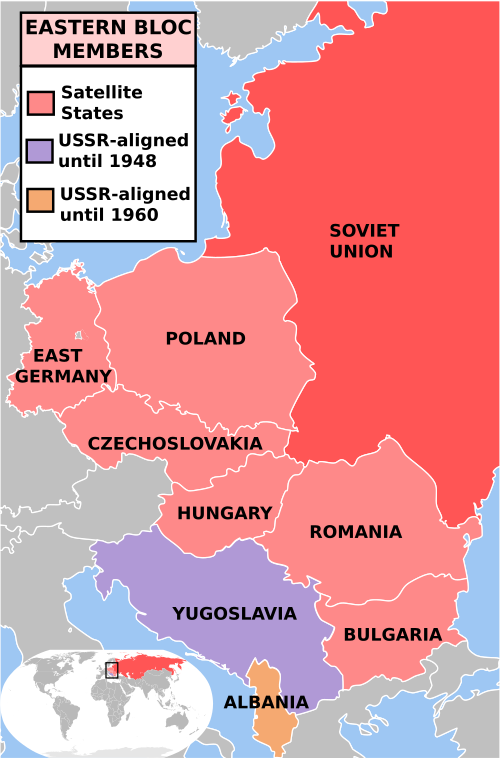
東ヨーロッパのワルシャワ条約機構加盟国6か国は、名目上は独立していたものの、ソ連の衛星国(モンゴルと共に)として広く認識されていた。これらの国はすべて1945年にソ連赤軍に占領され、ソ連式の社会主義国家が押し付けられ、国内問題でも国際問題でも行動の自由が非常に制限されていた。真の独立に向けた動きは、1956年のハンガリー革命と1968年のプラハの春で軍事力によって抑圧された。ゴルバチョフは、ワルシャワ条約機構加盟国への介入を義務付けた抑圧的で費用のかかるブレジネフ・ドクトリンを放棄し、同盟国の内政への不干渉を主張した。これはフランク・シナトラの歌「マイ・ウェイ」にちなんで冗談めかしてシナトラ・ドクトリンと呼ばれた。ポーランドは、政府と労働組合連帯との間で2月から4月にかけて行われたポーランド円卓会議協定の協議後に合意された4月のノベライゼーションの施行後、民主化した最初の共和国となった。 1980年8月協定で設立されたポーランド連帯同盟は、レフ・ワレサを候補者として擁立し、同氏はポーランド初の民主的に選出された大統領となった。ポーランドの選挙は、他の東欧ソビエト諸国に平和的な民主化移行を追求するきっかけを与え、間もなく協定は解消し始めた。共産党指導部を打倒した最後の国、ルーマニアは、暴力的なルーマニア革命の後にようやくそれを実現した。
バルト自由の鎖
バルトの道、あるいはバルトの鎖(自由の鎖とも、エストニア語: Balti kett、ラトビア語: Baltijas ceļš、リトアニア語: Baltijos kelias、ロシア語: Балтийский путь)は、1989年8月23日に行われた平和的な政治デモである。[57]推定200万人が手をつなぎ、1944年にソ連に強制的に再編入されたエストニア、ラトビア、リトアニアにまたがる600キロメートル (370 mi) に及ぶ人間の鎖を形成した。この大規模デモは、東ヨーロッパを勢力圏に分割し、 1940年のバルト諸国の占領につながったモロトフ=リッベントロップ協定締結50周年を記念したものであった。
バルトの道抗議運動からわずか数か月後の1989年12月、人民代議員会議は、バルト三国併合につながったモロトフ・リベントロップ協定の秘密議定書を非難するヤコブレフ委員会の報告書を受理し、ゴルバチョフは署名した。[58]
1989年3月の人民代議院選挙では、リトアニアの42人の代議士のうち36人が独立民族運動団体「サユーディス」の候補者だった。これはソ連内のどの民族組織にとっても最大の勝利であり、リトアニア共産党にとってはその人気のなさが明らかになる痛烈な出来事だった。[59]
1989年12月7日、アルギルダス・ブラザウスカスの指導の下、リトアニア共産党はソ連共産党から分離し、政治における憲法上の「指導的役割」を持つという主張を放棄した。共産党のより小規模な忠誠派が強硬派のミコラス・ブロケヴィチュス率いる形で結成され、党とのつながりを維持した。しかし、リトアニアの与党共産党は正式にモスクワの統制から独立しており、これはソ連諸国では初めてのことであり、政治的激変を引き起こしたゴルバチョフは翌月リトアニアを訪問し、地元党を再び統制下に置くという無駄な試みを行った。[60]翌年、共産党は複数政党による議会選挙で完全に権力を失い、その結果、ヴィタウタス・ランズベルギスがソ連への強制編入以来リトアニア初の非共産党指導者(リトアニア最高評議会議長)となった。
コーカサス
1989年7月16日、アゼルバイジャン人民戦線は最初の大会を開催し、後に大統領となるアブルファズ・エルチベイを議長に選出した。 [61] 8月19日、60万人のデモ参加者がバクーのレーニン広場(現在のアザドリク広場)に集結し、政治犯の釈放を要求した。[62] 1989年後半、ナゴルノ・カラバフで武器が配布された。カラバフ人が狩猟用ライフルやクロスボウの代わりに小火器を手に入れると、死傷者が増え始め、橋が爆破され、道路が封鎖され、人質がとられた。[63]
人民戦線は新たな効果的な戦術としてアルメニアの鉄道封鎖を開始したが[64] 、アルメニアの貨物の85%がアゼルバイジャンから来ていたため、ガソリンと食料の不足を引き起こした。[65]人民戦線の圧力により、アゼルバイジャンの共産党当局は譲歩し始めた。9月25日、当局はアゼルバイジャンの法律を優先する主権法を可決し、10月4日、人民戦線は封鎖を解除する限り合法的な組織として登録することを許可された。アゼルバイジャンとアルメニア間の輸送通信は完全には回復しなかった。[65]緊張は高まり続け、12月29日、人民戦線の活動家がジャリラバードの地方党事務所を占拠し、数十人が負傷した。
1989年5月31日、モスクワのマトロスカヤ・ティシナ刑務所に裁判もなしに投獄されていたカラバフ委員会の11名のメンバーが釈放され、英雄として迎えられて帰国した。[66]釈放後まもなく、学者のレヴォン・テルペトロシアンが反共産主義野党の汎アルメニア民族運動の議長に選出され、後に1989年に初めて完全独立を目標として考え始めたと述べた。[67]
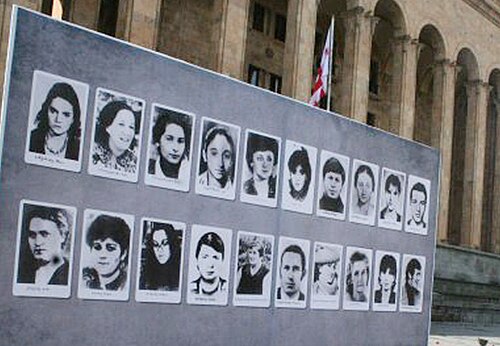
1989年4月7日、ソ連からのジョージアの離脱とアブハジアのジョージアへの完全統合を求める横断幕を掲げて共産党本部前で10万人以上の人々が抗議した後、ソ連軍と装甲兵員輸送車がトビリシに派遣された。 [68] 1989年4月9日、軍はデモ参加者を攻撃し、約20人が死亡、200人以上が負傷した。[69] [70]この事件はジョージアの政治を過激化し、ソ連支配の継続よりも独立のほうが望ましいと多くの人が結論づけるきっかけとなった。軍と警察のメンバーによる虐待を受けて、モスクワは迅速に行動した。4月14日、ゴルバチョフは殺害の結果、ジュンベル・パティアシヴィリをジョージア共産党第一書記から解任し、元ジョージアKGB長官のギヴィ・グンバリゼを後任に就かせた。
1989年7月16日、アブハジアの首都スフミで、ジョージア大学の支部開設に反対する抗議活動が暴力に発展し、ソ連軍が秩序を回復するまでに18人が死亡、数百人が負傷する大規模な民族間対立に急速に発展した。[71]この暴動はジョージア・アブハジア紛争の始まりとなった。
1989 年 11 月 17 日、ジョージア最高会議は 2 日間にわたる秋の総会を開催しました。この総会で採択された決議の 1 つは、68 年前に赤軍、ソ連共産党、全ロシア人民委員会議によってジョージアの意に反して強制された「違法な」ソ連への加盟に反対する宣言でした。
西側諸国
1989年3月26日、人民代議員会議選挙が行われ、モスクワの議席に選出された46人のモルドバ代議員のうち15人が民族主義/民主主義運動の支持者であった。[72]モルドバ人民戦線の設立大会は2か月後の5月20日に開催された。第2回大会(1989年6月30日~7月1日)で、イオン・ハダルカが党首に選出された。
大国民議会(ルーマニア語:Marea Adunare Națională )として知られる一連のデモは、戦線の最初の大きな成果でした。8月27日に30万人が参加したデモを含むこのような大規模なデモにより[73] 、8月31日にモルドバ最高会議はルーマニア語を公用語とし、キリル文字をラテン文字に置き換える言語法案を採択しました。[74]
ウクライナでは、1989年1月22日にリヴィウとキエフでウクライナ独立記念日が祝われた。リヴィウでは数千人が集まり、聖ジョージ大聖堂の前で非公式のモレベン(宗教儀式)が行われた。キエフでは、60人の活動家がキエフのアパートに集まり、 1918年のウクライナ人民共和国の宣言を記念した。1989年2月11日~12日には、ウクライナ語協会が設立会議を開催した。1989年2月15日には、ウクライナ正教会の独立改革イニシアチブ委員会の結成が発表された。この運動の綱領と規約はウクライナ作家連合によって提案され、1989年2月16日に雑誌『リテラトゥルナ・ウクライナ』に掲載された。この組織は、ヴャチェスラフ・チョルノヴィルのようなウクライナの反体制派を歓迎した。
2月下旬、3月26日のソ連人民代議員会議選挙の前夜、キエフで選挙法に抗議し、「停滞の巨人」と揶揄されたウクライナ共産党第一書記、ウォロディミル・シェルビツキーの辞任を求める大規模な集会が開かれた。このデモは、ソ連のミハイル・ゴルバチョフ書記長のウクライナ訪問と同時期に行われた。1989年2月26日、2万人から3万人が、19世紀のウクライナの芸術家で民族主義者の タラス・シェフチェンコの命日を記念して、リヴィウで非公式のエキュメニカルな追悼式に出席した。
1989年3月4日、スターリン主義の犠牲者を称え、社会からソビエト的慣行を一掃することを目的とした記念協会がキエフで設立された。翌日には公開集会が開催された。3月12日、ウクライナ・ヘルシンキ連合とマリア協会 ミロセルディア(慈悲)がリヴィウで組織した選挙前の集会が暴力的に解散され、300人近くが拘留された。3月26日、ソビエト連邦人民代議員会議の選挙が行われ、補欠選挙が4月9日、5月14日、5月21日に行われた。会議のウクライナ代表225人のうち、ほとんどは保守派だったが、少数の進歩派も選出された。
1989年4月20日から23日まで、リヴィウで4日間連続で選挙前の集会が開催され、2万5000人もの群衆が集まった。この行動には、地元の工場や施設8か所での1時間の警告ストライキも含まれていた。これは1944年以来、リヴィウで初めての労働ストライキだった。5月3日、リヴィウで選挙前の集会が3万人を集めた。5月7日、追悼協会は、スターリンのテロによるウクライナ人とポーランド人の犠牲者の集団墓地があるビキヴニアで大集会を組織した。キエフから墓地まで行進した後、追悼式が行われた。
1989 年 5 月中旬から 9 月にかけて、ウクライナのギリシャ系カトリック教徒のハンガーストライキ参加者は、モスクワのアルバート通りで抗議活動を行い、教会の窮状に注目を集めました。彼らは、モスクワで開催された世界教会協議会の 7 月の会議中に特に活発に活動しました。抗議活動は、9 月 18 日にグループが逮捕されたことで終了しました。1989 年 5 月 27 日には、リヴィウ地域記念協会の設立会議が開催されました。1989 年 6 月 18 日には、ミロスラフ・ルバチフスキー枢機卿の国際祈祷日の呼びかけ に応えて、ウクライナ西部のイヴァーノ=フランキーウシクで推定 10 万人の信者が公の宗教儀式に参加しました。
1989年8月19日、ロシア正教会の聖ペトロとパウロ教区は、ウクライナ独立正教会に移行すると発表した。1989年9月2日、ウクライナ全土で数万人が、共産党と他の公式組織のために議席を特別に確保する選挙法案に抗議した。特別議席は、リヴィウで5万人、キエフで4万人、ジトーミルで1万人、ドニプロジェルジンスクとチェルヴォノフラードで各5千人、ハリコフで2千人だった。1989年9月8日から10日、作家のイワン・ドラフがキエフでの設立大会でウクライナ人民運動(ルーフ)の代表に選出された。 9月17日、15万人から20万人の人々がウクライナ・ギリシャ・カトリック教会の合法化を要求してリヴィウでデモ行進を行った。1989年9月21日、イヴァーノ=フランキーウシク南部の自然保護区、デミャニウ・ラーズで集団墓地の発掘が始まった。9月28日、ブレジネフ時代からの残留者であるウクライナ共産党 第一書記のウォロディミル・シチェルビツキーに代わり、ウラジーミル・イヴァシコが同職に就いた。
1989年10月1日、ソ連によるウクライナ領土の「再統一」を祝うコンサートが開催されていたリヴィウのドルジバスタジアム前で、1万人から1万5千人の平和的なデモが警官により暴力的に解散させられた。10月10日、イヴァーノ=フランキーウシクでは3万人が参加した選挙前抗議デモが行われた。10月15日には、チェルヴォノフラード、チェルニウツィー、リヴネ、ジトーミルに数千人が集まり、ドニプロペトロフスクには500人、リヴィウには3万人が集まり、選挙法に抗議した。10月20日、ウクライナ正教会の信者と聖職者がリヴィウで開かれたシノドスに参加したが、これは1930年代の強制解散以来初めてのことであった。
10月24日、最高会議は共産党およびその他の公的組織の代表者のための議会における特別議席を廃止する法律を可決した。10月26日、リヴィウの20の工場が10月1日の警察の残虐行為と責任者を訴追しない当局の姿勢に抗議してストライキと集会を開いた。10月26日から28日にかけて、ゼレニイ・スヴィト(ウクライナの地球の友)環境協会が設立大会を開催し、10月27日、ウクライナ議会は党およびその他の公的組織の議会議員としての特別地位を廃止する法律を可決した。
1989年10月28日、ウクライナ議会は、1990年1月1日よりウクライナ語をウクライナの公用語とし、民族間のコミュニケーションにはロシア語を使用することを布告した。同日、リヴィウの変容教会の会衆はロシア正教会を離脱し、ウクライナ・ギリシャ・カトリック教会を名乗った。翌日、数千人がデミャニウ・ラーズで追悼式に出席し、「1939年から1941年の弾圧の犠牲者」の記念碑が間もなく建てられることを示す仮の標識が設置された。
11月中旬、シェフチェンコ・ウクライナ語協会が正式に登録されました。1989年11月19日、キエフでの集会には、ウラル山脈のペルミにある悪名高い第36強制収容所の3人の囚人、人権活動家、ワシル・ストゥス、オレクシー・ティヒ、ユーリー・リトヴィンのウクライナでの再埋葬に何千人もの会葬者、友人、家族が集まりました。彼らの遺体はバイコヴェ墓地に改葬されました。1989年11月26日、ミロスラフ・ルバチフスキー枢機卿によって祈りと断食の日が宣言され、教皇ヨハネ・パウロ2世とソ連共産党中央委員会のゴルバチョフ書記長との会談の前夜には、ウクライナ西部の何千人もの信者が宗教的な儀式に参加しました。 1989年11月28日、ウクライナソビエト社会主義共和国の宗教評議会は、ウクライナのカトリック教会が合法的な組織として登録することを許可する法令を発布した。この法令は、ローマ法王とソビエト書記長とのバチカンでの会談と同時期に12月1日に公布された。
1989年12月10日、リヴィウで初めて公式に認可された国際人権デーの記念行事が開催された。12月17日、12月14日に亡くなったノーベル賞受賞者アンドレイ・サハロフを偲んでルフがキエフで開催した公開集会には推定3万人が参加した。 12月26日、ウクライナソビエト社会主義共和国の最高会議は、クリスマス、イースター、三位一体の祝日を公式の祝日とする法律を採択した。[49]
1989年5月、ソ連の反体制派ムスタファ・ジェミレフが、新たに設立されたクリミア・タタール民族運動の指導者に選出された。彼はまた、45年間の亡命生活を経てクリミア・タタール人が故郷のクリミアに帰還するための運動を主導した。

1989年1月24日、ベラルーシのソ連当局は、 1930年代にミンスク近郊のクロパティの森でスターリン時代の警察によって射殺された数千人の人々を追悼する記念碑を建てるという民主反対派(ベラルーシ人民戦線)の要求に同意した。 [75]
1989年9月30日、数千人のベラルーシ人が地元の指導者を非難し、1986年にウクライナで発生したチェルノブイリ原発事故のさらなる除染を求めてミンスクを行進した。放射能のシンボルが入った腕章を着け、亡命政府が使用を禁止している赤と白の国旗を掲げた1万5000人の抗議者が、地元当局の禁止令に反抗し、豪雨の中を行進した。その後、彼らは政府本部近くの市内中心部に集まり、演説者は共和国共産党指導者のエフレム・ソコロフの辞任を要求し、汚染地域から50万人の住民を避難させるよう求めた。[76]
クズバスとドンバスの鉱山労働者のストライキ
クズバスの鉱山労働者のストライキは1989年に始まり、ドンバスの鉱山労働者によって積極的に支援された。
中央アジア諸国
1989年6月4日から11日までの数日間にわたる暴動で地元のウズベク人がメスヘティア少数民族を追い詰め、フェルガナ虐殺と呼ばれる衝突を起こした後、秩序を回復するために、数千人のソ連軍がウズベキスタンの首都タシケントの南東にあるフェルガナ渓谷に派遣され、約100人が死亡した。[77]その結果、メスヘティア人コミュニティの大半はウズベキスタンから逃亡した。この事件に対するウズベク人の怒りはすぐに首都に伝わり、モスクワはすぐに迅速に行動した。 1989年6月23日、ゴルバチョフは、同地域での人種暴動を阻止できなかったとして、ラフィク・ニショノフをウズベク・ソビエト社会主義共和国共産党第一書記から解任し、代わりにイスラム・カリモフを任命した。カリモフは、ソビエト共和国として、そしてその後は独立国家として、2017年に死去するまでウズベキスタンを率いた。
カザフスタンでは1989年6月19日、銃、焼夷弾、鉄棒、石を持った若者たちがジャンアオゼンで暴動を起こし、多数の死者を出した。若者たちは警察署と給水所を占拠しようとした。彼らは公共交通機関を停止させ、様々な商店や産業を閉鎖させた。[78] 6月25日までに、暴動はカスピ海付近の他の5つの町に広がった。棒、石、金属棒で武装した約150人の暴徒がジャンアオゼンから約140キロ(90マイル)離れたマンギシュラクの警察署を襲撃したが、ヘリコプターで駆けつけた政府軍によって解散させられた。若者の暴徒はまた、イェラリエフ、シェプケ、フォルトシェフチェンコ、クルサリでも暴れ回り、臨時労働者を乗せた列車に可燃性液体をかけ、火をつけた。[79]
政府とソ連共産党は暴動に衝撃を受け、1989年6月22日、暴動の結果、ゴルバチョフは6月の事件への対応が悪かったとして、ゲンナジー・コルビン(1986年12月に任命が暴動を引き起こしたロシア人)をカザフスタン共産党第一書記から解任し、代わりにカザフ人であるヌルスルタン・ナザルバエフを任命した。ナザルバエフはその後、ソビエト共和国としてカザフスタンを率い、その後独立を果たした。ナザルバエフは2019年3月19日に大統領を退任するまで、27年間カザフスタンを率いた。
1990
モスクワは5つの共和国を失う
1990年2月7日、ソ連共産党中央委員会は、党が政治権力の独占を放棄するというゴルバチョフの勧告を受け入れた。 [80] 1990年、ソ連を構成する15の共和国すべてで最初の競争的な選挙が行われ、改革派と民族主義者が多くの議席を獲得した。ソ連共産党は5つの共和国で選挙に敗れた。
- リトアニアでは、2月24日にサユディスに投票(決選投票は3月4、7、8、10日)
- モルドバでは、 2月25日にモルドバ人民戦線に
- エストニアでは、 3月18日にエストニア人民戦線に
- ラトビアでは、3月18日にラトビア人民戦線に選出(決選投票は3月25日、4月1日、4月29日)
- ジョージアでは、 10月28日にラウンドテーブルフリージョージアに投票(11月11日に決選投票)
構成共和国は、新生国家の主権を宣言し始め、モスクワ中央政府との「法の戦争」を開始した。彼らは、地方の法律に反する連邦全体の法律を拒否し、地方経済に対する支配権を主張し、ソビエト政府への税金の支払いを拒否した。リトアニア最高評議会議長のランズベルギスも、リトアニア人男性をソビエト軍の義務的兵役から免除した。この紛争は、供給ラインが混乱して経済混乱を引き起こし、ソビエト経済をさらに衰退させた。[81]
ソ連とロシア・ソビエト連邦間の競争
1990年3月4日、ロシア・ソビエト連邦社会主義共和国は比較的自由なロシア人民代議員会議選挙を実施した。スベルドロフスク代表のボリス・エリツィンが72%の票を獲得して当選した。[82] 1990年5月29日、ゴルバチョフがロシアの代議員に彼に投票しないよう求めたにもかかわらず、エリツィンはRSFSR 最高会議議長に選出された。
エリツィンは、発展する政治情勢の中で権力を握ろうとする最高会議の民主派と保守派のメンバーから支持された。ロシア・ソビエト社会主義共和国とソ連の間に新たな権力闘争が勃発した。1990年6月12日、ロシア・ソビエト社会主義共和国人民代議員会議は主権宣言を採択した。1990年7月12日、エリツィンは第28回大会での劇的な演説で共産党を脱退した。[83]

バルト諸国
1990年1月11日から13日にかけてゴルバチョフがリトアニアの首都ビリニュスを訪問した際、推定25万人が参加した独立支持集会が開かれた。
3月11日、リトアニアソビエト社会主義共和国の新しく選出された議会は、サユーディスの指導者であるヴィタウタス・ランズベルギスを議長に選出し、リトアニア国家再建法を公布した。これにより、リトアニアはソ連からの独立を宣言した最初のソビエト共和国となった。モスクワは、表面上は「ロシア系住民の権利を守るため」に、経済封鎖を行い、リトアニアに軍隊を駐留させ続けた。[84]

1990年3月25日、エストニア共産党は6か月の移行期間を経てソ連共産党から分離することを決議した。[85]
1990年3月30日、エストニア最高評議会は第二次世界大戦以来のソ連によるエストニア占領は違法であると宣言し、共和国内での国家独立の正式な回復に向けた国家移行期間を開始した。
1990年4月3日、エストニア人民戦線のエドガー・サヴィサールが閣僚評議会議長(首相に相当)に選出され、すぐに独立支持派が多数を占める内閣が結成された。

ラトビアは1990年5月4日に独立回復を宣言し、完全な独立までの移行期間を宣言した。宣言では、ラトビアは第二次世界大戦で事実上独立を失ったが、併合は違憲でラトビア国民の意思に反するものであったため、法律上は主権国家であり続けると述べられた。また、ラトビアは1920年のラトビア・ソビエト平和条約に基づいてソビエト連邦との関係を築くと述べられており、この条約でソビエト連邦はラトビアの独立を「将来にわたって」不可侵であると認めた。現在、5月4日はラトビアの国民の祝日となっている。
1990年5月7日、ラトビア人民戦線のイヴァルス・ゴドマニスが閣僚評議会議長(ラトビアの首相に相当)に選出され、復興したラトビア共和国の初代首相となった。
1990年5月8日、エストニアSSRの最高会議は、独立したエストニア共和国の1938年憲法の復活を公式に宣言する法律を採択した。[86]
コーカサス
1990年1月第1週、アゼルバイジャンの飛び地ナヒチェヴァンでは、人民戦線が群衆を率いてイランとの国境沿いの国境柵や監視塔を襲撃・破壊し、数千人のソ連系アゼルバイジャン人が国境を越えてイラン領アゼルバイジャンにいる同胞と会った。[87]

1988年の春から夏にかけて、アルメニア人とアゼルバイジャン人の間で民族間の緊張が高まった。[88] 1990年1月9日、アルメニア議会が予算にナゴルノ・カラバフを含めることを可決した後、新たな戦闘が勃発し、人質が取られ、ソ連兵4人が死亡した。[89] 1月11日、人民戦線の過激派が党の建物を襲撃し、南部の町レンコランで共産主義勢力を事実上打倒した。[89]ゴルバチョフはアゼルバイジャンの支配権を取り戻すことを決意し、その後に起こった出来事は「黒い1月」として知られている。1990年1月19日遅く、中央テレビ局を爆破し、電話とラジオの回線を切断した後、26,000人のソ連軍がアゼルバイジャンの首都バクーに侵入し、バリケードを破壊し、抗議者を攻撃し、群衆に発砲した。その夜とその後の衝突(2月まで続いた)で、130人以上が死亡した。そのほとんどは民間人だった。700人以上の民間人が負傷し、数百人が拘留されたが、実際に刑事犯罪の容疑で裁かれたのはほんの数人だった。
市民の自由は侵害された。ソ連のドミトリー・ヤゾフ国防相は、バクーでの武力行使は、非共産主義反対派によるアゼルバイジャン政府の事実上の乗っ取りを阻止し、来たる自由選挙(1990年3月に予定)での彼らの勝利を阻止し、彼らを政治勢力として破壊し、共産党政権の権力維持を確実にすることが目的であると述べた。
軍はバクーを制圧したが、1月20日までにアゼルバイジャンを実質的に失った。殉教者の路地に埋葬された「殉教者」の集団葬儀には、バクーのほぼ全住民が集まった。[90]共産党員数千人が党員票を公然と燃やした。第一書記のヴェジロフはモスクワに逃亡し、党幹部の自由投票でアヤズ・ムタリボフが後任に任命された。ロシア系民族のヴィクトル・ポリアニチコは第二書記のままだった。[91]バクーでのソ連の行動に反応して、ナヒチェヴァン自治ソビエト社会主義共和国最高会議幹部会議長のサキナ・アリエワは特別会議を招集し、ソ連憲法第81条に基づきナヒチェヴァンがソ連から離脱できるかどうかを議論した。議員らは離脱は合法であると判断し、独立宣言を準備し、アリエワはこれに署名して1月20日に国営テレビで発表した。これはソ連で承認された地域による最初の分離宣言であった。アリエヴァとナヒチェヴァン・ソビエトの行動は政府当局者によって非難され、彼女は辞任を余儀なくされ、独立の試みは中止された。[92] [93] [94]
強硬派の政権掌握後、1990年9月30日の選挙(10月14日の決選投票)は脅迫が特徴的だった。人民戦線の候補者数名が投獄され、2名が殺害され、西側監視員がいる前でさえ、臆面もなく票の不正操作が行われた。 [95]選挙結果は脅迫的な環境を反映しており、350人のうち280人が共産党員で、人民戦線と他の非共産主義グループからの野党候補者はわずか45人で、彼らは民主ブロック(「デムブロック」)を形成した。[96] 1990年5月、ムタリボフは無投票で最高会議議長に選出された。[97]
1990年8月23日、アルメニアSSRの最高会議はアルメニア独立宣言を採択した。この文書は、独自のシンボル、軍隊、金融機関、外交政策、税制を持つアルメニア共和国の独立を宣言した。[98] [99] [100]
西側諸国
1990年1月21日、ルフはキエフ、リヴィウ、イヴァーノ=フランキーウシクを結ぶ300マイル(480キロ)の人間の鎖を組織した。数十万人が手をつなぎ、1918年のウクライナ独立宣言と1年後のウクライナ領土の再統一(1919年統一法)を記念した。1990年1月23日、ウクライナ・ギリシャ・カトリック教会は1946年のソ連による解体(集会はこの行為を無効と宣言)以来初の総会を開催した。1990年2月9日、ウクライナ法務省はルフを正式に登録した。しかし、登録が遅すぎたため、ルフは3月4日の議会選挙と地方選挙に独自の候補者を立てることができなかった。 1990年のウクライナ最高会議(ヴェルホフナ・ラーダ)人民代議員選挙では、民主ブロックの候補者がウクライナ西部の各州で圧勝した。議席の大半は決選投票となった。3月18日、民主党候補者は決選投票でさらに勝利を収めた。民主ブロックは新議会の450議席のうち約90議席を獲得した。
1990年4月6日、リヴィウ市議会は聖ジョージ大聖堂をウクライナ・ギリシャ・カトリック教会に返還することを決議した。ロシア正教会は譲歩を拒否した。1990年4月29日から30日にかけて、ウクライナ・ヘルシンキ連合は解散し、ウクライナ共和党を結成した。5月15日、新議会が招集された。保守共産党のブロックは239議席を占め、国民評議会に発展した民主ブロックは125議席を擁していた。1990年6月4日、議長選の長期戦には2人の候補者が残っていた。ウクライナ共産党(CPU)のウォロディミル・イヴァシコ党首が60パーセントの得票率で当選したが、100人以上の野党議員が選挙をボイコットした。 1990年6月5日から6日にかけて、米国に拠点を置くウクライナ正教会のムスティスラフ大主教が、ウクライナ独立正教会(UAOC)の第一回総会で総主教に選出された。UAOCは、3月にフィラレート大主教率いるウクライナ正教会に自治権を与えていたロシア正教会モスクワ総主教区からの完全な独立を宣言した。
.jpg/500px-Leonid_Kravchuk_(1).jpg)
1990年6月22日、ウォロディミル・イヴァシコは議会での新しい立場を考慮して、ウクライナ共産党の党首への立候補を撤回した。スタニスラフ・フレンコがウクライナ共産党第一書記に選出された。7月11日、イヴァシコはソ連共産党の副書記長に選出された後、ウクライナ議会議長の職を辞した。議会は1週間後の7月18日に辞任を受理した。7月16日、議会は賛成355票、反対4票で圧倒的多数でウクライナの国家主権に関する宣言を承認した。人民代表は、339票対5票で7月16日をウクライナの国民の祝日とすることを投票で決定した。
1990年7月23日、レオニード・クラフチュクがイヴァシコに代わって議会議長に選出された。7月30日、議会は「アルメニアやアゼルバイジャンなどの国家紛争地域」にいるウクライナ軍兵士にウクライナ領への帰還を命じる兵役決議を採択した。8月1日、議会はチェルノブイリ原子力発電所の閉鎖を圧倒的多数で可決した。8月3日、議会はウクライナ共和国の経済主権に関する法律を採択した。8月19日、聖ジョージ大聖堂で44年ぶりにウクライナのカトリックの典礼が行われた。9月5日から7日、キエフで1932年から1933年にかけての大飢饉に関する国際シンポジウムが開催された。9月8日、1933年以来初の「キリストのための若者」集会がリヴィウで開催され、4万人が参加した。 9月28日から30日にかけて、ウクライナ緑の党が創立大会を開催した。9月30日には、ゴルバチョフが提案した新しい連合条約に抗議するため、約10万人がキエフでデモ行進を行った。
1990年10月1日、クラフチュクと前政権の残党であるヴィタリー・マソル首相の辞任を求める大規模な抗議活動が続く中、議会が再開された。学生たちは十月革命広場にテント村を築き、抗議活動を続けた。
10月17日、マソルは辞任し、10月20日、キエフ総主教ムスティスラフ1世と全ウクライナ総主教が聖ソフィア大聖堂に到着し、祖国からの46年間の追放が終わった。1990年10月23日、議会は共産党の「指導的役割」に言及したウクライナ憲法第6条を削除することを決議した。
1990年10月25日から28日にかけて、ルークは第2回大会を開催し、その主要目標は「ウクライナの独立国家の復活」であると宣言した。10月28日、ウクライナ正教会の支持を受けたUAOCの信者は、新たに選出されたロシア正教会のアレクセイ総主教とフィラレート府主教が聖ソフィア大聖堂で典礼を執り行う中、聖ソフィア大聖堂の近くでデモを行った。11月1日、ウクライナ・ギリシャ・カトリック教会の指導者であるヴォロディミル・ステルニウク府主教とウクライナ独立正教会の指導者であるムスティスラフ総主教は、1918年の西ウクライナ国民共和国宣言の記念式典でリヴィウに集まった。
1990年11月18日、ウクライナ正教会は聖ソフィア大聖堂で行われた式典で、ムスティスラフをキエフおよび全ウクライナの総主教に任命した。また、11月18日、カナダはウクライナ系カナダ人のネストル・ガヨフスキーをキエフ総領事に任命すると発表した。11月19日、米国はウクライナ系アメリカ人のジョン・ステパンチュクをキエフ総領事に任命すると発表した。11月19日、ウクライナ議会議長のクラフチュクとロシア議会議長のエリツィンは、10年間の二国間協定に署名した。1990年12月初旬、ウクライナ民主復興党が設立され、12月15日にはウクライナ民主党が設立された。[101]
1990年7月27日、ベラルーシSSR最高会議は国家主権宣言を可決し、ソビエト連邦内の共和国としての主権を主張した。
中央アジア諸国

1990年2月12日から14日にかけて、タジキスタンの首都ドゥシャンベで反政府暴動が発生した。これは、1988年にアゼルバイジャンで起きたスムガイト虐殺と反アルメニア暴動の後、民族主義的なタジク人と少数民族のアルメニア人難民の間で緊張が高まったためである。民族主義的なラストヘズ運動が主催したデモは暴力的になった。デモ参加者は急進的な経済・政治改革を要求し、政府の建物に放火し、商店やその他の事業所を襲撃し略奪した。この暴動で26人が死亡、565人が負傷した。
1990年6月、オシ市とその近郊では、かつての集団農場の土地をめぐって、キルギス民族主義グループのオシ・アイマギとウズベク民族主義グループのアドラトの間で血なまぐさい民族衝突が発生した。死者300人以上、重傷者462人を含む約1,200人の犠牲者が出た。暴動は市内および近郊の土地資源の分割をめぐって発生した。[102]
.jpg/500px-Saparmurat_Niyazov_(2).jpg)
トルクメンSSRでは、国民保守派の人民民主運動「アグジビルリク」(「統一」)が独立の支持者となり、トルクメン知識層と穏健派および急進派のトルクメン民族主義者を団結させた。彼らには目立った著名な指導者はいなかった。1989年以来、アシガバードとクラスノヴォツクで、トルクメニスタンの独立と、共和国におけるトルクメン語の「国語」の地位付与を求める小規模な集会が開催された。集会ではまた、共和国指導部が石油収入の大半を共和国内に留め、「モスクワに供給しない」よう要求した。トルクメンの反対派および反体制派は、ウズベキスタン、アゼルバイジャン、ジョージアの反対派と積極的に協力した。サパルムラト・ニヤゾフ率いるトルクメニスタン・ソビエト指導部は独立に反対し、トルクメンの反体制派や反対派を弾圧したが、1990年1月のトルクメン・ソビエト社会主義共和国最高会議選挙後、数人の反体制派が独立候補として共和国議会に選出され、支持者とともに積極的に政治活動に参加し、意見を表明することができた。トルクメニスタン共産党の役割はこの共和国、特にロシア語圏の住民が住む西部と南部で非常に強かった。共和国議会の議席の90%以上は共産党員が占めていた。これらすべてにもかかわらず、ソ連崩壊中、トルクメニスタンでは事実上目立った出来事はなく、ソ連共産党はトルクメン・ソビエト社会主義共和国をソ連の「最も模範的でモスクワに忠実な共和国」の1つとみなしていた。[103] [104] [105]
1991
.svg/500px-Georgia,_Ossetia,_Russia_and_Abkhazia_(en).svg.png)
モスクワの危機
1991年1月14日、ニコライ・ルイシュコフがソ連首相、すなわち閣僚会議議長の職を辞し、ワレンチン・パブロフが新設されたソ連首相の職を引き継いだ。1991年3月17日、全ソ連で行われた国民投票で、投票者の77.85%が改革後のソ連の存続を支持した。[107]バルト三国、アルメニア、グルジア、モルドバは国民投票をボイコットし、チェチェノ・イングーシ(ロシア国内の自治共和国で独立を強く望んでいたが、この頃にはイチケリアと名乗っていた)もボイコットした。 [108]他の9つの共和国ではいずれも、投票者の過半数が改革後のソ連の存続を支持し、グルジアの南オセチアとアブハジアでも同様に過半数が国家存続に投票した。
ロシアのボリス・エリツィン大統領
_(cropped).jpg/500px-%D0%91%D0%BE%D1%80%D0%B8%D1%81_%D0%9D%D0%B8%D0%BA%D0%BE%D0%BB%D0%B0%D0%B5%D0%B2%D0%B8%D1%87_%D0%95%D0%BB%D1%8C%D1%86%D0%B8%D0%BD-1_(cropped)_(cropped).jpg)
1991年6月12日、ボリス・エリツィンは同国初の大統領選挙で得票率57%を獲得し、ゴルバチョフが推した候補者ニコライ・ルイシコフ(得票率16%)を破ってロシア・ソビエト連邦社会主義共和国の大統領に選出された。エリツィンの大統領選出後、ロシア・ソビエト連邦社会主義共和国はソ連からの独立を宣言した。[109]エリツィンは選挙運動で「中央の独裁」を批判したが、市場経済を導入するとはまだ示唆していなかった。
コーカサス:ジョージアがリード
ソ連全土で行われた国民投票への対応として、1991年3月31日、ジョージア独立を問う独立国民投票が行われた。同月初めに行われた全連邦国民投票に出席した南オセチア人およびアブハジア人の少数派が投票をボイコットしたが、ジョージアの有権者の99.5%がジョージア独立回復に賛成し、反対は0.5%という記録的な数字となった。投票率は90.6%だった。[110]
1991年4月9日、トビリシの虐殺から2年後、リトアニアの独立回復宣言から1年2か月後、ジョージアSSR最高評議会は総会で、ソ連軍が民主共和国を打倒してから70年後に、ソ連からのジョージアの正式な独立回復を宣言した。ジョージアによるこの画期的な独立宣言により、ジョージアはソ連から正式に離脱した最初のコーカサス共和国となり、全体ではこれまでで3番目の共和国となった。
バルト諸国
1991年1月13日、ソ連軍はKGB スペツナズ アルファグループと共に、独立運動を鎮圧するためにリトアニアのヴィリニュステレビ塔を襲撃した。非武装の民間人14人が死亡、数百人が負傷した。7月31日夜、バルト諸国におけるソ連軍司令部リガのロシア軍OMONがメディニンカイのリトアニア国境検問所を襲撃し、リトアニア軍人7人を殺害した。この事件により、ソ連の国際的および国内的立場はさらに弱まり、リトアニアの抵抗は強まった。
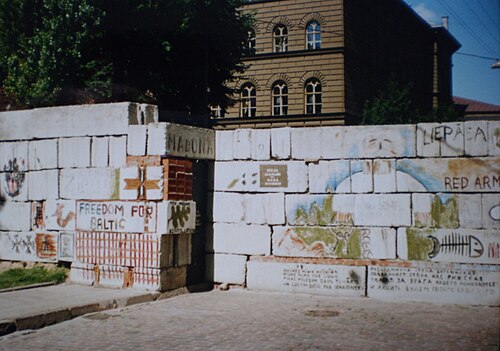
リトアニアでの血なまぐさい攻撃を受けて、ラトビア人は防衛バリケードを組織し(この事件は今日でも「バリケード」として知られている)、リガの戦略的に重要な建物や橋へのアクセスを遮断した。その後数日間のソ連の攻撃で6人が死亡、数人が負傷し、1人が後に負傷により死亡した。
2月9日、リトアニアは独立を問う国民投票を実施し、93.2%の票が独立に賛成した。
2月12日、アイスランドはリトアニアの独立を承認した。[111]
3月3日、エストニア共和国の独立を問う国民投票が行われ、ソ連併合以前にエストニアに住んでいた人々とその子孫、およびエストニア議会のいわゆる「グリーンカード」を受け取った人々が参加した。 [112]投票者の77.8%が独立回復の考えを支持した。[113]
3月11日、デンマークはエストニアの独立を承認した。[114]
When Estonia reaffirmed its independence during the coup (see below) in the dark hours of 20 August 1991, at 11:03 pm Tallinn time, many Estonian volunteers surrounded the Tallinn TV Tower in an attempt to prepare to cut off the communication channels after the Soviet troops seized it and refused to be intimidated by the Soviet troops. When Edgar Savisaar confronted the Soviet troops for ten minutes, they finally retreated from the TV tower after a failed resistance against the Estonians.
August Coup
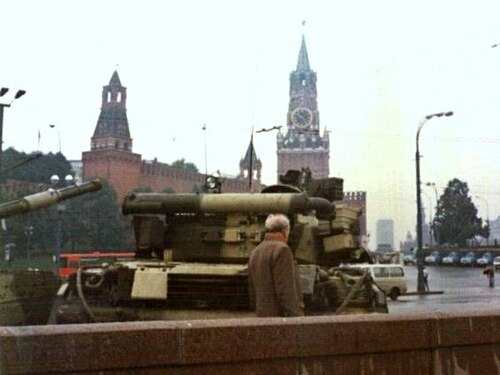
Faced with growing separatism, Gorbachev sought to restructure the Soviet Union into a less centralized state. On 20 August, the Russian SFSR was scheduled to sign a New Union Treaty that would have converted the Soviet Union into a federation of independent republics with a common president, foreign policy and military. It was strongly supported by the Central Asian republics, which needed the economic advantages of a common market to prosper. However, it would have meant some degree of continued Communist Party control over economic and social life.
More radical reformists were increasingly convinced that a rapid transition to a market economy was required, even if the eventual outcome meant the disintegration of the Soviet Union into several independent states. Independence also accorded with Yeltsin's desires as president of the RSFSR, as well as those of regional and local authorities to get rid of Moscow's pervasive control. In contrast to the reformers' lukewarm response to the treaty, the conservatives, "patriots", and Russian nationalists of the USSR – still strong within the CPSU and the military – were opposed to weakening the Soviet state and its centralized power structure.
On 19 August 1991, Gorbachev's vice president, Gennady Yanayev, Prime Minister Valentin Pavlov, Defense Minister Dmitry Yazov, KGB chief Vladimir Kryuchkov and other senior officials acted to prevent the union treaty from being signed by forming the "General Committee on the State Emergency", which put Gorbachev – on holiday in Foros, Crimea – under house arrest and cut off his communications. The coup leaders issued an emergency decree suspending political activity and banning most newspapers.
Thousands of Muscovites came out to defend the White House (the Russian Federation's parliament and Yeltsin's office), the symbolic seat of Russian sovereignty at the time. The organizers of the coup tried but ultimately failed to arrest Yeltsin, who rallied opposition to the coup by making speeches from atop a tank. The special forces dispatched by the coup leaders took up positions near the White House, but members refused to storm the barricaded building. The coup leaders also neglected to jam foreign news broadcasts, so many Muscovites watched it unfold live on CNN. Even the isolated Gorbachev was able to stay abreast of developments by tuning into the BBC World Service on a small transistor radio.[115]
After three days, on 21 August 1991, the coup collapsed. The organizers were detained and Gorbachev was reinstated as president, albeit with his power much depleted.[116][117]
Fall: August to December

On 24 August 1991, Gorbachev resigned as general secretary of the CPSU[118] and dissolved all party units in the government. On the same day, the Supreme Soviet of the Ukrainian SSR passed a Declaration of Independence of Ukraine, calling for a national referendum on the independence of Ukraine from the Soviet Union. Five days later, the Supreme Soviet of the Soviet Union indefinitely suspended all CPSU activity on Soviet territory,[119] effectively ending Communist rule in the Soviet Union and dissolving the only remaining unifying force in the country. Gorbachev established a State Council of the Soviet Union on 5 September, designed to bring him and the highest officials of the remaining republics into a collective leadership. The State Council was also empowered to appoint a premier of the Soviet Union. The premiership never functioned properly, though Ivan Silayev de facto took the post through the Committee on the Operational Management of the Soviet Economy and the Inter-Republican Economic Committee and tried to form a government, though with rapidly shrinking powers.
The Soviet Union collapsed with dramatic speed in the last quarter of 1991. Between August and December, 10 republics seceded from the union, largely out of fear of another coup. By the end of September, Gorbachev no longer had the ability to influence events outside of Moscow. He was challenged even there by Yeltsin, who had begun taking over what remained of the Soviet government, including the Kremlin.
The Soviet Union recognized the independence of Baltic republics on 6 September 1991.[120] Georgia cut all ties with the Soviet Union on 7 September, citing the failure to receive a "sufficiently grounded answer" why the USSR did not recognise its independence when it had recognised the Baltic States' secession.[121]
On 17 September 1991, General Assembly resolution numbers 46/4, 46/5, and 46/6 admitted Estonia, Latvia, and Lithuania to the United Nations, conforming to Security Council resolution numbers 709, 710, and 711 passed on 12 September without a vote.[122][123]
On 6 November, Yeltsin – who had by then taken over much of the Soviet government – issued a decree banning all Communist Party activities on Russian territory.[124]
By 7 November 1991, most newspapers referred to the 'former Soviet Union'.[125]

The final round of the Soviet Union's collapse began on 1 December 1991. That day, a Ukrainian popular referendum resulted in 91 percent of Ukraine's voters voting to affirm the independence declaration passed in August and formally secede from the Union. The secession of Ukraine, long second only to Russia in economic and political power, ended any realistic chance of Gorbachev keeping the Soviet Union together even on a limited scale. The leaders of the three Slavic republics, Russia, Ukraine, and Belarus (formerly Byelorussia), agreed to discuss possible alternatives to the union.
On 8 December, the leaders of Russia, Ukraine, and Belarus secretly met in Belavezhskaya Pushcha, in western Belarus, and signed the Belavezha Accords, which proclaimed the Soviet Union had ceased to exist and announced formation of the Commonwealth of Independent States (CIS) as a looser association to take its place. They also invited other republics to join the CIS. Gorbachev called it an unconstitutional coup. However, by this time there was no longer any reasonable doubt that, as the preamble of the Accords put it, that the Soviet Union no longer existed "as a subject of international law and a geopolitical reality".
On 10 December, the agreement was ratified by the Verkhovna Rada of Ukraine[126] and the Supreme Council of Belarus.[127]
On 12 December, the Supreme Soviet of the Russian SFSR formally ratified the Belavezha Accords,[128] denounced the 1922 Union Treaty,[129] and recalled the Russian deputies from the Supreme Soviet of the USSR. The legality of this ratification raised doubts among some members of the Russian parliament, since according to the 1978 RSFSR Constitution consideration of this document was in the exclusive jurisdiction of the Congress of People's Deputies of the RSFSR.[130][131][132][133] Additionally, the Soviet Constitution did not allow a republic to unilaterally recall its deputies.[134] However, no one in either Russia or the Kremlin objected. Any objections from the latter would have likely had no effect, since what was left of the Soviet government had effectively been rendered impotent long before December. A number of lawyers believe that the denunciation of the union treaty was meaningless since it became invalid in 1924 with the adoption of the first constitution of the USSR.[135][136][137] (In 1996 the State Duma had voiced the same position.)[138] Later that day, Gorbachev hinted for the first time that he was considering stepping down.[139] On the surface, it appeared that the largest republic had formally seceded. However, this is not the case. Rather, Russia apparently took the line that it did not need to follow the secession process delineated in the Soviet Constitution because it was not possible to secede from a country that no longer existed.
On 16 December 1991, the Kazakh SSR became the last republic to formally secede from the Soviet Union, causing the Soviet Union to neither control any territory nor claim to control any territory (although Soviet embassies still existed).[140]
On 17 December 1991, along with 28 European countries, the European Economic Community, and four non-European countries, the three Baltic Republics and nine of the twelve remaining Soviet republics signed the European Energy Charter in the Hague as sovereign states.[141][142] On the same day, members of the lower house of the union parliament (Council of the Union) held a meeting of People's Deputies of the Soviet Union. The meeting adopted a statement in connection with the signing of the Belovezhskaya Agreement and its ratification by the parliaments of Russia, Belarus and Ukraine, in which it noted that it considers the decisions made on the liquidation of state power and administration bodies illegal and not meeting the current situation and the vital interests of the peoples and stated that in the event further complication of the situation in the country reserves the right to convene in the future the Congress of People's Deputies of the USSR.[143]

On 18 December, the upper chamber of the Supreme Soviet of the USSR (Council of Republics) adopted a statement, according to which it accepts with understanding the Agreement on the creation of the Commonwealth of Independent States and considers it a real guarantee of a way out of the acute political and economic crisis.[144]
Gorbachev met with Yeltsin and accepted the fait accompli of the Soviet Union's dissolution. On the same day, the Supreme Soviet of the Russian SFSR adopted a statute to change Russia's legal name from "Russian Soviet Federative Socialist Republic" to "Russian Federation", showing that it was now a fully sovereign non-communist state.
Doubts remained over whether the Belavezha Accords had legally dissolved the Soviet Union, since they were signed by only three republics. However, on 21 December, representatives of 11 of the 12 remaining republics – all except Georgia – signed the Alma-Ata Protocol, which confirmed the dissolution of the Soviet Union and formally established the CIS.[145] They also "accepted" Gorbachev's resignation.[146] The command of the Armed Forces of the USSR was entrusted to the Minister of Defense Yevgeny Shaposhnikov.[147][148] Even at this moment, Gorbachev had not made any formal plans to leave the scene yet. However, with a majority of republics now agreeing that the Soviet Union no longer existed, Gorbachev bowed to the inevitable, telling CBS News that he would resign as soon as he saw that the CIS was indeed a reality.[149]
In a nationally televised speech in the evening of 25 December, Gorbachev resigned as president of the Soviet Union – or, as he put it, "I hereby discontinue my activities at the post of President of the Union of Soviet Socialist Republics."[150] He declared the office extinct, and ceded all of its powers (such as control of the nuclear arsenal)[151] to Yeltsin.

On the night of 25 December, at 7:35 p.m. Moscow time, after Gorbachev appeared on television, the Soviet flag was lowered[152] and the Russian tricolor raised in its place at 7:45 pm,[153] symbolically marking the end of the Soviet Union. In his parting words, Gorbachev defended his record on domestic reform and détente, but conceded, "The old system collapsed before a new one had time to start working."[154] On that same day, the President of the United States George H. W. Bush held a brief televised speech officially recognizing the independence of the 11 remaining republics.
Gorbachev's speech, as well as the replacement of the Soviet flag with the Russian flag, symbolically marked the end of the Soviet Union. However, the final legal step in the Soviet Union's demise came on 26 December, when the Soviet of the Republics, the upper chamber of the Supreme Soviet of the Soviet Union, ratified the Belavezha Accords, effectively voting the Soviet Union out of existence[155][156] (the lower chamber, the Soviet of the Union, had been unable to work since 12 December, when the recall of the Russian deputies left it without a quorum).[130] The following day Yeltsin moved into Gorbachev's former office,[157] though the Russian authorities had taken over the suite two days earlier. The Soviet Armed Forces were placed under the command of the Commonwealth of Independent States, but were eventually subsumed by the newly independent republics, with the bulk becoming the Armed Forces of the Russian Federation. By the end of 1991, the few remaining Soviet institutions that had not been taken over by Russia ceased operation, and individual republics assumed the central government's role.
Other issues were also addressed at Alma-Ata on 21 December 1991, including UN membership. In a document additional to the main Alma-Ata Declaration, Russia was authorized to assume the Soviet Union's UN membership, including its permanent seat on the Security Council. The Soviet Ambassador to the UN delivered a letter signed by Russian President Yeltsin to the UN Secretary-General dated 24 December 1991, informing him that "with the support of the countries of the Commonwealth of Independent States", Russia was the successor state to the USSR.[158] After being circulated among the other UN member states, Russia attended the UN Security Council meeting on the last day of the year, 31 December 1991, with no objection raised.[159] But questions of state succession, settlement of external debt, and division of assets abroad remain disputed between Russia and Ukraine to this day.[160]
In April 1992, the Congress of People's Deputies of Russia refused to ratify the Belovezhskaya Agreements[161][162][163] and to exclude references to the Constitution and laws of the USSR from the text of the Constitution of the RSFSR.[133][164] According to some Russian politicians, this was one of the reasons for the political crisis of September – October 1993.[133][162][164] In a referendum on 12 December 1993, a new Russian constitution was adopted, in which there was no mention of the union state.
Consequences


Economic decline, hunger, and excess mortality
In the decades following the end of the Cold War, only five or six of the post-Soviet states are on a path to joining the wealthy capitalist states of the West, and most are falling behind, some to such an extent that over 50 years will be needed before they catch up to how they were before the end of communism.[165][166] However, virtually all the former Soviet republics were able to turn their economies around and increase GDP to multiple times what it was under the USSR.[167] In a 2001 study by the economist Steven Rosefielde, he calculated that there were 3.4 million premature deaths in Russia from 1990 to 1998, which he partly blames on the "shock therapy" that came with the Washington Consensus.[168] Nearly all of the post-Soviet states suffered deep and prolonged recessions after shock therapy,[169] with poverty increasing more than tenfold.[170] Catastrophic drops in caloric intake followed the dissolution of the Soviet Union.[171]
Post-Soviet conflicts
According to the scholar Marcel H. Van Herpen, the end of the Soviet Union marked the end of the last European empire, and some authors called it the death of Russian colonialism and imperialism.[172]
As the Soviet Union began to collapse, social disintegration and political instability fueled a surge in ethnic conflict.[173] Social and economic disparities, along with ethnic differences, created an upsurge in nationalism within groups and discrimination between groups. In particular, disputes over territorial boundaries have been the source of conflict between states experiencing political transition and upheaval. Territorial conflicts can involve several different issues: the reunification of ethnic groups which have been separated, restoration of territorial rights to those who experienced forced deportation, and restoration of boundaries arbitrarily changed during the Soviet era.[174] Territorial disputes remain significant points of controversy as minority groups consistently oppose election outcomes and seek autonomy and self-determination. In addition to territorial disputes and other structural causes of conflict, legacies from the Soviet and pre-Soviet eras, along with the suddenness of the actual sociopolitical change, have resulted in conflict throughout the region.[174] As each group experiences dramatic economic reform and political democratization, there has been a surge in nationalism and interethnic conflict. Overall, the fifteen independent states that emerged after the collapse of the Soviet Union face problems stemming from uncertain identities, contested boundaries, apprehensive minorities, and an overbearing Russian hegemony.[175]
China
After decades of hardship following the Sino–Soviet split, the People's Republic of China entered a gradual rapprochement with the Soviet Union in 1989 when Gorbachev visited the country. Afterwards, the border treaty was demarcated in 1991, and they signed the Treaty of Good-Neighborliness and Friendly Cooperation in 2001, which was renewed in June 2021 for five more years.[176] Both countries are members of the Shanghai Cooperation Organisation which was founded in 1996.
On the eve of a 2013 state visit to Moscow by Chinese leader Xi Jinping, Russian President Vladimir Putin remarked that the two nations were forging a special relationship.[177] The two countries have enjoyed close relations militarily, economically, and politically, while supporting each other on various global issues.[178][179][180] Commentators have debated whether the bilateral strategic partnership constitutes an alliance.[181][182][183] Russia and China officially declared their relations 'Not allies, but better than allies'.[184] The relations between the two countries are currently being put to the test after Russia invading Ukraine.[185] Unlike in the Soviet era, Putin ruled Russia is increasingly China's "junior partner".[186][187]
Cuba
The "Special Period", officially known as the "Special Period in the Time of Peace" was an extended period of economic crisis in Cuba that began in 1991[188] It was defined primarily by extreme reductions of rationed foods at state-subsidized prices, the severe shortages of hydrocarbon energy resources in the form of gasoline, diesel, and other petroleum derivatives that occurred upon the implosion of economic agreements between the petroleum-rich Soviet Union and Cuba, and the shrinking of an economy overdependent on Soviet imports.[189]
During its existence, the Soviet Union provided Cuba with large amounts of oil, food, and machinery. In the years following the collapse of the Soviet Union, Cuba's gross domestic product shrunk 35%, imports and exports both fell over 80%, and many domestic industries shrank considerably.[190] In a speculated attempt to re-join the IMF and the World Bank, executive director Jacques de Groote and another IMF official were invited to Havana in late 1993.[191] After assessing the economic situation in the country they concluded that from 1989 to 1993, Cuba's economic decline was more grave than that experienced by any other socialist Eastern European country.[192]
In 1993 a series of economic reforms began to go into effect, initially enacted to offset the economic imbalances which was a result of the dissolution of the Soviet Union in 1991.[193] The main aspect of these reforms was to legalize the then illegal U.S. Dollar and regulate its usage in the island's economy.[194]
North Korea
In 1991 when the Soviet Union dissolved, it ended all aid and trade concessions such as cheap oil to North Korea.[195] Without Soviet aid, the flow of imports to the North Korean agricultural sector ended, and the government proved to be too inflexible to respond.[196] Energy imports fell by 75%.[197] The economy went into a downward spiral, with imports and exports falling in tandem. Flooded coal mines required electricity to operate pumps, and the shortage of coal worsened the shortage of electricity. Agriculture reliant on electrically powered irrigation systems, artificial fertilizers and pesticides was hit particularly hard by the economic collapse.[198][199]
Israel
Between 1989 and 2006, about 1.6 million Soviet Jews and their non-Jewish spouses and their relatives, as defined by the Law of Return, emigrated from the former Soviet Union. About 979,000, or 61%, migrated to Israel.[200]
Afghanistan
As the Soviet Union began to disintegrate, it also lost support to Mohammad Najibullah's regime in Afghanistan following the withdrawal in 1989.[201] The end of Soviet war in Afghanistan would lead into a continuing multi-sided civil war, only for the Taliban to rise in 1996. Because of this, U.S. policies in the war are also thought to have contributed to a "blowback" of unintended consequences against American interests, which led to the United States entering into its own war in Afghanistan following the September 11 attacks in 2001, only to end with the US' withdrawal in 2021 and the Taliban regaining control of Afghanistan.
Sports and "Unified Team"
The breakup of the Soviet Union saw a massive impact in the sporting world. Before its dissolution, the Soviet football team had just qualified for Euro 1992, but its place was instead taken by the CIS national football team. After the tournament, the former Soviet Republics competed as separate independent nations, with FIFA allocating the Soviet team's record to Russia.[202]
Before the start of the 1992 Winter Olympics in Albertville and the Summer Olympics in Barcelona, the Olympic Committee of the Soviet Union formally existed until 12 March 1992, when it disbanded but it was succeeded by the Russian Olympic Committee. However, 12 of the 15 former Soviet Republics competed together as the Unified Team and marched under the Olympic flag in Barcelona, where they finished first in the medal rankings. Separately, Lithuania, Latvia, and Estonia also competed as independent nations in the 1992 Games. The Unified Team also competed in Albertville earlier in the year (represented by six of the twelve ex-republics) and finished second in the medal ranking at those Games. Afterwards, the individual NOCs of the non-Baltic former republics were established. Some NOCs made their debuts at the 1994 Winter Olympic Games in Lillehammer, and others did so at the 1996 Summer Olympic Games in Atlanta.
Members of the Unified Team at the 1992 Summer Olympics in Barcelona consisted of Armenia, Azerbaijan, Belarus, Georgia, Kazakhstan, Kyrgyzstan, Moldova, Russia, Tajikistan, Turkmenistan, Ukraine, and Uzbekistan. At those Summer Games, the Unified Team secured 45 gold medals, 38 silver medals, and 29 bronze medals; four medals more than second-place United States, and 30 more than third-place Germany. In addition to great team success, the Unified Team also saw great personal success. Vitaly Scherbo of Belarus secured six gold medals for the team in gymnastics and also became the most decorated athlete of the Summer Games.[203] Gymnastics, athletics, wrestling, and swimming were the strongest sports for the team, as the four combined earned 28 gold medals and 64 medals in total.
Only six of the countries competed earlier at the 1992 Winter Olympics in Albertville: Armenia, Belarus, Kazakhstan, Russia, Ukraine, and Uzbekistan. The Unified team placed second, three fewer medals than Germany. However, much like the Summer Games, the Unified team had the most decorated medalist in the Winter Games as well, with Lyubov Yegorova of Russia, a cross-country skier winning five total medals.[204]
Telecommunications
The Soviet Union's calling code of +7 is still used by Russia and Kazakhstan. Between 1993 and 1997, many newly independent republics implemented their own numbering plans such as Belarus (+375) and Ukraine (+380).[citation needed] The Internet domain .su remains in use alongside the internet domains of the newly created countries.
Glasnost and "Memorial"
The lifting of total censorship and communist propaganda led to disclosure to public of such political and historical issues as the Molotov–Ribbentrop Pact, the Katyn massacre, revision of the Stalinist repressions, revision of the Russian Civil War, the White movement, the New Economic Policy, the 1986 Chernobyl disaster, censorship, pacification and procrastination by the Soviet authorities.
In 1989, the Soviet Union established a civil rights society, Memorial, which specialized in research and recovery of memory for victims of political repressions as well as support for a general human rights movement.
Chronology of declarations
States with limited recognition are shown in italics.
Legacy
In 2013, the American Gallup analytics company found that a majority of citizens in four former Soviet countries regretted the dissolution of the Soviet Union: Armenia, Kyrgyzstan, Russia and Ukraine. In Armenia, 12% of respondents in 2013 said the Soviet collapse did good, while 66% said it did harm. In Kyrgyzstan, 16% of respondents in 2013 said the Soviet collapse did good, while 61% said it did harm.[205] Ever since the Soviet collapse, annual polling by the Levada Center has shown that over 50 percent of Russia's population regretted its collapse. Consistently, 57% of citizens of Russia regretted the collapse of the Soviet Union in a poll in 2014 (while 30 percent said otherwise), and in 2018 a Levada Center poll showed that 66% of Russians lamented the fall of the Soviet Union.[206] In 2005, Russian president Vladimir Putin called the dissolution of the USSR as "the greatest geopolitical catastrophe of the 20th century".[207]
In a similar poll held in February 2005, 50% of respondents in Ukraine stated they regretted the disintegration of the Soviet Union.[208] In 2013, according to Gallup, 56% of Ukrainians said that the dissolution of the Soviet Union did more harm than good, with only 23% saying it did more good than harm. However, a similar poll conducted in 2016 by a Ukrainian group showed only 35% Ukrainians regretting the Soviet collapse and 50% not regretting it.[209]

The breakdown of economic ties that followed the Soviet collapse led to a severe economic crisis and catastrophic fall in the standard of living in post-Soviet states and the former Eastern Bloc,[210] which was even worse than the Great Depression.[211][212] An estimated seven million premature deaths took place in the former USSR after it collapsed, with around four million in Russia alone.[213] Poverty and economic inequality surged between 1988 and 1989 and between 1993 and 1995, with the Gini ratio increasing by an average of 9 points for all former socialist countries.[214] Even before the 1998 Russian financial crisis, the Russian GDP was half of what it had been in the early 1990s.[212] By 1999, around 191 million people in post-Soviet states and former Eastern Bloc countries were living on less than $5.50 a day.[215]
In the Kitchen Debate of 1959, Nikita Khrushchev claimed that then US Vice-president Richard Nixon's grandchildren would live "under communism", and Nixon claimed that Khrushchev's grandchildren would live "under freedom". In a 1992 interview, Nixon commented that during the debate, he was sure Khrushchev's claim was wrong, but Nixon was not sure that his own assertion was correct. Nixon said that events had proved that he was indeed right because Khrushchev's grandchildren now lived "in freedom" in reference to the recent end of the Soviet Union.[216][better source needed] Khrushchev's son Sergei Khrushchev became a naturalized American citizen.
United Nations membership
In a letter dated 24 December 1991, Boris Yeltsin, the Russian President, informed the United Nations Secretary-General that the membership of the Soviet Union in the Security Council and all other UN organs would be continued by the Russian Federation with the support of the 11 member countries of the Commonwealth of Independent States.
However, the Byelorussian Soviet Socialist Republic and the Ukrainian Soviet Socialist Republic had already joined the UN as original members on 24 October 1945, together with the Soviet Union. After declaring independence, the Ukrainian Soviet Socialist Republic changed its name to Ukraine on 24 August 1991, and on 19 September, the Byelorussian Soviet Socialist Republic informed the UN that it had changed its name to the Republic of Belarus.
All of the twelve other independent states that were established from the former Soviet republics were admitted to the UN:
- 17 September 1991: Estonia, Latvia, and Lithuania
- 2 March 1992: Armenia, Azerbaijan, Kazakhstan, Kyrgyzstan, Moldova, Tajikistan, Turkmenistan, and Uzbekistan
- 31 July 1992: Georgia
Historiographic explanations
Historiography on the Soviet collapse can be roughly classified in two groups: intentionalist accounts and structuralist accounts.
The end of the Soviet Union caught many people by surprise. Before 1991, many thought that Soviet collapse was impossible or unlikely.[217]
Intentionalist accounts contend that Soviet collapse was not inevitable and resulted from the policies and decisions of specific individuals, usually Gorbachev and Yeltsin. One characteristic example of intentionalist writing is the historian Archie Brown's The Gorbachev Factor, which argues Gorbachev was the main force in Soviet politics at least from 1985 to 1988 and even later and that he largely spearheaded the political reforms and developments, as opposed to being led by events.[218] That was especially true of the policies of perestroika and glasnost, market initiatives, and foreign policy stance, as the political scientist George Breslauer has seconded by labelling Gorbachev a "man of the events".[219] In a slightly different vein, David Kotz and Fred Weir have contended that Soviet elites were responsible for spurring on both nationalism and capitalism from which they could personally benefit, which is demonstrated also by their continued presence in the higher economic and political echelons of post-Soviet republics.[220]
In contrast, structuralist accounts take a more deterministic view in which Soviet dissolution was an outcome of deeply rooted structural issues, which planted a time bomb. For example, Edward Walker has argued that minority nationalities were denied power at the Union level, confronted by a culturally destabilizing form of economic modernization, and subjected to a certain amount of Russification, but they were at the same time strengthened by several policies pursued by the Soviet government (indigenization of leadership, support for local languages, etc.). Over time, they created conscious nations. Furthermore, the basic legitimating myth of the Soviet federative system (that it was a voluntary and mutual union of allied peoples) eased the task of secession and independence.[221] On 25 January 2016, Russian President Vladimir Putin supported that view by calling Lenin's support of the right of secession for the Soviet republics a "delayed-action bomb".[222]
An opinion piece by Gorbachev in April 2006 stated: "The nuclear meltdown at Chernobyl 20 years ago this month, even more than my launch of perestroika, was perhaps the real cause of the collapse of the Soviet Union."[223][224]
It also had a profound impact on the policy-making circles of the Chinese Communist Party (CCP), in particular on CCP general secretary Xi Jinping, who states:
Why did the Soviet Union disintegrate? Why did the Communist Party of the Soviet Union fall from power? An important reason was that the struggle in the field of ideology was extremely intense, completely negating the history of the Soviet Union, negating the history of the Communist Party of the Soviet Union, negating Lenin, negating Stalin, creating historical nihilism and confused thinking. Party organs at all levels had lost their functions, the military was no longer under Party leadership. In the end, the Communist Party of the Soviet Union, a great party, was scattered, the Soviet Union, a great socialist country, disintegrated. This is a cautionary tale![225]
According to political scientists Steven Levitsky and Lucan Way in their book In Revolution and Dictatorship: The Violent Origins of Durable Authoritarianism (2022), the cohesion of the Communist Party of the Soviet Union (CPSU) leadership had declined by the 1980s. Most party leaders were born after the Soviet Union's origins during the Russian Civil War, and memories of the Eastern Front during World War II were fading.[226]
See also
- 1980s oil glut
- American decline
- Breakup of Yugoslavia
- Dissolution of Czechoslovakia
- Dissolution of the Russian Empire
- German reunification
- History of the Soviet Union (1982–91)
- History of Russia (1991–present)
- Predictions of Soviet collapse
- Post-Soviet studies
- Russian money in London
- Separatism in Russia
- Strong dollar policy
- Superpower collapse
- Yemeni reunification
- Fall of Socialism in Ethiopia
- The Commanding Heights (book)
External links
U.S. television coverage of Mikhail Gorbachev's December 25, 1991 speech to the Soviet people https://www.youtube.com/watch?v=pCltB4lB2-M Retrieved from YouTube on July 31, 2024.
Notes
- ^ Russian: Распад Советского Союза, romanized: Raspád Sovétskogo Soyúza, also negatively connoted as Russian: Развал Советского Союза, romanized: Razvál Sovétskogo Soyúza, Ruining of the Soviet Union.
- ^ As part of the Azerbaijan SSR.
- ^ Only declared secession from the Moldavian SSR as a separate republic of the Soviet Union; remained a de facto independent state following the final Soviet collapse until reintegration.
- ^ Renamed SSR of Moldova in its Declaration of Sovereignty.
- ^ Seceded from Georgia.
- ^ Seceded from Russia.
- ^
 Chechen Republic of Ichkeria in 1994–2000. It was not internationally recognized, with Russia supporting another government of its de jure autonomous Chechen Republic in 1993–96, until partially recognizing the government of Ichkeria. After not having any recognized government in 1991–93 and in 1996–99, the Chechen Republic was restored as an autonomous part of the Russian Federation under Akhmat Kadyrov.
- ^ Full name is "South Ossetian Soviet Republic" since 28 November 1990; initially it was called "South Ossetian Soviet Democratic Republic".
- ^ Previously called for an autonomy status inside the Georgian SSR as the South Ossetian ASSR since 10 November 1989.
- ^ Seceded from Uzbekistan.
- ^ Autonomous Republic of Crimea in 1998–2014.
- ^ Proclaimed self-governance.
- ^ Seceded Ukraine.
References
- ^ a b (in Russian) Declaration № 142-Н of the Soviet of the Republics of the Supreme Soviet of the Soviet Union, formally establishing the dissolution of the Soviet Union as a state and subject of international law.
- ^ "The End of the Soviet Union; Text of Declaration: 'Mutual Recognition' and 'an Equal Basis'". The New York Times. 22 December 1991. Archived from the original on 22 March 2013. Retrieved 30 March 2013.
- ^ "For China, USSR's 1991 Collapse is Still News It Can Use". Bloomberg.com. 23 December 2021. Archived from the original on 7 January 2023. Retrieved 4 January 2023.
- ^ "Chernenko is Dead in Moscow at 73; Gorbachev Succeeds Him and Urges Arms Control and Economic Vigor". The New York Times. 12 March 1985. Archived from the original on 8 October 2020. Retrieved 5 October 2020.
- ^ "Михаил Сергеевич Горбачёв (Mikhail Sergeyevičh Gorbačhëv)". Archontology. 27 March 2009. Archived from the original on 11 November 2019. Retrieved 3 April 2009.
- ^ Carrere D'Encausse, Helene (1993). The End of the Soviet Empire: The Triumph of the Nations. Translated by Philip, Franklin (English ed.). New York, NY: BasicBooks. p. 16. ISBN 978-0-465-09812-5.
- ^ Beissinger, Mark R. (August 2009). "Nationalism and the Collapse of Soviet Communism" (PDF). Contemporary European History. 18 (3): 5–6. doi:10.1017/S0960777309005074. Archived from the original (PDF) on 28 September 2017. Retrieved 9 January 2018.
- ^ "Gorbachev's role in 1989 turmoil". BBC News. 1 April 2009. Archived from the original on 9 April 2009. Retrieved 30 March 2013.
- ^ "The Gorbachev Plan: Restructuring Soviet Power". The New York Times. 30 June 1988. Archived from the original on 16 May 2013. Retrieved 30 March 2013.
- ^ "The Third Russian Revolution; Transforming the Communist Party". The New York Times. 8 February 1990. Archived from the original on 16 May 2013. Retrieved 30 March 2013.
- ^ "1986: Sakharov comes in from the cold". BBC News. 23 December 1972. Archived from the original on 26 December 2010. Retrieved 30 March 2013.
- ^ "Soviet Releasing Some Prisoners Under New Law". The New York Times. 8 February 1987. Archived from the original on 16 May 2013. Retrieved 30 March 2013.
- ^ O'Clery, Conor. Moscow 25 December 1991: The Last Day of the Soviet Union. Transworld Ireland (2011). ISBN 978-1-84827-112-8, p. 71.
- ^ Conor O'Clery, Moscow 25 December 1991: The Last Day of the Soviet Union. Transworld Ireland (2011). ISBN 978-1-84827-112-8, p. 74
- ^ Keller, Bill (1 November 1987). "Critic of Gorbachev Offers to Resign His Moscow Party Post". The New York Times. Archived from the original on 27 January 2011. Retrieved 7 February 2017.
- ^ "The Road to Freedom". The Virtual Exhibition. Latvia National Archives. Archived from the original on 12 March 2016. Retrieved 27 August 2019.
- ^ a b c d Ulfelder, Jay (March–June 2004). "Baltic Protest in the Gorbachev Era: Movement Content and Dynamics" (PDF). The Global Review of Ethnopolitics. 3 (3–4): 23–43. doi:10.1080/14718800408405171. S2CID 143191904. Archived from the original (PDF) on 20 September 2011. Retrieved 31 March 2022.
- ^ Kuzio, Taras (1988). "Nationalist riots in Kazakhstan". Central Asian Survey. 7 (4): 79–100. doi:10.1080/02634938808400648.
Violent nationalist riots erupted in Alma-Ata, the capital of Kazakhstan, on 17 & 18 December 1986
- ^ Barringer, Felicity (24 May 1987). "Russian Nationalists Test Gorbachev". The New York Times. Archived from the original on 2 June 2012. Retrieved 23 June 2011.
- ^ Barringer, Felicity (26 July 1987). "Tartars Stage Noisy Protest in Moscow". The New York Times. Archived from the original on 7 June 2013. Retrieved 23 June 2011.
- ^ Keller, Bill (24 August 1987). "Lithuanians Rally For Stalin Victims". The New York Times. Archived from the original on 16 January 2015. Retrieved 23 June 2011.
- ^ "Latvian Protest Reported Curbed". The New York Times. 19 November 1987. Archived from the original on 16 May 2013. Retrieved 30 March 2013.
- ^ a b "Ministry of Foreign Affairs of The Republic of Armenia Official Site". Armeniaforeignministry.com. 18 October 1987. Archived from the original on 14 September 2007. Retrieved 23 June 2011.
- ^ "Government in the Soviet Union: Gorbachev's Proposal for Change". The New York Times. 2 October 1988. Archived from the original on 8 March 2021. Retrieved 7 February 2017.
- ^ a b "Union of Soviet SOSocialist Republics: Parliamentary elections Congress of People's Deputies of the USSR, 1989". Ipu.org. Archived from the original on 5 October 2016. Retrieved 11 December 2011.
- ^ "Radio Jamming in the Soviet Union, Poland and others - East European Countries" (PDF). Archived (PDF) from the original on 18 May 2015.
- ^ "Estonia Gets Hope". Ellensburg Daily Record. Helsinki, Finland: UPI. 23 October 1989. p. 9. Retrieved 18 March 2010.[dead link]
- ^ Keller, Bill (4 October 1988). "Estonia Ferment: Soviet Role Model or Exception?". The New York Times. Archived from the original on 19 August 2021. Retrieved 7 February 2017.
- ^ Website of Estonian Embassy in London (National Holidays)
- ^ Walker, Edward (2003). Dissolution. Rowman & Littlefield. p. 63. ISBN 0-7425-2453-1.
- ^ Pages 10–12 Black Garden de Waal, Thomas. 2003. NYU. ISBN 0-8147-1945-7
- ^ Elizabeth Fuller, "Nagorno-Karabakh: The Death and Casualty Toll to Date", RL 531/88, 14 December 1988, pp. 1–2.
- ^ Modern Hatreds: The Symbolic Politics of Ethnic War – Page 63 by Stuart J. Kaufman
- ^ Vaserman, Arie; Ginat, Ram (1994). "National, territorial or religious conflict? The case of Nagorno-Karabakh". Studies in Conflict & Terrorism. 17 (4): 348. doi:10.1080/10576109408435961.
These events contributed to the anti-Armenian riots of February 28–29 in Sumgait near Baku. According to official data, 32 Armenians were killed during the riots, but various Armenian sources claimed that more than 200 people were killed.
- ^ Black Garden de Waal, Thomas. 2003. NYU. ISBN 0-8147-1945-7, p. 40
- ^ Page 82 Black Garden de Waal, Thomas. 2003. NYU. ISBN 0-8147-1945-7
- ^ Keller, Bill (20 September 1988). "Gunfire Erupts in Tense Soviet Area". The New York Times. Archived from the original on 9 March 2021. Retrieved 23 June 2011.
- ^ Page 69 Black Garden de Waal, Thomas. 2003. NYU. ISBN 0-8147-1945-7
- ^ Page 83 Black Garden de Waal, Thomas. 2003. NYU. ISBN 0-8147-1945-7
- ^ Black Garden de Waal, Thomas. 2003. NYU. ISBN 0-8147-1945-7, p. 23
- ^ Pages 60–61 Black Garden de Waal, Thomas. 2003. NYU. ISBN 0-8147-1945-7
- ^ Keller, Bill (16 June 1988). "Armenian Legislature Bakcs [sic] Calls For Annexing Disputed Territory". The New York Times. Archived from the original on 15 August 2021. Retrieved 23 June 2011.
- ^ Barringer, Felicity (11 July 1988). "Anger Alters the Chemistry of Armenian Protest". The New York Times. Archived from the original on 6 June 2013. Retrieved 23 June 2011.
- ^ Keller, Bill (23 September 1988). "Parts Of Armenia Are Blocked Off By Soviet Troops". The New York Times. Archived from the original on 7 June 2013. Retrieved 23 June 2011.
- ^ Pages 62–63 Black Garden de Waal, Thomas. 2003. NYU. ISBN 0-8147-1945-7
- ^ Taubman, Philip (26 November 1988). "Soviet Army Puts Armenian Capital Under Its Control". The New York Times. Archived from the original on 6 June 2013. Retrieved 23 June 2011.
- ^ Barringer, Felicity (12 December 1988). "Amid the Rubble, Armenians Express Rage at Gorbachev". The New York Times. Archived from the original on 25 December 2014. Retrieved 23 June 2011.
- ^ Barringer, Felicity (29 November 1988). "Tension Called High In Armenia Capital, With 1,400 Arrests". The New York Times. Archived from the original on 7 June 2013. Retrieved 23 June 2011.
- ^ a b "Independence: a timeline (PART I) (08/19/01)". Ukrweekly.com. Archived from the original on 21 November 2011. Retrieved 11 December 2011.
- ^ "Graves of 500 Stalin Victims Are Reported Outside Minsk". The New York Times. 18 August 1988. Archived from the original on 1 July 2017. Retrieved 7 February 2017.
- ^ Keller, Bill (28 December 1988). "Stalin's Victims: An Uneasy Enshrinement". The New York Times. Archived from the original on 1 July 2017. Retrieved 7 February 2017.
- ^ Pages 188–189. Conor O'Clery. Moscow 25 December 1991: The Last Day of the Soviet Union. Transworld Ireland (2011)
- ^ Clines, Francis X. (15 May 1989). "This Time, Many Candidates for Soviet Voters". The New York Times. Archived from the original on 1 July 2017. Retrieved 7 February 2017.
- ^ Keller, Bill (30 May 1989). "Moscow Maverick, in Shift, Is Seated in Supreme Soviet". The New York Times. Archived from the original on 1 July 2017. Retrieved 7 February 2017.
- ^ Keller, Bill (31 May 1989). "Gorbachev Urges a Postponement of Local Voting". The New York Times. Archived from the original on 1 July 2017. Retrieved 7 February 2017.
- ^ Fein, Esther B. (25 October 1989). "Soviet Legislature Votes to Abolish Official Seats". The New York Times. Archived from the original on 1 July 2017. Retrieved 7 February 2017.
- ^ Wolchik, Sharon L.; Jane Leftwich Curry (2007). Central and East European Politics: From Communism to Democracy. Rowman & Littlefield. p. 238. ISBN 978-0-7425-4068-2. Archived from the original on 24 January 2023. Retrieved 27 June 2015.
- ^ Senn, Alfred Erich (1995). Gorbachev's Failure in Lithuania. St. Martin's Press. p. 78. ISBN 0-312-12457-0.
- ^ Cooper, Anne (2 September 1989). "Communists in Baltics Shying From Kremlin". The New York Times. Archived from the original on 1 July 2017. Retrieved 7 February 2017.
- ^ Fein, Esther B. (8 December 1989). "Upheaval in the East; Lithuania Legalizes Rival Parties, Removing Communists' Monopoly". The New York Times. Archived from the original on 12 March 2017. Retrieved 7 February 2017.
- ^ Page 86 Black Garden de Waal, Thomas. 2003. NYU. ISBN 0-8147-1945-7
- ^ "Huge Azerbaijani Rally Asks Moscow to Free Prisoners". The New York Times. 20 August 1989. Archived from the original on 1 July 2017. Retrieved 7 February 2017.
- ^ Black Garden de Waal, Thomas. 2003. NYU. ISBN 0-8147-1945-7, p. 71
- ^ Keller, Bill (26 September 1989). "A Gorbachev Deadline on Armenia Issue". The New York Times. Archived from the original on 1 July 2017. Retrieved 7 February 2017.
- ^ a b Black Garden de Waal, Thomas. 2003. NYU. ISBN 0-8147-1945-7, p. 87
- ^ Fein, Esther B. (27 August 1989). "11 Armenians Leave Prison, Find Celebrity". The New York Times. Archived from the original on 1 July 2017. Retrieved 7 February 2017.
- ^ Page 72 Black Garden de Waal, Thomas. 2003. NYU. ISBN 0-8147-1945-7
- ^ "Soldiers Patrolling Soviet Georgia Amid Wave of Nationalist Protests". The New York Times. 8 April 1989. Archived from the original on 1 July 2017. Retrieved 7 February 2017.
- ^ Fein, Esther B. (10 April 1989). "At Least 16 Killed as Protesters Battle the Police in Soviet Georgia". The New York Times. Archived from the original on 1 July 2017. Retrieved 7 February 2017.
- ^ Fein, Esther (25 April 1989). "Kremlin Calls Georgia Violence a Local Operation". The New York Times. Archived from the original on 16 January 2015. Retrieved 24 June 2014.
- ^ "Soviet Troops Struggle To Curb Georgia Strife". The New York Times. 18 July 1989. Archived from the original on 1 July 2017. Retrieved 7 February 2017.
- ^ "Update on the Moldavian Elections to the USSR Congress of People's Deputies". 24 May 1989. Archived from the original on 26 February 2012. Retrieved 9 August 2012.
- ^ Esther B. Fein, "Baltic Nationalists Voice Defiance But Say They Won't Be Provoked", in The New York Times, 28 August 1989
- ^ King, p.140
- ^ "Belarus Plans to Build Memorial to Stalin's Victims". The New York Times. 25 January 1989. Archived from the original on 1 July 2017. Retrieved 7 February 2017.
- ^ "Marchers in Minsk Demand Further Chernobyl Cleanup". The New York Times. 1 October 1989. Archived from the original on 1 July 2017. Retrieved 7 February 2017.
- ^ "Uzbekistan Riots Reported Quelled". The New York Times. 12 June 1989. Archived from the original on 1 July 2017. Retrieved 7 February 2017.
- ^ Fein, Esther B. (20 June 1989). "Soviets Report an Armed Rampage in Kazakhstan". The New York Times. Archived from the original on 1 July 2017. Retrieved 7 February 2017.
- ^ Fein, Esther B. (26 June 1989). "Rioting Youths Reportedly Attack The Police in Soviet Kazakhstan". The New York Times. Archived from the original on 1 July 2017. Retrieved 7 February 2017.
- ^ "Soviet Communist Party gives up monopoly on political power: This Day in History – 2/7/1990". History.com. Archived from the original on 22 January 2018. Retrieved 23 June 2011.
- ^ Acton, Edward (1995). Russia, The Tsarist and Soviet Legacy. Longman Group Ltd. ISBN 0-582-08922-0.
- ^ Leon Aron, Boris Yeltsin: A Revolutionary Life. HarperCollins, 2000. pp. 739–740.
- ^ "1990: Yeltsin Resignation Splits Soviet Communists". BBC News. 12 July 1990. Archived from the original on 23 October 2012. Retrieved 29 October 2012.
- ^ Bandelj, Nina (2008). From Communists to Foreign Capitalists: The Social Foundations of Foreign Direct Investment in Postsocialist Europe. Princeton University Press. p. 41. ISBN 978-0-691-12912-9. Archived from the original on 24 January 2023. Retrieved 11 October 2015.
- ^ "Upheaval in the East; Party in Estonia Votes Split and Also a Delay". The New York Times. Associated Press. 26 March 1990. Archived from the original on 1 July 2017. Retrieved 7 February 2017.
- ^ "О символике эстонии Эстония" [About the symbolism of Estonia] (in Russian). 6 September 2019. Archived from the original on 6 September 2019.
- ^ "Upheaval in the East: Azerbaijan; Angry Soviet Crowd Attacks What Is Left Of Iran Border Posts". The New York Times. 7 January 1990. Archived from the original on 1 July 2017. Retrieved 7 February 2017.
- ^ Black Garden de Waal, Thomas. 2003. NYU. ISBN 0-8147-1945-7, p. 90
- ^ a b Page 89 Black Garden de Waal, Thomas. 2003. NYU. ISBN 0-8147-1945-7
- ^ Page 93 Black Garden de Waal, Thomas. 2003. NYU. ISBN 0-8147-1945-7
- ^ Black Garden de Waal, Thomas. 2003. NYU. ISBN 0-8147-1945-7, p. 94
- ^ Əkbərov, Nazim Fərrux oğlu (30 December 2013). "Nazim Əkbərov Səkinə xanım Əliyeva haqqında" [Nazim Akbarov: About the woman Sakina Aliyeva]. aqra.az (in Azerbaijani). Baku, Azerbaijan: "Aqra" Elmin İnkişafına Dəstək İctimai Birliyi. Archived from the original on 17 November 2018. Retrieved 18 November 2018.
- ^ Bolukbasi, Suha (2013). Azerbaijan: A Political History. London, England: I.B. Tauris. p. 138. ISBN 978-0-85771-932-4. Archived from the original on 24 January 2023. Retrieved 19 November 2018.
- ^ Ростовский, Михаил (6 February 2004). Анатомия распада [Anatomy of Decay]. Moskovskij Komsomolets (in Russian). Moscow, Russia. Archived from the original on 19 November 2018. Retrieved 19 November 2018.
- ^ "Conflict, cleavage, and change in Central Asia and the Caucasus" Karen Dawisha and Bruce Parrott (eds.), Cambridge University Press. 1997 ISBN 0-521-59731-5, p. 124
- ^ "CIA World Factbook (1995)". CIA World Factbook. Archived from the original on 14 March 2005. Retrieved 11 December 2011.
- ^ "Conflict, cleavage, and change in Central Asia and the Caucasus", Karen Dawisha and Bruce Parrott (eds.), Cambridge University Press. 1997 ISBN 0-521-59731-5, p. 125
- ^ Yuenger, James (24 August 1990). "Armenia declares its independence". Chicago Tribune. Moscow. Archived from the original on 2 March 2022. Retrieved 11 October 2021.
- ^ "Legislation: National Assembly of RA". Parliament.am. Archived from the original on 7 September 2021. Retrieved 24 September 2021.
- ^ "About Armenia - Armenian Declaration of Independence - The Government of the Republic of Armenia". gov.am. Archived from the original on 28 October 2021. Retrieved 11 October 2021.
- ^ "Independence: a timeline (CONCLUSION) (08/26/01)". Ukrweekly.com. Archived from the original on 24 June 2012. Retrieved 30 March 2013.
- ^ "Osh". Encarta. Redmond, Washington: Microsoft® Student 2009 [DVD]. 2008.
- ^ Erika Dailey, Helsinki Watch (1993). Human Rights in Turkmenistan. New York: Helsinki Watch.
- ^ Presidential elections and independence referendums in the Baltic states, the Soviet Union and Successor states. Washington, DC: Commission on security and cooperation in Europe. 1992.
- ^ Sally N Cummings (2011). Sovereignty After Empire. Edinburgh: Edinburgh University Press.
- ^ "Georgia: Abkhazia and South Ossetia". pesd.princeton.edu. Encyclopedia Princetoniensis. Archived from the original on 4 August 2018. Retrieved 11 February 2019.
- ^ 1991: March Referendum Archived 30 March 2014 at the Wayback Machine SovietHistory.org
- ^ Charles King, The Ghost of Freedom: History of the Caucasus
- ^ Hunt, Michael H. (26 June 2015). The world transformed : 1945 to the present. Oxford University Press. p. 321. ISBN 9780199371020. OCLC 907585907.
- ^ Cornell, Svante E., Autonomy and Conflict: Ethnoterritoriality and Separatism in the South Caucasus – Case in Georgia Archived 30 June 2007 at the Wayback Machine. Department of Peace and Conflict Research, Report No. 61. p. 163. University of Uppsala, ISBN 91-506-1600-5.
- ^ Ken Polsson (2007–2010). "Chronology of World History January — February 1991". Archived from the original on 6 August 2011. Retrieved 24 January 2011.
- ^ Маркедонов Сергей Референдум распада Archived 14 August 2021 at the Wayback Machine
- ^ "Estonica.org - The road to independence". www.estonica.org. Archived from the original on 15 August 2021. Retrieved 13 October 2020.
- ^ "Лед тронулся" [The ice has broken]. Rossiyskaya Gazeta (in Russian). 16 March 1991. Archived from the original on 30 October 2021.
- ^ Gerbner, George (1993). "Instant History: The Case of the Moscow Coup". Political Communication. 10 (2): 193–203. doi:10.1080/10584609.1993.9962975. ISSN 1058-4609. S2CID 143563888. Archived from the original on 16 January 2015. Retrieved 24 May 2017.
- ^ Островский А. В. Глупость или измена? Расследование гибели СССР. М.: Форум, Крымский мост-9Д, 2011. — 864 с.
- ^ "Андрей Грачев - к годовщине путча: "Из Фороса Горбачев вернулся заложником Ельцина"". sobesednik.ru. Archived from the original on 23 December 2021. Retrieved 23 December 2021.
- ^ "Заявление М. С. Горбачева о сложение обязанностей генерального секретаря КПСС (24 августа 1991)". www.illuminats.ru. Archived from the original on 21 July 2018. Retrieved 24 November 2020.
- ^ "Page 1. Постановление Верховного Совета СССР от 29 августа 1991 г. N 2371-I "О ситуации, возникшей в стране в связи с имевшим место государственным переворотом"". 7 December 2013. Archived from the original on 7 December 2013.
- ^ "Prof. Alpo Russi. About Recognition of Independence of Baltic States". Vytautas Magnus University. 20 January 2020.
- ^ Regi Cherian (6 September 2016). "September 7, 1991: Georgia revolts, cuts ties with USSR". Gulf News.
- ^ "Resolutions adopted by the United Nations Security Council in 1991". United Nations. Archived from the original on 19 July 2017. Retrieved 17 June 2016.
- ^ "46th Session (1991–1992) – General Assembly – Quick Links – Research Guides at United Nations Dag Hammarskjöld Library". United Nations. Archived from the original on 30 August 2016. Retrieved 17 June 2016.
- ^ "Указ Президента РСФСР от 06.11.1991 г. № 169". Президент России. Archived from the original on 1 March 2021. Retrieved 22 October 2020.
- ^ Schmemann, Serge (7 November 1991). "Pre-1917 Ghosts Haunt a Bolshevik Holiday". The New York Times. Archived from the original on 22 December 2017. Retrieved 21 December 2017.
- ^ "Про ратифікацію Угоди про створення Співдружності Незалежних Держав". Офіційний вебпортал парламенту України. Archived from the original on 24 January 2023. Retrieved 20 June 2022.
- ^ "Постановление Верховного Совета РБ № 1296-XII О ратификации Соглашения об образовании Содружества Независимых Государств от 10.12.1991 - Белзакон.net". belzakon.net. Archived from the original on 23 December 2021. Retrieved 23 December 2021.
- ^ "Постановление ВС РСФСР от 12.12.1991 N 2014-I "О ратификации Соглашения о создании Содружества Независимых Государств" | ГАРАНТ". base.garant.ru. Archived from the original on 13 November 2020. Retrieved 7 November 2020.
- ^ "Постановление Верховного Совета РСФСР от 12.12.1991 № 2015-I - Сейчас.ру". www.lawmix.ru. Archived from the original on 25 January 2021. Retrieved 7 November 2020.
- ^ a b V.Pribylovsky, Gr.Tochkin . Kto i kak uprazdnil SSSR Archived 26 January 2021 at the Wayback Machine
- ^ "Из СССР В СНГ: подчиняясь реальности. | www.n-discovery.spb.ru". 3 April 2015. Archived from the original on 3 April 2015.
- ^ Бабурин С. Н. На гибель Советского Союза
- ^ a b c Воронин Ю. М. Беловежское предательство Archived 12 August 2020 at the Wayback Machine
- ^ The Russian SFSR has constitutional right to "freely secede from the Soviet Union" (art. 69 of the RSFSR Constitution, art. 72 of the USSR Constitution), but according to USSR laws 1409-I (enacted on 3 April 1990) and 1457-I[permanent dead link] (enacted on 26 April 1990) this can be done only by a referendum and only if two-thirds of all registered voters of the republic has supported that motion. No special referendum on the secession from the USSR was held in the RSFSR
- ^ Исаков В. Б. Расчленёнка. Кто и как развалил Советский Союз: Хроника. Документы. — М., Закон и право. 1998. — C. 58. — 209 с.
- ^ Станкевич З. А. История крушения СССР: политико-правовые аспекты. — М., 2001. — C. 299—300
- ^ Лукашевич Д. А. Юридический механизм разрушения СССР. — М, 2016. — С. 254—255. — 448 с.
- ^ "Постановление Государственной Думы Федерального Собрания РФ от 10 апреля 1996 года № 225-II ГД «Об Обращении Государственной Думы Федерального Собрания Российской Федерации "К членам Совета Федерации Федерального Собрания Российской Федерации"". Archived from the original on 26 October 2020. Retrieved 22 October 2020.
- ^ Schmemann, Serge (13 December 1991). "Gorbachev is Ready to Resign as Post-Soviet Plan Advances". The New York Times. ISSN 0362-4331. Archived from the original on 17 September 2018.
- ^ "Kazakhstan, Not Russia, Was the Last Republic to the Leave the USSR". 22 October 2021.
- ^ "Concluding document of The Hague Conference on the European Energy Charter" (PDF). Archived from the original (PDF) on 24 October 2013. Retrieved 11 December 2011.
- ^ "European Energy Charter (Hansard, 19 December 1991)". Parliamentary Debates (Hansard). 19 December 1991. Archived from the original on 28 September 2023. Retrieved 23 September 2023.
- ^ "ПРАВДА № 296 (26744). Четверг, 19 декабря 1991 г." soveticus5.narod.ru. Archived from the original on 23 December 2021. Retrieved 23 December 2021.
- ^ "Заявление Совета Республик Верховного Совета СССР от 18.12.1991 N 138-Н О поддержке Соглашения Республики Беларусь, РСФСР и Украины о создании Содружества Независимых Государств | ГАРАНТ". base.garant.ru. Archived from the original on 7 April 2022. Retrieved 20 June 2022.
- ^ "ПРОТОКОЛ к Соглашению о создании Содружества Независимых Государств, подписанному 8 декабря 1991 года в г. Минске Республикой Беларусь, Российской Федерацией (РСФСР), Украиной" [PROTOCOL to the Agreement on the Creation of the Commonwealth of Independent States, signed on December 8, 1991 in г. Minsk Republic of Belarus, Russian Federation (РСФСР), Ukraine]. cis.minsk.by. Archived from the original on 11 May 2015. Retrieved 23 December 2021.
- ^ "Посткремлевская жизнь правителей". www.ng.ru. Archived from the original on 7 April 2022. Retrieved 20 June 2022.
- ^ "Минобороны. Министерство обороны РФ". www.panorama.ru. Archived from the original on 25 February 2020. Retrieved 23 December 2021.
- ^ "Loading..." cis.minsk.by. Archived from the original on 11 May 2015. Retrieved 23 December 2021.
- ^ Clines, Francis X. (22 December 1991). "11 Soviet States Form Commonwealth Without Clearly Defining Its Powers". The New York Times. ISSN 0362-4331. Archived from the original on 14 April 2017.
- ^ "Заявление Президента СССР об отставке от 25 декабря 1991 г." (PDF). Archived (PDF) from the original on 4 September 2021. Retrieved 24 March 2021.
- ^ "Указ Президента СССР от 25.12.1991 N УП-3162". www.libussr.ru. Archived from the original on 12 April 2021. Retrieved 24 March 2021.
- ^ "С флагштока над Кремлем спущен советский флаг, поднят российский" [The Soviet flag is lowered from the flagpole over the Kremlin; the Russian flag is raised]. Interfax. 25 December 1991. Archived from the original on 1 January 2022. Retrieved 27 March 2023.
- ^ Clarity, James F. (26 December 1991). "END OF THE SOVIET UNION; On Moscow's Streets, Worry and Regret". The New York Times. ISSN 0362-4331. Archived from the original on 2 March 2022. Retrieved 2 June 2021.
- ^ Hunt, Michael H. (26 June 2015). The world transformed : 1945 to the present. Oxford University Press. pp. 323–324. ISBN 9780199371020. OCLC 907585907.
- ^ "Ведомости Верховного Совета СССР № 52. 25 декабря 1991 г." vedomosti.sssr.su. Archived from the original on 19 March 2022. Retrieved 20 June 2022.
- ^ Brzezinski, Zbigniew; Brzezinski, Zbigniew K.; Sullivan, Paige (1997). Russia and the Commonwealth of Independent States: Documents, Data, and Analysis. M.E. Sharpe. ISBN 9781563246371. Archived from the original on 24 January 2023. Retrieved 7 October 2020.
- ^ "Как меня хоронили - Общество - Новая Газета". 27 July 2016. Archived from the original on 27 July 2016.
- ^ "Agreements establishing the Commonwealth of Independent States". Council of Europe. Strasbourg: European Commission for Democracy through Law. 8 September 1994.
Done at Minsk, December 8,1991, and done at Alma Alta, December 21,1991
- ^ "United Nations Response Options to Russia's Aggression: Opportunities and Rabbit Holes". March 2022.
- ^ Uvarov, Alexey (29 November 2022). "The heavy legacy of the Soviet regime". Riddle Russia. Archived from the original on 5 December 2022. Retrieved 5 December 2022.
- ^ "Е.А. Лукьянова РОССИЙСКАЯ ГОСУДАРСТВЕННОСТЬ И КОНСТИТУЦИОННОЕ ЗАКОНОДАТЕЛЬСТВО В РОССИИ /1917-1993/". leftinmsu.narod.ru. Archived from the original on 15 December 2019. Retrieved 7 December 2019.
- ^ a b "Илья Константинов: "Додавить гной пока не получается"". rusplt.ru. Archived from the original on 7 December 2019. Retrieved 8 December 2019.
- ^ "Руслан Хасбулатов: "Капитуляция произошла потому, что наша страна ориентирована на вождя"". БИЗНЕС Online. 12 June 2019. Archived from the original on 22 December 2021. Retrieved 22 December 2021.
- ^ a b "Завтра — еженедельная газета". 28 November 2014. Archived from the original on 28 November 2014.
- ^ Ghodsee, Kristen (2017). Red Hangover: Legacies of Twentieth-Century Communism. Duke University Press. pp. 63–64. ISBN 978-0822369493. Archived from the original on 7 December 2019. Retrieved 4 August 2018.
- ^ Milanović, Branko (2015). "After the Wall Fell: The Poor Balance Sheet of the Transition to Capitalism". Challenge. 58 (2): 135–138. doi:10.1080/05775132.2015.1012402. S2CID 153398717.
- ^ "End of the USSR: visualising how the former Soviet countries are doing, 20 years on | Russia | The Guardian". amp.theguardian.com. 17 August 2011. Archived from the original on 28 January 2021. Retrieved 21 January 2021.
- ^ Rosefielde, Steven (2001). "Premature Deaths: Russia's Radical Economic Transition in Soviet Perspective". Europe-Asia Studies. 53 (8): 1159–1176. doi:10.1080/09668130120093174. S2CID 145733112.
- ^ Weber, Isabella (2021). How China escaped shock therapy : the market reform debate. Abingdon, Oxon: Routledge. p. 6. ISBN 978-0-429-49012-5. OCLC 1228187814.
- ^ Study Finds Poverty Deepening in Former Communist Countries Archived 28 February 2009 at the Wayback Machine, New York Times, October 12, 2000
- ^ Davis, Stuart (2023). Sanctions as War: Anti-Imperialist Perspectives on American Geo-Economic Strategy. Haymarket Books. p. 55. ISBN 978-1-64259-812-4. OCLC 1345216431.
- ^ Van Herpen, Marcel H. (2015). Putin's Wars: The Rise of Russia's New Imperialism. Rowman & Littlefield. pp. 1–2. ISBN 9781442253599. Archived from the original on 24 January 2023. Retrieved 24 December 2021.
- ^ Drobizheva, Leokadia; Rose Gottemoeller; Catherine McArdle Kelleher; Lee Walker, eds. (1998). Ethnic Conflict in the Post-Soviet World: Case Studies and Analysis. M.E. Sharpe. ISBN 978-1563247415.
- ^ a b Aklaev, Airat (23 October 2008). "Causes and Prevention of Ethnic Conflict: An Overview of Post-Soviet Russian-Language Literature". Institute of Ethnology and Anthropology, Russian Academy of Sciences. Archived from the original on 10 January 2010. Retrieved 29 May 2010.
- ^ Lapidus, Gail W. (2005). "Ethnic Conflict in the Former Soviet Union". Center for International Security and Cooperation, Stanford University. Archived from the original on 11 October 2013. Retrieved 29 May 2010.
- ^ "Russia, China extend friendship and cooperation treaty -Kremlin". Reuters. 28 June 2021. Archived from the original on 10 December 2022. Retrieved 22 August 2021.
- ^ "AFP: Chinese leader Xi, Putin agree key energy deals". Archived from the original on 11 April 2013.
- ^ Trofimov, Yaroslav; Grove, Thomas (20 June 2020). "Weary Russia Tries to Avoid Entanglement in U.S.-China Spat". The Wall Street Journal. ISSN 0099-9660. Archived from the original on 10 December 2022. Retrieved 21 June 2020.
- ^ Bob Savic. "Behind China and Russia's 'Special Relationship'". The Diplomat. Archived from the original on 10 December 2022. Retrieved 4 January 2023.
- ^ DD Wu. "China and Russia Sign Military Cooperation Roadmap". The Diplomat. Archived from the original on 29 January 2020. Retrieved 4 January 2023.
- ^ Stent, Angela (24 February 2020). "Russia and China: Axis of revisionists?". Brookings Institution. Archived from the original on 10 December 2022. Retrieved 22 August 2021.
- ^ Baev, Pavel K. (15 June 2020). "The limits of authoritarian compatibility: Xi's China and Putin's Russia". Brookings. Archived from the original on 10 December 2022. Retrieved 22 August 2021.
- ^ Sokolsky, Richard; Rumer, Eugene. "Chinese-Russian Defense Cooperation Is More Flash Than Bang". Carnegie Endowment for International Peace. Archived from the original on 4 January 2023. Retrieved 22 August 2021.
- ^ "Russia and China: 'Not allies, but better than allies'". The Economic Times. Archived from the original on 10 December 2022. Retrieved 15 July 2021.
- ^ Aitken, Peter (23 February 2022). "Chinese media accidentally posts CCP rules on Russia-Ukraine coverage, hint at Taiwan takeover". Fox News. Archived from the original on 23 February 2022. Retrieved 10 March 2022.
- ^ Long, Katherine (21 March 2023). "Meet China's 'junior partner'". POLITICO. Archived from the original on 30 April 2023. Retrieved 30 April 2023.
- ^ Leonhardt, David (8 March 2022). "China's Russia Problem". The New York Times. ISSN 0362-4331. Archived from the original on 30 April 2023. Retrieved 30 April 2023.
- ^ Henken, Ted (2008). Cuba: A Global Studies Handbook. ABC-CLIO. p. 438. ISBN 9781851099849. Archived from the original on 24 January 2023. Retrieved 30 June 2014 – via Google Books.
- ^ Garth, Hanna (23 March 2017). ""There is no food": Coping with Food Scarcity in Cuba Today". Society for Cultural Anthropology. Archived from the original on 13 June 2017. Retrieved 9 August 2020.
- ^ Kozameh, Sara (30 January 2021). "How Cuba Survived and Surprised in a Post-Soviet World". Jacobin. Archived from the original on 2 February 2021. Retrieved 27 June 2023.
- ^ "Will Cuba rejoin the IMF?". World Economic Forum. 9 January 2015. Archived from the original on 30 October 2022. Retrieved 19 October 2018.
- ^ "Cuba 1990–1994: Political Intransigence versus Economic Reform - ASCE". ASCE. Archived from the original on 30 October 2022. Retrieved 18 October 2018.
- ^ "Output and Productivity in Cuba: Collapse, Recovery, and Muddling Through to the Crossroads - ASCE". ASCE. Archived from the original on 30 October 2022. Retrieved 29 October 2018.
- ^ Roberto, Fernandez; Kildegaard, Ane. "Dollarization in Cuba and implications for the future transition" (PDF). ascecuba.org. Association for the Study of the Cuban Economy. Archived from the original (PDF) on 20 January 2022. Retrieved 25 October 2022.
- ^ Noland, Marcus, Sherman Robinson and Tao Wang, Famine in North Korea: Causes and Cures Archived 2011-07-06 at the Wayback Machine, Institute for International Economics.
- ^ Stephan., Haggard (2005). Hunger and human rights: the politics of famine in North Korea. Noland, Marcus, 1959-, Committee for Human Rights in North Korea. (1st ed.). Washington, DC: U.S. Committee for Human Rights in North Korea. ISBN 978-0977111107. OCLC 64390356.
- ^ Oberdorfer, Don; Carlin, Robert (2014). The Two Koreas: A Contemporary History. Basic Books. p. 181. ISBN 9780465031238.
- ^ Demick, Barbara (2010). Nothing to Envy: Love, Life and Death in North Korea. Sydney: Fourth Estate. p. 67. ISBN 9780732286613.
- ^ Oberdorfer, Don; Carlin, Robert (2014). The Two Koreas: A Contemporary History. Basic Books. p. 308. ISBN 9780465031238.
- ^ http://www.haaretz.com/st/c/prod/eng/25yrs_russ_img/ 25 years since the Russian aliyah
- ^ "26 دلو سالروز خروج نیروهای ارتش سرخ از افغانستان". خبرگزاری آریانا نیوز. 14 February 2012. Archived from the original on 28 July 2023. Retrieved 28 July 2023.
- ^ "History of the Football Union of Russia". Russian Football Union. Archived from the original on 9 September 2016. Retrieved 4 June 2016.
- ^ "Barcelona 1992 Summer Olympics - results & video highlights". 23 November 2018. Archived from the original on 14 May 2020. Retrieved 14 December 2018.
- ^ "Albertville 1992 Winter Olympics - results & video highlights". 3 October 2018. Archived from the original on 12 May 2020. Retrieved 14 December 2018.
- ^ "Former Soviet Countries See More Harm From Breakup". Gallup. 19 December 2013. Archived from the original on 11 November 2020. Retrieved 20 December 2018.
- ^ Balmforth, Tom (19 December 2018). "Russian nostalgia for Soviet Union reaches 13-year high". Reuters. Archived from the original on 10 December 2020. Retrieved 31 January 2019.
- ^ "2005 Presidential Address to the Federal Assembly". Archived from the original on 29 March 2015. Retrieved 24 July 2022.
- ^ "Russians, Ukrainians Evoke Soviet Union" Archived 16 June 2012 at the Wayback Machine, Angus Reid Global Monitor (01/02/05)
- ^ "Динаміка ностальгії за СРСР". ratinggroup.ua. Archived from the original on 7 June 2017. Retrieved 5 June 2017.
- ^ "Child poverty soars in eastern Europe" Archived 12 September 2017 at the Wayback Machine, BBC News, 11 October 2000
- ^ "What Can Transition Economies Learn from the First Ten Years? A New World Bank Report" Archived 7 January 2023 at the Wayback Machine, Transition Newsletter, World Bank, K-A.kg Archived 20 February 2012 at the Wayback Machine
- ^ a b "Who Lost Russia?" Archived 29 July 2018 at the Wayback Machine, The New York Times, 8 October 2000
- ^ Azarova, Aytalina; Irdam, Darja; Gugushvili, Alexi; Fazekas, Mihaly; Scheiring, Gábor; Horvat, Pia; Stefler, Denes; Kolesnikova, Irina; Popov, Vladimir; Szelenyi, Ivan; Stuckler, David; Marmot, Michael; Murphy, Michael; McKee, Martin; Bobak, Martin; King, Lawrence (1 May 2017). "The effect of rapid privatisation on mortality in mono-industrial towns in post-Soviet Russia: a retrospective cohort study". The Lancet Public Health. 2 (5): e231–e238. doi:10.1016/S2468-2667(17)30072-5. ISSN 2468-2667. PMC 5459934. PMID 28626827.
- ^ Scheidel, Walter (2017). The Great Leveler: Violence and the History of Inequality from the Stone Age to the Twenty-First Century. Princeton University Press. p. 222. ISBN 978-0691165028. Archived from the original on 24 January 2023. Retrieved 7 October 2020.
- ^ Ghodsee, Kristen; Orenstein, Mitchell A. (2021). Taking Stock of Shock: Social Consequences of the 1989 Revolutions. New York: Oxford University Press. p. 43. doi:10.1093/oso/9780197549230.001.0001. ISBN 978-0197549247.
- ^ Richard Nixon on "Inside Washington". Inside Washington, Seoul Broadcasting System, Richard V. Allen. 6 April 2015. Event occurs at 4:20. Archived from the original on 7 April 2022. Retrieved 25 May 2020 – via Richard Nixon Foundation, YouTube. 30 March 1992.
- ^ Cummins, Ian (23 December 1995). "The Great Meltdown". The Australian.
- ^ Brown, Archie (1997). The Gorbachev Factor. Oxford: Oxford University Press. ISBN 978-0-19288-052-9.
- ^ Breslauer, George (2002). Gorbachev and Yeltsin as Leaders. Cambridge: Cambridge University Press. pp. 274–275. ISBN 978-0521892445.
- ^ Kotz, David and Fred Weir. "The Collapse of the Soviet Union was a Revolution from Above". The Rise and Fall of the Soviet Union: 155–164.
- ^ Edward, Walker (2003). Dissolution: Sovereignty and the Breakup of the Soviet Union. Oxford: Rowman & Littlefield Publishers. p. 185. ISBN 978-0-74252-453-8.
- ^ "Vladimir Putin accuses Lenin of placing a 'time bomb' under Russia". The Guardian. Associated Press. 25 January 2016. Archived from the original on 30 March 2022. Retrieved 28 March 2022.
- ^ Greenspan, Jesse. "Chernobyl Disaster: The Meltdown by the Minute". HISTORY. Archived from the original on 24 September 2019. Retrieved 9 August 2020.
- ^ Gorbachev, Mikhail (21 April 2006). "Turning point at Chernobyl". Japan Times. Archived from the original on 5 August 2020. Retrieved 9 August 2020.
- ^ "30 Years After Tiananmen: Memory in the Era of Xi Jinping". Journal of Democracy. Archived from the original on 13 September 2022. Retrieved 11 December 2020.
- ^ Levitsky, Steven; Way, Lucan (13 September 2022). Revolution and Dictatorship: The Violent Origins of Durable Authoritarianism. Princeton University Press. ISBN 978-0691169521.
Further reading
- Aron, Leon (2000). Boris Yeltsin: A Revolutionary Life. HarperCollins. ISBN 0-00-653041-9.
- Aron, Leon Rabinovich (25 April 2006). "The 'Mystery' of the Soviet Collapse" (PDF). Journal of Democracy. 17 (2): 21–35. doi:10.1353/jod.2006.0022. ISSN 1086-3214. S2CID 144642549. Archived from the original (PDF) on 23 September 2018. Retrieved 23 September 2018.
- Beissinger, Mark R. (2009). "Nationalism and the Collapse of Soviet Communism". Contemporary European History. 18 (3): 331–347. doi:10.1017/S0960777309005074. ISSN 1469-2171. JSTOR 40542830. S2CID 46642309.
- Boughton, J. M. (1999). "After the Fall: Building Nations Out of the Soviet Union" (PDF). Tearing Down Walls: The International Monetary Fund 1990. International Monetary Fund. pp. 349–408. Archived (PDF) from the original on 18 December 2014. Retrieved 8 March 2015.
- Brown, Archie. The Gorbachev Factor. Oxford University Press (1997). ISBN 978-0-19288-052-9.
- Cohen, Stephen F. (27 January 2017). "Was the Soviet System Reformable?". Slavic Review. 63 (3): 459–488. doi:10.2307/1520337. ISSN 0037-6779. JSTOR 1520337. S2CID 163376578. Archived from the original on 23 September 2018. Retrieved 23 September 2018.
- Crawshaw, Steve (1992). Goodbye to the USSR: The Collapse of Soviet Power. Bloomsbury. ISBN 0-7475-1561-1
- Dallin, Alexander (October 1992). "Causes of the Collapse of the USSR". Post-Soviet Affairs. 8 (4): 279–302. doi:10.1080/1060586X.1992.10641355. ISSN 1060-586X.
- Dawisha, Karen & Parrott, Bruce (editors) (1997). Conflict, cleavage, and change in Central Asia and the Caucasus. Cambridge University Press. ISBN 0-521-59731-5.
- de Waal, Thomas. Black Garden. NYU (2003). ISBN 0-8147-1945-7
- Dobbs, Michael (1998). Down with Big Brother: The Fall of the Soviet Empire. New York: Vintage Books. ISBN 978-0-307-77316-6.
- Efremenko, Dmitry (2019). Perestroika and the 'Dashing Nineties': At the Crossroads of History // Russian Geostrategic Imperatives: Collection of essays Archived 12 April 2019 at the Wayback Machine / Russian Academy of Sciences. Institute of Scientific Information for Social Sciences. Moscow. pp. 112–126.
- Gorbachev, Mikhail (1995). Memoirs. Doubleday. ISBN 0-385-40668-1.
- Gvosdev, Nikolas K., ed. (2008). The Strange Death of Soviet Communism: A Post-Script. Transaction Publishers. ISBN 978-1-41280-698-5
- Kotkin, Stephen (2008). Armageddon Averted: The Soviet Collapse, 1970-2000 (2nd ed.) excerpt Archived 31 October 2021 at the Wayback Machine
- Kotz, David, and Fred Weir (2006). "The Collapse of the Soviet Union was a Revolution from Above". In The Rise and Fall of the Soviet Union, edited by Laurie Stoff, 155–164. Thomson Gale.
- Martinez, Carlo (2020). The End of the Beginning: Lessons of the Soviet collapse. LeftWord Books. ISBN 978-9380118789.
- Mayer, Tom (1 March 2002). "The Collapse of Soviet Communism: A Class Dynamics Interpretation". Social Forces. 80 (3): 759–811. CiteSeerX 10.1.1.846.4133. doi:10.1353/sof.2002.0012. hdl:hein.journals/josf80. ISSN 0037-7732. JSTOR 3086457. S2CID 144397576. Archived from the original on 23 September 2018. Retrieved 23 September 2018.
- Miller, Chris (13 October 2016). The Struggle to Save the Soviet Economy: Mikhail Gorbachev and the Collapse of the USSR. University of North Carolina Press. ISBN 978-1-4696-3018-2.
- O'Clery, Conor (2011). Moscow 25 December 1991: The Last Day of the Soviet Union. Transworld Ireland. ISBN 978-1-84827-112-8
- Plokhy, Serhii (2014). The Last Empire: The Final Days of the Soviet Union. Oneworld. ISBN 978-1-78074-646-3.
- Segrillo, Angelo (December 2016). "The Decline of the Soviet Union: A Hypothesis on Industrial Paradigms, Technological Revolutions and the Roots of Perestroika" (PDF). LEA Working Paper Series (2): 1–25. Archived (PDF) from the original on 21 December 2016. Retrieved 23 September 2018.
- Strayer, Robert (1998). Why Did the Soviet Union Collapse? Understanding Historical Change. M. E. Sharpe. ISBN 978-0-76560-004-2.
- Suny, Ronald (1993). Revenge of the Past: Nationalism, Revolution, and the Collapse of the Soviet Union. Stanford University Press. ISBN 978-0-80472-247-6.
- Walker, Edward W. (2003). Dissolution: Sovereignty and the Breakup of the Soviet Union. Rowman & Littlefield Publishers. ISBN 978-0-74252-453-8.
- Zubok, Vladislav M. (2021). Collapse: The Fall of the Soviet Union. New Haven: Yale University Press. ISBN 978-0-300-25730-4.
External links
- Photographs of the fall of the USSR by photojournalist Alain-Pierre Hovasse, a first-hand witness of these events.
- Guide to the James Hershberg poster collection Archived 10 October 2017 at the Wayback Machine, Special Collections Research Center, The Estelle and Melvin Gelman Library, The George Washington University. This collection contains posters documenting the changing social and political culture in the former Soviet Union and Europe (particularly Eastern Europe) during the collapse of Communism in Eastern Europe and the breakup of the Soviet Union. A significant portion of the posters in this collection were used in a 1999 exhibit at Gelman Library titled "Goodbye Comrade: An Exhibition of Images from the Revolution of '89 and the Collapse of Communism".
- Lowering of the Soviet flag on December 25, 1991
- 23 августа – 24 ноября 1991. Последний этап борьбы за обновленный Союз. "Разбегание" республик и раздел имущества СССР
- 1–25 декабря 1991. Развал СССР. Беловежские соглашения и отставка Президента СССР
- U.S. Response to the End of the USSR from the Dean Peter Krogh Foreign Affairs Digital Archives
- Miller, Chris (5 March 2017). "The Struggle to Save the Soviet Economy". C-Span.
- «С ядерной кнопкой все будет в порядке». Кто поставил жирную точку в истории СССР