
Loading article…
ロシア連邦 Российская Федерация (ロシア語) | |
|---|---|
| 国歌: Государственный гимн Российской Федерации Gosudarstvennyy gimn Rossiyskoy Federatsii「ロシア連邦 国歌」 | |
_-_All_Territorial_Disputes.svg/500px-Russian_Federation_(orthographic_projection)_-_All_Territorial_Disputes.svg.png) ロシアの承認された領土は濃い緑色で示され、主張されているが国際的に承認されていない領土は薄い緑色で示されています。[a] ロシアの承認された領土は濃い緑色で示され、主張されているが国際的に承認されていない領土は薄い緑色で示されています。[a]
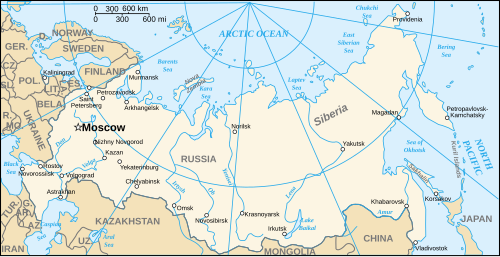 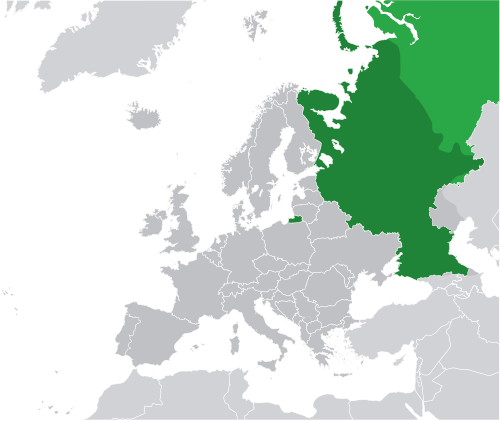 | |
| 資本 そして最大の都市 | モスクワ 55°45′21″N 37°37′02″E / 55.75583°N 37.61722°E / 55.75583; 37.61722 |
| 公用語および国語 | ロシア語[3] |
| 認められた地域言語 | 35の地域公用語[4] |
| 民族グループ (2021年;ロシアとクリミアを含む)[5] | |
| 宗教 (2024年)[6] [7] | |
| 異名 | ロシア |
| 政府 | 権威主義的[10] [11]独裁政権[12] [13]の下にある連邦半大統領制共和国[9] |
• 社長 | ウラジミール・プーチン |
• 首相 | ミハイル・ミシュスチン |
| 立法府 | 連邦議会 |
• 上院 | 連邦評議会 |
• 下院 | 国会 |
| 形成 | |
• キエフ大公国 | 882 |
| 1157 | |
• モスクワ公国 | 1282 |
• ロシア帝国 | 1547年1月16日 |
• ロシア帝国 | 1721年11月2日 |
• 君主制の廃止 | 1917年3月15日 |
• ソビエト連邦 | 1922年12月30日 |
| 1990年6月12日 | |
• ロシア連邦 | 1991年12月12日 |
• 現憲法 | 1993年12月12日 |
• 連合国家が成立 | 1999年12月8日 |
| エリア | |
• 合計 | 17,098,246 km 2 (6,601,670 平方マイル) [15] (国際的に認められた国境内) |
• 水 (%) | 13 [14](沼地を含む) |
| 人口 | |
• 2024年の推定 |
|
• 密度 | 8.4/km 2 (21.8/平方マイル) ( 187位) |
| GDP (購買力平価) | 2024年推定 |
• 合計 |  5兆4,730億ドル[18](6位) 5兆4,730億ドル[18](6位) |
• 一人当たり | 38,292ドル[18] ( 60位) |
| GDP (名目) | 2024年推定 |
• 合計 | 2兆5700億ドル[18](11位) |
• 一人当たり | 14,391ドル[18] ( 65位) |
| ジーニ (2020) |  36.0 [19] 36.0 [19]中程度の不平等 |
| HDI (2022) | 0.821 [20]非常に高い (56位) |
| 通貨 | ルーブル( ₽ ) ( RUB ) |
| タイムゾーン | UTC +2から+12 |
| ドライブを続ける | 右 |
| 呼び出しコード | +7 |
| ISO 3166 コード | ロシア |
| インターネットTLD | |


ロシア[ b]またはロシア連邦[c]は、東ヨーロッパと北アジアにまたがる国です。面積では世界最大の国で、 11のタイムゾーンにまたがり、14か国と国境を接しています。[d]世界で9番目に人口が多く、ヨーロッパで最も人口の多い国です。ロシアは高度に都市化された国で、100万人を超える住民が住む人口密集地が16か所あります。首都で最大の都市はモスクワです。サンクトペテルブルクはロシアで2番目に大きな都市で、文化の中心地です。
東スラヴ人は、3世紀から8世紀の間にヨーロッパで認知された集団として現れた。最初の東スラヴ国家であるキエフ・ルーシは9世紀に興り、988年にビザンチン帝国から正教を採用した。キエフ・ルーシは最終的に崩壊し、モスクワ大公国がロシア領土の統一を主導し、1547年にロシア・ツァーリ国が宣言された。18世紀初頭までに、ロシアは征服、併合、ロシア人探検家の努力により大幅に拡大し、ロシア帝国へと発展した。ロシア帝国は現在でも史上3番目に大きな帝国である。しかし、 1917年のロシア革命でロシアの君主制は廃止され、最終的に世界初の立憲社会主義国家であるロシア連邦社会主義共和国に取って代わられた。ロシア内戦後、ロシアSFSRは他の3つのソビエト共和国とともにソビエト連邦を樹立し、その中で最大かつ主要な構成国となった。ソビエト連邦は、何百万人もの命を犠牲にして1930年代に急速な工業化を遂げ、その後、東部戦線で大規模な取り組みを主導することにより、第二次世界大戦で連合国のために決定的な役割を果たした。冷戦の始まりとともに、ソビエト連邦はイデオロギー的優位性と国際的影響力をめぐって米国と競争した。20世紀のソビエト時代には、人類初の人工衛星や人類初の宇宙探査など、ロシアの最も重要な技術的成果のいくつかが達成された。
1991年、ソ連の崩壊によりロシアSFSRがロシア連邦として誕生した。連邦制の半大統領制を確立した新しい憲法が採択された。世紀の変わり目以降、ロシアの政治体制はウラジーミル・プーチンによって支配され、彼の下で国は民主主義の後退と権威主義への転換を経験してきた。ロシアは、 2008年のジョージアとの戦争や2014年以降のウクライナとの戦争など、旧ソ連諸国やその他の国での多くの紛争に軍事的に関与してきた。ウクライナとの戦争では、2014年にクリミアを含むウクライナ領土の国際的に承認されていない併合が、 2022年には進行中の侵略中に他の4つの地域が併合された。
ロシアは国連安全保障理事会の常任理事国であり、G20、SCO、BRICS、APEC、OSCE、WTOの加盟国であり、旧ソ連組織の主要メンバー国でもある。ロシアは最大の核兵器備蓄を保有し、軍事費は第3位である。ロシアは一般的に大国とみなされており、地域大国でもある。国際的には、ロシアは民主主義、人権、報道の自由の尺度で非常に低い順位にランクされており、腐敗のレベルも高いと認識されている。2024年現在、ロシアは名目GDPで世界第11位、購買力平価で第6位の高所得経済を誇っており、その膨大な鉱物・エネルギー資源に依存しており、石油生産量と天然ガス生産量は世界第2位である。ロシアには30のユネスコ世界遺産がある。
語源
オックスフォード英語辞典によると、英語名の「ロシア」は14世紀に初めて登場し、中世ラテン語の「Russia」から借用された。「Russia」は11世紀に使用され、12世紀の英国の資料で頻繁に使用されており、さらに「ロシア人」を意味する「Russi」と接尾辞「-ia」に由来している。[22] [23]現代の歴史学では、この国は通常、首都にちなんでキエフ・ルーシと表記される。 [24]中世ラテン語での「Rus」の別名は「Ruthenia」であった。[25]
ロシア語で、現在の国名であるРоссия ( Rossiya )は、ビザンチンギリシャ語のRus' ( Rosía )に由来しています。[26] Rus'の新しい形であるРосия ( Rosiya )は、ギリシャ語からの借用であり、1387年に初めて確認されました。[27] [検証に失敗] Rossiiaという名前は15世紀後半にロシアの資料に登場しましたが、17世紀末まで、この国は住民によってRus '、ロシアの地 ( Russkaia zemlia )、モスクワ国家 ( Moskovskoe gosudarstvo )などと呼ばれていました。[28] [29] [30] 1721年、ピョートル大帝は国家の名前をロシア皇帝国(ロシア語: Русское царство、ローマ字表記: Russkoye tsarstvo)またはモスクワツァルダム(ロシア語: Московское царство、ローマ字表記: skoye tsarstvo ) [31] [32]からロシア帝国( Rossiiskaia imperiia )へ。[28] [30]
ロシア語には英語で「ロシア人」と訳される単語がいくつかある。名詞および形容詞русский、russkiyは民族的ロシア人を指す。形容詞российский、rossiiskiyは民族に関係なくロシア国民を表す。同じことは、より最近造られた名詞россиянин、rossiianyn(ロシア国家の国民という意味での「ロシア人」)にも当てはまる。[29] [33]
原初年代記によると、ルーシという言葉は、スウェーデンの部族であるルーシ人から派生したもので、リューリク朝の最初の3人の出身地です。[34] フィンランド語でスウェーデン人を意味するruotsiも同じ語源です。[35] その後の考古学的研究で、この説はほぼ裏付けられました。[36] [より良い情報源が必要]
歴史
初期の歴史
ロシアにおける最初の人類の居住地は、前期旧石器時代のオルドワン石器時代に遡る。約200万年前、ホモ・エレクトスの代表がロシア南部のタマン半島に移住した。 [37]約150万年前のフリント石器が北コーカサスで発見されている。[38]アルタイ山脈のデニソワ洞窟で発見された放射性炭素年代測定標本によると、最古のデニソワ人の標本は195~122,700年前に生息していたと推定されている。 [39]約9万年前に生息していた、ネアンデルタール人とデニソワ人の混血であるデニーの化石も、後者の洞窟で発見された。[40]ロシアには、約45,000年前の最後のネアンデルタール人の生存者がおり、メズマイスカヤ洞窟で発見された。[41]
ロシアにおける初期現代人の痕跡は、西シベリアで45,000年前に遡る。[42]少なくとも40,000年前の解剖学的に現代人の文化遺跡が、ロシア西部のコスチョンキ・ボルシチョヴォ[43]とスンギルで高密度に発見され、34,600年前のものである。[44]人類は少なくとも40,000年前にマモントヴァヤ・クリャで北極圏ロシアに到達した。[45]マルタ・ビュレト文化やアフォントヴァ・ゴラと遺伝的に類似したシベリアの古代北ユーラシア人は、古代アメリカ先住民や東部狩猟採集民の重要な遺伝的貢献者であった。[46]

クルガン仮説は、ロシア南部とウクライナのヴォルガ・ドニエプル川流域を原インド・ヨーロッパ人の祖先としている。[48]ウクライナとロシアのポントス・カスピ海ステップからの初期のインド・ヨーロッパ人の移住により、ヤムナヤ語族とインド・ヨーロッパ語族の言語がユーラシア大陸の大部分に広まった。[49] [50]銅器時代からポントス・カスピ海ステップで遊牧民が発達した。[51]これらのステップ文明の名残はイパトヴォ、[51]シンタシュタ、[52]アルカイム、[53]パジリク[54]などの場所で発見されており、戦争で馬が使用された最古の痕跡が残っている。[52]北ヨーロッパのウラル語族の話者の遺伝子構成は、少なくとも3,500年前に始まったシベリアからの移住によって形成されました。 [55]
3世紀から4世紀にかけて、ゴート王国オイウムが南ロシアに存在したが、後にフン族に征服された。3世紀から6世紀にかけて、ギリシャ植民地を引き継いだヘレニズム国家ボスポラス王国[56]も、フン族やユーラシアのアヴァール人などの好戦的な部族が率いる遊牧民の侵略に圧倒された。[57]トルコ系であるハザール人は、10世紀まで、南はコーカサスから東はヴォルガ川流域、西はドニエプル川沿いのキエフまでのステップ地帯を支配していた。[58]彼らの後を継いだペチェネグ人が大きな連合を形成したが、その後クマン人とキプチャク人がこれを奪った。[59]
ロシア人の祖先は、約 1500 年前にヨーロッパ北東部に現れた原インド・ヨーロッパ人から分かれたスラヴ民族の中にいる。 [60]東スラヴ人は、2つの波に分かれて徐々にロシア西部(現在のモスクワとサンクトペテルブルクの間)に定住した。1つはキエフから現在のスーズダリとムロム方面に、もう1つはポロツクからノヴゴロドとロストフ方面に移住した。[61]スラヴ人の移住以前は、その地域にはフィン・ウゴル人が住んでいた。7世紀以降、入ってきた東スラヴ人はゆっくりと先住民のフィン・ウゴル人を同化させていった。[62] [63]
キエフ大公国
.png/500px-Kievan-rus-1015-1113-(en).png)
9世紀に最初の東スラヴ諸国が成立した時期は、東バルト海から黒海、カスピ海に至る水路に沿って冒険したヴァイキング、ヴァリャーグ人の到来と時を同じくした。原初年代記によると、ルーシ人出身のヴァリャーグ人リューリクが862年にノヴゴロドの統治者に選ばれた。 882年、彼の後継者オレグは南下し、それまでハザール人に貢物を納めていたキエフを征服した。[62]リューリクの息子イーゴリとイーゴリの息子スヴャトスラフはその後、地元の東スラヴ諸部族を全てキエフの支配下に置き、ハザール・カガン国を滅ぼし、[64]ビザンツ帝国とペルシアへの軍事遠征を数回行った。[65] [66]
10世紀から11世紀にかけて、キエフ・ルーシはヨーロッパで最大かつ最も繁栄した国家の一つとなった。ウラジーミル大王(980年 - 1015年)と息子のヤロスラフ賢王(1019年 - 1054年)の治世はキエフの黄金時代を構成し、ビザンツ帝国から正教が受け入れられ、東スラヴ語で最初の法典であるルーシ・プラウダが作成された。[62]封建制と地方分権の時代が到来し、キエフ・ルーシを集団的に統治するリューリク朝のメンバー間の絶え間ない内紛が特徴的であった。キエフの支配力は衰え、北東部のウラジーミル・スーズダリ、北部のノヴゴロド共和国、南西部のガリツィア・ヴォルィーニが有利となった。 [62] 12世紀までにキエフは優位性を失い、キエフ・ルーシはさまざまな公国に分裂した。[67]アンドレイ・ボゴリュプスキー公は1169年にキエフを略奪し、ウラジミールを拠点とし、[67]政治権力は北東に移った。[62]
アレクサンドル・ネフスキー公の指揮の下、ノヴゴロド人は1240年のネヴァ川の戦いで侵略してきたスウェーデン軍を撃退し、[68] 1242年の氷上の戦いではゲルマン十字軍を撃退した。 [69]
キエフ・ルーシは1237年から1240年にかけてのモンゴルの侵攻によって最終的に陥落し、キエフやその他の都市が略奪され、住民の大部分が死亡した。[62]後にタタール人として知られるようになった侵略者は、ジョチ・ウルスという国家を形成し、その後2世紀にわたってロシアを支配した。[70]ノヴゴロド共和国だけが、モンゴルに貢物を納めることに同意した後、外国の占領を免れた。[62]ガリツィア・ヴォルィーニは後にリトアニアとポーランドに吸収されたが、ノヴゴロド共和国は北部で繁栄を続けた。北東部では、キエフ・ルーシのビザンチン・スラヴの伝統がロシアの独裁国家の形成に取り入れられた。[62]
モスクワ大公国

キエフ・ルーシの崩壊により、当初はウラジーミル・スーズダリの一部であったモスクワ大公国が最終的に台頭した。[71] : 11–20 モスクワは、まだモンゴル・タタール人の支配下にあり、彼らの共謀のもとで、14世紀初頭にこの地域で影響力を主張し始め、[72]徐々に「ロシアの領土の集約」の主導的な勢力になっていった。[73] [74] 1325年にロシア正教会の大主教の所在地がモスクワに移ると、その影響力は増大した。 [75]モスクワの最後のライバルであるノヴゴロド共和国は、毛皮貿易の主要中心地およびハンザ同盟の最東端の港として繁栄した。[76]
1380年、モスクワ公ドミトリー・ドンスコイ率いるロシア諸公国の連合軍はクリコヴォの戦いでモンゴル・タタール軍に画期的な敗北を喫した。 [62]モスクワは徐々にその親公国と周囲の諸公国を吸収し、その中にはかつて強力なライバルであったトヴェリやノヴゴロドも含まれていた。[73]
イヴァン3世(「大王」)はキプチャク・ウルスの支配を捨て、北ルーシ全土をモスクワの支配下に置き、「全ルーシ大公」の称号を得た最初のロシアの支配者となった。1453年にコンスタンティノープルが陥落した後、モスクワは東ローマ帝国の遺産の継承を主張した。イヴァン3世は最後のビザンチン皇帝コンスタンティノス11世の姪であるソフィア・パレオロギナと結婚し、ビザンチンの双頭の鷲を自身の紋章とし、最終的にはロシアの紋章とした。[73]ワシリー3世は16世紀初頭に最後の独立ロシア国家を併合してロシア全土を統一した。 [77]
ロシア帝国
.jpg/500px-Ivan_IV_by_anonim_(18th_c.,_GIM).jpg)
第三ローマの思想の発展の中で、大公イヴァン4世(「雷帝」)は1547年にロシアの最初の皇帝として正式に戴冠した。皇帝は新しい法典(1550年のスデブニク)を公布し、ロシア初の封建制代表機関(ゼムスキー・ソボル)を設立し、軍隊を刷新し、聖職者の影響力を抑制し、地方政府を再編した。[ 73]長い治世の間に、イヴァンは3つのタタール・ハン国、ヴォルガ川沿いのカザンとアストラハン、[78]シベリア南西部のシビル・ハン国を併合することで、すでに広大だったロシアの領土をほぼ2倍に拡大した。最終的に、16世紀末までにロシアはウラル山脈の東にまで拡大した。[79]しかし、ポーランド王国、リトアニア大公国(後のポーランド・リトアニア共和国)、スウェーデン王国、デンマーク・ノルウェーの連合国とのバルト海沿岸と海上貿易へのアクセスをめぐるリヴォニア戦争で、長く失敗に終わったロシア帝国の弱体化が進んだ。[ 80 ] 1572年、クリミア・タタール人の侵略軍は、決定的なモロディの戦いで完全に敗北した。[ 81]
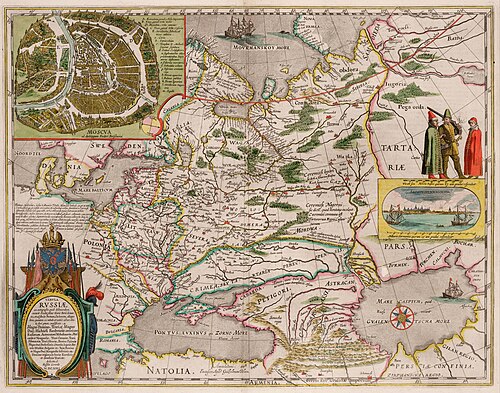
イヴァンの息子たちの死は1598年の古代リューリク朝の終焉を意味し、 1601年から1603年の壊滅的な飢饉と相まって、 17世紀初頭の動乱期における内戦、王位僭称者の支配、そして外国の介入につながった。 [82]ポーランド・リトアニア共和国はこれを機にロシアの一部を占領し、首都モスクワにまで及んだ。[83] 1612年、商人クジマ・ミーニンと公爵ドミトリー・ポジャルスキー率いるロシア義勇軍によってポーランド人は撤退を余儀なくされた。[84]ロマノフ王朝は1613年にゼムスキー・ソボルの決定により王位に就き、国は危機から徐々に回復し始めた。[85]
ロシアは17世紀を通じて領土拡大を続け、コサックの時代となった。[86] 1654年、ウクライナの指導者ボフダン・フメリニツキーは、ウクライナをロシア皇帝アレクセイの保護下に置くことを提案した。アレクセイがこの提案を受け入れたことで、再びロシア・ポーランド戦争が勃発した。最終的に、ウクライナはドニエプル川沿いに分割され、東部(ウクライナ左岸とキエフ)はロシアの支配下となった。[87]東部では、ロシアによる広大なシベリアの急速な探検と植民地化が続き、貴重な毛皮や象牙が求められた。ロシアの探検家たちは主にシベリア河川ルートに沿って東へ進み、17世紀半ばまでに東シベリア、チュクチ半島、アムール川沿い、太平洋沿岸にロシアの居住地が存在した。[86] 1648年、セミョン・デジニョフはベーリング海峡を航行した最初のヨーロッパ人となった。[88]
帝政ロシア

ピョートル大帝の下、ロシアは1721年に帝国を宣言され、ヨーロッパの列強の一つとしての地位を確立した。1682年から1725年まで統治したピョートルは、大北方戦争(1700年 - 1721年)でスウェーデンを破り、ロシアの海へのアクセスと海上貿易を確保した。1703年、ピョートルはバルト海沿岸にサンクトペテルブルクを建設し、ロシアの新しい首都とした。彼の統治下を通じて、抜本的な改革が行われ、ロシアに西ヨーロッパの文化的影響が顕著にもたらされた。[89]彼の後を継いだのはエカチェリーナ1世(1725年 - 1727年)、続いてピョートル2世(1727年 - 1730年)、アンナである。ピョートル1世の娘エリザベートの治世(1741年 - 1762年)には、ロシアは七年戦争(1756年 - 1763年)に参戦した。 [90]しかし、エリザヴェータの死後、これらの征服地はすべて親プロイセン派のロシア皇帝ピョートル3世によってプロイセン王国に返還された。[91]
1762年から1796年までロシアを統治したエカチェリーナ2世(「大帝」)は、ロシア啓蒙時代を主導した。彼女はロシアの政治的支配をポーランド・リトアニア共和国にまで広げ、その領土のほとんどをロシアに併合し、ロシアをヨーロッパで最も人口の多い国にした。[92]南部では、オスマン帝国との露土戦争に勝利した後、エカチェリーナはクリミア・ハン国を解体し、クリミアを併合することで、ロシアの国境を黒海まで拡大した。[93]露ペルシャ戦争を通じてガージャール朝イランに勝利した結果、19世紀前半までにロシアはコーカサスも征服した。[94]エカチェリーナ2世の後継者である息子のパーヴェルは不安定で、主に国内問題に集中していた。[95]エカチェリーナ2世の短い治世の後、その戦略はアレクサンドル1世(1801-1825)の統治によって継続され、1809年には弱体化したスウェーデンからフィンランドを奪取し、 [96] 1812年にはオスマン帝国からベッサラビアを奪取した。 [97]北米では、ロシア人がアラスカに到達して植民地化した最初のヨーロッパ人となった。[98] 1803-1806年には、ロシアによる初の世界一周航海が行われた。[99] 1820年には、ロシアの探検隊が南極大陸を発見した。[100]
社会、科学、芸術の大きな力と発展

ナポレオン戦争の間、ロシアはヨーロッパの様々な列強と同盟を組み、フランスと戦った。ナポレオンの権力が最高潮に達した1812年、フランスはロシアに侵攻しモスクワにまで達したが、頑強な抵抗とロシアの厳しい冬の寒さが相まって侵略軍は惨敗し、汎ヨーロッパの大陸軍は壊滅的な打撃を受けたため、結局は失敗に終わった。ミハイル・クトゥーゾフとミハイル・アンドレアス・バルクレー・ド・トリー率いるロシア帝国軍はナポレオンを追放し、第六次対仏大同盟でヨーロッパ全土を進撃し、最終的にパリに入城した。[101] アレクサンドル1世はウィーン会議でロシア代表団を統率し、これがナポレオン後のヨーロッパの地図を決定づけた。[102]
ナポレオンを追って西ヨーロッパに進出した将校たちは自由主義の思想をロシアに持ち帰り、1825年のデカブリストの反乱で失敗に終わった際に皇帝の権力を縮小しようとした。 [103]ニコライ1世(1825-1855)の保守的な統治の終わりに、ヨーロッパにおけるロシアの権力と影響力の絶頂期はクリミア戦争での敗北によって中断された。[104]
偉大な自由主義改革と資本主義
ニコライの後継者アレクサンドル2世(1855年 - 1881年)は、 1861年の奴隷解放改革を含む、国全体で重要な改革を施行した。[105]これらの改革は産業化を促し、ロシア帝国軍を近代化し、1877年 - 1878年の露土戦争の余波でバルカン半島の多くをオスマン帝国の支配から解放した。[106] 19世紀の大部分から20世紀初頭にかけて、ロシアとイギリスはアフガニスタンとその中央アジアおよび南アジアの隣接地域をめぐって共謀し、2つのヨーロッパ帝国の競争はグレートゲームとして知られるようになった。[107]
19世紀後半、ロシアでは様々な社会主義運動が勃興した。アレクサンドル2世は1881年に革命テロリストによって暗殺された。 [108]彼の息子アレクサンドル3世(1881-1894)の治世は自由主義的ではなかったが、より平和的であった。[109]
立憲君主制と世界大戦
ロシア最後の皇帝ニコライ2世(1894-1917)の治世下、日露戦争の屈辱的な失敗が1905年の革命の引き金となった。[110]蜂起は鎮圧されたが、政府は言論と集会の自由の付与、政党の合法化、選挙で選ばれる立法機関である国家ドゥーマの創設など、大きな改革( 1906年ロシア憲法)を認めざるを得なかった。[111]
革命と内戦

1914年、ロシアはオーストリア=ハンガリー帝国の同盟国セルビアに対する宣戦布告に応じて第一次世界大戦に参戦し、[112]三国協商同盟国から孤立したまま複数の戦線で戦った。[113] 1916年、ロシア帝国軍のブルシーロフ攻勢により、オーストリア=ハンガリー帝国軍はほぼ完全に壊滅した。[114]しかし、戦争費用の高騰、死傷者の多さ、汚職や反逆の噂により、すでに存在していた国民の政権への不信感は深まった。これらすべてが、2つの主要な行為として遂行された1917年のロシア革命の土壌となった。 [115] 1917年初頭、ニコライ2世は退位を余儀なくされ、彼と彼の家族はロシア内戦中に投獄され、後に処刑された。[116]王政は不安定な政党連合に取って代わられ、臨時政府を名乗り、[117]ロシア共和国の成立を宣言した。1918年1月19日(旧暦1月6日)、ロシア制憲議会はロシアを民主的な連邦共和国と宣言した(臨時政府の決定を批准した)。翌日、制憲議会は全ロシア中央執行委員会によって解散された。[115]
ペトログラード・ソビエトという別の社会主義体制が共存し、ソビエトと呼ばれる民主的に選出された労働者と農民の評議会を通じて権力を振るっていた。新しい政権の統治は国の危機を解決するどころか悪化させるばかりで、最終的にはボルシェビキの指導者ウラジーミル・レーニン率いる十月革命によって臨時政府が打倒され、ソビエトに完全な統治権が与えられ、世界初の社会主義国家が誕生した。[115]反共産主義の白軍とボルシェビキとその赤軍との間でロシア内戦が勃発した。[118]第一次世界大戦の中央同盟国との敵対関係を終結させたブレスト=リトフスク条約の調印後、ボルシェビキ・ロシアは西部の領土のほとんどを放棄した。西部には人口の34%、産業の54%、農地の32%、炭鉱の約90%が集中していた。[119]

連合国は反共産主義勢力を支援するために失敗に終わった軍事介入を開始した。 [120]一方、ボルシェビキと白軍は、それぞれ赤色テロと白色テロとして知られる、互いに対する追放と処刑のキャンペーンを実行した。[121]激しい内戦の終わりまでに、ロシアの経済とインフラは大きな損害を受け、戦争中に1000万人もの人々が亡くなり、そのほとんどは民間人であった。[122]数百万人が白軍から亡命し、[123] 1921年から1922年にかけてのロシア飢饉では最大500万人が犠牲になった。[124]
ソビエト連邦
.svg/500px-Soviet_Union_-_Russian_SFSR_(1936).svg.png)
指令経済とソビエト社会
1922年12月30日、レーニンとその側近たちは、ロシアSFSRをベラルーシ共和国、ザカフカース共和国、ウクライナ共和国と統合し、ソビエト連邦を樹立した。[125]最終的には、第二次世界大戦中の国境変更と併合により15の共和国からなる連邦が誕生した。その中で最も規模と人口が大きかったのはロシアSFSRであり、政治的、文化的、経済的に連邦を支配していた。[126]
1924年にレーニンが死去した後、トロイカが指揮をとることになりました。最終的に共産党書記長のヨシフ・スターリンが反対派を全て鎮圧し、権力を掌握して1930年代までに独裁者となりました。[127]世界革命の主唱者レオン・トロツキーは1929年にソ連から追放され、[128]スターリンの一国社会主義の理念が公式路線となりました。[129]ボルシェビキ党内での継続的な内部闘争は大粛清で頂点に達しました。[130]
スターリニズムと近代化
スターリンの指導の下、政府は統制経済、主に農村地帯の工業化、農業の集団化を開始した。この急速な経済的、社会的変化の時期に、スターリンの支配に反対した疑い、あるいは実際に反対した政治犯を含む何百万人もの人々が労働収容所に送られた。 [131]また何百万人もの人々がソ連の僻地に追放され、流刑にされた。 [132]過渡期の農業の混乱は、厳しい国家政策と干ばつと相まって、[133] 1932年から1933年のソ連飢饉を引き起こし、570万人[134]から870万人が死亡し、そのうち330万人はロシアSFSRで死亡した。[135]ソ連は最終的に、短期間で主に農業経済から主要な工業大国へと多大な費用をかけて変革を遂げた。[136]
第二次世界大戦と国連


ソ連は1939年9月17日、ナチスドイツとのモロトフ・リッベントロップ協定内の秘密議定書に従ってポーランドに侵攻し[137]、第二次世界大戦に参戦した。[138]その後、ソ連はフィンランドに侵攻し[ 139]、バルト諸国を占領・併合し[140]、ルーマニアの一部を併合した。[141] : 91–95 1941年6月22日、ドイツはソ連に侵攻し[142]、第二次世界大戦最大の戦場である東部戦線が始まった。 [143] : 7
最終的に、約500万人の赤軍兵士がナチスに捕らえられた。[144] : 272 ナチスは「飢餓計画」によって東部戦線の基本計画を遂行しようとし、 330万人のソ連軍捕虜と膨大な数の民間人を故意に餓死させるか殺害した。[145] : 175–186 ドイツ国防軍は当初かなりの成功を収めたものの、モスクワの戦いで攻撃は阻止された。[146]その後、ドイツ軍は1942年から1943年の冬のスターリングラード攻防戦でまず大敗し、 [147]続いて1943年の夏のクルスク攻防戦でも大敗した。 [148]ドイツのもう一つの失敗はレニングラード包囲戦で、1941年から1944年にかけてドイツ軍とフィンランド軍によって陸上で完全に封鎖され、飢餓と100万人以上の死者を出したが、降伏することはなかった。[149]ソ連軍は1944年から1945年にかけて東ヨーロッパと中央ヨーロッパを圧倒し、1945年5月にベルリンを占領した。 [150] 1945年8月、赤軍は満州に侵攻し、日本軍を北東アジアから駆逐し、連合国の対日勝利に貢献した。[151]
1941年から1945年までの第二次世界大戦は、ロシアでは大祖国戦争として知られている。[152]ソ連は、米国、英国、中国とともに第二次世界大戦の連合国四大国とみなされ、後に国連安全保障理事会の基盤となった四警察官となった。[153] : 27 戦争中、ソ連の民間人と軍人の死者は約2,600万から2,700万人で、[154]第二次世界大戦の死傷者の約半数を占めた。[155] : 295 ソ連の経済とインフラは甚大な被害を受け、1946年から1947年のソ連飢饉を引き起こした。[156]しかし、大きな犠牲を払って、ソ連は世界的な超大国として台頭した。[157]
超大国と冷戦
_(B&W).jpg/500px-Yalta_Conference_(Churchill,_Roosevelt,_Stalin)_(B&W).jpg)
第二次世界大戦後、ポツダム会談によれば、赤軍は東ドイツやオーストリア東部を含む東ヨーロッパと中央ヨーロッパの一部を占領した。[158]東側諸国の衛星国には従属的な共産主義政府が樹立された。 [159]ソ連は世界第2の核保有国となった後、[160]ワルシャワ条約機構を結成し、[161]ライバル関係にある米国とNATOとの間で冷戦として知られる世界覇権争いに突入した。[162]
フルシチョフの雪解け改革と経済発展
1953年にスターリンが死去し、短期間の集団統治が続いた後、新指導者ニキータ・フルシチョフはスターリンを非難し、脱スターリン主義政策を開始し、多くの政治犯を強制収容所から釈放した。 [ 163]抑圧政策の全般的な緩和は、後にフルシチョフの雪解けとして知られるようになった。[164]同時に、トルコへの米国のジュピターミサイルとキューバへのソ連のミサイルの配備をめぐって両国が衝突し、冷戦の緊張が最高潮に達した。[165]
1957年、ソ連は世界初の人工衛星スプートニク1号を打ち上げ、宇宙時代が始まった。[166]ロシアの宇宙飛行士 ユーリ・ガガーリンは、 1961年4月12日にボストーク1号の有人宇宙船に乗って地球を周回した最初の人間となった。[167]
社会主義が発達した時代、あるいは停滞の時代
1964年にフルシチョフが追放された後、再び集団統治の時代が続き、レオニード・ブレジネフが指導者となった。1970年代から1980年代初頭は、後に停滞の時代と呼ばれるようになった。1965年のコスイギン改革は、ソ連経済の部分的な地方分権化を目指したものだった。[168] 1979年、アフガニスタンで共産主義主導の革命が起こった後、ソ連軍が侵攻し、最終的にソ連・アフガニスタン戦争が始まった。[169] 1988年5月、ソ連は国際社会の反対、反ソゲリラ戦の継続、ソ連国民の支持の欠如により、アフガニスタンから撤退し始めた。 [170]
ペレストロイカ、民主化、そしてロシアの主権

1985年以降、ソ連体制に自由主義的改革をもたらそうとした最後のソ連指導者ミハイル・ゴルバチョフは、経済停滞の時代を終わらせ、政府を民主化するためにグラスノスチ(情報公開)とペレストロイカ(構造改革)の政策を導入した。[171]しかし、これは国中で強力な民族主義と分離主義運動の台頭をもたらした。[172] 1991年以前、ソ連経済は世界第2位であったが、その末期に危機に陥った。[173]
1991年までに、バルト諸国がソ連からの離脱を選択し、経済的および政治的混乱が沸騰し始めた。 [174] 3月17日、国民投票が行われ、参加した市民の大多数がソ連を新たな連邦制に変更することに賛成票を投じた。[175] 1991年6月、ボリス・エリツィンはロシアSFSRの大統領に選出され、ロシア史上初の直接選挙で選ばれた大統領となった。 [176] 1991年8月、ゴルバチョフ政権のメンバーによる、ゴルバチョフに向けられソ連の存続を狙ったクーデター未遂事件は、ソ連共産党の終焉を招いた。[177] 1991年12月25日、ソ連の崩壊に伴い、現在のロシアとともに、14の旧ソ連国が誕生した。[178]
ロシア連邦の独立
市場経済への移行と政治危機

ソ連の経済的、政治的崩壊は、ロシアを深刻で長期にわたる不況に陥れた。ソ連崩壊中および崩壊後には、民営化、市場および貿易の自由化など、幅広い改革が実施され、その中には「ショック療法」に沿った急進的な改革も含まれていた。[179]民営化により、企業の管理権は主に政府機関から政府内部のコネを持つ個人に移り、ロシアの寡頭政治家の台頭を招いた。[180]新興富裕層の多くは、巨額の資本逃避により、何十億ドルもの現金と資産を国外に移した。[181]経済不況は社会サービスの崩壊を招き、出生率は急落し、死亡率は急上昇し、[182] [183] 何百万人もの人々が貧困に陥った。[184]一方、極度の汚職、[185]および犯罪組織や組織犯罪が大幅に増加した。[186]
1993年後半、エリツィンとロシア議会の間の緊張が憲法危機にまで達し、軍事力による暴力で終結した。危機の間、エリツィンは西側諸国の政府に支援され、100人以上が殺害された。[187]
近代自由主義憲法、国際協力、経済の安定
12月には国民投票が行われ、承認され、大統領に多大な権限を与える新憲法が導入された。[188] 1990年代は北コーカサスで武力紛争に悩まされ、地元の民族間の小競り合いと分離主義イスラム教徒の反乱の両方が起こった。[189] 1990年代初頭にチェチェンの分離主義者が独立を宣言して以来、反乱グループとロシア軍の間で断続的なゲリラ戦が繰り広げられた。 [190]チェチェンの分離主義者による 民間人へのテロ攻撃により、何千人ものロシア民間人が死亡した。[e] [191]
ソ連の崩壊後、ロシアはソ連の対外債務の返済責任を引き受けた。[192] 1992年には消費者物価統制のほとんどが撤廃され、極端なインフレとルーブルの大幅な下落を引き起こした。[193]高い財政赤字と資本逃避の増加、債務返済不能が相まって1998年のロシア金融危機を引き起こし、GDPのさらなる低下を招いた。[194]
近代化経済、政治の中央集権化、民主主義の後退への動き
1999年12月31日、エリツィン大統領は突然辞任し[195] 、その職を最近首相に任命され、後継者として選ばれたウラジミール・プーチンに譲った。[196]その後、プーチンは2000年の大統領選挙で勝利し[197]、第二次チェチェン戦争でチェチェンの反乱軍を打ち破った。[198]
プーチンは2004年に2期目の大統領に当選した。 [199] 原油価格の高騰と外国投資の増加により、ロシア経済と生活水準は大幅に向上した。[200]プーチンの統治は安定性を増す一方で、ロシアを独裁国家へと変貌させた。[201] 2008年、プーチンは首相に就任し、ドミトリー・メドベージェフは1期大統領に選出され、法定任期制限にもかかわらず権力を維持した。[202]この期間は「タンデモクラシー」と呼ばれている。[203]

隣国ジョージアとの外交危機の後、 2008年8月1日から12日にかけてロシア・ジョージア戦争が起こり、ロシアはジョージアの占領地域に2つの分離主義国家を承認した。[204]これは21世紀初のヨーロッパ戦争であった。 [205]
ウクライナ侵攻
2014年初頭、ウクライナで親欧米派の革命が起こり、ロシア占領下でクリミアの地位をめぐる住民投票が議論を呼んだ後、ロシアは隣国ウクライナからクリミアを併合した。 [206] [207]この併合により、ウクライナのドンバス地方で反乱が発生し、ロシアはウクライナに対する宣戦布告なしの戦争の一環として軍事介入した。[208]ロシアの傭兵と軍隊は、地元の分離主義民兵の支援を受けて、ロシア政府が同地域で反政府・親ロシア派の抗議活動を煽った後、新ウクライナ政府に対してウクライナ東部で戦争を仕掛けたが、[209]ほとんどの住民はウクライナからの分離に反対していた。[210] [211]
紛争の大幅なエスカレーションとして、ロシアは2022年2月24日にウクライナへの全面侵攻を開始した。 [212]この侵攻は、第二次世界大戦以来、ヨーロッパで最大の通常戦争となり、 [213]国際的な非難を浴び、[214]ロシアに対する制裁が拡大された。[ 215]
_14.jpg/500px-Meeting_with_military_district_commanders_(2024-05-15)_14.jpg)
その結果、ロシアは3月に欧州評議会から追放され、[216] 4月には国連人権理事会から資格停止となった。 [217] 9月、ウクライナの反撃が成功したことを受けて、[218]プーチン大統領は「部分的動員」を発表したが、これはバルバロッサ作戦以来のロシアの動員であった。[219] 9月末までにプーチン大統領はウクライナの4つの地域の併合を宣言したが、これは第二次世界大戦以来、ヨーロッパで最大の併合であった。[220]プーチン大統領とロシアが任命した指導者たちは、ロシア軍が4つの地域のいずれも完全に占領することができなかったにもかかわらず、国際的に承認されておらず、広く違法であると非難されている加盟条約に署名した。 [220]多くの超国家議会と国内議会は、ロシアをテロ支援国家と宣言する決議を可決した。[221]さらに、ロシアはラトビア、リトアニア、エストニアからテロ国家と宣言された。[222]侵攻の結果、数十万人が死亡または負傷したと推定されている。 [223] [224]ウクライナ戦争はロシアの人口危機をさらに悪化させた。[225]
2023年6月、ウクライナでロシアのために戦っている民間軍事請負業者であるワグナーグループは、ロシア国防省に対して公然と反乱を宣言し、ロストフ・ナ・ドヌを占領した後、モスクワへの進軍を開始した。しかし、ワグナーとベラルーシ政府との交渉の後、反乱は中止された。[226] [227]反乱の指導者であるエフゲニー・プリゴジンは、後に飛行機事故で死亡した。[228]
地理

ロシアの広大な陸地は、ヨーロッパの最東端とアジアの最北端に広がっている。[229]ロシアはユーラシア大陸の最北端にまたがり、世界で4番目に長い海岸線を持ち、その長さは37,653 km (23,396 mi) を超えている。[f] [231]ロシアは北緯41度から82度、東経19度から西経169度の間に位置し、東西に約9,000 km (5,600 mi)、南北に2,500~4,000 km (1,600~2,500 mi) 広がっている。[232]ロシアの陸地面積は3つの大陸よりも大きく[g] 、冥王星と同じ表面積を持っている。[233]
ロシアには9つの主要な山脈があり、最南端の地域に沿って存在し、コーカサス山脈(エルブルス山は標高5,642メートルでロシアとヨーロッパの最高峰である)[9] 、シベリアのアルタイ山脈とサヤン山脈、ロシア極東の東シベリア山脈とカムチャッカ半島(ユーラシア大陸最高峰の活火山であるクリュチェフスカヤ火山は標高4,750メートルでロシア極東を貫く)の大部分を占めている。[234] [235]国西部を南北に走るウラル山脈は鉱物資源が豊富で、伝統的にヨーロッパとアジアの境界を形成している。[236]ロシアとヨーロッパの最低地点はカスピ海の先端にあり、カスピ海低地は海面下約29メートル(95.1フィート)に達します。[237]
ロシアは、世界で3つの大洋に面する3つの国のうちの1つであり、[229]多数の海とつながっている。[h] [238]主な島や群島には、ノヴァヤゼムリャ、フランツヨシファ諸島、セヴェルナヤゼムリャ、新シベリア諸島、ウランゲリ島、千島列島(このうち4つは日本と領有権を争っている)、サハリンなどがある。[239] [240]ロシアと米国が管理するディオメード諸島はわずか3.8 km(2.4マイル)離れている。[ 241 ]千島列島の国後島は、日本の北海道からわずか20 km(12.4マイル)である。[2]
10万以上の河川があるロシア[229]は、世界最大級の表層水資源を有し、湖には世界の液体の淡水の約4分の1が含まれている。[235]ロシアの淡水域の中で最大かつ最も有名な バイカル湖は、世界で最も深く、最も純粋で、最も古く、最も容量の大きい淡水湖であり、世界の淡水表層水の5分の1以上を含んでいる。[242] ロシア北西部のラドガ湖とオネガ湖は、ヨーロッパ最大の湖である。[229]ロシアは、再生可能な水資源の総量ではブラジルに次いで2番目に大きい。[243]ロシア西部のヴォルガ川は、ロシアの国河として広くみなされており、ヨーロッパ最長の川であり、大陸最大の河川デルタであるヴォルガ・デルタを形成している。 [244]シベリアのオビ川、エニセイ川、レナ川、アムール川は世界最長の川の一つです。[245]
気候

ロシアは国土が広く、多くの地域が海から遠く離れているため、ツンドラと南西部を除くほとんどの地域で湿潤大陸性気候が優勢となっている。南部と東部の山脈がインド洋と太平洋からの暖かい気団の流れを遮る一方で、西部と北部に広がるヨーロッパ平原は大西洋と北極海の影響を受けやすい。[246]ロシア北西部とシベリアの大部分は亜北極気候で、北東シベリアの内陸部(主に北極寒地があり、最低気温が−71.2℃または−96.2℉に達するサハ)の冬は非常に厳しく、 [239]その他の地域では冬は比較的穏やかである。ロシアの北極海に沿った広大な海岸線とロシア北極諸島は極地気候である。[246]
黒海沿岸のクラスノダール地方、特にソチと、北コーカサスの沿岸部と内陸部の一部は、温暖で雨の多い冬が特徴の湿潤亜熱帯気候である。 [246]東シベリアとロシア極東の多くの地域では、冬は夏に比べて乾燥しているが、他の地域では季節を通じて降水量がより均一である。冬の降水は、国のほとんどの地域で通常、雪となる。カリーニングラード州の最西端とクラスノダール地方の南部の一部、および北コーカサスは海洋性気候である。[246]ヴォルガ川下流とカスピ海沿岸の地域、およびシベリアの最南端の一部は、半乾燥気候である。[247]
領土の大部分では、冬と夏の2つの季節しかなく、春と秋は通常短い。[246]最も寒い月は1月(海岸沿いでは2月)で、最も暖かい月は通常7月です。気温の変動が大きいのが典型的です。冬は南から北、西から東にかけて気温が下がります。夏はシベリアでもかなり暑くなることがあります。[248] ロシアの気候変動により、山火事がより頻繁に発生し、[249]国土の広大な永久凍土が解けています。[250]
生物多様性

ロシアは、その巨大な国土のため、極地砂漠、ツンドラ、森林ツンドラ、タイガ、混交林と広葉樹林、森林ステップ、ステップ、半砂漠、亜熱帯など、多様な生態系を持っています。[251]ロシアの領土の約半分は森林で、[9]世界最大の森林面積を誇り、[252]世界でも最も大量の二酸化炭素を隔離しています。[252] [253]
ロシアの生物多様性には、維管束植物12,500種、コケ植物2,200種、地衣類約3,000種、藻類7,000~9,000種、菌類20,000~25,000種が含まれる。ロシアの動物相は、哺乳類320種、鳥類732種以上、爬虫類75種、両生類約30種、淡水魚(高度固有種) 343種、海水魚約1,500種、円口類9種、無脊椎動物(高度固有種)約100~150,000種で構成される。[251] [254]約1,100種の希少種および絶滅危惧種の動植物がロシアのレッドデータブックに掲載されている。[251]
ロシアの完全に自然な生態系は、様々なステータスの特別保護自然地域約15,000か所で保全されており、国土の総面積の10%以上を占めています。[251]これらには、45の生物圏保護区、[255] 64の国立公園、101の自然保護区が含まれます。[256]衰退しているものの、ロシアには依然として手つかずの森林と見なされている生態系が数多く残っており、主に北部のタイガ地域とシベリアの亜北極ツンドラに広がっています。[257]ロシアの森林景観完全性指数の平均スコアは2019年に9.02で、172か国中10位、世界の主要国の中で第1位でした。[258]
政府と政治

ロシアは憲法上、大統領が国家元首であり[ 259]、首相が政府の長である[9]対称的な連邦共和国である。多党制の代表制民主主義として構造化されており、連邦政府は3つの部門から構成されている。[260]
- 立法:ロシア連邦議会は二院制 で、450名の国家院と170名の連邦評議会で構成され、[260]連邦法の採択、宣戦布告、条約の承認、財政権、大統領弾劾権を有する。[261]
- 行政:大統領は軍の最高司令官であり、ロシア政府(内閣)とその他の役員を任命し、連邦法と政策を管理・施行する。[259]大統領は、憲法や連邦法に反しない限り、無制限の範囲の法令を発布することができる。 [262]
- 司法:憲法裁判所、最高裁判所、下級連邦裁判所の裁判官は大統領の推薦に基づいて連邦評議会によって任命され、[260]法律を解釈し、違憲とみなされる法律を覆すことができる。[263]
大統領は国民投票で選出され、任期は6年で、再選は2回までである。[264] [i]政府の省庁は首相と副首相、大臣、その他の選ばれた個人で構成され、全員は首相の推薦に基づいて大統領によって任命される(首相の任命には国会の同意が必要である)。統一ロシアはロシアの支配 政党であり、「ビッグテント」や「権力の党」と評されている。[266] [267]ウラジミール・プーチン政権下で、ロシアは民主主義の後退を経験し、[268] [269]権威主義的独裁国家と評されている。[11] [12] [270]プーチンの政策は一般にプーチニズムと呼ばれている。[271]
政治的分裂
ロシアは、1993年の憲法により、対称的(非対称構成の可能性あり)な連邦制となっている。ソ連の非対称型ロシア連邦社会主義共和国(RSFSR)とは異なり、共和国のみが「連邦の構成主体」であったが、現在の憲法は他の地域の地位を共和国のレベルに引き上げ、すべての地域を「連邦の構成主体」という称号で平等にした。ロシアの各地域には権限が留保されているが、どの地域も主権を持たず、主権国家の地位を持たず、憲法で主権を明示する権利も、国から離脱する権利もない。各地域の法律は連邦法と矛盾することはできない。[272]
連邦構成国[j]は連邦議会の上院である連邦評議会において、それぞれ2名の代表を平等に持つ。 [273]しかし、各構成国が持つ自治権の程度は異なる。[274]ロシアの連邦管区は、連邦構成国に対する中央政府の統制を容易にするために、2000年にプーチン大統領によって設立された。[275]当初は7つだったが、現在は8つの連邦管区があり、各管区は大統領によって任命された特使によって率いられている。[276]
,_disputed_Crimea_and_Donbass.svg/500px-Map_of_federal_subjects_of_Russia_(2022),_disputed_Crimea_and_Donbass.svg.png)
外交関係

ロシアは2019年に世界で5番目に大きな外交ネットワークを持っていた。190の国連加盟国、4つの部分的に承認された国、3つの国連オブザーバー国と外交関係を維持しており、144の大使館を構えている。[283]ロシアは国連安全保障理事会の常任理事国5か国のうちの1つである。ロシアは一般的に大国と見なされているが[284] [285] [286]、2022年に始まったウクライナ侵攻で直面した苦戦を受けて、現代の大国としての地位が疑問視されている。 [287] [288]ロシアは旧ソ連の主要構成国としてかつての超大国でもある。 [157]ロシアはG20、OSCE、APECのメンバーである。ロシアはCIS [289]、EAEU [290]、CSTO [291]、SCO [292]、BRICS [ 293]などの組織でも主導的な役割を果たしている。
ロシアは隣国ベラルーシと緊密な関係を維持しており、ベラルーシは両国の超国家連合である連合国家の一部である。 [294]セルビアは歴史的にロシアの緊密な同盟国であり、両国は強い相互文化的、民族的、宗教的親和性を共有している。[295]インドはロシアの軍事装備の最大の顧客であり、両国はソビエト時代以来、強力な戦略的および外交的関係を共有している。 [296]ロシアは地政学的に重要な南コーカサスと中央アジア全体に影響力を及ぼしており、この2つの地域はロシアの「裏庭」と呼ばれている。[297] [298]

ロシアの「非友好国リスト」に載っている国々。このリストには、ウクライナ侵攻に対してロシアに制裁を課した国々が含まれています。
21世紀、ロシアは、地域的優位性と国際的影響力を確保するとともに、政府に対する国内の支持を高めることを目的とした積極的な外交政策を追求してきた。旧ソ連諸国への軍事介入には、2008年のグルジアとの戦争、2014年に始まったウクライナとの戦争などが ある。ロシアはまた、シリア内戦への軍事介入を通じて、中東における影響力の拡大を目指してきた。サイバー戦争や領空侵犯、選挙干渉は、ロシアの権力に対する認識を高めるために利用されてきた。[299]ロシアと隣国ウクライナおよび西側諸国、特に米国、欧州連合、国連、NATOとの関係は、2014年のクリミア併合と2022年の本格侵攻開始以来、崩壊している。[300] [301]ロシアと中国の関係は、共通の政治的利益により、二国間および経済的に大幅に強化されている。[302]トルコとロシアは、複雑な戦略、エネルギー、防衛関係を共有している。[303]ロシアは、戦略的かつ経済的な同盟国であるイランと友好的な関係を維持している。 [304]ロシアはまた、北極圏、[305]アジア太平洋、[306]アフリカ、[307]中東、[308]ラテンアメリカで影響力を拡大しようとますます圧力をかけている。[309]エコノミスト・インテリジェンス・ユニットによると、世界の人口の3分の2は、中国やインドなど、ロシアに中立または傾いている国に住んでいる。[310] [311]
軍隊
.jpg/500px-Sukhoi_Design_Bureau,_054,_Sukhoi_Su-57_(49581303977).jpg)
ロシア軍は陸軍、海軍、航空宇宙軍に分かれており、さらに戦略ミサイル部隊と空挺部隊という2つの独立した部隊がある。[9] 2021年現在[update]、軍には約100万人の現役兵員(世界第5位)と約200万~2000万人の予備役が所属している。[313] [314] 18~27歳の男性は全員、1年間の兵役に徴兵されることが義務付けられている。 [9]
ロシアは核兵器保有国として認められている 5カ国のうちの1つであり、世界最大の核兵器備蓄量を誇り、世界の核兵器の半分以上をロシアが保有している。[315]ロシアは世界で2番目に大きな弾道ミサイル潜水艦隊を保有しており、[316]戦略爆撃機を運用している数少ない3カ国のうちの1つである。[317]ロシアは世界で3番目に高い軍事費を維持しており、2023年にはGDPの約5.9%に相当する1090億ドルを費やしている。[318] 2021年には世界第2位の武器輸出国であり、大規模な完全に国産の防衛産業を持ち、軍事装備のほとんどを独自に生産している。[319]
人権
.jpg/500px-Protest_against_the_invasion_of_Ukraine_(Yekaterinburg,_February_24,_2022).jpg)
ロシアにおける人権侵害は、主要な民主主義団体や人権団体によってますます報告されている。特に、アムネスティ・インターナショナルとヒューマン・ライツ・ウォッチは、ロシアは民主的ではなく、国民に政治的権利や公民権がほとんど認められていないと述べている。[321] [322]
フリーダム・ハウスは2004年以来、世界の自由度調査においてロシアを「自由ではない」国としてランク付けしている。[323]エコノミスト・インテリジェンス・ユニットは2011年以来、民主主義指数でロシアを「権威主義体制」とランク付けしており、2023年には167カ国中144位にランク付けされている。[324]メディアの自由に関しては、国境なき記者団の2022年の報道の自由指数でロシアは180カ国中155位にランク付けされている。[325]ロシア政府は、不正選挙、[ 326]野党政党や抗議活動の弾圧、[327] [328]非政府組織の迫害と独立ジャーナリストの強制的な弾圧と殺害、[329] [330] [331]マスメディアとインターネットの検閲について、反体制派や人権活動家から広く批判されている。[332]
イスラム教徒、特にサラフィー派はロシアで迫害を受けている。[333] [334]北コーカサスでの反乱を鎮圧するため、ロシア当局は民間人の無差別殺害、[335]逮捕、強制失踪、拷問を行ったと非難されている。[336] [337]ダゲスタンでは、一部のサラフィー派が外見を理由とした政府からの嫌がらせに加え、対反乱作戦で自宅を爆破された。[338] [339]ロシアの刑務所にいるチェチェン人とイングーシ人は、他の民族グループよりも虐待を受けていると伝えられている。 [340] 2022年のウクライナ侵攻の間、ロシアは多くのウクライナ人を虐待にさらし、ロシアに強制送還する濾過キャンプを設置しており、このキャンプはチェチェン戦争で使用されたキャンプと比較されている。[341] [342]侵攻開始後、政治的弾圧も強化され、軍隊の信用を失墜させた場合の罰則を定める法律が制定された。 [343]
ロシアは、2020年の同性婚禁止や、ロシアLGBTネットワークなどのLGBT+団体の「外国エージェント」指定など、 LGBTの権利に対するいくつかの制限を導入している。[344] [345]
腐敗
ロシアの政治体制は、泥棒政治[346]、寡頭政治[ 347]、金権政治[348]など様々に表現されてきた。トランスペアレンシー・インターナショナルの2023年腐敗認識指数では、180カ国中141位と、ヨーロッパで最も低い評価を受けた。[ 349 ]ロシアは腐敗の長い歴史があり、重大な問題とみなされている。[350]それは、経済、[351]ビジネス、[352]行政、[353]法執行、[354]医療、[355] [356]教育、[357]軍隊など、さまざまな分野に影響を及ぼしている。[358]
法律と犯罪
ロシアにおける第一かつ基本的な法律はロシア連邦憲法である。ロシア民法やロシア刑法などの法令はロシア法の主要な法源である。[359] [360] [361]
ロシアは、米国に次いで世界第2位の違法武器取引市場を有し、世界組織犯罪指数ではヨーロッパで第1位、世界で第32位にランクされており、刑務所に収容されている人の数が最も多い国の一つです。[362] [363] [364]
経済

ロシアは、 1990年代にソ連の計画モデルから混乱した移行を経て、混合 市場経済となっている。 [366]同国の経済活動の多くは、豊富で多様な天然資源、特に石油と天然ガスに集中している。[367]ロシアは世界銀行によって高所得国に分類されており、[368]名目GDPでは世界第9位、購買力平価では第6位の経済大国である。いくつかの尺度によると、ロシアの経済は購買力平価で世界第4位または第5位である。 [369]サービス部門がGDP全体の約54%を占め、次いで工業部門(33%)が続く一方、農業部門はGDP全体の4%未満で最小である。[370]ロシアの労働力は約7,000万人で、これは世界第8位であり、[371]公式失業率は4.1%と低い。[372]
ロシアは世界第13位の輸出国であり、第21位の輸入国である。[373] [374]ロシアは石油・ガス関連の税収と輸出関税に大きく依存しており、2022年1月のロシア連邦予算収入の45%を占め、[375] 2019年には輸出の最大60%を占めた。[376]ロシアは主要経済国の中で対外債務水準が最も低い国の一つであり、 [377]外貨準備高は6010億ドル以上で5番目に大きいが、 [378]その半分は国内で凍結されており、かなりの額がウクライナ戦争に費やされたと考えられている。 世帯収入と富の不平等は先進国の中で最も高く、[379]経済発展にはかなりの地域格差がある。[380] [381]
ソ連崩壊後、原油価格の高騰と外貨準備高および投資の急増に支えられ、10年以上にわたる急速な経済成長を遂げた後、[200]ロシア経済は、 2014年のロシア・ウクライナ戦争およびクリミア併合に続いて課された一連の国際制裁によって打撃を受けた。[382] 2022年のロシアによるウクライナ侵攻の余波で、ロシアは刷新された制裁と企業ボイコットに直面し、[383]世界で最も制裁を受けている国となり、[384]ロシア経済を西側諸国の金融システムから孤立させるための「全面的な経済・金融戦争」と表現される動きとなった。[215]結果として生じた悪影響のため、ロシア政府は2022年4月以降、一連の経済データの公表を停止している。[385]ロシアは、主に高い軍事費、家計消費、設備投資によって比較的経済的に安定し、成長さえも維持しているが、経済学者は、制裁がロシア経済に長期的な影響を及ぼすと示唆している。[386] [387] [388]
輸送とエネルギー
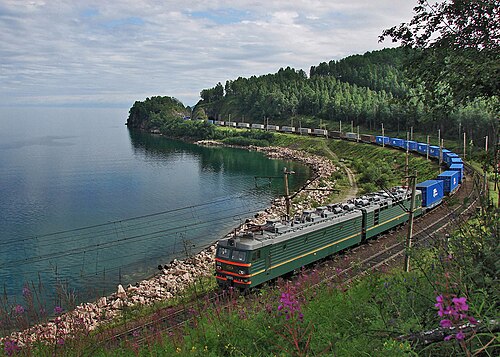
ロシアの鉄道輸送は、主に国営のロシア鉄道によって管理されている。共通で使用されている鉄道の線路の総延長は、87,000 km(54,100マイル)を超え、世界で3番目に長い。 [390] 2019年現在、ロシアは150万kmを超える道路を有する[update]世界第5位の道路網を有しているが、 [391]広大な国土のため、道路密度は世界最低レベルである。[392]ロシアの内陸水路は世界最長で、総延長は102,000 km(63,380マイル)である。[393]ロシアには900を超える空港があり、[394]世界第7位であり、その中で最も利用者が多いのはモスクワのシェレメーチエヴォ国際空港である。ロシア最大の港は、黒海沿いのクラスノダール地方にあるノヴォロシースク港である。 [395]
ロシアは広くエネルギー超大国と言われてきた。[396]ロシアは世界最大の確認済みガス埋蔵量[397]、第2位の石炭埋蔵量[398]、第8位の石油埋蔵量[399]、ヨーロッパ最大のオイルシェール埋蔵量[400]を有している。ロシアはまた、世界有数の天然ガス輸出国[401]、第2位の天然ガス生産国[ 402]、第2位の石油生産国および輸出国でもある。[403] [404]ロシアの石油とガスの生産は、欧州連合、中国、旧ソ連および東側諸国との深い経済関係につながっている。[405] [406]例えば、過去10年間で、EU(英国を含む)の総ガス需要に占めるロシアのシェアは、2009年の25%から、2022年2月のロシアによるウクライナ侵攻の数週間前には32%に増加した。 [406]
2000年代半ばには、GDPに占める石油・ガス部門のシェアは約20%で、2013年にはGDPの20~21%であった。[407]ロシアの輸出(約50%)と連邦予算収入(約50%)に占める石油・ガスのシェアは大きく、ロシアのGDPの動向は石油・ガス価格に大きく左右されるが、[408] GDPに占めるシェアは50%をはるかに下回る。ロシアの統計機関ロススタットが2021年に発表した初の包括的な評価によると、石油・ガスの採掘、精製、輸送、販売、使用されるすべての商品とサービス、およびすべての支援活動を含む石油・ガス部門のロシアのGDPに占める最大総シェアは、2019年には19.2%、2020年には15.2%に達する。これはノルウェーやカザフスタンのGDPシェアに匹敵し、サウジアラビアやアラブ首長国連邦のGDPシェアよりもはるかに低い。[409] [410] [411] [412] [413]
ロシアは世界第4位の電力生産国である。[414]天然ガスは圧倒的に最大のエネルギー源であり、すべての一次エネルギーの半分以上、電力消費の42%を占めている。[415] [416]ロシアは民生用原子力発電を開発した最初の国であり、1954年に世界初の原子力発電所を建設した。 [417]ロシアは今も原子力エネルギー技術の先駆者であり、高速中性子炉の世界的リーダーと見なされている。[418]ロシアは世界第4位の原子力エネルギー生産国であり、総発電量の4分の1を占めている。[416] [419]ロシアのエネルギー政策は、原子力エネルギーの役割を拡大し、新しい原子炉技術を開発することを目指している。[418]
ロシアは2019年にパリ協定を批准した。 [420]同国の温室効果ガス排出量は世界第4位である。[421]石炭は依然として発電量の約5分の1(17.64%)を占めている。[416]ロシアは2022年時点で第5位の水力発電国であり、 [422]水力発電は総発電量の約5分の1(17.54%)を占めている。[416]ロシアはこれらのエネルギー資源の拡大に対する政府や国民の強力な支援を受けていない数少ない国の一つであるため、その他の再生可能エネルギー資源の利用と開発は依然としてごくわずかである。[419]
農業と漁業

ロシアの農業部門は、国内総生産の約5%を占めているが、全労働力の約8分の1を雇用している。[423]ロシアの耕作面積は1,265,267平方キロメートル(488,522平方マイル)で、世界第3位である。しかし、環境の厳しさから、国土の約13.1%のみが農地であり、[9] 7.4%が耕作可能となっている。[424]ロシアの農地は、ヨーロッパの「穀倉地帯」の一部と見なされている。[425]播種面積の3分の1以上が飼料作物に充てられ、残りの農地は工芸作物、野菜、果物に使用されている。[423]ロシア農業の主力製品は常に穀物であり、耕作地の半分以上を占めている。[423]ロシアは世界最大の小麦輸出国であり、[426] [427]大麦とソバの最大の生産国であり、トウモロコシとヒマワリ油の最大の輸出国の一つであり、肥料の主要生産国でもある。[428]
気候変動適応のさまざまなアナリストは、シベリアの耕作地の増加により、21世紀の残りの期間にロシアの農業に大きなチャンスが生まれ、国内および国外からの移住がこの地域にもたらされると予測している。[429] 3つの大洋と12の縁海に沿った広大な海岸線のおかげで、ロシアは世界第6位の漁業産業を維持しており、2018年には約500万トンの魚を捕獲した。 [430]ロシアは世界最高級のキャビアであるシロイルカの生息地であり、缶詰魚の約3分の1、世界の生鮮魚と冷凍魚の総量の約4分の1を生産している。[423]
科学技術
.jpg/500px-M.V._Lomonosov_by_L.Miropolskiy_after_G.C.Prenner_(1787,_RAN).jpg)
Russia spent about 1% of its GDP on research and development in 2019, with the world's tenth-highest budget.[431] It also ranked tenth worldwide in the number of scientific publications in 2020, with roughly 1.3 million papers.[432] Since 1904, Nobel Prize were awarded to 26 Soviets and Russians in physics, chemistry, medicine, economy, literature and peace.[433] Russia ranked 51st in the Global Innovation Index in 2023, down from 45th in 2021.[434][435]
Since the times of Nikolay Lobachevsky, who pioneered the non-Euclidean geometry, and Pafnuty Chebyshev, a prominent tutor; Russian mathematicians became among the world's most influential.[436] Dmitry Mendeleev invented the Periodic table, the main framework of modern chemistry.[437] Nine Soviet and Russian mathematicians have been awarded with the Fields Medal. Grigori Perelman was offered the first ever Clay Millennium Prize Problems Award for his final proof of the Poincaré conjecture in 2002, as well as the Fields Medal in 2006.[438]
Alexander Popov was among the inventors of radio,[439] while Nikolai Basov and Alexander Prokhorov were co-inventors of laser and maser.[440] Oleg Losev made crucial contributions in the field of semiconductor junctions, and discovered light-emitting diodes.[441] Vladimir Vernadsky is considered one of the founders of geochemistry, biogeochemistry, and radiogeology.[442] Élie Metchnikoff is known for his groundbreaking research in immunology.[443] Ivan Pavlov is known chiefly for his work in classical conditioning.[444] Lev Landau made fundamental contributions to many areas of theoretical physics.[445]
Nikolai Vavilov was best known for having identified the centres of origin of cultivated plants.[446] Trofim Lysenko was known mainly for Lysenkoism.[447] Many famous Russian scientists and inventors were émigrés. Igor Sikorsky was an aviation pioneer.[448] Vladimir Zworykin was the inventor of the iconoscope and kinescope television systems.[449] Theodosius Dobzhansky was the central figure in the field of evolutionary biology for his work in shaping the modern synthesis.[450] George Gamow was one of the foremost advocates of the Big Bang theory.[451]
Space exploration

Roscosmos is Russia's national space agency. The country's achievements in the field of space technology and space exploration can be traced back to Konstantin Tsiolkovsky, the father of theoretical astronautics, whose works had inspired leading Soviet rocket engineers, such as Sergey Korolyov, Valentin Glushko, and many others who contributed to the success of the Soviet space program in the early stages of the Space Race and beyond.[452]: 6–7, 333
In 1957, the first Earth-orbiting artificial satellite, Sputnik 1, was launched. In 1961, the first human trip into space was successfully made by Yuri Gagarin. Many other Soviet and Russian space exploration records ensued. In 1963, Valentina Tereshkova became the first and youngest woman in space, having flown a solo mission on Vostok 6.[453] In 1965, Alexei Leonov became the first human to conduct a spacewalk, exiting the space capsule during Voskhod 2.[454]
In 1957, Laika, a Soviet space dog, became the first animal to orbit the Earth, aboard Sputnik 2.[455] In 1966, Luna 9 became the first spacecraft to achieve a survivable landing on a celestial body, the Moon.[456] In 1968, Zond 5 brought the first Earthlings (two tortoises and other life forms) to circumnavigate the Moon.[457] In 1970, Venera 7 became the first spacecraft to land on another planet, Venus.[458] In 1971, Mars 3 became the first spacecraft to land on Mars.[459]: 34–60 During the same period, Lunokhod 1 became the first space exploration rover,[460] while Salyut 1 became the world's first space station.[461]
Russia had 172 active satellites in space in April 2022, the world's third-highest.[462] Between the final flight of the Space Shuttle program in 2011 and the 2020 SpaceX's first crewed mission, Soyuz rockets were the only launch vehicles capable of transporting astronauts to the ISS.[463] Luna 25 launched in August 2023, was the first of the Luna-Glob Moon exploration programme.[464]
Tourism

According to the World Tourism Organization, Russia was the sixteenth-most visited country in the world, and the tenth-most visited country in Europe, in 2018, with over 24.6 million visits.[465] According to Federal Agency for Tourism, the number of inbound trips of foreign citizens to Russia amounted to 24.4 million in 2019.[466] Russia's international tourism receipts in 2018 totaled $11.6 billion.[465] In 2019, travel and tourism accounted for about 4.8% of country's total GDP.[467] In the wake of the COVID-19 pandemic, tourism declined precipitously in 2020, to just over 6.3 million foreign visitors.[468]
Major tourist routes in Russia include a journey around the Golden Ring of Russia, a theme route of ancient Russian cities; cruises on large rivers such as the Volga; hikes on mountain ranges such as the Caucasus Mountains,[469] and journeys on the famous Trans-Siberian Railway.[470] Russia's most visited and popular landmarks include Red Square, the Peterhof Palace, the Kazan Kremlin, the Trinity Lavra of St. Sergius and Lake Baikal.[471]
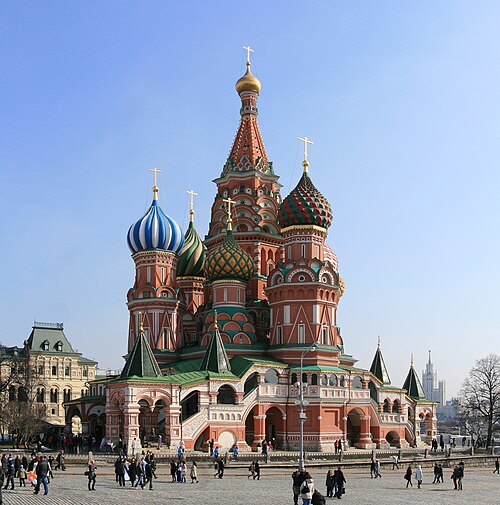
Moscow, the nation's cosmopolitan capital and historic core, is a bustling modern megacity; it retains classical and Soviet-era architecture while boasting high art, world class ballet, and modern skyscrapers.[472] Saint Petersburg, the imperial capital, is famous for its classical architecture, cathedrals, museums and theatres, white nights, crisscrossing rivers and numerous canals.[473] Russia is famed worldwide for its rich museums, such as the State Russian, the State Hermitage, and the Tretyakov Gallery; and for theatres such as the Bolshoi and the Mariinsky. The Moscow Kremlin and the Saint Basil's Cathedral are among the cultural landmarks of Russia.[474]
Demographics
Ethnic groups across Russia
Russia had a population of 144.7 million in 2021 (excluding Crimea and Sevastopol),[17] growing from 142.8 million in 2010.[475] It is the most populous country in Europe and ninth most populous in the world.[476] With a population density of 8 inhabitants per square kilometre (21 inhabitants/sq mi), Russia is one of the world's most sparsely populated countries,[9] with the vast majority of its people concentrated within its western part.[477] The country is highly urbanised, with two-thirds of the population living in towns and cities,
Russia's population peaked at over 148 million in 1993, having subsequently declined due to its death rate exceeding its birth rate, which some analysts have called a demographic crisis.[478] In 2009, it recorded annual population growth for the first time in fifteen years, and subsequently experienced annual population growth due to declining death rates, increased birth rates, and increased immigration.[479] However, these population gains have been reversed since 2020, as excessive deaths from the COVID-19 pandemic resulted in the largest peacetime decline in its history.[480] Following the Russian invasion of Ukraine in 2022, the demographic crisis has deepened,[481] owing to reportedly high military fatalities and renewed emigration caused by Western mass-sanctions and boycotts.[482]
In 2022, the total fertility rate across Russia was estimated to be 1.42 children born per woman,[483] which is below the replacement rate of 2.1 and among the lowest in the world.[484] Subsequently, the nation has one of the world's oldest populations, with a median age of 40.3 years.[9]
Russia is a multinational state with many subnational entities associated with different minorities.[485] There are over 193 ethnic groups nationwide. In the 2010 census, roughly 81% of the population were ethnic Russians, and the remaining 19% of the population were ethnic minorities;[486] while over four-fifths of Russia's population was of European descent—of whom the vast majority were Slavs,[487] with a substantial minority of Finno-Ugric and Germanic peoples.[488][489] According to the United Nations, Russia's immigrant population is the world's third-largest, numbering over 11.6 million;[490] most of which are from post-Soviet states, mainly from Central Asia.[491]
Language
Minority languages across Russia
Russian is the official and the predominantly spoken language in Russia.[3] It is the most spoken native language in Europe, the most geographically widespread language of Eurasia, as well as the world's most widely spoken Slavic language.[494] Russian is one of two official languages aboard the International Space Station,[495] as well as one of the six official languages of the United Nations.[494]
Russia is a multilingual nation; approximately 100–150 minority languages are spoken across the country.[496][497] According to the Russian Census of 2010, 137.5 million across the country spoke Russian, 4.3 million spoke Tatar, and 1.1 million spoke Ukrainian.[498] The constitution gives the country's individual republics the right to establish their own state languages in addition to Russian, as well as guarantee its citizens the right to preserve their native language and to create conditions for its study and development.[499] However, various experts have claimed Russia's linguistic diversity is rapidly declining due to many languages becoming endangered.[500][501]
Religion
Russia is constitutionally a secular state that officially enshrines freedom of religion.[502] The largest religion is Eastern Orthodox Christianity, chiefly represented by the Russian Orthodox Church,[503] which is legally recognised for its "special role" in the country's "history and the formation and development of its spirituality and culture."[502] Christianity, Islam, Judaism, and Buddhism are recognised by Russian law as the "traditional" religions of the country constituting its "historical heritage".[504][505]
Islam is the second-largest religion in Russia and is traditional among the majority of peoples in the North Caucasus and some Turkic peoples in the Volga-Ural region.[503] Large populations of Buddhists are found in Kalmykia, Buryatia, Zabaykalsky Krai, and they are the vast majority of the population in Tuva.[503] Many Russians practise other religions, including Rodnovery (Slavic Neopaganism),[506] Assianism (Scythian Neopaganism),[507] other ethnic Paganisms, and inter-Pagan movements such as Ringing Cedars' Anastasianism,[508] various movements of Hinduism,[509] Siberian shamanism[510] and Tengrism, various Neo-Theosophical movements such as Roerichism, and other faiths.[511][512] Some religious minorities have faced oppression and some have been banned in the country;[513] notably, in 2017 the Jehovah's Witnesses were outlawed in Russia, facing persecution ever since, after having been declared an "extremist" and "nontraditional" faith.[514]
In 2012, the research organisation Sreda, in cooperation with the Ministry of Justice, published the Arena Atlas, an adjunct to the 2010 census, enumerating in detail the religious populations and nationalities of Russia, based on a large-sample country-wide survey. The results showed that 47.3% of Russians declared themselves Christians—including 41% Russian Orthodox, 1.5% simply Orthodox or members of non-Russian Orthodox churches, 4.1% unaffiliated Christians, and less than 1% Old Believers, Catholics or Protestants—25% were believers without affiliation to any specific religion, 13% were atheists, 6.5% were Muslims,[k] 1.2% were followers of "traditional religions honouring gods and ancestors" (Rodnovery, other Paganisms, Siberian shamanism and Tengrism), 0.5% were Buddhists, 0.1% were religious Jews and 0.1% were Hindus.[503]
Education

Russia has an adult literacy rate of 100%,[516] and has compulsory education for a duration of 11 years, exclusively for children aged 7 to 17–18.[517] It grants free education to its citizens by constitution.[518] The Ministry of Education of Russia is responsible for primary and secondary education, as well as vocational education; while the Ministry of Education and Science of Russia is responsible for science and higher education.[517] Regional authorities regulate education within their jurisdictions within the prevailing framework of federal laws. Russia is among the world's most educated countries, and has the sixth-highest proportion of tertiary-level graduates in terms of percentage of population, at 62.1%.[519] It spent roughly 4.7% of its GDP on education in 2018.[520]
Russia's pre-school education system is highly developed and optional,[521] some four-fifths of children aged 3 to 6 attend day nurseries or kindergartens. Primary school is compulsory for eleven years, starting from age 6 to 7, and leads to a basic general education certificate.[517] An additional two or three years of schooling are required for the secondary-level certificate, and some seven-eighths of Russians continue their education past this level.[522]
Admission to an institute of higher education is selective and highly competitive:[518] first-degree courses usually take five years.[522] The oldest and largest universities in Russia are Moscow State University and Saint Petersburg State University.[523] There are ten highly prestigious federal universities across the country. Russia was the world's fifth-leading destination for international students in 2019, hosting roughly 300 thousand.[524]
Health
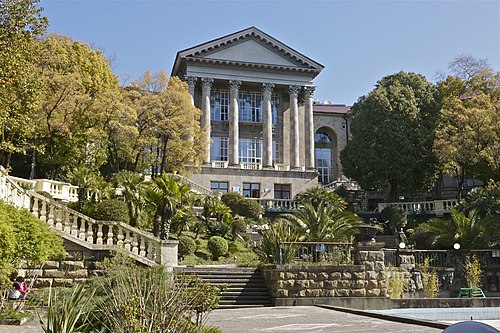
Russia, by constitution, guarantees free, universal health care for all Russian citizens, through a compulsory state health insurance program.[526] The Ministry of Health of the Russian Federation oversees the Russian public healthcare system, and the sector employs more than two million people. Federal regions also have their own departments of health that oversee local administration. A separate private health insurance plan is needed to access private healthcare in Russia.[527]
Russia spent 5.65% of its GDP on healthcare in 2019.[528] Its healthcare expenditure is notably lower than other developed nations.[529] Russia has one of the world's most female-biased sex ratios, with 0.859 males to every female,[9] due to its high male mortality rate.[530] In 2021, the overall life expectancy in Russia at birth was 70.06 years (65.51 years for males and 74.51 years for females),[531] and it had a very low infant mortality rate (5 per 1,000 live births).[532]
The principal cause of death in Russia are cardiovascular diseases.[533] Obesity is a prevalent health issue in Russia; most adults are overweight or obese.[534] However, Russia's historically high alcohol consumption rate is the biggest health issue in the country,[535] as it remains one of the world's highest, despite a stark decrease in the last decade.[536] Smoking is another health issue in the country.[537] The country's high suicide rate, although on the decline,[538] remains a significant social issue.[539]
Culture

Russian writers and philosophers have played an important role in the development of European literature and thought.[540][541] The Russians have also greatly influenced classical music,[542] ballet,[543] sport,[544] painting,[545] and cinema.[546] The nation has also made pioneering contributions to science and technology and space exploration.[547][548]
Russia is home to 30 UNESCO World Heritage Sites, 19 out of which are cultural; while 27 more sites lie on the tentative list.[549] The large global Russian diaspora has also played a major role in spreading Russian culture throughout the world. Russia's national symbol, the double-headed eagle, dates back to the Tsardom period, and is featured in its coat of arms and heraldry.[73] The Russian Bear and Mother Russia are often used as national personifications of the country.[550][551] Matryoshka dolls are considered a cultural icon of Russia.[552]
Holidays

Russia has eight—public, patriotic, and religious—official holidays.[553] The year starts with New Year's Day on 1 January, soon followed by Russian Orthodox Christmas on 7 January; the two are the country's most popular holidays.[554] Defender of the Fatherland Day, dedicated to men, is celebrated on 23 February.[555] International Women's Day on 8 March, gained momentum in Russia during the Soviet era. The annual celebration of women has become so popular, especially among Russian men, that Moscow's flower vendors often see profits of "15 times" more than other holidays.[556] Spring and Labour Day, originally a Soviet era holiday dedicated to workers, is celebrated on 1 May.[557]
Victory Day, which honours Soviet victory over Nazi Germany and the End of World War II in Europe, is celebrated on 9 May as an annual large parade in Moscow's Red Square;[558] and marks the famous Immortal Regiment civil event.[559] Other patriotic holidays include Russia Day on 12 June, celebrated to commemorate Russia's declaration of sovereignty from the collapsing Soviet Union;[560] and Unity Day on 4 November, commemorating the 1612 uprising which marked the end of the Polish occupation of Moscow.[561]
There are many popular non-public holidays. Old New Year is celebrated on 14 January.[562] Maslenitsa is an ancient and popular East Slavic folk holiday.[563] Cosmonautics Day on 12 April, in tribute to the first human trip into space.[564] Two major Christian holidays are Easter and Trinity Sunday.[565]
Art and architecture
Early Russian painting is represented in icons and vibrant frescos. In the early 15th century, the master icon painter Andrei Rublev created some of Russia's most treasured religious art.[566] The Russian Academy of Arts, which was established in 1757, to train Russian artists, brought Western techniques of secular painting to Russia.[89] In the 18th century, academicians Ivan Argunov, Dmitry Levitzky, Vladimir Borovikovsky became influential.[567] The early 19th century saw many prominent paintings by Karl Briullov and Alexander Ivanov, both of whom were known for Romantic historical canvases.[568][569] Ivan Aivazovsky, another Romantic painter, is considered one of the greatest masters of marine art.[570]
In the 1860s, a group of critical realists (Peredvizhniki), led by Ivan Kramskoy, Ilya Repin and Vasiliy Perov broke with the academy, and portrayed the many-sided aspects of social life in paintings.[571] The turn of the 20th century saw the rise of symbolism; represented by Mikhail Vrubel and Nicholas Roerich.[572][573] The Russian avant-garde flourished from approximately 1890 to 1930; and globally influential artists from this era were El Lissitzky,[574] Kazimir Malevich, Natalia Goncharova, Wassily Kandinsky, and Marc Chagall.[575]
The history of Russian architecture begins with early woodcraft buildings of ancient Slavs, and the church architecture of Kievan Rus'.[576] Following the Christianization of Kievan Rus', for several centuries it was influenced predominantly by Byzantine architecture.[577] Aristotle Fioravanti and other Italian architects brought Renaissance trends into Russia.[578] The 16th century saw the development of the unique tent-like churches; and the onion dome design, which is a distinctive feature of Russian architecture.[579] In the 17th century, the "fiery style" of ornamentation flourished in Moscow and Yaroslavl, gradually paving the way for the Naryshkin baroque of the 1680s.[580]
After the reforms of Peter the Great, Russia's architecture became influenced by Western European styles. The 18th-century taste for Rococo architecture led to the works of Bartolomeo Rastrelli and his followers. The most influential Russian architects of the eighteenth century; Vasily Bazhenov, Matvey Kazakov, and Ivan Starov, created lasting monuments in Moscow and Saint Petersburg and established a base for the more Russian forms that followed.[566] During the reign of Catherine the Great, Saint Petersburg was transformed into an outdoor museum of Neoclassical architecture.[581] Under Alexander I, Empire style became the de facto architectural style.[582] The second half of the 19th century was dominated by the Neo-Byzantine and Russian Revival style.[583] In the early 20th century, Russian neoclassical revival became a trend.[584] Prevalent styles of the late 20th century were Art Nouveau,[585] Constructivism,[586] and Socialist Classicism.[587]
Music
.jpg/500px-Portr%C3%A4t_des_Komponisten_Pjotr_I._Tschaikowski_(1840-1893).jpg)
Until the 18th century, music in Russia consisted mainly of church music and folk songs and dances.[588] In the 19th century, it was defined by the tension between classical composer Mikhail Glinka along with other members of The Mighty Handful, who were later succeeded by the Belyayev circle,[589] and the Russian Musical Society led by composers Anton and Nikolay Rubinstein.[590] The later tradition of Pyotr Ilyich Tchaikovsky, one of the greatest composers of the Romantic era, was continued into the 20th century by Sergei Rachmaninoff. World-renowned composers of the 20th century include Alexander Scriabin, Alexander Glazunov,[588] Igor Stravinsky, Sergei Prokofiev and Dmitri Shostakovich, and later Edison Denisov, Sofia Gubaidulina,[591] Georgy Sviridov,[592] and Alfred Schnittke.[591]
During the Soviet era, popular music also produced a number of renowned figures, such as the two balladeers—Vladimir Vysotsky and Bulat Okudzhava,[591] and performers such as Alla Pugacheva.[593] Jazz, even with sanctions from Soviet authorities, flourished and evolved into one of the country's most popular musical forms.[591] By the 1980s, rock music became popular across Russia, and produced bands such as Aria, Aquarium,[594] DDT,[595] and Kino;[596] the latter's leader Viktor Tsoi, was in particular, a gigantic figure.[597] Pop music has continued to flourish in Russia since the 1960s, with globally famous acts such as t.A.T.u.[598]
Literature and philosophy
Russian literature is considered to be among the world's most influential and developed.[540] It can be traced to the Middle Ages, when epics and chronicles in Old East Slavic were composed.[601] By the Age of Enlightenment, literature had grown in importance, with works from Mikhail Lomonosov, Denis Fonvizin, Gavrila Derzhavin, and Nikolay Karamzin.[602] From the early 1830s, during the Golden Age of Russian Poetry, literature underwent an astounding golden age in poetry, prose and drama.[603] Romanticism permitted a flowering of poetic talent: Vasily Zhukovsky and later his protégé Alexander Pushkin came to the fore.[604] Following Pushkin's footsteps, a new generation of poets were born, including Mikhail Lermontov, Nikolay Nekrasov, Aleksey Konstantinovich Tolstoy, Fyodor Tyutchev and Afanasy Fet.[602]
The first great Russian novelist was Nikolai Gogol.[605] Then came Ivan Turgenev, who mastered both short stories and novels.[606] Fyodor Dostoevsky and Leo Tolstoy soon became internationally renowned. Mikhail Saltykov-Shchedrin wrote prose satire,[607] while Nikolai Leskov is best remembered for his shorter fiction.[608] In the second half of the century Anton Chekhov excelled in short stories and became a leading dramatist.[609] Other important 19th-century developments included the fabulist Ivan Krylov,[610] non-fiction writers such as the critic Vissarion Belinsky,[611] and playwrights such as Aleksandr Griboyedov and Aleksandr Ostrovsky.[612][613] The beginning of the 20th century ranks as the Silver Age of Russian Poetry. This era had poets such as Alexander Blok, Anna Akhmatova, Boris Pasternak, and Konstantin Balmont.[614] It also produced some first-rate novelists and short-story writers, such as Aleksandr Kuprin, Nobel Prize winner Ivan Bunin, Leonid Andreyev, Yevgeny Zamyatin, Dmitry Merezhkovsky and Andrei Bely.[602]
After the Russian Revolution of 1917, Russian literature split into Soviet and white émigré parts. In the 1930s, Socialist realism became the predominant trend in Russia. Its leading figure was Maxim Gorky, who laid the foundations of this style.[615] Mikhail Bulgakov was one of the leading writers of the Soviet era.[616] Nikolay Ostrovsky's novel How the Steel Was Tempered has been among the most successful works of Russian literature. Influential émigré writers include Vladimir Nabokov,[617] and Isaac Asimov; who was considered one of the "Big Three" science fiction writers.[618] Some writers dared to oppose Soviet ideology, such as Nobel Prize-winning novelist Aleksandr Solzhenitsyn, who wrote about life in the Gulag camps.[619]
Russian philosophy has been greatly influential. Alexander Herzen is known as one of the fathers of agrarian populism.[620] Mikhail Bakunin is referred to as the father of anarchism.[621] Peter Kropotkin was the most important theorist of anarcho-communism.[622] Mikhail Bakhtin's writings have significantly inspired scholars.[623] Helena Blavatsky gained international following as the leading theoretician of Theosophy, and co-founded the Theosophical Society.[624] Vladimir Lenin, a major revolutionary, developed a variant of communism known as Leninism.[625] Leon Trotsky, on the other hand, founded Trotskyism.[626] Alexander Zinoviev was a prominent philosopher in the second half of the 20th century.[627] Aleksandr Dugin, known for his fascist views, has been regarded as the "guru of geopolitics".[628]
Cuisine

Russian cuisine has been formed by climate, cultural and religious traditions, and the vast geography of the nation; and it shares similarities with the cuisines of its neighbouring countries. Crops of rye, wheat, barley, and millet provide the ingredients for various breads, pancakes and cereals, as well as for many drinks. Bread, of many varieties,[629] is very popular across Russia.[630] Flavourful soups and stews include shchi, borsch, ukha, solyanka, and okroshka. Smetana (a heavy sour cream) and mayonnaise are often added to soups and salads.[631][632] Pirozhki,[633] blini,[634] and syrniki are native types of pancakes.[635] Beef Stroganoff,[636]: 266 Chicken Kiev,[636]: 320 pelmeni,[637] and shashlyk are popular meat dishes.[638] Other meat dishes include stuffed cabbage rolls (golubtsy) usually filled with meat.[639] Salads include Olivier salad,[640] vinegret,[641] and dressed herring.[642]
Russia's national non-alcoholic drink is kvass,[643] and the national alcoholic drink is vodka; its production in Russia (and elsewhere) dates back to the 14th century.[644] The country has the world's highest vodka consumption,[645] while beer is the most popular alcoholic beverage.[646] Wine has become increasingly popular in Russia in the 21st century.[647] Tea has been popular in Russia for centuries.[648]
Mass media and cinema

There are 400 news agencies in Russia, among which the largest internationally operating are TASS, RIA Novosti, Sputnik, and Interfax.[650] Television is the most popular medium in Russia.[651] Among the 3,000 licensed radio stations nationwide, notable ones include Radio Rossii, Vesti FM, Echo of Moscow, Radio Mayak, and Russkoye Radio. Of the 16,000 registered newspapers, Argumenty i Fakty, Komsomolskaya Pravda, Rossiyskaya Gazeta, Izvestia, and Moskovskij Komsomolets are popular. State-run Channel One and Russia-1 are the leading news channels, while RT is the flagship of Russia's international media operations.[651] Russia has the largest video gaming market in Europe, with over 65 million players nationwide.[652]
Russian and later Soviet cinema was a hotbed of invention, resulting in world-renowned films such as The Battleship Potemkin, which was named the greatest film of all time at the Brussels World's Fair in 1958.[653][654] Soviet-era filmmakers, most notably Sergei Eisenstein and Andrei Tarkovsky, would go on to become among of the world's most innovative and influential directors.[655][656] Eisenstein was a student of Lev Kuleshov, who developed the groundbreaking Soviet montage theory of film editing at the world's first film school, the All-Union Institute of Cinematography.[657] Dziga Vertov's "Kino-Eye" theory had a large effect on the development of documentary filmmaking and cinema realism.[658] Many Soviet socialist realism films were artistically successful, including Chapaev, The Cranes Are Flying, and Ballad of a Soldier.[546]
The 1960s and 1970s saw a greater variety of artistic styles in Soviet cinema.[546] The comedies of Eldar Ryazanov and Leonid Gaidai of that time were immensely popular, with many of the catchphrases still in use today.[659][660] In 1961–68 Sergey Bondarchuk directed an Oscar-winning film adaptation of Leo Tolstoy's epic War and Peace, which was the most expensive film made in the Soviet Union.[546] In 1969, Vladimir Motyl's White Sun of the Desert was released, a very popular film in a genre of ostern; the film is traditionally watched by cosmonauts before any trip into space.[661] After the dissolution of the Soviet Union, the Russian cinema industry suffered large losses—however, since the late 2000s, it has seen growth once again, and continues to expand.[662]
Sports
.jpg/500px-Maria_Sharapova_(18405201199).jpg)
Football is the most popular sport in Russia.[664] The Soviet Union national football team became the first European champions by winning Euro 1960,[665] and reached the finals of Euro 1988.[666] Russian clubs CSKA Moscow and Zenit Saint Petersburg won the UEFA Cup in 2005 and 2008.[667][668] The Russian national football team reached the semi-finals of Euro 2008.[669] Russia was the host nation for the 2017 FIFA Confederations Cup,[670] and the 2018 FIFA World Cup.[671] However, Russian teams are currently suspended from FIFA and UEFA competitions.[672]
Ice hockey is very popular in Russia, and the Soviet national ice hockey team dominated the sport internationally throughout its existence.[544] Bandy is Russia's national sport, and it has historically been the highest-achieving country in the sport.[673] The Russian national basketball team won the EuroBasket 2007,[674] and the Russian basketball club PBC CSKA Moscow is among the most successful European basketball teams.[675] The annual Formula One Russian Grand Prix was held at the Sochi Autodrom in the Sochi Olympic Park, until its termination following the Russian invasion of Ukraine in 2022.[676][677]
Historically, Russian athletes have been one of the most successful contenders in the Olympic Games.[544] Russia is the leading nation in rhythmic gymnastics; and Russian synchronised swimming is considered to be the world's best.[678] Figure skating is another popular sport in Russia, especially pair skating and ice dancing.[679] Russia has produced numerous prominent tennis players.[680] Chess is also a widely popular pastime in the nation, with many of the world's top chess players being Russian for decades.[681] The 1980 Summer Olympic Games were held in Moscow,[682] and the 2014 Winter Olympics and the 2014 Winter Paralympics were hosted in Sochi.[683][684] However, Russia has also had 43 Olympic medals stripped from its athletes due to doping violations, which is the most of any country, and nearly a third of the global total.[685]
See also
Notes
- ^ Crimea, which was annexed by Russia in 2014, remains internationally recognised as a part of Ukraine.[1] Donetsk, Luhansk, Kherson, and Zaporizhzhia oblasts, which were annexed—though are only partially occupied—in 2022, also remain internationally recognised as a part of Ukraine. The southernmost Kuril Islands have been the subject of a territorial dispute with Japan since their occupation by the Soviet Union at the end of World War II.[2]
- ^ Russian: Россия, romanized: Rossiya, [rɐˈsʲijə]
- ^ Russian: Российская Федерация, romanized: Rossiyskaya Federatsiya, IPA: [rɐˈsʲijskəjə fʲɪdʲɪˈratsɨjə]
- ^ The fourteen countries bordering Russia are:[21] Norway and Finland to the northwest; Estonia, Latvia, Belarus and Ukraine to the west, as well as Lithuania and Poland (with Kaliningrad Oblast); Georgia and Azerbaijan to the southwest; Kazakhstan and Mongolia to the south; China and North Korea to the southeast. Russia also shares maritime boundaries with Japan and the United States. Russia also shares borders with the two partially recognised breakaway states of South Ossetia and Abkhazia that it occupies in Georgia.
- ^ Most notably the Budyonnovsk hospital hostage crisis, the Russian apartment bombings, the Moscow theater hostage crisis, and the Beslan school siege
- ^ Russia has an additional 850 km (530 mi) of coastline along the Caspian Sea, which is the world's largest inland body of water, and has been variously classified as a sea or a lake.[230]
- ^ Russia, by land area, is larger than the continents of Australia, Antarctica, and Europe; although it covers a large part of the latter itself. Its land area could be roughly compared to that of South America.
- ^ Russia borders, clockwise, to its southwest: the Black Sea and the Sea of Azov, to its west: the Baltic Sea, to its north: the Barents Sea (White Sea, Pechora Sea), the Kara Sea, the Laptev Sea, and the East Siberian Sea, to its northeast: the Chukchi Sea and the Bering Sea, and to its southeast: the Sea of Okhotsk and the Sea of Japan.
- ^ In 2020, constitutional amendments were signed into law that limit the president to two terms overall rather than two consecutive terms, with this limit reset for current and previous presidents.[265]
- ^ Including bodies on territory disputed between Russia and Ukraine whose annexation has not been internationally recognised: the Republic of Crimea and the federal city of Sevastopol since the annexation of Crimea in 2014,[1] and territories set up following the Russian annexation of Donetsk, Kherson, Luhansk and Zaporizhzhia oblasts in 2022.
- ^ The Sreda Arena Atlas 2012 did not count the populations of two federal subjects of Russia where the majority of the population is Muslim, namely Chechnya and Ingushetia, which together had a population of nearly 2 million, thus the proportion of Muslims was possibly slightly underestimated.[503]
References
- ^ a b Pifer, Steven (17 March 2020). "Crimea: Six years after illegal annexation". Brookings Institution. Archived from the original on 14 April 2022. Retrieved 30 November 2021.
- ^ a b Chapple, Amos (4 January 2019). "The Kurile Islands: Why Russia And Japan Never Made Peace After World War II". Radio Free Europe/Radio Liberty. Archived from the original on 8 April 2022. Retrieved 26 January 2022.
- ^ a b Chevalier, Joan F. (2006). "Russian as the National Language: An Overview of Language Planning in the Russian Federation". Russian Language Journal. 56 (1). American Councils for International Education ACTR / ACCELS: 25–36. doi:10.70163/0036-0252.1233. JSTOR 43669126.
{{cite journal}}: CS1 maint: ignored DOI errors (link) - ^ "What Languages Are Spoken in Russia?". WorldAtlas. 1 August 2017. Archived from the original on 19 February 2024. Retrieved 19 February 2024.
- ^ "Национальный состав населения". Federal State Statistics Service. Archived from the original on 30 December 2022. Retrieved 30 December 2022.
- ^ "Русская православная церковь" (in Russian). Фонд Общественное Мнение, ФОМ (Public Opinion Foundation). 2 May 2024. Archived from the original on 16 May 2024. Retrieved 10 June 2024.
- ^ "Русская православная церковь" (in Russian). Фонд Общественное Мнение, ФОМ (Public Opinion Foundation). 2 May 2024. Archived from the original on 3 May 2024. Retrieved 10 June 2024.
- ^ Shevchenko, Nikolay (21 February 2018). "Check out Russia's Kalmykia: The only region in Europe where Buddhism rules the roost". Russia Beyond. Archived from the original on 27 February 2018. Retrieved 11 February 2023.
- ^ a b c d e f g h i j "Russia – The World Factbook". The World Factbook. Central Intelligence Agency. Archived from the original on 9 January 2021. Retrieved 4 March 2022.
- ^ "Russia: Freedom in the World 2023 Country Report". Freedom House. 9 March 2023. Archived from the original on 11 March 2023. Retrieved 17 April 2023.
- ^ a b Kuzio, Taras (2016). "Nationalism and authoritarianism in Russia". Communist and Post-Communist Studies. 49 (1). University of California Press: 1–11. doi:10.1016/j.postcomstud.2015.12.002. JSTOR 48610429.
- ^ a b Martin Krzywdzinski (2020). Consent and Control in the Authoritarian Workplace: Russia and China Compared. Oxford University Press. pp. 252–. ISBN 978-0-19-252902-2. OCLC 1026492383.
officially a democratic state with the rule of law, in practice an authoritarian dictatorship
- ^ Fischer, Sabine (2022). "Russia on the road to dictatorship". SWP Comment. Stiftung Wissenschaft und Politik (SWP), German Institute for International and Security Affairs. doi:10.18449/2022C30. Retrieved 24 July 2024.
- ^ "The Russian federation: general characteristics". Federal State Statistics Service. Archived from the original on 28 July 2011. Retrieved 5 April 2008.
- ^ "World Statistics Pocketbook 2016 edition" (PDF). United Nations Department of Economic and Social Affairs. Statistics Division. Archived (PDF) from the original on 4 August 2019. Retrieved 24 April 2018.
- ^ Including 2,470,873 people living on the annexed Crimean Peninsula
- ^ a b Оценка численности постоянного населения на 1 января 2024 г. и в среднем за 2023 г. и компоненты её изменения [Estimates of the resident population as of January 1, 2024 and averaged over 2023 and the components of change] (XLSX). Russian Federal State Statistics Service (in Russian). Archived from the original on 6 April 2024. Retrieved 22 June 2024.
- ^ a b c d "World Economic Outlook Database, April 2024 Edition. (Russia)". www.imf.org. International Monetary Fund. 16 April 2024. Archived from the original on 28 April 2024. Retrieved 16 April 2024.
- ^ "GINI index (World Bank estimate) – Russian Federation". World Bank. Archived from the original on 20 April 2017. Retrieved 23 June 2022.
- ^ "Human Development Report 2023/24" (PDF). United Nations Development Programme. 13 March 2024. Archived (PDF) from the original on 13 March 2024. Retrieved 13 March 2024.
- ^ "Russia", The World Factbook, Central Intelligence Agency, 2022, archived from the original on 9 January 2021, retrieved 14 October 2022
- ^ "Russia (n.), Etymology". Oxford English Dictionary. September 2023. doi:10.1093/OED/2223074989. Archived from the original on 22 January 2024. Retrieved 3 January 2024.
- ^ Kuchkin, V. A. (2014). Русская земля [Russian land]. In Melnikova, E. A.; Petrukhina, V. Ya. (eds.). Древняя Русь в средневековом мире [Old Rus' in the medieval world] (in Russian). Moscow: Institute of General History of the Russian Academy of Sciences; Ladomir. pp. 700–701.
- ^ Kort, Michael (2008). A Brief History of Russia. New York: Checkmark Books. p. 6. ISBN 978-0816071135.
- ^ Nazarenko, Aleksandr Vasilevich (2001). "1. Имя "Русь" в древнейшей западноевропейской языковой традиции (XI–XII века)" [The name Rus' in the old tradition of Western European language (XI-XII centuries)]. Древняя Русь на международных путях: междисциплинарные очерки культурных, торговых, политических связей IX–XII веков [Old Rus' on international routes: interdisciplinary essays on cultural, trade, and political ties in the 9th–12th centuries] (in Russian). Languages of the Rus' culture. pp. 40, 42–45, 49–50. ISBN 978-5-7859-0085-1. Archived from the original on 14 August 2011.
- ^ Milner-Gulland, R. R. (1997). The Russians: The People of Europe. Blackwell Publishing. pp. 1–4. ISBN 978-0-631-21849-4.
- ^ Obolensky, Dimitri (1994). Byzantium and the Slavs. Crestwood, NY: St. Vladimir's Seminary Press. p. 17. ISBN 9780881410082.
- ^ a b Langer, Lawrence N. (2021). Historical Dictionary of Medieval Russia (2nd ed.). Lanham: Rowman & Littlefield. p. 182. ISBN 978-1538119426.
- ^ a b Hellberg-Hirn, Elena (1998). Soil and Soul: The Symbolic World of Russianness. Aldershot [Hants, England]: Ashgate. p. 54. ISBN 1855218712.
- ^ a b Plokhy, Serhii (2010). The origins of the Slavic nations: premodern identities in Russia, Ukraine, and Belarus (1st ed.). Cambridge: Cambridge Univ. Press. pp. 213–14, 285. ISBN 978-0-521-15511-3.
- ^ Monahan, Erika (2016). "Russia: 3. Tsardom of Muscovy (1547–1721)". The Encyclopedia of Empire. Wiley. pp. 1–6. doi:10.1002/9781118455074.wbeoe425. ISBN 978-1118455074.
- ^ Magocsi, Paul R. (2010). A History of Ukraine: The Land and Its Peoples. University of Toronto Press. p. 223. ISBN 978-1-4426-1021-7. Retrieved 19 August 2016.
- ^ Merridale, Catherine (2003). "Redesigning History in Contemporary Russia". Journal of Contemporary History. 38 (1): 13–28. doi:10.1177/0022009403038001961. ISSN 0022-0094. JSTOR 3180694. S2CID 143597960.
- ^ Duczko, Wladyslaw (2004). Viking Rus. Brill Publishers. pp. 10–11. ISBN 978-90-04-13874-2.
- ^ Pritsak, Omeljan (5 April 1977). "The Origin of Rus'". The Russian Review. 36 (3): 249–273. doi:10.2307/128848. JSTOR 128848. Archived from the original on 25 October 2023. Retrieved 19 October 2023.
{{cite journal}}: CS1 maint: bot: original URL status unknown (link). - ^ Adrien, C.J. (19 April 2020). "The Swedish Vikings: Who Were the Rus?". Archived from the original on 25 October 2023. Retrieved 19 October 2023.
- ^ Shchelinsky, V.E.; Gurova, M.; Tesakov, A.S.; Titov, V.V.; Frolov, P.D.; Simakova, A.N. (30 January 2016). "The Early Pleistocene site of Kermek in western Ciscaucasia (southern Russia): Stratigraphy, biotic record and lithic industry (preliminary results)". Quaternary International. 393: 51–69. Bibcode:2016QuInt.393...51S. doi:10.1016/j.quaint.2015.10.032.
- ^ Chepalyga, A.L.; Amirkhanov, Kh.A.; Trubikhin, V.M.; Sadchikova, T.A.; Pirogov, A.N.; Taimazov, A.I. (2011). "Geoarchaeology of the earliest paleolithic sites (Oldowan) in the North Caucasus and the East Europe". Archived from the original on 20 May 2013. Retrieved 18 December 2013.
- ^ Douka, K. (2019). "Age estimates for hominin fossils and the onset of the Upper Palaeolithic at Denisova Cave". Nature. 565 (7741): 640–644. Bibcode:2019Natur.565..640D. doi:10.1038/s41586-018-0870-z. PMID 30700871. S2CID 59525455. Archived from the original on 6 May 2020. Retrieved 10 January 2022.
- ^ Warren, Matthew (22 August 2018). "Mum's a Neanderthal, Dad's a Denisovan: First discovery of an ancient-human hybrid". Nature. 560 (7719): 417–418. Bibcode:2018Natur.560..417W. doi:10.1038/d41586-018-06004-0. PMID 30135540.
- ^ Igor V. Ovchinnikov; Anders Götherström; Galina P. Romanova; Vitaliy M. Kharitonov; Kerstin Lidén; William Goodwin (30 March 2000). "Molecular analysis of Neanderthal DNA from the northern Caucasus". Nature. 404 (6777): 490–493. Bibcode:2000Natur.404..490O. doi:10.1038/35006625. PMID 10761915. S2CID 3101375.
- ^ Fu Q, Li H, Moorjani P, Jay F, Slepchenko SM, Bondarev AA, Johnson PL, Aximu-Petri A, Prüfer K, de Filippo C, Meyer M, Zwyns N, Salazar-García DC, Kuzmin YV, Keates SG, Kosintsev PA, Razhev DI, Richards MP, Peristov NV, Lachmann M, Douka K, Higham TF, Slatkin M, Hublin JJ, Reich D, Kelso J, Viola TB, Pääbo S (23 October 2014). "Genome sequence of a 45,000-year-old modern human from western Siberia". Nature. 514 (7523): 445–449. Bibcode:2014Natur.514..445F. doi:10.1038/nature13810. hdl:10550/42071. PMC 4753769. PMID 25341783.
- ^ Dinnis, Rob; Bessudnov, Alexander; Reynolds, Natasha; Devièse, Thibaut; Pate, Abi; Sablin, Mikhail; Sinitsyn, Andrei; Higham, Thomas (2019). "New data for the Early Upper Paleolithic of Kostenki (Russia)" (PDF). Journal of Human Evolution. 127: 21–40. Bibcode:2019JHumE.127...21D. doi:10.1016/j.jhevol.2018.11.012. PMID 30777356. S2CID 73486830. Archived (PDF) from the original on 5 April 2022. Retrieved 21 January 2022.
- ^ Sikora, Martin, et al. (2017). "Ancient genomes show social and reproductive behavior of early Upper Paleolithic foragers". Science. 358 (6363): 659–662. Bibcode:2017Sci...358..659S. doi:10.1126/science.aao1807. PMID 28982795.
- ^ Pavlov, Pavel; John Inge Svendsen; Svein Indrelid (6 September 2001). "Human presence in the European Arctic nearly 40,000 years ago". Nature. 413 (6851): 64–67. Bibcode:2001Natur.413...64P. doi:10.1038/35092552. PMID 11544525. S2CID 1986562.
- ^ Balter, M. (25 October 2013). "Ancient DNA Links Native Americans With Europe". Science. 342 (6157): 409–410. Bibcode:2013Sci...342..409B. doi:10.1126/science.342.6157.409. PMID 24159019.
- ^ Gibbons, Ann (21 February 2017). "Thousands of horsemen may have swept into Bronze Age Europe, transforming the local population". Science. Archived from the original on 25 September 2022. Retrieved 25 September 2022.
- ^ Anthony, David W.; Ringe, Don (1 January 2015). "The Indo-European Homeland from Linguistic and Archaeological Perspectives". Annual Review of Linguistics. 1 (1): 199–219. doi:10.1146/annurev-linguist-030514-124812. ISSN 2333-9683.
- ^ Haak, Wolfgang; Lazaridis, Iosif; Patterson, Nick; Rohland, Nadin; Mallick, Swapan; Llamas, Bastien; Brandt, Guido; Nordenfelt, Susanne; Harney, Eadaoin; Stewardson, Kristin; Fu, Qiaomei (11 June 2015). "Massive migration from the steppe was a source for Indo-European languages in Europe". Nature. 522 (7555): 207–211. arXiv:1502.02783. Bibcode:2015Natur.522..207H. doi:10.1038/nature14317. ISSN 0028-0836. PMC 5048219. PMID 25731166.
- ^ Gibbons, Ann (10 June 2015). "Nomadic herders left a strong genetic mark on Europeans and Asians". Science. AAAS. Archived from the original on 2 September 2022. Retrieved 25 September 2022.
- ^ a b Belinskij, Andrej; Härke, Heinrich (1999). "The 'Princess' of Ipatovo". Archeology. 52 (2). Archived from the original on 10 June 2008. Retrieved 26 December 2007.
- ^ a b Drews, Robert (2004). Early Riders: The beginnings of mounted warfare in Asia and Europe. New York: Routledge. p. 50. ISBN 978-0-415-32624-7.
- ^ Koryakova, L. "Sintashta-Arkaim Culture". The Center for the Study of the Eurasian Nomads (CSEN). Archived from the original on 28 February 2019. Retrieved 13 May 2021.
- ^ "1998 NOVA documentary: "Ice Mummies: Siberian Ice Maiden"". Transcript. Archived from the original on 16 April 2016. Retrieved 13 May 2021.
- ^ Lamnidis, Thiseas C.; Majander, Kerttu; Jeong, Choongwon; Salmela, Elina; Wessman, Anna; Moiseyev, Vyacheslav; Khartanovich, Valery; Balanovsky, Oleg; Ongyerth, Matthias; Weihmann, Antje; Sajantila, Antti; Kelso, Janet; Pääbo, Svante; Onkamo, Päivi; Haak, Wolfgang (27 November 2018). "Ancient Fennoscandian genomes reveal origin and spread of Siberian ancestry in Europe". Nature Communications. 9 (1): 5018. Bibcode:2018NatCo...9.5018L. doi:10.1038/s41467-018-07483-5. ISSN 2041-1723. PMC 6258758. PMID 30479341. S2CID 53792952.
- ^ Tsetskhladze, G. R. (1998). The Greek Colonisation of the Black Sea Area: Historical Interpretation of Archaeology. F. Steiner. p. 48. ISBN 978-3-515-07302-8.
- ^ Turchin, P. (2003). Historical Dynamics: Why States Rise and Fall. Princeton University Press. pp. 185–186. ISBN 978-0-691-11669-3.
- ^ Weinryb, Bernard D. (1963). "The Khazars: An Annotated Bibliography". Studies in Bibliography and Booklore. 6 (3). Hebrew Union College-Jewish Institute of Religion: 111–129. JSTOR 27943361.
- ^ Carter V. Findley, The Turks in World History (Oxford University Press, 2004) ISBN 0-19-517726-6
- ^ Zhernakova, Daria V.; et al. (2020). "Genome-wide sequence analyses of ethnic populations across Russia". Genomics. 112 (1). Elsevier: 442–458. doi:10.1016/j.ygeno.2019.03.007. PMID 30902755.
- ^ Christian, D. (1998). A History of Russia, Central Asia and Mongolia. Blackwell Publishing. pp. 6–7. ISBN 978-0-631-20814-3.
- ^ a b c d e f g h i Curtis, Glenn E. (1998). "Russia – Early History". Washington, D.C.: Federal Research Division of the Library of Congress. Archived from the original on 14 August 2023. Retrieved 29 June 2021.
- ^ Ed. Timothy Reuter, The New Cambridge Medieval History, Volume 3, Cambridge University Press, 1995, pp. 494-497. ISBN 0-521-36447-7.
- ^ Plokhy, Serhii (2006). The Origins of the Slavic Nations: Premodern Identities in Russia, Ukraine, and Belarus. Cambridge University Press. p. 13. ISBN 978-0-521-86403-9.
- ^ Obolensky, Dimitri (1971). Byzantium & the Slavs. St. Vladimir's Seminary Press. pp. 75–108. ISBN 978-0-88141-008-2.
- ^ Logan, Donald F. (1992). The Vikings in History (2nd ed.). Routledge. p. 201. ISBN 978-0-415-08396-6.
- ^ a b Channon, John (1995). The Penguin historical atlas of Russia. London: Penguin. p. 16. ISBN 0140513264.
- ^ "Battle of the Neva". Encyclopædia Britannica. Archived from the original on 29 March 2022. Retrieved 22 June 2021.
- ^ Ostrowski, Donald (2006). "Alexander Nevskii's "Battle on the Ice": The Creation of a Legend". Russian History. 33 (2/4): 289–312. doi:10.1163/187633106X00186. JSTOR 24664446.
- ^ Halperin, Charles J. (1987). Russia and the Golden Horde: The Mongol Impact on Medieval Russian History. Indiana University Press. p. 7. ISBN 978-0-253-20445-5. Archived from the original on 13 August 2023. Retrieved 24 July 2023.
- ^ Glenn E., Curtis (1998). "Muscovy". Russia: A Country Study. Washington DC: Federal Research Division, Library of Congress. ISBN 0-8444-0866-2. OCLC 36351361. Archived from the original on 24 August 2022. Retrieved 24 August 2022.
- ^ Davies, Brian L. (2014). Warfare, State and Society on the Black Sea Steppe, 1500–1700 (PDF). Routledge. p. 4. Archived (PDF) from the original on 9 October 2017. Retrieved 31 March 2021.
- ^ a b c d e Curtis, Glenn E. (1998). "Russia – Muscovy". Washington, D.C.: Federal Research Division of the Library of Congress. Archived from the original on 6 June 2023. Retrieved 25 June 2021.
- ^ Mackay, Angus (11 September 2002). Atlas of Medieval Europe. Routledge. p. 187. ISBN 978-1-134-80693-5.
- ^ Gleason, Abbott (2009). A Companion to Russian History. Chichester: John Wiley & Sons. p. 126. ISBN 978-1444308426.
- ^ Halperin, Charles J. (September 1999). "Novgorod and the 'Novgorodian Land'". Cahiers du Monde russe. 40 (3). EHESS: 345–363. JSTOR 20171136.
- ^ Anderson, M.S. (2014). The Origins of the Modern European State System, 1494–1618. Routledge. ISBN 978-1317892755.
- ^ Perrie, Maureen (April 1978). "The Popular Image of Ivan the Terrible". The Slavonic and East European Review. 56 (2). Modern Humanities Research Association: 275–286. JSTOR 4207642.
- ^ Skrynnikov, R. G. (1986). "Ermak's Siberian Expedition". Russian History. 13 (1). Brill Publishers: 1–39. doi:10.1163/187633186X00016. JSTOR 24655823.
- ^ Filyushkin, Alexander (2016). "Livonian War in the Context of the European Wars of the 16th Century: Conquest, Borders, Geopolitics". Russian History. 43 (1). Brill: 1–21. doi:10.1163/18763316-04301004. JSTOR 44647035.
- ^ Skrynnikov, R. G. (2015). Reign of Terror: Ivan IV. Brill. pp. 417–421. ISBN 978-9-004-30401-7.
- ^ Dunning, Chester (1995). "Crisis, Conjuncture, and the Causes of the Time of Troubles". Harvard Ukrainian Studies. 19. Harvard Ukrainian Research Institute: 97–119. JSTOR 41036998.
- ^ Wójcik, Zbigniew (1982). "Russian Endeavors for the Polish Crown in the Seventeenth Century". Slavic Review. 41 (1). Cambridge University Press: 59–72. doi:10.2307/2496635. JSTOR 2496635. S2CID 164176163.
- ^ Bogolitsyna, Anna; Pichler, Bernhard; Vendl, Alfred; Mikhailov, Alexander; Sizov, Boris (2009). "Investigation of the Brass Monument to Minin and Pozharsky, Red Square, Moscow". Studies in Conservation. 54 (1). Taylor & Francis: 12–22. doi:10.1179/sic.2009.54.1.12. JSTOR 27867061. S2CID 138066784.
- ^ Orchard, G. Edward (July 1989). "The Election of Michael Romanov". The Slavonic and East European Review. 67 (3). Modern Humanities Research Association: 378–402. JSTOR 4210028.
- ^ a b "The Russian Discovery of Siberia". Washington, D.C.: Library of Congress. 2000. Archived from the original on 30 March 2022. Retrieved 25 January 2022.
- ^ Frost, Robert I. (2000). The Northern Wars: War, State and Society in Northeastern Europe, 1558–1721. Routledge. p. 13. ISBN 978-0-58206-429-4.
- ^ Oliver, James A. (2006). The Bering Strait Crossing: A 21st Century Frontier between East and West. Information Architects. pp. 36–37. ISBN 978-0-9546995-8-1.
- ^ a b Curtis, Glenn E. (1998). "Russia – Early Imperial Russia". Washington, D.C.: Federal Research Division of the Library of Congress. Archived from the original on 14 August 2023. Retrieved 25 June 2021.
- ^ Kohn, Hans (1960). "Germany and Russia". Current History. 38 (221). U of California Press: 1–5. doi:10.1525/curh.1960.38.221.1. JSTOR 45310370. S2CID 249687838.
- ^ Raeff, Marc (June 1970). "The Domestic Policies of Peter III and his Overthrow". The American Historical Review. 75 (5). Oxford University Press: 1289–1310. doi:10.2307/1844479. JSTOR 1844479.
- ^ Perkins, James Breck (October 1896). "The Partition of Poland". The American Historical Review. 2 (1). Oxford University Press: 76–92. doi:10.2307/1833615. JSTOR 1833615.
- ^ Anderson, M.S. (December 1958). "The Great Powers and the Russian Annexation of the Crimea, 1783–1784". The Slavonic and East European Review. 37 (88). Modern Humanities Research Association: 17–41. JSTOR 4205010.
- ^ Behrooz, Maziar (2013). "Revisiting the Second Russo-Iranian War (1826–1828): Causes and Perceptions". Iranian Studies. 46 (3). Taylor & Francis: 359–381. doi:10.1080/00210862.2012.758502. JSTOR 24482847. S2CID 143736977.
- ^ Ragsdale, Hugh (1992). "Russia, Prussia, and Europe in the Policy of Paul I". Jahrbücher für Geschichte Osteuropas. 31 (1). Franz Steiner Verlag: 81–118. JSTOR 41046596.
- ^ "Finland". The American Political Science Review. 4 (3). American Political Science Association: 350–364. August 1910. doi:10.2307/1945868. JSTOR 1945868.
- ^ King, Charles (July 1993). "Moldova and the New Bessarabian Questions". The World Today. 49 (7). Royal Institute of International Affairs (Chatham House): 135–139. JSTOR 40396520.
- ^ "Exploration and Settlement on the Alaskan Coast". PBS. Archived from the original on 19 March 2022. Retrieved 13 January 2022.
- ^ McCartan, E. F. (1963). "The Long Voyages-Early Russian Circumnavigation". The Russian Review. 22 (1): 30–37. doi:10.2307/126593. JSTOR 126593.
- ^ Blakemore, Erin (27 January 2020). "Who really discovered Antarctica? Depends who you ask". National Geographic. Archived from the original on 5 March 2021. Retrieved 12 January 2022.
- ^ Kroll, Mark J.; Toombs, Leslie A.; Wright, Peter (February 2000). "Napoleon's Tragic March Home from Moscow: Lessons in Hubris". The Academy of Management Executive. 14 (1). Academy of Management: 117–128. JSTOR 4165613.
- ^ Ghervas, Stella (2015). "The Long Shadow of the Congress of Vienna". Journal of Modern European History. 13 (4). SAGE Publishers: 458–463. doi:10.17104/1611-8944-2015-4-458. JSTOR 26266203. S2CID 151713355.
- ^ Grey, Ian (9 September 1973). "The Decembrists: Russia's First Revolutionaries". History Today. Vol. 23, no. 9. Archived from the original on 30 March 2022. Retrieved 23 November 2021.
- ^ Vincent, J.R. Vincent (1981). "The Parliamentary Dimension of the Crimean War". Transactions of the Royal Historical Society. 31. Cambridge University Press: 37–49. doi:10.2307/3679044. JSTOR 3679044. S2CID 153338264.
- ^ Zenkovsky, Serge A. (October 1961). "The Emancipation of the Serfs in Retrospect". The Russian Review. 20 (4). Wiley: 280–293. doi:10.2307/126692. JSTOR 126692.
- ^ Gunter, Michael M. (March 2013). "War and Diplomacy: The Russo-Turkish War of 1877–1878 and the Treaty of Berlin". Journal of World History. 24 (1). University of Hawaiʻi Press: 231–233. doi:10.1353/jwh.2013.0031. ISSN 1527-8050. S2CID 159687214.
- ^ Fromkin, David (1980). "The Great Game in Asia". Foreign Affairs. 58 (4): 936–951. doi:10.2307/20040512. JSTOR 20040512.
- ^ Frank, Goodwin (1995). "Review: [Untitled]". The Slavic and East European Journal. 39 (4): 641–43. doi:10.2307/309128. JSTOR 309128.
- ^ Taranovski, Theodore (1984). "Alexander III and his Bureaucracy: The Limitations on Autocratic Power". Canadian Slavonic Papers. 26 (2/3): 207–219. doi:10.1080/00085006.1984.11091776. JSTOR 40868293.
- ^ Esthus, Raymond A. (October 1981). "Nicholas II and the Russo-Japanese War". The Russian Review. 40 (4): 396–411. doi:10.2307/129919. JSTOR 129919.
- ^ Doctorow, Gilbert S. (1976). "The Fundamental State Laws of 23 April 1906". The Russian Review. 35 (1): 33–52. doi:10.2307/127655. JSTOR 127655.
- ^ Williamson, Samuel R. Jr. (1988). "The Origins of World War I". The Journal of Interdisciplinary History. 18 (4). The MIT Press: 795–818. doi:10.2307/204825. JSTOR 204825.
- ^ Schmitt, Bernadotte E. (April 1924). "Triple Alliance and Triple Entente, 1902–1914". The American Historical Review. 29 (3). Oxford University Press: 449–473. doi:10.2307/1836520. JSTOR 1836520.
- ^ Schindler, John (2003). "Steamrollered in Galicia: The Austro-Hungarian Army and the Brusilov Offensive, 1916". War in History. 10 (1): 27–59. doi:10.1191/0968344503wh260oa. JSTOR 26061940. S2CID 143618581.
- ^ a b c Curtis, Glenn E. (1998). "Russia – Revolutions and Civil War". Washington, D.C.: Federal Research Division of the Library of Congress. Archived from the original on 14 August 2023. Retrieved 25 June 2021.
- ^ Walsh, Edmund (March 1928). "The Last Days of the Romanovs". The Atlantic. Archived from the original on 30 March 2022. Retrieved 14 January 2022.
- ^ Mosse, W. E. (April 1964). "Interlude: The Russian Provisional Government 1917". Soviet Studies (Europe-Asia Studies). 15 (4). Taylor & Francis: 408–419. JSTOR 149631.
- ^ Figes, Orlando (November 1990). "The Red Army and Mass Mobilization during the Russian Civil War 1918–1920". Past & Present (190). Oxford University Press: 168–211. doi:10.1093/past/129.1.168. JSTOR 650938.
- ^ Figes, Orlando (25 October 2017). "From Tsar to U.S.S.R.: Russia's Chaotic Year of Revolution". National Geographic. Archived from the original on 15 April 2021. Retrieved 27 November 2021.
- ^ Carley, Michael Jabara (November 1989). "Allied Intervention and the Russian Civil War, 1917–1922". The International History Review. 11 (4): 689–700. doi:10.1080/07075332.1989.9640530. JSTOR 40106089.
- ^ Blakemore, Erin (2 September 2020). "How the Red Terror set a macabre course for the Soviet Union". National Geographic. Archived from the original on 22 February 2021. Retrieved 26 June 2021.
- ^ "Russian Civil War – Casualties and consequences of the war". Encyclopædia Britannica. Archived from the original on 30 March 2022. Retrieved 14 January 2022.
- ^ Schaufuss, Tatiana (May 1939). "The White Russian Refugees". The Annals of the American Academy of Political and Social Science. 203 (1). SAGE Publishing: 45–54. doi:10.1177/000271623920300106. JSTOR 1021884. S2CID 143704019.
- ^ Haller, Francis (8 December 2003). "Famine in Russia: the hidden horrors of 1921". Le Temps. International Committee of the Red Cross. Archived from the original on 14 March 2020. Retrieved 26 July 2021.
- ^ Szporluk, Roman (1973). "Nationalities and the Russian Problem in the U.S.S.R.: an Historical Outline". Journal of International Affairs. 27 (1). Journal of International Affairs Editorial Board: 22–40. JSTOR 24356607.
- ^ Brzezinski, Zbigniew (1984). "The Soviet Union: World Power of a New Type". Proceedings of the Academy of Political Science. 35 (3). The Academy of Political Science: 147–159. doi:10.2307/1174124. JSTOR 1174124.
- ^ Glassman, Leo M. (April 1931). "Stalin's Rise to Power". Current History. 34 (1). University of California Press: 73–77. doi:10.1525/curh.1931.34.1.73. JSTOR 45336496. S2CID 248843930.
- ^ Getty, J Arch. (January 1986). "Trotsky in Exile: The Founding of the Fourth International". Soviet Studies (Europe-Asia Studies). 38 (1). Taylor & Francis: 24–35. JSTOR 151989.
- ^ Bensley, Michael (2014). "Socialism in One Country: A Study of Pragmatism and Ideology in the Soviet 1920s" (PDF). University of Kent. Archived (PDF) from the original on 26 June 2021. Retrieved 26 June 2021.
- ^ Kuromiya, Hirosaki (2005). "Accounting for the Great Terror". Jahrbücher für Geschichte Osteuropas. 53 (1). Franz Steiner Verlag: 86–101. JSTOR 41051345.
- ^ Rosefielde, Steven (January 1981). "An Assessment of the Sources and Uses of Gulag Forced Labour 1929–1956". Soviet Studies (Europe-Asia Studies). 33 (1). Taylor & Francis: 51–87. JSTOR 151474.
- ^ Kreindler, Isabelle (July 1986). "The Soviet Deported Nationalities: A Summary and an Update". Soviet Studies (Europe-Asia Studies). 38 (3). Taylor & Francis: 387–405. JSTOR 151700.
- ^ Zadoks, J.C. (2008). On the political economy of plant disease epidemics: Capita selecta in historical epidemiology. Wageningen Academic Publishers. p. 171. ISBN 978-90-8686-653-3. Archived from the original on 25 December 2022. Retrieved 8 December 2022.
- ^ Davies, Robert W.; Wheatcroft, Stephen G. (2010). The Industrialisation of Soviet Russia Volume 5: The Years of Hunger. Palgrave Macmillan. p. 415. doi:10.1057/9780230273979. ISBN 9780230238558.
- ^ Wolowyna, Oleh (October 2020). "A Demographic Framework for the 1932–1934 Famine in the Soviet Union". Journal of Genocide Research. 23 (4): 501–526. doi:10.1080/14623528.2020.1834741. S2CID 226316468.
- ^ Rosefielde, Steven (1988). "Excess Deaths and Industrialization: A Realist Theory of Stalinist Economic Development in the 1930s". Journal of Contemporary History. 23 (2). SAGE Publishing: 277–289. doi:10.1177/002200948802300207. JSTOR 260849. PMID 11617302. S2CID 26592600.
- ^ Kornat, Marek (December 2009). "Choosing Not to Choose in 1939: Poland's Assessment of the Nazi-Soviet Pact". The International History Review. 31 (4). Taylor & Francis: 771–797. doi:10.1080/07075332.2009.9641172. JSTOR 40647041. S2CID 155068339.
- ^ Roberts, Geoffrey (1992). "The Soviet Decision for a Pact with Nazi Germany". Soviet Studies (Europe-Asia Studies). 44 (1). Taylor & Francis: 57–78. JSTOR 152247.
- ^ Spring, D. W. (April 1986). "The Soviet Decision for War against Finland, 30 November 1939". Soviet Studies (Europe-Asia Studies). 38 (2). Taylor & Francis: 207–226. JSTOR 152247.
- ^ Saburova, Irina (January 1955). "The Soviet Occupation of the Baltic States". The Russian Review. 14 (1). Wiley: 36–49. doi:10.2307/126075. JSTOR 126075.
- ^ King, Charles (1999). The Moldovans: Romania, Russia, and the Politics of Culture. Hoover Institution Press. ISBN 978-0-817-99791-5.
- ^ Stolfi, Russel H. S. (March 1982). "Barbarossa Revisited: A Critical Reappraisal of the Opening Stages of the Russo-German Campaign (June–December 1941)". The Journal of Modern History. 54 (1). The University of Chicago Press: 27–46. doi:10.1086/244076. hdl:10945/44218. JSTOR 1906049. S2CID 143690841.
- ^ Wilson, David (2018). The Eastern Front Campaign: An Operational Level Analysis. Eschenburg Press. ISBN 978-1-789-12193-3.
- ^ Chapoutot, Johann (2018). The Law of Blood: Thinking and Acting as a Nazi. Harvard University Press. ISBN 978-0-674-66043-4.
- ^ D. Snyder, Timothy (2010). Bloodlands: Europe Between Hitler and Stalin. New York: Basic Books. ISBN 978-0-465-00239-9.
- ^ Assmann, Kurt (January 1950). "The Battle for Moscow, Turning Point of the War". Foreign Affairs. 28 (2). Council on Foreign Relations: 309–326. doi:10.2307/20030251. JSTOR 20030251.
- ^ Clairmont, Frederic F. (July 2003). "Stalingrad: Hitler's Nemesis". Economic and Political Weekly. 38 (27): 2819–2823. JSTOR 4413752.
- ^ Mulligan, Timothy P. (April 1987). "Spies, Ciphers and 'Zitadelle': Intelligence and the Battle of Kursk, 1943". Journal of Contemporary History. 22 (2). SAGE Publishing: 235–260. doi:10.1177/002200948702200203. JSTOR 260932. S2CID 162709461.
- ^ Krypton, Constantin (January 1955). "The Siege of Leningrad". The Russian Review. 13 (4). Wiley: 255–265. doi:10.2307/125859. JSTOR 125859.
- ^ Kagan, Neil; Hyslop, Stephen (7 May 2020). "The Soviet victory in the Battle of Berlin finished Nazi Germany". National Geographic. Archived from the original on 20 March 2021. Retrieved 29 May 2021.
- ^ Morton, Louis (July 1962). "Soviet Intervention in the War with Japan". Foreign Affairs. 40 (4). Council on Foreign Relations: 653–662. doi:10.2307/20029588. JSTOR 20029588.
- ^ "Russia's Monumental Tributes To The 'Great Patriotic War'". Radio Free Europe/Radio Liberty. 8 May 2020. Archived from the original on 31 March 2022. Retrieved 29 May 2021.
- ^ Gaddis, John Lewis (1972). The United States and the Origins of the Cold War, 1941–1947. New York: Columbia University Press. ISBN 978-0-231-12239-9.
- ^ Ellman, Michael; Maksudov, S. (1994). "Soviet Deaths in the Great Patriotic War: A Note". Europe-Asia Studies. 46 (4): 671–680. doi:10.1080/09668139408412190. JSTOR 152934. PMID 12288331.
- ^ Cumins, Keith (2011). Cataclysm: The War on the Eastern Front 1941–45. Helion and Company. ISBN 978-1-907-67723-6.
- ^ Harrison, Mark (14 April 2010). "The Soviet Union after 1945: Economic Recovery and Political Repression" (PDF). University of Warwick. Archived (PDF) from the original on 21 October 2021. Retrieved 26 May 2021.
- ^ a b Reiman, Michael (2016). "The USSR as the New World Superpower". About Russia, Its Revolutions, Its Development and Its Present. Peter Lang. pp. 169–176. ISBN 978-3-631-67136-8. JSTOR j.ctv2t4dn7.14. Archived from the original on 7 April 2022. Retrieved 26 May 2021.
- ^ Wills, Matthew (6 August 2015). "Potsdam and the Origins of the Cold War". JSTOR Daily. Archived from the original on 7 April 2022. Retrieved 28 January 2022.
- ^ Bunce, Valerie (1985). "The Empire Strikes Back: The Evolution of the Eastern Bloc from a Soviet Asset to a Soviet Liability". International Organization. 39 (1). The MIT Press: 1–46. doi:10.1017/S0020818300004859. JSTOR 2706633. S2CID 154309589.
- ^ Holloway, David (May 1981). "Entering the Nuclear Arms Race: The Soviet Decision to Build the Atomic Bomb, 1939–1945". Social Studies of Science. 11 (2). SAGE Publishing: 159–197. doi:10.1177/030631278101100201. S2CID 145715873.
- ^ Wolfe, Thomas W. (May 1966). "The Warsaw Pact in Evolution". The World Today. 22 (5). Royal Institute of International Affairs (Chatham House): 191–198. JSTOR 40393859.
- ^ Wagg, Stephen; Andrews, David (2007). East Plays West: Sport and the Cold War. Routledge. p. 11. ISBN 978-1-134-24167-5.
- ^ Jones, Polly (2006). The Dilemmas of De-Stalinization: Negotiating Cultural and Social Change in the Khrushchev Era. Routledge. pp. 2–4. ISBN 978-1-134-28347-7.
- ^ Reid, Susan E. (1997). "Destalinization and Taste, 1953–1963". Journal of Design History. 10 (2). Oxford University Press: 177–201. doi:10.1093/jdh/10.2.177. JSTOR 1316131.
- ^ Fuelling, Cody. "To the Brink: Turkish and Cuban Missiles during the Height of the Cold War". International Social Science Review. 93 (1). University of North Georgia. Archived from the original on 13 March 2022. Retrieved 28 May 2021.
- ^ "USSR Launches Sputnik". National Geographic. 7 July 2021. Archived from the original on 6 June 2022. Retrieved 15 January 2022.
- ^ Dowling, Stephen (12 April 2021). "Yuri Gagarin: the spaceman who came in from the cold". BBC. Archived from the original on 7 April 2022. Retrieved 15 January 2022.
- ^ Kontorovich, Vladimir (April 1988). "Lessons of the 1965 Soviet Economic Reform". Soviet Studies (Europe-Asia Studies). 40 (2). Taylor & Francis: 308–316. JSTOR 151112.
- ^ Westad, Odd Arne (February 1994). "Prelude to Invasion: The Soviet Union and the Afghan Communists, 1978–1979". The International History Review. 16 (1). Taylor & Francis: 49–69. doi:10.1080/07075332.1994.9640668. JSTOR 40106851.
- ^ Daley, Tad (May 1989). "Afghanistan and Gorbachev's Global Foreign Policy". Asian Survey. 29 (5). University of California Press: 496–513. doi:10.2307/2644534. JSTOR 2644534.
- ^ McForan, D. W. J. (1988). "Glasnost, Democracy, and Perestroika". International Social Science Review. 63 (4). Pi Gamma Mu: 165–174. JSTOR 41881835.
- ^ Beissinger, Mark R. (August 2009). "Nationalism and the Collapse of Soviet Communism" (PDF). Contemporary European History. 18 (3). Princeton University: 331–347. doi:10.1017/S0960777309005074. JSTOR 40542830. S2CID 46642309. Archived from the original (PDF) on 24 February 2022. Retrieved 25 June 2021.
- ^ Shleifer, Andrei; Vishny, Robert W. (1991). "Reversing the Soviet Economic Collapse" (PDF). Brookings Papers on Economic Activity. 1991 (2). Brookings Institution: 341–360. doi:10.2307/2534597. JSTOR 2534597. S2CID 153551739. Archived (PDF) from the original on 31 March 2022. Retrieved 21 January 2022.
- ^ Dahlburg, John-Thor; Marshall, Tyler (7 September 1991). "Independence for Baltic States: Freedom: Moscow formally recognizes Lithuania, Latvia and Estonia, ending half a century of control. Soviets to begin talks soon on new relationships with the three nations". Los Angeles Times. Archived from the original on 3 June 2021. Retrieved 28 September 2021.
- ^ Parks, Michael (19 March 1991). "Vote Backs Gorbachev but Not Convincingly: Soviet Union: His plan to preserve federal unity is supported—but so is Yeltsin's for a Russian presidency". Los Angeles Times. Archived from the original on 31 March 2022. Retrieved 30 May 2021.
- ^ Remnick, David (14 June 1991). "Yeltsin Elected President of Russia". The Washington Post. Archived from the original on 30 January 2020. Retrieved 6 June 2021.
- ^ Gibson, James L. (September 1997). "Mass Opposition to the Soviet Putsch of August 1991: Collective Action, Rational Choice, and Democratic Values in the Former Soviet Union". The American Political Science Review. 97 (3). American Political Science Association: 671–684. doi:10.2307/2952082. JSTOR 2952082. S2CID 145141360.
- ^ Foltynova, Kristyna (1 October 2021). "The Undoing Of The U.S.S.R.: How It Happened". Radio Free Europe/Radio Liberty. Archived from the original on 13 April 2022. Retrieved 15 January 2022.
- ^ Shleifer, Andrei; Treisman, Daniel (2005). "A Normal Country: Russia After Communism" (PDF). Journal of Economic Perspectives. 19 (1). Harvard University: 151–174. doi:10.1257/0895330053147949. Archived (PDF) from the original on 12 January 2021. Retrieved 24 November 2021.
- ^ Watson, Joey (2 January 2019). "The rise of Russia's oligarchs – and their bid for legitimacy". ABC News. Archived from the original on 21 March 2022. Retrieved 28 May 2021.
- ^ Tikhomirov, Vladimir (June 1997). "Capital Flight from Post-Soviet Russia". Europe-Asia Studies. 49 (4). Taylor & Francis: 591–615. doi:10.1080/09668139708412462. JSTOR 153715.
- ^ Hollander, D. (1997). "In Post-Soviet Russia, Fertility Is on the Decline; Marriage and Childbearing are Occurring Earlier". Family Planning Perspectives. 29 (2). Guttmacher Institute: 92–94. doi:10.2307/2953371. JSTOR 2953371.
- ^ Chen, Lincoln C.; Wittgenstein, Friederike; McKeon, Elizabeth (September 1996). "The Upsurge of Mortality in Russia: Causes and Policy Implications". Population and Development Review. 22 (3). Population Council: 517–530. doi:10.2307/2137719. JSTOR 2137719.
- ^ Klugman, Jeni; Braithwaite, Jeanine (February 1998). "Poverty in Russia during the Transition: An Overview". The World Bank Research Observer. 13 (1). Oxford University Press: 37–58. doi:10.1093/wbro/13.1.37. JSTOR 3986388.
- ^ Shlapentokh, Vladimir (March 2013). "Corruption, the power of state and big business in Soviet and post-Soviet regimes". Communist and Post-Communist Studies. 46 (1). University of California Press: 147–158. doi:10.1016/j.postcomstud.2012.12.010. JSTOR 48610380.
- ^ Frisby, Tanya (January 1998). "The Rise of Organised Crime in Russia: Its Roots and Social Significance". Europe-Asia Studies. 50 (1). Taylor & Francis: 27–49. doi:10.1080/09668139808412522. JSTOR 153404.
- ^ Goncharenko, Roman (3 October 2018). "Russia's 1993 crisis still shaping Kremlin politics, 25 years on". DW News. Deutsche Welle. Archived from the original on 14 April 2022. Retrieved 2 February 2022.
- ^ "Who Was Who? The Key Players In Russia's Dramatic October 1993 Showdown". Radio Free Europe/Radio Liberty. 2 October 2018. Archived from the original on 12 April 2022. Retrieved 28 May 2021.
- ^ Wilhelmsen, Julie (2005). "Between a Rock and a Hard Place: The Islamisation of the Chechen Separatist Movement". Europe-Asia Studies. 57 (1): 35–37. doi:10.1080/0966813052000314101. ISSN 0966-8136. JSTOR 30043851. S2CID 153594637.
- ^ Hockstader, Lee (12 December 1995). "Chechen War Reveals Weakness in Yektsubm Russia's New Democracy". The Washington Post. Retrieved 6 June 2021.
- ^ Sinai, Joshua (2015). "The Terrorist Threats Against Russia and its Counterterrorism Response Measures". Connections. 14 (4). Partnership for Peace Consortium of Defense Academies and Security Studies Institutes: 95–102. doi:10.11610/Connections.14.4.08. JSTOR 26326421.
- ^ "26 years on, Russia set to repay all Soviet Union's foreign debt". The Straits Times. 26 March 2017. Archived from the original on 8 April 2022. Retrieved 11 December 2021.
- ^ Lipton, David; Sachs, Jeffrey D.; Mau, Vladimir; Phelps, Edmund S. (1992). "Prospects for Russia's Economic Reforms" (PDF). Brookings Papers on Economic Activity. 1992 (2): 213. doi:10.2307/2534584. ISSN 0007-2303. JSTOR 2534584. Archived (PDF) from the original on 25 September 2020. Retrieved 24 September 2019.
- ^ Chiodo, Abbigail J.; Owyang, Michael T. (2002). "A Case Study of a Currency Crisis: The Russian Default of 1998" (PDF). Canadian Parliamentary Review. 86 (6). Federal Reserve Bank of St. Louis: 7–18. Archived (PDF) from the original on 1 April 2022. Retrieved 11 December 2021.
- ^ "Yeltsin resigns". The Guardian. 31 December 1999. Archived from the original on 13 August 2023. Retrieved 4 April 2023.
- ^ Bohlen, Celestine (1 January 2000). "Yeltsin Resigns: The Overview; Yeltsin Resigns, Naming Putin as Acting President To Run in March Election". The New York Times. Archived from the original on 11 April 2022. Retrieved 30 May 2021.
- ^ Wines, Mark (27 March 2000). "Election in Russia: The Overview; Putin Wins Russia Vote in First Round, But His Majority Is Less Than Expected". The New York Times. Archived from the original on 15 July 2023. Retrieved 30 May 2021.
- ^ O'Loughlin, John; W. Witmer, Frank D. (January 2011). "The Localized Geographies of Violence in the North Caucasus of Russia, 1999–2007". Annals of the Association of American Geographers. 101 (1). Taylor & Francis: 178–201. doi:10.1080/00045608.2010.534713. JSTOR 27980166. S2CID 52248942.
- ^ Mydans, Seth (15 March 2004). "As Expected, Putin Easily Wins a Second Term in Russia". The New York Times. Archived from the original on 17 August 2021. Retrieved 30 May 2021.
- ^ a b Ellyatt, Holly (11 October 2021). "5 charts show Russia's economic highs and lows under Putin". CNBC. Archived from the original on 8 April 2022. Retrieved 19 January 2022.
- ^ Kotkin, Stephen (2015). "The Resistible Rise of Vladimir Putin: Russia's Nightmare Dressed Like a Daydream". Foreign Affairs. 94 (2). Council on Foreign Relations: 140–153. JSTOR 24483492.
- ^ Harding, Luke (8 May 2008). "Putin ever present as Medvedev becomes president". The Guardian. Archived from the original on 21 March 2022. Retrieved 6 June 2021.
- ^ Monaghan, Andrew (January 2012). "The vertikal: power and authority in Russia". International Affairs. 88 (1). Oxford University Press: 1–16. doi:10.1111/j.1468-2346.2012.01053.x. JSTOR 41428537.
- ^ Harzl, B.C.; Petrov, R. (2021). Unrecognized Entities: Perspectives in International, European and Constitutional Law. Law in Eastern Europe. Brill. p. 246. ISBN 978-90-04-49910-2. Archived from the original on 25 December 2022. Retrieved 18 December 2022.
- ^ Emerson, Michael (August 2008). "Post-Mortem on Europe's First War of the 21st Century" (PDF). CEPS Policy Brief. No. 167. Centre for European Policy Studies. doi:10.2139/ssrn.1333553. S2CID 127834430. SSRN 1333553. Archived (PDF) from the original on 7 December 2014. Retrieved 6 April 2022.
- ^ Yekelchyk, Serhy (2020). Ukraine: What Everyone Needs to Know (2nd ed.). New York: Oxford University Press. p. 117. ISBN 978-0-19-753213-3. OCLC 1190722543.
- ^ DeBenedictis, Kent (2022). Russian 'Hybrid Warfare' and the Annexation of Crimea: The Modern Application of Soviet Political Warfare. Bloomsbury Academic. pp. 1–7. ISBN 978-0-7556-4003-4.
- ^ Galeotti, Mark (2023). Putin Takes Crimea 2014: Grey-zone Warfare Opens the Russia-Ukraine Conflict. Bloomsbury Publishing. p. 4. ISBN 978-1-4728-5385-1.
- ^ Kofman, Michael; Migacheva, Katya; Nichiporuk, Brian; Radin, Andrew; Tkacheva, Olesya; Oberholtzer, Jenny (2017). Lessons from Russia's Operations in Crimea and Eastern Ukraine (PDF) (Report). Santa Monica: RAND Corporation. pp. xii, xiii, 33–34, 48.
- ^ "News – The views and opinions of South-Eastern regions residents of Ukraine: April 2014". kiis.com.ua. Retrieved 27 November 2022.
- ^ Plokhy, Serhii (2023). The Russo-Ukrainian war: the return of history. New York, NY: WW Norton. pp. 123–26. ISBN 978-1-324-05119-0.
... The relative ease with which Russian mercenaries, supported by local separatist forces, were able to capture and hold hostage the inhabitants of the Ukrainian Donbas, most of whom wanted to stay in Ukraine, has a number of explanations.
- ^ "Russian forces launch full-scale invasion of Ukraine". Al Jazeera. 24 February 2022. Archived from the original on 24 February 2022. Retrieved 5 April 2022.
- ^ Herb, Jeremy; Starr, Barbara; Kaufman, Ellie (24 February 2022). "US orders 7,000 more troops to Europe following Russia's invasion of Ukraine". CNN. Archived from the original on 27 February 2022. Retrieved 27 February 2022.
- ^ Borger, Julian (2 March 2022). "UN votes to condemn Russia's invasion of Ukraine and calls for withdrawal". The Guardian. Washington, D.C. Archived from the original on 2 March 2022. Retrieved 5 April 2022.
- ^ a b Walsh, Ben (9 March 2022). "The unprecedented American sanctions on Russia, explained". Vox. Archived from the original on 11 April 2022. Retrieved 31 March 2022.
- ^ "The Russian Federation is excluded from the Council of Europe" (Press release). Council of Europe. 16 March 2022. Archived from the original on 10 May 2022. Retrieved 5 May 2022.
- ^ "UN General Assembly votes to suspend Russia from the Human Rights Council". United Nations. 7 April 2022. Archived from the original on 7 April 2022. Retrieved 18 June 2022.
- ^ "Putin mobilizes more troops for Ukraine, threatens nuclear retaliation and backs annexation of Russian-occupied land". NBC News. 21 September 2022. Archived from the original on 12 March 2023. Retrieved 4 April 2023.
- ^ "Putin announces partial mobilisation and threatens nuclear retaliation in escalation of Ukraine war". The Guardian. 21 September 2022. Archived from the original on 14 January 2023. Retrieved 4 April 2023.
- ^ a b Landay, Jonathan (30 September 2022). "Defiant Putin proclaims Ukrainian annexation as military setback looms". Reuters. Archived from the original on 6 October 2022. Retrieved 6 October 2022.
- ^ "European Parliament declares Russia a state sponsor of terrorism". Reuters. 23 November 2022. Archived from the original on 23 November 2022. Retrieved 4 April 2023.
- ^ Fiedler, Tristan (18 October 2022). "Estonian parliament declares Russia a terrorist state". POLITICO. Archived from the original on 19 November 2022. Retrieved 1 June 2023.
- ^ Hussain, Murtaza (9 March 2023). "The War in Ukraine Is Just Getting Started". The Intercept.
- ^ "How many Russian soldiers have been killed in Ukraine?". The Economist. 5 July 2024. ISSN 0013-0613. Wikidata Q127275136. Archived from the original on 9 July 2024.
- ^ "Putin's War Escalation Is Hastening Demographic Crash for Russia". Bloomberg. 18 October 2022. Archived from the original on 22 November 2023. Retrieved 1 July 2023.
- ^ "Armed rebellion by Wagner chief Prigozhin underscores erosion of Russian legal system". AP News. 7 July 2023. Retrieved 9 July 2023.
- ^ "Rebel Russian mercenaries turn back short of Moscow 'to avoid bloodshed'". Reuters. 24 June 2023. Archived from the original on 24 June 2023. Retrieved 9 July 2023.
- ^ "Russia says it confirmed Wagner leader Prigozhin died in a plane crash". AP News. 27 August 2023. Archived from the original on 28 August 2023. Retrieved 28 August 2023.
- ^ a b c d "Russia". National Geographic Kids. 21 March 2014. Archived from the original on 8 April 2022. Retrieved 26 May 2021.
- ^ "Is the Caspian a sea or a lake?". The Economist. 16 August 2018. Archived from the original on 19 August 2018. Retrieved 27 June 2021.
- ^ "Coastline – The World Factbook". The World Factbook. Central Intelligence Agency. Archived from the original on 12 April 2022. Retrieved 27 June 2021.
- ^ "Russia – Land". Encyclopædia Britannica. Archived from the original on 5 June 2008. Retrieved 14 December 2021.
- ^ Clark, Stuart (28 July 2015). "Pluto: ten things we now know about the dwarf planet". The Guardian. Archived from the original on 29 March 2022. Retrieved 20 June 2021.
- ^ "Klyuchevskoy". Global Volcanism Program. Smithsonian Institution. Archived from the original on 26 March 2022. Retrieved 24 July 2021.
- ^ a b Glenn E. Curtis, ed. (1998). "Topography and Drainage". Washington, D.C.: Federal Research Division of the Library of Congress. Archived from the original on 25 May 2020. Retrieved 8 July 2021.
- ^ a b "The Ural Mountains". NASA Earth Observatory. NASA. 13 July 2011. Archived from the original on 12 April 2022. Retrieved 27 May 2021.
- ^ "Europe – Land". Encyclopædia Britannica. Archived from the original on 15 March 2022. Retrieved 4 April 2022.
The lowest terrain in Europe, virtually lacking relief, stands at the head of the Caspian Sea; there the Caspian Depression reaches some 95 feet (29 metres) below sea level.
- ^ Glenn E. Curtis, ed. (1998). "Global Position and Boundaries". Washington, D.C.: Federal Research Division of the Library of Congress. Archived from the original on 12 August 2020. Retrieved 8 July 2021.
- ^ a b "Russia". The Arctic Institute – Center for Circumpolar Security Studies. Archived from the original on 26 March 2022. Retrieved 27 June 2021.
- ^ Aziz, Ziryan (28 February 2020). "Island hopping in Russia: Sakhalin, Kuril Islands and Kamchatka Peninsula". Euronews. Archived from the original on 29 March 2022. Retrieved 27 June 2021.
- ^ "Diomede Islands – Russia". Atlas Obscura. Archived from the original on 26 March 2022. Retrieved 27 June 2021.
- ^ "Lake Baikal – A Touchstone for Global Change and Rift Studies". United States Geological Survey. Archived from the original on 14 February 2005. Retrieved 26 December 2007.
- ^ "Total renewable water resources". The World Factbook. Central Intelligence Agency. Archived from the original on 8 April 2022. Retrieved 9 July 2021.
- ^ Hartley, Janet M. (2020). The Volga: A History. Yale University Press. pp. 5, 316. ISBN 978-0-300-25604-8.
- ^ "Russia's Largest Rivers From the Amur to the Volga". The Moscow Times. 15 May 2019. Archived from the original on 26 March 2022. Retrieved 26 May 2021.
- ^ a b c d e Glenn E. Curtis, ed. (1998). "Climate". Washington, D.C.: Federal Research Division of the Library of Congress. Archived from the original on 9 April 2016. Retrieved 10 July 2021.
- ^ Beck, Hylke E.; Zimmermann, Niklaus E.; McVicar, Tim R.; Vergopolan, Noemi; Berg, Alexis; Wood, Eric F. (30 October 2018). "Present and future Köppen-Geiger climate classification maps at 1-km resolution". Scientific Data. 5 (1): 180214. Bibcode:2018NatSD...580214B. doi:10.1038/sdata.2018.214. ISSN 2052-4463. PMC 6207062. PMID 30375988.
- ^ Drozdov, V. A.; Glezer, O. B.; Nefedova, T. G.; Shabdurasulov, I. V. (1992). "Ecological and Geographical Characteristics of the Coastal Zone of the Black Sea". GeoJournal. 27 (2): 169. Bibcode:1992GeoJo..27..169D. doi:10.1007/BF00717701. S2CID 128960702.
- ^ "Putin urges authorities to take action as wildfires engulf Siberia". euronews. 10 May 2022. Archived from the original on 12 June 2022. Retrieved 24 June 2022.
- ^ "Why Russia's thawing permafrost is a global problem". NPR. 22 January 2022. Archived from the original on 6 July 2022. Retrieved 7 July 2022.
- ^ a b c d "Russian Federation – Main Details". Convention on Biological Diversity. Archived from the original on 8 April 2022. Retrieved 27 June 2021.
- ^ a b Gardiner, Beth (23 March 2021). "Will Russia's Forests Be an Asset or an Obstacle in Climate Fight?". Yale University. Archived from the original on 11 December 2022. Retrieved 11 December 2022.
- ^ Schepaschenko, Dmitry; Moltchanova, Elena; Fedorov, Stanislav; Karminov, Victor; Ontikov, Petr; Santoro, Maurizio; See, Linda; Kositsyn, Vladimir; Shvidenko, Anatoly; Romanovskaya, Anna; Korotkov, Vladimir; Lesiv, Myroslava; Bartalev, Sergey; Fritz, Steffen; Shchepashchenko, Maria; Kraxner, Florian (17 June 2021). "Russian forest sequesters substantially more carbon than previously reported". Scientific Reports. 11 (1). Springer Science and Business Media LLC: 12825. Bibcode:2021NatSR..1112825S. doi:10.1038/s41598-021-92152-9. ISSN 2045-2322. PMC 8211780. PMID 34140583.
- ^ "Species richness of Russia". REC. Archived from the original on 9 May 2021. Retrieved 27 June 2021.
- ^ "Russian Federation". UNESCO. June 2017. Archived from the original on 10 July 2017. Retrieved 7 June 2021.
- ^ "Look Inside Russia's Wildest Nature Reserves – Now Turning 100". National Geographic. 11 January 2017. Archived from the original on 3 March 2021. Retrieved 28 June 2021.
- ^ Danilov-Danil'yan, V.I.; Reyf, I.E. (2018). The Biosphere and Civilization: In the Throes of a Global Crisis. Springer International Publishing. p. 234. ISBN 978-3-319-67193-2. Archived from the original on 25 December 2022. Retrieved 6 December 2022.
- ^ Grantham HS, et al. (2020). "Anthropogenic modification of forests means only 40% of remaining forests have high ecosystem integrity – Supplementary Material". Nature Communications. 11 (1): 5978. Bibcode:2020NatCo..11.5978G. doi:10.1038/s41467-020-19493-3. ISSN 2041-1723. PMC 7723057. PMID 33293507.
- ^ a b "The Constitution of the Russian Federation". (Article 80, § 1). Archived from the original on 16 April 2016. Retrieved 27 December 2007.
- ^ a b c DeRouen, Karl R.; Heo, Uk (2005). Defense and Security: A Compendium of National Armed Forces and Security Policies. ABC-CLIO. p. 666. ISBN 978-1-85109-781-4.
- ^ "Chapter 5. The Federal Assembly | The Constitution of the Russian Federation". www.constitution.ru. Archived from the original on 4 March 2016. Retrieved 4 February 2022.
- ^ Remington, Thomas F. (2014). Presidential Decrees in Russia: A Comparative Perspective. New York: Cambridge University Press. p. 48. ISBN 978-1-107-04079-3. Archived from the original on 4 October 2023. Retrieved 13 August 2022.
- ^ "Chapter 7. Judicial Power | The Constitution of the Russian Federation". www.constitution.ru. Archived from the original on 25 October 2019. Retrieved 4 February 2022.
- ^ "The Constitution of the Russian Federation". (Article 81, § 3). Archived from the original on 2 February 2022. Retrieved 2 February 2022.
- ^ "Putin strongly backed in controversial Russian reform vote". BBC. 2 July 2020. Archived from the original on 13 July 2020. Retrieved 18 July 2021.
- ^ Reuter, Ora John (March 2010). "The Politics of Dominant Party Formation: United Russia and Russia's Governors". Europe-Asia Studies. 62 (2). Taylor & Francis: 293–327. doi:10.1080/09668130903506847. JSTOR 27808691. S2CID 153495141.
- ^ Konitzer, Andrew; Wegren, Stephen K. (2006). "Federalism and Political Recentralization in the Russian Federation: United Russia as the Party of Power". Publius. 36 (4). Oxford University Press: 503–522. doi:10.1093/publius/pjl004. JSTOR 4624765.
- ^ Kjell Engelbrekt; Bertil Nygren, eds. (2014). Russia and Europe: Building Bridges, Digging Trenches. Routledge. ISBN 978-1-136-99200-1. Archived from the original on 13 August 2023. Retrieved 24 July 2023.
- ^ Kiyan, Olga (9 April 2020). "Russia & Democratic Backsliding: The Future of Putinism". Harvard International Review. Harvard International Relations Council. Archived from the original on 24 February 2022. Retrieved 8 July 2022.
- ^ Fischer, Sabine (2022). Russia on the road to dictatorship: Internal political repercussions of the attack on Ukraine. SWP Comment (Report). doi:10.18449/2022C30. hdl:10419/256753. Archived from the original on 11 September 2022. Retrieved 11 September 2022.
- ^ Brian D. Taylor (2018). The Code of Putinism. Oxford University Press. pp. 2–7. ISBN 978-0-19-086731-7. OCLC 1022076734.
- ^ "Постановление Конституционного Суда РФ от 07.06.2000 N 10-П "По делу о проверке конституционности отдельных положений Конституции Республики Алтай и Федерального закона "Об общих принципах организации законодательных (представительных) и исполнительных органов государственной власти субъектов Российской Федерации" | ГАРАНТ". base.garant.ru. Archived from the original on 10 April 2023. Retrieved 12 May 2023.
- ^ "Chapter 5. The Federal Assembly". Constitution of Russia. Archived from the original on 4 March 2016. Retrieved 27 December 2007.
- ^ KARTASHKIN, V.A.; ABASHIDZE, A.KH. (2004). "Autonomy in the Russian Federation: Theory and Practice". International Journal on Minority and Group Rights. 10 (3). Brill: 203–220. doi:10.1163/1571811031310738. JSTOR 24675138.
- ^ Petrov, Nikolai (March 2002). "Seven Faces of Putin's Russia: Federal Districts as the New Level of State–Territorial Composition". Security Dialogue. 33 (1). SAGE Publishing: 73–91. doi:10.1177/0967010602033001006. JSTOR 26298005. S2CID 153455573.
- ^ Russell, Martin (2015). "Russia's constitutional structure" (PDF). European Parliamentary Research Service. European Parliament. doi:10.2861/664907. ISBN 978-92-823-8022-2. Archived (PDF) from the original on 26 February 2022. Retrieved 3 November 2021.
- ^ Hale, Henry E. (March 2005). "The Makeup and Breakup of Ethnofederal States: Why Russia Survives Where the USSR Fell". Perspectives on Politics. 3 (1). American Political Science Association: 55–70. doi:10.1017/S153759270505005X (inactive 7 July 2024). JSTOR 3688110. S2CID 145259594.
{{cite journal}}: CS1 maint: DOI inactive as of July 2024 (link) - ^ Orttung, Robert; Lussier, Danielle; Paetskaya, Anna (2000). The Republics and Regions of the Russian Federation: A Guide to Politics, Policies, and Leaders. New York: EastWest Institute. pp. 523–524. ISBN 978-0-7656-0559-7.
- ^ Shabad, Theodore (April 1946). "Political-Administrative Divisions of the U.S.S.R., 1945". Geographical Review. 36 (2). Taylor & Francis: 303–311. Bibcode:1946GeoRv..36..303S. doi:10.2307/210882. JSTOR 210882.
- ^ Sharafutdinova, Gulnaz (April 2006). "When Do Elites Compete? The Determinants of Political Competition in Russian Regions". Comparative Politics. 38 (3). Comparative Politics, Ph.D. Programs in Political Science, City University of New York: 273–293. doi:10.2307/20433998. JSTOR 20433998.
- ^ Kelesh, Yulia V.; Bessonova, Elena A. (11 June 2021). "Digitalization management system of Russia's federal cities focused on prospective application throughout the country" (PDF). SHS Web of Conferences. 110 (5011): 05011. doi:10.1051/shsconf/202111005011. S2CID 236655658. Archived (PDF) from the original on 27 January 2022. Retrieved 24 January 2022.
- ^ Alessandro, Vitale (2015). "Ethnopolitics as Co-operation and Coexistence: The Case-Study of the Jewish Autonomous Region in Siberia". Politeja. 12 (31/2). Księgarnia Akademicka: 123–142. doi:10.12797/Politeja.12.2015.31_2.09. JSTOR 24919780. S2CID 132962208.
- ^ "Global Diplomacy Index – Country Rank". Lowy Institute. Archived from the original on 1 February 2019. Retrieved 27 January 2021.
- ^ Sweijs, T.; De Spiegeleire, S.; de Jong, S.; Oosterveld, W.; Roos, H.; Bekkers, F.; Usanov, A.; de Rave, R.; Jans, K. (2017). Volatility and friction in the age of disintermediation. The Hague Centre for Strategic Studies. p. 43. ISBN 978-94-92102-46-1. Retrieved 29 April 2022.
We qualify the following states as great powers: China, Europe, India, Japan, Russia and the United States.
- ^ Ellman, Michael (2023). "Russia as a great power: from 1815 to the present day Part II". Journal of Institutional Economics. 19 (2): 159–174. doi:10.1017/S1744137422000388. ISSN 1744-1374.
- ^ Neumann, Iver B (20 May 2008). "Russia as a Great Power, 1815–2007". Journal of International Relations and Development. 11 (11): 128–151. doi:10.1057/jird.2008.7. S2CID 143792013.
- ^ Šćepanović, Janko (22 March 2023). "Still a great power? Russia's status dilemmas post-Ukraine war". Journal of Contemporary European Studies. 32 (1). Informa UK Limited: 80–95. doi:10.1080/14782804.2023.2193878. ISSN 1478-2804.
- ^ Brands, Hal (23 February 2024). "Russia's Ukraine Resurgence Shows It's Often Down But Never Out". Bloomberg. Retrieved 21 August 2024.
- ^ Fish, M. Steven; Samarin, Melissa; Way, Lucan Ahmad (2017). "Russia and the CIS in 2016". Asian Survey. 57 (1). University of California Press: 93–102. doi:10.1525/as.2017.57.1.93. JSTOR 26367728.
- ^ Sadri, Houman A. (2014). "Eurasian Economic Union (Eeu): a good idea or a Russian takeover?". Rivista di studi politici internazionali. 81 (4). Maria Grazia Melchionni: 553–561. JSTOR 43580687.
- ^ "What is the Collective Security Treaty Organisation?". The Economist. 6 January 2022. Archived from the original on 12 April 2022. Retrieved 26 January 2022.
- ^ Tiezzi, Shannon (21 July 2015). "Russia's 'Pivot to Asia' and the SCO". The Diplomat. Archived from the original on 4 July 2019. Retrieved 26 January 2022.
- ^ Roberts, Cynthia (January 2010). "Russia's BRICs Diplomacy: Rising Outsider with Dreams of an Insider". Polity. 42 (1). The University of Chicago Press: 38–73. doi:10.1057/pol.2009.18. JSTOR 40587582. S2CID 54682547.
- ^ Hancock, Kathleen J. (April 2006). "The Semi-Sovereign State: Belarus and the Russian Neo-Empire". Foreign Policy Analysis. 2 (2). Oxford University Press: 117–136. doi:10.1111/j.1743-8594.2006.00023.x. JSTOR 24907272. S2CID 153926665.
- ^ Cohen, Lenard J. (1994). "Russia and the Balkans: Pan-Slavism, Partnership and Power". International Journal. 49 (4). SAGE Publishing: 814–845. doi:10.2307/40202977. JSTOR 40202977.
- ^ Tamkin, Emily (8 July 2020). "Why India and Russia Are Going to Stay Friends". Foreign Policy. Archived from the original on 12 January 2021. Retrieved 2 February 2021.
- ^ Nation, R Craig. (2015). "Russia and the Caucasus". Connections. 14 (2). Partnership for Peace Consortium of Defense Academies and Security Studies Institutes: 1–12. doi:10.11610/Connections.14.2.01. JSTOR 26326394.
- ^ Swanström, Niklas (2012). "Central Asia and Russian Relations: Breaking Out of the Russian Orbit?". Brown Journal of World Affairs. 19 (1): 101–113. JSTOR 24590931.
The Central Asian states have been dependent on Russia since they gained independence in 1991, not just in economic and energy terms, but also militarily and politically.
- ^ Feinstein, Scott G.; Pirro, Ellen B. (22 February 2021). "Testing the world order: strategic realism in Russian foreign affairs". International Politics. 58 (6): 817–834. doi:10.1057/s41311-021-00285-5. PMC 7898250. S2CID 231985182.
- ^ "Ukraine cuts diplomatic ties with Russia after invasion". Al Jazeera. 24 February 2022. Archived from the original on 5 March 2022. Retrieved 7 October 2022.
Ukraine has cut all diplomatic ties with Russia after President Vladimir Putin authorised an all-out invasion of Ukraine by land, air and sea.
- ^ Kanerva, Ilkka (2018). "Russia and the West". Horizons: Journal of International Relations and Sustainable Development (12). Center for International Relations and Sustainable Development: 112–119. JSTOR 48573515.
- ^ Bolt, Paul J. (2014). "Sino-Russian Relations in a Changing World Order". Strategic Studies Quarterly. 8 (4). Air University Press: 47–69. JSTOR 26270816.
- ^ Baev, Pavel (May 2021). "Russia and Turkey: Strategic Partners and Rivals" (PDF). Russie.Nei.Reports. Ifri. Archived (PDF) from the original on 27 October 2021. Retrieved 6 January 2022.
- ^ Tarock, Adam (June 1997). "Iran and Russia in 'Strategic Alliance'". Third World Quarterly. 18 (2). Taylor & Francis: 207–223. doi:10.1080/01436599714911. JSTOR 3993220. S2CID 153838744.
- ^ Rumer, Eugene; Sokolsky, Richard; Stronski, Paul (29 March 2021). "Russia in the Arctic – A Critical Examination". Carnegie Endowment for International Peace. Archived from the original on 11 April 2022. Retrieved 6 January 2022.
- ^ Hunt, Luke (15 October 2021). "Russia Tries to Boost Asia Ties to Counter Indo-Pacific Alliances". Voice of America. Retrieved 6 January 2022.
- ^ "Russia in Africa: What's behind Moscow's push into the continent?". BBC. 7 May 2020. Archived from the original on 13 April 2022. Retrieved 6 January 2022.
- ^ Cerulli, Rossella (1 September 2019). Russian Influence in the Middle East: Economics, Energy, and Soft Power (Report). American Security Project. pp. 1–21. JSTOR resrep19825.
- ^ Shuya, Mason (2019). "Russian Influence in Latin America: a Response to NATO". Journal of Strategic Security. 12 (2). University of South Florida: 17–41. doi:10.5038/1944-0472.12.2.1727. JSTOR 26696258. S2CID 199756261.
- ^ Stengel, Richard (20 May 2022). "Putin May Be Winning the Information War Outside of the U.S. and Europe". TIME. Archived from the original on 18 August 2022. Retrieved 1 July 2023.
- ^ "Russia can count on support from many developing countries". eiu.com. Economist Intelligence Unit. 30 March 2022. Retrieved 28 July 2024.
- ^ Ryan Bauer and Peter A. Wilson (17 August 2020). "Russia's Su-57 Heavy Fighter Bomber: Is It Really a Fifth-Generation Aircraft?". RAND Corporation. Archived from the original on 22 March 2022. Retrieved 28 June 2021.
- ^ International Institute for Strategic Studies (2021). The Military Balance. London: Routledge. p. 191. ISBN 978-1-85743-988-5.
- ^ Nichol, Jim (24 August 2011). "Russian Military Reform and Defense Policy" (PDF). Congressional Research Service. Library of Congress. Retrieved 22 December 2021.
- ^ "Nuclear Weapons: Who Has What at a Glance". Arms Control Association. August 2020. Retrieved 7 June 2021.
- ^ "Ballistic missile submarines data". Asia Power Index. Lowy Institute. 2021. Retrieved 25 January 2022.
- ^ Paul, T. V.; Wirtz, James J.; Fortmann, Michael (2004). Balance of power: theory and practice in the 21st century. Stanford University Press. p. 332. ISBN 978-0-8047-5017-2.
- ^ "Trends in Military Expenditure 2023" (PDF). Stockholm International Peace Research Institute. April 2024. Retrieved 22 April 2024.
- ^ Bowen, Andrew S. (14 October 2021). "Russian Arms Sales and Defense Industry". Congressional Research Service. Library of Congress. Retrieved 20 December 2021.
- ^ Shevchenko, Vitaliy (15 March 2022). "Ukraine war: Protester exposes cracks in Kremlin's war message". BBC. Retrieved 3 April 2022.
- ^ "Russian Federation". Amnesty International. Retrieved 16 March 2020.
- ^ "Russia". Human Rights Watch. Retrieved 20 November 2021.
- ^ "Russia: Freedom in the World 2021". Freedom House. Retrieved 20 November 2021.
- ^ "Where democracy is most at risk". The Economist. 14 February 2024. ISSN 0013-0613. Retrieved 15 February 2024.
- ^ "Russia". Reporters Without Borders. Retrieved 8 June 2022.
- ^ Simmons, Ann M. (18 September 2021). "In Russia's Election, Putin's Opponents Are Seeing Double". The Wall Street Journal. Retrieved 22 December 2021.
- ^ Kramer, Andrew E. (10 June 2021). "In Shadow of Navalny Case, What's Left of the Russian Opposition?". The New York Times. Archived from the original on 28 December 2021. Retrieved 24 November 2021.
- ^ Seddon, Max (13 February 2021). "Russian crackdown brings pro-Navalny protests to halt". Financial Times. Archived from the original on 10 December 2022. Retrieved 24 November 2021.
- ^ Goncharenko, Roman (21 November 2017). "NGOs in Russia: Battered, but unbowed". DW News. Deutsche Welle. Retrieved 24 November 2021.
- ^ Yaffa, Joshua (7 September 2021). "The Victims of Putin's Crackdown On The Press". The New Yorker. Retrieved 24 November 2021.
- ^ Simon, Scott (21 April 2018). "Why Do Russian Journalists Keep Falling?". NPR. Retrieved 7 October 2022.
- ^ "Russia: Growing Internet Isolation, Control, Censorship". Human Rights Watch. 18 June 2020. Retrieved 24 November 2021.
- ^ Herszenhorn, David M. (1 July 2015). "Russia Sees a Threat in Its Converts to Islam". The New York Times. ISSN 0362-4331. Archived from the original on 4 July 2015.
- ^ "U.S. Report Says Russia Among 'Worst Violators' Of Religious Freedom". Radio Free Europe/Radio Liberty. 21 April 2021.
- ^ Clancy Chassay (19 September 2009). "Russian killings and kidnaps extend dirty war in Ingushetia". The Guardian. Archived from the original on 17 November 2022.
- ^ DENIS SOKOLOV (20 August 2016). "Putin's Savage War Against Russia's 'New Muslims'". Newsweek. Retrieved 17 November 2022.
- ^ 🇷🇺Ingushetia: A second Chechnya? l People and Power, Al Jazeera, 13 October 2010
- ^ Russia's Invisible War: Crackdown on Salafi Muslims in Dagestan, Human Rights Watch, 17 June 2015, retrieved 17 November 2022
- ^ Associated Press (25 November 2015). "Russian Crackdown on Muslims Fuels Exodus to IS". Voice of America.
- ^ Mairbek Vatchagaev (9 April 2015). "Abuse of Chechens and Ingush in Russian Prisons Creates Legions of Enemies". Jamestown Foundation.
- ^ Marquise Francis (7 April 2022). "What are Russian 'filtration camps'?". Yahoo! News.
- ^ Katie Bo Lillis, Kylie Atwood and Natasha Bertrand (26 May 2022). "Russia is depopulating parts of eastern Ukraine, forcibly removing thousands into remote parts of Russia". CNN. Retrieved 17 November 2022.
- ^ Weir, Fred (5 December 2022). "In Russia, critiquing the Ukraine war could land you in prison". CSMonitor.com.
- ^ "Russia, Homophobia and the Battle for 'Traditional Values'". Human Rights Watch. 17 May 2023. Retrieved 9 August 2023.
- ^ Sauer, Pjotr (24 November 2022). "Russia passes law banning 'LGBT propaganda' among adults". The Guardian. Retrieved 11 August 2023.
- ^ Fish, M. Steven (April 2018). "What Has Russia Become?". Comparative Politics. 50 (3). New York City: City University of New York: 327–346. doi:10.5129/001041518822704872. JSTOR 26532689.
- ^ Guriev, Sergei; Rachinsky, Andrei (2005). "The Role of Oligarchs in Russian Capitalism". The Journal of Economic Perspectives. 19 (1). American Economic Association: 131–150. doi:10.1257/0895330053147994. JSTOR 4134996. S2CID 17653502.
- ^ Åslund, Anders (2019). Russia's Crony Capitalism: The Path from Market Economy to Kleptocracy. Yale University Press. pp. 5–7. ISBN 978-0-300-24486-1.
- ^ "Corruptions Perceptions Index 2023". Transparency International. 25 January 2024. Retrieved 16 February 2024.
- ^ "New Reports Highlight Russia's Deep-Seated Culture of Corruption". Voice of America. 26 January 2020. Retrieved 16 March 2020.
- ^ Alferova, Ekaterina (26 October 2020). В России предложили создать должность омбудсмена по борьбе с коррупцией [Russia proposed to create the post of Ombudsman for the fight against corruption]. Izvestia Известия (in Russian). Retrieved 5 November 2020.
- ^ "Russia Corruption Report". GAN Integrity. June 2020. Archived from the original on 20 December 2019. Retrieved 5 November 2020.
- ^ Suhara, Manabu. "Corruption in Russia: A Historical Perspective" (PDF). Slavic-Eurasian Research Center. Retrieved 4 December 2015.
- ^ Gerber, Theodore P.; Mendelson, Sarah E. (March 2008). "Public Experiences of Police Violence and Corruption in Contemporary Russia: A Case of Predatory Policing?". Law & Society Review. 42 (1). Wiley: 1–44. doi:10.1111/j.1540-5893.2008.00333.x. JSTOR 29734103.
- ^ Klara Sabirianova Peter; Zelenska, Tetyana (2010). "Corruption in Russian Health Care: The Determinants and Incidence of Bribery" (PDF). Georgia State University. Retrieved 4 December 2015.
- ^ "Corruption Pervades Russia's Health System". CBS News. 28 June 2007. Retrieved 20 November 2021.
- ^ Denisova-Schmidt, Elena; Leontyeva, Elvira; Prytula, Yaroslav (2014). "Corruption at Universities is a Common Disease for Russia and Ukraine". Harvard University. Retrieved 4 December 2015.
- ^ Cranny-Evans, Sam; Ivshina, Olga (12 May 2022). "Corruption in the Russian Armed Forces". Westminster: Royal United Services Institute (RUSI). Retrieved 6 October 2022.
Corruption in the Russian armed forces, and society in general, has been a long-acknowledged truism.
- ^ Yılmaz, Müleyke Nurefşan İkbal (31 August 2020). "With its Light and Dark Sides; The Unique Semi-Presidential System of the Russian Federation". Küresel Siyaset Merkezi. Retrieved 23 May 2023.
- ^ Partlett, William (7 July 2010). "Reclassifying Russian Law: Mechanisms, Outcomes, and Solutions for an Overly Politicized Field". Search eLibrary. SSRN 1197762. Retrieved 23 May 2023.
- ^ Butler, William E. (1999). Criminal Code of the Russian Federation. Springer.
- ^ "Criminality in Russia". The Organized Crime Index. 4 May 2023. Retrieved 23 May 2023.
- ^ "The Organized Crime Index". The Organized Crime Index. Retrieved 23 May 2023.
- ^ "Russia behind bars: the peculiarities of the Russian prison system". OSW Centre for Eastern Studies. 7 February 2019. Retrieved 23 May 2023.
- ^ Churkina, Natalie; Zaverskiy, Sergey (2017). "Challenges of strong concentration in urbanization: the case of Moscow in Russia". Procedia Engineering. 198. Elsevier: 398–410. doi:10.1016/j.proeng.2017.07.095.
- ^ —Rosefielde, Steven, and Natalia Vennikova. “Fiscal Federalism in Russia: A Critique of the OECD Proposals". Cambridge Journal of Economics, vol. 28, no. 2, Oxford University Press, 2004, pp. 307–18, JSTOR 23602130. —Robinson, Neil. “August 1998 and the Development of Russia's Post-Communist Political Economy". Review of International Political Economy, vol. 16, no. 3, Taylor & Francis, Ltd., 2009, pp. 433–55, JSTOR 27756169. —Charap, Samuel. “No Obituaries Yet for Capitalism in Russia". Current History, vol. 108, no. 720, University of California Press, 2009, pp. 333–38, JSTOR 45319724. —Rutland, Peter. “Neoliberalism and the Russian Transition". Review of International Political Economy, vol. 20, no. 2, Taylor & Francis, Ltd., 2013, pp. 332–62, JSTOR 42003296. —Kovalev, Alexandre, and Alexandre Sokalev. “Russia: Towards a Market Economy". New Zealand International Review, vol. 18, no. 1, New Zealand Institute of International Affairs, 1993, pp. 18–21, JSTOR 45234200. —Czinkota, Michael R. “Russia's Transition to a Market Economy: Learning about Business". Journal of International Marketing, vol. 5, no. 4, American Marketing Association, 1997, pp. 73–93, JSTOR 25048706.
- ^ Glenn E. Curtis, ed. (1998). "Russia – Natural Resources". Washington, D.C.: Federal Research Division of the Library of Congress. Retrieved 25 June 2021.
- ^ "World Bank Country and Lending Groups – World Bank Data Help Desk". datahelpdesk.worldbank.org. Retrieved 1 July 2024.
- ^ "Russia overtakes Japan to become the fourth largest economy in the world in PPP terms". www.intellinews.com. 4 June 2024. Retrieved 5 July 2024.
- ^ "Russia - Distribution of gross domestic product (GDP) across economic sectors 2022". Statista. Retrieved 19 July 2024.
- ^ "Labor force – The World Factbook". Central Intelligence Agency. Retrieved 16 June 2021.
- ^ "Russian Federation – Unemployment Rate". Moody's Analytics. Retrieved 4 April 2022.
- ^ "List of importing markets for the product exported by Russian Federation in 2021". International Trade Centre. Retrieved 27 June 2022.
- ^ "List of supplying markets for the product imported by Russian Federation in 2021". International Trade Centre. Retrieved 27 June 2022.
- ^ "Frequently Asked Questions on Energy Security – Analysis". IEA. Retrieved 18 May 2022.
- ^ Davydova, Angelina (24 November 2021). "Will Russia ever leave fossil fuels behind?". BBC. Retrieved 3 March 2022.
Overall in Russia, oil and gas provided 39% of the federal budget revenue and made up 60% of Russian exports in 2019.
- ^ "Russian finances strong but economic problems persist". TRT World. 29 May 2020. Retrieved 12 February 2022.
Now Russia is one of the least indebted countries in the world – thanks to all the oil revenue.
- ^ "International Reserves of the Russian Federation (End of period)". Central Bank of Russia. Retrieved 15 July 2024.
- ^ Russell, Martin (April 2018). "Socioeconomic inequality in Russia" (PDF). European Parliamentary Research Service. European Parliament. Retrieved 25 January 2022.
- ^ Remington, Thomas F. (March 2015). "Why is interregional inequality in Russia and China not falling?". Communist and Post-Communist Studies. 48 (1). University of California Press: 1–13. doi:10.1016/j.postcomstud.2015.01.005. JSTOR 48610321.
- ^ Kholodilin, Konstantin A.; Oshchepkov, Aleksey; Siliverstovs, Boriss (2012). "The Russian Regional Convergence Process: Where Is It Leading?". Eastern European Economies. 50 (3). Taylor & Francis: 5–26. doi:10.2753/EEE0012-8775500301. JSTOR 41719700. S2CID 153168354.
- ^ Likka, Korhonen (2019). "Economic Sanctions on Russia and Their Effects" (PDF). CESifo Forum. Munich: Ifo Institute for Economic Research. ISSN 2190-717X. Retrieved 2 October 2022.
- ^ Sonnenfeld, Jeffrey (22 March 2022). "Over 300 Companies Have Withdrawn from Russia – But Some Remain". Yale School of Management. Retrieved 10 March 2022.
- ^ Wadhams, Nick (8 March 2022). "Russia Is Now the World's Most-Sanctioned Nation". Bloomberg L.P. Retrieved 2 October 2022.
Russia has vaulted past Iran and North Korea to become the world's most-sanctioned nation in the span of just 10 days following President Vladimir Putin's invasion of Ukraine.
- ^ Whalen, Jeanne; Dixon, Robyn; Nakashima, Ellen; Ilyushina, Mary (23 August 2022). "Western sanctions are wounding but not yet crushing Russia's economy". The Washington Post. Retrieved 2 October 2022.
Russia has stopped publishing many economic statistics, making it difficult to judge how hard sanctions are hitting, but some data shows signs of distress.
- ^ "Steve Rosenberg: Russia's economy is growing, but can it last?". www.bbc.com. Retrieved 19 July 2024.
- ^ Martin, Nik (6 September 2022). "Is Russia's economy really hurting?". DW News. Deutsche Welle. Retrieved 2 October 2022.
- ^ Reporter, Brendan Cole Senior News (8 July 2024). "Russian economy faces "creeping Crisis", economists warn". Newsweek. Retrieved 19 July 2024.
- ^ Warren, Katie (3 January 2020). "I rode the legendary Trans-Siberian Railway on a 2,000-mile journey across 4 time zones in Russia. Here's what it was like spending 50 hours on the longest train line in the world". Business Insider. Retrieved 10 June 2021.
- ^ "Railways – The World Factbook". The World Factbook. Central Intelligence Agency. Retrieved 15 June 2021.
- ^ "О развитии дорожной инфраструктуры" [On the development of road infrastructure]. Government of Russia. 29 April 2016. Retrieved 14 January 2021.
- ^ "Europe continues to report the world's highest Road Network Density, followed by East Asia and Pacific". International Road Federation. 16 December 2020. Retrieved 19 May 2021.
- ^ "Waterways – The World Factbook". The World Factbook. Central Intelligence Agency. Retrieved 15 June 2021.
- ^ "Airports – The World Factbook". The World Factbook. Central Intelligence Agency. Retrieved 22 July 2024.
- ^ Guzeva, Alexandra (20 April 2021). "10 Biggest port cities in Russia". Russia Beyond. Retrieved 13 February 2022.
- ^ Elizabeth Buchanan, ed. (2021). Russian Energy Strategy in the Asia-Pacific: Implications for Australia. Australian National University. p. 86. ISBN 978-1-76046-339-7. OCLC 1246214035.
- ^ "Natural gas – proved reserves". The World Factbook. Central Intelligence Agency. Archived from the original on 8 April 2022. Retrieved 15 February 2022.
- ^ "Statistical Review of World Energy 69th edition" (PDF). bp.com. BP. 2020. p. 45. Retrieved 8 November 2020.
- ^ "Crude oil – proved reserves". The World Factbook. Central Intelligence Agency. Archived from the original on 26 March 2023. Retrieved 2 July 2021.
- ^ 2010 Survey of Energy Resources (PDF). World Energy Council. 2010. p. 102. ISBN 978-0-946121-02-1. Retrieved 8 November 2020.
- ^ "Energy Fact Sheet: Why does Russian oil and gas matter? – Analysis". International Energy Agency. 21 March 2022.
- ^ "Natural gas – production". The World Factbook. Central Intelligence Agency. Archived from the original on 26 March 2023. Retrieved 2 July 2021.
- ^ "Crude oil – production". The World Factbook. Central Intelligence Agency. Archived from the original on 26 March 2023. Retrieved 2 July 2021.
- ^ "Crude oil – exports". The World Factbook. Central Intelligence Agency. Archived from the original on 30 March 2023. Retrieved 2 July 2021.
- ^ "Oil Market and Russian Supply – Russian supplies to global energy markets – Analysis". IEA. Retrieved 18 May 2022.
- ^ a b "Gas Market and Russian Supply – Russian supplies to global energy markets – Analysis". IEA. Retrieved 18 May 2022.
- ^ "Нефть со всеми вытекающими". www.kommersant.ru. 27 October 2014.
- ^ Movchan, Andrey (14 September 2015). "Just an Oil Company? The True Extent of Russia's Dependency on Oil and Gas." Carnegie Endowment for International Peace (CarnegieMoscow.org). Retrieved 17 July 2023.
- ^ "Определение доли нефтегазового сектора в валовом внутреннем продукте Российской Федерации" (PDF). rosstat.gov.ru (in Russian).
- ^ "Росстат впервые рассчитал долю нефти и газа в российском ВВП". РБК. 13 July 2021.
- ^ "Oil & gas share of Russia's GDP dropped to 15% in 2020". neftegazru.com. 14 July 2021.
- ^ "Oil & gas share of Russia's GDP dropped to 15% in 2020 | NORVANREPORTS.COM | Business News, Insurance, Taxation, Oil & Gas, Maritime News, Ghana, Africa, World". 14 July 2021.
- ^ "Oil & Gas Share Of Russia's GDP Dropped To 15% In 2020". OilPrice.com.
- ^ "Electricity – production". The World Factbook. Central Intelligence Agency. Archived from the original on 31 March 2022. Retrieved 2 July 2021.
- ^ Ritchie, Hannah; Roser, Max; Rosado, Pablo (27 October 2022). "Energy". Our World in Data.
- ^ a b c d "Russia: power production share by source 2022". Statista. Retrieved 22 July 2024.
- ^ Long, Tony (27 June 2012). "June 27, 1954: World's First Nuclear Power Plant Opens". Wired. Retrieved 8 June 2021.
- ^ a b "- World Nuclear Association". world-nuclear.org. Retrieved 22 July 2024.
- ^ a b "Nuclear Power Today". world-nuclear.org. World Nuclear Association. October 2020. Retrieved 8 November 2020.
- ^ Sauer, Natalie (24 September 2019). "Russia formally joins Paris climate pact". Euractiv. Retrieved 19 December 2021.
- ^ Hill, Ian (1 November 2021). "Is Russia finally getting serious on climate change?". Lowy Institute. Retrieved 19 December 2021.
- ^ Whiteman, Adrian; Akande, Dennis; Elhassan, Nazik; Escamilla, Gerardo; Lebedys, Arvydas; Arkhipova, Lana (2021). Renewable Energy Capacity Statistics 2021 (PDF). Abu Dhabi: International Renewable Energy Agency. ISBN 978-92-9260-342-7. Retrieved 3 January 2022.
- ^ a b c d "Russia – Economy". Encyclopædia Britannica. Retrieved 1 July 2021.
- ^ "Arable land (% of land area) – Russian Federation". World Bank. Retrieved 15 June 2021.
- ^ "System Shock: Russia's War and Global Food, Energy, and Mineral Supply Chains". Woodrow Wilson International Center for Scholars. Washington, D.C. 13 April 2022. Retrieved 24 June 2022.
Together, Russia and Ukraine—sometimes referred to as the breadbasket of Europe—account for 29% of global wheat exports, 80% of the world's sunflower oil, and 40% of its barley.
- ^ Medetsky, Anatoly; Durisin, Megan (23 September 2020). "Russia's Dominance of the Wheat World Keeps Growing". Bloomberg L.P. Retrieved 15 June 2021.
- ^ "Wheat in Russia | OEC". OEC – The Observatory of Economic Complexity.
- ^ "The importance of Ukraine and the Russian Federation for global agricultural markets and the risks associated with the current conflict" (PDF). Rome: Food and Agriculture Organization. 25 March 2022. Retrieved 8 July 2022.
- ^ Lustgarten, Abrahm (16 December 2020). "How Russia Wins the Climate Crisis". The New York Times. Retrieved 15 June 2021.
Across Eastern Russia, wild forests, swamps and grasslands are slowly being transformed into orderly grids of soybeans, corn and wheat. It's a process that is likely to accelerate: Russia hopes to seize on the warming temperatures and longer growing seasons brought by climate change to refashion itself as one of the planet's largest producers of food
- ^ The State of World Fisheries and Aquaculture (PDF). Rome: Food and Agriculture Organization. 2018. ISBN 978-92-5-130562-1. Retrieved 4 February 2021.
- ^ "Gross domestic spending on R&D". OECD Data. 2017. doi:10.1787/d8b068b4-en. Archived from the original on 14 January 2017. Retrieved 4 April 2022.
- ^ "SJR – International Science Ranking". SCImago Journal Rank. 2020. Retrieved 3 February 2022.
- ^ Кто из российских и советских ученых и литераторов становился лауреатом Нобелевской премии [Which of the Russian and Soviet scientists and writers became the Nobel Prize laureate]. Tacc ТАСС (in Russian). TASS. 10 December 2019. Retrieved 8 November 2020.
- ^ WIPO (13 May 2024). Global Innovation Index 2023, 15th Edition. World Intellectual Property Organization. doi:10.34667/tind.46596. ISBN 978-92-805-3432-0. Retrieved 28 October 2023.
{{cite book}}:|website=ignored (help) - ^ "RUSSIAN FEDERATION" (PDF). World Intellectual Property Organization. United Nations. Retrieved 17 November 2021.
- ^ Vucinich, Alexander (1960). "Mathematics in Russian Culture". Journal of the History of Ideas. 21 (2). University of Pennsylvania Press: 161–179. doi:10.2307/2708192. JSTOR 2708192.
- ^ Leicester, Henry M. (1948). "Factors Which Led Mendeleev to the Periodic Law". Chymia. 1. University of California Press: 67–74. doi:10.2307/27757115. JSTOR 27757115.
- ^ Morgan, Frank (February 2009). "Manifolds with Density and Perelman's Proof of the Poincaré Conjecture". The American Mathematical Monthly. 116 (2). Taylor & Francis: 134–142. doi:10.1080/00029890.2009.11920920. JSTOR 27642690. S2CID 6068179.
- ^ Marsh, Allison (30 April 2020). "Who Invented Radio: Guglielmo Marconi or Aleksandr Popov?". IEEE Spectrum. Institute of Electrical and Electronics Engineers. Retrieved 12 July 2021.
- ^ Shampo, Marc A.; Kyle, Robert A.; Steensma, David P. (January 2012). "Nikolay Basov – Nobel Prize for Lasers and Masers". Mayo Clinic Proceedings. 87 (1): e3. doi:10.1016/j.mayocp.2011.11.003. PMC 3498096. PMID 22212977.
- ^ Zheludev, Nikolay (April 2007). "The life and times of the LED – a 100-year history". Nature Photonics. 1 (4): 189–192. Bibcode:2007NaPho...1..189Z. doi:10.1038/nphoton.2007.34.
- ^ Ghilarov, Alexej M. (June 1995). "Vernadsky's Biosphere Concept: An Historical Perspective". The Quarterly Review of Biology. 70 (2). The University of Chicago Press: 193–203. doi:10.1086/418982. JSTOR 3036242. S2CID 85258634.
- ^ Gordon, Siamon (3 February 2016). "Elie Metchnikoff, the Man and the Myth". Journal of Innate Immunity. 8 (3): 223–227. doi:10.1159/000443331. PMC 6738810. PMID 26836137.
- ^ Anrep, G. V. (December 1936). "Ivan Petrovich Pavlov. 1849–1936". Obituary Notices of Fellows of the Royal Society. 2 (5). Royal Society: 1–18. doi:10.1098/rsbm.1936.0001. JSTOR 769124.
- ^ Gorelik, Gennady (August 1997). "The Top-Secret Life of Lev Landau". Scientific American. 277 (2). Scientific American, a division of Nature America, Inc.: 72–77. Bibcode:1997SciAm.277b..72G. doi:10.1038/scientificamerican0897-72. JSTOR 24995874.
- ^ Janick, Jules (1 June 2015). "Nikolai Ivanovich Vavilov: Plant Geographer, Geneticist, Martyr of Science" (PDF). HortScience. 50 (6): 772–776. doi:10.21273/HORTSCI.50.6.772.
- ^ Wang, Zhengrong; Liu, Yongsheng (2017). "Lysenko and Russian genetics: an alternative view". European Journal of Human Genetics. 25 (10): 1097–1098. doi:10.1038/ejhg.2017.117. ISSN 1476-5438. PMC 5602018. PMID 28905876.
- ^ Hunsaker, Jerome C. (15 April 1954). "A Half Century of Aeronautical Development". Proceedings of the American Philosophical Society. 98 (2). American Philosophical Society: 121–130. JSTOR 3143642.
- ^ "Vladimir Zworykin". Lemelson–MIT Prize. Retrieved 12 July 2021.
- ^ Ford, Edmund Brisco (November 1977). "Theodosius Grigorievich Dobzhansky, 25 January 1900 – 18 December 1975". Biographical Memoirs of Fellows of the Royal Society. 23: 58–89. doi:10.1098/rsbm.1977.0004. ISSN 1748-8494. PMID 11615738.
- ^ "The Distinguished Life and Career of George Gamow". University of Colorado Boulder. 11 May 2016. Retrieved 21 January 2022.
- ^ Siddiqi, Asif A. (2000). Challenge to Apollo: The Soviet Union and the Space Race, 1945–1974. United States Government Publishing Office. ISBN 978-0-160-61305-0.
- ^ "Vostok 6". NSSDCA. NASA. Retrieved 26 January 2022.
- ^ Rincon, Paul (13 October 2014). "The First Spacewalk". BBC. Retrieved 31 May 2021.
- ^ Wellerstein, Alex (3 November 2017). "Remembering Laika, Space Dog and Soviet Hero". The New Yorker. Retrieved 18 January 2022.
- ^ "Luna 9". NSSDCA. NASA. Retrieved 1 June 2021.
- ^ Betz, Eric (19 September 2018). "The First Earthlings Around the Moon Were Two Soviet Tortoises". Discover. Retrieved 18 January 2022.
- ^ Avduevsky, V. S.; Ya Marov, M.; Rozhdestvensky, M. K.; Borodin, N. F.; Kerzhanovich, V. V. (1 March 1971). "Soft Landing of Venera 7 on the Venus Surface and Preliminary Results of Investigations of the Venus Atmosphere". Journal of the Atmospheric Sciences. 28 (2). Moscow: Academy of Sciences of the Soviet Union: 263–269. Bibcode:1971JAtS...28..263A. doi:10.1175/1520-0469(1971)028<0263:SLOVOT>2.0.CO;2.
- ^ Perminov, V.G. (July 1999). The Difficult Road to Mars – A Brief History of Mars Exploration in the Soviet Union (PDF). NASA History Division. ISBN 0-16-058859-6. Archived from the original (PDF) on 14 July 2019. Retrieved 18 January 2022.
- ^ "Lunokhod 01". NSSDCA. NASA. Archived from the original on 31 March 2022. Retrieved 1 June 2021.
- ^ "50 Years Ago: Launch of Salyut, the World's First Space Station". NSSDCA. NASA. 19 April 2021. Retrieved 1 June 2021.
- ^ "Satellite Database". Union of Concerned Scientists. Retrieved 18 August 2022.
- ^ "SpaceX successfully launches first crew to orbit, ushering in new era of spaceflight". The Verge. 30 May 2020.
- ^ "Russia launches Luna-25 moon lander, its 1st lunar probe in 47 years". Space.com. 10 August 2023.
- ^ a b "UNWTO World Tourism Barometer". UNWTO World Tourism Barometer English Version. 18 (6). World Tourism Organization (UNWTO): 18. 2020. doi:10.18111/wtobarometereng. ISSN 1728-9246.
- ^ Выборочная статистическая информация, рассчитанная в соответствии с Официальной статистической методологией оценки числа въездных и выездных туристских поездок – Ростуризм [Selected statistical information calculated in accordance with the Official Statistical Methodology for Estimating the Number of Inbound and Outbound Tourist Trips – Rostourism]. tourism.gov.ru (in Russian). Federal Agency for Tourism (Russia). Archived from the original on 22 January 2021. Retrieved 11 November 2020.
- ^ "Russian Federation Contribution of travel and tourism to GDP (% of GDP), 1995–2019". Knoema.
- ^ "World Bank Open Data". World Bank Open Data. Retrieved 19 July 2024.
- ^ Tomb, Howard (27 August 1989). "Getting to the Top In the Caucasus". The New York Times. Retrieved 4 December 2021.
- ^ "Tourism Highlights 2014" (PDF). UNWTO (World Tourism Organization). 2014. Archived from the original (PDF) on 12 January 2015. Retrieved 20 January 2015.
- ^ Vlasov, Artem (17 December 2018). Названы самые популярные достопримечательности России [The most popular sights of Russia are named]. Izvestia (in Russian). Retrieved 15 December 2020.
- ^ Sullivan, Paul (7 March 2021). "48 hours in... Moscow, an insider guide to Russia's mighty metropolis". The Daily Telegraph. Archived from the original on 10 January 2022. Retrieved 4 December 2021.
- ^ Hammer, Joshua (3 June 2011). "White Nights of St. Petersburg, Russia". The New York Times. Retrieved 4 December 2021.
- ^ "Kremlin and Red Square, Moscow". UNESCO World Heritage Centre. Retrieved 20 February 2022.
- ^ Russian Federal State Statistics Service (2011). Всероссийская перепись населения 2010 года. Том 1 [2010 All-Russian Population Census, vol. 1]. Всероссийская перепись населения 2010 года [2010 All-Russia Population Census] (in Russian). Federal State Statistics Service.
- ^ "Population density (people per sq. km of land area)". The World Bank. Retrieved 16 June 2021.
- ^ Curtis, Glenn E. (1998). "Russia – Demographics". Washington, D.C.: Federal Research Division of the Library of Congress. Retrieved 18 November 2021.
- ^ Koehn, Jodi. "Russia's Demographic Crisis". Kennan Institute. Woodrow Wilson International Center for Scholars. Retrieved 18 July 2021.
- ^ Foltynova, Kristyna (19 June 2020). "Migrants Welcome: Is Russia Trying To Solve Its Demographic Crisis By Attracting Foreigners?". Radio Free Europe/Radio Liberty. Retrieved 9 July 2021.
Russia has been trying to boost fertility rates and reduce death rates for several years now. Special programs for families have been implemented, anti-tobacco campaigns have been organized, and raising the legal age to buy alcohol was considered. However, perhaps the most successful strategy so far has been attracting migrants, whose arrival helps Russia to compensate population losses.
- ^ Saver, Pjotr (13 October 2021). "Russia's population undergoes largest ever peacetime decline, analysis shows". The Guardian. Retrieved 17 November 2021.
Russia's natural population has undergone its largest peacetime decline in recorded history over the last 12 months...
- ^ Goble, Paul (18 August 2022). "Russia's Demographic Collapse Is Accelerating". Eurasia Daily Monitor. 19 (127). Washington, D.C.: Jamestown Foundation. Retrieved 6 October 2022.
- ^ Cocco, Federica; Ivanonva, Polina (4 April 2022). "Ukraine war threatens to deepen Russia's demographic crisis". Financial Times. London. Archived from the original on 10 December 2022. Retrieved 6 October 2022.
- ^ Суммарный коэффициент рождаемости [Total fertility rate]. Russian Federal State Statistics Service (in Russian). Archived from the original (XLSX) on 10 August 2023. Retrieved 10 August 2023.
- ^ "Russia's Putin seeks to stimulate birth rate". BBC. 15 January 2020. Retrieved 5 January 2022.
- ^ Curtis, Glenn E. (1998). "Russia – Ethnic Composition". Washington, D.C.: Federal Research Division of the Library of Congress. Retrieved 27 January 2022.
- ^ "EAll- Russian population census 2010 – Population by nationality, sex and subjects of the Russian Federation". Demoscope Weekly. 2010. Retrieved 7 July 2021.
- ^ "Russia – The Indo-European Group". Encyclopædia Britannica. Retrieved 18 July 2021.
East Slavs—mainly Russians but including some Ukrainians and Belarusians—constitute more than four-fifths of the total population and are prevalent throughout the country.
- ^ Kowalev, Viktor; Neznaika, Pavel (2000). "Power and Ethnicity in the Finno-Ugric Republics of the Russian Federation: The Examples of Komi, Mordovia, and Udmurtia". International Journal of Political Economy. 30 (3). Taylor & Francis: 81–100. doi:10.1080/08911916.2000.11644017. JSTOR 41103741. S2CID 152467776.
- ^ Bartlett, Roger (July 1995). "The Russian Germans and Their Neighbours". The Slavonic and East European Review. 73 (3). Modern Humanities Research Association: 499–504. JSTOR 4211864.
- ^ Kirk, Ashley (21 January 2016). "Mapped: Which country has the most immigrants?". The Daily Telegraph. Archived from the original on 10 January 2022. Retrieved 30 June 2021.
- ^ Ragozin, Leonid (14 March 2017). "Russia Wants Immigrants the World Doesn't". Bloomberg L.P. Retrieved 5 July 2023.
- ^ "Численность постоянного населения Российской Федерации по муниципальным образованиям на 1 января 2024 года". Federal State Statistics Service. Retrieved 30 April 2024.
- ^ Lazarev, Vladimir; Pravikova, Ludmila (2005). "The North Caucasus Bilingualism and Language Identity" (PDF). In Cohen, James; McAlister, Kara T.; Rolstad, Kellie; MacSwan, Jeff (eds.). ISB4: Proceedings of the 4th International Symposium on Bilingualism. Somerville, MA: Cascadilla Press. p. 1325.
The North Caucasus, inhabited by more than 100 of autochthonous and allochthonous peoples, including Russians, is a unique locus for conducting a large-scale research in the area of bilingualism and multilingualism.
- ^ a b "Russian". University of Toronto. Retrieved 9 July 2021.
Russian is the most widespread of the Slavic languages and the largest native language in Europe. Of great political importance, it is one of the official languages of the United Nations – making it a natural area of study for those interested in geopolitics.
- ^ Wakata, Koichi. "My Long Mission in Space". JAXA. Retrieved 18 July 2021.
The official languages on the ISS are English and Russian...
- ^ Iryna, Ulasiuk (2011). "Legal protection of linguistic diversity in Russia: past and present". Journal of Multilingual and Multicultural Development. 32 (1). European University Institute: 71–83. doi:10.1080/01434632.2010.536237. ISSN 0143-4632. S2CID 145612470.
Russia is unique in its size and ethnic composition. There is a further linguistic complexity of more than 150 co-existing languages.
- ^ "Russia – Ethnic groups and languages". Encyclopædia Britannica. Retrieved 8 November 2020.
Although ethnic Russians comprise more than four-fifths of the country's total population, Russia is a diverse, multiethnic society. More than 120 ethnic groups, many with their own national territories, speaking some 100 languages live within Russia's borders.
- ^ Всероссийской переписи населения 2010 года [All-Russian population census 2010]. Том 4. Национальный состав и владение языками, гражданство (in Russian). Rosstat. Archived from the original on 7 March 2022. Retrieved 24 August 2022.
- ^ "Chapter 3. The Federal Structure". Constitution of Russia. Retrieved 27 December 2007.
2. The Republics shall have the right to establish their own state languages. In the bodies of state authority and local self-government, state institutions of the Republics they shall be used together with the state language of the Russian Federation. 3. The Russian Federation shall guarantee to all of its peoples the right to preserve their native language and to create conditions for its study and development.
- ^ Jankiewicz, Szymon; Knyaginina, Nadezhda; Prina, Federic (13 March 2020). "Linguistic rights and education in the republics of the Russian Federation: towards unity through uniformity" (PDF). Review of Central and East European Law. 45 (1). Brill: 59–91. doi:10.1163/15730352-bja10003. ISSN 0925-9880. S2CID 216273023.
- ^ Bondarenko, Dmitry V.; Nasonkin, Vladimir V.; Shagieva, Rozalina V.; Kiyanova, Olga N.; Barabanova, Svetlana V. (2018). "Linguistic Diversity In Russia Is A Threat To Sovereignty Or A Condition Of Cohesion?" (PDF). Modern Journal of Language Teaching Methods. 8 (5): 166–182. ISSN 2251-6204.
- ^ a b "Russia". United States Department of State. Retrieved 19 July 2024.
- ^ a b c d e "Арена: Атлас религий и национальностей" [Arena: Atlas of Religions and Nationalities] (PDF). Среда (Sreda). 2012. See also the results' main interactive mapping and the static mappings: "Religions in Russia by federal subject" (Map). Ogonek. 34 (5243). 27 August 2012. Archived from the original on 21 April 2017. The Sreda Arena Atlas was realised in cooperation with the All-Russia Population Census 2010 (Всероссийской переписи населения 2010), the Russian Ministry of Justice (Минюста РФ), the Public Opinion Foundation (Фонда Общественного Мнения) and presented among others by the Analytical Department of the Synodal Information Department of the Russian Orthodox Church. See: "Проект АРЕНА: Атлас религий и национальностей" [Project ARENA: Atlas of religions and nationalities]. Russian Journal. 10 December 2012. Archived from the original on 24 February 2021. Retrieved 1 August 2019.
- ^ Bourdeaux, Michael (2003). "Trends in Religious Policy". Eastern Europe, Russia and Central Asia. Taylor and Francis. pp. 46–52 [47]. ISBN 978-1857431377.
- ^ Fagan, Geraldine (2013). Believing in Russia: Religious Policy After Communism. Routledge. ISBN 9780415490023. p. 127.
- ^ Beskov, Andrey (2020). "Этнорелигиозное измерение современной русской идентичности: православие vs неоязычество" [Ethno-Religious Dimension of Modern Russian Identity: Orthodoxy vs Neo-Paganism]. Studia Culturae (in Russian). 3 (45). Saint Petersburg: ANO DPO: 106–122. ISSN 2310-1245.
- ^ Foltz, Richard (2019). "Scythian Neo-Paganism in the Caucasus: The Ossetian Uatsdin as a 'Nature Religion'". Journal for the Study of Religion, Nature, and Culture. 13 (3): 314–332. doi:10.1558/jsrnc.39114. S2CID 213692638.
- ^ Andreeva, Julia Olegovna (2012). "Представления о народных традициях в движении 'Звенящие кедры России'" [Representations of national traditions in the movement 'Ringing Cedars of Russia'] (PDF). In T. B. Shchepanskaya (ed.). Аспекты будущего по этнографическим и фольклорным материалам: сборник научных статей [Prospects of the future in ethnographic and folklore materials: Collection of scientific articles] (in Russian). Saint Petersburg: Kunstkamera. pp. 231–245. Archived from the original (PDF) on 6 August 2020.
- ^ Tkatcheva, Anna (1994). "Neo-Hindu Movements and Orthodox Christianity in Post-Communist Russia". India International Centre Quarterly. 21 (2/3): 151–162. JSTOR 23003642.
- ^ Kharitonova, Valentina (2015). "Revived Shamanism in the Social Life of Russia". Folklore. 62: 37–54. doi:10.7592/FEJF2015.62.kharitonova. ISSN 1406-0949.
- ^ Bourdeaux, Michael; Filatov, Sergey, eds. (2006). Современная религиозная жизнь России. Опыт систематического описания [Contemporary religious life of Russia. Systematic description of experiences] (in Russian). Vol. 4. Moscow: Keston Institute; Logos. ISBN 5987040574.
- ^ Menzel, Brigit; Hagemeister, Michael; Glatzer Rosenthal, Bernice, eds. (2012). The New Age of Russia: Occult and Esoteric Dimensions (PDF). Kubon & Sagner. ISBN 978-3866881976. Archived from the original (PDF) on 3 September 2021.
- ^ Sibireva, Olga (29 April 2021). "Freedom of Conscience in Russia: Restrictions and Challenges in 2020". SOVA Center. Archived from the original on 9 February 2022.
- ^ Knox, Zoe (2019). "Jehovah's Witnesses as Extremists: The Russian State, Religious Pluralism, and Human Rights". The Soviet and Post-Soviet Review. 46 (2). Leiden: Brill: 128–157. doi:10.1163/18763324-04602003. hdl:2381/43756. ISSN 1876-3324. S2CID 164831768.
- ^ "Lomonosov Moscow State University". QS World University Rankings. Retrieved 28 June 2021.
- ^ "Literacy rate, adult total (% of people ages 15 and above) – Russian Federation". World Bank. Retrieved 21 January 2022.
- ^ a b c "Education system Russia" (PDF). 3. The Hague: Nuffic. October 2019. Archived from the original (PDF) on 26 July 2021. Retrieved 26 July 2021.
- ^ a b Kouptsov, Oleg (1997). Mutual recognition of qualifications: the Russian Federation and the other European countries. Bucharest: UNESCO-CEPES. p. 25. ISBN 929-0-69146-8.
- ^ "Population with tertiary education". OECD Data. 2022. doi:10.1787/0b8f90e9-en. Retrieved 21 January 2022.
- ^ "Government expenditure on education, total (% of GDP) – Russian Federation". World Bank. Retrieved 4 January 2022.
- ^ Taratukhina, Maria S.; Polyakova, Marina N.; Berezina, Tatyana A.; Notkina, Nina A.; Sheraizina, Roza M.; Borovkov, Mihail I. (2006). "Early childhood care and education in the Russian Federation". UNESCO. Retrieved 4 January 2022.
- ^ a b "Russia – Education". Encyclopædia Britannica. Retrieved 30 July 2021.
- ^ Ridder-Symoens, Hilde de (1996). History of the University in Europe: Volume 2, Universities in Early Modern Europe (1500–1800). A History of the University in Europe. Cambridge University Press. pp. 80–89. ISBN 978-0-521-36106-4.
- ^ "Global Flow of Tertiary-Level Students". UNESCO. Retrieved 4 January 2022.
- ^ Morton, Elise (25 May 2018). "Russian rivieia: from Soviet sanatoriums to lush gardens, your walking guide to seaside Sochi". Calvert 22 Foundation. Retrieved 7 January 2022.
- ^ Cook, Linda (February 2015). "Constraints on Universal Health Care in the Russian Federation" (PDF). United Nations Research Institute for Social Development. Geneva: United Nations. Retrieved 3 January 2022.
- ^ "Healthcare in Russia: the Russian healthcare system explained". Expatica. 8 January 2021. Retrieved 21 April 2021.
- ^ "Current health expenditure (% of GDP) – Russian Federation". World Bank. Retrieved 21 April 2021.
Data retrieved on January 30, 2022.
- ^ Reshetnikov, Vladimir; Arsentyev, Evgeny; Bolevich, Sergey; Timofeyev, Yuriy; Jakovljević, Mihajlo (24 May 2019). "Analysis of the Financing of Russian Health Care over the Past 100 Years". International Journal of Environmental Research and Public Health. 16 (10): 1848. doi:10.3390/ijerph16101848. PMC 6571548. PMID 31137705.
- ^ Nuwer, Rachel (17 February 2014). "Why Russian Men Don't Live as Long". The New York Times. Retrieved 7 January 2022.
- ^ "Демографический ежегодник России" [The Demographic Yearbook of Russia] (in Russian). Federal State Statistics Service of Russia (Rosstat). Retrieved 1 June 2022.
- ^ "Mortality rate, infant (per 1,000 live births) – Russian Federation". World Bank. Retrieved 21 April 2021.
- ^ Lakunchykova, Olena; Averina, Maria; Wilsgaard, Tom; Watkins, Hugh; Malyutina, Sofia; Ragino, Yulia; Keogh, Ruth H; Kudryavtsev, Alexander V; Govorun, Vadim; Cook, Sarah; Schirmer, Henrik; Eggen, Anne Elise; Hopstock, Laila Arnesdatter; Leon, David A (2020). "Why does Russia have such high cardiovascular mortality rates? Comparisons of blood-based biomarkers with Norway implicate non-ischaemic cardiac damage". Journal of Epidemiology and Community Health. 74 (9): 698–704. doi:10.1136/jech-2020-213885. PMC 7577103. PMID 32414935.
- ^ "Russian Federation". World Obesity Federation Global Obesity Observatory. Retrieved 27 January 2023.
- ^ McKee, Martin (1 November 1999). "Alcohol in Russia". Alcohol and Alcoholism. 34 (6): 824–829. doi:10.1093/alcalc/34.6.824. PMID 10659717.
- ^ The Lancet (5 October 2019). "Russia's alcohol policy: a continuing success story". The Lancet. 394 (10205): 1205. doi:10.1016/S0140-6736(19)32265-2. PMID 31591968.
Russians are officially drinking less and, as a consequence, are living longer than ever before...Russians are still far from being teetotal: a pure ethanol per capita consumption of 11·7 L, reported in 2016, means consumption is still one of the highest worldwide, and efforts to reduce it further are required.
- ^ Shkolnikov, Vladimir M.; et al. (23 March 2020). "Time trends in smoking in Russia in the light of recent tobacco control measures: synthesis of evidence from multiple sources". BMC Public Health. 20 (378): 378. doi:10.1186/s12889-020-08464-4. PMC 7092419. PMID 32293365.
- ^ "Suicide mortality rate (per 100,000 population) – Russian Federation". World Bank. Retrieved 3 January 2022.
- ^ "Preventing suicide: Russian Federation adapts WHO self-harm monitoring tool". World Health Organization. 9 October 2020. Archived from the original on 8 April 2022. Retrieved 3 January 2022.
- ^ a b McLean, Hugh (September 1962). "The Development of Modern Russian Literature". Slavic Review. 21 (3). Cambridge University Press: 389–410. doi:10.2307/3000442. JSTOR 3000442. S2CID 163341589.
- ^ Frank, S. (January 1927). "Contemporary Russian Philosophy". The Monist. 37 (1). Oxford University Press: 1–23. doi:10.5840/monist192737121. JSTOR 27901095. S2CID 146985312.
- ^ Swan, Alfred J. (January 1927). "The Present State of Russian Music". The Musical Quarterly. 13 (1). Oxford University Press: 29–38. doi:10.1093/mq/XIII.1.29. JSTOR 738554.
- ^ Lifar, Sergei (October 1969). "The Russian Ballet in Russia and in the West". The Russian Review. 28 (4): 396–402. doi:10.2307/127159. JSTOR 127159.
- ^ a b c Riordan, Jim (1993). "Rewriting Soviet Sports History". Journal of Sport History. 20 (4). University of Illinois Press: 247–258. JSTOR 43609911.
- ^ Snow, Francis Haffkine (November 1916). "Ten Centuries of Russian Art". The Art World. 1 (2): 130–135. doi:10.2307/25587683. JSTOR 25587683.
- ^ a b c d Bulgakova, Oksana (2012). "The Russian Cinematic Culture". University of Nevada, Las Vegas. pp. 1–37. Retrieved 13 January 2022.
- ^ Hachten, Elizabeth A. (2002). "In Service to Science and Society: Scientists and the Public in Late-Nineteenth-Century Russia". Osiris. 17. The University of Chicago Press: 171–209. doi:10.1086/649363. JSTOR 3655271. S2CID 144835649.
- ^ Ipatieff, V.N. (1943). "Modern Science in Russia". The Russian Review. 2 (2). Wiley: 68–80. doi:10.2307/125254. JSTOR 125254.
- ^ "Russian Federation". UNESCO World Heritage Centre. Retrieved 13 August 2021.
- ^ Platoff, Anne M. (2012). "The 'Forward Russia' Flag: Examining the Changing Use of the Bear as a Symbol of Russia" (PDF). Raven: A Journal of Vexillology. 19: 99–126. doi:10.5840/raven2012197. ISSN 1071-0043.
- ^ Riabov, Oleg (2020). "The Symbol of the Motherland in the Legitimation and Delegitimation of Power in Contemporary Russia". Nationalities Papers. 48 (4): 752–767. doi:10.1017/nps.2019.14. ISSN 0090-5992. S2CID 214578255.
- ^ Joanna, Hubbs (1993). Mother Russia: The Feminine Myth in Russian Culture. Indiana University Press. p. 19. ISBN 978-0-253-20842-2.
- ^ "Public Holidays in Russia". Central Bank of Russia. Retrieved 9 January 2022.
- ^ Lagunina, Irina; O'Connor, Coilin (30 December 2020). "Russian New Year: At The Heart Of A Wide Tapestry Of Winter Traditions". Radio Free Europe/Radio Liberty. Retrieved 9 January 2022.
- ^ День защитника Отечества. История праздника [Defender of the Fatherland Day. history of the holiday]. Риа Новости РИА Новости (in Russian). RIA Novosti. 23 February 2011. Retrieved 19 December 2021.
- ^ "Russians splurge on flowers for International Women's Day". France 24. 7 March 2019. Retrieved 9 January 2022.
- ^ "In pictures: May Day through history". Euronews. 1 May 2020. Retrieved 9 January 2022.
- ^ Ilyushina, Maria; Hodge, Nathan (24 June 2020). "Russia kicks off lavish Victory Day parade following coronavirus delay". CNN. Retrieved 9 January 2022.
- ^ Prokopyeva, Svetlana (12 May 2017). "Russia's Immortal Regiment: From Grassroots To 'Quasi-Religious Cult'". Radio Free Europe/Radio Liberty. Retrieved 9 January 2022.
- ^ Yegorov, Oleg (12 June 2019). "What do Russians celebrate on June 12?". Russia Beyond. Retrieved 9 January 2022.
- ^ "Russia celebrates National Unity Day". TASS. 3 November 2021. Retrieved 9 January 2022.
- ^ Guzeva, Alexandra (13 January 2021). "Why Russians celebrate New Year TWICE". Russia Beyond. Retrieved 10 January 2022.
- ^ Godoy, Maria (14 March 2013). "It's Russian Mardi Gras: Time For Pancakes, Butter And Fistfights". NPR. Retrieved 10 January 2022.
- ^ Dambach, Kai (12 April 2020). "Russia marks Cosmonautics Day – in pictures". DW News. Deutsche Welle. Retrieved 10 January 2022.
- ^ Leonov, Tatyana (5 April 2018). "Celebrate: Russian Orthodox Easter". Special Broadcasting Service. Retrieved 12 January 2022.
- ^ a b Glenn E. Curtis, ed. (1998). "Russia – Architecture and Painting". Washington D.C.: Federal Research Division of the Library of Congress. Retrieved 30 July 2021.
- ^ Grover, Stuart R. (January 1973). "The World of Art Movement in Russia". The Russian Review. 32 (1). Wiley: 28–42. doi:10.2307/128091. JSTOR 128091.
- ^ Dianina, Katia (2018). "The Making of an Artist as National Hero". Slavic Review. 77 (1). Cambridge University Press: 122–150. doi:10.1017/slr.2018.13. JSTOR 26565352. S2CID 165942177.
- ^ Sibbald, Balb (5 February 2002). "If the soul is nourished ..." Canadian Medical Association Journal. 166 (3): 357–358. PMC 99322.
- ^ Leek, Peter (2012). Russian Painting. Parkstone International. p. 178. ISBN 978-1-780-42975-5.
- ^ Valkenier, Elizabeth Kridl (1975). "The Peredvizhniki and the Spirit of the 1860s". The Russian Review. 34 (3). Wiley: 247–265. doi:10.2307/127973. JSTOR 127973.
- ^ Reeder, Roberta (July 1976). "Mikhail Vrubel': A Russian Interpretation of "fin de siècle" Art". The Slavonic and East European Review. 54 (3). Modern Humanities Research Association: 323–334. JSTOR 4207296.
- ^ Archer, Kenneth (1986). "Nicholas Roerich and His Theatrical Designs: A Research Survey". Dance Research Journal. 18 (2). Dance Studies Association: 3–6. doi:10.2307/1478046. JSTOR 1478046. S2CID 191516851.
- ^ Birnholz, Alan C. (September 1973). "Notes on the Chronology of El Lissitzky's Proun Compositions". The Art Bulletin. 55 (3). CAA: 437–439. doi:10.2307/3049132. JSTOR 3049132.
- ^ Salmond, Wendy (2002). "The Russian Avant-Garde of the 1890s: The Abramtsevo Circle". The Journal of the Walters Art Museum. 60/61. The Walters Art Museum: 7–13. JSTOR 20168612.
- ^ Conant, Kenneth John (August 1944). "Novgorod, Constantinople, and Kiev in Old Russian Church Architecture". The Slavonic and East European Review. 3 (2). Cambridge University Press: 75–92. doi:10.2307/3020237. JSTOR 3020237.
- ^ Voyce, Arthur (1957). "National Elements in Russian Architecture". Journal of the Society of Architectural Historians. 16 (2): 6–16. doi:10.2307/987741. ISSN 0037-9808. JSTOR 987741.
- ^ Jarzombek, Mark M.; Prakash, Vikramaditya; Ching, Frank (2010). A Global History of Architecture (2nd ed.). John Wiley & Sons. p. 544. ISBN 978-0-470-40257-3.
- ^ Lidov, Alexei (2005). "The Canopy over the Holy Sepulchre. On the Origin of Onion-Shaped Domes". Academia.edu: 171–180.
- ^ Hughes, Lindsey A. J. (October 1977). "Western European Graphic Material as a Source for Moscow Baroque Architecture". The Slavonic and East European Review. 55 (4). Modern Humanities Research Association: 433–443. JSTOR 4207533.
- ^ Munro, George (2008). The Most Intentional City: St. Petersburg in the Reign of Catherine the Great. Cranbury: Farleigh Dickinson University Press. p. 233. ISBN 978-0-8386-4146-0.
- ^ Ivask, George (1954). "The "Empire" Period". The Russian Review. 13 (3). Wiley: 167–175. doi:10.2307/125968. JSTOR 125968.
- ^ Wortman, Richard S.; Marker, Gary (2014). "The "Russian Style" in Church Architecture as Imperial Symbol after 1881". Visual Texts, Ceremonial Texts, Texts of Exploration: Collected Articles on the Representation of Russian Monarchy. Academic Studies Press. pp. 208–237. doi:10.2307/j.ctt21h4wkb.15. ISBN 978-1-618-11347-4. JSTOR j.ctt21h4wkb.15.
- ^ Brumfield, William C. (December 1989). "Anti-Modernism and the Neoclassical Revival in Russian Architecture, 1906–1916". Journal of the Society of Architectural Historians. 48 (4). University of California Press: 371–386. doi:10.2307/990455. JSTOR 990455.
- ^ Brumfield, William (1987). "The Decorative Arts in Russian Architecture: 1900-1907". The Journal of Decorative and Propaganda Arts. 5. Florida International University Board of Trustees: 12–27. doi:10.2307/1503933. JSTOR 1503933.
- ^ Fer, Briony (1989). "Metaphor and Modernity: Russian Constructivism". Oxford Art Journal. 12 (1). Oxford University Press: 14–30. doi:10.1093/oxartj/12.1.14. JSTOR 1360263.
- ^ Zubovich-Eady, Katherine (2013). "To the New Shore: Soviet Architecture's Journey from Classicism to Standardization" (PDF). University of California, Berkeley. Archived from the original (PDF) on 20 January 2022. Retrieved 15 January 2022.
- ^ a b Curtis, Glenn E. (1998). "Russia – Music". Washington D.C.: Federal Research Division of the Library of Congress. Retrieved 25 June 2021.
- ^ Carpenter, Ellon D. (2002). "Review of A History of Russian Music: From Kamarinskaya to Babi Yar". Notes. 59 (1): 74–77. doi:10.1353/not.2002.0113. ISSN 0027-4380. JSTOR 900748. S2CID 191601515.
- ^ Garden, Edward (January 1969). "Classic and Romantic in Russian Music". Music & Letters. 50 (1). Oxford University Press: 153–157. doi:10.1093/ml/L.1.153. JSTOR 732909.
- ^ a b c d "Russia – Music". Encyclopædia Britannica. Retrieved 7 July 2021.
- ^ Gillies, Richard Louis (April 2019). "Otchalivshaia Rus': Georgii Sviridov and the Soviet Betrayal of Rus'". The Slavonic and East European Review. 97 (2). Modern Humanities Research Association: 227–265. doi:10.5699/slaveasteurorev2.97.2.0227. S2CID 151076719.
- ^ Smale, Alison (28 February 2000). "A Superstar Evokes a Superpower; In Diva's Voice, Adoring Fans Hear Echoes of Soviet Days". The New York Times. Retrieved 7 July 2021.
- ^ McGrane, Sally (21 October 2014). "Boris Grebenshikov: 'The Bob Dylan of Russia'". BBC. Retrieved 7 July 2021.
- ^ Pellegrinelli, Lara (6 February 2008). "DDT: Notes from Russia's Rock Underground". NPR. Retrieved 10 July 2021.
- ^ O'Connor, Coilin (23 March 2021). "'Crazy Pirates': The Leningrad Rockers Who Rode A Wind Of Change Across The U.S.S.R." Radio Free Europe/Radio Liberty. Retrieved 7 July 2021.
- ^ "Musician, Songwriter, Cultural Force: Remembering Russia's Viktor Tsoi". Radio Free Europe/Radio Liberty. 12 August 2015. Retrieved 19 July 2021.
- ^ "Tatu bad to be true". The Age. 14 June 2003. Retrieved 7 July 2021.
- ^ Thirlwell, Adam (8 October 2005). "A masterpiece in miniature". The Guardian. Retrieved 25 July 2021.
- ^ Dahlkvist, Tobias (October 2015). "The Epileptic Genius: The Use of Dostoevsky as Example in the Medical Debate over the Pathology of Genius". Journal of the History of Ideas. 76 (4). University of Pennsylvania Press: 587–608. doi:10.1353/jhi.2015.0028. ISSN 0022-5037. JSTOR 43948762. PMID 26522713. S2CID 37817118.
- ^ Letopisi: Literature of Old Rus'. Biographical and Bibliographical Dictionary. ed. by Oleg Tvorogov. Moscow: Prosvescheniye ("Enlightenment"), 1996. (Russian: Летописи // Литература Древней Руси. Биобиблиографический словарь / под ред. О.В. Творогова. – М.: Просвещение, 1996.)
- ^ a b c Glenn E. Curtis, ed. (1998). "Russia – Literature". Washington D.C.: Federal Research Division of the Library of Congress. Retrieved 27 July 2021.
- ^ Prose, Francine; Moser, Benjamin (25 November 2014). "What Makes the Russian Literature of the 19th Century So Distinctive?". The New York Times. Retrieved 19 July 2021.
- ^ Emerson, Caryl (1998). "Pushkin, Literary Criticism, and Creativity in Closed Places". New Literary History. 29 (4). The Johns Hopkins University Press: 653–672. doi:10.1353/nlh.1998.0040. JSTOR 20057504. S2CID 144165201.
- ^ Strakhovsky, Leonid I. (October 1953). "The Historianism of Gogol". The American Slavic and East European Review (Slavic Review). 12 (3). Association for Slavic, East European, and Eurasian Studies: 360–370. doi:10.2307/2491790. JSTOR 2491790.
- ^ Henry Chamberlin, William (1946). "Turgenev: The Eternal Romantic". The Russian Review. 5 (2). Wiley: 10–23. doi:10.2307/125154. JSTOR 125154.
- ^ Neuhäuser, Rudolf (1980). "The Early Prose of Saltykov-Shchedrin and Dostoevskii: Parallels and Echoes". Canadian Slavonic Papers. 22 (3): 372–387. doi:10.1080/00085006.1980.11091635. JSTOR 40867755.
- ^ Muckle, James (1984). "Nikolay Leskov: educational journalist and imaginative writer". New Zealand Slavonic Journal. Australia and New Zealand Slavists' Association: 81–110. JSTOR 40921231.
- ^ Boyd, William (3 July 2004). "A Chekhov lexicon". The Guardian. Retrieved 15 January 2022.
- ^ Pirie, Gordon; Chandler, Robert (2009). "Eight Tales from Ivan Krylov". Translation and Literature. 18 (1). Edinburgh University Press: 64–85. doi:10.3366/E096813610800037X. JSTOR 40340118.
- ^ Gifford, Henry (1948). "Belinsky: One Aspect". The Slavonic and East European Review. 27 (68): 250–258. JSTOR 4204011.
- ^ Brintlinger, Angela (2003). "The Persian Frontier: Griboedov as Orientalist and Literary Hero". Canadian Slavonic Papers. 45 (3/4): 371–393. doi:10.1080/00085006.2003.11092333. JSTOR 40870888. S2CID 191370504.
- ^ Beasly, Ina (1928). "The Dramatic Art of Ostrovsky. (Alexander Nikolayevich Ostrovsky, 1823–86)". The Slavonic and East European Review. 6 (18): 603–617. JSTOR 4202212.
- ^ Markov, Vladimir (1969). "Balmont: A Reappraisal". Slavic Review. 28 (2): 221–264. doi:10.2307/2493225. JSTOR 2493225. S2CID 163456732.
- ^ Tikhonov, Nikolay (November 1946). "Gorky and Soviet Literature". The Slavonic and East European Review. 25 (64). Modern Humanities Research Association: 28–38. JSTOR 4203794.
- ^ Lovell, Stephen (1998). "Bulgakov as Soviet Culture". The Slavonic and East European Review. 76 (1). Modern Humanities Research Association: 28–48. JSTOR 4212557.
- ^ Grosshans, Henry (1966). "Vladimir Nabokov and the Dream of Old Russia". Texas Studies in Literature and Language. 7 (4). University of Texas Press: 401–409. JSTOR 40753878.
- ^ Freedman, Carl (2000). Critical Theory and Science Fiction. Wesleyan University Press. p. 71. ISBN 978-0-819-56399-6.
- ^ Rowley, David G. (July 1997). "Aleksandr Solzhenitsyn and Russian Nationalism". Journal of Contemporary History. 32 (3). SAGE Publishing: 321–337. doi:10.1177/002200949703200303. JSTOR 260964. S2CID 161761611.
- ^ Kelly, Aileen (1980). "The Destruction of Idols: Alexander Herzen and Francis Bacon". Journal of the History of Ideas. 41 (4). University of Pennsylvania Press: 635–662. doi:10.2307/2709278. JSTOR 2709278.
- ^ Rezneck, Samuel (1927). "The Political and Social Theory of Michael Bakunin". The American Political Science Review. 21 (2). American Political Science Association: 270–296. doi:10.2307/1945179. JSTOR 1945179. S2CID 147141998.
- ^ Adams, Matthew S. (2014). "Rejecting the American Model: Peter Kropotkin's Radical Communalism". History of Political Thought. 35 (1). Imprint Academic: 147–173. JSTOR 26227268.
- ^ Schuster, Charles I. (1985). "Mikhail Bakhtin as Rhetorical Theorist". College English. 47 (6). National Council of Teachers of English: 594–607. doi:10.2307/377158. JSTOR 377158. S2CID 141332657.
- ^ Bevir, Mark (1994). "The West Turns Eastward: Madame Blavatsky and the Transformation of the Occult Tradition". Journal of the American Academy of Religion. 62 (3). Oxford University Press: 747–767. doi:10.1093/jaarel/LXII.3.747. JSTOR 1465212.
- ^ Brinkley, George (1998). Harding, Neil; Pipes, Richard (eds.). "Leninism: What It Was and What It Was Not". The Review of Politics. 60 (1): 151–164. doi:10.1017/S0034670500043965. ISSN 0034-6705. JSTOR 1408333. S2CID 144930608.
- ^ Day, Richard B., ed. (1973), "The myth of Trotskyism", Leon Trotsky and the Politics of Economic Isolation, Cambridge Russian, Soviet and Post-Soviet Studies, Cambridge: Cambridge University Press, pp. 3–16, doi:10.1017/CBO9780511524028.002, ISBN 978-0-521-52436-0, retrieved 14 March 2022
- ^ Brom, Libor (1988). "Dialectical Identity and Destiny: A General Introduction to Alexander Zinoviev's Theory of the Soviet Man". Rocky Mountain Review of Language and Literature. 42 (1/2). Rocky Mountain Modern Language Association: 15–27. doi:10.2307/1347433. JSTOR 1347433. S2CID 146768452.
- ^ Rutland, Peter (December 2016). "Geopolitics and the Roots of Putin's Foreign Policy". Russian History. 43 (3–4). Brill Publishers: 425–436. doi:10.1163/18763316-04304009. JSTOR 26549593.
- ^ Azhnina, Maria (13 July 2017). "7 kinds of Russian bread you'll want to bite the crust off of". Russia Beyond. Retrieved 5 December 2021.
- ^ Thatcher, Gary (16 September 1985). "When it comes to bread, Russians don't loaf". The Christian Science Monitor. Retrieved 7 August 2021.
- ^ Eremeeva, Jennifer (15 May 2021). "Spotlight on Smetana: Russia's Sour Cream". The Moscow Times. Retrieved 18 May 2021.
- ^ Shearlaw, Maeve (21 November 2014). "Understanding Russia's obsession with mayonnaise". The Guardian. Retrieved 5 December 2021.
- ^ Goldstein, Darra (1999). A Taste of Russia: A Cookbook of Russian Hospitality (2nd ed.). Russian Information Service. p. 54. ISBN 978-1-880-10042-4.
- ^ Curtis, Michele (2018). In the Kitchen: The New Bible of Home Cooking. Hardie Grant Publishing. p. 66. ISBN 978-1-743-58555-9.
- ^ Sacharow, Alla (1993). Classic Russian Cuisine: A Magnificent Selection of More Than 400 Traditional Recipes. Alfred A. Knopf. p. 281. ISBN 978-1-628-72079-2.
- ^ a b Volokh, Anne; Manus, Mavis (1983). The Art of Russian Cuisine. New York: Macmillan Publishers. ISBN 978-0-026-22090-3.
- ^ Grigson, Jane (2007). Jane Grigson's Vegetable Book. University of Nebraska Press. p. 144. ISBN 978-0-803-25994-2.
- ^ Naylor, Tony (22 July 2020). "From sizzling shashlik to spicy seekh kebabs: barbecue recipes from around the world". The Guardian. Retrieved 5 January 2021.
- ^ Eremeeva, Jennifer (10 February 2021). "North Meets South in Mini Golubtsy". The Moscow Times. Retrieved 5 January 2022.
- ^ Cloake, Felicity (5 August 2020). "How to make the perfect Russian salad". The Guardian. Retrieved 5 January 2022.
- ^ "Russian Vinegret salad: Super-easy and super-traditional". Russia Beyond. 13 September 2017. Retrieved 5 January 2022.
- ^ "Global Snack: Herring under a fur coat". DW News. Deutsche Welle. 12 April 2020. Retrieved 5 January 2022.
- ^ Eremeeva, Jennifer (4 July 2020). "Kvas: Russia's National Tipple". The Moscow Times. Retrieved 19 May 2021.
- ^ Nosowitz, Dan (7 April 2016). "How To Drink Vodka Like a Russian". Atlas Obscura. Retrieved 19 May 2021.
- ^ Ferdman, Roberto A. (23 February 2014). "Map: Where the world's biggest vodka drinkers are". Quartz. Retrieved 18 May 2021.
- ^ Obzor rossiyskogo rynka alkogol'noy produktsii. IV kvartal 2020 Обзор российского рынка алкогольной продукции. IV квартал 2020 (PDF) (Report) (in Russian). Analytical Center for the Government of the Russian Federation. February 2021. p. 11. Archived from the original (PDF) on 22 April 2021. Retrieved 10 February 2022.
- ^ Russia Wine Market Overview. Foreign Agricultural Service (Report). United States Department of Agriculture. 22 April 2021. Retrieved 7 January 2022.
- ^ Teslova, Elena (31 January 2021). "Russian samovars make tea-time distinctive tradition". Anadolu Agency. Retrieved 17 November 2021.
- ^ Sinelschikova, Yekaterina (8 August 2017). "The high life: How to get to Ostankino Tower and what to do there". Russia Beyond. Retrieved 23 December 2021.
- ^ Krasnoboka, Natalya. "Russia – Media Landscape". European Journalism Centre. Archived from the original on 20 March 2018. Retrieved 15 May 2021.
- ^ a b "Russia profile – Media". BBC. 8 June 2021. Retrieved 25 November 2021.
- ^ "Russia Games Market 2018". Newzoo. 11 July 2018. Archived from the original on 23 September 2020. Retrieved 27 January 2020.
- ^ Miller, Jamie (2006). "Soviet Cinema, 1929–41: The Development of Industry and Infrastructure". Europe-Asia Studies. 58 (1): 103–124. doi:10.1080/09668130500401715. JSTOR 20451166. S2CID 153570960.
- ^ Hodgson, Jonathan (4 December 2020). "Eisenstein, Sergei – Battleship Potemkin – 1925 Russia". Middlesex University. Retrieved 10 July 2021.
- ^ Brown, Mike (22 January 2018). "Sergei Eisenstein: How the "Father of Montage" Reinvented Cinema". Inverse. Retrieved 27 May 2021.
- ^ Gray, Carmen (27 October 2015). "Where to begin with Andrei Tarkovsky". British Film Institute. Retrieved 27 May 2021.
He made only seven features, but Russian director Andrei Tarkovsky is widely regarded as one of cinema's true masters.
- ^ "All-Union State Institute of Cinematography". Encyclopædia Britannica. Retrieved 29 June 2021.
- ^ Teare, Kendall (12 August 2019). "Yale film scholar on Dziga Vertov, the enigma with a movie camera". Yale University. Retrieved 21 June 2021.
- ^ "Eldar Ryazanov And His Films". Radio Free Europe/Radio Liberty. 30 November 2015. Retrieved 27 May 2021.
- ^ Prokhorova, Elena; Beumers, Birgit (2008). "The Man Who Made Them Laugh: Leonid Gaidai, the King of Soviet Comedy". A History of Russian Cinema. Berg Publishers. pp. 519–542. ISBN 978-1-84520-215-6.
- ^ "White Sun of the Desert". Film at Lincoln Center. Archived from the original on 5 September 2008. Retrieved 18 January 2008.
- ^ Aris, Ben (18 January 2019). "The Revival of Russia's Cinema Industry". The Moscow Times. Retrieved 25 May 2021.
- ^ Badenhausen, Kurt (8 March 2016). "How Maria Sharapova Earned $285 Million During Her Tennis Career". Forbes. Retrieved 15 February 2020.
- ^ Gorokhov, Vitalii Aleksandrovich (2015). "Forward Russia! Sports Mega-Events as a Venue for Building National Identity". Nationalities Papers. 43 (2). Cambridge University Press: 278. doi:10.1080/00905992.2014.998043. S2CID 140640018.
- ^ "EURO 1960: all you need to know". UEFA Champions League. 13 February 2020. Retrieved 31 May 2021.
- ^ "Classics: Soviet Union vs Netherlands, 1988". UEFA Champions League. 29 May 2020. Retrieved 31 May 2021.
- ^ "Sporting-CSKA Moskva: watch their 2005 final". UEFA Champions League. 7 August 2015. Retrieved 31 May 2021.
- ^ Terry, Joe (18 November 2019). "How a brilliant Zenit Saint Petersburg lifted the UEFA Cup in 2008". These Football Times. Retrieved 31 May 2021.
- ^ Ingle, Sean (26 June 2008). "Euro 2008: Russia v Spain – as it happened". The Guardian. Retrieved 31 May 2021.
- ^ "2018 FIFA Confederations Cup Russia 2017". FIFA. Retrieved 31 May 2021.
- ^ "2018 FIFA World Cup Russia". FIFA. Archived from the original on 24 February 2020. Retrieved 31 May 2021.
- ^ Brito, Christopher (28 February 2022). "FIFA and UEFA suspend Russian national teams and clubs from all competitions "until further notice"". CBS News. Retrieved 13 June 2022.
- ^ Trisvyatsky, Ilya (14 February 2013). "Bandy: A concise history of the extreme sport". Russia Beyond. Retrieved 7 July 2021.
- ^ Gancedo, Javier (16 September 2007). "EuroBasket 2007 final: September 16, 2007". EuroLeague. Retrieved 31 May 2021.
- ^ Burks, Tosten; Woo, Jeremy (4 August 2015). "Follow the Bouncing Ball". Grantland. Retrieved 13 August 2021.
- ^ "Russia – Sochi". Formula One. Retrieved 31 May 2021.
- ^ Benson, Andrew (3 March 2022). "Formula 1 terminates contract with Russian Grand Prix". BBC. Retrieved 7 July 2022.
- ^ "Russian mastery in synchronized swimming yields double gold". USA Today. 19 August 2016. Retrieved 21 June 2021.
- ^ Jennings, Rebecca (18 February 2021). "Figure skating is on thin ice. Here's how to fix it". Vox. Retrieved 21 June 2021.
- ^ Caffrey, Oliver (11 February 2021). "Russian domination at the Australian Open". The West Australian. Retrieved 26 January 2022.
- ^ Beam, Christopher (25 September 2009). "Why are the Russians so good at chess?". Slate. Retrieved 21 June 2021.
- ^ "Moscow 1980 Summer Olympics – Athletes, Medals & Results". Olympics.com. International Olympic Committee. 24 April 2018. Retrieved 31 May 2021.
- ^ "Sochi 2014 Winter Olympics – Athletes, Medals & Results". International Olympic Committee. 23 April 2018. Retrieved 31 May 2021.
- ^ "Sochi 2014". International Paralympic Committee. Retrieved 31 May 2021.
- ^ Keh, Andrew; Panja, Tariq (8 December 2019). "Will Russia Be Thrown Out of the Olympics on Monday? A Primer". The New York Times. Retrieved 9 January 2022.
Sources
 This article incorporates text from a free content work. Licensed under CC BY 4.0 (license statement/permission). Text taken from Frequently Asked Questions on Energy Security, International Energy Agency, the International Energy Agency.
Further reading
- Bartlett, Roger P. A history of Russia (2005) online
- Breslauer, George W. and Colton, Timothy J. 2017. Russia Beyond Putin (Daedalus) online
- Brown, Archie, ed. The Cambridge encyclopedia of Russia and the Soviet Union (1982) online
- Dutkiewicz, P.; Richard, S.; Vladimir, K. (2016). The Social History of Post-Communist Russia. Routledge Contemporary Russia and Eastern Europe Series. Taylor & Francis. ISBN 978-1-317-32846-9. Retrieved 11 April 2022.
- Florinsky, Michael T. ed. McGraw-Hill Encyclopedia of Russia and the Soviet Union (1961).
- Frye, Timothy. Weak Strongman: The Limits of Power in Putin's Russia (2021) excerpt
- Greene, by Samuel A. and Graeme B. Robertson. Putin v. the People: the Perilous Politics of a Divided Russia (Yale UP, 2019) excerpt
- Hosking, Geoffrey A. Russia and the Russians: a history (2011) online
- Kort, Michael. A Brief History of Russia (2008) online
- Kropotkin, Peter Alexeivitch; Bealby, John Thomas; Phillips, Walter Alison (1911). . In Chisholm, Hugh (ed.). Encyclopædia Britannica. Vol. 23 (11th ed.). Cambridge University Press. pp. 869–912.
- Lowe, Norman. Mastering Twentieth Century Russian History (2002) excerpt
- Millar, James R. ed. Encyclopedia of Russian History (4 vol 2003). online
- Riasanovsky, Nicholas V., and Mark D. Steinberg. A History of Russia (9th ed. 2018) 9th edition 1993 online
- Rosefielde, Steven. Putin's Russia: Economy, Defence and Foreign Policy (2020) excerpt
- Service, Robert. A History of Modern Russia: From Tsarism to the Twenty-First Century (Harvard UP, 3rd ed., 2009) excerpt
- Smorodinskaya, Tatiana, and Karen Evans-Romaine, eds. Encyclopedia of Contemporary Russian Culture (2014) excerpt; 800 pp covering art, literature, music, film, media, crime, politics, business, and economics.
- Walker, Shauin. The Long Hangover: Putin's New Russia and the Ghosts Of the Past (2018, Oxford UP) excerpt
External links
Russia at Wikipedia's sister projects
 Definitions from Wiktionary
 Media from Commons
 News from Wikinews
 Quotations from Wikiquote
 Texts from Wikisource
 Textbooks from Wikibooks
 Resources from Wikiversity
 Travel information from Wikivoyage
Wikisource has original works on the topic: Russia
Government
- Official Russian governmental portal
- Chief of State and Cabinet Members (archived 4 October 2013)
General information
- Russia at Curlie
 Wikimedia Atlas of Russia
 Geographic data related to Russia at OpenStreetMap
- Russia. The World Factbook. Central Intelligence Agency.
- Russia at UCB Libraries GovPubs (archived 22 October 2008)
- Russia from BBC News
- Russia at Encyclopædia Britannica
- Key Development Forecasts for Russia from International Futures
Other
- Post-Soviet Problems from the Dean Peter Krogh Foreign Affairs Digital Archives (archived 15 December 2012)
66°N 94°E / 66°N 94°E / 66; 94