
Loading article…
| アラム語 | |
|---|---|
| アラーマイフ | |
| 地域 | 肥沃な三日月地帯(レヴァント、メソポタミア、シナイ、 南東アナトリア)、アラビア東部[1] |
初期の形態 | |
| 方言 | |
| シリア文字(キリスト教) マンダ文字(マンダ教) ヘブライ文字(ユダヤ教) 歴史的にはフェニキア文字、アラム文字 | |
| 言語コード | |
| 639-3 規格 | 各種: arc – 帝国アラム語syc – 古典シリアmyz語 – 古典マンダxrm語 – アルマジbjf語 – バルザニ新アラム語bhn – ボフタンhrt新アラム語 – ヘルテヴィン新アラム語aij – インターザブ新アラム語tmr – ユダヤ系バビロニアアラムjpa語 – ユダヤ系パレスチナkqdアラム語 – コイサンジャク新アラム語lhs – ムラソ語mid – 現代マンダoar語 – 古代アラムsam語 – サマリアアラム語syn – セナヤ新アラムsyr語 – スレト語huy – トランスザブ新アラム語tru – トゥロヨ語trg – ウルミア新アラム語amw – 西方新アラム語 |
| グロトログ | aram1259 |
| リンガスフィア | 12-AAA |


アラム語(ユダヤ・バビロニア・アラム語:ארמית、ローマ字表記 : ˀərāmiṯ、古典シリア語:ֶּ ...
アラム語は古代の王国や帝国の公的生活や行政の言語として、また礼拝や宗教研究の言語として使われた。西アラム語はシリアのマアルーラやその近郊のジュバディンの町に住むキリスト教徒やイスラム教徒のアラム人(シリア人)によって今も話されている。[6]その他の現代語変種にはアッシリア人、マンダ教徒、ミズラヒ系ユダヤ人が話す新アラム語族がある。[7] [8] [9] [10]古典語変種は西アジアのいくつかの教会で典礼言語や文学言語として使われているほか、[11] [12]ユダヤ教、[13] [14]サマリア教、[15]マンダ教でも使われている。[16]
アラム語はセム語族の北西グループに属し、このグループには相互に理解可能なカナン語族のヘブライ語、エドム語、モアブ語、エクロン語、ステア語、フェニキア語、アモリ語、ウガリット語も含まれる。[17] [18]アラム語はフェニキア文字の子孫であるアラム文字で書かれ、最も有名なアルファベットの変種はシリア文字である。[19]アラム文字は、ヘブライ文字やアラビア文字など、西アジアの他のセム語族の特定の表記体系の作成と適応の基礎にもなった。[20]
アラム語は現在、絶滅の危機に瀕していると考えられており、いくつかの変種が主に古い世代によって使用されています。[21]研究者は、新アラム語の残存するすべての変種が絶滅する前に、または絶滅した場合に備えて記録し、分析する取り組みを行っています。 [22] [23]今日、アラム語の方言は、カラモウン山脈のアラム人(シリア人)、アッシリア人、マンダヤ人、および一部のミズラヒ系ユダヤ人の母語となっています。
初期のアラム語の碑文は紀元前11世紀に遡り、最も古くから記録に残された言語の一つである。[5]アラム語学者ホルガー・グゼラは「紀元前9世紀に最初の文献が現れる以前のアラム語の言語史は不明である」と述べている。[24]また、ほとんどの歴史家や学者は、ナザレのイエスが説教や日常生活で話していた主な言語はアラム語であったと考えている。[25] [26]
歴史

歴史的に、そして元来、アラム語はアラム人が使う言語でした。アラム人は、レバント北部とチグリス川流域北部の間の地域に住むセム語族です。紀元前1000年頃までに、アラム人は現在のシリア、レバノン、ヨルダン、トルコ、メソポタミア南部(イラク)の端にあたる地域に一連の王国を築いていました。アラム語は新アッシリア帝国(紀元前911年 - 605年)のもとで台頭し、その影響でアラム語はアッシリア王によって帝国の共通語として採用されて権威ある言語となり、メソポタミア、レバント、小アジアの一部、アラビア半島、アッシリア支配下の古代イランに広まりました。アラム語は最盛期には、現在のイラク、シリア、レバノン、イスラエル、パレスチナ、ヨルダン、クウェート、トルコ南東部と南中央部の一部、アラビア半島北部、イラン北西部の一部、南コーカサスで話されており、徐々に他のいくつかの関連するセム語族の言語に取って代わっていった。[27] [28] [29]
バビロニア・タルムード(サンヘドリン38b)によれば、聖書の最初の人間であるアダムが話していた言語はアラム語でした。[30]
アラム語はイエスの言語であり[31] [ 32 ]、公の宣教活動中はガリラヤ方言を話していた。また、ダニエル書やエズラ記の一部を含むヘブライ語聖書のいくつかの章や、ヘブライ語聖書のアラム語訳であるタルグムの言語でもある。 [34] [35] [36]また、エルサレム・タルムード、バビロニア・タルムード、ゾハルの言語でもある。
新アッシリア官僚機構の書記官もアラム語を使用しており、この習慣はその後、後継の新バビロニア帝国(紀元前605年 - 539年)に受け継がれ、さらにアケメネス朝(紀元前539年 - 330年)にも受け継がれた。[37]アラム語の訓練を受けた書記官によって、学者によって帝国アラム語と名付けられた、高度に標準化されたアラム語の書き言葉も、次第にアケメネス朝領土全体の公共生活、貿易、商業の共通語となった。 [38]アラム語の書き言葉が広く使用されたことで、その後、アラム語のアルファベットが採用され、表語文字としてパフラヴィー文字のアラム語語彙が採用され、パルティア語、中期ペルシア語、ソグド語、ホラズム語を含む中期イラン言語で使用された。[39]
アラム語のいくつかの変種も、特定の宗教コミュニティによって聖なる言語として保持されています。その中で最も有名なのは、シリア系キリスト教の典礼言語である古典シリア語です。これは、アッシリア東方教会、古代東方教会、カルデアカトリック教会、シリア正教会、シリアカトリック教会、マロン教会、そしてインドのケララ州のシリア系キリスト教徒である聖トマス・クリスチャンを含むいくつかのコミュニティで使用されています。[40] [41] [42]典礼方言の1つはマンダ語で、[16]これは方言である新マンダ語となったほか、マンダ教の典礼言語としても残りました。[43]シリア語は、マニ教など、現在は消滅したいくつかのグノーシス主義の信仰の典礼言語でもありました。
新アラム語派は、 21世紀においてもアッシリア人、ミズラヒ系ユダヤ人(特にクルディスタンのユダヤ人/イラク系ユダヤ人)、近東のマンダ教徒の多くのコミュニティで第一言語として話されており、[44] [45]主要な新アラム語派はスレト語(話者約24万人)とトゥロヨ語(話者約25万人)である。[46]西方新アラム語(話者約3,000人)[47]は、シリア西部のアンチ・レバノン山脈の2つの村でのみ存続している。[48]彼らは、中東全域で その後の言語の変化が起こったにもかかわらず、かつて支配的だった共通語を使い続けている。
名前
.jpg/500px-Carpentras_Stela,_in_CIS_II_141_(cropped).jpg)
カルデア語、シリア語、サマリア語の「アラム語」とのつながりは、1679年にドイツの神学者ヨハン・ヴィルヘルム・ヒリガーによって初めて特定された。[51] [52] 1819年から1821年にかけて、ウルリッヒ・フリードリヒ・コップは「過去の画像と碑文」を出版し、その中で北西セム語の文字の古文書学的な発展の基礎を確立した。 [53]コップは、当時知られているすべての碑文と貨幣をフェニキア語と特徴づけ、「すべてはフェニキア人に残され、アラム人には何も残されていない。まるで彼らにはまったく書けなかったかのようだ」としたジャン=ジャック・バルテルミーや他の学者を批判した。 [54]コップは、カルパントラの石碑の言葉のいくつかがダニエル書とルツ記のアラム語に対応していることを指摘した。[55]
ヨセフスとストラボン(後者はポセイドニオスを引用)はどちらも、「シリア人」は自分たちを「アラム人」と呼んでいたと述べています。[56] [57] [58] [59]現存する最古のヘブライ語聖書全文でギリシャ語訳である七十人訳聖書では、シリアとシリア人という用語が使用されていますが、現存する最古のヘブライ語聖書であるマソラ本文では、アラム人、アラム語という用語が使用されています。[ 60 ] [ 61 ] [ 62]後の多くの聖書は七十人訳聖書の使用法に従い、ジェームズ王訳聖書も含まれています。[63]シリア人とアラム人の名称の関連性は、1835年にエティエンヌ・マルク・カトルメールによって議論されました。[64] [65]
歴史的資料では、アラム語は2つの異なる用語グループで指定されており、1つはエンドニミック(土着)名で表され、もう1つはさまざまなエクソニミック(外来起源)名で表されています。アラム語の土着(エンドニミック)用語は、その最初の話者である古代アラム人の名前と同じ語源から派生しました。エンドニミック形式は、古代ヘブライ語など他の言語でも採用されました。トーラー(ヘブライ語聖書)では、「アラム」はセム[66]、ナホル[67] 、ヤコブ[68]の子孫を含む数人の固有名として使用されています。[69]古代アラムは、イスラエル北部と現在のシリアに接しており、紀元前 3500年頃の青銅器時代にこの地域に定住したアラム人の言語であるアラム語の言語的中心地であると考えられています。この言語は、アッシリア(イラク)内で発生したと誤って考えられていることがよくあります。実際、アラム人は、自発的な移住、征服軍の強制追放、そして紀元前1200年から1000年の間にバビロニアを侵略したカルデア遊牧民によって、メソポタミアに言語と文字を持ち込んだ。 [70]
ヘブライ語とは異なり、他の古代言語におけるアラム語の呼称は、ほとんどが外名によるものであった。古代ギリシャ語では、アラム語は、シリアという歴史的地域の原住民(非ギリシャ人)に関連して、「シリア語」 [64]として最もよく知られていた。シリアという名前自体がアッシリア[71] [72] 、聖書のアシュル[73]、アッカド語のアシュール[74]の変形として出現したため、複雑な意味現象の集合が生み出され、古代の作家と現代の学者の両方の間で関心の対象となった。
コイネーギリシャ語のἙβραϊστί ( Hebraïstí ) は、キリスト教の新約聖書のいくつかのバージョンでは「アラム語」と翻訳されています。これは、当時ユダヤ人が一般的に話していた言語がアラム語だったためです。 [75] [76]しかし、Ἑβραϊστίは、この時代のコイネーギリシャ語では一貫してヘブライ語を意味し、Συριστί ( Syristi ) はアラム語を意味します。[77]聖書学では、「カルデア人」という用語は、ダニエル書での使用とその後のヒエロニムスの解釈により、長年アラム語の同義語として使用されてきました。[78]
地理的分布

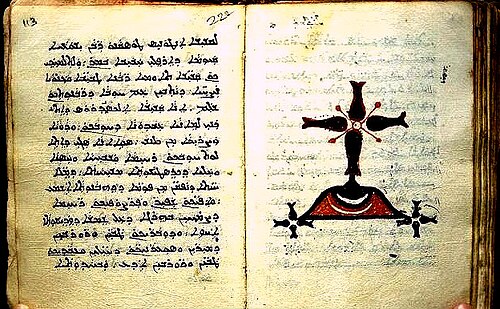
新アッシリア帝国と新バビロニア帝国の時代には、アラム語を母国語とするアラム人がバビロニアに大量に定住し始め、後には「アルベラ三角地帯」(アッシュール、ニネベ、アルベラ)としても知られるアッシリアの中心地に定住した。[79]この流入により、最終的に新アッシリア帝国(紀元前911年 - 605年)は、アッカド語の影響を受けた帝国アラム語を帝国の共通語として採用した。[38]この政策は短命だった新バビロニア帝国とメディア帝国にも引き継がれ、3つの帝国はいずれも文書資料ではアラム語とアッカド語が併用され、実質的にバイリンガルとなった。[80]アケメネス朝(紀元前539-323年)もこの伝統を引き継ぎ、これらの帝国の広範な影響力により、アラム語は徐々に西アジア、アナトリア、コーカサス、エジプトのほとんどの地域で共通語となりました 。[27] [29]
7世紀後半のラシドゥーン・カリフ制の台頭と初期のイスラム教徒の征服に始まり、アラビア語は徐々に近東の共通語としてアラム語に取って代わっていった。[81]しかし、アラム語は地元のキリスト教徒と一部のユダヤ人にとって話し言葉、文学言語、典礼言語であり続けている。アラム語はまた、イラク北部、シリア北東部、トルコ南東部、イラン北西部のアッシリア人によっても話され続けており、アルメニア、ジョージア、アゼルバイジャン、南ロシアにはディアスポラ・コミュニティがある。マンダ教徒も古典マンダ語を典礼言語として使用し続けているが、現在ではその多くがアラビア語を第一言語としている。[43]また、シリア西部の孤立した村には、西アラム語の諸方言を第一言語とする少数の人々が今も存在する。
他の地域の言語と接触していたため、いくつかの新アラム語の方言は、特にアラビア語、 [81]、イラン語、[82]、クルド語[83]と相互に影響を交換していました。
過去2世紀の混乱(特にシリア語でセイフォ「剣」としても知られるアッシリア人虐殺)により、第一言語および文語アラム語の話者は世界中に散らばってしまった。しかし、イラク北部にはアルコシュ、バクディダ、バルテラ、テスコパ、テル・ケッペなど、かなり大きなアッシリア人の町がいくつかあり、また、アラム語が今も主な話言語となっている小さな村も数多くある。また、この地域の多くの大都市にもスレト語を話すコミュニティがあり、特にモスル、アルビル、キルクーク、ドホーク、アル・ハサカがそうだ。現代のイスラエルでは、アラム語を母国語とする人口はクルディスタンのユダヤ人だけであるが、この言語は消滅しつつある。[84]しかし、イスラエルのジシュではマロン派の間でアラム語が復活しつつある。[85]
アラム語と方言
アラム語は単一の言語として語られることが多いが、実際は関連言語のグループである。[86]一部の言語は、ロマンス諸語間の相違よりも互いに大きく異なっている。その長い歴史、豊富な文学、そして異なる宗教コミュニティによる使用は、すべて言語の多様化の要因である。アラム語の方言の中には相互に理解可能なものもあれば、そうでないものもあり、これは現代のアラビア語の変種の場合と似ている。
いくつかのアラム語は異なる名前で知られています。たとえば、シリア語は特に、イラク北部、トルコ南東部、シリア北東部、イラン北西部のシリア系キリスト教徒コミュニティと、インドのケララ州の聖トマス・キリスト教徒が話す東部アラム語の方言を表すために使用されます。ほとんどの方言は「東部」または「西部」のいずれかとして説明できますが、境界線はおおよそユーフラテス川、またはその少し西です。
また、現代に生きる言語、つまり新アラム語と、文学や典礼の言語として現在も使用されている言語、あるいは学者だけが関心を持つ言語を区別することも役立ちます。この規則にはいくつかの例外がありますが、この分類では、アラム語のさまざまな言語と方言を区別するために、「東部」と「西部」の地域と並んで「古代」、「中期」、「現代」の期間が示されています。
書記体系
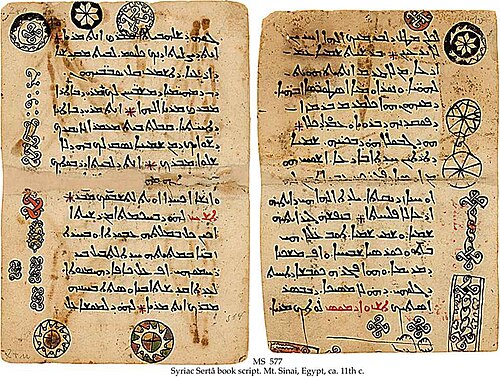
最も古いアラム語のアルファベットはフェニキア文字に基づいていました。やがてアラム語は独特の「四角い」スタイルを発達させました。古代イスラエル人とカナンの他の民族は、自分たちの言語を書くためにこのアルファベットを採用しました。そのため、ヘブライ文字としてよく知られています。これは、聖書のアラム語やアラム語で書かれた他のユダヤ人の書記体系で使用されている書記体系です。アラム語に使用されるもう1つの主要な書記体系は、キリスト教コミュニティによって開発されたもので、シリア文字として知られる筆記体です。アラム語アルファベットの大幅に変更された形式であるマンダ文字は、マンダ教徒によって使用されています。[43]
これらの表記体系に加えて、古代には特定のグループによってアラム語アルファベットの派生語が使用されていました。ペトラのナバテア文字やパルミラのパルミラ文字などです。現代では、トゥロヨ文字(下記参照)がラテン文字で書かれることもあります。
周期化
アラム語の歴史的発展の時代区分は学者にとって特に興味深いテーマであり、言語的、年代的、地域的基準に基づいていくつかのタイプの時代区分が提案されている。異なる時代区分で使用されている用語が重複しているため、学者の間で異なって使用されるいくつかの多義的な用語が生み出された。古期アラム語、古代アラム語、初期アラム語、中期アラム語、後期アラム語(および古期アラム語など)などの用語はさまざまな意味で使用され、アラム語の歴史的発展のさまざまな段階(範囲または内容)を指している。[87] [88] [89]
最も一般的に使用される時代区分のタイプは、クラウス・ベイヤーとジョセフ・フィッツマイヤーの時代区分です。
クラウス・ベイヤー(1929–2014)の時代区分:[90]
ジョセフ・フィッツマイヤー(1920–2016)の時代区分: [91]
- 古代アラム語、最古の記録から紀元前700年頃の地域的な重要性まで
- 公用語アラム語、紀元前700年頃から紀元前200年頃まで
- 中期アラム語、紀元前200年頃から紀元後200年頃まで
- 後期アラム語、西暦200年頃から西暦700年頃まで
- 現代アラム語、紀元後700年頃から現代まで
アーロン・バットの最近の時代区分: [92]
- 古代アラム語、最古の記録から紀元前538年頃まで
- アケメネス朝アラム語、紀元前538年頃から紀元前333年頃まで
- 中期アラム語、紀元前333年頃から紀元後200年頃まで
- 後期アラム語、西暦200年頃から西暦1200年頃まで
- 新アラム語、紀元1200年頃から現代まで
古代アラム語

アラム語の長い歴史と、多様で広範囲に渡る使用により、多くの異なる変種が発達した。これらは方言と見なされることもあるが、時間の経過とともに十分に区別されるようになり、現在では別々の言語と見なされることもある。したがって、単一で静的なアラム語は存在せず、それぞれの時代と場所で独自の変種が存在する。より広く話されている東部アラム語は、イラク、シリア北東部、イラン北西部、トルコ南東部のアッシリア、マンダ派、ミズラヒ派ユダヤ人コミュニティに大きく限定されている。一方、深刻に絶滅の危機に瀕している西部新アラム語は、アンティ・レバノン山脈の小さなキリスト教徒とイスラム教徒のコミュニティで話されており、密接に関連する西部アラム語の変種[94]は、17世紀までレバノン山地に存続していた。 [95] 「古アラム語」という用語は、最初に使用されたときから、ササン朝の台頭(224年)によってほぼ区切られ、東部方言地域を支配した時点までの言語の変種を表すのに使われます。したがって、この用語は、アラム語の発展の13世紀以上を網羅しています。この長い期間には、現在事実上消滅しているすべてのアラム語が含まれます。最古の形態に関して、ベイヤーは、書かれたアラム語は紀元前11世紀に遡る可能性が高いと示唆しています。 [96]これは、北シリアの最古の碑文の年代を10世紀と定めているためです。ハインリヒスは、明確で広範な証拠がある9世紀という 、それほど議論の余地のない年代を使用しています。
古代アラム語の発展の中心段階は、新アッシリア帝国(紀元前911年 - 608年)、新バビロニア帝国(紀元前620年 - 539年)、アケメネス朝(紀元前500年 - 330年) による公式使用であった。これ以前の「古代アラム語」と呼ばれる時代には、アラム人の都市国家で話されていた言語が、メソポタミア、レバント、エジプト全土で外交や貿易の主要なコミュニケーション手段へと発展した。アケメネス朝の崩壊後、地方の方言がますます目立つようになり、アラム語方言の連続性の分岐と異なる書き言葉の標準の発展を促した。
古代アラム語
「古代アラム語」とは、言語の起源から肥沃な三日月地帯の共通語になるまでの、言語の最も古い時代を指す。アラム語は、ダマスカス、ハマト、アルパドといったアラム人の都市国家の言語であった。[98]
紀元前10世紀の碑文に、この言語の最古の使用を証明するものがある。これらの碑文のほとんどは、アラム人の都市国家間の外交文書である。この初期のアラム語のアルファベットは、フェニキア文字に基づいているようで、書き言葉には統一性がある。やがて、言語の必要性に適した、より洗練されたアルファベットが、アラムの東部地域でこれから発達し始めたようである。アラム人の東方への移住が増加したため、少なくとも紀元前9世紀半ばには、アッシリア西部の周辺地域ではアッカド語とアラム語のバイリンガルとなった。新アッシリア帝国がユーフラテス川西岸のアラム人の土地を征服すると、ティグラト・ピレセル3世はアラム語を帝国の第二公用語とし、最終的にはアッカド語に完全に取って代わった。
紀元前700年頃から、アラム語はあらゆる方向に広まり始めたが、統一性は大きく失われた。アッシリア、バビロニア、レバント、エジプトでは異なる方言が生まれた。紀元前600年頃、カナンの王アドンはエジプトのファラオに手紙を書くのにアラム語を使った。[99]
帝国アラム語
紀元前500年頃、ダレイオス1世率いるアケメネス朝(ペルシャ)がメソポタミアを征服した後、その地域で使用されていたアラム語が征服者たちによって「広大な帝国のさまざまな地域、さまざまな民族、さまざまな言語の間で筆記によるコミュニケーションを行う手段」として採用されました。現代の学者が公用語アラム語または帝国アラム語と呼んでいる単一の公用語の使用は、[100] [37] [101]アケメネス朝が広範囲に広がる帝国を長期間維持するという驚くべき成功に大きく貢献したと考えられます。[102] 1955年、リチャード・フライは帝国アラム語を「公用語」と分類することに疑問を呈し、現存する勅令で特定の言語にその地位を明示的かつ明確に与えたものはないことを指摘しました。[103]フライは帝国アラム語をアケメネス朝領土の共通語として再分類し、アケメネス朝時代のアラム語の使用は一般に考えられていたよりも広範であったことを示唆している。
帝国アラム語は高度に標準化されており、その正書法はどの方言よりも歴史的なルーツに基づいており、ペルシア語の必然的な影響は言語に新たな明瞭さと力強い柔軟性を与えた。アケメネス朝の崩壊(紀元前330年)後、数世紀にわたって帝国アラム語(またはそれと認識できるほどそれに近いバージョン)は、さまざまなイランの土着言語に影響を与え続けた。アラム語の文字と、表意文字としてのアラム語の語彙は、パフラヴィー文字の本質的な特徴として生き残った。[104]
帝国アラム語のテキストの最大のコレクションの一つは、ペルセポリスで発見されたペルセポリス行政文書館のもので、その数は約500に上ります。[105]この形態のアラム語を証明する現存する文書の多くはエジプト、特にエレファンティネから来ています(エレファンティネ・パピルスを参照)。それらの中で最もよく知られているのはアヒカルの物語で、聖書の箴言とスタイルが非常によく似た教訓的な格言集です。2022年時点でのコンセンサスでは、聖書のダニエル書のアラム語部分(すなわち、2:4b–7:28)が帝国(公式)アラム語の例とされています。[106][update]
アケメネス朝アラム語は非常に統一されているため、その言語の特定の例がどこで書かれたのかを知ることは難しい場合が多い。注意深く調べると、時折、現地の言語からの借用語が見つかる。
バクトリアから30点のアラム語文書が発見され、その分析結果が2006年11月に発表された。革に書かれたこの文書は、紀元前4世紀のアケメネス朝によるバクトリアとソグディアの統治下でのアラム語の使用を反映している。[107]
聖書アラム語
聖書アラム語は、聖書の 4 つの個別のセクションに記載されているアラム語です。
- エズラ記[108] – エルサレムの神殿の修復に関するアケメネス朝時代(紀元前5世紀)の文書。
- ダニエル[109] – 5つの物語と終末的なビジョン。[110]
- エレミヤ書 10:11 – ヘブライ語のテキストの真ん中にある、偶像崇拝を非難する一文。
- 創世記[111] – ヘブライ語の地名の翻訳。
聖書アラム語は、いくぶん混合した方言です。聖書アラム語の一部は、アケメネス朝の崩壊以前にバビロニアとユダヤの両方で生まれたと理論づけられています。
聖書のアラム語は、初期の聖書研究に携わっていた作家たちにさまざまな課題を提示した。ジェローム・オブ・ストリドン(420年没)の時代以来、聖書のアラム語は「カルデア語」(カルデア語、カルデア語)と呼ばれていた。[112]この呼称は初期のアラム語研究でよく使われ、19世紀まで続いた。「カルデア語の誤称」は、現代の学術的分析によってヘブライ語聖書で使われているアラム語の方言が古代カルデア人とその言語とは無関係であることが示され、最終的に廃止された。 [113] [114] [115]
アケメネス朝以降のアラム語


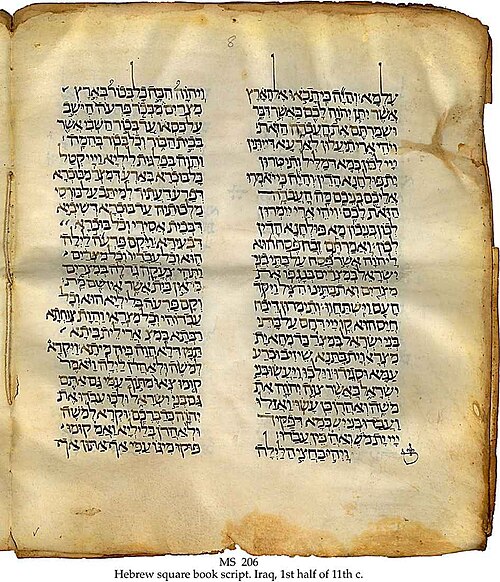
アケメネス朝(紀元前334年~330年頃)の崩壊と、アレクサンダー大王(紀元前323年没)とその後継者によるヘレニズム時代の新体制の導入は、アラム語の歴史において重要な転換点となった。アケメネス朝崩壊後の初期の段階では、アラム語の公的な使用は継続されていたが、新たに導入されたギリシャ語と共有されていた。紀元前300年までに、主要なアラム語圏のすべては、新たに建国されたセレウコス朝の政治支配下に入り、ヘレニズム文化を促進し、公的生活と行政の主要言語としてギリシャ語を支持した。紀元前3世紀には、セレウコス朝領土全体の高度にギリシャ化された都市を中心に、ギリシャ語が公的なコミュニケーションの多くの分野でアラム語を追い抜いた。しかし、アラム語は、アケメネス朝以降の形で、アラム語を母語とするコミュニティの上流階級や識字階級の間で、また地方当局によって(新たに導入されたギリシャ語とともに)使用され続けた。アケメネス朝以降のアラム語は、アケメネス朝時代のアラム語と比較的よく似ており、紀元前2世紀まで使用され続けた。[116]
紀元前2世紀末までに、地域的な特徴を持つポストアケメネス朝アラム語のいくつかの変種が出現した。その1つがハスモン朝アラム語で、これはハスモン朝ユダヤ(紀元前142年-紀元前37年)の公式行政言語であり、ヘブライ語と並んで宗教やその他の公的な用途(貨幣)で好まれた言語であった。これはクムラン文書の聖書アラム語に影響を与え、そのコミュニティの非聖書神学文書の主要言語であった。ヘブライ語聖書のアラム語への翻訳である主要なタルグムは、もともとハスモン朝アラム語で作成された。また、ミシュナやトセフタでの引用にも見られるが、後の文脈に合わせて滑らかになっている。アケメネス朝アラム語とはかなり違った書き方をしており、語源的な形を使うよりも単語の発音通りに書くことに重点が置かれている。
アケメネス朝の官僚機構でアラム語の書き言葉が使われたことで、中期イランの多くの言語を表記するためにアラム語(由来)の文字が採用されるようになった。さらに、代名詞、助詞、数字、助動詞など、多くの一般的な単語は、中期イランの言語を書くときでさえ、引き続きアラム語の「単語」として書かれていた。やがて、イランの用法では、これらのアラム語の「単語」はアラム語から切り離され、記号(つまり表語文字)として理解されるようになった。これは、英語で記号「&」が「and」と読み、元のラテン語のetがもはや明らかではないのとよく似ている。紀元前3世紀初頭のパルティア・アルサケス朝では、政府はギリシャ語を使用していたが、母国語はパルティア語であり、パルティア語とそのアラム語由来の書記体系はどちらも権威を得た。これにより、今度はその文字体系に「パフラヴィー」(< parthawi、「パルティア人の」)という名称が採用されることになった。3世紀半ばにパルティアのアルサケス朝の後を継いだペルシャのササン朝は、その後、パルティアを媒介としたアラム語由来の文字体系を、自らの中期イラン民族方言にも継承/採用した。 [117] [118]その特定の中期イラン方言、中期ペルシア語、すなわちペルシャ本来の言語も、その後、権威ある言語となった。7世紀にアラブ人がササン朝を征服した後、アラム語由来の文字体系は、ゾロアスター教を除いてすべてアラビア文字に置き換えられた。ゾロアスター教は、アラム語由来の文字体系に「パフラヴィー」という名称を使い続け、中期イラン文学の大半をその文字体系で創作していった。
その他の地方の方言も、多くの場合はアラム語の単純な口語の変種として、これらと並行して存在し続けました。これらの方言の初期の証拠は、より標準的な方言の単語や名前への影響を通じてのみ知られています。しかし、これらの地方の方言のいくつかは、紀元前2世紀までに書き言葉になりました。これらの方言は、アケメネス朝アラム語に直接依存しないアラム語の流れを反映しており、東部と西部の地域間の明確な言語的多様性も示しています。
タルグミック
バビロニアタルグムは、アケメネス朝以降の方言で、タルグム オンケロスとタルグム ジョナサン(公式タルグム) に見られます。元のハスモン朝タルグムは、紀元後 2 世紀または 3 世紀にバビロンに伝わりました。その後、当時のバビロン方言に合わせて改訂され、標準タルグムの言語が生まれました。この組み合わせは、その後数世紀にわたってバビロニアのユダヤ文学の基礎となりました。
ガリラヤ・タルグムはバビロニア・タルグムに似ています。これは、文学的なハスモン語とガリラヤの方言が混ざったものです。ハスモン語タルグムは西暦2世紀にガリラヤに到達し、現地での使用のためにこのガリラヤ方言に改訂されました。ガリラヤ・タルグムは他のコミュニティでは権威ある作品とはみなされておらず、文書による証拠はそのテキストが修正されたことを示しています。西暦11世紀以降、バビロニア・タルグムが規範になると、ガリラヤ版はバビロニア・タルグムの影響を強く受けるようになりました。
バビロニアのドキュメンタリー アラム語
バビロニア文書アラム語は、紀元後 3 世紀以降に使用された方言です。これはバビロニアの私文書の方言であり、12 世紀以降、ユダヤ人の私文書はすべてアラム語で書かれています。これはハスモン語に基づいており、ほとんど変更されていません。これはおそらく、BDA の文書の多くが法的な文書であり、その言語は最初からユダヤ人コミュニティ全体で理解できるものでなければならなかったためであり、ハスモン語が古い標準だったためです。
ナバテア人
ナバテア・アラム語は、ペトラを首都としたアラブのナバテア王国の書き言葉であった。王国(紀元前200年頃 - 紀元後106年)は、ヨルダン川東岸、ネゲブ、シナイ半島、ヒジャーズ北部の地域を支配し、広範囲にわたる貿易ネットワークを支えていた。ナバテア人は、書き言葉として、母国語のアラビア語ではなく、帝国アラム語を使用していた。ナバテア・アラム語は帝国アラム語から発展したもので、アラビア語の影響をいくらか受けており、「l」はしばしば「n」に変わり、アラビア語からの借用語もいくつかある。アラビアの影響は、時とともに強まっていった。ナバテア・アラム語の碑文には王国初期のものもあるが、年代が特定できる碑文のほとんどは紀元後4世紀頃のものである。この言語は、アラビア語アルファベットの前身である筆記体で書かれている。西暦106年にローマ人がナバテアを併合した後、ナバテアの大部分はアラビア・ペトラエア州に編入され、ナバテア人は書面によるコミュニケーションにギリシャ語を利用するようになり、アラム語の使用は減少した。
パルミラ
パルミラアラム語は、シリア砂漠の多文化都市国家[119]パルミラで紀元前44年から紀元後274年まで使用されていた方言です。丸みを帯びた文字で書かれていましたが、後に筆記体のエストランジェラに取って代わられました。ナバテア語と同様に、パルミラ語はアラビア語の影響を受けていますが、その程度ははるかに少ないです。
東部方言
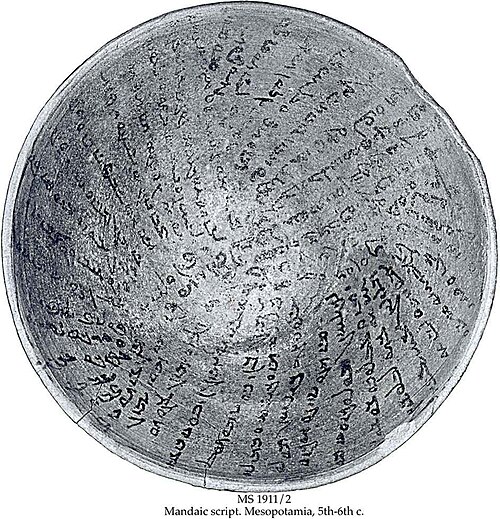
東部地域(メソポタミアからペルシャまで)では、パルミラ・アラム語やアルサケス朝アラム語などの方言が徐々に地域の方言と融合し、アケメネス朝と地域アラム語の両方の要素を持つ言語が生まれました。
紀元前132年に建国され、エデッサ(ウルハイ)を中心とするオスロエネ王国では、地域の方言であるエデッサ・アラム語(ウルハイ)が公用語となり、後に古典シリア語として知られるようになった。チグリス川上流では、東メソポタミア・アラム語が栄え、ハトラとアッシュールの地域でその証拠が残っている。[120]
福音書のハーモニー『ディアテッサロン』の著者であるアッシリア人(シリア人)タティアヌスはアディアベネ(シリア語:ベト・ハディアブ)出身で、 [121]おそらくその著作(紀元172年)は古典シリア語やギリシャ語ではなく東メソポタミア語で書かれたものと考えられている。バビロニアでは、この地域の方言であるユダヤ古バビロニア語(紀元70年頃~)がユダヤ人コミュニティによって使用されていた。この日常言語は次第に聖書のアラム語やバビロニア・タルグム語の影響を受けるようになった。
マンダ教の言語であるマンダ語の書き言葉は、アルサケス朝の官庁文字から派生したものである。[122]
西部方言
アラム語の西部方言は東部方言と似たような経過を辿りました。東部方言や帝国アラム語とはまったく異なります。アラム語はカナン方言と共存するようになり、紀元前 1 世紀にはフェニキア語に、紀元後 4 世紀初頭 にはヘブライ語に完全に取って代わりました。
ユダヤ人コミュニティによって使用された後期古期西アラム語の形態は最もよく証明されており、通常、ユダヤ古期パレスチナ語と呼ばれています。その最古の形態は古期東ヨルダン語で、おそらくカエサレア・ピリピ地方に由来しています。これは、エノク書(紀元前170年頃)の最古の写本の方言です。言語の次の明確な段階は古期ユダヤ語と呼ばれ、紀元後2世紀まで続きました。古期ユダヤ文学は、さまざまな碑文や個人的な手紙、タルムードに保存されている引用文、クムランからの領収書に見ることができます。ヨセフスの『ユダヤ戦記』の最初の現存しない版は、古期ユダヤ語で書かれています。
古東ヨルダン方言は、ヨルダン川の東に住む異教徒のコミュニティによって、紀元後 1 世紀まで使用され続けました。彼らの方言は、しばしば異教徒古パレスチナ方言と呼ばれ、古シリア語で使用されている筆記体にいくらか似た文字で書かれていました。キリスト教の古パレスチナ方言は異教徒の方言から派生した可能性があり、この方言は、それ以外の点では東方古シリア福音書に見られる西アラム語の傾向の一部の背後にある可能性があります (ペシタを参照)。
イエスの生涯における言語
キリスト教の学者たちは、1世紀にはユダヤのユダヤ人は主にアラム語を話し、ヘブライ語を母国語とするユダヤ人は減少したが、多くは礼拝言語としてヘブライ語を学んだと一般に信じています。さらに、コイネーギリシャ語は、貿易、ギリシャ化した階級(ヨーロッパの18世紀、19世紀、20世紀のフランス語によく似ています)、およびローマ行政において、近東の共通語でした。ローマ軍と上級行政機関の言語であったラテン語は、言語の状況にほとんど影響を与えませんでした。
ハスモン朝とバビロニア朝に基づく正式な文学的アラム語方言に加えて、口語的なアラム語方言が数多く存在した。イエスの時代にはユダヤ周辺で西アラム語の 7 つの変種が話されていた。それらはおそらく独特でありながら相互に理解可能であったと思われる。古ユダヤ語はエルサレムとユダヤの著名な方言であった。エイン・ゲディ地方では南東ユダヤ方言が話されていた。サマリアには独特のサマリア語アラム語があり、子音「he」、「heth」、「 ' ayin 」はすべて「 aleph 」と発音されるようになった。イエスの出身地の方言であるガリラヤ・アラム語は、いくつかの地名、ガリラヤ・タルグム語への影響、一部のラビ文学、および数通の私信からのみ知られている。この言語にはいくつかの際立った特徴があるようである。二重母音が一母音に簡略化されることはない。ヨルダン川の東では、東ヨルダン語のさまざまな方言が話されていた。ダマスカスとアンティ・レバノン山脈の地域では、ダマスカス・アラム語(主に現代西アラム語から派生)が話されていました。最後に、はるか北のアレッポでは、オロンテス・アラム語の西部方言が話されていました。
3 つの言語、特にヘブライ語とアラム語は、借用語と意味の借用を通じて互いに影響を及ぼしました。ヘブライ語の単語はユダヤのアラム語に入りました。ほとんどは専門用語の宗教用語でしたが、עץ ʿēṣ 「木」のような日常語もいくつかありました。逆に、 māmmôn 「富」などのアラム語の単語はヘブライ語に借用され、ヘブライ語の単語はアラム語から追加の意味を獲得しました。たとえば、ヘブライ語の ראוי rā'ûi 「見られる」は、「見られる」「価値がある」という意味のアラム語ḥzîから「ふさわしい、ふさわしい」 という意味を借用しました。
新約聖書のギリシャ語には、セム語の音訳など、いくつかのセム語的特徴が残っている。その一部はアラム語であり、 [123]名詞טליתא ṭalīṯāを表すtalitha (ταλιθα)や[124]ヘブライ語またはアラム語のどちらかである可能性のある רבוני Rabbounei (Ραββουνει) は、どちらの言語でも「私の師匠/偉大なる者/教師」を意味する。[125]その他の例:
- 「タリタ・クミ」(טליתא קומי)[124]
- 「エフファタ」 (אתפתח) [126]
- 「エロイ、エロイ、ラマ・サバクタニ?」 (? 、 、 、 、 、 、 、 、 ) [127]
2004年の映画『パッション』では、セリフの多くにアラム語が使われており、学者のウィリアム・フルコ神父によって特別に再構成された。適切な単語(1世紀のアラム語)が不明な部分については、ダニエル書のアラム語と4世紀のシリア語とヘブライ語を作品の基礎として使用した。[128]
中期アラム語
紀元前300年から紀元後200年にかけての中期アラム語時代には、アラム語は東方と西方に分かれた。この時期に、さまざまなアラム語方言の性質が変化し始めた。帝国アラム語の子孫は生きた言語ではなくなり、東方と西方の方言は重要な新しい文学を発展させ始めた。古期アラム語の多くの方言とは異なり、中期アラム語の語彙と文法については多くのことが知られている。[129]
東中期アラム語
古代東アラム語の方言は、古代アッシリア、バビロン、アケメネス朝で様々なアラム文字を使った書き言葉として存続した。東中期アラム語は、古典マンダ語、ハトラン語、ユダヤバビロニアアラム語方言、古典シリア語から構成される[130]。

シリア語 アラム語

シリア・アラム語(「古典シリア語」とも呼ばれる)は、シリアのキリスト教の文学、典礼、およびよく話される言語である。紀元1世紀までにエデッサを中心とするオスロエネ地方で生まれたが、その黄金期は4世紀から8世紀であった。この時代は、聖書のシリア語への翻訳、すなわちペシタ訳とシリア人エフレムの見事な散文と詩から始まった。古典シリア語は、東方アッシリア教会、シリア正教会、そして後にネストリウス派教会の言語となった。宣教活動により、シリア語はメソポタミアとペルシアから中央アジア、インド、中国へと広まった。[131] [132]
ユダヤ・バビロニア・アラム語
ユダヤ中期バビロニア語は、4世紀から11世紀にかけてバビロニアでユダヤ人作家が使用した言語である。この言語は、バビロニア・タルムード(7世紀に完成)やタルムード後のゲオニック文学の言語と最もよく一致しており、これらはバビロニア・ユダヤ教の最も重要な文化的産物である。この方言の最も重要な碑文資料は、ユダヤ・バビロニア・アラム語で書かれた数百の呪文の椀である。[133]
マンダ語 アラム語
イラクとイランのマンダ教徒が礼拝言語として使う古典マンダ語は、ユダヤ教バビロニア語アラム語の姉妹方言だが、言語的にも文化的にも異なる。マンダ教徒のグノーシス主義の宗教文学は、この言語で書かれた。高度に音声的な正書法を特徴とし、母音の発音区別符号は使用しない。[16]
西中期アラム語
古代西アラム語の方言は、ナバテア語、ユダヤ系パレスチナ語(ヘブライ語の「方眼文字」)、サマリア系アラム語(古代ヘブライ文字)、キリスト教系パレスチナ語(シリア語のエストランジェラ文字)と継承された。[134]これら4つの言語のうち、ユダヤ系パレスチナ語のみが書き言葉として存続した。[説明が必要]
サマリア語アラム語
サマリア語アラム語は、サマリア人の文書伝承によって最も古くから存在が証明されており、その歴史は4世紀にまで遡ります。その現代の発音は、10世紀に使用されていた形式に基づいています。[15]
ユダヤ系 パレスチナ系 アラム語

135年、バル・コクバの反乱の後、多くのユダヤ人指導者がエルサレムから追放され、ガリラヤに移住した。こうして、無名だったガリラヤ方言が西方ユダヤ人の間で標準語となった。この方言はガリラヤだけでなく、その周辺地域でも話されていた。エルサレム・タルムード(5世紀完成)、パレスチナ・タルグミム(ユダヤ教のアラム語版聖書)、ミドラーシュ(聖書の注釈と教え)の言語的背景となっている。ヘブライ語聖書の標準的な母音指示法であるティベリア方式(7世紀)は、ユダヤ教中期パレスチナ語のガリラヤ方言の話者によって開発された。したがって、この時代を代表する古典ヘブライ語の発声法は、おそらくこのアラム語方言の当時の発音を反映している。[135]
古期ユダヤアラム語の子孫である中期ユダヤアラム語はもはや主要な方言ではなく、南ユダヤでのみ使用されていました (この期間を通じて、変種のエンゲディ方言が継続されました)。同様に、中東ヨルダンアラム語は古期東ヨルダンアラム語からのマイナーな方言として継続されました。ドゥラ・エウロポスのシナゴーグの碑文は、中東ヨルダン語または中期ユダヤ語で書かれています。
キリスト教パレスチナ語アラム語
これは、5世紀から8世紀にかけてパレスチナ、トランスヨルダン、シナイ半島に住んでいた、主にユダヤ系であるキリスト教メルキト派(カルケドン派)の言語であった[136] 。 [137]典礼言語としては、13世紀まで使用されていた。また、「メルキト・アラム語」、「シリア・パレスチナ語」、「パレスチナ・シリア語」とも呼ばれている。[138]この言語自体は古代西アラム語に由来するが、その表記法はエデッサのアラム語方言に基づいており、ギリシャ語の影響を強く受けている。例えば、イエスの名はシリア語でīšū'であるが、キリスト教パレスチナ語ではギリシャ語の音訳であるīsūsと表記される。 [139]
現代アラム語
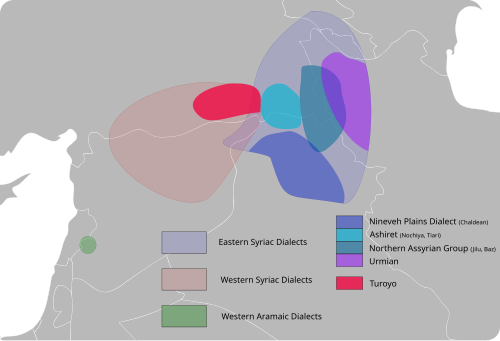
レバントの西アラム語方言は礼拝以外での使用ではほぼ消滅しているため、21世紀における新アラム語の最も多用な話者は東アラム語話者であり、最も数が多いのはメソポタミアの中央新アラム語と北東新アラム語(NENA)の話者です。これには、アッシリア語 (235,000人) とカルデア語 (216,000人) のスレト方言とトゥロヨ語(112,000人から450,000人) の話者が含まれます。現代アラム語の方言を話す残存者、例えばカラモウン山脈のアラム人、アッシリア人、マンダ教徒、ミズラヒ系ユダヤ人などは、千年以上もの間、隔離されたコミュニティとして辺鄙な地域に住んでいたため、以前はそれらの言語を話さなかった人々の間で他の言語が急増した大規模な言語転換、最も最近では7世紀初期のイスラム教徒の征服から始まったアラブ人による中東と北アフリカのアラブ化の間に他の人々が経験した言語的圧力から逃れた。[81]
現代東アラム語

現代の東方アラム語には、多種多様な方言や言語が存在します。[140]アッシリア人、ミズラヒ系ユダヤ人、マンダヤ教徒が話すアラム語には大きな違いがあり、各グループ内でも相互に理解できない差異があります。
北東新アラム語(NENA)のキリスト教方言は、しばしば「アッシリア語」、「カルデア語」、または「東シリア語」と呼ばれ、イラク北部、シリア北東部、トルコ南東部、イラン北西部、およびディアスポラに住むアッシリア人によって話されている。しかし、それらはまた、以前は書かれていなかった多数の現地のアラム語方言に由来しており、場合によってはアッカド語の影響も含んでいる。これらの方言は、古典シリア語であったシリアのエフレムの言語の純粋な直接の子孫ではない。[141]
ユダヤ・アラム語族の言語は現在、主にイスラエルで話されており、そのほとんどは消滅の危機に瀕している。かつてウルミア湖とモスルの間に住んでいたコミュニティから来たユダヤ諸語は、すべてが相互に理解できるわけではない。ウルミアなど一部の地域では、キリスト教徒のアッシリア人とミズラヒ系ユダヤ人が同じ場所で相互に理解できない北東新アラム語の諸語を話している。他の地域、例えばモスル周辺のニネベ平原では、これら2つの民族の諸語は会話が成立するほど似ている。
現代の中央アラム語は、西アラム語と北東アラム語の中間に位置し、一般的にはトゥル・アブディンのアッシリア人/シリア人の言語であるトゥロヨによって代表される。関連するアラム語であるムラソ語は最近消滅した。[142]
イランのフーゼスターン州とイラク全土に散らばるマンダ教徒は、新マンダ語を話す。これは他のアラム語とは全く異なる。マンダ教徒の数は5万人から7万5千人ほどだが、現在新マンダ語を流暢に話せるのは5千人程度で、その他のマンダ教徒の知識レベルはさまざまだと考えられている。[43]
現代西アラム語
西アラム語はほとんど残っていない。唯一残っている方言は西方アラム語で、アンティ・レバノン山脈のシリア側のマアルーラやジュバディンのアラム人の村や、これらの村からダマスカスやシリア国内の他の大都市に移住した一部の人々によって今も話されている。バクア語族はシリア内戦中に完全に破壊され、生存者は全員シリア国内の他の地域やレバノンに逃れた。[143]これらの現代西アラム語の話者は全員、アラビア語も流暢に話す。[95]ユダヤ系パレスチナ人アラム語やサマリア人アラム語などの他の西アラム語は、典礼や文学での使用にのみ残っている。
サンプルテキスト
マタイ伝2章1-4節、古典シリア語(東部方言)、キリスト教パレスチナ語アラム語、スレト語(スワダヤ)訳:[144] [145] [146]
マタイ伝28章16節、古典シリア語(東部アクセント)、西方新アラム語、トゥロヨ語、スレト語(スワダヤ語):
音韻論
アラム語の各方言には独特の発音があり、ここでこれらすべての特性について説明するのは現実的ではありません。アラム語には、25 から 40 の異なる音素の音韻パレットがあります。現代のアラム語の発音には、一連の「強調」子音が欠けているものや、周辺言語、特にアラビア語、アゼルバイジャン語、クルド語、ペルシア語、トルコ語の発音を借用しているものもあります。
母音
ほとんどのセム語族と同様に、アラム語には 3 つの基本的な母音セットがあると考えられます。
- -母音を開く
- 閉じた前置詞i母音
- 閉じたu母音
これらの母音グループは比較的安定していますが、個々の母音の正確な発音は子音の設定に最も依存します。
開母音は、開いた前部に近い非円唇母音(「短い」a、英語の「batter」の最初の母音[ a ]に少し似ている)である。通常、この母音には、後部に対応する音(「長い」a、たとえば「father」のa [ ɑ ]、または「caught」の母音に近い音[ ɔ ])と、前部に対応する音(「短い」e、たとえば「head」の母音[ ɛ ])がある。方言間でこれらの母音の対応関係は多い。中期バビロニア方言では、短いaと短いeを区別していなかったという証拠がある。西シリア方言、そしておそらく中期ガリラヤ方言では、長いa はo の音になった。開eと後部a は、多くの場合、א「alaph」(声門閉鎖音)またはה「he」(英語のhのような)という文字を使用して表記される。
前頭閉母音は「長い」i(「need」の母音[i]と同じ)です。この母音には、もう少し開いた「長い」eがあり、「café」の最後の母音([e])に似ています。この 2 つには、それぞれ短い母音があり、やや開いた発音になる傾向があります。そのため、方言によっては、短い閉母音 eが開いたeに対応します。前頭閉母音では、通常、子音 י y が母音辞典として使用されます。
閉後母音は「長い」u(「school」の母音[u]のような)です。これには、より開いた対応音である「長い」o(「show」の母音[o]のような)があります。これらにはそれぞれ、より短く、したがってより開いた対応音があり、短い閉後母音o は、長く開いたaに対応することがあります。閉後母音は、その性質を示すために子音 ו w をよく使用します。
基本的な二重母音は2つあります。開母音の後に י y ( ay ) が続くものと、開母音の後に ו w ( aw ) が続くものです。これらはもともと完全な二重母音でしたが、多くの方言でそれぞれeとoに変換されました。
いわゆる「強調」子音(次のセクションを参照)により、すべての母音が中央に集中します。
子音
アラム語の表記に使われるさまざまなアルファベットには、22 の文字 (すべて子音) があります。ただし、これらの文字の中には、2 つまたは 3 つの異なる音を表すものもあります (通常は、同じ発音点で破裂音と摩擦音)。アラム語では、古典的に、わずかに対照的な一連の破裂音と摩擦音が使用されます。
- 唇音セット: פּ \ פ p / fおよびבּ \ ב b / v、
- 歯科セット: תּ \ ת t / θおよびדּ \ ד d / ð、
- Velar セット: כּ \ כ k / xおよびגּ \ ג ɡ / ɣ。
あるペアの各メンバーは、ほとんどの表記体系でアルファベットの同じ文字で書かれ(つまり、pとf は同じ文字で書かれる)、ほぼ異音である。
アラム語の音韻論(およびセム語全般)の特徴は、「強調」子音の存在です。これらは、舌根を引っ込めて発音される子音で、咽頭化と軟口蓋化の程度はさまざまです。これらの強調子音をアルファベット名で表すと、次のようになります。
- ח Ḥêṯ、無声咽頭摩擦音、/ħ/、
- ט Ṭêṯ、咽頭音化したt、/tˤ/、
- ע ʽAyin(方言によってはʽE)は咽頭閉鎖音(有声咽頭接近音とみなされることもある)、[ʕ]または[ʔˤ]、
- צ Ṣāḏê、咽頭音化したs、/sˤ/、
- ק Qôp、無声口蓋垂破裂音、/q/。
古代アラム語にはより長い一連の強調音があった可能性があり、一部の新アラム語には確かにそれがあります。アラム語のすべての方言がこれらの子音に歴史的価値を与えているわけではありません。
強勢音のセットと重複しているのは「喉音」子音です。これらには、強勢音セットの ח Ḥêṯ と ע ʽAyn が含まれ、さらに א ʼĀlap̄ (声門閉鎖音) と ה Hê (英語の「h」) が追加されます。
アラム語には、古典的には 4 つの歯擦音があります(古代アラム語では 6 つあった可能性があります)。
- ס、שׂ /s/ (英語の「海」のように)、
- ז /z/(英語の「ゼロ」と同じ)
- שׁ /ʃ/ (英語の「ship」と同じ)
- צ /sˤ/(上記の強調音 Ṣāḏê)。
これらのセットに加えて、アラム語には鼻音מ mと נ n、接近音ר r(通常は歯茎震え)、 ל l、 י y、 ו wがあります。
歴史的な音の変化
方言の違いとして、音声変化の 6 つの大きな特徴が考えられます。
- 母音の変化はあまりにも頻繁に起こるため、完全に文書化することはできませんが、異なる方言の主な特徴です。
- 破裂音/摩擦音対の縮小。もともとアラム語は、ティベリアヘブライ語と同様に、各破裂音の条件付き異音として摩擦音を持っていた。母音の変化に伴い、この区別は最終的に音素的なものとなり、さらに後になって、特定の方言ではしばしば失われるようになった。例えば、トゥロヨ語ではアラビア語のように/p/ がほとんどなくなり、代わりに/f/ が使用されている。他の方言(例えば、標準的なアッシリア新アラム語)では、現代ヘブライ語のように/θ/と/ð/がなくなり、 /t/と/d/に置き換えられている。現代シリア語のほとんどの方言では、/f/と/v/ は母音の後の[w]として実現される。
- 強勢音の消失。一部の方言では強勢子音が非強勢子音に置き換えられているが、コーカサス地方で話される方言では、強勢音が咽頭化ではなく声門化されていることが多い。
- 喉音同化はサマリア語の発音の主な特徴であり、サマリア語ヘブライ語にも見られます。喉音はすべて単純な声門閉鎖音に短縮されます。現代アラム語の方言の中には、すべての単語でh を発音しないものもあります(三人称男性代名詞huはowになります)。
- セム祖語の*/θ/、*/ð/は、アラム語では*/t/、*/d/として表されるが、ヘブライ語では歯擦音になった(数字の3はヘブライ語ではשלוש šālôšであるが、アラム語ではתלת tlāṯであり、金という単語はヘブライ語ではזהב zahav [147]であるが、アラム語ではדהב dehav [148]である)。歯擦音と歯擦音の変化は現代の方言でもまだ起こっている。
- 新しい音声目録。現代の方言は、周囲の主要言語から音を借用しています。最も頻繁に借用されるのは、[ʒ] (「azure」の最初の子音)、[d͡ʒ] (「jam」)、[t͡ʃ] (「church」) です。シリア語のアルファベットは、これらの新しい音を書くために採用されました。
文法
他のセム語族の言語と同様に、アラム語の形態論(単語の形成方法)は子音語根に基づいています。語根は通常、2つまたは3つの子音で構成され、基本的な意味を持ちます。たとえば、כת״ב ktb は「書く」という意味を持ちます。その後、母音や他の子音が追加されて、基本的な意味のさまざまなニュアンスが作成されます。
- כתבה kṯāḇâ、手書き、碑文、台本、本。
- כתבי kṯāḇê、本、聖書。
- כתובה kāṯûḇâ、秘書、書記。
- כתבת kiṯḇeṯ、と書きました。
- אכתב ' eḵtûḇ、私は書きます。
名詞と形容詞
アラム語の名詞と形容詞は、性別、数、状態を表すために活用されます。
アラム語には男性と女性の 2 つの文法性があります。女性絶対単数形は、多くの場合、語尾に ה- -âが付きます。
名詞は単数でも複数でも構いませんが、通常はペアで使われる名詞には追加の「双数」が存在します。双数は時間の経過とともにアラム語から徐々に姿を消し、中期および現代アラム語にはほとんど影響を与えていません。
アラム語の名詞と形容詞は、3 つの状態のいずれかで存在できます。これらの状態は、ある程度、インド・ヨーロッパ語族の冠詞と格の役割に対応しています。
- 絶対態は名詞の基本形です。アラム語の初期の形態では、絶対態は不定性を表現し、英語の不定冠詞 a(n) に相当し (たとえば、כתבה kṯāḇâ 、「手書き」)、ほとんどの統語的役割で使用できます。ただし、中期アラム語時代までに、名詞 (形容詞ではない) での絶対態の使用は、強調態に広く置き換えられました。
- 構成状態は、所有格構文を作るのに使用される名詞の形式です(たとえば、כתבת מלכתא kṯāḇat malkṯâ 、「女王の筆跡」)。男性単数では、構成形式は絶対形と同じであることが多いですが、長い単語では母音が短縮されることがあります。女性構成と男性構成の複数は接尾辞で示されます。所有格が所有者を示すのとは異なり、構成状態は所有されるものに示されます。これは主にアラム語の語順によるものです。所有[const.] 所有[abs./emph.]は音声単位として扱われ、最初の単位(所有)は構成状態を使用して次の単語にリンクします。中期アラム語では、定型句(בר נשא bar nāšâ 、「人の子」など)を除くすべての語句で構造状態が使用されなくなりました。
- The emphatic or determined state is an extended form of the noun that functions similarly to the definite article. It is marked with a suffix (for example, כתבתא kṯāḇtâ, "the handwriting"). Although its original grammatical function seems to have been to mark definiteness, it is used already in Imperial Aramaic to mark all important nouns, even if they should be considered technically indefinite. This practice developed to the extent that the absolute state became extraordinarily rare in later varieties of Aramaic.
Whereas other Northwest Semitic languages, like Hebrew, have the absolute and construct states, the emphatic/determined state is a unique feature to Aramaic. Case endings, as in Ugaritic, probably existed in a very early stage of the language, and glimpses of them can be seen in a few compound proper names. However, as most of those cases were expressed by short final vowels, they were never written, and the few characteristic long vowels of the masculine plural accusative and genitive are not clearly evidenced in inscriptions. Often, the direct object is marked by a prefixed -ל l- (the preposition "to") if it is definite.
Adjectives agree with their nouns in number and gender but agree in state only if used attributively. Predicative adjectives are in the absolute state regardless of the state of their noun (a copula may or may not be written). Thus, an attributive adjective to an emphatic noun, as in the phrase "the good king", is written also in the emphatic state מלכא טבא malkâ ṭāḇâ – king[emph.] good[emph.]. In comparison, the predicative adjective, as in the phrase "the king is good", is written in the absolute state מלכא טב malkâ ṭāḇ – king[emph.] good[abs.].
The final א- -â in a number of these suffixes is written with the letter aleph. However, some Jewish Aramaic texts employ the letter he for the feminine absolute singular. Likewise, some Jewish Aramaic texts employ the Hebrew masculine absolute singular suffix ים- -îm instead of ין- -în. The masculine determined plural suffix, יא- -ayyâ, has an alternative version, -ê. The alternative is sometimes called the "gentilic plural" for its prominent use in ethnonyms (יהודיא yəhûḏāyê, 'the Jews', for example). This alternative plural is written with the letter aleph, and came to be the only plural for nouns and adjectives of this type in Syriac and some other varieties of Aramaic. The masculine construct plural, -ê, is written with yodh. In Syriac and some other variants this ending is diphthongized to -ai.
Possessive phrases in Aramaic can either be made with the construct state or by linking two nouns with the relative particle -[ד[י d[î]-. As the use of the construct state almost disappears from the Middle Aramaic period on, the latter method became the main way of making possessive phrases.
For example, the various forms of possessive phrases (for "the handwriting of the queen") are:
- כתבת מלכתא kṯāḇaṯ malkṯâ – the oldest construction, also known as סמיכות səmîḵûṯ : the possessed object (כתבה kṯābâ, "handwriting") is in the construct state (כתבת kṯāḇaṯ); the possessor (מלכה malkâ, "queen") is in the emphatic state (מלכתא malkṯâ)
- כתבתא דמלכתא kṯāḇtâ d(î)-malkṯâ – both words are in the emphatic state and the relative particle -[ד[י d[î]- is used to mark the relationship
- כתבתה דמלכתא kṯāḇtāh d(î)-malkṯâ – both words are in the emphatic state, and the relative particle is used, but the possessed is given an anticipatory, pronominal ending (כתבתה kṯāḇtā-h, "handwriting-her"; literally, "her writing, that (of) the queen").
In Modern Aramaic, the last form is by far the most common. In Biblical Aramaic, the last form is virtually absent.
Verbs
The Aramaic verb has gradually evolved in time and place, varying between varieties of the language. Verb forms are marked for person (first, second or third), number (singular or plural), gender (masculine or feminine), tense (perfect or imperfect), mood (indicative, imperative, jussive, or infinitive), and voice (active, reflexive, or passive). Aramaic also employs a system of conjugations, or verbal stems, to mark intensive and extensive developments in the lexical meaning of verbs.
Aspectual tense
Aramaic has two proper tenses: perfect and imperfect. These were originally aspectual, but developed into something more like a preterite and future. The perfect is unmarked, while the imperfect uses various preformatives that vary according to person, number and gender. In both tenses the third-person singular masculine is the unmarked form from which others are derived by addition of afformatives (and preformatives in the imperfect). In the chart below (on the root כת״ב K-T-B, meaning "to write"), the first form given is the usual form in Imperial Aramaic, while the second is Classical Syriac.
Conjugations or verbal stems
Like other Semitic languages, Aramaic employs a number of derived verb stems, to extend the lexical coverage of verbs. The basic form of the verb is called the ground stem, or G-stem. Following the tradition of mediaeval Arabic grammarians, it is more often called the Pə‘al פעל (also written Pe‘al), using the form of the Semitic root פע״ל P-‘-L, meaning "to do". This stem carries the basic lexical meaning of the verb.
By doubling of the second radical, or root letter, the D-stem or פעל Pa‘‘el is formed. This is often an intensive development of the basic lexical meaning. For example, qəṭal means "he killed", whereas qaṭṭel means "he slew". The precise relationship in meaning between the two stems differs for every verb.
A preformative, which can be -ה ha-, -א a-, or -ש ša-, creates the C-stem or variously the Hap̄‘el, Ap̄‘el or Šap̄‘el (also spelt הפעל Haph‘el, אפעל Aph‘el, and שפעל Shaph‘el). This is often an extensive or causative development of the basic lexical meaning. For example, טעה ṭə‘â means "he went astray", whereas אטעי aṭ‘î means "he deceived". The Šap̄‘el שפעל is the least common variant of the C-stem. Because this variant is standard in Akkadian, it is possible that its use in Aramaic represents loanwords from that language. The difference between the variants הפעל Hap̄‘el and אפעל Ap̄‘el appears to be the gradual dropping of the initial ה h sound in later Old Aramaic. This is noted by the respelling of the older he preformative with א aleph.
These three conjugations are supplemented with three further derived stems, produced by the preformative -הת hiṯ- or -את eṯ-. The loss of the initial ה h sound occurs similarly to that in the form above. These three derived stems are the Gt-stem, התפעל Hiṯpə‘el or אתפעל Eṯpə‘el (also written Hithpe‘el or Ethpe‘el), the Dt-stem, התפעּל Hiṯpa‘‘al or אתפעּל Eṯpa‘‘al (also written Hithpa‘‘al or Ethpa‘‘al), and the Ct-stem, התהפעל Hiṯhap̄‘al, אתּפעל Ettap̄‘al, השתפעל Hištap̄‘al or אשתפעל Eštap̄‘al (also written Hithhaph‘al, Ettaph‘al, Hishtaph‘al, or Eshtaph‘al). Their meaning is usually reflexive, but later became passive. However, as with other stems, actual meaning differs from verb to verb.
Not all verbs use all of these conjugations, and, in some, the G-stem is not used. In the chart below (on the root כת״ב K-T-B, meaning "to write"), the first form given is the usual form in Imperial Aramaic, while the second is Classical Syriac.
In Imperial Aramaic, the participle began to be used for a historical present. Perhaps under influence from other languages, Middle Aramaic developed a system of composite tenses (combinations of forms of the verb with pronouns or an auxiliary verb), allowing for narrative that is more vivid. Aramaic syntax usually follows the order verb–subject–object (VSO). Imperial (Persian) Aramaic, however, tended to follow a S-O-V pattern (similar to Akkadian), which was the result of Persian syntactic influence.
See also


References
- ^ Mario Kozah; Abdulrahim Abu-Husayn; Saif Shaheen Al-Murikhi; Haya Al Thani (9 December 2014). The Syriac Writers of Qatar in the Seventh Century. Gorgias Press. p. 298. ISBN 9781463236649.
The Syriac writers of Qatar themselves produced some of the best and most sophisticated writing to be found in all Syriac literature of the seventh century, but they have not received the scholarly attention that they deserve in the last half century. This volume seeks to redress this underdevelopment by setting the standard for further research in the sub-field of Beth Qatraye studies.
- ^ Huehnergard, J., "What is Aramaic?." Aram 7 (1995): 281
- ^ Thompson, Andrew David (31 October 2019). Christianity in Oman. Springer. p. 49. ISBN 9783030303983.
The Persian location and character of the Metropolitan proved to be a source of friction between the Syriac-speaking Christians of Beth Qatraye who naturally looked to their co-linguists back in Mesopotamia.
- ^ Raheb, Mitri; Lamport, Mark A. (15 December 2020). The Rowman & Littlefield Handbook of Christianity in the Middle East. Rowman & Littlefield. p. 134. ISBN 9781538124185.
He was born in the region of Beth Qatraye in Eastern Arabia, a mixed Syriac- and Arabic Speaking region…
- ^ a b Brock 1989, pp. 11–23.
- ^
- Rafik Schami (25 July 2011). Märchen aus Malula (in German). Carl Hanser Verlag GmbH & Company KG. p. 151. ISBN 9783446239005.
Ich kenne das Dorf nicht, doch gehört habe ich davon. Was ist mit Malula?‹ fragte der festgehaltene Derwisch. >Das letzte Dorf der Aramäer< lachte einer der…
- Yaron Matras; Jeanette Sakel (2007). Grammatical Borrowing in Cross-Linguistic Perspective. De Gruyter. p. 185. doi:10.1515/9783110199192. ISBN 9783110199192.
The fact that nearly all Arabic loans in Ma'lula originate from the period before the change from the rural dialect to the city dialect of Damascus shows that the contact between the Aramaeans and the Arabs was intimate…
- Dr. Emna Labidi (2022). Untersuchungen zum Spracherwerb zweisprachiger Kinder im Aramäerdorf Dschubbadin (Syrien) (in German). LIT. p. 133. ISBN 9783643152619.
Aramäer von Ǧubbˁadīn
- Prof. Dr. Werner Arnold; P. Behnstedt (1993). Arabisch-aramäische Sprachbeziehungen im Qalamūn (Syrien) (in German). Harassowitz. p. 42. ISBN 9783447033268.
Die arabischen Dialekte der Aramäer
- Prof. Dr. Werner Arnold; P. Behnstedt (1993). Arabisch-aramäische Sprachbeziehungen im Qalamūn (Syrien) (in German). Harassowitz. p. 5. ISBN 9783447033268.
Die Kontakte zwischen den drei Aramäer-dörfern sind nicht besonders stark.
- Prof. Dr. Werner Arnold (2006). Lehrbuch des Neuwestaramäischen (in German). Harrassowitz. p. 133. ISBN 9783447053136.
Aramäern in Ma'lūla
- Prof. Dr. Werner Arnold (2006). Lehrbuch des Neuwestaramäischen (in German). Harrassowitz. p. 15. ISBN 9783447053136.
Viele Aramäer arbeiten heute in Damaskus, Beirut oder in den Golfstaaten und verbringen nur die Sommermonate im Dorf.
- Rafik Schami (25 July 2011). Märchen aus Malula (in German). Carl Hanser Verlag GmbH & Company KG. p. 151. ISBN 9783446239005.
- ^ Huehnergard, John; Rubin, Aaron D. (2011). "Phyla and Waves: Models of Classification of the Semitic Languages". In Weninger, Stefan (ed.). The Semitic Languages: An International Handbook. Berlin: De Gruyter Mouton. pp. 259–278. ISBN 978-3-11-018613-0.
- ^ Gzella 2021, pp. 4–5: "The overarching concept of Aramaic, strictly a historical-linguistic abstraction, is made more concrete by various terms for the various Aramaic languages (or dialects, where we are mainly dealing with regional vernaculars without a written tradition; the neutral term variety includes both categories).[…] Or scholars use the same terms to refer to different historical periods, as with "Old Aramaic" or "Imperial Aramaic." Others still are just misleading, such as "Modern Syriac" for the modern spoken languages, which do not directly descend from Syriac. When discussing what a certain word or phrase is "in Aramaic" then, we always have to specify which period, region, or culture is meant unlike Classical Latin, for instance. […] For the most part, Aramaic is thus studied as a crucial but subservient element in several well-established, mainly philological and historical disciplines and social sciences. Even in the academic world, only few people see any inherent value that transcends the disciplinary boundaries in this language family."
- ^ Van Rompay, Lucas (2011). "Aramaic". In Brock, Sebastian P.; Butts, Aaron M.; Kiraz, George A.; Van Rompay, Lucas (eds.). Gorgias Encyclopedic Dictionary of the Syriac Heritage (Electronic Edition, Beth Mardutho, 2018 ed.). Gorgias Press. ISBN 978-1-59333-714-8.
Aramaic itself consists of a great number of language forms (and indeed languages), spoken and written in many different scripts over a period of 3000 years.
- ^ Aufrecht 2001, p. 145: "The Aramaic Language originated in ancient Syria at the end of the Late Bronze Age (c. 1500–1200 B.C.), is one of the oldest continually spoken languages in the world."
- ^
- Sokoloff 1983
- Beyer 1986
- Lipiński 2000
- Creason 2008, pp. 108–44
- Gzella 2015
- ^ Gzella 2021, p. 222: "Despite their divergent creeds and confessional affiliations, they retained their own West or East Syriac ritual prayers and liturgical formulae; on the one hand, there are the West Syriac Orthodox and Syriac Catholics...and also to a lesser degree the similarly Catholic Maronites (where Arabic is increasingly taking over the function of Syriac); one the other hand, there is the Assyrian "Church of the East," which stems from the East Syriac tradition, and...the Chaldean Catholic Church. Additionally, some of the many Christian churches of India belong to the Syriac tradition."
- ^ Greenfield 1995.
- ^ Berlin 2011.
- ^ a b Tal 2012, p. 619–28.
- ^ a b c Burtea 2012, pp. 670–85.
- ^ Lipiński 2001, p. 64.
- ^ Gzella 2015, pp. 17–22.
- ^ Daniels 1996, pp. 499–514.
- ^ Beyer 1986, p. 56.
- ^ Naby 2004, pp. 197–203.
- ^ Macuch 1990, pp. 214–23.
- ^ Coghill 2007, pp. 115–22.
- ^ Holger Gzella (8 January 2015). A Cultural History of Aramaic: From the Beginnings to the Advent of Islam. BRILL. pp. 56–. ISBN 978-90-04-28510-1. OCLC 1018201352.
- ^ Allen C. Myers, ed. (1987). "Aramaic". The Eerdmans Bible Dictionary. Grand Rapids, MI: William B. Eerdmans. p. 72. ISBN 0-8028-2402-1.
It is generally agreed that Aramaic was the common language of Israel in the first century AD. Jesus and his disciples spoke the Galilean dialect, which was distinguished from that of Jerusalem (Matt. 26:73)
- ^ "Aramaic language". Encyclopædia Britannica. 10 April 2024. Retrieved 10 May 2024.
- ^ a b Lipiński 2000.
- ^ Khan 2007, pp. 95–114.
- ^ a b Gzella 2015.
- ^ "Sanhedrin 38b". www.sefaria.org.
- ^ Ruzer 2014, pp. 182–205.
- ^ Buth 2014, pp. 395–421.
- ^ Gzella 2015, p. 237.
- ^ Kitchen 1965, pp. 31–79.
- ^ Rosenthal 2006.
- ^ Gzella 2015, pp. 304–10.
- ^ a b Folmer 2012, pp. 587–98.
- ^ a b Bae 2004, pp. 1–20.
- ^ Green 1992, p. 45.
- ^ Beyer 1986, pp. 38–43.
- ^ Casey 1999, pp. 83–93.
- ^ Turek, Przemysław (2011-11-05). "Syriac Heritage of the Saint Thomas Christians: Language and Liturgical Tradition Saint Thomas Christians – origins, language and liturgy". Orientalia Christiana Cracoviensia. 3: 115–130. doi:10.15633/ochc.1038. ISSN 2081-1330.
- ^ a b c d Häberl 2012, pp. 725–37.
- ^ Heinrichs 1990, pp. xi–xv.
- ^ Beyer 1986, p. 53.
- ^ "Did you know". Surayt-Aramaic Online Project. Free University of Berlin.
- ^ Duntsov, Alexey; Häberl, Charles; Loesov, Sergey (2022). "A Modern Western Aramaic Account of the Syrian Civil War". WORD. 68 (4): 359–394. doi:10.1080/00437956.2022.2084663.
- ^ Brock, An Introduction to Syriac Studies Archived 2013-05-18 at the Wayback Machine
- ^ Kopp, Ulrich Friedrich [in German] (1821). "Semitische Paläographie: Aramäische ältere Schrift". Bilder und Schriften der Vorzeit. pp. 226–27.
- ^ Caputo, C.; Lougovaya, J. (2020). Using Ostraca in the Ancient World: New Discoveries and Methodologies. Materiale Textkulturen. De Gruyter. p. 147. ISBN 978-3-11-071290-2.
The earliest of the Aramaic finds known to us is the so-called "Carpentras stele"...
- ^ Schmidt, Nathaniel (1923). "Early Oriental Studies in Europe and the Work of the American Oriental Society, 1842–1922". Journal of the American Oriental Society. 43: 1–14. doi:10.2307/593293. JSTOR 593293.
Hilliger first saw clearly the relation of the so-called Chaldee, Syriac, and Samaritan (1679)
- ^ Johann Wilhelm Hilliger (1679). Summarium Lingvæ Aramææ, i.e. Chaldæo-Syro-Samaritanæ: olim in Academia Wittebergensi orientalium lingvarum consecraneis, parietes intra privatos, prælectum & nunc ... publico bono commodatum. Sumtibus hæred. D. Tobiæ Mevii & Elerti Schumacheri, per Matthæum Henckelium.
[Partial English translation]: "The Aramaic language name comes from its gentile founder, Aram (Gen 10:22), in the same manner as the Slavic languages Bohemian, Polish, Vandal etc. Multiple dialects are Chaldean, Syrian, Samaritan."; Latin Original: Linguae Aramaeae nomen à gentis conditore, Aramo nimirum (Gen. X 22) desumptum est, & complectitur, perinde ut Lingua Sclavonica, Bohemican, Polonican, Vandalicam &c. Dialectos plures, ceu sunt: Chaldaica, Syriaca, Samaritana.
- ^ Lemaire, André (2021-05-25). "A History of Northwest Semitic Epigraphy". An Eye for Form. Penn State University Press. p. 5. doi:10.1515/9781575068879-007 (inactive 2024-09-11). ISBN 9781575068879. Retrieved 2022-10-05 – via De Gruyter.
In his Bilder und Schriften der Vorzeit, Ulrich Friedrich Kopp (1819–21) established the basis of the paleographical development of the Northwest Semitic scripts...
{{cite book}}: CS1 maint: DOI inactive as of September 2024 (link) - ^ Kopp 1821, p. 226-227 (§168–169): "Irre ich nicht, so hat man die Benennung "phönicische Schrift" bisher etwas zu freygebig gebraucht, den Phöniciern alles gegeben, und den Aramäern nichts gelassen, gleichsam, als ob diese gar nicht hätten schreiben können, oder doch von ihnen nicht ein einziges Denkmal aus ältern Zeiten sich sollte erhalten haben. Selbst Schriften, in welchen sich die aramäische Mund-Art gar nicht verkennen läßt, nennen die Orientalisten phönicisch (§. 195), bloß weil sie noch nicht geahndet haben, daß eine Verschiedenheit vorhanden seyn könne. Ein Haupt-Unterscheidungs-Zeichen – So weit man, ohne auch dasjenige gesehen zu haben, was etwa noch entdeckt werden könnte, vorjetzt durch bloße Induction schließen kann – scheint in den Buchstaben ב, ד, ע und ר zu liegen. Denn so viele phönicische Denkmäler ich auch betrachtet habe; so sind mir doch in keinem einzigen ächt phönicischen diejenigen Gestalten vorgekommen, welche sich oben öffnen (§. 100). Nur bey dem einzigen ע finden sich, wie ich schon erinnert habe, jedoch höchst seltene Ausnahmen, die zuweilen bloß von der Uebereilung des Schreibers herrühren (z.B. im ersten ע der oxforder Inschrift (B.I. S.207). Wir haben sogar oben (§. 159) gesehen, daß selbst noch 153 Jahre nach Christi Geburt, als schon die Schrift in Phönicien sehr ausgeartet war, und in dem ganzen Zeit-Raume vorher, nie ד und ר mit von oben geöffneten Köpfen erscheinen. Dagegen haben diejenigen Denkmäler, auf welchen man sie antrifft, wie ich glaube, auch keinen Anspruch an Pönicier, als Urheber. §. 169 Unter solche gehört vor allen die Inschrift von Carpentras, welche ich hier um so lieber vornehme, als ihre Aechtheit über allen Zweifel erhoben ist... §. 195 Die Schrift darauf nannte man ehemals ägyptisch, welches freylich, weder in Vergleichung mit der ägyptischen Buchstaben-Schrift eine angemessene Benennung, noch der Sprache wegen eine zu wagende Vermuthung war. Schwerlich richtig ist aber auch die bey neuern Gelehrten (Gessenii Gesch. d. hebr. Spr. 139. Bibl. der alt. Literat. VI. 18. Hammer Fund-Grub. V. 277 °°) aufgekommene Benennung "Phönicisch". Ja Hartmann (II. II. 540) nennt sogar unmittelbar nach der ersten malteser diese "eine andere phönicische Inschrift". Schon die Mund-Art, welche nicht phönicisch, sondern aramäisch ist, würde uns vermuthen lassen, daß die Schrift den Aramäern ebenfalls gehöre; wenn nicht in dieser sich zugleich auch Merkmale einer Verschiedenheit von der phönicischen zeigten (s. oben §. 100. 168). Ich habe daher mit gutem Vorbedachte unser Denkmal von Carpentras aus meiner kleinen Sammlung phönicischer Inschriften (B. I. 195) ausgeschlossen. §. 196 Es scheint, als ob zur Zeit des oben (§. 193) mitgetheilten babylonischen Denkmals Aramäer und Phönicier eine und dieselbe Schrift gehabt hätten. Gegen 300 Sahre vor unserer Zeit-Rechnung war aber meiner Vermuthung nach schon eine Trennung eingetreten. Ich sage Vermuthung: denn mein Schluß gründet sich nur auf die einseitige Auslegung folgender Münze, bey welcher man mir vielleicht mehr als einen Einwurf zu machen im Stande ist.."
- ^ Kopp 1821, p. S. 182–185: "Es gehört nicht viel dazu, um einzusehen, daß die Mund-Art, welche in dieser Inschrift herrscht, aramäisch sey. Schon de Wörter עבדת קדם ,ברת ,אמרת, u. s . w. verrathen sie. Allein rein Chaldäisch kann man sie nicht nennen; man müßte denn mit O. G. Tychsen zu manchen Vorausseßungen und Uenderungen seine Zuflucht nehmen wollen. [ ] ist nimmermehr chaldäisch; sondern entweder äthiopisch hic, hoc loco, oder das hebräische Demonstrativum. Denn man bemerkt auch ben [ ] die Orthographie, nach welcher [ ] statt [ ] gefegt wird. Ich war einmal in Versuchung das Relativum der Zabier darinnen sinden zu wollen, weil ich [ ] wirklich gedruckt fand. Als ich aber die Handschrift selbst verglich, say' ich bald, daß es ein Druckfehler, statt [ ], war… [ ]. Oyngeachtet die Endigung nicht gewöhnlich im Chaldäischen ist, so findet sich doch in der Ueberseßung des Buches Ruth (III. 10) dieses Wort grade so geschrieben. [ ] Daß dieses Zeit-Wort hier nicht perfectus fuit, wie gewöhnlich, heißen könne, lehrt der Zusammenhang. Es hat aber auch transitive Bedeutung, wie die Wörter-Bücher lehren (Simonis und Gesenius n. 2) und auch das arabische [ ] tamam wird für perfecit, complevit gebraucht. Ich habe mir daher um so weniger ein Gewissen daraus gemacht, ihm die transitive Bedeutung hier beyzulegen, als in dieser Anschrift, in welcher [ ], [ ] und dergleichen an keine Regeln gebundene Wörter vorkommen, es eine Recheit reyn würde, den Sprach-Gebrauch vorschreiben zu wollen. Daß übrigens in [ ] das [ ] für [ ] stehe, siehet man selbst aus dem Chaldäischen der Bibel (Dan. IV. 15. V. 8)."
- ^ Andrade 2013, p. 7.
- ^ Josephus, Antiquities of the Jews, 1.144: "Aram had the Aramites, which the Greeks called Syrians" (Greek: Ἀραμαίους δὲ Ἄραμος ἔσχεν, οὓς Ἕλληνες Σύρους προσαγορεύουσιν
- ^ Strabo, Geographica, 1.2.34: "But it would seem that the view of Poseidonius is best, for here he derives an etymology of the words from the kinship of the peoples and their common characteristics. For the nation of the Armenians and that of the Syrians and Arabians betray a close affinity, not only in their language, but in their mode of life and in their bodily build, and particularly wherever they live as close neighbours. Mesopotamia, which is inhabited by these three nations, gives proof of this, for in the case of these nations the similarity is particularly noticeable. And if, comparing the differences of latitude, there does exist a greater difference between the northern and the southern people of Mesopotamia than between these two peoples and the Syrians in the centre, still the common characteristics prevail. And, too, the Assyrians, the Arians, and the Aramaeans display a certain likeness both to those just mentioned and to each other. Indeed, Poseidonius conjectures that the names of these nations also are akin; for, says he, the people whom we call Syrians are by the Syrians themselves called Arimaeans and Arammaeans; and there is a resemblance between this name and those of the Armenians, the Arabians and the Erembians, since perhaps the ancient Greeks gave the name of Erembians to the Arabians, and since the very etymology of the word "Erembian" contributes to this result".
- ^ Strabo, Geographica, 16.4.27: "Poseidonius says that the Arabians consist of three tribes, that they are situated in succession, one after another, and that this indicates that they are homogeneous with one another, and that for this reason they were called by similar names – one tribe "Armenians," another "Arameans," and another "Arambians." And just as one may suppose that the Arabians were divided into three tribes, according to the differences in the latitudes, which ever vary more and more, so also one may suppose that they used several names instead of one. Neither are those who write "Eremni" plausible; for that name is more peculiarly applicable to the Aethiopians. The poet also mentions "Arimi,"by which, according to Poseidonius, we should interpret the poet as meaning, not some place in Syria or in Cilicia or in some other land, but Syria itself; for the people in Syria are Arameans, though perhaps the Greeks called them Arimaeans or Arimi".
- ^ Wevers 2001, pp. 237–51.
- ^ Joosten 2008, pp. 93–105.
- ^ Joosten 2010, pp. 53–72.
- ^ Joseph, John (2000). The Modern Assyrians of the Middle East: A History of Their Encounter with Western Christian Missions, Archaeologists, and Colonial Powers. Brill. pp. 9–10. ISBN 9004116419.
The designations Syria and Syrian were derived from Greek usage long before Christianity. When the Greeks became better acquainted with the Near East, especially after Alexander the Great overthrew the Achaemenian empire in the 4th century B.C., they restricted the name Syria to the lands west of the Euphrates. During the 3rd century B.C., when the Hebrew Bible was translated by Jewish scholars into the Greek Septuagint for the use of the Hellenized Jews of Alexandria, the terms for 'Aramean' and 'Aramaic' in the Hebrew Bible, were translated into 'Syrian' and 'the Syrian tongue' respectively. [Footnote: "The Authorized Version of the Bible continued to use the same terms that the Septuagint had adopted. In 1970, the New English Bible, published by Oxford and Cambridge University presses, and translated by biblical scholars drawn from various British universities, went back to the original Hebrew terms, using Aram and Arameans for Syria and Syrians respectively."] In Palestine itself, according to Noldeke, the Jews and later the Christians there referred to their dialect of Aramaic as Syriac; in Babylon, both Greeks and Persians called the Arameans Syrians. The second-century B.C. Greek historian Posidonius, a native of Syria, noted that 'the people we [Greeks] call Syrians were called by the Syrians themselves Arameans….for the people in Syria are Arameans'."
- ^ a b Nöldeke, 1871, p. 115: "Die Griechen haben den Namen "Aramäer" nie eigentlich gekannt; ausser Posidonius (dem Strabo folgt) nennt ihn uns nur noch ein andrer Orientale, Josephus (Ant. 1, 6, 4). Dass Homer bei den 'Ερεμβοι oder in den Worten eiv 'Αρίμοις an sie dächte, ist sehr unwahrscheinlich. Die Griechen nannten das Volk "Syrer"".
- ^ Quatremère, Étienne Marc (1835). "Mémoire Sur Les Nabatéens". Journal asiatique (in French). Société asiatique: 122–27.
Les livres du Nouveau Testament furent immédiatement traduits dans fa langue du pays. Or ces livres étaient écrits dans la langue des Grecs, et offraient par conséquent les expressions et les dénominations en usage chez'ce peuple. Or les noms de Syrie, de Syriens se trouvaient souvent employés dans les livres fondamentaux du christianisme. Les habitants des pays situés entre la Méditerranée et l'Euphrate, se voyant désignés par une dénomination qui leur était étrangère, mais qui se trouvait en quelque sorte consacrée par l'autorité des livres qu'ils vénéraient à tant de titres, ne crurent pas sans doute pouvoir rejeter ce nom, et l'adoptèrent sans répugnance. Ils se persuadèrent que, régénérés par un nouveau culte, ils devaient sous tous les rapports devenir un peuple nouveau et abjurer leur nom antique, qui semblait leur rappeler l'idolâtrie à laquelle le christianisme venait de les arracher. Cette conjecture est, si je ne me trompe, confirmée par un fait que je crois décisif. Dans la langue syriaque ecclésiastique, le mot armoïo, ܐܪܡܝܐ, qui ne diffère du nom ancien, ormoïo, ܐܪܡܝܐ, que par une seule voyelle, désigne un païen, un idolâtre. Ainsi s'intrôduisit le nom de Sourioïo, Syrien. Quant à la dénomination Orom, Aram, ou le pays des Araméens, elle fut appliquée de préférence à la contrée que les Grecs et les Latins appelaient Assyrie.
- ^ Genesis 10:22
- ^ Genesis 22:21
- ^ 1 Chronicles 7:34
- ^ "The name Aram in the Bible". Abarim Publications. Archived from the original on 29 September 2018. Retrieved 10 October 2018.
- ^ "Hittites, Assyrians and Aramaeans". fsmitha.com. Retrieved 10 October 2018.
- ^ Frye 1992, pp. 281–85.
- ^ Frye 1997, pp. 30–36.
- ^ "Strong's Hebrew: 804. אַשּׁוּר (Ashshuwr) – Asshur". biblehub.com. Retrieved 2020-07-31.
- ^ "Search Entry". www.assyrianlanguages.org. Retrieved 2020-07-31.
- ^ Köstenberger 2009, p. 350.
- ^ Hamp 2005, p. 4.
- ^ Buth & Pierce 2014, pp. 107–109.
- ^ Kautzsch, Emil Friedrich (1884). "The Aramaic Language". Hebraica. 1 (2): 98–115. doi:10.1086/368803. JSTOR 527111.
The author of Daniel uses the word as a title for the members of the Babylonian guild of priests, as already Herodotus regards oi Xardalot as a designation of the priests of Baal, and the name was subsequently the customary one for the Magians, Astrologers, Soothsayers, etc., of the East. Jerome, however, and those who followed him, confused therewith the use of o'yu, as name of the people; and since, in Dan. II., 4, the "Chaldeans" speak Aramaic, so "Chaldaic" and "Aramaic" were held to be identical. And the matter has stood thus in the "Chaldee grammars" and the "Hebrew and Chaldee lexicons," in spite of all protests,3 up to this day. [Footnote 3: Cf. already Schloezer in Eichhorn's Repertorium, viii. (1781), p. 118 sq.; the correct distinction of East-Aramaic (Syriac) and West-Aramaic (Biblical Aramaic and the language of the Targums) was expressly drawn again by Geiger ZDMG, xviii., 654, and Noeldeke, ibid. xxi., 183 sq,, and particularly xxv., 113 sq. (die Namen der aram. Nation und Sprache.)]
- ^ https://www.ucl.ac.uk/sargon/essentials/countries/centralassyria/,"…[permanent dead link] The heartland of Assyria is demarcated by the city of Assur (modern Qala'at Sherqat) in the south, by Nineveh (modern Mosul with the ruin mounds Kuyunjik and Nebi Yunus) in the north and by Arbela (modern Erbil) in the east.“
- ^ Streck 2012, pp. 416–24.
- ^ a b c Weninger 2012, pp. 747–55.
- ^ Kapeliuk 2012, pp. 738–47.
- ^ Chyet 1997, pp. 283–300.
- ^ "The last of the Aramaic speakers", Miriam Shaviv, 14 July 2013, Times of Israel
- ^ "Aramaic Israelis seek to revive endangered language of Jesus". The Jerusalem Post. 9 November 2014. Retrieved 10 October 2018.
- ^ Kutscher, Eduard (2007). "Aramaic". In Berenbaum, Michael; Skolnik, Fred (eds.). Encyclopaedia Judaica. Vol. 2 (2nd ed.). Detroit: Macmillan Reference USA. p. 342. ISBN 978-0-02-865928-2.
- ^ Fitzmyer 1997, pp. 57–60.
- ^ Gzella 2015, pp. 47–48.
- ^ Butts 2019, pp. 222–25.
- ^ Beyer 1986.
- ^ Fitzmyer 1997, pp. 60–63.
- ^ Butts 2019, pp. 224–25.
- ^ Younger, K. Lawson Jr. (1986). "Panammuwa and Bar-Rakib: Two Structural Analyses" (PDF). Archived from the original (PDF) on 4 March 2016. Retrieved 10 October 2018.
- ^ Owens, Jonathan (12 March 2013). Arabic as a Minority Language. Walter de Gruyter. ISBN 9783110805451.
- ^ a b Arnold 2012, pp. 685–96.
- ^ Beyer 1986, p. 11.
- ^ Heinrichs 1990, p. x.
- ^ Fales 2012, pp. 555–73.
- ^ Beyer 1986, p. 14.
- ^ Gzella 2012a, pp. 574–86.
- ^ Gzella 2012b, pp. 598–609.
- ^ Shaked, Saul (1987). "Aramaic". Encyclopædia Iranica. Vol. 2. New York: Routledge & Kegan Paul. pp. 251–52. Retrieved 10 October 2018.
- ^ Frye, Richard N.; Driver, G. R. (1955). "Review of G. R. Driver's 'Aramaic Documents of the Fifth Century B. C.'". Harvard Journal of Asiatic Studies. 18 (3/4): 457. doi:10.2307/2718444. JSTOR 2718444.
- ^ Geiger, Wilhelm; Kuhn, Ernst (25 March 2002). Grundriss der iranischen Philologie: Band I. Abteilung 1 [Outline of the Iranian Philology: Volume 1. Division 1.] (in German). Boston: Adamant Media Corporation. p. 249. ISBN 978-1421246864.
- ^ Stolper, John A. Matthew (2007). "What are the Persepolis Fortification Tablets?". The Oriental Studies News & Notes (winter): 6–9. Retrieved 10 October 2018.
- ^ Collins 1993, pp. 710–12.
- ^ Naveh, Joseph; Shaked, Shaul (2006). Ancient Aramaic Documents from Bactria. Studies in the Khalili Collection. Oxford: Khalili Collections. ISBN 1874780749.[page needed]
- ^ 4:8–6:18 and 7:12–26
- ^ 2:4b–7:28
- ^ Hasel 1981, pp. 211–25.
- ^ 31:47
- ^ Gallagher 2012, pp. 123–41.
- ^ Nöldeke 1871, pp. 113–31.
- ^ Kautzsch 1884a, pp. 17–21.
- ^ Kautzsch 1884b, pp. 110–13.
- ^ Gzella 2015, pp. 212–17.
- ^ Beyer 1986, p. 28.
- ^ Wiesehöfer, Josef (2001). Ancient Persia. Translated by Azodi, Azizeh. I.B. Taurus. pp. 118–20. ISBN 9781860646751. Retrieved 10 October 2018.
- ^ Veyne, Paul (5 October 2018). Palmyra: An Irreplaceable Treasure. University of Chicago Press. ISBN 9780226600055.
- ^ Butts, Aaron (29 September 2015). Semitic Languages in Contact. BRILL. ISBN 9789004300156.
- ^ Nicholson, Oliver (19 April 2018). The Oxford Dictionary of Late Antiquity. Oxford University Press. ISBN 978-0-19-256246-3.
- ^ Häberl, Charles G. (February 2006). "Iranian Scripts for Aramaic Languages: The Origin of the Mandaic Script". Bulletin of the American Schools of Oriental Research (341): 53–62. doi:10.7282/T37D2SGZ. JSTOR 25066933.
- ^ Fitzmyer 1980, pp. 5–21.
- ^ a b Mark 5:41
- ^ John 20:16
- ^ Mark 7:34
- ^ Mark 15:34
- ^ Darling, Cary (25 February 2004). "What's up with Aramaic?". Miami Herald. Archived from the original on 3 April 2004. Retrieved 10 October 2018.
- ^ McNamara, Martin (2011). Targum and New Testament. Mohr Siebeck. p. 186. ISBN 9783161508363.
a) Old Aramaic from the beginning (through Biblical Aramaic, Nabataean, Palmyrene) down to the established eastern and western branches; b) Middle Aramaic, with two branches, eastern and western; c) Late Aramaic, with the contemporary western (Ma'alula) and eastern branches. This older terminology is still followed by M. Sokoloff in his recent work, A Dictionary of Jewish Palestinian Aramaic of the Byzantine Period.'1 A different division, now widely accepted, has been put forward by J. A. Fitzmyer.2 It is as follows: a) Old Aramaic, up to 700 B.C.E.; b) Official Aramaic, 700-300 .c.E.; c) Middle Aramaic, 300 ..E.-200 c.E.; d) Late Aramaic (= Middle Aramaic of Rosenthal's division), with two branches: the eastern branch consisting of Syriac, Mandaic, the Aramaic of the Talmud Babli, the Gaonic Literature and incantation texts found mainly in Nippur; and the western, consisting of Samaritan Aramaic, Christian Palestinian Aramaic, Galilean Aramaic (which some, for example Sokoloff, prefer to call Jewish Palestinian Aramaic) found in the Aramaic portions of the Palestinian Talmud and haggadic midrashim and other sources; e) Modern Aramaic (in its eastern and western [Ma'alula] dialects).
- ^ Sebastian Brock (2021). "The place of Syriac among the Aramaic dialects 2". SyriacPress dot com. Retrieved 1 April 2022.
- ^ Healey 2012, pp. 637–52.
- ^ Briquel-Chatonnet 2012, pp. 652–59.
- ^ Sokoloff 2012b, pp. 660–70.
- ^ Reynolds, Gabriel Said (28 September 2007). The Qur'an in Its Historical Context. Routledge. p. 59. ISBN 9781134109456.
…. Palestinian Aramaic also began to be written for the first time (Coptic was written in an adapted Greek script and Palestinian Aramaic in a modified Estrangelo….
- ^ Sokoloff 2012a, pp. 610–19.
- ^ Arabic in Context. Brill. 6 June 2017. p. 338. ISBN 9789004343047.
For the Aramaic-speaking Christian communities of Sinai, Palestine or Trans-Jordan, Christian Palestinian Aramaic was the dominant language in local churches; for Syria and Mesopotamia, it was rather Syriac.…
- ^ Arman Akopian (11 December 2017). "Other branches of Syriac Christianity: Melkites and Maronites". Introduction to Aramean and Syriac Studies. Gorgias Press. p. 573. ISBN 9781463238933.
The main center of Aramaic-speaking Melkites was Palestine. During the 5th-6th centuries, they were engaged in literary, mainly translation work in the local Western Aramaic dialect, known as "Palestinian Christian Aramaic", using a script closely resembling the cursive Estrangela of Osrhoene. Palestinian Melkites were mostly Jewish converts to Christianity, who had a long tradition of using Palestinian Aramaic dialects as literary languages. Closely associated with the Palestinian Melkites were the Melkites of Transjordan, who also used Palestinian Christian Aramaic. Another community of Aramaic-speaking Melkites existed in the vicinity of Antioch and parts of Syria. These Melkites used Classical Syriac as a written language, the common literary language of the overwhelming majority of Christian Arameans.
- ^ Morgenstern 2012, pp. 628–37.
- ^ Emran El-Badawi (2013). The Qur'an and the Aramaic Gospel Traditions. Routledge. p. 35. ISBN 9781317929338.
However, what truly distinguishes the CPA Gospels from the Syriac ones is the strong influence that Greek Biblical tradi- tions had upon it. This is evident, for example, in the syntax of the Gospel passages and even in the spelling of proper nouns, both of which duplicate the Greek Gospels. Therefore, unlike Syriac where "Jesus" is spelled īšū', in CPA it is spelled īsūs.
- ^ Murre van den Berg 1999.
- ^ Khan 2012, pp. 708–24.
- ^ Jastrow 2012, pp. 697–707.
- ^ "The Village of Bakh'a in Qalamoun: Interview". 26 January 2020.
- ^ C. Müller-Kessler (1 January 1997). The Christian Palestinian Aramaic Old Testament and Apocrypha Version from the Early Period. ISBN 978-90-04-66979-6.
- ^ Christa Müller-Kessler; Michael Sokoloff. The Christian Palestinian Aramaic New Testament Version from the Early Period. STYX Publication.
- ^ "Classical Syriac". rinyo.org. Retrieved 18 November 2023.
- ^ "Strong's Hebrew: 2091. זָהָב (zahab) – gold". biblehub.com. Retrieved 2020-07-31.
- ^ "Strong's Hebrew: 1722. דְּהַב (dehab) – gold". biblehub.com. Retrieved 2020-07-31.
Notes
- ^ Also ܐܪܡܝܐ, ܐܪܐܡܝܬܐ. The form arāmāyā is less common in classical texts, but may be found (for example) in the Cave of Treasures (ed. Su-Min Ri) XXIV:10 and in Eusebius (ed. Cureton) p. 4 (Syriac pagination) line 10. See Payne Smith, R. (Robert) (1879). Thesaurus Syriacus. Vol. 1. Clarendon Press. p. 387. and in English at Payne Smith, J. (Jessie) (1903). A Compendious Syriac Dictionary: Founded Upon the Thesaurus Syriacus of R. Payne Smith. Clarendon Press. pp. 29, 242.
Sources
- Andrade, Nathanael J. (2013). Syrian Identity in the Greco-Roman World. Cambridge: Cambridge University Press. ISBN 9781107244566.
- Andrade, Nathanael J. (2014). "Assyrians, Syrians and the Greek Language in the late Hellenistic and Roman Imperial Periods". Journal of Near Eastern Studies. 73 (2): 299–317. doi:10.1086/677249. JSTOR 10.1086/677249. S2CID 163755644.
- Arnold, Werner (2012). "Western Neo-Aramaic". The Semitic Languages: An International Handbook. Berlin-Boston: Walter de Gruyter. pp. 685–96. ISBN 9783110251586.
- Aufrecht, Walter E. (2001). "A Legacy of Syria: The Aramaic Language". Bulletin of the Canadian Society for Mesopotamian Studies. 36: 145–55.
- Bae, Chul-hyun (2004). "Aramaic as a Lingua Franca During the Persian Empire (538–333 B.C.E.)". Journal of Universal Language. 5: 1–20. doi:10.22425/jul.2004.5.1.1.
- Berlin, Adele; et al., eds. (2011). "Aramaic". The Oxford Dictionary of the Jewish Religion (Second ed.). Oxford-New York: Oxford University Press. p. 64. ISBN 9780199730049.
- Beyer, Klaus (1986). The Aramaic Language: Its Distribution and Subdivisions. Göttingen: Vandenhoeck & Ruprecht. ISBN 9783525535738.
- Black, Matthew (1967). An Aramaic Approach to the Gospels and Acts (3rd ed.). Oxford: Clarendon Press. ISBN 9781725272026.
- Bowman, Raymond A. (1948). "Arameans, Aramaic, and the Bible". Journal of Near Eastern Studies. 7 (2): 65–90. doi:10.1086/370861. JSTOR 542672. S2CID 162226854.
- Briquel-Chatonnet, Françoise (2012). "Syriac as the Language of Eastern Christianity". The Semitic Languages: An International Handbook. Berlin-Boston: Walter de Gruyter. pp. 652–59. ISBN 9783110251586.
- Brock, Sebastian P. (1971). "A Fragment of the Acta Pilati in Christian Palestinian Aramaic". The Journal of Theological Studies. 22 (1): 157–59. doi:10.1093/jts/XXII.I.157. JSTOR 23962351.
- Brock, Sebastian P. (1989). "Three Thousand Years of Aramaic Literature". ARAM Periodical. 1 (1): 11–23.
- Brock, Sebastian P. (2002). Kiraz, George (ed.). "Some Basic Annotation to The Hidden Pearl: The Syrian Orthodox Church and its Ancient Aramaic Heritage, I–III (Rome, 2001)" (PDF). Hugoye: Journal of Syriac Studies. 5 (1): 63–112. doi:10.31826/9781463214104-005. ISBN 9781463214104. Archived (PDF) from the original on 2022-10-09.
- Burnett, Stephen G. (2005). "Christian Aramaism: The Birth and Growth of Aramaic Scholarship in the Sixteenth Century" (PDF). Seeking Out the Wisdom of the Ancients. Winona Lake: Eisenbrauns. pp. 421–36. Archived (PDF) from the original on 2022-10-09.
- Burtea, Bogdan (2012). "Mandaic". The Semitic Languages: An International Handbook. Berlin-Boston: Walter de Gruyter. pp. 670–85. ISBN 9783110251586.
- Buth, Randall (2014). "The Riddle of Jesus' Cry from the Cross: The Meaning of ηλι ηλι λαμα σαβαχθανι (Matthew 27:46) and the Literary Function of ελωι ελωι λειμα σαβαχθανι (Mark 15:34)". In Buth, Randall; Notley, R. Steven (eds.). The Language Environment of First Century Judaea Vol. 2. Leiden-Boston: Brill. pp. 395–421. ISBN 9789004264410.
- Buth, Randall; Pierce, Chad (2014). "Hebraisti in Ancient Texts: Does ἑβραϊστί Ever Mean 'Aramaic'?". In Buth, Randall; Notley, R. Steven (eds.). The Language Environment of 1st Century Judea Vol. 2. Leiden-Boston: Brill. pp. 66–109. ISBN 9789004264410.
- Butts, Aaron M. (2019). "The Classical Syriac Language". The Syriac World. London: Routledge. pp. 222–42.
- Casey, Maurice (1999). Aramaic Sources of Mark's Gospel. Cambridge: Cambridge University Press. ISBN 9781139425872.
- Casey, Maurice (2002). An Aramaic Approach to Q: Sources for the Gospels of Matthew and Luke. Cambridge: Cambridge University Press. ISBN 9781139438285.
- Coghill, Eleanor (2007). "Fieldwork in Neo-Aramaic" (PDF). Languages of Iraq: Ancient and Modern. Cambridge: The British School of Archaeology in Iraq. pp. 115–22. Archived from the original (PDF) on 2019-08-02. Retrieved 2021-02-08.
- Creason, Stuart (2008). "Aramaic" (PDF). The Ancient Languages of Syria-Palestine and Arabia. Cambridge: Cambridge University Press. pp. 108–44.
- Chyet, Michael L. (1997). "A Preliminary List of Aramaic Loanwords in Kurdish". Humanism, Culture, and Language in the Near East: Studies in Honor of Georg Krotkoff. Winona Lake: Eisenbrauns. pp. 283–300. ISBN 9781575060200.
- Collins, John J. (1993). "The Aramaic of Daniel in the Light of Old Aramaic, by Zdravko Stefanovic". Journal of Biblical Literature. 112 (4): 710–12. doi:10.2307/3267414. JSTOR 3267414.
- Daniels, Peter T. (1996). "Aramaic Scripts for Aramaic Languages". The World's Writing Systems. Oxford: Oxford University Press. pp. 499–514. ISBN 9780195079937.
- Fales, Frederick M. (2012). "Old Aramaic". The Semitic Languages: An International Handbook. Berlin-Boston: Walter de Gruyter. pp. 555–73. ISBN 9783110251586.
- Fitzmyer, Joseph A. (1980). "The Aramaic Language and the Study of the New Testament". Journal of Biblical Literature. 99 (1): 5–21. doi:10.2307/3265697. JSTOR 3265697.
- Fitzmyer, Joseph A. (1997) [1979]. A Wandering Aramean: Collected Aramaic Essays. Grand Rapids: Eerdmans. ISBN 9780802848468.
- Folmer, Margaretha (1995). The Aramaic Language in the Achaemenid Period: A Study in Linguistic Variation. Leuven: Peeters Publishers. ISBN 9789068317404.
- Folmer, Margaretha (2012). "Imperial Aramaic as an Administrative Language of the Achaemenid Period". The Semitic Languages: An International Handbook. Berlin-Boston: Walter de Gruyter. pp. 587–98. ISBN 9783110251586.
- Frye, Richard N. (1992). "Assyria and Syria: Synonyms". Journal of Near Eastern Studies. 51 (4): 281–85. doi:10.1086/373570. JSTOR 545826. S2CID 161323237.
- Frye, Richard N. (1997). "Assyria and Syria: Synonyms" (PDF). Journal of Assyrian Academic Studies. 11 (2): 30–36. Archived from the original (PDF) on 2020-07-13.
- Frye, Richard N. (1999). "Reply to John Joseph" (PDF). Journal of Assyrian Academic Studies. 13 (1): 69–70. Archived from the original (PDF) on 2020-07-11.
- Gallagher, Edmon L. (2012). Hebrew Scripture in Patristic Biblical Theory: Canon, Language, Text. Leiden-Boston: Brill. ISBN 9789004228023.
- Gianto, Agustinus (2008). "Lost and Found in the Grammar of First-Millennium Aramaic". Aramaic in its Historical and Linguistic Setting. Wiesbaden: Harrassowitz Verlag. pp. 11–25. ISBN 9783447057875.
- Green, Tamara M. (1992), The City of the Moon God: Religious Traditions of Harran, BRILL, ISBN 978-90-04-09513-7.
- Greenfield, Jonas C. (1985). "Aramaic in the Achaemenian Empire". The Cambridge History of Iran. Vol. 2. Cambridge: Cambridge University Press. pp. 698–713. ISBN 9780521200912.
- Greenfield, Jonas C. (1995). "Aramaic and the Jews". In Geller, M.C.; Greenfield, J.C.; Weizman, M.P. (eds.). Studia Aramaica: New Sources and New Approaches. New York: Oxford University Press. pp. 1–18. ISBN 978-0-19-922194-3.
- Gzella, Holger (2008). "Aramaic in the Parthian Period: The Arsacid Inscriptions". Aramaic in its Historical and Linguistic Setting. Wiesbaden: Harrassowitz Verlag. pp. 107–30. ISBN 9783447057875.
- Gzella, Holger (2012a). "Imperial Aramaic". The Semitic Languages: An International Handbook. Berlin-Boston: Walter de Gruyter. pp. 574–86. ISBN 9783110251586.
- Gzella, Holger (2012b). "Late Imperial Aramaic". The Semitic Languages: An International Handbook. Berlin-Boston: Walter de Gruyter. pp. 598–609. ISBN 9783110251586.
- Gzella, Holger (2015). A Cultural History of Aramaic: From the Beginnings to the Advent of Islam. Leiden-Boston: Brill. ISBN 9789004285101.
- Gzella, Holger (2017). "New Light on Linguistic Diversity in Pre-Achaemenid Aramaic: Wandering Arameans or Language Spread?". Wandering Arameans: Arameans Outside Syria: Textual and Archaeological Perspectives. Wiesbaden: Harrassowitz Verlag. pp. 19–38.
- Gzella, Holger (2021). Aramaic. A History of the First World Language. William B. Eerdmans Publishing Company. ISBN 9780802877482.
- Häberl, Charles G. (2012). "Neo-Mandaic". The Semitic Languages: An International Handbook. Berlin-Boston: Walter de Gruyter. pp. 725–37. ISBN 9783110251586.
- Hamp, Douglas (2005). Discovering the Language of Jesus: Hebrew Or Aramaic?. Calvary Chapel Publishing. ISBN 9781597510172.
- Hasel, Gerhard F. (1981). "The Book of Daniel and Matters of Language: Evidences Relating to Names, Words, and the Aramaic Language". Andrews University Seminary Studies. 19 (3): 211–25.
- Healey, John F. (1980). First Studies in Syriac. Birmingham: University of Birmingham. ISBN 9780704403901.
- Healey, John F. (2007). "The Edessan Milieu and the Birth of Syriac" (PDF). Hugoye: Journal of Syriac Studies. 10 (2): 115–27. Archived (PDF) from the original on 2022-10-09.
- Healey, John F. (2008). "Variety in Early Syriac: The Context in Contemporary Aramaic". Aramaic in Its Historical and Linguistic Setting. Wiesbaden: Harrassowitz Verlag. pp. 221–29. ISBN 9783447057875.
- Healey, John F. (2012). "Syriac". The Semitic Languages: An International Handbook. Berlin-Boston: Walter de Gruyter. pp. 637–52. ISBN 9783110251586.
- Healey, John F. (2019). "Arameans and Aramaic in Transition – Western Influences and the Roots of Aramean Christianity". Research on Israel and Aram: Autonomy, Independence and Related Issues. Tübingen: Mohr Siebeck. pp. 433–46. ISBN 9783161577192.
- Heinrichs, Wolfhart, ed. (1990). Studies in Neo-Aramaic. Atlanta: Scholars Press. ISBN 9781555404307.
- Jastrow, Otto (2008). "Old Aramaic and Neo-Aramaic: Some Reflections on Language History". Aramaic in its Historical and Linguistic Setting. Wiesbaden: Harrassowitz Verlag. pp. 1–10. ISBN 9783447057875.
- Jastrow, Otto (2012). "Ṭuroyo and Mlaḥsô". The Semitic Languages: An International Handbook. Berlin-Boston: Walter de Gruyter. pp. 697–707. ISBN 9783110251586.
- Joosten, Jan (2008). "The Septuagint as a Source of Information on Egyptian Aramaic in the Hellenistic Period". Aramaic in its Historical and Linguistic Setting. Wiesbaden: Harrassowitz Verlag. pp. 93–105. ISBN 9783447057875.
- Joosten, Jan (2010). "The Aramaic Background of the Seventy: Language, Culture and History". Bulletin of the International Organization for Septuagint and Cognate Studies. 43: 53–72.
- Kautzsch, Emil F. (1884a). Grammatik des Biblisch-Aramäischen: Mit einer Kritischen Erörterung der aramäischen Wörter im Neuen Testament. Leipzig: Vogel.
- Kautzsch, Emil F. (1884b). "The Aramaic Language". Hebraica. 1 (1–2): 98–115. doi:10.1086/368803. JSTOR 527111.
- Kapeliuk, Olga (2012). "Language Contact between Aramaic Dialects and Iranian". The Semitic Languages: An International Handbook. Berlin-Boston: Walter de Gruyter. pp. 738–47. ISBN 9783110251586.
- Khan, Geoffrey (2007). "Aramaic in the Medieval and Modern Periods" (PDF). Languages of Iraq: Ancient and Modern. Cambridge: The British School of Archaeology in Iraq. pp. 95–114. Archived from the original (PDF) on 2019-08-02. Retrieved 2021-02-08.
- Khan, Geoffrey (2012). "North-Eastern Neo-Aramaic". The Semitic Languages: An International Handbook. Berlin-Boston: Walter de Gruyter. pp. 708–24. ISBN 9783110251586.
- Kim, Ronald (2008). "Stammbaum or Continuum? The Subgrouping of Modern Aramaic Dialects Reconsidered". Journal of the American Oriental Society. 128 (3): 505–31.
- Kitchen, Kenneth A. (1965). "The Aramaic of Daniel" (PDF). Notes on Some Problems in the Book of Daniel. London: Tyndale Press. pp. 31–79. Archived (PDF) from the original on 2022-10-09.
- Köstenberger, Andreas J. (2009). "Translating John's Gospel: Challenges and Opportunities". In Scorgie, Glen G.; Strauss, Mark L.; Voth, Steven M. (eds.). The Challenge of Bible Translation: Communicating God's Word to the World. Zondervan. ISBN 978-0310321859.
- Lemaire, André (2008). "Remarks on the Aramaic of Upper Mesopotamia in the Seventh Century B.C.". Aramaic in its Historical and Linguistic Setting. Wiesbaden: Harrassowitz Verlag. pp. 77–92. ISBN 9783447057875.
- Lipiński, Edward (2000). The Aramaeans: Their Ancient History, Culture, Religion. Leuven: Peeters Publishers. ISBN 9789042908598.
- Lipiński, Edward (2001) [1997]. Semitic Languages: Outline of a Comparative Grammar (2nd ed.). Leuven: Peeters Publishers. ISBN 9789042908154.
- Macuch, Rudolf (1990). "Recent Studies in Neo-Aramaic Dialects". Bulletin of the School of Oriental and African Studies. 53 (2): 214–23. doi:10.1017/S0041977X00026045. S2CID 162559782.
- Morgenstern, Matthew (2012). "Christian Palestinian Aramaic". The Semitic Languages: An International Handbook. Berlin-Boston: Walter de Gruyter. pp. 628–37. ISBN 9783110251586.
- Murre van den Berg, Heleen (1999). From a Spoken to a Written Language: The Introduction and Development of Literary Urmia Aramaic in the Nineteenth Century. Leiden: Nederlands Instituut voor het Nabije Oosten. ISBN 9789062589814.
- Murre van den Berg, Heleen (2008). "Classical Syriac, Neo-Aramaic, and Arabic in the Church of the East and the Chaldean Church between 1500 and 1800". Aramaic in Its Historical and Linguistic Setting. Wiesbaden: Harrassowitz Verlag. pp. 335–52. ISBN 9783447057875.
- Naby, Eden (2004). "From Lingua Franca to Endangered Language: The Legal Aspects of the Preservation of Aramaic in Iraq". On the Margins of Nations: Endangered Languages and Linguistic Rights. Bath: Foundation for Endangered Languages. pp. 197–203. ISBN 9780953824861.
- Nöldeke, Theodor (1871). "Die Namen der aramäischen Nation und Sprache". Zeitschrift der Deutschen Morgenländischen Gesellschaft. 25 (1–2): 113–31. JSTOR 43366019.
- Nöldeke, Theodor (1886). "Semitic Languages". The Encyclopaedia Britannica. Vol. 21 (9th ed.). New York: Charles Scribner's Sons. pp. 641–56.
- Nöldeke, Theodor (1904). Compendious Syriac Grammar (1st English ed.). London: Williams & Norgate.
- Peursen, Wido van (2008). "Language Variation, Language Development, and the Textual History of the Peshitta". Aramaic in Its Historical and Linguistic Setting. Wiesbaden: Harrassowitz Verlag. pp. 231–56. ISBN 9783447057875.
- Prym, Eugen; Socin, Albert (1881). Der neu-aramaeische Dialekt des Ṭûr 'Abdîn. Göttingen: Vandenhoeck & Ruprecht's Verlag.
- Richard, Suzanne (2003). Near Eastern Archaeology: A Reader. Eisenbrauns. ISBN 9781575060835.
- Rosenthal, Franz (2006) [1961]. A Grammar of Biblical Aramaic (7th expanded ed.). Wiesbaden: Harrassowitz Verlag. ISBN 9783447052511.[permanent dead link]
- Rubin, Milka (1998). "The Language of Creation or the Primordial Language: A Case of Cultural Polemics in Antiquity". Journal of Jewish Studies. 49 (2): 306–33. doi:10.18647/2120/JJS-1998.
- Ruzer, Serge (2014). "Hebrew versus Aramaic as Jesus' Language: Notes on Early Opinions by Syriac Authors". The Language Environment of First Century Judaea. Leiden-Boston: Brill. pp. 182–205. ISBN 9789004264410.
- Sabar, Yona (2002). A Jewish Neo-Aramaic Dictionary: Dialects of Amidya, Dihok, Nerwa and Zakho, Northwestern Iraq. Wiesbaden: Otto Harrassowitz Verlag. ISBN 9783447045575.
- John F. A., Sawyer (1999). Sacred Languages and Sacred Texts. London and New York: Routledge. ISBN 9781134801398.
- Shepardson, Christine (2019). Controlling Contested Places: Late Antique Antioch and the Spatial Politics of Religious Controversy. Oakland: University of California Press. ISBN 9780520303379.
- Sokoloff, Michael, ed. (1983). Arameans, Aramaic and the Aramaic Literary Tradition. Tel Aviv: Bar Ilan University Press.
- Sokoloff, Michael (1990). A Dictionary of Jewish Palestinian Aramaic of the Byzantine Period. Ramat Gan: Bar Ilan University Press. ISBN 9789652261014.
- Sokoloff, Michael (2002). A Dictionary of Jewish Babylonian Aramaic of the Talmudic and Geonic Periods. Ramat Gan: Bar Ilan University Press. ISBN 9789652262608.
- Sokoloff, Michael (2003). A Dictionary of Judean Aramaic. Ramat Gan: Bar Ilan University Press. ISBN 9789652262615.
- Sokoloff, Michael (2012a). "Jewish Palestinian Aramaic". The Semitic Languages: An International Handbook. Berlin-Boston: Walter de Gruyter. pp. 610–19. ISBN 9783110251586.
- Sokoloff, Michael (2012b). "Jewish Babylonian Aramaic". The Semitic Languages: An International Handbook. Berlin-Boston: Walter de Gruyter. pp. 660–70. ISBN 9783110251586.
- Sokoloff, Michael (2014). A dictionary of Christian Palestinian Aramaic. Leuven: Peeters.[permanent dead link]
- Stefanovic, Zdravko (1992). The Aramaic of Daniel in the Light of Old Aramaic. Sheffield: Sheffield Academic Press. ISBN 9780567132543.
- Stevenson, William B. (1924). Grammar of Palestinian Jewish Aramaic. Oxford: Clarendon Press. ISBN 9781725206175.
- Streck, Michael P. (2012). "Akkadian and Aramaic Language Contact". The Semitic Languages: An International Handbook. Berlin-Boston: Walter de Gruyter. pp. 416–24. ISBN 9783110251586.
- Tal, Abraham (2012). "Samaritan Aramaic". The Semitic Languages: An International Handbook. Berlin-Boston: Walter de Gruyter. pp. 619–28. ISBN 9783110251586.
- Tezel, Aziz (2003). Comparative Etymological Studies in the Western Neo-Syriac (Ṭūrōyo) Lexicon: With Special Reference to Homonyms, Related Words and Borrowings with Cultural Signification. Uppsala: Uppsala University Library. ISBN 9789155455552.
- Tezel, Sina (2015). "Arabic or Ṣūrayt/Ṭūrōyo". Arabic and Semitic Linguistics Contextualized: A Festschrift for Jan Retsö. Wiesbaden: Harrassowitz Verlag. pp. 554–68.
- Tezel, Sina (2015). "Neologisms in Ṣūrayt/Ṭūrōyo". Neo-Aramaic in Its Linguistic Context. Piscataway, NJ: Gorgias Press. pp. 100–09.
- Taylor, David G. K. (2002). "Bilingualism and Diglossia in Late Antique Syria and Mesopotamia". Bilingualism in Ancient Society: Language Contact and the Written Word. Oxford: Oxford University Press. pp. 298–331. ISBN 9789004264410.
- Waltisberg, Michael (2016). Syntax des Ṭuroyo. Wiesbaden: Harrassowitz Verlag. ISBN 9783447107310.
- Wevers, John W. (2001). "Aram and Aramaean in the Septuagint". The World of the Aramaeans. Vol. 1. Sheffield: Sheffield Academic Press. pp. 237–51. ISBN 9781841271583.
- Weninger, Stefan (2012). "Aramaic-Arabic Language Contact". The Semitic Languages: An International Handbook. Berlin-Boston: Walter de Gruyter. pp. 747–55. ISBN 9783110251586.
- Yitzhak, Frank (2003). Grammar for Gemara and Targum Onkelos: An Introduction to Aramaic. Jerusalem: Ariel. ISBN 9781583306062.
- Younger, Kenneth Lawson (2016). A Political History of the Arameans: From Their Origins to the End of Their Polities. Atlanta: SBL Press. ISBN 9781628370843.
External links

Aramaic edition of Wikipedia, the free encyclopedia

Assyrian Neo-Aramaic test of Wikipedia at Wikimedia Incubator
Turoyo test of Wikipedia at Wikimedia Incubator
Jewish Babylonian Aramaic test of Wikipedia at Wikimedia Incubator

Wikimedia Commons has media related to Aramaic language.
- Ancient Aramaic Audio Files: Contains audio recordings of scripture.
- The Aramaic Language and Its Classification – Efrem Yildiz, Journal of Assyrian Academic Studies Archived 2008-09-09 at the Wayback Machine
- Comprehensive Aramaic Lexicon (including editions of Targums) at the Hebrew Union College, Cincinnati
- Dictionary of Judeo-Aramaic
- Jewish Language Research Website: Jewish Aramaic Archived 2008-05-11 at the Wayback Machine