
Loading article…
| コンスタンティヌス大帝 | |||||||||
|---|---|---|---|---|---|---|---|---|---|
 | |||||||||
| ローマ皇帝 | |||||||||
| 治世 | 306年7月25日 – 337年5月22日(324年9月19日からのみ) | ||||||||
| 前任者 | コンスタンティウス1世(西方) | ||||||||
| 後継 | |||||||||
| 共同統治者 | |||||||||
| 生まれる | フラウィウス・コンスタンティヌス 272 年2月27日c. [1]ナイッソス、モエシア、ローマ帝国[2] | ||||||||
| 死亡 | 337年5月22日(65歳) アキュロン、ニコメディア、ビテュニア、ローマ帝国 | ||||||||
| 埋葬 | もともとはコンスタンティノープルの聖使徒教会であったが、コンスタンティウス2世が教会を移転させた。 | ||||||||
| 配偶者たち | |||||||||
| 問題の 詳細 | |||||||||
| |||||||||
| ギリシャ語 | キオク | ||||||||
| 王朝 | コンスタンティヌス | ||||||||
| 父親 | コンスタンティウス・クロルス | ||||||||
| 母親 | ヘレナ | ||||||||
| 宗教 | |||||||||
コンスタンティヌス1世[g]( 272年2月27日頃-337年5月22日)は、コンスタンティヌス大帝 としても知られ、306年から337年まで在位したローマ皇帝で、キリスト教に改宗した最初のローマ皇帝である。[h]彼は、コンスタンティヌス転換と呼ばれる時期に、ローマにおけるキリスト教の地位の向上、キリスト教の実践の非犯罪化、キリスト教徒の迫害の停止に極めて重要な役割を果たした。[4]これにより、確立された古代ローマの宗教の終焉が始まった。コンスタンティヌスは、政教分離に反対する政教一体を象徴するコンスタンティヌス主義として知られる宗教政治的イデオロギーの創始者でもある。[5]彼はコンスタンティノープルを建設し、そこを帝国の首都とし、その地位は1000年以上続いた。
ダキア・メディテラネアのナイスス(現在のセルビア、ニシュ)に生まれたコンスタンティヌスは、テトラルキアの4人の支配者の1人であったイリュリア出身のローマ軍将校フラウィウス・コンスタンティウスの息子であった。彼の母ヘレナは、おそらく現在のトルコの小アジア出身の、身分の低いギリシャ人女性であった。後に聖人として列聖された彼女は、息子の改宗の功績があると伝統的に言われている。コンスタンティヌスは、ローマ皇帝ディオクレティアヌスとガレリウスの下で優れた軍人として仕えた。彼は、東部の属州での戦役(ペルシア人に対する)からキャリアを開始し、その後、西方へと呼び戻され(紀元305年)、ブリタニア属州で父と共に戦った。306年に父が死去した後、コンスタンティヌスはエボラクム(イングランド、ヨーク)で軍によりアウグストゥス(皇帝)に任命された。彼は最終的にマクセンティウス皇帝とリキニウス皇帝との内戦に勝利し、 324年までにローマ帝国の唯一の支配者となった。
コンスタンティヌスは即位すると、帝国を強化するために数多くの改革を実施した。彼は政府を再編し、文民と軍事の権力を分離した。インフレ対策として、彼はソリドゥスという新しい金貨を導入した。これは、 1000年以上にわたってビザンチン帝国とヨーロッパの通貨の標準となった。ローマ軍は、外敵やローマの反乱軍に対する作戦に従事するために皇帝の周囲に配置される機動部隊 (コミタテンセス) と、蛮族の襲撃に対抗する能力はあったが、本格的な蛮族の侵略に対抗する能力は時とともに低下していった国境守備隊 (リミタネイ) で構成されるように再編成された。コンスタンティヌスは、フランク人、アレマン人、ゴート人、サルマティア人など、ローマ国境の諸部族に対する作戦を成功させ、 3世紀の危機の間に前任者が放棄した領土にローマ文化を持つ市民を再定住させた。
コンスタンティヌスは生涯の大半を異教徒として、後には洗礼を受ける者として過ごしたが、312年頃からキリスト教に傾倒し、最終的にキリスト教徒となり、アリウス派の司教ニコメディアのエウセビオスから洗礼を受けた。ただし、カトリック教会とコプト正教会は、彼が教皇シルウェステル1世から洗礼を受けたと主張している。彼は、ローマ帝国におけるキリスト教の寛容を宣言した313年のミラノ勅令の発布に影響力のある役割を果たした。彼は325年に第1ニカイア公会議を招集し、ニカイア信条として知られるキリスト教の信仰の声明を発表した。彼の命令により、エルサレムのイエスの墓とされる場所に聖墳墓教会が建てられ、キリスト教世界で最も神聖な場所とみなされた。中世盛期における教皇の世俗権力の主張は、捏造されたコンスタンティヌス寄進状に基づいていた。彼は歴史的に「最初のキリスト教皇帝」と呼ばれてきたが、キリスト教会を支持していた一方で、現代の学者の中には彼の信仰やキリスト教に対する理解について議論する者もいる。[i]それでも、彼は東方キリスト教では聖人として崇拝されており、キリスト教をローマ文化の主流へと押し上げるのに大きく貢献した。
コンスタンティヌスの時代は、ローマ帝国の歴史において際立った時代であり、古典古代から中世への移行期における極めて重要な時期であった。彼はビザンティウムに新たな皇帝の居城を建設し、そこを新ローマと改名した。後に自身の名をとってコンスタンティノープルと名付けられた。コンスタンティノープルは現在のイスタンブールにあった。その後、コンスタンティヌスは1000年以上にわたって帝国の首都となり、後の東ローマ帝国は英語でビザンチン帝国と呼ばれることが多いが、この用語はドイツの歴史家ヒエロニムス・ヴォルフによって考案されたもので、帝国では一度も使われたことはない。彼のより直接的な政治的遺産は、彼がディオクレティアヌス帝のテトラルキアに代えて、事実上の王朝継承の原則を導入し、帝国を息子たちやコンスタンティヌス王朝の他の一族に残したことである。彼の名声は子供たちの存命中、そして治世後数世紀にわたって栄えた。中世の教会は彼を美徳の模範とみなし、世俗の統治者は彼を原型、基準点、帝国の正当性とアイデンティティの象徴として崇めた。ルネサンス初期には、反コンスタンティヌス派の資料が再発見され、彼の統治に対する批判的な評価が高まった。現代および最近の学問の傾向は、以前の学問の両極端のバランスを取ろうとしている。
出典
コンスタンティヌスは非常に重要な統治者であり、常に議論の的となってきた。[8]彼の評判の変動は、彼の治世に関する古代の資料の性質を反映している。これらの資料は豊富で詳細であるが、[9]当時の公式プロパガンダの影響を強く受けており[10]、一方的な場合が多い。[11]彼の生涯と統治を扱った同時代の歴史書や伝記は残っていない。[12]最も近い代替物は、エウセビオスの『コンスタンティヌス伝』である。これは、賛辞と聖人伝を混ぜたものであり[13]、 335年から339年頃の間に書かれた[14]もので、コンスタンティヌスの道徳的、宗教的美徳を称賛している。[15]『伝記』は、コンスタンティヌスについて賛辞的な肯定的なイメージを作り出しており[16]、現代の歴史家はしばしばその信頼性に異議を唱えている。[17]コンスタンティヌスの世俗的な生涯を最も詳細に描いたのは、匿名のオリゴ・コンスタンティーニ[18]である。これは日付がはっきりしない作品である[19] 。この作品では、文化的、宗教的な事柄は軽視され、軍事的、政治的な出来事に焦点が当てられている。[20]
ラクタンティウスの『死の迫害について』は、ディオクレティアヌス帝とテトラルキアの統治に関するキリスト教の政治的パンフレットで、コンスタンティヌス帝の前任者と初期の人生について貴重だが偏った詳細を提供している。[21]ソクラテス、ソゾメン、テオドレトの教会史は、コンスタンティヌス帝後期の教会紛争について記述している。 [ 22]コンスタンティヌス帝の統治から1世紀後のテオドシウス2世(在位402-450)の統治中に書かれたこれらの教会史家は、誤った方向付け、誤った表現、意図的な曖昧さによって、コンスタンティヌス帝時代の出来事と神学を曖昧にしている。[23]正統派キリスト教徒のアタナシウスの同時代の著作やアリウス派のフィロストルギウスの教会史も現存しているが、その偏見は同様に確固としている。[24]
アウレリウス・ウィクトル(『皇帝伝』)、エウトロピウス(『勅書』)、フェストゥス(『勅書』)、および匿名の著者による『皇帝伝』は、この時代についての世俗的な政治史と軍事史を凝縮したものである。キリスト教的ではないが、これらの勅書はコンスタンティヌスを好意的に描いているが、コンスタンティヌスの宗教政策については触れていない。[25] 3世紀後半から4世紀前半のパンエジリク集である『ラティーニのパンエジリク』は、テトラルキア時代の政治とイデオロギー、およびコンスタンティヌスの初期の人生に関する貴重な情報を提供している。[26]ローマのコンスタンティヌスの凱旋門やガムジグラードとコルドバの宮殿[27]などの同時代の建築物、碑文の遺物、および当時の貨幣は、文学的資料を補完している。 [28]
若いころ

コンスタンティヌスは紀元 272年2月27日、パルミラ帝国の分離戦争によって帝国の統一が脅かされていた時代に、ナイッソス市で生まれた。[29] [30]この市は現在のセルビアのニシュにあたり、モエシアのダルダニア州に属していた。[29]彼の父はフラウィウス・コンスタンティウス[j]で、イリュリア人で同地域(当時はダキア・リペンシスと呼ばれていた)生まれの[34] [35] [31]モエシア州出身であった。[36]彼の本名は不明であり、父親のフルネームも不明である。[37] [38]彼のプラエノメンはルキウス、マルクス、ガイウスなど様々に称されている。[38]いずれにせよ、この時点ではプラエノミナはほとんどの公的な記録から既に姿を消していた。[39]彼はまた、父が皇帝に即位した後、ディオクレティアヌス帝の名である「ヴァレリウス」という名前を採用した。[38] [37]
コンスタンティヌスは、おそらく父親とほとんど時間を過ごせなかっただろう。 [40]父親はローマ軍の将校で、アウレリアヌス帝の護衛隊の一員だった。寛容で政治的に有能な人物と評されたコンスタンティウスは[41]昇進し、284年か285年にイリュリクム出身のアウレリアヌス帝のもう一人の仲間であるディオクレティアヌス帝からダルマチアの総督の地位を与えられた。 [36]コンスタンティヌスの母はヘレナで、ビテュニアのヘレノポリス出身の社会的地位の低いギリシャ人女性であった。[42] [43] [44] [45] [46]彼女がコンスタンティウスと正式に結婚していたのか、単に妾であったのかは定かではない。[47]彼の主な言語はラテン語であり、公の演説にはギリシャ語の通訳が必要だった。[48]
286年4月、ディオクレティアヌスはイリュリクム出身の同僚マクシミアヌスを共同皇帝と宣言した。各皇帝は独自の宮廷、軍事・行政機関を持ち、それぞれが総督として別個のプラエトリアニ総督のもとで統治することになった。 [49]マクシミアヌスはメディオラヌム(イタリア、ミラノ)またはアウグスタ・トレウェロルム(ドイツ、トリーア)の首都から西を統治し、ディオクレティアヌスはニコメディア(トルコ、イズミット)から東を統治した。この分割は単なる実際的なものであり、帝国は公式の賛辞の中で「不可分」と呼ばれ、[50]両皇帝は帝国中を自由に移動することができた。[51] 288年、マクシミアヌスはコンスタンティウスをガリアのプラエトリアニ総督に任命した。コンスタンティウスは288年か289年にヘレナを離れ、マクシミアヌスの継娘テオドラと結婚した。 [52]
ディオクレティアヌスは293年に再び帝国を分割し、東西のさらなる区分を統治する2人のカエサルを任命した。各カエサルはそれぞれのアウグストゥスに従属するが、割り当てられた領土では最高権力を持って行動する。この制度は後にテトラルキアと呼ばれるようになる。ディオクレティアヌスがカエサルに任命した最初の人物はコンスタンティウスであり、2番目はフェリックス・ロムリアナ出身のガレリウスであった。ラクタンティウスによると、ガレリウスは残忍で動物的な人物であった。彼はローマ貴族と同じ異教の考えを持っていたが、彼らには異質な半野蛮人のように見えた。[53] 3月1日、コンスタンティウスはカエサルに昇進し、反乱軍カラウシウスとアレクトゥスと戦うためにガリアに派遣された。[54]実力主義的な色合いにもかかわらず、テトラルキアは世襲特権の名残を保持しており、[55 ]コンスタンティヌスは父が皇帝の地位に就くとすぐに将来の皇帝の任命の第一候補となった。コンスタンティヌスはディオクレティアヌスの宮廷に行き、そこで父の推定相続人として暮らした。[56]
東では
コンスタンティヌスはディオクレティアヌスの宮廷で正式な教育を受け、ラテン文学、ギリシア語、哲学を学んだ。[57]ニコメディアの文化的環境は開放的で流動的、社会的にも流動的であったため、コンスタンティヌスは異教徒とキリスト教徒の両方の知識人と交流することができた。彼はこの都市のキリスト教徒のラテン語学者ラクタンティウスの講義に出席した可能性がある。[58]ディオクレティアヌスはコンスタンティウスを完全には信頼していなかったため(テトラルキアの誰も同僚を完全には信頼していなかった)、コンスタンティヌスは人質のように扱われ、コンスタンティウスの行動を最善にするための道具とされた。それでもコンスタンティヌスは宮廷の著名なメンバーであり、アジアでディオクレティアヌスとガレリウスのために戦い、さまざまな護民官を務めた。296年にはドナウ川で蛮族と戦ったほか、297年にはシリアでディオクレティアヌス率いるペルシア人と戦い、298年から299年にはガレリウス率いるメソポタミアでも戦った。[59] 305年後半までに、彼は第一階級の護民官、tribunus ordinis primiとなった。[60]

コンスタンティヌスは303年の春までに東部戦線からニコメディアに戻り、ローマ史上最も厳しいキリスト教徒迫害であるディオクレティアヌス帝の「大迫害」の始まりを目撃した。 [61] 302年後半、ディオクレティアヌス帝とガレリウス帝は、キリスト教徒について尋ねる使者をディディマのアポロンの神託所に送った。[62]使者が戻ったとき、コンスタンティヌスは自分が宮殿にいたことを思い出すことができ、ディオクレティアヌス帝は帝国の宮廷による全面的迫害の要求を受け入れた。[63] 303年2月23日、ディオクレティアヌス帝はニコメディアの新しい教会の破壊を命じ、聖典を焼き払い、財宝を押収した。その後の数か月で、教会と聖典は破壊され、キリスト教徒は官位を剥奪され、司祭は投獄された。[64]コンスタンティヌスが迫害に何らかの役割を果たした可能性は低い。[65]後年の著作では、彼はディオクレティアヌスの「神の崇拝者」に対する「血なまぐさい勅令」に反対する人物として自らを位置づけようとしたが、[66]当時彼がそれに効果的に反対していたことを示すものは何もない。[67]同時代のキリスト教徒は誰も迫害中のコンスタンティヌスの不作為を非難しなかったが、それは彼の生涯を通じて政治的な負担であり続けた。[68]
305年5月1日、ディオクレティアヌスは304年から305年の冬に衰弱した病気のため辞任を発表した。ミラノで同時に行われた式典では、マクシミアヌスも同様の発表をした。[69]ラクタンティウスは、ガレリウスが弱ったディオクレティアヌスを操って辞任させ、皇帝継承権をガレリウスの同盟者に譲るよう強要したと述べている。ラクタンティウスによると、ディオクレティアヌスの辞任演説を聞いていた群衆は、最後の瞬間までディオクレティアヌスがコンスタンティヌスとマクセンティウス(マクシミアヌスの息子)を後継者に選ぶと信じていたという。 [70]しかし、それは実現せず、コンスタンティウスとガレリウスはアウグスティに昇格し、セウェルスとガレリウスの甥のマクシミヌスはそれぞれ皇帝に任命された。コンスタンティヌスとマクセンティウスは無視された。[71]
古代の文献の中には、ディオクレティアヌス帝の退位後の数か月間にガレリウスがコンスタンティヌス帝の命を狙った陰謀を詳しく記したものもある。ガレリウスはコンスタンティヌス帝に騎兵隊の先遣隊を率いてドナウ川中流の沼地を突撃させ、ライオンと一騎打ちをさせ、狩りや戦争でコンスタンティヌス帝を殺そうとしたとされている。コンスタンティヌス帝は常に勝利を収めた。ライオンはコンスタンティヌス帝よりも劣悪な状態で戦いから出てきた。コンスタンティヌス帝は捕虜のサルマティア人を連れ、ドナウ川からニコメディアに戻り、ガレリウス帝の足元に落とした。[72]これらの物語がどの程度信頼できるかは定かではない。[73]
西洋では
コンスタンティヌスは、事実上の人質として拘束されていたガレリウスの宮廷に留まることには潜在的な危険があることを認識していた。彼の出世は、西方にいる父に救出されることにかかっていた。コンスタンティヌスはすぐに介入した。[74] 305年の晩春か初夏、コンスタンティヌスは息子にブリテン島での軍事行動を手伝わせるため休暇を求めた。ガレリウスは晩に酒を飲んだ後、その要求を認めた。コンスタンティヌスが後に書いたプロパガンダには、ガレリウスが考えを変える前に、夜中に宮廷から逃げ出した様子が描かれている。彼は猛スピードで駐屯地から駐屯地へと馬を走らせ、行く手を阻む馬の足の腱を切った。 [75]翌朝ガレリウスが目を覚ました時には、コンスタンティヌスは捕まらないほど遠くまで逃げていた。[76]コンスタンティヌスは305年の夏までに、ガリアのボノニア(ブローニュ)で父と合流した。 [77]

ボノニアから彼らはイギリス海峡を渡ってブリテン島に入り、ブリタニア・セクンダ州の州都で大規模な軍事基地があるエボラカム(ヨーク)に向かった。コンスタンティヌスは父の傍らでブリテン島北部で1年間過ごし、夏と秋にはハドリアヌスの長城の向こう側でピクト人に対する戦役を行った。 [78]コンスタンティウスの戦役は、それ以前のセプティミウス・セウェルス帝の戦役と同様、おそらくは北方へと進軍したものの大きな成果は得られなかった。[79]コンスタンティウスは治世中に重病にかかり、306年7月25日にエボラカムで亡くなった。死ぬ前に、彼はコンスタンティヌスをアウグストゥスに昇格させる支持を表明した。コンスタンティウスのもとに仕えた蛮族のアラマンニ王クロコスは、コンスタンティヌスをアウグストゥスと宣言した。コンスタンティウスの記憶に忠実な軍隊は歓声をあげて彼に続いた。ガリアとブリテンはすぐに彼の統治を受け入れた。[80]父の領土となってまだ1年も経っていないイスパニアはこれを拒否した。 [81]
コンスタンティヌスはガレリウスにコンスタンティウスの死と自身の賛辞を公式に通知した。通知には、アウグストゥスのローブを着た自分の肖像画が添えられていた。[82]肖像画は鹿の冠で飾られていた。[83]彼は父の帝位継承者としての承認を求め、軍が「無理強いした」として不法な即位の責任を軍に転嫁した。[84]ガレリウスはそのメッセージに激怒し、肖像画と使者に火をつけそうになった。[85]顧問たちは彼をなだめ、コンスタンティヌスの主張を完全に否定することは確実に戦争を意味すると主張した。[86]ガレリウスは妥協を余儀なくされ、コンスタンティヌスに「アウグストゥス」ではなく「カエサル」の称号を与えた(後者の役職はセウェルスが受けた)。[87]ガレリウスは、自分だけがコンスタンティヌスに正当性を与えたことを明確にしたいと考え、皇帝の伝統的な紫色のローブを個人的にコンスタンティヌスに送りました。[88]コンスタンティヌスは、それが彼の正当性に対する疑いを取り除くことになると知って、その決定を受け入れました。[ 87 ]
治世
.jpeg/500px-Constantine_I_RIC_VI_824_(obverse).jpeg)
コンスタンティヌスの帝国領はブリテン、ガリア、スペインで、彼は重要なライン川国境に沿って駐屯する最大級のローマ軍を指揮した。[90]彼は皇帝に昇格した後もブリテンに留まり、ピクト人の部族を追い払い、北西部の司教区での支配を確保した。彼は父の統治下で始まった軍事基地の再建を完成させ、その地域の道路の修復を命じた。[91]その後、彼は北西ローマ帝国のテトラルキア首都であるガリアのアウグスタ・トレウェロルム(トリーア)に向けて出発した。 [92]フランク人はコンスタンティヌスの喝采を知り、306年から307年の冬にライン川下流を越えてガリアに侵攻した。[93]彼は彼らをライン川の向こう側まで追い払い、アスカリク王とメロガイス王を捕らえた。王とその兵士たちは、その後に行われたアドベントゥス(到着)の祝賀会でトリーアの円形劇場の獣たちの餌にされた。 [94]


コンスタンティヌスはトリーアの大規模な拡張を開始した。彼は軍の塔と要塞化された門で街の周囲の壁を強化し、街の北東部に宮殿群の建設を開始した。宮殿の南には、大きな正式な謁見ホールと巨大な皇帝浴場の建設を命じた。彼は西ローマ皇帝の在任期間中、ガリア全土、特にアウグストドゥヌム(オータン)とアレラーテ(アルル)で多くの建築プロジェクトを支援した。[97]ラクタンティウスによると、コンスタンティヌスはキリスト教に対して寛容な政策をとったが、彼はまだキリスト教徒ではなかった。彼はおそらく、公然と迫害するよりも賢明な政策であると判断した。[98]そして「大迫害者」ガレリウスと自分を区別する方法である。[99]彼は迫害の正式な終了を命じ、迫害中にキリスト教徒が失ったものすべてをキリスト教徒に返還した。[100]
コンスタンティヌスはほとんど未熟で、非嫡出子の気配があった。初期のプロパガンダでは父の名声に頼り、父の功績を自身の功績と同じくらい多く取り上げた。[101]しかし、彼の軍事的才能と建築事業は、すぐに賛美歌を詠む者に父と息子の類似点について好意的にコメントする機会を与え、エウセビオスはコンスタンティヌスが「いわば父の人生と統治を自らの体現した人物」であったと述べた。[102]コンスタンティヌスの貨幣、彫刻、演説にも、国境の向こうの「蛮族」に対する軽蔑の傾向が見られる。彼はアレマン人に対する勝利の後に貨幣を鋳造したが、そこには「アレマン人は勝利した」というフレーズの下に「ローマ人の歓喜」というフレーズが書かれ、泣きながら物乞いをするアレマン人の部族が描かれている。[103]これらの敵に対する同情はほとんどなかった。彼の賛美歌作者は「征服した敵を許すのは愚かな寛大さだ」と宣言した。[104]
マクセンティウスの反乱
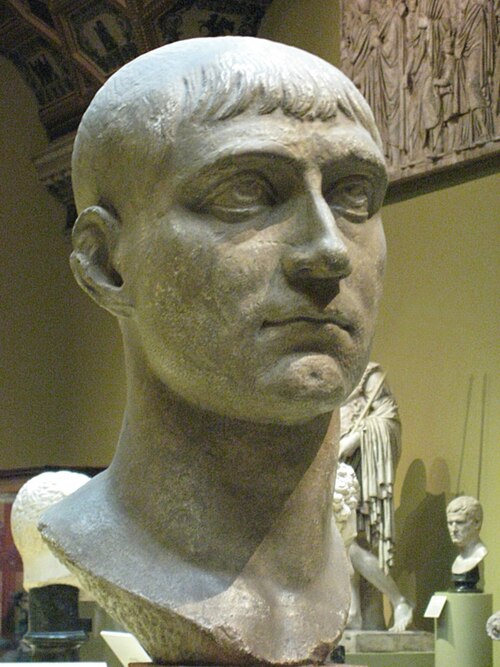
ガレリウスがコンスタンティヌスを皇帝として承認した後、慣例通りコンスタンティヌスの肖像画がローマに持ち込まれた。マクセンティウスは肖像画の題材を娼婦の息子と嘲り、自らの無力さを嘆いた。[105]マクセンティウスはコンスタンティヌスの権威を妬み、[106] 306年10月28日に皇帝の称号を奪った。ガレリウスは彼を承認しなかったが、彼を退位させることはできなかった。307年4月、セウェルスがマクセンティウスに対して派遣されたが、[107]戦役中に、以前はマクセンティウスの父マクシミアヌスが指揮していたセウェルスの軍隊が離反し、セウェルスは捕らえられ投獄された。[108]息子の反乱により引退から戻ったマクシミアヌスは、コンスタンティヌスと協議するためにガリアに向かった。彼は娘ファウスタをコンスタンティヌスと結婚させ、彼をアウグストゥス帝に昇格させることを提案した。見返りに、コンスタンティヌスはマクシミアヌスとコンスタンティウスの古い家族同盟を再確認し、イタリアにおけるマクセンティウスの活動への支援を申し出た。コンスタンティヌスはこれを受け入れ、307年の夏にトリーアでファウスタと結婚した。[k]コンスタンティヌスはマクセンティウスにわずかな支援を与え、マクセンティウスに政治的承認を与えた。[112]
しかしながら、コンスタンティヌスはイタリア紛争には無関心だった。紀元前307年の春から夏にかけて、彼はイタリアの動乱に巻き込まれるのを避けるため、ガリアを離れてブリテン島へ向かっていた。[113]今や、マクセンティウスに軍事援助を与える代わりに、彼はライン川沿いのゲルマン諸部族に対して軍隊を派遣した。紀元前308年、彼はブルクテリ人の領土を襲撃し、コロニア・アグリッピネンシウム(ケルン)でライン川に橋を架けた。紀元前310年、彼は北ラインに進軍し、フランク族と戦った。軍事行動をしていないときは、彼は自分の慈悲深さを宣伝し、経済と芸術を支援しながら領土を巡回した。彼が戦争への参加を拒否したことで、国民の間で彼の人気が高まり、西部における彼の権力基盤が強化された。[114]マクシミアヌスは紀元前307年から308年の冬にローマに戻ったが、すぐに息子と不和になった。 308年初頭、マクセンティウスの称号を奪取する試みが失敗した後、マクシミアヌスはコンスタンティヌスの宮廷に戻った。[115]
308年11月11日、ガレリウスは西方諸州の不安定化を解決するため、軍都カルヌントゥム(オーストリア、ペトロネル=カルヌントゥム)で総会を招集した。出席者には、引退から短期間復帰したディオクレティアヌス、ガレリウス、マクシミアヌスがいた。マクシミアヌスは再び退位を余儀なくされ、コンスタンティヌスは再び皇帝に降格された。ガレリウスの古い軍仲間の一人、リキニウスは西方諸州のアウグストゥスに任命された。この新制度は長くは続かなかった。コンスタンティヌスは降格を拒否し、自分の貨幣では自らをアウグストゥスと称し続け、テトラルキアの他の構成員は彼らの貨幣では彼を皇帝と呼んでいた。マクシミヌスは、新人のリキニウスがアウグストゥスに昇格したのに自分が昇進を逃したことに不満を抱き、ガレリウスに自分を昇格させるよう要求した。ガレリウスはマクシミヌスとコンスタンティヌスの両者を「アウグスティの息子」と呼ぶことを提案したが[116]、両者ともその新しい称号を受け入れなかった。310年の春までにガレリウスは両者をアウグスティと呼んでいた[117] 。
マクシミアヌスの反乱

310年、コンスタンティヌスがフランク族との遠征に出ている間に、権力を奪われたマクシミアヌスがコンスタンティヌスに対して反乱を起こした。マクシミアヌスは、南ガリアでのマクセンティウスの攻撃に備えて、コンスタンティヌス軍の分遣隊と共に南のアルルに派遣されていた。彼はコンスタンティヌスが死んだと発表し、皇帝の紫の旗を掲げた。皇帝として彼を支持する者には多額の寄付を約束していたにもかかわらず、コンスタンティヌス軍の大半は皇帝に忠誠を誓い続け、マクシミアヌスはすぐに去らざるを得なくなった。コンスタンティヌスは反乱を知ると、フランク族との遠征を断念し、軍をライン川に進軍させた。[119]カビュルヌム(シャロン=シュル=ソーヌ)で、彼は部隊を待機していた船に乗せ、流れの遅いソーヌ川から流れの速いローヌ川まで漕ぎ下らせた。彼はルグドゥヌム(リヨン)で下船した。[120]マクシミアヌスはアルルよりも長期の包囲に耐えられる町、マシリア(マルセイユ)に逃げた。しかし、忠実な市民がコンスタンティヌスに対して裏門を開いたため、状況はほとんど変わらなかった。マクシミアヌスは捕らえられ、その罪を責められた。コンスタンティヌスはいくらかの恩赦を与えたが、自殺を強く勧めた。310年7月、マクシミアヌスは首を吊って自殺した。[119]
マクセンティウスは、父との関係が以前に断絶していたにもかかわらず、父の死後、自分を父の忠実な息子として見せようと熱心に努めた。[121]彼は父の神格化された肖像を刻んだ貨幣を鋳造し始め、マクシミアヌスの死の復讐をしたいと宣言した。[122]コンスタンティヌスは当初、自殺を不幸な家族の悲劇として発表した。しかし、311年までに、彼は別の説を広めていた。これによると、コンスタンティヌスがマクシミアヌスを赦免した後、マクシミアヌスはコンスタンティヌスが眠っている間に殺害する計画を立てた。ファウスタはその計画を知り、コンスタンティヌスに警告した。コンスタンティヌスは宦官をベッドの自分の代わりに置いた。マクシミアヌスは宦官を殺害した際に逮捕され、自殺を勧められ、それを受け入れた。[123]プロパガンダを利用するとともに、コンスタンティヌスはマクシミアヌスにダムナティオ・メモリアエを施行し、マクシミアヌスに関する碑文をすべて破壊し、彼の肖像が描かれた公共の著作をすべて排除した。[124]
マクシミアヌスの死はコンスタンティヌスの公的イメージを変える必要があった。彼はもはや年長の皇帝マクシミアヌスとのつながりに頼ることができず、正当性の新たな源泉を必要としていた。[125] 310年7月25日にガリアで行われた演説で、匿名の弁論家は、ゴート族を倒して帝国の秩序を回復したことで有名な3世紀の皇帝クラウディウス2世との、これまで知られていなかった王朝のつながりを明らかにした。この演説はテトラルキアのモデルから脱却し、帝国の平等の原則ではなく、コンスタンティヌスの先祖の統治権を強調した。演説で表現された新しいイデオロギーは、ガレリウスとマクシミアヌスをコンスタンティヌスの統治権とは無関係にした。 [126]実際、弁論家は他のすべての要素を排除して祖先を強調している。「人々の偶然の合意や、予期せぬ恩恵の結果によってあなたが皇帝になったのではない」と弁論家はコンスタンティヌスに宣言している。[127]
この演説は、ユピテルとヘラクレスの双子の王朝に焦点を当てたテトラルキアの宗教的イデオロギーからも離れている。代わりに、演説者は、コンスタンティヌスがアポロと勝利の神のビジョンを経験し、健康と長い統治の月桂冠を授かったと宣言している。アポロに似せて、コンスタンティヌスは、詩人ウェルギリウスがかつて予言したように、 [128]「全世界の支配」を授かる救世主であると認識していた。 [129]この演説の宗教的変化は、コンスタンティヌスの貨幣の同様の変化と並行している。コンスタンティヌスの治世初期には、彼の貨幣は火星を彼の守護神として宣伝していた。紀元310年以降、火星は慣習的にアポロと同一視される神であるソル・インウィクトゥスに置き換えられた。 [130]王朝のつながりや神のビジョンがフィクション以外の何かであると信じる理由はほとんどありませんが、それらの宣言はコンスタンティヌスの正当性の主張を強化し、ガリアの市民の間で彼の人気を高めました。[131]
内戦
マクセンティウスとの戦争
310年半ばまでにガレリウスは病弱となり、帝国の政治に関与することができなくなった。[132]彼の最後の行為は、迫害の終結と宗教的寛容の再開を宣言する、311年4月30日にニコメディアに投函された地方住民への手紙として現存している。[133]
エウセビオスは「神の摂理がこれらの犯罪の加害者に対して行動を起こした」と主張し、ガレリウスの死を次のように鮮明に描写している。
「突然、性器の真ん中あたりに化膿性の炎症が起こり、その後、深い瘻孔の潰瘍ができた。これが彼の腸の奥深くまで食い荒らし、治癒不可能な状態になった。そこからは、言葉では言い表せないほどの大量の虫が湧き出し、不快な臭いがした。なぜなら、彼の巨大な体全体が、食べ過ぎのせいで、病気になる前から、たるんだ脂肪の巨大な塊に変貌していたからだ。そして、それが腐敗し、近づく者を不快で恐ろしい光景にさらした。」[134]
ガレリウスは勅令発布後すぐに死去し、[135]テトラルキアのわずかな残骸を破壊した。[136]マクシミヌスはリキニウスに対抗して動員し、小アジアを占領した。ボスポラス海峡の真ん中の船上で急いで和平協定が締結された。[137]コンスタンティヌスがブリテン島とガリアを巡視している間に、マクセンティウスは戦争の準備をした。[138]彼は北イタリアを要塞化し、エウセビウスをローマ司教に選出することを許可することでキリスト教コミュニティからの支持を強化した。[139]

マクセンティウスの統治は不安定だった。税率の引き上げと貿易の停滞により、初期の支持は崩れ、ローマとカルタゴで暴動が勃発した。[141]そしてドミティウス・アレクサンダーはアフリカで一時的に彼の権力を奪った。[142] 312年までに、彼はイタリアのキリスト教徒の間でさえ、ほとんど容認されず、積極的に支持される人物ではなくなった。 [143] [144] 311年の夏、リキニウスが東方での情勢に忙しい間に、マクセンティウスはコンスタンティヌスに対抗して動員した。彼はコンスタンティヌスに宣戦布告し、父の「殺害」の復讐を誓った。[145]マクセンティウスがリキニウスと同盟を組むのを防ぐため、[146]コンスタンティヌスは311年から312年の冬にリキニウスと同盟を結び、妹のコンスタンティアを彼に嫁がせた。マクシミヌスは、コンスタンティヌスとリキニウスの協定は彼の権威に対する侮辱であると考えた。それに応じて、彼はローマに大使を派遣し、マクセンティウスに軍事的支援と引き換えに政治的承認を提案し、マクセンティウスはそれを受け入れた。[147]エウセビオスによると、地域間の移動は不可能になり、至る所で軍備が増強された。「毎日、敵対行為の始まりを予想しない場所はなかった」[148] 。
_c1650_by_Lazzaro_Baldi_after_Giulio_Romano_at_the_University_of_Edinburgh.jpg/500px-Battle_of_Constantine_and_Maxentius_(detail-of-fresco-in-Vatican-Stanze)_c1650_by_Lazzaro_Baldi_after_Giulio_Romano_at_the_University_of_Edinburgh.jpg)
コンスタンティヌスの顧問や将軍たちはマクセンティウスへの先制攻撃を警告した。[149]彼の占い師たちでさえ、犠牲が不吉な前兆を引き起こしたとして、攻撃を勧めなかった。[150]コンスタンティヌスは、部下に深い印象を与え、ある種の超自然的な導きがあると信じさせるほどの精神を持っていたが、[151]これらすべての警告を無視した。[152] 312年の春の初めに、[153]コンスタンティヌスは軍の4分の1、約4万人の軍勢とともにコッティアンアルプスを越えた。 [154]彼の軍が最初に遭遇した町はセグシウム(イタリア、スーザ)であった。この町は厳重に要塞化されており、門を閉ざしていた。コンスタンティヌスは部下に門に火を放ち、壁をよじ登るよう命じた。彼はすぐに町を占領した。コンスタンティヌスは部隊に町を略奪しないように命じ、北イタリアに進軍した。[153]
重要な都市アウグスタ・タウリノルム(イタリア、トリノ)の西への接近で、コンスタンティヌスは重装備のマクセンティウス騎兵の大軍に遭遇した。[155]続くトリノの戦いで、コンスタンティヌスの軍はマクセンティウスの騎兵を包囲し、自らの騎兵で側面から攻撃し、兵士の鉄の先端の棍棒で攻撃して彼らを降ろした。コンスタンティヌスの軍が勝利した。[156]トリノはマクセンティウスの撤退軍に隠れ場所を与えることを拒否し、代わりにコンスタンティヌスに門を開いた。[157]北イタリア平原の他の都市はコンスタンティヌスに勝利を祝う使節を送った。彼はミラノに移動したが、そこでは門が開かれ、歓喜の声が上がった。コンスタンティヌスは312年の夏半ばまでミラノで軍を休ませ、その後ブリクシア(ブレシア)に移動した。[158]
ブレシアの軍は簡単に解散させられ、[159]コンスタンティヌスはすぐにヴェローナへと進軍し、そこではマクセンティウス軍の大軍が陣取っていた。[160] ヴェローナ軍の将軍でマクセンティウスの親衛隊長官であったルリキウス・ポンペイアヌス[161]は、町がアディジェ川に三方を囲まれていたため、強固な防御態勢をとっていた。コンスタンティヌスは気づかれずに川を渡ろうと、町の北に小部隊を送った。ルリキウスはコンスタンティヌスの遠征軍に対抗するために大部隊を送ったが、敗北した。コンスタンティヌスの軍は町を包囲することに成功した。[162]ルリキウスはコンスタンティヌスを逃がし、より大きな軍を率いてコンスタンティヌスに対抗するために戻った。コンスタンティヌスは包囲を緩めようとせず、彼に対抗するために小部隊だけを送った。[163]その後すぐにヴェローナが降伏し、続いてアクイレイア、[164]ムティナ(モデナ)、[165]ラヴェンナも降伏した。[166]ローマへの道はコンスタンティヌスにとって大きく開かれた。[167]
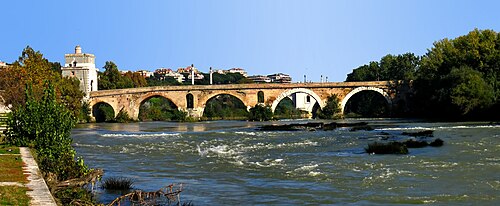
マクセンティウスはセウェルスやガレリウスに対して行ったのと同じタイプの戦争に備えた。つまり、ローマに座り込んで包囲戦に備えたのだ。[168]彼は依然としてローマの親衛隊を統制し、アフリカの穀物を豊富に蓄え、一見難攻不落と思われたアウレリアヌスの城壁で四方を囲まれていた。彼は神々の助言に従ってテヴェレ川に架かるすべての橋を切断するよう命じ、 [169]中央イタリアの残りの地域を無防備のままにした。コンスタンティヌスはその地域の支援を何の抵抗もなく確保した。[170]コンスタンティヌスはフラミニア街道に沿ってゆっくりと進軍し[171]、[172]マクセンティウスの弱さが政権をさらに混乱に陥れるのを許した。[171]マクセンティウスへの支援は弱まり続けた。10月27日の戦車競争では、群衆がマクセンティウスを公然と嘲り、コンスタンティヌスは無敵だと叫んだ。[173]マクセンティウスは、もはや包囲戦に勝利できるかどうか確信が持てず、コンスタンティヌスとの野戦に備えてテヴェレ川に仮の船橋を架けた。[174]マクセンティウスは、治世6周年にあたる312年10月28日に、シビュラ書の管理者に助言を求めた。管理者は、まさにその日に「ローマ人の敵」が死ぬだろうと予言した。マクセンティウスは北進し、コンスタンティヌスと戦った。[175]
コンスタンティヌスはキリストの頭文字としてギリシャ文字のキ・ローを採用した
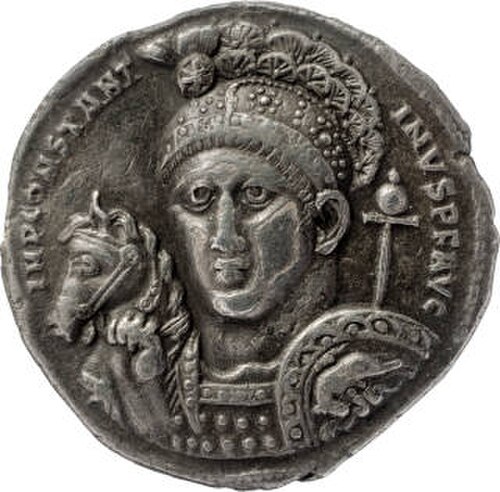
マクセンティウスの軍勢はコンスタンティヌスの軍勢の2倍の規模で、彼は戦場に向かって川に背を向けて長い戦列を組んだ。[176]コンスタンティヌスの軍勢は、見慣れないシンボルを旗と盾に掲げて戦場に到着した。[177]ラクタンティウスによると、「コンスタンティヌスは夢の中で、兵士たちの盾に天の印を描き、戦いに臨むようにと指示された。彼は命じられたとおりに、盾にΧの文字を記し、垂直線を引いて上部で折り返した。これはキリストの暗号である。この印(☧)を持って、彼の軍隊は武器を手にした。」[178]エウセビオスは、コンスタンティヌスが正午に行軍中に見たビジョンについて記述している。「彼は自分の目で、太陽の上の天空に光の十字架の戦利品を見た。そこには『この印で汝は勝利する』と刻まれていた」。[179]エウセビオスの記述では、コンスタンティヌスは翌夜夢を見、その中でキリストが同じ天の印とともに現れ、ラバルムの形をした軍旗を作るように告げた。[180]エウセビオスはこれらの出来事がいつどこで起こったかについては曖昧であるが、[181]マクセンティウスとの戦争が始まる前に物語に登場している。[182]彼はその印を、Χ (カイ) をΡ (ロー) が横切って☧ を形成し、ギリシャ語のΧΡΙΣΤΟΣ (クリストス) の最初の2文字を表していると記述している。[183] [184] 315年にティキヌムで発行されたメダルには、キ・ローの紋章が描かれたヘルメットをかぶったコンスタンティヌスが描かれており、[185]また、317/318年にシシアで発行されたコインにもこの図像が繰り返されている。[186]この図像は、それ以外では珍しく、320年代以前の帝国の図像学や宣伝ではまれである。[187]しかし、これはギリシャ語のchrēston(良い)の略語であり、紀元前3世紀のプトレマイオス3世エウエルゲテスのコインに以前から登場しており、完全に知られていなかったわけではない。 コンスタンティヌス以降、何世紀にもわたってキリスト教徒は、戦争を正当化したり描写したりする際に、奇跡や超自然現象に言及した。[188]
コンスタンティヌスはマクセンティウスの戦線全体に自らの軍を展開した。騎兵に突撃を命じ、マクセンティウスの騎兵を打ち破った。次に歩兵をマクセンティウスの歩兵に送り込み、多くの者をテヴェレ川に押し込み、そこで虐殺され溺死させた。[176]戦闘は短く、[189]マクセンティウスの軍は最初の突撃の前に打ち破られた。[190]騎兵と近衛兵は当初は陣地を保っていたが、コンスタンティヌスの騎兵の突撃の威力に屈し、隊列を崩して川に逃げた。マクセンティウスも彼らとともに乗り、船橋(ミルヴィオ橋)を渡ろうとしたが、逃げる兵士の群れにテヴェレ川に押し込まれ溺死した。[191]
ローマでは

コンスタンティヌスは312年10月29日にローマに入城し[193] [194] 、歓喜の渦巻く街で大冒険を繰り広げた。 [195]マクセンティウスの遺体はテヴェレ川から引き上げられ斬首され、その首は皆の目に入るように街路を練り歩いた。[196]儀式の後、切り落とされた首はカルタゴに送られ、カルタゴはそれ以上抵抗しなかった。[197]前任者とは異なり、コンスタンティヌスはカピトリノスの丘への旅やユピテル神殿での慣例的な犠牲の儀式を怠った。[198]しかし、彼は元老院議院ユリアを訪問し[199]、その先祖伝来の特権を回復し、改革された政府の中で確固たる役割を与えることを約束した。マクセンティウスの支持者に対する復讐はしないとした。[200]これに応じて、元老院は彼に「ファーストネームの称号」を授け、これは彼の名前がすべての公式文書の最初に記載されることを意味した。 [201]そして、彼らは彼を「最も偉大なアウグストゥス」と称賛した。[202]彼はマクセンティウスの下で失われた財産を返還し、政治亡命者を呼び戻し、マクセンティウスの投獄された反対者を釈放する法令を発布した。[203]
大規模なプロパガンダ キャンペーンが続き、マクセンティウスのイメージはすべての公共の場から一掃されました。マクセンティウスは「暴君」として描かれ、コンスタンティヌスは「解放者」という理想化されたイメージと対比されました。エウセビオスは、コンスタンティヌスのプロパガンダのこの流れの最も代表的な人物です。[204]マクセンティウスの勅令は無効とされ、元老院の指導者に与えた栄誉も無効とされました。[205]コンスタンティヌスは、ローマの都市景観におけるマクセンティウスの影響を排除しようともしました。ロムルス神殿やマクセンティウスのバシリカなど、マクセンティウスが建てたすべての建造物は、コンスタンティヌスに捧げられました。[206]バシリカの中心には、手にキリスト教のラバルムを持つコンスタンティヌスの石像が建てられました。その碑文には、像が表すメッセージ「この印によって、コンスタンティヌスはローマを暴君のくびきから解放した」が刻まれていました。[207]
コンスタンティヌスはまた、マクセンティウスの功績を上回ろうとした。例えば、キルクス・マクシムスは、マクセンティウスのアッピア街道の競馬場の25倍の座席数になるように再開発されました。[208]マクセンティウスが親衛隊と帝国騎馬隊を解散させたとき、彼の最も強力な軍事的支持者は無力化されました。[209]帝国騎馬隊の墓石は粉砕され、ラビカーナ街道のバシリカで使用されました。[210 ]そして、彼らの以前の本拠地は、コンスタンティヌスが街を占領してからわずか2週間後の312年11月9日にラテラノ大聖堂に再開発されました。 [211]第2軍団パルティカはアルバーノ・ラツィアーレから移動され、[205]マクセンティウスの残りの軍隊はライン川の国境警備に派遣されました。[212]
リキニウスとの戦争

その後の数年間、コンスタンティヌスは崩壊しつつあったテトラルキアのライバルたちに対する軍事的優位を徐々に固めていった。313年、彼はミラノでリキニウスと会い、リキニウスとコンスタンティヌスの異母妹コンスタンティアの結婚によって同盟を固めた。この会談で、両皇帝はいわゆるミラノ勅令に同意した。[213]この勅令は、帝国におけるキリスト教とあらゆる宗教に対する完全な寛容を公式に認めた。[214]この勅令はキリスト教徒に特別な利益をもたらし、彼らの宗教を合法化し、ディオクレティアヌスの迫害中に没収されたすべての財産をキリスト教徒に返還することを許可した。この勅令は過去の宗教的強制の方法を否定し、神の領域を指すのに「神性」と「至高の神性」、summa divinitasという一般的な用語のみを使用した。[215]しかし、ライバルのマクシミヌスがボスポラス海峡を渡ってヨーロッパの領土に侵入したという知らせがリキニウスに届き、会談は途中で打ち切られた。リキニウスは出発し、最終的にマクシミヌスを破り、ローマ帝国の東半分全体を掌握した。コンスタンティヌスは、リキニウスが皇帝に昇格させたいと考えていた人物の手により暗殺未遂に遭い、残った二人の皇帝の関係は悪化した。 [216]一方、リキニウスは、エモナにあるコンスタンティヌスの像を破壊した。[217] 314年か316年に、二人の皇帝はキバラエの戦い で互いに戦い、コンスタンティヌスが勝利した。彼らは317年のマルディアの戦いで再び衝突し、コンスタンティヌスの息子クリスプスとコンスタンティヌス2世、およびリキニウスの息子リキニアヌスを皇帝に任命することで和解した。[218] この取り決めの後、コンスタンティヌスはパンノニアとマケドニアの司教区を統治し、シルミウムに居を構え、322年にゴート人とサルマティア人と戦争をし、323年にはゴート人と戦争をして、彼らの指導者ラウシモドを破って殺害した。[216]
320年、リキニウスはミラノ勅令で約束された宗教の自由を破り、キリスト教徒を再び弾圧し始めたとされる。 [219]一般的に流血はなかったが、没収やキリスト教徒の役職者の解任に訴えた。[220]リキニウスを反キリスト教徒とみなすのはやや疑わしいが、事実は、リキニウスはコンスタンティヌスほどキリスト教を支持していなかったようだ。そのため、リキニウスは教会を、一般的な帝国制度よりもコンスタンティヌスに忠実な勢力と見なす傾向があった。[ 221]教会史家ソゾメンの説明によると、 [222]
この疑わしい取り決めは、最終的に西方におけるコンスタンティヌスへの挑戦となり、紀元前324年の大内戦で頂点に達した。コンスタンティヌスのキリスト教賛美者たちは、この戦争をキリスト教と異教の戦いとして提示している。ゴート族の傭兵に助けられたリキニウスは過去と古代の異教を代表し、コンスタンティヌスとフランク族はラバルムの旗印の下で進軍した。 [要出典]兵力では劣勢だったが、熱意に燃えたコンスタンティヌスの軍隊は、アドリアノープルの戦いで勝利を収めた。リキニウスはボスポラス海峡を渡って逃亡し、西ローマ帝国の名目上の皇帝に自らのマギステル・オフィキオルムであるマルティニアヌスを任命したが、コンスタンティヌスは次にヘレスポントスの戦い、そして324年9月18日のクリソポリスの戦いで勝利した。 [223]リキニウスとマルティニアヌスは命を助けてもらうという約束でニコメディアでコンスタンティヌスに降伏し、それぞれテッサロニキとカッパドキアで民間人として暮らすよう命じられたが、325年にコンスタンティヌスはリキニウスが陰謀を企てていると非難し、2人を逮捕して絞首刑に処した。リキニウスの息子(コンスタンティヌスの異母妹の息子)は326年に殺害された。 [224]こうしてコンスタンティヌスはローマ帝国の単独皇帝となった。[225]
後の統治
コンスタンティノープルの建国


ディオクレティアヌスはテトラルキア時代に東のニコメディアを首都に選んだ[227]。ビザンツ帝国から遠くなく、軍事的に注意を払う必要のあるトラキア、アジア、エジプトを守るのに便利な場所だった。[ 228]コンスタンティヌスは帝国が遠くて人口の少ない西から東の豊かな都市へと移行すること、そしてドナウ川を蛮族の侵攻から、アジアを敵対的なペルシアから守ることの軍事的戦略的重要性を認識し、新しい首都を選んだ[229]。また黒海と地中海の間の船舶交通を監視できる場所も選んだ。[230]リキニウスの敗北は、キリスト教とラテン語を話すローマに対抗する東方における異教徒とギリシャ語を話す政治活動の中心地の敗北を意味することとなり、東ローマ帝国全体の学問、繁栄、文化保存の中心地として、東方をローマ帝国全体に統合することを象徴する新しい東方首都が提案された。[231]この代替首都に提案されたさまざまな場所の中で、コンスタンティヌスは以前セルディカ(現在のソフィア)を検討していたようで、「セルディカは私のローマだ」と言ったと伝えられている。[232]シルミウムとテッサロニキも検討された。[233]しかし、最終的にコンスタンティヌスは、前世紀にセプティミウス・セウェルスとカラカラによってローマの都市計画のパターンに基づいて大規模に再建されたという利点があるギリシャの都市ビザンチウムに取り組むことを決定し、彼らはすでにその戦略的重要性を認識していた。[234]こうして都市は324年に建設され、[235] 330年5月11日に奉納され[235]コンスタンティノープル(英語では「コンスタンティヌスの都市」またはコンスタンティノープル)と改名された。この出来事を記念して、330年に特別な記念硬貨が発行された。新しい都市は、真の十字架、モーゼの杖、その他の聖遺物によって守られていたが、現在エルミタージュ美術館にあるカメオには、新しい都市のティケで戴冠したコンスタンティヌスが描かれていた。 [236]古い神々の像は、キリスト教の象徴の枠組みに置き換えられるか、同化された。コンスタンティヌスは、アフロディーテ神殿の跡地に新しい聖使徒教会を建てた。 数世代後、神の啓示がコンスタンティヌスをこの場所に導き、他の誰にも見えない天使が彼を新しい城壁の巡回に導いたという伝説があります。 [237]首都はしばしば「コンスタンティノープルの新ローマ」であるノヴァ・ローマ・コンスタンチノーポリタナとして「古い」ローマと比較されます。 [225] [238]
宗教政策
コンスタンティヌス大帝 | |
|---|---|
 | |
| 皇帝であり使徒と同等 | |
| 休憩所 | コンスタンティノープル |
| 崇拝されている | |
| 主要な神社 | 聖使徒教会、コンスタンティノープル |
| ごちそう | 5月21日 |

コンスタンティヌスは、キリスト教徒の迫害を止め、ローマ帝国における他のすべての宗教/カルトとともにキリスト教を合法化した最初の皇帝であった。313年2月、彼はミラノでリキニウスと会談し、キリスト教徒は抑圧されることなく信仰を貫くことが許されるべきであるとするミラノ勅令を作成した。[242]これにより、以前多くの人が殉教していたキリスト教を公言することに対する罰がなくなり、没収された教会の財産が返還された。この勅令は、キリスト教だけでなくすべての宗教を迫害から守り、誰もが自分の選んだ神を崇拝することを許可した。同様の勅令は、テトラルキアの上級皇帝ガレリウスによって311年に発行されており、キリスト教徒に宗教を実践する権利を与えたものの、財産を返還しなかった。[243]ミラノ勅令には、没収されたすべての教会を返還するといういくつかの条項や、以前に迫害されたキリスト教徒のための他の規定が含まれていた。一部の学者は、ヘレナは成人してからキリスト教を受け入れ、エウセビオスによればコンスタンティヌスによって改宗したと考えているが[244]、他の歴史家は、コンスタンティヌスが若い頃に母親ヘレナのキリスト教を受け入れたのか、それとも生涯を通じて徐々に受け入れたのかを議論している。[245]

コンスタンティヌスは、おそらくグラティアヌスが称号を放棄するまで、古代ローマの宗教の長として皇帝が持っていたポンティフェクス・マクシムスの称号を保持していた。 [246] [247]キリスト教の著述家によると、コンスタンティヌスは40歳を超えてからようやくキリスト教徒であると宣言し、自分の成功はキリスト教の至高の神のみの保護によるものであることを明らかにした。[248]キリスト教徒であると宣言したにもかかわらず、彼は死の床で洗礼を受けるのを待った。洗礼を受ければ、皇帝としての政策を遂行する過程で犯した罪から解放されると信じていた。[249]彼は教会を財政的に支援し、バシリカを建設し、聖職者に特権を与え(特定の税金の免除など)、キリスト教徒を高官に昇格させ、長い迫害の期間中に没収された財産を返還した。[250]彼の最も有名な建築プロジェクトには、聖墳墓教会と旧サン・ピエトロ大聖堂がある。旧サン・ピエトロ大聖堂の建設にあたり、コンスタンティヌスは聖ペテロの眠る場所の上に大聖堂を建てるために多大な努力を払いました。その努力は大聖堂の設計にも影響を及ぼし、聖ペテロが眠る丘の上に大聖堂を建てるという難題も伴い、コンスタンティヌス帝が建設を命じた日から 30 年以上かけて完成しました。
コンスタンティヌスはキリスト教だけを後援したわけではないかもしれない。315年にミルウィウス橋の戦いでの勝利を祝うために凱旋門が建てられたが、この門は女神ヴィクトリアの像で飾られ、奉納式ではアポロ、ダイアナ、ヘラクレスなどの異教の神々に生贄が捧げられた。この門にはキリスト教の象徴は描かれていない。しかし、この門は元老院の委託で建てられたため、キリスト教の象徴がないのは、当時教皇庁が異教の拠点として機能していたことを反映しているのかもしれない。 [251]
321年、彼は尊い日曜日をすべての市民の休息日とすべきと法律を制定した。[252] 323年、彼はキリスト教徒が国家の犠牲に参加することを禁止する法令を発布した。[253]異教の神々が彼の貨幣から消えた後、キリスト教のシンボルがコンスタンティヌスの属性として現れ、両手の間やラバラムにキ・ローが描かれ、[254]貨幣にも描かれた。[255]コンスタンティヌスの治世は、初期のキリスト教公会議、特にアリウス派をめぐる論争において皇帝が大きな影響力と権威を持つ前例を確立した。コンスタンティヌスは宗教上の紛争や論争が社会の安定にもたらすリスクを嫌い、正統派を確立することを好んだ。[256]教会公会議に対する彼の影響力は教義を施行し、異端を根絶し、教会の統一を維持することにあった。教会の役割は適切な礼拝、教義、教義を決定することであった。[257]
313年から316年まで、北アフリカの司教たちは、ドナトゥスによって叙階されたキリスト教の司教たちと、カエキリアヌスに対抗して争った。アフリカの司教たちは折り合いをつけることができず、ドナトゥス派はコンスタンティヌスにこの紛争の裁判官を務めるよう求めた。3つの地方教会会議とコンスタンティヌスの前で行われた別の裁判は、すべてドナトゥスと北アフリカのドナトゥス派運動に不利な判決を下した。317年、コンスタンティヌスはドナトゥス派の教会財産を没収し、ドナトゥス派の聖職者を追放する勅令を出した。[258]さらに重要なことに、コンスタンティヌスは325年に第1ニカイア公会議を招集した。これはアリウス派への対応とニカイア信条の制定で最もよく知られている。[259]彼は公会議で、ユダヤ教の過越祭の前日に聖餐を祝うことを禁じたが、これを施行した。これはキリスト教がユダヤ教の伝統から明確に決別したことを意味した。それ以来、ローマ帝国のキリスト教会では、太陽暦であるユリウス暦が太陰太陽暦であるヘブライ暦よりも優先されるようになった。 [260]
コンスタンティヌスはユダヤ人に関していくつかの新しい法律を制定した。そのいくつかはユダヤ人に不利なものであったが、前任者の法律より厳しいものではなかった。[261]ユダヤ人が改宗者を求めたり、キリスト教に改宗した他のユダヤ人を攻撃したりすることは違法とされた。[261]ユダヤ人がキリスト教徒の奴隷を所有したり、奴隷に割礼を施したりすることは禁じられた。 [262] [263]一方、ユダヤ教の聖職者にはキリスト教の聖職者と同じ免除が与えられた。[261] [264]
行政改革

3世紀半ばから、皇帝は国家の最も重要な役職を独占していた元老院議員よりも騎士階級の者を優遇し始めた。元老院議員は軍団の指揮権とほとんどの属州知事職を剥奪された。防衛が急務だった時代には、彼らには専門的な軍事教育が欠けていると考えられたためである。[265]これらの役職は、前任者たちが少しずつ実施していた慣例に従い、ディオクレティアヌスとその同僚たちによって騎士階級の者に与えられた。しかし、皇帝は依然として大富豪の才能と協力を必要としており、彼らはあらゆる階層に強力な影響力と人脈のネットワークを持ち、社会秩序と結束を維持するのに頼っていた。古い元老院貴族の排除はこの取り決めを脅かした。
326年、コンスタンティヌスはこの騎馬民族支持の傾向を覆し、多くの行政職を元老院議員に昇格させ、これらの役職を旧貴族に開放した。同時に、既存の騎馬民族の役職者を元老院議員に昇格させ、その過程で騎馬民族の地位を低下させた(少なくとも官僚階級としては)。[266] 4世紀末までに、 パーフェクティッシムスの称号は中級または下級の役人にのみ与えられた。
コンスタンティヌス帝の新しい制度では、法務官に選出されるか、元老院議員の職務を遂行することで、元老院議員になることができた。[267]それ以降、実権と社会的地位は帝国の共同階層に統合された。コンスタンティヌスはこれによって旧貴族の支持を得た。[268]元老院は、皇帝が直接政務官 ( adlectio )を任命する通常の慣習に代えて、法務官と財務官を選出することを許可された。都市長官ケオニウス・ルフス・アルビヌスを称える碑文には、コンスタンティヌス帝が「カエサルの時代に失われた権威」を元老院に復活させたと記されている。[269]
元老院は組織として大きな権力を持たなかったが、3世紀には元老院議員は帝国の潜在的機能保持者としては疎外されていたものの、より新興の官僚たちとともにその地位を争うことはできた。[270]現代の歴史家の中には、これらの行政改革を、キリスト教化された帝国統治から異教徒の元老院議員を遠ざける可能性に対抗するために元老院の秩序を帝国行政エリートに再統合しようとするコンスタンティヌスの試みと見る者もいる。 [271]しかし、コンスタンティヌス以前の旧元老院環境におけるキリスト教への改宗に関する正確な数字がないため、このような解釈は推測の域を出ない。一部の歴史家は、旧貴族の間での初期の改宗は、これまで考えられていたよりも多かったと示唆している。[272]
コンスタンティヌスの改革は文民行政にのみ関係していた。軍の首脳たちは3世紀の危機以来地位を上げてはいたが[273]、元老院には入らず、元老院にはコンスタンティヌスの子供たちだけが入っていた[274] 。
通貨改革
_obverse.jpg/500px-Nummus_of_Constantine_(YORYM_2001_10313)_obverse.jpg)
3 世紀、公共費用の支払いのために不換紙幣を製造した結果、インフレが急激に進行し、ディオクレティアヌスは銀貨や銀青銅の「ビロン」貨幣 (「ビロン」という用語は貴金属と卑金属の合金で、ほとんどが卑金属であるという意味) の信頼できる鋳造を再開しようとしたが、失敗した。銀貨は実際の金属含有量の点で過大評価されていたため、大幅に割引された価格でしか流通できなかった。コンスタンティヌスは、305 年直後にディオクレティアヌス帝の「純」銀アルゲンテウスの鋳造を中止したが、「ビロン」貨幣は 360 年代まで使用され続けた。300 年代初頭から、コンスタンティヌスは銀貨の復活の試みを断念し、代わりに 72 枚で 1 ポンドの金となる大量のソリドゥス金貨の鋳造に集中することを選んだ。彼の治世後半から死後にかけて、継続的に関税を引き上げる過程で、新しく大幅に価値が下がった銀貨が発行され続けたが、この「ビロン」の鋳造は367年に中止され、銀貨は様々な額面の青銅貨によって引き継がれ、最も重要なのはセンテニアル銀貨であった。[275]
これらの青銅貨は引き続き価値が下げられ、金本位制と並行して信用鋳造を維持する可能性を確保した。『デ・レバス・ベリキス』の著者は、この金融政策により階級間の亀裂が広がったと主張した。金持ちは金貨の購買力の安定性から利益を得たが、貧乏人はますます価値が下がる青銅貨に対処しなければならなかった。[276]後の皇帝、例えば背教者ユリアヌスなどは、青銅貨幣の信用鋳造を主張した。[277]
コンスタンティヌスの金融政策は宗教政策と密接に関係していた。貨幣鋳造の増加は、331年から336年の間に異教の寺院から帝国の財産と宣言されたすべての金、銀、青銅の像を没収することと関係していた。各州に2人の帝国委員がいて、コンスタンティノープルの公共記念碑として使用されたいくつかの青銅像を除いて、像を手に入れて溶かし、すぐに鋳造する任務を負っていた。[278]
クリスプスとファウスタの処刑
コンスタンティヌスは、326年5月15日から6月17日の間に、長男クリスプスを捕らえ、ポラ(クロアチアのプーラ)で「冷たい毒」で殺した。 [279] 7月には、妻の皇后ファウスタ(クリスプスの継母)を熱した風呂で殺した。[280]多くの碑文から彼らの名前が消され、彼らの生涯に関する記述は文学的記録から根絶され、彼らの記憶は非難された。例えば、エウセビオスは、後の『教会史』の写本からクリスプスへの賞賛を一切削除し、彼の『コンスタンティヌス伝』にはファウスタやクリスプスについての記述はない。[281]これらの出来事の動機について議論する古代の資料はほとんどなく、議論する数少ない資料も後世のものであり、概して信頼できない。[282]処刑当時、ファウスタ皇后はクリスプスと不倫関係にあったか、その噂を流していたと一般に信じられていた。ヒッポリュトスとパイドラの伝説をほのめかすように改変された人気の神話が生まれ、コンスタンティヌス帝がクリスプスとファウスタを不道徳な行為のために殺害したという説が提唱された。[283]ほとんどが架空の『アルテミウスの受難』ではこの関係が明確に示されている。[284]この神話は処刑の解釈としてわずかな証拠に基づいている。クリスプスとファウスタの関係をほのめかすのは後世の信頼できない情報源のみであり、コンスタンティヌス帝の326年の「敬虔な」勅令とクリスプスの不法行為が何らかの形で関連しているという現代の説を裏付ける証拠はない。[283]
コンスタンティヌスは、ディオクレティアヌス帝が確立したパターンに従って、自分の後継者を「皇帝」に任命したが、その人物たちにテトラルキア制とは異質な世襲的な性格を与えた。つまり、コンスタンティヌスの皇帝は、帝国に昇格する希望を持ち、皇帝が生きている限り、皇帝に完全に従属することになった。[285]エイドリアン・ゴールドスワーシーは、クリスプスの処刑の別の説明として、コンスタンティヌスが将来の後継者をしっかりと掌握したいという願望と、異母兄弟ではなく息子たちに後継者を授けたいというファウスタの願望が、クリスプスを殺害する十分な理由だったと推測している。しかし、その後のファウスタの処刑は、おそらく、コンスタンティヌスが「必要だと感じたら、自分の親族を殺す」ことをためらわないことを彼女の子供たちに思い出させるためだったと思われる。[286]
その後のキャンペーン
コンスタンティヌスはコンスタンティノープルを首都かつ永住の地と考え、晩年の大半をそこで過ごした。328年、アウレリアヌス帝の時代に放棄されていたダキアの再征服を期待して、スジダヴァ(現在のルーマニアのツェレイ)のコンスタンティヌス橋の建設が完了した[287]。332年の冬の終わりに、コンスタンティヌスはサルマティア人とともにゴート族に対する遠征を行った。伝えられるところによると、ゴート族はローマに服従する前に、天候と食糧不足のために多大な損害を受けた。334年、サルマティア人の平民が指導者を打倒した後、コンスタンティヌスはこの部族に対する遠征を率いた。彼は戦争で勝利し、その地域に対する支配を拡大した。そのことは、その地域の野営地や要塞の遺跡から明らかである[288] 。コンスタンティヌスは、亡命していたサルマティア人の一部をイリュリアとローマの地域で農民として再定住させ、残りを軍隊に徴兵した。コンスタンティヌスはダキア南部を再征服し、ダキアの新たな国境は新しいカストラに支えられたブラズダ・ルイ・ノヴァツ線と呼ばれる壁と溝に沿ったものとなった。[289]コンスタンティヌスは336年にダキクス・マクシムスの称号を授かった。[290]
コンスタンティヌスは晩年、ペルシャに対する遠征の計画を立てていた。ペルシャ王シャープールに宛てた手紙の中で、コンスタンティヌスはペルシャのキリスト教徒の臣民に対する自身の庇護を主張し、シャープールに彼らを丁重に扱うよう促していた。[291]この手紙の日付は不明である。国境襲撃への対応として、コンスタンティヌスは335年にコンスタンティウスを東の国境警備に派遣した。336年、ナルセ王子はアルメニア(301年以来キリスト教王国)に侵攻し、ペルシャ人の従者を王位に就けた。その後、コンスタンティヌスはペルシャに対する遠征を決意した。彼はこの戦争をキリスト教の十字軍として扱い、司教たちに軍に同行するよう求め、どこへ行くにも教会の形をしたテントを建てるよう命じた。コンスタンティヌスはペルシャに渡る前にヨルダン川で洗礼を受ける予定だった。しかし、337年の春にコンスタンティヌスが病気になったため、この作戦は中止された。[292]
病気と死

コンスタンティヌスは、最近の病気から、死がもうすぐ来ることを知っていた。聖使徒教会の中に、コンスタンティヌスはひそかに自分のための終の棲家を用意していた。[293]それは彼が予想していたよりも早くやってきた。337年の復活祭の直後、コンスタンティヌスは重病に陥った。[294]彼はコンスタンティヌス帝の母の町ヘレノポリス(アルトゥノヴァ)近くの温泉地を目指してコンスタンティノープルを離れた。そこはニコメディア湾(現在のイズミット湾)の南岸にあった。そこで、母が殉教者ルシアンを称えて建てた教会で彼は祈りを捧げ、そこで自分が死につつあることを悟った。彼は清めを求めて洗礼を受け、コンスタンティヌス帝のもとに戻ろうとしたが、ニコメディア郊外までしか戻れなかった。[295]彼は司教たちを召集し、キリストが洗礼を受けたと記されているヨルダン川で洗礼を受けたいと希望していることを伝えた。彼はすぐに洗礼を願い出て、病気を生き延びたらもっとキリスト教的な生活を送ると約束した。司教たちは「慣習に従って神聖な儀式を執り行った」とエウセビオスは記録している。[296]彼は、自分が死に瀕していた町の司教で、アリウス派のニコメディア司教エウセビオスを洗礼師に選んだ。 [297]洗礼を延期したのは、当時、洗礼を幼児期まで延期するという慣習に従ったためである。[298]コンスタンティヌスが洗礼を延期したのは、できるだけ多くの罪から赦されるためにそうしたのだと考えられている。[299]コンスタンティヌスはその後まもなく、パスハ(復活祭)の直後の50日間のペンテコステ祭の最終日、337年5月22日に、郊外のアキュロンという別荘で亡くなった。[300]
エウセビオスの記述ではコンスタンティヌスの死はペルシア遠征の終結後に起こったとされているが、他のほとんどの史料では、彼の死は遠征の途中で起こったと報告している。コンスタンティヌスの甥である皇帝ユリアヌスは、350年代半ばに著作の中で、コンスタンティヌスが「戦争の準備の最中」に亡くなったため、ササン朝は悪行に対する罰を免れたと述べている。[301]同様の記述は、コンスタンティヌスが存命中に作成された匿名の文書であるオリゴ・コンスタンティニにも見られ、コンスタンティヌスはニコメディアで亡くなったとされている。 [302]セクストゥス・アウレリウス・ウィクトルの361年の略史では、コンスタンティヌスはペルシア人に対する行軍中にニコメディア近くのアキュロナと呼ばれる領地で亡くなったとされている。[303]そして、エウトロピウスの369年に編集されたハンドブックであるブレビアリウムでは、コンスタンティヌスはニコメディアの無名の国営別荘で亡くなったとされている。[304]これらの記述やその他の記述から、エウセビオスの『コンスタンティヌス帝伝』は、エウセビオスがあまり好ましくない戦役とみなした内容に対してコンスタンティヌス帝の評判を守るために編集されたと結論付ける者もいる。 [305]
彼の死後、遺体はコンスタンティノープルに移され、聖使徒教会に埋葬された[306] 。その石棺は10世紀にコンスタンティノス7世ポルフュロゲネトスが『儀式について』で述べている斑岩の石棺であった。[307]彼の遺体は1204年の第4回十字軍の略奪を生き延びたが、その後のある時点で破壊された。[308]コンスタンティヌスの後を継いだのは、ファウスタの子であるコンスタンティヌス2世、コンスタンティウス2世、コンスタンスである。彼の息子たちは甥のダルマティウスとともに、すでに帝国の1つの区画を皇帝として統治していたため、コンスタンティヌスは後継者たちにディオクレティアヌス帝のテトラルキアに似た構造を再開させようとしたのかもしれない。[309]コンスタンティウスの追随者によって多くの親族が殺害されたが、特にコンスタンティヌスの甥であるダルマティウス(皇帝の地位にあった)とハンニバリアヌスは、すでに複雑化していた継承権の可能性のある候補者を排除するためだったと思われる。彼にはコンスタンティナとユリアヌス帝の妻ヘレナという2人の娘もいた。 [310]
評価と遺産
コンスタンティヌスは帝国を一人の皇帝の下に再統一し、紀元前306年から308年にかけてフランク族とアラマンニ族に、紀元前313年から314年にかけて再びフランク族に、紀元前332年にゴート族に、紀元前334年にサルマティア人に大勝利を収めた。紀元前336年までに、彼はアウレリアヌス帝が紀元前271年に放棄せざるを得なかったダキア地方の大半を再占領した。死去時には、ペルシア帝国による東部地方への襲撃を終わらせるための大遠征を計画していた。[311]
文化面では、コンスタンティヌスは、スキピオ・アフリカヌス(紀元前236年 - 183年)によってローマ人に導入され、ハドリアヌス(在位117年 - 138年)によって髭を生やす習慣に変わった、歴代の皇帝の髭を剃る流行を復活させた。背教者ユリアヌス(在位360年 - 363年)を除いて、この新しいローマ皇帝の流行は、7世紀のフォカス(在位602年 - 610年)の治世まで続いた。[312] [313]
神聖ローマ帝国は、コンスタンティヌスをその伝統の尊敬すべき人物の一人とみなした。後のビザンチン国家では、皇帝が「新しいコンスタンティヌス」として迎えられることは大きな名誉となり、東ローマ帝国最後の皇帝を含む10人の皇帝がその名を継いだ。[314] カール大帝は、宮廷でコンスタンティヌス様式の記念碑的形式を使用し、自分がコンスタンティヌスの後継者であり同等であることを示唆した。カール大帝、ヘンリー8世、スペイン王フェリペ2世、ゴドフロワ・ド・ブイヨン、カペー家、ハプスブルク家、ステュアート家、マケドニア王朝、フォカス家はコンスタンティヌスの子孫であると主張した。[315] [316] [317] [318] [319] [320] [321] [322] [323] ジェフリー・オブ・モンマスは、伝説のブリテン王アーサー王もコンスタンティヌスの子孫であるという物語を創作した。[324]コンスタンティヌスは異教徒に対する英雄および戦士として神話的な役割を獲得した。彼が聖人として受け入れられたのは、6世紀後半から7世紀にかけてのサーサーン朝ペルシア人やイスラム教徒との戦争中にビザンチン帝国内で広まったようである。[325]ロマネスク様式の騎馬像、つまり勝利したローマ皇帝の姿勢で馬に乗った人物像のモチーフは、地元の恩人を称える彫像の視覚的な隠喩となった。「コンスタンティヌス」という名前は、11世紀から12世紀にかけて西フランスで再び人気を博した。[326] 20世紀のイタリアのファシズム時代、コンスタンティヌスとムッソリーニの類似点は、1929年にイタリア国家とカトリック教会がラテラノ条約に調印した後、特に人気を博した。この歴史的協定の成立におけるムッソリーニの役割は、コンスタンティヌスのミラノ勅令と明確に比較されることもあった。例えば、ミラノ大司教イルデフォンソ・シュスター枢機卿は、16世紀後に第2次ローマ進軍が起こり、ムッソリーニをコンスタンティヌスとアウグストゥスの精神と結びつける第2の「宗教協定」が成立したと主張した。[327]
ニシュ・コンスタンティヌス大帝空港は彼にちなんで名付けられている。ニシュを見下ろす丘に大きな十字架を建てる計画があったが、計画は中止された。[328] 2012年、ニシュに彼を称える記念碑が建てられた。2013年にはニシュでミラノ勅令の記念式典が開催された。 [329]正教会はコンスタンティヌスを聖人(Άγιος Κωνσταντίνος、聖コンスタンティヌス)とみなし、5月21日を祝日としている。[330]また、彼を使徒と同等の者( ισαπόστολος Κωνσταντίνος)と呼んでいる。[331]
歴史学

コンスタンティヌスの存命中、アテネのプラクサゴラスやリバニオスといった異教徒の著述家たちはコンスタンティヌスを賞賛し、彼を徳の模範として描いた。しかし、彼の甥で義理の息子である背教者ユリアヌスは、361年に彼の最後の息子が亡くなった後に風刺詩『饗宴』または『サトゥルナリア』を著し、コンスタンティヌスを軽蔑し、彼を偉大な異教の皇帝たちより劣り、贅沢と強欲に陥ったと呼んだ。[332]ユリアヌスの後を継いだエウナピオスは、ゾシモスが引き継いだ歴史学の伝統で、キリスト教徒への甘やかしによってコンスタンティヌスが帝国を弱体化させたと非難した。[333]
中世には、ヨーロッパや近東のビザンチン作家たちはコンスタンティヌスを理想的な統治者、あらゆる王や皇帝の基準となる人物として描いた。[333]ルネッサンス期に反コンスタンティヌス派の文献が再発見されたことで、彼の経歴の再評価が促された。ドイツの人文主義者ヨハネス・レウンクラヴィウスはゾシモスの著作を発見し、1576年にラテン語訳を出版した。その序文で、ゾシモスのコンスタンティヌス像はエウセビウスや教会史家たちよりもバランスのとれた見解を示していると論じている。[334]カエサル・バロニウス枢機卿はゾシモスを批判し、コンスタンティヌス朝時代のエウセビウスの記述を支持した。バロニウスの『コンスタンティヌス伝』(1588年)は、コンスタンティヌスをキリスト教の君主のモデルとして描いている。[335] エドワード・ギボンは、著書『ローマ帝国衰亡史』(1776-1789)で、エウセビオスとゾシムスの描写を対比させることで、コンスタンティヌス学派の両極端を統合しようとした。[336]彼は、高貴な戦争の英雄が老年期に東洋の暴君に変貌し、「残酷で放蕩な君主へと堕落」していく姿を描いている。[337]
Modern interpretations of Constantine's rule begin with Jacob Burckhardt's The Age of Constantine the Great (1853, rev. 1880). Burckhardt's Constantine is a scheming secularist, a politician who manipulates all parties in a quest to secure his own power.[338] Henri Grégoire followed Burckhardt's evaluation of Constantine in the 1930s, suggesting that Constantine developed an interest in Christianity only after witnessing its political usefulness. Grégoire was skeptical of the authenticity of Eusebius's Vita, and postulated a pseudo-Eusebius to assume responsibility for the vision and conversion narratives of that work.[339] Otto Seeck's Geschichte des Untergangs der antiken Welt (1920–1923) and André Piganiol's L'empereur Constantin (1932) go against this historiographic tradition. Seeck presents Constantine as a sincere war hero whose ambiguities were the product of his own naïve inconsistency.[340] Piganiol's Constantine is a philosophical monotheist, a child of his era's religious syncretism.[341] Related histories by Arnold Hugh Martin Jones (Constantine and the Conversion of Europe, 1949) and Ramsay MacMullen (Constantine, 1969) give portraits of a less visionary and more impulsive Constantine.[342]
These later accounts were more willing to present Constantine as a genuine convert to Christianity. Norman H. Baynes began a historiographic tradition with Constantine the Great and the Christian Church (1929) which presents Constantine as a committed Christian, reinforced by Andreas Alföldi's The Conversion of Constantine and Pagan Rome (1948), and Timothy Barnes's Constantine and Eusebius (1981) is the culmination of this trend. Barnes' Constantine experienced a radical conversion which drove him on a personal crusade to convert his empire.[343] Charles Matson Odahl's Constantine and the Christian Empire (2004) takes much the same tack.[344] In spite of Barnes' work, arguments continue over the strength and depth of Constantine's religious conversion.[345] Certain themes in this school reached new extremes in T. G. Elliott's The Christianity of Constantine the Great (1996), which presented Constantine as a committed Christian from early childhood.[346] Paul Veyne's 2007 work Quand notre monde est devenu chrétien holds a similar view which does not speculate on the origin of Constantine's Christian motivation, but presents him as a religious revolutionary who fervently believed that he was meant "to play a providential role in the millenary economy of the salvation of humanity".[347] Peter Heather argues that it is most plausible that Constantine had been a Christian considerably before 312 – possibly even for his entire life – with the public timeline of events instead reflecting his "coming out" as Christian in stages as doing so became politically viable. As a parallel illustrating the cogency of this interpretation, Heather gestures to the later conversion of Constantine's nephew Julian from Christianity to Hellenism, after which he practiced in secret for a decade.[348]
Donation of Constantine
Latin Christians considered it inappropriate that Constantine was baptised only on his death bed by an unorthodox bishop, and a legend emerged by the early 4th century that Pope Sylvester I had cured the pagan emperor from leprosy. According to this legend, Constantine was baptised and began the construction of a church in the Lateran Basilica.[349][350] The Donation of Constantine appeared in the 8th century, most likely during the pontificate of Pope Stephen II, in which the freshly converted Constantine gives "the city of Rome and all the provinces, districts, and cities of Italy and the Western regions" to Sylvester and his successors.[351] In the High Middle Ages,[352][353] this document was used and accepted as the basis for the pope's temporal power, though it was denounced as a forgery by Emperor Otto III[354] and lamented as the root of papal worldliness by Dante Alighieri.[355] Philologist and Catholic priest Lorenzo Valla proved in 1440 that the document was indeed a forgery.[356]
Geoffrey of Monmouth's Historia
During the medieval period, Britons regarded Constantine as a king of their own people, particularly associating him with Caernarfon in Gwynedd. While some of this is owed to his fame and his proclamation as emperor in Britain, there was also confusion of his family with Magnus Maximus's supposed wife Elen and her son, another Constantine (Welsh: Custennin). In the 12th century Henry of Huntingdon included a passage in his Historia Anglorum that the Emperor Constantine's mother was a Briton, making her the daughter of King Cole of Colchester.[357] Geoffrey of Monmouth expanded this story in his highly fictionalised Historia Regum Britanniae, an account of the supposed Kings of Britain from their Trojan origins to the Anglo-Saxon invasion.[358] According to Geoffrey, Cole was King of the Britons when Constantius, here a senator, came to Britain. Afraid of the Romans, Cole submits to Roman law so long as he retains his kingship. However, he dies only a month later, and Constantius takes the throne himself, marrying Cole's daughter Helena. They have their son Constantine, who succeeds his father as King of Britain before becoming Roman emperor.
Historically, this series of events is extremely improbable. Constantius had already left Helena by the time he left for Britain.[52] Additionally, no earlier source mentions that Helena was born in Britain, let alone that she was a princess. Henry's source for the story is unknown, though it may have been a lost hagiography of Helena.[358]
Family tree
See also


- Bronze colossus of Constantine
- Colossus of Constantine
- Fifty Bibles of Constantine
- German and Sarmatian campaigns of Constantine
- Life of Constantine
- List of Byzantine emperors
- List of people known as the great
Notes
- ^ a b Emperor of the East
- ^ Emperor of the West
- ^ a b In the West; unrecognised outside Italy
- ^ Originally emperor of the West; became emperor of the East after 313.
- ^ a b In the East; nominal emperor of the West.
- ^ Minervina may have been his concubine.
- ^ /ˈkɒnstəntaɪn, -tiːn/ KON-stən-tyne, -teen; Latin: Flavius Valerius Constantinus, Classical Latin: [kõːstanˈtiːnʊs]; Greek: Κωνσταντῖνος, translit. Kōnstantînos
- ^ With the possible exception of Philip the Arab (r. 244–249). See Philip the Arab and Christianity.[3]
- ^ Constantine was not baptised until just before his death.[6][7]
- ^ The claim that Constantius descended from Claudius Gothicus, and thus also from the Flavian dynasty, is most certainly a fabrication.[31][32] His family probably adopted the name "Flavius" after being granted citizenship by one of the Flavian emperors, as it was common for "new Romans" to adopt the names of their benefactors.[33]
- ^ The event is the phocus of the Panegyrici Latini VI. The exact chronology of events is uncertain. Constantine and Fausta's wedding is sometimes dated to 31 March, but this is probably a mistake. It probably took place in September 307.[109][110][111]
- ^ Constantine is not revered as a saint but as "the great" in the Latin Catholic Church.[239][240] Eastern Catholic Churches such as the Ukrainian Catholic Church may revere him as a saint.[241]
References
Citations
- ^ Birth dates vary, but most modern historians use "c. 272". Lenski, "Reign of Constantine" (CC), 59.
- ^ "Constantine I | Biography, Accomplishments, Death, & Facts". Encyclopaedia Britannica Online. 25 May 2023.
- ^ I. Shahîd, Rome and the Arabs (Washington, D.C.: Dumbarton Oaks, 1984), 65–93; H. A. Pohlsander, "Philip the Arab and Christianity", Historia 29:4 (1980): 463–73.
- ^ Schmidt, S. P. (2020). Church and World: Eusebius's, Augustine's, and Yoder's Interpretations of the Constantinian Shift. Church and World, 1-184.
- ^ Charles, J. D. (2014). Purifying Our Political Theology—Second Thoughts on the Received Wisdom Behind "Constantinianism".
- ^ "Constantine the Great". About.com. Archived from the original on 5 October 2011. Retrieved 3 March 2017.
- ^ Harris, Jonathan (2017). Constantinople: Capital of Byzantium (2nd ed.). Bloomsbury Academic. p. 38. ISBN 9781474254670.
- ^ Barnes, Constantine and Eusebius, p. 272.
- ^ Bleckmann, "Sources for the History of Constantine" (CC), p. 14; Cameron, p. 90–91; Lenski, "Introduction" (CC), 2–3.
- ^ Bleckmann, "Sources for the History of Constantine" (CC), p. 23–25; Cameron, 90–91; Southern, 169.
- ^ Cameron, 90; Southern, 169.
- ^ Bleckmann, "Sources for the History of Constantine" (CC), 14; Corcoran, Empire of the Tetrarchs, 1; Lenski, "Introduction" (CC), 2–3.
- ^ Barnes, Constantine and Eusebius, 265–68.
- ^ Drake, "What Eusebius Knew", 21.
- ^ Eusebius, Vita Constantini 1.11; Odahl, 3.
- ^ Lenski, "Introduction" (CC), 5; Storch, 145–55.
- ^ Barnes, Constantine and Eusebius, 265–71; Cameron, 90–92; Cameron and Hall, 4–6; Elliott, "Eusebian Frauds in the "Vita Constantini"", 162–71.
- ^ Lieu and Montserrat, 39; Odahl, 3.
- ^ Bleckmann, "Sources for the History of Constantine" (CC), 26; Lieu and Montserrat, 40; Odahl, 3.
- ^ Lieu and Montserrat, 40; Odahl, 3.
- ^ Barnes, Constantine and Eusebius, 12–14; Bleckmann, "Sources for the History of Constantine" (CC), 24; Mackay, 207; Odahl, 9–10.
- ^ Barnes, Constantine and Eusebius, 225; Bleckmann, "Sources for the History of Constantine" (CC), 28–30; Odahl, 4–6.
- ^ Barnes, Constantine and Eusebius, 225; Bleckmann, "Sources for the History of Constantine" (CC), 26–29; Odahl, 5–6.
- ^ Odahl, 6, 10.
- ^ Bleckmann, "Sources for the History of Constantine" (CC), 27–28; Lieu and Montserrat, 2–6; Odahl, 6–7; Warmington, 166–67.
- ^ Bleckmann, "Sources for the History of Constantine" (CC), 24; Odahl, 8; Wienand, Kaiser als Sieger, 26–43.
- ^ Bleckmann, "Sources for the History of Constantine" (CC), 20–21; Johnson, "Architecture of Empire" (CC), 288–91; Odahl, 11–12.
- ^ Bleckmann, "Sources for the History of Constantine" (CC), 17–21; Odahl, 11–14; Wienand, Kaiser als Sieger, 43–86.
- ^ a b Barnes, Constantine and Eusebius, 3, 39–42; Elliott, Christianity of Constantine, 17; Odahl, 15; Pohlsander, "Constantine I"; Southern, 169, 341.
- ^ Barnes, New Empire, 39–42; Elliott, "Constantine's Conversion", 425–26; Elliott, "Eusebian Frauds", 163; Elliott, Christianity of Constantine, 17; Jones, 13–14; Lenski, "Reign of Constantine" (CC), 59; Odahl, 15–16; Pohlsander, Emperor Constantine, 14; Rodgers, 238–239; Wright, 495, 507.
- ^ a b Kazhdan 1991, pp. 524–525.
- ^ Jones, Martindale & Morris, p. 223.
- ^ Salway, Benet (1994). "What's in a Name? A Survey of Roman Onomastic Practice from c. 700 B.C. to A.D. 700" (PDF). Journal of Roman Studies. 84: 124–145. doi:10.2307/300873. ISSN 0075-4358. JSTOR 300873. S2CID 162435434. Archived (PDF) from the original on 11 April 2020.
- ^ Odahl, Charles M. (2001). Constantine and the Christian empire. London: Routledge. pp. 40–41. ISBN 978-0-415-17485-5.
- ^ Gabucci, Ada (2002). Ancient Rome : art, architecture and history. Los Angeles, CA: J. Paul Getty Museum. p. 141. ISBN 978-0-89236-656-9.
- ^ a b Barnes, Constantine and Eusebius, 3; Lenski, "Reign of Constantine" (CC), 59–60; Odahl, 16–17.
- ^ a b Otto Seeck: Constantius 1.(in German) In: Realencyclopädie der classischen Altertumswissenschaft (RE). Vol. IV,1, Stuttgart 1900, col. 1013–1026.
- ^ a b c Conrad Benjamin: Constantinus 2.(in German) In: Realencyclopädie der classischen Altertumswissenschaft (RE). Vol. IV,1, Stuttgart 1900, col. 1013–1026.
- ^ Wilson, Steven (2003). The Means Of Naming: A Social History. Routledge. p. 47. ISBN 9781135368364.
- ^ fMacMullen, Constantine, 21.
- ^ Panegyrici Latini 8(5), 9(4); Lactantius, De Mortibus Persecutorum 8.7; Eusebius, Vita Constantini 1.13.3; Barnes, Constantine and Eusebius, 13, 290.
- ^ Drijvers, J.W. Helena Augusta: The Mother of Constantine the Great and the Legend of Her finding the True Cross (Leiden, 1991) 9, 15–17.
- ^ Phelan, Marilyn E.; Phelan, Jay M. (8 June 2021). In His Footsteps: The Early Followers of Jesus. Wipf and Stock Publishers. p. 67. ISBN 978-1-6667-0186-9.
"Constantine's mother Helena, was a Greek and a Christian".
- ^ Stanton, Andrea L. (2012). Cultural Sociology of the Middle East, Asia, and Africa: An Encyclopedia. SAGE. p. 25. ISBN 978-1-4129-8176-7.
Constantine's mother, Helena, was a Greek form Asia Minor and also a devoted Christian who seemed to have influenced his choices.
- ^ Vatikiotis, Michael (5 August 2021). Lives Between The Lines: A Journey in Search of the Lost Levant. Orion. p. 138. ISBN 978-1-4746-1322-4.
- ^ Gibbon, Edward. The Decline and Fall of the Roman Empire. Vol. I. p. 407.
- ^ Barnes, Constantine and Eusebius, 3; Barnes, New Empire, 39–40; Elliott, Christianity of Constantine, 17; Lenski, "Reign of Constantine" (CC), 59, 83; Odahl, 16; Pohlsander, Emperor Constantine, 14.
- ^ Tejirian, Eleanor H.; Simon, Reeva Spector (2012). Conflict, conquest, and conversion two thousand years of Christian missions in the Middle East. New York: Columbia University Press. p. 15. ISBN 978-0-231-51109-4.
- ^ Barnes, Constantine and Eusebius, pp. 8–14; Corcoran, "Before Constantine" (CC), 41–54; Odahl, 46–50; Treadgold, 14–15.
- ^ Bowman, p. 70; Potter, 283; Williams, 49, 65.
- ^ Potter, 283; Williams, 49, 65.
- ^ a b Barnes, Constantine and Eusebius, 3; Elliott, Christianity of Constantine, 20; Lenski, "Reign of Constantine" (CC), 59–60; Odahl, 47, 299; Pohlsander, Emperor Constantine, 14.
- ^ Lactantius, De Mortibus Persecutorum 7.1; Barnes, Constantine and Eusebius, 13, 290.
- ^ Barnes, Constantine and Eusebius, 3, 8; Corcoran, "Before Constantine" (CC), 40–41; Elliott, Christianity of Constantine, 20; Odahl, 46–47; Pohlsander, Emperor Constantine, 8–9, 14; Treadgold, 17.
- ^ Barnes, Constantine and Eusebius, 8–9; Corcoran, "Before Constantine" (CC), 42–43, 54.
- ^ Barnes, Constantine and Eusebius, 3; Lenski, "Reign of Constantine" (CC), 59–60; Odahl, 56–57.
- ^ Barnes, Constantine and Eusebius, 73–74; Lenski, "Reign of Constantine" (CC), 60; Odahl, 72, 301.
- ^ Barnes, Constantine and Eusebius, 47, 73–74; Fowden, "Between Pagans and Christians", 175–76.
- ^ Constantine, Oratio ad Sanctorum Coetum, 16.2; Elliott, Christianity of Constantine., 29–30; Lenski, "Reign of Constantine" (CC), 60; Odahl, 72–73.
- ^ Elliott, Christianity of Constantine, 29; Lenski, "Reign of Constantine" (CC), 61; Odahl, 72–74, 306; Pohlsander, Emperor Constantine, 15. Contra: J. Moreau, Lactance: "De la mort des persécuteurs", Sources Chrétiennes 39 (1954): 313; Barnes, Constantine and Eusebius, 297.
- ^ Constantine, Oratio ad Sanctorum Coetum 25; Elliott, Christianity of Constantine, 30; Odahl, 73.
- ^ Lactantius, De Mortibus Persecutorum 10.6–11; Barnes, Constantine and Eusebius, 21; Elliott, Christianity of Constantine, 35–36; MacMullen, Constantine, 24; Odahl, 67; Potter, 338.
- ^ Eusebius, Vita Constantini 2.49–52; Barnes, Constantine and Eusebius, 21; Odahl, 67, 73, 304; Potter, 338.
- ^ Barnes, Constantine and Eusebius, 22–25; MacMullen, Constantine, 24–30; Odahl, 67–69; Potter, 337.
- ^ MacMullen, Constantine, 24–25.
- ^ Oratio ad Sanctorum Coetum 25; Odahl, 73.
- ^ Drake, "The Impact of Constantine on Christianity" (CC), 126; Elliott, "Constantine's Conversion", 425–26.
- ^ Drake, "The Impact of Constantine on Christianity" (CC), 126.
- ^ Barnes, Constantine and Eusebius, 25–27; Lenski, "Reign of Constantine" (CC), 60; Odahl, 69–72; Pohlsander, Emperor Constantine, 15; Potter, 341–342.
- ^ Lactantius, De Mortibus Persecutorum 19.2–6; Barnes, Constantine and Eusebius, 26; Potter, 342.
- ^ Lenski, "Reign of Constantine" (CC), 60–61; Odahl, 72–74; Pohlsander, Emperor Constantine, 15.
- ^ Origo 4; Lactantius, De Mortibus Persecutorum 24.3–9; Praxagoras fr. 1.2; Aurelius Victor 40.2–3; Epitome de Caesaribus 41.2; Zosimus 2.8.3; Eusebius, Vita Constantini 1.21; Lenski, "Reign of Constantine" (CC), 61; MacMullen, Constantine, 32; Odahl, 73.
- ^ Lenski, "Reign of Constantine" (CC), 61.
- ^ Odahl, 75–76.
- ^ Barnes, Constantine and Eusebius, 27; Elliott, Christianity of Constantine, 39–40; Lenski, "Reign of Constantine" (CC), 61; MacMullen, Constantine, 32; Odahl, 77; Pohlsander, Emperor Constantine, 15–16; Potter, 344–45; Southern, 169–70, 341.
- ^ MacMullen, Constantine, 32.
- ^ Barnes, Constantine and Eusebius, 27; Elliott, Christianity of Constantine, 39–40; Lenski, "Reign of Constantine" (CC), 61; Odahl, 77; Pohlsander, Emperor Constantine, 15–16; Potter, 344–45; Southern, 169–70, 341.
- ^ Barnes, Constantine and Eusebius, 27, 298; Elliott, Christianity of Constantine, 39; Odahl, 77–78, 309; Pohlsander, Emperor Constantine, 15–16.
- ^ Mattingly, 233–34; Southern, 170, 341.
- ^ Barnes, Constantine and Eusebius, 27–28; Jones, 59; Lenski, "Reign of Constantine" (CC), 61–62; Odahl, 78–79.
- ^ Jones, 59.
- ^ Barnes, Constantine and Eusebius, 28–29; Lenski, "Reign of Constantine" (CC), 62; Odahl, 79–80.
- ^ Jones, 59; MacMullen, Constantine, 39.
- ^ Treadgold, 28.
- ^ Gibbon, Edward, 1737–1794. (2018). History of The Decline and Fall of The Roman Empire. [Otbebookpublishing]. ISBN 978-3-96272-518-1. OCLC 1059411020.
- ^ Barnes, Constantine and Eusebius, 28–29; Lenski, "Reign of Constantine" (CC), 62; Odahl, 79–80; Rees, 160.
- ^ a b Barnes, Constantine and Eusebius, 29; Elliott, Christianity of Constantine, 41; Jones, 59; MacMullen, Constantine, 39; Odahl, 79–80.
- ^ Odahl, 79–80.
- ^ Barnes, Constantine and Eusebius, 29.
- ^ Pohlsander, Emperor Constantine, 16–17.
- ^ Odahl, 80–81.
- ^ Odahl, 81.
- ^ MacMullen, Constantine, 39; Odahl, 81–82.
- ^ Barnes, Constantine and Eusebius, 29; Elliott, Christianity of Constantine, 41; Lenski, "Reign of Constantine" (CC), 63; MacMullen, Constantine, 39–40; Odahl, 81–83.
- ^ Odahl, 82–83.
- ^ http://laststatues.classics.ox.ac.uk, LSA-556 (Heintze, H.)
- ^ Odahl, 82–83. See also: William E. Gwatkin, Jr. Roman Trier." The Classical Journal 29 (1933): 3–12.
- ^ Lactantius, De Mortibus Persecutorum 24.9; Barnes, "Lactantius and Constantine", 43–46; Odahl, 85, 310–11.
- ^ Odahl, 86.
- ^ Barnes, Constantine and Eusebius, 28.
- ^ Rodgers, 236.
- ^ Panegyrici Latini 7(6)3.4; Eusebius, Vita Constantini 1.22, qtd. and tr. Odahl, 83; Rodgers, 238.
- ^ MacMullen, Constantine, 40.
- ^ Qtd. in MacMullen, Constantine, 40.
- ^ Zosimus, 2.9.2; Lenski, "Reign of Constantine" (CC), 62; MacMullen, Constantine, 39.
- ^ Barnes, Constantine and Eusebius, 29; Odahl, 86; Potter, 346.
- ^ Barnes, New Empire, 5. Galerius and Maximinus seized to be recognized as consuls at this time.
- ^ Barnes, Constantine and Eusebius, 30–31; Elliott, Christianity of Constantine, 41–42; Lenski, "Reign of Constantine" (CC), 62–63; Odahl, 86–87; Potter, 348–49.
- ^ Nixon, C. E. V.; Rodgers, Barbara S. (2023). In Praise of Later Roman Emperors: The Panegyrici Latini. Univ of California Press. pp. 180–185. ISBN 978-0-520-34282-8. The ceremony took place after 25 July, as there are coins that refer to Constantine as caesar while also commemorating his dies imperii.
- ^ Rees, Roger (2002). Layers of Loyalty in Latin Panegyric, AD 289-307. Oxford University Press. p. 165. ISBN 978-0-19-924918-3.
- ^ Sang, J.C. (1979). Panegyrici Latini, VI and VII: Translated with Introductions and Commentary. University of Cape Town. pp. 6–14, favouring late April/early May instead. ISBN 978-0-19-924918-3.
- ^ Barnes, Constantine and Eusebius, 31; Lenski, "Reign of Constantine" (CC), 64; Odahl, 87–88; Pohlsander, Emperor Constantine, 15–16.
- ^ Barnes, Constantine and Eusebius, 30; Lenski, "Reign of Constantine" (CC), 62–63; Odahl, 86–87.
- ^ Barnes, Constantine and Eusebius, 34; Lenski, "Reign of Constantine" (CC), 63–65; Odahl, 89; Pohlsander, Emperor Constantine, 15–16.
- ^ Barnes, Constantine and Eusebius, 32; Lenski, "Reign of Constantine" (CC), 64; Odahl, 89, 93.
- ^ Barnes, Constantine and Eusebius, 32–34; Elliott, Christianity of Constantine, 42–43; Jones, 61; Lenski, "Reign of Constantine" (CC), 65; Odahl, 90–91; Pohlsander, Emperor Constantine, 17; Potter, 349–50; Treadgold, 29.
- ^ Barnes, Constantine and Eusebius, 33; Jones, 61.
- ^ Barnes, Constantine and Eusebius, 36–37.
- ^ a b Barnes, Constantine and Eusebius, 34–35; Elliott, Christianity of Constantine, 43; Lenski, "Reign of Constantine" (CC), 65–66; Odahl, 93; Pohlsander, Emperor Constantine, 17; Potter, 352.
- ^ Barnes, Constantine and Eusebius, 34.
- ^ Elliott, Christianity of Constantine, 43; Lenski, "Reign of Constantine" (CC), 68; Pohlsander, Emperor Constantine, 20.
- ^ Elliott, Christianity of Constantine, 45; Lenski, "Reign of Constantine" (CC), 68.
- ^ Lactantius, De Mortibus Persecutorum 30.1; Barnes, Constantine and Eusebius, 40–41, 305.
- ^ Barnes, Constantine and Eusebius, 41; Lenski, "Reign of Constantine" (CC), 68.
- ^ Potter, 352.
- ^ Panegyrici Latini 6(7); Barnes, Constantine and Eusebius, 35–37, 301; Lenski, "Reign of Constantine" (CC), 66; Odahl, 94–95, 314–15; Potter, 352–53.
- ^ Panegyrici Latini 6(7)1. Qtd. in Potter, 353.
- ^ Panegyrici Latini 6(7).21.5.
- ^ Virgil, Ecologues 4.10.
- ^ Barnes, Constantine and Eusebius, 36–37; Lenski, "Reign of Constantine" (CC), 67; Odahl, 95.
- ^ Barnes, Constantine and Eusebius, 36–37; Elliott, Christianity of Constantine, 50–53; Lenski, "Reign of Constantine" (CC), 66–67; Odahl, 94–95.
- ^ Lactantius, De Mortibus Persecutorum 31–35; Eusebius, Historia Ecclesiastica 8.16; Elliott, Christianity of Constantine, 43; Lenski, "Reign of Constantine" (CC), 68; Odahl, 95–96, 316.
- ^ Lactantius, De Mortibus Persecutorum 34; Eusebius, Historia Ecclesiastica 8.17; Barnes, Constantine and Eusebius, 304; Jones, 66.
- ^ Eusebius (1965). The History of the Church. Penguin Classics. p. 278. ISBN 0140445358.
- ^ Barnes, Constantine and Eusebius, 39; Elliott, Christianity of Constantine, 43–44; Lenski, "Reign of Constantine" (CC), 68; Odahl, 95–96.
- ^ Barnes, Constantine and Eusebius, 41; Elliott, Christianity of Constantine, 45; Lenski, "Reign of Constantine" (CC), 69; Odahl, 96.
- ^ Barnes, Constantine and Eusebius, 39–40; Elliott, Christianity of Constantine, 44; Odahl, 96.
- ^ Odahl, 96.
- ^ Barnes, Constantine and Eusebius, 38; Odahl, 96.
- ^ Hillner, Julia (2017). "Constantia, half-sister of Constantine and wife of Licinius". Constantia. Oxford Research Encyclopedia of Classics. doi:10.1093/acrefore/9780199381135.013.8065. ISBN 978-0-19-938113-5.
- ^ Barnes, Constantine and Eusebius, 37; Curran, 66; Lenski, "Reign of Constantine" (CC), 68; MacMullen, Constantine, 62.
- ^ Barnes, Constantine and Eusebius, 37.
- ^ Barnes, Constantine and Eusebius, 37–39.
- ^ Barnes, Constantine and Eusebius, 38–39; MacMullen, Constantine, 62.
- ^ Barnes, Constantine and Eusebius, 40; Curran, 66.
- ^ Barnes, Constantine and Eusebius, 41.
- ^ Barnes, Constantine and Eusebius, 41; Elliott, Christianity of Constantine, 44–45; Lenski, "Reign of Constantine" (CC), 69; Odahl, 96.
- ^ Eusebius, Historia Ecclesiastica 8.15.1–2, qtd. and tr. in MacMullen, Constantine, 65.
- ^ Barnes, Constantine and Eusebius, 41; MacMullen, Constantine, 71.
- ^ Panegyrici Latini 12(9)2.5; Curran, 67.
- ^ Curran, 67.
- ^ MacMullen, Constantine, 70–71.
- ^ a b Barnes, Constantine and Eusebius, 41; Odahl, 101.
- ^ Panegyrici Latini 12(9)5.1–3; Barnes, Constantine and Eusebius, 41; MacMullen, Constantine, 71; Odahl, 101.
- ^ Barnes, Constantine and Eusebius, 41; Jones, 70; MacMullen, Constantine, 71; Odahl, 101–02.
- ^ Panegyrici Latini 12(9)5–6; 4(10)21–24; Jones, 70–71; MacMullen, Constantine, 71; Odahl, 102, 317–18.
- ^ Barnes, Constantine and Eusebius, 41; Jones, 71; Odahl, 102.
- ^ Barnes, Constantine and Eusebius, 41–42; Odahl, 103.
- ^ Barnes, Constantine and Eusebius, 42; Jones, 71; MacMullen, Constantine, 71; Odahl, 103.
- ^ Jones, 71; MacMullen, Constantine, 71; Odahl, 103.
- ^ Jones, 71; Odahl, 103.
- ^ Barnes, Constantine and Eusebius, 42; Jones, 71; Odahl, 103.
- ^ Barnes, Constantine and Eusebius, 42; Jones, 71; Odahl, 103–04.
- ^ Barnes, Constantine and Eusebius, 42; Jones, 71; Lenski, "Reign of Constantine" (CC), 69; MacMullen, Constantine, 71; Odahl, 104.
- ^ Jones, 71; MacMullen, Constantine, 71.
- ^ MacMullen, Constantine, 71.
- ^ Barnes, Constantine and Eusebius, 42; Curran, 67; Jones, 71.
- ^ Barnes, Constantine and Eusebius, 42; Jones, 71; Odahl, 105.
- ^ Jones, 71.
- ^ Odahl, 104.
- ^ a b Barnes, Constantine and Eusebius, 42.
- ^ MacMullen, Constantine, 72; Odahl, 107.
- ^ Barnes, Constantine and Eusebius, 42; Curran, 67; Jones, 71–72; Odahl, 107–8.
- ^ Barnes, Constantine and Eusebius, 42–43; MacMullen, Constantine, 78; Odahl, 108.
- ^ Lactantius, De Mortibus Persecutorum 44.8; Barnes, Constantine and Eusebius, 43; Curran, 67; Jones, 72; Odahl, 108.
- ^ a b Odahl, 108.
- ^ Barnes, Constantine and Eusebius, 43; Digeser, 122; Jones, 72; Odahl, 106.
- ^ Lactantius, De Mortibus Persecutorum 44.4–6, tr. J.L. Creed, Lactantius: De Mortibus Persecutorum (Oxford: Oxford University Press, 1984), qtd. in Lenski, "Reign of Constantine" (CC), 71.
- ^ Eusebius, Vita Constantini 1.28, tr. Odahl, 105. Barnes, Constantine and Eusebius, 43; Drake, "Impact of Constantine on Christianity" (CC), 113; Odahl, 105.
- ^ Eusebius, Vita Constantini 1.27–29; Barnes, Constantine and Eusebius, 43, 306; Odahl, 105–06, 319–20.
- ^ Drake, "Impact of Constantine on Christianity" (CC), 113.
- ^ Cameron and Hall, 208.
- ^ Barnes, Constantine and Eusebius, 306; MacMullen, Constantine, 73; Odahl, 319.
- ^ Cameron and Hall, 206–07; Drake, "Impact of Constantine on Christianity" (CC), 114; Nicholson, 311.
- ^ Lenski, "Reign of Constantine" (CC), 71, citing Roman Imperial Coinage 7 Ticinum 36.
- ^ R. Ross Holloway, Constantine and Rome (New Haven: Yale University Press, 2004), 3, citing Kraft, "Das Silbermedaillon Constantins des Grosses mit dem Christusmonogram auf dem Helm", Jahrbuch für Numismatik und Geldgeschichte 5–6 (1954/55): 151–78.
- ^ Lenski, "Reign of Constantine" (CC), 71.
- ^ Rowley, Matthew; Hodgson, Natasha R., eds. (2022). Miracles, political authority and violence in medieval and early modern history. Themes in medieval and early modern history. London New York: Routledge, Taylor & Francis Group. ISBN 978-0-367-76728-0.
- ^ Barnes, Constantine and Eusebius, 43; Curran, 68.
- ^ MacMullen, Constantine, 78.
- ^ Barnes, Constantine and Eusebius, 43; Curran, 68; Lenski, "Reign of Constantine" (CC), 70; MacMullen, Constantine, 78; Odahl, 108.
- ^ Head of the bronze colossus, Capitoline Museums
- ^ Barnes 1981, p. 44.
- ^ MacMullen, Constantine, 81; Odahl, 108.
- ^ Cameron, 93; Curran, 71–74; Odahl, 110.
- ^ Barnes, Constantine and Eusebius, 44; Curran, 72; Jones, 72; Lenski, "Reign of Constantine" (CC), 70; MacMullen, Constantine, 78; Odahl, 108.
- ^ Barnes, Constantine and Eusebius, 44–45.
- ^ Barnes, Constantine and Eusebius, 44; MacMullen, Constantine, 81; Odahl, 111. Cf. also Curran, 72–75.
- ^ Barnes, Constantine and Eusebius, 45; Curran, 72; MacMullen, Constantine, 81; Odahl, 109.
- ^ Barnes, Constantine and Eusebius, 45–46; Odahl, 109.
- ^ Barnes, Constantine and Eusebius, 46; Odahl, 109.
- ^ Barnes, Constantine and Eusebius, 46.
- ^ Barnes, Constantine and Eusebius, 44.
- ^ Barnes, Constantine and Eusebius, 45–47; Cameron, 93; Curran, 76–77; Lenski, "Reign of Constantine" (CC), 70.
- ^ a b Barnes, Constantine and Eusebius, 45.
- ^ Curran, 80–83.
- ^ Barnes, Constantine and Eusebius, 47.
- ^ Curran, 83–85.
- ^ Barnes, Constantine and Eusebius, 45; Curran, 76; Odahl, 109.
- ^ Curran, 101.
- ^ Krautheimer, Corpus Basilicarum Christianarum Romanorum, 5.90, cited in Curran, 93–96.
- ^ Odahl, 109.
- ^ The term is a misnomer as the act of Milan was not an edict, while the subsequent edicts by Licinius—of which the edicts to the provinces of Bythinia and Palestine are recorded by Lactantius and Eusebius, respectively—were not issued in Milan.
- ^ Pohlsander, Emperor Constantine, 25.
- ^ Drake, "Impact", 121–23.
- ^ a b Carrié & Rousselle, L'Empire Romain, 229
- ^ Byfield, Ted, ed. The Christians: Their First Two Thousand Years. vol. III. p. 148. "The sign in the sky that changed history". Archived from the original on 19 January 2016. Retrieved 5 February 2016.
- ^ Pohlsander, Emperor Constantine, pp. 38–39.
- ^ Pohlsander, Emperor Constantine, pp. 41–42.
- ^ Carrié & Rousselle, L'Empire Romain, pp. 229–30
- ^ Timothy E. Gregory, A History of Byzantium. Chichester: John Wiley & Sons, 2010, ISBN 978-1-4051-8471-7, p. 54
- ^ Philip Schaff, ed., Nicene and Post-nicene Fathers: Second Series. New York: Cosimo, 2007, ISBN 978-1-60206-508-6, p. 418, footnote 6.
- ^ Pohlsander, Emperor Constantine, 42–43.
- ^ Scarre, Chronicle of the Roman Emperors, 215.
- ^ a b MacMullen, Constantine.
- ^ The Early Reception and Appropriation of the Apostle Peter (60-800 CE): The Anchors of the Fisherman. BRILL. 17 March 2020. p. 36. ISBN 978-90-04-42568-2.
- ^ Sherrard, ed. Krieger, Byzantium, Silver Burdett Company, Morristown, NJ, 1966 p. 15
- ^ Sinnigen & Boak, A History of Rome to A.D. 565, 6th ed., Macmillan Publishing Co., Inc., New York, 1977 pp. 409–10
- ^ Norwich, Byzantium: The Early Centuries, Penguin Books, Middlesex, 1988, p. 40
- ^ Sherrard, ed. Krieger, Byzantium, Silver Burdett Company, Morristown, NJ, 1966 p. 18
- ^ Gilbert Dagron, Naissance d'une Capitale, 24
- ^ Petrus Patricius excerpta Vaticana, 190: Κωνσταντίνος εβουλεύσατο πρώτον εν Σαρδική μεταγαγείν τά δημόσια· φιλών τε τήν πόλιν εκείνην συνεχώς έλεγεν "η εμή Ρώμη Σαρδική εστι."
- ^ Ramsey MacMullen, Constantine, Routledge ed., 1987, 149
- ^ Dagron, Naissance d'une Capitale, 15/19
- ^ a b "Constantinople" in The Oxford Dictionary of Byzantium, Oxford University Press, Oxford, 1991, p. 508. ISBN 0-19-504652-8
- ^ Sardonyx cameo depicting constantine the great crowned by Constantinople, 4th century AD Archived 16 March 2006 at the Wayback Machine at "The Road to Byzantium: Luxury Arts of Antiquity". The Hermitage Rooms at Somerset House (30 March 2006 – 3 September 2006)
- ^ Philostorgius, Historia Ecclesiastica 2.9
- ^ According to the Reallexikon für Antike und Christentum, vol. 164 (Stuttgart: A. Hiersemann, 2005), column 442, there is no evidence for the tradition that Constantine officially dubbed the city "New Rome" (Nova Roma or Nea Rhome). Commemorative coins that were issued during the 330s already refer to the city as Constantinopolis (Michael Grant, The Climax of Rome (London: Weidenfeld and Nicolson, 1968), 133). It is possible that the emperor called the city "Second Rome" (Deutera Rhome) by official decree, as reported by the 5th-century church historian Socrates of Constantinople.
- ^ "Constantine the Great". Catholic Encyclopedia. New Advent. Retrieved 9 January 2022.
- ^ "St. Constantine". FaithND. University of Notre Dame. Retrieved 9 January 2022.
- ^ "Saint Constantine the Great". Saint Constantine Ukrainian Catholic Church. Archived from the original on 25 February 2020.
- ^ Bowder, Diana (1987). The Age of Constantine and Julian. Barnes & Noble Books. p. 28. ISBN 9780064906012.
- ^ See Lactantius, De Mortibus Persecutorum 34–35.
- ^ Young 2006, p. 6 and n. 24.
- ^ R. Gerberding and J. H. Moran Cruz, Medieval Worlds (New York: Houghton Mifflin Company, 2004) p. 55.
- ^ "Gratian" Encyclopædia Britannica. 2008. Encyclopædia Britannica Online. 3 February 2008.
- ^ Pontifex Maximus Archived 3 March 2013 at the Wayback Machine Livius.org article by Jona Lendering retrieved 21 August 2011
- ^ Peter Brown, The Rise of Christendom 2nd edition (Oxford, Blackwell Publishing, 2003) p. 60
- ^ Drake 2000, p. 395.
- ^ R. Gerberding and J. H. Moran Cruz, Medieval Worlds (New York: Houghton Mifflin Company, 2004) pp. 55–56.
- ^ Robin Lane Fox, apud Jonathan Bardill, Constantine, Divine Emperor of the Christian Golden Age. Cambridge University Press, 2011, ISBN 978-0-521-76423-0, p. 307, note 27
- ^ Codex Justinianeus 3.12.2
- ^ Codex Theodosianus 16.2.5
- ^ Cf. Paul Veyne, Quand notre monde est devenu chrétien, 163.
- ^ R. MacMullen, "Christianizing The Roman Empire A.D. 100–400, Yale University Press, 1984, p. 44, ISBN 0-300-03642-6
- ^ Richards, Jeffrey. The Popes and the Papacy in the Early Middle Ages 476–752 (London: Routledge & Kegan Paul, 1979) 14–15; The Popes and the Papacy in the Early Middle Ages 476–752 (London: Routledge & Kegan Paul, 1979) 15.
- ^ Richards, Jeffrey. The Popes and the Papacy in the Early Middle Ages 476–752 (London: Routledge & Kegan Paul, 1979) pp. 15–16.
- ^ Frend, W.H.C., "The Donatist Church; A Movement of Protest in Roman North Africa," (1952 Oxford), pp. 156–162
- ^ Norwich, John Julius (1996). Byzantium (First American ed.). New York: Alfred A. Knopf. pp. 54–57. ISBN 0394537785. OCLC 18164817.
- ^ "Church Fathers: Life of Constantine, Book III (Eusebius), chapter 18". www.newadvent.org.
- ^ a b c Cf. Adrian Goldsworthy, How Rome Fell, 187
- ^ Stemberger, Gunter (1999). Jews and Christians in the Holy Land. A&C Black. pp. 37–38. ISBN 978-0-567-23050-8.
If a Jew has bought and circumcised a Christian slave or one belonging to any other religious community, he may under no circumstances keep the circumcised person in slavery; rather, whoever suffers such a thing shall obtain the privilege of freedom.
- ^ Schäfer, Peter (2003). The History of the Jews in the Greco-Roman World. Routledge. p. 182. ISBN 978-1-134-40317-2.
Constantine forbade the circumcision of Christian slaves, and declared any slave circumcised despite this prohibition a free man
- ^ Cameron, 107.
- ^ Christol & Nony, Rome et son Empire, 241
- ^ As equestrian order refers to people of equestrian census that had an actual position in the state bureaucracy, thousands of whom had no state function; cf. Claude Lepelley, "Fine delle' ordine equestre: le tappe delle'unificazione dela classe dirigente romana nel IV secolo", IN Giardina, ed., Società romana e impero tardoantico, Bari: Laterza, 1986, V. 1, quoted by Carrié & Rouselle, p. 660
- ^ Christol & Nony, Rome et son Empire, 247; Carrié & Rousselle L'Empire Romain, 658.
- ^ Carrié & Rousselle L'Empire Romain, 658–59.
- ^ Inscriptiones Latinae Selectae, archived from the original on 20 July 2012, retrieved 5 February 2016; Carrié & Rousselle, L'Empire Romain, p. 659
- ^ Carrié & Rousselle, L'Empire Romain, 660.
- ^ Cf. Arnhein, The Senatorial Aristocracy in the Later Roman Empire, quoted by Perry Anderson, Passages from Antiquity to Feudalism, 101.
- ^ Carrié & Rousselle, p.657 citing T.D. Barnes, "Statistics and the Conversion of the Roman Aristocracy", Journal of Roman Studies, 85, 1995
- ^ Cf. Paul Veyne, L'Empire Gréco-Romain, 49.
- ^ Christol & Nony, Rome et son Empire, 247.
- ^ Walter Scheidel, "The Monetary Systems of the Han and Roman Empires", 174/175
- ^ De Rebus Bellicis, 2.
- ^ Sandro Mazzarino, according to Christol & Nony, Rome et son Empire, 246
- ^ Carrié & Rousselle, L'Empire Romain, 245–246
- ^ Guthrie, 325–326.
- ^ Guthrie, 326; Woods, "Death of the Empress", 70–72.
- ^ Guthrie, 326; Woods, "Death of the Empress", 72.
- ^ Encyclopedia of Roman Empire. MobileReference.com. 2008. ISBN 978-1-60501-314-5. Retrieved 5 October 2014.
- ^ a b Guthrie, 326–27.
- ^ Art. Pass 45; Woods, "Death of the Empress", 71–72.
- ^ Christol & Nony, Rome et son Empire, 237/238
- ^ Cf. Adrian Goldsworthy, How Rome Fell, 189 & 191
- ^ Madgearu, Alexandru (2008). Istoria Militară a Daciei Post Romane 275–376. Cetatea de Scaun. ISBN 978-973-8966-70-3, pp. 64–126.
- ^ Barnes, Constantine and Eusebius, 250.
- ^ Madgearu, Alexandru(2008). Istoria Militară a Daciei Post Romane 275–376. Cetatea de Scaun. ISBN 978-973-8966-70-3, pp. 64–126
- ^ Odahl, 261.
- ^ Eusebius, VC 4.9ff, cited in Barnes, Constantine and Eusebius, 259.
- ^ Barnes, Constantine and Eusebius, 258–59. See also: Fowden, "Last Days", 146–48, and Wiemer, 515.
- ^ Eusebius, Vita Constantini 4.58–60; Barnes, Constantine and Eusebius, 259.
- ^ Eusebius, Vita Constantini 4.61; Barnes, Constantine and Eusebius, 259.
- ^ Eusebius, Vita Constantini 4.62.
- ^ Eusebius, Vita Constantini 4.62.4.
- ^ Pohlsander, Emperor Constantine, 75–76; Lenski, "Reign of Constantine" (CC), 82.
- ^ Because he was so old, he could not be submerged in water to be baptised, and therefore, the rules of baptism were changed to what they are today, having water placed on the forehead alone. In this period infant baptism, though practiced (usually in circumstances of emergency) had not yet become a matter of routine in the west. Thomas M. Finn, Early Christian Baptism and the Catechumenate: East and West Syria (Collegeville: The Liturgical Press/Michael Glazier, 1992); Philip Rousseau, "Baptism," in Late Antiquity: A Guide to the Post Classical World, ed. G.W. Bowersock, Peter Brown, and Oleg Grabar (Cambridge, MA: Belknap Press, 1999).
- ^ Amerise, Marilena (2005). Il battesimo di Costantino il Grande: storia di una scomoda eredità [The baptism of Constantine the Great: The story of an uncomfortable legacy]. Hermes: Bulletin for Classical Philology, supplements (in Italian). Stuttgart: Franz Steiner Verlag. ISBN 978-3-515-08721-6. ISSN 0341-0064. OCLC 61029662.
- ^ Eusebius, Vita Constantini 4.64; Fowden, "Last Days of Constantine", 147; Lenski, "Reign of Constantine" (CC), 82.
- ^ Julian, Orations 1.18.b.
- ^ Origo Constantini 35.
- ^ Sextus Aurelius Victor, Historiae abbreviatae XLI.16.
- ^ Eutropius, Breviarium X.8.2.
- ^ Fowden, "Last Days of Constantine", 148–49.
- ^ Pohlsander, Emperor Constantine, 75–76.
- ^ A. A. Vasiliev (1848). "Imperial Porphyry Sarcophagi in Constantinople" (PDF). Dumbarton Oaks Papers. 4: 1+3–26. doi:10.2307/1291047. JSTOR 1291047. Archived (PDF) from the original on 31 December 2019.
- ^ Majeska, George P (1984). Russian Travelers to Constantinople in the Fourteenth and Fifteenth Centuries. Dumbarton Oaks. ISBN 978-0-88402-101-8. Retrieved 15 April 2017 – via Google Knihy.
- ^ Edward J. Watts (2020). The Final Pagan Generation Rome's Unexpected Path to Christianity. University of California Press. p. 83. ISBN 9780520379220.
- ^ Pohlsander, Emperor Constantine, 71, figure 9.
- ^ Pohlsander, Emperor Constantine, 72.
- ^ "Byzantine first & last times". Byzantium.xronikon.com. Retrieved 7 November 2012.
- ^ "Barba – NumisWiki, The Collaborative Numismatics Project". Forumancientcoins.com. Retrieved 7 November 2012.
- ^ Pohlsander, Emperor Constantine, 91.
- ^ Jane E. Everson (2001). The Italian Romance Epic in the Age of Humanism: The Matter of Italy and the World of Rome. Oxford University Press. p. 34. ISBN 978-0-19-816015-1.
- ^ Stewart James Mottram (2008). Empire and Nation in Early English Renaissance Literature. Boydell & Brewer Ltd. p. 17. ISBN 978-1843841821.
- ^ Richard L. Kagan (2009). Clio and the Crown: The Politics of History in Medieval and Early Modern Spain. JHU Press. p. 135. ISBN 978-1421401652.
- ^ Paul Magdalino (2003). Byzantinum in the Year 1000. Brill. p. 187. ISBN 9004120971.
- ^ Theofili Kampianaki (2022). John Zonaras' Epitome of Histories: A Compendium of Jewish-Roman History and Its Reception. Oxford University Press. p. 91. ISBN 978-0-19-268858-3.
- ^ Tristan Marshall (18 November 2000). Theatre and Empire: Great Britain on the London Stages under James VI and I. Manchester University Press. pp. 36–7. ISBN 978-0-7190-5748-9. Retrieved 14 December 2012.
- ^ An Empire of Memory: The Legend of Charlemagne, the Franks, and Jerusalem before the First Crusade. Oxford University Press. 2011. p. 22. ISBN 978-0-19-161640-2.
- ^ Mandell Creighton; Justin Winsor; Samuel Rawson Gardiner; Reginald Lane Poole; Sir John Goronwy Edwards (1887). The English Historical Review, Volume 2. Oxford University Press. p. 670.
- ^ Anthony Bale (2019). The Cambridge Companion to the Literature of the Crusades. Cambridge University Press. p. 204. ISBN 9781108474511.
- ^ Mulligan, pp. 262–264.
- ^ Fourlas 2020
- ^ Seidel, 237–239.
- ^ Bettegazzi, Nicolò; Lamers, Han; Reitz-Joosse, Bettina (December 2019). "Viewing Rome in the Latin Literature of the Ventennio Fascista: Francesco Giammaria's Capitolium Novum". Fascism. 8 (2). Brill: 172. doi:10.1163/22116257-00802002. hdl:10852/76385. ISSN 2211-6249.
- ^ "Niš: Vinik osta pusto brdo". NOVOSTI.
- ^ "Edict of Milan celebration to begin in Niš". 17 January 2013.
- ^ Pohlsander, Emperor Constantine, 92–93.
- ^ Lieu, "Constantine in Legendary Literature" (CC), 305.
- ^ Barnes, Constantine and Eusebius, 272–223.
- ^ a b Barnes, Constantine and Eusebius, 273.
- ^ Johannes Leunclavius, Apologia pro Zosimo adversus Evagrii, Nicephori Callisti et aliorum acerbas criminationes (Defence of Zosimus against the Unjustified Charges of Evagrius, Nicephorus Callistus, and Others) (Basel, 1576), cited in Barnes, Constantine and Eusebius, 273, and Odahl, 282.
- ^ Caesar Baronius, Annales Ecclesiastici 3 (Antwerp, 1623), cited in Barnes, Constantine and Eusebius, 274, and Odahl, 282.
- ^ Edward Gibbon, The Decline and Fall of the Roman Empire Chapter 18, cited in Barnes, Constantine and Eusebius, 274, and Odahl, 282. See also Lenski, "Introduction" (CC), 6–7.
- ^ Gibbon, Decline and Fall, 1.256; David P. Jordan, "Gibbon's 'Age of Constantine' and the Fall of Rome", History and Theory 8:1 (1969): 71–96.
- ^ Jacob Burckhardt, Die Zeit Constantins des Grossen (Basel, 1853; revised edition, Leipzig, 1880), cited in Barnes, Constantine and Eusebius, 274; Lenski, "Introduction" (CC), 7.
- ^ Lenski, "Introduction" (CC), 7.
- ^ Lenski, "Introduction" (CC), 7–8.
- ^ Barnes, Constantine and Eusebius, 274.
- ^ Lenski, "Introduction" (CC), 8.
- ^ Lenski, "Introduction" (CC), 8–9; Odahl, 283.
- ^ Odahl, 283; Mark Humphries, "Constantine", review of Constantine and the Christian Empire, by Charles Odahl, Classical Quarterly 56:2 (2006), 449.
- ^ Averil Cameron, "Introduction", in Constantine: History, Historiography, and Legend, ed. Samuel N. C. Lieu and Dominic Montserrat (New York: Routledge, 1998), 3.
- ^ Lenski, "Introduction" (CC), 10.
- ^ Quand notre monde est devenu chretien, Fabian E. Udoh, review, Theological Studies, June 2008
- ^ Peter Heather, Christendom (London: Allen Lane, 2022), pp. 11–20.
- ^ Canella, Tessa. Gli Actus Silvestri fra Oriente e Occidente: Storia e diffusione di una leggenda Costantiniana. Academia. pp. 243–244. Retrieved 10 May 2021.
- ^ Lieu, "Constantine in Legendary Literature" (CC), 298–301.
- ^ Constitutum Constantini 17, qtd. in Lieu, "Constantine in Legendary Literature" (CC), 301–303.
- ^ Gregory, A History of Byzantium, 49.
- ^ Van Dam, Remembering Constantine at the Milvian Bridge, 30.
- ^ Henry Charles Lea, "The 'Donation of Constantine'". The English Historical Review 10: 37 (1895), 86–87.
- ^ Inferno 19.115; Paradisio 20.55; cf. De Monarchia 3.10.
- ^ Fubini, 79–86; Lenski, "Introduction" (CC), 6.
- ^ Henry of Huntingdon, Historia Anglorum, Book I, ch. 37.
- ^ a b Greenway, Diana (Ed.); Henry of Huntingdon (1996). Historia Anglorum: The History of the English People. Oxford University Press. p. civ. ISBN 978-0-19-822224-8.
Sources
Ancient sources
- Athanasius of Alexandria. Apologia contra Arianos (Defence against the Arians) c. 349.
- Atkinson, M., and Archibald Robertson, trans. Apologia Contra Arianos. From Nicene and Post-Nicene Fathers, Second Series, Vol. 4. Edited by Philip Schaff and Henry Wace. Buffalo, NY: Christian Literature Publishing Co., 1892. Revised and edited for New Advent by Kevin Knight. Online at New Advent. Retrieved 14 August 2009.
- Athanasius of Alexandria Epistola de Decretis Nicaenae Synodi (Letter on the Decrees of the Council of Nicaea) c. 352.
- Newman, John Henry, trans. De Decretis. From Nicene and Post-Nicene Fathers, Second Series, Vol. 4. Edited by Philip Schaff and Henry Wace. Buffalo, NY: Christian Literature Publishing Co., 1892. Revised and edited for New Advent by Kevin Knight. Online at New Advent. Retrieved 28 September 2009.
- Athanasius of Alexandria Historia Arianorum (History of the Arians) c. 357.
- Atkinson, M., and Archibald Robertson, trans. Historia Arianorum. From Nicene and Post-Nicene Fathers, Second Series, Vol. 4. Edited by Philip Schaff and Henry Wace. Buffalo, NY: Christian Literature Publishing Co., 1892. Revised and edited for New Advent by Kevin Knight. Online at New Advent. Retrieved 14 August 2009.
- Sextus Aurelius Victor, Liber de Caesaribus (Book on the Caesars) c. 361.
- Codex Theodosianus (Theodosian Code) 439.
- Mommsen, T. and Paul M. Meyer, eds. Theodosiani libri XVI cum Constitutionibus Sirmondianis et Leges novellae ad Theodosianum pertinentes2 (in Latin). Berlin: Weidmann, [1905] 1954. Compiled by Nicholas Palmer, revised by Tony Honoré for Oxford Text Archive, 1984. Prepared for online use by R.W.B. Salway, 1999. Preface, books 1–8. Online at University College London and the University of Grenoble. Retrieved 25 August 2009.
- Unknown edition (in Latin). Online at AncientRome.ru. Retrieved 15 August 2009.
- Codex Justinianeus (Justinianic Code or Code of Justinian).
- Scott, Samuel P., trans. The Code of Justinian, in The Civil Law. 17 vols. 1932. Online at the Constitution Society. Retrieved 14 August 2009.
- Krueger, Paul, ed. (1954). Codex Justinianus (in Latin). Berlin: Apud Weidmannos. Archived from the original on 31 August 2012. Retrieved 28 September 2009 – via the Internet Archive.
- Epitome de Caesaribus (Epitome on the Caesars) c. 395.
- Banchich, Thomas M., trans. A Booklet About the Style of Life and the Manners of the Imperatores. Canisius College Translated Texts 1. Buffalo, NY: Canisius College, 2009. Online at De Imperatoribus Romanis. Retrieved 15 August 2009.
- De Rebus Bellicis (On Military Matters) fourth/fifth century.
- Eunapius, History from Dexippus first edition c. 390, second edition c. 415. [Fragmentary]
- Eusebius of Caesarea.
- Historia Ecclesiastica (Church History) first seven books c. 300, eighth and ninth book c. 313, tenth book c. 315, epilogue c. 325.
- Williamson, G.A., trans. Church History. London: Penguin, 1989. ISBN 0-14-044535-8
- McGiffert, Arthur Cushman, trans. Church History. From Nicene and Post-Nicene Fathers, Second Series, Vol. 1. Edited by Philip Schaff and Henry Wace. Buffalo, NY: Christian Literature Publishing Co., 1890. Revised and edited for New Advent by Kevin Knight. Online at New Advent. Retrieved 28 September 2009.
- Oratio de Laudibus Constantini (Oration in Praise of Constantine, sometimes the Tricennial Oration) 336.
- Richardson, Ernest Cushing, trans. Oration in Praise of Constantine. From Nicene and Post-Nicene Fathers, Second Series, Vol. 1. Edited by Philip Schaff and Henry Wace. Buffalo, NY: Christian Literature Publishing Co., 1890. Revised and edited for New Advent by Kevin Knight. Online at New Advent. Retrieved 16 August 2009.
- Vita Constantini (The Life of the Blessed Emperor Constantine) c. 336–339.
- Richardson, Ernest Cushing, trans. Life of Constantine. From Nicene and Post-Nicene Fathers, Second Series, Vol. 1. Edited by Philip Schaff and Henry Wace. Buffalo, NY: Christian Literature Publishing Co., 1890. Revised and edited for New Advent by Kevin Knight. Online at New Advent. Retrieved 9 June 2009.
- Life of the Blessed Emperor Constantine. 2009. Reprint of Bagster edition [1845]. Evolution Publishing. ISBN 978-1-889758-93-0.
- Cameron, Averil and Stuart Hall, trans. Life of Constantine. 1999. Oxford University Press. ISBN 0-19-814924-7.
- Historia Ecclesiastica (Church History) first seven books c. 300, eighth and ninth book c. 313, tenth book c. 315, epilogue c. 325.
- Eutropius, Breviarium ab Urbe Condita (Abbreviated History from the City's Founding) c. 369.
- Watson, John Henry, trans. Justin, Cornelius Nepos and Eutropius. London: George Bell & Sons, 1886. Online at Tertullian. Retrieved 28 September 2009.
- Rufus Festus, Breviarium Festi (The Abbreviated History of Festus) c. 370.
- Banchich, Thomas M., and Jennifer A. Meka, trans. Breviarium of the Accomplishments of the Roman People. Canisius College Translated Texts 2. Buffalo, NY: Canisius College, 2001. Online at De Imperatoribus Romanis. Retrieved 15 August 2009.
- Jerome, Chronicon (Chronicle) c. 380.
- Pearse, Roger, et al.., trans. The Chronicle of St. Jerome, in Early Church Fathers: Additional Texts. Tertullian, 2005. Online at Tertullian. Retrieved 14 August 2009.
- Jordanes, De origine actibusque Getarum [Getica] (The Origin and Deeds of the Goths) c. 551.
- Mierow, Charles C., trans. The Origins and Deeds of the Goths. Princeton: Princeton University Press, 1915.
- Online at the University of Calgary. Retrieved 28 September 2009.
- The Gothic History of Jordanes. 2006. Reprint of 1915 edition. Evolution Publishing. ISBN 978-1-889758-77-0. The Christian Roman Empire series
- Mierow, Charles C., trans. The Origins and Deeds of the Goths. Princeton: Princeton University Press, 1915.
- Lactantius, De mortibus persecutorum (On the Deaths of the Persecutors) c. 313–315.
- Fletcher, William, trans. Of the Manner in Which the Persecutors Died. From Ante-Nicene Fathers, Vol. 7. Edited by Alexander Roberts, James Donaldson, and A. Cleveland Coxe. Buffalo, NY: Christian Literature Publishing Co., 1886. Revised and edited for New Advent by Kevin Knight. Online at New Advent. Retrieved 9 June 2009.
- Libanius, Orationes (Orations) c. 362–365.
- Optatus, Libri VII de Schismate Donatistarum (Seven Books on the Schism of the Donatists) first edition c. 365–367, second edition c. 385.
- Vassall-Phillips, O.R., trans. The Work of St. Optatus Against the Donatists. London: Longmans, Green, & Co., 1917. Transcribed at tertullian.org by Roger Pearse, 2006. Online at Tertullian. Retrieved 9 June 2009.
- Optatus (1997). Edwards, Mark (ed.). Optatus: Against the Donatists. Translated by Edwards, Mark. doi:10.3828/978-0-85323-752-5 (inactive 11 September 2024). ISBN 978-0-85323-752-5.
{{cite book}}: CS1 maint: DOI inactive as of September 2024 (link)
- Origo Constantini Imperiatoris (The Lineage of the Emperor Constantine) c. 340–390.
- Rolfe, J.C., trans. Excerpta Valesiana, in vol. 3 of Rolfe's translation of Ammianus Marcellinus' History. Loeb ed. London: Heinemann, 1952. Online at LacusCurtius. Retrieved 16 August 2009.
- Orosius, Historiarum Adversum Paganos Libri VII (Seven Books of History Against the Pagans) c. 417.
- XII Panegyrici Latini (Twelve Latin Panegyircs) relevant panegyrics dated 289, 291, 297, 298, 307, 310, 311, 313 and 321.
- Philostorgius, Historia Ecclesiastica (Church History) c. 433.
- Walford, Edward, trans. Epitome of the Ecclesiastical History of Philostorgius, Compiled by Photius, Patriarch of Constantinople. London: Henry G. Bohn, 1855. Online at Tertullian. Retrieved 15 August 2009.
- Praxagoras of Athens, Historia (History of Constantine the Great) c. 337. [Fragmentary]
- Socrates of Constantinople (Scholasticus), Historia Ecclesiastica (Church History) c. 443.
- Zenos, A.C., trans. Ecclesiastical History. From Nicene and Post-Nicene Fathers, Second Series, Vol. 2. Edited by Philip Schaff and Henry Wace. Buffalo, NY: Christian Literature Publishing Co., 1890. Revised and edited for New Advent by Kevin Knight. Online at New Advent. Retrieved 14 August 2009.
- Sozomen, Historia Ecclesiastica (Church History) c. 445.
- Hartranft, Chester D. Ecclesiastical History. From Nicene and Post-Nicene Fathers, Second Series, Vol. 2. Edited by Philip Schaff and Henry Wace. Buffalo, NY: Christian Literature Publishing Co., 1890. Revised and edited for New Advent by Kevin Knight. Online at New Advent. Retrieved 15 August 2009.
- Theodoret, Historia Ecclesiastica (Church History) c. 448.
- Jackson, Blomfield, trans. Ecclesiastical History. From Nicene and Post-Nicene Fathers, Second Series, Vol. 3. Edited by Philip Schaff and Henry Wace. Buffalo, NY: Christian Literature Publishing Co., 1892. Revised and edited for New Advent by Kevin Knight. Online at New Advent. Retrieved 15 August 2009.
- Zosimus, Historia Nova (New History) c. 500.
- Unknown, trans. The History of Count Zosimus. London: Green and Champlin, 1814. Online at Tertullian. Retrieved 15 August 2009.
Modern sources
- Alföldi, Andrew. The Conversion of Constantine and Pagan Rome. Translated by Harold Mattingly. Oxford: Clarendon Press, 1948.
- Anderson, Perry (2013) [1974]. Passages from Antiquity to Feudalism. Verso Books. ISBN 9781781680087.
- Armstrong, Gregory T. (1964). "Church and State Relations: The Changes Wrought by Constantine". Journal of the American Academy of Religion. XXXII: 1–7. doi:10.1093/jaarel/XXXII.1.1.
- Armstrong, Gregory T. (1974). "Constantine's Churches: Symbol and Structure". Journal of the Society of Architectural Historians. 33 (1): 5–16. doi:10.2307/988835. JSTOR 988835.
- Barnes, T. D. (1973). "Lactantius and Constantine". Journal of Roman Studies. 63: 29–46. doi:10.2307/299163. JSTOR 299163. S2CID 163051414.
- Barnes, Timothy D. (1981). Constantine and Eusebius. Cambridge, MA: Harvard University Press. ISBN 978-0-674-16531-1.
- Barnes, Timothy D. (1982). The New Empire of Diocletian and Constantine. doi:10.4159/harvard.9780674280670. ISBN 9780674280670. S2CID 162343436.
- Barnes, T. D. (1985). "Constantine and the Christians of Persia". Journal of Roman Studies. 75: 126–136. doi:10.2307/300656. JSTOR 300656. S2CID 162744718.
- Barnes, Timothy (2011). Constantine: Dynasty, Religion and Power in the Later Roman Empire. Oxford: Wiley-Blackwell. ISBN 978-1-405-11727-2.
- Bowman, Alan K. (2005). "Diocletian and the first tetrarchy, a.d. 284–305". The Cambridge Ancient History. pp. 67–89. doi:10.1017/CHOL9780521301992.004. ISBN 9781139053921.
- Cameron, Averil (2005). "The Reign of Constantine, a.d. 306–337". The Cambridge Ancient History. pp. 90–109. doi:10.1017/CHOL9780521301992.005. ISBN 9781139053921.
- Carrié, Jean-Michel; Rouselle, Aline (1999). L'Empire Romain en mutation- des Sévères à Constantin, 192–337. Paris: Seuil. ISBN 2-02-025819-6.
- Christol, Michel; Nony, D. (2003). Rome et son Empire. Paris: Hachette. ISBN 2-02-025819-6.
- Corcoran, Simon (1996). The Empire of the Tetrarchs: Imperial Pronouncements and Government, AD 284–324. Oxford: Clarendon Press. ISBN 0-19-815304-X.
- Curran, John (2000). Pagan City and Christian Capital (Hardcover ed.). Oxford: Clarendon Press. ISBN 0-19-815278-7. Paperback ISBN 0-19-925420-6
- Dagron, Gilbert (1984). Naissance d'une Capitale: Constantinople et ses institutions de 330 a 451. Paris: Presses Universitaires de France. ISBN 2-13-038902-3.
- Digeser, Elizabeth DePalma (2000). The Making of A Christian Empire: Lactantius and Rome. London: Cornell University Press. ISBN 0-8014-3594-3.
- Downey, Glanville (1957). "Education in the Christian Roman Empire: Christian and Pagan Theories under Constantine and His Successors". Speculum. 32 (1): 48–61. doi:10.2307/2849245. JSTOR 2849245. S2CID 161904593.
- Drake, H. A. (1988). "What Eusebius Knew: The Genesis of the "Vita Constantini"". Classical Philology. 83: 20–38. doi:10.1086/367077. S2CID 162370910.
- Drake, H. A. (1995). "Constantine and Consensus". Church History. 64 (1): 1–15. doi:10.2307/3168653. JSTOR 3168653. S2CID 163129848.
- Drake, H. A. (1996). "Lambs into Lions: Explaining Early Christian Intolerance". Past & Present (153): 3–36. doi:10.1093/past/153.1.3.
- Drake, H. A. (2000). Constantine and the Bishops: The Politics of Intolerance. Baltimore: Johns Hopkins University Press. ISBN 0-8018-6218-3.
- Elliott, T. G. (1987). "Constantine's Conversion: Do We Really Need It?". Phoenix. 41 (4): 420–438. doi:10.2307/1088714. JSTOR 1088714.
- Elliott, T. G. (1991). "Eusebian Frauds in the "Vita Constantini"". Phoenix. 45 (2): 162–171. doi:10.2307/1088553. JSTOR 1088553.
- Elliott, T. G. (1996). The Christianity of Constantine the Great. Scranton, PA: University of Scranton Press. ISBN 0-940866-59-5.
- Fowden, Garth (1988). "Between Pagans and Christians". Journal of Roman Studies. 78: 173–182. doi:10.2307/301456. JSTOR 301456. S2CID 163374397.
- Fowden, Garth (1994). "The Last Days of Constantine: Oppositional Versions and their Influence". Journal of Roman Studies. 84: 146–170. doi:10.2307/300874. JSTOR 300874. S2CID 161959828.
- Fubini, Riccardo (1996). "Humanism and Truth: Valla Writes Against the Donation of Constantine". Journal of the History of Ideas. 57: 79–86. doi:10.1353/jhi.1996.0004. S2CID 170927536.
- Gibbon, Edward (1952) [1789]. Decline and Fall of the Roman Empire. Encyclopædia Britannica, Inc. in 2 volumes.
- Goldsworthy, Adrian (2009). How Rome Fell. Yale University Press. ISBN 978-0-300-13719-4.
- Grant, Robert M. (1975). "Religion and Politics at the Council at Nicaea". The Journal of Religion. 55: 1–12. doi:10.1086/486406. S2CID 170410226.
- Guthrie, Patrick (1966). "The Execution of Crispus". Phoenix. 20 (4): 325–331. doi:10.2307/1087057. JSTOR 1087057.
- Helgeland, John (1974). "Christians and the Roman Army A.D. 173–337". Church History. 43 (2): 149–163. doi:10.2307/3163949. JSTOR 3163949. S2CID 162376477.
- Jones, A.H.M.; J.R. Martindale & J. Morris (1971). Prosopography of the Later Roman Empire. Vol. 1. Cambridge University Press. ISBN 0-521-07233-6.
- Jones, A.H.M. (1978) [1948]. Constantine and the Conversion of Europe. Buffalo: University of Toronto Press.
- Jordan, David P. (1969). "Gibbon's "Age of Constantine" and the Fall of Rome". History and Theory. 8 (1): 71–96. doi:10.2307/2504190. JSTOR 2504190.
- Kazhdan, Alexander P., ed. (1991). Oxford Dictionary of Byzantium. Oxford University Press. ISBN 978-0-19-504652-6.
- Jones, A.H.M. (1978) [1948]. Constantine and the Conversion of Europe. Buffalo: University of Toronto Press. ISBN 9780802063694.
- Lenski, Noel (2006). The Cambridge Companion to the Age of Constantine. New York: Cambridge University Press. ISBN 9780521521574.
- Lieu, Samuel N.C.; Montserrat, Dominic (1996). From Constantine to Julian: Pagan and Byzantine Views; A Source History. New York: Routledge. ISBN 9780415093354.
- MacKay, Christopher S. (1999). "Lactantius and the Succession to Diocletian". Classical Philology. 94 (2): 198–209. doi:10.1086/449431. S2CID 161141658.
- MacMullen, Ramsay (1969). Constantine. New York: Dial Press. ISBN 0-7099-4685-6.
- Mattingly, David. An Imperial Possession: Britain in the Roman Empire. London: Penguin, 2007. ISBN 978-0-14-014822-0
- McLay, Denis (2015), "An Examination of the Role of Ossius, Bishop of Córdoba, in the Arian Controversy", Dissertation – Durham University
- Nicholson, Oliver (2000). "Constantine's Vision of the Ecross". Vigiliae Christianae. 54 (3): 309–323. doi:10.1163/157007200X00189.
- Odahl, Charles Matson. Constantine and the Christian Empire. New York: Routledge, 2004. Hardcover ISBN 0-415-17485-6 Paperback ISBN 0-415-38655-1
- Pears, Edwin (1909). "The Campaign against Paganism A.D. 824". The English Historical Review. XXIV (XCIII): 1–17. doi:10.1093/ehr/XXIV.XCIII.1.
- Vaudour, Catherine (1984). "La céramique normande". Études Normandes. 33 (2): 79–106. doi:10.3406/etnor.1984.2597.
- Pohlsander, Hans (2004a). The Emperor Constantine. London & New York: Routledge. ISBN 0-415-31937-4. Paperback ISBN 0-415-31938-2
- Pohlsander, Hans. "Constantine I (306 – 337 A.D.)." De Imperatoribus Romanis (2004b). Retrieved 16 December 2007.
- Potter, David S. (2004). The Roman Empire at Bay: AD 180–395 (Hardcover ed.). New York: Routledge. ISBN 0-415-10057-7. Paperback ISBN 0-415-10058-5
- Rees, Roger (2002). Layers of Loyalty in Latin Panegyric. doi:10.1093/acprof:oso/9780199249183.001.0001. ISBN 9780199249183.
- Rodgers, Barbara Saylor (1989). "The Metamorphosis of Constantine". The Classical Quarterly. 39: 233–246. doi:10.1017/S0009838800040611. S2CID 170720156.
- Scheidel, Walter. "The Monetary Systems of the Han and Roman Empires". In Scheidel, ed., Rome and China: Comparative Perspectives on Ancient World Empires. Oxford: Oxford University Press, 2010, ISBN 978-0-19-975835-7
- Seidel, Linda (1976). "Constantine 'and' Charlemagne". Gesta. 15 (1/2): 237–239. doi:10.2307/766771. JSTOR 766771. S2CID 193434433.
- Southern, Pat. (2001). The Roman Empire from Severus to Constantine. New York: Routledge. ISBN 0-415-23944-3.
- Storch, Rudolph H. (1971). "The 'Eusebian Constantine'". Church History. 40 (2): 145–155. doi:10.2307/3162367. JSTOR 3162367. S2CID 162937055.
- Treadgold, Warren (1997). A History of the Byzantine State and Society. Stanford: Stanford University Press. ISBN 978-0-8047-2630-6.
- Udoh, Fabian E. "Quand notre monde est devenu chretien", review, Theological Studies, June 2008
- Veyne, Paul. L'Empire Gréco-Romain, Paris: Seuil, 2005. ISBN 2-02-057798-4
- Veyne, Paul.Quand notre monde est devenu chrétien, Paris: Albin Michel, 2007. ISBN 978-2-226-17609-7
- Warmington, Brian. "Some Constantinian References in Ammianus." In The Late Roman World and its Historian: Interpreting Ammianus Marcellinus, edited by Jan Willem Drijvers and David Hunt, 166–177. London: Routledge, 1999. ISBN 0-415-20271-X
- Weiss, Peter (2003). "The vision of Constantine". Journal of Roman Archaeology. 16: 237–259. doi:10.1017/S1047759400013088. S2CID 162396067.
- Wiemer, Hans-Ulrich (1994). "Libanius on Constantine". The Classical Quarterly. 44 (2): 511–524. doi:10.1017/S0009838800043962. S2CID 170876695.
- Wienand, Johannes (2012). Der Kaiser als Sieger. doi:10.1524/9783050059044. ISBN 9783050059044.
- Wienand, Johannes (ed.). Contested Monarchy. Integrating the Roman Empire in the Fourth Century AD. Oxford: Oxford University Press 2015.
- Williams, Stephen (1997). Diocletian and the Roman Recovery. New York: Routledge. ISBN 0-415-91827-8.
- Woods, David (1998). "On the Death of the Empress Fausta". Greece and Rome. 45: 70–86. doi:10.1093/gr/45.1.70.
- Woods, D. (1997). "Where Did Constantine I Die?". The Journal of Theological Studies. 48 (2): 531–535. doi:10.1093/jts/48.2.531.
- Wright, David H. (1987). "The True Face of Constantine the Great". Dumbarton Oaks Papers. 41: 493–507. doi:10.2307/1291584. JSTOR 1291584.
- Young, Frances M. (2006). "Prelude: Jesus Christ, Foundation of Christianity". In Mitchell, Margaret M.; Young, Frances M. (eds.). Origins to Constantine. The Cambridge History of Christianity. Cambridge, UK: Cambridge University Press. pp. 1–34. ISBN 978-1-107-42361-9.
Further reading
- Arjava, Antii. Women and Law in Late Antiquity. Oxford: Oxford University Press, 1996. ISBN 0-19-815233-7
- Baynes, Norman H. (1930). Constantine the Great and the Christian Church. London: Milford.
- Burckhardt, Jacob (1949). The Age of Constantine the Great. London: Routledge.
- Cameron, Averil (1993). The later Roman empire: AD 284–430. London: Fontana Press. ISBN 978-0-00-686172-0.
- Cowan, Ross (2016). Milvian Bridge AD 312: Constantine's Battle for Empire and Faith. Oxford: Osprey Publishing.
- Eadie, John W., ed. (1971). The conversion of Constantine. New York: Holt, Rinehart and Winston. ISBN 978-0-03-083645-9.
- Fourlas, Benjamin (2020). "St Constantine and the Army of Heroic Men Raised by Tiberius II Constantine in 574/575. Some Thoughts on the Historical Significance of the Early Byzantine Silver Hoard at Karlsruhe". Jahrbuch des Römisch-Germanischen Zentralmuseums 62, 2015 [published 2020], 341–375. doi:10.11588/jrgzm.2015.1.77142
- Harries, Jill. Law and Empire in Late Antiquity. Cambridge, UK: Cambridge University Press, 2004. Hardcover ISBN 0-521-41087-8 Paperback ISBN 0-521-42273-6
- Hartley, Elizabeth. Constantine the Great: York's Roman Emperor. York: Lund Humphries, 2004. ISBN 978-0-85331-928-3.
- Heather, Peter J. "Foedera and Foederati of the Fourth Century." In From Roman Provinces to Medieval Kingdoms, edited by Thomas F.X. Noble, 292–308. New York: Routledge, 2006. Hardcover ISBN 0-415-32741-5 Paperback ISBN 0-415-32742-3
- Leithart, Peter J. Defending Constantine: The Twilight of an Empire and the Dawn of Christendom. Downers Grove: IL, InterVarsity Press 2010
- MacMullen, Ramsay. Christianizing the Roman Empire A.D. 100–400. New Haven, CT; London: Yale University Press, 1984. ISBN 978-0-300-03642-8
- MacMullen, Ramsay. Christianity and Paganism in the Fourth to Eighth Centuries. New Haven: Yale University Press, 1997. ISBN 0-300-07148-5
- Percival J. On the Question of Constantine's Conversion to Christianity Archived 14 June 2015 at the Wayback Machine, Clio History Journal, 2008
- Pelikán, Jaroslav (1987). The excellent empire: the fall of Rome and the triumph of the church. San Francisco: Harper & Row. ISBN 978-0-06-254636-4.
- Velikov, Yuliyan (2013). Imperator et Sacerdos. Veliko Turnovo University Press. ISBN 978-954-524-932-7 (in Bulgarian)
External links

Wikimedia Commons has media related to Constantine I.

Wikiquote has quotations related to Constantine the Great.
- Complete chronological list of Constantine's extant writings (archived 19 February 2013)
- Firth, John B. "Constantine the Great, the Reorganisation of the Empire and the Triumph of the Church". Archived from the original (BTM) on 15 March 2012. Retrieved 19 February 2016.
- Letters of Constantine: Book 1, Book 2, & Book 3
- Encyclopædia Britannica, Constantine I
- Henry Stuart Jones (1911). "Constantine (emperors)". In Chisholm, Hugh (ed.). Encyclopædia Britannica. 6. (11th ed.), Cambridge University Press. pp. 988–992.
- Charles George Herbermann and Georg Grupp (1908). "Constantine the Great". In Catholic Encyclopedia. 4. New York: Robert Appleton Company.
- BBC North Yorkshire's site on Constantine the Great
- Constantine's time in York on the 'History of York'
- Commemorations
- Roman Legionary AD 284–337: The Age of Diocletian and Constantine the Great
- Milvian Bridge AD 312: Constantine's Battle for Empire and Faith