
Loading article…
キエフ
Київ (ウクライナ語) キエフ | |
|---|---|
| ニックネーム: ルーシの都市の母[1] | |
| アンセム:ヤク・テベ・ネ・リウビティ、キエフ・ミィ! | |
 キエフのインタラクティブマップ | |
  キエフ ウクライナのキエフ  キエフ キエフ(ヨーロッパ) | |
| 座標: 50°27′00″N 30°31′24″E / 50.45000°N 30.52333°E / 50.45000; 30.52333 | |
| 国 | ウクライナ |
| 自治体 | キエフ |
| 設立 | 482 年(公式)[3] |
| 名前の由来 | キイ |
| 市議会 | キエフ市議会 |
| 地区 | |
| 政府 | |
| • 市長および市政長官 | ビタリ・クリチコ[4] [5] |
| エリア | |
| • 首都および特別都市 | 839 km 2 (324 平方マイル) |
| 標高 | 179メートル(587フィート) |
| 人口 (2021年1月1日) | |
| • 首都および特別都市 |  2,952,301 [2] 2,952,301 [2] |
| • ランク | ウクライナ1位ヨーロッパ 7位 |
| • 密度 | 3,299/km 2 (8,540/平方マイル) |
| • メトロ | キエフ首都圏の3,475,000人[6] |
| 異名 | キエフ、[7] [8]キエフ[9] |
| 国内総生産 [10] | |
| • 合計 | 1兆2,760億₴ (303億ユーロ) |
| • 一人当たり | ₴431,616 (10,200ユーロ) |
| タイムゾーン | UTC+2 (東部標準時) |
| • 夏 ( DST ) | UTC+3 (東部標準時) |
| 郵便番号 | 01xxx~04xxx |
| 市外局番 | +380 44 |
| ISO 3166 コード | UA-30 |
| 車両登録プレート | AA、KA (2004 年以前: КА、КВ、КЕ、КН、КІ、KT) |
| FIPS コード | UP12 |
| Webサイト | キエフ |



.jpg/500px-%D0%9C%D0%B0%D1%80%D1%96%D1%97%D0%BD%D1%81%D1%8C%D0%BA%D0%B8%D0%B9_%D0%BF%D0%B0%D0%BB%D0%B0%D1%86_%D0%B2_%D0%9A%D0%B8%D1%94%D0%B2%D1%96_(cropped).jpg)


キエフ(Kiev)[a]は、ウクライナの首都であり、最も人口の多い都市です。ウクライナの北中部、ドニエプル川沿いにあります。2022年1月1日現在、人口は2,952,301人で[2] 、ヨーロッパで7番目に人口の多い都市となっています。[11]キエフは東ヨーロッパの重要な産業、科学、教育、文化の中心地です。多くのハイテク産業、高等教育機関、歴史的建造物が集まっています。市内にはキエフ地下鉄を含む公共交通機関とインフラの広範なシステムがあります。
都市名は、伝説上の4人の創設者の一人であるキイの名前に由来すると言われている。東ヨーロッパ最古の都市の一つであるキエフは、その歴史の中で、いくつかの著名さと無名の段階を経た。この都市は、5世紀には早くも商業の中心地として存在していたと思われる。スカンジナビアとコンスタンティノープルを結ぶ主要交易路上にあるスラヴ人の居住地であったキエフは、9世紀半ばにヴァリャーグ人(ヴァイキング)に占領されるまで、ハザール人の支流であった[12] 。ヴァリャーグ人の支配下で、この都市は最初の東スラヴ国家であるキエフ・ルーシの首都となった。 1240年のモンゴルの侵略中に完全に破壊され、この都市はその後数世紀にわたってその影響力のほとんどを失った。リトアニア、ポーランド、そしてロシアの支配下に入り、この都市は16世紀には辺境の市場から正教の学問の重要な中心地へと成長し、19世紀には産業、商業、行政の中心地となった。[1]
19世紀後半のロシア帝国の産業革命の時期に、この都市は再び繁栄した。1918年、十月革命後にウクライナ人民共和国がロシア共和国からの独立を宣言すると、キエフは首都となった。1921年のウクライナ・ソビエト戦争およびポーランド・ソビエト戦争の終結以降、キエフはウクライナ・ソビエト社会主義共和国の都市となり、1934年に首都となった。第二次世界大戦中にこの都市は甚大な被害を受けたが、戦後急速に復興し、ソビエト連邦で3番目に大きな都市であり続けた。
1991年のソ連崩壊とウクライナ独立後も、キエフはウクライナの首都であり続け、国内の他地域からのウクライナ系移民が着実に流入した。[13]市場経済と選挙民主主義への移行が進む中、キエフはウクライナ最大かつ最も裕福な都市であり続けた。ソ連崩壊後、軍備に依存した工業生産は落ち込み、科学技術に悪影響を及ぼしたが、サービスや金融などの新しい経済分野がキエフの給与と投資の増加を促し、住宅や都市インフラの開発に継続的な資金を提供した。キエフはウクライナで最も西側寄りの地域として浮上し、選挙では欧州連合との緊密な統合を主張する政党が優勢となった。
名前
.jpg/500px-Polonia_Et_Ungaria_XX_Nova_Tabula,_detail_of_Kyiv_episcopate_(%E2%80%9CKyouia_epatus%E2%80%9D).jpg)
- 英語: Kyiv ( / ˈ k iː ɪ v / KEE -iv , [14] / k iː v / KEEV [15] ) または Kiev ( / ˈ k iː ɛ v / KEE -ev ) [16] [17]
- ウクライナ語: Київ、ローマ字表記: Kyiv、発音 [ˈkɪjiu̯] [要出典]
- ロシア語: Киев、ローマ字表記: Kiyev、[b] 発音[ˈkʲi(j)ɪf] [17]
原初年代記に由来する伝統的な語源は、この都市の伝説的な創設者であるキイ(ウクライナ語:Кий、ロシア語:Кий、[c] rom. : KyまたはKiy )に由来するというものである。オレグ・トルバチョフの語源辞典によると、古期東スラヴ語の名前*Kyjevŭ gordŭ (文字通り、「キイの城」、「キイのゴルド」) は、スラヴ祖語の *kyjevъに由来している[18]。この語源は疑問視されており、例えばミハイロ・フルシェフスキーはこれを「語源の神話」と呼び、伝説の創設者の名前が地名に基づいていることを意味した。カナダのウクライナ語学者ヤロスラフ・ルドニツキーによれば、この名前はスラヴ祖語の語源*kyjьに由来するが、現代ウクライナ語の同義語であるКийと同様に「棒、柱」を意味すると解釈すべきである。その場合、この名前は「柵で囲まれた集落」と解釈されるべきである。[19]
キエフはウクライナの都市のローマ字表記であり[20] [21]、立法や公的行為に使用されている。[22] キエフは伝統的な英語表記である[20] [23] [24]が、ロシア語の名前に由来する歴史的理由から、 2014年に露ウクライナ戦争が勃発し、国際メディアによるキエフ市の名称表記を変更するためにウクライナが開始したKyivNotKievキャンペーンと相まって、キエフは多くの西側メディアの支持を失った。[25]
歴史
キエフ地域に最初に人類が居住したのは、後期旧石器時代(石器時代)とされている。[26]青銅器時代のキエフ周辺の住民は、この地域で発見されたその文化の遺物によって証明されているように、いわゆるトリピリア文化の一部を形成していた。 [27]初期鉄器時代には、キエフ周辺に定住した特定の部族が、土地の耕作、畜産、スキタイ人や黒海北部沿岸の古代国家との交易を行っていた。[26] 2世紀から4世紀のローマの貨幣の発見は、ローマ帝国の東部の州との交易関係を示唆している。[26]キエフ周辺地域の著名な考古学者には、ヴィケンティ・フヴォイカがいる。
設立
学者たちは、この都市がいつ創設されたかについて議論を続けています。伝統的な創設年は西暦482年なので、この都市は1982年に1500周年を祝いました。考古学的データによると、6世紀または7世紀の創設が示唆されており、[28] [29]一部の研究者は、創設を9世紀後半まで遡らせています。[30]

都市の起源については、いくつかの伝説的説明がある。1つは、スラヴ族(東ポラン人)のメンバー、キイ(長男、都市の名前の由来)、シュチェク、ホリヴ、そして彼らの姉妹リビドがこの都市を建設したというものである(原初年代記を参照)。[26]別の伝説では、聖アンドレイが1世紀にこの地域を通過したとされている。彼は現在都市がある場所に十字架を建て、後にそこに教会が建てられた。中世以来、聖ミカエルの像が都市と公国を象徴してきた。
_painter_The_Hungarian_at_Kiev_(1896-99).jpg/500px-P%C3%A1l_V%C3%A1g%C3%B3_(1853-1928)_painter_The_Hungarian_at_Kiev_(1896-99).jpg)
都市が建設された時期に関する歴史的証拠はほとんどない。6世紀からこの地域にはスラブ人の居住地が散在していたが、そのうちのどれかが後に都市に発展したかどうかは不明である。プトレマイオスの世界地図にはボリステネス川の中流沿いにいくつかの居住地が示されており、その中にはアザガリウムがあり、一部の歴史家はこれがキエフの前身であると考えている。[31]
しかし、1773年のアレクサンダー・マクバインの『古代地理辞典』によれば、その集落は現代のチェルノブイリ市に相当します。アザガリウムのすぐ南には、アマドカという別の集落があり、西のアマドカ湿地帯と東のアマドカ山脈の間の地域に住むアマドチ人[32]の首都であると考えられています。
キエフの歴史上の別名はサンバトであるが、その起源は完全には明らかではない。これは明らかにハザール帝国と関係がある。原初年代記には、キエフの住民がアスコルドに「キイ、シュチェク、ホリフの3人の兄弟がいた。彼らはこの町を建設して亡くなったが、今私たちはここに留まり、彼らの親族であるハザール人に税金を納めている」と語ったと書かれている。コンスタンティノス・ポルフィロゲネトスは著書『帝国の行政』の中で、毎年集まる小型貨物船の隊商について言及し、「彼らはドニエプル川を下り、キエフ(キオアヴァ)の要塞、サンバタスとも呼ばれる場所に集まる」と書いている。[33]
この地域を旅した少なくとも3人のアラビア語圏の10世紀の地理学者は、ザンバト市をロシア人の主要都市として言及している。その中には、イブン・ルスタ、アブ・サイード・ガルデズィー、およびフドゥード・アル・アラムの著者がいる。これらの著者のテキストは、ロシアの東洋学者アレクサンドル・トゥマンスキーによって発見された。サンバトの語源は、グリゴリー・イリンスキー、ニコライ・カラムジン、ヤン・ポトツキ、ニコライ・ランビン、ヨアヒム・レレウェル、グズブランドル・ヴィグフソンを含む多くの歴史家によって議論されてきた。
原初年代記によれば、9世紀後半または10世紀前半のある時点で、バイキングまたはヴァリャーグ人の子孫であると思われるアスコルドとディルがキエフを統治していた。彼らは882年にノヴゴロドのオレグによって殺害されたが、オメリヤン・プリツァクやコンスタンティン・ズッカーマンなど一部の歴史家はこれに異議を唱え、ハザール人の支配は920年代まで続き、キエフ書簡やシェヒター書簡などの歴史的文書を残したと主張している。
他の歴史家は、マジャル族が840年から878年の間にこの都市を支配し、その後一部のハザール族とともにカルパティア盆地へ移住したと示唆している。原初年代記にはハンガリー人がキエフ付近を通過したことが記されている。アスコルドの墓は以前は「ウホルスケ・ウロチシュチェ」(ハンガリー人の場所)として知られていた。[34]
前述の学者によると、キエフの要塞の建設は、おそらくタルヤン族の一員であるケオ(ケヴェ)、チャク、ゲレブの3人の兄弟の指揮の下、840年に完了した。この3人の名前はキエフ年代記にキイ、シュチェク、ホリヴとして登場し、ロシアの歴史家たちは常にその意味と起源を説明するのに苦労してきたため、スラヴ語起源ではない可能性がある。ハンガリーの歴史家ヴィクトル・パダーニによると、彼らの名前は12世紀にキエフ年代記に挿入され、古代ロシアの神話の英雄であると特定された。[35]
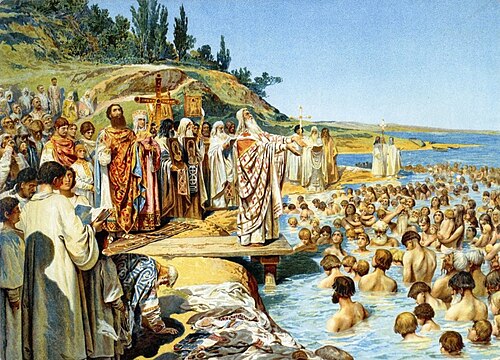
キエフ市はヴァリャーグ人とギリシャ人の間の交易路に位置していた。968年に遊牧民のペチェネグ人がキエフ市を攻撃し、包囲した。[36]西暦1000年までにキエフ市の人口は45,000人に達した。[37]
1169年3月、ウラジーミル=スーズダリ大公アンドレイ・ボゴリュプスキーがキエフを略奪し、旧市街と公の館を廃墟と化した。[38] [39]彼はヴィシュホロドからウラジーミルの生神女聖像を含む多くの宗教芸術作品を持ち去った。 [40] 1203年、リューリク・ロスティスラヴィチ公とキプチャクの同盟者はキエフを占領し焼き払った。1230年代、この都市はルーシのさまざまな公子によって何度も包囲され、荒廃した。1240年、バトゥ・ハーン率いるモンゴル軍がルーシに侵攻し、キエフは完全に破壊されたが、このとき都市はこれらの攻撃から立ち直っていなかった。 [41]
これらの出来事は、都市の将来と東スラヴ文明に大きな影響を与えました。ボゴリュプスキーの略奪以前、キエフは12世紀初頭に人口が10万人を超え、世界最大の都市の一つとしての評判を誇っていました。[42]
1320年代初頭、ゲディミナス大公率いるリトアニア軍はイルペン川の戦いでキエフのスタニスラフ率いるスラヴ軍を破り、この都市を征服した。キエフの領有権を主張していたタタール人は1324年から1325年にかけて報復したため、キエフはリトアニア公によって統治されていたものの、ジョチ・ウルスに貢物を納めなければならなかった。最終的に、 1362年の青水の戦いの結果、リトアニア大公アルギルダスはキエフとその周辺地域をリトアニア大公国に編入した。[43] 1482年、クリミア・タタール人がキエフの大部分を略奪し、焼き払った。[44]リトアニア統治時代には、市の中心部はポディルにあり、ザムコヴァ・ホラには18の塔を持つリトアニアのキエフ城大公ウラジーミル・オルゲルドヴィチの居城として、その後はリトアニア大公(例えばヴィタウタス)の居城として使われた。[45] [46]

1569年のルブリン合同によりポーランド・リトアニア共和国が成立すると、キエフ地域のリトアニア支配地域(ポジーリャ、ヴォルィーニ、ポドラキア)はリトアニア大公国からポーランド王国の王冠に移管され、キエフはキエフ県の首都となった。[47] 1658年のハディアフ条約では、キエフがポーランド・リトアニア・ルーシ共和国内のルーシ大公国の首都となることが想定されていたが、[48]この条約の規定は結局実行されなかった。[49]
ロシアの宗主権
1654年のペレヤスラフ条約以来ロシア軍に占領されていたキエフは、 1667年のアンドルソヴォ休戦協定からロシア帝国の一部となり、ある程度の自治権を享受した。キエフに関するポーランドとロシアの間の条約はいずれも批准されていない。[50]ロシア帝国では、キエフは巡礼者を惹きつけるキリスト教の中心地であり、帝国の最も重要な宗教指導者の多くが生まれた場所であったが、19世紀まで、この都市の商業的重要性はわずかなものにとどまっていた。

1834年、ロシア政府は聖ウラジーミル大学を設立しました。現在はウクライナの詩人タラス・シェフチェンコ(1814年 - 1861年)にちなんで、キエフのタラス・シェフチェンコ国立大学と呼ばれています。(シェフチェンコは地理学部のフィールド研究者および編集者として働いていました)。聖ウラジーミル大学の医学部は、ソビエト時代の1919年から1921年に独立した機関として分離され、 1995年にボゴモレツ国立医科大学になりました。
18世紀から19世紀にかけて、ロシア帝国軍と教会当局が都市生活を支配し、[要出典]ロシア正教会はキエフのインフラと商業活動の重要な部分に関与していた。1840年代後半、歴史家のミコラ・コストマロフ(ロシア語:ニコライ・コストマロフ)が秘密政治結社「聖キュリロスと聖メトディオス同胞団」を設立した。同胞団のメンバーは、ウクライナ人をロシア国家の従属部分ではなく、別個の独立した集団として、自由なスラヴ民族の連邦制を樹立するというアイデアを提唱したが、ロシア当局はすぐに同結社を弾圧した。
ウクライナの自治権が徐々に失われていった後、キエフでは19世紀にロシア人の移住、行政措置、社会の近代化によりロシア化が進んだ。20世紀初頭には、ロシア語を話す住民が市の中心部を支配し、郊外に住む下層階級はウクライナの民俗文化をかなり保持していた。[要出典]しかし、民族ウクライナ人の貴族、兵士、商人の中には、密かに本の印刷、アマチュア演劇、民俗学などを行い、キエフの土着文化を保存しようとする熱意を持った人々がいた。

19世紀後半のロシア産業革命の間、キエフはロシア帝国の重要な貿易と輸送の中心地となり、鉄道とドニエプル川による砂糖と穀物の輸出を専門としていました。1900年までには、この都市は25万人の人口を抱える重要な工業の中心地にもなっていました。その時代を代表するランドマークには、鉄道インフラ、数多くの教育および文化施設の設立、そして注目すべき建築記念碑(ほとんどが商業向け)などがあります。1892年、ロシア帝国初の電気路面電車の路線がキエフで運行を開始しました(世界で3番目)。キエフは19世紀後半のロシア帝国の産業革命の間に繁栄し、帝国で3番目に重要な都市となり、南西部の主要商業中心地になりました。
ソビエト時代
1917年のロシア革命後の混乱期に、キエフはいくつかのウクライナ国家の首都となり、いくつかの紛争の渦中に巻き込まれた。第一次世界大戦では1918年3月2日から11月までドイツ軍がキエフを占領し、 1917年から1922年にかけてロシア内戦が起こり、 1919年から1921年にかけてポーランド・ソビエト戦争が起こった。1919年の最後の3か月間、キエフは断続的に白軍の支配下にあった。1918年末から1920年8月までにキエフの支配者は16回変わった。[51]
1921年から1991年まで、この都市はウクライナ・ソビエト社会主義共和国の一部を形成し、同共和国は1922年にソビエト連邦の建国共和国となった。戦間期にソビエトウクライナで起こった主要な出来事はすべてキエフに影響を及ぼした。1920年代のウクライナ化と農村部のウクライナ語話者の移住により、ロシア語話者の都市はウクライナ語圏となり、市内のウクライナ文化生活の発展が促進された。 1920年代後半に始まったソビエトの工業化により、かつては商業と宗教の中心地であったこの都市は、主要な工業、技術、科学の中心地となった。1932 ~1933年の大飢饉により、配給カードに登録されていない移民人口の一部が壊滅した。1937 ~1938年のヨシフ・スターリンの大粛清により、市内の知識層はほぼ消滅した。 [52] [53] [54]
1934年、キエフはソビエトウクライナの首都となった。ソビエト連邦の工業化の時代には、キエフは再び繁栄し、人口が急増し、多くの産業大企業が設立された。そのうちのいくつかは今日も存在している。


第二次世界大戦では、この都市は再び大きな被害を受け、ナチスドイツが1941年9月19日から1943年11月6日までこの都市を占領した。枢軸国軍は1941年のキエフ大包囲戦で60万人以上のソ連兵を殺害あるいは捕虜にした。捕虜の大半は生きては戻らなかった。[55]ドイツ国防軍が都市を占領した直後、隠れていたNKVDの将校チームが、ドイツの軍当局と民間当局がほとんどの建物を占拠していた都市のメインストリートであるフレシチャーティク通りの建物のほとんどをダイナマイトで爆破した。建物は数日間燃え、2万5千人が家を失った。
NKVDの行動への報復として、ドイツ軍は見つけられる限りの地元のユダヤ人約34,000人を一斉に逮捕し、 [56] 1941年9月29日と30日にキエフのバビ・ヤールで虐殺した。 [57]その後の数か月で、さらに数千人がバビ・ヤールに連行され、射殺された。第二次世界大戦中、ドイツ軍はバビ・ヤールで様々な民族の10万人以上、主に民間人を殺害したと推定されている。[58]

キエフは戦後経済的に復興し、再びソ連で3番目に重要な都市となった。 1986年にチェルノブイリ原子力発電所で発生した壊滅的な事故は、キエフからわずか100km北の地点で発生した。しかし、南風が吹き荒れ、放射能を帯びた瓦礫の大半はキエフから吹き飛ばされた。
独立
ソ連崩壊の過程で、ウクライナ議会は1991年8月24日にキエフでウクライナ独立宣言を宣言した。2004年から2005年にかけて、オレンジ革命を支持するソ連崩壊後最大規模のデモがキエフで行われた。2013年11月から2014年2月まで、キエフ中心部はユーロマイダンの主要開催地となった。 2022年2月のロシアによるウクライナ侵攻の開始時には、ロシア軍はキエフを占領しようとしたが、市郊外のウクライナ軍に撃退された。2022年4月にロシアがこの地域から撤退して以来、キエフは頻繁に空爆を受けている。
環境
地理
.jpeg/500px-Kyiv,_Ukraine_ESA22370890_(cropped).jpeg)
地理的に見ると、キエフはポレシア森林生態ゾーン、ヨーロッパ混合林地域の一部、および東ヨーロッパ森林ステップ バイオームの境界にあります。しかし、この都市の独特の景観は、周囲の地域とは一線を画しています。キエフはキエフ州に完全に囲まれています。
キエフはもともと西岸にあったが、今日ではドニエプル川の両岸に位置し、川は南に流れて黒海に至っている。市の古く標高の高い西部は、渓谷や小川のある、数多くの樹木が生い茂った丘 (キエフ丘陵) に位置している。キエフの地形的な起伏は、ポディル(「低い」)、ペチェールシク(「洞窟」)、ウズヴィーズ(「急な道」、「下り坂」)などの地名に反映されている。キエフは、ドニエプル川の中流域で西岸に隣接するより広大なドニエプル高原の一部であり、このことが市の標高差に寄与している。
市の北郊はポレシア低地に接している。キエフは20世紀後半にようやく左岸(東側)のドニエプル低地に拡大した。ドニエプル川左岸のキエフ全域は一般に左岸(Лівий берег、リヴィ・ベレ)と呼ばれている。ドニエプル川左岸渓谷のかなりの部分は人工的に砂が堆積されており、ダムによって保護されている。
市内では、ドニエプル川が支流、島、港の分岐システムを形成しています。市は北ではデスナ川の河口とキエフ貯水池、南ではカニフ貯水池の近くにあります。ドニエプル川とデスナ川はどちらもキエフで航行可能ですが、貯水池の水門によって規制され、冬季の凍結によって制限されます。
キエフ市内には、ドニエプル川、その貯水池、いくつかの小河川、数十の湖、人工池など、合計448の水域があり、面積は7949ヘクタールに及ぶ。さらに、市内には16の整備されたビーチ(合計140ヘクタール)と35の水辺のレクリエーションエリア(1000ヘクタール以上)がある。その多くは娯楽やレクリエーションに利用されているが、一部の水域は水泳には適していない。[59] [60]
国連の2011年の評価によれば、キエフとその首都圏では自然災害のリスクはなかった。[61]
気候
キエフは温暖で夏は湿潤な大陸 性気候(ケッペンの Dfb)である。[62]最も暖かい月は6月、7月、8月で、平均気温は13.8〜24.8℃(56.8〜76.6℉)である。最も寒いのは12月、1月、2月で、平均気温は−4.6〜−1.1℃(23.7〜30.0℉)である。この都市で記録された最高気温は1936年7月30日の39.4℃(102.9℉)である。[63] [64]
市内で記録された最低気温は1951年1月11日の−32.9℃(−27.2℉)である。[63] [64]積雪は通常11月中旬から3月末までで、霜が降りない期間は平均180日間であるが、年によっては200日を超えることもある。[28]
法的地位、地方自治体、政治
法的地位と地方自治体
キエフ市は、ウクライナ国内の他の行政区画と比較して、特別な法的地位を持っています。最も大きな違いは、この都市がウクライナの地域とみなされていることです(ウクライナの地域を参照)。キエフ市は二重の管轄権を持つ唯一の都市です。市国家行政長官(市長)はウクライナ大統領によって任命され、市議会議長(キエフ市長)は地元の一般投票によって選出されます。
キエフ市長はヴィタリ・クリチコで、 2014年5月25日のキエフ市長選挙で約57%の票を獲得して勝利し、2014年6月5日に就任した。 [4] 2014年6月25日以来、クリチコはキエフ市行政長官も務めている。[5]クリチコは2020年のキエフ地方選挙の第1回投票で50.52%の票を獲得し、最後に再選された。 [70]
国家政府の主要な建物のほとんどは、フルシェフスコホ通り( vulytsia Mykhaila Hrushevskoho ) と研究所通り ( vulytsia Instytutska ) 沿いにある。フルシェフスコホ通りは、ウクライナの学者、政治家、歴史家、政治家であるミハイロ・フルシェフスキーにちなんで名付けられた。彼は、ウクライナのバールの歴史について「バール市の歴史ノート: XV-XVIII」という学術書を執筆した。[71]市のその部分は、非公式に政府地区 ( урядовий квартал ) としても知られている。
キエフ市政府と議会は、フレシチャーティク通りにあるキエフ市議会ビル内にあります。州政府と議会は、レシ・ウクラインカ広場にある州議会ビル内にあります。
キエフの政府庁舎
-
 ウクライナの閣僚会議の所在地
 -
 大統領官邸
大統領官邸 -
 外務省
外務省 -
 キエフ市と市議会の所在地、フレシチャーティク通り

_-_%D0%9C%D1%8D%D1%80%D0%B8%D1%8F.jpg/500px-%D0%9A%D1%80%D0%B5%D1%89%D0%B0%D1%82%D0%B8%D0%BA,_36_(01)_-_%D0%9C%D1%8D%D1%80%D0%B8%D1%8F.jpg)
政治
キエフの政治的、経済的役割の拡大、国際関係、インターネットとソーシャルネットワークの広範な普及により、[72]キエフはウクライナで最も親欧米、親民主主義の地域となった。キエフの選挙では、欧州連合との緊密な統合を主張する(いわゆる)国家民主党 が最多の票を獲得した。[73] [74] [75] [76] 2014年2月前半にキエフ国際社会学研究所が実施した世論調査では、キエフでの調査対象者の5.3%が「ウクライナとロシアは単一国家に統合されなければならない」と考えており、全国ではこの割合は12.5%であった。[77]
区分
伝統的な区画

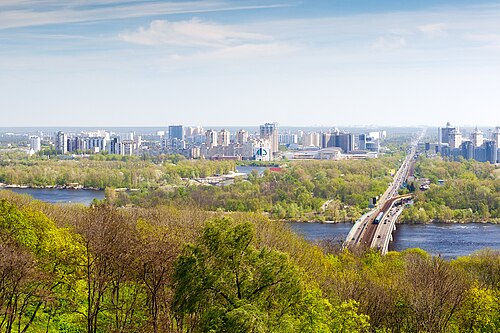
ドニエプル川はキエフを右岸と左岸に自然に分けています。歴史的には川の西側の右岸にあったこの都市は、20 世紀になって初めて左岸に拡大しました。キエフの観光名所のほとんど、およびビジネスや政府機関の大半は右岸にあります。東側の「左岸」は主に住宅地です。右岸と左岸の両方に大規模な工業地帯と緑地があります。
キエフはさらに非公式に歴史的地区または領土地区に分けられており、各地区には約5,000人から100,000人の住民が住んでいます。

正式な区分

- Г –ホロシイウスキー地区
- О –オボロンスキー地区
- ペチ –ペチェルスキー地区
- ポッド –ポジーリシクィイ地区
- Ш –シェフチェンキフスキー地区
- Св –スヴャトシンスキー地区
- ソル –ソロミャンスキー地区
- Дар –ダルニツキー地区
- デス –デスニアンスキー地区
- Дн –ドニプロフスキー地区
キエフの最初の正式な区分は1810年にさかのぼり、このとき市はペチェールシク、スタロキエフ、ポジールの第1部と第2部の4つの部分に分割されました。1833年から1834年にかけて、ニコライ 1世の勅令によりキエフは6つの警察地区に分割され、後に10に増加しました。1917年には8つの地区評議会(ドゥーマ)がありましたが、ボルシェビキによって6つの党領地区に 再編成されました。
ソビエト時代には、都市が拡大するにつれて、地区の数も徐々に増加しました。市内のこれらの新しい地区は、いくつかの古い地域とともに、著名な共産主義者や社会主義革命家の名にちなんで名付けられました。しかし、多くの共産党員が一定期間後に支持を失い、新しい、より新鮮な考えを持つ人々に取って代わられたため、キエフの地区の名前もそれに応じて変更されました。
最後の地区改革は2001年に行われ、地区の数は14から10に削減されました。
オレクサンドル・オメルチェンコ(1999年から2006年まで市長を務めた)の時代には、さらにいくつかの地区の合併と境界の見直しの計画があり、地区の総数は10から7に減らされる予定だった。2006年に新市長(レオニード・チェルノヴェツキー)が選出されたことで、これらの計画は棚上げされた。
各地区には、限られた範囲の事項を管轄する、地方選出の評議会がある。 [78]
人口統計

公式登録統計によると、2013年7月時点でキエフ市内には2,847,200人の住民がいた。[79]
歴史的人口
全ウクライナ国勢調査によると、2001年のキエフの人口は2,611,327人であった。[83]人口の歴史的変化はサイドテーブルに示されている。国勢調査によると、約1,393,000人(53.3%)が女性で、1,219,000人(46.7%)が男性であった。前回の国勢調査(1989年)の結果と比較すると、人口の高齢化の傾向が見られるが、これは全国的に広がっているが、キエフでは労働年齢の移民の流入によって部分的に相殺されている。約1,069,700人が高等教育または中等教育を修了しており、1989年以来21.7%の大幅な増加となっている。
2007年6月の非公式な人口推計では、市内で販売されるパン製品の量(一時的な訪問者や通勤者を含む)に基づいて、少なくとも350万人という数字が出ました。 [84]
民族構成
キエフの民族構成は、過去数世紀にわたって大きく変化してきた。1874年3月2日のロシア地理学会地方支部による国勢調査によると、キエフには127,205人が住んでいた。このうち、80%が「ロシア語」、11%が「ユダヤ語」、6%がポーランド語、2%がドイツ語を話した。「ロシア語」話者のうち、39%が小ロシア語(ウクライナ語)を話すと記録されており、ウクライナ語話者が市全体の30%を占めていたことになる。しかし、残りの「ロシア語」話者のうち、大ロシア語(ロシア語)を話すのは10% 、ベラルーシ語を話すのは2%に過ぎなかった。残りの49%は「一般的にロシア語的な言語」を話した。[85] 1897年の公式国勢調査によると、大ロシア語話者の数は54%に増加した。小ロシア語話者は22%、ユダヤ語話者は12%、ポーランド語話者は6.7%であった。[86]
1917年9月にウクライナ人民共和国当局が実施したキエフ市国勢調査では、ウクライナ人の人口比率はわずか16%にまで減少し、ロシア人が50%で多数派を占めるようになった。1919年3月にボルシェビキ当局が実施したキエフ市国勢調査では、ウクライナ人を自認する人口の割合が25%に増加したことが示された。それ以降、キエフのウクライナ人人口は再び人口比率の点で増加し始め、ゆっくりと以前のレベルに戻っていった。[87] 1926年のソビエト国勢調査では、ウクライナ人が41.6%となり、再びロシア人の25.5%を上回り始めた。1959年のソ連国勢調査では、キエフは再びウクライナ人が多数を占める都市となり、人口の60%がウクライナ人であると自認しており、これは1874年と同じ割合であった。[88]
2001年の国勢調査によると、キエフの領土内には130を超える国籍や民族が居住している。キエフではウクライナ人が最大の民族で、人口の82.2%にあたる211万800人を占めている。ロシア人は33万7300人(13.1%)、ユダヤ人は1万7900人(0.7%)、ベラルーシ人は1万6500人(0.6%)、ポーランド人は6900人(0.3%) 、アルメニア人は4900人(0.2%)、アゼルバイジャン人は2600人(0.1%)、タタール人は2500人(0.1%)、グルジア人は2400人(0.1%)、モルドバ人は1900人(0.1%)となっている。[89]
国際共和党研究所による2015年の調査によると、キエフの住民の94%はウクライナ民族で、5%はロシア民族である。[90]キエフの非スラブ系住民のほとんどはタタール人、南コーカサス人、その他旧ソ連出身の人々で構成されている。
言語統計
ウクライナ語とロシア語はどちらもキエフ市内で一般的に話されている。2001年の国勢調査で母国語を問われたとき、キエフの住民の約75%が「ウクライナ語」と回答し、約25%が「ロシア語」と回答した。[91] 2006年の調査によると、キエフ市民の23%が自宅でウクライナ語を使用し、52%がロシア語を使用し、24%が両者を行き来している。[92] 2003年の社会学調査では、「日常生活で何語を使用していますか?」という質問に対して、52%が「主にロシア語」、32%が「ロシア語とウクライナ語が同程度」、14%が「主にウクライナ語」、4.3%が「完全にウクライナ語」と回答した。[93]
1897年の国勢調査によると、キエフの人口約24万人のうち、約56%がロシア語を話し、23%がウクライナ語を話し、13%がイディッシュ語を話し、7%がポーランド語を話し、1%がベラルーシ語を話しました。[94]
国際共和党研究所による2015年の調査によると、キエフの家庭で話されている言語はウクライナ語(27%)、ロシア語(32%)、ウクライナ語とロシア語の同数(40%)であった。[90]
ユダヤ人
キエフのユダヤ人は10世紀の手紙で初めて言及されている。19世紀までユダヤ人の人口は比較的少なかった。[95] 1882年に一連のポグロムが実行され、1905年にもう1度ポグロムが行われた。第一次世界大戦前夜、キエフのユダヤ人人口は81,000人を超えていた。[96] 1939年にはキエフには約224,000人のユダヤ人がいたが、[95]その一部は1941年6月に始まったドイツによるソ連侵攻に先立ってキエフから逃亡した。1941年9月29日と30日、ドイツ国防軍、 SS、ウクライナ補助警察、および地元の協力者により、約34,000人のキエフのユダヤ人がバビ・ヤールで虐殺された。[97] [98]
ユダヤ人は戦争の終わりにキエフに戻り始めたが、1945年9月に再びポグロムを経験した。[99] 21世紀の現在、キエフのユダヤ人コミュニティは約2万人である。市内には大合唱シナゴーグとブロツキー合唱シナゴーグという2つの大きなシナゴーグがある。[100]
都市景観

現代のキエフは、古いもの(キエフは1907年から1914年の間に建てられた1,000以上の建物のうち約70パーセントを保存している)[101]と新しいものが混在しており、建築から店舗、そして人々自身に至るまであらゆるものに見られる。ウクライナソビエト社会主義共和国の首都がハルキフからキエフに移されたとき、多くの新しい建物が都市に「首都の輝きと洗練」を与えるために発注された。[101]どのようにショーケースとなる都市の中心を作るかを中心にした議論では、現在のフレシチャーティク市の中心とマイダン・ネザレージュノスティ(独立広場)は明らかな選択肢ではなかった。[101]最終的には実現しなかった初期のアイデアには、ペチェールシクの一部、リプキー、ヨーロッパ広場、ミハイリフスカ広場などがあった。[101]
巨大な記念碑(ウラジーミル・レーニンとスターリン)を建てる計画も、資金不足(1930年代~1950年代)とキエフの丘陵地帯のため断念された。[101] 1970年代から1990年代半ばにかけて急速な人口増加を経験したキエフは、2000年代に入ってからも着実に成長を続けている。その結果、キエフの中心地区には、淡い黄色、青、灰色の古いアパートの中に、新しい近代的な建物が点在している。都市のスプロール現象は徐々に減少し、郊外の人口密度が増加した。最も高価な不動産はペチェールスク地区とフレシチャーティク地区にある。ドニエプル川沿いのハルキウスキー地区やオボロン地区の新築の建物に不動産を所有することも名誉なことである。
2000 年代初頭のウクライナの独立は、他の変化をも招いた。中心部には、西洋風の住宅団地、モダンなナイトクラブ、高級レストラン、高級ホテルがオープンした。そして最も重要なのは、2005 年にビザ規則が緩和されたことで[102] 、ウクライナは主要な観光地としての地位を確立し、キエフをはじめとする大都市は新たな機会から利益を得ようとしている。キエフの中心部は清掃され、特にフレシチャーティク通りやマイダン・ネザレージュノスティ通りの建物は修復され、改装された。アンドリーイウスキー通りなど、キエフの多くの歴史的な地区は、伝統的なウクライナ美術、宗教的な品物、書籍、ゲームセット (最も一般的にはチェス)、宝石などが売られている人気の露店の場所となっている。[103]
2009年の国連気候変動会議では、キエフは独立国家共同体加盟国の中で唯一、ヨーロッパグリーン都市ランキングTOP30(30位)に選ばれた。[104]
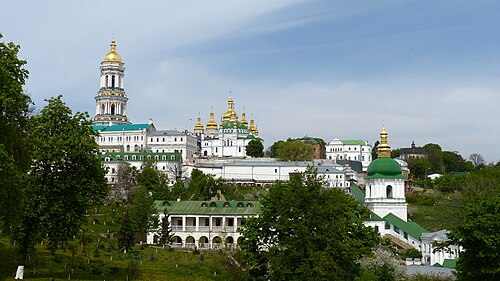
キエフで最も有名な歴史的建築群は、聖ソフィア大聖堂とキエフ・ペチェールシク大修道院(洞窟修道院)で、ユネスコの世界遺産に登録されています。注目すべき歴史的建築物としては、マリインスキー宮殿(1745年から1752年にかけて設計・建設され、1870年に再建)、聖ミハイル大聖堂、聖アンドレイ大聖堂、聖ボロディミル大聖堂、聖キリル大聖堂などの東方正教会の教会、再建された黄金の門などがあります。
キエフの広く知られている現代のランドマークの一つは、ドニエプル川右岸の第二次世界大戦におけるウクライナの歴史を展示する国立博物館に立つ、非常に目立つチタン製の巨大な「ウクライナの母」像です。その他の注目すべき場所は、栄光広場の向かいにある円筒形のサルート ホテル、第二次世界大戦の記念碑である無名戦士の墓の永遠の炎、そしてキマイラの家です。
キエフで最も有名な記念碑には、聖ソフィア大聖堂の近くにある、ミハイル・ミケシン作の馬にまたがるボフダン・フメリニツキーの像、聖ヴォロディミル丘からポジール川を見下ろす、ルーシの洗礼者、崇拝されているウラジーミル大王(聖ウラジーミル)、ドニエプル川の堤防にある、この都市の伝説的な創設者であるキイ、シチェク、ホリフ、リビドの記念碑がある。市中心部の独立広場には、2 人の都市の守護者を高く掲げた記念碑が 2 つある。1 つは、キエフの歴史的な守護天使ミカエルで、旧市街の門の 1 つを再現した像の上にあり、もう 1 つは、背の高い柱の上に置かれた 現代の発明である守護女神ベレヒニアである。
- キエフの建築物と歴史的に重要な場所や記念碑
-
 ゴールデンゲート
 -
 聖生神女就寝大聖堂
 -
 聖ソフィア大聖堂
 -
 聖ヴォロディミル大聖堂
 -
 聖ミカエル黄金ドーム修道院
 -

-

-
 聖アンドリュー教会
 -
 マリインスキー宮殿
 -

-
 「キメラのいる家」
 -
 ブロツキー合唱シナゴーグ– ムーア復興建築


.jpg/500px-Kyiv,_St_Andrew_church_(2).jpg)
文化

.jpg/500px-Kiev_Academic_Puppet_Theatre_(6).jpg)

キエフは東スラヴ文明の歴史的文化の中心地であり、キエフ大公国のキリスト教化の発祥地でもありました。キエフは数世紀にわたって文化的重要性を保ち、相対的に衰退した時期でさえ、東方正教会にとって最も重要な中心地であり続けました。キエフの聖地であるキエフ・ペチェールシク大修道院 (洞窟修道院) と聖ソフィア大聖堂は、数世紀にわたって巡礼者を惹きつけており、ユネスコの世界遺産に登録されています。主要な宗教的中心地であると同時に、主要な観光名所でもあります。上記の場所は、ウクライナの七不思議にも数えられています。
2023年9月、ユネスコ世界遺産委員会は聖ソフィア大聖堂とキエフ・ペチェールシク大修道院を危機に瀕する世界遺産リストに掲載した。同委員会によると、ウクライナ政府はこれらの遺産を保護するための措置を講じているものの、「遺産の顕著な普遍的価値を完全に保護するための最適な条件が満たされておらず、戦争による潜在的な危険にさらされている」とのこと。このリストは、ロシアとウクライナの両国が批准した1972年のユネスコ条約によって保護されている。このリストへの掲載は、緊急の国際支援を動員することを目的としている。[105] [106] [107]
キエフの劇場には、キエフ・オペラハウス、イヴァン・フランコ国立演劇劇場、レシア・ウクラインカ国立劇場、キエフ人形劇場、十月宮殿、ウクライナ国立フィルハーモニー管弦楽団などがある。1946年、キエフには4つの劇場、1つのオペラハウス、1つのコンサートホールがあったが[108]、当時のチケットのほとんどは「特権階級」に割り当てられていた。[108]
その他の重要な文化センターとしては、ドヴジェンコ映画スタジオやキエフサーカスなどがあります。市内の数多くの博物館の中で最も重要なのは、キエフ国立歴史博物館、第二次世界大戦におけるウクライナの歴史に関する国立博物館、国立美術館、西洋東洋美術館、ピンチューク芸術センター、国立ロシア美術館です。
2005年にキエフは第50回 ユーロビジョン・ソング・コンテストを開催し、2017年には第62回ユーロビジョン・ソング・コンテストを開催しました。
数多くの歌や絵画がこの都市に捧げられました。いくつかの歌はロシア、ウクライナ、ユダヤの民間伝承の一部となりました。最も人気のある歌は「私のキエフよ、どうしてあなたを愛さずにはいられないの?」と「キエフ・ワルツ」です。有名なウクライナの作曲家オレクサンドル・ビラシは「キエフの伝説」というオペレッタを書きました。
アトラクション
夏にはキエフの端から端まで、たくさんの木々の木陰を離れずに歩けると言われています。最も特徴的なのはセイヨウトチノキ( каштани、kashtany ) です。
キエフは、 2 つの植物園と多数の大小の公園がある緑豊かな都市として知られています。ここには、ドニエプル川を見下ろす緑豊かな丘に囲まれた、軍事史と装備に関する屋内と屋外の展示がある、第二次世界大戦におけるウクライナ国立歴史博物館があります。
数多くの島々の中でも、ヴェネツィイシキー島(ハイドロパーク)は最も開発が進んでいる。地下鉄や車でアクセスでき、遊園地、海水浴場、ボートレンタル、ナイトクラブなどがある。他の主な島には、トルハニウ島、ムロメツ島、ドロベツキー島などがある。地下鉄ダルニツャ駅近くの勝利公園(ペレモヒ公園)は、散歩やジョギング、サイクリングを楽しむ人々に人気のスポットである。キエフでは、ボート、釣り、水上スポーツが人気の娯楽である。この地域の湖や川は冬には凍り、氷上釣りをする人やアイススケートをする子供たちの姿がよく見られる。しかし、夏のピーク時には、日中の最高気温が30~34℃(86~93℉)に達することもあり、泳いだり日光浴をしたりするために大勢の人が海岸に集まる。[要出典]

キエフの中心部(マイダン・ネザレージュノスティ通りとフレシチャーティク通り)は、夏の間は夜になると大規模な屋外パーティー会場となり、何千人もの人々が近くのレストラン、クラブ、屋外カフェで楽しい時間を過ごします。中心街は週末と祝日には自動車通行止めになります。アンドリーフスキー通りはキエフで最も有名な歴史的通りの一つで、主要な観光名所です。この丘にはリチャード獅子心王の城、バロック様式の聖アンドリュー教会、キエフ生まれの作家ミハイル・ブルガーコフの家、キエフとノヴゴロドの大公ヤロスラフ賢公の記念碑、その他多数の記念碑があります。[109] [110]
キエフの多くの農産物市場では多種多様な農産物が販売されており、市の中心部にあるベッサラブスキー市場が最も有名です。各居住地域には独自の市場、つまりリノクがあります。ここでは、野菜、生肉や燻製肉、魚、チーズ、蜂蜜、牛乳や自家製スメタナ(サワークリーム)などの乳製品、キャビア、切り花、家庭用品、工具や金物、衣類など、考えられるあらゆるものを売る人々がテーブルに並んでいます。各市場には独自の製品の組み合わせがあり、自動車、自動車部品、ペット、衣類、花など、特定の商品のみを専門に扱う市場もあります。
市の南郊外、歴史的なピロヒフ村の近くには、正式にはウクライナの民俗建築と生活博物館と呼ばれる野外博物館があります。その面積は 1.5 平方キロメートル (1 平方マイル) です。この地域には、ウクライナの伝統的な田舎の建築を地域ごとに代表する「ミニ村」がいくつかあります。
キエフには、ボーリング場、ゴーカート場、ペイントボール場、ビリヤード場、射撃場など、数多くの娯楽施設もある。100年の歴史を持つキエフ動物園は40ヘクタールの広さがあり、CBCによると「動物園には328種2,600匹の動物がいる」という。[111]

博物館とギャラリー

キエフには約40の博物館があり、[112] 2009年には合計430万人の来館者を記録しました。[112]
第二次世界大戦におけるウクライナ国立歴史博物館は、ドニエプル川右岸のペチェールシクの丘陵地帯にある、第二次世界大戦の東部戦線を記念する記念施設です。キエフ要塞は、ウクライナの首都キエフにある19 世紀の要塞建築物で、かつては西ロシアの要塞の一部でした。これらの建造物 (かつては一体の複合施設) は、ロシア軍によってペチェールシクとその周辺地域に建設されました。
いくつかの建物は修復されてキエフ要塞と呼ばれる博物館になっており、他の建物は様々な軍事施設や商業施設として使用されています。ウクライナ国立美術館は、ウクライナ美術を専門とする博物館です。黄金の門は、古代都市の城壁にある歴史的な出入り口です。ゾロティ・ヴォロータ(黄金の門) という名前は、近くの劇場やキエフ地下鉄の駅にも使用されています。小さなウクライナ国立チェルノブイリ博物館は、 1986 年のチェルノブイリ事故にまつわる出来事と、それがウクライナの人々、環境、そして原子力の安全性に対するその後の態度に与えた影響をテーマにした記念館および歴史センターとして機能しています。
スポーツ
._%D0%A1%D1%82%D0%B0%D1%80%D1%82..jpg/500px-%D0%9F%D1%80%D0%BE%D0%B1%D1%96%D0%B3_%D0%BF%D1%96%D0%B4_%D0%BA%D0%B0%D1%88%D1%82%D0%B0%D0%BD%D0%B0%D0%BC%D0%B8_(2011)._%D0%A1%D1%82%D0%B0%D1%80%D1%82..jpg)
キエフには、ディナモ・キエフ、アルセナル・キエフ、FCオボロン・キエフなど、多くのプロおよびアマチュアのサッカークラブがあるが、ウクライナ・プレミアリーグでプレーしているのはディナモ・キエフのみである。この3チームのうち、ディナモ・キエフは歴史を通じて最も成功を収めている。例えば、1991年にソ連が崩壊するまで、同クラブは13回のソ連選手権、9回のソ連カップ、3回のソ連スーパーカップで優勝しており、ソ連トップリーグ史上最も成功したクラブとなっている。[113]
市内のその他の有名なサッカー以外のスポーツクラブには、キエフのアイスホッケークラブ「ソキル」とバスケットボールクラブ「BCブディヴェリニク」があります。両チームはそれぞれのスポーツでウクライナ最高峰のリーグに所属しています。ブディヴェリニクは1945年に、ソキルはソビエト連邦が存在していた1963年に設立されました。両チームとも、キエフスポーツ宮殿でホームゲームを行っています。

1980年にソビエト連邦で開催された夏季オリンピックでは、キエフは特別に改修されたオリンピックスタジアムでサッカートーナメントの予選と準々決勝を開催した。2008年12月1日から、スタジアムはUEFAがユーロ2012サッカートーナメント開催のために設定した基準を満たすために大規模な改修工事を実施した。開会式は2011年10月8日にヴィクトル・ヤヌコーヴィチ大統領出席のもと行われた。 [114]最初の主要イベントは、ユーロ2012中のスタジアムの再オープンに合わせて特別に企画されたシャキーラのコンサートであった。キエフの他の著名なスポーツスタジアム/スポーツ複合施設には、ヴァレリー・ロバノフスキー・ディナモ・スタジアム、スポーツ宮殿などがある。
ウクライナの代表チームのほとんどは、キエフで国際試合をホームで行います。たとえば、 ウクライナサッカー代表チームは、2011年から再建されたオリンピックスタジアムで試合を行います。
観光
2005年にEU加盟国とスイスに対するビザ免除制度を導入して以来、ウクライナを訪れる外国人観光客の数は着実に増加している。[115] 2008年から2009年のウクライナ金融危機以前は、キエフを訪れる外国人観光客の年間平均増加率は3年間で23%だった。[116] 2009年には合計160万人の観光客がキエフのホテルに宿泊し、そのうち約259,000人(約16%)が外国人だった。[116]
After UEFA Euro 2012, the city became the most popular destination for European tourists. A record number of 1.8 million foreign tourists was registered then along with about 2.5 million domestic tourists. More than 850,000 foreign tourists visited Kyiv in the first half of 2018, as compared to 660,000 tourists over the same period in 2013. As of 2018, the hotel occupancy rate from May to September averages 45–50%. Hostels and three-star hotels are approximately 90% full, four-star hotels 65–70%. Six five-star hotels average 50–55% occupancy. Ordinary tourists generally come from May to October, and business tourists from September to May.[117]
City anthem
In 2014, the Kyiv city's council established the city's anthem.[118] It became a 1962 song, "Yak tebe ne liubyty, Kyieve mii!"[118] (Як тебе не любити, Києве мій!, roughly "How can I not love you, Kyiv of mine!").
City symbols
The horse chestnut tree is one of the symbols of Kyiv.[119] It was heavily present on the city's coat of arms used from 1969 to 1995.[119]
Economy


As with most capital cities, Kyiv is a major administrative, cultural, and scientific centre of the country. It is the largest city in Ukraine in terms of both population and area and enjoys the highest levels of business activity. On 1 January 2010, there were around 238,000 business entities registered in Kyiv.[120]
Official figures show that between 2004 and 2008 Kyiv's economy outstripped the rest of the country's, growing by an annual average of 11.5%.[121][122] Following the Great Recession, Kyiv's economy suffered a severe setback in 2009 with gross regional product contracting by 13.5% in real terms.[121] Although a record high, the decline in activity was 1.6 percentage points smaller than that for the country as a whole.[122] The economy in Kyiv, as in the rest of Ukraine, recovered somewhat in 2010 and 2011. Kyiv is a middle-income city, with prices comparable to many mid-size American cities (i.e., considerably lower than Western Europe).
Because the city has a large and diverse economic base and is not dependent on any single industry or company, its unemployment rate has historically been relatively low – only 3.75% over 2005–2008.[123] Indeed, even as the rate of joblessness jumped to 7.1% in 2009, it remained far below the national average of 9.6%.[123][124]
As of January 2022, the average monthly salary in Kyiv reached 21,347 UAH (€540) gross and 17,184 UAH (€430) net.[125][126][127]
Kyiv is the undisputed center of business and commerce of Ukraine and home to the country's largest companies, such as Naftogaz Ukrainy, Energorynok and Kyivstar. In 2010, the city accounted for 18% of national retail sales and 24% of all construction activity.[128][129][130][131] Real estate is one of the major forces in Kyiv's economy. Average prices of apartments are the highest in the country and among the highest in eastern Europe.[132] Kyiv also ranks high in terms of commercial real estate and has Ukraine's tallest office buildings (such as Gulliver and Parus) and some of Ukraine's biggest shopping malls (such as Dream Town and Ocean Plaza).
In May 2011, Kyiv authorities presented a 15-year development strategy which calls for attracting as much as EUR82 billion of foreign investment by 2025 to modernize the city's transport and utilities infrastructure and make it more attractive for tourists.[133]
* – data not available; ** – calculated at annual average official exchange rate; *** – ILO methodology (% of workforce).
Industry
Primary industries in Kyiv include utilities – i.e., electricity, gas and water supply (26% of total industrial output), manufacture of food, beverages and tobacco products (22%), chemical (17%), mechanical engineering (13%) and manufacture of paper and paper products, including publishing, printing and reproduction of recorded media (11%).[138] The Institute of Oil Transportation is headquartered here.
Manufacture

- Kuznia na Rybalskomu, naval production
- Antonov Serial Production Plant (former Aviant), airplanes manufacturing
- Aeros, small aircraft production
- Kyiv Roshen Factory, confectionery
- Kyiv Arsenal (former arms manufacturer), specializes in production of optic-precision instruments
- Obolon, brewery
- Kyiv Aircraft Repair Plant 410, repair factory at Zhuliany Airport
Education and science
Scientific research

Scientific research is conducted in many institutes of higher education and, additionally, in many research institutes affiliated with the Ukrainian Academy of Sciences. Kyiv is home to Ukraine's ministry of education and science, and is also noted for its contributions to medical and computer science research.
In 2016, UNIT Factory (Ukrainian National IT Factory) opened. It offers a completely new format of IT education. The education is completely free for all trainees subject to compliance with the terms of the program. Within this project are the Technology Companies' Development Center (TCDC), BIONIC University open inter-corporate IT-university, as well as two hi-tech laboratories—VR Lab (Crytek) and Smart City lab.[139]
University education

Kyiv hosts many universities, the major ones being Kyiv National Taras Shevchenko University,[140] the National Technical University "Kyiv Polytechnic Institute",[141] Kyiv-Mohyla Academy[142] and the Kyiv National University of Trade and Economics. Of these, the Mohyla Academy is the oldest, founded as a theological school in 1632, but Shevchenko University, founded in 1834, is the oldest in continuous operation. The total number of institutions of higher education in Kyiv approaches 200,[143] allowing young people to pursue almost any line of study. While education traditionally remains largely in the hands of the state there are several accredited private institutions in the city.
Secondary education
There are about 530 general secondary schools and about 680 nursery schools and kindergartens in Kyiv.[144] Additionally, there are evening schools for adults, specialist technical schools, and the Evangel Theological Seminary.
Public libraries
There are many libraries in the city, with the Vernadsky National Library, which is Ukraine's main academic library and scientific information centre, as well as one of the world's largest national libraries, being the largest and most important one.[145] The National Library is affiliated with the Academy of Sciences in so far as it is a deposit library and thus serves as the academy's archives' store. The national library is the world's foremost repository of Jewish folk music recorded on Edison wax cylinders. Their Collection of Jewish Musical Folklore (1912–1947) was inscribed on UNESCO's Memory of the World Register in 2005.[146]
Infrastructure
Transportation
Local public transport

Local public transportation in Kyiv includes the Metro, buses and minibuses, trolleybuses, trams, taxi and funicular. There is also an intra-city ring railway service.
The publicly owned and operated Kyiv Metro is the fastest, the most convenient and affordable network that covers most, but not all, of the city. The Metro is expanding towards the city limits to meet growing demand, having three lines with a total length of 66.1 kilometres (41.1 miles) and 51 stations (some of which are renowned architectural landmarks). The Metro carries around 1.422 million passengers daily[147] accounting for 38% of the Kyiv's public transport load. In 2011, the total number of trips exceeded 519 million.[citation needed]
The historic tram system was the first electric tramway in the former Russian Empire and the third one in Europe after the Berlin Straßembahn and the Budapest tramway. The tram system consists of 139.9 km (86.9 mi) of track,[148] including 14 km (8.7 mi) two Rapid Tram lines, served by 21 routes with the use of 523 tram cars. Once a well maintained and widely used method of transport, the system is now gradually being phased out in favor of buses and trolleybuses.
The Kyiv Funicular was constructed during 1902–1905. It connects the historic Uppertown, and the lower commercial neighborhood of Podil through the steep Saint Volodymyr Hill overseeing the Dnieper River. The line consists of two stations.
All public road transport (except for some minibuses) is operated by the united Kyivpastrans municipal company. It is heavily subsidized by the city.
The Kyiv public transport system, except for taxi, uses a simple flat rate tariff system regardless of distance traveled: tickets or tokens must be purchased each time a vehicle is boarded. Digital ticket system is already established in Kyiv Metro, with plans for other transport modes. The cost of one ride is far lower than in Western Europe.
The taxi market in Kyiv is expansive but not regulated. In particular, the taxi fare per kilometer is not regulated. There is a fierce competition between private taxi companies.[citation needed]

Roads and bridges
Kyiv represents the focal point of Ukraine's "national roads" system, thus linked by road to all cities of the country. European routes  ,
,  and
and  intersect in Kyiv.
There are eight Dnieper bridges and dozens of grade-separated intersections in the city. Several new intersections are under construction. There are plans to build a full-size, fully grade-separated ring road around Kyiv.[149][150][151]
In 2009, Kyiv's roads were in poor technical condition and maintained inadequately.[152]
Traffic jams and lack of parking space are growing problems for all road transport services in Kyiv.

Air transport
Kyiv is served by two international passenger airports: the Boryspil Airport 30 kilometres (19 miles) away, and the smaller, municipally owned Zhuliany Airport on the southern outskirts of the city. There are also the Hostomel cargo airport and additional three operating airfields facilitating the Antonov aircraft manufacturing company and general aviation.
Railways

Railways are Kyiv's main mode of intracity- and suburban transportation. The city has a developed railroad infrastructure including a long-distance passenger station, 6 cargo stations, depots, and repairing facilities. However, this system still fails to meet the demand for passenger service. Particularly, the Kyiv-Pasazhyrskyi railway station is the city's only long-distance passenger terminal (vokzal).
Construction is underway for turning the large Darnytsia railway station on the left-bank part of Kyiv into a long-distance passenger hub, which may ease traffic at the central station.[153] Bridges over the Dnieper River are another problem restricting the development of city's railway system. Presently, only one rail bridge out of two is available for intense train traffic. A new combined rail-auto bridge is under construction, as a part of Darnytsia project.
In 2011, the Kyiv city administration established the new Urban Train for Kyiv. This service runs at standard 4- to 10-minute intervals throughout the day and follows a circular route around the city centre, which allows it to serve many of Kyiv's inner suburbs. Interchanges between the Kyiv Metro and Fast Tram exist at many of the urban train's station stops.[154]
Suburban 'Kyiv City Express' trains (colloquially known as elektrychka) are serviced by the publicly owned Ukrainian Railways. The suburban train service is fast, and unbeatably safe in terms of traffic accidents. But the trains are not reliable, as they may fall significantly behind schedule, may not be safe in terms of crime, and the elektrychka cars are poorly maintained and overcrowded in rush hours.
There are nine elektrychka directions from Kyiv:[155]
- Bila Tserkva – Uzyn
- Fastiv
- Klavdiievo
- Myronivka – Bohuslav
- Nizhyn
- Ukrainka
- Vasylkiv
- Vyshhorod
- Yahotyn
More than a dozen of elektrychka stops are within the city allowing residents of different neighborhoods to use the suburban trains.
Energy
DTEK Kyiv Electric Networks (formerly Kyivenergo) is the electric power distribution network operator for Kyiv, owned by oligarch Rinat Akhmetov. As of 2021[update] it had:[156]
.jpg/500px-TEC-5(low).jpg)
- 12,038 km of power transmission lines with a voltage of 0.4–110 kV
- 64 substations with a voltage of 35–110 kV
- 243 switchgears and 3728 transformer substations at 10 kV
Kyivteploenergo operates a centralized heating system, which provides heating and hot water to customers through a network of pipes that distribute hot water from centralized heating plants to buildings throughout the city. It operates a 2700 km network, two of the largest combined heat and power plants in Ukraine CHP-5 and CHP-6, as well as the only waste incineration plant Energia (plant) operating in Ukraine.
In line with the EU Third Energy Package, since 2019 state energy policy abandoned the Rotterdam plus system and has required transmission system operator (TSO) and regional utilities unbundling in order to separate electricity distribution and retail electricity supply.[157]
Water and sanitation
The national government has delegated responsibility for water and sanitation services to local authorities.[158] Kyivvodokanal is a private joint-stock company that provides such services to Kyiv. The length of water supply networks is 4231 km, of which 1798 km are dilapidated. The length of sewage networks is 2662 km, of which 830 km are dilapidated.
Twin towns – sister cities
Kyiv is twinned with:[159]
 Ankara, Turkey (1993)
 Ashgabat, Turkmenistan (2001)
 Astana, Kazakhstan (1998)
 Athens, Greece (1996)
 Baku, Azerbaijan (1997)
 Beijing, China (1993)
 Berlin, Germany (2023)[160]
 Bishkek, Kyrgyzstan (1997)
 Brasília, Brazil (2000)
 Bratislava, Slovakia (1969)
 Brussels, Belgium (1997)
 Bucharest, Romania (2022)[161]
 Buenos Aires, Argentina (2000)
 Chicago, United States (1991)
 Chișinău, Moldova (1993)
 Copenhagen, Denmark (2023)[162]
 Edinburgh, Scotland (1989)
 Florence, Italy (1967)
 Jakarta, Indonesia (2005)
 Kraków, Poland (1993)
 Kyoto, Japan (1971)
- Leipzig, Germany (1956)
 Lima, Peru (2005)
 Mexico City, Mexico (1997)
- Munich, Germany (1989)
- Odense, Denmark (1989)
- Osh Region, Kyrgyzstan (2002)
 Pretoria, South Africa (1993)
 Riga, Latvia (1998)
- Rio de Janeiro, Brazil (2000)
 Santiago, Chile (1998)
 Sofia, Bulgaria (1997)
- Suzhou, China (2005)
 Tallinn, Estonia (1994)
 Tampere, Finland (1954)
 Tashkent, Uzbekistan (1998)
 Tbilisi, Georgia (1999)
 Toulouse, France (1975)
 Vilnius, Lithuania (1991)
- Warsaw, Poland (1994)
- Wuhan, China (1990)

.svg/500px-Flag_of_Belgium_(civil).svg.png)
Other cooperation agreements



.svg/500px-Flag_of_Canada_(Pantone).svg.png)


Notable people
Arts, literature, and entertainment


- Leonid Bronevoy (1928–2017), Soviet and Russian actor
- Mikhail Bulgakov (1891–1940), Soviet writer, medical doctor and playwright
- Eugenia Chuprina (born 1971), poet, novelist, writer and playwright
- Daniel the Traveller, 12th-century travel writer from the Kievan Rus'[163]
- Ilya Ehrenburg (1891–1967), Soviet writer, journalist, translator and cultural figure
- André Grabar (1896–1990), historian of Romanesque art and the art of the Eastern Roman Empire and the Bulgarian Empire
- Selma Gubin (1903–1974), Russian Empire-born American artist
- Dmytro Hnatyuk (1925–2016), Soviet and Ukrainian opera singer
- Olha Haidamaka (born 1990), Ukrainian artist
- Milton Horn (1906–1995), Russian-American sculptor
- Vladimir Horowitz (1903–1989), American classical pianist
- Viktor Ivanov (1909–1981), Soviet film director
- Milla Jovovich (born 1975), American actress
- Sonya Koshkina (born 1985), Ukrainian journalist, editor-in-chief
- Kateryna Kukhar (born 1982), prima ballerina
- Danylo Knyshuk (born 1978), Ukrainian sculptor
- Viacheslav Kryshtofovych (born 1947), Ukrainian film director and actor
- Ana Layevska (born 1982), Ukrainian-Mexican actress
- Boris Levit-Broun (born 1950), Russian poet, writer, and artist
- Serge Lifar (1905–1986), French ballet dancer
- Kazimir Malevich (1879–1935), pioneer of geometric abstract art and the originator of the avant-garde Suprematist movement
- Natalya Marchenkova (born 1948), animator and animation director, born in Kyiv[164]
- Natalia Matsak (born 1982), ballet dancer
- Galyna Moskvitina (born 1963), painter
- Ivan Putrov (born 1980), dancer, former Principal with The Royal Ballet in London
- Maksym Petrenko (1983–2022), Ukrainian writer, scientist, inventor, educator, soldier
- Yudif Grigorevna Rozhavskaya (1923–1982), composer and pianist
- Yuriy Rybchynskyi (born 1945), poet and playwright
- Natalya Semenchenko (born 1976), professor, writer, and publicist
- Lev Shestov (1866–1938), Russian existentialist philosopher
- Oksana Shvets (1955–2022), Ukrainian actress
- Alexander Vertinsky (1889—1957), singer, composer, poet, cabaret artist and actor
- Ludmila Anatolievna Yaroshevskaya (1906–1975), composer
- Artemy Vedel (1767–1808), composer
Science and technology

- Nikolai Amosov (1913–2002), Soviet and Ukrainian heart surgeon and inventor
- Zino Davidoff (1906–1994), Swiss premium tobacco manufacturer; known as "King of Cigars"
- Jan Koum (born 1976), American computer programmer, CEO and co-founder of WhatsApp
- Viktor Kaspruk, (born 1955), political scientist
- Alexander Ostrowski (1893–1986), mathematician
- Borys Paton (1918–2020), scientist, chairman of the National Academy of Sciences of Ukraine
- Igor Sikorsky (1889–1972), Russian-American aviation pioneer
- Svetlana Zaginaichenko (1957-2015), physicist
Politics

- Golda Meir (1898–1978), Israeli politician, the fourth Prime Minister of Israel
- Henry P. Melnikow, economic consultant to unions involved in labor
Religion
- Nikolai Berdyaev (1874–1948), Russian Orthodox religious and political philosopher
- Jonathan Markovitch (born 1967), Chief Rabbi of Kyiv
- Petro Mohyla (1596–1647), Metropolitan bishop of Kyiv from 1633[165]
- Mikhail Morgulis (1941–2021), Russian-language writer, editor and theologian
- Moses of Kiev, 12th century Talmudist
- Theophan Prokopovich (1681–1736), theologian, poet, mathematician and philosopher[166]
Military conflicts
- Eugeniusz Horbaczewski (1917–1944), Polish fighter pilot
- Yuliia "Taira" Paievska (born 1968), founder of "Taira's Angels"
Sport
- Oleg Blokhin (born 1952), Ukrainian football player
- Oleg Ladik (born 1971), Ukrainian-born Canadian Olympic wrestler
- Valeriy Lobanovskyi (1939–2002), Soviet and Ukrainian football coach
- Oleksandr Saliuk Jr. (born 1978), Ukrainian rally driver
- Andriy Shevchenko (born 1976), Ukrainian footballer
- Igor Slyusar (born 1989), Ukrainian professional ice hockey player
- Igor Skuz (born 1976), Ukrainian racing driver
Other
- Oleg of Novgorod (c. 845–912), Rurikid prince who ruled 882–912[167]
- Olga of Kiev (c. 900–969), a regent of Kievan Rus' for her son Sviatoslav from 945 until 960[168]
- Nicholas Pritzker, scion of the Pritzker Family
- Vladimir the Great (c. 958–1015), Grand Prince of Kiev and ruler of Kievan Rus' from 980 to 1015[169]
- Israel Markovich Brodsky (1823–1888), businessman and philanthropist
Honour
- Kyiv Peninsula in Graham Land, Antarctica, is named after the city of Kyiv.[170]
See also
.svg/500px-Europe_(orthographic_projection).svg.png)
- List of national landmarks of cultural heritage in Kyiv
- List of crossings of the Dnieper River
- List of universities, colleges, and research institutions in Kyiv
- Outline of Ukraine
- Yehupetz
Notes
- ^ See § Name for alternative spellings and pronunciations.
- ^ pre-1918 spelling: Кіевъ
- ^ pre-1918 spelling: Кій
References
- ^ a b "Kyiv – History". Encyclopædia Britannica. Archived from the original on 4 May 2015. Retrieved 9 March 2020.
- ^ a b "Number of present population of Ukraine 1 January 2022" (PDF) (in Ukrainian). UkrStat.gov.ua. 1 January 2022. Archived (PDF) from the original on 10 August 2022. Retrieved 20 February 2023.
- ^ Oksana Lyachynska (31 May 2012). "Kyiv's 1,530th birthday marked with fun, protest". Kyiv Post. Archived from the original on 1 June 2014. Retrieved 16 May 2013.
- ^ a b Vitali Klitschko sworn in as mayor of Kyiv Archived 11 November 2020 at the Wayback Machine, Interfax-Ukraine (5 June 2014)
- ^ a b Poroshenko appoints Klitschko head of Kyiv city administration – decree Archived 4 July 2014 at the Wayback Machine, Interfax-Ukraine (25 June 2014)
Poroshenko orders Klitschko to bring title of best European capital back to Kyiv Archived 14 July 2014 at the Wayback Machine, Interfax-Ukraine (25 June 2014) - ^ "Major Agglomerations of the World". Citypopulation.de. 1 January 2021. Archived from the original on 23 November 2019. Retrieved 23 September 2021.
- ^ "Definition of KYIV". Merriam-Webster.com Dictionary. Archived from the original on 28 September 2022. Retrieved 11 May 2023.
- ^ "Kyiv definition and meaning". Collins English Dictionary. Archived from the original on 28 November 2022. Retrieved 11 May 2023.
- ^ kievan. (n.d.). Dictionary.com Unabridged Archived 14 March 2013 at the Wayback Machine, retrieved 29 May 2013 from Dictionary.com
- ^ "ВАЛОВИЙ РЕГІОНАЛЬНИЙ ПРОДУКТ У 2021 РОЦІ".
- ^ "City Mayors: The 500 largest European cities (1 to 100)". www.citymayors.com. Archived from the original on 2 January 2010. Retrieved 19 February 2017.
- ^ "Kiev". TheFreeDictionary.com. Archived from the original on 5 August 2018. Retrieved 4 July 2015.
- ^ Magocsi, Paul Robert (2010). A History of Ukraine: The Land and Its Peoples (2nd, Revised ed.). University of Toronto Press. p. 481. ISBN 978-1-4426-9879-6. Archived from the original on 14 June 2020. Retrieved 9 September 2017.
- ^ Preston, Rich [@RichPreston] (25 February 2022). "And here's what the BBC Pronunciation Unit advises. We changed our pronunciation and spelling of Kiev to Kyiv in 2019" (Tweet) – via Twitter.
- ^ "Kyiv". Merriam-Webster.com Dictionary. Merriam-Webster. Retrieved 24 February 2022.
- ^ Jones, Daniel (2011). Roach, Peter; Setter, Jane; Esling, John (eds.). Cambridge English Pronouncing Dictionary (18th ed.). Cambridge University Press. ISBN 978-0-521-15255-6.
- ^ a b Wells, John C. (2008). Longman Pronunciation Dictionary (3rd ed.). Longman. ISBN 978-1-4058-8118-0.
- ^ Trubachev, O. N., ed. (1987). "*kyjevъ/*kyjevo". Ėtimologicheskiĭ slovarʹ slavi͡anskikh I͡Azykov: Praslavi͡anskiĭ leksicheskiĭ fond (in Russian). Vol. 13 (*kroměžirъ–*kyžiti). Moscow: Nauka. pp. 256–257.
- ^ Rudnyc'kyj, Jaroslav Bohdan (1962–1982). An etymological dictionary of the Ukrainian language. 2., rev. ed. Winnipeg: Ukrainian free acad. of sciences, pp. 660–663.
- ^ a b "Kiev". Collins English Dictionary. HarperCollins. Archived from the original on 1 May 2021. Retrieved 14 November 2020. The entry is the same as the print edition of Collins Dictionary of English (13th ed.). Glasgow, UK: HarperCollins. 2018. It includes the note "Ukrainian name: Kyiv". For American English, the website also includes the definition from Webster's New World College Dictionary (4th ed.). Boston: Houghton Mifflin Harcourt. 2010. In the 2018 fifth edition, WNWCD changed the main headword to Kyiv, with Kiev as a see-also entry with the label "Russ. name for Kyiv".
- ^ "Kiev". Merriam-Webster.com Dictionary. Merriam-Webster. Archived from the original on 13 November 2020. Retrieved 14 November 2020. Merriam–Webster's online dictionary entry has the headword "Kiev" with the label "variants: or Ukrainian Kyiv or Kyyiv." According to M–W's help on entries Archived 11 August 2020 at the Wayback Machine, the key word or signals an equal variant spelling: "these the two spellings occur with equal or nearly equal frequency and can be considered equal variants. Both are standard, and either one may be used according to personal inclination."
- ^ Ukrainian Commission for Legal Terminology. "Kiev?, Kyiv?! Which is right?". UA Zone. Archived from the original on 26 May 2011. Retrieved 15 March 2011.
- ^ "Kiev". Oxford Dictionary on Lexico.com. Archived from the original on 12 November 2020. Retrieved 14 November 2020. The entry includes the usage note "Ukrainian name Kyiv", and the dictionary has a see-also entry for "Kyiv" cross-referencing this one. The entry text is republished from the print edition of the Oxford Dictionary of English (3rd ed.). Oxford University Press. 2010.
- ^ "Kiev". Longman Dictionary of Contemporary English Online. Pearson English Language Teaching. Archived from the original on 6 May 2017. Retrieved 14 November 2020.
- ^ "Kyiv not Kiev: Why spelling matters in Ukraine's quest for an independent identity". The Atlantic Council. 21 October 2019. Archived from the original on 19 January 2020. Retrieved 26 May 2021.
- ^ a b c d Kyiv Archived 24 November 2016 at the Wayback Machine at Ukrainian Soviet Encyclopedia
- ^ Kiev Archived 24 November 2016 at the Wayback Machine in the Ukrainian Soviet Encyclopedia: "Населення періоду мідного віку на тер. К. було носієм т. з. трипільської культури; відомі й знахідки окремих предметів бронзового віку."
- ^ a b "Kyiv Archived 4 May 2015 at the Wayback Machine", Encyclopædia Britannica. Retrieved 9 March 2020.
- ^ Petro Tolochko, Glib Ivakin, Yaroslava Vermenych. Kyiv Archived 26 February 2022 at the Wayback Machine. Encyclopedia of History of Ukraine.
- ^ Rabinovich GA From the history of urban settlements in the eastern Slavs. In the book.: History, culture, folklore and ethnography of the Slavic peoples. M. 1968. 134.
- ^ Ерофалов-Пилипчак, Борис (22 February 2019). Римский Киев: или Castrum Azagarium на Киево-Подоле. A+C. ISBN 9786177765010. Archived from the original on 21 June 2020. Retrieved 17 June 2020 – via Google Books.
- ^ Hazlitt, William (22 February 1851). "The Classical Gazetteer: A Dictionary of Ancient Geography, Sacred and Profane". Whittaker. Archived from the original on 4 August 2020. Retrieved 17 June 2020 – via Google Books.
- ^ Sigfús Blöndal. "The Varangians of Byzantium Archived 25 June 2020 at the Wayback Machine".
- ^ History Archived 13 June 2020 at the Wayback Machine. Pechersk Raion in the Kiev City.
- ^ dr. Viktor Padányi – Dentu-Magyaria p. 325, footnote 15
- ^ Lowe, Steven; Ryaboy, Dmitriy V. "The Pechenegs". Archived from the original on 27 October 2009. Retrieved 27 October 2009.
- ^ Paul M. HOHENBERG; Lynn Hollen Lees; Paul M Hohenberg (2009). The Making of Urban Europe, 1000–1994. Harvard University Press. p. 10. ISBN 978-0-674-03873-8. Archived from the original on 28 July 2014. Retrieved 13 December 2015.
- ^ Plokhy, Serhii (2006). The Origins of the Slavic Nations (PDF). Cambridge University Press. p. 42. ISBN 9780521864039. Archived from the original (PDF) on 29 March 2017.
- ^ Martin, Janet L. B. (2004) [1986]. Treasure of the Land of Darkness: The Fur Trade and Its Significance for Medieval Russia. Cambridge, England: Cambridge University Press. p. 127. doi:10.1017/CBO9780511523199. ISBN 9780521548113.
- ^ Janet Martin, Medieval Russia:980–1584, (Cambridge University Press, 1996), 100.
- ^ The Destruction of Kiev, University of Toronto Research Repository
- ^ Orest Subtelny (1989). Ukraine. A History. [Illustr.] (Repr.). CUP Archive. p. 38. Archived from the original on 14 June 2020. Retrieved 13 December 2015.
- ^ Jones, Michael (2000). The New Cambridge Medieval History, Volume 6, c.1300–c.1415. Cambridge University Press. ISBN 978-0-521-36290-0
- ^ Jerzy Lukowski, W. H. Zawadzki (2006). A concise history of Poland Archived 14 June 2020 at the Wayback Machine. Cambridge University Press. p.53. ISBN 0-521-61857-6
- ^ ""Ukraina: Lietuvos epocha, 1320–1569"". Bernardinai.lt (in Lithuanian). 3 May 2010. Archived from the original on 10 August 2023. Retrieved 10 August 2023.
- ^ "Хто побудував київський замок?". Про Україну (in Ukrainian). Archived from the original on 1 January 2017. Retrieved 22 October 2023.
- ^ Davies, Norman (1982). God's Playground: A History of Poland, Vol. 1: The Origins to 1795. Columbia University Press. ISBN 978-0-231-05351-8
- ^ Magocsi, Paul Robert (1996). A History of Ukraine, University of Washington Press. ISBN 0-295-97580-6
- ^ Т.Г. Таирова-Яковлева, Иван Выговский // Единорогъ. Материалы по военной истории Восточной Европы эпохи Средних веков и Раннего Нового времени, вып.1, М., 2009: Под влиянием польской общественности и сильного диктата Ватикана сейм в мае 1659 г. принял Гадячский договор в более чем урезанном виде. Идея Княжества Руського вообще была уничтожена, равно как и положение о сохранении союза с Москвой. Отменялась и ликвидация унии, равно как и целый ряд других позитивных статей.
- ^ Eugeniusz Romer, O wschodniej granicy Polski z przed 1772 r., w: Księga Pamiątkowa ku czci Oswalda Balzera, t. II, Lwów 1925, s. [358].
- ^ Eksteins, Modris (1999). Walking Since Daybreak. Houghton Mifflin. p. 87. ISBN 0-618-08231-X.
- ^ "The Great Purge under Stalin 1937–38". brama.com. Archived from the original on 24 January 2010. Retrieved 14 January 2010.
- ^ Orlando Figes The Whisperers: Private Life in Stalin's Russia, 2007, ISBN 0805074619, pages 227–315.
- ^ Robert Gellately, Lenin, Stalin, and Hitler: The Age of Social Catastrophe (Knopf, 2007: ISBN 1-4000-4005-1), 720 pages.
- ^ Daniel Goldhagen, Hitler's Willing Executioners (p. 290) – "2.8 million young, healthy Soviet POWs" killed by the Germans, "mainly by starvation... in less than eight months" of 1941–42, before "the decimation of Soviet POWs... was stopped" and the Germans "began to use them as laborers".
- ^ "Babi Yar". Jewish Virtual Library. 2012. Archived from the original on 17 August 2014. Retrieved 6 July 2014.
- ^ Andy Dougan, Dynamo: Triumph and Tragedy in Nazi-Occupied Kiev (Globe Pequot, 2004: ISBN 1-59228-467-1), p. 83.
- ^ "Kiev and Babi Yar". Holocaust Encyclopedia. United States Holocaust Memorial Museum. Archived from the original on 23 March 2010. Retrieved 13 March 2016.
- ^ "У Києві біля водойм відкрито 32 зони для відпочинку, з яких 12 – із можливістю купання". kyivcity.gov.ua (in Ukrainian). 19 June 2020. Archived from the original on 9 August 2020. Retrieved 12 October 2020.
- ^ "У Кличка розповіли, де в Києві можна купатися, а де тільки засмагати. Список". pravda.com.ua (in Ukrainian). 19 June 2020. Archived from the original on 24 June 2020. Retrieved 12 October 2020.
- ^ "Urban agglomerations with 750,000 inhabitants or more in 2011 and types of natural risks". United Nations, Department of Economic and Social Affairs, Population Division. April 2012. Archived from the original on 6 October 2014. Retrieved 1 September 2013.
- ^ Kottek, M.; J. Grieser; C. Beck; B. Rudolf; F. Rubel (2006). "World Map of the Köppen-Geiger climate classification updated" (PDF). Meteorol. Z. 15 (3): 259–263. Bibcode:2006MetZe..15..259K. doi:10.1127/0941-2948/2006/0130. ISSN 0941-2948. Archived (PDF) from the original on 5 March 2012. Retrieved 24 August 2012.
- ^ a b c "ЦГО Кліматичні дані по м.Києву". cgo-sreznevskyi.kyiv.ua (in Ukrainian). Central Observatory for Geophysics. Archived from the original on 18 April 2020. Retrieved 12 October 2020.
- ^ a b c "ЦГО Кліматичні рекорди". cgo-sreznevskyi.kyiv.ua (in Ukrainian). Central Observatory for Geophysics. Archived from the original on 31 March 2020. Retrieved 12 October 2020.
- ^ "Weather and Climate – The Climate of Kyiv" (in Russian). Weather and Climate (Погода и климат). Archived from the original on 13 December 2019. Retrieved 8 November 2021.
- ^ "World Meteorological Organization Climate Normals for 1981–2010". World Meteorological Organization. Archived from the original on 17 July 2021. Retrieved 17 July 2021.
- ^ Cappelen, John; Jensen, Jens. "Ukraine – Kyiv" (PDF). Climate Data for Selected Stations (1931–1960) (in Danish). Danish Meteorological Institute. p. 332. Archived from the original (PDF) on 27 April 2013. Retrieved 1 April 2016.
- ^ "Kiev, Ukraine – Detailed climate information and monthly weather forecast". Weather Atlas. Yu Media Group. Archived from the original on 3 July 2019. Retrieved 3 July 2019.
- ^ Klitschko officially announced as winner of Kyiv mayor election Archived 7 September 2020 at the Wayback Machine, Interfax-Ukraine (4 June 2014)
- ^ Vitali Klitschko wins in first round of Kyiv mayor election Archived 6 November 2020 at the Wayback Machine, Ukrinform (6 November 2020)
- ^ Hrushevsky, M., Bar Starostvo: Historical Notes: XV–XVIII, St. Vladimir University Publishing House, Bol'shaya-Vasil'kovskaya, Building no. 29–31, Kiev, Ukraine, 1894; Lviv, Ukraine, ISBN 5-12-004335-6, pp. 1–623, 1996.
- ^ Сюмар, Вікторія (22 May 2012). "Київ: стратегічна позиція чи "чемодан" без ручки?". Ukrayinska Pravda. Archived from the original on 1 May 2014. Retrieved 19 August 2013.
- ^ Свобода, Радіо (31 October 2012). "Виборчі комісії фіксують перемогу опозиційних кандидатів у Києві". Радіо Свобода. Archived from the original on 22 February 2022. Retrieved 22 February 2022.
- ^ Битва за Київ: чому посада мера вже не потрібна Кличку і чи будуть вибори взагалі (in Ukrainian). Kontrakty. 19 March 2013. Archived from the original on 24 August 2013. Retrieved 19 August 2013.
- ^ У кожного киянина в голові – досвід Майдану (in Ukrainian). 20 April 2013. Archived from the original on 5 March 2022. Retrieved 19 August 2013.
- ^ (in Ukrainian) Interactive parliamentary election 2012 result maps Archived 29 December 2012 at the Wayback Machine by Ukrayinska Pravda
(in Ukrainian) Election results in Ukraine since 1998 Archived 3 December 2010 at the Wayback Machine, Central Election Commission of Ukraine
Nations and Nationalism: A Global Historical Overview Archived 14 June 2020 at the Wayback Machine, ABC-CLIO, 2008, ISBN 1851099077 (page 1629)
Ukraine on its Meandering Path Between East and West Archived 14 June 2020 at the Wayback Machine by Andrej Lushnycky and Mykola Riabchuk, Peter Lang, 2009, ISBN 303911607X (page 122)
After the parliamentary elections in Ukraine: a tough victory for the Party of Regions Archived 17 March 2013 at the Wayback Machine, Centre for Eastern Studies (7 November 2012)
Communist and Post-Communist Parties in Europe Archived 6 August 2020 at the Wayback Machine by Uwe Backes and Patrick Moreau, Vandenhoeck & Ruprecht, 2008, ISBN 978-3-525-36912-8 (page 396)
Party of Regions gets 185 seats in Ukrainian parliament, Batkivschyna 101 – CEC Archived 31 October 2013 at the Wayback Machine, Interfax-Ukraine (12 November 2012)
UDAR submits to Rada resolution on Ukraine's integration with EU, Interfax-Ukraine (8 January 2013)
(in Ukrainian) Electronic Bulletin "Your Choice – 2012". Issue 4: Batkivshchyna Archived 3 December 2013 at the Wayback Machine, Ukrainian Center for Independent Political Research (24 October 2012)
Ukraine's Party System in Transition? The Rise of the Radically Right-Wing All-Ukrainian Association "Svoboda" Archived 2 February 2014 at the Wayback Machine by Andreas Umland, Centre for Geopolitical Studies (1 May 2011)
"Вибори-2012. Результати голосування" (in Ukrainian). Archived from the original on 25 August 2013. Retrieved 18 August 2013. - ^ How relations between Ukraine and Russia should look like? Public opinion polls' results Archived 23 December 2017 at the Wayback Machine, Kyiv International Institute of Sociology (4 March 2014)
- ^ (in Ukrainian) Elections to Kyiv district councils will take place on October 30 [2022] – the decision of the Kyiv City Council Archived 3 February 2022 at the Wayback Machine, Interfax-Ukraine (3 February 2022)
- ^ Чисельність населення м.Києва [Population of Kyiv city] (in Ukrainian). UkrStat.gov.ua. 1 November 2015. Archived from the original on 9 October 2020. Retrieved 9 January 2016.
- ^ Vilenchuk, S.R.; Yatsuk, T.B., eds. (2009). Kyiv Statistical Yearbook for 2008. Kiev: Vydavnytstvo Konsultant LLC. p. 213. ISBN 978-966-8459-28-3.
- ^ Kudritskiy, A. V. (1982). KIEV entsiklopedicheskiy spravochnik. Kiev: Glavnaya redaktsia Ukrainskoy Sovetskoy Entsiklopedii. p. 30.
- ^ "Cities & Towns of Ukraine".
- ^ The most recent Ukrainian census, conducted on 5 December 2001, gave the population of Kyiv as 2 611 300 (Ukrcensus.gov.ua – Kyiv city Web address accessed on 4 August 2007). Estimates based on the amount of bakery products sold in the city (thus including temporary visitors and commuters) suggest a minimum of 3.5 million. "There are up to 1.5 mln undercounted residents in Kiev Archived 2 December 2008 at the Wayback Machine", Korrespondent, 15 June 2005 (in Russian)
- ^ "There are up to 1.5 mln undercounted residents in Kiev". Korrespondent (in Russian). 15 June 2007. Archived from the original on 2 December 2008. Retrieved 2 September 2013.
- ^ Hamm 1993, p. 103.
- ^ Hamm 1993, p. 103-104.
- ^ Makaryk, Irene Rima; Tkacz, Virlana (1 January 2010). Modernism in Kyiv: Kiev/Kyïv/Kiev/Kijów: Jubilant Experimentation. University of Toronto Press. p. 74. ISBN 978-1-4426-4098-6. Archived from the original on 25 April 2023. Retrieved 29 March 2023 – via Google Books.
- ^ Kubijovyč, Volodymyr; Pavlovsky, Vadym; Stebelsky, Ihor; Zhukovsky, Arkadii (2017). "Kyiv". Encyclopedia of Ukraine. Archived from the original on 24 March 2023. Retrieved 29 March 2023.
- ^ Kubijovyč, Volodymyr; Pavlovsky, Vadym; Stebelsky, Ihor; Zhukovsky, Arkadii. "Kyiv". Encyclopedia of Ukraine. Archived from the original on 24 March 2023. Retrieved 29 March 2023.
- ^ a b "Ukrainian Municipal Survey, March 2–20 2015" (PDF). IRI. Archived (PDF) from the original on 19 October 2017. Retrieved 27 May 2015.
- ^ According to the official 2001 census data: "Всеукраїнський перепис населення 2001 | Результати | Основні підсумки | Національний склад населення | місто Киів" (in Ukrainian). ukrcensus.gov.ua. Archived from the original on 14 December 2009. Retrieved 14 January 2010. "Всеукраїнський перепис населення 2001 | Результати | Основні підсумки | Мовний склад населення | місто Київ" (in Ukrainian). ukrcensus.gov.ua. Archived from the original on 25 January 2010. Retrieved 14 January 2010.
- ^ "Kiev: the city, its residents, problems of today, wishes for tomorrow", Zerkalo Nedeli, 29 April – 12 May 2006. in Russian. Archived 17 February 2007 at the Wayback Machine, in Ukrainian Archived 17 February 2007 at the Wayback Machine
- ^ "What language is spoken in Ukraine?". Welcome to Ukraine. Archived from the original on 11 October 2017. Retrieved 12 February 2016.
- ^ Первая всеобщая перепись населения Российской Империи 1897 г. Распределение населения по родному языку и уездам. г. Киев Archived 3 March 2016 at the Wayback Machine (in Russian).
- ^ a b "Kiev". www.jewishvirtuallibrary.org. Archived from the original on 18 August 2016. Retrieved 24 May 2019.
- ^ "The Jewish Community of Kiev". The Museum of the Jewish People at Beit Hatfutsot. Archived from the original on 13 June 2020. Retrieved 1 August 2019.
- ^ "Kiev and Babi Yar". Holocaust Encyclopedia. United States Holocaust Memorial Museum. Archived from the original on 3 January 2007.
- ^ Gutman, Israel (1990). Encyclopedia of the Holocaust, vol. 1. Macmillan. pp. 133–6.
- ^ "State-sponsored Anti-Semitism in Postwar USSR. Studies and Research Perspectives; Antonella Salomoni". Quest. Issues in Contemporary Jewish History / Questioni di storia ebraica contemporanea. 2 April 2010. Archived from the original on 22 January 2020. Retrieved 26 July 2012.
- ^ alla levy. "Jewish People Around the World". Archived from the original on 31 August 2013. Retrieved 4 July 2015.
- ^ a b c d e Forgotten Soviet Plans For Kyiv Archived 4 February 2012 at the Wayback Machine, Kyiv Post (28 July 2011)
- ^ Workpermit.com Archived 30 December 2009 at the Wayback Machine. Retrieved 30 July 2006.
- ^ Kiev.info Archived 27 June 2009 at the Wayback Machine. Retrieved 20 June 2006.
- ^ Kyiv found among greenest cities in Europe, Emirates News Agency (10 December 2009)
- ^ Goukassian, Elena (15 September 2023). "Unesco adds sites in Kyiv and Lviv to list of world heritage in danger". The Art Newspaper. Archived from the original on 19 October 2023. Retrieved 14 October 2023.
- ^ Anwer, Baraa (15 September 2023). "UNESCO puts 2 locations in war-ravaged Ukraine on its list of historic sites in danger". Associated Press News. Archived from the original on 19 October 2023. Retrieved 14 October 2023.
- ^ "World Heritage in Danger". UNESCO World Heritage Convention. Archived from the original on 5 July 2020. Retrieved 14 October 2023.
- ^ a b The Ukraine Archived 3 July 2021 at the Wayback Machine, Life, 28 October 1946
- ^ "Andreyevskiy Spusk". Hotels-Kiev.com. Optima Tours. Archived from the original on 1 September 2006. Retrieved 20 June 2006.
- ^ "Andreevsky spusk". Kyiv Guide (in Russian). Archived from the original on 12 March 2007. Retrieved 20 June 2006.
- ^ "Kiev zoo a 'concentration camp for animals'". CBC news. Associated Press. 23 March 2011. Archived from the original on 9 September 2013. Retrieved 27 April 2011.
- ^ a b "Culture and Arts" (in Ukrainian). Kyiv Statistics Office. Archived from the original on 1 December 2020. Retrieved 11 October 2020.
- ^ Trophies of Dynamo Archived 18 October 2011 at the Wayback Machine – Official website of Dynamo Kyiv
- ^ "Kyiv opens host stadium for Euro 2012 final". Kyiv Post. 9 October 2011. Archived from the original on 22 October 2011.
- ^ "Туристичні потоки". Ukrstat.gov.ua. Archived from the original on 5 August 2012. Retrieved 16 September 2011.
- ^ a b "Головне управління статистики м.Києва – Туристичні потоки". kyiv.ukrstat.gov.ua. Archived from the original on 14 October 2020. Retrieved 11 October 2020.
- ^ "Number of foreign tourists in Kyiv growing". www.unian.info. Archived from the original on 30 October 2020. Retrieved 11 October 2020.
- ^ a b The Kyiv council approved the Kyiv city anthem (Київрада затвердила гімн Києва) Archived 3 December 2020 at the Wayback Machine. Ukrayinska Pravda. 13 November 2014
- ^ a b "Thujoy Khreshchatyk". Why Kyivans miss chestnuts and how they became a symbol of the capital Archived 5 June 2020 at the Wayback Machine, Ukrayinska Pravda (29 May 2019) (in Ukrainian)
- ^ Vilenchuk, R. G.; Mashkova, L. O., eds. (2010). Kyiv Statistical Yearbook for 2009. Kyiv: Vydavnytstvo Konsultant LLC. p. 58. ISBN 978-966-8459-28-3.
- ^ a b c d e "Gross Regional Product" (in Ukrainian). Kyiv Statistics Office. Archived from the original on 1 December 2020. Retrieved 19 November 2010.
- ^ a b "Gross Domestic Product" (in Ukrainian). State Statistics Committee. Archived from the original on 23 January 2013. Retrieved 19 November 2010.
- ^ a b "Labour Market" (in Ukrainian). Kyiv Statistics Office. Archived from the original on 14 October 2020. Retrieved 23 November 2010.
- ^ "Labour Market" (in Ukrainian). Kyiv Statistics Office. Archived from the original on 23 January 2013. Retrieved 23 November 2010.
- ^ "Калькулятор зарплаты". uteka.ua. Archived from the original on 3 March 2020. Retrieved 18 February 2018.
- ^ "Средняя зарплата в Украине [2019] ᐈ Средняя зарплата в Киеве и регионах". index.minfin.com.ua. Archived from the original on 10 February 2022.
- ^ "Convert 21,347 Ukrainian Hryvnia to Euro – UAH to EUR Exchange Rates | Xe". Archived from the original on 25 February 2022. Retrieved 25 February 2022.
- ^ a b c "Retail Sales" (in Ukrainian). Kyiv Statistics Office. Archived from the original on 1 December 2020. Retrieved 11 October 2020.
- ^ "Retail Sales" (in Ukrainian). State Statistics Committee. Archived from the original on 23 January 2013. Retrieved 22 January 2011.
- ^ "Construction Works" (in Ukrainian). Kyiv Statistics Office. Archived from the original on 13 October 2020. Retrieved 11 October 2020.
- ^ "Construction Works" (in Ukrainian). State Statistics Committee. Archived from the original on 23 January 2013. Retrieved 22 January 2011.
- ^ "Square Metre Prices in Ukraine". Global Property Guide. Archived from the original on 23 July 2011. Retrieved 2 June 2011.
- ^ Santarovich, Andrey (27 May 2011). "Kyiv Development Strategy Calls for EUR82 billion in foreign investment" (in Russian). Business Information Network. Archived from the original on 19 March 2012. Retrieved 28 May 2011.
- ^ a b c d "Statistical Bulletin (May 2012)" (PDF) (in Ukrainian). National Bank of Ukraine. Archived (PDF) from the original on 8 July 2012. Retrieved 3 July 2012.
- ^ "Average Monthly Wage Dynamics" (in Ukrainian). Kyiv Statistics Office. Archived from the original on 1 December 2020. Retrieved 1 October 2020.
- ^ "Labour Market Indicators" (in Ukrainian). Kyiv Statistics Office. Archived from the original on 14 October 2020. Retrieved 1 October 2020.
- ^ "Foreign Direct Investment" (in Ukrainian). Kyiv Statistics Office. Archived from the original on 1 December 2020. Retrieved 11 October 2020.
- ^ "Industrial Production by Economic Activity" (in Ukrainian). Kyiv Statistics Office. Archived from the original on 14 October 2020. Retrieved 11 October 2020.
- ^ "UNIT Factory, a key element of the future innovation park, opened in Kyiv". kfund.ua. 16 November 2016. Archived from the original on 3 August 2019. Retrieved 18 November 2019.
- ^ See also: Kyiv University official website Archived 10 September 2017 at the Wayback Machine. Retrieved 28 July 2006.
- ^ See also: KPI official website Archived 13 May 2019 at the Wayback Machine
- ^ "National University of Kyiv-Mohyla Academy". Archived from the original on 1 February 2021. Retrieved 25 February 2022.
- ^ See also: Osvita.org URL accessed on 20 June 2006 Archived 30 January 2009 at the Wayback Machine
- ^ Vilenchuk, S. R.; Yatsuk, T.B., eds. (2009). Kyiv Statistical Yearbook for 2008. Kyiv: Vydavnytstvo Konsultant LLC. p. 283. ISBN 978-966-8459-28-3.
- ^ "The Vernadsky National Library of Ukraine". Nbuv.gov.ua. Archived from the original on 30 March 2010. Retrieved 27 June 2010.
- ^ "Collection of Jewish Musical Folklore (1912–1947)". UNESCO Memory of the World Programme. 16 May 2008. Archived from the original on 23 June 2008. Retrieved 14 December 2009.
- ^ "Головне управління статистики м.Києва – Пасажирські перевезення АРХІВ 2011 року". kyiv.ukrstat.gov.ua. Archived from the original on 1 December 2020. Retrieved 11 October 2020.
- ^ For a 2004 plan of the Kyiv tram, please see mashke.org Archived 3 March 2016 at the Wayback Machine
- ^ "Азаров дал добро на строительство кольцевой дороги вокруг Киева – Газета "ФАКТЫ и комментарии"". Fakty.ua. Archived from the original on 19 October 2017. Retrieved 12 March 2013.
- ^ "Вторая кольцевая дорога вокруг Киева обойдется в $5-5,5 млрд. – Последние новости Киева – Однако в направлении окружной дороги уже вся земля выкуплена | СЕГОДНЯ". Segodnya.ua. 27 June 2007. Archived from the original on 5 October 2020. Retrieved 12 March 2013.
- ^ "Азаров прогнозирует начало строительства второй кольцевой дороги вокруг Киева в 2012 году | Новости Киева". Korrespondent.net. Archived from the original on 19 October 2017. Retrieved 12 March 2013.
- ^ Kyiv Administration: Roads Are In Poor Technical State Because They Have Reached End Of Their Service Lives And Annual Maintenance Volume Is Low Archived 16 June 2009 at the Wayback Machine, Ukrainian News Agency (12 June 2009)
- ^ (in Russian) Archunion.com.ua Archived 6 February 2007 at the Wayback Machine. Retrieved 20 June 2006.
- ^ "Азаров запустил в Киеве городскую электричку | Экономика | РИА Новости – Украина". Ua.rian.ru. 13 August 2012. Archived from the original on 25 April 2012. Retrieved 12 March 2013.
- ^ "Мапа сполучень". Kyiv City Express (in Ukrainian). Archived from the original on 4 June 2023. Retrieved 21 November 2023.
- ^ "Наша компанія ДТЕК Київські електромереж". Archived from the original on 3 March 2021. Retrieved 12 August 2021.
- ^ "Ukraine electricity generation: Investment opportunities". South Korean Ministry of Foreign Affairs. 2018. Archived from the original on 14 March 2023. Retrieved 14 March 2023.
- ^ The World Bank. "SOS DANUBIS.org – Ukraine". International Association of Water Supply Companies in the Danube River Catchment Area. Archived from the original on 20 February 2023. Retrieved 20 February 2023.
- ^ "Перелік міст, з якими Києвом підписані документи про поріднення, дружбу, співробітництво, партнерство" (PDF). kyivcity.gov.ua (in Ukrainian). Kyiv. 15 February 2018. Archived (PDF) from the original on 26 August 2021. Retrieved 11 October 2020.
- ^ "Neue Städtepartnerschaft mit Kyiv: Vitali Klitschko in Berlin". berlin.de (in German). 11 September 2023. Archived from the original on 2 October 2023. Retrieved 20 September 2023.
- ^ "Nicuşor Dan: Am hotărât să aprobăm înfrăţirea dintre Bucureşti şi Kiev". mediafax.ro (in Romanian). Mediafax. 7 March 2022. Archived from the original on 5 March 2023. Retrieved 11 July 2022.
- ^ Journalist, Magnus Ankerstjerne. "København vedtager venskabsaftale med Kyiv". TV 2 Kosmopol (in Danish). Archived from the original on 29 March 2023. Retrieved 29 March 2023.
- ^ Beazley, Charles Raymond (1911). . Encyclopædia Britannica. Vol. 7 (11th ed.). p. 808.
- ^ "Marchenkova, Natalya". animator.ru. Archived from the original on 12 June 2021. Retrieved 1 March 2021.
- ^ . Encyclopædia Britannica. Vol. 18 (11th ed.). 1911. p. 646.
- ^ Bain, Robert Nisbet (1911). . Encyclopædia Britannica. Vol. 22 (11th ed.). p. 434.
- ^ Bain, Robert Nisbet (1911). . Encyclopædia Britannica. Vol. 20 (11th ed.). pp. 76–77.
- ^ . Encyclopædia Britannica. Vol. 20 (11th ed.). 1911. p. 80.
- ^ Bain, Robert Nisbet (1911). . Encyclopædia Britannica. Vol. 28 (11th ed.). p. 168.
- ^ Kyiv Peninsula. Archived 10 July 2021 at the Wayback Machine SCAR Composite Gazetteer of Antarctica.
Further reading
- Brutzkus, J. "The Khazar Origin of Ancient Kiev". Slavonic and East European Review. American Series, vol. 3, no. 1, 1944, pp. 108–124. JSTOR. Accessed 16 June 2020.
- Chisholm, Hugh, ed. (1911). . Encyclopædia Britannica. Vol. 15 (11th ed.). Cambridge University Press. pp. 788–789.
- Hamm, Michael F. (1993). Kiev. A portrait, 1800–1917.
- Kropotkin, Peter Alexeivitch; Bealby, John Thomas (1911). . In Chisholm, Hugh (ed.). Encyclopædia Britannica. Vol. 15 (11th ed.). Cambridge University Press. pp. 789–790.
External links
Kyiv at Wikipedia's sister projects
 Media from Commons
 News from Wikinews
 Travel information from Wikivoyage
 Data from Wikidata
- Київська міська державна адміністрація – official web portal of the Kyiv City State Administration (in Ukrainian)
- Kyiv on Twitter
- Kyiv—Official Tourist Guide