Loading article…
| 人間 | |
|---|---|
| |
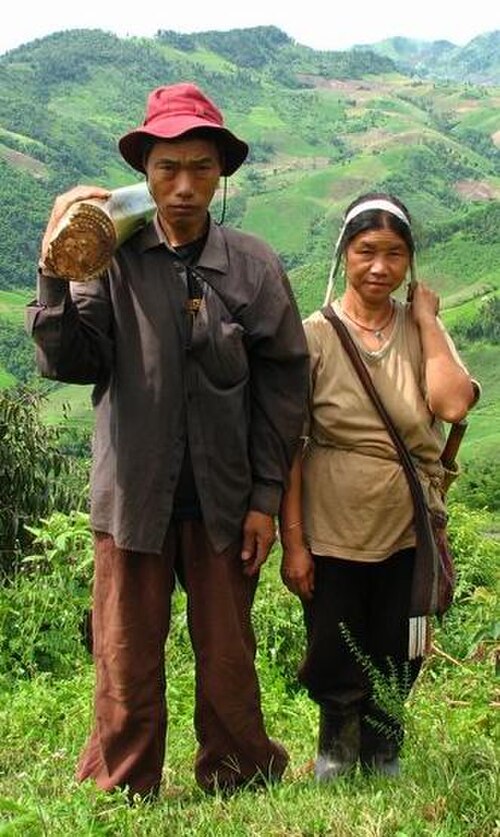
| 男性(左)と女性(右)、成人、タイ、2007年 | |
科学的分類 
| |
| ドメイン: | 真核生物 |
| 王国: | 動物界 |
| 門: | 脊索動物 |
| クラス: | 哺乳類 |
| 注文: | 霊長類 |
| 亜目: | ハプロリニ |
| インフラオーダー: | シミ目 |
| 家族: | ヒト科 |
| 亜科: | ヒト科 |
| 部族: | ホミニニ |
| 属: | ホモ |
| 種: | ホモ・サピエンス
|
| 二名法名 | |
| ホモサピエンス | |

| |
| ホモサピエンスの人口密度(2020年) | |
人間(ホモ・サピエンス、「考える人間」を意味する)あるいは現生人類は、 最も一般的で広範囲に分布する霊長類の種であり、ホモ属の最後の生き残り種である。彼らは、体毛がなく、二足歩行し、高い知能を特徴とする大型類人猿である。人間は大きな脳を持ち、より高度な認知能力を発揮することで、多様な環境で繁栄し適応し、非常に複雑な道具を開発し、複雑な社会構造や文明を形成することが可能である。人間は非常に社交的で、個々の人間は、家族や仲間から企業や政治国家に至るまで、協力し合う、異なる、あるいは競合する社会集団の多層的なネットワークに属する傾向がある。そのため、人間同士の社会的交流によって、多種多様な価値観、社会規範、言語、伝統(総称して制度)が確立され、それぞれが人間社会を支えている。人間は好奇心が強く、現象を理解し影響を与えたいという欲求が、科学、技術、哲学、神話、宗教、その他の知識の枠組みの発展を促してきました。また、人類学、社会科学、歴史、心理学、医学などの領域を通じて自分自身を研究しています。現在、80億人以上の人間が生きていると推定されています。
科学者の中には、「人類」という用語をホモ属のすべてのメンバーと同一視する人もいるが、一般的には唯一現存するホモ・サピエンスを指す。現在絶滅しているホモ属の他のすべてのメンバーは、旧人類として知られており、「現代人」という用語は、ホモ・サピエンスを旧人類と区別するために使用される。解剖学的に現代的な人類は、ホモ・ハイデルベルゲンシスまたは類似の種から進化して、約30万年前にアフリカで出現した。アフリカから移住し、徐々に旧人類の現地集団と入れ替わり、交雑した。ネアンデルタール人などの旧人類種の絶滅については、競争、暴力、ホモ・サピエンスとの交雑、気候変動への適応不能など、複数の仮説がある。人類が行動上の現代性を示し始めたのは約16万~6万年前である。人類はその歴史の大半において、遊牧民としての狩猟採集民であった。約13,000年前に南西アジアで始まった新石器時代革命(および他のいくつかの場所でも別々に)により、農業と人間の定住が出現した。次に、これが文明の発展につながり、継続的な(そして現在も続く)人口増加と急速な技術革新の時代が始まった。それ以来、多くの文明が興亡を繰り返し、多くの社会文化的および技術的発展が人間のライフスタイルに大きな変化をもたらした。
遺伝子と環境は、目に見える特徴、生理機能、病気への感受性、知的能力、体の大きさ、寿命における人間の生物学的多様性に影響を与えます。人間は多くの特徴において多様性がありますが、遺伝的に最も多様性の少ない種に属します。2人の人間は、少なくとも99.5%遺伝的に類似しています。人間は性的二形性があり、一般的に、男性の方が体が強く、女性の方が体脂肪率が高いです。思春期に、人間は二次性徴を発現します。女性は通常、思春期(約12歳)から閉経(約50歳)の間、妊娠することができます。雑食性の生き物として、人間は多種多様な植物や動物の材料を消費することができ、ホモ・エレクトスの時代から火やその他の熱を利用して食物を準備および調理してきました。人間は食物なしで最大8週間、水なしで数日間生きることができます。人間は一般的に昼行性で、平均して1日7〜9時間睡眠します。出産は危険であり、合併症や死亡のリスクが高い。出産時に無力な子どもの世話を母親と父親の両方が行うことも少なくない。
人間は、高度に発達した複雑な前頭前野を持っています。これは、高次の認知に関連する脳の領域です。人間は非常に知的で、エピソード記憶が可能です。柔軟な表情、自己認識、心の理論を持っています。人間の心は、内省、私的な思考、想像力、意志、存在に対する見解の形成が可能です。これにより、複雑な推論と言語による後世への知識の伝達を通じて、大きな技術的進歩と複雑なツールの開発が可能になりました。
人間は環境に劇的な影響を及ぼしてきました。人間は頂点捕食者であり、他の種に捕食されることはほとんどありません。[1]人間の人口増加、工業化、土地開発、化石燃料の過剰消費と燃焼は、環境破壊と汚染をもたらし、他の形態の生命の進行中の大量絶滅に大きく貢献しています。[2] [3]過去1世紀の間に、人類は南極、深海、宇宙などの厳しい環境を探検してきました。[4]これらの過酷な環境での人間の居住は制限と費用が伴い、通常、期間が限られており、科学、軍事、または産業探検に限定されています。[4]人類は短期間月を訪れ、人工のロボット宇宙船を通じて他の天体にも存在感を示しました。[5] [6] [7] 20世紀初頭以来、研究ステーションを通じて南極に継続的に人間が存在し、2000年以降は国際宇宙ステーションでの居住を通じて宇宙に存在しています。[8]
語源と定義
_-_Nationalmuseum_-_15723.tif/lossy-page1-1280px-Carl_von_Linn%C3%A9,_1707-1778,_botanist,_professor_(Alexander_Roslin)_-_Nationalmuseum_-_15723.tif.jpg)
現代人はすべて、カール・リンネが1735年の著作『自然の体系』で作ったホモ・サピエンスという種 に分類されている。[9]属名「ホモ」は、男女を問わず人間を指すラテン語のホモから18世紀に学術的に派生したものである。 [10] [11]人間という言葉は、ホモ属のすべてのメンバーを指すことができる。[12] 「ホモ・サピエンス」という名前は、「賢い人」または「知識のある人」を意味する。[13]この属の絶滅した特定のメンバー、すなわちネアンデルタール人を、人間の別の種として含めるべきか、ホモ・サピエンスの亜種として含めるべきかについては意見が分かれている。[12]
人間は中期英語の借用語で、古期フランス語のhumainから来ており、最終的にはラテン語のhūmānusから来ており、これはhomō (「人間」の意味で) の形容詞形である。[14]英語のmanという用語は、一般的な種 ( humanityの同義語) だけでなく、男性の人間を指すこともある。また、男女を問わず個人を指すこともある。[15]
動物という言葉は人間の反意語として口語的に使用されているという事実にもかかわらず[16] 、一般的な生物学的誤解に反して、人間は動物です。[17]人という言葉は人間と互換的に使用されることが多いですが、人格がすべての人間に適用されるのか、それともすべての知覚力のある存在に適用されるのか、さらに人間が人格を失う可能性があるのか(植物人間状態になるなど)については哲学的な議論があります。[18]
進化
人間は類人猿(ヒト上科)である。[19]最終的に人間を生み出した類人猿の系統は、まずテナガザル科(オランウータン属)とオランウータン(オランウータン属)から分岐し、次にゴリラ(ゴリラ属)へ、そして最後にチンパンジーとボノボ(チンパンジー属)へと分岐した。最後の分岐、すなわち人間とチンパンジー・ボノボの系統間の分岐は、約800万~400万年前、後期中新世に起こった。[20] [21]この分岐の際、2番染色体は他の2本の染色体が結合して形成され、他の類人猿の24対と比較して、人間の染色体は23対のみとなった。[22]チンパンジーとボノボとの分岐後、ヒト属は多くの種と少なくとも2つの異なる属に多様化した。これらの系統のうち、ホモ属とその唯一の現存種であるホモ・サピエンスを除く全ては 現在絶滅している。[23]
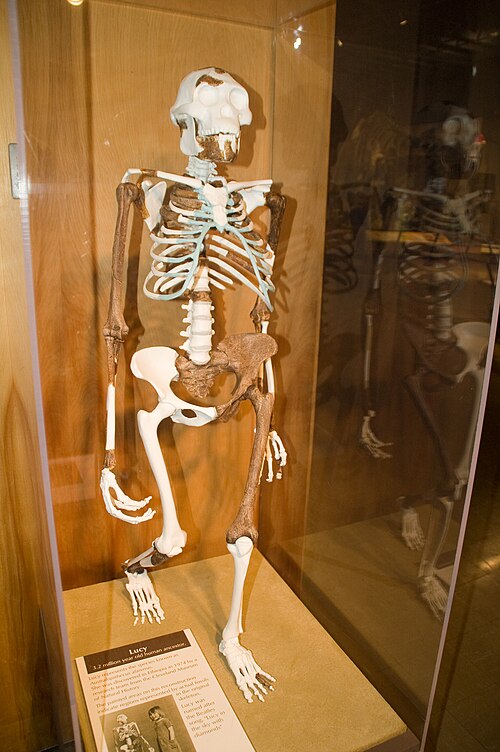
ホモ属はアウストラロピテクスから進化した。[24] [25]移行期の化石は乏しいものの、ホモ属の最古のメンバーはアウストラロピテクスといくつかの重要な特徴を共有している。[26] [27]ホモ属の最古の記録はエチオピアで発見された280万年前の標本LD 350-1であり、最も古い命名された種は230万年前までに進化したホモ・ハビリスとホモ・ルドルフェンシスである。[27]ホモ・エレクトス(アフリカの亜種はホモ・エルガスターと呼ばれることもある)は200万年前に進化し、アフリカを離れてユーラシア大陸に広がった最初の旧人類種であった。 [28]ホモ・エレクトスは、特徴的なヒトの体型を進化させた最初の種でもある。ホモ・サピエンスは、アフリカに残ったホモ・エレクトスの子孫で、一般的にはH.ハイデルベルゲンシスまたはH.ローデシエンシスと呼ばれる種から、約30万年前にアフリカで出現しました。 [29]ホモ・サピエンスは大陸から移動し、徐々に現地の古代人類と交配したり、取って代わったりしました。[30] [31] [32]人類は約16万~7万年前から行動の現代性を示し始めましたが、[33]それより早い可能性もあります。[34]この進化は、中期から後期更新世のアフリカの自然な気候変動の中で選択されたものと思われます。[35]
「出アフリカ」移住は少なくとも2つの波で起こり、第1波は約13万年から10万年前、第2波(南方拡散)は約7万年から5万年前でした。[36] [37] ホモ・サピエンスはすべての大陸と大きな島々への移住を進め、12万5000年前にユーラシア大陸に到着し、 [38] [39]約6万5000年前にオーストラリアに到着し、[40]約1万5000年前にアメリカ大陸に到着し、 300年から1280年にはハワイ、イースター島、マダガスカル、ニュージーランドなどの遠隔地の島々に到着しました。 [41] [42]
人類の進化は単純な直線的または分岐的な進行ではなく、関連した種間の交配を伴っていた。[43] [44] [45]ゲノム研究では、大幅に分岐した系統間の交雑が人類の進化において一般的であったことが示されている。[46] DNAの証拠は、ネアンデルタール人起源の遺伝子のいくつかがサハラ以南のアフリカ以外のすべての集団に存在し、ネアンデルタール人やデニソワ人などの他のホミニンは、現在のサハラ以南のアフリカ以外の人類に最大6%のゲノムを提供している可能性があることを示唆している。 [43] [47] [48]
人類の進化は、人類とチンパンジーの最後の共通祖先が分岐して以来、形態学的、発達的、生理学的、行動学的に多くの変化が起こったことによって特徴づけられる。これらの適応の中で最も重要なのは、無毛、[49] 、絶対二足歩行、脳の増大、性的二形性の減少(幼形成熟)である。これらすべての変化の関係性は、現在も議論が続いている。[50]
歴史
先史時代
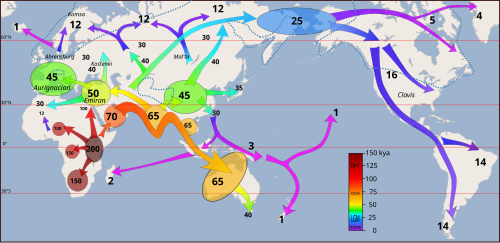
約12,000年前まで、人類はすべて狩猟採集民として暮らしていました。[51] [52]新石器革命(農業の発明)は最初に南西アジアで起こり、その後数千年かけて旧世界の大部分に広がりました。 [53]また、メソアメリカ(約6,000年前)、[54]中国、[55] [56] パプアニューギニア、[57]アフリカのサヘル地域と西サバンナ地域でも独立して発生しました。[58] [59] [60]
食糧の余剰へのアクセスは、人類の恒久的な居住地の形成、動物の家畜化、そして歴史上初めての金属工具の使用につながった。農業と定住生活は初期文明の出現につながった。[61] [62] [63]
古代
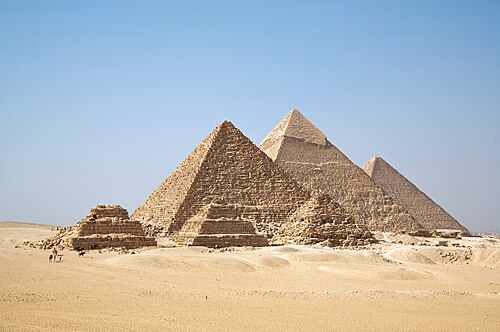
紀元前4千年紀には都市革命が起こり、都市国家、特にメソポタミアにあったシュメール都市が発展した。[64]これらの都市で、紀元前3000年頃に楔形文字という最古の文字が出現した。 [65]この頃に発展した他の主要な文明は、古代エジプトとインダス文明である。[66]最終的に両者は貿易を行い、車輪、鋤、帆などの技術を発明した。[67] [68] [69] [70]紀元前3000年までに出現したカラル・シュペ文明は、アメリカ大陸で最も古い複雑な文明である。[71]天文学と数学も発展し、ギザの大ピラミッドが建造された。[72] [73] [74]これらの文明の衰退の原因となったと思われる約100年間続いた深刻な干ばつの証拠があり、 [75]その余波で新しい文明が出現しました。バビロニア人がメソポタミアを支配するようになった一方で、[76]ポバティポイント文化、ミノア人、商王朝などの他の文明が新しい地域で台頭しました。[77] [78] [79]紀元前1200年頃の後期青銅器時代の崩壊により、多くの文明が消滅し、ギリシャの暗黒時代が始まりました。[80] [81]この期間中に鉄が青銅に取って代わり、鉄器時代が始まりました。[82]
紀元前5世紀には、歴史が学問として記録されるようになり、当時の生活をより鮮明に描写できるようになりました。[83]紀元前8世紀から6世紀にかけて、ヨーロッパは古典古代に入り、古代ギリシャと古代ローマが栄えた時代となりました。 [84] [85]この頃、他の文明も台頭してきました。マヤ文明は都市を建設し、複雑な暦を作り始めました。[86] [87]アフリカでは、アクスム王国が衰退しつつあったクシュ王国を追い越し、インドと地中海の間の貿易を促進しました。[88]西アジアでは、アケメネス朝の中央集権的な統治システムが後の多くの帝国の先駆けとなり、[89]インドのグプタ朝と中国の漢王朝は、それぞれの地域で黄金時代と呼ばれています。 [90] [91]
中世

476年に西ローマ帝国が滅亡した後、ヨーロッパは中世に突入した。[92]この期間中、キリスト教と教会は中央集権的な権威と教育を提供した。[93]中東ではイスラム教が主要な宗教となり、北アフリカに拡大した。イスラムの黄金時代が到来し、建築の成果、科学技術の古い進歩の復活、独特の生活様式の形成が促された。[94] [95]キリスト教世界とイスラム世界は最終的に衝突し、イングランド王国、フランス王国、神聖ローマ帝国はイスラム教徒から聖地の支配権を取り戻すために一連の聖戦を宣言した。[96]
アメリカ大陸では、西暦200年から900年の間にメソアメリカは古典期にあり、[97]さらに北では、西暦800年頃から複雑なミシシッピ文化が出現した。[98]モンゴル帝国は13世紀と14世紀にユーラシアの大部分を征服した。 [99]同じ時期に、アフリカのマリ帝国はセネガンビアからコートジボワールまで広がる大陸最大の帝国に成長した。[100]オセアニアでは、南太平洋の多くの島々に拡大したトゥイ・トンガ帝国が台頭した。 [101] 15世紀後半までに、アステカ人とインカ人はそれぞれメソアメリカとアンデスで支配的な勢力となった。[102]
モダンな

ヨーロッパと近東における近世(1450 年頃~ 1800年)は、ビザンチン帝国の最終的な敗北とオスマン帝国の台頭で始まった。[ 103 ]一方、日本は江戸時代に入り、[104]中国では清朝が台頭し[ 105 ]ムガル帝国がインドの大部分を支配した。[106]ヨーロッパでは15世紀からルネッサンスが起こり[107]、大航海時代が新地域の探検と植民地化とともに始まった。 [108]これにはアメリカ大陸の植民地化[109]とコロンブス交換が含まれる。[110]この拡大は大西洋奴隷貿易[111]とアメリカ先住民の大量虐殺につながった。[112]この時代は科学革命の時期でもあり、数学、力学、天文学、生理学が大きく進歩した。[113]
後期近代(1800年~現在)には、技術革命と産業革命により、画像技術などの発見、輸送とエネルギー開発における大きな革新がもたらされた。[114]啓蒙主義の理想に影響され、アメリカ大陸とヨーロッパは革命時代として知られる政治革命の時代を経験した。[115] 1800年代初頭にはナポレオン戦争がヨーロッパ中で激化し、[116]スペインは新世界で植民地のほとんどを失い、[117]ヨーロッパ人はアフリカへの拡大を続け (ヨーロッパの支配率は50年足らずで10%からほぼ90%に増加した[118] )そしてオセアニア。[119] 19世紀には、大英帝国が拡大して世界最大の帝国となった。[120]
1914年、歴史上最も多くの死者を出した紛争の一つである第一次世界大戦が勃発し、ヨーロッパ諸国間の脆弱な勢力均衡が崩壊した。 [121] 1930年代には、世界的な経済危機により権威主義体制が台頭し、ほぼすべての国々を巻き込んだ第二次世界大戦が勃発した。[122]戦争による破壊により、ほとんどの世界帝国が崩壊し、広範囲にわたる脱植民地化が進んだ。
コンテンポラリー

1945年に第二次世界大戦が終結した後、アメリカ[ 123] とソ連が残りの世界超大国として台頭した。これは冷戦につながり、核兵器競争や宇宙開発競争を含む世界的な影響力をめぐる争いとなり、ソ連の崩壊に終わった。[124] [125]インターネットと人工知能システムの発展に後押しされた現在の情報化時代では、世界はますますグローバル化と相互接続化が進んでいる。[126]
生息地と人口
.jpg/500px-Population_Density,_v4.11,_2020_(48009093621).jpg) | |
| 世界人口 | 81億 |
|---|---|
| 人口密度 | 総面積で16/km 2 (41/平方マイル)陸地面積で 54/km 2 (141/平方マイル) |
| 最大の都市[n 2] | 東京、デリー、上海、サンパウロ、メキシコシティ、カイロ、ムンバイ、北京、ダッカ、大阪 |
初期の人類の居住地は、水辺への近さと、ライフスタイルによっては狩猟用の動物の獲物や、作物の栽培や家畜の放牧のための耕作地など、生存のために使用される他の自然資源に依存していました。 [130]しかし、現代人は、テクノロジー、灌漑、都市計画、建設、森林伐採、砂漠化によって生息地を変更する大きな能力を持っています。[131]人間の居住地は、特に危険な場所にあり、建設の質が低い場合は、自然災害に対して脆弱です。 [132]グループ化と意図的な生息地の変更は、保護の提供、快適さや物質的な富の蓄積、利用可能な食料の拡大、美観の向上、知識の増加、または資源の交換の強化を目的として行われることがよくあります。 [133]
人間は、地球上の多くの極端な環境に対する耐性が低いか狭いにもかかわらず、最も適応力の高い種の一つである。 [134]現在、人間は8つの生物地理領域すべてに生息しているが、南極領域での存在は研究基地に非常に限られており、この領域では毎年冬の間は個体数が減少する。人間は、南アフリカ、インド、ロシア、オーストラリア、フィジー、米国、ブラジル(それぞれ異なる生物地理領域に位置する) など、他の7つの領域に国民国家を築いた。
人間は高度な道具や衣服を使うことで、幅広い温度、湿度、高度に耐えられるようになった。[134] [135]その結果、人間は熱帯雨林、乾燥した砂漠、極寒の北極地域、大気汚染のひどい都市など、世界のほぼすべての地域で見られるコスモポリタンな種である。それに比べて、他のほとんどの種は適応力が限られているため、限られた地理的領域に限定されている。[136]しかし、人間の人口は地球の表面に均一に分布しているわけではない。人口密度は地域によって異なり、南極や広大な海洋のように、広大な範囲がほぼ完全に無人であるからである。[134] [137]人間のほとんど(61%)はアジアに住んでおり、残りはアメリカ大陸(14%)、アフリカ(14%)、ヨーロッパ(11%)、オセアニア(0.5%)に住んでいる。[138]

農業が始まった紀元前1万年頃の人口は100万から1500万人と推定されている。[140] [141]西暦4世紀には東ローマ帝国と西ローマ帝国を合わせた人口は5000万から6000万人だった。 [142]西暦6世紀に初めて記録された 腺ペストは人口を50%減少させ、黒死病はユーラシア大陸と北アフリカだけで7500万から2億人の命を奪った。[143]人類の人口は1800年に10億に達したと考えられています。それ以来指数関数的に増加し、1930年には20億、1960年には30億、1975年には40億、1987年には50億、1999年には60億に達しました。[144] 2011年には70億を超え、 [145] 2022年11月には80億を超えました。 [146]人類の人口が10億に達するまでには、人類の先史時代と歴史で200万年以上かかり、70億に達するのにはさらに207年しかかかりませんでした。[147] 2018年の地球上のすべての人間の炭素の総バイオマスは6000万トンと推定され、これはすべての非家畜哺乳類の約10倍です。[139]
2018年には42億人(55%)が都市部に住んでおり、1950年の7億5100万人から増加している。[148]最も都市化が進んでいる地域は、北米(82%)、ラテンアメリカ(81%)、ヨーロッパ(74%)、オセアニア(68%)であり、アフリカとアジアには世界の34億人の農村人口のほぼ90%が集中している。[148]都市に住む人々が抱える問題には、さまざまな形の汚染や犯罪があり、[149]特に都心部と郊外のスラム街で多く見られる。
生物学
解剖学と生理学

人間の生理学のほとんどの側面は、動物の生理学の対応する側面と非常に類似しています。人間の歯式は次のとおりです。2.1.2.32.1.2.3人間は他の霊長類に比べて口蓋が短く、歯もはるかに小さい。短くて比較的平坦な犬歯を持つ唯一の霊長類である。人間の歯は密集しているのが特徴で、若い人では歯が抜けた隙間がすぐに塞がることが多い。人間は徐々に第三大臼歯を失いつつあり、先天的に欠損している個体もいる。[150]
ヒトはチンパンジーと、退化した尾[151] 、 付属肢、柔軟な肩関節、物を掴むための指、対向する親指を共有している。[152]ヒトはまた、他の類人猿の漏斗型とは対照的に、より樽型の胸部を持っている。これは二足呼吸への適応である。[ 153 ]二足歩行と脳の大きさを除けば、ヒトは主に嗅覚、聴覚、タンパク質の消化においてチンパンジーと異なっている。 [154] ヒトは他の類人猿に匹敵する毛包密度を持っているが、その大部分は産毛であり、そのほとんどは短くて細いため、実質的には目に見えない。[155] [156]ヒトは全身に約200万個の汗腺を持っており、これはチンパンジーよりもはるかに多い。チンパンジーの汗腺は少なく、主に手のひらと足の裏にある。[157]
成人男性の世界平均身長は約 171 cm (5 フィート 7 インチ)、成人女性の世界平均身長は約 159 cm (5 フィート 3 インチ) と推定されています。[158]身長の減少は、人によっては中年期に始まることもありますが、非常に高齢の人によく見られます。[159]歴史を通じて、人類は普遍的に背が高くなってきましたが、これはおそらく栄養、医療、生活環境の改善によるものでしょう。[160]成人の平均体重は、女性で 59 kg (130 ポンド)、男性で 77 kg (170 ポンド) です。 [161] [162]他の多くの状態と同様に、体重と体型は遺伝的素因と環境の両方の影響を受け、個人間で大きく異なります。[163] [164]
人間は他の動物よりもはるかに速く、より正確に投げることができます。[165]人間は動物界でも最も優れた長距離走者の一人ですが、短距離では遅いです。[166] [154]人間の体毛は薄く、汗腺の分泌が多いため、長距離を走るときに熱中症になるのを防ぐことができます。 [167]他の類人猿と比較して、人間の心臓は拍出量と心拍出量が多く、大動脈もそれに比例して大きいです。[168] [169]
遺伝学
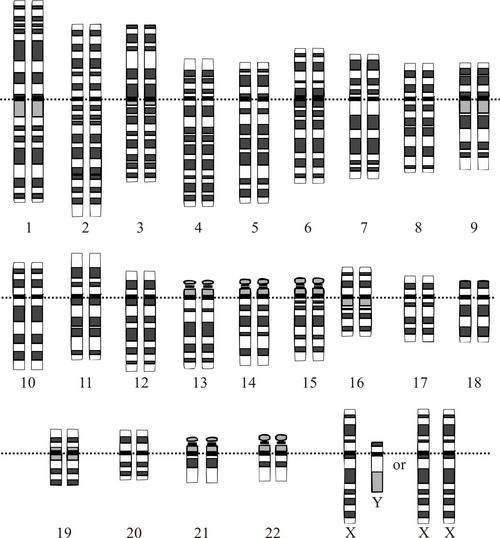
ほとんどの動物と同様に、人間は二倍体で真核生物である。各体細胞には23本の染色体セットが2組あり、各セットは片方の親から受け継いだものである。配偶子には1組の染色体しかなく、これは2つの親のセットの混合である。23対の染色体の中には、22対の常染色体と1対の性染色体がある。他の哺乳類と同様に、人間はXY性決定システムを持っているため、女性は性染色体XXを持ち、男性はXYを持つ。[170] 遺伝子と環境は、目に見える特徴、生理機能、病気への感受性、精神的能力における人間の生物学的変異に影響を与える。遺伝子と環境が特定の形質に及ぼす正確な影響は十分に理解されていない。[171] [172]
人間は一卵性双生児でさえ 遺伝的に同一ではないが、[173]平均すると二人の人間の遺伝的類似性は 99.5%~99.9% である。[174] [175]これにより、チンパンジーを含む他の大型類人猿よりも均質である。[176] [177]他の多くの種と比較して人間の DNA のこの小さな変化は、後期更新世(約 10 万年前)に人口ボトルネックが発生し、そのときに人間の人口が少数の繁殖ペアにまで減少したことを示唆している。[178] [179]自然淘汰の力は人間の人口に対して作用し続けており、過去 15,000 年間にゲノムの特定の領域で方向性選択がみられるという証拠がある。 [180]
ヒトゲノムは2001年に初めて配列決定され[181]、2020年までに数十万のゲノムが配列決定されました。[182] 2012年には、国際ハップマッププロジェクトが11の集団から1,184人の個人のゲノムを比較し、160万の一塩基多型を特定しました。[183] アフリカの集団は、最も多くの非公開の遺伝子変異を抱えています。アフリカ以外の集団で見られる一般的な変異の多くはアフリカ大陸でも見られますが、これらの地域、特にオセアニアとアメリカ大陸に固有の変異もまだ多数あります。[184] 2010年の推定では、人間は約22,000の遺伝子を持っています。[185]遺伝学者たちは、母親からのみ受け継がれるミトコンドリアDNAを比較することで、すべての現代人に遺伝子マーカーが見られる最後の女性の共通祖先、いわゆるミトコンドリア・イブが、約9万年から20万年前に生きていたに違いないと結論付けました。[186] [187] [188] [189]
ライフサイクル

人間の生殖のほとんどは性交による体内受精によって行われるが、生殖補助医療によって行われることもある。[190]平均妊娠期間は38週間であるが、通常の妊娠では最大37日間のばらつきがある。[191]人間の胚発生は最初の8週間に及び、9週目の初めに胚は胎児と呼ばれる。 [ 192]人間は医学的な理由で早く出産する必要がある場合、早産を誘発したり帝王切開を行ったりすることができる。 [193]先進国では、出生時の乳児の体重は通常3~4kg(7~9ポンド)、身長は47~53cm(19~21インチ)である。[194] [195]しかし、発展途上国では低出生体重がよく見られ、これらの地域での乳児死亡率の高さの一因となっている。[196]
他の種と比較すると、人間の出産は危険であり、合併症や死亡のリスクがはるかに高い。[197]胎児の頭の大きさは、他の霊長類よりも骨盤に近い。[198]この理由は完全には解明されていないが、[n 3] 24時間以上続く痛みを伴う出産の一因となっている。[200] 20世紀には、新しい医療技術の出現により、裕福な国での出産成功の可能性が大幅に増加した。対照的に、世界の開発途上地域では、妊娠と自然出産は依然として危険な試練であり、妊産婦死亡率は先進国の約100倍である。[201]
人間は母親と父親の両方が子供の世話をするが、これは他の霊長類では親としての世話をほとんど母親が行うのとは対照的である。[202]人間は 生まれたときは無力であるが、数年間成長を続け、典型的には15歳から17歳で性的に成熟する。 [203] [204] [205]人間の寿命は3歳から12歳までの様々な段階に分けられている。一般的な段階としては、乳児期、小児期、青年期、成人期、老年期がある。[206]これらの段階の長さは文化や時代によって異なるが、青年期に異常に急速な成長がみられるのが典型的である。[207]人間の女性は50歳前後で閉経し、不妊になります。 [208]閉経により、高齢になっても子供を産み続けるよりも、すでに生まれた子供、そしてその子供たちに多くの時間と資源を投資できるようになり、女性の全体的な生殖成功率が向上するという説があります(祖母仮説)。[209] [210]
個人の寿命は、遺伝とライフスタイルの選択という2つの主要な要因に依存します。[211]生物学的/遺伝的原因を含むさまざまな理由により、女性は男性よりも平均で約4年長生きします。[212] 2018年現在[update]、世界の平均出生時寿命は、女の子が74.9歳、男の子が70.4歳と推定されています。[213] [214]人間の平均寿命には大きな地理的変動があり、主に経済発展と相関しています。たとえば、香港の出生時平均寿命は女の子が87.6歳、男の子が81.8歳であるのに対し、中央アフリカ共和国では女の子が55.0歳、男の子が50.6歳です。[215] [216]先進国では一般的に高齢化が進んでおり、平均年齢は約40歳です。発展途上国では、平均年齢は15歳から20歳です。ヨーロッパでは5人に1人が60歳以上であるのに対し、アフリカでは60歳以上は20人に1人しかいません。[217] 2012年、国連は世界中に316,600人の百歳以上の高齢者(100歳以上の人)がいると推定しました。 [218]
ダイエット
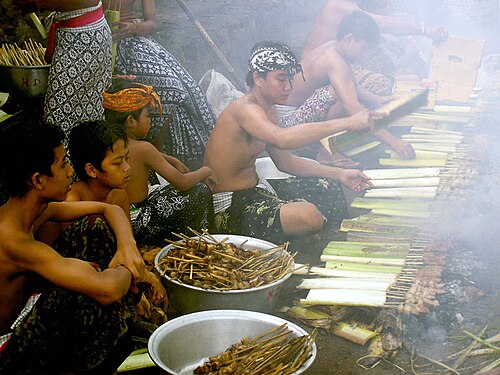
人間は雑食性であり、[219]多種多様な植物や動物の材料を消費することができる。[220] [221]人間のグループは、完全なビーガンから主に肉食まで、さまざまな食生活を採用してきた。場合によっては、人間の食事制限が欠乏症につながる可能性があるが、安定した人間グループは、遺伝的特殊化と文化的慣習の両方を通じて、栄養的にバランスの取れた食料源を使用する多くの食生活パターンに適応してきた。[222]人間の食生活は人間の文化に顕著に反映されており、食品科学の発展につながっている。[223]
農業が発達するまで、ホモ・サピエンスは狩猟採集法を唯一の食料収集手段としていた。[223]この方法では、果物、穀物、塊茎、キノコ、昆虫の幼虫、水生軟体動物などの固定食料源と、狩猟して捕獲しなければ食べられない野生の獲物を組み合わせていた。 [224]人類はホモ・エレクトスの時代から火を使って食料を調理してきたとされている。[225]人類による野生植物の栽培化は約11,700年前に始まり、農業の発達につながった。[226]この緩やかなプロセスは新石器革命と呼ばれている。[227]これらの食生活の変化は人類の生物学的特徴も変えた可能性がある。酪農の普及は新たな豊富な食料源をもたらし、一部の成人に乳糖を消化する能力の進化をもたらした。[228] [229]消費される食品の種類や調理方法は、時代、場所、文化によって大きく異なります。[230] [231]
一般的に、人間は体内に蓄えられた脂肪に応じて、食物なしで最長8週間生き延びることができる。[232]水なしで生き延びられるのは通常3、4日で、最長でも1週間である。[233] 2020年には、飢餓に直接的または間接的に関連する原因で毎年900万人が死亡していると推定されている。[234] [235]小児の栄養失調もよく見られ、世界的な疾病負担の一因となっている。[236]しかし、世界の食糧分配は均等ではなく、一部の人口における肥満が急速に増加しており、一部の先進国と少数の発展途上国で健康上の合併症や死亡率の上昇につながっている。世界中で10億人以上が肥満であり[237]、米国では人口の35%が肥満であり、「肥満の流行」と呼ばれている。[238]肥満は消費カロリーよりも多くのカロリーを摂取することで引き起こされるため、過度の体重増加は通常、エネルギー密度の高い食事によって引き起こされます。[237]
生物学的変異
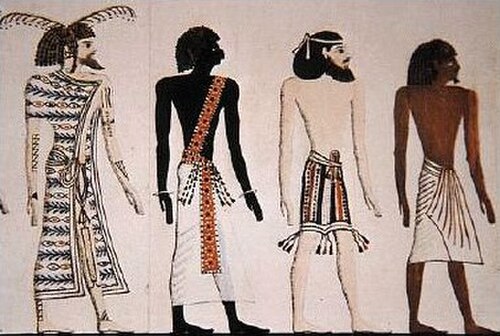
人類には生物学的多様性があり、血液型、遺伝性疾患、頭蓋の特徴、顔の特徴、臓器系、目の色、髪の色と質感、身長と体格、肌の色などの特徴が世界中で異なっています。成人の身長は一般的に1.4~1.9メートル(4フィート7インチ~6フィート3インチ)ですが、性別、民族的起源、家族の血統によって大きく異なります。[239] [240]体の大きさは遺伝子によって部分的に決まりますが、食事、運動、睡眠パターンなどの環境要因によっても大きく影響されます。[241]

集団がさまざまな外的要因に遺伝的に適応してきたという証拠がある。成人が乳糖を消化できるようにする遺伝子は、牛の家畜化の長い歴史を持ち、牛乳への依存度が高い集団に高頻度で存在する。[242] マラリアに対する抵抗力を高める可能性がある鎌状赤血球貧血は、マラリアが風土病となっている集団に多く見られる。[243] [244]非常に長い間特定の気候に居住してきた集団は、その環境に有利な特定の表現型を発達させてきた傾向がある。寒冷地域では身長が低くずんぐりとした体格、高温地域では背が高くひょろっとした体格、高高度では肺活量が高いなどの適応能力を持つ。[245]一部の集団は、バジャウ族の海洋生活やフリーダイビングに有利な環境条件など、非常に特殊な環境条件への非常にユニークな適応を進化させてきた。[246]
人間の髪の色は、赤、金髪、茶色、そして最も多いのは黒です。 [247]髪の色はメラニンの量によって決まり、年齢とともに濃度が薄れ、灰色や白髪になります。肌の色は、最も濃い茶色から最も薄い桃色まで、またはアルビノの場合はほぼ白または無色です。 [ 248]皮膚の色は臨床的に変化する傾向があり、一般的に特定の地理的領域の紫外線レベルと相関しており、赤道付近では肌が黒くなります。 [249]肌の黒ずみは、紫外線からの保護として進化した可能性があります。[250]肌の色素が薄いと、日光を必要とするビタミンDの枯渇を防ぎます。[251]人間の皮膚は、紫外線への曝露に反応して黒くなる(日焼けする)能力もあります。[252] [253]
人間の地理的集団間の差異は比較的少なく、生じる差異のほとんどは個人レベルで生じます。[248] [254] [255]人間の差異の多くは連続的であり、明確な境界線がない場合がよくあります。[256] [257] [258] [259]遺伝子データによると、人口グループがどのように定義されても、同じ人口グループの2人の違いは、異なる人口グループの2人の違いとほぼ同じです。[260] [261] [262]アフリカ、オーストラリア、南アジアに見られる肌の色が濃い集団は、互いに近縁ではありません。[263] [264]
遺伝子研究により、アフリカ大陸原産の人類集団が最も遺伝的に多様であることが実証されている[265] 。また、遺伝的多様性はアフリカからの移動距離が離れるにつれて減少するが、これは人類の移動中にボトルネックが発生した結果である可能性がある。 [266] [267]これらの非アフリカ集団は、古代集団との現地での混合により新たな遺伝的入力を獲得し、アフリカで見られるものよりもネアンデルタール人やデニソワ人からの変異がはるかに大きいが[184] 、アフリカ集団へのネアンデルタール人の混合は過小評価されている可能性がある。[268]さらに、最近の研究では、サハラ以南のアフリカ、特に西アフリカの集団には、現代人より古く、ほとんどの非アフリカ集団では失われている祖先の遺伝的変異があることがわかっている。この祖先の一部は、ネアンデルタール人と現代人が分岐する前に分岐した未知の古代人類との混合に由来すると考えられている。 [269] [270]
人間は性同一性障害を持つ種であり、男性と女性の2つの性別に分かれている。[271] [272] [273]遺伝的変異が最も大きいのは男性と女性の間である。世界中の同性間でのヌクレオチドの遺伝的変異は0.1%~0.5%以下であるのに対し、男性と女性の遺伝的差異は1 % ~ 2%である。男性は平均して女性より15%重く、身長は15cm(6インチ)高い。[274] [275]平均して、男性は筋肉量が多く筋線維が大きいため、同じ体重の女性よりも上半身の筋力が約40~50%、下半身の筋力が20~30%高い。[276]一般的に、女性は男性よりも体脂肪率が高い。[277]同じ人口の男性よりも女性の肌の色が薄いのは、妊娠中および授乳中の女性の方がビタミンDの必要量が多いためだと説明されている。[278]女性と男性には染色体の違いがあるため、X染色体とY染色体に関連する症状や障害は、男性か女性にのみ影響します。[279]体重と音量を考慮すると、男性の声は通常、女性の声よりも1オクターブ低くなります。 [280]世界中のほとんどの人口において、女性の寿命は女性の方が長いです。 [281]人間の人口にはインターセックスの症状がありますが、まれです。[282] [283]
心理学
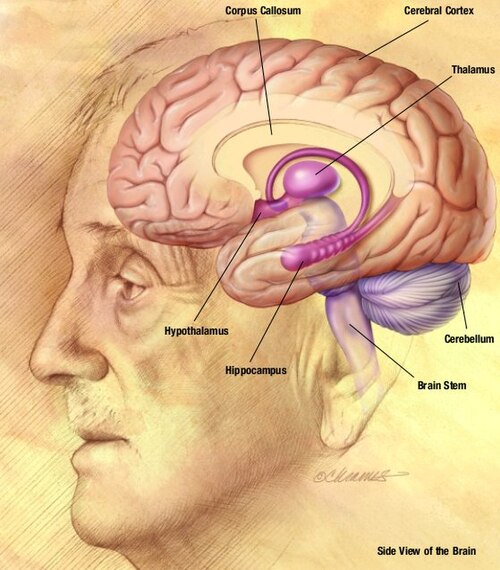
人間の脳は、人間の中枢神経系の中心であり、末梢神経系を制御します。呼吸や消化などの「低次の」、不随意な、または主に自律的な活動を制御することに加えて、思考、推論、抽象化などの「高次の」機能の中心でもあります。[284]これらの認知プロセスは心を構成し、その行動の結果とともに心理学の分野で研究されています。
人間は他の霊長類よりも前頭前野が大きく発達しており、この脳領域は高次認知能力と関連している。[285] [286]このことから、人間は自分たちが他のどの既知の種よりも知能が高いと主張するようになった。[287]知能を客観的に定義することは困難であり、他の動物は感覚を適応させ、人間にはできない分野で優れている。[288]
厳密には独特ではないが、人間を他の動物と区別する特徴がいくつかある。[289]人間はエピソード記憶を持ち、「精神的なタイムトラベル」を行うことができる唯一の動物かもしれない。[290]他の社会的な動物と比較しても、人間は顔の表情に異常に高い柔軟性を持っている。[291]人間は感情的な涙を流すことが知られている唯一の動物である。[292]人間はミラーテストで自己認識できる数少ない動物の1つである。[293]また、人間がどの程度まで心の理論を持つ唯一の動物であるかについても議論がある。[294] [295]
睡眠と夢
人間は一般的に昼行性である。成人の平均睡眠時間は1日7~9時間、子供は1日9~10時間である。高齢者は通常6~7時間眠る。睡眠不足は健康に悪影響を及ぼす可能性があるが、人間ではこれより睡眠時間が短いことは一般的である。成人の睡眠を1日4時間に制限し続けると、記憶力の低下、疲労、攻撃性、身体的不快感など、生理的および精神的状態の変化と相関関係にあることがわかっている。[296]
睡眠中、人間は夢を見ます。夢の中で感覚的なイメージや音を体験します。夢は脳幹によって刺激され、ほとんどがレム睡眠中に起こります。[297]夢の長さは、数秒から30分までさまざまです。[298]人間は一晩に3~5回の夢を見ますが、7回見る人もいます。[299]夢を見る人は、レム睡眠中に目覚めると夢を覚えている可能性が高くなります。夢の中で起こる出来事は、夢を見る人が自己認識している明晰夢を除いて、一般的には夢を見る人の制御外です。[300]夢は、創造的な考えを引き起こしたり、インスピレーションの感覚を与えたりすることがあります。[301]
意識と思考
人間の意識とは、簡単に言えば、内的または外的存在に対する感覚または認識である。[302]哲学者や科学者による何世紀にもわたる分析、定義、説明、議論にもかかわらず、意識は依然として不可解で議論の的であり、[303]「私たちの生活の中で最も身近でありながら最も神秘的な側面である」。[304]このテーマについて広く合意されている唯一の概念は、それが存在するという直感である。[305]意識として研究され説明される必要があるものについては意見が分かれている。一部の哲学者は、意識を、感覚的経験そのものである現象的意識と、推論や行動の直接制御に使用できるアクセス意識に分けている。[306]意識は「心」と同義である場合もあれば、心の一側面である場合もある。歴史的には、内省、私的思考、想像力、意志と関連している。[307]現在では、何らかの経験、認知、感情、知覚が含まれることが多い。それは「意識」かもしれないし、「意識の意識」かもしれないし、自己認識かもしれない。[308]意識には様々なレベルや秩序があるかもしれないし、[309]意識の種類が違うかもしれないし、あるいは単に特徴の異なる1種類の意識だけがあるかもしれない。[310]
思考、経験、感覚を通じて知識と理解を獲得するプロセスは、認知として知られています。[311]人間の脳は感覚を通じて外界を認識し、各個人は自分の経験に大きく影響され、存在と時間の経過についての主観的な見方につながります。 [312]思考の本質は心理学と関連分野の中心です。認知心理学は、行動の根底にある精神プロセスである認知を研究します。[313]発達心理学は、生涯にわたる人間の心の発達に主に焦点を当て、人々が世界の中でどのように認識し、理解し、行動するようになるのか、またこれらのプロセスが年齢とともにどのように変化するのかを理解しようとします。[314] [315]これは、知的、認知的、神経的、社会的、または道徳的な発達に焦点を当てる場合があります。心理学者は、人間の相対的な知能を評価し、人口内でのその分布を研究するために、知能テストと知能指数の概念を開発しました。 [316]
動機と感情

人間の動機はまだ完全には解明されていない。心理学的観点からは、マズローの欲求階層説は確立された理論であり、複雑さの順に特定の欲求を満たすプロセスとして定義できる。[317]より一般的な哲学的観点からは、人間の動機は、人間の能力の適用を必要とするさまざまな目標へのコミットメントまたは撤退として定義できる。さらに、インセンティブと選好は両方とも要因であり、インセンティブと選好の間に認識されているリンクも同様である。意志も関与している可能性があり、その場合は意志力も要因となる。理想的には、動機と意志の両方が、目標の選択、目標への努力、目標の実現を最適な方法で保証し、これは子供の頃に始まり、社会化として知られるプロセスで生涯にわたって続く機能である。[318]
感情は神経系に関連する生物学的状態であり[319] [320] 、思考、感情、行動反応、快不快の程度など様々に関連する神経生理学的変化によって引き起こされます。[321] [322]感情は気分、気質、性格、気質、創造性、[323]および動機と絡み合っていることがよくあります。感情は人間の行動と学習能力に大きな影響を与えます。[324]極端な感情や制御できない感情に基づいて行動すると、社会的混乱や犯罪につながる可能性があり、[325]犯罪者は正常よりも感情的知能が低い可能性があることを示す研究があります。 [326]
喜び、興味、満足感など、心地よいと感じられる感情体験は、不安、悲しみ、怒り、絶望など、不快と感じられる感情体験とは対照的です。 [ 327 ]幸福、つまり幸せな状態は、人間の感情的な状態です。幸福の定義は、哲学的によく使われるテーマです。ある人は、ポジティブな感情的影響を感じながら、ネガティブな感情を避けることと定義しています。[328] [329]他の人は、幸福を人生の満足度や生活の質の評価と見ています。[330]最近の研究では、幸せになるには、人間が正当だと感じたときにネガティブな感情を経験する可能性があることが示唆されています。[331]
セクシュアリティと愛

人間にとって、セクシュアリティとは、生物学的、エロティック、身体的、感情的、社会的、あるいは精神的な感情や行動を包含する。[332] [333]セクシュアリティは幅広い用語であり、時間の経過とともに歴史的文脈とともに変化してきたため、正確な定義はない。[333]セクシュアリティの生物学的および身体的側面は、主に人間の生殖機能に関係しており、これには人間の性的反応周期も含まれる。[332] [333]セクシュアリティはまた、生活の文化的、政治的、法的、哲学的、道徳的、倫理的、宗教的側面に影響を及ぼし、またそれらから影響を受ける。 [332] [333]性的欲求、すなわちリビドーは、性行動の始まりに存在する基本的な精神状態である。研究によると、男性は女性よりもセックスを望み、より頻繁に自慰行為をする。 [334]
人間は性的指向の連続的なスケールのどこにでも当てはまる可能性があるが[335] 、ほとんどの人間は異性愛者である。[336] [337]同性愛行動は他の動物にも見られるが、これまでのところ同性関係のみを好むことがわかっているのは人間と家畜の羊だけである。 [336]ほとんどの証拠は性的指向の非社会的、生物学的原因を支持しており[336]、同性愛に対して非常に寛容な文化では同性愛率が著しく高いわけではない。[337] [338]神経科学と遺伝学の研究は、人間の性的指向の他の側面も生物学的に影響されていることを示唆している。[339]
愛は、一般的には強い魅力や感情的な愛着の感情を指します。それは非個人的なもの(物、理想、または強い政治的または精神的なつながりへの愛)または対人関係のもの(人間同士の愛)です。[340]恋をすると、ドーパミン、ノルエピネフリン、セロトニンなどの化学物質が脳の快楽中枢を刺激し、心拍数の増加、食欲不振、睡眠不足、激しい興奮感などの副作用を引き起こします。[341]
文化
| 最も広く話されている言語[342] [343] | 英語、中国語(北京語)、ヒンディー語、スペイン語、標準アラビア語、ベンガル語、フランス語、ロシア語、ポルトガル語、ウルドゥー語 |
|---|---|
| 最も多く信仰されている宗教[343] [344] | キリスト教、イスラム教、ヒンズー教、仏教、民間宗教、シク教、ユダヤ教、無所属 |
人類がこれまでにない知的スキルを身につけたことは、人類が最終的に技術的進歩を遂げ、生物圏を支配する上で重要な要素となった。[345]絶滅した人類を除けば、人間は一般化可能な情報を教え、[346]複雑な概念を生成して伝達するために本能的に再帰的埋め込みを展開し、 [347]有能な道具の設計に必要な「民俗物理学」に従事し、[348] [349]野生で食物を調理する[350 ] 唯一の動物として知られている。教育と学習は、人間社会の文化的および民族学的アイデンティティーを維持する。[351]人間に特有の他の特徴や行動には、火起こし、 [352] 音素構造化[353]および発声学習などがある。[354]
言語

多くの種がコミュニケーションをとるが、言語は人間に特有であり、人類を定義する特徴であり、文化的普遍性である。[355]他の動物の限られたシステムとは異なり、人間の言語はオープンであり、限られた数の記号を組み合わせることで無限の数の意味を生み出すことができる。[356] [357]人間の言語には、現在または局所的に発生していないが、対話者の共有された想像の中に存在する事物や出来事を言葉で表す、置換能力もある。[150]
言語は他のコミュニケーション手段と異なり、様式に依存しない。同じ意味を、音声では音声、手話や筆記では視覚、点字などの触覚メディアなど、さまざまなメディアで伝えることができる。[358]言語は、人間同士のコミュニケーション、そして国家、文化、民族を結びつけるアイデンティティ感覚の中心である。[359]現在、手話を含めて約6000の異なる言語が使用されており、さらに数千の言語が消滅している。[360]
芸術
人間の芸術には、視覚芸術、文学芸術、舞台芸術など、さまざまな形があります。視覚芸術は、絵画や彫刻から映画、ファッションデザイン、建築まで多岐にわたります。[361]文学芸術には、散文、詩、演劇が含まれます。舞台芸術には、一般的に演劇、音楽、ダンスが含まれます。[362] [363]人間は、さまざまな形式を組み合わせることがよくあります(たとえば、ミュージックビデオ)。[364]芸術的性質を持つと言われている他の実体には、料理、ビデオゲーム、医学などがあります。[365] [366] [367]娯楽を提供し、知識を伝達するだけでなく、芸術は政治的な目的にも使用されます。[368]
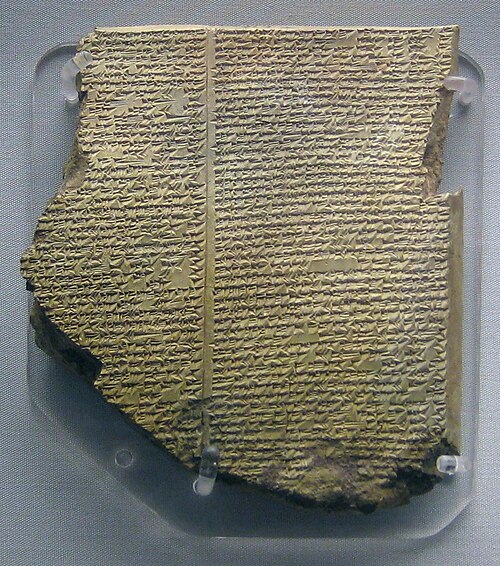
芸術は人間の決定的な特徴であり、創造性と言語の間には関係があるという証拠がある。[369]芸術の最古の証拠は、現代人が進化する30万年前にホモ・エレクトスが作った貝殻の彫刻である。 [370]ホモ・サピエンスに起因する芸術は少なくとも7万5000年前に存在し、南アフリカの洞窟で宝飾品や絵画が発見されている。[371] [372]人間が芸術に適応した理由についてはさまざまな仮説がある。これには、問題をよりうまく解決できるようにすること、他の人間を制御または影響を与える手段を提供すること、社会内での協力と貢献を促進すること、または潜在的な配偶者を引き付ける可能性を高めることなどが含まれる。[373]芸術を通じて発達した想像力の使用は、論理と組み合わさって、初期の人類に進化上の利点を与えた可能性がある。[369]
人間が音楽活動に従事していたという証拠は洞窟壁画よりも古く、現在までに音楽は事実上すべての既知の人間文化で実践されてきた。[374]音楽には多種多様なジャンルや民族音楽があり、人間の音楽的能力は複雑な社会的人間行動を含む他の能力と関連している。[374]人間の脳はリズムとビートに同期することで音楽に反応することが示されており、このプロセスは同調と呼ばれる。[375]ダンスもまたすべての文化に見られる人間の表現形式であり[376]、初期の人類がコミュニケーションをとるための方法として進化した可能性がある。[377]音楽を聴いたりダンスを観察すると、脳の眼窩前頭皮質やその他の快楽を感知する領域が刺激される。 [378]
話すこととは異なり、読むことと書くことは人間にとって自然にできることではなく、教えられなければならない。[379]それでも、言葉や言語が発明される前から文学は存在しており、いくつかの洞窟の壁には一連の劇的な場面を描いた3万年前の絵画がある。[380]現存する最古の文学作品の1つはギルガメシュ叙事詩で、約4000年前に古代バビロニアの粘土板に最初に刻まれた。 [381]単に知識を継承するだけでなく、物語を通じた想像力豊かなフィクションの使用と共有は、人間のコミュニケーション能力の発達を助け、配偶者を確保する可能性を高めた可能性がある。[382]ストーリーテリングは、聴衆に道徳的な教訓を与え、協力を促す方法としても使用される可能性がある。[380]
ツールとテクノロジー

石器は少なくとも250万年前には原始人類によって使用されていました。[384]道具の使用と製造は、何よりも人間を定義する能力であると提唱されており[385]、歴史的に重要な進化のステップと見なされてきました。[386]技術は約180万年前にはるかに洗練され、[385]火の制御された使用は約100万年前に始まりました。[387] [388]車輪と車輪付き車両は、紀元前4千年紀のある時期にいくつかの地域で同時に出現しました。[68]より複雑な道具と技術の開発により、土地を耕作し、動物を家畜化できるようになり、農業の発展に不可欠であることが証明されました。これは新石器革命 として知られています。[389]
中国は紙、印刷機、火薬、コンパスなどの重要な発明を開発した。[390]製錬の継続的な改善により、銅、青銅、鉄、そして最終的には鋼鉄の鍛造が可能になり、鉄道、高層ビル、その他多くの製品に使用されている。 [391]これは産業革命と一致しており、自動化された機械の発明は人間のライフスタイルに大きな変化をもたらした。[392]現代の技術は飛躍的に進歩していると見られており、[393] 20世紀の主な革新には、電気、ペニシリン、半導体、内燃機関、インターネット、窒素固定肥料、飛行機、コンピューター、自動車、避妊薬、原子核分裂、緑の革命、ラジオ、科学的植物育種、ロケット、エアコン、テレビ、組立ラインなどがある。[394]
宗教と精神性

宗教の定義は様々である。[395]ある定義によれば、宗教とは超自然的、神聖な、または神聖的なものに関する信念体系、およびそのような信念に関連する実践、価値観、制度、儀式である。一部の宗教には道徳規範もある。最初の宗教の進化と歴史は、活発な科学的調査の対象となっている。[396] [397] [398]宗教的行動の信頼できる証拠は、中期旧石器時代(45000~20万年前)にまで遡る。[399]宗教は、人間同士の協力を強化し奨励する役割を果たすように進化してきた可能性がある。[400]
宗教は多様な形で現れます。[395]宗教には、死後の世界への信仰、[401]生命の起源、宇宙の性質(宗教的宇宙論)とその最終的な運命(終末論)、道徳的または倫理的な教えが含まれます。[402]超越性と内在性に関する見解は大きく異なります。伝統は、一元論、理神論、汎神論、有神論(多神教と一神教を含む)を様々に支持しています。[403]
宗教性を測定することは困難であるが、[404]人間の大多数は何らかの宗教的または精神的な信念を公言している。[405] 2015年にはキリスト教徒が最も多く、次いでイスラム教徒、ヒンズー教徒、仏教徒であった。[406] 2015年時点で、約16%、つまり12億人弱の人間が無宗教であり、宗教的信念を持たない人やいかなる宗教にも属さない人も含まれている。[407]
科学と哲学

人間に特有の側面は、知識をある世代から次の世代に伝え、その情報を基にして継続的にツールや科学法則を開発し、さらに伝える能力です。[408]この蓄積された知識は、宇宙がどのように機能するかについての疑問に答えたり、予測したりするためにテストすることができ、人間の優位性を高めるのに非常に成功しています。[409]
アリストテレスは最初の科学者と言われており、[410]ヘレニズム時代を通じて科学的思考の台頭に先立っていた。[411]その他の初期の科学の進歩は、中国の漢王朝とイスラムの黄金時代にもたらされた。[412] [94]ルネサンス末期の科学革命は、近代科学の出現をもたらした。[413]
一連の出来事と影響により、科学的方法が開発されました。科学的方法は、科学を疑似科学と区別するために使用される観察と実験のプロセスです。[414]数学の理解は人間に特有ですが、他の動物種も数値認識を持っています。[415]すべての科学は、形式システムに関係する形式科学(論理学や数学など)、実用化に焦点を当てた応用科学(工学、医学など)、および経験的観察に基づく経験科学の3つの主要な分野に分けられ、自然科学(物理学、化学、生物学など)と社会科学(心理学、経済学、社会学など)に分かれています。[416]
哲学は、人間が自分自身と自分たちの住む世界についての根本的な真実を理解しようとする学問分野です。[417]哲学的探究は、人類の知的歴史の発展において大きな特徴となってきました。[418]それは、決定的な科学的知識と独断的な宗教的教えの間の「無人地帯」と表現されてきました。[419]哲学の主な分野には、形而上学、認識論、論理学、価値論(倫理学と美学を含む) などがあります。[420]
社会

社会とは、人間同士の交流から生まれた組織や制度のシステムである。人間は非常に社会的であり、大規模で複雑な社会集団で生活する傾向がある。人間は、収入、富、権力、評判などの要因に応じて、さまざまな集団に分けられる。社会階層の構造と社会的流動性の程度は、特に現代社会と伝統的社会の間で異なる。[421]人間の集団は、家族規模から国家規模まで多岐にわたる。人間の社会組織の最初の形態は、狩猟採集民の 集団社会に似ていたと考えられている。[422]
性別

人間社会は典型的にはジェンダーアイデンティティとジェンダー役割を示し、男性的特徴と女性的特徴を区別し、性別に基づいてメンバーに許容される行動と態度の範囲を規定する。[423] [424]最も一般的な分類は、男性と女性の二元性である。[425]一部の社会では第3の性別、[426]またはそれほど一般的ではないが第4または第5の性別が認められている。 [427] [428]他のいくつかの社会では、ノンバイナリーは男性または女性だけではない一連のジェンダーアイデンティティを表す包括的な用語として使用されている。[429]
ジェンダーの役割は、規範、慣習、服装、行動、権利、義務、特権、地位、権力の区分と関連付けられることが多く、現在も過去も、ほとんどの社会において、男性は女性よりも多くの権利と特権を享受しています。[430]社会的構成物として、[431]ジェンダーの役割は固定されておらず、社会の中で歴史的に変化します。多くの社会で、支配的なジェンダー規範への挑戦が繰り返されてきました。[432] [433]最古の人類社会におけるジェンダーの役割についてはほとんどわかっていません。初期の現代人は、少なくとも後期旧石器時代から、現代文化と同様のジェンダーの役割の範囲を持っていたと考えられますが、ネアンデルタール人は性的二形性が低く、男性と女性の行動の違いは最小限であったという証拠があります。[434]
親族関係
すべての人間社会は、親、子、その他の子孫との関係(血縁関係)と結婚による関係(姻族関係)に基づいて、社会関係のタイプを組織し、認識し、分類しています。また、代父母や養子に適用される第3のタイプ(架空関係)もあります。これらの文化的に定義された関係は、血縁関係と呼ばれます。多くの社会では、血縁関係は最も重要な社会組織原理の1つであり、地位や相続の伝達に役割を果たしています。[435]すべての社会には近親相姦タブー の規則があり、特定の血縁関係間の結婚は禁止されています。また、特定の血縁関係との優先的な結婚の規則がある社会もあります。[436]
ペアボンディングは、連続一夫一婦制、一夫多妻制、一妻多夫制のいずれの形で現れても、人間の性的関係の普遍的な特徴である。[437]遺伝学的証拠によると、人類は種として存在していたほとんどの期間、主に一夫多妻制であったが、これは新石器時代に変化し始め、一夫一婦制が遊牧社会から定住社会への移行と同時に広まり始めた。[438]出生前アンドロゲン効果のバイオマーカーである第2指と第4指の比率という形の解剖学的証拠も同様に、現代人が更新世に一夫多妻制であったことを示している。[439]
民族
人間の民族集団は、他の集団と区別する共通の属性に基づいて集団として共に同一視する社会的カテゴリーである。これらの属性には、居住地域内での共通の伝統、祖先、言語、歴史、社会、文化、国家、宗教、社会的待遇などがある。[440] [441]民族は、身体的特徴に基づく人種の概念とは別のものであるが、どちらも社会的に構築されている。[442]特定の集団に民族性を割り当てることは複雑であり、共通の民族指定内でも多様なサブグループが存在する可能性があり、これらの民族集団の構成は集団レベルでも個人レベルでも時間の経過とともに変化する可能性がある。[176]また、民族集団を構成するものについての一般に受け入れられている定義はない。[443]民族集団は、民族政治単位の社会的アイデンティティと連帯において強力な役割を果たすことができる。これは19世紀と20世紀に国民国家が政治組織の主流となったことと密接に関係している。 [444] [445] [446]
政府と政治

農耕人口がより大規模で密度の高いコミュニティに集まるにつれて、これらの異なるグループ間の交流が増加しました。これにより、コミュニティ内およびコミュニティ間のガバナンスが発達しました。[447]人間は、以前は強固だった政治的同盟を含むさまざまな社会グループとの所属を比較的簡単に変更する能力を進化させてきました。そうすることで個人的な利益が得られると考えられる場合です。[448]この認知的柔軟性により、個々の人間は政治的イデオロギーを変更でき、柔軟性が高い人は権威主義的および国家主義的な立場を支持する可能性が低くなります。[449]
政府は、統治する国民に影響を与える法律や政策を制定する。人類の歴史を通じて多くの形態の政府が存在し、それぞれが権力を獲得するさまざまな手段と、国民に対して多様な統制を及ぼす能力を持っている。[450]人類の約47%が何らかの形の民主主義国家に住み、17%が混合体制、37%が権威主義体制の下で暮らしている。[451]多くの国が国際機関や同盟に加盟しており、その中で最大のものは193の加盟国を擁する国連である。[452]
貿易と経済
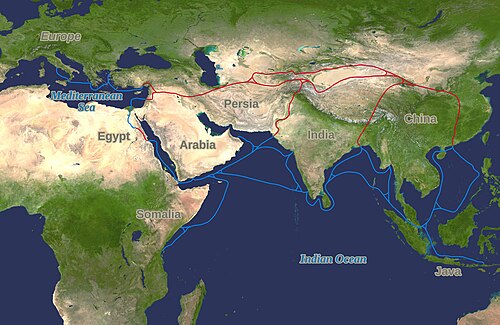
貿易、つまり商品やサービスの自発的な交換は、人間を他の動物と区別する特徴とみなされており、ホモ・サピエンスが他のヒト科動物に対して大きな優位性を持つようになった要因として挙げられている。[453]証拠によると、初期のホモ・サピエンスは長距離の貿易ルートを利用して商品やアイデアを交換し、文化の爆発的な発展を促し、狩猟が乏しい時代には追加の食料源を提供したが、現在絶滅したネアンデルタール人にはそのような貿易ネットワークは存在しなかった。[454] [455]初期の貿易には、黒曜石などの道具を作るための材料が関係していた可能性が高い。[456]最初の真に国際的な貿易ルートは、ローマ時代から中世にかけてのスパイス貿易であった。 [457]
初期の人類の経済は、物々交換ではなく贈り物を中心に展開していた可能性が高い。[458]初期のお金は商品で構成されており、最も古いものは牛の形で、最も広く使われていたのはタカラガイの貝殻であった。[459]お金はその後、政府が発行する硬貨、紙幣、電子マネーへと進化した。[459]経済学の人間学は、社会が希少な資源をさまざまな人々にどのように分配するかを研究する社会科学である。 [460]人間の間では富の分配に大きな不平等があり、最も裕福な8人の人間の金銭的価値は、全人類の最も貧しい半分の人々の金銭的価値と同じである。[461]
対立

Humans commit violence on other humans at a rate comparable to other primates, but have an increased preference for killing adults, infanticide being more common among other primates.[462] Phylogenetic analysis predicts that 2% of early H. sapiens would be murdered, rising to 12% during the medieval period, before dropping to below 2% in modern times.[463] There is great variation in violence between human populations, with rates of homicide about 0.01% in societies that have legal systems and strong cultural attitudes against violence.[464]
The willingness of humans to kill other members of their species en masse through organized conflict (i.e., war) has long been the subject of debate. One school of thought holds that war evolved as a means to eliminate competitors, and has always been an innate human characteristic. Another suggests that war is a relatively recent phenomenon and has appeared due to changing social conditions.[465] While not settled, current evidence indicates warlike predispositions only became common about 10,000 years ago, and in many places much more recently than that.[465] War has had a high cost on human life; it is estimated that during the 20th century, between 167 million and 188 million people died as a result of war.[466] War casualty data is less reliable for pre-medieval times, especially global figures. But compared with any period over the past 600 years, the last ~80 years (post 1946), has seen a very significant drop in global military and civilian death rates due to armed conflict.[467]
See also


Notes
- ^ The world population and population density statistics are updated automatically from a template that uses the CIA World Factbook and United Nations World Population Prospects.[127][128]
- ^ Cities with over 10 million inhabitants as of 2018.[129]
- ^ Traditionally this has been explained by conflicting evolutionary pressures involved in bipedalism and encephalization (called the obstetrical dilemma), but recent research suggest it might be more complicated than that.[198][199]
References
- ^ Roopnarine PD (March 2014). "Humans are apex predators". Proceedings of the National Academy of Sciences of the United States of America. 111 (9): E796. Bibcode:2014PNAS..111E.796R. doi:10.1073/pnas.1323645111. ISSN 0027-8424. PMC 3948303. PMID 24497513.
- ^ Stokstad E (5 May 2019). "Landmark analysis documents the alarming global decline of nature". Science. AAAS. Archived from the original on 26 October 2021. Retrieved 9 May 2021.
For the first time at a global scale, the report has ranked the causes of damage. Topping the list, changes in land use – principally agriculture – that have destroyed habitat. Second, hunting and other kinds of exploitation. These are followed by climate change, pollution, and invasive species, which are being spread by trade and other activities. Climate change will likely overtake the other threats in the next decades, the authors note. Driving these threats are the growing human population, which has doubled since 1970 to 7.6 billion, and consumption. (Per capita of use of materials is up 15% over the past 5 decades.)
- ^ Pimm S, Raven P, Peterson A, Sekercioglu CH, Ehrlich PR (July 2006). "Human impacts on the rates of recent, present, and future bird extinctions". Proceedings of the National Academy of Sciences of the United States of America. 103 (29): 10941–10946. Bibcode:2006PNAS..10310941P. doi:10.1073/pnas.0604181103. PMC 1544153. PMID 16829570.
- ^ a b Heim BE (1990–1991). "Exploring the Last Frontiers for Mineral Resources: A Comparison of International Law Regarding the Deep Seabed, Outer Space, and Antarctica". Vanderbilt Journal of Transnational Law. 23: 819. Archived from the original on 23 June 2021. Retrieved 30 July 2022.
- ^ "Mission to Mars: Mars Science Laboratory Curiosity Rover". Jet Propulsion Laboratory. Archived from the original on 18 August 2015. Retrieved 26 August 2015.
- ^ "Touchdown! Rosetta's Philae probe lands on comet". European Space Agency. 12 November 2014. Archived from the original on 22 August 2015. Retrieved 26 August 2015.
- ^ "NEAR-Shoemaker". NASA. Archived from the original on 26 August 2015. Retrieved 26 August 2015.
- ^ Kraft R (11 December 2010). "JSC celebrates ten years of continuous human presence aboard the International Space Station". JSC Features. Johnson Space Center. Archived from the original on 16 February 2012. Retrieved 13 February 2012.
- ^ Spamer EE (29 January 1999). "Know Thyself: Responsible Science and the Lectotype of Homo sapiens Linnaeus, 1758". Proceedings of the Academy of Natural Sciences. 149 (1): 109–114. JSTOR 4065043.
- ^ Porkorny (1959). IEW. s.v. "g'hðem" pp. 414–116.
- ^ "Homo". Dictionary.com Unabridged (v 1.1). Random House. 23 September 2008. Archived from the original on 27 September 2008.
- ^ a b Barras, Colin (11 January 2016). "We don't know which species should be classed as 'human'". BBC. Archived from the original on 26 August 2021. Retrieved 31 March 2021.
- ^ Spamer EE (1999). "Know Thyself: Responsible Science and the Lectotype of Homo sapiens Linnaeus, 1758". Proceedings of the Academy of Natural Sciences of Philadelphia. 149: 109–114. ISSN 0097-3157. JSTOR 4065043. Archived from the original on 8 April 2022. Retrieved 30 July 2022.
- ^ OED. s.v. "human".
- ^ "Man". Merriam-Webster Dictionary. Archived from the original on 22 September 2017. Retrieved 14 September 2017.
Definition 2: a man belonging to a particular category (as by birth, residence, membership, or occupation) – usually used in combination
- ^ "Thesaurus results for human". Merriam-Webster Dictionary. Archived from the original on 28 June 2022. Retrieved 21 May 2022.
- ^ "Misconceptions about evolution – Understanding Evolution". University of California, Berkeley. 19 September 2021. Archived from the original on 6 June 2022. Retrieved 21 May 2022.
- ^ "Concept of Personhood". University of Missouri School of Medicine. Archived from the original on 4 March 2021. Retrieved 4 July 2021.
- ^ Tuttle RH (4 October 2018). "Hominoidea: conceptual history". In Trevathan W, Cartmill M, Dufour D, Larsen C (eds.). International Encyclopedia of Biological Anthropology. Hoboken, New Jersey, United States: John Wiley & Sons, Inc. pp. 1–2. doi:10.1002/9781118584538.ieba0246. ISBN 978-1-118-58442-2. S2CID 240125199. Retrieved 26 May 2021.
- ^ Goodman M, Tagle DA, Fitch DH, Bailey W, Czelusniak J, Koop BF, et al. (March 1990). "Primate evolution at the DNA level and a classification of hominoids". Journal of Molecular Evolution. 30 (3): 260–266. Bibcode:1990JMolE..30..260G. doi:10.1007/BF02099995. PMID 2109087. S2CID 2112935.
- ^ Ruvolo M (March 1997). "Molecular phylogeny of the hominoids: inferences from multiple independent DNA sequence data sets". Molecular Biology and Evolution. 14 (3): 248–265. doi:10.1093/oxfordjournals.molbev.a025761. PMID 9066793.
- ^ MacAndrew A. "Human Chromosome 2 is a fusion of two ancestral chromosomes". Evolution pages. Archived from the original on 9 August 2011. Retrieved 18 May 2006.
- ^ McNulty, Kieran P. (2016). "Hominin Taxonomy and Phylogeny: What's In A Name?". Nature Education Knowledge. Archived from the original on 10 January 2016. Retrieved 11 June 2022.
- ^ Strait DS (September 2010). "The Evolutionary History of the Australopiths". Evolution: Education and Outreach. 3 (3): 341–352. doi:10.1007/s12052-010-0249-6. ISSN 1936-6434. S2CID 31979188.
- ^ Dunsworth HM (September 2010). "Origin of the Genus Homo". Evolution: Education and Outreach. 3 (3): 353–366. doi:10.1007/s12052-010-0247-8. ISSN 1936-6434. S2CID 43116946.
- ^ Kimbel WH, Villmoare B (July 2016). "From Australopithecus to Homo: the transition that wasn't". Philosophical Transactions of the Royal Society of London. Series B, Biological Sciences. 371 (1698): 20150248. doi:10.1098/rstb.2015.0248. PMC 4920303. PMID 27298460. S2CID 20267830.
- ^ a b Villmoare B, Kimbel WH, Seyoum C, Campisano CJ, DiMaggio EN, Rowan J, et al. (March 2015). "Paleoanthropology. Early Homo at 2.8 Ma from Ledi-Geraru, Afar, Ethiopia". Science. 347 (6228): 1352–1355. Bibcode:2015Sci...347.1352V. doi:10.1126/science.aaa1343. PMID 25739410.
- ^ Zhu Z, Dennell R, Huang W, Wu Y, Qiu S, Yang S, et al. (July 2018). "Hominin occupation of the Chinese Loess Plateau since about 2.1 million years ago". Nature. 559 (7715): 608–612. Bibcode:2018Natur.559..608Z. doi:10.1038/s41586-018-0299-4. PMID 29995848. S2CID 49670311.
- ^ Hublin JJ, Ben-Ncer A, Bailey SE, Freidline SE, Neubauer S, Skinner MM, et al. (June 2017). "New fossils from Jebel Irhoud, Morocco and the pan-African origin of Homo sapiens" (PDF). Nature. 546 (7657): 289–292. Bibcode:2017Natur.546..289H. doi:10.1038/nature22336. PMID 28593953. S2CID 256771372. Archived (PDF) from the original on 8 January 2020. Retrieved 30 July 2022.
- ^ "Out of Africa Revisited". Science (This Week in Science). 308 (5724): 921. 13 May 2005. doi:10.1126/science.308.5724.921g. ISSN 0036-8075. S2CID 220100436.
- ^ Stringer C (June 2003). "Human evolution: Out of Ethiopia". Nature. 423 (6941): 692–693, 695. Bibcode:2003Natur.423..692S. doi:10.1038/423692a. PMID 12802315. S2CID 26693109.
- ^ Johanson D (May 2001). "Origins of Modern Humans: Multiregional or Out of Africa?". actionbioscience. Washington, DC: American Institute of Biological Sciences. Archived from the original on 17 June 2021. Retrieved 23 November 2009.
- ^ Marean, Curtis; et al. (2007). "Early human use of marine resources and pigment in South Africa during the Middle Pleistocene" (PDF). Nature. 449 (7164): 905–908. Bibcode:2007Natur.449..905M. doi:10.1038/nature06204. PMID 17943129. S2CID 4387442. Archived (PDF) from the original on 25 May 2023. Retrieved 7 January 2023.
- ^ Brooks AS, Yellen JE, Potts R, Behrensmeyer AK, Deino AL, Leslie DE, Ambrose SH, Ferguson JR, d'Errico F, Zipkin AM, Whittaker S, Post J, Veatch EG, Foecke K, Clark JB (2018). "Long-distance stone transport and pigment use in the earliest Middle Stone Age". Science. 360 (6384): 90–94. Bibcode:2018Sci...360...90B. doi:10.1126/science.aao2646. PMID 29545508.
- ^ Wilkins, Jayne; Schoville, Benjamin J. (June 2024). "Did climate change make Homo sapiens innovative, and if yes, how? Debated perspectives on the African Pleistocene record". Quaternary Science Advances. 14: 100179. Bibcode:2024QSAdv..1400179W. doi:10.1016/j.qsa.2024.100179.
- ^ Posth C, Renaud G, Mittnik A, Drucker DG, Rougier H, Cupillard C, et al. (March 2016). "Pleistocene Mitochondrial Genomes Suggest a Single Major Dispersal of Non-Africans and a Late Glacial Population Turnover in Europe". Current Biology. 26 (6): 827–833. Bibcode:2016CBio...26..827P. doi:10.1016/j.cub.2016.01.037. hdl:2440/114930. PMID 26853362. S2CID 140098861.
- ^ Karmin M, Saag L, Vicente M, Wilson Sayres MA, Järve M, Talas UG, et al. (April 2015). "A recent bottleneck of Y chromosome diversity coincides with a global change in culture". Genome Research. 25 (4): 459–466. doi:10.1101/gr.186684.114. PMC 4381518. PMID 25770088.
- ^ Armitage SJ, Jasim SA, Marks AE, Parker AG, Usik VI, Uerpmann HP (January 2011). "The southern route "out of Africa": evidence for an early expansion of modern humans into Arabia". Science. 331 (6016): 453–456. Bibcode:2011Sci...331..453A. doi:10.1126/science.1199113. PMID 21273486. S2CID 20296624. Archived from the original on 27 April 2011. Retrieved 1 May 2011.
- ^ Rincon P (27 January 2011). "Humans 'left Africa much earlier'". BBC News. Archived from the original on 9 August 2012.
- ^ Clarkson C, Jacobs Z, Marwick B, Fullagar R, Wallis L, Smith M, et al. (July 2017). "Human occupation of northern Australia by 65,000 years ago". Nature. 547 (7663): 306–310. Bibcode:2017Natur.547..306C. doi:10.1038/nature22968. hdl:2440/107043. PMID 28726833. S2CID 205257212.
- ^ Lowe DJ (2008). "Polynesian settlement of New Zealand and the impacts of volcanism on early Maori society: an update" (PDF). University of Waikato. Archived (PDF) from the original on 22 May 2010. Retrieved 29 April 2010.
- ^ Appenzeller T (May 2012). "Human migrations: Eastern odyssey". Nature. 485 (7396): 24–26. Bibcode:2012Natur.485...24A. doi:10.1038/485024a. PMID 22552074.
- ^ a b Reich D, Green RE, Kircher M, Krause J, Patterson N, Durand EY, et al. (December 2010). "Genetic history of an archaic hominin group from Denisova Cave in Siberia". Nature. 468 (7327): 1053–1060. Bibcode:2010Natur.468.1053R. doi:10.1038/nature09710. hdl:10230/25596. PMC 4306417. PMID 21179161.
- ^ Hammer MF (May 2013). "Human Hybrids" (PDF). Scientific American. 308 (5): 66–71. Bibcode:2013SciAm.308e..66H. doi:10.1038/scientificamerican0513-66. PMID 23627222. Archived from the original (PDF) on 24 August 2018.
- ^ Yong E (July 2011). "Mosaic humans, the hybrid species". New Scientist. 211 (2823): 34–38. Bibcode:2011NewSc.211...34Y. doi:10.1016/S0262-4079(11)61839-3.
- ^ Ackermann RR, Mackay A, Arnold ML (October 2015). "The Hybrid Origin of "Modern" Humans". Evolutionary Biology. 43 (1): 1–11. doi:10.1007/s11692-015-9348-1. S2CID 14329491.
- ^ Noonan JP (May 2010). "Neanderthal genomics and the evolution of modern humans". Genome Research. 20 (5): 547–553. doi:10.1101/gr.076000.108. PMC 2860157. PMID 20439435.
- ^ Abi-Rached L, Jobin MJ, Kulkarni S, McWhinnie A, Dalva K, Gragert L, et al. (October 2011). "The shaping of modern human immune systems by multiregional admixture with archaic humans". Science. 334 (6052): 89–94. Bibcode:2011Sci...334...89A. doi:10.1126/science.1209202. PMC 3677943. PMID 21868630.
- ^ Sandel, Aaron A. (30 July 2013). "Brief communication: Hair density and body mass in mammals and the evolution of human hairlessness". American Journal of Physical Anthropology. 152 (1): 145–150. doi:10.1002/ajpa.22333. hdl:2027.42/99654. PMID 23900811. Archived from the original on 22 July 2023. Retrieved 22 July 2023.
- ^ Boyd R, Silk JB (2003). How Humans Evolved. New York: Norton. ISBN 978-0-393-97854-4.
- ^ Little, Michael A.; Blumler, Mark A. (2015). "Hunter-Gatherers". In Muehlenbein, Michael P. (ed.). Basics in Human Evolution. Boston: Academic Press. pp. 323–335. ISBN 978-0-12-802652-6. Archived from the original on 3 July 2022. Retrieved 30 July 2022.
- ^ Scarre, Chris (2018). "The world transformed: from foragers and farmers to states and empires". In Scarre, Chris (ed.). The Human Past: World Prehistory and the Development of Human Societies (4th ed.). London: Thames & Hudson. pp. 174–197. ISBN 978-0-500-29335-5.
- ^ Colledge S, Conolly J, Dobney K, Manning K, Shennan S (2013). Origins and Spread of Domestic Animals in Southwest Asia and Europe. Walnut Creek, CA: Left Coast Press. pp. 13–17. ISBN 978-1-61132-324-5. OCLC 855969933. Archived from the original on 30 July 2022. Retrieved 30 July 2022.
- ^ Scanes CG (January 2018). "The Neolithic Revolution, Animal Domestication, and Early Forms of Animal Agriculture". In Scanes CG, Toukhsati SR (eds.). Animals and Human Society. Elsevier. pp. 103–131. doi:10.1016/B978-0-12-805247-1.00006-X. ISBN 978-0-12-805247-1.
- ^ He K, Lu H, Zhang J, Wang C, Huan X (7 June 2017). "Prehistoric evolution of the dualistic structure mixed rice and millet farming in China". The Holocene. 27 (12): 1885–1898. Bibcode:2017Holoc..27.1885H. doi:10.1177/0959683617708455. S2CID 133660098. Archived from the original on 20 November 2021. Retrieved 30 July 2022.
- ^ Lu H, Zhang J, Liu KB, Wu N, Li Y, Zhou K, et al. (May 2009). "Earliest domestication of common millet (Panicum miliaceum) in East Asia extended to 10,000 years ago". Proceedings of the National Academy of Sciences of the United States of America. 106 (18): 7367–7372. Bibcode:2009PNAS..106.7367L. doi:10.1073/pnas.0900158106. PMC 2678631. PMID 19383791.
- ^ Denham TP, Haberle SG, Lentfer C, Fullagar R, Field J, Therin M, et al. (July 2003). "Origins of agriculture at Kuk Swamp in the highlands of New Guinea". Science. 301 (5630): 189–193. doi:10.1126/science.1085255. PMID 12817084. S2CID 10644185.
- ^ Scarcelli N, Cubry P, Akakpo R, Thuillet AC, Obidiegwu J, Baco MN, et al. (May 2019). "Yam genomics supports West Africa as a major cradle of crop domestication". Science Advances. 5 (5): eaaw1947. Bibcode:2019SciA....5.1947S. doi:10.1126/sciadv.aaw1947. PMC 6527260. PMID 31114806.
- ^ Winchell F (October 2017). "Evidence for Sorghum Domestication in Fourth Millennium BC Eastern Sudan: Spikelet Morphology from Ceramic Impressions of the Butana Group" (PDF). Current Anthropology. 58 (5): 673–683. doi:10.1086/693898. S2CID 149402650. Archived (PDF) from the original on 23 June 2021. Retrieved 30 July 2022.
- ^ Manning K (February 2011). "4500-Year old domesticated pearl millet (Pennisetum glaucum) from the Tilemsi Valley, Mali: new insights into an alternative cereal domestication pathway". Journal of Archaeological Science. 38 (2): 312–322. Bibcode:2011JArSc..38..312M. doi:10.1016/j.jas.2010.09.007.
- ^ Noble TF, Strauss B, Osheim D, Neuschel K, Accamp E (2013). Cengage Advantage Books: Western Civilization: Beyond Boundaries. Cengage Learning. ISBN 978-1-285-66153-7. Archived from the original on 27 February 2021. Retrieved 11 July 2015.
- ^ Spielvogel J (1 January 2014). Western Civilization: Volume A: To 1500. Cenpage Learning. ISBN 978-1-285-98299-1. Archived from the original on 10 August 2023. Retrieved 11 July 2015.
- ^ Thornton B (2002). Greek Ways: How the Greeks Created Western Civilization. San Francisco: Encounter Books. pp. 1–14. ISBN 978-1-893554-57-3. Archived from the original on 10 August 2023. Retrieved 30 July 2022.
- ^ Garfinkle, Steven J. (2013). "Ancient Near Eastern City-States". In Peter Fibiger Bang; Walter Scheidel (eds.). The Oxford Handbook of the State in the Ancient Near East and Mediterranean. Oxford Academic. pp. 94–119. doi:10.1093/oxfordhb/9780195188318.013.0004. ISBN 978-0-19-518831-8.
- ^ Woods C (28 February 2020). "The Emergence of Cuneiform Writing". In Hasselbach-Andee R (ed.). A Companion to Ancient Near Eastern Languages (1st ed.). Wiley. pp. 27–46. doi:10.1002/9781119193814.ch2. ISBN 978-1-119-19329-6. S2CID 216180781.
- ^ Robinson A (October 2015). "Ancient civilization: Cracking the Indus script". Nature. 526 (7574): 499–501. Bibcode:2015Natur.526..499R. doi:10.1038/526499a. PMID 26490603. S2CID 4458743.
- ^ Crawford H (2013). "Trade in the Sumerian world". The Sumerian World. Routledge. pp. 447–461. ISBN 978-1-136-21911-5.
- ^ a b Bodnár M (2018). "Prehistoric innovations: Wheels and wheeled vehicles". Acta Archaeologica Academiae Scientiarum Hungaricae. 69 (2): 271–298. doi:10.1556/072.2018.69.2.3. ISSN 0001-5210. S2CID 115685157. Archived from the original on 23 June 2021. Retrieved 30 July 2022.
- ^ Pryor FL (1985). "The Invention of the Plow". Comparative Studies in Society and History. 27 (4): 727–743. doi:10.1017/S0010417500011749. ISSN 0010-4175. JSTOR 178600. S2CID 144840498. Archived from the original on 9 April 2022. Retrieved 30 July 2022.
- ^ Carter R (2012). "19. Watercraft". In Potts DT (ed.). A companion to the archaeology of the ancient Near East. Chichester, West Sussex: Wiley-Blackwell. pp. 347–354. ISBN 978-1-4051-8988-0. Archived from the original on 28 April 2015. Retrieved 8 February 2014.
- ^ Centre, UNESCO World Heritage. "Sacred City of Caral-Supe". UNESCO World Heritage Centre. Retrieved 27 May 2024.
- ^ Pedersen O (1993). "Science Before the Greeks". Early physics and astronomy: A historical introduction. CUP Archive. p. 1. ISBN 978-0-521-40340-5.
- ^ Robson E (2008). Mathematics in ancient Iraq: A social history. Princeton University Press. pp. xxi.
- ^ Edwards JF (2003). "Building the Great Pyramid: Probable Construction Methods Employed at Giza". Technology and Culture. 44 (2): 340–354. doi:10.1353/tech.2003.0063. ISSN 0040-165X. JSTOR 25148110. S2CID 109998651. Archived from the original on 6 March 2022. Retrieved 30 July 2022.
- ^ Voosen P (August 2018). "New geological age comes under fire". Science. 361 (6402): 537–538. Bibcode:2018Sci...361..537V. doi:10.1126/science.361.6402.537. PMID 30093579. S2CID 51954326.
- ^ Saggs HW (2000). Babylonians. Univ of California Press. p. 7. ISBN 978-0-520-20222-1.
- ^ Sassaman KE (1 December 2005). "Poverty Point as Structure, Event, Process". Journal of Archaeological Method and Theory. 12 (4): 335–364. doi:10.1007/s10816-005-8460-4. ISSN 1573-7764. S2CID 53393440.
- ^ Lazaridis I, Mittnik A, Patterson N, Mallick S, Rohland N, Pfrengle S, et al. (August 2017). "Genetic origins of the Minoans and Mycenaeans". Nature. 548 (7666): 214–218. Bibcode:2017Natur.548..214L. doi:10.1038/nature23310. PMC 5565772. PMID 28783727.
- ^ Keightley DN (1999). "The Shang: China's first historical dynasty". In Loewe M, Shaughnessy EL (eds.). The Cambridge History of Ancient China: From the Origins of Civilization to 221 BC. Cambridge University Press. pp. 232–291. ISBN 978-0-521-47030-8.
- ^ Kaniewski D, Guiot J, van Campo E (2015). "Drought and societal collapse 3200 years ago in the Eastern Mediterranean: a review". WIREs Climate Change. 6 (4): 369–382. Bibcode:2015WIRCC...6..369K. doi:10.1002/wcc.345. S2CID 128460316.
- ^ Drake BL (1 June 2012). "The influence of climatic change on the Late Bronze Age Collapse and the Greek Dark Ages". Journal of Archaeological Science. 39 (6): 1862–1870. Bibcode:2012JArSc..39.1862D. doi:10.1016/j.jas.2012.01.029.
- ^ Wells PS (2011). "The Iron Age". In Milisauskas S (ed.). European Prehistory. Interdisciplinary Contributions to Archaeology. New York, NY: Springer. pp. 405–460. doi:10.1007/978-1-4419-6633-9_11. ISBN 978-1-4419-6633-9.
- ^ Hughes-Warrington M (2018). "Sense and non-sense in Ancient Greek histories". History as Wonder: Beginning with Historiography. United Kingdom: Taylor & Francis. ISBN 978-0-429-76315-1.
- ^ Beard M (2 October 2015). "Why ancient Rome matters to the modern world". The Guardian. Archived from the original on 14 April 2021. Retrieved 17 April 2021.
- ^ Vidergar AB (11 June 2015). "Stanford scholar debunks long-held beliefs about economic growth in ancient Greece". Stanford University. Archived from the original on 18 April 2021. Retrieved 17 April 2021.
- ^ Inomata T, Triadan D, Vázquez López VA, Fernandez-Diaz JC, Omori T, Méndez Bauer MB, et al. (June 2020). "Monumental architecture at Aguada Fénix and the rise of Maya civilization". Nature. 582 (7813): 530–533. Bibcode:2020Natur.582..530I. doi:10.1038/s41586-020-2343-4. PMID 32494009. S2CID 219281856.
- ^ Milbrath S (March 2017). "The Role of Solar Observations in Developing the Preclassic Maya Calendar". Latin American Antiquity. 28 (1): 88–104. doi:10.1017/laq.2016.4. ISSN 1045-6635. S2CID 164417025. Archived from the original on 30 July 2022. Retrieved 30 July 2022.
- ^ Benoist A, Charbonnier J, Gajda I (2016). "Investigating the eastern edge of the kingdom of Aksum: architecture and pottery from Wakarida". Proceedings of the Seminar for Arabian Studies. 46: 25–40. ISSN 0308-8421. JSTOR 45163415. Archived from the original on 28 April 2022. Retrieved 30 July 2022.
- ^ Farazmand A (1 January 1998). "Administration of the Persian achaemenid world-state empire: implications for modern public administration". International Journal of Public Administration. 21 (1): 25–86. doi:10.1080/01900699808525297. ISSN 0190-0692.
- ^ Ingalls DH (1976). "Kālidāsa and the Attitudes of the Golden Age". Journal of the American Oriental Society. 96 (1): 15–26. doi:10.2307/599886. ISSN 0003-0279. JSTOR 599886. Archived from the original on 9 April 2022. Retrieved 30 July 2022.
- ^ Xie J (2020). "Pillars of Heaven: The Symbolic Function of Column and Bracket Sets in the Han Dynasty". Architectural History. 63: 1–36. doi:10.1017/arh.2020.1. ISSN 0066-622X. S2CID 229716130. Archived from the original on 30 July 2022. Retrieved 30 July 2022.
- ^ Marx W, Haunschild R, Bornmann L (2018). "Climate and the Decline and Fall of the Western Roman Empire: A Bibliometric View on an Interdisciplinary Approach to Answer a Most Classic Historical Question". Climate. 6 (4): 90. Bibcode:2018Clim....6...90M. doi:10.3390/cli6040090.
- ^ Brooke JH, Numbers RL, eds. (2011). Science and Religion Around the World. New York: Oxford University Press. p. 72. ISBN 978-0-19-532819-6. Retrieved 30 July 2022.
- ^ a b Renima A, Tiliouine H, Estes RJ (2016). "The Islamic Golden Age: A Story of the Triumph of the Islamic Civilization". In Tiliouine H, Estes RJ (eds.). The State of Social Progress of Islamic Societies. International Handbooks of Quality-of-Life. Cham: Springer International Publishing. pp. 25–52. doi:10.1007/978-3-319-24774-8_2. ISBN 978-3-319-24774-8.
- ^ Vidal-Nanquet P (1987). The Harper Atlas of World History. Harper & Row Publishers. p. 76.
- ^ Asbridge T (2012). "Introduction: The world of the crusades". The Crusades: The War for the Holy Land. Simon and Schuster. ISBN 978-1-84983-770-5.
- ^ "Classic and Postclassic Periods - Sam Noble Museum". 3 November 2014. Retrieved 27 May 2024.
- ^ Adam King (2002). "Mississippian Period: Overview". New Georgia Encyclopedia. Archived from the original on 19 August 2009. Retrieved 15 November 2009.
- ^ May T (2013). The Mongol Conquests in World History. Reaktion Books. p. 7. ISBN 978-1-86189-971-2.
- ^ Canós-Donnay S (25 February 2019). "The Empire of Mali". Oxford Research Encyclopedia of African History. Oxford University Press. doi:10.1093/acrefore/9780190277734.013.266. ISBN 978-0-19-027773-4. Archived from the original on 20 October 2021. Retrieved 7 May 2021.
- ^ Canela SA, Graves MW. "The Tongan Maritime Expansion: A Case in the Evolutionary Ecology of Social Complexity". Asian Perspectives. 37 (2): 135–164.
- ^ Conrad G, Demarest AA (1984). Religion and Empire: The Dynamics of Aztec and Inca Expansionism. Cambridge University Press. p. 2. ISBN 0-521-31896-3.
- ^ Kafadar C (1 January 1994). "Ottomans and Europe". In Brady T, Oberman T, Tracy JD (eds.). Handbook of European History 1400–1600: Late Middle Ages, Renaissance and Reformation. Brill. pp. 589–635. doi:10.1163/9789004391659_019. ISBN 978-90-04-39165-9. Archived from the original on 2 May 2022. Retrieved 17 April 2021.
- ^ Goree R (19 November 2020). "The Culture of Travel in Edo-Period Japan". Oxford Research Encyclopedia of Asian History. Oxford University Press. doi:10.1093/acrefore/9780190277727.013.72. ISBN 978-0-19-027772-7. Archived from the original on 12 August 2021. Retrieved 7 May 2021.
- ^ Mosca MW (2010). "CHINA'S LAST EMPIRE: The Great Qing". Pacific Affairs. 83. Archived from the original on 6 March 2022. Retrieved 30 July 2022.
- ^ Suyanta S, Ikhlas S (19 July 2016). "Islamic Education at Mughal Kingdom in India (1526–1857)". Al-Ta Lim Journal. 23 (2): 128–138. doi:10.15548/jt.v23i2.228. ISSN 2355-7893. Archived from the original on 7 April 2022. Retrieved 30 July 2022.
- ^ Kirkpatrick R (2002). The European Renaissance, 1400–1600. Routledge. p. 1. ISBN 978-1-317-88646-4. OCLC 893909816. Archived from the original on 30 July 2022. Retrieved 30 July 2022.
- ^ Arnold D (2002). The Age of Discovery, 1400–1600 (Second ed.). Routledge. pp. xi. ISBN 978-1-136-47968-7. OCLC 859536800. Archived from the original on 30 July 2022. Retrieved 30 July 2022.
- ^ Dixon EJ (January 2001). "Human colonization of the Americas: timing, technology and process". Quaternary Science Reviews. 20 (1–3): 277–299. Bibcode:2001QSRv...20..277J. doi:10.1016/S0277-3791(00)00116-5.
- ^ Keehnen, Floris W. M.; Mol, Angus A. A. (2020). "The roots of the Columbian Exchange: an entanglement and network approach to early Caribbean encounter transactions". Journal of Island and Coastal Archaeology. 16 (2–4): 261–289. doi:10.1080/15564894.2020.1775729. PMC 8452148. PMID 34557059.
- ^ Lovejoy PE (1989). "The Impact of the Atlantic Slave Trade on Africa: A Review of the Literature". The Journal of African History. 30 (3): 365–394. doi:10.1017/S0021853700024439. ISSN 0021-8537. JSTOR 182914. S2CID 161321949. Archived from the original on 6 March 2022. Retrieved 30 July 2022.
- ^ Cave AA (2008). "Genocide in the Americas". In Stone D (ed.). The Historiography of Genocide. London: Palgrave Macmillan UK. pp. 273–295. doi:10.1057/9780230297784_11. ISBN 978-0-230-29778-4.
- ^ Delisle RG (September 2014). "Can a revolution hide another one? Charles Darwin and the Scientific Revolution". Endeavour. 38 (3–4): 157–158. doi:10.1016/j.endeavour.2014.10.001. PMID 25457642.
- ^ "Greatest Engineering Achievements of the 20th Century". National Academy of Engineering. Archived from the original on 6 April 2015. Retrieved 7 April 2015.
- ^ "Sister Revolutions: American Revolutions on Two Continents (Teaching with Historic Places) (U.S. National Park Service)". www.nps.gov. Retrieved 27 May 2024.
- ^ O'Rourke KH (March 2006). "The worldwide economic impact of the French Revolutionary and Napoleonic Wars, 1793–1815". Journal of Global History. 1 (1): 123–149. doi:10.1017/S1740022806000076. ISSN 1740-0228. Archived from the original on 30 July 2022. Retrieved 30 July 2022.
- ^ Zimmerman AF (November 1931). "Spain and Its Colonies, 1808–1820". The Hispanic American Historical Review. 11 (4): 439–463. doi:10.2307/2506251. JSTOR 2506251. Archived from the original on 6 March 2022. Retrieved 30 July 2022.
- ^ David S (2011). "British History in depth: Slavery and the 'Scramble for Africa'". BBC. Archived from the original on 24 March 2022. Retrieved 5 May 2021.
- ^ Raudzens G (2004). "The Australian Frontier Wars, 1788–1838 (review)". The Journal of Military History. 68 (3): 957–959. doi:10.1353/jmh.2004.0138. ISSN 1543-7795. S2CID 162259092.
- ^ Palan R (14 January 2010). "International Financial Centers: The British-Empire, City-States and Commercially Oriented Politics". Theoretical Inquiries in Law. 11 (1). doi:10.2202/1565-3404.1239. ISSN 1565-3404. S2CID 56216309. Archived from the original on 26 August 2021. Retrieved 30 July 2022.
- ^ Clark CM (2012). "Polarization of Europe, 1887–1907". The sleepwalkers : how Europe went to war in 1914. London: Allen Lane. ISBN 978-0-7139-9942-6. OCLC 794136314. Archived from the original on 30 July 2022. Retrieved 30 July 2022.
- ^ Robert Dahl (1989). Democracy and Its Critics. Yale UP. pp. 239–240. ISBN 0-300-15355-4.
- ^ Herring GC (2008). From colony to superpower : U.S. foreign relations since 1776. New York: Oxford University Press. p. 1. ISBN 978-0-19-972343-0. OCLC 299054528. Archived from the original on 30 July 2022. Retrieved 30 July 2022.
- ^ McDougall WA (May 1985). "Sputnik, the space race, and the Cold War". Bulletin of the Atomic Scientists. 41 (5): 20–25. Bibcode:1985BuAtS..41e..20M. doi:10.1080/00963402.1985.11455962. ISSN 0096-3402.
- ^ Plous S (May 1993). "The Nuclear Arms Race: Prisoner's Dilemma or Perceptual Dilemma?". Journal of Peace Research. 30 (2): 163–179. doi:10.1177/0022343393030002004. ISSN 0022-3433. S2CID 5482851. Archived from the original on 21 February 2022. Retrieved 30 July 2022.
- ^ Sachs JD (April 2017). "Globalization – In the Name of Which Freedom?". Humanistic Management Journal. 1 (2): 237–252. doi:10.1007/s41463-017-0019-5. ISSN 2366-603X. S2CID 133030709.
- ^ "World". The World Factbook. CIA. 17 May 2016. Archived from the original on 26 January 2021. Retrieved 2 October 2016.
- ^ "World Population Prospects: The 2017 Revision" (PDF). United Nations, Department of Economic and Social Affairs, Population Division. 2017. p. 2&17. Archived (PDF) from the original on 26 June 2019. Retrieved 30 July 2022.
- ^ "The World's Cities in 2018" (PDF). United Nations. Archived (PDF) from the original on 1 November 2018.
- ^ Rector RK (2016). The Early River Valley Civilizations (First ed.). New York: Rosen Publishing. p. 10. ISBN 978-1-4994-6329-3. OCLC 953735302. Archived from the original on 30 July 2022. Retrieved 30 July 2022.
- ^ "How People Modify the Environment" (PDF). Westerville City School District. Archived (PDF) from the original on 25 February 2021. Retrieved 13 March 2019.
- ^ "Natural disasters and the urban poor" (PDF). World Bank. October 2003. Archived (PDF) from the original on 9 August 2017.
- ^ Habitat UN (2013). The state of the world's cities 2012 / prosperity of cities. [London]: Routledge. pp. x. ISBN 978-1-135-01559-6. OCLC 889953315. Archived from the original on 30 July 2022. Retrieved 30 July 2022.
- ^ a b c Piantadosi CA (2003). The biology of human survival : life and death in extreme environments. Oxford: Oxford University Press. pp. 2–3. ISBN 978-0-19-974807-5. OCLC 70215878. Archived from the original on 30 July 2022. Retrieved 30 July 2022.
- ^ Toups, M.A.; Kitchen, A.; Light, J.E.; Reed, D.L. (2011). "Origin of clothing lice indicates early clothing use by anatomically modern humans in Africa". Molecular Biology and Evolution. 28 (1): 29–32. doi:10.1093/molbev/msq234. PMC 3002236. PMID 20823373.
- ^ O'Neil D. "Human Biological Adaptability; Overview". Palomar College. Archived from the original on 6 March 2013. Retrieved 6 January 2013.
- ^ "Population distribution and density". BBC. Archived from the original on 23 June 2017. Retrieved 26 June 2017.
- ^ Bunn SE, Arthington AH (October 2002). "Basic principles and ecological consequences of altered flow regimes for aquatic biodiversity". Environmental Management. 30 (4): 492–507. Bibcode:2002EnMan..30..492B. doi:10.1007/s00267-002-2737-0. hdl:10072/6758. PMID 12481916. S2CID 25834286.
- ^ a b Bar-On YM, Phillips R, Milo R (June 2018). "The biomass distribution on Earth". Proceedings of the National Academy of Sciences of the United States of America. 115 (25): 6506–6511. Bibcode:2018PNAS..115.6506B. doi:10.1073/pnas.1711842115. PMC 6016768. PMID 29784790.
- ^ Tellier LN (2009). Urban world history: an economic and geographical perspective. Presses de l'Université du Québec. p. 26. ISBN 978-2-7605-1588-8. Retrieved 30 July 2022.
- ^ Thomlinson R (1975). Demographic problems; controversy over population control (2nd ed.). Ecino, CA: Dickenson Pub. Co. ISBN 978-0-8221-0166-6.
- ^ Harl KW (1998). "Population estimates of the Roman Empire". Tulane.edu. Archived from the original on 7 May 2016. Retrieved 8 December 2012.
- ^ Zietz BP, Dunkelberg H (February 2004). "The history of the plague and the research on the causative agent Yersinia pestis". International Journal of Hygiene and Environmental Health. 207 (2): 165–178. Bibcode:2004IJHEH.207..165Z. doi:10.1078/1438-4639-00259. PMC 7128933. PMID 15031959.
- ^ "World's population reaches six billion". BBC News. 5 August 1999. Archived from the original on 15 April 2008. Retrieved 5 February 2008.
- ^ United Nations. "World population to reach 8 billion on 15 November 2022". United Nations. Archived from the original on 20 January 2023. Retrieved 27 October 2022.
- ^ "Eight billion people, SARS-CoV-2 ancestor and illegal fishing". Nature. 611 (641): 641. 23 November 2022. Bibcode:2022Natur.611..641.. doi:10.1038/d41586-022-03792-4. S2CID 253764233. Archived from the original on 26 January 2023. Retrieved 26 January 2023.
- ^ "World Population to Hit Milestone With Birth of 7 Billionth Person". PBS NewsHour. 27 October 2011. Archived from the original on 24 September 2017. Retrieved 11 February 2018.
- ^ a b "68% of the world population projected to live in urban areas by 2050, says UN". United Nations Department of Economic and Social Affairs (DESA). 16 May 2018. Archived from the original on 10 March 2021. Retrieved 18 April 2021.
- ^ Duhart DT (October 2000). Urban, Suburban, and Rural Victimization, 1993–98 (PDF). U.S. Department of Justice, Bureau of Justice Statistics. Archived (PDF) from the original on 24 February 2013. Retrieved 1 October 2006.
- ^ a b Collins D (1976). The Human Revolution: From Ape to Artist. Phaidon. p. 208. ISBN 978-0-7148-1676-0.
- ^ Weisberger, Mindy (23 March 2024). "Why don't humans have tails? Scientists find answers in an unlikely place". CNN. Archived from the original on 24 March 2024. Retrieved 24 March 2024.
- ^ Marks JM (2001). Human Biodiversity: Genes, Race, and History. Transaction Publishers. p. 16. ISBN 978-0-202-36656-2.
- ^ Gea, J (2008). "The Evolution of the Human Species: A Long Journey for the Respiratory System". Archivos de Bronconeumología ((English Edition)). 44 (5): 263–270. doi:10.1016/S1579-2129(08)60042-7. PMID 18448018.
- ^ a b O'Neil D. "Humans". Primates. Palomar College. Archived from the original on 11 January 2013. Retrieved 6 January 2013.
- ^ "How to be Human: The reason we are so scarily hairy". New Scientist. 2017. Archived from the original on 25 February 2021. Retrieved 29 April 2020.
- ^ Sandel AA (September 2013). "Brief communication: Hair density and body mass in mammals and the evolution of human hairlessness". American Journal of Physical Anthropology. 152 (1): 145–150. doi:10.1002/ajpa.22333. hdl:2027.42/99654. PMID 23900811.
- ^ Kirchweger G (2 February 2001). "The Biology of Skin Color: Black and White". Evolution: Library. PBS. Archived from the original on 16 February 2013. Retrieved 6 January 2013.
- ^ Roser M; Appel C; Ritchie H (8 October 2013). "Human Height". Our World in Data. Archived from the original on 30 January 2021. Retrieved 30 July 2022.
- ^ "Senior Citizens Do Shrink – Just One of the Body Changes of Aging". News. Senior Journal. Archived from the original on 19 February 2013. Retrieved 6 January 2013.
- ^ Bogin B, Rios L (September 2003). "Rapid morphological change in living humans: implications for modern human origins". Comparative Biochemistry and Physiology. Part A, Molecular & Integrative Physiology. 136 (1): 71–84. doi:10.1016/S1095-6433(02)00294-5. PMID 14527631.
- ^ "Human weight". Articleworld.org. Archived from the original on 8 December 2011. Retrieved 10 December 2011.
- ^ Schlessingerman A (2003). "Mass Of An Adult". The Physics Factbook: An Encyclopedia of Scientific Essays. Archived from the original on 1 January 2018. Retrieved 31 December 2017.
- ^ Kushner R (2007). Treatment of the Obese Patient (Contemporary Endocrinology). Totowa, NJ: Humana Press. p. 158. ISBN 978-1-59745-400-1. Retrieved 5 April 2009.
- ^ Adams JP, Murphy PG (July 2000). "Obesity in anaesthesia and intensive care". British Journal of Anaesthesia. 85 (1): 91–108. doi:10.1093/bja/85.1.91. PMID 10927998.
- ^ Lombardo MP, Deaner RO (March 2018). "Born to Throw: The Ecological Causes that Shaped the Evolution of Throwing In Humans". The Quarterly Review of Biology. 93 (1): 1–16. doi:10.1086/696721. ISSN 0033-5770. S2CID 90757192.
- ^ Parker-Pope T (27 October 2009). "The Human Body Is Built for Distance". The New York Times. Archived from the original on 5 November 2015.
- ^ John B. "What is the role of sweating glands in balancing body temperature when running a marathon?". Livestrong.com. Archived from the original on 31 January 2013. Retrieved 6 January 2013.
- ^ Shave, R. E.; Lieberman, D. E.; Drane, A. L.; et al. (2019). "Selection of endurance capabilities and the trade-off between pressure and volume in the evolution of the human heart". PNAS. 116 (40): 19905–19910. Bibcode:2019PNAS..11619905S. doi:10.1073/pnas.1906902116. PMC 6778238. PMID 31527253.
- ^ Ríos, L; Sleeper, M. M.; Danforth, M. D.; et al. (2023). "The aorta in humans and African great apes, and cardiac output and metabolic levels in human evolution". Scientific Reports. 13 (6841): 6841. Bibcode:2023NatSR..13.6841R. doi:10.1038/s41598-023-33675-1. hdl:10261/309357. PMC 10133235. PMID 37100851.
- ^ Therman E (1980). Human Chromosomes: Structure, Behavior, Effects. Springer US. pp. 112–124. doi:10.1007/978-1-4684-0107-3. ISBN 978-1-4684-0109-7. S2CID 36686283.
- ^ Edwards JH, Dent T, Kahn J (June 1966). "Monozygotic twins of different sex". Journal of Medical Genetics. 3 (2): 117–123. doi:10.1136/jmg.3.2.117. PMC 1012913. PMID 6007033.
- ^ Machin GA (January 1996). "Some causes of genotypic and phenotypic discordance in monozygotic twin pairs". American Journal of Medical Genetics. 61 (3): 216–228. doi:10.1002/(SICI)1096-8628(19960122)61:3<216::AID-AJMG5>3.0.CO;2-S. PMID 8741866.
- ^ Jonsson H, Magnusdottir E, Eggertsson HP, Stefansson OA, Arnadottir GA, Eiriksson O, et al. (January 2021). "Differences between germline genomes of monozygotic twins". Nature Genetics. 53 (1): 27–34. doi:10.1038/s41588-020-00755-1. PMID 33414551. S2CID 230986741.
- ^ "Genetic – Understanding Human Genetic Variation". Human Genetic Variation. National Institute of Health (NIH). Archived from the original on 25 August 2013. Retrieved 13 December 2013.
Between any two humans, the amount of genetic variation – biochemical individuality – is about 0.1%.
- ^ Levy S, Sutton G, Ng PC, Feuk L, Halpern AL, Walenz BP, et al. (September 2007). "The diploid genome sequence of an individual human". PLOS Biology. 5 (10): e254. doi:10.1371/journal.pbio.0050254. PMC 1964779. PMID 17803354.
- ^ a b Race, Ethnicity, and Genetics Working Group (October 2005). "The use of racial, ethnic, and ancestral categories in human genetics research". American Journal of Human Genetics. 77 (4): 519–532. doi:10.1086/491747. PMC 1275602. PMID 16175499.
- ^ "Chimps show much greater genetic diversity than humans". Media. University of Oxford. Archived from the original on 18 December 2013. Retrieved 13 December 2013.
- ^ Harpending HC, Batzer MA, Gurven M, Jorde LB, Rogers AR, Sherry ST (February 1998). "Genetic traces of ancient demography". Proceedings of the National Academy of Sciences of the United States of America. 95 (4): 1961–1967. Bibcode:1998PNAS...95.1961H. doi:10.1073/pnas.95.4.1961. PMC 19224. PMID 9465125.
- ^ Jorde LB, Rogers AR, Bamshad M, Watkins WS, Krakowiak P, Sung S, et al. (April 1997). "Microsatellite diversity and the demographic history of modern humans". Proceedings of the National Academy of Sciences of the United States of America. 94 (7): 3100–3103. Bibcode:1997PNAS...94.3100J. doi:10.1073/pnas.94.7.3100. PMC 20328. PMID 9096352.
- ^ Wade N (7 March 2007). "Still Evolving, Human Genes Tell New Story". The New York Times. Archived from the original on 14 January 2012. Retrieved 13 February 2012.
- ^ Pennisi E (February 2001). "The human genome". Science. 291 (5507): 1177–1180. doi:10.1126/science.291.5507.1177. PMID 11233420. S2CID 38355565.
- ^ Rotimi CN, Adeyemo AA (February 2021). "From one human genome to a complex tapestry of ancestry". Nature. 590 (7845): 220–221. Bibcode:2021Natur.590..220R. doi:10.1038/d41586-021-00237-2. PMID 33568827. S2CID 231882262.
- ^ Altshuler DM, Gibbs RA, Peltonen L, Altshuler DM, Gibbs RA, Peltonen L, et al. (September 2010). "Integrating common and rare genetic variation in diverse human populations". Nature. 467 (7311): 52–58. Bibcode:2010Natur.467...52T. doi:10.1038/nature09298. PMC 3173859. PMID 20811451.
- ^ a b Bergström A, McCarthy SA, Hui R, Almarri MA, Ayub Q, Danecek P, et al. (March 2020). "Insights into human genetic variation and population history from 929 diverse genomes". Science. 367 (6484): eaay5012. doi:10.1126/science.aay5012. PMC 7115999. PMID 32193295.
Populations in central and southern Africa, the Americas, and Oceania each harbor tens to hundreds of thousands of private, common genetic variants. Most of these variants arose as new mutations rather than through archaic introgression, except in Oceanian populations, where many private variants derive from Denisovan admixture.
- ^ Pertea M, Salzberg SL (2010). "Between a chicken and a grape: estimating the number of human genes". Genome Biology. 11 (5): 206. doi:10.1186/gb-2010-11-5-206. PMC 2898077. PMID 20441615.
- ^ Cann RL, Stoneking M, Wilson AC (1987). "Mitochondrial DNA and human evolution". Nature. 325 (6099): 31–36. Bibcode:1987Natur.325...31C. doi:10.1038/325031a0. PMID 3025745. S2CID 4285418.
- ^ Soares P, Ermini L, Thomson N, Mormina M, Rito T, Röhl A, et al. (June 2009). "Correcting for purifying selection: an improved human mitochondrial molecular clock". American Journal of Human Genetics. 84 (6): 740–759. doi:10.1016/j.ajhg.2009.05.001. PMC 2694979. PMID 19500773.
- ^ "University of Leeds | News > Technology > New 'molecular clock' aids dating of human migration history". 20 August 2017. Archived from the original on 20 August 2017.
- ^ Poznik GD, Henn BM, Yee MC, Sliwerska E, Euskirchen GM, Lin AA, et al. (August 2013). "Sequencing Y chromosomes resolves discrepancy in time to common ancestor of males versus females". Science. 341 (6145): 562–565. Bibcode:2013Sci...341..562P. doi:10.1126/science.1237619. PMC 4032117. PMID 23908239.
- ^ Shehan CL (2016). The Wiley Blackwell Encyclopedia of Family Studies, 4 Volume Set. John Wiley & Sons. p. 406. ISBN 978-0-470-65845-1.
- ^ Jukic AM, Baird DD, Weinberg CR, McConnaughey DR, Wilcox AJ (October 2013). "Length of human pregnancy and contributors to its natural variation". Human Reproduction. 28 (10): 2848–2855. doi:10.1093/humrep/det297. PMC 3777570. PMID 23922246.
- ^ Klossner NJ (2005). Introductory Maternity Nursing. Lippincott Williams & Wilkins. p. 103. ISBN 978-0-7817-6237-3. Archived from the original on 8 April 2022. Retrieved 30 July 2022.
The fetal stage is from the beginning of the 9th week after fertilization and continues until birth
- ^ World Health Organization (November 2014). "Preterm birth Fact sheet N°363". who.int. Archived from the original on 7 March 2015. Retrieved 6 March 2015.
- ^ Kiserud T, Benachi A, Hecher K, Perez RG, Carvalho J, Piaggio G, Platt LD (February 2018). "The World Health Organization fetal growth charts: concept, findings, interpretation, and application". American Journal of Obstetrics and Gynecology. 218 (2S): S619–S629. doi:10.1016/j.ajog.2017.12.010. PMID 29422204. S2CID 46810955.
- ^ "What is the average baby length? Growth chart by month". www.medicalnewstoday.com. 18 March 2019. Archived from the original on 27 January 2021. Retrieved 18 April 2021.
- ^ Khor GL (December 2003). "Update on the prevalence of malnutrition among children in Asia". Nepal Medical College Journal. 5 (2): 113–122. PMID 15024783.
- ^ Rosenberg KR (1992). "The evolution of modern human childbirth". American Journal of Physical Anthropology. 35 (S15): 89–124. doi:10.1002/ajpa.1330350605. ISSN 1096-8644.
- ^ a b Pavličev M, Romero R, Mitteroecker P (January 2020). "Evolution of the human pelvis and obstructed labor: new explanations of an old obstetrical dilemma". American Journal of Obstetrics and Gynecology. 222 (1): 3–16. doi:10.1016/j.ajog.2019.06.043. PMC 9069416. PMID 31251927. S2CID 195761874.
- ^ Barras C (22 December 2016). "The real reasons why childbirth is so painful and dangerous". BBC.
- ^ Kantrowitz B (2 July 2007). "What Kills One Woman Every Minute of Every Day?". Newsweek. Archived from the original on 28 June 2007.
A woman dies in childbirth every minute, most often due to uncontrolled bleeding and infection, with the world's poorest women most vulnerable. The lifetime risk is 1 in 16 in sub-Saharan Africa, compared to 1 in 2,800 in developed countries.
- ^ Rush D (July 2000). "Nutrition and maternal mortality in the developing world". The American Journal of Clinical Nutrition. 72 (1 Suppl): 212S–240S. doi:10.1093/ajcn/72.1.212S. PMID 10871588.
- ^ Laland KN, Brown G (2011). Sense and Nonsense: Evolutionary Perspectives on Human Behaviour. Oxford University Press. p. 7. ISBN 978-0-19-958696-7. Retrieved 30 July 2022.
- ^ Kail RV, Cavanaugh JC (2010). Human Development: A Lifespan View (5th ed.). Cengage Learning. p. 296. ISBN 978-0-495-60037-4. Archived from the original on 3 October 2023. Retrieved 30 July 2022.
- ^ Schuiling KD, Likis FE (2016). Women's Gynecologic Health. Jones & Bartlett Learning. p. 22. ISBN 978-1-284-12501-6. Archived from the original on 10 January 2023. Retrieved 30 July 2022.
The changes that occur during puberty usually happen in an ordered sequence, beginning with thelarche (breast development) at around age 10 or 11, followed by adrenarche (growth of pubic hair due to androgen stimulation), peak height velocity, and finally menarche (the onset of menses), which usually occurs around age 12 or 13.
- ^ Phillips DC (2014). Encyclopedia of Educational Theory and Philosophy. SAGE Publications. pp. 18–19. ISBN 978-1-4833-6475-9. Archived from the original on 10 January 2023. Retrieved 30 July 2022.
On average, the onset of puberty is about 18 months earlier for girls (usually starting around the age of 10 or 11 and lasting until they are 15 to 17) than for boys (who usually begin puberty at about the age of 11 to 12 and complete it by the age of 16 to 17, on average).
- ^ Mintz S (1993). "Life stages". Encyclopedia of American Social History. 3: 7–33.
- ^ Soliman A, De Sanctis V, Elalaily R, Bedair S (November 2014). "Advances in pubertal growth and factors influencing it: Can we increase pubertal growth?". Indian Journal of Endocrinology and Metabolism. 18 (Suppl 1): S53-62. doi:10.4103/2230-8210.145075. PMC 4266869. PMID 25538878.
- ^ Walker ML, Herndon JG (September 2008). "Menopause in nonhuman primates?". Biology of Reproduction. 79 (3): 398–406. doi:10.1095/biolreprod.108.068536. PMC 2553520. PMID 18495681.
- ^ Diamond J (1997). Why is Sex Fun? The Evolution of Human Sexuality. New York: Basic Books. pp. 167–170. ISBN 978-0-465-03127-6.
- ^ Peccei JS (2001). "Menopause: Adaptation or epiphenomenon?". Evolutionary Anthropology. 10 (2): 43–57. doi:10.1002/evan.1013. S2CID 1665503.
- ^ Marziali C (7 December 2010). "Reaching Toward the Fountain of Youth". USC Trojan Family Magazine. Archived from the original on 13 December 2010. Retrieved 7 December 2010.
- ^ Kalben BB (2002). "Why Men Die Younger: Causes of Mortality Differences by Sex". Society of Actuaries. Archived from the original on 1 July 2013.
- ^ "Life expectancy at birth, female (years)". World Bank. 2018. Archived from the original on 24 January 2021. Retrieved 13 October 2020.
- ^ "Life expectancy at birth, male (years)". World Bank. 2018. Archived from the original on 24 February 2021. Retrieved 13 October 2020.
- ^ Conceição P, et al. (2019). Human Development Report (PDF). United Nations Development Programme. ISBN 978-92-1-126439-5. Archived (PDF) from the original on 20 March 2021. Retrieved 30 July 2022.
- ^ "Human Development Report 2019" (PDF). United Nations Development Programme. Archived from the original (PDF) on 22 April 2022. Retrieved 30 July 2022.
- ^ "The World Factbook". U.S. Central Intelligence Agency. Archived from the original on 12 September 2009. Retrieved 2 April 2005.
- ^ "Chapter 1: Setting the Scene" (PDF). UNFPA. 2012. Archived from the original (PDF) on 12 June 2013. Retrieved 11 January 2013.
- ^ Barrientos, Gustavo; Catella, Luciana; Morales, Natalia S. (20 May 2020). "A journey into the landscape of past feeding habits: Mapping geographic variations in the isotope (δ15N) -inferred trophic position of prehistoric human populations". Quaternary International. 548: 13–26. Bibcode:2020QuInt.548...13B. doi:10.1016/j.quaint.2020.01.023. Retrieved 20 July 2024 – via Elsevier Science Direct.
- ^ Haenel H (1989). "Phylogenesis and nutrition". Die Nahrung. 33 (9): 867–887. PMID 2697806.
- ^ Cordain L (2007). "Implications of Plio-pleistocene diets for modern humans". In Ungar PS (ed.). Evolution of the human diet: the known, the unknown and the unknowable. pp. 264–265.
Since the evolutionary split between hominins and pongids approximately 7 million years ago, the available evidence shows that all species of hominins ate an omnivorous diet composed of minimally processed, wild-plant, and animal foods.
- ^ American Dietetic Association (June 2003). "Position of the American Dietetic Association and Dietitians of Canada: Vegetarian diets". Journal of the American Dietetic Association. 103 (6): 748–765. doi:10.1053/jada.2003.50142. PMID 12778049.
- ^ a b Crittenden AN, Schnorr SL (2017). "Current views on hunter-gatherer nutrition and the evolution of the human diet". American Journal of Physical Anthropology. 162 (S63): 84–109. doi:10.1002/ajpa.23148. PMID 28105723.
- ^ Cordain L, Eaton SB, Sebastian A, Mann N, Lindeberg S, Watkins BA, et al. (February 2005). "Origins and evolution of the Western diet: health implications for the 21st century". The American Journal of Clinical Nutrition. 81 (2): 341–354. doi:10.1093/ajcn.81.2.341. PMID 15699220.
- ^ Ulijaszek SJ (November 2002). "Human eating behaviour in an evolutionary ecological context". The Proceedings of the Nutrition Society. 61 (4): 517–526. doi:10.1079/PNS2002180. PMID 12691181.
- ^ John Carey (2023). "Unearthing the origins of agriculture". Proceedings of the National Academy of Sciences. 120 (15): e2304407120. Bibcode:2023PNAS..12004407C. doi:10.1073/pnas.2304407120. PMC 10104519. PMID 37018195.
- ^ Ayelet Shavit; Gonen Sharon (2023). "Can models of evolutionary transition clarify the debates over the Neolithic Revolution?". Philosophical Transactions of the Royal Society B. 378 (1872). doi:10.1098/rstb.2021.0413. PMC 9869441. PMID 36688395.
- ^ Krebs JR (September 2009). "The gourmet ape: evolution and human food preferences". The American Journal of Clinical Nutrition. 90 (3): 707S–711S. doi:10.3945/ajcn.2009.27462B. PMID 19656837.
- ^ Holden C, Mace R (October 1997). "Phylogenetic analysis of the evolution of lactose digestion in adults". Human Biology. 69 (5): 605–628. PMID 9299882.
- ^ Gibbons A. "The Evolution of Diet". National Geographic. Archived from the original on 18 August 2014. Retrieved 18 April 2021.
- ^ Ritchie H, Roser M (20 August 2017). "Diet Compositions". Our World in Data. Archived from the original on 25 August 2021. Retrieved 30 July 2022.
- ^ Lieberson AD (2004). "How Long Can a Person Survive without Food?". Scientific American. Archived from the original on 14 February 2019. Retrieved 18 April 2021.
- ^ Spector D (9 March 2018). "Here's how many days a person can survive without water". Business Insider Australia. Archived from the original on 26 June 2014. Retrieved 18 April 2021.
- ^ Holmes J. "Losing 25,000 to Hunger Every Day". United Nations. Archived from the original on 27 May 2020. Retrieved 18 April 2021.
- ^ Mai HJ (2020). "U.N. Warns Number Of People Starving To Death Could Double Amid Pandemic". NPR. Archived from the original on 28 June 2021. Retrieved 18 April 2021.
- ^ Murray CJ, Lopez AD (May 1997). "Global mortality, disability, and the contribution of risk factors: Global Burden of Disease Study". Lancet. 349 (9063): 1436–1442. doi:10.1016/S0140-6736(96)07495-8. PMID 9164317. S2CID 2569153.
- ^ a b Haslam DW, James WP (October 2005). "Obesity". Lancet. 366 (9492): 1197–1209. doi:10.1016/S0140-6736(05)67483-1. PMID 16198769. S2CID 208791491.
- ^ Catenacci VA, Hill JO, Wyatt HR (September 2009). "The obesity epidemic". Clinics in Chest Medicine. 30 (3): 415–444, vii. doi:10.1016/j.ccm.2009.05.001. PMID 19700042.
- ^ de Beer H (March 2004). "Observations on the history of Dutch physical stature from the late-Middle Ages to the present". Economics and Human Biology. 2 (1): 45–55. doi:10.1016/j.ehb.2003.11.001. PMID 15463992.
- ^ O'Neil D. "Adapting to Climate Extremes". Human Biological Adaptability. Palomar College. Archived from the original on 6 January 2013. Retrieved 6 January 2013.
- ^ Rask-Andersen M, Karlsson T, Ek WE, Johansson Å (September 2017). "Gene-environment interaction study for BMI reveals interactions between genetic factors and physical activity, alcohol consumption and socioeconomic status". PLOS Genetics. 13 (9): e1006977. doi:10.1371/journal.pgen.1006977. PMC 5600404. PMID 28873402.
- ^ Beja-Pereira A, Luikart G, England PR, Bradley DG, Jann OC, Bertorelle G, et al. (December 2003). "Gene-culture coevolution between cattle milk protein genes and human lactase genes". Nature Genetics. 35 (4): 311–313. doi:10.1038/ng1263. PMID 14634648. S2CID 20415396.
- ^ Hedrick PW (October 2011). "Population genetics of malaria resistance in humans". Heredity. 107 (4): 283–304. doi:10.1038/hdy.2011.16. PMC 3182497. PMID 21427751.
- ^ Weatherall DJ (May 2008). "Genetic variation and susceptibility to infection: the red cell and malaria". British Journal of Haematology. 141 (3): 276–286. doi:10.1111/j.1365-2141.2008.07085.x. PMID 18410566. S2CID 28191911.
- ^ Shelomi M, Zeuss D (5 April 2017). "Bergmann's and Allen's Rules in Native European and Mediterranean Phasmatodea". Frontiers in Ecology and Evolution. 5. doi:10.3389/fevo.2017.00025. hdl:11858/00-001M-0000-002C-DD87-4. ISSN 2296-701X. S2CID 34882477.
- ^ Ilardo MA, Moltke I, Korneliussen TS, Cheng J, Stern AJ, Racimo F, et al. (April 2018). "Physiological and Genetic Adaptations to Diving in Sea Nomads". Cell. 173 (3): 569–580.e15. doi:10.1016/j.cell.2018.03.054. PMID 29677510.
- ^ Rogers AR, Iltis D, Wooding S (2004). "Genetic variation at the MC1R locus and the time since loss of human body hair". Current Anthropology. 45 (1): 105–08. doi:10.1086/381006. S2CID 224795768.
- ^ a b Roberts D (2011). Fatal Invention. London & New York: The New Press.
- ^ Nina J (2004). "The evolution of human skin and skin color". Annual Review of Anthropology. 33: 585–623. doi:10.1146/annurev.anthro.33.070203.143955.
- ^ Jablonski NG, Chaplin G (May 2010). "Colloquium paper: human skin pigmentation as an adaptation to UV radiation". Proceedings of the National Academy of Sciences of the United States of America. 107 (Supplement_2): 8962–8968. Bibcode:2010PNAS..107.8962J. doi:10.1073/pnas.0914628107. PMC 3024016. PMID 20445093.
- ^ Jablonski NG, Chaplin G (July 2000). "The evolution of human skin coloration" (PDF). Journal of Human Evolution. 39 (1): 57–106. Bibcode:2000JHumE..39...57J. doi:10.1006/jhev.2000.0403. PMID 10896812. Archived from the original (PDF) on 14 January 2012.
- ^ Harding RM, Healy E, Ray AJ, Ellis NS, Flanagan N, Todd C, et al. (April 2000). "Evidence for variable selective pressures at MC1R". American Journal of Human Genetics. 66 (4): 1351–1361. doi:10.1086/302863. PMC 1288200. PMID 10733465.
- ^ Robin A (1991). Biological Perspectives on Human Pigmentation. Cambridge: Cambridge University Press.
- ^ "The Science Behind the Human Genome Project". Human Genome Project. US Department of Energy. Archived from the original on 2 January 2013. Retrieved 6 January 2013.
Almost all (99.9%) nucleotide bases are exactly the same in all people.
- ^ O'Neil D. "Ethnicity and Race: Overview". Palomar College. Archived from the original on 6 January 2013. Retrieved 6 January 2013.
- ^ Keita SO, Kittles RA, Royal CD, Bonney GE, Furbert-Harris P, Dunston GM, Rotimi CN (November 2004). "Conceptualizing human variation". Nature Genetics. 36 (11 Suppl): S17-20. doi:10.1038/ng1455. PMID 15507998.
- ^ O'Neil D. "Models of Classification". Modern Human Variation. Palomar College. Archived from the original on 6 January 2013. Retrieved 6 January 2013.
- ^ Jablonski N (2004). "The evolution of human skin and skin color". Annual Review of Anthropology. 33: 585–623. doi:10.1146/annurev.anthro.33.070203.143955.
- ^ Palmié S (May 2007). "Genomics, divination, 'racecraft'". American Ethnologist. 34 (2): 205–222. doi:10.1525/ae.2007.34.2.205.
- ^ "Genetic – Understanding Human Genetic Variation". Human Genetic Variation. National Institute of Health (NIH). Archived from the original on 25 August 2013. Retrieved 13 December 2013.
In fact, research results consistently demonstrate that about 85 percent of all human genetic variation exists within human populations, whereas about only 15 percent of variation exists between populations.
- ^ Goodman A. "Interview with Alan Goodman". Race Power of and Illusion. PBS. Archived from the original on 29 October 2012. Retrieved 6 January 2013.
- ^ Marks J (2010). "Ten facts about human variation". In Muehlenbein M (ed.). Human Evolutionary Biology (PDF). New York: Cambridge University Press. Archived from the original (PDF) on 15 April 2012. Retrieved 5 September 2013.
- ^ Nina J (2004). "The evolution of human skin and skin color". Annual Review of Anthropology. 33: 585–623. doi:10.1146/annurev.anthro.33.070203.143955.
genetic evidence [demonstrate] that strong levels of natural selection acted about 1.2 mya to produce darkly pigmented skin in early members of the genus Homo
- ^ O'Neil D. "Overview". Modern Human Variation. Palomar College. Archived from the original on 5 November 2012. Retrieved 6 January 2013.
- ^ Jorde LB, Watkins WS, Bamshad MJ, Dixon ME, Ricker CE, Seielstad MT, Batzer MA (March 2000). "The distribution of human genetic diversity: a comparison of mitochondrial, autosomal, and Y-chromosome data". American Journal of Human Genetics. 66 (3): 979–988. doi:10.1086/302825. PMC 1288178. PMID 10712212.
- ^ "New Research Proves Single Origin Of Humans In Africa". Science Daily. 19 July 2007. Archived from the original on 4 November 2011. Retrieved 5 September 2011.
- ^ Manica A, Amos W, Balloux F, Hanihara T (July 2007). "The effect of ancient population bottlenecks on human phenotypic variation". Nature. 448 (7151): 346–348. Bibcode:2007Natur.448..346M. doi:10.1038/nature05951. PMC 1978547. PMID 17637668.
- ^ Chen L, Wolf AB, Fu W, Li L, Akey JM (February 2020). "Identifying and Interpreting Apparent Neanderthal Ancestry in African Individuals". Cell. 180 (4): 677–687.e16. doi:10.1016/j.cell.2020.01.012. PMID 32004458. S2CID 210955842.
- ^ Bergström A, McCarthy SA, Hui R, Almarri MA, Ayub Q, Danecek P, et al. (March 2020). "Insights into human genetic variation and population history from 929 diverse genomes". Science. 367 (6484): eaay5012. doi:10.1126/science.aay5012. PMC 7115999. PMID 32193295.
An analysis of archaic sequences in modern populations identifies ancestral genetic variation in African populations that likely predates modern humans and has been lost in most non-African populations.
- ^ Durvasula A, Sankararaman S (February 2020). "Recovering signals of ghost archaic introgression in African populations". Science Advances. 6 (7): eaax5097. Bibcode:2020SciA....6.5097D. doi:10.1126/sciadv.aax5097. PMC 7015685. PMID 32095519.
Our analyses of site frequency spectra indicate that these populations derive 2 to 19% of their genetic ancestry from an archaic population that diverged before the split of Neanderthals and modern humans.
- ^ Pierce BA (2012). Genetics: A Conceptual Approach. Macmillan. p. 75. ISBN 978-1-4292-3252-4. Archived from the original on 22 October 2022. Retrieved 30 July 2022.
- ^ Muehlenbein MP (29 July 2010). Jones J (ed.). Human Evolutionary Biology. Cambridge University Press. p. 74. ISBN 978-0-521-87948-4. Retrieved 30 July 2022.
- ^ Fusco G, Minelli A (10 October 2019). The Biology of Reproduction. Cambridge University Press. p. 304. ISBN 978-1-108-49985-9. Archived from the original on 22 October 2022. Retrieved 30 July 2022.
- ^ Gustafsson A, Lindenfors P (October 2004). "Human size evolution: no evolutionary allometric relationship between male and female stature". Journal of Human Evolution. 47 (4): 253–266. Bibcode:2004JHumE..47..253G. doi:10.1016/j.jhevol.2004.07.004. PMID 15454336.
- ^ Ogden CL, Fryar CD, Carroll MD, Flegal KM (October 2004). "Mean body weight, height, and body mass index, United States 1960–2002" (PDF). Advance Data (347): 1–17. PMID 15544194. Archived from the original (PDF) on 23 February 2011.
- ^ Miller AE, MacDougall JD, Tarnopolsky MA, Sale DG (1993). "Gender differences in strength and muscle fiber characteristics". European Journal of Applied Physiology and Occupational Physiology. 66 (3): 254–262. doi:10.1007/BF00235103. hdl:11375/22586. PMID 8477683. S2CID 206772211.
- ^ Bredella MA (2017). "Sex Differences in Body Composition". In Mauvais-Jarvis F (ed.). Sex and Gender Factors Affecting Metabolic Homeostasis, Diabetes and Obesity. Advances in Experimental Medicine and Biology. Vol. 1043. Cham: Springer International Publishing. pp. 9–27. doi:10.1007/978-3-319-70178-3_2. ISBN 978-3-319-70177-6. PMID 29224088.
- ^ Rahrovan S, Fanian F, Mehryan P, Humbert P, Firooz A (September 2018). "Male versus female skin: What dermatologists and cosmeticians should know". International Journal of Women's Dermatology. 4 (3): 122–130. doi:10.1016/j.ijwd.2018.03.002. PMC 6116811. PMID 30175213.
- ^ Easter C. "Sex Linked". National Human Genome Research Institute. Archived from the original on 14 April 2022. Retrieved 18 April 2021.
- ^ Puts DA, Gaulin SJ, Verdolini K (July 2006). "Dominance and the evolution of sexual dimorphism in human voice pitch". Evolution and Human Behavior. 27 (4): 283–296. Bibcode:2006EHumB..27..283P. doi:10.1016/j.evolhumbehav.2005.11.003. S2CID 32562654.
- ^ "Gender, women, and health". Reports from WHO 2002–2005. Archived from the original on 25 June 2013.
- ^ Sax, Leonard (1 August 2002). "How common is lntersex? A response to Anne Fausto-Sterling". The Journal of Sex Research. 39 (3): 174–178. doi:10.1080/00224490209552139. ISSN 0022-4499. PMID 12476264. S2CID 33795209.
- ^ Esteban, Caleb; Ortiz-Rodz, Derek Israel; Muñiz-Pérez, Yesibelle I.; Ramírez-Vega, Luis; Jiménez-Ricaurte, Coral; Mattei-Torres, Edna; Finkel-Aguilar, Victoria (7 February 2023). "Quality of Life and Psychosocial Well-Being among Intersex-Identifying Individuals in Puerto Rico: An Exploratory Study". International Journal of Environmental Research and Public Health. 20 (4): 2899. doi:10.3390/ijerph20042899. ISSN 1661-7827. PMC 9957316. PMID 36833596.
- ^ "3-D Brain Anatomy". The Secret Life of the Brain. Public Broadcasting Service. Archived from the original on 5 September 2017. Retrieved 3 April 2005.
- ^ Stern P (22 June 2018). "The human prefrontal cortex is special". Science. 360 (6395): 1311–1312. Bibcode:2018Sci...360S1311S. doi:10.1126/science.360.6395.1311-g. ISSN 0036-8075. S2CID 149581944.
- ^ Levy, Richard (16 November 2023). "The prefrontal cortex: from monkey to man". Brain. 147 (3): 794–815. doi:10.1093/brain/awad389. ISSN 0006-8950. PMC 10907097. PMID 37972282.
- ^ Erickson R (22 September 2014). "Are Humans the Most Intelligent Species?". Journal of Intelligence. 2 (3): 119–121. doi:10.3390/jintelligence2030119. ISSN 2079-3200.
- ^ "Humans not smarter than animals, just different, experts say". phys.org. Archived from the original on 30 January 2021. Retrieved 24 October 2020.
- ^ Robson D. "We've got human intelligence all wrong". www.bbc.com. Archived from the original on 31 January 2021. Retrieved 24 October 2020.
- ^ Owen J (26 February 2015). "Many Animals – Including Your Dog – May Have Horrible Short-Term Memories". National Geographic News. Archived from the original on 19 April 2021. Retrieved 6 September 2020.
- ^ Schmidt KL, Cohn JF (2001). "Human facial expressions as adaptations: Evolutionary questions in facial expression research". American Journal of Physical Anthropology. 116 (S33): 3–24. doi:10.1002/ajpa.20001. PMC 2238342. PMID 11786989.
- ^ Moisse K (5 January 2011). "Tears in Her Eyes: A Turnoff for Guys?". ABC News (American). Archived from the original on 30 January 2021. Retrieved 22 April 2020.
- ^ Deleniv S (2018). "The 'me' illusion: How your brain conjures up your sense of self". New Scientist. Archived from the original on 18 February 2021. Retrieved 22 April 2020.
- ^ Beck, Jacob (7 September 2019). "Can We Really Know What Animals Are Thinking?". Snopes. Archived from the original on 31 October 2021. Retrieved 22 April 2020.
- ^ Penn, Derek C.; Povinelli, Daniel J. (29 April 2007). "On the lack of evidence that non-human animals possess anything remotely resembling a 'theory of mind'". Philosophical Transactions of the Royal Society B: Biological Sciences. 362 (1480): 731–744. doi:10.1098/rstb.2006.2023. ISSN 0962-8436. PMC 2346530. PMID 17264056.
- ^ Grandner MA, Patel NP, Gehrman PR, Perlis ML, Pack AI (August 2010). "Problems associated with short sleep: bridging the gap between laboratory and epidemiological studies". Sleep Medicine Reviews. 14 (4): 239–247. doi:10.1016/j.smrv.2009.08.001. PMC 2888649. PMID 19896872.
- ^ Ann L (27 January 2005). "HowStuffWorks "Dreams: Stages of Sleep"". Science.howstuffworks.com. Archived from the original on 15 May 2012. Retrieved 11 August 2012.
- ^ Hobson JA (November 2009). "REM sleep and dreaming: towards a theory of protoconsciousness". Nature Reviews. Neuroscience. 10 (11): 803–813. doi:10.1038/nrn2716. PMID 19794431. S2CID 205505278.
- ^ Empson J (2002). Sleep and dreaming (3rd ed.). New York: Palgrave/St. Martin's Press.
- ^ Lite J (29 July 2010). "How Can You Control Your Dreams?". Scientific America. Archived from the original on 2 February 2015.
- ^ Domhoff W (2002). The scientific study of dreams. APA Press.
- ^ "Consciousness". Merriam-Webster. Archived from the original on 7 September 2019. Retrieved 4 June 2012.
- ^ van Gulick R (2004). "Consciousness". Stanford Encyclopedia of Philosophy. Metaphysics Research Lab, Stanford University. Archived from the original on 14 October 2019. Retrieved 30 July 2022.
- ^ Schneider S, Velmans M (2008). "Introduction". In Velmans M, Schneider S (eds.). The Blackwell Companion to Consciousness. Wiley. ISBN 978-0-470-75145-9.
- ^ Searle J (2005). "Consciousness". In Honderich T (ed.). The Oxford companion to philosophy. Oxford University Press. ISBN 978-0-19-926479-7.
- ^ Block N (June 1995). "On a confusion about a function of consciousness". Behavioral and Brain Sciences. 18 (2): 227–247. doi:10.1017/S0140525X00038474. S2CID 246244859.
- ^ Jaynes J (2000) [1976]. The Origin of Consciousness in the Breakdown of the Bicameral Mind (PDF). Houghton Mifflin. ISBN 0-618-05707-2. Archived from the original (PDF) on 7 August 2019. Retrieved 25 October 2020.
- ^ Rochat P (December 2003). "Five levels of self-awareness as they unfold early in life". Consciousness and Cognition. 12 (4): 717–731. doi:10.1016/s1053-8100(03)00081-3. PMID 14656513. S2CID 10241157.
- ^ Carruthers P (15 August 2011). "Higher-Order Theories of Consciousness". Stanford Encyclopedia of Philosophy. Archived from the original on 13 April 2021. Retrieved 31 August 2014.
- ^ Antony MV (2001). "Is consciousness ambiguous?". Journal of Consciousness Studies. 8: 19–44.
- ^ "Cognition". Lexico. Oxford University Press and Dictionary.com. Archived from the original on 8 July 2016. Retrieved 6 May 2020.
- ^ Glattfelder JB (2019). "The Consciousness of Reality". In Glattfelder JB (ed.). Information—Consciousness—Reality. The Frontiers Collection. Cham: Springer International Publishing. pp. 515–595. doi:10.1007/978-3-030-03633-1_14. ISBN 978-3-030-03633-1. S2CID 189379814.
- ^ "American Psychological Association (2013). Glossary of psychological terms". Apa.org. Archived from the original on 8 July 2014. Retrieved 13 August 2014.
- ^ "Developmental Psychology Studies Human Development Across the Lifespan". www.apa.org. Archived from the original on 9 July 2014. Retrieved 28 August 2017.
- ^ Burman E (2017). Deconstructing Developmental Psychology. New York: Routledge. ISBN 978-1-138-84695-1.
- ^ Colom R (1 January 2004). "Intelligence Assessment". Encyclopedia of Applied Psychology: 307–314. doi:10.1016/B0-12-657410-3/00510-9. ISBN 978-0-12-657410-4.
- ^ McLeod S (20 March 2020). "Maslow's Hierarchy of Needs". Simplypsychology.org. Simply Scholar Limited. Archived from the original on 8 November 2018. Retrieved 4 April 2020.
Maslow's hierarchy of needs is a motivational theory in psychology comprising a five-tier model of human needs, often depicted as hierarchical levels within a pyramid. Needs lower down in the hierarchy must be satisfied before individuals can attend to needs higher up.
- ^ Heckhausen J, Heckhausen H (28 March 2018). "Motivation and Action: Introduction and Overview". Motivation and Action. Introduction and Overview: Springer, Cham. p. 1. doi:10.1007/978-3-319-65094-4_1. ISBN 978-3-319-65093-7.
- ^ Damasio AR (May 1998). "Emotion in the perspective of an integrated nervous system". Brain Research. Brain Research Reviews. 26 (2–3): 83–86. doi:10.1016/s0165-0173(97)00064-7. PMID 9651488. S2CID 8504450.
- ^ Ekman P, Davidson RJ (1994). The Nature of emotion : fundamental questions. New York: Oxford University Press. pp. 291–293. ISBN 978-0-19-508944-8.
Emotional processing, but not emotions, can occur unconsciously.
- ^ Cabanac M (2002). "What is emotion?". Behavioural Processes. 60 (2): 69–83. doi:10.1016/S0376-6357(02)00078-5. PMID 12426062. S2CID 24365776.
Emotion is any mental experience with high intensity and high hedonic content (pleasure/displeasure)
- ^ Scirst DL (2011). Psychology Second Edition. New York: Worth Publishers. p. 310. ISBN 978-1-4292-3719-2.
- ^ Averill JR (April 1999). "Individual differences in emotional creativity: structure and correlates". Journal of Personality. 67 (2): 331–371. doi:10.1111/1467-6494.00058. PMID 10202807.
- ^ Tyng CM, Amin HU, Saad MN, Malik AS (2017). "The Influences of Emotion on Learning and Memory". Frontiers in Psychology. 8: 1454. doi:10.3389/fpsyg.2017.01454. PMC 5573739. PMID 28883804.
- ^ Van Gelder JL (November 2016). "Emotions in Criminal Decision Making". In Wright R (ed.). Oxford Bibliographies in Criminology. Oxford University Press. Archived from the original on 29 January 2021. Retrieved 30 July 2022.
- ^ Sharma N, Prakash O, Sengar KS, Chaudhury S, Singh AR (2015). "The relation between emotional intelligence and criminal behavior: A study among convicted criminals". Industrial Psychiatry Journal. 24 (1): 54–58. doi:10.4103/0972-6748.160934. PMC 4525433. PMID 26257484.
- ^ Fredrickson BL (March 2001). "The role of positive emotions in positive psychology. The broaden-and-build theory of positive emotions". The American Psychologist. 56 (3): 218–226. doi:10.1037/0003-066X.56.3.218. PMC 3122271. PMID 11315248.
- ^ Haybron DM (August 2013). "The proper pursuit of happiness". Res Philosophica. 90 (3): 387–411. doi:10.11612/resphil.2013.90.3.5.
- ^ Haybron DM (13 April 2014). "Happiness and Its Discontents". The Opinion Pages. The New York Times. Archived from the original on 12 October 2018. Retrieved 30 July 2022.
I would suggest that when we talk about happiness, we are actually referring, much of the time, to a complex emotional phenomenon. Call it emotional well-being. Happiness as emotional well-being concerns your emotions and moods, more broadly your emotional condition as a whole. To be happy is to inhabit a favorable emotional state.... On this view, we can think of happiness, loosely, as the opposite of anxiety and depression. Being in good spirits, quick to laugh and slow to anger, at peace and untroubled, confident and comfortable in your own skin, engaged, energetic and full of life.
- ^ Graham MC (2014). Facts of Life: ten issues of contentment. Outskirts Press. pp. 6–10. ISBN 978-1-4787-2259-5.
- ^ "Secret to happiness may include more unpleasant emotions: Research contradicts idea that people should always seek pleasure to be happy". ScienceDaily. American Psychological Association. 14 August 2017. Archived from the original on 11 November 2020. Retrieved 25 October 2020.
- ^ a b c Greenberg JS, Bruess CE, Oswalt SB (2016). Exploring the Dimensions of Human Sexuality. Jones & Bartlett Publishers. pp. 4–10. ISBN 978-1-284-08154-1. Retrieved 21 June 2017.
Human sexuality is a part of your total personality. It involves the interrelationship of biological, psychological, and sociocultural dimensions. [...] It is the total of our physical, emotional, and spiritual responses, thoughts, and feelings.
- ^ a b c d Bolin A, Whelehan P (2009). Human Sexuality: Biological, Psychological, and Cultural Perspectives. Taylor & Francis. pp. 32–42. ISBN 978-0-7890-2671-2.
- ^ Younis I, Abdel-Rahman SH (2013). "Sex difference in libido". Human Andrology. 3 (4): 85–89. doi:10.1097/01.XHA.0000432482.01760.b0. S2CID 147235090.
- ^ "Sexual orientation, homosexuality and bisexuality". American Psychological Association. Archived from the original on 8 August 2013. Retrieved 10 August 2013.
- ^ a b c Bailey JM, Vasey PL, Diamond LM, Breedlove SM, Vilain E, Epprecht M (September 2016). "Sexual Orientation, Controversy, and Science". Psychological Science in the Public Interest. 17 (2): 45–101. doi:10.1177/1529100616637616. PMID 27113562.
- ^ a b LeVay S (2017). Gay, Straight, and the Reason Why: The Science of Sexual Orientation. Oxford University Press. pp. 8, 19. ISBN 978-0-19-975296-6. Retrieved 30 July 2022.
- ^ Balthazart J (2012). The Biology of Homosexuality. Oxford University Press. pp. 13–14. ISBN 978-0-19-983882-0. Retrieved 30 July 2022.
- ^ Buss DM (2003). The Evolution of Desire: Strategies of Human Mating (Revised ed.). New York: Basic Books. ISBN 978-0-465-00802-5.
- ^ Fromm E (2000). The art of loving. New York: Harper Perennial. ISBN 978-0-06-095828-2.
- ^ "Love, Actually: The science behind lust, attraction, and companionship". Science in the News. 14 February 2017. Archived from the original on 28 October 2020. Retrieved 25 October 2020.
- ^ "What are the top 200 most spoken languages?". Ethnologue: Languages of the World. 2020. Archived from the original on 12 January 2013. Retrieved 30 July 2022.
- ^ a b World. The World Factbook (Report). Central Intelligence Agency. Archived from the original on 26 January 2021. Retrieved 15 November 2021.
- ^ "The Changing Global Religious Landscape". Pew Research Center. 5 April 2017. Archived from the original on 18 February 2022. Retrieved 30 July 2022.
- ^ Ord T (2020). The Precipice: Existential Risk and the Future of Humanity. New York: Hachette Books. ISBN 978-0-316-48489-3.
Homo sapiens and our close relatives may have some unique physical attributes, such as our dextrous hands, upright walking and resonant voices. However, these on their own cannot explain our success. They went together with our intelligence...
- ^ Goldman JG (2012). "Pay attention… time for lessons at animal school". bbc.com. Archived from the original on 30 January 2021. Retrieved 22 April 2020.
- ^ Winkler M, Mueller JL, Friederici AD, Männel C (November 2018). "Infant cognition includes the potentially human-unique ability to encode embedding". Science Advances. 4 (11): eaar8334. Bibcode:2018SciA....4.8334W. doi:10.1126/sciadv.aar8334. PMC 6248967. PMID 30474053.
- ^ Johnson-Frey SH (July 2003). "What's so special about human tool use?". Neuron. 39 (2): 201–204. doi:10.1016/S0896-6273(03)00424-0. PMID 12873378. S2CID 18437970.
- ^ Emery NJ, Clayton NS (February 2009). "Tool use and physical cognition in birds and mammals". Current Opinion in Neurobiology. 19 (1): 27–33. doi:10.1016/j.conb.2009.02.003. PMID 19328675. S2CID 18277620.
In short, the evidence to date that animals have an understanding of folk physics is at best mixed.
- ^ Lemonick MD (3 June 2015). "Chimps Can't Cook, But Maybe They'd Like To". National Geographic News. Archived from the original on 31 January 2021. Retrieved 22 April 2020.
- ^ Vakhitova T, Gadelshina L (2 June 2015). "The Role and Importance of the Study of Economic Subjects in the Implementation of the Educational Potential of Education". Procedia - Social and Behavioral Sciences. The Proceedings of 6th World Conference on educational Sciences. 191: 2565–2567. doi:10.1016/j.sbspro.2015.04.690. ISSN 1877-0428.
- ^ McKie R (9 October 2018). "The Book of Humans by Adam Rutherford review – a pithy homage to our species". The Guardian. Archived from the original on 5 February 2021. Retrieved 22 April 2020.
- ^ Nicholls H (29 June 2015). "Babblers speak to the origin of language". The Guardian. Archived from the original on 31 January 2021. Retrieved 22 April 2020.
- ^ Dasgupta S (2015). "Can any animals talk and use language like humans?". bbc.com. Archived from the original on 2 May 2020. Retrieved 22 April 2020.
Most animals are not vocal learners.
- ^ Scott-Phillips TC, Blythe RA (18 September 2013). "Why is language unique to humans?". Royal Society. Archived from the original on 18 January 2021. Retrieved 24 October 2020.
- ^ Pagel M (July 2017). "Q&A: What is human language, when did it evolve and why should we care?". BMC Biology. 15 (1): 64. doi:10.1186/s12915-017-0405-3. PMC 5525259. PMID 28738867.
- ^ Fitch WT (4 December 2010). "Language evolution: How to hear words long silenced". New Scientist. 208 (2789): ii–iii. Bibcode:2010NewSc.208D...2F. doi:10.1016/S0262-4079(10)62961-2. ISSN 0262-4079.
- ^ Lian A (2016). "The Modality-Independent Capacity of Language: A Milestone of Evolution". In Lian A (ed.). Language Evolution and Developmental Impairments. London: Palgrave Macmillan UK. pp. 229–255. doi:10.1057/978-1-137-58746-6_7. ISBN 978-1-137-58746-6.
- ^ "Culture | United Nations For Indigenous Peoples". www.un.org. 5 June 2015. Archived from the original on 26 November 2020. Retrieved 24 October 2020.
- ^ Comrie B, Polinsky M, Matthews S (1996). The Atlas of Languages: The Origin and Development of Languages Throughout the World. New York: Facts on File. pp. 13–15. ISBN 978-0-8160-3388-1.
- ^ Mavrody S (2013). Visual Art Forms: Traditional to Digital. Sergey's HTML5 & CSS3. ISBN 978-0-9833867-5-9. Retrieved 30 July 2022.
- ^ "Types of Literary Arts and Their Understanding – bookfestivalscotland.com". Bookfestival Scotland. 2020. Archived from the original on 5 May 2021. Retrieved 5 May 2021.
- ^ "Bachelor of Performing Arts" (PDF). University of Otago. Archived (PDF) from the original on 14 December 2021. Retrieved 30 July 2022.
- ^ Brown S (24 October 2018). "Toward a Unification of the Arts". Frontiers in Psychology. 9: 1938. doi:10.3389/fpsyg.2018.01938. ISSN 1664-1078. PMC 6207603. PMID 30405470.
- ^ "Culinary arts – How cooking can be an art". Northern Contemporary Art. 21 October 2019. Archived from the original on 11 May 2021. Retrieved 5 May 2021.
- ^ Smuts A (1 January 2005). "Are Video Games Art?". Contemporary Aesthetics (Journal Archive). 3 (1). Archived from the original on 29 May 2022. Retrieved 30 July 2022.
- ^ Cameron IA, Pimlott N (September 2015). "Art of medicine". Canadian Family Physician. 61 (9): 739–740. PMC 4569099. PMID 26371092.
- ^ Bird G (7 June 2019). "Rethinking the role of the arts in politics: lessons from the Négritude movement". International Journal of Cultural Policy. 25 (4): 458–470. doi:10.1080/10286632.2017.1311328. ISSN 1028-6632. S2CID 151443044.
- ^ a b Morriss-Kay GM (February 2010). "The evolution of human artistic creativity". Journal of Anatomy. 216 (2): 158–176. doi:10.1111/j.1469-7580.2009.01160.x. PMC 2815939. PMID 19900185.
- ^ Joordens JC, d'Errico F, Wesselingh FP, Munro S, de Vos J, Wallinga J, et al. (February 2015). "Homo erectus at Trinil on Java used shells for tool production and engraving". Nature. 518 (7538): 228–231. Bibcode:2015Natur.518..228J. doi:10.1038/nature13962. PMID 25470048. S2CID 4461751.
- ^ St Fleur N (12 September 2018). "Oldest Known Drawing by Human Hands Discovered in South African Cave". The New York Times. Archived from the original on 14 April 2020. Retrieved 20 September 2018.
- ^ Radford T (16 April 2004). "World's oldest jewellery found in cave". The Guardian. ISSN 0261-3077. Archived from the original on 12 February 2021. Retrieved 23 September 2020.
- ^ Dissanayake E (2008). "The Arts after Darwin: Does Art have an Origin and Adaptive Function?". In Zijlmans K, van Damme W (eds.). World Art Studies: Exploring Concepts and Approaches. Amsterdam: Valiz. pp. 241–263.
- ^ a b Morley I (2014). "A multi-disciplinary approach to the origins of music: perspectives from anthropology, archaeology, cognition and behaviour". Journal of Anthropological Sciences = Rivista di Antropologia. 92 (92): 147–177. doi:10.4436/JASS.92008 (inactive 20 March 2024). PMID 25020016.
{{cite journal}}: CS1 maint: DOI inactive as of March 2024 (link) - ^ Trost W, Frühholz S, Schön D, Labbé C, Pichon S, Grandjean D, Vuilleumier P (December 2014). "Getting the beat: entrainment of brain activity by musical rhythm and pleasantness" (PDF). NeuroImage. 103: 55–64. doi:10.1016/j.neuroimage.2014.09.009. PMID 25224999. S2CID 4727529.
- ^ Karpati FJ, Giacosa C, Foster NE, Penhune VB, Hyde KL (March 2015). "Dance and the brain: a review". Annals of the New York Academy of Sciences. 1337 (1): 140–146. Bibcode:2015NYASA1337..140K. doi:10.1111/nyas.12632. PMID 25773628. S2CID 206224849.
- ^ Chow D (22 March 2010). "Why Do Humans Dance?". livescience.com. Archived from the original on 1 February 2021. Retrieved 21 September 2020.
- ^ Krakauer J (26 September 2008). "Why do we like to dance – And move to the beat?". Scientific American. Archived from the original on 28 February 2021. Retrieved 21 September 2020.
- ^ Prior KS (21 June 2013). "How Reading Makes Us More Human". The Atlantic. Archived from the original on 29 January 2021. Retrieved 23 September 2020.
- ^ a b Puchner M. "How stories have shaped the world". www.bbc.com. Archived from the original on 5 January 2021. Retrieved 23 September 2020.
- ^ Dalley, Stephanie, ed. (2000). Myths from Mesopotamia: Creation, the Flood, Gilgamesh, and Others (revised ed.). Oxford University Press. p. 41. ISBN 978-0-19-283589-5.
- ^ Hernadi P (2001). "Literature and Evolution". SubStance. 30 (1/2): 55–71. doi:10.2307/3685504. ISSN 0049-2426. JSTOR 3685504. Archived from the original on 30 January 2021. Retrieved 30 July 2022.
- ^ McCurry J (21 April 2015). "Japan's Maglev Train Breaks World Speed Record with 600 km/h Test Run". The Guardian (U.S. ed.). New York. Archived from the original on 18 June 2022. Retrieved 30 July 2022.
- ^ Clark JD; de Heinzelin J; Schick KD; Hart WK; White TD; WoldeGabriel G; Walter RC; Suwa G; Asfaw B; Vrba E; H.-Selassie Y (June 1994). "African Homo erectus: old radiometric ages and young Oldowan assemblages in the Middle Awash Valley, Ethiopia". Science. 264 (5167): 1907–1910. Bibcode:1994Sci...264.1907C. doi:10.1126/science.8009220. PMID 8009220.
- ^ a b Choi CQ (11 November 2009). "Human Evolution: The Origin of Tool Use". livescience.com. Archived from the original on 4 October 2020. Retrieved 9 October 2020.
- ^ Orban GA, Caruana F (2014). "The neural basis of human tool use". Frontiers in Psychology. 5: 310. doi:10.3389/fpsyg.2014.00310. PMC 3988392. PMID 24782809.
- ^ Berna F, Goldberg P, Horwitz LK, Brink J, Holt S, Bamford M, Chazan M (May 2012). "Microstratigraphic evidence of in situ fire in the Acheulean strata of Wonderwerk Cave, Northern Cape province, South Africa". Proceedings of the National Academy of Sciences of the United States of America. 109 (20): E1215-20. doi:10.1073/pnas.1117620109. PMC 3356665. PMID 22474385.
- ^ Gowlett JA (June 2016). "The discovery of fire by humans: a long and convoluted process". Philosophical Transactions of the Royal Society of London. Series B, Biological Sciences. 371 (1696): 20150164. doi:10.1098/rstb.2015.0164. PMC 4874402. PMID 27216521.
- ^ Damiano J (2018). "Neolithic Era Tools: Inventing a New Age". MagellanTV. Archived from the original on 5 January 2021. Retrieved 9 October 2020.
- ^ Deng Y, Wang P (2011). Ancient Chinese inventions. Cambridge, UK: Cambridge University Press. pp. 13–14. ISBN 978-0-521-18692-6. OCLC 671710733. Archived from the original on 30 July 2022. Retrieved 30 July 2022.
- ^ Schifman J (9 July 2018). "The Entire History of Steel". Popular Mechanics. Archived from the original on 5 May 2021. Retrieved 5 May 2021.
- ^ Wilkinson, Freddie (9 January 2020). "Industrial Revolution and Technology". National Geographic Society. Archived from the original on 30 September 2020. Retrieved 9 October 2020.
- ^ Roser, Max; Ritchie, Hannah (11 May 2013). "Technological Progress". Our World in Data. Archived from the original on 10 September 2021. Retrieved 30 July 2022.
- ^ Fallows J (23 October 2013). "The 50 Greatest Breakthroughs Since the Wheel". The Atlantic. Archived from the original on 5 May 2021. Retrieved 5 May 2021.
- ^ a b Idinopulos TA (1998). "What Is Religion?". CrossCurrents. 48 (3): 366–380. ISSN 0011-1953. JSTOR 24460821. Archived from the original on 13 October 2020. Retrieved 30 July 2022.
- ^ Emmons RA, Paloutzian RF (2003). "The psychology of religion". Annual Review of Psychology. 54 (1): 377–402. doi:10.1146/annurev.psych.54.101601.145024. PMID 12171998.
- ^ King BJ (29 March 2016). "Chimpanzees: Spiritual But Not Religious?". The Atlantic. Archived from the original on 20 January 2021. Retrieved 8 October 2020.
- ^ Ball P (2015). "Complex societies evolved without belief in all-powerful deity". Nature News. doi:10.1038/nature.2015.17040. S2CID 183474917. Archived from the original on 16 May 2021. Retrieved 30 July 2022.
- ^ Culotta E (November 2009). "Origins. On the origin of religion". Science. 326 (5954): 784–787. Bibcode:2009Sci...326..784C. doi:10.1126/science.326_784. PMID 19892955.
- ^ Atkinson QD, Bourrat P (2011). "Beliefs about God, the afterlife and morality support the role of supernatural policing in human cooperation". Evolution and Human Behavior. 32 (1): 41–49. Bibcode:2011EHumB..32...41A. doi:10.1016/j.evolhumbehav.2010.07.008. ISSN 1090-5138. Archived from the original on 15 October 2020. Retrieved 30 July 2022.
- ^ Walker GC (1 August 2000). "Secular Eschatology: Beliefs about Afterlife". OMEGA – Journal of Death and Dying. 41 (1): 5–22. doi:10.2190/Q21C-5VED-GYW6-W091. ISSN 0030-2228. S2CID 145686249.
- ^ McKay R, Whitehouse H (March 2015). "Religion and morality". Psychological Bulletin. 141 (2): 447–473. doi:10.1037/a0038455. PMC 4345965. PMID 25528346.
- ^ Bernhard Nitsche; Marcus Schmücker, eds. (2023). God or the Divine? Religious Transcendence Beyond Monism and Theism, Between Personality and Impersonality. De Gruyter. doi:10.1515/9783110698343. ISBN 978-3-11-069834-3.
- ^ Hall DE, Meador KG, Koenig HG (June 2008). "Measuring religiousness in health research: review and critique". Journal of Religion and Health (Submitted manuscript). 47 (2): 134–163. doi:10.1007/s10943-008-9165-2. PMC 8823950. PMID 19105008. S2CID 25349208. Archived from the original on 30 January 2021. Retrieved 30 July 2022.
- ^ Sherwood H (27 August 2018). "Religion: why faith is becoming more and more popular". The Guardian. ISSN 0261-3077. Archived from the original on 1 March 2021. Retrieved 8 October 2020.
- ^ Hackett C, McClendon D (2017). "Christians remain world's largest religious group, but they are declining in Europe". Pew Research Center. Archived from the original on 24 November 2019. Retrieved 8 October 2020.
- ^ "The Changing Global Religious Landscape". Pew Research Center's Religion & Public Life Project. 5 April 2017. Archived from the original on 18 February 2022. Retrieved 8 October 2020.
- ^ Di Christina, Mariette (September 2018). "A Very Human Story: Why Our Species Is Special". Scientific American. Archived from the original on 24 November 2020. Retrieved 27 September 2020.
- ^ Andersen H, Hepburn B (2020). "Scientific Method". In Zalta EN (ed.). The Stanford Encyclopedia of Philosophy (Winter 2020 ed.). Metaphysics Research Lab, Stanford University. Archived from the original on 23 February 2021. Retrieved 8 October 2020.
- ^ Lo Presti R (2014). "History of science: The first scientist". Nature. 512 (7514): 250–251. Bibcode:2014Natur.512..250L. doi:10.1038/512250a. ISSN 1476-4687. S2CID 4394696.
- ^ Russo L (2004). The forgotten revolution : how science was born in 300 BC and why it had to be reborn. Springer. p. 1. ISBN 978-3-642-18904-3. OCLC 883392276. Archived from the original on 30 July 2022. Retrieved 30 July 2022.
- ^ Needham, J; Wang Ling (1954). Science and civilisation in China. Cambridge University Press. p. 111. ISBN 0-521-05799-X. OCLC 779676. Archived from the original on 30 July 2022. Retrieved 30 July 2022.
- ^ Henry J (2008). "Renaissance and Revolution". The scientific revolution and the origins of modern science (3 ed.). Houndsmills, Basingstoke, Hampshire: Palgrave Macmillan. ISBN 978-1-137-07904-6. OCLC 615209781. Archived from the original on 30 July 2022. Retrieved 30 July 2022.
- ^ Hansson SO (2017). Zalta EN (ed.). "Science and Pseudo-Science". Stanford Encyclopedia of Philosophy. Metaphysics Research Lab, Stanford University. Archived from the original on 11 June 2017. Retrieved 3 July 2017.
- ^ Olmstead MC, Kuhlmeier VA (2015). Comparative Cognition. Cambridge University Press. pp. 209–210. ISBN 978-1-107-01116-8.
- ^ "Branches of Science" (PDF). University of Chicago. Archived from the original (PDF) on 23 April 2017. Retrieved 26 June 2017.
- ^ "What is Philosophy?". Department of Philosophy. Florida State University. Archived from the original on 23 February 2021. Retrieved 8 October 2020.
- ^ "Philosophy". Definition, Systems, Fields, Schools, & Biographies. Encyclopedia Britannica. Archived from the original on 23 February 2021. Retrieved 8 October 2020.
- ^ Kaufmann F, Russell B (1947). "A History of Western Philosophy and its Connection with Political and Social Circumstances from the Earliest Times to the Present Day". Philosophy and Phenomenological Research. 7 (3): 461. doi:10.2307/2102800. JSTOR 2102800. Archived from the original on 31 March 2022. Retrieved 30 July 2022.
- ^ Hassan NR, Mingers J, Stahl B (4 May 2018). "Philosophy and information systems: where are we and where should we go?". European Journal of Information Systems. 27 (3): 263–277. doi:10.1080/0960085X.2018.1470776. hdl:2086/16128. ISSN 0960-085X. S2CID 64796132.
- ^ Schizzerotto A. "Social Stratification" (PDF). University of Trento. Archived from the original (PDF) on 20 March 2018. Retrieved 3 July 2017.
- ^ Fukuyama F (2012). The origins of political order : from prehuman times to the French Revolution. Farrar, Straus and Giroux. p. 53. ISBN 978-0-374-53322-9. OCLC 1082411117.
- ^ "Social Role Theory of Sex Differences and Similarities : A Current Appraisal". The Developmental Social Psychology of Gender. Psychology Press. 2000. pp. 137–188. doi:10.4324/9781410605245-12. ISBN 978-1-4106-0524-5. Archived from the original on 30 April 2021. Retrieved 10 June 2022.
- ^ Blackstone, Amy (2003). "Gender Roles and Society". In Miller, Julia R.; Lerner, Richard M.; Schiamberg, Lawrence B. (eds.). Human Ecology: An Encyclopedia of Children, Families, Communities, and Environments. Sociology School Faculty Scholarship. Santa barbara, CA: ABC-CLIO. p. 335. Archived from the original on 16 May 2022. Retrieved 30 July 2022.
- ^ Nadal, Kevin L. (2017). The SAGE Encyclopedia of Psychology and Gender. SAGE Publications. p. 401. ISBN 978-1483384276.
Most cultures currently construct their societies based on the understanding of gender binary – the two gender categorizations (male and female). Such societies divide their population based on biological sex assigned to individuals at birth to begin the process of gender socialization.
- ^ Herdt, Gilbert (2020). "Third Sexes and Third Genders". Third Sex, Third Gender: Beyond Sexual Dimorphism in Culture and History. Princeton, NJ: Princeton University Press. pp. 21–83. ISBN 978-1-942130-52-9. Retrieved 30 July 2022.
- ^ Trumbach, Randolph (1994). "London's Sapphists: From Three Sexes to Four Genders in the Making of Modern Culture". In Herdt, Gilbert (ed.). Third Sex, Third Gender: Beyond Sexual Dimorphism in Culture and History. New York: Zone (MIT). pp. 111–136. ISBN 978-0-942299-82-3.
- ^ Graham, Sharyn (April–June 2001). "Sulawesi's fifth gender". Inside Indonesia. Archived from the original on 26 November 2014.
- ^ Richards, Christina; Bouman, Walter Pierre; Seal, Leighton; Barker, Meg John; Nieder, Timo O.; T'Sjoen, Guy (2016). "Non-binary or genderqueer genders". International Review of Psychiatry. 28 (1): 95–102. doi:10.3109/09540261.2015.1106446. hdl:1854/LU-7279758. PMID 26753630. S2CID 29985722. Archived from the original on 26 June 2019. Retrieved 9 June 2019.
- ^ Ananthaswamy, Anil; Douglas, Kate. "The origins of sexism: How men came to rule 12,000 years ago". New Scientist. Retrieved 7 March 2023.
- ^ "What do we mean by "sex" and "gender"?". World Health Organization. Archived from the original on 30 January 2017. Retrieved 26 November 2015.
- ^ Alters S, Schiff W (2009). Essential Concepts for Healthy Living. Jones & Bartlett Publishers. p. 143. ISBN 978-0-7637-5641-3. Retrieved 3 January 2018.
- ^ Fortin N (2005). "Gender Role Attitudes and the Labour Market Outcomes of Women Across OECD Countries". Oxford Review of Economic Policy. 21 (3): 416–438. doi:10.1093/oxrep/gri024.
- ^ Dobres, Marcia-Anne (27 November 2020). "Gender in the Earliest Human Societies". In Meade, Teresa A.; Wiesner-Hanks, Merry E. (eds.). A Companion to Global Gender History (1 ed.). Wiley. pp. 183–204. doi:10.1002/9781119535812.ch11. ISBN 978-1-119-53580-5. S2CID 229399965. Archived from the original on 10 June 2022. Retrieved 10 June 2022.
- ^ "The Nature of Kinship: Overview". www2.palomar.edu. Archived from the original on 3 December 2020. Retrieved 24 October 2020.
- ^ Itao K, Kaneko K (February 2020). "Evolution of kinship structures driven by marriage tie and competition". Proceedings of the National Academy of Sciences of the United States of America. 117 (5): 2378–2384. Bibcode:2020PNAS..117.2378I. doi:10.1073/pnas.1917716117. PMC 7007516. PMID 31964846.
- ^ Schacht, Ryan; Kramer, Karen L. (17 July 2019). "Are We Monogamous? A Review of the Evolution of Pair-Bonding in Humans and Its Contemporary Variation Cross-Culturally". Frontiers in Ecology and Evolution. 7. doi:10.3389/fevo.2019.00230. ISSN 2296-701X.
- ^ Dupanloup, Isabelle; Pereira, Luisa; Bertorelle, Giorgio; Calafell, Francesc; Prata, Maria João; Amorim, Antonio; Barbujani, Guido (1 July 2003). "A Recent Shift from Polygyny to Monogamy in Humans Is Suggested by the Analysis of Worldwide Y-Chromosome Diversity". Journal of Molecular Evolution. 57 (1): 85–97. Bibcode:2003JMolE..57...85D. doi:10.1007/s00239-003-2458-x. ISSN 0022-2844. PMID 12962309. Retrieved 13 July 2024 – via Springer Link.
- ^ Nelson, Emma; Rolian, Campbell; Cashmore, Lisa; Shultz, Susanne (3 November 2010). "Digit ratios predict polygyny in early apes, Ardipithecus, Neanderthals and early modern humans but not in Australopithecus". Proceedings of the Royal Society B: Biological Sciences. 278 (1711): 1556–1563. doi:10.1098/rspb.2010.1740. ISSN 0962-8452. PMC 3081742. PMID 21047863.
- ^ Chandra, Kanchan (2012). Constructivist theories of ethnic politics. Oxford University Press. pp. 69–70. ISBN 978-0-19-989315-7. OCLC 829678440. Archived from the original on 30 July 2022. Retrieved 30 July 2022.
- ^ People J, Bailey G (2010). Humanity: An Introduction to Cultural Anthropology (9th ed.). Wadsworth Cengage learning. p. 389.
In essence, an ethnic group is a named social category of people based on perceptions of shared social experience or one's ancestors' experiences. Members of the ethnic group see themselves as sharing cultural traditions and history that distinguish them from other groups. Ethnic group identity has a strong psychological or emotional component that divides the people of the world into opposing categories of 'us' and 'them.' In contrast to social stratification, which divides and unifies people along a series of horizontal axes based on socioeconomic factors, ethnic identities divide and unify people along a series of vertical axes. Thus, ethnic groups, at least theoretically, cut across socioeconomic class differences, drawing members from all strata of the population.
- ^ Blackmore E (22 February 2019). "Race and ethnicity: How are they different?". Culture. Archived from the original on 22 October 2020. Retrieved 24 October 2020.
- ^ Chandra K (2006). "What is Ethnic Identity and Does It Matter?". Annual Review of Political Science. 9 (1): 397–424. doi:10.1146/annurev.polisci.9.062404.170715. ISSN 1094-2939.
- ^ Smith AD (1999). Myths and Memories of the Nation. Oxford University Press. pp. 4–7.
- ^ Banton M (2007). "Max Weber on 'ethnic communities': a critique". Nations and Nationalism. 13 (1): 19–35. doi:10.1111/j.1469-8129.2007.00271.x.
- ^ Delanty G, Kumar K (2006). The SAGE Handbook of Nations and Nationalism. London: Sage. p. 171. ISBN 978-1-4129-0101-7.
- ^ Christian D (2004). Maps of Time. University of California Press. ISBN 978-0-520-24476-4.
- ^ Cronk L, Leech BL (20 September 2017). "How Did Humans Get So Good at Politics?". SAPIENS. Archived from the original on 7 August 2020. Retrieved 24 October 2020.
- ^ Zmigrod L, Rentfrow PJ, Robbins TW (May 2018). "Cognitive underpinnings of nationalistic ideology in the context of Brexit". Proceedings of the National Academy of Sciences of the United States of America. 115 (19): E4532–E4540. Bibcode:2018PNAS..115E4532Z. doi:10.1073/pnas.1708960115. PMC 5948950. PMID 29674447. S2CID 4993139.
- ^ Melina R (14 February 2011). "What Are the Different Types of Governments?". livescience.com. Archived from the original on 1 February 2021. Retrieved 24 October 2020.
- ^ "Democracy Index 2021: less than half the world lives in a democracy". The Economist Democracy Index. Economist Intelligence Unit. 10 February 2022.
- ^ Jeannie Evers (23 December 2012). "international organization". National Geographic Society. Archived from the original on 27 April 2017. Retrieved 24 October 2020.
- ^ Horan RD, Bulte E, Shogren JF (1 September 2005). "How trade saved humanity from biological exclusion: an economic theory of Neanderthal extinction". Journal of Economic Behavior & Organization. 58 (1): 1–29. doi:10.1016/j.jebo.2004.03.009. ISSN 0167-2681.
- ^ Gibbons J (11 August 2015). "Why did Neanderthals go extinct?". Smithsonian Insider. Archived from the original on 12 November 2020. Retrieved 11 October 2020.
- ^ University of Wyoming (24 March 2005). "Did Use of Free Trade Cause Neanderthal Extinction?". www.newswise.com. Archived from the original on 1 February 2021. Retrieved 11 October 2020.
- ^ Polianskaya A (15 March 2018). "Humans may have been trading with each for as long as 300,000 years". inews.co.uk. Archived from the original on 23 January 2021. Retrieved 11 October 2020.
- ^ Henriques M. "How spices changed the ancient world". www.bbc.com. Archived from the original on 25 January 2021. Retrieved 11 October 2020.
- ^ Strauss IE (26 February 2016). "The Myth of the Barter Economy". The Atlantic. Archived from the original on 15 February 2021. Retrieved 11 October 2020.
- ^ a b "The History of Money". www.pbs.org. 26 October 1996. Archived from the original on 29 November 2020. Retrieved 11 October 2020.
- ^ "Why do we need economists and the study of economics?". Federal Reserve Bank of San Francisco. July 2000. Archived from the original on 12 November 2020. Retrieved 23 October 2020.
- ^ Sheskin M. "The inequality delusion: Why we've got the wealth gap all wrong". New Scientist. Archived from the original on 3 February 2021. Retrieved 24 October 2020.
- ^ Yong E (28 September 2016). "Humans: Unusually Murderous Mammals, Typically Murderous Primates". The Atlantic. Archived from the original on 7 May 2021. Retrieved 7 May 2021.
- ^ Gómez JM, Verdú M, González-Megías A, Méndez M (October 2016). "The phylogenetic roots of human lethal violence". Nature. 538 (7624): 233–237. Bibcode:2016Natur.538..233G. doi:10.1038/nature19758. PMID 27680701. S2CID 4454927.
- ^ Pagel M (October 2016). "Animal behaviour: Lethal violence deep in the human lineage" (PDF). Nature. 538 (7624): 180–181. Bibcode:2016Natur.538..180P. doi:10.1038/nature19474. PMID 27680700. S2CID 4459560. Archived (PDF) from the original on 20 May 2022. Retrieved 30 July 2022.
- ^ a b Ferguson RB (1 September 2018). "War Is Not Part of Human Nature". Scientific American. Archived from the original on 30 January 2021. Retrieved 30 July 2022.
- ^ Ferguson N (September–October 2006). "The Next War of the World". Foreign Affairs. Archived from the original on 25 April 2022. Retrieved 30 July 2022.
- ^ Beauchamp, Zack (23 June 2015). "600 years of war and peace, in one amazing chart". Vox.