
Loading article…
ロシア帝国 Россійская Имперія Российская Империя Rossiyskaya Imperiya | |||||||||||
|---|---|---|---|---|---|---|---|---|---|---|---|
| 1721–1917 | |||||||||||
 紋章
(1882年~1917年) | |||||||||||
| モットー: 「S' nami Bog!」 (神は我々と共に!) | |||||||||||
| 国歌: 「Боже、Царя храни!」 ボジェ・ツァリャ・クラニ! (1833–1917) (「神よ皇帝を救え!」) 使用された他の国歌:
| |||||||||||
.svg/500px-Russian_Empire_(orthographic_projection).svg.png) 1914年のロシア 1856年から1914年に喪失 1914年のロシア 1856年から1914年に喪失勢力圏 保護領[a] .svg/500px-Russian_Empire_(1914).svg.png)  | |||||||||||
| 資本 | サンクトペテルブルク[b] (1721–1728; 1730–1917) モスクワ (1728–1730) [2] | ||||||||||
| 最大の都市 | サンクトペテルブルク | ||||||||||
| 公用語 | ロシア | ||||||||||
| 認識されている言語 | ポーランド語、ドイツ語(バルト諸国)、フィンランド語、スウェーデン語、中国語(大連) | ||||||||||
| 宗教 (1897年) | |||||||||||
| 異名 | ロシア | ||||||||||
| 政府 | 単一 絶対君主制 (1721年 - 1906年) 単一 議会制 半立憲君主制[4] (1906年 - 1917年) | ||||||||||
| 天皇 | |||||||||||
• 1721–1725 (最初) | ピョートル大帝 | ||||||||||
• 1894–1917(最後) | ニコライ2世 | ||||||||||
• 1810–1812 (最初) | ニコライ・ルミャンツェフ[c] | ||||||||||
• 1917年(最後) | ニコライ・ゴリツィン[d] | ||||||||||
| 立法府 | 統治上院[5] | ||||||||||
• 上院 | 国務院 (1810–1917) | ||||||||||
• 下院 | 国家ドゥーマ (1905年 - 1917年) | ||||||||||
| 歴史 | |||||||||||
• ニスタット条約 | 1721年9月10日 | ||||||||||
• 宣言された | 1721年11月2日 | ||||||||||
• 順位表 | 1722年2月4日 | ||||||||||
| 1825年12月26日 | |||||||||||
• 解放改革 | 1861年3月3日 | ||||||||||
| 1867年10月18日 | |||||||||||
• 1905年革命 | 1905年1月 – 1907年7月 | ||||||||||
• 10月の宣言 | 1905年10月30日 | ||||||||||
• 憲法が採択された | 1906年5月6日 | ||||||||||
• 二月革命 | 1917年3月8日~16日 | ||||||||||
•共和国宣言 | 1917年9月14日 | ||||||||||
| エリア | |||||||||||
| 1895年[6] | 22,800,000 km 2 (8,800,000平方マイル) | ||||||||||
| 人口 | |||||||||||
• 1897 | 125,640,021 | ||||||||||
• 1910年[7] [8] [9] | 1億6100万 | ||||||||||
| 通貨 | ロシアルーブル | ||||||||||
| |||||||||||


.svg/500px-Flag_of_Oryol_ship_(variant).svg.png)
ロシア帝国[ e] [f]は、1721年11月の建国から1917年9月のロシア共和国建国まで、ユーラシア北部の大半を支配した広大な帝国であった。19世紀後半の最盛期には、世界の陸地面積のおよそ6分の1にあたる約2280万平方キロメートル(880万平方マイル)を支配し、イギリス帝国とモンゴル帝国に次ぐ史上3番目に大きな帝国であった。また、1799年から1867年の間、北アメリカに植民地を有していた。帝国が実施した唯一の国勢調査である1897年の国勢調査では、人口は1億2560万人で、民族、言語、宗教、社会経済の面でかなりの多様性があったことがわかった。
ロシア帝国の台頭は、スウェーデン帝国、ポーランド・リトアニア共和国、ガージャール朝イラン、オスマン帝国、清国といった近隣のライバル国の衰退と時を同じくした。10世紀から17世紀にかけて、ロシア人はボヤールと呼ばれる貴族階級によって支配され、その上にはツァーリと呼ばれる絶対君主がいた。ロシア帝国の基礎はイヴァン3世(在位 1462年~1505年)によって築かれ、彼は領土を大幅に拡大し、中央集権的なロシア国民国家を樹立し、タタール人に対する独立を確保した。彼の孫であるイヴァン4世(在位 1533年~1584年)は、1547年に「全ロシアのツァーリ」として戴冠された最初のロシア君主となった。 1550年から1700年の間に、ロシア国家は年間平均35,000平方キロメートル(14,000平方マイル)拡大した。この期間の主な出来事としては、リューリク朝からロマノフ朝への移行、シベリアの征服、ピョートル大帝(在位 1682-1725 )の統治などがある。[10]
ピョートルはツァーリ国を帝国に変貌させ、数多くの戦争を戦い、広大な領土をヨーロッパの大国へと変貌させた。彼はロシアの首都をモスクワから新しいモデル都市サンクトペテルブルクに移し、帝政時代の幕開けを告げ、近代的かつ科学的で合理主義的で西洋志向のシステムを導入する文化革命を主導した。エカチェリーナ2世(在位 1762年 - 1796年)は、ピョートルの西洋モデルへの近代化政策を継承しながら、征服、植民地化、外交によってロシア国家のさらなる拡大を主導した。アレクサンドル1世(在位 1801年 - 1825年)はナポレオンの軍国主義的野望を打ち砕き、その後、ヨーロッパ全土における世俗主義と自由主義の台頭を抑えることを目的とした神聖同盟を結成した。ロシアはさらに西、南、東へと拡大し、ヨーロッパの大国としての地位を強化した。露土戦争での勝利はクリミア戦争(1853-1856)での敗北によって阻止され、改革の時代と中央アジアへの拡大の強化につながった。[11] アレクサンドル2世(在位 1855-1881 )は、1861年に2300万人の農奴全員を 解放したなど、数多くの改革を開始した。
1721年から1762年まで、ロシア帝国はロマノフ家によって統治され、父系のドイツ系母系のホルシュタイン=ゴットルプ=ロマノフ家が1762年から1917年まで統治した。19世紀初頭までに、ロシアの領土は北は北極海から南は黒海まで、西はバルト海から東はアラスカ、ハワイ、カリフォルニアまで広がった。19世紀末までに、ロシアはコーカサス、中央アジアの大部分、北東アジアの一部に支配を拡大した。広大な領土獲得と大国としての地位にもかかわらず、ロシア帝国は20世紀に危険な状態を迎えた。1891年から1892年にかけての壊滅的な飢饉で数十万人が死亡し、民衆の不満を招いた。ヨーロッパに残る最後の絶対君主制であった帝国では、急速な政治的過激化と共産主義などの革命思想の人気の高まりが見られました。[12] 1905年の革命後、ニコライ2世は絶対的な政治権力を保持しながらも、国会である国家ドゥーマの設立を認可しました。
ロシアは連合国側として第一次世界大戦に参戦したが、連戦連敗で国民の反皇帝感情が一層高まった。1917年、国民の大規模な不安と軍の反乱が二月革命に発展し、ニコライ2世の退位、ロシア臨時政府の樹立、そして最初のロシア共和国の宣言につながった。政治の機能不全、広く不評な戦争への継続的な関与、広範囲にわたる食糧不足により、7月には政府に対する大規模なデモが発生した。共和国は十月革命でボルシェビキによって打倒され、ボルシェビキはロシア社会主義連邦ソビエト共和国を宣言し、ブレスト=リトフスク条約でロシアの戦争関与を終わらせたが、それでもなお白軍として総称されるさまざまな派閥が反対していた。[13] [14]結果として生じたロシア内戦の間、ボルシェビキは赤色テロを行った。 1923年に勝利を収めた後、彼らはロシア領土のほとんどにソビエト連邦を樹立しました。ソビエト連邦は、ドイツ、オーストリア・ハンガリー帝国、オスマン帝国とともに、第一次世界大戦後に崩壊した4つの大陸帝国の1つとなりました。[15]
歴史
ロシア国民国家の基礎は15世紀後半のイヴァン3世の治世中に築かれた。[16] 16世紀初頭までに、ロシアの半独立および小公国はすべてモスクワに統合された。[17]イヴァン4世の治世中、カザン・ハン国とアストラハン・ハン国は16世紀半ばにロシアに征服され、ますます多民族国家の発展につながった。[18]
人口
ロシアの拡張の多くは17世紀に起こり、太平洋の最初の植民地化、ウクライナ左岸の編入につながったロシア・ポーランド戦争(1654-1667)、そしてロシアによるシベリア征服で最高潮に達した。ポーランドは1772-1815年に隣国3国によって分割され、その土地と人口の多くがロシアの支配下に入った。19世紀の帝国の成長のほとんどは、シベリア南部の中央アジアと東アジアの領土獲得によるものであった。[19] 1795年のポーランド分割後、ロシアはフランスを抜いてヨーロッパで最も人口の多い国となった。
背景

ロシア帝国の基礎は、ロシアの政治・社会構造を大きく変えたピョートル1世の改革[21]と、世界舞台におけるロシアの地位を強化した大北方戦争の結果として築かれた。 [22]内部改革と軍事的勝利は、ロシアが大国へと変貌を遂げ、ヨーロッパ政治で大きな役割を果たすことに貢献した。[23] 1721年11月2日 [旧暦10月22日]のニスタット条約発表の日に、統治元老院と教会会議は、ツァーリにパテル・パトリアエ[h]と全ロシア皇帝の称号を授けた。[i] [24]ピョートル1世による後者の称号の採用は、通常、ロシアの「帝政」時代の始まりと見なされている。[j] [27]

改革の後、ロシアは絶対君主による統治が定められた。軍法規には体制の 独裁的性質が記されていた。 [28]ピョートル1世の治世中、ボヤーレの独立の最後の痕跡も失われた。彼は彼らを新しい貴族へと変えた。彼らは残りの人生で国家に仕える従順な貴族であった。彼はまた階級表を導入し、ヴォーチナを身分と同一視した。ロシアの近代的な艦隊はピョートル大帝によって建造され、軍隊はヨーロッパ風に改革され、教育機関(サンクトペテルブルク科学アカデミー)も設立された。ピョートル1世の治世中に民間の文字が採用され、ロシア初の新聞「ヴェドモスチ」が発行された。ピョートル1世は科学、特に地理学と地質学、貿易、造船を含む産業の発展を促進した。 [29]ピョートル1世の治世中、ロシア人の10人に1人が教育を受けており、当時は国内の人口は1500万人であった。[30]大北方戦争中に征服されたバルト海沿岸の領土に1703年に建設されたサンクトペテルブルク市は、国家の首都として機能した。
大ロシア人、小ロシア人、白系ロシア人からなる三位一体のロシア民族という概念は、ピョートル1世の治世中に導入され、キエフ・ペチェールシク大修道院長ザハリアス・コピーシュテンスキー(1621年)の名と結び付けられました。その後、この概念はピョートル1世の側近であるテオファン・プロコポヴィッチ大司教の著作の中で発展しました。ピョートル1世の側近には、フランソワ・ルフォール、ボリス・シェレメーチェフ、アレクサンドル・メンシコフ、ジェイコブ・ブルース、ミハイル・ゴリツィン、アニキータ・レプニン、アレクセイ・ケリンなど、よく知られた人物がいます。ピョートルの治世中、貴族の奉仕の義務が強化され、農奴労働が産業の成長に大きな役割を果たしたため、ピョートルの目標には時代遅れの伝統の保存が必要でした。ピョートル1世の産業改革の結果、ロシアの国際貿易の取引量は増加した。しかし、商品の輸入が輸出を上回り、ロシア貿易における外国人、特にイギリスの支配の役割が強化された。[31]
18世紀
ピョートル大帝(1682–1725)
_-_Portrait_de_Pierre_Ier_(mus%C3%A9e_de_l%E2%80%99Ermitage).jpg/500px-J.-M._Nattier_(d'apr%C3%A8s)_-_Portrait_de_Pierre_Ier_(mus%C3%A9e_de_l%E2%80%99Ermitage).jpg)
ピョートル1世(在位 1682年~1725年)はピョートル大帝としても知られ、ヨーロッパの国家制度をロシアに導入する上で重要な役割を果たした。帝国の広大な領土には1400万人の人口がいたが、穀物の収穫量は西側諸国に比べて遅れをとっていた。[32]人口のほぼ全員が農業に従事し、都市に住むのはわずかな割合だけだった。奴隷に近い身分であるホロップスという階級は、1723年にピョートルが家内ホロップスを家農奴に変え、人頭税の対象にするまで、ロシアの主要な制度であり続けた。ロシアの農業ホロップスは、1679年より早くに正式に農奴に変えられていた。彼らは19世紀後半まで、封建的な意味で土地に大きく縛られていた。
ピョートルの最初の軍事行動はオスマン帝国に向けられた。その後、彼の注意は北に向けられた。ロシアには、白海のアルハンゲリスクを除いて安全な北の港がなく、アルハンゲリスクの港は年間9か月間凍結していた。バルト海へのアクセスは、3方をスウェーデンの領土で囲まれているために遮断されていた。「海への窓」を求めるピョートルの野望は、1699年にザクセン、ポーランド・リトアニア共和国、デンマーク・ノルウェーとスウェーデンに対抗する秘密同盟を結ぶことにつながり、彼らは大北方戦争を指揮したが、これは疲弊したスウェーデンがロシアとの和平を求めた1721年に終結した。
その結果、ピョートル大帝はフィンランド湾の南と東に位置する4つの州を獲得し、海へのアクセスを確保した。そこで彼は、長らくロシアの文化の中心であったモスクワに代わる、ネヴァ川沿いにロシアの新首都サンクトペテルブルクを建設した。この移転は、帝国にヨーロッパの要素を取り入れるという彼の意図を表したものであり、政府やその他の主要な建物の多くはイタリア風のデザインの影響を受けている。1722年、彼は弱体化したサファヴィー朝ペルシア人を犠牲にして、コーカサスとカスピ海におけるロシアの影響力を拡大することに野心を向けた。彼はアストラハンをペルシアに対する軍事活動の中心とし、1722年から1723年にかけてペルシアとの最初の本格的な戦争を起こした。[33]ピョートル大帝はイランのいくつかの地域を一時的にロシアに併合したが、ピョートル大帝の死後、オスマン帝国に対抗する取引として、 1732年のレシュト条約と1735年のギャンジャ条約でそれらの地域が返還された。 [34]
ピョートルは当時の最新の政治モデルに基づいて政府を再編し、ロシアを絶対主義国家へと作り上げた。彼は古い貴族院(ボヤール・ドゥーマ)を9人の議員からなる元老院に置き換えた。これは事実上の最高国家評議会である。地方は新しい州と地区に分割された。ピョートルは元老院に、その使命は税金を徴収することであると告げ、彼の治世中に税収は3倍になった。一方、地方自治の痕跡はすべて取り除かれた。ピョートルは、階級表においてすべての貴族に国家奉仕を義務付けるという前任者たちの要求を継続し、強化した。
ピョートルは再編の一環として、教会改革も実施した。ロシア正教会は部分的に国の行政機構に組み込まれ、事実上、国家の道具となった。ピョートルは総主教制を廃止し、政府高官が率いる聖務総主教会議という集団組織に置き換えた。[35]
ピョートルは1725年に死去し、王位継承は不安定なままとなった。未亡人エカチェリーナ1世の短い統治の後、王位は皇后アンナに引き継がれた。彼女は改革を遅らせ、オスマン帝国との戦争を成功させた。この結果、オスマン帝国の属国でありロシアの長年の敵国 であったクリミア・ハン国は大幅に弱体化した。
ロシア政治におけるバルト系ドイツ人の支配的立場に対する不満から、ピョートル1世の娘エリザベートがロシアの帝位に就いた。エリザベートは芸術、建築、科学(モスクワ大学の設立など)を支援したが、重要な構造改革は行わなかった。彼女の治世は20年近く続いたが、ロシアが七年戦争に関与したことでも知られ、軍事的には成功したものの、政治的にはほとんど利益がなかった。[36]
エカチェリーナ2世(1762–1796)
.jpg/500px-Catherine_II_after_Roslin,_Rokotov_(1780s,_Kunsthistorisches_Museum).jpg)


エカチェリーナ2世はドイツの王女で、ロシアの王位継承者であるドイツ人のピョートル3世と結婚した。エリザヴェータ皇后の死後、エカチェリーナは不人気だった夫に対してクーデターを起こして権力を握った。彼女はピョートル大帝の死後に始まったロシア貴族の復活に貢献し、国務を廃止して地方のほとんどの国家機能を貴族に委ねた。また、ピョートル大帝が制定した髭税も廃止した。 [37]
エカチェリーナ2世は、タルゴヴィツァ同盟を支援し、ポーランド・リトアニア共和国の領土に対するロシアの政治的支配を拡大した。しかし、これらの作戦の費用は、農奴がほぼすべての時間を所有者の土地での労働に費やすことを義務付けられていた、すでに抑圧的な社会システムにさらなる負担をかけた。エカチェリーナ2世が農奴を土地とは別に売却することを合法化した後、1773年に大規模な農民反乱が起こった。反乱軍は、エメリヤン・プガチョフというコサックに触発され、「地主を全員絞首刑にしろ!」と叫び、容赦なく鎮圧される前にモスクワを占領すると脅した。エカチェリーナ2世は、伝統的な引き裂き刑や四つ裂き刑を科す代わりに、死刑執行人に死刑を迅速かつ最小限の苦痛で執行するよう秘密命令を出し、法律に慈悲を導入する努力を行った。[38]
彼女は、農奴の拷問と殺害の罪で高位貴族の女性ダリア・ニコラエヴナ・サルトゥイコワを公開裁判にかけるよう命じ、この取り組みをさらに推し進めた。啓蒙時代のヨーロッパでは、こうした行動がエカチェリーナ2世に大いに好意的な注目を集めたが、革命と混乱の亡霊は彼女とその後継者たちを悩ませ続けた。実際、彼女の息子ポールは、 革命への対応として、フランス文化の普及に直接的に反対する、ますます突飛な法令を短い治世中に数多く導入した。
エカチェリーナ2世は、統治に不可欠な貴族の継続的な支援を確保するため、農奴やその他の下層階級を犠牲にして貴族の権威と権力を強化しざるを得なかった。しかし、農奴制はいずれは廃止されなければならないとエカチェリーナ2世は悟っており、ナカズ(「指示」)の中では農奴は「我々と同じくらい良い存在」とまで述べているが、貴族たちはこの発言を嫌悪した。エカチェリーナ2世はロシアの南部と西部の国境を前進させ、黒海付近の領土をめぐってオスマン帝国と戦争を繰り広げ、ポーランド分割の際にはオーストリア、プロイセンとともにポーランド・リトアニア共和国の領土を併合して成功した。1796年、ジョージアのカルトリ・カヘティ王国と締結したゲオルギエフスク条約と自身の政治的野心の一環として、エカチェリーナ2世はペルシャがジョージア東部を侵略した後、新たな戦争を仕掛けた。勝利を収めると、彼女はロシアの支配を確立し、コーカサスに新たに設置されたペルシャの駐屯地を追放した。
エカチェリーナの拡張主義政策により、ロシアは啓蒙時代と黄金時代と同様にヨーロッパの大国へと発展した。 [39]しかし、エカチェリーナが1796年に亡くなった後、息子のパーヴェルが後を継いだ。彼は1798年にロシアを革命を起こしたばかりのフランス共和国との大規模な連合戦争に導いた。ロシアの司令官スヴォーロフ元帥はイタリアとスイスの遠征隊を率いて、特に1799年のトレッビアの戦いでフランス軍に一連の敗北を喫した。
ニコライ2世
ニコライ2世は、ニコライ・アレクサンドロヴィチ・ロマノフとしても知られ、ロシア最後の皇帝、ポーランド国王、フィンランド大公であった。彼の治世は1894年11月1日に始まり、1917年3月15日の退位で終わった。1868年5月18日にロシア帝国ツァールスコエ・セローのアレクサンダー宮殿で生まれ、アレクサンドル・アレクサンドロヴィチ[40](後のロシア皇帝アレクサンドル3世)とその妻マリア・フョードロヴナ(旧姓デンマーク王ダウマー)の長男であり後継者であった。

ニコライ2世は統治中、首相セルゲイ・ヴィッテとピョートル・ストルイピンが提案した経済・政治改革を支持した。彼は外国からの借款とフランスとの強い結びつきによる近代化を支持したが、新議会(ドゥーマ)に重要な役割を与えることには消極的だった。[41]彼は中東におけるドイツの影響力に対抗するために1907年の英露協定に署名し、ロシアとイギリス帝国の間のグレートゲームに終止符を打った。
しかし、彼の治世は、政府による政治的反対意見の抑圧や、ホディンカの悲劇、反ユダヤ主義の虐殺、血の日曜日事件(1905年)、1905年のロシア革命の暴力的な鎮圧などの事件における政府の失敗や不作為に対する批判で特徴づけられた。日露戦争で日本海海戦でロシアのバルチック艦隊が壊滅したことで、彼の人気はさらに低下した。1917年3月までにニコライ2世に対する国民の支持は減少し、彼は退位を余儀なくされ、ロシアにおけるロマノフ王朝(1613年 - 1917年)の304年間の統治は終わった。[13]
ニコライ2世は1894年11月26日に結婚した妻アレクサンドラを深く愛していた。2人の間にはオリガ大公女、タチアナ大公女、マリア大公女、アナスタシア大公女、そして皇太子アレクセイの5人の子供が生まれた。ロシア帝国ロマノフ家は、 1918年7月16日から17日の夜、エカテリンブルクのウラル地方ソビエトの命令により、ヤコフ・ユロフスキー率いるボルシェビキ革命家らの酒に酔った者たちによって処刑された。これがロシア帝国と帝政ロシアの終焉を告げた。[42]
州予算

ロシアは財政危機に陥り続けた。収入は 1724 年の 900 万ルーブルから 1794 年の 4000 万ルーブルに増加したが、支出はより急速に増加し、1794 年には 4900 万ルーブルに達した。予算は 46 パーセントを軍事費に、20 パーセントを政府の経済活動に、12 パーセントを行政に、9 パーセントをサンクトペテルブルクの帝国宮廷に割り当てた。赤字は主にアムステルダムの銀行家からの借り入れを必要とし、予算の 5 パーセントは債務返済に充てられた。高額な戦争費用を賄うために紙幣が発行され、インフレを引き起こした。支出の結果、ロシアは大規模で装備の整った軍隊、非常に大規模で複雑な官僚機構、そしてベルサイユやロンドンに匹敵する宮廷を発展させた。しかし、政府は収入をはるかに超えた生活を送っており、18 世紀のロシアは「貧しく、後進的で、圧倒的に農業が盛んで、文盲の国」のままであった。[44]
19世紀前半

1801年、パーヴェル1世がロシア皇帝になってから4年後に、サン・ミッシェル城でクーデターにより殺害された。23歳の息子アレクサンドルが後を継いだ。ロシアは、コルシカ島生まれの第一執政ナポレオン・ボナパルトの指導の下、フランス共和国と戦争状態にあった。皇帝になった後、ナポレオンは1805年にアウステルリッツで、1807年にはアイラウとフリートラントでロシアを破った。アレクサンドルはフリートラントで敗れた後、交渉に同意し、フランスとの講和を訴えた。ティルジットの条約により、対仏大同盟に対抗する露仏同盟が成立し、大陸封鎖に加わった。[45] 1812年までに、ロシアは東ヨーロッパの多くの領土を占領し、オーストリアから東ガリツィアの一部を、オスマン帝国からベッサラビアを獲得した。[46]北ヨーロッパからは、弱体化したスウェーデンとの戦争でフィンランドを獲得し、またコーカサスでも領土を獲得した。
皇帝アレクサンドル1世との論争の後、1812年にナポレオンはロシア侵攻を開始した。これはフランスにとって壊滅的な結果となり、ロシアの冬の間に軍は壊滅した。ナポレオンのグランダルメはモスクワに到達したが、ロシアの焦土作戦により侵略者はロシアで生計を立てることができなかった。厳しく厳しい冬に、何千人ものフランス軍が農民ゲリラの待ち伏せ攻撃を受け、殺害された。[47]ナポレオン軍が撤退すると、ロシア軍は中央ヨーロッパと西ヨーロッパ、そしてパリの門まで追撃した。ロシアとその同盟国がナポレオンを破った後、アレクサンドルは「ヨーロッパの救世主」として知られるようになった。彼はウィーン会議(1815年)でヨーロッパ地図の書き換えを主導し、最終的にポーランド会議の君主となった。[48]オーストリア、プロイセン、ロシアの君主制大国を結ぶ 「神聖同盟」が宣言された。

ロシア帝国は、ナポレオン時代のフランスを倒したことにより、次の世紀に政治的に主導的な役割を果たしたが、農奴制を維持していたため、経済的な発展は目立ったものではなかった。産業革命の間に西ヨーロッパの経済成長が加速するにつれ、ロシアはますます遅れをとるようになり、大国としての役割を果たそうとする帝国にとって新たな弱点を生み出した。大国としてのロシアの地位は、その政府の非効率性、国民の孤立、経済的および社会的後進性を隠していた。ナポレオンの敗北後、アレクサンドル1世は憲法改正を議論する用意があったが、いくつかの改正は導入されたものの、大きな変更は試みられなかった。[49]
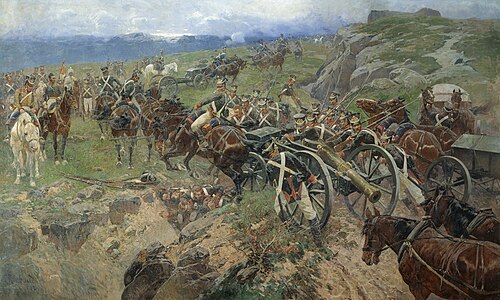
自由主義派のアレクサンドル1世に代わったのは弟のニコライ1世(1825年 - 1855年)で、ニコライ1世の治世の初めに反乱が起こった。この反乱の背景にはナポレオン戦争があり、多くの高学歴のロシア将校が軍事作戦の途中でヨーロッパを旅し、西ヨーロッパの自由主義に触れた彼らは、独裁制のロシアに帰国後、変化を求めるようになった。その結果がデカブリストの反乱(1825年12月)であり、これはニコライの弟コンスタンチンを立憲君主に据えようとした自由主義派の貴族と軍将校の小集団によるものだった。反乱は簡単に鎮圧されたが、ニコライはピョートル大帝が始めた近代化計画から背を向け、正統主義、専制政治、国民主義の教義を擁護するようになった。[50]
さらなる反乱を鎮圧するため、学校や大学への継続的な監視を含む検閲が強化された。教科書は政府によって厳しく規制された。警察のスパイがいたるところに潜入した。ニコライ1世の治世下、革命志願者はシベリアに送られ、数十万人がカトルガ収容所に送られた。[51]この反乱に対する報復により、「12月14日」は後の革命運動によって長く記憶される日となった。[要出典]
ロシアの方向性の問題は、ピョートル大帝の近代化計画以来、注目を集めてきた。西欧の模倣を支持する者もいれば、これに反対し、過去の伝統への回帰を求める者もいた。後者の道を主張したのは、退廃的な西欧を軽蔑するスラヴ主義者たちだった。スラヴ主義者たちは官僚主義に反対し、西欧の個人主義よりも中世ロシアの集団主義、つまりミールを好んだ。[52]より過激な社会主義は、アレクサンドル・ヘルツェン、ミハイル・バクーニン、ピョートル・クロポトキンなどのロシアの左派急進主義者たちによって練り上げられた。
外交政策(1800年~1864年)


ロシア軍は、1802年のカジャール朝の占領から東グルジア王国(1783年のゲオルギエフスク条約以来同盟を結んでいた)を解放した後、ロシア・ペルシャ戦争(1804年 - 1813年)中に、グルジアの支配と統合をめぐってペルシャと衝突し、コーカサス・イマーム国とのコーカサス戦争にも関与するようになった。戦争の終結時に、ペルシャはグリスタン条約に基づき、現在のダゲスタン、東グルジア、アゼルバイジャンの大部分をロシアに不可逆的に譲渡した。[53]ロシアは、オスマン帝国を犠牲にして南西への拡大を試み、最近獲得したグルジアをコーカサスとアナトリア戦線の拠点とした。1820年代後半は軍事的に成功した年であった。1826年から1828年の露土戦争では、初年度にほぼすべての最近統合した領土を失ったにもかかわらず、ロシアは現在のアルメニア、アゼルバイジャン、ウードゥル県の正式な獲得を含む、トルクメンチャイ条約で認められた非常に有利な条件で戦争を終わらせることができました。[54] 1828年から1829年の露土戦争では、ロシアは北東アナトリアに侵攻し、戦略的なオスマン帝国の都市であるエルズルムとギュミュシュハネを占領し、ギリシャ正教徒の保護国および救世主を装って、この地域のポントス・ギリシア人から広範な支援を受けました。短期間の占領の後、ロシア帝国軍はグルジアに撤退しました。[55]
ロシア皇帝は、新たに獲得したポーランド領土で2度の蜂起を鎮圧した。1830年の11月蜂起と1863年の1月蜂起である。1863年、ロシアの独裁政権は、言語、宗教、文化という国家の核となる価値観を攻撃することで、ポーランドの職人と貴族に反乱の理由を与えた。 [56] フランス、イギリス、オーストリアは危機に介入しようとしたが、できなかった。ロシアの報道機関と国家宣伝は、ポーランドの蜂起を利用して帝国の統一の必要性を正当化した。[57]その後、ポーランドの半自治政体である議会制国家は、独自の政治的および司法的権利を失い、学校や裁判所にロシア化が強制された。 [58]しかし、ポーランド、フィンランド、バルト諸国のドイツ人の間でのロシア化政策は大部分に失敗し、政治的反対を強めるだけだった。[57]

19世紀後半
.svg/500px-Imperial_Standard_of_the_Emperor_of_Russia_(1858%E2%80%931917).svg.png)


.jpg/500px-Russians_entering_khiva_1873_(cropped).jpg)

1854年から1855年にかけて、ロシアはイギリス、フランス、オスマン帝国とクリミア戦争で戦い、ロシアは敗れた。この戦争は主にクリミア半島で戦われ、関連するオーランド戦争の際にはバルト海でも小規模に戦われた。ナポレオン打倒に大きな役割を果たして以来、ロシアは軍事的には無敵とみなされていたが、ヨーロッパ列強の連合軍に対して陸海で受けた敗北は、ニコライ1世の政権の弱点を露呈した。
1855年にアレクサンドル2世が即位すると、改革を求める声が広まりました。人道主義運動が高まり、農奴制は非効率であると非難されました。1859年には、2,300万人以上の農奴が劣悪な生活環境に置かれていました。アレクサンドル2世は、革命によって下から農奴制が廃止されるのを待つのではなく、地主への十分な支援をしながら上から農奴制を廃止することを決意しました。[59]
1861年の農奴解放改革は、19世紀ロシア史上最も重要な出来事であり、地主階級の権力独占の終焉の始まりでもあった。1860年代には、財産権に関するロシア政府の立場を明確にするさらなる社会経済改革が行われた。[60]農奴解放によって都市に無償の労働力が供給され、産業が刺激され、中流階級の数と影響力が拡大した。しかし、解放された農民は土地を贈与として受け取るのではなく、政府に生涯特別税を支払わなければならず、政府は代わりに、彼らが失った土地に対して地主に多額の代金を支払った。多くの場合、農民は最も生産性の低い土地を比較的少量しか持たなかった。農民に引き渡された財産はすべて、村落共同体であるミールによって共同所有され、ミールは農民に土地を分配し、さまざまな保有地を監督した。農奴制は廃止されたが、農民にとって不利な条件で廃止されたため、革命の緊張は緩和されなかった。革命家たちは、新たに解放された農奴は産業革命の始まりとともに単に賃金奴隷として売られただけであり、都市ブルジョアジーが事実上地主に取って代わったと信じていた。[61]
ロシアはさらなる領土を求めて、太平天国の乱との戦いで弱体化した満州族支配の清国からプリアムリエ(ロシア満州)を獲得した。1858年のアイグン条約で満州祖国の大部分が割譲され、1860年の北京条約で現在の沿海地方が割譲され、将来のウラジオストクの前哨地も建設された。[62]一方、ロシアは1867年に防御不能なロシア領アメリカを米国に1100万ルーブル(720万ドル)で売却することを決定した。 [63]当初、多くのアメリカ人はこの新たに獲得した領土を不毛で無用なものと考え、政府が金を無駄にしていると考えていたが[64]、後に多くの金と石油が発見された。[65]
1870年代後半、ロシアとオスマン帝国は再びバルカン半島で衝突した。1875年から1877年にかけて、オスマン帝国の支配に反対する様々なスラブ民族の反乱によりバルカン危機が激化した。 [66]スラブ民族は15世紀以来オスマントルコによって支配されていた。これはロシアにとって政治的リスクとみなされ、同様に中央アジアとコーカサスのイスラム教徒を抑圧した。ロシアの民族主義的世論は、バルカン半島のキリスト教徒をオスマン帝国の支配から解放し、ブルガリアとセルビアを独立させることを支持し、国内で大きな要因となった。1877年初頭、ロシアはセルビアとロシアの義勇軍のために介入し、[67]露土戦争(1877-78年)を引き起こした。[68] 1年以内にロシア軍はコンスタンティノープルに接近し、オスマン帝国は降伏した。ロシアの民族主義的な外交官や将軍たちは、アレクサンドル2世を説得して、1878年3月にオスマン帝国にサン・ステファノ条約に署名させ、南西バルカン半島にまで広がる拡大した独立したブルガリアを創設した。 [67]イギリスが条約の条項をめぐって宣戦布告すると脅すと、疲れ果てたロシアは引き下がった。 1878年7月のベルリン会議で、ロシアはオスマン帝国内の従属国および自治公国として、より小さなブルガリアと東ルメリアを創設することに同意した。 [69] [70]その結果、汎スラヴ主義者は、ロシアを支援しなかったオーストリア=ハンガリー帝国とドイツに対する恨みという遺産を残した。戦争の結果に対する失望は革命的な緊張を刺激し、セルビア、ルーマニア、モンテネグロがオスマン帝国から独立し、オスマン帝国に対抗する力を強化するのに役立った。[71]

1877年から1878年の露土戦争でロシアに有利となったもう一つの重要な成果は、オスマン帝国からトランスコーカサスのバトゥム、アルダハン、カルスの各州を獲得したことであり、これらの地域は軍政下のバトゥム州とカルス州となった。新たな国境を越えてオスマン帝国領に逃れたイスラム教徒難民に代わる手段として、ロシア当局はカルス州のさまざまな民族コミュニティから多数のキリスト教徒、特にグルジア人、コーカサスのギリシャ人、アルメニア人を定住させた。彼らはそれぞれ保護を得て自らの地域的野心を推進することを望んでいた。
アレクサンドル3世
1881年、アレクサンドル2世はニヒリストのテロ組織であるナロードナヤ・ヴォリヤーによって暗殺された。帝位はニコライ1世の「正統性、専制、国民性」という格言を復活させた反動主義者のアレクサンドル3世(1881年 - 1894年)に引き継がれた。熱心なスラヴ主義者であったアレクサンドル3世は、西ヨーロッパの破壊的な影響から身を遮断することによってのみロシアが混乱から救われると信じていた。彼の治世中、ロシアはドイツの勢力拡大を抑えるためにフランス・ロシア同盟を結成し、中央アジアの征服を完了し、中国に重要な領土的および通商的譲歩を要求した。皇帝の最も影響力のある顧問は、アレクサンドル3世とその息子ニコライの家庭教師であり、1880年から1895年まで聖シノドの長官を務めたコンスタンチン・ポベドノスツェフであった。ポベドノスツェフは、皇帝の生徒たちに、言論と出版の自由を恐れ、民主主義、憲法、議会制度を嫌うように教えた。ポベドノスツェフの治世下、革命家たちは帝国の秘密警察によって迫害され、数千人がシベリアに流刑にされ、帝国全土でロシア化政策が実施された。 [72]
外交政策(1864年~1907年)
ロシアはトルキスタンの征服を含め南方への拡大にほとんど困難はなかったが[73]、ロシアがインドへの暗黙の脅威としてアフガニスタンを脅かしたことでイギリスは警戒し、数十年にわたる外交駆け引きが起こり、いわゆる「グレートゲーム」が起こった。[74]両帝国の競争には外モンゴルやチベットなどの遠隔地も含まれていたと考えられている。この駆け引きは1907年の英露協定でほぼ終結した。[75]
広大なシベリアへの進出は時間がかかり、費用もかかったが、 1890年から1904年にかけてシベリア横断鉄道が建設され、ようやく可能になった。これにより東アジアが開かれ、ロシアの関心はモンゴル、満州、朝鮮に集中した。中国は抵抗するには弱すぎたため、次第にロシアの勢力圏に引き込まれていった。ロシアは大連や旅順などの条約港を獲得した。1900年、ロシア帝国は義和団の乱に対する八カ国同盟の介入の一環として満州に侵攻した。日本はロシアの進出に強く反対し、 1904年から1905年の日露戦争でロシアを破った。日本は朝鮮を占領し、満州は紛争地域のままとなった。[76]
一方、 1871年以降ドイツに対抗する同盟国を探していたフランスは、1894年にロシアへの大規模な融資、武器や軍艦の販売、外交支援を伴う軍事同盟を結成した。1907年に英露協商会議によってアフガニスタンが非公式に分割されると、イギリス、フランス、ロシアはドイツとオーストリア=ハンガリーに対抗するためにますます緊密になった。この3か国は後に第一次世界大戦で三国協商同盟を構成することになる。[77]
20世紀初頭
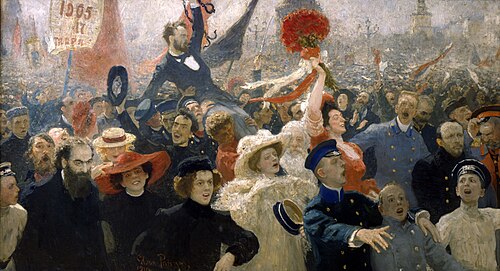
1894年、アレクサンドル3世の跡を継いだ息子のニコライ2世は、父が残した独裁政治を維持することに尽力した。ニコライ2世は無能な統治者であることが判明し、最終的に彼の王朝はロシア革命によって打倒された。[79]産業革命はロシアに大きな影響を与え始めたが、国は依然として田舎で貧しいままだった。
1890 年以降、テンサイなどの新しい作物や鉄道輸送の新たなアクセスのおかげで、経済状況は着実に改善した。人口増加による国内需要の高まりにもかかわらず、穀物の総生産量と輸出は増加した。その結果、1914 年までの帝国の最後の 20 年間、ロシアの農民の生活水準はゆっくりと向上した。陸軍新兵の体格に関する最近の調査では、彼らはより大きく、より強かったことが示されている。地域差があり、人口密度の高い中央黒土地域では貧困がより多く、1891 年から 1893 年、および 1905 年から 1908 年には一時的な不況があった。[80]
19 世紀末までに、ロシア帝国は領土範囲を支配し、面積は 2,280 万 km 2に達し、世界で 3 番目に大きな帝国となりました。
政治的右派では、貴族の反動分子が大地主を強く支持したが、大地主は農民土地銀行を通じて徐々に農民に土地を売却していた。十月党は地主と実業家を基盤とする保守勢力だった。彼らは土地改革を受け入れたが、財産所有者には全額支払いを要求した。彼らは広範囲にわたる改革を支持し、地主階級が消滅することを望み、土地の代金を支払うことには同意した。産業資本家と貴族のリベラル分子は平和的な社会改革と立憲君主制を信奉し、立憲民主党またはカデット党を結成した。[81]
左派では、社会革命党(SR)とマルクス主義社会民主党が土地を無償で収用することを望んだが、土地を農民に分配するか(ナロードニキの解決策)、それとも共同所有にするかを議論した。[82]社会革命党は社会民主党とは違い、革命は農民ではなく都市労働者に頼らなければならないと信じていた。[83]
1903年、ロンドンで開催されたロシア社会民主労働党第2回大会で、党は2つの派閥に分裂した。漸進主義のメンシェヴィキと、より急進的なボルシェヴィキである。メンシェヴィキは、ロシアの労働者階級は十分に発展しておらず、社会主義はブルジョア民主主義の統治期間を経て初めて達成できると信じていた。そのため、彼らはブルジョア自由主義勢力と同盟を結ぶ傾向があった。ウラジーミル・レーニン率いるボルシェヴィキは、力で権力を奪取するために、プロレタリア階級の先鋒として行動し、党の厳しい規律に従うプロの革命家からなる少数のエリート集団を形成するという考えを支持した。[84]

日露戦争(1904-1905)での敗北は帝政に大きな打撃を与え、さらに不安定化の可能性を高めた。1905年1月、ゲオルギー・ガポン神父が皇帝に嘆願書を提出するためにサンクトペテルブルクの冬宮殿に大群衆を率いた際に「血の日曜日」として知られる事件が発生した。行列が宮殿に到着すると、兵士が群衆に発砲し、数百人が死亡した。ロシアの民衆は虐殺に激怒し、民主共和国を要求してゼネストが宣言された。これが1905年革命の始まりとなった。革命活動を指導するためにほとんどの都市にソビエト(労働者評議会)が出現した。ロシアは麻痺し、政府は絶望した。[85]
1905年10月、ニコライは渋々ながら10月宣言を出し、遅滞なく召集される国家ドゥーマ(議会)の創設を認めた。投票権は拡大され、いかなる法律もドゥーマの承認なしには最終決定されないこととなった。穏健派は満足したが、社会主義者は譲歩が不十分であるとして拒否し、新たなストライキを組織しようとした。1905年末までに改革派の間に不和が生じ、皇帝の立場が強化され、1906年の新ロシア憲法で譲歩の一部を撤回することができた。
戦争、革命、崩壊
原因の起源
ロシアはフランス、イギリスとともに第一次世界大戦前の協商国であった。この3国はドイツのライバルである[86]三国同盟に対抗して結成された。三国同盟はロシア、オーストリア=ハンガリー、イタリアで構成されていた。それ以前は、サンクトペテルブルクとパリはロンドンとともにクリミア戦争の交戦国であった。イギリスとの関係は、中央アジアのグレートゲームから1907年の英露会議まで不安定だったが、この会議で両者は意見の相違を解決し、台頭する新興国ドイツに対抗するために協力した。[87]ロシアとフランスの関係は、平和が脅かされたときに双方が同盟を結ぶことに同意した1890年代まで孤立したままだった。 [88]フランスはまた、鉄道を中心にインフラの建設に融資を行った。[89]
ロシアと三国同盟、特にドイツとオーストリアとの関係は、三皇帝同盟のそれと似ていた。ロシアとドイツの関係は悪化し[90] 、東方問題をめぐる緊張はオーストリア=ハンガリー帝国との間で限界点に達していた[91]。1908年のボスニア危機は戦争につながりそうになり、1912年から1913年にかけてはバルカン戦争の最中にサンクトペテルブルクとウィーンの関係は緊張していた[92]。
オーストリア=ハンガリー帝国の皇太子フランツ・フェルディナント大公の暗殺はヨーロッパの緊張を高め、オーストリアとロシアの対立につながった。[93]皇太子の死に対する義務を要求するオーストリアの最後通牒をセルビアは拒否し、オーストリア=ハンガリー帝国は1914年7月28日にすべての外交関係を断絶して宣戦布告した。ロシアは同じスラヴ人国家であったためセルビアを支援し、2日後、ニコライ2世皇帝はオーストリア=ハンガリー帝国を屈服させるために動員を命じた。[94]
宣戦布告

ウィーンがセルビアに宣戦布告した結果、ニコライ2世は490万人の兵士の動員を命じた。オーストリア=ハンガリー帝国の同盟国であったドイツは、この召集令状を脅威とみなした。ロシアが軍隊を召集すると、ドイツは「戦争の差し迫った危険」の状態を確認し、 [95] 1914年8月1日に宣戦布告した。[96]ロシア人は愛国心とドイツ嫌いの感情に染まり、首都サンクトペテルブルクの名前もその1つだった。サンクトペテルブルクは、サンクトとブルグという言葉のせいでドイツ語っぽすぎると思われたため、ロシア風のペトログラードに改名された。[97]
ロシアが第一次世界大戦に参戦すると、 1892年以来ロシアと同盟を結んでいたフランスも、ドイツの台頭を恐れて参戦した。[98]そのためドイツ参謀本部はシュリーフェン計画を考案し、まず非同盟のベルギーを経由してフランスを排除し、その後東に進軍して大軍の動員がはるかに遅いロシアを攻撃するという計画だった。[99]
劇場
ドイツの劇場

1914年8月までに、ロシアは予想外の速さでドイツの東プロイセン州に侵攻し、タンネンベルクで電信や暗号なしで送られた電文が原因で屈辱的な敗北を喫し、[100]第2軍全体が壊滅した。ロシアはマズーリ湖群で2度大敗を喫し、最初は10万人の死傷者を出し、[101] 2度目は20万人の死傷者を出した。[102] 10月までに、ドイツ第9軍はワルシャワ付近に到達し、新設された第10軍は東プロイセンの国境から撤退した。ロシア軍司令官ニコライ大公は、第5、第4、第9軍を率いてシレジアに侵攻するよう命令を受けた。[103]マッケンゼン率いる第9軍はガリツィアの前線から撤退し、ポーゼンとトルンの両都市の間に集結した。11月11日、主力軍の右翼と後方に対して進撃が行われた。第1軍と第2軍は大きな打撃を受け、第2軍は11月17日に ウッチでほぼ包囲された。
疲弊したロシア軍はロシア支配下のポーランドから撤退を開始し、ドイツ軍は1915年8月5日に王国の首都ワルシャワを含む多くの都市を占領することができた。 [104]同月、皇帝はニコライ大公を解任し自ら指揮を執った。[105]これがロシア軍の転機となり、最悪の惨劇の始まりとなった。[106]ドイツ軍はリガからテルノポリまでの戦線で停止するまで前線を押し続けた。[107]ロシアはポーランドとリトアニアの領土全体、[108]バルト諸国とグロドノの一部、ウクライナのヴォルィーニとポジーリャの一部を失った。その後ドイツとの戦線は1917年まで安定していた。
オーストリアの劇場
オーストリア=ハンガリー帝国は8月6日にロシアと開戦した。ロシア軍は8月20日にオーストリア領チスレイタニアが保持していたガリツィアへの侵攻を開始し、レンベルクでオーストリア=ハンガリー軍を全滅させ、ガリツィアを占領した。[109]プレミセル要塞が包囲されている間に、要塞を占領する最初の試みは失敗したが、1915年3月に2回目の試みで要塞は占領された。[110] 5月2日、ロシア軍はオーストリア=ドイツ連合軍に突破され、ゴルリツェからタルヌフへの線で撤退し、プレミセルを失った。
1916年6月4日、アレクセイ・ブルシーロフ将軍はコーヴェルを標的とした攻勢を実施した。彼の攻勢は大成功を収め、主攻撃で7万6千人を捕虜にし、オーストリアの橋頭保で1,500人を捕虜にした。しかし、攻勢は弾薬不足と補給不足で中止された。[111]この同名の攻勢は第一次世界大戦で最も成功した連合軍の攻撃であり、[112]オーストリア=ハンガリー軍を独立軍として事実上壊滅させたが、多数の死傷者(約100万人)が出たため、ロシア軍は再建もさらなる攻撃も行えなくなった。
トルコの劇場
1914年10月29日、露土戦線の序章として、トルコ艦隊はドイツの支援を受けて、オデッサ、セヴァストポリ、ノヴォロシースク、フェオドシヤ、ケルチ、ヤルタといったロシア沿岸都市を襲撃し始めた[113]。これによりロシアは11月2日、オスマン帝国に宣戦布告した[114] 。バルトドイツ人の将軍ゲオルギー・ベルクマン率いるロシア軍は国境を越えて戦線を開始したが、キョプルキョイを占領することはできなかった。12月、ロシアはサルカミシュで勝利を収め、ロシアの将軍ニコライ・ユデーニチがエンヴェル・パシャを敗走させた[115]。
帝国の問題

1915年半ばまでに、戦争の影響は士気を低下させていた。食料と燃料は不足し、死傷者は増加し、インフレは高まっていた。低賃金の工場労働者の間でストライキが増加し、土地所有の改革を求める農民が落ち着きを失っているとの報告もあった。皇帝は最終的に自ら軍の指揮を執ることを決意し、妻の皇后アレクサンドラに首都の指揮を任せて前線に向かった。皇后は修道士グリゴリー・ラスプーチン(1869年 - 1916年)の魔法にかかってしまった。1916年後半、貴族の一派によって皇帝が暗殺されたが、皇帝の失われた威信は回復できなかった。[116]
帝国統治の終焉
1917年3月3日、国際女性デーに首都の工場でストライキが組織され、続いて数千人が食糧不足に抗議してペトログラードの路上に繰り出した。翌日、抗議者は20万人にまで増加し、ロシアの戦争からの撤退と皇帝の退位を要求した。秩序回復のために派遣されたロシア軍の半数にあたる8万人がストライキを起こし、上級将校の命令を拒否した。[117]帝国のシンボルはすべて破壊され、焼かれた。首都は制御不能となり、抗議と争いに巻き込まれた。[118]
首都から南西に262キロ離れたプスコフ市では、多くの将軍や政治家が皇帝に皇太子への譲位を勧め、ニコライはこれを受け入れたが、正当な後継者としてミハイル大公に帝位を譲った。 [119]帝政は完全に打倒された。一連の追放と投獄の後、1918年7月、ロマノフ家はエカテリンブルクでボルシェビキによって処刑された。
地域
.jpg/500px-Russian_Empire_1745_General_Map_(Latin,_HQ).jpg)
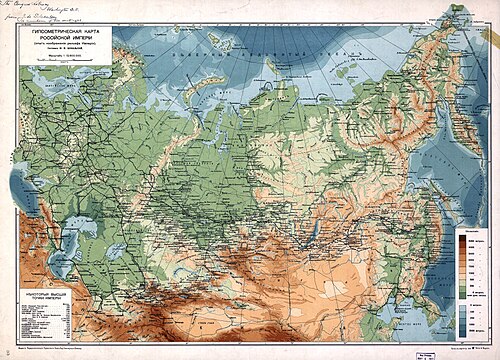
19世紀末までに帝国の面積は約22,400,000平方キロメートル(8,600,000平方マイル)となり、地球の陸地面積のほぼ6分の1を占めた。当時、帝国の面積でこれに匹敵するのはイギリス帝国のみであった。人口の大半はヨーロッパロシアに住んでいた。ロシア帝国には100以上の民族が住んでおり、ロシア民族が人口の約45%を占めていた。[120]
地理
ヨーロッパ・ロシアの行政境界は、フィンランドとそのポーランドの一部を除けば、東ヨーロッパ平原の自然限界とほぼ一致していた。北は北極海だった。ノヴァヤゼムリャ、コルグエフ諸島、ヴァイガチ諸島はヨーロッパ・ロシアの一部とみなされたが、カラ海はシベリアの一部だった。東は帝国のアジア領土、シベリアとキルギス・ステップで、ウラル山脈、ウラル川、カスピ海によって両者から隔てられていた が、行政境界はウラル山脈のシベリア斜面を通って部分的にアジアにまで及んでいた。南は黒海とコーカサスで、後者はマニチ川低地によって隔てられており、マニチ川低地は鮮新世以降にアゾフ海とカスピ海を結んでいた。西の境界線は完全に恣意的なものであり、ヴァランゲルフィヨルドからコラ半島を横切り、ボスニア湾に至る。その後、バルト海南部のクルシュー潟湖、そしてドナウ川河口に至り、西に大きく円を描いてポーランド東中部を囲み、ロシアをプロイセン、オーストリア領ガリツィア、ルーマニアから分離する。
ロシアの重要な特徴は、北極海の氷に閉ざされた海岸の外には、外海への自由な出口がほとんどないことである。ボスニア湾とフィンランド湾の深い入り組んだ部分は、民族的にはフィンランド領土に囲まれており、ロシア人が首都をネヴァ川の河口に据えて確固たる足場を築いたのは、後者の湾のまさに先端だけであった。リガ湾とバルト海もまた、スラヴ人ではなく、バルト人、フィンランド人、およびドイツ人が住む地域に属している。黒海の東岸は、ロシアと黒海を隔てる大きな山脈であるトランスコーカサスに属していた。しかし、この海域さえも内海であり、その唯一の出口であるボスポラス海峡は外国の手に渡っていた。一方、ほとんどが砂漠に囲まれた広大で浅い湖であるカスピ海は、他国との交流のチャネルというよりも、ロシアとアジアの植民地を結ぶリンクとしてより重要であった。
領土開発
1860年から1905年まで、ロシア帝国は現在のカリーニングラード州、千島列島、トゥヴァを除く現在のロシア連邦の全領土を占領した。1905年にロシアはサハリン南部を日本に奪われたが、1914年にトゥヴァを保護国として獲得した。1917年より前のロシア帝国は、ウクライナのドニエプル川の大部分、ベラルーシ、ベッサラビア、フィンランド大公国、アルメニア、アゼルバイジャン、グルジア、ロシア領トルキスタンの中央アジア諸国、バルト海沿岸のほとんどの県、ポーランドの大部分、旧オスマン帝国領のアルダハン、アルトヴィン、ウードゥル、カルスの各州、およびエルズルム県北東部を領有していた。
ヘンリー・キッシンジャーは、ロシア帝国が領土拡大を始めた方法論的手順は、米国が同様のことをした方法と似ていると指摘した。ロシアの政治家アレクサンダー・ゴルチャコフは、米国の明白な運命に一致してロシアの拡大を正当化した。その後、ロシアの領土拡大は遊牧民や封建社会とのみ遭遇し、これは米国の西方拡大と驚くほど似ている。[121]
1742年から1867年まで、露米会社はアラスカを植民地として統治した。同社はまた、フォートエリザベス(1817年)を含むハワイに入植地を設立し、北アメリカではサンフランシスコのすぐ北にあるカリフォルニア州ソノマ郡のフォートロス植民地(1812年設立)まで南に居住地を築いた。カリフォルニア州のフォートロスとロシアンリバーはどちらも、1821年までスペインがヌエバスペインの一部として領有権を主張していた地域に領有権を主張したロシア人入植者にちなんで名付けられた。
1808年から1809年のフィンランド戦争でスウェーデンが敗北し、1809年9月17日にフレゼリクスハムン条約が調印された後、当時フィンランドとなっていたスウェーデンの東半分は、ロシア帝国に自治権を持つ 大公国として組み込まれた。皇帝は最終的に、フィンランド総督と自ら任命した元老院を通じて、半立憲君主としてフィンランドを統治することになった。皇帝はフィンランドを独立した立憲国家として明示的に認めることはなかったが、フィンランドの臣民は大公国をそのように考えるようになった。

露土戦争(1806年 - 1812年)とそれに続くブカレスト条約(1812年)の余波で、オスマン帝国の属国であったモルダビア公国の東部と、かつてオスマン帝国の直接支配下にあったいくつかの地域が、オスマン帝国の支配下に入った。この地域(ベッサラビア)は、ロシア帝国がヨーロッパで獲得した最後の領土の一つであった。ウィーン会議(1815年)で、ロシアはポーランド会議の主権を獲得した。ポーランドは書類上はロシアと同君連合した自治王国であった。しかし、この自治権は1831年の11月蜂起後に侵食され、最終的には1867年に廃止された。
サンクトペテルブルクは、19世紀を通じて、露ペルシャ戦争(1804年 - 1813年)、露ペルシャ戦争(1826年 - 1828年)とそれに続くグリスタン条約およびトルクメンチャイ条約[122]、そしてコーカサス戦争(1817年 - 1864年)を通じてペルシャを犠牲 にして、徐々にコーカサスに対する支配を拡大し、強化していった。
ロシア帝国は、特に19世紀後半に中央アジアにおける影響力と領土を拡大し、 1865年にロシア領トルキスタンの大部分を征服し、1885年まで領土を拡大し続けました。
新たに発見された北極の島々はロシア帝国の一部となった。18世紀初頭には新シベリア諸島、1913 年になってようやくセヴェルナヤゼムリャ(「皇帝ニコライ 2 世の土地」) が初めて地図に記され領有権が主張された。
第一次世界大戦中、ロシアは東プロイセンの一部(当時はドイツ領)、オーストリア領ガリツィアの大部分、オスマン帝国領アルメニアの大部分を短期間占領した。現代のロシア連邦は現在、東プロイセン北部を構成するカリーニングラード州を支配しているが、これは1914年に帝国が占領した地域とは異なる。ただし、一部重複している部分もある。グセフ(ドイツ語ではグンビンネン)はロシアが最初に勝利した場所である。
帝国領土

ロシア帝国は、基本法第 1 条によれば、分割不可能な 1 つの国家であった。さらに、第 26 条では、「ロシア帝国の王位は、ポーランド王国とフィンランド大公国とを不可分とする」と規定されていた。フィンランド大公国との関係は、第 2 条「フィンランド大公国は、ロシア国家の不可分な一部を構成し、その内政は特別法に基づく特別規則によって規定される」および 1910 年 6 月 10 日の法律によっても規制されていた。
1744年から1867年の間、帝国はロシア領アメリカも支配していた。この地域(現在のアラスカ)を除いて、 ロシア帝国はヨーロッパとアジアにまたがる連続した土地だった。この点で、同時代の植民地型の帝国とは異なっていた。その結果、20世紀にイギリス帝国とフランス帝国が衰退する一方で、ロシア帝国の領土の大部分は最初はソビエト連邦内に、1991年以降はより小さなロシア連邦内に、そのまま残った。
さらに、帝国は時折、清国から租借していた関東州租界や東清鉄道、ロシアの天津租界などの租界地域を支配していた。
1815年、ロシア人実業家ゲオルク・アントン・シェーファーがカウアイ島に行き、ハワイ王カメハメハ1世の家臣である島の総督カウマリーと保護条約を交渉したが、ロシア皇帝は条約の批准を拒否した。ハワイ正教会およびロシアのエリザベス砦も参照。
1889年、ロシアの冒険家ニコライ・イワノビッチ・アチノフは、現在のジブチのタジュラ湾に位置するサガッロというアフリカにロシアの植民地を建設しようとした。しかし、この試みはフランスを怒らせ、フランスは植民地に対して2隻の砲艦を派遣した。短い抵抗の後、植民地は降伏し、ロシア人入植者はオデッサに追放された。
政府と行政
ロシア帝国は、建国当初から1905 年の革命まで、絶対君主として統治した皇帝 (ツァーリとも呼ばれる) によって率いられていました。1905 年の革命後、ロシアは分類が困難な新しいタイプの政府を開発しました。1910 年のゴータ年鑑では、ロシアは「独裁的な皇帝の下にある立憲君主制」と表現されていました。この言葉の矛盾は、1905 年 10 月以降にロシア帝国で確立された過渡的かつ独自のシステムを正確に定義することが困難であることを示しています。この日付より前、ロシアの基本法は皇帝の権力を「独裁的で無制限」と表現していました。1905 年 10 月以降、帝国の名称は依然として「全ロシアの皇帝および独裁者」でしたが、基本法は無制限という言葉を削除して変更されました。皇帝は、すべての立法に対する絶対的な拒否権を含む、多くの古い特権を保持しながらも、選挙で選ばれた議会の設立にも同意した。議会の同意がなければ、ロシアではいかなる法律も制定されてはならない。ロシアの体制が真の意味で合憲になったわけではなく、ましてや議会制になったわけではない。しかし、「無制限の独裁政治」は「自己制限のある独裁政治」に取って代わられた。この独裁政治が新しい変化によって永久に制限されるのか、それとも独裁者の継続的な裁量によってのみ制限されるのかは、国内の対立する政党の間で激しい論争の的となった。したがって、暫定的に、ロシアの政治体制はおそらく「独裁的な皇帝による 制限された君主制」と定義するのが最も適切だろう。
保守主義は、時折改革的な活動も伴っていたものの、ロシアの指導者の大半のイデオロギーであった。保守的な思想の構造は、知識人の反合理主義、ロシア正教会に根ざした宗教性、農奴が働く地主階級に根ざした伝統主義、そして軍将校団に根ざした軍国主義に基づいていた。[123]非合理性に関しては、ロシアは合理主義を優先するヨーロッパ啓蒙主義の完全な力を避け、独特の人々の信念、価値観、行動を反映した理想化された国民国家のロマン主義を好んだ。[124]明らかにリベラルな「進歩」の概念は、確立されたシステムに役立つように近代技術を取り入れることに基づく保守的な近代化の概念に取って代わられた。独裁政治に役立つ近代化の約束は、社会主義知識人アレクサンダー・ヘルツェンを怖がらせ、彼は「電信機を持ったチンギス・ハーン」が統治するロシアについて警告した。[125]
天皇

ピョートル大帝は、ヨーロッパの国家体制におけるロシアの地位を確保するため、称号をツァーリから皇帝に変更した。 [126]後の統治者たちもこの新しい称号を放棄しなかったが、 1917年の2月革命で帝政が廃止されるまで、ロシアの君主は一般にツァーリまたはツァリーツァと呼ばれていた。十月宣言の発布以前は、皇帝は絶対君主として統治し、その権限には2つの制限しかなく、どちらも既存の体制を守ることを意図していた。皇帝とその配偶者はともにロシア正教会に属していなければならないこと、そして皇帝はパーヴェル1世によって制定されたパウロ継承法に従わなければならないことであった。これを超えると、ロシアの独裁者の権力は事実上無制限であった。
1905年10月17日、状況は一変した。皇帝は、1906年4月28日に公布された憲法基本法により設置された、自由に選出された国民議会である帝国ドゥーマの同意なしにはいかなる法案も法律とならないという布告を出し、自らの立法権を自主的に制限した。しかし、皇帝は新設されたドゥーマを解散する権利を保持し、この権利を複数回行使した。また、皇帝はすべての立法に対する絶対的な拒否権を保持し、憲法基本法自体のいかなる変更も皇帝のみが開始できた。皇帝の大臣は皇帝に対してのみ責任を負い、ドゥーマやその他の当局に対しては責任を負わず、大臣に疑問を呈することはできても解任することはできなかった。このように、1906年4月28日以降、皇帝の個人的な権力の範囲は制限されたものの、依然として強力であった。
帝国評議会

.jpg/500px-Catherine_Palace_&_Cameron_Gallery_(Premazzi).jpg)
1906年2月20日のロシアの改正基本法により、国家評議会は立法府としてドゥーマと連携し、このときから立法権は通常、両院と協調してのみ皇帝によって行使された。[127]この目的のために再編された帝国評議会、または帝国評議会は196名で構成され、そのうち98名は皇帝によって指名され、98名は選挙で選ばれた。大臣も指名され、職権で選ばれた。選出された議員のうち、3 人は「黒」聖職者 (修道士)、3 人は「白」聖職者 (世俗)、18 人は貴族の法人、6 人は科学アカデミーと大学、6 人は商工会議所、6 人は産業評議会、34 人は地方自治体のゼムストヴォ、16 人はゼムストヴォを持たない地方自治体、6 人はポーランドから選出された。議会は立法機関としてドゥーマの権限と調整されていたが、実際には立法を開始することはほとんどなかった。
国会
The Duma of the Empire or Imperial Duma (Gosudarstvennaya Duma), which formed the lower house of the Russian parliament, consisted (since the ukaz of 2 June 1907) of 442 members, elected by an exceedingly complicated process. The membership was manipulated as to secure an overwhelming majority of the wealthy (especially the landed classes) and also for the representatives of the Russian peoples at the expense of the subject nations. Each province of the empire, except Central Asia, returned a certain number of members; added to which were those returned by several large cities. The members of the Duma were chosen by electoral colleges and these, in their turn, were elected by assemblies of the three classes: landed proprietors, citizens, and peasants. In these assemblies the wealthiest proprietors sat in person while the lesser proprietors were represented by delegates. The urban population was divided into two categories according to taxable wealth and elected delegates directly to the college of the governorates. The peasants were represented by delegates selected by the regional subdivisions called volosts. Workmen were treated in a special manner, with every industrial concern employing fifty hands electing one or more delegates to the electoral college.
In the college itself, the voting for the Duma was by secret ballot and a simple majority carried the day. Since the majority consisted of conservative elements (the landowners and urban delegates), the progressives had little chance of representation at all, save for the curious provision that one member at least in each government was to be chosen from each of the five classes represented in the college. That the Duma had any radical elements was mainly due to the peculiar franchise enjoyed by the seven largest towns — Saint Petersburg, Moscow, Kiev, Odessa, Riga, and the Polish cities of Warsaw and Łódź. These elected their delegates to the Duma directly, and though their votes were divided (on the basis of taxable property) in such a way as to give the advantage to wealth, each returned the same number of delegates.
Council of Ministers
In 1905, a Council of Ministers (Sovyet Ministrov) was created, under a minister president, the first appearance of a prime minister in Russia. This council consisted of all the ministers and of the heads of other principal departments. The ministries were as follows:
- Ministry of the Imperial Court
- Ministry of Foreign Affairs;
- Ministry of War;
- Ministry of the Navy;
- Ministry of Finance;
- Ministry of Commerce and Industry (created in 1905);
- Ministry of Internal Affairs (including police, health, censorship and press, posts and telegraphs, foreign religions, statistics);
- Ministry of Agriculture and State Assets;
- Ministry of Ways of Communications;
- Ministry of Justice;
- Ministry of National Education.
Most Holy Synod

The Most Holy Synod (established in 1721) was the supreme organ of government of the Orthodox Church in Russia. It was presided over by a lay Procurator, representing the emperor, and consisted of the three metropolitans of Moscow, Saint Petersburg, and Kiev, the Archbishop of Georgia, and a number of bishops sitting in rotation.
Senate
The Senate (Pravitelstvuyushchi Senat, i.e. directing or governing senate), originally established during the Government reform of Peter the Great, consisted of members nominated by the emperor. Its wide variety of functions were carried out by the different departments into which it was divided. It was the supreme court of cassation; an audit office; a high court of justice for all political offences; and one of its departments fulfilled the functions of a heralds' college. It also had supreme jurisdiction in all disputes arising out of the administration of the empire, notably in differences between representatives of the central power and the elected organs of local self-government. Lastly, it promulgated new laws, a function which theoretically gave it a power akin to that of the Supreme Court of the United States, of rejecting measures not in accordance with fundamental laws.
Administrative divisions


As of 1914, Russia was divided into 81 governorates (guberniyas), 20 oblasts, and 1 okrug. Vassals and protectorates of the Russian Empire included the Emirate of Bukhara, the Khanate of Khiva, and, after 1914, Tuva (Uriankhai). Of these, 11 Governorates, 17 oblasts, and 1 okrug (Sakhalin) belonged to Asian Russia. Of the rest, 8 Governorates were in Finland and 10 in Congress Poland. European Russia thus embraced 59 governorates and 1 oblast (that of the Don). The Don Oblast was under the direct jurisdiction of the ministry of war; the rest each had a governor and deputy-governor, the latter presiding over the administrative council. In addition, there were governors-general, generally placed over several governorates and armed with more extensive powers, usually including the command of the troops within the limits of their jurisdiction. In 1906, there were governors-general in Finland, Warsaw, Vilna, Kiev, Moscow, and Riga. The larger cities (Saint Petersburg, Moscow, Odessa, Sevastopol, Kerch, Nikolayev, and Rostov) had administrative systems of their own, independent of the governorates; in these the chief of police acted as governor.
Judicial system
The judicial system of the Russian Empire was established by the statute of 20 November 1864 of Alexander II. This system – based partly on English and French law – was predicated on the separation of judicial and administrative functions, the independence of the judges and courts, public trials and oral procedure, and the equality of all classes before the law. Moreover, a democratic element was introduced by the adoption of the jury system and the election of judges. This system was disliked by the bureaucracy, due to its putting the administration of justice outside of the executive sphere. During the latter years of Alexander II and the reign of Alexander III, power that had been given was gradually taken back, and that take back was fully reversed by the third Duma after the 1905 Revolution.[k]
The system established by the law of 1864 had two wholly separate tribunals, each having their own courts of appeal and coming in contact with each other only in the Senate, which acted as the supreme court of cassation. The first tribunal, based on the English model, were the courts of the elected justices of the peace, with jurisdiction over petty causes, whether civil or criminal; the second, based on the French model, were the ordinary tribunals of nominated judges, sitting with or without a jury to hear important cases.
Local administration
Alongside the local organs of the central government in Russia there are three classes of local elected bodies charged with administrative functions:
- the peasant assemblies in the mirs and the volosts;
- the zemstvos in the 34 governorates of Russia;
- the municipal dumas.
Municipal dumas

Since 1870, the municipalities in European Russia had institutions like those of the zemstvos. All owners of houses, tax-paying merchants, artisans, and workmen were enrolled on lists, in descending order according to their assessed wealth. The total valuation was then divided into three equal parts, representing three groups of electors very unequal in number, each of which would elect an equal number of delegates to the municipal duma. The executive was in the hands of an elected mayor and an uprava, which consisted of several members elected by the municipal duma. Under Alexander III, however, by-laws promulgated in 1892 and 1894, the municipal dumas were subordinated to the governors in the same way as the zemstvos. In 1894, municipal institutions, with still more restricted powers, were granted to several towns in Siberia, and in 1895 to some in the Caucasus.
Baltic provinces
The formerly Swedish-controlled Baltic provinces of Livonia and Estonia and later Duchy of Courland, a vassal of Polish–Lithuanian Commonwealth, were incorporated into the Russian Empire after the defeat of Sweden in the Great Northern War. Under the Treaty of Nystad of 1721, the Baltic German nobility retained considerable powers of self-government and numerous privileges in matters affecting education, police, and the local administration of justice. After 167 years of German language administration and education, in 1888 and 1889 laws were passed transferring administration of the police and manorial justice from Baltic German control to officials of the central government. About the same time, a process of Russification was being carried out in the same provinces, in all departments of administration, in the higher schools, and in the Imperial University of Dorpat, the name of which was altered to Yuriev. In 1893, district committees for the management of the peasants' affairs, similar to those in purely Russian governments, were introduced into this part of the empire.
Economy

Before the liberation of the serfs in 1861, Russia's economy mainly depended on agriculture.[128] By the census of 1897, 95 per cent of the Russian population lived in the countryside.[129] Nicholas I attempted to modernise his country, and have it not been so dependant on a single economic sector.[130] During the reign of Alexander III, many reforms occurred. The Peasants' Land Bank was founded in 1883 to provide loans for Russian peasants, both as individuals and in communes. The Nobles' Land Bank, in 1885, made loans at nominal interest rates to the landed nobility. The poll tax was abolished in 1886.[131]
When Ivan Vyshnegradsky was appointed as the new minister of finance in 1886, he increased the pressure on peasants by increasing taxes on land and prescribing how they harvested grain. These policies led to the severe Russian famine of 1891–1892 that lasted from 1891 to 1892, with four hundred thousand perishing from starvation. Vyshnegradsky was succeeded by Count Sergei Witte in 1892. Witte began by raising revenues through a monopoly on alcohol, which brought in 300 million rubles 1894. These reforms returned the peasants to essentially being serfs again.[132] In 1900, a peasant class (also known as kulak) had emerged, representing less than 20 per cent of the population, who were characterised by owning some of their land, machinery, and livestock.[133] An income tax was introduced in 1916.
Agriculture
Russia had a long-standing economic bargain on fundamental agriculture on large estates, which was worked by Russian peasants (also known as serfs), who did not get any rights from slave masters under the system of "barshchina".[l] Another system was called obrok,[m] in which serfs worked in exchange for cash or goods from the master, allowing them to work outside the estate.[134] These systems were based on a legal code called the Sobornoye Ulozheniye, which was introduced by Alexis I in 1649.
From 1891 to 1892, peasants were faced with new policies carried out by Ivan Vyshnegradsky, causing a famine and disease that took the lives of four hundred thousand people,[135][136] especially in the Volga region, eliciting the greatest decline in grain production.[137]
Mining and heavy industry


Infrastructure
Railways

After 1860, the planning and building of the railway network had far-reaching effects on the economy, culture, and ordinary life of Russia. The central authorities and the imperial elite made most of the key decisions, but local elites made demands for rail linkages. Local nobles, merchants, and entrepreneurs imagined a future of promoting their regional interests, from "locality" to "empire". Often, they had to compete with other cities. By envisioning their own role in a rail network they came to understand how important they were to the empire's economy.[138]
During the 1880s, the Russian army built two major railway lines in Central Asia. The Transcaucasus Railway connected the city of Batum on the Black Sea and the oil center of Baku on the Caspian Sea. The Trans-Caspian Railway began at Krasnovodsk on the Caspian Sea and reached Bukhara, Samarkand, and Tashkent. Both lines served the commercial and strategic needs of the empire and facilitated migration.[139]
Religion
.svg/500px-Subdivisions_of_the_Russian_Empire_by_largest_ethnolinguistic_group_(1897).svg.png)
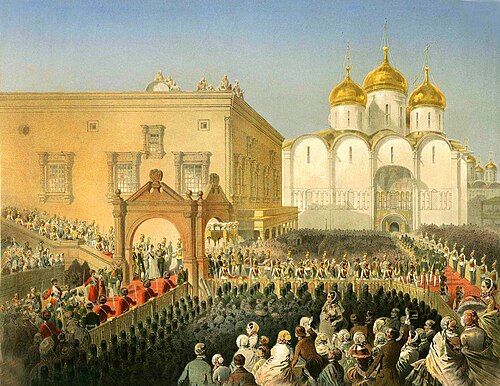
The Russian Empire's state religion was Orthodox Christianity.[140] The emperor was not allowed to "profess any faith other than the Orthodox" (Article 62 of the 1906 Fundamental Laws) and was deemed "the Supreme Defender and Guardian of the dogmas of the predominant Faith and is the Keeper of the purity of the Faith and all good order within the Holy Church" (Article 64 ex supra). Although he made and annulled all senior ecclesiastical appointments, he did not settle questions of dogma or church teaching. The principal ecclesiastical authority of the Russian Church—which extended its jurisdiction over the entire territory of the empire, including the ex-Kingdom of Kartli-Kakheti—was the Most Holy Synod, the civilian Over Procurator of the Holy Synod being one of the council of ministers with wide de facto powers in ecclesiastical matters.
The ecclesiastical heads of the national Russian Orthodox Church consisted of three metropolitans (Saint Petersburg, Moscow, Kiev), fourteen archbishops and fifty bishops, all drawn from the ranks of the monastic (celibate) clergy. The parochial clergy had to be married when appointed, but if left widowers were not allowed to marry again; this rule continues to apply today.
Religious policy
All non-Orthodox religions were formally forbidden from proselytizing within the empire.[141] In a policy influenced by Catherine II but solidified in the 19th century, Tsarist Russia exhibited increasing "confessionalization" pursuing top-down reorganization of the empire's faiths,[141] also referred to as the "confessional state".[142] The tsarist administration sought to arrange "orthodoxies" within Islam, Buddhism, and the Protestant faiths, which was performed by creating spiritual assemblies (in the case of Islam, Judaism, and Lutheranism), banning and declaring bishoprics (in the case of Roman Catholicism), and arbitrating doctrinal disputes.[141] When the state lacked resources to provide a secular bureaucracy across its entire territory, guided 'reformation' of faiths provided elements of social control.[141][142]
Anti-semitism
After Catherine II annexed eastern Poland in the Polish Partitions,[143] there were restrictions placed against Jews known as the Pale of Settlement, an area of Tsarist Russia inside which Jews were authorized to settle, and outside of which were deprived of various rights such as freedom of movement or commerce.[144] Particularly repressive was Emperor Nicholas I, who sought the forced assimilation of Jews,[145] from 1827 conscripted Jewish children as Cantonists in military institutions in the east aiming to compel them to convert to Christianity,[146] attempted to stratify Jews into "useful" and "not useful" based on wealth[145] and further restricted religious and commercial rights within the Pale of Settlement.[144][147] Emperor Alexander II ceased this harsh treatment and pursued a more bureaucratic type of assimilation,[145] such as compensating the Cantonists for their previous military service, including those who remained Jewish,[144] although certain military ranks were still limited to Christians.[145] In contrast, Emperor Alexander III resumed an atmosphere of oppression, including the May Laws, which further restricted Jewish settlements and rights to own property, as well as limiting the types of professions available,[148][144] and the expulsion of Jews from Kiev in 1886 and Moscow in 1891. The overall anti-Jewish policy of the Russian Empire led to significant sustained emigration.[144]
Persecution of Muslims
Islam had a "sheltered but precarious" place in the Russian Empire.[149] Initially, sporadic forced conversions were demanded against Muslims in the early Russian Empire. In the 18th century, Catherine II issued an edict of toleration that gave legal status to Islam and allowed Muslims to fulfill religious obligations.[150] Catherine also established the Orenburg Muslim Spiritual Assembly, which had a degree of imperial jurisdiction over the organization of Islamic practice in the country.[151] As the Russian Empire expanded, tsarist administrators found it expedient to draw on existing Islamic religious institutions that were already in place.[152][151]

In the 19th century, the restrictive policies became much more oppressive during the Russo-Turkish Wars, and the Russian Empire perpetrated persecutions such as the Circassian genocide during the 1860s.[150][154] Following its conquest of Circassia, around 1 to 1.5 million Circassians – almost half of the total population – were killed or forcibly deported.[155] Many of those who fled persecution also died en route to other countries. Today, the vast majority of Circassians live in diaspora communities.[156] Throughout the late 19th century, the term "Circassian" became a common adage for "highwayman" across the Balkan and Anatolian regions, due to the prevalence of homeless Circassian refugees.[157]
Many groups of Muslims such as Crimean Tatars were forced to emigrate to the Ottoman Empire following the Russian defeat in the Crimean War.[158] During the latter portion of the 19th century, the status of Islam in the Russian Empire became associated with the tsarist regime's ideological principles of Official Nationality requiring Russian Orthodoxy.[152] Nonetheless, in certain areas Islamic institutions were allowed to operate, such as the Orenburg Assembly, but were designated with a lower status.[151]
Policy towards non-Eastern Orthodox Christian sects

Despite the predominance of Orthodoxy, several Christian denominations were professed.[159] Lutherans were particularly tolerated with the invited settlement of Volga Germans and the presence of Baltic German nobility.[160] During the reign of Catherine II, the Jesuit suppression was not promulgated, so Jesuits survived in Russian Empire, and this "Russian Society" played a role in re-establishing the Jesuits in the west.[161] Overall, Roman Catholicism was strictly controlled during Catherine II's reign, which was considered an epoch of relative tolerance for Catholicism.[141][162] Catholics were distrusted by the Russian Empire as elements of Polish nationalism, a perception which especially increased following the January Uprising.[163] After this Russification policies intensified and Orthodox churches such as Alexander Nevsky Cathedral, Warsaw were built across Congress Poland, but no forced conversion was attempted.
Tsarist religious policy was focused on punishing Orthodox dissenters, such as uniates and sectarians.[141] Old Believers were seen as dangerous elements and persecuted heavily.[164][22] Various minor sects such as Spiritual Christians and Molokan were banished in internal exile to Transcaucasia and Central Asia, with some further emigrating to the Americas.[165] Doukhobors came to settle primarily in Canada.[166]
In 1905, Emperor Nicholas II issued a religious toleration edict that gave legal status to non-Orthodox religions.[167] This created a "Golden Age of Old Faith" for the previously persecuted Old Believers until the emergence of the Soviet Union.[22] In the early 20th century, some of the restrictions of the Pale of Settlement were reversed, though were not formally abolished until the February Revolution.[144] However, some historians evaluate Tsar Nicholas II as having given tacit approval to the antisemitic pogroms that resulted from reactionary riots.[168] Edward Radzinsky suggested that many pogroms were incited by authorities and supported by the Tsarist Russian secret police, the Okhrana, even if some happened spontaneously.[169] According to Radzinsky, Sergei Witte (appointed Prime Minister in 1905) remarked in his Memoirs that he found that some proclamations inciting pogroms were printed and distributed by imperial Police.[169]: 69
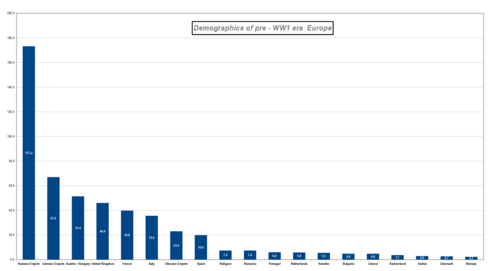
Demography
.jpg/500px-Dr_Heinrich_Berghaus'_physikalischer_Atlas_1852_(135750003).jpg)

Imperial census of 1897
According to returns published in 1905, based on the Russian Empire census of 1897, adherents of the different religious communities in the empire numbered approximately as follows.
Russian Central Asia
Russian Central Asia was also called Turkestan. As of the 1897 census, Russian Central Asia's five oblasts contained 5,260,300 inhabitants, 13.9 percent of them urban. The largest towns were Tashkent (156,400), Kokand (82,100), Namangan (61,900), and Samarkand (54,900). By 1911, 17 percent of Semireche's population and half of its urban residents were Russians, four-fifths of them agricultural colonists. In the other four oblasts in the same year, Russians constituted only 4 percent of the population, and the overwhelming majority lived in European-style settlements alongside the native quarters in the major towns.[171]
Military
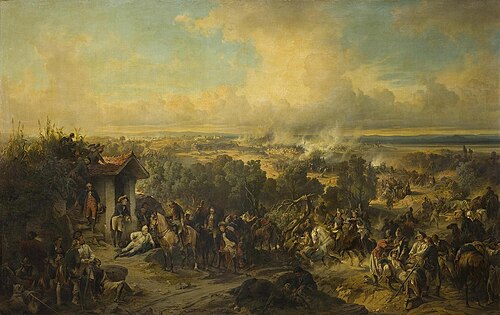

The military of the Russian Empire consisted of the Imperial Russian Army and the Imperial Russian Navy. Its poor performance during the Crimean War of 1853–56 caused great soul-searching and resulted in proposals for reform. However, the Russian forces fell further behind the technology, training, and organization of the German, French, and particularly the British militaries.[172]
The army performed poorly in World War I and became a center of unrest and revolutionary activity. The events of the February Revolution and the fierce political struggles inside army units led to irreversible disintegration.[173]
Society
The Russian Empire was predominantly a rural society spread over vast spaces. In 1913, 80% of the people were peasants. Soviet historiography proclaimed that the Russian Empire of the 19th century was characterized by systemic crisis, which impoverished the workers and peasants and culminated in the revolutions of the early 20th century. Recent research by Russian scholars disputes this interpretation. Mironov assesses the effects of the reforms of latter 19th-century, especially in terms of the 1861 emancipation of the serfs, agricultural output trends, various standard of living indicators, and taxation of peasants. He argues that those reforms brought about measurable improvements in social welfare. More generally, he finds that the well-being of the Russian people declined during most of the 18th century but increased slowly from the end of the 18th century to 1914.[174]
Estates
Subjects of the Russian Empire were segregated into sosloviyes, or social estates (classes) such as nobility (dvoryanstvo), clergy, merchants, cossacks, and peasants. Native people of the Caucasus, non-ethnic Russian areas such as Tatarstan, Bashkortostan, Siberia, and Central Asia were officially registered as a category called inorodtsy (non-Slavic, literally: "people of another origin").
A majority of the population, 81.6%, belonged to the peasant order. The other classes were the nobility, 0.6%; clergy, 0.1%; the burghers and merchants, 9.3%; and military, 6.1%. More than 88 million Russians were peasants, some of whom were former serfs (10,447,149 males in 1858) – the remainder being "state peasants" (9,194,891 males in 1858, exclusive of the Archangel governorate) and "domain peasants" (842,740 males the same year).
- Other status
Serfdom


The serfdom that had developed in Russia in the 16th century, and had become enshrined in law in 1649, was abolished in 1861.[175][176]
Household servants or dependents attached to personal service were merely set free, while the landed peasants received their houses and orchards, and allotments of arable land. These allotments were given over to the rural commune, the mir, which was responsible for the payment of taxes for the allotments. For these allotments the peasants had to pay a fixed rent, which could be fulfilled by personal labour. The allotments could be redeemed by peasants with the help of the Crown, and then they were freed from all obligations to the landlord. The Crown paid the landlord and the peasants had to repay the Crown, for forty-nine years at 6% interest. The financial redemption to the landlord was not calculated on the value of the allotments but was considered as compensation for the loss of the compulsory labour of the serfs. Many proprietors contrived to curtail the allotments that the peasants had occupied under serfdom, and frequently deprived them of precisely that land of which they were most in need: pasture lands around their houses. The result was to compel the peasants to rent land from their former masters.[177][178]
Serfs lived in deplorable conditions, working in the fields for nearly seven days a week and being exiled to the harsh land of Siberia or sent to military service. Owners had the right to sell slaves, depending on whether they were targeting land or accused (i.e., had escaped from working). Children of serfs received less education. These serfs were heavily taxed, making them the poorest in any Russians.[134] In 1861, Emperor Alexander II saw serfs as a problem that held back Russia's development, so he liberated 23 million serfs to become free,[179] but they remained indigent throughout the former enslaved population despite their rights. The zemstvo system was introduced in 1865 as a rural assembly with administrative authority over the local population, including education and welfare, which ex-serfs were unable to acquire.
- Exceptional status
Peasants


The former serfs became peasants, joining the millions of farmers who already had peasant status.[178][176] Most peasants lived in tens of thousands of small villages under a highly patriarchal system. Hundreds of thousands moved to cities to work in factories, but they typically retained their village connections.[180]
After Emancipation reform, one-quarter of peasants received allotments of only 1.2 hectares (2.9 acres) per male, and one-half received less than 3.4 to 4.6 hectares (8.5 to 11.4 acres); the normal size of the allotment necessary for the subsistence of a family under the three-fields system is estimated at 11 to 17 hectares (28 to 42 acres). This land was of necessity rented from the landlords. The aggregate value of the redemption and land taxes often reached 185 to 275% of the normal rental value of the allotments, not to speak of taxes for recruiting purposes, the church, roads, local administration, and so on, chiefly levied on the peasants. This burden increased every year; consequently, one-fifth of the inhabitants left their houses and cattle disappeared. Every year more than half the adult males (in some districts three-quarters of the men and one-third of the women) quit their homes and wandered throughout Russia in search of work. In the governments of the Black Earth Area the state of matters was hardly better. Many peasants took "gratuitous allotments", whose amount was about one-eighth of the normal allotments.[181]
The average allotment in Kherson was only 0.36 hectares (0.90 acres), and for allotments from 1.2 to 2.3 hectares (2.9 to 5.8 acres) the peasants paid 5 to 10 rubles in redemption tax. The state peasants were better off; but they, too, were emigrating in masses. It was only in the steppe that the situation was more hopeful. In Ukraine, where the allotments were personal (the mir existing only among state peasants), the state of affairs was not better, on account of high redemption taxes. In the western provinces, where the land was more cheaply valued and the allotments somewhat increased after the Polish insurrection, the situation was better. Finally, in the Baltic provinces nearly all the land belonged to the German landlords, who either farmed the land themselves, with hired laborers, or let it in small farms. Only one-quarter of the peasants were farmers; the remainder were mere laborers.[182]
Landowners
The situation of the former serf-proprietors was also unsatisfactory. Accustomed to the use of compulsory labor, they failed to adapt to the new conditions. The millions of rubles of redemption money received from the crown was spent without any real or lasting agricultural improvements having been effected. The forests were sold, and the only prosperous landlords were those who exacted rack-rents for the land allotted to peasants. There was an increase of wealth among the few, but along with this a general impoverishment of the mass of the people. Added to this, the peculiar institution of the mir—framed on the principle of community ownership and occupation of the land—the overall effect was not encouraging of individual effort.
During the years 1861 to 1892 the land owned by the nobles decreased 30%, or from 850,000 to 610,000 km2 (210,000,000 to 150,000,000 acres); during the following four years an additional 8,577 km2 (2,119,500 acres) were sold; and since then the sales went on at an accelerated rate, until in 1903 alone close to 8,000 km2 (2,000,000 acres) passed out of their hands. On the other hand, since 1861, and more especially since 1882, when the Peasant Land Bank was founded for making advances to peasants who were desirous of purchasing land, the former serfs, or rather their descendants, had between 1883 and 1904 bought about 78,900 km2 (19,500,000 acres) from their former masters.
In November 1906, however, Emperor Nicholas II promulgated a provisional order permitting the peasants to become freeholders of allotments made at the time of emancipation, all redemption dues being remitted. This measure, which was endorsed by the third Duma in an act passed on 21 December 1908, was calculated to have far-reaching and profound effects on the rural economy of Russia. Thirteen years previously the government had endeavored to secure greater fixity and permanence of tenure by providing that at least twelve years must elapse between every two redistributions of the land belonging to a mir amongst those entitled to share in it. The order of November 1906 provided that the various strips of land held by each peasant should be merged into a single holding; the Duma, however, on the advice of the government, left its implementation to the future, regarding it as an ideal that could only gradually be realized.[182]
Media
Censorship was heavy-handed until the reign of Alexander II, but it never went away.[183] Newspapers were strictly limited in what they could publish, and intellectuals favored literary magazines for their publishing outlets. Fyodor Dostoyevsky, for example, ridiculed the St. Petersburg newspapers, such as Golos and Peterburgskii Listok, which he accused of publishing trifles and distracting readers from the pressing social concerns of contemporary Russia through their obsession with spectacle and European popular culture.[184]
Education

Educational standards were very low in the Russian Empire, though they slowly increased in its last century of existence. By 1800, the level of literacy among male peasants ranged from 1 to 12 percent and from 20 to 25 percent for urban men. Literacy among women was very low. Literacy rates were highest for the nobility (84 to 87 percent), merchants (over 75 percent), then the workers and peasants. Serfs were the least literate. In every group, women were far less literate than men. By contrast in Western Europe, urban men had about a 50 percent literacy rate. The Orthodox hierarchy was suspicious of education, seeing no religious need for literacy whatsoever. Peasants did not need to be literate, and those who did — such as artisans, businessmen, and professionals — were few in number. As late as 1851, only 8% of Russians lived in cities.[185]
The accession in 1801 of Alexander I (1801–1825) was widely welcomed as an opening to fresh liberal ideas from the European Enlightenment. Many reforms were promised, but few were actually carried out before 1820 when the emperor turned his attention to foreign affairs and personal religion and ignored reform issues. In sharp contrast to Western Europe, the entire empire had a very small bureaucracy – about 17,000 public officials, most of whom lived in two of the largest cities, Moscow and Saint Petersburg. Modernization of government required much larger numbers; but that, in turn, required an educational system that could provide suitable training. Russia lacked that, and for university education, young men went to Western Europe. The army and the church had their own training programs, narrowly focused on their particular needs. The most important successful reform under Alexander I was the creation of a national system of education.[186]

The Ministry of Education was established in 1802, and the country was divided into six educational regions. The long-term plan was for a university in every region, a secondary school in every major city, upgraded primary schools, and – serving the largest number of students – a parish school for every two parishes. By 1825, the national government operated six universities, forty-eight secondary state schools, and 337 improved primary schools. Highly qualified teachers arrived from France, fleeing the revolution there. Exiled Jesuits set up elite boarding schools until their order was expelled in 1815. At the highest level, universities were based on the German model—in Kazan, Kharkov, St. Petersburg, Vilna (refounded as the Imperial University in 1803) and Dorpat—while the relatively young Imperial Moscow University was expanded. The higher forms of education were reserved for a very small elite, with only a few hundred students at the universities by 1825 and 5500 in the secondary schools. There were no schools open to girls. Most rich families still depended on private tutors.[187]
Emperor Nicholas I was a reactionary who wanted to neutralize foreign ideas, especially those he ridiculed as "pseudo-knowledge". Nevertheless, his minister of education, Sergey Uvarov, at the university level promoted more academic freedom for the faculty, who were under suspicion by reactionary church officials. Uvarov raised academic standards, improved facilities, and opened the admission doors a bit wider. Nicholas tolerated Uvarov's achievements until 1848, then reversed his innovations.[188] For the rest of the century, the national government continued to focus on universities, and generally ignored elementary and secondary educational needs. By 1900 there were 17,000 university students, and over 30,000 were enrolled in specialized technical institutes. The students were conspicuous in Moscow and Saint Petersburg as a political force typically at the forefront of demonstrations and disturbances.[189] The majority of tertiary institutions in the empire used Russian, while some used other languages but later underwent Russification.[190] Other educational institutions in the empire included the Nersisian School in Tiflis.
See also

- Expansion of Russia (1500–1800)
- Panjdeh incident - Russian conquest of Afghanistan
- Russian imperialism
Notes
- ^ Principalities of Moldavia and Wallachia in 1829–1856.
- ^ In 1914, the city was renamed Petrograd to reflect anti-German sentiments of Russia during World War I.[1]
- ^ As Chairman of the Committee of Ministers.
- ^ As Prime Minister.
- ^ Russian: Россійская Имперія, romanized: Rossiyskaya Imperiya, IPA: [rɐˈsʲijskəjə ɪmˈpʲerʲɪjə] ; Российская Империя in modern Russian spelling.
- ^ Historiographically known as Imperial Russia, Tsarist Russia, pre-revolutionary Russia, or simply Russia.
- ^ First and only census carried out in the Russian Empire.
- ^ Russian: Отец отечества, romanized: Otets otechestva, IPA: [ɐˈtʲet͡s ɐˈtʲet͡ɕɪstvə]
- ^ Russian: Император и Самодержец Всероссийский, romanized: Imperator i Samoderzhets Vserossiyskiy
- ^ Originally there was no distinction between the titles tsar and imperator. However, tsar was also used to refer to other monarchs below the rank of "emperor" (according to the Western European view), and thus Westerners began to translate tsar as rex ("king"). By adopting the title imperator, Peter claimed equality to the Holy Roman Emperor.[25][26]
- ^ A ukaz of 1879 gave the governors the right to report secretly on the qualifications of candidates for the office of justice of the peace. In 1889, Alexander III abolished the election of justices of the peace, except in certain large towns and some outlying parts of the Empire, and greatly restricted the right of trial by jury. The combining of judicial and administrative functions was introduced again by the appointment of officials as judges. In 1909, the third Duma restored the election of justices of the peace.
- ^ Russian: барщина, IPA: [ˈbarɕːɪnə]
- ^ Russian: оброк, IPA: [ɐˈbrok]
- ^ The Lutheran Church was the dominant faith of the Baltic Provinces, of Ingria, and of the Grand Duchy of Finland
References
- ^ "St. Petersburg through the Ages". St. Petersburg International Economic Forum. Archived from the original on 6 August 2022. Retrieved 6 August 2022.
- ^ "18th Century in the Russian History", Rusmania. Archived 19 March 2022 at the Wayback Machine.
- ^ Coleman, Heather J. (2014). Orthodox Christianity in Imperial Russia: A Source Book on Lived Religion. Indiana University Press. p. 4. ISBN 978-0-2530-1318-7.
After all, Orthodoxy was both the majority faith in the Russian Empire – approximately 70 percent subscribed to this faith in the 1897 census–and the state religion.
- ^ Williams, Beryl (1 December 1994). "The concept of the first Duma: Russia 1905–1906". Parliaments, Estates and Representation. 14 (2): 149–158. doi:10.1080/02606755.1994.9525857.
- ^ "The Sovereign Emperor exercises legislative power in conjunction with the State Council and State Duma". Fundamental Laws, "Chapter One On the Essence of Supreme Sovereign Power Article 7." Archived 8 June 2019 at the Wayback Machine
- ^ Taagepera, Rein (September 1997). "Expansion and Contraction Patterns of Large Polities: Context for Russia". International Studies Quarterly. 41 (3): 475–504. doi:10.1111/0020-8833.00053. JSTOR 2600793. Archived from the original on 19 November 2018. Retrieved 28 June 2019.; Turchin, Peter; Adams, Jonathan M.; Hall, Thomas D. (December 2006). "East-West Orientation of Historical Empires". Journal of World-Systems Research. 12 (2): 223. ISSN 1076-156X. Archived from the original on 17 September 2016. Retrieved 11 September 2016.
- ^ "The Price of Expansion: The Nationality Problem in Russia of the Eighteenth-Early Twentieth Centuries". Slavic Research Center. Archived from the original on 8 March 2023. Retrieved 20 July 2024.
- ^ "Population of the Major European Countries in the 19th Century". Wesleyan University. Archived from the original on 28 February 2024. Retrieved 20 July 2024.
- ^ "Population of Russia and the USSR, 1913 to 1928". Research Gate. Retrieved 20 July 2024.
- ^ Pipes 1974, p. 83.
- ^ "The Great Game, 1856–1907: Russo-British Relations in Central and East Asia | Reviews in History". reviews.history.ac.uk. Archived from the original on 10 April 2022. Retrieved 8 October 2021.
- ^ "Russian Empire". Encyclopædia Britannica. Archived from the original on 25 December 2022. Retrieved 14 August 2022.
- ^ a b Swain, Geoffrey (2014). Trotsky and the Russian Revolution. Routledge. p. 15. ISBN 978-1-3178-1278-4. OL 37192398M. Archived from the original on 19 September 2015. Retrieved 20 June 2015.
The first government to be formed after the February Revolution of 1917 had, with one exception, been composed of liberals.
- ^ Rabinowitch, Alexander (2008). The Bolsheviks in Power: The First Year of Soviet Rule in Petrograd. Indiana UP. p. 1. ISBN 978-0-2532-2042-4. Archived from the original on 10 September 2015. Retrieved 20 June 2015.
- ^ Planert, Ute; Retallack, James, eds. (2017). Decades of Reconstruction. Cambridge University Press. p. 331. ISBN 978-1-1071-6574-8. Archived from the original on 11 February 2023. Retrieved 5 January 2023.
- ^ Bushkovitch, Paul (2012). A Concise History of Russia. New York: Cambridge University Press. p. 48. ISBN 978-0-5215-4323-1. Archived from the original on 23 April 2023. Retrieved 30 December 2023.
Ivan III in his own time already had the reputation of the builder of the Russian state... The consolidation of Russia as a state was not just a territorial issue, for Ivan also began the development of a state apparatus...
; Millar, James R. (2004). Encyclopedia of Russian History. New York: Macmillan Reference USA. p. 687. ISBN 978-0-0286-5693-9. Archived from the original on 26 October 2023. Retrieved 30 December 2023.Under Ivan III's reign, the uniting of separate Russian principalities into a centralized state made great and rapid progress.
- ^ Moss, Walter G. (2003). A History of Russia Volume 1: To 1917. Anthem Press. p. 88. ISBN 978-0-8572-8752-6.
Ivan III (1462–1505) and his son, Vasili III (1505–1533), completed Moscow's quest to dominate Great Russia. Of the two rulers, Ivan III (the Great) accomplished the most, and Russian historians have called him 'the gatherer of the Russian lands'.
- ^ Moss 2003, p. 131.
- ^ Catchpole 1974, pp. 8–31; Gilbert, Martin. Atlas of Russian history (1993) pp 33–74.
- ^ Catchpole 1974, p. 25; "Первая всеобщая перепись населения Российской Империи 1897 г." [First general census of the population of the Russian Empire in 1897]. Demoscope Weekly (in Russian). Archived from the original on 4 February 2012. Retrieved 26 March 2021.
- ^ Anisimov, Yevgeniya (2017). "Peter I". Great Russian Encyclopedia [in electronic source] (in Russian). Archived from the original on 4 January 2022. Retrieved 20 November 2022.
- ^ a b c "Perspective | Russian Orthodox Old Believers: Keeping their faith and fighting fires in the West Siberian Plain". Washington Post. 26 May 2017. Archived from the original on 13 November 2020. Retrieved 15 October 2021.
- ^ Osipov, Yuriy, ed. (2015). "The Great Northern War 1700–21". Romania to Saint-Jean-de-Luz. Great Russian Encyclopedia. 2004–2017 (in Russian). Vol. 29. pp. 617–20. ISBN 978-5-8527-0366-8. Archived from the original on 17 April 2021. Retrieved 20 November 2022.
- ^ "Прошение сенаторов к царю Петру I о принятии им титула "Отца Отечества, императора Всероссийского, Петра Великого"" [Petition of the senators to Tsar Peter I for the adoption of the title of "Father of the Fatherland, Emperor of all the Russias, Peter the Great"]. Russian educational portal | Historical documents. Archived from the original on 29 August 2018. Retrieved 9 July 2018.
- ^ Madariaga, Isabel De (2014). Politics and Culture in Eighteenth-Century Russi. Routledge. pp. 40–42. ISBN 978-1-317-88190-2.
This explains much of the difficulty encountered by Peter I when he adopted the title Imperator. The etymological origin of the word tsar had been glossed over and the title had been devalued.
- ^ Ageyeva, Olga (1999). "ТИТУЛ "ИМПЕРАТОР" И ПОНЯТИЕ "ИМПЕРИЯ" В РОССИИ В ПЕРВОЙ ЧЕТВЕРТИ XVIII ВЕКА" [The title "emperor" and the concept of "empire" in Russia in the first quarter of the 18th century]. World of History: Russian Electronic Journal (in Russian) (5). Archived from the original on 16 March 2022.
- ^ Solovyov, Yevgeny (2006). Петр I в Отечественной Историографии: Конца XVIII – Начала XX ВВ [Peter I in Russian historiography of the late 18th – early 20th centuries] (Doctor of Historical Sciences thesis) (in Russian). Moscow. Archived from the original on 7 July 2018.
- ^ Drozdek, Adam (2021). Theological Reflection in Eighteenth-Century Russia. Rowman & Littlefield. pp. x. ISBN 978-1-7936-4184-7.
- ^ Dubakov, Maxim Valentinovich (2004). Промышленно-торговая политика Петра 1 [Industrial and trade policy of Peter I] (Dissertation abstract thesis) (in Russian). Moscow. Archived from the original on 14 April 2018. Retrieved 4 April 2023.
- ^ Yarysheva, Svetlana (2001). Formation of the system of Russian education during the reforms of Peter I (Abstract dissertion thesis) (in Russian). Pyatigorsk. Archived from the original on 29 June 2018. Retrieved 20 November 2022.
- ^ Novosyolova, Nataliya Ivanovna (1999). Внешняя торговля и финансово-экономическая политика Петра I [Foreign trade and financial and economic policy of Peter I] (Abstract dissertion thesis) (in Russian). Saint Petersburg. Archived from the original on 29 June 2018. Retrieved 5 April 2023.
- ^ Pipes 1974, pp. 9–10, Chapter 1: The Environment and its Consequences.
- ^ Cracraft, James (2003). The Revolution of Peter the Great. Harvard University Press. ISBN 978-0-6740-1196-0.
- ^ "BOUNDARIES ii. With Russia". iranicaonline.org. Archived from the original on 5 September 2021. Retrieved 15 October 2021.
- ^ Hughes 1998.
- ^ Philip Longworth and John Charlton, The Three Empresses: Catherine I, Anne and Elizabeth of Russia (1972).
- ^ Isabel De Madariaga, Russia in the Age of Catherine the Great (Yale University Press, 1981)
- ^ John T. Alexander, Autocratic politics in a national crisis: the Imperial Russian government and Pugachev's revolt, 1773–1775 (1969).
- ^ Massie, Robert K. (2011). Catherine the Great: Portrait of a Woman. Random House. ISBN 978-1-5883-6044-1.
- ^ Nikitin, Aleksandr Aleksandrovich (29 October 2021). "Legal Basis of Control and Prevention of Crimes by Subaltern Officers in Russian Empire". Law, Economics and Management. Publishing house Sreda: 176–178. doi:10.31483/r-99727. ISBN 978-5-907411-75-3.
- ^ Semyonov, Alexander (1 January 2010), "The Real and Live Ethnographic Map of Russia: The Russian Empire in The Mirror of The State Duma", Empire Speaks Out, BRILL, pp. 191–228, doi:10.1163/ej.9789004175716.i-280.35, ISBN 978-9-0474-2915-9, retrieved 22 May 2024
- ^ Waldron 1997, p. [page needed].
- ^ Catherine II. Novodel Sestroretsk Rouble 1771, Heritage Auctions, archived from the original on 22 April 2016, retrieved 1 September 2015
- ^ Nicholas Riasanovsky, A History of Russia (4th ed. 1984), p 284
- ^ Dowling 2014, p. 24.
- ^ Dowling 2014, p. 801.
- ^ Palmer, Alan (1967). Napoleon in Russia. Simon and Schuster.
- ^ Strakhovsky, Leonid Ivan (1970). Alexander I of Russia: the man who defeated Napoleon.
- ^ Baykov, Alexander. "The economic development of Russia." Economic History Review 7.2 (1954): 137–149.
- ^ Lincoln, W. Bruce (1978). Nicholas I, Emperor and Autocrat of All the Russias.
- ^ Mazour, Anatole Gregory (1961). The first Russian revolution, 1825: the Decembrist movement, its origins, development, and significance.
- ^ Stein 1976.
- ^ Dowling 2014, p. 728.
- ^ Dowling 2014, p. 729.
- ^ Lang, David Marshall (1957). The last years of the Georgian monarchy, 1658–1832.
- ^ Burant, Stephen R. (1985). "The January Uprising of 1863 in Poland: Sources of Disaffection and the Arenas of Revolt". European History Quarterly. 15 (2): 131–156. doi:10.1177/026569148501500201.
- ^ a b Haynes, Margaret (2017). Tsarist and Communist Russia 1855–1964. Oxford: University Press. p. 23. ISBN 978-0-1984-2144-3. Archived from the original on 27 February 2024. Retrieved 11 March 2022.
- ^ Davies, Norman (1981). God's Playground: A History of Poland. Vol. 2. Oxford University Press. pp. 315–333, 352–63.
- ^ Radzinsky, Edvard (2006). Alexander II: The Last Great Tsar. Simon and Schuster. ISBN 978-0-7432-8426-4.
- ^ Baten, Jörg (2016). A History of the Global Economy. From 1500 to the Present. Cambridge University Press. p. 81. ISBN 978-1-1075-0718-0.
- ^ David Moon, The abolition of serfdom in Russia 1762–1907 (Longman, 2001)
- ^ Polunov, Alexander Y.; Owen, Thomas C.; Zakharova, Larisa G. (2015). Russia in the Nineteenth Century: Autocracy, Reform, and Social Change, 1814–1914. Routledge. p. 164. ISBN 978-1-3174-6049-7. Archived from the original on 21 January 2023. Retrieved 21 January 2023.
- ^ Akinsha, Konstantin; Kozlov, Georgi; Hochfleid, Sylvya (2008). The Holy Place: Architecture, Ideology, and History in Russia. Yale University Press. p. 74. ISBN 978-0-3001-4497-0. Archived from the original on 17 January 2023. Retrieved 21 January 2023.; Borrero, Mauricio (2009). Russia: A Reference Guide from the Renaissance to the Present. Infobase Publishing. p. 54. ISBN 978-0-8160-7475-4. Archived from the original on 20 January 2023. Retrieved 21 January 2023.
- ^ Jones, Preston (2017). The Fires of Patriotism: Alaskans in the Days of the First World War 1910–1920. University of Alaska Press. p. 21. ISBN 978-1-6022-3206-8.
- ^ Grinev, Andrei V. (18 February 2010). "The Plans for Russian Expansion in the New World and the North Pacific in the Eighteenth and Nineteenth Centuries". European Journal of American Studies. 5 (2). doi:10.4000/ejas.7805. ISSN 1991-9336. Archived from the original on 2 February 2022. Retrieved 2 February 2022.
- ^ Chapman 2002, p. 113.
- ^ a b Chapman 2002, p. 114.
- ^ Geoffrey 2011, p. 315.
- ^ Geoffrey 2011, p. 316.
- ^ Waldron 1997, p. 121.
- ^ Seton-Watson 1967, pp. 445–460.
- ^ Charles Lowe, Alexander III of Russia (1895) online Archived 18 January 2017 at the Wayback Machine; Byrnes, Robert F. (1968). Pobedonostsev: His Life and Thought. Indiana University Press.
- ^ Schimmelpenninck Van Der Oye, David. Russian foreign policy, 1815–1917. pp. 554–574. in Lieven 2006
- ^ Seton-Watson 1967, pp. 441–444, 679–682.
- ^ Andreev, A. I. (2003). Soviet Russia and Tibet: the debacle of secret diplomacy, 1918-1930s. Leiden: Brill. pp. 13–15, 37, 67, 96. ISBN 9-0041-2952-9. OCLC 51330174. Archived from the original on 24 January 2023. Retrieved 22 March 2023.
In the days of the Great Game, Mongolia was an object of imperialist encroachment by Russia, as Tibet was for the British.
- ^ Connaughton, Richard (January 2002). "Port Arthur Revisited". HistoryToday.com.
- ^ Jelavich, Barbara (1974). St. Petersburg and Moscow: Tsarist and Soviet Foreign Policy, 1814–1974. pp. 161–279. OCLC 299007. OL 5911156M.
- ^ Ascher, Abraham (2004). "Coup d'État". The Revolution of 1905: A Short History. Stanford University Press. pp. 187–210. ISBN 978-0-8047-5028-8. OL 3681754M. Retrieved 19 March 2023.; Harcave, Sidney (1964). "The "Two Russias"". First blood: the Russian Revolution of 1905. Macmillan. OCLC 405923. OL 5918954M.
- ^ Warth, Robert D. (1997). Nicholas II: the life and reign of Russia's last monarch.
- ^ Lieven 2006, p. 391.
- ^ Freeze 2002, pp. 234–268.
- ^ Seton-Watson, Hugh (1952). The Decline of Imperial Russia, 1855–1914. pp. 277–280.
- ^ Radkey, Oliver H. (1953). "An Alternative to Bolshevism: The Program of Russian Social Revolutionism". Journal of Modern History. 25 (1): 25–39. doi:10.1086/237562.
- ^ Cavendish, Richard (2003). "The Bolshevik-Menshevik split November 16th, 1903". History Today. 53 (11): 64ff.
- ^ Ascher 2004, pp. 160–186.
- ^ Garver, John W. (2015). China's Quest: The History of the Foreign Relations of the People's Republic of China. Oxford University Press. p. 764. ISBN 978-0-1908-8435-2. Archived from the original on 28 December 2022. Retrieved 10 January 2023.
- ^ Fromkin, David (2010). A Peace to End All Peace: The Fall of the Ottoman Empire and the Creation of the Modern Middle East. Henry Holt and Company. p. 208. ISBN 978-1-4299-8852-0. Archived from the original on 29 December 2022. Retrieved 10 January 2023.
- ^ Lieven 2015, p. 82.
- ^ Fortescue, William (2017). The Third Republic in France, 1870–1940: Conflicts and Continuities. Routledge. p. 109. ISBN 978-1-3515-4000-1. Archived from the original on 29 December 2022. Retrieved 10 January 2023.
- ^ Waldron 1997, p. 132.
- ^ Yorulmaz, Naci (2014). Arming the Sultan: German Arms Trade and Personal Diplomacy in the Ottoman Empire Before World War I. Bloomsbury Publishing. p. 40. ISBN 978-0-8577-2518-9. Archived from the original on 29 December 2022. Retrieved 10 January 2023.
- ^ Lieven 2015, p. 241.
- ^ Lieven 2015, p. 2.
- ^ McMeekin 2011, p. 88.
- ^ Hamilton, Richard F.; Herwig, Holger, eds. (2003). The Origins of World War I. Cambridge University Press. p. 180. ISBN 978-0-5218-1735-6. Archived from the original on 27 December 2022. Retrieved 30 December 2022.
- ^ Lieven 2015, p. 338.
- ^ Ruthchild, Rochelle (2010). Equality and Revolution. University of Pittsburgh Press. p. 255. ISBN 978-0-8229-7375-1. Archived from the original on 27 December 2022. Retrieved 30 December 2022.
- ^ Goldman, Emily (2011). Power in Uncertain Times: Strategy in the Fog of Peace. Stanford University Press. p. 40. ISBN 978-0-8047-7433-8. Archived from the original on 27 December 2022. Retrieved 30 December 2022.
- ^ Zabecki, David T. (2014). Germany at War: 400 Years of Military History. ABC-CLIO. p. 371. ISBN 978-1-5988-4981-3. Archived from the original on 4 January 2023. Retrieved 5 January 2023.
- ^ McNally, Michael (2022). Tannenberg 1914: Destruction of the Russian Second Army. Bloomsbury. p. 61. ISBN 978-1-4728-5020-1. Archived from the original on 26 December 2022. Retrieved 30 December 2022.
- ^ Tucker 2014, p. 1048.
- ^ Tucker, Spencer C.; Roberts, Priscilla M., eds. (2005). World War I: Encyclopedia. Vol. 1. ABC-CLIO. p. 380. ISBN 978-1-8510-9420-2. Archived from the original on 26 December 2022. Retrieved 30 December 2022.
- ^ Tucker 2019, p. 468.
- ^ Sondhaus, Lawrence (2020). World War One. Cambridge University Press. p. 114. ISBN 978-1-1084-9619-3. Archived from the original on 27 December 2022. Retrieved 30 December 2022.
- ^ Kalic, Sean N.; Brown, Gates M. (2017). Russian Revolution of 1917: The Essential Reference Guide. ABC-CLIO. p. 180. ISBN 978-1-4408-5093-6. Archived from the original on 28 December 2022. Retrieved 30 December 2022.
- ^ Tucker, Spencer C., ed. (2014a). 500 Great Military Leaders. ABC-CLIO. p. 556. ISBN 978-1-5988-4758-1. Archived from the original on 28 December 2022. Retrieved 30 December 2022.
- ^ Jahn, Hubertus (1998). Patriotic Culture in Russia During World War I. Cornell University Press. p. 9. ISBN 978-0-8014-8571-8. Archived from the original on 27 December 2022. Retrieved 30 December 2022.
- ^ Horne, John (2012). A Companion to World War I. John Wiley & Sons. p. 449. ISBN 978-1-1199-6870-2. Archived from the original on 27 December 2022. Retrieved 30 December 2022.
- ^ Sanborn 2014, p. 30.
- ^ Sanborn 2014, p. 66.
- ^ Sanborn 2014, p. 125–126.
- ^ Tucker 2014, p. 514.
- ^ McMeekin 2011, p. 111–112.
- ^ McMeekin 2011, p. 114.
- ^ Tucker 2019, p. 524.
- ^ Andrew Cook, To kill Rasputin: the life and death of Grigori Rasputin (2011).
- ^ Pipes 2011, p. 77–78.
- ^ Pipes 2011, p. 79.
- ^ Pipes 2011, p. 90–91.
- ^ Martin Gilbert, Routledge Atlas of Russian History (4th ed. 2007) Gilbert, Martin (2007). The Routledge Atlas of Russian History. Routledge. ISBN 978-0415394840.
- ^ Kissinger, Henry (1994). Diplomacy. Simon & Schuster Paperbacks. p. 142. ISBN 978-0-6716-5991-2. OCLC 29428792. OL 1432465M.
- ^ Dowling 2014, p. 728–730.
- ^ Stepanov, Valerii L. (2009). "Revisiting Russian Conservatism". Russian Studies in History. 48 (2): 3–7. doi:10.2753/RSH1061-1983480200.
- ^ Martin, Alexander M. (1997). Romantics, Reformers, Reactionaries: Russian Conservative Thought and Politics in the Reign of Alexander I.
- ^ Wolfe, Bertram D. (2018). Revolution and Reality. University of North Carolina Press Books. p. 349. ISBN 978-1-4696-5020-3.
- ^ Plokhy, Serhii (2010). The origins of the Slavic nations: premodern identities in Russia, Ukraine, and Belarus (1st ed.). Cambridge: Cambridge University Press. p. 285. ISBN 978-0-5211-5511-3.
- ^ "Fundamental Laws of the Russian Empire". chapter1, article 7. Archived from the original on 31 March 2017.
- ^ Chapman 2002, p. 3.
- ^ Chapman 2002, p. 5.
- ^ Chapman 2002, p. 49.
- ^ Chapman 2002, p. 129.
- ^ Chapman 2002, p. 130.
- ^ Chapman 2002, p. 131.
- ^ a b Chapman 2002, p. 4.
- ^ Waldron 1997, p. 27.
- ^ Ziegler, Charles E. (2009). The History of Russia. ABC-CLIO. p. 58. ISBN 978-0-3133-6307-8. Archived from the original on 16 January 2023. Retrieved 16 January 2023.
- ^ Waldron 1997, p. 55–56.
- ^ Walter Sperling, "Building a Railway, Creating Imperial Space: 'Locality,' 'Region,' 'Russia,' 'Empire' as Political Arguments in Post-Reform Russia", Ab Imperio (2006) Issue 2, pp. 101–134.
- ^ Sarah Searight, "Russian railway penetration of Central Asia", Asian Affairs (June 1992) 23#2 pp. 171–180.
- ^ Article 62 of the 1906 Fundamental Laws (previously, Article 40): "The primary and predominant Faith in the Russian Empire is the Christian Orthodox Catholic Faith of the Eastern Confession."
- ^ a b c d e f Kollmann, Nancy Shields (2017). The Russian Empire 1450–1801 (1st ed.). Oxford, United Kingdom: Oxford University Press. pp. 404, 407–408. ISBN 978-0-1992-8051-3. OCLC 969962873. Archived from the original on 27 February 2024. Retrieved 17 October 2021.
- ^ a b Davies, Franziska; Wessel, Martin Schulze; Brenner, Michael (2015). Jews and Muslims in the Russian Empire and the Soviet Union. Göttingen: Vandenhoeck & Ruprecht. pp. 47–52. ISBN 978-3-6473-1028-2. OCLC 930490047. Archived from the original on 27 February 2024. Retrieved 17 October 2021.
- ^ "1791: Catherine the Great Tells Jews Where They Can Live". Haaretz. Archived from the original on 17 October 2021. Retrieved 17 October 2021.
- ^ a b c d e f "The Pale of Settlement". www.jewishvirtuallibrary.org. Archived from the original on 15 October 2019. Retrieved 15 October 2021.
- ^ a b c d "Russia Virtual Jewish History Tour". www.jewishvirtuallibrary.org. Archived from the original on 23 April 2020. Retrieved 2 February 2022.
- ^ "Cantonists". www.jewishvirtuallibrary.org. Archived from the original on 2 February 2022. Retrieved 2 February 2022.
- ^ "Nicholas". www.jewishvirtuallibrary.org. Archived from the original on 2 February 2022. Retrieved 2 February 2022.
- ^ "This Day in Jewish History May Laws Punish Russia's Jews". Haaretz. Archived from the original on 28 October 2021. Retrieved 15 October 2021.
- ^ Brower, Daniel (1996). "Russian Roads to Mecca: Religious Tolerance and Muslim Pilgrimage in the Russian Empire". Slavic Review. 55 (3): 567–584. doi:10.2307/2502001. ISSN 0037-6779. JSTOR 2502001. S2CID 163469315. Archived from the original on 29 October 2021. Retrieved 15 October 2021.
- ^ a b Campbell, Elena I. (2015). The Muslim question and Russian imperial governance. Bloomington: Indiana University Press. pp. 1–25. ISBN 978-0-2530-1454-2. OCLC 902954232. Archived from the original on 26 March 2023. Retrieved 19 March 2023.
- ^ a b c Allen, Frank (2021). Muslim Religious Institutions in Imperial Russia: The Islamic World of Novouzensk District and the Kazakh Inner Horde, 1780–1910. Brill. pp. 1–3, 100. ISBN 978-9-0044-9232-5.
- ^ a b Crews, Robert D. (2006). For prophet and tsar : Islam and empire in Russia and Central Asia. Cambridge, Mass.: Harvard University Press. pp. 293–294. ISBN 0-6740-2164-9. OCLC 62282613. Archived from the original on 26 March 2023. Retrieved 19 March 2023.
- ^ Richmond, Walter (2013). "4: 1864". The Circassian Genocide. New Brunswick, New Jersey, US: Rutgers University Press. p. 76. ISBN 978-0-8135-6068-7.
- ^ Richmond, Walter (2013). The Circassian Genocide. New Brunswick, New Jersey, US: Rutgers University Press. ISBN 978-0-8135-6068-7.
- ^ Levene, Mark; Roberts, Penny (1999). "7: The Circassians: A Forgotten Genocide?". In Shenfield, Stephen D. (ed.). The Massacre in History. New York: Berghahn Books. pp. 149–162. ISBN 1-5718-1935-5. Archived from the original on 16 December 2023. Retrieved 22 August 2023.
The number who died in the Circassian catastrophe of the 1860s could hardly, therefore, have been fewer than one million, and may well have been closer to one-and-a-half million
; Ahmed, Akbar (2013). The Thistle and the Drone. Washington, D.C.: Brookings Institution Press. p. 357. ISBN 978-0-8157-2378-3.; Richmond, Walter (2013). "4: 1864". The Circassian Genocide. New Brunswick, New Jersey, US: Rutgers University Press. pp. 88–93. ISBN 978-0-8135-6068-7.; Cataliotti, Joseph (22 October 2023). "Circassian Genocide: Overview & History". Study.com. Archived from the original on 20 March 2023. Retrieved 22 August 2023.; "Circassian Genocide on its 159th Anniversary – Genocide is a Crime against Humanity!". Human Rights Association. 21 May 2023. Archived from the original on 22 August 2023. - ^ Richmond, Walter (2013). The Circassian Genocide. New Brunswick, New Jersey, US: Rutgers University Press. pp. 91, 92. ISBN 978-0-8135-6068-7.; Peach, Gary (10 November 2010). "Forgotten genocides of the Caucasus". Politico. Archived from the original on 25 October 2020.; Shenfield, Stephen D. (1999). "7: The Circassians: A Forgotten Genocide?". In Levene, Mark; Roberts, Penny (eds.). The Massacre in History. New York, NY, US: Berghahn Books. pp. 149–162. ISBN 1-5718-1935-5. Archived from the original on 27 February 2024. Retrieved 25 January 2024.; King, Charles (2008). "2: Rule and Resistance". A History of the Caucasus. New York, NY: Oxford University Press. pp. 96–98. ISBN 978-0-1951-7775-6. Archived from the original on 27 February 2024. Retrieved 25 January 2024.
- ^ King, Charles (2008). "2: Rule and Resistance". A History of the Caucasus. New York, NY: Oxford University Press. p. 98. ISBN 978-0-1951-7775-6. Archived from the original on 27 February 2024. Retrieved 25 January 2024.
- ^ Williams, Brian Glyn (2000). "Hijra and Forced Migration from Nineteenth-Century Russia to the Ottoman Empire. A Critical Analysis of the Great Crimean Tatar Emigration of 1860–1861". Cahiers du Monde russe. 41 (1): 79–108. doi:10.4000/monderusse.39. ISSN 1252-6576. JSTOR 20171169. S2CID 36114349.
- ^ Paert, Irina (1 February 2017). "The Tsar's Foreign Faiths: Toleration and the Fate of Religious Freedom in Imperial Russia by Paul W. Werth". The English Historical Review. 132 (554): 175–177. doi:10.1093/ehr/cew383. ISSN 0013-8266. Archived from the original on 27 February 2024. Retrieved 15 October 2021.
- ^ Stricker, Gerd (1 June 2001). "Lutherans in Russia since 1990". Religion, State and Society. 29 (2): 101–113. doi:10.1080/09637490120074792. ISSN 0963-7494. S2CID 145405540. Archived from the original on 27 February 2024. Retrieved 15 October 2021.
- ^ Binzley, Ronald A. (1 June 2017). "How the Jesuits Survived Their Suppression: The Society of Jesus in the Russian Empire (1773–1814), written by Mark Inglot, S.J." Journal of Jesuit Studies. 4 (3): 489–491. doi:10.1163/22141332-00403007. ISSN 2214-1324. Archived from the original on 17 October 2021. Retrieved 17 October 2021.
- ^ Zatko, James J. (1960). "The Roman Catholic Church and Its Legal Position under the Provisional Government in Russia in 1917". The Slavonic and East European Review. 38 (91): 476–492. ISSN 0037-6795. JSTOR 4205179. Archived from the original on 17 October 2021. Retrieved 17 October 2021.
- ^ Weeks, Ted (1 January 2011). ""Religion, Nationality, or Politics: Catholicism in the Russian Empire, 1863–1905"". Journal of Eurasian Studies. 2 (1): 52–59. doi:10.1016/j.euras.2010.10.008. ISSN 1879-3665. S2CID 145315419.
- ^ Rubinstein, Samara; Dulik, Matthew C.; Gokcumen, Omer; Zhadanov, Sergey; Osipova, Ludmila; Cocca, Maggie; Mehta, Nishi; Gubina, Marina; Posukh, Olga; Schurr, Theodore G. (2008). "Russian Old Believers: genetic consequences of their persecution and exile, as shown by mitochondrial DNA evidence". Human Biology. 80 (3): 203–237. doi:10.3378/1534-6617-80.3.203. ISSN 0018-7143. PMID 19130794. S2CID 9520618. Archived from the original on 27 October 2021. Retrieved 15 October 2021.
- ^ Hardwick, Susan W. (1993). "Religion and Migration: The Molokan Experience". Yearbook of the Association of Pacific Coast Geographers. 55: 127–141. ISSN 0066-9628. JSTOR 24040086. Archived from the original on 17 October 2021. Retrieved 17 October 2021.
- ^ Sainsbury, Brendan. "Canada's little-known Russian sect". www.bbc.com. Archived from the original on 17 October 2021. Retrieved 17 October 2021.
- ^ "On This Day: Nicholas II Signs Decree for "Tolerance Development"". The Moscow Times. 30 April 2019. Archived from the original on 29 October 2021. Retrieved 15 October 2021.
- ^ Sperber, Jonathan (2013). Europe 1850–1914 : progress, participation and apprehension. Oxon, England: Routledge. p. 325. ISBN 978-1-3158-3501-3. OCLC 874151263. Archived from the original on 26 March 2023. Retrieved 19 March 2023.; "Nicholas". www.jewishvirtuallibrary.org. Archived from the original on 2 February 2022. Retrieved 2 February 2022.; Masis, Julie. "In the former Soviet Union, statues and hero worship for leaders of pogroms". www.timesofisrael.com. Archived from the original on 27 April 2022. Retrieved 27 April 2022.
- ^ a b Radzinsky, Edvard (30 March 2011). The Last Tsar: The Life and Death of Nicholas II. Knopf Doubleday Publishing Group. pp. 69, 77, 79. ISBN 978-0-3077-5462-2. Archived from the original on 27 February 2024. Retrieved 27 April 2022.
To the tsar, the pogroms organized by the police seemed like a holy outburst of popular indignation against the revolutionaries
- ^ Первая всеобщая перепись населения Российской Империи 1897 г. Распределение населения по вероисповеданиям и регионам [First general census of the population of the Russian Empire in 1897. Distribution of the population by faiths and regions] (in Russian). archipelag.ru. Archived from the original on 24 October 2012.
- ^ Encyclopaedia of russian history, by James R. Miller, "Turkestan" entry
- ^ David R. Stone, A Military History of Russia: From Ivan the Terrible to the War in Chechnya (2006).
- ^ I. N. Grebenkin, "The Disintegration of the Russian Army in 1917: Factors and Actors in the Process." Russian Studies in History 56.3 (2017): 172–187.
- ^ Boris N. Mironov, "The Myth of a Systemic Crisis in Russia after the Great Reforms of the 1860s–1870s", Russian Social Science Review (July/Aug 2009) 50#4 pp 36–48.; Boris N. Mironov, The Standard of Living and Revolutions in Imperial Russia, 1700–1917 (2012) Mironov, Boris Nikolaevich (2012). The Standard of Living and Revolutions in Russia, 1700-1917. Routledge. ISBN 978-0415608541.
- ^ Elise Kimerling Wirtschafter, Russia's age of serfdom 1649–1861 (2008)
- ^ a b Jerome Blum, Lord and Peasant in Russia from the Ninth to the Nineteenth Century (1961)
- ^ Steven L. Hoch, Serfdom and social control in Russia: Petrovskoe, a village in Tambov (1989)
- ^ a b David Moon, The Russian Peasantry 1600–1930: The World the Peasants Made (1999)
- ^ Chapman 2002, p. 9.
- ^ Orlando Figes, "The Peasantry" in Vladimir IUrevich Cherniaev, ed. (1997). Critical Companion to the Russian Revolution, 1914–1921. Indiana UP. pp. 543–53. ISBN 0-2533-3333-4. Archived from the original on 27 February 2024. Retrieved 5 July 2019.
- ^ Steven Hoch, "Did Russia's Emancipated Serfs Really Pay Too Much for Too Little Land? Statistical Anomalies and Long-Tailed Distributions". Slavic Review (2004) 63#2 pp. 247–274.; Steven Nafziger, "Serfdom, emancipation, and economic development in Tsarist Russia" (Working paper, Williams College, 2012). online Archived 29 April 2014 at the Wayback Machine
- ^ a b Christine D. Worobec, Peasant Russia: family and community in the post-emancipation period (1991).
- ^ Louise McReynolds, News under Russia's Old Regime: The Development of a Mass-Circulation Press (1991).
- ^ Dianina, Katia (2003). "Passage to Europe: Dostoevskii in the St. Petersburg Arcade". Slavic Review. 62 (2): 237–257. doi:10.2307/3185576. JSTOR 3185576. S2CID 163868977.
- ^ Mironov, Boris N. (1991). "The Development of Literacy in Russia and the USSR from the Tenth to the Twentieth Centuries". History of Education Quarterly. 31 (2): 229–252. doi:10.2307/368437. JSTOR 368437. S2CID 144460404. esp p. 234.
- ^ Franklin A. Walker, "Enlightenment and religion in Russian education in the reign of Tsar Alexander I." History of Education Quarterly 32.3 (1992): 343–360.
- ^ Nicholas V. Riasanovsky, Russian Identities: A Historical Survey (2005) pp 112–18.
- ^ Stephen Woodburn, "Reaction Reconsidered: Education and the State in Russia, 1825–1848." Consortium on Revolutionary Europe 1750–1850: Selected Papers 2000 pp 423–31.
- ^ Hans Rogger, Russia in the Age of Modernisation and Revolution 1881 – 1917 (1983) p 126.
- ^ Strauss, Johann. "Language and power in the late Ottoman Empire" (Chapter 7). In: Murphey, Rhoads (editor). Imperial Lineages and Legacies in the Eastern Mediterranean: Recording the Imprint of Roman, Byzantine and Ottoman Rule (Volume 18 of Birmingham Byzantine and Ottoman Studies). Routledge, 7 July 2016. ISBN 1-3171-1844-8, 9781317118442. Google Books PT196 Archived 26 December 2022 at the Wayback Machine.
Works cited
- Catchpole, Brian (1974). A Map History of Russia. Heinemann Educational Publishers.
- Chapman, Tim (2002). Imperial Russia, 1801-1905. Routledge. ISBN 978-1-1345-7970-9. Archived from the original on 27 February 2024. Retrieved 13 January 2023.
- Dowling, Timothy C. (2014). Russia at War: From the Mongol Conquest to Afghanistan, Chechnya, and Beyond [2 volumes]. ABC-CLIO. ISBN 978-1-5988-4948-6. Archived from the original on 12 January 2023. Retrieved 12 May 2016.
- Freeze, George (2002). Russia: A History (2nd ed.). Oxford: Oxford University Press. p. 556. ISBN 978-0-1986-0511-9. Archived from the original on 26 March 2023. Retrieved 11 September 2017.
- Geoffrey, Hosking (2011). Russia and the Russians: A History (2nd ed.). Harvard University Press. ISBN 978-0-6740-6195-8. Archived from the original on 20 January 2023. Retrieved 5 January 2023.
- Hughes, Lindsey (1998). Russia in the Age of Peter the Great. New Haven, CT: Yale University Press. p. 640. ISBN 978-0-3000-8266-1. OL 358704M.
- Lieven, Dominic C. B., ed. (2006). The Cambridge History of Russia. Vol. II, Imperial Russia, 1689–1917. Cambridge University Press.
- Lieven, Dominic C. B. (2015). The End of Tsarist Russia: The March to World War I and Revolution. Penguin. ISBN 978-0-1431-0955-6. Archived from the original on 27 February 2024. Retrieved 10 January 2023.
- McMeekin, Sean (2011). The Russian Origins of the First World War. Harvard University Press. ISBN 978-0-6740-6210-8. Archived from the original on 7 January 2023. Retrieved 10 January 2023.
- Pipes, Richard (1974). Russia under the Old Regime. New York: Scribner. ISBN 978-0-6841-4041-4.
- Pipes, Richard (2011). A Concise History of the Russian Revolution. Knopf Doubleday Publishing Group. ISBN 978-0-3077-8858-0. Archived from the original on 12 January 2023. Retrieved 13 January 2023.
- Sanborn, Joshua A. (2014). Imperial Apocalypse: The Great War and the Destruction of the Russian Empire. Oxford University Press. ISBN 978-0-1996-4205-2. Archived from the original on 10 January 2023. Retrieved 11 January 2023.
- Seton-Watson, Hugh (1967). The Russian empire 1801–1917. Clarendon Press. ISBN 0-1982-2103-7. OL 18540198M.
- Stein, Howard F. (December 1976). "Russian Nationalism and the Divided Soul of the Westernizers and Slavophiles". Ethos. 4 (4): 403–438. doi:10.1525/eth.1976.4.4.02a00010.
- Tucker, Spencer C., ed. (2014). World War I: The Definitive Encyclopedia and Document Collection [5 volumes]: The Definitive Encyclopedia and Document Collection. ABC-CLIO. ISBN 978-1-8510-9965-8. Archived from the original on 26 December 2022. Retrieved 30 December 2022.
- Tucker, Spencer C., ed. (2019). World War I: A Country-by-Country Guide. ABC-CLIO. ISBN 978-1-4408-6369-1. Archived from the original on 26 December 2022. Retrieved 30 December 2022.
- Waldron, Peter (1997). "The End of Imperial Russia, 1855–1917". European History in Perspective. doi:10.1007/978-1-349-25483-5. ISBN 978-0-333-60168-6.
Further reading
Surveys
- Ascher, Abraham. Russia: A Short History (2011)
- Kamenskii, Aleksandr B. The Russian Empire in the Eighteenth Century: Searching for a Place in the World (1997) . xii. 307 pp. A synthesis of much Western and Russian scholarship.
- Lieven, Dominic C. B. Empire; The Russian Empire and Its Rivals (Yale University Press, 2001)
- Lincoln, W. Bruce. The Romanovs: Autocrats of All the Russias (1983), narrative history
- Longley, David (2000). The Longman Companion to Imperial Russia, 1689–1917. New York: Longman Publishing Group. p. 496. ISBN 978-0-5823-1990-5.
- McKenzie, David & Michael W. Curran. A History of Russia, the Soviet Union, and Beyond. 6th ed. Belmont, CA: Wadsworth Publishing, 2001. ISBN 0-5345-8698-8.
- Pares, Bernard. A history of Russia (1947) pp 221–537, online
- Perrie, Maureen, ed. (2006). The Cambridge History of Russia. Vol. I, From Early Rus' to 1689. Cambridge University Press.
- Riasanovsky, Nicholas V. and Mark D. Steinberg. A History of Russia. 7th ed. New York: Oxford University Press, 2004. online
- Suny, Ronald Grigor, ed. (2006). The Cambridge History of Russia. Vol. III, The Twentieth Century. Cambridge University Press.
- Ziegler; Charles E. The History of Russia (Greenwood Press, 1999) online edition
Geography, topical maps
- Barnes, Ian. Restless Empire: A Historical Atlas of Russia (2015), copies of historic maps
- Channon, John, and Robert Hudson. The Penguin historical atlas of Russia (Viking, 1995), new topical maps.
- Chew, Allen F. An atlas of Russian history: eleven centuries of changing borders (Yale University Press, 1970), new topical maps.
- Gilbert, Martin. Atlas of Russian history (Oxford University Press, 1993), new topical maps.
- Parker, William Henry. An historical geography of Russia (Aldine, 1968).
1801–1917
- Manning, Roberta Thompson (1982). The Crisis of the Old Order in Russia: Gentry and Government. Princeton University Press. ISBN 0-6910-5349-9. OL 3785581M.
- Pares, Bernard (1939). The Fall of the Russian Monarchy. Phoenix. pp. 94–143. ISBN 1-8421-2114-6. OCLC 45990840. OL 3532000M.
- Westwood, J. N. (2002). Endurance and Endeavour: Russian History 1812–2001 (5th ed.). Oxford: Oxford University Press. pp. 656. ISBN 978-0-1992-4617-5. OL 3569059M.
Military and foreign relations
- Adams, Michael. Napoleon and Russia (2006).
- Englund, Peter (2002). The Battle That Shook Europe: Poltava and the Birth of the Russian Empire. New York: I. B. Tauris. ISBN 978-1-8606-4847-2., 288 pp.
- Fuller, William C. Strategy and Power in Russia 1600–1914 (1998); military strategy
- Gatrell, Peter. "Tsarist Russia at War: The View from Above, 1914 – February 1917." Journal of Modern History 87#3 (2015): 668–700.
- Lieven, Dominic C.B. Russia and the Origins of the First World War (1983).
- ——— (2011), Russia Against Napoleon: The True Story of the Campaigns of War and Peace.
- LeDonne, John P. The Russian empire and the world, 1700–1917: The geopolitics of expansion and containment (1997).
- Neumann, Iver B. "Russia as a great power, 1815–2007." Journal of International Relations and Development 11#2 (2008): 128–51. online Archived 18 January 2017 at the Wayback Machine
- Saul, Norman E. Historical Dictionary of Russian and Soviet Foreign Policy (2014)
- Stone, David. A Military History of Russia: From Ivan the Terrible to the War in Chechnya
Economic, social, and ethnic history
- Christian, David. A History of Russia, Central Asia and Mongolia. Vol. 1: Inner Eurasia from Prehistory to the Mongol Empire. (Blackwell, 1998). ISBN 0-6312-0814-3.
- De Madariaga, Isabel. Russia in the Age of Catherine the Great (2002), comprehensive topical survey
- Dixon, Simon (1999). The Modernisation of Russia, 1676–1825. Cambridge: Cambridge University Press. p. 288. ISBN 978-0-5213-7100-1.
- Etkind, Alexander. Internal Colonization: Russia's Imperial Experience (Polity Press, 2011); discussion of serfdom, the peasant commune, etc.
- Franklin, Simon, and Bowers, Katherine (eds). Information and Empire: Mechanisms of Communication in Russia, 1600–1850 (Open Book Publishers, 2017) online Archived 5 December 2017 at the Wayback Machine
- Freeze, Gregory L. From Supplication to Revolution: A Documentary Social History of Imperial Russia (1988)
- Kappeler, Andreas (2001). The Russian Empire: A Multi-Ethnic History. New York: Longman. p. 480. ISBN 978-0-5822-3415-4.
- Milward, Alan S. and S. B. Saul. The Development of the Economies of Continental Europe: 1850–1914 (1977) pp. 365–425
- Milward, Alan S. and S. B. Saul. The Economic Development of Continental Europe 1780–1870 (2nd ed. 1979), 552 pp
- Mironov, Boris N.; Eklof, Ben (2000), The Social History of Imperial Russia, 1700–1917, Westview Press, archived from the original on 29 September 2008, retrieved 8 February 2014; The Social History of Imperial Russia, 1700–1917, vol. 2: Patterns of State Building, archived from the original on 29 September 2008, retrieved 8 February 2014
- ——— (2012), The Standard of Living and Revolutions in Imperial Russia, 1700–1917.
- Mironov, Boris N. (2010) "Wages and Prices in Imperial Russia, 1703–1913", Russian Review (Jan 2010) 69#1 pp. 47–72, with 13 tables and 3 charts online
- Moon, David (1999). The Russian Peasantry 1600–1930: The World the Peasants Made. Boston: Addison-Wesley. ISBN 978-0-5820-9508-3. 396 pp.
- Stolberg, Eva-Maria. (2004) "The Siberian Frontier and Russia's Position in World History", Review: A Journal of the Fernand Braudel Center 27#3 pp. 243–67
- Wirtschafter, Elise Kimerling. Russia's age of serfdom 1649–1861 (2008).
Historiography and memory
- Burbank, Jane, and David L. Ransel, eds. Imperial Russia: new histories for the Empire (Indiana University Press, 1998)
- Cracraft, James. ed. Major Problems in the History of Imperial Russia (1993)
- Hellie, Richard. "The structure of modern Russian history: Toward a dynamic model." Russian History 4.1 (1977): 1–22. Online Archived 5 July 2019 at the Wayback Machine
- Lieven, Dominic C.B. Empire: The Russian empire and its rivals (Yale University Press, 2002), compares Russian with British, Habsburg & Ottoman empires.
- Kuzio, Taras. "Historiography and national identity among the Eastern Slavs: towards a new framework." National Identities (2001) 3#2 pp. 109–32.
- Olson, Gust, and Aleksei I. Miller. "Between Local and Inter-Imperial: Russian Imperial History in Search of Scope and Paradigm." Kritika: Explorations in Russian and Eurasian History (2004) 5#1 pp. 7–26.
- Sanders, Thomas, ed. Historiography of imperial Russia: The profession and writing of history in a multinational state (ME Sharpe, 1999)
- Smith, Steve. "Writing the History of the Russian Revolution after the Fall of Communism." Europe‐Asia Studies (1994) 46#4 pp. 563–78.
- Suny, Ronald Grigor. "Rehabilitating Tsarism: The Imperial Russian State and Its Historians. A Review Article" Comparative Studies in Society and History 31#1 (1989) pp. 168–79 online Archived 28 July 2019 at the Wayback Machine
- ——— (2001), "The empire strikes out: Imperial Russia, 'national' identity, and theories of empire", in Holquist, Peter; Suny, Ronald Grigor; Martin, Terry (eds.), A state of nations: Empire and nation-making in the age of Lenin and Stalin, pp. 23–66.
Primary sources
- Golder, Frank Alfred. Documents Of Russian History 1914–1917 (1927), 680pp online
- Kennard, Howard Percy, and Netta Peacock, eds. The Russian Year-book: Volume 2 1912 (London, 1912) full text in English
External links
 Media related to Russian Empire at Wikimedia Commons
 Russian Empire travel guide from Wikivoyage
- Film «Moscow clad in snow», 00:07:22, 1908 on YouTube
- The Empire that was Russia: color photographs from Library of Congress