
Loading article…
欧州連合
| |||||||||||||||||||||||||||||||||||||||||||||||||
|---|---|---|---|---|---|---|---|---|---|---|---|---|---|---|---|---|---|---|---|---|---|---|---|---|---|---|---|---|---|---|---|---|---|---|---|---|---|---|---|---|---|---|---|---|---|---|---|---|---|
 | |||||||||||||||||||||||||||||||||||||||||||||||||
| モットー: 「In Varietate Concordia」 (ラテン語) 「多様性の中で団結する」 | |||||||||||||||||||||||||||||||||||||||||||||||||
| 国歌: 「ヨーロッパの国歌」 | |||||||||||||||||||||||||||||||||||||||||||||||||


欧州連合の位置(濃い緑) ヨーロッパ(濃い 灰色) | |||||||||||||||||||||||||||||||||||||||||||||||||
| 資本 | ブリュッセル (事実上)[1] | ||||||||||||||||||||||||||||||||||||||||||||||||
| 機関席 |
| ||||||||||||||||||||||||||||||||||||||||||||||||
| 最大の大都市 | パリ | ||||||||||||||||||||||||||||||||||||||||||||||||
| 公用語 | 24言語 | ||||||||||||||||||||||||||||||||||||||||||||||||
| 公式スクリプト | |||||||||||||||||||||||||||||||||||||||||||||||||
| 宗教 (2015年)[2] | |||||||||||||||||||||||||||||||||||||||||||||||||
| 異名 | ヨーロッパ | ||||||||||||||||||||||||||||||||||||||||||||||||
| タイプ | 大陸連合 連邦 (事実上) | ||||||||||||||||||||||||||||||||||||||||||||||||
| 会員資格 | |||||||||||||||||||||||||||||||||||||||||||||||||
| 政府 | 超国家的および政府間監督議会連合の混合 | ||||||||||||||||||||||||||||||||||||||||||||||||
• 欧州理事会議長 | シャルル・ミシェル | ||||||||||||||||||||||||||||||||||||||||||||||||
• 欧州委員会委員長 | ウルズラ・フォン・デア・ライエン | ||||||||||||||||||||||||||||||||||||||||||||||||
 ハンガリー[3] ハンガリー[3] | |||||||||||||||||||||||||||||||||||||||||||||||||
• 欧州議会議長 | ロベルタ・メッツォラ | ||||||||||||||||||||||||||||||||||||||||||||||||
| 立法府 | 欧州議会と理事会 | ||||||||||||||||||||||||||||||||||||||||||||||||
• 上院 | 欧州連合理事会 | ||||||||||||||||||||||||||||||||||||||||||||||||
• 下院 | 欧州議会 | ||||||||||||||||||||||||||||||||||||||||||||||||
| 形成[4] | |||||||||||||||||||||||||||||||||||||||||||||||||
• パリ条約 | 1951年4月18日 | ||||||||||||||||||||||||||||||||||||||||||||||||
• ローマ条約 | 1958年1月1日 | ||||||||||||||||||||||||||||||||||||||||||||||||
• 単一欧州法 | 1987年7月1日 | ||||||||||||||||||||||||||||||||||||||||||||||||
| 1993年11月1日 | |||||||||||||||||||||||||||||||||||||||||||||||||
• リスボン条約 | 2009年12月1日 | ||||||||||||||||||||||||||||||||||||||||||||||||
| エリア | |||||||||||||||||||||||||||||||||||||||||||||||||
• 合計 | 4,233,262 km 2 (1,634,472 平方マイル) | ||||||||||||||||||||||||||||||||||||||||||||||||
• 水 (%) | 3.08 | ||||||||||||||||||||||||||||||||||||||||||||||||
| 人口 | |||||||||||||||||||||||||||||||||||||||||||||||||
• 2024年の推定 |  449,206,579 [5] 449,206,579 [5] | ||||||||||||||||||||||||||||||||||||||||||||||||
• 密度 | 106/km 2 (274.5/平方マイル) | ||||||||||||||||||||||||||||||||||||||||||||||||
| GDP (購買力平価) | 2023年推定 | ||||||||||||||||||||||||||||||||||||||||||||||||
• 合計 |  25兆3,990億ドル[6] 25兆3,990億ドル[6] | ||||||||||||||||||||||||||||||||||||||||||||||||
• 一人当たり | 56,928ドル[6] | ||||||||||||||||||||||||||||||||||||||||||||||||
| GDP (名目) | 2023年推定 | ||||||||||||||||||||||||||||||||||||||||||||||||
• 合計 | 17兆8,180億ドル[6] | ||||||||||||||||||||||||||||||||||||||||||||||||
• 一人当たり | 39,940ドル | ||||||||||||||||||||||||||||||||||||||||||||||||
| ジーニ (2020) |  30.0 [7] 30.0 [7]中程度の不平等 | ||||||||||||||||||||||||||||||||||||||||||||||||
| 通貨 | ユーロ( € ) (EUR) その他
| ||||||||||||||||||||||||||||||||||||||||||||||||
| タイムゾーン | UTCから UTC+2 ( WET、 CET、 EET ) | ||||||||||||||||||||||||||||||||||||||||||||||||
• 夏 ( DST ) | UTC +1 ~ UTC+3 (西、中央、東) | ||||||||||||||||||||||||||||||||||||||||||||||||
| (ヨーロッパの夏時間も参照)[a] | |||||||||||||||||||||||||||||||||||||||||||||||||
| インターネットTLD | .eu、.ею、.ευ [b] | ||||||||||||||||||||||||||||||||||||||||||||||||
ウェブサイト europa.eu | |||||||||||||||||||||||||||||||||||||||||||||||||

.svg/500px-Flag_of_Belgium_(civil).svg.png)











欧州連合(EU)は、主にヨーロッパに位置する27の加盟国からなる超国家的な政治経済連合である。[ 8 ] [ 9 ]連合の総面積は4,233,255 km 2(1,634,469平方マイル)で、推定総人口は4億4,900万人を超える。EUは、連邦と連合の両方の特徴を兼ね備えた独自の政治体であるとよく言われる。[10] [11]
2020年に世界人口の5.8%を占める[c] EU加盟国は、 2022年に名目国内総生産(GDP)約16.6兆米ドルを生み出し、世界の名目GDPの約6分の1を占める。[13]さらに、ブルガリアを除くすべてのEU加盟国は、国連開発計画によると非常に高い人間開発指数を持っている。その基礎となった関税同盟は、標準化された法的枠組みと法律に基づく域内単一市場の設立への道を開いた。この法律と法律は、加盟国が一体となって行動することに合意した事項についてのみ、すべての加盟国に適用される。EUの政策は、域内市場内での人、物、サービス、資本の自由な移動を確保すること、[14]司法と内政に関する法律を制定すること、貿易、[15]農業、[16]漁業、地域開発に関する共通政策を維持することを目指している。[17]シェンゲン圏内の移動ではパスポートコントロールは廃止されている。[18]ユーロ圏は、経済通貨統合を完全に実施し、ユーロ通貨を使用しているEU加盟20カ国で構成されるグループです。共通外交安全保障政策を通じて、ユーロ圏は対外関係と防衛の役割を発展させてきました。世界中に常設の外交使節団を維持し、国連、世界貿易機関、G7、G20で代表を務めています。その世界的な影響力により、一部の学者は欧州連合を新興超大国と評しています。[19] [20] [21]
EUは、1993年にマーストリヒト条約が発効した際に市民権とともに設立され、 2009年のリスボン条約発効とともに国際法人格を持つ[要説明]。[22]その起源は、 1948年の近代ヨーロッパ統合開始時の内六カ国(ベルギー、フランス、イタリア、ルクセンブルク、オランダ、西ドイツ)、および条約によって設立されたウェスタンユニオン、ルール地方国際機関、欧州石炭鉄鋼共同体、欧州経済共同体、欧州原子力共同体まで遡ることができる。これらの統合が進む組織は、法的後継者であるEUとともに、 1973年から2013年の間にさらに22カ国が加盟することで規模が拡大し、政策分野の獲得を通じて勢力を拡大した。
2012年、EUはノーベル平和賞を受賞した。[23]英国は2020年にEUを離脱した唯一の加盟国となった。 [24] 10カ国がEUへの加盟を目指しているか、加盟交渉中である。
語源
歴史
背景: 世界大戦とその余波
国際主義とヨーロッパ統一の構想は19世紀よりずっと前から存在していたが、特に第一次世界大戦とその余波への反応として広まった。この観点から、ヨーロッパ統合の考えが初めて前進した。1920年、ジョン・メイナード・ケインズは戦後の苦境に立たされたヨーロッパ経済のためにヨーロッパ関税同盟を提案し[27]、1923年にはヨーロッパ統合のための最古の組織である汎ヨーロッパ連合が設立された。これを率いたのはリチャード・フォン・クーデンホーフ=カレルギーで、カレルギーは後に1947年6月に欧州議会同盟(EPU)を設立することになる。汎ヨーロッパ連合の支持者でロカルノ条約でノーベル平和賞を受賞したフランスの首相アリスティード・ブリアンは、1929年9月5日にジュネーブの国際連盟で、ヨーロッパを守り歴史的な独仏間の敵意を解消するために連邦ヨーロッパを提唱し、広く知られるようになった演説を行った[28] [29]。
1930年代にヨーロッパで再び大規模な戦争が勃発し、第二次世界大戦へと発展するなか、何に対して、何のために戦うのかという問題について合意する必要があった。最初の合意は、ヨーロッパの抵抗勢力がロンドンに集結した1941年のセント・ジェームズ宮殿宣言であった。これは1941年大西洋憲章によって拡大され、連合国とその共通目標を確立し、国際連合(1945年設立)やブレトンウッズ体制(1944年)などの世界的な国際機関の新たな波を引き起こした。[30]
1943年のモスクワ会議とテヘラン会議では、戦後の世界とヨーロッパのための共同機関を設立する計画が次第に議題の一部となっていった。これにより、 1944年のヤルタ会談では、ヨーロッパ諮問委員会を設立することが決定され、その後、 1945年のドイツの降伏とポツダム協定の後、外務大臣会議と連合国統制会議に取って代わられた。
戦争の終わりまでに、ヨーロッパ統合は戦争を引き起こした極端な国家主義に対する解毒剤と見なされるようになった。 [31] 1946年9月19日、チューリッヒ大学で行った有名な演説で、ウィンストン・チャーチルは1930年以来の「欧州連合」と「欧州評議会」の呼びかけを繰り返したが、これは偶然にも[32] 、当時設立され、後にヨーロッパ運動の構成メンバーとなったヨーロッパ連邦主義者同盟のヘルテンシュタイン会議と並行していた[説明が必要] 。1か月後、新しいフランス第4共和国によってフランス連合が設立され、植民地の脱植民地化を指導してヨーロッパ共同体の一部となるようにした。[34]
1947年までに、西側連合国とソ連の間の亀裂が拡大し始めた。これは、ヤルタ協定の明白な違反となった、不正選挙によるポーランド議会選挙の結果である。その年の3月には、2つの重要な進展があった。1つ目は、フランスとイギリスの間でダンケルク条約が調印されたことである。この条約は、将来、いずれかの国に対して軍事侵攻があった場合に相互援助を保証した。公式にはドイツを脅威として名指ししていたが、実際には、実際の懸念はソ連にあった。数日後、ソ連に対抗するためにアメリカが民主主義を支援することを約束するトルーマン・ドクトリンが発表された。
初期の数年間とパリ条約(1948年~1957年)
1948年2月のチェコスロバキア共産党によるクーデターの直後、ロンドン六カ国会議が開催され、ソ連が連合国統制会議をボイコットして機能停止に追い込まれたことで、冷戦の始まりとなった。
1948年は、制度化された近代的な欧州統合の始まりを告げる年であった。1948年3月、ブリュッセル条約が調印され、西欧連合(WU)が設立され、続いてルール地方国際機構が設立された。さらに、 OECDの前身である欧州経済協力機構(OEEC)も、マーシャル・プランを管理するために1948年に設立され、ソ連はこれに対抗してコメコンを創設した。それに続く1948年5月のハーグ会議は、欧州統合の極めて重要な瞬間であり、ヨーロッパ運動インターナショナル、ヨーロッパ大学[35]の創設、そして最も重要なことに、 1949年5月5日(現在のヨーロッパの日)の欧州評議会の設立につながった。欧州評議会は、(当時は西側のみであった)ヨーロッパの主権国家をまとめた最初の機関の一つであり、その後の2年間、さらなる欧州統合に向けて大きな期待と白熱した議論を引き起こした。[要出典]それ以来、EUは協力を深め、問題を共有するための幅広いフォーラムとなり、例えば1950年には欧州人権条約が成立した。EUの諸機関の実際の誕生に不可欠だったのは、 1950年5月9日(第5回ヨーロッパ戦勝記念日の翌日)のシューマン宣言と、6カ国(フランス、ベルギー、オランダ、ルクセンブルク、西ドイツ、イタリア)がシューマン宣言に従ってパリ条約を起草することを決定したことだった。この条約は1952年に欧州石炭鉄鋼共同体(ECSC)として創設されたが、これは西側連合国が1949年に西ドイツのルール地方の石炭産業と鉄鋼産業を規制するために設置したルール地方国際機関を基盤としていた。[36] 1948年以来、米国からの多額の資金提供によるマーシャルプランの支援を受けて、ECSCは画期的な組織となり、ヨーロッパの経済発展と統合を可能にし、欧州委員会や議会などのEUの主要機関の起源となった。[37]欧州連合の建国の父たちは、石炭と鉄鋼が戦争に不可欠な2つの産業であることを理解しており、各国の産業を結び付けることで、将来的に各国間の戦争が起こる可能性が大幅に低くなると信じていた。[38] シューマンと並行して、 1951年のプレヴェン計画は、発展途上のヨーロッパ共同体の諸機関をヨーロッパ政治共同体の下に統合しようとしたが失敗した。この共同体には、トルーマン・ドクトリンのもとで1949年に設立されたNATOへの西ドイツの加盟に代わる、同じく提案されていたヨーロッパ防衛共同体も含まれるはずだった。 1954年、修正ブリュッセル条約により西側連合は西欧連合(WEU)に生まれ変わった。西ドイツは最終的に1955年にWEUとNATOの両方に加盟し、ソ連は1955年に中央および東ヨーロッパ諸国における軍事的支配の制度的枠組みとしてワルシャワ条約機構を結成した。ヨーロッパ統合の進捗状況を評価するメッシーナ会議が1955年に開催され、 1956年にヨーロッパ統合の次の重要なステップを勧告したスパーク報告書が発表された。
ローマ条約(1958年~1972年)

1957年、ベルギー、フランス、イタリア、ルクセンブルク、オランダ、西ドイツは、欧州経済共同体(EEC)を設立し、関税同盟を確立したローマ条約に署名した。また、原子力開発の協力のため、欧州原子力共同体(ユーラトム)を設立する別の協定にも署名した。両条約は1958年に発効した。[38] EECとユーラトムはECSCとは別個に設立されたが、同じ裁判所と共通議会を共有していた。EECはヴァルター・ハルシュタイン(ハルシュタイン委員会)が率い、ユーラトムはルイ・アルマン(アルマン委員会)の後にエティエンヌ・ヒルシュ(ヒルシュ委員会)が率いた。[39] [40] OEECは1961年に経済協力開発機構(OECD)に改革され、その加盟国はヨーロッパ、米国、カナダ以外の国に拡大された。 1960年代には緊張が高まり、フランスは超国家的な権力を制限しようとした。しかし、1965年に合意に達し、1967年7月1日には合併条約によって3つの共同体が1つの機関として設立され、これら3つの共同体はまとめて欧州共同体と呼ばれた。[41] [42]ジャン・レイは最初の合併委員会(レイ委員会)を主宰した。[43]
第一次拡大と欧州協力(1973年~1993年)

1973年、共同体は拡大され、デンマーク(グリーンランドを含む)、アイルランド、英国が加わった。[44] ノルウェーも同時期に加盟交渉を行ったが、国民投票で加盟が否決された。東方政策とその後の緊張緩和により、初の真の汎ヨーロッパ機関である欧州安全保障協力会議(CSCE)が設立された。これは現代の欧州安全保障協力機構(OSCE)の前身である。 1979年、欧州議会の初の直接選挙が行われた。[45]ギリシャは1981年に加盟。1985年、グリーンランドは漁業権をめぐる紛争の後、共同体を脱退した。同年、シェンゲン協定により、ほとんどの加盟国と一部の非加盟国の間でパスポート管理のないオープンな国境が確立される道が開かれた。[46] 1986年、単一ヨーロッパ議定書が調印された。ポルトガルとスペインは1986年に加盟した。[47] 1990年に東側諸国が崩壊した後、旧東ドイツは統一ドイツの一部として共同体の一部となった。[48]
マーストリヒト条約、アムステルダム条約、ニース条約(1993年~2004年)

欧州連合は、ホルスト・ケーラー[49]、ヘルムート・コール、フランソワ・ミッテランが中心となって策定されたマーストリヒト条約が1993年11月1日に発効し、正式に設立された。 [22] [50]また、この条約により、EECは条約以前から「欧州共同体」と呼ばれていたが、欧州共同体という名称も与えられた。中央・東ヨーロッパの旧共産主義諸国、キプロス、マルタを含むさらなる拡大が計画され、 EU加盟候補国のコペンハーゲン基準が1993年6月に合意された。EUの拡大により、新たなレベルの複雑さと不和が生じた。[51] 1995年にオーストリア、フィンランド、スウェーデンがEUに加盟した。
2002年、ユーロ紙幣と硬貨が加盟国のうち12カ国で自国通貨に取って代わりました。それ以来、ユーロ圏は20カ国にまで拡大しました。ユーロ通貨は世界で2番目に大きな準備通貨となりました。2004年には、キプロス、チェコ共和国、エストニア、ハンガリー、ラトビア、リトアニア、マルタ、ポーランド、スロバキア、スロベニアが加盟し、 EUはこれまでで最大の拡大を遂げました。 [52]
リスボン条約とBrexit(2004年~現在)
.jpg/500px-Tratado_de_Lisboa_13_12_2007_(04).jpg)
2007年、ブルガリアとルーマニアがEUに加盟した。同年後半、スロベニアがユーロを導入し、[52]キプロスとマルタが2008年に、スロバキアが2009年に、エストニアが2011年に、ラトビアが2014年に、リトアニアが2015年にユーロを導入した。
2009年12月1日、リスボン条約が発効し、EUの多くの側面が改革された。特に、EUの法的構造が変更され、EUの3本柱システムが法人格を備えた単一の法人に統合され、ヘルマン・ファン・ロンパイが初代議長となった欧州理事会の常任議長が創設され、EUの外交安全保障政策上級代表の地位が強化された。[53] [54]
2012年、EUは「ヨーロッパにおける平和と和解、民主主義、人権の促進に貢献した」としてノーベル平和賞を受賞した。 [55] [56] 2013年、クロアチアはEUの28番目の加盟国となった。[57]
2010年代初頭から、ユーロ圏の一部の国での債務危機、2015年の難民申請者の急増、英国のEU離脱など、いくつかの問題によって欧州連合の結束力が試されてきた。[58]英国では2016年に欧州連合加盟を問う国民投票が行われ、参加者の51.9%が離脱に投票した。[59]英国は2017年3月29日に正式に欧州理事会に離脱の決定を通知し、EUからの正式な離脱手続きを開始した。手続きの延長後、英国は2020年1月31日に欧州連合を離脱したが、EU法のほとんどの分野は2020年12月31日までの移行期間中、英国に引き続き適用された。[60]
2020年代初頭には、デンマークが3つのオプトアウトのうちの1つを廃止し、クロアチアがユーロを導入した。
COVID-19パンデミックによって引き起こされた経済危機の後、EU首脳は次世代EU (NGEU)と呼ばれる欧州復興プログラムの資金を調達するために初めて共通債務を創設することに合意した。[61]
2022年2月24日、ロシア軍はウクライナ国境に集結した後、ウクライナへの全面侵攻を試みた。[62] [63]欧州連合はロシアに厳しい制裁を課し、欧州平和ファシリティの予算外手段を通じて資金提供される殺傷兵器のためのウクライナへの共同軍事援助パッケージに合意した。 [64]

次世代EU(NGEU)は、特に大きな打撃を受けた国々を中心に、COVID-19パンデミックからの回復を支援するための欧州委員会の 経済回復パッケージである。これは、 NextGenerationEUやNext Gen EUと呼ばれることもあり、欧州連合回復手段とも呼ばれる。[65] 2020年7月21日に欧州理事会で原則合意され、2020年12月14日に採択されたこの手段の価値は7,500億ユーロである。NGEUは2021年から2026年まで運用され、[66] EUの多年度財政枠組み(MFF)の2021~2027年の通常予算に連動する。包括的なNGEUおよびMFFパッケージは1億8,243億ユーロに達すると予測されている。[67]
新たな大拡大に向けてEUを準備することはEUにとって政治的な優先課題であり、2030年までに加盟国数を35か国以上にするという目標を掲げている。EUが新たな加盟国を迎える準備を整えるために、制度改革と予算改革が議論されている。[68] [69] [70] [71]
2024年5月には、6月の選挙の結果が、環境、外交、経済の分野におけるEUの重要な政策の一部を損なう可能性があるという懸念が高まっています。ウクライナ戦争はインフレを引き起こし、生活水準を低下させ、2024年の選挙で大きな変化をもたらす可能性を生み出しました。[72] [73]
タイムライン
第二次世界大戦の終結以来、主権を有する ヨーロッパ諸国は条約を締結し、それによって、ヨーロッパ統合プロジェクト、あるいはヨーロッパ建設(フランス語: la construction européenne )において、ますます多くの分野で協力し、政策を調和させてきました (あるいは主権を共有してきました)。次のタイムラインは、この統合の主要な枠組みである欧州連合 (EU) の法的発足の概要を示しています。EU は、シューマン宣言の精神に基づいて 1950 年代に設立された欧州共同体(EC)から、現在の責任の多くを引き継いでいます。
- ^ abcde 厳密にはEU条約ではないが、これらの条約はCFSPの主要部分であるEU防衛部門の発展に影響を与えた。ダンケルク条約で確立された英仏同盟は、事実上WUに取って代わられた。CFSPの柱は、1955年の修正ブリュッセル条約(MBT)の権限内で確立された安全保障構造の一部によって強化された。ブリュッセル条約は2011年に終了し、その結果WEUは解散した。リスボン条約がEUに規定した相互防衛条項によりWEUは不要になったとみなされたためである。こうしてEUは事実上WEUに取って代わった。
- ^ 欧州政治共同体(EPC)を設立する計画は、フランスが欧州防衛共同体(EDC)を設立する条約を批准できなかったため棚上げされた。EPCはECSCとEDCを統合するはずだった。
- ^ 欧州共同体は共通の制度と共有の法人格(例えば、独自の権利で条約に署名する能力)を獲得した。
- ^ マーストリヒト条約とローマ条約はEUの法的根拠を形成しており、それぞれ欧州連合条約(TEU)、欧州連合機能条約(TFEU)とも呼ばれる。これらは二次条約によって改正される。
- ^ 1993年のEU創設から2009年の統合まで、EUは3つの柱で構成されており、その最初の柱は欧州共同体であった。他の2つの柱は、EUの権限に追加された協力分野であった。
- ^ 統合により、EUは欧州共同体の法人格を継承し、柱となるシステムが廃止され、EUの枠組み自体がすべての政策分野を網羅することになった。各分野の行政権/立法権は、代わりにEU機関と加盟国間の権限配分によって決定される。この配分、および全会一致が必要で、特別多数決が可能な政策分野に関する条約規定は、EU統合の深さと、部分的に超国家的であり部分的に政府間的なEUの性質を反映している。
政治
欧州連合は、超国家的および政府間の意思決定のハイブリッドシステムを通じて、 [74] [75] 、付与の原則(条約によって付与された権限の範囲内でのみ行動する)および補完性の原則(加盟国が単独で行動しても目的が十分に達成できない場合にのみ行動する)に従って運営されています。 EU機関によって制定された法律は、さまざまな形式で可決されます。[76]一般的に言えば、それらは2つのグループに分類できます。国内実施措置を必要とせずに発効するもの(規則)と、国内実施措置を具体的に必要とするもの(指令)です。[d]
EUの政策は一般的にEU指令によって公布され、加盟国の国内法とEU規則に施行され、加盟国すべてで即時施行される。EUレベルでの特別利益団体によるロビー活動は、民間の取り組みの願望と公共の利益に基づく意思決定プロセスのバランスを取るために規制されている。[77]
予算
EU資金プログラム2014~2020
(1兆870億ユーロ)[78]
(1兆870億ユーロ)[78]
持続可能な成長/天然資源(38.6%)
成長と雇用のための競争力(13.1%)
全世界ヨーロッパ(6.1%)
経済、領土、社会の結束(34.1%)
行政(6.4%)
安全と市民権(1.7%)
欧州連合は2022年に1706億ユーロの予算を合意した。EU は2014年から2020年までの期間に1兆825億ユーロの長期予算を計上しており、これはEU28カ国のGNIの1.02%に相当する。1960年には、欧州共同体の予算はGDPの0.03%であった。[79]
このうち、540億ユーロが農業事業に補助金として使われ、420億ユーロが交通、建築、環境に、160億ユーロが教育と研究に、130億ユーロが福祉に、200億ユーロが外交と防衛政策に、200億ユーロが金融に、20億ユーロがエネルギーに、15億ユーロが通信に、130億ユーロが行政に費やされた。
2020年11月、ハンガリーとポーランドの2カ国は、常任代表委員会(COREPER)の会合で、資金提供と法の支配の遵守を結び付ける提案を理由に、EUの予算の承認を阻止した。予算には7,500億ユーロのCOVID-19復興基金が含まれていた。ハンガリーとポーランドが理事会と欧州理事会でのさらなる交渉の後に拒否権を撤回すれば、予算は承認される可能性がある。[80] [81] [更新が必要]
欧州詐欺対策局や欧州検察庁など、詐欺と闘う機関も設立されている。欧州検察庁は、リスボン条約に基づき、EU加盟27カ国のうち22カ国が強化協力方式で設立した、欧州連合(EU)の分権化された独立機関である。[82]欧州検察庁は、EUの予算に対する詐欺や、1万ユーロを超えるEU資金に関する詐欺、1000万ユーロを超える損害を伴う国境を越えたVAT詐欺事件 など、EUの財政的利益に対するその他の犯罪を捜査・起訴する。
ガバナンス
加盟国は、連合全体に委任することに合意した権限を除き、原則としてすべての権限を保持するが、その正確な範囲は、学術的または法的論争の対象になることもあった。[83] [84]
特定の分野では、加盟国はEUに排他的権限と排他的権限を与えている。これらは、加盟国が立法権を完全に放棄した分野である。他の分野では、EUと加盟国は立法権を共有する。どちらも立法権を有するが、加盟国はEUが行っていない範囲でしか立法権を行使できない。他の政策分野では、EUは加盟国の行動を調整、支援、補完することしかできず、国内法の調和を目的とした立法は行えない。[85]特定の政策分野が特定の権限の範疇に入るということは、必ずしもその政策分野内で立法権を行使するためにどのような立法手続きが用いられるかを示すものではない。同じ権限の範疇内、さらには同じ政策分野内であっても、異なる立法手続きが用いられる。加盟国とEU間のさまざまな政策分野における権限の配分は、次の3つの範疇に分けられる。
欧州連合には、欧州議会、欧州理事会、欧州連合理事会、欧州委員会、欧州連合司法裁判所、欧州中央銀行、欧州会計検査院という7つの主要な意思決定機関がある。法律の審査と改正の権限は欧州連合理事会と欧州議会が共有し、執行業務は欧州委員会と限定された権限で欧州理事会(前述の欧州連合理事会と混同しないように注意)が行う。ユーロ圏の金融政策は欧州中央銀行が決定する。EU法と条約の解釈と適用は欧州連合司法裁判所が保証する。EU予算は欧州会計検査院が審査する。また、EUに助言したり、特定の分野で活動したりする補助機関も数多くある。
権力の部門
行政部門
欧州連合の行政部門は、複数の人間が共同で行政権を行使する監督制として組織されています。行政部門は、欧州理事会と欧州委員会で構成されています。
欧州理事会は、EUの幅広い政治的方向性を定める。理事会は少なくとも年に4回開催され、欧州理事会議長(現在はシャルル・ミシェル)、欧州委員会委員長、加盟国1か国につき1人の代表者(国家元首または政府首脳)で構成される。外務安全保障政策担当上級代表(現在はジョゼップ・ボレル)も会合に参加する。理事会はEUの「最高政治指導者」と評されることもあり、[87]条約改正の交渉に積極的に関与し、EUの政策課題と戦略を定める。理事会の指導的役割には、加盟国と機関間の紛争の解決、および物議を醸す問題や政策に関する政治的危機や意見の相違の解決が含まれる。理事会は「集団的国家元首」として機能し、重要な文書(国際協定や条約など)を批准する。 [88]欧州理事会議長の任務は、EUの対外代表性を確保すること、[89]欧州理事会の会合中および会合間の期間の両方で、合意を推進し、加盟国間の相違を解決することである。欧州理事会は、EUから独立し、ストラスブールに本部を置く国際機関である欧州評議会と混同されるべきではない。
欧州委員会は、EUの日常的な運営を担当するEUの執行機関として、また議論のための法律を提案する唯一の権限を持つ立法発起機関として機能します。 [90] [91] [92]委員会は「条約の守護者」であり、条約の効率的な運用と監視に責任を負っています。 [93]委員会には、各加盟国から1人ずつ、異なる政策分野を担当する27人の欧州委員がいますが、委員は母国ではなくEU全体の利益を代表する義務があります。 27人のリーダーは、欧州選挙の結果を受けて欧州理事会によって提案され、欧州議会によって選出される欧州委員会委員長(現在は2019年から2024年までウルズラ・フォン・デア・ライエン)です。[94]大統領は、内閣全体の責任者として、加盟国が特定のポストに提出した候補者の承認または拒否について最終決定権を持ち、委員会の常任公務員を監督する。大統領に次いで最も重要な委員は、欧州連合の外交安全保障政策上級代表であり、職権で欧州委員会の副委員長であり、欧州理事会によっても選出される。[95] 残りの25人の委員は、指名された大統領の同意を得て、欧州連合理事会によって任命される。27人の委員は単一の機関として、欧州議会の投票による承認(または否認)を受ける。すべての委員は、まず各加盟国の政府によって指名される。[96]
立法府
理事会は、現在では単に[97]と呼ばれている(欧州連合理事会[98]や旧称「閣僚理事会」とも呼ばれる)[99]が、 EUの立法府の半分を構成している。理事会は各加盟国の政府代表で構成され、政策分野に応じて異なる構成で会合する。構成は異なるが、理事会は単一の機関であると見なされている。理事会のメンバーは、立法機能に加えて、共通外交安全保障政策の策定やEU内の幅広い経済政策の調整などの執行責任も負っている。 [100]理事会の議長国は加盟国間で持ち回りで、各加盟国は6か月間その職を務める。2024年7月1日からはハンガリーが議長を務める。[101]
欧州議会はEUの3つの立法機関の1つであり、欧州連合理事会とともに欧州委員会の提案を修正および承認する任務を負っている。705名の欧州議会議員(MEP)は、比例代表制に基づき5年ごとにEU市民により直接選出される。欧州議会議員は国ごとに選出され、国籍ではなく政治グループに従って議席を占める。各国には定められた数の議席があり、投票システムの比例的な性質に影響を与えないような地域選挙区に分割されている。 [102]通常の立法手続きでは、欧州委員会が法案を提案し、可決するには欧州議会と欧州連合理事会の共同承認が必要である。このプロセスは、EU予算を含むほぼすべての分野に適用される。議会は、委員会の提案されたメンバーを承認または拒否する最終機関であり、欧州司法裁判所に上訴して委員会に対する問責動議を試みることができる。欧州議会の議長は議会の議長の役割を担い、対外的に議会を代表する。議長と副議長は2年半ごとに欧州議会議員によって選出される。[103]
司法部門
欧州連合の司法機関は、正式には欧州連合司法裁判所(CJEU)と呼ばれ、2つの裁判所、すなわち欧州司法裁判所と一般裁判所から構成されている。[104]欧州司法裁判所は、欧州連合法に関する欧州連合の最高裁判所である。欧州司法裁判所の一部として、欧州連合機能条約(TFEU)第263条に基づき、EU法を解釈し、すべてのEU加盟国にわたって統一的に適用することを確保する任務を負っている。この裁判所は1952年に設立され、ルクセンブルクに拠点を置いている。加盟国ごとに1人の裁判官(現在は27人)で構成されるが、通常は3人、5人、または15人の裁判官からなる審理部で事件を審理する。2015年以来、クーン・レナールツ委員長が裁判所を率いている。欧州司法裁判所は、連合法に関する欧州連合の最高裁判所である。その判例法は、EU法がEU法と矛盾するいかなる国内法よりも優先すると定めている。[105]各国の裁判所の判決に対してCJEUに上訴することはできないが、各国の裁判所はEU法に関する問題をCJEUに付託する。しかし、最終的に各国の裁判所が、その結果得られた解釈を特定事件の事実に適用することになる。とはいえ、EU法に関する問題が取り上げられた場合、上告裁判所のみがその問題を付託する義務がある。条約はCJEUに、EU法をEU全体で一貫して適用する権限を与えている。同裁判所は他のEU機関と加盟国との間の行政裁判所および憲法裁判所としても機能し、EUの機関、団体、事務局、機関の違法行為を無効にしたり取り消したりすることができる。
一般裁判所は欧州連合の構成裁判所です。一般裁判所は、個人および加盟国が欧州連合の機関に対して起こした訴訟を審理しますが、特定の事項は欧州司法裁判所に留保されています。一般裁判所の判決は欧州司法裁判所に上訴できますが、法的問題に関してのみです。2009年 12 月 1 日にリスボン条約が発効する前は、第一審裁判所と呼ばれていました。
追加のブランチ
欧州中央銀行(ECB)は、欧州連合の通貨部門の機関の1つであり、ユーロシステムと欧州中央銀行制度の主要な構成要素です。世界で最も重要な中央銀行の1つです。ECB理事会は、ユーロ圏と欧州連合の金融政策を策定し、EU加盟国の外貨準備高を管理し、外国為替操作に従事し、EUの中間金融目標と主要金利を定義します。ECB理事会は、理事会の政策と決定を執行し、その際に各国の中央銀行に指示することができます。ECBは、ユーロ紙幣の発行を認可する独占権を持っています。加盟国はユーロ硬貨を発行できますが、その量は事前にECBの承認を得る必要があります。銀行は、TARGET2決済システムも運営しています。欧州中央銀行制度(ESCB)は、ECBと、欧州連合の27加盟国すべての各国中央銀行(NCB)で構成されています。 ESCB はユーロ圏の通貨当局ではありません。なぜなら、すべての EU 加盟国がユーロに加盟しているわけではないからです。ESCB の目的は、欧州連合全体の物価安定です。第二に、ESCB の目標は、ユーロシステムとユーロ圏外の加盟国間の通貨および金融協力を改善することです。

参加していない加盟国
欧州会計検査院(ECA) は、欧州連合の会計検査機関です。1975 年にルクセンブルクでEU の財務管理を改善するために設立されました。27 名 (EU 加盟国から 1 名ずつ) の委員で構成され、約 800 人の公務員がこれをサポートしています。欧州人事選考局(EPSO) は EU の公務員採用機関であり、一般および専門家の競争を通じて候補者の選考を行っています。その後、各機関は EPSO によって選ばれた候補者の中からスタッフを採用することができます。平均して、EPSO は年間約 60,000 ~ 70,000 件の応募を受けており、約 1,500 ~ 2,000 人の候補者が欧州連合機関によって採用されています。欧州オンブズマンは、EU の機関、組織、および機関に責任を負わせ、適切な管理を促進する欧州連合のオンブズマン機関です。オンブズマンは、苦情を調査し、より広範な組織的問題を積極的に調査することにより、EU 行政との問題に直面している個人、企業、組織を支援します。現在のオンブズマンは、エミリー・オライリーです。欧州検察庁(EPPO) は、EU の 27 か国のうち 23 か国が強化協力方式に従ってリスボン条約に基づいて設立した、法的人格を持つ連合の検察部門です。欧州連合司法裁判所および欧州会計検査院とともに、ルクセンブルク市のキルヒベルクに拠点を置いています。
法

憲法上、EUは連合体と連邦の両方に類似しているが[106] [107]、正式にはどちらとも定義されていない。(正式な憲法はなく、その地位は欧州連合条約と欧州連合機能条約によって定義されている)。EUは、一般的な政府レベルでは、加盟国間の意思決定の一部に全会一致のみに依存するのではなく、特定多数決を広く採用しているため、伝統的な国家連合体よりも統合されている。 [108] [109] EUは、それ自体が国家ではないため、連邦国家ほど統合されていない。主権は、単一の区別のない全体からではなく、個別の加盟国のさまざまな人々から「下から上へ」流れ続けている。これは、加盟国が「条約の主人」であり続けるという事実に反映されており、憲法改正を通じて連合への権限の割り当てに対する管理権を保持していること(いわゆるコンピテンツ・コンピテンツを保持していること)、武力行使に対する管理権を保持していること、課税に対する管理権を保持していること、そして欧州連合条約第 50 条に基づく一方的離脱の権利を保持していることなどです。さらに、補完性の原則により、集団で決定する必要のある事項のみが集団で決定されなければなりません。
条約至上主義の原則の下、国内裁判所は、たとえ矛盾する国内法、さらには(限度内で)憲法条項さえも無視しなければならないとしても、加盟国が批准した条約を執行することが求められている。[e]直接効果と条約至上主義の原則は、欧州条約に明示的には規定されておらず、1960年代に欧州司法裁判所自身によって、当時最も影響力のあったフランス人判事ロバート・ルクールの影響を受けて発展させたものである。[110] EUが制定した二次法が国内法と同等の地位にあるかどうかという問題は、法学者の間で議論の的となっている。
基本法
欧州連合は一連の条約に基づいている。これらの条約はまず欧州共同体とEUを設立し、その後それらの設立条約を改正した。[111]これらは権限付与条約であり、幅広い政策目標を設定し、その目標を実行するために必要な法的権限を持つ機関を設立する。これらの法的権限には、すべての加盟国とその住民に直接影響を与える法律を制定する権限が含まれる。[f] EUは法人格を持ち、協定や国際条約に署名する権利を持つ。[112]
二次法則
欧州連合の主な法的行為は、規則、指令、決定の3つの形態をとる。規則は、施行措置を必要とせず、発効と同時にすべての加盟国で法律となり、[h]矛盾する国内規定を自動的に上書きする。[f]指令は、加盟国に一定の結果を達成することを要求し、その結果を達成する方法については加盟国の裁量に委ねられる。指令の実施方法の詳細は加盟国に委ねられる。[i]指令の実施期限が過ぎると、一定の条件下では、加盟国に対して国内法で直接効果を持つ可能性がある。決定は、上記の2つの立法形態に代わるものである。決定は、特定の個人、企業、または特定の加盟国にのみ適用される法的行為である。決定は、競争法や国家補助に関する裁定で最もよく使用されるが、機関内の手続き上または管理上の問題にも頻繁に使用される。規則、指令、決定は同等の法的価値を持ち、正式な序列なしで適用される。[113]
外交関係
加盟国間の外交政策協力は、1957年の共同体設立に遡り、当時加盟国はEUの共通通商政策の下、国際貿易交渉においてブロックとして交渉を行っていた。[114]外交関係におけるより広範な調整に向けた措置は、1970年に欧州政治協力が設立され、共通外交政策の形成を目的とした加盟国間の非公式協議プロセスが創設されたことで始まった。1987年、欧州政治協力は単一欧州議定書によって正式に導入された。EPCはマーストリヒト条約によって共通外交安全保障政策(CFSP)に改名された。[115]
CFSPの明示された目的は、国際協力の促進、人権の尊重、民主主義、法の支配など、EU自身の利益と国際社会全体の利益の両方を促進することである。 [116] CFSPは、特定の問題に対する適切な政策について加盟国間の全会一致を要求している。全会一致とCFSPの下で扱われる困難な問題は、イラク戦争で起こったような意見の相違につながることがある。[117]
EU内でのCFSPの調整者および代表者は、EUの外務・安全保障政策上級代表であり、外交政策および防衛問題に関してEUを代表して発言し、これらの政策分野に関して加盟国が表明した立場を共通の足並みにまとめる任務を負っている。上級代表は、EU独自の部門である欧州対外行動サービス(EEAS)を率いており[118] 、リスボン条約発効1周年を記念して2010年12月1日から正式に導入され、活動している。[119] EEASは、欧州連合の外務省および外交団として機能している。[120]
欧州連合の新たな国際政策に加えて、EUの国際的影響力は拡大を通じても感じられる。EU加盟国になることで得られる利益は、EU加盟基準を満たしたい国にとって政治改革と経済改革の両方のインセンティブとなり、旧共産主義国であったヨーロッパ諸国の改革に貢献する重要な要素であると考えられている。[121] : 762 他国の内政に対するこうした影響力は、軍事的な「ハードパワー」とは対照的に、一般に「ソフトパワー」と呼ばれている。 [122]
人道支援
欧州委員会の人道援助・市民保護部門(ECHO)は、 EUから開発途上国への人道援助を行っている。2012年の予算は8億7400万ユーロで、そのうち51%がアフリカに、20%がアジア、ラテンアメリカ、カリブ海、太平洋、20%が中東と地中海に充てられた。[123]
人道援助は、対外行動のための金融手段の一部として予算(70パーセント)から直接賄われ、また欧州開発基金(30パーセント)からも賄われている。[124] EUの対外行動資金調達は、「地理的」手段と「テーマ別」手段に分かれている。[124]「地理的」手段は、開発協力手段(DCI、169億ユーロ 、2007年~2013年)を通じて援助を提供する。DCIは、予算の95パーセントを政府開発援助(ODA)に費やす必要がある。また、いくつかの関連プログラムを含む欧州近隣・パートナーシップ手段(ENPI)からも援助を提供している。 [124]欧州開発基金(EDF、2008~2013年は227億ユーロ、2014~2020年は305億ユーロ)は加盟国による自主的な拠出金で構成されているが、0.7%の目標に一致するよう拠出金の増加を促し、欧州議会による監視を強化するために、EDFを予算で賄われる制度に統合するよう圧力がかかっている。[124] [125]
2016年、EU諸国の平均は0.4%で、デンマーク、ドイツ、ルクセンブルク、スウェーデン、英国の5か国が0.7%の目標を達成または上回った。[126]
国際協力と開発パートナーシップ

欧州連合は、EUのヨーロッパ領土の東側と南側の国々をEUに結び付けることを目的とする欧州近隣政策などの外交手段を用いている。これらの国々は主に発展途上国であり、将来的に欧州連合の加盟国になること、または欧州連合とより密接に統合されることを目指す国も含まれる。EUは、政府改革、経済改革、および前向きな変革を取り巻くその他の問題に関する厳格な条件を満たす限り、欧州近隣諸国に財政支援を提供する。このプロセスは通常、ブリュッセルと対象国の双方が合意した行動計画によって支えられている。
また、世界規模の欧州連合グローバル戦略もあります。持続可能な開発は重要な要素として国際的に着実に認識されつつあります。持続可能な開発の役割は、持続可能な開発に関する3つの主要な国連サミットで認識されました。1992年にブラジルのリオデジャネイロで開催された国連環境開発会議(UNCED)、2002年に南アフリカのヨハネスブルグで開催された持続可能な開発に関する世界首脳会議(WSSD) 、 2012年にリオデジャネイロで開催された国連持続可能な開発会議(UNCSD)です。その他の重要な国際協定には、パリ協定と持続可能な開発のための2030アジェンダ(国連、2015年)があります。SDGsは、人類の生存に不可欠な地球規模の課題に取り組むために、すべての国が人間、地球、繁栄、平和、パートナーシップという次の主要分野で行動を促進しなければならないことを認識しています。
EUの開発活動は、2005年12月20日にEU加盟国、理事会、欧州議会、欧州委員会によって承認された開発に関する欧州コンセンサスに基づいている。[127]これは、開発に対する能力アプローチと権利に基づくアプローチの原則に基づいて適用されている。資金は加盟前援助手段とグローバル・ヨーロッパ・プログラムによって提供される。
パートナーシップ・協力協定は非加盟国との二国間協定である。[128]
防衛
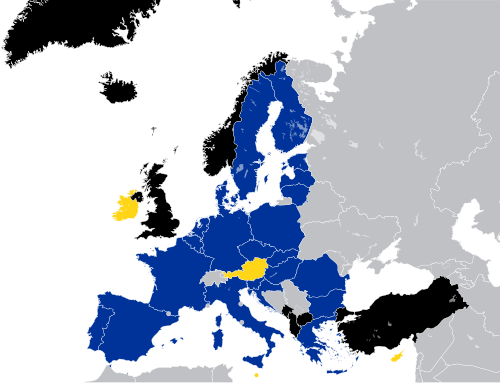
EU加盟国のみ
NATO加盟国のみ
EUおよびNATO加盟国

欧州連合の前身は軍事同盟として考案されなかった。NATOは防衛目的に適切かつ十分であると広く考えられていたためである。[129] EU加盟国のうち23カ国はNATOに加盟しているが、残りの加盟国は中立政策をとっている。[130]相互防衛条項を伴う軍事同盟である西欧連合は、その役割がEUに移管されたため、2011年に閉鎖された。[ 131] 1999年のコソボ戦争の後、欧州理事会は「NATOの行動を害することなく国際危機に対応するために、連合は信頼できる軍事力に支えられた自律的な行動能力、それらを使用する決定手段、およびそうする用意を持たなければならない」ことに同意した。この目的のために、EUの軍事力を高めるために、ヘルシンキ・ヘッドライン目標プロセスなど、多くの努力がなされた。多くの議論の末、最も具体的な成果はEU戦闘群構想であり、各戦闘群は1500人程度の人員を迅速に展開できるように計画されている。[133] 2022年に採択されたEU戦略コンパスは、NATOとの協力関係を再確認し、軍事機動性の向上と5000人規模のEU迅速展開能力の形成を約束した。[134]
イギリスの脱退以来、フランスは核兵器国として公式に認められた唯一の加盟国であり、国連安全保障理事会の常任理事国の唯一の保有国である。フランスとイタリアはまた、ヨーロッパ以外への戦力投射能力を持つ唯一のEU諸国である。 [135]イタリア、ドイツ、オランダ、ベルギーはNATOの核シェアリングに参加している。[136] EU加盟国の大半は核兵器禁止条約に反対した。[137]
EU軍は、中部・北部アフリカから西バルカン半島、西アジアにかけての平和維持活動に展開されている。 [138] EUの軍事活動は、欧州防衛機関、欧州連合衛星センター、欧州連合軍事参謀本部など、多くの機関によって支援されている。[139]欧州連合軍事参謀本部は、欧州理事会の枠組み内で設立された欧州連合の最高軍事機関であり、常設の政治軍事機関の設立を呼びかけたヘルシンキ欧州理事会(1999年12月10~11日)の決定を受け継いでいる。欧州連合軍事参謀本部は、外務安全保障政策上級代表および政治安全保障委員会の管轄下にある。EUの枠組みにおけるすべての軍事活動を指揮し、これには共通安全保障防衛政策の枠組み内での軍事任務および軍事作戦の計画と実施、軍事能力の開発などがあり、政治安全保障委員会に軍事問題に関する軍事上の助言と勧告を行っている。 27の加盟国からなるEUでは、実質的な安全保障と防衛協力は、加盟国間の協力にますます依存するようになっている。[140]
欧州国境沿岸警備隊(フロンテックス)は、不法移民、人身売買、テロリストの侵入を検出し阻止することを目的としたEUの機関です。 [141] EUはまた、欧州旅行情報認証システム、入出国システム、シェンゲン情報システム、ビザ情報システム、欧州共通庇護システムを運営しており、警察と入国管理当局に共通データベースを提供しています。この協力関係の発展の原動力となったのは、シェンゲン圏の国境開放とそれに伴う国境を越えた犯罪の出現でした。[18]
加盟国
_EN.svg/500px-Member_States_of_the_European_Union_(polar_stereographic_projection)_EN.svg.png)
連続的な拡大を通じて、EUとその前身は、EECの6つの創設国から27の加盟国にまで成長した。各国は創設条約の当事者となることで連合に加入し、それによってEU加盟国の特権と義務を負う。これには、機関内での代表権と引き換えに、機関への主権の部分的な委任が伴い、この慣行はしばしば「主権のプーリング」と呼ばれる。[142] [143]一部の政策では、複数の加盟国が連合内の戦略的パートナーと同盟を結んでいる。そのような同盟の例には、バルト議会、ベネルクス連合、ブカレスト9か国、クライオヴァ・グループ、EU地中海グループ、ルブリン・トライアングル、新ハンザ同盟、スリー・シーズ・イニシアティブ、ヴィシェグラード・グループ、ワイマール・トライアングルなどがある。
加盟国となるには、1993年にコペンハーゲンで開催された欧州理事会で定義されたコペンハーゲン基準を満たす必要がある。この基準では、人権と法の支配を尊重する安定した民主主義、機能する市場経済、EU法を含む加盟義務の受け入れが求められる。各国の基準遵守状況の評価は欧州理事会の責任である。[144]
欧州自由貿易連合(EFTA)を形成する4か国はEU加盟国ではないが、EUの経済と規制に部分的に関与している。アイスランド、リヒテンシュタイン、ノルウェーは欧州経済領域を通じて単一市場に参加しており、スイスも二国間条約を通じて同様の関係にある。[145] [146]ヨーロッパの小国であるアンドラ、モナコ、サンマリノ、バチカン市国との関係には、ユーロの使用やその他の協力分野が含まれている。[147]
区分
加盟国の区分は、統計目的の地理コード標準である統計地域単位命名法 (NUTS) に基づいています。2003 年に採用されたこの標準は、欧州連合によって開発および規制されているため、EU 加盟国のみを詳細にカバーしています。統計地域単位命名法は、欧州連合の構造基金および結束基金の提供メカニズムに役立ち、欧州の公共調達法の対象となる商品やサービスの提供地域を特定するためにも役立ちます。
統計地域単位名体系(NUTS)の細分地図(2018年以前、EU非加盟国を含む)
-
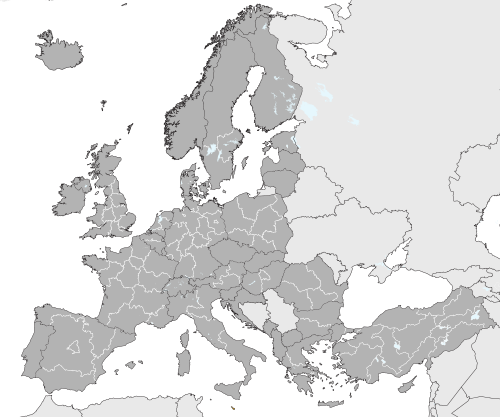 ナッツ1
ナッツ1 -
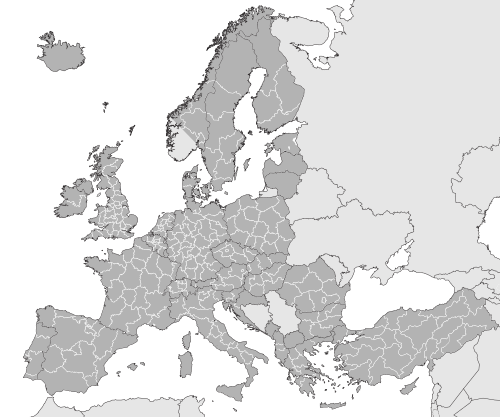 ナッツ2
ナッツ2 -
 ナッツ3
ナッツ3
.svg/500px-NUTS_3_region_(2017).svg.png)
シェンゲン圏

シェンゲン圏
シェンゲン協定加盟国(空路および海路の国境のみ)
事実上の参加 国
EU加盟国は将来シェンゲン圏に加盟することを条約で約束している
シェンゲン圏は、相互の国境におけるすべてのパスポートおよび他のすべての種類の国境管理を公式に廃止した27のヨーロッパの国で構成される地域です。EUのより広範な自由、安全および司法政策の要素として、海外旅行を目的とした共通のビザポリシーの下で単一の管轄区域として主に機能しています。この地域は、ルクセンブルクのシェンゲンで調印された1985年のシェンゲン協定と1990年のシェンゲン条約にちなんで名付けられました。EU加盟国27か国のうち25か国がシェンゲン圏に参加していますが、ブルガリアとルーマニアの2か国は現在部分的なメンバーにすぎません。シェンゲン圏に参加していないEU加盟国のうち、キプロスは将来的にこの地域に参加する法的義務を負っています。アイルランドはオプトアウトの立場を維持しており、代わりに独自のビザポリシーを運用しています。欧州自由貿易連合(EFTA)加盟国4カ国、アイスランド、リヒテンシュタイン、ノルウェー、スイスはEU加盟国ではないが、シェンゲン協定に関連する協定に署名している。また、ヨーロッパの小国3カ国(モナコ、サンマリノ、バチカン市国)は、隣国との旅客交通のために国境を開放しており、少なくとも1カ国以上のシェンゲン加盟国を経由せずにこれらの国への、またはこれらの国からの移動が事実上不可能であるため、事実上シェンゲン圏加盟国とみなされている。
候補国
加盟候補国として認められているのは、アルバニア、ボスニア・ヘルツェゴビナ、ジョージア、モルドバ、モンテネグロ、北マケドニア、セルビア、トルコ、ウクライナの9か国である。[149] [150] [151] [152] [153]ノルウェー、スイス、アイスランドは過去に加盟申請を提出したが、その後凍結または撤回した。[154]さらに、コソボは正式に潜在的な候補国として認められており、[149] [155]加盟申請を提出した。[156]
元メンバー
リスボン条約第50条は、加盟国がEUを離脱するための根拠となっている。2つの地域がEUを離脱している。グリーンランド(デンマークの自治州)は1985年に離脱した。[157]英国は2017年に欧州連合統合条約第50条を正式に発動し、 2020年にEUから 離脱した際に唯一の離脱主権国家となった。
地理

EU加盟国の面積は4,233,262平方キロメートル(1,634,472平方マイル)[l]で、ヨーロッパ大陸の大部分を占めている。EUの最高峰はグライアンアルプスのモンブランで、海抜4,810.45メートル(15,782フィート)である。[158] EU内で最も低い地点はデンマークのラメフィヨルドとオランダのザイドプラスポルダーで、海抜マイナス7メートル(23フィート)である。[159] EUの景観、気候、経済は、65,993キロメートル(41,006マイル)に及ぶ海岸線の影響を受けている。
ヨーロッパの国家領土に加えて、欧州経済領域加盟国の特別地域が32あり、そのすべてがEUの一部というわけではない。面積で最大なのはグリーンランドで、EUには加盟していないが、国民はEU市民である。一方、人口で最大なのはアフリカ沖のカナリア諸島で、EUとシェンゲン協定の一部である。南米のフランス領ギアナは、マダガスカル北部のマヨット島と同様に、EUとユーロ圏の一部である。
気候
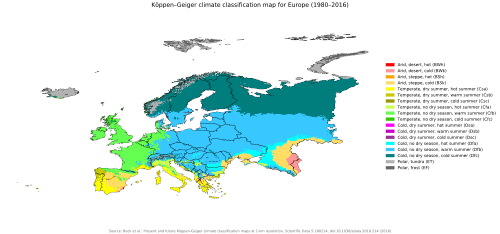
欧州連合の気候は温帯大陸性気候で、西海岸では海洋性気候、南部では地中海性気候が支配的です。気候はメキシコ湾流の影響を強く受けており、メキシコ湾流は西部地域を他の大陸の同様の緯度では達成できないレベルまで温めます。西ヨーロッパは海洋性ですが、東ヨーロッパは大陸性で乾燥しています。西ヨーロッパには四季があり、南ヨーロッパには雨季と乾季があります。南ヨーロッパは夏の間は暑く乾燥しています。最も降水量が多いのは偏西風が吹く水域の風下で、アルプス山脈でも降水量が多くなります。
環境
.png/500px-Increase_of_average_yearly_temperature_in_Europe_(1900-2017).png)
1957年に欧州経済共同体が設立された当時、環境政策は存在しなかった。[161]過去50年間で、大気汚染、水質、廃棄物管理、自然保護、化学物質、産業危険物、バイオテクノロジーの管理など、環境保護のあらゆる分野に及ぶ、ますます密集した立法ネットワークが構築されてきた。[161]欧州環境政策研究所によると、環境法は500を超える指令、規則、決定で構成されており、環境政策は欧州政治の中核分野となっている。[162]
欧州の政策立案者は当初、環境問題を貿易問題として定義することで、EUの環境問題への対応能力を高めた。[161] 加盟国ごとに異なる環境基準により、共通市場における貿易障壁や競争の歪みが生じる可能性があった。 [163]その後、環境は正式な政策分野となり、独自の政策主体、原則、手続きが設けられた。EUの環境政策の法的根拠は、1987年の単一欧州法の導入によって確立された。[162]
当初、EUの環境政策はヨーロッパに焦点を当てていた。最近では、EUは世界の環境ガバナンスにおいてリーダーシップを発揮している。例えば、米国の反対にもかかわらず京都議定書の批准と発効を確保する上でのEUの役割などである。この国際的な側面は、EUの第6次環境行動計画[164]に反映されており、主要な国際協定がEUレベルと世界の両方で積極的に支持され、適切に実施される場合にのみ目標を達成できると認識されている。リスボン条約はリーダーシップの野心をさらに強化した。[161] EU法は、ヨーロッパの生息地と種の保護を改善する上で重要な役割を果たし、空気と水質の改善と廃棄物管理にも貢献している。[162]
気候変動の緩和はEU環境政策の最重要課題の一つである。2007年、加盟国は将来、EU全体で使用されるエネルギーの20%を再生可能でなければならず、二酸化炭素排出量は2020年までに1990年レベルと比較して少なくとも20%低くなければならないことに合意した。[165] 2017年、EUは世界の温室効果ガス排出量の9.1%を排出した。 [166]欧州連合は、2018年の時点ですでに温室効果ガス排出量が1990年より23%低かったと主張している。 [ 167 ]
EUは、二酸化炭素排出量を経済に組み込むために排出量取引制度を導入している。 [168]欧州グリーン首都は、スマートシティを実現するために、都市部の環境、エネルギー効率、生活の質に焦点を当てた都市に毎年与えられる賞である。2019年の欧州議会選挙では、脱物質主義的価値観の台頭により、緑の党が勢力を拡大した。[169] 2050年までに欧州連合(EU)でゼロカーボン経済を達成するという提案は、2018年から2019年に示され、2019年6月のEU首脳会議でほぼすべての加盟国がその目標を支持した。チェコ共和国、エストニア、ハンガリー、ポーランドは反対した。[170] 2021年6月、欧州連合は、2030年までに温室効果ガス排出量を55%削減し、2050年までにカーボンニュートラルを達成するという目標を掲げた欧州気候法を可決した。 [171]また同年、欧州連合と米国は、 2030年までにメタン排出量を30%削減することを約束した。この約束は、気候変動緩和に向けた大きな成果と見なされている。[172]
経済

経済活動の指標であるEU加盟国の国内総生産(GDP)は、2022年に16.64兆米ドルで、世界のGDPの約16.6%を占めた。[173] EU加盟国間および加盟国内部では、一人当たりGDPに大きなばらつきがある。最も豊かな地域と最も貧しい地域(統計地域単位名による281のNUTS-2地域)の差は、2017年には、EU28平均( 3万ユーロ)の31%(ブルガリアのセヴェロザパデン)から253%(ルクセンブルク)、つまり4,600ユーロから92,600ユーロの範囲であった。[174]
EU加盟国は、米国(140兆ドル )と中国(84兆ドル )に次いで世界で3番目に大きい純資産を保有していると推定されており、これは世界の資産454兆ドルの約6分の1( 76兆ドル )に相当する。[175] 2010年の収益で測定された世界のトップ500企業のうち、161社がEUに本社を置いていた。[176] 2016年のEUの失業率は8.9%[177]、インフレ率は2.2%、勘定残高はGDPの-0.9%であった。2021年の欧州連合(EU)の平均年間純利益は約25,000ユーロ[178]であった。
経済通貨統合

ユーロ圏加盟国
ERM II メンバー
オプトアウト可能な ERM II メンバー (デンマーク)
その他のEU加盟国
ユーロは、EU加盟20カ国で公式通貨となっている。欧州単一通貨の創設は、1969年に欧州経済共同体の公式目標となった。1992年、通貨同盟の構造と手続きについて交渉した後、加盟国はマーストリヒト条約に署名し、通貨同盟に参加するためには収斂基準を含む合意された規則を遵守する法的義務を負った。参加を希望する国は、まず欧州為替レートメカニズムに加盟しなければならなかった。加盟国が通貨同盟参加後に財政難や危機に陥ることを防ぐため、マーストリヒト条約では、加盟国は重要な財政上の義務と手続きを遵守する義務を負い、特に予算規律と高度に持続可能な経済収斂を示すとともに、欧州財政協定で合意されているように、過度の政府赤字を回避し、政府債務を持続可能なレベルに制限することが義務付けられた。
資本市場連合と金融機関

資本の自由な移動は、国家間の不動産購入や株式購入などの投資の移動を許可することを意図している。[179]経済通貨統合への動きが始まるまで、資本条項の発展は遅々として進まなかった。マーストリヒト条約後、当初は無視されていたこの自由に関するECJの判決が急速に増えてきた。資本の自由な移動は、非加盟国にも平等に認められている点で独特である。
欧州金融監督制度は、欧州銀行監督機構、欧州保険・年金監督機構、欧州証券市場監督機構の3つの機関によって構成されるEUの金融監督枠組みの制度的構造である。この枠組みを補完するために、中央銀行の責任下にある欧州システムリスク委員会も存在する。この金融管理システムの目的は、EUの経済的安定を確保することである。[180]
ユーロ圏と銀行同盟

1999年、通貨統合は加盟国のうち11カ国で共通会計(仮想)通貨を導入することで実現し始めた。2002年には、ユーロ紙幣と硬貨が発行され、ユーロ圏(当時12カ国で構成)の自国通貨の段階的廃止が開始され、本格的な共通通貨となった。ユーロ圏(ユーロを採用したEU加盟国で構成)は、その後20カ国に拡大した。[181] [182]
ユーロ圏として総称されるEU加盟20カ国は、自国通貨をユーロに置き換えることで通貨統合を完全に実施している。通貨統合は3億4500 万人のEU市民を代表している。[183] ユーロは、米ドルに次いで世界で2番目に大きな準備通貨であり、2番目に取引量の多い通貨である。[184] [185] [186]
ユーロと、EUと合意してユーロを導入した国の金融政策は、ECBの管理下にある。[187] ECBはユーロ圏の中央銀行であり、物価安定を維持するという課題を掲げてその地域の金融政策を管理している。ECBはユーロ圏の各国中央銀行を包括するユーロシステムの中心に位置している。 [188] ECBはユーロ圏内に設立された銀行同盟の中心機関でもあり、欧州銀行監督の中心でもある。銀行が債務不履行に陥った場合に備えて、単一の破綻処理メカニズムも存在する。
貿易
欧州連合は政治的実体として、世界貿易機関(WTO) に代表されています。欧州経済共同体の当初の主要目的の 2 つは、共通市場の開発 (後に単一市場となる) と、加盟国間の 関税同盟でした。
単一市場
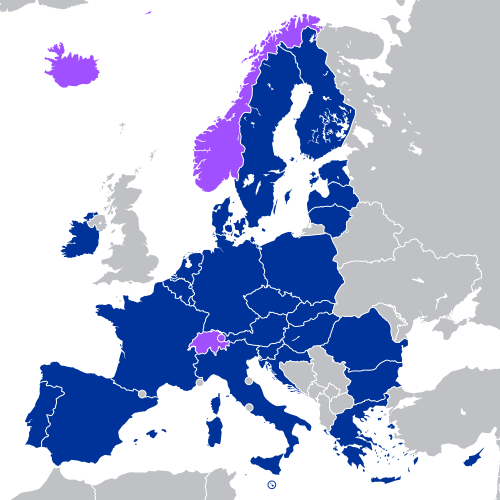
参加する非EU諸国
単一市場では、EU域内における商品、資本、人、サービスの自由な流通が保障される。[183] サービスと事業所の自由な移動により、自営業者は加盟国間を移動し、一時的または永続的にサービスを提供することができる。サービスはGDPの60~70%を占めるが、この分野の法律は他の分野ほど発達していない。この欠陥は、国境を越えたサービス提供の自由化を目的とした2006年域内市場におけるサービス指令によって対処されている。 [189]条約によれば、サービス提供は残余の自由であり、他の自由が行使されていない場合にのみ適用される。
関税同盟
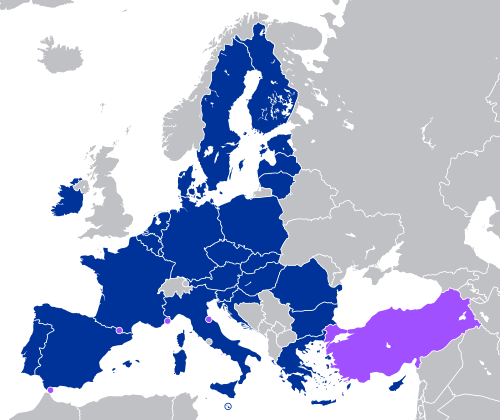
参加する非EU諸国
関税同盟は、市場に入るすべての商品に共通の対外関税を適用するものである。商品がいったん市場に受け入れられると、国内を移動する間、関税、差別的税、輸入割当の対象とならない。アイスランド、ノルウェー、リヒテンシュタイン、スイスといったEU非加盟国は単一市場に参加しているが、関税同盟には参加していない。[145] EUの貿易の半分は、EUが調和させた法律によってカバーされている。[190]
欧州連合連合協定は、より広範囲の国々に対して同様のことを行っているが、これは部分的には、これらの国々の政治に影響を与えるためのいわゆるソフトアプローチ(「ムチではなくアメ」)として行われている。欧州連合は、世界貿易機関(WTO)においてすべての加盟国を代表し、紛争が発生した場合には加盟国に代わって行動する。EUがWTOの枠組み外で貿易関連協定を交渉する場合、その後の協定は各加盟国政府の承認を得る必要がある。[191]
対外貿易
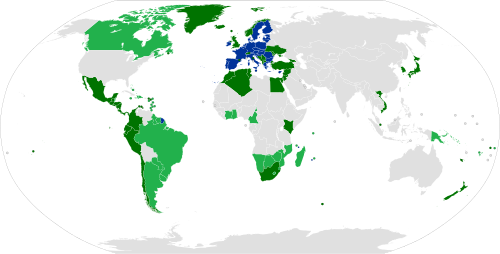
欧州連合
協定発効
協定(一部)暫定適用
合意書に署名したが適用されていない
契約書に署名はされていないが、イニシャルは記入されている
合意交渉中
合意交渉は保留中/中断中
欧州連合は、世界中の多くの国々と自由貿易協定(FTA)[192]やその他の貿易協定を締結しており、他の多くの国々と交渉中です。[193]欧州連合のサービス貿易黒字は、2000年の160億ドルから2018年には2,500億ドル以上に増加しました。[194] 2020年には、COVID-19パンデミックの影響もあり、中国が米国に代わってEU最大の貿易相手国となりました。[195]欧州連合は世界最大の輸出国であり[196]、2008年には商品とサービスの最大の輸入国でした。[197] [198]加盟国間の内部貿易は、関税や国境管理などの貿易障壁の撤廃によって促進されています。ユーロ圏では、ほとんどの加盟国間で対処すべき通貨の違いがないことが貿易を促進しています。[191]対外的には、EUと日本との自由貿易協定が最も注目に値するだろう。EUと日本の経済連携協定は2018年7月17日に正式に署名され、2019年2月1日に発効し、世界最大の二国間自由貿易協定となり、世界のGDPのほぼ3分の1をカバーするオープンな貿易圏を創出した。[199] [200]
競争と消費者保護
EUは、単一市場内での公正な競争を確保することを目的とした競争政策を実施している。 [m] 2001年に委員会は、すでに各国の当局によって承認されていた米国に拠点を置く2つの企業(ゼネラル・エレクトリックとハネウェル)の合併を初めて阻止した。 [201]マイクロソフトに対する別の注目を集めた訴訟では、委員会は 9年間の訴訟の末、マイクロソフトに7億7,700万ユーロ以上の罰金を科した。 [202]
エネルギー
総エネルギー供給量(2019年)[203]
石油(31.7%)
天然ガス(24.7%)
石炭(10.9%)
原子力(13.2%)
バイオ燃料、廃棄物、電気、熱(19.4%)
2019年のEUの総エネルギー供給量は590億GJで、世界総量の約10.2%を占めた。EUで利用可能なエネルギーの約5分の3は輸入(主に化石燃料)によるものである。再生可能エネルギーは2019年のEUの総エネルギー供給量の18.1%、最終エネルギー消費量の11.1%を占めた。[204]
EUは設立以来、エネルギー政策の分野で立法権を有してきた。そのルーツは欧州石炭鉄鋼共同体にある。2005年10月の欧州理事会で、強制的かつ包括的な欧州エネルギー政策の導入が承認され、2007年1月に最初の政策草案が公表された。[205]
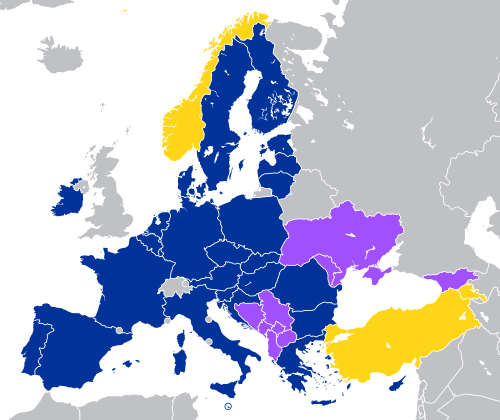
EUのエネルギー政策には5つの重点項目がある。域内市場での競争を促進し、投資を奨励し、電力網間の相互接続を強化すること。危機に対応するためのより良いシステムでエネルギー資源を多様化すること。ロシアとのエネルギー協力のための新たな条約枠組みを確立し、中央アジア[206]と北アフリカのエネルギー資源の豊富な国との関係を改善すること。既存のエネルギー供給をより効率的に利用し、再生可能エネルギーの商業化を促進すること。そして最後に、新エネルギー技術への資金提供を増やすことである。[205]
2007年、EU諸国全体では石油の82%、天然ガスの57% [207]、ウランの97.48% [208]を輸入していた。EUへの天然ガスの3大供給国はロシア、ノルウェー、アルジェリアで、 2019年の輸入量の約4分の3を占めた。[209]ロシアのエネルギーへの依存度が高く、EUはこれを減らそうと努めてきた。[210]しかし、2022年5月、EUはウクライナ侵攻をめぐってロシアに対する新たな制裁を準備していると報じられた。ロシアの石油、ロシアとベラルーシの銀行、個人や企業が対象になるとみられている。ロイターの記事によると、2人の外交官は、欧州連合(EU)が2022年末までにロシア産石油の輸入を禁止する可能性があると述べた。[211] 2022年5月、欧州委員会は「RePowerEU」イニシアチブを発表した。これは、2030年までにEUのロシア化石燃料への依存を終わらせ、クリーンエネルギーへの移行を加速するための道筋を概説した3000億ユーロの計画である。[212]
輸送
.png/500px-Trans-European_Transport_Network_(2024).png)
欧州連合は、1990年に構築された欧州横断交通ネットワーク(TEN-T)[213]と欧州横断複合交通ネットワークを通じて、国境を越えた道路、鉄道、空港、水道インフラを管理している。 TEN-Tは、2030年までに完成する予定のコアネットワークと、2050年までに完成する予定の包括的ネットワークの2つのネットワーク層で構成される。 このネットワークは現在、バルト海-アドリア海回廊、北海-バルト海回廊、地中海回廊、東洋/東地中海回廊、スカンジナビア-地中海回廊、ライン川-アルプス回廊、大西洋回廊、北海-地中海回廊、ライン川-ドナウ川回廊の9つのコア回廊で構成されている。道路輸送は、欧州横断道路網によって TEN-T の下で組織されました。連邦アウトバーン 7 号線は、 963 km (598 マイル) で EU 最長の国道です。

海上輸送は、TEN-Tの下で、欧州横断内陸水路網と欧州横断海港網によって組織されている。ヨーロッパの海港は、国際港、コミュニティ港、地域港に分類される。ロッテルダム港はEUで最も混雑しており、東アジア以外では世界最大の海港で、オランダの南ホラント州ロッテルダム市内およびその近郊に位置している。[ 214] [215] 2002年にポルトガルのリスボンに設立された欧州海上安全機関(EMSA)は、 EUの関連法の施行を支援することで、海上事故、船舶による海洋汚染、海上での人命損失のリスクを軽減する任務を負っている。
航空輸送は、トランスヨーロッパ空港ネットワークによってTEN-Tの下で組織されている。ヨーロッパの空港は、国際空港、コミュニティ空港、地域空港に分類される。フランスのパリ市内およびその近郊にあるシャルル・ド・ゴール空港はEUで最も利用者数が多い。 [216]欧州共同航空圏(ECAA)は、航空の単一市場である。ECAA協定は、2006年5月5日にオーストリアのザルツブルクでEUといくつかの第三国の間で調印された。ECAAは、ECAA加盟国のどの企業でも、ECAA加盟国のどの空港間を飛行できるようにすることで航空輸送業界を自由化し、それによって「外国」航空会社が国内線を提供できるようにする。シングル・ヨーロピアン・スカイ(SES)は、容量、安全性、効率性、環境への影響に関するヨーロッパの空域のニーズを満たすことを目的として、4つの異なるレベル(制度、運用、技術、管理および監督)で実行される一連の措置を通じてヨーロッパの航空交通管理システムを改革しようとする取り組みである。民間航空の安全は、欧州連合航空安全機関(EASA)の管轄下にあります。EASA は、認証、規制、標準化を実施し、調査と監視も行います。欧州レベルの航空安全機関の構想は 1996 年に遡りますが、機関が法的に設立されたのは 2002 年で、運用が開始されたのは 2003 年です。
鉄道輸送は、高速鉄道網と従来型鉄道網で構成される欧州横断鉄道網によってTEN-Tの下で組織されている。フランスのパリ市内およびその近郊にある北駅はEUで最も利用者数が多い。 [ 217] [218]ヨーロッパの鉄道輸送は、安全性を大幅に向上させ、列車輸送の効率を高め、国境を越えた相互運用性を高めることを目的として、欧州鉄道交通管理システム(ERTMS)と同期されつつある。これは、以前の各国の信号設備と運用手順を、列車制御およびコマンドシステムの新しい単一のヨーロッパ規模の標準に置き換えることによって行われる。このシステムは、欧州鉄道機関(ERA)によって運営されている。
欧州連合で使用される輸送書類


通信と宇宙
モバイル通信のローミング料金は、EU、アイスランド、リヒテンシュタイン、ノルウェー全域で廃止されます。

欧州宇宙計画機関(EUSPA)は、チェコ共和国のプラハに本部を置き、 2007年5月22日にEUと欧州宇宙機関(ESA)の間で確立された既存の欧州宇宙政策(総称して欧州宇宙会議)を実施するために、欧州宇宙計画を管理するために2021年に設立されました。これは、EUが確立した宇宙活動に関する最初の共通の政治的枠組みでした。各加盟国は、ESAを通じて調整することも多いものの、ある程度独自の国家宇宙政策を追求してきました。欧州委員会企業産業担当委員のギュンター・フェルホイゲン氏は、EUは「テクノロジーの世界的リーダーであるにもかかわらず、米国とロシアによって守勢に立たされており、追いつこうと競っている中国とインドに対する技術的優位性は約10年しかない」と述べています。
ガリレオは2016年に稼働を開始した全地球航法衛星システム(GNSS)で、欧州連合(EU)がESAを通じて構築し、EUSPAが運用し、イタリアのフチーノとドイツのオーバープファッフェンホーフェンに2つの地上運用センターを置いている。100億ユーロのこのプロジェクトは、イタリアの天文学者ガリレオ・ガリレイにちなんで名付けられた。ガリレオの目的の1つは、独立した高精度の測位システムを提供することで、欧州の政治・軍事当局が米国のGPSやロシアのGLONASSシステムに頼らなくても済むようにすることである。これらのシステムは、運用者によっていつでも無効化または機能低下される可能性がある。欧州静止航法オーバーレイサービス(EGNOS)は、ESAとEUROCONTROLが開発した衛星ベースの補強システム(SBAS)である。現在、測位データの信頼性と精度を報告し、修正を送信することでGPSを補完している。このシステムは将来のバージョンでガリレオを補完する予定である。コペルニクス計画は、 ESA と提携して EUSPA が調整および管理する EU の地球観測計画です。この計画の目的は、地球規模で継続的、自律的、高品質、広範囲の地球観測能力を実現し、環境管理の改善、気候変動の影響の理解と緩和、市民の安全の確保などのために、正確でタイムリーかつ簡単にアクセスできる情報を提供することです。
農業と漁業

共通農業政策 (CAP) は、欧州連合の農業政策です。農業補助金制度やその他のプログラムを実施しています。1962 年に導入され、その後、EEC 予算コストを削減 (1985 年の 73% から 2017 年の 37% に) し、目標に農村開発を考慮するために、いくつかの変更が行われました。しかし、コストと環境および人道的影響の理由で批判されてきました。
同様に、共通漁業政策 (CFP) は欧州連合の漁業政策です。加盟国が各種類の魚を捕獲できる割当量を設定し、さまざまな市場介入や漁業補助金によって漁業を奨励しています。これは、漁業保護政策を欧州連合に留保された少数の「独占的権限」の 1 つとして正式に定めたリスボン条約により 2009 年に導入されました。
地域開発

発展途上地域
遷移領域
より発展した地域
5つの欧州構造投資基金は、主に中央ヨーロッパと南ヨーロッパの国々にある発展途上地域を中心としたEU地域の発展を支援している。 [220] [221]別の基金(加盟前支援制度)は、加盟候補国が自国をEUの基準に適合させるよう支援している。この政策では、高齢化、低出生率、非大都市圏の過疎化社会への人口構成の変化に取り組んでいる。
労働
人の自由な移動とは、EU市民が加盟国間を自由に移動して、他の国で生活、就労、学習、引退できることを意味する。これには、行政手続きの緩和と他国の職業資格の承認が必要であった。[222] EUの季節調整済み失業率は、2018年9月に6.7%であった。[223]ユーロ圏の失業率は8.1%であった。[223]加盟国の中で、失業率が最も低かったのはチェコ共和国(2.3%)、ドイツとポーランド(ともに3.4%)で、最も高かったのはスペイン(2024年に11.27%)とギリシャ(2018年7月に19.0%)であった。
欧州連合は長い間、労働者の権利を保護し、社会的および環境的ダンピングを防止することで、自由市場の影響を緩和しようと努めてきた。[要出典]この目的のために、最低雇用基準と環境基準を確立する法律を制定してきた。これらには、労働時間指令と環境影響評価指令が含まれている。最低賃金の引き上げと団体交渉の強化を目指す最低賃金に関する欧州指令は、2022年9月に欧州議会で承認された。[224]
社会権と平等
EUはまた、個人が自由移動権を行使しやすくし、他の加盟国における社会保障や医療サービスへのアクセスを維持できるようにするために、加盟国の社会保障と医療制度の調整を図ってきた。2019年以降、平等担当欧州委員が置かれ、欧州男女平等研究所は2007年以来存在している。ジェンダーに基づく暴力に対抗するための指令が提案されている。[225] [226] 2022年9月には、「質の高い、手頃な価格で利用しやすいケアサービス」を提供するための欧州ケア戦略が承認された。[227]欧州社会憲章は、欧州市民の社会的権利を認める主要な機関である。
2020年には、ヘレナ・ダリ氏の指揮の下、初のLGBTIQ平等に関する欧州連合戦略が承認された。[228] 2021年12月、委員会はLGBTヘイトクライムに対する連合全体の法律を制定する意向を発表した。[229]
自由、安全、正義

1993年に欧州連合が創設されて以来、欧州連合は司法と内政の分野で当初は政府間レベルで、後に超国家主義によって権限を拡大してきた。それに応じて、欧州連合は引き渡し法、[230]、家族法、[231]、亡命法、[232]、刑事司法などの分野で立法を行ってきた。[233]
EUはまた、加盟国間の警察、検察、民事訴訟を調整する機関を設立した。警察協力のためのユーロポール、警察部隊の訓練のためのCEPOL [234]、検察と裁判所の協力のためのユーロジャスト[235]である。また、車両と運転手のEUCARISデータベース、 Eurodac、欧州犯罪記録情報システム、欧州サイバー犯罪センター、FADO、PRADOなども 運営している。
差別禁止は条約に長く盛り込まれている。近年では、人種、宗教、障害、年齢、性的指向に基づく差別を禁止する法律を制定する権限が追加された。[n]条約では、欧州連合自体が「人間の尊厳、自由、民主主義、平等、法の支配、少数派に属する人々の権利を含む人権の尊重という価値観に基づいて設立され 、多元主義、差別禁止、寛容、正義、連帯、男女平等が優先する社会である」と宣言している。[236]これらの権限により、EUは職場における性差別、年齢差別、人種差別に関する法律を制定した。[o]
2009年、リスボン条約は欧州連合基本権憲章に法的効力を与えた。憲章はEUの法的行為を判断するための基本権の成文化された目録である。憲章は、以前に欧州司法裁判所によって承認され、「加盟国に共通する憲法上の伝統」に由来する多くの権利を統合している。[237]欧州司法裁判所は長年にわたり基本権を承認しており、時にはそれらの基本権を遵守していないとしてEUの立法を無効にしてきた。[238]
欧州人権条約(ECHR)への署名はEU加盟の条件である。[p]これまで、EUは国家でもなければ[q]、加盟する権限もなかったため、この条約に加盟することはできなかった。[r]リスボン条約とECHR第14議定書はこれを変えた。前者はEUにこの条約への加入を義務付けるが、後者は正式にそれを許可する。
EUは欧州評議会から独立しているが、法の支配、人権、民主主義など、目的や考え方を共有している。さらに、欧州人権条約や欧州社会憲章、そして基本権憲章の法源は欧州評議会によって作成された。EUはより広い世界で人権問題を推進してきた。EUは死刑に反対し、その全世界での廃止を提案している。死刑の廃止はEU加盟の条件である。[239] 2020年10月19日、欧州連合は世界中の人権侵害に対処するための法的構造を構築する新たな計画を明らかにした。この新たな計画により、世界中で深刻な人権侵害や虐待の責任者を標的にし、制裁を科すための柔軟性が欧州連合にもたらされると期待された。[240]
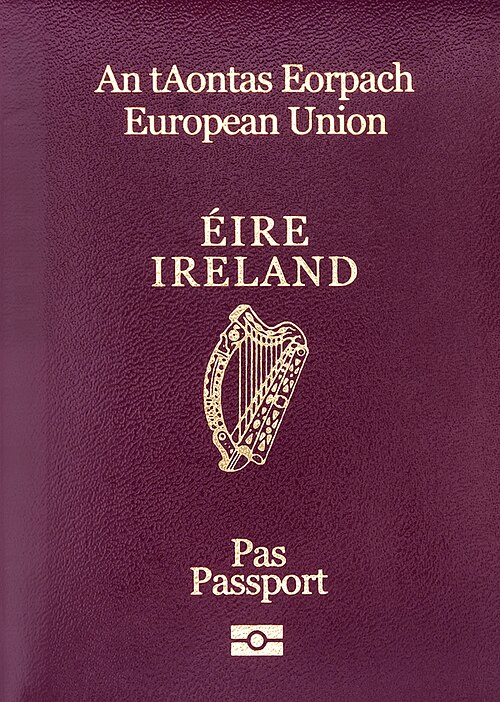
EUで使用される身分証明書、渡航書類、健康書類の例
.jpg/500px-Deutscher_Personalausweis_(2021_Version).jpg)


人口統計
.svg/500px-Population_density_by_NUTS_3_region_(2017).svg.png)
The population of the EU in 2021 was about 447 million people, corresponding to 5.8 per cent of the world population.[148][241] The population density across the EU was 106 inhabitants per square kilometre, which is more than the world average.[242] It is highest in areas in central and western Europe, sometimes referred to as the "blue banana", while Sweden and Finland in the north are much more sparsely populated.
The total population of the EU has been slightly decreasing for several years, contracting by 0.04 per cent in 2021.[243] This is due to a low birth rate of about 1.5 children per woman, less than the world average of 2.3.[244] In total, 4.1 million babies were born in the EU in 2021.[245] Immigration to Europe partially compensates for the natural population decrease.
5.3 per cent of the people residing in the EU are not EU citizens.[242] There were 31 non-EU citizenships that each accounted for at least 1 per cent of non-EU citizens living in the EU, of which the largest were Moroccan, Turkish, Syrian and Chinese.[246] Around 1.9 million people immigrated to one of the EU member states from a non-EU country during 2020, and a total of 956,000 people emigrated from a member state to go to a non-EU country during the same year.[247]
Urbanisation
.jpg/500px-La_Tour_Eiffel_vue_de_la_Tour_Saint-Jacques,_Paris_ao%C3%BBt_2014_(2).jpg)
More than two thirds (68.2%) of EU inhabitants lived in urban areas in 2020, which is slightly less than the world average.[242] Cities are largely spread out across the EU with a large grouping in and around the Benelux.[248] The EU contains about 40 urban areas with populations of over 1 million. With a population of over 13 million,[249] Paris is the largest metropolitan area and the only megacity in the EU.[250] Paris is followed by Madrid, Barcelona, Berlin, the Ruhr, Milan, and Rome, all with a metropolitan population of over 4 million.
The EU also has numerous polycentric urbanised regions like Rhine-Ruhr (Cologne, Dortmund, Düsseldorf et al.), Randstad (Amsterdam, Rotterdam, The Hague, Utrecht et al.), Frankfurt Rhine-Main (Frankfurt, Wiesbaden, Mainz et al.), the Flemish Diamond (Antwerp, Brussels, Leuven, Ghent et al.) and Upper Silesian-Moravian area (Katowice, Ostrava et al.).[250]
Languages
The EU has 24 official languages: Bulgarian, Croatian, Czech, Danish, Dutch, English, Estonian, Finnish, French, German, Greek, Hungarian, Italian, Irish, Latvian, Lithuanian, Maltese, Polish, Portuguese, Romanian, Slovak, Slovene, Spanish, and Swedish. Important documents, such as legislation, are translated into every official language and the European Parliament provides translation for documents and plenary sessions.[256][257] Most EU institutions use only a handful of working languages: the European Commission conducts its internal business in three procedural languages: English, French, and German;[258] the Court of Justice uses French as the working language,[259] and the European Central Bank conducts its business primarily in English.[260][261] Even though language policy is the responsibility of member states, EU institutions promote multilingualism among its citizens.[f][262]
The most widely spoken language in the EU is English; the language is spoken by 44 per cent of the population (2016 data) and studied by 95 per cent of school students,[263] although following the withdrawal of the United Kingdom less than 1 per cent of the population speak it natively. German and French are spoken by 36 per cent and 30 per cent of the population.[264] More than half (56 per cent) of EU citizens are able to engage in a conversation in a language other than their mother tongue.[265]
Luxembourgish (in Luxembourg) and Turkish (in Cyprus) are the only two national languages that are not official languages of the EU. Catalan, Galician and Basque are not recognised official languages of the EU but have official status in Spain. Therefore, official translations of the treaties are made into them and citizens have the right to correspond with the institutions in these languages.[266][267] There are about 150 regional and minority languages in the EU, spoken by up to 50 million people.[268] The European Charter for Regional or Minority Languages ratified by most EU states provides general guidelines that states can follow to protect their linguistic heritage. The European Day of Languages is held annually on 26 September and is aimed at encouraging language learning across Europe.[269]
Religion
The EU has no formal connection to any religion. Article 17 of the Treaty on the Functioning of the European Union[270] recognises the "status under national law of churches and religious associations" as well as that of "philosophical and non-confessional organisations".[271] The preamble to the Treaty on European Union mentions the "cultural, religious and humanist inheritance of Europe".[271][272] Discussion over the draft texts of the European Constitution and later the Treaty of Lisbon included proposals to mention Christianity or a god, or both, in the preamble of the text, but the idea faced opposition and was dropped.[273]
Christians in the EU include Catholics of both Roman and Eastern Rite, numerous Protestant denominations with Lutherans, Anglicans, and Reformed forming the majority of Protestant affiliations, and the Eastern Orthodox Church. In 2009, the EU had an estimated Muslim population of 13 million,[274] and an estimated Jewish population of over a million.[275] The other world religions of Buddhism, Hinduism, and Sikhism are also represented in the EU population.
Eurostat's Eurobarometer opinion polls showed in 2005 that 52 per cent of EU citizens believed in a god, 27 per cent in "some sort of spirit or life force", and 18 per cent had no form of belief.[276] Many countries have experienced falling church attendance and membership in recent years.[277] The countries where the fewest people reported a religious belief were Estonia (16 per cent) and the Czech Republic (19 per cent).[276] The most religious countries were Malta (95 per cent, predominantly Catholic) as well as Cyprus and Romania (both predominantly Orthodox) each with about 90 per cent of citizens professing a belief in God. Across the EU, belief was higher among women, older people, those with religious upbringing, those who left school at 15 or 16, and those "positioning themselves on the right of the political scale".[276]
Education and research

Basic education is an area where the EU's role is limited to supporting national governments. In higher education, the policy was developed in the 1980s in programmes supporting exchanges and mobility. The most visible of these has been the Erasmus Programme, a university exchange programme which began in 1987. In its first 20 years, it supported international exchange opportunities for well over 1.5 million university and college students and became a symbol of European student life.[278]
There are similar programmes for school pupils and teachers, for trainees in vocational education and training, and for adult learners in the Lifelong Learning Programme 2007–2013. These programmes are designed to encourage a wider knowledge of other countries and to spread good practices in the education and training fields across the EU.[279][280] Through its support of the Bologna Process, the EU is supporting comparable standards and compatible degrees across Europe.
Scientific development is facilitated through the EU's Framework Programmes, the first of which started in 1984. The aims of EU policy in this area are to co-ordinate and stimulate research. The independent European Research Council allocates EU funds to European or national research projects.[281] EU research and technological framework programmes deal in a number of areas, for example energy where the aim is to develop a diverse mix of renewable energy to help the environment and to reduce dependence on imported fuels.[282]
Health
Article 35 of the Charter of Fundamental Rights of the European Union affirms that "A high level of human health protection shall be ensured in the definition and implementation of all Union policies and activities". The European Commission's Directorate-General for Health and Consumers seeks to align national laws on the protection of people's health, on the consumers' rights, on the safety of food and other products.[283][284][285]
All EU and many other European countries offer their citizens a free European Health Insurance Card which, on a reciprocal basis, provides insurance for emergency medical treatment insurance when visiting other participating European countries.[286] A directive on cross-border healthcare aims at promoting co-operation on health care between member states and facilitating access to safe and high-quality cross-border healthcare for European patients.[287][288][289]
The life expectancy in the EU was 80.1 year at birth in 2021, among the highest in the world and around nine years higher than the world average.[290] In general, life expectancy is lower in Eastern Europe than in Western Europe.[291] In 2018, the EU region with the highest life expectancy was Madrid, Spain at 85.2 years, followed by the Spanish regions of La Rioja and Castilla y León both at 84.3 years, Trentino in Italy at 84.3 years and Île-de-France in France at 84.2 years.[292]
Culture
Cultural co-operation between member states has been an interest of the European Union since its inclusion as a community competency in the Maastricht Treaty.[293] Actions taken in the cultural area by the EU include the Culture 2000 seven-year programme,[293] the European Cultural Month event,[294] and orchestras such as the European Union Youth Orchestra.[295] The European Capital of Culture programme selects one or more cities in every year to assist the cultural development of that city.[296]
Sport
Sport is mainly the responsibility of the member states or other international organisations, rather than of the EU. There are some EU policies that have affected sport, such as the free movement of workers, which was at the core of the Bosman ruling that prohibited national football leagues from imposing quotas on foreign players with EU member state citizenship.[297]
The Treaty of Lisbon requires any application of economic rules to take into account the specific nature of sport and its structures based on voluntary activity.[298] This followed lobbying by governing organisations such as the International Olympic Committee and FIFA, due to objections over the application of free market principles to sport, which led to an increasing gap between rich and poor clubs.[299] The EU does fund a programme for Israeli, Jordanian, Irish, and British football coaches, as part of the Football 4 Peace project.[300]
Symbols

The flag of Europe consists of a circle of 12 golden stars on a blue background. Originally designed in 1955 for the Council of Europe, the flag was adopted by the European Communities, the predecessors of the present European Union, in 1986. The Council of Europe gave the flag a symbolic description in the following terms,[301] though the official symbolic description adopted by the EU omits the reference to the "Western world":[302]
Against the blue sky of the Western world, the stars symbolise the peoples of Europe in a form of a circle, the sign of union. The number of stars is invariably twelve, the figure twelve being the symbol of perfection and entirety.
— Council of Europe. Paris, 7–9 December 1955.
United in Diversity was adopted as the motto of the union in 2000, having been selected from proposals submitted by school pupils.[303] Since 1985, the flag day of the union has been Europe Day, on 9 May (the date of the 1950 Schuman declaration). The anthem of the EU is an instrumental version of the prelude to the Ode to Joy, the 4th movement of Ludwig van Beethoven's ninth symphony. The anthem was adopted by European Community leaders in 1985 and has since been played on official occasions.[304] Besides naming the continent, the Greek mythological figure of Europa has frequently been employed as a personification of Europe. Known from the myth in which Zeus seduces her in the guise of a white bull, Europa has also been referred to in relation to the present union. Statues of Europa and the bull decorate several of the EU's institutions and a portrait of her is seen on the 2013 series of euro banknotes. The bull is, for its part, depicted on all residence permit cards.[305]
Charles the Great, also known as Charlemagne (Latin: Carolus Magnus) and later recognised as Pater Europae ("Father of Europe"),[306][307][308] has a symbolic relevance to Europe. The commission has named one of its central buildings in Brussels after Charlemagne and the city of Aachen has since 1949 awarded the Charlemagne Prize to champions of European unification.[309] Since 2008, the organisers of this prize, in conjunction with the European Parliament, have awarded the Charlemagne Youth Prize in recognition of similar efforts led by young people.[310]
Media

Media freedom is a fundamental right that applies to all member states of the European Union and its citizens, as defined in the EU Charter of Fundamental Rights as well as the European Convention on Human Rights.[311]: 1 Within the EU enlargement process, guaranteeing media freedom is named a "key indicator of a country's readiness to become part of the EU".[312]
The majority of media in the European Union are national-orientated, although some EU-wide media focusing on European affairs have emerged since the early 1990s, such as Euronews, Eurosport, EUobserver, EURACTIV or Politico Europe.[313][314] Arte is a public Franco-German TV network that promotes programming in the areas of culture and the arts. 80 per cent of its programming are provided in equal proportion by the two member companies, while the remainder is being provided by the European Economic Interest Grouping ARTE GEIE and the channel's European partners.[315]
The MEDIA Programme of the European Union has supported the European popular film and audiovisual industries since 1991. It provides support for the development, promotion and distribution of European works within Europe and beyond.[316]
Influence

The European Union has had a significant positive economic effect on most member states.[317] According to a 2019 study of the member states who joined from 1973 to 2004, "without European integration, per capita incomes would have been, on average, approximately 10% lower in the first ten years after joining the EU".[317] Greece was the exception reported by the study, which analysed up to 2008, "to avoid confounding effects from the global financial crisis".[317] A 2021 study in the Journal of Political Economy found that the 2004 enlargement had aggregate beneficial economic effects on all groups in both the old and new member states. The largest winners were the new member states, in particular unskilled labour in the new member states.[318]
The European Union is frequently cited as having made a major contribution to peace in Europe, in particular by pacifying border disputes,[319][320] and to the spread of democracy, especially by encouraging democratic reforms in aspiring Eastern European member states after the collapse of the USSR.[321][322] Scholar Thomas Risse wrote in 2009, "there is a consensus in the literature on Eastern Europe that the EU membership perspective had a huge anchoring effects for the new democracies."[322] However, R. Daniel Kelemen argues that the EU has proved beneficial to leaders who are overseeing democratic backsliding, as the EU is reluctant to intervene in domestic politics, gives authoritarian governments funds which they can use to strengthen their regimes, and because freedom of movement within the EU allows dissenting citizens to leave their backsliding countries. At the same time, the union might provide through Article 7 of the Treaty on European Union an external constraint that prevents electoral autocracies, currently Hungary,[323] from progressing into closed autocracies.[324]
See also
.svg/500px-Europe_(orthographic_projection).svg.png)
- Outline of the European Union
- Special territories of members of the European Economic Area
- List of country groupings
- List of multilateral free-trade agreements
- Euroscepticism
- Pan-European nationalism
- Brexit withdrawal agreement
- EU–UK Trade and Cooperation Agreement
- African Union
Notes
- ^ With the exception of the Canary Islands and Madeira, the outermost regions observe different time zones not shown: Martinique, Guadeloupe, Saint Martin (UTC−4); French Guiana (UTC−3); Azores (UTC−1 / UTC); Mayotte (UTC+3); and La Réunion (UTC+4); which, other than the Azores, do not observe DST.
- ^ .eu, .ею and .ευ are representative of the whole of the EU; member states also have their own TLDs.
- ^ This figure is from February 2020, and takes account of the United Kingdom leaving the European Union. The population of the UK is roughly 0.9% of the world's population.[12]
- ^ These legislative instruments are dealt with in more detail below.
- ^ According to the principle of supremacy as established by the ECJ in Case 6/64, Falminio Costa v. ENEL [1964] ECR 585. See Craig and de Búrca, ch. 7. See also: Factortame litigation: Factortame Ltd. v. Secretary of State for Transport (No. 2) [1991] 1 AC 603, Solange II (Re Wuensche Handelsgesellschaft, BVerfG decision of 22 October 1986 [1987] 3 CMLR 225,265) and Frontini v. Ministero delle Finanze [1974] 2 CMLR 372; Raoul George Nicolo [1990] 1 CMLR 173.
- ^ a b c "Consolidated Version of the Treaty on the Functioning of the European Union". Official Journal of the European Union. EUR-Lex. 30 March 2010. Archived from the original on 17 November 2013. Retrieved 21 December 2022.
- ^ According to the principle of Direct Effect first invoked in the Court of Justice's decision in Van Gend en Loos v Nederlandse Administratie der Belastingen, Eur-Lex (European Court of Justice 1963). See: Craig and de Búrca, ch. 5.
- ^ "?". EUR-Lex. Retrieved 21 December 2022.
- ^ To do otherwise would require the drafting of legislation which would have to cope with the frequently divergent legal systems and administrative systems of all of the now 28 member states. See Craig and de Búrca, p. 115.
- ^ 2022
- ^ On 3 October 1990, the constituent states of the former German Democratic Republic acceded to the Federal Republic of Germany, automatically becoming part of the EU.
- ^ This figure includes the extra-European territories of member states that are part of the EU, and excludes the European territories of member states which are not part of the Union. For more information, see Special member state territories and the European Union.
- ^ Article 3(1)(g) of the Treaty of Rome
- ^ See Article 2 (7) of the Amsterdam Treaty on eur-lex.europa.eu. Archived 17 February 2008 at the Wayback Machine.
- ^ Council Directive 2000/43/EC of 29 June 2000 implementing the principle of equal treatment between persons irrespective of racial or ethnic origin (OJ L 180, 19 July 2000, pp. 22–26); Council Directive 2000/78/EC of 27 November 2000 establishing a general framework for equal treatment in employment and occupation (OJ L 303, 2 December 2000, pp. 16–22).
- ^ And is effectively treated as one of the Copenhagen criteria. Assembly.coe.int. This is a political and not a legal requirement for membership. Archived 26 June 2008 at the Wayback Machine.
- ^ "Full list - Treaty Office - publi.coe.int". Treaty Office. Retrieved 21 December 2022.
- ^ "?". EUR-Lex. Retrieved 21 December 2022.
- ^ Reference article dated February 2020,[252] taking survey data from 2012[253]
- ^ Native language[254]
- ^ EU citizens able to hold a conversation in this language[255]
References
Citations
- ^ Cybriwsky, Roman Adrian (2013). Capital Cities around the World: An Encyclopedia of Geography, History, and Culture. ABC-CLIO. p. 64. ISBN 978-1-61069-248-9.
Brussels, the capital of Belgium, is considered to be the de facto capital of the EU
- ^ a b "Discrimiation in the EU in 2015". Special Eurobarometer. 437. European Union: European Commission. 2015. Archived from the original on 14 March 2020. Retrieved 15 October 2017 – via GESIS.
- ^ "Council of the European Union". Council of the EU. Retrieved 1 July 2024.
- ^ Current Article 1 of the Treaty on European Union reads: "The Union shall be founded on the present Treaty and on the Treaty on the Functioning of the European Union. Those two Treaties shall have the same legal value. The Union shall replace and succeed the European Community".
- ^ "Population on 1 January". ec.europa.eu. Eurostat. Retrieved 11 July 2024.
- ^ a b c "World Economic Outlook Database, October 2022 (EU countries)". International Monetary Fund. Retrieved 14 September 2022.
- ^ "Gini coefficient of equivalised disposable income – EU-SILC survey". ec.europa.eu. Eurostat. Retrieved 2 July 2022.
- ^ "Glossary of Statistical Terms – COPENHAGEN CRITERIA". Organisation for Economic Co-operation and Development. 11 June 2013. Retrieved 3 April 2021.
- ^ "The EU in brief". European Union. 16 June 2016.
- ^ Phelan, William (2012). "What Is Sui Generis About the European Union? Costly International Cooperation in a Self-Contained Regime". International Studies Review. 14 (3): 367–385. doi:10.1111/j.1468-2486.2012.01136.x. ISSN 1468-2486.
- ^ Hlavac, Marek (2010). "Less than a State, More than an International Organization: The Sui Generis Nature of the European Union" (PDF). Central European Labour Studies Institute. Rochester, N.Y. doi:10.2139/ssrn.1719308. S2CID 153480456.
- ^ "European Union reaches 500 Million through Combination of Accessions, Migration and Natural Growth". Vienna Institute of Demography. Retrieved 12 February 2016.
- ^ "World Economic Outlook Database, October 2022". International Monetary Fund. Retrieved 24 March 2023.
- ^ European Commission. "The EU Single Market: Fewer barriers, more opportunities". Europa web portal. Archived from the original on 1 October 2007. Retrieved 27 September 2007.
"Activities of the European Union: Internal Market". Europa web portal. Retrieved 29 June 2007. - ^ "Common commercial policy". Europa Glossary. Europa web portal. Archived from the original on 16 January 2009. Retrieved 6 September 2008.
- ^ "Agriculture and Fisheries Council". The Council of the European Union. Retrieved 3 June 2013.
- ^ "Regional Policy Inforegio". Europa web portal. Retrieved 3 June 2013.
- ^ a b "Schengen area". Europa web portal. Archived from the original on 10 August 2011. Retrieved 8 September 2010.
- ^ McCormick 2007.
- ^ Rifkin, Jeremy (2004). The European Dream. Polity Press. ISBN 1-58542-345-9.
- ^ Moravcsik, Andrew (2009). "Europe: The quiet superpower". French Politics. 7 (3–4): 403–422. doi:10.1057/fp.2009.29. ISSN 1476-3419. S2CID 143049416.
- ^ a b Craig & De Burca 2011, p. 15.
- ^ "EU collects Nobel Peace Prize in Oslo". BBC News. 10 December 2012. Retrieved 3 June 2013.
- ^ Rawlinson, Kevin; Topping, Alexandra; Murphy, Simon; Henley, Jon; Murray, Jessica; Freedland, Jonathan; Rawlinson, Kevin (1 February 2020). "Brexit day: end of an era as United Kingdom leaves EU – as it happened". The Guardian. ISSN 0261-3077. Retrieved 8 June 2020.
- ^ "Qrakh. Thraciae Veteris Typus. Ex conatibus Geographicis Abrah. Ortelij. Cum Imp. Et Belgico privilegio decennali. 1585". 15 February 1585.
- ^ "Greek goddess Europa adorns new five-euro note". BBC News. 10 January 2013. Retrieved 21 March 2024.
- ^ Taussig, F.W.; Keynes, John Maynard (1920). "Keynes, The Economic Consequences of the Peace". The Quarterly Journal of Economics. 34 (2). Oxford University Press: 381. doi:10.2307/1882372. ISSN 0033-5533. JSTOR 1882372.
- ^ Schulz, Matthias (3 December 2010). "Der Briand-Plan und der Völkerbund als Verhandlungsarena für die europäische Einigung zwischen den Kriegen" (in German). IEG(http://www.ieg-mainz.de). Retrieved 16 November 2023.
- ^ Nelsson, Richard (5 September 2019). "Aristide Briand's plan for a United States of Europe". the Guardian. Retrieved 16 November 2023.
- ^ "Milestones: 1937–1945". Office of the Historian. 8 March 1946. Retrieved 16 November 2023.
- ^ "The political consequences". CVCE. Retrieved 28 April 2013.
- ^ "Union of European Federalists (UEF): Churchill and Hertenstein". Union of European Federalists (UEF). Archived from the original on 5 June 2023. Retrieved 17 May 2022.
- ^ "Ein britischer Patriot für Europa: Winston Churchills Europa-Rede, Universität Zürich, 19. September 1946" [A British Patriot for Europe: Winston Churchill's Speech on Europe University of Zurich, 19 September 1946]. Zeit Online. Retrieved 13 January 2010.
- ^ Hansen, Peo; Jonsson, Stefan (2011). "Bringing Africa as a 'Dowry to Europe'". Interventions. 13 (3): 443–463 (459). doi:10.1080/1369801X.2011.597600. S2CID 142558321.
- ^ Mahncke, Dieter; Bekemans, Léonce; Picht, Robert, eds. (1999). The College of Europe. Fifty Years of Service to Europe. Bruges: College of Europe. ISBN 978-90-804983-1-0. Archived from the original on 28 December 2016.
- ^ "Declaration of 9 May 1950". European Commission. Retrieved 5 September 2007.
- ^ Blocker, Joel (9 April 2008). "Europe: How The Marshall Plan Took Western Europe From Ruins To Union". Radio Free Europe/Radio Liberty. Retrieved 20 June 2019.
- ^ a b "A peaceful Europe – the beginnings of cooperation". European Commission. Retrieved 12 December 2011.
- ^ "A European Atomic Energy Community". Cvce.eu. 13 October 1997. Retrieved 13 October 2013.
- ^ "A European Customs Union". cvce.eu. 2016.
- ^ "Merging the executives". CVCE – Centre Virtuel de la Connaissance sur l'Europe. Retrieved 28 April 2013.
- ^ "Merging the executives". CVCE.EU by UNI.LU. 7 August 2016.
- ^ "The Commissioners – Profiles, Portfolios and Homepages". ec.europa.eu. Retrieved 1 January 2022.
- ^ "The first enlargement". CVCE. Retrieved 28 April 2013.
- ^ "The new European Parliament". CVCE. Retrieved 28 April 2013.
- ^ "Schengen agreement". BBC News. 30 April 2001. Retrieved 18 September 2009.
- ^ "Negotiations for enlargement". CVCE. Retrieved 28 April 2013.
- ^ "1980–1989 The changing face of Europe – the fall of the Berlin Wall". Europa web portal. Retrieved 25 June 2007.
- ^ Journal, This article was prepared by reporters Michael M. Phillips, Cecilie Rohwedder and Erik Portanger of The Wall Street (15 March 2000). "IMF Candidate Koehler Brings Solid Experience". Wall Street Journal. Retrieved 21 December 2022.
{{cite news}}: CS1 maint: multiple names: authors list (link) - ^ "Treaty of Maastricht on European Union". Activities of the European Union. Europa web portal. Retrieved 20 October 2007.
- ^ Hunt, Michael H. (2014). The World Transformed, 1945 to the Present. New York: Oxford University press. pp. 516–517. ISBN 978-0-19-937103-7.
- ^ a b "A decade of further expansion". Europa web portal. Archived from the original on 11 February 2007. Retrieved 25 June 2007.
- ^ Piris 2010, p. 448.
- ^ "European Parliament announces new President and Foreign Affairs Minister". Archived from the original on 15 May 2016. Retrieved 1 December 2009.
- ^ "The Nobel Peace Prize 2012". Nobelprize.org. 12 October 2012. Retrieved 12 October 2012.
- ^ "Nobel Committee Awards Peace Prize to E.U". New York Times. 12 October 2012. Archived from the original on 1 January 2022. Retrieved 12 October 2012.
- ^ "Croatia: From isolation to EU membership". BBC News. BBC. 26 April 2013. Retrieved 14 May 2013.
- ^ "EU Referendum Result". BBC. Retrieved 26 June 2016.
- ^ Erlanger, Steven (23 June 2016). "Britain Votes to Leave E.U., Stunning the World". The New York Times. ISSN 0362-4331. Archived from the original on 1 January 2022. Retrieved 24 June 2016.
- ^ Landler, Mark; Castle, Stephen-US; Mueller, Benjamin (31 January 2020). "At the Stroke of Brexit, Britain Steps, Guardedly, Into a New Dawn". The New York Times. ISSN 0362-4331. Archived from the original on 31 January 2020. Retrieved 31 January 2020.
- ^ "Recovery plan for Europe". ec.europa.eu. Retrieved 2 May 2021.
- ^ "Russia-Ukraine war: humanitarian corridor opened from Sumy; Moscow threatens to cut gas supplies to Europe". theguardian.com. theguardian.com. 8 March 2022. Retrieved 8 March 2022.
- ^ "In pictures: Russia invades Ukraine". cnn.com. cnn.com. 8 March 2022. Retrieved 8 March 2022.
- ^ Deutsch, Jillian; Pronina, Lyubov (27 February 2022). "EU Approves 450 Million Euros of Arms Supplies for Ukraine". Bloomberg.com.
- ^ "Council Regulation (EU) 2020/2094 of 14 December 2020 establishing a European Union Recovery Instrument to support the recovery in the aftermath of the COVID-19 crisis". EUR-Lex.
- ^ "Recovery plan for Europe". European Commission. Retrieved 5 July 2023.
- ^ Special European Council, 17–21 July 2020 – Main results Retrieved 15 November 2020.
- ^ "Informal meeting of European Council in Grenada to discuss EU enlargement". 3 October 2023.
- ^ "Charles Michel: EU and accession candidates must be ready for enlargement by 2030". 28 August 2023.
- ^ "EU should be ready to accept 10 new countries: Official - Turkiye Newspaper". September 2023.
- ^ "EU countries to start talks on how to make future enlargement work". 19 June 2023.
- ^ Teng, Tina (22 May 2024). "EU elections: What happens if the far-right parties gain more power?". Euronews. Retrieved 3 June 2024.
- ^ Naschert, Camilla. "Climate debate intertwined with cost-of-living concerns as EU elections loom". S&P Global. Retrieved 3 June 2024.
- ^ "European Union". Encyclopædia Britannica. Retrieved 3 July 2013.
international organisation comprising 28 European countries and governing common economic, social, and security policies ...
- ^ "European Union". The World Factbook. Central Intelligence Agency. Retrieved 12 February 2016.
- ^ According to P.C. Schmitter, Comparative Politics: Its Past, Present and Future (2016), 1 Chinese Political Science Review, 397, at 410, "European Union is the most complex polity in the world".
- ^ "EU Library Briefing:Lobbying the EU institutions" (PDF). Europarl. Retrieved 3 March 2018.
- ^ "EU funding programmes 2014–2020". European Commission. Retrieved 2 January 2020.
- ^ David Smith., David (1999). Will Europe work?. London: Profile Books. ISBN 978-1-86197-102-9.
- ^ "Hungary and Poland block EU coronavirus recovery package". Politico. 16 November 2020. Retrieved 16 November 2020.
- ^ "EU budget blocked by Hungary and Poland over rule of law issue". BBC News. 16 November 2020. Retrieved 16 November 2020.
- ^ "20 EU nations back plan for EU prosecutor's office". Fox News. 8 June 2017. Archived from the original on 25 January 2020. Retrieved 25 January 2020.
- ^ Bakardjieva Engelbrekt, Antonina; Leijon, Karin; Michalski, Anna; Oxelheim, Lars, eds. (2020). The European Union and the Return of the Nation State. doi:10.1007/978-3-030-35005-5. ISBN 978-3-030-35004-8.
- ^ Zglinski, Jan (31 October 2023). "The new judicial federalism: the evolving relationship between EU and Member State courts". European Law Open. 2 (2): 345–371. doi:10.1017/elo.2023.27. ISSN 2752-6135.
- ^ "Competences and consumers". Retrieved 25 November 2010.
- ^ As outlined in Title I of Part I of the consolidated Treaty on the Functioning of the European Union
- ^ How does the EU work. Europa (web portal). 2012. ISBN 9789279205125. Retrieved 12 July 2007.
- ^ Parsons, Craig; Jabko, Nicolas (2005). With US Or Against US?: European Trends in American Perspective. Oxford University Press. p. 146. ISBN 978-0-19-928395-8.
Fourth, the European Council acts a "collective head of state" for the EU.
- ^ "President of the European Council" (PDF). General Secretariat of the Council of the EU. 24 November 2009. Retrieved 24 November 2009.
- ^ "Legislative powers". European Parliament. Retrieved 13 February 2019.
- ^ "Parliament's legislative initiative" (PDF). Library of the European Parliament. 24 October 2013. Retrieved 13 February 2019.
- ^ "Planning and proposing law". European Commission. 20 April 2019.
- ^ "Guardian of the Treaties". CVCE Education Unit. University of Luxembourg. Retrieved 8 June 2019.
- ^ "Elections and appointments". European Union. Retrieved 18 September 2022.
- ^ Treaty on European Union: Article 17:7
- ^ "European commission". Citizens Information Ireland. Retrieved 18 September 2022.
- ^ "Treaty on the Functioning of the European Union". Retrieved 1 August 2023.
- ^ "Home". www.consilium.europa.eu. Retrieved 21 December 2022.
- ^ "Institutional affairs: Council of the European Union". Europa. European Commission. 6 January 2010. Archived from the original on 12 January 2010. Retrieved 16 January 2010.
It is commonly called the Council of Ministers
. - ^ "Institutions: The Council of the European Union". Europa web portal. Archived from the original on 3 July 2007. Retrieved 25 June 2007.
- ^ "Hungarian presidency Council of the European Union". Hungarian presidency of the Council of the European Union. Retrieved 1 July 2024.
- ^ Wellfire Interactive (9 March 2009). "MEPs must be elected on the basis of proportional representation, the threshold must not exceed 5%, and the electoral area may be subdivided in constituencies if this will not generally affect the proportional nature of the voting system". Fairvote.org. Retrieved 26 November 2010.
- ^ "Institutions: The European Parliament". Europa web portal. Archived from the original on 24 June 2007. Retrieved 25 June 2007.
- ^ "Article 19 of the Treaty on European Union". eur-lex.europa.eu. Retrieved 31 October 2010.
- ^ "Judgment of the Court of 15 July 1964 in the case of Flaminio Costa v E.N.E.L."
- ^ Kiljunen, Kimmo (2004). The European Constitution in the Making. Centre for European Policy Studies. pp. 21–26. ISBN 978-92-9079-493-6.
- ^ Burgess, Michael (2000). Federalism and European union: The building of Europe, 1950–2000. Routledge. p. 49. ISBN 0-415-22647-3. "Our theoretical analysis suggests that the EC/EU is neither a federation nor a confederation in the classical sense. But it does claim that the European political and economic elites have shaped and moulded the EC/EU into a new form of international organization, namely, a species of "new" confederation."
- ^ "Qualified majority – Consilium". www.consilium.europa.eu. Retrieved 10 April 2019.
- ^ "Practical Law UK Signon". signon.thomsonreuters.com. Retrieved 10 April 2019.
- ^ William Phelan, Great Judgments of the European Court of Justice: Rethinking the Landmark Decisions of the Foundational Period (Cambridge, 2019).
- ^ "Sources of EU law". European Commission. Archived from the original on 28 February 2008. Retrieved 5 September 2007.
- ^ de Schoutheete, Philippe; Andoura, Sami (2007). "The Legal Personality of the European Union" (PDF). Studia Diplomatica. LX (1). Retrieved 15 November 2010. Its examples are the ratifications of United Nations Convention against Corruption and Convention on the Rights of Persons with Disabilities by EU. And Article 47 of the Consolidated Treaty on European Union.
- ^ "How EU takes decisions". Archived from the original on 2 January 2011. Retrieved 1 November 2010.
- ^ "Qualified-Majority Voting: Common commercial policy". Europa web portal. Retrieved 3 September 2007.
- ^ The European commission. "European political co-operation (EPC)". Europa Glossary. Europa web portal. Archived from the original on 8 July 2007. Retrieved 3 September 2007.
- ^ "The requested document does not exist". EUR-Lex. Retrieved 21 December 2022.
- ^ "Divided EU agrees Iraq statement". BBC News. BBC. 27 January 2003. Retrieved 13 March 2009.
- ^ "EU states near agreement on diplomatic service". EUobserver. 23 October 2009. Retrieved 21 December 2022.
- ^ "European External Action Service gives Europe voice on world stage". German Foreign Ministry. 1 December 2010. Retrieved 4 June 2013.
- ^ "European External Action Service". Europa web portal. 2010. Retrieved 26 June 2010.
- ^ Peterson, John (August 2008). "Enlargement, reform and the European Commission. Weathering a perfect storm?". Journal of European Public Policy. 15 (5): 761–780. doi:10.1080/13501760802133328. S2CID 154664296.
- ^ Bildt, Carl (2005). "Europe must keep its 'soft power'". Financial Times on Centre for European Reform. Archived from the original on 9 June 2007. Retrieved 26 June 2007.
- ^ "ECHO's finances". ec.europa.eu. Humanitarian Aid and Civil Protection, European Commission. Archived from the original on 18 July 2013.
- ^ a b c d Mikaela Gavas 2010. Financing European development cooperation: the Financial Perspectives 2014–2020. Archived 16 March 2011 at the Wayback Machine London: Overseas Development Institute
- ^ "Homepage". international-partnerships.ec.europa.eu. Retrieved 21 December 2022.
- ^ "Development aid rises again in 2016" (PDF). OECD. 11 April 2017. Retrieved 23 December 2017.
- ^ "The European Consensus on Development". Archived from the original on 11 August 2011. Retrieved 27 August 2011.
- ^ "Partnership and cooperation agreement (PCA) – EU monitor". www.eumonitor.eu.
- ^ Wilkinson 2007, p. 100.
- ^ Laursen, Finn (1 June 1997). "The EU 'neutrals,' the CFSP and defence policy". Biennial Conference of the European Union Studies Association. Seattle, WA: University of Pittsburgh. p. 27. Retrieved 24 July 2009.
- ^ "Historical Archives of the European Union: Assembly of the Western European Union".
- ^ "Statement of the Presidency of the Permanent Council of the WEU on behalf of the High Contracting Parties to the Modified Brussels Treaty – Belgium, France, Germany, Greece, Italy, Luxembourg, The Netherlands, Portugal, Spain and the United Kingdom" (PDF). weu.int. Brussels: Western European Union. 31 March 2010. Archived from the original (PDF) on 10 October 2017.
- ^ Council of the European Union (July 2009). "EU battlegroups" (PDF). Europa web portal. Retrieved 3 June 2013.
- ^ "A Strategic Compass for Security and Defence". Retrieved 1 August 2023.
- ^ Cunha, Alberto (5 July 2020). "Post-Brexit EU Defence Policy: Is Germany Leading towards a European Army?". E-International Relations. Retrieved 1 January 2022.
- ^ Meier, Oliver (June 2020). "German Politicians Renew Nuclear Basing Debate". Arms Control Today. 50 (5): 36–37.
- ^ "Treaty on the prohibition of nuclear weapons ─ the 'Ban Treaty'". European Parliament. 17 January 2018.
- ^ Council of the European Union (April 2003). "Overview of the missions and operations of the European Union". Europa web portal. Archived from the original on 2 December 2011. Retrieved 3 June 2013.
- ^ Council of the European Union. "CSDP structures and instruments". Europa web portal. Archived from the original on 30 May 2013. Retrieved 3 June 2013.
- ^ "The Russo-Georgian War and Beyond: towards a European Great Power Concert, Danish Institute of International Studies". Diis.dk. Archived from the original on 29 April 2011. Retrieved 27 April 2010.
- ^ Frontex. "What is Frontex?". Europa web portal. Retrieved 4 September 2007.
- ^ "Answers – The Most Trusted Place for Answering Life's Questions". Answers.com. Archived from the original on 20 January 2016. Retrieved 12 February 2016.
- ^ "EU institutions and other bodies". Europa. Archived from the original on 1 June 2009. Retrieved 4 September 2009.
- ^ "Accession criteria (Copenhagen criteria)". Europa web portal. Archived from the original on 5 July 2007. Retrieved 26 June 2007.
- ^ a b European Commission. "The European Economic Area (EEA)". Europa web portal. Archived from the original on 2 December 2010. Retrieved 10 February 2010.
- ^ "The EU's relations with Switzerland". Europa web portal. Retrieved 3 November 2010.
- ^ European Commission. "Use of the euro in the world". The euro outside the euro area. Europa web portal. Retrieved 27 February 2008.
- ^ a b "Population on 1st January by age, sex and type of projection". Eurostat. Retrieved 29 January 2022.
- ^ a b "European Commission – Enlargement – Candidate and Potential Candidate Countries". Europa web portal. Archived from the original on 8 April 2012. Retrieved 13 March 2012.
- ^ Luke McGee (23 June 2022). "Ukraine's EU hopes rise as bloc's leaders approve candidate status". CNN. Retrieved 23 June 2022.
- ^ "Bosnia and Herzegovina set for EU candidate status". POLITICO. 13 December 2022. Retrieved 15 December 2022.
- ^ "EU to open membership talks with Ukraine and Moldova". 14 December 2023. Retrieved 14 December 2023.
- ^ Bayer, Lili (14 December 2023). "Deal reached to open EU accession talks with Ukraine and Moldova – Europe live". the Guardian. ISSN 0261-3077. Retrieved 14 December 2023.
- ^ Fox, Benjamin (16 June 2013). "Iceland's EU bid is over, commission told". Reuters. Retrieved 16 June 2013.
- ^ "Georgia can apply for EU membership if it complies with democratic principles". Trend.Az. 18 April 2014.
- ^ "Georgia, Moldova Formally Apply For EU Membership Amid Russia's Invasion Of Ukraine". Radio Free Europe/Radio Liberty. 3 March 2022. Retrieved 11 April 2022.
- ^ "The Greenland Treaty of 1985". The European Union and Greenland. Greenland Home Rule Government. Archived from the original on 3 May 2011. Retrieved 10 November 2010.
- ^ "Mont Blanc shrinks by 45 cm (17.72 in) in two years". Sydney Morning Herald. 6 November 2009. Retrieved 26 November 2010.
- ^ "The World Factbook". cia.gov. Retrieved 12 February 2016.
- ^ Kayser-Bril, Nicolas (24 September 2018). "Europe is getting warmer, and it's not looking like it's going to cool down anytime soon". EDJNet. Retrieved 25 September 2018.
- ^ a b c d Jordan & Adelle 2012.
- ^ a b c Institute for European Environmental Policy (2012) Manual of European Environmental Policy, Earthscan, London.
- ^ Johnson, S.P. and Corcelle, G. (1989) The Environmental Policy of the European Communities, Graham & Trotman, London
- ^ "EUR-Lex – l28027 – EN". EUR-Lex.
- ^ Aldred, Jessica (23 January 2008). "EU sets 20% target for carbon cuts". The Guardian. London. Retrieved 29 February 2008.
- ^ "Global Emissions". Center for Climate and Energy Solutions. Retrieved 11 November 2020.
- ^ "Progress made in cutting emissions". European Commission. Retrieved 21 November 2019.
- ^ "EU Emissions Trading System (EU ETS)". Climate Action – European Commission. 23 November 2016.
- ^ Berman, Sheri (3 June 2019). "Populists, greens and the new map of European politics". Social Europe. Retrieved 21 June 2019.
- ^ "EU summit deadlock over top jobs and climate discord". 21 June 2019.
- ^ Van Hoof, Sam (30 July 2021). "European Commission launches proposals to reach 55% emissions reduction by 2030". Sustainable Development Solution Network. Retrieved 8 October 2021.
- ^ Harvey, Fiona (17 September 2021). "US and EU pledge 30% cut in methane emissions to limit global heating". The Guardian. Retrieved 8 October 2021.
- ^ "World Economic Outlook Database, April 2023". International Monetary Fund. Retrieved 24 March 2023.
- ^ "Regional GDP per capita ranged from 31% to 626% of the EU average in 2017". ec.europa.eu.
- ^ Shorrocks, Anthony; Davies, James; Lluberas, Rodrigo (2023). Global Wealth Databook 2023. UBS and Credit Suisse Research Institute.
- ^ "Global 500 2010: Countries – Australia". Fortune. Retrieved 8 July 2010. Number of companies data taken from the "Pick a country" box.
- ^ "Euro area unemployment rate at 10.3%, EU28 at 8.9%" (PDF). Europa web portal. 1 March 2016. Retrieved 1 March 2016.
- ^ "Database – Eurostat". ec.europa.eu.
- ^ European Commission. "A Single Market for Capital". Europa web portal. Archived from the original on 18 May 2007. Retrieved 27 June 2007.
- ^ "Europe seals deal on financial supervision". euobserver.com. 22 September 2010.
- ^ Kuchler, Teresa (25 October 2006). "Almunia says 'undesirable' to act on Sweden's euro refusal". EUobserver.com. Retrieved 26 December 2006.
- ^ "ERM II". Danish Finance Ministry. 20 March 2009. Archived from the original on 3 May 2011. Retrieved 26 December 2009.
- ^ a b "The Single Market". Europa web portal. Archived from the original on 1 October 2007. Retrieved 27 June 2007.
- ^ "Triennial Central Bank Survey 2007" (PDF). BIS. 19 December 2007. Retrieved 25 July 2009.
- ^ Aristovnik, Aleksander; Čeč, Tanja (30 March 2010). "Compositional Analysis of Foreign Currency Reserves in the 1999–2007 Period. The Euro vs. The Dollar As Leading Reserve Currency" (PDF). Munich Personal RePEc Archive, Paper No. 14350. Retrieved 27 December 2010.
- ^ Boesler, Matthew (11 November 2013). "There Are Only Two Real Threats To The US Dollar's Status As The International Reserve Currency". Business Insider. Retrieved 8 December 2013.
- ^ "ECB, ESCB and the Eurosystem". European Central Bank. Retrieved 15 September 2007.
- ^ "ECB, ESCB and the Eurosystem". European Central Bank. Retrieved 7 July 2011.
- ^ European Commission. "A Single Market for Services". Europa. Archived from the original on 10 June 2007. Retrieved 27 June 2007.
- ^ European Commission. "A Single Market for goods". Europa web portal. Archived from the original on 21 June 2007. Retrieved 27 June 2007.
- ^ a b Se-jeong, Kim (19 July 2009). "EU-Korea FTA Will Be a Long Process: Greek Ambassador". The Korea Times. Retrieved 15 August 2009.
- ^ "Free trade agreements". European Commission. 15 April 2016. Archived from the original on 22 June 2019. Retrieved 22 May 2018.
- ^ "Agreements". European Commission. Retrieved 17 March 2016.
- ^ "The European Union and its trade partners | Fact Sheets on the European Union | European Parliament". www.europarl.europa.eu. Retrieved 7 June 2021.
- ^ Wong, Audrye (May 2021). "How Not to Win Allies and Influence Geopolitics China's Self-Defeating Economic Statecraft". Foreign Affairs. 100 (3).
- ^ "Central Intelligence Agency". Cia.gov. Archived from the original on 4 October 2008. Retrieved 26 April 2011.
- ^ "World trade report 2009" (PDF). WTO information website.
- ^ "EU position in world trade". European Commission. Retrieved 24 May 2015.
- ^ "European Union and Japan to sign historic trade deal". RTE. 17 July 2018. Retrieved 17 July 2018.
- ^ "Japan-EU trade deal 'light in darkness' amid Trump's protectionism". The Guardian. 17 July 2018. Retrieved 17 July 2018.
- ^ "The Commission prohibits GE's acquisition of Honeywell". Europa web portal. 3 July 2001. Retrieved 12 November 2007.
- ^ Gow, David (22 October 2007). "Microsoft caves in to European Commission". The Guardian. London. Retrieved 12 November 2007.
- ^ Eurostat, Key figures on the EU in the world, 2023 edition, p. 72
- ^ Eurostat, Key figures on the EU in the world, 2023 edition, p. 70 and 73 [1]
- ^ a b "Q&A: EU energy plans". BBC. 9 March 2007. Retrieved 13 July 2007.
- ^ Shamil Midkhatovich Yenikeyeff (November 2008). "Kazakhstan's Gas: Export Markets and Export Routes" (PDF). Oxford Institute for Energy Studies. Retrieved 17 November 2011.
- ^ "'Low-carbon economy' proposed for Europe". NBC News. 10 January 2007. Retrieved 24 January 2007.
- ^ "EU supply and demand for nuclear fuels" (PDF). Euratom Supply Agency – Annual Report 2007. Luxembourg: Office for Official Publications of the European Communities. 2008. p. 22. ISBN 978-92-79-09437-8. Retrieved 1 March 2009.
European uranium mining supplied just below 3% of the total EU needs, coming from the Czech Republic and Romania (a total of 526 tU).
Nuclear energy and renewable energy are treated differently from oil, gas, and coal in this respect. - ^ Abnett, Kate; Nasralla, Shadia (17 July 2020). "EU's greenhouse gas strategy fails to plug methane hole". Reuters.
- ^ European Parliament. "Ukraine-Russia gas dispute – call for stronger EU energy policy". Europa web portal. Retrieved 27 February 2008.
- ^ "EU leans towards Russian oil ban by year-end, diplomats say". Reuters. 1 May 2022. Retrieved 1 May 2022.
- ^ "EU unveils €300 billion plan to reduce its energy dependency on Russia". dw.com. 18 May 2022.
- ^ "Mobility and transport". transport.ec.europa.eu. Retrieved 21 December 2022.
- ^ "Data services – Eurostat". ec.europa.eu. Retrieved 21 December 2022.
- ^ "File:Top 20 ports handling containers, 2008-2018 (thousand TEUs).png". ec.europa.eu.
- ^ "Résultats d'activité desaéroports français 2021" (PDF) (in French).
- ^ "SNCF Open Data — Fréquentation en gares". Paris, France: SNCF. Archived from the original on 21 September 2021. Retrieved 21 September 2021 – via ressources.data.sncf.com – SNCF OPEN DATA.
- ^ "Trafic annuel entrant par station du réseau ferré 2019". Paris, France: RATP. Retrieved 21 September 2021 – via Open Data RATP.
- ^ "Summaries of EU legislation". EUR-Lex. Retrieved 21 December 2022.
- ^ Select Committee on European Union (2008). "Chapter 2: The European Union Structural and Cohesion Funds". Nineteenth Report. Retrieved 28 February 2012.
- ^ "EU Structural and Cohesion funds". Archived from the original on 29 May 2010. Retrieved 1 November 2010.
- ^ European Commission. "Living and working in the Single Market". Europa web portal. Archived from the original on 13 June 2007. Retrieved 27 June 2007.
- ^ a b "Eurostat – Tables, Graphs and Maps Interface (TGM) table". ec.europa.eu.
- ^ "EU Parliament approves Minimum Wage Directive". 14 September 2022.
- ^ "EU-wide effort on gender-based violence taking shape, but gaps remain". 21 September 2022.
- ^ "A first insight into the EU proposal for a Directive on countering violence against women and domestic violence". 7 April 2022.
- ^ "Questions and Answers: European Care Strategy". European Commission. 7 September 2022. Retrieved 23 September 2022.
- ^ "Union of Equality: The Commission presents its first-ever strategy on LGBTIQ equality in the EU". European Commission. 12 November 2020.
- ^ "La Comisión Europea propone ampliar la lista de delitos de la Unión Europea para incluir los delitos de odio" [The European Commission proposes to extend the list of crimes of the European Union to include hate crimes]. kifkif.info (in Spanish). 20 December 2021. Archived from the original on 20 December 2021. Retrieved 20 December 2021.
- ^ "European arrest warrant replaces extradition between EU Member States". Europa web portal. Retrieved 4 September 2007.
- ^ "Jurisdiction and the recognition and enforcement of judgments in matrimonial matters and in matters of parental responsibility (Brussels II)". Europa web portal. Retrieved 5 September 2008.
- ^ "Minimum standards on the reception of applicants for asylum in Member States". Europa web portal. Retrieved 5 September 2008.
- ^ "Specific Programme: 'Criminal Justice'". Europa web portal. Retrieved 5 September 2008.
- ^ "European police office now in full swing". Europa web portal. Retrieved 4 September 2007.
- ^ "Eurojust coordinating cross-border prosecutions at EU level". Europa web portal. Retrieved 4 September 2007.
- ^ Article 2, Treaty on European Union (consolidated 1 December 2009)
- ^ Case 11/70, Internationale Handelsgesellschaft v. Einfuhr und Vorratstelle für Getreide und Futtermittel; Article 6(2) of the Maastricht Treaty (as amended).
- ^ "Respect for fundamental rights in the EU – general development". European Parliament Fact Sheets. The European Parliament. Retrieved 6 September 2008.
- ^ "EU Policy on Death Penalty". Europa. European Union External Action Service. Retrieved 4 June 2013.
- ^ "Europe Unveils New Sanctions Plan for Human Rights Violations". Bloomberg Tax. Retrieved 19 October 2020.
- ^ "Share of world population, 1960, 2015 and 2060 (%)". ec.europa.eu. Retrieved 28 June 2017.
- ^ a b c Eurostat, Key figures on the EU in the world, 2023 edition, p. 12
- ^ Eurostat, Key figures on the EU in the world, 2023 edition, p. 19
- ^ Eurostat, Key figures on the EU in the world, 2023 edition, p. 17
- ^ Eurostat, "How many children were born in the EU in 2021?"?
- ^ Eurostat, Key figures on the EU in the world, 2023 edition, p. 20
- ^ Eurostat, Key figures on the EU in the world, 2023 edition, p. 21
- ^ "Urban sprawl in Europe: The ignored challenge, European Environmental Agency" (PDF). 2006. Retrieved 13 October 2013.
- ^ "Comparateur de territoire: Aire d'attraction des villes 2020 de Paris (001)". INSEE. Retrieved 10 February 2021.
- ^ a b "Eurostat – Data Explorer". Eurostat. Retrieved 22 November 2018.
- ^ "Population on 1 January by broad age group, sex and metropolitan regions – Eurostat". ec.europa.eu. Retrieved 29 February 2024.
- ^ Keating, Dave. "Despite Brexit, English Remains The EU's Most Spoken Language By Far". Forbes. Retrieved 7 February 2020.
- ^ "Europeans and Their Languages, 2012 Report" (PDF). Archived from the original (PDF) on 6 January 2016. Retrieved 3 June 2013.
- ^ European Commission (2012). "Europeans and their Languages" (PDF). Special Eurobarometer 386. europa.eu. pp. 54–59. Retrieved 16 December 2012.
- ^ European Commission (2012). "Europeans and their Languages" (PDF). Special Eurobarometer 386. europa.eu. pp. 78–83. Retrieved 16 December 2012.
- ^ EUR-Lex (12 December 2006). "Council Regulation (EC) No 1791/2006 of 20 November 2006". Official Journal of the European Union. Europa web portal. Retrieved 2 February 2007.
- ^ "Languages in Europe – Official EU Languages". EUROPA web portal. Archived from the original on 2 February 2009. Retrieved 12 October 2009.
- ^ "European Commission – Frequently asked questions on languages in Europe". europa.eu.
- ^ Sharpston, Eleanor V.E. (29 March 2011). "Appendix 5: Written Evidence of Advocate General Sharpston". The Workload of the Court of Justice of the European Union. House of Lords European Union Committee. Retrieved 27 August 2013.
- ^ Buell, Todd (29 October 2014). "Translation Adds Complexity to European Central Bank's Supervisory Role: ECB Wants Communication in English, But EU Rules Allow Use of Any Official Language". The Wall Street Journal. Retrieved 11 October 2015.
- ^ Athanassiou, Phoebus (February 2006). "The Application of multilingualism in the European Union Context" (PDF). ECB. p. 26. Retrieved 11 October 2015.
- ^ European Parliament (2004). "European Parliament Fact Sheets: 4.16.3. Language policy". Europa web portal. Archived from the original on 19 February 2007. Retrieved 3 February 2007.
- ^ Euobserver (27 September 2011). "News in Brief / English studied by 95% of EU students". EUobserver.
- ^ "Technical Specification" (PDF), archived from the original (PDF) on 6 January 2016, in Europeans and their Languages (PDF). Special Eurobarometer 386 (Report). European Commission. June 2012. Archived from the original (PDF) on 6 January 2016.
- ^ European Commission (2006). "Special Eurobarometer 243: Europeans and their Languages (Executive Summary)" (PDF). Europa web portal. p. 3. Retrieved 11 March 2011.
56% of citizens in the EU Member States are able to hold a conversation in one language apart from their mother tongue.
- ^ Klimczak-Pawlak, Agata (2014). Towards the Pragmatic Core of English for European Communication: The Speech Act of Apologising in Selected Euro-Englishes. Springer Science & Business. ISBN 978-3-319-03557-4.
- ^ "MEPs push for EU recognition of Catalan, Welsh languages". Euractiv. 8 March 2010. Archived from the original on 3 September 2017. Retrieved 28 June 2017.
- ^ European Commission (2004). "Many tongues, one family. Languages in the European Union" (PDF). Europa web portal. Archived from the original (PDF) on 29 March 2007. Retrieved 3 February 2007.
- ^ "Committee of Ministers – European Year of Languages Parliamentary Assembly Recommendation 1539". Wcd.coe.int. 2001. Retrieved 26 September 2012.
- ^ "Consolidated version of the Treaty on the Functioning of the European Union" – via Wikisource.
- ^ a b "Consolidated versions of the Treaty on European Union and the Treaty on the Functioning of the European Union". eur-lex.europa.eu. Retrieved 1 January 2022.
- ^ Lähdesmäki, Tuuli (2022). "The role of Christianity in the European Union's heritage and history initiatives". Journal of European Studies. 52 (3–4): 170–186. doi:10.1177/00472441221115571.
- ^ Castle, Stephen (21 March 2007). "EU celebrates 50th birthday-with a row about religion". The Independent. London. Archived from the original on 5 April 2008. Retrieved 4 March 2008.
- ^ , about 3 per cent of the population, "Muslims in the European Union - Discrimination and Islamophobia" (PDF). EUMC. Europa. Archived from the original (PDF) on 22 July 2012. Retrieved 1 November 2010.
- ^ "The Jewish Agency for Israel – U.S." jewishagency.org. Retrieved 21 December 2022.
- ^ a b c Eurostat (June 2005). "Social values, Science and Technology" (PDF). Special Eurobarometer 225. Europa: 9. Archived from the original (PDF) on 24 May 2006. Retrieved 11 June 2009.
- ^ Ford, Peter (22 February 2005). "What place for God in Europe". USA Today. The Christian Science Monitor. Archived from the original on 31 August 2010. Retrieved 24 July 2009.
- ^ European Commission. "The Erasmus programme celebrates its 20th anniversary". Europa - Education and Training. Archived from the original on 3 July 2007. Retrieved 21 July 2007; Jean-Sébastien, Lefebvre (22 January 2007). "Erasmus turns 20 – time to grow up?". Café Babel. Archived from the original on 12 September 2010. Retrieved 10 August 2007.
- ^ "The Education, Audiovisual and Culture Executive Agency of the European Commission". Europa. 24 February 2015. Archived from the original on 29 April 2015. Retrieved 21 July 2007.
- ^ European Commission (2007). "Lifelong Learning Programme". Europa - Education and Training. Archived from the original on 15 August 2007. Retrieved 21 July 2007.
- ^ European Research Council (15 April 2008). "Mission - What is the ERC?". Europa. Archived from the original on 13 August 2011. Retrieved 21 July 2007.
- ^ European Commission. "Cooperation: Energy - FP7". Europa. Archived from the original on 2 March 2008. Retrieved 12 November 2007.
- ^ "Our vision". Directorate General for Health & Consumers. Europa. Archived from the original on 12 November 2010. Retrieved 26 November 2010.
- ^ "Directorate General for Health & Consumers". Europa. Archived from the original on 11 November 2010. Retrieved 26 November 2010.
- ^ "Health-EU Portal". Europa. 18 November 2010. Archived from the original on 30 November 2010. Retrieved 26 November 2010.
- ^ "info about health care and EHIC". Nhs.uk. 29 April 2010. Retrieved 26 November 2010.
- ^ "Consilium.europa.eu" (PDF). Retrieved 3 June 2013.
- ^ "Eur-lex.europa.eu". Retrieved 3 June 2013.
- ^ "NHSconfed.org". NHSconfed.org. 17 May 2011. Archived from the original on 28 July 2013. Retrieved 3 June 2013.
- ^ Eurostat, Key figures on the EU in the world, 2023 edition, p. 25
- ^ "In Europe, life expectancy is lower in the east". The Economist.
- ^ "Life expectancy: Are you in one of the top 5 regions?". ec.europa.eu.
- ^ a b Bozoki, Andras. "Cultural Policy and Politics in the European Union" (PDF). Cultural Policy and Politics in the European Union.pdf. Archived from the original (PDF) on 22 February 2013. Retrieved 4 June 2013.
- ^ European Commission. "European Culture Month". Europa web portal. Archived from the original on 2 February 2008. Retrieved 27 February 2008.
- ^ "An Overture to the European Union Youth Orchestra". The European Youth Orchestra. Archived from the original on 11 June 2007. Retrieved 12 August 2007.
- ^ European Commission. "European Capitals of Culture". Europa web portal. Archived from the original on 3 August 2010.
- ^ Fordyce, Tom (11 July 2007). "10 years since Bosman". BBC News. Retrieved 13 July 2007.
- ^ Cases C-403/08 and C-429/08, Opinion of Advocate General Kokott, para 207
- ^ "IOC, FIFA presidents welcomes new EU treaty, call it breakthrough to give sports more power". International Herald Tribune. 19 October 2007. Archived from the original on 1 December 2008. Retrieved 21 October 2007.
- ^ "Sports coaches from Israel travel to UK for training". Eeas.europa.eu. 29 March 2011. Archived from the original on 25 April 2013. Retrieved 3 June 2013.
- ^ "Thirty-sixth meeting of the ministers' deputies: resolution (55) 32" (PDF). Council of Europe. 9 December 1955. Archived from the original (PDF) on 28 May 2009. Retrieved 2 February 2008.
- ^ (in French) Guide graphique relatif à l'emblème européen (1996), p. 3: Description symbolique: Sur le fond bleu du ciel, les étoiles figurant les peuples d'Europe forment un cercle en signe d'union. Elles sont au nombre invariable de douze, symbole de la perfection et de la plénitude...Description héraldique: Sur fond azur, un cercle composé de douze étoiles d'or à cinq rais, dont les pointes ne se touchent pas. c.f. "Graphical specifications for the European Emblem". European Commission. Archived from the original on 22 June 2006. Retrieved 4 August 2004.
- ^ Simons 2002, p. 110.
- ^ "Council of Europe". www.coe.int. Archived from the original on 19 December 2009.
- ^ Demey 2007, p. 387.
- ^ Riché, Preface xviii, Pierre Riché reflects: "[H]e enjoyed an exceptional destiny, and by the length of his reign, by his conquests, legislation and legendary stature, he also profoundly marked the history of Western Europe."
- ^ "Der Karlspreisträger Seine Heiligkeit Papst Johannes Paul II. außerordentlicher Karlspreis 2004". Karlspreis.de. Archived from the original on 17 January 2012. Retrieved 1 January 2012.
- ^ Chamberlin, Russell (2004). The Emperor Charlemagne. Stroud, Gloucestershire: The History Press. ISBN 978-0-7509-3482-4.
- ^ "Laureates". karlspreis.de. Retrieved 12 February 2016.
- ^ "Winners 2015". charlemagneyouthprize.eu. Archived from the original on 12 December 2015. Retrieved 12 February 2016.
- ^ Maria Poptcheva, Press freedom in the EU Legal framework and challenges, EPRS | European Parliamentary Research Service, Briefing April 2015
- ^ "European Neighbourhood Policy and Enlargement Negotiations". European Commission. Archived from the original on 24 January 2016. Retrieved 8 February 2016.
- ^ Mollin, Sandra (2006). Euro-English : assessing variety status. Tübingen: Gunter Narr Verlag. p. 56. ISBN 978-3-8233-6250-0. OCLC 804963256.
- ^ "2018 EU Media Survey" (PDF). ComRes/Burson-Marsteller. 2018. Archived from the original (PDF) on 3 December 2021. Retrieved 21 July 2020.
- ^ "How is ARTE funded?". ARTE Entreprise. Archived from the original on 28 April 2016. Retrieved 26 June 2016.
- ^ "Media Programme". Europa. European Commission. Archived from the original on 21 June 2013. Retrieved 13 June 2013.
- ^ a b c Campos, Nauro F.; Coricelli, Fabrizio; Moretti, Luigi (1 May 2019). "Institutional integration and economic growth in Europe". Journal of Monetary Economics. 103: 88–104. doi:10.1016/j.jmoneco.2018.08.001. hdl:20.500.11850/342557. ISSN 0304-3932.
- ^ Caliendo, Lorenzo; Parro, Fernando; Opromolla, Luca David; Sforza, Alessandro (2021). "Goods and Factor Market Integration: A Quantitative Assessment of the EU Enlargement". Journal of Political Economy. 129 (12): 3491–3545. doi:10.1086/716560. hdl:10419/171064. ISSN 0022-3808. S2CID 240811706.
- ^ Diez, Thomas; Stetter, Stephan; Albert, Mathias (July 2006). "The European Union and Border Conflicts: The Transformative Power of Integration". International Organization. 60 (3): 563–593. doi:10.1017/S0020818306060218 (inactive 1 August 2024). ISSN 1531-5088. S2CID 102491575.
{{cite journal}}: CS1 maint: DOI inactive as of August 2024 (link) - ^ Diez, Thomas; Albert, Mathias; Stetter, Stephan, eds. (2008). The European Union and Border Conflicts: The Power of Integration and Association. Cambridge Core. doi:10.1017/cbo9780511491337. ISBN 978-0-511-49133-7. Retrieved 19 December 2019.
- ^ Poast, Paul; Chinchilla, Alexandra (2020). "Good for democracy? Evidence from the 2004 NATO expansion". International Politics. 57 (3): 471–490. doi:10.1057/s41311-020-00236-6. ISSN 1740-3898. S2CID 219012478.
- ^ a b Risse, Thomas (2009). "Conclusions: Towards Transatlantic Democracy Promotion?". In Magen, Amichai; Risse, Thomas; McFaul, Michael A. (eds.). Promoting Democracy and the Rule of Law: American and European Strategies. Governance and Limited Statehood Series. Palgrave Macmillan UK. pp. 244–271. doi:10.1057/9780230244528_9. ISBN 978-0-230-24452-8.
- ^ Committee on Civil Liberties, Justice and Home Affairs (25 July 2022). INTERIM REPORT on the proposal for a Council decision determining, pursuant to Article 7(1) of the Treaty on European Union, the existence of a clear risk of a serious breach by Hungary of the values on which the Union is founded (Report). European Parliament.
- ^ Kelemen, R. Daniel (3 March 2020). "The European Union's authoritarian equilibrium". Journal of European Public Policy. 27 (3): 481–499. doi:10.1080/13501763.2020.1712455. ISSN 1350-1763.
Works cited
- Craig, Paul; De Burca, Grainne (2011). EU Law: Text, Cases and Materials (5th ed.). Oxford: Oxford University Press. ISBN 978-0-19-957699-9.
- Demey, Thierry (2007). Brussels, capital of Europe. S. Strange (trans.). Brussels: Badeaux. ISBN 978-2-9600414-6-0.
- Jordan, A.J.; Adelle, Camilla, eds. (2012). Environmental Policy in the European Union: Contexts, Actors and Policy Dynamics (3rd ed.). Abingdon-on-Thames: Routledge. ISBN 978-1-84971-469-3.
- McCormick, John (2007). The European superpower. Palgrave Macmillan. ISBN 978-1-4039-9845-3. OCLC 71266552.
- Piris, Jean-Claude (2010). The Lisbon Treaty: A Legal and Political Analysis. Cambridge: Cambridge University Press. ISBN 978-0-521-19792-2.
- Simons, George F., ed. (2002). EuroDiversity. Abingdon-on-Thames: Routledge. ISBN 978-0-87719-381-4.
- Wilkinson, Paul (2007). International Relations: A Very Short Introduction (1st ed.). Oxford: Oxford University Press. ISBN 978-0-19-280157-9.
Further reading
- Anderson, M.; Bort, E. (2001). Frontiers of the European Union. Springer. ISBN 978-0-230-50797-5.
- Barnard, Catherine (2010). The Substantive Law of the EU: The four freedoms (3rd ed.). Oxford: Oxford University Press. ISBN 978-0-19-956224-4.
- Bomberg, Elizabeth; Peterson, John; Corbett, Richard, eds. (2012). The European Union: How Does it Work? (New European Union) (3rd ed.). Oxford: Oxford University Press. ISBN 978-0-19-957080-5.
- Berend, Ivan T. (2017). The Contemporary Crisis of the European Union: Prospects for the Future. New York: Routledge. ISBN 978-1-138-24419-1.
- Bretherton, Charlotte; Vogler, John (2005). The European Union as a Global Actor. Routledge. ISBN 978-1-134-45882-0.
- Cini, Michelle; Borragán, Nieves Pérez-Solórzano (2019). European Union Politics. Oxford University Press. ISBN 978-0-19-880653-0.
- Corbett, Richard; Jacobs, Francis; Shackleton, Michael (2011). The European Parliament (8th ed.). London: John Harper Publishing. ISBN 978-0-9564508-5-2.
- Federiga, Bindi, ed. (2010). The Foreign Policy of the European Union: Assessing Europe's Role in the World (2nd ed.). Washington, DC: Brookings Institution Press. ISBN 978-0-8157-2252-6.
- Gareis, Sven; Hauser, Gunther; Kernic, Franz, eds. (2013). The European Union – A Global Actor?. Leverkusen, Germany: Barbara Budrich Publishers. ISBN 978-3-8474-0040-0.
- Grinin, L.; Korotayev, A.; Tausch, A. (2016). Economic Cycles, Crises, and the Global Periphery. Heidelberg, New York, Dordrecht, London: Springer International Publishing. ISBN 978-3-319-17780-9.
- Jones, Erik; Anand, Menon; Weatherill, Stephen (2012). The Oxford Handbook of the European Union. Oxford: Oxford University Press. ISBN 978-0-19-954628-2.
- Kaiser, Wolfram (2009). Christian Democracy and the Origins of European Union. Cambridge: Cambridge University Press. ISBN 978-0-511-49705-6.
- Kaiser, Wolfram; Varsori, A. (2010). European Union History: Themes and Debates. Springer. ISBN 978-0-230-28150-9.
- Le Gales, Patrick; King, Desmond (2017). Reconfiguring European States in Crisis. Corby: Oxford University Press. ISBN 978-0-19-879337-3.
- Mather, J. (2006). Legitimating the European Union: Aspirations, Inputs and Performance. Springer. ISBN 978-0-230-62562-4.
- McAuley, James (15 August 2019). "A More Perfect Union?". New York Review of Books. ISSN 0028-7504.
- McCormick, John (2014). Understanding the European Union: A Concise Introduction. Macmillan. ISBN 978-1-137-36234-6.
- McCormick, John (2013). The European Union: Politics and Policies (5th ed.). Boulder, CO: Westview Press. ISBN 978-0-8133-4202-3.
- McLaren, L. (2005). Identity, Interests and Attitudes to European Integration. Springer. ISBN 978-0-230-50424-0.
- Murray, Fiona (2012). The European Union and Member State Territories: A New Legal Framework Under the EU Treaties. Springer Science & Business Media. ISBN 978-90-6704-825-5.
- Nugent, Neill (2006). The Government and Politics of the European Union. Duke University Press. ISBN 978-0-8223-3870-3.
- O'Brennan, John (2006). The Eastern Enlargement of the European Union. Routledge. ISBN 978-1-134-23440-0.
- Pagden, Anthony; Hamilton, Lee H. (2002). The Idea of Europe: From Antiquity to the European Union. Cambridge University Press. ISBN 978-0-521-79552-4.
- Pinder, John; Usherwood, Simon (2013). The European Union: A Very Short Introduction (3rd ed.). Oxford: Oxford University Press. ISBN 978-0-19-968169-3.
- Mount, Ferdinand (6 June 2019). "Why we go to war". London Review of Books. Vol. 41, no. 11. ISSN 0260-9592. Retrieved 11 October 2020.
- Rifkin, Jeremy (2005). The European Dream: How Europe's Vision of the Future Is Quietly Eclipsing the American Dream. City of Westminster, London: TarcherPerigee. ISBN 978-1-58542-435-1.
- Rosamond, Ben (2000). Theories of European Integration. Palgrave Macmillan. ISBN 978-0-312-23120-0.
- Scheuer, Angelika (2005). How Europeans See Europe: Structure and Dynamics of European Legitimacy Beliefs. Amsterdam University Press. ISBN 978-90-5629-408-3.
- Smith, Charles (2007). International Trade and Globalisation (3rd ed.). Stocksfield: Anforme Ltd. ISBN 978-1-905504-10-7.
- Smith, Hazel Knowles (2002). European Union Foreign Policy: What it is and What it Does. Pluto Press. ISBN 978-0-7453-1870-7.
- Smith, Karen E. (2008). European Union Foreign Policy in a Changing World. Wiley. ISBN 978-0-7456-4018-1.
- Staab, Andreas (2011). The European Union Explained: Institutions, Actors, Global Impact. Bloomington, IN: Indiana University Press. ISBN 978-0-253-22303-6. Excerpt and text search.
- Steiner, Josephine; Woods, Lorna; Twigg-Flesner, Christian (2006). EU Law (9th ed.). Oxford: Oxford University Press. ISBN 978-0-19-927959-3.
- Tausch, Arno (2012). Globalization, the Human Condition, and Sustainable Development in the Twenty-first Century: Cross-national Perspectives and European Implications. With Almas Heshmati and a Foreword by Ulrich Brand (1st ed.). Anthem Press, London. ISBN 978-0-85728-410-5.
- Tausch, Arno; Neriyah, Jacques (2023), Destabilizing forces and resilience in the current world crisis : comparisons of global opinion data and a Middle East analysis, Nova Science Publishers, ISBN 9798891131224
- Urwin, Derek W. (2014). The Community of Europe: A History of European Integration Since 1945. Routledge. ISBN 978-1-317-89252-6.
- Weigall, David; Stirk, Peter M.R. (1992). The Origins and development of the European Community. Leicester University Press. ISBN 978-0-7185-1428-0.
- Yesilada, Birol A.; Wood, David M. (2009). The Emerging European Union (5th ed.). Abingdon-on-Thames: Routledge. ISBN 978-0-205-72380-5.
External links

Wikimedia Commons has media related to European Union.
- Official website
- European Union at the Encyclopædia Britannica
- Historical Archives of the European Union
- European Union. The World Factbook. Central Intelligence Agency.
- The European Union: Questions and Answers. Congressional Research Service.
- Works by European Union at Project Gutenberg
- Works by or about European Union at the Internet Archive
- European Union on Nobelprize.org