
Loading article…
自由貿易とは、輸入や輸出を制限しない貿易政策である。政府においては、自由貿易は主に経済的に自由主義的な立場をとる政党によって主張されているが、経済ナショナリストや左翼政党は一般的に自由貿易の反対である保護主義を支持している[1] [2] [3] [4]。
今日、ほとんどの国が世界貿易機関の 多国間貿易協定に加盟している。各国は輸入と輸出に対する規制や関税を一方的に削減できるほか、二国間および多国間の自由貿易協定を締結することもできる。欧州経済領域やメルコスールの 自由市場などの国々のグループ間の自由貿易地域では、加盟国間で自由貿易圏が確立される一方で、その自由貿易地域と世界のその他の地域との間に保護主義的な障壁が作られる。ほとんどの政府は依然として、輸入に対する関税や輸出に対する補助金の適用など、地元の雇用を支援することを目的とした何らかの保護主義政策を課している。政府はまた、天然資源の輸出を制限するために自由貿易を制限することもある。貿易を妨げる可能性のあるその他の障壁には、輸入割当、税金、規制法などの非関税障壁などがある。
歴史的に、自由貿易の開放度は1815年から第一次世界大戦勃発まで大幅に上昇した。貿易の開放度は1920年代に再び上昇したが、大恐慌時に(特にヨーロッパと北米で)崩壊した。貿易の開放度は1950年代以降、再び大幅に上昇した(ただし、 1973年の石油危機時には減速した)。経済学者や経済史家は、現在の貿易開放度は過去最高であると主張している。[5] [6] [7]
経済学者は一般的に自由貿易を支持している。[8]経済学者の間では、保護主義は経済成長と経済福祉にマイナスの影響を与えるのに対し、自由貿易と貿易障壁の削減は経済成長にプラスの影響を与えるという広範なコンセンサスがある。[9] [10] [11] [12] [13] [ 14 ] [15]しかし、短期的には、貿易の自由化は輸入競争部門の労働者に重大かつ不平等な損失と経済的混乱を引き起こす可能性がある。[10] [16] [17]
特徴
- 税金(関税を含む)やその他の貿易障壁(輸入割当や生産者への補助金など)のない商品の貿易。
- 税金やその他の貿易障壁なしでサービスを貿易します。
- 一部の企業、世帯、または生産要素に他の企業、世帯、または生産要素よりも有利になるような「貿易を歪める」政策(税金、補助金、規制、または法律など)が存在しない。
- 市場への規制されていないアクセス。
- 市場情報への規制されていないアクセス。
- 政府が課した独占力や寡占力を通じて企業が市場を歪めることができないこと。
- 自由貿易を促進する貿易協定。
経済
経済モデル
自由貿易の提案された利点を理解するための2つの簡単な方法は、デビッド・リカードの比較優位の理論と関税または輸入割当の影響を分析することです。需要と供給の法則と税金の経済的影響を使用した経済分析は、自由貿易の理論的な利点と欠点を示すために使用できます。[18] [19]
ほとんどの経済学者は、発展途上国であっても関税率をかなり低く設定すべきだと提言するだろうが、産業政策の提唱者である経済学者ハジュン・チャンは、発展途上国と先進国との間の生産性の格差は、先進国が同程度の技術開発レベルにあったときよりも今日でははるかに大きいため、発展途上国ではより高い関税率が正当化される可能性があると考えている。チャンは、今日の発展途上国は、はるかに競争の激しいシステムの中で弱い立場にあると考えている。[20] [21]チャンの見解に対する反論としては、発展途上国は海外から技術を導入できるが、先進国は自ら新しい技術を生み出さなければならなかったこと、発展途上国は19世紀に存在したどの市場よりもはるかに豊かな輸出市場に販売できることなどがあげられる。
関税の主な正当化が幼稚産業を刺激することである場合、関税は国内製品が輸入品と競争して成功するのに十分な高さでなければなりません。輸入代替工業化として知られるこの理論は、現在発展途上国には効果がないと広く考えられています。[20]
関税
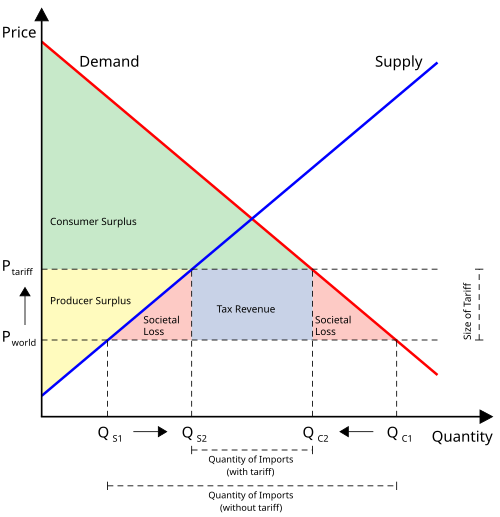
右の図は、ある架空の財に対する輸入関税の課税の影響を分析したものだ。関税が課される前、世界市場、したがって国内市場における財の価格もP worldである。関税により国内価格はP tariffに上昇する。価格の上昇により、国内生産はQ S1からQ S2に増加し、国内消費はQ C1からQ C2に減少する。[22] [23]
これは社会福祉に3つの影響を及ぼします。消費者余剰(緑の領域)が小さくなるため、消費者は不利になります。生産者余剰(黄色の領域)が大きくなるため、生産者は有利になります。政府も税収が増えます(青の領域)。しかし、消費者の損失は生産者と政府の利益よりも大きくなります。この社会的損失の大きさは、2つのピンクの三角形で示されています。関税を撤廃して自由貿易を行うことは、社会にとって純利益となります。[22] [23]
この関税を純生産国の観点からほぼ同様に分析すると、同様の結果が得られる。その国の観点から見ると、関税は生産者の利益を損ない、消費者の利益を増やすが、生産者の純損失は消費者の利益よりも大きい(分析対象国は関税を徴収していないため、この場合税収はない)。同様の分析では、輸出関税、輸入割当、輸出割当はすべてほぼ同じ結果になる。[18]
消費者が得をして生産者が損をすることもあるし、消費者が損をして生産者が得をすることもあるが、貿易制限の導入は社会に純損失をもたらす。なぜなら貿易制限による損失が貿易制限による利益よりも大きいからである。自由貿易は勝者と敗者を生み出すが、理論と経験的証拠は自由貿易による利益が損失よりも大きいことを示している。[18]
2021年の調査では、1963年から2014年にかけて151か国で「関税の引き上げは、国内生産高と生産性の持続的で経済的かつ統計的に有意な低下、失業率と不平等の上昇、実質為替レートの上昇、貿易収支のわずかな変化と関連している」ことが判明した。[24]
テクノロジーとイノベーション
経済モデルによれば、自由貿易は技術の採用と革新を促進すると示唆されている。[25] [26]
生産性と福祉
2023年にJournal of Political Economy誌に掲載された研究によると、1980年以降の貿易コストの削減により、世界中で農業生産性、食料消費、福祉が向上したという。福祉の向上は、特に一部の発展途上国で顕著であった。[27]
貿易転換
主流派経済学の理論によれば、一部の国に自由貿易協定を適用し、他の国に関税を選択的に適用すると、貿易転換のプロセスを通じて経済的非効率性につながる可能性がある。最も低コストの生産国が商品を生産するのは効率的だが、高コストの生産国が自由貿易協定を結び、低コストの生産国が高関税に直面している場合は、必ずしも効率的ではない。高コストの生産国に自由貿易を適用し、低コストの生産国には適用しないと、貿易転換と純経済的損失につながる可能性がある。このため、多くの経済学者はドーハ・ラウンドなどの世界的な関税削減交渉を非常に重視している。[18]
意見
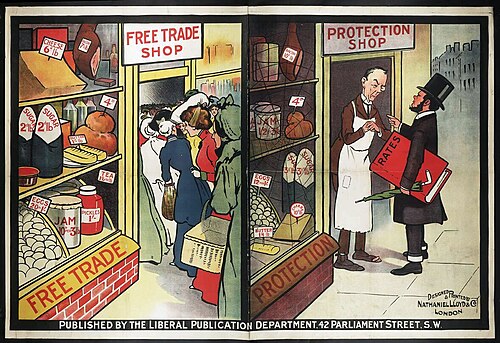
経済学者の意見
自由貿易の経済性を分析した文献は豊富にある。経済学者は自由貿易の理論的、実証的効果について広範囲に研究してきた。自由貿易は勝者と敗者を生み出すが、経済学者の間では自由貿易は社会に純益をもたらすというのが幅広いコンセンサスである。[28] [29] 2006年にアメリカの経済学者(回答者83名)を対象に行われた調査では、「87.5%が米国は残っている関税やその他の貿易障壁を撤廃すべきだと同意」し、「90.1%が米国は雇用主による海外への業務委託を制限すべきだという提案に反対」した。[30]
ハーバード大学経済学教授のN・グレゴリー・マンキューは「自由貿易が経済成長を促し、生活水準を向上させるという主張ほど、プロの経済学者の間でコンセンサスを得ている主張はほとんどない」と述べている[31] 。一流経済学者を対象にした調査では、「より自由な貿易は生産効率を高め、消費者により良い選択肢を提供し、長期的にはこれらの利益は雇用への影響よりもはるかに大きい」という考え方に反対する者はいなかった[32] 。
ポール・クルーグマンは、自由貿易は世界全体にとって非常に有益であり、特に貧しい国の人々にとって有益であると述べた。なぜなら、自由貿易によって彼らの生活水準が向上するからである。[33] 彼はまた、2007年に、米国が、同等の米国労働者よりも賃金が低い労働者を抱える低工業国との貿易を増やすにつれて(2007年のメキシコの賃金は米国の10分の1、中国は20分の1以下)、それらの国との貿易増加は米国の非熟練労働率に下方圧力をかけるだろうと述べた。[33]
世論
国際的に、先進国、発展途上国を問わず圧倒的多数の人々が他国との貿易を支持しているが、貿易が雇用を創出し、賃金を上げ、物価を下げると信じるかどうかについては意見が分かれている。[34]先進国における貿易は賃金を上げるという信念の中央値は、31%の人がそう信じているのに対し、27%の人がそう信じていない。新興国では、47%の人が貿易は賃金を上げると信じており、20%が賃金を下げると答えている。2014年から2017年の平均GDP成長率と、特定の国で貿易が賃金を上げると答えた人の割合との間には、0.66の正の相関関係がある。[35]先進国、新興国ともにほとんどの人が、貿易は物価を上げると考えている。先進国の35%、新興国の56%の人が貿易は物価を上げると信じており、それぞれ29%、18%が貿易は物価を下げると信じている。教育水準が高い人は、教育水準が低い人よりも、貿易によって価格が下がると信じる傾向が高い。[36]
歴史
初期

複数の主権国家を包含する自由貿易システムという概念は、16世紀のスペイン帝国で原始的な形で生まれました。[37]アメリカの法学者 アーサー・ナスバウムは、スペインの神学者フランシスコ・デ・ビトリアが「商業の自由と海洋の自由という概念(用語ではない)を初めて提唱した人物」であると述べています。[38]ビトリアは、国際法の原則に基づいて主張しました。[38]しかし、自由貿易の考え方を現代的で認識可能な形に発展させたのは、2人の初期のイギリス人経済学者アダム・スミスとデイヴィッド・リカードでした。
自由貿易を主張する経済学者たちは、特定の文明が経済的に繁栄したのは貿易のおかげだと信じていた。例えばスミスは、エジプト、ギリシャ、ローマなどの地中海文化だけでなく、ベンガル(東インド)や中国も貿易が盛んになった理由を指摘した。オランダはスペイン帝国の支配を打破し、自由貿易政策をとったことで大いに繁栄した。 [39]このため、自由貿易と重商主義の論争は何世紀にもわたって経済学で最も重要な問題となってきた。何世紀にもわたって、自由貿易政策は重商主義、保護主義、孤立主義、社会主義、ポピュリストなどの政策 と争ってきた。
オスマン帝国は18世紀までに自由な自由貿易政策をとっていたが、その起源はオスマン帝国の降伏であり、1536年にフランスと締結された最初の通商条約に遡り、 1673年の降伏、1740年の輸出入関税をわずか3%に引き下げた降伏、1790年の降伏によってさらに進んだ。オスマン帝国の自由貿易政策は、 JRマカロックが著書『商業辞典』(1834年)で述べたように自由貿易を主張する英国の経済学者からは賞賛されたが、ベンジャミン・ディズレーリ首相 など自由貿易に反対する英国の政治家からは批判された。ディズレーリは1846年の穀物法論争でオスマン帝国を「抑制されない競争による損害の例」として挙げ、1812年に「世界でも最も優れた製造業のいくつか」であったものを破壊したと主張した。[40]
.png/500px-Droits_de_douane_(France,_UK,_US).png)
植民地時代のアメリカにおける貿易は、イギリスの商人制度によって通商航海法を通じて規制されていた。1760年代まで、自由貿易を公然と主張する植民地人はほとんどいなかった。これは、規制が厳格に施行されていなかった(ニューイングランドは密輸で有名だった)ためでもあるが、植民地の商人が外国の商品や船舶と競争したくなかったためでもある。歴史家オリバー・ディッカーソンによると、自由貿易への欲求はアメリカ独立戦争の原因の1つではなかった。「18世紀の基本的な商取引慣行が間違っているという考えは、革命指導者の考えの一部ではなかった」とディッカーソンは書いている。[41]
アメリカ独立戦争の結果、自由貿易は後にアメリカ合衆国となる地域にもたらされた。 1775年にイギリス議会が禁酒法を発布し、植民地の港を封鎖した後、大陸会議は事実上経済的独立を宣言し、1776年4月6日、つまり独立宣言の3か月前にアメリカの港を外国貿易に開放した。歴史家ジョン・W・タイラーによると、「好むと好まざるとにかかわらず、自由貿易はアメリカ人に強制された」という。[42]
1801年3月、教皇ピウス7世は教皇領の経済危機に対処するため、自発教令「 Le più colte」で貿易の自由化を命じた。それにもかかわらず、教皇領の食糧を確保するため国産トウモロコシの輸出は禁止された。

イギリスでは、 1846年に穀物法が廃止され、自由貿易が実践される中心原則となった。反穀物法連盟が大規模な運動を後援した。南京条約に基づき、中国は1843年に世界貿易のために5つの条約港を開いた。最初の自由貿易協定であるコブデン・シュヴァリエ条約は1860年にイギリスとフランスの間で締結され、ヨーロッパの他の国々との協定の連続につながった。[43]
多くの古典的自由主義者、特に 19 世紀から 20 世紀初頭のイギリス (ジョン・スチュアート・ミルなど) や 20 世紀の大部分のアメリカ (ヘンリー・フォードや国務長官コーデル・ハルなど) は、自由貿易が平和を促進すると信じていました。ウッドロウ・ウィルソンは1918 年の「 14 か条の原則」演説で自由貿易のレトリックを取り上げました。
したがって、世界平和の計画は私たちの計画であり、その計画、私たちが見る限り唯一の可能な計画は次のとおりです。[...] 3. 可能な限り、すべての経済的障壁を取り除き、平和に同意し、その維持に協力するすべての国の間で貿易条件の平等を確立すること。[44]
経済史家ダグラス・アーウィンによれば、米国の貿易政策に関する一般的な誤解は、19世紀初頭に低関税が米国の製造業に損害を与え、その後19世紀後半に高関税が米国を工業大国にしたというものである。[45]エコノミスト誌によるアーウィンの2017年の著書「Clashing over Commerce: A History of US Trade Policy」のレビューでは次のように指摘している。[45]
政治的力学により、関税と景気循環の間には実際には存在しないつながりがあると人々は考えるようになる。好況時には十分な税収が生まれ、関税は下がるが、不況になると再び関税を上げる圧力が高まる。そうなる頃には経済は回復しており、関税引き下げが不況を引き起こし、その逆が回復を生み出したという印象を与える。アーウィン氏はまた、保護主義が米国を工業大国にしたという考えを系統的に論破している。この考えは、今日の発展途上国に教訓を与えると考える者もいる。米国の世界の製造業に占める割合が1870年の23%から1913年には36%に上昇したため、当時の高関税は確かにコストを伴い、1870年代半ばにはGDPの約0.5%と推定されている。一部の産業では、関税によって開発が数年早まったかもしれない。しかし、保護主義時代の米国の成長は、むしろ豊富な資源と人々やアイデアに対する開放性によるものだった。
ポール・ベロックによれば、18世紀末以来、アメリカ合衆国は「近代保護主義の祖国であり砦」であった。実際、アメリカ合衆国は1945年まで自由貿易を堅持したことはなかった。ジェファソニアンたちは大部分において保護主義に強く反対した。19世紀には、ヘンリー・クレイ上院議員などの政治家が、ホイッグ党内でアメリカン・システムという名前でアレクサンダー・ハミルトンのテーマを引き継いだ。野党の民主党は、関税と産業保護の問題をめぐって、1830年代、1840年代、1850年代を通じて数回の選挙で争った。[46]民主党は政府の収入のみに使われる中程度の関税を支持したが、ホイッグ党は優遇産業を保護するためにより高い保護関税を支持した。経済学者のヘンリー・チャールズ・ケアリーは、アメリカン・システム経済の主導的な提唱者となった。この重商主義的なアメリカ体制は、アンドリュー・ジャクソン、マーティン・ヴァン・ビューレン、ジョン・タイラー、ジェームズ・K・ポーク、フランクリン・ピアース、ジェームズ・ブキャナンらの民主党によって反対された。
エイブラハム・リンカーン率いる新興共和党は「ヘンリー・クレイ関税ホイッグ」と自称し、自由貿易に強く反対し、南北戦争中には鉄道補助金や戦争費用を賄うため、また優遇産業を保護するため44%の関税を実施した。[47]ウィリアム・マッキンリー(後にアメリカ合衆国大統領となる)は共和党(1868年から1912年までグロバー・クリーブランドの2期連続の任期を除き、すべての大統領選挙で勝利した)の立場を次のように述べた。
自由貿易のもとでは、貿易業者が主人であり、生産者が奴隷である。保護は自然の法則に過ぎず、自己保存、自己発展、人類の最高かつ最良の運命を確保する法則である。[保護は不道徳であると言われている] [...]。保護が 6,300 万人 [米国の人口] を育成し向上させるのであれば、その 6,300 万人の影響は世界の残りの人々を向上させる。人類に利益をもたらすことなく、進歩の道を一歩も進むことはできない。よく言われるように、「最も安く買えるところで買え」… もちろん、それは労働にも、他のすべてにも当てはまる。それより千倍も優れた格言をあげよう。それは保護の格言である。「最も簡単に支払えるところで買え」。そして、その場所こそが、労働が最高の報酬を得る場所である。[48]
戦間期には、経済保護主義が米国で定着し、最も有名なのはスムート・ホーリー関税法の形で、経済学者によれば大恐慌の長期化と世界的な拡大の原因となったと考えられている。[49] : 33 [50] 1934年からは、相互貿易協定法を通じて貿易の自由化が始まった。
第二次世界大戦後
第二次世界大戦の終結以来、産業規模と冷戦の始まりもあって、米国は関税障壁の削減と自由貿易の支持者となることが多かった。米国は関税および貿易に関する一般協定(GATLA)とその後の世界貿易機関(WTO)の設立に貢献したが、1950年代にその初期バージョンである国際貿易機関(ITO)を拒否していた。[51] 1970年代以降、米国政府は1990年代の北米自由貿易協定や2006年のドミニカ共和国・中米自由貿易協定など、管理貿易協定の交渉を行ってきた。
ヨーロッパでは、1951年に6カ国が欧州石炭鉄鋼共同体を形成し、1958年に欧州経済共同体(EEC)となった。EECの2つの中核目標は、共通市場(後に単一市場と改名)の開発と、加盟国間の関税同盟の設立であった。加盟国を拡大した後、EECは1993年に欧州連合となった。現在、世界最大の単一市場である欧州連合は、[52]世界中の多くの国と自由貿易協定を締結している。[53]
現代

世界のほとんどの国は世界貿易機関[54]に加盟しているが、世界貿易機関は関税やその他の貿易障壁をある程度制限しているものの、撤廃はしていない。また、ほとんどの国は参加国間の貿易障壁を下げる地域自由貿易圏にも加盟している。欧州連合と米国は環大西洋貿易投資パートナーシップを交渉中である。2018年には環太平洋パートナーシップに関する包括的及び先進的な協定が発効し、太平洋に面する11か国が参加している。
自由貿易政策の程度
自由貿易は物品やサービスの貿易に適用される。非経済的な考慮が自由貿易を阻害することもあり、例えば国は原則として自由貿易を支持しているが、エタノールなどの特定の薬物や売春などの特定の慣行を禁止したり、国際的な自由貿易を制限したりすることがある。[55]
それでもなお、ある程度の保護主義は世界中で標準となっている。1820年から1980年まで、12の先進国における製造品に対する平均関税は11~32%であった。発展途上国では、製造品に対する平均関税は約34%である。[56]アメリカの経済学者C・フレッド・バーグステンは、貿易政策を説明するために自転車理論を考案した。このモデルによれば、貿易政策は、自由化か保護主義のいずれかに絶えず傾くという点で動的に不安定である。自転車から落ちないようにするため(保護主義の欠点)、貿易政策と多国間貿易交渉は常に自由化に向けてペダルをこがなければならない。自由化の拡大を達成するためには、意思決定者は、狭い地域的利益よりも、消費者のより大きな福祉とより広範な国家経済を訴えなければならない。しかし、バーグステンは、貿易で敗者となった人々に補償を与え、新しい仕事を見つけるのを手助けすることも必要であると主張している。なぜなら、それがグローバリゼーションに対する反発を減らし、労働組合や政治家が貿易の保護を求める動機を減らすことになるからだ。[57]

開発経済学者のハジュン・チャンは著書『Kicking Away the Ladder』で、自由貿易政策と経済成長の歴史を振り返り、現在では工業化が進んだ国の多くが、歴史を通じて大きな貿易障壁を抱えていたと指摘している。米国と英国は、自由貿易政策の本拠地とみなされることもあるが、常に程度の差こそあれ保護主義を採用してきた。英国は国内の圧力を受けて1846年に穀物の輸入を制限する穀物法を廃止し、技術的優位性が最高潮に達した19世紀半ばになってようやく製造業に対する保護主義を緩和したが、工業製品の関税は1950年までに23%に戻った。米国は1950年代まで工業製品に対する加重平均関税を約40~50%に維持し、19世紀の輸送費の高さによる自然な保護主義も加わった。[58]最も一貫して自由貿易を実践してきたのはスイス、オランダ、そしてそれほどではないがベルギーである。[59]チャンは、アジアの4つの虎の輸出志向の工業化政策を「歴史上の同等の政策よりもはるかに洗練され、微調整されている」と評している。[60]
商品の自由貿易
世界貿易促進報告書は、国境を越えた物品の貿易や目的地への貿易を促進する要因、政策、サービスを測定する。この指標は、市場アクセス、国境管理、輸送および通信インフラ、ビジネス環境という4つのサブ指標をまとめたものである。2016年時点で、上位30カ国と地域は以下のとおりである。[61]





.svg/500px-Flag_of_Belgium_(civil).svg.png)
.svg/500px-Flag_of_Switzerland_(Pantone).svg.png)





.png/500px-Flag_of_the_United_States_(23px).png)

.svg/500px-Flag_of_Canada_(Pantone).svg.png)

.svg/500px-Flag_of_Australia_(converted).svg.png)




政治
学者、政府、利益団体は、自由貿易の相対的なコスト、利益、受益者について議論しています。
保護主義を支持する議論は、経済的なカテゴリー(貿易は経済や経済内のグループに損害を与える)と道徳的なカテゴリー(貿易の影響は経済に役立つかもしれないが、他の分野では悪影響を与える)に分類されます。自由貿易に反対する一般的な議論は、それが偽装された新植民地主義を表しているというものです。[62]道徳的なカテゴリーは広く、次のような懸念が含まれます。[63]
自由貿易に反対する経済的議論は、経済理論の仮定や結論を批判する。
国内産業は、輸入品の価格が下がると利益と市場シェアが減少するという理由で、自由貿易に反対することが多い。[64] [65]たとえば、米国が輸入砂糖の関税を引き下げれば、砂糖生産者は価格と利益が下がり、砂糖消費者は価格が下がるため、同じ量の砂糖に費やす金額が減る。デイヴィッド・リカードの経済理論では、消費者は必然的に生産者が失うものよりも多くの利益を得るとされている。[66] [67]国内の砂糖生産者一人ひとりが大きな損失を被る一方で、多数の消費者一人ひとりが得るものはわずかであるため、国内生産者は関税の引き下げに反対する可能性が高い。[65]より一般的には、生産者は自国での輸入に対する国内補助金と関税を支持する一方で、輸出市場での補助金と関税には反対することが多い。

社会主義者は、資本家による労働者の最大限の搾取を許すという理由で、自由貿易に反対することが多い。例えば、カール・マルクスは『共産党宣言』 (1848年)で次のように書いている。「ブルジョアジーは、自由貿易という唯一無二の、不当な自由を打ち立てた。一言で言えば、宗教的、政治的幻想に覆われた搾取の代わりに、むき出しの、恥知らずな、直接的で、残忍な搾取を置き換えたのだ」。しかし、マルクスが自由貿易を支持したのは、それが社会革命を早めると感じたからにほかならない。また、マルクスは、自由貿易を嫌って保護主義を支持する傾向は不健全だと考えていた。それは、マルクスが保護主義を、国内企業が国内に「大規模な」産業を確立するための手段と見なしていたためであり、その場合、必然的に世界市場に依存し、例えば収益を増やすことになるからだ。また、マルクスは、皮肉にも競争的な自由貿易を反映する国内経済システムの開発を保護主義が妨げることはないと主張している。[70]
多くの反グローバリゼーション団体は、自由貿易協定は一般的に貧困層や労働者階級の経済的自由を増大させるものではなく、むしろ彼らをさらに貧しくするだけだと主張し、自由貿易に反対している。
自由貿易反対者の中には、自由貿易理論には賛成するが、適用される自由貿易協定には反対する者もいる。NAFTA反対者の中には、協定が一般大衆に実質的な損害を与えると考える者もいるが、その議論の一部は、自由貿易そのものに反対するのではなく、実際には政府管理貿易の詳細に反対している。例えば、 NAFTAの下で、補助金を受けた米国産トウモロコシを生産コストを大幅に下回る価格でメキシコに自由に輸入することは(ダンピング)、メキシコの農家に破滅的な影響を与えるため、間違っていると主張されている。
研究によると、貿易制限に対する支持は、教育レベルが最も低い回答者の間で最も高いことが示されています。[71]ハインミュラーとヒスコックスは次のように結論付けています。
教育が有権者の貿易やグローバリゼーションに対する考え方に与える影響は、貿易が個人の所得や雇用の安定にどう影響するかという個人の計算よりも、経済的な考え方や経済現象の総合的かつ多様な影響に関する情報に触れることと関係がある。これは、後者のタイプの計算が個人の貿易に対する見方を形成する上で重要ではないと言っているのではなく、教育と貿易の自由化への支持との単純な関係に現れていないということである[71]
2017年の調査では、定型的なタスク集約型の職業に就き、海外に委託できる仕事をしている人は保護主義を支持する可能性が高いことがわかった。[72]
研究によれば、自由貿易に対する態度は必ずしも個人の利己心を反映するものではないことが示唆されている。[73] [74]
植民地主義
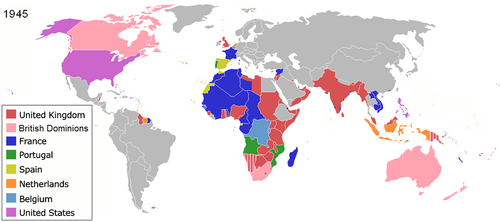
経済ナショナリズムや重商主義の支持者たちは、長い間、自由貿易を植民地主義や帝国主義の一形態として描いてきた。19世紀には、そのようなグループは、アメリカシステムの設計者であるアメリカ人ヘンリー・クレイの著作の中で特に、イギリスの自由貿易の呼びかけはイギリス帝国の隠れ蓑であると批判した。[75]
アイルランドの植民地行政に関わる自由貿易論争とそれに関連する問題[76] は、定期的に(1846年や1906年など)イギリス保守党(トーリー党)内で動揺を引き起こしてきた(1820年代から1840年代の穀物法問題、 19世紀から20世紀初頭の アイルランド自治問題)。
エクアドルのラファエル・コレア大統領(在任期間2007年~2017年)は、2006年に出版した著書『自由貿易協定の隠された側面』[77]の序文で「自由貿易の詭弁」を非難した。この本は、コレア政権のエネルギー大臣アルベルト・アコスタが一部執筆したものだ。コレアは、2002年にハジュン・チャンが書いた『はしごを蹴飛ばせ』[78]を出典として挙げ、自由貿易の「アメリカ方式」と「イギリス方式」の違いを指摘した。アメリカ人は明らかに後者を「イギリス帝国主義システムの一部」と見なしていた、と彼は言う。コレアによれば、チャンは、リストではなく、財務長官アレクサンダー・ハミルトン(在任期間1789年~1795年)が初めて産業保護主義を擁護する体系的な議論を提示したことを示したという。
主要自由貿易地域
.jpg/500px-Press_conference_EU-Mercosul_on_June_26,_2019_(VII).jpg)
アフリカ
ヨーロッパ
アメリカ大陸
代替案
自由貿易の代替案として、保護主義、[79]、 帝国主義、[80]、 均衡貿易、[81]、 公正貿易、[82]、産業政策などが提案されている。[83]
均衡貿易では、各国は比較的公平な相互貿易パターンを提供することが求められ、大きな貿易赤字や貿易黒字を出すことはできません。公正貿易とは、貿易を認めながらも、指揮主義、労働者の権利の保護、環境保護など、 他の利益を考慮することです。
保護主義
保護主義には、国内の製品や産業を国際競争から保護し、他の形態の課税に代わって政府の収入を増やすための関税が含まれます。
1846年、イギリスはアイルランドの飢饉や国内の食糧価格に対する圧力に対応して、穀物の輸入を制限していた穀物法を廃止した。また、製造業に対する保護主義も緩和したが、それはイギリスの技術的優位性が最高潮に達した19世紀半ばになってからのことだった。工業製品の関税は1950年までに23%に戻った。
The United States maintained weighted average tariffs on manufactured products of approximately 40–50% up until the 1950s, augmented by the natural protectionism of high transportation costs in the 19th century.[84] The 2016 presidential election marked the beginning of the trend of returning to protectionism in the United States, an ideology incorporated into Republican president Donald Trump's platform and largely maintained by his successor Joe Biden.[85][86]
Imperialism
Imperialism entails unequal exchange for the benefit of the mother country, often at the expense of the colonies. The imperial trade practices of the British and Spanish Empires were contributing factors to the American Revolution and the Spanish American Wars of Independence.[87][88]
Belgium also engaged in unequal exchange, most notoriously in the Congo Free State (CFS) under King Leopold II. In direct violation of his promises of free trade within the CFS under the terms of the Berlin Treaty, not only did the CFS become a commercial entity directly or indirectly trading within its dominion, but Leopold had also been slowly monopolizing a considerable amount of the ivory and rubber trade by imposing export duties on the resources traded by other merchants within the CFS.[89]
In literature
The value of free trade was first observed and documented in 1776 by Adam Smith in The Wealth of Nations, writing:[90]
It is the maxim of every prudent master of a family, never to attempt to make at home what it will cost him more to make than to buy. [...] If a foreign country can supply us with a commodity cheaper than we ourselves can make it, better buy it of them with some part of the produce of our own industry, employed in a way in which we have some advantage.[91]
This statement uses the concept of absolute advantage to present an argument in opposition to mercantilism, the dominant view surrounding trade at the time which held that a country should aim to export more than it imports and thus amass wealth.[92] Instead, Smith argues, countries could gain from each producing exclusively the goods in which they are most suited to, trading between each other as required for the purposes of consumption. In this vein, it is not the value of exports relative to that of imports that is important, but the value of the goods produced by a nation. However, the concept of absolute advantage does not address a situation where a country has no advantage in the production of a particular good or type of good.[93]
This theoretical shortcoming was addressed by the theory of comparative advantage. Generally attributed to David Ricardo, who expanded on it in his 1817 book On the Principles of Political Economy and Taxation,[94] it makes a case for free trade based not on absolute advantage in production of a good, but on the relative opportunity costs of production. A country should specialize in whatever good it can produce at the lowest cost, trading this good to buy other goods it requires for consumption. This allows for countries to benefit from trade even when they do not have an absolute advantage in any area of production. While their gains from trade might not be equal to those of a country more productive in all goods, they will still be better off economically from trade than they would be under a state of autarky.[95][96]
Exceptionally, Henry George's 1886 book Protection or Free Trade was read out loud in full into the Congressional Record by five Democratic congressmen.[97][98] American economist Tyler Cowen wrote that Protection or Free Trade "remains perhaps the best-argued tract on free trade to this day".[99] Although George is very critical towards protectionism, he discusses the subject in particular with respect to the interests of labor:
We all hear with interest and pleasure of improvements in transportation by water or land; we are all disposed to regard the opening of canals, the building of railways, the deepening of harbors, the improvement of steamships as beneficial. But if such things are beneficial, how can tariffs be beneficial? The effect of such things is to lessen the cost of transporting commodities; the effect of tariffs is to increase it. If the protective theory be true, every improvement that cheapens the carriage of goods between country and country is an injury to mankind unless tariffs be commensurately increased.[100]
George considers the general free trade argument inadequate. He argues that the removal of protective tariffs alone is never sufficient to improve the situation of the working class, unless accompanied by a shift towards a "single tax" in the form of a land value tax.[101]
See also

- Concepts/topics
- Borderless selling – Bypassing non-tariff barriers to trade
- Economic globalization – International economic interdependence
- Economic sanctions – Financial penalties applied by nations
- Fair trade – Sustainable and equitable trade
- Free market – Form of market-based economy
- Free-trade area – Regional trade agreement
- Free-trade zone – Geographic area where economic activity between and within countries is less regulated
- Freedom of choice – Political and social concept
- Non-tariff barriers to trade – Type of trade barriers
- Offshore outsourcing – Contracting formerly internal tasks to an external organization
- Offshoring – Transnational relocation of operations
- Peace economics – Branch of conflict economics
- Trade Adjustment Assistance – US internal economic program
- Trade bloc – Intergovernmental open trading group
- Trade war – Economic conflict using tariffs or other trade barriers
- Trade organizations
- European Economic Area – European free trade zone established in 1994
- Free Trade Area of the Americas – Failed 2005 trade agreement for North and South America
- World Trade Organization – Intergovernmental trade organization
Citations
- ^ Murschetz, Paul (2013). State Aid for Newspapers: Theories, Cases, Actions. Springer Science+Business Media. p. 64. ISBN 978-3642356902.
Parties of the left in government adopt protectionist policies for ideological reasons and because they wish to save worker jobs. Conversely, right-wing parties are predisposed toward free trade policies.
- ^ Peláez, Carlos (2008). Globalization and the State: Volume II: Trade Agreements, Inequality, the Environment, Financial Globalization, International Law and Vulnerabilities. United States: Palgrave MacMillan. p. 68. ISBN 978-0230205314.
Left-wing parties tend to support more protectionist policies than right-wing parties.
- ^ Mansfield, Edward (2012). Votes, Vetoes, and the Political Economy of International Trade Agreements. Princeton University Press. p. 128. ISBN 978-0691135304.
Left-wing governments are considered more likely than others to intervene in the economy and to enact protectionist trade policies.
- ^ Warren, Kenneth (2008). Encyclopedia of U.S. Campaigns, Elections, and Electoral Behavior: A–M, Volume 1. Sage. p. 680. ISBN 978-1412954891.
Yet, certain national interests, regional trading blocks, and left-wing anti-globalization forces still favor protectionist practices, making protectionism a continuing issue for both American political parties.
- ^ Federico, Giovanni; Tena-Junguito, Antonio (2019). "World Trade, 1800–1938: A New Synthesis". Revista de Historia Economica – Journal of Iberian and Latin American Economic History. 37 (1): 9–41. doi:10.1017/S0212610918000216. hdl:10016/36110. ISSN 0212-6109.
- ^ Federico, Giovanni; Tena-Junguito, Antonio (2018-07-28). "The World Trade Historical Database". VoxEU.org. Retrieved 2019-10-07.
- ^ Bown, C. P.; Crowley, M. A. (2016-01-01), Bagwell, Kyle; Staiger, Robert W. (eds.), "Chapter 1 – The Empirical Landscape of Trade Policy", Handbook of Commercial Policy, 1, North-Holland: 3–108, doi:10.1016/bs.hescop.2016.04.015, hdl:10986/24161, ISBN 978-0444632807, S2CID 204484666, retrieved 2019-10-07
- ^ Krueger, Anne O. (2020). International Trade: What Everyone Needs to Know. Oxford University Press. doi:10.1093/wentk/9780190900465.001.0001. ISBN 978-0190900465.
- ^ See P.Krugman, «The Narrow and Broad Arguments for Free Trade», American Economic Review, Papers and Proceedings, 83(3), 1993; and P. Krugman, Peddling Prosperity: Economic Sense and Nonsense in the Age of Diminished Expectations, New York, W.W. Norton & Company, 1994.
- ^ a b "Free Trade". IGM Forum. March 13, 2012.
- ^ "Import Duties". IGM Forum. October 4, 2016.
- ^ N. Gregory Mankiw, Economists Actually Agree on This: The Wisdom of Free Trade, New York Times (April 24, 2015): "Economists are famous for disagreeing with one another.... But economists reach near unanimity on some topics, including international trade."
- ^ William Poole, Free Trade: Why Are Economists and Noneconomists So Far Apart, Federal Reserve Bank of St. Louis Review, September/October 2004, 86(5), pp. 1: "most observers agree that '[t]he consensus among mainstream economists on the desirability of free trade remains almost universal.'"
- ^ "Trade Within Europe". IGM Forum. Retrieved 2017-06-24.
- ^ Tenreyro, Silvana; Lisicky, Milan; Koren, Miklós; Caselli, Francesco (2019). "Diversification Through Trade" (PDF). The Quarterly Journal of Economics. 135 (1): 449–502. doi:10.1093/qje/qjz028.
- ^ Oatley, Thomas (2019). International Political Economy: Sixth Edition. Routledge. ISBN 978-1351034647.
- ^ "What's Wrong with Protectionism?". Mercatus Center. 2018-08-20. Retrieved 2021-09-24.
- ^ a b c d Steven E. Landsburg. Price Theory and Applications, Sixth Edition, Chapter 8.
- ^ Thom Hartmann, Unequal Protection, Second Edition, Chapter 20. p. 255
- ^ a b Pugel (2007), International Economics, pp. 311–312.
- ^ Chang, Ha-Joon, Kicking Away the Ladder: Good Policies and Good Institutions in Historical Perspective
- ^ a b Alan C. Stockman, Introduction to Economics, Second Edition, Chapter 9.
- ^ a b N. Gregory Mankiw, Macroeconomics, Fifth Edition, Chapter 7.
- ^ Furceri, Davide; Hannan, Swarnali A; Ostry, Jonathan D; Rose, Andrew K (2021). "The Macroeconomy After Tariffs". The World Bank Economic Review. 36 (2): 361–381. doi:10.1093/wber/lhab016. hdl:10986/36630. ISSN 0258-6770.
- ^ Perla, Jesse; Tonetti, Christopher; Waugh, Michael E. (2021). "Equilibrium Technology Diffusion, Trade, and Growth". American Economic Review. 111 (1): 73–128. doi:10.1257/aer.20151645. ISSN 0002-8282. S2CID 234358882.
- ^ Eaton, Jonathan; Kortum, Samuel (2002). "Technology, Geography, and Trade". Econometrica. 70 (5): 1741–1779. doi:10.1111/1468-0262.00352. ISSN 0012-9682. JSTOR 3082019.
- ^ Farrokhi, Farid; Pellegrina, Heitor S. (2023). "Trade, Technology, and Agricultural Productivity". Journal of Political Economy. 131 (9): 2509–2555. doi:10.1086/724319. ISSN 0022-3808. S2CID 235357218.
- ^ Fuller, Dan; Geide-Stevenson, Doris (Fall 2003). "Consensus Among Economists: Revisited" (PDF). Journal of Economic Review. 34 (4): 369–387. doi:10.1080/00220480309595230. S2CID 143617926. Archived from the original (PDF) on 2004-09-20. Retrieved 2007-01-22.(registration required)
- ^ Friedman, Milton (1993). "The Case for Free Trade". Hoover Digest. 1997 (4): 42–49. Bibcode:1993SciAm.269e..42B. doi:10.1038/scientificamerican1193-42. Archived from the original on 22 January 2007.
- ^ Whaples, Robert (2006). "Do Economists Agree on Anything? Yes!". The Economists' Voice. 3 (9). doi:10.2202/1553-3832.1156. S2CID 201123406.
- ^ Mankiw, Gregory (7 May 2006). "Outsourcing Redux". Retrieved 22 January 2007.
- ^ "Poll Results". IGM Forum. Archived from the original on 22 June 2016. Retrieved 1 July 2016.
- ^ a b Paul Krugman (December 12, 2007). "The Trouble with Trade". The New York Times.
- ^ Stokes, Bruce (26 September 2018). "Americans, Like Many in Other Advanced Economies, Not Convinced of Trade's Benefits". Pew Research Center.
- ^ Stokes, Bruce (26 September 2018). "4. Nearly half of adults in emerging markets say trade raises wages". Pew Research Center.
- ^ Stokes, Bruce (26 September 2018). "5. Public views on trade and prices are at odds with economic theory". Pew Research Center.
- ^ Giovanni Arrighi (1994). The Long Twentieth Century: Money, Power, and the Origins of Our Times. Verso. p. 58. ISBN 978-1859840153.
- ^ a b Arthur Nussbaum (1947). A concise history of the law of nations. Macmillan Co. p. 62.
- ^ Appleby, Joyce (2010). The Relentless Revolution: A History of Capitalism. New York: W. W. Norton & Company. ISBN 978-0393068948.
- ^ Paul Bairoch (1995). Economics and World History: Myths and Paradoxes. University of Chicago Press. pp. 31–32. Archived from the original on 2017-10-12. Retrieved 2017-08-16.
- ^ Dickerson, The Navigation Acts and the American Revolution, p. 140.
- ^ Tyler, Smugglers & Patriots, p. 238.
- ^ International Monetary Fund Research Dept. (1997). World Economic Outlook, May 1997: Globalization: Opportunities and Challenges. International Monetary Fund. p. 113. ISBN 978-1455278886.
- ^ Fourteen Points
- ^ a b "A historian on the myths of American trade". The Economist. Retrieved 2017-11-26.
- ^ Larry Schweikart, What Would the Founders Say? (New York: Sentinel, 2011), pp. 106–124.
- ^ Lind, Matthew. "Free Trade Fallacy". Prospect. Archived from the original on 6 January 2006. Retrieved 3 January 2011.
- ^ William McKinley speech, October 4, 1892 in Boston, MA William McKinley Papers (Library of Congress)
- ^ Eun, Cheol S.; Resnick, Bruce G. (2011). International Financial Management, 6th Edition. New York: McGraw-Hill/Irwin. ISBN 978-0078034657.
- ^ Irwin, Douglas A. (2017-09-19). "Steve Bannon's Bad History". Wall Street Journal. ISSN 0099-9660. Retrieved 2017-09-20.
- ^ "The New Liberallism : Trade Policy Developments in Emerging Markets" (PDF). Wto.org. January 1997. Retrieved 2 March 2022.
- ^ "EU position in world trade". European Commission. Retrieved 24 May 2015.
- ^ "Agreements". European Commission. Retrieved 17 March 2016.
- ^ "Members and Observers". World Trade Organisation. Retrieved 3 January 2011.
- ^ Ditmore, Melissa Hope (2006). Encyclopedia of prostitution and sex work. Greenwood Press. p. 581. ISBN 978-0313329685. Retrieved 1 June 2018.
Let us by all means apply the sacred principles of free trade to trade in vice, and regulate the relations of the sexes by the higgling of the market and the liberty of private contract.
- ^ Chang (2003), Kicking Away the Ladder, p. 66
- ^ Destler, Mac and Noland, Marcus (July 2, 2014). Constant Ends, Flexible Means: C. Fred Bergsten and the Quest for Open Trade. Peterson Institute for International Economics.
- ^ Chang (2003), Kicking Away the Ladder, p. 17
- ^ Chang (2003), Kicking Away the Ladder, p. 59
- ^ Chang (2003), Kicking Away the Ladder, p. 50
- ^ "Global Enabling Trade Index".
- ^ Chang, Ha-Joon (July 1, 2002). Kicking Away the Ladder: Development Strategy in Historical Perspective. Anthem Press. ISBN 1843310279.
- ^ Hickel, Jason (February 13, 2018). The Divide: Global Inequality from Conquest to Free Markets. W. W. Norton & Company.
- ^ William Baumol and Alan Blinder, Economics: Principles and Policy, p. 722.
- ^ a b Brakman, Steven; Harry Garretsen; Charles Van Marrewijk; Arjen Van Witteloostuijn (2006). Nations and Firms in the Global Economy : An Introduction to International Economics and Business. Cambridge: Cambridge University Press. ISBN 978-0521832984.
- ^ Richard L. Stroup, James D. Gwartney, Russell S. Sobel, Economics: Private and Public Choice, p. 46.
- ^ Pugel, Thomas A. (2003). International economics. Boston: McGraw-Hill. ISBN 978-0071198752.
- ^ "Earnings – National". Databases, Tables & Calculators by Subject. Bureau of Labor Statistics. Archived from the original on 15 March 2012. Retrieved 16 March 2012.
- ^ "Table 1.1.5. Gross Domestic Product". National Income and Product Accounts Table. U.S. Department of Commerce Bureau of Economic Analysis. Archived from the original on 2012-09-11. Retrieved 16 March 2012.
- ^ "It is in this revolutionary sense alone, gentlemen, that I vote in favor of free trade." Marx, Karl On the Question of Free Trade Speech to the Democratic Association of Brussels at its public meeting of January 9, 1848
- ^ a b Hainmueller, Jens; Hiscox, Michael J. (2006). "Learning to Love Globalization: Education and Individual Attitudes Toward International Trade". International Organization. 60 (2): 469–498. CiteSeerX 10.1.1.407.4650. doi:10.1017/S0020818306060140 (inactive 2024-09-03). ISSN 1531-5088. S2CID 152381282.
{{cite journal}}: CS1 maint: DOI inactive as of September 2024 (link) - ^ Owen, Erica; Johnston, Noel P. (2017). "Occupation and the Political Economy of Trade: Job Routineness, Offshorability, and Protectionist Sentiment". International Organization. 71 (4): 665–699. doi:10.1017/S0020818317000339. ISSN 0020-8183. S2CID 158781474.
- ^ Mansfield, Edward D.; Mutz, Diana C. (2009-07-01). "Support for Free Trade: Self-Interest, Sociotropic Politics, and Out-Group Anxiety". International Organization. 63 (3): 425–457. doi:10.1017/S0020818309090158. ISSN 1531-5088. S2CID 2134093.
- ^ "Why Don't Trade Preferences Reflect Economic Self-Interest?" (PDF). Archived from the original (PDF) on 2016-02-03.
- ^ Clay, Henry (1843). "In Defense of the American System: In the Senate of the United States, February 2d, 3d, and 6th, 1832". The Life and Speeches of Henry Clay. Vol. II. Greeley & McElrath. pp. 23–24. hdl:2027/njp.32101013125040.
Gentlemen deceive themselves. It is not free trade that they are recommending to our acceptance. It is, in effect, the British colonial system that we are invited to adopt; and, if their policy prevail, it will lead, substantially, to the recolonization of these States, under the commercial dominion of Great Britain.
- ^
Hechter, Michael (1999). Internal Colonialism: The Celtic Fringe in British National Development (2 ed.). Routledge (published 2017). ISBN 978-1351511926. Retrieved 4 August 2019.
After the Corn Laws were repealed, ending Ireland's virtual monopoly of the British grain market, the Irish land system changed radically.
- ^ Acosta, Alberto; Correa, Rafael (2006). El rostro oculto del TLC. Editorial Abya Yala. ISBN 978-9978226100. Retrieved 2 March 2022 – via Google Books.
- ^ Chang, Ha-Joon (2002). Kicking Away the Ladder: Development Strategy in Historical Perspective. Anthem Press. ISBN 978-0857287618. Review.
- ^ "protectionism | Definition, Examples, & Facts". Encyclopedia Britannica. Retrieved 2020-10-14.
- ^ "Imperialism - an overview". ScienceDirect Topics. Retrieved 2022-10-18.
- ^ "Balanced Trade - Explained". The Business Professor, LLC. Retrieved 2022-10-18.
- ^ Moore, Geoff (2004). "The Fair Trade Movement: Parameters, Issues and Future Research". Journal of Business Ethics. 53 (1/2): 73–86. doi:10.1023/B:BUSI.0000039400.57827.c3. ISSN 0167-4544. JSTOR 25123283. S2CID 55108569.
- ^ Cimoli, Mario; Dosi, Giovanni; Landesmann, Michael A.; Mazzucato, Mariana; Page, Tim; Pianta, Mario; Stiglitz, Joseph E.; Walz, Rainer (2015). "Which Industrial Policy Does Europe Need?". Intereconomics. 2015 (3): 120–155.
- ^ Chang (2003), Kicking Away the Ladder, p. 17
- ^ Swedberg, Richard (2018). "Folk economics and its role in Trump's presidential campaign: an exploratory study". Theory and Society. 47 (1): 1–36. doi:10.1007/s11186-018-9308-8. S2CID 149378537.
- ^ Hayashi, Yuka (December 28, 2023). "Biden Struggles to Push Trade Deals with Allies as Election Approaches". The Wall Street Journal.
- ^ Miller, John C. (1943). Origins of the American Revolution. Boston: Little, Brown and company. OL 6453380M., pp. 95–99
- ^ Lynch, Spanish American Revolutions, 27–34. Rodríguez, Independence of Spanish America, 14–18. Kinsbruner, Independence in Spanish America, 14–17, 23.
- ^ Hochschild, Adam (2006). King Leopold's Ghost: A Story of Greed, Terror, and Heroism in Colonial Africa. ISBN 978-1-74329-160-3.
- ^ Bhagwati (2002), Free Trade Today, p. 3
- ^ Smith, Wealth of Nations, pp. 264–265.
- ^ Pugel (2007), International Economics, p. 33
- ^ Pugel (2007), International Economics, p. 34
- ^ Ricardo (1817), On the Principles of Political Economy and Taxation, Chapter 7 "On Foreign Trade"
- ^ Bhagwati (2002), Free Trade Today, p. 1
- ^ Pugel (2007), International Economics, pp. 35–38, 40
- ^ Weir, "A Fragile Alliance," 425–425
- ^ Henry George, Protection or Free Trade: An Examination of the Tariff Question, with Especial Regard to the Interests of Labor(New York: 1887).
- ^ Cowen, Tyler (May 1, 2009). "Anti-Capitalist Rerun". The American Interest. 4 (5). Retrieved 15 November 2014.
- ^ "Protection or Free Trade – Chapter 3". Truefreetrade.org. Retrieved 2 March 2022.
- ^ "Protection or Free Trade – Chapter 16". Protection or Free Trade.
General and cited references
- Bannerman, Gordon, Free Trade, EGO – European History Online, Mainz: Institute of European History, 2015, retrieved: March 8, 2021 (pdf).
- Bhagwati, Jagdish. Free Trade Today. Princeton: Princeton University Press (2002). ISBN 0691091560.
- Blinder, Alan S. (2008). "Free Trade". In David R. Henderson (ed.). Concise Encyclopedia of Economics (2nd ed.). Indianapolis: Library of Economics and Liberty. ISBN 978-0865976658. OCLC 237794267.
- Chang, Ha-Joon. Kicking Away The Ladder: Development Strategy in Historical Perspective. London: Anthem Press 2003. ISBN 978-1843310273.
- Dickerson, Oliver M. The Navigation Acts and the American Revolution. New York: Barnes (1963). ISBN 978-0374921620 OCLC 490386016.
- Pugel, Thomas A. International Economics, 13th edition. New York: McGraw-Hill Irwin (2007). ISBN 978-0073523026.
- Ricardo, David. On the Principles of Political Economy and Taxation, Library of Economics and Liberty (1999).
- Smith, Adam. An Inquiry into the Nature and Causes of the Wealth of Nations, Digireads Publishing (2009), ISBN 1420932063.
- Tyler, John W. Smugglers & Patriots: Boston Merchants and the Advent of the American Revolution. Boston: Northeastern University Press (1986). ISBN 0930350766.
Further reading
- Galiani, Sebastian, Norman Schofield, and Gustavo Torrens (2014). "Factor Endowments, Democracy and Trade Policy Divergence". Journal of Public Economic Theory. 16(1): 119–156. doi:10.1111/jpet.12057.
- Griswold, Dan (2008). "Free Trade". In Hamowy, Ronald (ed.). The Encyclopedia of Libertarianism. Thousand Oaks, CA: Sage; Cato Institute. pp. 189–191. doi:10.4135/9781412965811.n115. ISBN 978-1412965804. LCCN 2008009151. OCLC 750831024.
- Medley, George Webb (1881). . London: Cassell, Petter, Galpin & Co.
- World Trade Organization (2018). "History of the multilateral trading system".
External links

Wikiquote has quotations related to Free trade.
- The Online Library of Liberty Archived 2021-01-28 at the Wayback Machine
- 66 contemporary British illustrations about free trade, 1830s–1910s