
Loading article…
近代オリンピック競技大会(OGまたはオリンピック、フランス語:Jeux olympiques, JO)[a] [1]は、世界を代表する国際スポーツイベントです。夏季と冬季のスポーツ競技会で、世界中から何千人ものアスリートがさまざまな競技に参加します。オリンピック競技大会は、主権国家や領土を代表する200以上のチームが参加する、世界最高峰のスポーツ競技会とみなされています。オリンピック競技大会は、開催年に開催される世界選手権の代わりに行われるのが一般的です(ただし、各クラスは通常、独自の記録を保持しています)。[2]オリンピックは4年ごとに開催されます。1994年以降、4年間のオリンピック期間中、夏季オリンピックと冬季オリンピックが2年ごとに交互に開催されています。[3] [4]
オリンピックは、紀元前8世紀から紀元後4世紀にかけてギリシャのオリンピアで開催された古代オリンピックにインスピレーションを得て創設されました。ピエール・ド・クーベルタン男爵は1894年に国際オリンピック委員会(IOC)を設立し、1896年にアテネで最初の近代オリンピックが開催されました。IOCはオリンピック運動の統括機関であり、オリンピックに関わるすべての団体と個人を網羅しています。オリンピック憲章は、その構造と権限を定義しています。
20世紀から21世紀にかけてのオリンピック運動の発展により、オリンピックには数多くの変化がもたらされた。これらの調整には、雪上および氷上スポーツのための冬季オリンピック、障がい者アスリートのためのパラリンピック、14歳から18歳までのアスリートのためのユースオリンピック、5大陸大会(パンアメリカン、アフリカ、アジア、ヨーロッパ、太平洋)、およびオリンピックで競技されないスポーツのための世界大会の創設が含まれる。IOCは、デフリンピックとスペシャルオリンピックスも承認している。IOCは、さまざまな経済的、政治的、および技術的進歩に適応する必要がある。アマチュアルールの濫用により、 IOCは、クーベルタンが構想した純粋なアマチュアリズムから離れ、プロアスリートのオリンピック参加を受け入れる方向にシフトした。マスメディアの重要性の高まりにより、企業のスポンサーシップとオリンピックの一般的な商業化の問題が生じている。第一次世界大戦と第二次世界大戦の影響で、 1916年、1940年、1944年のオリンピックは中止となり、冷戦中の大規模なボイコットにより1980年と1984年のオリンピックへの参加が制限され、[5] 2020年のオリンピックはCOVID-19による制限のため2021年まで延期されました。
オリンピック・ムーブメントは、国際スポーツ連盟(IF)、国内オリンピック委員会(NOC)、各オリンピック大会の組織委員会で構成されています。意思決定機関として、IOCは各大会の開催都市を選択する責任があり、オリンピック憲章に従って大会を組織し、資金を提供します。IOCはまた、大会で競われるスポーツからなるオリンピックプログラムを決定します。オリンピックには、オリンピック旗、トーチ、開会式と閉会式など、いくつかの儀式とシンボルがあります。2020年の夏季オリンピックと2022年の冬季オリンピックを合わせると、14,000人を超えるアスリートが40の異なるスポーツと448のイベントで競いました。各種目の1位、2位、3位の選手には、それぞれ金、銀、銅の オリンピックメダルが授与されます。
オリンピックは、ほぼすべての国が参加するほどに成長し、植民地や海外領土も独自のチームを編成することがしばしば認められています。この成長により、ボイコット、ドーピング、八百長、賄賂、テロなど、数多くの課題や論争が生まれています。2年に一度開催されるオリンピックとそのメディア露出は、アスリートたちに国内および国際的な名声を得るチャンスを提供します。オリンピックはまた、開催都市や開催国が世界に自らをアピールする機会も提供します。
オリンピックは国際協力と文化交流を促進する重要な世界的イベントとなっている。[6]同時に、オリンピックの開催は開催都市に大きな経済的利益と課題をもたらし、インフラ、観光、地域社会に影響を与える可能性がある。[7]
古代オリンピック

古代オリンピック(古代ギリシア語:τὰ Ὀλύμπια、タ・オリンピア[8] )は、ギリシャのオリンピアにあるゼウスの神殿で4年ごとに開催された宗教的かつ運動的な祭典であった。祭典の日程は複雑な公式に従って決定され、祭典の中間点は夏至後の2回目の満月、通常は8月下旬または9月上旬に当たることになっていた。[9] : p. 26 [10] : p. 38 これは「毎年の収穫後、オリーブの摘み取り前に行われた」。[ 10]日程を告知するためにエリスから伝令が派遣された。 [ 9] : p. 26 [10] : p. 38 49 しかし、マケドニア、次いでローマがギリシャを征服した後、オリンピックの審判員10人は以前の基準を緩め、ギリシャ語を話す人なら誰でも参加することを認めた。[10] : p. 50 何万人ものギリシャ人が困難な旅をしてこの祭典に参加した。[9] : p. 55 いくつかの情報源によると、4万人が参加した。[11] [12]これらのオリンピックでは主に陸上競技が目玉だったが、レスリングやパンクラチオン(馬と戦車のレース)などの格闘技も行われた。オリンピックの期間中、参加都市国家間のすべての紛争はオリンピックが終わるまで延期されたと広く書かれている。この敵対行為の停止はオリンピックの平和または休戦として知られていた。[13]この考えは現代の神話である。なぜならギリシャ人は戦争を決して中断しなかったからである。休戦により、オリンピアへ旅する宗教的な巡礼者はゼウスに守られていたため、交戦地域を邪魔されずに通過することができた。[14]フィンリーとプレケットも参照。[9] : pp. 98-99
オリンピックの起源は謎と伝説に包まれている。[15] : p. 12 最も人気のある神話の 1 つは、ヘラクレスと彼の父ゼウスをゲームの創始者としている。[15] : pp. 12–13 [16] [17] [18]伝説によると、ゲームを最初に「オリンピック」と呼び、4 年ごとに開催する慣習を確立したのはヘラクレスだった。[17]神話は続き、ヘラクレスが12 の功業を成し遂げた後、ゼウスへの敬意としてオリンピック スタジアムを建設した。完成後、彼は 200 歩を一直線に歩き、この距離を「スタディオン」(古代ギリシャ語: στάδιον、ラテン語:スタジアム、「ステージ」)と呼び、これが後に距離の単位になった。古代オリンピックの最も広く受け入れられている発祥の年は紀元前 776 年である。これは、オリンピアで発見された碑文に基づいており、紀元前776年から4年ごとに開催されている徒競走の優勝者を列挙している。[2]最初の13回のオリンピックでは、スタディオン徒競走が唯一の競技であり、[10] : p. 145 [19]その短距離走での勝利は非常に高く評価されたため、次のオリンピックは優勝者にちなんで名付けられ、例えば「アルゴスのラダスがスタディオンで優勝した第18回オリンピックの3年目」などである。[10] : p. 145 古代オリンピックは時代とともに変化したが、ランニング競技、五種競技(跳躍競技、円盤投げとやり投げ、徒競走、レスリングからなる)、ボクシング、レスリング、パンクラチオン、馬術競技が行われるようになった。[20] [21]伝説によれば、エリス市の料理人コロエブスが最初のオリンピックチャンピオンであり、[22]このことは、競技が貴族階級に限定されていなかったことを示している。[10] : pp. 50–51
オリンピックは根本的に宗教的な重要性を持っており、ゼウス(オリンピアのゼウス神殿にはペイディアス作の有名な像が立っていた)とペロプス(神聖な英雄でオリンピアの神話上の王)の両者を称える儀式的な犠牲と並行して行われたスポーツ競技は、祭典の2日目まで開始されなかった。[9] : p. 15 (ペロプスはピサティスのオイノマウス王との戦車競争で有名だった。[23])競技の勝者は称賛され、詩や彫像で不滅のものとなった。[24]ゼウスの境内の聖なるオリーブの木で作られた花輪がオリンピックの唯一の公式賞品であったが、勝者の名声は故郷や裕福なスポンサーからの補助金という形で彼らに経済的な富ももたらした。例えば、FinleyとPleket [9] :pp.24、76-82 、およびPerrottet [10] :pp.13-14 を参照。オリンピックは4年ごとに開催され、この期間はオリンピアードと呼ばれ、ギリシャ人によって時間の測定単位の1つとして使用されていました。オリンピックは、ピュティア競技会、ネメア競技会、イストミア競技会を含むパンヘレニック競技会と呼ばれるサイクルの一部でした。[25]
オリンピックは紀元前6世紀から5世紀にかけて成功の頂点に達したが、その後ローマ人がギリシャで権力と影響力を強めるにつれて、次第に重要性を失っていった。オリンピックが公式に終了した時期については学問的に合意が得られていないが、最も一般的に挙げられているのは、皇帝テオドシウス1世が異教の信仰と慣習をすべて排除するよう命じた西暦393年である。[b]よく引用される別の日付は、彼の後継者であるテオドシウス2世がギリシャのすべての神殿の破壊を命じた西暦426年である。[26]
現代のゲーム
先駆者たち

17世紀以降、近代のスポーツ競技を表すために「オリンピック」という用語が様々な用途で使われてきたことが記録されている。最初のそのような競技は、イングランドのチッピング・カムデン近郊で毎年開催されるコッツウォルズ競技会または「コッツウォルズ・オリンピック競技会」で、様々なスポーツが行われた。1612年から1642年の間に弁護士のロバート・ドーバーによって初めて組織され、その後も現在に至るまで数回にわたり開催された。英国オリンピック協会は、 2012年のロンドンオリンピック開催地の立候補の際に、この競技会を「英国オリンピックの始まりの最初の兆し」と表現した。[27]
革命期のフランスで1796年から1798年まで毎年開催された国民的オリンピックの祭典、共和国オリンピックも古代オリンピックを模倣しようとした。 [ 28]この競技には古代ギリシャオリンピックのいくつかの競技が含まれていた。1796年のオリンピックはスポーツにメートル法が導入された年でもあった。 [28]

1834年と1836年にはスウェーデンのラムレーザでオリンピックが開催され、 1843年にはグスタフ・ヨハン・シャルタウらの主催でストックホルムでオリンピックが開催された。最大で25,000人の観客が観戦した。[29]
1850年、イギリスのシュロップシャー州マッチ・ウェンロックでウィリアム・ペニー・ブルックスがオリンピッククラスを始めました。1859年、ブルックスは名前をウェンロック・オリンピック競技大会に変更しました。この毎年恒例のスポーツフェスティバルは今日まで続いています。[30] : p. 144 ウェンロック・オリンピック協会は1860年11月15日にブルックスによって設立されました。[31] : p. 28
1862年から1867年にかけて、リバプールでは毎年グランド・オリンピック・フェスティバルが開催された。ジョン・ハリーとシャルル・ピエール・メリーが考案したこの大会は、完全にアマチュアの性質を持ち、国際的な視点を持った初めての大会であったが、競技に参加できたのは「紳士アマチュア」のみであった。[32] [33] 1896年にアテネで開催された最初の近代オリンピックのプログラムは、リバプール・オリンピックのものとほぼ同じであった。 [34] 1865年、ハリー、ブルックス、EG・レイブンシュタインは、リバプールで英国オリンピック協会の前身となる全英オリンピック協会を設立した。その設立規約は、国際オリンピック憲章の枠組みとなった。[31] : p. 24 1866年、英国で全国オリンピック大会がロンドンのクリスタル・パレスで開催された。[35]
復活

ギリシャがオリンピックを復活させようという関心は、1821年のオスマン帝国からのギリシャ独立戦争から始まった。この提案は、詩人で新聞編集者のパナギオティス・ソウトスが1833年に発表した詩『死者の対話』の中で初めてなされた。 [31] : p. 1 裕福なギリシャ系ルーマニア人の慈善家、エヴァンゲロス・ザッパスは、1856年にギリシャのオットー王に初めて手紙を書き、オリンピックの恒久的な復活に資金を提供する申し出をした。[31] : p. 14 ザッパスは、1859年にアテネの広場で開催された第1回オリンピックのスポンサーとなった。選手たちはギリシャとオスマン帝国から参加した。ザッパスは、将来のすべてのオリンピックを開催できるように、古代のパナシナイコ競技場の修復に資金を提供した。 [31] : p. 14
このスタジアムは1870年と1875年のオリンピックの会場となった。 [31] : pp. 2, 13–23, 81 1870年のオリンピックには3万人の観客が集まったが、1875年のオリンピックについては公式の観客動員数記録は残っていない。[31] : p. 44 1890年、ウェンロック・オリンピアン協会のオリンピック競技大会に参加した後、スポーツを通じて国際平和と友好を促進することを目指していたピエール・ド・クーベルタン男爵[2]は、国際オリンピック委員会(IOC)を設立することを思いついた。[36]クーベルタンは、ブルックスとザッパのアイデアと成果を基に、4年毎に開催される国際的に持ち回りのオリンピック競技大会を設立することを目標とした。[36]彼は、新設された国際オリンピック委員会の最初のオリンピック会議でこれらのアイデアを発表した。この会議は1894年6月16日から23日までパリ大学で開催された。会議の最終日に、IOC主催の最初のオリンピック大会は1896年にアテネで開催されることが決定された。[37] IOCはギリシャの作家デメトリウス・ヴィケラスを初代会長に選出した。[31] : pp. 100–105
1896 ゲーム

IOCの後援の下で初めて開催されたオリンピックは、 1896年にアテネのパナシナイコ競技場で開催されました。このオリンピックには14か国が参加し、241人の選手が43の競技に出場しました。[38]ザッパと従兄弟のコンスタンティノス・ザッパは、将来のオリンピック大会に資金を提供する信託をギリシャ政府に残していました。この信託は1896年のオリンピック大会の資金調達に使用されました。[31] : p. 117 [39] [40] ジョージ・アヴェロフは、オリンピック大会に備えてスタジアムの改修に多額の寄付をしました。 [31 ] : p . 128 ギリシャ政府も資金を提供し、チケットの販売と最初のオリンピック記念切手セットの販売で回収される予定でした。[31] : p. 128
ギリシャの関係者や国民はオリンピック開催の経験に熱狂した。[41]この気持ちは多くの選手にも共有されており、選手たちはアテネを恒久的なオリンピック開催都市にするよう要求した。IOCは、その後のオリンピックは世界中のさまざまな開催都市で開催することを計画していた。第2回オリンピックはパリで開催された。[42]
変更と適応
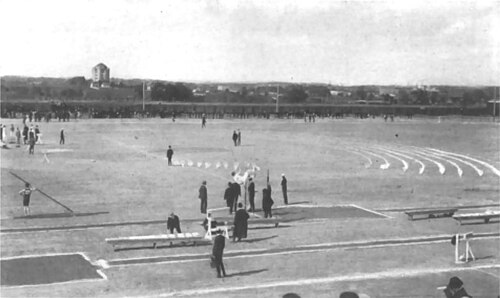
1896年のオリンピックの成功の後、オリンピックは存続を脅かす停滞期に入った。1900年のパリ万国博覧会と1904年のセントルイスのルイジアナ購入博覧会で開催されたオリンピックは、参加者や注目を集めることに失敗しました。1904年のオリンピックの650人の選手のうち、580人がアメリカ人でした。マラソンの優勝者は、レース中に車に乗っている写真が発見され、後に失格となりました。[43]オリンピックは、アテネで開催された1906年の閏年オリンピック(第3回オリンピック期間中に2回目に行われたオリンピックだったのでそう呼ばれる)で盛り返しました。このオリンピックは、幅広い国際的分野からの参加者を集め、大きな関心を集め、オリンピックの人気と規模の上昇の始まりを示しました。1906年のオリンピックは当時IOCによって公式に承認されていましたが(現在は承認されていません)、それ以来閏年オリンピックは開催されていません。[44]
冬季オリンピック

冬季オリンピックは、夏季オリンピックでは開催が困難だった雪上および氷上競技を主眼として創設された。フィギュアスケート(1908年と1920年)とアイスホッケー(1920年)は、夏季オリンピックの競技として実施された。[45] IOCは、この競技リストを他の冬季競技にも拡大することを望んだ。1921年にローザンヌで開催されたオリンピック会議で、冬季版オリンピックの開催が決定された。 1924年、3か月後に開催されたパリ大会に関連して、フランスのシャモニーで冬季スポーツ週間(実際には11日間)が開催され、これが初の冬季オリンピックとなった。[46]当初は、同じ国で冬季大会と夏季大会の両方を同じ年に開催することが意図されていたが、このアイデアはすぐに断念された。IOCは、冬季大会を4年ごとに夏季大会と同じ年に開催することを義務付けた。[47]この伝統は1992年のフランスのアルベールビル大会まで受け継がれ、その後1994年の大会から冬季オリンピックは4年ごとに開催され、夏季オリンピックの2年後に開催されるようになりました。[29] : p. 405
パラリンピック

1948年、ルートヴィヒ・グットマン卿は、第二次世界大戦後の兵士のリハビリテーションを推進することを決意し、 1948年ロンドンオリンピックに合わせて、いくつかの病院によるマルチスポーツイベントを企画しました。当初はストーク・マンデビル競技会として知られていたグットマンのイベントは、毎年恒例のスポーツフェスティバルになりました。その後12年間、グットマンと他の人々はスポーツを治療の手段として活用する努力を続けました。
1960年、グットマンは400人の選手をローマに連れて行き、「並行オリンピック」に出場させた。これは夏季オリンピックと並行して行われ、初のパラリンピックとして知られるようになった。それ以来、パラリンピックは毎年オリンピックの年に開催されており、1988年のソウル夏季大会を皮切りに、オリンピック開催都市がパラリンピックも開催するようになった。[48] [c]国際オリンピック委員会(IOC)と国際パラリンピック委員会(IPC)は2001年に、開催都市がオリンピックとパラリンピックの両方の運営を委託されることを保証する協定に署名した。[50] [51]この協定は2008年の北京夏季大会と2010年のバンクーバー冬季大会で発効した。
2012年のオリンピックの2年前、ロンドンオリンピック委員会の会長であるコー卿は、ロンドンでのパラリンピックとオリンピックについて次のような声明を出しました。[52]
私たちは、障害に対する一般の人々の態度を変え、パラリンピック競技の素晴らしさを称え、2つの大会が一体のものであるということを最初から定着させたいと考えています。
ユースゲーム
2010年、オリンピックにはユースゲームズが追加され、14歳から18歳までのアスリートに競技のチャンスが与えられた。ユースオリンピックは2001年にIOC会長ジャック・ロゲによって考案され、第119回IOC総会で承認された。[53] [54]第1回夏季ユースゲームズは2010年8月14日から26日までシンガポールで開催され、第1回冬季ゲームズはその2年後にオーストリアのインスブルックで開催された。 [55]これらのゲームズはシニアゲームズよりも短く、夏季バージョンは12日間、冬季バージョンは9日間続く。[56] IOCは夏季ユースゲームズに3,500人のアスリートと875人の役員の参加を許可し、冬季ユースゲームズには970人のアスリートと580人の役員の参加を許可している。[57] [58]競技される競技はシニア大会で予定されている競技と同じになるが、NOC混合チームや男女混合チーム、種目数や種目の数の削減など、競技内容にバリエーションが加えられる。[59]
21世紀のゲーム
2020年夏季オリンピックと2022年冬季オリンピックを合わせると、40競技448種目で14,000人を超える選手が競技に臨んだ。 [60] [61]夏季オリンピックは、1896年の14カ国241人の参加者から、 2020年には206カ国11,300人以上の選手が参加するまでに成長した。[62]冬季オリンピックの範囲と規模は小さく、例えば北京では2022年に91カ国2,971人の選手が参加した。選手と役員のほとんどは、大会期間中、オリンピック村に宿泊する。この宿泊センターは、オリンピック参加者全員が自立した住居として利用できるように設計されており、カフェテリア、健康診療所、宗教的表現のための場所が備え付けられている。[63]
IOCは、個々の国家を代表する国内オリンピック委員会(NOC)の設立を認めている。これらは、他の国際機関が要求する厳格な政治的主権の要件を満たしていない。その結果、植民地や属国がオリンピックに出場することが認められており、プエルトリコ、バミューダ、香港などの地域は、法的には他の国の一部であるにもかかわらず、それぞれ別の国として競技に参加している。[64]オリンピック憲章の現在のバージョンでは、「国際社会に承認された独立国家」としての資格を持つ国を代表する新しいNOCの設立が認められている。[65]その結果、IOCは1986年にアルバオリンピック委員会を承認していたにもかかわらず、2010年にシント・マールテンとキュラソーがアルバと同じ憲法上の地位を獲得したとき、これらの2つの国にNOCの設立を許可しなかった。 [66] [67] 2012年以降、旧オランダ領アンティル諸島の選手はオランダかアルバのいずれかを代表する選択肢を持っている。[68]
ゲームの費用
オックスフォードオリンピック研究2016によると、1960年以降、夏季オリンピックのスポーツ関連コストは平均52億ドル、冬季オリンピックは31億ドルとなっている。これらの数字には、道路、都市鉄道、空港などのより広範なインフラコストは含まれていないが、これらのコストはスポーツ関連コストと同額かそれ以上になることも多い。最も費用がかかった夏季オリンピックは北京2008年の400~440億ドルで[69]、冬季オリンピックはソチ2014年の510億ドルだった。[70] [71] 2016年時点で、選手1人当たりのコストは、夏季オリンピックでは平均59万9000ドル、冬季オリンピックでは平均130万ドルだった。ロンドン2012年では選手1人当たりのコストは140万ドル、ソチ2014年では790万ドルだった。[71]
1976年のモントリオール夏季オリンピックと1980年のモスクワ夏季オリンピックでは、野心的な建設工事が主催者に収入を大幅に上回る費用を課したが、ロサンゼルスは1984年夏季オリンピックでは既存の施設を利用し、企業スポンサーが支払った新しい施設を2つだけ設置することで、費用を厳しく管理した。ピーター・ユベロス率いる組織委員会は、収益の一部を使ってLA84財団を設立し、南カリフォルニアの青少年スポーツの振興、コーチの教育、スポーツ図書館の維持に努めた。1984年夏季オリンピックは、その日まで、近代オリンピックの中で最も経済的に成功した大会であり、将来の大会のモデルであるとよく考えられている。[72]
オリンピックでは予算超過はよくあることです。1960年以降のオリンピックの平均超過額は実質156%です。[73]つまり、実際の費用はオリンピック開催の入札に勝利した時点で見積もられた予算の平均2.56倍になったことになります。1976年のモントリオール大会は夏季オリンピック、そしてあらゆるオリンピックの中でも最も予算超過額が高かった大会で720%でした。1980年のレークプラシッド大会は冬季オリンピックで最も予算超過額が高かった大会で324%でした。2012年のロンドン大会は予算超過額が76%、2014年のソチ大会は289%でした。[71]
オリンピックの費用と費用超過はべき乗分布に従うことが文書化されており、これは第一にオリンピックは多額の費用超過になりがちであり、第二に、これまでで最大の超過額を超える超過額が発生するのは時間の問題であることを意味する。つまり、オリンピックの開催は経済的にも財政的にも極めてリスクが高い。[74]
東京2020オリンピックの最終的な費用は1兆4,238億円(130億ドル)と報告されています。これは、収入を増やすためのさまざまな取り組みと、継続的な支出の見直しを通じて、収入と支出のバランスをとることで達成されました。主な収入源は、国際オリンピック委員会(IOC)の分担金868億円(8億ドル)、TOPスポンサーシップ569億円(5億ドル)、地元スポンサーシップ3,761億円(34億ドル)、大会延期に対する保険金500億円(5億ドル)、ライセンスなどのその他の収入源でした。支出は、会場関連費用1,955億円(18億ドル)、サービス支出4,449億円(40億ドル)でした。総費用には、COVID-19対策費353億円(3億ドル)も含まれています。当初の見積もりに反して、総費用は2020年12月に発表された予算から2,202億円(20億米ドル)、2021年12月の推定予算から292億円(3億米ドル)削減されました。この成功した財政管理により、東京2020大会の予算は均衡しました。[75] [76]
開催都市や開催国への経済的・社会的影響
オリンピックを独自に研究する学術機関を求めて、ボブ・バーニーは1989年に国際オリンピック研究センターを設立する取り組みを主導し、オリンピックの社会文化的影響について執筆しようと努めた。 [77] [78]彼はオリンピックは「世界的文脈における最大の会議の1つであり、多くの政治的、経済的、その他の問題が関連しているため、研究する価値がある」と感じた。[77]彼は1992年にオリンピックに焦点を当てた最初の査読付き学術雑誌であるオリンピカを創刊した。 [79] [80]国際オリンピック歴史家協会は1991年に設立され、オリンピック史ジャーナルを発行している。[81]
オリンピック開催の経済的利益について懐疑的な経済学者もおり、このような「メガイベント」はコストが高額であることが多い一方で、長期的には目に見える利益は比較的少ないと強調している。[82]オリンピック開催(または立候補)は開催国の輸出を増やすようである。開催国または立候補国はオリンピック開催に立候補する際に貿易の自由化のシグナルを送るからである。[83]調査によると、夏季オリンピック開催は開催都市に本社を置く企業の慈善寄付にプラスの効果があり、地元の非営利セクターに利益をもたらすようだ。この効果はオリンピック開催前の数年間に始まり、その後も数年間は続くかもしれないが、永久的ではない。[84]
オリンピックは開催地のコミュニティに重大な悪影響を及ぼした。例えば、住宅権と立ち退きに関するセンターは、オリンピックにより20年間で200万人以上が立ち退きを余儀なくされ、恵まれないグループに不釣り合いな影響が及んだと報告している。[85] 2014年ソチ冬季オリンピックは史上最も費用のかかったオリンピックとなり、費用は500億ドルを超えた。オリンピック開催時に発表された欧州復興開発銀行の報告書によると、費用はロシアの国家経済を押し上げることはないが、サービスの向上によりソチやロシア南部のクラスノダール地方にビジネスを誘致できる可能性があるという。しかし、オリンピックから8か月後の2014年12月までに、ガーディアン紙はスタジアムやアリーナの散在性と未完成のインフラを理由に、ソチは「今やゴーストタウンのようだ」と報じた。[86]少なくとも4つの都市が、高額な費用や地元の支援不足を理由に2022年冬季オリンピックの開催地選びを撤回し、 [87]結果、カザフスタンのアルマトイと2008年夏季オリンピックを開催した中国の北京の2都市のみの争いとなった。ガーディアン紙は、オリンピックの将来に対する最大の脅威は、開催を希望する都市や国が少ないことだ、と報じた。[88] 2024年夏季オリンピックの開催地選びはパリとロサンゼルスの2都市の争いとなったため、IOCは2024年大会をパリ、2028年大会をロサンゼルスに同時に授与するという異例の措置を取った。両大会とも、高度な技術計画と、記録的な数の既存施設と仮設施設を活用する革新的な方法が高く評価された。[89]
国際オリンピック委員会
オリンピック・ムーブメントには、多数の国内および国際スポーツ組織や連盟、公認メディアパートナー、選手、役員、審判、およびオリンピック憲章の規則を遵守することに同意するその他すべての個人および機関が含まれます。[90]オリンピック・ムーブメントの統括組織として、国際オリンピック委員会(IOC)は開催都市の選定、オリンピック競技大会の計画の監督、オリンピック競技プログラムの更新と承認、スポンサーシップと放送権の交渉を担当しています。[91]
オリンピックムーブメントは、3 つの主要要素から構成されています。
- 国際連盟(IF)は、国際レベルでスポーツを統括する統括団体です。例えば、国際サッカー連盟(FIFA)はサッカーのIFであり、国際バレーボール連盟はバレーボールの国際統括団体です。現在、オリンピック運動には35のIFがあり、オリンピック競技のそれぞれを代表しています。[92]
- 各国オリンピック委員会(NOC)は、各国のオリンピック運動を代表し、統制する。例えば、ロシアオリンピック委員会(ROC)はロシア連邦のNOCである。現在、IOCに承認されているNOCは206ある。[93] [94]
- オリンピック大会組織委員会(OCOG)は、各オリンピック大会の組織を担当する臨時委員会である。OCOGは、各大会の終了後、最終報告書がIOCに提出されると解散される。[95]
オリンピック運動の公用語はフランス語と英語である。オリンピック競技大会で使用されるもう1つの言語は開催国の言語である(国がフランス語または英語以外に複数の公用語を持つ場合は、その国の言語)。すべての宣言(開会式の各国の行進中の発表など)は、これら3つの言語(またはそれ以上)で話されるか、開催国が英語圏かフランス語圏かに応じて、主要な2つの言語で話される。常に最初にフランス語が話され、次に英語の翻訳が続き、最後に開催国の主要言語(英語またはフランス語でない場合)が話される。[96]
贈収賄と汚職の疑惑
IOCは、数名の終身委員を委員に抱える手に負えない組織だとしばしば非難されてきた。エイブリー・ブランデージとフアン・アントニオ・サマランチの会長任期は特に物議を醸した。ブランデージはアマチュアリズムを強く支持し、オリンピックの商業化に反対したが、こうした姿勢は現代スポーツの現実にそぐわないものと見なされるようになった。東側諸国からの国営選手の出現は、西側諸国の自費で活動するアマチュアを不利な立場に置いたため、純粋なアマチュアのイデオロギーをさらに蝕んだ。 [97] : pp. 52–60 ブランデージは、南アフリカの除外に抵抗したことで反ユダヤ主義と人種差別主義の疑いで告発された。[97] : pp. 60–69 サマランチ会長の下で、事務局は縁故主義と汚職の両方で非難された。 [98]サマランチとスペインのフランコ政権との関係も批判の的となった。[99]
1998年、IOC委員数名が2002年冬季オリンピック開催地ソルトレークシティ招致委員会委員から贈り物を受け取っていたことが報じられた。すぐにIOC、米国オリンピック委員会(USOC)、ソルトレークシティ組織委員会(SLOC)、米国司法省(DOJ)の4者による独立調査が開始された。厳密に違法なことは何も起きていなかったが、贈り物の受け取りは道徳的に疑わしいと感じられた。調査の結果、IOC委員10名が除名され、さらに10名が制裁を受けた。[100]今後の招致にはより厳しい規則が採用され、IOC委員が招致都市から受け取れる金額に上限が導入された。さらに、 IOC委員の任期と年齢に新たな制限が設けられ、15名の元オリンピック選手が委員会に加わった。とはいえ、スポーツとビジネスの観点から見ると、2002年オリンピックは冬季オリンピック史上最も成功した大会の一つとなり、放送とマーケティングプログラムの両方で記録が樹立された。 20億人以上の視聴者が130億時間以上視聴しました。[101] 2002年のオリンピックは経済的にも成功し、以前のどのオリンピックよりも少ないスポンサーで多くの資金を集め、SLOCに4000万ドルの黒字をもたらしました。この余剰収益はユタ・アスレチック財団(ユタ・オリンピック・レガシー財団としても知られる)の設立に使用され、現在も残っているオリンピック会場の多くを維持・運営しています。[101]
1999年に長野オリンピック招致委員会がIOC委員62名とその関係者の接待に約1400万ドルを費やしたと報じられた。IOCが接待費を公表しないよう要請した後、長野は財務記録を破棄したため、正確な数字は不明である。 [102] [103]
2000年7月、ロサンゼルス・タイムズ紙がIOCがスポンサーシップや放映権からの利益をどのように再分配するかという複雑な性質について報じたとき、オリンピックの歴史家ボブ・バーニーは「IOCの腐敗問題はまだ見たことがない」と述べたが、「説明責任のない問題」があることを指摘した。[104]彼は後に、オリンピック招致プロセスに関して、アスリートにスポットライトが当たると「スキャンダルや腐敗の印象を覆い隠す力がある」と指摘した。[105]
2004年8月、BBCのドキュメンタリー「パノラマ:オリンピックの買収」は、 2012年夏季オリンピックの招致過程で使用されたとされる賄賂に関する調査結果を報告した。[106]ドキュメンタリーは、IOCメンバーに特定の候補都市に投票するよう賄賂を贈ることが可能だったと主張した。2012年オリンピックの招致で僅差で敗れた後、[107]パリ市長ベルトラン・ドラノエは、イギリスのトニー・ブレア首相と元オリンピック金メダリストのセバスチャン・コー率いるロンドン招致委員会が招致ルールに違反していると具体的に非難した。彼はフランスのジャック・シラク大統領を証人として挙げた。シラク大統領は自身の関与について慎重にインタビューに応じたが[108]、この疑惑は十分に調査されることはなかった。2006年冬季オリンピックのトリノ招致も論争に見舞われた。ライバルであるシオンの開催地指名に深く関わっていたIOCの著名な委員、マーク・ホドラーは、トリノ組織委員会の委員によるIOC役員への賄賂の疑惑を提起した。この疑惑は広範囲にわたる捜査につながり、また、開催地指名をトリノが獲得するのに役立つ可能性があったシオンの開催地指名に対して多くのIOC委員の反感を買った。[109]
商業化
各国の組織委員会の下で
オリンピックは、1896年の第1回アテネ夏季オリンピック以来、さまざまな程度で商業化されてきた。当時は、コダック[111]を含む多くの企業が広告費を支払っていた。[ 112] 1908年には、オキソ、オドルマウスウォッシュ、インディアンフットパウダーがロンドンオリンピックの公式スポンサーになった。[113] [114]コカコーラは1928年に初めて夏季オリンピックのスポンサーとなり、それ以来ずっとオリンピックのスポンサーであり続けている。[110] IOCがスポンサーシップを管理する前は、NOCがスポンサーシップとオリンピックシンボルの使用に関する独自の契約交渉の責任を負っていた。[115] : p. 231
IOCの管理下
IOCは当初、企業スポンサーからの資金提供に抵抗していた。IOCがテレビというメディアの可能性と、IOCが利用できる有利な広告市場を模索し始めたのは、1972年にIOC会長エイブリー・ブランデージが引退してからのことである。 [115] : p. 231 フアン・アントニオ・サマランチのリーダーシップの下、オリンピックは、自社製品をオリンピックブランドに結び付けようとする国際スポンサーへと移行し始めた。[116]
予算
20世紀前半、IOCは低予算で運営されていた。[116] [117] 1952年から1972年までIOC会長を務めたエイブリー・ブランデージは、オリンピックを商業的利益と結び付けようとするあらゆる試みを拒否した。[115] : p. 231 彼は、企業利益のロビー活動がIOCの意思決定に不当な影響を及ぼすと考えていた。この収入源に対する彼の抵抗は、IOCが組織委員会に独自のスポンサー契約の交渉とオリンピックのシンボルの使用を任せたことを意味した。[115] : p. 231 ブランデージが引退したとき、IOCの資産は200万ドルだったが、8年後にはIOCの金庫は4,500万ドルに膨れ上がった。これは主に、企業スポンサーシップとテレビ放映権の販売を通じてオリンピックを拡大するというイデオロギーの転換によるものであった。[115] : p. 231 フアン・アントニオ・サマランチが1980年にIOC会長に選出されたとき、彼の望みはIOCを財政的に独立させることだった。[117]
1984年の夏季オリンピックはオリンピック史上の分岐点となった。ピーター・ユベロス率いるロサンゼルスを拠点とする組織委員会は、当時としては前例のない額である2億2500万ドルの黒字を計上した。[29] : p. 209 組織委員会がこのような黒字を計上できたのは、一部には独占スポンサー権を特定の企業に販売したことによるものであった。[29] : p. 209 IOCはこれらのスポンサー権の管理権を獲得しようとした。サマランチはオリンピック・ブランドを創出するため、1985年にオリンピック・プログラム(TOP)の設立を支援した。[116] TOPの会員資格は当時も現在も非常に限定的で高額である。4年間の会員資格には5000万ドルの費用がかかる。[117] TOP会員は自社製品カテゴリーの世界的な独占広告権と、出版物や広告におけるオリンピック・シンボルである連結リングの使用権を獲得した。 [118] : p. 194
テレビの影響
.jpg/500px-Olympic_Final_2000_(1936_cartoon).jpg)
1936年のベルリン夏季オリンピックは、テレビで放送された最初のオリンピックだったが、視聴者は地元のみだった。[119] 1956年のイタリア冬季オリンピックは、国際的にテレビ放映された最初のオリンピックであり、[ 120]次のカリフォルニア冬季オリンピックの放映権は、初めて専門のテレビ放送ネットワークに販売され、CBSはアメリカでの放映権に394,000ドルを支払った。[118] : p. 192 [116]その後の数十年間で、オリンピックは冷戦のイデオロギー的前線の一つとなり、国際オリンピック委員会は、放送媒体を通じてこの高まった関心を利用したいと考えた。[118] : p. 192 放映権の販売によって、IOCはオリンピックの露出を増やすことができ、それによって関心が高まり、今度は広告主にとってのテレビ放映時間の魅力が高まった。このサイクルにより、IOCはそれらの権利に対してますます高い料金を請求することができた。[118] : p. 192 例えば、CBSは1998年の長野オリンピックのアメリカでの放映権料として3億7500万ドルを支払いました[121]。一方、NBCは2000年から2012年までのすべてのオリンピックのアメリカでの放映権料として35億ドルを支払いました[116]。
2011年、NBCは2020年大会までのオリンピック放映権契約をIOCと43億8000万ドルで締結したが、これはオリンピック史上最高額の放映権契約となった。[122]その後NBCは2014年5月7日、2032年大会までのオリンピック放映権契約を77億5000万ドルで延長することに合意した。[ 123] NBCはまた、 2014年から始まるユースオリンピック[124]とパラリンピック[125]のアメリカでの放映権も獲得した。オリンピック委員会のグローバルスポンサーの半分以上はアメリカ企業であり[126]、NBCはIOCの主要な収入源の一つとなっている。[126]
視聴者数は1960年代から20世紀末まで飛躍的に増加した。これは1964年に始まった全世界へのテレビ生中継用衛星放送の登場と、1968年のカラーテレビ導入によるものである。 [127] 1968年のメキシコシティ大会の世界視聴者数は6億人と推定されたが、1984年のロサンゼルス大会の視聴者数は9億人に増加し、この数は1992年のバルセロナ夏季オリンピックまでに35億人に膨れ上がった。[128] [129] [130] [131] [118] : pp. 16–18 大会の放送にこれほど高額な費用がかかり、インターネットの圧力が加わり、ケーブルテレビとの競争が激化したため、テレビ業界は視聴率を上げるためにIOCに譲歩を求めた。IOCはこれに応じてオリンピックプログラムにいくつかの変更を加えた。夏季オリンピックでは、体操競技が7夜から9夜に拡大され、さらに関心を集めるためにチャンピオンズ・ガラが追加されました。[118] : p. 17 また、幅広い視聴者層を持つ人気スポーツである水泳と飛び込みの競技プログラムも拡大されました。[118] : p. 17 NBCがオリンピックの放映権料として多額の料金を支払っているため、IOCはNBCがイベントのスケジュールに影響を与え、可能な限り米国のテレビ視聴率を最大化することを許可しました。[115] : p. 230 [131] [132] [133]米国のテレビ視聴率を最大化する注目すべき例としては、水泳競技の決勝を開催都市の北京(2008年夏季オリンピック)と東京(2020年夏季オリンピック)の午前中のみに設定し、米国の夕方のゴールデンタイムの放送枠と一致させることが挙げられます。 [134] [135] [136] [137] [138]
オリンピックマーケティング
ライセンスプログラムからの資金は、チケット販売や放映権などの他の収入源とともに、オリンピックに関わるすべての費用を支えており、その割合は60%を超えています。[139] [140]
オリンピックブランドの売却は議論を呼んでいる。オリンピックは他の商業化されたスポーツイベントと区別がつかなくなっているという議論がある。[118] : p. 194 [141]オリンピックは開催都市と各国政府によって資金提供されているという批判もある。IOCは費用を一切負担していないが、オリンピックシンボルの権利と利益をすべて管理している。IOCはまた、スポンサー収入と放送収入の一定割合を受け取っている。[118] : p. 194 開催都市は、投資を回収できるかどうか確実ではないにもかかわらず、オリンピック開催権をめぐって激しい競争を続けている。[118] : pp. 194–195 調査によると、オリンピックを開催した国では貿易が約30パーセント増加している。[142]
シンボル

オリンピック・ムーブメントは、オリンピック憲章に具体化された理想を表すためにシンボルを使用する。オリンピック・シンボルはオリンピック・リングとしてよく知られており、5つの絡み合ったリングで構成され、5つの居住大陸(アフリカ、アメリカ大陸(1つの大陸とみなされる)、アジア、ヨーロッパ、オセアニア)の統一を表す。白地に青、黄、黒、緑、赤のリングの色バージョンがオリンピック旗となる。これらの色が選ばれたのは、すべての国が自国の国旗にこれらの色を少なくとも1つは使用していたためである。この旗は1914年に採用されたが、1920年にベルギーのアントワープで開催された夏季オリンピックで初めて掲揚された。それ以来、オリンピックの各式典で掲揚されている。[143] [144] IOCは、オリンピック・シンボルの保護に関する ナイロビ条約を通じて、オリンピック・シンボルの使用に対する独占的な所有権と管理権を保持している。 [ 145]
オリンピックのモットーである「Citius, Altius, Fortius」は、「より速く、より高く、より強く」を意味するラテン語で、1894年にピエール・ド・クーベルタンによって提案され、1924年から公式となっている。このモットーは、クーベルタンの友人であるドミニコ会の司祭アンリ・ディドンOPが、1891年のパリの青年集会のために作ったものである。 [146]
クーベルタンのオリンピックの理想はオリンピック信条に表現されています。
オリンピックで最も重要なことは勝つことではなく参加することである。人生で最も重要なことは勝利ではなく闘争であるのと同様である。本質的なことは征服することではなく、よく戦うことである。[143]
各大会の数ヶ月前に、オリンピックの聖火はオリンピアのヘラ神殿で古代ギリシャの儀式を再現した儀式で点火される。巫女役の女性パフォーマーが、ウェスタの処女役の10人の女性パフォーマーと共に、太陽光線を集中させる放物面鏡の中にトーチを置いて点火する。次に、彼女は最初のリレーランナー(ギリシャのアスリート)のトーチに点火し、オリンピック聖火リレーを開始する。聖火は開催都市のオリンピックスタジアムまで運ばれ、そこで開会式で重要な役割を果たす。[147]聖火は1928年以来オリンピックのシンボルとなっているが、聖火リレーは第三帝国の宣伝のために1936年夏季大会で初めて導入された。[143] [148]

オリンピックのマスコットは、開催国の文化遺産を代表する動物、人間、または擬人化された人物であり、 1968年に導入されました。ソ連の熊の子ミーシャが国際的なスターになった1980年の夏季オリンピック以来、オリンピックのアイデンティティを促進する上で重要な役割を果たしてきました。ロンドン夏季オリンピックのマスコットは、シュロップシャーのマッチ・ウェンロックの町にちなんでウェンロックと名付けられました。マッチ・ウェンロックでは今でもウェンロック・オリンピック競技大会が開催されており、ピエール・ド・クーベルタンがオリンピック競技大会を考案するきっかけとなりました。[149]パリ2024オリンピックのマスコットは、フランス革命時にマリアンヌが被っていたフリジア帽を模した擬人化されたフリジア帽です。[150]
儀式
開会式

オリンピック憲章で義務付けられているように、オリンピックの開会式は様々な要素によって構成されている。この開会式は金曜日に行われ、スポーツ競技(一部のグループリーグのサッカーの試合、ソフトボールの試合、ボートの予選を除く)の開始前に行われる。[151] [152]開会式の儀式のほとんどは、1920年のアントワープ夏季オリンピックで確立された。[153]式典は通常、国際オリンピック委員会の会長と開催国の代表者の入場で始まり、続いて開催国の国旗掲揚と国歌の演奏が行われる。[151] [152]開催国はその後、その文化を代表する音楽、歌、ダンス、演劇などの芸術的な展示を披露する。[153]歴代の開催国が、記憶に残るという点で前任者よりも長く残る式典を提供しようと努めるにつれて、芸術的なプレゼンテーションは規模と複雑さが増してきた。北京オリンピックの開会式には1億ドルの費用がかかったと伝えられており、その多くは芸術分野に費やされた。[154]
式典の芸術的な部分の後、選手たちは国ごとに分かれてスタジアムにパレードします。オリンピックの起源を称えるため、ギリシャが伝統的に最初に入場し、パレードの先頭を走ります。その後、各国は開催国の選択言語のアルファベット順にスタジアムに入り、開催国の選手が最後に入場します。ギリシャのアテネで開催された2004年夏季オリンピックでは、ギリシャ国旗が最初にスタジアムに入り、ギリシャ代表団が最後に入場しました。2020年夏季オリンピックからは、それぞれのオリンピック競技大会(夏季または冬季)の次回開催国が、降順で現在の開催国の直前に入場します。組織委員会の会長、IOC会長、開催国の国家元首/代表者によるスピーチが行われ、正式に大会が開会されます。最後に、オリンピックの聖火はスタジアムに持ち込まれ、最後の聖火ランナー(多くの場合、開催国の優秀なオリンピック選手)に渡されるまで受け継がれ、スタジアムの聖火台でオリンピックの聖火に火が灯されます。[151] [152]
閉会式
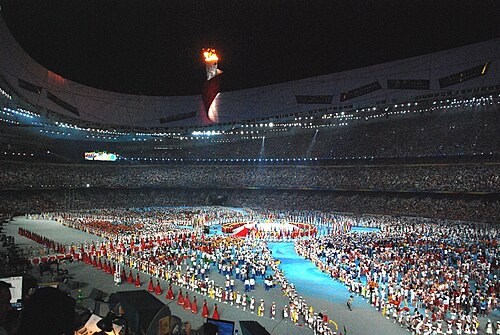
オリンピックの閉会式は日曜日、すべての競技が終了した後に行われる。参加各国の旗手がスタジアムに入場し、その後に選手たちが国籍を問わず一斉に入場する。[155] 3つの国旗が掲揚され、それぞれの国歌が演奏される。現在の開催国の国旗、オリンピック発祥の地を称えるギリシャの国旗、そして次回の夏季または冬季オリンピック開催国の国旗である。[155]組織委員会の会長とIOC会長が閉会の挨拶を行い、大会は正式に閉会され、オリンピックの聖火が消される。[156]アントワープ式典として知られる式典では、大会を開催した都市の現市長が特別なオリンピック旗をIOC会長に渡し、会長がそれを次回のオリンピック開催都市の現市長に渡す。[157]次に開催国も、その文化を代表するダンスや演劇などの芸術的な展示で簡単に自己紹介をする。[155]
慣例通り、オリンピックの最後のメダル授与式は閉会式の一部として行われます。典型的には、マラソンのメダルは夏季オリンピックで授与され、[155] [158]、クロスカントリースキーのマススタートのメダルは冬季オリンピックで授与されます。[159]
メダル授与式

各オリンピック競技の終了後、メダル授与式が開催される。優勝者、2位、3位の選手またはチームは3段の演壇の上に立ち、IOC委員からそれぞれのメダルを授与される。[160]メダルを受け取った後、3人のメダリストの国旗が掲揚され、金メダリストの国の国歌が演奏される。 [161]開催国のボランティア市民もメダル授与式の間ホスト役を務め、メダルを授与する役員を補佐し、旗手を務める。[162]夏季オリンピックでは、各メダル授与式は競技が行われた会場で開催されるが、[163]冬季オリンピックの式典は通常、特別な「広場」で開催される。[164]
オリンピックのメダルを表彰式で授与するという慣習は、メルヴィル・マークス・ロビンソンの提案により、1930年大英帝国競技大会で使用された台座に基づいて、1932年冬季オリンピックで確立されました。[165]
スポーツ
オリンピックのプログラムは、 35のスポーツ、30の分野、408のイベントで構成されています。たとえば、レスリングは夏季オリンピックのスポーツで、グレコローマンスタイルとフリースタイルの2つの種目で構成されています。さらに、男子が14種目、女子が4種目あり、それぞれ異なる体重クラスを表しています。[166]夏季オリンピックのプログラムには26のスポーツが含まれ、冬季オリンピックのプログラムには15のスポーツが含まれています。[167]陸上 競技、水泳、フェンシング、および体操競技は、オリンピックプログラムから一度も欠席したことがない唯一の夏季スポーツです。クロスカントリースキー、フィギュアスケート、アイスホッケー、ノルディック複合、スキージャンプ、およびスピードスケートは、 1924年の開始以来、すべての冬季オリンピックプログラムで取り上げられています。バドミントン、バスケットボール、およびバレーボールなどの現在のオリンピックスポーツは、最初は公開競技としてプログラムに登場し、後に完全なオリンピックスポーツに昇格しました。以前のオリンピックで実施されていたいくつかの競技は、後にプログラムから削除されました。[168]
オリンピック競技は、IOCがその競技の世界的な監督機関として認める国際スポーツ連盟(IF)によって統括されている。IOCには35の連盟が代表として参加している。 [169] IOCが認めている競技の中には、オリンピック競技に含まれていないものもある。これらの競技はオリンピック競技とはみなされていないが、オリンピック大会の祝典後の最初のIOCセッションで行われる競技プログラムの改定の際に、オリンピック競技に昇格される可能性がある。[170] [171]このような改定の際には、IOC委員の3分の2以上の多数決により、競技を競技プログラムから除外したり含めたりすることができる。[172]オリエンテーリングなど、オリンピック競技プログラムに一度も含まれたことがない競技が認められていることもある。[173]
2004年10月と11月に、IOCはオリンピックプログラム委員会を設立し、オリンピックプログラムに含まれるスポーツと、オリンピックで認められていないすべてのスポーツを見直すことを任務とした。目標は、各大会のオリンピックプログラムを策定するための体系的なアプローチを適用することであった。[174]委員会は、スポーツがオリンピックプログラムに含まれるべきかどうかを判断するための7つの基準を策定した。[174]これらの基準は、スポーツの歴史と伝統、普遍性、スポーツの人気、イメージ、選手の健康、スポーツを統括する国際連盟の発展、スポーツの開催費用である。[174]この研究から、2012年夏季オリンピックへの追加候補として、ゴルフ、空手、ラグビー7人制、ローラースポーツ、スカッシュの5つの公認スポーツが浮上した。[174]これらのスポーツはIOC理事会で検討され、その後、2005年7月にシンガポールで開催された総会に付託された。追加が推奨された5つのスポーツのうち、空手とスカッシュの2つだけが最終候補に選ばれた。[174]どちらの競技も必要な3分の2の票を獲得できなかったため、オリンピック競技に昇格しませんでした。[174] 2009年10月、IOCは2016年と2020年の夏季オリンピックでゴルフとラグビーセブンズをオリンピック競技として採用することを投票で決定しました。[175]
2002年の第114回IOC総会では、夏季オリンピックのプログラムを最大28競技、301種目、10,500人の選手に制限しました。[174] 3年後の第117回IOC総会では、最初の大規模なプログラム改訂が行われ、2012年ロンドン大会の公式プログラムから野球とソフトボールが除外されました。他の2つのスポーツの推進について合意が得られなかったため、2012年のプログラムでは26競技のみが実施されました。[174] 2016年と2020年のオリンピックでは、ラグビーとゴルフが追加され、最大28競技に戻ります。[175]
アマチュアリズムとプロフェッショナリズム

イギリスのパブリックスクールに代表される貴族階級の精神は、ピエール・ド・クーベルタンに大きな影響を与えた。[176]パブリックスクールは、スポーツが教育の重要な一部であるという信念を支持していた。この姿勢は、 「健全な精神は健全な肉体に宿る」という言葉に要約されている。この精神において、紳士とは、特定のことにおいて最高ではなく、万能人となる人である。また、公平さという概念が広まっており、練習やトレーニングは不正行為に等しいと考えられていた。[176]スポーツをプロとして行う人は、単に趣味として行う人よりも不当に有利であると考えられていた。[176]
プロの排除は近代オリンピックの歴史を通じていくつかの論争を引き起こした。1912年オリンピックの五種競技と十種競技のチャンピオン、ジム・ソープは、オリンピック前にセミプロの野球をしていたことが発覚し、メダルを剥奪された。彼のメダルは、メダルを剥奪する決定が30日間の期間外であったとの判決を受けて、1983年にIOCによって死後に復元された。[177]スイスとオーストリアのスキー選手は、スキー教師を支援するために1936年冬季オリンピックをボイコットした。彼らはスポーツでお金を稼いでおり、したがってプロとみなされていたため、競技に参加できなかった。[178]
東側諸国の国家支援による「フルタイムのアマチュア選手」の出現は、純粋なアマチュアの理念を蝕み、西側諸国の自費で活動するアマチュアを不利にした。ソ連は名目上は学生、兵士、または職業に就いている選手たちでチームを編成したが、実際は全員が国家からフルタイムでトレーニングするための給料をもらっていた。[176] [179] [180]この状況はアメリカと西ヨーロッパの選手たちに大きな不利をもたらし、1970年代と1980年代のアメリカのメダル獲得数減少の大きな要因となった。[181]その結果、オリンピックはピエール・ド・クーベルタンが構想したアマチュアリズムから、プロ選手の参加を認める方向にシフトしたが、[182]それはソ連と国際オリンピック委員会におけるソ連の影響力が崩壊した1990年代になってからのことであった。[183] [184] [185]
カナダチームのアイスホッケー論争
1960年代の終わりごろ、カナダアマチュアホッケー協会(CAHA) は、アマチュア選手がソ連チームのフルタイム選手や、絶えず向上を続ける他のヨーロッパのチームともはや競争できないと感じた。彼らはプロリーグの選手を使用する権利を主張したが、IIHF と IOC の反対に遭った。1969年の IIHF 会議で、IIHF はカナダが 9 人の NHL 以外のプロのホッケー選手[186]をモントリオールとウィニペグ(カナダ)で 1970 年に開催される世界選手権で使用することを決定した。[187]この決定は、変更が行われた場合、アイスホッケーのオリンピック競技としての地位が危うくなるとブランデージが述べた後、1970 年 1 月に覆された。[186]これを受けて、カナダは国際アイスホッケー競技から撤退し、関係者は「オープンな競技」が導入されるまでは復帰しないと述べた。[186] [188] ギュンター・サベツキは1975年にIIHFの会長に就任し、CAHAとの紛争の解決に貢献した。1976年、IIHFは世界選手権ですべての選手の間で「オープンな競争」を認めることに同意した。しかし、IOCのアマチュア限定政策のため、NHL選手は1988年までオリンピックに出場できなかった。[189]
論争
ボイコット
_boycotting_countries_(blue).png/500px-1956_Summer_Olympics_(Melbourne)_boycotting_countries_(blue).png)
_boycotting_countries_(red).png/500px-1964_Summer_Olympics_(Tokyo)_boycotting_countries_(red).png)
_boycotting_countries_(blue).png/500px-1976_Summer_Olympics_(Montr%C3%A9al)_boycotting_countries_(blue).png)
_boycotting_countries_(blue).svg/500px-1980_Summer_Olympics_(Moscow)_boycotting_countries_(blue).svg.png)
_boycotting_countries_(blue).png/500px-1984_Summer_Olympics_(Los_Angeles)_boycotting_countries_(blue).png)
オーストラリア、フランス、ギリシャ、スイス、イギリス は、1896年の開始以来、すべてのオリンピックに代表を送り出している唯一の国である。資格のある選手の不足によりオリンピックに参加できない国もあるが、さまざまな理由でオリンピックの開催をボイコットする国もある。アイルランドオリンピック評議会は、IOCがチームの代表をアイルランド島全体ではなくアイルランド自由国に限定する必要があると主張したため、1936年のベルリン大会をボイコットした。 [190]
1956年のメルボルンオリンピックでは3カ国がボイコットした。オランダ、スペイン、スイスはソ連によるハンガリー動乱の鎮圧を理由に大会への参加を拒否したが、ストックホルムには馬術代表団を派遣した。カンボジア、エジプト、イラク、レバノンはスエズ危機を理由に大会をボイコットした。中華人民共和国は台湾の選手で構成される中華民国が参加したため大会をボイコットした。[191]
1972年と1976年に、多数のアフリカ諸国が、人種差別政策を理由に、 IOCにボイコットを迫り、南アフリカとローデシアの参加を禁止するよう迫った。ニュージーランドも、同国のラグビー代表チームがアパルトヘイト政策下の南アフリカを遠征していたため、アフリカのボイコットの対象となった。IOCは最初の2件については譲歩したが、ラグビーはオリンピック競技ではないという理由でニュージーランドの参加禁止は拒否した。[192] 20のアフリカ諸国は、ガイアナとイラクとともに、すでに数名の選手が出場していたモントリオール大会から撤退し、その脅しを実行した。[192] [193]
中華民国(台湾)は、カナダ首相ピエール・エリオット・トルドーの命令により、 1976年のオリンピックから除外された。トルドーの行動は、中国選手団が自国名で競技するのを阻止するという政治的圧力に屈したカナダに恥をかかせたとして広く非難された。 [194]中華民国は、名称を変更すれば中華民国の国旗と国歌の使用を認めるという妥協案を拒否した。 [195]台湾の選手は、1984年にチャイニーズ・タイペイの名称で特別な国旗と国歌を掲げて復帰するまで、再び参加することはなかった。[196]
1980年と1984年には、冷戦の敵対国が互いのオリンピックをボイコットした。米国と他の65カ国は、ソ連のアフガニスタン侵攻を理由に、 1980年のモスクワオリンピックをボイコットした。このボイコットにより、参加国の数は80カ国にまで減少し、1956年以来の最少数となった。 [197]ソ連と他の15カ国は、1984年のロサンゼルスオリンピックをボイコットすることで対抗した。ソ連主導のボイコットにより特定の競技の出場者が減ったものの、140の国立オリンピック委員会が参加し、これは当時の新記録であった。[5]ワルシャワ条約機構加盟国であるルーマニアがソ連の要求にもかかわらず参加を選んだという事実は、米国によるルーマニアチームの温かい歓迎につながった。ルーマニアの選手たちが開会式で入場したとき、彼らはほとんどが米国市民で構成される観客からスタンディングオベーションを受けた。東側諸国のボイコット諸国は7月と8月に独自の代替イベントであるフレンドシップゲームを開催した。[198] [199]
中国の人権侵害への抗議とチベット騒乱を受けて、中国製品や2008年北京オリンピックのボイコットを求める声が高まっていた。最終的に、ボイコットを支持する国はなかった。[200] [201] 2008年8月、ジョージア政府は、2008年の南オセチア戦争へのロシアの参加に対抗して、ロシアのソチで開催される2014年冬季オリンピックのボイコットを呼びかけた。[202] [203]中国での継続的な人権侵害により、いくつかの国、特に米国は、選手は引き続きオリンピックに出場するが外交官は出席しない「外交ボイコット」に至っている。[204] [205]
政治


オリンピックは、その発足当初から政治イデオロギーを推進する場として利用されてきた。1936年のオリンピックを主催したナチスドイツは、国家社会主義党を慈悲深く平和を愛する党として描写しようとしたが、同党はオリンピックを利用してアーリア人の優位性を誇示した。[29] : p. 107 ドイツはオリンピックで最も成功した国であり、アーリア人至上主義の主張を大いに裏付けたが、金メダル4個を獲得したアフリカ系アメリカ人のジェシー・オーエンスやハンガリー系ユダヤ人のイボリャ・チャークの注目すべき勝利により、そのメッセージは弱められた。[29] : pp. 111–112 ソ連は、1952年のヘルシンキ夏季オリンピックまでオリンピックに参加しなかった。その代わりに、1928年からソ連はスパルタキアードと呼ばれる国際スポーツイベントを開催した。 1920年代から1930年代の戦間期には、米国を含むいくつかの国の共産主義組織や社会主義組織が、いわゆる「ブルジョア」オリンピックに対抗して労働者オリンピックを開催しようとした。[207] [208]ソ連がスポーツ大国として台頭し、オリンピックでの勝利による宣伝効果をフルに活用したのは、1956年の夏季オリンピックになってからだった。 [209]ソ連の成功は、国家が国際舞台で政治的課題を遂行するためにスポーツに多額の投資を行ったことに起因するかもしれない。[210] [180]
個々のアスリートもオリンピックの舞台を利用して自らの政治的アジェンダを推進してきた。1968年メキシコシティ夏季オリンピックでは、 200メートルで1位と3位に入ったアメリカの陸上競技選手、トミー・スミスとジョン・カルロスが表彰台でブラックパワー敬礼を行った。2位に入ったオーストラリアのピーター・ノーマンは、スミスとカルロスを支持してオリンピック人権プロジェクトのバッジを付けた。この抗議を受けて、IOC会長エイブリー・ブランデージはスミスとカルロスをアメリカチームから追放し、オリンピック村への立ち入りを禁止するよう命じた。アメリカオリンピック委員会が拒否すると、ブランデージはアメリカ陸上チーム全体を追放すると脅した。この脅しにより、2人の選手はオリンピックから追放された。[211]体操競技におけるもう一つの注目すべき出来事は、ソ連のナタリア・クチンスカヤが物議を醸しながら金メダルを獲得した平均台決勝の後、表彰台に立っていたチェコスロバキアの体操選手ベラ・チャスラフスカがソ連国歌が演奏されている間、静かに顔を伏せて背を向けたというものである。これは、最近のソ連のチェコスロバキア侵攻に対するチャスラフスカの静かな抗議であった。彼女の抗議は、ソ連のラリサ・ペトリクの予備得点が審査員によって変更され、彼女がチャスラフスカと同点で金メダルを獲得できるようにされたとき、彼女が床運動の演技でメダルを受け取ったときに繰り返された。チャスラフスカの国民は彼女の行動と共産主義に対する彼女の率直な反対を支持したが(彼女はルドヴィク・ヴァチュリクの「二千語」のマニフェストに公的に署名し、それを支持していた)、新政権はそれに応じて何年もの間彼女のスポーツイベントと海外旅行を禁止し、共産主義が崩壊するまで彼女を社会から追放した。
現在、イラン政府は自国の選手とイスラエルの選手との試合を避ける措置を講じている。イランの柔道家、アラッシュ・ミレスマイリは、 2004年夏季オリンピックでイスラエルとの試合に出場しなかった。体重超過のため公式には失格となったが、ミレスマイリにはイラン政府から、イランの金メダリスト全員に支払われる賞金12万5000ドルが授与された。試合を故意に避けたことについては公式には潔白とされたが、賞金を受け取ったことで疑惑が浮上した。[212]
2022年、ロシアのウクライナ侵攻を受けて、IOC理事会は「ロシアとベラルーシの選手と役員の参加を推奨せず、国際スポーツ連盟と世界中のスポーツイベントの主催者に対し、ロシアやベラルーシの選手や役員がロシアやベラルーシの名で参加できないよう全力を尽くすよう要請する」としている。[213] 2023年、IOCはロシアとベラルーシの選手が一定の条件の下でオリンピックに参加できると発表した。選手は自国や関連団体を代表してはならず、ロシアのウクライナ侵攻を積極的に支持する選手は競技に参加できない。この決定は、選手が競技に参加し、名声を高めることを目的としていた。32人の選手が招待を受け入れたが、28人の資格のある選手は辞退した。中立の旗とユニフォームで競技したこれらの選手は、メダルを獲得した場合には国歌の代わりに中立の歌が演奏された。さらに、観客は国旗を振ることを禁止された。[214]
パフォーマンス向上薬の使用

20世紀初頭、多くのオリンピック選手が運動能力を高めるために薬物を使用し始めた。例えば、1904年、マラソンの金メダリストであるトーマス・ヒックスはコーチからストリキニーネを与えられた(当時は、これらの物質がアスリートの身体に与える影響に関するデータがなかったため、さまざまな物質の摂取が許可されていた)。[215]パフォーマンス向上に関連する唯一のオリンピック死亡事故は、 1960年のローマ夏季オリンピックで発生した。デンマークの自転車選手、クヌート・エネマーク・イェンセンが自転車から落ち、後に死亡した。検死官の調査により、彼はアンフェタミンの影響下にあったことが判明した。[216] 1960年代半ばまでに、スポーツ連盟はパフォーマンス向上薬の使用を禁止し始め、1967年にはIOCもそれに倣った。[217]
英国人ジャーナリストのアンドリュー・ジェニングスによると、KGB大佐は、KGB職員がドーピング検査を妨害するために国際オリンピック委員会の反ドーピング当局を装い、ソ連の選手たちは「多大な努力で救出された」と述べたという。[218] 1980年夏季オリンピックについて、1989年のオーストラリアの研究は「モスクワ大会でメダルを獲得した人で、金メダリストで何かしらの薬物を使用していない人はほとんどいない。通常は数種類だ。モスクワ大会は化学者の大会と呼ばれてもおかしくない」と述べている。[218]
2016年に入手された文書により、ソ連が1984年ロサンゼルス夏季オリンピックに備えて陸上競技で国家規模のドーピングシステムを計画していたことが明らかになった。同国がオリンピックをボイコットする決定を下す前の日付が付けられたこの文書には、同プログラムの既存のステロイド運用の詳細と、さらなる強化の提案が記載されていた。[219]ソ連の陸上競技責任者に宛てたこの文書は、体育研究所のセルゲイ・ポルトガロフが作成した。ポルトガロフは、2016年夏季オリンピック前のロシアのドーピングプログラムの実施に関わった主要人物の一人でもあった。[219]
運動能力向上薬の使用で陽性反応を示した最初のオリンピック選手は、1968年夏季オリンピックの五種競技で銅メダルを剥奪されたスウェーデンのハンス・グンナー・リリエンヴァルだった。 [220]ドーピング関連の失格で最も注目を集めたのは、1988年夏季オリンピックの後に起こったもので、カナダの短距離走者ベン・ジョンソン( 100メートル走で優勝)がスタノゾロールの陽性反応を示した。[221]
1999年、IOCは、運動能力向上薬の研究と検出を体系化するために、世界アンチ・ドーピング機関(WADA)を設立した。 2000年夏季オリンピックと2002年冬季オリンピックでは、検査環境の改善により、薬物検査での陽性反応が急増した。旧ソ連諸国の重量挙げとクロスカントリースキーのメダリスト数名が、ドーピング違反で失格となった。IOCが確立した薬物検査制度(現在はオリンピック基準として知られている)は、他のスポーツ連盟が模倣しようとする世界的なベンチマークとなっている。[222]北京大会では、世界アンチ・ドーピング機関の後援の下、IOCによって3,667人の選手が検査された。禁止物質の検出には、尿検査と血液検査の両方が使用された。[216] [223]ロンドンでは、6,000人を超えるオリンピックおよびパラリンピックの選手が検査された。大会前に107人の選手が禁止薬物の検査で陽性反応を示し、競技に参加することは認められなかった。[224] [225] [226]
2024年には、特に水泳の多くの選手が東京2020の前にドーピングの疑いで告発されたため、中国のドーピングに関する噂が広まった。23人の中国の水泳選手が禁止薬物の検査で陽性反応を示し、世界アンチ・ドーピング機関と世界水泳連盟は、陽性反応は汚染された食品によるものだという中国の主張を認めた。[227] FBIと司法省が調査を開始した後、IOCは調査を取り下げない限り、2034年のソルトレークシティオリンピックを取り消すと脅した。[228]
ロシアのドーピングスキャンダル
ロシアのスポーツにおけるドーピングは組織的な性質を持っている。ロシアはドーピング違反でオリンピックのメダル44個を剥奪されている。これはどの国よりも多く、世界全体の4分の1以上である。2011年から2015年にかけて、夏季、冬季、パラリンピックを含むさまざまなスポーツで1000人以上のロシア人選手が隠蔽の恩恵を受けた。[229] [230] [231] [232]ロシアは、国家が後援するドーピングプログラムのために、2016年夏季オリンピックから部分的に禁止され、 2018年冬季オリンピックからも禁止された(ただし、「ロシアからのオリンピック選手」としての参加は許可されている)。[233] [234]
2019年12月、ロシアは組織的なドーピングとWADAへの虚偽の報告により、すべての主要スポーツイベントから4年間の出場禁止処分を受けた。[235]この出場禁止処分はWADAによって2019年12月9日に発令され、ロシアの反ドーピング機関RUSADAは21日以内にスポーツ仲裁裁判所(CAS)に上訴することができた。この出場禁止処分は、ロシア選手がオリンピック旗の下で競技に参加できるのは、反ドーピング検査に合格した場合のみであることを意味していた。[236]ロシアはCASにこの決定を上訴した。[237] CASは、WADAに対するロシアの訴えを審査した結果、2020年12月17日にWADAが科した罰則を軽減する判決を下した。この判決は、ロシアをスポーツイベントから追放する代わりに、ロシアがオリンピックやその他の国際イベントに参加することを許可したが、2年間、チームはロシアの名前、国旗、国歌を使用することができず、「中立選手」または「中立チーム」として参加しなければならないというものだった。この裁定では、チームのユニフォームに「ロシア」と表示することや、ユニフォームのデザインにロシア国旗の色を使用することは認められているが、その名称は「中立選手/チーム」の指定と同等の優位性を持つ必要がある。[238]
In February 2022, during the Beijing Olympics, the international news media reported on 9 February that the issue of doping was again raised over a positive test for trimetazidine by the ROC's Kamila Valieva,[239][240] which was officially confirmed on 11 February.[241] Valieva's sample in question was taken by the Russian Anti-Doping Agency (RUSADA) at the 2022 Russian Figure Skating Championships on 25 December, but the sample was not analyzed at the World Anti-Doping Agency (WADA) laboratory where it was sent for testing until 8 February, one day after the team event concluded.[242] The Court of Arbitration for Sport (CAS) was expected to hear the case on 13 February with a decision scheduled for announcement on 14 February ahead of her scheduled appearance in the women's singles event beginning 15 February.[243][244] Due to Valieva being a minor at the time, as well as being classified as a "protected person" under WADA guidelines, RUSADA and the IOC announced on 12 February that they would broaden the scope of their respective investigations to include members of her entourage (e.g. coaches, team doctors, etc.).[245] By the end of the Beijing Olympics, a total five athletes were reported for doping violations.[246] A decision by RUSADA was issued in mid-October, which was endorsed by WADA, stating that the details of the Valieva hearing and its scheduled dates would be placed under international guidelines for the protection of minors (Valieva was 15 years old when the positive test results were disclosed) and not to be disclosed publicly.[247] Although Russia as a country is currently banned from participating in international skating events due to the 2022 Russian invasion of Ukraine, Valieva has continued to compete within Russian borders without being hindered by RUSADA as recently as the Russian Grand Prix held in October 2022.[248] In mid-November, WADA requested that CAS take up the review of the Valieva case with an eye towards a 4-year suspension of Valieva, which would exclude her from competition at the next Winter Olympics, and to rescind her first-place performance at the previous Beijing Olympics because, "the Russian Anti-Doping Agency (RUSADA) did not meet a WADA-imposed Nov. 4 deadline to deliver a verdict on Valiyeva's case."[249]
Sex discrimination

Women were first allowed to compete at the 1900 Summer Olympics in Paris, but at the 1992 Summer Olympics 35 countries were still only fielding all-male delegations.[250] This number dropped rapidly over the following years. In 2000, Bahrain sent two women competitors for the first time: Fatema Hameed Gerashi and Mariam Mohamed Hadi Al Hilli.[251] In 2004, Robina Muqimyar and Fariba Rezayee became the first women to compete for Afghanistan at the Olympics.[252] In 2008, the United Arab Emirates sent female athletes for the first time; Maitha Al Maktoum competed in taekwondo, and Latifa Al Maktoum in equestrian. Both athletes were from Dubai's ruling family.[253]
By 2010, only three countries had never sent female athletes to the Games: Brunei, Saudi Arabia, and Qatar. Brunei had taken part in only three celebrations of the Games, sending a single athlete on each occasion, but Saudi Arabia and Qatar had been competing regularly with all-male teams. In 2010, the International Olympic Committee announced it would "press" these countries to enable and facilitate the participation of women for the 2012 Summer Olympics in London. Anita DeFrantz, chair of the IOC's Women and Sports Commission, suggested that countries be barred if they prevented women from competing. Shortly thereafter, the Qatar Olympic Committee announced that it "hoped to send up to four female athletes in shooting and fencing" to the 2012 Summer Games.[254]
In 2008, Ali Al-Ahmed, director of the Institute for Gulf Affairs, likewise called for Saudi Arabia to be barred from the Games, describing its ban on women athletes as a violation of the International Olympic Committee charter. He noted: "For the last 15 years, many international nongovernmental organisations worldwide have been trying to lobby the IOC for better enforcement of its own laws banning gender discrimination. While their efforts did result in increasing numbers of women Olympians, the IOC has been reluctant to take a strong position and threaten the discriminating countries with suspension or expulsion."[250] In July 2010, The Independent reported: "Pressure is growing on the International Olympic Committee to kick out Saudi Arabia, who are likely to be the only major nation not to include women in their Olympic team for 2012. ... Should Saudi Arabia ... send a male-only team to London, we understand they will face protests from equal rights and women's groups which threaten to disrupt the Games".[255]
At the 2012 Summer Olympics, every participating nation included female athletes for the first time in Olympic history.[256] Saudi Arabia included two female athletes in its delegation; Qatar, four; and Brunei, one (Maziah Mahusin, in the 400 m hurdles). Qatar made one of its first female Olympians, Bahiya al-Hamad (shooting), its flagbearer at the 2012 Games,[257] and runner Maryam Yusuf Jamal of Bahrain became the first Persian Gulf female athlete to win a medal when she won a bronze for her showing in the 1500 m race.[258]
The only sports on the Olympic programme that features men and women individually competing against one another are the equestrian disciplines, as there is no "Women's Eventing", or "Men's Dressage". As of 2008, there were still more medal events for men than women. With the addition of women's boxing to the programme in the 2012 Summer Olympics, however, women athletes were able to compete in all the sports open to men.[259] In the winter Olympics, women are still unable to compete in the Nordic combined.[260] After men were included in artistic swimming at the Paris 2024 games,[261] the only remaining Olympic event in which male athletes may not compete is rhythmic gymnastics.[262] Despite being eligible to qualify for the 2024 Paris games, no men were included on any artistic swimming team.[263]
A recent addition to the games has been the inclusion of mixed events, whereby men and women of the same nation compete together against other teams. Beginning in 2018, the sport of Curling introduced a mixed event where teams of one man and one women competed in their own tournament for a medal. As of the 2024 Paris games, there are now 13 mixed medal events across 11 disciplines at the summer games.[264]
War and terrorism
The world wars caused three Olympiads to pass without a celebration of the Games: the 1916 Games were cancelled because of World War I, and the summer and winter games of 1940 and 1944 were cancelled because of World War II.[45] The Russo-Georgian War between Georgia and Russia erupted on the opening day of the 2008 Summer Olympics in Beijing. Both American President George W. Bush and Russian Prime Minister Vladimir Putin were attending the Olympics at that time and spoke together about the conflict at a luncheon hosted by the Chinese president Hu Jintao.[265][266]
Terrorism most directly affected the Olympic Games in 1972. When the Summer Games were held in Munich, Germany, eleven members of the Israeli Olympic team were taken hostage by the Palestinian terrorist group Black September in what is now known as the Munich massacre. The terrorists killed two of the athletes soon after taking them hostage and killed the other nine during a failed liberation attempt. A German police officer and five of the terrorists also died.[267] Following the selection of Barcelona, Spain, to host the 1992 Summer Olympics, the separatist ETA terrorist organisation launched attacks in the region, including the 1991 bombing in the Catalonian city of Vic that killed ten people.[268][269]
Terrorism affected two Olympic Games held in the United States. During the 1996 Summer Olympics in Atlanta, a bomb was detonated at the Centennial Olympic Park, killing two people and injuring 111 others. The bomb was set by Eric Rudolph, an American domestic terrorist, who is serving a life sentence for the bombing.[270] The 2002 Winter Olympics in Salt Lake City took place just five months after the September 11 attacks, which meant a higher level of security than ever before provided for an Olympic Games. The opening ceremonies of the Games featured symbols relating to 9/11, including the flag that flew at Ground Zero and honour guards of NYPD and FDNY members.[271]
Citizenship
IOC rules for citizenship
The Olympic Charter requires that an athlete be a legal national of the country for which they compete. Dual nationals may compete for either country, as long as three years have passed since the competitor competed for the former country. However, if the NOCs and IF involved agree, then the IOC Executive Board may reduce or cancel this period.[272] This waiting period exists only for athletes who previously competed for one nation and want to compete for another. If an athlete gains a new or second nationality, then they do not need to wait any designated amount of time before participating for the new or second nation. The IOC is only concerned with issues of citizenship and nationality after individual nations have granted citizenship to athletes.[273]
In October 2023, the IOC suspended the Russian Olympic Committee, and the suspension was upheld in February 2024 by the Court of Arbitration for Sport.[274] Without any NOC from Russia to approve a change of citizenship in under three years from Russia to another country, the IOC Executive Board approved changes of nationality in November 2023 and March 2024 for a total of five athletes from Russia to another country, including Georgi Tiblov and Aleksandr Komarov in wrestling (from Russia to Serbia), Mikhail Yakolev in cycling (from Russia to Israel), Valeriia Liubimova in cycling, and Anastasiia Kirpichnikova in swimming (both from Russia to France).[275][276][277][278]
Reasons for changing citizenship
Occasionally, an athlete will become a citizen of a different country to enable them to compete in the Olympics. This is often because they are attracted to sponsorship deals or training facilities in the other country, or the athlete might be unable to qualify from within their country of birth. In preparation for the 2014 Winter Olympics in Sochi, the Russian Olympic Committee naturalised a South Korean-born short-track speed-skater, Ahn Hyun-soo, and an American-born snowboarder, Vic Wild. The two athletes won five gold medals and one bronze medal between them at the 2014 Games.[279]
Champions and medallists
.jpg/500px-Paavo_Nurmi_(Paris_1924).jpg)
Medals are awarded to the athletes or teams who place first, second, and third in each event. The winners receive gold medals, which were solid gold until 1912, later made of gilded silver, and now gold-plated silver. Every gold medal must contain at least six grams of pure gold.[280] The runners-up are awarded silver medals and the third-place athletes receive bronze medals. In events contested by a single-elimination tournament (most notably boxing), third place might not be determined and the losers of both semi-finals each receive a bronze medal.
At the 1896 Olympics, only the winner and runner-up of each event received medals—silver for first and bronze for second, with no gold medals awarded. The current three-medal format was introduced at the 1904 Olympics.[281] From 1948 onward, athletes placing fourth, fifth, and sixth have received certificates, which came to be known officially as Olympic diplomas; from 1984, these have also been awarded to the seventh- and eighth-place finishers. At the 2004 Summer Olympics in Athens, the gold, silver, and bronze medal winners were also presented with olive wreaths.[282] The IOC does not keep statistics of medals won on a national level (except for team sports), but the NOCs and the media record medal statistics and use them as a measure of each nation's success.[283]
Nations
Participants
As of the 2020 Summer Games in Tokyo, all of the current 207 NOCs (and 19 obsolete NOCs) have participated in at least one edition of the Summer Olympics. Competitors from five nations—Australia, France,[d] Great Britain,[e] Greece, and Switzerland[f]—have competed in all 28 Summer Olympics. Athletes competing under the Olympic flag, Mixed Teams and the Refugee Team have competed at six Summer Olympics Games.
A total of 119 NOCs (110 of the current 207 NOCs, and nine obsolete NOCs) have participated in at least one edition of the Winter Olympics. Competitors from 12 nations — Austria, Canada, Finland, France, Great Britain, Hungary, Italy, Norway, Poland, Sweden, Switzerland, and the United States — have participated in all 23 Winter Games to date.
Host nations and cities
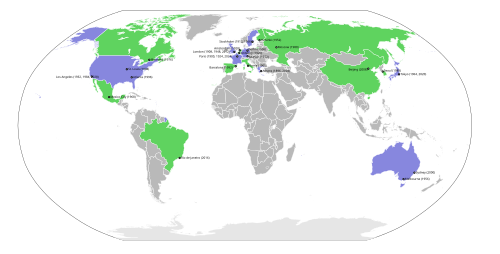

The host city for an Olympic Games had historically been chosen seven to eight years ahead of their celebration. Beginning with the 2024 and 2028 Olympics selection process in 2017, the IOC has proceeded to announce the winning bid with a longer lead-in time in order to provide time for the winning cities/regions to prepare.[289][290] The process of selection is carried out in two phases that span a two-year period. The prospective host city applies to its country's National Olympic Committee; if more than one city from the same country submits a proposal to its NOC, the national committee typically holds an internal selection, since only one city per NOC can be presented to the International Olympic Committee for consideration. Once the deadline for submission of proposals by the NOCs is reached, the first phase (Application) begins with the applicant cities asked to complete a questionnaire regarding several key criteria related to the organisation of the Olympic Games.[291] In this form, the applicants must give assurances that they will comply with the Olympic Charter and with any other regulations established by the IOC Executive Committee.[289] The evaluation of the filled questionnaires by a specialised group provides the IOC with an overview of each applicant's project and their potential to host the Games. On the basis of this technical evaluation, the IOC Executive Board selects the applicants that will proceed to the candidature stage.[291]
Once the candidate cities are selected, they must submit to the IOC a bigger and more detailed presentation of their project as part of a candidature file. Each city is thoroughly analysed by an evaluation commission. This commission will also visit the candidate cities, interviewing local officials and inspecting prospective venue sites, and submit a report on its findings one month prior to the IOC's final decision. During the interview process the candidate city must also guarantee that it will be able to fund the Games.[289] After the work of the evaluation commission, a list of candidates is presented to the General Session of the IOC, which must assemble in a country that does not have a candidate city in the running. The IOC members gathered in the Session have the final vote on the host city. Once elected, the host city bid committee (together with the NOC of the respective country) signs a Host City Contract with the IOC, officially becoming an Olympic host nation and host city.[289]
By 2032, the Olympic Games will have been hosted by 47 cities in 23 countries. As of 2021, since the 1988 Summer Olympics in Seoul, South Korea, the Olympics have been held in Asia or Oceania four times, a sharp increase compared to the previous 92 years of modern Olympic history. The 2016 Games in Rio de Janeiro were the first Olympics for a South American country. No bids from countries in Africa have succeeded, although Egypt (thrice) and South Africa (in 2004) have tried.[292]
See also



Notes
- ^ English and French are the official languages of the Olympic Movement.
- ^ However, Theodosius' decree contains no specific reference to Olympia.[26]
- ^ The 1988 Winter Olympics were in Calgary, Canada, and the 1988 Winter Paralympics were in Innsbruck, Austria.[49]
- ^ The IOC lists a French immigrant to the United States Albert Corey as a United States competitor for his marathon silver medal, but (together with four undisputed Americans) as part of a mixed team for the team race silver medal.[284][285]
- ^ All three of Great Britain's athletes in 1904 were from Ireland, which at the time was part of the United Kingdom of Great Britain and Ireland. Despite the team being called Great Britain or Team GB, inhabitants of Northern Ireland (and formerly the whole of Ireland) are (or were) eligible to join.[286]
- ^ Switzerland participated in the equestrian events of the 1956 Games held in Stockholm in June,[287] but did not attend the Games in Melbourne later that year.[288]
References
- ^ "Jeux Olympiques – Sports, Athlètes, Médailles, Rio 2016". International Olympic Committee. 22 October 2018.
- ^ a b c Harold Maurice Abrahams; David C. Young (4 August 2024). "Olympic Games". Britannica.
- ^ The Associated Press (14 October 1986). "Olympics to Hold Events Every 2 Years : Winter Games to Be Split Off, Start Own 4-Year Cycle in '94". L.A. Times Archives. Los Angeles Times.
- ^ Alan Riding (12 February 1993). "OLYMPICS: One Year to Lillehammer; '94 Olympics Are on Schedule Now That Budget Games Are Over". The New York Times. Archived from the original on 12 February 2024.
- ^ a b "No Boycott Blues". olympic.org. Retrieved 6 January 2017.
- ^ Simon Hornblower (29 July 2024). "Ancient Greek civilization". Britannica.
- ^ Eugene Vanderpool (26 July 2024). "Olympia". Britannica.
- ^ Ὀλύμπια. Liddell, Henry George; Scott, Robert; An Intermediate Greek–English Lexicon at the Perseus Project.
- ^ a b c d e f Moses I. Finley; H.W. Pleket (14 June 1976). The Olympic Games: The First Thousand Years. Dover Publications.
- ^ a b c d e f g h i Tony Perrottet (8 June 2004). The Naked Olympics. Random House Trade Paperbacks.
- ^ Stefan Lovgren; Ted Chamberlain (28 July 2012). "Ancient Olympics Had 'Spectacular' Opening Ceremony, Pagan Partying". National Geographic.
- ^ Mark Cartwright (13 March 2018). "Ancient Olympic Games". World History Encyclopedia.
- ^ Swaddling 2000, p. 54
- ^ "The Olympic Truce – Myth and Reality by Harvey Abrams". Classics Technology Center, AbleMedia.com. Retrieved 12 February 2013.
- ^ a b David C. Young (1 January 2004). "Chapter 2. Beginnings and Evidence". A Brief History of the Olympic Games. Blackwell Publishing. doi:10.1002/9780470774823. ISBN 978-1-4051-1129-4.
- ^ Pausanias. "Book VII: Elis 1". Description of Greece (with an English Translation by W.H.S. Jones and H.A. Ormerod, Harvard University Press, 1918). Perseus Hopper.
- ^ a b Pindar. "Book O Olympian 2 For Theron of Acragas Chariot Race 476 B. C.". In Diane Arnson Svarlien (ed.). Olympian Odes. Perseus Hopper.
- ^ Richardson 1992, p. 227.
- ^ Nicholas J. Richardson (7 March 2016). "Olympic Games". Oxford Classical Dictionary. Oxford University Press. doi:10.1093/acrefore/9780199381135.013.4544. ISBN 978-0-19-938113-5.
- ^ Crowther 2007, pp. 59–61.
- ^ "Ancient Olympic Events". Perseus Project of Tufts University. Retrieved 29 April 2009.
- ^ Golden 2009, p. 24.
- ^ Burkert 1983, p. 95.
- ^ Swaddling 1999, pp. 90–93.
- ^ Olympic Museum (2007). "The Olympic Games in Antiquity" (PDF). International Olympic Committee. p. 2. Archived from the original (PDF) on 25 March 2009. Retrieved 2 February 2009.
- ^ a b Crowther 2007, p. 54.
- ^ 400 Years of Olimpick Passion, Robert Dover's Games Society, archived from the original on 6 June 2010, retrieved 4 June 2010
- ^ a b "Histoire et évolution des Jeux olympiques". Potentiel (in French). 2005. Archived from the original on 26 April 2011. Retrieved 31 January 2009.
- ^ a b c d e f John E. Findling; Kimberly Pelle, eds. (30 March 2004). Encyclopedia of the Modern Olympic Movement (1st ed.). Bloomsbury.
- ^ David C. Young (1 January 2004). "Chapter 13. The Origin and Authenticity of the Modern Olympic Games". A Brief History of the Olympic Games. Blackwell Publishing. doi:10.1002/9780470774823. ISBN 978-1-4051-1129-4.
- ^ a b c d e f g h i j k David C. Young (1996). The Modern Olympics: A Struggle for Revival. Johns Hopkins University Press. ISBN 0801872073.
- ^ Matthews 2005, pp. 53–54.
- ^ Weiler 2004.
- ^ Girginov & Parry 2005, p. 38
- ^ "Much Wenlock & the Olympian Connection". Wenlock Olympian Society. Archived from the original on 23 January 2009. Retrieved 31 January 2009.
- ^ a b "Rugby School motivated founder of Games". Sports Illustrated. Reuters. 7 July 2004. Archived from the original on 23 August 2004. Retrieved 4 February 2009.
- ^ Coubertin et al. 1897, p. 8, Part 2.
- ^ "Athens 1896". The International Olympic Committee. Retrieved 8 February 2010.
- ^ de Martens, Frédéric (1893). Mémoire sur le conflit entre la Grèce et la Roumanie concernant l'affaire Zappa (in French). Athens: [printer Anestis Constantinides]. Retrieved 2 August 2017.
- ^ Streit, Geōrgios S. (1894). L'affaire Zappa; Conflit Gréco-Roumain (in French). Paris: L. Larose. Retrieved 2 August 2017.
- ^ "Olympic Games - a brief history | Parramatta History and Heritage". historyandheritage.cityofparramatta.nsw.gov.au. Retrieved 31 January 2024.
- ^ "1896 Athina Summer Games". Sports Reference. Archived from the original on 17 April 2020. Retrieved 31 January 2009.
- ^ "St. Louis 1904 – Overview". ESPN. Archived from the original on 24 March 2021. Retrieved 31 January 2009.
- ^ "1906 Olympics mark 10th anniversary of the Olympic revival". Canadian Broadcasting Centre. 28 May 2008. Archived from the original on 31 July 2008. Retrieved 31 January 2009.
- ^ a b Hines, p. xxii
- ^ "Chamonix 1924". International Olympic Committee. Archived from the original on 2 August 2008. Retrieved 31 January 2009.
- ^ "Winter Olympics History". Utah Athletic Foundation. Archived from the original on 12 January 2009. Retrieved 31 January 2009.
- ^ "History of the Paralympics". BBC Sport. 4 September 2008. Retrieved 2 February 2009.
- ^ "Innsbruck 1988 Paralympics – Ceremonies, Medals, Torch Relay". International Paralympic Committee. Retrieved 2 August 2017.
- ^ "History of the Paralympic Games". Government of Canada. Archived from the original on 12 March 2010. Retrieved 7 April 2010.
- ^ "IPC-IOC Cooperation". paralympic.org. IPC. Archived from the original on 8 September 2009. Retrieved 3 May 2010.
- ^ Gibson, Owen (4 May 2010). "Sainsbury's announces sponsorship of 2012 Paralympics". The Guardian. London.
- ^ "Rogge wants Youth Olympic Games". BBC Sport. 19 March 2007. Retrieved 2 February 2009.
- ^ Rice, John (5 July 2007). "IOC approves Youth Olympics; first set for 2010". USA Today. The Associated Press. Retrieved 2 February 2009.
- ^ "Innsbruck is the host city for the first Winter Youth Olympic Games". The Vancouver Organizing Committee for the 2010 Olympic and Paralympic Winter Games. 12 December 2008. Archived from the original on 10 June 2009. Retrieved 30 March 2009.
- ^ "IOC to Introduce Youth Olympic Games in 2010". CRIenglish.com. 25 April 2007. Archived from the original on 9 August 2016. Retrieved 29 January 2009.
- ^ "IOC session: A "go" for Youth Olympic Games". International Olympic Committee. 5 July 2007. Archived from the original on 21 August 2008. Retrieved 2 February 2009.
- ^ Wade, Stephen (25 April 2007). "No kidding: Teens to get Youth Olympic Games". USA Today. Retrieved 27 August 2008.
- ^ Michaelis, Vicky (5 July 2007). "IOC votes to start Youth Olympics in 2010". USA Today. Retrieved 2 February 2009.
- ^ "International Olympic Committee - Tokyo 2020".
- ^ "International Olympic Committee - Beijing 2022".
- ^ "Tokyo 2020". olympic.org. 23 February 2023. Retrieved 5 November 2023.
- ^ "Beijing to build convenient Olympic village". The Beijing Organizing Committee for the Games of the XXIX Olympiad. Archived from the original on 14 September 2008. Retrieved 4 May 2009.
- ^ "Olympic Charter" (PDF). International Olympic Committee. p. 61. Archived from the original (PDF) on 23 July 2011. Retrieved 28 July 2011.
- ^ "The Olympic Charter". International Olympic Committee. Archived from the original on 2 May 2013. Retrieved 17 July 2012.
- ^ "Executive Board Concludes First Meeting of the New Year". olympic.org. 13 January 2011. Retrieved 13 January 2011.
- ^ "Curtain comes down on 123rd IOC Session". olympic.org. 9 July 2011. Archived from the original on 2 November 2011. Retrieved 3 July 2012.
- ^ "Working meeting between the IOC and the NOCs of the Netherlands Antilles, Aruba and the Netherlands". olympic.org. 1 July 2011. Archived from the original on 15 January 2014. Retrieved 23 August 2012.
- ^ Sudakov, Dmitry (8 June 2008). "Beijing Olympics to cost China 44 billion dollars". pravda.ru. Archived from the original on 22 February 2014. Retrieved 12 February 2014.
- ^ Gibson, Owen (9 October 2013). "Sochi 2014: the costliest Olympics yet but where has all the money gone?". The Guardian. Retrieved 12 February 2014.
- ^ a b c Flyvbjerg, Bent; Stewart, Allison; Budzier, Alexander (2016). The Oxford Olympics Study 2016: Cost and Cost Overrun at the Games. Saïd Business School, University of Oxford. arXiv:1607.04484. doi:10.2139/ssrn.2804554. S2CID 156794182. SSRN 2804554.
- ^ Abrahamson, Alan (25 July 2004). "LA the Best Site, Bid Group Insists; Olympics: Despite USOC rejection". Los Angeles Times. Archived from the original on 5 November 2012. Retrieved 17 August 2008.
- ^ Leahy, Joe (7 July 2016). "Brazil's Olympic costs running 51% over budget, report warns". Financial Times. Archived from the original on 10 December 2022. Retrieved 23 July 2017.
- ^ Flyvbjerg, Bent; Budzier, Alexander; Lunn, Daniel (1 September 2020). "Regression to the Tail: Why the Olympics Blow Up". Environment and Planning A: Economy and Space. arXiv:2009.14682. doi:10.2139/ssrn.3686009. ISSN 1556-5068. S2CID 233759692. SSRN 3686009.
- ^ Tokyo 2020 Organising Committee (27 July 2024). "Tokyo 2020 Organising Committee publishes final balanced budget".
{{cite web}}: CS1 maint: numeric names: authors list (link) - ^ "Tokyo Olympics cost $15.4 billion. What else could that buy?". AP News. 7 August 2021. Retrieved 27 July 2024.
- ^ a b Cengel, Katya (10 August 2008). "Olympics: beyond sports". Courier Journal. Louisville, Kentucky. p. E1.; Cengel, Katya (10 August 2008). "Olympics (Continued from E1)". Courier Journal. Louisville, Kentucky. p. E2.
- ^ "Bob Barney". Centre for Canadian Baseball Research. St. Mary's, Ontario. 2023. Retrieved 3 August 2023.
- ^ "Robert K. Barney". Center for Sociocultural Sport and Olympic Research. 2020. Retrieved 4 August 2023.
- ^ "Robert K. Barney Graduate Student Essay Award". Center for Sociocultural Sport and Olympic Research. 1 November 2022. Retrieved 5 August 2023.
- ^ "International Society of Olympic Historians". International Society of Olympic Historians. 2023. Retrieved 1 October 2023.
- ^ Greenwell M (August 2016). "Olympics Everywhere". Argument. WIRED (Paper). p. 19.
...hosting the Olympics is almost always a financial disaster for cities in the long term.... Indeed, economists are uncommonly unanimous that hosting the Olympics is a bad bet.
- ^ Rose AK, Spiegel MM (19 January 2011). "The Olympic Effect". The Economic Journal. 121 (553): 652–77. doi:10.1111/j.1468-0297.2010.02407.x.
- ^ Tilcsik A, Marquis C (1 February 2013). "Punctuated Generosity: How Mega-events and Natural Disasters Affect Corporate Philanthropy in U.S. Communities" (PDF). Administrative Science Quarterly. 58 (1): 111–48. doi:10.1177/0001839213475800. S2CID 18481039. SSRN 2028982. Archived (PDF) from the original on 22 September 2017 – via Social Science Research Network.
- ^ Glynn, Mary Ann (2008). "Configuring the Field of Play: How Hosting the Olympic Games Impacts Civic Community". Journal of Management Studies. 45 (6): 1117–1146. doi:10.1111/j.1467-6486.2008.00785.x. S2CID 153973502.
- ^ "The Economic Impact Of The Winter Olympics: Not Great For Russia But Sochi Stands To Gain". The Guardian. 17 December 2014. Retrieved 10 January 2014.
- ^ Abend, Lisa (3 October 2014). "Why Nobody Wants to Host the 2022 Winter Olympics". Time. Retrieved 10 January 2014.
- ^ "Revealed: the biggest threat to the future of the Olympic Games". The Guardian. 27 July 2016. Retrieved 30 July 2016.
- ^ "IOC makes historic decision by simultaneously awarding Olympic Games 2024 to Paris and 2028 to Los Angeles". International Olympic Committee. 13 September 2017. Retrieved 6 September 2021.
- ^ "The Olympic Movement". International Olympic Committee. Retrieved 2 May 2009.
- ^ "Roles and responsibilities during the Olympic Games" (PDF). International Olympic Committee. February 2008. pp. 1–2. Archived from the original (PDF) on 29 April 2011. Retrieved 2 May 2009.
- ^ "For the Good of the Athletes". The Beijing Organizing Committee for the Games of the XXIX Olympiad. 31 October 2007. Archived from the original on 23 January 2009. Retrieved 4 February 2009.
- ^ "National Olympic Committees". olympic.org. Retrieved 13 March 2021. Click on "What is a National Olympic Committee?" (at top of page)
- ^ "South Sudan 206th NOC in the Olympic Movement". eurolympic.org. 4 August 2015. Archived from the original on 13 March 2021. Retrieved 13 March 2021.
- ^ "Organising Committees for the Olympic Games". Olympic Games. Retrieved 18 July 2012.
- ^ Olympic Charter 2007, p. 53, Rule 24.
- ^ a b David Maraniss (14 July 2009). Rome 1960: The Summer Olympics that Stirred the World. Simon & Schuster. ISBN 978-1-4165-3408-2.
- ^ "Samaranch Defends Nominating Son for IOC Post". CBC.ca. 18 May 2001. Archived from the original on 5 December 2008. Retrieved 4 February 2009.
- ^ Riding, Alan (30 June 1992). "Olympics: Barcelona Profile; Samaranch, Under the Gun Shoots Back". The New York Times. Archived from the original on 12 November 2012. Retrieved 30 January 2009.
- ^ "Samaranch reflects on bid scandal with regret". 2002 Winter Olympics coverage. Deseret News Archives. 19 May 2001. Archived from the original on 26 February 2002.
- ^ a b "Marketing Matters, Issue 21" (PDF). stillmed.olympic.org. IOC. June 2002. Archived (PDF) from the original on 23 March 2018. Retrieved 20 October 2010.
- ^ Jordan, Mary; Sullivan, Kevin (21 January 1999), "Nagano Burned Documents Tracing '98 Olympics Bid", Washington Post, pp. A1, retrieved 20 August 2016
- ^ Macintyre, Donald (1 February 1999). "Japan's Sullied Bid". Time Magazine. Retrieved 20 August 2016.
- ^ Abrahamson, Alan; Wharton, David (30 July 2000). "IOC: A tangled web of wealth, mystery". St. Louis Post-Dispatch. St. Louis, Missouri. p. 24.
- ^ "Sun sets on Salt Lake City". Herald News. Passaic County, New Jersey. 25 February 2002. p. A1.; "Games (Continued From A1)". Herald News. Passaic County, New Jersey. 25 February 2002. p. A6.
- ^ Rowlatt, Justin (29 July 2004). "Buying the Games". BBC News. Retrieved 16 April 2009.
- ^ Zinser, Lynn (7 July 2005). "London Wins 2012 Olympics; New York Lags". The New York Times. Archived from the original on 29 May 2015. Retrieved 4 February 2009.
- ^ "Paris Mayor Slams London Tactics". Sporting Life. UK. Archived from the original on 15 May 2011. Retrieved 4 February 2009.
- ^ Berkes, Howard (7 February 2006). "How Turin got the Games". NPR. Retrieved 4 February 2009.
- ^ a b "Olympic Marketing Fact File, 2011 Edition" (PDF). olympic.org. p. 18. Archived from the original (PDF) on 12 August 2011. Retrieved 22 December 2015.
- ^ Paul, Franklin (12 October 2007). "Kodak to end Olympics sponsorship after 2008 games". Reuters.
- ^ "No more Kodak moments in the Olympics". disruptiveinnovation.se. 15 April 2013. Retrieved 23 November 2019.
- ^ "Wildly interesting facts about London you never knew, until now". ITV News. 4 December 2015.
- ^ "The History of OXO". oxo.co.uk. Archived from the original on 20 March 2018. Retrieved 23 November 2019.
- ^ a b c d e f Anne Cooper-Chen, ed. (23 June 2005). Global Entertainment Media: Content, Audiences, Issues (1st ed.). Routledge.
- ^ a b c d e "Issues of the Olympic Games". Olympic Primer. LA84 Foundation of Los Angeles. Archived from the original on 25 April 2009. Retrieved 30 March 2009.
- ^ a b c Buchanon & Mallon 2006, p. ci.
- ^ a b c d e f g h i j Trevor Slack, ed. (9 March 2005). The Commercialisation of Sport (1st ed.). Routledge.
- ^ "Berlin 1936". olympic.org. Archived from the original on 22 August 2008. Retrieved 31 March 2009.
- ^ "Cortina d'Ampezzo". olympic.org. Archived from the original on 22 August 2008. Retrieved 31 March 2009.
- ^ Gershon 2000, p. 17.
- ^ Crupi, Anthony (7 June 2011). "Update: NBC Bids $4.38 Billion for Olympic Gold". Adweek. Retrieved 7 June 2011.
- ^ Armour, Nancy (7 May 2014). "NBC Universal pays $7.75 billion for Olympics through 2032". USA Today.
- ^ Zaccardi, Nick (12 August 2014). "NBC Olympics, Universal Sports announce Youth Olympics coverage". NBC Sports.
- ^ Zaccardi, Nick (24 September 2013). "NBC Olympics, U.S. Olympic Committee acquire media rights to Paralympics in 2014, 2016". Olympictalk | NBC Sports.
- ^ a b Draper, Kevin (7 December 2017). "Fewer Russians Could Be a Windfall for U.S. Olympic Business". The New York Times. Archived from the original on 8 December 2017. Retrieved 5 February 2018.
- ^ Whannel, Garry (1984). "3. The television spectacular". In Tomlinson, A.; Whannel, G. (eds.). Five-ring Circus: Money, Power, and Politics at the Olympic Games. London, UK: Pluto Press. pp. 30–43. ISBN 978-0-86104-769-7.
- ^ Tomlinson 2005, p. 14.
- ^ "World Series TV ratings slump". CBS News. The Associated Press. 27 October 2000. Archived from the original on 31 October 2010. Retrieved 4 May 2009.
- ^ Walters, John (2 October 2000). "All Fall Down – Making sense of NBC's tumbling Olympic ratings". Sports Illustrated. Archived from the original on 29 April 2011. Retrieved 2 April 2009.
- ^ a b Carter, Bill; Sandomir, Richard (17 August 2008). "A Surprise Winner at the Olympic Games in Beijing: NBC". The New York Times. Archived from the original on 1 September 2008. Retrieved 2 April 2009.
- ^ Woods 2007, p. 146.
- ^ "London Olympics 2012 Ratings: Most Watched Event In TV History". The Huffington Post. 13 August 2012. Retrieved 12 July 2013.
- ^ "Olympics 2021: Why swimming finals are being held in the morning". au.sports.yahoo.com. 24 July 2021. Retrieved 22 February 2022.
- ^ "Here's Why the Swimming Finals Are Held in the Morning at Tokyo Olympics | Sports Illustrated". www.si.com. 25 July 2021. Retrieved 22 February 2022.
- ^ Coskrey, Jason (28 July 2021). "Morning finals forcing swimmers to adjust in Tokyo". The Japan Times. Archived from the original on 22 February 2022. Retrieved 22 February 2022.
- ^ Carter, Bill (24 August 2008). "On TV, Timing Is Everything at the Olympics". The New York Times. ISSN 0362-4331. Retrieved 22 February 2022.
- ^ "Swimming, gymnastics finals set for mornings in 2008". ESPN.com. 26 October 2006. Retrieved 22 February 2022.
- ^ "The Phryges – Paris 2024 Mascots Star as Olympic Merchandise". www.wipo.int. Retrieved 20 August 2024.
- ^ "Olympic Marketing Fact File 2024 Edition" (PDF). stillmed.olympics.com.
- ^ Buchanon & Mallon 2006, p. cii.
- ^ "Federal Reserve Bank of San Francisco, The Olympic Effect, March 2009" (PDF). Archived (PDF) from the original on 12 April 2010. Retrieved 23 November 2019.
- ^ a b c "The Olympic Symbols" (PDF). International Olympic Committee. Archived from the original (PDF) on 24 March 2009. Retrieved 4 February 2009.
- ^ Lennartz, Karl (2002). "The Story of the Rings" (PDF). Journal of Olympic History. 10: 29–61. Archived from the original (PDF) on 7 January 2016. Retrieved 30 November 2016.
- ^ "The IP journey of an Olympic Games". www.wipo.int. Retrieved 20 August 2024.
- ^ "Sport athlétique", 14 mars 1891: "... dans une éloquente allocution il a souhaité que ce drapeau les conduise 'souvent à la victoire, à la lutte toujours'. Il a dit qu'il leur donnait pour devise ces trois mots qui sont le fondement et la raison d'être des sports athlétiques: citius, altius, fortius, 'plus vite, plus haut, plus fort'.", cited in Hoffmane, Simone La carrière du père Didon, Dominicain. 1840–1900, Doctoral thesis, Université de Paris IV – Sorbonne, 1985, p. 926; cf. Michaela Lochmann, Les fondements pédagogiques de la devise olympique "citius, altius, fortius"
- ^ "The Olympic flame and the torch relay" (PDF). Olympic Museum. International Olympic Committee. 2007. p. 6. Archived from the original (PDF) on 25 March 2009. Retrieved 4 February 2009.
- ^ "IOC Investigation". Real Sports with Bryant Gumbel. Season 22. Episode 7. 26 July 2016. HBO.
- ^ "Olympic Summer Games Mascots from Munich 1972 to London 2012" (PDF). Olympic Studies Centre. April 2011. Archived from the original (PDF) on 16 October 2012. Retrieved 13 July 2013.
- ^ Belam, Martin (14 November 2022). "Meet the Phryges: Paris 2024 Olympic and Paralympic mascots unveiled". The Guardian. ISSN 0261-3077. Retrieved 28 July 2023.
- ^ a b c "Fact sheet: Opening Ceremony of the Summer Olympic Games" (PDF). International Olympic Committee. February 2008. Archived from the original (PDF) on 29 April 2011. Retrieved 14 August 2008.
- ^ a b c "Fact sheet: Opening Ceremony of the Winter Olympic Games" (PDF). International Olympic Committee. February 2008. Archived from the original (PDF) on 25 March 2009. Retrieved 14 August 2008.
- ^ a b "The development of the Games – Between festival and tradition" (PDF). The Modern Olympic Games (PDF). International Olympic Committee. p. 5. Archived from the original (PDF) on 25 March 2009. Retrieved 29 August 2008.
- ^ "Beijing Dazzles: Chinese History, on Parade as Olympics Begin". Canadian Broadcasting Centre. 8 August 2008. Archived from the original on 6 September 2008. Retrieved 9 September 2008.
- ^ a b c d "Closing Ceremony Factsheet" (PDF). The International Olympic Committee. 5 June 2012. Archived from the original (PDF) on 16 October 2011. Retrieved 12 August 2012.
- ^ "Closing Ceremony" (PDF). International Olympic Committee. 31 January 2002. Archived from the original (PDF) on 25 March 2009. Retrieved 27 August 2008.
- ^ "The Olympic Flags and Emblem". The Vancouver Organizing Committee for the 2010 Olympic and Paralympic Winter Games. Archived from the original on 26 April 2009. Retrieved 10 February 2009.
- ^ "The Latest: Rio Games close with samba-fueled Carnival party". The San Diego Union-Tribune. The Associated Press. 21 August 2016. Retrieved 24 June 2018.
- ^ "The Closing Ceremonies of the Olympic Game". International Olympic Committee. 1 June 2014. Retrieved 24 June 2018.
- ^ Harold Maurice Abrahams; David C. Young (4 August 2024). "Programs and Participation: The Medal Ceremonies". Britannica.
- ^ "Symbols and Traditions: Medal ceremony". USA Today. 12 July 1999. Retrieved 29 August 2008.
- ^ "Medal ceremony hostess outfits unveiled". Sina Online. 18 July 2008. Retrieved 29 August 2008.
- ^ Madhani, Aamer; Armour, Nancy (13 February 2018). "Medalists at 2018 Winter Olympics get precious keepsake. And a medal". USA Today. Retrieved 22 April 2018.
- ^ "Mascots come first, then medals for Olympic champions". USA Today. The Associated Press. 12 February 2018. Retrieved 22 April 2018.
- ^ Ogilvie, Claire (18 October 2006). "Prof says Olympic podiums have Canadian connection". The Province. Vancouver, British Columbia. p. 25.
- ^ "Wrestling". The Beijing Organizing Committee for the Games of the XXIX Olympiad. Archived from the original on 26 February 2009. Retrieved 25 March 2009.
- ^ "Sports". International Olympic Committee. Retrieved 8 February 2009.
- ^ "Olympic Sports of the Past". olympic.org. Archived from the original on 18 December 2008. Retrieved 10 February 2009.
- ^ Olympic Charter 2007, pp. 88–90.
- ^ "International Sports Federations". International Olympic Committee. Retrieved 8 February 2009.
- ^ Olympic Charter 2007, p. 87.
- ^ "Factsheet: The sessions" (PDF). International Olympic Committee. p. 1. Archived from the original (PDF) on 29 April 2011. Retrieved 8 February 2009.
- ^ "Recognised Sports". olympic.org. Archived from the original on 24 March 2009. Retrieved 31 March 2009.
- ^ a b c d e f g h "Factsheet: The sports on the Olympic programme" (PDF). International Olympic Committee. February 2008. Archived from the original (PDF) on 25 March 2009. Retrieved 3 July 2012.
- ^ a b "Golf, rugby added for 2016 and 2020". ESPN. The Associated Press. 9 October 2009. Retrieved 9 October 2009.
- ^ a b c d Eassom 1994, pp. 120–123.
- ^ "Jim Thorpe Biography". Biography.com. Retrieved 9 February 2009.
- ^ "Garmisch-Partenkirchen 1936". International Olympic Committee. Retrieved 25 July 2011.
- ^ "The Role of Sports in The Soviet Union – Guided History". blogs.bu.edu.
- ^ a b "Soviet Sports and Intelligence Activities" (PDF). Central Intelligence Agency. 28 December 1954. Archived (PDF) from the original on 13 April 2021. Retrieved 25 December 2018.
- ^ Cervin, Georgia (2021). Degrees of Difficulty: How Women's Gymnastics Rose to Prominence and Fell from Grace. University of Illinois Press. ISBN 978-0-25204377-2.
- ^ "Symbols and traditions: Amateurism". USA Today. 12 July 1999. Retrieved 9 February 2009.
- ^ "Soviet Control of Sports Activities and Sports Propaganda" (PDF). Central Intelligence Agency. 7 February 1955. Archived (PDF) from the original on 12 July 2021. Retrieved 22 August 2021.
- ^ "Soviet Sports as an Instrument of Political Propaganda" (PDF). Central Intelligence Agency. 20 January 1955. Archived (PDF) from the original on 12 July 2021. Retrieved 22 August 2021.
- ^ Schantz, Otto. "The Olympic Ideal and the Winter Games Attitudes Towards the Olympic Winter Games in Olympic Discourses – from Coubertin to Samaranch" (PDF). Comité International Pierre De Coubertin. Archived from the original (PDF) on 19 September 2016. Retrieved 19 September 2016.
- ^ a b c "Protesting Amateur Rules, Canada Leaves International Hockey". iihf.com. 4 January 1970. Archived from the original on 20 February 2016.
- ^ "Finally, Canada to Host the World Championship". iihf.com. 7 May 2004. Archived from the original on 3 March 2016.
- ^ "Summit Series '72 Summary". Hockey Hall of Fame. Archived from the original on 7 August 2008. Retrieved 2 March 2009.
- ^ "First Canada Cup Opens Up the Hockey World". iihf.com. 15 September 1976. Archived from the original on 14 March 2016.
- ^ Krüger & Murray 2003, p. 230
- ^ "Melbourne/Stockholm 1956". International Olympic Committee. Retrieved 25 July 2011.
- ^ a b "African nations boycott costly Montreal Games". CBC Sports. 30 July 2008. Archived from the original on 15 August 2012. Retrieved 6 February 2009.
- ^ "Africa and the XXIst Olympiad" (PDF). Olympic Review (109–110): 584–585. November–December 1976. Archived from the original (PDF) on 26 February 2008. Retrieved 6 February 2009.
- ^ MacIntosh, Donald; Greenhorn, Donna; Hawes, Michael (1991). "Trudeau, Taiwan, and the 1976 Montreal Olympics". American Review of Canadian Studies. 21 (4): 423–448. doi:10.1080/02722019109481098.
- ^ "Game playing in Montreal" (PDF). Olympic Review (107–108): 461–462. October 1976. Archived from the original (PDF) on 25 February 2009. Retrieved 7 February 2009.
- ^ "ChinaOlympic History". Chinaorbit.com. Archived from the original on 31 May 2008. Retrieved 27 August 2008.
- ^ "Moscow 1980". International Olympic Committee. Retrieved 25 July 2011.
- ^ "Moscow 1980:Cold War, Cold Shoulder". Deutsche Welle. 31 July 2008. Retrieved 27 April 2009.
- ^ "Los Angeles 1984". International Olympic Committee. Retrieved 25 July 2011.
- ^ "Australia: Calls to Boycott Beijing Olympics". Inter Press Service. Archived from the original on 12 September 2008. Retrieved 10 September 2008.
- ^ "Diplomats Visit Tibet as EU Split on Olympic Opening Boycott". The Economic Times. 29 March 2008. Retrieved 7 February 2008.
- ^ "Putin Faces Green Olympic Challenge: The Sochi 2014 Winter Games are threatened by a looming international boycott, environmental concerns, and public protests against local development". Christian Science Monitor. 11 July 2008. Archived from the original on 22 August 2009. Retrieved 18 August 2008., The Christian Science Monitor. Retrieved 18 August 2008.
- ^ Bernas, Frederick (5 December 2009). "Olympic challenge for Sochi Games". The Guardian. London. Retrieved 31 May 2011.
- ^ Doherty, Erin (3 February 2022). "What a diplomatic boycott of the Winter Olympics means". Axios. Retrieved 20 February 2022.
- ^ Simone McCarthy and Rhea Mogul (4 February 2022). "India launches last-minute diplomatic boycott of Beijing Olympics over Chinese soldier". CNN. Retrieved 20 February 2022.
- ^ Litsky, Frank (1980), "Jesse Owens Dies of Cancer at 66", The New York Times, New York, retrieved 23 March 2014
- ^ "Spartakiads". Sovetskaya Entsiklopediya. Vol. 24.1. 1976. p. 286.
- ^ Roche 2000, p. 106.
- ^ "The USSR and Olympism" (PDF). Olympic Review (84): 530–557. October 1974. Archived from the original (PDF) on 9 April 2008. Retrieved 4 May 2009.
- ^ Benson, Tyler. "The Role of Sports in The Soviet Union". blogs.bu.edu. Guided History. Retrieved 25 December 2018.
- ^ "1968: Black athletes make silent protest". BBC News. 17 October 1968. Retrieved 7 February 2009.
- ^ "Iranian Judoka rewarded after snubbing Israeli". NBC Sports. The Associated Press. 8 September 2004. Archived from the original on 25 March 2009. Retrieved 7 February 2009.
- ^ "IOC EB recommends no participation of Russian and Belarusian athletes and officials". International Olympic Committee. 3 March 2021. Archived from the original on 1 March 2022. Retrieved 3 March 2022.
- ^ "Why are Russian athletes 'banned' from the 2024 Paris Olympics?". The Indian Express. 30 July 2024. Retrieved 6 August 2024.
- ^ "Tom Hicks". Sports-reference.com. Archived from the original on 17 April 2020. Retrieved 30 January 2009.
- ^ a b "A Brief History of Anti-Doping". World Anti-Doping Agency. Archived from the original on 16 August 2011. Retrieved 10 September 2008.
- ^ Begley, Sharon (7 January 2008). "The Drug Charade". Newsweek. Retrieved 27 August 2008.
- ^ a b Hunt, Thomas M. (2011). Drug Games: The International Olympic Committee and the Politics of Doping. University of Texas Press. p. 66. ISBN 978-0292739574.
- ^ a b Ruiz, Rebecca R. (13 August 2016). "The Soviet Doping Plan: Document Reveals Illicit Approach to '84 Olympics". The New York Times. ISSN 0362-4331. Archived from the original on 15 August 2016. Retrieved 3 September 2016.
- ^ Porterfield 2008, p. 15.
- ^ Montague, James (23 July 2012). "Hero or villain? Ben Johnson and the dirtiest race in history". CNN. Retrieved 25 December 2018.
- ^ Coile, Zachary (27 April 2005). "Bill Seeks to Toughen Drug Testing in Pro Sports". The San Francisco Chronicle. Retrieved 3 September 2008.
- ^ "Doping: 3667 athletes tested, IOC seeks action against Halkia's coach". Express India Newspapers. 19 August 2008. Archived from the original on 1 December 2008. Retrieved 28 August 2008.
- ^ "Play True" (PDF). World Anti-Doping Agency. 2012. Archived from the original (PDF) on 25 January 2013. Retrieved 13 July 2013.
- ^ "Anti-Doping Results Announced". The New York Times. The Associated Press. 25 July 2012. Archived from the original on 28 July 2012. Retrieved 13 July 2013.
- ^ "IOC Orders Belarus to Return Gold". ESPN. 13 August 2012. Retrieved 13 July 2013.
- ^ "China hits back at the US in response to doping allegations dogging its swimmers". AP News. 8 August 2024. Retrieved 27 September 2024.
- ^ Jett, Jennifer (2 August 2024). "Frequent doping tests and suspicion cast a shadow over China's Olympics swim team". NBC News. Retrieved 5 September 2024.
- ^ "Electronic Documentary Package of the IP Professor Richard H. McLaren, O.C." December 2016. Archived from the original on 28 January 2017. Retrieved 28 December 2018.
- ^ "McLaren Independent Investigation Report into Sochi Allegations – Part II". World Anti-Doping Agency. 9 December 2016. Archived from the original on 9 December 2016. Retrieved 28 December 2018.
- ^ Ruiz, Rebecca R. (9 December 2016). "Report Shows Vast Reach of Russian Doping: 1,000 Athletes, 30 Sports". The New York Times. Archived from the original on 17 December 2016.
- ^ Ostlere, Lawrence (9 December 2016). "McLaren report: more than 1,000 Russian athletes involved in doping conspiracy". The Guardian.
- ^ "Rio Olympics 2016: Which Russian athletes have been cleared to compete?". BBC Sport. 6 August 2016. Retrieved 2 February 2020.
- ^ Ruiz, Rebecca R.; Panja, Tariq (5 December 2017). "Russia Banned From Winter Olympics by I.O.C.". The New York Times. Archived from the original on 17 December 2017. Retrieved 2 February 2020.
- ^ "Russia banned from Olympics for four years over doping scandal: TASS". MSN. Reuters. 9 December 2019. Retrieved 9 December 2019.
- ^ "Russia banned for four years to include 2020 Olympics and 2022 World Cup". BBC Sport. 9 December 2019. Retrieved 9 December 2019.
- ^ The Associated Press (27 December 2019). "Russia confirms it will appeal 4-year Olympic ban". Nation / Olympics / Sports / World. The Seattle Times.
- ^ Dunbar, Graham (17 December 2020). "Russia can't use its name and flag at the next 2 Olympics". The Associated Press. Retrieved 17 December 2020.
- ^ Tétrault-Farber, Gabrielle; Axon, Iain; Grohmann, Karolos (9 February 2022). "Figure skating-Russian media say teen star tested positive for banned drug". Reuters. Retrieved 9 February 2022.
- ^ Brennan, Christine (9 February 2022). "Positive drug test by Russian Kamila Valieva has forced a delay of Olympic team medals ceremony". USA Today.
- ^ Thompson, Anna (11 February 2022). "Winter Olympics: Kamila Valieva failed drug test confirmed". BBC Sport. Retrieved 12 February 2022.
- ^ Macur, Juliet; Keh, Andrew (12 February 2022). "Star Russian Figure Skater Tested Positive for Banned Drug". The New York Times.
- ^ Lonas, Lexi (12 February 2022). "Russian figure skater's drug test case to be heard Sunday". The Hill.
- ^ Ritchie, Hannah; Watson, Angus; Regan, Helen (11 February 2022). "Kamila Valieva: Russian anti-doping agency allowed teenage figure skater to compete in Olympics despite failed drug test". CNN. Retrieved 12 February 2022.
- ^ PA Media (12 February 2022). "Kamila Valieva: IOC welcomes investigation of Russian figure skater's entourage as 15-year-old awaits CAS decision at Winter Olympics". Sky Sports.
- ^ Goodwin, Sam (22 February 2022). "Spanish skater caught in shock new scandal after Winter Olympics". Yahoo Sport Australia. Archived from the original on 26 February 2022.
- ^ "Evan Bates calls Kamila Valiyeva doping case secrecy 'an injustice'". OlympicTalk. NBC Sports. 23 October 2022. Archived from the original on 16 November 2023.
- ^ Zemlianichenko, Alexander (23 October 2022). "Russia Grand Prix Figure Skating Valieva". The Herald Journal. Archived from the original on 25 October 2022.
- ^ "Kamila Valiyeva could be banned through 2026 Winter Olympics". NBC Sports. By OlympicTalk. 14 November 2022.
- ^ a b Al-Ahmed, Ali (19 May 2008). "Bar countries that ban women athletes". The New York Times. Archived from the original on 2 May 2013.
- ^ "Arab women make breakthrough at Games". CNN/SI. 23 September 2000. Archived from the original on 10 August 2004.
- ^ "Afghan women's Olympic dream". BBC News. 22 June 2004. Archived from the original on 19 July 2004.
- ^ Wallechinsky, David (29 July 2008). "Should Saudi Arabia be Banned from the Olympics?". The Huffington Post.
- ^ MacKay, Duncan (1 July 2010). "Qatar decision to send female athletes to London 2012 increases pressure on Saudi Arabia". Inside the Games. Archived from the original on 28 December 2014. Retrieved 31 May 2017.
- ^ Hubbard, Alan (4 July 2010). "Inside Lines: Protests at 2012 if Saudis say 'no girls allowed'". The Independent. Archived from the original on 28 June 2015.
- ^ "Saudis to send 2 women to London, make history". Sports Illustrated. Archived from the original on 15 July 2012. Retrieved 13 July 2012.
- ^ "London 2012 Olympics: Saudi Arabian women to compete". BBC News. 12 July 2012. Archived from the original on 17 July 2012.
- ^ "Female Gulf athletes make their mark in London Olympics". Agence France-Presse. 13 August 2012. Archived from the original on 28 March 2014.
- ^ "Women's boxing gains Olympic spot". BBC Sport. 13 August 2009. Archived from the original on 15 August 2009.
- ^ Mather, Victor (21 February 2018). "Desperately Seeking Skiers for a Budding Olympic Sport". The New York Times. Archived from the original on 11 March 2018. Retrieved 24 June 2018.
- ^ "Men to compete in artistic swimming at Olympics for first time". Associated Press News. 17 July 2023.
- ^ Goldsmith, Belinda (28 July 2012). "Men notch up an Olympic win at sex equality Games". Reuters. Retrieved 25 December 2018.
- ^ https://www.reuters.com/sports/olympics/no-male-artistic-swimmers-olympics-after-us-leave-may-out-squad-2024-06-08/ [bare URL]
- ^ https://olympics.com/en/news/mixed-team-events-explained-watch-live [bare URL]
- ^ "Bush turns attention from politics to Olympics". NBC News. The Associated Press. 7 August 2008. Retrieved 30 January 2009.
- ^ "Olympic Shooters Hug as their Countries do Battle". CNN. 10 August 2008. Retrieved 10 August 2008.
- ^ "Munich 1972: Massacre at Munich - 50 Years of Olympic Broadcasting". CBC.ca. Archived from the original on 23 February 2008. Retrieved 29 August 2008.
- ^ Senor, Juan I. (1 April 1992). "Spain Tackles Terrorist Threat by Basques to Olympics, Expo". Christian Science Monitor. Archived from the original on 26 March 2023.
- ^ Finkelstein, Beth; Koch, Noel (11 August 1991). "The Threat to the Games in Spain". Washington Post. Archived from the original on 14 November 2020.
- ^ "Olympic Park Bombing". CNN. Archived from the original on 28 August 2008. Retrieved 29 August 2008.
- ^ "IOC on bin Laden killing: no bearing on Olympic security". Daily Hampshire Gazette. The Associated Press. 3 May 2011. Archived from the original on 27 September 2011. Retrieved 25 July 2011.
- ^ "Olympic Charter" (PDF). Lausanne, Switzerland: International Olympic Committee. July 2011. Archived from the original (PDF) on 7 October 2009. Retrieved 27 July 2012.
- ^ Shachar 2011, pp. 2114–2116.
- ^ "IOC suspends Russian Olympic Committee for incorporating Ukrainian sports regions". 12 October 2023.
- ^ "IOC Executive Board approves nine changes of nationality". IOC. 29 November 2023.
- ^ "IOC Executive Board approves seven athletes' changes of sporting nationality for the Olympic Games Paris 2024". IOC. 19 March 2024.
- ^ ""Свавілля та беззаконня!" Росія влаштувала істерику через втечу спортсменів з РФ, яких підтримав МОК". 30 November 2023.
- ^ "Moscow calls on IOC to provide official explanations on transfer of three Russian athletes".
- ^ Larmer, Brook (19 August 2008). "The Year of the Mercenary Athlete". Time. Archived from the original on 19 August 2008. Retrieved 27 November 2011.
- ^ "Medals of Beijing Olympic Games Unveiled". The International Olympic Committee. Archived from the original on 3 September 2008. Retrieved 3 September 2008.
- ^ "St Louis 1904". Olympic Games. Retrieved 3 July 2012.
- ^ "The Modern Olympic Games" (PDF). The Olympic Museum. Archived from the original (PDF) on 6 September 2008. Retrieved 29 August 2008.
- ^ Munro, James (25 August 2008). "Britain may aim for third in 2012". BBC Sport. Retrieved 25 August 2008.
- ^ Charles J.P. Lucas (1905). The Olympic Games – 1904 (PDF). St. Louis, MO: Woodard & Tiernan. p. 47. Archived from the original (PDF) on 4 March 2009. Retrieved 28 February 2008.
- ^ "Olympic Medal Winners". International Olympic Committee. Retrieved 2 February 2014.
- ^ MacCarthy, Kevin (30 March 2010). "St Louis – Ireland's Olympic Awakening". Gold, Silver and Green: The Irish Olympic Journey 1896–1924. Cork University Press. pp. 117–146. ISBN 9781859184585.
- ^ The Equestrian Games of the XVI Olympiad Stockholm 1956 (PDF). Stockholm: Esselte Aktiebolag. 1959. p. 23. Archived from the original (PDF) on 11 April 2008. Retrieved 4 February 2008.
- ^ XVI Olympiad Melbourne 1956 (PDF). Melbourne: W. M. Houston. 1958. p. 37. Archived from the original (PDF) on 8 January 2014. Retrieved 23 April 2015.
- ^ a b c d "Olympic Charter" (PDF). International Olympic Committee. pp. 72–75. Archived from the original (PDF) on 23 July 2011. Retrieved 2 April 2009.
- ^ "Future Olympic Games elections to be more flexible". International Olympic Committee (Press release). 2 May 2019.
- ^ a b "Choice of the Host City". olympic.org. 2009. Archived from the original on 2 April 2009. Retrieved 2 April 2009.
- ^ "Will Africa ever host the Olympic Games as Egypt prepares 2036 bid?". BBC Sport. 17 April 2024. Retrieved 2 June 2024.
Sources
- "All Games since 1896". International Olympic Committee. Retrieved 20 February 2013.
- Buchanon, Ian; Mallon, Bill (2006). Historical Dictionary of the Olympic Movement. Lanham, MD: Scarecrow Press. ISBN 978-0-8108-5574-8.
- Burkert, Walter (1983). "Pelops at Olympia". Homo Necans. University of California Press. ISBN 978-0-520-05875-0.
- Coubertin, Pierre de; Philemon, Timoleon J.; Politis, N.G.; Anninos, Charalambos (1897). The Olympic Games: BC 776 – AD 1896. The Olympic Games in 1896 – Second Part (PDF). Athens: Charles Beck. Archived from the original (PDF) on 1 August 2007. Retrieved 2 February 2009.
- Crowther, Nigel B. (2007). "The Ancient Olympic Games". Sport in Ancient Times. Greenwood Publishing Group. ISBN 978-0-275-98739-8.
- Eassom, Simon (1994). Critical Reflections on Olympic Ideology. Ontario: The Centre for Olympic Studies. ISBN 978-0-7714-1697-2.
- Gershon, Richard A. (2000). Telecommunications Management:Industry structures and planning strategies. Mahwah, NJ: Lawrence Erlbaum Associates. ISBN 978-0-8058-3002-6. Retrieved 21 March 2009.
- Girginov, Vassil; Parry, Jim (2005). The Olympic Games Explained: A Student Guide to the Evolution of the Modern Olympic Games. Routledge. ISBN 978-0-415-34604-7. Retrieved 3 July 2012.
- Golden, Mark (2009). "Helpers, Horses, and Heroes". Greek Sport and Social Status. University of Texas Press. ISBN 978-0-292-71869-2.
- Hines, James R. (2011). Historical Dictionary of Figure Skating. Lanham, Maryland: Scarecrow Press. ISBN 978-0-8108-6859-5. Retrieved 19 July 2024.
- Krüger, Arnd; Murray, William J. (2003). The Nazi Olympics: sport, politics and appeasement in the 1930s. University of Illinois Press. ISBN 978-0-252-02815-1. Retrieved 3 July 2012.
- Matthews, George R. (2005). America's first Olympics: the St. Louis games of 1904. University of Missouri Press. p. 53. ISBN 978-0-8262-1588-8.
liverpool.
- "Olympic Charter" (PDF). International Olympic Committee. 2007. Archived from the original (PDF) on 23 July 2011. Retrieved 19 September 2012.
- Porterfield, Jason (2008). Doping:Athletes and Drugs. New York: Rosen Publishing Group. p. 15. ISBN 978-1-4042-1917-5.
- Richardson, N.J. (1992). "Panhellenic Cults and Panhellenic Poets". In Lewis, D.M.; Boardman, John; Davies, J.K. (eds.). The Fifth Century BC. Cambridge University Press. ISBN 978-0-521-23347-7. Retrieved 2 February 2013.
- Roche, Maurice (2000). Mega-Events and Modernity. New York: Routledge, Taylor & Francis Group. ISBN 978-0-415-15711-7. Retrieved 30 January 2009.
- Shachar, Ayelet (2011). "Picking Winners: Olympic Citizenship and the Global Race for Talent". Yale Law Journal. 120 (8): 2088–2139.
- Swaddling, Judith (1999). The Ancient Olympic Games. University of Texas Press. ISBN 978-0-292-77751-4.
- Swaddling, Judith (2000). The Ancient Olympic Games (2 ed.). Austin: University of Texas Press. ISBN 978-0-292-70373-5. OCLC 10759486. Retrieved 6 June 2009.
- Tomlinson, Alan (2005). Sport and leisure cultures. Minneapolis MN: University of Minnesota Press. ISBN 978-0-8166-3382-1. Retrieved 2 April 2009.
- "Vancouver 2010 Mascots Introduced to the World". Canada Newswire. Vancouver Organizing Committee for the 2010 Olympic and Paralympic Winter Games. 27 November 2007. Archived from the original on 13 April 2014. Retrieved 10 March 2014.
- Weiler, Ingomar (2004). "The predecessors of the Olympic movement, and Pierre de Coubertin". European Review. 12 (3): 427–443. doi:10.1017/S1062798704000365. S2CID 145511333.
- Woods, Ron (2007). Social Issues in Sport. Champaign IL: Human Kinetics. p. 146. ISBN 978-0-7360-5872-8. Retrieved 2 April 2009.
television ratings decline olympic games torino.
Further reading
- Boykoff, Jules (2016). Power Games: A Political History of the Olympics. New York and London: Verso. ISBN 978-1-784-78072-2.
- Buchanan, Ian (2001). Historical dictionary of the Olympic movement. Lanham: Scarecrow Presz. ISBN 978-0-8108-4054-6.
- Kamper, Erich; Mallon, Bill (1992). The Golden Book of the Olympic Games. Milan: Vallardi & Associati. ISBN 978-88-85202-35-1.
- Preuss, Holger; Marcia Semitiel García (2005). The Economics of Staging the Olympics: A Comparison of the Games 1972–2008. Edward Elgar Publishing. ISBN 978-1-84376-893-7.
- Sarantakes, Nicholas Evan. "The Olympics and the Cold War: A Historiography" Journal of Cold War Studies (Dec 2023), Vol.25, 127–158. doi: 10.1162/jcws_a_01173
- Simson, Vyv; Jennings, Andrew (1992). Dishonored Games: Corruption, Money, and Greed at the Olympics. New York: S.P.I. Books. ISBN 978-1-56171-199-4.
- Stromberg, Joseph (24 July 2012). "When the Olympics Gave Out Medals for Art (painters, sculptors, writers, musicians)". Smithsonian Magazine. Retrieved 4 October 2021.
- Wallechinsky, David (2004). The Complete Book of the Summer Olympics, Athens 2004 Edition. SportClassic Books. ISBN 978-1-894963-32-9.
- Wallechinsky, David (2005). The Complete Book of the Winter Olympics, Turin 2006 Edition. SportClassic Books. ISBN 978-1-894963-45-9.
External links
Olympic Games at Wikipedia's sister projects
 Definitions from Wiktionary
 Media from Commons
 News from Wikinews
 Quotations from Wikiquote
 Texts from Wikisource
 Textbooks from Wikibooks
 Resources from Wikiversity
 Travel information from Wikivoyage
- Official website
- Harold Maurice Abrahams; David C. Young (4 August 2024). "Olympic Games". Britannica.
- Olympic Games at Curlie
- Interactive of all the medals in the Modern Olympics, The New York Times
- insidethegames – the latest and most up to date news and interviews from the world of Olympic, Commonwealth and Paralympic Games
- GamesBids.com – An Authoritative Review of Olympic Bid Business (home of the BidIndex™)
- Database Olympics
- Reference book about all Olympic Medalists of all times