
Loading article…
偉大な州 اولوغ اولوس Ulug Ulus | |||||||||||||||||||||||||||||
|---|---|---|---|---|---|---|---|---|---|---|---|---|---|---|---|---|---|---|---|---|---|---|---|---|---|---|---|---|---|
| 1242–1502 [1] | |||||||||||||||||||||||||||||
 | |||||||||||||||||||||||||||||
.png/500px-Map_of_the_Golden_Horde_(with_text).png) 1300 年時点のジョチ・ウルスの領土 | |||||||||||||||||||||||||||||
| 状態 | |||||||||||||||||||||||||||||
| 資本 | |||||||||||||||||||||||||||||
| 共通言語 |
| ||||||||||||||||||||||||||||
| 宗教 | |||||||||||||||||||||||||||||
| 政府 | 半選挙制君主制、後に世襲君主制 | ||||||||||||||||||||||||||||
| カーン | |||||||||||||||||||||||||||||
• 1226–1280 | オルダ・カーン(ホワイト・ホード) | ||||||||||||||||||||||||||||
• 1242–1255 | バトゥ・カーン(ブルー・ホード) | ||||||||||||||||||||||||||||
• 1379–1395 | トクタミシュ | ||||||||||||||||||||||||||||
• 1459–1465 | マフムード・ビン・キュチュク(大群) | ||||||||||||||||||||||||||||
• 1481–1502 | シェイク・アハメド | ||||||||||||||||||||||||||||
| 立法府 | クルルタイ | ||||||||||||||||||||||||||||
| 歴史時代 | 中世後期 | ||||||||||||||||||||||||||||
• 設立 | 1242 | ||||||||||||||||||||||||||||
| 1379 | |||||||||||||||||||||||||||||
| 1466 | |||||||||||||||||||||||||||||
| 1480 | |||||||||||||||||||||||||||||
•クリミア・ハン国によるサライの略奪 | 1502 [1] | ||||||||||||||||||||||||||||
| エリア | |||||||||||||||||||||||||||||
| 1310 [5] [6] | 6,000,000 km 2 (2,300,000平方マイル) | ||||||||||||||||||||||||||||
| 通貨 | プル、ソム、ディルハム[7] | ||||||||||||||||||||||||||||
| |||||||||||||||||||||||||||||
| |||||||||||||||||||||||||||||

キプチャク・ハン国は、ウルグ・ウルス(キプチャク・テュルク語で「偉大な国」の意味)[8]と自称し、もともとはモンゴルの、後にテュルク化したハン国であり、13世紀にモンゴル帝国の北西部に起源を持つ。[9] 1259年以降のモンゴル帝国の分裂に伴い、機能的に独立したハン国となった。キプチャク・ハン国またはジョチ・ウルス[a]としても知られ、以前のあまり組織化されていないクマン・キプチャク連合に取って代わった。[10]
1255年にバトゥ・ハーン(ジョチ・ウルスの創始者)が死去した後、彼の王朝は1359年まで1世紀にわたって繁栄したが、ノガイの陰謀により1290年代後半に部分的な内戦が勃発した。ジョチ・ウルスの軍事力は、イスラム教を取り入れたウズベク・ハーン(1312年 - 1341年)の治世中にピークに達した。最盛期のジョチ・ウルスの領土は、シベリアと中央アジアから、西はウラル山脈からドナウ川までの東ヨーロッパの一部、南は黒海からカスピ海まで広がり、コーカサス山脈やイルハン国として知られるモンゴル王朝の領土と接していた。[10]
ハン国は、大動乱(1359-1381) として知られる激しい内部政治混乱を経験した後、トクタミシュ(1381-1395) のもとで一時的に再統一されました。しかし、ティムール朝の創始者であるティムールの 1396 年の侵攻後すぐに、ジョチ・ウルスは小さなタタール・ハン国に分裂し、その力は着実に衰退しました。15 世紀初頭、ハン国は崩壊し始めました。1466 年までに、単に「大ハン国」と呼ばれるようになりました。その領土内には、主にトルコ系のハン国が多数出現しました。これらの内部闘争により、モスクワは1480 年のウグラ川の大攻防で正式に「タタールのくびき」から解放され、伝統的にロシアに対するモンゴルの支配は終わりを迎えました。[11]キプチャク・ハン国の最後の残党であるクリミア・ハン国とカザフ・ハン国は、それぞれ1783年と1847年に拡大するロシア国家によって征服されるまで存続した。
名前
黄金の大群という名前は、ロシア語のЗолотая Орда ( Zolotáya Ordá )の部分的な変種であり、それ自体はおそらくトルコ語のAltan Ordaの部分的な変種である。Золотая ( Zolotáya ) は「黄金の」と翻訳され、Орда ( Ordá ) は「大群」と 音訳された。
トルコ語の「オルダ」は「宮殿」、「陣地」、「本部」を意味し、この場合、ハン国の首都であるハン国の本部は、換喩的にハン国そのものにまで及んだ。英語の「horde 」は、大きな(そしてしばしば脅威となる)集団という意味で、後にモンゴルの大群の評判から隠喩的に広がって生まれた。
「黄金」という呼称は、モンゴル人が戦時中に住んでいたテントの金色、またはバトゥ・ハーンやオズベク・ハーンが実際に使用した金色のテントに触発されたと言われている[12]。あるいは、ハーンの莫大な富を表現するためにスラヴの貢納者から授けられたとも言われている。
ロシアの年代記作者がモンゴル帝国の後継者であるこの特定のハン国を指すのにこの用語を明示的に使用し始めたのは16世紀になってからである。この用語が最初に使用されたのは1565年のロシアの年代記『カザンの歴史』で、サライを中心とするバトゥのウルスを指して使用された。[13] [14]同時代のペルシア語、アルメニア語、イスラム教の文献、および13世紀から14世紀初頭の『元史』や『ジャミ・アル・タワリク』などの記録では、ハン国はジョチのウルス(モンゴル語で「ジョチの王国」)、ダシュティ・キプチャク(ペルシア語:دشت قپچاق、「キプチャク草原」)、またはキプチャクとコマニアまたはクマニアのハン国と呼ばれていた。[15] [16]
東側または左翼(モンゴルが支援した公式のペルシャ史料では「左手」)は、ロシアの年代記では青軍団、ティムール朝の史料(例えばザファル=ナーメ)では白軍団と呼ばれている。西洋の学者はティムール朝の史料の命名法に従い、左翼を白軍団と呼ぶ傾向がある。しかし、ホラズムの歴史家オテミシュ・ハッジ( 1550年頃活躍)は左翼を青軍団と呼んでおり、ハッジはハン国帝国の口承伝承に精通していたため、ロシアの年代記作者が正しく、ハン国自体が左翼を青軍団と呼んでいた可能性が高いと思われる。[17]ハン国は白軍団という用語を、バトゥの本拠地であるサライに位置しウルスを支配していた右翼を指すために使用したようだ。黄金の大群、青の大群、白の大群という呼称はモンゴル時代の文献には見られない。[18]
モンゴル起源(1225-1241)
1227年にチンギス・ハーンは死去すると、モンゴル帝国を4人の息子に分領させたが、帝国は最高権力者のハーンの下に統一されたままであった。ジョチは長男であったが、チンギスより6か月早く死去した。モンゴル人が占領していた西端の土地、現在のロシア南部とカザフスタンを含む地域は、ジョチの長男であるバトゥ・ハーン(後に青のハン国の支配者となる)とオルダ・ハーン(白のハン国の指導者となる)に与えられた。[19] [20] 1235年、バトゥは偉大な将軍スブタイとともに西方への侵攻を開始し、まずバシキール人を征服し、続いて1236年にヴォルガ・ブルガリアへ進軍した。そこから1237年には現在のウクライナ南部のステップ地帯の一部を征服し、現地のクマン人の多くが西方への撤退を余儀なくされた。モンゴルによるキプチャク人とクマン人に対する遠征は、メルキット族が彼らの中に避難した1216年から1218年にかけて、ジョチとスブタイの指揮下で既に始まっていた。1239年までにクマン人の大部分がクリミア半島から追い出され、クリミア半島はモンゴル帝国の属国の一つとなった。[21]クリミア・クマン人の残党はクリミア山脈で生き残り、やがてクリミアの他の集団(ギリシャ人、ゴート人、モンゴル人を含む)と混ざり合ってクリミア・タタール人を形成した。北に移動したバトゥは、モンゴルによるルーシ侵攻を開始し、3年かけて諸侯国を征服した。一方、彼のいとこであるモンケ、カダン、ギュユクは南のアラニアに移動した。
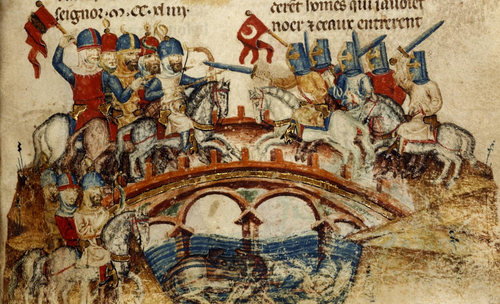
モンゴル人はクマン人の移住を口実に西進を続け、ポーランドとハンガリーを襲撃し、レグニツァとモヒの戦いでモンゴルの勝利に至った。しかし、1241年にオゴデイ・ハーンはモンゴル本土で死去した。バトゥはウィーン包囲から撤退したが、モンゴルには戻らず、ヴォルガ川沿いに留まることを選んだ。弟のオルダは継承に参加するために戻った。モンゴル軍が再びこれほど西へ進軍することはなかった。1242年、ハンガリーを通って撤退し、その過程でペストを滅ぼし、ブルガリアを征服した後、[22]バトゥはヴォルガ川下流域を支配し、ハザール人の首都アティルがあったサライに首都を築いた。その直前、バトゥとオルダの弟であるシバンは、ウラル山脈の東、オビ川とイルティシ川沿いに自身の広大なウルスを与えられた。
バトゥの宮廷ではモンゴル語が一般的に使用されていたことは間違いないが、キプチャク・ウルスの領土で書かれたモンゴル語の文書はほとんど残っていない。おそらく、一般の文盲が蔓延していたためだろう。グリゴリエフによれば、ヤルリク、つまりハーンの勅令はモンゴル語で書かれ、その後クマン語に翻訳された。14世紀半ばにエジプトのマムルーク朝のために作成されたアラビア語・モンゴル語およびペルシア語・モンゴル語の辞書の存在は、キプチャク・ウルスとの書簡を扱う官邸でそのような書簡が実際に必要だったことを示唆している。したがって、マムルーク朝が受け取った手紙は、彼らによって書かれたものでなかったとしても、モンゴル語であったに違いないと結論付けるのは妥当である。[22]
黄金時代


バトゥ・カーン(1242–1256)
1242年、大ハトゥン ・トレゲネがバトゥにモンゴル帝国の次期皇帝を選出するよう招いたとき、バトゥはクルルタイへの出席を辞退し、代わりにヴォルガ川に留まった。バトゥは老齢と病を理由に弁解したが、グユク・ハーンの選出を支持しなかったようである。グユクとチャガタイ・ハーンの孫であるブリは、モンゴルによる東ヨーロッパ占領の際の勝利の宴会でバトゥと激しく口論していた。ブリは兄弟をクルルタイに派遣し、1246年にモンゴルの新しいカガンが選出された。
ウラジーミルのヤロスラフ2世、ガリツィアのダニエル、ウラジーミルのスヴャトスラフ3世など、ルーシの高位の公たちは皆、バトゥの覇権を認めていた。当初バトゥはダニエルにガリツィアの統治をモンゴルに引き渡すよう命じたが、1245年にダニエルは自らバトゥを訪れ、忠誠を誓った。旅から戻ったダニエルは明らかにモンゴルの影響下にあり、軍隊をモンゴル風に装備し、騎兵にはモンゴル風の胸甲を、馬には肩甲、胸甲、頭甲を装備させた。[23] 1240年に モンゴルの使節を殺害したミハイル・フォン・チェルニゴフは、敬意を示すことを拒否し、1246年に処刑された。[24]
グユクがバトゥに何度か敬意を表すよう呼びかけると、バトゥは1247年にヤロスラフ2世、ウラジーミル公アンドレイ2世、アレクサンドル・ネフスキーをモンゴルのカラコルムに派遣した。ヤロスラフ2世は戻ることなく、モンゴルで亡くなった。おそらくはトレゲネ・ハトゥンに毒殺されたのだろうが、バトゥと自身の息子グユクが彼女の摂政を認めなかったために、トレゲネはおそらくそれをしたのだろう。[25]グユクはアンドレイをウラジーミル公に任命し、アレクサンドルにはキエフ公爵の称号を与えた。しかし、彼らが戻ったとき、アンドレイはウラジーミルに行き、アレクサンドルはノヴゴロドに行った。キリルという名の司教がキエフに行き、あまりに荒廃していたため、その地を放棄してさらに東へ向かった。[26] [27]
1248年、グユクはバトゥに東へ来て会うよう要求したが、同時代人の中にはこれをバトゥ逮捕の口実とみなす者もいた。命令に従い、バトゥは大軍を率いて近づいた。グユクが西へ移動したとき、トルイの未亡人でバトゥの継母の妹であるソルガタニは、ジョチ族が彼の標的になるかもしれないとバトゥに警告した。グユクはその途中、現在の新疆で42歳頃に亡くなった。現代の歴史家の中には、健康状態の悪化による自然死だと考える者もいるが、[28]アルコール中毒と痛風の複合的な影響で亡くなったか、毒殺された可能性もある。ウィリアム・オブ・ルブルックとイスラム教徒の年代記作者は、バトゥが皇帝の特使を殺害し、兄弟の一人がグユク大ハーンを殺害したと述べているが、これらの主張は他の主要な史料によって完全に裏付けられていない。グユクの未亡人オグル・カイミシュが摂政に就任したが、彼女は自分の一族内で継承権を維持することができなかった。
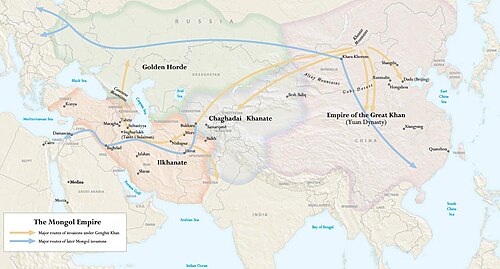
バトゥの援助を得て、モンケは1251年に大ハーンの地位を継承した。モンケは、自分を排除しようとする陰謀が発覚したことを利用し、新大ハーンとして反対派の粛清を開始した。貴族、役人、モンゴル軍司令官の死者は77人から300人と推定されている。バトゥはモンケとの友情によって王国の統一が確実となり、モンゴル帝国で最も影響力のある人物となった。バトゥ、モンケ、その他の王子の家系は、アフガニスタンからトルコに至る地域を共同統治した。バトゥは、モンケの人口調査官が自分の王国で自由に活動することを許可した。1240年代には、ロシアとトルコの地域を含む地方の人口調査が行われた。1251年から1259年にかけて、モンケはモンゴル帝国初の帝国全体の人口調査を実施した。北中国は1252年に完成したが、最北西部のノヴゴロドは1258年から1259年の冬まで数えられなかった。[29]ノヴゴロドではモンゴルの人口調査に反対する反乱が起こったが、アレクサンドル・ネフスキーはこの都市に人口調査と課税を強制した。[30]
モンケによってバトゥに与えられた新たな権力により、彼はルーシの諸侯を直接支配するようになった。しかし、アンドレイ2世はバトゥに服従することを拒否した。バトゥはネヴルイ率いる懲罰遠征隊を派遣し、アンドレイを打ち破ってノヴゴロド、プスコフ、そして最終的にスウェーデンへと逃亡させた。モンゴル軍はウラジーミルを制圧し、公国を厳しく罰した。リヴォニア騎士団はノヴゴロドとプスコフへの進撃を阻止した。アレクサンダーはバトゥの息子でキリスト教徒であったサルタク・ハーンとの友情のおかげで、1252年にバトゥによってウラジーミル大公に据えられた。[31]
ベルク(1258–1266)
.svg/500px-Banner_of_M%C3%B6ngke_Tem%C3%BCr_(1257-1280).svg.png)
_mint._Struck_circa_AH_662-665_(AD_1263-1267).jpg/500px-Golden_Horde._Berke._AH_655-665_AD_1257-1267_Qrim_(Crimea)_mint._Struck_circa_AH_662-665_(AD_1263-1267).jpg)
1256年にバトゥが死去した後、モンケ・ハーンはその息子サルタク・ハーンを任命した。サルタクはモンゴルの大ハーンの宮廷から戻るとすぐに亡くなった。幼いウラグチがボラグチン・ハトゥンの摂政の下で後を継いだ。ハトゥンはルーシの王子全員をサライに召集し、特許を更新させた。1256年、アンドレイは恩赦を乞うためにサライを訪れた。彼は再びウラジーミル大公に任命された。[32]
ウラグチはその後すぐに亡くなり、イスラム教に改宗したバトゥ・ハーンの弟ベルケが1258年にジョチ・ウルスのハーンとして即位した。[33]
1256年、ガリツィアのダニエルはモンゴル軍に公然と反抗し、北ポジーリャの軍を追い出した。1257年、彼はポニジアとヴォルィーニでクルムサ公率いるモンゴル軍の攻撃を撃退し、キエフ奪取を目的とした遠征隊を派遣した。当初は成功したものの、1259年、ボロルダイ率いるモンゴル軍がガリツィアとヴォルィーニに侵入し、最後通牒を突きつけた。ダニエルは要塞を破壊しなければボロルダイが町を襲撃するとの命令だった。ダニエルはこれに従い、市壁を破壊した。 1259年、ベルクはリトアニアとポーランドに猛攻撃を仕掛け、1259年と1260年にハンガリー国王ベーラ4世とフランス国王 ルイ9世に服従を要求した。 [34] 1259年から1260年にかけてのプロイセンへの攻撃はドイツ騎士団に大きな損害を与えた。[35]リトアニア人は、モンゴル人と結託しているという報告が教皇庁に届いた1260年代にはおそらく貢納国であった。 [36]
1261年、ベルケはサライに教会を設立することを承認した。[37]
トルイド内戦(1260–1264)
1259年にモンケ・ハーンが死去した後、クビライ・ハーンとアリク・ブケの間でトルイド内戦が勃発した。イル・ハン国のフレグ・ハーンはクビライを支持したが、ベルケはアリク・ブケに味方した。 [38]ベルケがアリク・ブケの名で貨幣を鋳造したという証拠があるが[39]、彼は軍事的には中立を保った。1264年にアリク・ブケが敗北した後、彼はフビライの即位に自由に従った。[40]しかし、白軍のエリートの一部はアリク・ブケの抵抗に加わった。
ベルケ・フレグ戦争 (1262–1266)
.jpeg/500px-Bataille_du_Terek_(1262).jpeg)
モンケは、ジョチド家とチャガタイド家に、フレグのイラン遠征に加わるよう命じた。ベルケの説得により、弟のバトゥはフレグの作戦を延期せざるを得なかったかもしれないが、それが数年にわたってジョチドの優勢を消滅させることになるとは予想もしていなかった。バトゥの治世中、あるいはその後継者2人の治世中、ジョチド・ウルスは1256年から1257年にかけてフレグの中東遠征に参加するために、大規模なジョチドの代表団を派遣した。
フレグの軍に加わったジョチ朝の王子の一人が、フレグに対して魔術と呪術を使ったと告発された。ベルケの許可を得た後、フレグは彼を処刑した。その後、さらに2人のジョチ朝の王子が不審死した。一部のイスラム教の情報源によると、フレグはチンギス・ハーンの希望に従って戦利品をベルケに分けることを拒否した。ベルケは敬虔なイスラム教徒で、1258年にフレグによって殺害されたアッバース朝の カリフ、 アル・ムスタシムと親しい関係にあった。ジョチ朝の人々は、フレグの国家がトランスコーカサスにおける自分たちの存在を排除したと信じていた。[41]これらの出来事はベルケの怒りを増大させ、1262年にジョプ・ウルスとイルハン国の間の戦争がすぐに勃発した。
ベルケとフレグの間の緊張が高まると、フレグの軍隊にいたジョチ・ウルスの部隊は逃げるよう警告された。1つの部隊はキプチャク草原に到達し、別の部隊はホラーサーンを横断し、3番目の部隊はマムルーク朝支配下のシリアに避難した。そこで彼らはスルタン・バイバルス(1260年 - 1277年)に温かく迎えられた。フレグはイランにいるジョチ・ウルスの残りの軍を厳しく罰した。ベルケはバイバルスとの共同攻撃を模索し、フレグに対抗するためにマムルーク朝と同盟を結んだ。ジョチ・ウルスはイル・ハン国に侵攻するために若き王子ノガイを派遣したが、フレグは1262年に彼を押し戻した。その後イル・ハン朝軍はテレク川を渡り、ジョチド族の空っぽの野営地を占領したが、ノガイ軍の奇襲で敗走した。凍ったテレク川の氷が割れて、彼らの多くが溺死した。紛争の勃発は、同時に起こったスーズダリの反乱によってベルケにとってさらに厄介なものとなり、モンゴルのダルガチと徴税官が殺害された。ベルケは厳しい懲罰遠征を計画した。しかし、アレクサンドル・ネフスキーがベルケに国民を罰しないよう懇願し、ウラジーミル・スーズダリの都市が多額の賠償金を支払うことに同意すると、ベルケは折れた。アレクサンドルはヴォルガ川沿いのゴロジェッツで帰途に亡くなった。彼は人々に愛され、「スーズダリの太陽」と呼ばれた。[42]
_Timur._AH_665-679_AD_1267-1280_Bulghar_mint._Dated_AH_672_or_3_(AD_1273-1275).jpg/500px-Golden_Horde._M%C3%B6ngke_(Mengu)_Timur._AH_665-679_AD_1267-1280_Bulghar_mint._Dated_AH_672_or_3_(AD_1273-1275).jpg)
元セルジューク朝スルタンの カイカウス2世がビザンツ帝国で逮捕されると、弟のカイクバド2世がベルケに上訴した。エジプトの使節もそこで拘留された。ノガイはブルガリア王国(ベルケの家臣)の支援を得て、1265年に帝国に侵攻した。翌年までに、モンゴル・ブルガリア軍はコンスタンティノープルに迫っていた。ノガイはミカエル8世パレオロゴスにカイカウスを解放し、ウルダに貢物を納めるよう強制した。ベルケはカイカウスにクリミアを属国として与え、モンゴル人女性と結婚させた。フレグは1265年2月に死去し、翌年ティフリスへの遠征中にベルケも死去したため、軍は撤退した。[43]
アリク・ブケは以前、チャガタイの孫アルグをチャガタイ朝のハーンとして中央アジアを統治させていた。アルグはサマルカンドとブハラを支配した。ブハラのムスリムのエリート層とジョチ朝の家臣がベルケへの忠誠を宣言すると、アルグはホラズムのジョチ・ウルスの属国を壊滅させた。アルグはフレグにジョチ・ウルスを攻撃するよう主張し、1252年にベルケが彼の家族を粛清したと非難した。ブハラでは、アルグとフレグはジョチ・ウルスの家臣全員を虐殺し、その家族を奴隷にし、大ハーンであるフビライの部下だけを残した。[44]ベルケがフビライに忠誠を誓った後、アルグはベルケに宣戦布告し、オトラルとホラズムを占領した。ホラズムの左岸は最終的に奪還されたが、ベルケはトランスオクシアナの支配権を失っていた。 1264年、ベルケはフレグの後継者アバカと戦うためにティフリスを通過して進軍したが、その途中で死亡した。
メング・ティムール(1266–1280)

ベルケには息子がいなかったため、バトゥの孫メング・ティムールがフビライに指名され、叔父ベルケの後を継いだ。[45]しかし、メング・ティムールは密かにオゴデイド朝の王子カイドゥを支援し、フビライとイル・ハン国に対抗した。ギアス・ウッディーン・バラクの敗北後、1267年に和平条約が締結され、カイドゥとメング・ティムールにトランスオクシアナの3分の1が与えられた。 [46] 1268年、フビライのために中央アジアで活動していた王子の一団が反乱を起こし、カガン(大ハーン)の2人の息子を逮捕し、メング・ティムールのもとへ送った。そのうちの1人、フビライの寵臣ノモガンはクリミアにいた。[47]メング・ティムールはフレグの後継者アバガと短期間争ったかもしれないが、大ハンのフビライが彼らに和平条約に署名するよう強制した。[48]彼はペルシャで自分の分担金を得ることを許された。 ノガイはハンとは独立して、1271年にバイバルスとの同盟の希望を表明した。エジプトのマムルーク朝とのイルハン朝への共同攻撃を提案していたにもかかわらず、メング・ティムールは1270年にバラクがイルハンに敗れたときアバガを祝福した。[49]
1267年、メング・ティムールはロシアの聖職者への課税を免除する免状(ジャルリク)を発行し、 [50] [51]ジェノバ人とヴェネツィア人にカフェとアゾフの独占貿易権を与えた。メング・ティムールの親族の何人かは同時期にキリスト教に改宗しロシアに定住した。その一人はロストフに定住し、ホルドの皇太子ピョートル(ピョートル・オルディンスキー)として知られるようになった王子であった。 [52] [53]ノガイが1271年に東方正教会を信仰するビザンツ帝国に侵攻したが、ハーンはミカエル8世パレオロゴスとの友好関係を維持するために使節を派遣し、ミカエル8世パレオロゴスは和平を申し入れ、娘の一人エウフロシュネ・パレオロゴナをノガイと結婚させた。メング・ティムールはウラジミール大公に、ドイツ商人に領土を自由に通行させるよう命じた。グラモタにはこう記されている。
メング・ティムールがヤロスラフ公に言った言葉: ドイツ商人にあなたの領土への道を与えてください。ヤロスラフ公からリガの人々へ、偉い人から若者まで、そしてすべての人々へ: あなたの道は私の領土を通って開けています。そして誰が戦いに来るとしても、私は知っている通りに彼らと戦います。しかし、商人にとって道は開けています。[54]
この勅令により、ノヴゴロドの商人はスーズダリ全土を自由に旅することも許された。[55]メング・ティムールは誓いを守り、 1269年にデンマーク人とリヴォニア騎士団がノヴゴロド共和国を攻撃したとき、ハンの偉大なバスカク(ダルガチ)であるアムラガンと多くのモンゴル人がヤロスラフ大公が集めた軍隊を支援した。ドイツ人とデンマーク人は恐れおののき、モンゴル人に贈り物を送り、ナルヴァ地方を放棄した。[56]モンゴル・ハンの権威はすべての公国に及び、1274年から1275年にはスモレンスクとヴィテブスクを含むすべての都市で国勢調査が行われた。[57]
1277年、メング=ティムールはコーカサス北部のアラン人に対する遠征を開始した。モンゴル軍とともに彼の遠征に加わるよう命じられた王子たちも何人かおり、1278年にアラン人の要塞ダダコフを占領した。[58]オセット遠征の後、メング=ティムールはノガイの権威を抑えようとビザンチン帝国とエジプトとの関係に目を向けた。[59] 1277年にブルガリアのコンスタンティノスが死去した後、ミカエル8世とノガイはそれぞれ異なる候補者を王位継承者として支持したため、関係は悪化した。[60]これによりメング=ティムールはバルカン問題に介入し、メング=ティムールとキリル府主教は共同特使としてテオグノスト司教をミカエル8世とコンスタンティノープル総主教にそれぞれ贈り物と手紙を届けた。[61]
二重カン権(1281–1299)

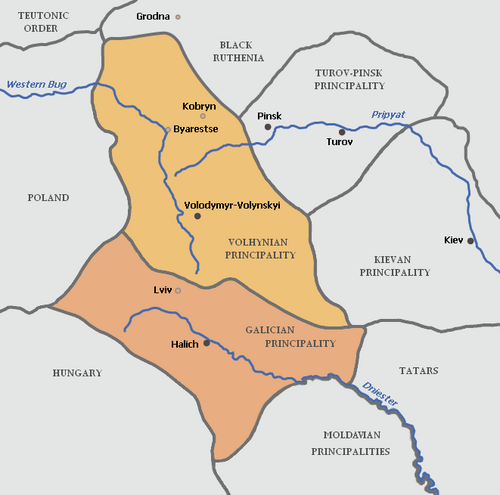
1281年、ムンク・ティムールの跡を継いだのは、イスラム教徒であった弟のトデ・モンケであった。しかし、ノガイ・ハーンは独立した統治者としての地位を確立できるほどの力を持っていた。こうして、ジョチ・ウルスは2人のハーンによって統治されることになった。[61]
テデ・モンケはフビライと和平を結び、息子たちをフビライに返し、彼の覇権を認めた。[62] [63]オルダ・ハーンの息子で白毛族のハンであるノガイとコチュも、元朝およびイルハン国と和平を結んだ。マムルーク朝の歴史家によると、テデ・モンケはマムルーク朝に、彼らの共通の敵である不信心なイルハン国と戦うことを提案する手紙を送った。これは、彼がイルハン朝が統治していた アゼルバイジャンとジョージアに関心を持っていた可能性があることを示している。
1270年代、ノガイはブルガリアを襲撃し、[64]リトアニアも襲撃した。[65] 1279年にはミカエル・アセン2世をドラスタル内で封鎖し、1280年には反乱を起こした皇帝イヴァイロを処刑し、 1292年にはゲオルギオス・テルテル1世をビザンチン帝国に亡命させた。1284年、ブルガリアへの大規模な侵攻中にサクチはモンゴルの支配下に入り、ハンの名で貨幣が鋳造された。 [66]ノガイは スミレツをブルガリア皇帝に据えた。したがって、スミレツの治世はブルガリアにおけるモンゴルの覇権の絶頂期と考えられている。 1295年頃にスミレツが地元のボヤール によって追放されると、モンゴル人は彼を守るために再び侵攻を開始した。ノガイはセルビア王ステファン・ミルティンにモンゴルの覇権を受け入れるよう強要し、1287年に彼の息子ステファン・デチャンスキを人質として受け入れた。彼の統治下では、ヴラフ人、スラヴ人、アラン人、トルコ・モンゴル人が現在のモルダビアに住んでいた。
同時に、ノガイの影響力はジョチ・ウルスにおいて大きく増大した。彼の支援を受けて、ペレスラヴリのドミトリーなど一部の公子はサライのテデ・モンケの宮廷を訪問することを拒否し、一方でドミトリーの弟ゴロデツのアンドレイはテデ・モンケに援助を求めた。ノガイはドミトリーの大公位争いで彼を支援することを誓った。これを聞いたアンドレイはウラジーミルとノヴゴロドに対する主張を放棄し、ゴロデツに戻った。アンドレイはテデ・モンケが派遣したモンゴル軍とともに戻り、ドミトリーからウラジーミルを奪取した。ドミトリーはノガイのモンゴル軍の支援を受けて報復し、領地を奪還した。1285年、アンドレイは再びボルジギン公の指揮するモンゴル軍を率いてウラジーミルに向かったが、ドミトリーは彼らを追い払った。[67]
1283年、メング・ティムールはイスラム教に改宗し、国政を放棄した。このハンは精神を病んでおり、聖職者とシェイクにしか関心がないとの噂が広まった。1285年、タラブガとノガイはハンガリーに侵攻した。ノガイがスロバキアの制圧に成功する一方、タラブガはカルパティア山脈の北で足踏みした。タラブガの兵士たちは怒り、代わりにガリツィアとヴォルィーニを略奪した。1286年、タラブガとノガイはポーランドを攻撃し、国を荒廃させた。タラブガは帰国後、テデ・モンケを打倒し、モンケは平和に暮らすことができた。タラブガの軍は1288年と1290年にイルハン国への侵攻を試みたが、失敗した。[68]
タラブガはチェルケス人に対する懲罰遠征中に、ハンガリーとポーランドの侵攻中に十分な支援を得られなかったと考えたノガイに対して憤慨した。タラブガはノガイに挑戦したが、クーデターで敗れ、 1291年にトクタに取って代わられた。[69]
アンドレイは、ロストフ公子数名とロストフ司教を伴って、特許を更新し、ドミトリーについて苦情を申し立てるためにトクタに赴いた。[69] ミハイル・ヤロスラヴィチはサライでノガイの前に召喚され、ノガイの側につき、彼の玉座の確認のために彼のもとを訪れたが、ドミトリーはノガイの家臣であると考え、出頭を拒否した。[69]アレクサンドル・ネフスキーの末息子 ダニエルはトクタの宮廷に出頭しなかった。[69]ジョチ・ウルスの権限の分割により、ロシア公子の2つの対立するグループが生まれた。[69]トクタは北ロシアに対する自身の権限を再び主張しようとした。[69]彼はアンドレイを大公として承認し、玉座の返上を拒否したドミトリーを廃位する権限を彼に与えた。[69]トクタは、頑固な臣下を罰するために、弟のデュデンに率いられた懲罰遠征隊を派遣し、1293年にウラジーミルやモスクワを含むいくつかの都市を略奪し、最終的にドミトリーは退位を余儀なくされた。 [70]トヴェリ市だけがモンゴルの侵略者に頑強に抵抗したため、別のモンゴル軍が都市を攻撃するために派遣された。[70]ノガイはロシアの問題に介入することを選ばなかったが、トクタの行動を懸念した。彼はトクタに、彼がまだジョチ・ウルスの問題で最高権力を握っていることを思い出させる必要があると考え、その結果、1293年に年長の妻をトクタに派遣し、彼女は当然の敬意をもって迎えられた。[70]同年、ノガイはセルビアに軍を派遣し、国王に自らを臣下と認めさせた。[70]
._AH_679-687_AD_1280-1287_Qrim_(Crimea)_mint.jpg/500px-Golden_Horde._T%C3%B6de_M%C3%B6ngke_(Mengu)._AH_679-687_AD_1280-1287_Qrim_(Crimea)_mint.jpg)
ノガイの娘は、キプチャク・ウルスのコンギラト将軍の妻であったクビライの姪ケルミシュの息子と結婚した。ノガイは、仏教徒の息子がイスラム教徒の娘を軽蔑していたため、ケルミシュの家族に腹を立てていた。このため、彼はトクタにケルミシュの夫を自分のもとに送るよう要求した。ロシア問題や外国商人に関するノガイの独自行動は、すでにトクタを苛立たせていた。そのためトクタは拒否し、ノガイに宣戦布告した。トクタは最初の戦いで敗れた。ノガイの軍はカファとソルダイアに目を向け、両都市を略奪した。2年以内にトクタは戻ってきて、1299年にドニエプル川近くのカガムリクでノガイを殺害した。トクタは息子にサクチとドナウ川沿いの鉄門まで軍隊を配置させた。 [71]ノガイの息子であるブルガリアのチャカは、最初はアラン人に逃げ、その後ブルガリアに逃れ、そこで短期間皇帝として統治したが、トクタの命令によりテオドール・スヴェトスラフに殺害された。 [72]
メング・ティムールが死去すると、ジョチ・ウルスの統治者たちはオゴデイ家の当主カイドゥへの支援を撤回した。カイドゥは、白ハン国のハンであるバヤン(在位 1299-1304)に対抗する自らの候補者コベレグを擁立することで、ジョチ・ウルスにおける影響力を回復しようとした。 [73]トクタから軍事支援を受けたバヤンは、カイドゥと副官ドゥワの指揮下でチャガタイ・ハン国への統一攻撃を組織するため、元朝とイル・ハン国に支援を求めた。しかし、元の朝廷はすぐに軍事支援を送ることができなかった。[74]
全般的な平和(1299–1312)
1300年から1302年にかけて、黒海周辺地域で深刻な干ばつが発生した。[76]しかし、問題はすぐに克服され、トクタの統治下でジョチ・ウルスの状況は急速に改善された。ノガイ・ハーンの敗北後、彼の追随者はポジーリャに逃げるか、トクタの配下に留まり、最終的にノガイ・ウルスとして知られるようになった。[77]
トクタは、アンドロニコス2世パレオロゴスの私生児であるマリアによってビザンチン・モンゴル同盟を樹立した。[78]トクタがキリスト教徒に非常に好意的であったという報告が西ヨーロッパに届いた。[79]しかし、イスラム教徒の観察者によると、トクタは偶像崇拝者(仏教とテンゲリズム)であり続け、イスラム教徒を好んでいたものの、あらゆる信仰の宗教者に好意を示した。[80]
彼はイルハン朝のガザンとその後継者オルジェイトゥにアゼルバイジャンの返還を要求したが拒否された。その後、イルハン朝に対抗するためにエジプトに援助を求めた。トクタは自分の部下をガズナの支配者にしたが、ガズナの人々から追放された。トクタは1294年にイルハン朝のガザンに和平使節を派遣し、1318年までほぼ途切れることなく平和が維持された。[81]
1304年、中央アジアのモンゴル王朝と元朝の使節がトクタに全面和平提案を伝えた。トクタは直ちに元の皇帝テムル・オルジェイトゥの覇権を受け入れ、モンゴル・ハーン国中のすべてのヤム(郵便中継所)と商業網が再開された。トクタはペレヤスラヴリ(ペレスラヴリ=ザレスキー)の集会でロシアの諸侯にモンゴル・ハーン国間の全面和平を紹介した。[ 82]トクタの貨幣にはモンゴル文字とペルシア文字に加えてパグスパ文字が刻まれており、ジョチ・ウルスにおける元の影響力が高まったようである。 [83]

トクタは1307年にサライのイタリア人住民を逮捕し、カファを包囲した。その原因は明らかに、トクタの民衆がジェノバ人によって奴隷貿易され、兵士としてエジプトに売られていたことに対する不満であった。[85] 1308年、カファはモンゴル人によって略奪された。[86]
トクタ王朝の末期、トヴェリ公とモスクワ公の間の緊張が激化した。モスクワ公ダニエルはリャザンからコロムナの町を奪い、リャザンは地元のバスカクに保護を求めた。[82]しかし、ダニエルはこれに屈せず、1301年にリャザンとモンゴル軍を破り、 1303年にモジャイスクを、続いてペレスラヴリ・ザレスキーを奪取し、すでに弱かった公同士の関係を一変させた。[82]ダニエルは、ロシアの現代の行政区分で言えば、 1917年以前のモスコフスキー・ウエズドほどの大きさではなかった彼の属領を充実させようとしたのかもしれない。 [82]彼の粘り強さは、彼の後継者がロシア本土全体の支配者となるためのパターンを作った。[82]
トクタは1304年秋にペレスラヴリ・ザレスキーで諸侯のための新たな会議を組織した。この会議にはウラジーミルのアンドレイ、トヴェリのミハイル、1304年3月のダニエルの死後跡を継いだダニエルの長男であるモスクワのユーリーなど主要な諸侯が出席した。 [82] ロシア正教会の大主教マクシモスも出席していた。[87]トクタはロシアのウルスの政治組織を完全に変革するつもりだった可能性があるが、彼の治世の最後の数年間についてはほとんど情報が残っておらず、諸侯間の相互関係についてはロシアの年代記にしか記述がなく、アラブとペルシャの年代記作者はキプチャク・ウルスとエジプトおよびイランとの関係に焦点を当てている。[88]トクタはおそらくウラジーミル大公国の特別な地位を廃止し、すべてのロシアの公を家臣と同等にし、それぞれに一定の領地を割り当てようとした。[88]トクタは公たちの間の紛争を解決するために自らロシア北部を訪問することを決めたが、ラシド・アル=ディーンの歴史を継いだ著者によると、1312年にヴォルガ川を渡っている途中で病に倒れて亡くなった。[88]
イスラム化
オズ・ベグ・ハーン(1313–1341)

1313年にオズ・ベグ・ハーンが王位に就くと、イスラム教を国教とした。1314年にはクリミア半島のソルハト市に大きなモスクを建設し、ジョチ・ウルスのモンゴル人の間で仏教とシャーマニズムを禁止した。1315年までにオズ・ベグはウルスのイスラム化に成功し、宗教政策に反対したジョチ朝の王子と仏教のラマ僧を殺害した。 [89]オズ・ベグの治世中、交易隊商は妨害されず、ジョチ・ウルスには全般的な秩序があった。 1333年にイブン・バットゥータがサライを訪れた際、彼はそこが広大な通りと立派な市場のある大きく美しい都市であることを知った。そこにはモンゴル人、アラン人、キプチャク人、チェルケス人、ロシア人、ギリシャ人の6つの「民族」がそれぞれ独自の地区を持っていた。商人たちは、街の特別な壁で囲まれた地区を独占していた。[90]
オズ・ベクはベルケとその先任者たちが始めたマムルーク朝との同盟を継続した。彼はカイロのマムルーク朝スルタンとその影のカリフとの友好関係を維持した。1320年、ジョチ朝の王女トゥルンバイはエジプトのスルタン、アル=ナシル・ムハンマドと結婚した。[91]アル=ナシル・ムハンマドはトゥルンバイが本物のチンギス朝の王女ではなく、偽者であると信じるようになった。1327年から1328年にかけて、彼はトゥルンバイと離婚し、その後彼女はアル=ナシル・ムハンマドの指揮官の一人と結婚した。1334年から1335年にかけてオズ・ベクは離婚を知ると、怒りの書簡を送った。アル=ナシル・ムハンマドは彼女が死亡したと主張し、その証拠として偽の法的文書を大使に示したが、トゥルンバイはまだ生きており、1340年に亡くなった。[92]
ジョチ・ウルスは1318年、1324年、1335年にアブー・サイード率いるイルハン国を侵略した。オズ・ベクの同盟者アル・ナシルは、イルハン国とマムルーク朝のスルタンが1323年に和平条約を結んだため、アブー・サイードへの攻撃を拒否した。1326年、オズ・ベクは元朝との友好関係を再開し、それ以降は貢物を送った。 [93] 1339年以降、彼は中国のジョチ朝領から毎年24,000鼎の元紙幣を受け取っていた。 [94]アブー・サイードの死後イルハン国が崩壊すると、その高位のベイたちは指導者を見つけるために必死になってオズ・ベクに近づいたが、オズ・ベクは高位の首長であるクトゥルク・ティミュルと相談した後、申し出を断った。[要出典]
総軍が30万人を超えていたオズ・ベグは、1319年に始まったビザンツ帝国およびセルビアに対するブルガリアの戦争を支援するため、繰り返しトラキアを襲撃した。アンドロニコス2世パレオロゴスとアンドロニコス3世パレオロゴス統治下のビザンツ帝国は、1320年から1341年にかけてジョチ・ウルスによる襲撃を受け、ついにビザンツの港であったビチナ・マカリアが占領された。オズ・ベグがアンドロニコス3世パレオロゴスの私生児であるバヤルンと結婚した後、短期間ビザンツ帝国との友好関係が築かれた。1333年、バヤルンはコンスタンティノープルの父を訪ねる許可を得たが、イスラム教への強制改宗を恐れたのか、二度と戻ることはなかった。[95] [96]オズ・ベクの軍隊は1324年に40日間、1337年には15日間トラキアを略奪し、30万人の捕虜を捕らえた。1330年、オズ・ベクは1万5千人の軍隊をセルビアに派遣したが、敗北した。[97]オズ・ベクの支援を受けたワラキアのバサラブ1世は1330年にハンガリー王国からの独立を宣言した。[84]

オズ・ベクの助力により、大公ミハイル・ヤロスラヴィチは1316年にノヴゴロドで党派との戦いに勝利した。ミハイルが権威を主張する一方で、ライバルのモスクワ公ユーリーがオズ・ベクに気に入られ、オズ・ベクは彼を大公に任命し、妹のコンチャクと結婚させた。ユーリーはオズ・ベクの宮廷で3年間過ごした後、モンゴル人とモルドヴィン人の軍隊を率いて戻ってきた。ユーリーはトヴェリの村々を荒廃させた後、ミハイルに敗れ、新しい妻とモンゴルの将軍カウガディは捕らえられた。彼女がトヴェリに留まっている間に、キリスト教に改宗してアガサと名乗ったコンチャクは死亡した。ミハイルのライバルたちはオズ・ベクに、彼がハーンの妹を毒殺し、彼の統治に反抗したと示唆した。ミハイルはサライに召喚され、1318年11月22日に処刑された。 [98] [99]ユーリーは再び大公となった。ユーリーの弟イヴァンは、 1320年にロストフの反乱を鎮圧するためにモンゴルの将軍アフミルに同行した。1322年、ミハイルの息子ドミトリーは父殺害の復讐を求めてサライに行き、ユーリーがキエフ・ホルスに支払うべき貢物の大部分を横領したとハーンを説得した。ユーリーは裁判のためにキエフ・ホルスに召喚されたが、正式な調査が行われる前にドミトリーによって殺害された。8ヵ月後、ドミトリーもキエフ・ホルスにより罪をかぶせられ処刑された。大公の称号はアレクサンドル・ミハイロヴィチに与えられた。[100] 1326年初頭、ユーリーの遺体はモスクワに戻され、ピョートル大主教率いるロシア正教会の司教たちによって埋葬された。[101]
オズ・ベクのロシア情勢に対する取り組みはトクタほど建設的ではなく、トクタではロシアの状況を変えようとはせず、統一ロシア国家の形成を阻止し、その諸公、特にトヴェリ公とモスクワ公の間の均衡を保つことを目標としていた。[102] 1327年、オズ・ベクの従兄弟であるバスカクのシェフカルが、大勢の従者を引き連れてウルス・ホルダからトヴェリに到着した。彼らはアレクサンドルの宮殿に居を構えた。シェフカルが王位を奪い、イスラム教をこの都市に導入したがっているとの噂が広まった。シェフカルが官職を構えた後、トヴェリ人は反乱を起こし、モンゴルの委員とほとんどの副官が殺害された。[100]オズ・ベクはモスクワ公のイヴァン1世を召還し、スーズダリ公アレクサンドルとともに討伐軍を指揮するよう命じた。モンゴル軍の増援を受けたモスクワとスーズダリの軍隊はトヴェリを略奪し、何千人もの捕虜を捕らえた。[103]この事件、1327年のトヴェリ蜂起により、オズ・ベクはモスクワをロシアの主導国として支援し始めた。[104]オズ・ベクはモスクワに過度の権力を与えることを控え、スーズダリ大公の称号の特許をアレクサンドル1世に与えたが、4年後にアレクサンドルの死後、イヴァン1世が大公に任命され、他のロシアの有力者から税金を徴収する権利を与えられた。[104]イヴァン1世とオズ・ベクの良好な関係の結果、モスクワ地域は繁栄し始め、人口が急速に増加した。[104]イヴァン1世はまた、ロシア正教会の大主教の称号を模倣して、大公の称号に「そして全ロシア」を加えた。大主教はモスクワに居住地を移し、モスクワをロシアの教会首都としたが、これはロシア統一への動きの始まりでもあった。[105]
 定規の横に表示されます。
モンゴル人はガリツィアとヴォルィーニの力を弱めていたが、ダニロヴィチ家は13世紀後半から国内情勢の改善に努め、ユーリー1世は治世中に王位 ( rex Russiae ) を継承した[107]。しかしリトアニア大公は強力な軍隊と行政を築き、リトアニアとベラルーシの州を統一した[107] 。ユーリーが1308年に死去すると、ガリツィアとヴォルィーニの状況は急速に悪化し、1323年にはユーリーの息子2人が死去したため、マゾフシェ公ボレスワフに王位が与えられることになった[108]。彼はオズ・ベクによって「ユーリー2世」として承認された。[108]リトアニアの ゲディミナスはキエフを掌握し、弟のフョードルを公に据えたが、公国のハーンへの貢物は続いた。数年後の遠征で、フョードル率いるリトアニア人はハーンのバスカクを側近に含めた。[109]ユーリー2世はゲディミナスの娘と結婚し、おそらく自分の娘をゲディミナスの息子に嫁がせたため、オズ・ベクはポーランドとリトアニアの計画を阻止するために介入した。[108]モンゴル軍は1336年にリトアニアの国境地帯を襲撃し、翌年にはポーランドのルブリンも襲撃した。 [108]スモレンスク公はオズ・ベクの権威を無視し、代わりにゲディミナスの宗主権を認めた。[108]後継者のいなかったユーリ2世の急死後、ドミトロ・ジェドコ率いるガリシアのボヤールの委員会が都市を支配し、モンゴル軍の分遣隊がポーランド人からガリツィアとヴォルィーニを守るために派遣された。ポーランド人は撤退を余儀なくされたが、この地域に対する主張を放棄することはなかった。[110]
フランシスコ会の布教を許可する勅令は、おそらくメング・ティムールによって発布され、1314年にオズ・ベグによって更新された。オズ・ベグは即位後、キリスト教徒のジェノバ人がクリミアに定住するのを許可したが、 1322年にジェノバ人がトルコ人と衝突した際、モンゴル人は彼らの拠点であるスダクを略奪した。[111]他の町のジェノバ商人は妨害されなかった。教皇ヨハネス22世は、この地域で破壊されたローマカトリック教会を修復するようオズ・ベグに要請した。オズ・ベグは1339年にジェノバ人と新しい貿易条約に署名し、カッファの城壁の再建を許可した。1332年には、ドン川沿いのタナイスにヴェネツィア人が植民地を設立するのを許可した。1333年にイブン・バットゥータがスダクを訪れた際、住民の大部分がトルコ人であることがわかった。[91]
ヤニ・ベグ(1342–1357)
.jpg/500px-Golden_Horde_in_the_Catalan_Atlas_(1375).jpg)
.png/500px-Flag_of_the_Golden_Horde_in_the_Catalan_Atlas_(published_in1375).png) [112]キャプションにはこう書かれている。 「ここにはブルガリア州からオルガンシオ市まで広がるこの北部地域の皇帝が住んでいる。君主の名前はサラの領主ジャンベクである。」[113]
[112]キャプションにはこう書かれている。 「ここにはブルガリア州からオルガンシオ市まで広がるこの北部地域の皇帝が住んでいる。君主の名前はサラの領主ジャンベクである。」[113]オズ・ベクの長男ティニ・ベクは1341年から1342年まで短期間統治し、その後弟のヤニ・ベク(1342年 - 1357年)が権力を握った。[114]
1344年、ヤニ・ベグはジェノバ人からカファを奪取しようとしたが失敗した。1347年、彼はヴェネツィアと通商条約を結んだ。マムルーク朝との結びつきが強まったことで奴隷貿易が盛んになった。富の増加と製品需要の増加は典型的には人口増加をもたらすが、サライでも同様であった。この地域の住宅が増加し、首都は大規模なイスラム教スルタン国の中心地となった。[114]
1340年代の黒死病はキプチャク・ウルスの経済的衰退の大きな要因となった。1345年にクリミア半島を襲い、8万5千人以上が死亡した。 [115]
_II._AH_767-768_AD_1365-1366.jpg/500px-Golden_Horde._Jani_Beg_(Jambek)_II._AH_767-768_AD_1365-1366.jpg)
ヤニ・ベクは父のバルカン半島への野望を放棄し、リトアニアとポーランドに対してモスクワを支援した。ヤニ・ベクは、リトアニアとポーランドに対するモンゴル・ルーシの合同軍事遠征を後援した。1344年、彼の軍はガリツィア=ヴォルィーニからの援軍とともにポーランドへ進軍した。ヴォルィーニはリトアニアの一部だったためである。しかし、1349年、ガリツィア=ヴォルィーニはポーランド=ハンガリー軍に占領され、ガリツィア=ヴォルィーニ王国は最終的に征服され、ポーランドに編入された。この行為により、ガリツィア=ヴォルィーニとジョチ・ウルスとの従属関係は終結した。[116] 1352年、ジョチ・ウルスとそのルーシの同盟軍はポーランド領とルブリンを荒廃させた。ポーランド王カジミェシュ3世は1357年にウルスに服従し、さらなる紛争を避けるために貢物を支払った。ヤニ・ベクは7人のモンゴル公をポーランド援助のために派遣した。[117]
ジャニ・ベクはチャガタイ・ハン国に対するジョチ朝の優位を主張し、タブリーズを征服して1356年にチョーバー朝の支配を終わらせた。ジャライル朝の降伏を受け入れた後、ジャニ・ベクはモンゴル帝国の3つのウルスを支配していると自慢した。しかし、タブリーズからの帰途、ジャニ・ベクは息子のベルディ・ベクの命令で殺害された。ジャニ・ベクの暗殺に続いて、ジョチ・ウルスは1357年にすぐにアゼルバイジャンをジャライル朝の王シャイフ・ウワイスに奪われた。 [118]
衰退
大動乱(1359–1381)

ベルディ・ベグは1359年に兄のクルパによるクーデターで殺害された。クルパの2人の息子はキリスト教徒で、スラヴ語の名前であるミカエルとイヴァンを名乗っていたが、これはジョプ・ウルスのイスラム教徒民衆の怒りを買った。1360年、クルパの兄ナウルズ・ベグがハーンに反乱を起こし、ハーンとその息子たちを殺害した。1361年、シバン(ジョチの5番目の息子)の子孫が、何人かの有力者から王位を奪取するよう招かれた。ヒドゥルはナウルズに反乱を起こしたが、ナウルズの副官が彼を裏切り、処刑するために引き渡した。ヒドゥルは同年、自身の息子ティムール・ホジャによって殺害された。ティムール・ホジャはわずか5週間統治した後、オズ・ベグ・ハーンの子孫が権力を掌握した。[119]
1362年、ジョチ・ウルスはサライのケルディ・ベグ、ヴォルガ・ブルガリアのブラート・テミル、クリミアのアブドゥッラーに分割された。一方、リトアニア大公国はジョチ・ウルスの西の支流を攻撃し、1363年の青水の戦いの後、キエフとポジーリヤを征服した。 [120]ママイという名の強力なモンゴルの将軍はアブドゥッラーを支援したが、サライを占領することはできず、ムラトとアジズというさらに2人のハーンが統治した。アブドゥッラーは1370年に死去し、ムハンマド・ボラクがママイの傀儡ハーンとして即位した。[119]ママイはニジニ・ノヴゴロドの反乱にも対処しなければならなかった。モスクワ軍はブラート・テミルの息子アラブ・シャーのブルガリア領に侵攻し、不意を突かれてピアナ川のほとりで彼らを破った。しかし、東から別のモンゴル将軍が進軍してきたため、アラブ・シャーは状況を有利に利用することができなかった。[121]モスクワ敗北の知らせに勇気づけられたママイは、ドミトリー・ドンスコイに対して軍を派遣し、1378年にヴォジャ川の戦いでモンゴル軍を破った。ママイは1380年にモスクワへの別の攻撃のためにジェノバ、チェルケス、アラン人の傭兵を雇った。続く戦いで、モンゴル軍はクリコヴォの戦いで再び敗北した。[121]
1360年までにウルス・ハーンはシグナクに宮廷を設けた。彼はトルコ語でロシア語を意味するウルスと名付けられたが、これはおそらく「ウルス・ハーンの母はロシアの王女であり、彼はその地でロシアに対する主張を主張する用意があった」ためである。[122] 1372年、ウルスは西に進軍し、サライを占領した。彼の甥で副官のトクタミシュは彼を見捨て、ティムールに助けを求めた。トクタミシュはウルスを攻撃し、その息子クトルグ・ブカを殺害したが、戦いに敗れてサマルカンドに逃亡した。その後まもなく、別の将軍エディグがウルスを見捨て、ティムールに寝返った。ティムールは1376年に自らウルスを攻撃したが、この作戦は決着がつかずに終わった。ウルスは翌年死去し、息子のティムール・メリクが跡を継いだが、彼はすぐにシグナクをトクタミシュに奪われた。 1378年、トクタミシュはサライを征服した。[123]
1380 年代までに、シャイバーニー朝とカシャーン朝は、ハーンの権力からの脱却を試みた。[要出典]
トクタミシュ(1381–1395)


トクタミシュは、モスクワ戦で敗北を喫したばかりのママイを攻撃し、 1381年にこれを破り、キプチャク・ウルスを一時的にこの地域の有力勢力として復活させた。ママイはジェノバ人の元に逃亡したが、間もなく殺害された。トクタミシュはロシア諸国に特使を派遣し、貢納国としての地位を回復させたが、特使はニジニ・ノヴゴロドまでしかたどり着けず、そこで阻止された。トクタミシュは直ちにヴォルガ川の船をすべて奪って軍を輸送し、モスクワ包囲戦(1382年)を開始したが、偽りの休戦協定の下、3日後に陥落した。翌年、ロシア諸公の大半は再びハンに敬意を表し、特許状を受け取った。[124]トクタミシュはその翌年、ポルタヴァでリトアニア軍を撃破した。 [125]リトアニア大公でポーランド王であった ヴワディスワフ2世ヤギェウォは彼の覇権を受け入れ、ロシアの領土を与える代わりに貢物を払うことに同意した。[126]
成功に意気揚々としたトクタミシュは、1386年にアゼルバイジャンに侵攻し、タブリーズを占領した。彼はホラズムで自分の名を刻んだ紙幣の鋳造を命じ、同盟を求める使節をエジプトに送った。1387年、ティムールはアゼルバイジャンに軍を派遣し、ジョチ・ウルスの軍と決着のつかない戦いを繰り広げた。トクタミシュはトランスオクシニアに侵攻し、ブハラまで到達したが、市を占領することはできず、引き返さざるを得なかった。ティムールは報復としてホラズムに侵攻し、ウルゲンチを破壊した。トクタミシュは1389年、ロシア人、ブルガール人、チェルケス人、アラン人を含む大軍を率いてシルダリヤ川でティムールを攻撃した。戦いは決着のつかないまま終わった。 1391年、ティムールは20万人の軍を集め、コンドゥルチャ川の戦いでトクタミシュを破った。ティムールの同盟者であるテムル・クトルグとエディグはジョチ・ウルスの東半分を占領した。トクタミシュは1394年に復帰し、シルヴァン地方を荒廃させた。1395年、ティムールはテレク川の戦いで再びトクタミシュの軍を壊滅させ、首都を破壊し、クリミアの貿易センターを略奪し、最も熟練した職人を首都サマルカンドに追放した。ティムールの軍は北はリャザンまで到達したが、そこで引き返した。[127]
エディグ(1395–1419)
ティムール・クトルグがサライのハンに選ばれ、エディグが共同統治者となり、コイリャクがティムールによって白ハン国の君主に任命された。[128]トクタミシュはリトアニア大公国に逃亡し、ロシア領土の宗主権と引き換えにジョチ・ウルス奪還の支援をヴィタウタスに求めた。1399年、ヴィタウタスとトクタミシュはヴォルスクラ川の戦いでティムール・クトルグとエディグを攻撃したが、敗北した。ジョチ・ウルスの勝利により、キエフ、ポジーリャ、ブグ川下流域のいくつかの土地が確保された。トクタミシュは1405年頃、人知れずチュメニで亡くなった。息子のジャラール・アッディーンはリトアニアに逃亡し、ドイツ騎士団とのグルンヴァルトの戦いに参加した。[129]
ティムール・クトルグは1400年に死去し、従弟のシャディ・ベグがエディグの承認を得てハンに選出された。ヴィータウタスを倒した後、エディグはジョプ・ウルスの強化に専念した。彼はジョプ・ウルスの臣民を奴隷として海外に売ることを禁じた。後に奴隷貿易は再開されたが、売ることが許されたのはチェルケス人だけだった。その結果、 15世紀のマムルーク朝の新兵のほとんどはチェルケス人出身であった。ティムールは1405年に死去し、エディグは1年後にホラズムを占領するのにこの機会を利用した。1400年から1408年にかけて、エディグは徐々にロシア東部の支流を奪還したが、モスクワは包囲攻撃で奪取できず、周辺地域を荒廃させた。スモレンスクもリトアニアに奪われた。シャディ・ベグはエディグに反乱を起こしたが敗れ、アストラハンに逃亡した。シャーディ・ベグの後を継いだのはプラドであったが、プラドは1410年に死去し、テムル・クトルグの息子であるテムル・ハーンが後を継いだ。テムル・ハーンはエディグに背き、1411年に彼をホラズムへ逃亡させた。翌年、ティムール自身もリトアニアから帰国して短期間王位に就いたジャラールッディーンによって追放された。1414年、ティムール朝のシャー・ルフがホラズムを征服した。エディグはクリミアへ逃亡し、キエフを襲撃し、リトアニアとの同盟を結んでホラズムを取り戻そうとした。エディグは1419年、トクタミシュの息子の一人との小競り合いで死亡した。[130]
崩壊と継承
シビル・ハン国(1405)
シビル・ハン国は、 1405年にチンギ・トゥラでタイブガが興った王朝によって統治されていた。1428年に彼が死去した後、ハン国はウズベク人[説明が必要]のアブル・ハイル・ハンによって統治された。彼が1468年に死去すると、ハン国は2つに分裂し、シャイバーニー朝のイバク・ハンはチンギ・トゥラに、タイブガ朝のムハンマドはシビルの要塞に居を構えた。シビル・ハン国の名前はシビル要塞に由来している。[131]
ウズベク・ハン国(1428)
1419年以降、ジョチ・ウルス国は事実上存在しなくなった。ウルグ・ムハンマドは正式にジョチ・ウルス国のハーンとなったが、その権限はトクタミシュのもう一人の息子ケペクも統治していたヴォルガ川下流域に限られていた。東ヨーロッパにおけるジョチ・ウルス国の勢力はリトアニア大公国に取って代わられ、ウルグ・ムハンマドは支援を求めた。ジョチ・ウルス国の政情は安定しなかった。1422年、ウルグ・ハーンの孫であるバラク・ハーンが西部の在位ハーンを攻撃した。2年以内にウルグ、ケペク、そしてもう一人の主張者ダウラト・ベルディは敗北した。ウルグ・ムハンマドはリトアニアに逃亡し、ケペクはオドエフとリャザンを襲撃しようとしたがこれらの地域での地位を確立できず、ダウラトはこの状況を利用してクリミアを占領した。バラクは1427年にウルグ・ベクの侵略を撃退したが、翌年暗殺された。彼の後継者であるアブル・ハイル・ハーンがウズベク・ハン国を建国した。[132]
ノガイ・ホルド(1440年代)
1440年代までに、エディグの子孫であるムサ・ビン・ワッカスがノガイ・ホルドの独立したハーンとしてサライ・ジュクを統治していました。[133]
カザン・ハン国(1445)
ウルグ・ムハンマドはクリミアからダウラト・ベルディを追い出した。同時に、ハーンのハジュ1世ギライはリトアニアに逃れ、ヴィータウタスに支援を求めた。1426年、ウルグ・ムハンマドはプスコフに対するヴィータウタスの戦争に軍隊を派遣した。ジョチ・ウルスの地位は大きく低下していたにもかかわらず、 1432年にはズヴェニゴロドのユーリとワシリー・コソイの両者がウルグ・ムハンマドの宮廷を訪れ、大公特許を求めた。1年後、ウルグ・ムハンマドはトクタミシュの息子であるサイード・アフマド1世に王位を奪われた。ウルグ・ムハンマドはオカ川上流のベリョーフの町に逃れ、そこでモスクワと衝突した。モスクワのワシリー2世は彼を追い出そうとしたが、ベリョーフの戦いで敗れた。ウルグ・ムハンマドはベリョーフの領主となった。ウルグ・ムハンマドはモスクワに影響力を及ぼし続け、1444年にゴロジェッツを占領した。ワシリー2世は彼に帝位の特許状を発行するよう求めさえしたが、ウルグ・ムハンマドは1445年にムーロムで彼を攻撃した。7月7日、ワシリー2世はスーズダリの戦いでウルグ・ムハンマドに敗れ、捕虜となった。勝利したにもかかわらず、ウルグ・ムハンマドの状況は緊迫していた。キプチャク・ウルス族はもはや存在せず、彼の兵士はわずか1万人で、モスクワに対して優位に立つことはできなかった。数か月後、彼は2万5千ルーブルの身代金でワシリー2世を解放した。残念なことに、ウルグ・ムハンマドは息子のカザン・マクスムドによって殺害され、マクスムドはヴォルガ川中流地域に逃亡し、1445年にカザン・ハン国を建国した。 [134] 1447年、マクスムドはモスクワに対して軍隊を派遣したが、撃退された。[135]
クリミア・ハン国(1449)
1449年、ハジ1世ギライはアフマド1世からクリミアを奪い、クリミア・ハン国を建国した。[135]クリミア・ハン国は、自らの国家をキプチャク・ハン国とキプチャク・ハン国の後継者および合法的な後継者とみなし、デシュティ・キプチャクは自らを「大キプチャク・ハン国、大国、クリミアの王位」のハンと呼んだ。[136] [137]
カシム・ハン国(1452)
ウルグ・ムハンマドの息子の一人、カシム・ハーンはモスクワに逃亡し、そこでヴァシリー2世からカシム・ハーン国となる土地を与えられた。[135]
カザフ・ハン国(1458)
1458年、ジャニベク・ハーンとケレイ・ハーンはアブル・ハイル・ハーンの20万人の支持者を率いて東のチュー川に向かい、モグリスタンのエセン・ブカ2世から牧草地を与えられました。1467年にアブル・ハイル・ハーンが死去した後、彼らは彼の支持者のほとんどを率いてカザフ・ハン国となりました。[138]
大ホード(1459–1502)

1435年、クチュク・ムハンマド・ハーンはサイード・アフマドを追放した。彼はリャザンを攻撃し、ワシリー2世の軍に大敗した。サイード・アフマドはモスクワへの襲撃を続け、1449年にモスクワに直接攻撃を仕掛けた。しかし、モスクワの同盟者であるカシム・ハーンに敗れた。1450年、クチュク・ムハンマドはリャザンを攻撃したが、ロシア・タタール連合軍に撃退された。1451年、サイード・アフマドは再びモスクワを占領しようとしたが失敗した。[139]
1459年、ムハンマド・クチュクの息子マフムード・ビン・クチュクが継承し、このときからジョチ・ウルス国は大ウルス国として知られるようになった。マフムードの後を継いだのは、1465年の兄弟アフメト・ハーン・ビン・クチュクであった。1469年、アフメトはウズベク人の アブル・ハイル・ハーンを攻撃し殺害した。1470年夏、アフメトはモルダヴィア、ポーランド王国、リトアニアに対する攻撃を組織した。8月20日までに、イシュトヴァーン大王率いるモルダヴィア軍はリプニクの戦いでタタール軍を破った。1474年と1476年、アフメトはモスクワ大公イヴァン3世に対し、ハーンを君主として認めるよう強く求めた。 1480年、アフメトはモスクワに対する軍事作戦を組織し、ウグラ川で大抵抗として知られる2つの敵軍の対決を引き起こした。アフメトは状況が不利であると判断して撤退した。この事件により、ロシア領土に対する「タタールのくびき」は正式に終了した。[11] 1481年1月6日、アフメトはドネツ川河口でシビル・ハン国の王子イバク・ハーンとノガイスによって殺害された。 [140]
アフメトの息子たちは大ウルス軍を維持することができなかった。彼らは1487年から1491年にかけてポーランド王国とリトアニア大公国(当時ウクライナの大部分を領有していた)を攻撃し、ザスラヴリで決定的な敗北を喫する前にポーランド東部のルブリンまで到達した。[141]
1475年にオスマン帝国の属国となったクリミア・ハン国は、1502年にサライを略奪し、大ウルドの残存勢力を征服した。リトアニアに避難した後、ウルド最後のハーンであるシェイク・アフメドは、 1504年以降にカウナスの獄中で死亡した。他の資料によると、彼は1527年にリトアニアの獄中から釈放された。[142]
しかし、キプチャク・ウルスの存在に関する記録は18世紀末まで遡り、ロシアの出版者ニコライ・ノビコフの1773年の著書『古代ロシア水路学』にも言及されている。[143]
アストラハン・ハン国(1466)
1466年以降、マフムード・ビン・キュチュクの子孫はアストラハン・ハン国のハーンとしてアストラハンを統治し続けた。[144]
ロシアの征服
ロシア帝国は1552年にカザン・ハン国、 1556年にアストラハン・ハン国、1582年にシビル・ハン国を征服した。クリミア・タタール人は16世紀から17世紀初頭にかけて南ロシア、ウクライナ、さらにはポーランドで大混乱を引き起こしたが(東ヨーロッパのクリミア・ノガイ奴隷狩りを参照)、ロシアを倒すこともモスクワを占領することもできなかった。オスマン帝国の保護下でクリミア・ハン国は不安定な存在を続け、 1783年4月8日にエカチェリーナ2世が併合した。キプチャク・ウルスの後継国家の中では群を抜いて最も長生きした国の一つであった。[要出典]
支流


ジョチ・ウルスの被支配者には、ロシア人、アルメニア人、グルジア人、チェルケス人、アラン人、クリミア・ ギリシャ人、クリミア・ゴート人、ブルガリア人、ヴラフ人が含まれていた。ジョチ・ウルスの征服地における目的は、軍隊の新兵を獲得し、被支配者から税金を徴収することであった。ほとんどの場合、ジョチ・ウルスは征服した人々に対して直接的な支配を行わなかった。[145]
影響
3 世紀にわたり、モンゴル (またはタタール) の存在はロシア人にとって否定できない事実でした。ここではロシア人と定義されていますが、モンゴル支配の時代には「ロシア人」やロシア国家は存在せず、したがってまとまった国民的反応もありませんでした。貴族階級のロシア人はモンゴル支配に対してより一様に反応しましたが、農民については同じことが確実に言えるわけではありません。モンゴルとの直接的な接触は主に奴隷制または強制労働を通じてであったため、ロシア農民に対するモンゴルの影響を示す証拠はあまりありません。ロシアの資料は一般にモンゴルとの軍事的遭遇に焦点を当てる傾向がありますが、文学的散文は額面どおりに受け止められているよりも大きなモンゴルの影響をロシア社会に示しています。作家たちはモンゴルに非常に精通しており、彼らが接触したほぼすべてのモンゴルの王子、高官、役人の名前を記録しました。ガリシア・ヴォルィーニ年代記には、キエフ包囲戦(1240年)で捕らえられた密告者トヴルルの、モンゴルの隊長たちの名前を挙げた言葉が記されている。ロシアの資料にはジョチ・ウルスのハーンのリストがあり、大動乱の時代における彼らの経歴についてはアラブ・ペルシャの資料よりも詳しく記されている。多くの下位のモンゴル人の名前さえも言及されている。モンゴルのハーンはツァーリと呼ばれ、この称号はバシレウスにも使われた。[146] [147]作家たちが、彼らの敵意が蔓延しているにもかかわらず、読者が個々のモンゴル人の名前とその特徴をよく知っていることを期待していたことは明らかである。[148]
モンゴル人は一般的に東ヨーロッパの征服した土地を直接統治しなかったが、ペレヤスラヴリ公国、キエフ公国、ポジーリャの場合には現地の行政を完全に排除し、自らの直接統治に置き換えた。ガリツィア・ヴォルィーニ王国、スモレンスク公国、チェルニゴフ公国、ノヴゴロド・セヴェルスク公国は公子を保持したが、徴兵と徴税を実施するモンゴルの代理人とも戦わなければならなかった。ノヴゴロド共和国は1260年以降モンゴルの代理人の存在から免除されたが、それでも税金を支払わなければならなかった。モンゴル人は1245年、1258年、1259年、1260年、1274年、1275年に国勢調査を実施した。それ以降の国勢調査は行われていない。トゥーラの町のようないくつかの場所は、ジャニ・ベグの母であるハトゥン・タイドゥラのような個々のモンゴル人の私有財産となった。[145]
ロシア貴族はモンゴルの上流社会の仕組みをよく知る必要があった。[b]公子はハーンから王位の特許を受けなければならず、ハーンは公子を王位に就けるよう使者を派遣した。オズ・ベグ・ハーンの時代から、各公国の首都に駐在する委員がハーンによって任命された。モンゴルの支配は13世紀後半に緩み、一部の公子はハーンの代理人として税金を徴収できるようになった。14世紀初頭までに、すべての大公が自ら税金を徴収するようになり、一般の人々はもはやモンゴルの君主と交渉する必要がなくなり、支配者はサライに従うようになった。[150]
貴族がモンゴルの習慣に精通していたからといって、モンゴル文化を取り入れるという結果にはならなかった。モンゴルの習慣に対して偏見を示すことは危険ではあったが、一度だけモンゴルの軍服を取り入れた例もあった。1245年にバトゥの野営地を訪れた後、ガリツィアのダニエルは明らかにモンゴルの影響を受け、軍隊にモンゴル風の装備を施した。彼の野営地を訪れたオーストリア人は、ダニエルだけがルーシの習慣に従って、金のレースをあしらったギリシャの錦織りのコート、緑の革のブーツ、金メッキの鞍、金で覆われた剣を身につけていたと述べた。[23]ロシア社会に移り住んだモンゴル人は、正教を取り入れるにつれて以前の習慣を捨て去り、モンゴルの残虐行為に関する数多くの言及があるにもかかわらず、より名誉ある描写もいくつか存在する。 『リャザン滅亡物語』では、モンゴルのバトゥはロシア貴族のエフパティに対して、彼の勇敢さを称えて部下に彼を戦場から運び出すことを許可し、騎士道的な礼儀を示した。ロシア貴族も時には同盟者としてモンゴルと共に戦った。[151]
混血はあったが稀だった。テオドル・ロスティスラヴィチ、モスクワのユーリー、グレブ・ヴァシルコヴィチはモンゴルの王女と結婚した。ゲブ・ヴァシルコヴィチは生涯をステップ地帯のモンゴル人の間で過ごした。ウルス・ハンの母親はロシアの王女だった可能性がある。[122] [152]ジョチ・ウルスのモンゴル人がイスラム教に改宗した後、弱体化したウルス・ウルスのモンゴル人高官がモスクワ領に移住した15世紀まで、このような混血はなくなった。彼らのほとんどは大公に仕え、貴族と結婚し、キリスト教に改宗し、同化した。モンゴル・タタール人の血がロシア貴族にどれほど入ったかは定かではない。一部のモンゴル人は改宗後に名前を変えたかもしれないが、ロシア人はモンゴルのニックネームを父称として採用した。リャザンの貴族とチェット公のゴドゥノフ一族はタタール人の子孫であると主張した。 16世紀には、モンゴル系の血統はドイツ系、ラテン系、ギリシャ系と同じくらい名誉ある血統とみなされていたが、動乱の時代以降、こうした見方は劇的に衰退した。[152]また、ベルケとセルジューク朝の王女、ヨゲ(ノガイの長男)とブルガリアの王女など、他の臣民との結婚もあった。[153] [154]
ロシア正教会
モンゴル統治の初期には、バスカクがモンゴルが課した税金を徴収したが、ロシアの聖職者だけが税金を免除されていた。この制度はロシア語でバスカチェストヴォ(ロシア語:баскачество)と呼ばれていた。 [155]ロシアの聖職者に与えられた特権憲章には、ダンとポシュリナという用語が記載されており、13世紀後半までに、これらは主にタタール人への貢物を指すようになった。[156]
The Mongols required the Russian Orthodox Church to pray for the health of the khan and in return they looked after the church's health and fostered its growth. A bishopric was established in Sarai for Russians and to act as an intermediary between the Golden Horde and both the Russian Church and Byzantium. The khans granted the Church significant tax privileges which enabled it to recover from the invasion and prosper even more than before. It was during the 14th century that the Church made decisive inroads into the pagan countryside, possibly due to the attraction of economic benefits bestowed upon Church lands that incentivized peasants to settle. The "Tale of Peters, tsarevich of the Horde" was written in the 14th century. It tells of how the Mongol Peter, a descendant of Genghis Khan, converted and founded the Petrov monastery. Peter's descendants used their ties to the khans to protect the monastery from the Rostov princes and the neighboring Russians who desired the fishing rights to that land. The depiction of Mongols by Church was mixed and awkward. It portrayed them as a disaster and their caretaker. This contradiction can be seen in the khans' portrayals in Church texts. Where the khans' names would have been in the missals, there was a blank space for the name to be read aloud orally. There was also a careful delineation between khan and "Tatars". Hagiographers sometimes absolved the khans from their role in killing Russian princes. After the khans' power began to wane in the 14th century, the Church gave its full backing to the Russian princes. However even after Mongol rule ended, the Church still invoked the Mongol model as an example of how they should be treated. In the 16th century, churchmen circulated a translated Mongol yarlyk that granted tax immunity to the Church.[157]
Administration
The historian Charles Halperin cautioned: "To analyze the Mongols' administration of Russia requires meticulous examination both of the extant sources individually and of the larger picture they present. Many of the references to Mongol officials occur in unreliable texts from later periods, showing obvious signs of interpolation."[158] Although it is evident that the Mongols started collecting taxes in the principalities as early as 1245 (shortly after they subdued them during or after the invasion of 1237), this appears to have been a localised affair with baskaki (singular baskak or basqaq, a Turkic word used in early sources meaning a local Mongol official who was primarily responsible for collecting tribute and conscripting troops),[159] appointed per village, town or city, rather than a simultaneous imposition of a uniform taxation system.[159]
During the first half of the 14th century, the basqaqs disappeared and the Russian princes themselves began to gather the total sum of taxes following a number of revolts at the end of the 13th century, leading to the princes to act as governors on behalf of the khan.[156] The handling of Russian affairs was moved to Sarai, where various darughas supervised the Russian principalities.[156] Along with the darugha of Moscow, other darughas may have existed with the same level of authority over other Russian territories such Ryazan and Tver.[160] By the 14th century, the other drughas likely disappeared as the grand prince of Moscow assumed the role of collecting and presenting the taxes from all the Russian principalities.[156] As the Horde became politically weakened and the grand princes of Moscow grew in power, it was possible for the tribute to be withheld, such as in 1372–1382 and 1396–1408.[156] Ultimately, Ivan III stopped paying tribute in 1472–1476, leading to a standoff in 1480 which ended without military confrontation.[156]
Moscow adopted the Mongol tax system and continued to collect tribute after they stopped passing it onto the Golden Horde. The Muscovite grand princes replaced the Mongol basqaq with officials called danshchiki who collected tribute known as dan, which was probably modeled after the Mongol tribute system. The Russians adopted the Mongol word for treasury, kazna, treasurer, kaznachey, and money, den'ga. The Muscovites used the Mongol customs tax system called tamga, from which the Russian word tamozhnya (customs house) is derived from.[161] The yam postal system was adopted by Russia in the late 15th century as the peasants had already been paying a yam tax for centuries. The practice of poruka, collective responsibility of a sworn group, became more common in Russia during the Mongol period and may have been influenced by the Mongols. The Mongols may have spread the practice of beating the shins as a punishment from China to Russia, where this punishment for non-payment of debts was called pravezh.[162] When the grand princes of Moscow collected the tribute, the term vykhod became more common instead of dan.[156]
The existence of a double taxation system led to the increased exploitation of the Russian peasants and the gradual enrichment of the treasuries of the Russian princes; in addition, the tax obligations were greater for those who were poorer.[156] The Russians also attempted to evade the yearly tribute, taking advantage of Tatar infighting, while at the same time also continuing the collection of tribute.[156] The Tatar taxation system was exploitative for the Russian principalities during the 13th century, but by the 14th century, the grand principality of Moscow experienced uninterrupted economic growth starting from the reign of Ivan I.[156] The grand princes of Moscow also manipulated the vykhod, which was made up of various taxes and tolls, allowing them to increase their revenue by imposing larger sums than was necessary, while the Tatar tribute was typically a negotiated sum.[163] The most credible estimates put the amount of tribute between 5,000 and 7,000 rubles per year between 1380 and 1472, falling to 1,000 rubles after 1480.[163] The tribute to the Horde decreased and was at times interrupted during the 14th and 15th centuries as a result of its political decline and the strengthening of Russian and Polish–Lithuanian authority.[163]
Military
Some of the Mongols' subjects adopted Mongol military accoutrements. In 1245, Daniel of Galicia's army was dressed in the Mongol fashion after a visit to Batu Khan's camp. Austrian visitors to Daniel's camp remarked that with the exception of Daniel himself, all the horsemen dressed like Mongols.[23] Muscovite cavalrymen were equipped in a similar fashion to the Mongols as late as the 16th century, when they were depicted using a Mongol-style saddle with Mongol stirrups, wearing a Mongol helmet, and armed with a Mongol bow and quiver. European observers mistook them for Ottoman dress. Muscovite armies also deployed in a similar fashion to the Mongols with the right guard ranked above the left (due to a shamanist belief). The emphasis on cavalry declined in the 16th century as warfare increasingly involved sieges in Eastern Europe than on the steppes with nomadic horsemen.[146]
Decline

Mongol rule in Galicia ended with its conquest by the Kingdom of Poland in 1349. The Golden Horde entered severe decline after the death of Berdi Beg in 1359, which started a protracted political crisis lasting two decades. In 1363, the Grand Duchy of Lithuania won the Battle of Blue Waters against the Golden Horde and conquered both Kiev and Podolia. After 1360, payment of tribute and taxes from Russian subjects to the declining Golden Horde decreased significantly. In 1374, Nizhny Novgorod rebelled and slaughtered an embassy sent by Mamai. For a brief period after the victorious Battle of Kulikovo in 1380 by Dmitry Donskoy against Mamai, Moscow was free of Mongol control until Tokhtamysh restored Mongol suzerainty over Moscow two years later following a siege.[164] Tokhtamysh also crushed the Lithuanian army at Poltava in the next year.[125] Władysław II Jagiełło, the grand duke of Lithuania and king of Poland, accepted his supremacy and agreed to pay tribute in turn for a grant of territory.[126] In 1395, Timur annihilated Tokhtamysh's army again at the Battle of the Terek River, destroyed his capital, looted the Crimean trade centers, and deported the most skillful craftsmen to his own capital in Samarkand. Timur's forces reached as far north as Ryazan before turning back. Tokhtamysh fled to the Grand Duchy of Lithuania and asked Vytautas for assistance in retaking the Golden Horde in exchange for suzerainty over the lands that were taken. In 1399, Vytautas and Tokhtamysh attacked Temür Qutlugh and Edigu at the Battle of the Vorskla River but were defeated. The Golden Horde victory secured for it Kiev, Podolia, and some land in the lower Bug River basin. Tokhtamysh died in obscurity in Tyumen around 1405. His son Jalal al-Din fled to Lithuania and participated in the Battle of Grunwald against the Teutonic Order.[165]
From 1400 to 1408, Edigu gradually regained control of tributaries in Russia, with the exception of Moscow, which he failed to take in a siege but ravaged the surrounding countryside. Smolensk was lost to Lithuania.[165] After Edigu died in 1419, the Golden Horde rapidly disintegrated but it still retained some vestige of influence in Eastern Europe. In 1426, Ulugh Muhammad contributed troops to Vytautas' war against Pskov and despite the horde's reduced size, both Yury of Zvenigorod and Vasily Kosoy still visited Ulugh Muhammad's court in 1432 to request a grand ducal patent. A year later, Ulugh Muhammad was ousted and fled to the town of Belev on the upper Oka River, where he came into conflict with Vasily II of Moscow, whom he defeated twice in battle. In 1445, Vasily II was taken prisoner by Ulugh Muhammad and ransomed for 25,000 rubles. Ulugh Muhammad was murdered in the same year by his son, Mäxmüd of Kazan, who fled to the middle Volga region and founded the Khanate of Kazan.[134]
In 1447, Mäxmüd sent an army against Muscovy but was repelled. Another of Ulugh Muhammad's sons, Qasim Khan, fled to Moscow, where Vasily II granted him land that became the Qasim Khanate[135] Both the khans Küchük Muhammad and Sayid Ahmad attempted to reassert authority over Moscow. Küchük Muhammad attacked Ryazan and suffered a major defeat against the forces of Vasily II. Sayid Ahmad continued to raid Muscovy and in 1449, made a direct attack on Moscow. However he was defeated by Muscovy's ally Qasim Khan. In 1450, Küchük Muhammad attacked Ryazan but was turned back by a combined Russo-Tatar army. In 1451, Sayid Ahmad tried to take Moscow again and failed.[139]
In the summer of 1470, Ahmed Khan bin Küchük, ruler of the Great Horde, organized an attack against Moldavia, the Kingdom of Poland, and Lithuania. By August 20, the Moldavian forces under Stephen the Great defeated the Tatars at the battle of Lipnic. In 1474 and 1476, Ahmed insisted that Ivan III of Russia recognize the khan as his overlord. In 1480, Ahmed organized a military campaign against Moscow, resulting in a face off between two opposing armies known as the Great Stand on the Ugra River. Ahmed judged the conditions unfavorable and retreated. This incident formally ended the "Tatar yoke" over the Russian lands.[140][11]
In 1502, the Horde was absorbed by the Crimean Khanate.[166]
Trade
1300
GOLDEN HORDE
class=notpageimage|
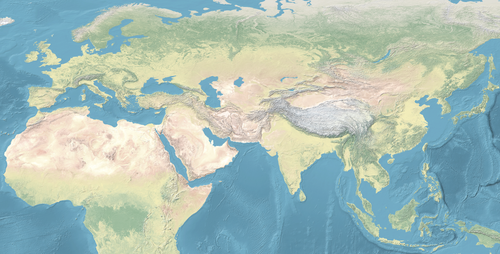
The Golden Horde, with contemporary polities, c. 1300[167]
Sarai carried on a brisk trade with the Genoese trade emporiums on the coast of the Black Sea – Soldaia, Caffa, and Azak. Mamluk Egypt was the Khans' long-standing trade partner and ally in the Mediterranean. Berke, the Khan of Kipchak had drawn up an alliance with the Mamluk Sultan Baibars against the Ilkhanate in 1261.[168]
A change in trade routes
According to Baumer[169] the natural trade route was down the Volga to Serai where it intersected the east–west route north of the Caspian, and then down the west side of the Caspian to Tabriz in Persian Azerbaijan where it met the larger east–west route south of the Caspian. In 1262, Berke began a war with the Il-Khan Hulagu Khan. This led to several battles on the west side of the Caspian which the Horde usually lost. The interruption of trade and conflict with Persia led the Horde to build trading towns along the northern route. They also allied with the Mamluks of Egypt who were the Il-Khan's enemies. Trade between the Horde and Egypt was carried by the Genoese based in Crimea. An important part of this trade was slaves for the Mamluk army. Trade was weakened by a quarrel with the Genoese in 1307 and a Mamluk-Persian peace in 1323. Circa 1336 the Ilkhanate began to disintegrate which shifted trade north. Around 1340, the route north of the Caspian was described by Pegolotti. In 1347 a Horde siege of the Genoese Crimean port of Kaffa led to the spread of the black death to Europe. In 1395–96 Tamerlane laid waste to the Horde's trading towns. Since they had no agricultural hinterland many of the towns vanished and trade shifted south.[citation needed]
Geography and society
Genghis Khan assigned four Mongol mingghans: the Sanchi'ud (or Salji'ud), Keniges, Uushin, and Je'ured clans to Jochi.[170] By the beginning of the 14th century, noyans from the Sanchi'ud, Hongirat, Ongud (Arghun), Keniges, Jajirad, Besud, Oirat, and Je'ured clans held importants positions at the court or elsewhere. There existed four mingghans (4,000) of the Jalayir in the left wing of the Ulus of Jochi (Golden Horde).[citation needed]
The population of the Golden Horde was largely a mixture of Turks and Mongols who adopted Islam later, as well as smaller numbers of Finno-Ugric peoples, Sarmato-Scythians, Slavs, and people from the Caucasus, among others (whether Muslim or not).[171] Most of the Horde's population was Turkic: Kipchaks, Cumans, Volga Bulgars, Khwarezmians, and others. The Horde was gradually Turkified and lost its Mongol identity, while the descendants of Batu's original Mongol warriors constituted the upper class.[172] They were commonly named the Tatars by the Russians and Europeans. Russians preserved this common name for this group down to the 20th century. Whereas most members of this group identified themselves by their ethnic or tribal names, most also considered themselves to be Muslims. Most of the population, both agricultural and nomadic, adopted the Kypchak language, which developed into the regional languages of Kypchak groups after the Horde disintegrated.[citation needed]
The descendants of Batu ruled the Golden Horde from Sarai Batu and later Sarai Berke, controlling an area ranging from the Volga River and the Carpathian mountains to the mouth of the Danube River. The descendants of Orda ruled the area from the Ural River to Lake Balkhash. Censuses recorded Chinese living quarters in the Tatar parts of Novgorod, Tver and Moscow.[citation needed]
Internal organization

The Golden Horde's elites were descended from four Mongol clans, Qiyat, Manghut, Sicivut and Qonqirat. Their supreme ruler was the Khan, chosen by the kurultai among Batu Khan's descendants. The prime minister, also ethnically Mongol, was known as "prince of princes", or beklare-bek. The ministers were called viziers. Local governors, or basqaqs, were responsible for levying taxes and dealing with popular discontent. Civil and military administration, as a rule, were not separate.[citation needed]
The Horde developed as a sedentary rather than nomadic culture, with Sarai evolving into a large, prosperous metropolis. In the early 14th century, the capital was moved considerably upstream to Sarai Berqe, which became one of the largest cities of the medieval world, with 600,000 inhabitants.[173] Sarai was described by the famous traveller Ibn Battuta as "one of the most beautiful cities ... full of people, with the beautiful bazaars and wide streets", and having 13 congregational mosques along with "plenty of lesser mosques".[174] Another contemporary source describes it as "a grand city accommodating markets, baths and religious institutions".[174] An astrolabe was discovered during excavations at the site and the city was home to many poets, most of whom are known to us only by name.[174][175]
Despite Russian efforts at proselytizing in Sarai, the Mongols clung to their traditional animist or shamanist beliefs until Uzbeg Khan (1312–1341) adopted Islam as a state religion. Several rulers – Mikhail of Chernigov and Mikhail of Tver among them – were reportedly assassinated in Sarai, but the Khans were generally tolerant and even released the Russian Orthodox Church from paying taxes.[citation needed]
Provinces
The Mongols favored decimal organization, which was inherited from Genghis Khan. It is said that there were a total of ten political divisions within the Golden Horde. The Golden Horde majorly was divided into Blue Horde (Kok Horde) and White Horde (Ak Horde). Blue Horde consisted of Pontic–Caspian steppe, Khazaria, Volga Bulgaria, while White Horde encompassed the lands of the princes of the left hand: Taibugin Yurt, Ulus Shiban, Ulus Tok-timur, Ulus Ezhen Horde.[citation needed]
Vassal territories
- Venetian port cities in Crimea (center at Qırım). After the Mongol conquest in 1238, the port cities in Crimea paid the Jochids custom duties, and the revenues were divided among all Chingisid princes of the Mongol Empire in accordance with the appanage system.,[176]
- the banks of Azov,
- the country of Circassians,
- Walachia,
- Alania,
- Russian lands.[177]
Genetics
A 2016 study analyzed the DNA of 5 skeletons in Tavan Tolgoi, Mongolia dated between 1130–1250 AD, which are believed to be members of the Mongol Golden Family based on contextual evidence.[178] The male individuals possibly associated with the Golden Family belonged to the West Eurasian paternal haplogroup R1b-M343, while one male of commoner status belonged to R1a.[179][180] Four of the skeletons belonged to the East Eurasian mtDNA haplogroups D4 and CZ.[181] All the skulls dated from Tavan Tolgoi graves were anthropologically Mongoloid. Despite their East Asian physical appearance, their genealogical admixture reveals a admixture of East Asian and Caucasian ethnic groups which was attributed to inter-racial marriages between Mongolian plateau females and male migrants from Europe; however the authors could not determine when and how these intermarriages took place but it was likely to have existed through generations of intermixing through their ancestors, before the existence of the Golden family.[182]
The study proposed multiple theories as to how the bodies were related to the Golden Family. The Tavan Tolgoi bodies could have been product of marriages between the female lineage of Genghis Khan’s Borjigin clan and the male lineage of either the Hongirad clans or the Ongud. The Ongud were a tribe that may have originated in West Asia and were descended from the Shatuo Turks, suggesting that they may have had a Caucasoid appearance based on the fact they were carriers of haplogroup R1b. Contemporary records from the Later Tang (923–937 AD) described some male Shatuo Turks as having deep set eyes with whiskers as well as slim bodies with light complexion.[183][184] Many Ongud were resettled in the Golden Horde as administrators. Authors suggested that the Genghis Khan’s male lineage may have had some Caucasoid-specific genetic features because of descriptions in Rashid al-Din Hamadani's "Compendium of Chronicles" written in the 14th century. The bodies could have been related to Genghis Khan's male lineage, which they propose had R1b. It is also possible the bodies were related to Genghis Khan's relatives or his generals who were not part of the male-lineage Borjigin clan.[185]
These authors noted that there is a close link between the current day distribution of haplogroup R1b and the spread of the Mongol Empire, especially in the Golden Horde and Chagatai Khanate; and that the descendants of the Tavan Tolgoi specimens are now located mainly in West Eurasia, rather than Mongolia.[186] A close association was observed between haplogroup R1b-M343 and the descendants of the Golden Horde, with a high frequency of R1b-M343 among Bashkirs and Eastern Russian Tatars, implying they may be direct descendants of the Tavan Tolgoi specimens. However R1b is largely absent from Mongolia, which the authors propose may have been caused by mass migration of Golden Family members and the Ongud to Eastern Europe and Central Asia, or massacres of Borjigin members there while West Eurasia was relatively safe.[187][188]
A 2018 genetic study published in Nature examined the remains of two males buried in the Ulytau District in Kazakhstan c. 1300.[189][190] One male, who was a Buddhist member of the Golden Horde army, was of East Asian ancestry and carried paternal haplogroup C3[191] and the maternal haplogroup D4m2.[192] The other male, who was of West Eurasian (European) ancestry, was a carrier of the paternal haplogroup R1[193] and the maternal haplogroup I1b.[194] According to the authors, this could suggest assimilation of distinct ethnic groups in to the Golden Horde, however he could also be servant or slave.[195]
Coinage
-
 Talabuga's coin, dating c. 1287–1291 AD
 -
 Jani Beg's coin, dating c. 1342–1357 AD
 -
 Berdi Beg's coin minted in Azak, dating c. 1357 AD
 -
 Kildibeg's coin minted in Sarai, dating c. 1360 AD
 -
 Ordumelik's coin minted in Azak, dating c. 1360 AD
 -
 Muscovite coin minted in the name of Abdullah ibn Uzbeg, dating c. 1367–1368 or 1369–1370
 -
 Dawlat Berdi's coin minted in Kaffa, dating c. 1419–1421 or 1428–1432 AD
.jpg/500px-M38_Juchides_Saray_1_(8227766434).jpg)
Gallery
-
 Golden Horde raid at Ryazan
 -
 Golden Horde raid at Kiev
 -
 Golden Horde raid at Kozelsk
 -
 Golden Horde raid Vladimir
 -
 Golden Horde raid Suzdal
 -
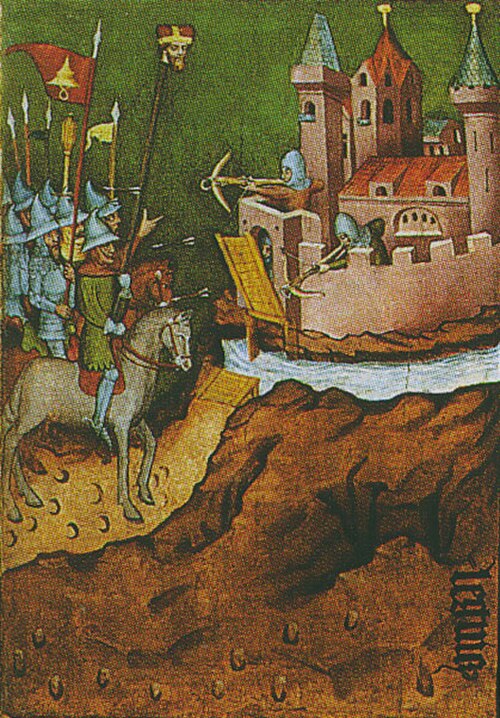 Mongol-Tatar warriors besiege their opponents.
 -
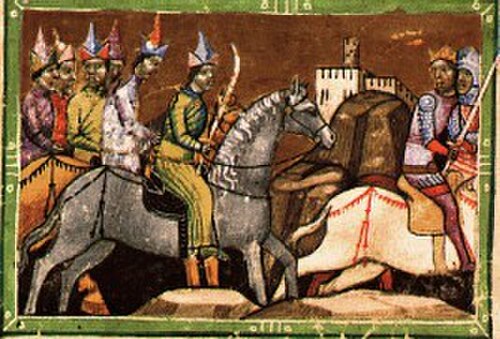 Mongols chase Hungarian king from Mohi, detail from Chronicon Pictum.
 -
 The Mongol army captures a city
 -
 Mongol invasion of Hungary in 1285
 -
 Edigu's invasion of Rus
 -

-
 Drawing of Mongols of the Golden Horde outside Vladimir presumably demanding submission before sacking the city
 -
 Paiza of Abdullah Khan (r. 1361–1370) with Mongolian script
 -
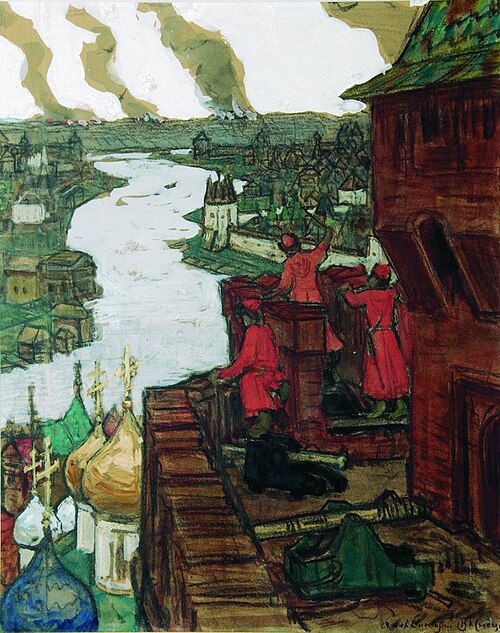 Mongol-Tatar raid
 -
 Mikhail of Tver being punished by the Golden Horde
.png/500px-Siege_of_Kiev_(1240).png)

See also
- Cumans
- Mongol invasion of Kievan Rus'
- Russo-Kazan Wars
- Tatar invasions
- Timeline of the Golden Horde
- Tokhtamysh–Timur war
- Volga Bulgaria
- Division of the Mongol Empire
- Berke–Hulagu war
- History of the western steppe
- List of Khans of the Golden Horde
- List of medieval Mongol tribes and clans
- List of Mongol states
- Jarlig
Notes
- ^ Their state came to be known in historiography as the Golden Horde or the ulus ("people" or "patrimony") of Djochi, while the contemporaries simply referred to it as the Great Horde (ulu orda).[3]
- ^ "Clearly, the Russian bookmen's posturing notwithstanding, the Mongols were anything but an unknown and unknowable people. The Tatars, as an abstraction, were loathed on principle, but to the Russian elite their Tatar counterparts were far from being nameless, faceless enemies. Indeed, Russian aristocrats were probably more familiar with the higher levels of Mongol society than with the society of the Russian peasantry."[149]
References
- ^ Halperin 1987, p. 78.
- ^ Zahler, Diane (2013). The Black Death (Revised ed.). Twenty-First Century Books. p. 70. ISBN 978-1-4677-0375-8.
- ^ a b c Kołodziejczyk (2011), p. 4.
- ^ Mustafayeva, A. A.; Aubakirova, K. K. (June 2021). "The language situation and status of the Turkic language in the Egyptian Mamluk state and Golden Horde". Journal of Oriental Studies. 97 (2): 17–25. doi:10.26577/JOS.2021.v97.i2.02. ISSN 2617-1864. Retrieved 1 September 2021.
- ^ Turchin, Peter; Adams, Jonathan M.; Hall, Thomas D (December 2006). "East-West Orientation of Historical Empires". Journal of World-Systems Research. 12 (2): 222. ISSN 1076-156X. Retrieved 12 September 2016.
- ^ Rein Taagepera (September 1997). "Expansion and Contraction Patterns of Large Polities: Context for Russia". International Studies Quarterly. 41 (3): 498. doi:10.1111/0020-8833.00053. JSTOR 2600793.
- ^ Fedorov-Davydov, German A. "The Monetary System of The Golden Horde". Translated by L. I. Smirnova (Holden). Retrieved 14 July 2017.
- ^ "The History and Culture of the Golden Horde (Room 6)". Saint Petersburg: The State Hermitage Museum. Retrieved 21 March 2020.
- ^ Perrie, Maureen, ed. (2006). The Cambridge History of Russia. Vol. 1: From Early Rus' to 1689. Cambridge University Press. p. 130. ISBN 978-0-521-81227-6.
- ^ a b "Golden Horde". Encyclopædia Britannica. 2007.
Also called Kipchak Khanate Russian designation for Juchi's Ulus, the western part of the Mongol Empire, which flourished from the mid-13th century to the end of the 14th century. The people of the Golden Horde were mainly a mixture of Turkic and Uralic peoples and Sarmatians & Scythians and, to a lesser extent, Mongols, with the latter generally constituting the aristocracy. Distinguish the Kipchak Khanate from the earlier Cuman-Kipchak confederation in the same region that had previously held sway, before its conquest by the Mongols.
- ^ a b c Millar, James R. (2004). Encyclopedia of Russian History. New York: Macmillan Reference USA. p. 688. ISBN 9780028656939.
- ^ Atwood (2004), p. 201.
- ^ рЕПЛХМ гНКНРЮЪ нПДЮ - НЬХАЙЮ РНКЛЮВЮ 16 ЯРНКЕРХЪ (мХК лЮЙЯХМЪ) / оПНГЮ.ПС – МЮЖХНМЮКЭМШИ ЯЕПБЕП ЯНБПЕЛЕММНИ ОПНГШ. Proza.ru. Retrieved 2014-04-11.
- ^ Ostrowski, Donald G. (Spring 2007). "Encyclopedia of Mongolia and the Mongol Empire, and: The Mongols and the West, 1221–1410, and: Daily Life in the Mongol Empire, and: The Secret History of the Mongols: A Mongolian Epic Chronicle of the Thirteenth Century (review)". Kritika: Explorations in Russian and Eurasian History. 8 (2). Project MUSE: 431–441. doi:10.1353/kri.2007.0019. S2CID 161222967.
- ^ May, T. (2001). "Khanate of the Golden Horde (Kipchak)". North Georgia College and State University. Archived from the original on December 14, 2006.
- ^ Spinei, Victor (2009). The Romanians and the Turkic Nomads North of the Danube Delta from the Tenth to the Mid-Thirteenth Century. Brill. p. 38. ISBN 978-90-04-17536-5.
- ^ Atwood (2004), p. 41.
- ^ Allsen (1985), pp. 5–40.
- ^ Edward L. Keenan, Encyclopedia Americana article
- ^ Grekov, B. D.; Yakubovski, A. Y. (1998) [1950]. The Golden Horde and its Downfall (in Russian). Moscow: Bogorodskii Pechatnik. ISBN 978-5-8958-9005-9.
- ^ "History of Crimean Khanate". Archived from the original on 2009-01-06.(in English)
- ^ a b Sinor, Denis (1999). "The Mongols in the West". Journal of Asian History. 33 (1). Harrassowitz Verlag: 1–44. JSTOR 41933117.
- ^ a b c Vernadsky 1953, p. 146.
- ^ Atwood 2004, p. 479.
- ^ Vernadsky 1953, p. 143.
- ^ Martin (2007), p. 152.
- ^ Vernadsky 1953, p. 147.
- ^ Atwood (2004), p. 213.
- ^ Atwood 2004, p. 78, Local censuses also took place in the 1240s in Russia and Turkey... extent of the empire made the census very time consuming; while that of North China was completed in 1252, Novgorod in the far northwest was not counted until winter 1258–59..
- ^ Atwood 2004, p. 48.
- ^ Vernadsky 1953, pp. 148–149.
- ^ Vernadsky 1953, p. 150.
- ^ Vernadsky 1953, p. 151.
- ^ Jackson (2014), pp. 123–124.
- ^ Annales Mellicenses. Continuatio Zwetlensis tertia, MGHS, IX, p. 644
- ^ Jackson (2014), p. 202.
- ^ Vernadsky 1953, p. 153.
- ^ Kirakos, Istoriia p. 236
- ^ Mukhamadiev, A. G. Bulgaro-Tatarskiya monetnaia sistema, p. 50
- ^ Rashid al-Din-Jawal al Tawarikhi, (Boyle) p. 256
- ^ Jackson, Peter (1995). "The Mongols and Europe". In Abulafia, David (ed.). The New Cambridge Medieval History: Volume 5, c. 1198–c. 1300. Cambridge University Press. p. 709. ISBN 978-0-521-36289-4.
- ^ Plokhy, Serhii (2006). The origins of the Slavic nations: premodern identities in Russia, Ukraine, and Belarus. Cambridge University Press. p. 74. ISBN 978-0-511-24564-0. OCLC 845782300.
As the transformation of St. Aleksandr Nevsky from 'son of Suzdal' to 'son of Rus'' in early modern Muscovite literature well attests...
- ^ Vernadsky 1953, p. 163.
- ^ Barthold, W. (2008) [1958]. Turkestan Down to the Mongol Invasion. ACLS Humanities E-Book. p. 446. ISBN 978-1-59740-450-1.
- ^ Howorth (1880).
- ^ Biran, Michal (2013). Qaidu and the Rise of the Independent Mongol State In Central Asia. Taylor & Francis. p. 52. ISBN 978-1-136-80044-3.
- ^ Man, John (2012). Kublai Khan. Transworld. p. 229. ISBN 978-1-4464-8615-3.
- ^ Saunders, J. J. (2001). The History of the Mongol Conquests. University of Pennsylvania Press. pp. 130–132. ISBN 978-0-8122-1766-7.
- ^ Amitai-Preiss, Reuven (2005). Mongols and Mamluks: The Mamluk-Ilkhanid War, 1260–1281. Cambridge University Press. pp. 88–89. ISBN 978-0-521-52290-8.
- ^ Storey, R. L. (1994). Chronology of the Medieval World: 800 to 1491. Helicon. p. 339. ISBN 978-0-09-178264-1.
- ^ Vásáry 2022, p. 475, only the Russian clergy was tax-exempt.
- ^ Riha, Thomas (2009). Readings in Russian Civilization Volume I: Russia before Peter the Great, 900–1700. University of Chicago Press. p. 191. ISBN 978-0-226-71843-9.
the role of the Tatars who settled in Russia and were converted to Christianity... case of Tsarevich Peter of the Horde, founder of a monastery in Rostov
- ^ Vernadsky 1953, p. 169.
- ^ Anton Cooper On the Edge of Empire: Novgorod's trade with the Golden Horde, p. 19
- ^ GVNP, p. 13; Gramota#3
- ^ Zenkovsky, Serge A.; Zenkovsky, Betty Jean, eds. (1986). The Nikonian Chronicle: From the year 1241 to the year 1381. Kingston Press. p. 45. ISBN 978-0-940670-02-0.
- ^ Vernadsky 1953, p. 172.
- ^ Vernadsky 1953, pp. 172–173.
- ^ Vernadsky 1953, p. 173.
- ^ Vernadsky 1953, pp. 173–174.
- ^ a b Vernadsky 1953, p. 174.
- ^ Rashid al Din-II Successors (Boyle), p. 897
- ^ Allsen (1985), p. 21.
- ^ Curta, Florin (2006). Southeastern Europe in the Middle Ages, 500–1250. Cambridge University Press. p. 414. ISBN 978-0-521-81539-0.
- ^ Howorth (1880), p. 130.
- ^ Byzantino Tatarica, p. 209
- ^ Vernadsky 1953, p. 177.
- ^ Vernadsky 1953, p. 178.
- ^ a b c d e f g Vernadsky 1953, p. 185.
- ^ a b c d Vernadsky 1953, p. 186.
- ^ Baybars al Mansuri-Zubdat al-Fikra, p. 355
- ^ Spuler (1943), p. 78.
- ^ Barthold, V.V. Four Studies on Central Asia. Translated by Minorsky, V.; Minorsky, T. Brill. p. 127.
- ^ Grousset, René (1970). The Empire of the Steppes: A History of Central Asia. Rutgers University Press. p. 335. ISBN 978-0-8135-1304-1.
- ^ Bentley, Jerry H. (2008). Traditions & encounters : a global perspective on the past. New York : McGraw-Hill. p. 471, map 18.2. ISBN 978-0-07-340693-0.
- ^ Vernadsky 1953, p. 189.
- ^ Vernadsky 1953, p. 190.
- ^ Vásáry, István (2005). Cumans and Tatars: Oriental Military in the Pre-Ottoman Balkans, 1185–1365. Cambridge University Press. p. 91. ISBN 978-1-139-44408-8.
- ^ Ptolemy of Lucca Annales, p. 237
- ^ DeWeese, Devin (2010). Islamization and Native Religion in the Golden Horde: Baba TŸkles and Conversion to Islam in Historical and Epic Tradition. Penn State Press. p. 99. ISBN 978-0-271-04445-3.
- ^ Boyle, J. A. (1968). "Dynastic and Political History of the Il-Khans". In Boyle, J. A. (ed.). The Cambridge History of Iran. Cambridge University Press. p. 374. ISBN 978-0-521-06936-6.
- ^ a b c d e f Vernadsky 1953, p. 193.
- ^ Badarch Nyamaa – The coins of Mongol empire and clan tamgna of khans (XIII–XIV) (Монеты монгольских ханов), Ch. 2.
- ^ a b Jackson (2014), p. 204.
- ^ Spuler (1943), p. 84.
- ^ Vernadsky 1953, p. 191.
- ^ Vernadsky 1953, p. 194.
- ^ a b c Vernadsky 1953, p. 195.
- ^ Vernadsky 1953, p. 196.
- ^ Vernadsky 1953, p. 198, Ibn-Batuta, who visited Uzbeg's dominions around 1333, describes Saray as a large and beautiful city with vast streets and fine markets. Six "nations" lived in it—Mongols, Alans, Kypchaks, Circassians, Russians and Greeks–each being assigned a section of its own..
- ^ a b Vernadsky 1953, p. 197.
- ^ Broadbridge, Anne F. (2008). Kingship and ideology in the Islamic and Mongol worlds. Cambridge Studies in Islamic Civilization. Cambridge: Cambridge University Press. pp. 132–137. ISBN 978-0-521-85265-4. OCLC 124025602.
- ^ Allsen, Thomas T. (2006). The Royal Hunt in Eurasian History. University of Pennsylvania Press. p. 256. ISBN 978-0-8122-0107-9.
- ^ Atwood (2004), "Golden Horde".
- ^ Mihail-Dimitri Sturdza, Dictionnaire historique et Généalogique des grandes familles de Grèce, d'Albanie et de Constantinople (Great families of Greece, Albania and Constantinople: Historical and genealogical dictionary) (1983), p. 373
- ^ Saunders (2001).
- ^ Jireuek Bulgaria, pp. 293–295
- ^ Martin (2007), p. 175.
- ^ Fennell, John (1988). "Princely Executions in the Horde 1308–1339". Forschungen zur Osteuropaischen Geschichte. 38: 9–19.
- ^ a b Vernadsky 1953, p. 200.
- ^ Fennell, John (September 2022). The Emergence of Moscow, 1304-1359. Univ of California Press. p. 102. ISBN 978-0-520-34758-8.
- ^ Vernadsky 1953, p. 199.
- ^ Vernadsky 1953, pp. 200–201.
- ^ a b c Vernadsky 1953, p. 201.
- ^ Vernadsky 1953, pp. 201–202.
- ^ Vagnon, Emmanuelle (1 January 2020). "Mongols et Tartare dans les cartes occidentales du Moyen Âge". A. Caiozzo et J.-C. Ducène (Éd.), de la Mongolie Àla Mongolie dans Son Espace Régional. Entre Mémoire et Marques de Territoire, des Mondes Anciens À Nos Jours, Valenciennes, Presses Universitaires de Valenciennes. Presses Universitaires de Valenciennes: 145.
- ^ a b Vernadsky 1953, p. 202.
- ^ a b c d e Vernadsky 1953, p. 203.
- ^ Rowell, S. C. (2014). Lithuania Ascending. Cambridge University Press. p. 100. ISBN 978-1-107-65876-9.
- ^ Vernadsky 1953, pp. 203–204.
- ^ Ibn Battuta-, 2, 414 415
- ^ Massing, Jean Michel; Albuquerque, Luís de; Brown, Jonathan; González, J. J. Martín (1991). Circa 1492: Art in the Age of Exploration. Yale University Press. p. 29. ISBN 978-0-300-05167-4.
- ^ "The Cresques Project – Panel V". www.cresquesproject.net.
- ^ a b Vernadsky 1953, p. 204.
- ^ Vernadsky 1953, p. 205.
- ^ Zdan, Michael B. (June 1957). "The Dependence of Halych-Volyn' Rus' on the Golden Horde". The Slavonic and East European Review. 35 (85): 521–522. JSTOR 4204855.
- ^ Jackson (2014), p. 211.
- ^ Vernadsky 1953, p. 208.
- ^ a b Vernadsky 1953, p. 246.
- ^ Atwood 2004, p. 480.
- ^ a b Vernadsky 1953, p. 258.
- ^ a b Vernadsky 1953, p. 247.
- ^ Vernadsky 1953, p. 250.
- ^ Vernadsky 1953, p. 267.
- ^ a b Grousset 1970, p. 407.
- ^ a b ed. Johann Voigt, Codex diplomaticus Prussicus, 6 vols, VI, p. 47
- ^ Vernadsky 1953, p. 277.
- ^ Howorth (1880), p. 287.
- ^ Vernadsky 1953, p. 282.
- ^ Vernadsky 1953, pp. 284–287.
- ^ Forsyth 1992, pp. 25–26.
- ^ Vernadsky 1953, p. 293.
- ^ Frank 2009, p. 242.
- ^ a b Vernadsky 1953, pp. 296–319.
- ^ a b c d Vernadsky 1953, p. 329.
- ^ Documents of the Crimean khanate from the collection of Huseyn Feyzkhanov / comp. and the transliteration. R. R. Abdujalilov; scientific. edited by I. Mingaleev. – Simferopol: LLC "Konstanta". 2017. 816 p. ISBN 978-5-906952-38-7
- ^ Sagit Faizov. Letters of khans Islam Giray III and Muhammad Giray IV to Tsar Alexey Mikhailovich and king Jan Kazimir, 1654–1658: Crimean Tatar diplomacy in polit. post-Pereyaslav context. time. Moscow: Humanitarii, 2003. 166 p. ISBN 5-89221-075-8
- ^ Christian 2018, p. 63.
- ^ a b Vernadsky 1953, p. 330.
- ^ a b Vernadsky 1953, p. 332.
- ^ "Russian Interaction with Foreign Lands". Strangelove.net. Archived from the original on 2009-01-18. Retrieved 2014-04-11.
- ^ Kołodziejczyk (2011), p. 66.
- ^ Nikolay Novikov. "Ancient Russian Hydrography" (Древняя российская идрография). Saint Petersburg, 1773. page 167. ISBN 9785458063685
- ^ Frank 2009, p. 253.
- ^ a b Vernadsky 1953, p. 214.
- ^ a b Halperin 1987, p. 91.
- ^ Halperin 1987, pp. 118–119.
- ^ Halperin 1987, p. 125.
- ^ Halperin 1987, pp. 124–126.
- ^ Vernadsky 1953, p. 222.
- ^ Halperin 1987, pp. 107–109.
- ^ a b Halperin 1987, pp. 111–113.
- ^ Mirgaleyev 2017, p. 347.
- ^ Spinei 2017, p. 405.
- ^ Vásáry 2022, pp. 475–476, ...the basqaqs (the institution called baskachestvo in Russian), collected the taxes instituted by the Mongols, and only the Russian clergy was tax-exempt.
- ^ a b c d e f g h i j Vásáry 2022, p. 476.
- ^ Halperin 1987, pp. 113–115.
- ^ Halperin 1987, p. 50.
- ^ a b Halperin 1987, pp. 50–51.
- ^ Halperin 1987, pp. 89–91.
- ^ Halperin 1987, p. 93.
- ^ a b c Vásáry 2022, p. 477.
- ^ Vernadsky 1953, pp. 233–244.
- ^ a b Vernadsky 1953, pp. 277–287.
- ^ Clifford Edmund Bosworth, The New Islamic Dynasties – A chronological and genealogical manual, Edinburgh University Press, 2012.
- ^ Bentley, Jerry H. (2008). Traditions & encounters : a global perspective on the past. New York : McGraw-Hill. p. 471, map 18.2. ISBN 978-0-07-340693-0.
- ^ Mantran, Robert (Fossier, Robert, ed.) "A Turkish or Mongolian Islam" in The Cambridge Illustrated History of the Middle Ages: 1250–1520, p. 298
- ^ Christoph Baumer, History of Central Asia, volume 3, pp. 263–270, 2016. He seems to be following Virgil Ciociltan, The Mongols and the Black Sea Trade, 2012
- ^ Blair, Sheila; Art, Nasser D. Khalili Collection of Islamic (1995). جامع التواريخ: Rashid Al-Din's Illustrated History of the World. Nour Foundation. p. 212. ISBN 978-0-19-727627-3.
- ^ Halperin 1987, p. 111.
- ^ "Britannica Academic". academic.eb.com.
- ^ Encyclopædia Britannica
- ^ a b c Ravil Bukharaev (2014). Islam in Russia: The Four Seasons. Routledge. p. 116. ISBN 9781136808005.
- ^ Ravil Bukharaev; David Matthews, eds. (2013). Historical Anthology of Kazan Tatar Verse. Routledge. p. 15. ISBN 9781136814655.
- ^ Jackson, Peter (1978). The Dissolution of the Mongol Empire. Harrassowitz. pp. 186–243.
- ^ A. P. Grigorev and O. B. Frolova, Geographicheskoy opisaniye Zolotoy Ordi v encyclopedia al-Kashkandi-Tyurkologicheskyh sbornik, 2001, pp. 262–302
- ^ Lkhagvasuren, Gavaachimed (2016). "Molecular Genealogy of a Mongol Queen's Family and Her Possible Kinship with Genghis Khan". PLOS ONE. 11 (9): e0161622. Bibcode:2016PLoSO..1161622L. doi:10.1371/journal.pone.0161622. ISSN 1932-6203. PMC 5023095. PMID 27627454.
- ^ Lkhagvasuren 2016: Table 2. Y-haplogroups of the male Tavan Tolgoi bodies. MN0376: R1a1a, MN0126: R1b, MN0104: R1b
- ^ Lkhagvasuren 2016: "In the male graves, MN0104 was unearthed holding an ornament, called “Jins” in Mongolia, consisting of a large pearl mounted on a flower-shaped golden base (Fig 2H). MN0126 and MN0127 were each wearing only a single earring that was found under the skull, indicating their higher social status (Fig 2I and 2J); Mongolian aristocratic men usually wore hats adorned with Jins and a single earring in their left ears, confirming that MN0104, MN0126 and MN0127 were all males."..."MN0376 was also believed to belong to a member of the general public, based on the artifacts excavated. The burial artifacts from this grave were all associated with war, including an arrow quiver and arrowheads; his physical anthropological characteristics, including several signs of injury during his lifetime, such as trauma of the left clavicle and a well-developed skeleton, indicate that he was a common warrior [9, 11]."
- ^ Lkhagvasuren 2016: "Four of the 5 bodies were determined to carry the mitochondrial DNA haplogroup D4, while the fifth carried haplogroup CZ, indicating that this individual had no kinship with the others.
- ^ Lkhagvasuren 2016: "All physical anthropological parameters indicate that the skulls of the Tavan Tolgoi graves were all anthropologically Mongoloid ", "The mixing between Mongoloid and Caucasoid ethnic groups inherent in the genetic structure of modern-day Mongolians was also observed in the Tavan Tolgoi bodies. The Golden family members carried mtDNA haplogroups D4 and CZ, mostly found in Far Eastern and Northeastern Asia, respectively, whereas male members of Golden family carried the Y-haplogroup R1b-M343, dominant in Western Europe [41–43]. That is, although members of Golden family were physically Mongoloid, their molecular genealogy revealed the admixture between Caucasoid and Mongoloid ethnic groups. Thus, it is likely that their Mongoloid appearance would have resulted from gradual changes in their appearance from Caucasoid to Mongoloid through generations from their ancestors. Their physical appearance was largely attributed to D4-carrying Mongoloid females who were indigenous peoples of the Mongolian plateau, rather than an R1b-M343-carrying Caucasoid male spouse who had initially moved from Europe to the Mongolian plateau and his male descendants; it is, however, uncertain how and when the admixture between Mongoloid and Caucasoid ethnic groups originated in the Mongolian plateau."
- ^
 This article incorporates text from Journal of the China Branch of the Royal Asiatic Society for the year ..., Volumes 30-31, by Royal Asiatic Society of Great Britain and Ireland. China Branch, a publication from 1897, now in the public domain in the United States.
- Davis, Richard L. (2016), Fire and Ice: Li Cunxu and the Founding of the Later Tang
- ^ Fire and Ice: Li Cunxu and the Founding of the Later Tang. Historian Richard L. Davis · 2016, Page 14 [1]
- ^ Lkhagvasuren 2016: "Here, we propose that Genghis Khan and his family carried Y-haplogroup R1b-M343, which is prevalent in West Eurasia, rather than the Y-haplogroup C3c-M48, which is prevalent in Asia and which is widely accepted to be present in the family members of Genghis Khan. Additionally, Tavan Tolgoi bodies may have been the product of marriages between the lineage of Genghis Khan’s Borjigin clan and the lineage of either the Ongud or Hongirad clans, indicating that these individuals were members of Genghis Khan’s immediate family or his close relatives." ... "Considering the historical, archaeological, physical anthropological, and molecular archaeological evidence obtained, it seems most likely that the Tavan Tolgoi bodies are members of Genghis Khan’s Golden family, including the lineage of bekis, Genghis Khan’s female lineage, and their female successors who controlled Eastern Mongolia in the early Mongolian era instead of guregens of the Ongud clan, or the lineage of khans, Genghis Khan’s male lineage, who married females of the Hongirad clan, including Genghis Khan’s grandmother, mother, chief wife, and some daughters-in-law."
- ^ Lkhagvasuren et al. 2016"...the geographical distribution of R1b-M343-carrying modern-day individuals demonstrates that descendants of Tavan Tolgoi bodies today live mainly in Western Eurasia, with a high frequency in the territories of the past Mongol khanates."
- ^ Lkhagvasuren 2016: "Coincidentally, the geographical distribution of modern-day individuals matching the Y-haplogroup and haplotype of the Tavan Tolgoi bodies in the regions corresponding to the past Mongol khanates, including the Golden Horde Dynasty and Chagatai Khanate, implies that the modern-day individuals are direct descendants of the Golden family members."
- ^ Lkhagvasuren 2016"Eastern Russian Tatars, Bashkirs, and Pakistani Hazara were found to carry R1b-M343 at unusually high frequencies of 12.65%, 46.07%, and 32%, respectively, compared to other regions of Eastern Asia, which rarely have this haplotype (Fig 3) [40, 42, 43, 49–53]. Interestingly, ancestors of those 3 populations were all closely associated with the medieval Mongol Empire. That is, Russian Tatars and Bashkirs are descendants of the Golden Horde (also known as the Ulus of Jochi) that had been controlled by Jochi, the first son of Genghis Khan, and his descendants during the 12th–15th centuries. In addition, some of the Hazara tribes are believed to consist of descendants of Mongolian soldiers and their slave women after the 1221 siege of Bamiyan under the leadership of Genghis Khan [54, 55]. Similarly, the high frequency of R1b-M343 in geographic regions associated with the past Mongol khanates including the Golden Horde [...] strongly suggest a close association between the Y haplotype R1b-M343 and the past Mongol Empire (Fig 3) [42–44, 49–53]."
- ^ Damgaard, Peter de Barros; Marchi, Nina; Rasmussen, Simon; Peyrot, Michaël (May 2018). "137 ancient human genomes from across the Eurasian steppes". Nature. 557 (7705): 369–374. Bibcode:2018Natur.557..369D. doi:10.1038/s41586-018-0094-2. hdl:1887/3202709. ISSN 1476-4687. PMID 29743675. S2CID 256769352.
- ^ Damgaard et al. 2018, Supplementary Table 2, Rows 23-24.
- ^ Damgaard et al. 2018, Supplementary Table 9, Row 16.
- ^ Damgaard et al. 2018, Supplementary Table 8, Row 81.
- ^ Damgaard et al. 2018, Supplementary Table 9, Row 17.
- ^ Damgaard et al. 2018, Supplementary Table 8, Row 82.
- ^ Damgaard et al. 2018, p. 372: "We also find the presence of an individual of West Eurasian descent buried together with members of Jochi Khan’s Golden Horde army from the Ulytau mountains (see Supplementary Information section 4: DA28 is East Asian and DA29 is European). This could suggest assimilation of distinct groups into the Medieval Golden Horde, but this individual may also represent a slave or a servant of West Eurasian descent attached to the service of the Golden Horde members."
Bibliography
- Allsen, Thomas T. (1985). "The Princes of the Left Hand: An Introduction to the History of the Ulus of Ordu in the Thirteenth and Early Fourteenth Centuries". Archivum Eurasiae Medii Aevi. Vol. V. Harrassowitz. pp. 5–40. ISBN 978-3-447-08610-3.
- Allsen, Thomas (1994). "The rise of the Mongolian empire and Mongolian rule in north China". In Denis C. Twitchett; Herbert Franke; John King Fairbank (eds.). The Cambridge History of China: Volume 6, Alien Regimes and Border States, 710–1368. Cambridge University Press. pp. 321–413. ISBN 978-0-521-24331-5.
- Atwood, Christopher Pratt (2004). Encyclopedia of Mongolia and the Mongol Empire. Facts On File. ISBN 978-0-8160-4671-3.
- Christian, David (2018), A History of Russia, Central Asia and Mongolia 2, Wiley Blackwell
- Damgaard, P. B.; et al. (May 9, 2018). "137 ancient human genomes from across the Eurasian steppes". Nature. 557 (7705). Nature Research: 369–373. Bibcode:2018Natur.557..369D. doi:10.1038/s41586-018-0094-2. hdl:1887/3202709. PMID 29743675. S2CID 13670282. Retrieved April 11, 2020.
- Frank, Allen J. (2009), "The Western Steppe: Volga-Ural Region, Siberia and the Crimea", in Di Cosmo, Nicola; Frank, Allen J.; Golden, Peter B. (eds.), The Cambridge History of Inner Asia: The Chinggisid Age, Cambridge: Cambridge University Press, pp. 237–259
- Forsyth, James (1992), A History of the Peoples of Siberia, Cambridge University Press
- Halperin, Charles J. (1987). Russia and the Golden Horde: The Mongol Impact on Medieval Russian History. Indiana University. ISBN 9781850430575. (1985 edition online)
- Howorth, Sir Henry Hoyle (1880). History of the Mongols: From the 9th to the 19th Century. New York: Burt Franklin. ISBN 9780265306338.
- Jackson, Peter (2014). The Mongols and the West: 1221–1410. Taylor & Francis. ISBN 978-1-317-87898-8.
- Kołodziejczyk, Dariusz (2011). The Crimean Khanate and Poland-Lithuania: International Diplomacy on the European Periphery (15th–18th Century). A Study of Peace Treaties Followed by Annotated Documents. Leiden: Brill. ISBN 978-90-04-19190-7.
- Lkhagvasuren, Gavaachimed; Shin, Heejin; Lee, Si Eun; Tumen, Dashtseveg; Kim, Jae-Hyun; Kim, Kyung-Yong; Kim, Kijeong; Park, Ae Ja; Lee, Ho Woon; Kim, Mi Jin; Choi, Jaesung; Choi, Jee-Hye; Min, Na Young; Lee, Kwang-Ho (2016). "Molecular Genealogy of a Mongol Queen's Family and Her Possible Kinship with Genghis Khan". PLOS ONE. 11 (9): e0161622. Bibcode:2016PLoSO..1161622L. doi:10.1371/journal.pone.0161622. PMC 5023095. PMID 27627454.
- Martin, Janet (2007). Medieval Russia, 980–1584. Cambridge University Press. ISBN 978-0-521-85916-5.
- Mirgaleyev, Ilnur (2017), "The Golden Horde and Anatolia", in Khakimov, Rafael; Favereau, Marie (eds.), The Golden Horde in World History, Kazan: Märcani Institute of History of the Tatarstan Academy of Sciences, pp. 347–351, ISBN 978-5-94981-254-9
- Spinei, Victor (2017), "The Domination of the Golden Horde in the Romanian Regions", in Khakimov, Rafael; Favereau, Marie (eds.), The Golden Horde in World History, Kazan: Märcani Institute of History of the Tatarstan Academy of Sciences, pp. 394–426, ISBN 978-5-94981-254-9
- Spuler, Bertold (1943). Die Goldene Horde, die Mongolen in Russland, 1223–1502 (in German). O. Harrassowitz.
- Vásáry, István (2022), "Taxation in the Jochid Ulus", in May, Timothy; Hope, Michael (eds.), The Mongol World, London: Routledge, pp. 468–483, ISBN 978-1-351-67631-1
- Vernadsky, George (1953), The Mongols and Russia, New Haven, CT: Yale University Press
Further reading
- Boris Grekov and Alexander Yakubovski, The Golden Horde and its Downfall
- Sheila Paine, The Golden Horde: From the Himalaya to the Mediterranean, Penguin Books, 1998.
External links
Wikimedia Commons has media related to Golden Horde.
- The Golden Horde coinage (archived 10 January 2016)
- Golden Horde. Archived 27 July 2011 at the Wayback Machine. arheo.manefon.org (the World Archaeology) (in Russian).