
Loading article…
ウィンストン・チャーチル卿 | |||||||||||||||||||||||||||||||||||||||||||||||||||||||||||||||||||||||||||||||||||||||||||||||
|---|---|---|---|---|---|---|---|---|---|---|---|---|---|---|---|---|---|---|---|---|---|---|---|---|---|---|---|---|---|---|---|---|---|---|---|---|---|---|---|---|---|---|---|---|---|---|---|---|---|---|---|---|---|---|---|---|---|---|---|---|---|---|---|---|---|---|---|---|---|---|---|---|---|---|---|---|---|---|---|---|---|---|---|---|---|---|---|---|---|---|---|---|---|---|---|
 吠えるライオン、1941年 | |||||||||||||||||||||||||||||||||||||||||||||||||||||||||||||||||||||||||||||||||||||||||||||||
| 英国首相 | |||||||||||||||||||||||||||||||||||||||||||||||||||||||||||||||||||||||||||||||||||||||||||||||
| 在任期間 :1951年10月26日~1955年4月5日 | |||||||||||||||||||||||||||||||||||||||||||||||||||||||||||||||||||||||||||||||||||||||||||||||
| 君主 | |||||||||||||||||||||||||||||||||||||||||||||||||||||||||||||||||||||||||||||||||||||||||||||||
| 副 | アンソニー・イーデン | ||||||||||||||||||||||||||||||||||||||||||||||||||||||||||||||||||||||||||||||||||||||||||||||
| 先行 | クレメント・アトリー | ||||||||||||||||||||||||||||||||||||||||||||||||||||||||||||||||||||||||||||||||||||||||||||||
| 後継者 | アンソニー・イーデン | ||||||||||||||||||||||||||||||||||||||||||||||||||||||||||||||||||||||||||||||||||||||||||||||
| 在任期間 :1940年5月10日~1945年7月26日 | |||||||||||||||||||||||||||||||||||||||||||||||||||||||||||||||||||||||||||||||||||||||||||||||
| 君主 | ジョージ6世 | ||||||||||||||||||||||||||||||||||||||||||||||||||||||||||||||||||||||||||||||||||||||||||||||
| 副 | クレメント・アトリー(事実上の大統領、1942年~1945年) | ||||||||||||||||||||||||||||||||||||||||||||||||||||||||||||||||||||||||||||||||||||||||||||||
| 先行 | ネヴィル・チェンバレン | ||||||||||||||||||||||||||||||||||||||||||||||||||||||||||||||||||||||||||||||||||||||||||||||
| 後継者 | クレメント・アトリー | ||||||||||||||||||||||||||||||||||||||||||||||||||||||||||||||||||||||||||||||||||||||||||||||
| |||||||||||||||||||||||||||||||||||||||||||||||||||||||||||||||||||||||||||||||||||||||||||||||
| |||||||||||||||||||||||||||||||||||||||||||||||||||||||||||||||||||||||||||||||||||||||||||||||
| |||||||||||||||||||||||||||||||||||||||||||||||||||||||||||||||||||||||||||||||||||||||||||||||
| |||||||||||||||||||||||||||||||||||||||||||||||||||||||||||||||||||||||||||||||||||||||||||||||
| 個人情報 | |||||||||||||||||||||||||||||||||||||||||||||||||||||||||||||||||||||||||||||||||||||||||||||||
| 生まれる | ウィンストン・レナード・スペンサー・チャーチル 1874年11月30日イギリス 、オックスフォードシャー州ブレナム | ||||||||||||||||||||||||||||||||||||||||||||||||||||||||||||||||||||||||||||||||||||||||||||||
| 死亡 | 1965年1月24日(享年90歳)イギリス、 ロンドン | ||||||||||||||||||||||||||||||||||||||||||||||||||||||||||||||||||||||||||||||||||||||||||||||
| 休憩所 | セントマーティン教会、ブラドン、オックスフォードシャー | ||||||||||||||||||||||||||||||||||||||||||||||||||||||||||||||||||||||||||||||||||||||||||||||
| 政党 | 保守的 (1900年~1904年、1924年~1964年) | ||||||||||||||||||||||||||||||||||||||||||||||||||||||||||||||||||||||||||||||||||||||||||||||
| その他の政治的 所属 | 自由党(1904年 - 1924年) | ||||||||||||||||||||||||||||||||||||||||||||||||||||||||||||||||||||||||||||||||||||||||||||||
| 配偶者 | |||||||||||||||||||||||||||||||||||||||||||||||||||||||||||||||||||||||||||||||||||||||||||||||
| 子供たち | ダイアナ、ランドルフ、サラ、メアリーを含む5人 | ||||||||||||||||||||||||||||||||||||||||||||||||||||||||||||||||||||||||||||||||||||||||||||||
| 両親 | |||||||||||||||||||||||||||||||||||||||||||||||||||||||||||||||||||||||||||||||||||||||||||||||
| 教育 | |||||||||||||||||||||||||||||||||||||||||||||||||||||||||||||||||||||||||||||||||||||||||||||||
| 職業 | |||||||||||||||||||||||||||||||||||||||||||||||||||||||||||||||||||||||||||||||||||||||||||||||
| 民間賞 | 全リスト | ||||||||||||||||||||||||||||||||||||||||||||||||||||||||||||||||||||||||||||||||||||||||||||||
| サイン |  | ||||||||||||||||||||||||||||||||||||||||||||||||||||||||||||||||||||||||||||||||||||||||||||||
| 兵役 | |||||||||||||||||||||||||||||||||||||||||||||||||||||||||||||||||||||||||||||||||||||||||||||||
| 支店/サービス | |||||||||||||||||||||||||||||||||||||||||||||||||||||||||||||||||||||||||||||||||||||||||||||||
| 勤続年数 | 1893–1924 | ||||||||||||||||||||||||||||||||||||||||||||||||||||||||||||||||||||||||||||||||||||||||||||||
| ランク | 全リスト | ||||||||||||||||||||||||||||||||||||||||||||||||||||||||||||||||||||||||||||||||||||||||||||||
| ユニット | |||||||||||||||||||||||||||||||||||||||||||||||||||||||||||||||||||||||||||||||||||||||||||||||
| コマンド | 第6大隊、ロイヤル・スコッツ・フュージリアーズ | ||||||||||||||||||||||||||||||||||||||||||||||||||||||||||||||||||||||||||||||||||||||||||||||
| 戦闘/戦争 | |||||||||||||||||||||||||||||||||||||||||||||||||||||||||||||||||||||||||||||||||||||||||||||||
| 軍事賞 | 全リスト | ||||||||||||||||||||||||||||||||||||||||||||||||||||||||||||||||||||||||||||||||||||||||||||||
サー・ウィンストン・レナード・スペンサー・チャーチル[a] KG OM CH TD DL FRS RA(1874年11月30日 - 1965年1月24日)は、イギリスの政治家、軍人、作家であり、1940年から1945年(第二次世界大戦中)と1951年から1955年にかけてイギリスの首相を務めた。 1922年から1924年を除き、 1900年から1964年にかけて国会議員(MP)であり、合計5つの選挙区を代表した。イデオロギー的には経済的自由主義と帝国主義の信奉者であり、キャリアの大半を保守党員として過ごし、1940年から1955年まで同党を率いた。1904年から1924年までは 自由党員だった。
チャーチルはイギリス人とアメリカ人の混血で、オックスフォードシャーの裕福な貴族のスペンサー家に生まれた。1895年にイギリス軍に入隊し、英領インド、マフディー戦争、第二次ボーア戦争に参加し、従軍記者として名声を得るとともに、自らの活動に関する本を執筆した。1900年に保守党議員に選出されたが、1904年に自由党に鞍替えした。アスキス自由党内閣では、チャーチルは商務省総裁兼内務大臣を務め、刑務所改革や労働者の社会保障を推進した。第一次世界大戦中は海軍大臣としてガリポリ作戦を指揮したが、惨敗に終わるとランカスター公領大臣に降格された。1915年11月に辞職し、西部戦線でロイヤル・スコッツ・フュジリア連隊に6か月間参加した。 1917年、彼はデイヴィッド・ロイド・ジョージ政権に復帰し、軍需大臣、陸軍大臣、空軍大臣、植民地大臣を歴任し、英愛条約と中東における英国の外交政策を監督した。2年間国会議員を離れた後、彼はスタンリー・ボールドウィンの保守党政権で財務大臣を務め、1925年にポンドを金本位制に戻し、英国経済を落ち込ませた。
1930年代のいわゆる「荒野の時代」に政府を離れていたチャーチルは、ナチスドイツの軍国主義の脅威に対抗するために再軍備を求める運動を主導した。第二次世界大戦が勃発すると、彼は海軍大臣に再任された。1940年5月、ネヴィル・チェンバレンの後を継いで首相となった。チャーチルは国民政府を樹立し、枢軸国に対する連合国の戦争努力への英国の関与を監督し、1945年の勝利をもたらした。 1945年の総選挙で保守党が敗北した後、彼は野党党首になった。ソ連との冷戦が深まる中、彼はヨーロッパにおけるソ連の影響の「鉄のカーテン」について公に警告し、ヨーロッパの統一を推進した。任期中に、彼は戦争中の経験を語った数冊の本を執筆した。 1953年にノーベル文学賞を受賞した。1950年の選挙で敗れたが、 1951年に再選された。2期目は外交問題、特に英米関係と、インドがもはやその一部ではなくなったことで残存する大英帝国の維持に注力した。国内では、彼の政権は核兵器の開発を完了した。健康状態が悪化したチャーチルは1955年に辞任し、1964年まで国会議員を務めた。1965年に死去すると国葬が行われた。
20世紀で最も重要な人物の一人であるチャーチルは、英国および他の英語圏で今でも人気がある。彼は一般的に、ファシズムの蔓延から自由民主主義を守った戦時中の勝利の指導者であり、近代福祉国家の創設を促した自由主義改革者であると見なされている。しかし、最近の研究では、特に人種に対する見解や英国帝国主義への揺るぎない献身に関して、チャーチルに対してより批判的になっている。 [2] [3]それにもかかわらず、歴史家や英国民は、チャーチルを英国史上最も偉大な首相の一人としてランク付けすることが多い。
若いころ
幼少期と学校生活: 1874–1895

チャーチルは1874年11月30日、オックスフォードシャーのブレナム宮殿という家族の先祖代々の邸宅で生まれた。[4]父方は、初代マールバラ公爵ジョン・チャーチルの子孫として貴族の一員であった。[5]父ランドルフ・チャーチル卿は保守党を代表し、 1874年にウッドストック選挙区の国会議員に選出された。 [6]母ジェニーはアメリカ人実業家レナード・ジェロームの娘であった。 [7]
1876年、チャーチルの父方の祖父、第7代マールバラ公ジョン・スペンサー=チャーチルがアイルランド総督に任命された。ランドルフは彼の秘書となり、家族はダブリンに移住した。[8]ウィンストンの弟ジャックは1880年にそこで生まれた。 [9] 1880年代のほとんどの間、ランドルフとジェニーは事実上疎遠で、[10]兄弟は乳母のエリザベス・エベレストによって世話された。[11]彼女が1895年に亡くなったとき、チャーチルは「彼女は私が生きてきた20年間ずっと私の最も親しい友人だった」と書いた。[12]
チャーチルは7歳でバークシャー州アスコットのセントジョージ校に寄宿し始めたが、学業成績は振るわず、素行も悪かった。 [13] 1884年、ホーヴのブランズウィック校に転校し、そこで学業成績が向上した。[14] 1888年4月、13歳でハロー校の入学試験に合格した。[15]父親は軍人としてのキャリアに備えさせようとしたため、ハロー校での最後の3年間は陸軍士官学校に通った。[16]サンドハースト王立陸軍士官学校への入学を2度試みたが失敗した後、合格した。[17] 1893年9月から騎兵隊の士官候補生として受け入れられた。[18]父親は1895年1月に死去した。[19]
キューバ、インド、スーダン: 1895 ~ 1899 年

1895年2月、チャーチルはオールダーショットに拠点を置くイギリス陸軍第4クイーンズ・オウン・フザール連隊の少尉に任命された。[21]軍事行動を目撃することに熱心だった彼は、母親の影響で戦地に配属された。[22]秋、チャーチルは友人のレジ・バーンズと共にキューバ独立戦争を視察し、独立闘士を鎮圧しようとしたスペイン軍に加わった後、小競り合いに巻き込まれた。[23]チャーチルはロンドンのデイリー・グラフィックにレポートを送った。 [24]彼はニューヨークへ向かい、母親に「アメリカ人はなんと素晴らしい人々なのだろう!」と書いた。[25]彼はフザール連隊と共に1896年10月にボンベイへ向かった。 [26]バンガロールを拠点に19か月間インドに滞在し、カルカッタを訪れ、ハイデラバードと北西国境への遠征に参加した。[27]
インドでチャーチルは独学プロジェクトを開始し、[28]プラトン、エドワード・ギボン、チャールズ・ダーウィン、トーマス・バビントン・マコーレーなど、幅広く読書した。[29]これらの本は、頻繁に文通していた母親から送られてきた。政治について学ぶために、彼は政治年鑑である『アニュアル・レジスター』のコピーを送ってくれるよう母親に頼んだ。 [30] 1898年の手紙で、彼は自分の信仰について言及し、「私はキリスト教や他のいかなる宗教的信仰も受け入れない」と述べた。[31]チャーチルは英国国教会で洗礼を受けたが[32]、若い頃は猛烈な反キリスト教の時期を経験し、[33]成人してからは不可知論者だった。[34]いとこに宛てた別の手紙では、彼は宗教を「おいしい麻薬」と呼び、ローマカトリックよりもプロテスタントを好むと述べた。なぜなら、プロテスタントは「理性に一歩近づく」と感じたからである。[35]
議会問題に関心があった彼は[36]、「名ばかりの自由主義者」であると宣言し、自由党のアイルランド自治支持を決して支持できないと付け加えた。[37]その代わりに、保守党のトーリー民主主義派と同盟を組み、帰郷した際にはクラバートンダウンで党のプリムローズリーグで初の演説を行った。[38]改革派と保守派の視点を混ぜ合わせ、女性参政権には反対しながらも、世俗的で宗派に属さない教育の推進を支持した。[39]
チャーチルは、インド北西部のスワット渓谷でモハンマド反乱軍と戦うビンドン・ブラッドのマラカンド野戦軍に志願した。ブラッドはジャーナリストとして配属されるという条件でこの申し出を受け入れ、これがチャーチルの作家としてのキャリアの始まりとなった。 [40]彼は1897年10月にバンガロールに戻り、最初の著書『マラカンド野戦軍の物語』を執筆した。これは好評を博した。[41]彼は唯一のフィクション作品『サブローラ』を執筆した。これはルリタニアのロマンスである。[42]チャーチルは暇つぶしに、ロイ・ジェンキンスが言うところの「習慣全体」として執筆に取り組み、特に在職中は執筆に没頭した。執筆は、彼が「ブラック・ドッグ」と呼んだ再発性の鬱病に対する防御手段であった。 [43]
チャーチルはロンドンのコネを使って、モーニング・ポスト紙の記者として働きながら、ハーバート・キッチナー将軍のスーダン作戦に第21槍騎兵隊の下士官として参加した。[44] 1898年9月のオムドゥルマンの戦いで戦った後、第21槍騎兵隊は解散した。[45] 10月にチャーチルはイギリスに戻り、作戦に関する『リバー・ウォー』の執筆を開始し、1899年に出版された。チャーチルはキッチナーの行動、特に敵の負傷者に対する容赦ない扱いとムハンマド・アフマドの墓への冒涜を批判したため、軍を去ることを決意した。 [ 46 ]
1898年12月2日、チャーチルは軍務を整理し、辞職手続きを完了するためにインドへ出発した。彼は、唯一興味を持った球技であるポロに多くの時間を費やした。騎兵隊を退役した彼は、1899年3月20日にボンベイから出航し、政治家としてのキャリアを始めることを決意した。[48]
南アフリカの政治: 1899-1901

チャーチルは保守党の集会で演説し[50] 、 1899年6月のオールダム補欠選挙で党の2人の候補者の1人に選ばれた。[51]選挙運動中、チャーチルは自身を「保守党員であり、トーリー党の民主党員」と称した。[52]議席は保守党が保持していたが、結果は自由党の僅差の勝利となった。[53]
チャーチルは、イギリスとボーア共和国の間で第二次ボーア戦争が勃発するのを予想して、モーニング・ポスト紙の記者として南アフリカへ航海した。[54] [55] 10月、彼はレディスミス近郊の紛争地帯を訪れ、ボーア軍に包囲された後、コレンソに向かった。[56]チーブリーの戦いで、彼の列車はボーア軍の砲撃で脱線し、彼は捕虜(POW)として捕らえられ、プレトリアの捕虜収容所に収容された。[57] 12月、チャーチルは逃亡し、貨物列車に密航したり、鉱山に隠れたりして捕虜を逃れた。彼はポルトガル領東アフリカに無事にたどり着いた。[58]彼の脱出は大きな注目を集めた。[59]
1900年1月、彼は南アフリカ軽騎兵連隊の中尉として短期間軍に復帰し、レディスミス包囲を解いてプレトリアを奪取するレッドヴァース・ブラーの戦いに参加した。[60]彼は両地へ最初に入ったイギリス軍の一人だった。彼と従弟のチャールズ・スペンサー=チャーチル(第9代マールバラ公爵)はボーア人捕虜収容所の警備員52名の降伏を要求し、それを受け入れた。[61]戦争中、彼は公然と反ボーア人の偏見を非難し、ボーア人を「寛大さと寛容さ」で扱うよう呼びかけた。 [62]その後、勝利したイギリス軍に寛大さを求めた。[63] 7月、中尉を辞任し、イギリスに戻った。彼のモーニングポストの通信文はロンドンからプレトリア経由でレディスミスまで発行され、よく売れた。[64]
チャーチルはロンドンのメイフェアにアパートを借り、6年間そこを拠点とした。1900年10月の総選挙ではオールダムで保守党候補として再出馬し、僅差で勝利して25歳で国会議員となった。[65]同月、南アフリカでの体験を綴ったイアン・ハミルトンの行進を出版。 [66] [67] 11月にはこの本がイギリス、アメリカ、カナダを巡る講演旅行の焦点となった。国会議員は無給であり、この旅行は財政上必要だった。アメリカでは、チャーチルはマーク・トウェイン、マッキンリー大統領、セオドア・ルーズベルト副大統領と会ったが、彼らとはうまくいかなかった。[68] 1901年春、パリ、マドリード、ジブラルタルで講演を行った。[69]
保守党議員: 1901–1904

1901年2月、チャーチルは下院議員に就任し、その初演説は広く報道された。[70]彼はヒューリガン派として知られる保守派のグループと関係があったが[71]、さまざまな問題、特に陸軍予算の増額について保守党政府に批判的だった。彼は追加の軍事費は海軍に回すべきだと信じていた。[72]これは保守党のフロントベンチを怒らせたが、彼がますます親交を深めた自由党、特にHHアスキスのような自由帝国主義者の支持を得た。[73]チャーチルは後に「着実に左派に傾いていった」と書いている。[74]彼は個人的に「保守党に民主派または進歩派を徐々に進化のプロセスで作る」こと、[75]あるいは保守党と自由党を統合する「中央党」を創設することを検討していた。[76]
1903年までに、チャーチルと保守党の間には亀裂が生じていたが、それは主に彼が保守党の保護主義推進に反対していたためであった。自由貿易主義者として、彼は自由食糧連盟の設立に尽力した。[24]チャーチルは、党員の敵意のせいで保守党政権下では閣僚の座に就けないと感じていた。自由党はますます支持を集めており、1904年の彼の離党は野心によるものだったのかもしれない。[77]彼はますます自由党に投票するようになった。[78]例えば、彼は軍事費の増加に反対し、[79]労働組合の法的権利を回復する自由党の法案を支持し、[78]輸入関税の導入に反対した。[80] アーサー・バルフォアの政府は1903年10月に保護主義的な法律を発表した。 [81] 2ヵ月後、政府に対するチャーチルの批判に激怒したオールダム保守協会は、次回の選挙では彼の立候補を支持しないと通告した。[82]
1904年5月、チャーチルはユダヤ人の移民を制限することを目的とした政府の外国人法案に反対した。[83]彼はこの法案が「外国人に対する島国的な偏見、ユダヤ人に対する人種的偏見、そして競争に対する労働者の偏見に訴える」と述べ、「この国が長きにわたって守り続け、多大な利益を得てきた、自由な入国と亡命という古くからの寛容で寛大な慣行」を支持すると表明した。[83] 1904年5月31日、彼は自由党の議員として議席を譲った。 [84]
自由党議員: 1904–1908
.jpg/500px-Churchill_und_Wilhelm_II._(1906).jpg)
自由党員だったチャーチルは、ジョン・モーリーやデイヴィッド・ロイド・ジョージの影響を受けて政府の政策を攻撃し、急進派という評判を得た。[24] 1905年12月、バルフォアは首相を辞任し、国王エドワード7世は自由党のリーダー、ヘンリー・キャンベル=バナーマンを後任に招いた。[85]キャンベル=バナーマンは過半数を確保することを期待して、 1906年1月に総選挙を呼びかけ、自由党が圧倒的な勝利を収めた。[86]チャーチルはマンチェスター北西選挙区で勝利し[87]、父親の伝記が出版され[88]、 8,000ポンドの前払い金を受け取った。 [89]それは概ね好評だった。[90]自由党のマッカラム・スコットが書いたチャーチル自身の最初の伝記が出版された。[91]
新政府で、チャーチルは自らが希望していた下級大臣の地位である植民地省担当国務次官となった。 [92]彼は植民地担当国務長官ビクター・ブルース第9代エルギン伯爵の下で働き、[93]エドワード・マーシュを秘書に迎え、マーシュは25年間秘書を務めた。[94]チャーチルの最初の仕事はトランスヴァールの憲法起草に協力することだった。[95]また、オレンジ川植民地の政府樹立の監督にも協力した。[96]南アフリカとの関係においては、イギリス人とボーア人の平等を確保しようと努めた。[97]彼は南アフリカにおける中国人年季奉公人の利用を段階的に廃止すると発表した。彼と政府は、突然の禁止は混乱を招きすぎて植民地経済にダメージを与える可能性があると判断した。[98]彼はヨーロッパ人入植者とアフリカの黒人住民との関係に懸念を表明した。ズールー族がナタールでバンバタ反乱を起こした後、チャーチルはヨーロッパ人による「原住民の忌まわしい虐殺」について不満を述べた。[99]
アスキス政権: 1908年 - 1915年
商務省総裁: 1908–1910
_with_fianc%C3%A9e_Clementine_Hozier_(1885-1977)_shortly_before_their_marriage_in_1908.jpg/500px-Winston_Churchill_(1874-1965)_with_fianc%C3%A9e_Clementine_Hozier_(1885-1977)_shortly_before_their_marriage_in_1908.jpg)
キャンベル=バナーマンが末期の病に陥ったため、アスキスが1908年4月に首相に就任した。彼はチャーチルを商務省総裁に任命した。[100] 33歳のチャーチルは1866年以来最年少の閣僚であった。 [101]新しく任命された閣僚は補欠選挙で再選を目指す法的義務があった。4月24日、チャーチルはマンチェスター北西部補欠選挙で保守党候補に429票差で敗れた。[102] 5月9日、自由党は彼を安全なダンディー選挙区に擁立し、彼は楽勝した。[103]
チャーチルはクレメンタイン・ホジアにプロポーズし、1908年9月12日にウェストミンスターのセント・マーガレット教会で結婚し、新婚旅行ではベニスのバヴェーノとモラヴィアのヴェヴェリー城を訪れた。[104] [105]彼らはロンドンのエクレストン・スクエア33番地に住み、1909年に長女ダイアナが生まれた。 [106] [107]クレメンタインの揺るぎない愛情によりチャーチルは安定した幸せな生活を送ることができたため、この結婚生活の成功はチャーチルのキャリアにとって重要であった。[24]
チャーチルの大臣としての最初の仕事の一つは、タイン川で船員と雇用主の間で起こった労働争議の仲裁だった。[108]その後、彼は労働争議を扱う常設仲裁裁判所を設立し、[109]調停者としての評判を確立した。[110]彼はロイド・ジョージと協力して社会改革を推進した。[111]彼はドイツに似た「国家介入と規制のネットワーク」と彼が呼ぶものを推進した。[112]
ロイド・ジョージの仕事を引き継ぎ、[24]チャーチルは鉱山労働者の1日8時間以上の労働を禁止する鉱山8時間法案を提出した。[113] 1909年、彼は貿易委員会法案を提出し、搾取的な雇用主を訴追できる貿易委員会を設立した。この法案は大多数の賛成で可決され、最低賃金の原則と食事休憩の権利を確立した。[114] 1909年5月、彼は200以上の労働取引所を設立し、失業者の就職を支援する労働取引所法案を提案した。 [115]彼は、一部を国が負担する失業保険制度の構想を推進した。[116]
改革の資金を確保するため、ロイド・ジョージとチャーチルはレジナルド・マッケナの海軍拡張政策を非難し、[117]ドイツとの戦争は不可避であると信じることを拒否した。[118]財務大臣として、ロイド・ジョージは1909年4月29日に「人民予算」を提示し、貧困を撲滅するための戦時予算と呼んだ。チャーチルを最も近い同盟者として、[24]ロイド・ジョージは自由党の福祉計画に資金を提供するため、前例のない富裕層への課税を提案した。[119]この予算は貴族院で多数を占める保守党貴族により拒否された。[120]社会改革が脅かされたチャーチルは予算同盟の議長となり、[24]上流階級の妨害は労働者階級の英国人を怒らせ、階級闘争につながる可能性があると警告した。[121]政府は1910年1月に総選挙を呼びかけ、自由党が勝利した。チャーチルはダンディーの議席を維持した。[122]彼は内閣の覚書で貴族院の廃止を提案し、一院制、または保守党に固有の利点のないより小規模な第二院に置き換えることを示唆した。 [ 123] 4月に貴族院は譲歩し、人民予算が可決された。[124]チャーチルは貴族院に反対する運動を続け、その権限を縮小し制限する1911年議会法の可決を支援した。[24]
内務大臣: 1910–1911
1910年2月、チャーチルは内務大臣に昇進し、警察と刑務所の管轄権を得た。[125]彼は刑務所改革計画を実施した。[126]対策には、犯罪者と政治犯の区別が含まれ、後者の規則は緩和された。[127]図書館の設立などの教育改革や、[128]年に4回の娯楽公演の義務付けがあった。[129]独房監禁に関する規則は緩和され、[130]チャーチルは罰金を払わない者を自動的に投獄する制度の廃止を提案した。[131] 16歳から21歳までの人々の投獄は、最も重大な犯罪を除いて廃止された。[132]チャーチルは、内務大臣在任中に下された43件の死刑判決のうち21件を軽減( 「減刑」)した。[133]
国内の大きな問題は女性参政権であった。チャーチルは女性に投票権を与えることに賛成したが、その法案は(男性)有権者の過半数の支持を得た場合にのみ支持した。[134]彼が提案した解決策は国民投票であったが、これはアスキスの支持を得られず、女性参政権は1918年まで未解決のままであった。 [135]多くの女性参政権運動家はチャーチルが確固たる反対者であると信じ、[136]彼の集会を抗議の対象とした。[135] 1910年11月、女性参政権運動家のヒュー・フランクリンがチャーチルを鞭で攻撃し、フランクリンは6週間投獄された。[136]

1910年11月、チャーチルはトニーパンディ暴動に対処しなければならなかった。これはロンダ渓谷の炭鉱労働者が労働条件に激しく抗議した事件だった。 [137]グラモーガン警察署長は暴動鎮圧のため警察を支援するため軍隊を要請した。軍隊がすでに移動中であることを知ったチャーチルは、スウィンドンとカーディフまでは行くことを許可したが、その派遣は阻止した。軍隊の使用が流血を招くことを懸念したからだ。代わりにチャーチルは銃器を装備していない270人のロンドン警察官を支援に派遣した。[137]暴動が続く中、チャーチルは抗議者たちに政府の主任産業仲裁人との面談を提案し、彼らはそれを受け入れた。[138]個人的にチャーチルは炭鉱所有者とストライキ中の炭鉱労働者を「非常に理不尽」とみなしていた。[136]タイムズ紙などのメディアはチャーチルが暴徒に対して甘いと非難した。[139]対照的に、労働組合と結びついていた労働党の多くは、チャーチルが高圧的すぎると考えていた。[140]チャーチルは労働運動から長期にわたる疑惑を招いた。[24]
アスキスは1910年12月に総選挙を呼びかけ、自由党が再選され、チャーチルはダンディーで確固たる地位を得た。[141] 1911年1月、チャーチルはシドニー・ストリート包囲戦に巻き込まれた。ラトビア人の強盗3人が警官を殺害し、ロンドン東部の一軒家に隠れ、警官に包囲されていた。[142]チャーチルは警察の側に立ったが、作戦を指揮したわけではなかった。[143]家が火事になった後、チャーチルは消防隊に、武装した男たちの脅威を理由に家に入らないように指示した。その後、強盗のうち2人が死亡しているのが発見された。[143]この決定に対して批判を受けたが、チャーチルは「あの凶暴な悪党たちを救出するためにイギリス国民の命を費やすよりは、家が燃えるままにしておく方がましだと思った」と述べた。[144]
1911年3月、チャーチルは炭鉱法案の第二読会を提出した。施行されると、より厳しい安全基準が課せられた。[145]彼は工場労働者の労働条件を改善するために工場法案を策定したが、これは工場主の反対に直面し、かなり弱体化した形でしか可決されなかった。 [146] 4月、ロイド・ジョージは、チャーチルが起草に尽力した最初の健康保険および失業保険法である1911年国民保険法を提出した。 [146] 5月、クレメンタインは2人目の子供、父親にちなんでランドルフを出産した。 [147] 1911年の内乱の激化に対応して、チャーチルは抗議する港湾労働者を鎮圧するためにリバプールに軍隊を派遣し、全国的な鉄道ストライキに反対して結集した。[148]
1911年4月のアガディール危機の際、フランスとドイツの間に戦争の脅威があったとき、チャーチルはドイツの拡張主義に対抗するため、ベルギー、デンマーク、オランダの独立を守るためにフランスとロシアとの同盟を提案した。[149]この危機はチャーチルに大きな影響を与え、海軍拡張の必要性についての彼の見解を変えた。[150]
海軍大臣

1911年10月、アスキスはチャーチルを海軍大臣に任命し[ 151 ] 、彼はアドミラルティ・ハウスに公邸を構えた。[152]彼は海軍参謀を創設し[24]、その後2年半にわたり海軍の準備、海軍基地や造船所の視察、士気の向上、ドイツ海軍の発展状況の精査に注力した。[153]ドイツが1912年に海軍法を可決し軍艦の生産を増やすと、チャーチルはドイツの新型戦艦1隻につきイギリスが2隻建造することを誓った。[154]彼はドイツに相互緊張緩和を求めたが、これは拒否された。[155]
チャーチルは海軍職員の給与の引き上げとレクリエーション施設の拡充、[156]潜水艦の増設、[157]イギリス海軍航空隊への新たな重点化を推進し、航空機を軍事目的にどう活用できるか実験するよう奨励した。[158]彼は「水上飛行機」という造語を考案し、100機の建造を命じた。[159]一部の自由党員は彼の海軍支出のレベルに反対し、1913年12月、彼は1914年から1915年にかけて4隻の新しい戦艦を建造するという提案が却下された場合は辞任すると脅した。[160] 1914年6月、彼は下院を説得し、海軍の石油アクセスを確保するため、アングロ・ペルシャ石油会社の利益の51%の株式を政府が買収することを承認させた。[161]
イギリスにおける中心的問題はアイルランド自治であり、1912年にアスキス政権は自治法案を提出した。[162]チャーチルはこれを支持し、アイルランド分割に反対する一方でアルスター統一派にこれを受け入れるよう促した。[163]分割の可能性について、チャーチルは「アルスターの権利が何であれ、アルスターがアイルランド全土の権利を阻むことはできない。州の半分が国に永久拒否権を課すことはできない。州の半分が英国とアイルランドの民主主義国家間の和解を永久に妨げることはできない」と述べた。[164] 1922年2月16日、下院でチャーチルは「世界中のアイルランド人が最も望んでいるのは、この国に対する敵意ではなく、アイルランド自身の統一だ」と述べた。[164] 内閣の決定に従い、彼は統一派の反乱に対処するためアイルランドにおける海軍のプレゼンスを強化した。[165]妥協策を求めて、チャーチルはアイルランドが連邦制の英国の一部であり続けることを提案したが、これは自由党とアイルランド民族主義者を怒らせた。[166]
1914年8月に第一次世界大戦が始まったとき、チャーチルは第一卿としてイギリスの海軍活動を監督する任務を負っていた。 [167]海軍は12万人の兵士をフランスに輸送し、ドイツの北海港の封鎖を開始した。チャーチルはロシア海軍を支援するためにバルト海に潜水艦を派遣し、海兵旅団をオーステンデに派遣してドイツ軍の再配置を余儀なくさせた。[168] 9月、チャーチルはイギリスの航空防衛の全責任を引き受けた。[169] 10月7日、クレメンタインは3人目の子供サラを出産した。[170] 10月、チャーチルはアントワープを訪れ、包囲するドイツ軍に対するベルギーの防衛を視察し、増援を約束した。[171]その後まもなく、アントワープはドイツ軍の手に落ち、チャーチルはマスコミから批判された。[172]彼は自身の行動によって抵抗が長引いたため連合軍はカレーとダンケルクを確保できたと主張した。[173] 11月、アスキスはチャーチルを含む戦争会議を招集した。[174]チャーチルは戦車の開発を正しい軌道に乗せ、海軍省の資金でその開発に資金を提供した。[175]
チャーチルは中東戦域に興味があり、ダーダネルス海峡のトルコを攻撃することでコーカサスのロシアへの圧力を軽減したいと考えていた。彼はイギリスがコンスタンチノープルを占領することさえ望んでいた。[176]承認が与えられ、1915年3月に、英仏機動部隊はトルコの防衛に対する海軍の砲撃を試みた。4月には、オーストラリア・ニュージーランド軍団(ANZAC)を含む地中海遠征軍がガリポリへの攻撃を開始した。[177]両方の作戦は失敗に終わり、多くの国会議員、特に保守党はチャーチルに責任があるとみなした。[178] 5月、アスキスは議会の圧力を受けて超党派連立政権を樹立することに同意したが、保守党はチャーチルを海軍本部から排除することを政権入りの条件とした。[179]チャーチルはアスキスと保守党党首ボナー・ローに訴えたが、降格を受け入れざるを得なかった。[180]
兵役、1915年~1916年

1915年11月25日、チャーチルは国会議員のまま政府を辞任した。アスキスは、イギリス領東アフリカ総督に任命してほしいというチャーチルの要請を拒否した。[181]チャーチルは陸軍に復帰することを決意し、西部戦線の第2擲弾兵連隊に配属された。[182] 1916年1月、チャーチルは一時的に中佐に昇進し、第6ロイヤル・スコッツ・フュジリア連隊の指揮を任された。[183] [184]大隊はベルギー戦線のプルーフステール付近に移動した。[185] 3か月間、ドイツ軍の攻勢はなかったものの、彼らは絶え間ない砲撃に直面した。[186]チャーチルは、従弟のマールバラが訪問した際に、大きな砲弾の破片が二人の間に落ち、かろうじて死を免れた。[187] 5月、第6ロイヤル・スコッツ・フュージリア連隊は第15師団に統合された。チャーチルは新たな指揮官の任命を要求せず、代わりに現役を退く許可を得た。[188]彼の一時的な昇進は1916年5月16日に終了し、少佐に復帰した。 [ 189]
下院に戻ったチャーチルは戦争問題について発言し、アイルランド人への徴兵制度の拡大、兵士の勇敢さのさらなる評価、鋼鉄ヘルメットの導入を求めた。[190] 1916年11月に彼は「陸上攻撃の遂行に機械力をさらに活用する」という提案を書いたが、聞き入れられなかった。[191]チャーチルは政権を離れることに不満を抱いていたが、保守派の報道機関からガリポリの惨事の責任を繰り返し問われた。[192]チャーチルはダーダネルス委員会で自らの主張を述べたが、同委員会の報告書では作戦失敗の責任はチャーチル個人には問われなかった。[193]
ロイド・ジョージ政権: 1916年 - 1922年
軍需大臣: 1917–1919
1916年10月、アスキスは首相を辞任し、ロイド・ジョージが後を継ぎ、1917年5月、チャーチルをフランスの戦争努力の視察に派遣した。[194] 7月、チャーチルは軍需大臣に任命された。[195]彼はクライド沿いの軍需工場のストライキの終結と軍需品の生産増加について交渉した。[196] 1917年10月の閣僚への手紙の中で、彼は連合国に最終的な勝利をもたらす翌年の攻撃計画を書いた。[191]彼は1918年6月、ストライキ参加者を軍に徴兵すると脅して2度目のストライキを終わらせた。[197]下院では、チャーチルは一部の女性に選挙権を与える1918年人民代表法に賛成票を投じた。 [198] 1918年11月、休戦協定の4日後にチャーチルの4番目の子供、マリーゴールドが生まれました。[199]
陸軍・空軍大臣: 1919–1921

ロイド・ジョージは1918年12月14日に総選挙を呼びかけました。[200]選挙運動中、チャーチルは鉄道の国有化、独占の抑制、税制改革、戦争防止のための国際連盟の創設を訴えました。 [201]彼はダンディー選挙区の下院議員に再選され、保守党が過半数を獲得したにもかかわらず、ロイド・ジョージは首相に留任しました。[201] 1919年1月、ロイド・ジョージはチャーチルを陸軍省に異動させ、陸軍大臣と空軍大臣を兼任させました。[202]
チャーチルは軍の動員解除の責任者であったが[203] 、ロイド・ジョージにライン軍に100万人の兵士を徴兵し続けるよう説得した。[204]チャーチルはドイツに対する厳しい措置に反対した数少ない政府高官の一人であり[199]、ドイツ軍の動員解除に警告し、ソビエト・ロシアに対する防壁として必要になるかもしれないと警告した。[205]彼はロシアのウラジーミル・レーニン共産党政権に反対を公言した。[206]彼は当初、ロシア内戦で反共産主義の白軍を支援するためにイギリス軍を使用することを支持したが[207]、すぐに国民が彼らを帰国させたいという願望を認識した。[208]ソ連が内戦に勝利した後、チャーチルは国土の周囲に防疫線を張ることを提案した。 [209]
アイルランド独立戦争では、チャーチルはアイルランド革命家と戦うために準軍事組織ブラック・アンド・タンズの使用を支持した。 [210]イラクのイギリス軍がクルド人反乱軍と衝突した後、チャーチルは2個中隊をその地域に派遣することを承認し、反抗的な原住民に重傷を負わせることなく罰を与えるために「毒ガス」を装備することを提案したが、これは実行されなかった。[ 211]彼はイラク占領をイギリスの負担とみなし、政府はトルコに統治権を返還すべきだと提案したが、失敗に終わった。[212]
植民地大臣: 1921–1922

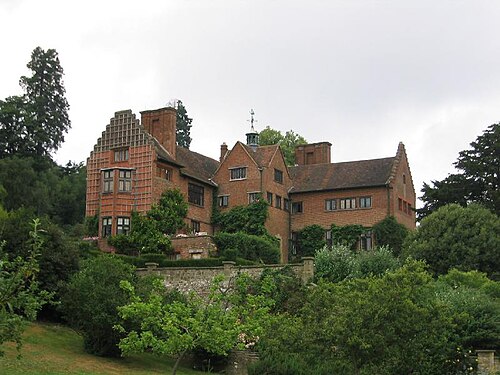
チャーチルは1921年2月に植民地大臣に就任した。[213]翌月、彼の絵画の最初の展覧会がパリで開催され、チャーチルはペンネームで展示した。[213] 5月に母親が亡くなり、続いて8月に娘のマリーゴールドが敗血症で亡くなった。[214]チャーチルは生涯マリーゴールドの死に悩まされた。[215]
チャーチルはシン・フェイン党の指導者との交渉に関わり、英愛条約の起草に協力した。[216]彼は中東占領の費用削減を担当し、[213]イラクのファイサル1世とヨルダンのアブドラ1世の就任に関わった。[217]チャーチルは委任統治領パレスチナを訪れ、シオニズムの支持者として、ユダヤ人の移住を禁止するアラブ系パレスチナ人の請願を拒否した。[218]彼はヤッファ暴動後の一時的な制限を許可した。[219]
1922年9月、チャナク危機が勃発した。トルコ軍がダーダネルス海峡中立地帯を占領すると脅し、チャナクに駐留するイギリス軍が警備していたためである。チャーチル首相とロイド・ジョージ首相はトルコ軍の侵攻に対して軍事的抵抗を支持したが、連立政権の保守党多数派はこれに反対した。政治的な大失敗が起こり、保守党は政府から離脱し、1922年11月の総選挙へとつながった。[24]
また9月には、チャーチルの5番目で最後の子供であるメアリーが生まれ、同月、ケントのチャートウェルを購入し、家族の家となった。[220] 1922年10月、チャーチルは虫垂切除手術を受けた。彼が入院している間に、ロイド・ジョージの連立政権は解散した。総選挙で、チャーチルは禁酒主義者の候補者であるエドウィン・スクリムジョールにダンディーの議席を失った[221]。後に彼は、「役職もなく、議席もなく、政党もなく、虫垂もない」と書いた。[222]彼は、ロイド・ジョージの1922年の解散叙勲者リストに名前が記載されているように、名誉勲章50名の一人に昇格した。 [223]
議会外: 1922–1924

チャーチルはその後の6か月の大半をカンヌ近郊のヴィラ・レーヴ・ドールで過ごし、そこで絵を描いたり回想録を書いたりした。[224]彼は戦争の自伝的歴史書『世界危機』を執筆した。第1巻は1923年4月に出版され、残りはその後10年間にわたって出版された。[221] 1923年の総選挙が呼びかけられた後、7つの自由党協会がチャーチルに立候補を依頼し、チャーチルはレスター・ウェストを候補に選んだが、当選しなかった。[225]ラムゼー・マクドナルド率いる労働党政権が政権を握った。チャーチルは保守党と自由党の連立政権に敗北することを期待していた。[226]彼はマクドナルド政権のソ連への融資決定に強く反対し、英ソ条約の調印を恐れた。[227]
1924年3月、労働党に対する自由党の支持に反発したチャーチルは、ウェストミンスター寺院補欠選挙に反社会主義の無所属候補として立候補したが、敗北した。[228] 5月、チャーチルはリバプールで行われた保守党の集会で演説し、自由党はもはや政治の場にはないと宣言した。彼は、労働党を阻止し「社会主義の敗北」を確実にするために、自由党は保守党を支援しなければならないと述べた。[229] 7月、チャーチルは保守党のリーダーであるスタンリー・ボールドウィンと、10月29日に行われる次回の総選挙で保守党の候補者に選ばれることに同意した。チャーチルはエッピングで立候補したが、自身を「立憲主義者」と称した。[230]保守党が勝利し、ボールドウィンが新政府を樹立した。チャーチルには金融や経済の知識はなかったが、ボールドウィンは彼を財務大臣に任命した。[231]
財務大臣: 1924–1929
1924年11月6日に首相となったチャーチルは、正式に保守党に復帰した。[232]首相として、彼は自由主義経済の形で、自由貿易の原則を、自由党の社会改革の下での自由放任主義経済の形で追求するつもりだった。[232] 1925年4月、彼はジョン・メイナード・ケインズを含む一流の経済学者の助言に反して、物議を醸しながらもしぶしぶ最初の予算で金本位制を1914年の平価に復活させた。[233]金本位制への回帰はデフレとそれに伴う失業を引き起こし、石炭産業に壊滅的な影響を与えたと考えられている。[234]チャーチルは1929年4月までに全部で5つの予算を提出した。彼の措置の中には、国家年金の支給年齢を70歳から65歳に引き下げること、未亡人年金の即時支給、軍事費の削減、所得税の減税、ぜいたく品への課税などがあった。[235]
1926年のゼネストの間、チャーチルは政府の反ストライキ宣伝新聞であるブリティッシュ・ガゼットを編集した。 [236]ストライキ終了後、彼はストライキ中の炭鉱労働者と雇用主の間の仲介役を務めた。彼は法的拘束力のある最低賃金の導入を求めた。[237] 1926年の下院演説で、チャーチルはアイルランド統一の問題について自分の気持ちを明らかにした。彼はアイルランドはアイルランド内で統一されるべきであるが、「大英帝国と統一されるべき」であると述べた。[238] 1927年初頭、チャーチルはローマを訪問し、ムッソリーニと会い、レーニン主義に反対する彼の立場を称賛した。[239]
「荒野の時代」: 1929-1939
マールボロインド問題:1929-1932

1929年の総選挙でチャーチルはエッピングの議席を維持したが、保守党は敗北し、マクドナルドは第2次労働党政権を樹立した。[240]退任後、チャーチルは鬱病(彼の「黒い犬」)にかかりやすくなったが、執筆によってこれに対処した。 [241] 彼は先祖である初代マールバラ公爵ジョン・チャーチルの伝記である『マールバラ:その生涯と時代』の執筆を開始した。 [ 242] [243]彼は大酒飲みという評判を築いていたが、ジェンキンスはそれはしばしば誇張されていると考えている。[244]
労働党政権が打倒されることを期待して、チャーチルは保守党と自由党の連立政権樹立に向けて取り組むことをボールドウィンから承認されたが、多くの自由党員は乗り気ではなかった。[242] 1930年10月、北米旅行から戻った後、チャーチルは自伝『幼少期』を出版し、これは売れ行きがよく、複数の言語に翻訳された。[245] 1931年1月、チャーチルはボールドウィンがインドに自治領の地位を与えるという政府の決定を支持したため、保守党の影の内閣を辞任した。 [246]チャーチルは、自治領の地位が強化されれば、完全独立を求める声が強まると考えていた。[247]彼は特にモハンダス・ガンジーに反対し、ガンジーを「今や行者を装っている、扇動的なミドル・テンプル派の弁護士」とみなしていた。[248]彼の見解は労働党と自由党の世論を激怒させたが、多くの草の根保守党員は彼を支持していた。[249]
1931年10月の総選挙は保守党の圧勝だった。[250]チャーチルはエッピングで多数派をほぼ倍増させたが、大臣の地位は与えられなかった。[251]下院は12月3日にインドの自治領地位を議論し、チャーチルは下院の分割を主張したが、これは裏目に出て、彼を支持する議員は43人しかいなかった。[252]彼はウォール街大暴落で被った経済的損失を取り戻すことを期待して、北米での講演旅行に乗り出した。[ 250] [252] 12月13日、彼はニューヨークの5番街を横断中に車にひかれ、頭部を負傷し、それが神経炎を発症した。[253]彼は回復をさらに進めるためにクレメンタインと共に船でナッソーに3週間滞在したが、チャーチルは経済的、政治的損失に意気消沈した。[254]彼は1932年1月下旬にアメリカに戻り、3月18日に帰国する前に講義のほとんどを終えた。[254]
1932年の大半をマールボロで過ごしたチャーチルは、8月に先祖の戦場を訪れることを決意した。[255]ミュンヘンで、当時台頭しつつあったヒトラーの友人、エルンスト・ハンフシュテングルと会った。ハンフシュテングルはチャーチルとヒトラーの会談を手配しようとしたが、ヒトラーは乗り気ではなかった。「いったい何を話せばいいんだ?」 [256]ブレナム訪問後まもなく、チャーチルはパラチフスに罹り、ザルツブルクの療養所で2週間過ごした。[257]チャーチルは9月25日にチャートウェルに戻り、マールボロでの仕事は続けた。2日後、パラチフスが再発して潰瘍が出血し、倒れた。チャーチルはロンドンの老人ホームに運ばれ、10月下旬までそこにいた。[258]
ドイツと退位危機に関する警告: 1933-1936
1933年1月にヒトラーが政権を握ると、チャーチルはすぐにそのような体制に反対し、イギリス政府が空軍への支出を削減したことに警戒を表明し、ドイツが間もなく空軍生産でイギリスを追い抜くだろうと警告した。[259] [260]高級官僚のデズモンド・モートンとラルフ・ウィグラムから秘密裏に提供されたデータを武器に、チャーチルはドイツで何が起きているか、特にドイツ空軍の発展について、権威を持って語ることができた。[261]彼は1934年11月のラジオ放送でその懸念を語り、[262]下院でナチズの不寛容と軍国主義を非難した。[263]チャーチルはムッソリーニ政権を共産主義革命の脅威に対する防壁とみなしていたが、 [264]エチオピアを原始的で未開の国と表現しながらも、イタリアのエチオピア侵攻には反対した。 [265]彼は亡命中のスペイン国王アルフォンソ13世を尊敬し、スペイン内戦中に共産主義が浸透していくことを恐れていた。彼はフランコの軍隊を「反赤軍」と呼んだが、後にフランコがムッソリーニとヒトラーに近すぎるとして批判的になった。[266] [267]
1933年10月から1938年9月にかけて、 『マールバラの生涯と時代』 4巻が出版され、売れ行きが良かった。[268] 1934年12月、インド法案が議会に提出され、1935年2月に可決された。チャーチルと他の83人の保守党議員はこれに反対票を投じた。[269] 1935年6月、マクドナルドは辞任し、ボールドウィンが首相に就任した。[264]その後、ボールドウィンは1935年の総選挙で保守党を勝利に導き、チャーチルは議席を維持したものの、再び政府から外された。[270] 1936年1月、エドワード8世が父ジョージ5世の跡を継ぎ、君主となった。彼がアメリカ人の離婚歴のあるウォリス・シンプソンと結婚したいという願望が退位危機を引き起こした。[271]チャーチルはエドワードを支持し、この問題でボールドウィンと衝突した。[272]その後、チャーチルはすぐにジョージ6世に忠誠を誓ったものの、退位は「時期尚早であり、おそらく全く不必要だった」と書いた。[273]
反宥和政策: 1937-1939
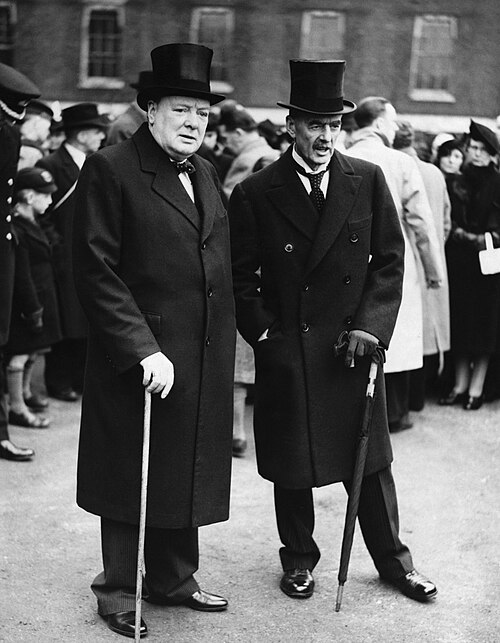
1937年5月、ボールドウィンは辞任し、ネヴィル・チェンバレンが首相に就任した。当初、チャーチルはチェンバレンの任命を歓迎したが、1938年2月、チェンバレンのムッソリーニ宥和政策をめぐってアンソニー・イーデン外相が辞任したことで事態は頂点に達した。 [274]チェンバレンはヒトラーに対してもこの政策を拡大していた。[275] 1938年、チャーチルは政府に宥和政策に反対し、ドイツの侵略を阻止するための集団行動を求めた。[276] [277]アンシュルスの後、チャーチルは下院で次のように演説した。
広大な領土と富を持ちながら防衛が怠られている我が国は、戦争の恐ろしさを誇張したり、平和主義を主張し続けたり、他の場所での侵略の犠牲者の運命を無視したりしても、戦争を避けることはできません。現状では、侵略者に対する抑止力を蓄積することによってのみ、戦争を回避できるでしょう。
— [278]
彼は、ドイツの拡張主義に脅かされているヨーロッパ諸国間の相互防衛協定を呼びかけ始め、これがヒトラーを阻止する唯一の方法であると主張した。[279] 9月、ドイツはチェコスロバキアのズデーテン地方に侵攻するために動員された。 [280]チャーチルはチェンバレンを訪問し、ドイツがチェコスロバキア領に侵攻した場合、英国は宣戦布告するとドイツに伝えるよう促したが、チェンバレンはこれに応じなかった。[281] 9月30日、チェンバレンはミュンヘン協定に署名し、ドイツによるズデーテン地方の併合を認めた。10月5日、下院で演説したチャーチルは、この協定を「完全かつ完全な敗北」と呼んだ。 [282] [283] [284] 1939年3月のチェコスロバキアの分割後、チャーチルと彼の支持者は国家連合の設立を求めた。その結果、彼の人気は高まった。[24]
海軍大臣: 1939年9月から1940年5月
まやかしの戦争とノルウェー戦役
1939年9月3日、イギリスがドイツに宣戦布告した日に、チェンバレンはチャーチルを海軍大臣に再任し、彼はチェンバレンの戦時内閣に加わった。[285]チャーチルはいわゆる「まやかし戦争」で最も注目を集めた大臣だった。チャーチルは1939年12月13日のラプラタ沖海戦の後、意気揚々と乗組員を帰国させ、「素晴らしい海戦」を祝福した。[286] 1940年2月16日、チャーチルは駆逐艦 コサックのフィリップ・ヴィアン艦長に、ノルウェー海域でドイツの補給船アルトマルクに乗り込み、アドミラル・グラーフ・シュペーに捕らえられていた299人のイギリス商船員を解放するよう命じた。これらの行動と演説により、チャーチルの評判は高まった。[286]彼はバルト海でのドイツ海軍の活動を懸念し、海軍部隊を派遣したいと考えていたが、これはすぐにウィルフレッド作戦というコードネームの計画に変更され、ノルウェーの海域に機雷を敷設し、ナルビクからドイツへの鉄鉱石の輸送を阻止することとなった。[287]意見の相違により、ウィルフレッド作戦は1940年4月8日、ドイツがノルウェーに侵攻する前日まで延期された。[288]
ノルウェー論争とチェンバレンの辞任

連合国がドイツによるノルウェー占領を阻止できなかった後、下院は5月7日から9日にかけて政府の戦争遂行に関する討論を行った。これはノルウェー討論として知られるようになり、議会史上最も重要な出来事の一つとなった。[289] 2日目、野党労働党は事実上チェンバレン政権に対する不信任投票である採決を要求した。 [290]討論を終わらせるようチャーチルに求められたが、彼は自分の威信を傷つけずに政府を擁護しなければならないという難しい立場に置かれた。[291]政府は投票に勝ったが、国民政府を求める声の中でその過半数は大幅に減少した。[292]
5月10日早朝、ドイツ軍はフランス攻撃の前触れとしてベルギー、ルクセンブルク、オランダに侵攻した。[293]分裂投票以来、チェンバレンは連立政権を組もうとしていたが、労働党は金曜日に、別の保守党員を受け入れるものの、チェンバレンの指導の下では働かないと宣言した。候補者はチャーチルと外務大臣のハリファックス卿の2人だけだった。この問題は、9日のチェンバレン、ハリファックス、チャーチル、政府院内総務のデイヴィッド・マーゲソンの会合ですでに議論されていた。[293]ハリファックスは貴族院議員として効果的に統治できないことを認めたため、チェンバレンはチャーチルを国王に呼び寄せるよう助言し、チャーチルは首相となった。[294]チャーチルは後に、今や自分が全情勢を掌握したので深い安堵感を覚えたと書いている。彼は、これまでの人生は「この時とこの裁判のための準備」だったと信じていた。[295] [296] [297]
首相: 1940–45
ダンケルクから真珠湾まで:1940年5月から1941年12月

戦争省が創設
5月、チャーチルは多くの保守党員と労働党の大半からまだ不人気だった。[298]チェンバレンは10月まで保守党党首の座にとどまった。その時までにはチャーチルは懐疑派を納得させており、後継者は形式的なものとなった。[299]彼は首相職に就くとすぐに戦時内閣を組織した。チェンバレンが枢密院議長、労働党党首のクレメント・アトリーが国璽尚書(後に副首相)、ハリファックスが外務大臣、労働党のアーサー・グリーンウッドが無任所大臣に就任した。実際には、この5人に加えて軍の最高司令官と大臣がほとんどの会議に出席した。[300] [301]戦争の進展に伴い内閣の規模と構成が変わったが、労働組合運動の指導者 アーネスト・ベヴィンが労働・国家奉仕相に任命されたのは重要な人事であった。[302]批判に応えて、チャーチルは国防大臣の地位を創設して就任し、歴史上最も強力な戦時首相となった。[303]彼は、特に国内戦線で重要な役割を果たすために外部の専門家を政府に招集した。その中には、ビーバーブルック卿や政府の科学顧問となったフレデリック・リンデマンなどの友人も含まれていた。 [304]
戦い続ける決意
5月末、イギリス海外派遣軍がダンケルクに撤退し、フランスの陥落が差し迫る中、ハリファックスは、政府は依然として中立の立場にあるムッソリーニを仲介役として和平交渉を模索すべきだと提案した。5月26日から28日にかけて、フランスの首相ポール・レイノーを含む高官級会議が行われた。[305]チャーチルは、たとえフランスが降伏しても戦い続けると決意していたが、チェンバレンが彼を支持すると決心するまで、彼の立場は不安定なままだった。チャーチルは2人の労働党員から全面的な支持を得ていたが、チェンバレンとハリファックスの両者が反対すれば首相の座を維持できないことは分かっていた。チャーチルは、外閣の支持を得てハリファックスを出し抜き、チェンバレンの支持を獲得した。[306]
チャーチルは、幼少期から言語障害を抱えていたにもかかわらず、演説家として成功した。彼は舌足らずで、sの文字を発音できず、スラーで発音していた。[307]彼は、歯擦音の「s」の問題を解消するためのフレーズを繰り返して発音の練習をした。彼は最終的に成功し、障害を強みに変えた。例えば、ヒトラーをナチス (「ts」) ではなく「Nar-zee」(「khazi」と韻を踏む、「z」を強調) と呼んだ。[308] 5月13日に下院で行われた首相としての最初の演説は、「血と労苦と涙と汗」の演説だった。[309]チャーチルは、長い道のりが待ち受けており、勝利が最終目標であることを国民に明らかにした。[310] [311]
議会に申し上げたいのは、私が提供できるのは血と労苦と涙と汗だけだということです。私たちは最も悲惨な試練に直面しています。私たちの政策は何かとお尋ねでしょう。私はこう答えます。海、陸、空で、全力と神が与えてくださるすべての力で戦争を遂行することです。人間の犯罪の暗く嘆かわしいリストの中でも、これを上回るものがない、恐ろしい暴政に対して戦争を遂行することです。それが私たちの政策です。私たちの目標は何かとお尋ねでしょう。私は一言で答えることができます。それは勝利です。どんな犠牲を払ってでも勝利し、どんな恐怖にも負けずに勝利し、道がどんなに長く困難であろうとも勝利することです。勝利なしには生き残ることはできません。
チャーチルのレトリックの使用は平和的解決に対する世論を硬化させた。ジェンキンスはチャーチルの演説は「国家にとってのインスピレーションであり、チャーチル自身にとってのカタルシスであった」と述べている。 [312]
ダイナモ作戦とフランスの戦い
ダンケルク撤退作戦は、連合軍兵士338,226名が6月4日にフランス軍後衛部隊が降伏したことにより終了した。撤退した兵士の総数は予想をはるかに上回り、ダンケルクは奇跡であり、勝利であったという世論が高まった。[313]チャーチル自身も、その日の午後に下院で行った「我々は海岸で戦う」演説で「救出の奇跡」に言及した。演説は反抗的な調子で終わり、米国への明確な訴えがあった。[314] [315]
我々は最後まで戦い続ける。フランスで戦い、海で戦い、自信を深め、空中で力強く戦う。いかなる犠牲を払おうとも、我々は我が島を守る。海岸で戦い、上陸地で戦い、野原や街路で戦い、丘で戦う。我々は決して降伏しない。たとえ、この島、あるいはその大部分が征服され飢えに苦しむなどとは一瞬たりとも信じないが、海の向こうにある我が帝国は英国艦隊に武装・守られ、戦いを続けるだろう。神の思し召しにより、新世界が全力で旧世界の救出と解放に踏み出すまで。
翌日、ドイツはフランスで秋季敗戦を開始し、イタリアは10日に参戦した。 [316]ドイツ国防軍は14日にパリを占領し、6月25日にフランス征服を完了した。[317]ヒトラーが攻撃し、おそらくはイギリスに侵攻しようとするのは避けられなかった。これに直面したチャーチルは、6月18日に下院で彼の最も有名な演説の一つを行い、次の結論で締めくくった。[318] [319] [320]
ウェイガン将軍が「フランスの戦い」と呼んだものは終わった。イギリスの戦いがもうすぐ始まると私は予想している。ヒトラーは、この島で我々を打ち破らなければ戦争に負けるだろうと知っている。だから我々は義務に身を固め、イギリス連邦と帝国が1000年続いたとしても、人々が「これは彼らの最も輝かしい時代だった」と言うように振る舞おう。
チャーチルは6月11日、イタリアの宣戦布告に応じて西部砂漠作戦の開始を命じた。イタリアが唯一の敵でありコンパス作戦が成功した間は、当初はうまくいった。しかし、1941年初頭、ムッソリーニはドイツに支援を要請した。ヒトラーは、チャーチルがコンパス作戦を中止して間もなく到着したエルヴィン・ロンメル中将率いるアフリカ軍団をトリポリに派遣し、バルカン半島作戦が重大な局面を迎えていたギリシャに軍を再配置した。[321]
1940年6月から7月にかけてのその他の取り組みとして、チャーチルは特殊作戦執行部(SOE)とコマンド部隊の編成を命じた。SOEはナチス占領下のヨーロッパで破壊活動を推進し実行するよう命じられ、コマンド部隊はそこでの軍事目標への襲撃を任された。ヒュー・ダルトン経済戦争大臣はSOEの政治的責任を引き受け、チャーチルが彼に「さあ、ヨーロッパを燃やしに行け」と言ったことを記録した。[322]
イギリス空襲と電撃戦

1940年8月20日、イギリス空襲の真っ最中、チャーチルは下院で状況を概説した。演説の途中で、彼は戦闘に参加したイギリス空軍の戦闘機パイロットの有名なニックネームを生み出す発言をした。 [323] [324]
罪を犯した人々の住居を除く、わが島、わが帝国、そして世界中のすべての家庭は、困難にもひるまず、絶え間ない挑戦と命がけの危険にも疲れることなく、その勇敢さと献身によって世界大戦の流れを変えている英国空軍兵に感謝の意を表します。人類の戦争の分野で、これほど多くの人々がこれほど少数の人々にこれほど恩義を感じたことはかつてありませんでした。
ドイツ空軍は1940年9月7日から戦略を変更し、 10月から11月にかけて集中的な電撃攻撃を開始した。チャーチルの士気は高く、11月に私設秘書のジョン・コルヴィルに侵攻の脅威は去ったと考えていると伝えた。[325]彼は生産力の増加を考えるとイギリスが持ちこたえられると確信していたが、アメリカの介入なしに戦争に勝つ可能性については現実的だった。[326]
レンドリース
1940年9月、英国と米国政府は駆逐艦と基地の交換協定を締結し、50隻の米国駆逐艦が英国海軍に移管される代わりに、バミューダ、カリブ海、ニューファンドランドの米国基地の権利が無償で与えられた。英国にとってのさらなる利点は、これらの基地の軍事資産を他の場所に再配置できることだった。[327]チャーチルとフランクリン・D・ルーズベルト大統領の良好な関係は、北大西洋航路を介して重要な食糧、石油、軍需品を確保するのに役立った。[328]ルーズベルトが1940年に再選されたとき、チャーチルが安堵したのはこのためだった。ルーズベルトは、金銭の支払いを必要とせずに英国に必需品を供給する新しい方法の実施に着手した。彼は、この高額なサービスの返済は米国防衛の形を取ると議会を説得した。この政策はレンドリースとして知られ、1941年3月11日に正式に制定された。[329]
バルバロッサ作戦

ヒトラーは1941年6月22日にソ連侵攻を開始した。チャーチルは4月からブレッチリー・パークのエニグマ暗号解読から攻撃が差し迫っていることを知っていた。チャーチルはモスクワ大使スタッフォード・クリップスを通じてヨシフ・スターリンに警告しようとしたが、スターリンはチャーチルを信用しなかった。攻撃前夜、チャーチルは国民に向けて演説を行うつもりで、コルヴィルに「ヒトラーが地獄を侵略したとしても、私は少なくとも悪魔について好意的な発言をするだろう」と述べて、これまでの反共産主義的見解をほのめかした。[330]
大西洋憲章
1941年8月、チャーチルは戦時中初の大西洋横断をHMS プリンス・オブ・ウェールズ号で行い、ニューファンドランド島のプラセンティア湾でルーズベルト大統領と会談した。8月14日、両者は大西洋憲章として知られる共同声明を発表した。[331]これは世界の将来に対する両国の目標を概説したものであり、1945年に設立された国連の基盤となった1942年の国際連合宣言のインスピレーションとなったと考えられている。 [332]
真珠湾攻撃からノルマンディー上陸作戦まで: 1941年12月から1944年6月
真珠湾攻撃とアメリカの参戦
1941年12月、日本軍は真珠湾攻撃に続いてマレー半島に侵攻し、8日、チャーチルは日本に宣戦布告した。対潜水艦作戦にアイルランドの港を利用する希望から、チャーチルはアイルランドのエアモン・デ・ヴァレラ首相に電報を送り、遠回しにアイルランドの団結を勧めた。「今がチャンスだ。今しかない!国家をもう一度!あなたが望むところで会おう」。会談は行われず、返答の記録もない。[333]チャーチルはアルカディア会談のためにワシントンに行き、ルーズベルトと会談した。これは「ヨーロッパ第一」、つまりチャーチルがまだ中部大西洋岸にいる間にルーズベルトが下した、太平洋での勝利よりもヨーロッパでの勝利を優先するという決定にとって重要だった。アメリカ人は、ヒトラーが主敵であり、ドイツを倒すことが連合国の成功の鍵であるという点でチャーチルに同意した。[334]また、最初の英米共同攻撃はフランス領北アフリカ侵攻であるトーチ作戦とすることで合意された。当初は1942年春に計画されていたが、1942年11月、決定的な第二次エル・アラメインの戦いが進行中だったときに開始された。[335]
12月26日、チャーチルは米国議会の合同会議で演説したが、その夜、主治医のチャールズ・ウィルソン卿から数週間の安静を要する冠状動脈不全症と診断された心臓発作を起こした。チャーチルは安静の必要はないと主張し、列車でオタワに行き、カナダ議会で演説を行った。演説では「鶏もいれば首もある」という一節があり、1940年にフランスが「イギリスだけが鶏のように首を絞められるだろう」と予言したことを思い出した。[336]政府首脳による初の大西洋横断飛行でバミューダからプリマスまで飛び、1月中旬に帰国したチャーチルは、政府とチャーチル自身に対する信頼の危機に直面した。[337]チャーチルは下院での信任投票に臨むことを決意し、簡単に勝利した。[338]
彼が留守の間、トブルクの包囲を解いた第8軍は、リビアのロンメル軍に対するクルセイダー作戦を遂行し、キレナイカのエル・アゲイラの防衛陣地までロンメル軍を追い返すことに成功した。しかし、1942年1月21日、ロンメルは奇襲攻撃を仕掛け、連合軍をガザラまで追い返した。一方、大西洋の戦いにおけるイギリスの勝利は、ドイツ海軍がM4 4ローター・エニグマを導入したことで危うくなった。その信号は、ブレッチリー・パークで1年近く解読できなかった。[339]ワシントンでの記者会見で、チャーチルは、日本軍の進撃を考えるとシンガポールの安全保障に対する疑問が高まっていることを控えめに表現せざるを得なかった。[340]
シンガポールの陥落とビルマの喪失
チャーチルはノルウェー、フランス、ギリシャ、クレタ島での敗北後、すでにイギリス軍の質について深刻な懸念を抱いていた。[341] 1942年2月15日にシンガポールが日本軍に陥落した後、彼は自分の懸念が確証されたと感じ、「これはイギリス軍史上最悪の惨事であり、最大の降伏だ」と述べた。[342] 2月11日、ドイツ海軍は大胆な「海峡突破」を成功させ、イギリス海軍の威信に多大な打撃を与えた。これらの出来事の複合的な影響により、チャーチルの士気は戦争中最低の水準に落ち込んだ。[341]
ベンガル飢饉
一方、日本軍は1942年4月末までにビルマの大半を占領した。反撃はモンスーンシーズンとベンガルとビハールの混乱、そして1942年10月にこの地域を壊滅させた激しいサイクロンによって妨げられた。ビルマからの重要な米の輸入削減、行政の不備、戦時中のインフレ、洪水や作物の病気などの大規模な自然災害などの要因が重なり、1943年のベンガル飢饉[343]が発生し、推定210万〜380万人が死亡した[344]。
From December 1942, food shortages had prompted senior officials to ask London for grain imports, although the colonial authorities failed to recognise the seriousness of the famine and responded ineptly.[345] Churchill's government was criticised for refusing to approve more imports, a policy it ascribed to an acute shortage of shipping.[346] When the British realised the full extent of the famine in September 1943, Churchill ordered the transportation of 130,000 tons of grain and the cabinet agreed to send 200,000 tons by the end of the year.[347][348] During the last quarter of 1943, 100,000 tons of rice and 176,000 tons of wheat were imported, compared to averages of 55,000 and 54,000 tons respectively earlier in the year.[349]
In October, Churchill wrote to the Viceroy of India, Lord Wavell, charging him with the responsibility of ending the famine.[347] In February 1944, as preparation for Operation Overlord placed greater demands on Allied shipping, Churchill cabled Wavell saying: "I will certainly help you all I can, but you must not ask the impossible".[348] Grain shipment requests continued to be turned down by the government throughout 1944, and Wavell complained to Churchill in October that "the vital problems of India are being treated by His Majesty's Government with neglect, even sometimes with hostility and contempt".[346][350] The impact of British policies on the famine death toll remains controversial.[351]
International conferences in 1942

On 20 May 1942, the Soviet Foreign minister, Vyacheslav Molotov, arrived in London to sign a treaty of friendship. Molotov wanted it done on the basis of territorial concessions regarding Poland and the Baltic countries. Churchill and Eden worked for a compromise and a twenty-year treaty was formalised, with the question of frontiers placed on hold. Molotov also sought a Second Front in Europe; Churchill confirmed preparations were in progress and made no promises on a date.[352]
Churchill felt pleased with these negotiations.[353] However, Rommel had launched his counter-offensive, Operation Venice, to begin the Battle of Gazala on 26 May.[353] The Allies were driven out of Libya and suffered a defeat in the fall of Tobruk on 21 June. Churchill was with Roosevelt when the news reached him, and was shocked by the surrender of 35,000 troops which was, apart from Singapore, "the heaviest blow" he received in the war.[354] The Axis advance was halted at the First Battle of El Alamein in July and the Battle of Alam el Halfa in September. Both sides were exhausted and in need of reinforcements and supplies.[355]
Churchill returned to Washington on 17 June. He and Roosevelt agreed on the implementation of Operation Torch as the necessary precursor to an invasion of Europe. Roosevelt had appointed General Dwight D. Eisenhower as commanding officer of the European Theater of Operations, United States Army (ETOUSA). Having received the news from North Africa, Churchill obtained shipment from America to the Eighth Army of 300 Sherman tanks and 100 howitzers. He returned to Britain on 25 June and had to face another motion of no confidence, this time in his direction of the war, but again he won easily.[356]
In August, despite health concerns, Churchill visited British forces in North Africa, raising morale, en route to Moscow for his first meeting with Stalin. He was accompanied by Roosevelt's special envoy Averell Harriman.[357] He was in Moscow 12–16 August and had lengthy meetings with Stalin. Though they got along well personally, there was little chance of real progress given the state of the war. Stalin was desperate for the Allies to open the Second Front in Europe, as Churchill had discussed with Molotov in May, and the answer was the same.[358]
El Alamein and Stalingrad
While he was in Cairo in August, Churchill appointed Field Marshal Alexander as Field Marshal Auchinleck's successor as Commander-in-Chief of the Middle East Theatre. Command of the Eighth Army was given to General William Gott but he was shot down and killed while flying to Cairo, and General Montgomery succeeded him.[359]
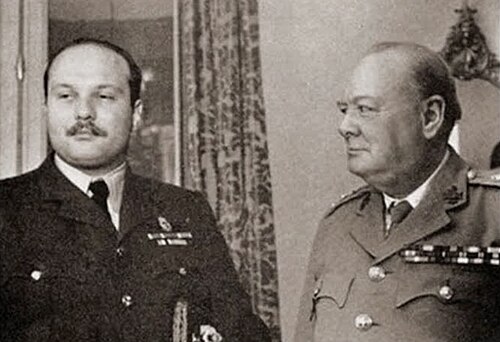
As 1942 drew to a close, the tide of war began to turn with Allied victories in El Alamein and Stalingrad. Until November, the Allies had been on the defensive, but afterwards, the Germans were. Churchill ordered church bells to be rung throughout Great Britain for the first time since 1940.[359] On 10 November, knowing El Alamein was a victory, he delivered one of his most memorable speeches at Mansion House in London: "This is not the end. It is not even the beginning of the end. But it is, perhaps, the end of the beginning".[359]
International conferences in 1943

In January 1943, Churchill met Roosevelt at the Casablanca Conference. It was attended by General Charles de Gaulle from the Free French Forces. Stalin had hoped to attend but declined because of Stalingrad. Although Churchill expressed doubts on the matter, the so-called Casablanca Declaration committed the Allies to securing "unconditional surrender".[360][361] From Morocco, Churchill went to Cairo, Adana, Cyprus, Cairo again and Algiers. He arrived home on 7 February having been out of the country for a month. He addressed the Commons on the 11th and became seriously ill with pneumonia the following day, necessitating more than a month of convalescence: he moved to Chequers. He returned to work in London on 15 March.[362]
Churchill made two transatlantic crossings during the year, meeting Roosevelt at the third Washington Conference in May and the first Quebec Conference in August.[363] In November, Churchill and Roosevelt met Chinese Generalissimo Chiang Kai-shek at the Cairo Conference.[364] The most important conference of the year was 28 November to 1 December at Tehran, where Churchill and Roosevelt met Stalin in the first of the "Big Three" meetings, preceding those at Yalta and Potsdam. Roosevelt and Stalin co-operated in persuading Churchill to commit to opening of second front in western Europe and it was agreed Germany would be divided after the war, but no decisions were made about how.[365] On their way back, Churchill and Roosevelt held a Second Cairo Conference with Turkish president İsmet İnönü, but were unable to gain commitment from Turkey to join the Allies.[366]
Churchill went to Tunis, arriving on 10 December, initially as Eisenhower's guest (soon afterwards, Eisenhower took over as Supreme Allied Commander of the new SHAEF). Churchill became seriously ill with atrial fibrillation and was forced to remain in Tunis, until after Christmas while specialists were drafted in to ensure recovery. Clementine and Colville arrived to keep him company; Colville had just returned to Downing Street after two years in the RAF. On 27 December, the party went on to Marrakesh for convalescence. Feeling much better, Churchill flew to Gibraltar on 14 January 1944 and sailed home on the King George V. He was back in London on 18 January and surprised MPs by attending Prime Minister's Questions in the Commons. Since 12 January 1943, when he set off for Casablanca, Churchill had been abroad or seriously ill for 203 of the 371 days.[367]
Invasions of Sicily and Italy

In the autumn of 1942, after Churchill's meeting with Stalin, he was approached by Eisenhower, commanding the North African Theater of Operations, US Army (NATOUSA), and his aides on the subject of where the Western Allies should launch their first strike in Europe. According to General Mark W. Clark, the Americans admitted a cross-Channel operation in the near future was "utterly impossible". As an alternative, Churchill recommended "slit(ting) the soft belly of the Mediterranean" and persuaded them to invade Sicily and then mainland Italy, after they had defeated the Afrika Korps. After the war, Clark still agreed Churchill's analysis was correct, but added that, when the Allies landed at Salerno, they found Italy was "a tough old gut".[368]
The invasion of Sicily began on 9 July and was completed by 17 August. Churchill was not keen on Overlord as he feared an Anglo-American army in France might not be a match for the fighting efficiency of the Wehrmacht. He preferred peripheral operations, including a plan called Operation Jupiter for an invasion of Norway.[369] Events in Sicily had an unexpected impact in Italy. King Victor Emmanuel sacked Mussolini on 25 July and appointed Marshal Badoglio as prime minister. Badoglio opened negotiations with the Allies which resulted in the Armistice of Cassibile on 3 September. In response, the Germans activated Operation Achse and took control of most of Italy.[370]
Although he still preferred Italy to Normandy as the Allies' main route into the Third Reich, Churchill was concerned about the strong German resistance at Salerno and, after the Allies successfully gained their bridgehead at Anzio but still failed to break the stalemate, he caustically said that instead of "hurling a wildcat onto the shore", the Allied force had become a "stranded whale".[371][372] The big obstacle was Monte Cassino and it was not until May 1944 when it was finally overcome, enabling the Allies to advance on Rome, which was taken on 4 June.[373]
Preparations for D-Day

The difficulties in Italy caused Churchill to change heart about strategy; when the Anzio stalemate developed after his return to England from North Africa, he threw himself into the planning of Overlord and set up meetings with SHAEF and the British Chiefs of Staff. These were attended by Eisenhower or his chief of staff General Walter Bedell Smith. Churchill was especially taken by the Mulberry harbours, but was keen to make the most of Allied airpower which by 1944, had become overwhelming.[373] Churchill never lost his apprehension about the invasion, and underwent mood fluctuation as D-Day approached. Jenkins says he faced potential victory with much less buoyancy than when he defiantly faced the prospect of defeat four years earlier.[374]
Need for post-war reform
Churchill could not ignore the need for post-war reforms. The Beveridge Report with its five "Giant Evils" was published in November 1942 and assumed great importance amid popular acclaim.[375] Even so, Churchill spent most of his focus on the war, and saw reform in terms of tidying up. His attitude was demonstrated in a radio broadcast on 26 March 1944. He was obliged to devote most of it to reform and showed a distinct lack of interest. Colville said Churchill had broadcast "indifferently" and Harold Nicolson said that, to many people, Churchill came across the air as "a worn and petulant old man".[376] In the end, however, it was demand for reform that decided the 1945 general election. Labour was perceived as the party that would deliver Beveridge. Attlee, Bevin and Labour's other coalition ministers, were seen as working towards reform and earned the trust of the electorate.[377][378]
Defeat of Germany: June 1944 to May 1945

D-Day: Allied invasion of Normandy
Churchill was determined to be actively involved in the Normandy invasion and hoped to cross the Channel on D-Day (6 June 1944) or at least D-Day+1. His desire caused unnecessary consternation at SHAEF, until he was effectively vetoed by the King. Churchill expected an Allied death toll of 20,000 on D-Day but fewer than 8,000 died in all of June.[379] He made his first visit to Normandy on 12 June to visit Montgomery, whose HQ was five miles inland. That evening, as he was returning to London, the first V-1 flying bombs were launched. On 22–23 July, Churchill went to Cherbourg and Arromanches where he saw the Mulberry Harbour.[380]
Quebec Conference, September 1944
Churchill met Roosevelt at the Second Quebec Conference in September 1944. They reached agreement on the Morgenthau Plan for the Allied occupation of Germany, the intention of which was not only to demilitarise, but de-industrialise. Eden opposed it and was able to persuade Churchill to disown it. US Secretary of State Cordell Hull opposed it and convinced Roosevelt it was infeasible.[381]
Moscow Conference, October 1944
At the fourth Moscow conference in October 1944, Churchill and Eden met Stalin and Molotov. This conference has gained notoriety for the so-called "Percentages agreement" in which Churchill and Stalin effectively agreed the post-war fate of the Balkans.[382] By then, the Soviet armies were in Rumania and Bulgaria. Churchill suggested a scale of predominance throughout the whole region so as not to, as he put it, "get at cross-purposes in small ways".[383] He wrote down some suggested percentages of influence per country and gave it to Stalin who ticked it. The agreement was that Russia would have 90% control of Romania and 75% control of Bulgaria. The United Kingdom and United States would have 90% control of Greece. Hungary and Yugoslavia would be 50% each.[384] In 1958, five years after the account of this meeting was published (in The Second World War), Soviet authorities denied Stalin had accepted such an "imperialist proposal".[382]
Yalta Conference, February 1945
_(B&W).jpg/500px-Yalta_Conference_(Churchill,_Roosevelt,_Stalin)_(B&W).jpg)
From 30 January to 2 February 1945, Churchill and Roosevelt met for their Malta Conference ahead of the second "Big Three" event at Yalta from 4 to 11 February.[385] Yalta had massive implications for the post-war world. There were two predominant issues: the question of setting up the United Nations Organisation, on which much progress was made; and the more vexed question of Poland's post-war status, which Churchill saw as a test case for Eastern Europe.[386] Churchill faced criticism for the agreement on Poland. For example, 27 Tory MPs voted against him when the matter was debated in the Commons at the end of the month. Jenkins, however, maintains that Churchill did as well as possible in difficult circumstances, not least the fact that Roosevelt was seriously ill and could not provide Churchill with meaningful support.[387]
Another outcome of Yalta was the so-called Operation Keelhaul. The Western Allies agreed to the forcible repatriation of all Soviet citizens in the Allied zones, including prisoners of war, to the Soviet Union and the policy was later extended to all Eastern European refugees, many of whom were anti-Communist. Keelhaul was implemented between August 1946 and May 1947.[388][389]
Area bombing controversy

On the nights of 13–15 February 1945, 1,200 British and US bombers attacked Dresden, which was crowded with wounded and refugees from the Eastern Front.[390][391] The attacks were part of an area bombing campaign initiated by Churchill in January with the intention of shortening the war.[392] Churchill came to regret the bombing because initial reports suggested an excessive number of civilian casualties close to the end of the war, though an independent commission in 2010 confirmed a death toll of about 24,000.[393] On 28 March, he decided to restrict area bombing[394] and sent a memo to General Ismay for the Chiefs of Staff Committee:[395][396]
The destruction of Dresden remains a serious query against the conduct of Allied bombing..... I feel the need for more precise concentration upon military objectives..... rather than on mere acts of terror and wanton destruction, however impressive.
Historian Frederick Taylor has pointed out that the number of Soviets who died from German bombing was roughly equivalent to the number of Germans who died from Allied raids.[397] Jenkins asks if Churchill was moved more by foreboding than by regret but admits it is easy to criticise with the hindsight of victory. He adds that the area bombing campaign was no more reprehensible than President Truman's use of the second atomic bomb on Nagasaki six months later.[394] Andrew Marr, quoting Max Hastings, says that Churchill's memo was a "calculated political attempt...to distance himself...from the rising controversy surrounding the area offensive".[396]
VE Day (Victory in Europe Day)

On 7 May 1945 at the SHAEF headquarters in Reims the Allies accepted Germany's surrender. The next day was Victory in Europe Day (VE Day) when Churchill broadcast to the nation that Germany had surrendered and that a final ceasefire would come into effect at one minute past midnight that night.[398] Churchill went to Buckingham Palace where he appeared on the balcony with the Royal Family before a huge crowd of celebrating citizens. He went from the palace to Whitehall where he addressed another large crowd: "God bless you all. This is your victory. In our long history, we have never seen a greater day than this. Everyone, man or woman, has done their best".[399]
He asked Bevin to come forward and share the applause. Bevin said: "No, Winston, this is your day", and proceeded to conduct the people in the singing of "For He's a Jolly Good Fellow".[399] In the evening, Churchill made another broadcast correctly asserting that the defeat of Japan would follow in the coming months.[400]
Later in the month France attempted to put down a nationalist uprising in the Syria. Churchill intervened and on 31 May gave de Gaulle an ultimatum to desist, but this was ignored. In what became known as the Levant Crisis, British forces from Transjordan were mobilised to restore order. The French, outnumbered, had no option but to return to their bases. De Gaulle felt humiliated, and a diplomatic row broke out - Churchill reportedly told a colleague that de Gaulle was "a great danger to peace and for Great Britain".[401]
Operation Unthinkable
In May 1945, Winston Churchill commissioned the Chiefs of Staff Committee to provide its thoughts on a possible military campaign against the USSR, code-named Operation Unthinkable.[402] One plan involved a surprise attack on Soviet troops stationed in Germany to impose "the will of the United States and the British Empire" on the Soviets.[403] The hypothetical start date for the Allied invasion of Soviet-held Europe was set for 1 July 1945.[403]
Caretaker government: May 1945 to July 1945
With a general election looming, and with Labour ministers refusing to continue the coalition, Churchill resigned as prime minister on 23 May 1945. Later that day, he accepted the King's invitation to form a new government, known officially as the National Government but sometimes called the caretaker ministry. It contained Conservatives, National Liberals and a few non-party figures such as Sir John Anderson and Lord Woolton, but not Labour or Archibald Sinclair's Official Liberals. Churchill was formally reappointed on 28 May.[404][405]
Potsdam Conference
_speaks_with_Soviet_Prime_Minister_Josef_Stalin_(at_left)_and_British_Prime_Minister_Winston..._-_NARA_-_198775.jpg/500px-President_Truman_(center)_speaks_with_Soviet_Prime_Minister_Josef_Stalin_(at_left)_and_British_Prime_Minister_Winston..._-_NARA_-_198775.jpg)
Churchill was Great Britain's representative at the Potsdam Conference when it opened on 17 July and was accompanied at its sessions by Eden and Attlee. They attended nine sessions in nine days before returning to England for their election counts. After the landslide Labour victory, Attlee returned with Bevin as the new Foreign Secretary and there were five days of discussion.[406] Potsdam went badly for Churchill. Eden later described his performance as "appalling", saying he was unprepared and verbose. Churchill upset the Chinese, exasperated the Americans and was easily led by Stalin, whom he was supposed to be resisting.[407]
General election, July 1945
Churchill mishandled the election campaign by resorting to party politics and trying to denigrate Labour.[408] On 4 June, he committed a serious gaffe by saying in a radio broadcast that a Labour government would require "some form of Gestapo" to enforce its agenda.[409][410] It backfired and Attlee made political capital by saying in his reply broadcast next day: "The voice we heard last night was that of Mr Churchill, but the mind was that of Lord Beaverbrook". Jenkins says that this broadcast was "the making of Attlee".[411]
Although polling day was 5 July, the results did not become known until 26 July, owing to the need to collect votes of those serving overseas. Clementine and daughter Mary had been at the count in Woodford, Churchill's new constituency, and had returned to Downing Street to meet him for lunch. Churchill was unopposed by the major parties in Woodford, but his majority over a sole independent candidate was much less than expected. He anticipated defeat by Labour and Mary later described the lunch as "an occasion of Stygian gloom".[412][413] To Clementine's suggestion that defeat might be "a blessing in disguise", Churchill retorted: "At the moment it seems very effectively disguised".[412]
That afternoon Churchill's doctor Lord Moran commiserated with him on the "ingratitude" of the public, to which Churchill replied: "I wouldn't call it that. They have had a very hard time".[413] Having lost, despite enjoying personal support amongst the population, he resigned as prime minister and was succeeded by Attlee who formed the first majority Labour government.[414][415][416][417] Many reasons have been given for Churchill's defeat, key being a widespread desire for reform and that the man who had led Britain in war was not seen as the man to lead in peace.[418][419] Although the Conservative Party was unpopular, many electors appear to have wanted Churchill to continue as prime minister whatever the outcome, or to have wrongly believed this would be possible.[420]
Leader of the Opposition: 1945–1951
"Iron Curtain" speech

Churchill continued to lead the Conservative Party and served as Leader of the Opposition. In 1946, he was in America from early January to late March.[421] It was on this trip he gave his "Iron Curtain" speech about the USSR and its creation of the Eastern Bloc.[422] Speaking on 5 March 1946 in the company of President Truman at Westminster College in Fulton, Missouri, Churchill declared:[423]
From Stettin in the Baltic to Trieste in the Adriatic, an Iron Curtain has descended across the continent. Behind that line lie all the capitals of the ancient states of Central and Eastern Europe. Warsaw, Berlin, Prague, Vienna, Budapest, Belgrade, Bucharest and Sofia, all these famous cities and the populations around them lie in what I must call the Soviet sphere.
His view was that, though the Soviet Union did not want war with the western Allies, its entrenched position in Eastern Europe had made it impossible for the three great powers to provide the world with a "triangular leadership". Churchill's desire was much closer collaboration between Britain and America. Within the same speech, he called for "a special relationship between the British Commonwealth and Empire and the United States",[423] but emphasised the need for co-operation within the framework of the United Nations Charter.[424]
European politics
Churchill was an early proponent of pan-Europeanism, having called for a "United States of Europe" in a 1930 article. He supported the creations of the Council of Europe in 1949 and the European Coal and Steel Community in 1951, but his support was always with the firm proviso that Britain must not actually join any federal grouping.[425][426][427]
Ireland
Having lived in Ireland as a child, Churchill always opposed its partition. As a minister in 1913 and again in 1921, he suggested that Ulster should be part of a united Ireland, but with a degree of autonomy from an independent Irish government. He was always opposed on this by Ulster Unionists.[428] While he was Leader of the Opposition, he told John Dulanty and Frederick Boland, successive Irish ambassadors to London, that he still hoped for reunification.[429]
1950 and 1951 Elections
Labour won the 1950 general election, but with a much-reduced majority.[430] A fresh election was called the following year and the Conservatives won a majority.
Prime Minister: 1951–1955
Election result and cabinet appointments

Despite losing the popular vote, the Conservatives won a majority of 17 seats in the October 1951 general election and Churchill became prime minister, remaining in office until his resignation on 5 April 1955.[431] Eden, his eventual successor, was restored to Foreign Affairs.[432] Future prime minister Harold Macmillan was appointed Minister of Housing and Local Government with a manifesto commitment to build 300,000 new houses per year, Churchill's only real domestic concern. He achieved the target and, in 1954, was promoted to Minister of Defence.[433]
Health issues to eventual resignation
Churchill was nearly 77 when he took office and not in good health following minor strokes.[434] By December 1951, George VI had become concerned about Churchill's decline and intended asking him to stand down in favour of Eden, but the King had his own health issues and died on 6 February 1952.[435] Churchill developed a friendship with Elizabeth II and, in spring 1953, accepted the Order of the Garter at her request.[436] He was knighted as Sir Winston on 24 April 1953.[437] It was widely expected he would retire after the Queen's Coronation in June 1953 but, after Eden became seriously ill, Churchill increased his own responsibilities by taking over at the Foreign Office.[438][439][440] Eden was incapacitated until the end of the year and never completely well again.[441] On the evening of 23 June 1953, Churchill suffered a serious stroke; the matter was kept secret and Churchill went to Chartwell to recuperate. He had recovered by November.[442][443][444] He retired in April 1955 and was succeeded by Eden.[445]
Foreign affairs
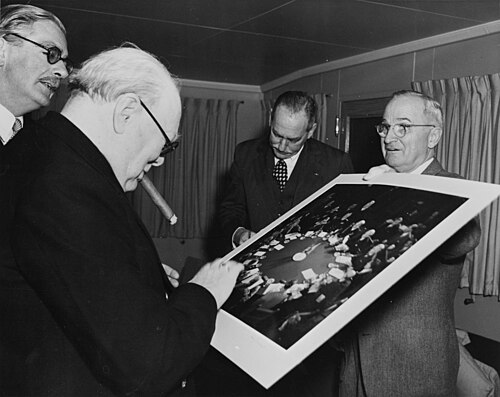
Churchill feared a global conflagration and firmly believed the only way to preserve peace and freedom was friendship and co-operation between Britain and America. He made four official transatlantic visits from January 1952 to July 1954.[446] He enjoyed a good relationship with Truman, but difficulties arose over the planned European Defence Community (EDC), by which Truman hoped to reduce America's military presence in West Germany.[447] Churchill wanted US military support of British interests in Egypt and the Middle East, but while Truman expected British military involvement in Korea, he viewed any US commitment to the Middle East as maintaining British imperialism.[448] The Americans recognised the British Empire was in terminal decline and had welcomed the Attlee government's policy of decolonisation. Churchill believed Britain's position as a world power depended on the empire's continued existence.[449]

Churchill had been obliged to recognise Colonel Nasser's revolutionary government of Egypt, which took power in 1952. Much to Churchill's dismay, agreement was reached in October 1954 on the phased evacuation of British troops from their Suez base. Britain agreed to terminate its rule in Anglo-Egyptian Sudan by 1956, though this was in return for Nasser's abandonment of Egyptian claims over the region.[450] Elsewhere, the Malayan Emergency, a guerrilla war fought by Communist fighters against Commonwealth forces, had begun in 1948 and continued until 1960. Churchill's government maintained the military response to the crisis and adopted a similar strategy for the Mau Mau Uprising in British Kenya (1952–1960).[451]
Churchill was uneasy about the election of Eisenhower as Truman's successor. After Stalin died in March 1953, Churchill sought a summit meeting with the Soviets, but Eisenhower refused out of fear the Soviets would use it for propaganda.[452][438][453] By July, Churchill was deeply regretting that the Democrats had not been returned. Churchill believed Eisenhower did not fully comprehend the danger posed by the H-bomb and he greatly distrusted Eisenhower's Secretary of State, John Foster Dulles.[454] Churchill hosted Eisenhower at the Three-Powers Bermuda Conference, with French Prime Minister Joseph Laniel, in December;[455][456] they met again in June/July 1954 at the White House.[457] In the end, the Soviets proposed a four-power summit, but it did not meet until July 1955, three months after Churchill's retirement.[458][459]
Later life: 1955–1965
Retirement: 1955–1964
Elizabeth II offered to create Churchill Duke of London, but he declined because of the objections of Randolph, who would have inherited the title.[460] Although publicly supportive, Churchill was privately scathing about Eden's handling of the Suez Crisis and Clementine believed that many of his visits to the US in the following years were attempts to repair Anglo-American relations.[461]
Churchill remained an MP until he stood down at the 1964 general election.[462] By the time of the 1959 general election, he seldom attended the House of Commons. Despite the Conservative landslide in 1959, his own majority fell by more than 1,000. He spent most of his retirement at Chartwell or at his London home in Hyde Park Gate, and became a habitué of high society at La Pausa on the French Riviera.[463] In June 1962, aged 87, Churchill had a fall in Monte Carlo and broke his hip. He was flown home to a London hospital where he remained for 3 weeks. Jenkins says Churchill was never the same after this.[462] In 1963, US President John F. Kennedy, acting under authorisation granted by an Act of Congress, proclaimed him an honorary citizen of the United States, but he was unable to attend the White House ceremony.[462] There has been speculation he became very depressed in his final years, but this has been emphatically denied by his secretary Anthony Montague Browne, who was with him for his last 10 years. Montague Browne wrote that he never heard Churchill refer to depression and certainly did not suffer from it.[464]
Death, funeral and memorials

Churchill suffered his final stroke on 10 January 1965 and died on 24 January.[462][465] Like the Duke of Wellington in 1852 and William Gladstone in 1898, Churchill was given a state funeral.[462] His coffin lay in state at Westminster Hall for three days. The funeral ceremony was at St Paul's Cathedral on 30 January.[462][465] Afterwards, the coffin was taken by boat along the River Thames to Waterloo Station and from there by a special train to the family plot at St Martin's Church, Bladon.[466][465]
Worldwide, numerous memorials have been dedicated to Churchill. His statue in Parliament Square was unveiled by his widow Clementine in 1973 and is one of only twelve in the square.[467][468] Elsewhere in London, the Cabinet War Rooms have been renamed the Churchill War Rooms.[469] Churchill College, Cambridge, was established as a national memorial to Churchill. In a 2002 BBC poll, attracting 447,423 votes, he was voted the greatest Briton of all time, his nearest rival being Isambard Kingdom Brunel some 56,000 votes behind.[470]
He is one of only 8 people to be granted honorary citizenship of the United States, and the first.[471] The United States Navy honoured him in 1999 by naming a Arleigh Burke-class destroyer as the USS Winston S. Churchill.[472] Other memorials in North America include the National Churchill Museum in Fulton, where he made the 1946 "Iron Curtain" speech; Churchill Square in Edmonton, Alberta; and the Winston Churchill Range, a mountain range northwest of Lake Louise, also in Alberta, which was renamed after Churchill in 1956.[473]
Artist, historian, and writer
.jpg/500px-Special_Relationship%3F_(geograph_4125450).jpg)
Churchill was a prolific writer. His output included a novel (Savrola), two biographies, memoirs, histories, and press articles. Two of his most famous works were his six-volume memoir, The Second World War, and the four-volume A History of the English-Speaking Peoples.[474] In recognition of his "mastery of historical and biographical description" and oratorial output, Churchill received the Nobel Prize in Literature in 1953.[475]
He used either "Winston S. Churchill" or "Winston Spencer Churchill" as his pen name to avoid confusion with the American novelist Winston Churchill, whom he had a friendly correspondence with.[476] For many years, he relied on his press articles to assuage his financial worries.[477]
Churchill became an accomplished amateur artist beginning after his resignation from the Admiralty in 1915.[478] Often using the pseudonym "Charles Morin",[479] he completed hundreds of paintings, many of which are on show in Chartwell and in private collections.[480]
Churchill was an amateur bricklayer, constructing buildings and garden walls at Chartwell.[479] He joined the Amalgamated Union of Building Trade Workers, but was expelled after he rejoined the Conservative Party.[479] He bred butterflies.[481] He was known for his love of animals and always had several pets, mainly cats but also dogs, pigs, lambs, bantams, goats and fox cubs among others.[482] Churchill has been quoted as saying that "Dogs look up to you, cats look down on you. Give me a pig! He looks you in the eye and treats you as an equal".[483]
Legacy and assessments
"A man of destiny"
.jpg/500px-Winston_Churchill,_Parliament_Square,_London_(cropped).jpg)
Jenkins concludes his biography of Churchill by comparing him favourably with William Gladstone and summarising:[466]
I now put Churchill, with all his idiosyncrasies, his indulgences, his occasional childishness, but also his genius, his tenacity and his persistent ability, right or wrong, successful or unsuccessful, to be larger than life, as the greatest human being ever to occupy 10 Downing Street.
Churchill always self-confidently believed himself to be "a man of destiny".[484] Because of this he lacked restraint and could be reckless.[485][486] His self-belief manifested in his "affinity with war" of which, according to Sebastian Haffner, he exhibited "a profound and innate understanding".[487] Churchill considered himself a military genius, but that made him vulnerable to failure and Paul Addison says the Gallipoli disaster was "the greatest blow his self-image was ever to sustain".[488] Jenkins points out, that although Churchill was exhilarated by war, he was never indifferent to the suffering it causes.[489]
Political ideology
As a politician, Churchill was perceived by some to have been largely motivated by personal ambition rather than political principle.[490][491] During his early career, he was often provocative and argumentative to an unusual degree;[492] and his barbed rhetorical style earned him enemies in parliament.[493][494] On the other hand, he was deemed to be an honest politician who displayed particular loyalty to his family and close friends.[495] Robert Rhodes James said he "lacked any capacity for intrigue and was refreshingly innocent and straightforward".[496]
Until the outbreak of the Second World War, Churchill's approach to politics generated widespread "mistrust and dislike",[497] largely on account of his two party defections.[498] His biographers have variously categorised him, in terms of political ideology, as "fundamentally conservative",[499] "(always) liberal in outlook",[500] and "never circumscribed by party affiliation".[501] He was nearly always opposed to socialism because of its propensity for state planning and his belief in free markets. The exception was during his wartime coalition when he was reliant upon the support of his Labour colleagues.[502][503] Churchill had long been regarded as an enemy of the working class, and his response to the Rhondda Valley unrest and his anti-socialist rhetoric brought condemnation from socialists who saw him as a reactionary.[504] His role in opposing the General Strike earned the enmity of strikers and most members of the Labour movement.[505] Paradoxically, Churchill was supportive of trade unionism, which he saw as the "antithesis of socialism".[506]
On the other hand, his detractors did not take Churchill's domestic reforms into account,[507] for he was in many respects a radical and reformer,[508] but always with the intention of preserving the existing social structure,[509] displaying what Addison calls the attitude of a "benevolent paternalist".[510] Jenkins, himself a senior Labour minister, remarked that Churchill had "a substantial record as a social reformer" for his work in his ministerial career.[511] Similarly, Rhodes James thought that Churchill's achievements were "considerable".[512]
Imperialism and racial views

Churchill was a staunch imperialist and monarchist, and consistently exhibited a "romanticised view" of the British Empire and reigning monarch, especially during his last term as premier.[513][514][515] Churchill has been described as a "liberal imperialist"[516] who saw British imperialism as a form of altruism that benefited its subject peoples.[517] He advocated against black or indigenous self-rule in Africa, Australia, the Caribbean, the Americas and India, believing the British Empire maintained the welfare of those who lived in the colonies.[347]
According to Addison, Churchill was opposed to immigration from the Commonwealth.[518] Addison makes the point that Churchill opposed anti-Semitism (as in 1904, when he was critical of the proposed Aliens Bill) and argues he would never have tried "to stoke up racial animosity against immigrants, or to persecute minorities".[519] In the 1920s, Churchill supported Zionism but believed that communism was the product of an international Jewish conspiracy.[520] Although this belief was not unique among politicians, few had his stature,[521] and the article he wrote on the subject was criticised by The Jewish Chronicle.[522]
Churchill made disparaging remarks about non-white ethnicities throughout his life. Philip Murphy partly attributes the strength of this vitriol to an "almost childish desire to shock" his inner circle.[523] Churchill's response to the Bengal famine was criticised by contemporaries as slow, a controversy later increased by the publication of private remarks made to Secretary for India Leo Amery, in which Churchill allegedly said aid would be inadequate because "Indians [were] breeding like rabbits".[523][524] Philip Murphy says that, following the independence of India in 1947, Churchill adopted a pragmatic stance towards empire, although he continued to use imperial rhetoric. During his second term as prime minister, he was seen as a moderating influence on Britain's suppression of armed insurgencies in Malaya and Kenya; he argued that ruthless policies contradicted British values and international opinion.[523]
Cultural depictions
While biographies by Addison, Gilbert, Jenkins and Rhodes James are among the most acclaimed works about Churchill, he has been the subject of numerous others. David Freeman counted 62 in English to the end of the 20th century.[525] At a public ceremony in Westminster Hall on 30 November 1954, Churchill's 80th birthday, the joint Houses of Parliament presented him with a full-length portrait of himself, painted by Graham Sutherland.[526] Churchill and Clementine reportedly hated it and she had it destroyed.[527][528]
Biographical films include Young Winston (1972), directed by Richard Attenborough and featuring Simon Ward in the title role; Winston Churchill: The Wilderness Years (1981), starring Robert Hardy; The Gathering Storm (2002), starring Albert Finney as Churchill; Into the Storm (2009), starring Brendan Gleeson as Churchill; Darkest Hour (2017), starring Gary Oldman as Churchill. John Lithgow played Churchill in The Crown (2016–2019). Finney, Gleeson, Oldman and Lithgow all won awards for their performances.[529][530][531][532]
Family
Churchill married Clementine Hozier in September 1908.[533] They remained married for 57 years until his death.[109] Churchill was aware of the strain his career placed on their marriage.[534] According to Colville, he had an affair in the 1930s with Doris Castlerosse,[535] although this is discounted by Andrew Roberts.[536]
The Churchills' first child, Diana, was born in July 1909;[537] Randolph, in May 1911.[147] Sarah, was born in October 1914,[170] and Marigold, in November 1918.[199] Marigold died in August 1921, from sepsis.[538] On 15 September 1922, the Churchills' last child, Mary, was born. Later that month, the Churchills bought Chartwell, which would be their home until Winston's death in 1965.[539][540]
Notes
- ^ The surname is the double-barrelled Spencer Churchill (unhyphenated), but he is known by the surname Churchill. His father dropped the Spencer.[1]
See also
References
Citations
- ^ Price 2009, p. 12.
- ^ Brendon, Piers (2023), Packwood, Allen (ed.), "Churchill, the Roosevelts and Empire", The Cambridge Companion to Winston Churchill, Cambridge Companions to History, Cambridge: Cambridge University Press, pp. 189–207, ISBN 978-1-108-84023-1, retrieved 11 July 2024
- ^ O'Neil, Patrick Michael (1993). Winston S. Churchill's philosophy of empire: The mind of the imperialist (Thesis).[page needed]
- ^ Jenkins 2001, p. 5.
- ^ Gilbert 1991, p. 1; Jenkins 2001, pp. 3, 5.
- ^ Gilbert 1991, p. 1; Best 2001, p. 3; Jenkins 2001, p. 7; Robbins 2014, p. 2.
- ^ Best 2001, p. 4; Jenkins 2001, pp. 5–6; Addison 2005, p. 7.
- ^ Gilbert 1991, p. 1; Addison 2005, p. 9.
- ^ Gilbert 1991, p. 2; Jenkins 2001, p. 7; Addison 2005, p. 10.
- ^ Jenkins 2001, p. 8.
- ^ Gilbert 1991, pp. 2–3; Jenkins 2001, p. 10; Reagles & Larsen 2013, p. 8.
- ^ Best 2001, p. 6.
- ^ Gilbert 1991, pp. 3–5; Haffner 2003, p. 12; Addison 2005, p. 10.
- ^ Gilbert 1991, pp. 6–8; Haffner 2003, pp. 12–13.
- ^ Gilbert 1991, pp. 17–19.
- ^ Gilbert 1991, p. 22; Jenkins 2001, p. 19.
- ^ Gilbert 1991, pp. 32–33, 37; Jenkins 2001, p. 20; Haffner 2003, p. 15.
- ^ Gilbert 1991, p. 37; Jenkins 2001, p. 20–21.
- ^ Gilbert 1991, pp. 48–49; Jenkins 2001, p. 21; Haffner 2003, p. 32.
- ^ Haffner 2003, p. 18.
- ^ Gilbert 1991, p. 51; Jenkins 2001, p. 21.
- ^ Gilbert 1991, p. 62; Jenkins 2001, p. 28.
- ^ Gilbert 1991, pp. 56, 58–60; Jenkins 2001, pp. 28–29; Robbins 2014, pp. 14–15.
- ^ a b c d e f g h i j k l Herbert G. Nicholas, Winston Churchill at the Encyclopædia Britannica
- ^ Gilbert 1991, p. 57.
- ^ Gilbert 1991, p. 63; Jenkins 2001, p. 22.
- ^ Gilbert 1991, p. 63; Jenkins 2001, pp. 23–24.
- ^ Jenkins 2001, pp. 23–24; Haffner 2003, p. 19.
- ^ Gilbert 1991, pp. 67–68; Jenkins 2001, pp. 24–25; Haffner 2003, p. 19.
- ^ Roberts 2018, p. 52.
- ^ Gilbert 1991, p. 92.
- ^ Reagles & Larsen 2013, p. 8.
- ^ Addison 1980, p. 29; Reagles & Larsen 2013, p. 9.
- ^ Haffner 2003, p. 32; Reagles & Larsen 2013, p. 8.
- ^ Gilbert 1991, p. 102.
- ^ Jenkins 2001, p. 26.
- ^ Gilbert 1991, p. 69; Jenkins 2001, p. 27.
- ^ Gilbert 1991, pp. 69, 71; Jenkins 2001, p. 27.
- ^ Gilbert 1991, p. 70.
- ^ Gilbert 1991, pp. 72, 75; Jenkins 2001, pp. 29–31.
- ^ Gilbert 1991, pp. 79, 81–82; Jenkins 2001, pp. 31–32; Haffner 2003, pp. 21–22.
- ^ Addison 1980, p. 31; Gilbert 1991, p. 81; Jenkins 2001, pp. 32–34.
- ^ Jenkins 2001, p. 819.
- ^ Gilbert 1991, pp. 89–90; Jenkins 2001, pp. 35, 38–39; Haffner 2003, p. 21.
- ^ Gilbert 1991, pp. 91–98; Jenkins 2001, pp. 39–41.
- ^ Jenkins 2001, pp. 34, 41, 50; Haffner 2003, p. 22.
- ^ Addison 1980, p. 32; Gilbert 1991, pp. 98–99; Jenkins 2001, p. 41.
- ^ Jenkins 2001, pp. 41–44.
- ^ Haffner 2003, p. x.
- ^ Jenkins 2001, p. 42.
- ^ Gilbert 1991, pp. 103–104; Jenkins 2001, pp. 45–46; Haffner 2003, p. 23.
- ^ Gilbert 1991, p. 104.
- ^ Gilbert 1991, p. 105; Jenkins 2001, p. 47.
- ^ Ridgway, Athelstan, ed. (1950). Everyman's Encyclopaedia Volume Nine: Maps to Nyasa (Third ed.). London: J.M. Dent & Sons Ltd. p. 390. Retrieved 11 November 2020.
- ^ Gilbert 1991, pp. 105–106; Jenkins 2001, p. 50.
- ^ Gilbert 1991, pp. 107–110.
- ^ Gilbert 1991, pp. 111–113; Jenkins 2001, pp. 52–53; Haffner 2003, p. 25.
- ^ Gilbert 1991, pp. 115–120; Jenkins 2001, pp. 55–62.
- ^ Gilbert 1991, p. 121; Jenkins 2001, p. 61.
- ^ Gilbert 1991, pp. 121–122; Jenkins 2001, pp. 61–62.
- ^ Gilbert 1991, pp. 123–124, 126–129; Jenkins 2001, p. 62.
- ^ Gilbert 1991, p. 125.
- ^ Jenkins 2001, p. 63.
- ^ Gilbert 1991, pp. 128–131.
- ^ Gilbert 1991, pp. 135–136.
- ^ Gilbert 1991, p. 136.
- ^ Jenkins 2001, p. 65.
- ^ Gilbert 1991, pp. 136–138; Jenkins 2001, pp. 68–70.
- ^ Gilbert 1991, p. 141.
- ^ Gilbert 1991, p. 139; Jenkins 2001, pp. 71–73.
- ^ Rhodes James 1970, p. 16; Jenkins 2001, pp. 76–77.
- ^ Gilbert 1991, pp. 141–144; Jenkins 2001, pp. 74–75.
- ^ Gilbert 1991, p. 144.
- ^ Gilbert 1991, p. 145.
- ^ Gilbert 1991, p. 150.
- ^ Gilbert 1991, pp. 151–152.
- ^ Rhodes James 1970, p. 22.
- ^ a b Gilbert 1991, p. 162.
- ^ Gilbert 1991, p. 153.
- ^ Gilbert 1991, pp. 152, 154.
- ^ Gilbert 1991, p. 157.
- ^ Gilbert 1991, p. 160; Jenkins 2001, p. 84.
- ^ a b Gilbert 1991, p. 165.
- ^ Gilbert 1991, p. 165; Jenkins 2001, p. 88.
- ^ Gilbert 1991, pp. 173–174; Jenkins 2001, p. 103.
- ^ Gilbert 1991, pp. 174, 176.
- ^ Gilbert 1991, p. 175; Jenkins 2001, p. 109.
- ^ Rhodes James 1970, p. 16; Gilbert 1991, p. 175.
- ^ Gilbert 1991, p. 171; Jenkins 2001, p. 100.
- ^ Jenkins 2001, pp. 102–103.
- ^ Gilbert 1991, p. 172.
- ^ Rhodes James 1970, p. 23; Gilbert 1991, p. 174; Jenkins 2001, p. 104.
- ^ Jenkins 2001, pp. 104–105.
- ^ Gilbert 1991, p. 174; Jenkins 2001, p. 105.
- ^ Gilbert 1991, p. 176; Jenkins 2001, pp. 113–115, 120.
- ^ Gilbert 1991, p. 182.
- ^ Gilbert 1991, p. 177.
- ^ Gilbert 1991, p. 177; Jenkins 2001, pp. 111–113.
- ^ Gilbert 1991, p. 183.
- ^ Rhodes James 1970, p. 33; Gilbert 1991, p. 194; Jenkins 2001, p. 129.
- ^ Jenkins 2001, p. 129.
- ^ Gilbert 1991, pp. 194–195; Jenkins 2001, p. 130.
- ^ Gilbert 1991, p. 195; Jenkins 2001, pp. 130–131.
- ^ Gilbert 1991, pp. 198–200.
- ^ Jenkins 2001, pp. 139–142.
- ^ Gilbert 1991, pp. 204–205.
- ^ Jenkins 2001, p. 203.
- ^ Gilbert 1991, p. 195.
- ^ a b Gilbert 1991, p. 199.
- ^ Gilbert 1991, p. 200.
- ^ Jenkins 2001, p. 143.
- ^ Gilbert 1991, pp. 193–194.
- ^ Gilbert 1991, p. 196.
- ^ Gilbert 1991, pp. 203–204; Jenkins 2001, p. 150.
- ^ Gilbert 1991, p. 204; Jenkins 2001, pp. 150–151.
- ^ Gilbert 1991, p. 201; Jenkins 2001, p. 151.
- ^ Jenkins 2001, pp. 154–157; Toye 2007, pp. 54–55.
- ^ Gilbert 1991, pp. 198–199; Jenkins 2001, pp. 154–155.
- ^ Jenkins 2001, pp. 157–159.
- ^ Gilbert 1991, pp. 205, 210; Jenkins 2001, p. 164.
- ^ Gilbert 1991, p. 206.
- ^ Gilbert 1991, p. 211; Jenkins 2001, p. 167.
- ^ Jenkins 2001, pp. 167–168.
- ^ Gilbert 1991, pp. 216–217.
- ^ Moritz 1958, p. 429; Gilbert 1991, p. 211; Jenkins 2001, p. 169.
- ^ Moritz 1958, pp. 428–429; Gilbert 1991, p. 212; Jenkins 2001, p. 179.
- ^ Moritz 1958, p. 434; Gilbert 1991, p. 212.
- ^ Gilbert 1991, p. 212; Jenkins 2001, p. 181.
- ^ Moritz 1958, p. 434; Gilbert 1991, p. 215.
- ^ Moritz 1958, p. 434; Gilbert 1991, p. 212; Jenkins 2001, p. 181.
- ^ Gilbert 1991, p. 213.
- ^ Moritz 1958, p. 433; Gilbert 1991, pp. 213–214.
- ^ Jenkins 2001, p. 183.
- ^ Gilbert 1991, pp. 221–222.
- ^ a b Jenkins 2001, p. 186.
- ^ a b c Gilbert 1991, p. 221.
- ^ a b Gilbert 1991, p. 219; Jenkins 2001, p. 198.
- ^ Gilbert 1991, p. 220.
- ^ Jenkins 2001, p. 199.
- ^ Rhodes James 1970, p. 38.
- ^ Gilbert 1991, p. 222; Jenkins 2001, pp. 190–191, 193.
- ^ Gilbert 1991, p. 222; Jenkins 2001, p. 194.
- ^ a b Gilbert 1991, p. 224; Jenkins 2001, p. 195.
- ^ Gilbert 1991, p. 224.
- ^ Gilbert 1991, p. 226; Jenkins 2001, pp. 177–178.
- ^ a b Gilbert 1991, p. 226; Jenkins 2001, p. 178.
- ^ a b Gilbert 1991, p. 227; Jenkins 2001, p. 203.
- ^ Gilbert 1991, pp. 230–233; Jenkins 2001, pp. 200–201.
- ^ Gilbert 1991, p. 235.
- ^ Jenkins 2001, p. 202.
- ^ Gilbert 1991, p. 239; Jenkins 2001, p. 205; Bell 2011, p. 335.
- ^ Gilbert 1991, p. 249; Jenkins 2001, p. 207.
- ^ Gilbert 1991, p. 23.
- ^ Gilbert 1991, p. 243; Bell 2011, p. 336.
- ^ Gilbert 1991, pp. 243–245.
- ^ Gilbert 1991, p. 247.
- ^ Gilbert 1991, p. 242; Bell 2011, pp. 249–251.
- ^ Gilbert 1991, p. 240.
- ^ Gilbert 1991, p. 251.
- ^ Gilbert 1991, pp. 253–254; Bell 2011, pp. 342–343.
- ^ Gilbert 1991, pp. 260–261.
- ^ Gilbert 1991, p. 256; Jenkins 2001, p. 233.
- ^ Rhodes James 1970, pp. 44–45; Gilbert 1991, pp. 249–250; Jenkins 2001, pp. 233–234.
- ^ a b O'Brien 1989, p. 68.
- ^ Rhodes James 1970, pp. 47–49; Gilbert 1991, pp. 256–257.
- ^ Gilbert 1991, pp. 257–258.
- ^ Gilbert 1991, p. 277.
- ^ Gilbert 1991, pp. 277–279.
- ^ Gilbert 1991, p. 279.
- ^ a b Gilbert 1991, p. 285.
- ^ Rhodes James 1970, p. 62; Gilbert 1991, pp. 282–285; Jenkins 2001, p. 249.
- ^ Rhodes James 1970, p. 62; Gilbert 1991, p. 286; Jenkins 2001, pp. 250–251.
- ^ Rhodes James 1970, p. 62.
- ^ Gilbert 1991, p. 289.
- ^ Gilbert 1991, pp. 293, 298–99.
- ^ Rhodes James 1970, pp. 64–67; Gilbert 1991, pp. 291–292; Jenkins 2001, pp. 255, 261.
- ^ Rhodes James 1970, pp. 72–74; Gilbert 1991, pp. 304, 310.
- ^ Rhodes James 1970, p. 78; Gilbert 1991, p. 309.
- ^ Rhodes James 1970, p. 79; Gilbert 1991, pp. 316–316; Jenkins 2001, pp. 273–274.
- ^ Gilbert 1991, pp. 319–320; Jenkins 2001, p. 276.
- ^ Gilbert 1991, p. 328.
- ^ Gilbert 1991, pp. 329–332.
- ^ Gilbert 1991, pp. 340–341.
- ^ "No. 29520". The London Gazette (Supplement). 24 March 1916. p. 3260.
- ^ Gilbert 1991, pp. 342–245.
- ^ Gilbert 1991, p. 346.
- ^ Green, David (1980). Guide to Blenheim Palace. Blenheim Palace, Oxfordshire: The Blenheim Estate Office. p. 17.. The inscribed shrapnel piece was subsequently displayed at Blenheim Palace.
- ^ Gilbert 1991, p. 360.
- ^ "No. 29753". The London Gazette (Supplement). 16 September 1916. p. 9100.
- ^ Gilbert 1991, pp. 361, 364–365.
- ^ a b Churchill 1927.
- ^ Rhodes James 1970, p. 86; Gilbert 1991, pp. 361, 363, 367.
- ^ Rhodes James 1970, p. 89; Gilbert 1991, pp. 366, 370.
- ^ Gilbert 1991, p. 373.
- ^ Rhodes James 1970, p. 90; Gilbert 1991, p. 374.
- ^ Gilbert 1991, pp. 376, 377.
- ^ Gilbert 1991, pp. 392–393.
- ^ Gilbert 1991, pp. 379–380.
- ^ a b c Gilbert 1991, p. 403.
- ^ Rhodes James 1970, p. 91; Gilbert 1991, p. 403.
- ^ a b Gilbert 1991, p. 404.
- ^ Rhodes James 1970, p. 100; Gilbert 1991, pp. 404–405.
- ^ Rhodes James 1970, p. 101; Gilbert 1991, p. 406.
- ^ Gilbert 1991, pp. 406–407.
- ^ Gilbert 1991, p. 401.
- ^ Rhodes James 1970, pp. 105–106; Gilbert 1991, p. 411.
- ^ Rhodes James 1970, pp. 102, 104; Gilbert 1991, p. 405.
- ^ Gilbert 1991, pp. 411–412.
- ^ Rhodes James 1970, p. 123; Gilbert 1991, p. 420.
- ^ Rhodes James 1970, pp. 126–127; Gilbert 1991, pp. 422, 425; Jordan 1995, pp. 70–75.
- ^ Gilbert 1991, pp. 424–425; Douglas 2009, p. 861.
- ^ Gilbert 1991, p. 428.
- ^ a b c Gilbert 1991, p. 431.
- ^ Gilbert 1991, pp. 438, 439.
- ^ Brooks, Richard (28 February 2016). "Churchill's torment over death of two year old daughter laid bare". The Times. Archived from the original on 27 January 2022. Retrieved 27 January 2022.
- ^ Gilbert 1991, p. 441.
- ^ Rhodes James 1970, p. 133; Gilbert 1991, pp. 432–434.
- ^ Gilbert 1991, p. 435.
- ^ Gilbert 1991, p. 437.
- ^ Gilbert 1991, p. 450.
- ^ a b Gilbert 1991, p. 456.
- ^ Jenkins 2001, p. 376.
- ^ "No. 32766". The London Gazette (Supplement). 10 November 1922. p. 8017.
- ^ Gilbert 1991, p. 457.
- ^ Rhodes James 1970, pp. 150–151; Gilbert 1991, p. 459; Jenkins 2001, pp. 382–384.
- ^ Gilbert 1991, p. 460.
- ^ Gilbert 1991, pp. 462–463.
- ^ Rhodes James 1970, pp. 151–153; Gilbert 1991, pp. 460–461.
- ^ Rhodes James 1970, p. 154; Gilbert 1991, p. 462.
- ^ Rhodes James 1970, p. 154; Gilbert 1991, pp. 462–463; Ball 2001, p. 311.
- ^ Rhodes James 1970, pp. 155, 158; Gilbert 1991, p. 465.
- ^ a b Gilbert 1991, p. 467.
- ^ Gilbert 1991, p. 469.
- ^ Jenkins 2001, p. 404.
- ^ Gilbert 1991, pp. 468–489.
- ^ Rhodes James 1970, pp. 169–174; Gilbert 1991, pp. 475–476.
- ^ Gilbert 1991, pp. 477–479.
- ^ Bromage, Mary (1964), Churchill and Ireland, University of Notre Dame Press, Notre Dame, IL, pg 108, Library of Congress Catalog Card Number 64-20844
- ^ Gilbert 1991, p. 480.
- ^ Rhodes James 1970, p. 183; Gilbert 1991, p. 489.
- ^ Jenkins 2001, pp. 466, 819.
- ^ a b Gilbert 1991, p. 491.
- ^ Jenkins 2001, pp. 421–423.
- ^ Jenkins 2001, p. 51.
- ^ Gilbert 1991, p. 496.
- ^ Jenkins 2001, p. 434.
- ^ Gilbert 1991, p. 495.
- ^ Gilbert 1991, pp. 499–500.
- ^ Gilbert 1991, p. 500.
- ^ a b Jenkins 2001, p. 443.
- ^ Gilbert 1991, pp. 502–503.
- ^ a b Gilbert 1991, p. 503.
- ^ Jenkins 2001, pp. 443–444.
- ^ a b Jenkins 2001, p. 444.
- ^ Jenkins 2001, p. 445.
- ^ "Meeting Hitler, 1932". The Churchill Project. Hillsdale, Missouri: Hillsdale College. 5 March 2015. Archived from the original on 21 April 2021. Retrieved 22 May 2021.
- ^ Jenkins 2001, pp. 445–446.
- ^ Gilbert 1991, pp. 508–509.
- ^ Jenkins 2001, p. 470.
- ^ Gilbert 1991, pp. 513–515, 530–531.
- ^ Jenkins 2001, pp. 479–480.
- ^ Gilbert 1991, p. 533.
- ^ "The International Situation". Hansard. 5th. Westminster: House of Commons. 24 October 1935. pp. 357–369. Archived from the original on 9 March 2021. Retrieved 17 May 2021.
We cannot afford to see Nazidom in its present phase of cruelty and intolerance, with all its hatreds and all its gleaming weapons, paramount in Europe
- ^ a b Gilbert 1991, p. 544.
- ^ "The International Situation". Hansard. 5th. Westminster: House of Commons. 24 October 1935. pp. 357–369. Archived from the original on 9 March 2021. Retrieved 17 May 2021.
No one can keep up the pretence that Abyssinia is a fit, worthy and equal member of a league of civilised nations.
- ^ Rhodes James 1970, p. 408.
- ^ Roberts, (2018) pp. 402-403.
- ^ Gilbert 1991, pp. 522, 533, 563, 594.
- ^ Gilbert 1991, pp. 538–539.
- ^ Gilbert 1991, p. 547.
- ^ Gilbert 1991, pp. 568–569.
- ^ Gilbert 1991, p. 569.
- ^ Gilbert 1991, p. 570.
- ^ Jenkins 2001, pp. 514–515.
- ^ Gilbert 1991, pp. 576–577.
- ^ Jenkins 2001, p. 516.
- ^ Gilbert 1991, p. 588.
- ^ Langworth 2008, p. 193.
- ^ Gilbert 1991, pp. 590–591.
- ^ Gilbert 1991, p. 594.
- ^ Gilbert 1991, p. 595.
- ^ Gilbert 1991, p. 598.
- ^ Jenkins 2001, p. 527.
- ^ "Churchill's Wartime Speeches – A Total and Unmitigated Defeat". London: The Churchill Society. 5 October 1938. Archived from the original on 13 September 2019. Retrieved 27 April 2020.
- ^ Churchill 1967b, p. 7.
- ^ a b Gilbert 1991, p. 634.
- ^ Shakespeare 2017, p. 30.
- ^ Jenkins 2001, pp. 573–574.
- ^ Jenkins 2001, pp. 576–577.
- ^ Jenkins 2001, p. 579.
- ^ Shakespeare 2017, pp. 299–300.
- ^ Jenkins 2001, p. 582.
- ^ a b Jenkins 2001, p. 583.
- ^ Jenkins 2001, p. 586.
- ^ Arthur 2015, p. 170.
- ^ Jenkins 2001, p. 592.
- ^ Churchill 1967b, p. 243.
- ^ Jenkins 2001, p. 590.
- ^ Blake & Louis 1993, pp. 249, 252–255.
- ^ Jenkins 2001, pp. 587–588.
- ^ Hermiston 2016, pp. 26–29.
- ^ Jenkins 2001, pp. 714–715.
- ^ Blake & Louis 1993, pp. 264, 270–271.
- ^ Hermiston 2016, p. 41.
- ^ Jenkins 2001, p. 599.
- ^ Jenkins 2001, pp. 602–603.
- ^ Gilbert 1991, p. 65.
- ^ Mather, John (29 August 2008). "Churchill's speech impediment". International Churchill Society (ICS). London: Bloomsbury Publishing plc. Archived from the original on 25 September 2020. Retrieved 14 May 2020.
- ^ Jenkins 2001, p. 591.
- ^ "Blood, Toil, Tears and Sweat". International Churchill Society (ICS). London: Bloomsbury Publishing plc. 13 May 1940. Archived from the original on 19 May 2021. Retrieved 30 April 2020.
- ^ "His Majesty's Government". Hansard. 5th. Vol. 360. Westminster: House of Commons. 4 June 1940. pp. 1501–1525. Archived from the original on 20 June 2018. Retrieved 30 April 2020.
- ^ Jenkins 2001, pp. 611–612.
- ^ Jenkins 2001, p. 597.
- ^ "We Shall Fight on the Beaches". International Churchill Society (ICS). London: Bloomsbury Publishing plc. 4 June 1940. Archived from the original on 14 May 2020. Retrieved 30 April 2020.
- ^ "War Situation – Churchill". Hansard. 5th. Vol. 361. Westminster: House of Commons. 4 June 1940. p. 791. Archived from the original on 6 February 2020. Retrieved 14 January 2020.
- ^ Hastings 2009, pp. 44–45.
- ^ Hastings 2009, pp. 51–53.
- ^ Jenkins 2001, p. 621.
- ^ "War Situation – Churchill". Hansard. 5th. Vol. 362. Westminster: House of Commons. 18 June 1940. p. 61. Archived from the original on 8 March 2021. Retrieved 30 April 2020.
- ^ "Their Finest Hour". International Churchill Society (ICS). London: Bloomsbury Publishing plc. 18 June 1940. Archived from the original on 13 April 2020. Retrieved 30 April 2020.
- ^ Playfair, Major-General I. S. O.; with Stitt R.N., Commander G. M. S.; Molony, Brigadier C. J. C. & Toomer, Air Vice-Marshal S. E. (2004) [1st. pub. HMSO 1954]. Butler, J. R. M. (ed.). The Mediterranean and Middle East: The Early Successes Against Italy (to May 1941). History of the Second World War, United Kingdom Military Series. Vol. I. Naval & Military Press. pp. 359–362. ISBN 978-1-84574-065-8.
- ^ Dalton 1986, p. 62.
- ^ "The Few". The Churchill Society, London. 20 August 1940. Archived from the original on 12 March 2005. Retrieved 30 April 2020.
- ^ "War Situation – Churchill". Hansard. 5th. Vol. 364. Westminster: House of Commons. 20 August 1940. p. 1167. Archived from the original on 4 June 2020. Retrieved 30 April 2020.
- ^ Jenkins 2001, p. 640.
- ^ Jenkins 2001, p. 641.
- ^ Neiberg 2004, p. 118-119.
- ^ Lukacs, John (Spring–Summer 2008). "Churchill Offers Toil and Tears to FDR". American Heritage. 58 (4). Archived from the original on 8 October 2018. Retrieved 5 May 2020.
- ^ Jenkins 2001, pp. 614–615.
- ^ Jenkins 2001, pp. 658–659.
- ^ Jenkins 2001, pp. 665–666.
- ^ "Joint Declaration by the United Nations". The Avalon Project. Lillian Goldman Law Library. 1 January 1942. Archived from the original on 20 August 2016. Retrieved 11 May 2020.
- ^ Bromage, pg 162
- ^ Jenkins 2001, p. 670.
- ^ Jenkins 2001, pp. 677–678.
- ^ Jenkins 2001, p. 674.
- ^ Jenkins 2001, p. 679.
- ^ Jenkins 2001, p. 682.
- ^ Jenkins 2001, p. 680.
- ^ Jenkins 2001, pp. 675, 678.
- ^ a b Jenkins 2001, p. 681.
- ^ Glueckstein, Fred (10 November 2015). "Churchill and the Fall of Singapore". International Churchill Society (ICS). London: Bloomsbury Publishing plc. Archived from the original on 4 June 2020. Retrieved 22 May 2020.
- ^ Bayly & Harper 2005, pp. 251–253.
- ^ "Bengal famine of 1943 caused by British policy failure, not drought: Study". The Economic Times. New Delhi: Bennett, Coleman & Co. Ltd. 20 March 2019. Archived from the original on 4 December 2020. Retrieved 4 December 2020.
- ^ Sen 1977, pp. 52–55.
- ^ a b Sen 1977, p. 52.
- ^ a b c Roberts, Andrew; Gebreyohanes, Zewditu (14 March 2021). "Cambridge: "The Racial Consequences of Mr Churchill", A Review". The Churchill Project. Hillsdale, Missouri: Hillsdale College. Archived from the original on 5 May 2021. Retrieved 5 May 2021.
- ^ a b Herman, Arthur L. (13 September 2010). "Without Churchill, India's Famine Would Have Been Worse". International Churchill Society (ICS). London: Bloomsbury Publishing plc. Archived from the original on 19 October 2021. Retrieved 5 May 2021.
- ^ Sen 1977, p. 40.
- ^ Khan 2015, p. 213.
- ^ Devereux, Stephen (2000). Famine in the twentieth century (PDF) (Technical report). Vol. IDS Working Paper 105. Brighton: Institute of Development Studies. pp. 21–23. Archived from the original (PDF) on 16 May 2017.
- ^ Jenkins 2001, pp. 688–690.
- ^ a b Jenkins 2001, p. 690.
- ^ Jenkins 2001, p. 692.
- ^ Cooper 1978, pp. 376–377.
- ^ Jenkins 2001, pp. 692–698.
- ^ Jenkins 2001, p. 698.
- ^ Jenkins 2001, pp. 699–701.
- ^ a b c Jenkins 2001, p. 702.
- ^ Jenkins 2001, pp. 705–706.
- ^ Middleton, Drew (24 January 1943). "Roosevelt, Churchill Map 1943 War Strategy At Ten-Day Conference Held In Casablanca; Giraud And De Gaulle, Present, Agree On Aims". The New York Times. Manhattan.
- ^ Jenkins 2001, pp. 705–707.
- ^ Jenkins 2001, pp. 707–711.
- ^ Jenkins 2001, pp. 719–720.
- ^ Roberts, Geoffrey (Fall 2007). "Stalin at the Tehran, Yalta, and Potsdam Conferences". Journal of Cold War Studies. 9 (4). MIT Press: 6–40. doi:10.1162/jcws.2007.9.4.6. ISSN 1520-3972. S2CID 57564917.
- ^ Jenkins 2001, p. 725.
- ^ Jenkins 2001, pp. 726–728.
- ^ "Were "Soft Underbelly" and "Fortress Europe" Churchill Phrases?". The Churchill Project. Hillsdale College. 1 April 2016. Archived from the original on 9 June 2020. Retrieved 21 May 2020.
- ^ Jenkins 2001, pp. 713–714.
- ^ Jenkins 2001, p. 713.
- ^ Tompkins, Peter (1985). "What Really Happened at Anzio". Il Politico. 50 (3): 509–528. ISSN 0032-325X. JSTOR 43099608. Archived from the original on 22 November 2021. Retrieved 22 November 2021.
- ^ Jenkins 2001, pp. 720, 729.
- ^ a b Jenkins 2001, p. 730.
- ^ Jenkins 2001, p. 737.
- ^ Abel-Smith, Brian (January 1992). "The Beveridge report: Its origins and outcomes". International Social Security Review. 45 (1–2). Hoboken: Wiley-Blackwell: 5–16. doi:10.1111/j.1468-246X.1992.tb00900.x.
- ^ Jenkins 2001, p. 733.
- ^ Lynch 2008, pp. 1–4.
- ^ Marr 2009, pp. 5–6.
- ^ Jenkins 2001, pp. 744–745.
- ^ Jenkins 2001, p. 746.
- ^ Jenkins 2001, p. 754.
- ^ a b Resis 1978.
- ^ Jenkins 2001, p. 759.
- ^ Jenkins 2001, p. 760.
- ^ Jenkins 2001, p. 773.
- ^ Jenkins 2001, pp. 778–779.
- ^ Jenkins 2001, p. 779.
- ^ Tolstoy 1978, p. 360.
- ^ Hummel, Jeffrey Rogers (1 November 1974). "Operation Keelhaul—Exposed". San Jose State University ScholarWorks: 4–9. Archived from the original on 4 June 2020. Retrieved 28 January 2020.
- ^ Jenkins 2001, pp. 777–778.
- ^ Taylor 2005, pp. 262–264.
- ^ Jenkins 2001, p. 777.
- ^ "Up to 25,000 died in Dresden's WWII bombing". BBC News. London: BBC. 18 March 2010. Archived from the original on 5 February 2022. Retrieved 2 May 2020.
- ^ a b Jenkins 2001, p. 778.
- ^ Taylor 2005, pp. 430–431.
- ^ a b Marr 2009, pp. 423–424.
- ^ Hawley, Charles (11 February 2005). "Dresden Bombing Is To Be Regretted Enormously". Der Spiegel. Hamburg: Spiegel-Verlag. Archived from the original on 21 June 2012. Retrieved 2 May 2020.
- ^ Hermiston 2016, pp. 353–354.
- ^ a b Hermiston 2016, p. 355.
- ^ Hermiston 2016, p. 356.
- ^ Fenby 2011, pp. 42–47.
- ^ Daniel Todman, Britain's War: A New World, 1942–1947 (2020) p 744.
- ^ a b ""Operation Unthinkable"". British War Cabinet, Joint Planning Staff. 22 May 1945. Archived from the original on 26 September 2023. Retrieved 30 September 2023 – via The National Archives (United Kingdom).
- ^ Hermiston 2016, p. 360.
- ^ Gilbert 1988, pp. 22–23, 27.
- ^ Jenkins 2001, pp. 795–796.
- ^ Jenkins 2001, p. 796.
- ^ Jenkins 2001, pp. 791–795.
- ^ Jenkins 2001, p. 792.
- ^ Addison, Paul (17 February 2011). "Why Churchill Lost in 1945". BBC History. London: BBC. Archived from the original on 26 December 2019. Retrieved 4 June 2020.
- ^ Jenkins 2001, p. 793.
- ^ a b Jenkins 2001, p. 798.
- ^ a b Gilbert 1988, p. 108.
- ^ Gilbert 1988, pp. 57, 107–109.
- ^ Gilbert 1991, p. 855.
- ^ Hermiston 2016, pp. 366–367.
- ^ Jenkins 2001, pp. 798–799.
- ^ Jenkins 2001, pp. 789–794.
- ^ Pelling 1980.
- ^ Gilbert 1988, p. 113.
- ^ Jenkins 2001, p. 807.
- ^ Harriman, Pamela (December 1987). "The True Meaning of the Iron Curtain Speech". International Churchill Society (ICS). London: Bloomsbury Publishing plc. Archived from the original on 15 June 2020. Retrieved 14 May 2020.
- ^ a b "The Sinews of Peace (the "Iron Curtain" speech)". International Churchill Society (ICS). London: Bloomsbury Publishing plc. 5 March 1946. Archived from the original on 7 May 2021. Retrieved 14 May 2020.
- ^ Jenkins 2001, p. 810.
- ^ Rhodes James 1970, p. 220.
- ^ Gilbert 1988, pp. 265–266, 321.
- ^ Charmley 1995, pp. 246–249, 298.
- ^ Gilbert 1991, pp. 250, 441.
- ^ Collins, Stephen (17 November 2014). "Winston Churchill spoke of his hopes for a united Ireland". The Irish Times. Dublin. Archived from the original on 3 January 2015. Retrieved 14 May 2020.
- ^ "1950: Labour limps home". BBC News. London: BBC. 2001. Archived from the original on 3 August 2020. Retrieved 16 May 2020.
- ^ Jenkins 2001, p. 842.
- ^ Jenkins 2001, p. 844.
- ^ Jenkins 2001, pp. 844–845.
- ^ Jenkins 2001, p. 858.
- ^ Judd 2012, p. 260.
- ^ Gilbert 1988, p. 911.
- ^ "Winston Churchill – The Politician". National Churchill Museum. Archived from the original on 20 April 2022. Retrieved 8 May 2022.
- ^ a b Charmley 1995, pp. 263–265.
- ^ Jenkins 2001, p. 860.
- ^ Gilbert 1988, pp. 814–815, 817.
- ^ Jenkins 2001, p. 847.
- ^ Gilbert 1988, pp. 846–857.
- ^ Charmley 1995, p. 266.
- ^ Jenkins 2001, pp. 868–871.
- ^ Jenkins 2001, p. 896.
- ^ Jenkins 2001, pp. 846–848.
- ^ Jenkins 2001, pp. 847, 855.
- ^ Charmley 1995, p. 255.
- ^ Brown 1998, pp. 339–340.
- ^ Charmley 1995, pp. 261, 277, 285.
- ^ Mumford 2012, p. 49.
- ^ Gilbert 1988, pp. 805–806.
- ^ Blake & Louis 1993, p. 405.
- ^ Jenkins 2001, pp. 848–849.
- ^ Gilbert 1988, pp. 936–937.
- ^ Gilbert 1991, pp. 920–922.
- ^ Jenkins 2001, pp. 880–881.
- ^ Gilbert 1988, pp. 1009–1017.
- ^ Charmley 1995, pp. 289–291.
- ^ Rasor 2000, p. 205.
- ^ Gilbert 1988, pp. 1224–1225.
- ^ a b c d e f Jenkins 2001, p. 911.
- ^ Lovell 2011, p. 486.
- ^ Montague Browne 1995, pp. 302–303.
- ^ a b c Gilbert 1991, p. 958.
- ^ a b Jenkins 2001, p. 912.
- ^ Rasor 2000, p. 300.
- ^ Dunn, James (14 March 2015). "Gandhi statue unveiled in Parliament Square – next to his old enemy Churchill". The Independent. London. Archived from the original on 25 September 2015. Retrieved 16 May 2020.
- ^ Waterfield, Giles (Summer 2005). "The Churchill Museum: Ministry of sound". Museum Practice (30). London: Museums Association: 18–21.
- ^ "Churchill Voted Greatest Briton". BBC News. London: BBC. 24 November 2002. Archived from the original on 8 September 2017. Retrieved 16 May 2020.
- ^ 88th Congress (1963–1964) (9 April 1963). "H.R. 4374 (88th): An Act to proclaim Sir Winston Churchill an honorary citizen of the United States of America". Civic Impulse, LLC. Archived from the original on 15 June 2020. Retrieved 16 May 2020.
{{cite web}}: CS1 maint: numeric names: authors list (link) - ^ "Christening of the USS Winston S. Churchill". International Churchill Society (ICS). London: Bloomsbury Publishing plc. 15 January 2004. Archived from the original on 15 June 2020. Retrieved 16 May 2020.
- ^ Colombo 1984.
- ^ Jenkins 2001, pp. 819–823.
- ^ "The Nobel Prize in Literature 1953 – Winston Churchill". Stockholm: Nobel Media AB. Archived from the original on 9 August 2020. Retrieved 7 August 2020.
- ^ "Spring 1899 (Age 24): The First Political Campaign". International Churchill Society (ICS). London: Bloomsbury Publishing plc. 5 February 2015. Archived from the original on 3 March 2020. Retrieved 15 May 2020.
- ^ Jenkins 2001, pp. 506–507.
- ^ Jenkins 2001, p. 279.
- ^ a b c Knickerbocker 1941, pp. 140, 150, 178–179.
- ^ Soames 1990, pp. 1–224.
- ^ Wainwright, Martin (19 August 2010). "Winston Churchill's butterfly house brought back to life". The Guardian. London. Archived from the original on 20 November 2012. Retrieved 15 May 2020.
- ^ Glueckstein, Fred (20 June 2013). "Churchill's Feline Menagerie". International Churchill Society (ICS). London: Bloomsbury Publishing plc. Archived from the original on 15 June 2020. Retrieved 15 May 2020.
- ^ Richards, Michael (9 June 2013). "Red Herrings: Famous Quotes Churchill Never Said". International Churchill Society (ICS). London: Bloomsbury Publishing plc. Archived from the original on 22 April 2020. Retrieved 15 May 2020.
- ^ Jenkins 2001, p. 3.
- ^ Addison 1980, pp. 25, 29, 36.
- ^ Jenkins 2001, pp. 3, 22, 24, 60.
- ^ Haffner 2003, p. 19.
- ^ Addison 1980, p. 36.
- ^ Jenkins 2001, p. 213.
- ^ Rhodes James 1970, p. 6.
- ^ Addison 1980, pp. 23, 25.
- ^ Jenkins 2001, pp. 121, 245.
- ^ Rhodes James 1970, p. 20.
- ^ Gilbert 1991, p. 168.
- ^ Rhodes James 1970, pp. 4, 19.
- ^ Rhodes James 1970, p. 53.
- ^ Rhodes James 1970, p. ix.
- ^ Rhodes James 1970, p. 31.
- ^ Rhodes James 1970, pp. 31–33.
- ^ Gilbert 1991, p. xx.
- ^ Hermiston 2016, p. 19.
- ^ Jenkins 2001, p. 601.
- ^ Ball 2001, pp. 311, 330.
- ^ Addison 1980, p. 26.
- ^ Rhodes James 1970, p. 174.
- ^ Addison 1980, pp. 42–43, 44.
- ^ Moritz 1958, p. 428.
- ^ Gilbert 1991, p. xix.
- ^ Rhodes James 1970, p. 34.
- ^ Addison 1980, p. 44.
- ^ Jenkins 2001, p. 152.
- ^ Rhodes James 1970, p. 33.
- ^ Addison 1980, p. 38.
- ^ Ball 2001, p. 308.
- ^ Jenkins 2001, p. 22.
- ^ Adams 2011, p. 253.
- ^ Addison 1980, pp. 32, 40–41.
- ^ Addison 2005, p. 233.
- ^ Addison 1980, p. 39.
- ^ Churchill, Winston (8 February 1920). "Zionism versus Bolshevism: A Struggle for the Soul of the Jewish People". The Illustrated Sunday Herald. p. 5.
- ^ Brustein 2003, p. 309.
- ^ Cohen 2013, pp. 55–56.
- ^ a b c Murphy, Philip (22 January 2015). "Churchill and India: imperial chauvinism left a bitter legacy". The Conversation. Archived from the original on 17 February 2022. Retrieved 17 February 2022.
- ^ Limaye, Yogita (20 July 2020). "Churchill's legacy leaves Indians questioning his hero status". BBC News. Archived from the original on 17 February 2022. Retrieved 17 February 2022.
- ^ Freeman, David (Winter 2012–13). "Books, Arts & Curiosities – The Long and short of Churchill Biographies". International Churchill Society (ICS). London: Bloomsbury Publishing plc. Archived from the original on 26 January 2021. Retrieved 7 November 2020.
- ^ Sorrels 1984, p. 190.
- ^ "The Sutherland Portrait". International Churchill Society (ICS). Bloomsbury Publishing plc. 29 November 2017. Archived from the original on 23 October 2020. Retrieved 16 May 2020.
- ^ Jenkins 2001, p. 890.
- ^ "Albert Finney". Emmy Awards. Archived from the original on 15 June 2020. Retrieved 16 May 2020.
- ^ "Brendan Gleeson wins Emmy award in US". The Independent. 21 September 2009. Archived from the original on 31 July 2022. Retrieved 31 July 2022.
- ^ "Oscars: Gary Oldman Wins Best Actor for Darkest Hour". The Hollywood Reporter. New York City. 4 March 2018. Archived from the original on 22 September 2020. Retrieved 16 May 2020.
- ^ Liao, Shannon (17 September 2017). "John Lithgow wins the Emmy for Supporting Actor in a Drama Series". The Verge. Archived from the original on 10 May 2021. Retrieved 8 May 2021.
- ^ Gilbert 1991, p. 200; Jenkins 2001, p. 140.
- ^ Gilbert 1991, p. 207.
- ^ Doward, Jamie (25 February 2018). "Revealed: secret affair with a socialite that nearly wrecked Churchill's career". The Guardian. London. Archived from the original on 25 February 2018. Retrieved 25 February 2018.
- ^ Roberts 2018, pp. 385–387.
- ^ Gilbert 1991, p. 205; Jenkins 2001, p. 203.
- ^ Soames 2012, p. 13.
- ^ Soames 1998, p. 262.
- ^ Jenkins 2001, p. 209.
Print sources
- Adams, Edward (2011). Liberal Epic: The Victorian Practice of History from Gibbon to Churchill. Charlottesville: U of Virginia Press. ISBN 978-08-13931-45-6.
- Addison, Paul (1980). "The Political Beliefs of Winston Churchill". Transactions of the Royal Historical Society. 30. Cambridge: Cambridge University Press: 23–47. doi:10.2307/3679001. JSTOR 3679001. S2CID 154309600.
- Addison, Paul (2005). Churchill: The Unexpected Hero. Oxford: Oxford University Press. ISBN 978-01-99297-43-6.
- Arthur, Max (2015). Churchill – The Life: An authorised pictorial biography. London: Cassell. ISBN 978-1-84403-859-6.
- Ball, Stuart (2001). "Churchill and the Conservative Party". Transactions of the Royal Historical Society. 11. Cambridge: Cambridge University Press: 307–330. doi:10.1017/S0080440101000160. JSTOR 3679426. S2CID 153860359.
- Bayly, Christopher; Harper, Tim (2005). Forgotten Armies: Britain's Asian Empire & the War with Japan. Cambridge, Massachusetts: The Belknap Press. ISBN 0-674-01748-X.
- Bell, Christopher M. (2011). "Sir John Fisher's Naval Revolution Reconsidered: Winston Churchill at the Admiralty, 1911–1914". War in History. 18 (3): 333–356. doi:10.1177/0968344511401489. S2CID 159573922.
- Best, Geoffrey (2001). Churchill: A Study in Greatness. London and New York: Hambledon and Continuum. ISBN 978-18-52852-53-5.
- Blake, Robert; Louis, Wm. Roger, eds. (1993). Churchill: A Major New Reassessment of His Life in Peace and War. Oxford: Oxford University Press. ISBN 978-01-98203-17-9. OCLC 30029512.
- Brown, Judith (1998). The Twentieth Century. The Oxford History of the British Empire, Volume IV. Oxford University Press. ISBN 978-01-99246-79-3.
- Brustein, William I. (2003). Roots of Hate: Anti-Semitism in Europe Before the Holocaust. Cambridge University Press. ISBN 978-0-521-77478-9. Archived from the original on 5 October 2023. Retrieved 8 June 2023.
- Charmley, John (1995). Churchill's Grand Alliance, 1940–1957. London: Hodder & Stoughton Ltd. ISBN 978-01-51275-81-6. OCLC 247165348.
- Cohen, Michael J. (2013). Churchill and the Jews, 1900–1948. Routledge. ISBN 978-1-135-31906-9. Archived from the original on 5 October 2023. Retrieved 8 June 2023.
- Colombo, John Robert (1984). Canadian Literary Landmarks. Toronto: Dundurn. ISBN 978-08-88820-73-0.
- Cooper, Matthew (1978). The German Army 1933–1945: Its Political and Military Failure. Briarcliff Manor, New York: Stein and Day. pp. 376–377. ISBN 978-08-12824-68-1.
- Douglas, R. M. (2009). "Did Britain Use Chemical Weapons in Mandatory Iraq?". The Journal of Modern History. 81 (4): 859–887. doi:10.1086/605488. S2CID 154708409.
- Fenby, Jonathan (2011). The General: Charles de Gaulle and the France he saved. London: Simon & Schuster. pp. 42–47. ISBN 978-18-47394-10-1.
- Gilbert, Martin (1991). Churchill: A Life. London: Heinemann. ISBN 978-04-34291-83-0.
- Gilbert, Martin (1988). Never Despair: Winston S. Churchill, 1945–1965. Trowbridge: Minerva. ISBN 978-07-49391-04-1.
- Haffner, Sebastian (2003). Churchill. John Brownjohn (translator). London: Haus. ISBN 978-19-04341-07-9. OCLC 852530003.
- Hastings, Max (2009). Finest Years. Churchill as Warlord, 1940–45. Hammersmith: Harper Collins. ISBN 978-00-07263-67-7.
- Hermiston, Roger (2016). All Behind You, Winston – Churchill's Great Coalition, 1940–45. London: Aurum Press. ISBN 978-17-81316-64-1.
- Jenkins, Roy (2001). Churchill. London: Macmillan Press. ISBN 978-03-30488-05-1., a major biography.
- Jordan, Anthony J. (1995). Churchill, A Founder of Modern Ireland. Westport, Mayo: Westport Books. ISBN 978-09-52444-70-1.
- Judd, Dennis (2012). George VI. London: I. B. Tauris. ISBN 978-17-80760-71-1.
- Khan, Yasmin (2015). India at War: The Subcontinent and the Second World War. Oxford: Oxford University Press. ISBN 978-0-19-975349-9. Archived from the original on 23 May 2024. Retrieved 15 July 2021.
- Knickerbocker, H. R. (1941). Is Tomorrow Hitler's? 200 Questions on the Battle of Mankind. New York: Reynal & Hitchcock. ISBN 978-14-17992-77-5.
- Lovell, Mary S. (2011). The Churchills. London: Little Brown Book Group. ISBN 978-07-48117-11-6. Archived from the original on 23 May 2024. Retrieved 25 October 2015.
- Lynch, Michael (2008). "1. The Labour Party in Power, 1945–1951". Britain 1945–2007. Access to History. London: Hodder Headline. pp. 1–4. ISBN 978-03-40965-95-5.
- Marr, Andrew (2009). The Making of Modern Britain. London: Macmillan. pp. 423–424. ISBN 978-03-30510-99-8.
- Moritz, Edward Jr. (1958). "Winston Churchill – Prison Reformer". The Historian. 20 (4). Hoboken, New Jersey: Wiley: 428–440. doi:10.1111/j.1540-6563.1958.tb01990.x. JSTOR 24437567.
- Mumford, Andrew (2012). The Counter-Insurgency Myth: The British Experience of Irregular Warfare. Abingdon: Routledge. ISBN 978-04-15667-45-6.
- Neiberg, Michael S. (2004). Warfare and Society in Europe: 1898 to the Present. London: Psychology Press. ISBN 978-04-15327-19-0.
- O'Brien, Jack (1989). British Brutality in Ireland. Dublin: The Mercier Press. ISBN 978-0-85342-879-4.
- Pelling, Henry (June 1980). "The 1945 General Election Reconsidered". The Historical Journal. 23 (2). Cambridge University Press: 399–414. doi:10.1017/S0018246X0002433X. JSTOR 2638675. S2CID 154658298.
- Price, Bill (2009). Winston Churchill : war leader (International ed.). Harpenden: Pocket Essentials. ISBN 978-1-306-80155-3. OCLC 880409116. Archived from the original on 23 May 2024. Retrieved 13 March 2023.
- Rasor, Eugene L. (2000). Winston S. Churchill, 1874–1965: A Comprehensive Historiography and Annotated Bibliography. Westport, Connecticut: Greenwood Press. ISBN 978-03-13305-46-7.
- Reagles, David; Larsen, Timothy (2013). "Winston Churchill and Almighty God". Historically Speaking. 14 (5). Boston, Massachusetts: Johns Hopkins University Press: 8–10. doi:10.1353/hsp.2013.0056. S2CID 161952924.
- Resis, Albert (April 1978). "The Churchill-Stalin Secret "Percentages" Agreement on the Balkans, Moscow, October 1944". The American Historical Review. 83 (2): 368–387. doi:10.2307/1862322. JSTOR 1862322.
- Rhodes James, Robert (1970). Churchill: A Study in Failure 1900–1939. London: Weidenfeld & Nicolson. ISBN 978-02-97820-15-4.
- Robbins, Keith (2014) [1992]. Churchill: Profiles in Power. London and New York: Routledge. ISBN 978-13-17874-52-2.
- Roberts, Andrew (2018). Churchill: Walking with Destiny. London: Allen Lane. ISBN 978-11-01980-99-6.
- Sen, Amartya (1977). "Starvation and exchange entitlements: a general approach and its application to the Great Bengal Famine". Cambridge Journal of Economics. 1 (1): 33–59. doi:10.1093/oxfordjournals.cje.a035349.
- Shakespeare, Nicholas (2017). Six Minutes in May. London: Vintage. ISBN 978-17-84701-00-0.
- Soames, Mary (1990). Winston Churchill: His Life as a Painter. Boston, Massachusetts: Houghton Mifflin. ISBN 978-03-95563-19-9.
- Sorrels, Roy W. (1984). "10 People Who Hated Portraits of Themselves". In Wallechinsky, David; Wallace, Irving; Wallace, Amy (eds.). The People's Almanac Book of Lists. New York City: William Morrow & Co. ISBN 978-05-52123-71-6.
- Taylor, Frederick (2005). Dresden: Tuesday, 13 February 1945. London: Bloomsbury. ISBN 978-07-47570-84-4.
- Tolstoy, Nikolai (1978). The Secret Betrayal. New York City: Scribner. p. 360. ISBN 978-06-84156-35-4.
- Toye, Richard (2007). Lloyd George and Churchill: Rivals for Greatness. London: Macmillan. ISBN 978-14-05048-96-5.
Primary sources
- Churchill, Winston (1927). 1916–1918 (Parts I and II). The World Crisis. Vol. III. London: Thornton Butterworth.
- Churchill, Winston (1967b) [first published 1948]. The Twilight War: 3 September 1939 – 10 May 1940. The Second World War: The Gathering Storm. Vol. II (9th ed.). London: Cassell & Co. Ltd.
- Dalton, Hugh (1986). The Second World War Diary of Hugh Dalton 1940–45. London: Jonathan Cape. p. 62. ISBN 978-02-24020-65-7.
- Langworth, Richard (2008). Churchill by Himself. London: Ebury Press.
- Montague Browne, Anthony (1995). Long Sunset: Memoirs of Winston Churchill's Last Private Secretary. Ashford: Podkin Press. ISBN 978-09-55948-30-5.
- Soames, Mary (1998). Speaking for Themselves: The Personal Letters of Winston and Clementine Churchill. London: Doubleday. ISBN 978-03-85406-91-8.
- Soames, Mary (2012). A Daughter's Tale: The Memoir of Winston and Clementine Churchill's Youngest Child. London: Transworld Publishers Limited. ISBN 978-05-52770-92-7.
External links
Winston Churchill at Wikipedia's sister projects
 Media from Commons
 Quotations from Wikiquote
 Texts from Wikisource
 Data from Wikidata
- * Churchill's First World War from the Imperial War Museum.
- Winston Churchill on Nobelprize.org
Other references and online collections
- Works by Winston Churchill at Project Gutenberg
- Works by Winston S. (Spencer) Churchill at Faded Page (Canada)
- Works by or about Winston Churchill at the Internet Archive
- Works by Winston Churchill at LibriVox (public domain audiobooks)

Recordings
- EarthStation1: Winston Churchill Speech Audio Archive.
- Amateur colour film footage of Churchill's funeral from the Imperial War Museum.
Museums, archives and libraries
- Portraits of Winston Churchill at the National Portrait Gallery, London
- Hansard 1803–2005: contributions in Parliament by Winston Churchill
- "Archival material relating to Winston Churchill". UK National Archives.
- Records and images from the UK Parliament Collections.
- The International Churchill Society (ICS).
- Imperial War Museum: Churchill War Rooms. Comprising the original underground War Rooms preserved since 1945, including the Cabinet Room, the Map Room and Churchill's bedroom, and the new Museum dedicated to Churchill's life.
- War Cabinet Minutes (1942), (1942–43), (1945–46), (1946).
- Locations of correspondence and papers of Churchill at the UK National Archives.
- Newspaper clippings about Winston Churchill in the 20th Century Press Archives of the ZBW
- 191 artworks by or after Winston Churchill at the Art UK site


