
Loading article…
ドイツ民主共和国 ドイツ民主共和国 (ドイツ語) | |||||||||
|---|---|---|---|---|---|---|---|---|---|
| 1949–1990 | |||||||||
| モットー: 「Proletarier aller Länder, vereinigt Euch!」 (「世界の労働者よ、団結せよ!」) | |||||||||
| 国歌: 「Auferstanden aus Ruinen」 (「廃墟からの復活」) | |||||||||
.svg/500px-Europe-GDR_(orthographic_projection).svg.png)  東ドイツの位置(濃い緑) ヨーロッパ(濃い 灰色) | |||||||||
| 資本 そして最大の都市 | 東ベルリン[a]北緯 52度31分 東経13度24分 / 北緯52.517度 東経13.400度 / 52.517; 13.400 | ||||||||
| 公用語 | ソルブ 語ドイツ語 (ベツィルク ドレスデンとベツィルク コットブスの一部) | ||||||||
| 宗教 | 東ドイツの宗教を見る | ||||||||
| 異名 |
| ||||||||
| 政府 | 社会主義共和国 | ||||||||
| SEDリーダー[b] | |||||||||
• 1946–1950 [c] | ヴィルヘルム・ピエックとオットー・グローテワール[d] | ||||||||
• 1950–1971 | ウォルター・ウルブリヒト | ||||||||
• 1971–1989 | エーリヒ・ホーネッカー | ||||||||
• 1989年[e] | エゴン・クレンツ | ||||||||
| 国家元首 | |||||||||
• 1949–1960(最初) | ヴィルヘルム・ピーク | ||||||||
• 1990年(最後) | サビーネ・ベルグマン・ポール | ||||||||
| 政府首脳 | |||||||||
• 1949–1964 (最初) | オットー・グローテヴォール | ||||||||
• 1990年(最後) | ロタール・ド・メジエール | ||||||||
| 立法府 | フォルクスカンマー | ||||||||
• 上院 | 州の部屋[f] | ||||||||
| 歴史時代 | 冷戦 | ||||||||
• 当初の憲法 | 1949年10月7日 | ||||||||
• 1953年の蜂起 | 1953年6月16日 | ||||||||
| 1955年5月14日 | |||||||||
• ベルリン危機 | 1961年6月4日 | ||||||||
• 社会主義憲法 | 1968年4月9日 | ||||||||
| 1972年12月21日 | |||||||||
| 1973年9月18日 | |||||||||
• 平和的な革命 | 1989年10月13日 | ||||||||
| 1989年11月9日 | |||||||||
• 最終決済 | 1990年9月12日 | ||||||||
• 再統一 | 1990年10月3日 | ||||||||
| エリア | |||||||||
• 合計 | 108,875 km 2 (42,037 平方マイル) | ||||||||
| 人口 | |||||||||
• 1950 | 18,388,000 [グラム] [1] | ||||||||
• 1970 | 17,068,000 | ||||||||
• 1990 | 16,111,000 | ||||||||
• 密度 | 149/km 2 (385.9/平方マイル) | ||||||||
| GDP (購買力平価) | 1989年の推定 | ||||||||
• 合計 | 5252.9億ドル[2] | ||||||||
• 一人当たり | 26,631ドル[2] | ||||||||
| HDI (1990年式) | 0.953 [3] 非常に高い | ||||||||
| 通貨 | |||||||||
| タイムゾーン | ( UTC +1) | ||||||||
| ドライブを続ける | 右 | ||||||||
| 呼び出しコード | +37 | ||||||||
| インターネットTLD | .dd [h] [4] | ||||||||
| |||||||||
| 今日の一部 | ドイツ | ||||||||
1949 年に採用された東ドイツ (GDR) の最初の国旗は、西ドイツ (FRG) の国旗と同一のものでした。1959 年にこの国の政府は、東西を区別するために国章を配した新しいバージョンの国旗を発行しました。 | |||||||||


.svg/500px-Flag_of_the_Soviet_Union_(1936_%E2%80%93_1955).svg.png)
東ドイツ(‹Tfdを参照›ドイツ語:Ostdeutschland、[ˈɔstˌdɔʏtʃlant]と発音) )、正式にはドイツ民主共和国(GDR、Deutsche Demokratische Republik、[ˈdɔʏtʃədemoˈkʁaːtɪʃəʁepuˈbliːk]発音されます 、DDR)は、1949年10月7日の建国から1990年10月3日の西ドイツと再統一中央ヨーロッパ共産主義国家社会主義の「労働者と農民の国家」を自称していた[5]この国の経済は中央計画制で国有であっ。[6]東ドイツはソ連に多額の戦争賠償金を支払わなければならなかったが、その経済は東側諸国。[7]
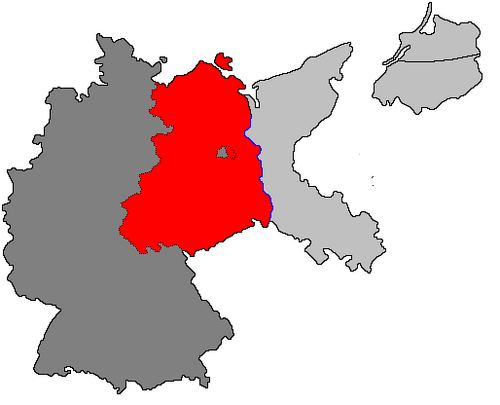
東ドイツが建国される前、その領土は第二次世界大戦でドイツの主権を廃止したベルリン宣言に従ってソ連軍によって管理・占領されていた。ポツダム協定は東をオーデルナイセ線で区切ったソ連占領地域を設定した。東ドイツは共産党のドイツ社会主義統一党(SED)によって支配されていたが、 1989年の革命によって共産主義政府に対する圧力がもたらされた結果、1989年に民主化され自由化された。これにより東ドイツと西ドイツとの再統一への道が開かれた。西ドイツ政府とは異なり、SEDは自国をドイツ帝国(1871-1945) の後継者とは見なしておらず、憲法 ( 1974年) で統一の目標を廃止した。SED支配下の東ドイツはしばしばソ連の衛星国と表現され、歴史家はそれを権威主義体制と表現した。[8] [9]
地理的に東ドイツは北はバルト海、東はポーランド、南東はチェコスロバキア、南西と西は西ドイツと接していた。国内では、東ベルリンとして知られる連合国占領下のベルリンのソ連地区とも接しており、東ベルリンは事実上の首都としても管理されていた。また、アメリカ、イギリス、フランスが占領した3つの地区(総称して西ベルリン(事実上の西ドイツの一部))とも接していた。西側への移民は大きな問題であり、移民の多くは高学歴の若者であった。このような移民は国家を経済的に弱体化させた。これに対応して、東ドイツ政府はドイツ国内の国境を強化し、後に1961年にベルリンの壁を建設した。 [10]逃亡を試みた多くの人々[11] [12] [13]が国境警備隊や地雷などの仕掛け爆弾によって殺害された。[14]
1989年、東ドイツ国内外の数多くの社会的、経済的、政治的勢力、中でも最も顕著なものの一つであるライプツィヒ市で始まった平和的な抗議活動が、ベルリンの壁の崩壊と自由化を掲げる政府の樹立につながった。翌年、国内で自由かつ公正な選挙が実施され、[15]旧連合国4カ国と2つのドイツ州の間で国際交渉が開始された。この交渉の結果、将来の統一ドイツの地位と国境に関するポツダム協定に代わる最終和解条約が調印された。東ドイツは、 5つの州 (「Länder」) がドイツ基本法第23条に基づいてドイツ連邦共和国に加盟し、首都の東ベルリンが1990年10月3日に西ベルリンと統合したことにより消滅した。東ドイツの指導者の何人か、特に最後の共産党指導者エゴン・クレンツは、後に東ドイツ時代に犯した犯罪で訴追された。[16] [17]
命名規則
正式名称はドイツ民主共和国(Deutsche Demokratische Republik )で、通常はDDR(GDR)と略される。東ドイツでは両方の用語が使用されていたが、 1968年に第2憲法が公布されて以降、東ドイツが西ドイツ人と西ベルリン人を外国人とみなして以来、特に省略形の使用が増えた。西ドイツ人、西側メディア、政治家は当初、正式名称とその略称を避け、代わりにOstzone(東部地帯)[18]、 Sowjetische Besatzungszone(ソ連占領地域、しばしばSBZと略される)、sogenannte DDR [19] 、いわゆる「GDR」などの用語を使用していた。[20]
東ベルリンの政治権力の中心地は、西側ではパンコウと呼ばれていた(ドイツにおけるソ連軍の司令部はベルリン東部のカールスホルスト地区にあった)。 [18]しかし、時が経つにつれて、「DDR」という略語も西ドイツ人や西ドイツのメディアによって口語的に使われるようになった。[i]
西ドイツ人が使用していた「Westdeutschland(西ドイツ)」という用語は、ほとんどの場合、西ドイツの地理的地域を指し、ドイツ連邦共和国の境界内の地域を指すものではありませんでした。ただし、この使用法は常に一貫しているわけではなく、西ベルリンの人々は連邦共和国を表すために「Westdeutschland 」という用語を頻繁に使用しました。 [21]第二次世界大戦前は、社会学者マックス・ウェーバーと政治理論家カール・シュミットの著作に反映されているように、エルベ川(東エルビア)の東側のすべての地域を表すために「Ostdeutschland(東ドイツ)」が使用されていました。[22] [23] [24] [25] [26]
歴史
歴史家ゲルハルト・A・リッター(2002)は、東ドイツ政府の国内への影響をドイツの長期史の観点から説明し、東ドイツ国家は2つの支配的な勢力、すなわちソビエト共産主義と、戦間期のドイツ共産主義者の経験を通して浸透したドイツの伝統によって特徴づけられたと主張した。 [27]東ドイツはその存続期間を通じて、より豊かな西側諸国の影響と常に格闘しており、東ドイツ人は常に自国を西側諸国と比較していた。共産主義政権によって導入された注目すべき変革は、資本主義の廃止、工業および農業部門の見直し、社会の軍事化、教育システムとメディアの政治的方向性に特に顕著であった。
一方、新体制は、科学、工学専門職、[28] : 185–189 、プロテスタント教会、[28] : 190 、多くのブルジョア階級の生活様式といった歴史的に独立した領域では比較的わずかな変化しか与えなかった。[28] : 190 リッターによれば、社会政策は過去数十年間に重要な正当化ツールとなり、社会主義的要素と伝統的要素をほぼ同数混ぜ合わせた。[28]
起源
第二次世界大戦中のヤルタ会談で、連合国であるアメリカ、イギリス、ソ連は、敗戦したナチスドイツを占領地域に分割し、[29]ドイツの首都ベルリンも連合国間で分割することに合意した。当初、これはアメリカ、イギリス、ソ連の3つの占領地域の形成を意味していたが、後にアメリカとイギリスの占領地域からフランス占領地域が切り出された。[30]
1949年設立
ドイツ社会主義統一党(SED)として知られる与党共産党は、1946年4月21日にドイツ共産党(KPD)とドイツ社会民主党(SPD)が合併して結成された。 [31]ナチスが全権力を統合し犯罪者扱いする前、両党は活動していた当時は悪名高いライバルであり、東ドイツとソ連の公式歴史書では、この合併は社会主義政党による自発的な努力の結集であり、共通の敵を倒した後のドイツ社会主義者の新しい友情の象徴であると描写されている。しかし、合併は一般に描写されているよりも困難を伴い、ソ連占領当局はSPDの東部支部にKPDとの合併を強く求め、多数派を占めた共産党が政策を事実上完全にコントロールしていたことを示す証拠が多数ある。[32] SEDは東ドイツ国家の全期間にわたって与党であり続けた。ロシアはソ連と密接な関係にあり、ソ連は西ドイツのNATO基地に 対抗する目的で、1991年のソ連政権崩壊まで東ドイツに軍隊を維持していた(ロシアは1994年まで旧東ドイツ領内に軍隊を維持し続けた)。
西ドイツが再編され占領軍から独立すると(1945年~1949年)、1949年10月に東ドイツに東ドイツ民主共和国が樹立された。2つの主権国家の出現により、1945年のドイツ分断は確固たるものとなった。 [33] 1952年3月10日、ソ連共産党書記長ヨシフ・スターリンは(後に「スターリン・ノート」として知られるようになる文書の中で) 、中立政策で経済政策に条件を付けず、「言論、出版、宗教的信条、政治的信念、集会の自由を含む人権と基本的自由」および民主的な政党や組織の自由な活動を保障してドイツを再統一するという提案を発表した。[34]西側諸国はこれに異議を唱えた。当時、西ドイツ指導部にとって統一は優先事項ではなく、NATO諸国はドイツがNATOに加盟できるべきであり、ソ連とのそのような交渉は降伏と見なされると主張して提案を拒否した。
1949年、ソ連は東ドイツの統治権をSEDに引き渡した。SEDの議長はヴィルヘルム・ピーク(1876年 - 1960年)で、ピークは東ドイツ大統領となり、死ぬまでその職に就いた。一方、SEDの書記長ヴァルター ・ウルブリヒトがほとんどの行政権を握った。社会主義指導者オットー・グローテヴォール(1894年 - 1964年)は死ぬまで首相を務めた。 [35]
東ドイツ政府は、西ドイツが非ナチ化を達成できなかったことを非難し、ナチスの過去とのつながりを断ち切り、多くの元ナチスを投獄し、彼らが政府の役職に就くことを阻止した。SEDは、東ドイツからナチズムの痕跡をすべて取り除くことを主な目標に設定した。[36]推定では、[いつ? ] 18万人から25万人が政治的な理由で投獄された。[37]
占領地域
1945年のヤルタ会談とポツダム会談で、連合国は連合国統制会議(ACC)を通じてドイツの共同軍事占領と統治を確立した。これは4カ国(米国、英国、ソ連、フランス)による軍事政権で、ドイツの主権が回復されるまで有効であった。ドイツ東部では、ソ連占領地域(SBZ – Sowjetische Besatzungszone )はメクレンブルク=フォアポンメルン州、ブランデンブルク州、ザクセン州、ザクセン=アンハルト州、テューリンゲン州の5つの州で構成されていた。 [ 38]占領地域で従うべき政策をめぐる意見の不一致により、4カ国間の協力はすぐに決裂し、ソ連は他の地域で実施されている政策に関係なく、自らの占領地域を統治した。ソ連は1948年にACCから脱退した。その後、他の3つの地域が次第に統一され自治権が認められるにつれて、ソビエト政権はその地域に別の社会主義政府を設立した。[39] [40]

連合国が1945年にドイツとの共通政策を定めたポツダム協定から7年後、ソ連はスターリン覚書(1952年3月10日)を通じてドイツの再統一と中央ヨーロッパからの超大国の撤退を提案したが、西側3か国(米国、フランス、英国)はこれを拒否した。共産主義で再統一を主張したソ連の指導者ヨシフ・スターリンは1953年3月初旬に死去した。同様に、ソ連第一副首相のラヴレンチー・ベリヤはドイツ再統一を追求したが、その問題に取り組む前に同年権力の座から追われた。後継者のニキータ・フルシチョフは、再統一は東ドイツを西側に併合するために返還することと同義であるとしてこれを拒否した。そのため、1989年にベルリンの壁が崩壊するまで再統一は議題に上らなかった。

ベルリンの壁のある西ベルリンと東ベルリン
東ドイツは東ベルリンを首都とみなし、ソ連とその他の東側諸国も外交上は東ベルリンを首都と認めていた。しかし、西側連合国はベルリン市全体が連合国管理理事会の統治する占領地であるとみなし、この承認に異議を唱えた。マルガレーテ・ファインシュタインによれば、東ベルリンの首都としての地位は西側諸国や第三世界のほとんどの国ではほとんど認められていなかった。[41]実際には、連合国管理理事会の権威は冷戦によって意味をなさなくなり、東ベルリンの占領地としての地位は大部分が法的な虚構となり、ベルリンのソ連地区は完全に東ドイツに統合された。[42]
西ベルリンの未解決の地位をめぐって西側諸国とソ連の間で冷戦が深刻化し、ベルリン封鎖(1948年6月24日~1949年5月12日)が始まった。ソ連軍は西ベルリンへの連合軍の鉄道、道路、水上交通をすべて停止することで封鎖を開始した。連合軍はソ連に対抗し、西ベルリンへの食糧、燃料、物資をベルリン空輸(1948~49年)した。 [43]
パーティション
1946年4月21日、ドイツ共産党(Kommunistische Partei Deutschlands – KPD)と ソビエトゾーンのドイツ社会民主党 の一部(Sozialdemokratische Partei Deutschlands – SPD)が合併し、ドイツ社会主義統一党(SED – Sozialistische)を形成しました。 Einheitspartei Deutschlands )、その後1946 年 10 月の選挙で勝利しました。 SED 政府はインフラと産業プラント を国有化した。

1948年3月、ハインリヒ・ラウ委員長率いるドイツ経済委員会( DWK )がソ連占領地域の行政権限を引き継ぎ、東ドイツ政府の前身となった。[44] [45]
1949年10月7日、SEDは社会主義の政治憲法に基づき、東ドイツのすべての政党と大衆組織の包括同盟であるドイツ民主共和国反ファシスト 国民戦線(NF、Nationale Front der Deutschen Demokratischen Republik )に対する統制を確立したドイツ民主共和国(ドイツ民主共和国 – GDR)を設立しました。NFは東ドイツの議会であるフォルクスカンマー(人民院)選挙に立候補するために設立されました。ドイツ民主共和国の初代で唯一の大統領はヴィルヘルム・ピークでした。しかし、1950年以降、東ドイツの政治権力はSEDの第一書記であるヴァルター・ウルブリヒトが握っていました。[5]
.jpg/500px-Opvolger_van_Pieck,_Walter_Ulbricht,_Bestanddeelnr_911-5926_(cropped).jpg)
1953年6月16日、東ドイツが公式に公布した都市計画の16原則に従って東ベルリンで新しいスターリナレー大通りを建設していた労働者が、10%の生産ノルマ増加に反対して暴動を起こした。当初は労働者の抗議行動だったが、すぐに一般大衆も行動に加わり、6月17日には同様の抗議行動が東ドイツ全土で発生し、約700の都市と町で100万人を超える人々がストライキを行った。反共産主義の反革命を恐れた東ドイツ政府は、1953年6月18日、暴動を鎮圧するために警察を支援するためソ連占領軍を動員した。約50人が殺害され、1万人が投獄された(1953年の東ドイツ蜂起を参照)。[要説明] [46] [47]
ドイツがソ連に支払わなければならなかった戦争賠償金は、ソ連占領地域を貧困に陥れ、東ドイツ経済を著しく弱体化させた。1945年から46年にかけて、ソ連は工業プラントの約33%を没収してソ連に移送し、1950年代初頭までに農産物と工業製品で約100億ドルの賠償金を徴収した。[48]賠償金によって引き起こされた、または深刻化した東ドイツの貧困は、西ドイツへのRepublikflucht(共和国からの離脱)を引き起こし、東ドイツ経済をさらに弱体化させた。西側諸国の経済的機会は頭脳流出を引き起こした。これに対応して、東ドイツはドイツ国内の国境を閉鎖し、1961年8月12日の夜、東ドイツ軍はベルリンの壁の建設を開始した。[49]
.jpg/500px-Bundesarchiv_Bild_183-R1220-401,_Erich_Honecker_(cropped).jpg)
1971年、ソ連の指導者レオニード・ブレジネフがウルブリヒトの追放を支持したため、ウルブリヒトは指導者の座から外され、[50] エーリヒ・ホーネッカーが後任となった。ウルブリヒト政権は自由主義的改革を試みていたが、ホーネッカー政権はそれを覆した。新政権は東ドイツ新憲法を導入し、ドイツ民主共和国を「労働者と農民の共和国」と定義した。[51]
当初、東ドイツはドイツ全土に対する排他的委任統治権を主張し、この主張は共産圏の大半によって支持された。東ドイツは、西ドイツはNATOの違法に設立された傀儡国家であると主張した。しかし、1960年代以降、東ドイツは西ドイツとは別の国であると認識し始め、 1871年から1945年の統一ドイツ国家の遺産を共有するようになった。これは、1974年に東ドイツ憲法の改正から統一条項が削除されたときに正式に認められた。対照的に、西ドイツは、自らがドイツの唯一の合法的な政府であると主張した。1949年から1970年代初頭まで、西ドイツは東ドイツは違法に設立された国家であると主張した。東ドイツは、東ドイツがソ連の傀儡国家であると主張し、頻繁に「ソ連占領地域」と呼んだ。西ドイツの同盟国は1973年までこの立場を共有していた。東ドイツは主に社会主義諸国とアラブ圏、そして一部の「散発的な同調者」によって承認されていた。[52]ハルシュタイン・ドクトリン(1955年)によれば、西ドイツはソ連を除き、東ドイツの主権を承認したどの国とも(正式な)外交関係を樹立していなかった。

1970年代初頭、西ドイツのヴィリー・ブラント首相の実利主義政権の「和解による変革」を掲げた東方政策により、東側諸国との外交関係が正常化した。この政策のもと、モスクワ条約(1970年8月)、ワルシャワ条約(1970年12月)、ベルリンに関する四カ国協定(1971年9月)、通過協定(1972年5月)、および基本条約(1972年12月)が締結され、ドイツ全体に対する排他的委任統治に対する個別の主張が放棄され、両ドイツ間の正常な関係が確立された。両国は1973年9月18日に国連に加盟した。これにより、東ドイツを承認する国の数は米国、英国、フランスを含む55カ国に増えたが、これら3カ国は依然として東ベルリンを首都として承認することを拒否し、その旨を両ドイツを国連に承認する国連決議に明記するよう主張した。[52]東方政策の後、西ドイツの見解は、東ドイツは単一のドイツ国家内の事実上の政府であり、連邦共和国外のドイツの一部からなる法的に認められた国家組織であるというものであった。連邦共和国は、自らの組織内では、東ドイツを国際法上の主権国家として法的に承認することはできないと主張し続けたが、国際法の組織内では、東ドイツが独立した主権国家であることを完全に認めた。これとは対照的に、西ドイツは、自らの境界内では、事実上かつ法的に認められた政府であるだけでなく、休眠中の「ドイツ全体」の唯一の法的に正当な代表者であると自認していた。 [53]両ドイツは、国際的に相手国を代表するという主張を放棄した。これは、国際連合やヘルシンキ最終文書などの国際機関や協定に参加する際に、両国が法的に自国の国民を代表する能力があることを相互に認めることを必然的に示すものであると両国は認めた。
この基本条約の評価は、1973年の連邦憲法裁判所の判決で確認された。 [54]
ドイツ民主共和国は国際法上の意味で国家であり、国際法の主体である。この判断は、ドイツ連邦共和国によるドイツ民主共和国の国際法上の承認とは無関係である。ドイツ連邦共和国は、そのような承認を公式に表明したことがないばかりか、逆に繰り返し明確に拒否してきた。ドイツ連邦共和国のドイツ民主共和国に対する行動を、そのデタント政策、特に事実上の承認としての条約締結の観点から評価するならば、それは特別な種類の事実上の承認としてのみ理解できる。この条約の特別な点は、国際法の規則が適用され、他の国際条約と同様に有効性を有する二国間条約であるが、再編されていないため行動することはできないものの、依然として存在する、単一の政体を持つドイツ全体の包括的な国家の一部である二国間の条約であるという点である。[55]
1972年から東ドイツとポーランド、チェコスロバキア、ハンガリー間の渡航はビザ不要となった。[56]
東ドイツのアイデンティティ


当初から、新たに形成された東ドイツは独自のアイデンティティを確立しようとした。[57]プロイセンの帝国と軍事の遺産のため、SEDはプロイセンと東ドイツの連続性を否定した。SEDはかつてのプロイセン貴族の象徴的な遺物を数多く破壊した。ユンカー家の邸宅は取り壊され、ベルリン市庁舎は取り壊されて共和国宮殿が建てられ、フリードリヒ大王の騎馬像は東ベルリンから撤去された。その代わりにSEDは、 1524年から1525年のドイツ農民戦争におけるトーマス・ミュンツァーの役割や、プロイセンの工業化期における階級闘争の英雄たちの果たした役割など、ドイツ史の進歩的な遺産に焦点を当てた。カール・フライヘル・フォン・シュタイン(1757年~1831年)、カール・アウグスト・フォン・ハルデンベルク(1750年~1822年)、ヴィルヘルム・フォン・フンボルト(1767年~1835年)、ゲルハルト・フォン・シャルンホルスト(1755年~1813年)といったプロイセン史の他の著名な人物や改革者も、SEDによって模範や模範として支持された。
第三帝国の記憶
東ドイツの共産主義政権は、反ファシスト闘士の闘争をその正当性の根拠としていた。ブーヘンヴァルト収容所の記念館には一種の抵抗「カルト」が築かれ、1958年に博物館が設立され、1945年4月19日に平和と自由のために戦うことを誓った囚人たちが行ったブーヘンヴァルトの誓いを毎年祝った。1990年代には、東ドイツの「国家反ファシズム」は西ドイツの「国家反共産主義」に取って代わられた。それ以来、全体主義の概念に基づく東ドイツの歴史の支配的な解釈は、共産主義とナチズムの同等性をもたらした。[58]歴史家のアンネ=キャスリーン・ティラック=グラフは、新聞「ノイエス・ドイチュラント」の協力を得て、ブーヘンヴァルト、ザクセンハウゼン、ラーフェンスブリュックの国立記念碑がどのように政治的に利用されたかを示している。
東ドイツでは、特に強制収容所解放の祝賀行事の際にそうであった。[59]
西ドイツでは公式には「ファシスト世界」に対抗するために建設されたが、1954年には公務員の32%が元ナチ党員であった。しかし、1961年には、内務省の上級行政職員に占める元NSDAP党員の割合は、東ドイツでは10%未満であったのに対し、西ドイツでは67%であった。[60]西ドイツではナチズムの復活に関する記憶作業が行われたが、東ドイツではそうではなかった。実際、イエナ大学の歴史学教授アクセル・ドスマンは次のように指摘している。「この現象は完全に隠蔽されていた。東ドイツ共産党(SED)にとって、ネオナチの存在を認めることは不可能だった。東ドイツは反ファシズム国家を建国することになっていたからだ。シュタージは彼らに目を光らせていたが、彼らは部外者か厚かましい暴漢とみなされていた。これらの若者は二重語を聞きながら育った。学校では第三帝国について話すことは禁じられ、家では祖父母からヒトラーのおかげで最初の高速道路ができたと聞かされた。」1987年10月17日、警察が介入することなく、ツィオン教会で行われたロックコンサートで30人ほどのスキンヘッドが2,000人の群衆の中に激しく身を投げた。[61] 1990年、作家のフレイヤ・クリールは、東ドイツにおける反ユダヤ主義と外国人嫌悪に関するエッセイを書いたために殺害の脅迫を受けた。一方、 SPDA副会長のヴォルフガング・ティールゼは、旧東ドイツ住民の日常生活における極右、特にテロリスト集団NSUの台頭について『ディ・ヴェルト』紙で不満を述べ、ドイツ人ジャーナリストのオディール・ベニャヒア=クイダーは「ネオナチ党NPDが東方で復活を遂げたのは偶然ではない」と説明した。[62]
歴史家ソニア・コンブは、1990年代まで西ドイツの歴史家の大多数が1944年6月のノルマンディー上陸作戦を「侵略」と表現し、ユダヤ人虐殺の責任をドイツ国防軍から免除し、「知らなかった」外交団という神話をでっち上げたと指摘している。それとは逆に、東ドイツではアウシュビッツは決してタブーではなかった。ナチスの犯罪は、映画、演劇、文学作品の題材として広く取り上げられた。1991年には、西ドイツでは人口の16%、東ドイツでは人口の6%が反ユダヤ主義的偏見を持っていた。1994年には、西ドイツ人の40%、東ドイツ人の22%が、ユダヤ人虐殺に重点が置かれすぎていると感じていた。[60]
歴史家ウルリッヒ・プファイルは、それでもなお、東ドイツにおける反ファシズムの記念行事は「聖人伝的、教化的性格」を持っていたと回想している。[63]ドイツ労働運動の主役や収容所の犠牲者の追悼の場合と同様に、それは「演出され、検閲され、命令され」、政権の40年間、正当化、抑圧、権力維持の手段であった。[63]
ディ・ヴェンデ(ドイツ統一)

1989年5月、地方選挙の結果の捏造に対する国民の怒りが広がった後、多くの東ドイツ国民が出国ビザを申請するか、東ドイツの法律に反して国を離れた。この東ドイツ人の脱出のきっかけとなったのは、1989年5月2日にハンガリーとオーストリアの国境沿いの電気柵が撤去されたことだった。正式にはハンガリーの国境は依然として閉ざされていたが、多くの東ドイツ人はその機会を利用してチェコスロバキア経由でハンガリーに入国し、ハンガリーからオーストリア、そして西ドイツへと不法に国境を越えた。[64] 7月までに2万5000人の東ドイツ人がハンガリーに渡った。[65]彼らのほとんどはオーストリアへの危険な渡航を試みず、ハンガリーに留まるか、プラハやブダペストの西ドイツ大使館に亡命を申請した。
1989年8月19日の汎ヨーロッパ・ピクニックでオーストリアとハンガリーの国境ゲートが開かれたことは、東ドイツの終焉と東側諸国の崩壊につながる連鎖反応を引き起こした。これは、1961年のベルリンの壁建設以来、東ドイツからの最大の集団脱出であった。式典で国境を開くというアイデアは、オットー・フォン・ハプスブルク家が、当時のハンガリー首相ミクローシュ・ネーメスに提案し、ネーメスが推進した。[66]ピクニックの主催者であるハプスブルク家とハンガリーの国務大臣イムレ・ポジェスガイは、このイベントには出席しなかったが、計画されていたイベントを、鉄のカーテンの国境開放に対するミハイル・ゴルバチョフの反応を試す機会と見なした。特に、モスクワがハンガリーに駐留するソ連軍に介入の命令を下すかどうかを試すものだった。汎ヨーロッパ連合は、ハンガリーで休暇を過ごしていた東ドイツ人の間にポスターやチラシを配布し、計画されていたピクニックの大々的な宣伝を行った。当時カール・フォン・ハプスブルクが率いていた汎ヨーロッパ連合のオーストリア支部は、ショプロン(ハンガリーとオーストリアの国境付近)の国境付近で行われるピクニックに東ドイツ市民を招待するパンフレットを何千枚も配布した。 [67] [68] [69]ショプロンの地元主催者は、東ドイツからの難民が発生する可能性については何も知らなかったが、オーストリアとハンガリーが参加する地元パーティーを構想していた。[70]しかし、汎ヨーロッパピクニックでの大量脱出により、東ドイツ社会主義統一党のその後の躊躇いとソ連の不介入によってダムが決壊した。こうして東側諸国の壁は崩れた。メディアの警告を受けた何万人もの東ドイツ人がハンガリーに向かったが、ハンガリーはもはや国境を完全に封鎖したり、逃亡者に国境警備隊に発砲させたりすることはできなかった。東ベルリンの東ドイツ指導部は、自国の国境を完全に封鎖する勇気はなかった。[67] [69] [71] [72]
脱出の次の大きな転機は1989年9月10日に訪れた。ハンガリーのギュラ・ホルン外相が、ハンガリーからオーストリアへの移動をこれ以上制限しないと発表したのだ。2日間で2万2千人の東ドイツ人がオーストリアに渡り、その後数週間でさらに数万人がオーストリアに渡った。[64]
東ドイツ市民の多くは、特にライプツィヒ市で、与党に反対するデモを行った。ライプツィヒのデモは毎週のように行われ、10月2日の最初のデモには1万人が参加し、月末までに推定30万人に達した。[73]抗議活動は東ベルリンでさらに拡大し、11月4日には50万人が政権に反対するデモに参加した。[73]ライプツィヒ・ゲヴァントハウス管弦楽団の指揮者クルト・マズアは、政府との地元交渉を主導し、コンサートホールでタウンミーティングを開催した。[74]デモの結果、最終的にエーリヒ・ホーネッカーは10月に辞任し、やや穏健な共産主義者のエゴン・クレンツが後任となった。[75]
11月4日の東ベルリンでの大規模デモは、チェコスロバキアが正式に西ドイツとの国境を開いた時期と一致した。 [76]西側へのアクセスがかつてないほど容易になったため、最初の2日間だけで3万人の東ドイツ人がチェコスロバキア経由で国境を越えた。国民の流出を食い止めるため、SEDは渡航制限を緩和する法律を提案した。 11月5日に国民議会がこれを否決すると、東ドイツの内閣と政治局は総辞職した。 [76]これにより、クレンツとSEDに残された道は、東西間の渡航制限を完全に撤廃することだけとなった。
1989年11月9日、ベルリンの壁が数か所開かれ、その結果、何千人もの東ドイツ人が30年ぶりに西ベルリンと西ドイツに自由に渡ることになった。クレンツは1か月後に辞任し、SEDは初期の民主化運動であるノイエス・フォーラムの指導者と交渉を開始し、自由選挙を予定し民主化のプロセスを開始した。このプロセスの一環として、SEDは東ドイツ憲法から共産党による国家指導を保証する条項を削除した。この変更は1989年12月1日に国民議会で420対0の投票で承認された。[77]

東ドイツでは1990年3月に最後の選挙が行われた。勝利したのは、西ドイツのキリスト教民主同盟の東ドイツ支部が率いる、早期統一を主張する連合「ドイツ同盟」だった。2つのドイツ州と旧同盟国による交渉( 2+4会談)が行われ、ドイツ統一の条件について合意に達した。1990年8月23日、国民議会で3分の2の賛成多数により、ドイツ民主共和国はドイツ連邦共和国への加盟を宣言した。1952年の選挙区再編で廃止されていた5つの東ドイツ州が復活した。 [75] 1990年10月3日、5州は正式にドイツ連邦共和国に加盟し、東ベルリンと西ベルリンは(ブレーメンとハンブルクと同じように)3番目の都市国家として統一された。 7月1日、政治統合に先立って通貨統合が成立し、「東マルク」が廃止され、西ドイツの「ドイツマルク」が共通通貨となった。
国民議会による西ドイツ共和国への加盟宣言が再統一のプロセスを開始したものの、再統一行為そのもの(多くの具体的な条件や資格、その一部は西ドイツ基本法の改正を伴う)は、その後の1990年8月31日の統一条約によって憲法上達成された。すなわち、旧民主共和国と西ドイツ共和国の間で、国際法上互いを別々の主権国家として承認する拘束力のある合意によって達成されたのである。[78]その後、この条約は、統一の合意期日前に国民議会と連邦議会の双方で憲法上必要な3分の2以上の多数決により発効し、一方では東ドイツが消滅し、他方では西ドイツ基本法の合意された改正が行われた。
旧ドイツ間の経済的、社会的、政治的な格差が大きかったため、ドイツ民主共和国をドイツ連邦共和国に完全に統合するには政府による補助金が必要だった。その結果、旧東ドイツでは産業空洞化が進んだため、この統合が失敗した原因は今も議論されている。一部の西側評論家は、東側経済の不振は明らかに非効率な指令経済の当然の結果であると主張している。しかし、多くの東ドイツ批評家は、民営化のショック療法的なスタイル、オストマルクに提示された人工的に高い為替レート、およびプロセス全体が実行されるスピードにより、東ドイツ企業が適応する余地がなかったと主張している。[j]
政府と政治


東ドイツの政治史には4つの時代があった。[79] 1949年から1961年は社会主義が構築された時代、1961年から1970年はベルリンの壁が崩壊して脱出が不可能になった後の安定と統合の時代、1971年から1985年はホーネッカー時代と呼ばれ、西ドイツとの結びつきが強まった時代、そして1985年から1990年は東ドイツの衰退と消滅の時代であった。
組織
東ドイツの与党はドイツ社会主義統一党(SED)であった。1946年にソ連支配地域でソ連主導によりドイツ共産党(KPD)とドイツ社会民主党(SPD)が合併して誕生した。しかし、独立志向の強い社会民主党が排除されると、SEDはすぐに本格的な共産党へと変貌した。[80]
ポツダム協定は、ソ連がドイツにおける民主的な政府形態を支持することを約束したが、ソ連の民主主義に対する理解は西側諸国のそれとは根本的に異なっていた。他のソ連圏諸国と同様に、非共産主義政党は認められていた。しかし、東ドイツのすべての政党は、以下の政党や大衆政治組織の広範な連合である 民主ドイツ国民戦線に加入することを余儀なくされた。
- 統一後に西ドイツCDUと合併したキリスト教民主同盟ドイツ(ドイツキリスト教民主同盟、CDU)。
- Demokratische Bauernpartei Deutschlands (ドイツ民主農民党、DBD)。同党は統一後、西ドイツCDUと合併した。
- 自由民主党ドイツ党(ドイツ自由民主党、LDPD) は、統一後に西ドイツFDPと合併しました。
- Nationaldemokratische Partei Deutschlands (ドイツ国民民主党、NDPD) は、統一後に西ドイツFDPと合併しました。 [80]

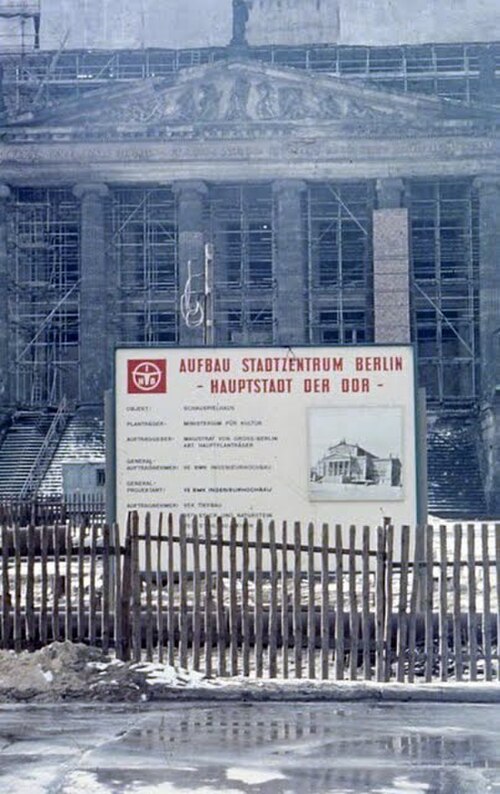
加盟政党はほぼ完全にSEDに従属しており、その存在条件としてその「指導的役割」を受け入れなければならなかった。しかし、各政党は国民議会に代表を送り、政府内でいくつかの役職を得た。
国民議会には、自由ドイツ青年(Freie Deutsche Jugend、FDJ)や自由ドイツ労働組合連盟などの大衆組織の代表も含まれていた。また、ドイツ民主婦人連盟も国民議会に議席を持っていた。
東ドイツ社会における重要な非議会大衆組織としては、ドイツ体操・スポーツ協会(Deutscher Turn- und Sportbund、DTSB)や高齢者団体の人民連帯(Volkssolidarität )などがあった。もう一つの注目すべき団体はドイツ・ソビエト友好協会である。
社会主義の崩壊後、SEDは「民主社会主義党」(PDS)と改名され、再統一後も10年間存続し、その後西ドイツ社会主義運動(WASG)と合併して左翼党(Die Linke )を結成した。左翼党は、SEDほど強力ではないものの、ドイツの多くの地域で依然として政治勢力を維持している。[81]
州のシンボル
ドイツ民主共和国の旗は、伝統的なドイツ民主主義の色である黒、赤、金の 3 本の横縞で構成され、中央にはハンマーとコンパスから成る東ドイツの国章があり、労働者、農民、知識人の同盟のシンボルとしてトウモロコシの輪で囲まれています。フリッツ・ベーレントの国章の最初の草案には、労働者と農民の国家を表現するために、ハンマーとトウモロコシの輪だけが含まれていました。最終版は主にハインツ・ベーリングの作品に基づいています。
1955 年 9 月 26 日の法律により、ハンマー、コンパス、トウモロコシの輪をあしらった国章が定められ、国旗は黒、赤、金色のままです。1959 年 10 月 1 日の法律により、国章は国旗に挿入されました。1960 年代末まで、ドイツ連邦共和国と西ベルリンでこの国旗を公に掲揚することは、憲法および公共秩序に違反するものとみなされ、警察の措置によって阻止されていました (1959 年 10 月の連邦および各州の内務大臣の宣言を参照)。連邦政府が「東ドイツの国旗と国章の使用に対して、警察はいかなる場所でも介入してはならない」と命令したのは、1969 年になってからでした。
1990 年 5 月 31 日、DSU の要請により、東ドイツの最初の自由選挙による人民議会は、公共の建物内および建物に描かれた東ドイツの国章を 1 週間以内に撤去することを決定しました。しかし、共和国が正式に消滅するまで、国章は文書などさまざまな形で使用され続けました。
東ドイツ国歌「廃墟から蘇った」の歌詞はヨハネス・R・ベッヒャー、メロディーはハンス・アイスラーによるものです。しかし、1970年代初めから1989年末まで、「ドイツは父なる国」という一節があるため、国歌の歌詞は歌われなくなりました。
-
 東ドイツの暫定国章
(1950年1月12日から1953年5月28日) -
 東ドイツの暫定国章
(1953年5月28日から1955年9月26日) -
 東ドイツの国章
(1955年9月26日から1990年10月2日) -
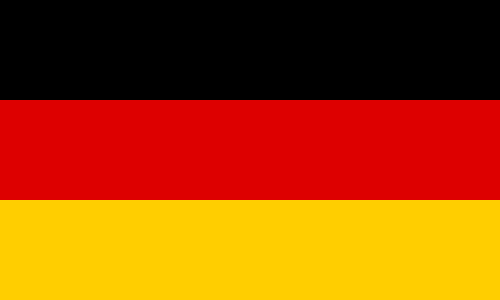 東ドイツの旗
(1949年10月7日から1959年10月1日) -
 商業用旗
商業用旗
(1959年~1973年) -
 東ドイツの旗
(1959年10月1日から1990年10月3日)
.svg/500px-Coat_of_arms_of_East_Germany_(1950%E2%80%931953).svg.png)
.svg/500px-Coat_of_arms_of_East_Germany_(1953%E2%80%931955).svg.png)
.svg/500px-Coat_of_arms_of_East_Germany_(1955%E2%80%931990).svg.png)
.svg/500px-Civil_Ensign_of_East_Germany_(1959%E2%80%931973).svg.png)
大統領基準
最初の大統領旗は、黒、赤、金色の長方形の旗で、赤い縞模様の中に黄色で「大統領」と書かれ、その下の縞模様の中に黒文字で「DDR」(点付きの公式略称とは反対)と書かれていた。旗は黄色の縞模様で囲まれていた。旗のオリジナルはベルリンのドイツ歴史博物館に所蔵されている。
.svg/500px-Flag_of_the_President_of_East_Germany_(1951%E2%80%931953).svg.png)
.svg/500px-Flag_of_the_President_of_East_Germany_(1953%E2%80%931955).svg.png)
.svg/500px-Flag_of_the_President_of_East_Germany_(1955%E2%80%931960).svg.png)

戦争と軍隊の旗とシンボル
東ドイツの軍隊の旗には、黒・赤・金の国旗の中に、赤い背景に2本のオリーブの枝の花輪を描いた国章が描かれていた。
人民海軍の軍艦およびボートの旗には、赤地にオリーブの枝の花輪をあしらった紋章が描かれ、補助艦およびボートの旗には、中央に細い黒・赤・金の帯が入った青地に描かれた。ゲッシュと同様に、国旗は縮小された形で使用された。
バルト海の沿岸国境旅団の船舶と、エルベ川とオーデル川の東ドイツ国境警備隊の船舶は、国境警備隊の軍旗と同じように、リークジャスト川に緑色の帯を掲げていた。
.svg/500px-Flag_of_NVA_(East_Germany).svg.png)
.svg/500px-Flag_of_warships_of_VM_(East_Germany).svg.png)
.svg/500px-Flag_of_auxiliary_ships_of_VM_(East_Germany).svg.png)
.svg/500px-Flag_of_German_post_(East_Germany).svg.png)
.svg/500px-Flag_of_border_brigade_coast_(East_Germany).svg.png)
.svg/500px-Flag_of_boats_of_border_troops_(East_Germany).svg.png)

-
 東ドイツ国家保安省(MfS)(シュタージ)の紋章(1990 年まで)
 -
 ドイツ民主共和国国家人民軍の紋章(1956年から1990年まで)
 -
 国家人民軍陸軍の紋章(1956年~1990年)
 -
 カール・マルクス勲章を授与された人民海軍の紋章(1956年から1990年まで)
 -
 1959 年以前のドイツ民主共和国国家人民軍空軍の紋章 (1956 年までは東ドイツ人民警察空軍)
 -
 ドイツ民主共和国国家人民軍の航空機の紋章(1959年~1990年)
 -
 車両に使用されるグレンツトルッペンのエンブレム(1949~1990年)
 -
 東ドイツ国民党の国家旗 (1962 年から 1990 年まで)
 -
 労働者階級の戦闘集団の紋章、樫の葉なし(1953年から1990年の間)
 -
 ワルシャワ条約機構または「ワルシャワ条約機構」のロゴ (1955 年 5 月 14 日)
.svg/500px-Coat_of_arms_of_NVA_(East_Germany).svg.png)
.svg/500px-Emblem_of_the_Ground_Forces_of_NVA_(East_Germany).svg.png)
_before_1959.svg/500px-Emblem_of_aircraft_NVA_(East_Germany)_before_1959.svg.png)
.svg/500px-Emblem_of_aircraft_of_NVA_(East_Germany).svg.png)
政治的および社会的象徴
東ドイツの若者は、6歳から14歳までの学童を対象としたテールマン・ピオネール隊のメンバーになった後、通常はFDJに入隊した。
-
ドイツ社会主義統一党の紋章(1950年~1990年)
-
 ドイツ社会主義統一党の旗(1950年~1990年)
 -
 自由ドイツ青年の紋章
 -
 自由ドイツ青年の旗
 -
 エルンスト・タールマン開拓者組織のエンブレム (1948 年 12 月 13 日 – 1990 年 8 月)
 -
 エルンスト・タールマン開拓者組織旗 (1948 年 12 月 13 日 – 1990 年 8 月)
ヤングパイオニアプログラム
エルンスト・タールマン・パイオニア・オーガニゼーション
ヤング・ピオネールとテールマン・ピオネールは、東ドイツの6歳から14歳の学童の青少年組織でした。[82]彼らは、ブーヘンヴァルト強制収容所で処刑されたドイツ共産党の元指導者、エルンスト・テールマンにちなんで名付けられました。[83]
このグループは、東ドイツの青年運動である自由ドイツ青年(FDJ )の下部組織であった。[84] 1948年12月13日に設立され、1989年のドイツ再統一で解散した。[85] 1960年代と1970年代には、6歳から14歳までのほぼすべての学童がヤング・ピオニアまたはテールマン・ピオニアのグループに組織され、1975年までにこれらの組織には「ほぼ200万人の子供たち」が参加していた。[85]
この先駆者グループはスカウティングを大まかにベースとしていたが、6~14歳の児童に社会主義思想を教え、自由ドイツ青年団(FDJ)に備えるために組織された。 [85]
このプログラムは、ソ連のピオネール計画であるウラジーミル・レーニン全連邦ピオネール組織に倣って考案された。ピオネールのスローガンは「平和と社会主義のために準備万端、常に準備万端」であった。これは通常「準備万端、常に準備万端」と短縮された。これは国旗掲揚時に朗読された。最初の部分「準備万端!」を言うのは1人であった。これは通常、ピオネールのリーダー、教師、または地元のピオネールグループのリーダーであった。ピオネールは全員「常に準備万端」と答え、右手を固くして額に当て、親指を一番近く、小指を空に向けた。[85]

両パイオニアグループは、自国の 社会主義の成功を称え祝う大規模なパレードを頻繁に行いました。
メンバーシップ
Membership in the Young Pioneers and the Thälmann Pioneers was formally voluntary. On the other hand, it was taken for granted by the state and thus by the school as well as by many parents. In practice, the initiative for the admission of all students in a class came from the school. As the membership quota of up to 98 percent of the students (in the later years of the GDR) shows, the six- or ten-year-olds (or their parents) had to become active on their own in order not to become members. Nevertheless, there were also children who did not become members. Rarely, students were not admitted because of poor academic performance or bad behavior "as a punishment" or excluded from further membership.
Uniform

The pioneers' uniform consisted of white shirts and blouses bought by their parents, along with blue trousers or skirts until the 1970s and on special occasions. But often the only thing worn was the most important sign of the future socialist – the triangular necktie. At first this was blue, but from 1973, the Thälmann pioneers wore a red necktie like the pioneers in the Soviet Union, while the Young Pioneers kept the blue one. Pioneers wore their uniforms at political events and state holidays such as the workers' demonstrations on May Day, as well as at school festivals and pioneer events.[85]
The pioneer clothing consisted of white blouses and shirts that could be purchased in sporting goods stores. On the left sleeve there was a patch with the embroidered emblem of the pioneer organization and, if necessary, a rank badge with stripes in the color of the scarf. These rank badges were three stripes for Friendship Council Chairmen, two stripes for Group Council Chairmen and Friendship Council members, one stripe for all other Group Council members. In some cases, symbols for special functions were also sewn on at this point, for example a red cross for a boy paramedic. Dark blue trousers or skirts were worn and a dark blue cap served as a headgear with the pioneer emblem as a cockade. At the beginning of the 1970s, a windbreaker/blouson and a dark red leisure blouse were added.
However, the pioneer clothing was only worn completely on special occasions, such as flag appeals, commemoration days or festive school events, but it was usually not prescribed.
From the 1960s, the requirement of trousers/skirt was dispensed with in many places, and the dress code was also relaxed with regard to the cap. For pioneer afternoons or other activities, often only the triangular scarf was worn. In contrast to the Soviet Union and other Eastern Bloc countries, a blue scarf was common in the GDR. It was not until 1973, on the occasion of the 25th anniversary of the organization, that the red scarf was introduced for the Thälmann pioneers, while the young pioneers remained with the blue scarf. The change of color of the scarf was solemnly designed in the pioneer organization.
From 1988 there was an extended clothing range, consisting of a Nicki in the colors white, light yellow, turquoise or pink (with an imprint of the symbol of the pioneer organization), long and short trousers with a snap belt and, for the colder months, a lined windbreaker in red for girls and gray for boys.
Suitable pioneers were trained as paramedics; after their training, they wore the badge "Young Paramedic".
Music
The Pioneer songs were sung at any opportunity, including the following titles:
- "Wir tragen die Blaue Fahne" – "We Carry the Blue Flag"
- "Unser kleiner Trompeter" – "Our Little Trumpeter"
- "Thälmann-Lied" – "Thälmann Song"
- "Pioniermarsch" – "Pioneers' March"
- "Der Volkspolizist" – " The People's Policeman"
- "Jetzt bin ich Junger Pionier" – "Now I Am a Young Pioneer"
- "Unsere Heimat" – "Our Heimat"
- "Die Heimat hat sich schön gemacht" – "Our Homeland Has Smartened Itself Up"
- "Auf zum Sozialismus" – "Onwards to Socialism"
- "Kleine weiße Friedenstaube" – "Little White Dove of Peace"
- "Lied der jungen Naturforscher" – "Song of the Young Nature Researchers"
- "Wenn Mutti früh zur Arbeit geht" – "When Mother Goes to Work in the Morning"
- "Gute Freunde" – "Good Friends"
- "Hab'n Se nicht noch Altpapier" – "Got Any Waste Paper?"
- "Pioniere voran!" – "Onwards, Pioneers!"
- "Laßt Euch grüßen, Pioniere" – "Greetings, Pioneers"
- "Immer lebe die Sonne" – "May There Always Be Sunshine"
- "Friede auf unserer Erde" – "Peace on Our Earth"
Free German Youth
Freie Deutsche Jugend, organization was meant for young people, both male and female, between the ages of 14 and 25 and comprised about 75% of the young population of former East Germany.[87] In 1981–1982, this meant 2.3 million members.[88] After being a member of the Thälmann Pioneers, which was for schoolchildren ages 6 to 14, East German youths would usually join the FDJ.[89]

The FDJ increasingly developed into an instrument of communist rule and became a member of the 'democratic bloc' in 1950.[86] However, the FDJ's focus of 'happy youth life', which had characterised the 1940s, was increasingly marginalised following Walter Ulbricht's emphasis of the 'accelerated construction of socialism' at the 4th Parliament and a radicalisation of SED policy in July 1952.[90] In turn, a more severe anti-religious agenda, whose aim was to obstruct the Church youths' work, grew within the FDJ, ultimately reaching a high point in mid-April 1953 when the FDJ newspaper Junge Welt reported on details of the 'criminal' activities of the 'illegal' Junge Gemeinden FDJ gangs were sent to church meetings to heckle those inside and school tribunals interrogated or expelled students who refused to join the FDJ for religious reasons.[91]

Membership
Upon request, the young people were admitted to the FDJ from the age of 14. Membership was voluntary according to the statutes, but non-members had to fear considerable disadvantages in admission to secondary schools as well as in the choice of studies and careers and were also exposed to strong pressure from line-loyal teachers to join the organization. By the end of 1949, around one million young people had joined it, which corresponded to almost a third of the young people. Only in Berlin, where other youth organizations were also admitted due to the four-power status, the proportion of FDJ members in youth was limited to just under 5 percent in 1949. In 1985, the organization had about 2.3 million members, corresponding to about 80 percent of all GDR youths between the ages of 14 and 25. Most young people tacitly ended their FDJ membership after completing their apprenticeship or studies when they entered the workforce. However, during the period of military service in the NVA, those responsible (political officer, FDJ secretary) attached great importance to reviving FDJ membership. The degree of organisation was much higher in urban areas than in rural areas.

The FDJ clothing was the blue FDJ shirt ("blue shirt") – for girls the blue FDJ blouse – with the FDJ emblem of the rising sun on the left sleeve. The greeting of the FDJers was "friendship". Until the end of the GDR, the income-dependent membership fee was between 0.30 and 5.00 marks per month.
Music
The Festival of Political Songs (‹See Tfd›German: Festival des politischen Liedes) was one of the largest music events in East Germany, held between 1970 and 1990. It was hosted by the Free German Youth and featured international artists.
Uniform


The blue shirt (also: FDJ shirt or FDJ blouse) was since 1948 the official organizational clothing of the GDR youth organization Freie Deutsche Jugend (FDJ). On official occasions, FDJ members had to wear their blue shirts. The FDJ shirt – an FDJ blouse for girls – was a long-sleeved shirt of blue color with a folding collar, epaulettes and chest pockets. On the left sleeve was the FDJ symbol of the rising sun sewn up. Until the 1970s, the blue shirts were only made of cotton, later there was a cheaper variant made of polyester mixture.
The epaulettes of the blue shirt, in contrast to epaulettes on military uniforms, did not serve to make visible rank or unit membership, but were used at most to put a beret through. Official functions in the FDJ, for example FDJ secretary of a school or apprentice class, had no rank badges and could not be read on the FDJ shirt. However, the members of the FDJ order groups officially wore the FDJ shirt together with a red armband during their missions.
From the 1970s onwards, official patches and pins were issued for certain events, which could be worn on the FDJ shirt. There was no fixed wearing style. The orders and decorations that ordinary FDJ members received until the end of their membership at the age of 19 to 24 – usually the badge of good knowledge – were usually not worn. As a rule, only full-time FDJ members on the way to the nomenklatura at an older age achieved awards, which were also worn.
Administrative districts
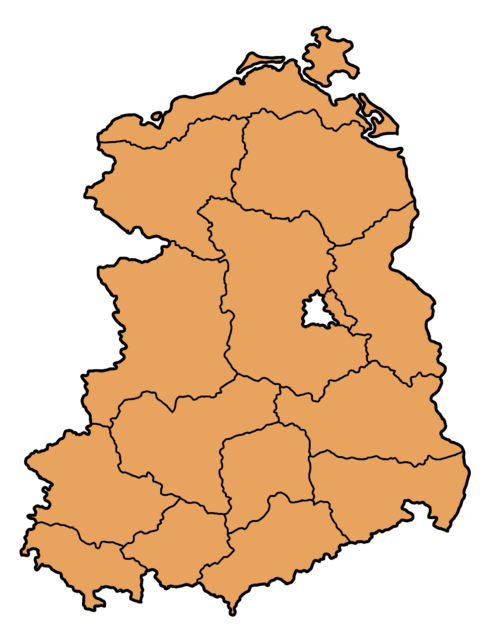

Until 1952, East Germany comprised the capital, East Berlin (though legally it was not fully part of the GDR's territory), and the five German states of Mecklenburg-Vorpommern (in 1947 renamed Mecklenburg), Brandenburg, Saxony-Anhalt (named Province of Saxony until 1946), Thuringia, and Saxony, their post-war territorial demarcations approximating the pre-war German demarcations of the Middle German Länder (states) and Provinzen (provinces of Prussia). The western parts of two provinces, Pomerania and Lower Silesia, the remainder of which were annexed by Poland, remained in the GDR and were attached to Mecklenburg and Saxony, respectively.
The East German Administrative Reform of 1952 established 14 Bezirke (districts) and de facto disestablished the five Länder. The new Bezirke, named after their district centres, were as follows: (i) Rostock, (ii) Neubrandenburg, and (iii) Schwerin created from the Land (state) of Mecklenburg; (iv) Potsdam, (v) Frankfurt (Oder), and (vii) Cottbus from Brandenburg; (vi) Magdeburg and (viii) Halle from Saxony-Anhalt; (ix) Leipzig, (xi) Dresden, and (xii) Karl-Marx-Stadt (Chemnitz until 1953 and again from 1990) from Saxony; and (x) Erfurt, (xiii) Gera, and (xiv) Suhl from Thuringia.
East Berlin was made the country's 15th Bezirk in 1961 but retained special legal status until 1968, when the residents approved the new (draft) constitution. Despite the city as a whole being legally under the control of the Allied Control Council, and diplomatic objections of the Allied governments, the GDR administered the Bezirk of Berlin as part of its territory.
Foreign relations
Support of Third World socialist countries

After receiving wider international diplomatic recognition in 1972–73, the GDR began active cooperation with Third World socialist governments and national liberation movements. While the USSR was in control of the overall strategy and Cuban armed forces were involved in the actual combat (mostly in the People's Republic of Angola and socialist Ethiopia), the GDR provided experts for military hardware maintenance and personnel training, and oversaw creation of secret security agencies based on its own Stasi model.
Already in the 1960s, contacts were established with Angola's MPLA, Mozambique's FRELIMO and the PAIGC in Guinea Bissau and Cape Verde. In the 1970s official cooperation was established with other socialist states, such as the People's Republic of the Congo, People's Democratic Republic of Yemen, Somali Democratic Republic, Libya, and the People's Republic of Benin.
The first military agreement was signed in 1973 with the People's Republic of the Congo. In 1979 friendship treaties were signed with Angola, Mozambique and Ethiopia.
It was estimated that altogether, 2,000–4,000 DDR military and security experts were dispatched to Africa. In addition, representatives from African and Arab countries and liberation movements underwent military training in the GDR.[92]
East Germany and the Middle East conflict
East Germany pursued an anti-Zionist policy; Jeffrey Herf argues that East Germany was waging an undeclared war on Israel.[93] According to Herf, "the Middle East was one of the crucial battlefields of the global Cold War between the Soviet Union and the West; it was also a region in which East Germany played a salient role in the Soviet bloc's antagonism toward Israel."[94] While East Germany saw itself as an "anti-fascist state", it regarded Israel as a "fascist state"[95] and East Germany strongly supported the Palestine Liberation Organization (PLO) in its armed struggle against Israel. In 1974, the GDR government recognized the PLO as the "sole legitimate representative of the Palestinian people".[96] The PLO declared the Palestinian state on 15 November 1988 during the First Intifada, and the GDR recognized the state prior to reunification.[97] After becoming a member of the UN, East Germany "made excellent use of the UN to wage political warfare against Israel [and was] an enthusiastic, high-profile, and vigorous member" of the anti-Israeli majority of the General Assembly.[93]
Ba'athist Iraq, due to its wealth of unexploited natural resources, was sought out as an ally of East Germany, with Iraq being the first Arab country to recognise East Germany on 10 May 1969, paving the way for other Arab League states to later do the same. East Germany attempted to play a decisive role in mediating the conflict between the Iraqi Communist Party and the Ba'ath Party and supported the creation of the National Progressive Front. The East German government also attempted to foster close relations with the Ba'athist regime of Hafez al-Assad during the early years of Assad's regime and, as it did in Iraq, used its influence to minimise tensions between the Syrian Communist Party and the Ba'athist regime.[98]
Western Europe
During the Cold War, especially during its early years, the East German government attempted to build closer diplomatic relations and trade links between Iceland and East Germany. By the 1950s, East Germany had become Iceland's fifth largest trading partner. East German influence in Iceland significantly declined in the 1970s and 1980s following a schism between the Socialist Unity Party of Germany and the Icelandic Socialist Party over the Prague Spring, along with free market economic reforms implemented by Iceland during the 1960s.[99]
Soviet military occupation
Military

The government of East Germany had control over a large number of military and paramilitary organisations through various ministries. Chief among these was the Ministry of National Defence. Because of East Germany's proximity to the West during the Cold War (1945–92), its military forces were among the most advanced of the Warsaw Pact. Defining what was a military force and what was not is a matter of some dispute.
National People's Army
The Nationale Volksarmee (NVA) was the largest military organisation in East Germany. It was formed in 1956 from the Kasernierte Volkspolizei (Barracked People's Police), the military units of the regular police (Volkspolizei), when East Germany joined the Warsaw Pact. From its creation, it was controlled by the Ministry of National Defence (East Germany). It was an all-volunteer force until an eighteen-month conscription period was introduced in 1962.[100][101] It was regarded by NATO officers as the best military in the Warsaw Pact.[102] The NVA consisted of the following branches:
- Land Forces of the National People's Army
- Volksmarine – People's Navy
- Air Forces of the National People's Army
Border troops
The border troops of the Eastern sector were originally organised as a police force, the Deutsche Grenzpolizei, similar to the Bundesgrenzschutz in West Germany. It was controlled by the Ministry of the Interior. Following the remilitarisation of East Germany in 1956, the Deutsche Grenzpolizei was transformed into a military force in 1961, modeled after the Soviet Border Troops, and transferred to the Ministry of National Defense, as part of the National People's Army. In 1973, it was separated from the NVA, but it remained under the same ministry. At its peak, it numbered approximately 47,000 men.
Volkspolizei-Bereitschaft
After the NVA was separated from the Volkspolizei in 1956, the Ministry of the Interior maintained its own public order barracked reserve, known as the Volkspolizei-Bereitschaften (VPB). These units were, like the Kasernierte Volkspolizei, equipped as motorised infantry, and they numbered between 12,000 and 15,000 men.
Stasi
The Ministry of State Security (Stasi) included the Felix Dzerzhinsky Guards Regiment, which was mainly involved with facilities security and plain clothes events security. They were the only public-facing wing of the Stasi. The Stasi numbered around 90,000 men, the Guards Regiment around 11,000–12,000 men.[103][104]
Combat groups of the working class
The Kampfgruppen der Arbeiterklasse (combat groups of the working class) numbered around 400,000 for much of their existence, and were organised around factories. The KdA was the political-military instrument of the SED; it was essentially a "party Army". All KdA directives and decisions were made by the ZK's Politbüro. They received their training from the Volkspolizei and the Ministry of the Interior. Membership was voluntary, but SED members were required to join as part of their membership obligation.
Conscientious objection
Every man was required to serve eighteen months of compulsory military service. For the medically unqualified and conscientious objectors, there were the Baueinheiten (construction units) or the Volkshygienedienst (people's sanitation service), both established in 1964, two years after the introduction of conscription, in response to political pressure by the national Lutheran Protestant Church upon the GDR's government. In the 1970s, East German leaders acknowledged that former construction soldiers and sanitation service soldiers were at a disadvantage when they rejoined the civilian sphere.[citation needed]
Totalitarianism and repression
There is general consensus among academics that the GDR fulfilled most of the criteria to be considered a totalitarian state.[105] There is, however, ongoing debate as to whether the more positive aspects of the regime can sufficiently dilute the harsher aspects so as to make the totalitarian tag seem excessive. According to the historian Mary Fulbrook:
Even those who are most critical of the concept admit that the regime possessed most, if not all, of the objective traits associated with the term, i.e., rule by a single party or elite that dominated the state machinery; that centrally directed and controlled the economy; mass communication, and all forms of social and cultural organisation; that espoused an official, all-encompassing, utopian (or, depending on one's point of view, dystopian) ideology; and that used physical and mental terror and repression to achieve its goals, mobilise the masses, and silence opposition- all of which was made possible by the buildup of a vast state security service.[106]
The state security service (SSD) was commonly known as the Stasi, and it was fundamental to the socialist leadership's attempts to reach their historical goal. It was an open secret in the GDR that the Stasi read people's mail and tapped phone calls.[107] They also employed a vast network of unofficial informers who would spy on people more directly and report to their Stasi handlers. These collaborators were hired in all walks of life and had access to nearly every organisation in the country. At the end of the GDR in 1990 there were approximately 109,000 still active informants at every grade.[108] Repressive measures carried out by the Stasi can be roughly divided into two main chronological groupings: pre and post 1971, when Honecker came to power. According to the historian Nessim Ghouas, "There was a change in how the Stasi operated under Honecker in 1971. The more brutal aspects of repression seen in the Stalinist era (torture, executions, and physical repression descending from the GDR's earlier days) was changed with a more selective use of power."[109]
The more direct forms of repression such as arrest and torture could mean significant international condemnation for the GDR. However, the Stasi still needed to paralyse and disrupt what it considered to be 'hostile-negative'[110] forces (internal domestic enemies) if the socialist goal was to be properly realised. A person could be targeted by the Stasi for expressing politically, culturally, or religiously incorrect views; for performing hostile acts; or for being a member of a group which was considered sufficiently counter-productive to the socialist state to warrant intervention. As such, writers, artists, youth sub-cultures, and members of the church were often targeted.[111] If after preliminary research the Stasi found an individual warranted action against them then they would open an 'operational case'[111] in regard to them. There were two desirable outcomes for each case: that the person was either arrested, tried, and imprisoned for an ostensibly justified reason, or if this could not be achieved that they were debilitated through the application of Zersetzung (in German, "decomposition") methods.[112] In the Honecker era, Zersetzung became the primary method of Stasi repression, due in large part to an ambition to avoid political fallout from wrongful arrest.[k] Historian Mike Dennis says "Between 1985–1988, the Stasi conducted about 4,500 to 5,000 OVs (operational cases) per year."[111]
Zersetzung methods varied and were tailored depending on the individual being targeted. They are known to have included sending offensive mail to a person's house, the spreading of malicious rumours, banning them from traveling, sabotaging their career, breaking into their house and moving objects around etc. These acts frequently led to unemployment, social isolation, and poor mental health. Many people had various forms of mental or nervous breakdown. Similarly to physical imprisonment, Zersetzung methods had the effect of paralysing a person's ability to operate but with the advantage of the source being unknown or at least unprovable. There is ongoing debate as to whether weaponised directed energy devices, such as X-ray transmitters, were used in combination with the psychological warfare methods of Zersetzung.[113] About 135,000 children were educated in special residential homes; the worst of them was Torgau penal institution (till 1975).[114] The International Rehabilitation Council for Torture Victims considers that there are between 300,000 and 500,000 victims of direct physical torture, Zersetzung, and gross human rights violations due to the Stasi.[115] Victims of historical Zersetzung can now draw a special pension from the German state.[116]
Economy


The East German economy began poorly because of the devastation caused by the Second World War, the loss of so many young soldiers, the disruption of business and transportation, the allied bombing campaigns that decimated cities, and reparations owed to the USSR. The Red Army dismantled and transported to Russia the infrastructure and industrial plants of the Soviet Zone of Occupation. By the early 1950s, the reparations were paid in agricultural and industrial products; and Lower Silesia, with its coal mines and Szczecin, an important natural port, were given to Poland by the decision of Stalin and in accordance with the Potsdam Agreement.[48]
The socialist centrally planned economy of the German Democratic Republic was like that of the USSR. In 1950, the GDR joined the COMECON trade bloc. In 1985, collective (state) enterprises earned 97% of the net national income. To ensure stable prices for goods and services, the state paid 80% of basic supply costs. The estimated 1984 per capita income was $9,800 ($22,600 in 2015 dollars) (this is based on an unreal official exchange rate). In 1976, the average annual growth of the GDP was 5 percent. This made the East German economy the richest in all of the Soviet Bloc until reunification in 1990.[7]
Notable East German exports were photographic cameras, under the Praktica brand; automobiles under the Trabant, Wartburg, and the IFA brands; hunting rifles, sextants, typewriters and wristwatches.
Until the 1960s, East Germans endured shortages of basic foodstuffs such as sugar and coffee. East Germans with friends or relatives in the West (or with any access to a hard currency) and the necessary Staatsbank foreign currency account could afford Western products and export-quality East German products via Intershop. Consumer goods also were available, by post, from the Danish Jauerfood, and Genex companies.
The government used money and prices as political devices, providing highly subsidised prices for a wide range of basic goods and services, in what was known as "the second pay packet".[117] At the production level, artificial prices made for a system of semi-barter and resource hoarding. For the consumer, it led to the substitution of GDR money with time, barter, and hard currencies. The socialist economy became steadily more dependent on financial infusions from hard-currency loans from West Germany. East Germans, meanwhile, came to see their soft currency as worthless relative to the Deutsche Mark (DM).[118] Economic issues would also persist in East Germany after the reunification of the west and the east. According to the federal office of political education (23 June 2009) 'In 1991 alone, 153 billion Deutschmarks had to be transferred to eastern Germany to secure incomes, support businesses and improve infrastructure... by 1999 the total had amounted to 1.634 trillion Marks net... The sums were so large that public debt in Germany more than doubled.'[119]
Consumption and jobs
Loyalty to the SED was a primary criterion for getting a good job – professionalism was secondary to political criteria in personnel recruitment and development.[121]
Beginning in 1963 with a series of secret international agreements, East Germany recruited workers from Poland, Hungary, Cuba, Albania, Mozambique, Angola and North Vietnam. They numbered more than 100,000 by 1989. Many, such as future politician Zeca Schall (who emigrated from Angola in 1988 as a contract worker) stayed in Germany after the Wende.[122]
Transportation
Telecommunications
By the mid-1980s, East Germany possessed a well-developed communications system. There were approximately 3.6 million telephones in usage (21.8 for every 100 inhabitants), and 16,476 Telex stations. Both of these networks were run by the Deutsche Post der DDR (East German Post Office). East Germany was assigned telephone country code +37; in 1991, several months after reunification, East German telephone exchanges were incorporated into country code +49.
An unusual feature of the telephone network was that, in most cases, direct distance dialing for long-distance calls was not possible. Although area codes were assigned to all major towns and cities, they were only used for switching international calls. Instead, each location had its own list of dialing codes with shorter codes for local calls and longer codes for long-distance calls. After unification, the existing network was largely replaced, and area codes and dialing became standardised.
In 1976 East Germany inaugurated the operation of a ground-based radio station at Fürstenwalde for the purpose of relaying and receiving communications from Soviet satellites and to serve as a participant in the international telecommunications organization established by the Soviet government, Intersputnik.
Demographics

The East German population declined by three million people throughout its forty-one year history, from 19 million in 1948 to 16 million in 1990; of the 1948 population, some four million were deported from the lands east of the Oder-Neisse line, which made the home of millions of Germans part of Poland and the Soviet Union.[123] This was in contrast from Poland, which increased during that time; from 24 million in 1950 (a little more than East Germany) to 38 million (more than twice of East Germany's population). This was primarily a result of emigration – about one quarter of East Germans left the country before the Berlin Wall was completed in 1961,[124] and after that time, East Germany had very low birth rates,[125] except for a recovery in the 1980s when the birth rate in East Germany was considerably higher than in West Germany.[126]
Vital statistics
Major cities

(1988 populations)
- East Berlin (1,200,000)
- Leipzig[129] (556,000)
- Dresden[130] (520,000)
- Karl-Marx-Stadt[131] (314,437) (Chemnitz until 1953, reverted to original name in 1990)
- Magdeburg[131] (290,579)
- Rostock[131] (253,990)
- Halle (Saale)[131] (236,044)
- Erfurt[131] (220,016)
- Potsdam[131] (142,862)
- Gera[131] (134,834)
- Schwerin[131] (130,685)
- Cottbus[131] (128,639)
- Zwickau[131] (121,749)
- Jena[131] (108,010)
- Dessau[131] (103,867)
Religion
Religion became contested ground in the GDR, with the governing communists promoting state atheism, although some people remained loyal to Christian communities.[132] In 1957, the state authorities established a State Secretariat for Church Affairs to handle the government's contact with churches and with religious groups;[133] the SED remained officially atheist.[134]
In 1950, 85% of the GDR citizens were Protestants, while 10% were Catholics. In 1961, the renowned philosophical theologian Paul Tillich claimed that the Protestant population in East Germany had the most admirable Church in Protestantism, because the communists there had not been able to win a spiritual victory over them.[135] By 1989, membership in the Christian churches had dropped significantly. Protestants constituted 25% of the population, Catholics 5%. The share of people who considered themselves non-religious rose from 5% in 1950 to 70% in 1989.
State atheism
When it first came to power, the Communist party asserted the compatibility of Christianity and Marxism–Leninism and sought Christian participation in the building of socialism. At first, the promotion of Marxist–Leninist atheism received little official attention. In the mid-1950s, as the Cold War heated up, atheism became a topic of major interest for the state, in both domestic and foreign contexts. University chairs and departments devoted to the study of scientific atheism were founded and much literature (scholarly and popular) on the subject was produced. This activity subsided in the late 1960s amid perceptions that it had started to become counterproductive. Official and scholarly attention to atheism renewed beginning in 1973, though this time with more emphasis on scholarship and on the training of cadres than on propaganda. Throughout, the attention paid to atheism in East Germany was never intended to jeopardise the cooperation that was desired from those East Germans who were religious.[136]
Protestantism

East Germany, historically, was majority Protestant (primarily Lutheran) from the early stages of the Protestant Reformation onwards. In 1948, freed from the influence of the Nazi-oriented German Christians, Lutheran, Reformed and United churches from most parts of Germany came together as the Protestant Church in Germany (Evangelische Kirche in Deutschland, EKD) at the Conference of Eisenach (Kirchenversammlung von Eisenach).
In 1969, the regional Protestant churches in East Germany and East Berlin[l] broke away from the EKD and formed the Federation of Protestant Churches in the German Democratic Republic (‹See Tfd›German: Bund der Evangelischen Kirchen in der DDR, BEK), in 1970 also joined by the Moravian Herrnhuter Brüdergemeinde. In June 1991, following the German reunification, the BEK churches again merged with the EKD ones.
Between 1956 and 1971, the leadership of the East German Lutheran churches gradually changed its relations with the state from hostility to cooperation.[137] From the founding of the GDR in 1949, the Socialist Unity Party sought to weaken the influence of the church on the rising generation. The church adopted an attitude of confrontation and distance toward the state. Around 1956 this began to develop into a more neutral stance accommodating conditional loyalty. The government was no longer regarded as illegitimate; instead, the church leaders started viewing the authorities as installed by God and, therefore, deserving of obedience by Christians. But on matters where the state demanded something which the churches felt was not in accordance with the will of God, the churches reserved their right to say no. There were both structural and intentional causes behind this development. Structural causes included the hardening of Cold War tensions in Europe in the mid-1950s, which made it clear that the East German state was not temporary. The loss of church members also made it clear to the leaders of the church that they had to come into some kind of dialogue with the state. The intentions behind the change of attitude varied from a traditional liberal Lutheran acceptance of secular power to a positive attitude toward socialist ideas.[138]
Manfred Stolpe became a lawyer for the Brandenburg Protestant Church in 1959 before taking up a position at church headquarters in Berlin. In 1969 he helped found the Bund der Evangelischen Kirchen in der DDR (BEK), where he negotiated with the government while at the same time working within the institutions of this Protestant body. He won the regional elections for the Brandenburg state assembly at the head of the SPD list in 1990. Stolpe remained in the Brandenburg government until he joined the federal government in 2002.
Apart from the Protestant state churches (‹See Tfd›German: Landeskirchen) united in the EKD/BEK and the Catholic Church there was a number of smaller Protestant bodies, including Protestant Free Churches (‹See Tfd›German: Evangelische Freikirchen) united in the Federation of the Free Protestant Churches in the German Democratic Republic and the Federation of the Free Protestant Churches in Germany, as well as the Free Lutheran Church, the Old Lutheran Church and Federation of the Reformed Churches in the German Democratic Republic. The Moravian Church also had its presence as the Herrnhuter Brüdergemeine. There were also other Protestants such as Methodists, Adventists, Mennonites and Quakers.
Catholicism

(left to right) Bishop Karl Lehmann and Cardinals Gerhard Schaffran, Joseph Ratzinger (the future Pope Benedict XVI) and Joachim Meisner
The smaller Catholic Church in eastern Germany had a fully functioning episcopal hierarchy in full accord with the Vatican. During the early postwar years, tensions were high. The Catholic Church as a whole (and particularly the bishops) resisted both the East German state and Marxist–Leninist ideology. The state allowed the bishops to lodge protests, which they did on issues such as abortion.[138]
After 1945, the Church did fairly well in integrating Catholic exiles from lands to the east (which mostly became part of Poland) and in adjusting its institutional structures to meet the needs of a church within an officially atheist society. This meant an increasingly hierarchical church structure, whereas in the area of religious education, press, and youth organisations, a system of temporary staff was developed, one that took into account the special situation of Caritas, a Catholic charity organisation. By 1950, therefore, there existed a Catholic subsociety that was well adjusted to prevailing specific conditions and capable of maintaining Catholic identity.[139][page needed]
With a generational change in the episcopacy taking place in the early 1980s, the state hoped for better relations with the new bishops, but the new bishops instead began holding unauthorised mass meetings, promoting international ties in discussions with theologians abroad, and hosting ecumenical conferences. The new bishops became less politically oriented and more involved in pastoral care and attention to spiritual concerns. The government responded by limiting international contacts for bishops.[140][need quotation to verify]
List of apostolic administrators:
Education
Child care system
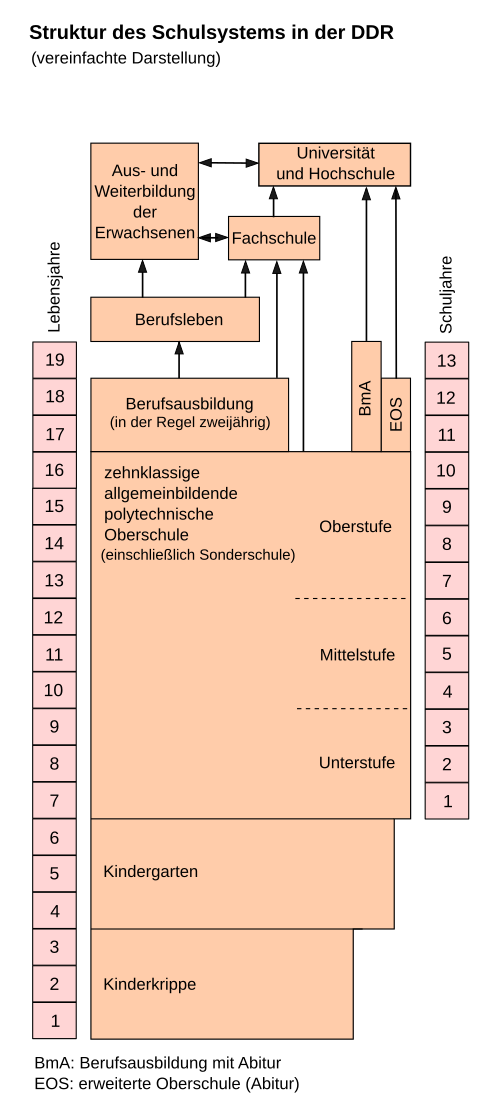
About 600,000 children and youth were subordinate to East German residential child care system.
Culture
East Germany's culture was strongly influenced by communist thought and was marked by an attempt to define itself in opposition to the west, particularly West Germany and the United States. Critics of the East German state[who?] have claimed that the state's commitment to Communism was a hollow and cynical tool, Machiavellian in nature, but this assertion has been challenged by studies[which?] that have found that the East German leadership was genuinely committed to the advance of scientific knowledge, economic development, and social progress. However, Pence and Betts argue, the majority of East Germans over time increasingly regarded the state's ideals to be hollow, though there was also a substantial number of East Germans who regarded their culture as having a healthier, more authentic mentality than that of West Germany.[141]
GDR culture and politics were limited by the harsh censorship.[142] Compared to the music of the FRG, the freedom of art was less restricted by private-sector guidelines, but by guidelines from the state and the SED. Nevertheless, many musicians strove to explore the existing boundaries. Despite the state's support for music education, there were politically motivated conflicts with the state, especially among rock, blues and folk musicians and songwriters, as well as composers of so-called serious music.
Music


A special feature of GDR culture is the broad spectrum of German rock bands. The Puhdys and Karat were some of the most popular mainstream bands in East Germany. Like most mainstream acts, they were members of the SED, appeared in state-run popular youth magazines such as Neues Leben and Magazin. Other popular rock bands were Wir, City, Silly and Pankow. Most of these artists recorded on the state-owned AMIGA label. All were required to open live performances and albums with the East German national anthem.[citation needed]
Schlager, which was very popular in the west, also gained a foothold early on in East Germany, and numerous musicians, such as Gerd Christian, Uwe Jensen, and Hartmut Schulze-Gerlach gained national fame. From 1962 to 1976, an international schlager festival was held in Rostock, garnering participants from between 18 and 22 countries each year.[143] The city of Dresden held a similar international festival for schlager musicians from 1971 until shortly before reunification.[144] There was a national schlager contest hosted yearly in Magdeburg from 1966 to 1971 as well.[145]
Bands and singers from other socialist countries were popular, e.g. Czerwone Gitary from Poland known as the Rote Gitarren.[146][147] Czech Karel Gott, the Golden Voice from Prague, was beloved in both German states.[148] Hungarian band Omega performed in both German states, and Yugoslavian band Korni Grupa toured East Germany in the 1970s.[149][150]
West German television and radio could be received in many parts of the East. The Western influence led to the formation of more "underground" groups with a decisively western-oriented sound. A few of these bands – the so-called Die anderen Bands ("the other bands") – were Die Skeptiker, Die Art and Feeling B. Additionally, hip hop culture reached the ears of the East German youth. With videos such as Beat Street and Wild Style, young East Germans were able to develop a hip hop culture of their own.[151] East Germans accepted hip hop as more than just a music form. The entire street culture surrounding rap entered the region and became an outlet for oppressed youth.[152]
The government of the GDR was invested in both promoting the tradition of German classical music, and in supporting composers to write new works in that tradition. Notable East German composers include Hanns Eisler, Paul Dessau, Ernst Hermann Meyer, Rudolf Wagner-Régeny, and Kurt Schwaen.
The birthplace of Johann Sebastian Bach (1685–1750), Eisenach, was rendered as a museum about him, featuring more than three hundred instruments, which, in 1980, received some 70,000 visitors. In Leipzig, the Bach archive contains his compositions and correspondence and recordings of his music.[153]
Governmental support of classical music maintained some 168 publicly funded concert, opera, chamber, and radio orchestras, such as Gewandhausorchester and Thomanerchor in Leipzig; Sächsische Staatskapelle in Dresden; and Berliner Sinfonie Orchester and Staatsoper Unter den Linden in Berlin.[154] Kurt Masur was their prominent conductor.[155]
Censorship in the music sector
All productions were subject to censorship. Texts had to be submitted and shows approved in advance; performances were watched. No one was exempt from this, not even famous artists with connections to the highest circles of the SED government. Under this pressure, strategies were developed to bring critical texts to the audience despite censorship. For example, Heinz Quermann always deliberately built an extreme gag into his entertainment programme so that the censors would have something to cut and the other gags would be less critically scrutinised. Tamara Danz of Silly founded the term "green elephant" (grüner Elefant) for such passages.
At the beginning of the 1960s, the youth of the GDR were also under the influence of the Beatles and their music. In the beginning, this music was still tolerated and supported by the GDR leadership, especially with the help of the FDJ. The high point of this era was 1965, when GDR bands not only got radio and television appearances, but were even allowed to make recordings. However, the SED realised that it could not control this movement, which was basically rebellious and oriented towards the West, and steer it in a direction it liked. The Leipzig Beat Revolt was a response, that most of the bands were therefore simply banned, the others were strictly controlled. For example, Thomas Natschinski's band had to change its English name "Team 4" to the German name "Thomas Natschinski and his group". Other bands were not so conformist. Renft in particular was repeatedly banned from performing and later also the blues rock band Freygang, whose members went into hiding and then played under pseudonyms.
Even convinced socialists like the singer-songwriter Wolf Biermann were banned from performing because they had different ideas of socialism than the SED realised. In 1976, Wolf Biermann was allowed to tour in the West and this was immediately taken as an opportunity to denaturalise him and refuse him permission to return. Numerous artists protested against this and were forced to leave the country – some after serving prison sentences – including members of Renft, as well as Manfred Krug and Nina Hagen. Other artists left voluntarily. Veronika Fischer, for example, did not return from a performance in West Berlin in 1981, whereupon her songs were no longer allowed to be played by GDR radio stations.
West German productions were also subject to censorship in East Germany. For example, the song by Udo Jürgens Es war einmal ein Luftballon (Once Upon a Time There Was a Balloon) was put on the Index because of the line, "They know no borders, the balloons of the world". It was not until 1987 that Udo Jürgens was allowed to perform again in the GDR. Udo Lindenberg, for example, had similar problems. Despite all his efforts (such as his song Sonderzug nach Pankow (Special Train to Pankow)), he was only allowed to perform once before the fall of the Wall, at the Palast der Republik on the occasion of the event "Rock für den Frieden" (Rock for Peace) on 25 October 1983.
In the 1980s, censorship seemed to loosen up. Lyrics about the longing for freedom (including Albatros by Karat) became possible. But it was only in the course of the peaceful revolution that songs by Veronika Fischer were heard on the radio again in October 1989.
Theatre

East German theatre was originally dominated by Bertolt Brecht, who brought back many artists out of exile and reopened the Theater am Schiffbauerdamm with his Berliner Ensemble.[156] Alternatively, other influences tried to establish a "working-class theatre", played for the working class by the working class.[citation needed]
After Brecht's death, conflicts began to arise between his family (around Helene Weigel) and other artists about Brecht's legacy, including Slatan Dudow,[157] Erwin Geschonneck,[158] Erwin Strittmatter, Peter Hacks, Benno Besson,[159] Peter Palitzsch[160] and Ekkehard Schall.[161]
In the 1950s, the Swiss director Benno Besson with the Deutsches Theater successfully toured Europe and Asia including Japan with The Dragon by Evgeny Schwartz. In the 1960s, he became the Intendant of the Volksbühne often working with Heiner Müller.[162]
In the 1970s, a parallel theatre scene sprung up, creating theatre "outside of Berlin" in which artists played at provincial theatres. For example, Peter Sodann founded the Neues Theater in Halle/Saale and Frank Castorf at the theater Anklam.[citation needed]
Theatre and cabaret had high status in the GDR, which allowed it to be very proactive. This often brought it into confrontation with the state. Benno Besson once said, "In contrast to artists in the west, they took us seriously, we had a bearing."[163][m]
The Friedrichstadt-Palast in Berlin is the last major building erected by the GDR, making it an exceptional architectural testimony to how Germany overcame its former division. Here, Berlin's great revue tradition lives on, today bringing viewers state-of-the-art shows.[164]
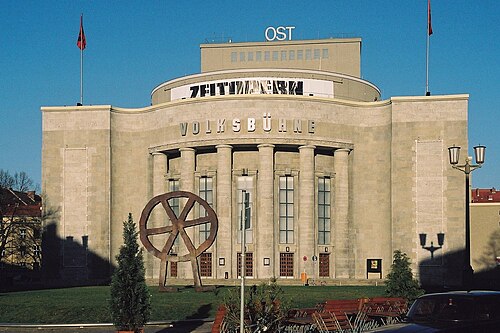
Important theatres include the Berliner Ensemble,[165] the Deutsches Theater,[166] the Maxim Gorki Theater,[167] and the Volksbühne.[168]
Television and radio

Television and radio in East Germany were state-run industries; the Rundfunk der DDR was the official radio broadcasting organisation from 1952 until unification. The organization was based in the Funkhaus Nalepastraße in East Berlin. Deutscher Fernsehfunk (DFF), from 1972 to 1990 known as Fernsehen der DDR or DDR-FS, was the state television broadcaster from 1952. Reception of Western broadcasts was widespread.[169]
Cinema
The prolific cinema of East Germany was headed by the DEFA,[170] Deutsche Film AG, which was subdivided in different local groups, for example Gruppe Berlin, Gruppe Babelsberg or Gruppe Johannisthal, where the local teams shot and produced films. The East German industry became known worldwide for its productions, especially children's movies (Das kalte Herz, film versions of the Brothers Grimm fairy tales and modern productions such as Das Schulgespenst).[171]
Frank Beyer's Jakob der Lügner (Jacob the Liar), about the Holocaust, and Fünf Patronenhülsen (Five Cartridges), about resistance against fascism, became internationally famous.[172]
Films about daily life, such as Die Legende von Paul und Paula, by Heiner Carow, and Solo Sunny, directed by Konrad Wolf and Wolfgang Kohlhaase, were very popular.[173]
The film industry was remarkable for its production of Ostern, or Western-like movies. Amerindians in these films often took the role of displaced people who fight for their rights, in contrast to the North American westerns of the time, where they were often either not mentioned at all or are portrayed as the villains. Yugoslavs were often cast as Native Americans because of the small number of Native Americans in Europe. Gojko Mitić was well known in these roles, often playing the righteous, kindhearted and charming chief (Die Söhne der großen Bärin directed by Josef Mach). He became an honorary Sioux chief when he visited the United States in the 1990s, and the television crew accompanying him showed the tribe one of his movies. American actor and singer Dean Reed, an expatriate who lived in East Germany, also starred in several films. These films were part of the phenomenon of Europe producing alternative films about the colonization of the Americas.[citation needed]
Cinemas in the GDR also showed foreign films. Czechoslovak and Polish productions were more common, but certain western movies were shown, though the numbers of these were limited because it cost foreign exchange to buy the licences. Further, films representing or glorifying what the state viewed as capitalist ideology were not bought. Comedies enjoyed great popularity, such as the Danish Olsen Gang or movies with the French comedian Louis de Funès.[citation needed]
Since the fall of the Berlin Wall, several films depicting life in the GDR have been critically acclaimed.[174] Some of the most notable were Good Bye Lenin! by Wolfgang Becker,[175] Das Leben der Anderen (The Lives of Others) by Florian Henckel von Donnersmarck (won the Academy Award for bestberg Film in a Foreign Language) in 2006,[176] and Alles auf Zucker! (Go for Zucker) by Dani Levi. Each film is heavily infused with cultural nuances unique to life in the GDR.[177]
Sport
East Germany was very successful in the sports of cycling, weight-lifting, swimming, gymnastics, track and field, boxing, ice skating, and winter sports. The success is largely attributed to doping under the direction of Manfred Höppner, a sports doctor, described as the architect of East Germany's state-sponsored drug program.[178]

Anabolic steroids were the most detected doping substances in IOC-accredited laboratories for many years.[179][180] The development and implementation of a state-supported sports doping program helped East Germany, with its small population, to become a world leader in sport during the 1970s and 1980s, winning a large number of Olympic and world gold medals and records.[181] Another factor for success was the furtherance system for young people in the GDR. Sports teachers at school were encouraged to look for certain talents in children of ages 6 to 10. For older pupils it was possible to attend grammar schools with a focus on sports (for example sailing, football and swimming).
Sports clubs were highly subsidized, especially sports in which it was possible to get international fame. For example, the major leagues for ice hockey and basketball just included 2 teams each. Football was the most popular sport. Club football teams such as Dynamo Dresden, 1. FC Magdeburg, FC Carl Zeiss Jena, 1. FC Lokomotive Leipzig and BFC Dynamo had successes in European competition. Many East German players such as Matthias Sammer and Ulf Kirsten became integral parts of the reunified national football team.
The East and the West also competed via sport. GDR athletes dominated several Olympic sports; the SV Dynamo club of the security agencies won more than 200 Olympic medals. Of special interest was the only football match between the Federal Republic of Germany and the German Democratic Republic, a first-round match during the 1974 FIFA World Cup, which the East won 1–0; but West Germany, the host, went on to win the World Cup.[182] East Germany had a revolutionary technology for two-stroke engines called expansion chamber, allowing them to win motorcycle races with little competition. Racer Ernst Degner defected to Japan, taking the technology secret with him over to Suzuki. After the defection, East German motorcycle racing effectively ended.
Official and public holidays
Legacy
Decrepit infrastructure
Almost all East German highways, railroads, sewage systems and public buildings were in a state of disrepair at the time of reunification, as little was done to maintain infrastructure in the GDR's last decades. Unified German public spending has had to pour more than $2 trillion into the former East Germany, to make up for the region's neglect and malaise and bring it up to a minimal standard.[183]
The Greifswald Nuclear Power Plant narrowly avoided a Chernobyl-scale meltdown in 1976.[184] All East German nuclear power plants had to be shut down after reunification, because they did not meet Western safety standards.[185]
Authoritarianism
German historian Jürgen Kocka in 2010 summarized the consensus of most recent scholarship:
Conceptualizing the GDR as a dictatorship has become widely accepted, while the meaning of the concept dictatorship varies. Massive evidence has been collected that proves the repressive, undemocratic, illiberal, nonpluralistic character of the GDR regime and its ruling party.[9]
Ostalgie

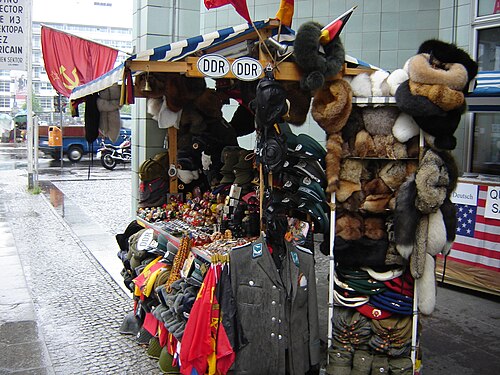
Many East Germans initially regarded the dissolution of the GDR positively,[186] but this reaction partly turned sour.[187] West Germans often acted as if they had "won" and East Germans had "lost" in unification, leading many East Germans (Ossis) to resent West Germans (Wessis).[188] In 2004, Deborah Ascher Barnstone wrote, "East Germans resent the wealth possessed by West Germans; West Germans see the East Germans as lazy opportunists who want something for nothing. East Germans find 'Wessis' arrogant and pushy, West Germans think the 'Ossis' are lazy good-for-nothings."[189]
In addition, many East German women found the West more appealing, and left the region never to return, leaving behind an underclass of poorly educated and jobless men.[190]
For the people who stayed in East Germany, a majority of them (57%) defend the GDR,[191] with 49% of those polled saying that "The GDR had more good sides than bad sides. There were some problems, but life was good there", while 8% oppose all criticism of East Germany and say that "Life there was happier and better than in reunified Germany today".[191]
As of 2014, the vast majority of residents in the former GDR prefer to live in a unified Germany. However, a feeling of nostalgia persists among some, termed "Ostalgie" (a blend of Ost "east" and Nostalgie "nostalgia"). This was depicted in the Wolfgang Becker film Goodbye Lenin!. According to Klaus Schroeder, a historian and political scientist at the Free University of Berlin, some of the original residents of the GDR "still feel they don't belong or that they're strangers in unified Germany" as life in the GDR was "just more manageable". He warns German society should watch out in case Ostalgie results in a distortion and romanticization of the past.[192][193]
In 2023, a poll found that 40% of Germans living in the former East Germany identify as East Germans rather than German, which 52% identified as.[194][195]
Electoral consequences
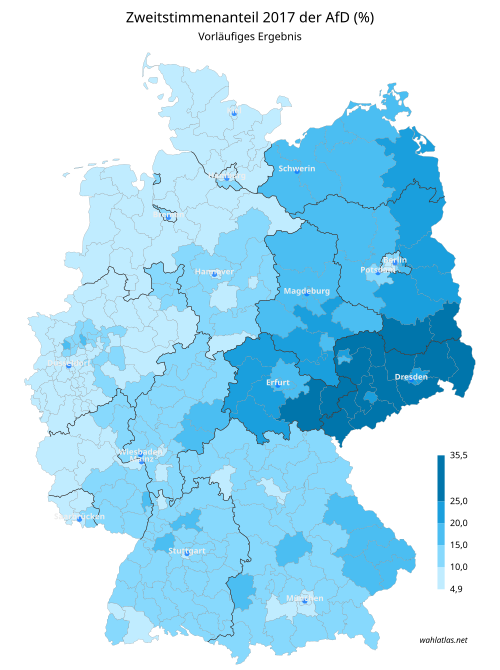

The divide between the East and the West can be seen in contemporary German elections. The left-wing populist Die Linke party (which has roots in the SED) continues to have a stronghold and occasionally wins a plurality in the East, such as in the German State of Thuringia where it remains one of the major parties.[196] The region also sees disproportionate support for the Alternative for Germany, a right-wing populist party, particularly in the state of Saxony and Thuringia. This is in stark distinction from the West where the more centrist parties such as the CDU/CSU, SPD, The Greens, and the FDP dominate.
The far-right National Democratic Party of Germany (NPD) was represented in the Saxon State Parliament from 2004 to 2014. In Mecklenburg-Vorpommern the NPD was represented from 2006 to 2016.
Demographics
.svg/500px-Germans_without_a_migrant_background_(2016).svg.png)
There are more migrants in former West Germany than in former East Germany.[197][198][199]
All of the new states have populations where 90-95% of people do not have a migrant background.[197][198][199]
Religion
As of 2009, more Germans are non-believers in Eastern Germany than Western Germany.[200][201] Eastern Germany is perhaps the least religious region in the world.[202][203] An explanation for this, popular in other regions, is the aggressive state atheist policies of the German Democratic Republic's Socialist Unity Party of Germany. However, the enforcement of atheism existed only for the first few years. After that, the state allowed churches to have a relatively high level of autonomy.[204] Atheism is embraced by Germans of all ages, though irreligion is particularly common among younger Germans.[205]
See also
- Leadership of East Germany
- History of Germany (1945–1990)
- Inner German relations
- Economic history of the German reunification
- Scotland-GDR Society
Explanatory notes
- ^ Partially recognised
- ^ The SED's leaders went by different names. Until 1950, there were two co-chairmen, after which the office of General Secretary, titled First Secretary between 1953 and 1976, was established.
- ^ The SED was established in the Soviet occupation zone of Germany, before the GDR's foundation.
- ^ Jointly as Chairmen.
- ^ October–December
- ^ Dissolved by the Volkskammer on 8 December 1958.
- ^ Population statistics according to Statistisches Bundesamt.
- ^ Although .dd was reserved as corresponding ISO code for East Germany, it was not entered to the root before the country was reunited with the west.
- ^ The use of the abbreviation BRD (FRG) for West Germany, the Bundesrepublik Deutschland (Federal Republic of Germany), on the other hand, was never accepted in West Germany since it was considered a political statement. Thus BRD (FRG) was a term used by East Germans, or by West Germans who held a pro-East-German view. Colloquially, West Germans called West Germany simply Germany (reflecting West Germany's claim to represent the whole of Germany), or alternatively the Bundesrepublik or Bundesgebiet (Federal Republic or Federal Territory, respectively), referring to the country and Bundesbürger (Federal citizen) for its citizens, with the adjective bundesdeutsch (Federal German).
- ^ For example, the economist Jörg Roesler – see: Jörg Roesler: Ein Anderes Deutschland war möglich. Alternative Programme für das wirtschaftliche Zusammengehen beider deutscher Staaten, in: Jahrbuch für Forschungen zur Geschichte der Arbeiterbewegung, No. II/2010, pp. 34–46. Historian Ulrich Busch argued that the currency union came too early; see Ulrich Busch: Die Währungsunion am 1. Juli 1990: Wirtschaftspolitische Fehlleistung mit Folgen, in: Jahrbuch für Forschungen zur Geschichte der Arbeiterbewegung, No. II/2010, pp. 5–24.
- ^ 'In the age of detente, the Stasi's main method of combating subversive activity was 'operational decomposition' (operative Zersetzung) which was the central element in what Hubertus Knabe has called a system of 'quiet repression' (lautlose Unterdrukung). This was not a new departure as 'dirty tricks' had been widely used in the 1950s and 1960s. The distinctive feature was the primacy of operational decomposition over other methods of repression in a system to which historians have attached labels such as post-totalitarianism and modern dictatorship.'cite book
- ^ The Eastern churches were the Evangelical Church of Anhalt, Evangelical Church in Berlin, Brandenburg and Silesian Upper Lusatia#Evangelical Church in Berlin-Brandenburg (EKiBB, East Ambit, for East Berlin and Brandenburg), Evangelical Church of the Görlitz Ecclesiastical Region, Evangelical Church in Greifswald, Evangelical Lutheran Church of Mecklenburg, Evangelical-Lutheran Church of Saxony, Evangelical Church of the Church Province of Saxony (KPS), Evangelical Lutheran Church in Thuringia and Evangelical Church of the Union (East Region, for EKiBB-East Ambit, Görlitz, Greifswald and KPS, and since 1970 for Anhalt too).
- ^ This quote has no cross-referencing to ground its authenticity. For a detailed overview of the issues of Brecht's legacy after his death within the Berliner Ensemble, see David Barnett, A History of the Berliner Ensemble (Cambridge University Press, 2015), 146–70. ISBN 978-1-107-05979-5.
References
Citations
- ^ "Bevölkerungsstand" [Population level] (in German). Statistisches Bundesamt. Archived from the original on 13 November 2013.
- ^ a b "GDR". World Inequality Database.
- ^ "Human Development Report 1990" (PDF). hdr.undp.org. January 1990. Archived (PDF) from the original on 2 February 2014.
- ^ "Top-Level-Domain .DD" (in German). Archived from the original on 4 November 2015.
- ^ a b Major, Patrick; Osmond, Jonathan (2002). The Workers' and Peasants' State: Communism and Society in East Germany Under Ulbricht 1945–71. Manchester University Press. ISBN 978-0-7190-6289-6.
- ^ Peter E. Quint. The Imperfect Union: Constitutional Structures of German Unification, Princeton University Press, 2012, pp. 125–126.
- ^ a b "Business America. (27 February 1989). German Democratic Republic: long history of sustained economic growth continues; 1989 may be an advantageous year to consider this market – Business Outlook Abroad: Current Reports from the Foreign Service". Business America. 1989. Archived from the original on 9 November 2007. Retrieved 2 October 2007.
- ^ Karl Dietrich Erdmann, Jürgen Kocka, Wolfgang J. Mommsen, Agnes Blänsdorf. Towards a Global Community of Historians: the International Historical Congresses and the International Committee of Historical Sciences 1898–2000. Berghahn Books, 2005, p. 314. ("However the collapse of the Soviet empire, associated with the disintegration of the Soviet satellite regimes in East-Central Europe, including the German Democratic Republic, brought about a dramatic change of agenda.")
- ^ a b Kocka, Jürgen, ed. (2010). Civil Society & Dictatorship in Modern German History. UPNE. p. 37. ISBN 978-1-58465-866-5. Archived from the original on 20 March 2015. Retrieved 14 October 2015.
- ^ Preuss, Evelyn. "The Wall You Will Never Know". Perspecta: The Yale Architectural Journal. Cambridge, MA: MIT Press: 19–31.
- ^ "Three Top Commies Flee East Germany". Sarasota Herald-Tribune. 23 January 1953. pp. 1–2. Retrieved 21 November 2019 – via Google News.
- ^ "5 Flee East Germany". Toledo Blade. 31 May 1963. Retrieved 21 November 2019 – via Google News.
- ^ "Eugene Register-Guard – Google News Archive Search". news.google.com. Retrieved 26 April 2021.
- ^ "Files: 350 dies trying to flee East Germany". The Victoria Advocate. 28 July 1992. Retrieved 21 November 2019 – via Google News.
- ^ Pridham, Geoffrey; Vanhanen, Tatu (1994). Democratization in Eastern Europe. Routledge. p. 135. ISBN 0-415-11063-7.
- ^ "Repeal the racist asylum laws". The New Worker. 29 August 1997. Retrieved 5 September 2011.
- ^ "Krenz, Schabowski und Kleiber hatten sich nichts mehr zu sagen" [Krenz, Schabowski and Kleiber had nothing more to say to each other]. Berliner Zeitung (in German). 31 May 2008. Archived from the original on 19 July 2012. Retrieved 5 September 2011.
- ^ a b Berlin Korrespondent (June 1949). "Nationale Front in der Ostzone" [National Front in the Eastern Zone]. Die Zeit (in German). Archived from the original on 11 November 2013. Retrieved 10 May 2013.
- ^ "Vom Sogenannten". Der Spiegel. 21 October 1968. p. 65. Archived from the original on 3 February 2016.
- ^ Facts about Germany: The Federal Republic of Germany, 1959 – Germany (West). 1959. p. 20. Archived from the original on 21 December 2019. Retrieved 16 November 2019.
- ^ Wildenthal, Lora. The Language of Human Rights in West Germany. p. 210.
- ^ Cornfield, Daniel B.; Hodson, Randy (2002). Worlds of Work: Building an International Sociology of Work. Springer. p. 223. ISBN 0-306-46605-8.
- ^ Pollak, Michael (2005). "Ein Text in seinem Kontext" [A text in its context]. Österreichische Zeitschrift für Soziologie (in German). 30: 3–21. doi:10.1007/s11614-006-0033-6. ISSN 1011-0070. S2CID 147022466.
- ^ Baranowski, Shelley (1995). The Sanctity of Rural Life: Nobility, Protestantism, and Nazism in Weimar Prussia. Oxford University Press. pp. 187–188. ISBN 978-0-19-536166-7. Archived from the original on 1 December 2019. Retrieved 16 November 2019.
- ^ Schmitt, Carl (2017). Political Romanticism. Routledge. p. 11. ISBN 978-1-351-49869-2. Archived from the original on 23 December 2019. Retrieved 16 November 2019.
- ^ "Each spring, millions of workmen from all parts of western Russia arrived in eastern Germany, which, in political language, is called East Elbia." from The Stronghold of Junkerdom, by George Sylvester Viereck. Viereck's, Volume 8. Fatherland Corporation, 1918.
- ^ Compare: Ritter, Gerhard A. (April 2002). "Die DDR in der deutschen Geschichte" [The GDR in German history] (PDF). Vierteljahrshefte für Zeitgeschichte (in German). 50 (2): 171–172. Archived (PDF) from the original on 16 November 2019. Retrieved 16 November 2019.
Die Geschichte der DDR ist im wesentlichen zwischen zwei Polen einzubetten. Den einen Pol bildet die Sowjetisierung [...] Den anderen Pol bildeten deutsche Traditionen, vor allem die Vorstellungen der kommunistischen Arbeiterbewegung.
[The history of the GDR is essentially embedded between two poles. Sovietization formed one pole [...] German traditions formed the other pole, above all the ideas of the communist workers' movement.] - ^ a b c d Ritter, Gerhard A. (April 2002). "Die DDR in der deutschen Geschichte" [The GDR in German history] (PDF). Vierteljahrshefte für Zeitgeschichte (in German). 50 (2): 171–200. Archived (PDF) from the original on 16 November 2019. Retrieved 16 November 2019.
In der Sozialpolitik hielten sich die Kontinuitäten und die Brüche mit der deutschen Tradition etwa die Waage. [...] Seit Mitte der sechziger Jahre, vor allem aber in der Ära Honecker, in der die 'Einheit von Wirtschafts- und Sozialpolitik' zum Leitprinzip erhoben wurde, wurde die Sozialpolitik die wohl wichtigste Legitimationsgrundlage des Staates.
- ^ "Yalta Conference". spartacus.schoolnet.co.uk. Archived from the original on 14 May 2011. Retrieved 25 September 2010.
- ^ Department Of State. The Office of Electronic Information, Bureau of Public Affairs (18 July 2008). "Allied Occupation of Germany, 1945-52". 2001-2009.state.gov. Retrieved 22 September 2024.
- ^ On the discussion about Social Democrats joining the SED see Steffen Kachel, Entscheidung für die SED 1946 – ein Verrat an sozialdemokratischen Idealen?, in: Jahrbuch für Forschungen zur Geschichte der Arbeiterbewegung, No. I/2004.[date missing]
- ^ Stiftung Haus der Geschichte der Bundesrepublik Deutschland. "LeMO Kapitel: Zwangsvereinigung zur SED" [LeMO Chapter: Forced Association to the SED]. hdg.de (in German). Archived from the original on 14 June 2012. Retrieved 15 July 2012.
- ^ See Anna M. Cienciala "History 557 Lecture Notes" Archived 20 June 2010 at the Wayback Machine
- ^ Steininger, Rolf (1990). The German Question: The Stalin Note of 1952 and the Problem of Reunification. New York: Columbia University Press.
- ^ Roth, Gary. "Review of Hoffmann, Dierk: Otto Grotewohl (1894–1964): Eine politische Biographie" H-German, H-Net Reviews. November 2010. online Archived 17 October 2012 at the Wayback Machine
- ^ Gomez Gutiérrez, J.J. & Bruschi, V. (2003). "Socialist Unity Party of Germany". In N. Schlager (Ed.), St. James Encyclopedia of Labor History Worldwide: Major Events in Labor History and Their Impact. St. James Press.
- ^ "Political prisoners in the German Democratic Republic". Political prisoners in the German Democratic Republic | Communist Crimes. Retrieved 24 November 2020.
- ^ Peterson, Edward N. (1999). Russian Commands and German Resistance: The Soviet Occupation, 1945–1949. New York: P. Lang. p. 5. ISBN 0-8204-3948-7. OCLC 38207545.
- ^ Peterson, Edward N. (1999). Russian Commands and German Resistance: The Soviet Occupation, 1945–1949. New York: P. Lang. ISBN 0-8204-3948-7. OCLC 38207545.
- ^ Stokes, Raymond G. (2000). Constructing Socialism: Technology and Change in East Germany 1945–1990. Baltimore: Johns Hopkins University Press. ISBN 0-8018-7299-5. OCLC 51480817.
- ^ Feinstein, Margarete Myers (2001). State Symbols: The Quest for Legitimacy in the Federal Republic of Germany and the German Democratic Republic, 1949–1959. Brill Academic Publishers. p. 78. ISBN 9780391041035.
... claims of East Berlin as the capital of the GDR, ... East Berlin was not recognized by the West and most Third World countries.
- ^ Fulbrook, Mary; Port, Andrew I. (2013). Becoming East German: Socialist Structures and Sensibilities after Hitler. Berghahn Books. ISBN 9780857459756.
- ^ Haydock, Michael D. (2000). City Under Siege: The Berlin Blockade and Airlift, 1948–1949.
- ^ Weitz 1997, p. 350 Following a Soviet order in February 1948, the German Economic Commission became a nascent state structure for all intents and purposes, with competence far beyond the economy proper; it gained the power to issue orders and directives to all German organs within the Soviet Occupation Zone.
- ^ McCauley 1983, p. 38 The DWK had become the de facto government of the Soviet zone. Its chairman was Heinrich Rau (SED), and four of his six deputies were also SED members.
- ^ East Berlin 17 June 1953: Stones Against Tanks Archived 23 January 2011 at the Wayback Machine, Deutsche Welle. Retrieved 16 May 2007.
- ^ Baras, Victor (1975). "Beria's Fall and Ulbricht's Survival". Soviet Studies. 27 (3): 381–395. doi:10.1080/09668137508411013.
- ^ a b Norman M. Naimark. The Russians in Germany: A History of the Soviet Zone of Occupation, 1945–1949. Harvard University Press, 1995. ISBN 0-674-78405-7 pp. 167–169.
- ^ Taylor, Frederick (2006). Berlin Wall: A World Divided, 1961–1989. HarperCollins. ISBN 9780060786137.
- ^ Allinson, Mark; Leaman, Jeremy; Parkes, Stuart; Tolkiehn, Barbara (2014). Contemporary Germany: Essays and Texts on Politics, Economics & Society (in German). London and New York: Routledge. p. 39. ISBN 978-1-317-87977-0. Retrieved 10 August 2021.
- ^ Krisch, Henry (December 1979). "Soviet-GDR Relations in the Honecker Era". East Central Europe. 6 (2): 152–172. doi:10.1163/187633079X00150.
- ^ a b "East Germany: The Price of Recognition". TIME. 1 January 1973. Archived from the original on 18 December 2011. Retrieved 21 October 2011.
- ^ Quint, Peter E. (1991), The Imperfect Union; Constitutional Structures for German Unification, Princeton University Press, p. 14
- ^ Kommers, Donald P. (2012), The Constitutional Jursiprudence of the Federal Republic of Germany, Duke University Press, p. 308
- ^ "Texas Law: Foreign Law Translations 1973". University of Texas. Archived from the original on 20 December 2016. Retrieved 7 December 2016.
- ^ Zuelow, Eric G. E. (2011). Touring Beyond the Nation: A Transnational Approach to European Tourism History. Ashgate Publishing. p. 220. ISBN 978-0-7546-6656-1.
- ^ David Priestland, Red Flag: A History of Communism, New York: Grove Press, 2009.
- ^ Combe, Sonia (April 2020). "À Buchenwald, les antifascistes ont perdu la guerre mémorielle" [In Buchenwald, the anti-fascists have lost the memory war]. Le Monde diplomatique (in French).
- ^ Tillack-Graf, Anne-Kathleen (2012). Erinnerungspolitik der DDR. Dargestellt an der Berichterstattung der Tageszeitung 'Neues Deutschland' über die Nationalen Mahn- und Gedenkstätten Buchenwald, Ravensbrück und Sachsenhausen [GDR politics of remembrance. Shown in the report of the daily newspaper 'Neues Deutschland' on the national memorial sites in Buchenwald, Ravensbrück and Sachsenhausen] (in German). Frankfurt am Main: Peter Lang. pp. 2–3, 88–91. ISBN 978-3-631-63678-7.
- ^ a b Combe, Sonia (January 2021). "Antisémite, l'Allemagne de l'Est ?" [Anti-Semite, East Germany?]. Le Monde diplomatique (in French).
- ^ Benyahia-Kouider, Odile (2013). L'Allemagne paiera [Germany will pay] (in French). pp. 166–167.
- ^ Benyahia-Kouider, Odile (2013). L'Allemagne paiera [Germany Will Pay] (in French). p. 179.
- ^ a b Pfeil, Ulrich (9 April 2020). "Die DDR als Zankapfel in Forschung und Politik" [The GDR as a Bone of Contention in Research and Politics]. Bundeszentrale für politische Bildung (in German).
- ^ a b Judt 2005, p. 612
- ^ "The Berlin Wall (1961–89)". German Notes. Archived from the original on 19 April 2005. Retrieved 24 October 2006.
- ^ Miklós Németh in Interview, Austrian TV – ORF "Report", 25 June 2019.
- ^ a b Szabo, Hilde (16 August 1999). "Die Berliner Mauer begann im Burgenland zu bröckeln" [The Berlin Wall began to crumble in Burgenland]. Wiener Zeitung (in German).
- ^ Lahodynsky, Otmar (9 August 2014). "Paneuropäisches Picknick: Die Generalprobe für den Mauerfall" [Pan-European picnic: the Dress Rehearsal for the Fall of the Berlin Wall]. profil (in German).
- ^ a b Greven, Ludwig (19 August 2014). "Und dann ging das Tor auf" [And then the Gate Opened]. Die Zeit.
- ^ Lahodynsky, Otmar (13 June 2019). "Eiserner Vorhang: Picknick an der Grenze" [Iron curtain: Picnic at the Border]. profil (in German).
- ^ Roser, Thomas (17 August 2014). "DDR-Massenflucht: Ein Picknick hebt die Welt aus den Angeln" [Mass exodus of the GDR: A picnic clears the world]. Die Presse (in German). Vienna.
- ^ Frank, Michael (journalist) "Paneuropäisches Picknick – Mit dem Picknickkorb in die Freiheit" [Pan-European picnic – With the picnic basket to freedom]. Süddeutsche Zeitung (in German). 17 May 2010.
- ^ a b Judt 2005, p. 613
- ^ Darnton, Robert (1992). Berlin Journal. New York: W. W. Norton & Company. pp. 98–99.
- ^ a b Sarotte, Mary Elise (2014). Collapse: The Accidental Opening of the Berlin Wall. New York: Basic Books. ISBN 9780465064946.
- ^ a b Judt 2005, p. 614
- ^ Judt 2005, p. 615.
- ^ Kommers, Donald P. (2012). The Constitutional Jursiprudence of the Federal Republic of Germany. Duke University Press. p. 309.
- ^ Conradt, David P. (2008). The German Polity. p. 20.
- ^ a b Weitz 1997, p. [page needed]
- ^ Sarotte, Mary Elise (2014). 1989: The Struggle to Create Post-Cold War Europe (2nd ed.). Princeton, NJ: Princeton University Press.
- ^ Rodden, John. (2002). Repainting the Little Red Schoolhouse: A History of Eastern German education, 1945–1995. Oxford University Press. ISBN 0-19-511244-X. OCLC 39633454.
- ^ Fulbrook, Mary, ed. (July 2013). Power and Society in the GDR, 1961–1979: The 'Normalisation of Rule'?. Berghahn Books. ISBN 978-1-78238-101-3. OCLC 822668120.
- ^ Wegner, Gregory (February 1996). "In the Shadow of the Third Reich: The 'Jugendstunde' and the Legitimation of Anti-Fascist Heroes for East German Youth". German Studies Review. 19 (1): 127–146. doi:10.2307/1431716. ISSN 0149-7952. JSTOR 1431716.
- ^ a b c d e Plum, Catherine J. (11 February 2005). Antifascism & the Historical Identity of East German Youth, 1961–1989 (Thesis). University of Wisconsin-Madison. OCLC 63683865.
- ^ a b Fulbrook, Mary (1995). Anatomy of a Dictatorship: Inside the GDR 1949–1989. New York: Oxford University Press. p. 60.
- ^ "Free German Youth 1949–1990 (East Germany)". Flagspot.net. Retrieved 9 February 2013.
- ^ Jurich, Dirk (2006). Staatssozialismus und gesellschaftliche Differenzierung: eine empirische Studie (in German). LIT Verlag Münster. p. 32. ISBN 3825898938.
- ^ "The Rules of the Thälmann Pioneers". Calvin.edu. Retrieved 9 February 2013.
- ^ McDougall, Alan (2004). Youth Politics in East Germany: The Free German Youth Movement, 1946–1968. Oxford Historical Monographs. Oxford: Clarendon Press. pp. 37–38.
- ^ McDougall, Alan (2004). Youth Politics in East Germany: The Free German Youth Movement, 1946–1968. Oxford Historical Monographs. Oxford: Clarendon Press. pp. 43–45.
- ^ Rubinstein, Alvin Z. (1990). Moscow's Third World Strategy. Princeton University Press. p. 184. ISBN 0-691-02332-8. Archived from the original on 1 December 2019. Retrieved 26 August 2017.
- ^ a b Herf, Jeffrey (2016). Undeclared Wars with Israel: East Germany and the West German Far Left, 1967–1989. Cambridge University Press. ISBN 978-1-107-08986-0.
- ^ Herf, Jeffrey (2014). "'At War with Israel': East Germany's Key Role in Soviet Policy in the Middle East". Journal of Cold War Studies. 16 (2): 129–163. doi:10.1162/JCWS_a_00450. S2CID 57566994.
- ^ Laqueur, Walter (1968). The Road to Jerusalem: The Origins of the Arab-Israeli Conflict. Macmillan. p. 215. ISBN 978-0-02-568360-0.
- ^ Israel's struggle in the UN
- ^ "The GDR and the PLO: East Germany's Palestine Policy". Archived from the original on 5 May 2018. Retrieved 28 April 2018.
- ^ Trentin, Massimiliano (17 July 2008). "'Tough negotiations'. The two Germanys in Syria and Iraq, 1963–74". Cold War History. 8 (3): 353–380. doi:10.1080/14682740802222155. S2CID 218576332. Retrieved 14 February 2023.
- ^ Ingimundarson, V. (6 September 2010). "Targeting the Periphery: The Role of Iceland in East German Foreign Policy, 1949–89". Cold War History. 1 (3): 113–140. doi:10.1080/713999929. S2CID 153852878. Retrieved 13 February 2023.
- ^ Smith, Tom (2020). Comrades in Arms: Military Masculinities in East German Culture. New York and Oxford: Berghahn Books. p. 8. ISBN 9781789205558. Retrieved 10 August 2021.
- ^ Solsten, Eric; et al. (Library of Congress. Federal Research Division) (1996). Germany: A country study. Washington, DC: Federal Research Division, Library of Congress: Library of Congress. Federal Research Division. pp. 169–170.
- ^ Trainor, Bernard E. (8 November 1988). "East German Military: Warsaw Pact's Finest". The New York Times. Archived from the original on 1 August 2018. Retrieved 31 July 2018.
- ^ Goehler, Laura (7 November 2014). "The Stasi files: Germany's 600-million-piece puzzle". CNN. Retrieved 4 June 2024.
- ^ Koehler, John O. "Stasi: The Untold Story of the East German Secret Police". The New York Times Archive.
- ^ Fulbrook, Mary (2015). Becoming East German: Socialist Structures and Sensibilities After Hitler. Berghahn books. p. 3. ISBN 9781785330278.
- ^ Fulbrook, Mary (2015). Becoming East German: Socialist Structures and Sensibilities After Hitler. Berghahn books. p. 3. ISBN 9781785330278.
- ^ Ghouas, Nessim (2004). The Conditions, Means and Methods of the MfS in the GDR: An Analysis of the Post and Telephone Control. Cuvillier Verlag. p. 58. ISBN 3898739880.
- ^ Glaeser, Andreas (2003). "Power/Knowledge Failure: Epistemic Practices and Ideologies of the Secret Police in Former East Germany". Social Analysis. 47 (1): 10–26. doi:10.3167/015597703782353023.
- ^ Ghouas, Nessim (2004). The Conditions, Means and Methods of the MfS in the GDR: An Analysis of the Post and Telephone Control. Cuvillier Verlag. p. 59. ISBN 3898739880.
- ^ Dennis, Mike (2003). "Tackling the Enemy: Quiet Repression and Preventive Decomposition". The Stasi: Myth and Reality. Pearson Education Limited. p. 112. ISBN 0582414229.
- ^ a b c Dennis, Mike (2003). "Tackling the enemy- quiet repression and preventive decomposition". The Stasi: Myth and Reality. Pearson Education Limited. p. 114. ISBN 0582414229.
- ^ Glaeser, Andreas (2011). Political Epistemics: The Secret Police, the Opposition, and the End of East German Socialism. Chicago: University of Chicago Press. pp. 492–494. ISBN 978-0226297941.
- ^ Fulbrook, Mary (2008). The People's State: East German Society from Hitler to Honecker. New Haven: Yale University Press. p. 245. ISBN 9780300144246.
- ^ The East German penal system in Torgau from 1950 to 1990
- ^ "After the fall: The hidden trauma behind the Berlin Wall". irct.org. IRCT. Archived from the original on 9 September 2021. Retrieved 9 September 2021.
- ^ Oltermann, Philip (6 November 2019). "'I've been shafted twice': Stasi victims and their quest for compensation". The Guardian. Retrieved 9 September 2021.
- ^ Boroch, Wilfried (1996). "Social policy as an institutional transformation problem". Transition Economies. 31 (3): 139–146.
- ^ Zatlin, Jonathan R. (2007). The Currency of Socialism: Money and Political Culture in East Germany.[page needed]
- ^ The shortest history of Germany, James Hawes (2018), federal office of political education [ISBN missing][page needed]
- ^ Sleifer, Jaap (2006). "Planning Ahead and Falling Behind: The East German Economy in Comparison with West Germany 1936–2002". High Growth of an Underachiever?. Walter de Gruyter GmbH & Co KG. p. 66. ISBN 9783050085395 – via Google Books.
- ^ Sperlich, Peter W. (2006). Oppression and Scarcity: The History and Institutional Structure of the Marxist-Leninist Government of East Germany and Some Perspectives on Life in a Socialist System. Greenwood Publishing Group. p. 191. ISBN 978-0-275-97565-4. Archived from the original on 16 May 2016. Retrieved 14 October 2015.
- ^ "Ich liebe Thüringen, ich liebe Deutschland" [I love Thuringia, I love Germany] (in German). Archived from the original on 1 February 2017. Retrieved 20 January 2017.
- ^ "East Germany: country population". Populstat.info. Archived from the original on 11 August 2010. Retrieved 28 March 2010.
- ^ Laar, Mart (2010). The Power of Freedom: Central and Eastern Europe After 1945 (PDF). Centre for European Studies. p. 58. Archived from the original (PDF) on 11 November 2013. Retrieved 5 April 2012.
In the period between the Second World War and 1961, a total of 3.8 million people emigrated from East to West Germany.
- ^ "Germany Population – Historical Background". Country-studies.com. Archived from the original on 1 November 2009. Retrieved 28 March 2010.
- ^ Destatis.de Archived 13 August 2009 at the Wayback Machine page 17
- ^ "Population by area in 1,000". DESTATIS – Statistisches Bundesamt. Archived from the original on 11 August 2018. Retrieved 11 August 2018.
- ^ "Zusammenfassende Übersichten – Eheschließungen, Geborene und Gestorbene 1946 bis 2015". DESTATIS – Statistisches Bundesamt. Archived from the original on 11 August 2018. Retrieved 11 August 2018.
- ^ "Leipzig, Germany Population 1950–2019". www.macrotrends.net. Archived from the original on 28 September 2019. Retrieved 28 September 2019.
- ^ "Dresden, Germany Population 1950–2019". www.macrotrends.net. Archived from the original on 28 September 2019. Retrieved 28 September 2019.
- ^ a b c d e f g h i j k l Paxton, J. (2016). The Statesman's Year-Book 1990–91. Springer. ISBN 978-0-230-27119-7.
- ^ Fulbrook, Mary (January 1957). "The Limits Of Totalitarianism: God, State and Society in the GDR". Transactions of the Royal Historical Society. 7 (1): 25–52. doi:10.2307/3679269. JSTOR 3679269. S2CID 162448768.
- ^ Toth, Helena. "Dialogue as a Strategy of Struggle: Religious Politics in East Germany, 1957–1968" (PDF). Contemporary European History. Cambridge University Press. p. 174.
- ^ de Silva, Brendan (2000). "The Protestant Church and the East German State: an organisational perspective". In Cooke, Paul; Grix, Jonathan (eds.). East Germany: Continuity and Change. German Monitor. Amsterdam: Rodopi B.V. pp. 104–105. ISBN 978-90-420-0579-2. Archived from the original on 3 June 2016. Retrieved 21 September 2015 – via Google Books.
The SED will refrain from talks with the churches, since it must be seen as an 'atheistic party against the Church'. Thus, negotiations must be led by the State, which is understood to be non-partisan, namely by the state Secretary for Church Affairs. But decisions on Church policies are to be made exclusively 'in the party' [...].
- ^ Paul Tillich. Christianity and the Encounter of the World Religions (New York: Columbia University Press, 1963), p. 20.
- ^ Fulbrook, The Limits Of Totalitarianism: God, State and Society in the GDR [ISBN missing] [page needed]
- ^ Martin Onnasch, "Konflikt und Kompromiss: Die Haltung der evangelischen Kirchen zu den gesellschaftlichen Veränderungen in der DDR am Anfang der fünfziger Jahre," ["Conflict and compromise: the position of the Protestant churches with regard to social changes in the GDR at the beginning of the 1950s"], Kirchliche Zeitgeschichte / Halbjahresschrift für Theologie und Geschichtswisseschaft, 1990, Vol. 3 Issue 1, pp. 152–165.
- ^ a b Bowers, Stephen R. (Spring 1982). "Private Institutions in Service to the State: The German Democratic Republic's Church in Socialism". East European Quarterly. 16 (1): 73–86.
- ^ Schaefer, Bernd (2010). The East German State and the Catholic Church, 1945–1989. Berghahn Books. ISBN 978-1-84545-852-2. Archived from the original on 3 June 2016. Retrieved 14 October 2015. ch 1
- ^ Webb, Adrian (2008). Routledge Companion to Central and Eastern Europe since 1919. Routledge, Taylor & Francis. p. 185. ISBN 978-0-203-92817-2. Archived from the original on 27 April 2016. Retrieved 14 October 2015.
- ^ Pence and Betts, Socialist modern: East German everyday culture and politics. p. 37 for Maaz, 58.
- ^ "The Secret of East German Censorship – Who's Watching Who?". blogs.hss.ed.ac.uk. Archived from the original on 16 December 2017. Retrieved 15 December 2017.
- ^ Bericht auf wdr4.de vom 22. Juli 2007 Archived 27 January 2016 at the Wayback Machine, retrieved 30 September 2014.
- ^ Götz Hintze: Rocklexikon der DDR. 2. Auflage. Schwarzkopf & Schwarzkopf, Berlin 2000, ISBN 3-89602-303-9, Eintrag zum Internationalen Schlagerfestival Dresden
- ^ Informationen zu Chris Doerk Archived 28 April 2016 at the Wayback Machine, retrieved 23 December 2010.
- ^ "ROTE GITARREN – Die Offizielle Homepage" [ROTE GITARREN – The official homepage]. rote-gitarren.de (in German). Archived from the original on 19 October 2017. Retrieved 15 December 2017.
- ^ "Rote Gitarren". Deutsche Mugge (in German). Archived from the original on 19 October 2017. Retrieved 15 December 2017.
- ^ "Karel Gott". DDR-Tanzmusik (in German). Archived from the original on 19 October 2017. Retrieved 15 December 2017.
- ^ "Omega". Deutsche Mugge (in German). Archived from the original on 19 October 2017. Retrieved 15 December 2017.
- ^ "Biografija: Muzičar Dado Topić". Opusteno.rs. Archived from the original on 12 April 2017. Retrieved 19 December 2017.
- ^ Brown, Timothy S. "'Keeping it Real' in a Different 'Hood: (African-) Americanization and Hip-hop in Germany." In The Vinyl Ain't Final: Hip Hop and the Globalization of Black Popular Culture, ed. by Dipannita Basu and Sidney J. Lemelle, pp. 137–150. London
- ^ Elflein, Dietmar. "From Krauts with Attitudes to Turks with Attitudes: Some Aspects of Hip-Hop History in Germany". Popular Music. 17 (3). Cambridge University Press: 225–265. October 1998. eISSN 1474-0095. ISSN 0261-1430.
- ^ Davies, Cecil William (1977). Theatre for the People: The Story of the Volksbühne. Manchester University Press. p. 126. ISBN 978-0-7190-0666-1.
- ^ Lys, Franziska; Dreyer, Michael (2017). Virtual Walls?: Political Unification and Cultural Difference in Contemporary Germany. Boydell & Brewer. ISBN 978-1-57113-980-1.
- ^ "Interview With Conductor Kurt Masur: 'The Spirit of 1989 Has Been Exhausted'". Spiegel Online. 12 October 2010. Archived from the original on 19 October 2017. Retrieved 15 December 2017.
- ^ Tynan, Kenneth (11 January 1976). "Brecht Would Not Applaud His Theater Today". The New York Times. Archived from the original on 14 September 2016. Retrieved 1 September 2016.
- ^ Joshua Feinstein, The Triumph of the Ordinary: Depictions of Daily Life in the East German Cinema, 1949–1989 (Chapel Hill, NC: University of North Carolina Press, 2002), 80–109. ISBN 978-0-8078-5385-6
- ^ Harkin, Patrick (2011). "Brecht on 17 June: Establishing the Facts". In Bradley, Laura; Leeder, Karen (eds.). Brecht and the GDR: Politics, Culture, Posterity. Edinburgh German Yearbook. Vol. 5. Rochester, NY: Camden House. pp. 84–99. ISBN 978-1-57113-492-9.
- ^ Gezen, Ela E. (2018). Brecht, Turkish Theater, and Turkish-German Literature: Reception, Adaptation, and Innovation After 1960. London: Boydell & Brewer. pp. 80–85. ISBN 978-1-64014-024-0.
- ^ Wekwerth, Manfred (2012). Daring to Play: A Brecht Companion. London: Routledge. pp. 101–07. ISBN 978-1-136-70911-1.
- ^ Bradley, Laura (2006). Brecht and Political Theatre: The Mother on Stage. London: Clarendon Press. pp. 108–12, 129–31. ISBN 978-0-19-928658-4.
- ^ Rockwell, John (25 February 2006). "Benno Besson, 83, Director of Plays and Brecht Disciple, Is Dead". The New York Times. Retrieved 4 June 2024.
- ^ "Berlin East germany". www.berlinstory-andtravels.info. Archived from the original on 22 December 2017. Retrieved 19 December 2017.
- ^ "Friedrichstadt-Palast". Archived from the original on 4 March 2018. Retrieved 8 February 2018.
- ^ "Das BE – ein Theater für Zeitgenossen". Berliner-ensemble.de. Archived from the original on 30 May 2010. Retrieved 28 March 2010.
- ^ "Deutsches Theater: Home". Deutsches-theater.de. Archived from the original on 26 March 2010. Retrieved 28 March 2010.
- ^ "Gorki.de". Gorki.de. Archived from the original on 23 March 2010. Retrieved 28 March 2010.
- ^ "Volksbühne Berlin". Volksbuehne-berlin.de. Archived from the original on 23 March 2010. Retrieved 28 March 2010.
- ^ Cooke, Paul (2005). Representing East Germany Since Unification: From Colonization to Nostalgia. Berg Publishers. p. 146. ISBN 978-1-84520-189-0. Archived from the original on 26 March 2015. Retrieved 14 October 2015.
- ^ "DEFA – Stiftung – Home". Defa-stiftung.de. Archived from the original on 26 April 2008. Retrieved 28 March 2010.
- ^ LISUM, Filmernst-Kinobüro im. "Filmdatenbank | Das Schulgespenst | Inhalt". Filmernst | Das Kompetenzzentrum für Film – Schule – Kino im Land Brandenburg (in German). Retrieved 7 October 2022.
- ^ Müller, Beate (200). Stasi-Zensur-Machtdiskurse: Publikationsgeschichten und Materialien zu Jurek Beckers Werk (in German). Berlin: Max Niemeyer Verlag. pp. 129–30. ISBN 978-3-484-35110-3.
- ^ Heiduschke, Sebastian (2013). The Women's Film, Konrad Wolf, and Defa After the "Biermann Affair": Solo Sunny (Konrad Wolf, 1980). New York: Palgrave Macmillan. pp. 115–21. doi:10.1057/9781137322326_14. ISBN 978-1-137-32232-6. Retrieved 21 January 2022.
- ^ Scott, Sheena (5 November 2019). "Films And The Fall Of The Berlin Wall: A Cinematic History, Post-1989". Forbes.
- ^ Cook, Roger F. (28 June 2007). "Good Bye, Lenin!: Free-Market Nostalgia for Socialist Consumerism". Seminar: A Journal of Germanic Studies. 43 (2). German Studies Canada: 206–219. doi:10.1353/smr.2007.0027. ISSN 1911-026X. S2CID 201759614.
- ^ 2006 Academy Award for "The Lives of Others" Archived 10 October 2011 at the Wayback Machine,
- ^ Enns, Anthony (1 December 2007). "The politics of Ostalgie: post-socialist nostalgia in recent German film". Screen. 48 (4). Oxford University Press: 475–91. doi:10.1093/screen/hjm049. ISSN 0036-9543.
- ^ Helmstaedt, Karin (19 July 2000). "East German Doping Trial". The Globe and Mail. Berlin. Retrieved 5 September 2019.
- ^ Hartgens and Kuipers (2004), p. 515
- ^ Kicman, A.T.; Gower, D.B. (July 2003). "Anabolic steroids in sport: biochemical, clinical and analytical perspectives". Annals of Clinical Biochemistry. 40 (Pt 4): 321–56. doi:10.1258/000456303766476977. PMID 12880534. S2CID 24339701. Archived from the original on 29 June 2012.
- ^
Sources:
- Tagilabue, John (12 February 1991). "Political Pressure Dismantles East German Sports Machine". The New York Times. Archived from the original on 20 November 2018. Retrieved 16 October 2018.
- Janofsky, Michael (3 December 1991). "Olympics; Coaches Concede That Steroids Fueled East Germany's Success in Swimming". The New York Times. Archived from the original on 20 November 2018. Retrieved 16 October 2018.
- Kirschbaum, Erik (15 September 2000). "East German Dope Still Leaves Tracks". Archived from the original on 3 June 2008. Retrieved 12 May 2008.
- Ungerleider, Steven (2001). Faust's Gold: Inside the East German doping machine (1st ed.). Thomas Dunne Books/St. Martin's Press. ISBN 0-312-26977-3.
- "Sports Doping Statistics Reach Plateau in Germany". Deutsche Welle. 26 February 2003. Archived from the original on 1 October 2018. Retrieved 16 October 2018.
- Longman, Jere (26 January 2004). "Drug Testing; East German Steroids' Toll: 'They Killed Heidi'". The New York Times. Archived from the original on 1 October 2018. Retrieved 16 October 2018.
- ^ "1974 FIFA World Cup Germany, Germany FR". FIFA.com. Archived from the original on 27 January 2017. Retrieved 27 January 2017.
- ^ Beard, Stephen (4 November 2019). "30 years after the fall of the Berlin Wall, Germany recalls the economic gulf between East and West". NPR/Marketplace.
- ^ "'76 E. German Nuclear Incident Described". Los Angeles Times. 21 January 1990.
- ^ Grotelüschen, Frank "East German nuclear plant demolition proves challenging". Deutsche Welle. 13 January 2010.
- ^ Blum, Martin (Winter 2000). "Remaking the East German Past: 'Ostalgie,' Identity, and Material Culture". Journal of Popular Culture. 34 (3): 229–54.
- ^ Naughton, Leonie (2002). That Was the Wild East: Film Culture, Unification, and the 'New' Germany. University of Michigan Press. p. 14. ISBN 978-0-472-08888-1. Archived from the original on 21 May 2016. Retrieved 14 October 2015.
- ^ Bickford, Andrew (2011). Fallen Elites: The Military Other in Post-Unification Germany. Stanford University Press. p. 10. ISBN 978-0-8047-7396-6. Archived from the original on 27 April 2016. Retrieved 14 October 2015.
- ^ Barnstone, Deborah Ascher (2005). The Transparent State: Architecture and Politics in Postwar Germany. Psychology Press. p. 92. ISBN 978-0-203-79988-8. Archived from the original on 7 May 2016. Retrieved 14 October 2015.
- ^ Connolly, Kate (31 May 2007). "Educated women leave east German men behind". The Guardian. Archived from the original on 17 November 2018. Retrieved 16 November 2018.
- ^ a b Bonstein, Julia (3 July 2009). "Homesick for a Dictatorship: Majority of Eastern Germans Feel Life Better under Communism". Der Spiegel. ISSN 2195-1349.
Today, 20 years after the fall of the Berlin Wall, 57 percent, or an absolute majority, of eastern Germans defend the former East Germany.' The GDR had more good sides than bad sides. There were some problems, but life was good there,' say 49 percent of those polled. Eight percent of eastern Germans flatly oppose all criticism of their former home and agree with the statement: 'The GDR had, for the most part, good sides. Life there was happier and better than in reunified Germany today."'
- ^ Hou, Yushi (2 October 2017). "Rewriting ideal history: The Ostalgie expression in Goodbye, Lenin (2003)". University of Southampton Centre for International Film Research. Retrieved 9 July 2020.
- ^ Dick, Wolfgang (3 October 2013). "Ostalgia: Romanticizing the GDR". Deutsche Welle. Retrieved 19 March 2021.
- ^ "33 Jahre Wiedervereinigung".
- ^ Hoyer, Katja (7 March 2024). "What's 'wrong' with east Germany? Look to its long neglect by the wealthy west". The Guardian.
- ^ Welle (www.dw.com), Deutsche (6 February 2020). "Why is everyone in Germany talking about Thuringia and AfD?". Deutsche Welle. Retrieved 18 March 2021.
- ^ a b "Die Rechten ziehen in den Osten, Ausländer in den Westen". KATAPULT-Magazin. 3 April 2016. Archived from the original on 9 June 2023. Retrieved 29 June 2023.
- ^ a b "Ausländische Bevölkerung nach Ländern – bpb". Bundeszentrale für politische Bildung. Archived from the original on 7 May 2019. Retrieved 12 November 2017.
- ^ a b "Ausländeranteil in Deutschland nach Bundesländern". www.laenderdaten.de. Archived from the original on 12 July 2018. Retrieved 12 November 2017.
- ^ "Only the Old Embrace God in Former East Germany". Spiegel. Retrieved 2 July 2012.
- ^ "East Germany world's most godless area". The Local. 20 April 2012. Retrieved 31 December 2021.
- ^ Kamann, Matthias, Facius, Gernot "Why Eastern Germany is the Most Godless Place On Earth". Die Welt. 2012. Archived from the original on 26 August 2012. Retrieved 24 May 2009.
- ^ "East Germany the 'most atheistic' of any region". Dialog International. 2012. Retrieved 24 May 2009.
- ^ "Eastern Germany: the most godless place on Earth". The Guardian. 2012. Archived from the original on 26 August 2012. Retrieved 24 May 2009.
- ^ "Only the Old embrace God in former East-Germany". Spiegel Online. 2012. Retrieved 24 May 2009.
Sources
- Judt, Tony (2005). Postwar: A History of Europe Since 1945. Penguin. ISBN 9780434015757.
- McCauley, Martin (1983). The German Democratic Republic Since 1945. Palgrave Macmillan. ISBN 978-0-333-26219-1.
- Weitz, Eric D. (1997). Creating German Communism, 1890–1990: From Popular Protests to Socialist State. Princeton, New Jersey: Princeton University Press. ISBN 9780691025940.
Further reading
General
- Allinson, Mark (2000). Politics and Popular Opinion in East Germany 1945–1965. Manchester University Press. ISBN 9780719055546.
- Anon. (1986). The German Democratic Republic. Dresden: Zeit im Bild. OCLC 221026743.
- Dolores, Augustine (2007). Red Prometheus: Engineering and Dictatorship in East Germany, 1945–1990. MIT Press. ISBN 9780262012362.
- Baylis, Thomas A.; Childs, David H.; Collier, Erwin L.; Rueschemeyer, Marilyn, eds. (1989). East Germany in Comparative Perspective. Routledge.
- Berger, Stefan; LaPorte, Norman, eds. (2005). The Other Germany: Perceptions and Influences in British-East German Relations, 1945–1990. Augsburg: Wissner. ISBN 9783896394859.
- Berger, Stefan; LaPorte, Norman, eds. (2010). Friendly Enemies: Britain and the GDR, 1949–1990. Berghahn Books. ISBN 9781845456979. online review
- Berghoff, Hartmut; Balbier, Uta Andrea, eds. (2013). The East German Economy, 1945–2010: Falling Behind Or Catching Up?. Cambridge University Press. ISBN 9781107030138.
- Betts, Paul (2013). Within Walls: Private Life in the German Democratic Republic. Oxford University Press.
- Childs, David H. (2001). The Fall of the GDR. Longman, PearsonEd.co.uk. ISBN 9780582315693. Archived from the original on 22 February 2012. Retrieved 19 December 2016.
- Childs, David H.; Popplewell, Richard (1996). The Stasi: East German Intelligence and Security Service. Palgrave Macmillan. ISBN 9780333630945. Archived from the original on 10 March 2012. Retrieved 3 June 2016.
- Childs, David H. (1983). The GDR: Moscow's German Ally. George Allen & Unwin. ISBN 9780043540299.
- Childs, David H. (2000). The Two Red Flags: European Social Democracy & Soviet Communism Since 1945. Routledge.
- De La Motte, Bruni; Green, John (2015). Stasi State or Socialist Paradise? The German Democratic Republic and What Became of It. Artery Publications. ISBN 9780955822865.
- Fulbrook, Mary (2005). The People's State: East German Society from Hitler to Honecker. Yale University Press. ISBN 0300108842.
- Fulbrook, Mary (1995). Anatomy of a Dictatorship: Inside the GDR, 1949–1989. Oxford University Press.
- Fulbrook, Mary; Port, Andrew I., eds. (2013). Becoming East German: Socialist Structures and Sensibilities after Hitler. New York and Oxford: Berghahn.
- Funke, Mark (2021). "Hall of Mirrors: The Antiquarian Book Trade in Communist Germany". The Book Collector. Vol. 70, no. 4 (Winter). pp. 603–617.
- Gray, William Glenn (2003). Germany's Cold War: The Global Campaign to Isolate East Germany, 1949–1969. University of North Carolina Press.
- Grieder, Peter (2012). The German Democratic Republic. Palgrave Macmillan.
- Grix, Jonathan (2000). The Role of the Masses in the Collapse of the GDR. Macmillan.
- Heitzer, Heinz GDR: An Historical Outline. Dresden: Verlag Zeit im Bild. 1981. OCLC 1081050618.
- Hoyer, Katja (2023). Beyond the Wall: East Germany, 1949–1990. Random House.
- Jarausch, Konrad H.; Duffy, Eve (1999). Dictatorship as Experience: Towards a Socio-Cultural History of the GDR. Berghahn Books.
- Kupferberg, Feiwel (2002). The Rise and Fall of the German Democratic Republic. online review
- McAdams, A. James (1985). East Germany and Détente. Cambridge University Press.
- McAdams, A. James (1992). Germany Divided: From the Wall to Reunification. Princeton University Press.
- McLellan, Josie (2011). Love in the Time of Communism: Intimacy and Sexuality in the GDR. Cambridge University Press.
- Naimark, Norman M. (1997). The Russians in Germany: A History of the Soviet Zone of Occupation, 1945–1949. excerpt and text search
- Pence, Katherine; Betts, Paul (2008). Socialist Modern: East German Everyday Culture and Politics. Ann Arbor: University of Michigan Press.
- Port, Andrew I. (2007). Conflict and Stability in the German Democratic Republic. Cambridge University Press.
- Preuss, Evelyn I. (2005). "The Wall You Will Never Know". Perspecta: The Yale Architectural Journal. 36: 19–31.
- Ritter, Gerhard A. (April 2002). "Die DDR in der Deutschen Gesichte" [The GDR in German History]. Vierteljahrshefte für Zeitgeschichte (in German). 50 (2): 171–300.
- Pritchard, Gareth (2000). The Making of the GDR 1945–53: From Antifascism to Stalinism.
- Pucci, M. (2020). Security Empire: The Secret Police in Communist Eastern Europe. Yale-Hoover Series on Authoritarian Regimes. New Haven: Yale University Press.
- Steiner, André (2010). The Plans That Failed: An Economic History of East Germany, 1945–1989.
- Sarotte, Mary Elise (2014). Collapse: The Accidental Opening of the Berlin Wall. New York: Basic Books.
- Spilker, Dirk (2006). The East German Leadership and the Division of Germany: Patriotism and Propaganda 1945–1953. online review
- Stokes, Raymond G. (2000). Constructing Socialism: Technology and Change in East Germany, 1945–1990.
- Zatlin, Jonathan R (2007). The Currency of Socialism: Money and Political Culture in East Germany. online review
Historiography and memory
- Bridge, Helen (2002). Women's Writing and Historiography in the GDR. Oxford University Press.
- Hodgin, Nick; Pearce, Caroline, eds. (2011). The GDR Remembered: Representations of the East German State since 1989. Camden House. excerpt
- Kweit, Konrad (1976). "Historians of the German Democratic Republic on Antisemitism and Persecution". The Leo Baeck Institute Yearbook. 21 (1): 173–198. doi:10.1093/leobaeck/21.1.173.
- Port, Andrew I. (2013). "The Banalities of East German Historiography" (PDF). In Fulbrook, Mary; Port, Andrew I. (eds.). Becoming East Germans: Socialist Structures and Sensibilities After Hitler. New York: Berghahn Books. ISBN 978-0-85745-974-9.
- Port, Andrew I. (2015). "Central European History since 1989: Historiographical Trends and Post-Wende 'Turns'". Central European History. Vol. 48. pp. 238–248. doi:10.1017/S0008938915000588. S2CID 151405931.
- Ritter, Gerhard A. (April 2002). "Die DDR in der Deutschen Gesichte" [The GDR in German History]. Vierteljahrshefte für Zeitgeschichte (in German). 50 (2): 171–300.
- Ross, Corey (2002). The East German Dictatorship: Problems and Perspectives in the Interpretation of the GDR. Oxford University Press.
- Saunders, Anna; Pinfold, Debbie, eds. (2012). Remembering and Rethinking the GDR: Multiple Perspectives and Plural Authenticities. Springer.
- Steding, Elizabeth Priester (2014). "Losing Literature: The Reduction of the GDR to History". German Politics & Society. 32 (4): 39–55. doi:10.3167/gps.2014.320403. Argues the history of East Germany is taught in 21st-century German schools, but not its literature.
External links

Wikimedia Commons has media related to German Democratic Republic.

Wikiquote has quotations related to East Germany.
- Border Museum at Schifflersgrund
- DDR Museum Berlin – Culture of GDR
- AHF – Nationale Volksarmee : NVA
- That was the GDR at the Wayback Machine (archived 8 April 2010) (in German)
- East German Propaganda, Calvin University
- "Scenes from Behind the Wall: Images of East Germany 1989/90" Exhibit Collection C0235, Special Collections Research Center, George Mason University Libraries.
- Geschichte des ostdeutschen Designs – history of east German design (in German)
- East Berlin, past and present at the Wayback Machine (archived 28 September 2007)
- Pictures of the GDR 1949–1973
- RFE/RL East German Subject Files, Blinken Open Society Archives, Budapest
- Stamps Catalog of the German Democratic Republic at archive.today (archived 2 January 2013)
- East German anthem with English and German lyrics
- Map – Europe 1949: NATO and the Two Germanys (omniatlas.com)
- Mauerkarte – Detailed interactive map of the border between East and West Germany
