Loading article…
 | |||||||||||||
| 指定 | |||||||||||||
|---|---|---|---|---|---|---|---|---|---|---|---|---|---|
指定 | 地球I | ||||||||||||
| 形容詞 |
| ||||||||||||
| シンボル | .svg/500px-Moon_decrescent_symbol_(bold).svg.png) または または.svg/500px-Moon_crescent_symbol_(bold).svg.png) | ||||||||||||
| 軌道特性 | |||||||||||||
| エポック J2000 | |||||||||||||
| 近地点 | 362,600 km ( 356,400 – 370,400 km ) | ||||||||||||
| アポジー | 405,400 km ( 404,000 – 406,700 km ) | ||||||||||||
| 384 399 km (1.28 ls、0.002 57 AU ) [1] | |||||||||||||
| 偏心 | 0.0549 [1] | ||||||||||||
27.321 661 日 (27日7時間43分11.5秒[1]) | |||||||||||||
29.530 589 日 (29日12時間44分2.9秒) | |||||||||||||
平均軌道速度 | 1.022 km/秒 | ||||||||||||
| 傾斜 | 黄道から5.145° [2] [a] | ||||||||||||
18.61年で1回転後退 | |||||||||||||
| 衛星の | 地球[b] [3] | ||||||||||||
| 身体的特徴 | |||||||||||||
| 1 737.4 km(地球の0.2727)[1] [4] [5] | |||||||||||||
赤道半径 | 1 738.1 km(地球の0.2725 km)[4] | ||||||||||||
極半径 | 1 736 .0 km(地球の0.2731 km)[4] | ||||||||||||
| 平坦化 | 0.0012 [4] | ||||||||||||
| 周 | 10,921 km (赤道) | ||||||||||||
| 3.793 × 10 7 km 2(地球の0.074) | |||||||||||||
| 音量 | 2.1958 × 10 10 km 3(地球の0.02)[4] | ||||||||||||
| 質量 | 7.346 × 10 22 kg( 地球の0.0123 ) [1] [4] [6] | ||||||||||||
平均密度 | 3.344 g/cm3 [ 1] [4] 0.606 × 地球 | ||||||||||||
| 1.622 m/s 2 (5.32 フィート/s 2 ) [4] 0.1654 g 0 | |||||||||||||
| 0.3929 ± 0.0009 [7] | |||||||||||||
| 2.38 km/s ( 8,600 km / h; 5,300 mph) | |||||||||||||
| 27.321 661 日 (スピン軌道ロック) | |||||||||||||
赤道回転速度 | 4.627メートル/秒 | ||||||||||||
北極赤経 |
| ||||||||||||
北極の偏角 | 65.64° [10] | ||||||||||||
| アルベド | 0.136 [11] | ||||||||||||
| |||||||||||||
| 表面吸収線量 率 | 13.2 μGy/h (月の昼間)[14] | ||||||||||||
| 表面等価線量 率 | 57.0μSv/h (月の昼間)[14] | ||||||||||||
| |||||||||||||
| 0.2 [15] | |||||||||||||
| 29.3から34.1分角[4] [d] | |||||||||||||
| 雰囲気[16] | |||||||||||||
表面圧力 | |||||||||||||
| 体積構成 | |||||||||||||
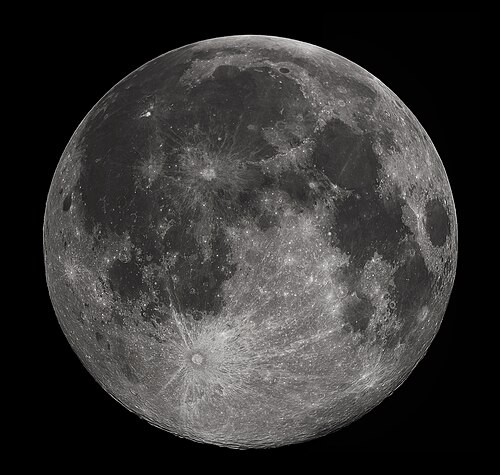
月は地球の唯一の天然衛星です。月は地球の直径の約 30 倍にあたる平均 384,400 km (238,900 マイル) の距離を周回しています。地球と月の間の潮汐力により、月の公転周期 (太陰月) は29.5 地球日で自転周期 (太陰日) と同期しており、常に月の同じ面が地球を向いています。月の引力、および程度は低いものの太陽の引力は、地球の潮汐の主な要因です。
地球物理学的には、月は惑星質量の物体または衛星惑星である。その質量は地球の1.2%で、直径は3,474km(2,159マイル)で、地球のおよそ4分の1である(アメリカ合衆国の東西の幅とほぼ同じ)。太陽系内では、月は親惑星に対して最大かつ最も質量の大きい衛星であり、全体では5番目に大きく質量の大きい衛星であり、既知のすべての準惑星よりも大きく質量が大きい。[17]月の表面重力は地球の約6分の1、火星の約半分で、太陽系のすべての衛星の中では木星の衛星イオに次いで2番目に大きい。月の本体は分化した地球型であり、顕著な水圏、大気圏、磁場はない。それは、地球が形成されて間もない45億1千万年前、地球と、火星と同サイズの天体と仮定されるテイアとの巨大衝突で生じた残骸から形成された。
月の表面は月の塵で覆われており、山、衝突クレーター、その噴出物、光線状の条線、小川、そして主に月の表側には、冷えたマグマの平原である暗い海が広がっている。これらの海は、溶融した溶岩が古代の衝突盆地に流れ込んだときに形成された。月は、月食中に地球の影を通過するときを除いて、常に太陽に照らされているが、地球からは、月が公転する間に可視光が移動し、月の満ち欠けが生じる。[18]月は地球の夜空で最も明るい天体である。これは主に、その角直径が大きいためであり、月の表面の反射率はアスファルトの反射率に匹敵する。見かけの大きさは太陽とほぼ同じで、皆既日食のときには月が太陽を完全に覆うことができる。地球からは、周期的な視点の変化(秤動)により、時間の経過とともに月の表面の約 59% が見え、月の裏側の一部が見えるようになります。
月は人類にとって重要なインスピレーションと知識の源であり、宇宙論、神話、宗教、芸術、時間計測、自然科学、宇宙飛行にとって極めて重要であった。1959年、ソ連のルナ1号のフライバイとルナ2号の意図的な衝突により、地球を離れて他の天体に到達した最初の人工物が月に到着した。 1966年、ルナ9号による軟着陸とルナ10号による軌道投入が達成され、月は最初の地球外天体となった。1969年7月20日、人類はアメリカのアポロ11号ミッションの着陸船イーグルによって静かの海に初めて着陸し、月および地球外天体に着陸した。それから1972年までにさらに5人の乗組員が派遣され、それぞれ2人が表面に着陸した。最長滞在時間はアポロ17号の乗組員による75時間であった。それ以来、ロボットによる月面探査が続けられており、2020年代後半から 有人ミッションが再開される予定となっている。
名前と語源
地球の自然衛星の通常の英語の固有名は、単に大文字のMの「Moon」です。 [19] [20]名詞の「moon」は古英語の 「mōna」に由来しており、これは(他のゲルマン語の同義語と同様に)ゲルマン祖語の *mēnōnに由来し、[21]さらにインド・ヨーロッパ祖語の *mēnsis「月」[22](より古い*mēnōt、属格*mēnesesに由来)に由来し、これはおそらく(時間の)動詞「measure」と関連していると思われます。[23]
時折、ルナ / ˈ l uː n ə /という名前が科学的な文章で使用され[24]、特にSFでは地球の月を他の月と区別するために使用され、一方詩では「ルナ」は月の擬人化を表すために使用されてきました。[25] シンシア / ˈ s ɪ n θ i ə / は、月を女神として擬人化した別の詩的な名前ですが、まれです。[26]一方、セレーネ / s ə ˈ l iː n iː / (文字通り「月」) はギリシャの月の女神です。
月に関する英語の形容詞はlunarで、ラテン語の月lūnaに由来する。Selenian / s ə l iː n i ə n / [ 27]は 、月を天体としてではなく世界として説明するときに使われる形容詞であるが[28] 、その使用はまれである。これはギリシャ語で月を意味するσελήνη selēnēに由来し、同義語のselenic はもともとまれな同義語であったが[29]、現在ではほぼ常に化学元素セレンを指す。[30]元素名セレンと接頭辞seleno- (月の物理的特徴の研究であるselenographyなど) はこのギリシャ語に由来している。[31] [32]
ギリシャ神話の荒野と狩猟の女神アルテミスは、ローマ神話のディアナと同一視され、そのシンボルの一つが月であり、しばしば月の女神とみなされていた。また、伝説上の出生地であるキュントス山にちなんで、シンシアとも呼ばれていた。[33]これらの名前、ルナ、シンシア、セレネは、アポルネ、ペリシンシオン、セレノセントリックなど、月の軌道を表す専門用語に反映されている。
月の天文学上の記号は三日月です。\たとえば、M ☾「月の質量」(M Lとも呼ばれる)などです。
自然史
月の地質年代

今から数百万年前
月の地質学上の期間は、暗黒海の外側にある衝突クレーターの
ほとんどから、暗黒海とそれ以降のクレーター、そして最後にコペルニクスやティコのような放射状のシステムを持つ、まだ明るく、そのため容易に見える若いクレーターまで、その特徴にちなんで名付けられています。
形成

月のサンプルの同位体年代測定によると、月は太陽系の起源から約5000万年後に形成されたと示唆されている。[36] [37]歴史的には、いくつかの形成メカニズムが提案されてきたが[38]、どれも地球-月系の特徴を十分に説明していない。遠心力によって地球の地殻から月が分裂するには[39]、地球の初期の自転速度が大きすぎることが必要となる。[40]形成された月の重力捕獲[41]は、通過する月のエネルギーを消散させるために、地球の実現不可能なほどに拡張した大気を必要とする。 [40]原始的な降着円盤で地球と月が一緒に形成されたとしても、月の金属の枯渇を説明できない。[40]これらの仮説のいずれも、地球-月系の高い角運動量を説明できない。 [42]
有力な説は、地球-月系は、火星サイズの天体(テイア)が原始地球に巨大衝突した後に形成されたというものである。斜め衝突により物質が地球の周回軌道に吹き飛ばされ、その物質が集積して月を形成した[43] [44]。地球のロッシュ限界の約1.5倍の地点で月が形成された。2.56 R 🜨 . [45]
巨大衝突は、初期の太陽系では一般的だったと考えられている。巨大衝突のコンピュータシミュレーションでは、月の核の質量と地球-月系の角運動量と一致する結果が得られた。これらのシミュレーションでは、月の大部分は原始地球ではなく衝突体に由来していることが示されている。[46]しかし、2007年以降のモデルでは、月の大部分が原始地球に由来していることが示唆されている。[47] [48] [49] [50]火星やベスタなどの太陽系内の他の天体は、隕石によると、地球と比較して酸素とタングステンの同位体組成が非常に異なる。しかし、地球と月の同位体組成はほぼ同じである。地球-月系の同位体均一化は、2つを形成した蒸発物質が衝突後に混合することで説明できるかもしれないが、[51]これは議論の余地がある。[52]
この衝突により、噴出物と地殻の両方が液化し、マグマの海を形成するのに十分なエネルギーが放出されたと考えられる。液化した噴出物はその後、地球-月系に再集積した可能性がある。[53] [54]新しく形成された月には独自のマグマの海があり、その深さは約500 km(300マイル)から1,737 km(1,079マイル)と推定されている。[53]
巨大衝突説は多くの証拠を説明するが、いくつかの疑問はまだ解決されておらず、そのほとんどは月の組成に関係している。[55]月が原始地球のかなりの量を獲得するというモデルは、ジルコニウム、酸素、ケイ素、その他の元素の同位体の地球化学データと調和させることがより困難である。[56] 2022年に発表された研究では、高解像度のシミュレーション(最大108粒子の衝突実験では、巨大衝突によって、月と同程度の質量と鉄含有量を持つ衛星が、地球のロッシュ限界をはるかに超えた軌道に即座に投入されることがわかった。ロッシュ限界内を通過した衛星であっても、部分的に剥離されてからより広く安定した軌道に乗せられることで、確実かつ予測通りに生き残ることができる。[57]
2023年11月1日、科学者たちはコンピューターシミュレーションによると、地球内部にテイアと呼ばれる原始惑星の残骸が存在する可能性があると報告した。これは太古の地球との衝突で残されたもので、月もこの衝突によって形成された。[58] [59]
自然な発達
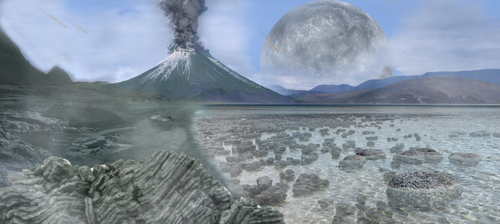
新しく形成された月は、現在よりもずっと地球に近い軌道に落ち着いた。そのため、それぞれの天体は互いの空でずっと大きく見え、日食はより頻繁に起こり、潮汐の影響はより強くなった。[60]潮汐加速 により、月の地球の周りの軌道は大幅に大きくなり、周期も長くなっている。[61]
月は形成後、冷えて大気の大部分が剥ぎ取られました。[62]月の表面はそれ以来、大きな衝突や多くの小さな衝突によって形作られ、あらゆる時代のクレーターが特徴的な景観を形成しています。
月は12億年前まで火山活動が活発で、そのせいで月の海が顕著に形成された。海の玄武岩のほとんどは33~37億年前のインブリア期に噴火したが、中には12億年前の若いもの[63]や42億年前の古いものもある[64] 。海の玄武岩の噴火についてはさまざまな説明があり、特に主に表側に現れる不均一な発生についてはさまざまな説明がある。月の裏側の高地の分布の原因もよくわかっていない。位相測定によると、表側の地殻は裏側よりも薄い。したがって、考えられるシナリオの1つは、表側への大きな衝突によって溶岩が表面に流れ込みやすくなった可能性があるということである。[65]
身体的特徴
月は潮汐力による伸縮でわずかに不等辺楕円体になっており、衝突盆地の重力異常により長軸が地球から30度ずれている。その形状は現在の潮汐力では説明できないほど細長い。この「化石の膨らみ」は、月が地球に対する現在の距離の半分の距離を周回していたときに固まり、現在は冷えすぎて現在の軌道距離では静水圧平衡を回復できないことを示している。[66]
サイズと質量

月は大きさと質量で太陽系の5番目に大きい自然衛星であり、惑星質量の衛星の1つとして分類され、地球物理学的な定義によれば衛星惑星である。[17]月は水星よりも小さく、太陽系最大の準惑星である冥王星よりもかなり大きい。冥王星-カロン系の小惑星衛星 カロンは冥王星に比べて大きいが、[f] [67]月は主惑星と比較すると太陽系最大の自然衛星である。[g]
月の直径は約3,500kmで、地球の4分の1以上であり、月の表面はオーストラリア本土、[68] 、 ヨーロッパ、またはアメリカ合衆国本土(アラスカなどを除く)の幅に匹敵します。[69]月の全表面積は約3,800万平方キロメートルで、北米と南米を合わせた面積に匹敵します。[70]アメリカ大陸 を合わせた面積(すべての島を除く)は3,770万平方キロメートルです。[ 71]
月の質量は地球の81分の1であり[72]、惑星の衛星の中で2番目に密度が高く、表面重力はイオに次いで2番目に高く、0.1654 g、脱出速度は2.38 km/s ( 8,600 km / h、5,300 mph)です。
構造

月は分化した天体であり、当初は静水圧平衡にあったが、その後この状態から外れた。[73]月は地球化学的に異なる地殻、マントル、核を持っている。月には、半径がおそらく240キロメートル(150マイル)ほどの鉄を豊富に含む固体の内核と、半径およそ300キロメートル(190マイル)の主に液体の鉄でできた流体の外核がある。核の周りには、半径約500キロメートル(310マイル)の部分的に溶融した境界層がある。[74] [75]この構造は、45億年前に月が形成された直後に、全球規模のマグマオーシャンの部分結晶化によって発達したと考えられている。 [76]
このマグマオーシャンの結晶化により、オリビン、単斜輝石、斜方輝石などの鉱物が沈殿して沈降し、苦鉄質マントルが形成されたと考えられる。マグマオーシャンの約4分の3が結晶化した後、低密度の斜長石鉱物が形成され、その上の地殻に浮かぶ可能性がある。[77]結晶化する最後の液体は、最初は地殻とマントルの間に挟まれ、非相溶性元素と熱生成元素が豊富に含まれていたと考えられる。 [1]この見解と一致して、軌道から行われた地球化学マッピングでは、地殻の大部分が斜長岩であることが示唆されている。[16]マントルでの部分溶融により表面に噴出した洪水溶岩の月の岩石サンプルは、地球よりも鉄分が豊富な苦鉄質マントルの組成を確認している。[1]地殻の平均厚さは約50キロメートル(31マイル)である。[1]
月は太陽系でイオに次いで2番目に密度の高い衛星である。[78]しかし、月の内核は小さく、半径は約350キロメートル(220マイル)以下で、[1]月の半径の約20%である。その組成はよくわかっていないが、おそらく金属鉄に少量の硫黄とニッケルが合金になっている。月の時間変動の分析によると、少なくとも部分的に溶融していることが示唆されている。[79]月の核の圧力は5GPa(49,000気圧)と推定されている。[80]
重力場
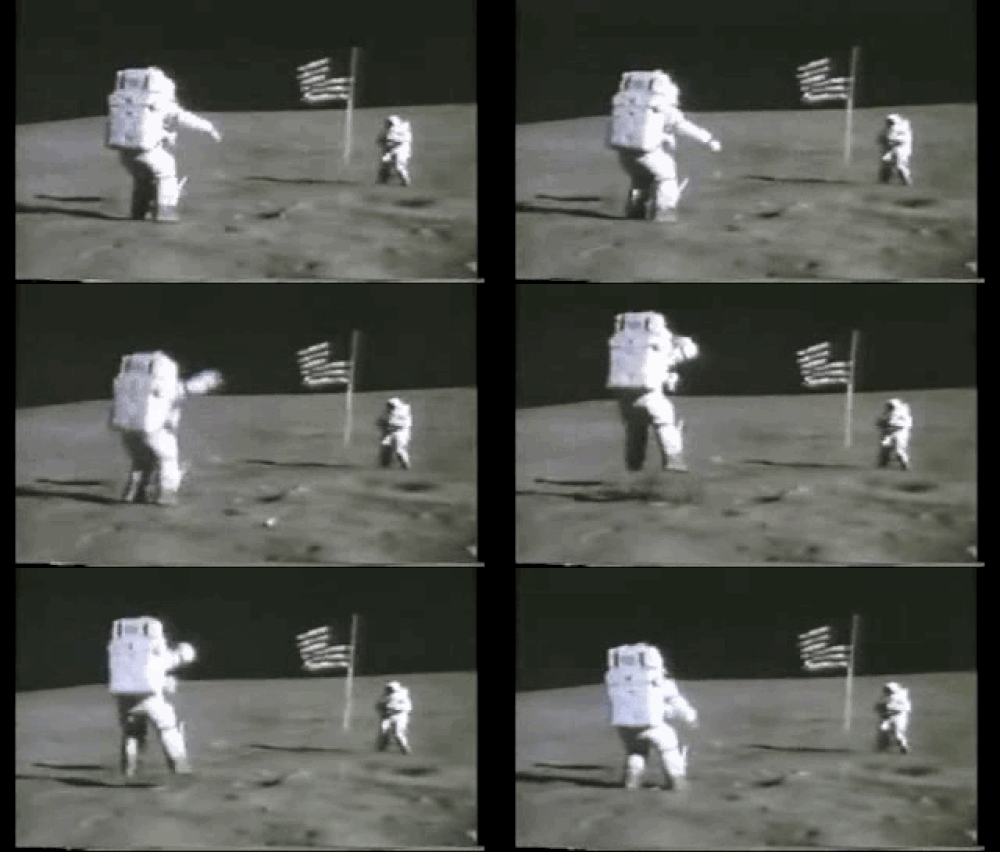
平均的に月の表面重力は1.62 m/s 2 [4] (0.1654 グラム;5.318 フィート/秒2 )、火星の表面重力の約半分、地球の約 6 分の 1 です。
月の重力場は均一ではない。重力場の詳細は、周回宇宙船が発する電波信号のドップラーシフトを追跡することで測定されている。月の主な重力の特徴はマスコンである。マスコンは、巨大衝突盆地の一部に関連する大きな正の重力異常で、その原因の一部は、これらの盆地を埋め尽くす濃い海の玄武岩質溶岩流である。[83] [84]この異常は、月を周回する宇宙船の軌道に大きな影響を与える。いくつかの謎がある。溶岩流だけでは重力の特徴のすべてを説明できないし、海の火山活動に関連しないマスコンもいくつか存在する。[85]
磁場
月の外部磁場は0.2ナノテスラ未満であり[86]、地球の10万分の1以下である。月には地球規模の双極磁場はなく、地殻磁化のみがある。これはおそらく、月の歴史の初期、ダイナモがまだ作動していた頃に獲得したものと思われる。[87] [88]月の歴史の初期、40億年前、その磁場強度は現在の地球の磁場に近かったと思われる。[86]この初期のダイナモ場は、月の核が結晶化した約10億年前までに消滅したと思われる。[86]理論的には、残留磁化の一部は、プラズマ雲の膨張を通じて大規模な衝突中に生成された一時的な磁場に由来する可能性がある。これらの雲は、周囲の磁場の中で大規模な衝突中に生成される。これは、最大の地殻磁化が巨大衝突盆地の反対側の近くにあることからも裏付けられる。 [89]
雰囲気

月の大気は真空に近いほど希薄で、総質量は10トン(9.8長トン、11短トン)未満である。[94]この小さな塊の表面圧力は約3 × 10 −15 気圧(0.3 nPa)で、月の日によって変化する。その発生源には、太陽風イオンによる月の土壌の衝突で生じるガス放出やスパッタリングなどがある。 [16] [95]検出された元素には、スパッタリングで生成されるナトリウムとカリウム(水星とイオの大気にも存在)、太陽風からのヘリウム4とネオン[96]、および地殻とマントル内での放射性崩壊によって生成された後にガス放出されるアルゴン40、ラドン222、ポロニウム210がある。[97] [98]レゴリスには酸素、窒素、炭素、水素、マグネシウムなどの中性種(原子または分子)が存在するが、なぜ存在しないのかはわかっていない。[97]チャンドラヤーン1号によって水蒸気が検出され、緯度によって変化し、最大で約60~70度であることがわかった。これはレゴリス内の水氷の昇華によって生成された可能性がある。 [99]これらのガスは、月の重力によってレゴリスに戻るか、太陽の放射圧によって、またはイオン化されている場合は太陽風の磁場によって吹き飛ばされて宇宙に失われる。[97]
アポロ計画で採取された月のマグマサンプルの研究により、月は30億年から40億年前の7000万年間、比較的厚い大気を持っていたことがわかった。この大気は月の火山噴火から噴出したガスから発生し、現在の火星の2倍の厚さがあった。太古の月の大気は最終的に太陽風によって剥ぎ取られ、宇宙に散逸した。[62]
月の周囲には、彗星の小粒子によって生成される恒久的な月塵雲が存在する。推定では、24時間ごとに5トンの彗星粒子が月面に衝突し、塵粒子が放出される。塵は月面上に約10分間留まり、上昇に5分、下降に5分かかる。平均して、月面上には120キログラムの塵が存在し、表面から最大100キロメートル上空まで上昇する。LADEEの月塵実験(LDEX)による塵のカウントでは、地球と月が彗星の残骸を通過するふたご座流星群、しぶんぎ座流星群、北おうし座流星群、オミクロン・ケンタウリッド 流星群のときに粒子数がピークに達することがわかった。月の塵雲は非対称で、月の昼側と夜側の境界付近で密度が高くなっている。[100] [101]
表面状態

宇宙線、太陽からの電離放射線、およびその結果生じる中性子放射線[103]は、月面の昼間に平均1.369ミリシーベルト/日の放射線レベルを生み出します。 [14]これは、地球から約400km上空の軌道上で国際宇宙ステーションの0.53ミリシーベルト/日の約2.6倍、大西洋横断飛行中の5~10倍、地球表面の200倍に相当します。[104]さらに比較すると、火星への飛行中の放射線は1日あたり約1.84ミリシーベルト、火星では平均0.64ミリシーベルト/日ですが、火星の一部の場所では0.342ミリシーベルト/日という低いレベルになる可能性があります。[105] [106]
月の黄道に対する軸の傾きはわずか1.5427°で、[8] [107]地球の23.44°よりはるかに小さい。この小さな傾きのため、月の太陽光による季節による変化は地球よりはるかに少なく、月の北極、クレーターピアリーの縁に永久光のピークが存在することが可能になる。
表面は、120℃から太陽放射量に応じて、最高気温は−171 °Cである。大気がないため、特に日光が当たるか影が当たるかによって、場所によって気温が異なり、[108]地形の詳細が局所的な地表気温に決定的な役割を果たす。[109] 多くのクレーター、特に極地のクレーターの底部は[110]永久に影に覆われており、これらの「永遠の闇のクレーター」は極端に気温が低い。ルナー・リコネッサンス・オービターは、南極のクレーターの夏の最低気温を 35 K (−238 °C; −397 °F) [111]と測定し、北極のエルミートクレーターでは冬至近くに 26 K (−247 °C; −413 °F) を記録した。これは、宇宙船によって測定された太陽系で最も低い気温であり、冥王星の表面よりも寒い。[109]
月の地殻の上には、衝突によって形成された、高度に粉砕され(どんどん小さな粒子に砕け散り)、衝突で形成された、主に灰色の表面層が覆っている。より細かいレゴリス、すなわち二酸化ケイ素ガラスの月の土は、雪に似た質感と使用済み火薬に似た匂いがある。[112]古い表面のレゴリスは、一般的に新しい表面のものよりも厚く、高地では10~15メートル(33~49フィート)、海では4~5メートル(13~16フィート)の厚さがある。[113]細かく粉砕されたレゴリス層の下には、数キロメートルの厚さの高度に破砕された岩盤の層であるメガレゴリスがある。 [114]
例えば、これらの極端な条件により、宇宙船が月に細菌胞子を一周するよりも長く保有する可能性は低いと考えられています。[115]
表面の特徴

月の地形はレーザー高度測定と立体画像解析によって測定されている。[116]月の最も広大な地形的特徴は、直径約2,240 km (1,390 mi)の巨大な裏側の南極-エイトケン盆地で、月面で最大のクレーターであり、太陽系で2番目に大きい衝突クレーターであることが確認されている。[117] [118]深さ13 km (8.1 mi)のその底は、月の表面で最も低い地点である。[117] [119]月の表面の最高標高は北東方向に位置しており、南極-エイトケン盆地の斜めの形成の衝突によって厚くなった可能性がある。[120]インブリウム、セレニタティス、クリシウム、スミス、オリエンタルなどの他の大きな衝突盆地は、地域的に標高が低く、縁が隆起している。[117]月の裏側は表側よりも平均で約1.9km(1.2マイル)高い。[1]
断層崖の発見は、過去10億年の間に月が約90メートル(300フィート)縮小したことを示唆している。[121]同様の縮小の特徴は水星にも存在する。長い間地質学的に死んだと考えられていた北極近くの盆地である冷帯海は、ひび割れて移動した。月には地殻プレートがないため、地殻活動は遅く、熱を失うにつれてひび割れが生じる。[122]
科学者らは、1969年のアポロ11号着陸地点からそう遠くない静かの海付近の月面に洞窟が存在することを確認した。崩壊した溶岩洞への入り口と特定されたこの洞窟は、幅約45メートル、長さ最大80メートルである。この発見は、月面洞窟への入り口として初めて確認された。分析は、NASAの月探査機が2010年に撮影した写真に基づいている。洞窟の安定した温度は約17℃は将来の宇宙飛行士にとって快適な環境となり、極端な気温、太陽放射、微小隕石から宇宙飛行士を守ることができる。しかし、アクセスのしやすさや雪崩や陥没の危険性などの課題がある。この発見は将来の月面基地や緊急避難所の可能性を示唆している。[123]
火山の特徴
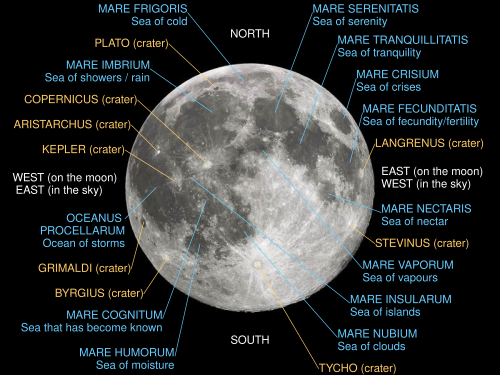
地球から肉眼で見える主な地形は、暗くて比較的特徴のない月の平原で、マリア(単数形はmare、ラテン語で「海」の意味、かつては水で満たされていたと考えられていた)[124]と呼ばれています。これは古代の玄武岩質溶岩が固まった広大なプールです。地球の玄武岩に似ていますが、月の玄武岩は鉄分が多く、水によって変化した鉱物はありません。[125]これらの溶岩堆積物の大半は、衝突盆地に関連する窪地から噴出または流入しましたが、月で最大の玄武岩の氾濫域である大洋は、明らかな衝突盆地には対応していません。マリアでの溶岩流のさまざまなエピソードは、表面のアルベドの変化と明確な流れの縁によって認識できることがよくあります。[126]
海が形成されると、玄武岩質溶岩の冷却と収縮により、一部の地域ではしわのある尾根が形成されました。これらの低く曲がりくねった尾根は数百キロメートルにわたって伸び、海の中に埋もれた構造物の輪郭を描くことがよくあります。海の形成によるもう 1 つの結果は、縁に沿って同心円状の窪みが形成されることです。これは弓状リユと呼ばれます。これらの特徴は、海の玄武岩が自重で内側に沈み、縁が割れて分離するときに発生します。
月には目に見える海のほかに、衝突による噴出物で覆われた海の堆積物がある。隠れた海と呼ばれるこれらの海は、露出している海よりも古い可能性が高い。[127]逆に、海の溶岩は多くの衝突溶融シートやプールを覆い隠している。衝突溶融物は、衝突による強い衝撃圧によって蒸発し、衝突地点の周りの領域を溶融したときに形成される。まだ露出している衝突溶融物は、その分布、アルベド、およびテクスチャによって海の溶岩と区別できる。[128]
マリアとその周辺で見られる曲がりくねった溝は、おそらく死滅した溶岩溝または崩壊した溶岩洞です。これらは通常、火山の噴出口から発生し、蛇行し、進むにつれて枝分かれすることもあります。最大の例としては、シュローターズ バレーやリマ ハドレーが挙げられますが、これらは地上の溶岩溝よりも大幅に長く、広く、深く、時には地球上では珍しい屈曲や急カーブを特徴としています。
海の火山活動は衝突クレーターを様々な形で変化させてきた。これには、さまざまな程度にクレーターを埋めることや、内部の下にある海の物質の隆起によってクレーター底が隆起したり割れたりするなどがある。そのようなクレーターの例には、タルンティウスやガッサンディなどがある。ヒュギヌスなど一部のクレーターは完全に火山起源で、カルデラまたは崩壊ピットとして形成される。そのようなクレーターは比較的まれで、衝突クレーターよりも小さく(通常は数キロメートルの幅)、浅く、不規則な形になる傾向がある。また、衝突クレーターの特徴である上向きの縁もない。
近海には、シールド火山や火山ドームを含むいくつかの地質区が存在します。 [129]また、特に粘性の高い溶岩でできた火砕堆積物、スコリア丘、非玄武岩質ドームの地域もいくつかあります。
ほぼすべての海は月の表側にあり、表側の表面の31%を覆っている[72]のに対し、裏側では2%である[130] 。これは、表側の地殻の下に熱を発生する元素が集中しているためである可能性が高く、その下のマントルが加熱され、部分的に溶融し、表面に上昇して噴火したと考えられる。[77] [131] [132]月の海の玄武岩のほとんどは、33〜37億年前のインブリア期に噴火したが、中には12億年前の若いもの[63]や42億年前の古いものもある。[64]
.png/500px-Lava_flows_in_Mare_Imbrium_(AS15-M-1558).png)
2006年、フェリシタティス湖の小さな窪地であるイナの研究では、ギザギザで比較的塵の少ない地形が発見された。これは、落下する破片による浸食がないため、わずか200万年前のものとみられる。[133]月震とガスの放出は、月の活動が続いていることを示している。[133]最近の月の火山活動の証拠は、5000万年未満のものもある、70の不規則な海のパッチで確認されている。このことは、少なくとも放射性元素の濃度が高いために深部地殻が大幅に暖かい表側では、これまで考えられていたよりもはるかに暖かい月のマントルの可能性を提起している。[134] [135] [136] [137]オリエンターレ盆地内のローウェルクレーター内で、200万〜1000万年前の玄武岩質火山活動の証拠が見つかっている。[138] [139]当初より高温であったマントルとマントル内の熱発生元素の局所的濃縮の組み合わせが、オリエンターレ盆地の向こう側での長期にわたる活動の原因である可能性がある。[140] [141]
月の明るい色の領域は、ほとんどの海よりも高いため、テラエ、またはより一般的には高地と呼ばれています。放射年代測定によると、これらは44億年前に形成されたとされており、月のマグマの海の斜長石 集積物を表してい可能性があります。[64] [63]地球とは対照的に、月の主要な山脈は地殻変動の結果として形成されたとは考えられていません。[142]
海が表側に密集しているのは、裏側の高地の地殻がかなり厚いことを反映している可能性が高い。これは、月の形成から数千万年後に、地球の第二の衛星が低速で衝突して形成された可能性がある。[143] [144]あるいは、月が地球にかなり近かったときの非対称な潮汐加熱の結果である可能性もある。 [145]
衝突クレーター

月の表面に影響を与えた主要な地質学的プロセスは衝突クレーター形成であり、[146]小惑星や彗星が月の表面に衝突したときにクレーターが形成される。月の表側には、幅が1 km (0.6 mi) を超えるクレーターが約300,000個あると推定されている。[147]月のクレーターは、大きさによってさまざまな形を呈する。直径が小さい順に、基本的なタイプは、滑らかなボウル型の内部と上向きの縁を持つ単純なクレーター、平らな床、段々になった壁、中央の山を持つ複雑なクレーター、山頂リング盆地、および2つ以上の同心円状の山を持つ多重リング盆地である。[148]衝突クレーターの大部分は円形であるが、カンタークレーターやヤンセンクレーターのように、下層の断層や節理の影響を受けて、より多角形の輪郭を持つものもある。メシエ対、シラー、ダニエルなどの他の小惑星は細長い形状をしている。このような細長い形状は、非常に斜めからの衝突、連星系小惑星の衝突、地表衝突前の衝突体の破片化、または近接した二次衝突によって生じる可能性がある。[149]
月の地質学的年代スケールは、直径が数百から数千キロメートルで、地域的な地層水準を形成する広範な噴出物堆積物のエプロンを伴う、ネクタリス、インブリウム、オリエンターレなどの最も顕著な衝突イベントに基づいています。[150]大気、天候、および最近の地質学的プロセスがないため、これらのクレーターの多くはよく保存されています。少数のマルチリング盆地のみが明確に年代測定されていますが、相対的な年代を割り当てるのに役立ちます。衝突クレーターはほぼ一定の割合で蓄積するため、単位面積あたりのクレーターの数を数えることで、表面の年齢を推定できます。[150]ただし、二次クレーターが存在する可能性があるため、クレーターの計数手法 には注意が必要です。衝突による噴出物は二次クレーターを形成することがあり、多くの場合、クラスターまたはチェーンとして現れますが、衝突からかなり離れた場所で孤立した構造として発生することもあります。これらは主クレーターに似ていることがあり、小さなクレーター群を支配することさえあるため、その未確認の存在は年代の推定を歪める可能性があります。[151]
アポロ計画で採取された衝突溶融岩石の放射年代は38億年から41億年の間に集中しており、これは衝突が増加した後期重爆撃期を示唆する根拠となっている。[152]
2010年代のルナー・リコネッサンス・オービターによる高解像度の画像は、現在のクレーター形成率が以前の推定よりも大幅に高いことを示しています。遠位噴出物によって引き起こされる二次クレーター形成プロセスは、81,000年のタイムスケールで表土の上部2センチメートルをかき混ぜると考えられています。[153] [154]この率は、直接的な微小隕石の衝突のみに基づくモデルから計算された率の100倍速いです。[155]
月の渦

月の渦巻きは、月の表面全体で見られる謎めいた地形である。高いアルベドが特徴で、光学的に未熟(比較的若いレゴリスの光学特性)に見え、しばしば曲がりくねった形をしている。その形状は、明るい渦巻きの間を曲がりくねった低アルベド領域によって強調されることが多い。それらは表面磁場が強化された場所に位置し、多くは大きな衝突の反対側に位置している。よく知られている渦巻きには、ライナーガンマ地形やインジェニイ海がある。それらは、太陽風から部分的に遮蔽された領域であり、その結果、宇宙風化が遅くなっていると仮定されている。[156]
水の存在
月の表面には液体の水は存在できない。太陽放射にさらされると、水は光分解と呼ばれるプロセスによって急速に分解し、宇宙に失われる。しかし、1960年代以降、科学者たちは、衝突した彗星によって水氷が堆積するか、酸素を豊富に含む月の岩石と太陽風の水素との反応によって生成された可能性があり、水の痕跡が月の両極にある冷たく永久に影になっているクレーターに残っている可能性があると仮説を立ててきた。[157] [158]コンピューターシミュレーションによると、月面の最大14,000 km 2 (5,400平方マイル) が永久に影になっている可能性がある。[110]月に利用可能な量の水が存在することは、月居住を費用対効果の高い計画にする上で重要な要素である。地球から水を輸送するという代替案は、法外に高価になるだろう。[159]
それ以来、月の表面には水の存在が見つかっている。[160] 1994年、クレメンタイン宇宙船に搭載されたバイスタティックレーダー実験では、表面近くに小さな凍った水たまりが存在することが示された。しかし、その後のアレシボによるレーダー観測では、これらの発見はむしろ若い衝突クレーターから噴出した岩石である可能性が示唆されている。[161] 1998年、ルナプロスペクター宇宙船に搭載された中性子分光計は、極地付近の表土の深さ1メートルに高濃度の水素が存在することを示しました。[162]アポロ15号で地球に持ち帰られた火山溶岩ビーズには、内部に少量の水が含まれていた。[163]

2008年のチャンドラヤーン1号探査機は、搭載された月鉱物マッピング装置を使用して、表面の水氷の存在を確認しました。分光計は、反射した太陽光でヒドロキシルに共通する吸収線を観測し、月面に大量の水氷がある証拠を示しました。探査機は、濃度が1,000 ppmに達する可能性があることを示しました。[164]マッパーの反射スペクトルを使用して、影になっている領域を間接照明することで、2018年に両極の緯度20度以内に水氷があることが確認されました。 [165] 2009年、LCROSSは2,300 kg(5,100ポンド)の衝突体を永久に影になっている極地のクレーターに送り込み、噴出した物質の煙の中に少なくとも100 kg(220ポンド)の水を検出しました。[166] [167] LCROSSデータの別の調査では、検出された水の量は155±12kg(342±26ポンド)に近いことが示されました。[168]
2011 年 5 月、月のサンプル 74220 の溶融包有物に 615~1410 ppm の水分が含まれていることが報告されました[169] 。これは、1972 年のアポロ 17 号のミッション中に収集された、有名な高チタンの火山起源の「オレンジガラス土壌」です。包有物は、約 37 億年前の月の爆発的な噴火中に形成されました。この濃度は、地球の上部マントルのマグマの濃度に匹敵します。月相学的には非常に興味深いことですが、サンプルは地表から数キロメートル下の深さで発生したため、この知見は水が簡単に入手できることを意味するものではなく、包有物にアクセスするのは非常に困難で、最先端のイオンマイクロプローブ機器で見つけるのに 39 年かかりました。
月鉱物マッピング装置(M3)の調査結果の分析により、2018年8月に初めて月面の水氷の「決定的な証拠」が明らかになった。[170] [171]データにより、塵やその他の反射物質とは対照的に、水氷の明確な反射特性が明らかになった。[172]氷の堆積物は北極と南極で発見されたが、南極では水が永久に影になるクレーターや割れ目に閉じ込められ、太陽から遮られているため表面に氷として残り続けるため、氷の堆積物が多く見られる。[170] [172]
2020年10月、天文学者たちは、成層圏赤外線天文台(SOFIA)を含む複数の独立した宇宙船によって、太陽光が当たる月の表面に分子状の水が検出されたと報告した。[173] [174] [175] [176]
地球-月系
軌道

地球と月は、共通の質量中心、つまり重心を持つ地球月衛星システムを形成しています。この重心は、地球の表面から 1,700 km (1,100 マイル) (地球の半径の約 4 分の 1) 下にあります。
月の軌道はわずかに楕円形で、軌道離心率は0.055です。[1]地球中心の月の軌道の長半径は 月距離と呼ばれ、約400,000 km(250,000マイルまたは1.28光秒)で、地球を9.5周するのに相当します。[177]
月は恒星の周りを地球の周りを一周します。その恒星周期は約27.3日です。[h]しかし、地球-月系は太陽の周りを同じ時間に公転するため、地球から見て同じ月の満ち欠けで一周期が完了するまでには、わずかに長い29.5日かかります。[i] [72]この朔望周期または朔望月は一般に太陰月と呼ばれ、月の太陽日の長さに等しくなります。 [178]
潮汐ロックにより、月は1:1の自転・軌道共鳴を起こしている。この自転・軌道比により、地球を回る月の公転周期は、対応する自転周期と等しくなる。これが、月の片側、いわゆる表側だけが地球から見える理由である。とはいえ、月の動きが共鳴しているとはいえ、秤動などの微妙な変化がないわけではなく、その結果、視点がわずかに変化し、時間と地球上の場所によって、月の表面の約59%が地球から見えることになる。[179]
他の惑星の衛星のほとんどとは異なり、月の軌道面は惑星の赤道面よりも黄道面に近い。月の軌道は太陽と地球によって多くの小さく複雑な相互作用によって微妙に乱されている。例えば、月の軌道面は18.61年に1回ゆっくりと回転し、 [180]月の運動の他の側面に影響を与えている。これらの付随効果はカッシーニの法則によって数学的に説明される。[181]

潮汐の影響
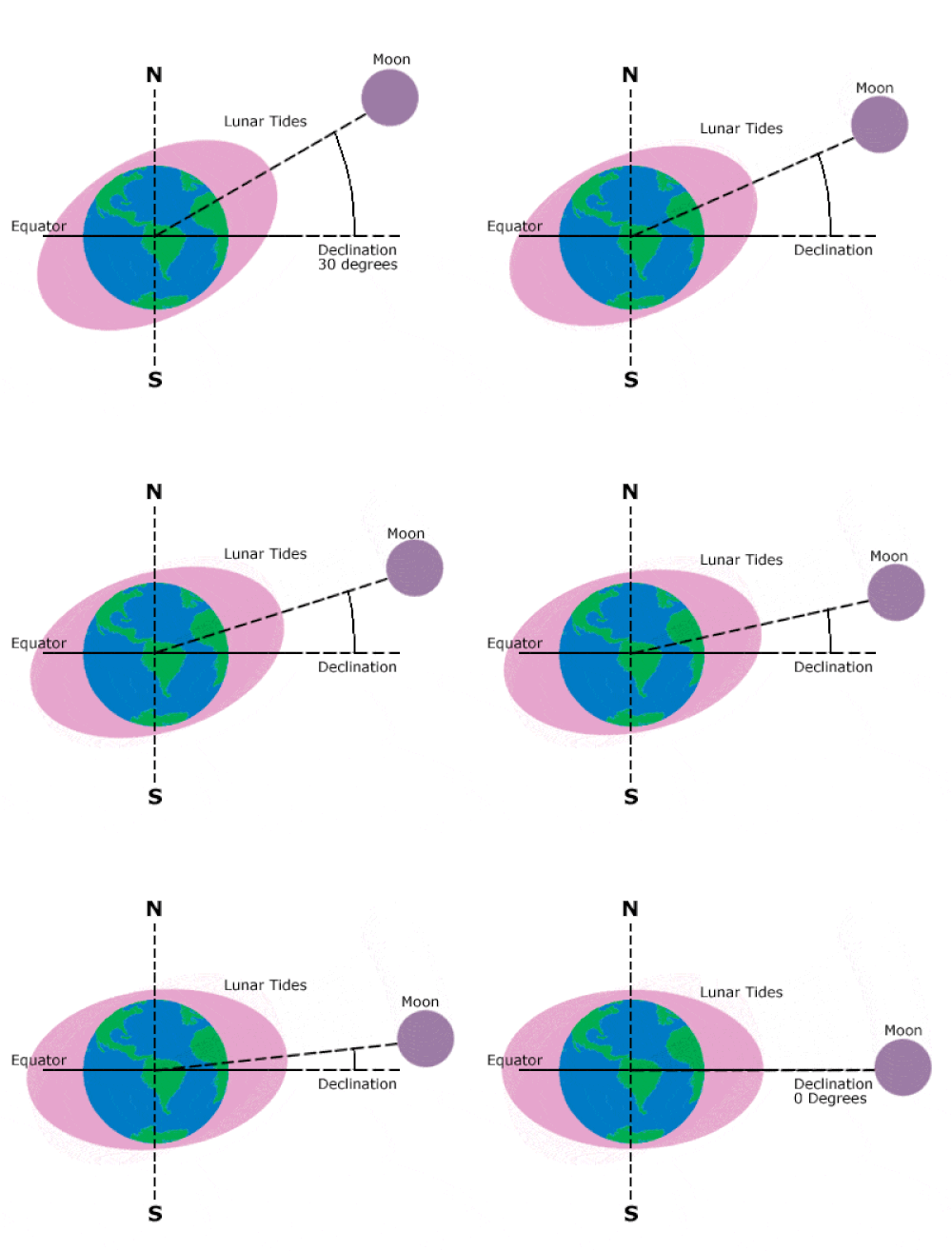
地球と月(および太陽)が互いに及ぼす重力は、互いに最も近い側でわずかに強い引力として現れ、潮汐力をもたらします。海の潮汐は、この結果最も広く経験されるものですが、潮汐力は、月とそのシステムだけでなく、地球の他のメカニズムにも大きな影響を与えます。
月の固体地殻は、27日間で振幅約10cm(4インチ)の潮汐を経験し、その3つの要素は、地球と月の自転が同期しているために地球によって固定されている潮汐、軌道の偏心と傾斜による変動する潮汐、そして太陽からのわずかに変動する要素である。 [182]地球によって引き起こされる変動要素は、月軌道の偏心と傾斜の結果としての距離と秤動の変化から生じる(月の軌道が完全な円で傾斜がない場合は、太陽潮汐のみが存在する)。[182]最近の研究によると、科学者は、月が地球に与える影響が地球の磁場の維持に寄与している可能性があることを示唆している。[183]
これらの潮汐力によって蓄積された応力の累積効果により、月震が発生します。月震は地震に比べてはるかに頻度が低く、弱いものですが、乾燥した断片化した上部地殻で地震の振動が散乱するため、最大1時間(地上の地震よりかなり長い)続くことがあります。月震の存在は、1969年から1972年にかけてアポロ宇宙飛行士が月に設置した地震計によって予期せぬ発見となりました。 [184]
潮汐力の最もよく知られている影響は、海面上昇と呼ばれる現象です。[185]潮汐力のほとんどは月が及ぼしますが、太陽も潮汐力を発揮し、月の潮汐力の40%もの潮汐力に寄与しています。この相互作用により大潮と小潮が発生します。[185]
潮汐は地球の海にある2つの膨らみで、1つは月に面した側、もう1つは反対側にあります。地球が自転すると、海の膨らみの1つ(満潮)は月の「下」に留まり、もう1つの膨らみは反対の側にあります。その結果、約24時間で2回の満潮と2回の干潮が発生します。[185]月は地球の自転と同じ方向に地球を周回しているため、満潮は約12時間25分ごとに発生します。25分は月が地球を周回する時間によるものです。
もし地球が水の世界(大陸のない世界)であったなら、わずか 1 メートルの潮汐しか生じず、その潮汐は非常に予測しやすいでしょう。しかし、海の潮汐は他の要因によって大きく変化します。
- 海底を通る水と地球の自転の摩擦結合
- 水の動きの慣性
- 陸地の近くで浅くなる海盆
- 異なる海盆間の水の波動[186]
その結果、地球上のほとんどの地点における潮の満ち引きのタイミングは、偶然にも理論によって説明される観測の産物である。
システムの進化
海洋潮汐と固体潮汐の両方の潮汐ピークの遅れは、地球の自転に反対するトルクを引き起こします。これにより、地球の自転から角運動量と回転運動エネルギーが「排出」され、地球の自転が遅くなります。[185] [182]地球から失われた角運動量は、潮汐加速と呼ばれるプロセスで月に移され、月をより高い軌道に持ち上げ、地球の周りの軌道速度を低下させます。
そのため、地球と月の距離は増加しており、地球の自転はそれに反応して遅くなっています。[182]アポロ計画(月面測距実験)中に残されたレーザー反射鏡の測定により、月までの距離は1年に38mm(1.5インチ)増加していることがわかりました(人間の爪の伸びる速度とほぼ同じです)。[187] [188] [189] 原子時計は、地球の1日が 毎年約17マイクロ秒長くなることを示しており、 [190] [191] [192]うるう秒によってUTCが調整される速度がゆっくりと増加しています。
この潮汐抵抗により、地球の自転と月の公転周期は非常にゆっくりと一致する。この一致により、まず軌道システムの軽い天体が潮汐ロックされるが、これはすでに月の場合と同じである。理論的には、500億年後には[193] 、地球の自転は月の公転周期と一致するまで遅くなり、地球は常に月に対して同じ面を向けるようになる。しかし、太陽は赤色巨星となり、それよりずっと前に地球-月系を飲み込む可能性が高い。[194] [195]
地球-月系が拡大した太陽に飲み込まれなければ、太陽の大気からの抗力によって月の軌道が崩壊する可能性がある。月の軌道が18,470 km (11,480 mi) の距離に近づくと、地球のロッシュ限界を超え、地球との潮汐相互作用によって月がばらばらになり、リング系に変わる。軌道上のリングのほとんどは崩壊し始め、その破片が地球に衝突する。したがって、太陽が地球を飲み込まなくても、地球は月のない状態になる可能性がある。[196]
位置と外観

月が満ちる時の最高高度は、月の満ち欠け、より正確には軌道の位置、および季節、より正確には地球の軸の位置によって変わります。満月は冬に空で最も高く、夏に最も低く(それぞれ各半球で)、その高度は暗い月に向かってその反対に変化します。
北極と南極では、月は1熱帯月ごとに2週間(約27.3日)、地平線より24時間上にあり、これは熱帯年の極日に匹敵します。北極の動物プランクトンは、太陽が何ヶ月も地平線の下にあるときに月の光を利用します。 [197]
月の見かけの向きは、天空での位置と、地球のどの半球から月を見ているかによって決まる。北半球では、南半球から見たときと比べて逆さまに見える。[198]三日月の「角」が横向きよりも上向きに見えることがある。この現象はウェットムーンと呼ばれ、熱帯地方でより頻繁に発生する。[199]
月と地球の距離は、近地点で約356,400 km (221,500 mi)から遠地点で約406,700 km (252,700 mi) まで変化し、月までの距離と見かけの大きさは最大14%変動します。[200] [201]平均して、月の角直径は約0.52°で、太陽とほぼ同じ見かけの大きさです(§ 日食を参照)。さらに、純粋に心理的な効果である月の錯視により、地平線に近い月は大きく見えます。[202]
月は潮汐ロックされているにもかかわらず、秤動効果により、1ヶ月の間に地球から月の表面の約59%が見える。[179] [72]
回転

月は潮汐同期回転をしており、地球の周りを公転しているため、月はほぼ同じ面を常に地球に向けている。月の地球に面している面は表側、その反対側は裏側と呼ばれる。裏側はしばしば不正確に「暗黒面」と呼ばれるが、実際には表側と同じくらいの頻度、つまり29.5地球日に一度照らされる。暗月から新月の間、表側は暗い。[203]
月はもともともっと速い速度で自転していたが、地球によって引き起こされた潮汐変形に関連する摩擦効果の結果として、歴史の初期に自転が遅くなり、この方向に潮汐固定された。 [204]時が経つにつれて、月の自転エネルギーは熱として消散し、地球に対する月の自転はなくなった。2016年、惑星科学者は1998-99年のNASAルナプロスペクターミッションで収集されたデータを使用して、月の反対側に2つの水素が豊富な領域(おそらく以前の水氷)を発見した。これらの斑点は、月が地球に潮汐固定される前の数十億年前の月の極であったと推測されている。[205]
照明と位相

月の表面の半分は常に太陽に照らされています (月食のときを除く)。地球も月に光を反射しており、太陽に照らされていない 月の表側の領域から地球に反射された光は、地球光として時々観測されます。
月の黄道に対する軸の傾きは 1.5427° なので、1竜年(346.62 日) ごとに太陽は月の赤道の北 1.5427° から南 1.5427° に移動し、その後元に戻ります。これは、地球上で太陽が1熱帯年ごとに北回帰線から南回帰線に移動し、また北回帰線に戻るのと同じです。したがって、月の両極は半竜年の間は暗く (または太陽の一部しか見えません)、その後半竜年の間は明るくなります。極付近の水平領域に当たる太陽光の量は、太陽の高度角によって異なります。しかし、これらの「季節」は、赤道に近い地域ではほとんど影響がありません。
月の位置が異なれば、太陽に照らされる領域も異なります。地球から見た月のさまざまな領域の照らされ方によって、朔望月の間にさまざまな月の満ち欠けが生じます。この満ち欠けは、太陽に照らされる月の可視領域に等しくなります。この面積または照らされる度合いは で与えられ、 は離角(つまり、月、地球上の観測者、太陽の間の角度) です。


月の明るさと見かけの大きさは、地球の周りを楕円軌道で回ることによっても変化する。近地点(最も近い地点)では、月は遠地点(最も遠い地点)よりも最大14%地球に近づくため、立体角は最大30%大きくなる。その結果、同じ位相であれば、月の明るさも遠地点と近地点の間で最大30%変化する。[206]このような位置にある満月(または新月)はスーパームーンと呼ばれる。[200] [201] [207]
観測現象
月の表面で観察される特徴が時間とともに変化するかどうかについては、歴史的に論争がありました。今日では、これらの主張の多くは、異なる照明条件での観察、不十分な天体観測、または不適切な描画による幻想であると考えられています。しかし、ガス放出は時々発生し、報告されている月の一時的な現象のわずかな割合の原因である可能性があります。最近では、月の表面の直径約3 km (1.9 mi) の領域が約100万年前にガス放出イベントによって変更されたことが示唆されています。[208] [209]
アルベドと色
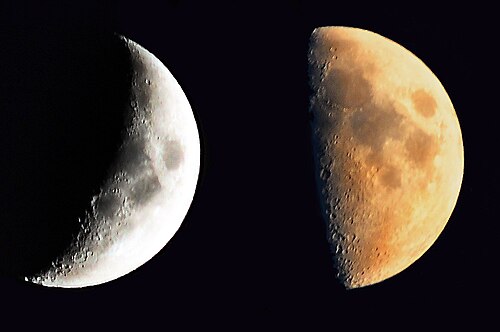
月のアルベドは例外的に低く、その反射率は摩耗したアスファルトよりもわずかに明るい。それにもかかわらず、月は太陽に次いで空で最も明るい物体である。[72] [j]これは部分的には衝の急増による明るさの増強によるもので、四分の一相の月は満月の半分の明るさではなく、わずか10分の1の明るさである。[210]さらに、視覚系の色恒常性は物体とその周囲の色との関係を再調整し、周囲の空が比較的暗いため、太陽に照らされた月は明るい物体として知覚される。満月の縁は中心と同じくらい明るく見え、縁が暗くなることはない。これは月の土壌の反射特性によるもので、土壌は他の方向よりも太陽に向かって光をより多く再帰反射する。月の色は月が反射する光に依存し、その光は月の表面と、例えば広い暗い領域があるかどうかなどの特徴に依存する。一般的に月の表面は茶色がかった灰色の光を反射します。[211]
月は時々、赤や青に見えることがあります。月食のときは、太陽の光の赤いスペクトルが地球の大気によって月に屈折するため、月は赤く見えることがあります。この赤い色のため、月食はブラッドムーンと呼ばれることもあります。月は、低い角度で厚い大気を通して現れるときにも赤く見えることがあります。
月は、大気中の特定の粒子[211] 、例えば火山粒子[212]の存在に応じて青く見えることがあり、その場合にはブルームーンと呼ばれることがあります。
「レッドムーン」や「ブルームーン」という言葉は、一年の特定の満月を指すためにも使用されるため、必ずしも赤い月明かりや青い月明かりの存在を指すわけではありません。
日食
日食は、太陽、地球、月がすべて一直線上にあるとき(「朔望月」と呼ばれる)にのみ発生します。日食は新月のとき、つまり月が太陽と地球の間にあるときに発生します。対照的に、月食は満月のとき、つまり地球が太陽と月の間にあるときに発生します。月の見かけの大きさは太陽とほぼ同じで、どちらも約 0.5 度の幅で見られます。太陽は月よりもはるかに大きいですが、はるかに遠い距離にあるため、地球から見ると、はるかに近くてはるかに小さい月と同じ見かけの大きさになります。非円形の軌道による見かけの大きさの変化もほぼ同じですが、異なる周期で発生します。これにより、皆既日食(月が太陽よりも大きく見える)と金環日食(月が太陽よりも小さく見える)の両方が可能になります。[213]皆既日食では、月が太陽の円盤を完全に覆い、太陽コロナが肉眼で見えるようになります。
月と地球の距離は時間の経過とともに非常にゆっくりと増加しているため、[185]月の角直径は減少しています。赤色巨星に向かって進化するにつれて、太陽の大きさと空での見かけの直径はゆっくりと増加しています。[k]これら2つの変化の組み合わせにより、数億年前には日食のときに月が常に太陽を完全に覆い、金環日食は起こり得ませんでした。 同様に、数億年後の将来には、月はもはや太陽を完全に覆うことはなくなり、皆既日食は発生しなくなります。[214]
月の地球を回る軌道は、地球が太陽を回る軌道に対して約5.145°(5° 9')傾いているため、月食はすべての満月や新月に発生するわけではありません。月食が発生するには、月が2つの軌道面の交点の近くにある必要があります。[215]月による太陽の食、および月の地球による食の周期と再発は、約18年の周期を持つサロスによって説明されます。[216]
月は絶えず半度幅の円形の空域を遮っているため、[l] [217]明るい恒星や惑星が月の裏側を通過して掩蔽され、視界から隠れるときに、掩蔽という関連現象が発生します。このように、日食は太陽の掩蔽です。月は地球に比較的近いため、個々の恒星の掩蔽は地球上のどこでも、また同時には見えません。月の軌道の歳差運動のため、毎年異なる恒星が掩蔽されます。[218]
探検と人類の存在の歴史
望遠鏡以前の観測(1609年以前)
最古の洞窟壁画は4万年前までのもので、雄牛や幾何学模様が描かれている[219]か、2万~3万年前の棒が月の満ち欠けを観測するために使われていたと考えられている。[220]月 を描いた最古の絵画の1つは、アイルランドのノウスにある紀元前3000年の岩絵オルソスタット47である。[221] [222]三日月を描いたナンナ/シンのような月の神は、紀元前3千年紀から見つかっている。[223]月を描いた最古の発見され特定された天文学的な絵画は、紀元前 1800~1600年頃のネブラ天文台である。[224] [225]
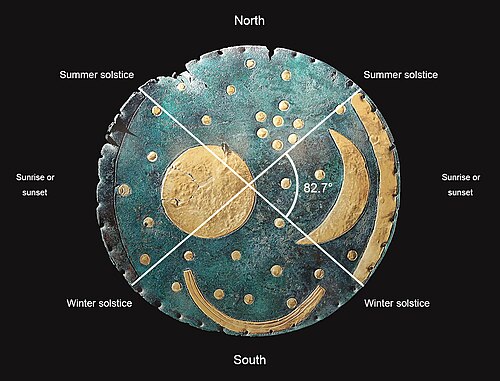
古代ギリシャの哲学者アナクサゴラス(紀元前 428年没)は、太陽と月はどちらも巨大な球状の岩石であり、後者は前者の光を反射していると推論した。[229] [230] : 227 紀元前5世紀から紀元前4世紀にかけて、バビロニアの天文学者は18年周期の月食のサロス周期を記録しており、[231] インドの天文学者は月の毎月の伸長について記述していた。[232]中国の天文学者石深(紀元前4世紀頃活躍)は日食と月食を予測するための指示を与えた。[230] : 411
アリストテレス(紀元前384-322年)の宇宙の記述では、月は可変元素(土、水、空気、火)の圏と不滅のエーテルの星々の境界を示しており、これは何世紀にもわたって支配的な影響力のある哲学となった。[233] アルキメデス(紀元前287-212年)は、月や太陽系の他の物体の動きを計算できるプラネタリウムを設計した。[234]紀元前2世紀には、セレウキアのセレウコスは、潮の満ち引きは月の引力によるものであり、その高さは太陽に対する月の相対的な位置に依存すると正しく考えていた。[235]同世紀には、 アリスタルコスは地球から月までの大きさと距離を計算し、その距離は地球の半径の約20倍という値を得た。
漢代の中国人は、月はエネルギーであり気であると信じており、「放射影響」理論では、月の光は単に太陽の反射であると認識していた。景芳(紀元前78年 - 紀元前37年)は、月の球形を指摘した。[230] : 413–414年 プトレマイオス(紀元後90年 - 168年)はアリスタルコスの数字を大幅に改良し、平均距離を地球の半径の59倍、直径を地球の直径の0.292倍と計算し、それぞれ約60と0.273という正しい値に近いものとなった。[236] 2世紀には、ルシアンが小説『真実の物語』を執筆し、その中で主人公たちが月へ旅してそこの住人に会う。510年、インドの天文学者アリヤバータは著書『アリヤバーティヤ』の中で、月の輝きは太陽光の反射によるものだと述べている。 [237] [238]天文学者で物理学者のイブン・アル=ハイサム(965–1039)は、太陽光が鏡のように月から反射されるのではなく、月の太陽に照らされた表面のあらゆる部分からあらゆる方向に光が放射されていることを発見した。[239] 宋代の神括(1031–1095)は、月の満ち欠けを反射する銀の丸い球に例え、白い粉をかけて横から見ると三日月に見えるという寓話を作った。[230] : 415–416 中世、望遠鏡が発明される前、月は球体であると認識されるようになったが、多くの人が月は「完全に滑らか」であると信じていた。[240]
望遠鏡による探検(1609年~1959年)

1609年、ガリレオ・ガリレイは、著書『星空の報告』のために、初期の望遠鏡を使って月の絵を描き、月は滑らかではなく、山やクレーターがあると推測した。トーマス・ハリオットは、その数か月前に同様の絵を描いていたが、公表していなかった。
望遠鏡による月の地図作成が続いた。17世紀後半には、ジョヴァンニ・バッティスタ・リッチョーリとフランチェスコ・マリア・グリマルディの努力により、今日使用されている月の特徴の命名システムが生まれた。ヴィルヘルム・ベーアとヨハン・ハインリヒ・フォン・メードラーによる1834年から1836年のより正確な『月地図』と、それに関連する1837年の著書『月』は、三角法で正確な月の特徴の研究としては初めてであり、1,000以上の山の高さが含まれており、地球の地理学で可能な範囲で最も正確な月の研究を紹介した。[241]ガリレオが初めて指摘した月のクレーターは、 1870年代にリチャード・プロクターが衝突によって形成されたと提唱するまで、火山性であると考えられていた。[72]この見解は、1892年に地質学者グローブ・カール・ギルバートの実験と1920年から1940年代にかけての比較研究によって支持され、[242]月の地層学の発展につながり、1950年代までには天体地質学の新しい成長分野となっていました。[72]
月への最初のミッション(1959年~1976年)
第二次世界大戦後、最初の打ち上げシステムが開発され、1950年代末までにソ連と米国が宇宙船を宇宙に打ち上げられる能力に到達しました。冷戦により、両国は密接に追いかけながら打ち上げシステムの開発を進め、いわゆる宇宙開発競争とその後の月開発競争が起こり、月探査への取り組みと関心が加速しました。
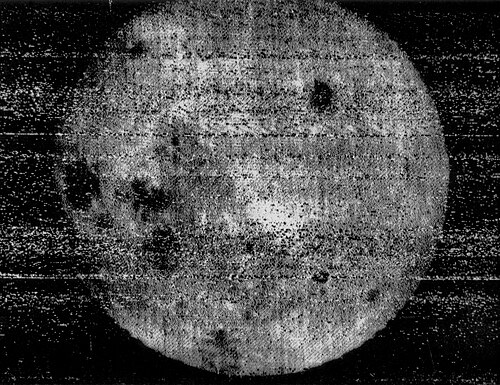
1957年の国際地球観測年におけるスプートニク1号による初の宇宙飛行の後、ソ連のルナ計画の宇宙船は、いくつかの目標を達成した最初の宇宙船となった。1958年の3回の無名の失敗したミッションの後、[243]最初の人工物であるルナ1号は、1959年に地球の重力を逃れて月の近くを通過した。その年の後半には、最初の人工物であるルナ2号が、意図的に衝突することで月の表面に到達した。その年の終わりには、ルナ3号が、通常は隠されている月の裏側に到達した最初の人工物となり、その最初の写真を撮影した。月への軟着陸に成功した最初の宇宙船はルナ9号で、月を周回した最初の宇宙船はルナ10号で、どちらも1966年のことである。 [72]
1961年にジョン・F・ケネディ大統領が60年代末までに有人月面着陸を行うと約束したことを受けて、米国はNASAのリーダーシップの下、有人ミッションに備えて月面表面の理解を深めるための一連の無人探査機を打ち上げた。ジェット推進研究所のレンジャー計画、ルナ・オービター計画、サーベイヤー計画である。有人アポロ計画は並行して開発され、アポロ宇宙船の無人および有人テストを地球周回軌道上で行った後、ソ連の有人月面着陸の可能性に後押しされ、1968年にアポロ8号が人類初の月周回ミッションを遂行した(最初の地球人である2匹のカメは3か月前にソ連のゾンド5号で月を周回し、続いてゾンド6号でカメが月を周回していた)。
The first time a person landed on the Moon and any extraterrestrial body was when Neil Armstrong, the commander of the American mission Apollo 11, set foot on the Moon at 02:56 UTC on July 21, 1969.[244] Considered the culmination of the Space Race,[245] an estimated 500 million people worldwide watched the transmission by the Apollo TV camera, the largest television audience for a live broadcast at that time.[246][247] While at the same time another mission, the robotic sample return mission Luna 15 by the Soviet Union had been in orbit around the Moon, becoming together with Apollo 11 the first ever case of two extraterrestrial missions being conducted at the same time.
The Apollo missions 11 to 17 (except Apollo 13, which aborted its planned lunar landing) removed 380.05 kilograms (837.87 lb) of lunar rock and soil in 2,196 separate samples.[248] Scientific instrument packages were installed on the lunar surface during all the Apollo landings. Long-lived instrument stations, including heat flow probes, seismometers, and magnetometers, were installed at the Apollo 12, 14, 15, 16, and 17 landing sites. Direct transmission of data to Earth concluded in late 1977 because of budgetary considerations,[249][250] but as the stations' lunar laser ranging corner-cube retroreflector arrays are passive instruments, they are still being used.[251] Apollo 17 in 1972 remains the last crewed mission to the Moon. Explorer 49 in 1973 was the last dedicated U.S. probe to the Moon until the 1990s.
The Soviet Union continued sending robotic missions to the Moon until 1976, deploying in 1970 with Luna 17 the first remote controlled rover Lunokhod 1 on an extraterrestrial surface, and collecting and returning 0.3 kg of rock and soil samples with three Luna sample return missions (Luna 16 in 1970, Luna 20 in 1972, and Luna 24 in 1976).[252]
Moon Treaty and explorational absence (1976–1990)
A near lunar quietude of fourteen years followed the last Soviet mission to the Moon of 1976. Astronautics had shifted its focus towards the exploration of the inner (e.g. Venera program) and outer (e.g. Pioneer 10, 1972) Solar System planets, but also towards Earth orbit, developing and continuously operating, beside communication satellites, Earth observation satellites (e.g. Landsat program, 1972), space telescopes and particularly space stations (e.g. Salyut program, 1971).
The until 1979 negotiated Moon treaty, with its ratification in 1984 by its few signatories was about the only major activity regarding the Moon until 1990.
Renewed exploration (1990–present)
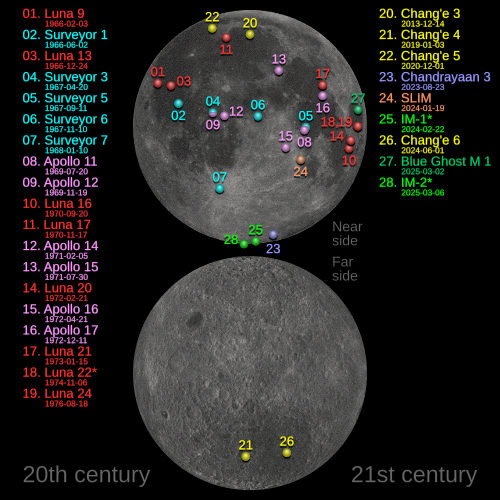
In 1990 Hiten-Hagoromo,[253] the first dedicated lunar mission since 1976, reached the Moon. Sent by Japan, it became the first mission that was not a Soviet Union or U.S. mission to the Moon.
In 1994, the U.S. dedicated a mission to fly a spacecraft (Clementine) to the Moon again for the first time since 1973. This mission obtained the first near-global topographic map of the Moon, and the first global multispectral images of the lunar surface.[254] In 1998, this was followed by the Lunar Prospector mission, whose instruments indicated the presence of excess hydrogen at the lunar poles, which is likely to have been caused by the presence of water ice in the upper few meters of the regolith within permanently shadowed craters.[255]
The next years saw a row of first missions to the Moon by a new group of states actively exploring the Moon. Between 2004 and 2006 the first spacecraft by the European Space Agency (ESA) (SMART-1) reached the Moon, recording the first detailed survey of chemical elements on the lunar surface.[256] The Chinese Lunar Exploration Program reached the Moon for the first time with the orbiter Chang'e 1 (2007–2009),[257] obtaining a full image map of the Moon. India reached, orbited and impacted the Moon in 2008 for the first time with its Chandrayaan-1 and Moon Impact Probe, becoming the fifth and sixth state to do so, creating a high-resolution chemical, mineralogical and photo-geological map of the lunar surface, and confirming the presence of water molecules in lunar soil.[258]
The U.S. launched the Lunar Reconnaissance Orbiter (LRO) and the LCROSS impactor on June 18, 2009. LCROSS completed its mission by making a planned and widely observed impact in the crater Cabeus on October 9, 2009,[259] whereas LRO is currently in operation, obtaining precise lunar altimetry and high-resolution imagery.
China continued its lunar program in 2010 with Chang'e 2, mapping the surface at a higher resolution over an eight-month period, and in 2013 with Chang'e 3, a lunar lander along with a lunar rover named Yutu (Chinese: 玉兔; lit. 'Jade Rabbit'). This was the first lunar rover mission since Lunokhod 2 in 1973 and the first lunar soft landing since Luna 24 in 1976, making China the third country to achieve this.
In 2014 the first privately funded probe, the Manfred Memorial Moon Mission, reached the Moon.
Another Chinese rover mission, Chang'e 4, achieved the first landing on the Moon's far side in early 2019.[260]
Also in 2019, India successfully sent its second probe, Chandrayaan-2 to the Moon.
In 2020, China carried out its first robotic sample return mission (Chang'e 5), bringing back 1,731 grams of lunar material to Earth.[261]
The U.S. developed plans for returning to the Moon beginning in 2004,[262] and with the signing of the U.S.-led Artemis Accords in 2020, the Artemis program aims to return the astronauts to the Moon in the 2020s.[263] The Accords have been joined by a growing number of countries. The introduction of the Artemis Accords has fueled a renewed discussion about the international framework and cooperation of lunar activity, building on the Moon Treaty and the ESA-led Moon Village concept.[264][265][266]
2023 and 2024 India and Japan became the fourth and fifth country to soft land a spacecraft on the Moon, following the Soviet Union and United States in the 1960s, and China in the 2010s.[267] Notably, Japan's spacecraft, the Smart Lander for Investigating Moon, survived 3 lunar nights.[268] The IM-1 lander became the first commercially built lander to land on the Moon in 2024.[269]
China launched the Chang'e 6 on May 3, 2024, which conducted another lunar sample return from the far side of the Moon.[270] It also carried a chinese rover to conduct infrared spectroscopy of lunar surface.[271] Pakistan sent a lunar orbiter called ICUBE-Q along with Chang'e 6.[272]
Nova-C 2, iSpace Lander and Blue Ghost are all planned to launch to the Moon in 2024.
Future

Beside the progressing Artemis program and supporting Commercial Lunar Payload Services, leading an international and commercial crewed opening up of the Moon and sending the first woman, person of color and non-US citizen to the Moon in the 2020s,[273] China is continuing its ambitious Chang'e program, having announced with Russia's struggling Luna-Glob program joint missions.[274][275] Both the Chinese and US lunar programs have the goal to establish in the 2030s a lunar base with their international partners, though the US and its partners will first establish an orbital Lunar Gateway station in the 2020s, from which Artemis missions will land the Human Landing System to set up temporary surface camps.
While the Apollo missions were explorational in nature, the Artemis program plans to establish a more permanent presence. To this end, NASA is partnering with industry leaders to establish key elements such as modern communication infrastructure. A 4G connectivity demonstration is to be launched aboard an Intuitive Machines Nova-C lander in 2024.[276] Another focus is on in situ resource utilization, which is a key part of the DARPA lunar programs. DARPA has requested that industry partners develop a 10–year lunar architecture plan to enable the beginning of a lunar economy.[277]
Human presence
Humans last landed on the Moon during the Apollo Program, a series of crewed exploration missions carried out from 1969 to 1972. Lunar orbit has seen uninterrupted presence of orbiters since 2006, performing mainly lunar observation and providing relayed communication for robotic missions on the lunar surface.
Lunar orbits and orbits around Earth–Moon Lagrange points are used to establish a near-lunar infrastructure to enable increasing human activity in cislunar space as well as on the Moon's surface. Missions at the far side of the Moon or the lunar north and south polar regions need spacecraft with special orbits, such as the Queqiao and Queqiao-2 relay satellite or the planned first extraterrestrial space station, the Lunar Gateway.[278][279]
Human impact

While the Moon has the lowest planetary protection target-categorization, its degradation as a pristine body and scientific place has been discussed.[281] If there is astronomy performed from the Moon, it will need to be free from any physical and radio pollution. While the Moon has no significant atmosphere, traffic and impacts on the Moon causes clouds of dust that can spread far and possibly contaminate the original state of the Moon and its special scientific content.[282] Scholar Alice Gorman asserts that, although the Moon is inhospitable, it is not dead, and that sustainable human activity would require treating the Moon's ecology as a co-participant.[283]
The so-called "Tardigrade affair" of the 2019 crashed Beresheet lander and its carrying of tardigrades has been discussed as an example for lacking measures and lacking international regulation for planetary protection.[284]
Space debris beyond Earth around the Moon has been considered as a future challenge with increasing numbers of missions to the Moon, particularly as a danger for such missions.[285][286] As such lunar waste management has been raised as an issue which future lunar missions, particularly on the surface, need to tackle.[287][288]
Human remains have been transported to the Moon, including by private companies such as Celestis and Elysium Space. Because the Moon has been sacred or significant to many cultures, the practice of space burials have attracted criticism from indigenous peoples leaders. For example, then–Navajo Nation president Albert Hale criticized NASA for sending the cremated ashes of scientist Eugene Shoemaker to the Moon in 1998.[289][290]
Beside the remains of human activity on the Moon, there have been some intended permanent installations like the Moon Museum art piece, Apollo 11 goodwill messages, six lunar plaques, the Fallen Astronaut memorial, and other artifacts.[280]
Longterm missions continuing to be active are some orbiters such as the 2009-launched Lunar Reconnaissance Orbiter surveilling the Moon for future missions, as well as some Landers such as the 2013-launched Chang'e 3 with its Lunar Ultraviolet Telescope still operational.[291] Five retroreflectors have been installed on the Moon since the 1970s and since used for accurate measurements of the physical librations through laser ranging to the Moon.
There are several missions by different agencies and companies planned to establish a longterm human presence on the Moon, with the Lunar Gateway as the currently most advanced project as part of the Artemis program.
Astronomy from the Moon

The Moon is recognized as an excellent site for telescopes.[292] It is relatively nearby; certain craters near the poles are permanently dark and cold and especially useful for infrared telescopes; and radio telescopes on the far side would be shielded from the radio chatter of Earth.[293] The lunar soil, although it poses a problem for any moving parts of telescopes, can be mixed with carbon nanotubes and epoxies and employed in the construction of mirrors up to 50 meters in diameter.[294] A lunar zenith telescope can be made cheaply with an ionic liquid.[295]
In April 1972, the Apollo 16 mission recorded various astronomical photos and spectra in ultraviolet with the Far Ultraviolet Camera/Spectrograph.[296]
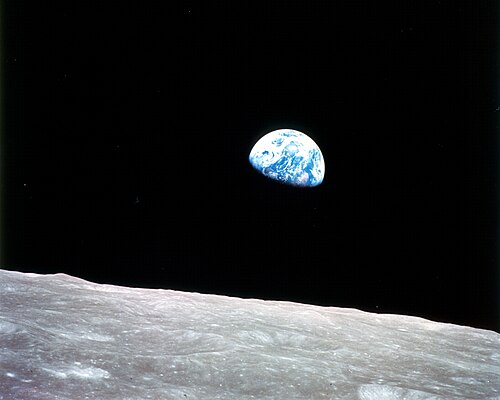
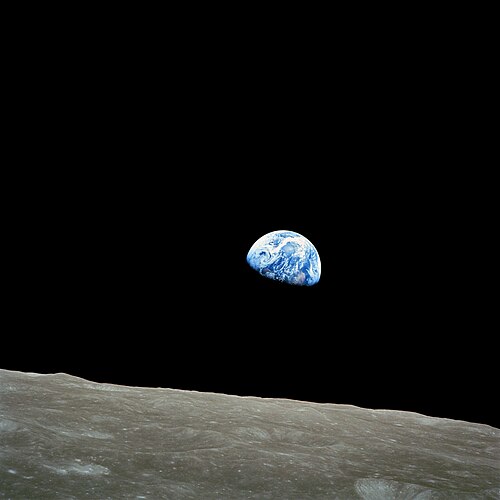
The Moon has been also a site of Earth observation, particularly culturally as in the 1968 photograph called Earthrise, taken by Bill Anders of Apollo 8. The Earth appears in the Moon's sky with an apparent size of 1° 48′ to 2°,[297] three to four times the size of the Moon or Sun in Earth's sky, or about the apparent width of two little fingers at an arm's length away.
Living on the Moon

The only instances of humans living on the Moon have taken place in an Apollo Lunar Module for several days at a time (for example, during the Apollo 17 mission).[298] One challenge to astronauts during their stay on the surface is that lunar dust sticks to their suits and is carried into their quarters. Astronauts could taste and smell the dust, which smells like gunpowder and was called the "Apollo aroma".[299] This fine lunar dust can cause health issues.[299]
In 2019, at least one plant seed sprouted in an experiment on the Chang'e 4 lander. It was carried from Earth along with other small life in its Lunar Micro Ecosystem.[300]
Legal status
Although Luna landers scattered pennants of the Soviet Union on the Moon, and U.S. flags were symbolically planted at their landing sites by the Apollo astronauts, no nation claims ownership of any part of the Moon's surface.[301] Likewise no private ownership of parts of the Moon, or as a whole, is considered credible.[302][303][304]
The 1967 Outer Space Treaty defines the Moon and all outer space as the "province of all mankind".[301] It restricts the use of the Moon to peaceful purposes, explicitly banning military installations and weapons of mass destruction.[305] A majority of countries are parties of this treaty.[306] The 1979 Moon Agreement was created to elaborate, and restrict the exploitation of the Moon's resources by any single nation, leaving it to a yet unspecified international regulatory regime.[307] As of January 2020, it has been signed and ratified by 18 nations,[308] none of which have human spaceflight capabilities.
Since 2020, countries have joined the U.S. in their Artemis Accords, which are challenging the treaty. The U.S. has furthermore emphasized in a presidential executive order ("Encouraging International Support for the Recovery and Use of Space Resources.") that "the United States does not view outer space as a 'global commons'" and calls the Moon Agreement "a failed attempt at constraining free enterprise."[309][310]
With Australia signing and ratifying both the Moon Treaty in 1986 as well as the Artemis Accords in 2020, there has been a discussion if they can be harmonized.[265] In this light an Implementation Agreement for the Moon Treaty has been advocated for, as a way to compensate for the shortcomings of the Moon Treaty and to harmonize it with other laws and agreements such as the Artemis Accords, allowing it to be more widely accepted.[264][266]
In the face of such increasing commercial and national interest, particularly prospecting territories, U.S. lawmakers have introduced in late 2020 specific regulation for the conservation of historic landing sites[311] and interest groups have argued for making such sites World Heritage Sites[312] and zones of scientific value protected zones, all of which add to the legal availability and territorialization of the Moon.[284]
In 2021, the Declaration of the Rights of the Moon[313] was created by a group of "lawyers, space archaeologists and concerned citizens", drawing on precedents in the Rights of Nature movement and the concept of legal personality for non-human entities in space.[314][315]
Coordination and regulation
Increasing human activity at the Moon has raised the need for coordination to safeguard international and commercial lunar activity. Issues from cooperation to mere coordination, through for example the development of a shared Lunar time, have been raised.
In particular the establishment of an international or United Nations regulatory regime for lunar human activity has been called for by the Moon Treaty and suggested through an Implementation Agreement,[264][266] but remains contentious. Current lunar programs are multilateral, with the US-led Artemis program and the China-led International Lunar Research Station. For broader international cooperation and coordination the International Lunar Exploration Working Group (ILEWG), the Moon Village Association (MVA) and more generally the International Space Exploration Coordination Group (ISECG) has been established.
In culture and life
Timekeeping

Since pre-historic times people have taken note of the Moon's phases and its waxing and waning cycle, and used it to keep record of time. Tally sticks, notched bones dating as far back as 20–30,000 years ago, are believed by some to mark the phases of the Moon.[220][318][319] The counting of the days between the Moon's phases gave eventually rise to generalized time periods of lunar cycles as months, and possibly of its phases as weeks.[320]
The words for the month in a range of different languages carry this relation between the period of the month and the Moon etymologically. The English month as well as moon, and its cognates in other Indo-European languages (e.g. the Latin mensis and Ancient Greek μείς (meis) or μήν (mēn), meaning "month")[321][322][323][324] stem from the Proto-Indo-European (PIE) root of moon, *méh1nōt, derived from the PIE verbal root *meh1-, "to measure", "indicat[ing] a functional conception of the Moon, i.e. marker of the month" (cf. the English words measure and menstrual).[325][326][327] To give another example from a different language family, the Chinese language uses the same word (月) for moon as well as for month, which furthermore can be found in the symbols for the word week (星期).
This lunar timekeeping gave rise to the historically dominant, but varied, lunisolar calendars. The 7th-century Islamic calendar is an example of a purely lunar calendar, where months are traditionally determined by the visual sighting of the hilal, or earliest crescent moon, over the horizon.[328]
Of particular significance has been the occasion of full moon, highlighted and celebrated in a range of calendars and cultures, an example being the Buddhist Vesak. The full moon around the southern or northern autumnal equinox is often called the harvest moon and is celebrated with festivities such as the Harvest Moon Festival of the Chinese lunar calendar, its second most important celebration after the Chinese lunisolar Lunar New Year.[329]
Furthermore, association of time with the Moon can also be found in religion, such as the ancient Egyptian temporal and lunar deity Khonsu.
Cultural representation
Recurring lunar aspects of lunar deities
Since prehistoric times humans have depicted and later described their perception of the Moon and its importance for them and their cosmologies. It has been characterized and associated in many different ways, from having a spirit or being a deity, and an aspect thereof or an aspect in astrology.
Crescent
For the representation of the Moon, especially its lunar phases, the crescent (🌙) has been a recurring symbol in a range of cultures since at least 3,000 BCE or possibly earlier with bull horns dating to the earliest cave paintings at 40,000 BP.[225][219] In writing systems such as Chinese the crescent has developed into the symbol 月, the word for Moon, and in ancient Egyptian it was the symbol 𓇹, meaning Moon and spelled like the ancient Egyptian lunar deity Iah,[331] which the other ancient Egyptian lunar deities Khonsu and Thoth were associated with.
Iconographically the crescent was used in Mesopotamia as the primary symbol of Nanna/Sîn,[223] the ancient Sumerian lunar deity,[332][223] who was the father of Inanna/Ishtar, the goddess of the planet Venus (symbolized as the eight pointed Star of Ishtar),[332][223] and Utu/Shamash, the god of the Sun (symbolized as a disc, optionally with eight rays),[332][223] all three often depicted next to each other. Nanna/Sîn is, like some other lunar deities, for example Iah and Khonsu of ancient Egypt, Mene/Selene of ancient Greece and Luna of ancient Rome, depicted as a horned deity, featuring crescent shaped headgears or crowns.[333][334]
The particular arrangement of the crescent with a star known as the star and crescent (☪️) goes back to the Bronze Age, representing either the Sun and Moon, or the Moon and the planet Venus, in combination. It came to represent the selene goddess Artemis, and via the patronage of Hecate, which as triple deity under the epithet trimorphos/trivia included aspects of Artemis/Diana, came to be used as a symbol of Byzantium, with Virgin Mary (Queen of Heaven) later taking her place, becoming depicted in Marian veneration on a crescent and adorned with stars. Since then the heraldric use of the star and crescent proliferated, Byzantium's symbolism possibly influencing the development of the Ottoman flag, specifically the combination of the Turkish crescent with a star,[335] and becoming a popular symbol for Islam (as the hilal of the Islamic calendar) and for a range of nations.[336]
Other association
The features of the Moon, the contrasting brighter highlands and darker maria, have been seen by different cultures forming abstract shapes. Such shapes are among others the Man in the Moon (e.g. Coyolxāuhqui) or the Moon Rabbit (e.g. the Chinese Tu'er Ye or in Indigenous American mythologies the aspect of the Mayan Moon goddess, from which possibly Awilix is derived, or of Metztli/Tēcciztēcatl).[330]
Occasionally some lunar deities have been also depicted driving a chariot across the sky, such as the Hindu Chandra/Soma, the Greek Artemis, which is associated with Selene, or Luna, Selene's ancient Roman equivalent.
Color and material wise the Moon has been associated in Western alchemy with silver, while gold is associated with the Sun.[337]
Through a miracle, the so-called splitting of the Moon (Arabic: انشقاق القمر) in Islam, association with the Moon applies also to Muhammad.[338]
Modern culture representation
The perception of the Moon in modern times has been informed by telescope enabled modern astronomy and later by spaceflight enabled actual human activity at the Moon, particularly the culturally impactful lunar landings. These new insights inspired cultural references, connecting romantic reflections about the Moon[340] and speculative fiction such as science-fiction dealing with the Moon.[339][341]
Contemporarily the Moon has been seen as a place for economic expansion into space, with missions prospecting for lunar resources. This has been accompanied with renewed public and critical reflection on humanity's cultural and legal relation to the celestial body, especially regarding colonialism,[284] as in the 1970 poem "Whitey on the Moon". In this light the Moon's nature has been invoked,[313] particularly for lunar conservation[286] and as a common.[342][307][315]
In 2021 20 July, the date of the first crewed Moon landing, became the annual International Moon Day.[343]
Lunar effect
The lunar effect is a purported unproven correlation between specific stages of the roughly 29.5-day lunar cycle and behavior and physiological changes in living beings on Earth, including humans. The Moon has long been associated with insanity and irrationality; the words lunacy and lunatic are derived from the Latin name for the Moon, Luna. Philosophers Aristotle and Pliny the Elder argued that the full moon induced insanity in susceptible individuals, believing that the brain, which is mostly water, must be affected by the Moon and its power over the tides, but the Moon's gravity is too slight to affect any single person.[344] Even today, people who believe in a lunar effect claim that admissions to psychiatric hospitals, traffic accidents, homicides or suicides increase during a full moon, but dozens of studies invalidate these claims.[344][345][346][347][348]
See also
- List of natural satellites
- Selenography (geography of the Moon)
- Coordinated Lunar Time
Explanatory notes
- ^ Between 18.29° and 28.58° to Earth's equator[1]
- ^ There are a number of near-Earth asteroids, including 3753 Cruithne, that are co-orbital with Earth: their orbits bring them close to Earth for periods of time but then alter in the long term (Morais et al, 2002). These are quasi-satellites – they are not moons as they do not orbit Earth. For more information, see Other moons of Earth.
- ^ The maximum value is given based on scaling of the brightness from the value of −12.74 given for an equator to Moon-centre distance of 378 000 km in the NASA factsheet reference to the minimum Earth–Moon distance given there, after the latter is corrected for Earth's equatorial radius of 6 378 km, giving 350 600 km. The minimum value (for a distant new moon) is based on a similar scaling using the maximum Earth–Moon distance of 407 000 km (given in the factsheet) and by calculating the brightness of the earthshine onto such a new moon. The brightness of the earthshine is [ Earth albedo × (Earth radius / Radius of Moon's orbit)2 ] relative to the direct solar illumination that occurs for a full moon. (Earth albedo = 0.367; Earth radius = (polar radius × equatorial radius)½ = 6 367 km.)
- ^ The range of angular size values given are based on simple scaling of the following values given in the fact sheet reference: at an Earth-equator to Moon-centre distance of 378 000 km, the angular size is 1896 arcseconds. The same fact sheet gives extreme Earth–Moon distances of 407 000 km and 357 000 km. For the maximum angular size, the minimum distance has to be corrected for Earth's equatorial radius of 6 378 km, giving 350 600 km.
- ^ Lucey et al. (2006) give 107 particles cm−3 by day and 105 particles cm−3 by night. Along with equatorial surface temperatures of 390 K by day and 100 K by night, the ideal gas law yields the pressures given in the infobox (rounded to the nearest order of magnitude): 10−7 Pa by day and 10−10 Pa by night.
- ^ With 27% the diameter and 60% the density of Earth, the Moon has 1.23% of the mass of Earth. The moon Charon is larger relative to its primary Pluto, but Earth and the Moon are different since Pluto is considered a dwarf planet and not a planet, unlike Earth.
- ^ There is no strong correlation between the sizes of planets and the sizes of their satellites. Larger planets tend to have more satellites, both large and small, than smaller planets.
- ^ More accurately, the Moon's mean sidereal period (fixed star to fixed star) is 27.321661 days (27 d 07 h 43 min 11.5 s), and its mean tropical orbital period (from equinox to equinox) is 27.321582 days (27 d 07 h 43 min 04.7 s) (Explanatory Supplement to the Astronomical Ephemeris, 1961, at p.107).
- ^ More accurately, the Moon's mean synodic period (between mean solar conjunctions) is 29.530589 days (29 d 12 h 44 min 02.9 s) (Explanatory Supplement to the Astronomical Ephemeris, 1961, at p.107).
- ^ The Sun's apparent magnitude is −26.7, while the full moon's apparent magnitude is −12.7.
- ^ See graph in Sun#Life phases. At present, the diameter of the Sun is increasing at a rate of about five percent per billion years. This is very similar to the rate at which the apparent angular diameter of the Moon is decreasing as it recedes from Earth.
- ^ On average, the Moon covers an area of 0.21078 square degrees on the night sky.
References
- ^ a b c d e f g h i j k l m Wieczorek, Mark A.; Jolliff, Bradley L.; Khan, Amir; Pritchard, Matthew E.; Weiss, Benjamin P.; Williams, James G.; Hood, Lon L.; Righter, Kevin; Neal, Clive R.; Shearer, Charles K.; McCallum, I. Stewart; Tompkins, Stephanie; Hawke, B. Ray; Peterson, Chris; Gillis, Jeffrey J.; Bussey, Ben (2006). "The constitution and structure of the lunar interior". Reviews in Mineralogy and Geochemistry. 60 (1): 221–364. Bibcode:2006RvMG...60..221W. doi:10.2138/rmg.2006.60.3. S2CID 130734866.
- ^ a b Lang, Kenneth R. (2011). The Cambridge Guide to the Solar System (2nd ed.). Cambridge University Press. ISBN 978-1139494175. Archived from the original on January 1, 2016.
- ^ Morais, M. H. M.; Morbidelli, A. (2002). "The Population of Near-Earth Asteroids in Coorbital Motion with the Earth". Icarus. 160 (1): 1–9. Bibcode:2002Icar..160....1M. doi:10.1006/icar.2002.6937. hdl:10316/4391. S2CID 55214551.
- ^ a b c d e f g h i j k Williams, David R. (February 2, 2006). "Moon Fact Sheet". NASA/National Space Science Data Center. Archived from the original on March 23, 2010. Retrieved December 31, 2008.
- ^ Smith, David E.; Zuber, Maria T.; Neumann, Gregory A.; Lemoine, Frank G. (January 1, 1997). "Topography of the Moon from the Clementine lidar". Journal of Geophysical Research. 102 (E1): 1601. Bibcode:1997JGR...102.1591S. doi:10.1029/96JE02940. hdl:2060/19980018849. ISSN 0148-0227. S2CID 17475023.
- ^ Terry, Paul (2013). Top 10 of Everything. Octopus Publishing Group Ltd. p. 226. ISBN 978-0-600-62887-3.
- ^ Williams, James G.; Newhall, XX; Dickey, Jean O. (1996). "Lunar moments, tides, orientation, and coordinate frames". Planetary and Space Science. 44 (10): 1077–1080. Bibcode:1996P&SS...44.1077W. doi:10.1016/0032-0633(95)00154-9.
- ^ a b Hamilton, Calvin J.; Hamilton, Rosanna L., The Moon, Views of the Solar System Archived February 4, 2016, at the Wayback Machine, 1995–2011.
- ^ Makemson, Maud W. (1971). "Determination of selenographic positions". The Moon. 2 (3): 293–308. Bibcode:1971Moon....2..293M. doi:10.1007/BF00561882. S2CID 119603394.
- ^ a b Archinal, Brent A.; A'Hearn, Michael F.; Bowell, Edward G.; Conrad, Albert R.; Consolmagno, Guy J.; Courtin, Régis; Fukushima, Toshio; Hestroffer, Daniel; Hilton, James L.; Krasinsky, George A.; Neumann, Gregory A.; Oberst, Jürgen; Seidelmann, P. Kenneth; Stooke, Philip J.; Tholen, David J.; Thomas, Paul C.; Williams, Iwan P. (2010). "Report of the IAU Working Group on Cartographic Coordinates and Rotational Elements: 2009" (PDF). Celestial Mechanics and Dynamical Astronomy. 109 (2): 101–135. Bibcode:2011CeMDA.109..101A. doi:10.1007/s10569-010-9320-4. S2CID 189842666. Archived from the original (PDF) on March 4, 2016. Retrieved September 24, 2018. also available "via usgs.gov" (PDF). Archived (PDF) from the original on April 27, 2019. Retrieved September 26, 2018.
- ^ Matthews, Grant (2008). "Celestial body irradiance determination from an underfilled satellite radiometer: application to albedo and thermal emission measurements of the Moon using CERES". Applied Optics. 47 (27): 4981–4993. Bibcode:2008ApOpt..47.4981M. doi:10.1364/AO.47.004981. PMID 18806861.
- ^ a b Bugby, D. C.; Farmer, J. T.; O’Connor, B. F.; Wirzburger, M. J.; C. J. Stouffer, E. D. Abel (January 2010). Two-Phase Thermal Switching System for a Small, Extended Duration Lunar Surface Science Platform. AIP Conference Proceedings. Vol. 1208. pp. 76–83. Bibcode:2010AIPC.1208...76B. doi:10.1063/1.3326291. hdl:2060/20100009810.
- ^ Vasavada, A. R.; Paige, D. A.; Wood, S. E. (1999). "Near-Surface Temperatures on Mercury and the Moon and the Stability of Polar Ice Deposits". Icarus. 141 (2): 179–193. Bibcode:1999Icar..141..179V. doi:10.1006/icar.1999.6175. S2CID 37706412.
- ^ a b c Zhang S, Wimmer-Schweingruber RF, Yu J, Wang C, Fu Q, Zou Y, et al. (2020). "First measurements of the radiation dose on the lunar surface". Science Advances. 6 (39). Bibcode:2020SciA....6.1334Z. doi:10.1126/sciadv.aaz1334. PMC 7518862. PMID 32978156.
We measured an average total absorbed dose rate in silicon of 13.2 ± 1 μGy/hour ... LND measured an average dose equivalent of 1369 μSv/day on the surface of the Moon
- ^ "Encyclopedia - the brightest bodies". IMCCE. Archived from the original on March 21, 2023. Retrieved June 1, 2023.
- ^ a b c Lucey, Paul; Korotev, Randy L.; Gillis, Jeffrey J.; Taylor, Larry A.; Lawrence, David; Campbell, Bruce A.; Elphic, Rick; Feldman, Bill; Hood, Lon L.; Hunten, Donald; Mendillo, Michael; Noble, Sarah; Papike, James J.; Reedy, Robert C.; Lawson, Stefanie; Prettyman, Tom; Gasnault, Olivier; Maurice, Sylvestre (2006). "Understanding the lunar surface and space-Moon interactions". Reviews in Mineralogy and Geochemistry. 60 (1): 83–219. Bibcode:2006RvMG...60...83L. doi:10.2138/rmg.2006.60.2.
- ^ a b Metzger, Philip; Grundy, Will; Sykes, Mark; Stern, Alan; Bell, James; Detelich, Charlene; Runyon, Kirby; Summers, Michael (2021). "Moons are planets: Scientific usefulness versus cultural teleology in the taxonomy of planetary science". Icarus. 374: 114768. arXiv:2110.15285. Bibcode:2022Icar..37414768M. doi:10.1016/j.icarus.2021.114768. S2CID 240071005.
- ^ "Is the 'full moon' merely a fallacy?". NBC News. February 28, 2004. Archived from the original on June 1, 2023. Retrieved May 30, 2023.
- ^ "Naming Astronomical Objects: Spelling of Names". International Astronomical Union. Archived from the original on December 16, 2008. Retrieved April 6, 2020.
- ^ "Gazetteer of Planetary Nomenclature: Planetary Nomenclature FAQ". USGS Astrogeology Research Program. Archived from the original on May 27, 2010. Retrieved April 6, 2020.
- ^ Orel, Vladimir (2003). A Handbook of Germanic Etymology. Brill. Archived from the original on June 17, 2020. Retrieved March 5, 2020.
- ^ López-Menchero, Fernando (May 22, 2020). "Late Proto-Indo-European Etymological Lexicon". Archived from the original on May 22, 2020. Retrieved July 30, 2022.
- ^ Barnhart, Robert K. (1995). The Barnhart Concise Dictionary of Etymology. HarperCollins. p. 487. ISBN 978-0-06-270084-1.
- ^ E.g.: Hall III, James A. (2016). Moons of the Solar System. Springer International. ISBN 978-3-319-20636-3.
- ^ "Luna". Oxford English Dictionary (Online ed.). Oxford University Press. (Subscription or participating institution membership required.)
- ^ "Cynthia". Oxford English Dictionary (Online ed.). Oxford University Press. (Subscription or participating institution membership required.)
- ^ "selenian". Merriam-Webster.com Dictionary. Merriam-Webster.
- ^ "selenian". Oxford English Dictionary (Online ed.). Oxford University Press. (Subscription or participating institution membership required.)
- ^ "selenic". Oxford English Dictionary (Online ed.). Oxford University Press. (Subscription or participating institution membership required.)
- ^ "selenic". Merriam-Webster.com Dictionary. Merriam-Webster.
- ^ "Oxford English Dictionary: lunar, a. and n." Oxford English Dictionary: Second Edition 1989. Oxford University Press. Archived from the original on August 19, 2020. Retrieved March 23, 2010.
- ^ σελήνη. Liddell, Henry George; Scott, Robert; A Greek–English Lexicon at the Perseus Project.
- ^ Pannen, Imke (2010). When the Bad Bleeds: Mantic Elements in English Renaissance Revenge Tragedy. V&R unipress GmbH. pp. 96–. ISBN 978-3-89971-640-5. Archived from the original on September 4, 2016.
- ^ "The two-faced Moon". The Planetary Society. March 14, 2022. Archived from the original on April 28, 2023. Retrieved April 28, 2023.
- ^ "Exploring the Planets: Chapter 4. The Moon". explanet.info. Archived from the original on April 28, 2023. Retrieved April 28, 2023.
- ^ Thiemens, Maxwell M.; Sprung, Peter; Fonseca, Raúl O. C.; Leitzke, Felipe P.; Münker, Carsten (July 2019). "Early Moon formation inferred from hafnium-tungsten systematics". Nature Geoscience. 12 (9): 696–700. Bibcode:2019NatGe..12..696T. doi:10.1038/s41561-019-0398-3. S2CID 198997377.
- ^ "The Moon is older than scientists thought". Universe Today. Archived from the original on August 3, 2019. Retrieved August 3, 2019.
- ^ Barboni, M.; Boehnke, P.; Keller, C.B.; Kohl, I.E.; Schoene, B.; Young, E.D.; McKeegan, K.D. (2017). "Early formation of the Moon 4.51 billion years ago". Science Advances. 3 (1): e1602365. Bibcode:2017SciA....3E2365B. doi:10.1126/sciadv.1602365. PMC 5226643. PMID 28097222.
- ^ Binder, A. B. (1974). "On the origin of the Moon by rotational fission". The Moon. 11 (2): 53–76. Bibcode:1974Moon...11...53B. doi:10.1007/BF01877794. S2CID 122622374.
- ^ a b c Stroud, Rick (2009). The Book of the Moon. Walken and Company. pp. 24–27. ISBN 978-0-8027-1734-4. Archived from the original on June 17, 2020. Retrieved November 11, 2019.
- ^ Mitler, H. E. (1975). "Formation of an iron-poor moon by partial capture, or: Yet another exotic theory of lunar origin". Icarus. 24 (2): 256–268. Bibcode:1975Icar...24..256M. doi:10.1016/0019-1035(75)90102-5.
- ^ Stevenson, D.J. (1987). "Origin of the moon–The collision hypothesis". Annual Review of Earth and Planetary Sciences. 15 (1): 271–315. Bibcode:1987AREPS..15..271S. doi:10.1146/annurev.ea.15.050187.001415. S2CID 53516498.
- ^ Taylor, G. Jeffrey (December 31, 1998). "Origin of the Earth and Moon". Planetary Science Research Discoveries. Hawai'i Institute of Geophysics and Planetology. Archived from the original on June 10, 2010. Retrieved April 7, 2010.
- ^ "Asteroids Bear Scars of Moon's Violent Formation". April 16, 2015. Archived from the original on October 8, 2016.
- ^ van Putten, Maurice H. P. M. (July 2017). "Scaling in global tidal dissipation of the Earth-Moon system". New Astronomy. 54: 115–121. arXiv:1609.07474. Bibcode:2017NewA...54..115V. doi:10.1016/j.newast.2017.01.012. S2CID 119285032.
- ^ Canup, R.; Asphaug, E. (2001). "Origin of the Moon in a giant impact near the end of Earth's formation". Nature. 412 (6848): 708–712. Bibcode:2001Natur.412..708C. doi:10.1038/35089010. PMID 11507633. S2CID 4413525.
- ^ "Earth-Asteroid Collision Formed Moon Later Than Thought". National Geographic. October 28, 2010. Archived from the original on April 18, 2009. Retrieved May 7, 2012.
- ^ Kleine, Thorsten (2008). "2008 Pellas-Ryder Award for Mathieu Touboul" (PDF). Meteoritics and Planetary Science. 43 (S7): A11–A12. Bibcode:2008M&PS...43...11K. doi:10.1111/j.1945-5100.2008.tb00709.x. S2CID 128609987. Archived from the original (PDF) on July 27, 2018. Retrieved April 8, 2020.
- ^ Touboul, M.; Kleine, T.; Bourdon, B.; Palme, H.; Wieler, R. (2007). "Late formation and prolonged differentiation of the Moon inferred from W isotopes in lunar metals". Nature. 450 (7173): 1206–1209. Bibcode:2007Natur.450.1206T. doi:10.1038/nature06428. PMID 18097403. S2CID 4416259.
- ^ "Flying Oceans of Magma Help Demystify the Moon's Creation". National Geographic. April 8, 2015. Archived from the original on April 9, 2015.
- ^ Pahlevan, Kaveh; Stevenson, David J. (2007). "Equilibration in the aftermath of the lunar-forming giant impact". Earth and Planetary Science Letters. 262 (3–4): 438–449. arXiv:1012.5323. Bibcode:2007E&PSL.262..438P. doi:10.1016/j.epsl.2007.07.055. S2CID 53064179.
- ^ Nield, Ted (2009). "Moonwalk (summary of meeting at Meteoritical Society's 72nd Annual Meeting, Nancy, France)". Geoscientist. Vol. 19. p. 8. Archived from the original on September 27, 2012.
- ^ a b Warren, P. H. (1985). "The magma ocean concept and lunar evolution". Annual Review of Earth and Planetary Sciences. 13 (1): 201–240. Bibcode:1985AREPS..13..201W. doi:10.1146/annurev.ea.13.050185.001221.
- ^ Tonks, W. Brian; Melosh, H. Jay (1993). "Magma ocean formation due to giant impacts". Journal of Geophysical Research. 98 (E3): 5319–5333. Bibcode:1993JGR....98.5319T. doi:10.1029/92JE02726.
- ^ Daniel Clery (October 11, 2013). "Impact Theory Gets Whacked". Science. 342 (6155): 183–185. Bibcode:2013Sci...342..183C. doi:10.1126/science.342.6155.183. PMID 24115419.
- ^ Akram, W.; Schönbächler, M. (September 1, 2016). "Zirconium isotope constraints on the composition of Theia and current Moon-forming theories". Earth and Planetary Science Letters. 449: 302–310. Bibcode:2016E&PSL.449..302A. doi:10.1016/j.epsl.2016.05.022. hdl:20.500.11850/117905.
- ^ Kegerreis, J.A.; et al. (October 4, 2022). "Immediate Origin of the Moon as a Post-impact Satellite". The Astrophysical Journal Letters. 937 (L40): L40. arXiv:2210.01814. Bibcode:2022ApJ...937L..40K. doi:10.3847/2041-8213/ac8d96. S2CID 249267497.
- ^ Chang, Kenneth (November 1, 2023). "A 'Big Whack' Formed the Moon and Left Traces Deep in Earth, a Study Suggests - Two enormous blobs deep inside Earth could be remnants of the birth of the moon". The New York Times. Archived from the original on November 1, 2023. Retrieved November 2, 2023.
- ^ Yuan, Qian; et al. (November 1, 2023). "Moon-forming impactor as a source of Earth's basal mantle anomalies". Nature. 623 (7985): 95–99. Bibcode:2023Natur.623...95Y. doi:10.1038/s41586-023-06589-1. PMID 37914947. S2CID 264869152. Archived from the original on November 2, 2023. Retrieved November 2, 2023.
- ^ a b "Earth-Moon Dynamics". Lunar and Planetary Institute. Archived from the original on September 7, 2015. Retrieved September 2, 2022.
- ^ Wisdom, Jack; Tian, ZhenLiang (August 2015). "Early evolution of the Earth-Moon system with a fast-spinning Earth". Icarus. 256: 138–146. Bibcode:2015Icar..256..138W. doi:10.1016/j.icarus.2015.02.025.
- ^ a b John, Tara (October 9, 2017). "NASA: The Moon Once Had an Atmosphere That Faded Away". Time. Archived from the original on May 14, 2023. Retrieved May 16, 2023.
- ^ a b c Hiesinger, H.; Head, J. W.; Wolf, U.; Jaumann, R.; Neukum, G. (2003). "Ages and stratigraphy of mare basalts in Oceanus Procellarum, Mare Numbium, Mare Cognitum, and Mare Insularum". Journal of Geophysical Research. 108 (E7): 1029. Bibcode:2003JGRE..108.5065H. doi:10.1029/2002JE001985. S2CID 9570915.
- ^ a b c Papike, J.; Ryder, G.; Shearer, C. (1998). "Lunar Samples". Reviews in Mineralogy and Geochemistry. 36: 5.1–5.234.
- ^ "Lunar Far Side Highlands". ESA Science & Technology. July 14, 2006. Archived from the original on September 2, 2022. Retrieved September 2, 2022.
- ^ Garrick-Bethell, Ian; Perera, Viranga; Nimmo, Francis; Zuber, Maria T. (2014). "The tidal-rotational shape of the Moon and evidence for polar wander" (PDF). Nature. 512 (7513): 181–184. Bibcode:2014Natur.512..181G. doi:10.1038/nature13639. PMID 25079322. S2CID 4452886. Archived (PDF) from the original on August 4, 2020. Retrieved April 12, 2020.
- ^ "Space Topics: Pluto and Charon". The Planetary Society. Archived from the original on February 18, 2012. Retrieved April 6, 2010.
- ^ Horner, Jonti (July 18, 2019). "How big is the Moon?". Archived from the original on November 7, 2020. Retrieved November 15, 2020.
- ^ Dyches, Preston (July 28, 2021). "Five Things to Know about the Moon – NASA Solar System Exploration". NASA Solar System Exploration. Archived from the original on July 18, 2023. Retrieved September 24, 2023.
- ^ Parks, Jake (September 7, 2023). "Everything you need to know about the Moon". Astronomy Magazine. Retrieved September 9, 2024.
- ^ "Global Island Explorer". rmgsc.cr.usgs.gov. Retrieved September 9, 2024.
- ^ a b c d e f g h Spudis, P. D. (2004). "Moon". World Book Online Reference Center, NASA. Archived from the original on July 3, 2013. Retrieved April 12, 2007.
- ^ Runcorn, Stanley Keith (March 31, 1977). "Interpretation of lunar potential fields". Philosophical Transactions of the Royal Society of London. Series A, Mathematical and Physical Sciences. 285 (1327): 507–516. Bibcode:1977RSPTA.285..507R. doi:10.1098/rsta.1977.0094. S2CID 124703189.
- ^ Brown, D.; Anderson, J. (January 6, 2011). "NASA Research Team Reveals Moon Has Earth-Like Core". NASA. Archived from the original on January 11, 2012.
- ^ Weber, R.C.; Lin, P.-Y.; Garnero, E.J.; Williams, Q.; Lognonne, P. (January 21, 2011). "Seismic Detection of the Lunar Core" (PDF). Science. 331 (6015): 309–312. Bibcode:2011Sci...331..309W. doi:10.1126/science.1199375. PMID 21212323. S2CID 206530647. Archived from the original (PDF) on October 15, 2015. Retrieved April 10, 2017.
- ^ Nemchin, A.; Timms, N.; Pidgeon, R.; Geisler, T.; Reddy, S.; Meyer, C. (2009). "Timing of crystallization of the lunar magma ocean constrained by the oldest zircon". Nature Geoscience. 2 (2): 133–136. Bibcode:2009NatGe...2..133N. doi:10.1038/ngeo417. hdl:20.500.11937/44375.
- ^ a b Shearer, Charles K.; Hess, Paul C.; Wieczorek, Mark A.; Pritchard, Matt E.; Parmentier, E. Mark; Borg, Lars E.; Longhi, John; Elkins-Tanton, Linda T.; Neal, Clive R.; Antonenko, Irene; Canup, Robin M.; Halliday, Alex N.; Grove, Tim L.; Hager, Bradford H.; Lee, D.-C.; Wiechert, Uwe (2006). "Thermal and magmatic evolution of the Moon". Reviews in Mineralogy and Geochemistry. 60 (1): 365–518. Bibcode:2006RvMG...60..365S. doi:10.2138/rmg.2006.60.4. S2CID 129184748.
- ^ Schubert, J. (2004). "Interior composition, structure, and dynamics of the Galilean satellites.". In F. Bagenal; et al. (eds.). Jupiter: The Planet, Satellites, and Magnetosphere. Cambridge University Press. pp. 281–306. ISBN 978-0-521-81808-7.
- ^ Williams, J.G.; Turyshev, S.G.; Boggs, D.H.; Ratcliff, J.T. (2006). "Lunar laser ranging science: Gravitational physics and lunar interior and geodesy". Advances in Space Research. 37 (1): 67–71. arXiv:gr-qc/0412049. Bibcode:2006AdSpR..37...67W. doi:10.1016/j.asr.2005.05.013. S2CID 14801321.
- ^ Evans, Alexander J.; Tikoo, Sonia M.; Jeffrey C., Andrews-Hanna (January 2018). "The Case Against an Early Lunar Dynamo Powered by Core Convection". Geophysical Research Letters. 45 (1): 98–107. Bibcode:2018GeoRL..45...98E. doi:10.1002/2017GL075441.
- ^ Kluger, Jeffrey (October 12, 2018). "How Neil Armstrong's Moon Spacesuit Was Preserved for Centuries to Come". Time. Archived from the original on December 3, 2023. Retrieved November 29, 2023.
- ^ "How Do You Pick Up Something on the Moon?". WIRED. December 9, 2013. Archived from the original on December 3, 2023. Retrieved November 29, 2023.
- ^ Muller, P.; Sjogren, W. (1968). "Mascons: lunar mass concentrations". Science. 161 (3842): 680–684. Bibcode:1968Sci...161..680M. doi:10.1126/science.161.3842.680. PMID 17801458. S2CID 40110502.
- ^ Richard A. Kerr (April 12, 2013). "The Mystery of Our Moon's Gravitational Bumps Solved?". Science. 340 (6129): 138–139. doi:10.1126/science.340.6129.138-a. PMID 23580504.
- ^ Konopliv, A.; Asmar, S.; Carranza, E.; Sjogren, W.; Yuan, D. (2001). "Recent gravity models as a result of the Lunar Prospector mission" (PDF). Icarus. 50 (1): 1–18. Bibcode:2001Icar..150....1K. CiteSeerX 10.1.1.18.1930. doi:10.1006/icar.2000.6573. Archived from the original (PDF) on November 13, 2004.
- ^ a b c Mighani, S.; Wang, H.; Shuster, D.L.; Borlina, C.S.; Nichols, C.I.O.; Weiss, B.P. (2020). "The end of the lunar dynamo". Science Advances. 6 (1): eaax0883. Bibcode:2020SciA....6..883M. doi:10.1126/sciadv.aax0883. PMC 6938704. PMID 31911941.
- ^ Garrick-Bethell, Ian; Weiss, iBenjamin P.; Shuster, David L.; Buz, Jennifer (2009). "Early Lunar Magnetism". Science. 323 (5912): 356–359. Bibcode:2009Sci...323..356G. doi:10.1126/science.1166804. PMID 19150839. S2CID 23227936.
- ^ "Magnetometer / Electron Reflectometer Results". Lunar Prospector (NASA). 2001. Archived from the original on May 27, 2010. Retrieved March 17, 2010.
- ^ Hood, L.L.; Huang, Z. (1991). "Formation of magnetic anomalies antipodal to lunar impact basins: Two-dimensional model calculations". Journal of Geophysical Research. 96 (B6): 9837–9846. Bibcode:1991JGR....96.9837H. doi:10.1029/91JB00308.
- ^ "Lunar horizon glow from Surveyor 7". The Planetary Society. May 6, 2016. Archived from the original on August 8, 2022. Retrieved August 8, 2022.
- ^ "NASA Mission To Study Mysterious Lunar Twilight Rays". Science Mission Directorate. September 3, 2013. Archived from the original on July 3, 2022. Retrieved August 8, 2022.
- ^ Colwell, Joshua E.; Robertson, Scott R.; Horányi, Mihály; Wang, Xu; Poppe, Andrew; Wheeler, Patrick (January 1, 2009). "Lunar Dust Levitation". Journal of Aerospace Engineering. 22 (1): 2–9. doi:10.1061/(ASCE)0893-1321(2009)22:1(2). Archived from the original on August 8, 2022. Retrieved August 8, 2022.
- ^ Deborah Byrd (April 24, 2014). "The zodiacal light, seen from the moon". EarthSky. Archived from the original on August 8, 2022. Retrieved August 8, 2022.
- ^ Globus, Ruth (1977). "Chapter 5, Appendix J: Impact Upon Lunar Atmosphere". In Richard D. Johnson & Charles Holbrow (ed.). Space Settlements: A Design Study. NASA. Archived from the original on May 31, 2010. Retrieved March 17, 2010.
- ^ Crotts, Arlin P.S. (2008). "Lunar Outgassing, Transient Phenomena and The Return to The Moon, I: Existing Data" (PDF). The Astrophysical Journal. 687 (1): 692–705. arXiv:0706.3949. Bibcode:2008ApJ...687..692C. doi:10.1086/591634. S2CID 16821394. Archived from the original (PDF) on February 20, 2009. Retrieved September 29, 2009.
- ^ Steigerwald, William (August 17, 2015). "NASA's LADEE Spacecraft Finds Neon in Lunar Atmosphere". NASA. Archived from the original on August 19, 2015. Retrieved August 18, 2015.
- ^ a b c Stern, S.A. (1999). "The Lunar atmosphere: History, status, current problems, and context". Reviews of Geophysics. 37 (4): 453–491. Bibcode:1999RvGeo..37..453S. CiteSeerX 10.1.1.21.9994. doi:10.1029/1999RG900005. S2CID 10406165.
- ^ Lawson, S.; Feldman, W.; Lawrence, D.; Moore, K.; Elphic, R.; Belian, R. (2005). "Recent outgassing from the lunar surface: the Lunar Prospector alpha particle spectrometer". Journal of Geophysical Research. 110 (E9): 1029. Bibcode:2005JGRE..110.9009L. doi:10.1029/2005JE002433.
- ^ R. Sridharan; S.M. Ahmed; Tirtha Pratim Dasa; P. Sreelathaa; P. Pradeepkumara; Neha Naika; Gogulapati Supriya (2010). "'Direct' evidence for water (H2O) in the sunlit lunar ambience from CHACE on MIP of Chandrayaan I". Planetary and Space Science. 58 (6): 947–950. Bibcode:2010P&SS...58..947S. doi:10.1016/j.pss.2010.02.013.
- ^ Drake, Nadia (June 17, 2015). "Lopsided Cloud of Dust Discovered Around the Moon". National Geographic News. Archived from the original on June 19, 2015. Retrieved June 20, 2015.
- ^ Horányi, M.; Szalay, J.R.; Kempf, S.; Schmidt, J.; Grün, E.; Srama, R.; Sternovsky, Z. (June 18, 2015). "A permanent, asymmetric dust cloud around the Moon". Nature. 522 (7556): 324–326. Bibcode:2015Natur.522..324H. doi:10.1038/nature14479. PMID 26085272. S2CID 4453018.
- ^ James, John; Kahn-Mayberry, Noreen (January 2009). "Risk of Adverse Health Effects from Lunar Dust Exposure" (PDF). Archived (PDF) from the original on December 4, 2021. Retrieved December 8, 2022.
- ^ "Radioactive Moon". Science Mission Directorate. September 8, 2005. Archived from the original on November 2, 2019. Retrieved July 28, 2022.
- ^ "We Finally Know How Much Radiation There Is on The Moon, And It's Not Great News". ScienceAlert. September 26, 2020. Archived from the original on July 28, 2022. Retrieved July 28, 2022.
- ^ Paris, Antonio; Davies, Evan; Tognetti, Laurence; Zahniser, Carly (April 27, 2020). "Prospective Lava Tubes at Hellas Planitia". arXiv:2004.13156v1 [astro-ph.EP].
- ^ Wall, Mike (December 9, 2013). "Radiation on Mars 'Manageable' for Manned Mission, Curiosity Rover Reveals". Space.com. Archived from the original on December 15, 2020. Retrieved August 7, 2022.
- ^ Rambaux, N.; Williams, J. G. (2011). "The Moon's physical librations and determination of their free modes". Celestial Mechanics and Dynamical Astronomy. 109 (1): 85–100. Bibcode:2011CeMDA.109...85R. doi:10.1007/s10569-010-9314-2. S2CID 45209988. Archived from the original on July 30, 2022. Retrieved July 30, 2022.
- ^ Rocheleau, Jake (May 21, 2012). "Temperature on the Moon – Surface Temperature of the Moon". PlanetFacts.org. Archived from the original on May 27, 2015.
- ^ a b Amos, Jonathan (December 16, 2009). "'Coldest place' found on the Moon". BBC News. Archived from the original on August 11, 2017. Retrieved March 20, 2010.
- ^ a b Martel, L. M. V. (June 4, 2003). "The Moon's Dark, Icy Poles". Planetary Science Research Discoveries: 73. Bibcode:2003psrd.reptE..73M. Archived from the original on March 1, 2012. Retrieved April 12, 2007.
- ^ "Diviner News". UCLA. September 17, 2009. Archived from the original on March 7, 2010. Retrieved March 17, 2010.
- ^ "The Smell of Moondust". NASA. January 30, 2006. Archived from the original on March 8, 2010. Retrieved March 15, 2010.
- ^ Heiken, G. (1991). Vaniman, D.; French, B. (eds.). Lunar Sourcebook, a user's guide to the Moon. New York: Cambridge University Press. p. 286. ISBN 978-0-521-33444-0. Archived from the original on June 17, 2020. Retrieved December 17, 2019.
- ^ Rasmussen, K.L.; Warren, P.H. (1985). "Megaregolith thickness, heat flow, and the bulk composition of the Moon". Nature. 313 (5998): 121–124. Bibcode:1985Natur.313..121R. doi:10.1038/313121a0. S2CID 4245137.
- ^ Schuerger, Andrew C.; Moores, John E.; Smith, David J.; Reitz, Günther (June 2019). "A Lunar Microbial Survival Model for Predicting the Forward Contamination of the Moon". Astrobiology. 19 (6): 730–756. Bibcode:2019AsBio..19..730S. doi:10.1089/ast.2018.1952. PMID 30810338. S2CID 73491587.
- ^ Spudis, Paul D.; Cook, A.; Robinson, M.; Bussey, B.; Fessler, B. (January 1998). "Topography of the South Polar Region from Clementine Stereo Imaging". Workshop on New Views of the Moon: Integrated Remotely Sensed, Geophysical, and Sample Datasets: 69. Bibcode:1998nvmi.conf...69S.
- ^ a b c Spudis, Paul D.; Reisse, Robert A.; Gillis, Jeffrey J. (1994). "Ancient Multiring Basins on the Moon Revealed by Clementine Laser Altimetry". Science. 266 (5192): 1848–1851. Bibcode:1994Sci...266.1848S. doi:10.1126/science.266.5192.1848. PMID 17737079. S2CID 41861312.
- ^ Pieters, C. M.; Tompkins, S.; Head, J. W.; Hess, P. C. (1997). "Mineralogy of the Mafic Anomaly in the South Pole-Aitken Basin: Implications for excavation of the lunar mantle". Geophysical Research Letters. 24 (15): 1903–1906. Bibcode:1997GeoRL..24.1903P. doi:10.1029/97GL01718. hdl:2060/19980018038. S2CID 128767066.
- ^ Taylor, G. J. (July 17, 1998). "The Biggest Hole in the Solar System". Planetary Science Research Discoveries: 20. Bibcode:1998psrd.reptE..20T. Archived from the original on August 20, 2007. Retrieved April 12, 2007.
- ^ Schultz, P.H. (March 1997). "Forming the south-pole Aitken basin – The extreme games". Conference Paper, 28th Annual Lunar and Planetary Science Conference. 28: 1259. Bibcode:1997LPI....28.1259S.
- ^ "NASA's LRO Reveals 'Incredible Shrinking Moon'". NASA. August 19, 2010. Archived from the original on August 21, 2010.
- ^ Watters, Thomas R.; Weber, Renee C.; Collins, Geoffrey C.; Howley, Ian J.; Schmerr, Nicholas C.; Johnson, Catherine L. (June 2019). "Shallow seismic activity and young thrust faults on the Moon". Nature Geoscience. 12 (6) (published May 13, 2019): 411–417. Bibcode:2019NatGe..12..411W. doi:10.1038/s41561-019-0362-2. ISSN 1752-0894. S2CID 182137223.
- ^ "Cave on the Moon: What this discovery means for space exploration". The Indian Express. July 18, 2024. Retrieved July 19, 2024.
- ^ Wlasuk, Peter (2000). Observing the Moon. Springer. p. 19. ISBN 978-1-85233-193-1.
- ^ Norman, M. (April 21, 2004). "The Oldest Moon Rocks". Planetary Science Research Discoveries. Hawai'i Institute of Geophysics and Planetology. Archived from the original on April 18, 2007. Retrieved April 12, 2007.
- ^ Friedman, R.C.; Blewett, D. T.; Taylor, G.J.; Lucey, P. G. (1996). "FeO and TiO2 Variations in Mare Imbrium". Lunar and Planetary Science. 27: 383. Bibcode:1996LPI....27..383F.
- ^ Izquierdo, Kristel; Sori, M. M.; Checketts, B.; Hampton, I.; Johnson, B.C.; Soderblom, J.M. (2024). "Global Distribution and Volume of Cryptomare and Visible Mare on the Moon From Gravity and Dark Halo Craters". AGU. 129 (2). Bibcode:2024JGRE..12907867I. doi:10.1029/2023JE007867.
- ^ Spudis, Paul (2016). "Mapping Melts on the Moon". Smithsonian Air and Space Magazine.
- ^ Wilson, Lionel; Head, James W. (2003). "Lunar Gruithuisen and Mairan domes: Rheology and mode of emplacement". Journal of Geophysical Research. 108 (E2): 5012. Bibcode:2003JGRE..108.5012W. CiteSeerX 10.1.1.654.9619. doi:10.1029/2002JE001909. S2CID 14917901. Archived from the original on March 12, 2007. Retrieved April 12, 2007.
- ^ Gillis, J. J.; Spudis, P. D. (1996). "The Composition and Geologic Setting of Lunar Far Side Maria". Lunar and Planetary Science. 27: 413. Bibcode:1996LPI....27..413G.
- ^ Lawrence, D. J.; Feldman, W. C.; Barraclough, B. L.; Binder, A. B.; Elphic, R. C.; Maurice, S.; Thomsen, D. R. (August 11, 1998). "Global Elemental Maps of the Moon: The Lunar Prospector Gamma-Ray Spectrometer". Science. 281 (5382): 1484–1489. Bibcode:1998Sci...281.1484L. doi:10.1126/science.281.5382.1484. PMID 9727970.
- ^ Taylor, G. J. (August 31, 2000). "A New Moon for the Twenty-First Century". Planetary Science Research Discoveries: 41. Bibcode:2000psrd.reptE..41T. Archived from the original on March 1, 2012. Retrieved April 12, 2007.
- ^ a b Phil Berardelli (November 9, 2006). "Long Live the Moon!". Science. Archived from the original on October 18, 2014. Retrieved October 14, 2014.
- ^ Jason Major (October 14, 2014). "Volcanoes Erupted 'Recently' on the Moon". Discovery News. Archived from the original on October 16, 2014.
- ^ "NASA Mission Finds Widespread Evidence of Young Lunar Volcanism". NASA. October 12, 2014. Archived from the original on January 3, 2015.
- ^ Eric Hand (October 12, 2014). "Recent volcanic eruptions on the moon". Science. Archived from the original on October 14, 2014.
- ^ Braden, S.E.; Stopar, J.D.; Robinson, M.S.; Lawrence, S.J.; van der Bogert, C.H.; Hiesinger, H. (2014). "Evidence for basaltic volcanism on the Moon within the past 100 million years". Nature Geoscience. 7 (11): 787–791. Bibcode:2014NatGe...7..787B. doi:10.1038/ngeo2252.
- ^ Srivastava, N.; Gupta, R.P. (2013). "Young viscous flows in the Lowell crater of Orientale basin, Moon: Impact melts or volcanic eruptions?". Planetary and Space Science. 87: 37–45. Bibcode:2013P&SS...87...37S. doi:10.1016/j.pss.2013.09.001.
- ^ Gupta, R.P.; Srivastava, N.; Tiwari, R.K. (2014). "Evidences of relatively new volcanic flows on the Moon". Current Science. 107 (3): 454–460. JSTOR 24103498.
- ^ Whitten, Jennifer; Head, James W.; Staid, Matthew; Pieters, Carle M.; Mustard, John; Clark, Roger; Nettles, Jeff; Klima, Rachel L.; Taylor, Larry (2011). "Lunar mare deposits associated with the Orientale impact basin: New insights into mineralogy, history, mode of emplacement, and relation to Orientale Basin evolution from Moon Mineralogy Mapper (M3) data from Chandrayaan-1". Journal of Geophysical Research. 116: E00G09. Bibcode:2011JGRE..116.0G09W. doi:10.1029/2010JE003736. S2CID 7234547.
- ^ Cho, Y.; et al. (2012). "Young mare volcanism in the Orientale region contemporary with the Procellarum KREEP Terrane (PKT) volcanism peak period 2 b.y. ago". Geophysical Research Letters. 39 (11): L11203. Bibcode:2012GeoRL..3911203C. doi:10.1029/2012GL051838. S2CID 134074700.
- ^ Munsell, K. (December 4, 2006). "Majestic Mountains". Solar System Exploration. NASA. Archived from the original on September 17, 2008. Retrieved April 12, 2007.
- ^ Richard Lovett (2011). "Early Earth may have had two moons : Nature News". Nature. doi:10.1038/news.2011.456. Archived from the original on November 3, 2012. Retrieved November 1, 2012.
- ^ "Was our two-faced moon in a small collision?". Theconversation.edu.au. Archived from the original on January 30, 2013. Retrieved November 1, 2012.
- ^ Quillen, Alice C.; Martini, Larkin; Nakajima, Miki (September 2019). "Near/far side asymmetry in the tidally heated Moon". Icarus. 329: 182–196. arXiv:1810.10676. Bibcode:2019Icar..329..182Q. doi:10.1016/j.icarus.2019.04.010. PMC 7489467. PMID 32934397.
- ^ Melosh, H. J. (1989). Impact cratering: A geologic process. Oxford University Press. ISBN 978-0-19-504284-9.
- ^ "Moon Facts". SMART-1. European Space Agency. 2010. Archived from the original on March 17, 2012. Retrieved May 12, 2010.
- ^ Impact Cratering Notes (LPI)
- ^ Herrick, R.R.; Forsberg-Taylor, N. K. (2003). "The shape and appearance of craters formed by oblique impact on the Moon and Venus". Meteoritics & Planetary Science. 38 (11): 1551–1578. Bibcode:2003M&PS...38.1551H. doi:10.1111/j.1945-5100.2003.tb00001.x.
- ^ a b Wilhelms, Don (1987). "Relative Ages" (PDF). Geologic History of the Moon. U.S. Geological Survey. Archived from the original (PDF) on June 11, 2010. Retrieved April 4, 2010.
- ^ Xiao, Z.; Strom, R.G. (2012). "Problems determining relative and absolute ages using the small crater population" (PDF). Icarus. 220 (1): 254–267. Bibcode:2012Icar..220..254X. doi:10.1016/j.icarus.2012.05.012.
- ^ Hartmann, William K.; Quantin, Cathy; Mangold, Nicolas (2007). "Possible long-term decline in impact rates: 2. Lunar impact-melt data regarding impact history". Icarus. 186 (1): 11–23. Bibcode:2007Icar..186...11H. doi:10.1016/j.icarus.2006.09.009.
- ^ Boyle, Rebecca. "The moon has hundreds more craters than we thought". Archived from the original on October 13, 2016.
- ^ Speyerer, Emerson J.; Povilaitis, Reinhold Z.; Robinson, Mark S.; Thomas, Peter C.; Wagner, Robert V. (October 13, 2016). "Quantifying crater production and regolith overturn on the Moon with temporal imaging". Nature. 538 (7624): 215–218. Bibcode:2016Natur.538..215S. doi:10.1038/nature19829. PMID 27734864. S2CID 4443574.
- ^ "Earth's Moon Hit by Surprising Number of Meteoroids". NASA. October 13, 2016. Archived from the original on July 2, 2022. Retrieved May 21, 2021.
- ^ Chrbolková, Kateřina; Kohout, Tomáš; Ďurech, Josef (November 2019). "Reflectance spectra of seven lunar swirls examined by statistical methods: A space weathering study". Icarus. 333: 516–527. Bibcode:2019Icar..333..516C. doi:10.1016/j.icarus.2019.05.024.
- ^ Margot, J. L.; Campbell, D. B.; Jurgens, R. F.; Slade, M. A. (June 4, 1999). "Topography of the Lunar Poles from Radar Interferometry: A Survey of Cold Trap Locations" (PDF). Science. 284 (5420): 1658–1660. Bibcode:1999Sci...284.1658M. CiteSeerX 10.1.1.485.312. doi:10.1126/science.284.5420.1658. PMID 10356393. Archived (PDF) from the original on August 11, 2017. Retrieved October 25, 2017.
- ^ Ward, William R. (August 1, 1975). "Past Orientation of the Lunar Spin Axis". Science. 189 (4200): 377–379. Bibcode:1975Sci...189..377W. doi:10.1126/science.189.4200.377. PMID 17840827. S2CID 21185695.
- ^ Seedhouse, Erik (2009). Lunar Outpost: The Challenges of Establishing a Human Settlement on the Moon. Springer-Praxis Books in Space Exploration. Germany: Springer Praxis. p. 136. ISBN 978-0-387-09746-6. Archived from the original on November 26, 2020. Retrieved August 22, 2020.
- ^ Coulter, Dauna (March 18, 2010). "The Multiplying Mystery of Moonwater". NASA. Archived from the original on December 13, 2012. Retrieved March 28, 2010.
- ^ Spudis, P. (November 6, 2006). "Ice on the Moon". The Space Review. Archived from the original on February 22, 2007. Retrieved April 12, 2007.
- ^ Feldman, W. C.; Maurice, S.; Binder, A. B.; Barraclough, B. L.; R.C. Elphic; D.J. Lawrence (1998). "Fluxes of Fast and Epithermal Neutrons from Lunar Prospector: Evidence for Water Ice at the Lunar Poles". Science. 281 (5382): 1496–1500. Bibcode:1998Sci...281.1496F. doi:10.1126/science.281.5382.1496. PMID 9727973. S2CID 9005608.
- ^ Saal, Alberto E.; Hauri, Erik H.; Cascio, Mauro L.; van Orman, James A.; Rutherford, Malcolm C.; Cooper, Reid F. (2008). "Volatile content of lunar volcanic glasses and the presence of water in the Moon's interior". Nature. 454 (7201): 192–195. Bibcode:2008Natur.454..192S. doi:10.1038/nature07047. PMID 18615079. S2CID 4394004.
- ^ Pieters, C. M.; Goswami, J. N.; Clark, R. N.; Annadurai, M.; Boardman, J.; Buratti, B.; Combe, J.-P.; Dyar, M. D.; Green, R.; Head, J. W.; Hibbitts, C.; Hicks, M.; Isaacson, P.; Klima, R.; Kramer, G.; Kumar, S.; Livo, E.; Lundeen, S.; Malaret, E.; McCord, T.; Mustard, J.; Nettles, J.; Petro, N.; Runyon, C.; Staid, M.; Sunshine, J.; Taylor, L.A.; Tompkins, S.; Varanasi, P. (2009). "Character and Spatial Distribution of OH/H2O on the Surface of the Moon Seen by M3 on Chandrayaan-1". Science. 326 (5952): 568–572. Bibcode:2009Sci...326..568P. doi:10.1126/science.1178658. PMID 19779151. S2CID 447133.
- ^ Li, Shuai; Lucey, Paul G.; Milliken, Ralph E.; Hayne, Paul O.; Fisher, Elizabeth; Williams, Jean-Pierre; Hurley, Dana M.; Elphic, Richard C. (August 2018). "Direct evidence of surface exposed water ice in the lunar polar regions". Proceedings of the National Academy of Sciences. 115 (36): 8907–8912. Bibcode:2018PNAS..115.8907L. doi:10.1073/pnas.1802345115. PMC 6130389. PMID 30126996.
- ^ Lakdawalla, Emily (November 13, 2009). "LCROSS Lunar Impactor Mission: "Yes, We Found Water!"". The Planetary Society. Archived from the original on January 22, 2010. Retrieved April 13, 2010.
- ^ Colaprete, A.; Ennico, K.; Wooden, D.; Shirley, M.; Heldmann, J.; Marshall, W.; Sollitt, L.; Asphaug, E.; Korycansky, D.; Schultz, P.; Hermalyn, B.; Galal, K.; Bart, G.D.; Goldstein, D.; Summy, D. (March 1–5, 2010). "Water and More: An Overview of LCROSS Impact Results". 41st Lunar and Planetary Science Conference. 41 (1533): 2335. Bibcode:2010LPI....41.2335C.
- ^ Colaprete, Anthony; Schultz, Peter; Heldmann, Jennifer; Wooden, Diane; Shirley, Mark; Ennico, Kimberly; Hermalyn, Brendan; Marshall, William; Ricco, Antonio; Elphic, Richard C.; Goldstein, David; Summy, Dustin; Bart, Gwendolyn D.; Asphaug, Erik; Korycansky, Don; Landis, David; Sollitt, Luke (October 22, 2010). "Detection of Water in the LCROSS Ejecta Plume". Science. 330 (6003): 463–468. Bibcode:2010Sci...330..463C. doi:10.1126/science.1186986. PMID 20966242. S2CID 206525375.
- ^ Hauri, Erik; Thomas Weinreich; Albert E. Saal; Malcolm C. Rutherford; James A. Van Orman (May 26, 2011). "High Pre-Eruptive Water Contents Preserved in Lunar Melt Inclusions". Science Express. 10 (1126): 213–215. Bibcode:2011Sci...333..213H. doi:10.1126/science.1204626. PMID 21617039. S2CID 44437587.
- ^ a b Rincon, Paul (August 21, 2018). "Water ice 'detected on Moon's surface'". BBC News. Archived from the original on August 21, 2018. Retrieved August 21, 2018.
- ^ David, Leonard. "Beyond the Shadow of a Doubt, Water Ice Exists on the Moon". Scientific American. Archived from the original on August 21, 2018. Retrieved August 21, 2018.
- ^ a b "Water Ice Confirmed on the Surface of the Moon for the 1st Time!". Space.com. Archived from the original on August 21, 2018. Retrieved August 21, 2018.
- ^ Honniball, C.I.; et al. (October 26, 2020). "Molecular water detected on the sunlit Moon by SOFIA". Nature Astronomy. 5 (2): 121–127. Bibcode:2021NatAs...5..121H. doi:10.1038/s41550-020-01222-x. S2CID 228954129. Archived from the original on October 27, 2020. Retrieved October 26, 2020.
- ^ Hayne, P.O.; et al. (October 26, 2020). "Micro cold traps on the Moon". Nature Astronomy. 5 (2): 169–175. arXiv:2005.05369. Bibcode:2021NatAs...5..169H. doi:10.1038/s41550-020-1198-9. S2CID 218595642. Archived from the original on October 27, 2020. Retrieved October 26, 2020.
- ^ Guarino, Ben; Achenbach, Joel (October 26, 2020). "Pair of studies confirm there is water on the moon – New research confirms what scientists had theorized for years — the moon is wet". The Washington Post. Archived from the original on October 26, 2020. Retrieved October 26, 2020.
- ^ Chang, Kenneth (October 26, 2020). "There's Water and Ice on the Moon, and in More Places Than NASA Once Thought – Future astronauts seeking water on the moon may not need to go into the most treacherous craters in its polar regions to find it". The New York Times. Archived from the original on October 26, 2020. Retrieved October 26, 2020.
- ^ The Aerospace Corporation (July 20, 2023). "It's International Moon Day! Let's talk about Cislunar Space". Medium. Archived from the original on November 8, 2023. Retrieved November 7, 2023.
- ^ Matt Williams (July 10, 2017). "How Long is a Day on the Moon?". Universe Today. Archived from the original on November 29, 2020. Retrieved December 5, 2020.
- ^ a b Stern, David (March 30, 2014). "Libration of the Moon". NASA. Archived from the original on May 22, 2020. Retrieved February 11, 2020.
- ^ Haigh, I. D.; Eliot, M.; Pattiaratchi, C. (2011). "Global influences of the 18.61 year nodal cycle and 8.85 year cycle of lunar perigee on high tidal levels" (PDF). J. Geophys. Res. 116 (C6): C06025. Bibcode:2011JGRC..116.6025H. doi:10.1029/2010JC006645. Archived (PDF) from the original on December 12, 2019. Retrieved September 24, 2019.
- ^ V V Belet︠s︡kiĭ (2001). Essays on the Motion of Celestial Bodies. Birkhäuser. p. 183. ISBN 978-3-7643-5866-2. Archived from the original on March 23, 2018. Retrieved August 22, 2020.
- ^ a b c d Touma, Jihad; Wisdom, Jack (1994). "Evolution of the Earth-Moon system". The Astronomical Journal. 108 (5): 1943–1961. Bibcode:1994AJ....108.1943T. doi:10.1086/117209.
- ^ Iain Todd (March 31, 2018). "Is the Moon maintaining Earth's magnetism?". BBC Sky at Night Magazine. Archived from the original on September 22, 2020. Retrieved November 16, 2020.
- ^ Latham, Gary; Ewing, Maurice; Dorman, James; Lammlein, David; Press, Frank; Toksőz, Naft; Sutton, George; Duennebier, Fred; Nakamura, Yosio (1972). "Moonquakes and lunar tectonism". Earth, Moon, and Planets. 4 (3–4): 373–382. Bibcode:1972Moon....4..373L. doi:10.1007/BF00562004. S2CID 120692155.
- ^ a b c d e Lambeck, K. (1977). "Tidal Dissipation in the Oceans: Astronomical, Geophysical and Oceanographic Consequences". Philosophical Transactions of the Royal Society A. 287 (1347): 545–594. Bibcode:1977RSPTA.287..545L. doi:10.1098/rsta.1977.0159. S2CID 122853694.
- ^ Le Provost, C.; Bennett, A.F.; Cartwright, D.E. (1995). "Ocean Tides for and from TOPEX/POSEIDON". Science. 267 (5198): 639–642. Bibcode:1995Sci...267..639L. doi:10.1126/science.267.5198.639. PMID 17745840. S2CID 13584636.
- ^ Chapront, J.; Chapront-Touzé, M.; Francou, G. (2002). "A new determination of lunar orbital parameters, precession constant and tidal acceleration from LLR measurements". Astronomy and Astrophysics. 387 (2): 700–709. Bibcode:2002A&A...387..700C. doi:10.1051/0004-6361:20020420. S2CID 55131241.
- ^ "Why the Moon is getting further away from Earth". BBC News. February 1, 2011. Archived from the original on September 25, 2015. Retrieved September 18, 2015.
- ^ Williams, James G.; Boggs, Dale H. (2016). "Secular tidal changes in lunar orbit and Earth rotation". Celestial Mechanics and Dynamical Astronomy. 126 (1): 89–129. Bibcode:2016CeMDA.126...89W. doi:10.1007/s10569-016-9702-3. ISSN 1572-9478. S2CID 124256137. Archived from the original on July 30, 2022. Retrieved July 30, 2022.
- ^ Ray, R. (May 15, 2001). "Ocean Tides and the Earth's Rotation". IERS Special Bureau for Tides. Archived from the original on March 27, 2010. Retrieved March 17, 2010.
- ^ Stephenson, F. R.; Morrison, L. V.; Hohenkerk, C. Y. (2016). "Measurement of the Earth's rotation: 720 BC to AD 2015". Proceedings of the Royal Society A: Mathematical, Physical and Engineering Sciences. 472 (2196): 20160404. Bibcode:2016RSPSA.47260404S. doi:10.1098/rspa.2016.0404. PMC 5247521. PMID 28119545.
- ^ Morrison, L. V.; Stephenson, F. R.; Hohenkerk, C. Y.; Zawilski, M. (2021). "Addendum 2020 to 'Measurement of the Earth's rotation: 720 BC to AD 2015'". Proceedings of the Royal Society A: Mathematical, Physical and Engineering Sciences. 477 (2246): 20200776. Bibcode:2021RSPSA.47700776M. doi:10.1098/rspa.2020.0776. S2CID 231938488.
- ^ "When Will Earth Lock to the Moon?". Universe Today. April 12, 2016. Archived from the original on May 28, 2022. Retrieved January 5, 2022.
- ^ Murray, C.D.; Dermott, Stanley F. (1999). Solar System Dynamics. Cambridge University Press. p. 184. ISBN 978-0-521-57295-8.
- ^ Dickinson, Terence (1993). From the Big Bang to Planet X. Camden East, Ontario: Camden House. pp. 79–81. ISBN 978-0-921820-71-0.
- ^ Powell, David (January 22, 2007). "Earth's Moon Destined to Disintegrate". Space.com. Tech Media Network. Archived from the original on September 6, 2008. Retrieved June 1, 2010.
- ^ "Moonlight helps plankton escape predators during Arctic winters". New Scientist. January 16, 2016. Archived from the original on January 30, 2016.
- ^ Howells, Kate (September 25, 2020). "Can the Moon be upside down?". The Planetary Society. Archived from the original on January 2, 2022. Retrieved January 2, 2022.
- ^ Spekkens, K. (October 18, 2002). "Is the Moon seen as a crescent (and not a "boat") all over the world?". Curious About Astronomy. Archived from the original on October 16, 2015. Retrieved September 28, 2015.
- ^ a b Tony Phillips (March 16, 2011). "Super Full Moon". NASA. Archived from the original on May 7, 2012. Retrieved March 19, 2011.
- ^ a b Richard K. De Atley (March 18, 2011). "Full moon tonight is as close as it gets". The Press-Enterprise. Archived from the original on March 22, 2011. Retrieved March 19, 2011.
- ^ Hershenson, Maurice (1989). The Moon illusion. Routledge. p. 5. ISBN 978-0-8058-0121-7.
- ^ Phil Plait. "Dark Side of the Moon". Bad Astronomy: Misconceptions. Archived from the original on April 12, 2010. Retrieved February 15, 2010.
- ^ Alexander, M.E. (1973). "The Weak Friction Approximation and Tidal Evolution in Close Binary Systems". Astrophysics and Space Science. 23 (2): 459–508. Bibcode:1973Ap&SS..23..459A. doi:10.1007/BF00645172. S2CID 122918899.
- ^ "Moon used to spin 'on different axis'". BBC News. March 23, 2016. Archived from the original on March 23, 2016. Retrieved March 23, 2016.
- ^ "Supermoon November 2016". Space.com. November 13, 2016. Archived from the original on November 14, 2016. Retrieved November 14, 2016.
- ^ "'Super moon' to reach closest point for almost 20 years". The Guardian. March 19, 2011. Archived from the original on December 25, 2013. Retrieved March 19, 2011.
- ^ Taylor, G. J. (November 8, 2006). "Recent Gas Escape from the Moon". Planetary Science Research Discoveries: 110. Bibcode:2006psrd.reptE.110T. Archived from the original on March 4, 2007. Retrieved April 4, 2007.
- ^ Schultz, P. H.; Staid, M. I.; Pieters, C. M. (2006). "Lunar activity from recent gas release". Nature. 444 (7116): 184–186. Bibcode:2006Natur.444..184S. doi:10.1038/nature05303. PMID 17093445. S2CID 7679109.
- ^ Luciuk, Mike. "How Bright is the Moon?". Amateur Astronomers. Archived from the original on March 12, 2010. Retrieved March 16, 2010.
- ^ a b "Colors of the Moon". Science Mission Directorate. November 11, 2020. Archived from the original on April 9, 2022. Retrieved April 9, 2022.
- ^ Gibbs, Philip (May 1997). "Why is the sky blue?". math.ucr.edu. Archived from the original on November 2, 2015. Retrieved November 4, 2015.
... may cause the moon to have a blue tinge since the red light has been scattered out.
- ^ Espenak, F. (2000). "Solar Eclipses for Beginners". MrEclip. Archived from the original on May 24, 2015. Retrieved March 17, 2010.
- ^ Walker, John (July 10, 2004). "Moon near Perigee, Earth near Aphelion". Fourmilab. Archived from the original on December 8, 2013. Retrieved December 25, 2013.
- ^ Thieman, J.; Keating, S. (May 2, 2006). "Eclipse 99, Frequently Asked Questions". NASA. Archived from the original on February 11, 2007. Retrieved April 12, 2007.
- ^ Espenak, F. "Saros Cycle". NASA. Archived from the original on October 30, 2007. Retrieved March 17, 2010.
- ^ Guthrie, D.V. (1947). "The Square Degree as a Unit of Celestial Area". Popular Astronomy. Vol. 55. pp. 200–203. Bibcode:1947PA.....55..200G.
- ^ "Total Lunar Occultations". Royal Astronomical Society of New Zealand. Archived from the original on February 23, 2010. Retrieved March 17, 2010.
- ^ a b Boyle, Rebecca (July 9, 2019). "Ancient humans used the moon as a calendar in the sky". Science News. Archived from the original on November 4, 2021. Retrieved May 26, 2024.
- ^ a b Burton, David M. (2011). The History of Mathematics: An Introduction. Mcgraw-Hill. p. 3. ISBN 978-0077419219.
- ^ "Lunar maps". Archived from the original on June 1, 2019. Retrieved September 18, 2019.
- ^ "Carved and Drawn Prehistoric Maps of the Cosmos". Space Today. 2006. Archived from the original on March 5, 2012. Retrieved April 12, 2007.
- ^ a b c d e Black, Jeremy; Green, Anthony (1992). Gods, Demons and Symbols of Ancient Mesopotamia: An Illustrated Dictionary. The British Museum Press. p. 54, 135. ISBN 978-0-7141-1705-8. Archived from the original on August 19, 2020. Retrieved October 28, 2017.
- ^ "Nebra Sky Disc". State Museum of Prehistory. Retrieved September 27, 2024.
- ^ a b Simonova, Michaela (January 2, 2022). "Under the Moonlight: Depictions of the Moon in Art". TheCollector. Retrieved May 26, 2024.
- ^ Meller, Harald (2021). "The Nebra Sky Disc – astronomy and time determination as a source of power". Time is power. Who makes time?: 13th Archaeological Conference of Central Germany. Landesmuseum für Vorgeschichte Halle (Saale). ISBN 978-3-948618-22-3.
- ^ Concepts of cosmos in the world of Stonehenge. British Museum. 2022.
- ^ Bohan, Elise; Dinwiddie, Robert; Challoner, Jack; Stuart, Colin; Harvey, Derek; Wragg-Sykes, Rebecca; Chrisp, Peter; Hubbard, Ben; Parker, Phillip; et al. (Writers) (February 2016). Big History. Foreword by David Christian (1st American ed.). New York: DK. p. 20. ISBN 978-1-4654-5443-0. OCLC 940282526.
- ^ O'Connor, J.J.; Robertson, E.F. (February 1999). "Anaxagoras of Clazomenae". University of St Andrews. Archived from the original on January 12, 2012. Retrieved April 12, 2007.
- ^ a b c d Needham, Joseph (1986). Science and Civilization in China, Volume III: Mathematics and the Sciences of the Heavens and Earth. Taipei: Caves Books. ISBN 978-0-521-05801-8. Archived from the original on June 22, 2019. Retrieved August 22, 2020.
- ^ Aaboe, A.; Britton, J.P.; Henderson, J.A.; Neugebauer, Otto; Sachs, A.J. (1991). "Saros Cycle Dates and Related Babylonian Astronomical Texts". Transactions of the American Philosophical Society. 81 (6): 1–75. doi:10.2307/1006543. JSTOR 1006543.
One comprises what we have called "Saros Cycle Texts", which give the months of eclipse possibilities arranged in consistent cycles of 223 months (or 18 years).
- ^ Sarma, K.V. (2008). "Astronomy in India". In Helaine Selin (ed.). Encyclopaedia of the History of Science, Technology, and Medicine in Non-Western Cultures (2 ed.). Springer. pp. 317–321. Bibcode:2008ehst.book.....S. ISBN 978-1-4020-4559-2.
- ^ Lewis, C.S. (1964). The Discarded Image. Cambridge: Cambridge University Press. p. 108. ISBN 978-0-521-47735-2. Archived from the original on June 17, 2020. Retrieved November 11, 2019.
- ^ "Discovering How Greeks Computed in 100 B.C." The New York Times. July 31, 2008. Archived from the original on December 4, 2013. Retrieved March 9, 2014.
- ^ van der Waerden, Bartel Leendert (1987). "The Heliocentric System in Greek, Persian and Hindu Astronomy". Annals of the New York Academy of Sciences. 500 (1): 1–569. Bibcode:1987NYASA.500....1A. doi:10.1111/j.1749-6632.1987.tb37193.x. PMID 3296915. S2CID 84491987.
- ^ Evans, James (1998). The History and Practice of Ancient Astronomy. Oxford & New York: Oxford University Press. pp. 71, 386. ISBN 978-0-19-509539-5.
- ^ Hayashi (2008), "Aryabhata I", Encyclopædia Britannica.
- ^ Gola, 5; p. 64 in The Aryabhatiya of Aryabhata: An Ancient Indian Work on Mathematics and Astronomy, translated by Walter Eugene Clark (University of Chicago Press, 1930; reprinted by Kessinger Publishing, 2006). "Half of the spheres of the Earth, the planets, and the asterisms is darkened by their shadows, and half, being turned toward the Sun, is light (being small or large) according to their size."
- ^ A.I. Sabra (2008). "Ibn Al-Haytham, Abū ʿAlī Al-Ḥasan Ibn Al-Ḥasan". Dictionary of Scientific Biography. Detroit: Charles Scribner's Sons. pp. 189–210, at 195.
- ^ Van Helden, A. (1995). "The Moon". Galileo Project. Archived from the original on June 23, 2004. Retrieved April 12, 2007.
- ^ Consolmagno, Guy J. (1996). "Astronomy, Science Fiction and Popular Culture: 1277 to 2001 (And beyond)". Leonardo. 29 (2): 127–132. doi:10.2307/1576348. JSTOR 1576348. S2CID 41861791.
- ^ Hall, R. Cargill (1977). "Appendix A: Lunar Theory Before 1964". NASA History Series. Lunar Impact: A History of Project Ranger. Washington, DC: Scientific and Technical Information Office, NASA. Archived from the original on April 10, 2010. Retrieved April 13, 2010.
- ^ Zak, Anatoly (2009). "Russia's unmanned missions toward the Moon". Archived from the original on April 14, 2010. Retrieved April 20, 2010.
- ^ "Record of Lunar Events, 24 July 1969". Apollo 11 30th anniversary. NASA. Archived from the original on April 8, 2010. Retrieved April 13, 2010.
- ^ Coren, M. (July 26, 2004). "'Giant leap' opens world of possibility". CNN. Archived from the original on January 20, 2012. Retrieved March 16, 2010.
- ^ "Manned Space Chronology: Apollo_11". Spaceline.org. Archived from the original on February 14, 2008. Retrieved February 6, 2008.
- ^ "Apollo Anniversary: Moon Landing "Inspired World"". National Geographic. Archived from the original on February 9, 2008. Retrieved February 6, 2008.
- ^ Orloff, Richard W. (September 2004) [First published 2000]. "Extravehicular Activity". NASA History Division, Office of Policy and Plans - Apollo by the Numbers: A Statistical Reference. The NASA History Series. Washington, DC: NASA. ISBN 978-0-16-050631-4. LCCN 00061677. NASA SP-2000-4029. Archived from the original on June 6, 2013. Retrieved August 1, 2013.
- ^ "NASA news release 77-47 page 242" (PDF) (Press release). September 1, 1977. Archived (PDF) from the original on June 4, 2011. Retrieved March 16, 2010.
- ^ Appleton, James; Radley, Charles; Deans, John; Harvey, Simon; Burt, Paul; Haxell, Michael; Adams, Roy; Spooner N.; Brieske, Wayne (1977). "NASA Turns A Deaf Ear To The Moon". OASI Newsletters Archive. Archived from the original on December 10, 2007. Retrieved August 29, 2007.
- ^ Dickey, J.; Bender, P. L.; Faller, J. E.; Newhall, X. X.; Ricklefs, R. L.; Ries, J. G.; Shelus, P. J.; Veillet, C.; Whipple, A. L. (1994). "Lunar laser ranging: a continuing legacy of the Apollo program". Science. 265 (5171): 482–490. Bibcode:1994Sci...265..482D. doi:10.1126/science.265.5171.482. PMID 17781305. S2CID 10157934.
- ^ "Rocks and Soils from the Moon". NASA. Archived from the original on May 27, 2010. Retrieved April 6, 2010.
- ^ "Hiten-Hagomoro". NASA. Archived from the original on June 14, 2011. Retrieved March 29, 2010.
- ^ "Clementine information". NASA. 1994. Archived from the original on September 25, 2010. Retrieved March 29, 2010.
- ^ "Lunar Prospector: Neutron Spectrometer". NASA. 2001. Archived from the original on May 27, 2010. Retrieved March 29, 2010.
- ^ "SMART-1 factsheet". European Space Agency. February 26, 2007. Archived from the original on March 23, 2010. Retrieved March 29, 2010.
- ^ "Chang'e 1". NASA. 2019. Archived from the original on November 22, 2021. Retrieved October 3, 2021.
- ^ "Mission Sequence". Indian Space Research Organisation. November 17, 2008. Archived from the original on July 6, 2010. Retrieved April 13, 2010.
- ^ "Lunar CRater Observation and Sensing Satellite (LCROSS): Strategy & Astronomer Observation Campaign". NASA. October 2009. Archived from the original on January 1, 2012. Retrieved April 13, 2010.
- ^ David, Leonard (March 17, 2015). "China Outlines New Rockets, Space Station and Moon Plans". Space.com. Archived from the original on July 1, 2016. Retrieved June 29, 2016.
- ^ "China's Chang'e-5 brought 1,731 grams of samples from the moon". The Hindu. December 20, 2020. Archived from the original on October 29, 2021. Retrieved October 15, 2021.
- ^ "President Bush Offers New Vision For NASA" (Press release). NASA. December 14, 2004. Archived from the original on May 10, 2007. Retrieved April 12, 2007.
- ^ Mann, Adam (July 2019). "NASA's Artemis Program". Space.com. Archived from the original on April 17, 2021. Retrieved April 19, 2021.
- ^ a b c "The Space Review: The Artemis Accords: repeating the mistakes of the Age of Exploration". The Space Review. June 29, 2020. Archived from the original on January 25, 2022. Retrieved February 1, 2022.
- ^ a b "Australia Between the Moon Agreement and the Artemis Accords". Australian Institute of International Affairs. June 2, 2021. Archived from the original on February 1, 2022. Retrieved February 1, 2022.
- ^ a b c "The Space Treaty Institute – Dedicated to Peace and Sustainability in Outer Space. Our Mission: To give people Hope and Inspiration by helping the nations of Earth to build a Common Future". The Space Treaty Institute – Dedicated to Peace and Sustainability in Outer Space. Our Mission. Archived from the original on February 1, 2022. Retrieved February 1, 2022.
- ^ "Japan makes contact with 'Moon Sniper' on lunar surface". BBC News. January 19, 2024. Archived from the original on January 19, 2024. Retrieved January 19, 2024.
- ^ Robert Lea (April 24, 2024). "Japan's SLIM moon lander defies death to survive 3rd frigid lunar night (image)". Space.com. Archived from the original on April 30, 2024. Retrieved May 1, 2024.
- ^ "Intuitive Machines' 'Odysseus' becomes first commercial lander to reach the Moon – Spaceflight Now". Archived from the original on June 15, 2024. Retrieved April 15, 2024.
- ^ Andrew Jones [@AJ_FI] (April 25, 2023). "China's Chang'e-6 sample return mission (a first ever lunar far side sample-return) is scheduled to launch in May 2024, and expected to take 53 days from launch to return module touchdown. Targeting southern area of Apollo basin (~43º S, 154º W)" (Tweet) – via Twitter.
- ^ Jones, Andrew (May 6, 2024). "China's Chang'e-6 is carrying a surprise rover to the moon". SpaceNews. Archived from the original on May 8, 2024. Retrieved May 8, 2024.
- ^ Jones, Andrew (January 10, 2024). "China's Chang'e-6 probe arrives at spaceport for first-ever lunar far side sample mission". SpaceNews. Archived from the original on May 3, 2024. Retrieved January 10, 2024.
- ^ "NASA plans to send first woman on Moon by 2024". The Asian Age. May 15, 2019. Archived from the original on April 14, 2020. Retrieved May 15, 2019.
- ^ "Russia, China agree on joint Moon exploration". TASS. September 17, 2019. Archived from the original on July 22, 2023. Retrieved April 16, 2024.
- ^ Covault, C. (June 4, 2006). "Russia Plans Ambitious Robotic Lunar Mission". Aviation Week. Archived from the original on June 12, 2006. Retrieved April 12, 2007.
- ^ Bantock, Jack (April 24, 2024). "Streaming and texting on the Moon: Nokia and NASA are taking 4G into space | CNN Business". CNN. Archived from the original on April 27, 2024. Retrieved April 27, 2024.
- ^ Meredith Garofalo (December 8, 2023). "DARPA moon tech study selects 14 companies to develop a lunar economy". Space.com. Archived from the original on June 15, 2024. Retrieved April 27, 2024.
- ^ Williams, Matt (May 14, 2022). "A CubeSat is Flying to the Moon to Make Sure Lunar Gateway's Orbit is Actually Stable". Universe Today. Archived from the original on December 17, 2022. Retrieved December 17, 2022.
- ^ "Queqiao: The bridge between Earth and the far side of the moon". Phys.org. June 11, 2021. Archived from the original on December 17, 2022. Retrieved December 17, 2022.
- ^ a b Garber, Megan (December 19, 2012). "The Trash We've Left on the Moon". The Atlantic. Archived from the original on April 9, 2022. Retrieved April 11, 2022.
- ^ Vidaurri, Monica (October 24, 2019). "Will people go to space—and then colonize it?". Quartz. Archived from the original on November 9, 2021. Retrieved November 9, 2021.
- ^ David, Leonard (August 21, 2020). "Cold as (lunar) ice: Protecting the moon's polar regions from contamination". Space.com. Archived from the original on February 4, 2022. Retrieved February 3, 2022.
- ^ Gorman, Alice (July 1, 2022). "#SpaceWatchGL Opinion: An ecofeminist approach to the sustainable use of the Moon". SpaceWatch.Global. Archived from the original on July 4, 2022. Retrieved July 3, 2022. Note: see Val Plumwood which Alice Gorman cites regarding co-participation.
- ^ a b c Alvarez, Tamara (January 1, 2020). The Eighth Continent: An Ethnography of Twenty-First Century Euro-American Plans to Settle the Moon (Thesis). p. 109-115, 164–167, 176. Archived from the original on February 5, 2022. Retrieved November 1, 2021.
- ^ Carter, Jamie (February 27, 2022). "As Chinese Rocket Strikes Moon This Week We Need To Act Now To Prevent New Space Junk Around The Moon Say Scientists". Forbes. Archived from the original on April 9, 2022. Retrieved April 9, 2022.
- ^ a b "Space: The Final Frontier of Environmental Disasters?". Wired. July 15, 2013. Archived from the original on July 14, 2021. Retrieved April 9, 2022.
- ^ Pino, Paolo; Salmeri, Antonino; Hugo, Adam; Hume, Shayna (August 27, 2021). "Waste Management for Lunar Resources Activities: Toward a Circular Lunar Economy". New Space. 10 (3). Mary Ann Liebert Inc: 274–283. doi:10.1089/space.2021.0012. ISSN 2168-0256. S2CID 233335692.
- ^ Briggs, Randall; Sacco, Albert (1985). "1985lbsa.conf..423B Page 423". Lunar Bases and Space Activities of the 21st Century (in Finnish): 423. Bibcode:1985lbsa.conf..423B. Archived from the original on May 26, 2022. Retrieved May 26, 2022.
- ^ Magazine, Smithsonian; Sullivan, Will (January 5, 2024). "Navajo Nation President Asks for Delay of Moon Mission Carrying Human Remains". Smithsonian Magazine. Archived from the original on January 6, 2024. Retrieved January 7, 2024.
- ^ "Celestis Memorial Spaceflights". August 8, 2011. Archived from the original on March 14, 2014. Retrieved January 7, 2024.
{{cite web}}: CS1 maint: unfit URL (link) - ^ Andrew Jones (September 23, 2020). "China's Chang'e 3 lunar lander still going strong after 7 years on the moon". Space.com. Archived from the original on November 25, 2020. Retrieved November 16, 2020.
- ^ Takahashi, Yuki (September 1999). "Mission Design for Setting up an Optical Telescope on the Moon". California Institute of Technology. Archived from the original on November 6, 2015. Retrieved March 27, 2011.
- ^ Chandler, David (February 15, 2008). "MIT to lead development of new telescopes on moon". MIT News. Archived from the original on March 4, 2009. Retrieved March 27, 2011.
- ^ Naeye, Robert (April 6, 2008). "NASA Scientists Pioneer Method for Making Giant Lunar Telescopes". Goddard Space Flight Center. Archived from the original on December 22, 2010. Retrieved March 27, 2011.
- ^ Bell, Trudy (October 9, 2008). "Liquid Mirror Telescopes on the Moon". Science News. NASA. Archived from the original on March 23, 2011. Retrieved March 27, 2011.
- ^ "Far Ultraviolet Camera/Spectrograph". Lpi.usra.edu. Archived from the original on December 3, 2013. Retrieved October 3, 2013.
- ^ Gorkavyi, Nick; Krotkov, Nickolay; Marshak, Alexander (March 24, 2023). "Earth observations from the Moon's surface: dependence on lunar libration". Atmospheric Measurement Techniques. 16 (6). Copernicus GmbH: 1527–1537. Bibcode:2023AMT....16.1527G. doi:10.5194/amt-16-1527-2023. ISSN 1867-8548. S2CID 257753776.
- ^ "Mission Report: Apollo 17 – The Most Productive Lunar Expedition" (PDF). NASA. Archived from the original (PDF) on September 30, 2006. Retrieved February 10, 2021.
- ^ a b David, Leonard (October 21, 2019). "Moon Dust Could Be a Problem for Future Lunar Explorers". Space.com. Archived from the original on December 1, 2020. Retrieved November 26, 2020.
- ^ Zheng, William (January 15, 2019). "Chinese lunar lander's cotton seeds spring to life on far side of the moon". South China Morning Post. Archived from the original on January 16, 2019. Retrieved November 26, 2020.
- ^ a b "Can any State claim a part of outer space as its own?". United Nations Office for Outer Space Affairs. Archived from the original on April 21, 2010. Retrieved March 28, 2010.
- ^ "The treaties control space-related activities of States. What about non-governmental entities active in outer space, like companies and even individuals?". United Nations Office for Outer Space Affairs. Archived from the original on April 21, 2010. Retrieved March 28, 2010.
- ^ "Statement by the Board of Directors of the IISL On Claims to Property Rights Regarding The Moon and Other Celestial Bodies (2004)" (PDF). International Institute of Space Law. 2004. Archived from the original on December 22, 2009. Retrieved March 28, 2010.
{{cite web}}: CS1 maint: unfit URL (link) - ^ "Further Statement by the Board of Directors of the IISL On Claims to Lunar Property Rights (2009)" (PDF). International Institute of Space Law. March 22, 2009. Archived from the original on December 22, 2009. Retrieved March 28, 2010.
{{cite web}}: CS1 maint: unfit URL (link) - ^ "Do the five international treaties regulate military activities in outer space?". United Nations Office for Outer Space Affairs. Archived from the original on April 21, 2010. Retrieved March 28, 2010.
- ^ "How many States have signed and ratified the five international treaties governing outer space?". United Nations Office for Outer Space Affairs. January 1, 2006. Archived from the original on April 21, 2010. Retrieved March 28, 2010.
- ^ a b "The Space Review: Is outer space a de jure common-pool resource?". The Space Review. October 25, 2021. Archived from the original on November 2, 2021. Retrieved April 9, 2022.
- ^ "Agreement Governing the Activities of States on the Moon and Other Celestial Bodies". United Nations Office for Outer Space Affairs. Archived from the original on August 9, 2010. Retrieved March 28, 2010.
- ^ Vazhapully, Kiran (July 22, 2020). "Space Law at the Crossroads: Contextualizing the Artemis Accords and the Space Resources Executive Order". OpinioJuris. Archived from the original on May 10, 2021. Retrieved May 10, 2021.
- ^ "Administration Statement on Executive Order on Encouraging International Support for the Recovery and Use of Space Resources" (Press release). White House. April 6, 2020. Archived from the original on February 1, 2024. Retrieved June 17, 2020 – via SpaceRef.
- ^ "'One Small Step' Act Encourages Protection of Human Heritage in Space". HowStuffWorks. January 12, 2021. Archived from the original on November 1, 2021. Retrieved November 1, 2021.
- ^ "Moonkind – Human Heritage in Outer Space". For All Moonkind. Archived from the original on November 1, 2021. Retrieved November 1, 2021.
- ^ a b "Declaration of the Rights of the Moon". Australian Earth Laws Alliance. February 11, 2021. Archived from the original on April 23, 2021. Retrieved May 10, 2021.
- ^ Tepper, Eytan; Whitehead, Christopher (December 1, 2018). "Moon, Inc.: The New Zealand Model of Granting Legal Personality to Natural Resources Applied to Space". New Space. 6 (4): 288–298. Bibcode:2018NewSp...6..288T. doi:10.1089/space.2018.0025. ISSN 2168-0256. S2CID 158616075. Archived from the original on June 28, 2021. Retrieved July 30, 2022.
- ^ a b Evans, Kate (July 20, 2021). "Hear Ye! Hear Ye! A Declaration of the Rights of the Moon". Eos. Archived from the original on February 6, 2022. Retrieved April 9, 2022.
- ^ Thompson, William Irwin. (1981). The time falling bodies take to light : mythology, sexuality, and the origins of culture. New York: St. Martin's Press. p. 105. ISBN 0-312-80510-1. OCLC 6890108. Archived from the original on October 3, 2021. Retrieved July 30, 2022.
- ^ Boyle, Rebecca (July 9, 2019). "Ancient humans used the moon as a calendar in the sky". Science News. Archived from the original on November 4, 2021. Retrieved November 4, 2021.
- ^ Brooks, A. S.; Smith, C. C. (1987). "Ishango revisited: new age determinations and cultural interpretations". The African Archaeological Review. 5 (1): 65–78. doi:10.1007/BF01117083. JSTOR 25130482. S2CID 129091602.
- ^ Duncan, David Ewing (1998). The Calendar. Fourth Estate Ltd. pp. 10–11. ISBN 978-1-85702-721-1.
- ^ Zerubavel, E. (1989). The Seven Day Circle: The History and Meaning of the Week. University of Chicago Press. p. 9. ISBN 978-0-226-98165-9. Archived from the original on July 25, 2022. Retrieved February 25, 2022.
- ^ Smith, William George (1849). Dictionary of Greek and Roman Biography and Mythology: Oarses-Zygia. Vol. 3. J. Walton. p. 768. Archived from the original on November 26, 2020. Retrieved March 29, 2010.
- ^ Estienne, Henri (1846). Thesaurus graecae linguae. Vol. 5. Didot. p. 1001. Archived from the original on July 28, 2020. Retrieved March 29, 2010.
- ^ mensis. Charlton T. Lewis and Charles Short. A Latin Dictionary on Perseus Project.
- ^ μείς in Liddell and Scott.
- ^ Mallory, J.P.; Adams, D.Q. (2006). The Oxford Introduction to Proto-Indo-European and the Proto-Indo-European World. Oxford Linguistics. Oxford University Press. pp. 98, 128, 317. ISBN 978-0-19-928791-8.
- ^ Harper, Douglas. "measure". Online Etymology Dictionary.
- ^ Harper, Douglas. "menstrual". Online Etymology Dictionary.
- ^ Ilyas, Mohammad (March 1994). "Lunar Crescent Visibility Criterion and Islamic Calendar". Quarterly Journal of the Royal Astronomical Society. 35: 425. Bibcode:1994QJRAS..35..425I.
- ^ "Mid-Autumn Festival Celebration". Confucius Institute for Scotland. August 30, 2022. Archived from the original on November 22, 2022. Retrieved November 22, 2022.
- ^ a b "Cylinder vase". Collections Search – Museum of Fine Arts, Boston. May 20, 1987. Archived from the original on November 11, 2021. Retrieved November 11, 2021.
- ^ Hart, G. (2005). The Routledge Dictionary of Egyptian Gods and Goddesses. Routledge Dictionaries. Taylor & Francis. p. 77. ISBN 978-1-134-28424-5. Archived from the original on July 25, 2022. Retrieved February 23, 2022.
- ^ a b c Nemet-Nejat, Karen Rhea (1998). Daily Life in Ancient Mesopotamia. Greenwood. p. 203. ISBN 978-0-313-29497-6. Archived from the original on June 16, 2020. Retrieved June 11, 2019.
- ^ Zschietzschmann, W. (2006). Hellas and Rome: The Classical World in Pictures. Whitefish, Montana: Kessinger Publishing. p. 23. ISBN 978-1-4286-5544-7.
- ^ Cohen, Beth (2006). "Outline as a Special Technique in Black- and Red-figure Vase-painting". The Colors of Clay: Special Techniques in Athenian Vases. Los Angeles: Getty Publications. pp. 178–179. ISBN 978-0-89236-942-3. Archived from the original on August 19, 2020. Retrieved April 28, 2020.
- ^ "It seems possible, though not certain, that after the conquest Mehmed took over the crescent and star as an emblem of sovereignty from the Byzantines. The half-moon alone on a blood red flag, allegedly conferred on the Janissaries by Emir Orhan, was much older, as is demonstrated by numerous references to it dating from before 1453. But since these flags lack the star, which along with the half-moon is to be found on Sassanid and Byzantine municipal coins, it may be regarded as an innovation of Mehmed. It seems certain that in the interior of Asia tribes of Turkish nomads had been using the half-moon alone as an emblem for some time past, but it is equally certain that crescent and star together are attested only for a much later period. There is good reason to believe that old Turkish and Byzantine traditions were combined in the emblem of Ottoman and, much later, present-day Republican Turkish sovereignty." Franz Babinger (William C. Hickman Ed., Ralph Manheim Trans.), Mehmed the Conqueror and His Time, Princeton University Press, 1992, p 108
- ^ Kadoi, Yuka (October 1, 2014). "Crescent (symbol of Islam)". Brill Encyclopedia of Islam Online. Archived from the original on April 8, 2022. Retrieved April 8, 2022.
- ^ Abbri, Ferdinando (August 30, 2019). "Gold and silver: perfection of metals in medieval and early modern alchemy". Substantia: 39–44. doi:10.13128/Substantia-603. ISSN 2532-3997. Archived from the original on June 17, 2022. Retrieved April 8, 2022.
- ^ "Muhammad." Encyclopædia Britannica. 2007. Encyclopædia Britannica Online, p.13
- ^ a b "Imagining the Moon". The New York Times. July 9, 2019. Archived from the original on July 9, 2019. Retrieved November 4, 2021.
- ^ "The Moon of Science or the Moon of Lovers?". The MIT Press Reader. September 29, 2020. Archived from the original on November 1, 2021. Retrieved November 1, 2021.
- ^ Seed, David (July 9, 2019). "Moon on the mind: two millennia of lunar literature". Nature. 571 (7764): 172–173. Bibcode:2019Natur.571..172S. doi:10.1038/d41586-019-02090-w. S2CID 195847287.
- ^ "Polycentricity for Governance of the Moon as a Commons". Open Lunar Foundation. March 22, 2022. Archived from the original on April 20, 2022. Retrieved April 9, 2022.
- ^ Nations, United (October 10, 1967). "International Moon Day". United Nations. Archived from the original on June 27, 2023. Retrieved November 8, 2023.
- ^ a b Lilienfeld, Scott O.; Arkowitz, Hal (2009). "Lunacy and the Full Moon". Scientific American. Archived from the original on October 16, 2009. Retrieved April 13, 2010.
- ^ Rotton, James; Kelly, I.W. (1985). "Much ado about the full moon: A meta-analysis of lunar-lunacy research". Psychological Bulletin. 97 (2): 286–306. doi:10.1037/0033-2909.97.2.286. PMID 3885282.
- ^ Martens, R.; Kelly, I.W.; Saklofske, D.H. (1988). "Lunar Phase and Birthrate: A 50-year Critical Review". Psychological Reports. 63 (3): 923–934. doi:10.2466/pr0.1988.63.3.923. PMID 3070616. S2CID 34184527.
- ^ Kelly, Ivan; Rotton, James; Culver, Roger (1986). "The Moon Was Full and Nothing Happened: A Review of Studies on the Moon and Human Behavior". Skeptical Inquirer. 10 (2): 129–143. Reprinted in The Hundredth Monkey – and other paradigms of the paranormal, edited by Kendrick Frazier, Prometheus Books. Revised and updated in The Outer Edge: Classic Investigations of the Paranormal, edited by Joe Nickell, Barry Karr, and Tom Genoni, 1996, CSICOP.
- ^ Foster, Russell G.; Roenneberg, Till (2008). "Human Responses to the Geophysical Daily, Annual and Lunar Cycles". Current Biology. 18 (17): R784–R794. Bibcode:2008CBio...18.R784F. doi:10.1016/j.cub.2008.07.003. PMID 18786384. S2CID 15429616.
Further reading
- Angier, Natalie (September 7, 2014). "The Moon Comes Around Again". The New York Times. Archived from the original on September 8, 2014. Retrieved September 8, 2014.
- "The Moon". Discovery 2008. BBC World Service. Archived from the original on March 11, 2011. Retrieved May 9, 2021.
- Bussey, B.; Spudis, P.D. (2004). The Clementine Atlas of the Moon. Cambridge University Press. ISBN 978-0-521-81528-4.
- Cain, Fraser. "Where does the Moon Come From?". Universe Today. Archived from the original on May 10, 2021. Retrieved May 9, 2021. (podcast and transcript)
- Jolliff, B. (2006). Wieczorek, M.; Shearer, C.; Neal, C. (eds.). "New views of the Moon". Reviews in Mineralogy and Geochemistry. 60 (1). Chantilly, Virginia: Mineralogy Society of America: 721. Bibcode:2006RvMG...60D...5J. doi:10.2138/rmg.2006.60.0. ISBN 978-0-939950-72-0. Archived from the original on June 27, 2007. Retrieved April 12, 2007.
- Jones, E. M. (2006). "Apollo Lunar Surface Journal". NASA. Archived from the original on May 8, 2021. Retrieved May 9, 2021.
- "Exploring the Moon". Lunar and Planetary Institute. Archived from the original on May 10, 2021. Retrieved May 9, 2021.
- Mackenzie, Dana (2003). The Big Splat, or How Our Moon Came to Be. Hoboken, NJ: John Wiley & Sons. ISBN 978-0-471-15057-2. Archived from the original on June 17, 2020. Retrieved June 11, 2019.
- Moore, P. (2001). On the Moon. Tucson, Arizona: Sterling Publishing Co. ISBN 978-0-304-35469-6.
- "Moon Articles". Planetary Science Research Discoveries. Hawai'i Institute of Geophysics and Planetology. Archived from the original on November 17, 2015. Retrieved November 18, 2006.
- Spudis, P.D. (1996). The Once and Future Moon. Smithsonian Institution Press. ISBN 978-1-56098-634-8. Archived from the original on June 17, 2020. Retrieved June 11, 2019.
- Taylor, S.R. (1992). Solar system evolution. Cambridge University Press. p. 307. ISBN 978-0-521-37212-1.
- Teague, K. (2006). "The Project Apollo Archive". Archived from the original on April 4, 2007. Retrieved April 12, 2007.
- Wilhelms, D.E. (1987). "Geologic History of the Moon". U.S. Geological Survey Professional Paper. Professional Paper. 1348. doi:10.3133/pp1348. Archived from the original on February 23, 2019. Retrieved April 12, 2007.
- Wilhelms, D.E. (1993). To a Rocky Moon: A Geologist's History of Lunar Exploration. Tucson: University of Arizona Press. ISBN 978-0-8165-1065-8. Archived from the original on June 17, 2020. Retrieved March 10, 2009.
External links
Moon at Wikipedia's sister projects
 Definitions from Wiktionary
 Media from Commons
 News from Wikinews
 Quotations from Wikiquote
 Texts from Wikisource
 Textbooks from Wikibooks
 Resources from Wikiversity
 Travel information from Wikivoyage
- NASA images and videos about the Moon
- Albums of images and high-resolution overflight videos by Seán Doran, based on LROC data, on Flickr and YouTube
- Video (04:56) – The Moon in 4K (NASA, April 2018) on YouTube
- Video (04:47) – The Moon in 3D (NASA, July 2018) on YouTube
Cartographic resources
- Unified Geologic Map of the Moon – United States Geological Survey
- Moon Trek – An integrated map browser of datasets and maps for the Moon
- The Moon on Google Maps, a 3-D rendition of the Moon akin to Google Earth
- "Consolidated Lunar Atlas". Lunar and Planetary Institute. Retrieved February 26, 2012.
- Gazetteer of Planetary Nomenclature (USGS). List of feature names.
- "Clementine Lunar Image Browser". U.S. Navy. October 15, 2003. Archived from the original on April 7, 2007. Retrieved April 12, 2007.
- 3D zoomable globes:
- "Google Moon". 2007. Retrieved April 12, 2007.
- "Moon". World Wind Central. NASA. 2007. Retrieved April 12, 2007.
- Aeschliman, R. "Lunar Maps". Planetary Cartography and Graphics. Archived from the original on May 29, 2015. Retrieved April 12, 2007. Maps and panoramas at Apollo landing sites.
- Japan Aerospace Exploration Agency (JAXA) Kaguya (Selene) images
- Lunar Earthside chart (4497 x 3150px). Archived October 30, 2020, at the Wayback Machine.
- Large image of the Moon's north pole area. Archived August 23, 2016, at the Wayback Machine.
Observation tools
- "NASA's SKYCAL – Sky Events Calendar". NASA. Archived from the original on August 20, 2007. Retrieved August 27, 2007.
- "Find moonrise, moonset and moonphase for a location". 2008. Retrieved February 18, 2008.
- "HMNAO's Moon Watch". 2005. Archived from the original on February 4, 2009. Retrieved May 24, 2009. See when the next new crescent moon is visible for any location.