↑ Nahost-Informationsdienst ( ISSN 0949-1856 ): Presseausschnitte zu Politik、Wirtschaft und Gesellschaft in Nordafrika und dem Nahen und Mittleren Osten。作者: ドイツ東洋研究所;ドイツユーバーゼー研究所。ハンブルク: ドイツ東洋研究所、1996 年、seite 33。
1 2 Lee & Kuang 2017 : 「トルコ系民族の原郷として最も有力な候補は、モンゴル東部や南部ではなく、これらのハプログループが混ざり合った可能性のあるモンゴル北部および西部とトゥヴァ共和国であろう…」
↑ Uchiyama et al. 2020:「要約すると、古言語学的再構築は、原テュルク語話者集団の複合的な生計戦略と複雑な経済を示唆している。初期原テュルク語話者の生計は狩猟採集と農業の組み合わせに基づいていた可能性が高く、後期原テュルク語集団と東部ステップのイラン語を話す牧畜民との交流が部分的に影響し、経済基盤として遊牧生活へと移行したと考えられる。」
Lee 2023 、p. 4:「また、ティエレ族やテュルク族を含む初期のテュルク系民族でさえ、異質な要素から構成されていたことに留意すべきである。重要なことに、DNA研究は、テュルク系民族の拡大過程には、様々な非テュルク語話者集団のテュルク化が伴っていたことを示している。「テュルク人」は、ユーラシア大陸各地の様々な先住民族と混血し、テュルク化した。北ユーラシアのウラル系狩猟採集民、モンゴルのモンゴル系遊牧民、新疆、トランスオクシアナ、イラン、カザフスタン、南シベリアのインド・ヨーロッパ語族を話す遊牧民および定住者、そしてアナトリアとバルカン半島のインド・ヨーロッパ系要素(ビザンツ帝国の臣民など)である。11」
↑アイデミル、ハカン(2022年12月2日~3日)。「TÜRK Adının Kökeni Üzerine (民族名 TÜRK 'トルコ語、トルコ語' の起源について) + 英語要約」。シャヒン、イブラヒムでは。アクギュン、アティフ(編)。Türk Dunyası Sosyal Bilimler - Sempozyumu (トルコ語)。イズミル: エーゲ大学。
↑ Asya Pereltsvaig (2012)『世界の言語入門』ケンブリッジ大学出版局、211–216ページ。
↑ De la Fuente, José Andrés Alonso (2016). "Review of Robbeets, Martine (2015): Diachrony of verb morphology. Japanese and the Transeurasian languages" . Diachronica . 33 (4): 530– 537. doi : 10.1075/dia.33.4.04alo .
↑ゴールデン、ピーター・B.(2018年4月27日)「中世テュルク系ユーラシアにおける民族性の構築」、シュミットケ、サビーネ編『プリンストン高等研究所における近東・中東研究、1935年~2018年』、ゴルギアス・プレス、420~ 428頁、doi:10.31826/9781463240035-054、ISBN978-1-4632-4003-5, S2CID198684158, retrieved 28 September 2023
The ancient Turkic Urheimat appears to have been located in Southern Siberia from the Lake Baikal region to Eastern Mongolia. The "Proto-Turks" in their Southern Siberian-Mongolian "homeland" were in contact with speakers of Eastern Iranian (Scytho-Sakas, who were also in Mongolia), Uralic and Paleo-Siberian languages.
↑Janhunen 2003, p.203: "There is, indeed, reason to assume that Mongolia is primarily the source region of the Turkic language family, while the Mongolic homeland was located further to the east, in western Manchuria."
↑Wang, Chuan-Chao; Yeh, Hui-Yuan; Popov, Alexander N.; Zhang, Hu-Qin; Matsumura, Hirofumi; Sirak, Kendra; Cheronet, Olivia; Kovalev, Alexey; Rohland, Nadin; Kim, Alexander M.; Mallick, Swapan; Bernardos, Rebecca; Tumen, Dashtseveg; Zhao, Jing; Liu, Yi-Chang (March 2021). "Genomic insights into the formation of human populations in East Asia". Nature. 591 (7850): 413–419. Bibcode:2021Natur.591..413W. doi:10.1038/s41586-021-03336-2. ISSN1476-4687. PMC7993749. PMID33618348.
↑Fuente, José Andrés Alonso de la (1 January 2016). "Diachrony of verb morphology: Japanese and the Transeurasian languages". Diachronica. 33 (4): 530–537. doi:10.1075/dia.33.4.04alo. ISSN0176-4225.
↑Dybo, Anna (1 January 2017). "New trends in European studies on the Altaic problem". Journal of Language Relationship. 14 (1–2): 71–106. doi:10.31826/jlr-2017-141-208. ISSN2219-4029. S2CID212688205.
12He, Guang-Lin; Wang, Meng-Ge; Zou, Xing; Yeh, Hui-Yuan; Liu, Chang-Hui; Liu, Chao; Chen, Gang; Wang, Chuan-Chao (January 2022). "Extensive ethnolinguistic diversity at the crossroads of North China and South Siberia reflects multiple sources of genetic diversity". Journal of Systematics and Evolution. 61 (1): 230–250. doi:10.1111/jse.12827. ISSN1674-4918. S2CID245849003. All Altaic-speaking populations were a mixture of dominant Siberian Neolithic ancestry and non-negligible YRB ancestry, suggesting that Altaic-people and their language were more likely to originate from the Northeast Asia (mostly likely the ARB and surrounding regions as the primary common ancestry identified here) and further experienced influence from Neolithic YRB farmers. All Altaic people but eastern and southern Mongolic-speaking populations possessed a high proportion of West Eurasian-related ancestry, in accordance with the linguistically documented language borrowing in Turkic language.
↑Uchiyama et al. 2020 the "ultimate Proto-Turkic homeland may have been located in a more compact area, most likely in Eastern Mongolia, that is, close to the ultimate Proto-Mongolic homeland in Southern Manchuria and the ultimate Proto-Tungusic homeland in the present-day borderlands of China, Russia and North Korea. This hypothesis would explain the tight connections of Proto-Turkic with Proto-Mongolic and Proto-Tungusic, regardless of whether one interprets the numerous similarities between the three Altaic families as partly inherited or obtained owing to long-lasting contact."
↑Uchiyama et al. 2020: "Although current genetic evidence is not adequate to track the exact time and location for the origin of the proto-Turkic language, it is clear that it probably originated somewhere in northeastern Asia given the fact that the nomadic groups, such as the Rouran, Xiongnu and the Xianbei, all share a substratum genetic ancestry that falls into or close to the northeast Asian gene pool (Ning et al., Reference Ning, Li, Wang, Zhang, Li, Wu and Cuiin press; Li et al., Reference Li, Zhang, Zhao, Chen, Ochir, Sarenbilige and Zhou2018)."
↑Tikhonov, Dmitrii; Gurkan, Cemal; Peler, Gökçe; Dyakonov, Viktor (2019). "On The Genetic Continuity of the Iron Age Pazyryk Culture: Geographic Distributions of the Paternal and Maternal Lineages from the Ak-Alakha-1 Burial". International Journal of Human Genetics. 19 (1). doi:10.31901/24566330.2019/19.01.709. S2CID202015095. "The substantial presence of the Ak-Alakha-1 mtDNA and Y-STR haplotypes in the contemporary Anatolian populations may be attributed to two major historical events: (a) the less likely being the Scythian invasion of Anatolia around 7th century BCE and settlement for around 30 years near the Aras or Araxes River (Herodotus 1920), and (b) the more likely being the Central Asiatic Turkic migrations into Anatolia from around 11th century CE onwards, keeping in mind the ever growing support for a strong genetic continuity between the ancient eastern Scythians and the proto-Turkic tribes (Unterlander et al. 2017)."
12Dai, Shan-Shan; Sulaiman, Xierzhatijiang; Isakova, Jainagul; Xu, Wei-Fang; Abdulloevich, Najmudinov Tojiddin; Afanasevna, Manilova Elena; Ibrohimovich, Khudoidodov Behruz; Chen, Xi; Yang, Wei-Kang; Wang, Ming-Shan; Shen, Quan-Kuan; Yang, Xing-Yan; Yao, Yong-Gang; Aldashev, Almaz A; Saidov, Abdusattor (25 August 2022). "The Genetic Echo of the Tarim Mummies in Modern Central Asians". Molecular Biology and Evolution. 39 (9) msac179. doi:10.1093/molbev/msac179. ISSN0737-4038. PMC9469894. PMID36006373. By contrast, the Kyrgyz, together with other Turkic-speaking populations, originated from the admixture since the Iron Age. The Historical Era gene flow derived from the Eastern Steppe with the representative of Mongolia_Xiongnu_o1 made a more substantial contribution to Kyrgyz and other Turkic-speaking populations (i.e., Kazakh, Uyghur, Turkmen, and Uzbek; 34.9–55.2%) higher than that to the Tajik populations (11.6–18.6%; fig. 4A), suggesting Tajiks suffer fewer impacts of the recent admixtures (Martínez-Cruz et al. 2011). Consequently, the Tajik populations generally present patterns of genetic continuity of Central Asians since the Bronze Age. Our results are consistent with linguistic and genetic evidence that the spreading of Indo-European speakers into Central Asia was earlier than the expansion of Turkic speakers (Kuz′mina and Mallory 2007; Yunusbayev et al. 2015).
↑Damgaard, Peter de Barros; Marchi, Nina; Rasmussen, Simon; Peyrot, Michaël; Renaud, Gabriel; Korneliussen, Thorfinn; Moreno-Mayar, J. Víctor; Pedersen, Mikkel Winther; Goldberg, Amy; Usmanova, Emma; Baimukhanov, Nurbol; Loman, Valeriy; Hedeager, Lotte; Pedersen, Anders Gorm; Nielsen, Kasper (May 2018). "137 ancient human genomes from across the Eurasian steppes". Nature. 557 (7705): 369–374. Bibcode:2018Natur.557..369D. doi:10.1038/s41586-018-0094-2. hdl:1887/3202709. ISSN1476-4687. PMID29743675. S2CID13670282. The diversification within the Turkic languages suggests that several waves of migrations occurred35, and on the basis of the impact of local languages gradual assimilation to local populations were already assumed36. The East Asian migration starting with the Xiongnu complies well with the hypothesis that early Turkic was their major language37. Further migrations of East Asians westwards find a good linguistic correlate in the influence of Mongolian on Turkic and Iranian in the last millennium38. As such, the genomic history of the Eurasian steppe is the story of a gradual transition from Bronze Age pastoralists of western Eurasian ancestry, towards mounted warriors of increased East Asian ancestry – a process that continued well into historical times.
↑Guarino-Vignon, Perle; Marchi, Nina; Bendezu-Sarmiento, Julio; Heyer, Evelyne; Bon, Céline (14 January 2022). "Genetic continuity of Indo-Iranian speakers since the Iron Age in southern Central Asia". Scientific Reports. 12 (1): 733. Bibcode:2022NatSR..12..733G. doi:10.1038/s41598-021-04144-4. ISSN2045-2322. PMC8760286. PMID35031610. Modern DNA studies suggested that the Indo-Iranian group was present in Central Asia before the Turko-Mongol group11, maybe as early as Neolithic times; the Turko-Mongol group emerged later from the admixture between a group related to local Indo-Iranian and a South-Siberian or Mongolian group11,13,14 with a high East-Asian ancestry (around 60%).
↑Zeng, Tian Chen; Vyazov, Leonid A.; Kim, Alexander; etal. (2025). "Ancient DNA reveals the prehistory of the Uralic and Yeniseian peoples". Nature. 644 (8075): 122–132. Bibcode:2025Natur.644..122Z. doi:10.1038/s41586-025-09189-3. PMC12342343. PMID40604287.
↑Yang, Meng & Zhang 2023: "The early Medieval Türk (earlyMed_Turk) derived the major ancestry from ANA at a proportion of 62.2%, the remainder from BMAC (10.7%) and Western Steppe Afanasievo nomad (27.1%) (Figs. 1C, 1D; Table S2E)."
↑Yang, Meng & Zhang 2023: "Central Steppe Türk (Kyrgyzstan_Turk and Kazakhstan_Turk) could be modeled as an admixture of ANA (Mongolia_N_North), BMAC, and West Steppe pastoralists (Afanasievo) (P = 0.0196)"
↑Yang, Meng & Zhang 2023: "In contrast, the early West Xiongnu (earlyXiongnu_west) and late Sarmatian Xiongnu (lateXiongnu_Sarmatian) derived ancestry mainly from West Eurasian; for example, early West Xiongnu exhibited 68.4% Afanasievo‐related ancestry. Among the Central Steppe pastoralists, Wusun, Kangju, and Tianshan Hun derived a majority of their ancestry (62.4%–73%) from Western Steppe nomadic Afanasievo groups with the remainder (37.6%–27%) characterized as BMAC (the Bactria‐Margiana Archaeological Complex) and East Eurasian. The Turkic Karluk, Kipchak, and Karakhanid could be modeled derived 35%–50.6% of ancestry from Afanasievo, 10.5%–21.7% from BMAC, and 38.9%–49.4% from YR_IA."
↑Jeong C, Wang K, Wilkin S, Taylor WT, Miller BK, Bemmann JH, etal. (2020). "A Dynamic 6,000-Year Genetic History of Eurasia's Eastern Steppe". Cell. 183 (4): 890–904.e29. Bibcode:2020Cell..183..890J. doi:10.1016/j.cell.2020.10.015. PMC7664836. PMID33157037. From the late first millennium BCE onward, a series of hierarchical and centrally organized empires arose on the Eastern Steppe, notably the Xiongnu (209 BCE–98 CE), Türkic (552–742 CE), Uyghur (744–840 CE), and Khitan (916–1125 CE) empires...Genetic data for the subsequent Early Medieval period are relatively sparse and uneven, and few Xianbei or Rouran sites have yet been identified during the 400-year gap between the Xiongnu and Türkic periods. We observed high genetic heterogeneity and diversity during the Türkic and Uyghur periods...
↑Sima QianRecords of the Grand HistorianVol. 110 "後北服渾庾、屈射、丁零、鬲昆、薪犁之國。於是匈奴貴人大臣皆服,以冒頓單于爲賢。" tr. "Later [he went] north [and] subjugated the nations of Hunyu, Qushe, Dingling, Gekun, and Xinli. Therefore, the Xiongnu nobles and dignitaries all admired [and] regarded Modun chanyu as capable"
12Peter Zieme: The Old Turkish Empires in Mongolia. In: Genghis Khan and his heirs. The Empire of the Mongols. Special tape for Exhibition 2005/2006, p. 64
↑Pulleyblank, E. G. "The Name of the Kirghiz." Central Asiatic Journal 34, no. 1/2 (1990). p. 99
↑Pulleyblank, Edwin G. (1991). "The 'High Carts': A Turkish-Speaking People before the Türks". Asia Major. Third series. 3 (1). Academia Sinica: 21–22.
↑Weishu, vol. 103 "高車,蓋古赤狄之餘種也,初號為狄歷,北方以為勑勒,諸夏以為高車、丁零。其語略與匈奴同而時有小異,或云其先匈奴之甥也" tr.
↑"丁零—铁勒的西迁及其所建西域政权". Archived from the original on 15 July 2015. Retrieved 18 March 2015.
↑Cheng Fangyi. "The Research on the Identification Between Tiele (鐵勒) and the Oghuric Tribes". Archivum Eurasiae Medii Aevi: 81–114.
↑Lee, Joo-Yup (2016). "The Historical Meaning of the Term Turk and the Nature of the Turkic Identity of the Chinggisid and Timurid Elites in Post-Mongol Central Asia". Central Asiatic Journal. 59 (1–2): 101–32. doi:10.13173/centasiaj.59.1-2.0101.
↑Tang, Li. "A Brief Description of the Early and Medieval Türks" in Turkic Christians in Central Asia and China (5th – 14th Centuries), Studies in Turkic philology. Minzu University Press. p.VII.
↑Rachel Lung, Interpreters in Early Imperial China, John Benjamins Publishing Company, 2011, p. 48 "Türk, or Türküt, refers to a state of Ašina clan (of Tiele [鐵勒] tribe by ancestral lineage)"
↑Hucker, Charles O. (1975). China's Imperial Past: An Introduction to Chinese History and Culture. Stanford University Press. ISBN0-8047-2353-2.
↑Savelyev, Alexander; Jeong, Choongwon (10 May 2020). "Early nomads of the Eastern Steppe and their tentative connections in the West". Evolutionary Human Sciences. 2 e20. doi:10.1017/ehs.2020.18. hdl:21.11116/0000-0007-772B-4. PMC7612788. PMID35663512. S2CID218935871.
↑"An Introduction to the Turkic Tribes". Retrieved 18 March 2015.
↑Haug, Robert (27 June 2019). The Eastern Frontier: Limits of Empire in Late Antique and Early Medieval Central Asia. Bloomsbury Publishing. p.64. ISBN978-1-78831-722-1. The Türks emerged from the Āshĭnà clan, of probable Xiōngnú descent, part of the military nobility of the Róurán.
↑Nicola di Cosmo, Ancient China and its Enemies, S. 163ff.
↑Ebrey, Patricia Buckley (2010). The Cambridge Illustrated History of China (2nded.). Cambridge University Press. p.69. ISBN978-0-521-12433-1.
↑Savelyev & Jeong 2020:"Specifically, individuals from Iron Age steppe and Xiongnu have an ancestry related to present-day and ancient Iranian/Caucasus/Turan populations in addition to the ancestry components derived from the Late Bronze Age populations. We estimate that they derive between 5 and 25% of their ancestry from this new source, with 18% for Xiongnu (Table 2). We speculate that the introduction of this new western Eurasian ancestry may be linked to the Iranian elements in the Xiongnu linguistic material, while the Turkic-related component may be brought by their eastern Eurasian genetic substratum." Table 2: Sintashta_MLBA, 0.239; Khovsgol LBA, 0.582; Gonur1 BA 0.178
↑MA Li-qing On the new evidence on Xiongnu's writings.Archived 19 October 2007 at the Wayback Machine(Wanfang Data: Digital Periodicals, 2004)
↑Paola Demattè Writing the Landscape: the Petroglyphs of Inner Mongolia and Ningxia Province (China). (Paper presented at the First International Conference of Eurasian Archaeology, University of Chicago, 3–4 May 2002.)
↑N. Ishjatms, "Nomads In Eastern Central Asia", in the History of civilizations of Central Asia, Volume 2, Fig 6, p. 166, UNESCO Publishing, 1996, ISBN92-3-102846-4
↑Haug, Robert (27 June 2019). The Eastern Frontier: Limits of Empire in Late Antique and Early Medieval Central Asia. Bloomsbury Publishing. p.65. ISBN978-1-78831-722-1. The collapse of the Hephthalite domains made neighbours of the Türk Khāqānate and the Sasanian Empire, both sharing a border that ran the length of the River Oxus. Further Turkish expansion to the west and around the Caspian Sea saw them dominate the western steppes and its people and extend this frontier down to the Caucasus where they also shared a border with the Sasanians. Khusrow is noted at the time for improving the fortifications on either side of the Caspian, Bāb al-Abwāb at Derbent and the Great Wall of Gorgān.
↑Tasar, Eren; Frank, Allen J.; Eden, Jeff (11 October 2021). From the Khan's Oven: Studies on the History of Central Asian Religions in Honor of Devin DeWeese. BRILL. p.9. ISBN978-90-04-47117-7. "The Türks, while still vassals of the Rouran, are first mentioned in the Zhoushu (chap. 50) in the early 540s when they came to the border seeking to obtain silk goods and establish a relationship with China. Shortly thereafter a series of embassies in 545 and 546 between the Türks and the Western Wei followed in which a Sogdian, An Nuopantuo (Nakbanda), represented China."
12Wei Zheng et al., Suishu, vol. 84 quote: "突厥之先,平涼雜胡也,姓阿史那氏。後魏太武滅沮渠氏,阿史那以五百家奔茹茹,世居金山,工於鐵作。金山狀如兜鍪,俗呼兜鍪為「突厥」,因以為號。"
↑Linghu Defen et al., Zhoushu, vol. 50 quote: "突厥者,蓋匈奴之別種,姓阿史那氏。"
↑Beishi"vol. 99 – section Tujue" quote: "突厥者,其先居西海之右,獨為部落,蓋匈奴之別種也。" translation: "The Tujue, their ancestors dwelt on the right bank of the Western Sea; a lone tribe, probably a separate branch of the Xiongnu"
↑Golden, Peter B. (August 2018). "The Ethnogonic Tales of the Türks". The Medieval History Journal, 21 (2): p. 298 of 291–327, fn. 36.
↑Xin Tangshu, vol. 215A. "突厥阿史那氏, 蓋古匈奴北部也." "The Ashina family of the Turk probably were the northern tribes of the ancient Xiongnu." quoted and translated in Xu (2005), Historical Development of the Pre-Dynastic Khitan, University of Helsinki, 2005
123456Carter V. Findley, The Turks in World History (Oxford University Press, October 2004) ISBN0-19-517726-6
↑Golden, P.B. (1992) An Introduction to the History of the Turkic Peoples. Series Turcologica, Band IX. Otto-Harrassowitz. p. 117
↑Türk Tarih Kongresi (in Turkish). Türk Tarih Kurumu. 1999. ISBN978-975-16-0260-2.
↑West, Barbara A. (19 May 2010). Encyclopedia of the Peoples of Asia and Oceania. Infobase Publishing. p. 829. ISBN978-1-4381-1913-7.
12Haywood, John (1998), Historical Atlas of the Medieval World, AD 600–1492, Barnes & Noble
↑McLynn, Frank (14 July 2015). Genghis Khan: His Conquests, His Empire, His Legacy. Hachette Books. p.436. ISBN978-0-306-82395-4.
↑Figes, Orlando (20 September 2022). The Story of Russia. Metropolitan Books. pp.45–46. ISBN978-1-250-79690-5.
↑Soucek, Branko; Soucek, Svat (17 February 2000). A History of Inner Asia. Cambridge University Press. p.29. ISBN978-0-521-65704-4."The Kipchak Turkic - speaking khans of Sibir had ruled there from the thirteenth century to the sixteenth, and their realm represented the northernmost position ever occupied by an Islamic state."
↑Benson, Linda; Svanberg, Ingvar (2016). China's Last Nomads: History and Culture of China's Kazaks. Routledge. p.35. ISBN978-1-315-28519-1.
↑Szostak, Rick (22 October 2020). Making Sense of World History. Routledge. p.672. ISBN978-1-000-20167-3.
↑Foltz, Richard (1 November 2013). Religions of Iran: From Prehistory to the Present. Simon and Schuster. p.256. ISBN978-1-78074-309-7.
↑Golden, Peter B. (14 January 2011). Central Asia in World History. Oxford University Press. p.47. ISBN978-0-19-972203-7.
↑Yuan, Hong (14 November 2022). From the Khitans to the Jurchens & Mongols: A History of Barbarians in Triangle Wars & Quartet Conflicts. ISBN978-1-6632-4258-7.
↑Baumer, Christoph (18 April 2018). History of Central Asia, the: 4-volume set. ISBN978-1-83860-868-2.
↑Dardess, John W. (10 September 2010). Governing China: 150-1850. ISBN978-1-60384-447-5.
↑Ven, Hans van de (26 July 2021). Warfare in Chinese History. ISBN978-90-04-48294-4.
↑Wudai Shi, ch. 75. Considering the father was originally called Nieliji without a surname, the fact that his patrilineal ancestors all had Chinese names here indicates that these names were probably all created posthumously after Shi Jingtang became a "Chinese" emperor. Shi Jingtang actually claimed to be a descendant of Chinese historical figures Shi Que and Shi Fen, and insisted that his ancestors went westwards towards non-Han Chinese area during the political chaos at the end of the Han Dynasty in the early 3rd century.
↑Mote, F.W.: Imperial China: 900–1800, Harvard University Press, 1999
↑Song Lian et al., History of Yuan, "Vol. 118" "阿剌兀思剔吉忽里,汪古部人,係出沙陀雁門之後。" Alawusi Tijihuli, a man of the Ongud tribe, descendant(s) of the Wild Goose Pass's Shatuo
12Paulillo, Mauricio. "White Tatars: The Problem of the Öngũt conversion to Jingjiao and the Uighur Connection" in From the Oxus River to the Chinese Shores: Studies on East Syriac Christianity in China and Central Asia (orientalia - patristica - oecumenica) Ed. Tang, Winkler. (2013) pp. 237-252
↑Аристов Н. А. (2003). Труды по истории и этническому составу тюркских племен(PDF). Бишкек: Илим. p.103. ISBN5-8355-1297-X. Archived from the original on 1 January 2017.
↑Очир А. (2016). Э. П. Бакаева; К. В. Орлова (eds.). Монгольские этнонимы: вопросы происхождения и этнического состава монгольских народов(PDF). Элиста: КИГИ РАН. pp.133–135. ISBN978-5-903833-93-1.
↑Ozkan Izgi, "The ancient cultures of Central Asia and the relations with the Chinese civilization" The Turks, Ankara, 2002, p. 98, ISBN975-6782-56-0
↑Mierse, William E. (31 December 2022). Artifacts from the Ancient Silk Road. ABC-CLIO. p.xlvii. ISBN978-1-4408-5829-1.
↑Holdstock, Nick (13 June 2019). China's Forgotten People: Xinjiang, Terror and the Chinese State. Bloomsbury Publishing. p.17. ISBN978-1-78831-982-9.
↑Róna-Tas, András (1 March 1999). Hungarians and Europe in the Early Middle Ages: An Introduction to Early Hungarian History. Central European University Press. p.288. ISBN978-963-386-572-9.
↑Chaliand, GŽrard; Wong, R. Bin (17 November 2014). A Global History of War: From Assyria to the Twenty-First Century. Univ of California Press. p.82. ISBN978-0-520-28360-2.
↑Melnyk, Mykola (2022). Byzantium and the Pechenegs: The Historiography of the Problem. BRILL. p.318. ISBN978-90-04-50522-3.
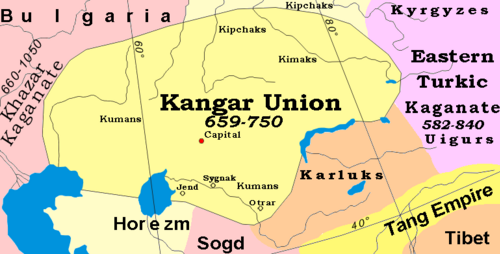
↑Adrianov, Boris V.; Mantellini, Simone (31 December 2013). Ancient Irrigation Systems of the Aral Sea Area: Ancient Irrigation Systems of the Aral Sea Area. Oxbow Books, Limited. p.238. ISBN978-1-78297-167-2. "The sedentary ruling stratum (the Kangar) was of Iranian origin" ... "The ruling elite spoke Iranian, whereas most of the population spoke Turkic with a significant admixture of Hunno-Bulgar elements."
↑Melnyk 2022, p.318"According to Pritsak, the Pecheneg ruling elite (i.e the Kangar tribes) were Iranian speakers."
↑Tolstoi V.P. Origin of the Karakalpak people//KSIE, Moscow, 1947. p.75
↑Tang, Li; Winkler, Dietmar W. (2016). Winds of Jingjiao: Studies on Syriac Christianity in China and Central Asia. LIT Verlag Münster. p.223. ISBN978-3-643-90754-7.
↑Sandman, Erika; Simon, Camille (2016). "Tibetan as a "model language" in the Amdo Sprachbund: evidence from Salar and Wutun". Journal of South Asian Languages and Linguistics. 3 (1): 88. doi:10.1515/jsall-2016-0003. S2CID146919944. hal-03427697.
↑Sandman, Erika; Simon, Camille (23 October 2023). "Tibetan as a "model language" in the Amdo Sprachbund: Evidence from Salar and Wutun". Journal of South Asian Languages and Linguistics. 3 (1): 85. doi:10.1515/jsall-2016-0003. S2CID146919944.
↑Sandman, Erika. A Grammar of Wutun(PDF) (PhD Thesis. Department of World Cultures thesis). University of Helsinki. p.15.
↑Han, Deyan (1999). Mostaert, Antoine (ed.). "The Salar Khazui System". Central Asiatic Journal. 43–44. Ma Jianzhong and Kevin Stuart, translators (2ed.). O. Harrassowitz: 212.
↑Böwering, Gerhard; Crone, Patricia; Mirza, Mahan (1 January 2012). The Princeton Encyclopedia of Islamic Political Thought. Princeton University Press. pp.410–411.
↑Islamic Central Asia: an anthology of historical sources, Ed. Scott Cameron Levi and Ron Sela, (Indiana University Press, 2010), 83;The Ghaznavids were a dynasty of Turkic slave-soldiers..., "Ghaznavid Dynasty"Encyclopædia Britannica Jonathan M. Bloom, Sheila Blair, The Grove Encyclopedia of Islamic Art and Architecture, Oxford University Press, 2009, Vol.2, p.163, Online Edition, "Turkish dominated mamluk regiments...dynasty of mamluk origin (the GHAZNAVID line) carved out an empire..."
↑David Christian: A History of Russia, Central Asia, and Mongolia; Blackwell Publishing, 1998; pg. 370: "Though Turkic in origin [...] Alp Tegin, Sebuk Tegin, and Mahmud were all thoroughly Persianized".
↑J. Meri (Hg.), Medieval Islamic Civilization: An Encyclopedia, "Ghaznavids", London u.a. 2006, p. 294.
↑Meisami, Julie Scott, Persian historiography to the end of the twelfth century, (Edinburgh University Press, 1999), 143.
↑B. Spuler, "The Disintegration of the Caliphate in the East", in the Cambridge History of Islam, Vol. IA: The Central islamic Lands from Pre-Islamic Times to the First World War, ed. by P.M. Holt, Ann K.S. Lambton, and Bernard Lewis (Cambridge: Cambridge University Press, 1970). pg 147.
A. C. S. Peacock, Great Seljuk Empire, (Edinburgh University Press, 2015), 1–378.
Christian Lange; Songül Mecit, eds., Seljuqs: Politics, Society and Culture (Edinburgh University Press, 2012), 1–328.
P.M. Holt; Ann K.S. Lambton, Bernard Lewis, The Cambridge History of Islam (Volume IA): The Central Islamic Lands from Pre-Islamic Times to the First World War, (Cambridge University Press, 1977), 151, 231–234.
Jonathan Dewald, Europe 1450 to 1789: Encyclopedia of the Early Modern World, Charles Scribner's Sons, 2004, p. 24.
Grousset, Rene, The Empire of the Steppes, (Rutgers University Press, 1991), 161, 164.
Wendy M. K. Shaw, Possessors and possessed: museums, archaeology, and the visualization of history in the late Ottoman Empire. University of California Press, 2003, ISBN0-520-23335-2, ISBN978-0-520-23335-5; p.5.
Jackson, P. (2002). "Review: The History of the Seljuq Turkmens: The History of the Seljuq Turkmens". Journal of Islamic Studies. 13 (1). Oxford Centre for Islamic Studies: 75–76. doi:10.1093/jis/13.1.75.
Bosworth, C. E. (2001). 0Notes on Some Turkish Names in Abu 'l-Fadl Bayhaqi's Tarikh-i Mas'udi". Oriens, Vol. 36, 2001 (2001), pp. 299–313.
Dani, A. H., Masson, V. M. (Eds), Asimova, M. S. (Eds), Litvinsky, B. A. (Eds), Boaworth, C. E. (Eds). (1999). History of Civilizations of Central Asia. Motilal Banarsidass Publishers (Pvt. Ltd).
Asimov, M. S., Bosworth, C. E. (eds.). (1998). History of Civilizations of Central Asia, Vol. IV: "The Age of Achievement: AD 750 to the End of the Fifteenth Century", Part One: "The Historical, Social and Economic Setting". Multiple History Series. Paris: UNESCO Publishing.
Dani, A. H., Masson, V. M. (Eds), Asimova, M. S. (Eds), Litvinsky, B. A. (Eds), Boaworth, C. E. (Eds). (1999). History of Civilizations of Central Asia. Motilal Banarsidass Publishers (Pvt. Ltd).
↑Antov, Nikolay (28 December 2017). The Ottoman 'Wild West': The Balkan Frontier in the Fifteenth and Sixteenth Centuries. Cambridge University Press. pp.15–18. ISBN978-1-316-86553-8.
↑Formica, Piero (5 April 2017). Entrepreneurial Renaissance: Cities Striving Towards an Era of Rebirth and Revival. Springer. p.18. ISBN978-3-319-52660-7.
↑Blair, Ann; Duguid, Paul; Goeing, Anja-Silvia; Grafton, Anthony (26 January 2021). Information: A Historical Companion. Princeton University Press. p.36. ISBN978-0-691-17954-4.
↑Peter B.Golden (2011) Central Asia in World History, p.115
↑Soucek, Svat. A History of Inner Asia (2000), p. 180.
↑Bregel, Y. The new Uzbek states: Bukhara, Khiva and Khoqand: C. 1750–1886. In N. Di Cosmo, A. Frank, & P. Golden (Eds.), The Cambridge History of Inner Asia: The Chinggisid Age (pp. 392–411). Cambridge: Cambridge University Press 2009
↑Abbas Amanat, The Pivot of the Universe: Nasir Al-Din Shah Qajar and the Iranian Monarchy, 1831–1896, I. B. Tauris, pp 2–3.
↑Choueiri, Youssef M., A companion to the history of the Middle East, (Blackwell Ltd., 2005), 231,516.
↑H. Scheel; Jaschke, Gerhard; H. Braun; Spuler, Bertold; T Koszinowski; Bagley, Frank (1981). Muslim World. Brill Archive. pp.65, 370. ISBN978-90-04-06196-5. Retrieved 28 September 2012.
↑Michael Axworthy. Iran: Empire of the Mind: A History from Zoroaster to the Present Day, Penguin UK, 6 November 2008. ISBN0-14-190341-4
↑Timothy C. Dowling. Russia at War: From the Mongol Conquest to Afghanistan, Chechnya, and Beyond, pp 728–730 ABC-CLIO, 2 December 2014 ISBN1-59884-948-4
↑Moses Parkson, "Ottoman Empire and its past life" p. 98
↑"The Pechenegs". Archived from the original on 27 October 2009. Retrieved 27 October 2009., Steven Lowe and Dmitriy V. Ryaboy
↑Cultura Turcica. Türk Kültürünü Araştırma Enstitüsü. 1964. p.155. "But the only countries that make full use of the economic potential of the Turkish World -with the exception of the only independent country of this area, namely Turkey- are Soviet Russia and China."
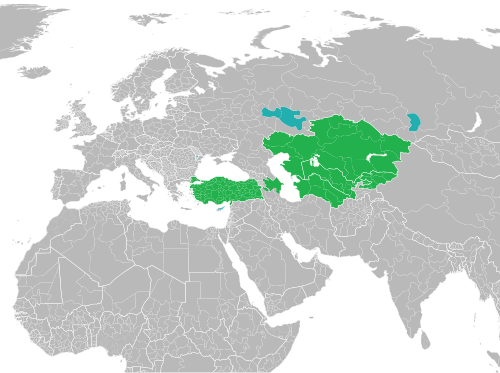
↑"Turkic Council's name changed to Organization of Turkic States". www.aa.com.tr.
↑Alram, Michael; Filigenzi, Anna; Kinberger, Michaela; Nell, Daniel; Pfisterer, Matthias; Vondrovec, Klaus. "The Countenance of the other". Pro.geo.univie.ac.at. Kunsthistorisches Museum Vienna. Retrieved 16 July 2017.
↑Alram, Michael; Filigenzi, Anna; Kinberger, Michaela; Nell, Daniel; Pfisterer, Matthias; Vondrovec, Klaus. "The Countenance of the other (The Coins of the Huns and Western Turks in Central Asia and India) 2012–2013 exhibit: 13. THE TURK SHAHIS IN KABULISTAN". Pro.geo.univie.ac.at. Kunsthistorisches Museum Vienna. Retrieved 16 July 2017.
↑Golden, Peter (2018). "The Ethnogonic Tales of the Türks". The Medieval History Journal. 21 (2): 314. doi:10.1177/0971945818775373. S2CID166026934. "Some DNA tests point to the Iranian connections of the Ashina and Ashide,133 highlighting further that the Turks as a whole 'were made up of heterogeneous and somatically dissimilar populations'.134"
↑Wang, Penglin (2018). Linguistic Mysteries of Ethnonyms in Inner Asia. Lexington. p.190. ISBN978-1-4985-3528-1.
↑Esin, Emel (1980). A History of Pre-Islamic and Early-Islamic Turkish Culture. Istanbul: Ünal Matbaasi. p.116. "The Chinese sources of the Kök-Türk period describe the turcophone Kirgiz with green eyes and red hair. They must have been in majority Europeoids although intermarriages with the Chinese had begun long ago. The Kök-Türk kagan Mu-kan was also depicted with blue eyes and an elongated ruddy face. Probably as a result of the repeated marriages, the members of the Kök-Türk dynasty (pl. XLVII/a), and particularly Köl Tigin, had frankly Mongoloid features. Perhaps in the hope of finding an occasion to claim rulership over China, or because the high birth of the mother warranted seniority, the Inner Asian monarchs sought alliances165 with dynasties reigning in China."
↑André Wink (2002). Al-Hind: The Slavic Kings and the Islamic conquest, 11th–13th centuries. BRILL. pp.68–69. ISBN978-0-391-04174-5. Even then, the term 'Turk' was still applied in a loose sense, and we find for instance the Magyars (Majghari) or the Rus described as Turks by the same Muslim writers.70 And this is a fact which cannot be explained by assuming that these were people who were under the rule of the Turks, or, in other words, by assuming that the word is always used as a political-territorial ethnonym.71 Tibetans are also frequently confused with Turks, for instance by Al-Biruni, who speaks of 'Turks from Tibet' and 'Turks of Tibetan origin'
↑Reuven Amitai; Michal Biran (2005). Mongols, Turks, and Others: Eurasian Nomads and the Sedentary World. Brill. pp.222–223. ISBN978-90-04-14096-7.: "One of the issues that most occupied the travelers was the physiognomy of the Turks.120 Both mentally and physically, Turks appeared to the Arab authors as very different from themselves.121 The shape of these "broad faced people with small eyes" and their physique impressed the travelers crossing the Eurasian lands." "According to this explanation: Because of the Turks' distance from the course of the sun and from the sun's rising and descending, the snow in their lands is abundant and coldness and humidity dominate it. This caused the bodies of this land's inhabitants to become mellow and their epidermis thick.124 Their sleek hair is spare and its colour is pale with an inclination to red. Due to the cold weather of their surroundings, coldness dominates their temper. In effect, the cold climate breeds abundant flesh. The arctic temperature compresses the heat and makes it visible. This gives them their pink skin. It is noticeable among the people who have bulky bodies and pale colour. Whilst a chilly wind hits them, their faces, lips, fingers and legs became red. This is because while they were warm their blood expanded, and then the cold temperature caused it to amass."
↑Lee & Kuang (2017) "A Comparative Analysis of Chinese Historical Sources and Y-DNA Studies with Regard to the Early and Medieval Turkic Peoples", Inner Asia 19. p. 207-208 of 197–239 Quote: "The Chinese histories also depict the Turkic-speaking peoples as typically possessing East/Inner Asian physiognomy, as well as occasionally having West Eurasian physiognomy. DNA studies corroborate such characterisation of the Turkic peoples."
↑Babayar, Gaybulla (2013). "The Imperial Titles on the Coins of the Western Turkic Qaghanate". History of Central Asia in Modern Medieval Studies. Tashkent: Yangi Nashr: 331.
123Schlumberger, Daniel (1952). "Le Palais ghaznévide de Lashkari Bazar". Syria. 29 (3/4): 263 & 267. doi:10.3406/syria.1952.4789. ISSN0039-7946. JSTOR4390312.
↑Lee & Kuang (2017) "A Comparative Analysis of Chinese Historical Sources and Y-DNA Studies with Regard to the Early and Medieval Turkic Peoples", Inner Asia 19. p. 208 of 197–239
↑Xin Tangshu, "vol. 217b" txt: "又有駁馬者,或曰弊剌,曰遏羅支,[...] 人貌多似結骨,而語不相通。" tr: "There are also Piebald-Horse folk, also called either Bila or Eluozhi [...]. [Those] peoples' faces much resemble Kyrghyzes', yet the languages are not mutually intelligible."
↑Jaschok, Maria (2013). The history of women's mosques in Chinese Islam: a mosque of their own. Taylor and Francis. p.73. ISBN978-1-136-83880-4. ""....Qincha have yellow hair and blue eyes' (Ming Lu Ji Jue Fu Li, Vol. 6, 1969 copy)."
↑Weiner, Michael (2021). Routledge Handbook of Race and Ethnicity in Asia. Abingdon, Oxon: Routledge. p.200. ISBN978-1-351-24668-2. "To illustrate the complexity of the Ming-Muslim relationship, consider a legal statute" [...] "...Kipchaks have light hair and blue eyes. Their appearance is vile and peculiar, so there are those who do not wish to marry them." (Da Ming lü jijie fuli 6.36b)
↑Vryonis, Speros Jr (1971). The Decline of Medieval Hellenism in Asia Minor and the Process of Islamization from the Eleventh through the Fifteenth Century. Berkeley: University of California Press. p.278.
↑Polat, Orhan. "About:: TURKSOY". turksoy.org. Retrieved 17 May 2016.
↑Polat, Orhan. "Cultural Capital of the Turkic World 2016: Sheki:: TURKSOY". turksoy.org. Retrieved 17 May 2016.
↑"Uzbekistan Officially Applies For Membership In Turkic Council". Radio Free Europe/Radio Liberty. 13 September 2019.
↑"Press Release of the Sixth Summit of the Turkic Council". Turkic Council. Retrieved 4 September 2018.
↑"Turkic Council reforms into Organization of Turkic States". TRT World. 13 November 2021.
↑"Turkish Cyprus gains Organization of Turkic States observer status". Daily Sabah. 11 November 2022. Retrieved 11 November 2022.
↑"Organization of Turkic States pledges observer status for Turkish Cyprus – Türkiye News". Hürriyet Daily News. 11 November 2022. Retrieved 11 November 2022.
↑Substantial numbers (possibly several millions) of maghrebis of the former Ottoman colonies in North Africa are of Ottoman Turkish descent. Finnish Tatars
↑The Karakalpak Gene Pool (Spencer Wells, 2001); and discussion and conclusions at www.karakalpak.com/genetics.html
↑""Şeyxülislam qeyd edib ki, Azərbaycanda 35 faiz sünni, 65 faiz isə şiə məzhəbinə mənsub…"".
↑"Religion"(PDF). Administrative Department of the President of the Republic of Azerbaijan — Presidential Library. Archived(PDF) from the original on 23 November 2011. Религия. Управление делами Президента Азербайджанской Республики— Президентская библиотека
↑"History of Buddhism among the Turkic People". studybuddhism.com. Retrieved 3 December 2022.
↑"Buddhism history in Kazakhstan · · "Kazakhstan History" portal". edu.e-history.kz. Archived from the original on 20 September 2022. Retrieved 15 September 2022.
↑"唐代中围景教与景教本部教会的关系"(PDF). Archived from the original(PDF) on 30 November 2011.
↑"景教在西域的传播". Archived from the original on 4 March 2016. Retrieved 18 March 2015.
↑"新闻_星岛环球网". Archived from the original on 30 October 2012. Retrieved 18 March 2015.
↑"7–11 世紀景教在陸上絲綢之路的傳播"(PDF). Archived from the original(PDF) on 30 December 2011. Retrieved 3 April 2011.
↑Akiner, Shirin (1986). Islamic peoples of the Soviet Union: with an appendix on the non-Muslim Turkic peoples of the Soviet Union: an historical and statistical handbook (2nded.). London: KPI. pp.431–432. ISBN0-7103-0188-X.
↑Akiner, Shirin (1986). Islamic Peoples Of The Soviet Union. Routledge. p.100. ISBN978-1-136-14274-1.
↑Yemelianova, Galina M. (2002). Russia and Islam: A Historical Survey. Palgrave. pp.36–41. ISBN0-333-68354-4.
↑Ashakeeva, Gulaiym; Najibullah, Farangis (February 2012). "Kyrgyz Religious Hatred Trial Throws Spotlight On Ancient Creed". Radio Free Europe/Radio Liberty. Retrieved 18 April 2019.
↑"Religion in Kazakhstan". WorldAtlas. Retrieved 18 April 2019.
↑Roberts, Sean R. (8 September 2020). The War on the Uyghurs: China's Internal Campaign against a Muslim Minority. Princeton University Press. p.8. ISBN978-0-691-20221-1.
↑Frankel, James (17 June 2021). Islam in China. Bloomsbury Publishing. p.77. ISBN978-0-7556-3884-0.
↑Robert Dankoff (2008). From Mahmud Kaşgari to Evliya Çelebi. Isis Press. p.81. ISBN978-975-428-366-2.
12Dankoff, Robert (January–March 1975). "Kāšġarī on the Beliefs and Superstitions of the Turks". Journal of the American Oriental Society. 95 (1): 68–80. doi:10.2307/599159. JSTOR599159.
↑Hamilton Alexander Rosskeen Gibb; Bernard Lewis; Johannes Hendrik Kramers; Charles Pellat; Joseph Schacht (1998). The Encyclopaedia of Islam. Brill. p.689.
↑Robert Dankoff (2008). From Mahmud Kaşgari to Evliya Çelebi. Isis Press. p.79. ISBN978-975-428-366-2.
↑Mehmet Fuat Köprülü; Gary Leiser; Robert Dankoff (2006). Early Mystics in Turkish Literature. Psychology Press. pp.147–. ISBN978-0-415-36686-1.
↑Ševčenko, Ihor; Sysyn, Frank E., eds. (1980). "Harvard Ukrainian Studies Eucharisterion: Essays Presented to Omeljan Pritsak on his Sixtieth Birthday by his Colleagues and Students"(PDF). Harvard Ukrainian Studies. III/IV 1979–1980. Cambridge, Massachusetts: Harvard University: 160. ISSN0363-5570. Archived from the original(PDF) on 18 November 2015.
↑Harvard Ukrainian Research Institute (1980). Harvard Ukrainian studies. Harvard Ukrainian Research Institute. p.160.
↑Robert Dankoff (2008). From Mahmud Kaşgari to Evliya Çelebi. Isis Press. p.79. ISBN978-975-428-366-2.
↑Uluslararası Türk Kültürü Kongresi Bildirileri. Vol.6. Atatürk Kültür Merkezi. 2009. p.2128.
↑Mayor, Adrienne (22 September 2014). The Amazons: Lives and Legends of Warrior Women across the Ancient World. Princeton University Press. ISBN978-1-4008-6513-0.
↑Burak, Sansal. "Turkish Jereed (Javelin)". All About Turkey. Retrieved 16 November 2016.
↑Christensen, karen; Levinson, David (1999). Encyclopedia of World Sport: From Ancient Times to the Present. Oxford University Press. ISBN978-0-19-513195-6.
Baydar, Ayça (2016). "Chapter One – Introduction". The Turcophone Orthodox Christians from Coexistence to Ethno-religious Homogenisation: A study of the 'Karamanlidhika' Press during the Greek-Turkish War and the Population Exchange (Thesis). University of London. pp.9–33.
Brook, Kevin Alan (2018), The Jews of Khazaria, Rowman & Littlefield
Damgaard, P. B.; etal. (9 May 2018). "137 ancient human genomes from across the Eurasian steppes". Nature. 557 (7705). Nature Research: 369–373. Bibcode:2018Natur.557..369D. doi:10.1038/s41586-018-0094-2. hdl:1887/3202709. PMID29743675. S2CID13670282. Retrieved 11 April 2020.
Dickens, Mark (2018). "Scythians (Saka)". In Nicholson, Oliver (ed.). The Oxford Dictionary of Late Antiquity. Oxford University Press. pp.1346–1347. ISBN978-0-19-174445-7. Retrieved 27 April 2020.
Findley, Carter V. (2005). The Turks in World History. Oxford University Press, USA. ISBN978-0-19-517726-8.
Fisher, William Bayne; Avery, P.; Hambly, G. R. G; Melville, C. (1991). The Cambridge History of Iran. Vol.7. Cambridge: Cambridge University Press. ISBN978-0-521-20095-0.
Golden, Peter Benjamin (2011). Studies on the peoples and cultures of the Eurasian steppes. Bucureşti: Ed. Acad. Române. ISBN978-973-1871-96-7.
Khanbaghi, Aptin (2006). The Fire, the Star and the Cross: Minority Religions in Medieval and Early Modern Iran. I.B. Tauris. ISBN978-1-84511-056-7.
Lee, Joo-Yup; Kuang, Shuntu (18 October 2017). "A Comparative Analysis of Chinese Historical Sources and Y-DNA Studies with Regard to the Early and Medieval Turkic Peoples". Inner Asia. 19 (2). Brill: 197–239. doi:10.1163/22105018-12340089. ISSN2210-5018.
Lee, Joo-Yup (2023). The Turkic Peoples in World History. Routledge. doi:10.4324/9781003256496. ISBN978-1-000-90421-5.
Li, Tao; etal. (June 2020). "Millet agriculture dispersed from Northeast China to the Russian Far East: Integrating archaeology, genetics, and linguistics". Archaeological Research in Asia. 22 100177. Elsevier. doi:10.1016/j.ara.2020.100177. hdl:21.11116/0000-0005-D82B-8.
Mecit, Songül (2014). The Rum Seljuqs: Evolution of a Dynasty. Routledge. ISBN978-1-134-50899-0.
Nelson, Sarah; etal. (14 February 2020). "Tracing population movements in ancient East Asia through the linguistics and archaeology of textile production". Evolutionary Human Sciences. 2 (e5). Cambridge University Press: e5. doi:10.1017/ehs.2020.4. PMC10427276. PMID37588355.
Peacock, A.C.S.; Yıldız, Sara Nur, eds. (2013). The Seljuks of Anatolia: Court and Society in the Medieval Middle East. I.B.Tauris. ISBN978-1-84885-887-9.
Robbeets, Martine (1 January 2017). "Austronesian influence and Transeurasian ancestry in Japanese". Language Dynamics and Change. 8 (2). Brill: 210–251. doi:10.1163/22105832-00702005. hdl:11858/00-001M-0000-002E-8635-7. ISSN2210-5832.
Tekin, Talat (1993). Irk bitig (the book of omens)(PDF). Wiesbaden: Otto Harrassowitz. ISBN978-3-447-03426-5.
Uchiyama, Junzo; etal. (21 May 2020). "Populations dynamics in Northern Eurasian forests: a long-term perspective from Northeast Asia". Evolutionary Human Sciences. 2 e16. Cambridge University Press. doi:10.1017/ehs.2020.11. PMC10427466. PMID37588381. Text was copied from this source, which is available under a Creative Commons Attribution 4.0 International License.
de la Vaissière, Étienne (2015). "The Steppe World and the Rise of the Huns". In Maas, Michael (ed.). The Cambridge Companion to the Age of Attila. Cambridge University Press. pp.175–192. ISBN978-1-107-63388-9.
Yang, Xiao-Min; Meng, Hai-Liang; Zhang, Jian-Lin (17 November 2023). "Ancient genome of Empress Ashina reveals the Northeast Asian origin of Göktürk Khanate". Journal of Systematics and Evolution. 61 (6): 1056–1064. Bibcode:2023JSyEv..61.1056Y. doi:10.1111/jse.12938. ISSN1674-4918. S2CID255690237.
Yunusbayev, Bayazit; etal. (21 April 2015). "The Genetic Legacy of the Expansion of Turkic-Speaking Nomads across Eurasia". PLOS One. 11 (4) e1005068. PLOS. doi:10.1371/journal.pgen.1005068. PMC4405460. PMID25898006.
Further reading
Amanjolov A.S., "History of the Ancient Turkic Script", Almaty, "Mektep", 2003, ISBN9965-16-204-2
Baichorov S.Ya., "Ancient Turkic runic monuments of the Europe", Stavropol, 1989 (in Russian).
Baskakov, N.A. 1962, 1969. Introduction to the study of the Turkic languages. Moscow (in Russian).
Beckwith, Christopher I. (2009): Empires of the Silk Road: A History of Central Eurasia from the Bronze Age to the Present. Princeton: Princeton University Press. ISBN978-0-691-13589-2.
Boeschoten, Hendrik & Lars Johanson. 2006. Turkic languages in contact. Turcologica, Bd. 61. Wiesbaden: Harrassowitz. ISBN3-447-05212-0.
Chavannes, Édouard (1900): Documents sur les Tou-kiue (Turcs) occidentaux. Paris, Librairie d'Amérique et d'Orient. Reprint: Taipei. Cheng Wen Publishing Co. 1969.
Clausen, Gerard. 1972. An etymological dictionary of pre-thirteenth-century Turkish. Oxford: Oxford University Press.
Deny, Jean et al. 1959–1964. Philologiae Turcicae Fundamenta. Wiesbaden: Harrassowitz.
Findley, Carter Vaughn. 2005. The Turks in World History. Oxford University Press. ISBN0-19-516770-8; ISBN0-19-517726-6 (pbk.)
Golden, Peter B. An introduction to the history of the Turkic peoples: Ethnogenesis and state-formation in medieval and early modern Eurasia and the Middle East (Otto Harrassowitz (Wiesbaden) 1992) ISBN3-447-03274-X
Peter B. Golden (1992). An Introduction to the History of the Turkic Peoples: Ethnogenesis and State-formation in Medieval and Early Modern Eurasia and the Middle East. O. Harrassowitz. ISBN978-3-447-03274-2.
Heywood, Colin. The Turks (The Peoples of Europe) (Blackwell 2005), ISBN978-0-631-15897-4.
Hostler, Charles Warren. The Turks of Central Asia (Greenwood Press, November 1993), ISBN0-275-93931-6.
Ishjatms N., "Nomads In Eastern Central Asia", in the "History of civilizations of Central Asia", Volume 2, UNESCO Publishing, 1996, ISBN92-3-102846-4.
Johanson, Lars & Éva Agnes Csató (ed.). 1998. The Turkic languages. London: Routledge. ISBN0-415-08200-5.
Johanson, Lars. 1998. "The history of Turkic." In: Johanson & Csató, pp.81–125. Classification of Turkic languagesArchived 8 April 2011 at the Wayback Machine
Johanson, Lars. 1998. "Turkic languages." In: Encyclopædia Britannica. CD 98. Encyclopædia Britannica Online, 5 September. 2007. Turkic languages: Linguistic history.
Karatay, Osman. The Genesis of the Turks: An Ethno-Linguistic Inquiry into the Prehistory of Central Eurasia. United Kingdom, Cambridge Scholars Publishing., 2022.
Lebedynsky, Iaroslav. (2006). Les Saces: Les «Scythes» d'Asie, VIIIe siècle apr. J.-C. Editions Errance, Paris. ISBN2-87772-337-2.
Malov S.E., "Monuments of the ancient Turkic inscriptions. Texts and research", M.-L., 1951 (in Russian).
Mukhamadiev A., "Turanian Writing", in "Problems Of Lingo-Ethno-History Of The Tatar People", Kazan, 1995 (Азгар Мухамадиев, "Туранская Письменность", "Проблемы лингвоэтноистории татарского народа", Казань, 1995) (in Russian).
Menges, K. H. 1968. The Turkic languages and peoples: An introduction to Turkic studies. Wiesbaden: Harrassowitz.
Öztopçu, Kurtuluş. 1996. Dictionary of the Turkic languages: English, Azerbaijani, Kazakh, Kyrgyz, Tatar, Turkish, Turkmen, Uighur, Uzbek. London: Routledge. ISBN0-415-14198-2
Alpamysh, H.B. Paksoy: Central Asian Identity under Russian Rule (Hartford: AACAR, 1989)
H. B. Paksoy (1989). Alpamysh: Central Asian Identity Under Russian Rule. AACAR. ISBN978-0-9621379-9-0.
Samoilovich, A. N. 1922. Some additions to the classification of the Turkish languages. Petrograd.
Schönig, Claus. 1997–1998. "A new attempt to classify the Turkic languages I-III." Turkic Languages 1:1.117–133, 1:2.262–277, 2:1.130–151.
Vasiliev D.D. Graphical fund of Turkic runiform writing monuments in Asian areal. М., 198 (in Russian).
Vasiliev D.D. Corpus of Turkic runiform monuments in the basin of Enisei. М., 1983 (in Russian).
Voegelin, C.F. & F.M. Voegelin. 1977. Classification and index of the World's languages. New York: Elsevier.
















 Text was copied from this source, which is available under a Creative Commons Attribution 4.0 International License.