
Loading article…
 紋章
| |
_-_Crimea_disputed.svg/500px-Eurasian_Economic_Union_(orthographic_projection)_-_Crimea_disputed.svg.png) 加盟国 ロシア占領地域[1] | |
| 行政センター | |
| 最大の都市 | モスクワ 55°45′N 37°37′E / 55.750°N 37.617°E / 55.750; 37.617 |
| 作業言語 | ロシア |
| タイプ | 経済統合 |
| 加盟国 | |
| リーダー | |
•最高ユーラシア経済評議会議長(2024年) |  ニコル・パシニャン ニコル・パシニャン |
•ユーラシア経済委員会の理事長 |  バヒチャン・サギンタエフ バヒチャン・サギンタエフ |
| 設立 | |
• 当初の提案 | 1994 |
• 経済共同体 | 2000年10月10日 |
| 2010年1月1日 | |
• 設立合意 | 2011年11月18日 |
• ユーラシア経済圏 | 2012年1月1日 |
• EAEU条約に署名 | 2014年5月29日 |
• EAEU設立 | 2015年1月1日 |
| エリア | |
• 合計 | 20,229,248 [2] km 2 (7,810,556 平方マイル) |
| 人口 | |
• 2022年の推定 |  1億8213万1000人[3] 1億8213万1000人[3] |
• 密度 | 9.12/km 2 (23.6/平方マイル) |
| GDP (購買力平価) | 2022年の推定 |
• 合計 | 5兆6,770億ドル[3] |
• 一人当たり | 31,200ドル |
| GDP (名目) | 2022年の推定 |
• 合計 | 2兆5,730億ドル[3] |
• 一人当たり | 14,100ドル |
| 通貨 | |
| タイムゾーン | UTC +2から+12 |
| ドライブを続ける | 右 |
| 呼び出しコード | |
| インターネットTLD | |
ウェブサイト EAEUnion.org | |




ユーラシア経済連合(EAEUまたはEEU)[注1]は、ユーラシアに位置する5つの旧ソ連諸国の経済連合である。EAEUは統合された単一市場を有する。2023年現在、1億8,300万人の人口と2.4兆ドルを超える国内総生産を擁している。 [3]
ユーラシア経済連合条約は、2014年5月29日にベラルーシ、カザフスタン、ロシアの首脳によって署名され、2015年1月1日に発効した。[4]アルメニアとキルギスタンのユーラシア経済連合への加盟を目指す条約は、それぞれ2014年10月9日と12月23日に署名された。アルメニアの加盟条約は2015年1月2日に発効した。キルギスタンの加盟条約は2015年8月6日に発効した。 [5]キルギスタンは、加盟国として設立当初からEAEUに参加した。[6] [7]
EAEUは、物品およびサービスの自由な移動を奨励し、マクロ経済、運輸、工業および農業、エネルギー、対外貿易および投資、関税、技術規制、競争、独占禁止法規制における共通政策を規定している。単一通貨およびさらなる統合の規定は、将来的に想定されている。[8] [9]連合は、超国家機関および政府間機関を通じて運営されている。[10]最高ユーラシア経済評議会は、加盟国の首脳で構成される連合の最高機関である。政府間機関の第2レベルは、ユーラシア政府間評議会(加盟国の政府首脳で構成)によって代表される。EAEUの日常業務は、連合の執行機関であるユーラシア経済委員会を通じて行われる。司法機関であるEAEU裁判所もある。[11]
歴史


_29-May-2014.png/500px-Eurasian_Economic_Union_(EAEU)_29-May-2014.png)
提案
1990年代、ロシアと中央アジア諸国は、ソ連の崩壊により経済的に弱体化し、 GDPの低下に直面した。ソ連加盟国は経済改革と民営化を実施した。[ジャーナル 1] [17]ユーラシア統合のプロセスは、ソ連の崩壊後すぐに始まった。1991年にソ連が崩壊し始めると、創設共和国であるベラルーシ、カザフスタン、ロシアの大統領[ジャーナル 2]は、1991年12月8日にベラヴェージャ協定に署名し、ソ連は存在しなくなり、独立国家共同体となることを宣言した。
1994年、モスクワ国立大学での演説で、カザフスタンの初代大統領ヌルスルタン・ナザルバエフは、成長するヨーロッパと東アジアの経済とつながり、そこから利益を得るための地域貿易ブロックとして「ユーラシア連合」を創設するというアイデアを提案した。その構想は、ユーラシア全域にわたる商品の自由な流れを簡素化することだった。[18] [19] [20]このアイデアは、貿易を強化し、中央アジア、アルメニア、ベラルーシへの投資を促進し、東方パートナーシップを補完する方法としてすぐに認識されました。[19] [21]
創設条約(1990年代)

1990年代、ユーラシア統合のプロセスは、ソ連崩壊後の経済危機と、関係国の規模(ロシア、ベラルーシ、カザフスタンの面積は約2000万km2)のせいか、遅々としたものだった。その結果、加盟国は地域貿易ブロックを徐々に確立するために、数多くの条約に署名した。[ジャーナル3] [ジャーナル2]
1995年、ベラルーシ、カザフスタン、ロシア、そして後に加盟したキルギスタンとタジキスタンは、関税同盟設立に関する最初の協定に署名した。その目的は、加盟国間のパスポート管理のない開かれた国境の実現に向けて徐々に道を開くことであった。[22]
1996年、ベラルーシ、カザフスタン、ロシア、キルギスタンは、経済と人道的分野における統合の強化に関する条約に署名し、国家間の経済統合を開始し、商品、サービス、資本、労働の共通市場の創設、単一の輸送、エネルギー、情報システムの開発を可能にした。[ジャーナル2] [23]
1999年、ベラルーシ、カザフスタン、ロシア、キルギスタン、タジキスタンは、ユーラシア関税同盟と単一経済圏の形成に向けて各国が取り組む目標と政策を明確にした関税同盟及び単一経済圏に関する条約に署名した。[24] [25]
ユーラシア経済共同体(2000年~2014年)
さらなる経済統合と協力を促進するため、2000年にベラルーシ、カザフスタン、ロシア、キルギスタン、タジキスタンはユーラシア経済共同体(EurAsEC)を設立し、2006年にウズベキスタンが加盟した。この条約により、加盟国に共通市場が確立された。ユーラシア経済共同体は欧州経済共同体をモデルにしている。[26]両国の人口はそれぞれ1億7100万人と1億6900万人で、ほぼ同規模である。
ベラルーシ、カザフスタン、ロシア、ウクライナによる単一経済圏条約は2003年に署名され、2004年に批准されたが、オレンジ革命後、そのプロセスは停滞した。[27] [28]
2007年、ベラルーシ、カザフスタン、ロシアは3カ国間の関税同盟を創設する協定に署名した。[29]
関税同盟と単一市場の確立(2010~2014年)

ベラルーシ、カザフスタン、ロシアの関税同盟(現在のユーラシア関税同盟)は2010年1月1日に発足した。[30]関税同盟の優先事項は、ブロック内関税の撤廃、共通の対外関税政策の確立、非関税障壁の撤廃であった。これは、欧州連合に触発され、旧ソ連諸国間の同盟を形成することを目的とした、より広範な単一市場を形成するための第一歩として開始された。[31]加盟国は経済統合を継続することを計画しており、 2011年7月以降、相互間の すべての関税境界を撤廃する予定であった。
2012年1月1日、三国はユーラシア経済圏を設立した。これは、商品、サービス、資本、労働の単一市場の効率的な機能を確保し、一貫した産業、輸送、エネルギー、農業政策を確立することを目的とした。 [32] [33]この合意には将来の統合に向けたロードマップが含まれ、ユーラシア経済委員会(欧州委員会をモデルに)が設立された。[34] [35]ユーラシア経済委員会は、ユーラシア関税同盟、単一経済圏、ユーラシア経済連合の規制機関としての役割を果たしている。[32]
ユーラシア経済連合条約
2011年、当時のロシア首相ウラジミール・プーチンは、ヌルスルタン・ナザルバエフのユーラシア経済連合創設構想を支持すると発表した。[36] [37] 2011年11月18日、ベラルーシ、カザフスタン、ロシアの大統領は、2015年までにユーラシア経済連合を設立するという目標を設定した協定に署名した。 [34]加盟国は、より緊密な経済関係を促進するための合同委員会を設置した。[32] [38]
2014年5月29日、カザフスタン、ベラルーシ、ロシアの大統領はユーラシア経済連合条約に署名し、2015年1月1日に発効した。署名式にはアルメニアとキルギスタンの大統領も出席した。ロシアのウラジミール・プーチン大統領は「今日、我々は強力で魅力的な経済発展の中心地、1億7千万人以上の人々を結びつける大きな地域市場を創り出した」と述べた。[39]カザフスタンの政治家は、ユーラシア経済連合は政治ブロックではなく、純粋に経済的な連合を意図していると強調した。[39]カザフスタンの第一副首相で主導交渉官 のバキツァン・サギンタエフは「我々は政治組織を創っているのではなく、純粋に経済的な連合を形成している」と述べた。さらに彼は「これは利益を得るための現実的な手段だ。我々はロシアの政治的行動に干渉しないし、ロシアは我々に外交政策を指図することはできない」と述べた。[39] 10月までに、この条約は3カ国すべてから議会の承認を得た。[40] 2014年10月9日、EAEUをアルメニアに拡大する条約が調印された。[41] [42]キルギスタンは2014年12月23日に条約に調印し、2015年8月6日にユーラシア連合に加盟した。[43] [44]
構造の進化
ロシアのウクライナ侵攻(2022年)
ロシアのウクライナ侵攻の結果、米国とEUはロシアとベラルーシに制裁を課した。[45]ロシアは2022年3月10日、自国の食糧供給を確保するため、ユーラシア経済連合への小麦、メスリン、ライ麦、大麦、トウモロコシの輸出を停止した。[46]この禁止措置は2022年4月1日に撤回されたが、同時に食品貿易に関する他の制限も導入された。[47] 3月29日、カザフスタン政府関係者は、EAEU加盟国であるにもかかわらず、カザフスタンは米国とEUの制裁を遵守し、いかなる回避も助長しないと述べた。関係者は、カザフスタンは二次制裁の標的になることを望んでおらず、代わりにEUとの協力を拡大しようとしていると説明した。[45]
2023年12月15日、EAEUはイランとの自由貿易協定に署名し、ほぼ90%の品物に対する関税を撤廃した。この協定は、2019年から施行されている同様の暫定協定に代わるものである。[48]
メンバーシップ

ユーラシア経済連合加盟国
オブザーバーは
候補州
ユーラシア経済連合を設立する条約は、旧ソ連を構成していたベラルーシ、カザフスタン、ロシアの3か国によって正式に署名された。[ 51 ] [ 52 ] EAEUを旧ソ連諸国であるアルメニアとキルギスタンに拡大する協定は、それぞれ2014年10月9日と12月23日に署名された。[42] [43] [44] [53] [54]キルギスタンにとって、ロシアとの労働移民規制の円滑化は、ユーラシア経済連合に加盟する主な利点と見なされていた。人口移動指標は、一人当たりGDP、消費者物価指数、最低賃金、失業率と逆相関していた。[55]
アルメニアは2013年9月、ユーラシア関税同盟への加盟を決定したと発表した。セルジ・サルキシャン大統領は モスクワでロシアのウラジーミル・プーチン大統領と会談した後、この決定を発表した。[56] EAEUをアルメニアに拡大する条約は2014年10月9日に調印された。[41]この契約に調印することで、アルメニアは該当する申請を受け入れ、人口1億7千万人のEAEU単一市場へのアクセスを獲得した。[57]アルメニアはEAEU加盟国の中で、他の加盟国と国境を接していない唯一の国である。ジョージアはユーラシア経済同盟への商品の輸出に自由な通過回廊を保証したとアルメニアのエミル・タラシアン経済副大臣は述べた。[58]
モルドバは2017年4月にオブザーバー資格を付与された。[59]
ウズベキスタンとキューバは2020年12月11日にオブザーバー加盟国となった。[60] 2021年12月の大統領選挙後、ウズベキスタンは2022年または2023年までに正式加盟国となる見込みである。 [61] 2022年12月、ロシアのミシュスチン首相はウズベキスタンがEAEUに正式加盟することの利点について言及した。[62] 2023年2月までにウズベキスタンのアリポフ首相は、国家技術規制とEAEU基準の調和を確保するための準備作業が完了したと発表した。[63]
大統領職
毎年、加盟国が議長国として選出され、連合を率います。議長国はロシア語のアルファベット順に国から国へと交代します。現在はアルメニアが議長国を務めています。
拡大
ロシアのプーチン大統領は、ロシアの目標は関税同盟を旧ソ連諸国すべてに拡大することだが、バルト三国の EU加盟国は除外することだと述べている。[73]ガーディアン紙によると、ロシアの計画はユーラシア連合を欧州連合のような主権国家の「強力な超国家連合」に成長させ、経済、法制度、関税サービス、軍事力を統合して、欧州とアジアの架け橋となり、EUと米国のバランスを取ることだという。[74]
2015年5月、ロシア連邦と南オセチアの間で統合協定が締結された。南オセチアが加盟する場合は、ロシア連邦に加盟することになる[要出典]。2023年、南オセチアはEAEUの共通関税の実施と統合を開始する。[75]
タジキスタンは正式に加盟の招待を受け、加盟に関心を示している。[76] [77] [78] [79]タジキスタンは潜在的な加盟候補国として認められており、加盟交渉が進行中である。[78] [79] [80] [81] 2015年には、タジキスタンをEAEUに統合するためのさらなる努力が行われた。[82] [83]
欧州が欧州石炭鉄鋼共同体から完全な欧州連合に移行するまでには40年かかりました。関税同盟と共通経済圏の設立は、EUやその他の地域連合の経験を活用することができたため、はるかに速いペースで進んでいます。私たちはそれらの長所と短所を理解しています。そして、これは私たちにとって明らかな利点です。なぜなら、それは私たちが間違いや不必要な官僚的上部構造を回避できる立場にあることを意味するからです。
— ウラジミール・プーチン、「ユーラシアの新たな統合プロジェクト:作られつつある未来」、イズベスチヤ、2011年10月3日[84]
ウズベキスタンは経済連合への加盟を躊躇しており、ウズベキスタン当局は統合の見通しについて反対の主張をしている。[85] [86]もともと、同国は経済的、政治的統合を追求しないことを好んでいた。[87] [88] [89]ロシア当局は同国との統合はゆっくりとしたものになると述べており、アナリストらは、キルギスタンとタジキスタンにおけるロシアの影響力と貿易が拡大するにつれて、将来的にウズベキスタンを加盟に説得する可能性があると述べている。[90]ウズベキスタンは、ロシアが同国の負債8億6500万ドルを帳消しにすると発表したときに統合プロセスを開始した。ウズベキスタンは2014年に独立国家共同体自由貿易地域に加盟しており、EAEU加盟国と自由貿易を行っている。[91] [92] [93]いくつかの情報源によると、ウズベキスタンは国の法律で定められた中立性のため、EAEUの正式加盟国になるつもりはないとのことである。[ 94] 2020年3月、ウズベキスタンはユーラシア連合のオブザーバー国になりたいと発表した。[95] 2023年9月、ウズベキスタンは2~3年以内にEAEUに加盟すると見積もった。[96]
モルドバ、ウクライナ、ジョージアは、欧州連合とユーラシア経済連合の双方から、それぞれの統合同盟への参加を申し出られている。3か国はいずれも、2014年3月21日にEUとの連合協定に署名した。 [97]しかし、分離した地域であるモルドバ(トランスニストリア)、[98]ウクライナ(ドネツィクとルハンシク)[要出典]、ジョージア(南オセチアとアブハジア)[要出典]は、ユーラシア関税同盟に参加し、ユーラシア経済連合に統合したいという希望を表明している。EUとの連合協定はEAEUのオブザーバー資格には適用されず、2017年にモルドバはEAEUの最初のオブザーバー国となり、それ以来何年もEAEUフォーラムに出席している。
ウクライナは2013年8月にユーラシア経済連合にオブザーバーとして参加する申請書を提出した。[99] ヴィクトル・ヤヌコビッチが欧州連合との連合協定を放棄し、EAEUとの統合のみを追求するという決定は、彼のウクライナ大統領としての任期を終わらせ、その後ロシアによるクリミア併合につながったユーロマイダン抗議行動の重要な要因であった。ウクライナは旧ソ連の15共和国の中で2番目に大きい経済規模を誇っており、EAEUへの加盟は一部のアナリストから連合成功の鍵とみなされていた。危機をきっかけにロシアとウクライナの間で緊張が高まる中、ウクライナはEUとの統合を追求することを決定した。[100]
トルコは2014年6月6日にカザフスタンのヌルスルタン・ナザルバエフ大統領からEAEUへの加盟の招待を受けたが、トルコはEU加盟を望んでいる。[101]
ジョージアのビジナ・イヴァニシヴィリ首相は2013年9月にEU加盟の可能性を検討していると述べたが、後にジョージアの主な戦略は依然としてEUへの統合であると明言した。[102] [103]ロシアのドミトリー・メドベージェフ首相は2013年8月の声明でジョージアを将来の加盟国に含めた。[104]
政治と統治

ユーラシア経済連合は、欧州連合をモデルにしようと努めてきました。すべての機関は、ユーラシア経済委員会(EEC)条約、および関税同盟と単一経済圏の法的および規制的枠組みを規定する国際協定に従って業務を行っています。
最高ユーラシア経済評議会
加盟国の首脳によって構成される最高評議会は、連合にとって重要な決定を下す。最高評議会は、予算と加盟国の分担金の分配を承認する。また、最高評議会は統合の戦略、方向性、見通しを決定し、連合の目標を達成するための決定を下す。[106] [107] [108] [109]
ユーラシア経済委員会
ユーラシア委員会は、2012年1月1日にユーラシア経済圏の超国家的な統治機関として設立されました。[35]委員会は欧州委員会をモデルにしています。[34]本部はモスクワにあります。[ジャーナル 2]委員会は下部組織と諮問機関を監視しています。 2015年1月1日に部署が大幅に拡大され、外国人職員の数は150人から1,200人に増加しました。
ユーラシア委員会は、同連合の関税政策だけでなく、マクロ経済、競争規制、エネルギー政策、ユーラシア経済連合の財政政策についても決定を下すことができる。同委員会には厳格な汚職防止法がある。[110]
ユーラシア経済委員会は、評議会とコレギウムの 2 つの組織で構成されています。
評議会
理事会は加盟国の副首相によって構成される。委員会理事会は連合の統合プロセスを監督し、ユーラシア委員会の全体的な管理に責任を負っている。理事会は連合の予算案、人員の最大数、委員会の職員の資格要件を承認することにより、委員会を監視する。理事会は四半期ごとに1回開催される。[106] [107] [108] [109]
また、関税協力、貿易、ユーラシア統合の発展といった問題も検討する。理事会はEAEUの重要な側面について定期的に議論し、加盟国のビジネス代表者と会合を持つ。[111]
ボード
委員会は10人の委員で構成され、そのうち1人が委員長を務める。[ジャーナル4]各加盟国はユーラシア委員会の委員会に2人の委員を派遣し、委員会の運営管理と日常業務の監督を行う。[34] 10人の委員は全員、ユーラシア最高評議会によって任命され、任期は4年で再選可能。委員は各国の連邦大臣の地位も得る。[35]
委員会の理事会は委員会の執行機関である。理事会は少なくとも週に1回会合を開き、ユーラシア経済連合の日常的な運営を担当する。その活動は多岐にわたり、条約の実施状況の監視、年次進捗報告書の提出、勧告の提出などがある。理事会はまた、加盟国の紛争解決を支援し、連合の予算案を作成する。その活動には、委員会の各部門と加盟国の首脳との仲介役を務めることなどがある。[106] [107] [108] [109]
委員はいくつかの部局を率いている。下級職員は、加盟国の人口に比例して、84%がロシア人、10%がカザフ人、6%がベラルーシ人から構成されている。[34]これらの部局により、ユーラシア委員会理事会は関税政策だけでなく、マクロ経済、経済競争の規制、エネルギー政策、金融政策などの分野で決定を下すことができる。委員会の部局は、政府調達や労働移民管理にも関与している。 [35]
議会
2015年現在、EAEUには直接的または間接的に選出された機関はない。2012年にはユーラシア議会の設立が検討されていた。[112] [113]しかし、それは時期尚早であると考えられ、代わりに加盟国は国内法と法典の調和を開始した。[114]
ロシアのウラジミール・プーチン大統領は、連邦議会を設立するという考えを支持している。[115]
ユーラシア経済連合裁判所
ユーラシア経済連合裁判所は、2015年にユーラシア経済共同体裁判所(EurAsEC裁判所)に取って代わりました。ユーラシア経済連合内の紛争解決と法秩序の解釈を担当しています。本部はミンスクにあります。[116]裁判所は、加盟国の政府首脳によって任命された各加盟国からの2人の裁判官で構成されています。彼らの任期は9年です。[106] [107] [108] [109]
予算
ユーラシア経済連合の2015年の承認予算は66億ルーブルを超える。[117] [118] [119]この予算は連合加盟国の拠出金から構成される。2015年には、60億ルーブルがユーラシア経済委員会の活動に割り当てられ、4億6,300万ルーブルがEAEUの活動を促進し消費者に知らせるためのEAEU統合情報システムの運営とさらなる開発の資金として確保され、2億9,000万ルーブル以上がEAEU裁判所の活動に充てられる。[注 2] [118] インフラの追加費用と委員会職員の宿泊費はロシアが負担する。[ 35] さらに、ロシアはキルギスタンの連合加盟を加速するために10億ドルを割り当てた。[120] [121] [122]
言語
ユーラシア経済連合条約(2014年)第110条によれば、ロシア語は「連合機関」の作業言語である。[123]
経済
内部市場の概要
.jpg/500px-Moscow-City_(36211143494).jpg)
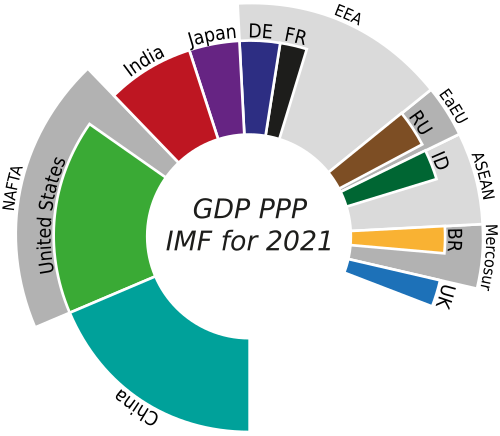
1996年に調印された経済及び人道分野の統合強化に関する条約は、経済収斂の最初の基礎を築いた。この条約は、後にEAEUの一部となる国々の統合を監督する常設の執行機関の設立を保証した。これは、将来の商品、サービス、資本、労働の共通市場の青写真となった。[ジャーナル2] [23]単一経済圏は、ベラルーシ、ロシア、カザフスタンの領土にまたがる単一市場を確立した。2015年にEAEU協定が発効したことで、単一市場はアルメニアとキルギスタンを含むように拡大された。これらの国々は約1億8千万人の市場を擁し、合計GDP PPPは約5兆ドルである。
ユーラシア経済連合は、名目GDPで世界第10位、購買力平価では第5位の経済大国である。今世紀に入ってから、加盟国は経済成長を遂げており、2000年から2007年の間にGDPは平均6%から8%成長し、2007~2008年の金融危機後の2010年には再び上昇した。2010年にユーラシア関税同盟が設立されて以来、加盟国間の貿易は急増している。2011年の相互貿易は630億ドルで、2010年より33.9%増加した。2012年には、相互貿易は680億ドルで、総輸出額は5,940億ドル、輸入額は3,410億ドルに達した。[ジャーナル 2]最初の統合段階では、主に加盟国間の貿易が強化され、経済が強化され、加盟国の法的および制度的基盤が構築された。第二段階には、商品、人、サービス、資本の自由な移動が含まれます。
ユーラシア経済連合は、原材料の輸送コストを削減することで商品価格を下げ、市場規模拡大により新技術や新製品の収益を上げ、共通市場における「健全な」競争を促進するなど、いくつかのマクロ経済目標を達成するように設計されている。また、食品価格を下げ、産業における雇用を増やし、生産能力を高めるようにも設計されている。ベラルーシやカザフスタン(ヌルリ・ジョル経済政策による)などのEAEU加盟国は、EAEUを欧州連合と新シルクロード経済圏の架け橋として活用しようとしている。[124]
ユーラシア連合は世界のエネルギー、原材料、軍需産業、農業生産の主要プレーヤーと見なされている。2013年、ロシアは海外からの資本誘致において世界で3番目に成功した国であった。[125]

.jpg/500px-Mount_Ararat_and_the_Yerevan_skyline_(June_2018).jpg)

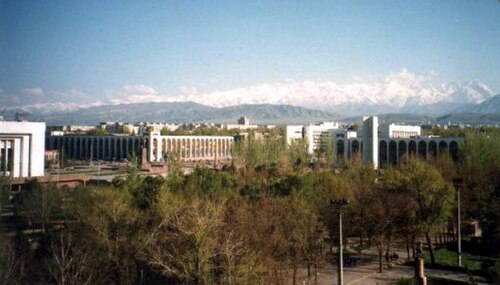

関税同盟と4つの経済的自由

単一経済圏の中心的な目的は、単一市場の開発と「4つの自由」、すなわち単一市場内での商品、資本、サービス、人の自由な移動を実現することである。4つの自由は2015年1月1日(ユーラシア経済連合が正式に設立された日)に発効した。人の自由な移動とは、国民が加盟国間を自由に移動して生活、就労、学習、引退をすることができることを意味する。[要出典]連合加盟国の国民は、国内パスポートで他の加盟国に旅行することができる。ロシアはパスポートを持たない他のCIS諸国の国民のアクセスも認めているが、2015年以降はこの特権を関税同盟の国民のみが持つと予想される。[126] 加盟国は、2010年1月1日のユーラシア関税同盟の設立以来、市場に入るすべての商品に共通の対外関税と輸入品の評価方法の統一を行っている。目標には、エネルギー、産業、農業、輸送の分野での共同調整が含まれる。
ベラルーシの商品の約75%は輸出されており、その約半分は他の加盟国に輸出されている。[127]連合内の貿易は主にベラルーシの機械類と農産物で構成されており、ロシアに輸出されている。加盟国または連合への参加を希望する国には、ロシアのエネルギー生産者からの低価格のガスが保証されている。[128] [129]
調整され、調和された、単一の政策
労働許可証なしでの物品、サービス、資本、労働の自由な移動(欧州連合における「4つの経済的自由」)に加えて、EAEUは、条約および欧州連合内の国際協定によって定められた分野において、調整され、調和された、単一の政策を追求しています。
競争
ユーラシア経済委員会は、単一経済圏の商品市場における平等な競争条件を確保するために競争政策を実施している。また、競争政策に関して3か国それぞれの法律の調和と改善も目指している。委員会は単一市場の競争規制機関として機能し、独占禁止法の問題にも責任を負っている。特別規制により、経済に対する国家の介入が制限されている。[ジャーナル 2] [130]
通貨統合
ロシア、ベラルーシ、カザフスタンの各国通貨の使用増加と単一決済システムの創設により、連合の単一通貨への移行が促進される可能性がある。
— ロシア新聞、ユーラシア経済委員会金融政策部長、2014年8月3日[131]
カザフスタンのヌルスルタン・ナザルバエフ大統領は、2009年に初めてユーラシア経済共同体のための「エヴラズ」と呼ばれる共通の非現金通貨の創設を提案した。これは、世界経済危機から各国を守るのに役立つと伝えられている。[132] 2012年、新しい共通通貨のアイデアはウラジーミル・プーチンとドミトリー・メドベージェフの支持を得て、2014年までにユーラシア委員会の文書にユーラシア中央銀行の設立と、 2025年までに導入される予定の「アルティン」と呼ばれる共通通貨の提案が起草された。 [133]
ユーラシア経済連合について議論した際、ウラジミール・プーチンは、ユーラシア経済連合には、将来的に共通通貨を使用することも含め、経済政策と金融政策の緊密な連携が含まれるだろうと述べた。 [要出典]ユーラシア経済連合条約では通貨同盟の創設は想定されていなかったが、ロシアのドミトリー・メドベージェフ首相は、ユーラシア経済連合のための共通通貨の導入を呼びかけた。ロシア下院のCIS委員会の委員長であるレオニード・スルツキーは、通貨同盟の創設に関する議論を開始するというメドベージェフの提案を支持した。スルツキーは、同盟の構造が明確になる2015年以降すぐに導入される可能性があると述べた。 [134] [135]ベラルーシのアレクサンドル・ルカシェンコ 大統領は、ユーラシア経済圏のために「新しいユーロ」を創設するというアイデアを広めた。2014年4月、単一通貨の導入に関する議論が再開された。
ロシアの第一副首相イーゴリ・シュワロフは2014年7月24日、ユーラシア経済連合は5年から10年以内に共通通貨単位を確立するだろうと述べた。[9]
エネルギー
ユーラシア経済連合はエネルギー超大国とみなされており、2012年には世界の天然ガスの約20.7%、世界の石油とガスコンデンセートの14.6%を生産し、両方の分野で世界最大の生産国となっています。これらの数字は主にロシアのEAEU加盟によるもので、カザフスタンはガスと石油の生産にそれぞれ1.9%と0.6%貢献していることは言及する価値があります。ベラルーシで発見された石油とガスの埋蔵量はかなり少ないですが、アルメニアにはそのような資源はありません。[136] また、世界の電力の9%と世界の石炭の5.9%を生産しており、それぞれ世界第3位と第4位の生産国となっています。カザフスタンでは、エネルギーが主要な経済部門です。この国には約40億トンの確認済み回収可能な石油埋蔵量と2,000立方キロメートル(480立方マイル)のガスがあります。カザフスタンは世界第17位の石油輸出国であり、世界第23位の天然ガス輸出国です。
ロシアは世界最大の天然ガス埋蔵量[137]、第8位の石油埋蔵量[ 138]、第2位の石炭埋蔵量[139]を有する。ロシアはまた、世界最大の天然ガス輸出国[140]、第2位の天然ガス生産国[141]であり、世界最大の石油輸出国であり、最大の石油生産国でもある。資源の豊富なロシアとカザフスタンの間の石油とガスの貿易は比較的低いが、ベラルーシ経済はロシアの炭化水素へのアクセスに大きく依存しており、キルギスタンやアルメニアの場合とは異なり、ロシアはベラルーシの主要な貿易相手国であり、貿易全体の47%を占めている。ベラルーシはロシア産原油(そのうち45~50%は輸出用石油製品の製造に使用)と天然ガス(直接再輸出されていない)を市場価格より低い価格で輸入しており、1000立方メートルのガスに対して173ドルを支払っている(比較のために、アルメニアは250ドル、ウクライナは430ドル)。[136]
ロシア、カザフスタン、ベラルーシ、アルメニアは、2019年までに共通の電力市場を、2025年までに単一の炭化水素市場を創設する予定である。「単一の炭化水素市場の創設により、より深い調整が可能になり、この非常に興味深く重要な市場において、価格面でも高付加価値製品の入手面でも、より競争力を高めることができるようになる」とユーラシア委員のダニヤル・アクメトフは述べた。[142] [143]
インフラストラクチャー
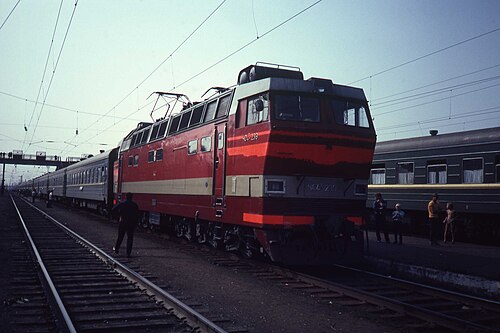
主要な経済の中心地はモスクワ、ミンスク、アスタナである。[要出典]モスクワとミンスクの間の距離は717キロメートル、モスクワとアスタナの間の距離は2700キロメートルであり、インフラは加盟国の統合における重要な課題となっている。 地域ブロックを近代化し、他の市場と接続し、地域の統合と貿易を促進するために、2000年代に主要なインフラプロジェクトが開始された。 2007年、モスクワは2020年までに国のインフラを近代化するために1兆米ドルを投資すると発表した。[144] [145]
カザフスタンは、住民一人当たりの道路距離の点で、世界の他の先進国が住民一人当たりの道路距離がはるかに少ないのに比べて、有利な順位にあります。[146] [147]
鉄道は 19 世紀以来、ユーラシア経済連合の国々を結ぶ主要な手段となっています。ロシア帝国とソビエト連邦では、今日に至るまで鉄道が常に主要な輸送手段となっています。ユーラシア経済連合は、鉄道路線の点で世界第 2 位 (世界シェアの約 7.8%) です。しかし、ユーラシア経済連合内での国境を越えた貿易の改善はまだ模索されています。
ユーラシア開発銀行は、鉄道輸送の需要増大に対応するため、ロシアのチフヴィンとベラルーシのオシポヴィチで新世代の貨車と貨物コンテナを生産する施設の建設を支援することを約束した。内陸国であるカザフスタンは貿易を鉄道に大きく依存しているため、プロジェクトはカザフスタンでも開始されている。
ロシア連邦で最も有名な鉄道は、ロシア極東とモスクワを結ぶシベリア横断鉄道である。南ルートはカザフスタンも経由する。[148] [149]
EAEU加盟国は中国のデジタルシルクロードに協力しており、中国の技術を自国のデジタルインフラに取り入れている。[150] : 187
ユーラシアの空
ユーラシア経済委員会が管理する「シングル・ユーラシア・スカイ」プログラムは、航空サービスの単一市場と単一航空交通管制区の創設を概説している。単一航空交通管制区により、航空会社は新しい飛行経路を策定しやすくなり、その結果、この地域を通過する便数が増加する。ユーラシア委員のダニヤル・アクメトフ氏は、段階的に創設されると述べた。[151] 2014年6月、ベラルーシの航空会社ベラビアは、シングル・ユーラシア・スカイの開発に向けて動く準備ができていると述べた。共通航空市場での運営条件はまだ合意されていないが、このプロジェクトは欧州連合のシングル・ヨーロピアン・スカイをモデルにしたものになる可能性が高い。[152]このプロジェクトは、ユーラシア連合の空域をヨーロッパと東南アジアを結ぶ人気のトランジットハブに変えるのに役立つと報じられている。 「現在、カザフスタンとベラルーシの航空会社はロシアの航空会社と競争できないことを理解すべきだ。したがって、この計画では段階的な導入や競争環境の創出などが想定される」とユーラシア委員のアフメトフ氏は述べた。[153]
農業

ユーラシア経済連合は、テンサイとヒマワリの最大の生産国であり、2012年には世界のテンサイの18.6%、ヒマワリの22.7%を生産した。また、ライ麦、大麦、ソバ、オート麦、ヒマワリの種の最大の生産国でもある。また、ジャガイモ、小麦、穀物(および穀物豆類)の主要生産国でもある。[ジャーナル2]
ユーラシア経済委員会の権限の一部は農業補助金です。委員会は加盟国間の農業政策策定の調整と集団的な食糧安全保障の確保に責任を負っています。ユーラシア開発銀行は農業の統合と発展を促進するプロジェクトに資金を提供しています。2008年から2013年の間に、同銀行はプロジェクトに約4億7000万ドルを支出しました。
予測される経済影響

加盟国は依然として連合に楽観的であり、地域の主要なパートナーである中国、イラン、トルコも引き続き関心を示している。ユーラシア経済連合は今後20年間で大きな可能性を秘めているというのが共通の見解であり、専門家は加盟国のGDPが2030年までに25%成長し、6000億ドルを超えると予測している。[154]この協定により、加盟国の国民は連合全体で雇用と教育を受けることができるようになる。また、農業、エネルギー、テクノロジー、輸送など、多くの分野で協力的な政策が必要になる。[8]これらの協力的な政策は、エネルギー、中央アジアとシベリアの貿易ルート、農産物へのアクセスを求めている アジア諸国にとって特に興味深いものである。
ロシアの元大統領ドミトリー・メドベージェフは、欧州連合の肯定的な経験と否定的な経験の両方が考慮されると述べ、加盟国は同等の経済発展レベルを持ち、共通の歴史と価値観を持っているため、ユーラシア連合ではユーロ圏で見られるような国家間の経済格差や不均衡の問題は回避されると主張した[ 110] 。 [155]
欧州連合、米国、その他の西側諸国はユーラシア経済連合に批判的であり、アナリストらは近代化と真の経済改革がなければ、連合はほとんど影響を及ぼさないと述べている。[8]人気雑誌エコノミストは、連合に参加する利点は依然として不明であるとし[100]、さらに「合意は曖昧で、技術的な詳細は未解決のままであり、経済的なものではなく政治的なショーになっている」と述べた。[156]メディアはまた、ウクライナなしでは、ユーラシア経済連合は連合の成功に必要な主要加盟国を失ったと述べている。ブルームバーグのビジネス雑誌ビジネスウィークは、プーチンのユーラシア連合に参加することはロシアにとっても悪い取引のように見えると断言した。連合は「世界経済のレーダーに実際には記録されないだろう」と、パリのEU安全保障研究所のアナリストは述べた。[157]さらに、ある研究によれば、これまでのところEAEUはアルメニアの経済成長に貢献できず、むしろ逆に国の経済パフォーマンスを大幅に減速させたとのことです。
アジアへの転換
連合は東アジアとの貿易拡大を積極的に模索している。ASEANとの公式貿易協力に向けた協議を開始した。両連合の関係者は、両者間の協力関係を発展させる機会について協議した。[158] 韓国大統領は、西ヨーロッパから東アジアへの輸送、電力、ガス、石油のつながりを模索する「ユーラシア・イニシアチブ」を立ち上げた。[159]このイニシアチブは、中国の長年の「新シルクロード」プロジェクトを彷彿とさせる。[160] 連合のメンバーは、ベトナムとの自由貿易圏創設に関する協議を強化し、商品やサービスに関する情報交換など中国との協力を強化し、イスラエルやインドとの優遇貿易体制を構築するための専門家グループを設立することに合意した。[161]
ロシア

欧州外交評議会とアナリストらは、ユーラシア連合には加盟国、特にロシアにとっての経済的利益だけでなく戦略的利益も含まれると示唆している。ロシアは、欧州と東アジアの双方を結びつけるため、アジア市場へのアクセスを拡大するために東部地域の開発を目指している。ウクライナ危機を受けて欧州連合と米国がロシアに制裁を課して以来、ロシア極東は代替市場に近いことから、さらに重要性を増している。[ジャーナル 5]
ロシアが中央アジア諸国の経済に対する支配力を失った潜在的な理由として、中国が主要貿易相手国として台頭していることが挙げられている。この連合は、中央アジアにおける中国の貿易拡大と欧州連合の東方パートナーシップに対抗する手段とみられている。[ジャーナル 6]
貿易圏が東アジアの経済成長から利益を得ようと努める中、ロシアは東部領土、シベリア、ロシア極東の開発を進めてきた。[journal 5]しかし、ロシアの伝統的な欧州志向と、この地域のインフラの遅れや経済の未発達のため、ロシア極東の開発は困難に直面する可能性がある。[journal 7] 2012年、ロシアのウラジミール・プーチン大統領は、ロシアに対し「ロシア経済の帆に中国の風を当てる」よう求めた。[162]同年、ロシア極東開発省が設立され、ロシアは東部の都市ウラジオストクでアジア太平洋経済協力会議(APEC)首脳会議を主催した。ロシアはまた、協定の締結を開始し、東部領土のインフラ改善に多大な努力を払った。[journal 7] ロシアのアジアへの転換には、ユーラシア貿易圏の構築という重要な課題が含まれていた。各国は、国内開発を維持し、この地域での利益を守ることで競争力を高めようとしている。[ジャーナル 8] ロシアの輸出の推定 76% は、シベリアで採掘 (または製造) された資源に依存している。東アジアからヨーロッパに商品を輸送するには、鉄道でシベリアを経由する必要がある。したがって、この地域は貿易において重要な役割を果たしている。しかし、ロシア西部地域に比べると開発が遅れており、近代化計画が進行中である。
2013年、ロシア政府はトランスシベリア鉄道とバイカル・アムール鉄道の近代化に4500億ルーブル(140億米ドル)を費やすと発表した。ロシアのプーチン大統領はトランスシベリア鉄道を同国の「戦略的に重要な輸送動脈」と呼んだ。2013年7月、プーチン大統領は「極東の港への鉄道貨物輸送量は過去5年間で55%増加し、現在では年間約1億1000万トンに達している」と述べた。同年、モンゴル、中国、北朝鮮との国境にある駅の改修プロジェクトも実施された。[ジャーナル9]
2016年、プーチン大統領はユーラシア経済連合、中国、インド、パキスタン、イラン、CISに対し、「大ユーラシアパートナーシップ」への参加を呼びかけた。[163]
専門家の中には、この連合が中央アジアにおけるロシアの影響力の喪失を抑える手段であると考える者もいる。[ジャーナル 6]ロシアの政治家は、ロシアの長い南の国境とそれがもたらす可能性のある課題について懸念を表明している。中央アジアの近隣諸国の安定を保つために地域貿易ブロックを創設することで、ロシアは自国の国境の安全確保が容易になることを期待している。[164]
カザフスタン
隣国のカザフスタンは、ロシアの東アジア市場へのアクセスの試みを模倣した。2013年9月、中国とカザフスタンの大統領は商業協定に署名し、中国の「新シルクロード」を立ち上げた。2014年5月20日、両大統領は中国の港湾都市連雲港に新しいターミナルを開設し、カザフスタンの鉄道を太平洋につなぐと発表した。中国はまた、カザフスタンのエネルギー部門へのさらなる投資を行う協定に署名した。両国は、シムケントの石油精製所の近代化に10億ドル、アルマトイ近郊に新しい石油・ガス工場を開設するためにさらに1億5000万ドルを拠出すると発表した。カザフスタン大統領はまた、中国企業のトップと会談し、航空機製造、通信、鉱業の分野で協力することに合意した。[ジャーナル10]
第三国との経済関係
欧州連合はベトナムと初の自由貿易協定[165]を締結しており、この協定はすべての締約国による批准を経て2016年10月に発効する予定である。[166] [167]
2012年11月にベトナムの自由貿易協定(FTA)実現可能性調査を完了し[168]、当時の関税同盟(後にEAEUとなる)は交渉を進めることを決定した。FTA交渉は2013年初頭に始まり、約2年続いた。2015年5月29日、協定はすべての締約国の首相によって署名され、その後締約国によって批准された。2011年のベトナムと関税同盟間の貿易額は22億4000万米ドルであった[169] 。
ロシアの経済発展大臣は、トルコのニハト・ゼイベクチ経済大臣が、ユーラシア経済連合とトルコ間の自由貿易圏の形成を含む、ユーラシア経済連合とのより緊密な協力に向けた取り組みを提案したと述べた。[170]
ロシアのアルカディ・ドヴォルコヴィッチ副首相が2013年12月9日に発表したように、イスラエルはユーラシア経済連合との自由貿易交渉の開始を検討している。[171]両者の間で実現可能性調査が行われ、自由貿易交渉を進めることが決定され、2016年末までに開始される予定である。専門家は、交渉が終了するまでには2~3年かかると考えている。[172]
ロシアのプーチン大統領は、 2014年7月のロシア連邦大使および常駐代表者会議で、欧州連合とユーラシア経済連合の間の自由貿易地域について議論する用意があると述べた。 [173]
2015年2月、エジプトのアブドルファッターハ・エルシーシ大統領は、同国がユーラシア連合と自由貿易協定を締結すると発表した。[要出典]予備的な実現可能性調査が実施されており、交渉プロセスを開始する決定は2016年末までに行われる予定である。[174]
30か国以上と自由貿易交渉に関する協議が行われており、そのうちのいくつかは予備的な実行可能性調査に至っています。このような実行可能性調査はインドと韓国との間で実施されています。
2015年5月、EUはイランとの自由貿易協定の締結を初めて承認した。ユーラシア経済委員会の貿易担当大臣アンドレイ・スレプネフは、エレバンで行われたEAEUの専門家会議で、イランをEAEUの「中東における重要なパートナー」と評し[要出典] 、ヴィクトル・フリステンコは、イランはEAEU加盟国すべてにとって重要なパートナーであるとさらに指摘した。彼は「EAEUとイランの協力は、この地域の経済的安定を強化するための我々の重要な取り組み分野である」と述べた[175] 。 2015年12月、イランとEAEUの間で「暫定協定」が締結され、アンドレイ・スレプネフ委員はこれを「イランとEU間の自由貿易の実現に向けた第一歩」と評した[要出典] 。
自由貿易と経済協力の分野における重要な取り組みの一つは、ユーラシア経済統合と中国の戦略的「シルクロード経済ベルト」プロジェクトを「結びつける」という提案である。関連する声明は、 2015年3月8日にロシアのウラジミール・プーチン大統領と中国の習近平国家主席によって署名された。[176]「結びつける」とは主にインフラ投資の支援と理解されているが、EAEUと中国の間では「政治的要素のない、ビジネスを重視し障壁を減らす開放的な経済構造」を構築するための「貿易経済協定」に関する交渉が進行中である。[177]
2023年現在、インドネシアおよびアラブ首長国連邦との交渉も順調に進んでいる。イランおよびエジプトとの交渉はほぼ完了している。EECは中国との現行協定の改定も準備している。現在の非特恵協定は2019年10月に発効し、関税の引き下げは規定されていない。[178]
第三国EAEU協定

2015年1月1日以降、EAEU加盟国はユーラシア経済連合条約(第35条)に基づき超国家レベルに権限を委譲したため、 独自に物品の自由貿易協定を締結する権利を持たない。 [179]
ユーラシア経済委員会のウェブサイトによると、EAEUは二国間協定(一方の当事者は「ユーラシア経済連合とその加盟国」)を締結している。[180]
- ベトナム[181] [182](2015年5月29日に署名、2016年10月5日に発効[183] 、この自由貿易協定および経済統合協定は物品貿易とサービス貿易を対象としている[184] [185])
- イラン[186](暫定協定は2018年5月17日に署名され、2019年10月27日に発効した[187]。この自由貿易協定は物品貿易を対象としている。[188])完全なFTAは2023年12月25日に署名された。[189]
- 中国(2018年5月17日に署名、2019年10月25日に発効[190]。この協定は関税の引き下げを規定していないため自由貿易協定ではないが[178]、EU全体と中国との間の貿易・経済協力の法的枠組みを構築し、税関協力、貿易の技術的障壁、衛生植物検疫措置、貿易保護措置、電子商取引の問題、知的財産、競争と公共調達、分野別協力などの問題に取り組む[191] [192])
- セルビア[193](2019年10月25日に署名され、2021年7月10日に発効[194]、この自由貿易協定は物品貿易を対象としている[195])
- シンガポール(EAEU-シンガポール枠組み協定およびEAEU-シンガポール自由貿易協定は2019年10月1日に署名された[196])
公式には、エジプト、インド、 [197] [198]インドネシア、イラン、イスラエル[199]およびUAEとの協定が策定中であり、モンゴルとの交渉を開始する可能性が検討されている。 [180]
2015年以前の物品自由貿易協定
.svg/500px-CISFTA_(orthographic_projection).svg.png)
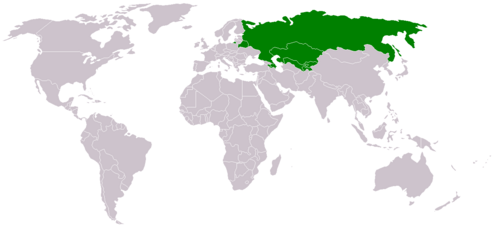
Although the countries of the Eurasian Economic Union have delegated their powers to conclude free trade in goods agreements to the supranational level according to the Treaty on the Eurasian Economic Union (Article 35),[179] the previous agreements with third countries concluded before 1 January 2015 continue to be in force (Article 102).[201] According to the Article 102: "Member States have the right to unilaterally grant preferences in trade with a third party on the basis of an international agreement concluded by 1 January 2015 of this Member State with such a third party or an international agreement to which all Member States are parties."[201] Thus, agreements such as those within the Commonwealth of Independent States (the terms of the CIS FTA allow member states to enter into the FTA agreements with other countries, as well as to join/create custom unions.[202]) and bilateral agreements that do not regulate relations with third countries remain in force for their parties.
The 1994 CIS FTA Agreement, 1999 CIS FTA Protocol (multilateral free trade is in force among 10 countries) and 2011 CIS FTA Treaty (multilateral free trade is in force among 9 countries) have signed by all members of the EAEU. The multilateral free trade regime under the 1999 Protocol is not applied by Russia at all. As of 2023, the Protocol has entered into force for Armenia, Azerbaijan, Belarus, Georgia, Kazakhstan, Kyrgyzstan, Moldova, Tajikistan, Uzbekistan and Ukraine and 1 reservation was made by Azerbaijan on non-application in relation to Armenia and 2 specific opinions were expressed by Georgia and Ukraine.[200]
2011 Commonwealth of Independent States Free Trade Area was negotiated before the establishment of the EEU on 1 January 2015. The CISFTA treaty came into force at different dates for every state. The treaty came into force in Armenia, Belarus, Kazakhstan and Russia at different dates between September and December 2012. Meanwhile, Kyrgyzstan applied the treaty starting 13 December 2013. In force since 2012, the 2011 multilateral CIS Free Trade Zone Treaty establishes a free trade area between Armenia, Belarus, Kazakhstan, Kyrgyzstan, Russia (now all EAEU member states), as well as Ukraine, Uzbekistan, Moldova and Tajikistan. Russia has suspended the Agreement with respect to Ukraine from 1 January 2016, following the provisional application of the DCFTA between the European Union and Ukraine.[203] Ukraine did the same thing on 2 January with regard to Russia.
Thus, in addition to all previous multilateral agreements, the following agreements apply on a bilateral basis according to the article 102. Bilateral free trade agreements with Azerbaijan, Georgia, Turkmenistan, Serbia and Montenegro are in force in Russia.[204] Bilateral free trade agreement with Turkmenistan is in force in Belarus.[205] Bilateral free trade agreement with Turkmenistan is in force in Armenia.[206]
Cooperation, Trade in Services and Investment Agreements

The members of the EAEU may conclude an agreement on investment and trade in services without the consent of EAEU supranational bodies, since these powers have not been transferred to a supranational level, however according to the Treaty on the Eurasian Economic Union (Article 35), an international treaty of the EAEU with a third party establishing a free trade regime may include other provisions related to foreign trade activities[179] (i.e. Cooperation, Trade in Services and Investment). All Members of the Union retains autonomy (i.e., national competence) in matters of concluding agreements on free trade in services and investments. The process of concluding such agreements with third countries is carried out independently of the partners in the Union. The only condition prescribed in the Treaty on the EAEU is the obligation to provide to the Member States of the EAEU the same concessions, which are granted to the partner (partners) under that agreement (Article 38 of the Treaty and section 6 of Annex No. 16 to the Treaty).[207]
The 2015 EAEU-Vietnam Free Trade Agreement & Economic Integration Agreement covers trade in goods and trade in services.[184][185]
The Armenia–EU Comprehensive and Enhanced Partnership Agreement was signed by Armenia and all EU member states on 24 November 2017.[208]
Russia has concluded 82 agreements on mutual protection of investments and investment promotion, including agreements with Cambodia, Iran, Morocco and the State of Palestine, which were signed after 1 January 2015. 65 agreements have entered into force.[209]
On 8 June 2023, in Sochi, Armenia, Belarus, Kazakhstan, Kyrgyzstan, Russia, Tajikistan and Uzbekistan signed the Commonwealth of Independent States Agreement on Free Trade in Services, Establishment, Operations and Investment to partly integrate Uzbekistan and Tajikistan on the common standards of the WTO (General Agreement on Trade in Services) and the EAEU even without their membership in the WTO (Uzbekistan) or the EAEU (Uzbekistan and Tajikistan).[210] Uzbekistan and Tajikistan have not decided to join the EAEU, but bringing country's legislation to the EAEU common standards can be considered as the first step.
The Ambassador of the United Arab Emirates in Moscow said that the UAE is striving for a free trade agreement by the end of 2023 with the EAEU to include provisions on trade in services and investment.[211]
Unilateral preferences for economic assistance
The EAEU has the Common System of Tariff Preferences for approved goods from 29 developing and 48 least-developed countries.[212] As of 5 March 2021, they are Algeria, Bolivia, Vanuatu, Venezuela, Ghana, Honduras, Egypt, Zimbabwe, Iran, Cabo Verde, Cameroon, Kenya, Republic of the Congo, Democratic People’s Republic of Korea, Côte d'Ivoire, Cuba, Morocco, the Marshall Islands, Federal States of Micronesia, Mongolia, Nigeria, Nicaragua, Pakistan, Papua New Guinea, Tunisia, the Philippines, Sri Lanka, El Salvador, Eswatini on the 1 list and Angola, Islamic Republic of Afghanistan, Bangladesh, Benin, Burkina Faso, Burundi, Bhutan, Haiti, Gambia, Guinea, Guinea-Bissau, Djibouti, Zambia, Yemen, Cambodia, Kiribati, Union of the Comoros, Democratic Republic of the Congo, Lao People’s Democratic Republic, Lesotho, Liberia, Mauritania, Madagascar, Malawi, Mali, Mozambique, Myanmar, Nepal, Republic of the Niger, Palestine(according to the United Nations General Assembly Resolution 43/177), Rwanda, Democratic Republic of Sao Tome and Principe, Senegal, Syrian Arab Republic, Solomon Islands, Federal Republic of Somalia, Sudan, Sierra Leone, Tanzania, Timor-Leste, Togolese Republic, Tuvalu, Uganda, Central African Republic, Chad, Eritrea, Ethiopia, South Sudan on the 2nd list.[213]
The system of tariff preferences is aimed at promoting the economic growth of countries that objectively need economic assistance from the Union. In 2021, a decision was published to exclude 75 developing countries and 2 least developed countries from the lists, but at the same time, the status of the beneficiary country of the common system of tariff preferences of the EAEU is preserved for states in need of economic assistance from the EAEU.[214] The first list of countries was approved in 2009 and did not change dramatically until 2021. As of May 2020, there were 153 countries in it, including Turkey, Brazil, Argentina, China and South Korea. The list was revised in 2021 so that there would be no injustice when lower-income countries provide tariff preferences to high-income countries. A country can obtain for tariff preferences if its income level is determined by the World Bank as "low-income" or "lower-middle-income", that is, the gross national income per capita in such a country is less than $4,045.[215] The import duties applicable to products eligible for tariff preferences and originating from developing countries were at the level of 75% of the Most favoured nation duty rates and from least-developed countries at the level of 0%.[216]
At the same time, the members of the Union themselves are recipients of tariff preferences. Kyrgyzstan was granted preferences from Canada, the United Kingdom, the EU, Japan, Norway, Switzerland, Turkey and the United States.[217] Armenia was granted preferences from Canada, the EU, Japan, Norway, Switzerland and the United States.[218] Belarus was granted preferences from Japan, Norway and Switzerland.[219] Kazakhstan was granted preferences from Japan, Norway, Switzerland and the United States.[220] In 2013, the World Bank announced that Russia had graduated to a high-income economy based on the results of 2012[221][222][223] but in 2016 it was reclassified as an upper-middle income economy[224][225] due to changes in the exchange rate of the Russian ruble, which is a floating currency. Thus, Russia does not have these preferences.[226]
International cooperation and interaction
International cooperation and interaction with third countries, other integration associations and international organizations[227] can happen under legal framework for international cooperation, including the Treaty on the Eurasian Economic Union, Procedure for the EAEU International Cooperation, Main Directions of the EAEU International Activities, Regulation on the Procedure for Admission of New Members to the EAEU and Termination of Membership in the EAEU, Regulation on the Observer State Status at the EAEU and Strategic Directions for Developing the Eurasian Economic Integration.[228]
According to the commission's website, over the years memoranda, events and statements have been adopted with third countries and international organizations, including the Cabinet of Ministers of Ukraine, Ministry of Commerce of the People's Republic of China, United Nations Conference on Trade and Development (UNCTAD), United Nations Economic Commission for Europe, Ministry of Trade, Industry and Energy of the Republic of Korea, Ministry of Foreign Trade of the Republic of Ecuador, International Trade Center, MERCOSUR, and OECD.[229][230][231]
The commission's website has published information and news on international cooperation (documents, memoranda, visits, summits, events, conferences, negotiations with officials, representatives and ambassadors, etc.) [232] with dozens states (namely Austria, Angola, Bangladesh, Bolivia, Brazil, Venezuela, Guatemala, Germany, Greece, India, Indonesia, Jordan, Iran, Spain, Cambodia, Cameroon, Canada, Kenya, China, Colombia, Cuba, Luxembourg, Mauritius, Morocco, Mexico, Moldova, Mongolia, Myanmar, Nicaragua, New Zealand, UAE, Peru, Portugal, Serbia, Singapore, Slovakia, USA, Tajikistan, Thailand, Tunisia, Uzbekistan, Faroe Islands, Philippines, France, Czechia, Chile, Ethiopia[233]) and dozens regional associations and international organizations (Andean Community, ASEAN, Asia-Pacific Economic Cooperation, BRICS, African Union, East African Community, Dialogue on Cooperation in Asia, European Union, Latin American Economic System (SELA), MERCOSUR, Organization for Security and Co-operation in Europe, Organization of the Black Sea Economic Cooperation, Subsystem for economic integration in Central America, CICA, CIS, Union State of Russia and Belarus, Pacific Alliance, Shanghai Cooperation Organisation, Economic Community of Central African States (ESCA), ECOSOC, United Nations Economic and Social Commission for Asia and the Pacific, UNCTAD[234]). According to the commission's website, for the purpose of forming favorable conditions for the development of interaction with the EAEU and as the first step to institutionalize cooperation, it has become a practice in the EEC to conclude memoranda of cooperation (third countries, regional integration associations and international organizations). Broad cooperation in the format of memoranda of cooperation is established with the governments of Bangladesh, Jordan, Indonesia, Cambodia, Cuba, Morocco, Moldova, Mongolia, Peru, Singapore, Thailand, the Faroe Islands and Chile, as well as with the Andean Community, the Association of South East Asian Nations (ASEAN), the African Union, the Pacific Alliance, the Latin American Economic System (SELA) and the Southern Common Market (MERCOSUR). The EEC interacts with the Government of Greece in the format of a joint declaration.[235]
There are various formats of interaction between third states and the Eurasian Economic Union. One of the simplest formats is obtaining the observer status at the Union. The Supreme Eurasian Economic Council, the highest supranational body of the Eurasian Economic Union, granted observer state status to the Republic of Moldova, the Republic of Cuba and the Republic of Uzbekistan.[236]
Foreign affairs
The Eurasian Economic Union mainly uses its arms industry,[237] raw materials,[238][239] gas and oil reserves,[citation needed] and railways[240][241] as its key assets for trade with foreign countries.
Although Russia is the only member of the Eurasian Economic Union under sanctions from the West, other members of the Eurasian Economic Union have repeatedly used the bloc as a platform to articulate their opposition to sanctions and trade wars.[242]: 16
Economic partners
The Eurasian Economic Union must negotiate as a whole to sign free trade agreements with other countries. Key players for the Eurasian Economic Union are the European Union, Turkey, Iran, China and the Korean peninsula. The EAEU has sought to increase its trade with partners in the Middle East and East Asia in order to profit from the growing trade between Europe and Asia.
Because of disagreements with the Eurasian Economic Union's largest member, Russia, the European Union does not officially recognize the Eurasian Economic Union.[242]: 19 Tensions with the European Union in 2014 have led both unions to pressure post-Soviet states to join their integration unions. Both sides have accused each other of carving spheres of influence.[243][244] Members of the union, especially Russia have tried to diversify their trade by signing economic agreements with China,[245] Iran[246] and Turkey.[247] Trade with North and South Korea has also risen.[248][249][250]
A rising China has been increasingly interested in Central Asia and the Eurasian Economic Union.[251] Analysts see the union as a potential way China could facilitate its investments in the region.[252] Historically, China held close economic ties with many countries throughout Eurasia. Under the Han Dynasty, its trade routes extended to the Roman Empire. The Economy of the Han Dynasty and other subsequent dynasties exchanged numerous goods with countries throughout Europe and Asia. Both China and the union have stated they would benefit from recreating trade routes modelled on the historic Silk Road.[253]
Railways transport goods from China to the European Union through Kazakhstan and Russia. The country has pushed for the construction of more railway lines to connect Berlin to east China to reduce shipping time. It proposed major high-speed railway lines going towards Europe via Russia and Kazakhstan and another through the Middle East via Tajikistan, a potential future member for the union.[254][255] China has signed numerous energy deals with Russia and Kazakhstan, as it tries to move from coal to less pollutant alternatives.[256][257]
Iran has sought to diversify its economy as well, seeing the EAEU and China as key economic partners. Relations between Russia and Iran have increased as both countries are under U.S. sanctions and are seeking new trade partners. in 2014 the two countries signed a historic US$20 billion energy deal.[258][259] A free trade agreement between Iran and the Eurasian Economic Union came into force on 27 October 2019.[260]
Kazakhstan seeks to enhance its ties with Turkey, a key player in the region. In July 2014, Turkey announced closer economic ties with the EAEU, including a possible free trade agreement in the near future.[261]
Armenia and Nagorno-Karabakh

In September 2013, Armenia announced its intentions of joining the Customs Union of Belarus, Kazakhstan and Russia. At the time of joining the Union, the Republic of Armenia already had preferential treatment within the framework of the CIS as a party to the Free Trade Zone Agreement of 18 October 2011, and therefore enjoyed significant tariff benefits. According to an IMF representative in Armenia, Armenia's membership to the Eurasian Economic Union resulted in about $250 million a year in customs revenue. Armenia also benefited in the form of secured privileges for 752 products until 2020, which implies no EAEU tariffs due to Union membership.[262] Joining the Union allowed the country to get even more tangible economic effects due to the functioning of the Common Economic Space, the use of common technical regulation, sanitary and phytosanitary measures, non-tariff regulation. Such results confirm that for the implementation of full-scale freedom of movement of goods, liberalization of tariff regulation alone is not enough.[263] The region of Nagorno-Karabakh, however, is disputed between Armenia and Azerbaijan. Tensions rose further in the Caucasus region on 30 July 2014 due to clashes between Armenian and Azerbaijani soldiers.[264]
Experts estimate that with the accession of Armenia, the internationally unrecognised Nagorno-Karabakh Republic would not be integrated into the Eurasian Union.[263] Armenia is a permanent political, military and economic ally of Russia, whereas Azerbaijan holds close ties with Armenia's long-standing enemy Turkey. The Kazakh President Nursultan Nazarbayev expressed concern in 2013 that no reliable customs border between Armenia and Nagorno-Karabakh could be drawn. However, Nazarbayev expressed that he holds all the existing disagreements preventing Armenia's integration into Eurasian Economic Union are surmountable.[265] The Chairman of the Foreign Policy Committee in the Armenian Parliament, Artak Zakarian, announced on 14 May 2014 that Armenia will not build any customs borders, including with the region of Nagorno-Karabakh.[266]
According to Eurasian Economic Commission statistics, Eurasian Economic Union countries experienced a 1.9% GDP increase between January–June 2018, compared to the same period in 2017. Armenia had the greatest GDP growth index throughout the reporting period – 8.3%. The EEU's industrial output increased by 3.3%, with reprocessing industry increasing by 62.7% and mining increasing by 27.9%. Again, Armenia had the largest growth in industrial production – 9.6% – despite a 12.7% fall in mining.[267]
Uzbekistan, Tajikistan and Kyrgyzstan
Previously, Tajikistan was on track to become a potential member of the union, having signed the treaty on the Eurasian Customs Union and the Single Economic Space. However, due to border disputes between Kyrgyzstan and Tajikistan, the integration process in Tajikistan has stalled.[78][79][268] Both countries exchanged fire in December 2013 and August 2014, which resulted in casualties.[268][269][270] Both countries have since announced they would resolve conflicts and improve border cooperation. Officials hope to make significant progress by the end of 2015.[271][272] In March 2020, Uzbekistan announced that it wished to become a Eurasian Union observer state.[95]
International response
Former President of the European Commission José Manuel Barroso stated at the World Economic Forum that the EU supports the regional integration, including the Eurasian Union. He also praised Kazakhstan for joining the bloc. He criticized the post-Soviet space, saying "the integration in the region is not sufficient". However, he warned that the Russo-Ukrainian War is a major obstacle to good cooperation between the EU and the Eurasian Union.[273][274]
Tensions between the EAEU and the European Union (EU) occurred as both have sought to deepen their ties with several former Soviet republics. The EU has signed free trade agreements with Ukraine, Moldova and Georgia. However, separatists in all three countries back closer ties with Russia. Ukraine planned to sign an EU association agreement in 2013, but abruptly cancelled the signing under Russian pressure to join the EAEU. This led to mass protests against Ukraine's president,[275] with the EU supporting a failed political settlement before president Yanukovych fled to Russia,[276] and Russia then annexing the Crimean peninsula (following a disputed referendum) and supporting separatists in Eastern Ukraine.[277][278] In response, some member states of the European Union have sought to find alternatives to Russian gas, while others have voiced their support for the construction of the South Stream pipeline which circumvents Ukraine. Later the already started construction of the pipeline, under US sanctions on Russia and pressure on EU, the project was abandoned. Analysts believe Russia backs the Eurasian Economic Union in order to limit western influence in the region.[279]
Western analysts generally see the Eurasian Economic Union as a way to reunite many of the former Soviet republics. For example, Washington Post author Abigail Hauslohner wrote the treaty was intended "to further bolster [Russia]'s ties to former Soviet republics."[8] The United States expressed its opposition to the Eurasian Union, claiming it is "an attempt" to re-establish a USSR-type union among the former Soviet republics.[280] In December 2012, former Secretary of State Hillary Clinton claimed "It's not going to be called that [Soviet Union]. It's going to be called customs union, it will be called the Eurasian Union and all of that, but let's make no mistake about it. We know what the goal is and we are trying to figure out effective ways to slow down or prevent it".[280]
Kazakhstan's president Nursultan Nazarbayev called it "a hard-won achievement" and "a blessing for our people."[8] Public support in Kazakhstan for the country's accession to the EAEU stood at 68% in June 2014, with 5.5% opposed.[281]
Thailand, Iran, New Zealand, Tunisia,[282] Turkey, and Vietnam are among the countries that expressed a desire to conclude trade agreements with the new Eurasian Economic Union after the treaty was signed.[283] In 2018, the Faroe Islands signed a new memorandum of understanding with the EEU. The MoU is designed to boost trade and cooperation between the two sides.[284]
Existing integration projects

The Eurasian Customs Union has already brought partial economic integration between the three states, and the Eurasian Economic Union is said to be a continuation of this customs union.[26] However, the impact or legacy of that agreement is unclear[285] – trade between the three states actually fell 13% during the agreement's first year.[100]
A number of other regional organisations also provide the basis for further integration: the Union State of Russia and Belarus; the Collective Security Treaty Organisation, consisting of Armenia, Belarus, Kazakhstan, Kyrgyzstan, Russia and Tajikistan; and the Commonwealth of Independent States comprising most of the post-Soviet countries.[journal 11][286][287]
Geography
The Eurasian Economic Union is located at the eastern end of Europe, bounded by the Arctic in the north, the Pacific Ocean to the east and East Asia, the Middle East and part of Central Asia to the south. It lies between latitudes 39° and 82°N and longitudes 19°E and 169°W. The union extends across much of northern Eurasia. Its member states cover an area of over 20,000,000 square kilometers, which is approximately 15% of the world's land surface.[288]
The Eastern European Plain encompasses Belarus and most of European Russia. The plain is mostly mountain-free and comprises several plateaus. Russia's northernmost regions are tundra. The Russian Tundra is located on the coastline with the Arctic and is known for its total darkness in the winter. Taiga reaches Russia's southern borders in Siberia and accounts for 60% of the country.[289] Towards the Ural Mountains and in northern Kazakhstan, the climate is mostly temperate. Southwestern Russia and Kazakhstan are mostly steppe. The Kazakh steppe covers one-third of Kazakhstan and is the world's largest dry steppe region.[290] Armenia is mostly mountainous and its climate is continental. The landlocked country shares no direct border with other members states. It is located in the southwestern part of Asia, occupying the northeastern part of the Armenian Plateau, and is located between the Caucasus and the Near East.[291]
A large number of lakes and rivers are found in the Eurasian Economic Union.[292] Major lakes include Ladoga and Onega, two of the largest lakes in Europe. The largest and most prominent of the union's bodies of fresh water is Lake Baikal, the world's deepest, purest, oldest and most capacious fresh water lake.[293] The Baikal lake alone contains over one-fifth of the world's fresh surface water. Russia is second only to Brazil in volume of the total renewable water resources. Of the union's numerous rivers,[294] the Volga is the most famous, not only because it is the longest in Europe, but also because of its major role in history. In Siberia the Ob, Yenisey, Lena and Amur are among the longest rivers in the world.
The Eurasian Economic Union's highest peak is the Khan Tengri in the Tian Shan mountains, Kazakhstan, 7,010 m above sea level. The lowest point in the Eurasian Economic Union is the Karagiye Depression in Kazakhstan. Kazakhstan's Caspian shore includes some of the lowest elevations on Earth. According to a 2005 estimate by the United Nations, forests cover 40% of Belarus. 11,000 lakes and many water streams are found in the country.[295] Russia is known for its extensive mineral and energy resources, the largest reserves in the world, making it the world's largest producer of oil and natural gas.[296]
According to estimates, the Eurasian Economic Union's population of 176 million people is mostly urbanized, with Russia and Belarus having over 70% of their population living in urban areas. In Armenia over 64% of the population lives in urban areas. Kazakhstan's urban population comprises 54% of the country's total population.[297]
-

-
 Mountain range – Armenia
 -
 Lama River – in the Moscow region of Russia
 -

-

-
 Winter – Belarus
 -

-
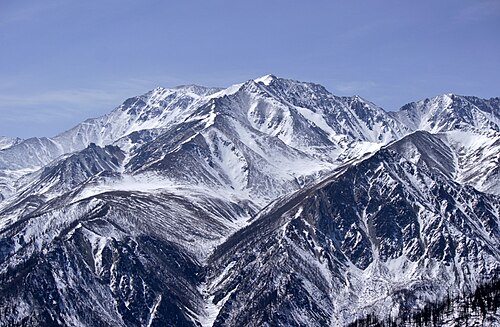
-

-
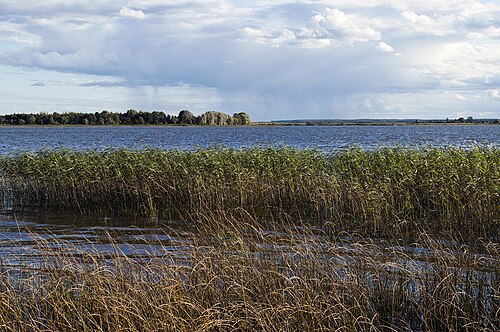 Lake Servech – Belarus
 -
 Winter in the Altai Krai – Russia
 -
 Tian Shan mountain range – Kyrgyzstan

.jpg/500px-Bringing_the_sheep_home,_on_the_southern_shore_of_Issyk-Kul_(3968109583).jpg)

.jpg/500px-%D0%9A%D0%B0%D1%81%D0%BC%D0%B0%D0%BB%D0%B8%D0%BD%D1%81%D0%BA%D0%B8%D0%B9_%D0%BB%D0%B5%D0%BD%D1%82%D0%BE%D1%87%D0%BD%D1%8B%D0%B9_%D0%B1%D0%BE%D1%80_2005_%D0%B3%D0%BE%D0%B4._(%D0%90%D0%BB%D1%82%D0%B0%D0%B9%D1%81%D0%BA%D0%B8%D0%B9_%D0%BA%D1%80%D0%B0%D0%B9._%D0%A0%D0%BE%D1%81%D1%81%D0%B8%D1%8F).jpg)
Demographics
The combined population of all member states is 183,319,693 as of 2015.

The Eurasian Economic Union has 17 cities with more than 1 million inhabitants, the largest being Moscow. The most densely populated areas are the capital cities of member states and European Russia. Siberia is the region with the least inhabitants. In Russia about 160 different ethnic groups and indigenous peoples live within the country's borders.[301] Kazakhstan and Belarus are home to sizable ethnic Russian minorities. Though the member states of the Eurasian Economic Union's populations are comparatively large, its density is low because of the enormous size of Russia and Kazakhstan. The Eurasian Economic Union's average birth rate in 2010 was roughly 12.5 births per 1000 people, higher than the European Union, which has an average of 9.90 births per 1000 people.
See also
- ASEAN
- Collective Security Treaty Organization
- Comecon
- Community for Democracy and Rights of Nations
- Enlargement of the Eurasian Economic Union
- Eurasian Economic Community
- Eurasian Patent Convention
- Eurasian Patent Organisation
- Eurasianism
- Soviet Union
- New Union Treaty
- Union State
- Warsaw Pact
- List of multilateral free-trade agreements
Notes and references
Footnotes
- ^ EAEU is the acronym used on the organisation's website. However, many media outlets use the acronym EEU.
- ^ These numbers only reflect the official budget (direct money) allocated for the functioning of the union. Vast amounts of additional funds come from national governments and other institutions to ease, promote or facilitate Eurasian integration.
Journal articles and studies
- ^ "Russian Federation" (PDF). Organisation for Economic Co-operation and Development. Retrieved 7 July 2014.
- ^ a b c d e f g h "Eurasian economic integration: figures and facts" (PDF). Eurasian Economic Commission. Retrieved 7 July 2014.
- ^ Steven Blockmans; Hrant Kostanyan; Ievgen Vorobiov (December 2012). "Towards a Eurasian Economic Union: The challenge of integration and unity" (PDF). Centre for European Policy Studies. pp. 4–5.
Given the distances between major economic centres, the transportation costs appear to be much higher in the case of trade within the CU than within the EEC. Besides, there is significant asymmetry in the distance between Russia's and Belarus' economic centres and those of Russia and Kazakhstan, which affects intra-bloc trade flows. This factor might significantly impede the envisaged positive effects of removing tariff barriers to trade and increasing labour mobility, and will therefore require greater efforts to ease cross-border trade, such as improving transport infrastructure.
- ^ Eurasian Union Brochure 2014 – English (PDF). pp. 26–27. Retrieved 8 July 2014.
- ^ a b Alexander Gabuev (May 2014). Liik, Kadri (ed.). Russia's Pivot to Asia: The development of the Russian Far East (PDF). London: European Council on Foreign Relations. p. 84. ISBN 978-1-910118-03-0. Retrieved 4 September 2014.
This Asian vector of Russian domestic and foreign policy is now becoming even more important as the European Union and the United States impose sanctions on Russia. The Russian Far East, with its proximity to Asia, could become the new backbone of the Russian economy
- ^ a b Yesdauletova, Ardak; Yesdauletov, Aitmukhanbet (1 March 2014). "The Eurasian Union: Dynamics and Difficulties of the Post-Soviet Integration" (PDF). Trames (1): 12–13. Retrieved 4 September 2014.
The Single Economic Space, which in the near future will be transformed into the Eurasian Union, has strategic aims as well as economic ones. Marlene Laruelle and Sebastien Peyrouse, both share this opinion about the diminution of Russia's influence on Central Asian countries. However, the Kremlin continues to conduct an active policy aimed at maintaining effective tools to influence the Central Asia region.
- ^ a b Timofei Bordachev (May 2014). Liik, Kadri (ed.). Russia's Pivot to Asia: Eurasian Russia in the twenty-first century (PDF). London: European Council on Foreign Relations. p. 27. ISBN 978-1-910118-03-0. Retrieved 4 September 2014.
In the first months of 2014 the work of the recently created Ministry for the Development of the Far East was significantly reinvigorated. Some governmental agencies were relocated from Moscow to Vladivostok and some major companies have been advised to follow with their main offices. But Russia's "pivot" is still held back by its backward infrastructure, its corruption, its underdeveloped economy, its demographic problems, and above all its archaic Eurocentric economic thinking.
- ^ Vladislav Inozemtsev (May 2014). Liik, Kadri (ed.). Russia's Pivot to Asia: Russia turns east: Eurasian integration, regional development, and the West as East (PDF). London: European Council on Foreign Relations. p. 62. ISBN 978-1-910118-03-0. Retrieved 4 September 2014.
He said the creation by 2015 of a Eurasian Economic Union was the most important task facing Russia in its "near abroad.
- ^ Alexander Gabuev (May 2014). Liik, Kadri (ed.). Russia's Pivot to Asia: The development of the Russian Far East (PDF). London: European Council on Foreign Relations. p. 80. ISBN 978-1-910118-03-0. Retrieved 4 September 2014.
The Asia-Pacific Economic Cooperation (APEC) summit held in Vladivostok in September 2012 cost the state 680 billion roubles (over $22 billion) – one-third of which came from the federal budget, with the rest put up by state companies such as Gazprom. In 2012 the Ministry for the Development of the Russian Far East was created and in 2013 long-time Putin ally Yury Trutnev was appointed to oversee the development of the region in the joint role of deputy prime minister and presidential envoy to the region. In 2013 the government also allocated 300 billion roubles ($10 billion)[...]
- ^ Ernesto, Gallo (4 June 2014). "Kazakhstan's "Pivot to China"?" (PDF). Policy Brief (154). Retrieved 4 September 2014.[permanent dead link]
- ^ Brusis, Martin. "A Eurasian European Union? Relaunching Post-Soviet Economic Integration" (PDF). European Consortium for Political Research. pp. 8, 13.
Online sources
- ^ Taylor & Francis (2020). "Republic of Crimea". The Territories of the Russian Federation 2020. Routledge. ISBN 978-1-003-00706-7.
Note: The territories of the Crimean peninsula, comprising Sevastopol City and the Republic of Crimea, remained internationally recognised as constituting part of Ukraine, following their annexation by Russia in March 2014.
- ^ a b "Countries by Area". Nations Online Project. Retrieved 26 August 2014.
- ^ a b c d "Report for Selected Countries and Subjects: October 2023". International Monetary Fund. Retrieved 26 October 2020.
- ^ "Страницы - DisplayDocument.aspx". Archived from the original on 17 April 2016. Retrieved 9 April 2016.
- ^ "Member States of the EEU". Eurasian Commission. Retrieved 5 August 2015.
- ^ Farchy, Jack (23 December 2014). "Eurasian unity under strain even as bloc expands". The Financial Times. Retrieved 26 December 2014.
Kyrgyzstan on Tuesday a signed the Treaty to join the Eurasian Economic Union, expanding the membership of Moscow-led project to five even as its unity is strained by the market turmoil gripping Russia.
- ^ "Eurasian Economic Union to Launch on 1 January". The Trumpet. 24 December 2014. Retrieved 26 December 2014.
Russia, Belarus, Kazakhstan, Armenia and Kyrgyzstan agreed to a January 1 inauguration.
- ^ a b c d e "Russia, Kazakhstan, Belarus form Eurasian Economic Union". The Washington Post. 29 May 2014. Retrieved 1 June 2014.
- ^ a b "Eurasian Economic Union to have common currency in 5–10 years". Retrieved 26 July 2014.
- ^ "What is the Eurasian Economic Union?". Chatham House – International Affairs Think Tank. 15 July 2022. Retrieved 5 February 2023.
- ^ Article 8 and 10, Treaty on the Eurasian Economic Union
- ^ "Factual presentation". wto.org. Retrieved 25 February 2024.
- ^ https://docs.eaeunion.org/docs/ru-ru/0054920/itot_06112012 [bare URL]
- ^ https://docs.eaeunion.org/docs/ru-ru/0055079/itot_06112012 [bare URL]
- ^ https://docs.eaeunion.org/en-us/pages/alldocuments.aspx#npbdocumentbelongstaxId=%5B%7B%22id%22%3A%22b591e83f-0f9a-4fce-8760-758ac7690c84%22%2C%22title%22%3A%22International%20treaties%22%7D%5D&sort=%22npbdocumentdate_ascending%22 [bare URL]
- ^ a b "WTO | Regional trade agreements". rtais.wto.org.
- ^ "Russia Economic Conditions in Mid-1996". Library of Congress. Retrieved 7 July 2014.
- ^ Alexandrov, Mikhail. Uneasy Alliance: Relations Between Russia and Kazakhstan in the Post-Soviet Era, 1992–1997. Greenwood Press, 1999, p. 229. ISBN 978-0-313-30965-6
- ^ a b Vladimir, Radyuhin. "Three-nation Eurasian union set up as bridge". The Hindu. Retrieved 7 July 2014.
- ^ "Kazakhstan welcomes Putin's Eurasian Union concept". The Daily Telegraph. 6 October 2011. Archived from the original on 12 January 2022. Retrieved 8 October 2011.
- ^ "Eurasian Economic Union to become a bridge between Europe and Pacific Rim". Vestnik Kavkaza. 12 April 2012. Retrieved 7 July 2014.
- ^ "AGREEMENT on the Customs union of 20 January 1995". Eurasian Economic Community (EurAsEC).
- ^ a b "TREATY between the Russian Federation, the Republic of Belarus, the Republic of Kazakhstan and the Kyrgyz Republic on increased integration in economic and humanitarian fields of 29 March 1996". Eurasian Economic Community (EurAsEC).
- ^ "Russia, Belarus, Kazakhstan are launching common economic space 1 Jan". January 2012. Retrieved 7 July 2014.
- ^ "TREATY on the Customs union and the Common economic space of 26 February 1999". Eurasian Economic Community (EurAsEC).
- ^ a b Boris N. Mamlyuk (2014). "Regionalizing Multilateralism: The Effect of Russia's Accession to the WTO on Existing Regional Integration Schemes in the Former Soviet Space". SSRN 2412319.
- ^ Krushelnycky, Askold (8 April 2008). "CIS: Russian, Ukrainian, Kazakh Parliaments Ratify Treaty on Single Economic Space". Radio Free Europe/Radio Liberty.
- ^ "USATODAY.com – Putin: No objection to Ukraine in EU". usatoday30.usatoday.com.
- ^ "Eurasian Economic Union". Archived from the original on 26 November 2015. Retrieved 10 October 2015.
- ^ "Russia, Belarus and Kazakhstan Agree on Customs Union". Turkish Weekly. 5 December 2009. Archived from the original on 4 July 2014. Retrieved 1 July 2014.
- ^ "Soviet Union to be restored in the form of new customs union". Kyiv Post. 18 December 2009. Retrieved 1 July 2014.
- ^ a b c Ukraine cannot get observer status at Eurasian Econ Union due to Association Agreement with EU, Russia, Interfax-Ukraine (14 June 2013)
- ^ Barron, Lisa (1 October 2013). "Belarus eases current account deficit with Customs Union, Common Economic Space". Cistran Finance. Retrieved 25 October 2013.
- ^ a b c d e "Russia sees union with Belarus and Kazakhstan by 2015". BBC News. 18 November 2011. Retrieved 19 November 2011.
- ^ a b c d e Евразийские комиссары получат статус федеральных министров. Tut.By (in Russian). 17 November 2011. Archived from the original on 9 October 2019. Retrieved 19 November 2011.
- ^ Bryanski, Gleb (3 October 2011). "Russia's Putin says wants to build "Eurasian Union"". Reuters. Retrieved 4 October 2011.
- ^ "Новый интеграционный проект для Евразии – будущее, которое рождается сегодня". Izvestia (in Russian). 3 October 2011. Retrieved 4 October 2011.
- ^ "Russia, Belarus, Kazakhstan sign pact". UPI. 19 November 2011. Retrieved 20 November 2011.
- ^ a b c MacFarquhar, Neil (29 May 2014). "Putin Signs Economic Alliance With Kazakhstan and Belarus". The New York Times.
- ^ "Belarusian President Signs Law on Eurasian Economic Union Treaty Ratification". RIA Novosti. 9 October 2014. Retrieved 10 October 2014.
- ^ a b Druzhinin, Aleksei (10 October 2014). "Armenia Joins Eurasian Economic Union". RIA Novosti. Retrieved 10 October 2014.
Leaders of the Eurasian Economic Union signed an agreement on Friday on Armenia's accession to the Eurasian Economic Union Treaty.
- ^ a b "Eurasian Economic Union countries and Armenia arrange to ratify accession agreement soon". 10 October 2014. Retrieved 10 October 2014.
- ^ a b "Finalization of ratification procedures on Armenia's accession to EEU to be declared in Moscow today". Public Radio of Armenia. Retrieved 4 June 2015.
- ^ a b "Eurasian Economic Union is born burdened by Russian crisis". Fox News Latino. Retrieved 4 June 2015.
- ^ a b Gotev, Georgi (29 March 2022). "Kazakh official: We will not risk being placed in the same basket as Russia". Euractiv. Retrieved 1 April 2022.
- ^ "Russia to suspend grain exports to Eurasian Economic Union until Aug 31". Reuters. 10 March 2022. Retrieved 1 April 2022.
- ^ Kumenov, Almaz (1 April 2022). "Russia scraps ban of cereals to Eurasian Union". Eurasianet. Retrieved 1 April 2022.
- ^ "Institute for the Study of War". Institute for the Study of War. Archived from the original on 25 March 2022. Retrieved 23 January 2024.
- ^ a b c d e f g h i "Russland – aktuelle Situation, zukünftige Entwicklung" (PDF). Archived from the original (PDF) on 2 April 2015. Retrieved 13 June 2015.
- ^ "Кыргызстан присоединился к Евразийскому экономическому союзу". www.eurasiancommission.org.
- ^ Putin's Eurasian push challenges west by Neil Buckley, Financial Times, 6 October 2011.
- ^ "Moscow fleshes out 'Eurasian Union' plans". EurActiv. 17 November 2011. Retrieved 19 November 2011.
- ^ "Kyrgyz government approved the roadmap for accession to the CES". Kazakhstan Pravda. 9 October 2014. Retrieved 7 December 2014.
As reported the department of information support of the government apparatus of the country, on the eve Prime Minister Joomart Otorbaev held a meeting of the government, which discussed the action plan (roadmap) for accession of Kyrgyzstan to CES of Belarus, Kazakhstan and Russia in view of the formation of the Eurasian Economic Union, informed BELTA.
- ^ "Agreement on Kyrgyzstan's accession to Customs Union to be signed in December". Tengri News. 11 November 2014. Retrieved 7 December 2014.
The agreement on Kyrgyzstan's accession into the Customs Union [of Russia, Kazakhstan and Belarus] is expected to be signed 23 December, Russia's RIA Novosti reports, citing Sapar Issakov, Vice Head of the Kyrgyz President's Staff.
- ^ Todorov, G. N.; Kalinina, A. V.; Rybakova, A. I (30 June 2018). "Impact of labour migration on entrepreneurship ecosystem: case of Eurasian Economic Union". Entrepreneurship and Sustainability Issues. 5 (4): 992–1007. doi:10.9770/jesi.2018.5.4(20). ISSN 2345-0282. OCLC 7756911602. S2CID 56377046 – via DOAJ.
- ^ "EU loses Armenia to Russia's Customs Union". EurActiv – EU News & policy debates, across languages. 4 September 2013. Retrieved 25 September 2014.
- ^ "Armenia is now in the Eurasian Economic Union". www.eurasiancommission.org. Retrieved 13 May 2021.
- ^ "Georgia Ready to Provide Armenia Free Route to EEU". asbarez.com. 26 November 2014. Retrieved 7 December 2014.
- ^ "Moldova granted observer status in Eurasian Union". 19 April 2017.
- ^ "Uzbekistan, Cuba granted observer status at Eurasian Economic Union". eng.belta.by. 11 December 2020. Archived from the original on 23 November 2021. Retrieved 1 June 2021.
- ^ "Узбекистан вступит в ЕАЭС: альтернативы нет". 3 September 2020.
- ^ uz, Kun. "Mishustin: Uzbekistan's full membership in the EAEU will give a powerful impetus to the development of direct cooperation ties". Kun.uz.
- ^ uz, Kun. "Aripov: Uzbekistan has completed work to simplify access to the EAEU markets". Kun.uz.
- ^ "БелаПАН. Беларусь получила право председательства в ЕАЭС в 2015 году". belapan.by. 23 December 2014. Archived from the original on 30 January 2017. Retrieved 14 November 2016.
- ^ "1 января 2016 года началось председательство Казахстана в ЕАЭС". January 2016.
- ^ "Председательство в ЕАЭС в 2017 году переходит к Кыргызстану | Радио Мир". Archived from the original on 15 November 2016. Retrieved 14 November 2016.
- ^ Телеканал Хабар 24 (17 November 2016). "Новый Таможенный кодекс ЕАЭС называют революционным". Archived from the original on 15 December 2021 – via YouTube.
{{cite web}}: CS1 maint: numeric names: authors list (link) - ^ Россия 24 (14 August 2017). "Страны ЕАЭС договариваются о взаимном признании водительских прав". Archived from the original on 11 May 2019 – via YouTube.
{{cite web}}: CS1 maint: numeric names: authors list (link) - ^ "Председательство в ЕАЭС в 2019 году переходит к Армении". 6 December 2018.
- ^ "European Commission: Serbia will have to terminate the agreement with Eurasian Union". 29 August 2019.
- ^ "Singapore to Sign Free Trade Agreement with Eurasian Economic Union on October 25th". 4 September 2019. Archived from the original on 24 September 2019. Retrieved 24 September 2019.
- ^ "Belarus' EAEU Presidency Priorities | Official Internet Portal of the President of the Republic of Belarus". president.gov.by.
- ^ "EUobserver: Armenia to join Russia trade bloc, surprises EU". 3 September 2013. Retrieved 3 November 2014.
- ^ A brief primer on Vladimir Putin's Eurasian dream, The Guardian, Jon Henley, 18 February 2014
- ^ "Елена Джиоева провела заседание комитета парламента Южной Осетии по бюджету и налогам". rsonews.org. 28 December 2023. Retrieved 6 April 2024.
- ^ "Astana gears up for Eurasian Economic Union". 23 May 2014. Retrieved 1 July 2014.
- ^ "Putin Kicks Off Eurasian Union, Without Ukraine". VOA. 29 May 2014. Retrieved 25 September 2014.
- ^ a b c "Russian Foreign Minister, Sergei Lavrov Says Tajikistan Welcome To Join Eurasian Economic Union". RL's Tajik Service. 30 July 2014. Retrieved 30 August 2014.
- ^ a b c "Tajikistan shows much interest in Customs Union, Eurasian Economic Union". Dushanbe: Kazinform International News Agency. 13 March 2014. Archived from the original on 3 September 2014. Retrieved 30 August 2014.
- ^ Xuequan, Mu (12 August 2014). "Kyrgyzstan to join Customs Union by year end". Archived from the original on 12 August 2014.
- ^ "Armenia to become full member of EEU in January: Armenian PM". 24 July 2014. Retrieved 26 July 2014.
- ^ Diplomat, Samuel Ramani, The. "Russia Offers to Support Tajikistan…But There's a Price". Retrieved 2 October 2015.
{{cite web}}: CS1 maint: multiple names: authors list (link) - ^ "Tajikistan Paves the Way to Eurasian Union". The Central Asia-Caucasus Analyst. Retrieved 2 October 2015.
- ^ Vladimir, Putin (4 October 2011). "A new integration project for Eurasia: The future in the making" (PDF). European Parliament website. Retrieved 17 March 2017.
- ^ "Top Uzbek Officials Make Opposing Claims on Customs Union". The Moscow Times. 14 November 2014. Archived from the original on 17 October 2014. Retrieved 31 August 2014.
- ^ Babushkin, Alexey (13 November 2013). "Uzbek Official Pours Cold Water on Customs Union Membership". RIA Novosti. Retrieved 31 August 2014.
- ^ Schmidt, Simon (1 July 2014). "Uzbekistan prefers regime security over economic integration". Open Democracy. Retrieved 31 August 2014.
- ^ Torikian, Aren (21 August 2014). "Armenia and the EEU: A Social and Economic Assessment". The Armenian Weekly. Retrieved 31 August 2014.
Azerbaijan has also withdrawn any interest in the deal, as have Uzbekistan and Turkmenistan.
- ^ B. Assanbayev, Mukhit (October 2013). "Russia's Policy of Integration in Central Asia". The Washington Review of Turkish and Eurasian Affairs. Archived from the original on 3 September 2014. Retrieved 31 August 2014.
Since Uzbekistan has no interest in joining the integration projects with Russia, Tajikistan's participation in the Customs Union remains a question.
- ^ Dyatlenko, Pavel (6 June 2014). "Kyrgyzstan Gets Soft Terms for Customs Union Entry". Institute for War and Peace Reporting. Archived from the original on 3 September 2014. Retrieved 31 August 2014.
- ^ "Post-Soviet integration processes to benefit Moscow–Tashkent relations – Putin". Tass. 10 December 2014. Retrieved 30 December 2014.
Russia will start talks with Uzbekistan on a free trade zone between the post-Soviet trade bloc and the Central Asian republic, Putin said on Wednesday.
- ^ "Russia Cozies Up to Uzbekistan With $865 Million Debt Write-Off". The Moscow Times. 10 December 2014. Archived from the original on 28 December 2014. Retrieved 30 December 2014.
- ^ Uzbekistan joins CIS free trade zone, azernews.az. Retrieved 23 June 2016.
- ^ "Mirzieev svernul s dorogi v EAES". Vesti.uz. 27 January 2020. Retrieved 25 January 2020.
- ^ a b "Uzbekistan Says It Will Be 'Observer' Of Russia-Led Trade Bloc". Radio Free Europe/Radio Liberty. 7 March 2020. Retrieved 7 March 2020.
- ^ "Uzbekistan Moving Closer To Joining The Eurasian Economic Union". 4 September 2023. Archived from the original on 25 September 2023.
- ^ "The EU's Association Agreements with Georgia, the Republic of Moldova and Ukraine". Official website of the European Union. 23 June 2014. Retrieved 30 August 2014.
- ^ "Russian Deputy Foreign Minister pleas for Transnistria's integration in Customs Union". Retrieved 8 July 2014.
- ^ Ukraine seeking observer status in Eurasian Economic Union – Yanukovych, Interfax-Ukraine (19 December 2013)
- ^ a b c "Where three is a crowd". The Economist. 30 May 2014. Retrieved 1 June 2014.
- ^ "Kazakh leader: Turkey should join Eurasian union". Today's Zaman. 6 June 2014. Archived from the original on 30 June 2014. Retrieved 1 July 2014.
- ^ "Georgian Prime Minister leaves open possibility of joining Eurasian Union". Information Telegraph Agency of Russia. 4 September 2013.
- ^ "Georgian PM commented on his statement on Eurasian Union". Trend News Agency. 6 September 2013.
- ^ "Medvedev wants Georgia to join Eurasian Union". 7 August 2013.
- ^ "Decision making process in the Eurasian Economic Commission" (in Russian). Eurasian Commission. 27 March 2014. Retrieved 27 August 2014.
- ^ a b c d "Treaty on the Eurasian Economic Union". Alta. 29 May 2014. Retrieved 30 August 2014.
- ^ a b c d "Draft Treaty of the Eurasian Economic Union (May 2014)". yurclub.ru. 29 May 2014. Archived from the original on 16 August 2014. Retrieved 30 August 2014.
- ^ a b c d "Draft Treaty of the Eurasian Economic Union (May 2014)". Zhambyl Humanitarian-Technical University. 29 May 2014. Archived from the original (DOC) on 19 August 2014. Retrieved 30 August 2014.
- ^ a b c d "Draft Treaty on the Eurasian Economic Union (May 2014)". Zakon. 29 May 2014. Retrieved 30 August 2014.
- ^ a b Встреча президентов России, Республики Беларусь и Казахстана. kremlin.ru (in Russian). 18 November 2011. Retrieved 19 November 2011.
- ^ "Council of the Eurasian Economic Commission". CustomsBeMoscow. Archived from the original on 3 March 2016. Retrieved 8 July 2014.
- ^ "Naryshkin Calls for Establishment of Eurasian Parliament". RIA Novosti. 25 April 2012. Retrieved 9 July 2014.
- ^ D., Mukhtarov (4 September 2012). "Home ' Central Asia ' Kazakhstan Russian, Kazakh and Belarusian MPs to discuss Eurasian Parliament creation". Trend. Retrieved 9 July 2014.
- ^ Steven Blockmans; Hrant Kostanyan; Ievgen Vorobiov (December 2012). CEPS (ed.). Towards a Eurasian Economic Union: The challenge of integration and unity (PDF). Special Report. Centre for European Policy Studies. p. 3. Retrieved 9 July 2014.
- ^ "Creation of Eurasian Union parliament deemed possible". Itar-Tass. Retrieved 9 July 2014.
- ^ Edward Borovikov; Igor Danilov (28 April 2014). "Notes on the Future Court of the Eurasian Economic Union". The Moscow Times. Retrieved 10 July 2014.
- ^ "EEU budget 2015 to exceed RUB 6.6bn". BelTA. 4 December 2014. Archived from the original on 7 January 2015. Retrieved 7 January 2015.
- ^ a b "EEU budget 2015 to exceed RUB 6.6bn". Kazinform. 8 December 2014. Archived from the original on 7 January 2015. Retrieved 7 January 2015.
- ^ "EEU budget 2015 to exceed RUB 6.6bn". Turkish Weekly. 8 December 2014. Archived from the original on 7 January 2015. Retrieved 7 January 2015.
- ^ "Russia to allot $1.2 billion to help Kyrgyzstan in accession to Customs Union". Tass. 30 May 2014. Retrieved 7 January 2015.
- ^ "Russia To Allocate $1.2 Billion To Help Kyrgyzstan Join Customs Union". Radio Free Europe – Radio Liberty. 30 May 2014. Retrieved 7 January 2015.
- ^ "Bishkek Astana wants $177 million for the CU". kursiv.kz. 28 June 2014. Archived from the original on 7 January 2015. Retrieved 7 January 2015.
- ^ "Страницы - DisplayDocument.aspx". docs.eaeunion.org.
- ^ "Alexander Lukashenko meets with new Chairman of the Council of the Eurasian Economic Commission". TVR.
- ^ "Russia is No. 3 in Attracting Foreign Direct Investment". TheMoscowTimes.com. 29 January 2014. Retrieved 8 March 2020.
- ^ (in Russian) Путин: въезд в РФ должен быть разрешен только по загранпаспортам (Putin: passports will be required for entering Russia), 12 December 2012
- ^ "Trade – Belarus". European Commission. Retrieved 26 August 2014.
- ^ "EEU Treaty is beneficial for Belarus, Lukashenko says". Belarusian News. 1 July 2014. Archived from the original on 27 August 2014. Retrieved 26 August 2014.
- ^ "Eurasian Union will redirect Belarussian trade". Belarus, Minsk: Monitor Global Outlook. 13 June 2014. Archived from the original on 26 August 2014. Retrieved 26 August 2014.
- ^ "Competitiveness Policy". Eurasian Commission. Retrieved 14 July 2014.
- ^ "Media: Eurasian Economic Union may acquire a single currency" (in Russian). VZ.ru. Retrieved 8 December 2014.
В случае успешного расширения использования национальных валют России, Белоруссии и Казахстана, создания единой платежной системы может быть поднят вопрос о переходе к единой валюте, пишет «Российская газета».
- ^ "Kazakhstan Suggests a New Currency – News". The Moscow Times. 12 March 2009. Retrieved 4 June 2015.
- ^ "Russia, Kazakhstan and Belarus to have new joint currency". 10 April 2014. Retrieved 8 July 2014.
- ^ Irina, Filatova. "What Euro Crisis? Russia Seeks Single Currency". The Moscow Times. Retrieved 8 July 2014.
- ^ "Possible currency union within Eurasian Economic Union to be considered in future". Pravda. 10 April 2014. Retrieved 8 July 2014.
- ^ a b "THE COMMON ENERGY MARKET OF THE EURASIAN ECONOMIC UNION: Implications for the European Union and the role of the Energy Charter Treaty (ECT)" (PDF). International Energy Charter.
- ^ Country Comparison :: Natural gas – proved reserves Archived 7 March 2017 at the Wayback Machine. CIA World Factbook. Retrieved 3 February 2014.
- ^ Country Comparison :: Oil – proved reserves Archived 15 June 2013 at the Wayback Machine. CIA World Factbook. Retrieved 3 February 2014.
- ^ "BP Statistical review of world energy 2014" (PDF). BP. 2014. Retrieved 7 January 2015.
- ^ Country Comparison :: Natural gas – exports Archived 26 December 2018 at the Wayback Machine. CIA World Factbook. Retrieved 3 February 2014.
- ^ "Country Comparison :: Natural gas – production Archived 15 March 2016 at the Wayback Machine", CIA World Factbook. Retrieved 3 February 2014.
- ^ Plaschinsky, George (6 June 2014). "Eurasian Integration: Does Lukashenka Have A Choice?". Belarus Digest. Archived from the original on 8 September 2014. Retrieved 4 September 2014.
Integrators postponed creation of the single electrical energy market to 2019 and the single financial and oil and gas markets to 2025.
- ^ Mukhtarov, Daniyar (24 May 2014). "Single hydrocarbons market of Eurasian Economic Union to be created by 2025". Trend. Retrieved 4 September 2014.
The single hydrocarbons market of the Eurasian Economic Union (EAU) will be created by 2025, Minister of Energy and Infrastructure of the Eurasian Economic Commission, Danial Akhmetov said.
- ^ "Russia to spend $1 trillion on infrastructure". Reuters. Archived from the original on 30 January 2017. Retrieved 14 July 2014.
- ^ "Russia: A Snapshot" (PDF). 2013. Retrieved 14 July 2014.
- ^ "Kazakhstan – Infrastructure, power, and communications". Encyclopedia of the Nations. Retrieved 6 January 2015.
- ^ "Kazakhstan". Encyclopedia.com. Archived from the original on 20 January 2015. Retrieved 6 January 2015.
- ^ "Investing in development and integration" (PDF). Eurasian Development Bank. Archived from the original (PDF) on 30 January 2017. Retrieved 14 July 2014.
- ^ "Kazakhstan – Infrastructure, power, and communications". Encyclopedia of the Nations. Retrieved 14 July 2014.
- ^ Parzyan, Anahit (2023). China and Eurasian Powers in a Multipolar World Order 2.0: Security, Diplomacy, Economy and Cyberspace. Mher Sahakyan. New York: Routledge. ISBN 978-1-003-35258-7. OCLC 1353290533.
- ^ Akhmetov, Daniyal (22 May 2014). ""The CU railroad alliance to increase share of carriage from China to EU via the SES territory 10-folds," – Member of the EEC Board -Minister in charge of Energy and Infrastructure Daniyal Akhmetov". Eurasian Economic Commission. Retrieved 4 September 2014.
- ^ "Belavia: Belarus ready to move pretty fast towards single Eurasian sky". Minsk: Belarusian News: National Source of News. 26 June 2014. Archived from the original on 5 December 2014. Retrieved 4 September 2014.
- ^ Mukhtarov, Daniyar (22 May 2014). "Russia, Kazakhstan, Belarus developing Single Eurasian Sky programme". Trend. Retrieved 4 September 2014.
- ^ "Leaders of Kazakhstan, Russia and Belarus to meet in Astana to sign agreement establishing EEU". Lebanese government.
- ^ Медведев: Евразийский экономический союз избежит проблем еврозоны. news.mail.ru (in Russian). 18 November 2011. Archived from the original on 12 June 2012. Retrieved 19 November 2011.
- ^ "Vladimir Putin's European adventures". The Economist. 6 June 2014. Retrieved 7 June 2014.
- ^ Carol, Matlack (29 May 2014). "Putin's Eurasian Union Looks Like a Bad Deal, Even for Russia". Archived from the original on 30 May 2014.
- ^ "Customs Union could start official trade cooperation with ASEAN – EEC". Interfax. 1 September 2014. Archived from the original on 15 January 2015. Retrieved 8 January 2015.
- ^ Kwon, Yong (20 August 2014). "South Korea's Eurasia Ambitions". The Diplomat. Retrieved 8 January 2015.
- ^ Iglauer, Philip (11 June 2014). "Eastern interest in Eurasian economic deal". Asian Times. Archived from the original on 12 June 2014. Retrieved 8 January 2015.
{{cite news}}: CS1 maint: unfit URL (link) - ^ Samofalova, Olga (2 June 2014). "Historic agreement makes Eurasian Union a reality". Russia Beyond the Headlines. Retrieved 4 September 2014.
- ^ Vladimir, Putin (27 February 2012). "Russia and the changing world". Prime Minister of the Russian Federation. Retrieved 2 October 2016.
First of all, I am convinced that China's economic growth is by no means a threat, but a challenge that carries colossal potential for business cooperation – a chance to catch the Chinese wind in the sails of our economy. We should seek to more actively form new cooperative ties, combining the technological and productive capabilities of our two countries and tapping China's potential – judiciously, of course – in order to develop the economy of Siberia and the Russian Far East.
- ^ "Plenary session of St Petersburg International Economic Forum". Kremlin. 17 June 2016. Retrieved 2 November 2019.
- ^ Trenin, Dmitri V.; Malashenko, Alesksei V.; Lieven, Anatol (29 February 2004). "4". Russia's Restless Frontier: The Chechnya Factor in Post-Soviet Russia. Carnegie Endowment for International Peace. p. 120. ISBN 978-0-87003-294-3. Retrieved 4 September 2014.
- ^ "FTA bodes well for Vietnam-Eurasian Union economic ties- experts". Russia Beyond the Headlines. 12 May 2016. Retrieved 7 June 2016.
- ^ vovnews. "Seminar discusses ways to optimise Vietnam-EAEU FTA". Retrieved 6 October 2015.
- ^ baomoi.com. "Vietnam FTA – Eurasian alliance: wide doors". Retrieved 6 October 2015.
- ^ "Vietnam to start FTA talks with Customs Union in 2013". Archived from the original on 3 November 2014. Retrieved 3 November 2014.
- ^ qdnd. "Vietnam and Customs Union eye stronger trade ties". TalkVietnam. Archived from the original on 3 November 2014. Retrieved 3 November 2014.
- ^ "Turkey May Create Free Trade Zone with Eurasian Customs Union – Development Minister". 19 July 2014. Retrieved 26 July 2014.
- ^ "Moscow eyes common free trade zone between Customs Union, Israel". Archived from the original on 22 April 2014. Retrieved 25 September 2014.
- ^ "Израиль начнет переговоры о Зоне свободной торговли с ЕАЭС до конца года". 26 September 2016. Retrieved 29 September 2016.
- ^ (in Ukrainian) Putin spoke of a free trade area between the European Union and the Eurasian Union, Ukrayinska Pravda (1 July 2014)
- ^ "Решение по созданию зоны свободной торговли между ЕАЭС и Египтом будет принято до конца года". Коммерсантъ. Retrieved 29 September 2016.
- ^ "Iran, Eurasian Economic Union mull over free trade". Tehran Times. 14 April 2015.
- ^ "Совместное заявление Российской Федерации и Китайской Народной Республики о сотрудничестве по сопряжению строительства Евразийского экономического союза и Экономического пояса Шелкового пути". Retrieved 29 September 2016.
- ^ "Tigran Sargsyan's visit to Beijing: new impetus to "conjugation" of the EAEU and the SREB". Retrieved 29 September 2016.
- ^ a b "The Eurasian Economic Union Free Trade Agreements: Latest Progress". Russia Briefing. 16 March 2023. Retrieved 26 May 2023.
- ^ a b c "Статья 35. Режим свободной торговли \ КонсультантПлюс".
- ^ a b "The EAEU Trade Agreements".
- ^ "VN–EEU FTA to come into force since 5 October". 19 August 2016. Retrieved 4 September 2016.
- ^ "Vietnam - Eurasian Economic Union FTA (full content) | WTO and International trade Policies". 6 October 2015. Archived from the original on 6 October 2015. Retrieved 25 February 2024.
- ^ "Socialist Republic of Vietnam".
- ^ a b "WTO | Regional trade agreements".
- ^ a b "Вьетнам". Archived from the original on 4 August 2020.
- ^ "HKTDC Research". research.hktdc.com.
- ^ "Islamic Republic of Iran".
- ^ "WTO | Regional trade agreements".
- ^ "Russian-backed union signs free trade pact with Iran". Reuters.
- ^ "People's Republic of China".
- ^ "Обзор ключевых положений Соглашения о торгово-экономическом сотрудничестве между Евразийским экономическим союзом и его государствами-членами, с одной стороны, и Китайской Народной Республикой, с другой стороны" (PDF).
- ^ "La Chine et l'Union économique eurasiatique signent un accord sur la coopération commerciale et économique_French.news.cn". french.xinhuanet.com.
- ^ "Sporazum 1. Oktobra: Za Srbiju se otvara tržište od 180 miliona ljudi". 6 June 2019.
- ^ "Republic of Serbia".
- ^ "WTO | Regional trade agreements".
- ^ "Republic of Singapore".
- ^ "Russia hopeful of India's free trade pact with EAEU". The Hindu. 24 December 2019. Retrieved 9 July 2021.
- ^ India EAEU FTA Survey Report Archived 26 January 2022 at the Wayback Machine Federation of Indian Chambers of Commerce & Industry (FICCI). Accessed on 9 July 2021.
- ^ "Israel And EAEU Edge Closer To A Free Trade Agreement". russia-briefing. 24 December 2019. Retrieved 27 May 2023.
- ^ a b "Единый реестр правовых актов и других документов Содружества Независимых Государств".
- ^ a b "Статья 102. Переходные положения в отношении раздела IX \ КонсультантПлюс".
- ^ Aleksashenko, Sergei (7 March 2014). "For Ukraine, Moldova, and Georgia Free Trade with Europe and Russia Is Possible". Carnegie Endowment for International Peace.
- ^ "Russia suspends FTA with Ukraine as EU agreement looms". Eurasian Business Briefing. 17 December 2015. Archived from the original on 25 December 2015. Retrieved 24 December 2015.
- ^ "Market Access Map".
- ^ "Market Access Map".
- ^ "Market Access Map".
- ^ "Agreements on free trade in goods". Ministry of Economy of the Republic of Belarus.
- ^ "Agreement - Consilium". Retrieved 25 February 2024.
- ^ "Перечень соглашений между Правительством Российской Федерации и правительствами иностранных государств о поощрении и взаимной защите капиталовложений". Archived from the original on 26 May 2021.
- ^ "Единый реестр правовых актов и других документов Содружества Независимых Государств".
- ^ "ОАЭ рассчитывают до конца года договориться о свободной торговле с ЕАЭС - NEWS.ru — 13.06.23". Retrieved 25 February 2024.
- ^ "Regulatory and legal framework".
- ^ "DEVELOPING BENEFICIARY COUNTRIES of the Eurasian Economic Union's Common System of Tariff Preferences" (PDF). 5 March 2011.
- ^ "ЕАЭС совершенствует единую систему тарифных преференций".
- ^ "ЕАЭС отказался от тарифных преференций для 76 стран". 5 March 2021.
- ^ "WTO | 2011 News items – Working Party seals the deal on Russia's membership negotiations".
- ^ "Market Access Map".
- ^ "Market Access Map".
- ^ "Market Access Map".
- ^ "Market Access Map".
- ^ "New Country Classifications". 2 July 2013.
- ^ "Country and Lending Groups". World Bank. Archived from the original on 2 July 2014. Retrieved 1 July 2013.
- ^ "World Bank updates its country classification by GNI per capita".
- ^ "New country classifications by income level: 2016–2017". July 2016.
- ^ "World Bank Country and Lending Groups – World Bank Data Help Desk".
- ^ "Market Access Map".
- ^ "International cooperation".
- ^ "Regulatory legal framework for international cooperation".
- ^ "Memoranda with third countries and international organizations".
- ^ "Меморандумы с третьими странами и международными организациями".
- ^ "Взаимодействие с международными организациями".
- ^ "Directions of international cooperation".
- ^ "Государства".
- ^ "Региональные объединения и международные организации".
- ^ "Memoranda of cooperation (Third countries, regional integration associations and international organizations)".
- ^ "Observer state status at the EAEU".
- ^ Top List TIV Tables-SIPRI Archived 14 February 2013 at the Wayback Machine. Armstrade.sipri.org. Retrieved on 2012-05-09.
- ^ Richard M. Levine and Glenn J. Wallace. "The Mineral Industries of the Commonwealth of Independent States". 2005 Minerals Yearbook. U.S. Geological Survey (December 2007). This article incorporates text from this U.S. government source, which is in the public domain.
- ^ "Countries and regions: Russia". European Commission. Retrieved 27 August 2014.
- ^ "Kazakhstan plans to become a logistics hub between Asia and Europe". Railway Pro. 21 January 2014. Retrieved 27 August 2014.
- ^ "Strategy of Russian Railways". Russian Railways. Retrieved 27 August 2014.
- ^ a b Korolev, Alexander S. (2023). "Political and Economic Security in Multipolar Eurasia". China and Eurasian Powers in a Multipolar World Order 2.0: Security, Diplomacy, Economy and Cyberspace. Mher Sahakyan. New York: Routledge. ISBN 978-1-003-35258-7. OCLC 1353290533.
- ^ Jeanne, Park (14 March 2014). "The European Union's Eastern Partnership". Council on Foreign Relations. Archived from the original on 8 September 2014. Retrieved 19 August 2014.
- ^ Bodner, Matthew (17 February 2014). "Lavrov Has Harsh Words for EU". The Moscow Times. Retrieved 19 August 2014.
- ^ Clinch, Matt (27 May 2014). "What Russia-China relations mean for the dollar". Retrieved 19 August 2014.
- ^ LeVine, Steve (14 January 2014). "Why Russia might be crazy enough to buy Iranian oil and undermine nuclear talks". QUARTZ. Retrieved 19 August 2014.
- ^ Kotsev, Victor (19 May 2014). "As EU Looks For Alternatives To Russian Gas, Turkey Vacillates Between East And West". International Business Times. IBTIMES. Retrieved 19 August 2014.
- ^ "President of Russian Railways attends opening of transshipment terminal in North Korean port Rajin". 23 July 2014. Retrieved 7 August 2014.
- ^ Kirk, Donald. "S. Korean Dream Line: Rail Link Via N. Korean Eco Zone To Russia". Forbes. Archived from the original on 10 March 2014. Retrieved 7 August 2014.
- ^ "Russia–Korean Visa Exemption Program to Stimulate Bilateral Trade by 40%". 30 July 2014. Retrieved 7 August 2014.
- ^ Casey, Michel (4 June 2014). "How Significant Is the Eurasian Economic Union?". The Diplomat. Retrieved 19 August 2014.
- ^ "Why China is unfazed by Russia's creation of a Eurasian Union". World Review. 17 July 2014. Archived from the original on 10 October 2014. Retrieved 27 August 2014.
- ^ "China's 'New Silk Road' Vision Revealed". Retrieved 7 August 2014.
- ^ "China Establishing New Silk Roads". 8 July 2014. Retrieved 7 August 2014.
- ^ "China considers high-speed 'silk railroad' to Europe". 7 August 2014. Retrieved 7 August 2014.
- ^ Romanowski, Michał (3 July 2014). "Central Asia's Energy Rush: The region's major powers are in a tussle to control its rich energy sources". The Diplomat. Retrieved 30 August 2014.
- ^ Zhumatov, Shamil (7 September 2013). "China, Kazakhstan to ink deals worth $30 billion on Saturday". Reuters. Astana, Kazakhstan. Archived from the original on 30 January 2017. Retrieved 30 August 2014.
- ^ "Vladimir Putin signs historic $20bn oil deal with Iran to bypass Western sanctions". 6 August 2014. Archived from the original on 12 January 2022. Retrieved 7 August 2014.
- ^ "Russia and Iran strike oil agreement". CNBC. 6 August 2014. Retrieved 7 August 2014.
- ^ "Trade agreement with EAEU officially declared to Iranian customs". Tehran Times. 8 November 2019. Retrieved 26 December 2019.
- ^ "Turkey Proposes Free Trade Zone with Eurasian Union". 21 July 2014. Retrieved 7 August 2014.
- ^ "Why Armenia Chose the Eurasian Economic Union". greater-europe. Retrieved 12 May 2019.
- ^ a b "Giorgi Lomsadze: Will Karabakh "Join" Russia's Customs Union?". EurasiaNet.org. Retrieved 10 December 2013.
- ^ "Armenia Blames Azerbaijan for Deadly Incident". Archived from the original on 24 October 2014. Retrieved 7 August 2014.
- ^ "Kazakhstan views disagreements on Eurasian Economic Union as resolvable". BelTA. 29 April 2014. Retrieved 29 April 2014.
- ^ "Armenia Rules Out Tariffs on Karabakh". Asbarez. 14 May 2014. Retrieved 14 May 2014.
- ^ "Armenia leads EEU countries on level of economic growth – official EEC data". armenpress.am. 30 November 2018. Retrieved 5 December 2022.
- ^ a b "A plan to export electricity looks cursed". The Economist. 26 July 2014. Retrieved 26 August 2014.
- ^ "Kyrgyzstan, Tajikistan border guards engage in shootout again". Itar Tass. 26 August 2014. Retrieved 26 August 2014.
- ^ "Two killed in border skirmish between Tajikistan and Kyrgyzstan". Reuters. Retrieved 26 August 2014.
- ^ "Kyrgyzstan and Tajikistan improve border co-operation "Central Asia Online"". 24.kg. Archived from the original on 28 January 2015. Retrieved 8 January 2015.
- ^ "Kyrgyzstan, Tajikistan Turn To Soviet Archives in Border Talks". India Gazette. 7 January 2015. Archived from the original on 28 January 2015. Retrieved 8 January 2015.
- ^ "World Economic Forum Annual Meeting 2015". World Economic Forum. 22 January 2015. Retrieved 25 January 2015.
- ^ "Davos 2015 – Regions in Transformation: Euroasia". youtube.com. World Economic Forum. 22 January 2015. Archived from the original on 15 December 2021. Retrieved 25 January 2015.
- ^ Summit of Failure: How the EU Lost Russia over Ukraine. Der Spiegel. 2014-11-24.
- ^ Shaun Walker (28 February 2014). "Viktor Yanukovych urges Russia to act over Ukrainian 'bandit coup'". the Guardian. Retrieved 4 June 2015.
- ^ "Guide to the EU deals with Georgia, Moldova and Ukraine". BBC News. 27 June 2014. Retrieved 7 August 2014.
- ^ "Lithuania ratifies Ukraine, Georgia, Moldova agreements with EU". 9 July 2014. Retrieved 7 August 2014.
- ^ "Power failure – Not all goes smoothly for Russia in its backyard". The Economist. 26 July 2014. Retrieved 26 August 2014.
- ^ a b Clinton fears efforts to 're-Sovietize' in Europe Archived 7 March 2014 at the Wayback Machine – Associated Press, 6 December 2012
- ^ Большинство казахстанцев поддерживают вступление Казахстана в Евразийский экономический союз, но 33% считают, что это не принесет им никакой выгоды Archived 10 March 2016 at the Wayback Machine. Demoscope. 2014-06-14.
- ^ "Tunisia hopes to set up free trade zone with Customs Union, EEU". ITAR-TASS. 14 January 2015. Retrieved 14 January 2015.
- ^ Vladimir Radyuhin (29 May 2014). "Putin's answer to EU – Eurasian Union". The Hindu. Retrieved 1 June 2014.
- ^ Martin Breum (14 September 2018). "Russian fish money keeping Faroes out of EU sanctions". euobserver. Retrieved 8 June 2020.
- ^ Boris N. Mamlyuk (2015). "Russia and Regional Trade Integration in a Historical Perspective: A Response to William E. Butler". SSRN 2414597.
- ^ "Russia–Belarus Union State most advanced post-Soviet integration bloc – Lukashenko". Tass. Retrieved 6 January 2015.
- ^ "CSTO states plan to set up collective air force". Tass. Retrieved 6 January 2015.
- ^ "General Information". Eurasian Economic Union. Retrieved 7 January 2015.
- ^ "Geography of Russia". Northern Virginia Community College. Retrieved 7 January 2015.
- ^ "Kazakhstan, Republic of Kazakhstan " City Info " Geography". kazakhstan.com. Retrieved 7 January 2015.
- ^ "Geographic Characteristics of the Republic of Armenia" (PDF). Marzes of the Republic of Armenia in Figures, 2002–2006. National Statistical Service of The Republic of Armenia. 2007. p. 6. Retrieved 15 January 2016.
Republic of Armenia is situated in south-western part of Asia. The country occupies the north-eastern part of Armenian plateau – between Caucasus and Nearest Asia
- ^ "Belarus – Geography". The World Factbook. Central Intelligence Agency. 2007. Retrieved 7 November 2007.
- ^ "Lake Baikal—A Touchstone for Global Change and Rift Studies". United States Geological Survey.
- ^ "Angara River". Encyclopædia Britannica. 2007. Retrieved 26 December 2007.
- ^ "Belarus". Fatbirder. Retrieved 7 January 2015.
- ^ "BP Statistical Review of World Energy June 2014" (PDF). BP Global. Archived from the original (PDF) on 9 June 2015. Retrieved 7 January 2015.
- ^ "About Belarus". United Nations. Archived from the original on 17 October 2007. Retrieved 8 July 2014.
- ^ "Оценка численности постоянного населения по субъектам Российской Федерации". Federal State Statistics Service. Retrieved 1 September 2022.
- ^ "On the change in the population of the Republic of Kazakhstan from the beginning of 2022 to December 1, 2022". Agency for Strategic planning and reforms of the Republic of Kazakhstan Bureau of National statistics. Retrieved 1 September 2022.
- ^ "Population of Minsk".
- ^ Ethnic groups in Russia Archived 22 June 2011 at the Wayback Machine, 2002 census, Demoscope Weekly. Retrieved 5 February 2009.
External links

Wikimedia Commons has media related to Eurasian Economic Union.
- Eurasian Economic Union (EAEU)
- Eurasian Economic Commission (EEC)
- Legal portal of the Eurasian Economic Union (EAEU)
.svg/500px-Asia_(orthographic_projection).svg.png)
.svg/500px-Europe_(orthographic_projection).svg.png)