Loading article…


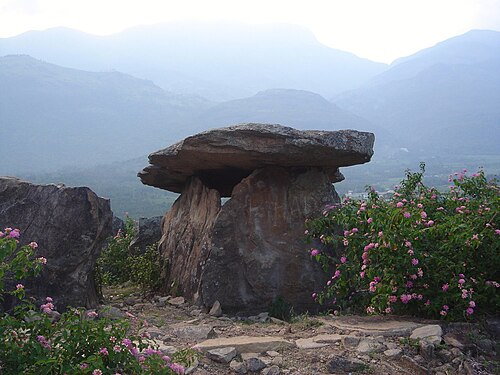
解剖学的現代人類は、 73,000~55,000年前にインド亜大陸に初めて到達したと推定されている。 [ 1 ]南アジアで知られている最古の人類の遺骸は30,000年前のものである。定住生活は紀元前7000年頃に南アジアで始まり、紀元前4500年までに定住生活が広がり、[ 2 ]徐々に旧世界の3つの初期文明のゆりかごの1つであるインダス文明へと発展し、[ 3 ]現在のパキスタンとインド北西部で紀元前2500年から紀元前1900年の間に栄えた。紀元前2千年紀の初め、長引く干ばつにより、インダス渓谷の人々は大きな都市中心部から村へと分散した。紀元前 1800 年~ 1500 年頃、インド・アーリア人の部族は中央アジアからインド北西部、現在のパンジャブ地方へ数回の移住の波で移動した。北インドのヴェーダ人のヴェーダ時代(紀元前 1500 年~ 500 年) は、彼らの膨大な賛歌集 (ヴェーダ)の編纂によって特徴づけられる。社会構造はヴァルナ制度によって緩やかに階層化されており、高度に発達した現代のジャーティ制度に組み込まれている。牧畜と遊牧のインド・アーリア人はパンジャブからインド・ガンジス平原へと広がった。紀元前 600 年頃、第二次都市化が起こり、新たな地域間文化が生まれた。その後、より小さなジャナパダ(王国) がマハージャナパダ(大国)に統合された。この時代には、ジャイナ教や仏教の興隆を含む、新たな禁欲運動や宗教概念が台頭した。[ 4 ]後者は南アジアの既存の宗教文化と融合し、ヒンドゥー教を生み出した。


チャンドラグプタ・マウリヤはナンダ朝を打倒し、古代インド最初の偉大な帝国であるマウリヤ朝を建国した。インドのマウリヤ朝の王アショーカは、激しいカリンガ戦争と、仏教を歴史的に受け入れ、帝国全土に非暴力と平和を広めようとしたことで広く知られている。この時代は、沙門教が急速に広まった時期でもある。
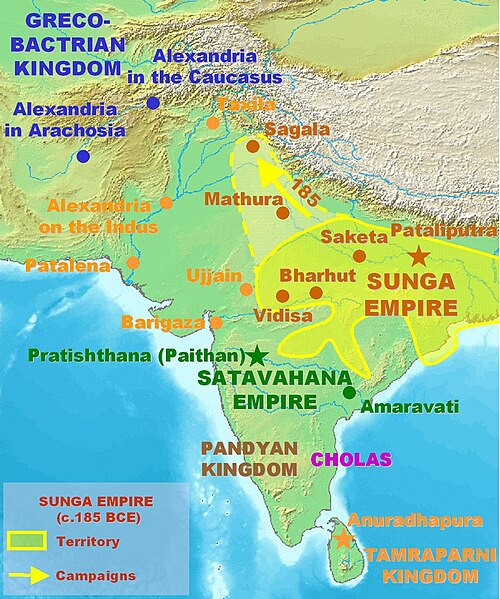
マウリヤ朝は紀元前185年、当時の皇帝ブリハドラタが将軍プシュヤミトラ・シュンガによって暗殺されたことで崩壊した。インド亜大陸の北部と北東部にあったシュンガ朝は、さまざまな小国家に分裂した。一方、北西部では、グレコ・バクトリア人がインド・ギリシャ王国を建国したが、インド・スキタイ人、インド・パルティア人、クシャーナ朝の侵略によって取って代わられた。大マガダのグプタ朝は、4世紀から6世紀にかけて、デリーの鉄柱に記されているように、これらの地域を再統一した。ヒンドゥー教の宗教的、知的復興が見られたこの時代は、インドの古典時代または黄金時代として知られている。インドの文明、行政、文化、宗教の側面はアジアの大部分に広がり、この地域にインド化された王国が設立され、大インドが形成された。[ 5 ] [ 4 ]
グプタ帝国は、フン族による度重なる侵略と主要領土の喪失により、徐々に衰退していった。フン族の侵略は、後期グプタ朝の支援を受けたヤショーダルマンをはじめとする地方の支配者によって阻止され、その後ハルシャによっても阻止された。フン族の大規模な侵略と同化は、融合的なプラティハーラ王朝の成立につながった。7世紀から11世紀にかけて最も重要な出来事は、カンナウジを中心とした三つ巴の戦いであり、プラティハーラ王朝の勝利に終わった。
南インドでは、5世紀半ばから複数の帝国勢力が台頭した。11世紀にはチョーラ朝が南インドを征服した。中世初期には、ヒンドゥー数字を含むインドの数学が、ヒンドゥー・アラビア数字体系の創設を含め、アラブ世界の数学と天文学の発展に影響を与えた。[ 6 ]
イスラムの征服は、早くも8世紀に現代のアフガニスタンとシンド地方に小規模ながら進出し[ 7 ] 、その後マフムード・ガズニの侵攻が続いた[ 8 ]。中央アジアのトルコ人によって1206年に建国されたデリー・スルタン朝は、14世紀に北インドの大部分を支配した。インド・トルコ系のトゥグルク朝を含む、さまざまなトルコ系およびアフガン系の王朝によって統治された [ 9 ] [ 10 ] 。帝国は14世紀後半にティムールの侵攻を受けて衰退し[ 11 ] 、マルワ、グジャラート、バフマニーのスルタン朝が出現した。最後のバフマニー朝は1518年に5つのデカン・スルタン朝に分裂した。裕福なベンガル・スルタン朝も主要な勢力として台頭し、3世紀以上続いた。[ 12 ]この時期には、ヴィジャヤナガラ帝国やメワール王国の支配下にあるラージプート諸国など、複数の強力なヒンドゥー王国が出現し、インドの文化的・政治的景観を形成する上で重要な役割を果たした。[ 13 ] [ 14 ]
近世は、ムガル帝国がインド亜大陸の大部分を征服し、原工業化の兆しを示し、世界最大の経済大国および製造大国となった16世紀に始まった。[ 15 ] [ 16 ][17 ] [ 18 ]ムガル帝国は、インド亜大陸の広大な地域を支配下に置いたマラーターの勢力拡大と、数多くのアフガン侵攻により、18世紀初頭に徐々に衰退した。[ 19 ] [ 20 ] [ 21 ]イギリス政府に代わって主権勢力として活動した東インド会社は、18世紀半ばから19世紀半ばにかけて、インドの広大な地域を徐々に支配下に置いた。インドにおける会社の統治政策は、1857年のインド大反乱につながった。その後、インドはイギリス王室によって直接統治され、イギリス領インドとなった。第一次世界大戦後、マハトマ・ガンディー率いるインド国民会議によって、全国的な独立運動が開始された。その後、全インド・ムスリム連盟は、イスラム教徒が多数を占める独立国家の樹立を提唱した。1947年8月、イギリス領インド帝国はインド自治領とパキスタン自治領に分割され、それぞれが独立を果たした。


アフリカからのヒト科動物の拡大は、およそ200万年前、あるいは220万年前にはインド亜大陸に到達したと推定されている。 [ 25 ] [ 26 ] [ 27 ]この年代推定は、 180万年前までにインドネシアに、136万年前までに東アジアにホモ・エレクトスが存在していたことが知られていること、およびパキスタンのリワットで石器が発見されたことに基づいている。[ 26 ] [ 28 ]いくつかのより古い発見が主張されているが、河川堆積物の年代測定に基づく提案された年代は、独立して検証されていない。[ 27 ] [ 29 ]
インド亜大陸で最も古いヒト科化石は、インド中央部のナルマダ渓谷で発見されたホモ・エレクトスまたはホモ・ハイデルベルゲンシスの化石で、約50万年前のものとされている。[ 26 ] [ 29 ]より古い化石の発見も主張されているが、信頼性に欠けると考えられている。[ 29 ]考古学的証拠のレビューによると、インド亜大陸へのヒト科の居住は、約70万年前までは散発的であり、約25万年前には地理的に広範囲に及んでいたことが示唆されている。[ 29 ] [ 27 ]
南アジアの歴史人口学者ティム・ダイソンによれば、ホモ・サピエンスは6万年から8万年前に、おそらく海岸沿いに小グループでインド亜大陸の北西部に侵入した。彼は、人類が5万5000年前に亜大陸にいたことは「ほぼ確実」だと述べているが、発見された最古の化石はわずか3万年前のものであるとも指摘している。[ 30 ]
マイケル・D・ペトラグリアとブリジット・オールチンによると、「ほとんどの非ヨーロッパ系集団の合祖年代は平均して73~55 kaの間である」 [ 31 ]。
南アジア史研究者のマイケル・H・フィッシャーは、人類がアラビア半島を横断して初めて成功した拡大は8万年前から4万年前の間であったと学者たちが推定していることを指摘している。人類の分布域が拡大した経路の一つはペルシャ湾と北インド洋の沿岸沿いであり、人類の集団は7万5000年前から3万5000年前の間にインドに侵入した。[ 32 ]
考古学的証拠は、解剖学的現代人が78,000~74,000年前にインド亜大陸に存在していたことを示唆していると解釈されているが、[ 33 ]この解釈には異論がある。[ 34 ] [ 35 ]ダイソンによれば、狩猟採集民として最初はさまざまな形で孤立していた現代人による南アジアの居住は、アフリカに次いで人類の遺伝的多様性において2番目に高い、非常に多様な地域へと変化した。これに関連して、部族などのサブグループがごく少数の「原始」個体から派生した「創始者」イベントの強力な証拠がある。この集団は、他の集団よりも高いレベルの内婚を行っていたという点でも特徴的である。[ 36 ]


定住生活は、約9,000年前にインダス川沖積層の西縁で亜大陸に出現し、紀元前3千年紀のインダス文明へと徐々に発展した。 [ 2 ] [ 38 ]ティム・ダイソンによれば、「7,000年前までに農業はバルチスタンでしっかりと確立され、ゆっくりと東へインダス渓谷へと広がった」。マイケル・フィッシャーは次のように付け加えている。[ 39 ]
確立された定住型農業社会の最も古い発見例は、ボラン峠とインダス平原の間の丘陵地帯にあるメヘルガル(現在のパキスタン)(地図3.1参照)である。紀元前7000年頃から、そこの共同体は土地の準備や特定の穀物生産植物の選定、植え付け、手入れ、収穫に多くの労力を注ぎ始めた。また、羊、山羊、豚、牛(こぶのあるゼブ牛[ Bos indicus ]とこぶのないゼブ牛[ Bos taurus ]の両方)などの家畜も飼育した。例えば、牛を去勢することで、主に食肉用から家畜化された荷役動物へと変化した。[ 39 ]
インド亜大陸の青銅器時代は紀元前3300年頃に始まった 。インダス渓谷地域は旧世界の3つの初期文明の発祥地の1つであり、インダス文明は最も広範囲に及び[ 3 ]、最盛期には人口が500万人にも達した可能性がある[ 40 ] 。
この文明は、主に現代のパキスタン、インダス川流域、そして二次的にガッガル・ハクラ川流域を中心として栄えた。成熟したインダス文明は紀元前2600年頃から1900年頃まで繁栄し、インド亜大陸における都市文明の始まりを告げるものとなった。その都市には、現代のパキスタンにあるハラッパ、ガンウェリワル、モヘンジョ・ダロ、そして現代のインドにあるドーラヴィーラ、カリバンガン、ラキガルヒ、ロータルなどが含まれる。
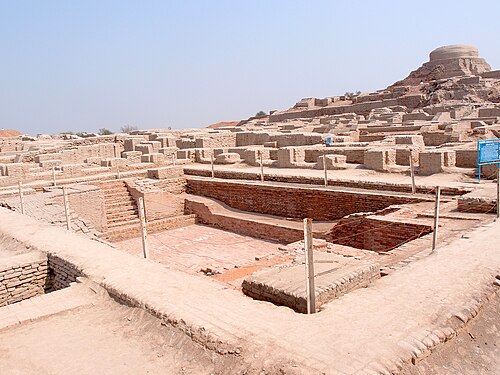


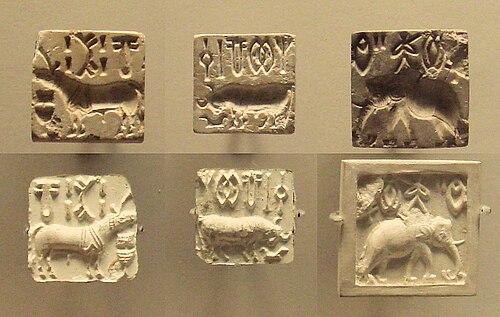
古代インダス川流域の住民であるハラッパ人は、冶金と手工芸の新しい技術を開発し、銅、青銅、鉛、錫を生産した。[ 42 ]この文明は、レンガ造りの都市と道路沿いの排水システムで知られており、何らかの自治体組織を持っていたと考えられている。この文明はまた、古代インド文字の中で最も古いインダス文字を開発したが、これは現在解読されていない。[ 43 ]このため、ハラッパ語は直接証拠がなく、その所属は不明である。[ 44 ]
インダス文明の崩壊後、住民はインダス川とガッガル・ハクラ川の流域からガンジス川とヤムナー川の流域のヒマラヤ山麓へと移住した。[ 45 ]

紀元前2千年紀には 、ガンジス川とヤムナー川のドアーブ地域に黄土色の土器文化が栄えていました。ここは農業と狩猟を営む農村集落でした。彼らは斧、槍、矢、剣などの銅製の道具を使用し、家畜を飼育していました。[ 47 ]
紀元前1900年頃から、インド・アーリア人の部族が中央アジアからインド北西部へ数回の移住の波で移動してきた。[ 48 ] [ 49 ] [ 50 ]ヴェーダ時代は、ヴェーダがインド・アーリア人の典礼賛歌で構成されていた時代である。ヴェーダ文化はインド北西部の一部に位置していたが、インドの他の地域は独自の文化的アイデンティティを持っていた。インド亜大陸の多くの地域はこの時代に銅器時代から鉄器時代へと移行した。 [ 51 ]
ヴェーダ文化は、ヒンドゥー教徒にとって今も神聖なヴェーダのテキストに記述されており、ヴェーダはヴェーダ・サンスクリット語で口頭で作成され伝承された。ヴェーダはインドに現存する最古のテキストの1つである。[ 52 ] 紀元前1500年から500年頃まで続いたヴェーダ時代[ 53 ] [ 54 ]は、インド亜大陸のいくつかの文化的側面の基礎に貢献した。
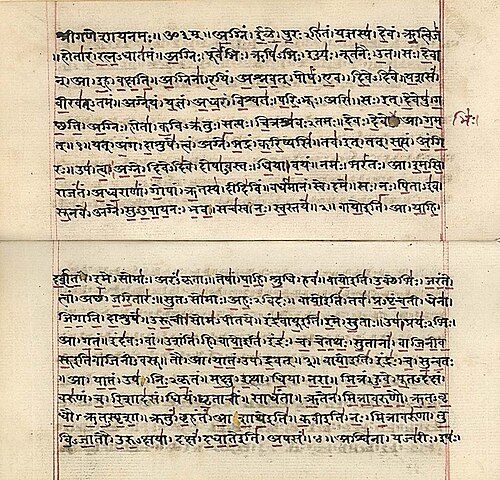
歴史家たちはヴェーダを分析し、パンジャブ地方とガンジス川上流域にヴェーダ文化が存在したと提唱している。[ 51 ]アタルヴァ・ヴェーダの時代には、菩提樹と牛は神聖視されていた。[ 56 ]ダルマなど、後に提唱されたインド哲学の多くの概念は、ヴェーダの先例にその起源を辿ることができる。[ 57 ]
最古のヴェーダ文献であるリグヴェーダには、インド亜大陸の北西部で紀元前2千年紀に編纂されたと考えられている初期のヴェーダ社会が記述されている。 [ 58 ] [59][ 60 ]この時期、アーリア社会は主に部族と牧畜民の集団で構成されており、放棄されたハラッパの都市化とは異なっていた。[61]初期のインド・アーリア人の存在は、考古学的文脈における黄土色の土器文化と部分的に対応していると考えられる。[ 62 ] [ 63 ]
リグヴェーダ時代の終わりに、アーリア社会はインド亜大陸の北西部からガンジス川西岸平野へと拡大した。農業社会はますます発展し、社会は4つのヴァルナ(社会階級)の階層制を中心に組織された。 [ 64 ]この社会構造は、一部の先住民族の職業を不浄とみなすことで彼らを排除するという特徴があった。[ 65 ]この時期には、それまでの小規模な部族や首長国の多くがジャナパダ(君主制の国家レベルの政治体)へと統合され始めた。 [ 66 ]
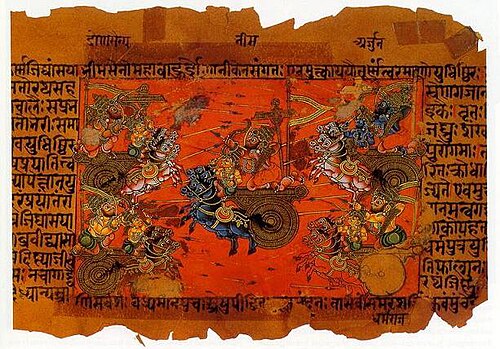
サンスクリット語の叙事詩『ラーマーヤナ』と『マハーバーラタ』はこの時期に作られました。[ 67 ]『マハーバーラタ』は世界で最も長い単一の詩です。[ 68 ]歴史家はかつて、これら2つの叙事詩の時代を「叙事詩時代」と想定していましたが、現在では、これらのテキストが数世紀にわたって複数の発展段階を経てきたことを認識しています。[ 69 ]これらの叙事詩の現存するテキストは、紀元前400 年頃から紀元後400年頃のヴェーダ時代後に属すると考えられています 。[ 69 ] [ 70 ]

紀元前1200年頃から紀元前6世紀にかけてのインド亜大陸の鉄器時代は、ジャナパダ(王国、共和国、諸王国)の台頭によって特徴づけられる。特に、クル、パンチャラ、コーサラ、ヴィデーハの鉄器時代の王国が挙げられる。[ 71 ] [ 72 ]
クル王国(紀元前1200年頃~450年頃)は、ヴェーダ時代の最初の国家レベルの社会であり、紀元前1200年~800年頃のインド北西部の鉄器時代の始まり[ 73 ] 、およびアタルヴァヴェーダの編纂[ 74 ]と同時期に存在した。クル王国はヴェーダの賛歌をコレクションにまとめ、社会秩序を維持するためにシュラウタ儀式を発展させた[ 74 ] 。クル王国の2人の重要人物は、パリクシット王とその後継者ジャナメジャヤであり、彼らはこの王国を北インドの支配的な政治、社会、文化の勢力へと変貌させた[ 74 ] 。クル王国が衰退すると、ヴェーダ文化の中心は東の隣国パンチャーラ王国に移った。[ 74 ]紀元前 1100 年頃から 600 年頃にかけてインド北東部のハリヤナ州とウッタル プラデーシュ州西部で栄えた考古学的PGW (彩色灰色土器) 文化は、 [ 62 ]クル王国とパンチャラ王国に相当すると考えられている。[ 74 ] [ 75 ]
後期ヴェーダ時代には、さらに東方(現在のネパールとビハール州)に位置するヴィデーハ王国がヴェーダ文化の新たな中心地として出現しました。 [ 63 ]ヴィデーハ王国はジャナカ王の治世下で隆盛を極め、彼の宮廷はヤージュニャヴァルキヤ、アルニ、ガルギー・ヴァーチャクナヴィーなどのバラモンの賢者や哲学者を庇護しました。[ 76 ]この時代の後半は、北インド全域でマハージャナパダと呼ばれるますます大きな国家や王国が統合された時期と一致します。

紀元前800年から200年の間に、ジャイナ教と仏教の起源となったシュラマナ運動が形成されました。最初のウパニシャッドはこの時期に書かれました。紀元前500年以降、いわゆる「第二次都市化」[注1 ]が始まり、ガンジス平原に新しい都市集落が出現しました。[ 78 ]「第二次都市化」の基礎は、紀元前600年以前に、ガッガル・ハクラとガンジス川上流平原の彩色灰色土器文化で築かれました。ほとんどの彩色灰色土器遺跡は小さな農村でしたが、「数十」の彩色灰色土器遺跡は最終的に町と特徴づけられる比較的大きな集落として出現し、その中で最大のものは溝や堀、積み土と木製の柵でできた土塁で要塞化されていました。[ 79 ]
マガダ国が隆盛を極め、マウリヤ帝国の基盤となった中央ガンジス平原は、独自の文化圏であり、[ 80 ]紀元前500年以降に新たな国家が出現した。[ 81 ] [ 82 ]ヴェーダ文化の影響を受けていたが、[ 83 ]クル・パンチャラ地域とは大きく異なっていた。[ 84 ]南アジアで知られている最古の稲作が行われた地域であり、紀元前1800年までにはチランドとチェチャルの遺跡に関連する高度な新石器時代の人口が居住していた。[ 85 ]この地域では、シュラマナ運動が栄え、ジャイナ教と仏教が生まれた。[ 75 ]
紀元前800年から紀元前400年の間に、初期のウパニシャッドが編纂されました。[ 86 ] [ 87 ] [ 88 ]これらは古典ヒンドゥー教の理論的基礎を形成し、ヴェーダーンタ(ヴェーダの結論)としても知られています。[ 89 ]
紀元前7世紀から6世紀にかけてのインドの都市化の進展は、儀式の正統性に異議を唱える新たな苦行、すなわち「シュラマナ運動」の台頭につながった。[ 86 ]ジャイナ教の提唱者であるマハーヴィーラ(紀元前599年頃~527年)と仏教の開祖であるゴータマ・ブッダ(紀元前563年頃~483年)は、この運動の最も著名な象徴であった。シュラマナは、生と死の輪廻の概念、輪廻の概念、そして解脱の概念を生み出した。 [ 90 ]ブッダは、シュラマナ宗教に見られる極端な苦行を緩和する中道を見出した。[ 91 ]
ほぼ同時期に、マハーヴィーラ(ジャイナ教の24番目のティールタンカラ)は、後にジャイナ教となる神学を広めた。[ 92 ]しかし、ジャイナ教の正統派は、ティールタンカラの教えは既知のすべての時代よりも古いと信じており、学者たちは、23番目のティールタンカラの地位を与えられたパールシュヴァナータ(紀元前872年頃 - 紀元前772年頃)は歴史上の人物であると考えている。ヴェーダには、数人のティールタンカラと、シュラマナ運動に似た苦行教団が記録されていると考えられている。[ 93 ]

紀元前600 年頃から紀元前300 年頃までの期間には、インド亜大陸北西部のガンダーラから東部のベンガルまで広がる地域(ヴィンディヤ山脈以西の地域の一部を含む)に、16 の強力な王国と寡頭制共和国からなるマハージャナパダが台頭した。[ 94 ]アングッタラ・ニカーヤなどの古代仏教文献[ 95 ]には、アンガ、アッサカ、アヴァンティ、チェーディ、ガンダーラ、カーシー、カンボージャ、コーサラ、クル、マガダ、マッラ、マツヤ(またはマッチャ)、パンチャーラ、スーラセーナ、ヴリジ、ヴァツァの 16 の大王国と共和国が頻繁に言及されている。この時期には、インダス文明に次ぐインドにおける 2 度目の都市化の隆盛が見られた。[ 96 ]

初期の「共和国」またはガナサンガ[ 97 ]、例えばシャキャ族、コリヤ族、マッラカ族、リッチャヴィ族は共和制政府を持っていた。クシナガラ市を中心とするマッラカ族や、ヴァイシャリ市を中心とするヴァッジカ連盟などのガナサンガ[ 97 ]は、紀元前6世紀にはすでに存在し、一部の地域では紀元4世紀まで存続した[ 98 ] 。ヴァッジ・マハージャナパダの支配連合部族の中で最も有名な部族はリッチャヴィ族であった[ 99 ] 。
この時代は考古学的には北部黒色磨研土器文化に相当します。特に中央ガンジス平原に集中していましたが、インド亜大陸北部および中央部の広大な地域にも広がったこの文化は、巨大な要塞を備えた大都市の出現、著しい人口増加、社会階層化の進展、広範囲にわたる交易ネットワーク、公共建築物や水路の建設、専門的な工芸産業、重量システム、打刻貨幣、ブラーフミー文字やカローシュティー文字の形での文字の導入を特徴としています。[ 100 ] [ 101 ]当時の貴族の言語はサンスクリット語でしたが、北インドの一般住民の言語はプラークリット語と呼ばれています。
16の王国の多くは、ガウタマ・ブッダの時代までに4つの主要な王国に統合されていた。これらの4つは、ヴァツァ、アヴァンティ、コーサラ、マガダであった。[ 96 ]

マガダは、古代インドの16のマハージャナパダ(サンスクリット語:「偉大な王国」)または王国の1つを形成しました。王国の中心はガンジス川の南のビハール地方で、最初の首都はラージャグリハ(現在のラージギル)で、その後パタリプトラ(現在のパトナ)になりました。マガダはリッチャヴィとアンガをそれぞれ征服してビハールとベンガルの大部分を含むように拡大し、[ 102 ]その後ウッタルプラデーシュ州東部とオリッサの大部分も含むようになりました。古代のマガダ王国は、ジャイナ教と仏教の文献で頻繁に言及されています。また、ラーマーヤナ、マハーバーラタ、プラーナにも言及されています。[ 103 ]マガダの人々に関する最も古い言及はアタルヴァ・ヴェーダにあり、アンガ、ガンダリ、ムジャヴァットとともにリストされています。マガダはジャイナ教と仏教の発展に重要な役割を果たしました。 (ラージャクマール共同体のような)共和制共同体はマガダ王国に統合された。村々には、グラマカと呼ばれる地元の首長の下で独自の議会があった。行政は、執行、司法、軍事の3つの機能に分かれていた。
仏教のパーリ聖典、ジャイナ教のアガマ、ヒンドゥー教のプラーナなどの初期の文献によると、マガダ国はプラディヨータ王朝とハリヤンカ王朝(紀元前544年頃~413年頃)によって約200年間、紀元前600年頃~413年頃に統治されていた。ハリヤンカ王朝のビンビサーラ 王は積極的かつ拡張的な政策を主導し、現在のビハール州東部と西ベンガル州のアンガを征服した。ビンビサーラ王は息子のアジャータシャトル王子によって打倒され殺害されたが、アジャータシャトル王子はマガダ国の拡張政策を継続した。この時期、仏教の開祖であるゴータマ・ブッダは生涯の多くをマガダ王国で過ごした。彼はブッダガヤで悟りを開き、サールナートで最初の説法を行い、ラージグリハで最初の仏教会議が開催された。[ 104 ]ハリヤナカ王朝はシャイシュナーガ王朝(紀元前413年頃~345年)によって打倒された。最後のシャイシュナーガ王朝の支配者カラソーカは、紀元前345年にマハパドマ・ナンダによって暗殺された。マハパドマ・ナンダは、いわゆる九人のナンダ(マハパドマ・ナンダとその8人の息子)の最初の人物である。
ナンダ帝国は、ハリヤンカとシシュナーガの先祖が築いた基盤の上に築かれた。[ 105 ]帝国は、歩兵20万人、騎兵2万人、戦車2千台、戦象3千頭(最低推定値)からなる巨大な軍隊を擁していた。[ 106 ] [ 107 ]
マウリヤ朝(紀元前322年~185 年)はインド亜大陸の大部分を一つの国家に統一し、南アジアに存在した最大の帝国でした。 [ 108 ]マウリヤ朝は最盛期には、北はヒマラヤ山脈の自然境界まで、東は現在のアッサム州まで広がっていました。西は現在のパキスタンを超えて、現在のアフガニスタンのヒンドゥークシュ山脈まで達していました。この帝国は、チャンドラグプタ・マウリヤがチャナキヤ(カウティリヤ)の助けを借りてマガダ(現在のビハール州)でナンダ朝を打倒した際に建国されました。[ 109 ]
チャンドラグプタは中央インドと西インドを横断して急速に勢力を拡大し、 紀元前317年までに帝国はインド北西部を完全に占領した。マウリヤ朝はセレウコス朝の創始者であるセレウコス1世をセレウコス朝・マウリヤ朝戦争で破り、インダス川の西側にさらに領土を獲得した。チャンドラグプタの息子ビンドゥサーラは紀元前297年頃に王位を継承した。紀元前272年頃に彼が亡くなる頃には、インド亜大陸の大部分がマウリヤ朝の宗主権下にあった。しかし、カリンガ地方(現在のオリッサ州周辺)はマウリヤ朝の支配下に残っており、おそらく南方との交易を妨げていたと考えられる。[ 110 ]

ビンドゥサーラの後を継いだのはアショーカ王で、彼の治世は紀元前232年頃に彼が亡くなるまで続いた 。[ 111 ]紀元前260年頃のカリンガ族に対する彼の遠征は 成功したが、甚大な人命の損失と苦難をもたらした。このためアショーカは暴力を捨て、その後仏教に改宗した。[ 110 ]彼の死後、帝国は衰退し始め、最後のマウリヤ朝の支配者であるブリハドラタはプシュヤミトラ・シュンガによって暗殺され、シュンガ朝が建国された。[ 111 ]
チャンドラグプタ・マウリヤとその後継者たちの治世下では、単一の効率的な財政、行政、治安システムの創設により、インド全土で国内貿易、対外貿易、農業、経済活動が繁栄し拡大した。マウリヤ朝は、インド亜大陸と中央アジアを結ぶアジア最古かつ最長の主要道路の一つであるグランド・トランク・ロードを建設した。 [ 112 ]カリンガ戦争後、帝国はアショーカ王の治世下で半世紀近く平和と安全を享受した。マウリヤ朝インドはまた、社会の調和、宗教の変革、科学知識の拡大の時代を享受した。チャンドラグプタ・マウリヤがジャイナ教を受け入れたことで、社会全体にわたって社会的、宗教的な刷新と改革が進み、アショーカ王が仏教を受け入れたことが、インド全土における社会的、政治的な平和と非暴力の統治の基盤となったと言われている。アショーカ王は、インド地中海、スリランカ、東南アジア、西アジア、北アフリカ、地中海沿岸のヨーロッパに仏教宣教団を派遣した。[ 113 ]
チャナキヤが著した『アルタシャーストラ』とアショーカ王の勅令は、マウリヤ朝時代の主要な文献記録である。考古学的には、この時代は北黒磨土器の時代に属する。マウリヤ帝国は、近代的で効率的な経済と社会に基づいており、商品の販売は政府によって厳しく規制されていた。[ 114 ]マウリヤ社会には銀行はなかったが、高利貸しは慣習的であった。奴隷制に関するかなりの量の文献記録が見つかっており、奴隷制が蔓延していたことを示唆している。[ 115 ]この時代には、ウーツ鋼と呼ばれる高品質の鋼が南インドで開発され、後に中国やアラビアに輸出された。[ 116 ]
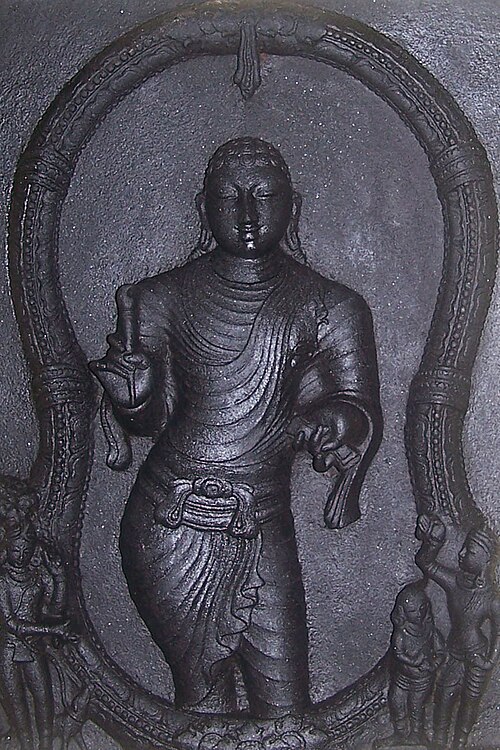
サンガム時代には、紀元前3世紀から紀元後4世紀にかけてタミル文学が隆盛を極めた。タミル地方の三王朝として知られるチェーラ朝、チョーラ朝、パンディヤ朝の3つの王朝が南インドの一部を支配した。[ 118 ]
サンガム文学は、この時代のタミル人の歴史、政治、戦争、文化を扱っている。[ 119 ]バラモン階級がほとんどだったサンスクリット語の作家とは異なり、サンガム文学の作家は多様な階級や社会的背景を持ち、ほとんどがバラモン階級以外だった。[ 120 ]
紀元前300年頃 ~紀元後 200年頃、サンガム文学の一部とされる10冊の中編集『パトゥパットゥ』が編纂され、8冊の詩集『エットゥトガイ』と18冊の小詩集『パティネンキールカナック』が編纂され、タミル語最古の文法書『トルカーッピヤム』が発展した。[ 121 ]また、サンガム時代には、タミル文学の五大叙事詩のうち2つが編纂された。イランゴ・アディガルは、カンナギを中心とした非宗教的な作品である『シラッパティカラム』を作曲し[ 122 ]、チタライ・チャタナールが作曲した『マニメーカライ』は『シラッパティカラム』の続編であり、コーヴァランとマダヴィの娘で仏教の比丘尼になった女性の物語を語っている[ 123 ] [ 124 ]。
紀元前3世紀のマウリヤ朝から紀元後6世紀のグプタ朝の終焉までの時代は、インドの「古典」時代と呼ばれています。 [ 127 ]グプタ朝(4世紀~6世紀)は、この数世紀にインドを支配した多くの王国があるにもかかわらず、インドの黄金時代とみなされています。また、サンガム文学は紀元前3世紀から紀元後3世紀にかけて南インドで栄えました。[ 128 ]この期間、インドの経済は世界最大規模であったと推定されており、紀元後1年から1000年までの世界全体の富の3分の1から4分の1を占めていました。[ 129 ] [ 130 ]
シュンガ朝はマガダ国を起源とし、紀元前187年から78年頃までインド亜大陸の中央部と東部の広大な地域を支配した。この王朝は、最後のマウリヤ朝皇帝を打倒したプシュヤミトラ・シュンガ によって建国された。首都はパタリプトラであったが、後の皇帝、例えばバガバドラなどは、現在のベスナガルにあたるヴィディシャにも宮廷を置いた。[ 131 ]
プシャミトラ・シュンガは36年間統治し、息子のアグニミトラが後を継いだ。シュンガ朝の統治者は10人いた。しかし、アグニミトラの死後、帝国は急速に崩壊した。[ 132 ]碑文や硬貨から、北インドと中央インドの大部分は、シュンガ朝の覇権とは無関係な小王国や都市国家で構成されていたことがわかる。[ 133 ]この帝国は、外国勢力と国内勢力の両方との数多くの戦争で知られている。彼らは、カリンガのマハメーガヴァーハナ朝、デカンのサタヴァーハナ朝、インド・ギリシャ人、そしておそらくマトゥラーのパンチャラ朝とミトラ朝と戦った。
この時代には、芸術、教育、哲学、その他の学問が花開き、バールフートのストゥーパや有名なサンチーの大ストゥーパなどの建築物も数多く建設されました。シュンガ朝の支配者たちは、学問と芸術に対する王室による後援の伝統を確立するのに貢献しました。この帝国で使用された文字はブラーフミー文字の一種で、サンスクリット語の表記に用いられました。シュンガ朝は、ヒンドゥー教思想における最も重要な発展が起こっていた時期に、インド文化の庇護において極めて重要な役割を果たしました。


サータヴァーハナ朝は、アーンドラ・プラデーシュ州のアマラヴァティ、マハーラーシュトラ州のジュンナール(プネー)、プラティシュタン(パイタン)を拠点としていた。紀元前1世紀以降、その領土はインドの大部分を支配した。サータヴァーハナ朝は当初マウリヤ朝の封臣であったが、マウリヤ朝の衰退とともに独立を宣言した。
サータヴァーハナ朝はヒンドゥー教と仏教の庇護者として知られ、その結果、エローラ(ユネスコ世界遺産)からアマラヴァティに至るまで、数多くの仏教遺跡が残されました。彼らは、支配者の肖像を刻印した硬貨を発行した最初のインドの国家の一つでした。彼らは文化の架け橋となり、インド・ガンジス平原からインド南端までの貿易、そして思想や文化の伝播において重要な役割を果たしました。
彼らは支配を確立するためにシュンガ帝国、そしてマガダ国のカンヴァ王朝と競争しなければなりませんでした。その後、彼らはサカ族、ヤヴァナ族、パフラヴァ族などの外国の侵略者からインドの大部分を守る上で重要な役割を果たしました。特に、西クシャトラパ族との戦いは長く続きました。サタヴァーハナ王朝の著名な支配者であるガウタミープトラ・サタカルニとシュリー・ヤジュニャ・サタカルニは、西クシャトラパ族などの外国の侵略者を打ち破り、その拡大を阻止することができました。西暦3世紀には、帝国はより小さな国家に分裂しました。[ 134 ]
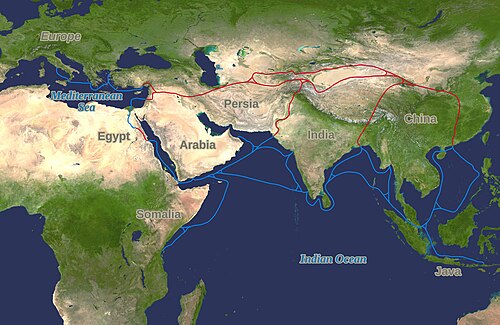
ケララの香辛料貿易は、旧世界のあらゆる地域から商人をインドに引き寄せた。インド南西部の沿岸港ムジリスは、シュメールの記録によれば、紀元前3000年頃から主要な香辛料貿易の中心地として確立されていた。ユダヤ人商人は、紀元前562年にはすでにインドのケララ州コーチに到着していた。 [ 135 ]ギリシャ・ローマ世界は、香料ルートとインド・ローマルートに沿って貿易を行った。[ 136 ]紀元前2世紀には、ギリシャとインドの船がアデンなどのアラビアの港で交易のために出会った。[ 137 ] 1千年紀には、インドへの海上ルートはインド人とエチオピア人によって支配され、紅海の海上貿易の勢力となった。
香辛料貿易に関わっていたインドの商人は、インド料理を東南アジアに持ち込み、そこで香辛料の混合物やカレーが現地住民の間で人気になった。[ 138 ]仏教は紀元1世紀または2世紀にシルクロードを通って中国に伝わった。 [ 139 ]南アジアと東南アジアのヒンドゥー教と仏教の宗教施設は、後援者から寄付された資本を蓄積するにつれて、生産と商業の中心地となった。彼らは農園経営、工芸、貿易に従事した。特に仏教は海上貿易とともに伝わり、識字、芸術、貨幣の使用を促進した。[ 140 ]
クシャーナ帝国は、紀元1世紀半ば頃、初代皇帝クジュラ・カドフィセスの指導の下、現在のアフガニスタンからインド亜大陸の北西部に拡大した。クシャーナ人は、おそらくトカラ語を話す部族であり、[ 141 ]月氏連合の5つの支族の1つであった。[ 142 ] [ 143 ]彼の孫であるカニシュカ大王の時代には、帝国はアフガニスタンの大部分を包含するまでに拡大し、[ 144 ]その後インド亜大陸の北部にも広がった。[ 145 ]
カニシュカ皇帝は仏教の偉大な庇護者であったが、クシャーナ朝が南方に拡大するにつれて、後期の貨幣に描かれた神々は、新たに多数派となったヒンドゥー教徒を反映するようになった。[ 146 ] [ 147 ]歴史家のヴィンセント・スミスはカニシュカについて次のように述べている。
彼は仏教史において第二のアショーカ王の役割を果たした。[ 148 ]
クシャーナ帝国はインド洋の海上貿易とインダス川流域を通るシルクロードの交易を結びつけ、特に中国とローマ間の長距離貿易を奨励した。クシャーナ朝は、勃興しつつあったガンダーラ美術とマトゥラー美術に新たな潮流をもたらし、クシャーナ朝の統治下でその最盛期を迎えた。[ 149 ]クシャーナ朝の統治下での平和な時代はパクス・クシャーナとして知られている。3世紀までに、インドにおける彼らの帝国は崩壊しつつあり、最後に知られている偉大な皇帝はヴァスデーヴァ1世である。[ 150 ] [ 151 ]


グプタ時代は、特に文学、建築、彫刻、絵画において文化的な創造性で知られていました。[ 152 ]グプタ時代には、カーリダーサ、アーリヤバタ、ヴァラーハミヒラ、ヴィシュヌ・シャルマ、ヴァーツヤーヤナなどの学者が輩出されました。グプタ時代はインド文化の分水嶺となりました。グプタは統治を正当化するためにヴェーダの供犠を行いましたが、バラモン教の正統派に代わるものとして仏教も保護しました。最初の3人の支配者、チャンドラグプタ1世、サムドラグプタ、チャンドラグプタ2世の軍事的功績により、インドの大部分が彼らの支配下に置かれました。科学と政治行政はグプタ時代に新たな高みに達しました。強力な貿易関係により、この地域は重要な文化の中心地となり、近隣の王国や地域に影響を与える拠点としての地位を確立しました。[ 153 ] [ 154 ]グプタ統治下の平和な時代はパクス・グプタとして知られています。
後期のグプタ朝は、西暦5世紀前半までにアフガニスタンに拠点を築き、首都をバーミヤンに置いたアルチョン・フン族の到来まで、北西部の王国に抵抗し続けた。[ 155 ]しかし、デカン高原を含む南インドの大部分は、これらの出来事の影響をほとんど受けなかった。[ 156 ] [ 157 ]
ヴァーカータカ帝国は、西暦3世紀半ばにデカン高原で興った。その領土は、北はマルワ地方とグジャラート地方の南端から南はトゥンガバドラ川まで、西はアラビア海から東はチャッティースガル州の端まで広がっていたと考えられている。彼らはデカン高原におけるサタヴァーハナ朝の最も重要な後継者であり、北インドのグプタ朝と同時期に存在し、ヴィシュヌクンディナ朝にその地位を譲った。
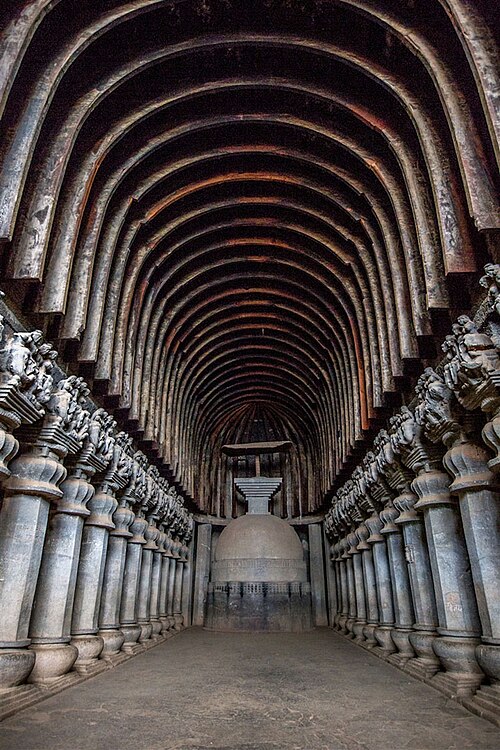
ヴァーカータカ朝は芸術、建築、文学の庇護者として知られています。アジャンター石窟群(ユネスコ世界遺産)の岩窟仏教寺院と仏塔は、ヴァーカータカ朝の皇帝ハリシェーナの庇護のもとに建てられました。[ 158 ] [ 159 ]


サムドラグプタの4世紀のアラハバードの柱碑文には、グプタ帝国の辺境王国としてカマルパ(西アッサム)[ 160 ]とダヴァカ(中央アッサム)[ 161 ]が言及されている。ダヴァカは後にカマルパに吸収され、カマルパはカラトヤ川から現在のサディヤ付近まで広がり、ブラマプトラ渓谷全体、北ベンガル、バングラデシュの一部、そして時にはプルニアと西ベンガルの一部を含む広大な王国へと成長した。[ 162 ]
ヴァルマナ朝(紀元350~650 年頃)、ムレッチチャ朝(紀元655~900 年頃)、カマルパ・パーラ朝(紀元900~1100年頃)の3つの王朝が 、それぞれ現在のグワーハーティー(プラグジョーティシュプラ)、テズプル(ハルッペスワラ) 、北グワーハーティー(ドゥルジャヤ)を首都として統治した。3つの王朝はいずれもナラカスラの子孫であると主張した。ヴァルマナ朝の王、バースカル・ヴァルマナ(紀元600~650年頃)の治世に、中国の旅行家玄奘がこの地域を訪れ、旅の記録を残した。その後、弱体化と崩壊(カマルパ・パーラ朝の後)を経て、カマルパの伝統は紀元1200~650年頃まで続いた。 1255年、ルナ1世(紀元1120年頃~1185年)とルナ2世(紀元1155年頃~1255年)の王朝によって滅ぼされた。[ 163 ]カマルパ王国は13世紀半ばに終焉を迎えた。カマルパナガラ(北グワハティ)のサンディヤ率いるケン王朝が、イスラム教徒のトルコ人の侵略後、首都をカマタプル(北ベンガル)に移し、カマタ王国を建国したためである。[ 164 ]

4世紀から9世紀にかけてのパッラヴァ朝は、北インドのグプタ朝と並んで、インド亜大陸南部におけるサンスクリット語の発展の偉大な後援者でした。パッラヴァ朝の治世には、グランタと呼ばれる文字で書かれた最初のサンスクリット語の碑文が見られました。[ 165 ]初期のパッラヴァ朝は、東南アジア諸国とさまざまなつながりがありました。パッラヴァ朝は、ドラヴィダ建築を用いて、マハーバリプラム、カンチプラムなどの場所に非常に重要なヒンドゥー教寺院やアカデミーを建設しました。彼らの統治下では、偉大な詩人が台頭しました。さまざまな神々に寺院を捧げる慣習が流行し、その後、ヴァーストゥ・シャーストラの精巧な芸術的な寺院建築と彫刻様式が生まれました。[ 166 ]
パッラヴァ朝はマヘンドラヴァルマン1世(西暦571~630年)とナラシンハヴァルマン1世(西暦630~668年)の治世中に権力の頂点に達し、 9世紀末までテルグ語圏とタミル地方の北部を支配した。 [ 167 ]

カダンバ朝はカルナータカ州を起源とし、西暦345年にマユラシャルマによって建国され 、後に帝国規模に発展する可能性を示しました。マユラシャルマ王は、おそらくいくつかの土着部族の助けを借りて、カンチのパッラヴァ朝の軍隊を破りました。カダンバ朝の名声は、北インドのグプタ朝の王たちが婚姻同盟を結んだ著名な統治者カクスタヴァルマの治世中に頂点に達しました。カダンバ朝は西ガンガ朝と同時代であり、両王朝は共に、絶対的な自治権をもってこの地を統治した最初期の土着王国を形成しました。その後、カダンバ朝は、より大きなカンナダ帝国であるチャールキヤ朝とラーシュトラクータ朝の封臣として500年以上統治を続け、その間に小規模な王朝(ゴアのカダンバ朝、ハラシのカダンバ朝、ハンガルのカダンバ朝)に分派しました。

ハルシャは西暦606年から647年まで北インドを統治した。彼はプラバカルヴァルダナの息子であり、ラージヤヴァルダナの弟であった。彼らはヴァルダナ王朝の一員で、現在のハリヤナ州にあるタネーサルを統治していた。
6世紀半ばに以前のグプタ帝国が崩壊した後、北インドはより小さな共和国と君主制国家に逆戻りした。権力の空白により、タネーサルのヴァルダナが台頭し、パンジャブから中央インドにかけて共和国と君主制国家を統一し始めた。ハルシャの父と兄弟の死後、帝国の代表者は西暦606年4月にハルシャを皇帝として戴冠させ、マハラジャの称号を与えた。[ 169 ]最盛期には、彼の帝国は北インドと北西インドの大部分を覆い、東はカマルパまで、南はナルマダ川まで広がり、最終的にはカンナウジ(現在のウッタル・プラデーシュ州)を首都とし、西暦647年まで統治した。[ 170 ]
平和と繁栄が続いたことで、彼の宮廷は国際色豊かな中心地となり、学者、芸術家、宗教的な訪問者を引き寄せた。[ 170 ]この時期に、ハルシャはヒンドゥー教から仏教に改宗した。[ 171 ]中国の旅行家、玄奘三蔵はハルシャの宮廷を訪れ、彼の正義と寛大さを称賛する非常に好意的な記述を残した。[ 170 ]サンスクリット語の詩人バナバッタが書いた彼の伝記『ハルシャチャリタ』(「ハルシャの行い」)には、タネーサルとの関わりや、2階建てのダヴァラグリハ(白い館)のある宮殿が描かれている。[ 172 ] [ 173 ]
初期中世インドは、西暦6世紀のグプタ帝国の終焉後に始まった 。[ 127 ]この時代には、 7世紀のハルシャ帝国の崩壊後に始まったヒンドゥー教の「後期古典時代」も含まれる。[ 174 ]この時代は、13世紀に北インドでデリー・スルタン朝が台頭し、 [ 175 ]三国間の争いにつながるカンナウジ帝国の始まり、そして1279年に南インドでラージェンドラ・チョーラ3世が死去して後期チョーラ朝が終焉を迎えたことで終わった。しかし、古典時代のいくつかの側面は、17世紀頃に南インドでヴィジャヤナガラ帝国が滅亡するまで続いた。
5世紀から13世紀にかけて、シュラウタ祭は衰退し、王宮ではシャイヴァ派、ヴィシュヌ派、シャクティ派への支持が拡大する一方、仏教への支持は衰退した。 [ 176 ]ヒンドゥー教の統合によって形成されたバラモン教ヒンドゥー教を受け入れた農村民衆の間での魅力の欠如、そして交易コミュニティや王室のエリートからの財政的支援の減少が、仏教の衰退の主な要因であった。[ 177 ]
7世紀、クマーリラ・バッタはミーマーンサー哲学の学派を体系化し、ヴェーダの儀式に関する立場を擁護した。[ 178 ]
8 世紀から 10 世紀にかけて、北インドの支配権をめぐって 3 つの王朝が争った。マルワのグルジャラ プラティハーラ朝、ベンガルのパーラ朝、デカンのラシュトラクータ朝である。セーナ朝は後にパーラ帝国の支配権を握ることになる。グルジャラ プラティハーラ朝は、マルワ王国、ブンデルカンド王国、ダハラ王国、ハリヤナのトマラ朝、サンバール王国など、さまざまな国家に分裂した。これらの国家は、初期のラージプート王国のいくつかであった。[ 179 ]一方、ラシュトラクータ朝は西チャールキヤ朝に併合された。[ 180 ]この時期に、チャールキヤ朝が出現した。チャウルキヤ朝は、マールー・グルジャラ建築様式でディルワラ寺院、モデラ太陽寺院、ラニ・キ・ヴァヴ[ 181 ]を建設し、首都アンヒルワラ(現在のグジャラート州パタン)はインド亜大陸最大の都市の一つであり、紀元1000年頃には人口が10万人と推定されていた。パタンの隆盛は、ヘムチャンドラチャリヤの時代にグジャラートでジャイナ教が復興したことも意味していた。パタンは古代ジャイナ教の写本のコレクションとジャイナ教の重要な学問の中心地として有名になり[ 182 ] 、多くの学者の賞賛を集めた。イギリスのインド学者でサンスクリット学者のピーター・ピーターソンは、そのコレクションを次のように描写している。
インド国内には、これほど膨大な古代の貴重な文書を誇れる町は他にはないし、世界でもほんのわずかしかない。ヨーロッパのどの大学図書館にとっても、これらは誇りであり、厳重に守られる宝物となるだろう。[ 183 ]
チョーラ帝国は、 11 世紀に東南アジアとスリランカの一部に侵攻することに成功したラージャ ラージャ チョーラ 1 世とラージェンドラ チョーラ 1世の治世中に大国として台頭した。 [ 184 ]ラリタディティヤ ムクタピダ(在位 724–760) は、625 年~ 1003 年までインド北西部で影響力を行使し、その後ロハラ王朝が続いたカシミールカルコータ王朝の皇帝であった。カルハナは著書『ラージャタランギニー』の中で、ラリタディティヤ王が北インドと中央アジアで積極的な軍事作戦を指揮したと述べている。[ 185 ] [ 186 ] [ 187 ]
ヒンドゥー教のシャーヒー朝は、7世紀半ばから11世紀初頭にかけて、アフガニスタン東部、パキスタン北部、カシミールの一部を支配した。一方、オリッサ地方では、東ガンガ帝国が台頭した。この帝国は、ヒンドゥー建築 の発展で知られ、特にジャガンナート寺院やコナーク太陽神殿が有名である。また、芸術や文学の庇護者としても知られていた。


後期グプタ朝は、西暦6世紀から7世紀にかけてインド東部のマガダ地方を統治した。後期グプタ朝はマガダの支配者として帝国グプタ朝の後を継いだが、両王朝を結びつける証拠はなく、これらは2つの異なる家族であると思われる。[ 188 ]後期グプタ朝という名称は、支配者の名前が「-gupta」という接尾辞で終わっていることに由来し、彼らは自らを帝国グプタ朝の正当な後継者として示すためにこの接尾辞を採用した可能性がある。[ 189 ]
チャールキヤ帝国は、6 世紀から 12 世紀にかけて、関連性はあるもののそれぞれ独立した 3 つの王朝として、南インドと中央インドの大部分を支配しました。最も初期の王朝は「バダミ・チャールキヤ」として知られ、 6 世紀半ばからヴァタピ (現在のバダミ) を拠点として統治しました。バダミ・チャールキヤは、バナヴァシのカダンバ王国の衰退とともに独立を主張し始め、プラケーシン 2 世の治世中に急速に勢力を拡大しました。チャールキヤの統治は、南インドの歴史における重要な節目であり、カルナータカの歴史における黄金時代です。バダミ・チャールキヤの台頭により、南インドの政治情勢は小規模な王国から大規模な帝国へと変化しました。南インドを拠点とする王国が支配権を握り、カーヴェリ川とナルマダ川の間の地域全体を統合しました。この帝国の勃興に伴い、効率的な行政、海外貿易、そして「チャールキヤ建築」と呼ばれる新しい建築様式が誕生した。チャールキヤ朝は、550年から750年の間、カルナータカ州のバダミを拠点として南インドと中央インドの一部を支配し、その後970年から1190年の間は再びカリヤニを拠点として支配した。


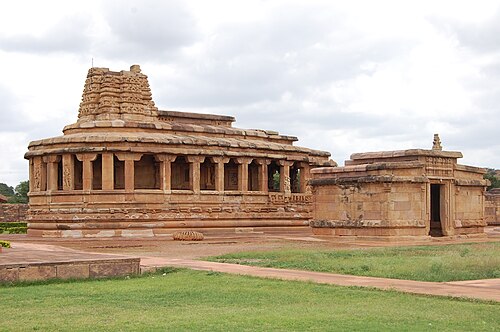
753年頃にダンティドゥルガによって建国されたラシュトラクータ帝国は、マニヤケータの首都からほぼ2世紀にわたって統治した。[ 190 ]最盛期には、ラシュトラクータ朝は北はガンジス川とヤムナー川のドアーブから南はコモリン岬までを支配し、建築や文学において豊かな成果を上げた時代であった。[ 192 ] [ 193 ]
この王朝の初期の支配者はヒンドゥー教徒でしたが、後期の支配者はジャイナ教の影響を強く受けていました。[ 194 ]ゴヴィンダ3世とアモーガヴァルシャは、この王朝が生み出した有能な行政官の長い系譜の中で最も有名な人物です。アモーガヴァルシャは作家でもあり、カンナダ語で知られている最古の詩論である『カヴィラージャマルガ』を著しました。[ 191 ] [ 195 ]建築はドラヴィダ様式で画期的な成果を上げ、その最高の例はエローラのカイラサナート寺院に見られます。その他の重要な貢献としては、カルナータカ州のパッタダカルにあるカシヴィシュヴァナータ寺院とジャイナ教のナラヤナ寺院があります。
アラブの旅行家スレイマンは、ラシュトラクータ帝国を世界の四大帝国の一つと評した。[ 196 ]ラシュトラクータ時代は、南インド数学の黄金時代の始まりを告げるものであった。南インドの偉大な数学者マハーヴィーラは、中世の南インドの数学者たちに大きな影響を与えた。[ 197 ]ラシュトラクータの支配者たちは、様々な言語の文人たちも庇護した。[ 191 ]
グルジャラ・プラティハーラ朝は、インダス川の東へ進軍するアラブ軍を封じ込める上で重要な役割を果たした。ナーガバタ1世は、ウマイヤ朝のインド遠征中にジュナイドとタミンの率いるアラブ軍を破った。[ 198 ]ナーガバタ2世の下で、グルジャラ・プラティハーラ朝は北インドで最も強力な王朝となった。彼の後を継いだのは息子のラーマバドラで、彼は短期間統治した後、息子のミヒラ・ボージャに引き継がれた。ボージャとその後継者マヘンドラパーラ1世の下で、プラティハーラ帝国は繁栄と権力の頂点に達した。マヘンドラパーラの時代には、その領土は西はシンドの国境から東はビハールまで、北はヒマラヤ山脈から南はナルマダ川付近まで広がっていた。 [ 199 ]この拡大は、インド亜大陸の支配権をめぐってラシュトラクータ朝とパーラ朝との三つ巴の権力闘争を引き起こした。
10世紀末までに、帝国のいくつかの封建領主は、グルジャラ・プラティハーラの一時的な弱体化に乗じて独立を宣言した。特にマルワ王国、ブンデルカンド王国、ハリヤナのトマラ、サンバル王国[ 200 ] 、ダハラ王国などが挙げられる。


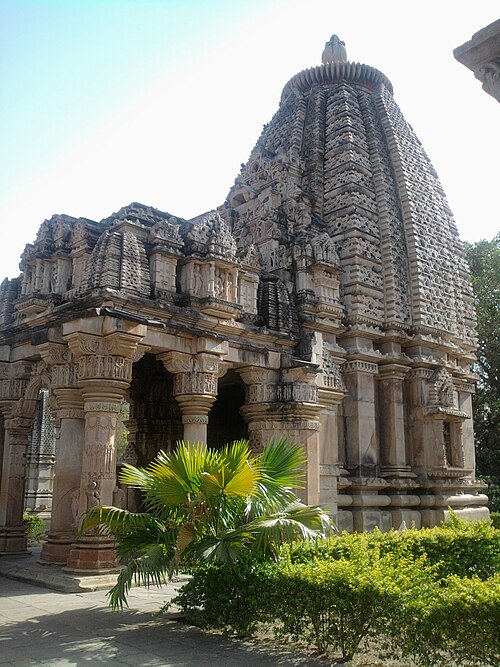
ガハダヴァラ王朝は、11世紀から12世紀にかけて、現在のインドのウッタル・プラデーシュ州とビハール州の一部を支配した。首都はヴァラナシにあった。[ 202 ]

西暦1097年、ミティラのカルナータ王朝がビハール/ネパール国境地帯に出現し、ダルバンガとシムラオンガドに首都を置いた。この王朝はカルナータカ出身の軍司令官ナンヤデーヴァによって設立された。この王朝の下でマイティリー語が発展し始め、最初のマイティリー文学作品であるヴァルナ・ラトナカラは14世紀にジョティリシュワル・タクールによって書かれた。カルナータはネパールへの襲撃も行った。彼らはギヤースッディーン・トゥグルクの侵攻により1324年に滅亡した。[ 203 ] [ 204 ]

パーラ帝国はゴーパーラ1世によって建国された。[ 205 ] [ 206 ] [ 207 ]ベンガル出身の仏教王朝によって統治された。パーラ朝はシャシャンカのガウダ王国の崩壊後、ベンガルを再統一した。[ 208 ]
パーラ朝は仏教の大乗仏教と密教の信奉者であり、 [ 209 ]シヴァ派とヴィシュヌ派も庇護していた。[ 210 ]帝国はダルマパーラとデーヴァパーラの時代に最盛期を迎えた。ダルマパーラはカナウジを征服し、北西のインド最果てまで勢力を拡大したと考えられている。[ 210 ]
パーラ朝はベンガルの黄金時代とみなすことができる。[ 211 ]ダルマパーラはヴィクラマシーラを創設し、記録に残る歴史上最初の偉大な大学の一つとされるナーランダーを復興した。[ 210 ]ナーランダーはパーラ朝の庇護の下で最盛期を迎えた。 [ 211 ] [ 212 ]パーラ朝は多くのヴィハーラも建設した。彼らは東南アジアやチベットの国々と密接な文化的、商業的関係を維持した。海上貿易はパーラ朝の繁栄に大きく貢献した。
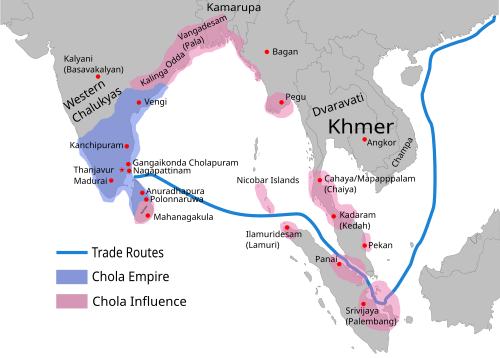
中世のチョーラ朝は9世紀半ばに台頭し、南インド史上最大の帝国を築き上げた。[ 213 ]彼らは南インドを統一し、海軍力によってシュリーヴィジャヤなどの東南アジア諸国に影響力を拡大した。[ 184 ]ラージャラージャ・チョーラ1世とその後継者であるラージェンドラ・チョーラ1世、ラージャディラージャ・チョーラ、ヴィララージェンドラ・チョーラ、クローットゥンガ・チョーラ1世の下で、この王朝は南アジアと東南アジアにおける軍事的、経済的、文化的な勢力となった。[ 214 ] [ 215 ]ラージェンドラ・チョーラ1世の海軍はビルマからベトナムまでの沿岸部、[ 216 ]アンダマン諸島とニコバル諸島、ラクシャドウィープ諸島(ラッカディブ諸島)、スマトラ島、マレー半島を占領した。新帝国の力は、ラージェンドラ・チョーラ1世が行ったガンジス遠征や、東南アジアの海洋帝国シュリーヴィジャヤの都市の占領、そして中国への度重なる使節派遣によって、東方世界に知らしめられた。[ 217 ]
彼らは度重なる侵略と占領によって2世紀以上にわたりスリランカの政治を支配した。また、アラブ人や中国帝国との貿易関係も継続していた。[ 218 ]ラージャラージャ・チョーラ1世とその息子ラージェンドラ・チョーラ1世は南インド全体に政治的統一をもたらし、チョーラ帝国を尊敬される海洋国家として確立した。[ 219 ]チョーラ朝の下で、南インドは芸術、宗教、文学において新たな高みに達した。これらのすべての分野において、チョーラ時代はパッラヴァ朝時代に始まった運動の頂点を極めた。壮大な寺院や石や青銅の彫刻といった記念碑的な建築は、インドでかつて達成されたことのない精緻さに達した。[ 220 ]


西チャールキヤ帝国は、10 世紀から 12 世紀にかけて、南インドのデカン高原西部の大部分を支配した。 [ 222 ]北のナルマダ川と南のカーヴェリ川の間の広大な地域がチャールキヤの支配下に入った。 [ 222 ]この時期、デカン高原の他の主要な支配者一族であるホイサラ朝、デーヴァギリのセウナ・ヤーダヴァ朝、カーカティーヤ朝、南カラチュリ朝は、西チャールキヤの従属国であり、12 世紀後半にチャールキヤの力が衰退したときに初めて独立を達成した。[ 223 ]
西チャールキヤ朝は、初期チャールキヤ朝の様式と後期のホイサラ帝国の様式をつなぐ過渡期様式として知られる建築様式を発展させた。その建造物のほとんどは、カルナータカ州中央部のトゥンガバドラ川に隣接する地域にある。よく知られている例としては、ラッカンディのカシヴィシュヴェーシュヴァラ寺院、クルヴァッティのマッリカルジュナ寺院、バガリのカッレスヴァラ寺院、ハヴェリのシッデーシュヴァラ寺院、イタギのマハデーヴァ寺院などがある。[ 224 ]これは、南インドの美術、特に文学の発展において重要な時期であり、西チャールキヤ朝の王たちは、哲学者で政治家のバサヴァや偉大な数学者バースカラ2世のように、カンナダ語とサンスクリット語の作家を奨励した。[ 225 ] [ 226 ]


中世後期は、中央アジアのイスラム教徒の遊牧民部族による度重なる侵略[ 227 ] [ 228 ] 、デリー・スルタン朝の支配、そしてスルタン朝の軍事技術を基盤とした他の国家の発展[ 229 ]によって特徴づけられる。
デリー・スルタン朝は、デリーを拠点とする一連のイスラム国家であり、起源の異なる複数の王朝によって統治された。この政体は、13世紀から16世紀初頭にかけてインド亜大陸の大部分を支配した。[ 230 ]スルタン朝は、12世紀から13世紀にかけて中央アジアのトルコ人によって建国された。トルコ人は北インドの一部を侵略し、かつてのヒンドゥー教徒の領土の上に国家を築いた。[ 231 ]その後のデリーのマムルーク朝は、北インドの広大な地域を征服することに成功した。ハルジー朝は中央インドの大部分を征服し、南インドの主要なヒンドゥー教王国を属国にすることを強要した。[ 230 ]
スルタン朝はインド文化のルネサンス期をもたらした。その結果生まれた「インド・イスラム」文化の融合は、建築、音楽、文学、宗教、衣服において永続的な融合的遺産を残した。ウルドゥー語はデリー・スルタン朝の時代に誕生したと推測されている。このスルタン朝は、インドで数少ない女性統治者の一人であるラジア・スルタナ(在位1236年~1240年)を即位させた唯一のインド・イスラム国家であった。
デリー・スルタン朝は、当初はインドの先住民エリートからトルコ系イスラム教徒エリートへの権力移行によって混乱を招いたものの、インド亜大陸を成長を続ける世界システムに統合し、インドをより広範な国際ネットワークに引き込む役割を果たし、インドの文化と社会に大きな影響を与えた。[ 232 ]しかし、デリー・スルタン朝はインド亜大陸の寺院の大規模な破壊と冒涜も引き起こした。[ 233 ]
モンゴルによるインド侵攻は、アラーウッディーン・ハルジーの治世下、デリー・スルタン朝によって撃退された。その成功の大きな要因は、モンゴル人と同じ遊牧騎兵戦術に長けたトルコ系マムルーク奴隷軍であった。デリー・スルタン朝がモンゴルの侵攻を撃退していなければ、モンゴル帝国はインドにまで勢力を拡大していた可能性もある。[ 234 ]モンゴルの侵略者を繰り返し撃退することで、[ 235 ]スルタン朝は西アジアと中央アジアで起きた破壊からインドを救った。その地域出身の兵士や、イランへのモンゴル侵攻から逃れてきた学者や行政官がインド亜大陸に移住し、北部でインド・イスラム文化が融合した文化が形成された。[ 234 ]
中央アジア出身のトルコ・モンゴルの征服者ティムール(タメルラン)は、デリーのトゥグルク朝のスルタン、ナスィール・ウッディーン・マフムードを攻撃した。 [ 236 ]スルタンの軍隊は1398年12月17日に敗北した。ティムールはデリーに入り、ティムールの軍隊が3日3晩にわたって殺戮と略奪を行った後、都市は略奪され、破壊され、廃墟と化した。彼はサイイド、学者、そして「その他のイスラム教徒」(芸術家)を除いて都市全体を略奪するよう命じ、1日で10万人の戦争捕虜が処刑されたと言われている。[ 237 ]スルタン国はデリーの略奪によって大きな打撃を受けた。サイイド朝とローディー朝の下で一時的に復興したが、かつての栄光の影に過ぎなかった。ロディ朝の支配は、最後のスルタンであるイブラヒム・カーン・ロディが1526年にバーブルの軍勢に敗れるまでデリーで続いた。[ 238 ]


ヴィジャヤナガラ帝国は、1336年にハリハラ1世とその弟ブッカ・ラヤ1世(サンガマ王朝)によって建国されました[ 239 ]。サンガマ王朝は、ホイサラ帝国、カカティヤ帝国[ 240 ]、パンディヤ帝国[ 241 ]の政治的後継者として始まりました。この帝国は、13世紀末までに南インドの勢力がイスラム教徒の侵略を阻止しようとした試みの集大成として隆盛を極めました。1646年まで存続しましたが、1565年にデカン・スルタン国の連合軍に大敗した後、その力は衰退しました。帝国は首都ヴィジャヤナガラにちなんで名付けられ、その遺跡は現在のハンピ周辺に広がっており、現在はインドのカルナータカ州にある世界遺産となっています[ 242 ] 。
帝国建国後最初の20年間で、ハリハラ1世はトゥンガバドラ川以南の地域の大部分を支配下に置き、プルヴァパシュチマ・サムドラディシャヴァラ(「東西の海の支配者」)の称号を得た。1374年までに、ハリハラ1世の後継者であるブッカ・ラヤ1世は、アルコットの首長国、コンダヴィドゥのレッディ族、マドゥライのスルタンを破り、西のゴアと北のトゥンガバドラ・クリシュナ・ドアーブを支配下に置いた。 [ 243 ] [ 244 ]
ブッカ・ラヤ1世の次男ハリハラ2世は、クリシュナ川以南の王国をさらに強化し、南インド全体をヴィジャヤナガラの傘下に収めた。[ 245 ]次の統治者デーヴァ・ラヤ1世は、オリッサのガジャパティに勝利し、重要な要塞化と灌漑事業に着手した。[ 246 ]イタリアの旅行家ニッコロ・デ・コンティは、彼をインドで最も強力な統治者と記している。[ 247 ]デーヴァ・ラヤ2世は1424年に王位を継承し、サンガマ王朝の統治者の中で最も有能であったと思われる。[ 248 ]彼は反乱を起こした封建領主たちだけでなく、南部のカリカットとクイロンのザモリンも鎮圧した。彼はスリランカ島に侵攻し、ペグーとタナセリムのビルマ王の宗主となった。[ 249 ] [ 250 ] [ 251 ]
The Vijayanagara Emperors were tolerant of all religions and sects, as writings by foreign visitors show.[252] The kings used titles such as Gobrahamana Pratipalanacharya (literally, "protector of cows and Brahmins") and Hindurayasuratrana (lit, "upholder of Hindu faith") that testified to their intention of protecting Hinduism and yet were at the same time staunchly Islamicate in their court ceremonials and dress.[253] The empire's founders, Harihara I and Bukka Raya I, were devout Shaivas (worshippers of Shiva), but made grants to the Vaishnava order of Sringeri with Vidyaranya as their patron saint, and designated Varaha (an avatar of Vishnu) as their emblem.[254] Nobles from Central Asia's Timurid kingdoms also came to Vijayanagara.[255] The later Saluva and Tuluva kings were Vaishnava by faith, but worshipped at the feet of Lord Virupaksha (Shiva) at Hampi as well as Lord Venkateshwara (Vishnu) at Tirupati.[256] A Sanskrit work, Jambavati Kalyanam by King Krishnadevaraya, called Lord Virupaksha Karnata Rajya Raksha Mani ("protective jewel of Karnata Empire").[257] The kings patronised the saints of the dvaita order (philosophy of dualism) of Madhvacharya at Udupi.[258]


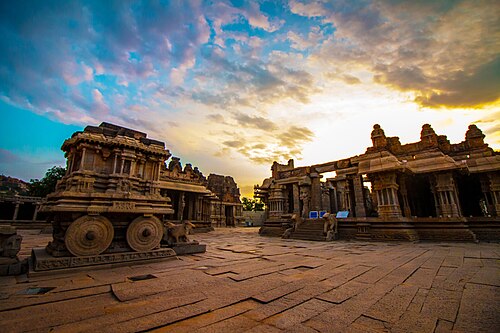
帝国の遺産には南インド各地に点在する多くの遺跡が含まれており、その中でも最も有名なのはハンピの遺跡群である。南インドにおけるこれまでの寺院建築の伝統は、ヴィジャヤナガラ建築様式に集約された。あらゆる信仰と方言の融合は、ヒンドゥー教寺院建築の革新を促した。南インドの数学は、ケーララ州のヴィジャヤナガラ帝国の保護下で栄えた。南インドの数学者サンガマグラーマのマダヴァは、 14世紀に有名なケーララ天文学・数学学派を設立し、パラメーシュヴァラ、ニラカンタ・ソマヤジ、ジェーシュタデーヴァなど多くの偉大な南インドの数学者を輩出した。[ 261 ]効率的な行政と活発な海外貿易により、灌漑用水管理システムなどの新しい技術がもたらされた。[ 262 ]帝国の庇護により、カンナダ語、テルグ語、タミル語、サンスクリット語の美術と文学は新たな高みに達し、カルナティック音楽は現在の形へと発展した。[ 263 ]
ヴィジャヤナガラはタリコタの戦い(1565年)での敗北後、衰退した。タリコタの戦いでアリヤ・ラマ・ラヤが死去した後、ティルマラ・デーヴァ・ラヤはアラヴィドゥ王朝を創始し、破壊されたハンピに代わる新たな首都ペヌコンダを建設し、ヴィジャヤナガラ帝国の残骸を再建しようと試みた。[ 264 ]ティルマラは1572年に退位し、王国の残骸を3人の息子に分け、1578年に死去するまで宗教的な生活を送った。アラヴィドゥ王朝の後継者たちはこの地域を統治したが、帝国は1614年に崩壊し、ビジャープル・スルタン国などとの度重なる戦争により、1646年に最後の残骸が消滅した。[ 265 ] [ 266 ] [ 267 ]この時期、南インドの多くの王国がヴィジャヤナガラ王国から独立しました。これらには、マイソール王国、ケラディ・ナヤカ、マドゥライのナヤカ、タンジョールのナヤカ、チトラドゥルガのナヤカ、ジンジーのナヤカ王国 などがあり、いずれも独立を宣言し、その後の数世紀にわたって南インドの歴史に大きな影響を与えました。[ 265 ]


13世紀半ばから2世紀半の間、北インドの政治はデリー・スルタン朝によって、南インドはヴィジャヤナガル帝国によって支配されていた。しかし、他にも地域的な勢力が存在していた。パーラ帝国の崩壊後、チェロ王朝は12世紀から18世紀にかけてウッタル・プラデーシュ州東部、ビハール州、ジャールカンド州の大部分を支配した。 [ 268 ] [ 269 ] [ 270 ]レッディ王朝はデリー・スルタン朝を打ち破り、北のカタックから南のカンチまで支配を拡大したが、最終的には拡大するヴィジャヤナガル帝国に吸収された。[ 271 ]
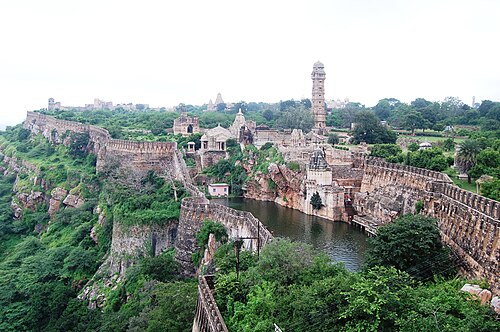
北部では、ラージプート王国が西インドと中央インドで支配的な勢力であり続けた。マハラナ・ハンミール率いるメワール王朝は、バルグジャールを主な同盟者としてムハンマド・トゥグルクを破り捕らえた。トゥグルクは巨額の身代金を支払い、メワールの領土すべてを放棄しなければならなかった。この出来事の後、デリー・スルタン朝は数百年間チットールを攻撃しなかった。ラージプートは独立を回復し、ラージプート諸国は東はベンガル、北はパンジャブまで確立された。トマーラ朝はグワーリヤルに拠点を築き、マン・シン・トマールはグワーリヤル城を再建した。[ 272 ]この時期、メワールがラージプート諸国のリーダーとして台頭し、ラナ・クンバはマルワとグジャラートのスルタン朝を犠牲にして王国を拡大した。[ 272 ] [ 273 ]次の偉大なラージプートの支配者、メーワールのラナ・サンガは、北インドで主要なプレーヤーとなった。彼の目標は拡大し、デリーを征服しようと計画した。しかし、カーンワーの戦いでの敗北により、インドにおける新しいムガル王朝が確立された。[ 272 ]マハラナ・ウダイ・シン2世のメーワール王朝は、ムガル皇帝アクバルによってさらに敗北し、首都チットールが占領された。この出来事により、ウダイ・シン2世はウダイプルを建設し、そこがメーワール王国の新しい首都となった。彼の息子、メーワールのマハラナ・プラタップは、ムガル帝国に断固として抵抗した。アクバルは彼に対して多くの使節を送った。彼は生き残り、最終的にチットール城を除くメーワール全土を支配下に置いた。[ 274 ]
南部では、1347年にトゥグルク朝に対する反乱から生まれたデカン地方のバフマニー朝[ 275 ]がヴィジャヤナガラ王国の主要なライバルであり、しばしばヴィジャヤナガラ王国に困難をもたらした[ 276 ] 。 1490年からバフマニー朝の総督が反乱を起こし、独立した国家がデカン地方の5つのスルタン国となった。アフマドナガルが独立を宣言し、同年ビジャープルとベラールがそれに続いた。ゴルコンダは1518年に、ビダルは1528年に独立した[ 277 ]。一般的にはライバル関係にあったが、1565年にヴィジャヤナガラ帝国に対して同盟を結び、タリコタの戦いでヴィジャヤナガラ王国を恒久的に弱体化させた[ 278 ] [ 279 ] 。
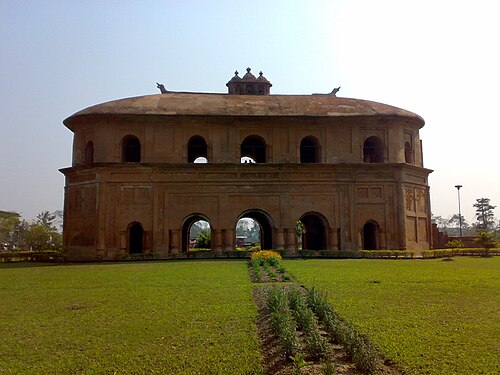
東では、ガジャパティ王国が依然として侮れない強力な地域勢力であり、地域文化と建築の発展の頂点と結びついていた。カピレンドラデーヴァの治世下で、ガジャパティは北のガンジス川下流から南のカーヴェリ川まで広がる帝国となった。 [ 280 ]インド北東部では、アホーム王国が6世紀にわたって主要な勢力であった。[ 281 ] [ 282 ]ラチット・ボルプカンに率いられたアホームは、アホーム・ムガル紛争中のサラガートの戦いでムガル軍を決定的に破った。[ 283 ]インド北東部のさらに東にはマニプル王国があり、カングラ砦を拠点として統治し、洗練されたヒンドゥー教ガウディヤ・ヴァイシュナヴァ派の文化を発展させた。[ 284 ] [ 285 ] [ 286 ]
ベンガル・スルタン国は、ガンジス川とブラマプトラ川のデルタ地帯を支配する勢力であり、その地域一帯に造幣都市のネットワークを築いていた。スンニ派イスラム教の君主制国家であり、インド・トルコ系、アラブ系、アビシニア系、ベンガル系のイスラム教エリート層を擁していた。スルタン国は、非イスラム教徒のコミュニティが平和的に共存する宗教的多様性で知られていた。ベンガル・スルタン国は、南西部のオリッサ、南東部のアラカン、東部のトリプラなど、多くの属国を抱えていた。16世紀初頭、ベンガル・スルタン国は北東部のカムループとカマタ、西部のジャウンプルとビハールを支配下に置き、領土拡大の頂点に達した。繁栄する交易国家であり、アジアで最も強力な国家の一つとして知られていた。ベンガル・スルタン国は、当時のヨーロッパ人や中国人旅行者によって、比較的繁栄した王国であり、「最も貿易に適した豊かな国」と評された。ベンガル・スルタン国は、建築においても優れた遺産を残した。当時の建築物には、外国の影響が融合し、独特のベンガル様式が確立されている。ベンガル・スルタン国はまた、ベンガルの歴史において、独立した中世のイスラム教徒支配国家の中で最大かつ最も権威のある国であった。その衰退は、スーリ朝による統治を経て始まり、その後ムガル帝国の征服と、小王国への分裂へと続いた。
バクティ運動とは、中世ヒンドゥー教[ 287 ]で出現し、後にシーク教で革命的になった有神論的信仰の傾向を指す[ 288 ]。それは7世紀の南インド(現在のタミル・ナードゥ州とケーララ州の一部)で始まり、北へと広がった[ 287 ] 。15世紀以降、東インドと北インドに広がり、15世紀から17世紀にかけて最盛期を迎えた[ 289 ] 。


インド史の近世初期は、ティムール朝ルネッサンスから受け継いだムガル帝国の興亡に対応する1526年から1858年までである。この時代には、インドの経済は拡大し、比較的平和が維持され、芸術が保護された。この時期には、インド・イスラム建築がさらに発展した。[ 299 ] [ 300 ]マラーターとシク教徒の勢力拡大により、ムガル帝国の衰退期にはインドの重要な地域を支配することができた。[ 15 ] 1500年代にケープ航路が発見されると、海路で到着し定住した最初のヨーロッパ人は、ゴアとボンベイに定住したポルトガル人であった。[ 301 ]
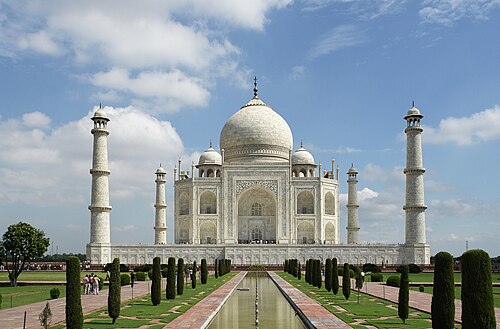
1526年、バーブルはカイバル峠を越えてムガル帝国を建国し、最盛期には南アジアの大部分を支配した。[ 303 ]しかし、彼の息子フマーユーンは1540年にアフガンの戦士シェール・シャー・スーリに敗れ、カブールへの撤退を余儀なくされた。シェール・シャーの死後、彼の息子イスラーム・シャー・スーリと彼のヒンドゥー教徒の将軍ヘム・ヴィクラマディティヤは、 1556年までデリーから北インドに世俗的な統治を確立したが、バーブルの孫であるアクバル(在位1556年~1605年)が、デリーの戦いに勝利した後、1556年11月6日の第二次パーニーパットの戦いでヘムを破った。アクバルはヒンドゥー教徒との良好な関係を築こうとした。アクバルはジャイナ教の聖なる日に動物を殺さないことを宣言した。彼は非イスラム教徒に対するジズヤ税を撤廃した。ムガル皇帝は地元の王族と結婚し、地元のマハラジャと同盟を結び、トルコ・ペルシャ文化と古代インドの様式を融合させようと試み、独自のインド・ペルシャ文化とインド・サラセン建築を生み出した。
アクバルはラージプートの王女マリアム・ウズ・ザマニと結婚し、息子ジャハーンギール(在位1605年~1627年)をもうけた。[ 304 ]ジャハーンギールは父の政策を踏襲した。ムガル王朝は1600年までにインド亜大陸の大部分を支配した。シャー・ジャハーン(在位1628年~1658年)の治世はムガル建築の黄金時代であった。彼は数々の巨大な建造物を建て、その中でも最も有名なのがアグラのタージ・マハルである。
それはインド亜大陸に存在した最大の帝国の1つであり、[ 305 ]中国を凌駕して世界最大の経済大国となり、世界経済の24.4%を支配し、[ 306 ]製造業では世界をリードし、[ 307 ]世界の工業生産の25%を生産した。[ 308 ]経済と人口の急増は、農業生産を強化したムガル帝国の農業改革、[ 309 ]および比較的高い都市化の度合いによって促進された。[ 310 ]


ムガル帝国は、アウラングゼーブ(在位1658年~1707年)の治世中に領土が最大となり、彼の治世下でインドは世界最大の経済大国として清朝中国を凌駕した。[ 311 ] [ 312 ]アウラングゼーブは前任者よりも寛容ではなく、ジズヤ税を再導入し、いくつかの歴史的な寺院を破壊したが、同時に破壊したよりも多くのヒンドゥー教寺院を建設し、[ 313 ]前任者よりも大幅に多くのヒンドゥー教徒を帝国官僚機構に雇用し、宗教ではなく能力に基づいて行政官を昇進させた。[ 314 ]しかし、彼は前任者の寛容な融合的伝統の衰退、宗教論争の激化、中央集権化の責任を問われることが多い。イギリス東インド会社は英ムガル戦争で敗北した。[ 315 ] [ 316 ]

The Mughals suffered several blows due to invasions from Marathas, Rajputs, Jats and Afghans. In 1737, the Maratha general Bajirao of the Maratha Empire invaded and plundered Delhi. Under the general Amir Khan Umrao Al Udat, the Mughal Emperor sent 8,000 troops to drive away the 5,000 Maratha cavalry soldiers. Baji Rao easily routed the novice Mughal general. In 1737, in the final defeat of Mughal Empire, the commander-in-chief of the Mughal Army, Nizam-ul-mulk, was routed at Bhopal by the Maratha army. This essentially brought an end to the Mughal Empire. While Bharatpur State under Jat ruler Suraj Mal, overran the Mughal garrison at Agra and plundered the city.[317] In 1739, Nader Shah, emperor of Iran, defeated the Mughal army at the Battle of Karnal.[318] After this victory, Nader captured and sacked Delhi, carrying away treasures including the Peacock Throne.[319]Ahmad Shah Durrani commenced his own invasions as ruler of the Durrani Empire, eventually sacking Delhi in 1757.[320] Mughal rule was further weakened by constant native Indian resistance; Banda Singh Bahadur led the SikhKhalsa against Mughal religious oppression; Hindu Rajas of Bengal, Pratapaditya and Raja Sitaram Ray revolted; and MaharajaChhatrasal, of Bundela Rajputs, fought the Mughals and established the Panna State.[321] The Mughal dynasty was reduced to puppet rulers by 1757. Vadda Ghalughara took place under the Muslim provincial government based at Lahore to wipe out the Sikhs, with 30,000 Sikhs being killed, an offensive that had begun with the Mughals, with the Chhota Ghallughara,[322] and lasted several decades under its Muslim successor states.[323]


The Maratha kingdom was founded and consolidated by Chatrapati Shivaji.[324] However, the credit for making the Marathas formidable power nationally goes to Peshwa (chief minister) Bajirao I. Historian K.K. Datta wrote that Bajirao I "may very well be regarded as the second founder of the Maratha Empire".[325]
In the early 18th century, under the Peshwas, the Marathas consolidated and ruled over much of South Asia. The Marathas are credited to a large extent for ending Mughal rule in India.[326][327][328] In 1737, the Marathas defeated a Mughal army in their capital, in the Battle of Delhi. The Marathas continued their military campaigns against the Mughals, Nizam, Nawab of Bengal and the Durrani Empire to further extend their boundaries. At its peak, the domain of the Marathas encompassed most of the Indian subcontinent.[329] The Marathas even attempted to capture Delhi and discussed putting Vishwasrao Peshwa on the throne there in place of the Mughal emperor.[330]
The Maratha empire at its peak stretched from Tamil Nadu in the south,[331] to Peshawar (modern-day Khyber Pakhtunkhwa, Pakistan[332][note 2]) in the north, and Bengal in the east. The Northwestern expansion of the Marathas was stopped after the Third Battle of Panipat (1761). However, the Maratha authority in the north was re-established within a decade under Peshwa Madhavrao I.[334]
Under Madhavrao I, the strongest knights were granted semi-autonomy, creating a confederacy of United Maratha states under the Gaekwads of Baroda, the Holkars of Indore and Malwa, the Scindias of Gwalior and Ujjain, the Bhonsales of Nagpur and the Puars of Dhar and Dewas. In 1775, the East India Company intervened in a Peshwa family succession struggle in Pune, which led to the First Anglo-Maratha War, resulting in a Maratha victory.[335] The Marathas remained a major power in India until their defeat in the Second and Third Anglo-Maratha Wars (1805–1818).
The Sikh Empire was a political entity that governed the northwestern regions of the Indian subcontinent, based around the Punjab, from 1799 to 1849. It was forged, on the foundations of the Khalsa, under the leadership of Maharaja Ranjit Singh (1780–1839).
Maharaja Ranjit Singh consolidated much of northern India into an empire using his Sikh Khalsa Army, trained in European military techniques and equipped with modern military technologies. Ranjit Singh proved himself to be a master strategist and selected well-qualified generals for his army. He successfully ended the Afghan-Sikh Wars. In stages, he added central Punjab, the provinces of Multan and Kashmir, and the Peshawar Valley to his empire.[336][337]
At its peak in the 19th century, the empire extended from the Khyber Pass in the west, to Kashmir in the north, to Sindh in the south, running along Sutlej river to Himachal in the east. After the death of Ranjit Singh, the empire weakened, leading to conflict with the British East India Company. The First Anglo-Sikh War and Second Anglo-Sikh War marked the downfall of the Sikh Empire, making it among the last areas of the Indian subcontinent to be conquered by the British.

The Kingdom of Mysore in southern India expanded to its greatest extent under Hyder Ali and his son Tipu Sultan in the later half of the 18th century. Under their rule, Mysore fought series of wars against the Marathas and British or their combined forces. The Maratha–Mysore War ended in April 1787, following the finalising of treaty of Gajendragad, in which Tipu Sultan was obligated to pay tribute to the Marathas. Concurrently, the Anglo-Mysore Wars took place, where the Mysoreans used the Mysorean rockets. The Fourth Anglo-Mysore War (1798–1799) saw the death of Tipu. Mysore's alliance with the French was seen as a threat to the British East India Company, and Mysore was attacked from all four sides. The Nizam of Hyderabad and the Marathas launched an invasion from the north. The British won a decisive victory at the Siege of Seringapatam (1799).
Hyderabad was founded by the Qutb Shahi dynasty of Golconda in 1591. Following a brief Mughal rule, Asif Jah, a Mughal official, seized control of Hyderabad and declared himself Nizam-al-Mulk of Hyderabad in 1724. The Nizams lost considerable territory and paid tribute to the Maratha Empire after being routed in multiple battles, such as the Battle of Palkhed.[338] However, the Nizams maintained their sovereignty from 1724 until 1948 through paying tributes to the Marathas, and later, being vassals of the British. Hyderabad State became a princely state in British India in 1798.
The Nawabs of Bengal had become the de facto rulers of Bengal following the decline of Mughal Empire. However, their rule was interrupted by Marathas who carried out six expeditions in Bengal from 1741 to 1748, as a result of which Bengal became a tributary state of Marathas. On 23 June 1757, Siraj ud-Daulah, the last independent Nawab of Bengal was betrayed in the Battle of Plassey by Mir Jafar. He lost to the British, who took over the charge of Bengal in 1757, installed Mir Jafar on the Masnad (throne) and established itself to a political power in Bengal.[339] In 1765 the system of Dual Government was established, in which the Nawabs ruled on behalf of the British and were mere puppets to the British. In 1772 the system was abolished and Bengal was brought under the direct control of the British. In 1793, when the Nizamat (governorship) of the Nawab was also taken away, they remained as mere pensioners of the British East India Company.[340][341]
In the 18th century, the whole of Rajputana was virtually subdued by the Marathas. The Second Anglo-Maratha War distracted the Marathas from 1807 to 1809, but afterward Maratha domination of Rajputana resumed. In 1817, the British went to war with the Pindaris, raiders who were fled in Maratha territory, which quickly became the Third Anglo-Maratha War, and the British government offered its protection to the Rajput rulers from the Pindaris and the Marathas. By the end of 1818 similar treaties had been executed between the other Rajput states and Britain. The Maratha Sindhia ruler of Gwalior gave up the district of Ajmer-Merwara to the British, and Maratha influence in Rajasthan came to an end.[342] Most of the Rajput princes remained loyal to Britain in the Revolt of 1857, and few political changes were made in Rajputana until Indian independence in 1947. The Rajputana Agency contained more than 20 princely states, most notable being Udaipur State, Jaipur State, Bikaner State and Jodhpur State.
After the fall of the Maratha Empire, many Maratha dynasties and states became vassals in a subsidiary alliance with the British. With the decline of the Sikh Empire, after the First Anglo-Sikh War in 1846, under the terms of the Treaty of Amritsar, the British government sold Kashmir to Maharaja Gulab Singh and the princely state of Jammu and Kashmir, the second-largest princely state in British India, was created by the Dogra dynasty.[343][344] While in eastern and north-eastern India, the Hindu and Buddhist states of Cooch Behar Kingdom, Twipra Kingdom and Kingdom of Sikkim were annexed by the British and made vassal princely state.
After the fall of the Vijayanagara Empire, Polygar states emerged in Southern India; and managed to weather invasions and flourished until the Polygar Wars, where they were defeated by the British East India Company forces.[345] Around the 18th century, the Kingdom of Nepal was formed by Rajput rulers.[346]

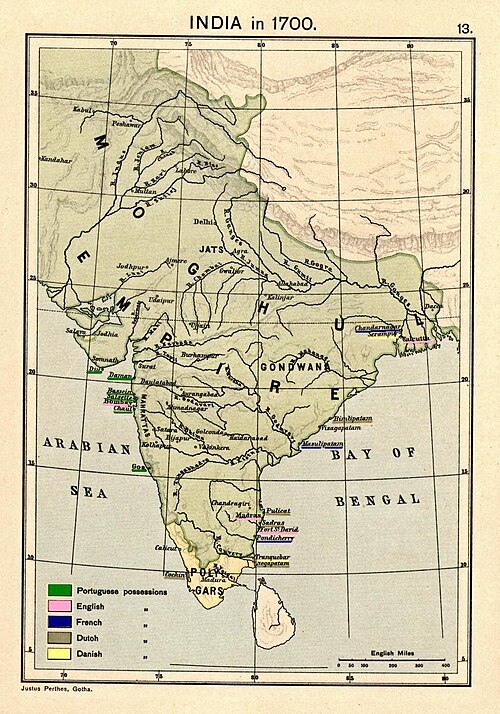
In 1498, a Portuguese fleet under Vasco da Gama discovered a new sea route from Europe to India, which paved the way for direct Indo-European commerce. The Portuguese soon set up trading posts in Velha Goa, Damaon, Dio island, and Bombay. The Portuguese instituted the Goa Inquisition, where new Indian converts were punished for suspected heresy against Christianity and non-Christians were condemned.[347] Goa remained the main Portuguese territory until it was annexed by India in 1961.[348]
The next to arrive were the Dutch, with their main base in Ceylon. They established ports in Malabar. However, their expansion into India was halted after their defeat in the Battle of Colachel by the Kingdom of Travancore during the Travancore-Dutch War. The Dutch never recovered from the defeat and no longer posed a large colonial threat to India.[349][350]
The internal conflicts among Indian kingdoms gave opportunities to the European traders to gradually establish political influence and appropriate lands. Following the Dutch, the British — who set up in the west coast port of Surat in 1619 — and the French both established trading outposts in India. Although continental European powers controlled various coastal regions of southern and eastern India during the ensuing century, they eventually lost all their territories in India to the British, with the exception of the French outposts of Pondichéry and Chandernagore, and the Portuguese colonies of Goa, Daman and Diu.[351][352]


The English East India Company was founded in 1600. It gained a foothold in India with the establishment of a factory in Masulipatnam on the Eastern coast of India in 1611 and a grant of rights by the Mughal emperor Jahangir to establish a factory in Surat in 1612. In 1640, after receiving similar permission from the Vijayanagara ruler farther south, a second factory was established in Madras on the southeastern coast. The islet of Bom Bahia in present-day Mumbai (Bombay) was a Portuguese outpost not far from Surat. It was presented to Charles II of England as dowry in his marriage to Catherine of Braganza. Charles in turn leased Bombay to the Company in 1668. Two decades later, the company established a trade post in the River Ganges delta. During this time other companies established by the Portuguese, Dutch, French, and Danish were similarly expanding in the subcontinent.
The company's victory under Robert Clive in the 1757 Battle of Plassey and another victory in the 1764 Battle of Buxar (in Bihar), consolidated the company's power, and forced emperor Shah Alam II to appoint it the diwan, or revenue collector, of Bengal, Bihar, and Orissa. The company thus became the de facto ruler of large areas of the lower Gangetic plain by 1773. It also proceeded by degrees to expand its dominions around Bombay and Madras. The Anglo-Mysore Wars (1766–1799) and the Anglo-Maratha Wars (1772–1818) left it in control of large areas of India south of the Sutlej River. With the defeat of the Marathas, no native power represented a threat for the company any longer.[353]
The expansion of the company's power chiefly took two forms. The first of these was the outright annexation of Indian states and subsequent direct governance of the underlying regions that collectively came to comprise British India. The annexed regions included the North-Western Provinces (comprising Rohilkhand, Gorakhpur, and the Doab) (1801), Delhi (1803), Assam (Ahom Kingdom 1828), and Sindh (1843). Punjab, North-West Frontier Province, and Kashmir were annexed after the Anglo-Sikh Wars in 1849–1856 (period of tenure of Marquess of Dalhousie Governor General). However, Kashmir was immediately sold under the Treaty of Amritsar (1850) to the Dogra dynasty of Jammu and thereby became a princely state. In 1854, Berar was annexed along with the state of Oudh two years later.
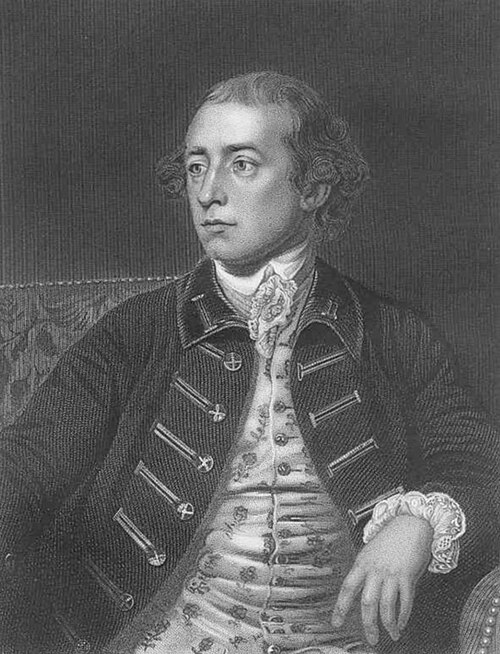


The second form of asserting power involved treaties in which Indian rulers acknowledged the company's hegemony in return for limited internal autonomy. Since the company operated under financial constraints, it had to set up political underpinnings for its rule.[354] The most important such support came from the subsidiary alliances with Indian princes.[354] In the early 19th century, the territories of these princes accounted for two-thirds of India.[354] When an Indian ruler who was able to secure his territory wanted to enter such an alliance, the company welcomed it as an economical method of indirect rule that did not involve the economic costs of direct administration or the political costs of gaining the support of alien subjects.[355]
In return, the company undertook the "defense of these subordinate allies and treated them with traditional respect and marks of honor."[355] Subsidiary alliances created the princely states of the Hindu maharajas and the Muslim nawabs. Prominent among the princely states were Cochin (1791), Jaipur (1794), Travancore (1795), Hyderabad (1798), Mysore (1799), Cis-Sutlej Hill States (1815), Rajputana (1818),[356]Central India Agency (1819), Cutch and Gujarat Gaikwad territories (1819), and Bahawalpur (1833).
The Indian indenture system was an ongoing system of indenture, a form of debt bondage, by which 3.5 million Indians were transported to colonies of European powers to provide labour for the (mainly sugar) plantations. It started from the end of slavery in 1833 and continued until 1920. This resulted in the development of a large Indian diaspora that spread from the Caribbean to the Pacific Ocean and the growth of large Indo-Caribbean and Indo-African populations.
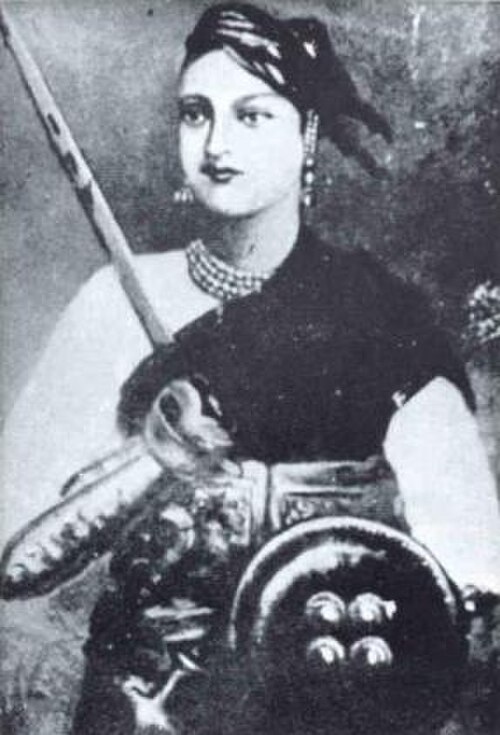


The Indian rebellion of 1857 was a large-scale rebellion by soldiers employed by the British East India Company in northern and central India against the company's rule. The spark that led to the mutiny was the issue of new gunpowder cartridges for the Enfield rifle, which was insensitive to local religious prohibition. The key mutineer was Mangal Pandey.[357] In addition, the underlying grievances over British taxation, the ethnic gulf between the British officers and their Indian troops and land annexations played a significant role in the rebellion. Within weeks after Pandey's mutiny, dozens of units of the Indian army joined peasant armies in widespread rebellion. The rebel soldiers were later joined by Indian nobility, many of whom had lost titles and domains under the Doctrine of Lapse and felt that the company had interfered with a traditional system of inheritance. Rebel leaders such as Nana Sahib and the Rani of Jhansi belonged to this group.[358]
After the outbreak of the mutiny in Meerut, the rebels very quickly reached Delhi. The rebels had also captured large tracts of the North-Western Provinces and Awadh (Oudh). Most notably, in Awadh, the rebellion took on the attributes of a patriotic revolt against British presence.[359] However, the British East India Company mobilised rapidly with the assistance of friendly Princely states, but it took the British the better part of 1858 to suppress the rebellion. Due to the rebels being poorly equipped and having no outside support or funding, they were brutally subdued.[360]
In the aftermath, all power was transferred from the British East India Company to the British Crown, which began to administer most of India as provinces. The Crown controlled the company's lands directly and had considerable indirect influence over the rest of India, which consisted of the Princely states ruled by local royal families. There were officially 565 princely states in 1947, but only 21 had actual state governments, and only three were large (Mysore, Hyderabad, and Kashmir). They were absorbed into the independent nation in 1947–1948.[361]


After 1857, the colonial government strengthened and expanded its infrastructure via the court system, legal procedures, and statutes. The Indian Penal Code came into being.[362] In education, Thomas Babington Macaulay had made schooling a priority for the Raj in 1835 and succeeded in implementing the use of English for instruction. By 1890, some 60,000 Indians had matriculated.[363] The Indian economy grew at about 1% per year from 1880 to 1920, and the population also grew at 1%. However, from the 1910s, Indian private industry began to grow significantly. India built a modern railway system in the late 19th century which was the fourth largest in the world.[364] Historians have been divided on issues of economic history, with the Nationalist school arguing that India was poorer due to British rule.[365]
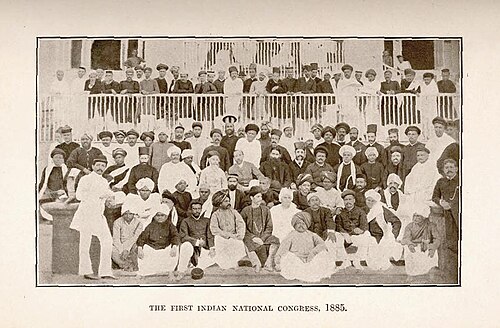
In 1905, Lord Curzonsplit the large province of Bengal into a largely Hindu western half and "Eastern Bengal and Assam", a largely Muslim eastern half. The British goal was said to be efficient administration but the people of Bengal were outraged at the apparent "divide and rule" strategy. It also marked the beginning of the organised anti-colonial movement. When the Liberal Party in Britain came to power in 1906, he was removed. Bengal was reunified in 1911. The new Viceroy Gilbert Minto and the new Secretary of State for India John Morley consulted with Congress leaders on political reforms. The Morley-Minto reforms of 1909 provided for Indian membership of the provincial executive councils as well as the Viceroy's executive council. The Imperial Legislative Council was enlarged from 25 to 60 members and separate communal representation for Muslims was established in a dramatic step towards representative and responsible government.[366] Several socio-religious organisations came into being at that time. Muslims set up the All India Muslim League in 1906 to protect the interests of the aristocratic Muslims. The Hindu Mahasabha sought to represent Hindu interests. The Hindu nationalist Rashtriya Swayamsevak Sangh (RSS) was formed in 1925–1926.[367] Sikhs founded the Shiromani Akali Dal in 1920.[368] However, the largest and oldest political party Indian National Congress, founded in 1885, attempted to keep a distance from the socio-religious movements and identity politics.[369]


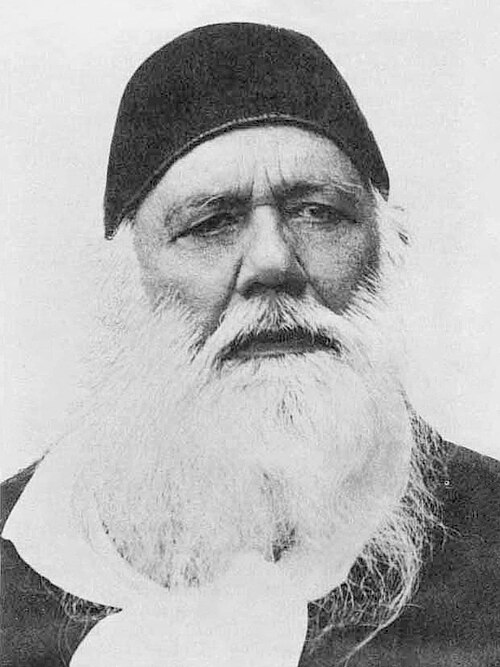


The Bengali Renaissance refers to a social reform movement, dominated by Bengali Hindus, in the Bengal region of the Indian subcontinent during the nineteenth and early twentieth centuries, a period of British rule. Historian Nitish Sengupta describes the renaissance as having started with reformer and humanitarian Raja Ram Mohan Roy (1775–1833), and ended with Asia's first Nobel laureate Rabindranath Tagore (1861–1941).[370] This flowering of religious and social reformers, scholars, and writers is described by historian David Kopf as "one of the most creative periods in Indian history."[371]
During this period, Bengal witnessed an intellectual awakening that is in some way similar to the Renaissance. This movement questioned existing orthodoxies, particularly with respect to women, marriage, the dowry system, the caste system, and religion. One of the earliest social movements that emerged during this time was the Young Bengal movement, which espoused rationalism and atheism as the common denominators of civil conduct among upper caste educated Hindus.[372] It played an important role in reawakening Indian minds and intellect across the Indian subcontinent.
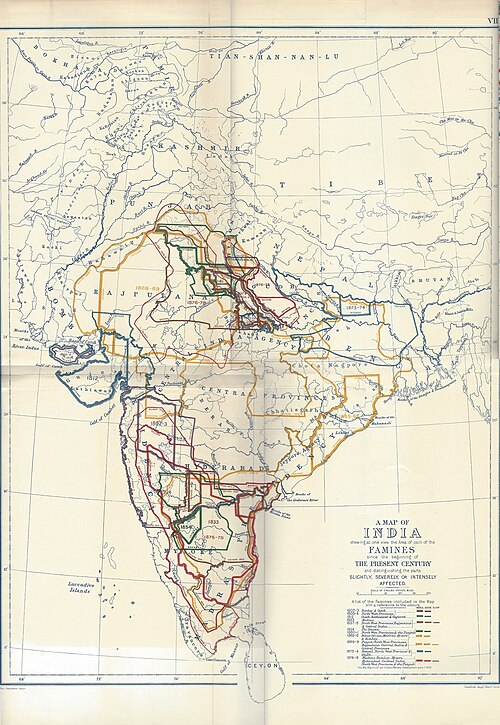


During British East India Company and British Crown rule, India experienced some of deadliest ever recorded famines. These famines, usually resulting from crop failures and often exacerbated by policies of the colonial government,[373] included the Great Famine of 1876–1878 in which 6.1 million to 10.3 million people died,[374] the Great Bengal famine of 1770 where between 1 and 10 million people died,[375][376] the Indian famine of 1899–1900 in which 1.25 to 10 million people died,[373] and the Bengal famine of 1943 where between 2.1 and 3.8 million people died.[377] The third plague pandemic in the mid-19th century killed 10 million people in India.[378] Despite persistent diseases and famines, the population of the Indian subcontinent, which stood at up to 200 million in 1750,[379] had reached 389 million by 1941.[380]

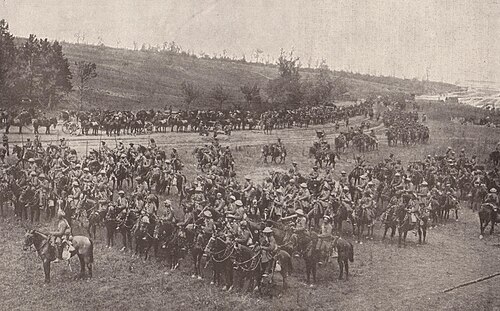


During World War I, over 800,000 volunteered for the army, and more than 400,000 volunteered for non-combat roles, compared with the pre-war annual recruitment of about 15,000 men.[381] The Army saw early action on the Western Front at the First Battle of Ypres. After a year of front-line duty, sickness and casualties had reduced the Indian Corps to the point where it had to be withdrawn. Nearly 700,000 Indians fought the Turks in the Mesopotamian campaign. Indian formations were also sent to East Africa, Egypt, and Gallipoli.[382]
The Indian Army and the Imperial Service Troops fought during the Sinai and Palestine Campaign's defence of the Suez Canal in 1915, at Romani in 1916 and to Jerusalem in 1917. Indian units occupied the Jordan Valley and after the German spring offensive they became the major force in the Egyptian Expeditionary Force during the Battle of Megiddo and in the Desert Mounted Corps' advance to Damascus and on to Aleppo. Other divisions remained in India guarding the North-West Frontier and fulfilling internal security obligations.
One million Indian troops served abroad during the war. In total, 74,187 died,[383] and another 67,000 were wounded.[384] The roughly 90,000 soldiers who died fighting in World War I and the Afghan Wars are commemorated by the India Gate.


British India officially declared war on Nazi Germany in September 1939.[385] The British Raj, as part of the Allied Nations, sent over two and a half million volunteer soldiers to fight under British command against the Axis powers. Additionally, several princely states provided large donations to support the Allied campaign. India also provided the base for American operations in support of China in the China Burma India Theatre.
Indians fought throughout the world, including in the European theatre against Germany, in North Africa against Germany and Italy, against the Italians in East Africa, in the Middle East against the Vichy French, in the South Asian region defending India against the Japanese and fighting the Japanese in Burma. Indians also aided in liberating British colonies such as Singapore and Hong Kong after the Japanese surrender in August 1945. Over 87,000 soldiers from the subcontinent died in World War II.
The Indian National Congress denounced Nazi Germany but would not fight it or anyone else until India was independent. Congress launched the Quit India Movement in August 1942, refusing to co-operate in any way with the government until independence was granted. The government immediately arrested over 60,000 national and local Congress leaders. The Muslim League rejected the Quit India movement and worked closely with the Raj authorities.
Subhas Chandra Bose (also called Netaji) broke with Congress and tried to form a military alliance with Germany or Japan to gain independence. The Germans assisted Bose in the formation of the Indian Legion;[386] however, it was Japan that helped him revamp the Indian National Army (INA), after the First Indian National Army under Mohan Singh was dissolved. The INA fought under Japanese direction, mostly in Burma.[387] Bose also headed the Provisional Government of Free India (or Azad Hind), a government-in-exile based in Singapore.[388][389]
By 1942, neighbouring Burma was invaded by Japan, which by then had already captured the Indian territory of Andaman and Nicobar Islands. Japan gave nominal control of the islands to the Provisional Government of Free India on 21 October 1943, and in the following March, the Indian National Army with the help of Japan crossed into India and advanced as far as Kohima in Nagaland. This advance on the mainland of the Indian subcontinent reached its farthest point on Indian territory, retreating from the Battle of Kohima in June and from that of Imphal on 3 July 1944.
The region of Bengal in British India suffered a devastating famine during 1940–1943. An estimated 2.1–3 million died from the famine, frequently characterised as "man-made,"[390] with most sources asserting that wartime colonial policies exacerbated the crisis.[391]


The numbers of British in India were small,[394] yet they were able to rule 52% of the Indian subcontinent directly and exercise considerable leverage over the princely states that accounted for 48% of the area.[395]
One of the most important events of the 19th century was the rise of Indian nationalism,[396] leading Indians to seek first "self-rule" and later "complete independence". However, historians are divided over the causes of its rise. Probable reasons include a "clash of interests of the Indian people with British interests",[396] "racial discriminations",[397] and "the revelation of India's past".[398]
The first step toward Indian self-rule was the appointment of councillors to advise the British viceroy in 1861 and the first Indian was appointed in 1909. Provincial Councils with Indian members were also set up. The councillors' participation was subsequently widened into legislative councils. The British built a large British Indian Army, with the senior officers all British and many of the troops from small minority groups such as Gurkhas from Nepal and Sikhs.[399] The civil service was increasingly filled with natives at the lower levels, with the British holding the more senior positions.[400]
Bal Gangadhar Tilak, an Indian nationalist leader, declared Swaraj (home rule) as the destiny of the nation. His popular sentence "Swaraj is my birthright, and I shall have it"[401] became the source of inspiration. Tilak was backed by rising public leaders like Bipin Chandra Pal and Lala Lajpat Rai, who held the same point of view, notably they advocated the Swadeshi movement involving the boycott of imported items and the use of Indian-made goods;[402] the triumvirate were popularly known as Lal Bal Pal. In 1907, the Congress was split into two factions: The radicals, led by Tilak, advocated civil agitation and direct revolution to overthrow the British Empire and the abandonment of all things British. The moderates, led by leaders like Dadabhai Naoroji and Gopal Krishna Gokhale, on the other hand, wanted reform within the framework of British rule.[402]
The partition of Bengal in 1905 further increased the revolutionary movement for Indian independence. The disenfranchisement lead some to take violent action.
The British themselves adopted a "carrot and stick" approach in response to renewed nationalist demands. The means of achieving the proposed measure were later enshrined in the Government of India Act 1919, which introduced the principle of a dual mode of administration, or diarchy, in which elected Indian legislators and appointed British officials shared power.[403] In 1919, Colonel Reginald Dyer ordered his troops to fire their weapons on peaceful protestors, including unarmed women and children, resulting in the Jallianwala Bagh massacre; which led to the non-cooperation movement of 1920–1922. The massacre was a decisive episode towards the end of British rule in India.[404]
From 1920 leaders such as Mahatma Gandhi began highly popular mass movements to campaign against the British Raj using largely peaceful methods. The Gandhi-led independence movement opposed the British rule using non-violent methods like non-co-operation, civil disobedience and economic resistance. However, revolutionary activities against the British rule took place throughout the Indian subcontinent and some others adopted a militant approach like the Hindustan Republican Association, that sought to overthrow British rule by armed struggle.
The All India Azad Muslim Conference gathered in Delhi in April 1940 to voice its support for an independent and united India.[405] Its members included several Islamic organisations in India, as well as 1,400 nationalist Muslim delegates.[406][407][408] The pro-separatist All-India Muslim League worked to try to silence those nationalist Muslims who stood against the partition of India, often using "intimidation and coercion".[407][408] The murder of the All India Azad Muslim Conference leader Allah Bakhsh Soomro also made it easier for the pro-separatist All-India Muslim League to demand the creation of a Pakistan.[408]
In January 1946, several mutinies broke out in the armed services, starting with that of RAF servicemen frustrated with their slow repatriation. The mutinies came to a head with mutiny of the Royal Indian Navy in Bombay in February 1946, followed by others in Calcutta, Madras, and Karachi. The mutinies were rapidly suppressed. In early 1946, new elections were called and Congress candidates won in eight of the eleven provinces.
Late in 1946, the Labour government decided to end British rule of India, and in early 1947 it announced its intention of transferring power no later than June 1948 and participating in the formation of an interim government.


Along with the desire for independence, tensions between Hindus and Muslims had also been developing over the years. Muslim League leader Muhammad Ali Jinnah proclaimed 16 August 1946 as Direct Action Day, with the stated goal of highlighting, peacefully, the demand for a Muslim homeland in British India, which resulted in the outbreak of the cycle of violence that would be later called the "Great Calcutta Killing of August 1946". The communal violence spread to Bihar, Noakhali in Bengal, Garhmukteshwar in the United Provinces, and on to Rawalpindi in March 1947 in which Sikhs and Hindus were attacked or driven out by Muslims.[409]Louis Mountbatten became the Viceroy of India in February 1947, arriving in India in March, and oversaw the decolonisation and partition of British India.


"A moment comes, which comes but rarely in history, when we step out from the old to the new; when an age ends; and when the soul of a nation long suppressed finds utterance."
In August 1947, the British Indian Empire was partitioned into the Union of India and Dominion of Pakistan. In particular, the partition of the Punjab and Bengal led to rioting between Hindus, Muslims, and Sikhs in these provinces and spread to other nearby regions, leaving some 500,000 dead. The police and army units were largely ineffective. The British officers were gone, and the units were beginning to tolerate if not actually indulge in violence against their religious enemies.[411][412][413] Also, this period saw one of the largest mass migrations anywhere in modern history, with a total of 12 million Hindus, Sikhs and Muslims moving between the newly created nations of India and Pakistan (which gained independence on 15 and 14 August 1947 respectively).[412] In 1971, Bangladesh, formerly East Pakistan and East Bengal, seceded from Pakistan.[414]
The khalji revolt is essentially a revolt of the Indian Muslims against the Turkish hegemony, of those who looked to Delhi, against those who sought inspiration from Ghaur and Ghazna.
In spite of all this, capturing the throne for Khilji was a revolution, as instead of Turks, Indian Muslims gained power
... jána, m. creature; man; person; in plural, and collectively in singular, folks; a people or race or tribe ... cf. γένος, Lat. genus, Eng. kin, 'race' ...
... *gen-, found in Skt. jana, 'a man', and Gk. genos and L. genus, 'a race' ...
The second half of the first millennium BC was the period that created many of the ideological and institutional elements that characterise later Indian religions. The renouncer tradition played a central role during this formative period of Indian religious history. ... Some of the fundamental values and beliefs that we generally associate with Indian religions in general and Hinduism, in particular, were in part the creation of the renouncer tradition. These include the two pillars of Indian theologies: samsara—the belief that life in this world is one of suffering and subject to repeated deaths and births (rebirth); moksa/nirvana—the goal of human existence ...
Jainism's major teacher for this age is Mahavira ... was a contemporary of the Buddha and died approximately 527 BCE.
The extreme antiquity of Jainism as a non-Vedic, indigenous Indian religion is well documented. Ancient Hindu and Buddhist scriptures refer to Jainism as an existing tradition which began long before Mahavira.
{{cite web}}: CS1 maint: deprecated archival service (link)The Yuezhi people conquered Bactria in the second century BCE. and divided the country into five chiefdoms, one of which would become the Kushan Empire. Recognizing the importance of unification, these five tribes combined under the one dominate Kushan tribe, and the primary rulers descended from the Yuezhi.
Madhyadesha became the ambition of two particular clans among a tribal people in Rajasthan, known as Gurjara and Pratihara. They were both parts of a larger federation of tribes, some of which later came to be known as the Rajputs
[Describing the Gajapati kings of Orissa] Kapilendra was the most powerful Hindu king of his time, and under him Orissa became an empire stretching from the lower Ganga in the north to the Kaveri in the south.
The Maratha Governor of Trichinopoly
Aggrandisement which made him the master of an empire ... the British recognized Ranjit Singh as the sole sovereign ruler of the Punjab and left him free to ... oust the Afghans from Multan and Kashmir ... Peshawar was taken over ... The real strength of Ranjit Singh's army lay in its infantry and artillery ... these new wings played an increasingly decisive role ... possessed 200 guns. Horse artillery was added in the 1820s ... nearly half of his army in terms of numbers consisted of men and officers trained on European lines ... In the expansion of Ranjit Singh's dominions ... vassalage proved to be nearly as important as the westernized wings of his army.
Producing in about three quarters of a century so many creative stalwarts in literature, art, music, social and religious reform and also trading and industry ... The Bengal Renaissance can be said to have started with Raja Ram Mohan Roy (1775–1833) and ended with Rabindranath Tagore (1861–1941) ... On the whole, it remained an elitist movement restricted to Hindu bhadralok (gentry) and zamindars.
This was also reflected in one of the resolutions of the Azad Muslim Conference, an organization which attempted to be representative of all the various nationalist Muslim parties and groups in India.
However, the book is a tribute to the role of one Muslim leader who steadfastly opposed the Partition of India: the Sindhi leader Allah Bakhsh Soomro. Allah Bakhsh belonged to a landed family. He founded the Sindh People's Party in 1934, which later came to be known as 'Ittehad' or 'Unity Party'. ... Allah Bakhsh was totally opposed to the Muslim League's demand for the creation of Pakistan through a division of India on a religious basis. Consequently, he established the Azad Muslim Conference. In its Delhi session held during April 27–30, 1940 some 1,400 delegates took part. They belonged mainly to the lower castes and working class. The famous scholar of Indian Islam, Wilfred Cantwell Smith, feels that the delegates represented a 'majority of India's Muslims'. Among those who attended the conference were representatives of many Islamic theologians and women also took part in the deliberations ... Shamsul Islam argues that the All-India Muslim League at times used intimidation and coercion to silence any opposition among Muslims to its demand for Partition. He calls such tactics of the Muslim League as a 'Reign of Terror'. He gives examples from all over India including the NWFP where the Khudai Khidmatgars remain opposed to the Partition of India.
The signs of 'ethnic cleansing' are first evident evident in the Great Calcutta Killing of 16–19 August 1946. Over 100,000 people were made homeless. They were also present in the wave of violence that rippled out from Calcutta to Bihar, where there were high Muslim casualty figures, and to Noakhali deep in the Ganges-Brahmaputra delta of Bengal. Concerning the Noakhali riots, one British officer spoke of a 'determined and organized' Muslim effort to drive out all the Hindus, who accounted for around a fifth of the total population. Similarly, the Punjab counterparts to this transition of violence were the Rawalpindi massacres of March 1947. The level of death and destruction in such West Punjab villages as Thoa Khalsa was such that communities couldn't live together in its wake.
At the lowest estimate, half a million people perished and twelve millions became homeless.
On the same dates [4 and 5 March 1947], Muslim League-led mobs fell with determination and full preparations on the helpless Hindus and Sikhs scattered in the villages of Multan, Rawalpindi, Campbellpur, Jhelum and Sargodha. The murderous mobs were well supplied with arms, such as daggers, swords, spears and fire-arms. (A former civil servant mentioned in his autobiography that weapon supplies had been sent from NWFP and money was supplied by Delhi-based politicians.)