Loading article…
The Fourth Anglo-Mysore War was a conflict in South India during which the Mysore State fought against the East India Company, Maratha Empire and the Hyderabad State (under the suzerainty of Marathas) in 1798–99.[5]
This was the last of the Anglo-Mysore Wars. Although the Marathas had promised the land of Uttara Kannada to Mysore, they sided with the Company at the last moment which led to the capture of the capital city Mysore by the Company and the death of the ruler Tipu Sultan in the battle. Britain took indirect control of Mysore, restoring the Wadiyar dynasty to power (with a British commissioner to advise him on all issues), along with the Marathas. Tipu Sultan's young heir, Fateh Ali, was sent into exile. The Kingdom of Mysore became a princely state in a subsidiary alliance with the East India Company covering parts of present day Kerala–Karnataka; and ceded Coimbatore and Dakshina Kannada to the British.
Napoleon Bonaparte's landing in Ottoman Egypt in 1798 was intended to further the capture of the British possessions in India, and the Kingdom of Mysore was a key to that next step, as the ruler of Mysore, Tipu Sultan, sought France as an ally and his letter to Napoleon resulted in the following reply, "You have already been informed of my arrival on the borders of the Red Sea, with an innumerable and invincible army, full of the desire of releasing and relieving you from the iron yoke of England." Additionally, General Malartic, French Governor of Mauritius, issued the Malartic Proclamation seeking volunteers to assist Tipu. Some 500 men were sent to India from Mauritius and were led by Brigadier Louis Auguste Chapuis. They awaited for the main French force to come via the middle East when they invaded in 1798.[6]
ホレイショ・ネルソンはナイルの戦いの後、ナポレオンからの援助の可能性を完全に断ち切った。しかし、モーニングトン卿はティプー・スルタンとフランスとの同盟を阻止するための対応を既に開始していた。ペシュワー・バジ・ラーオ2世とナナ・ファドナヴィス率いるマラーターの指導部は、1799年の戦役を通して戦略的中立の立場を維持した。積極的な戦闘参加はなかったものの、イギリスは同盟を利用してティプー・スルタンを外交的に孤立させた。[ 7 ] [ 8 ]
1799年、ボンベイ軍1つとイギリス軍2つ(うち1つは後の初代ウェリントン公爵アーサー・ウェルズリー大佐が指揮する師団を含む)の計3つの軍がマイソールに進軍し、ティプーとの交戦を経て首都シュリーランガパトナムを包囲した。3月6日、先遣隊はシーダシールの戦いでティプーの進軍を食い止めることに成功した。
ティプー・スルタンが推進した注目すべき軍事的進歩の1つは、鉄製のロケット旅団による軍隊での大規模攻撃の使用であった。第三次および第四次マイソール戦争におけるマイソールロケットのイギリス軍に対する効果は、ウィリアム・コングリーブがナポレオン戦争のためにコングリーブロケットを開発するきっかけとなるほど印象的であった。[ 9 ]
戦争中、ロケットは何度か使用された。そのうちの1つはウェルズリー大佐が関わっていた。スルタンペット・トペの戦いでは、ウェルズリーの初日の攻撃はティプーのディーワーン、プルナイアによって完全に撃退された。フォレストの言葉を引用すると、
この地点(スルタンペット村の近く、図5)には大きなトペ、つまり木立があり、ティプーのロケット兵の隠れ場所となっていたため、スリランガパッタナ島に包囲を近づける前に、明らかに掃討する必要があった。この作戦の指揮官に選ばれたのはウェルズリー大佐であったが、1799年4月5日の日没後にトペに向かって進軍したところ、ロケットとマスケット銃の攻撃を受け、道に迷い、ビートソンが丁寧に述べているように、より好機が訪れるまで「攻撃を延期」せざるを得なかった。[ 10 ]
The following day, Wellesley launched a fresh attack with a larger force, and took the whole position without losing a single man.[11] On 22 April 1799, twelve days before the main battle, rocketeers worked their way around to the rear of the British encampment, then "threw a great number of rockets at the same instant" to signal the beginning of an assault by 6,000 Indian infantry and a corps of Frenchmen, all directed by Mir Golam Hussain and Mohomed Hulleen Mir Miran. The rockets had a range of about 1,000 yards. Some burst in the air like shells. Others, called ground rockets, would rise again on striking the ground and bound along in a serpentine motion until their force was spent. According to one British observer, a young English officer named Bayly: "So pestered were we with the rocket boys that there was no moving without danger from the destructive missiles ...". He continued:
The rockets and musketry from 20,000 of the enemy were incessant. No hail could be thicker. Every illumination of blue lights was accompanied by a shower of rockets, some of which entered the head of the column, passing through to the rear, causing death, wounds, and dreadful lacerations from the long bamboos of twenty or thirty feet which are invariably attached to them.
During the decisive British attack on Seringapatam on 2 May 1799, with the help of Marathas and the Nizam, a British shot struck a magazine of rockets within Tipu Sultan's fort, causing it to explode and send a towering cloud of black smoke with cascades of exploding white light rising up from the battlements. On the afternoon of 4 May, when the final attack on the fort was led by Sir David Baird, he was met by "furious musket and rocket fire", but this did not help much; in about an hour's time, the fort was taken; perhaps within another hour Tipu had been shot (the precise time of his death is not known), and the war was effectively over.[12] When the British were on the verge of victory, the French allies reportedly told Tipu to flee, but Tipu refused and famously said "Better to live one day as a tiger than a thousand years as a sheep".[13] The death of Tipu Sultan led British General George Harris to exclaim "now India is ours".[14]
The victors, rather than partitioning the country, forced Tipu's family into exile and restored control of Mysore to the Wadiyars.
Many members of the East India Company believed that Umdat ul-Umara, the Nawab of Carnatic, secretly provided assistance to Tipu Sultan during the Fourth Anglo-Mysore War; and they immediately sought his deposition after the end of the conflict.
The territory of the Nawab of Savanur was split among the British and Maratha forces.
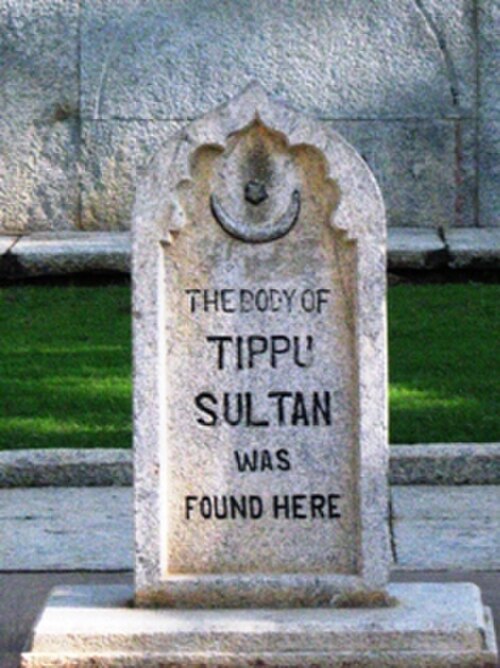
The spot where Tipu's body was discovered under the eastern gate has been fenced off by the Archaeological Survey of India, and a plaque erected. The gate was later demolished during the 19th century to lay a wide road. After Tipu Sultan was defeated and killed, the British offered a portion of the conquered Mysore territory to the Marathas as a gesture of "goodwill" for their technical alliance. However, the Marathas rejected the offer because it came with the condition that they accept a British Resident at their court and a British subsidiary force.[7]
The war, specifically the Battle of Mallavelly and the siege of Seringapatam, with many of the key protagonists, is covered in the historical novel Sharpe's Tiger by Bernard Cornwell.[15]