
Loading article…
.svg/500px-Khanda_(Sikh_Symbol).svg.png) シク教徒の共通のシンボルであるカンダ | |
 | |
| 総人口 | |
|---|---|
| 約2500万~ 3000万[8] | |
| 創設者 | |
| グル・ナナク | |
| 人口の多い地域 | |
| インド | 23,786,000~28,000,000 [12] |
| カナダ | 771,790 [13] [14] |
| イギリス | 524,140 [15] [16] [17] |
| アメリカ合衆国 | 28万~50万人[36] |
| イタリア | 220,000 [48] |
| オーストラリア | 210,400 [49] |
| マレーシア | 100,000 [50] [51] [52] |
| タイ | 70,000 [53] |
| サウジアラビア | 67,000 [54] |
| アラブ首長国連邦 | 52,000 [55] |
| フィリピン | 50,000 [56] [57] |
| ニュージーランド | 40,908 [58] |
| オマーン | 35,540 [59] |
| ポルトガル | 35,000 [60] |
| フランス | 30,000 [61] |
| スペイン | 26,000 [62] |
| ドイツ | 25,000 [63] |
| ギリシャ | 20,000 [64] |
| 香港 | 15,000 [65] |
| クウェート | 15,000 [66] [67] |
| オランダ | 15,000 [68] |
| キプロス | 13,280 [69] [70] |
| シンガポール | 12,051 [71] |
| インドネシア | 10,000~15,000 [72] |
| ベルギー | 10,000 [73] |
| オーストリア | 9,000 [74] |
| パキスタン | 6,146 ( NADRA )、20,000 ( USDOS ) [75] [76] |
| ケニア | 6,000 [77] |
| ノルウェー | 4,080 [78] |
| 宗教 | |
 シク教 シク教 | |
| 聖書 | |
| グル・グランス サーヒブ・ ダサム・グランス サーブロー・グランス | |
| 言語 | |
主に話されている言語:
•現代パンジャブ語•ヒンディー語•英語 •フランス語•イタリア語•スペイン語•オランダ語 歴史的: •パンジャブ語•パンジャブ語の方言(グルムキー文字) [b] [79] [80] [81]およびカルサ ボレ[82] | |


.jpg/500px-Jagmeet_Singh_at_the_OFL_Convention_-_2017_(38554422812).jpg)

シク教徒(単数形Sikh:/ s ɪ k / SIKまたは/ s iː k / SEEK、パンジャブ語:ਸਿੱਖ、ローマ字表記: sikkh、IPA: [sɪkkʰ])は、シク教[86]を信仰する民族宗教グループ[84] [85]であり、シク教[86]は、グル・ナーナクの啓示に基づいて15世紀後半にインド亜大陸のパンジャブ地方で始まった宗教である。[87]シク教徒という用語は、サンスクリット語のśiṣyaに由来し、「探求者」、「弟子」、「学生」を意味する。[88] [ 90 ] [91]
シク教徒のレハト・マリアダ(「行動規範」 )第1章第1条によれば、シク教徒の定義は次のように述べられて いる。 [92]
- 不滅の存在
- グル・ナナク・サーヒブからグル・ゴビンド・シン・サーヒブまでの10人のグル
- グル・グラント・サーヒブ
- 十人のグルの発言と教えと
- アムリット・サンチャールとして知られるこの入門儀式は、第10代グルによって受け継がれ、他のいかなる宗教にも忠誠を誓わないシク教徒によって行われます。
男性のシク教徒は一般的にSingh(「ライオン」)という姓を持つが、すべてのSinghが必ずしもシク教徒であるとは限らない。同様に、女性のシク教徒はKaur(「王女」)という姓を持つ。これらのユニークな姓は、シク教徒を目立たせるためにグルによって与えられたものであり、またグルが常に反対していたインドのカースト制度への反抗行為でもあった。シク教徒はsarbat da bhala(「すべての人の幸福」 )の考えを強く信じており、世界中で人道支援の最前線にいるのをよく見かける。[93]
入信の儀式であるアムリット・サンチャル(「カンダによる入信」 )を受けたシク教徒は、入信の日からカルサと呼ばれ、常に身体に5つのKを身に着けていなければなりません。
- ケシュ、通常はターバンとしても知られるダスタールで覆われている切られていない髪。
- カラ、鉄または鋼のブレスレット。
- キルパン、ガトラストラップまたはカマルカサのウエストバンドに差し込まれた短剣のような剣。
- カチェラ(綿の下着)
- カンガ、小さな木製の櫛。

インド亜大陸のパンジャブ地方は、歴史的にシク教徒の故郷であり、18世紀から19世紀にかけてはかなりの期間、シク教徒によって支配されていました。今日、カナダは世界で最も大きな国土に占めるシク教徒の割合(2.1%)を誇り、[13]インドのパンジャブ州は世界のすべての行政区画の中で最大のシク教徒の割合(58%)を誇ります。カナダはシク教徒が人口の2.1%以上を占める唯一の国です。2021年の時点で、シク教徒は2,500万から3,000万人で、世界人口の0.3%未満を占めています。[94]カナダやイギリスなど多くの国では、国勢調査でシク教徒を指定宗教として認めており、[95] 2020年現在、米国ではシク教徒は別の民族グループとみなされています。 [96]英国も、1982年のマンドラ対ダウエル・リー事件の直接的な結果として、シク教徒を民族宗教的な人々とみなしている。 [97] [98]
歴史

シク教の開祖グル・ナーナク(1469年 - 1539年)は、ラホール近郊のタルワンディ村(現在のナンカナ・サーヒブ)で、メータ・カルーとマタ・トリプタのカトリ一家に生まれた。[99]グル・ナーナクは生涯を通じて宗教指導者であり社会改革者であった。しかし、シク教の政治史は、1606年に5代目のグルであるグル・アルジャン・デヴが亡くなったときに始まったと言える。[100]宗教的慣習は、1699年3月30日にグル・ゴビンド・シングによって公式化された。グルは、パンジ・ピアレ(「最愛の5人」 )として知られる様々な社会的背景を持つ5人に灌頂を与え、カルサ(「純粋な」 )として知られる灌頂を受けたシク教徒の集団を形成した。[101]
グル・ナーナクの初期の信者はカトリ派であったが、後に多くのジャート派が信仰に加わった。[102] カトリ派とバラモン派は「シク教徒が古い儀式を含め、彼らのカーストや家族特有の慣習を放棄するという要求」に反対した。[103]
パシャウラ・シンは、バーイー・グルダスのヴァラン第11バラード内の言及を分析し、初期のシク教徒コミュニティのカースト構成を描き出しました。[104]ヴァールが書かれた当時、初期のシク教徒コミュニティは、次のようなさまざまなカーストと背景で構成されていました。[104]
- カトリス(特にセーガル、オーリ、ウッパル、ジュルカ、バラ、パッシ、カラール、ヴォフラ、ヴィジ、カプール、チャッダ、ベール、コーリ、マルワ、メーラ、ソーニ、ジャンジ、ソディ、ベリ、ナンダ、ワダワン、トゥリ、プリ)ゴトラス) [104]
- バラモン(バードワジ・ゴトラなど) [104]
- ジャッツ(特にランダワ、ケーラ、ディロン、パンヌのゴトラ)[104]
- タルカン(大工)[104]
- ロハール(「鍛冶屋」)[104]
- ナイス(理髪師)[104]
- チンバ(綿糸紡ぎ人)[104]
- マチス(水運び人)[104]
- ドービー(洗濯屋)[104]
- クムハル(陶工)[104]
- テリス(「油搾り人」)[104]
- 石工[104]
- 金細工師[104]
- 被差別民(チャンダルなど)[104]
- イスラム教徒[104]
初期のシク教徒は、職業や社会階層における地位が多種多様であった。裕福な商人(セスやサラフ)もいれば、村長(チョウドリー)もおり、労働者や奴隷もいたが、職人、職工、店主、あるいは単なる農民もいた。[104]

インドのムガル帝国統治時代に、2人のシク教のグルが殉教した。(グル・アルジャンはムガル帝国のジャハーンギール皇帝の裏切りに加担した疑いで殉教し、グル・テグ・バハドゥルはムガル帝国のアウラングゼーブ皇帝によって殉教した)[105]シク教の信仰が広まるにつれ、シク教徒はムガル帝国の支配に対抗するために軍事化していった。[要出典]
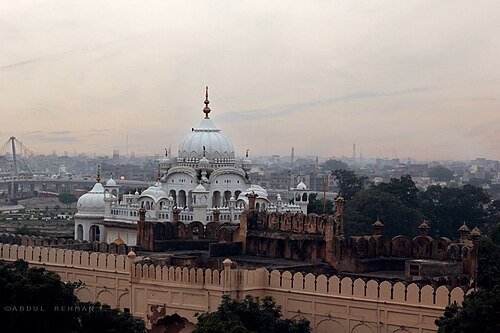

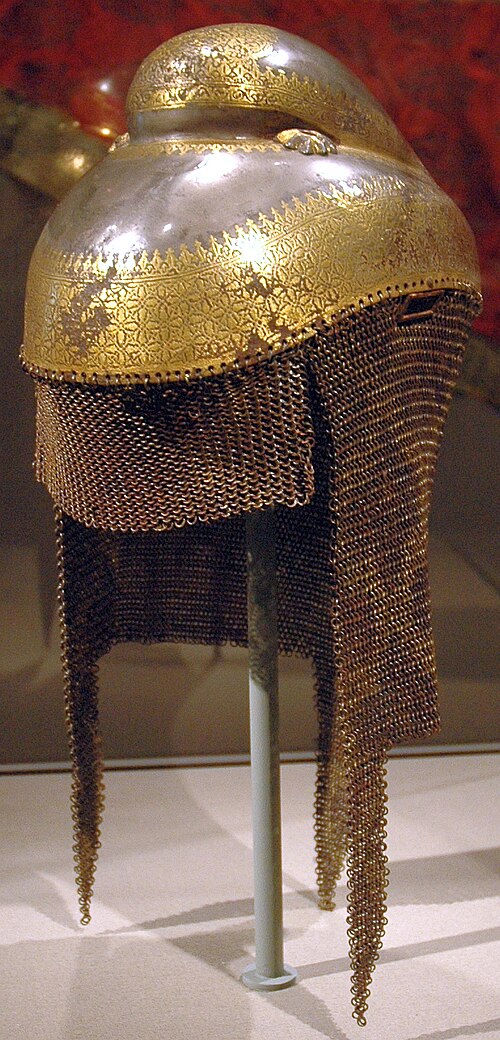

アフガニスタンとムガル帝国を破った後、ジャッサ・シン・アルワリアの指揮下でミスルと呼ばれる主権国家が形成された。これらの州の連合は統一され、マハラジャ・ランジート・シンの指揮下でシク帝国へと変貌した。この時代は、キリスト教徒、イスラム教徒、ヒンズー教徒が権力の座に就くなど、宗教的寛容と多元主義が特徴であった。世俗的な政権は軍事、経済、政府の改革を実施した。この帝国は政治的シク教の頂点と考えられており、 [106]カシミール、ラダック、ペシャワールを包含していた。北西国境のシク・カルサ軍の司令官ハリ・シン・ナルワは、同盟をハイバル峠まで拡大した。
インドにおけるイギリス統治


イギリスによるシク王国の併合後、イギリス軍は相当数のシク教徒とパンジャブ人を募集し始めた。[要出典] 1857年のインド大反乱の間、シク教徒はイギリスに忠誠を誓い続けたため、植民地インドにおけるイギリス領時代の次の90年間、パンジャブからイギリスインド軍への大量の募集が行われた。[107]シク教徒を他のターバン着用者と区別する独特のターバンは、イギリスインド軍の規則の名残である。[108]イギリスの植民地支配下では、1873年と1879年にそれぞれ第1回シン・サバーと第2回シン・サバーが設立されるなど、パンジャブを含むインドで多くの改革運動が起こった。シン・サバーのシク教徒指導者たちは、シク教徒のアイデンティティを明確に定義し、シク教徒の信仰と実践を浄化しようと努めた。[109]
イギリス植民地支配の末期には、1920年代初頭にグルドワラの改革を目的としたアカリ運動が勃興した。この運動は1925年にシク教グルドワラ法案の導入につながり、インドの歴史的なシク教寺院はすべてシロマニ・グルドワラ・パルバンダク委員会の管理下に置かれました。[110]
分割と分割後
インド独立運動当時、カプールタラ州のシク教徒の統治者はインドの分割に反対し、統一された世俗国家を主張した。[111]チーフ・カルサ・デワンやマスター・タラ・シン率いるシロマニ・アカーリー・ダルなどのシク教徒の組織は、ラホール決議とパキスタン創設運動を、迫害を招く可能性があるとして非難した。一方アカーリー・ダルは、1946年にシク教徒国家決議を可決しており、分割されていないアザド・パンジャブを独立したシク教徒国家またはカリスタンとして支持した。そのため、シク教徒はパンジャブの分割に強く反対した。[112] 1947年のパンジャブ分割に至るまでの数ヶ月は、パンジャブにおけるシク教徒とイスラム教徒の紛争で特徴づけられた。 [ 113]これにより、パンジャブのシク教徒とヒンズー教徒が西パンジャブから東(現在のインド)へ宗教的に移住し、同時に東パンジャブから西(現在のパキスタン)へパンジャブのイスラム教徒が宗教的に移住した。[114]
インド分割後、政府は人口と言語の境界線に合わせて州の再編を始めた。しかし、これは国の北部では効果がなく、[115]政府は北部の州の再編を再検討した。[116]言語グループの要請により、全国の州が言語の境界線に基づいて広範囲に再編されたが、州として考慮されなかった言語はパンジャブ語、シンド語、ウルドゥー語だけだった。[117]これにより、パンジャブ・スバ運動が開始され、1948年4月にマスター・タラ・シンによってパンジャブ・スバが政策として提示された。また、1950年1月26日には、シク教徒の代表がインド憲法に署名することを拒否した。シク教徒はヒンズー教徒として認められ、シク教徒にはヒンズー教徒の指定カーストに与えられた譲歩は与えられなかった。
パンジャブ・スバは政府による厳しい取り締まりを受け、国民会議派政府は21,000人もの人々を逮捕した。国民会議派との交渉の試みにより抗議運動は2度延期されたが、ジャワハルラール・ネルー首相は要求を拒否し続けた。[118] [119] 1955年7月4日、警察部隊は警察隊長アシュウィニ・クマール率いる部隊が黄金寺院の敷地内に押し入り、 [120]強引に抗議者を逮捕し、アカル・タクトと黄金寺院の長であるグランティ、ボランティアの抗議者、寺院のランガールの料理人までも拘留した。[121]グル・ラム・ダス・セライとシロマニ・アカリ・ダルの事務所も襲撃され、寺院の周囲に集まった抗議者を解散させるために警棒が使用され、催涙ガスと砲弾が発射され、寺院の周囲とサロワール(池)が損傷した。[121] [122]政府は黄金寺院へ向かう途中でボランティアを止め、軍隊に寺院周辺のバザールや通りを国旗を掲げて行進するよう命じた。[122] 200人以上の抗議者が殺害され、数千人が逮捕され、[122]女性や子供を含む数千人が負傷した。
1966年、インド国民会議派政府は抗議と州再編委員会の勧告を受けてパンジャブ・スバに同意した。[123]東パンジャブ州は後にヒマーチャル・プラデーシュ州、新州のハリヤーナー州、そして現在のパンジャブ州に分割された。[124]しかし、パンジャブ人のシク教徒とヒンドゥー教徒の間には疎遠が広がった。ヒンドゥー教徒はパンジャブ語ではなくヒンディー語を第一言語としていた。その結果、パンジャブ語圏は新州から除外され、ハリヤーナー州とヒマーチャル・プラデーシュ州に割り当てられ、[125] 1947年以前の国勢調査の数字に基づくと、パンジャブ州の面積はパンジャブ語圏の面積よりおよそ35,000平方マイル小さくなった。さらに、1966年の再編により、首都チャンディーガルが連邦直轄地となり、パンジャブ州とハリヤーナー州の州都 となったため、シク教徒は大いに不満を抱いた。
1960年代後半、インドの緑の革命は、国際援助機関とインド政府が発行した開発プログラムの一環として、パンジャブで初めて導入されました。[126]パンジャブの緑の革命はいくつかの肯定的な影響を及ぼしましたが、機械化された農業技術の導入は富の不平等な分配をもたらしました。工業の発展は農業の発展と同じペースで行われませんでした。インド政府は、パキスタンとの国境にある高リスクの州であるという理由で、パンジャブに重工業を設立することに消極的でした。[127]高等教育の機会が急速に増加したにもかかわらず、十分な雇用が増加せず、教育を受けた若者の失業が増加しました。[123]
1973年、不満が解消されず不平等が拡大したため、アカリ・ダルはアナンドプル・サーヒブ決議を提出した。[128]この決議には宗教的問題と政治的問題の両方が含まれていた。シク教を宗教として認めることを求め、中央政府から州政府への権力の委譲も要求した。[123]アナンドプル決議は政府によって分離主義文書として拒否された。灌漑用水の増加やチャンディーガルのパンジャブへの返還などの要求に対する真の解決策であると感じた何千人もの人々が運動に加わった。[129]
交渉が失敗に終わった後、1982年8月4日、アカリ・ダルとジャルネイル・シン・ビンドランワレが共同でダラム・ユッダ・モルチャ( 「正義の運動」)[130]を開始した[要出典] 。その目的は、アナンドプル・サーヒブ決議に基づく一連の権限委譲目標の達成であると明言された。[130]インド警察は、抗議者に対し高圧的な警察手法で対応し、パンジャブの住民の非常に大きな部分に影響を与える国家による弾圧を生み出した。警察の残虐行為は、シク教徒の一部による報復的な暴力をもたらし、国家が自らの国民に対して暴力を振るうことで紛争の範囲を広げた。[131]「混乱状態と抑圧的な警察手法」が相まって、「当局に対するシク教徒の大衆の圧倒的な怒りと憤りの雰囲気」を生み出した。その結果、シク教の指導者ジャルネイル・シン・ビンドランワレが注目を集め、穏健派やシク教知識人の間でも独立要求が広まった。[131] 1982年から1983年初頭にかけて、パンジャブ地方の警察が正統派シク教徒の若者を法外な方法で殺害したことで報復が起きた。 [ 132]抗議運動が始まってから最初の19か月で、190人以上のシク教徒が殺害された。[133]
1984年5月、穀物ロコ・モルチャが計画され、 6月3日に開始されることになっていた[134]。抗議者たちは、土地の収入、水道や電気代の支払いを拒否し、パンジャブからの穀物の流出を阻止することで、市民的不服従を実践した。インドの首相インディラ・ガンディーは、穀物ロコ・モルチャに先立つ6月1日、ビンドランワーレを黄金寺院から排除するためにブルースター作戦を開始した。これはその後、ガンディーがシク教徒のボディーガードによって暗殺される結果となった[135]。彼女の暗殺に続いて、インド全土のシク教徒コミュニティに対する政府支援によるポグロムと、インド全土での何千人ものシク教徒の殺害が続いた。これらの出来事は、 1990年代初頭までパンジャブを飲み込むことになるパンジャブの反乱を引き起こした。
1999年のヴァイサキの日、世界中のシク教徒はカルサ創設300周年を祝った。カナダ郵便局は記念日に合わせて記念切手を発行し、シク教徒カナダ人を称えた。同様に、1999年4月9日にはインド大統領KRナラヤナンもカルサ創設300周年を記念した切手を発行した。[136]
芸術と文化

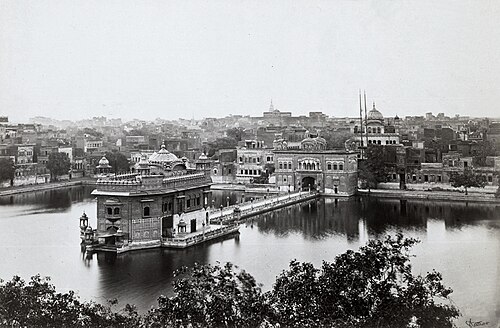
シク教の芸術と文化はパンジャブのそれとほぼ同義であり、シク教徒は独特のターバン(ダスタール)で簡単に見分けられる。パンジャブは、この地域の名前の由来となった川から侵入してきた文化が合流したことから、インドのるつぼと呼ばれてきた。したがって、シク教文化は文化の統合である。シク教は独特の建築を生み出し、S. S. バッティはそれを「グル・ナーナクの創造的神秘主義に触発され」、「実用的な精神性に基づく全体論的ヒューマニズムの無言の先駆者」と表現した。[137]アメリカの非営利団体ユナイテッド・シク教徒は、シク教徒が「民族的少数派であると自認し」、「単なる宗教以上の存在である」と信じていると主張し、米国国勢調査にもシク教徒が含まれるように戦ってきた。 [138]
17世紀から18世紀にかけてのムガル帝国とアフガニスタンによるシク教徒の迫害の間、 [139]シク教徒は宗教の保護に関心があり、芸術や文化にはほとんど関心がなかった。ラホールとデリーでランジート・シングとシク教徒の支配が台頭すると、パンジャブの芸術と文化の状況に変化が起こり、ヒンズー教徒とシク教徒は破壊や略奪を恐れることなく、装飾された神社を建てることができるようになった。[140]
シク教連合はシク教独特の表現形式を生み出すきっかけとなり、ランジット・シンはシク教様式の砦、宮殿、バンガ(住居)、大学を建設した。シク教の建築は、金箔を施した溝付きドーム、キューポラ、キオスク、石灯籠、装飾的な手すり、四角い屋根が特徴である。シク教様式の頂点は、アムリトサルにあるハルマンディル・サーヒブ(黄金寺院としても知られる)である。[要出典]
シク教の文化は軍事的なモチーフの影響を受けており(カンダが最も顕著)、グルの遺物を除くほとんどのシク教の遺物は軍事的なテーマを持っています。このテーマは、行進と勇敢さの誇示を特徴とするシク教の祭りであるホラ・モハラとヴァイサキに顕著です。[要出典]
シク教徒のディアスポラの芸術や文化は、他のインド系移民グループの芸術や文化と融合し、「英国アジア人」、「インド系カナダ人」、「デシ文化」などのカテゴリーに分類されているが、「政治的シク教徒」と表現できる小さな文化現象も生じている。[141]アマルジート・カウル・ナンドラやアムリットとラビンドラ・カウル・シン(シン双子)[142]のようなディアスポラのシク教徒の芸術は、彼らのシク教とパンジャブの時事問題の影響を受けている。[要出典]
バングラとギッダは、シク教徒によって取り入れられ、開拓されたパンジャブの民族舞踊の2つの形式である。パンジャブのシク教徒はこれらの表現形式を世界中で擁護し、その結果、シク教文化はバングラと結びつくようになった(ただし、「バングラはシク教の制度ではなく、パンジャブの制度である」)。[143]
絵画

シク教の絵画はカングラ派の絵画から直接派生したものである。1810年、ランジート・シン(1780-1839)はカングラ砦を占領し、サルダール・デサ・シン・マジティアをパンジャブ山地の知事に任命した。1813年、シク教徒の軍隊がギュラー州を占領し、ラージャ・ブップ・シンはシク教徒の家臣となった。ラホールのシク教王国が最高権力者になると、ギュラー出身のパハリ族の画家の一部はマハラジャ・ランジート・シンとそのサルダールの庇護を求めてラホールに移住した。[要出典]
シク教派は、カングラ絵画をシク教徒のニーズと理想に適応させました。その主な主題は、シク教の 10 人のグルとグル・ナーナクのジャナムサキの物語です。10 代目のグルであるゴビンド・シンは、その勇気と犠牲により、新しい信仰の信者に深い印象を残しました。狩猟のシーンや肖像画もシク教の絵画でよく見られます。[引用が必要]
神社
バラジュのビシュヌマティ橋のすぐ隣の小高い丘に、「プラチン・グル・ナナク・マート」と呼ばれる古いシク教の聖地がある。グル・ナナクはチベットのカイラス山から戻る途中、3回目のウダシでネパールを訪れたと言われている。ナナクはカトマンズのバラジュとタパタリに滞在したと言われている。バラジュのナナク・マート聖地はグル・ジと、グル・ナナクの息子であるシュリ・チャンドラが開いた宗派であるウダシン・アカルダによって管理されている。[144] [145]
日々のルーティン
グル・グラント・サーヒブより:[146]
グル、真のグルのシク教徒を自称する者は、早朝に起きて主の御名を瞑想する。朝早く起きたら、甘露の水に浸かり、身を清める。グルの指示に従い、主の御名を「ハル、ハル」と唱える。そうすれば、すべての罪、悪行、悪行が消える。そして、日の出とともにグルバニを歌う。座っていても立っていても、主の御名を瞑想する。息をするたび、食べ物をひと口食べるたびに主の御名を「ハル、ハル」と瞑想する者、そしてそのグルシク教徒はグルの心を喜ばせる。私の主であり師である者が優しく慈悲深い人、そのグルシク教徒にグルの教えが授けられる。召使いのナナクは、自らナームを唱え、他の人にもナームを唱えるよう促すグル・シークの足の土を乞う。
— 第 4 メール (グル・ラム・ダス)、グル・グラント・サーヒブ、p. 305
シク教徒の行動規範であるラヒト・マリアダには、入信したアムリトダリ・カルサ・シク教徒はジャプジ・サーヒブ、ジャップ・サーヒブ、10のサワヤ、ソーダル・レーラース、ソーヒラを朗唱するか、朗唱を聞かなければならないと明記されている。[147] [148]また、すべてのシク教徒は、朝の神聖な時間(夜明けの3時間前)に目覚めた後、食事の前にグル・グラント・サーヒブからフカム(神の命令)を受けることになっている。[149]
グル・ゴビンド・シンは、52のフカムの中で、信者たちに、アムリトヴェーラ(早朝)に起き、寝る前に夕方遅くの祈り「ソヒラ」と詩句「パヴァン・グル・パニ・ピタ…」を唱えるように命じています。[要出典]
5つのK

5つのK(パンジ・カカール)は、すべての入信(アムリタリー)したシク教徒が身に着ける義務がある5つの信仰箇条である。このシンボルは、シク教の理想である誠実さ、平等、忠誠、ワヘグルへの瞑想、そして暴政に屈しないという理念を表している。[150] 5つのシンボルは以下の通りである。
- ケシュ: 切らずに結んでターバンで巻いた髪。
- カンガ: 木製の櫛。通常はターバンの下に着用し、髪を常に清潔で手入れの行き届いた状態に保ちます。
- カチェラ: 男女ともに着用する綿の下着。カチェラは貞操の象徴であり、清潔さの象徴でもあります。また、ドーティに比べて動きやすく快適であるため、歴史的に戦闘にも適しています。
- カラ: 鉄のブレスレット。永遠と強さの象徴であり、いかなる非倫理的な行為からも手を遠ざける意志の強さを常に思い出させてくれるものです。
- キルパン: さまざまなサイズの鉄の刃。英国では、シク教徒は小さな短剣を身に着けることができますが、パンジャブでは、長さ1〜3フィートの伝統的な曲がった剣を身に着けることがあります。キルパンは、人類に奉仕し、抑圧に対抗するために使われる、防御と宗教的保護のための武器にすぎません。
音楽と楽器

シーク教徒には、レバブ、ディルルバ、タウス、ジョリ、サリンダなど、数多くの楽器があります。サーランギーの演奏は、グル・ハルゴービンドによって奨励されました。レバブは、グル・ナーナクの旅に同行したバーイー・マルダナによって演奏されました。ジョリとサリンダは、グル・アルジャンによってシーク教の宗教音楽に導入されました。タウス(ペルシャ語で「孔雀」) は、グル・ハルゴービンドによって考案されました。彼は、孔雀の鳴き声を聞いて、その鳴き声を真似る楽器を作りたいと思ったと言われています。ディルルバは、タウスよりも小さな楽器を望んだ信者の要望により、グル・ゴービンド・シングによって考案されました。ジャプジ・サーヒブの後、グル・グラント・サーヒブのシャバドはすべてラーグとして作曲されました。このタイプの歌唱は、グルマット・サンギートとして知られています。
戦いに赴くとき、シク教徒は士気を高めるためにランジット ナガラ( 「勝利の太鼓」 ) を演奏しました。ナガラ (直径は通常 2 ~ 3 フィートですが、中には 5 フィートに達するものもありました) は 2 本の棒で演奏されます。大きな太鼓の音とニシャン サーヒブの掲揚は、シン族が進軍していることを意味しました。
カリスタン運動

カリスタン運動はシク教徒の分離主義運動であり、南アジアのパンジャブ地方にカリスタン( 「カルサの土地」)と呼ばれる別の国を建設し、シク教徒の故郷とすることを目指している。[151]提案されているカリスタンの領土定義は、インドのパンジャブとパキスタンのパンジャブの両方で構成され、ハリヤーナー州、ヒマーチャル・プラデーシュ州、ジャンムー・カシミール州、ラジャスタン州の一部を含む。[152] [153] [154]
カリスタン運動は国外居住者の事業として始まった。[155] 1971年、ニューヨークタイムズ紙に掲載された外国人居住者(ジャグジット・シン・チョハン)による広告で、初めてカリスタンを明確に呼びかけた。[156]カリスタンの設立を宣言することで、彼はシク教徒の国外居住者から数百万ドルを集めることができた。[157] 1980年4月12日、彼はアナンドプル・サーヒブで「カリスタン国家評議会」の設立を宣言した。[158]彼は自身を評議会の議長と宣言し、バルビール・シン・サンドゥを事務局長に任命した。1980年5月、チョハンはロンドンに赴き、カリスタンの設立を発表した。同様の発表がアムリトサルでバルビール・シン・サンドゥによって行われ、彼はカリスタンの切手と紙幣の発行を開始した。アムリトサルやその他の地域の当局の不作為は、シク教指導者ハルチャンド・シン・ロンゴワル率いるアカリ・ダル(インド国民会議派)によって、インディラ・ガンディーの政党による政治的策略であると非難された。[159]
この運動は、ブルースター作戦と反シク教徒虐殺の後、インドのパンジャブ州で盛んになった。支持者たちは悲しむ離散民から資金を集めることができたからだ。1985年6月、エア・インディア182便が親カリスターン派のテロ組織ババール・カルサによって爆破された。 [160] 1986年1月、黄金寺院は全インド・シク教徒学生連盟とダムダミ・タクサルに所属する過激派によって占拠された。[161] 1986年1月26日、サルバト・カルサ(事実上の議会)として知られる集会がカリスターンの創設を支持する決議(グルマッタ)を可決した。その後、カリスターンを支持するいくつかの反乱武装グループがインド政府に対して大規模な反乱を起こした。インドの治安部隊は1990年代初頭に反乱を鎮圧したが、カルサ・ラージ党やSAD(A)などのシク教徒の政治団体は非暴力的な手段でカリスタンの独立を追求し続けた。[162] [163] [164]ダル・カルサ(インターナショナル)などのカリスタン支持団体もインド国外では活動しており、一部のシク教徒のディアスポラの支援を受けている。[165]
1990年代には反乱は収まり[166] 、分離主義者に対する警察の厳しい取り締まり、シク教徒間の分裂、シク教徒の支持喪失など、さまざまな理由から運動は目的を達成できなかった。[167]しかし、さまざまな親カリスタン派の政治団体や過激派団体が、分離主義運動に引き続き関与している。インド国外のシク教徒が、若者を過激派グループに引き込むために資金提供しているという主張がある。[168]また、この運動はパキスタンの対外情報機関であるISIによって動機づけられ、支援されているという主張も複数ある。[169] [170]
人口統計
.png/500px-Global_Map_of_Sikh_Population_(Estimated_2023).png)
シク教徒は全世界で約2,600万~3,000万人おり、そのうち2,400万~2,800万人がインドに居住しており、シク教徒の総人口の約90%を占めている。[171] [172] [173] [174] [175] [176]インドのシク教徒全体の約76%がインド北部のパンジャブ州に居住しており、同州の人口の約58%、およそ1,600万人の大多数を占めている。[177] [178]シク教徒の相当数のコミュニティは、インドの各州または連邦直轄地、ハリヤナ州(人口の4.9%を占める約120万人)、ラジャスタン州(人口の1.3%を占める87万2千人)、ウッタル・プラデーシュ州(人口の64万3千人、0.3%)、デリー(57万人、3.4%)、ウッタラーカンド州(23万6千人、2.3%)、ジャンムー・カシミール州(23万4千人、1.9%)、チャンディーガル(13万8千人、13.1%)、ヒマーチャル・プラデーシュ州(8万6千人、1.2%)に居住している。
カナダは、世界最大のシク教徒人口(全人口の2.1%)を抱える国である。[13]ブリティッシュコロンビア州西部には、約30万人のシク教徒コミュニティが存在し、全人口の約5.9%を占めている。これは、インドのパンジャブ州とチャンディーガル州に次いで、世界の行政区画の中で3番目にシク教徒が多い地域である。さらに、ブリティッシュコロンビア州、[179]マニトバ州、ユーコン準州は、シク教が人口の中で2番目に多い宗教である世界で唯一の4つの行政区画のうちの3つであるという特徴を持っている。 [182]
国勢調査データと公式統計
宗教的少数派であるシク教徒は、世界中の多くの国で正式な地位を獲得し、数えられるよう、長く厳しい戦いをしてきました。各国のシク教徒の組織やコミュニティの努力により、現在では以下の地域で国勢調査や公式統計の一部としてシク教徒の人口データが容易に入手可能となっています。

Note: Official statistics do not count unregistered arrivals or those who have not completed the census or surveys. However, they do provide for a much more accurate depiction of Sikh communities as opposed to estimates from various Sikh organisations whose estimates can vary vastly with no statistically valuable source. Thus, official statistics and census data is highly important and Sikh communities continue to push for census inclusion in many countries where they are still not counted.
Migration
Sikh migration from British India began in earnest during the second half of the 19th century, when the British completed their annexation of the Punjab, which led to Sikh migration throughout India and the British Empire. During the Raj, semiskilled Sikh artisans were transported from the Punjab to British East Africa to help build railroads. Sikhs emigrated from India after World War II, most going to the United Kingdom but many also to North America. Some Sikhs who had settled in eastern Africa were expelled by Ugandan dictator Idi Amin in 1972.[195] Economics is a major factor in Sikh migration, and significant communities exist in the United Kingdom, the United States, Malaysia, East Africa, Australia, Singapore and Thailand.[citation needed]
After the Partition of India in 1947, many Sikhs from what would become the Punjab of Pakistan migrated to India as well as to Afghanistan due to fear of persecution. Afghanistan was home to hundreds of thousands of Sikhs and Hindus as of the 1970s, but due to the wars in Afghanistan in the 2010s, the vast majority of Afghan Sikhs had migrated to India, Pakistan or the west.[196][197][198]
Although the rate of Sikh migration from the Punjab has remained high, traditional patterns of Sikh migration favouring English-speaking countries (particularly the United Kingdom) have changed during the past decade due to stricter immigration laws. Moliner (2006) wrote that as a consequence of Sikh migration to the UK becoming "virtually impossible since the late 1970s," migration patterns evolved to continental Europe.[199] Italy is a rapidly growing destination for Sikh migration,[200] with Reggio Emilia and Vicenza having significant Sikh population clusters.[201] Italian Sikhs are generally involved in agriculture, agricultural processing, the manufacture of machine tools, and horticulture.[202]
Growth

Johnson and Barrett (2004) estimate that the global Sikh population increases annually by 392,633 (1.7% per year, based on 2004 figures); this percentage includes births, deaths, and conversions. Primarily for socio-economic reasons, Indian Sikhs have the lowest adjusted growth rate of any major religious group in India, at 16.9 percent per decade (estimated from 1991 to 2001) and it has further declined to just 8.4 per cent in 2011 census report.[203][204] Sikhs in the world have the lowest fertility rate of 1.6 children per women as per (2019–20) estimation research.[205][206] The Sikh population has the lowest gender balance in India, with only 903 women per 1,000 men according to the 2011 Indian census.[207] The estimated world's Sikh population was over 30 million in 2020, and it will reach 42 million by 2050. It is expected to increase up to 62 million by 2100, given that the anticipated growth rate of 1.7% per year and adding at least 400,000 followers annually.[208][204]
Since the Sikh growth rate dropped from 1.7% (16.9% in 1991 to 2001 estimate) to 0.8% (8.4% in 2001–2011) in 2011 report, hence based on their growth rate, their population in India will increase 196,316 (0.8% based on 2011 figures) per year and will reach 36 million in 2050, it expected to reach 52 million in 2100 given that the anticipated growth rate of 0.8% and adding at least 200,000 followers annually.[209][210]

Sikhism is the fastest growing religion in Canada, Australia and New Zealand. The growth is mainly contributed by the immigration of Indian Sikhs there over the decades. Sikhism is fourth-largest religion in Canada, fifth-largest religion in Australia and New Zealand. The decadal growth of Sikhs is more in those countries as compared to the decadal growth of Sikh population in India, thus making them the fastest-growing religion there.[211][13][212][213] Canada has the highest proportion of Sikhs in the globe, which stands at 2.1% as of 2021, as compared to India which stands at 1.7% as of 2011 respectively.[214][13]
Castes
Sikhs have remained a relatively homogeneous ethnic group with exceptions. Caste may still be practiced by some Sikhs, despite Guru Nanak's calls for treating everyone equally in Guru Granth Sahib.[215][c]
Along with Guru Nanak, other Sikh gurus had also denounced the hierarchy of the caste system, however, they all belonged to the same caste, the Khatris.[219] Most Sikhs belong to the Jat (Jatt), traditionally Agriculturist class[220] in occupation.[221] Despite being very small in numbers, the Khatri and Arora castes wield considerable influence within the Sikh community. Other common Sikh castes include Ahluwalias (Brewers), Kambojs or Kambos (Rural caste), Ramgarhias (Carpenters), Brahmins (Priestly class), Rajputs (Kshatriyas – Warriors), Sainis, Rai Sikh (Ironsmiths), Labanas (Merchants), Kumhars (Potters), Mazhabi (Cleaners) and the Ramdasia/Ravidasias(Chamar – Tanners).[222]
Some Sikhs, especially those belonging to the landowning dominant castes, have not shed all their prejudices against the Dalits. While Dalits were allowed entry into the village gurdwaras, in some gurdwaras, they were not permitted to cook or serve langar (communal meal). Therefore, wherever they could mobilize resources, the Sikh Dalits of Punjab have tried to construct their own gurdwara and other local level institutions in order to attain a certain degree of cultural autonomy.[215] In 1953, Sikh leader and activist Master Tara Singh succeeded in persuading the Indian government to include Sikh castes of the converted untouchables in the list of scheduled castes.[223] In the Shiromani Gurdwara Prabandhak Committee, 20 of the 140 seats are reserved for low-caste Sikhs.[223]
Other castes (over 1,000 members) include the Arain, Bhatra, Bairagi, Bania, Basith, Bawaria, Bazigar, Bhabra, Chamar, Chhimba (cotton farmers), Darzi, Dhobi, Gujar, Jhinwar, Kahar, Kalal, Kumhar, Lohar, Mahtam, Megh, Mirasi, Mochi, Nai, Ramgharia, Sansi, Sudh, Tarkhan and Kashyap[citation needed]
Karnail Singh Panjoli, member of the Shiromani Gurdwara Prabandhak Committee, says that there are several communities within the term Nanakpanthis too. Apart from Sindhi Hindus, "There are groups like Sikhligarh, Vanjaarey, Nirmaley, Lubaney, Johri, Satnamiye, Udaasiyas, Punjabi Hindus, etc. who call themselves Nanakpanthis despite being Hindus.[224]
Diaspora

As Sikhs wear turbans and keep beards, Sikh men in Western countries have been mistaken for Muslim, Arab, and/or Afghan since the September 11 attacks and the Iraq War.[225][226] Several days after the 9/11 attacks, Sikh-American gas station owner Balbir Singh Sodhi was murdered in Arizona by a man who took Sodhi to be a member of al-Qaeda, marking the first recorded hate-crime in America motivated by 9/11. CNN would go on to suggest an increase in hate crimes against Sikh men in the US and the UK after the 9/11 attacks.[225][226]
In an attempt to foster Sikh leaders in the Western world, youth initiatives by a number of organisations exist. The Sikh Youth Alliance of North America sponsors an annual Sikh Youth Symposium.[citation needed]
The Sikh diaspora has been most successful in the UK, and UK Sikhs have the highest percentage of home ownership (82%) of any religious community.[227] UK Sikhs are the second-wealthiest religious group in the UK (after the Jewish community), with a median total household wealth of £229,000.[228]
In May 2019, the UK government exempted "Kirpan" from the list of banned knives. The U.K. government passed an amendment by which Sikhs in the country would be allowed to carry kirpans and use them during religious and cultural functions. The bill was amended to ensure that it would not impact the right of the British Sikh community to possess and supply kirpans, or religious swords.[229][230] Similarly, the Sikh American Legal Defense and Education Fund overturned a 1925 Oregon law banning the wearing of turbans by teachers and government officials in 2010.[231]
Agriculture
Historically, most Indians have been farmers and 66 per cent of the Indian population are engaged in agriculture.[232] Indian Sikhs are employed in agriculture to a lesser extent; India's 2001 census found 39 per cent of the working population of the Punjab employed in this sector.[233] According to the Swedish political scientist Ishtiaq Ahmad, a factor in the success of the Indian green revolution was the "Sikh cultivator, often the Jat and Kamboj or Kamboh, whose courage, perseverance, spirit of enterprise and muscle prowess proved crucial."[234] However, Indian physicist Vandana Shiva[235] wrote that the green revolution made the "negative and destructive impacts of science (i.e. the green revolution) on nature and society" invisible, and was a catalyst for Punjabi Sikh and Hindu tensions despite a growth in material wealth.[citation needed]
Sikhs in modern history
Manmohan Singh is an Indian economist, academic, and politician who served as the 13th Prime Minister of India from 2004 to 2014. The first and only Sikh and non-Hindu in office, Singh was also the first prime minister since Jawaharlal Nehru to be re-elected after completing a full five-year term.
Notable Sikhs in science include nuclear scientist Piara Singh Gill, fibre-optics pioneer Narinder Singh Kapany; and physicist, science writer and broadcaster Simon Singh.
In business, the UK-based clothing retailers New Look and the Thai-based JASPAL[236] were founded by Sikhs. India's largest pharmaceutical company, Ranbaxy Laboratories, is headed by Sikhs.[237] Apollo Tyres is headed by Onkar Singh Kanwar. In Singapore, Kartar Singh Thakral expanded his family's trading business, Thakral Holdings,[238] into assets totalling almost US$1.4 billion and is Singapore's 25th-richest person. Sikh Bob Singh Dhillon is the first Indo-Canadian billionaire. Mastercard's CEO was a Sikh named Ajaypal Singh Banga.
In sports, Sikhs include England cricketer Monty Panesar; former 400-metre runner Milkha Singh; his son, professional golfer Jeev Milkha Singh; Indian wrestler and actor Dara Singh; former Indian hockey team captains Sandeep Singh, Ajitpal Singh and Balbir Singh Sr.; former Indian cricket captain Bishen Singh Bedi; Harbhajan Singh, India's most successful off spin cricket bowler; Yuvraj Singh, World Cup winning allrounder; Maninder Singh, World Cup winning off spinner; and Navjot Singh Sidhu, former Indian cricketer-turned-politician.
Sikhs in Bollywood, in the arts in general, include poet and lyricist Rajkavi Inderjeet Singh Tulsi; Gulzar; Jagjit Singh; Dharmendra; Sunny Deol; Diljit Dosanjh writer Khushwant Singh; actresses Neetu Singh, Simran Judge, Poonam Dhillon, Mahi Gill, Esha Deol, Parminder Nagra, Gul Panag, Mona Singh, Namrata Singh Gujral; and directors Gurinder Chadha and Parminder Gill.
Sikhs in Punjabi Music industry include Sidhu Moosewala, Diljit Dosanjh, Babu Singh Maan, Surjit Bindrakhia, Ammy Virk, Karan Aujla, Jazzy B, Miss Pooja.
In December 2022, the U.S. Marine Corps was compelled by a court order to allow two Sikhs to wear the turban and grow beards. This was a milestone for religious freedom and in the prevention of employment discrimination against Sikhs.[239]
In the Indian and British armies
According to a 1994 estimate, Punjabi Sikhs and Hindus comprised 10 to 15% of all ranks in the Indian Army. The Indian government does not release religious or ethnic origins of a military personnel, but a 1991 report by Tim McGirk estimated that 20% of Indian Army officers were Sikhs.[240] Together with the Gurkhas recruited from Nepal, the Maratha Light Infantry from Maharashtra and the Jat Regiment, the Sikhs are one of the few communities to have exclusive regiments in the Indian Army.[240] The Sikh Regiment is one of the most-decorated regiments in the army, with 73 Battle Honours, 14 Victoria Crosses,[241] 21 first-class Indian Orders of Merit (equivalent to the Victoria Cross),[242] 15 Theatre Honours, 5 COAS Unit Citations, two Param Vir Chakras, 14 Maha Vir Chakras, 5 Kirti Chakras, 67 Vir Chakras, and 1,596 other awards. The highest-ranking general in the history of the Indian Air Force is a Punjabi Sikh, Marshal of the Air Force Arjan Singh.[243] Plans by the United Kingdom Ministry of Defence for a Sikh infantry regiment were scrapped in June 2007.[244]
Sikhs supported the British during the Indian Rebellion of 1857.[245] By the beginning of World War I, Sikhs in the British Indian Army totaled over 100,000 (20 per cent of the force). Until 1945, fourteen Victoria Crosses (VC) were awarded to Sikhs, a per-capita regimental record.[241] In 2002, the names of all Sikh VC and George Cross recipients were inscribed on the monument of the Memorial Gates[246] on Constitution Hill, next to Buckingham Palace.[247] Chanan Singh Dhillon was instrumental in campaigning for the memorial.
During World War I, Sikh battalions fought in Egypt, Palestine, Mesopotamia, Gallipoli and France. Six battalions of the Sikh Regiment were raised during World War II, serving in the Second Battle of El Alamein, the Burma and Italian campaigns and in Iraq, receiving 27 battle honours. Around the world, Sikhs are commemorated in Commonwealth cemeteries.[248]
-
 Sikhs in the First World War, marching with their scripture, Guru Granth Sahib
 -
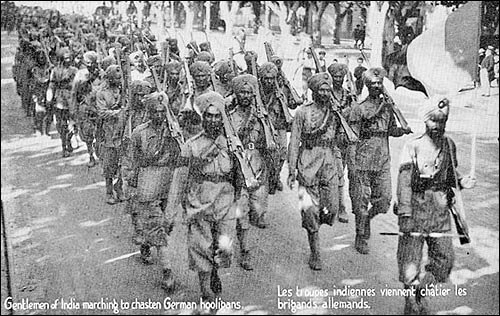 French postcard depicting the arrival of the 15th Sikh Regiment in France during World War I. The bilingual postcard reads, "Gentlemen of India marching to chasten the German hooligans".
 -
 Indian Sikh soldiers in the Italian campaign
 -
 Sikh soldier with captured Swastika flag of Nazi Germany
 -
 Japanese soldiers shooting blindfolded Sikh prisoners in World War II
See also
- History of Punjab
- Sikhism in Jammu and Kashmir
- Ganga Sagar (urn)
- Jat Sikh
- List of British Sikhs
- Mazhabi Sikh
- Sects of Sikhism
- Sikhism by country
- Sikhism in India
- Turban training centre
Notes
- ^ Sikhs comprise 1.7% (23,786,052) of India's total population of 1,399,179,585 per 2023 estimate by the World Factbook.[9]
- ^ Majority of Sikhs speak Punjabi or its various dialects as their mother tongue. Guru Gobind Singh wrote letters to Aurangzeb—Zafarnama and the Hikaaitaan—written in the Persian alphabet; Sikh coins were minted in Gurmukhi and Persian during misls and Sikh Empire.
- ^ Guru Nanak has mentioned in his first composition of Jap Ji Sahib, which is recited daily by all practicing Sikhs that all souls are to be treated with care and respect as Waheguru is the Giver of all souls.
"The Guru has given me this one understanding: there is only the One, the Giver of all souls. May I never forget Him!", Guru Granth Sahib, 2[216]
Guru Nanak said that blessings are rained down when the lowly person, regardless of any background are cared for.
"In that place where the lowly are cared for-there, the Blessings of Your Glance of Grace rain down.", Guru Granth Sahib, 15[217]
Guru Nanak had spoken we need to prize humility above all and thus caste is not an issue.
"One who takes pride in wealth and lands is a fool, blind and ignorant.
One whose heart is mercifully blessed with abiding humility,
O Nanak, is liberated here, and obtains peace hereafter." Granth Sahib, 278.[218]
References
Citations
- ^ "April 2022: Sikh Awareness and Appreciation Month". State of Michigan Office of the Governor. Retrieved 28 March 2023.
there are more than 30 million Sikhs worldwide
- ^ "US Sikhs tirelessly travel their communities to feed hungry Americans". CNN. 9 July 2020. Retrieved 28 March 2023.
Founded some 500 years ago in the Punjab region of India, the faith has some 30 million adherents, making it the fifth largest religion worldwide.
- ^ "A Brief Introduction to Sikhism". WTTW. 5 May 2021. Retrieved 28 March 2023.
"Sikhism is the world's fifth-largest religion, with 25–30 million adherents around the globe
- ^ "Sikhs in America". Retrieved 28 March 2023.
There are nearly 30 million Sikhs around the world today, and a vast majority of them live in the Indian state of Punjab.
- ^ "Guru Nanak Religious Society". Retrieved 28 March 2023.
There are over 30 million Sikhs worldwide.
- ^ "Sikhism". Encyclopædia Britannica. Retrieved 6 October 2022.
In the early 21st century there were nearly 25 million Sikhs worldwide, the great majority of them living in the Indian state of Punjab.
- ^ "Sidhu wrongly quotes Sikh population as 14 crores". The Times of India. 11 November 2019.
- ^ [1][2][3][4][5][6][7]
- ^ a b "India People and Society". The World Factbook. Retrieved 15 February 2023.
- ^ "Sikh Population in World | Sikh Population in India 2023". 22 December 2021.
- ^ "Sikh Religion Census 2011". Retrieved 21 March 2023.
- ^ [9][a][10][11]
- ^ a b c d e f Government of Canada, Statistics Canada (26 October 2022). "Religion by visible minority and generation status: Canada, provinces and territories, census metropolitan areas and census agglomerations with parts". www12.statcan.gc.ca. Retrieved 1 December 2022.
- ^ Government of Canada, Statistics Canada (26 October 2022). "The Daily – The Canadian census: A rich portrait of the country's religious and ethnocultural diversity". www150.statcan.gc.ca. Retrieved 26 October 2022.
- ^ "Religion, England and Wales – Office for National Statistics". www.ons.gov.uk.
- ^ "Religion (detailed): All people" (PDF). National Records of Scotland. Retrieved 8 April 2017.
- ^ "Religion – Full Detail: QS218NI". Northern Ireland Statistics and Research Agency. Archived from the original on 16 September 2017. Retrieved 8 April 2017.
- ^ "Does the Census Bureau have data for religion?". United States Census Bureau. Retrieved 18 March 2023.
- ^ "Asian Indian Was The Largest Asian Alone Population Group in 2020". United States Census Bureau. Retrieved 23 September 2023.
- ^ "Census Profile, 2021 Census of Population". Statistics Canada. 9 February 2022. Retrieved 23 September 2023.
- ^ a b "Statistical Abstract of the United States: 2012 – Section 1: Population – Table 75: Self-Described Religious Identification of Adult Population: 1990, 2001, and 2008 (page 61)" (PDF). United States Census Bureau. Retrieved 14 April 2023.
- ^ a b "How Many U.S. Sikhs?". Pew Research Center. 6 August 2012. Retrieved 18 March 2023.
- ^ "About Sikhs". Sikh Coalition. Retrieved 14 April 2023.
- ^ "H. RES. 275–118th Congress (2023–2024)". United States Congress. Retrieved 14 April 2023.
- ^ "Sikhism Reporter's Guide". Sikh Coalition. Retrieved 23 July 2023.
- ^ "The Sikh Community Today". Harvard University. Retrieved 28 March 2023.
Today there are well over 500,000 Sikhs in the United States.
- ^ "American Sikhs are targets of bigotry, often due to cultural ignorance". Religion News Service. 10 August 2022. Retrieved 28 March 2023.
Scholars and government officials estimate the Sikh American population to number around 500,000.
- ^ "Sikhs in America:A History of Hate". ProPublica. Retrieved 28 March 2023.
There are an estimated 500,000 Sikhs living in the U.S., many in New York and California.
- ^ "April 2022: Sikh Awareness and Appreciation Month". State of Michigan Office of the Governor. Retrieved 28 March 2023.
Sikhism is the fifth largest religion in the world, and, today, there are more than 30 million Sikhs worldwide and an estimated 500,000 Sikh Americans;
- ^ "Want to know about Sikhism?". WUWM. 23 May 2022. Retrieved 28 March 2023.
There are more than 500,000 Sikhs in the United States.
- ^ "A Brief Introduction to Sikhism". WTTW. 5 May 2021. Retrieved 28 March 2023.
Despite its relatively recent arrival in Chicago, Sikhism is the world's fifth-largest religion, with 25 to 30 million adherents around the globe and an estimated 500,000 in America today.
- ^ [26][27][28][29][30][31]
- ^ "Asian Americans: A Mosaic of Faiths". Pew Research Center. 19 July 2012. Retrieved 14 April 2023.
- ^ "2020 National Sikh American Survey: Key Findings". Sikh American Legal Defense and Education Fund. 23 October 2020. Retrieved 14 April 2023.
- ^ "DP05ACS Demographic and Housing Estimates". United States Census Bureau. Retrieved 14 April 2023.
- ^ While the U.S. Census does not ask about religion,[18] 70,697 Americans (or 0.02% of the total population) declared Sikh as their ethnicity in the 2020 census.[19] In the 2021 Canadian census, 194,640 Canadians declared Sikh as their ethnicity while 771,790 Canadians declared Sikh as their religion, indicating that the Sikh American population may be around 280,329, or 0.08% of the total population.[20] The U.S. Census Bureau estimated the adult Sikh American population at 78,000 in 2008.[21] The Pew Research Center estimated the Sikh American adult population to be 140,000 and the total population at 200,000 in 2012 while the World Religion Database at Boston University estimated the American Sikh population to be at 280,000 in 2012.[21][22] Sikh organizations like the Sikh Coalition and American Sikh Congressional Caucus estimate the Sikh American population to be as high as 1,000,000, but do not provide any sources for these figures;[23][24][22] 500,000 nevertheless remains the most cited Sikh American population size in news media.[25][32] With 1% of Asian Americans being Sikh, and 90.7% of Sikh Americans being Asian American, the American Sikh population can be estimated around 280,000–500,000 in 2021.[33][34][35]
- ^ a b "Over 40,000 Sikhs vote in secessionist Referendum in Italy". Geo News.
it had chosen the city of Brixia because Italy had over 200,000 Sikhs living in the county with a majority in Brescia.
- ^ a b "Around 45,000 Sikhs vote in Referendum in Italy". Daily Pakistan.
That it had chosen the city of Brixia because Italy had over 200,000 Sikhs living in it with a majority in Brescia
- ^ a b "Sikhs vote in referendum in Rome". Pakistan Today.
About 200,000 Sikhs live in different cities of Italy.
- ^ a b "Thousands of Sikhs attend parade in Italy". Bol News.
Italy has over 200,000 Sikhs who are active members of the Italian population, which is why this city was chosen
- ^ a b "The Continuing Struggle for Religious Freedom by Italy's Sikh Community". The Wire.
It is estimated that there are around 220,000 Sikh migrants in Italy. The community, however, has been largely invisible to native Italians. The majority of Sikhs are dairy workers, living far from the cities, and settled mainly in the farms of north and central Italy.
- ^ a b "How the recent Punjabi migration to Spain & Italy is a departure for the diaspora". The Economic Times. 29 July 2018.
The total number of Indians in Italy has now crossed 200,000, making it the largest Indian diaspora in continental Europe and far greater than the 30,000 estimated in Spain. This Indian contingent is mainly made up of Punjabi Jat Sikhs.
- ^ a b "How Sikhs saved the Italian cheese industry". Global Indian.
Today, Italy has the largest Sikh population in Europe, only second to the United Kingdom, with an estimated number of 220,000
- ^ a b Bertolani, Barbara (2013). "The Sikhs in Italy: A Growing Heterogeneous and Plural Presence". Globalizing Belief, Localizing Gods. Brill Publishers. p. 75. ISBN 9789004254756.
According to Gallo (2013), by contrast, the Sikhs would number at least 100,000. Barbara Bertolani estimates in 2013 "My own data gathered within the Sikh community in Italy show Sikh people constituting about 70% of all the Indians present, i.e., at least 84,000 residents
- ^ a b "Why the Indian government must help Italian Sikhs". Hindustan Times.
Up to 150,000 Sikhs now live there, making it the largest Sikh Community in Europe after the one in Britain
- ^ a b "The Sikhs Spearheading The Italian Parmesan Cheese Industry". Homegrown.
Despite the estimated 220,000 Sikh immigrants who inhabit the Po Valley, there seems to a whiff of change in the air
- ^ a b Tebano, Elena. "Prayer at dawn, zero crime: this is how Sikhs live in Italy, after the sentence of the Cassation". Corriere Della Sera.
The vegan diet, the cult, the traditions. Customs and symbols of the 150,000 faithful of the religion born in India who now live in the Bel Paese
- ^ [37][38][39][40][41][42][43][44][45][46][47]
- ^ [37][38][40][41][42][43][44][45][46][39][47]
- ^ "Gobind Singh Deo is Malaysia's first Sikh minister". The Economic Times.
Malaysia has nearly 100,000 Sikh population.
- ^ "Malaysia gets first Sikh minister". WION.
Miri Indian Association president, Councillor Karambir Singh was quoted as saying by the Borneo Post. Malaysia has nearly 100,000 Sikh population
- ^ "On the Gurdwara Trail in Malaysia: A Spiritual Experience". SikhNet. 20 January 2023.
The Malaysian Sikh community is the fourth largest ethnic group of Malaysian Indians. It is estimated that over 100,000 Sikhs reside in Malaysia. The Sikh population is the largest here among Southeast and East Asia.
- ^ "Thailand". U.S. Department of State.
- ^ "2021 Report on International Religious Freedom: Saudi Arabia". U.S. Department of State. 2 June 2022.
- ^ Gokulan, Dhanusha. "Sikhs in UAE hail country's year of 'respect, inclusion'". Khaleej Times.
- ^ "Punjabi Community Involved in Money Lending in Philippines Braces for 'Crackdown' by New President". 18 May 2016.
- ^ "2011 Gurdwara Philippines: Sikh Population of the Philippines". Archived from the original on 1 December 2011. Retrieved 11 June 2011.
- ^ "Losing our religion | Stats NZ".
- ^ "National Profiles".
- ^ "Portugal Fact Sheet". Embassy of India (Lisbon, Portugal).
Sikhs (35,000), In recent years, the number of Indians (especially from Punjab/Haryana) has increased significantly owing to the easing of immigration norms by Portugal. However, since many of them do not have valid residency documents, official figures are not available.
- ^ "France's Sikh Minority Looks Set to Vote Against Marine Le Pen". The Wire. 6 May 2017.
- ^ Garha, Nachatter Singh (6 February 2020). "Masculinity in the Sikh Community in Italy and Spain: Expectations and Challenges". Religions. 11 (2): 76. doi:10.3390/rel11020076. ISSN 2077-1444.
- ^ "Mitgliederzahlen: Sonstige – REMID – Religionswissenschaftlicher Medien- und Informationsdienst e.V." remid.de (in German). Retrieved 16 August 2017.
Sikhs, 25,000 (2020)....The "German Information Center for Sikh Religion, Sikh History, Culture and Science (DISR)" estimates the number of Sikhs in Germany at 18,000 for 2017
- ^ Lavin, Talia (26 April 2015). "Vibrant Vaisakhi Celebrates Sikh Life In Greece". Huffington Post.
The Sikh community in Greece, numbered at around 20,000 according to a 2012 report, joined together to mark the holy day
- ^ "Hong Kong stories: Getting to know the city's Sikh community". Young Post. 31 July 2019.
- ^ "Kuwait To Seek Closure Of "Illegal" Sikh Temple". Outlook India. 3 February 2022. Archived from the original on 27 May 2023.
- ^ "Sikh Gurdwara discovered by 'intrepid' local reporter". timeskuwait.com/. 14 August 2019. Retrieved 7 December 2022.
- ^ Lawrence, Mary (22 May 2022). "Het licht van God zien in de ander, daar gaat het om bij de sikhs" [Seeing the light of God in the other, that's what the Sikhs are all about]. Trouw. Archived from the original on 24 May 2022. Retrieved 2 June 2023.
In Nederland wonen zo'n 15.000 sikhs, die hier sinds de jaren zestig vanuit Afghanistan, Pakistan en India kwamen, op zoek naar werk of op de vlucht voor de Sovjets, de Taliban of de geradicaliseerde aanhangers van Indira Gandhi, nadat zij in 1984 door haar sikhlijfwacht was vermoord. Ons land telt inmiddels negen gurdwara's. [Some 15,000 Sikhs live in the Netherlands, who have come here from Afghanistan, Pakistan and India since the 1960s, looking for work or fleeing the Soviets, the Taliban or the radicalized followers of Indira Gandhi, after they were killed in 1984. her Sikh bodyguard had been killed. Our country now has nine gurdwaras.]
- ^ "Cyprus" (PDF). acninternational.org. Archived from the original (PDF) on 22 February 2023.
- ^ "National Profiles". www.thearda.com.
- ^ Kaur, Arunajeet (6 December 2008). "The Evolution of the Sikh Identity in Singapore". Religious Diversity in Singapore. ISEAS–Yusof Ishak Institute. pp. 275–297. ISBN 9789812307552 – via Cambridge University Press.
- ^ "Orang-orang Sikh di Indonesia". kumparan (in Indonesian).
- ^ Montes, Enrico Castro; Goddeeris, Idesbald (2020). "Hinduism in Belgium". Handbook of Hinduism in Europe (2 vols). Brill. pp. 849–863. doi:10.1163/9789004432284_031. ISBN 9789004432284. S2CID 236835206 – via brill.com.
- ^ "Why Sikhism as registered religion in Austria matters". The Times of India.
- ^ "Sikh population in Pakistan". Retrieved 19 January 2023.
- ^ "Pakistan's Religious Minorities Say They Were Undercounted in Census". VOA. July 2021.
- ^ Adam, Michel (1 September 2013). "A diversity with several levels: Kenyan politics of integration and the Kenyan minorities of Indian origin". Les Cahiers d'Afrique de l'Est / The East African Review (47): 23–32. doi:10.4000/eastafrica.402. ISSN 2071-7245. S2CID 199837942. Retrieved 4 September 2020.
- ^ "2020-12-08". ssb.no. 8 December 2020.
- ^ "UK Government Web Archive". webarchive.nationalarchives.gov.uk.
- ^ "Sikh Reht Maryada, The Definition of Sikh, Sikh Conduct & Conventions, Sikh Religion Living, India". old.sgpc.net.
- ^ "Sikh Reht Maryada, The Definition of Sikh, Sikh Conduct & Conventions, Sikh Religion Living, India". old.sgpc.net.
- ^ Pashaura Singh; Louis E. Fenech (2014). The Oxford Handbook of Sikh Studies. Oxford Handbooks. OUP Oxford. p. 380. ISBN 9780191004117.
- ^ Mann, Gurinder Singh (2001). The Making of Sikh scripture. Oxford: Oxford University Press. p. 5. ISBN 9780195130249.
- ^ "Sikhs to be counted as a separate ethnic group in 2020 US census for first time". India Today. 8 September 2020. Retrieved 20 April 2023.
- ^ Barwiński, Marek; Musiaka, Łukasz (30 December 2019). "The Sikhs – religion and nation. Chosen political and social determinants of functioning". Studia z Geografii Politycznej i Historycznej. 8: 167–182. doi:10.18778/2300-0562.08.09. hdl:11089/38783. ISSN 2450-0127.
- ^ Crawford, S. Cromwell; Singh, Harbans (July 1971). "Guru Nanak and Origins of the Sikh Faith". Philosophy East and West. 21 (3): 348. doi:10.2307/1398373. ISSN 0031-8221. JSTOR 1398373.
- ^ Nikky-Guninder Kaur Singh (2011). Sikhism: An Introduction. I.B. Tauris. pp. 61–. ISBN 978-0-85773-549-2.
- ^ "Institute of Sikh Studies, Chandigarh". sikhinstitute.org. Archived from the original on 20 October 2023. Retrieved 16 October 2023.
- ^ Singh, Khushwant (2006). The Illustrated History of the Sikhs. India: Oxford University Press. p. 15. ISBN 0-19-567747-1.
- ^ Nabha, Kahan Singh (1930). ਗੁਰ ਸ਼ਬਦ ਰਤਨਾਕਰ ਮਹਾਨ ਕੋਸ਼ [Gur Shabad Ratnakar Mahan Kosh] (in Punjabi). p. 720. Archived from the original on 18 March 2005. Retrieved 29 May 2006.
- ^ carolyn (17 March 2022). "Sikh Nationalism: From a Dominant Minority to an Ethno-Religious Diaspora | By Gurharpal Singh and Giorgio Shani". Pacific Affairs (UBC Journal). Retrieved 9 January 2023.
- ^ "Sikh Reht Maryada: Sikh Code of Conduct and Conventions". Shiromani Gurdwara Parbandhak Committee. Archived from the original on 10 October 2008. Retrieved 6 November 2008.
- ^ "Athens. Dedication of Soldiers Honoring Generals, 111/0 B.C.?". Supplementum Epigraphicum Graecum. doi:10.1163/1874-6772_seg_a40_177. Retrieved 14 September 2024.
- ^ Nadeem, Reem (21 December 2022). "Key Findings From the Global Religious Futures Project". Pew Research Center. Retrieved 16 May 2024.
- ^ ONS (11 December 2012). "Religion in England and Wales 2011". Office for National Statistics. UK Statistics Authority. Retrieved 24 November 2018.
- ^ Press Trust of India (15 January 2020). "Sikhs to be counted as separate ethnic group in 2020 US Census; community hails recognition of distinct language, culture". Firstpost.
- ^ "Anti-Discrimination (Amendment) Bill – 11/05/1994 – 2R COMM – NSW Parliament". Parliament.nsw.gov.au. 11 May 1994. Archived from the original on 4 June 2011. Retrieved 27 April 2015.
- ^ "'Religion or belief': Identifying issues and priorities (Linda Woodhead with the assistance of Rebecca Catto) AHRC/ESRC Religion and Society Programme, Lancaster University". Archived from the original on 16 January 2010. Retrieved 10 February 2010.
- ^ Singh, Khushwant (2006). The Illustrated History of the Sikhs. India: Oxford University Press. pp. 12–13. ISBN 0-19-567747-1.
- ^ "The Khalsa | History of Sikhism | Sikhism". BBC Religion & Ethics. BBC. 29 August 2003. Retrieved 4 April 2008.
- ^ Singh, Patwant (2000). The Sikhs. New York: Knopf. p. 14. ISBN 978-0-375-40728-4 – via Internet Archive.
- ^ Richard M. Eaton (2019). India in the Persianate Age: 1000–1765. Penguin. pp. 168–169. ISBN 9780141966557.
The Sikh community grew rapidly in the sixteenth century. Nanak's earliest followers had been fellow Khatris engaged in petty trade, shopkeeping, or lower level civil service in the Lodi or Mughal bureaucracies. But as the movement grew, it experienced a significant influx of Jat cultivators.
- ^ Dhavan, Purnima (2011). When Sparrows Became Hawks: The Making of the Sikh Warrior Tradition, 1699–1799. Oxford University Press. pp. 42, 47, 184. ISBN 978-0-19987-717-1.
- ^ a b c d e f g h i j k l m n o p q r Singh, Pashaura (2006). Life and Work of Guru Arjan: History, Memory, and Biography in the Sikh Tradition. Oxford University Press. ISBN 9780199087808.
The 11th var of Bhai Gurdas is extremely useful for assessing the social constituency of the early Panth. Apart from this, there is no other contemporary source which can be used to determine the actual numbers and proportions of various groups within the constitution of the Panth in the period of the early Gurus. Identifying the castes, a general profile of the Panth's leadership may be reconstructed with the help of the 11th var of Bhai Gurdas. In fact, 11 stanzas of this ballad (Var 11:18–28) exclusively provide lists of the actual names and places of prominent followers of Guru Arjan. The Khatri caste (e.g. Sehgal, Ohri, Uppal, Julka, Bhalla, Passi, Khullar, Vohra, Vij, Kapur, Chaddha, Behl, Kohli, Marwah, Mehra, Soni, Jhanjhi, Sodhi, Beri, Nanda, Wadhawan, Tulli, and Puri sub-castes) was particularly prominent among the trading communities, and this was the caste to which all the Gurus belonged. There were certainly some Brahmins (Tiwari Pandit, Wissa, Gopi, and Tulsia of Bhardwaj sub-caste, and Jagna Brahmin from Agra) among the Sikhs, and some outcastes – for instance, the name of Paira Chandal appears in the list of prominent Sikhs. There was a preponderance of Jats (e.g. Randhawa, Khehra, Dhillon, and Pannu sub-castes) among the cultivators, who were followed by members of the artisan castes, notably Tarkhans ('carpenters') and Lohars ('blacksmiths'). In addition, there were Nais ('barbers'), Chhimbas ('cotton-printers'), Machhis ('water-carriers'), Dhobis ('washermen'), Kumhars ('potters'), Telis ('oil pressers'), masons and goldsmiths. The name of a Muslim, Mian Jamal, figures prominently in the list of close associates (hazuri sikhs) of Guru Arjan. It should, however, be emphasized that Bhai Gurdas deals only with the more notable members of the Panth. These leaders will have had their own families, friends, and followers in large numbers from their particular areas, who collectively made up the general constituency of the Panth. On the one hand, there were rich merchants (like Seths and Sarrafs) in cities and towns and Chaudaris ('headmen') in villages; on the other, there were labourers and slaves, with artisans and craftsmen, petty shopkeepers and peasants in between. Not surprisingly, in terms of the social background and the economic means of its members, the Panth was far from homogenous. Nevertheless, the cultural patterns of different sections of Puniabi society played a significant role in the evolution of the Sikh Panth.
- ^ McLeod, Hew (1987). "Sikhs and Muslims in the Punjab". South Asia: Journal of South Asian Studies. 22 (s1): 155–165. doi:10.1080/00856408708723379.
- ^ Lafont, Jean-Marie (16 May 2002). Maharaja Ranjit Singh: Lord of the Five Rivers (French Sources of Indian History Sources). New York: Oxford University Press. pp. 23–29. ISBN 0-19-566111-7.
- ^ Ballantyne, Tony (2006). Between Colonialism and Diaspora: Sikh Cultural Formations in an Imperial World. United states: Duke University Press. p. 66. ISBN 0822388111. Retrieved 21 January 2015.
- ^ Cohn, Bernard S (1996). Colonialism and Its Forms of Knowledge: The British in India. Princeton, NJ: Princeton University Press. pp. 107–109. ISBN 0691000433. Retrieved 26 January 2015.
- ^ Oberoi, Harjot (1994). The Construction of Religious Boundaries: Culture, Identity, and Diversity in the Sikh Tradition. Chicago: University of Chicago Press. p. 494. ISBN 9780226615929. Retrieved 18 September 2013.
- ^ Nesbitt, Eleanor (2005). Sikhism: A Very Short Introduction. Very Short Introductions. Oxford: Oxford University Press. ISBN 0-19-280601-7. Retrieved 14 January 2016 – via Google Books.
- ^ "An undivided India?". NDTV. 29 August 2009. Retrieved 19 October 2020.
- ^ Kudaisya, Gyanesh; Yong, Tan Tai (2004). The Aftermath of Partition in South Asia. Abingdon-on-Thames, England: Routledge. p. 100. ISBN 978-1-134-44048-1.
No sooner was it made public than the Sikhs launched a virulent campaign against the Lahore Resolution. Pakistan was portrayed as a possible return to an unhappy past when Sikhs were persecuted and Muslims the persecutor. Public speeches by various Sikh political leaders on the subject of Pakistan invariably raised images of atrocities committed by Muslims on Sikhs and of the martyrdom of their gurus and heroes. Reactions to the Lahore Resolution were uniformly negative and Sikh leaders of all political persuasions made it clear that Pakistan would be "wholeheartedly resisted". The Shiromani Akali Dal, the party with a substantial following amongst the rural Sikhs, organized several well-attended conferences in Lahore to condemn the Muslim League. Master Tara Singh, leader of the Akali Dal, declared that his party would fight Pakistan "tooth and nail". Not be outdone, other Sikh political organizations, rivals to the Akali Dal, namely the Central Khalsa Young Men Union and the moderate and loyalist Chief Khalsa Dewan, declared in equally strong language their unequivocal opposition to the Pakistan scheme.
- ^ Abid, Abdul Majeed (29 December 2014). "The forgotten massacre". The Nation.
On the same dates, Muslim League-led mobs fell with determination and full preparations on the helpless Hindus and Sikhs scattered in the villages of Multan, Rawalpindi, Campbellpur, Jhelum and Sargodha. The murderous mobs were well supplied with arms, such as daggers, swords, spears, and firearms. (A former civil servant mentioned in his autobiography that weapon supplies had been sent from NWFP and money was supplied by Delhi-based politicians.) They had bands of stabbers and their auxiliaries, who covered the assailant, ambushed the victim and if necessary disposed of his body. These bands were subsidized monetarily by the Muslim League, and cash payments were made to individual assassins based on the numbers of Hindus and Sikhs killed. There were also regular patrolling parties in jeeps that went about sniping and picking off any stray Hindu or Sikh. ... Thousands of non-combatants including women and children were killed or injured by mobs, supported by the All India Muslim League.
- ^ Dutt, Amitava; Devgun, Surinder (23 September 1977). "Diffusion of Sikhism and recent migration patterns of Sikhs in India". GeoJournal. 1 (5): 81–89. doi:10.1007/BF00704966. ISSN 1572-9893. S2CID 189881872. [dead link]
- ^ Doad 1997, p. 392.
- ^ Grewal 1998, p. 186.
- ^ Deol 2000, p. 93.
- ^ Deol 2000, p. 96.
- ^ Grewal 1998, p. 188.
- ^ Dhillon, Kirpal S. (2006). Identity and Survival: Sikh Militancy in India, 1978–1993. London, United Kingdom: Penguin Books. p. 60. ISBN 9780143100362.
- ^ a b Bal 1985, p. 426.
- ^ a b c Grewal 1998, p. 189.
- ^ a b c Ray, Jayanta Kumar (2007), Aspects of India's International Relations, 1700 to 2000: South Asia and the World, Pearson Education India, p. 484, ISBN 978-81-317-0834-7
- ^ Singh, Atamjit. "The Language Divide in Punjab". South Asian Graduate Research Journal. 4 (1, Spring 1997). Apna. Retrieved 4 April 2013.
- ^ Grewal 1998, p. 205.
- ^ Dutta, Swarup (June 2012). "Green Revolution Revisited: The Contemporary Agrarian Situation in Punjab, India". Social Change. 42 (2): 229–247. doi:10.1177/004908571204200205. ISSN 0049-0857. S2CID 55847236.
- ^ Sumit Ganguly; Larry Diamond; Marc F. Plattner (2007). The State of India's Democracy. JHU Press. p. 56. ISBN 978-0-8018-8791-8. Retrieved 18 August 2013.
- ^ Karim 1991, p. 30.
- ^ Akshayakumar Ramanlal Desai (1991). Expanding Governmental Lawlessness and Organized Struggles. Popular Prakashan. pp. 64–66. ISBN 978-81-7154-529-2.
- ^ a b Bakke 2015, p. 143.
- ^ a b Karim 1991, pp. 32–33.
- ^ Pettigrew, Joyce (1987). "In Search of a New Kingdom of Lahore". Pacific Affairs. 60 (1): 24. doi:10.2307/2758827. JSTOR 2758827.
- ^ Dhillon, Gurdarshan Singh (1996). Truth about Punjab: SGPC White Paper (1st ed.). Amritsar, Punjab: Shiromani Gurdwara Parbandhak Committee. p. 198. ISBN 978-0836456547.
- ^ Grewal 1998, p. 226.
- ^ Pace, Eric (1 November 1984). "Assassination in India: Sikhs at the centre of the drama; Sikh separation dates back to '47". The New York Times. p. 24.
- ^ "Canada Post to honour Sikh Canadians with a commemorative stamp". Tribune India. The Tribune. Archived from the original on 29 January 2021. Retrieved 26 March 2013.
- ^ "The Magnificence of Sikh Architecture". Archived from the original on 14 December 2007. Retrieved 4 April 2008.
- ^ "Memorandum Regarding the Tabulation of Sikh Ethnicity in the United States Census" (PDF). Archived from the original (PDF) on 24 February 2014. Retrieved 20 November 2014.
- ^ Sian, Katy (2013). Unsettling Sikh and Muslim Conflict: Mistaken Identities, Forced Conversions, and Postcolonial Formations. Rowman & Littlefield. p. 32. ISBN 9780739178744.
- ^ Srivastava, R. P. (1983). Punjab Painting: Study in Art and Culture. Abhinav Publications. p. 13. ISBN 9788170171744.
- ^ "Art and Culture of the Diaspora". Retrieved 4 April 2008.
- ^ "Singh Twins Art Launches Liverpool Fest". Retrieved 4 April 2008.
- ^ "Bhangra & Sikhi by Harjinder Singh". Retrieved 4 April 2008.
- ^ "Guru Nanak Math On Verge Of Vanishing". New Spotlight Magazine. Nepal. Retrieved 19 March 2022.
- ^ "Gurudwara Guru Nanak Math, Kathmandu". World Gurudwaras. Retrieved 19 March 2022.
- ^ "Sri Guru Granth Sahib Translation". Sikhs.org. p. 305. Retrieved 29 January 2016.
- ^ "Sikh Reht Maryada, the Definition of Sikh, Sikh Conduct & Conventions, Sikh Religion Living, India".
- ^ "Sikh Reht Maryada, The Definition of Sikh, Sikh Conduct & Conventions, Sikh Religion Living, India". old.sgpc.net.
- ^ "Sikh Reht Maryada, The Definition of Sikh, Sikh Conduct & Conventions, Sikh Religion Living, India". old.sgpc.net.
- ^ Nesbitt, Eleanor (2005). Sikhism: A Very Short Introduction. Oxford University Press. pp. 40–43. ISBN 978-0-19-280601-7.
- ^ Kinnvall, Catarina (2007). Globalization and Religious Nationalism in India. Routledge. ISBN 9781134135707.
- ^ Crenshaw, Martha (1995). Terrorism in Context. Pennsylvania State University. p. 364. ISBN 978-0-271-01015-1.
- ^ The foreign policy of Pakistan: ethnic impacts on diplomacy, 1971–1994 ISBN 1-86064-169-5 – Mehtab Ali Shah "Such is the political, psychological and religious attachment of the Sikhs to that city that a Khalistan without Lahore would be like a Germany without Berlin."
- ^ Amritsar to Lahore: A Journey Across the India-Pakistan Border – Stephen Alter ISBN 0-8122-1743-8 "Ever since the separatist movement gathered force in the 1980s, Pakistan has sided with the Sikhs, the territorial ambitions of Khalistan have at times included Chandigarh, sections of the Indian Punjab, including whole North India and some parts of western states of India."
- ^ Pruthi, Raj (2004). Sikhism and Indian Civilization. Discovery Publishing House. p. 169. ISBN 9788171418794. Retrieved 25 October 2018.
- ^ Van Dyke 2009, p. 976.
- ^ Haresh Pandya (11 April 2007). "Jagjit Singh Chauhan, Sikh Militant Leader in India, Dies at 80". The New York Times. Retrieved 28 August 2008.
- ^ Nayar, Kuldip; Kushwant Singh (1985). Tragedy of Punjab. Vision Books. p. 51. ISBN 1-85127-069-8.
- ^ Singh, Satinder (1982). Khalistan: An Academic Analysis. Delhi & Punjab: Amar Prakashan. p. 114.
- ^ "Jagmeet Singh Now Rejects Glorification of Air India Bombing mastermind". CBC News. 15 March 2018. Retrieved 30 April 2018.
The 18-month long Air India inquiry, led by former Supreme Court justice John Major, pointed to Parmar as the chief terrorist behind the bombing. A separate inquiry, carried out by former Ontario NDP premier and Liberal MP Bob Rae, also fingered Parmar as the architect of the 1985 bombing that left 329 people dead 268 of them Canadians.
- ^ Sikh Temple Sit-In Is a Challenge for Punjab, The New York Times 2 February 1986
- ^ "Amnesty International report on Punjab". Amnesty International. 20 January 2003. Archived from the original on 3 December 2006. Retrieved 11 January 2010.
- ^ "The Tribune, Chandigarh, India – Punjab". Tribuneindia.com. Archived from the original on 5 June 2011. Retrieved 27 September 2015.
- ^ "SAD (A) to Contest the Coming SGPC Elections on Khalistan Issue: Mann". PunjabNewsline.com. 14 January 2010. Archived from the original on 15 July 2011. Retrieved 22 January 2010.
- ^ Punj, Balbair (16 June 2005). "The Ghost of Khalistan". Sikh Times. Retrieved 11 January 2010.
- ^ "India gives Trudeau list of suspected Sikh separatists in Canada". Reuters, The Sikh insurgency petered out in the 1990s. He told state leaders his country would not support anyone trying to reignite the movement for an independent Sikh homeland called Khalistan. 22 February 2018. Retrieved 22 May 2018.
- ^ "New brand of Sikh militancy: Suave, tech-savvy pro-Khalistan youth radicalised on social media". Hindustan Times. Retrieved 27 April 2018.
- ^ "Sikh separatists 'funded from UK'". BBC. 4 March 2008. Retrieved 28 August 2008.
- ^ "ISI trying to revive Khalistan movement, says government". The Indian Express. 27 December 2017. Retrieved 23 March 2023.
- ^ Singh, Dalip (15 May 2022). "Pakistan ISI tapping into J&K terror network to fuel pro-Khalistan sentiments: Sources". www.thehindubusinessline.com. Retrieved 23 March 2023.
- ^ "Sikh Population in World | Sikh Population in India 2023". 22 December 2021.
- ^ "Sikhism | History, Doctrines, Practice, & Literature". 30 November 2023.
- ^ "Why Sikhism as registered religion in Austria matters". The Times of India.
- ^ "The source state: Out of approximately 30 million Sikhs in the world, the majority of them, 22 million, live in India". Times of India. 23 November 2019.
- ^ "Why Sikhism As Registered Religion in Austria Matters". Indian Express. 10 November 2019.
- ^ "Why Sikhism as registered religion in Austria matters". The Times of India.
- ^ "Nearly 10 million Sikhs have lost their religion because of this organisation". 12 May 2016.
- ^ "Pak invites Sikh community to invest in commercial projects along Nankana-Kartarpur Corridor". Business Standard India. 13 January 2019.
- ^ "B.C. breaks records when it comes to religion and the lack thereof". vancouversun.
- ^ "Population by religion community – 2011". The Registrar General & Census Commissioner, India. Archived from the original on 23 September 2015.
- ^ "Census of India 2011 – Chandigarh" (PDF). Archived (PDF) from the original on 21 August 2017. Retrieved 28 July 2017.
- ^ Per the 2021 Canadian census, Sikhism is the second-largest religion in British Columbia, Manitoba, and Yukon.[13] Per the 2011 Indian census, Sikhism is the largest religion in Punjab and second in Chandigarh. These are the only two Indian states/UTs where Sikhism is one of the two most common religions.[180][181]
- ^ "Census of India Website : Office of the Registrar General & Census Commissioner, India". censusindia.gov.in. Archived from the original on 1 April 2022.
- ^ Government of Canada, Statistics Canada (26 October 2022). "Religion by visible minority and generation status: Canada, provinces and territories, census metropolitan areas and census agglomerations with parts". www12.statcan.gc.ca. Retrieved 26 October 2022.
- ^ a b "Religion, England and Wales – Office for National Statistics". www.ons.gov.uk. Retrieved 29 November 2022.
- ^ "Australian Bureau of Statistics : 2021 Census of Population and Housing : General Community Profile" (XLSX). Abs.gov.au. Retrieved 2 July 2022.
- ^ "2018 Census totals by topic – national highlights | Stats NZ". www.stats.govt.nz. Archived from the original on 23 September 2019. Retrieved 24 September 2019.
- ^ ""Religion by Ethnic in Singapore 2020"". Archived from the original on 17 June 2021. Retrieved 18 June 2021.
- ^ "Population by religion, region and area, 2010" (PDF). NSO. Retrieved 10 January 2018.
- ^ "06326: Members of congregations in religious and philosophical communities outside the Church of Norway, by religion/philosophy 2006–2023. Statbank Norway". SSB. Retrieved 19 July 2023.
- ^ "Religion – Fiji Bureau of Statistics". www.statsfiji.gov.fj. Archived from the original on 17 April 2018. Retrieved 20 July 2023.
- ^ "Irish census". Irish census. Retrieved 31 May 2023.
- ^ "Table − 1: Population by Religion and sex, NPHC 2021". censusnepal.cbs.gov.np.
- ^ "MS-B21: Religion – full detail". Northern Ireland Statistics and Research Agency.
- ^ "Sikhism". Encyclopædia Britannica. 2007. http://www.britannica.com/eb/article-253167/Sikhism.
- ^ "Afghan Sikhs are targeted by the Taliban and unable to even bury their dead". The Week. 12 November 2019.
- ^ "Nearly 99% Of Hindus, Sikhs Left Afghanistan in Last Three decades". TOLOnews. 20 June 2016.
- ^ "Little reason to migrate to India, say Afghan Sikhs". AA. 17 December 2019.
- ^ Moliner, Christine (2006). "Sikhs in France". Migration Patterns – Workshop on Indian Migration. Ecole des Hautes Etudes en Sciences Sociales (EHESS): Laboratoire d'Anthropologie Urbaine/CNRS. abstract. Archived from the original on 17 November 2006.
- ^ Ciprani, Ralph (14 May 2006). "Sikh Storia e immigrazione – The Sikhs: History and Immigration". International Sociology. 21 (3): 474–476. doi:10.1177/026858090602100331. S2CID 144768462.
- ^ IANS (15 September 2004). "Now, Sikhs Do a Canada in Italy". NRIinternet. Retrieved 4 April 2008.
- ^ Singh, Kulwinder (11 August 2007). "Italy may open VISA office in Chandigarh very soon". NRIinternet. Retrieved 4 April 2008.
- ^ "We need to worry about the decline in Sikh numbers". Dailyo.in. 27 August 2015. Retrieved 25 May 2022.
- ^ a b "Proportion and growth rate of population by religious communities, India, 1961–2001" (PDF). Office of the Registrar General, India. CensusIndia. 6 September 2004. Archived from the original (PDF) on 27 September 2007. Retrieved 4 April 2008.
- ^ "India witnesses decline in population growth rate and fertility across religious groups". The News Minute. 4 October 2021. Retrieved 25 May 2022.
- ^ Krishna Veera Vanamali (18 May 2022). "India's fertility rate dips below replacement level: What does it mean? | Business Standard News". Business Standard India. Wap.business-standard.com. Retrieved 25 May 2022.
- ^ Tandon, Aditi (27 August 2015). "Census shocker: Sikhs report lowest sex ratio". Tribune India. Archived from the original on 21 February 2017. Retrieved 5 May 2017.
- ^ Singh, Rupinder Mohan (28 January 2016). "There could be more Sikhs in the future – maybe". American Turban.
- ^ "Behind the decline". frontline.thehindu.com. 16 September 2015.
- ^ "We need to worry about the decline in Sikh numbers". www.dailyo.in.
- ^ Government of Canada, Statistics Canada (23 January 2019). "2011 National Household Survey: Data tables Religion (108), Immigrant Status and Period of Immigration (11), Age Groups (10) and Sex (3) for the Population in Private Households of Canada, Provinces, Territories, Census Metropolitan Areas and Census Agglomerations, 2011 National Household Survey". www12.statcan.gc.ca. Retrieved 8 September 2022.
- ^ "What is the Fastest Growing Religion in Australia?". Worldatlas. 10 June 2020.
- ^ "Sikhs fastest-growing minority in NZ: Census".
- ^ "Why Sikhs ought to be happy, not worried : The Tribune India".
- ^ a b Jodhka, Surinder S (11–17 May 2002). "Caste and Untouchability in Rural Punjab". Economic and Political Weekly. 37 (19): 1822. JSTOR 4412102.
- ^ Singh Khalsa, Sant. "Sri Guru Granth Sahib Translation, p. 2". Srigranth.org. Retrieved 10 January 2017.
- ^ Singh Khalsa, Sant. "Sri Guru Granth Sahib Translation, p. 15". Srigranth.org. Retrieved 10 January 2017.
- ^ Singh Khalsa, Sant. "Sri Guru Granth Sahib Translation, p. 278". Srigranth.org. Retrieved 10 January 2017.
- ^ Oberoi, Harjot (1994). The Construction of Religious Boundaries: Culture, Identity, and Diversity in the Sikh Tradition. Chicago: Oxford. p. 109. ISBN 978-0226615936. Retrieved 15 January 2017.id
- ^ Khanna, Sunil K. (2004). "Jat". In Ember, Carol R.; Ember, Melvin (eds.). Encyclopedia of Medical Anthropology: Health and Illness in the World's Cultures. Vol. 2. Kluwer Academic/Plenum Publishers. p. 777. ISBN 978-0-306-47754-6.
Notwithstanding social, linguistic, and religious diversity, the Jats are one of the major landowning agriculturalist communities in South Asia.
- ^ Don (2015). South Asian Politics and Religion. Princeton University Press. p. 155.
- ^ "Sikhism | History, Doctrines, Practice, & Literature". Encyclopædia Britannica. Retrieved 26 December 2017.
- ^ a b Puri, Harish K. (2003). "The Scheduled Castes in the Sikh Community: A Historical Perspective". Economic & Political Weekly 38(26):2693–2701. JSTOR 4413731. Republished in Dalits in Regional Context (2004). ISBN 978-81-7033-871-0.
- ^ "Explained: Who are Nanak Naam Lewa, and why Kartarpur Corridor can't be limited to Sikhs". 10 November 2019.
- ^ a b "Hate crime reports up in wake of terrorist attacks". US News. CNN. 17 September 2001. Archived from the original on 15 April 2008. Retrieved 4 April 2008.
- ^ a b "Sikhs Urging Action on Faith Hate". UK News. BBC News. 5 November 2006. Retrieved 4 April 2008.
- ^ ONS (11 October 2004). "Housing: Sikhs most likely to own their own homes | Religion". Office for National Statistics. UK Statistics Authority. Archived from the original on 26 February 2008. Retrieved 4 April 2008.
- ^ "An Anatomy of Economic Inequality in the UK" (PDF). Report of the National Equality Panel. The London School of Economics – The Centre for Analysis of Social Exclusion. 29 January 2010. Retrieved 1 February 2010.
- ^ "U.K. gets a new law, secures rights of Sikhs to carry kirpans". newstracklive.com. 19 May 2019. Retrieved 21 May 2019.
- ^ "UK gets new weapons act, secures Sikh right to carry kirpans". The Economic Times. 18 May 2019. Retrieved 21 May 2019.
- ^ Sikh Teachers Are Now Able to Teach in Oregon Public Schools « SALDEF. Saldef.org (2 April 2010). Retrieved on 6 October 2011.
- ^ "World Bank Loan for India Farmers". BBC News. 27 June 2007. Retrieved 4 April 2008.
- ^ Government of Punjab. "Agriculture and Allied Sector | Economy and Infrastructure". Government of Punjab. Archived from the original on 10 March 2008. Retrieved 4 April 2008.
- ^ Ishtiaq, Ahmad (8 February 2005). "West and East Punjab Agriculture: A Comparison | Comment". Daily Times. Archived from the original on 3 February 2008. Retrieved 4 April 2008.
- ^ Guus Geurts Studentnummer (5 March 2001). "The cause and effects of the Green Revolution in Punjab (India) – critical analysis of "The Violence of the Green Revolution" by Vandana Shiva (1991)". Katholieke Universiteit Nijmegen. Archived from the original (MS Word) on 26 March 2009. Retrieved 12 September 2007.
- ^ JASPAL Group (2011). "About JASPAL Group". JASPAL Group. Archived from the original on 17 April 2020. Retrieved 15 April 2020.
- ^ "India's Richest: #24 Malvinder & Shivinder Singh". Forbes. 16 November 2006. Archived from the original on 5 May 2008. Retrieved 4 April 2008.
- ^ "Singapore's 40 Richest: #25 Kartar Singh Thakral". Forbes. 24 August 2006. Retrieved 4 April 2008.
- ^ U.S. Marine Corps compelled to allow Sikh Americans to begin basic training with turbans, beards in PBS' Nation, Jan. 6, 2023
- ^ a b Kundu, Apurba (Spring 1994). "The Indian Armed Forces' Sikh and Non-Sikh Officers' Opinions of Operation Blue Star". Pacific Affairs. 67 (1): 48–49. doi:10.2307/2760119. JSTOR 2760119.
- ^ a b TNN. "The success story that UK's 4 lakh Sikhs are". NRI Internet (excerpts from talk by British High Commissioner Michael Arthur). Retrieved 4 April 2008.
- ^ "History of Sikh Gallantry". The Daily Telegraph. London. 24 June 2007. Archived from the original on 27 February 2008. Retrieved 4 April 2008.
- ^ Pillarisetti, Jagan. "Marshal of the Air Force Arjan Singh". Bharat Rakshak. Archived from the original on 27 March 2008. Retrieved 4 April 2008.
- ^ Rayment, Sean (24 June 2007). "Sikh Regiment Dumped over 'Racism' Fears". The Telegraph. London. Archived from the original on 18 November 2007.
- ^ Kennedy Trevaskis, Hugh (1928). The Land of Five Rivers: An Economic History of the Punjab from Earliest Times to the Year of Grace 1890. London: Oxford University Press. pp. 216–217.
- ^ "Memorial Gates Official Website". Retrieved 4 April 2008.
- ^ "UK Government Report on the memorial". Archived from the original on 6 December 2008. Retrieved 4 April 2008.
- ^ "India's High Commission in London 'Sikhs Pioneered Britain's Multi-Cultural Society". Archived from the original on 13 December 2007. Retrieved 4 April 2008.
General and cited sources
- Fair, C. Christine (2005). "Diaspora Involvement in Insurgencies: Insights from the Khalistan and Tamil Eelam Movements". Nationalism and Ethnic Politics. 11: 125–156. doi:10.1080/13537110590927845. S2CID 145552863.
- Van Dyke, Virginia (2009). "The Khalistan Movement in Punjab, India, and the Post-Militancy Era: Structural Change and New Political Compulsions". Asian Survey. 49 (6): 975–997. doi:10.1525/as.2009.49.6.975.
Further reading
- The Sikhs in History: A Millennium Study by Sangat Singh, Noel Quinton King. New York, 1995. ISBN 81-900650-2-5.
- A History of the Sikhs: Volume 1: 1469–1838 by Khushwant Singh. Oxford India Paperbacks (2005). ISBN 0-19-567308-5.
- The Sikhs by Patwant Singh. Image (2001). ISBN 0-385-50206-0
- The Sikhs of the Punjab by J. S. Grewal. Published by Cambridge University Press (1998). ISBN 0-521-63764-3.
- The Sikhs: History, Religion, and Society by W. H. McLeod. Published by Columbia University Press (1989). ISBN 0-231-06815-8
- The Sikh Diaspora: Tradition and Change in an Immigrant Community (Asian Americans – Reconceptualising Culture, History, Politics) by Michael Angelo. Published by Routledge (1997). ISBN 0-8153-2985-7.
- Glory of Sikhism by R. M. Chopra, Sanbun Publishers, 2001, OCLC 499896556, Glory of Sikhism at Google Books.
- The Philosophical and Religious Thought of Sikhism by R. M. Chopra, 2014, Sparrow Publication, Kolkata, ISBN 978-81-89140-99-1.
- The Construction of Religious Boundaries: Culture, Identity, and Diversity in the Sikh Tradition – H Oberoi – 1994 University of Chicago Press, ISBN 0-226-61592-8.
- Architectural Heritage of a Sikh State: Faridkot by Subhash Parihar, Delhi: Aryan Books International, 2009, ISBN 978-81-7305-386-3.
- A Study of Religions by R. M. Chopra, Anuradha Prakashan, New Delhi, 2015. ISBN 978-93-82339-94-6.
External links

Look up Sikh in Wiktionary, the free dictionary.

Wikimedia Commons has media related to Sikhs.
- Sikhism at the BBC