
Loading article…
仏陀 | |
|---|---|
_(cropped).jpg/500px-Buddha_in_Sarnath_Museum_(Dhammajak_Mutra)_(cropped).jpg) | |
| 個人的 | |
| 生まれる | ゴータマ・シッダールタ 紀元前 563年または紀元前480年頃 |
| 死亡 | 紀元前 483年または紀元前400年頃(80歳)[1] [2] [3] [c] |
| 休憩所 | 火葬され、遺灰は信者の間で分けられる |
| 配偶者 | ヤショダラ |
| 子供たち | |
| 両親 | |
| 知られている | 仏教の創始 |
| その他の名前 | ゴータマ・ブッダ・釈迦牟尼 (「釈迦 の賢者」) |
| シニアポスト | |
| 前任者 | カッサパ仏 |
| 後継 | マイトレーヤ |
| サンスクリット名 | |
| サンスクリット | ゴータマ・シッダールタ |
| パーリ語名 | |
| パーリ語 | シッダッタ・ゴータマ |
ゴータマ・シッダールタ[e] は、一般的には仏陀(「目覚めた者」)[4] [f] [g]と呼ばれ、紀元前6世紀または5世紀に南アジア(現在のネパールのヒマラヤ山脈の麓と北インドのガンジス川東平野)に住んでいた放浪の苦行者および宗教教師であり、 [5] [6] [7] [c]仏教を創始した。仏教の伝説によると、彼は現在のネパールのルンビニ[b]で、釈迦族の王族の両親のもとに生まれたが、放浪の苦行者として生きるために家庭生活を捨てた。 [8] [h]托鉢、苦行、瞑想の生活を送った後、現在のインドのブッダガヤで涅槃に達した。その後、仏陀はインド・ガンジス平野の下流を放浪しながら、教えを説き、僧団を設立した。仏教の伝承によれば、彼はクシナガラで亡くなり、涅槃(「束縛された存在からの最終的な解放」[9])に達したとされている。[i]
仏教の伝統によれば、釈迦は感覚の放縦と厳しい苦行の間の中道を説き、 [10]無明、渇愛、再生、苦しみからの解放に導いた。彼の中核的な教えは四諦と八正道に要約されており、これは倫理的な訓練と他者への親切、そして感覚の抑制、マインドフルネス、ディヤーナ(適切な瞑想)などの瞑想実践を含む心の訓練である。彼の教えのもう1つの重要な要素は、五蘊と縁起の概念であり、すべてのダルマ(精神状態と具体的な「物」の両方)が他のダルマに依存して生成および消滅し、独自のスヴァバヴァ(存在)を欠くことを説明しています。
死後数世紀を経て、彼は「目覚めた者」あるいは「悟りを開いた者」を意味するブッダという称号で知られるようになった。 [11]彼の教えは、仏教徒によって戒律である律蔵(ヴィナヤ)と、彼の説法に基づいた教えをまとめたスッタ・ピタカ(スータ・ピタカ)にまとめられた。これらは中期インド・アーリア語の方言で口承によって伝えられた。[12] [13]後世の人々は、体系的な論文であるアビダルマ、ブッダの伝記、ジャータカ物語として知られる彼の過去生の物語集、そして追加の説法である大乗経典などの追加のテキストを編纂した。[14] [15]
仏教はインド亜大陸を越えて広まり、さまざまな伝統や慣習に発展しました。仏陀はヒンズー教などの他の宗教的伝統でも認められており、ヒンズー教ではヴィシュヌの化身とみなされています。彼の遺産は宗教機関に凝縮されているだけでなく、彼の人生と教えに触発された図像や芸術にも凝縮されており、無形のシンボルからさまざまな文化的スタイルの象徴的な描写まで多岐にわたります。
語源、名前、称号
.jpg/500px-Tapa_Shotor_seated_Buddha_(Niche_V1).jpg)
ゴータマ・シッダールタと釈迦牟尼仏
ドナルド・ロペス・ジュニアによれば、「彼は中国、韓国、日本、チベットでは仏陀または釈迦牟尼として知られ、スリランカと東南アジアではゴータマ・ブッダまたはサマナ・ゴータマ(「苦行者ゴータマ」)として知られている。」[16]
ブッダ、「目覚めた者」または「悟りを開いた者」[11] [17] [f]は、 budh (बुध्)の男性形で、「目覚める、目覚めている、観察する、注意を払う、注意を払う、学ぶ、気づく、知る、再び意識する」[18] 、 「目覚める」[19] [20] 「(花のように)開く」[20] 、 「無知の深い眠りから目覚め、知識のすべての対象を包含するために意識を開いた人」[20]を意味します。これは個人名ではなく、菩提(目覚め、悟り)を達成した人々の称号です。 [19] ブッディ、「概念を形成し保持し、推論し、識別し、判断し、理解する」力、[18]は、真実(サティヤ)を偽りから識別する能力です。
彼の一族の名前はゴータマ(パーリ語:ゴータマ)であった。彼の名「シッダールタ」(サンスクリット語形式、パーリ語では「シッダッタ」、チベット語では「ドングラブ」、中国語では「シダドゥオ」、日本語では「シッダッタ/シッタッタ」、韓国語では「シルタルタ」)は「目標を達成する者」を意味する。[21]ゴータマの一族名は「ゴータマの子孫」を意味し、「ゴータマ」は「最も光を持つ者」を意味し、[22]クシャトリヤの一族が家の僧侶の名前を採用したことに由来する。[23] [24]
「ブッダ」という用語はアガマ経典やパーリ経典で使用されているが、「ブッダ」という用語の現存する最古の文書記録は紀元前3世紀半ばのものであり、アショーカ王(在位紀元前 269年-232年頃)のいくつかの勅令でブッダと仏教について言及されている。 [25] [26]アショーカ王のルンビニの柱の碑文は、皇帝がブッダの生誕地であるルンビニを巡礼したことを記念しており、彼をブッダ・シャカムニ j](ブラーフミー文字:𑀩𑀼𑀥 𑀲𑀓𑁆𑀬𑀫𑀼𑀦𑀻 Bu-dha Sa-kya-mu-nī、「釈迦族の聖者、ブッダ」)と呼んでいる。[27]
釈迦牟尼、釈迦牟尼、または釈迦牟尼(サンスクリット語: शाक्यमुनि、[ɕaːkjɐmʊnɪ] )は「釈迦族の賢者」を意味します。[28]
如来
如来(パーリ語:[ tɐˈtʰaːɡɐtɐ] )は、パーリ語経典の中で釈迦が自分自身や他の仏陀を指すときによく使う言葉である。[29]この言葉の正確な意味は不明であるが、「このように去った者」(tathā-gata)、「このように来た者」(tathā-āgata)、時には「このように去っていない者」(tathā-agata )を意味するとよく考えられている。これは、如来がすべての来ることと去ることを超えた、つまりすべての一時的な現象を超えた存在であることを意味していると解釈されている。 [ 30]如来は「計り知れない」、「不可解な」、「測り知れない」、「理解しがたい」存在である。[31]
その他の形容詞
他の称号のリストは、正典のテキストでよく一緒に見られ、彼の完璧な資質のいくつかを表しています。[32]
- バガヴァト(バガヴァン) – 祝福された者、タターガタ とともに最もよく使われる称号の一つ[29]
- Sammasambuddho –完全に自己覚醒した
- Vijja-carana-sampano – より高度な知識と理想的な行いに恵まれている。
- 姿 – よく行ったり、よく話したり。
- ロカビドゥ –多くの世界を知る者。
- Anuttaro Purisa-damma-sarathi – 訓練されていない人々の優れた訓練者。
- サッタデーヴァ・マヌッサナム–神と人間 の教師。
- 阿羅漢 – 崇拝に値する。阿羅漢とは、「汚れが滅し、聖なる生活を送り、なすべきことをやり遂げ、重荷を捨て、真の目的に到達し、存在の束縛を破壊し、最終的な知識によって完全に解放された者」です。
- ジナ– 征服者。この言葉はジャイナ教において解脱を 達成した個人を指すのによく使われるが、仏陀の別名でもある。 [33]
パーリ経典には、仏陀に対する称号や称号が他にも数多く含まれており、すべてを見通す者、すべてを超越する賢者、人々の中の雄牛、隊商のリーダー、闇を払う者、目、戦車の第一人者、渡ることができる者の第一人者、法の王(ダルマラージャ)、太陽の親族、世界の助け手(ロカナタ)、ライオン(シーハ)、法の主、優れた知恵の持ち主(ヴァラパンニャ)、光り輝く者、人類の先導者、卓越した医師と外科医、戦いの勝利者、権力の行使者などが含まれています。[34]南アジアと東南アジアの碑文で使用されている別の称号は、マハー・シュラマナ、「偉大なシュラマナ」(苦行者、放棄者) です。
出典
歴史的資料
パーリ語の経典
文献学的証拠に基づき、インド学者でパーリ語の専門家であるオスカー・フォン・ヒンヌーバーは、パーリ語の経典の中には、釈迦の生涯に近い時代の非常に古風な地名、構文、歴史的データを保持しているものがあると述べている。その中には、釈迦の最後の日々を詳細に記述した『マハーパリニバーナ経典』も含まれる。ヒンヌーバーは、この経典の執筆時期を紀元前350年から320年までと提案しており、釈迦の生涯の略年表が受け入れられれば、約60年前の出来事の「真の歴史的記憶」が認められることになる(しかし、彼はまた、このような経典はもともと、出来事の正確な歴史的記録というよりも、聖人伝として意図されていたと指摘している)。[35] [36]
ジョン・S・ストロングは、パーリ語、中国語、チベット語、サンスクリット語で保存されている正典テキストの中にある特定の伝記の断片を最も古い資料と見なしている。これには、「聖なる探求についての説法」(アリヤパリエサナー・スッタ)や、他の言語での類似テキストなどが含まれる。[37]
柱と岩の碑文
ゴータマに関する記録は、彼の生涯およびその後1、2世紀にわたって発見されていない。[25] [26] [41]しかし、紀元前3世紀半ばから、アショーカ王(在位:紀元前268年頃-232年)のいくつかの勅令で、仏陀と仏教について言及されている。 [25] [26]特に、ルンビニのアショーカ王の石柱の碑文は、皇帝が仏陀の生誕地であるルンビニを巡礼したことを記念しており、彼を釈迦牟尼仏(ブラーフミー文字:𑀩𑀼𑀥 𑀲𑀓𑁆𑀬𑀫𑀼𑀦𑀻 Bu-dha Sa-kya-mu-nī、「釈迦族の聖者、仏陀」)と呼んでいる。[k] [38] [39]彼のもう一つの勅令(小岩勅令第3号)には、いくつかのダルマのテキストの題名が記されており(仏教では、「ダルマ」は「法」の別名である)、[42]少なくともマウリヤ朝の時代までには書かれた仏教の伝統が存在していたことが立証されている。これらのテキストはパーリ経典の前身である可能性がある。[43] [44] [l]
「サカムニ」は紀元前100年頃のバールハットのレリーフにも、彼の啓示と菩提樹との関連で言及されており、 碑文には「バガヴァト・サカムニノ・ボド(祝福されたサカムニの啓示)」と記されている。[45] [46]
現存する最古の写本
現存する最古の仏教写本はガンダーラ仏教のテキストであり、ガンダーラ(現在のパキスタン北西部とアフガニスタン東部に相当)で発見され、ガンダーラ語で書かれており、紀元前1世紀から紀元後3世紀にかけてのものである。[47]
伝記情報源
初期の正典には、アリヤパリイェシャナ・スッタ(MN 26)、マハーパリニバーナ・スッタ(DN 16)、マハーサッカカ・スッタ(MN 36)、マハーパダーナ・スッタ(DN 14)、アチャリヤブータ・スッタ(MN 123)などがあり、これらにはより古いと思われる選択的な記述が含まれていますが、完全な伝記ではありません。ジャータカ物語は、ゴータマが菩薩として過ごした前世を語り直したもので、これらの最初のコレクションは最古の仏教テキストの中に年代を見つけることができます。[48]マハーパダーナ・スッタとアチャリヤブータ・スッタはどちらも、ゴータマがトゥシタ天から母親の子宮に 降りるなど、ゴータマの誕生にまつわる奇跡的な出来事を物語っています。
ゴータマ・シッダールタの生涯の全体像を示す資料は、後世の様々な、時には矛盾する伝記である。これらには、ブッダチャリタ、ラリタヴィスタラ・スートラ、マハーヴァストゥ、ニダーナカータなどがある。[49]これらのうち、ブッダチャリタ[50] [51] [52]は最古の完全な伝記であり、紀元1世紀に詩人アシュヴァゴーシャによって書かれた叙事詩である。[53]ラリタヴィスタラ・スートラは次に古い伝記であり、紀元3世紀にさかのぼるマハーヤーナ/サルヴァーシュティヴァーダの伝記である。 [54]
マハーサーンギカ・ロコッタラヴァーダの伝統によるマハーヴァストゥは、おそらく西暦4世紀まで徐々に編纂されたもう1つの主要な伝記です。[54]ダルマグプタカによるブッダの伝記は最も網羅的で、アビニシュクラマーナ・スートラと題されています。[ 55 ]この経典のさまざまな中国語訳は西暦3世紀から6世紀のものです。ニダーナカータはスリランカの上座部仏教の伝統によるもので、5世紀にブッダゴーシャによって編纂されました。[56]
歴史上の人物
歴史上の人物を理解する
学者たちは、釈迦の生涯の歴史的事実について主張することを躊躇している。彼らのほとんどは、釈迦がマハージャナパダの時代、ビンビサーラ(釈迦の友人であり、保護者であり、マガダ王国の統治者)の治世中に生き、教えを説き、僧院を設立し、ビンビサーラの後継者であるアジャータシャトルの治世の初期に亡くなったため、ジャイナ教のティルタンカラであるマハーヴィーラの若い同時代人であることを認めている。[57] [58]
伝統的な伝記に含まれる多くの詳細の真実性については、意見の一致があまりありません。[59] [60]「仏教学者は [...] 歴史上の人物を理解しようとすることをほとんどあきらめてしまった」からです。 [61]現在私たちが手にしている仏教伝記のテキストの最も初期のバージョンには、すでに多くの超自然的、神話的、または伝説的な要素が含まれています。19世紀には、一部の学者がこれらの要素を単に生涯の記述から省略し、「投影されたイメージは、合理的でソクラテス的な教師である仏陀であり、偉大な人物かもしれませんが、多かれ少なかれ普通の人間でした」。最近の学者は、そのような脱神話化者を再神話化者と見なす傾向があり、「魅力的でない仏陀を省くことで、自分たちに魅力的な仏陀を作り出した」のです。[62]
デート
ゴータマの生誕と死去の年月日は定かではない。中国、ベトナム、韓国、日本の東方仏教の伝統では、釈迦の死去の伝統的な年月日は紀元前949年とされているが[1] 、カーラチャクラの伝統であるカタンシステムによれば、釈迦の死去は紀元前833年頃とされている[63] 。
仏教の文献には、釈迦の生涯を記すのに使われてきた2つの年代記がある。[64]スリランカの年代記に由来する「長い年代記」によると、釈迦はアショーカ王の即位の298年前に生まれ、即位の218年前に亡くなったため、生涯は約80年とされている。この年代記によると、アショーカ王は紀元前326年に即位しており、釈迦の生涯は紀元前624~544年となり、スリランカや東南アジアではこの日付が受け入れられている。[64]一方、長い年代記も受け入れているが、アショーカ王の即位を紀元前268年頃とする(ギリシャの証拠に基づく)学者のほとんどは、釈迦の生涯を紀元前566~486年としている。[64]
しかし、インドの資料とその中国語およびチベット語訳による「短い年表」では、仏陀の誕生はアショーカ王の即位の180年前、死去は即位の100年前とされており、それでも約80年である。ギリシャの資料ではアショーカ王の即位は紀元前268年とされているが、これに従うと仏陀の生涯はさらに遅く、紀元前448年から368年となる。[64]
20世紀初頭の歴史家の多くは、ギリシアの証拠に基づく長い年代記とはわずか3年しか違わない、より早い年代である紀元前563年から483年を採用している。[1] [65]最近では、長い年代記の紀元前480年代と短い年代記の紀元前360年代の中間、つまり紀元前410年頃を釈迦の死とみなす試みがある。1988年に開催されたこの問題に関するシンポジウムでは、[66] [67] [68]発表者の大多数が、釈迦の死を紀元前400年の前後20年以内の日付とした。[1] [69] [c] [74]しかし、これらの代替年代記はすべての歴史家に受け入れられているわけではない。[75] [76] [m]
ビンビサーラとアジャータシャトルの年代も、長い年代学か短い年代学によって異なる。長い年代学では、ビンビサーラは紀元前 558年頃 ~紀元前 492年頃まで統治し、紀元前492年に亡くなった[81] [82]が、アジャータシャトルは紀元前 492年頃 ~紀元前 460年頃まで統治した。[83]短い年代学では、ビンビサーラは紀元前 400年頃まで統治し、[84] [n]、アジャータシャトルは紀元前 380年頃~紀元前330年の間に亡くなった。 [84]釈迦の生涯を紀元前477年から397年頃とする短い年代記を提唱する歴史家KTSサラオによれば、ビンビサーラは紀元前457年から405年頃、アジャータシャトルは紀元前405年から373年頃まで統治していたと推定される。[85]
歴史的背景
シャキャス
.png/500px-Mahajanapadas_(c._500_BCE).png)
仏教の伝統によれば、釈迦牟尼仏はインド亜大陸北東部のヒマラヤ山脈以南の民族・氏族であるシャキャ族であった。 [b] [o]紀元前5世紀、シャキャ族は地理的にも文化的にもインド亜大陸東部の周縁に位置していた。[86]このコミュニティは小さな共和国とも言えるが、おそらくは寡頭制であり、シャキャの父は選出された首長または寡頭政治家であった。[86]バラモン教の文献では、シャキャ族は非ヴェーダ的(したがって不純)であると広く考えられており、その起源については憶測と議論の的となっている。 [87]ブロンクホルストはこの文化を、バラモン教の隆盛の影響を受けることなくアーリヤヴァルタとともに発展し、大マガダと呼んでいる。 [ 88 ]
釈迦族の起源部族は、樹木や聖なる森の崇拝、樹木の精霊(ヤッカ)や蛇神(ナーガ)の崇拝など、仏教に残る非ヴェーダの宗教的慣習を持っていたようだ。彼らはまた、仏塔と呼ばれる墓塚を建てたようだ。[87]樹木崇拝は、特に菩提樹を崇拝する慣習において、今日の仏教でも重要であり続けている。同様に、ヤッカやナーガは、仏教の宗教的慣習や神話において重要な人物であり続けている。[87]
シュラマナス
釈迦の生涯は、アージーヴィカ、チャールヴァーカ、ジャイナ教、アジュニャーナといった影響力のあるシュラマナ学派の思想が栄えた時期と一致している。[89]ブラフマジャラ・スートラには、そのような学派が62記録されている。この文脈では、シュラマナとは(何らかの高次の目的や宗教的な目的のために)労働し、苦労し、努力する人を指す。それはまた、サマーニャパーラ・スートラに記録されているように、マハヴィーラ、[90]プラーナ・カッサパ、マッカリ・ゴーサーラ、アジタ・ケサカンバリー、パクダ・カッカヤナ、サンジャヤ・ベーラタプッタといった影響力のある思想家の時代でもあり、釈迦は彼らの見解に精通していたに違いない。[91] [92] [p]
釈迦の最も高位の弟子である舎利弗と目連は、かつては懐疑論者サンジャヤ・ベーラタプッタの最も高位の弟子であった。[ 94 ]パーリ経典には、釈迦が敵対する学派の信奉者と議論する場面が頻繁に描かれている。文献学的証拠から、アララ・カラマとウッダカ・ラーマプッタという2人の師は歴史上の人物であり、おそらく2つの異なる瞑想法を釈迦に教えたと思われる。[95]つまり、釈迦は当時の多くのシュラマナ哲学者の1人に過ぎなかった。[96]人の神聖さが禁欲主義の度合いで判断された時代において、[97]釈迦はヴェーダのバラモン教に対する反動者というよりは、シュラマナ運動における改革者であった。[98]
カニンガムとヤングは、ジャイナ教と仏教徒の両方が仏塔を使用していたが、木の神社は仏教とヒンズー教の両方に見られると指摘している。[99]
都市環境と平等主義
仏教の興隆は、ガンジス川流域に人が住み、都市が成長し、平等主義が広まった第二次都市化と同時期に起こった。タパールによれば、仏陀の教えは「国家の出現や都市中心部の成長など、当時の歴史的変化への応答でもあった」という。[100]仏教徒の托鉢僧は社会を捨てて村や都市の近くに住み、施しは在家の支援者に頼っていた。[100]
ダイソンによれば、ガンジス川流域には北西、南東、そして内部からも人が住み着き、「現在のビハール州(パタリプトラの位置)に集まってきた」という。[101]ガンジス川流域は森林が密集しており、新しい地域が伐採され耕作されると人口が増加した。[101]ガンジス川中流域の社会は「アーリア文化の影響の外縁」に位置し、[102]ガンジス川西流域のアーリア社会とは大きく異なっていた。 [103] [104]スタインとバートンによれば、「バラモン教の犠牲崇拝の神々は仏教徒とその同時代人によって拒絶されたというよりは無視された」という。[103]ジャイナ教と仏教はバラモン教の社会的階層化に反対し、彼らの平等主義はガンジス川中流域の都市で優勢でした。[102]これにより、「ジャイナ教と仏教徒は、厳格なカーストの禁止事項に従わざるを得なかったバラモン教徒よりも容易に貿易を行うことができました。」[105]
半伝説的な伝記
伝統的な描写の性質


最古の仏教経典であるニカーヤとアーガマでは、ブッダは全知(サバンニュ)[108]を持つ者として描かれておらず、永遠の超越者(ロコッタラ)としても描かれていない。比丘アナラヨによれば、ブッダの全知という考えは(彼とその伝記を神格化する傾向の高まりとともに)後になってから、大乗経典や、その後のパーリ語の注釈やマハーヴァストゥなどの経典にのみ見られる。[108]サンダカ・スッタでは、ブッダの弟子アーナンダが、自分はすべてを知っていると主張する教師たちの主張に対する反論を概説している。 [109 ] 一方、テヴィジャヴァッチャゴッタ・スッタでは、ブッダ自身が、自分が全知であると主張したことは一度もなく、代わりに「より高次の知識」(アビジュニャ)を持っていると主張したと述べている。[110]パーリ語のニカーヤに記された最も古い伝記資料は、釈迦のシュラマナとしての生涯、アララ・カラマなどの様々な教師のもとでの悟りの探求、そして教師としての45年間の経歴に焦点を当てています。[111]
ゴータマの伝統的な伝記には、多くの奇跡、前兆、超自然的な出来事がしばしば記されている。これらの伝統的な伝記における仏陀の性格は、しばしば、完全に超越的(梵語:lokottara)で、俗世に縛られない完成された存在である。マハーヴァストゥでは、ゴータマは多くの生涯を経るうちに、性交なしで妊娠した無痛の出産、睡眠、食事、薬、入浴の必要がない(ただし、これらは「世間に合わせて」行う)、全知、そして「カルマを抑制する」能力など、超世俗的な能力を発達させたとされている。[112]アンドリュー・スキルトンが指摘しているように、仏陀はしばしば超人として描写され、その中には「偉人」の32の主要な特徴と80の小さな特徴を持っているという記述や、仏陀が望めば永遠に生きられるという考え(DN 16を参照)も含まれている。[113]
古代インド人は一般的に年代記に関心がなく、哲学に重点を置いていた。仏教の文献はこの傾向を反映しており、ゴータマの生涯の出来事の日付よりも、ゴータマが教えたであろうことのほうがより明確に描かれている。これらの文献には、ジャイナ教の経典から裏付けられる古代インドの文化と日常生活の記述が含まれており、仏陀の時代はインドの歴史の中で重要な記述が存在する最も古い時代となっている。[114]英国の作家カレン・アームストロングは、歴史的に信頼できる情報はほとんどないが、ゴータマ・シッダールタが歴史上の人物として実在したことは十分に確信できると書いている。[115] マイケル・カリザーズはさらに踏み込んで、「誕生、成熟、放棄、探求、覚醒と解放、教え、死」という最も一般的な概要は真実に違いないと主張している。[116]
前世
パーリ語の『ブッダヴァンサ』やサンスクリット語の『ジャータカマーラー』などの伝説的な伝記では、釈迦(悟りを開く前は「菩薩」と呼ばれていた)の生涯は、ゴータマとして最後の生を受ける前の何百もの生涯に渡るものとして描かれている。これらの前世の多くは、547の物語からなるジャータカで語られている。 [117] [118]ジャータカの形式は通常、現在の物語から始まり、その後、誰かの前世の物語で説明される。[119]
ジャータカは、仏教以前の過去に深いカルマの歴史を吹き込むだけでなく、菩薩(将来の仏陀)が仏陀になるまでの道を説明する役割も果たしています。[120]ブッダヴァンサなどの伝記では、この道は「計り知れない4つの時代」(アサムケイヤ)を要する長く困難なものとして描写されています。[121]
これらの伝説的な伝記では、菩薩は多くの異なる誕生(動物と人間)を経験し、過去の仏陀との出会いによって啓発され、その後、一連の決意または誓い(プラニダーナ)を立てて、自分自身が仏陀になります。そして、彼は過去の仏陀からの予言を受け始めます。 [122]これらの物語の中で最も人気のあるものの一つは、菩薩が燈涅槃仏と出会い、菩薩に将来の仏陀になるという予言を与えるというものです。[123 ]
パーリ語の『ジャータカ注釈』(Jātakaṭṭhakathā)とサンスクリット語の『ジャータカマーラー』に見られるもう一つのテーマは、仏陀となる者が仏陀の境地に達するためにいくつかの「完成」(pāramitā)を修行しなければならなかったということである。[124]ジャータカでは、菩薩が前世で行った否定的な行為を描写することもあり、ゴータマとしての最後の人生で彼が経験した困難を説明しています。[125]
誕生と幼少期


仏教の伝承によれば、ゴータマは現在のネパールにあるルンビニ[126] [128] で生まれ、[ q ]カピラヴァストゥで育ったとされる。[129] [r]古代カピラヴァストゥの正確な場所は不明である。[131]現在のインドのウッタル・プラデーシュ州ピプラワ[132]か、現在のネパールのティラウラコットであった可能性がある。 [133]どちらの場所もサキャ族の領土に属し、わずか24キロメートル(15マイル)しか離れていない。[133] [b]
紀元前3世紀半ば、アショーカ王はルンビニがゴータマの生誕地であると判断し、そこに「…ここは釈迦族の聖者、釈迦牟尼が生まれた場所である」と刻まれた石柱を建てた。[134]
『マハーヴァストゥ』や『ラリタヴィスタラ』などの後代の伝記によると、スッドーダナの妻で母のマーヤー(マーヤーデーヴィー)は、コーリヤ王国(現在のネパールのルパンデーヒ県)の古代首都デーヴァダーハの王女であった。伝説によれば、シッダールタが身ごもった夜、マーヤー女王は夢の中で白い牙が6本ある白い象が自分の右側に入ってきたと言い、[135] [136] 10ヵ月後に[137]シッダールタが生まれた。シャーキャ族の伝承によれば、母のマーヤー女王は妊娠すると、出産のためカピラヴァストゥを離れ、父の王国に向かった。
彼女の息子は、ルンビニの沙羅双樹の下の庭で生まれたと言われている。最古の仏教の資料によると、釈迦はゴータマ(サンスクリット語:ゴータマ)と呼ばれる貴族のクシャトリヤ(パーリ語:カッティヤ)の家に生まれた。ゴータマは、インドとネパールの現在の国境付近に住んでいた稲作民の部族であるシャーキャ族の一部であった。 [138] [130] [139] [s]父シュッドーダナは「シャーキャ族の選出された族長」[7]であり、その首都はカピラヴァストゥで、釈迦の存命中に 成長しつつあったコーサラ王国に併合された。
初期の仏教文献にはゴータマ・ブッダの誕生と青年期に関する情報はほとんど残っていない。[141] [142]後代の伝記では、王子としての若きゴータマの人生と実存的な苦悩について劇的な物語が展開されている。[143]それらでは、ゴータマの父シュッドーダナがイクシュヴァーク(パーリ語:オッカカ)の太陽王朝の世襲君主として描かれている。多くの学者がシュッドーダナは単にシャーキャ族の貴族(カッティヤ)に過ぎず、シャーキャ族の共和国は世襲君主制ではなかったと考えているため、これはありそうにない。 [144] [145] [146]インドの君主制に代わる政治的な選択肢として、より平等主義的なガナサンガ(ganasaṅgha)政治形態が、シュラマニズム的なジャイナ教と仏教の僧伽の発展に影響を与えた可能性がある。[t]君主制はヴェーダのバラモン教に向かう傾向があった。[147]
釈迦の生誕、悟り、入滅の日は上座部仏教の国々でウェーサカ祭として、また受胎の日をポソン祭として広く祝われている。[148] 釈迦の誕生日はネパール、バングラデシュ、インドでは満月の日に生まれたと信じられていることから ブッダ・プルニマと呼ばれている。
後の伝記の伝説によると、誕生のお祝いの最中、隠者予言者のアシタが山の住居から旅立ち、その子の「偉大な人物の32の特徴」を分析し、その子が偉大な王(チャクラヴァルティン)か偉大な宗教指導者のどちらかになるだろうと告げた。 [149] [150]スッドーダナは5日目に命名式を行い、8人のバラモン学者を招いて未来を占わせた。全員が同様の予言をした。[149] 最年少で、後に釈迦以外の最初の阿羅漢となるコンダニャは、シッダールタが釈迦になるだろうと明確に予言した唯一の人物と評された。[151]
初期の文献によれば、ゴータマは宗教的探求の旅に出るまでは、当時の支配的な宗教的教えに精通していなかったとされている。その探求の旅は、人間の状態に対する実存的な懸念から始まったと言われている。[152]いくつかの宗派の初期の仏教文献や、正典以降の多数の記述によると、ゴータマにはヤショダラという妻とラーフラという息子がいた。[153]これに加えて、初期の文献の中でブッダは「私は(両親の家で)僧侶として、甘やかされた、とても甘やかされた生活を送っていた」と記している。[154]
ラリタヴィスタラのような伝説的な伝記には、若きゴータマの優れた武術が他のシャーキャ族の若者たちとの様々な競技で試されたという話も語られている。[155]
放棄
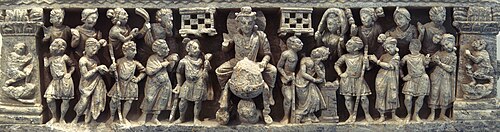
最も初期の資料では、ゴータマは在家生活に幻滅した後、より高い精神的目標を求めて苦行者またはシュラマナになったとだけ描かれているが、後世の伝説的な伝記では、彼がどのようにして托鉢僧になったかについて、より精巧でドラマチックな物語が語られている。[143] [156]
釈迦の精神的な探求に関する最も古い記述は、パーリ語の『アリヤパリエサナー・スッタ』(「崇高な探求についての説法」、MN 26)や、中国語の『MĀ 204』などの文献に見いだされる。 [157]これらの文献は、ゴータマが放棄に至ったのは、自分の人生は老い、病気、そして死にさらされており、もっと良いものがあるかもしれないという考えだったと伝えている。[158]また、初期の文献は、釈迦が修行僧になることについて次のように説明している。「家庭生活、この不浄な場所は狭い。サマー生活は自由な屋外である。家庭生活者が、完全で、完全に清らかで、完璧な聖なる生活を送ることは容易ではない。」[159] MN 26、MĀ 204、法蔵経、マハーヴァストゥはすべて、彼が家を出ると決めたとき、彼の両親が彼の決断に反対し、「涙を浮かべて泣いた」ことに同意している。[160] [161]

伝説的な伝記には、ゴータマが宮殿を出て初めて外の世界を見た話や、人間の苦しみに遭遇して衝撃を受けた話も語られている。[162] [163]これらの伝記では、ゴータマの父が彼を宗教の教えや人間の苦しみの知識から守り、偉大な宗教指導者ではなく偉大な王になるようにしたと描写されている。[164]ニダナカータ(西暦5世紀)では、ゴータマは老人に会ったと言われている。彼の御者のチャンダカがすべての人は年を取ると彼に説明すると、王子は宮殿の外へのさらなる旅に出た。これらの旅で彼は、病人、朽ちかけた死体、そして彼にインスピレーションを与えた苦行者に出会った。[165] [166] [167]この「4つの光景」の物語は、以前の仏陀であるヴィパッシの若い人生を描いたディガニカーヤ(DN 14.2)の以前の記述から改作されたと思われる。[167]
伝説の伝記では、ゴータマが宮殿を去った様子が次のように描かれている。4つの光景を見た直後、ゴータマは夜中に目を覚まし、女召使たちが魅力のない死体のような姿勢で横たわっているのを見て衝撃を受けた。[ 168]こうして、彼は後に悟りを開いたときにさらに深く理解することになる苦(「不安定な状態」、「不満」[169] [170] [171] [172] )と苦の終焉[173]を発見した。彼は経験したすべてのことに心を動かされ、父親の意志に反して真夜中に宮殿を去り、放浪する苦行者としての人生を送ることを決意した。[165]
チャンダカに付き添われ、馬カンタカに乗って、ゴータマは息子のラーフラとヤショダラを残して宮殿を去りました。[174]彼はアノミヤ川まで旅し、髪を切りました。彼は召使いと馬を残して森へ旅し、そこで僧侶の衣服に着替えました。 [175]ただし、物語の他のバージョンでは、彼はアノミヤでブラフマー神から僧侶の衣服を受け取りました。 [176]
伝説の伝記によると、苦行者ゴータマが初めてラージャガハ(現在のラージギル)に赴き、路上で施しを乞うた時、マガダ国のビンビサーラ王が彼の探求を知り、王国の一部を譲ると申し出た。ゴータマはその申し出を断ったが、悟りを開いたらまず自分の王国を訪れると約束した。[177] [178]
禁欲生活と覚醒


マッジマ・ニカーヤ4には、ゴータマが精神的な努力をしていた時代に「人里離れたジャングルの茂み」に住み、森で暮らしている間に感じた恐怖を克服しなければならなかったと記されている。[180]ニカーヤ・テキストには、苦行者ゴータマがヨガ瞑想の2人の教師の下で修行したと記されている。[181] [182] アリヤパリエサナー・スッタ(MN 26)とその中国語版MĀ 204によると、彼は「無の領域」と呼ばれる瞑想の達成を説いたアーラダ・カーラーマ(パーリ語:アララ・カーラーマ)の教えを習得した後、アーラダから彼らの精神的コミュニティの同等の指導者になるよう求められた。[183] [184]
ゴータマは、その修行が「嫌悪、無執着、止滅、平静、知識、覚醒、涅槃に至らない」ため満足できず、ウドラカ・ラーマプトラ(パーリ語:ウダカ・ラーマプッタ)の弟子となった。[185] [186]ゴータマはウドラカ・ラーマプトラの弟子となり、高い瞑想意識レベル(「知覚も非知覚もない領域」と呼ばれる)を達成し、再び師のもとに来るよう依頼された。しかし、またしても前と同じ理由で満足できず、ゴータマは弟子となった。[187]
いくつかの経典によれば、ゴータマは瞑想の師のもとを去った後、苦行の技法を修行した。[188] [u]初期の文献に記されている苦行の技法には、極度の食事制限、様々な呼吸法のコントロール、そして強制的なマインドコントロールなどがある。文献によれば、ゴータマは衰弱しすぎて、皮膚から骨が見えるようになったという。[190]マハーサッカカ・スッタとその類似文献のほとんどでは、ゴータマは極限まで苦行を行った後、これでは涅槃に達することはできず、目標を追求するためには体力を回復する必要があることに気づいたとされている。[191]有名な逸話の1つには、ゴータマがスジャータという村の少女からミルクとライスプディングを受け取ったという話がある。[192]
身毛喜豎經によると、[v]彼が苦行を放棄したため、5人の仲間は彼を見捨てた。彼らは彼が探求を放棄し、規律を失ったと考えたからである。この時点で、ゴータマは、子供の頃、父親が働いている間、木の下に座っていた以前の禅(「瞑想」)の経験を思い出した。 [191]この記憶から、彼は禅が解放への道であると理解し、その後、テキストは、ブッダが4つの禅すべてを達成し、続いて「3つの高次の知識」(テヴィジャ)を達成し、[w]四つの聖なる真実を完全に理解し、それによって輪廻(輪廻の終わりのない輪廻)から解放されたことを描いている。 [194] [195] [196] [197] [x]
法華経(SN 56)によると、 [198]如来(ゴータマが自分自身を指すために最も頻繁に使用する用語)は、「中道」、つまり自己満足と自己苦行の極端な道から離れた中庸の道、すなわち聖なる八正道を悟った。[198]後の世紀に、ゴータマは仏陀または「目覚めた者」として知られるようになった。この称号は、ほとんどの「眠っている」人々とは異なり、仏陀は現実の真の性質に「目覚め」、世界を「あるがままに」(ヤタ・ブータム)見ていると理解されていることを示す。[11]仏陀は解放(ヴィムッティ)を達成し、涅槃とも呼ばれる。これは、苦しみと再生のサイクルを続ける欲望、憎しみ、無知の「火」を消すことと見なされている。[199]
瞑想の師のもとを去る決断をした後、ゴータマは完全な悟り(三菩提)に達するまで立ち上がらないと決意して座ったと、MĀ 204やその他の類似の初期の文献は伝えている。アリヤパリイェサナー・スッタは「完全な悟り」については触れておらず、涅槃に達したとだけ述べている。[200]仏教の伝統では、この出来事はビハール州ブッダガヤの菩提樹(「菩提樹」として知られる)の下で起こったと言われている。[201]
パーリ語経典のさまざまな文献によると、釈迦は菩提樹の下で7日間座り、「解放の至福を感じた」と伝えられています。[202]パーリ語の文献には、釈迦がナイランジャナ川のほとりで暮らしながら、縁起、五つの精神機能、苦しみ(ドゥッカ)など、仏法のさまざまな側面について瞑想と熟考を続けていたことも記されています。[203]
マハーヴァストゥ、ニダナカータ、ラリタヴィスタラなどの伝説的な伝記には、欲望の世界を支配するマーラがブッダの涅槃を阻止しようとする様子が描かれている。マーラは娘たちを遣わしてブッダを誘惑し、自分の優位性を主張し、怪物の軍勢でブッダを襲撃した。 [204]しかしブッダは動じず、瞑想に入る前に地面に触れて自分の優位性の証人として大地(伝説のバージョンによっては大地の女神)に呼びかけた。[205]その他の奇跡や魔法の出来事も描かれている。
最初の説教と僧伽の形成
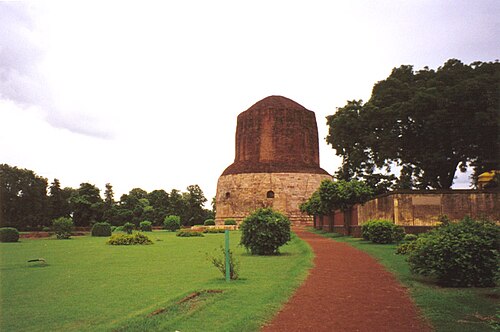
MN 26 によれば、悟りを開いた直後、釈迦は人々に法を説くべきかどうか迷った。釈迦は、人間が無知、貪欲、憎しみに支配され、「微妙で深く、つかみにくい」道を認識するのが難しいのではないかと懸念した。しかし、ブラフマー・サハンパティ神は、少なくとも「目に少しの塵も入っていない」者なら理解できると主張して、釈迦を説得した。釈迦は折れて、説法することに同意した。アナラヨによれば、MN 26 の中国語の対応文献である MĀ 204 にはこの話は含まれていないが、この出来事は、Ekottarika-āgamaの説法、Catusparisat-sūtra、Lalitavistaraなどの他の対応文献に登場している。[200]
MN 26とMĀ 204によれば、教えを説くことを決意した後、釈迦は当初、かつての師であるアララ・カラマとウダカ・ラマプッタを訪ねて自らの洞察を教えようとしたが、二人はすでに亡くなっていたため、釈迦はかつての5人の仲間を訪ねることにした。[206] MN 26とMĀ 204はどちらも、ヴァーラーナシー(ベナレス)へ向かう途中、MN 26でウパカという名のアージーヴィカの修行僧という別の放浪者に出会ったと報告している。釈迦は完全な悟りを開いたと宣言したが、ウパカは納得せず「別の道を歩んだ」。[207]
MN 26とMĀ 204は、釈迦がヴァーラナシー近くの鹿園(サールナート)(ムリガダヴァ、リシパタナとも呼ばれ、「苦行者の灰が落ちた場所」)[208]に到着し、そこで5人の苦行者のグループに会い、自分が確かに完全な悟りに達したことを彼らを説得するところまで続きます。[209] MĀ 204(MN 26ではありません)や、上座部律蔵、Ekottarika-āgamaテキスト、法蔵律蔵、大乗律蔵、マハーヴァストゥによると、釈迦はその後、「ベナレスの説法」としても知られる「最初の説法」[208] 、つまり「官能的な耽溺と自己苦行という2つの極端から離れた中道としての高貴な八正道」の教えを説きました。[209]パーリ語の文献には、最初の説法の後、苦行者コンダニャ(カウンディニャ)が最初の阿羅漢(解脱した存在)となり、最初の仏教の比丘または僧侶になったと記されています。[210]その後、釈迦は他の苦行者たちに教えを続け、彼らは最初の僧伽、つまり仏教の僧侶の集団を形成しました。[t]
マハーヴァストゥ、上座部律蔵の大般若経、カトゥパリサット・スートラなどのさまざまな文献にも、このとき[211]、あるいは5日後[208]に、釈迦が彼らに「無我」の特性についての2番目の説法(無我経)を教えたと記されています。この2番目の説法を聞いた後、残りの4人の苦行者も阿羅漢の境地に達しました。[208]
上座部律蔵とカトゥパリサット・スートラには、地元のギルドマスターであるヤサとその友人や家族の改宗についても記されている。彼らは、改宗して仏教徒コミュニティに入った最初の在家者たちの一部であった。 [212] [208]続いてカッサパという名の3人の兄弟が改宗し、彼らはかつて「もつれた髪の修行者」であり、火の供儀に関連する精神修行をしていた500人の改宗者を連れてきた。[213] [214]上座部律蔵によると、その後釈迦はガヤ近くのガヤシサ丘に立ち寄り、3番目の説法である「火の説法」を行った。 [ 215]その中で釈迦は、世界のすべてのものは情欲によって燃え上がっており、八正道に従う者だけが解脱できると説いた。[208]
雨期の終わりに、仏陀のコミュニティが約60人の覚醒した僧侶に成長したとき、彼は彼らに、世界の「幸福と利益」のために、独自に旅をし、コミュニティに人々を教え、出家させるように指示しました。[216] [208]
僧伽の旅と成長

釈迦牟尼は、生涯の残りの40年から45年間、現在のウッタル・プラデーシュ州、ビハール州、ネパール南部にあたるガンジス平原を旅し、貴族から召使、苦行者から世帯主、アングリマーラのような殺人者、アラヴァカのような人食い人種まで、さまざまな人々に教えを説いたと言われています。[217] [156] [218]シューマンによれば、釈迦の旅は「ヤムナー川沿いのコーサンビ(アラハバードの南西25km )」から「カンパ(バガルプルの東40km )」、そして「カピラヴァットゥ(ゴーラクプルの北西95km )」から「ウルヴェーラ(ガヤの南)」まで及んだ。これは600km×300kmの範囲に及ぶ。[219]釈迦の僧伽はコーサラ国とマガダ国の王の保護を受けており、釈迦はそれぞれの首都であるサヴァッティとラージャガハで多くの時間を過ごしました。[219]
釈迦の言語は不明であるが、近縁関係のある中期インド・アーリア語方言の 1 つ以上で教えを説いた可能性が高く、パーリ語はその標準化された言語である可能性がある。
僧伽は一年中放浪していたが、ヴァッサ雨期の4か月間はあらゆる宗教の修行僧がめったに旅をしなかった。その理由の一つは、動植物に害を与えずに旅をするのがより困難だったからである。[220]修行僧の健康も懸念事項だったかもしれない。[221]この時期、僧伽は人々が集まる修道院、公共の公園、または森林に隠遁した。
最初のヴァッサナは、僧伽が結成されたときにバラナシで過ごされた。パーリ語の文献によると、僧伽が結成されて間もなく、釈迦はマガダ国の首都ラージャガハに行き、ビンビサーラ王と会見し、ビンビサーラ王は僧伽に竹林の公園を贈った。[222]
釈迦の僧団は、彼が北インドを旅していた間も成長を続けた。初期の文献には、釈迦の主要な弟子である舎利弗と大跋扈が、懐疑論者の沙門であるサンジャヤ・ベーラティプッタの弟子で、アッサジによって改宗した経緯が記されている。[223] [224]また、釈迦が故郷のカピラヴァストゥを訪れたとき、釈迦の息子ラーフラが父に比丘として加わった経緯も記されている。 [225]時が経つにつれ、釈迦の従兄弟のアーナンダ、アヌルッダ、理髪師のウパリ、釈迦の異母兄弟のナンダ、デーヴァダッタなど、他のシャーキャ族も比丘として教団に加わった。[226] [227]一方、釈迦の父であるスッドーダナは息子の教えを聞いて仏教に改宗し入道者となった。
初期の文献には、初期の仏陀の強力な在家信者となった商人アナタピンディカという重要な在家の弟子についても言及されている。彼はジェータの森(ジェータヴァナ)を僧伽に多額の費用をかけて贈与したと言われている(上座部律蔵には金貨数千枚と記されている)。[228] [229]
比丘尼教団の形成

仏陀のコミュニティの成長において、女性僧侶(比丘尼)の並行した組織の形成も重要な部分でした。アナラヨによるこのテーマの比較研究で指摘されているように、この出来事については、さまざまな初期仏教文献にさまざまなバージョンが描かれています。[y]
アナラヨが調査したすべての主要な版によれば、釈迦の継母であるマハープラジャパティ・ゴータミーは、自分と他の女性たちの出家を求めた後、最初は釈迦に断られた。その後、マハープラジャパティと彼女の信奉者たちは髪を剃り、僧衣をまとい、釈迦の旅に同行し始めた。最終的に釈迦はアーナンダに説得され、新しい尼僧団と僧侶の関係に焦点を当てたグルダルマと呼ばれる8つの条件をマハープラジャパティが受け入れれば出家を認めた。 [231]
アナラヨによれば、アナンダがブッダを説得するために用いるすべてのバージョンに共通する唯一の議論は、女性もすべての覚醒段階に到達する能力が同じであるということである。[232]また、アナラヨは、現代の学者の中には、さまざまな矛盾があるために現在の形の8つのグルダルマの信憑性に疑問を抱く者もいると指摘している。彼は、現在の8つのグルダルマのリストの史実性は疑わしいが、それらはブッダの以前の戒律に基づいている可能性があると主張している。[233] [234]
アナラヨは、さまざまな文章から、仏陀が女性の出家を拒否した理由は、放浪僧の生活が、性的暴行や誘拐などの危険など、男性家族の保護を受けていない女性にとって危険であったことを示していると指摘している。このため、グルダルマの戒律は、「新しく設立された尼僧団を、在家の女性が男性親族から期待できる保護にできるだけ似た関係に男性尼僧団と位置付ける」方法だったのかもしれない。[235]
晩年
.jpg/500px-Indian_Museum_Sculpture_-_Ajatasattu_worships_the_Buddha_(9217704485).jpg)
JSストロングによれば、釈迦は最初の20年間の教えのキャリアの後、コーサラ王国の首都であるシュラヴァスティにゆっくりと定住し、晩年のほとんどをこの都市で過ごしたようです。[229]
僧伽の規模が大きくなるにつれて、標準化された僧侶の規則の必要性が生じ、仏陀は僧伽のための規則を制定したようです。これらは「般若経」と呼ばれるさまざまな経典に保存されており、僧伽の共同体によって2週間ごとに朗唱されていました。般若経には、一般的な倫理的戒律だけでなく、鉢や僧衣など僧侶生活に不可欠なものに関する規則も含まれています。[236]
晩年、釈迦の名声は高まり、シャーキャ族の新しい会議場の落成式(MN 53参照)や菩提太子による新しい宮殿の落成式(MN 85に描かれている)など、王室の重要な行事に招かれた。[237]初期の文献には、釈迦の老年期に、父ビンビサーラを倒した新しい王、アジャタシャトルがマガダ国を奪取したことも記されている。『三昧耶経』によると、新しい王は様々な修行僧と話し、最終的に釈迦に帰依した。[238]しかし、ジャイナ教の文献も彼の忠誠を主張しており、彼は釈迦の僧伽だけでなく、さまざまな宗教グループを支援していた可能性が高い。[239]
釈迦は旅と教えを続ける中で、他のシュラーマナ宗派の信者とも接触した。初期の文献には、釈迦がこれらの人物の一部と出会い、彼らの教義を批判したという証拠がある。『三昧耶経』では、そのような宗派が6つ挙げられている。[240]
初期の文献では、高齢の釈迦が腰痛に苦しんでいる様子も描かれている。また、身体に休息が必要になったため、主な弟子たちに教えを委ねている様子もいくつかの文献で描かれている。[241]しかし、釈迦は老齢になっても教えを説き続けた。
釈迦の晩年における最も厄介な出来事の一つは、提婆達多の分裂であった。初期の文献には、釈迦の従兄弟である提婆達多が教団の指導者を乗っ取ろうとし、その後数人の僧侶とともに僧伽を離れ、対抗宗派を形成したと記されている。この宗派は阿闍世王の支援を受けたと言われている。[242] [243] パーリ語文献では、提婆達多が釈迦を殺害しようと企てたが、その計画はすべて失敗したとされている。[244]パーリ語文献では、釈迦が二人の主たる弟子(舎利弗と目ガラナ)をこの分裂共同体に派遣し、提婆達多とともに去った僧侶たちに帰還するよう説得したとされている。[245]
初期の仏教の主要な律蔵はすべて、デーヴァダッタを仏教徒を分裂させようとした分裂的な人物として描いているが、デーヴァダッタが仏陀とどの問題で意見が合わなかったかについては意見が一致していない。スターヴィーラの文献は一般的に「五つの点」に焦点を当てており、これは過度の苦行と見なされているが、マハーサンギカの律蔵はより包括的な意見の相違について語っており、デーヴァダッタは説法だけでなく僧侶の規律も変えた。[246]
デーヴァダッタの分裂とほぼ同時期に、アジャータシャトルのマガダ王国と、高齢のパセーナディ王率いるコーサラ国との間でも戦争が起こった。[247]アジャータシャトルが勝利したようで、この出来事を釈迦は残念に思ったと伝えられている。[248]
最後の日々と涅槃
.jpg/500px-040_Ananda_worships_Buddha_(25595318747).jpg)
釈迦の最後の日々、死、そして死後の出来事に関する主要な物語は、マハーパリニッバーナ・スッタ(DN 16)と、サンスクリット語、中国語、チベット語のさまざまな類似訳に含まれています。[249]アナラヨによると、これらには中国語のディルガ・アガマ2、「マハーパリニルヴァーナ・スートラのサンスクリット語の断片」、および「中国語で個別に翻訳された3つの説法」が含まれます。[250]
マハーパリニッバーナ・スッタは、釈迦の最後の年を戦争の時代として描いています。それは、アジャータシャトルがヴァジカ同盟と戦うことを決意し、大臣を派遣して釈迦に助言を求めるところから始まります。[251]釈迦は、ヴァジカが7つのことを行う限り繁栄することが期待できると答え、次にこの7つの原則を仏教僧伽に適用し、[t]僧伽の将来の幸福を心配していることを示しました。
仏陀は、僧伽が「定期的に頻繁に集会を開き、調和を保ち、修行の規則を変えず、自分より先に出家した上人を敬い、世俗的な欲望に陥らず、森の庵に身を捧げ、個人的な注意深さを保つ」限り繁栄するだろうと語り、さらに僧伽が守るべき重要な美徳のリストを挙げている。[252]
初期の文献には、釈迦の二人の弟子である舎利弗と目連が釈迦の死の直前に亡くなったことが記されている。 [253]マハーパリニバーナは、釈迦が人生の最後の数ヶ月間病気にかかったが、最初は回復したと記している。釈迦が後継者に誰かを昇格させることはできないと述べたと記されている。アーナンダがこれを要求したとき、マハーパリニバーナは次のように返答したと記録している。[254]
アーナンダよ、なぜ僧団は私にこのようなことを期待するのでしょうか。私は「内」と「外」を区別せずにダルマを教えてきました。如来には「師の拳」(特定の真理が隠されている)はありません。もし「私が教団を率いる」または「教団は私の指導下にある」と考える人がいるなら、そのような人は教団について手配しなければなりません。如来はそのような考え方をしません。なぜ如来が教団のために手配しなければならないのでしょうか。私はもう年老いて、疲れ果てています...私は寿命を迎え、80歳になります。古い車が紐でつながれて動くように、如来の体は包帯で巻かれて動き続けます...したがって、アーナンダよ、あなた方は自分自身の避難所となり、他の避難所を求めずに島のように生きるべきです。法を島とし、法を避難所とし、他の避難所を求めない... 私の時代やその後にこのように生き、自分自身と法の中に島と避難所を求め、他のどこにも求めない僧侶たち、これらの熱心な人々こそが、真に私の僧侶であり、闇(再生)を克服するでしょう。
,_Gandhara,_3rd_or_4th_century_AD,_gray_schist_-_John_and_Mable_Ringling_Museum_of_Art_-_Sarasota,_FL_-_DSC00665.jpg/500px-Dying_Buddha_(Mahaparinirvana),_Gandhara,_3rd_or_4th_century_AD,_gray_schist_-_John_and_Mable_Ringling_Museum_of_Art_-_Sarasota,_FL_-_DSC00665.jpg)

旅と教えを続けたあと、釈迦は最後の食事を摂った。それは、鍛冶屋のチュンダから供えられたものだった。重病に陥った釈迦は、従者のアーナンダに、自分の家で食べた食事は自分の死とは何の関係もなく、自分の食事は釈迦にとって最後の食事となるため、最大の功徳の源となるとチュンダを説得するよう指示した。[255]比丘メッタナンドとオスカー・フォン・ヒンヌーバーは、釈迦が亡くなったのは食中毒ではなく、老齢による症状である腸間膜 梗塞によるものだと主張している。 [256] [257]
釈迦の最後の食事の正確な内容は、経典の伝承の違いや、重要な用語の翻訳の曖昧さにより、明らかではない。上座部仏教の伝統では、釈迦は豚肉のようなものを供えられたと一般に信じられているが、大乗仏教の伝統では、釈迦はトリュフかキノコのようなものを食べたと信じている。これらは、仏教の菜食主義や僧侶と尼僧の戒律に関する伝統的な見解の違いを反映しているのかもしれない。[258]現代の学者もこの話題については意見が分かれており、豚肉か、豚が好んで食べる植物かキノコかのどちらかを主張している。[z]いずれにせよ、最後の食事について言及している資料のどれも、釈迦の病気を食事自体に帰しているわけではない。[259]
マハーパリニッバーナ・スッタによれば、クンダとの食事の後、釈迦とその仲間たちは旅を続け、体が弱りすぎて続けることができなくなり、クシナガルで立ち止まらざるを得なくなった。そこでは、アーナンダがサラの木立の中に休息の場を用意していた。[260] [261]釈迦は、自分が間もなく最終的な涅槃に入ることを僧伽全体に告げた後、最後の一人の弟子を自ら僧団に任命した。彼の名前はスバッダであった。[260]それから、釈迦は僧伽に対して、自分の死後はダルマと律が彼らの教師となるという最後の指示を繰り返した。そして、教えに疑問を持つ者はいないかと尋ねたが、誰もいなかった。[262]釈迦の最後の言葉は「すべてのサンカーラは滅びる。精励(アッパマーダ)をもって目的のために努力せよ」(パーリ語:'vayadhammā saṅkhārā appamādena sampādethā')であったと伝えられている。 [263] [264]
それから彼は最後の瞑想に入り、パリニルヴァーナ(最後の涅槃。人が生まれ変わる代わりに、「存在を構成する五つの物理的および精神的現象の集合は発生しなくなる」[265])として知られる状態に到達して亡くなりました。マハーパリニッバーナは、彼の最後の瞑想で、彼は4つの禅定に連続して入り、次に4つの非物質的な達成、最後にニローダサマーパティとして知られる瞑想の住まいに入り、死の瞬間に第4の禅定に戻ったと報告しています。[266] [261]


死後の出来事
マハーパリニッバーナ・スートラによれば、クシナガルのマリアンたちは仏陀の死後、花や音楽、香りで仏陀の遺体を敬った。[267]僧伽は、高位の長老マハーカッサパが敬意を表すために到着するまで、遺体を火葬する前に待った。[268]
その後、仏陀の遺体は火葬され、骨を含む残骸は仏舎利として保管され、マガダ国、シャカ国、コーリヤ国などの北インドのさまざまな王国に分配されました。[269]これらの遺物は、当時の一般的な葬儀の慣習であるストゥーパと呼ばれる記念碑や塚に置かれました。数世紀後、それらはアショーカ王によって掘り起こされ、マウリヤ王国の各地にある多くの新しいストゥーパに安置されました。[270] [271]仏教の普及に伴い、支配者に正当性を与えたとされる遺物の歴史には、多くの超自然的な伝説が残っています。
さまざまな仏教文献によると、第一回仏教会議は釈迦の死後間もなく開催され、教えの収集、朗誦、暗記が行われた。マハーカッサパは僧伽によって会議の議長に選ばれた。しかし、第一回会議の伝統的な記録の史実性は現代の学者によって議論されている。[272]
教えと見解
核となる教え
,_part_31_-_BL_Or._14915.jpg/500px-Fragmentary_Buddhist_text_-_Gandhara_birchbark_scrolls_(1st_C),_part_31_-_BL_Or._14915.jpg)
仏教には、数多くの教えや実践が不可欠とみなされている。その中には、サンカラ(形成)であるサミョージャナ(束縛、鎖、または境界)、三毒を含むクレーシャ(不健全な精神状態)、そしてサマサラ(生成の繰り返しのサイクル)を永続させるアーサヴァ(流入、悪) ;感覚接触から意識への過程を説明し、サマサラへの束縛につながる六つの感覚基底と五つの集合;この過程とその逆転を詳細に説明する縁起;そして、この束縛を逆転させる方法を規定する四つの聖なる真理と八正道を含む中道などがある。
N. ロス・リアトによれば、上座部パーリ語文献と大乗仏教の沙羅双樹経は、これらの基本的な教えと実践を共有している。[273] 比丘アナラヨは、上座部大乗経と説法中観には、ほとんど同じ主要な教義が含まれていると結論付けている。[274]同様に、リチャード ・サロモンは、ガンダーラ写本に見られる教義は「スリランカと東南アジアの上座部仏教に今日まで残っているが、古代には18の別々の宗派によって代表されていた非大乗仏教と一致している」と書いている。[275]
輪廻
すべての生き物は、サンカーラ(形成)、クレーシャ(不健全な精神状態)、三毒、アーサヴァ(流入、腐敗)などの深く根付いたサンヨジャナ(束縛、鎖、または境界)を持ち、それがサンサーラ、つまり生成と再生の繰り返しのサイクルを永続させます。パーリ語の経典によると、釈迦は「このサンサーラには発見できる始まりがありません。無知に妨げられ、渇愛に縛られ、さまよい歩く生き物の最初のポイントは認識されません」と述べました。[276]ドゥティヤロカダンマスッタ・スッタ(AN 8:6)で、釈迦は「8つの世俗的な風」が「世界を回転させ続ける方法」を説明しています[...] 利益と損失、名声と不名誉、賞賛と非難、快楽と苦痛」。そして、高貴な人と教えを受けていない世俗の人々との違いは、高貴な人はこれらの状態の無常性について熟考し理解している点にあると説明しています。[277]
この循環はドゥッカ[278]によって特徴づけられ、一般に「苦しみ」と呼ばれていますが、ドゥッカはより適切には「不満」または「不安」と表現されます。それは、自動的な反応と習慣化された利己主義によって支配された人生に伴う不満と不安であり、[279] [280]、非永続的で不安定で信頼できないものから永続的な幸福を期待することの不満です。[281]究極の崇高な目標は、この循環からの解放であるべきです。[282]
輪廻はカルマによって規定される。カルマは非人格的な自然法則であり、特定の種子が特定の植物や果実を生み出すのと似ている。[283] カルマは人の状態を引き起こす唯一の原因ではなく、仏陀はカルマに加えてさまざまな物理的および環境的原因を挙げている。[284]仏陀のカルマの教えはジャイナ教やバラモン教の教えとは異なっており、仏陀の見解ではカルマは主に精神的な意図である(主に物理的な行動や儀式行為とは対照的である)。[279]仏陀は「カルマとは意図を意味する」と言ったと伝えられている。 [ 285]リチャード・ゴンブリッチは仏陀のカルマの見解を次のように要約している。「すべての思考、言葉、行為は、その背後にある意図から、良いか悪いかを問わず、道徳的価値を引き出す」。[286]
六つの感覚基底と五つの集合
アーヤタナ(六つの感覚の基盤)と五蘊は、感覚接触が執着と苦につながる仕組みを説明しています。六つの感覚の基盤とは、目と視覚、耳と聴覚、鼻と嗅覚、舌と味覚、身体と触覚、心と思考です。これらが合わさって、私たちが世界や現実、「すべて」を創造するための入力が作られます。このプロセスは、五蘊、「蘊」、「群」、「積」、つまり、物理的および精神的なプロセスの 5 つのグループ[287] [288]、すなわち、色(または物質的なイメージ、印象)(色)、感覚(または色から受け取る感情)(色)、知覚(色)、精神活動または形成(色)、意識(色)を通じて行われます。[289] [290] [291]これらは縁起などの他の仏教の教えやリストの一部を形成し、感覚入力が最終的に精神的な汚れによって輪廻への束縛につながることを説明しています。
依存起源

初期の文献では、苦の発生過程は縁起の教えを通して説明されており、[279]存在または発生するすべてのものは条件付け要因に依存していると述べています。[292]縁起の最も基本的な定式化は、初期の文献で次のように与えられています。「このようにして、これが生じる」(パーリ語:evam sati idam hoti)。[293]これは、特定の現象は他の現象が存在する場合にのみ発生するため、その発生は他の現象に「依存」しているという意味に解釈できます。[293]
哲学者マーク・シデリッツは、苦の縁起に関する仏陀の教えの基本的な考え方を次のように概説しています。
完全に機能する精神・肉体的要素(感覚を持つ存在を構成する部分)の集合体が存在するとすれば、感覚を持つ存在の3つの特徴である苦しみ、無常、無我に関する無知は、環境との通常の相互作用の過程で、占有(特定の要素を「私」や「私のもの」として特定すること)につながる。これは今度は、欲望や嫌悪の形で執着を形成し、感覚を持つ存在の真の性質に関する無知を強めることになる。これらは将来の再生を保証し、したがって、潜在的に終わりのないサイクルの中で、将来の老齢、病気、死の例を保証する。[279]
初期の文献の多くでは、この基本原理は、条件付きで依存していると言われる現象のリストで拡張されており、[294] [aa]後期の精緻化の結果として、[295] [296] [297] [ab]最初の 4 つのリンクの基礎としてヴェーダの宇宙起源論も含まれています。[298] [299] [300] [301] [302] [303]ボイスヴェールによれば、ニダナ 3-10 は 5 つのスカンダと相関しています。[304]リチャード ゴンブリッチによれば、12 重のリストは以前の 2 つのリストを組み合わせたもので、2 番目のリストはtanha (渇き) で始まり、これは第二の聖なる真理で説明されている苦しみの原因です。[305]ゴンブリッチによれば、2 つのリストが組み合わされた結果、逆バージョンで矛盾が生じました。[305] [ac]
アナッタ
釈迦は縁起の分析を「永遠主義」(サッサタヴァーダ、ある本質は永遠に存在するという考え)と「消滅主義」(ウッチェダーヴァーダ、私たちは死ぬと完全に存在しなくなるという考え)の間の「中道」とみなした。[279] [293]この見解では、人は単なる因果的な一連の非永続的な精神的・物理的要素であり、[279]それらは無我であり、独立した永続的な自己を持たない。[292]釈迦は代わりに、私たちの経験の世界にあるすべてのものははかないものであり、人には不変の部分は存在しないと主張した。[306]リチャード・ゴンブリッチによると、釈迦の立場は単に「すべてはプロセスである」というものである。[307]
不変の自己に対する釈迦の議論は、パーリ語の無量寿経(およびガンダーラ語と中国語の類似経)に見られるように、五蘊の体系に依存している。[308] [309] [310]初期の経典で、釈迦は、意識(バラモンによって永遠であると考えられていたヴィニャーナ)を含むすべての五蘊は、縁起によって生じると教えている。[311]それらはすべて無常であるため、心身のプロセスのいずれも不変の自己と見なすことはできない。[312] [279]意識や意志(チェタナ)などの精神的プロセスでさえ、縁起的で無常であると見なされ、したがって自己(アートマン)とは見なされない。[279]
仏陀は、自己への信仰は、変化する様々な現象に執着し、それと同一視することから生じるだけでなく、物事が実際にどうなっているかについての無知からも生じると考えた。[313]さらに、仏陀は、私たちが誤った自己観に固執しているために苦しみを経験すると主張した。[314] [315]ルパート・ゲシンが説明するように、仏陀にとって、人は
... 肉体的、精神的現象の複雑な流れですが、これらの現象を剥ぎ取ってその背後を見ると、自分自身のものと呼べる不変の自己は見つかりません。私の自己意識は、論理的にも感情的にも、これらの肉体的、精神的現象のつながりの結果として私が押し付けたラベルにすぎません。[316]
この見解( と呼ばれる)のため、釈迦の教えは、ジャイナ教の「ジーヴァ」(生命モナド)理論や、バラモン教のアートマン(パーリ語:アッタ)とプルシャの理論など、当時のすべての魂の理論に反対していました。これらの理論はすべて、人間には永遠に変わらない本質があり、それはすべての変化する経験から分離しており、 [317]生から生へと輪廻していると主張していました。[318] [319] [279]釈迦の反本質主義的な見解には、再生による継続性の理解がまだ含まれていますが、それはアートマンのような本質ではなく、プロセス(カルマ)の再生にすぎません。[320]
解放への道

.jpg/500px-20160124_Sri_Lanka_3769_Polonnaruwa_sRGB_(25144212713).jpg)
釈迦は、サミョージャナ、クレーシャ、アーサヴァを解消し、ヴィムッティ(解脱)を得るための修行の道(マルガ)を説いた。 [279] [321]釈迦が説いたこの道は、初期の文献(最も有名なのはパーリ語のダンマチャッカッパヴァッタナ・スッタとその多数の並行文献)では、官能的な放縦と肉体の苦行の間の「中道」として描かれている。 [322]
初期の文献に見られる仏陀の教えの核となる構造の一般的な表現は、四諦[323]であり、これは八正道[ 324 ]を指しています。[ad]ゲシンによれば、初期の文献で賢明に使用されている悟りへの道のもう一つの一般的な要約は、「障害を捨て、四つの念処を実践し、覚醒の要素を開発する」というものです。[326]
ルパート・ゲシンによれば、ニカーヤとアガマでは、仏陀の道は主に、サマーニャパラ・スータで概説されているような、累積的で段階的な「段階的な」プロセスで示されています。[327] [ae]ウパニシャ・スータ(SN 12.23)などの他の初期のテキストでは、縁起のプロセスの逆戻りとして道が示されています。[332] [af]
善なる状態の修行であるバーヴァナーは、ブッダの道の中心です。この目的を達成するための一般的な実践は、この道の初期の提示のほとんどに共通しており、シラ(道徳的訓練)、感覚の抑制(インドリヤサンヴァラ)、サティ(気づき)、サンパジャニャ(明確な認識)、そして、善なる状態の累積的な発達であるディヤーナの実践(完全な平静と認識の状態(ウペッカ・サティ・パリスッディ) [328]に至る)が含まれます。ディヤーナは、感覚の抑制[335]や、語のサティパターナ・スッタで教えられているサティパターナ体系や、アナパナサティ・スッタで教えられているアナパナサティの16の要素詳しく説明されている気づきなど、道のさまざまな側面によって先行され、支えられています。 [ag]
ジャイナ教とバラモン教の影響
.jpg/500px-Borobudur_-_Lalitavistara_-_071_W,_The_Bodhisattva_meets_with_Arada_Kalama_(11249495494).jpg)
さまざまな文献では、釈迦はアーラ・カーラーマとウッダカ・ラーマプッタという2人の名高い教師のもとで学んだとされている。アレクサンダー・ウィンによれば、この2人はウパニシャッドに似た教義と実践を説いたヨギであった。[336]ヨハネス・ブロンクホルストによれば、釈迦が悟りを開く前に実践していた「呼吸を止めて食事を減らす瞑想」は、ジャイナ教の実践に似た苦行の一種である。[337]
リチャード・ゴンブリッチによれば、カルマと輪廻に関する釈迦の教えは、ジャイナ教やバラモン教のブリハダラニヤカ・ウパニシャッドのような文献に見られる仏教以前のテーマの発展である。[338]同様に、輪廻、すなわち私たちは輪廻の輪に囚われており、非暴力(アヒンサー)と精神修行を通じてそこからの解放を求めるべきという考えは釈迦より古く、初期のジャイナ教で教えられていた可能性が高い。[339] KRノーマンによれば、仏教の三つの存在の印[ah]の教えもウパニシャッドやその他の影響を反映している可能性がある。[340]ブラフマ・ヴィハーラと呼ばれる仏教の修行も、バラモン教の用語に由来している可能性があるが、[341]その使用はシュラマナの伝統では一般的だった可能性がある。[342]
初期の教えに関する学術的見解

仏教の最古の核心に関する情報を得る一つの方法は、最古のパーリ語経典と他の文献、例えば現存する論説、無量寿経、無量寿経、法蔵経、[343] [344]や中国の阿含経[ 345] [346]などを比較することである。これらの文献の信頼性、そして最古の教えの核心を引き出す可能性は議論の余地がある。[342] [347] [348] [349]ランバート・シュミットハウゼンによると、現代の仏教学者はニカーヤに含まれる教えの信憑性に関して3つの立場を取っている。[350]
- 「ニカイア派の資料の少なくともかなりの部分の基本的な均質性と実質的な真正性を強調する」[ai]
- 「最古の仏教の教義を取り戻す可能性に関する懐疑論」[aj]
- 「この点に関しては慎重な楽観主義」[ak]
リチャード・ゴンブリッチ、平川明、アレクサンダー・ウィン、AKウォーダーなどの学者は、これらの初期仏教文献には仏陀に由来する可能性のある内容が含まれていると主張している。[349] [355] [158] リチャード・ゴンブリッチは、最初期の文献の内容は「独創性、知性、壮大さ、そして最も重要なことに一貫性を示しているため、それを複合作品と見なすのは難しい」と主張している。したがって、彼はそれらを「一人の天才の作品」と結論付けている。[356] ピーター・ハーヴェイも、パーリ語経典の「多く」は「彼[仏陀]の教えに由来しているに違いない」ことに同意している。[357]同様に、A. K. ウォーダーは「[初期の宗派の共通の教え]が仏陀とその直接の弟子以外の誰かによって定式化されたことを示す証拠はない」と書いている。[351]アレクサンダー・ウィンによると、「初期仏教文献の内部証拠はその歴史的真正性を証明している」。[358]
他の仏教学者は、初期の仏教文献が歴史上の仏陀の教えを反映しているという、おおむね肯定的な見解に反対し、初期の文献に含まれる教えの中には仏陀の正真正銘の教えもあるが、他の教えはそうではないと主張している。ティルマン・ヴェッターによれば、矛盾は残っており、それらの矛盾を解決するには他の方法を適用する必要がある。[343] [al]ティルマン・ヴェッターによれば、仏教の教えの最も初期の核心は禅の瞑想実践であるが、[361] [am]「解放的な洞察」が仏教の伝統の重要な特徴となったのは後になってからである。
彼は、仏教に不可欠であると一般に考えられている第四の聖なる真理、八正道と縁起は、この「解脱の洞察」の説明枠組みの一部を形成する後世の定式化であると主張している。[363] ランバート・シュミットハウゼンも同様に、四つの聖なる真理が四禅を修めた後に得られる「解脱の洞察」を構成するという言及は後世に付け加えられたものだと主張している。[359] ヨハネス・ブロンクホルストも、四つの真理は最初期の仏教では定式化されていなかった可能性があり、最初期の仏教では「解脱の洞察」の説明として機能しなかったと主張している。[364]
エドワード・コンツェは、ヨーロッパの学者たちが仏陀の本来の教えを再構築しようとする試みは「すべて単なる推測」であると主張した。[365]
ホームレス生活
初期の仏教文献には、釈迦が道の修行のための理想的な生き方として、家もなく独身の「僧侶」、つまり托鉢僧の生活を推奨していたと記されている。 [366]釈迦は、托鉢僧または「乞食」(比丘)はすべての所有物を放棄し、托鉢鉢と三枚の袈裟だけを所有すべきであると教えた。[367]釈迦の修行の一環として、彼らは基本的な必需品(主に食料、衣服、住居)を一般の在家コミュニティに頼ることも求められていた。[368]
僧侶の戒律に関する釈迦の教えは、様々な初期の宗派の律蔵に保存されました。 [367]
僧侶と尼僧を含む仏教の僧侶は食べ物を乞う必要があり、食べ物を蓄えたり正午以降に食事をしたりすることは許されず、金や銀などの貴重品を使うことも許されなかった。[369] [370]
社会
バラモン教批判
.jpg/500px-Indian_Museum_Sculpture_-_Buddha_meets_a_Brahmin_(9218121775).jpg)
ブロンクホルストによれば、「バラモン教の伝統の担い手であるバラモンは、仏陀が教えを説いた地域では支配的な地位を占めていなかった」[104] 。しかし、仏陀はバラモン教に精通しており、初期の仏典ではバラモン教の技法に言及している。例えば、パーリ語経典のサンユッタ・ニカーヤ111、マッジマ・ニカーヤ92、ヴィナヤ1246では、仏陀はアグニホートラを最も重要な供儀として、ガヤトリー・マントラを最も重要な韻律として称賛している[an] 。一般的に、仏陀は特定の重要な点について バラモン教の宗教と社会制度を批判している。
バラモン階級はヴェーダを永遠に啓示された(シュルティ)経典であると信じていた。一方、仏陀はこれらの経典に神聖な権威や価値があるとは認めなかった。[372]
釈迦はまた、バラモン教の儀式や慣習が精神的向上に役立つとは考えていなかった。例えば、ウダーナでは、儀式的な沐浴は清浄にはつながらず、「真実と道徳」だけが清浄につながると釈迦は指摘している。[ao]特に、ヴェーダで教えられている動物の供儀を批判した。 [372]釈迦は、すべての人に公然と教えられた自身の教えと、マントラを秘密にしていたバラモンの教えを対比した。[ap]
釈迦はまた、バラモン教徒が優れた生まれを主張することや、異なるカーストや血統が本質的に清浄か不浄か、高貴か卑しいかという考え方を批判した。[372]
ヴァセッタ・スータで、釈迦は、人間同士の主な違いは生まれではなく、行為と職業であると主張しています。[374]釈迦によれば、人は「バラモン」(つまり、ブラフマーのような神)になれるのは、徳を培った程度までです。[aq]このため、初期の文献には、釈迦が次のように宣言したと記されています。「生まれによって人はバラモンになるのではなく、生まれによって非バラモンになるのではなく、道徳的な行為によって人はバラモンになるのだ」[372]
アガニャ・スータは、すべての階級やヴァルナは善にも悪にもなり得ると説明し、それらが神によって定められたというバラモン教の考えに反して、それらがどのようにして生じたかについて社会学的説明を与えている。 [375]カンチャ・イライアによれば、釈迦は社会の最初の契約理論を提起した。 [376]釈迦の教えは、カーストに依存する「自分の義務」(スヴァダルマ)に基づくバラモン教の倫理とは対照的な、すべての人に有効な唯一の普遍的な道徳法、唯一のダルマである。[372]このため、不可触民を含むすべてのカーストは仏教団に歓迎され、誰かが入団するときは、すべてのカーストの所属を放棄した。[377] [378]
社会政治的な教え
初期の文献では、仏陀は政治が人間の生活にとって重要であることを軽視した説明をしていると描写されている。政治は避けられないものであり、おそらく必要かつ有益でさえあるが、時間と労力の途方もない浪費であり、自我を暴走させる最大の誘惑でもある。仏教の政治理論は、ごくわずかな程度(税金を納め、法律を守り、選挙で投票するなど)を除いて、人々に政治に参加する道徳的義務があることを否定し、政治への関与と悟りの追求は人生において相反する道であると積極的に描写している。[379]
アッガニャ・スータでは、釈迦は君主制がどのように生まれたかという歴史を説いているが、マシュー・J・ムーアによれば、それは「社会契約に非常に類似している」という。また、アッガニャ・スータは、社会階級に関するヴェーダの見解とは対照的に、異なる階級がどのように生まれたかについての社会的説明も提供している。[380]
チャッカヴァッティ・シハナーダ・スッタやマハースダッサナ・スッタなどの他の初期のテキストは、正義の転輪指導者 (チャッカヴァッティ) の姿に焦点を当てています。この理想的な指導者は、統治を通じてダルマを推進する人物です。彼は道徳的清浄さを通じてのみ地位を獲得することができ、地位を維持するために道徳とダルマを推進する必要があります。チャッカヴァッティ・シハナーダ・スッタによると、チャッカヴァッティの主な義務は次のとおりです。「ダルマに従って、自分の家族、軍隊、貴族、家臣、バラモンと世帯主、町民と田舎民、修行僧とバラモン、獣と鳥を監視、保護、保護する。王国に犯罪が蔓延しないようにし、困っている人々に財産を与える。」[380]スッタは、困っている人に施しをするという戒律を、輪廻の王たちが困っている人に施しをしなかったために没落し、貧困が増して王国が内紛に陥り、それが窃盗や暴力につながると説明しています。[ar]
マハーパリニッバーナ・スータでは、仏陀は、準共和制の政治形態をとっていたヴァジカ部族連合に推進したいくつかの原則を概説している。仏陀は彼らに「定期的に頻繁に集会を開く」こと、調和して生活し、伝統を守ることを教えた。その後、仏陀は仏教僧伽にも同様の共和制政治を推進し、そこではすべての僧侶が平等に公開会議に出席する権利を持ち、仏陀が指導者を任命しなかったため、単一の指導者は存在しないとした。[380]一部の学者は、この事実は仏陀が共和制政治形態を好んだことを示していると主張しているが、他の学者はこの立場に反対している。[380]
世俗的な幸福
比丘菩提が指摘したように、パーリ語の経典に描かれている仏陀は、世界を超越する目的を教えるだけでなく、在家者に現世の幸福(スッカ)を達成する方法も教えています。[381]
菩提によれば、在家者としての生き方に焦点を当てた経典の中で「最も包括的」なものはシガロヴァーダ経典(DN 31)である。この経典は、在家者が「親と子、教師と生徒、夫と妻、友人と友人、雇用者と労働者、在家信者と宗教指導者」という6つの基本的な社会的関係に対してどのように行動すべきかを概説している。[382]このパーリ語のテキストには、中国語とサンスクリット語の断片にも類似点がある。[383] [384]
別の経典(ディガジャン・スータ、AN 8.54)では、仏陀は2種類の幸福を説いている。まず、この人生で目に見える幸福がある。仏陀は、この幸福に至るには4つのことが必要だと述べている。「たゆまぬ努力の達成、保護の達成、良い友情、バランスのとれた生活」。[385]同様に、他のいくつかの経典では、家族関係を改善する方法、特に親子の愛と感謝、そして夫婦の幸福の重要性について説いている。[386]
来世の幸福に関して、釈迦牟尼は(『定住経』の中で)良い生まれ変わりにつながる美徳は、信仰(仏陀と教えへの信仰)、道徳的規律、特に五戒の遵守、布施、そして智慧(物事の生滅に関する知識)であると述べています。[387]
当時の経典の釈迦牟尼によれば、良い生まれ変わりを達成するには、良い結果をもたらす善い(クサラ)業を修め、悪い(アクサラ)業を避けることが基本となる。釈迦牟尼が説いた良い業の一般的なリストは、MN 41 Saleyyaka Sutta (および中国語のSĀ 1042)に概説されている10の行動方針( kammapatha )のリストである。[388] [389]
善い行いは功徳(プーニャ)とも呼ばれ、仏陀は布施、道徳的規律、瞑想という三つの功徳ある行為の基礎を概説しています(AN 8:36参照)。[390]
身体的特徴

初期の文献では、釈迦は他の仏教僧と似たような人物として描かれている。様々な説話では、釈迦が世を捨てる際に「髪と髭を剃った」とされている。同様に、ディガ・ニカーヤ3では、バラモンが釈迦を剃髪した、または禿げ頭(ムンダカ)の男として描写している。[391]ディガ・ニカーヤ2では、アジャタシャトル王が僧伽に近づいたとき、どの僧が釈迦なのかわからず、大臣に指差してもらうよう頼まなければならなかったことも描かれている。同様に、MN140では、自分を釈迦の信奉者とみなす托鉢僧が釈迦に直接会ったが、彼を認識できなかった。[392]
釈迦牟尼は、少なくとも若い頃は、ハンサムで顔色が良かったとも言われている(ディガI:115、アングッタラI:181)。しかし、老齢になると、背中が曲がって、手足がたるんでしわが寄ったとされている。[393]
さまざまな仏教の文献では、仏陀は「偉人の32の兆候」(サンスクリット語:mahāpuruṣa lakṣaṇa )として知られる一連の並外れた身体的特徴を持っていたとされています。
アナラヨによれば、これらの身体的特徴が仏教の文献に初めて登場したとき、当初は普通の人には知覚できず、見分けるには特別な訓練が必要であった。しかし後に、普通の人には見えるものとして描かれ、仏陀への信仰を喚起するものとして描かれるようになった。[394]
これらの特徴はディガ・ニカーヤのラッカナ・スータ(D, I:142)に記述されています。[395]
他の宗教では
ヒンズー教

このヒンドゥー教の統合は、釈迦の生涯の後、紀元前500年[396]から200年[397]と紀元後 300年頃[396]の間に、仏教とジャイナ教の成功の圧力を受けて現れました。[398]仏教の成功に応えて、ゴータマもヴィシュヌの9番目の化身と見なされるようになりました。[127] [399] [400]多くのヒンズー教徒は、釈迦はヒンズー教徒であったと主張し、その支持として釈迦がヴィシュヌの9番目の化身であるという信念を挙げています。[as]釈迦の化身としての採用は、インドでヒンズー教が優勢になり仏教が衰退し始めたのとほぼ同時期に始まり、化身のリストへの組み込みは、インドにおける仏教の力と魅力を決定的に弱めようとするヒンズー教の取り組みの一面と見なされました。[402] [403]
しかし、仏陀の教えはヴェーダの権威とブラフマン・アートマンの概念を否定している。[404] [405] [406]その結果、仏教はヒンドゥー教の6つの正統派とは対照的に、一般的にナースティカ派(異端、文字通り「そうではない」[at] )に分類されている。[409] [410] [411]
イスラム教
イスラムの預言者ズ・アル=キフルは、クルアーン第95章1節に基づいて仏陀と同一視されている。そこにはイチジクの木が描かれているが、これはクルアーンに記されている他のどの預言者の生涯にも目立ったシンボルではない。一方で、アル=キフルという名前は、少年時代のゴータマ・シッダールタの故郷であるカピラヴァストゥを指しているのではないかとも言われている。 [412]
古典 スンニ派の学者 タバリーは、9世紀にアフガニスタンからバグダッドに仏教の偶像がもたらされたと報告している。そのような偶像はブハラのモスクの隣にある仏教寺院で売られていたが、彼は仏陀の役割についてそれ以上は論じていない。アル・ビールーニー(973年 - 1050年以降)の仏教に関する著作によると、仏陀の正確な正体に関する見解は多様であった。したがって、ある者は彼を神の化身とみなし、他の者は彼を天使の使徒またはイフリートとみなし、他の者は彼を人類に遣わされた神の使徒とみなした。12世紀までに、アル・シャフラスタニは、理想的な人間として描写されたヒドゥルと仏陀を比較した。マニ教の教えにも精通していたイブン・ナディムは、明確には言及していないものの、仏陀を「悪魔を追放する」宗教を教えた預言者とさえみなしている。[413]
仏陀は少数派のアフマディーヤ派からも預言者とみなされている。[414]
キリスト教

キリスト教の聖人ヨサファトは釈迦牟尼をモデルにしている。名前はサンスクリット語の菩薩に由来し、アラビア語のブッダサフとグルジア語のイオダサフを経ている。[415]聖ヨサファトが登場する唯一の物語『バルラームとヨサファト』は釈迦牟尼の生涯に基づいている。[416]ヨサファトはローマ殉教史の初期版(祝日11月27日)には含まれていたが、ローマ典礼書には含まれていなかった。また東方正教会の典礼暦(8月26日)にも含まれていた。
その他の宗教
バハイ教では、仏陀は神の顕現の一人とみなされている。[要出典]
初期の中国道教仏教者の中には、釈迦牟尼は老子の生まれ変わりであると考える者もいた。[417]
マニ教の古代グノーシス派では、釈迦はマニ以前に神の言葉を説いた預言者の一人として挙げられている。[418]
シク教では、伝統的かつ歴史的にグル・ゴービンド・シングに帰せられるダサム・グラントの作品であるチャウビス・アヴタールにおいて、仏陀はヴィシュヌの23番目の化身として言及されている。[419]
芸術的な描写
バーハットとサンチーで発見された仏陀の最も古い芸術的描写は、無像と象徴的である。この初期の無像時代には、仏陀は空の玉座、乗り手のいない馬、足跡、法輪、菩提樹など、他の物体や象徴によって表現されていた。[420]無像主義では単一の信仰の対象像は排除されるため、ほとんどの表現は仏陀の生涯の物語的場面である。これらは、仏陀の人物が表現されるようになった後も、より大きな像と並んで非常に重要であり続けた。サンチーの芸術には、仏陀の前世の物語であるジャータカ物語も描かれている。 [421]
インドの仏教美術の他の様式では、仏陀は人間の姿で描かれており、立っているか、足を組んで座っているか(多くの場合、蓮華座)、または片側に横たわっている。仏陀の象徴的な表現は、西暦1世紀以降に特に人気が高まり、広まった。[422]これらの描写の一部、特にガンダーラ仏教と中央アジアの仏教のものは、ヘレニズム美術、いわゆるグレコ仏教美術の影響を受けています。[423]その後、東アジアの仏像の芸術だけでなく、東南アジアの上座部仏教の芸術にも影響を与えました。
さまざまな仏像のスタイルを紹介するギャラリー
-
 仏陀を訪問する王族の夫婦。シュンガ王朝時代のバールハット仏塔の欄干より。紀元前 2 世紀初頭。
 -
 バールハットの金剛玉座と菩提樹の礼拝。
 -
 三千大菩薩天からの仏陀降臨、サンチー仏塔第1号。
 -
 カピラヴァストゥの仏陀の奇跡、サーンチー仏塔 1.
 -
 ラージャグリハの竹林で仏陀(空の玉座として表現されている)を訪問するビンビサーラ
 -
 乗り手のいない馬による偉大な出発、アマラヴァティ、西暦 2 世紀。
 -
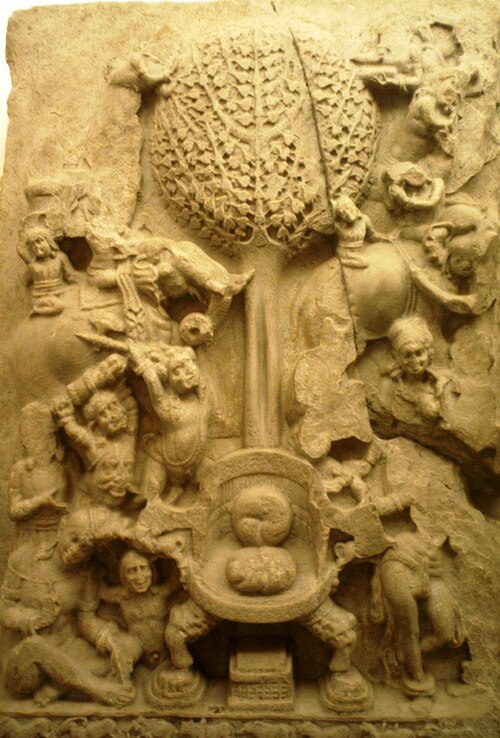 マーラの襲撃、アマラヴァティ、西暦 2 世紀。
 -
![イサプール仏像は、仏陀の最も古い肉体表現の一つで、紀元15年頃のものである。[424] マトゥラ美術](https://img-server.japedia.wiki/wikipedia/commons/thumb/9/9b/Isapur_Buddha.jpg/500px-Isapur_Buddha.jpg) イサプール仏像は、仏陀を描いた最も古い作品の一つで、紀元 15年頃のものである。[424] マトゥラ美術
イサプール仏像は、仏陀を描いた最も古い作品の一つで、紀元 15年頃のものである。[424] マトゥラ美術 -
 西暦 50 ~ 100 年、マトゥラーのインドラサラ洞窟でインドラに付き添われた仏陀。
 -

-
 ガンダーラの立像仏。
 -

-

-
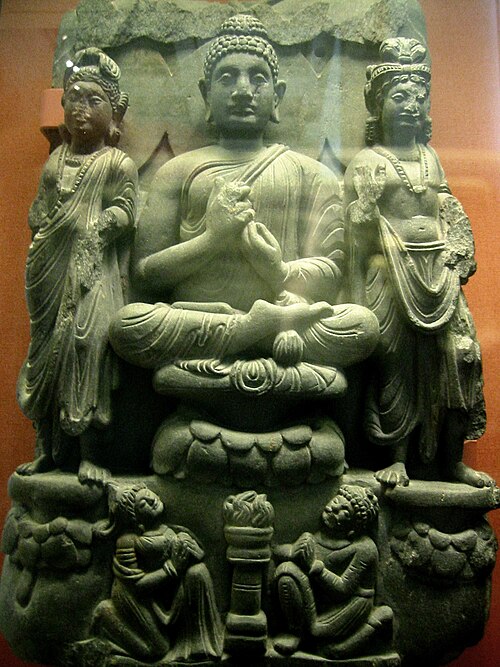 クシャーナ時代の仏陀三尊像。
 -
 サンチーの仏像。
 -
 仏陀の誕生、クシャーナ朝、西暦2世紀後半から3世紀初頭。
 -
 沐浴する幼子仏、ガンダーラ、紀元2世紀。
 -
 6世紀のガンダーラ仏。
 -
 Buddha at Cave No. 6, Ajanta Caves.
 -
 Standing Buddha, c. 5th century CE.
 -
 Sarnath standing Buddha, 5th century CE.
 -
 Seated Buddha, Gupta period.
 -
 Seated Buddha at Gal Vihara, Sri Lanka.
 -
 Chinese Stele with Sakyamuni and Bodhisattvas, Wei period, 536 CE.
 -
 The Shakyamuni Daibutsu Bronze, c. 609, Nara, Japan.
 -
 Amaravati style Buddha of Srivijaya period, Palembang, Indonesia, 7th century.
 -
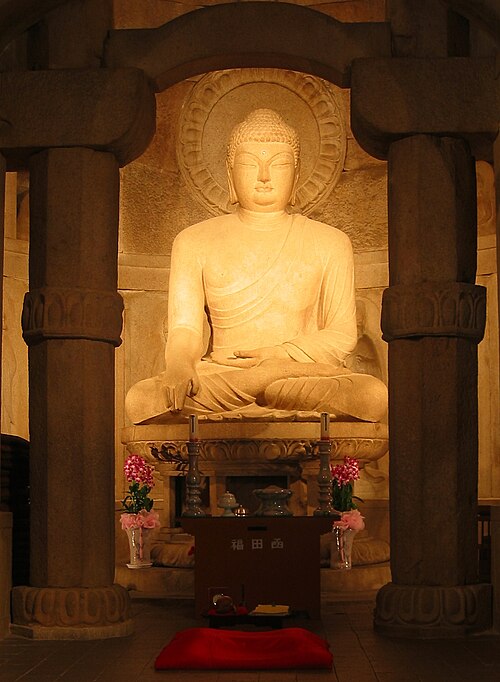 Korean Seokguram Cave Buddha, c. 774 CE.
 -
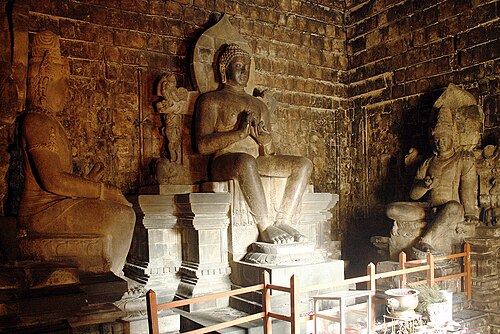 Seated Buddha Vairocana flanked by Avalokiteshvara and Vajrapani of Mendut temple, Central Java, Indonesia, early 9th century.
 -

-
 Vairocana Buddha of Srivijaya style, Southern Thailand, 9th century.
 -
 Seated Buddha, Japan, Heian period, 9th-10th century.
 -
 Attack of Mara, 10th century, Dunhuang.
 -

-
 15th century Sukhothai Buddha.
 -
 15th century Sukhothai Walking Buddha.
 -
 Sakyamuni, Lao Tzu, and Confucius, c. from 1368 until 1644.
 -
 Chinese depiction of Shakyamuni, 1600.
 -
 Buddha on the snowy mountain, Vietnam, 18th century
 -
 Shakyamuni Buddha with Avadana Legend Scenes, Tibetan, 19th century
 -
 Golden Thai Buddha statue, Bodh Gaya.
 -
 Gautama statue, Shanyuan Temple, Liaoning Province, China.
 -
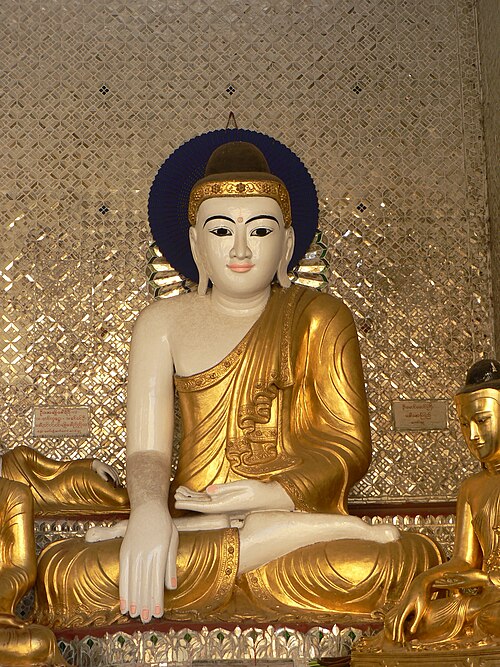 Burmese style Buddha, Shwedagon pagoda, Yangon.
 -
 Large Gautama Buddha statue in Buddha Park of Ravangla.
 -
![仏像の頭部、アフガニスタン、ハッダ、5世紀から6世紀頃。メトロポリタン美術館[425]](https://img-server.japedia.wiki/wikipedia/commons/thumb/6/64/MET_DP264118_%28cropped%29.jpg/500px-MET_DP264118_%28cropped%29.jpg)

_at_Rajagriha,_the_visit_of_Bimbisara.jpg/500px-Bamboo_garden_(Venuvana)_at_Rajagriha,_the_visit_of_Bimbisara.jpg)


.jpeg/500px-Gandhara_Buddha_(tnm).jpeg)
.jpg/500px-Berenike_Buddha_(drawing).jpg)


.jpg/500px-023_Vairocana_Buddha,_9c,_Srivijaya_(35212721926).jpg)
.jpg/500px-Seated_Shaka_Nyorai_(Sakyamuni,_Gautama_Buddha).jpg)
.jpg/500px-Naga-enthroned_Buddha_-_Beyond_Angkor_-_Cleveland_Museum_of_Art_(40887945882).jpg)

.jpg/500px-Shakyamuni_detail,_Clevelandart_1991.9_(cropped).jpg)

.jpg/500px-Bodh_Gaya_-_Wat_Thai_-_Main_Buddha_Statue_(9228460504).jpg)

![仏像の頭部、アフガニスタン、ハッダ、5世紀から6世紀頃。メトロポリタン美術館[425]](https://img-server.japedia.wiki/wikipedia/commons/thumb/6/64/MET_DP264118_(cropped).jpg/500px-MET_DP264118_(cropped).jpg)
In other media
Films
- Buddha Dev (Life of Lord Buddha), a 1923 Indian silent film by Dhundiraj Govind Phalke, first depiction of the Buddha on film with Bhaurao Datar in the title role.[426]
- Prem Sanyas (The Light of Asia), a 1925 silent film, directed by Franz Osten and Himansu Rai based on Arnold's epic poem with Rai also portraying the Buddha.[426]
- Dedication of the Great Buddha (大仏開眼, Daibutsu Kaigen), a 1952 Japanese feature film representing the life of Buddha.
- Gotoma the Buddha, a 1957 Indian documentary film directed by Rajbans Khanna and produced by Bimal Roy.[426]
- Siddhartha, a 1972 drama film by Conrad Rooks, an adaptation Hesse's novel. It stars Shashi Kapoor as Siddhartha, a contemporary of the Buddha.
- Little Buddha, a 1994 film by Bernardo Bertolucci, the film stars Keanu Reeves as Prince Siddhartha.[426]
- The Legend of Buddha, a 2004 Indian animated film by Shamboo Falke.
- The Life of Buddha, or Prawat Phra Phuttajao, a 2007 Thai animated feature film about the life of Gautama Buddha, based on the Tipitaka.
- Tathagatha Buddha, a 2008 Indian film by Allani Sridhar. Based on Sadguru Sivananda Murthy's book Gautama Buddha, it stars Sunil Sharma as the Buddha.[426]
- Sri Siddhartha Gautama, a 2013 Sinhalese epic biographical film based on the life of Lord Buddha.
- A Journey of Samyak Buddha, a 2013 Indian film by Praveen Damle, based on B. R. Ambedkar's 1957 Navayana book The Buddha and His Dhamma with Abhishek Urade in the title role.
Television
- Buddha, a 1996 Indian series which aired on Sony TV. It stars Arun Govil as the Buddha.[426]
- The Buddha 2010 PBS documentary by filmmaker David Grubin and narrated by Richard Gere.
- Buddha, a 2013 Indian drama series on Zee TV starring Himanshu Soni in the title role.
Literature
- The Light of Asia, an 1879 epic poem by Edwin Arnold
- The Buddha and His Dhamma, a treatise on Buddha's life and philosophy, by B. R. Ambedkar
- Before He Was Buddha: The Life of Siddhartha, by Hammalawa Saddhatissa
- Buddha, a manga series that ran from 1972 to 1983 by Osamu Tezuka
- Siddhartha novel by Hermann Hesse, written in German in 1922
- Lord of Light, a novel by Roger Zelazny depicts a man in a far future Earth Colony who takes on the name and teachings of the Buddha
- Creation, a 1981 novel by Gore Vidal, includes the Buddha as one of the religious figures that the main character encounters
Music
- The Light of Asia, an 1886 oratorio by Dudley Buck based on Arnold's poem
- Karuna Nadee, a 2010 oratorio by Dinesh Subasinghe
See also
- Buddhist pilgrimage sites
- Family of Gautama Buddha
- List of Indian philosophers
- List of places where Gautama Buddha stayed
- Miracles of Gautama Buddha
Notes
- ^ Buddha is seated cross-legged in the lotus position. In the centre of the base relief is a wheel symbolizing the dharmachakra, the Wheel of Buddhist law, with couchant deer on either side symbolizing the deer park in which the sermon was preached. The fingers of his hands form the teaching pose.
- Sahni (1914, pp. 70–71, chapter B (b) 181): "Image (ht 5′ 3″ up to the top of the halo; width at base 2′ 7″) of Gautama Buddha seated cross-legged, preaching the first sermon at Sarnath, on a thick cushion supported on a seat with moulded legs."
- Eck (1982, p. 63): "In the most famous of these images in the Sarnath museum, the Buddha sits cross-legged, his limbs in the perfect proportions prescribed by the iconometry of the day, his hands in a teaching pose, his eyes downcast, half-shut in meditation, his head backed by a beautifully ornamented circular nimbus."
- Mani (2012, pp. 66–67): "The seated Buddha, B(b) 181 showing Buddha cross-legged in the attitude of preaching, is one of the most exquisite creations of Gupta art. The halo is carved with a pair of celestial figures and conventionalized floral scroll-work."
- ^ a b c d e According to the Buddhist tradition, following the Nidanakatha (Fausböll, Davids & Davids 1878, p. [page needed]), the introductory to the Jataka tales, the stories of the former lives of the Buddha, Gautama was born in Lumbini, now in modern Nepal, but then part of the territory of the Shakya-clan.[126][128] In the mid-3rd century BCE the Emperor Ashoka determined that Lumbini was Gautama's birthplace and thus installed a pillar there with the inscription: "...this is where the Buddha, sage of the Śākyas (Śākyamuni), was born." (Gethin 1998, p. 19)
Based on stone inscriptions, there is also speculation that Lumbei, Kapileswar village, Odisha, at the east coast of India, was the site of ancient Lumbini. (Mahāpātra 1977; Mohāpātra 2000, p. 114; Tripathy 2014 Hartmann discusses the hypothesis and states, "The inscription has generally been considered spurious (...)" Hartmann 1991, pp. 38–39 He quotes Sircar: "There can hardly be any doubt that the people responsible for the Kapilesvara inscription copied it from the said facsimile not much earlier than 1928." Some sources mention Kapilavastu as the birthplace of the Buddha. Gethin states: "The earliest Buddhist sources state that the future Buddha was born Siddhārtha Gautama (Pali Siddhattha Gotama), the son of a local chieftain—a rājan—in Kapilavastu (Pali Kapilavatthu) what is now Nepal."Gethin 1998, p. 14 Gethin does not give references for this statement. Various sources say Kapilavastu was the place where he grew up:Keown & Prebish 2013, p. 436- Warder (2000, p. 45): "The Buddha [...] was born in the Sakya Republic, which was the city state of Kapilavastu, a very small state just inside the modern state boundary of Nepal against the Northern Indian frontier.
- Walshe (1995, p. 20): "He belonged to the Sakya clan dwelling on the edge of the Himalayas, his actual birthplace being a few kilometres north of the present-day Northern Indian border, in Nepal. His father was, in fact, an elected chief of the clan rather than the king he was later made out to be, though his title was raja—a term which only partly corresponds to our word 'king'. Some of the states of North India at that time were kingdoms and others republics, and the Sakyan republic was subject to the powerful king of neighbouring Kosala, which lay to the south".
- The exact location of ancient Kapilavastu is unknown.(Keown & Prebish 2013, p. 436) It may have been either Piprahwa in Uttar Pradesh, northern India (Nakamura 1980, p. 18; Srivastava 1979, pp. 61–74; Srivastava 1980, p. 108), or Tilaurakot (Tuladhar 2002, pp. 1–7), present-day Nepal (Huntington 1986, Keown & Prebish 2013, p. 436). The two cities are located only 24 kilometres (15 miles) from each other (Huntington 1986).
- ^ a b c
- 411–400: Dundas (2002), p. 24: "...as is now almost universally accepted by informed Indological scholarship, a re-examination of early Buddhist historical material, [...], necessitates a redating of the Buddha's death to between 411 and 400 BCE..."
- 405: Richard Gombrich[70][68][71]
- Around 400: See the consensus in the essays by leading scholars in Narain (2003).
- According to Pali scholar K. R. Norman, a life span for the Buddha of c. 480 to 400 BCE (and his teaching period roughly from c. 445 to 400 BCE) "fits the archaeological evidence better".[72] See also Notes on the Dates of the Buddha Íåkyamuni[dead link].
- Indologist Michael Witzel provides a "revised" dating of 460–380 BCE for the lifetime of the Buddha.[73]
- ^ According to Mahaparinibbana Sutta (see Äccess to insight, Maha-parinibbana Sutta), Gautama died in Kushinagar, which is located in present-day Uttar Pradesh, India.
- ^ /sɪˈdɑːrtə, -θə ˈɡɔːtəmə, ˈɡaʊ- ˈbuːdə, ˈbʊdə/, Sanskrit: [sɪddʱaːrtʰɐ gɐʊtɐmɐ]
- ^ a b The translation of "bodhi" and "Buddha" has shifted over time. While translated as "enlightenment" and "the enlightened one" since the 19th century, following Max Muller (Cohen 2006, p. 9), the preferred translation has shifted to "awakened" and "awakened one" (Bodhi 2020; Abrahams 2021:
- Gimello (2003, p. entry "Bodhi (awakening"): "The Sanskrit and Pāli word bodhi derives from the Indic root [.radical] budh (to awaken, to know) [...] Those who are attentive to the more literal meaning of the Indic original tend to translate bodhi into English as 'awakening', and this is to be recommended. However, it has long been conventional to translate it as 'enlightenment', despite the risks of multiple misrepresentation attendant upon the use of so heavily freighted an English word."
- Norman (1997, p. 29): "From the fourth jhana he gained bodhi. It is not at all clear what gaining bodhi means. We are accustomed to the translation 'enlightenment' for bodhi, but this is misleading for two reasons. First, it can be confused with the use of the word to describe the development in European thought and culture in the eighteenth century, and second, it suggests that light is being shed on something, whereas there is no hint of the meaning 'light' in the root budh- which underlies the word bodhi. The root means 'to wake up, to be awake, to be awakened', and a buddha is someone who has been awakened. Besides the ordinary sense of being awakened by something, e.g. a noise, it can also mean 'awakened to something'. The desire to get the idea of 'awakened' in English translations of buddha explains the rather peculiar Victorian quasi-poetical translation 'the wake' which we sometimes find."
- Bikkhu Bodhi objects to this shift: "The classical Pali text on grammar, Saddanīti, assigns to this root the meanings of 'knowing (or understanding)', 'blossoming', and 'waking up', in that order of importance. The Pali-Sanskrit noun buddhi, which designates the intellect or faculty of cognition, is derived from budh, yet entails no sense of 'awakening'. Further, when we look at the ordinary use of verbs based on budh in the Pali suttas, we can see that these verbs mean 'to know, to understand, to recognize'. My paper cites several passages where rendering the verb as 'awakens' would stretch the English word beyond its ordinary limits. In those contexts, 'knows', 'understands', 'recognizes', or 'realizes' would fit much better. The verbs derived from budh that do mean 'awaken' are generally preceded by a prefix, but they are not used to refer to the Buddha's attainment of bodhi." (Bodhi 2020; Abrahams 2021)
- Buddhadasa (2017, p. 5) gives several translations, including "the knowing one": "This is how we understand 'Buddha' in Thailand, as the Awakened One, the Knowing One, and the Blossomed One."
- ^ A number of names are being used to refer to the Buddha;
- Siddhartha Gautama, Gotama Buddha:
- Buswell & Lopez (2014, p. 316), "Gautama": "Gautama. (P.) Gotama; The family name of the historical Buddha, also known as ŚĀKYAMUNI Buddha. ... In Pāli literature, he is more commonly referred to as Gotama Buddha; in Mahāyāna texts, Śākyamuni Buddha is more common."
- /sɪˈdɑːrtə, -θə/; Sanskrit: [sɪddʱaːrtʰɐ ɡɐʊtɐmɐ] Gautama namely Gotama in Pali. Buswell & Lopez (2014, p. 817) "Siddhārtha": "Siddhārtha. (P. Siddhattha; T. Don grub; C. Xidaduo; J. Shiddatta/Shittatta; K. Siltalta ). In Sanskrit, "He Who Achieves His Goal", the personal name of GAUTAMA Buddha, also known as ŚĀKYAMUNI. In some accounts of the life of the Buddha, after his royal birth as the son of King ŚUDDHODANA, the BODHISATTVA was given this name and is referred to by that name during his life as a prince and his practice of asceticism. ... After his achievement of buddhahood, Siddhārtha is instead known as Gautama, Śākyamuni, or simply the TATHĀGATA."
- [Buddha] Shakyamuni:
- Buswell & Lopez (2014, p. 741) "Śākyamuni": "Śākyamuni. (P. Sakkamuni; ... one of the most common epithets of GAUTAMA Buddha, especially in the MAHĀYĀNA traditions, where the name ŚĀKYAMUNI is used to distinguish the historical buddha from the myriad other buddhas who appear in the SŪTRAs."
- Buddha Shakyamuni: from the middle of the 3rd century BCE, several Edicts of Ashoka (reigned c. 269–232 BCE) mention the Buddha and Buddhism (Bary (2011, p. 8), Fogelin (2015)). Particularly, Ashoka's Lumbini pillar inscription commemorates the Emperor's pilgrimage to Lumbini as the Buddha's birthplace, calling him the Buddha Shakyamuni (Brahmi script: 𑀩𑀼𑀥 𑀲𑀓𑁆𑀬𑀫𑀼𑀦𑀻 Bu-dha Sa-kya-mu-nī, "Buddha, Sage of the Shakyas") (In Ashoka's Rummindei Edict c. 260 BCE, in Hultzsch (1925, p. 164))
- The Buddha:
- Keown (2003, p. 42) chapter"Buddha (Skt; Pali)": "This is not a personal name but an epithet of those who have achieved enlightenment (*bodhi), the goal of the Buddhist religious life. Buddha comes from the *Sanskrit root 'budh', meaning to awaken, and the Buddhas are those who have awakened to the true nature of things as taught in the *Four Noble Truths. ... It is generally believed that there can never be more than one Buddha in any particular era, and the 'historical Buddha' of the present era was *Siddhartha Gautama. Numerous ahistorical Buddhas make an appearance in Mahayana literature."
- "2013". Oxford English Dictionary (Online ed.). Oxford University Press. p. chapter "Buddha, n.". (Subscription or participating institution membership required.): "Also with the: (a title for) Siddhārtha Gautama, or Śākyamuni, a spiritual teacher from South Asia on whose teachings Buddhism is based, and who is believed to have been born in what is now Nepal and flourished in what is now Bihar, north-eastern India, during the 5th cent. b.c. Also: (a title given to) any Buddhist teacher regarded as having attained full awakening or enlightenment."
- ^ Buswell & Lopez 2014, p. entry "Sakyamuni" refer to the Ariyapariyesana Sutta, noting: "Buddha's quest for enlightenment occurs in the ARIYAPARIYESANĀSUTTA. It is noteworthy that many of the most familiar events in the Buddha's life are absent in some of the early accounts."
The Ariyapariyesana Sutta says: "So, at a later time, while still young, a black-haired young man endowed with the blessings of youth in the first stage of life — and while my parents, unwilling, were crying with tears streaming down their faces — I shaved off my hair & beard, put on the ochre robe and went forth from the home life into homelessness. - ^ The final dissolution of the aggregates that constitute a living person, the end of rebirth, the coming together again of those skandhas.Gethin 1998, p. 76
- ^ Sanskrit pronunciation: [ɕɑːkjəmuni]
- ^ In Ashoka's Rummindei Edict c. 260 BCE, in Hultzsch (1925, p. 164)
- ^ Minor Rock Edict Nb3: "These Dhamma texts – Extracts from the Discipline, the Noble Way of Life, the Fears to Come, the Poem on the Silent Sage, the Discourse on the Pure Life, Upatisa's Questions, and the Advice to Rahula which was spoken by the Buddha concerning false speech – these Dhamma texts, reverend sirs, I desire that all the monks and nuns may constantly listen to and remember. Likewise the laymen and laywomen."[43]
Dhammika: "There is disagreement amongst scholars concerning which Pali suttas correspond to some of the text. Vinaya samukose: probably the Atthavasa Vagga, Anguttara Nikaya, 1:98–100. Aliya vasani: either the Ariyavasa Sutta, Anguttara Nikaya, V:29, or the Ariyavamsa Sutta, Anguttara Nikaya, II: 27–28. Anagata bhayani: probably the Anagata Sutta, Anguttara Nikaya, III:100. Muni gatha: Muni Sutta, Sutta Nipata 207–21. Upatisa pasine: Sariputta Sutta, Sutta Nipata 955–75. Laghulavade: Rahulavada Sutta, Majjhima Nikaya, I:421."[43]
See Readings Selected by King Asoka for a translation of these texts. - ^ In 2013, archaeologist Robert Coningham found the remains of a Bodhigara, a tree shrine, dated to 550 BCE at the Maya Devi Temple, Lumbini, speculating that it may be a Buddhist shrine. If so, this may push back the Buddha's birth date.[77] Archaeologists caution that the shrine may represent pre-Buddhist tree worship, and that further research is needed.[77]
Richard Gombrich has dismissed Coningham's speculations as "a fantasy", noting that Coningham lacks the necessary expertise on the history of early Buddhism.[78]
Geoffrey Samuel notes that several locations of both early Buddhism and Jainism are closely related to Yaksha-worship, that several Yakshas were "converted" to Buddhism, a well-known example being Vajrapani,[79] and that several Yaksha-shrines, where trees were worshipped, were converted into Buddhist holy places.[80] - ^ Keay 2011: "The date [of Buddha's meeting with Bimbisara] (given the Buddhist 'short chronology') must have been around 400 BCE[...] He was now in the middle of his reign."
- ^ Shakya:
- Warder 2000, p. 45: "The Buddha [...] was born in the Sakya Republic, which was the city state of Kapilavastu, a very small state just inside the modern state boundary of Nepal against the Northern Indian frontier.
- Walshe 1995, p. 20: "He belonged to the Sakya clan dwelling on the edge of the Himalayas, his actual birthplace being a few kilometres north of the present-day Northern Indian border, in Nepal. His father was, in fact, an elected chief of the clan rather than the king he was later made out to be, though his title was raja—a term which only partly corresponds to our word 'king'. Some of the states of North India at that time were kingdoms and others republics, and the Sakyan republic was subject to the powerful king of neighbouring Kosala, which lay to the south".
- ^ According to Alexander Berzin, "Buddhism developed as a shramana school that accepted rebirth under the force of karma, while rejecting the existence of the type of soul that other schools asserted. In addition, the Buddha accepted as parts of the path to liberation the use of logic and reasoning, as well as ethical behaviour, but not to the degree of Jain asceticism. In this way, Buddhism avoided the extremes of the previous four shramana schools."[93]
- ^ Based on stone inscriptions, there is also speculation that Lumbei, Kapileswar village, Odisha, at the east coast of India, was the site of ancient Lumbini.(Mahāpātra 1977Mohāpātra 2000, p. 114Tripathy 2014) Hartmann 1991, pp. 38–39 discusses the hypothesis and states, "The inscription has generally been considered spurious (...)" He quotes Sircar: "There can hardly be any doubt that the people responsible for the Kapilesvara inscription copied it from the said facsimile not much earlier than 1928."
- ^ Some sources mention Kapilavastu as the birthplace of the Buddha. Gethin states: "The earliest Buddhist sources state that the future Buddha was born Siddhārtha Gautama (Pali Siddhattha Gotama), the son of a local chieftain—a rājan—in Kapilavastu (Pali Kapilavatthu) what is now the Indian–Nepalese border."[130] Gethin does not give references for this statement.
- ^ According to Geoffrey Samuel, the Buddha was born into a Kshatriya clan,[139] in a moderate Vedic culture at the central Ganges Plain area, where the shramana-traditions developed. This area had a moderate Vedic culture, where the Kshatriyas were the highest varna, in contrast to the Brahmanic ideology of Kuru–Panchala, where the Brahmins had become the highest varna.[139] Both the Vedic culture and the shramana tradition contributed to the emergence of the so-called "Hindu-synthesis" around the start of the Common Era.[140][139]
- ^ a b c d e f See the Upaddha Sutta ("Half (of the Holy Life)") Thanissaro Bhikkhu (ytansl.), Sutta Central: "Admirable friendship, admirable companionship, admirable camaraderie is actually the whole of the holy life. When a monk has admirable people as friends, companions, & comrades, he can be expected to develop & pursue the noble eightfold path."
- ^ An account of these practices can be seen in the Mahāsaccaka-sutta (MN 36) and its various parallels (which according to Anālayo include some Sanskrit fragments, an individual Chinese translation, a sutra of the Ekottarika-āgama as well as sections of the Lalitavistara and the Mahāvastu).[189]
- ^ a Chinese translation of Mahāsīhanāda-sutta.
- ^ According to various early texts like the Mahāsaccaka-sutta, and the Samaññaphala Sutta, a Buddha has achieved three higher knowledges: Remembering one's former abodes (i.e. past lives), the "Divine eye" (dibba-cakkhu), which allows the knowing of others' karmic destinations and the "extinction of mental intoxicants" (āsavakkhaya).[190][193]
- ^ Scholars have noted inconsistencies in the presentations of the Buddha's enlightenment, and the Buddhist path to liberation, in the oldest sutras. These inconsistencies show that the Buddhist teachings evolved, either during the lifetime of the Buddha, or thereafter. See:
* Bareau (1963)
* Schmithausen (1981)
* Norman (2003)
* Vetter (1988)
* Gombrich (2006a), Chapter 4
* Bronkhorst (1993), Chapter 7
* Anderson (1999) - ^ Anālayo draws from seven early sources:[230]
- the Dharmaguptaka Vinaya in Four Parts, preserved in Chinese
- a *Vinayamātṛkā preserved in Chinese translation, which some scholars suggest represents the Haimavata tradition
- the Mahāsāṃghika-Lokottaravāda Vinaya, preserved in Sanskrit
- the Mahīśāsaka Vinaya in Five Parts, preserved in Chinese
- the Mūlasarvāstivāda Vinaya, where the episode is extant in Chinese and Tibetan translation, with considerable parts also preserved in Sanskrit fragments
- a discourse in the Madhyama-āgama, preserved in Chinese, probably representing the Sarvāstivāda tradition
- a Pāli discourse found among the Eights of the Aṅguttara-nikāya; the same account is also found in the Theravāda Vinaya preserved in Pāli
- ^ Waley notes: suukara-kanda, "pig-bulb"; suukara-paadika, "pig's foot" and sukaresh.ta "sought-out by pigs". He cites Neumann's suggestion that if a plant called "sought-out by pigs" exists then suukaramaddava can mean "pig's delight".
- ^ One common basic list of twelve elements in the Early Buddhist Texts goes as follows: "Conditioned by (1) ignorance are (2) formations, conditioned by formations is (3) consciousness, conditioned by consciousness is (4) mind-and-body, conditioned by mind-and-body are (5) the six senses, conditioned by the six senses is (6) sense-contact, conditioned by sense-contact is (7) feeling, conditioned by feeling is (8) craving, conditioned by craving is (9) grasping, conditioned by grasping is (10) becoming, conditioned by becoming is (11) birth, conditioned by birth is (12) old-age and death-grief, lamentation, pain, sorrow, and despair come into being. Thus is the arising of this whole mass of suffering."[294]
- ^ Shulman refers to Schmitthausen (2000), Zur Zwolfgliedrigen Formel des Entstehens in Abhangigkeit, in Horin: Vergleichende Studien zur Japanischen Kultur, 7
- ^ Gombrich: "The six senses, and thence, via 'contact' and 'feeling', to thirst". It is quite plausible, however, that someone failed to notice that once the first four links became part of the chain, its negative version meant that in order to abolish ignorance one first had to abolish consciousness!"[305]
- ^ right view; right intention, right speech, right action, right livelihood, right effort, right mindfulness, and right concentration.[325]
- ^ Early texts that outline the graduated path include the Cula-Hatthipadopama-sutta (MN 27, with Chinese parallel at MĀ 146) and the Tevijja Sutta (DN 13, with Chinese parallel at DĀ 26 and a fragmentary Sanskrit parallel entitled the Vāsiṣṭha-sūtra).[328][329][330]
Gethin adds: "This schema is assumed and, in one way or another, adapted by the later manuals such as the Visuddhimagga, the Abhidharmakosa, Kamalasila's Bhavanakrama ('Stages of Meditation', eighth century) and also Chinese and later Tibetan works such as Chih-i's Mo-ho chih-kuan ('Great Calm and Insight') and Hsiu-hsi chih-kuan tso-ch'an fa-yao ('The Essentials for Sitting in Meditation and Cultivating Calm and Insight', sixth century), sGam-po-pa's Thar-pa rin-po che'i rgyan ('Jewel Ornament of Liberation', twelfth century) and Tsong-kha-pa's Lam rim chen mo ('Great Graduated Path', fourteenth century).[331] - ^ As Gethin notes: "A significant ancient variation on the formula of dependent arising, having detailed the standard sequence of conditions leading to the arising of this whole mass of suffering, thus goes on to state that: Conditioned by (1) suffering, there is (2) faith, conditioned by faith, there is (3) gladness, conditioned by gladness, there is (4) joy, conditioned by joy, there is (5) tranquillity, conditioned by tranquillity, there is (6) happiness, conditioned by happiness, there is (7) concentration, conditioned by concentration, there is (8) knowledge and vision of what truly is, conditioned by knowledge and vision of what truly is, there is (9) disenchantment, conditioned by disenchantment, there is (10) dispassion, conditioned by dispassion, there is (11) freedom, conditioned by freedom, there is (12) knowledge that the defilements are destroyed."[333]
- ^ For a comparative survey of Satipatthana in the Pali, Tibetan and Chinese sources, see: Anālayo (2014). Perspectives on Satipatthana.[full citation needed]. For a comparative survey of Anapanasati, see: Dhammajoti, K.L. (2008). "Sixteen-mode Mindfulness of Breathing". JCBSSL. VI.[full citation needed].
- ^ Understanding of these marks helps in the development of detachment:
- ^ Two well-known proponent of this position are A.K. Warder and Richard Gombrich.
- According to A.K. Warder, in his 1970 publication Indian Buddhism, "from the oldest extant texts a common kernel can be drawn out".[351] According to Warder, c.q. his publisher: "This kernel of doctrine is presumably common Buddhism of the period before the great schisms of the fourth and third centuries BCE. It may be substantially the Buddhism of the Buddha himself, although this cannot be proved: at any rate it is a Buddhism presupposed by the schools as existing about a hundred years after the parinirvana of the Buddha, and there is no evidence to suggest that it was formulated by anyone else than the Buddha and his immediate followers".[351]
- Richard Gombrich: "I have the greatest difficulty in accepting that the main edifice is not the work of a single genius. By "the main edifice" I mean the collections of the main body of sermons, the four Nikāyas, and of the main body of monastic rules."[349]
- ^ A proponent of the second position is Ronald Davidson.
- Ronald Davidson: "While most scholars agree that there was a rough body of sacred literature (disputed) [sic] that a relatively early community (disputed) [sic] maintained and transmitted, we have little confidence that much, if any, of surviving Buddhist scripture is actually the word of the historical Buddha."[352]
- ^ Well-known proponents of the third position are:
- J.W. de Jong: "It would be hypocritical to assert that nothing can be said about the doctrine of earliest Buddhism [...] the basic ideas of Buddhism found in the canonical writings could very well have been proclaimed by him [the Buddha], transmitted and developed by his disciples and, finally, codified in fixed formulas."[353]
- Johannes Bronkhorst: "This position is to be preferred to (ii) for purely methodological reasons: only those who seek may find, even if no success is guaranteed."[350]
- Donald Lopez: "The original teachings of the historical Buddha are extremely difficult, if not impossible, to recover or reconstruct."[354]
- ^ Exemplary studies are the study on descriptions of "liberating insight" by Lambert Schmithausen,[359] the overview of early Buddhism by Tilmann Vetter,[347] the philological work on the four truths by K.R. Norman,[360] the textual studies by Richard Gombrich,[349] and the research on early meditation methods by Johannes Bronkhorst.[342]
- ^ Vetter: "However, if we look at the last, and in my opinion the most important, component of this list [the noble eightfold path], we are still dealing with what according to me is the real content of the middle way, dhyana-meditation, at least the stages two to four, which are said to be free of contemplation and reflection. Everything preceding the eighth part, i.e. right samadhi, apparently has the function of preparing for the right samadhi."[362]
- ^ aggihuttamukhā yaññā sāvittī chandaso mukham. Sacrifices have the Agnihotra as foremost; of meter, the foremost is the Sāvitrī.[371]
- ^ "Not by water man becomes pure; people here bathe too much; in whom there is truth and morality, he is pure, he is (really) a brahman"[372]
- ^ "These three things, monks, are conducted in secret, not openly. What three? Affairs with women, the mantras of the brahmins, and wrong view. But these three things, monks, shine openly, not in secret. What three? The moon, the sun, and the Dhamma and Discipline proclaimed by the Tathagata." AN 3.129[373]
- ^ "In a favourite stanza quoted several times in the Pali Canon: "The Kshatriya is the best among those people who believe in lineage; but he, who is endowed with knowledge and good conduct, is the best among Gods and men".[372]
- ^ "thus, from the not giving of property to the needy, poverty became rife, from the growth of poverty, the taking of what was not given increased, from the increase of theft, the use of weapons increased, from the increased use of weapons, the taking of life increased — and from the increase in the taking of life, people's life-span decreased, their beauty decreased, and [as] a result of this decrease of life-span and beauty, the children of those whose life-span had been eighty-thousand years lived for only forty thousand."[380]
- ^ This belief is not universally held as Krishna is held to be the ninth avatar in some traditions and his half-brother Balarama the eight.[401]
- ^ "in Sanskrit philosophical literature, 'āstika' means 'one who believes in the authority of the Vedas', 'soul', 'Brahman'. ('nāstika' means the opposite of these).[407][408]
References
Citations
- ^ a b c d Cousins (1996), pp. 57–63.
- ^ Norman (1997), p. 33.
- ^ Prebish (2008).
- ^
- Laumakis, Stephen J. (2023). An Introduction to Buddhist Philosophy. Cambridge University Press. p. xii. ISBN 978-1-009-33708-3.
As far as we know, the man who became "the Buddha" or "the Awakened One" was neither a skeptic nor a fideist (i.e. a blind-faith believer) in religious and philosophical matters.
- Seager, Richard Hughes (2012). Buddhism in America. Columbia University Press. p. 19. ISBN 978-0-231-15973-9.
As a result of his discoveries, Siddhartha became known as the Buddha, the "awakened one" or "enlightened one."
- Davis, Richard H. (2020). "Religions of India in Practice". In Lopez, Donald S. (ed.). Asian Religions in Practice: An Introduction. Princeton University Press. p. 22. ISBN 978-0-691-21478-8.
Buddhists are those who follow the way of the buddhas, beings who have fully "awakened" (from the root budh, to wake up) to the true nature of things. In our historical era, the Awakened One was a kṣatriya Siddhartha Gautama, born in the foothills of the Himalaya Mountains in about 566 B.C.E.
- Laumakis, Stephen J. (2023). An Introduction to Buddhist Philosophy. Cambridge University Press. p. xii. ISBN 978-1-009-33708-3.
- ^ Gethin (1998), pp. 5, 9, 10, 14.
- ^ Strong (2001), p. 1.
- ^ a b Warder (2000), p. 45.
- ^ Buswell & Lopez 2014, p. entry "Sakyamuni".
- ^ Bodhi 2005a, p. 51.
- ^ Laumakis (2008), p. 4.
- ^ a b c Gethin (1998), p. 8.
- ^ Gethin (1998), pp. 40–41.
- ^ Warder (2000), pp. 4–7, 44.
- ^ Warder (2000), p. 4.
- ^ Cox (2003), p. 1–7.
- ^ Donald Lopez Jr., The Scientific Buddha: His Short and Happy Life, Yale University Press, p.24
- ^ Buswell & Lopez 2014, p. 398.
- ^ a b Sir Monier Monier-Williams; Ernst Leumann; Carl Cappeller (2002). A Sanskrit-English Dictionary: Etymologically and Philologically Arranged with Special Reference to Cognate Indo-European Languages. Motilal Banarsidass. p. 733. ISBN 978-81-208-3105-6. Archived from the original on 11 January 2023. Retrieved 23 October 2022.
- ^ a b Keown (2003), p. 42.
- ^ a b c Buswell & Lopez 2014, p. 398, entry "Buddha".
- ^ Buswell & Lopez 2014, p. 817.
- ^ Bopearachchi, Osmund (1 January 2021). "GREEK HELIOS OR INDIAN SŪRYA? THE SPREAD OF THE SUN GOD IMAGERY FROM INDIA TO GANDHĀRA". Connecting the Ancient West and East. Studies Presented to Prof. Gocha R. Tsetskhladze, Edited by J. Boardman, J. Hargrave, A. Avram and A. Podossinov, Monographs in Antiquity: 946. Archived from the original on 13 September 2022. Retrieved 18 August 2022.
- ^ Witzel, Michael (2012). "Ṛṣis". Brill's Encyclopedia of Hinduism Online. Brill.
- ^ Macdonell, Arthur Anthony; Keith, Arthur Berriedale (1912). Vedic Index of Names and Subjects. Vol. 1. John Murray. p. 240.
- ^ a b c Bary (2011), p. 8.
- ^ a b c Fogelin (2015).
- ^ Hultzsch (1925), p. 164.
- ^ Baroni (2002), p. 230.
- ^ a b Buswell & Lopez 2014, p. Entry "Tathāgata".
- ^ Chalmers, Robert. The Journal of the Royal Asiatic Society, 1898. pp.103–115 Archived 13 August 2012 at the Wayback Machine
- ^ Peter Harvey, The Selfless Mind. Curzon Press 1995, p.227
- ^ Dhammananda, Ven. Dr. K. Sri, Great Virtues of the Buddha (PDF), Dhamma talks, archived (PDF) from the original on 26 August 2013, retrieved 28 July 2013
- ^ Roshen Dalal (2014). The Religions of India: A Concise Guide to Nine Major Faiths. Penguin Books. ISBN 9788184753967. Archived from the original on 11 January 2023. Retrieved 6 May 2020. Entry: "Jina"
- ^ Snyder, David N. (2006) "The Complete Book of Buddha's Lists—explained". Vipassana Foundation, list 605 p. 429.
- ^ von Hinüber (2008), pp. 198–206.
- ^ Witzel, Michael (2009). "Moving Targets? Texts, language, archaeology and history in the Late Vedic and early Buddhist periods". Indo-Iranian Journal. 52 (2–3): 287–310. doi:10.1163/001972409X12562030836859. ISSN 0019-7246. S2CID 154283219.
- ^ Strong (2001), p. 5.
- ^ a b Weise (2013), pp. 46–47.
- ^ a b Bronkhorst, Johannes (2016). "Appendix X Was there Buddhism in Gandhāra at the Time of Alexander?". How the Brahmins Won: Appendix X Was there Buddhism in Gandhāra at the Time of Alexander?. Brill. pp. 483–489, page 6 of the appendix. doi:10.1163/9789004315518_016. ISBN 978-90-04-31551-8. Archived from the original on 24 April 2022. Retrieved 1 May 2022.
{{cite book}}:|journal=ignored (help) - ^ Beckwith, Christopher I. (2017). Greek Buddha: Pyrrho's Encounter with Early Buddhism in Central Asia. Princeton University Press. p. 168. ISBN 978-0-691-17632-1. Archived from the original on 11 January 2023. Retrieved 1 May 2022.
- ^ Prebish, Charles S. (1 November 2010). Buddhism: A Modern Perspective. Penn State Press. p. 29. ISBN 978-0-271-03803-2.
- ^ "Definition of dhamma". Dictionary.com. Archived from the original on 25 November 2020. Retrieved 27 October 2020.
- ^ a b c Dhammika (1993).
- ^ "That the True Dhamma Might Last a Long Time: Readings Selected by King Asoka". Access to Insight. Translated by Bhikkhu, Thanissaro. 1993. Archived from the original on 28 October 2017. Retrieved 8 January 2016.
- ^ Sarao, K. T. S. (16 September 2020). The History of Mahabodhi Temple at Bodh Gaya. Springer Nature. p. 80. ISBN 978-981-15-8067-3. Archived from the original on 11 January 2023. Retrieved 1 May 2022.
- ^ Leoshko, Janice (2017). Sacred Traces: British Explorations of Buddhism in South Asia. Routledge. p. 64. ISBN 978-1-351-55030-7. Archived from the original on 11 January 2023. Retrieved 5 October 2018.
- ^ "Ancient Buddhist Scrolls from Gandhara". UW Press. Archived from the original on 27 May 2017. Retrieved 4 September 2008.
- ^ Schober (2002), p. 20.
- ^ Fowler (2005), p. 32.
- ^ Beal (1883).
- ^ Cowell (1894).
- ^ Willemen (2009).
- ^ Olivelle, Patrick (2008). Life of the Buddha by Ashva-ghosha (1st ed.). New York: New York University Press. p. xix. ISBN 978-0-8147-6216-5.
- ^ a b Karetzky (2000), p. xxi.
- ^ Beal (1875).
- ^ Swearer (2004), p. 177.
- ^ Smith (1924), pp. 34, 48.
- ^ Schumann (2003), pp. 1–5.
- ^ Buswell (2003), p. 352.
- ^ Lopez (1995), p. 16.
- ^ Wynne, Alexander. "Was the Buddha an awakened prince or a humble itinerant?". Aeon. Archived from the original on 15 May 2020. Retrieved 9 May 2020.
- ^ Strong, John, ix–x in "Forward" to The Thousand and One Lives of the Buddha, by Bernard Faure, 2022, University of Hawaii Press, ISBN 9780824893545, google books Archived 2 November 2022 at the Wayback Machine
- ^ Das, Sarat Chandra (1882). Contributions on the Religion and History of Tibet. First published in: Journal of the Asiatic Society of Bengal, Vol. LI. Reprint: Manjushri Publishing House, Delhi. 1970, pp. 81–82 footnote 6.
- ^ a b c d Reynolds & Hallisey (2005), p. 1061.
- ^ Schumann (2003), pp. 10–13.
- ^ Bechert 1991–1997, [full citation needed].
- ^ Ruegg (1999), pp. 82–87.
- ^ a b Narain (1993), pp. 187–201.
- ^ Prebish (2008), p. 2.
- ^ Gombrich (1992).
- ^ Gombrich (2000).
- ^ Norman (1997), p. 39.
- ^ Witzel, Michael (2019). "Early 'Aryans' and their neighbors outside and inside India". Journal of Biosciences. 44 (3): 58. doi:10.1007/s12038-019-9881-7. ISSN 0973-7138. PMID 31389347. S2CID 195804491.
- ^ Eiland, Murray (2020). "What the Buddha Thought". Antiqvvs. 3 (1). Interview with Richard Gombrich: 42. Archived from the original on 26 December 2022. Retrieved 26 December 2022.
- ^ Schumann (2003), p. xv.
- ^ Wayman (1997), pp. 37–58.
- ^ a b Vergano, Dan (25 November 2013). "Oldest Buddhist Shrine Uncovered In Nepal May Push Back the Buddha's Birth Date". National Geographic. Archived from the original on 26 November 2013. Retrieved 26 November 2013.
- ^ Gombrich (2013).
- ^ Tan, Piya (21 December 2009), Ambaṭṭha Sutta. Theme: Religious arrogance versus spiritual openness (PDF), Dharma farer, archived from the original (PDF) on 9 January 2016, retrieved 22 October 2014
- ^ Samuel (2010), pp. 140–152.
- ^ Rawlinson (1950), p. 46.
- ^ Muller (2001), p. xlvii.
- ^ Sharma 2006.
- ^ a b Keay (2011).
- ^ Sarao, K. T. S. (2003), "The Ācariyaparamparā and Date of the Buddha.", Indian Historical Review, 30 (1–2): 1–12, doi:10.1177/037698360303000201, S2CID 141897826
- ^ a b Gombrich (1988), p. 49.
- ^ a b c Levman, Bryan Geoffrey (2013). "Cultural Remnants of the Indigenous Peoples in the Buddhist Scriptures". Buddhist Studies Review. 30 (2): 145–180. ISSN 1747-9681. Archived from the original on 1 November 2020. Retrieved 23 February 2020.
- ^ Bronkhorst, J. (2007). "Greater Magadha, Studies in the culture of Early India", p. 6. Leiden, Boston, MA: Brill. doi:10.1163/ej.9789004157194.i-416
- ^ Jayatilleke (1963), chpt. 1–3.
- ^ Clasquin-Johnson, Michel. "Will the real Nigantha Nātaputta please stand up? Reflections on the Buddha and his contemporaries". Journal for the Study of Religion. 28 (1): 100–114. ISSN 1011-7601. Archived from the original on 25 August 2016. Retrieved 4 July 2016.
- ^ Walshe (1995), p. 268.
- ^ Collins (2009), pp. 199–200.
- ^ Berzin, Alexander (April 2007). "Indian Society and Thought before and at the Time of Buddha". Study Buddhism. Archived from the original on 28 June 2016. Retrieved 20 June 2016.
- ^ Nakamura (1980), p. 20.
- ^ Wynne (2007), pp. 8–23, ch. 2.
- ^ Warder (1998), p. 45.
- ^ Roy (1984), p. 1.
- ^ Roy (1984), p. 7.
- ^ Coningham & Young 2015, p. 65.
- ^ a b Thapar 2004, p. 169.
- ^ a b Dyson 2019.
- ^ a b Ludden 1985.
- ^ a b Stein & Arnold 2012, p. 62.
- ^ a b Bronkhorst 2011, p. 1.
- ^ Fogelin 2015, p. 74.
- ^ Yaldiz, Marianne (1987). Investigating Indian Art. Staatl. Museen Preuss. Kulturbesitz. p. 188.
The earliest anthropomorphic representation of the Buddha that we know so far, the Bimaran reliquary
- ^ Verma, Archana (2007). Cultural and Visual Flux at Early Historical Bagh in Central India. Archana Verma. p. 1. ISBN 978-1-4073-0151-8. Archived from the original on 11 January 2023. Retrieved 12 July 2018.
- ^ a b Anālayo (2006).
- ^ Tan, Piya (trans) (2010). "The Discourse to Sandaka (trans. of Sandaka Sutta, Majjhima Nikāya 2, Majjhima Paṇṇāsaka 3, Paribbājaka Vagga 6)" (PDF). The Dharmafarers. The Minding Centre. pp. 17–18. Archived from the original (PDF) on 9 January 2016. Retrieved 24 September 2015.
- ^ MN 71 Tevijjavacchagotta [Tevijjavaccha]
- ^ "A Sketch of the Buddha's Life: Readings from the Pali Canon". Access to Insight. 2005. Archived from the original on 22 December 2010. Retrieved 24 September 2015.
- ^ Jones (1956), p. [page needed].
- ^ Skilton (2004), pp. 64–65.
- ^ Carrithers (2001), p. 15.
- ^ Armstrong (2000), p. xii.
- ^ Carrithers (2001), p. [page needed].
- ^ Strong (2001), p. 19.
- ^ "The Jatakas: Birth Stories of the Bodhisatta". British Library. 13 March 2015. Retrieved 28 June 2023.
- ^ Strong (2001), p. 21.
- ^ Strong (2001), p. 24.
- ^ Strong (2001), p. 30.
- ^ Strong (2001), p. 31.
- ^ Strong (2001), p. 25.
- ^ Strong (2001), p. 37.
- ^ Strong (2001), p. 43.
- ^ a b c "Lumbini, the Birthplace of the Lord Buddha". World Heritage Convention. UNESCO. Archived from the original on 31 July 2010. Retrieved 26 May 2011.
- ^ a b Nagendra, Kumar Singh (1997). "Buddha as depicted in the Purāṇas". Encyclopaedia of Hinduism. Vol. 7. Anmol Publications. pp. 260–275. ISBN 978-81-7488-168-7. Retrieved 16 April 2012.
- ^ a b "The Astamahapratiharya: Buddhist pilgrimage sites". Victoria and Albert Museum. Archived from the original on 31 October 2012. Retrieved 25 December 2012.
- ^ Keown & Prebish (2013), p. 436.
- ^ a b Gethin (1998), p. 14.
- ^ Trainor (2010), pp. 436–437.
- ^ Nakamura (1980), p. 18.
- ^ a b Huntington (1986).
- ^ Gethin (1998), p. 19.
- ^ Beal (1875), p. 37.
- ^ Jones (1952), p. 11.
- ^ Beal (1875), p. 41.
- ^ Hirakawa (1990), p. 21.
- ^ a b c d Samuel (2010).
- ^ Hiltebeitel (2013).
- ^ Ñāṇamoli Bhikkhu (1992), p. 8.
- ^ Strong (2001), p. 51.
- ^ a b Hirakawa (1990), p. 24.
- ^ Dhammika (n.d.), p. [page needed].
- ^ Gethin (1998), pp. 14–15.
- ^ Gombrich (1988), pp. 49–50.
- ^ Thapar (2002), p. 146.
- ^ Turpie (2001), p. 3.
- ^ a b Narada (1992), pp. 9–12.
- ^ Strong (2001), p. 55.
- ^ Narada (1992), pp. 11–12.
- ^ Hamilton (2000), p. 47.
- ^ Meeks (2016), p. 139.
- ^ Schumann (2003), p. 23.
- ^ Strong (2001), p. 60.
- ^ a b Gethin (1998), p. 15.
- ^ Anālayo (2011), p. 170.
- ^ a b Wynne, Alexander (2019). "Did the Buddha exist?". JOCBS. 16: 98–148.
- ^ Schumann (2003), p. 45.
- ^ Schumann (2003), pp. 45–46.
- ^ Anālayo (2011), p. 173.
- ^ Gethin (1998), p. 21.
- ^ Strong (2001), p. 63.
- ^ Gethin (1998), p. 20.
- ^ a b Conze (1959), pp. 39–40.
- ^ Warder (2000), p. 322.
- ^ a b Schumann (2003), p. 44.
- ^ Strong (2001), Incitements to Leave Home.
- ^ Monier-Williams 1899, p. 483, entry note: .
- ^ Analayo (2013c).
- ^ Beckwith (2015), p. 30.
- ^ Alexander (2019), p. 36.
- ^ Strong (2015), The Beginnings of Discontent.
- ^ Narada (1992), pp. 15–16.
- ^ Strong (2015), The Great Departure.
- ^ Penner (2009), p. 28.
- ^ Strong (2001), The Great Departure.
- ^ Hirakawa (1990), p. 25.
- ^ Marshall (1918), p. 65.
- ^ Ñāṇamoli Bhikkhu (1992), p. 15.
- ^ Upadhyaya (1971), p. 95.
- ^ Laumakis (2008), p. 8.
- ^ Schumann (2003), p. 47.
- ^ Anālayo (2011), p. 175.
- ^ Schumann (2003), p. 48.
- ^ Armstrong (2000), p. 77.
- ^ Narada (1992), pp. 19–20.
- ^ Hirakawa (1990), p. 26.
- ^ Anālayo (2011), pp. 234–235.
- ^ a b Anālayo (2011), p. 236.
- ^ a b Anālayo (2011), p. 240.
- ^ "The Golden Bowl". Life of the Buddha. Archived from the original on 3 March 2013. Retrieved 25 December 2012 – via BuddhaNet.
- ^ "Maha-Saccaka Sutta: The Longer Discourse to Saccaka". Access to Insight. Translated by Bhikkhu, Thanissaro. 2008. (MN 36). Archived from the original on 29 December 2008. Retrieved 19 May 2007.
- ^ Anālayo (2011), p. 243.
- ^ Anderson (1999).
- ^ Williams (2002), pp. 74–75.
- ^ Lopez, Donald. "Four Noble Truths". Encyclopædia Britannica. Archived from the original on 18 May 2020. Retrieved 21 June 2022.
- ^ a b "Dhammacakkappavattana Sutta: Setting the Wheel of Dhamma in Motion". Access to Insight. Translated by Bhikkhu, Thanissaro. 1993. Archived from the original on 30 March 2019. Retrieved 25 December 2012.
- ^ "nirvana". Encyclopædia Britannica. Archived from the original on 16 May 2008. Retrieved 22 October 2014.
- ^ a b Anālayo (2011), p. 178.
- ^ Gyatso (2007), pp. 8–9.
- ^ Ñāṇamoli Bhikkhu (1992), p. 30.
- ^ Ñāṇamoli Bhikkhu (1992), pp. 30–35.
- ^ Strong (2001), p. 93.
- ^ Strong (2001), p. 94.
- ^ Anālayo (2011), p. 182.
- ^ Anālayo (2011), p. 183.
- ^ a b c d e f g Boisselier, Jean (1994). The wisdom of the Buddha. New York: Harry N. Abrams. ISBN 0-8109-2807-8. OCLC 31489012.
- ^ a b Anālayo (2011), p. 185.
- ^ Ñāṇamoli Bhikkhu (1992), pp. 44–45.
- ^ Strong (2001), p. 110.
- ^ Strong (2001), p. 113.
- ^ Ñāṇamoli Bhikkhu (1992), pp. 48, 54–59.
- ^ Strong (2001), pp. 116–117.
- ^ Ñāṇamoli Bhikkhu (1992), p. 64.
- ^ Strong (2001), p. 115.
- ^ Malalasekera (1960), pp. 291–292.
- ^ Strong (2001), p. 131.
- ^ a b Schumann (2003), p. 231.
- ^ Strong (2001), p. 132.
- ^ Bhikkhu Khantipalo (1995). "Lay Buddhist Practice, The Shrine Room, Uposatha Day, Rains Residence Archived 2 November 2022 at the Wayback Machine"
- ^ Ñāṇamoli Bhikkhu (1992), p. 68.
- ^ Ñāṇamoli Bhikkhu (1992), p. 70.
- ^ Strong (2001), p. 119.
- ^ Ñāṇamoli Bhikkhu (1992), p. 78.
- ^ Ñāṇamoli Bhikkhu (1992), pp. 79–83.
- ^ Strong (2001), p. 122.
- ^ Ñāṇamoli Bhikkhu (1992), p. 91.
- ^ a b Strong (2001), p. 136.
- ^ Anālayo (2016), pp. 40–41.
- ^ Anālayo (2016), p. 43.
- ^ Anālayo (2016), p. 79.
- ^ Anālayo (2013b).
- ^ Anālayo (2016), pp. 111–112.
- ^ Anālayo (2016), p. 127.
- ^ Strong (2001), p. 134.
- ^ Schumann (2003), pp. 232–233.
- ^ Jain (1991), p. 79.
- ^ Mahajan, V.D. (2016). Ancient India. S. Chand Publishing. p. 190.
- ^ Schumann (2003), p. 215.
- ^ Schumann (2003), p. 232.
- ^ Anālayo (2011), p. 198.
- ^ Ñāṇamoli Bhikkhu (1992), p. 257.
- ^ Schumann (2003), p. 236.
- ^ Schumann (2003), p. 237.
- ^ Bhikkhu Sujato (2012), "Why Devadatta Was No Saint, A critique of Reginald Ray's thesis of the 'condemned saint'" Archived 30 January 2020 at the Wayback Machine
- ^ Ñāṇamoli Bhikkhu (1992), p. 280.
- ^ Schumann (2003), p. 239.
- ^ Strong (2001), p. 165.
- ^ Anālayo (2014).
- ^ Ñāṇamoli Bhikkhu (1992), pp. 286–288.
- ^ Strong (2001), pp. 165–166.
- ^ Schumann (2003), p. 244.
- ^ Schumann (2003), p. 246.
- ^ "Maha-parinibbana Sutta", Digha Nikaya, Access insight, verse 56, archived from the original on 6 June 2011, retrieved 5 March 2009
- ^ Bhikkhu & von Hinüber (2000).
- ^ Bhikkhu, Mettanando (15 May 2001). "How the Buddha died". Bangkok Post. Archived from the original on 14 November 2012. Retrieved 25 December 2012 – via BuddhaNet.
- ^ Waley (1932), pp. 343–354.
- ^ Strong (2001), p. 176.
- ^ a b Schumann (2003), p. 249.
- ^ a b Strong (2001), p. 178.
- ^ Schumann (2003), p. 250.
- ^ Wynne (2007), p. 112.
- ^ Strong (2001), p. 183.
- ^ Gethin 1998, p. 76.
- ^ Ñāṇamoli Bhikkhu (1992), p. 324.
- ^ Ñāṇamoli Bhikkhu (1992), p. 327.
- ^ Ñāṇamoli Bhikkhu (1992), p. 330.
- ^ Ñāṇamoli Bhikkhu (1992), p. 331.
- ^ Lopez, Donald. "The Buddha's relics". Encyclopædia Britannica. Archived from the original on 7 May 2015. Retrieved 21 June 2022.
- ^ Strong (2007), pp. 136–137.
- ^ Harvey, Peter (2013), An Introduction to Buddhism: Teachings, History and Practices (PDF) (2nd ed.), New York: Cambridge University Press, p. 88, ISBN 978-0-521-85942-4
- ^ Reat, Noble Ross (1996). "The Historical Buddha and his Teachings". In Potter, Karl H. (ed.). Encyclopedia of Indian Philosophy, Vol. VII: Abhidharma Buddhism to 150 AD. Motilal Banarsidass. pp. 28, 33, 37, 41, 43, 48.
- ^ Anālayo (2011), p. 891.
- ^ Salomon, Richard (20 January 2020). "How the Gandharan Manuscripts Change Buddhist History". Lion's Roar. Archived from the original on 29 February 2020. Retrieved 21 January 2020.
- ^ Bodhi (2005), p. 39.
- ^ Bodhi (2005), pp. 32–33.
- ^ Gethin (1998), p. 59.
- ^ a b c d e f g h i j Siderits (2019).
- ^ Gethin (1998), p. 61.
- ^ Gethin (1998), p. 62.
- ^ Gombrich (2009), p. 12.
- ^ Gombrich (2009), p. 19.
- ^ Gombrich (2009), p. 20.
- ^ Gombrich (2009), p. 49.
- ^ Gombrich (2009), p. 13.
- ^ Gethin (1998), p. 135.
- ^ Gombrich (2009), p. 114.
- ^ Steven M. Emmanuel (2015). A Companion to Buddhist Philosophy. John Wiley & Sons. pp. 587–588. ISBN 978-1-119-14466-3. Archived from the original on 11 January 2023. Retrieved 23 October 2022.
- ^ Skandha Archived 3 January 2018 at the Wayback Machine Encyclopædia Britannica (2013)
- ^ Karunamuni ND (May 2015). "The Five-Aggregate Model of the Mind". SAGE Open. 5 (2): 215824401558386. doi:10.1177/2158244015583860.
- ^ a b Hamilton (2000), p. 22.
- ^ a b c Gombrich (2009), p. 131.
- ^ a b Gethin (1998), pp. 141–142.
- ^ Frauwallner 1973, pp. 167–168.
- ^ Hajime Nakamura. The Theory of 'Dependent Origination' in its Incipient Stage in Somaratana Balasooriya, Andre Bareau, Richard Gombrich, Siri Gunasingha, Udaya Mallawarachchi, Edmund Perry (Editors) (1980) "Buddhist Studies in Honor of Walpola Rahula". London.
- ^ Shulman 2008, p. 305, note 19.
- ^ Wayman 1984a, p. 173 with note 16.
- ^ Wayman 1984b, p. 256.
- ^ Wayman 1971.
- ^ David J. Kalupahana (1975). Causality: The Central Philosophy of Buddhism. University of Hawaii Press. pp. 6–7. ISBN 978-0-8248-0298-1.
- ^ Gombrich 2009, pp. 135–136.
- ^ Jurewicz 2000.
- ^ Boisvert 1995, pp. 147–150.
- ^ a b c Gombrich 2009, p. 138.
- ^ Gombrich (2009), pp. 9, 67.
- ^ Gombrich (2009), p. 10.
- ^ Hamilton (2000), pp. 19–20.
- ^ Andrew Glass, Mark Allon (2007). "Four Gandhari Samyuktagama Sutras", pp. 5, 15.
- ^ Mun-keat Choong (2000), "The Fundamental Teachings of Early Buddhism: A Comparative Study Based on the Sutranga Portion of the Pali Samyutta-Nikaya and the Chinese Samyuktagama", Otto Harrassowitz Verlag, p. 59.
- ^ Gombrich (2009), pp. 119–120.
- ^ Gethin (1998), pp. 136–137.
- ^ Gethin (1998), pp. 146–147.
- ^ Gethin (1998), p. 148.
- ^ Hamilton (2000), p. 27.
- ^ Gethin (1998), p. 139.
- ^ Gethin (1998), pp. 134–135.
- ^ Hamilton (2000), p. 20.
- ^ Gombrich (2009), pp. 62–64.
- ^ Gombrich (2009), pp. 73–74.
- ^ Bodhi (2005), p. 229.
- ^ Anālayo (2013a).
- ^ Gethin (1998), pp. 63–64.
- ^ Gethin (1998), p. 81.
- ^ Gethin (1998), p. 164.
- ^ Gethin (1998), pp. 217–218.
- ^ Gethin (1998), pp. 83, 165.
- ^ a b Bucknell (1984).
- ^ Anālayo (2011), p. 189.
- ^ Anālayo (2015).
- ^ Gethin (1998), p. 165.
- ^ Bodhi, Bhikkhu (1995). Transcendental Dependent Arising. A Translation and Exposition of the Upanisa Sutta Archived 6 December 2019 at the Wayback Machine.
- ^ Gethin (1998), p. 157.
- ^ Vetter (1988), p. 5.
- ^ Anālayo (2017a), pp. 80, 128, 135.
- ^ Wynne (2004), pp. 23, 37.
- ^ Bronkhorst (1993), p. 10.
- ^ Gombrich (2009), pp. 9, 36.
- ^ Gombrich (2009), p. 48.
- ^ Norman (1997), p. 26.
- ^ Norman (1997), p. 28.
- ^ a b c Bronkhorst (1993).
- ^ a b Vetter (1988), p. ix.
- ^ Warder (2000), p. [page needed].
- ^ Tse-Fu Kuan. "Mindfulness in similes in Early Buddhist literature". In Edo Shonin; William Van Gordon; Nirbhay N. Singh (eds.). Buddhist Foundations of Mindfulness. p. 267.
- ^ Mun-Keat Choong (1999). The Notion of Emptiness in Early Buddhism. Motilal Banarsidass. p. 3.
- ^ a b Vetter (1988).
- ^ Schmithausen (1990).
- ^ a b c d Gombrich (1997).
- ^ a b Bronkhorst (1993), p. vii.
- ^ a b c Warder (2000), inside flap.
- ^ Davidson (2003), p. 147.
- ^ Jong (1993), p. 25.
- ^ Lopez (1995), p. 4.
- ^ Warder (2004), p. [page needed].
- ^ Gombrich (2006b), p. 21.
- ^ Harvey, Peter (1990). "An Introduction to Buddhism: Teachings, History and Practices", p. 3. Introduction to Religion. Cambridge University Press.
- ^ Wynne, Alexander (2005). "The Historical Authenticity of Early Buddhist Literature". Vienna Journal of South Asian Studies. XLIX: 35–70.
- ^ a b Schmithausen (1981).
- ^ Norman (2003).
- ^ Vetter (1988), pp. xxx, xxxv–xxxvi, 4–5.
- ^ Vetter (1988), p. xxx.
- ^ Vetter (1988), pp. xxxiv–xxxvii.
- ^ Bronkhorst (1993), p. 107.
- ^ Conze, Edward (2000). "Buddhism: A Short History". From Buddhism to Sufism Series. Oneworld.
- ^ Gethin (1998), pp. 85, 88.
- ^ a b Kalupahana (1992), p. 28.
- ^ Gethin (1998), p. 85.
- ^ Heirman, Ann (2019). "Vinaya rules for monks and nuns".
- ^ Gethin (1998), p. 87.
- ^ Shults (2014), p. 119.
- ^ a b c d e f g Tola, Fernando. Dragonetti, Carmen (2009). "Brahamanism and Buddhism: Two Antithetic Conceptions of Society in Ancient India". p. 26: "This also implied the denial of the Shruti provided with characteristics which grant it the status of a substance. All this carried with itself also the negation of the authority of all the sacred texts of Brahmanism. Buddhism does not acknowledge to them any value as ultimate criterion of truth, as depository of the norms which regulate man's conduct as a member of society and in his relations with the Gods. Buddhism ignores the Shruti, the very foundation of Brahmanism."
- ^ Bodhi (2005), pp. 33–34.
- ^ Omvedt (2003), p. 76.
- ^ Omvedt (2003), p. 72.
- ^ Omvedt, Gail (1 June 2001). "Review: The Buddha as a Political Philosopher". Economic and Political Weekly. Vol. 36, no. 21. pp. 1801–1804. JSTOR 4410659.
- ^ Mrozik, Susanne. "Upali" in MacMillan Encyclopedia of Buddhism, pg. 870.
- ^ Kancha Ilaiah, "God as Political Philosopher: Buddha's Challenge to Brahminism" p. 169
- ^ Moore, Matthew J. (2016). Buddhism and Political Theory. Oxford University Press. p. 2. ISBN 978-0-19-046551-3.
- ^ a b c d e Moore, Matthew J. (2015). "Political theory in Canonical Buddhism". Philosophy East & West. 65 (1): 36–64. doi:10.1353/pew.2015.0002. S2CID 143618675. Archived from the original on 27 July 2020. Retrieved 9 February 2020.
- ^ Bodhi (2005), pp. 107–109.
- ^ Bodhi (2005), p. 109.
- ^ Pannasiri, Bhadanta (1950). "Sigālovāda-Sutta", Visva-Bharati Annals, 3: 150–228.
- ^ Martini, Giuliana (2013). "Bodhisattva Texts, Ideologies and Rituals in Khotan in the Fifth and Sixth Centuries", in Buddhism among the Iranian Peoples of Central Asia, M. De Chiara et al. (ed.), 11–67, Wien: Österreichische Akademie der Wissenschaften.
- ^ Bodhi (2005), p. 124.
- ^ Bodhi (2005), p. 110.
- ^ Bodhi (2005), pp. 111, 125.
- ^ Bodhi (2005), pp. 146–148, 156.
- ^ Anālayo (2011), p. 263.
- ^ Bodhi (2005), pp. 151, 167.
- ^ Olivelle, Patrick (1974), "The Origin and the Early Development of Buddhist Monachism", p. 19.
- ^ Mazard, Eisel (2010). "The Buddha was bald", Archived 3 February 2020 at the Wayback Machine New Mandala.
- ^ Dhammika (n.d.), pp. 23–24.
- ^ Anālayo (2017b), pp. 137–138.
- ^ Walshe (1995), pp. 441–460.
- ^ a b Hiltebeitel 2013, p. 12.
- ^ Larson 1995.
- ^ Vijay Nath 2001, p. 21.
- ^ Gopal (1990), p. 73.
- ^ Doniger (1993), p. 243.
- ^ Britannica, Eds Encycl (19 February 2015), "Balaram", Encyclopedia Britannica, archived from the original on 26 May 2022, retrieved 17 April 2022,
Balarama, in Hindu mythology, the elder half brother of Krishna, with whom he shared many adventures. Sometimes Balarama is considered one of the 10 avatars (incarnations) of the god Vishnu, particularly among those members of Vaishnava sects who elevate Krishna to the rank of a principal god.
- ^ Muesse, Mark W. (2016), "Crossing Boundaries:When Founders of Faith Appear in Other Traditions", in Gray, Patrick (ed.), Varieties of Religious Invention: Founders and Their Functions in History, New York: Oxford University Press, p. 184, ISBN 978-0-19-935971-4,
Although orthodox Hinduism regards Buddhism as a nastika darshana, a heterodox (sometimes translated as "atheistic") philosophy, many modern Hindus nevertheless wish to include Gotama as part of the Hindu traditions. Gandhi, for example, insisted that the Buddha was a Hindu, a claim that many Hindus today affirm. The traditional belief that the Buddha was the ninth avatar of the god Vishnu, one of the cosmic deities of Hinduism, is often cied in support of this view. Many Hindus who claim the Buddha as one of their own, however, fail to recognize the ambivalence of this tradition. ... The adoption of Buddha as an incarnation of Vishnu seems to have commenced at roughly the same time Hinduism gained in ascendancy in India and Buddhism began to decline. Thus, the Hindu inclusion of the Buddha in this traditional list of Vishnu's ten avatars may in fact represent a part of Hindu efforts to eviscerate Buddhist power and appeal.
- ^ Doniger, Wendy (30 September 2010). The Hindus: An Alternative History. OUP Oxford. pp. 481–484. ISBN 978-0-19-959334-7. Archived from the original on 11 January 2023. Retrieved 16 April 2022.
- ^ "Buddha". Stanford Encyclopedia of Philosophy. Archived from the original on 3 September 2015. Retrieved 13 July 2015.
- ^ Sushil Mittal & Gene Thursby (2004), The Hindu World, Routledge, ISBN 978-0-415-77227-3, pp. 729–730
- ^ C. Sharma (2013), A Critical Survey of Indian Philosophy, Motilal Banarsidass, ISBN 978-81-208-0365-7, p. 66
- ^ Andrew J. Nicholson (2013), Unifying Hinduism: Philosophy and Identity in Indian Intellectual History, Columbia University Press, ISBN 978-0-231-14987-7, Chapter 9
- ^ Ghurye, G.S. (2011). S. Devadas Pillai (ed.). Indian Sociology Through Ghurye, a Dictionary. Popular Prakashan. p. 354. ISBN 978-81-7154-807-1. OCLC 38215769.
- ^ Ambedkar, B.R. "Book One, Part V – The Buddha and His Predecessors". The Buddha and his Dharma. Archived from the original on 2 May 2015. Retrieved 18 May 2015.
- ^ Williams, Paul; Tribe, Anthony (2000). Buddhist thought a complete introduction to the Indian tradition. London: Taylor & Francis e-Library. pp. 1–10. ISBN 0-203-18593-5. Archived from the original on 11 January 2023. Retrieved 16 May 2016.
- ^ Flood (1996), pp. 231–232.
- ^ Yusuf (2009), pp. 376.
- ^ Ahmad Faizuddin Ramli; Jaffary Awang; Zaizul Ab Rahman (2018). Muslim scholar's discourse on Buddhism: a literature on Buddha's position. International Conference on Humanities and Social Sciences (ICHSS 2018). SHS Web of Conferences. Vol. 53, no. 4001. pp. 6–7. doi:10.1051/shsconf/20185304001.
- ^ Valentine, Simon Ross (2008), Islam and the Ahmadiyya Jamaʻat: History, Belief, Practice, Columbia University Press, p. 26, ISBN 978-0-231-70094-8, retrieved 15 November 2013
- ^ Macdonnel (1900).
- ^ Mershman (1907).
- ^ Twitchett (1986).
- ^ Barnstone W & Meyer M (2009). The Gnostic Bible: Gnostic texts of mystical wisdom from the ancient and medieval worlds. Shambhala Publications: Boston & London.
- ^ "Chaubis Avtar". www.info-sikh.com. Archived from the original on 1 June 2003.
{{cite web}}: CS1 maint: unfit URL (link) - ^ Leidy (2008), p. 15.
- ^ Leidy (2008), p. 19.
- ^ Leidy (2008), p. 31.
- ^ Marshall (1960), pp. 1–40.
- ^ Quintanilla, Sonya Rhie (2007). History of Early Stone Sculpture at Mathura: Ca. 150 BCE – 100 CE. BRILL. pp. 199–206, 204 for the exact date. ISBN 9789004155374.
- ^ "Head of Buddha, Afghanistan (probably Hadda), 5th–6th century". Metropolitan Museum of Art website.
- ^ a b c d e f Bakker, Freek L. (30 September 2009). The Challenge of the Silver Screen: An Analysis of the Cinematic Portraits of Jesus, Rama, Buddha and Muhammad. BRILL. p. 135. ISBN 9789004194045. Archived from the original on 11 January 2023. Retrieved 17 November 2021.
Sources
- Abrahams, Matthew (2021), "In Defense of "Enlightenment". "Awakening" has become the preferred English term for the Buddha's attainment. But has something gotten lost in translation? Ven. Bhikkhu Bodhi in conversation with Matthew Abrahams", TriCycle
- Alexander, James (2019), "The State Is the Attempt to Strip Metaphor Out of Politics", in Kos, Eric S. (ed.), Michael Oakeshott on Authority, Governance, and the State, Springer
- Anālayo, Bhikkhu (2006). "The Buddha and Omniscience". Indian International Journal of Buddhist Studies. 7: 1–20.
- ——— (2011). A Comparative Study of the Majjhima-nikāya Volume 1 (Introduction, Studies of Discourses 1 to 90. Archived from the original on 26 January 2021. Retrieved 13 October 2020.
- ——— (2013a). "The Chinese Parallels to the Dhammacakkappavattana-sutta (2)". Journal of the Oxford Centre for Buddhist Studies (5): 9–41.
- ——— (2013b). "The Gurudharmaon Bhikṣuṇī Ordination in the Mūlasarvāstivāda Tradition". Journal of Buddhist Ethics. 20: 752. ISSN 1076-9005.
- Analayo (2013c), Satipatthana. The Direct Path to Realization, Windhorse Publications
- ——— (2014). "The Buddha's Last Meditation in the Dirgha-Agama". The Indian International Journal of Buddhist Studies. 15.
- ——— (2015). "Brahmavihāra and Awakening, A Study of the Dīrgha-āgama Parallel to the Tevijja-sutta". Asian Literature and Translation. 3 (4): 1–27. doi:10.18573/j.2015.10216.
- ——— (2016). The Foundation History of the Nun's Order. projekt verlag, Bochum/Freiburg. ISBN 978-3-89733-387-1.
- ——— (2017a). Early Buddhist Meditation Studies. Barre Center for Buddhist Studies. ISBN 978-1-5404-1050-4.
- ——— (2017b). Buddhapada and the Bodhisattva Path (PDF). Hamburg Buddhist Studies. Vol. 8. projekt verlag, Bochum/Freiburg. ISBN 978-3-89733-415-1. Archived (PDF) from the original on 11 April 2021. Retrieved 13 March 2021.
- Anderson, Carol (1999), Pain and Its Ending: The Four Noble Truths in the Theravada Buddhist Canon, Routledge
- Armstrong, Karen (2000), Buddha, Orion, ISBN 978-0-7538-1340-9
- Asvaghosa (1883), The Fo-sho-hing-tsan-king, a life of Buddha, translated by Beal, Samuel, Oxford: Clarendon
- Bareau, André (1963), Recherches sur la biographie du Buddha dans les Sutrapitaka et les Vinayapitaka anciens (in French), Ecole Francaise d'Extreme-Orient
- Baroni, Helen J. (2002), The Illustrated Encyclopedia of Zen Buddhism, Rosen
- Bary, William Theodore de (16 March 2011). The Buddhist Tradition: In India, China and Japan. Knopf Doubleday Publishing Group. p. 8. ISBN 978-0-307-77879-6. Archived from the original on 11 January 2023. Retrieved 2 May 2022.
- Beal, Samuel (1875), The romantic legend of Sâkya Buddha (Abhiniṣkramaṇa Sūtra), London: Trübner
- Bechert, Heinz, ed. (1991–1997), The dating of the historical Buddha (Symposium), vol. 1–3, Göttingen: Vandenhoeck & Ruprecht
- ———, ed. (1991). The Dating of the Historical Buddha. Vol. 1. Göttingen: Vandenhoeck and Ruprecht.
- ———, ed. (1992). Die Datierung des historischen Buddha [The Dating of the Historical Buddha]. Symposien zur Buddhismusforschung, IV (in German). Vol. 2. Gottingen: Vandenhoeck and Ruprecht.
- Beckwith, Christopher I. (2015). Greek Buddha: Pyrrho's Encounter with Early Buddhism in Central Asia (PDF). Princeton University Press. ISBN 9781400866328. Archived (PDF) from the original on 30 November 2016. Retrieved 13 November 2022.
- Bhikkhu, Mettanando; von Hinüber, Oskar (2000), "The Cause of the Buddha's Death" (PDF), Journal of the Pali Text Society, XXVI: 105–118, archived from the original (PDF) on 9 April 2015
- Bodhi, Bhikkhu (2005), In the Buddha's Words: An Anthology of Discourses from the Pali Canon, Simon and Schuster
- Bodhi, Bhikkhu (2005a), The Connected Discourses of the Buddha: A New Translation of the Samyutta Nikaya, Simon and Schuster
- Bodhi, Bhikkhu (2020), "On Translating "Buddha"", Journal of the Oxford Centre for Buddhist Studies, archived from the original on 13 September 2022, retrieved 18 June 2022
- Boisvert, Mathieu (1995), The Five Aggregates: Understanding Theravada Psychology and Soteriology, Wilfrid Laurier University Press, ISBN 978-0-88920-257-3
- Bronkhorst, Johannes (1993), The Two Traditions of Meditation In Ancient India, Motilal Banarsidass
- Bronkhorst, Johannes (2011), Buddhism in the Shadow of Brahmanism, BRILL
- Bucknell, Robert S. (1984), "The Buddhist path to liberation: An analysis of the listing of stages", The Journal of the International Association of Buddhist Studies, archived from the original on 23 October 2022, retrieved 23 October 2022
- Buddhadasa (2017), Under the Bodhi Tree: Buddha's Original Vision of Dependent Co-arising, Wisdom Publications
- Buswell, Robert E., ed. (2003), Encyclopedia of Buddhism, vol. 1, US: Macmillan Reference, ISBN 978-0-02-865910-7
- Buswell, Robert E. Jr.; Lopez, Donald S. Jr., eds. (2014), The Princeton Dictionary of Buddhism, Princeton and Oxford: Princeton University Press, ISBN 978-0-691-15786-3
- Carrithers, M. (2001), The Buddha: A Very Short Introduction, Oxford University Press, ISBN 978-0-02-865910-7, archived from the original on 11 January 2023, retrieved 1 October 2018
- Cohen, Robert S. (2006), Beyond Enlightenment: Buddhism, Religion, Modernity, Routledge
- Collins, Randall (2009), The Sociology of Philosophies, Harvard University Press, ISBN 978-0-674-02977-4, archived from the original on 11 January 2023, retrieved 13 February 2016, 1120 pp.
- Coningham, Robin; Young, Ruth (2015), The Archaeology of South Asia: From the Indus to Asoka, c. 6500 BCE–200 CE, Cambridge University Press, ISBN 978-0-521-84697-4
- Conze, Edward, trans. (1959), Buddhist Scriptures, London: Penguin
{{citation}}: CS1 maint: multiple names: authors list (link) - Cousins, L.S. (1996). "The Dating of the Historical Buddha: A Review Article". Journal of the Royal Asiatic Society. 3. 6 (1): 57–63. doi:10.1017/s1356186300014760. ISSN 1356-1863. JSTOR 25183119. S2CID 162929573. Archived from the original on 26 February 2011. Retrieved 4 April 2006 – via Indology.
- Cowell, Edward Byles, transl. (1894), "The Buddha-Karita of Ashvaghosa", in Müller, Max (ed.), Sacred Books of the East, vol. XLIX, Oxford: Clarendon
{{citation}}: CS1 maint: multiple names: authors list (link) - Cox, Collett (2003), "Abidharma", in Buswell, Robert E. (ed.), Encyclopedia of Buddhism, New York: Macmillan Reference Lib., ISBN 0028657187
- Davidson, Ronald M. (2003), Indian Esoteric Buddhism, Columbia University Press, ISBN 978-0-231-12618-2
- de Bary, William (1969). The Buddhist Tradition in India, China and Japan (February 1972 ed.). xvii: Vintage Books. p. xvii. ISBN 0-394-71696-5.
- Dhammika, Shravasti (n.d.) [1990s]. The Buddha & his disciples. Singapore: Buddha Dhamma Mandala Society. ISBN 981-00-4525-5. OCLC 173196980.
- ——— (1993), The Edicts of King Asoka: An English Rendering, The Wheel Publication, Kandy, Sri Lanka: Buddhist Publication Society, ISBN 978-955-24-0104-6, archived from the original on 28 October 2013
- Doniger, Wendy, ed. (1993), Purana Perennis: Reciprocity and Transformation in Hindu and Jaina Texts, State University of New York Press, ISBN 0-7914-1381-0
- Dundas, Paul (2002), The Jains (2nd ed.), Routledge, ISBN 978-0-415-26606-2, retrieved 25 December 2012
- Dyson, Tim (2019), A Population History of India: From the First Modern People to the Present Day, Oxford University Press
- Eck, Diana L. (1982), Banāras, City of Light, New York: Alfred A. Knopf, p. 63, ISBN 0-394-51971-X
- Fausböll, V. (1878), Buddhist birth-stories (Jataka tales), translated by T.W. Rhys Davids, (new & rev. ed. by C.A. Rhys Davids), London: George Routledge & Sons Ltd.; New York: E.P. Dutton & Co.
- Flood, Gavin D. (1996). An Introduction to Hinduism. Cambridge University Press. ISBN 978-0-521-43878-0.
- Fogelin, Lars (1 April 2015). An Archaeological History of Indian Buddhism. Oxford University Press. ISBN 978-0-19-026692-9. Archived from the original on 11 January 2023. Retrieved 2 May 2022.
- Fowler, Mark (2005), Zen Buddhism: beliefs and practices, Sussex Academic Press
- Frauwallner, Erich (1973), "Chapter 5. The Buddha and the Jina", History of Indian Philosophy: The philosophy of the Veda and of the epic. The Buddha and the Jina. The Sāmkhya and the classical Yoga-system, Motilal Banarsidass
- Gethin, Rupert, M.L. (1998), Foundations of Buddhism, Oxford University Press
{{citation}}: CS1 maint: multiple names: authors list (link) - Gimello, Robert M. (2003), "Bodhi (awakening)", in Buswell, Robert E. (ed.), Encyclopedia of Buddhism, vol. 1, US: Macmillan Reference, ISBN 978-0-02-865910-7
- Gombrich, Richard F. (1988), Theravada Buddhism: A Social History from Ancient Benares to Modern Colombo, Routledge and Kegan Paul
- ———. "Dating the Buddha: a red herring revealed". In Bechert (1992), pp. 237–259..
- ——— (1997), How Buddhism Began, Munshiram Manoharlal
- ——— (2000), "Discovering the Buddha's date", in Perera, Lakshman S (ed.), Buddhism for the New Millennium, London: World Buddhist Foundation, pp. 9–25.
- ——— (2006a). How Buddhism Began: The Conditioned Genesis of the Early Teachings. Routledge. ISBN 978-1-134-19639-5. Archived from the original on 11 January 2023. Retrieved 30 October 2016.
- ——— (2006b), Theravada Buddhism: A Social History from Ancient Benares to Modern Colombo, The Library of Religious Beliefs and Practices Series, Routledge and Kegan Paul, ISBN 978-1-134-21718-2, archived from the original on 11 January 2023, retrieved 14 March 2021
- ——— (2009), What the Buddha thought, Equinox
- ——— (12 December 2013). "Recent discovery of "earliest Buddhist shrine" a sham?". Tricycle. Archived from the original on 25 February 2021. Retrieved 13 March 2021.
- Gopal, Madan (1990), K.S. Gautam (ed.), India through the ages, Publication Division, Ministry of Information and Broadcasting, Government of India, p. 73
- Gyatso, Geshe Kelsang (2007), Introduction to Buddhism An Explanation of the Buddhist Way of Life, Tharpa, ISBN 978-0-9789067-7-1
- Hamilton, Sue (2000), Early Buddhism: A New Approach: The I of the Beholder, Routledge
- Hartmann, Jens Uwe. "Research on the date of the Buddha: South Asian Studies Published in Western Languages". In Bechert (1991), pp. 27–45.
- Hiltebeitel, Alf (2013) [2002], "Hinduism", in Kitagawa, Joseph (ed.), The Religious Traditions of Asia: Religion, History, and Culture, Routledge, ISBN 978-1-136-87597-7, archived from the original on 11 January 2023, retrieved 7 November 2015
- Hirakawa, Akira (1990), A History of Indian Buddhism: From Śākyamuni to Early Mahāyāna, University of Hawaii Press, hdl:10125/23030, ISBN 0-8248-1203-4, archived from the original on 8 March 2021, retrieved 17 January 2021
- Hultzsch, E. (1925). Inscriptions of Asoka (in Sanskrit). p. 164.
- Huntington, John C. (September 1986), "Sowing the Seeds of the Lotus: A Journey to the Great Pilgrimage Sites of Buddhism, part V" (PDF), Orientations, 17 (9): 46–58, archived (PDF) from the original on 28 November 2014
- Jain, Kailash Chand (1991), Lord Mahāvīra and His Times, Motilal Banarsidass, ISBN 978-81-208-0805-8, archived from the original on 11 January 2023, retrieved 22 April 2017
- Jayatilleke, K.N. (1963), Early Buddhist Theory of Knowledge (1st ed.), London: George Allen & Unwin Ltd.
- Jones, J.J. (1952), The Mahāvastu, Sacred Books of the Buddhists, vol. 2, London: Luzac & Co.
- ——— (1956), The Mahāvastu, Sacred Books of the Buddhists, vol. 3, London: Luzac & Co.
- Jong, JW de (1993), "The Beginnings of Buddhism", The Eastern Buddhist, 26 (2)
- Jurewicz, Joanna (2000), "Playing with Fire: The pratityasamutpada from the perspective of Vedic thought" (PDF), Journal of the Pali Text Society, 26: 77–103, archived (PDF) from the original on 9 April 2015, retrieved 9 April 2015
- Kalupahana, David (1992), A History of Buddhist Philosophy: Continuities and Discontinuities, University of Hawaii Press
- Karetzky, Patricia (2000), Early Buddhist Narrative Art, Lanham, MD: University Press of America
- Keay, John (2011). India: A History. New York: Grove Press. ISBN 978-0-8021-9550-0.
- Keown, Damien, ed. (2003), "Buddha (Skt; Pali)", A Dictionary of Buddhism, Oxford University Press, ISBN 0-19-860560-9
- Keown, Damien; Prebish, Charles S (2013), Encyclopedia of Buddhism, Routledge
- Larson, Gerald (1995), India's Agony Over Religion, SUNY Press, ISBN 978-0-7914-2411-7, archived from the original on 11 January 2023, retrieved 24 May 2021
- Laumakis, Stephen (2008), An Introduction to Buddhist philosophy, Cambridge; New York: Cambridge University Press, ISBN 978-0-521-85413-9
- Leidy, Denise Patty (2008). The Art of Buddhism: An Introduction to Its History & Meaning. Shambhala Publications.
- Lopez, Donald S. (1995), Buddhism in Practice, Princeton University Press, ISBN 978-0-691-04442-2
- Ludden, David (1985), India and South Asia
- Macdonnel, Arthur Anthony (1900), "
 Sanskrit Literature and the West.", A History of Sanskrit Literature, New York: D Appleton & Co
 - Mahāpātra, Cakradhara (1977), The real birth place of Buddha, Grantha Mandir, archived from the original on 11 January 2023, retrieved 6 May 2020
- Malalasekera, G.P. (1960), Dictionary of Pali Proper Names, Vol. 1, London: Pali Text Society/Luzac, ISBN 9788120618237
- Mani, B. R. (2012) [2006], Sarnath: Archaeology, Art, and Architecture, New Delhi: The Director General: Archaeological Survey of India, pp. 66–67
- Marshall, John (1918). A Guide To Sanchi.
- ——— (1960). The Buddhist art of Gandhāra: the story of the early school, its birth, growth and decline. Memoirs of the Department of archaeology in Pakistan. Vol. 1. Cambridge.
{{cite book}}: CS1 maint: location missing publisher (link) - Meeks, Lori (27 June 2016), "Imagining Rāhula in Medieval Japan" (PDF), Japanese Journal of Religious Studies, 43 (1): 131–151, doi:10.18874/jjrs.43.1.2016.131-151, archived (PDF) from the original on 5 November 2018, retrieved 14 November 2018
- Mohāpātra, Gopinath (2000), "Two Birth Plates of Buddha" (PDF), Indologica Taurinensia, 26: 113–119, archived from the original (PDF) on 4 October 2012
- Monier-Williams, Monier (1899), A Sanskrit-English Dictionary (PDF), London: Oxford University Press, archived (PDF) from the original on 25 May 2020, retrieved 13 November 2022
- Mershman, Francis (1907). . In Herbermann, Charles (ed.). Catholic Encyclopedia. Vol. 2. New York: Robert Appleton Company.
- Muller, F. Max (2001), The Dhammapada and Sutta-nipata, Routledge (UK), ISBN 0-7007-1548-7
- Nakamura, Hajime (1980), Indian Buddhism: a survey with bibliographical notes, Motilal Banarsidass, ISBN 978-81-208-0272-8
- Narada (1992), A Manual of Buddhism, Buddha Educational Foundation, ISBN 978-967-9920-58-1
- Narain, A.K. (1993), "Book Review: Heinz Bechert (ed.), The dating of the Historical Buddha, part I", Journal of the International Association of Buddhist Studies, 16 (1): 187–201, archived from the original on 10 July 2015, retrieved 21 October 2014
- ———, ed. (2003). The Date of the Historical Śākyamuni Buddha. New Delhi: BR Publishing. ISBN 8176463531.
- Nath, Vijay (2001), "From 'Brahmanism' to 'Hinduism': Negotiating the Myth of the Great Tradition", Social Scientist, 29 (3/4): 19–50, doi:10.2307/3518337, JSTOR 3518337
- Norman, K.R. (1997), A Philological Approach to Buddhism, The Bukkyo Dendo Kyokai Lectures 1994, School of Oriental and African Studies (University of London)
- ——— (2003), "The Four Noble Truths", K.R. Norman Collected Papers, vol. II, Oxford: Pali Text Society, pp. 210–223
- Ñāṇamoli Bhikkhu (1992), The Life of the Buddha: According to the Pali Canon, Buddhist Publication Society
- OED (2013), "Buddha, n.", Oxford English Dictionary (3 ed.), Oxford University Press
- Omvedt, Gail (2003). Buddhism in India: Challenging Brahmanism and Caste. SAGE. ISBN 978-0-7619-9664-4.
- Penner, Hans H. (2009), Rediscovering the Buddha: The Legends and Their Interpretations, Oxford University Press, ISBN 978-0-19-538582-3, archived from the original on 11 January 2023, retrieved 6 May 2020
- Prebish, Charles S. (2008), "Cooking the Buddhist Books: The Implications of the New Dating of the Buddha for the History of Early Indian Buddhism" (PDF), Journal of Buddhist Ethics, 15: 1–21, ISSN 1076-9005, archived from the original (PDF) on 28 January 2012
- Rawlinson, Hugh George (1950), A Concise History of the Indian People, Oxford University Press
- Ray, Reginald A. (1999), Buddhist Saints in India: A Study in Buddhist Values and Orientations, Oxford University Press
- Reynolds, Frank E.; Hallisey, Charles (2005), "Buddha", in Jones, Lindsay (ed.), MacMillan Encyclopedia of Religion Vol.2, MacMillan
- Roy, Ashim Kumar (1984), A history of the Jains, New Delhi: Gitanjali, p. 179, CiteSeerX 10.1.1.132.6107
- Ruegg, Seyford (1999), "A new publication on the date and historiography of Buddha's decease (nirvana): a review article", Bulletin of the School of Oriental and African Studies, University of London, 62 (1): 82–87, doi:10.1017/s0041977x00017572, S2CID 162902049
- Sahni, Daya Ram (1914), "B (b) 181.", Catalogue of the Museum of Archaeology at Sarnath, Calcutta: Superintendent Government Printing, India, pp. 70–71, OCLC 173481241
- Samuel, Geoffrey (2010), The Origins of Yoga and Tantra. Indic Religions to the Thirteenth Century, Cambridge University Press
- Schmithausen, Lambert (1981), "On some Aspects of Descriptions or Theories of 'Liberating Insight' and 'Enlightenment' in Early Buddhism", in von Klaus, Bruhn; Wezler, Albrecht (eds.), Studien zum Jainismus und Buddhismus (Gedenkschrift für Ludwig Alsdorf) [Studies on Jainism and Buddhism (Schriftfest for Ludwig Alsdorf)] (in German), Wiesbaden, pp. 199–250
{{citation}}: CS1 maint: location missing publisher (link) - ——— (1990), Buddhism and Nature, Tokyo, OCLC 697272229
{{citation}}: CS1 maint: location missing publisher (link) - Schober, Juliane (2002), Sacred biography in the Buddhist traditions of South and Southeast Asia, Delhi: Motilal Banarsidass
- Schumann, Hans Wolfgang (2003), The Historical Buddha: The Times, Life, and Teachings of the Founder of Buddhism, Motilal Banarsidass, ISBN 978-81-208-1817-0
- Sharma, R.S. (2006), India's Ancient Past, Oxford University Press
- Shulman, Eviatar (2008), "Early Meanings of Dependent-Origination" (PDF), Journal of Indian Philosophy, 36 (2): 297–317, doi:10.1007/s10781-007-9030-8, S2CID 59132368, archived from the original (PDF) on 23 October 2022, retrieved 23 October 2022
- Shults, Brett (2014), "On the Buddha's Use of Some Brahmanical Motifs in Pali Texts", Journal of the Oxford Centre for Buddhist Studies, 6: 106–140, archived from the original on 27 April 2016, retrieved 22 April 2016
- Siderits, Mark (2019), "Buddha", The Stanford Encyclopedia of Philosophy, Metaphysics Research Lab, Stanford University, archived from the original on 21 May 2022, retrieved 24 January 2020
- Srivastava, K.M. (1979), "Kapilavastu and Its Precise Location", East and West, 29 (1/4): 61–74
- ——— (1980), "Archaeological Excavations at Priprahwa and Ganwaria and the Identification of Kapilavastu", Journal of the International Association of Buddhist Studies, 3 (1): 103–110, archived from the original on 26 June 2015, retrieved 15 April 2015
- Skilton, Andrew (2004), A Concise History of Buddhism
- Smith, Vincent (1924), The Early History of India (4th ed.), Oxford: Clarendon
- Stein, Burton; Arnold, David (2012), A History of India, Oxford-Wiley
- Strong, J.S. (2001), The Buddha: A Beginner's Guide, Oneworld Publications, ISBN 978-1-78074-054-6
- ——— (2007), Relics of the Buddha, Motilal Banarsidass
- ——— (2015), Buddhisms: An Introduction, Oneworld Publications, ISBN 978-1-78074-506-0
- Swearer, Donald (2004), Becoming the Buddha, Princeton, NJ: Princeton University Press
- Thapar, Romila (2002), The Penguin History of Early India: From Origins to AD 1300, Penguin
- Thapar, Romila (2004), Early India: From the Origins to AD 1300, University of Californian Press, ISBN 0-520-24225-4
- Trainor, Kevin (2010), "Kapilavastu", in: Keown, Damien; Prebish, Charles S. Encyclopedia of Buddhism, London: Routledge, ISBN 978-1-136-98588-1
- Tripathy, Ajit Kumar (January 2014), "The Real Birth Place of Buddha. Yesterday's Kapilavastu, Today's Kapileswar" (PDF), The Orissa Historical Research Journal, 47 (1), Orissa State museum, archived from the original (PDF) on 18 March 2012
- Tuladhar, Swoyambhu D. (November 2002), "The Ancient City of Kapilvastu – Revisited" (PDF), Ancient Nepal (151): 1–7, archived (PDF) from the original on 9 January 2016, retrieved 15 April 2015
- Turpie, D (2001), Wesak And The Re-Creation of Buddhist Tradition (PDF) (master's thesis), Montreal, QC: McGill University, archived from the original (PDF) on 15 April 2007
- Twitchett, Denis, ed. (1986), The Cambridge History of China, Vol. 1. The Ch'in and Han Empires, 221 BC – AD 220, Cambridge University Press, ISBN 978-0-521-24327-8
- Upadhyaya, KN (1971), Early Buddhism and the Bhagavadgita, Delhi: Motilal Banarsidass, p. 95, ISBN 978-81-208-0880-5
- Vetter, Tilmann (1988), The Ideas and Meditative Practices of Early Buddhism, Brill
- von Hinüber, Oskar (2008). "Hoary past and hazy memory. On the history of early Buddhist texts". Journal of the International Association of Buddhist Studies. 29 (2): 193–210. Archived from the original on 15 November 2017. Retrieved 15 November 2017.
- Waley, Arthur (July 1932), "Did Buddha die of eating pork?: with a note on Buddha's image", Melanges Chinois et Bouddhiques: 1931–1932, NTU: 343–354, archived from the original on 3 June 2011
- Walshe, Maurice (1995), The Long Discourses of the Buddha. A Translation of the Digha Nikaya, Boston: Wisdom Publications
- Warder, A.K. (1998). "Lokayata, Ajivaka, and Ajnana Philosophy". A Course in Indian Philosophy (2nd ed.). Delhi: Motilal Banarsidass Publishers. ISBN 978-81-208-1244-4.
- ——— (2000), Indian Buddhism, Buddhism Series (3rd ed.), Delhi: Motilal Banarsidass
- ——— (2004). Indian Buddhism (reprint ed.). Delhi: Motilal Banarsidass. Archived from the original on 15 April 2022. Retrieved 13 October 2020.
- Wayman, Alex (1971), "Buddhist Dependent Origination", History of Religions, 10 (3): 185–203, doi:10.1086/462628, JSTOR 1062009, S2CID 161507469
- Wayman, Alex (1984a), Dependent Origination - the Indo-Tibetan Vision in Wayman (1984)
- Wayman, Alex (1984b), The Intermediate-State Dispute in Buddhism in Wayman (1984)
- Wayman, Alex (1984), George R. Elder (ed.), Budddhist Insight: Essays by Alex Wayman, Motilall Banarsidass, ISBN 978-81-208-0675-7
- Wayman, Alex (1997), Untying the Knots in Buddhism: Selected Essays, Motilal Banarsidass, ISBN 978-81-208-1321-2
- Weise, Kai (2013), The Sacred Garden of Lumbini – Perceptions of Buddha's Birthplace (PDF), Paris: UNESCO, ISBN 978-92-3-001208-3, archived from the original (PDF) on 30 August 2014
- Willemen, Charles, transl. (2009), Buddhacarita: In Praise of Buddha's Acts (PDF), Berkeley, CA: Numata Center for Buddhist Translation and Research, ISBN 978-1-886439-42-9, archived from the original (PDF) on 27 August 2014
{{citation}}: CS1 maint: multiple names: authors list (link) - Williams, Paul (2002). Buddhist Thought. Routledge. ISBN 978-0-415-20701-0.
- Wynne, Alexander (2004), The Origin of Buddhist Meditation, Routledge
- ——— (2007), The Origin of Buddhist Meditation (PDF), Routledge, ISBN 978-0-203-96300-5, archived (PDF) from the original on 20 October 2020, retrieved 2 January 2015
- Yusuf, Imitiyaz (2009). "Dialogue Between Islam and Buddhism through the Concepts Ummatan Wasaṭan (The Middle Nation) and Majjhima-Patipada (The Middle Way)". Islamic Studies. 48 (3): 367–394. ISSN 0578-8072. JSTOR 20839172. Archived from the original on 16 July 2021. Retrieved 16 July 2021.
Further reading
- Bareau, André (1975), "Les récits canoniques des funérailles du Buddha et leurs anomalies: nouvel essai d'interprétation" [The canonical accounts of the Buddha's funerals and their anomalies: new interpretative essay], Bulletin de l'École Française d'Extrême-Orient (in French), LXII (1), Persée: 151–189, doi:10.3406/befeo.1975.3845
- ——— (1979), "La composition et les étapes de la formation progressive du Mahaparinirvanasutra ancien" [The composition and the etapes of the progressive formation of the ancient Mahaparinirvanasutra], Bulletin de l'École Française d'Extrême-Orient (in French), LXVI (1), Persée: 45–103, doi:10.3406/befeo.1979.4010
- Eade, J.C. (1995), The Calendrical Systems of Mainland South-East Asia (illustrated ed.), Brill, ISBN 978-90-04-10437-2
- Epstein, Ronald (2003), Buddhist Text Translation Society's Buddhism A to Z (illustrated ed.), Burlingame, CA: Buddhist Text Translation Society
- Jones, J.J. (1949), The Mahāvastu, Sacred Books of the Buddhists, vol. 1, London: Luzac & Co.
- Kala, U. (2006) [1724], Maha Yazawin Gyi (in Burmese), vol. 1 (4th ed.), Yangon: Ya-Pyei, p. 39
- Katz, Nathan (1982), Buddhist Images of Human Perfection: The Arahant of the Sutta Piṭaka, Delhi: Motilal Banarsidass
- Kinnard, Jacob N. (1 October 2010). The Emergence of Buddhism: Classical Traditions in Contemporary Perspective. Fortress Press. p. ix. ISBN 978-0-8006-9748-8.
- Lamotte, Etienne (1988), History of Indian Buddhism: From the Origins to the Saka Era, Université catholique de Louvain, Institut orientaliste
- The life of the Buddha and the early history of his order, derived from Tibetan works in the Bkah-Hgyur and Bstan-Hgyur, followed by notices on the early history of Tibet and Khoten, translated by Rockhill, William Woodville, London: Trübner, 1884
- Shimoda, Masahiro (2002), "How has the Lotus Sutra Created Social Movements: The Relationship of the Lotus Sutra to the Mahāparinirvāṇa-sūtra", in Reeves, Gene (ed.), A Buddhist Kaleidoscope, Kosei
- Singh, Upinder (2016), A History of Ancient and Early Medieval India: From the Stone Age to the 12th Century, Pearson, ISBN 978-81-317-1677-9
- Smith, Donald Eugene (2015). South Asian Politics and Religion. Princeton University Press. ISBN 978-1-4008-7908-3.
- Smith, Peter (2000), "Manifestations of God", A concise encyclopaedia of the Bahá'í Faith, Oxford: Oneworld Publications, ISBN 978-1-85168-184-6
- von Hinüber, Oskar. "Cremated like a King: The funeral of the Buddha within the ancient Indian context". Journal of the International College of Postgraduate Buddhist Studies. 13: 33–66.
The Buddha
- Bechert, Heinz, ed. (1996). When Did the Buddha Live? The Controversy on the Dating of the Historical Buddha. Delhi: Sri Satguru.
- Ñāṇamoli Bhikku (1992). The Life of the Buddha According to the Pali Canon (3rd ed.). Kandy, Sri Lanka: Buddhist Publication Society.
- Wagle, Narendra K (1995). Society at the Time of the Buddha (2nd ed.). Popular Prakashan. ISBN 978-81-7154-553-7.
- Weise, Kai (2013). The Sacred Garden of Lumbini: Perceptions of Buddha's birthplace. UNESCO. ISBN 978-92-3-001208-3.
Early Buddhism
- Rahula, Walpola (1974). What the Buddha Taught (2nd ed.). New York: Grove Press.
- Vetter, Tilmann (1988), The Ideas and Meditative Practices of Early Buddhism, Brill
Buddhism general
- Kalupahana, David J. (1994), A history of Buddhist philosophy, Delhi: Motilal Banarsidass
- Robinson, Richard H.; Johnson, Willard L; Wawrytko, Sandra A; DeGraff, Geoffrey (1996). The Buddhist Religion: A Historical Introduction. Belmont, CA: Wadsworth. ISBN 978-0-534-20718-2.
External links

Wikimedia Commons has media related to Gautama Buddha.

Wikiquote has quotations related to The Buddha.
Wikisource has original works by or about:
The Buddha
The Buddha
- Works by Buddha at Project Gutenberg
- Works by or about Buddha at the Internet Archive
- Works by or about Siddhārtha Gautama at the Internet Archive
- Works by or about Shakyamuni at the Internet Archive
- Buddha on In Our Time at the BBC