
Loading article…
ネパール連邦民主共和国 | |
|---|---|
| モットー: जननी जन्मभूमिश्च स्वर्गादपि गरीयसी (サンスクリット語) ジャナニ ジャンマブミシュチャ スワルガダピ 「母と祖国は天国よりも偉大です」 | |
| 国歌: सयौँ थुँगा फूलका (ネパール語) サヤウン トゥンガ プルカ 「百の花でできている」 | |
.svg/500px-Nepal_(orthographic_projection).svg.png) .jpg/500px-Map_of_Nepal_(Political_and_Administrative).jpg) ネパールの位置は濃い緑で示され、インドが領有権を主張しているが支配している領土は薄い緑で示されている。 | |
| 資本 そして最大の都市 | カトマンズ[1] 北緯28度10分 東経84度15分 / 北緯28.167度 東経84.250度 / 28.167; 84.250 |
| 公用語 | ネパール語[2] |
| 公認国語 | すべての母語[3] [4] (ネパールの言語を参照) |
| 民族グループ (2021年)[5] | |
| 宗教 (2021年)[6] | |
| 異名 |
|
| 政府 | 連邦議会共和国 |
• 社長 | ラム・チャンドラ・プーデル |
• 副社長 | ラム・サハヤ・ヤダブ |
• 首相 | KP シャルマ・オリ |
• 最高裁判所長官 | ビショワンバール・プラサド・シュレスタ |
| 立法府 | 連邦議会 |
• 上院 | 国会 |
• 下院 | 衆議院 |
| 形成 | |
• 統一 | 1768年9月25日[7] |
• スガウリ条約[8] | 1816年3月4日 |
• 1923年のネパール・イギリス条約[9] | 1923年12月21日 |
• 連邦共和国 | 2008年5月28日 |
• 現憲法 | 2015年9月20日 |
| エリア | |
• 合計 | 147,516 km 2 (56,956 平方マイル) ( 93 位) |
• 水 (%) | 2.8% |
| 人口 | |
• 2024年の推定 | 31,122,387 [10] ( 49位) |
• 密度 | 180/km 2 (466.2/平方マイル) ( 72位) |
| GDP (購買力平価) | 2023年推定 |
• 合計 |  1508億ドル[11](第84位) 1508億ドル[11](第84位) |
• 一人当たり | 4,934ドル[11] ( 150位) |
| GDP (名目) | 2023年推定 |
• 合計 | 413億3,900万ドル[11] ( 102位) |
• 一人当たり |  1,352ドル[11] ( 167位) 1,352ドル[11] ( 167位) |
| ジーニ (2010) | 32.8 [12] 中程度の不平等 |
| HDI (2019) | 0.602 [13]中程度 (142位) |
| 通貨 | ネパール ルピー(Rs, रू ) ( NPR ) |
| タイムゾーン | UTC +05:45 (ネパール標準時) |
| 日付形式 | 年/月/日 |
| ドライブを続ける | 左 |
| 呼び出しコード | +977 |
| ISO 3166 コード | NP |
| インターネットTLD | .np |
ネパール[a]は、正式にはネパール連邦民主共和国[b]であり、南アジアの内陸国である。主にヒマラヤ山脈に位置しているが、インド・ガンジス平野の一部も含んでいる。北は中国のチベット自治区、南、東、西はインドと国境を接し、バングラデシュとはシリグリ回廊で、ブータンとはインドのシッキム州でわずかに隔てられている。ネパールは、肥沃な平野、亜高山帯の森林に覆われた丘陵、そして地球上で最も高い山であるエベレストを含む世界で最も高い10の山のうち8つを含む、多様な地理を持っている。カトマンズは国の首都であり最大の都市である。ネパールは多民族、多言語、多宗教、多文化の国であり、ネパール語が公用語である。
「ネパール」という名前が初めて記録されているのは、インド亜大陸のヴェーダ時代、つまり古代ネパールで国の主要宗教であるヒンズー教が創設された時代の文献です。紀元前1千年紀の中頃、仏教の開祖であるゴータマ・ブッダがネパール南部のルンビニで生まれました。ネパール北部の一部はチベットの文化と絡み合っていました。中央に位置するカトマンズ渓谷はインド・アーリア人の文化と絡み合っており、ネパール・マンダラとして知られる繁栄したネワール連邦の中心地でした。古代シルクロードのヒマラヤ支流は、渓谷の商人たちによって支配されていました。国際的なこの地域では、独特の伝統芸術と建築が発展しました。18世紀までに、ゴルカ王国がネパールの統一を達成しました。シャー王朝はネパール王国を建国し、後にラナ王朝の首相の下でイギリス帝国と同盟を結んだ。ネパールは植民地化されることはなかったが、帝国中国とイギリス領インドの間の緩衝国としての役割を果たした。議会制民主主義は1951年に導入されたが、ネパールの君主によって1960年と2005年の2度にわたって停止された。 1990年代から2000年代初頭にかけてのネパール内戦の結果、2008年に世俗共和国が樹立され、世界最後のヒンドゥー教の王政が終焉した。
2015年に採択されたネパール憲法は、同国が7つの州に分かれた世俗的な 連邦議会共和国であることを宣言している。ネパールは1955年に国連に加盟し、1950年にはインドと、1960年には中国と友好条約を締結した。ネパールは南アジア地域協力連合(SAARC)の常設事務局をホストしており、同連合の創設メンバーでもある。ネパールは非同盟運動およびベンガル湾イニシアティブのメンバーでもある。
語源
ネパール統一以前、カトマンズ渓谷はネパールと呼ばれていた。[c]ネパールという用語の正確な起源は不明である。ネパールは、紀元4世紀まで遡る古代インドの文学テキストに登場している。 [16]最古のテキストでさえ、近世初期にまで遡る匿名の寄稿が含まれている可能性があるため、絶対的な年代順を確立することはできない。もっともらしい理論を提供するための学術的な試みは、歴史の完全な全体像の欠如と言語学または関連するインド・ヨーロッパ語族とチベット・ビルマ語族の言語に対する十分な理解によって妨げられている。[17]
ヒンドゥー教の神話によると、ネパールという国名は、ネと呼ばれる古代ヒンドゥー教の賢者(ネ・ムニ、ネミとも呼ばれる)に由来する。パシュパティ・プラーナによると、ネによって守られた場所として、ヒマラヤ山脈の中心にある国はネパールと呼ばれるようになった。[18] [19] [d]ネパール・マハートミヤによると、[e] パシュパティはネミに国の守護を託した。[20]仏教の神話によると、文殊菩薩が太古の蛇の湖を排水してネパール渓谷を造り、アディ・ブッダ・ネがそこに住むコミュニティの面倒を見るだろうと予言した。ネに愛された者として、その渓谷はネパールと呼ばれるようになった。[21] 1380年代頃に編纂された古代ゴパーラ王朝の系図『ゴパーラージャヴァムシャヴァリ』によれば、ネパールはアビラ朝のネパール人の末裔の創始者である牛飼いのネパにちなんで名付けられた。この物語では、ネパが調査中にパシュパティナートのジョティルリンガを発見した場所に乳を出した牛もネーと名付けられていた。[17]
ネ・ムニ語の語源説は、初期のヨーロッパ人訪問者によって当然ながら却下された。[22]ノルウェーのインド学者 クリスチャン・ラッセンは、ネパール語はニパ(山の麓)とアラ(住居を意味するアラヤの短縮接尾辞)の合成語であり、したがってネパール語は「山の麓の住居」を意味すると提唱した。[23]インド学者シルヴァン・レヴィはラッセンの理論は支持できないとしたが、独自の理論はなく、ネワラ語はサンスクリット語のネパール語の俗語であるか、ネパール語は地元の民族のサンスクリット語化であるかのどちらかであると示唆した。 [24]彼の見解は、語源の問題には答えていないものの、ある程度の支持を得ている。[25] [26] [27] [17]また、ネパはチベット・ビルマ語の語源で、ネ(牛)とパ(飼育者)から成り、この谷の初期の住民がゴパーラ(牛飼い)とマヒスパラ(水牛飼い)であったことを反映しているという説もある。 [17]スニティ・クマール・チャタジーは、ネパール語はチベット・ビルマ語の語源であると信じていた。ネは意味が不明(複数の可能性がある)で、パラまたはバルは意味が完全に失われている。[28]
歴史
古代ネパール

55,000年前までに、最初の現代人類は、彼らが以前に進化したアフリカからインド亜大陸に到着しました。[29] [30] [31]南アジアで知られている最も古い現代人の遺跡は約30,000年前のものです。[32]ネパールで発見された最も古い人類の居住地の考古学的証拠は、ほぼ同じ時期に遡ります。[33]
紀元前6500年以降、メヘルガルや現在のバロチスタン州の他の遺跡で、食用作物や動物の栽培、恒久的な構造物の建設、農業余剰物の貯蔵の証拠が現れました。[34]これらは徐々にインダス文明へと発展し、[35] [34]南アジアで最初の都市文化となりました。[36]旧石器時代、中石器時代、新石器時代の先史時代の遺跡がダン県のシワリク丘陵で発見されています。[37]現代ネパールと隣接地域の最古の居住者は、インダス文明の人々であると考えられています。インド亜大陸で青銅器時代が始まる前(紀元前6300年頃)にまで遡る歴史を持つドラヴィダ人が、国境の向こう側からチベット・ビルマ人やインド・アーリア人などの他の民族が到着する前にこの地域に住んでいた可能性があります。[38]紀元前4000年までに、チベット・ビルマ人はチベットから直接ヒマラヤ山脈を越えて、またはミャンマーとインド北東部を経由して、あるいはその両方でネパールに到達していた。[39]ステラ・クラムリッシュ(1964)は、カトマンズ渓谷の古代住民の大半を占めるネワール人よりも前からネパールにいた先ドラヴィダ人とドラヴィダ人の下層について言及している。[40]

後期ヴェーダ時代までには、ネパールは後期ヴェーダの『アタルヴァ・ヴェーダ・パリシシュタ』や後期ヴェーダの『アタルヴァシルシャ・ウパニシャッド』など、様々なヒンドゥー教の文献で言及されるようになった。[ 41 ] ゴパール・バンサ王朝は、中央ヒマラヤの「ネパール」という名で知られる王国の初代統治者として、様々な文献で言及されている最古の王朝である。[42]ゴパーラ朝の後を継いだキラタ朝は、いくつかの記録によると16世紀以上にわたって統治した。[43]マハーバーラタによると、当時のキラタ王はクルクシェートラの戦いに参加した。南東部のジャナクプールダムは、ガンジス川まで広がる繁栄したヴィデハ王国またはミティラー王国の首都で、ジャナカ王とその娘シータの故郷であった。
紀元前600年頃、ネパール南部に小さな王国や氏族連合が興った。その一つであるシャキャ王国から王子が生まれ、後に王子の地位を捨てて苦行生活を送り、仏教を創始してゴータマ・ブッダ(紀元前563-483年とされる)として知られるようになった。 [44]その後数世紀にわたり、ネパールは精神性と避難場所としての地位を確立し、チベットを経由して東アジアに仏教を伝える上で重要な役割を果たし、[45]ヒンドゥー教と仏教の写本を保存するのに貢献した。
紀元前250年までに、ネパール南部はマウリヤ朝の影響下に入っていた。アショーカ王はルンビニに巡礼し、釈迦生誕の地に石柱を建てた。その碑文はネパールの正確な歴史の記録の出発点となっている。[46]アショーカ王はまたカトマンズ盆地を訪れ、釈迦の訪問を記念する記念碑を建てた。紀元4世紀までに、ネパールの大部分はグプタ朝の影響下にあった。[f] [47]
カトマンズ盆地では、キラタ族がリッチャヴィ朝によって東に追いやられ、リッチャヴィ朝が400年頃に権力を握った。リッチャヴィ朝は記念碑を建て、一連の碑文を残した。この時期のネパールの歴史は、ほぼすべてそれらからまとめられたものである。 [48] [45] 641年、チベット帝国のソンツェン・ガンポはナレンドラデーヴァを軍隊とともにリッチャヴィに送り返し、ネパールを征服した。ネパールとリッチャヴィの一部は、後にチベット帝国の直接の影響下に入った。 [49]リッチャヴィ朝は8世紀後半に衰退し、タクリ朝が続いた。タクリ朝の王たちは11世紀半ばまで国を支配したが、暗黒時代と呼ばれるこの時代についてはあまり知られていない。[50]
中世ネパール

11世紀、ネパール西部にカシ族の強力な帝国が出現し、その最高峰の領土はネパール西部の大部分と、チベット西部およびインドのウッタラーカンド州の一部を含んでいた。14世紀までに、帝国は緩やかに連携したバイセ・ラージャ(22の州)に分裂した。カシ族の豊かな文化と言語は、数世紀の間にネパール全土、遠くはインドシナにまで広まり、後にネパール語と改名された彼らの言語は、ネパールおよび北東インドの大半の共通語となった。[45]
ネパール南東部では、シムランガルが1100年頃にミティラーを併合し、統一されたティルハットは200年以上にわたって強力な王国として存続し、[51]一時期はカトマンズを支配したこともありました。[52]さらに300年間イスラム教徒の支配を受けた後、ティルハットはマカワンプルのセン族の支配下に入りました。[51]東部の丘陵地帯では、キラト族の連合がカトマンズとベンガルの間の地域を支配していました。

カトマンズ盆地では、古代からネパールの歴史に何度か登場するマッラ族が、14世紀半ばまでにカトマンズとパタンに定着していた。マッラ族は最初、ティルハットの宗主権の下で盆地を支配したが、ティルハットが衰退するにつれて、14世紀後半までに独立した統治を確立した。14世紀後半、ジャヤスティティ・マッラは広範囲にわたる社会経済改革を導入したが、その中心となったのはカースト制度であった。彼は、ヒンドゥー教の4つのヴァルナ制度をモデルにして、土着の非アーリア仏教徒をカーストに分けることにより、ネパール全土のすべての公国における土着の非ヒンドゥー部族のサンスクリット化とヒンドゥー化に大きな影響を与えたモデルを提供した。 15世紀半ばまでに、カトマンズは強力な帝国となり、カークパトリックによれば、その領土はチベットのディガルチまたはシガツェからインドのティルハットやガヤにまで及んでいた。[53] 15世紀後半、マッラの王子たちは王国を4つに分割した。谷間のカトマンズ、パタン、バクタプルと東のバネパである。兄弟王国間の威信をめぐる競争により、中央ネパールでは芸術と建築が栄え、有名なカトマンズ、パタン、バクタプルのダルバール広場が建設された。これらの王国の分裂と不信感は18世紀後半の崩壊につながり、最終的にはネパールが近代国家として統一されることとなった。[45] [54]
14世紀半ばのカトマンズ渓谷での一度の破壊的な略奪を除けば、[55]ネパールは11世紀に始まったインドへのイスラム教徒の侵略の影響をほとんど受けていない。ムガル帝国時代には、インドから高カーストのヒンズー教徒がネパールに流入した。彼らはすぐにカース族と混ざり合い、16世紀までにはネパールには約50のラージプート統治の公国があり、その中には22の(バイシ)州と、その東のネパール中西部の24のチャウビシ州が含まれていた。インド文化が何世紀にもわたるムガル帝国、続いてイギリス統治の影響を受けていた時代に、ネパールは純粋なヒンズー教の真の砦であり続けたという見方が生まれた。バイシ王国の一つであるゴルカ王国は、ネパール山岳地帯で初めてヒンドゥー教に基づく法律を制定した後、正義の国として名声を博し、影響力と野心を持つ王国として台頭した。[45]
統一、拡大、統合(1768年~1951年)
18世紀半ば、ゴルカ王プリトビ・ナラヤン・シャーは、現在のネパールとなる地域をまとめようとした。彼は、国境を接する山岳王国の中立を確保することから使命に乗り出した。キルティプルの戦いをはじめとする数々の血なまぐさい戦闘と包囲戦を経て、1769年にカトマンズ盆地を征服した。 [56] ゴルカの支配は、西のクマオン王国とガルワール王国から東のシッキムまでがネパールの支配下に入ったときに最高潮に達した。チベットの峠と内陸部のティングリ渓谷の支配をめぐるチベットとの紛争により、中国の清皇帝は清ネパール戦争を開始し、ネパール人を北の自国国境まで撤退させた。[57]ネパール王国と東インド会社がネパール国境の支配をめぐって争った結果、最終的に英ネパール戦争(1815年~1816年)が勃発した。当初、イギリスはネパールを過小評価し、予想以上に軍事資源を投入して大敗した。こうしてグルカ兵は獰猛で冷酷な兵士という評判が広まった。この戦争はスガウリ条約で終わり、ネパールは占領したばかりの土地を割譲した。[58] [45]
王室内の派閥争いにより不安定な時期が続いた。1846年、当時の女王が急成長を遂げていた軍指導者ジャン・バハドゥル・クンワールを倒そうと計画していたことが発覚した。これがコトの虐殺につながり、軍人と女王に忠誠を誓う行政官たちの間で武力衝突が起こり、国中の王子や族長数百人が処刑された。ビル・ナルシン・クンワールが勝利してラーナ王朝を建国し、ジャン・バハドゥル・ラーナとして知られるようになった。国王は名誉ある人物となり、首相の地位は強力で世襲制となった。ラーナ家は頑固な親英国派で、1857年のインド大反乱(およびその後の両世界大戦)では英国を支援した。 1860年、ネパールは反乱中にイギリスの支配を維持するために軍事的に協力したことに対する友好のしるしとして、西タライ地方の一部をイギリスからネパールに贈与した(ナヤ・ムルク、新国家として知られる)。1923年、イギリスとネパールは1816年のスガウリ条約に代わる友好協定に正式に署名した。[59]
ヒンズー教のサティという慣習は、未亡人が夫の葬儀の火葬場で自らを犠牲にするというものだったが、1919年に禁止され、奴隷制度は1924年に正式に廃止された。 [60]ラナ朝の統治は、専制政治、放蕩、経済的搾取、宗教的迫害によって特徴づけられた。[61] [62]
現代史
1940年代後半、ネパールで新たに台頭してきた民主化運動や政党は、ラナ独裁政権を批判した。ネパールの活動家が参加したインド独立運動の成功に続き、インドの支援とトリブバン国王の協力を得て、ネパール会議派はラナ政権を打倒し、議会制民主主義を確立した。国王と政府の間で10年間の権力争いが続いた後、マヘンドラ国王(在位1955-1972年)は1960年に民主主義の実験を廃止し、ネパールを「無党派」のパンチャーヤット制度で統治した。政党は禁止され、政治家は投獄または追放された。[63]パンチャーヤット制度は国を近代化し、改革を導入し、インフラを整備したが、自由を制限し、厳しい検閲を課した。 1990年、人民運動はビレンドラ国王(在位1972年~2001年)に憲法改正を受け入れさせ、複数政党制民主主義を確立させた。[63] [64]
1996年、マオイスト党は王室議会制度を人民共和国に置き換える暴力的な試みを開始した。[63]これは長いネパール内戦と16,000人以上の死者を招いた。[65]王宮での虐殺で国王と皇太子が死亡したため、ビレンドラ国王の弟のギャネンドラが2001年に王位を継承し[63]、その後、自らマオイストの反乱を鎮圧することを目指して全権を掌握した。[66]
2006年の平和的な民主革命の成功を受けて、毛沢東主義党が主流政治に加わり、[67]ネパールは世俗国家となり、[68] 2008年5月28日には連邦共和国が宣言され、[67]世界で唯一のヒンドゥー王国としての長年の地位に終止符が打たれた。[69] 2度の制憲議会選挙を経た10年間の不安定さと内紛の後、[70] [71] [72] [73]新しい憲法が2015年9月20日に公布され、ネパールは7つの州に分かれた連邦民主共和国となった。[74] [75]
地理

ネパールはおおよそ台形をしており、長さ約800キロメートル(500マイル)、幅約200キロメートル(120マイル)、面積147,516平方キロメートル(56,956平方マイル)である。北緯26度から31度、東経80度から89度の間に位置する。ネパールの特徴的な地質学的プロセスは、当時南部超大陸ゴンドワナの一部であったインドプレートが、海底がネパールの南西、後に南と南東に広がったことで北東方向への移動を開始した7500万年前に始まった。 [76]同時に、ネパールの北東にある広大なテチン海洋地殻がユーラシアプレートの下に沈み込み始めた。[76]地球のマントルの対流によって引き起こされたこれらの二重のプロセスは、インド洋を形成するとともに、インド大陸地殻が最終的にユーラシア大陸を圧迫し、ヒマラヤ山脈を隆起させる原因となった。[76]隆起した障壁によって川の流路が遮断され、大きな湖が形成されたが、それが突破されたのは10万年前になってからで、カトマンズ盆地のような中部丘陵に肥沃な谷が形成された。西部地域では、妨げられないほど強い川が、世界でも最も深い峡谷のいくつかを切り開いた。[77]隆起したヒマラヤ山脈のすぐ南では、プレート運動によって広大な谷が形成され、川から運ばれた堆積物で急速に満たされ[78]、現在ではインド・ガンジス平野となっている。[79]ネパールはほぼ完全にこの衝突地帯に位置し、ヒマラヤ弧の中央部を占め、長さ2,400km(1,500マイル)のヒマラヤ山脈のほぼ3分の1を占めています。[80] [81] [82] [83] [84] [85]ネパールの最南端の小さな地帯はインド・ガンジス平野まで伸びており、北西部の2つの地区はチベット高原まで伸びています。[77]

ネパールは、ヒマール-パハド-テライとして知られる3つの主要な自然地理学的ベルトに分かれています。[g]ヒマールは雪のある山岳地帯で、ヒマラヤ山脈に位置し、ネパールの北部を構成しています。中国との国境にある標高8,848.86メートル(29,032フィート)のエベレスト(ネパール語でサガルマータ)など、世界で最も標高の高い山々があります。世界の「 8000峰」のうち、他の7つはネパールまたはチベットとの国境にあります:ローツェ、マカルー、チョー・オユー、カンチェンジュンガ、ダウラギリ、アンナプルナ、マナスル。パハドは、通常雪が降らない山岳地帯です。山々の標高は 800 メートルから 4,000 メートル (2,600 フィートから 13,100 フィート) まで変化し、1,200 メートル (3,900 フィート) 未満の亜熱帯気候から 3,600 メートル (11,800 フィート) を超える高山気候へと移行します。1,500 メートルから 3,000 メートル (4,900 フィートから 9,800 フィート) に達する低ヒマラヤ山脈は、この地域の南限であり、この山脈の北側には亜熱帯の川の谷と「丘」が交互に現れます。人口密度は谷では高くなりますが、2,000 メートル (6,600 フィート) を超えると著しく低くなり、2,500 メートル (8,200 フィート) を超えると非常に低くなります。この地域で冬には雪が降ることもあります。インドと国境を接する南部の低地平野またはテライは、インド・ガンジス平野の北縁の一部です。テライは、いくつかの丘陵地帯を含む低地です。平野は、コシ川、ナラヤニ川、カルナリ川の 3 つの主要なヒマラヤ川と、永久雪線より下の小さな川によって形成され、水が供給されています。この地域は亜熱帯から熱帯気候です。シヴァリク丘陵またはチュリア山脈と呼ばれる丘陵地帯の最も外側の山脈は、標高 700 から 1,000 メートル (2,300 から 3,280 フィート) で、ガンジス平野の境界を示しています。内側テライ渓谷(ビトリ タライ ウパティヤカ)と呼ばれる広く低い谷が、これらの丘陵地帯の北の数か所にあります。

インドプレートはアジアに対して年間約50 mm(2.0インチ)の速度で北に移動し続けている。[86]このためネパールは地震多発地帯となっており、壊滅的な結果をもたらす定期的な地震が開発の大きな障害となっている。[87]ヒマラヤ山脈の浸食はインド洋に流れ込む堆積物の非常に重要な供給源となっている。[88]特にサプタコシはネパールから大量の沈泥を運び出すが、ビハール州では勾配が極端に低下し、深刻な洪水や河川の流れの変化を引き起こすため、「ビハールの悲しみ」として知られている。毎年モンスーンシーズンには、深刻な洪水や地滑りが死者や病気を引き起こし、農地を破壊し、国の交通インフラを麻痺させる。
ネパールには、おおまかに高度に対応する 5 つの気候帯があります。熱帯および亜熱帯帯は 1,200 メートル (3,900 フィート) 以下、温帯帯は 1,200 ~ 2,400 メートル (3,900 ~ 7,900 フィート)、寒帯帯は 2,400 ~ 3,600 メートル (7,900 ~ 11,800 フィート)、亜北極帯は 3,600 ~ 4,400 メートル (11,800 ~ 14,400 フィート)、北極帯は 4,400 メートル (14,400 フィート) 以上にあります。ネパールには、夏、モンスーン、秋、冬、春の 5 つの季節があります。ヒマラヤ山脈は、冬には中央アジアからの冷たい風を遮り、モンスーンの風パターンの北限を形成します。
生物多様性
_data.jpg/500px-Land_cover_map_of_Nepal_using_Landsat_30_m_(2010)_data.jpg)
ネパールは、その国土の大きさに比べて、不釣り合いに多様な動植物が生息している。[90] [91]ネパールは、国土全体が東ヒマラヤ生物多様性ホットスポットの西部を形成しており、生物文化的多様性が顕著である。[92]ネパールの標高差は劇的(タライ平野の海抜60メートルから、エベレストの8,848メートルまで)[93]ため、多様なバイオームが存在している。[90]ネパールの東半分は、標高の高い場所では北極砂漠のような条件がより一般的である西部に比べて降雨量が多いため、生物多様性に富んでいる。[91]ネパールには、哺乳類全種の4.0%、鳥類全種の8.9% 、爬虫類全種の1.0%、両生類全種の2.5% 、魚類全種の1.9%、蝶類全種の3.7%、蛾全種の0.5% 、クモ類全種の0.4%が生息している。[91] 35の森林タイプと118の生態系において、[90] [h]ネパールには顕花植物全種の2% 、シダ植物全種の3%、コケ植物全種の6%が生息している。[91]
_4.jpg/500px-Indian_rhinoceros_(Rhinoceros_unicornis)_4.jpg)
ネパールの森林被覆は59,624 km2 ( 23,021平方マイル)で、国土総面積の40.36%を占め、さらに4.38%の低木地があり、森林面積は合計で44.74%となり、2000年以降5%増加している。[94]ネパールの2019年の森林景観完全性指数の平均スコアは7.23/10で、172か国中世界45位にランクされている。[95]南部平原のテライ・ドゥアールサバンナと草原の生態地域には、世界で最も背の高い草のいくつかと、サル林、熱帯常緑林、熱帯河川沿い落葉樹林が含まれている。[96]低地の丘陵地帯(700 m - 2,000 m)では、サル(低地)、チラウネ、カトゥスが主に含まれる亜熱帯および温帯の落葉樹の混合林、およびチルマツが優勢な亜熱帯松林がよく見られます。中地の丘陵地帯(2,000 m - 3,000 m)では、オークとシャクナゲが優勢です。亜高山帯の針葉樹林は3,000 mから3,500 mの範囲を覆い、オーク(特に西部)、ヒマラヤモミ、ヒマラヤマツ、ヒマラヤツガが優勢です。シャクナゲもよく見られます。西部の3,500 m以上、東部の4,000 m以上では、針葉樹はシャクナゲが優勢な高山低木や草原に取って代わられます。[91]
注目すべき樹木には、伝統的な漢方薬として広く使用されている収斂作用のある アザディラクタ・インディカ(ニーム) [97]や、モヘンジョダロの古代の印章に描かれている生い茂ったフィカス・レリギオーサ(ピーパル) [ 98 ]があり、パーリ語経典ではゴータマ・ブッダが悟りを求めたと記録されています。 [100]

ヒマラヤ山脈下部の亜熱帯常緑広葉樹林のほとんどは、テチス 第三紀の植物から派生したものです。[102]インドプレートがユーラシア大陸と衝突してヒマラヤ山脈が形成され隆起するにつれ、乾燥および半乾燥の地中海植物は押し上げられ、その後4000万年から5000万年かけてより高山性の気候に適応しました。[102] [103]ヒマラヤの生物多様性ホットスポットは、新第三紀にインドとユーラシアの種が大量に交換され、混ざり合った場所です。[104]ネパールには、 1種の哺乳類(ヒマラヤネズミ)、2種の鳥類と2種の爬虫類、9種の両生類、8種の魚類、29種の蝶が固有種です。[91] [i]
ネパールには、IUCN指定の絶滅危惧種が107種生息しており、そのうち88種は動物、18種は植物、1種は「菌類または原生生物」グループである。[106]これらには、絶滅危惧種の ベンガルトラ、レッサーパンダ、アジアゾウ、ヒマラヤジャコウジカ、野生の水牛、南アジアカワイルカ[107] 、また、絶滅が深刻に危惧されている ガビアル、ベンガルハゲワシ[90] [108]、およびジクロフェナクを投与された牛の死肉を摂取したことによりほぼ絶滅したハゲワシ[109]が含まれる。ここ数十年にわたる広範囲にわたる生態系破壊をもたらす人間の侵入により、ネパールの野生生物は深刻な絶滅の危機に瀕している。これに対応して、 1973年に国立公園および野生生物保護法[110]の制定により初めて確立された国立公園と保護区のシステムが大幅に拡大されました。ハゲワシレストラン[91]と獣医によるジクロフェナクの使用禁止により、ハゲワシの数が増加しました。[111] [109]国の人口の3分の1が森林面積の4分の1の管理に直接参加しているコミュニティ林業プログラムは、人間と野生生物の衝突を減らしながら地域経済を支援しました。[112] [113]繁殖プログラム[114]と地域支援による軍のパトロール[115] 、密猟や密輸の取り締まりにより、絶滅が深刻に危惧されているトラやゾウ、脆弱なサイなどの密猟が事実上ゼロになり、その数は着実に増加している。[116]ネパールには10の国立公園、3つの野生生物保護区、1つの狩猟保護区、3つの保護区、11の緩衝地帯があり、総面積は28,959.67 km2 (11,181.39平方マイル)で、総陸地面積の19.67%を占めている。 [ 117]また、10の湿地がラムサール条約に登録されている。[118]ネパールは一貫して世界で最も汚染された国の一つにランクされています。[119] [120] [121] [122] [123] [124] [125]
政治と政府
政治
ネパールは複数政党制の議会制共和国である。[126]ネパールは2015年以降、「ネパール連邦民主共和国」と呼ばれている。[127]連邦議会で公認されている全国政党は7つあり、ネパール共産党(統一マルクス・レーニン主義)、ネパール会議派、ネパール共産党(毛沢東主義派)、ラストリヤ・スワタントラ党、ラストリヤ・プラジャタントラ党、人民社会党、ジャナマート党である。[128] [126]どちらも民主社会主義を公式に支持する2大政党のうち、CPN(UML)は左派、ネパール会議派は中道とされている。[129] 1950年代から1990年代の短い民主化運動のほとんどの期間、ネパール会議派が議会の議席の過半数を占めていた。 1990年代にはCPN(UML)がライバルだった。[130] 2006年にマオイストが政治プロセスに参加した後、彼らは第3政党として浮上した。 [70] 2017年選挙の結果、CPN(UML)とCPN(マオイストセンター)の合併により結成された新憲法に基づく最初の政党であるNCPが、連邦レベルと7州のうち6州で与党となった。[131] 2022年総選挙後、第2連邦議会の下院はハング・パーラメントとして構成され、プシュパ・カマル・ダハル率いる連立政権が2022年12月に発足した。[132] 2024年7月15日、KPシャルマ・オリが4度目のネパール首相に就任した。シェール・バハドゥル・デウバ率いるネパール会議派とオリ率いるUMLの間で新たな連立政権が結成された。両党首は2027年の次回総選挙まで18か月間交代で首相を務める。[133]

1930年代には、活気に満ちた地下政治運動が首都で起こり、1936年にネパール・プラジャ・パリシャッドが誕生したが[63] 、 4人の偉大な殉教者の処刑を受けて7年後に解散した。同じ頃、インド独立運動に参加していたネパール人は政党を組織し始め、ネパール会議派とネパール共産党が誕生した。[134]共産主義が足場を固めようとしていたとき、ネパール会議派は1951年にラナ政権を打倒することに成功し、有権者の圧倒的支持を得た。 [135] 1962年にマヘンドラ国王によって導入された無党派のパンチャーヤット制度では、君主制支持者が交代で政府を率い、政治指導者は地下に潜ったり、追放されたり、投獄されたりした。[63] 1970年代に共産主義の反乱が鎮圧され、それまで散在していた共産主義派閥が最終的に統一左翼戦線の下に統合された。
1990年に統一左翼戦線とネパール会議派が共同で市民抵抗運動を起こしパンチャーヤットを打倒した後、 [135] [136]戦線はネパール人民党(UML)となり、複数政党制の民主主義を採用し、政権を握っていた短い期間に、現在でも人気のある福祉プログラムを導入した。[130] 2006年の平和的革命の余波で毛沢東主義党が主流政治に加わった後、同党も複数政党制の民主主義を公式路線として採用した。 2006年から2015年までの移行期には、マデシュ運動を中心とする新たに形成された民族中心主義の民族主義運動による抗議が継続した。
政府
ネパールはネパール憲法に基づいて統治されている。同憲法は、ネパールを多民族、多言語、多宗教、多文化の特徴を持ち、多様な地理的地域に住む人々の共通の願望を持ち、ネパールの国家独立、領土保全、国益、繁栄に対する忠誠の絆によって結ばれている国と定義している。[3]
ネパール政府には3つの部門がある: [3]
- 行政:統治形態は、多数派に基づく複数政党制、競争的連邦民主共和制の議会制度です。大統領は、下院で多数派を占める政党の党首を首相に任命し、首相は行政権を行使する閣僚評議会を構成します。
- 立法府:ネパールの立法府は連邦議会と呼ばれ、下院と国会から構成される。下院は混合選挙制度により選出された275名の議員で構成され、任期は5年である。国会は州選挙人団により選出された59名の議員で構成され、常設議院であり、議員の3分の1が2年ごとに6年の任期で選出される。[137]
- 司法制度:ネパールには、最高裁判所(最高裁判所長官が長)と、各州に1つずつある7つの高等裁判所(州レベルの最高裁判所)、各地区に1つある77の地区裁判所からなる、独立した3層の統一司法制度がある。市町村議会は、訴訟の対象とならない犯罪に関係する事件について、紛争を解決し、拘束力のない判決を下すために、地方司法機関を招集することができる。地方司法機関の行動と手続きは、地区裁判所によって指導され、取り消されることがある。[3]
行政区分
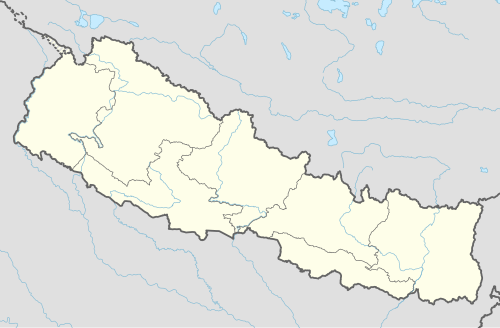
ネパールは7つの州からなる連邦共和国である。各州は8から14の地区から成り、地区はさらに都市自治体と農村自治体と呼ばれる地方単位で構成されている。[3]地方自治体は合計753あり、そのうち6つの大都市自治体、11の準大都市自治体、276の自治体で合計293の都市自治体と460の農村自治体がある。[138]各地方自治体は区から成り、合計6,743の区がある。
地方政府は、その管轄区域内で、行政および立法権、ならびに限定された司法権を有する。州は、一院制の議会制ウェストミンスター統治システムを採用している。地方政府および州政府は、絶対的な権力を一部行使し、一部は州政府または連邦政府と共有している。地区調整委員会は、地区内の地方政府の選出された役人全員で構成される委員会であり、非常に限定された役割を担っている。[3] [138]
法律と法執行
ネパール憲法は国の最高法規であり、これに矛盾する他の法律は、矛盾する範囲で自動的に無効となる。[139]具体的な法規定は民法と刑法として成文化されており、それぞれ民事訴訟法と刑事訴訟法が付随している。[140]最高裁判所は法律の解釈において最高機関であり、必要に応じて議会に法律の修正や新法の制定を指示することができる。死刑は廃止された。[141]最高裁判所は夫婦間の強姦を認め、中絶の権利を支持している。しかし、性別選択的中絶の増加により、制約が導入されている。ネパールは、ジュネーブ条約、生物兵器、化学兵器及び核兵器の禁止に関する条約、[142]国際労働機関の基本条約、核兵器不拡散条約、およびパリ気候協定に署名している。社会経済的、文化的、宗教的感受性に基づく一部の法規定は、依然として差別的である。ネパール国民と結婚した外国人に対しては、性別に基づく差別がある。[j]父系の血統は重視され、法文書では必須である。多くの法律は実際には施行されていないままである。

ネパール警察は主要な法執行機関である。内務省によって任命され、同省に報告する監察総監の指揮下にある独立した組織である。法と秩序の維持に加えて、ネパール交通警察が行う道路交通の管理も担当している。独立した準軍事警察組織であるネパール武装警察部隊は、日常的な治安問題でネパール警察と協力して活動しており、群衆の制御、反乱鎮圧およびテロ対策、および武力の使用が必要になる可能性のあるその他の内部問題を目的としている。ネパール警察の犯罪捜査部は、犯罪捜査と科学捜査を専門としている。[144] [145] [146] [147] [148]職権乱用捜査委員会は、汚職、賄賂、職権乱用に関連する事件を捜査し、起訴する独立した捜査機関である。ネパールの故意殺人率は2016年には10万人あたり2.16人で、平均よりはるかに低い。警察のデータによると、近年の犯罪率は着実に増加している。[149]ネパールは2019年の世界平和指数(GPI)で163カ国中76位にランクされた。[150]ネパールのパスポートは一貫して世界で最も弱いパスポートの一つにランクされている。[151]
外交関係

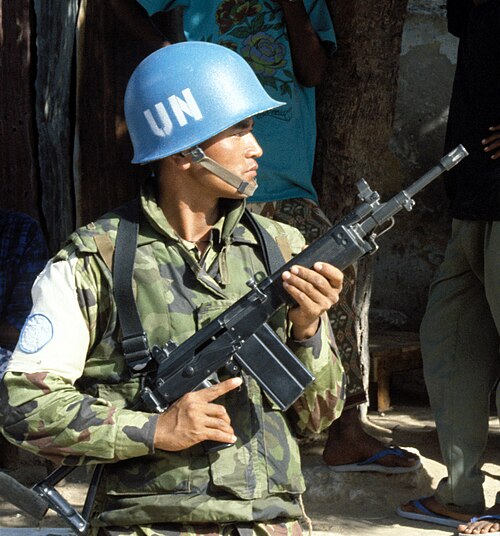
ネパールは国防を外交に依存している。ネパールは近隣諸国との間で中立政策を維持し、地域の他の国々と友好関係を保ち、国際舞台では非同盟政策をとっている。ネパールは、SAARC、国連、WTO、BIMSTEC、ACDなどの加盟国である。167か国およびEUと二国間外交関係を結んでおり[152] 、 30か国に大使館[153]と6つの領事館[154]を置いている。また、25か国がネパールに大使館を置いており、80か国以上が非居住の外交使節団を置いている。[155]ネパールは国連平和維持活動への主要貢献国の一つであり、1958年以来42のミッションに119,000人以上の人員を派遣してきた。[156]ネパール人は正直、忠誠心、勇敢さで知られ、過去200年間インド軍とイギリス軍で伝説的なグルカ兵として従軍し、両世界大戦、印パ戦争、アフガニスタン戦争、イラク戦争に従軍してきたが、[157]ネパールはこれらの紛争に直接関与していなかった。また、ヴィクトリア十字章やパラム・ヴィル・チャクラ勲章など、最高の軍事賞を受賞した。[158]
ネパールは、インドと中国という二大隣国との「バランスのとれた関係」の政策を追求している。 [159] [160] 1950年のインドとの平和友好条約は、より緊密な関係を規定している。[161]ネパールとインドは国境を接しており、人々の自由な移動、宗教、文化、婚姻関係がある。インドはネパールの最大の貿易相手国であり、ネパールは石油とガス、そして多くの必需品をインドに依存している。ネパール人はインドで不動産を所有することができ、インド人はネパールで自由に生活し、働くことができる。[162]インドとネパールの関係は非常に緊密ではあるが、領土紛争、[163]経済、大国と小国の関係に固有の問題に起因する困難に直面している。[164] [検証に失敗した]ネパールは1955年8月1日に中華人民共和国と外交関係を樹立し、1960年に平和友好条約に署名した。それ以来、両国関係は平和共存五原則に基づいている。ネパールは中国とインドの紛争において中立を維持している。ネパールは「一つの中国」政策を堅持しており、ネパールのチベット難民による反中国活動を抑制していることで知られている。[165] [166]両国の国民はビザなしで国境を越えて30キロまで移動できる。[167]ネパールでは、国境紛争や内政への深刻な干渉がなく、インフラ開発や緊急時の援助を行っていることから、中国は好意的に見られている。2015年にインドが課した経済封鎖の際に中国がネパールを支援して以来、好感度は高まっている。 [168]その後、中国はネパールに第三国貿易のために自国の港湾へのアクセスを許可し、ネパールは中国の一帯一路構想に参加した。[169]
ネパールは南アジアでの協力強化を重視しており、南アジア地域協力連合(SAARC)の設立を積極的に推進している。SAARCの常設事務局はカトマンズに置かれている。 [170]ネパールはバングラデシュの独立を承認した最初の国の一つであり、両国は貿易と水管理で協力強化を目指している。バングラデシュの港はより近いことから、ネパールの第三国貿易におけるインドの独占に代わる現実的な選択肢とみなされている。[171]ネパールはイスラエルと外交関係を樹立した最初の南アジアの国であり、両国は強い関係を保っている。[172]ネパールはパレスチナ人の権利を認めており、国連での承認に賛成し、エルサレムをイスラエルの首都として承認することに反対票を投じた。[173]ネパールが緊密な関係を維持している国々には、米国、英国、デンマーク、日本、ノルウェーなど、最も寛大な援助国や開発パートナーが含まれる。[174]
軍事と諜報

大統領はネパール軍の最高司令官であり、日常的な管理は国防省が担当している。2018年の軍事費は3億9,850万ドルで、[175] GDPの約1.4%である。[176]ほぼ全地上歩兵部隊からなるネパール軍の兵力は10万人未満である。[177] [178] [179]徴兵は志願制である。[180]航空機は少数で、主にヘリコプターであり、主に輸送、哨戒、捜索救助に使用されている。[181]ネパール軍傘下の 軍事情報局が軍事情報機関として機能している。 [182] 国家捜査局は国内および国際情報収集を任務としており、独立している。[177]ネパール軍は主に重要資産の日常的な警備、国立公園の密猟対策パトロール、反乱鎮圧、自然災害時の捜索救助に使用されている。[ 183] [184]軍隊への入隊に関して差別的な政策はないが、軍隊はエリートのパハリ戦士階級出身の男性によって占められている。[185] [186]
経済
ネパールは後発開発途上国の一つであり、名目一人当たりGDP [187]では世界第165位[k]、購買力平価ベースの一人当たりGDPでは世界第162位[l]である。[188] 2019年のネパールの国内総生産(GDP)は341億8600万ドルであった。[189] [190]ネパールは一貫して世界で最も貧しい国の一つとしてランク付けされている。[191] [192] [193]ネパールは2004年4月23日からWTOに加盟している。[194]
ネパールの労働力は1680万人で、世界で37番目に大きい。[195] 第一次産業はGDPの27.59%、第二次産業は14.6%、第三次産業は57.81%を占める。[196] 2018年のネパールの外貨送金は81億米ドルで、世界第19位、GDPの28.0%を占めている。[197]これは主にインド、中東、東アジアの何百万人もの労働者によって経済に貢献されており、そのほとんどが未熟練労働者である。[198] [199]主要な農産物には、穀物(大麦、トウモロコシ、キビ、米、小麦)、油糧種子、ジャガイモ、豆類、サトウキビ、黄麻、タバコ、牛乳、水牛肉などがある。[200] [201]主要産業には、観光、カーペット、繊維、タバコ、セメント、レンガのほか、小規模な米、黄麻、砂糖、油種子工場がある。[200]ネパールの国際貿易は、1951年の民主主義の確立とともに大幅に拡大し、1985年に自由化が始まり、1990年以降は加速した。2016/17年度までに、ネパールの対外貿易は1兆600億ルピーに達し、1990/91年度の456億ルピーから23倍に増加した。ネパールの貿易の60%以上はインドとの貿易である。主要輸出品には、既製服、カーペット、豆類、手工芸品、皮革、薬草、紙製品があり、全体の90%を占めている。主な輸入品には、各種完成品・半製品、原材料、機械設備、化学肥料、電気電子機器、石油製品、金、既製服などがある。[202] 2019年のインフレ率は4.5%だった。 [203] 2019年7月の外貨準備高は95億米ドルで、輸入の7.8か月分に相当する。[203]

ネパールは貧困削減において大きな進歩を遂げており、国際貧困ライン(1人1日1.90米ドル)を下回る人口は2010年の15%から2018年にはわずか9.3%に減少したが、脆弱性は依然として極めて高く、人口の約32%が1人1日1.90~3.20米ドルで生活している。[203]ネパールは、栄養、乳幼児死亡率、電力、床材や資産の改善などの分野で改善を遂げてきた。現在の傾向が続けば、ネパールは20年以内に貧困を撲滅できると期待されている。[204] [205]農業部門はモンスーンの降雨に大きく依存しており、2014年時点で耕作地のわずか28%しか灌漑されていないため、特に脆弱である[update]。[206]農業は労働力の76%、サービス業は18%、製造業と工芸品産業は6%を雇用している。[207]民間投資、消費、観光、農業が経済成長の主な貢献者である。[203]
政府予算は約137億1000万ドル(2019/20年度)である。[208]インフラ開発予算の支出は、その大部分が外国援助によるものであるが、通常は目標を達成できない。[209]同国は英国、[210] [211]インド、日本、米国、EU、中国、スイス、スカンジナビア諸国から外国援助を受けている。ネパール・ルピーは長年、1.6の為替レートでインド・ルピーと連動している。一人当たり所得は1,004ドルである。 [212]ネパール人の富の分配は、多くの先進国および発展途上国のそれと一致している。最も富裕な世帯の10%が国家富の39.1%を管理し、最も貧困な世帯の10%が管理しているのはわずか2.6%である。欧州連合(EU)(46.13%)、米国(17.4%)、ドイツ(7.1%)が主な輸出相手国である。彼らは主にネパールの既製服(RMG)を購入しています。[213]ネパールの輸入相手国には、インド(47.5%)、アラブ首長国連邦(11.2%)、中国(10.7%)、サウジアラビア(4.9%)、シンガポール(4%)が含まれています。
内陸で険しい地形、有形天然資源の少なさ、インフラの貧弱さに加え、1950年以降の政府の無力さ、長引く内戦も、この国の経済成長と発展を阻害する要因となっている。[214] [215] [216]債務者の子供を含む債務奴隷制は、西部の丘陵地帯とテライ高原で根強い社会問題となっており、2016年の世界奴隷指数によると、推定234,600人、人口の0.82%が奴隷状態にあるとされている。[217]
2022年、ネパールは外貨準備高が減少したため、必需品以外の輸入を制限した。COVID-19パンデミックにより観光支出と海外で働くネパール人からの送金が減少し、その結果、国の外貨準備高が減少した。[218]
観光
_(26428623908).jpg/500px-USAID_Measuring_Impact_Conservation_Enterprise_Retrospective_(Nepal;_National_Trust_for_Nature_Conservation)_(26428623908).jpg)
観光業はネパールで最大かつ最も急速に成長している産業の一つで、100万人以上を雇用し、総GDPの7.9%を占めている。[219] 2018年、海外からの観光客数は初めて100万人を超えた(陸路で到着するインド人観光客は除く)。[219] [220]南アジアへの観光客に占めるネパールの割合は約6%で、平均すると支出額ははるかに少なく、収益の1.7%をネパールが占めている。[221]主要な観光地には、ポカラ、アンナプルナ・トレッキング・サーキット、4つのユネスコ世界遺産(ルンビニ、サガルマータ国立公園(エベレストがある)、カトマンズ渓谷の7つの遺跡をまとめて1つにまとめたもの、チトワン国立公園)などがある。ネパールの登山収入のほとんどは、ネパール側からの方がアクセスしやすいエベレストから得ている。[222]
ネパールは1951年に西洋人に正式に門戸を開き、 1960年代から1970年代にかけてヒッピーの旅の終焉とともに人気の旅行先となった。 [223] 1990年代の内戦で混乱した旅行業界はその後回復したが、高級観光に適した施設が不足している「インフラボトルネック」、ネパール航空が直面する問題の増加、そして適切に開発されマーケティングされている旅行先が少数であることなどから、成長には課題がある。文化や環境を目的とした観光客が先住民の家に有料で宿泊するホームステイ型観光は、ある程度の成功を収めている。[224]
外国人雇用

失業率と不完全就業率は労働年齢人口の半分を超えており[225]、何百万人もの人々が主にインド、湾岸諸国、東アジアで海外で職を求めています。これらの労働者のほとんどは未熟練で無学で高利貸しに借金をしており、人材派遣会社に騙されて搾取的な雇用主や不正な契約で戦争状態の国に送られます。[226] [227]彼らのパスポートは没収され、雇用主が休暇を許可するか契約を解除したときに返却されます。ほとんどの人は最低賃金を支払われず、[228]多くが賃金の全部または一部を放棄することを余儀なくされています。[229]多くのネパール人は極めて危険な環境で働いており、平均して毎日2人の労働者が亡くなっています。[230]女性に対する制限により、多くは人身売買業者に頼って国外に脱出し、暴力や虐待の被害者となっています。[231]多くのネパール人は奴隷のような状況で働いていると考えられており、ネパールは取り残された労働者の救出、借金を抱えた死者の家族への補償、海外で逮捕された人々の訴訟費用に数十億ルピーを費やしている。[232] [233]何百万人もの人々が貧困から脱出したが、起業家としてのスキルの欠如により、送金は主に不動産や消費に使われている。[234] [233]
インフラストラクチャー
エネルギー

ネパールのエネルギーの大部分はバイオマス(80%)と輸入化石燃料(16%)から得られている。[235]最終エネルギー消費のほとんどは住宅部門(84%)で、次いで運輸(7%)、産業(6%)となっている。運輸部門と産業部門は近年急速に拡大している。 [ 235]一部の亜炭鉱床を除き、ネパールには石油、ガス、石炭の鉱床は知られていない。[235]すべての商業用化石燃料(主に石油、LPG、石炭)は輸入されており、国の総輸出収入の129%を占めている。[236]エネルギー需要の約1%のみが電力によって満たされている。[235]ネパールの河川は一年中水が流れており、地形は急勾配であるため、水力発電プロジェクトの開発には理想的な条件が整っている。ネパールの経済的に実現可能な水力発電の潜在能力は約42,000MWと推定されている。[235]ネパールはこれまでに約1,100MWしか発電できていない。そのほとんどは流れ込み式(ROR)発電所で発電されているため、ピーク需要が1,200MWに達することもある乾燥した冬の時期には実際に生産される電力ははるかに少なく、ネパールは需要を満たすためにインドから650MWもの電力を輸入する必要がある。[237]主要な水力発電プロジェクトは遅延や挫折に見舞われている。[238] [239] [240]ネパールの電化率(76%)は、この地域の他の国と同等だが、農村部(72%)と都市部(97%)の間には大きな格差がある。[235]電力部門の状況は、高い関税、高いシステム損失、高い発電コスト、高い諸経費、過剰な人員、国内需要の低下により、依然として不十分である。[241]
交通機関
ネパールは依然として世界の主要な陸路、空路、海路から隔離されているが、国内の航空事情は比較的良好で、空港は47か所あり、そのうち11か所には舗装された滑走路がある。[242]フライトは頻繁に行われ、かなりの交通量を支えている。国土の北部3分の2は丘陵と山岳地帯であるため、道路やその他のインフラの建設は困難で費用もかかる。2016年の時点で[update]、舗装道路は11,890 km (7,388 mi)強、未舗装道路は16,100 km (10,004 mi)、南部の鉄道はわずか59 km (37 mi)である。[242] 2018年の時点で[update]、すべての地区本部(シミコットを除く)が道路網に接続されている。[184]雨季にはほとんどの田舎道が利用できなくなり、国道ですら定期的に利用できなくなる。[243]ネパールは、道路網の建設、維持、拡張を中国、インド、日本などの国々からの援助にほぼ全面的に依存している。カトマンズ行きの貨物の唯一の実用的な入港港はインドのコルカタである。国営航空会社のネパール航空は経営不行き届きと汚職により経営状態が悪く、EUのブラックリストに載せられている。[244]国内では、道路システムの発展状況が悪いため、市場、学校、診療所へのアクセスが課題となっている。[214]ネパールの道路インフラはアジアで最悪の状態である。[245]
コミュニケーション
ネパール電気通信庁(MIS)の2019年8月の報告書によると、音声電話加入率は固定電話が全人口の2.70%、携帯電話が138.59%で、全音声電話の98%は携帯電話経由だった。[246]同様に、推定14.52%が固定ブロードバンドにアクセスできる一方で、さらに52.71%がモバイルデータ加入を使用してインターネットにアクセスしており、そのうち約1500万人が3G以上の通信速度を使用している。[246]モバイル音声電話およびブロードバンド市場は、国営のネパールテレコム(55%)と民間の多国籍企業Nセル(40%)の2つの通信会社によって支配されていた。[246]固定ブロードバンドが享受する21%の市場シェアのうち、約25%を再びネパールテレコムが共有し、残りを民間のインターネットサービスプロバイダーが占めていた。[246]都市部と農村部の普及率には大きな差があるものの、モバイルサービスは国内75地区に広がり、国土面積の90%をカバーしており、2020年までにブロードバンドアクセスは人口の90%に到達すると予想されている。[242]
メディア
2019年現在[update]、ネパール政府は3つのテレビ局と国営・地域ラジオ局を運営している。民間テレビ局は117局、FMラジオ局は736局が免許を取得しており、そのうち少なくとも314局はコミュニティラジオ局である。[242] 2011年の国勢調査によると、ラジオを所有する世帯の割合は50.82%、テレビは36.45%、ケーブルテレビは19.33%、コンピューターは7.28%であった。[247]ネパール報道評議会の分類によると、2017年現在、[update]オリジナルコンテンツを制作している833の出版物のうち、10の全国紙と週刊紙がA+クラスに評価されている。[248] 2019年、国境なき記者団は報道の自由に関してネパールを世界106位にランク付けした。[249]
人口統計

ネパールの国民はネパール人またはネパール人として知られています。ネパール人は、インド、チベット、北ビルマ、そしてアッサム経由で中国の雲南省から来た3つの主要な移住者の子孫です。最古の居住者には、東部のキラット族、カトマンズ盆地のネワール族、タライ平原の先住民タルー族、そして西端の丘陵地帯のカース・パハリ族がいました。近年、人口のかなりの割合がタライに移住したにもかかわらず、ネパール人の大多数は依然として中央高地に住んでおり、北部の山岳地帯には人口がまばらです。
ネパールは多文化・多民族国家で、125の異なる民族が暮らし、123の母国語を話し、ヒンズー教、仏教、イスラム教、キリスト教に加えて、数多くの土着宗教や民間宗教を信仰している。[250] 2011年の国勢調査によると、ネパールの人口は2,650万人で、1950年の900万人からほぼ3倍に増加した。2001年から2011年にかけて、平均家族規模は5.44から4.9に減少した。国勢調査では、約190万人の不在者がいることも記録されており、これは2001年より100万人以上多い。そのほとんどは海外で働く男性労働者である。これは、性比が2001年の99.8から94.2に低下したことと相関している。 [251] 2001年から2011年までの年間人口増加率は1.35%で、1961年から2001年までの平均2.25%と比較して増加しており、これも不在人口によるものと考えられる。[252]
ネパールは、世界で最も都市化が進んでいない10カ国、また最も急速に都市化が進んでいる10カ国のうちの1つである。2014年現在[update]、人口の約18.3%が都市部に居住している。都市化率は、タライ平原、内タライのドゥーン渓谷、中部丘陵の渓谷で高く、ヒマラヤ高地では低い。同様に、ネパールの中央部と東部では西部に比べて都市化率が高い。[253]首都カトマンズは「寺院の街」という愛称で呼ばれ、国内最大の都市であり、文化と経済の中心地である。ネパールの他の大都市には、ポカラ、ビラトナガル、ラリトプル、バラトプル、ビルガンジ、ダラン、ヘタウダ、ネパールガンジなどがある。渋滞、汚染、飲料水不足は、急速に成長している都市、特にカトマンズ盆地が直面している大きな問題の一部である。
最大の都市
言語

ネパールの多様な言語的遺産は、インド・アーリア語、シナ・チベット語、そしてさまざまな孤立した土着言語という3つの主要な言語グループに由来しています。2011年の国勢調査によると、ネパールの主要言語(母国語として話されている割合)は、ネパール語(44.6%)、マイティリー語(11.7%)、ボジュプリー語(6.0 %)、タルー語(5.8%)、タマン語(5.1%)、ネパール・バサ語(3.2% )、バジカ語(3%)とマガール語(3.0%)、ドテリ語(3.0%)、ウルドゥー語(2.6%)、アワディー語(1.89%)、スンワール語です。ネパールには少なくとも4つの土着手話があります。[要出典]
サンスクリット語の子孫であるネパール語は、デーヴァナーガリー文字で書かれる。これは公用語であり、さまざまな民族言語グループのネパール人の間で共通語として機能している。南部のテライ地方では、マイティリー語、アワディー語、ボジュプリー語などの地方言語が話されている。ネパールのイスラム教徒の間ではウルドゥー語が一般的である。ヒマラヤ山脈の高地とその北部ではチベット語のさまざまな変種が話されており、宗教教育を受けた人々は標準的な文語チベット語を広く理解している。テライと丘陵地帯の地方の方言はほとんど書かれておらず、多くの方言をデーヴァナーガリーまたはローマ字で表記するシステムを開発する取り組みが行われている。[出典が必要]
宗教
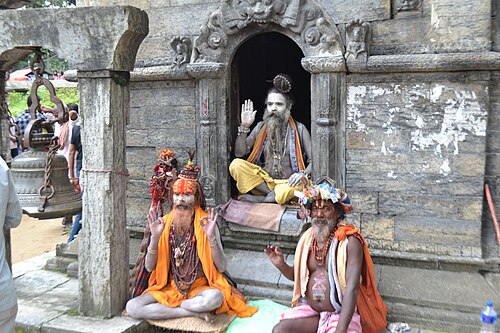
ネパールは、2012年のネパール憲法(第1部第4条)で宣言されているように世俗主義の国であり、世俗主義とは「宗教、文化の自由、および太古の昔から受け継がれてきた宗教、文化(सनातन)の保護を意味する」とされている。[255] [256] 2011年の国勢調査によると、ネパールで最も信者数が多い宗教はヒンズー教(人口の81.3%)で、仏教(9%)、その他はイスラム教(4.4%)、キラン(3.1%)、キリスト教(1.4%)、プラクリティまたは自然崇拝(0.5%)であった。[257]人口の割合で見ると、ネパールは世界最大のヒンズー教徒の人口を抱えている。[258]ネパールは最近まで公式にはヒンズー教の王国であり、シヴァ神が国の守護神と考えられていた。[259]歴史を通じて多くの政府政策が少数派宗教を無視したり疎外したりしてきたが、ネパール社会は一般的に宗教的寛容とすべての宗教間の調和を享受しており、宗教的動機による暴力事件は散発的にしか発生していない。[260] [261]ネパールの憲法は、いかなる者にも他の宗教に改宗する権利を与えていない。ネパールはまた、2017年にさらに厳しい改宗禁止法を可決した。 [262]ネパールはインドに次いで世界で2番目に多いヒンズー教徒を抱えている。 [263]
教育
ネパールが近代化を迎えたのは1951年で、識字率は5%、学校300校に約1万人の生徒が在籍していた。[要出典] 2017年までに、35,601校に700万人以上の生徒が在籍していた。[264]全体的な識字率(5歳以上の人口)は、2001年の54.1%から2011年には65.9%に増加した。[250]初等教育の純就学率は2017年までに97%に達したが、[265] [266]中等教育レベル(9年生から12年生)の就学率は60%未満であり、[267]高等教育レベルでは約12%であった。[267]全体的な識字率には大きな男女格差があるが、[250]すべての教育レベルへの就学率で女子が男子を上回っている。[267]ネパールには11の大学と4つの独立した科学アカデミーがあります。[264]ネパールは2023年のグローバルイノベーション指数で108位にランクされました。[268] [269]
適切なインフラと教材の不足、生徒対教師の比率の高さ、学校運営委員会の政治化[270]、生徒と教師の双方における党派的組合化[271]などが進歩の障害となっている。憲法では無償の基礎教育が保証されているが、このプログラムは効果的に実施するための資金が不足している。[272]政府は女子生徒や障害のある生徒、殉教者の子供、疎外されたコミュニティ、貧困層を対象とした奨学金プログラムを実施している。[273] [274]毎年何万人ものネパール人学生がより良い教育と仕事を求めて国を離れ、その半数は二度と戻ってこない。[275] [276]
健康
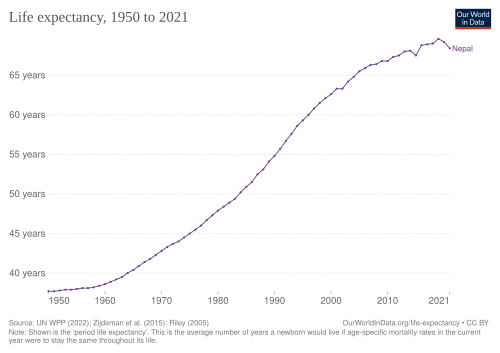
ネパールの医療サービスは、公的部門と民間部門の両方によって提供されています。出生時の平均寿命は、2017年時点で71歳と推定されており、世界で153番目に長くなっています。[277] 1990年代の54歳、1950年の35歳から増加しています。[278] [279]全死亡の3分の2は非感染性疾患によるもので、心臓病が主な死因です。[280]座りがちな生活、バランスの取れていない食事、タバコやアルコールの消費が非感染性疾患の増加に寄与している一方で、教育、意識、医療サービスへのアクセスの欠如による劣悪な衛生状態や栄養失調によって引き起こされる感染性疾患や治療可能な疾患で命を落とす人も多くいます。[280] [281]
ネパールは母子保健で大きな進歩を遂げた。95%の子供がヨウ素添加塩を利用でき、6~59か月の子供の86%がビタミンA予防を受けている。[282]発育阻害、低体重、消耗は大幅に減少した。 [282] 5歳未満の子供の栄養失調は43%と極めて高い。[283]女性と子供の貧血は2011年から2016年の間に増加し、それぞれ41%と53%に達した。[283]低出生体重は27%で、母乳育児は65%である。[283]ネパールは妊産婦死亡率を1990年の901から229に削減した。 [284 ] [285] [284]乳児死亡率は1990年の139.8人から32.2人に減少している。[286]避妊普及率は53%であるが、認識の欠如と容易なアクセスのために、農村部と都市部の格差は大きい。[287]
健康の進歩は、NGOや国際NGOと協力した政府の強力な取り組みによって推進されている。公立の保健センターは、72種類の必須医薬品を無料で提供している。さらに、2016年に開始された公的健康保険制度は、年間2,500ルピーの保険料で、家族5人までの最大5万ルピーの医療治療をカバーするもので、ある程度の成果が見られ、拡大が見込まれている。[288]保健センターでの出産前診察4回と入院出産に手当を支払うことにより、ネパールでは、自宅出産を2006年の81%から[285] 2016年の41%に減らした。 [289]学校給食プログラムは、子供たちの教育と栄養指標を改善した。[290]野心的な「1世帯1トイレ」プログラムによるトイレ建設補助金により、トイレ普及率は1990年のわずか6%から2019年には99%に達しました。[291]
移民と難民
ネパールには移民や難民を受け入れてきた長い伝統がある。[292]近代では、チベット人とブータン人がネパールの難民の大半を占めている。チベット難民は1959年に到着し始め、[293]毎年さらに多くの難民がネパールに渡っている。[294]ブータンのロツァンパ難民は1980年代に到着し始め、2000年代までにその数は11万人を超えた。そのほとんどは第三国に再定住した。[295] 2018年末現在、ネパールには合計2万800人の難民が確認されており、そのうち64%がチベット人、31%がブータン人である。[296]近隣諸国、アフリカ、中東からの経済移民や迫害や戦争から逃れてきた難民は、難民キャンプではなく都市部のアパートに住んでいるため「都市難民」と呼ばれているが、[297] [298] [299]公式認定を受けていないため、政府は彼らの第三国への再定住を支援している。[300]
2018/19年には約2,000人の移民(その半数は中国人)が労働許可を申請した。ネパールでの生活や労働に許可は必要ないため、インド人移民に関するデータは政府に存在しない。[301] インド政府は、国内の非居住インド人の数を60万人としている。 [302]
文化

社会
伝統的なネパール社会は、社会階層によって定義されることがあります。ネパールのカースト制度は、南アジアに見られる社会階層化と多くの社会的制約を体現しています。社会階級は、しばしばジャーティまたは「カースト」と呼ばれる、100 を超える同族婚の世襲グループによって定義されます。ネパールは1963 年に不可触民制度を違法と宣言し[303]、それ以来、他の差別禁止法や社会福祉イニシアチブを制定してきました。ネパールの都市部の職場や教育機関では、カースト関連の識別は、その重要性をほとんど失っています。[要出典]
ネパールの伝統では家族の価値が重要視されており、都市部では核家族が一般的になりつつあるものの、ネパールでは複数世代にわたる家父長制の共同家族が一般的である。圧倒的多数のネパール人は、本人の同意の有無にかかわらず、両親または家族の他の年長者によって結婚を仲介されている。結婚は生涯続くものと考えられており、離婚率は極めて低く、1000組の結婚のうち1組未満が離婚に終わる。[304] 児童婚は特に農村部で一般的であり、多くの女性が18歳になる前に結婚している。[305]
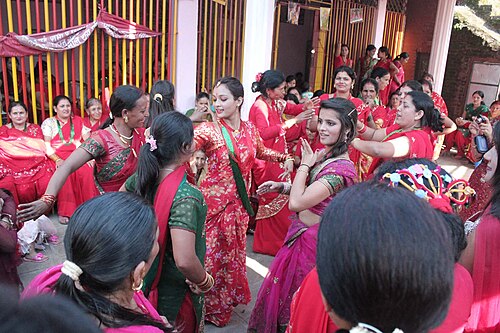
Many Nepali festivals are religious in origin. The best known include: Gadhimai festival, Dashain, Tihar, Teej, Chhath, Maghi, Sakela, Holi, and the Nepali new year.
Gadhimai festival is a Hindu festival held every five years in Nepal at the Gadhimai Temple and has been described as the world's bloodiest festival. The event involves large-scale slaughter of animals and birds, including buffaloes, goats, sheep, chickens, ducks, pigeons, pigs, rats and white mice, with the goal of pleasing goddess Gadhimai.[306][307][308] Critics say the festival ritual is barbaric, unsanitary and wasteful, but Hindu devotees insist it has deep religious significance.[309][310][311]
Dashain is a major Hindu religious festival in Nepal. Driven by the belief that offerings of fresh blood will appease goddess Durga, thousands of buffaloes, goats, sheep, pigs, chickens and ducks are slaughtered during the festival. Numerous animal welfare activists have expressed their concerns over the issue of animal cruelty and mass slaughter. The Nepali government have tried to ban the filming of the animal sacrifices. An animal welfare group who witnessed the festival said "We have been violently and physically assaulted. Our equipment and cameras have been ripped from our hands and smashed into pieces." They also said they saw festival goers defecating in public and they had to walk among human faeces. In another case Nepali people carrying machetes chased animal welfare activists down the street.[312][313][314]
Witch-hunts are still occurring in Nepal in the twenty-first century. The victims are usually poor elderly women, free-spirited young women, widows,[315][316] women of lower castes, or any possible combination of the above.[317][318] The perpetrators are usually neighbours or residents of the same village, and occasionally family or close relatives. Politicians, teachers, police officers, army officers and other respected members of the community have also been implicated in various incidents.[319][320] Execution may be carried out by burning alive.[321] Many victims succumb to their injuries from torture and assault. Non-murderous witch-hunts usually include beating and feeding of excrement.[317][318]
Symbols
 | |
| Emblem | Emblem of Nepal |
|---|---|
| Anthem | Sayaun Thunga Phulka |
| Language | All mother-tongues of Nepal |
| Currency | Nepalese rupee (रू) (NPR) |
| Bird | Himalayan monal |
| Flower | Rhododendron arboreum[323] |
| Mammal | Cow[322] |
| Colour | Crimson |
| Sport | Volleyball[324] |
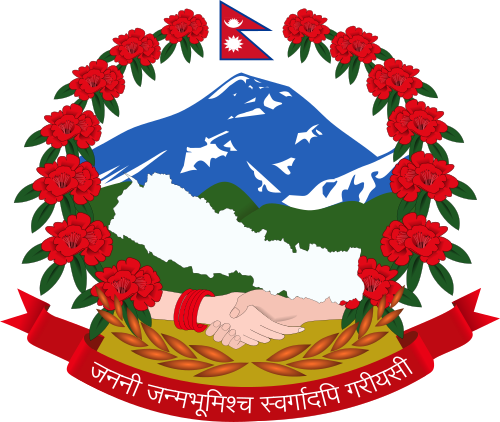
The emblem of Nepal depicts the snowy Himalayas, the forested hills, and the fertile Terai, supported by a wreath of rhododendrons, with the national flag at the crest and in the foreground, a plain white map of Nepal below it, and a man's and woman's right hands joined to signify gender equality. At the bottom is the national motto, a Sanskrit quote of patriotism attributed in Nepali folklore to Lord Rama, written in Devanagari script—"Mother and motherland are greater than heaven".[citation needed]
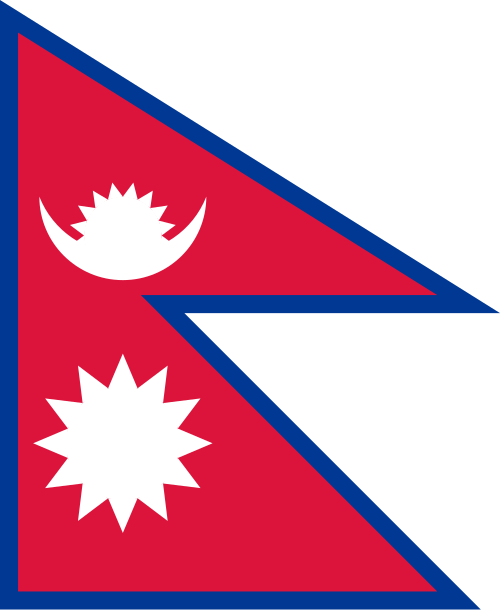
Nepal's flag is the only national flag in the world that is not rectangular in shape.[325] The constitution contains instructions for a Geometric Construction of the double-pennant flag.[326] According to its official description, the crimson in the flag stands for victory in war or courage, and is also the colour of the rhododendron. The flag's blue border signifies Nepali people's desire for peace. The moon on the flag is a symbol of the peaceful and calm nature of Nepalis, while the sun represents the aggressiveness of Nepali warriors.
The president is the symbol of national unity. The martyrs are the symbols of patriotism. Commanders of the Anglo-Nepalese war, Amar Singh Thapa, Bhakti Thapa, and Balbhadra Kunwar are considered war heroes. A special designation of "National hero" has been conferred to 16 people from Nepal's history for their exceptional contributions to the prestige of Nepal. Prithvi Narayan Shah, the founder of modern Nepal, is held in high regard and considered "Father of the Nation" by many.[327][328]
Art and architecture
Clockwise from top-left: (a) Nyatapola, a five storied pagoda in Bhaktapur, bejewelled with characteristic stone, metal and wood craftsmanship, has survived at least four major earthquakes.[329] Pagodas, now an indispensable part of East Asian architecture, are conjectured to have been transmitted to China from Nepal. (b) Nepali stonecraft in a royal water spout (c) A traditional Newar "Ankhijhyal" window in the form of a peacock
The oldest known examples of architecture in Nepal are stupas of early Buddhist constructions in and around Kapilvastu in south-western Nepal, and those constructed by Ashoka in the Kathmandu Valley c. 250 BC. The characteristic architecture associated exclusively with Nepal was developed and refined by Newa artisans of the Kathmandu Valley starting no later than the Lichchhavi period. A Tang dynasty Chinese travel book, probably based on records from c. 650 AD, describes contemporary Nepali architecture, predominantly built with wood, as rich in artistry, as well as wood and metal sculpture. It describes a magnificent seven-storied pagoda in the middle of a palace, with copper-tiled roofs, its balustrade, grills, columns and beams set about with fine and precious stones, and four golden sculptures of Makaras in the four corners of the base spouting water from their mouths like a fountain, supplied by copper pipes connected to the runnels at the top of the tower. Later Chinese chronicles describe Nepal's king's palace as an immense structure with many roofs, suggesting that the Chinese were not yet familiar with the pagoda architecture, which has now become one of the chief characteristics of Chinese architecture.
A typical pagoda temple is built with wood, every piece of it finely carved with geometrical patterns or images of gods, goddesses, mythical beings and beasts. The roofs usually tiled with clay, and sometimes gold plated, diminish in proportion successively until the topmost roof is reached which is itself ensigned by a golden finial. The base is usually composed of rectangular terraces of finely carved stone; the entrance is usually guarded by stone sculptures of conventional figures. Bronze and copper craftsmanship observable in the sculpture of deities and beasts, decorations of doors and windows and the finials of buildings, as well as items of everyday use is found to be of equal splendour. The most well-developed of Nepali painting traditions is the thanka or paubha painting tradition of Tibetan Buddhism, practised in Nepal by the Buddhist monks and Newar artisans. Changu Narayan Temple, built c. 4th century AD has probably the finest of Nepali woodcraft; the Kathmandu, Patan and Bhaktapur Durbar Squares are the culmination of Nepali art and architecture, showcasing Nepali wood, metal and stone craftsmanship refined over two millennia.[330]
The "ankhijhyal" window, that allow a one-way view of the outside world, is an example of unique Nepali woodcraft, found in building structures, domestic and public alike, ancient and modern. Many cultures paint the walls of their homes with regular patterns, figures of gods and beasts and religious symbols; others paint their walls plain, often with clay or chernozem contrasted with yellow soil or limestone. The roofs of religious as well as domestic structures project considerably, presumably to provide protection from the sun and the rain. The timber of domestic structures are finely carved as with their religious counterparts.[330]
Looting of the cultural heritage of Nepal
Cultural looting is a crisis in Nepal despite efforts to combat it.[331][332][333] Volunteers working for the Nepal Heritage Recovery Campaign have helped recover artifacts.[334] In 2022 Barakat Gallery's London branch relinquished 16th-century carved wooden Torana, a ceremonial gateway, and the 17th-century stone statue of a kneeling devotee, both taken from sacred sites near Kathmandu.[335] In 2023 Nepalese artifacts suspected of having been looted were found in the Art Institute of Chicago,[336] the Metropolitan Museum of Art,[337][338] the Dallas Museum of Art,[339] the Rubin Museum[340] and other museums, and turned up in auctions at Christie's,[341] Bonhams[342] and other auction houses.
Literature and the performing arts
_author.jpg/500px-Bhanu_Bhakta_Acharya_(1814-1869)_author.jpg)
Nepal's literature was closely intertwined with that of the rest of South Asia until its unification into a modern kingdom. Literary works, which were written in Sanskrit by Brahmin priests educated and sometimes also based in Varanasi, included religious texts and other fantasies involving kings, gods and demons.[343] The oldest extant Nepali language text is dated to the 13th century but except for the epigraphic material, Nepali language literature older than the 17th century have not been found. Newar literature dates back almost 500 years.[328] The modern history of Nepali literature begins with Bhanubhakta Acharya (1814–1868), who for the first time composed major and influential works in Nepali, the language accessible to the masses, most prominently, the Bhanubhakta Ramayana, a translation of the ancient Hindu epic.[343] By the end of the nineteenth century, Motiram Bhatta had published print editions of the works of Acharya, and through his efforts, single-handedly popularised and propelled Nepali language literature into modernity.[328] By the mid-twentieth century, Nepali literature was no longer limited to the Hindu literary traditions. Influenced by western literary traditions, writers in this period started producing literary works addressing the contemporary social problems,[344] while many others continued to enrich Nepali poetic traditions with authentic Nepali poetry. Newar literature also emerged as a premier literary tradition. After the advent of democracy in 1951, Nepali literature flourished. Literary works in many other languages began to be produced. Nepali literature continued to modernise, and in recent years, has been strongly influenced by the post civil-war Nepali experience as well as global literary traditions.[345][346][347][328]
Maruni, Lakhey, Sakela, Kauda and Tamang Selo are some examples of the traditional Nepali music and dance in the hilly regions of Nepal.
Nepali film industry is known as "Kollywood".[348]
Nepal Academy is the foremost institution for the promotion of arts and culture in Nepal, established in 1957.[328]
Clothing

The most widely worn traditional dress in Nepal, for both women and men, from ancient times until the advent of modern times, was draped.[349] For women, it eventually took the form of a sari, a single long piece of cloth, famously six yards long, and of width spanning the lower body.[349] The sari is tied around the waist and knotted at one end, wrapped around the lower body, and then over the shoulder.[349] In its more modern form, it has been used to cover the head, and sometimes the face, as a veil,[349] particularly in the Terai. It has been combined with an underskirt, or the petticoat, and tucked in the waistband for more secure fastening. It is worn with a blouse, or cholo, which serves as the primary upper-body garment, the sari's end, passing over the shoulder, now serving to obscure the upper body's contours, and to cover the midriff.[349] Cholo-sari has become the attire of choice for formal occasions, official environs and festive gatherings. In its more traditional form, as part of traditional dresses and as worn in daily life while performing household chores or labour, it takes the form of a fariya or gunyu, usually shorter than a sari in length as well as breadth, and all of it wrapped around the lower body.
For men, a similar but shorter length of cloth, the dhoti, has served as a lower-body garment.[350] It too is tied around the waist and wrapped.[350] Among the Aryans, it is also wrapped once around each leg before being brought up through the legs to be tucked in at the back. Dhoti or its variants, usually worn over a langauti, constitute the lower-body garment in the traditional clothing of Tharus, Gurungs and Magars as well as the Madhesi people, among others. Other forms of traditional apparel that involve no stitching or tailoring are patukas (a length of cloth wrapped tightly over the waist by both sexes as a waistband, a part of most traditional Nepali costumes, usually with a khukuri tucked into it when worn by men), scarves like pachhyauras and majetros and shawls like the newar ga and Tibetan khata, ghumtos (the wedding veils) and various kinds of turbans (scarves worn around the head as a part of a tradition, or to keep off the sun or the cold,[350] called a pheta, pagri or sirpau).
Until the beginning of the first millennium AD, the ordinary dress of people in South Asia was entirely unstitched.[351] The arrival of the Kushans from Central Asia, c. 48 AD, popularised cut and sewn garments in the style of Central Asia.[351] The simplest form of sewn clothing, Bhoto (a rudimentary vest), is a universal unisex clothing for children, and traditionally the only clothing children wear until they come of age and are given adult garb, sometimes in a ceremonial rite of passage, such as the gunyu-choli ceremony for Hindu girls. Men continue to wear bhoto through adulthood. Upper body garment for men is usually a vest such as the bhoto, or a shirt similar to the kurta, such as daura, a closed-necked double-breasted long shirt with five pleats and eight strings that serve to tie it around the body. Suruwal, simply translated as a pair of trousers, is an alternative to and, more recently, replacement for dhoti, kachhad (Magars) or lungi (Tharus); it is traditionally much wider above the knees but tapers below, to fit tightly at the ankles, and is tied to the waist with a drawstring. Modern cholos worn with sarees are usually half-sleeved and single-breasted, and do not cover the midriff. The traditional one called the chaubandi cholo, like the daura, is full-sleeved, double-breasted with pleats and strings, and extends down to the patuka, covering the midriff.
Daura-Suruwal and Gunyu-Cholo were the national dresses for men and women respectively until 2011 when they were removed to eliminate favouritism.[352] Traditional dresses of many pahari ethnic groups are Daura-Suruwal or similar, with patuka, a dhaka topi and a coat for men, and Gunyu-cholo or similar, with patuka and sometimes a scarf for women. For many other groups, men's traditional dresses consist of a shirt or a vest, paired with a dhoti, kachhad or lungi. In the high Himalayas, the traditional dresses are largely influenced by Tibetan culture. Sherpa women wear the chuba with the pangi apron, while Sherpa men wear shirts with stiff high collar and long sleeves called tetung under the chuba. Tibetan Xamo Gyaise hats of the Sherpas, dhaka topi of pahari men and tamang round caps are among the more distinctive headwears.
Married Hindu women wear tika, sindur, pote and red bangles. Jewellery of gold and silver, and sometimes precious stones, are common. Gold jewellery includes mangalsutras and tilaharis worn with the pote by the Hindus, samyafung (a huge gold flower worn on the head) and Nessey (huge flattened gold earrings) worn by the Limbus, and sirphuli, sirbandhi and chandra worn by the Magars. Tharu women can wear as much as six kilograms of silver in jewellery, which includes mangiya worn on the head, tikuli the forehead, and kanseri and tikahamala around the neck.[353]
In the last 50 years, fashions have changed a great deal in Nepal. Increasingly, in urban settings, the sari is no longer the apparel of everyday wear, transformed instead into one for formal occasions. The traditional kurta suruwal is rarely worn by younger women, who increasingly favour jeans. The dhoti has largely been reduced to the liturgical vestment of shamans and Hindu priests.
Cuisine

Nepali cuisine consists of a wide variety of regional and traditional cuisines. Given the range of diversity in soil type, climate, culture, ethnic groups, and occupations, these cuisines vary substantially from each other, using locally available spices, herbs, vegetables, and fruit.[354] The Columbian exchange had brought the potato, the tomato, maize, peanuts, cashew nuts, pineapples, guavas, and most notably, chilli peppers, to South Asia. Each became staples of use.[355] The cereals grown in Nepal, their choice, times, and regions of planting, correspond strongly to the timing of Nepal's monsoons,[356] and the variations in altitude. Rice and wheat are mostly cultivated in the terai plains and well-irrigated valleys, and maize, millet, barley and buckwheat in the lesser fertile and drier hills.[354][357]
The foundation of a typical Nepali meal is a cereal cooked in plain fashion, and complemented with flavourful savoury dishes.[358] The latter includes lentils, pulses and vegetables spiced commonly with ginger and garlic, but also more discerningly with a combination of spices that may include coriander, cumin, turmeric, cinnamon, cardamon, jimbu and others as informed by culinary conventions.[358] In an actual meal, this mental representation takes the form of a platter, or thali, with a central place for the cooked cereal, peripheral ones, often in small bowls, for the flavourful accompaniments, and the simultaneous, rather than piecemeal, ingestion of the two in each act of eating, whether by actual mixing—for example of rice and lentils—or in the folding of one—such as bread—around the other, such as cooked vegetables.[358] Dal-bhat, centred around steamed rice is the most common example.[359] as well as dairy and sometimes meat, is the most common and prominent example. The unleavened flat bread made from wheat flour called chapati occasionally replaces the steamed rice, particularly in the Terai, while Dhindo, prepared by boiling corn, millet or buckwheat flour in water, continuously stirring and adding flour until thick, almost solid consistency is reached, is the main substitute in the hills and mountains. Tsampa, flour made from roasted barley or naked barley, is the main staple in the high himalayas. Throughout Nepal, fermented, then sun-dried, leafy greens called Gundruk, are both a delicacy and a vital substitute for fresh vegetables in the winter.[357]

A notable feature of Nepali food is the existence of a number of distinctive vegetarian cuisines, each a feature of the geographical and cultural histories of its adherents.[360] The appearance of ahimsa, or the avoidance of violence toward all forms of life in many religious orders early in South Asian history, especially Upanishadic Hinduism, Buddhism and Jainism, is thought to have been a notable factor in the prevalence of vegetarianism among a segment of Nepal's Hindu and Buddhist populations, as well as among Jains.[360] Among these groups, strong discomfort is felt at thoughts of eating meat.[361] Though per capita meat consumption is low in Nepal, the proportion of vegetarianism is not high as in India, due to the prevalence of Shaktism, of which animal sacrifice is a prominent feature.[362]

Nepali cuisines possess their own distinctive qualities to distinguish these hybrid cuisines from both their northern and southern neighbours.[363][359] Nepali cuisines, with generally tomato-based, leaner curries, are lighter than their cream-based Indian counterparts, and Nepali momo dumplings are heavily spiced compared to their northern counterparts.[359] Newar cuisine, one of the richest and most influential in Nepal, is more elaborate and diverse than most, as Newar culture developed in the highly fertile and prosperous Kathmandu valley.[354] A typical Newar cuisine can comprise more than a dozen dishes of cereals, meat, vegetable curries, chutneys and pickles. Kwanti (sprouted beans soup), chhwela (ground beef), chatamari (rice flour crepe), bara (fried lentil cake), kachila (marinated raw minced beef), samaybaji (centred around flattened rice), lakhaamari and yomuri are among the more widely recognised.[359][364] Juju dhau, a sweet yoghurt originating in Bhaktapur, is also famous.[359] Thakali cuisine is another well-known food tradition which seamlessly melds the Tibetan and the Indian with variety in ingredients, especially the herbs and spices.[354] In the Terai, Bagiya is a rice flour dumpling with sweets inside, popular among the Tharu and Maithil people. Various communities in the Terai make sidhara (sun-dried small fish mixed with taro leaves) and biriya (lentil paste mixed with taro leaves) to stock for the monsoon floods.[354] Selroti, kasaar, fini and chaku are among the sweet delicacies. Rice pulau or sweet rice porridge called kheer are usually the main dish in feasts.[357] Tea and buttermilk (fermented milk leftover from churning butter from yoghurt) are common non-alcoholic drinks. Almost all janajati communities have their own traditional methods of brewing alcohol. Raksi (traditional distilled alcohol), jaand (rice beer), tongba (millet beer) and chyaang are the most well-known.
Sports and recreation
Nepali indigenous sports, like dandi biyo and kabaddi which were considered the unofficial national sports until recently,[324] are still popular in rural areas.[365] Despite efforts, standardisation and development of dandi biyo has not been achieved,[366][367] while Kabaddi, as a professional sport, is still in its infancy in Nepal.[368] Bagh-chal, an ancient board game that is thought to have originated in Nepal, can be played on chalk-drawn boards, with pebbles, and is still popular today.[369][370] Ludo, snakes and ladders and carrom are popular pastimes.[371] Chess is also played.[365] Volleyball was declared as the national sport of Nepal in 2017.[324] Popular children's games include versions of tag,[365] knucklebones,[365] hopscotch, Duck, duck, goose[365] and lagori, while marbles,[365] top, hoop rolling and gully cricket are also popular among boys. Rubber bands, or ranger bands cut from tubes in bike tyres, make a multi-purpose sporting equipment for Nepali children, which may be bunched or chained together, and used to play dodgeball, cat's cradle, jianzi[365] and a variety of skipping rope games.[365]
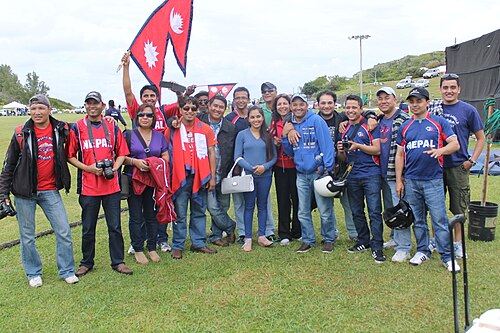
Football and cricket are popular professional sports.[374] Nepal is competitive in football in the South Asia region but has never won the SAFF championships, but has had some success in South Asian Games.[375][376] It usually ranks in the bottom quarter in the FIFA World Rankings.[377] Nepal has had some success in cricket and holds ODI status,[378][379] consistently ranking in the Top 20 in the ICC ODI and T20I rankings.[380][381] Nepal has had some success in athletics and martial arts, having won many medals at the South Asian Games and some at the Asian games.[382] Nepal has never won an olympic medal.[383] Sports like basketball, volleyball, futsal, wrestling, competitive bodybuilding[383][384] and badminton are also gaining in popularity.[365] Women in football, cricket, athletics, martial arts, badminton and swimming have found some success.[385][383] Nepal also fields players and national teams in several tournaments for disabled individuals, most notably in men's[386] as well as women's blind cricket.[387]
The only international stadium in the country is the multi-purpose Dasarath Stadium where the men and women national football teams play their home matches.[388] Since the formation of the national team, Nepal has played its home matches of cricket at Tribhuvan University International Cricket Ground.[389] Nepal police, Armed police force and Nepal army are the most prolific producers of national players, and aspiring players are known to join armed forces, for the better sporting opportunities they can provide.[390][391] Nepali sports is hindered by a lack of infrastructure,[392] funding,[386] corruption, nepotism and political interference.[382][393][394] Very few players are able to make a living as professional sportspeople.[388][395]
See also
.svg/500px-Asia_(orthographic_projection).svg.png)
Citations
Notes
- ^ English: /nɪˈpɔːl/,[14] /-ˈpɑːl/ nih-PAWL, -PAHL; Nepali: नेपाल [nepal]
- ^ Nepali: संघीय लोकतान्त्रिक गणतन्त्र नेपाल
- ^ The entire territory controlled by the monarch seated in Kathmandu at any given time would also be referred to as Nepal. Thus, at times, only the Kathmandu valley was considered Nepal while at other times, Nepal would encompass an area comparable to and largely overlapping with the modern state of Nepal.[15]
- ^ The word pala in Pali language means to protect. Consequently, Nepala translates to protected by Ne.
- ^ Nepalamahatmya, of 30 chapters about the Nepal Tirtha (pilgrimage) region, is a regional text that claims to be a part of the Skanda Purana, the largest Mahāpurāṇa.
- ^ On Samudragupta's Allahabad Pillar, Nepal is mentioned as a border country.
- ^ This trichotomy is a prominent feature of Nepali discourse and is represented in the Emblem of Nepal, with blue and white peaks signifying Himal, green hills below them signifying Pahad and the yellow strip at the bottom signifying the Terai belt.
- ^ 198 ecological types were first proposed in 1976, which was further revised and reduced to 118, which was further reduced by IUCN to 59 in 1998, which was further reduced to 36 in 2002. As this issue has yet to be settled, the 35-forest-type classification is generally preferred to the ecological categorisation.[91]
- ^ According to the 2019 IUCN red list, two species of mammals, one bird species and three amphibian species are endemic to Nepal.[105]
- ^ However, same-sex marriage with foreign nationals occurring in a jurisdiction that recognises same-sex marriage is now recognised in Nepal, for eligibility to obtain a "non-tourist visa" as dependent of a Nepali citizen, by verdict of the Supreme Court in 2017, as the laws do not make sex-specific distinction in provisions relating to the rights of foreign nationals married to Nepali citizens.[143]
- ^ October 2019, IMF update, excludes Somalia and Syria.
- ^ October 2019, IMF update; excludes Somalia, Syria, and Venezuela.
References
- ^ "Nepal | Facts, History & News". www.infoplease.com. Archived from the original on 7 June 2020. Retrieved 29 June 2020.
- ^ "Nepal | Culture, History, & People". Encyclopædia Britannica. Archived from the original on 12 March 2012. Retrieved 29 June 2020.
- ^ a b c d e f "नेपालको संविधान २०७२" [Constitution of Nepal 2015] (PDF). 20 September 2015. Archived from the original (PDF) on 8 August 2019. Retrieved 16 July 2019 – via Nepal Law Commission.
- ^ Mandal, Bidhi; Nayak, Ravi (9 June 2019). "Why English?". Republica. Archived from the original on 23 September 2020. Retrieved 17 April 2020.
- ^ National Statistics Office (2021). National Population and Housing Census 2021, Caste/Ethnicity Report. Government of Nepal (Report). Archived (PDF) from the original on 14 October 2023. Retrieved 26 April 2024.
- ^ "Number of castes, ethnicities in Nepal increases to 142". The Kathmandu Post. 3 June 2023. Archived from the original on 12 July 2023. Retrieved 12 July 2023.
- ^ Subba, Sanghamitra (20 December 2019). "A future written in the stars". Nepali Times. Archived from the original on 31 January 2021. Retrieved 31 January 2021.
- ^ The Sugauli Treaty of 1816 rendered moot the degree of independence of Nepal. The sixth point of the treaty directly questions the degree of independence of Nepal. The fact that any differences between Nepal and Sikkim will be "referred to the arbitration of the East India Company" sees Nepal as a semi-independent or a vassal state or tributary of the British empire.
- ^ Formal recognition of Nepal as an independent and sovereign state by Great Britain.
- ^ "Nepal". The World Factbook (2024 ed.). Central Intelligence Agency. Retrieved 24 September 2022. (Archived 2022 edition.)
- ^ a b c d "World Economic Outlook Database, October 2023 Edition. (Nepal)". IMF.org. International Monetary Fund. 10 October 2023. Archived from the original on 31 October 2023. Retrieved 14 October 2023.
- ^ "Gini Index (World Bank Estimate) – Nepal". World Bank. Archived from the original on 8 June 2014. Retrieved 16 April 2020.
- ^ "Human Development Report 2019". United Nations Development Programme. 2019. Archived from the original (PDF) on 31 May 2020. Retrieved 16 April 2020.
- ^ "Nepal | Definition of Nepal by Oxford Dictionary on Lexico.com also meaning of Nepal". Lexico Dictionaries | English. Archived from the original on 17 August 2021. Retrieved 23 July 2020.
- ^ Singh, Upinder (2008). A history of ancient and early medieval India: from the Stone Age to the 12th century. New Delhi: Pearson Longman. p. 477. ISBN 9788131716779.
- ^ Michaels, Axel (2024). Nepal: A History from the Earliest Times to the Present. New York, NY: Oxford University Press. ISBN 978-0-197-65093-6. p. 10. The word first appears an inscription of Samudragupta.
- ^ a b c d Malla, Kamal P. (1983). Nepāla: Archaeology of the Word (PDF). 3rd PATA International Tourism & Heritage Conservation Conference (1–4 November). The Nepal Heritage Society Souvenir for PATA Conference. Kathmandu. pp. 33–39. Archived from the original on 22 March 2012. Retrieved 5 May 2011.
- ^ Nanda R. Shrestha (1917). Historical Dictionary of Nepal. Rowman & Littlefield Publishers. p. 19. ISBN 9781442277700.
- ^ Daniel Wright (1877). History of Nepāl. University Press. p. 107.
- ^ Prasad, Ishwari (1996). The Life and Times of Maharaja Juddha Shumsher Jung Bahadur Rana of Nepal. New Delhi: Ashish Publishing House. ISBN 817024756X – via Google Books.
- ^ Hasrat, Bikram Jit (1970). History of Nepal: As told by its own and contemporary chroniclers. Hoshiarpur. p. 7.
{{cite book}}: CS1 maint: location missing publisher (link) - ^ For example, William Kirkpatrick, who visited Nepal in 1793, for whom it was based on "fairy tales", and Francis Buchanan-Hamilton, who concurred with him. Kirkpatrick, Col. William (1811). An Account of the Kingdom of Nepaul. New Delhi: Manjusri Publishing House. p. 169; Hamilton (Buchanan), Francis (1819). An Account of the Kingdom of Nepal. Edinburgh: Archibald Constable & Co. p. 187.
- ^ Lassen, Christian (1847–1861). Indische Alterthumskunde [Indian Archaeology]. Bonn, H.B. Koenig; [etc., etc.]
- ^ Levi, Sylvain (1905). Le Nepal : Etude Historique d'Un Royaume Hindou. Vol. 1. Paris: Ernest Leroux. pp. 222–223.
- ^ Majupuria, Trilok Chandra; Majupuria, Indra (1979). Glimpses of Nepal. Maha Devi. p. 8.
- ^ Turner, Ralph L. (1931). A Comparative and Etymological Dictionary of the Nepali Language. London: Routledge and Kegan Paul. Archived from the original on 14 July 2012. Retrieved 8 May 2011.
- ^ Hodgson, Brian H. (1874). Essays on the Languages, Literature and Religion of Nepal and Tibet. London: Trübner & Co. Archived from the original on 11 November 2012. Retrieved 8 May 2011. Page 51.
- ^ Chatterji, Suniti Kumar (1974). Kirata-Jana-Krti: The Indo-Mongoloids: Their Contribution to the History and Culture of India (2 ed.). Calcutta: The Asiatic Society. p. 64.
- ^ Dyson, Tim (2018). A Population History of India: From the First Modern People to the Present Day. Oxford University Press. p. 1. ISBN 978-0-19-882905-8. Quote: "Modern human beings—Homo sapiens—originated in Africa. Then, intermittently, sometime between 60,000 and 80,000 years ago, tiny groups of them began to enter the north-west of the Indian subcontinent. It seems likely that initially, they came by way of the coast. ... it is virtually certain that there were Homo sapiens in the subcontinent 55,000 years ago, even though the earliest fossils that have been found of them date to only about 30,000 years before the present. (page 1)"
- ^ Michael D. Petraglia; Bridget Allchin (22 May 2007). The Evolution and History of Human Populations in South Asia: Inter-disciplinary Studies in Archaeology, Biological Anthropology, Linguistics and Genetics. Springer Science + Business Media. p. 6. ISBN 978-1-4020-5562-1. Quote: "Y-Chromosome and Mt-DNA data support the colonization of South Asia by modern humans originating in Africa. ... Coalescence dates for most non-European populations average to between 73–55 ka."
- ^ Fisher, Michael H. (2018). An Environmental History of India: From Earliest Times to the Twenty-First Century. Cambridge University Press. p. 23. ISBN 978-1-107-11162-2. Quote: "Scholars estimate that the first successful expansion of the Homo sapiens range beyond Africa and across the Arabian Peninsula occurred from as early as 80,000 years ago to as late as 40,000 years ago, although there may have been prior unsuccessful emigrations. Some of their descendants extended the human range ever further in each generation, spreading into each habitable land they encountered. One human channel was along with the warm and productive coastal lands of the Persian Gulf and the northern Indian Ocean. Eventually, various bands entered India between 75,000 years ago and 35,000 years ago (page 23)"
- ^ Petraglia, Michael D.; Allchin, Bridget (2007). "Human evolution and culture change in the Indian subcontinent". In Michael Petraglia; Bridget Allchin (eds.). The Evolution and History of Human Populations in South Asia: Inter-disciplinary Studies in Archaeology, Biological Anthropology, Linguistics and Genetics. Springer Publishing. p. 6. ISBN 978-1-4020-5562-1. Archived from the original on 29 March 2024. Retrieved 7 October 2020.
- ^ Corvinus, Gudrun (March 2004). "The Prehistory of Nepal (A summary of the results of 10 years research)" (PDF). Ancient Nepal (154). Kathmandu: Department of Archaeology. Archived (PDF) from the original on 3 June 2022. Retrieved 3 March 2020 – via University of Cambridge.
- ^ a b Coningham, Robin; Young, Ruth (2015). The Archaeology of South Asia: From the Indus to Asoka, c. 6500 BC – 200 AD. Cambridge University Press. pp. 104–5. ISBN 978-0-521-84697-4. Archived from the original on 29 March 2024. Retrieved 6 March 2020.
- ^ Kulke, H.; Rothermund, D. (1 August 2004). A History of India. 4th. Routledge. pp. 21–3. ISBN 978-0-415-32920-0. Archived from the original on 29 March 2024. Retrieved 6 March 2020.
- ^ Singh, U. (2009). A History of Ancient and Medieval India: From the Stone Age to the 12th Century. Delhi: Longman. p. 181. ISBN 978-81-317-1677-9. Archived from the original on 28 March 2024. Retrieved 6 March 2020.
- ^ "The Prehistory of Nepal" (PDF).[permanent dead link]
- ^ Krishna P. Bhattarai (2009). Nepal. Infobase publishing. ISBN 9781438105239.
- ^ Wang, Hua-Wei; Li, Yu-Chun; Sun, Fei; Zhao, Mian; Mitra, Bikash; Chaudhuri, Tapas Kumar; Regmi, Pasupati; Wu, Shi-Fang; Kong, Qing-Peng; Zhang, Ya-Ping (April 2012). "Revisiting the role of the Himalayas in peopling Nepal: insights from mitochondrial genomes". Journal of Human Genetics. 57 (4): 228–234. doi:10.1038/jhg.2012.8. ISSN 1435-232X. PMID 22437208.
- ^ Susi Dunsmore British Museum Press, 1993 – Crafts & Hobbies – 204 pages
- ^ P. 17 Looking to the Future: Indo-Nepal Relations in Perspective By Lok Raj Baral
- ^ Sudarshan Raj Tiwari (2001). The Ancient Settlements of the Kathmandu Valley. Centre for Nepal and Asian Studies, Tribhuvan University. p. 17. ISBN 978-99933-52-07-5.
- ^ Nepal Antiquary. Office of the Nepal Antiquary. 1978. p. 7.
- ^ Klaus K. Klostermaier (2007). A Survey of Hinduism: Second Edition. SUNY Press. p. 482. ISBN 978-1-4384-0933-7.
- ^ a b c d e f Rose, Leo E.; Scholz, John T. (1980). Nepal: profile of a Himalayan kingdom. Westview Press. ISBN 978-0-89158-651-7.
- ^ Landon 1928, p. 11.
- ^ Kunal Chakrabarti; Shubhra Chakrabarti (2013). Historical Dictionary of the Bengalis. Scarecrow Press. p. 9. ISBN 978-0-8108-8024-5.
- ^ Landon 1928, p. 19.
- ^ Beckwith, Christopher I (1987). The Tibetan Empire in Central Asia: A History of the Struggle for Great Power among Tibetans, Turks, Arabs, and Chinese during the Early Middle Ages. Princeton University Press.
- ^ "Nepal Monarchy: Thakuri Dynasty". royalnepal.synthasite.com. Archived from the original on 30 December 2014. Retrieved 17 December 2014.
- ^ a b Darnal, Prakash (31 December 2018). "A Review of Simarongarh's History on Its Nexus Areas with References of Archaeological Evidences". Dhaulagiri Journal of Sociology and Anthropology. 12: 18–26. doi:10.3126/dsaj.v12i0.22176. ISSN 1994-2672.
- ^ Landon 1928, pp. 32–33.
- ^ Landon 1928, p. 39.
- ^ Landon 1928, pp. 52–61.
- ^ Petech, Luciano (1984). Medieval History of Nepal (PDF) (2nd ed.). Italy: Fondata Da Giuseppe Tucci. p. 125.
- ^ Father Giuseppe (1799). "Account of the Kingdom of Nepal". Asiatick Researches. Vol. 2. London: Vernor and Hood. p. 308. Archived from the original on 16 October 2015.
- ^ Landon 1928, pp. 68–69.
- ^ Landon 1928, pp. 75–80.
- ^ savada, andrea matles; harris, george lawrence. Nepal and Bhutan : country studies. Archived from the original on 30 June 2016. Retrieved 26 June 2016.
- ^ Hutt 2004, p. 22.
- ^ Dietrich, Angela (1996). "Buddhist Monks and Rana Rulers: A History of Persecution". Buddhist Himalaya: A Journal of Nagarjuna Institute of Exact Methods. Archived from the original on 1 October 2013. Retrieved 17 September 2013.
- ^ Lal, C.K. (16 February 2001). "The Rana resonance". Nepali Times. Archived from the original on 28 September 2013. Retrieved 17 September 2013.
- ^ a b c d e f Hutt 2004, pp. 3–7.
- ^ "Nepal profile – Timeline". BBC News. 19 February 2018. Archived from the original on 3 March 2007. Retrieved 29 September 2005.
- ^ "Nepal raises conflict death toll". BBC News. 22 September 2009. Archived from the original on 5 January 2023. Retrieved 11 March 2020.
- ^ Hutt, Michael (2005). "King Gyanendra's Coup and its Implications for Nepal's Future". The Brown Journal of World Affairs. 12 (1): 111–123. ISSN 1080-0786. JSTOR 24590670.
- ^ a b "Nepal votes to abolish monarchy". BBC News. 28 May 2008. Archived from the original on 7 January 2017. Retrieved 18 April 2020.
- ^ "Nepal king stripped of most powers". CNN. 18 May 2006. Archived from the original on 23 January 2020. Retrieved 18 April 2020.
- ^ Crossette, Barbara (3 June 2001). "Birenda, 55, Ruler of Nepal's Hindu Kingdom". The New York Times. Archived from the original on 24 July 2020. Retrieved 18 April 2020.
- ^ a b Kaphle, Anup (7 July 2010). "Long stalemate after Maoist victory disrupts life in Nepal". The Washington Post. Archived from the original on 4 November 2016. Retrieved 22 August 2017.
- ^ "Nepal's election The Maoists triumph". The Economist. 17 April 2008. Archived from the original on 14 February 2009. Retrieved 29 July 2009.
- ^ "Baburam Bhattarai elected prime minister of Nepal". BBC News. 28 August 2011. Archived from the original on 10 October 2011. Retrieved 12 March 2012.
- ^ "Nepal PM calls new elections after constitution failure". CBC News. 28 May 2012. Archived from the original on 28 May 2012. Retrieved 28 May 2012.
- ^ "[Constitution special] The evolution of Nepal\'s constitution". The Kathmandu Post. 20 September 2015. Archived from the original on 18 May 2020. Retrieved 18 April 2020.
- ^ "Constitution of Nepal 2015 Promulgated". The Kathmandu Post. 20 September 2015. Archived from the original on 1 March 2021. Retrieved 18 April 2020.
- ^ a b c Ali, J. R.; Aitchison, J. C. (2005). "Greater India". Earth-Science Reviews. 72 (3–4): 170–173. Bibcode:2005ESRv...72..169A. doi:10.1016/j.earscirev.2005.07.005. ISSN 0012-8252.
- ^ a b Whelpton, John (2005). A History of Nepal. Cambridge University Press. ISBN 978-0-521-80470-7.
- ^ Dikshit, K. R.; Schwartzberg, Joseph E. "India: Land". Encyclopædia Britannica. pp. 1–29. Archived from the original on 8 May 2015. Retrieved 18 July 2019.
- ^ Prakash, B.; Kumar, S.; Rao, M. S.; Giri, S. C. (2000). "Holocene Tectonic Movements and Stress Field in the Western Gangetic Plains" (PDF). Current Science. 79 (4): 438–449. Archived (PDF) from the original on 4 May 2011. Retrieved 18 July 2019.
- ^ van der Beek, Peter; Robert, Xavier; Mugnier, Jean-Louis; Bernet, Matthias; Huyghe, Pascale; Labrin, Erika (2006). "Late Miocene- Recent Exhumation of the Central Himalaya and Recycling in the Foreland Basin Assessed by Apatite Fission-Track Thermochronology of Siwalik Sediments, Nepal" (PDF). Basin Research. 18 (4): 413–434. Bibcode:2006BasR...18..413V. doi:10.1111/j.1365-2117.2006.00305.x. S2CID 10446424. Archived (PDF) from the original on 29 December 2022. Retrieved 7 October 2020.
- ^ Berger, Antoine; Jouanne, Francois; Hassani, Riad; Mugnier, Jean Louis (2004). "Modelling the Spatial Distribution of Present day Deformation in Nepal: how cylindrical is the Main Himalayan Thrust in Nepal?" (PDF). Geophys. J. Int. 156 (1): 94–114. Bibcode:2004GeoJI.156...94B. doi:10.1111/j.1365-246X.2004.02038.x. Archived (PDF) from the original on 29 April 2021. Retrieved 10 February 2024.
- ^ Jackson, Michael; Bilham, Roger (1994). "Constraints on Himalayan Deformation inferred from Vertical Velocity Fields in Nepal and Tibet". Journal of Geophysical Research. 99 (B7): 897–912. Bibcode:1994JGR....9913897J. doi:10.1029/94JB00714.
- ^ Chamlagain, Deepak; Hayashi, Daigoro (2007). "Neotectonic Fault Analysis by 2D Finite Element Modeling for Studying the Himalayan Fold and Thrust belt in Nepal". Journal of Asian Earth Sciences. 29 (2–3): 473–489. Bibcode:2007JAESc..29..473C. doi:10.1016/j.jseaes.2005.10.016.
- ^ Jouanne, F.; et al. (2004). "Current Shortening Across the Himalayas of Nepal" (PDF). Geophys. J. Int. 157 (1): 1–14. Bibcode:2004GeoJI.157....1J. doi:10.1111/j.1365-246X.2004.02180.x. Archived (PDF) from the original on 28 April 2021. Retrieved 13 January 2024.
- ^ Pandey, M. R.; Tandukar, R. P.; Avouac, J. P.; Vergne, J.; Heritier, Th. (1999). "Seismotectonics of the Nepal Himalaya from a Local Seismic Network". Journal of Asian Earth Sciences. 17 (5–6): 703–712. Bibcode:1999JAESc..17..703P. doi:10.1016/S1367-9120(99)00034-6.
- ^ Bilham et al., 1998;[incomplete short citation] Pandey et al., 1995.[incomplete short citation]
- ^ "National Earthquake Monitoring & Research Center". Nepal Department of Mines and Geology. Archived from the original on 30 June 2022. Retrieved 1 July 2022.
- ^ Summerfield & Hulton, 1994;[incomplete short citation] Hay, 1998.[incomplete short citation]
- ^ Uddin, Kabir; Shrestha, Him Lal; Murthy, M. S. R.; Bajracharya, Birendra; Shrestha, Basanta; Gilani, Hammad; Pradhan, Sudip; Dangol, Bikash (15 January 2015). "Development of 2010 national land cover database for the Nepal". Journal of Environmental Management. Land Cover/Land Use Change (LC/LUC) and Environmental Impacts in South Asia. 148: 82–90. Bibcode:2015JEnvM.148...82U. doi:10.1016/j.jenvman.2014.07.047. PMID 25181944.
- ^ a b c d "The Status of Nepal's Mammals: The National Red List Series". WWF Nepal. Archived from the original on 19 September 2020. Retrieved 25 August 2019.
- ^ a b c d e f g h Paudel, Prakash Kumar; Bhattarai, Bishnu Prasad; Kindlmann, Pavel (2012), "An Overview of the Biodiversity in Nepal", Himalayan Biodiversity in the Changing World, pp. 1–40, doi:10.1007/978-94-007-1802-9_1, ISBN 978-94-007-1801-2
- ^ O'Neill, A. R.; Badola, H.K.; Dhyani, P. P.; Rana, S. K. (2017). "Integrating ethnobiological knowledge into biodiversity conservation in the Eastern Himalayas". Journal of Ethnobiology and Ethnomedicine. 13 (1): 21. doi:10.1186/s13002-017-0148-9. PMC 5372287. PMID 28356115.
- ^ Jha, Sasinath (2008). "Status and Conservation of Lowland Terai Wetlands in Nepal". Our Nature. 6 (1): 67–77. doi:10.3126/on.v6i1.1657. ISSN 2091-2781.
- ^ "Forest cover has increased in Nepal of late". The Himalayan Times. 13 May 2016. Archived from the original on 24 August 2019. Retrieved 24 August 2019.
- ^ Grantham, H. S.; et al. (2020). "Anthropogenic modification of forests means only 40% of remaining forests have high ecosystem integrity – Supplementary Material". Nature Communications. 11 (1): 5978. Bibcode:2020NatCo..11.5978G. doi:10.1038/s41467-020-19493-3. ISSN 2041-1723. PMC 7723057. PMID 33293507.
- ^ Stainton, J. D. A. (1972). Forests of Nepal. Hafner Publishing Company. ISBN 9780028527000. Archived from the original on 7 April 2022. Retrieved 7 October 2020.
- ^ Goyal, Anupam (2006). The WTO and International Environmental Law: Towards Conciliation. Oxford University Press. p. 295. ISBN 978-0-19-567710-2. Archived from the original on 29 March 2024. Retrieved 26 August 2019. Quote: "The Indian government successfully argued that the medicinal neem tree is part of traditional Indian knowledge. (page 295)"
- ^ Hughes, Julie E. (2013). Animal Kingdoms. Harvard University Press. p. 106. ISBN 978-0-674-07480-4.
At same time, the leafy pipal trees and comparative abundance that marked the Mewari landscape fostered refinements unattainable in other lands.
- ^ Ameri, Marta; Costello, Sarah Kielt; Jamison, Gregg; Scott, Sarah Jarmer (2018). Seals and Sealing in the Ancient World: Case Studies from the Near East, Egypt, the Aegean, and South Asia. Cambridge University Press. pp. 156–7. ISBN 978-1-108-17351-3.
{{cite book}}: CS1 maint: multiple names: authors list (link) Quote: "The last of the centaurs has the long, wavy, horizontal horns of a markhor, a human face, a heavy-set body that appears bovine, and a goat tail ... This figure is often depicted by itself, but it is also consistently represented in scenes that seem to reflect the adoration of a figure in a pipal tree or arbor and which may be termed ritual. These include fully detailed scenes like that visible in the large 'divine adoration' seal from Mohenjo-daro." - ^ Paul Gwynne (2011). World Religions in Practice: A Comparative Introduction. John Wiley & Sons. p. 358. ISBN 978-1-4443-6005-9.
The tree under which Sakyamuni became the Buddha is a peepal tree (Ficus religiosa)
- ^ "National bird on verge of disappearance". The Himalayan Times. 16 April 2016. Archived from the original on 26 August 2019. Retrieved 25 August 2019.
- ^ a b Sun, Hang (2002). "Tethys retreat and Himalayas-Hengduanshan Mountains uplift and their significance on the origin and development of the sino-himalayan elements and alpine flora". Acta Botanica Yunnanica. 24 (3): 273–288. ISSN 0253-2700. Archived from the original on 26 August 2019. Retrieved 26 August 2019.
- ^ USGS (5 May 1999). "The Himalayas: Two continents collide". Archived from the original on 17 November 2017. Retrieved 26 August 2019.
- ^ Karanth, K. P. (25 March 2006). "Out-of-India Gondwanan Origin of Some Tropical Asian Biota" (PDF). Current Science. 90 (6): 789–792. Archived (PDF) from the original on 11 April 2019. Retrieved 18 May 2011.
- ^ IUCN. "Table 8a: Total endemic and threatened endemic species in each country (totals by taxonomic group): VERTEBRATES" (PDF). IUCN Red List version 2019–21. Archived (PDF) from the original on 26 August 2019. Retrieved 25 August 2019.
- ^ "Table 5: Threatened species in each country (totals by taxonomic group)" (PDF). IUCN Red List version 2019-2. Archived (PDF) from the original on 26 August 2019. Retrieved 25 August 2019.
- ^ IUCN Nepal. "Red List of Mammal Species of Nepal". Archived from the original (jpg) on 8 March 2021. Retrieved 25 August 2019.
- ^ Department of National Parks and Wildlife Conservation, Nepal. "Bengal Florican Conservation Action Plan". Archived from the original on 19 August 2019. Retrieved 25 August 2019 – via birdlifenepal.org.
- ^ a b "Conservation of white-rumped vultures in progress in Nepal". The Himalayan Times. 16 March 2018. Archived from the original on 26 August 2019. Retrieved 25 August 2019.
- ^ "Chitwan National Park". UNESCO World Heritage Centre. Archived from the original on 26 August 2019. Retrieved 25 August 2019.
- ^ "Mahottari declared 58th diclofenac-free district". The Himalayan Times. 8 August 2017. Archived from the original on 26 August 2019. Retrieved 26 August 2019.
- ^ "Community forest value untapped". The New Humanitarian. 26 September 2012. Archived from the original on 18 July 2019. Retrieved 24 August 2019.
- ^ Ojha, Hemant; Persha, Lauren; Chhatre, Ashwini (November 2009). "Community Forestry in Nepal: A Policy Innovation for Local Livelihoods" (PDF). International food policy research institute. Archived (PDF) from the original on 24 February 2021. Retrieved 24 August 2019.
- ^ "The Terai Arc Landscape Project (TAL) – Gharial Breeding Centre". WWF Nepal. Archived from the original on 26 August 2019. Retrieved 26 August 2019.
- ^ "'Joint Patrol' for wildlife conservation in CNP". The Himalayan Times. 22 March 2018. Archived from the original on 26 August 2019. Retrieved 26 August 2019.
- ^ "Nepal celebrates 'zero poaching year' for rhino, tiger and elephant". IUCN. 14 March 2014. Archived from the original on 22 November 2017. Retrieved 26 August 2019.
- ^ Nepalnature.com (Organization); International Centre for Integrated Mountain Development, Nepal; Nepal Ministry of Environment, Science, and Technology (1 October 2007). "Protected Areas of Nepal". Nepal biodiversity resource book: Protected areas, Ramsar sites, and World Heritage sites. International Centre for Integrated Mountain Development. p. 41. ISBN 9789291150335. Archived from the original on 18 August 2021. Retrieved 7 October 2020.
{{cite book}}: CS1 maint: numeric names: authors list (link) - ^ "Nepal". Ramsar. Archived from the original on 8 July 2019. Retrieved 25 August 2019.
- ^ "Nepal's holy Bagmati River choked with black sewage, trash". Associated Press. 17 August 2022. Archived from the original on 12 July 2023. Retrieved 8 May 2024.
- ^ "One more report ranks Nepal among most polluted countries in the world". Archived from the original on 8 July 2023. Retrieved 8 May 2024.
- ^ "WHO: Kathmandu, Nepal". Archived from the original on 9 July 2023. Retrieved 8 May 2024.
- ^ "Averting an air pollution disaster in South Asia". 21 April 2023. Archived from the original on 23 November 2023. Retrieved 8 May 2024.
- ^ "Trash and Overcrowding at the Top of the World". Archived from the original on 25 April 2024. Retrieved 8 May 2024.
- ^ "The very air we breathe | UNICEF Nepal". Archived from the original on 8 July 2023. Retrieved 8 May 2024.
- ^ "Air pollution takes its toll on Nepal's tourism capital". Archived from the original on 8 May 2024. Retrieved 8 May 2024.
- ^ a b "Nepal elections explained". Al Jazeera. Archived from the original on 14 August 2019. Retrieved 17 August 2019.
- ^ "Nepal 2015 Constitution - Constitute". www.constituteproject.org. Retrieved 27 May 2024.
- ^ "प्रतिनिधिसभामा १२ दल, राष्ट्रिय पार्टी ७ मात्रै". ekantipur.com (in Nepali). Archived from the original on 13 August 2023. Retrieved 17 February 2023.
- ^ "Is Nepal headed towards a communist state?". Al Jazeera. Archived from the original on 26 July 2019. Retrieved 17 August 2019.
- ^ a b Khadka, Narayan (1993). "Democracy and Development in Nepal: Prospects and Challenges". Pacific Affairs. 66 (1): 44–71. doi:10.2307/2760015. ISSN 0030-851X. JSTOR 2760015.
- ^ "NCP to announce party department chiefs today". The Himalayan Times. 21 July 2019. Archived from the original on 18 August 2019. Retrieved 18 August 2019.
- ^ "Ex-Maoist rebel leader Prachanda becomes Nepal PM for third time". www.aljazeera.com. Archived from the original on 7 April 2023. Retrieved 7 April 2023.
- ^ "Oli becomes prime minister for fourth time, swearing-in today". kathmandupost.com.
- ^ Brown, T. Louise (1 November 2002). The Challenge to Democracy in Nepal. Routledge. ISBN 978-1-134-88532-9. Archived from the original on 27 November 2021. Retrieved 7 October 2020.
- ^ a b Ramachandran, Shastri; Ramachandaran, Shastri (2003). "Nepal as Seen from India". India International Centre Quarterly. 30 (2): 81–98. ISSN 0376-9771. JSTOR 23006108.
- ^ Rawal, Bhim Bahadur. Nepalma samyabadi andolan: udbhab ra vikas. Kathmandu: Pairavi Prakashan. p. 83-84.
- ^ "CA approves ceremonial prez, bicameral legislature". The Kathmandu Post. 16 September 2015. Archived from the original on 9 December 2017. Retrieved 8 December 2017.
Provincial parliaments will be unicameral. "The CA also approved a mixed electoral system for parliamentary election with 60 percent directly elected and 40 percent proportionally elected."
- ^ a b Australian Government-The Asia Foundation Partnership on Subnational Governance in Nepal. "Diagnostic Study of Local Governance in Federal Nepal 2017" (PDF). The Asia Foundation. Archived (PDF) from the original on 20 July 2019. Retrieved 20 July 2019.
- ^ "Govt registers amendment bill to review 56 laws in bulk". Republica. Archived from the original on 2 September 2019. Retrieved 2 September 2019.
- ^ "The Modified Criminal And Civil Codes". The Rising Nepal. Archived from the original on 2 September 2019. Retrieved 2 September 2019.
- ^ "International Views on the Death Penalty". Death Penalty Focus. Archived from the original on 6 November 2012. Retrieved 6 November 2012.
- ^ "Treaties, States parties, and Commentaries – Nepal". International Committee of the Red Cross. Archived from the original on 2 September 2019. Retrieved 2 September 2019.
- ^ "निर्णय नं. ९९२१ – उत्प्रेषण/ परमादेश". Government of Nepal. Archived from the original on 28 July 2023. Retrieved 28 July 2023.
- ^ Newman, Graeme (2010). Crime and Punishment around the World. ABC-CLIO. p. 171. ISBN 978-0-313-35134-1.
- ^ "NEPAL: Corruption in Nepal – Curse or Crime?". Asian Human Rights Commission. Archived from the original on 15 August 2013. Retrieved 6 August 2013.
- ^ "INTERPOL – Kathmandu". Interpol. Archived from the original on 5 December 2021. Retrieved 7 May 2021.
- ^ "The Impact of Organized Crime on Governance in Developing Countries: A Case Study of Nepal" (PDF). Center on International Cooperation. Archived (PDF) from the original on 23 February 2014. Retrieved 6 August 2013.
- ^ "Organizational Structure and Role of NID in Nepal's Federal Set up". Nepal Institute for Strategic Studies. Archived from the original on 2 September 2019. Retrieved 2 September 2019.
- ^ "Crime rate in Nepal rose by 40 percent in past five fiscal years, police data reveals". Kathmandu Post. Archived from the original on 27 December 2019. Retrieved 3 April 2020.
- ^ "Global Peace Index 2019". Vision of Humanity. Institute for Economics & Peace. Archived from the original on 19 June 2019. Retrieved 9 January 2020.
- ^ "Nepali passport remains among world's weakest". kathmandupost.com. 12 January 2024. Retrieved 14 June 2024.
- ^ "Bilateral Relations – Ministry of Foreign Affairs Nepal MOFA". Government of Nepal. Archived from the original on 25 September 2019. Retrieved 15 September 2019.
- ^ "Embassy of Nepal – Ministry of Foreign Affairs Nepal MOFA". Government of Nepal. Archived from the original on 17 July 2019. Retrieved 15 September 2019.
- ^ "Consulates General of Nepal – Ministry of Foreign Affairs Nepal MOFA". Archived from the original on 24 July 2019. Retrieved 15 September 2019.
- ^ "NON-RESIDENTIAL DIPLOMATIC MISSIONS – Ministry of Foreign Affairs Nepal MOFA". Government of Nepal. Archived from the original on 17 July 2019. Retrieved 15 September 2019.
- ^ "Nepalese Peacekeepers receive UN Medal". United Nations. Archived from the original on 12 September 2023. Retrieved 15 September 2019.
- ^ Gill, Peter. "The Nepalis Fighting America's Wars". The Diplomat. Archived from the original on 19 September 2018. Retrieved 15 September 2019.
- ^ "The Big Question: Who are the Gurkhas and what is their contribution". The Independent. 30 April 2009. Archived from the original on 3 June 2019. Retrieved 15 September 2019.
- ^ "Nepal's Ties With India, China". The Rising Nepal. Archived from the original on 22 December 2018. Retrieved 11 September 2019.
- ^ Dahal, Girdhari (2018). "Foreign Relation of Nepal with China and India" (PDF). Journal of Political Science. XVIII: 46–61. doi:10.3126/jps.v18i0.20439.
- ^ "Reviewing The Treaty Of 1950". The Rising Nepal. Archived from the original on 3 March 2018. Retrieved 11 September 2019.
- ^ "Is it the end of India's special relationship with Nepal?". Hindustan Times. 8 March 2018. Archived from the original on 6 April 2020. Retrieved 6 April 2020.
- ^ Anab, Mohammad; Punetha, Prem (18 September 2020). "India Nepal news: Nepal depicts Indian areas as its own in book". The Times of India. Archived from the original on 18 April 2022.
- ^ Balakrishnan 2010, p. 196.
- ^ "Tibet's Road Ahead: Tibetans lose a haven in Nepal under Chinese pressure". Los Angeles Times. 6 August 2015. Archived from the original on 23 October 2019. Retrieved 12 September 2019.
- ^ Haviland, Charles (17 April 2008). "Nepal Arrests Tibetan Protesters". BBC News. Archived from the original on 30 September 2009. Retrieved 29 July 2009.
- ^ "China urged to let Nepalis work in Taklakot". The Himalayan Times. 7 June 2019. Archived from the original on 7 June 2019. Retrieved 12 September 2019.
- ^ Rajgopalan, Rajeswari Pillai. "Why Nepal's Access to China Ports Matters". The Diplomat. Archived from the original on 31 October 2019. Retrieved 12 September 2019.
- ^ "Belt and Road Initiative: Nepal's concern and commitment". The Himalayan Times. 23 April 2019. Archived from the original on 24 April 2019. Retrieved 12 September 2019.
- ^ Iqbal, Muhammad Jamshed (2006). "SAARC: Origin, Growth, Potential and Achievements" (PDF). Pakistan Journal of History & Culture. XXVII: 127–40. Archived (PDF) from the original on 11 November 2013. Retrieved 11 September 2019.
- ^ "Nepal, Bangladesh Can Become Better Trade Partners". The Rising Nepal. Archived from the original on 11 November 2018. Retrieved 12 September 2019.
- ^ "Marking the diplomatic ties between Nepal and Israel". Republica. Retrieved 12 September 2019.
- ^ "UNGA vote 'consistent with Nepal's position on Israel, Palestine'". The Kathmandu Post. Archived from the original on 13 August 2023. Retrieved 12 September 2019.
- ^ Khadka, Narayan (1997). "Foreign Aid to Nepal: Donor Motivations in the Post-Cold War Period". Asian Survey. 37 (11): 1044–1061. doi:10.2307/2645740. ISSN 0004-4687. JSTOR 2645740.
- ^ "Military expenditure (current USD) | Data". World Bank. Archived from the original on 13 August 2023. Retrieved 14 September 2019.
- ^ "Military expenditure (% of GDP) | Data". World Bank. Archived from the original on 13 August 2023. Retrieved 14 September 2019.
- ^ a b Raghavan, V. R. (2013). Nepal as a Federal State: Lessons from Indian Experience. Vij Books India. ISBN 9789382652014.
- ^ "New chief faces daunting task rebuilding Nepal Army's image". The Kathmandu Post. Archived from the original on 13 August 2023. Retrieved 15 September 2019.
- ^ "Thapa to take charge of Nepali Army as acting CoAS". The Himalayan Times. 9 August 2018. Archived from the original on 17 September 2018. Retrieved 15 September 2019.
- ^ "South Asia :: Nepal – The World Factbook – Central Intelligence Agency". Central Intelligence Agency. Archived from the original on 9 January 2021. Retrieved 15 September 2019.
- ^ "Nepali Army launches new helicopters". The Himalayan Times. 23 June 2015. Archived from the original on 23 July 2016. Retrieved 15 September 2019.
- ^ Adhikari, Indra (2015). Military and Democracy in Nepal. Routledge. ISBN 9781317589068.
- ^ "Army to rescue". Republica. Archived from the original on 24 February 2021. Retrieved 15 September 2019.
- ^ a b "Dolpa HQ connected to national road network". The Himalayan Times. 18 November 2018. Archived from the original on 14 August 2023. Retrieved 4 December 2019.
- ^ Pariyar, Kamal. "Women promoted to major for first time in NA infantry". Republica. Archived from the original on 1 June 2018. Retrieved 15 September 2019.
- ^ "Bhakti Shah – the fight for gay and transgender rights in Nepal". Saferworld. Archived from the original on 13 August 2023. Retrieved 15 September 2019.
- ^ "Report for Selected Countries and Subjects". IMF. Archived from the original on 8 March 2021. Retrieved 15 November 2019.
- ^ "Report for Selected Countries and Subjects". IMF. Archived from the original on 2 March 2021. Retrieved 15 November 2019.
- ^ "GDP (current US$) | Data". World Bank. Archived from the original on 12 March 2019. Retrieved 16 September 2019.
- ^ "Nepal | Data". World Bank. Archived from the original on 3 June 2023. Retrieved 23 July 2021.
- ^ "Climbing Higher: Toward a Middle-Income Nepal".
- ^ "10 Causes of Poverty in Nepal - Friends of WPC Nepal". 29 May 2020.
- ^ "Poverty in Nepal, Hunger and food shortages, INF".
- ^ "Accessions: Nepal". WTO. Archived from the original on 15 November 2019. Retrieved 15 November 2019.
- ^ "The World Factbook". Central Intelligence Agency. Archived from the original on 30 May 2016. Retrieved 18 November 2019.
- ^ "National Accounts of Nepal 2018/19" (PDF). Central Bureau of Statistics Nepal. 2019. Archived (PDF) from the original on 5 May 2019. Retrieved 5 May 2019.
- ^ "Nepal is 19th largest receiver of remittances with $8.1 billion". Kathmandu Post. Archived from the original on 13 August 2023. Retrieved 18 November 2019.
- ^ "Unskilled workers dominate Nepali labour force abroad". Kathmandu Post. Archived from the original on 5 June 2023. Retrieved 18 November 2019.
- ^ "More Nepalis going abroad for employment". Kathmandu Post. Archived from the original on 13 August 2023. Retrieved 18 November 2019.
- ^ a b "South Asia :: Nepal – The World Factbook". Central Intelligence Agency. Archived from the original on 9 January 2021. Retrieved 18 November 2019.
- ^ Chaudhary, Deepak (1 November 2018). "Agricultural Policies and Rural Development in Nepal: An Overview" (PDF). Research Nepal Journal of Development Studies. 1 (2): 34–46. doi:10.3126/rnjds.v1i2.22425. ISSN 2631-2131.
- ^ Acharya, Khubi Ram (5 July 2019). "Nepalese Foreign Trade: Growth, Composition, and Direction". NCC Journal. 4 (1): 91–96. doi:10.3126/nccj.v4i1.24741. ISSN 2505-0788.
- ^ a b c d "Overview". World Bank. Archived from the original on 21 June 2019. Retrieved 23 November 2019.
- ^ "Bangladesh, Nepal, Rwanda top India in reducing poverty – study". Reuters India. 19 March 2013. Archived from the original on 21 March 2013. Retrieved 19 March 2013.
- ^ McVeigh, Tracy (17 March 2013). "World poverty is shrinking rapidly, new index reveals". The Guardian. Archived from the original on 16 February 2014. Retrieved 19 March 2013.
- ^ "Nepal: Irrigation and Water Resource Management". World Bank. Retrieved 24 November 2019.
- ^ "World Bank: Nepal- Country Overview 2012". World Bank. 2012. Archived from the original on 22 August 2012. Retrieved 31 July 2012.
- ^ "Nepali gov't presents 13.71 bln USD budget for next fiscal year". Xinhua News Agency. Archived from the original on 30 May 2019. Retrieved 24 November 2019.
- ^ "Finance Minister Khatiwada worried as ministries fail to spend development budget". Setopati. Archived from the original on 29 September 2020. Retrieved 24 November 2019.
- ^ "DFID's bilateral programme in Nepal". The International Development Committee of the House of Commons. 27 March 2015. Archived from the original on 9 June 2015. Retrieved 17 May 2015.
- ^ "UK should cut aid to Nepal if "endemic" corruption persists: report". Reuters. 27 March 2015. Archived from the original on 18 May 2015. Retrieved 16 May 2015.
- ^ "Per capita income to reach $1,400 by 2023–24". The Himalayan Times. 4 April 2019. Archived from the original on 5 April 2019. Retrieved 24 November 2019.
- ^ "EU as Nepal's largest exporter". ktm2day. 11 October 2011. Archived from the original on 13 October 2011. Retrieved 11 October 2011.
- ^ a b "Nepal: Economy". MSN Encarta. p. 3. Archived from the original on 28 October 2009.
- ^ "Development Failure: A Critical Review of Three Analyses of Development in Nepal". Archived from the original on 17 August 2014. Retrieved 30 July 2012.
- ^ "A Development Failure: The Development-Conflict Nexus". Archived from the original on 20 July 2012. Retrieved 30 July 2012.
- ^ Kevin Bales; et al. "Nepal". The Global Slavery Index 2016. The Minderoo Foundation Pty Ltd. Archived from the original on 13 March 2018. Retrieved 13 March 2018.
- ^ "Nepal limits imports as foreign currency reserves slide". BBC News. 12 April 2022. Archived from the original on 13 August 2023. Retrieved 12 April 2022.
- ^ a b "Nepal tourism generated Rs 240b and supported 1m jobs last year: Report". Kathmandu Post. Archived from the original on 30 July 2019. Retrieved 2 December 2019.
- ^ Ghimire, Dandu Raj; et al., eds. (May 2018). "Nepal Tourism Statistics 2017" (PDF). Government of Nepal, Ministry of Culture, Tourism & Civil Aviation, Planning & Evaluation Division, Research & Statistical Section. Archived from the original (PDF) on 24 January 2019. Retrieved 1 December 2019.
- ^ "Nepal has enough opportunities to tap tourists who visit other South Asian nations". The Himalayan Times. 6 November 2016. Archived from the original on 3 March 2021. Retrieved 2 December 2019.
- ^ "The Issues with Overtourism in Destinations Like Mount Everest". Pegasus Magazine. Retrieved 8 June 2024.
- ^ "Nepal's Discovery of Tourism and the End of the Hippie Era". academic.oup.com. doi:10.7208/chicago/9780226429137.001.0001/upso-9780226428802-chapter-010 (inactive 8 June 2024). Retrieved 8 June 2024.
{{cite web}}: CS1 maint: DOI inactive as of June 2024 (link) - ^ Sunuwar, Muna. "Homestay registration on the rise". My Republica. Archived from the original on 8 March 2021. Retrieved 2 December 2019.
- ^ "Nepal's unemployment rate estimated at 11.4 percent". Kathmandu Post. Archived from the original on 2 December 2019. Retrieved 2 December 2019.
- ^ Tavernise, Sabrina (1 September 2004). "12 Hostages From Nepal Are Executed in Iraq, a Militant Group Claims". The New York Times. Archived from the original on 3 August 2021. Retrieved 2 December 2019.
- ^ Sharma, Bhadra. "He narrowly escaped the 2004 Iraq massacre of 12 Nepalis". My Republica. Archived from the original on 2 December 2019. Retrieved 2 December 2019.
- ^ "Basic minimum wage eludes Nepali migrant workers". The Himalayan Times. 9 May 2019. Archived from the original on 2 December 2019. Retrieved 2 December 2019.
- ^ "Nepali migrant workers returning home from labour destination countries without wages". Kathmandu Post. Archived from the original on 13 October 2019. Retrieved 2 December 2019.
- ^ "Nepal receiving two dead migrant workers every day for past seven years: Report". The Himalayan Times. 24 August 2018. Archived from the original on 2 December 2019. Retrieved 2 December 2019.
- ^ "Nepalese Labor Migration—A Status Report". The Asia Foundation. 6 June 2018. Archived from the original on 2 December 2019. Retrieved 2 December 2019.
- ^ "The plight of Nepal's migrant workers". Al Jazeera. Archived from the original on 1 December 2019. Retrieved 2 December 2019.
- ^ a b "Labour migration in Nepal (ILO in Nepal)". ILO. Archived from the original on 2 December 2019. Retrieved 2 December 2019.
- ^ Mishra, Surya Nath. "Sorrows of Nepali migrant workers". My Republica. Archived from the original on 2 December 2019. Retrieved 2 December 2019.
- ^ a b c d e f Nepal energy sector assessment, strategy, and road map (PDF) (Report). ADB. March 2017. Archived (PDF) from the original on 11 December 2019. Retrieved 3 December 2019.
- ^ Rai, Om Astha (2 November 2018). "From a fossil past to an electric future". Archived from the original on 3 December 2019. Retrieved 3 December 2019.
- ^ "More than half of Nepal's electricity imported from India". Nepali Times. Archived from the original on 3 December 2019. Retrieved 3 December 2019.
- ^ "NEA to build 10 new hydropower projects". The Himalayan Times. 26 August 2019. Archived from the original on 3 December 2019. Retrieved 3 December 2019.
- ^ "Power generation to increase by 750 MW". Kathmandu Post. Archived from the original on 3 December 2019. Retrieved 3 December 2019.
- ^ "Nepal fails to meet energy sector targets in the current fiscal". Kathmandu Post. Archived from the original on 3 December 2019. Retrieved 3 December 2019.
- ^ "Energy sector in Nepal". Archived from the original on 25 April 2012. Retrieved 15 July 2012.
- ^ a b c d "South Asia :: Nepal – The World Factbook". Central Intelligence Agency. Archived from the original on 9 January 2021. Retrieved 4 December 2019.
- ^ "Connecting Nepal's Rural Poor to Markets". Archived from the original on 22 April 2013. Retrieved 4 February 2013.
- ^ "The rise and fall of Nepal Airlines". Kathmandu Post. Archived from the original on 21 September 2019. Retrieved 4 December 2019.
- ^ "Best and worst Asian countries for road quality". 22 February 2018.
- ^ a b c d Nepal Telecommunications Authority MIS Report Shrawan, 2076 (PDF) (Report). Nepal Telecommunications Authority. August 2019. Archived from the original (PDF) on 15 November 2022. Retrieved 3 December 2019.
- ^ 2011 National Census, pp. 2, 32.
- ^ "Press Council Nepal classifies 833 newspapers, magazines". The Himalayan Times. 15 January 2017. Archived from the original on 4 December 2019. Retrieved 4 December 2019.
- ^ "Nepal retains its position in press freedom rankings, states RSF report". The Himalayan Times. 19 April 2019. Archived from the original on 20 April 2019. Retrieved 4 December 2019.
- ^ a b c 2011 National Census, p. 4.
- ^ 2011 National Census, p. 3.
- ^ "Population situation analysis of Nepal" (PDF). UNFPA. 2017. Archived (PDF) from the original on 17 November 2022. Retrieved 4 December 2019.
- ^ Bakrania, S. (2015). Urbanisation and urban growth in Nepal (GSDRC Helpdesk Research Report 1294) (Report). University of Birmingham, Birmingham: UK:GSDRC.
- ^ https://web.archive.org/web/20220206104652/https://cbs.gov.np/wp-content/upLoads/2022/01/Final%20Preliminary%20Report%20of%20Census%202021%20Newfinal.pdf
- ^ "The Constitution of Nepal" (PDF). Nepal Gazette. 20 September 2015. Archived (PDF) from the original on 15 February 2017. Retrieved 7 May 2021.
- ^ "Constitution of Napal (in Nepali)" (PDF). mohp.gov.np/. Archived from the original (PDF) on 27 April 2021. Retrieved 7 May 2021.
- ^ 2011 National Census, pp. 4, 184.
- ^ "Hindu Demographics & Denominations (Part One)". Religion 101. 28 November 2012. Archived from the original on 21 August 2019. Retrieved 21 August 2019.
- ^ Anthologia anthropologica. The native races of Asia and Europe; by James George Frazer, Sir; Robert Angus Downie
- ^ KHADKA, UPENDRA LAMICHHANE and BASANT. "Eid highlights Nepal's religious tolerance". My Republica. Archived from the original on 13 August 2023. Retrieved 2 December 2019.
- ^ "Nepal-2018-international-religious-freedom-report" (PDF). US Embassy Nepal. Archived from the original (PDF) on 21 July 2021. Retrieved 1 December 2019.
- ^ "Nepal: Nepal: Bill criminalises religious conversion". csw.org.uk. Archived from the original on 11 January 2021. Retrieved 5 February 2021.
- ^ "The Global Religious Landscape". Pew Research Center. December 2012. Archived from the original on 26 September 2018. Retrieved 5 November 2018.
- ^ a b Education in figures 2017 (PDF) (Report). Ministry of Education, Nepal. 2017. Archived from the original (PDF) on 11 December 2019. Retrieved 4 December 2019.
- ^ "Human Development Report 2010 – Nepal". Hdrstats.undp.org. Archived from the original on 15 April 2012. Retrieved 25 January 2011.
- ^ "Education". UNICEF. Archived from the original on 4 December 2023. Retrieved 4 December 2019.
- ^ a b c "Nepal". UNESCO. 27 November 2016. Archived from the original on 24 February 2024. Retrieved 4 December 2019.
- ^ WIPO (12 December 2023). Global Innovation Index 2023, 15th Edition. World Intellectual Property Organization. doi:10.34667/tind.46596. ISBN 9789280534320. Archived from the original on 22 October 2023. Retrieved 30 October 2023.
{{cite book}}:|website=ignored (help) - ^ "Global Innovation Index". INSEAD Knowledge. 28 October 2013. Archived from the original on 2 September 2021. Retrieved 2 September 2021.
- ^ "Community-based School Management The Role Politics Plays". The Rising Nepal. Archived from the original on 4 December 2019. Retrieved 4 December 2019.
- ^ "Minister Pokhrel urges teachers to be loyal to their schools". The Himalayan Times. 15 September 2019. Archived from the original on 14 August 2023. Retrieved 4 December 2019.
- ^ "Free education to cost threefold". Kathmandu Post. Archived from the original on 2 October 2023. Retrieved 4 December 2019.
- ^ "Types of scholarships provided to Nepalese students by government of Nepal". Edusanjal. Archived from the original on 13 August 2023. Retrieved 4 December 2019.
- ^ "Medical colleges charging extra fees even from govt scholarship holders". The Himalayan Times. 7 April 2019. Archived from the original on 14 August 2023. Retrieved 4 December 2019.
- ^ Sharma, Nirjana (3 July 2015). "More students seeking 'no objection' to study abroad". Republica. Archived from the original on 20 October 2016. Retrieved 20 October 2016.
- ^ Tsering, Dolker (17 July 2015). "Losing our young". Nepali Times. Archived from the original on 20 October 2016. Retrieved 20 October 2016.
- ^ "The World Factbook". Central Intelligence Agency. Archived from the original on 29 December 2018. Retrieved 4 December 2019.
- ^ "Nepal ranks second in lung ailment deaths". The Himalayan Times. 12 August 2019. Archived from the original on 4 December 2019. Retrieved 4 December 2019.
- ^ "Life expectancy". Our World in Data. Archived from the original on 13 August 2020. Retrieved 18 February 2022.
- ^ a b Nepal Health Research Council (NHRC), Ministry of Health and Population (MoHP) and Monitoring Evaluation and Operational Research (MEOR) (2019). Nepal Burden of Disease 2017: A Country Report based on the Global Burden of Disease 2017 Study (PDF) (Report). Kathmandu, Nepal: NHRC, MoHP, and MEOR. Archived (PDF) from the original on 26 November 2023. Retrieved 4 December 2019.
- ^ "Study reveals high prevalence of non-communicable diseases in Nepal". The Himalayan Times. 5 August 2019. Archived from the original on 4 December 2019. Retrieved 4 December 2019.
- ^ a b "Nutrition". UNICEF. Archived from the original on 4 December 2019. Retrieved 4 December 2019.
- ^ a b c Awale, Sonia (6 November 2019). "Nearly half of Nepali children still malnourished". Archived from the original on 4 December 2019. Retrieved 4 December 2019.
- ^ a b "Maternal mortality reduction target hard to meet for Nepal: Officials". Kathmandu Post. Archived from the original on 4 December 2019. Retrieved 4 December 2019.
- ^ a b "WHO | Reaching Nepal's mothers in time". WHO. Archived from the original on 19 July 2016. Retrieved 4 December 2019.
- ^ "Mortality rate, under-5 (per 1,000 live births) – Nepal | Data". World Bank. Archived from the original on 4 December 2019. Retrieved 4 December 2019.
- ^ Bhattarai, Sewa (27 September 2019). "Nepal far from hitting contraceptive target". Archived from the original on 11 December 2019. Retrieved 4 December 2019.
- ^ "Health insurance plan yet to cover 38 districts in Nepal". Kathmandu Post. Archived from the original on 4 December 2019. Retrieved 4 December 2019.
- ^ "The Current State of Maternal Health in Nepal". Maternal Health Task Force. 29 December 2017. Archived from the original on 4 December 2019. Retrieved 4 December 2019.
- ^ "USDA, WFP to provide school meals". The Himalayan Times. 4 February 2018. Archived from the original on 4 December 2019. Retrieved 4 December 2019.
- ^ "Government has been trying to eliminate open defecation for over a decade. Here's why it hasn't worked". Kathmandu Post. Archived from the original on 4 December 2019. Retrieved 4 December 2019.
- ^ Refugees, United Nations High Commissioner for. "Nepal". United Nations High Commission for Refugees. Archived from the original on 4 October 2019. Retrieved 4 December 2019.
- ^ "A State Within a State: Tibetans in Nepal". The Diplomat. Archived from the original on 4 December 2019. Retrieved 4 December 2019.
- ^ "Tibet's Road Ahead: Tibetans lose a haven in Nepal under Chinese pressure". Los Angeles Times. 6 August 2015. Archived from the original on 23 October 2019. Retrieved 4 December 2019.
- ^ "UNHCR | Refworld | Nepal: Bhutanese refugees find new life beyond the camps". 8 October 2012. Archived from the original on 8 October 2012. Retrieved 4 December 2019.
- ^ "Nepal | Global Focus". United Nations High Commission for Refugees. Retrieved 4 December 2019.
- ^ "700 illegals set for 3rd-country resettlement". The Himalayan Times. 6 March 2019. Archived from the original on 4 December 2019. Retrieved 4 December 2019.
- ^ "Bleak outlook for Nepal's urban refugees". Al Jazeera. Archived from the original on 4 December 2019. Retrieved 4 December 2019.
- ^ Hansen, Jan Møller. "State of statelessness | Nepali Times". Nepali Times. Retrieved 4 December 2019.
- ^ "Nepal's government has been quietly facilitating urban refugee resettlement for years". Kathmandu Post. Archived from the original on 4 December 2019. Retrieved 4 December 2019.
- ^ "नेपालमा अमेरिकादेखि उत्तरकोरियासम्मका कामदार". Online Khabar. Archived from the original on 4 December 2019. Retrieved 4 December 2019.
- ^ "Population of Overseas Indians" (PDF). Ministry of External Affairs (India). 31 December 2018. Archived (PDF) from the original on 20 July 2020. Retrieved 4 December 2019.
- ^ Bista, Dor Bahadur (1991). Fatalism and Development: Nepal's Struggle for Modernization. Orient Blackswan. p. 44. ISBN 978-81-250-0188-1.
- ^ Acharya, Bala Ram (2005). "Sociological Analysis of Divorce: A Case Study from Pokhara, Nepal". Dhaulagiri Journal of Sociology and Anthropology. 1: 129–145. doi:10.3126/dsaj.v1i0.284. ISSN 1994-2672. Archived from the original on 13 August 2023. Retrieved 31 March 2020.
- ^ "Child Marriage". UNFPA Nepal. 30 December 2015. Archived from the original on 30 August 2023. Retrieved 31 March 2020.
- ^ "World's 'largest animal sacrifice' begins in defiance of ban". The Independent. 3 December 2019. Retrieved 15 March 2021.
- ^ Bariyarpur, AFP in (3 December 2019). "World's 'largest animal sacrifice' starts in Nepal after ban ignored". the Guardian. Retrieved 15 March 2021.
- ^ Sharma, Bhadra (6 December 2019). "Nepal's Animal-Sacrifice Festival Slays On. But Activists Are Having an Effect". The New York Times. Retrieved 24 July 2021.
- ^ "Mass animal sacrifice begins despite outcry from activists". CNN. 4 December 2019.
- ^ "Gadhimai: Nepal's animal sacrifice festival goes ahead despite 'ban'". BBC. 3 December 2019.
- ^ Power, Gabriel (4 December 2019). "What is Gadhimai festival and why is it so controversial?". The Week UK. Retrieved 24 July 2021.
- ^ Criveller, Gianni. "NEPAL Buddhists and animal rights activists against animal slaughter for Durga - Asia News". Asianews.it. Archived from the original on 16 January 2016. Retrieved 11 November 2015.
- ^ Bibek Bhandari (27 October 2014). "Animal rights activists want Nepal's sacrifice festival stopped | South China Morning Post". Scmp.com. Archived from the original on 16 January 2016. Retrieved 11 November 2015.
- ^ "NFC starts selling goats for Dashain". My Republica. Archived from the original on 23 September 2017. Retrieved 24 September 2017.
- ^ Fernandez, Diana; Thapa, Kirti (8 August 2012). "Legislating Against Witchcraft Accusations in Nepal". The Asia Foundation. Retrieved 7 July 2019.
- ^ "Witch hunting". The Women's Foundation Nepal. 2019. Retrieved 7 July 2019.
- ^ a b Shahi, Pragati (22 March 2018). "Nepalese teen accused of witchcraft tortured for 5 hours". La Croix International. Retrieved 7 July 2019.
- ^ a b Rana, Purna Kumar (28 March 2018). "Which is witch". The Kathmandu Post. Retrieved 7 July 2019.
- ^ Pandey, Binita (2013). "Demonological theory of crime: A study of witch accusation in Nepal". In Jaishankar, K.; Ronel, N. (eds.). Proceedings of the Second International Conference of the South Asian Society of Criminology and Victimology (SASCV). Tirunelveli, India: SASCV & Department of Criminology and Criminal Justice, Manonmaniam Sundaranar University. pp. 280–283. ISBN 9788190668750. Retrieved 10 July 2019 – via Google Books.
- ^ "Woman, 73, tortured over witchcraft allegation".
- ^ Shrestha, Manesh (18 February 2012). "Nepalese woman accused of witchcraft and burned alive". CNN. Retrieved 7 July 2019.
- ^ "Cow becomes national animal of Nepal". The Times of India. PTI. 21 September 2015. Archived from the original on 8 November 2020. Retrieved 3 April 2020.
- ^ "Rhododendron facing existential crisis in Ilam highlands". The Himalayan Times. 18 March 2017. Archived from the original on 26 August 2019. Retrieved 26 August 2019.
- ^ a b c "It's official: Volleyball is the national sport of Nepal". Online Khabar. Archived from the original on 22 July 2019. Retrieved 29 July 2019.
- ^ "Flag Description". Archived from the original on 10 April 2011.
- ^ compare this copy of the Constitution of the Kingdom of Nepal Archived 1 May 2016 at the Wayback Machine
- ^ "११ वर्षपछि राष्ट्रिय एकता दिवस". 11 January 2018. Archived from the original on 12 February 2020. Retrieved 4 December 2019.
- ^ a b c d e Hutt, Michael J. (29 July 1991). Himalayan Voices: An Introduction to Modern Nepali Literature. University of California Press. ISBN 978-0-520-07048-6.
- ^ Dayananda Bajracharya; Dinesh Raj Bhuju; Jiba Raj Pokhrel (2006). "Science, Research and Technology in Nepal" (PDF). UNESCO. pp. 3–6. Archived (PDF) from the original on 3 March 2016. Retrieved 18 October 2016.
- ^ a b Landon Perceval (1928). Nepal Vol II.
- ^ Bouledroua, Daoud. "Cultural looting still a persistent crisis in South-East Asia". unesco.org. Archived from the original on 12 February 2024. Retrieved 8 November 2023.
- ^ Smith, Emiline (2022). "The Ongoing Quest to Return Nepal's Looted Cultural Heritage" (PDF). Georgetown Journal of International Affairs. 23 (2): 264–271. doi:10.1353/gia.2022.0039. ISSN 2471-8831. S2CID 253371754. Archived (PDF) from the original on 20 October 2023. Retrieved 25 December 2023.
- ^ Dhakal, Ashish (8 January 2022). "Who looted Nepal's gods?". nepalitimes.com. Archived from the original on 8 November 2023. Retrieved 8 November 2023.
- ^ Small, Zachary (29 October 2021). "Citizen Activists Lead the Hunt for Antiquities Looted From Nepal". The New York Times. ISSN 0362-4331. Archived from the original on 8 November 2023. Retrieved 8 November 2023.
- ^ Solomon, Tessa (21 March 2022). "London Gallery Returns Two Artifacts Looted from Nepalese Temples". ARTnews.com. Archived from the original on 8 November 2023. Retrieved 8 November 2023.
- ^ Cherney, Elyssa. "She was the queen of Chicago's arts community. But her collection now means trouble for the Art Institute". chicagobusiness.com. Archived from the original on 7 November 2023. Retrieved 8 November 2023.
- ^ "More than 1000 artifacts in Metropolitan Museum of Art catalog linked to alleged looting and trafficking figures – ICIJ". 20 March 2023. Archived from the original on 3 November 2023. Retrieved 8 November 2023.
- ^ Choi, Christy (25 October 2023). "How an 11th-century monastery reclaimed artifacts from the US — and discovered a hoard of treasures in the process". CNN. Archived from the original on 8 November 2023. Retrieved 8 November 2023.
- ^ Liscia, Valentina Di (9 March 2021). "How a Tweet Led to the FBI's Return of a Looted Nepalese Sculpture". Hyperallergic. Archived from the original on 28 November 2023. Retrieved 8 November 2023.
- ^ Dafoe, Taylor (2 August 2023). "Activists Call the Rubin Museum's Funding of a Nepalese Institution a Bid to 'Divert Attention' From Stolen Artifacts in Its Own Collection". Artnet News. Archived from the original on 8 November 2023. Retrieved 8 November 2023.
- ^ "Upcoming Christie's Sale Includes a Nepalese Sculpture Tied to Antiquity Looters". Observer. 20 March 2023. Archived from the original on 8 November 2023. Retrieved 8 November 2023.
- ^ Chaves, Alexandra (6 June 2021). "Nepalese figures withdrawn from Bonhams auction after identified as looted art". The National. Retrieved 8 November 2023.
- ^ a b Maitra, Kiran Shankar (1982). "The First Poet of Nepali Literature". Indian Literature. 25 (5): 63–71. ISSN 0019-5804. JSTOR 23331113.
- ^ Sharma, V. (1992). "B. P. Koirala: A Major Figure in Modern Nepali Literature". Journal of South Asian Literature. 27 (2): 209–218. ISSN 0091-5637. JSTOR 40874126.
- ^ "Nepali literature". Encyclopædia Britannica. Retrieved 11 December 2019.
- ^ "Conflict-period Nepali literature holds importance for awareness". The Rising Nepal. Archived from the original on 11 December 2019. Retrieved 11 December 2019.
- ^ Riccardi, Theodore (1993). "Review of Himalayan Voices: An Introduction to Modern Nepali Literature". Bulletin of the School of Oriental and African Studies, University of London. 56 (1): 157–158. doi:10.1017/S0041977X00002007. ISSN 0041-977X. JSTOR 620321. S2CID 162890099.
- ^ "Changing winds in Kollywood". Kathmandu Post. Retrieved 4 December 2019.
- ^ a b c d e Tarlo, Emma (1996). Clothing Matters: Dress and Identity in India. Chicago and London: University of Chicago Press. p. 26. ISBN 978-0-226-78976-7.
- ^ a b c Tarlo, Emma (1996). Clothing Matters: Dress and Identity in India. Chicago and London: University of Chicago Press. pp. 26–28. ISBN 978-0-226-78976-7.
- ^ a b Alkazi, Roshen (2002). "Evolution of Indian Costume as a result of the links between Central Asia and India in ancient and medieval times". In Rahman, Abdur (ed.). India's Interaction with China, Central and West Asia. Oxford University Press. pp. 464–484. ISBN 978-0-19-565789-0.
- ^ गुन्यू–चोलो तथा फरिया जोगाउने अभियान. narimag.com.np (in Nepali). Retrieved 10 December 2019.
- ^ "Last of Tharu jewellry?". The Himalayan Times. 11 August 2006. Retrieved 10 December 2019.
- ^ a b c d e "Defining our food culture". Kathmandu Post. Retrieved 11 December 2019.
- ^ D Balasubramanian (16 October 2008). "Potato: historically important vegetable". The Hindu. Chennai, India. Archived from the original on 12 July 2012. Retrieved 26 June 2012.
- ^ Sen, Colleen Taylor (2014). Feasts and Fasts: A History of Food in India. Reaktion Books. pp. 164–165. ISBN 978-1-78023-391-8.
- ^ a b c Pathak, Jyoti (2007). Taste of Nepal. Hippocrene Books. ISBN 978-0-7818-1121-7.
- ^ a b c Davidson, Alan (2014). The Oxford Companion to Food. Oxford University Press. p. 409. ISBN 978-0-19-967733-7.
- ^ a b c d e marsh, jenni (16 December 2016). "Momos to Thali: What to eat in Kathmandu". CNN Travel. Retrieved 11 December 2019.
- ^ a b Davidson, Alan (2014). The Oxford Companion to Food. Oxford University Press. p. 410. ISBN 978-0-19-967733-7.
- ^ Sahakian, Marlyne; Saloma, Czarina; Erkman, Suren (2016). Food Consumption in the City: Practices and patterns in urban Asia and the Pacific. Taylor & Francis. p. 50. ISBN 978-1-317-31050-1.
- ^ Majupuria, Indra (1990). Joys of Nepalese Cooking: A Most Comprehensive and Practical Book on Nepalese Cookery : 371 Easy-to-make, Kitchen-tested Recipes. S. Devi.
- ^ Heaton, Thomas (3 August 2018). "Could Nepali cuisine go global?". Retrieved 11 December 2019.
- ^ Rai, Jay. Curry Cookbook – Nepal Cuisine. Springwood emedia. ISBN 978-1-4760-4069-1.
- ^ a b c d e f g h i "More than just child's play". The Himalayan Times. 25 February 2018. Archived from the original on 21 July 2019. Retrieved 21 July 2019.
- ^ "Nepal's' 'national sport' we never had: Five things you didn't know about dandi-biyo". Online Khabar. Archived from the original on 21 July 2019. Retrieved 21 July 2019.
- ^ Republica. "Dandi Biyo Championship in Dhading". Republica. Archived from the original on 21 July 2019. Retrieved 21 July 2019.
- ^ "Nepal announces 12-member men's kabaddi squad for Asian Games 2018". Sportskeeda. 6 August 2018. Archived from the original on 21 July 2019. Retrieved 21 July 2019.
- ^ Jin, L.Y.; Nievergelt, J. (2009). "Tigers and Goats is a draw" (PDF). In Albert, Michael H; Nowakowski, Richard J (eds.). Tiger and goats is a draw. Vol. 56. MSRI Publications. pp. 163–176. doi:10.1017/CBO9780511807251.008. ISBN 9780511807251. Archived (PDF) from the original on 21 July 2019. Retrieved 22 July 2019.
{{cite book}}:|journal=ignored (help) - ^ Iida, Hiroyuki; Agarwal, Sakshi (1 October 2018). "Analyzing Thousand Years Old Game Tigers and Goats is Still Alive". Asia-Pacific Journal of Information Technology and Multimedia. 7 (2). Archived from the original on 21 July 2019. Retrieved 21 July 2019 – via UKM e-Journal System.
- ^ "KUNA : Carrom... Traditional game widely loved in Gulf region – Society – 16/08/2018". Kuwait News Agency. Retrieved 21 July 2019.
- ^ "Fans, frolic, frenzy await Nepal's Lord's visit". ESPNcricinfo. 29 July 2018. Archived from the original on 21 July 2019. Retrieved 21 July 2019.
- ^ "Cricket-mad Nepal faces infrastructure challenges". ESPNcricinfo. 18 March 2014. Archived from the original on 21 July 2019. Retrieved 21 July 2019.
- ^ "Football at the heart of the Himalayas". FIFA. 5 March 2009. Archived from the original on 3 September 2014. Retrieved 17 February 2013.
- ^ "Saff Championship: Nepal eye historic final". The Kathmandu Post. Archived from the original on 22 July 2019. Retrieved 22 July 2019.
- ^ "Nepal crash out of SAFF C'ship after 3–0 defeat to Maldives". The Himalayan Times. 12 September 2018. Archived from the original on 22 July 2019. Retrieved 22 July 2019.
- ^ "The FIFA/Coca-Cola World Ranking – Ranking Table". FIFA. Archived from the original on 7 September 2019. Retrieved 21 July 2019.
- ^ "Nepal make cricket history after securing ODI status". The Week (UK). Archived from the original on 27 June 2018. Retrieved 21 July 2019.
- ^ "'Biggest day in Nepal cricket history' – Khadka". ESPNcricinfo. 15 March 2018. Archived from the original on 16 March 2018. Retrieved 16 March 2018.
- ^ "ICC Ranking for ODI teams International Cricket Council". ICC. Archived from the original on 24 March 2019. Retrieved 22 July 2019.
- ^ "ICC Ranking for T20 teams International Cricket Council". ICC. Archived from the original on 24 March 2019. Retrieved 22 July 2019.
- ^ a b "Current priorities of sports: Hosting SAG, winning medals". The Rising Nepal. Archived from the original on 22 July 2019. Retrieved 22 July 2019.
- ^ a b c Shah, Rajan. "Will she quench Nepal's thirst for Olympic medals?". Republica. Archived from the original on 22 July 2019. Retrieved 29 July 2019.
- ^ "Malik overall winner, Afghanistan bag team c'ship". The Himalayan Times. 21 July 2019. Archived from the original on 22 July 2019. Retrieved 22 July 2019.
- ^ "Cricket, football dominate nominations". The Himalayan Times. 26 June 2019. Archived from the original on 22 July 2019. Retrieved 22 July 2019.
- ^ a b "Blind cricketers' horrible journey to WC". The Himalayan Times. 22 January 2018. Archived from the original on 21 July 2019. Retrieved 21 July 2019.
- ^ "Nepal defeat Pakistan, seal women's blind cricket series". The Himalayan Times. 4 February 2019. Archived from the original on 21 July 2019. Retrieved 21 July 2019.
- ^ a b Katwal, Prabin Bikram. "Renovation of Dasharath Stadium takes forever, hurts nation's football". Republica. Archived from the original on 22 July 2019. Retrieved 29 July 2019.
- ^ "Grounds in Nepal". Cricket Archive. Archived from the original on 16 January 2013. Retrieved 18 December 2012.
- ^ Adhikari, Bipulendra. "Khawas passes second lieutenant test". Republica.[permanent dead link]
- ^ "APF athletes Parki, Koju win 5,000m races". The Himalayan Times. 26 December 2016. Archived from the original on 22 July 2019. Retrieved 22 July 2019.
- ^ "National Games conclude with concerns over maintenance and upgradation of infrastructure". The Kathmandu Post. Archived from the original on 22 July 2019. Retrieved 22 July 2019.
- ^ "ICC suspends Cricket Association of Nepal". ESPNcricinfo. 26 April 2016. Archived from the original on 18 July 2019. Retrieved 22 July 2019.
- ^ "ICC's suspension of CAN continues". Republica. Archived from the original on 22 July 2019. Retrieved 29 July 2019.
- ^ "Athletes spend the best years of their lives playing sports, but are often left with little to retire on". The Kathmandu Post. Retrieved 26 February 2020.
Bibliography
- Balakrishnan, T. K. (2010). "India's Foreign Policy for Nepal, Bangladesh & Sri Lanka". Foreign Policy of India: Problems and Paradoxes. Mohini Publishers & Distributors. ISBN 978-81-909928-1-7 – via Google Books.
- Landon, Perceval (1928). Nepal, Vol. 1. Public Resource. Constable & Co. (Edinburgh). ISBN 8-120-60724-4 – via Internet Archive.
- "National Population and Housing Census 2011 (National Report)" (PDF). Central Bureau of Statistics (Nepal). November 2012. Archived from the original (PDF) on 18 April 2013. Retrieved 26 November 2012.
- Hutt, Michael, ed. (2004). Himalayan 'people's War': Nepal's Maoist Rebellion. C. Hurst & Co. ISBN 978-1-85065-722-4. Retrieved 18 April 2020.
Further reading
- Shaha, Rishikesh (1992). Ancient and Medieval Nepal. New Delhi: Manohar Publications. ISBN 978-81-85425-69-6.
- Tiwari, Sudarshan Raj (2002). The Brick and the Bull: An account of Handigaun, the Ancient Capital of Nepal. Himal Books. ISBN 978-99933-43-52-3.
- Crossette, Barbara (1995). So Close to Heaven: The Vanishing Buddhist Kingdoms of the Himalayas. New York: Vintage. ISBN 978-0-679-74363-7.
- Dor Bahadur Bista (1967). People of Nepal. Department of Publicity, Ministry of Information and Broadcasting, Government of Nepal. ISBN 978-99933-0-418-0.
- Murphy, Dervla (1968). The Waiting Land: A Spell in Nepal. Transatlantic Arts. ISBN 978-0-7195-1745-7.
- Rishikesh Shaha (2001). Modern Nepal: A Political History. Manohar Publishers and Distributors. ISBN 978-81-7304-403-8.
- Jane Wilson-Howarth (2012). A Glimpse of Eternal Snows: a family's journey of love and loss in Nepal. Bradt Travel Guides, UK. p. 390. ISBN 978-1-84162-435-8.
- Mulmi, Amish Raj (2021). All Roads Lead North: Nepal's Turn to China. Context. ISBN 9789390679096.
- Sharma, Sudheer (2019). The Nepal Nexus: An Inside Account of the Maoists, the Durbar and New Delhi. India: Penguin Viking. ISBN 9780670089307.
External links
Nepal at Wikipedia's sister projects
 Media from Commons
 News from Wikinews
 Quotations from Wikiquote
 Texts from Wikisource
 Travel information from Wikivoyage
 Data from Wikidata
Government
- Official website of the Government of Nepal
- Official website of Nepal Tourism Board
General information
- Nepal country profile from BBC News
- Nepal. The World Factbook. Central Intelligence Agency.
- Nepal web resources provided by GovPubs at the University of Colorado Boulder Libraries
- Nepal at Curlie
 Wikimedia Atlas of Nepal
- Nepal travel guide from Wikivoyage
 Geographic data related to Nepal at OpenStreetMap
- Key Development Forecasts for Nepal from International Futures