
Loading article…
ローマ帝国 | |||||||||||
|---|---|---|---|---|---|---|---|---|---|---|---|
| 紀元前27年 – 395年(統一) [a] 395年 – 476/480年(西暦) 395年 – 1453年 (東暦) | |||||||||||
 インペリアルアクイラ
| |||||||||||
 西暦117年、トラヤヌス帝の死 の時点で、ローマ帝国は最大の領土を有していた。 属国[3] [b] | |||||||||||
 都市国家ローマの勃興から西ローマ帝国の崩壊までのローマの領土の進化 | |||||||||||
| 資本 |
| ||||||||||
| 共通言語 | |||||||||||
| 宗教 | |||||||||||
| 異名 | ローマ | ||||||||||
| 政府 | 専制 | ||||||||||
• 天皇 | (リスト) | ||||||||||
| 歴史時代 | 古典時代から中世後期 (タイムライン) | ||||||||||
| エリア | |||||||||||
| 紀元前25年[16] | 2,750,000 km 2 (1,060,000平方マイル) | ||||||||||
| 西暦117年[16] [17] | 5,000,000 km 2 (1,900,000平方マイル) | ||||||||||
| 西暦390年[16] | 3,400,000 km 2 (1,300,000平方マイル) | ||||||||||
| 人口 | |||||||||||
• 紀元前25年[18] | 56,800,000 | ||||||||||
| 通貨 | セステルティウス、[e] 黄色ブドウ球菌、ソリダス、ノミスマ | ||||||||||
| |||||||||||

ローマ帝国は地中海とヨーロッパ、西アジア、北アフリカの大部分を支配していました。ローマ人は共和政ローマ時代にその大部分を征服し、紀元前 27 年にオクタヴィアヌスが事実上の単独統治権を握ってからは皇帝によって統治されました。西ローマ帝国は西暦 476 年に崩壊しましたが、東ローマ帝国は1453 年に コンスタンティノープルが陥落するまで存続しました。
紀元前100年までに、ローマは地中海の大半とその先まで支配を広げていた。しかし、内戦や政治的紛争によってローマは大きく不安定化し、紀元前31年のアクティウムの海戦でオクタヴィアヌスがマルクス・アントニウスとクレオパトラに勝利し、続いてエジプトのプトレマイオス朝を征服した。紀元前27年、ローマ元老院はオクタヴィアヌスに包括的な軍事力(インペリウム)とアウグストゥスという新しい称号を与え、彼が初代ローマ皇帝として即位した。広大なローマ領土は、毎年くじで任命される総督によって統治される元老院属州と、皇帝の所有だが使節によって統治される帝国属州に分かれていた。[19]
帝国の最初の 2 世紀は、パックス・ロマーナ(ローマの平和)として知られる、前例のない安定と繁栄の時代でした。ローマはトラヤヌス(在位 98 年 - 117 年) の治世に最大の領土拡大を達成しましたが、コモドゥス(在位 180 年 - 192 年)の治世に問題と衰退の時代が始まりました。3 世紀には、内戦、疫病、蛮族の侵入により、帝国は50 年にわたる危機に見舞われ、存続が危ぶまれました。ガリア帝国とパルミラ帝国は国家から分離し、一連の短命の皇帝が帝国を率いましたが、後にアウレリアヌス(在位 270 年 - 275 年) の治世で再統一されました。内戦はディオクレティアヌス(在位284 年 - 305 年) の勝利で終結し、彼は東ギリシャと西ラテンに 2 つの異なる宮廷を設立しました。最初のキリスト教皇帝であるコンスタンティヌス大帝(在位 306-337年)は、330年にローマからビザンチン帝国に帝都を移し、コンスタンティノープルと改名した。ゲルマン民族とアッティラのフン族による大規模な侵略を伴う大移動の時代は、西ローマ帝国の衰退を招いた。ラヴェンナがゲルマン人のヘルール人に陥落し、476年にオドアケルがロムルス・アウグストゥスを廃位したことで、西ローマ帝国はついに崩壊した。東ローマ帝国はコンスタンティノープルを唯一の首都としてさらに1000年間存続したが、 1453年に陥落した。[f]
帝国の広大さと持続性により、その制度と文化は、その領土全体の言語、宗教、芸術、建築、文学、哲学、法律、および政治形態の発展に永続的な影響を及ぼした。ラテン語はロマンス語に発展し、中世ギリシャ語は東方の言語となった。帝国がキリスト教を採用したことで、中世キリスト教世界が形成されました。ローマとギリシャの芸術は、イタリアのルネサンスに大きな影響を与えました。ローマの建築の伝統は、ロマネスク、ルネサンス、新古典主義の建築の基礎となり、イスラム建築に影響を与えました。中世ヨーロッパにおける古典科学と技術の再発見(イスラム科学の基礎を形成)は、科学的ルネサンスと科学革命に貢献しました。ナポレオン法典などの多くの現代の法制度は、ローマ法に由来しています。ローマの共和制制度は、中世のイタリアの都市国家共和国、初期のアメリカ合衆国、そして現代の民主共和国に影響を与えてきました。
歴史
共和国から帝国への移行
.jpg/500px-Augustus_of_Prima_Porta_(inv._2290).jpg)
ローマは紀元前6世紀に共和政ローマが建国されてから間もなく拡大し始めたが、イタリア半島の外に進出したのは紀元前3世紀になってからであった。したがって、ローマは皇帝が誕生するずっと前から「帝国」(大国)であった。[21]共和政ローマは現代的な意味での国民国家ではなく、軍司令官によって統治される自治都市(元老院からの独立度はさまざま)と属州のネットワークであった。元老院と協力して、毎年選出される政務官(とりわけローマ執政官)によって統治された。 [22]紀元前1世紀は政治的、軍事的に混乱した時代であり、最終的には皇帝による統治へとつながった。[23] [24] [25]執政官の軍事力は、(典型的には軍事的な意味で)「指揮」を意味するローマの法的概念であるインペリウムに基づいていた。[26]時折、成功した執政官や将軍には名誉称号「インペラトル(指揮官)」が与えられました。この称号は常に初期の皇帝に与えられたため、これが皇帝という言葉の起源となっています。 [27] [g]
ローマは紀元前2世紀後半から長い一連の内部紛争、陰謀、内戦に苦しみ(共和政ローマの危機を参照)、その権力をイタリア国外にまで大きく拡大した。紀元前44年、ユリウス・カエサルは短期間、終身独裁者となったが、権力の集中に反対する一派により暗殺された。この一派はローマから追放され、紀元前42年のフィリッピの戦いでマルクス・アントニウスとカエサルの養子オクタヴィアヌスに敗れた。アントニウスとオクタヴィアヌスはローマ世界を2人で分割したが、この状態は長くは続かなかった。オクタヴィアヌスの軍は紀元前31年のアクティウムの海戦でマルクス・アントニウスとクレオパトラの軍を破った。紀元前27年、元老院は彼にアウグストゥス(「尊敬される」)の称号を与え、執政官としての権限を持つプリンケプス(「第一の」)に任命し、こうしてローマ帝国史上最初の時代である帝政が始まった。共和国は名ばかりであったが、実質的な権限はすべてアウグストゥスが持っていた。[29]彼の40年間の統治の間に新しい憲法秩序が生まれ、彼の死後、ティベリウスが事実上の君主として彼の後を継ぐことになった。[30]
ローマ帝国の属州が地中海全域に設立されるにつれ、イタリアは特別な地位を維持し、 domina provinciarum(「属州の支配者」)[31] [32] [33] 、特に帝国が安定していた最初の数世紀に関しては、rectrix mundi(「世界の統治者」)[34] [35]、omnium terrarum parens(「すべての土地の親」)[36] [37]という地位も維持した。
パックス・ロマーナ
西暦96年から180年までのいわゆる「五賢帝」
アウグストゥスの統治から始まった200年間は、伝統的にパクス・ロマーナ(ローマの平和)と見なされている。ローマ帝国の結束は、それまでローマが経験したことのない社会的安定と経済的繁栄によって促進された。属州での反乱はまれであり、「容赦なく、迅速に」鎮圧された。[38]アウグストゥスは、王朝継承の原則を確立することに成功したが、才能ある後継者候補の多くがアウグストゥスより長生きしたため、その成功は限定的であった。ユリウス=クラウディウス朝は、ティベリウス、カリグラ、クラウディウス、ネロの4人の皇帝の代まで続いたが、西暦69年に争いに悩まされた四皇帝の年でウェスパシアヌスが勝利を収めた。ウェスパシアヌスは短いフラウィウス朝の創始者となり、その後ネルウァ=アントニヌス朝が続き、ネルウァ、トラヤヌス、ハドリアヌス、アントニヌス・ピウス、マルクス・アウレリウスの「五賢帝」が誕生した。[39]
古典期から後期古代への移行

同時代のギリシャの歴史家カッシウス・ディオの見解では、180年のコモドゥスの即位は「黄金の王国から錆と鉄の王国への転落」を意味しており、[40]この発言により、エドワード・ギボンなど一部の歴史家は、コモドゥスの治世を帝国の衰退の始まりとみなしている。[41] [42]
212年、カラカラ帝の治世中に、ローマ市民権が帝国のすべての自由民に与えられた。セウェルス朝は混乱した。皇帝の治世は暗殺や処刑によって終わるのが常であり、その崩壊後、帝国は侵略、内乱、経済混乱、疫病の時代である3世紀の危機に巻き込まれた。[43]歴史上の時代を定義する際に、この危機は古典期から後期古代への移行を示すことがある。アウレリアヌス帝(在位 270-275年)は帝国を軍事的に安定させ、ディオクレティアヌス帝は285年に帝国の多くを再編成し復興させた。[44] ディオクレティアヌス帝の治世は、キリスト教の脅威とみなされたことに対する帝国の最も協調的な取り組みである「大迫害」をもたらした。 [ 45 ]
ディオクレティアヌスは帝国を4つの地域に分割し、それぞれを別々のテトラルキアが統治した。[46]ローマを悩ませていた混乱を解決したと確信した彼は共同皇帝とともに退位したが、テトラルキアはその後まもなく崩壊した。秩序は最終的にコンスタンティヌス大帝によって回復され、彼はキリスト教に改宗した最初の皇帝となり、コンスタンティノープルを東ローマ帝国の新しい首都に定めた。コンスタンティヌス朝とウァレンティニアヌス朝の数十年間、帝国は東西の軸に沿って分割され、コンスタンティノープルとローマに二重の権力の中心があった。ユリアヌスは顧問のマルドニオスの影響を受けて古典ローマとヘレニズムの宗教を復活させようとしたが、キリスト教皇帝の継承をほんの短期間しか中断しなかった。東西両方を統治した最後の皇帝テオドシウス1世は、キリスト教を国教に定めた後、395年に亡くなった。[47]


西の陥落と東の生存
西ローマ帝国は5世紀初頭に崩壊し始めた。ローマ人はすべての侵略者、最も有名なのはアッティラと戦ったが[48]、帝国はローマへの忠誠心が疑わしい多くのゲルマン民族を同化させていたため、帝国は自ら分裂し始めた。[49] ほとんどの年代記では、西ローマ帝国の終焉は476年とされており、この年、ロムルス・アウグストゥルスはゲルマン人の武将オドアケルに退位を余儀なくされた。[50] [51] [52]
オドアケルはゼノンを唯一の皇帝と宣言し、自らをゼノンの名目上の部下とすることで西ローマ帝国を終わらせた。実際には、イタリアはオドアケル一人で統治されていた。[50] [51] [53]後世の歴史家によってビザンチン帝国と呼ばれた東ローマ帝国は、最後のローマ皇帝コンスタンティノス11世パレオロゴスの治世まで続いた。彼は1453年、コンスタンティノープル包囲戦中にメフメト2世とそのオスマン帝国軍との戦いで戦死した。メフメト2世は旧帝国とのつながりを主張するため、カエサルの称号を採用した。 [54] [55]彼の主張はすぐにコンスタンティノープル総主教区によって認められたが、ほとんどのヨーロッパの君主はそうしなかった。
地理と人口統計
ローマ帝国は歴史上最大の帝国の一つであり、ヨーロッパ、北アフリカ、中東全域に連続した領土を有していた。[56]ラテン語の語句imperium sine fine (「終わりなき帝国」[57] ) は、時間も空間も帝国を制限しないという思想を表現している。ウェルギリウスの『アエネイス』では、無限の帝国はユピテルによってローマ人に与えられたとされている。[58]この普遍的な支配権の主張は、4世紀にローマ帝国がキリスト教の支配下に入ったときに更新された。[h]広大な地域を併合することに加えて、ローマ人は森林全体を伐採するなど、地理を直接変更した。[60]
ローマ帝国の拡大は主に共和政ローマ時代に達成されたが、1世紀には北ヨーロッパの一部が征服され、ヨーロッパ、アフリカ、アジアにおけるローマの支配が強化された。アウグストゥス帝の治世下、ローマで初めて「既知の世界の地図」が公開され、古代から残る最も包括的な政治地理学であるストラボンの地理学が作成された。[61]アウグストゥスが亡くなったとき、彼の業績 ( Res Gestae ) には帝国の地理目録が目立つように掲載された。[62]地理学は、綿密な文書記録と並んでローマ帝国の行政の中心的な関心事であった。[63]

帝国はトラヤヌス帝(在位 98-117年)の治世中に最大規模に達し、[64] 500万km 2 を擁した。[16] [17]従来の人口推定では5500万-6000万人[65]で、これは世界の総人口の6分の1から4分の1を占め、 [66] 19世紀半ばまで西洋で最も人口の多い統一政治体であった。[67]最近の人口統計学的研究では、人口のピークは7000万人から1億人以上であったと主張されている。[68]帝国の3大都市であるローマ、アレクサンドリア、アンティオキアはいずれも、17世紀初頭のヨーロッパのどの都市のほぼ2倍の規模であった。[69]
歴史家クリストファー・ケリーは次のように述べている。
その後、帝国は霧雨が降る北イングランドのハドリアヌスの長城から、シリアの太陽に照らされたユーフラテス川の岸辺まで広がり、低地諸国から黒海までヨーロッパの肥沃な平野を蛇行するライン川とドナウ川の水系から、北アフリカ沿岸の豊かな平原、エジプトのナイル渓谷の豊かな裂け目まで広がりました。帝国は地中海を完全に取り囲んでいました...征服者たちは地中海をmare nostrum(「我々の海」) と呼びました。 [65]

トラヤヌスの後継者ハドリアヌスは、帝国を拡大するのではなく維持する政策を採用した。国境(fines)が定められ、国境(limites)が巡回された。[64]最も厳重に要塞化された国境は最も不安定だった。[24] 常に存在する蛮族の脅威と認識されていたものからローマ世界を隔てていたハドリアヌスの長城は、この努力の成果として現存する主要な記念碑である。[71]
言語
ラテン語とギリシャ語が帝国の主要言語であったが[i]、帝国は意図的に多言語化されていた。[76] アンドリュー・ウォレス・ハドリルは「ローマ政府の主な望みは、理解されることだった」と述べている。[77]帝国の始まりには、ギリシャ語の知識は教養のある貴族として通用するのに役立ち、ラテン語の知識は軍、政府、または法律の分野でのキャリアに役立った。[78]二言語の碑文は、2つの言語が日常的に浸透していたことを示している。[79]
ラテン語とギリシャ語の相互言語的、文化的影響は複雑な問題である。[80]ギリシャ語にラテン語の単語が取り入れられることは、初期の帝政時代には、特に軍事、行政、貿易、商業に関する事項で非常に一般的であった。[81]ギリシャ語の文法、文学、詩、哲学はラテン語と文化を形作った。[82] [83]

帝国ではラテン語の使用が法的に義務付けられたことはなかったが、それは一定の地位を表していた。[85]ラテン語の高い基準、ラテン語学は、ラテン文学の出現とともに始まった。[86]帝国の柔軟な言語政策により、自然な言語競争が生まれ、ラテン語学はギリシャのより強い文化的影響から守ろうとするラテン語学を駆り立てた。[87]時間の経過とともに、ラテン語の使用は権力とより高い社会階級を誇示するために使われるようになった。[88] [89]皇帝のほとんどはバイリンガルだったが、政治的な理由から公の場ではラテン語を好んだ。この「ルール」はポエニ戦争中に初めて始まった。[90]ユスティニアヌス帝まで、さまざまな皇帝が行政のさまざまな部門でラテン語の使用を義務付けようとしたが、帝国初期に言語帝国主義が存在したという証拠はない。[91]
紀元212年に自由民全員が普遍的に参政権を得た後、多くのローマ市民はラテン語の知識を欠いていただろう。[92]コイネーギリシャ語の広範な使用はキリスト教の普及を可能にし、帝国時代の地中海地域の共通語としての役割を反映している。 [93]西暦3世紀のディオクレティアヌスによる改革の後、西方におけるギリシャ語の知識は衰退した。 [94]口語ラテン語はその後、帝国の西部が崩壊した後、西暦7世紀に初期のロマンス語に分裂した。[95 ]
教養のあるエリート層の間でラテン語とギリシア語が優位であったため、帝国内の他の言語の継続性が不明瞭であった。[96]ラテン語は、話し言葉では俗ラテン語と呼ばれ、徐々にケルト語とイタリック語に取って代わっていった。[97] [98]通訳への言及は、特にエジプトでのコプト語や、ライン川とドナウ川沿いの軍事現場での現地語の使用が継続していたことを示している。ローマの法学者も、法律や宣誓の正しい理解を確実にするために、カルタゴ語、ガリア語、アラム語などの現地語に関心を示している。 [99]アフリカでは、2世紀まで碑文にリビコ・ベルベル語とカルタゴ語が使われていた。[96]シリアでは、パルミラ人の兵士が碑文にアラム語の方言を使用したが、これはラテン語が軍の言語であるという規則の例外であった。[100]ガリア語への最後の言及は560年から575年の間である。[101] [102]その後、ガリア語によってガロ・ロマンス語が形成された。[103] バスク語祖語またはアキテーヌ語はラテン語からの借用語とともに現代のバスク語に進化した。[104]トラキア語は、アナトリアの現在では絶滅したいくつかの言語と同様に、帝国時代の碑文に証明されている。[93] [96]
社会

帝国は驚くほど多文化的で、多様な人々を包摂しながら共通のアイデンティティを創造する「驚くべき凝集力」を持っていました。 [106]フォーラム、円形劇場、競馬場、浴場など、すべての人に開かれた公共の記念碑や共同スペースは、「ローマらしさ」の感覚を育むのに役立ちました。 [107]
ローマ社会には、重なり合う複数の社会的階層があった。[108]アウグストゥス以前の内戦は動乱を引き起こしたが、[109]富と社会的権力の即時の再分配にはつながらなかった。下層階級の観点からは、単に社会ピラミッドに頂点が追加されただけだった。[110]後援、友情(アミシティア)、家族、結婚などの個人的な関係は、政治に影響を与え続けた。[111]しかし、ネロの時代には、自由民よりも裕福な元奴隷や、元老院議員よりも大きな権力を行使する騎士を見つけることは珍しいことではなかった。 [112]
共和国のより厳格な階層構造が曖昧になったことで、社会的流動性が高まり、[113]上向きにも下向きにも、他のよく記録に残る古代社会よりも大きな程度まで高まりました。[114]女性、解放奴隷、奴隷は、以前はあまり得られなかった方法で利益を得たり、影響力を行使したりする機会を得ました。[115]特に個人的な資源が限られていた人々の社会生活は、自発的な協会や友愛会(コレッギアとソダリタテ)の増加によってさらに促進されました。職業ギルドや貿易ギルド、退役軍人グループ、宗教的な友愛会、飲み会や食事会、[116]演劇団、[117]葬儀協会などです。[118]
法的地位
法学者ガイウスによれば、ローマの「人法」における本質的な区別は、すべての人間が自由人(liberi)か奴隷(servi)かのどちらかであるということである。[119]自由人の法的地位は、市民権によってさらに定義される。ほとんどの市民は限定的な権利(ius Latinum、「ラテン語の権利」など)を持っていたが、非市民が享受できない法的保護と特権を受ける資格があった。市民とはみなされないがローマ世界に住む自由人は、peregrini、非ローマ人であった。[120] 212年、アントニヌス憲法は、帝国のすべての自由生まれの住民に市民権を拡大した。この法的平等主義には、市民と非市民を区別する既存の法律の大幅な改正が必要であった。[121]
ローマ法における女性
自由生まれのローマ女性は市民とみなされていたが、投票権はなく、政治的役職に就くことも、軍務に就くこともなかった。母親の市民権が子供の市民権を決定することは、ex duobus civibus Romanis natos (「ローマ市民2人の間に生まれた子供」) というフレーズで示されている。[j]ローマの女性は生涯自分の姓( nomen ) を保持した。子供はほとんどの場合、例外はあるものの父親の姓を継いだ。 [124]女性は財産を所有し、契約を交わし、ビジネスに従事することができた。[125]帝国中の碑文には、女性が公共事業に資金を提供する恩人として称えられており、かなりの財産を所有していたことを示している。[126]
女性が夫の権威に従属する古風なマヌス婚は帝政時代にはほぼ廃止され、既婚女性は結婚時に持ち込んだ財産の所有権を保持した。技術的には、女性は夫の家に移ったとしても父親の法的権威の下に留まったが、父親が亡くなったときに法的に解放された。 [127]この取り決めは、近代に至るまでローマの女性が他の多くの文化と比較してどの程度独立していたかの要因であった。[128]女性は法的事項については父親に答えなければならなかったが、日常生活では父親の直接の監視から自由であり、[129]夫は彼女に対して法的権力を持っていなかった。[130]一度しか結婚していない「ワンマン・ウーマン」(univira )であることは誇りであったが、離婚や、未亡人または離婚後の迅速な再婚にはほとんど汚名はなかった。 [131]父親が遺言を残さずに亡くなった場合、女の子は男の子と同等の相続権を持っていた。[132]母親には財産を所有し処分する権利があり、遺言の条件を決める権利も含まれていたため、母親は息子が成人するまで大きな影響力を持っていた。[133]
_-_Napoli_MAN_9022.jpg/500px-Wall_painting_-_mistress_and_three_maids_-_Herculaneum_(insula_orientalis_II_-_palaestra_-_room_III)_-_Napoli_MAN_9022.jpg)
アウグストゥス帝の伝統的な道徳と社会秩序の回復計画の一環として、道徳立法は「家族の価値」を促進する手段として行為を規制しようとした。姦通は犯罪とされ、[134]男性市民と既婚女性、または既婚女性と夫以外の男性との間の不法な性行為 ( stuprum ) として広く定義された。つまり、二重基準が存在した。既婚女性は夫としか性交できないが、既婚男性は売春婦や社会的に疎外された人と性交しても姦通にはならない。[135]出産は奨励され、3人の子供を産んだ女性には象徴的な栄誉とより大きな法的自由 ( ius trium liberorum )が与えられた。[136]
奴隷と法律
アウグストゥス帝の時代、ローマ帝国のイタリアでは人口の35%が奴隷であり[137]、ローマは奴隷が人口の少なくとも5分の1を占め、経済に大きな役割を果たした5つの歴史上の「奴隷社会」の1つとなった。[k] [137]奴隷制度は、伝統的なローマの社会構造を支え、経済的効用にも寄与する複雑な制度であった。[138]都市部では、奴隷は教師、医師、シェフ、会計士などの専門職であった可能性があり、奴隷の大半は訓練を受けた、または未熟練の労働力を提供した。製粉や鉱業などの農業や産業は、奴隷の搾取に依存していた。イタリア国外では、奴隷は平均して人口の10~20%と推定され、ローマ帝国のエジプトではまばらであったが、ギリシャの一部の地域ではより集中していた。耕作地と産業のローマによる所有権の拡大は、属州における既存の奴隷制度の慣行に影響を与えた。[139]奴隷制度は3世紀と4世紀に衰退したとよく言われているが、複雑な帝国経済の崩壊とともに6世紀と7世紀に徐々に廃止されるまで、奴隷制度はローマ社会の不可欠な部分であり続けた。[140]

奴隷制度に関する法律は「極めて複雑」であった。[141]奴隷は財産とみなされ、法的人格はなかった。奴隷は、市民に通常行われない形態の体罰、性的搾取、拷問、即決処刑の対象となることがあった。奴隷は法律上強姦されることはなく、奴隷を強姦した者は、アキリアノス法に基づき、所有者によって財産損害で起訴されなければならなかった。[142]奴隷には、コヌビウムと呼ばれる法的結婚の形態をとる権利はなかったが、その結合が認められることもあった。[143]技術的には、奴隷は財産を所有することはできなかったが、[144]商売をする奴隷は、所有者と奴隷の間の信頼と協力の度合いに応じて、個人資金 ( peculium ) へのアクセスを与えられることがあった。 [145]家庭や職場では、奴隷の階層構造が存在し、1 人の奴隷が他の奴隷の主人として行動することもあった。[146]有能な奴隷は、自由になるだけの十分な財産を蓄えたり、奉仕の見返りとして解放されたりした。解放は頻繁に行われるようになり、紀元前2年には、所有者が遺言で解放できる奴隷の数を制限する法律(Lex Fufia Caninia )が制定された。 [147]
共和国の奴隷戦争の後、アウグストゥスとその後継者による法律は、労働集団の規模を制限することで反乱の脅威を制御し、逃亡奴隷を追跡することに重点を置いたものであった。 [148]奴隷は時とともに法的保護が強化され、主人に対して苦情を申し立てる権利も認められた。売買契約書には、奴隷を売春に使用してはならないという条項が含まれることもあった。古代ローマでは売春婦は奴隷であることが多いためである。[149] 1世紀後半に宦官の売買が急増したことから、奴隷を「欲望や利益のために」本人の意思に反して去勢することを禁止する法律が制定された。[150]
ローマの奴隷制度は人種に基づいていなかった。[151]一般的に、イタリアの奴隷はイタリア原住民であったが、[152]少数派の外国人(奴隷と解放奴隷の両方を含む)は、最盛期には首都の総数の5%と推定され、最も多かった。外国人奴隷は原住民よりも死亡率が高く、出生率が低かったため、大量追放の対象になることもあった。[153]ローマ市の奴隷の平均死亡年齢は17歳半(男性17.2歳、女性17.9歳)と記録されている。[154]
奴隷制度が広まっていた共和主義の拡張主義の時代、戦争捕虜が奴隷の主な供給源だった。奴隷の民族的多様性は、ローマが戦争で敗れた軍隊の民族的多様性をある程度反映しており、ギリシャの征服は、高度な技術と教育を受けた奴隷を多数もたらした。奴隷は市場で取引され、時には海賊によって売られた。貧困層による乳児遺棄や自主奴隷化も奴隷の供給源となった。[155]対照的に、 ヴェルナエは、家庭、地所、農場内で女性奴隷から生まれた「自家製」の奴隷であった。ヴェルナエには特別な法的地位はなかったが、ヴェルナエを虐待したり世話を怠ったりする所有者は、社会的非難に直面した。なぜなら、ヴェルナエは家族の一員とみなされ、場合によっては実際には家族の自由男性の子供である可能性もあったからである。[156]
解放奴隷
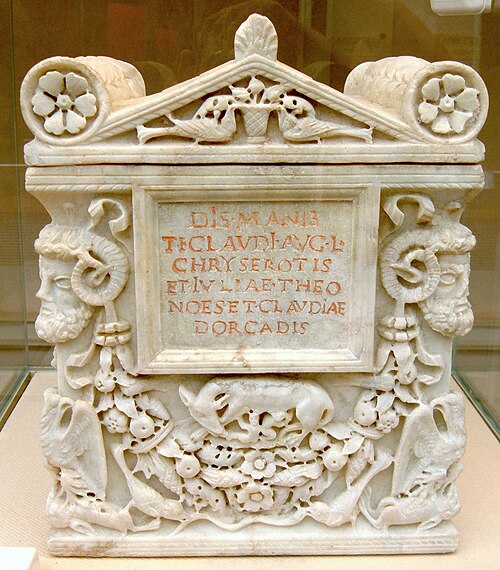
ローマは、解放奴隷が市民になることを認めている点でギリシャの都市国家と異なっていた。解放奴隷の将来の子供は自由に生まれ、完全な市民権の権利を持っていた。解放後、ローマ市民に属していた奴隷は、投票権を含む積極的な政治的自由(リベルタス)を享受した。 [157]以前の主人が彼のパトロン(パトロヌス)となり、両者はお互いに慣習的および法的義務を負い続けた。[158] [159]解放奴隷は公職や最高の国家聖職者に就く権利はなかったが、聖職者の役割を果たすことはできた。彼は元老院議員の家族の女性と結婚することはできず、彼自身も正当な元老院議員の地位を得ることもできなかったが、初期帝国時代には、解放奴隷は政府官僚機構で重要な地位を占め、ハドリアヌスは法律で彼らの参加を制限したほどであった。 [159]政治的影響力や富によって成功した解放奴隷の台頭は、初期帝国社会の特徴である。解放奴隷の優秀な集団の繁栄は、帝国中の碑文によって証明されています。
国勢調査順位
ラテン語のordo (複数形ordines ) は英語では「階級、秩序、位」と多様に不正確に翻訳されている。ローマの人口調査の目的の 1 つは、個人が属するordo を決定することであった。 [160]ローマの最高位のordinesのうち 2 つは元老院と騎馬であった。ローマの外では、都市や植民地はdecurion (curialesとも呼ばれる)によって統治されていた。[161]

古代ローマでは、「元老院議員」は選挙で選ばれる役職ではなかった。元老院議員になるには、行政官に選出され、少なくとも1期務めた人物が入会する。また、元老院議員には100万セステルティウスという最低限の財産要件を満たす必要があった。[162]元老院議員団の資格を持つ人物全員が、ローマに法的住所があることが条件の元老院議員の座に就くことを選んだわけではない。皇帝はしばしば、600人の議員からなる議会の空席を任命で埋めた。[163]元老院議員の息子は元老院議員団に属していたが、元老院議員になるには自身の功績で資格を得る必要があった。元老院議員は道徳基準に違反すると解任されることもあった。[164]
ネロの時代には、元老院議員は依然として主にイタリア出身者で、一部はイベリア半島と南フランス出身者だった。東方のギリシア語圏の属州出身者がウェスパシアヌス帝の治世中に加わり始めた。[165] 最東端の属州カッパドキア出身の最初の元老院議員は、マルクス・アウレリウス帝の治世中に認められた。[1]セウェルス朝(193年 - 235年)までに、イタリア人は元老院議員の半分以下を占めるようになった。[167] 3世紀にはローマに居住することが現実的ではなくなり、碑文には元老院議員が祖国(パトリア)で政治や慈善活動に積極的に取り組んでいたことが記されている。[164]
元老院議員は伝統的な統治階級であり、クルスス・オノラム(政治的キャリアコース)を経て昇進したが、騎兵はより大きな富と政治的権力を持つことが多かった。騎兵団の会員資格は財産に基づいていた。ローマの初期には、エクイテス(騎士)は騎馬戦士として奉仕する能力によって区別されていたが、帝国では騎兵としての奉仕は別の役割だった。[m]国勢調査では、40万セステルティウスの資産と3世代にわたる自由出生が騎兵としての資格を満たしていた。[169]紀元前28年の国勢調査では、資格を満たす男性が多数発見され、紀元14年にはカディスとパドヴァだけで1000人の騎兵が登録されていた。[n] [171]騎兵は軍事キャリアコース(トレス・ミリティア)を経て、帝国行政内で高位の知事や検察官になった。 [172]
地方出身の男性が元老院議員や騎士団に昇格したことは、初期ローマ帝国における社会的流動性の一側面である。ローマ貴族は競争に基づいており、後のヨーロッパの貴族とは異なり、ローマの家族は世襲相続や土地の所有権だけでは地位を維持できなかった。[173]上位の騎士団に昇格すると名誉と特権がもたらされたが、責任も伴った。古代では、都市は公共事業、行事、サービス (ムネラ) の資金を主導的な市民に依存していた。地位を維持するには、莫大な個人的支出が必要だった。[174]デクリオンは都市の機能に非常に重要であったため、後期ローマ帝国では、市議会の地位が枯渇すると、元老院議員に昇格した人々は市民生活を維持するために故郷に戻るよう奨励された。[175]
後期帝政では、元老院議員や騎馬兵の階級に付随するディグニタス(「価値、尊敬」)は、ヴィル・イルストリス(「高名な人物」)などの称号でさらに洗練されました。[176]クラリッシムス(ギリシャ語のランプロタトス)という呼称は、女性を含む特定の元老院議員とその近親者のディグニタスを示すために使用されました。[ 177 ]騎馬兵の階級は急増しました。[178]
不平等な正義
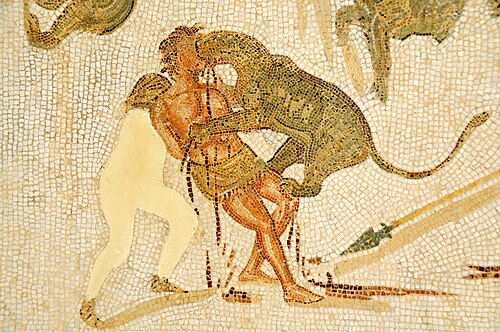
共和制の原則である法の下での市民の平等が薄れると、上流階級の象徴的かつ社会的特権は、ローマ社会を、より大きな名誉を得た人々 (オネスティオーレス) とより卑しい人々 (ヒュミリオーレス) に非公式に分割することになった。一般的に、オネスティオーレスは、一部の軍将校とともに、3 つの高位「階級」のメンバーであった。[179] 212 年に普遍的な市民権が付与されたことで、特に司法制度内で、上流階級の間で自分たちの優位性を認めさせようとする競争心が高まったようである。[180]判決は、被告の相対的な「価値」(ディグニタス)に関する裁判長の判断に依存していた。オネスティオーレスは、ヒュミリオーレスが鞭打ち刑を受けるような犯罪に対して罰金を支払うことができた。[181]
共和政下では自由人に対する処罰はまれであったが、[182]オネスティオレスにとっては迅速かつ比較的苦痛のない処刑が可能であったが、ヒュミリオーレスは、磔刑や獣への罰など、以前は奴隷にのみ許されていた拷問のような死刑に処せられることがあった。[183] 帝政初期には、キリスト教に改宗した者は、特に宗教的責任を果たさなかった場合にはオネスティオレスとしての地位を失う可能性があり、殉教の条件となる処罰の対象となった。[184]
政府と軍
帝国の3つの主要な要素は、中央政府、軍隊、地方政府でした。[185]軍隊は戦争を通じて領土の支配を確立しましたが、都市や人々が条約の下に置かれると、その使命は警察活動に変わり、ローマ市民、農地、宗教施設を保護しました。[186]ローマ人は武力だけで統治するのに十分な人員や資源を欠いていました。秩序を維持し、情報を収集し、収入を得るためには、地元のエリートとの協力が必要でした。ローマ人はしばしば内部の政治的分裂を利用しました。[187]
Communities with demonstrated loyalty to Rome retained their own laws, could collect their own taxes locally, and in exceptional cases were exempt from Roman taxation. Legal privileges and relative independence incentivized compliance.[188] Roman government was thus limited, but efficient in its use of available resources.[189]
Central government

The Imperial cult of ancient Rome identified emperors and some members of their families with divinely sanctioned authority (auctoritas). The rite of apotheosis (also called consecratio) signified the deceased emperor's deification.[190] The dominance of the emperor was based on the consolidation of powers from several republican offices.[191] The emperor made himself the central religious authority as pontifex maximus, and centralized the right to declare war, ratify treaties, and negotiate with foreign leaders.[192] While these functions were clearly defined during the Principate, the emperor's powers over time became less constitutional and more monarchical, culminating in the Dominate.[193]
The emperor was the ultimate authority in policy- and decision-making, but in the early Principate, he was expected to be accessible and deal personally with official business and petitions. A bureaucracy formed around him only gradually.[194] The Julio-Claudian emperors relied on an informal body of advisors that included not only senators and equestrians, but trusted slaves and freedmen.[195] After Nero, the influence of the latter was regarded with suspicion, and the emperor's council (consilium) became subject to official appointment for greater transparency.[196] Though the Senate took a lead in policy discussions until the end of the Antonine dynasty, equestrians played an increasingly important role in the consilium.[197] The women of the emperor's family often intervened directly in his decisions.[198]
Access to the emperor might be gained at the daily reception (salutatio), a development of the traditional homage a client paid to his patron; public banquets hosted at the palace; and religious ceremonies. The common people who lacked this access could manifest their approval or displeasure as a group at games.[199] By the 4th century, the Christian emperors became remote figureheads who issued general rulings, no longer responding to individual petitions.[200] Although the Senate could do little short of assassination and open rebellion to contravene the will of the emperor, it retained its symbolic political centrality.[201] The Senate legitimated the emperor's rule, and the emperor employed senators as legates (legati): generals, diplomats, and administrators.[202]
The practical source of an emperor's power and authority was the military. The legionaries were paid by the Imperial treasury, and swore an annual oath of loyalty to the emperor.[203] Most emperors chose a successor, usually a close family member or adopted heir. The new emperor had to seek a swift acknowledgement of his status and authority to stabilize the political landscape. No emperor could hope to survive without the allegiance of the Praetorian Guard and the legions. To secure their loyalty, several emperors paid the donativum, a monetary reward. In theory, the Senate was entitled to choose the new emperor, but did so mindful of acclamation by the army or Praetorians.[204]
Military


After the Punic Wars, the Roman army comprised professional soldiers who volunteered for 20 years of active duty and five as reserves. The transition to a professional military began during the late Republic and was one of the many profound shifts away from republicanism, under which an army of conscript citizens defended the homeland against a specific threat. The Romans expanded their war machine by "organizing the communities that they conquered in Italy into a system that generated huge reservoirs of manpower for their army".[205] By Imperial times, military service was a full-time career.[206] The pervasiveness of military garrisons throughout the Empire was a major influence in the process of Romanization.[207]
The primary mission of the military of the early empire was to preserve the Pax Romana.[208] The three major divisions of the military were:
- the garrison at Rome, comprising the Praetorian Guard, the cohortes urbanae and the vigiles, who functioned as police and firefighters;
- the provincial army, comprising the Roman legions and the auxiliaries provided by the provinces (auxilia);
- the navy.

Through his military reforms, which included consolidating or disbanding units of questionable loyalty, Augustus regularized the legion. A legion was organized into ten cohorts, each of which comprised six centuries, with a century further made up of ten squads (contubernia); the exact size of the Imperial legion, which was likely determined by logistics, has been estimated to range from 4,800 to 5,280.[209] After Germanic tribes wiped out three legions in the Battle of the Teutoburg Forest in 9 AD, the number of legions was increased from 25 to around 30.[210] The army had about 300,000 soldiers in the 1st century, and under 400,000 in the 2nd, "significantly smaller" than the collective armed forces of the conquered territories. No more than 2% of adult males living in the Empire served in the Imperial army.[211] Augustus also created the Praetorian Guard: nine cohorts, ostensibly to maintain the public peace, which were garrisoned in Italy. Better paid than the legionaries, the Praetorians served only sixteen years.[212]
The auxilia were recruited from among the non-citizens. Organized in smaller units of roughly cohort strength, they were paid less than the legionaries, and after 25 years of service were rewarded with Roman citizenship, also extended to their sons. According to Tacitus[213] there were roughly as many auxiliaries as there were legionaries—thus, around 125,000 men, implying approximately 250 auxiliary regiments.[214] The Roman cavalry of the earliest Empire were primarily from Celtic, Hispanic or Germanic areas. Several aspects of training and equipment derived from the Celts.[215]
The Roman navy not only aided in the supply and transport of the legions but also in the protection of the frontiers along the rivers Rhine and Danube. Another duty was protecting maritime trade against pirates. It patrolled the Mediterranean, parts of the North Atlantic coasts, and the Black Sea. Nevertheless, the army was considered the senior and more prestigious branch.[216]
Provincial government
An annexed territory became a Roman province in three steps: making a register of cities, taking a census, and surveying the land.[217] Further government recordkeeping included births and deaths, real estate transactions, taxes, and juridical proceedings.[218] In the 1st and 2nd centuries, the central government sent out around 160 officials annually to govern outside Italy.[22] Among these officials were the Roman governors: magistrates elected at Rome who in the name of the Roman people governed senatorial provinces; or governors, usually of equestrian rank, who held their imperium on behalf of the emperor in imperial provinces, most notably Roman Egypt.[219] A governor had to make himself accessible to the people he governed, but he could delegate various duties.[220] His staff, however, was minimal: his official attendants (apparitores), including lictors, heralds, messengers, scribes, and bodyguards; legates, both civil and military, usually of equestrian rank; and friends who accompanied him unofficially.[220]
Other officials were appointed as supervisors of government finances.[22] Separating fiscal responsibility from justice and administration was a reform of the Imperial era, to avoid provincial governors and tax farmers exploiting local populations for personal gain.[221] Equestrian procurators, whose authority was originally "extra-judicial and extra-constitutional", managed both state-owned property and the personal property of the emperor (res privata).[220] Because Roman government officials were few, a provincial who needed help with a legal dispute or criminal case might seek out any Roman perceived to have some official capacity.[222]
Law
Roman portraiture frescos from Pompeii, 1st century AD, depicting two different men wearing laurel wreaths, one holding the rotulus (blondish figure, left), the other a volumen (brunet figure, right), both made of papyrus
Roman courts held original jurisdiction over cases involving Roman citizens throughout the empire, but there were too few judicial functionaries to impose Roman law uniformly in the provinces. Most parts of the Eastern Empire already had well-established law codes and juridical procedures.[109] Generally, it was Roman policy to respect the mos regionis ("regional tradition" or "law of the land") and to regard local laws as a source of legal precedent and social stability.[109][223] The compatibility of Roman and local law was thought to reflect an underlying ius gentium, the "law of nations" or international law regarded as common and customary.[224] If provincial law conflicted with Roman law or custom, Roman courts heard appeals, and the emperor held final decision-making authority.[109][223][o]
In the West, law had been administered on a highly localized or tribal basis, and private property rights may have been a novelty of the Roman era, particularly among Celts. Roman law facilitated the acquisition of wealth by a pro-Roman elite.[109] The extension of universal citizenship to all free inhabitants of the Empire in 212 required the uniform application of Roman law, replacing local law codes that had applied to non-citizens. Diocletian's efforts to stabilize the Empire after the Crisis of the Third Century included two major compilations of law in four years, the Codex Gregorianus and the Codex Hermogenianus, to guide provincial administrators in setting consistent legal standards.[225]
The pervasiveness of Roman law throughout Western Europe enormously influenced the Western legal tradition, reflected by continued use of Latin legal terminology in modern law.
Taxation

Taxation under the Empire amounted to about 5% of its gross product.[226] The typical tax rate for individuals ranged from 2 to 5%.[227] The tax code was "bewildering" in its complicated system of direct and indirect taxes, some paid in cash and some in kind. Taxes might be specific to a province, or kinds of properties such as fisheries; they might be temporary.[228] Tax collection was justified by the need to maintain the military,[229] and taxpayers sometimes got a refund if the army captured a surplus of booty.[230] In-kind taxes were accepted from less-monetized areas, particularly those who could supply grain or goods to army camps.[231]
The primary source of direct tax revenue was individuals, who paid a poll tax and a tax on their land, construed as a tax on its produce or productive capacity.[227] Tax obligations were determined by the census: each head of household provided a headcount of his household, as well as an accounting of his property.[232] A major source of indirect-tax revenue was the portoria, customs and tolls on trade, including among provinces.[227] Towards the end of his reign, Augustus instituted a 4% tax on the sale of slaves,[233] which Nero shifted from the purchaser to the dealers, who responded by raising their prices.[234] An owner who manumitted a slave paid a "freedom tax", calculated at 5% of value.[p] An inheritance tax of 5% was assessed when Roman citizens above a certain net worth left property to anyone outside their immediate family. Revenues from the estate tax and from an auction tax went towards the veterans' pension fund (aerarium militare).[227]
Low taxes helped the Roman aristocracy increase their wealth, which equalled or exceeded the revenues of the central government. An emperor sometimes replenished his treasury by confiscating the estates of the "super-rich", but in the later period, the resistance of the wealthy to paying taxes was one of the factors contributing to the collapse of the Empire.[66]
Economy

The Empire is best thought of as a network of regional economies, based on a form of "political capitalism" in which the state regulated commerce to assure its own revenues.[235] Economic growth, though not comparable to modern economies, was greater than that of most other societies prior to industrialization.[236] Territorial conquests permitted a large-scale reorganization of land use that resulted in agricultural surplus and specialization, particularly in north Africa.[237] Some cities were known for particular industries. The scale of urban building indicates a significant construction industry.[237] Papyri preserve complex accounting methods that suggest elements of economic rationalism,[237] and the Empire was highly monetized.[238] Although the means of communication and transport were limited in antiquity, transportation in the 1st and 2nd centuries expanded greatly, and trade routes connected regional economies.[239] The supply contracts for the army drew on local suppliers near the base (castrum), throughout the province, and across provincial borders.[240] Economic historians vary in their calculations of the gross domestic product during the Principate.[241] In the sample years of 14, 100, and 150 AD, estimates of per capita GDP range from 166 to 380 HS. The GDP per capita of Italy is estimated as 40[242] to 66%[243] higher than in the rest of the Empire, due to tax transfers from the provinces and the concentration of elite income.
Economic dynamism resulted in social mobility. Although aristocratic values permeated traditional elite society, wealth requirements for rank indicate a strong tendency towards plutocracy. Prestige could be obtained through investing one's wealth in grand estates or townhouses, luxury items, public entertainments, funerary monuments, and religious dedications. Guilds (collegia) and corporations (corpora) provided support for individuals to succeed through networking.[179] "There can be little doubt that the lower classes of ... provincial towns of the Roman Empire enjoyed a high standard of living not equaled again in Western Europe until the 19th century".[244] Households in the top 1.5% of income distribution captured about 20% of income. The "vast majority" produced more than half of the total income, but lived near subsistence.[245]
Currency and banking


The early Empire was monetized to a near-universal extent, using money as a way to express prices and debts.[247] The sestertius (English "sesterces", symbolized as HS) was the basic unit of reckoning value into the 4th century,[248] though the silver denarius, worth four sesterces, was also used beginning in the Severan dynasty.[249] The smallest coin commonly circulated was the bronze as, one-tenth denarius.[250] Bullion and ingots seem not to have counted as pecunia ("money") and were used only on the frontiers. Romans in the first and second centuries counted coins, rather than weighing them—an indication that the coin was valued on its face. This tendency towards fiat money led to the debasement of Roman coinage in the later Empire.[251] The standardization of money throughout the Empire promoted trade and market integration.[247] The high amount of metal coinage in circulation increased the money supply for trading or saving.[252] Rome had no central bank, and regulation of the banking system was minimal. Banks of classical antiquity typically kept less in reserves than the full total of customers' deposits. A typical bank had fairly limited capital, and often only one principal. Seneca assumes that anyone involved in Roman commerce needs access to credit.[251] A professional deposit banker received and held deposits for a fixed or indefinite term, and lent money to third parties. The senatorial elite were involved heavily in private lending, both as creditors and borrowers.[253] The holder of a debt could use it as a means of payment by transferring it to another party, without cash changing hands. Although it has sometimes been thought that ancient Rome lacked documentary transactions, the system of banks throughout the Empire permitted the exchange of large sums without physically transferring coins, in part because of the risks of moving large amounts of cash. Only one serious credit shortage is known to have occurred in the early Empire, in 33 AD;[254] generally, available capital exceeded the amount needed by borrowers.[251] The central government itself did not borrow money, and without public debt had to fund deficits from cash reserves.[255]
Emperors of the Antonine and Severan dynasties debased the currency, particularly the denarius, under the pressures of meeting military payrolls.[248] Sudden inflation under Commodus damaged the credit market.[251] In the mid-200s, the supply of specie contracted sharply.[248] Conditions during the Crisis of the Third Century—such as reductions in long-distance trade, disruption of mining operations, and the physical transfer of gold coinage outside the empire by invading enemies—greatly diminished the money supply and the banking sector.[248][251] Although Roman coinage had long been fiat money or fiduciary currency, general economic anxieties came to a head under Aurelian, and bankers lost confidence in coins. Despite Diocletian's introduction of the gold solidus and monetary reforms, the credit market of the Empire never recovered its former robustness.[251]
Mining and metallurgy

The main mining regions of the Empire were the Iberian Peninsula (silver, copper, lead, iron and gold);[4] Gaul (gold, silver, iron);[4] Britain (mainly iron, lead, tin),[256] the Danubian provinces (gold, iron);[257] Macedonia and Thrace (gold, silver); and Asia Minor (gold, silver, iron, tin). Intensive large-scale mining—of alluvial deposits, and by means of open-cast mining and underground mining—took place from the reign of Augustus up to the early 3rd century, when the instability of the Empire disrupted production.[citation needed]
Hydraulic mining allowed base and precious metals to be extracted on a proto-industrial scale.[258] The total annual iron output is estimated at 82,500 tonnes.[259] Copper and lead production levels were unmatched until the Industrial Revolution.[260][261][262][263] At its peak around the mid-2nd century, the Roman silver stock is estimated at 10,000 t, five to ten times larger than the combined silver mass of medieval Europe and the Caliphate around 800 AD.[262][264] As an indication of the scale of Roman metal production, lead pollution in the Greenland ice sheet quadrupled over prehistoric levels during the Imperial era and dropped thereafter.[265]
Transportation and communication

The Empire completely encircled the Mediterranean, which they called "our sea" (Mare Nostrum).[266] Roman sailing vessels navigated the Mediterranean as well as major rivers.[69] Transport by water was preferred where possible, as moving commodities by land was more difficult.[267] Vehicles, wheels, and ships indicate the existence of a great number of skilled woodworkers.[268]
Land transport utilized the advanced system of Roman roads, called "viae". These roads were primarily built for military purposes,[269] but also served commercial ends. The in-kind taxes paid by communities included the provision of personnel, animals, or vehicles for the cursus publicus, the state mail and transport service established by Augustus.[231] Relay stations were located along the roads every seven to twelve Roman miles, and tended to grow into villages or trading posts.[270] A mansio (plural mansiones) was a privately run service station franchised by the imperial bureaucracy for the cursus publicus. The distance between mansiones was determined by how far a wagon could travel in a day.[270] Carts were usually pulled by mules, travelling about 4 mph.[271]
Trade and commodities
Roman provinces traded among themselves, but trade extended outside the frontiers to regions as far away as China and India.[272] Chinese trade was mostly conducted overland through middle men along the Silk Road; Indian trade also occurred by sea from Egyptian ports. The main commodity was grain.[273] Also traded were olive oil, foodstuffs, garum (fish sauce), slaves, ore and manufactured metal objects, fibres and textiles, timber, pottery, glassware, marble, papyrus, spices and materia medica, ivory, pearls, and gemstones.[274] Though most provinces could produce wine, regional varietals were desirable and wine was a central trade good.[275]
Labour and occupations

Inscriptions record 268 different occupations in Rome and 85 in Pompeii.[211] Professional associations or trade guilds (collegia) are attested for a wide range of occupations, some quite specialized.[179]
Work performed by slaves falls into five general categories: domestic, with epitaphs recording at least 55 different household jobs; imperial or public service; urban crafts and services; agriculture; and mining. Convicts provided much of the labour in the mines or quarries, where conditions were notoriously brutal.[276] In practice, there was little division of labour between slave and free,[109] and most workers were illiterate and without special skills.[277] The greatest number of common labourers were employed in agriculture: in Italian industrial farming (latifundia), these may have been mostly slaves, but elsewhere slave farm labour was probably less important.[109]
Textile and clothing production was a major source of employment. Both textiles and finished garments were traded and products were often named for peoples or towns, like a fashion "label".[278] Better ready-to-wear was exported by local businessmen (negotiatores or mercatores).[279] Finished garments might be retailed by their sales agents, by vestiarii (clothing dealers), or peddled by itinerant merchants.[279] The fullers (fullones) and dye workers (coloratores) had their own guilds.[280] Centonarii were guild workers who specialized in textile production and the recycling of old clothes into pieced goods.[q]

Architecture and engineering

The chief Roman contributions to architecture were the arch, vault and dome. Some Roman structures still stand today, due in part to sophisticated methods of making cements and concrete.[283] Roman temples developed Etruscan and Greek forms, with some distinctive elements. Roman roads are considered the most advanced built until the early 19th century.[citation needed]
Roman bridges were among the first large and lasting bridges, built from stone (and in most cases concrete) with the arch as the basic structure. The largest Roman bridge was Trajan's bridge over the lower Danube, constructed by Apollodorus of Damascus, which remained for over a millennium the longest bridge to have been built.[284] The Romans built many dams and reservoirs for water collection, such as the Subiaco Dams, two of which fed the Anio Novus, one of the largest aqueducts of Rome.[285]
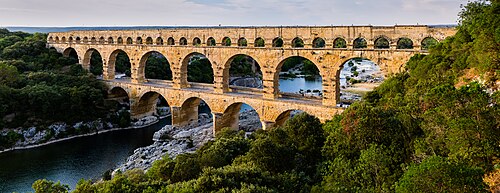
The Romans constructed numerous aqueducts. De aquaeductu, a treatise by Frontinus, who served as water commissioner, reflects the administrative importance placed on the water supply. Masonry channels carried water along a precise gradient, using gravity alone. It was then collected in tanks and fed through pipes to public fountains, baths, toilets, or industrial sites.[286] The main aqueducts in Rome were the Aqua Claudia and the Aqua Marcia.[287] The complex system built to supply Constantinople had its most distant supply drawn from over 120 km away along a route of more than 336 km.[288] Roman aqueducts were built to remarkably fine tolerance, and to a technological standard not equalled until modern times.[289] The Romans also used aqueducts in their extensive mining operations across the empire.[290]
Insulated glazing (or "double glazing") was used in the construction of public baths. Elite housing in cooler climates might have hypocausts, a form of central heating. The Romans were the first culture to assemble all essential components of the much later steam engine: the crank and connecting rod system, Hero's aeolipile (generating steam power), the cylinder and piston (in metal force pumps), non-return valves (in water pumps), and gearing (in water mills and clocks).[291]
Daily life

City and country
The city was viewed as fostering civilization by being "properly designed, ordered, and adorned".[292] Augustus undertook a vast building programme in Rome, supported public displays of art that expressed imperial ideology, and reorganized the city into neighbourhoods (vici) administered at the local level with police and firefighting services.[293] A focus of Augustan monumental architecture was the Campus Martius, an open area outside the city centre: the Altar of Augustan Peace (Ara Pacis Augustae) was located there, as was an obelisk imported from Egypt that formed the pointer (gnomon) of a horologium. With its public gardens, the Campus was among the most attractive places in Rome to visit.[293]
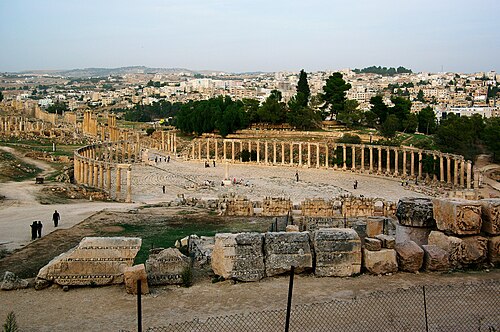
City planning and urban lifestyles was influenced by the Greeks early on,[294] and in the Eastern Empire, Roman rule shaped the development of cities that already had a strong Hellenistic character. Cities such as Athens, Aphrodisias, Ephesus and Gerasa tailored city planning and architecture to imperial ideals, while expressing their individual identity and regional preeminence.[295] In areas inhabited by Celtic-speaking peoples, Rome encouraged the development of urban centres with stone temples, forums, monumental fountains, and amphitheatres, often on or near the sites of preexisting walled settlements known as oppida.[296][297][r] Urbanization in Roman Africa expanded on Greek and Punic coastal cities.[270]

The network of cities (coloniae, municipia, civitates or in Greek terms poleis) was a primary cohesive force during the Pax Romana.[200] Romans of the 1st and 2nd centuries were encouraged to "inculcate the habits of peacetime".[299] As the classicist Clifford Ando noted:
Most of the cultural appurtenances popularly associated with imperial culture—public cult and its games and civic banquets, competitions for artists, speakers, and athletes, as well as the funding of the great majority of public buildings and public display of art—were financed by private individuals, whose expenditures in this regard helped to justify their economic power and legal and provincial privileges.[300]
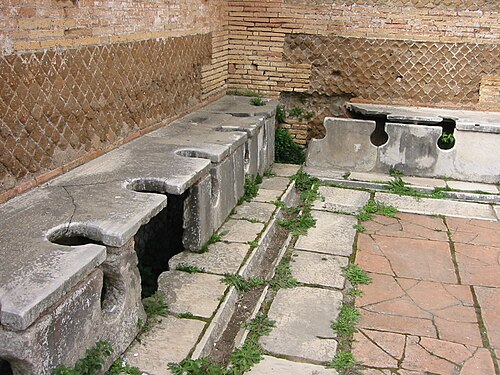
In the city of Rome, most people lived in multistory apartment buildings (insulae) that were often squalid firetraps. Public facilities—such as baths (thermae), toilets with running water (latrinae), basins or elaborate fountains (nymphea) delivering fresh water,[297] and large-scale entertainments such as chariot races and gladiator combat—were aimed primarily at the common people.[301]
The public baths served hygienic, social and cultural functions.[302] Bathing was the focus of daily socializing.[303] Roman baths were distinguished by a series of rooms that offered communal bathing in three temperatures, with amenities that might include an exercise room, sauna, exfoliation spa, ball court, or outdoor swimming pool. Baths had hypocaust heating: the floors were suspended over hot-air channels.[304] Public baths were part of urban culture throughout the provinces, but in the late 4th century, individual tubs began to replace communal bathing. Christians were advised to go to the baths only for hygiene.[305]

Rich families from Rome usually had two or more houses: a townhouse (domus) and at least one luxury home (villa) outside the city. The domus was a privately owned single-family house, and might be furnished with a private bath (balneum),[304] but it was not a place to retreat from public life.[306] Although some neighbourhoods show a higher concentration of such houses, they were not segregated enclaves. The domus was meant to be visible and accessible. The atrium served as a reception hall in which the paterfamilias (head of household) met with clients every morning.[293] It was a centre of family religious rites, containing a shrine and images of family ancestors.[307] The houses were located on busy public roads, and ground-level spaces were often rented out as shops (tabernae).[308] In addition to a kitchen garden—windowboxes might substitute in the insulae—townhouses typically enclosed a peristyle garden.[309]
The villa by contrast was an escape from the city, and in literature represents a lifestyle that balances intellectual and artistic interests (otium) with an appreciation of nature and agriculture.[310] Ideally a villa commanded a view or vista, carefully framed by the architectural design.[311]
Augustus' programme of urban renewal, and the growth of Rome's population to as many as one million, was accompanied by nostalgia for rural life. Poetry idealized the lives of farmers and shepherds. Interior decorating often featured painted gardens, fountains, landscapes, vegetative ornament,[311] and animals, rendered accurately enough to be identified by species.[312] On a more practical level, the central government took an active interest in supporting agriculture.[313] Producing food was the priority of land use.[314] Larger farms (latifundia) achieved an economy of scale that sustained urban life.[313] Small farmers benefited from the development of local markets in towns and trade centres. Agricultural techniques such as crop rotation and selective breeding were disseminated throughout the Empire, and new crops were introduced from one province to another.[315]

Maintaining an affordable food supply to the city of Rome had become a major political issue in the late Republic, when the state began to provide a grain dole (Cura Annonae) to citizens who registered for it[313] (about 200,000–250,000 adult males in Rome).[316] The dole cost at least 15% of state revenues,[313] but improved living conditions among the lower classes,[317] and subsidized the rich by allowing workers to spend more of their earnings on the wine and olive oil produced on estates.[313] The grain dole also had symbolic value: it affirmed the emperor's position as universal benefactor, and the right of citizens to share in "the fruits of conquest".[313] The annona, public facilities, and spectacular entertainments mitigated the otherwise dreary living conditions of lower-class Romans, and kept social unrest in check. The satirist Juvenal, however, saw "bread and circuses" (panem et circenses) as emblematic of the loss of republican political liberty:[318]
The public has long since cast off its cares: the people that once bestowed commands, consulships, legions and all else, now meddles no more and longs eagerly for just two things: bread and circuses.[319]
Health and disease
Epidemics were common in the ancient world, and occasional pandemics in the Empire killed millions. The Roman population was unhealthy. About 20 percent—a large percentage by ancient standards—lived in cities, Rome being the largest. The cities were a "demographic sink": the death rate exceeded the birth rate and constant immigration was necessary to maintain the population. Average lifespan is estimated at the mid-twenties, and perhaps more than half of children died before reaching adulthood. Dense urban populations and poor sanitation contributed to disease. Land and sea connections facilitated and sped the transfer of infectious diseases across the empire's territories. The rich were not immune; only two of emperor Marcus Aurelius's fourteen children are known to have reached adulthood.[320]
The importance of a good diet to health was recognized by medical writers such as Galen (2nd century). Views on nutrition were influenced by beliefs like humoral theory.[321] A good indicator of nutrition and disease burden is average height: the average Roman was shorter in stature than the population of pre-Roman Italian societies and medieval Europe.[322]
Food and dining

Most apartments in Rome lacked kitchens, though a charcoal brazier could be used for rudimentary cookery.[323] Prepared food was sold at pubs and bars, inns, and food stalls (tabernae, cauponae, popinae, thermopolia).[324] Carryout and restaurants were for the lower classes; fine dining appeared only at dinner parties in wealthy homes with a chef (archimagirus) and kitchen staff,[325] or banquets hosted by social clubs (collegia).[326]
Most Romans consumed at least 70% of their daily calories in the form of cereals and legumes.[327] Puls (pottage) was considered the food of the Romans,[328] and could be elaborated to produce dishes similar to polenta or risotto.[329] Urban populations and the military preferred bread.[327] By the reign of Aurelian, the state had begun to distribute the annona as a daily ration of bread baked in state factories, and added olive oil, wine, and pork to the dole.[330]
Roman literature focuses on the dining habits of the upper classes,[331] for whom the evening meal (cena) had important social functions.[332] Guests were entertained in a finely decorated dining room (triclinium) furnished with couches. By the late Republic, women dined, reclined, and drank wine along with men.[333] The poet Martial describes a dinner, beginning with the gustatio ("tasting" or "appetizer") salad. The main course was kid, beans, greens, a chicken, and leftover ham, followed by a dessert of fruit and wine.[334] Roman "foodies" indulged in wild game, fowl such as peacock and flamingo, large fish (mullet was especially prized), and shellfish. Luxury ingredients were imported from the far reaches of empire.[335] A book-length collection of Roman recipes is attributed to Apicius, a name for several figures in antiquity that became synonymous with "gourmet".[336]
Refined cuisine could be moralized as a sign of either civilized progress or decadent decline.[337] Most often, because of the importance of landowning in Roman culture, produce—cereals, legumes, vegetables, and fruit—were considered more civilized foods than meat. The Mediterranean staples of bread, wine, and oil were sacralized by Roman Christianity, while Germanic meat consumption became a mark of paganism.[338] Some philosophers and Christians resisted the demands of the body and the pleasures of food, and adopted fasting as an ideal.[339] Food became simpler in general as urban life in the West diminished and trade routes were disrupted;[340] the Church formally discouraged gluttony,[341] and hunting and pastoralism were seen as simple and virtuous.[340]
Spectacles

When Juvenal complained that the Roman people had exchanged their political liberty for "bread and circuses", he was referring to the state-provided grain dole and the circenses, events held in the entertainment venue called a circus. The largest such venue in Rome was the Circus Maximus, the setting of horse races, chariot races, the equestrian Troy Game, staged beast hunts (venationes), athletic contests, gladiator combat, and historical re-enactments. From earliest times, several religious festivals had featured games (ludi), primarily horse and chariot races (ludi circenses).[342] The races retained religious significance in connection with agriculture, initiation, and the cycle of birth and death.[s]
Under Augustus, public entertainments were presented on 77 days of the year; by the reign of Marcus Aurelius, this had expanded to 135.[344] Circus games were preceded by an elaborate parade (pompa circensis) that ended at the venue.[345] Competitive events were held also in smaller venues such as the amphitheatre, which became the characteristic Roman spectacle venue, and stadium. Greek-style athletics included footraces, boxing, wrestling, and the pancratium.[346] Aquatic displays, such as the mock sea battle (naumachia) and a form of "water ballet", were presented in engineered pools.[347] State-supported theatrical events (ludi scaenici) took place on temple steps or in grand stone theatres, or in the smaller enclosed theatre called an odeon.[348]
Circuses were the largest structure regularly built in the Roman world.[349] The Flavian Amphitheatre, better known as the Colosseum, became the regular arena for blood sports in Rome.[350] Many Roman amphitheatres, circuses and theatres built in cities outside Italy are visible as ruins today.[350] The local ruling elite were responsible for sponsoring spectacles and arena events, which both enhanced their status and drained their resources.[183] The physical arrangement of the amphitheatre represented the order of Roman society: the emperor in his opulent box; senators and equestrians in reserved advantageous seats; women seated at a remove from the action; slaves given the worst places, and everybody else in-between.[351] The crowd could call for an outcome by booing or cheering, but the emperor had the final say. Spectacles could quickly become sites of social and political protest, and emperors sometimes had to deploy force to put down crowd unrest, most notoriously at the Nika riots in 532.[352]

The chariot teams were known by the colours they wore. Fan loyalty was fierce and at times erupted into sports riots.[354] Racing was perilous, but charioteers were among the most celebrated and well-compensated athletes.[355] Circuses were designed to ensure that no team had an unfair advantage and to minimize collisions (naufragia),[356] which were nonetheless frequent and satisfying to the crowd.[357] The races retained a magical aura through their early association with chthonic rituals: circus images were considered protective or lucky, curse tablets have been found buried at the site of racetracks, and charioteers were often suspected of sorcery.[358] Chariot racing continued into the Byzantine period under imperial sponsorship, but the decline of cities in the 6th and 7th centuries led to its eventual demise.[349]
The Romans thought gladiator contests had originated with funeral games and sacrifices. Some of the earliest styles of gladiator fighting had ethnic designations such as "Thracian" or "Gallic".[359] The staged combats were considered munera, "services, offerings, benefactions", initially distinct from the festival games (ludi).[360] To mark the opening of the Colosseum, Titus presented 100 days of arena events, with 3,000 gladiators competing on a single day.[361] Roman fascination with gladiators is indicated by how widely they are depicted on mosaics, wall paintings, lamps, and in graffiti.[362] Gladiators were trained combatants who might be slaves, convicts, or free volunteers.[363] Death was not a necessary or even desirable outcome in matches between these highly skilled fighters, whose training was costly and time-consuming.[364] By contrast, noxii were convicts sentenced to the arena with little or no training, often unarmed, and with no expectation of survival; physical suffering and humiliation were considered appropriate retributive justice.[183] These executions were sometimes staged or ritualized as re-enactments of myths, and amphitheatres were equipped with elaborate stage machinery to create special effects.[183][365]
Modern scholars have found the pleasure Romans took in the "theatre of life and death"[366] difficult to understand.[367] Pliny the Younger rationalized gladiator spectacles as good for the people, "to inspire them to face honourable wounds and despise death, by exhibiting love of glory and desire for victory".[368] Some Romans such as Seneca were critical of the brutal spectacles, but found virtue in the courage and dignity of the defeated fighter[369]—an attitude that finds its fullest expression with the Christians martyred in the arena. Tertullian considered deaths in the arena to be nothing more than a dressed-up form of human sacrifice.[370] Even martyr literature, however, offers "detailed, indeed luxuriant, descriptions of bodily suffering",[371] and became a popular genre at times indistinguishable from fiction.[372]
Recreation
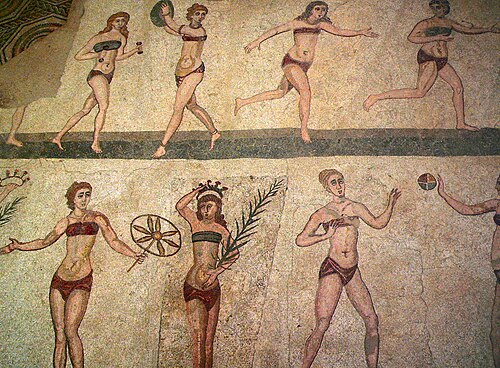
The singular ludus, "play, game, sport, training", had a wide range of meanings such as "word play", "theatrical performance", "board game", "primary school", and even "gladiator training school" (as in Ludus Magnus).[373] Activities for children and young people in the Empire included hoop rolling and knucklebones (astragali or "jacks"). Girls had dolls made of wood, terracotta, and especially bone and ivory.[374] Ball games include trigon and harpastum.[375] People of all ages played board games, including latrunculi ("Raiders") and XII scripta ("Twelve Marks").[376] A game referred to as alea (dice) or tabula (the board) may have been similar to backgammon.[377] Dicing as a form of gambling was disapproved of, but was a popular pastime during the festival of the Saturnalia.[378]
After adolescence, most physical training for males was of a military nature. The Campus Martius originally was an exercise field where young men learned horsemanship and warfare. Hunting was also considered an appropriate pastime. According to Plutarch, conservative Romans disapproved of Greek-style athletics that promoted a fine body for its own sake, and condemned Nero's efforts to encourage Greek-style athletic games.[379] Some women trained as gymnasts and dancers, and a rare few as female gladiators. The "Bikini Girls" mosaic shows young women engaging in routines comparable to rhythmic gymnastics.[t][381] Women were encouraged to maintain health through activities such as playing ball, swimming, walking, or reading aloud (as a breathing exercise).[382]
Clothing
,_et%C3%A0_claudia.jpg/500px-Statua_togata,_dalla_palestra_di_foruli_(civitatomassa),_et%C3%A0_claudia.jpg)
In a status-conscious society like that of the Romans, clothing and personal adornment indicated the etiquette of interacting with the wearer.[383] Wearing the correct clothing reflected a society in good order.[384] There is little direct evidence of how Romans dressed in daily life, since portraiture may show the subject in clothing with symbolic value, and surviving textiles are rare.[385][386]
The toga was the distinctive national garment of the male citizen, but it was heavy and impractical, worn mainly for conducting political or court business and religious rites.[387][385] It was a "vast expanse" of semi-circular white wool that could not be put on and draped correctly without assistance.[387] The drapery became more intricate and structured over time.[388] The toga praetexta, with a purple or purplish-red stripe representing inviolability, was worn by children who had not come of age, curule magistrates, and state priests. Only the emperor could wear an all-purple toga (toga picta).[389]
Ordinary clothing was dark or colourful. The basic garment for all Romans, regardless of gender or wealth, was the simple sleeved tunic, with length differing by wearer.[390] The tunics of poor people and labouring slaves were made from coarse wool in natural, dull shades; finer tunics were made of lightweight wool or linen. A man of the senatorial or equestrian order wore a tunic with two purple stripes (clavi) woven vertically: the wider the stripe, the higher the wearer's status.[390] Other garments could be layered over the tunic. Common male attire also included cloaks and in some regions trousers.[391] In the 2nd century, emperors and elite men are often portrayed wearing the pallium, an originally Greek mantle; women are also portrayed in the pallium. Tertullian considered the pallium an appropriate garment both for Christians, in contrast to the toga, and for educated people.[384][385][392]
Roman clothing styles changed over time.[393] In the Dominate, clothing worn by both soldiers and bureaucrats became highly decorated with geometrical patterns, stylized plant motifs, and in more elaborate examples, human or animal figures.[394] Courtiers of the later Empire wore elaborate silk robes. The militarization of Roman society, and the waning of urban life, affected fashion: heavy military-style belts were worn by bureaucrats as well as soldiers, and the toga was abandoned,[395] replaced by the pallium as a garment embodying social unity.[396]
Arts
Greek art had a profound influence on Roman art.[397] Public art—including sculpture, monuments such as victory columns or triumphal arches, and the iconography on coins—is often analysed for historical or ideological significance.[398] In the private sphere, artistic objects were made for religious dedications, funerary commemoration, domestic use, and commerce.[399] The wealthy advertised their appreciation of culture through artwork and decorative arts in their homes.[400] Despite the value placed on art, even famous artists were of low social status, partly as they worked with their hands.[401]
Portraiture
Portraiture, which survives mainly in sculpture, was the most copious form of imperial art. Portraits during the Augustan period utilize classical proportions, evolving later into a mixture of realism and idealism.[402] Republican portraits were characterized by verism, but as early as the 2nd century BC, Greek heroic nudity was adopted for conquering generals.[403] Imperial portrait sculptures may model a mature head atop a youthful nude or semi-nude body with perfect musculature.[404] Clothed in the toga or military regalia, the body communicates rank or role, not individual characteristics.[405]
Portraiture in painting is represented primarily by the Fayum mummy portraits, which evoke Egyptian and Roman traditions of commemorating the dead with realistic painting. Marble portrait sculpture were painted, but traces have rarely survived.[406]
Sculpture and sarcophagi
_-_Arte_Romana_-_Photo_Paolo_Villa_FO232047_ombre_gimp_bis.jpg/500px-thumbnail.jpg)
Examples of Roman sculpture survive abundantly, though often in damaged or fragmentary condition, including freestanding statuary in marble, bronze and terracotta, and reliefs from public buildings and monuments. Niches in amphitheatres were originally filled with statues,[407][408] as were formal gardens.[409] Temples housed cult images of deities, often by famed sculptors.[410]
Elaborately carved marble and limestone sarcophagi are characteristic of the 2nd to 4th centuries.[411] Sarcophagus relief has been called the "richest single source of Roman iconography",[412] depicting mythological scenes[413] or Jewish/Christian imagery[414] as well as the deceased's life.
Painting

Initial Roman painting drew from Etruscan and Greek models and techniques. Examples of Roman paintings can be found in palaces, catacombs and villas. Much of what is known of Roman painting is from the interior decoration of private homes, particularly as preserved by the eruption of Vesuvius. In addition to decorative borders and panels with geometric or vegetative motifs, wall painting depicts scenes from mythology and theatre, landscapes and gardens, spectacles, everyday life, and erotic art.
Mosaic

Mosaics are among the most enduring of Roman decorative arts, and are found on floors and other architectural features. The most common is the tessellated mosaic, formed from uniform pieces (tesserae) of materials such as stone and glass.[416] Opus sectile is a related technique in which flat stone, usually coloured marble, is cut precisely into shapes from which geometric or figurative patterns are formed. This more difficult technique became especially popular for luxury surfaces in the 4th century (e.g. the Basilica of Junius Bassus).[417]
Figurative mosaics share many themes with painting, and in some cases use almost identical compositions. Geometric patterns and mythological scenes occur throughout the Empire. In North Africa, a particularly rich source of mosaics, homeowners often chose scenes of life on their estates, hunting, agriculture, and local wildlife.[415] Plentiful and major examples of Roman mosaics come also from present-day Turkey (particularly the (Antioch mosaics[418]), Italy, southern France, Spain, and Portugal.
Decorative arts
Decorative arts for luxury consumers included fine pottery, silver and bronze vessels and implements, and glassware. Pottery manufacturing was economically important, as were the glass and metalworking industries. Imports stimulated new regional centres of production. Southern Gaul became a leading producer of the finer red-gloss pottery (terra sigillata) that was a major trade good in 1st-century Europe.[419] Glassblowing was regarded by the Romans as originating in Syria in the 1st century BC, and by the 3rd century, Egypt and the Rhineland had become noted for fine glass.[420]
-
 Silver cup, from the Boscoreale Treasure (early 1st century AD)
 -
 Finely decorated Gallo-Roman terra sigillata bowl
 -
 Gold earrings with gemstones, 3rd century
 -
 Glass cage cup from the Rhineland, 4th century

Performing arts

In Roman tradition, borrowed from the Greeks, literary theatre was performed by all-male troupes that used face masks with exaggerated facial expressions to portray emotion. Female roles were played by men in drag (travesti).[421] Roman literary theatre tradition is represented in Latin literature by the tragedies of Seneca, for example.
More popular than literary theatre was the genre-defying mimus theatre, which featured scripted scenarios with free improvisation, risqué language and sex scenes, action sequences, and political satire, along with dance, juggling, acrobatics, tightrope walking, striptease, and dancing bears.[422] Unlike literary theatre, mimus was played without masks, and encouraged stylistic realism. Female roles were performed by women.[423] Mimus was related to pantomimus, an early form of story ballet that contained no spoken dialogue but rather a sung libretto, often mythological, either tragic or comic.[424]

Although sometimes regarded as foreign, music and dance existed in Rome from earliest times.[425] Music was customary at funerals, and the tibia, a woodwind instrument, was played at sacrifices.[426] Song (carmen) was integral to almost every social occasion. Music was thought to reflect the orderliness of the cosmos.[427] Various woodwinds and "brass" instruments were played, as were stringed instruments such as the cithara, and percussion.[426] The cornu, a long tubular metal wind instrument, was used for military signals and on parade.[426] These instruments spread throughout the provinces and are widely depicted in Roman art.[428] The hydraulic pipe organ (hydraulis) was "one of the most significant technical and musical achievements of antiquity", and accompanied gladiator games and events in the amphitheatre.[426] Although certain dances were seen at times as non-Roman or unmanly, dancing was embedded in religious rituals of archaic Rome.[429] Ecstatic dancing was a feature of the mystery religions, particularly the cults of Cybele[430] and Isis. In the secular realm, dancing girls from Syria and Cadiz were extremely popular.[431]
Like gladiators, entertainers were legally infames, technically free but little better than slaves. "Stars", however, could enjoy considerable wealth and celebrity, and mingled socially and often sexually with the elite.[432] Performers supported each other by forming guilds, and several memorials for theatre members survive.[433] Theatre and dance were often condemned by Christian polemicists in the later Empire.[425][434]
Literacy, books, and education

Estimates of the average literacy rate range from 5 to over 30%.[435][436][437] The Roman obsession with documents and inscriptions indicates the value placed on the written word.[438][439][u] Laws and edicts were posted as well as read out. Illiterate Roman subjects could have a government scribe (scriba) read or write their official documents for them.[436][441] The military produced extensive written records.[442] The Babylonian Talmud declared "if all seas were ink, all reeds were pen, all skies parchment, and all men scribes, they would be unable to set down the full scope of the Roman government's concerns".[443]
Numeracy was necessary for commerce.[439][444] Slaves were numerate and literate in significant numbers; some were highly educated.[445] Graffiti and low-quality inscriptions with misspellings and solecisms indicate casual literacy among non-elites.[446][v][98]
The Romans had an extensive priestly archive, and inscriptions appear throughout the Empire in connection with votives dedicated by ordinary people, as well as "magic spells" (e.g. the Greek Magical Papyri).[447]
Books were expensive, since each copy had to be written out on a papyrus roll (volumen) by scribes.[448] The codex—pages bound to a spine—was still a novelty in the 1st century,[449] but by the end of the 3rd century was replacing the volumen.[450] Commercial book production was established by the late Republic,[451] and by the 1st century certain neighbourhoods of Rome and Western provincial cities were known for their bookshops.[452] The quality of editing varied wildly,[453] and plagiarism or forgery were common, since there was no copyright law.[451]

Collectors amassed personal libraries,[454] and a fine library was part of the cultivated leisure (otium) associated with the villa lifestyle.[455] Significant collections might attract "in-house" scholars,[456] and an individual benefactor might endow a community with a library (as Pliny the Younger did in Comum).[457] Imperial libraries were open to users on a limited basis, and represented a literary canon.[458] Books considered subversive might be publicly burned,[459] and Domitian crucified copyists for reproducing works deemed treasonous.[460]
Literary texts were often shared aloud at meals or with reading groups.[461] Public readings (recitationes) expanded from the 1st through the 3rd century, giving rise to "consumer literature" for entertainment.[462] Illustrated books, including erotica, were popular, but are poorly represented by extant fragments.[463]
Literacy began to decline during the Crisis of the Third Century.[464] The emperor Julian banned Christians from teaching the classical curriculum,[465] but the Church Fathers and other Christians adopted Latin and Greek literature, philosophy and science in biblical interpretation.[466] As the Western Roman Empire declined, reading became rarer even for those within the Church hierarchy,[467] although it continued in the Byzantine Empire.[468]
Education
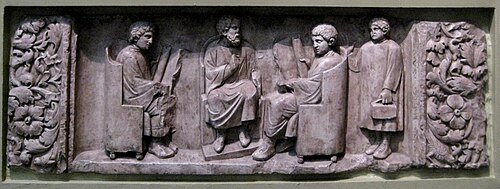
Traditional Roman education was moral and practical. Stories were meant to instil Roman values (mores maiorum). Parents were expected to act as role models, and working parents passed their skills to their children, who might also enter apprenticeships.[470] Young children were attended by a pedagogue, usually a Greek slave or former slave,[471] who kept the child safe, taught self-discipline and public behaviour, attended class and helped with tutoring.[472]
Formal education was available only to families who could pay for it; lack of state support contributed to low literacy.[473] Primary education in reading, writing, and arithmetic might take place at home if parents hired or bought a teacher.[474] Other children attended "public" schools organized by a schoolmaster (ludimagister) paid by parents.[475] Vernae (homeborn slave children) might share in-home or public schooling.[476] Boys and girls received primary education generally from ages 7 to 12, but classes were not segregated by grade or age.[477] Most schools employed corporal punishment.[478] For the socially ambitious, education in Greek as well as Latin was necessary.[479] Schools became more numerous during the Empire, increasing educational opportunities.[479]
.jpg/500px-MANNapoli_124545_plato's_academy_mosaic_(cropped).jpg)
At the age of 14, upperclass males made their rite of passage into adulthood, and began to learn leadership roles through mentoring from a senior family member or family friend.[480] Higher education was provided by grammatici or rhetores.[481] The grammaticus or "grammarian" taught mainly Greek and Latin literature, with history, geography, philosophy or mathematics treated as explications of the text.[482] With the rise of Augustus, contemporary Latin authors such as Virgil and Livy also became part of the curriculum.[483] The rhetor was a teacher of oratory or public speaking. The art of speaking (ars dicendi) was highly prized, and eloquentia ("speaking ability, eloquence") was considered the "glue" of civilized society.[484] Rhetoric was not so much a body of knowledge (though it required a command of the literary canon[485]) as it was a mode of expression that distinguished those who held social power.[486] The ancient model of rhetorical training—"restraint, coolness under pressure, modesty, and good humour"[487]—endured into the 18th century as a Western educational ideal.[488]
In Latin, illiteratus could mean both "unable to read and write" and "lacking in cultural awareness or sophistication".[489] Higher education promoted career advancement.[490] Urban elites throughout the Empire shared a literary culture imbued with Greek educational ideals (paideia).[491] Hellenistic cities sponsored schools of higher learning to express cultural achievement.[492] Young Roman men often went abroad to study rhetoric and philosophy, mostly to Athens. The curriculum in the East was more likely to include music and physical training.[493] On the Hellenistic model, Vespasian endowed chairs of grammar, Latin and Greek rhetoric, and philosophy at Rome, and gave secondary teachers special exemptions from taxes and legal penalties.[494] In the Eastern Empire, Berytus (present-day Beirut) was unusual in offering a Latin education, and became famous for its school of Roman law.[495] The cultural movement known as the Second Sophistic (1st–3rd century AD) promoted the assimilation of Greek and Roman social, educational, and esthetic values.[496]
Literate women ranged from cultured aristocrats to girls trained to be calligraphers and scribes.[497][498] The ideal woman in Augustan love poetry was educated and well-versed in the arts.[499] Education seems to have been standard for daughters of the senatorial and equestrian orders.[476] An educated wife was an asset for the socially ambitious household.[497]
Literature
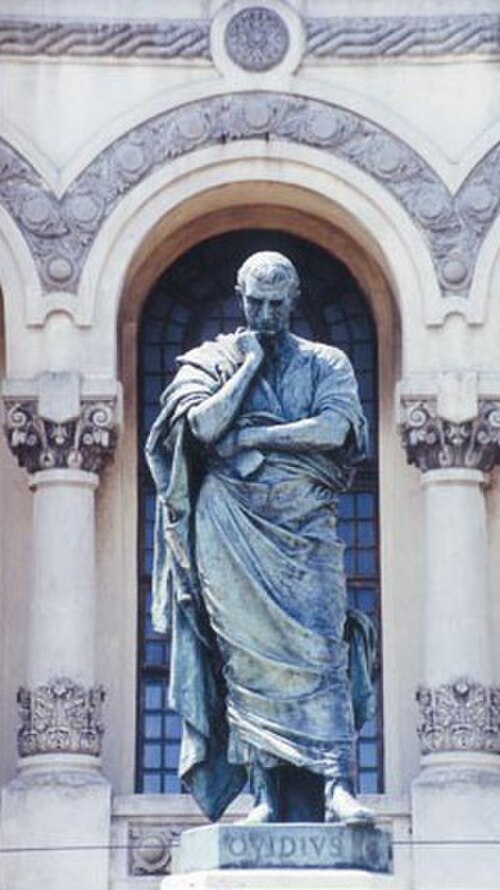
Literature under Augustus, along with that of the Republic, has been viewed as the "Golden Age" of Latin literature, embodying classical ideals.[500] The three most influential Classical Latin poets—Virgil, Horace, and Ovid—belong to this period. Virgil's Aeneid was a national epic in the manner of the Homeric epics of Greece. Horace perfected the use of Greek lyric metres in Latin verse. Ovid's erotic poetry was enormously popular, but ran afoul of Augustan morality, contributing to his exile. Ovid's Metamorphoses wove together Greco-Roman mythology; his versions of Greek myths became a primary source of later classical mythology, and his work was hugely influential on medieval literature.[501] The early Principate produced satirists such as Persius and Juvenal.
The mid-1st through mid-2nd century has conventionally been called the "Silver Age" of Latin literature. The three leading writers—Seneca, Lucan, and Petronius—committed suicide after incurring Nero's displeasure. Epigrammatist and social observer Martial and the epic poet Statius, whose poetry collection Silvae influenced Renaissance literature,[502] wrote during the reign of Domitian. Other authors of the Silver Age included Pliny the Elder, author of the encyclopedic Natural History; his nephew, Pliny the Younger; and the historian Tacitus.
The principal Latin prose author of the Augustan age is the historian Livy, whose account of Rome's founding became the most familiar version in modern-era literature. The Twelve Caesars by Suetonius is a primary source for imperial biography. Among Imperial historians who wrote in Greek are Dionysius of Halicarnassus, Josephus, and Cassius Dio. Other major Greek authors of the Empire include the biographer Plutarch, the geographer Strabo, and the rhetorician and satirist Lucian.
From the 2nd to the 4th centuries, Christian authors were in active dialogue with the classical tradition. Tertullian was one of the earliest prose authors with a distinctly Christian voice. After the conversion of Constantine, Latin literature is dominated by the Christian perspective.[503] In the late 4th century, Jerome produced the Latin translation of the Bible that became authoritative as the Vulgate. Around that same time, Augustine wrote The City of God against the Pagans, considered "a masterpiece of Western culture".[504]
In contrast to the unity of Classical Latin, the literary esthetic of late antiquity has a tessellated quality.[505] A continuing interest in the religious traditions of Rome prior to Christian dominion is found into the 5th century, with the Saturnalia of Macrobius and The Marriage of Philology and Mercury of Martianus Capella. Latin poets of late antiquity include Ausonius, Prudentius, Claudian, and Sidonius Apollinaris.
Religion
The Romans thought of themselves as highly religious, and attributed their success to their collective piety (pietas) and good relations with the gods (pax deorum). The archaic religion believed to have come from the earliest kings of Rome was the foundation of the mos maiorum, "the way of the ancestors", central to Roman identity.[506]
Roman religion was practical and contractual, based on the principle of do ut des, "I give that you might give". Religion depended on knowledge and the correct practice of prayer, ritual, and sacrifice, not on faith or dogma, although Latin literature preserves learned speculation on the nature of the divine. For ordinary Romans, religion was a part of daily life.[507] Each home had a household shrine to offer prayers and libations to the family's domestic deities. Neighbourhood shrines and sacred places such as springs and groves dotted the city. The Roman calendar was structured around religious observances; as many as 135 days were devoted to religious festivals and games (ludi).[508]
In the wake of the Republic's collapse, state religion adapted to support the new regime. Augustus justified one-man rule with a vast programme of religious revivalism and reform. Public vows now were directed at the wellbeing of the emperor. So-called "emperor worship" expanded on a grand scale the traditional veneration of the ancestral dead and of the Genius, the divine tutelary of every individual. Upon death, an emperor could be made a state divinity (divus) by vote of the Senate. The Roman imperial cult, influenced by Hellenistic ruler cult, became one of the major ways Rome advertised its presence in the provinces and cultivated shared cultural identity. Cultural precedent in the Eastern provinces facilitated a rapid dissemination of Imperial cult, extending as far as Najran, in present-day Saudi Arabia.[w] Rejection of the state religion became tantamount to treason.
The Romans are known for the great number of deities they honoured. As the Romans extended their territories, their general policy was to promote stability among diverse peoples by absorbing local deities and cults rather than eradicating them,[x] building temples that framed local theology within Roman religion. Inscriptions throughout the Empire record the side-by-side worship of local and Roman deities, including dedications made by Romans to local gods.[510] By the height of the Empire, numerous syncretic or reinterpreted gods were cultivated, among them cults of Cybele, Isis, Epona, and of solar gods such as Mithras and Sol Invictus, found as far north as Roman Britain. Because Romans had never been obligated to cultivate one god or cult only, religious tolerance was not an issue.[511]
Mystery religions, which offered initiates salvation in the afterlife, were a matter of personal choice, practiced in addition to one's family rites and public religion. The mysteries, however, involved exclusive oaths and secrecy, which conservative Romans viewed with suspicion as characteristic of "magic", conspiracy (coniuratio), and subversive activity. Thus, sporadic and sometimes brutal attempts were made to suppress religionists. In Gaul, the power of the druids was checked, first by forbidding Roman citizens to belong to the order, and then by banning druidism altogether. However, Celtic traditions were reinterpreted within the context of Imperial theology, and a new Gallo-Roman religion coalesced; its capital at the Sanctuary of the Three Gauls established precedent for Western cult as a form of Roman-provincial identity.[512] The monotheistic rigour of Judaism posed difficulties for Roman policy that led at times to compromise and granting of special exemptions. Tertullian noted that Judaism, unlike Christianity, was considered a religio licita, "legitimate religion". The Jewish–Roman wars resulted from political as well as religious conflicts; the siege of Jerusalem in 70 AD led to the sacking of the temple and the dispersal of Jewish political power (see Jewish diaspora).

Christianity emerged in Roman Judaea as a Jewish religious sect in the 1st century and gradually spread out of Jerusalem throughout the Empire and beyond. Imperially authorized persecutions were limited and sporadic, with martyrdoms occurring most often under the authority of local officials.[513] Tacitus reports that after the Great Fire of Rome in AD 64, the emperor attempted to deflect blame from himself onto the Christians.[514] A major persecution occurred under the emperor Domitian[515] and a persecution in 177 took place at Lugdunum, the Gallo-Roman religious capital. A letter from Pliny the Younger, governor of Bithynia, describes his persecution and executions of Christians.[516] The Decian persecution of 246–251 seriously threatened the Christian Church, but ultimately strengthened Christian defiance.[517] Diocletian undertook the most severe persecution of Christians, from 303 to 311.[15]
From the 2nd century onward, the Church Fathers condemned the diverse religions practiced throughout the Empire as "pagan".[518] In the early 4th century, Constantine I became the first emperor to convert to Christianity. He supported the Church financially and made laws that favored it, but the new religion was already successful, having moved from less than 50,000 to over a million adherents between 150 and 250.[519] Constantine and his successors banned public sacrifice while tolerating other traditional practices. Constantine never engaged in a purge,[520] there were no "pagan martyrs" during his reign,[521] and people who had not converted to Christianity remained in important positions at court.[520]: 302 Julian attempted to revive traditional public sacrifice and Hellenistic religion, but met Christian resistance and lack of popular support.[522]

Christians of the 4th century believed the conversion of Constantine showed that Christianity had triumphed over paganism (in Heaven) and little further action besides such rhetoric was necessary.[524] Thus, their focus was heresy.[525][526] According to Peter Brown, "In most areas, polytheists were not molested, and apart from a few ugly incidents of local violence, Jewish communities also enjoyed a century of stable, even privileged, existence".[526]: 641–643 [527] There were anti-pagan laws, but they were not generally enforced; through the 6th century, centers of paganism existed in Athens, Gaza, Alexandria, and elsewhere.[528]
According to recent Jewish scholarship, toleration of the Jews was maintained under Christian emperors.[529] This did not extend to heretics:[529] Theodosius I made multiple laws and acted against alternate forms of Christianity,[530] and heretics were persecuted and killed by both the government and the church throughout Late Antiquity. Non-Christians were not persecuted until the 6th century. Rome's original religious hierarchy and ritual influenced Christian forms,[531][532] and many pre-Christian practices survived in Christian festivals and local traditions.
Legacy
The Virginia State Capitol (left), completed in 1788, was modelled after the Maison Carrée (right), in Nîmes, France, a Gallo-Roman temple built around 16 BC under Augustus.
Several states claimed to be the Roman Empire's successor. The Holy Roman Empire was established in 800 when Pope Leo III crowned Charlemagne as Roman emperor. The Russian Tsardom, as inheritor of the Byzantine Empire's Orthodox Christian tradition, counted itself the Third Rome (Constantinople having been the second), in accordance with the concept of translatio imperii.[533] The last Eastern Roman titular, Andreas Palaiologos, sold the title of Emperor of Constantinople to Charles VIII of France; upon Charles' death, Palaiologos reclaimed the title and on his death granted it to Ferdinand and Isabella and their successors, who never used it. When the Ottomans, who based their state on the Byzantine model, took Constantinople in 1453, Mehmed II established his capital there and claimed to sit on the throne of the Roman Empire.[534] He even launched an invasion of Otranto with the purpose of re-uniting the Empire, which was aborted by his death. In the medieval West, "Roman" came to mean the church and the Catholic Pope. The Greek form Romaioi remained attached to the Greek-speaking Christian population of the Byzantine Empire and is still used by Greeks.[535]
The Roman Empire's control of the Italian Peninsula influenced Italian nationalism and the unification of Italy (Risorgimento) in 1861.[536]
In the United States, the founders were educated in the classical tradition,[537] and used classical models for landmarks in Washington, D.C..[538][539][540][541] The founders saw Athenian democracy and Roman republicanism as models for the mixed constitution, but regarded the emperor as a figure of tyranny.[542]
See also


.svg/500px-Europe_(orthographic_projection).svg.png)
- Outline of ancient Rome
- List of political systems in France
- List of Roman dynasties
- Daqin ("Great Qin"), the ancient Chinese name for the Roman Empire; see also Sino-Roman relations
- Imperial Italy
- Byzantine Empire under the Justinian dynasty
Notes
- ^ Modern scholars often date the end of the "classical" or "unified" Roman Empire in AD 395.[1] This is a modern convention, as the Empire continued to be seen as a single state even after the supposed "split" of 395, which was in fact one of many splits since 286.[2]
- ^ Fig. 1. Regions east of the Euphrates were held only in the years 116–117.
- ^ In 286, Emperor Diocletian divided the Roman Empire into two administrative units–East and West–an arrangement that periodically returned until the two halves were permanently divided in 395.[4] Although the halves were independent in practice, the Romans continued to consider the Roman Empire to be a single undivided state with two co-equal emperors until the fall of the western half in 476/480.[4] Although emperors at times governed from other cities (notably Mediolanum and Ravenna in the West and Nicomedia in the East), Rome remained the de jure capital of the entire Roman Empire. In 330, Emperor Constantine I made Constantinople a second and new capital of the empire ("Second Rome" or "New Rome").[5][6][7][8][9][10] For a time, mostly over the course of the later decades of the fourth century, Rome continued to hold greater symbolic status on account of its greater antiquity as imperial capital.[11] From at least 361 onwards, senators belonging to the new senate in Constantinople enjoyed the same status and privileges as senators of the Roman Senate, to which the new senate was largely identical.[12] By 450, Constantinople was much grander in size and adornment than Rome and unquestionably senior in status.[13]
- ^ In 1204, the crusaders of the Fourth Crusade captured Constantinople and established the Latin Empire. The city remained under foreign rule until 1261, when it was captured by the Empire of Nicaea (a Byzantine/Roman successor state). Nicaea is usually considered the "legitimate" continuation of the Roman Empire during the "interregnum" 1204–1261 (over its rivals in Trebizond and Thessalonica) since it managed to retake Constantinople.[14] Whether there was an interregnum at all is debatable given that the crusaders envisioned the Latin Empire to be the same empire as its predecessor (and not a new state).[15]
- ^ Abbreviated "HS". Prices and values are usually expressed in sesterces.
- ^ The Ottomans sometimes called their state the "Empire of Rûm" (Ottoman Turkish: دولت علنإه روم, lit. 'Exalted State of Rome'). In this sense, it could be argued that a "Roman" Empire survived until the early 20th century.[20]
- ^ Augustus avoided any association with the ancient kings of Rome. Augustus had replaced his first name with Imperator, a title regularly used by Julius Caesar, thus becoming Imperator Caesar Augustus, which further linked the title with his position. Imperator did not acquire the meaning of "ruler" until the late 1st century.[28] Both Caesar and Augustus evolved into formal titles, the former denoting the heir and the latter the monarch. In some languages, Caesar became the origin of the word "emperor", such as in German (Kaiser) and some Slavic languages (Tsar).
- ^ Prudentius (348–413) in particular Christianizes the theme in his poetry.[59] St. Augustine, however, distinguished between the secular and eternal "Rome" in The City of God. See also Fears, J. Rufus (1981), "The Cult of Jupiter and Roman Imperial Ideology", Aufstieg und Niedergang der römischen Welt, vol. II, p. 136, on how Classical Roman ideology influenced Christian Imperial doctrine, Bang, Peter Fibiger (2011), "The King of Kings: Universal Hegemony, Imperial Power, and a New Comparative History of Rome", The Roman Empire in Context: Historical and Comparative Perspectives, John Wiley & Sons and the Greek concept of globalism (oikouménē).
- ^ It has been called a state of bilingualism but that's only true of the educated and so Bruno Rochette suggests it's more appropriate as a diglossia but concedes this still does not adequately explain it, as Greek was "high" against Latins "Super-high".[72] Latin experienced a period of spreading from the second century BCE, and especially in the western provinces, but not as much in the eastern provinces.[73] In the east, Greek was always the dominant language, a left over influence from the Hellenistic period that predates the Empire.[74][75]
- ^ The civis ("citizen") stands in explicit contrast to a peregrina, a foreign or non-Roman woman[122] In the form of legal marriage called conubium, the father's legal status determined the child's, but conubium required that both spouses be free citizens. A soldier, for instance, was banned from marrying while in service, but if he formed a long-term union with a local woman while stationed in the provinces, he could marry her legally after he was discharged, and any children they had would be considered the offspring of citizens—in effect granting the woman retroactive citizenship. The ban was in place from the time of Augustus until it was rescinded by Septimius Severus in 197 AD.[123]
- ^ The others are ancient Athens, and in the modern era Brazil, the Caribbean, and the United States
- ^ That senator was Tiberius Claudius Gordianus[166]
- ^ The relation of the equestrian order to the "public horse" and Roman cavalry parades and demonstrations (such as the Lusus Troiae) is complex, but those who participated in the latter seem, for instance, to have been the equites who were accorded the high-status (and quite limited) seating at the theatre by the Lex Roscia theatralis. Senators could not possess the "public horse".[168]
- ^ Ancient Gades, in Roman Spain (now Cádiz), and Patavium, in the Celtic north of Italy (now Padua), were atypically wealthy cities, and having 500 equestrians in one city was unusual.[170]
- ^ This practice was established in the Republic; see for instance the case of Contrebian water rights heard by G. Valerius Flaccus as governor of Hispania in the 90s–80s BC.
- ^ This was the vicesima libertatis, "the twentieth for freedom"[227]
- ^ The college of centonarii is an elusive topic in scholarship, since they are also widely attested as urban firefighters.[281][282] Historian Jinyu Liu sees them as "primarily tradesmen and/or manufacturers engaged in the production and distribution of low- or medium-quality woolen textiles and clothing, including felt and its products".[282]
- ^ Julius Caesar first applied the Latin word oppidum to this type of settlement, and even called Avaricum (Bourges, France), a center of the Bituriges, an urbs, "city". Archaeology indicates that oppida were centers of religion, trade (including import/export), and industrial production, walled for the purposes of defence, but they may not have been inhabited by concentrated populations year-round.[298]
- ^ Such as the Consualia and the October Horse sacrifice.[343]
- ^ Scholars are divided in their relative emphasis on the athletic and dance elements of these exercises: Lee, H. (1984). "Athletics and the Bikini Girls from Piazza Armerina". Stadion. 10: 45–75. sees them as gymnasts, while Torelli thinks they are dancers at the games.[380]
- ^ Clifford Ando posed the question as "what good would 'posted edicts' do in a world of low literacy?'.[440]
- ^ Political slogans and obscenities are widely preserved as graffiti in Pompeii: Antonio Varone, Erotica Pompeiana: Love Inscriptions on the Walls of Pompeii ("L'Erma" di Bretschneider, 2002). Soldiers sometimes inscribed sling bullets with aggressive messages: Phang, "Military Documents, Languages, and Literacy," p. 300.
- ^ The caesareum at Najaran was possibly known later as the "Kaaba of Najran"[509]
- ^ "This mentality," notes John T. Koch, "lay at the core of the genius of cultural assimilation which made the Roman Empire possible"; entry on "Interpretatio romana," in Celtic Culture: A Historical Encyclopedia (ABC-Clio, 2006), p. 974.
References
Citations
- ^ Morley, Neville (2010). The Roman Empire: Roots of Imperialism. Pluto Press. ISBN 978-0-7453-2870-6.; Diamond, Jared (2011). Collapse: How Societies Choose to Fail or Succeed (Revised ed.). Penguin. p. 13. ISBN 978-1-1015-0200-6.
- ^ Sandberg, Kaj (2008). "The So-Called Division of the Roman Empire in AD 395: Notes on a Persistent Theme in Modern Historiography". Arctos. 42: 199–213. ISSN 0570-734X.
- ^ Bennett (1997).
- ^ a b c d Ancient Rome: The Definitive Visual History. Dorling Kindersley. 2023. p. 276. ISBN 978-0-2416-3575-9. Archived from the original on 22 June 2023. Retrieved 26 April 2023. Cite error: The named reference ":1" was defined multiple times with different content (see the help page).
- ^ Classen, Albrecht (2010). "The changing shape of Europe". Handbook of Medieval Studies. Walter de Gruyter. ISBN 978-3-1102-1558-8. Archived from the original on 10 March 2024. Retrieved 26 April 2023.
Constantine the Great transferred the capital of the Roman Empire from Rome to the newly-founded city of Constantinople
- ^ Price, Jonathan J.; Finkelberg, Margalit; Shahar, Yuval (2022). Rome: An Empire of Many Nations. Cambridge University Press. p. 19. ISBN 978-1-0092-5622-3. Archived from the original on 22 June 2023. Retrieved 26 April 2023.
the capital of the Empire was transferred from Rome to Constantinople in the fourth century
- ^ Erdkamp, Paul (2013). The Cambridge Companion to Ancient Rome. Cambridge University Press. p. 202. ISBN 978-0-5218-9629-0.
Constantine sounded the death knell for Rome as a vital political centre with the dedication of his new imperial capital at Constantinople
- ^ Bjornlie, M. Shane (2013). Politics and Tradition Between Rome, Ravenna and Constantinople: A Study of Cassiodorus and the Variae, 527–554. Cambridge University Press. p. 41. ISBN 978-1-1070-2840-1. Archived from the original on 22 June 2023. Retrieved 26 April 2023.
As a new capital, Constantinople provided a stage for imperial prestige that did not depend on association with the traditions of the senatorial establishment at Rome
- ^ Coffler, Gail H. (2004). Melville's Allusions to Religion: A Comprehensive Index and Glossary: A Comprehensive Index and Glossary. ABC-CLIO. p. 181. ISBN 978-0-3130-7270-3. Archived from the original on 22 June 2023. Retrieved 26 April 2023.
It became Constantinople, capital of the entire Roman Empire
- ^ Maxwell, Kathleen (2016). "Art and Diplomacy in Late Thirteenth-century Constantinople: Paris 54 and the Union of Churches". Between Constantinople and Rome: An Illuminated Byzantine Gospel Book (Paris gr. 54) and the Union of Churches. Routledge. ISBN 978-1-3519-5584-3. Archived from the original on 22 June 2023. Retrieved 26 April 2023.
Constantine the Great, the emperor who moved the capital of the Roman Empire from Rome to Constantinople
- ^ Grig, Lucy; Kelly, Gavin (2012). Two Romes: Rome and Constantinople in Late Antiquity. Oxford University Press. p. 237. ISBN 978-0-1999-2118-8. Archived from the original on 10 March 2024. Retrieved 26 April 2023.
- ^ Loewenstein, K. (2012). The Governance of ROME. Springer. p. 443. ISBN 978-9-4010-2400-6. Archived from the original on 22 June 2023. Retrieved 26 April 2023.
- ^ Harris, Jonathan (2009). Constantinople: Capital of Byzantium. A&C Black. p. 31. ISBN 978-0-8264-3086-1. Archived from the original on 22 June 2023. Retrieved 26 April 2023.
- ^ Treadgold (1997), p. 734.
- ^ a b Tricht, Filip Van (2011). The Latin Renovatio of Byzantium: The Empire of Constantinople (1204–1228). Brill. pp. 61–82. ISBN 978-9-0042-0323-5. Archived from the original on 6 April 2023. Retrieved 26 April 2023.
- ^ a b c d Taagepera, Rein (1979). "Size and Duration of Empires: Growth-Decline Curves, 600 B.C. to 600 A.D". Social Science History. 3 (3/4): 125. doi:10.2307/1170959. ISSN 0145-5532. JSTOR 1170959.
- ^ a b Turchin, Peter; Adams, Jonathan M.; Hall, Thomas D. (2006). "East-West Orientation of Historical Empires" (PDF). Journal of World-Systems Research. 12 (2): 222. Archived from the original (PDF) on 17 May 2016. Retrieved 5 February 2016.
- ^ Durand, John D. (1977). "Historical Estimates of World Population: An Evaluation". Population and Development Review. 3 (3): 253–296. doi:10.2307/1971891. JSTOR 1971891. Archived from the original on 16 October 2019. Retrieved 30 October 2018.
- ^ "Imperial Rome vs. Provincial Rome: What's The Difference?". TheCollector. 7 October 2020. Retrieved 16 May 2024.
- ^ Roy, Kaushik (2014). Military Transition in Early Modern Asia, 1400–1750: Cavalry, Guns, Government and Ships. Bloomsbury Studies in Military History. Bloomsbury Publishing. p. 37. ISBN 978-1-7809-3800-4.
After the capture of Constantinople, the capital of the Byzantine Empire became the capital of the Ottoman Empire. The Osmanli Turks called their empire the Empire of Rum (Rome).
- ^ Kelly (2007), pp. 4ff; Nicolet (1991), pp. 1, 15; Brennan, T. Corey (2000). The Praetorship in the Roman Republic. Oxford University Press. p. 605. Peachin (2011), pp. 39–40.
- ^ a b c Potter (2009), p. 179.
- ^ Nicolet (1991), pp. 1, 15.
- ^ a b Hekster, Olivier; Kaizer, Ted (16–19 April 2009). "Preface". Frontiers in the Roman World: Proceedings of the Ninth Workshop of the International Network Impact of Empire. Brill: viii.
- ^ Lintott, Andrew (1999). The Constitution of the Roman Republic. Oxford University Press. p. 114.; Eder, W. (1993). "The Augustan Principate as Binding Link". Between Republic and Empire. University of California Press. p. 98. ISBN 0-5200-8447-0.
- ^ Richardson, John (2011). "Fines provincial". Frontiers in the Roman World. Brill. p. 10.
- ^ Richardson (2011), pp. 1–2.
- ^ Hornblower, Simon; Spawforth, Antony; Eidinow, Esther (2012). "Imperator". The Oxford Classical Dictionary. pp. 728–729. doi:10.1093/acrefore/9780199381135.013.3268. ISBN 978-0-1995-4556-8.
- ^ Syme, Ronald (1939). The Roman Revolution. Oxford University Press. pp. 3–4.
- ^ Eck, Werner; Takács, Sarolta A. (2007), The Age of Augustus, translated by Deborah Lucas Schneider (2nd ed.), Oxford: Blackwell Publishing, pp. 148–158, ISBN 978-1-4051-5149-8
- ^ A. Fear; P. Liddel, eds. (2010). "The Glory of Italy and Rome's Universal Destiny in Strabo's Geographika". Historiae Mundi. Studies in Universal History. London: Duckworth. pp. 87–101. Retrieved 20 November 2021.
- ^ Keaveney, Arthur (January 1987). Arthur Keaveney: Rome and the Unification of Italy. Croom Helm. ISBN 9780709931218. Retrieved 20 November 2021.
- ^ Billanovich, Giuseppe (2008). Libreria Universitaria Hoepli, Lezioni di filologia, Giuseppe Billanovich e Roberto Pesce: Corpus Iuris Civilis, Italia non erat provincia, sed domina provinciarum, Feltrinelli, p.363 (in Italian). Roberto Pesce. ISBN 9788896543092. Retrieved 20 November 2021.
- ^ Bleicken, Jochen (15 October 2015). Italy: the absolute center of the Republic and the Roman Empire. Penguin UK. ISBN 9780241003909. Retrieved 20 November 2021.
- ^ Morcillo, Martha García (2010). "The Roman Italy: Rectrix Mundi and Omnium Terrarum Parens". In A. Fear; P. Liddel (eds.). Historiae Mundi. Studies in Universal History. London: Bloomsbury. ISBN 9781472519801. Retrieved 20 November 2021.
- ^ Altri nomi e appellativi relazionati allo status dell'Italia in epoca romana (in Italian). Bloomsbury. 20 November 2013. ISBN 9781472519801. Retrieved 20 November 2021.
- ^ "Antico appellativo dell'Italia romana: Italia Omnium Terrarum Parens" (in Italian). Retrieved 20 November 2021.
- ^ Boatwright, Mary T. (2000). Hadrian and the Cities of the Roman Empire. Princeton University Press. p. 4.
- ^ "Five Good Emperors". www.britannica.com. 10 June 2024. Retrieved 4 August 2024.
- ^ Dio Cassius, Roman History, translated by Cary, E. (Loeb Classical Library edition, 1927 ed.), p. 72.36.4
- ^ Gibbon, Edward (1776), "The Decline And Fall in the West – Chapter 4", The History of the Decline And Fall of the Roman Empire, archived from the original on 24 August 2017, retrieved 27 June 2017
- ^ Goldsworthy (2009), p. 50.
- ^ Brown, Peter (1971). The World of Late Antiquity. Harcourt Brace Jovanovich. p. 22. ISBN 978-0-1519-8885-3.
- ^ Goldsworthy (2009), pp. 405–415.
- ^ "Diocletian - Reorganization, Tetrarchy, Edict | Britannica". www.britannica.com. Retrieved 4 August 2024.
- ^ Potter, David (2004). The Roman Empire at Bay. Routledge. pp. 296–298. ISBN 978-0-4151-0057-1.
- ^ Starr, Chester G. (1974) [1965]. A History of the Ancient World (2nd ed.). Oxford University Press. pp. 670–678. ISBN 978-0-1950-1814-1.
- ^ Bury, John Bagnall (1923). History of the Later Roman Empire. Dover Books. pp. 295–297. Archived from the original on 13 July 2021. Retrieved 19 February 2021.
- ^ Bury (1923), pp. 312–313.
- ^ a b Scholl, Christian (2017). Transcultural approaches to the concept of imperial rule in the Middle Ages. Peter Lang AG. ISBN 978-3-6530-5232-9.
Odoacer, who dethroned the last Roman emperor Romulus Augustulus in 476, used neither the imperial insignia nor the colour purple; they were used exclusively by the emperor in Byzantium.
- ^ a b Peter, Heather. "The Fall of Rome". BBC. Archived from the original on 28 March 2020. Retrieved 11 February 2020.
- ^ Gibbon, Edward (1776). "Gothic Kingdom of Italy. – Part II." (ebook). In Widger, David (ed.). History Of The Decline And Fall Of The Roman Empire. Harper & Brothers. Archived from the original on 30 August 2017. Retrieved 11 February 2020 – via Project Gutenberg.
The patrician Orestes had married the daughter of Count Romulus, of Petovio in Noricum: the name of Augustus, notwithstanding the jealousy of power, was known at Aquileia as a familiar surname; and the appellations of the two great founders, of the city and of the monarchy, were thus strangely united in the last of their successors", "The life of this inoffensive youth was spared by the generous clemency of Odoacer; who dismissed him, with his whole family, from the Imperial palace.
- ^ Gibbon, Edward (1776). "Gothic Kingdom of Italy. – Part II.". The Decline and Fall of the Roman Empire. Archived from the original on 30 August 2017. Retrieved 11 February 2020 – via Project Gutenberg.
The republic (they repeat that name without a blush) might safely confide in the civil and military virtues of Odoacer; and they humbly request, that the emperor would invest him with the title of Patrician, and the administration of the diocese of Italy. ...His vanity was gratified by the title of sole emperor, and by the statues erected to his honor in the several quarters of Rome; ...He entertained a friendly, though ambiguous, correspondence with the patrician Odoacer; and he gratefully accepted the Imperial ensigns.
- ^ Ozgen, Korkut. "Mehmet II". TheOttomans.org. Archived from the original on 30 April 2015. Retrieved 3 April 2007.; Cartwright, Mark (23 January 2018). "1453: The Fall of Constantinople". World History Encyclopedia. Archived from the original on 12 April 2021. Retrieved 11 February 2020.
- ^ Nicolle 2000, p. 85.
- ^ Kelly (2007), p. 3.
- ^ Nicolet (1991), p. 29.
- ^ Nicolet (1991), p. 29; Virgil, p. 1.278; Mattingly, David J. (2011). Imperialism, Power, and Identity: Experiencing the Roman Empire. Princeton University Press. p. 15.; Moretti, G (1993), "The Other World and the 'Antipodes': The Myth of Unknown Countries between Antiquity and the Renaissance", in de Gruyter, Walter (ed.), The Classical Tradition and the Americas: European Images of the Americas, p. 257; Southern, Pat (2001). The Roman Empire from Severus to Constantine. Routledge. pp. 14–16. ISBN 978-0-4152-3943-1.
- ^ Mastrangelo, Marc (2008). The Roman Self in Late Antiquity: Prudentius and the Poetics of the Soul. Johns Hopkins University Press. pp. 73, 203.
- ^ Mosley, Stephen (2010). The Environment in World History. Routledge. p. 35.
- ^ Nicolet (1991), pp. 7, 8.
- ^ Nicolet (1991), pp. 9, 16.
- ^ Nicolet (1991), pp. 10, 11.
- ^ a b Southern (2001), pp. 14–16.
- ^ a b Kelly (2007), p. 1.
- ^ a b Morris & Scheidel (2009), p. 184.
- ^ Goldsmith, Raymond W. (2005). "An Estimate of the Size And Structure of the National Product of the Early Roman Empire". Review of Income and Wealth. 30 (3): 263–288. doi:10.1111/j.1475-4991.1984.tb00552.x.
- ^ Scheidel, Walter (April 2006). "Population and demography" (PDF). Princeton/Stanford Working Papers in Classics. p. 9. Archived (PDF) from the original on 13 November 2018. Retrieved 25 July 2009.; Hanson, J. W.; Ortman, S. G. (2017). "A systematic method for estimating the populations of Greek and Roman settlements". Journal of Roman Archaeology. 30: 301–324. doi:10.1017/S1047759400074134. S2CID 165770409.
- ^ a b Boardman (2000), p. 721.
- ^ Hanson, J.W.; et al. (2017). "Urbanism and the division of labour in the Roman Empire". Journal of the Royal Society, Interface. 14 (136). doi:10.1098/rsif.2017.0367. PMC 5721147. PMID 29142013.
- ^ Woolf, Greg, ed. (2003). Cambridge Illustrated History of the Roman World. Ivy Press. p. 340.; Opper, Thorsten (2008). Hadrian: Empire and Conflict. Harvard University Press. p. 64.; Fields, Nic (2003). Hadrian's Wall AD 122–410, which was, of course, at the bottom of Hadrian's garden. Osprey Publishing. p. 35.
- ^ Rochette (2018), p. 123.
- ^ Rochette (2012), pp. 562–563.
- ^ Rochette (2018), p. 108.
- ^ Millar, Fergus (2006). A Greek Roman Empire: Power and Belief under Theodosius II (408–450). University of California Press. p. 279. ISBN 0-5209-4141-1.; Treadgold (1997), pp. 5–7
- ^ Rochette (2018), p. 117.
- ^ Wallace-Hadrill, Andrew (2010). Rome's cultural revolution (Repr. with corr ed.). Cambridge: Cambridge Univ. Press. p. 60. ISBN 978-0-5217-2160-8.
- ^ Rochette (1997, 2010, 1996, 1998, 2000, 2007), J. N. Adams (2003), Kearsley and Evans (2001), Binder (2000: 21–48), Rizakis (1995, 2008), Holford-Strevens (1993), Petersmann (1992), Dubuisson (1981, 1992a, 1992b), Millar (2006a: 84–93), Mullen (2011), Garcea (2019), Fournet (2019), Rapp (2019), Nocchi Macedo(2019), Pellizzari (2019), Rhoby (2019), Ghiretti (1996), García Domingo (1983), Zgusta (1980), Kaimio (1979a, 1979b), Hahn (1906), Mullen and James (2012), Stein (1915: 132–186) as cited in Dickey, Eleanor (2023). Latin Loanwords in Ancient Greek: A Lexicon and Analysis (1st ed.). Cambridge University Press. p. 4. doi:10.1017/9781108888387. ISBN 978-1-1088-8838-7. S2CID 258920619. Archived from the original on 9 February 2024. Retrieved 17 August 2023.
- ^ Rochette (2012), p. 556; Adams (2003), p. 200.
- ^ Feeney, Denis (2016). Beyond Greek: The Beginnings of Latin Literature. Harvard University Press. ISBN 978-0-6744-9604-0. Archived from the original on 4 October 2023. Retrieved 17 August 2023.
- ^ Dickey, Eleanor (2023). Latin Loanwords in Ancient Greek: A Lexicon and Analysis. Cambridge University Press. p. 651. ISBN 978-1-1088-9734-1. Archived from the original on 4 October 2023. Retrieved 17 August 2023.
- ^ Batstone, William W. (2006). "Literature". In Rosenstein, Nathan; Morstein-Marx, Robert (eds.). A Companion to the Roman Republic (1 ed.). Wiley. pp. 543–564. doi:10.1002/9780470996980.ch25. ISBN 978-1-4051-0217-9. Archived from the original on 18 July 2023. Retrieved 17 August 2023.
- ^ Freeman (2000), p. 438.
- ^ Cicero. In Catilinam. Vol. I 61 "recto" (Rylands Papyri ed.). p. 2.15.
- ^ Adams 2003, pp. 188, 197; Freeman 2000, p. 394; Rochette 2012, p. 549
- ^ Bloomer, W. Martin (1997). Latinity and Literary Society at Rome. University of Pennsylvania Press. p. 4. ISBN 978-0-8122-3390-2. Archived from the original on 4 October 2023. Retrieved 17 August 2023.
- ^ Rochette (2018), p. 122.
- ^ La Bua, Giuseppe (2019). Cicero and Roman education: the reception of the speeches and ancient scholarship. Cambridge (GB): Cambridge University Press. pp. 329ff. ISBN 978-1-1070-6858-2.
- ^ Adams (2003), p. 205.
- ^ Rochette 2023, p. 263, 268; Rochette 2018, pp. 114–115, 118.
- ^ Rochette (2018).
- ^ Adams (2003), pp. 185–186, 205.
- ^ a b Treadgold (1997), pp. 5–7.
- ^ Rochette (2018), pp. 108–109.
- ^ Carlton, Charles Merritt (1973). A linguistic analysis of a collection of late Latin documents composed in Ravenna between A.D. 445–700. doi:10.1515/9783111636221. ISBN 978-3-1116-3622-1. Archived from the original on 10 March 2024. Retrieved 17 August 2023.
"page 37. According to Pei & Gaeng (1976: 76–81), the decisive moment came with the Islamic conquest of North Africa and Iberia, which was followed by numerous raids on land and by sea. All this had the effect of disrupting connections between the western Romance-speaking regions.
- ^ a b c Miles, Richard (2000). "Communicating Culture, Identity, and Power". Experiencing Power: Culture, Identity and Power in the Roman Empire. Routledge. pp. 58–60. ISBN 0-4152-1285-5.
- ^ Rochette (2012), p. 550; Zimmer, Stefan (2006). "Indo-European". Celtic Culture: A Historical Encyclopedia. ABC-Clio. p. 961.
- ^ a b Curchin, Leonard A. (1995). "Literacy in the Roman Provinces: Qualitative and Quantitative Data from Central Spain". The American Journal of Philology. 116 (3): 461–476 (464). doi:10.2307/295333. JSTOR 295333.
- ^ Rochette (2012), pp. 558–559.
- ^ Adams (2003), p. 199.
- ^ Hist. Franc., book I, 32 Veniens vero Arvernos, delubrum illud, quod Gallica lingua Vasso Galatæ vocant, incendit, diruit, atque subvertit. And coming to Clermont [to the Arverni] he set on fire, overthrew and destroyed that shrine which they call Vasso Galatæ in the Gallic tongue,
- ^ Hélix, Laurence (2011). Histoire de la langue française. Ellipses Edition Marketing S.A. p. 7. ISBN 978-2-7298-6470-5.
Le déclin du Gaulois et sa disparition ne s'expliquent pas seulement par des pratiques culturelles spécifiques: Lorsque les Romains conduits par César envahirent la Gaule, au 1er siecle avant J.-C., celle-ci romanisa de manière progressive et profonde. Pendant près de 500 ans, la fameuse période gallo-romaine, le gaulois et le latin parlé coexistèrent; au VIe siècle encore; le temoignage de Grégoire de Tours atteste la survivance de la langue gauloise.
- ^ Guiter, Henri (1995). "Sur le substrat gaulois dans la Romania". In Bochnakowa, Anna; Widlak, Stanislan (eds.). Munus amicitae. Studia linguistica in honorem Witoldi Manczak septuagenarii. Krakow.; Roegiest, Eugeen (2006). Vers les sources des langues romanes: Un itinéraire linguistique à travers la Romania. Acco. p. 83.; Savignac, Jean-Paul (2004). Dictionnaire Français-Gaulois. La Différence. p. 26.; Matasovic, Ranko (2007). "Insular Celtic as a Language Area". Papers from the Workshop within the Framework of the XIII International Congress of Celtic Studies. The Celtic Languages in Contact: 106.; Adams, J. N. (2007). "V – Regionalisms in provincial texts: Gaul". The Regional Diversification of Latin 200 BC – AD 600. pp. 279–289. doi:10.1017/CBO9780511482977. ISBN 978-0-5114-8297-7.
- ^ Trask, R. L. (1997). The history of Basque. Routledge. ISBN 0-4151-3116-2. OCLC 34514667.
- ^ Bard, Kathryn A., ed. (2005). Encyclopedia of the Archaeology of Ancient Egypt. Routledge. pp. 252–254. ISBN 978-1-1346-6525-9.; Bard, Kathryn A. (2015). An Introduction to the Archaeology of Ancient Egypt. John Wiley & Sons. p. 325. ISBN 978-0-4706-7336-2.
- ^ Peachin (2011), p. 12.
- ^ Peachin (2011), p. 16.
- ^ Peachin (2011), p. 9.
- ^ a b c d e f g Garnsey, Peter; Saller, Richard. The Roman Empire: Economy, Society and Culture. University of California Press. pp. 107–111.
- ^ Noreña, Carlos F. (2011). Imperial Ideals in the Roman West: Representation, Circulation, Power. Cambridge University Press. p. 7.
- ^ Peachin (2011), pp. 4–5.
- ^ Winterling (2009), pp. 11, 21.
- ^ Saller, Richard P. (2002) [1982]. Personal Patronage under the Early Empire. Cambridge University Press. pp. 123, 176, 183.; Duncan, Anne (2006). Performance and Identity in the Classical World. Cambridge University Press. p. 164.
- ^ Reinhold, Meyer (2002). Studies in Classical History and Society. Oxford University Press. pp. 25ff, 42.
- ^ Boardman (2000), p. 18.
- ^ Peachin (2011), pp. 17, 20.
- ^ Millar (2012), pp. 81–82.
- ^ Carroll, Maureen (2006). Spirits of the Dead: Roman Funerary Commemoration in Western Europe. Oxford University Press. pp. 45–46.
- ^ Frier & McGinn (2004), p. 14; Gaius, Institutiones 1.9 Digest 1.5.3.
- ^ Frier & McGinn (2004), pp. 31–32.
- ^ Potter (2009), p. 177.
- ^ Sherwin-White, A.N. (1979), Roman Citizenship, Oxford University Press, pp. 211, 268; Frier & McGinn (2004), pp. 31–32, 457
- ^ Phang, Sara Elise (2001). The Marriage of Roman Soldiers (13 B.C.–A.D. 235): Law and Family in the Imperial Army. Brill. p. 2.; Southern, Pat (2006). The Roman Army: A Social and Institutional History. Oxford University Press. p. 144.
- ^ Rawson (1987), p. 18.
- ^ Frier & McGinn (2004), p. 461; Boardman (2000), p. 733.
- ^ Woodhull, Margaret L. (2004). "Matronly Patrons in the Early Roman Empire: The Case of Salvia Postuma". Women's Influence on Classical Civilization. Routledge. p. 77.
- ^ Frier & McGinn (2004), pp. 19–20.
- ^ Cantarella, Eva (1987). Pandora's Daughters: The Role and Status of Women in Greek and Roman Antiquity. Johns Hopkins University Press. pp. 140–141.; Sullivan, J.P. (1979). "Martial's Sexual Attitudes". Philologus. 123 (1–2): 296. doi:10.1524/phil.1979.123.12.288. S2CID 163347317.
- ^ Rawson (1987), p. 15.
- ^ Frier & McGinn (2004), pp. 19–20, 22.
- ^ Treggiari, Susan (1991). Roman Marriage: 'Iusti Coniuges' from the Time of Cicero to the Time of Ulpian. Oxford University Press. pp. 258–259, 500–502. ISBN 0-1981-4939-5.
- ^ Johnston, David (1999). "3.3". Roman Law in Context. Cambridge University Press.; Frier & McGinn (2004), Ch. IV; Thomas, Yan (1991). "The Division of the Sexes in Roman Law". A History of Women from Ancient Goddesses to Christian Saints. Harvard University Press. p. 134.
- ^ Severy, Beth (2002). Augustus and the Family at the Birth of the Empire. Routledge. p. 12. ISBN 1-1343-9183-8.
- ^ Severy (2002), p. 4.
- ^ McGinn, Thomas A. J. (1991). "Concubinage and the Lex Iulia on Adultery". Transactions of the American Philological Association. 121: 335–375 (342). doi:10.2307/284457. JSTOR 284457.; Mussbaum, Martha C. (2002). "The Incomplete Feminism of Musonius Rufus, Platonist, Stoic, and Roman". The Sleep of Reason: Erotic Experience and Sexual Ethics in Ancient Greece and Rome. University of Chicago Press. p. 305., noting that custom "allowed much latitude for personal negotiation and gradual social change"; Fantham, Elaine (2011). "Stuprum: Public Attitudes and Penalties for Sexual Offences in Republican Rome". Roman Readings: Roman Response to Greek Literature from Plautus to Statius and Quintilian. Walter de Gruyter. p. 124., citing Papinian, De adulteriis I and Modestinus, Liber Regularum I. Cantarella, Eva (2002) [1988 (Italian), 1992]. Bisexuality in the Ancient World. Yale University Press. p. 104.; Edwards (2007), pp. 34–35.
- ^ Grace, Angela (28 August 2015). "Fecunditas, Sterilitas, and the Politics of Reproduction at Rome". York Space.
- ^ a b Bradley (1994), p. 12.
- ^ Bradley (1994), p. 15.
- ^ Harris (1999), pp. 62–75; Taylor, Timothy (2010). "Believing the ancients: Quantitative and qualitative dimensions of slavery and the slave trade in later prehistoric Eurasia". World Archaeology. 33 (1): 27–43. arXiv:0706.4406. doi:10.1080/00438240120047618. S2CID 162250553.
- ^ Harper, Kyle (2011). Slavery in the Late Roman World, AD 275–425. Cambridge University Press. pp. 10–16.
- ^ Frier & McGinn (2004), p. 7.
- ^ McGinn, Thomas A.J. (1998). Prostitution, Sexuality and the Law in Ancient Rome. Oxford University Press. p. 314. ISBN 0-1951-6132-7.; Gardner, Jane F. (1991). Women in Roman Law and Society. Indiana University Press. p. 119.
- ^ Frier & McGinn (2004), pp. 31–33.
- ^ Frier & McGinn (2004), p. 21.
- ^ Gamauf, Richard (2009). "Slaves doing business: The role of Roman law in the economy of a Roman household". European Review of History. 16 (3): 331–346. doi:10.1080/13507480902916837. S2CID 145609520.
- ^ Bradley (1994), pp. 2–3.
- ^ Bradley (1994), p. 10.
- ^ Fuhrmann, C. J. (2012). Policing the Roman Empire: Soldiers, Administration, and Public Order. Oxford University Press. pp. 21–41. ISBN 978-0-1997-3784-0.
- ^ McGinn (1998), pp. 288ff.
- ^ Abusch, Ra'anan (2003). "Circumcision and Castration under Roman Law in the Early Empire". The Covenant of Circumcision: New Perspectives on an Ancient Jewish Rite. Brandeis University Press. pp. 77–78.; Schäfer, Peter (2003) [1983]. The History of the Jews in the Greco-Roman World. Routledge. p. 150.
- ^ Frier & McGinn (2004), p. 15; Goodwin, Stefan (2009). Africa in Europe: Antiquity into the Age of Global Expansion. Vol. 1. Lexington Books. p. 41. ISBN 978-0-7391-1726-2.
Roman slavery was a nonracist and fluid system
- ^ Santosuosso, Antonio (2001). Storming the Heavens: Soldiers, Emperors and Civilians in the Roman Empire. Westview Press. pp. 43–44. ISBN 0-8133-3523-X.
- ^ Noy, David (2000). Foreigners at Rome: Citizens and Strangers. Duckworth with the Classical Press of Wales. ISBN 978-0-7156-2952-9.
- ^ Harper, James (1972). "Slaves and Freedmen in Imperial Rome". American Journal of Philology. 93 (2): 341–342. doi:10.2307/293259. JSTOR 293259.
- ^ Harris (1999).
- ^ Rawson (1987), pp. 186–188, 190; Bradley (1994), pp. 34, 48–50
- ^ Millar, Fergus (2002) [1998]. The Crowd in Rome in the Late Republic. University of Michigan. pp. 23, 209. ISBN 0-4720-8878-5.
- ^ Mouritsen, Henrik (2011). The Freedman in the Roman World. Cambridge University Press. p. 36.
- ^ a b Berger, Adolf (1991) [1953]. "libertus". Encyclopedic Dictionary of Roman Law. American Philological Society. p. 564.
- ^ Lavan, Myles; Ando, Clifford (2021). Roman and Local Citizenship in the Long Second Century CE. Oxford University Press. ISBN 978-0-19-757390-7.
- ^ "Decurio | Military Officer, Legionary & Centurion | Britannica". www.britannica.com. Retrieved 4 August 2024.
- ^ Boardman (2000), pp. 217–218; Syme, Ronald (1999). Provincial at Rome: and Rome and the Balkans 80 BC – AD 14. University of Exeter Press. pp. 12–13. ISBN 0-8598-9632-3.
- ^ Boardman (2000), pp. 215, 221–222; Millar (2012), p. 88, The standard complement of 600 was flexible; twenty quaestors, for instance, held office each year and were thus admitted to the Senate regardless of whether there were "open" seats
- ^ a b Millar (2012), p. 88.
- ^ Boardman (2000), pp. 218–219.
- ^ Boardman (2000), p. 219.
- ^ MacMullen, Ramsay (1966). "Provincial Languages in the Roman Empire". The American Journal of Philology. 87 (1): 1–17. doi:10.2307/292973. JSTOR 292973.
- ^ Wiseman (1970), pp. 78–79.
- ^ Wiseman (1970), pp. 71–72, 76.
- ^ Strabo 3.169, 5.213
- ^ Wiseman (1970), pp. 75–76, 78.
- ^ Fear, Andrew (2007). "War and Society". The Cambridge History of Greek and Roman Warfare: Rome from the Late Republic to the Late Empire. Vol. 2. Cambridge University Press. pp. 214–215. ISBN 978-0-5217-8274-6.; Bennett (1997), p. 5.
- ^ Morris & Scheidel (2009), p. 188; Millar (2012), pp. 87–88.
- ^ Millar (2012), p. 96.
- ^ Liebeschuetz, Wolfgang (2001). "The End of the Ancient City". The City in Late Antiquity. Taylor & Francis. pp. 26–27.
- ^ Millar (2012), p. 90, calls them "status-appellations".
- ^ Millar (2012), p. 91.
- ^ Millar (2012), p. 90.
- ^ a b c Verboven, Koenraad (2007). "The Associative Order: Status and Ethos among Roman Businessmen in Late Republic and Early Empire". Athenaeum. 95: 870–872. hdl:1854/LU-395187. Archived from the original on 3 November 2018. Retrieved 13 January 2017.; Peachin (2011), pp. 153–154.
- ^ Peachin (2011), pp. 153–154; Perkins, Judith (2009). Early Christian and Judicial Bodies. Walter de Gruyter. pp. 245–246.; Peachin (2011), p. 475.
- ^ Peachin (2011), pp. 153–154.
- ^ Gaughan, Judy E. (2010). Murder Was Not a Crime: Homicide and Power in the Roman Republic. University of Texas Press. p. 91. ISBN 978-0-2927-2567-6.; Kelly, Gordon P. (2006). A History of Exile in the Roman Republic. Cambridge University Press. p. 8. ISBN 0-5218-4860-1.
- ^ a b c d Coleman, K. M. (2012). "Fatal Charades: Roman Executions Staged as Mythological Enactments". Journal of Roman Studies. 80: 44–73. doi:10.2307/300280. JSTOR 300280. S2CID 163071557.
- ^ Peachin (2011), pp. 153–154; Robinson, O.F. (2007). Penal Practice and Penal Policy in Ancient Rome. Routledge. p. 108.
- ^ Bohec (2000), p. 8.
- ^ Bohec (2000), pp. 14–15.
- ^ Plutarch, Moralia Moralia 813c and 814c; Potter (2009), pp. 181–182; Luttwak, Edward (1979) [1976]. The Grand Strategy of the Roman Empire. Johns Hopkins University Press. p. 30. ISBN 0-8018-2158-4.
- ^ Potter (2009), p. 184.
- ^ Potter (2009), p. 181.
- ^ Smith, William (1875). A Dictionary of Greek and Roman Antiquities. John Murray. pp. 105–106. Archived from the original on 13 July 2021. Retrieved 11 February 2020.
- ^ Abbott (1901), p. 354.
- ^ Abbott (1901), p. 345.
- ^ Abbott (1901), p. 341.
- ^ Millar, Fergus (2004). "Emperors at Work". Rome, the Greek World, and the East: Government, Society, and Culture in the Roman Empire. Vol. 2. University of North Carolina Press. pp. 3–22, especially 4, 20. ISBN 0-8078-5520-0.
- ^ Boardman (2000), pp. 195ff.
- ^ Boardman (2000), pp. 205–209.
- ^ Boardman (2000), pp. 202–203, 205, 210.
- ^ Boardman (2000), p. 211.
- ^ Boardman (2000), p. 212.
- ^ a b Millar (2012), p. 76.
- ^ Boardman (2000), p. 215.
- ^ Boardman (2000), p. 721; Winterling (2009), p. 16.
- ^ Goldsworthy (2003), p. 80.
- ^ Winterling (2009), p. 16.
- ^ Tignor, Robert; et al. (2011). Worlds Together, Worlds Apart: The History of the World (3rd ed.). W.W. Norton & Company. p. 262. ISBN 978-0-3939-3492-2.
- ^ Edmondson (1996), pp. 111–112.
- ^ Bohec (2000), p. 9.
- ^ Hekster, Olivier J. (2007). "Fighting for Rome: The Emperor as a Military Leader". Impact of the Roman Army (200 BC–AD 476). Brill. p. 96.
- ^ Roth, J. (1994). "The Size and Organization of the Roman Imperial Legion". Historia. 43 (3): 346–362.
- ^ Goldsworthy (2003), p. 183.
- ^ a b Morris & Scheidel (2009), p. 196.
- ^ Penrose, Jane (2005). "9: The Romans". Rome and Her Enemies: An Empire Created and Destroyed by War. Bloomsbury US. p. 183. ISBN 978-1-8417-6932-5.
Section 3: Early Empire 27 BC–AD 235
- ^ Tacitus Annales IV.5
- ^ Goldsworthy (2003), p. 51.
- ^ Connolly, Peter (1986). "A Reconstruction of a Roman Saddle". Britannia. 17: 353–355. doi:10.2307/526559. JSTOR 526559. S2CID 164155025.; Connolly, Peter; Van Driel-Murray, Carol (1991). "The Roman Cavalry Saddle". Britannia. 22: 33–50. doi:10.2307/526629. JSTOR 526629. S2CID 161535316.
- ^ Goldsworthy (2003), p. 114.
- ^ Potter (2009), p. 183.
- ^ Potter (2009), pp. 177–179, Most government records that are preserved come from Roman Egypt, where the climate preserved the papyri..
- ^ Potter (2009), p. 179, The exclusion of Egypt from the senatorial provinces dates to the rise of Octavian before he became Augustus: Egypt had been the stronghold of his last opposition, Mark Antony and his ally Cleopatra..
- ^ a b c Potter (2009), p. 180.
- ^ Potter (2009), pp. 179, 187.
- ^ Potter (2009), p. 180; Fuhrmann (2012), pp. 197, 214, 224
- ^ a b Potter (2009), pp. 184–185.
- ^ Bozeman, Adda B. (2010). Politics and Culture in International History from the Ancient Near East to the Opening of the Modern Age (2nd ed.). Transaction Publishers. pp. 208–220.
- ^ Digeser, Elizabeth DePalma (2000). The Making of a Christian Empire: Lactantius and Rome. Cornell University Press. p. 53.
- ^ Morris & Scheidel (2009), p. 183.
- ^ a b c d e Potter (2009), p. 187.
- ^ Potter (2009), pp. 185–187.
- ^ Morris & Scheidel (2009), p. 184; Potter (2009), p. 185.
- ^ Potter (2009), p. 185.
- ^ a b Potter (2009), p. 188.
- ^ Potter (2009), p. 186.
- ^ Cassius Dio 55.31.4.
- ^ Tacitus, Annales 13.31.2.
- ^ Potter (2009), pp. 286, 295.
- ^ Potter (2009), p. 286.
- ^ a b c Potter (2009), p. 285.
- ^ Potter (2009), p. 292.
- ^ Potter (2009), pp. 285–286, 296ff.
- ^ Potter (2009), p. 296.
- ^ Scheidel, Walter; Morris, Ian; Saller, Richard, eds. (2007). The Cambridge Economic History of the Greco-Roman World. Cambridge University Press. ISBN 978-0-5217-8053-7.
- ^ Lo Cascio, Elio; Malanima, Paolo (2009). "GDP in Pre-Modern Agrarian Economies (1–1820 AD). A Revision of the Estimates". Rivista di Storia Economica. 25 (3): 391–420 (391–401). Archived from the original on 16 January 2017. Retrieved 13 January 2017.
- ^ Maddison, Angus (2007). Contours of the World Economy, 1–2030 AD. Essays in Macro-Economic History. Oxford University Press. pp. 47–51. ISBN 978-0-1992-2721-1.
- ^ Dyson, Stephen L. (1992). Community and Society in Roman Italy. Johns Hopkins University Press. p. 177. ISBN 0-8018-4175-5. quoting Packer, J.E. Middle and Lower Class Housing in Pompeii and Herculaneum: A Preliminary Survey," In Neue Forschung in Pompeji. pp. 133–142.
- ^ Scheidel, Walter; Friesen, Steven J. (2010). "The Size of the Economy and the Distribution of Income in the Roman Empire" (PDF). Journal of Roman Studies. 99: 61–91. doi:10.3815/007543509789745223. S2CID 202968244. Archived (PDF) from the original on 13 November 2018. Retrieved 12 January 2017.
- ^ Fears, J. Rufus (1981). "The Theology of Victory at Rome: Approaches and Problem". Aufstieg und Niedergang der römischen Welt. Vol. II.17.2. pp. 752, 824., Fears, J. Rufus (1981). "The Cult of Virtues and Roman Imperial Ideology". Aufstieg und Niedergang der römischen Welt. Vol. II.17.2. p. 908.
- ^ a b Kessler, David; Temin, Peter (2010). "Money and Prices in the Early Roman Empire". The Monetary Systems of the Greeks and Romans. Oxford University Press.
- ^ a b c d Harl, Kenneth W. (19 June 1996). Coinage in the Roman Economy, 300 B.C. to A.D. 700. JHU Press. pp. 125–135. ISBN 978-0-8018-5291-6.
- ^ Bowman, Garnsey & Cameron (2005), p. 333.
- ^ Wells, Colin (1984). The Roman Empire. Harvard University Press. p. 8.
- ^ a b c d e f Harris (2010).
- ^ Scheidel, Walter (2009). "The Monetary Systems of the Han and Roman Empires". In Scheidel, Walter (ed.). Rome and China. Comparative Perspectives on Ancient World Empires. Oxford University Press. pp. 137–207 (205). ISBN 978-0-1953-3690-0.
- ^ Harris (2010); Andreau, Jean (1999). Banking and Business in the Roman World. Cambridge University Press. p. 2.
- ^ Tacitus, Annales 6.17.3.
- ^ Duncan-Jones (1994), pp. 3–4.
- ^ Edmondson, J. C. (1989). "Mining in the Later Roman Empire and beyond: Continuity or Disruption?". The Journal of Roman Studies. 79: 84–102. doi:10.2307/301182. ISSN 0075-4358. JSTOR 301182. S2CID 161980467.
- ^ Hirt, Alfred M. (2020). "Gold and Silver Mining in the Roman Empire". In Butcher, Kevin (ed.). Debasement. Manipulation of Coin Standards in Pre-Modern Monetary Systems (PDF). Oxford Philadelphia: Oxbow books. pp. 111–124. ISBN 9781789253986.
- ^ Wilson, Andrew (2002). "Machines, Power and the Ancient Economy". The Journal of Roman Studies. 92: 1–32. doi:10.2307/3184857. JSTOR 3184857. S2CID 154629776.
- ^ Craddock, Paul T. (2008). "Mining and Metallurgy". In Oleson, John Peter (ed.). The Oxford Handbook of Engineering and Technology in the Classical World. Oxford University Press. p. 108. ISBN 978-0-1951-8731-1.; Sim, David; Ridge, Isabel (2002). Iron for the Eagles. The Iron Industry of Roman Britain. Tempus. p. 23. ISBN 0-7524-1900-5.; Healy, John F. (1978). Mining and Metallurgy in the Greek and Roman World. Thames and Hudson. p. 196. ISBN 0-5004-0035-0. Assumes a productive capacity of c. 1.5 kg per capita.
- ^ Hong, S.; Candelone, J.-P.; Patterson, C. C.; Boutron, C. F. (1996). "History of Ancient Copper Smelting Pollution During Roman and Medieval Times Recorded in Greenland Ice". Science. 272 (5259): 246. Bibcode:1996Sci...272..246H. doi:10.1126/science.272.5259.246. S2CID 176767223.
- ^ Hong, S; Candelone, J. P.; Patterson, C. C.; Boutron, C. F. (1994). "Greenland ice evidence of hemispheric lead pollution two millennia ago by greek and roman civilizations" (PDF). Science. 265 (5180): 1841–1843. Bibcode:1994Sci...265.1841H. doi:10.1126/science.265.5180.1841. PMID 17797222. S2CID 45080402. Archived (PDF) from the original on 29 April 2019. Retrieved 12 January 2017.
- ^ a b De Callataÿ, François (2015). "The Graeco-Roman economy in the super long-run: Lead, copper, and shipwrecks". Journal of Roman Archaeology. 18: 361–372. doi:10.1017/S104775940000742X. S2CID 232346123.
- ^ Settle, D. M.; Patterson, C. C. (1980). "Lead in albacore: Guide to lead pollution in Americans". Science. 207 (4436): 1167–1176. Bibcode:1980Sci...207.1167S. doi:10.1126/science.6986654. PMID 6986654.
- ^ Patterson, C. C. (1972). "Silver Stocks and Losses in Ancient and Medieval Times". The Economic History Review. 25 (2): 205–235 (tables 2, 6). doi:10.1111/j.1468-0289.1972.tb02173.x.
- ^ Morris & Scheidel (2009), p. 197.
- ^ Greene, Kevin (1990). The Archaeology of the Roman Economy. University of California Press. p. 17. ISBN 978-0-5200-7401-9.
- ^ Boardman (2000), p. 714.
- ^ Ulrich, Roger Bradley (2007). Roman Woodworking. Yale University Press. pp. 1–2. ISBN 978-0-3001-0341-0.
- ^ Van Tilburg, Cornelis (2007). Traffic and Congestion in the Roman Empire. Routledge. p. 33.
- ^ a b c Stambaugh (1988), p. 253.
- ^ Ray Laurence, "Land Transport in Roman Italy: Costs, Practice and the Economy", in Trade, Traders and the Ancient City (Routledge, 1998), p. 129.
- ^ Boardman (2000), p. 713.
- ^ Boardman (2000), p. 710.
- ^ Boardman (2000), pp. 717–729.
- ^ Bowman, Garnsey & Cameron (2005), p. 404; Boardman (2000), p. 719.
- ^ Gagarin (2010), p. 323.
- ^ Temin, Peter (2004). "The Labor Market of the Early Roman Empire". Journal of Interdisciplinary History. 34 (4): 513–538. doi:10.1162/002219504773512525. S2CID 33380115.
- ^ Jones (1960), pp. 184–185.
- ^ a b Jones (1960), p. 192.
- ^ Jones (1960), pp. 190–191.
- ^ Vout (2009), p. 212.
- ^ a b Liu, Jinyu (2009). Collegia Centonariorum: The Guilds of Textile Dealers in the Roman West. Brill.
- ^ MacDonald, William L. (1982). The Architecture of the Roman Empire. Yale University Press. fig. 131B.; Lechtman, H. N.; Hobbs, L. W. (1987). "Roman Concrete and the Roman Architectural Revolution". Ceramics and Civilization. 3: 81–128.
- ^ "Apollodorus of Damascus". Britannica. 13 February 2024. Archived from the original on 21 May 2008. Retrieved 26 August 2012.; Sarton, George (1936). "The Unity and Diversity of the Mediterranean World". Osiris. 2: 406–463 (430). doi:10.1086/368462. S2CID 143379839.; Calcani, Giuliana; Abdulkarim, Maamoun (2003). Apollodorus of Damascus and Trajan's Column: From Tradition to Project. L'Erma di Bretschneider. p. 11. ISBN 978-8-8826-5233-3.; Yan, Hong-Sen; Ceccarelli, Marco (2009). International Symposium on History of Machines and Mechanisms: Proceedings of HMM 2008. Springer. p. 86. ISBN 978-1-4020-9484-2.
- ^ Smith, Norman (1970). "The Roman Dams of Subiaco". Technology and Culture. 11 (1): 58–68. doi:10.2307/3102810. JSTOR 3102810. S2CID 111915102.; Smith, Norman (1971). A History of Dams. Peter Davies. p. 26. ISBN 978-0-4321-5090-0.; Schnitter, Niklaus (1978). "Römische Talsperren". Antike Welt. 8 (2): 25–32 (28).
- ^ Chandler, Fiona (2001). The Usborne Internet Linked Encyclopedia of the Roman World. Usborne Publishing. p. 80.
- ^ Forman, Joan (1975). The Romans. Macdonald Educational. p. 34.
- ^ Crow, J. (2007). "Earth, walls and water in Late Antique Constantinople". In Lavan, L.; Zanini, E.; Sarantis, A. (eds.). Technology in Transition AD 300–650. Brill.
- ^ Greene, Kevin (1990). The Archaeology of the Roman Economy. University of California Press. p. 39. ISBN 978-0-5200-7401-9.
- ^ Jones & Bird (2012), pp. 59–74.
- ^ Ritti, Tullia; Grewe, Klaus; Kessener, Paul (2007). "A Relief of a Water-powered Stone Saw Mill on a Sarcophagus at Hierapolis and its Implications". Journal of Roman Archaeology. 20: 138–163 (156, fn. 74). doi:10.1017/S1047759400005341. S2CID 161937987.
- ^ Potter (2009), p. 192.
- ^ a b c Rehak, Paul (2006). Imperium and Cosmos: Augustus and the Northern Campus Martius. University of Wisconsin Press. pp. 4–8.
- ^ Stambaugh (1988), pp. 23ff, 244.
- ^ Raja, Rubina (2012). Urban Development and Regional Identity in the Eastern Roman Provinces 50 BC–AD 250. Museum Tusculanum Press. pp. 215–218.; Sperber, Daniel (1998). The City in Roman Palestine. Oxford University Press.
- ^ Stambaugh (1988), pp. 252, 253.
- ^ a b Longfellow, Brenda (2011). Roman Imperialism and Civic Patronage: Form, Meaning and Ideology in Monumental Fountain Complexes. Cambridge University Press. pp. 1–2. ISBN 978-0-5211-9493-8.
- ^ Harding, D.W. (2007). The Archaeology of Celtic Art. Routledge. pp. 211–212. ISBN 978-1-1342-6464-3.; Collis, John (2000). "'Celtic' Oppida". A Comparative Study of Thirty City-state Cultures. Danske Videnskabernes Selskab. pp. 229–238.; Celtic Chiefdom, Celtic State: The Evolution of Complex Social Systems. Cambridge University Press. 1999 [1995]. p. 61.
- ^ Potter (2009), p. 192; Virgil, p. 6.852
- ^ Potter (2009), pp. 185–186.
- ^ Jones (2003).
- ^ Evans, Harry B. (1994). Water Distribution in Ancient Rome. University of Michigan Press. pp. 9–10.
- ^ Peachin (2011), p. 366.
- ^ a b Fagan, Garrett G. (2001). "The Genesis of the Roman Public Bath: Recent Approaches and Future Directions" (PDF). American Journal of Archaeology. 105 (3): 403–426. doi:10.2307/507363. JSTOR 507363. S2CID 31943417. Archived from the original (PDF) on 24 February 2021. Retrieved 12 January 2017.
- ^ Ward, Roy Bowen (1992). "Women in Roman Baths". Harvard Theological Review. 85 (2): 125–147. doi:10.1017/S0017816000028820. S2CID 161983440.
- ^ Clarke (1991), pp. 1–2.
- ^ Clarke (1991), pp. 11–12.
- ^ Clarke (1991), p. 2.
- ^ Stambaugh (1988), pp. 144, 147; Clarke (1991), pp. 12, 17, 22ff
- ^ Gazda, Elaine K. (1991). "Introduction". Roman Art in the Private Sphere: Architecture and Décor of the Domus, Villa, and Insula. University of Michigan Press. p. 9. ISBN 0-4721-0196-X.
- ^ a b Clarke (1991), p. 19.
- ^ Jashemski, Wilhelmina Feemster; Meyer, Frederick G. (2002). The Natural History of Pompeii. Cambridge University Press. ISBN 978-0-5218-0054-9.
- ^ a b c d e f Morris & Scheidel (2009), p. 191.
- ^ Boardman (2000), p. 679.
- ^ Morris & Scheidel (2009), pp. 195–196.
- ^ Morris & Scheidel (2009), p. 191, reckoning that the surplus of wheat from the province of Egypt alone could meet and exceed the needs of the city of Rome and the provincial armies.
- ^ Wiseman, T. P. (2012). "The Census in the First Century B.C". Journal of Roman Studies. 59 (1/2): 59–75. doi:10.2307/299848. JSTOR 299848. S2CID 163672978.
- ^ Keane, Catherine (2006). Figuring Genre in Roman Satire. Oxford University Press. p. 36.; Köhne, Eckhart (2000). "Bread and Circuses: The Politics of Entertainment". Gladiators and Caesars: The Power of Spectacle in Ancient Rome. University of California Press. p. 8.
- ^ Juvenal. Satire. pp. 10.77–81.
- ^ Harper, Kyle (2017). The Fate of Rome. Princeton University Press. pp. 10, 30–31, 67–91. ISBN 978-0-6911-6683-4.
- ^ Grant, Mark (2000). Galen on Food and Diet. Routledge. pp. 7, 11.
- ^ Harper (2017), pp. 75–79; Koepke, Nikola; Baten, Joerg (1 April 2005). "The biological standard of living in Europe during the last two millennia". European Review of Economic History. 9 (1): 61–95. doi:10.1017/S1361491604001388. hdl:10419/47594.
- ^ Stambaugh (1988), pp. 144, 178; Hinds, Kathryn (2010). Everyday Life in the Roman Empire. Marshall Cavendish. p. 90.
- ^ Holleran (2012), p. 136ff.
- ^ Gagarin (2010), p. 299.
- ^ Faas, Patrick (2005) [1994]. Around the Roman Table: Food and Feasting in Ancient Rome. University of Chicago Press. p. 29.
- ^ a b Boardman (2000), p. 681.
- ^ Pliny the Elder, Natural History, p. 19.83–84; Gowers, Emily (2003) [1993]. The Loaded Table: Representation of Food in Roman Literature. Oxford University Press. p. 17.; Gagarin (2010), p. 198.
- ^ Stambaugh (1988), p. 144.
- ^ Morris & Scheidel (2009), p. 191; Stambaugh (1988), p. 146; Holleran (2012), p. 134.
- ^ Potter (2009), p. 354.
- ^ Potter (2009), p. 356.
- ^ Roller, Matthew B. (2006). Dining Posture in Ancient Rome. Princeton University Press. pp. 96ff.
- ^ Alcock, Joan P. (2006). Food in the Ancient World. Greenwood Press. p. 184.
- ^ Suetonius. Life of Vitellius. p. 13.2.; Gowers (2003), p. 20.
- ^ Kaufman, Cathy K. "Remembrance of Meals Past: Cooking by Apicius' Book". Food and the Memory: Proceedings of the Oxford Symposium on Food and Cooker. pp. 125ff.
- ^ Gagarin (2010), p. 201.
- ^ Flandrin, Jean Louis; Montanari, Massimo (1999). Food: A Culinary History from Antiquity to the Present. Columbia University Press. pp. 165–167. ISBN 978-0-2311-1154-6.
- ^ Potter (2009), pp. 365–366.
- ^ a b Flandrin & Montanari (1999), pp. 165–167.
- ^ Bowersock, Brown & Grabar (1999), p. 455.
- ^ Beard, Mary; North, J.A.; Price, S.R.F. (1998). Religions of Rome: A History. Cambridge University Press. p. 66.
- ^ Humphrey (1986), pp. 544, 558; Bouché-Leclercq, Auguste (1886). Manuel des Institutions Romaines. Hachette. p. 549.; "Purificazione". Thesaurus Cultus et Rituum Antiquorum. LIMC. 2004. p. 83.
- ^ Dyson (2010), p. 240.
- ^ Versnel, H.S. (1971). Triumphus: An Inquiry into the Origin, Development and Meaning of the Roman Triumph. Brill. pp. 96–97.
- ^ Potter & Mattingly (1999), p. 242.
- ^ Potter & Mattingly (1999), pp. 235–236.
- ^ Potter & Mattingly (1999), pp. 223–224.
- ^ a b Potter & Mattingly (1999), p. 303.
- ^ a b Humphrey (1986), pp. 1–3.
- ^ Edmondson (1996), pp. 73–74, 106; Auguet (2012), p. 54; McClelland, John (2007). Body and Mind: Sport in Europe from the Roman Empire to the Renaissance. Routledge. p. 67.
- ^ Dyson (2010), pp. 238–239; Gagarin (2010), p. 85; Humphrey (1986), p. 461; McClelland (2007), p. 61.
- ^ Wiedemann, Thomas (1995) [1992]. Emperors and Gladiators. Routledge. p. 15.
- ^ Gagarin (2010), p. 85; Humphrey (1986), pp. 459, 461, 512, 630–631; Dyson (2010), p. 237.
- ^ Dyson (2010), p. 238.
- ^ Humphrey (1986), pp. 18–21; Gagarin (2010), p. 84.
- ^ Auguet (2012), pp. 131–132; Potter & Mattingly (1999), p. 237
- ^ Dyson (2010), pp. 238–239; Auguet (2012), p. 144; Dickie, Matthew (2001). Magic and Magicians in the Greco-Roman World. Routledge. pp. 282–287.; D'Ambra, Eva (2007). "Racing with Death: Circus Sarcophagi and the Commemoration of Children in Roman Italy". Constructions of Childhood in Ancient Greece and Italy. American School of Classical Studies at Athens. pp. 348–349.; Rüpke (2007), p. 289
- ^ Potter (2009), p. 354; Edwards (2007), p. 59; Potter & Mattingly (1999), p. 305
- ^ Edwards (2007), p. 59; Potter & Mattingly (1999), p. 305
- ^ Humphrey (1986), pp. 1–3; Cassius Dio 66.25; Edwards (2007), p. 55.
- ^ Edwards (2007), p. 49.
- ^ Edwards (2007), p. 50.
- ^ Edwards (2007), p. 55; Potter & Mattingly (1999), p. 307; McClelland (2007), p. 66, citing also Marcus Junkelmann
- ^ Suetonius. Nero. p. 12.2.; Edmondson (1996), p. 73.
- ^ McDonald, Marianne; Walton, J. Michael (2007). Introduction to The Cambridge Companion to Greek and Roman Theatre. Cambridge University Press. p. 8.
- ^ Kyle, Donald G. (1998). Spectacles of Death in Ancient Rome. Routledge. p. 81.; Edwards (2007), p. 63.
- ^ Pliny. Panegyric. p. 33.1.; Edwards (2007), p. 52.
- ^ Edwards (2007), pp. 66–67, 72.
- ^ Tertullian. De spectaculis. p. 12.; Edwards (2007), pp. 59–60; Potter & Mattingly (1999), p. 224
- ^ Edwards (2007), p. 212.
- ^ Bowersock, G.W. (1995). Martyrdom and Rome. Cambridge University Press. pp. 25–26.; Cavallo & Chartier (1999), p. 79; Huber-Rebenich, Gerlinde (1999). "Hagiographic Fiction as Entertainment". Latin Fiction: The Latin Novel in Context. Routledge. pp. 158–178.; Llewelyn, S.R.; Nobbs, A.M. (2002). "The Earliest Dated Reference to Sunday in the Papyri". New Documents Illustrating Early Christianity. Wm. B. Eerdmans. p. 109.; Hildebrandt, Henrik (2006). "Early Christianity in Roman Pannonia – Fact or Fiction?". Studia Patristica: Papers Presented at the Fourteenth International Conference on Patristic Studies Held in Oxford 2003. Peeters. pp. 59–64.; Ando (2000), p. 382.
- ^ Oxford Latin Dictionary (reprint ed.). Clarendon Press. 1985 [1982]. pp. 1048–1049.; Habinek (2005), pp. 5, 143
- ^ Rawson (2003), p. 128.
- ^ McDaniel, Walton Brooks (1906). "Some Passages concerning Ball-Games". Transactions and Proceedings of the American Philological Association. 37: 121–134. doi:10.2307/282704. JSTOR 282704.
- ^ Austin, R. G. (1934). "Roman Board Games. I". Greece and Rome. 4 (10): 24–34. doi:10.1017/s0017383500002941. S2CID 162861940.
- ^ Austin, R. G. (2009). "Roman Board Games. II". Greece and Rome. 4 (11): 76–82. doi:10.1017/S0017383500003119. S2CID 248520932.
- ^ Moritz, Ludwig Alfred (2015), "dicing", Oxford Research Encyclopedia of Classics, doi:10.1093/acrefore/9780199381135.013.2149, ISBN 978-0-19-938113-5, retrieved 4 August 2024
- ^ Eyben, Emiel (1977). Restless Youth in Ancient Rome. Routledge. pp. 79–82, 110.
- ^ Torelli, M. (1988). "Piazza Armerina: Note di iconologia". In Rizza, G. (ed.). La Villa romana del Casale di Piazza Armerina. Catania. p. 152.
- ^ Dunbabin, Katherine (1999). Mosaics of the Greek and Roman World. Cambridge University Press. p. 133. ISBN 0-5210-0230-3.
- ^ Hanson, Ann Ellis (1991). "The Restructuring of Female Physiology at Rome". Les écoles médicales à Rome. Université de Nantes. pp. 260, 264., particularly citing the Gynecology of Soranus
- ^ Gagarin (2010), p. 230.
- ^ a b Coon, Lynda L. (1997). Sacred Fictions: Holy Women and Hagiography in Late Antiquity. University of Pennsylvania Press. pp. 57–58.
- ^ a b c Bieber, Margarete (1959). "Roman Men in Greek Himation (Romani Palliati) a Contribution to the History of Copying". Proceedings of the American Philosophical Society. 103 (3): 374–417.
- ^ Vout (2009), pp. 204–220, especially 206, 211; Métraux, Guy P.R. (2008). "Prudery and Chic in Late Antique Clothing". Roman Dress and the Fabrics of Roman Culture. University of Toronto Press. p. 286.
- ^ a b Vout (2009), p. 216.
- ^ Métraux (2008), pp. 282–283.
- ^ Cleland, Liza (2007). Greek and Roman Dress from A to Z. Routledge. p. 194.
- ^ a b Gagarin (2010), p. 231.
- ^ Vout (2009), p. 218.
- ^ Tertullian, De Pallio 5.2
- ^ Gagarin (2010), p. 232.
- ^ D'Amato, Raffaele (2005). Roman Military Clothing (3): AD 400–640. Osprey. pp. 7–9. ISBN 1-8417-6843-X.
- ^ Wickham, Chris (2009). The Inheritance of Rome. Penguin. p. 106. ISBN 978-0-6700-2098-0.
- ^ Vout (2009), p. 217.
- ^ Kousser (2008), pp. 4–5, 8.
- ^ Kousser (2008), p. 1; Potter (2009), pp. 75–76.
- ^ Gazda (1991), pp. 1–3.
- ^ Zanker, Paul (1998) [1995]. Pompeii: Public and Private Life. Translated by Schneider, Deborah Lucas. Harvard University Press. p. 189.
- ^ Gagarin (2010), pp. 312–313.
- ^ Toynbee, J. M. C. (December 1971). "Roman Art". The Classical Review. 21 (3): 439–442. doi:10.1017/S0009840X00221331. S2CID 163488573.
- ^ Zanker, Paul (1988). The Power of Images in the Age of Augustus. University of Michigan Press. pp. 5ff.
- ^ Gagarin (2010), p. 451.
- ^ Fejfer, Jane (2008). Roman Portraits in Context. Walter de Gruyter. p. 10.
- ^ Gagarin (2010), p. 453.
- ^ Kousser (2008), p. 13.
- ^ Strong, Donald (1988) [1976]. Roman Art (2nd ed.). Yale University Press. p. 11.
- ^ Gagarin (2010), pp. 274–275.
- ^ Gagarin (2010), p. 242.
- ^ Newby, Zahra (2011). "Myth and Death: Roman Mythological Sarcophagi". A Companion to Greek Mythology. Blackwell. p. 301.
- ^ Elsner & Huskinson (2011), p. 14.
- ^ Elsner & Huskinson (2011), p. 12.
- ^ Elsner & Huskinson (2011), p. 1, 9.
- ^ a b Gagarin (2010), p. 463.
- ^ Gagarin (2010), p. 459.
- ^ Dunbabin (1999), pp. 254ff.
- ^ "Antioch and the Bath of Apolausis – History of the excavations". J. Paul Getty Museum. 30 March 2016. Archived from the original on 18 March 2020. Retrieved 16 June 2020.
- ^ Gagarin (2010), p. 202.
- ^ Butcher, Kevin (2003). Roman Syria and the Near East. Getty Publications. pp. 201ff. ISBN 0-8923-6715-6.; Bowman, Garnsey & Cameron (2005), p. 421
- ^ Plautus (2005). Rome and the Mysterious Orient: Three Plays by Plautus. University of California Press. p. 20. ISBN 978-0-520-93822-9.
- ^ Fantham, R. Elaine (1989). "Mime: The Missing Link in Roman Literary History". The Classical World. 82 (3): 153–163. doi:10.2307/4350348. JSTOR 4350348.; Slater, William J. (2002). "Mime Problems: Cicero Ad fam. 7.1 and Martial 9.38". Phoenix. 56 (3/4): 315–329. doi:10.2307/1192603. JSTOR 1192603.; Potter & Mattingly (1999), p. 257
- ^ Conte, Gian Biagio (1994). Latin Literature: A History. Johns Hopkins University Press. p. 128.
- ^ Franklin, James L. (1987). "Pantomimists at Pompeii: Actius Anicetus and His Troupe". The American Journal of Philology. 108 (1): 95–107. doi:10.2307/294916. JSTOR 294916.; Starks, John H. Jr. (2008). "Pantomime Actresses in Latin Inscriptions". New Directions in Ancient Pantomime. Oxford University Press. pp. 95, 14ff.
- ^ a b Naerebout (2009), p. 146.
- ^ a b c d Ginsberg-Klar, Maria E. (2010). "The archaeology of musical instruments in Germany during the Roman period". World Archaeology. 12 (3): 313–320. doi:10.1080/00438243.1981.9979806.
- ^ Habinek (2005), pp. 90ff.
- ^ Sonia Mucznik. Musicians and Musical Instruments in Roman and Early Byzantine Mosaics of the Land of Israel: Sources, Precursors and Significance. Tel Aviv University.
- ^ Naerebout (2009), pp. 146ff.
- ^ Naerebout (2009), pp. 154, 157.
- ^ Naerebout (2009), pp. 156–157.
- ^ Richlin, Amy (1993). "Not before Homosexuality: The Materiality of the cinaedus and the Roman Law against Love between Men". Journal of the History of Sexuality. 3 (4): 539–540.
- ^ Csapo, Eric; Slater, William J. (1994). The Context of Ancient Drama. University of Michigan Press. p. 377.
- ^ MacMullen, Ramsay (1984). Christianizing the Roman Empire: (A. D. 100–400). Yale University Press. pp. 74–75, 84.
- ^ Harris (1989), p. 5; Johnson & Parker (2009), pp. 3–4
- ^ a b Kraus, T.J. (2000). "(Il)literacy in Non-Literary Papyri from Graeco-Roman Egypt: Further Aspects of the Educational Ideal in Ancient Literary Sources and Modern Times". Mnemosyne. 53 (3): 322–342 (325–327). doi:10.1163/156852500510633.
- ^ Peachin (2011), pp. 89, 97–98.
- ^ Mattern, Susan P. (1999). Rome and the Enemy: Imperial Strategy in the Principate. University of California Press. p. 197.
- ^ a b Morgan, Teresa (1998). Literate Education in the Hellenistic and Roman Worlds. Cambridge University Press. pp. 1–2.; Johnson & Parker (2009), p. 46ff; Peachin (2011), p. 97.
- ^ Ando (2000), p. 101, see also p. 87 on "the government's obsessive documentation".
- ^ Ando (2000), p. 101.
- ^ Phang, Sara Elise (2011). "Military Documents, Languages, and Literacy". A Companion to the Roman Army. Blackwell. pp. 286–301.
- ^ Ando (2000), pp. 86–87.
- ^ Mattern (1999), p. 197.
- ^ Gagarin (2010), pp. 19–20.
- ^ Harris (1989), pp. 9, 48, 215, 248, 26, 248, 258–269; Johnson & Parker (2009), pp. 47, 54, 290ff
- ^ Beard, Mary (1991). "Ancient Literacy and the Written Word in Roman Religion". Literacy in the Roman World. University of Michigan Press. pp. 59ff.; Dickie, Matthew (2001). Magic and Magicians in the Greco-Roman World. Routledge. pp. 94–95, 181–182, 196.; Potter (2009), p. 555; Harris (1989), pp. 29, 218–219
- ^ Johnson (2010), pp. 17–18.
- ^ Johnson (2010), p. 17, citing Martial, Epigrams, 1.2, 14.184–92; Cavallo & Chartier (1999), pp. 83–84
- ^ Johnson (2010), pp. 17–18; Cavallo & Chartier (1999), pp. 84–85
- ^ a b Marshall (1976), p. 253.
- ^ Cavallo & Chartier (1999), p. 71; Marshall (1976), p. 253, citing on the book trade in the provinces Pliny the Younger, Epistulae 9.11.2; Martial Epigrams 7.88; Horace, Carmina 2.20.13f. and Ars Poetica 345; Ovid, Tristia 4.9.21 and 4.10.128; Pliny the Elder, Natural History 35.2.11; Sidonius, Epistulae 9.7.1.
- ^ Marshall (1976), p. 253; Strabo 13.1.54, 50.13.419; Martial. Epigrams. p. 2.8.; Lucian, Adversus Indoctum 1
- ^ Marshall (1976), pp. 252–264.
- ^ Cavallo & Chartier (1999), pp. 67–68.
- ^ Marshall (1976), pp. 257–260.
- ^ Pliny the Elder. Epistulae. p. 1.8.2.; CIL 5.5262 (= ILS 2927); Marshall (1976), p. 265.
- ^ Marshall (1976), pp. 261–262; Cavallo & Chartier (1999), p. 70
- ^ Tacitus, Agricola 2.1 and Annales 4.35 and 14.50; Pliny the Younger, Epistulae 7.19.6; Suetonius, Augustus 31, Tiberius 61.3, and Caligula 16
- ^ Suetonius. Domitian. p. 10.; Quintilian. Institutio Oratoria. p. 9.2.65.; Marshall (1976), p. 263.
- ^ Johnson & Parker (2009), pp. 114ff, 186ff; Potter (2009), p. 372.
- ^ Cavallo & Chartier (1999), pp. 68–69, 78–79.
- ^ Cavallo & Chartier (1999), pp. 81–82.
- ^ Harris (1989), p. 3.
- ^ Gagarin (2010), p. 19.
- ^ Numbers, Ronald (2009). Galileo Goes to Jail and Other Myths about Science and Religion. Harvard University Press. p. 18. ISBN 978-0-6740-3327-6. Archived from the original on 30 August 2022. Retrieved 30 August 2022.
- ^ Cavallo & Chartier (1999), p. 86.
- ^ Cavallo & Chartier (1999), pp. 15–16.
- ^ Peachin (2011), p. 95.
- ^ Peachin (2011), pp. 84–85.
- ^ Laes (2011), pp. 113–116.
- ^ Peachin (2011), pp. 90, 92.
- ^ Laes (2011), p. 108; Peachin (2011), p. 89.
- ^ Peachin (2011), pp. 87–89.
- ^ Laes (2011), p. 122.
- ^ a b Peachin (2011), p. 90.
- ^ Laes (2011), pp. 107–108, 132.
- ^ Peachin (2011), pp. 93–94.
- ^ a b Peachin (2011), p. 89.
- ^ Peachin (2011), pp. 88, 106.
- ^ Laes (2011), p. 109.
- ^ Laes (2011), p. 132.
- ^ Potter (2009), pp. 439, 442.
- ^ Peachin (2011), pp. 102–103, 105.
- ^ Peachin (2011), pp. 104–105.
- ^ Peachin (2011), pp. 103, 106.
- ^ Peachin (2011), p. 110.
- ^ Peachin (2011), p. 107.
- ^ Harris (1989), p. 5.
- ^ Saller, R. P. (2012). "Promotion and Patronage in Equestrian Careers". Journal of Roman Studies. 70: 44–63. doi:10.2307/299555. JSTOR 299555. S2CID 163530509.
- ^ Potter (2009), p. 598.
- ^ Laes (2011), pp. 109–110.
- ^ Peachin (2011), p. 88.
- ^ Laes (2011), p. 110; Gagarin (2010), p. 19.
- ^ Gagarin (2010), p. 18.
- ^ The wide-ranging 21st-century scholarship on the Second Sophistic includes Goldhill, Simon (2001). Being Greek under Rome: Cultural Identity, the Second Sophistic and the Development of Empire. Cambridge University Press.; Borg, Barbara E., ed. (2004). Paideia: The World of the Second Sophistic. De Gruyter.; Whitmarsh, Tim (2005). The Second Sophistic. Oxford University Press.
- ^ a b Habinek, Thomas N. (1998). The Politics of Latin Literature: Writing, Identity, and Empire in Ancient Rome. Princeton University Press. pp. 122–123.
- ^ Rawson (2003), p. 80.
- ^ James, Sharon L. (2003). Learned Girls and Male Persuasion: Gender and Reading in Roman Love Elegy. University of California Press. pp. 21–25.; Johnson, W.R. (2012). "Propertius". A Companion to Roman Love Elegy. Blackwell. pp. 42–43.; James, Sharon L. (2012). "Elegy and New Comedy". A Companion to Roman Love Elegy. Blackwell. p. 262.
- ^ Roberts (1989), p. 3.
- ^ Aetas Ovidiana; McNelis, Charles (2007). "Ovidian Strategies in Early Imperial Literature". A Companion to Ovid. Blackwell. p. 397.
- ^ van Dam, Harm-Jan (2008). "Wandering Woods Again: From Poliziano to Grotius". The Poetry of Statius. Brill. pp. 45ff.
- ^ Albrecht (1997), p. 1294.
- ^ "The City of God | Summary, Significance, & Facts | Britannica". www.britannica.com. Retrieved 4 August 2024.
- ^ Roberts (1989), p. 70.
- ^ Eiland, Murray (2023). Picturing Roman Belief Systems: The iconography of coins in the Republic and Empire. British Archaeological Reports (Oxford) Limited. p. 22. doi:10.30861/9781407360713. ISBN 978-1-4073-6071-3.
- ^ Rüpke (2007), p. 4.
- ^ Bunson, Matthew (1995). A Dictionary of the Roman Empire. Oxford University Press. p. 246.
- ^ جواد علي, المفصل في تاريخ العرب قبل الإسلام (Jawad Ali, Al-Mufassal fi Tarikh Al-'Arab Qabl Al-Islam; "Commentary on the History of the Arabs Before Islam"), Baghdad, 1955–1983; Harland, P. (2003). "Imperial Cults within Local Cultural Life: Associations in Roman Asia". (originally published in) Ancient History Bulletin / Zeitschrift für Alte Geschichte). Vol. 17. pp. 91–103.
- ^ Rüpke (2007), p. 4; Isaac, Benjamin H. (2004). The Invention of Racism in Classical Antiquity. Princeton University Press. p. 449.; Frend, W.H.C. (1967). Martyrdom and Persecution in the Early Church: A Study of Conflict from the Maccabees to Donatus. Doubleday. p. 106.; Huskinson, Janet (2000). Experiencing Rome: Culture, Identity and Power in the Roman Empire. Routledge. p. 261.. See, for instance, the altar dedicated by a Roman citizen and depicting a sacrifice conducted in the Roman manner for the Germanic goddess Vagdavercustis in the 2nd century AD.
- ^ Momigliano, Arnaldo (1986). "The Disadvantages of Monotheism for a Universal State". Classical Philology. 81 (4): 285–297. doi:10.1086/367003. S2CID 161203730.
- ^ Fishwick, Duncan (1991). The Imperial Cult in the Latin West: Studies in the Ruler Cult of the Western Provinces of the Roman Empire. Vol. 1. Brill. pp. 97–149. ISBN 9-0040-7179-2.
- ^ Bowman, Garnsey & Cameron (2005), p. 616; Frend, W.H.C. (2006). "Persecutions: Genesis and Legacy". Cambridge History of Christianity: Origins to Constantine. Vol. 1. Cambridge University Press. p. 510. ISBN 0-5218-1239-9.; Barnes, T. D. (2012). "Legislation against the Christians". Journal of Roman Studies. 58 (1–2): 32–50. doi:10.2307/299693. JSTOR 299693. S2CID 161858491.; Sainte-Croix, G.E.M de (1963). "Why Were the Early Christians Persecuted?". Past & Present (26): 6–38. doi:10.1093/past/26.1.6.; Musurillo, Herbert (1972). The Acts of the Christian Martyrs. Clarendon Press. pp. lviii–lxii.; Sherwin-White, A. N. (1952). "The Early Persecutions and Roman Law Again". The Journal of Theological Studies. 3 (2): 199–213. doi:10.1093/jts/III.2.199.
- ^ Tacitus. Annals. p. .
- ^ Eusebius of Caesarea (425). Church History.; Smallwood, E.M. (1956). "'Domitian's attitude towards the Jews and Judaism". Classical Philology. 51: 1–13. doi:10.1086/363978. S2CID 161356789.
- ^ Pliny. "Epistle to Trajan on the Christians". Archived from the original on 11 August 2011.
- ^ Frend, W. H. C. (1959). "The Failure of the Persecutions in the Roman Empire". Past and Present (16): 10–30. doi:10.1093/past/16.1.10.
- ^ Bowersock, Brown & Grabar (1999), p. 625.
- ^ Harnett, Benjamin (2017). "The Diffusion of the Codex". Classical Antiquity. 36 (2): 200, 217. doi:10.1525/ca.2017.36.2.183.
- ^ a b Leithart, Peter J. (2010). Defending Constantine The Twilight of an Empire and the Dawn of Christendom. InterVarsity Press. p. 304. ISBN 978-0-8308-2722-0.
- ^ Brown, Peter (2003). The Rise of Western Christendom: Triumph and Diversity, A.D. 200–1000 (2nd ed.). Blackwell Publishers. p. 74. ISBN 978-0-6312-2137-1.; Thompson, Glen L. (2005). "Constantius II and the First Removal of the Altar of Victory". In Jean-Jacques Aubert; Zsuzsanna Varhelyi (eds.). A Tall Order: Writing the Social History of the Ancient World – Essays in honor of William V. Harris. K.G. Saur. p. 87,93. doi:10.1515/9783110931419. ISBN 978-3-5987-7828-5.
- ^ Hunt, David (1998). "2, Julian". In Cameron, Averil; Garnsey, Peter (eds.). Cambridge Ancient History. Vol. 13. Cambridge University Press. p. 68.
- ^ MacDonald, William L. (1976). The Pantheon: Design, Meaning, and Progeny. Harvard University Press. ISBN 0-6740-1019-1.
- ^ Brown, Peter (1993). "The Problem of Christianization" (PDF). Proceedings of the British Academy. 84. Oxford University Press: 90. Archived from the original (PDF) on 3 March 2022. Retrieved 3 June 2022.
- ^ Salzman, Michele Renee (1993). "The Evidence for the Conversion of the Roman Empire to Christianity in Book 16 of the 'Theodosian Code". Historia: Zeitschrift für Alte Geschichte. 42 (3). Franz Steiner Verlag: 362–378.
- ^ a b Brown, Peter (1998). "Christianization and religious conflict". In Cameron, Averil; Garnsey, Peter (eds.). The Cambridge Ancient History. Vol. XIII: The Late Empire, A.D. 337–425. Cambridge University Press. pp. 634, 640, 651. ISBN 978-0-5213-0200-5.
- ^ Demarsin, Koen (2011). "'Paganism' in Late Antiquity: Thematic studies Introduction". In Lavan, Luke; Mulryan, Michael (eds.). The Archaeology of Late Antique 'Paganism' (volume 7; illustrated ed.). Brill. p. liv–lv. ISBN 978-9-0041-9237-9.
- ^ Constantelos, Demetrios J. (1964). "Paganism and the State in the Age of Justinian". The Catholic Historical Review. 50 (3): 372–380. JSTOR 25017472. Archived from the original on 31 May 2022. Retrieved 3 June 2022.
- ^ a b Brewer (2005), p. 127.
- ^ Sáry, Pál (2019). "Remarks on the Edict of Thessalonica of 380". In Vojtech Vladár (ed.). Perpauca Terrena Blande Honori dedicata pocta Petrovi Blahovi K Nedožitým 80. Narodeninám. Trnavská univerzity. p. 73. ISBN 978-8-0568-0313-4.; Brewer, Catherine (2005). "The Status of the Jews in Roman Legislation: The Reign of Justinian 527-565 Ce". European Judaism: A Journal for the New Europe. 38 (2): 127–139. JSTOR 41443760. Archived from the original on 28 May 2022. Retrieved 3 June 2022.
- ^ Rüpke (2007), pp. 406–426.
- ^ On vocabulary, see Schilling, Robert (1992). "The Decline and Survival of Roman Religion". Roman and European Mythologies. University of Chicago Press. p. 110.
- ^ Burgan, Michael (2009). Empire of Ancient Rome. Infobase Publishing. pp. 113–114. ISBN 978-1-4381-2659-3.
- ^ Noble, Thomas F. X.; Strauss, Barry; Osheim, Duane J.; Neuschel, Kristen B.; Accampo, Elinor Ann (2010). Western Civilization: Beyond Boundaries, 1300–1815. Cengage Learning. p. 352. ISBN 978-1-4240-6959-0.
- ^ Encyclopædia Britannica, History of Europe, The Romans. 2008.
- ^ Collier, Martin (2003). Italian Unification, 1820–71. Heinemann. p. 22. ISBN 978-0-4353-2754-5.
- ^ Briggs, Ward (2010). "United States". A Companion to the Classical Tradition. Blackwell. pp. 279ff.
- ^ Meinig, D.W. (1986). The Shaping of America: A Geographical Perspective on 500 Years of History. Atlantic America, 1492–1800. Vol. 1. Yale University Press. pp. 432–435. ISBN 0-3000-3882-8.
- ^ Vale, Lawrence J. (1992). Architecture, Power, and National Identity. Yale University Press. pp. 11, 66–67.
- ^ Kornwall, James D. (2011). Architecture and Town Planning in Colonial North America. Vol. 3. Johns Hopkins University Press. pp. 1246, 1405–1408. ISBN 978-0-8018-5986-1.
- ^ Mallgrave, Harry Francis (2005). Modern Architectural Theory: A Historical Survey, 1673–1968. Cambridge University Press. pp. 144–145.; Wood (2011), pp. 73–74; Onuf, Peter S.; Cole, Nicholas P. "Introduction". Thomas Jefferson, the Classical World, and Early America. University of Virginia Press. p. 5.; Dietler, Michael (2010). Archaeologies of Colonialism: Consumption, Entanglement, and Violence in Ancient Mediterranean France. University of California Press. ISBN 978-0-5202-6551-6.
- ^ Briggs (2010), pp. 282–286; Wood (2011), pp. 60, 66, 73–74, 239
Sources
- Abbott, Frank Frost (1901). A History and Description of Roman Political Institutions. Elibron Classics. ISBN 978-0-5439-2749-1.
- Adams, J. N. (2003). "'Romanitas' and the Latin Language". Classical Quarterly. 53 (1): 184–205. doi:10.1093/cq/53.1.184.
- Albrecht, Michael von (1997). A History of Roman Literature: From Livius Andronicus to Boethius : with Special Regard to Its Influence on World Literature. Vol. 2. Brill. ISBN 978-9-0041-0709-0.
- Ando, Clifford (2000). Imperial Ideology and Provincial Loyalty in the Roman Empire. University of California Press. ISBN 978-0-5202-2067-6.
- Auguet, Roland (2012). Cruelty and Civilization: The Roman Games. Routledge. ISBN 978-1-1350-9343-3.
- Bennett, Julian (1997). Trajan: Optimus Princeps: a Life and Times. Routledge. ISBN 978-0-4151-6524-2.
- Boardman, John, ed. (2000). The Cambridge Ancient History: The High Empire, A.D. 70–192. Vol. 11. Cambridge University Press. ISBN 978-0-5212-6335-1.
- Bohec, Yann Le (2000). The Imperial Roman Army. Psychology Press. ISBN 978-0-4152-2295-2.
- Bowersock, Glen Warren; Brown, Peter; Grabar, Oleg (1999). Late Antiquity: A Guide to the Postclassical World. Harvard University Press. p. 625. ISBN 978-0-6745-1173-6.
- Bradley, Keith (1994). Slavery and Society at Rome. Cambridge University Press. ISBN 978-0-5213-7887-1.
- Bowman, Alan; Garnsey, Peter; Cameron, Averil, eds. (2005). The Cambridge Ancient History: Volume 12, The Crisis of Empire, AD 193–337. Cambridge University Press. ISBN 978-0-5213-0199-2.
- Cavallo, Guglielmo; Chartier, Roger (1999). A History of Reading in the West. Polity Press. ISBN 978-0-7456-1936-1.
- Clarke, John R. (1991). The Houses of Roman Italy, 100 B.C.-A.D. 250: Ritual, Space, and Decoration. University of California Press. ISBN 978-0-5200-8429-2.
- Duncan-Jones, Richard (1994). Money and Government in the Roman Empire. Cambridge University Press. pp. 3–4. ISBN 978-0-5214-4192-6.
- Dyson, Stephen L. (2010). Rome: A Living Portrait of an Ancient City. Johns Hopkins University Press. ISBN 978-1-4214-0101-0.
- Edmondson, J.C. (1996). "Dynamic Arenas: Gladiatorial Presentations in the City of Rome and the Construction of Roman Society during the Early Empire". Roman Theater and Society. University of Michigan Press.
- Edwards, Catharine (2007). Death in Ancient Rome. Yale University Press. ISBN 978-0-3001-1208-5.
- Elsner, Jaś; Huskinson (2011). Life, Death and Representation: Some New Work on Roman Sarcophagi. Walter de Gruyter. ISBN 978-3-1102-0213-7.
- Freeman, Charles (2000) [1999]. The Greek achievement: the Foundation of the Western World. New York: Viking. ISBN 978-0-6708-8515-2.
- Frier, Bruce W.; McGinn, Thomas A. (2004). A Casebook on Roman Family Law. Oxford University Press. ISBN 978-0-1951-6185-4.
- Gagarin, Michael, ed. (2010). The Oxford Encyclopedia of Ancient Greece and Rome. Oxford University Press. ISBN 978-0-1951-7072-6.
- Goldsworthy, Adrian Keith (2003). The Complete Roman Army. Thames & Hudson. ISBN 978-0-5000-5124-5.
- Goldsworthy, Adrian Keith (2009). How Rome Fell: Death of a Superpower. Yale University Press. ISBN 978-0-3001-3719-4.
Commodus Gibbon
- Habinek, Thomas N. (2005). The World of Roman Song: From Ritualized Speech to Social Order. Johns Hopkins University Press. ISBN 978-0-8018-8105-3.
- Harris, W. V. (1989). Ancient Literacy. Harvard University Press. ISBN 978-0-6740-3381-8.
- Harris, W. V. (1999). "Demography, Geography and the Sources of Roman Slaves". The Journal of Roman Studies. 89: 62–75. doi:10.2307/300734. JSTOR 300734. S2CID 162766304.
- Harris, W. V. (2010). "The Nature of Roman Money". The Monetary Systems of the Greeks and Romans. Oxford University Press. ISBN 978-0-1995-8671-4.
- Holleran, Claire (2012). Shopping in Ancient Rome: The Retail Trade in the Late Republic and the Principate. Oxford Universwity Press. ISBN 978-0-1996-9821-9.
- Humphrey, John H. (1986). Roman Circuses: Arenas for Chariot Racing. University of California Press. ISBN 978-0-5200-4921-5.
- Johnson, William A.; Parker, Holt N. (2009). Ancient Literacies: The Culture of Reading in Greece and Rome. Oxford University Press. ISBN 978-0-1997-1286-1.
- Johnson, William A. (2010). Readers and Reading Culture in the High Roman Empire: A Study of Elite Communities. Oxford University Press. ISBN 978-0-1997-2105-4.
- Jones, A. H. M. (1960). "The Cloth Industry Under the Roman Empire". Economic History Review. 13 (2): 183–192. JSTOR 2591177.
- Jones, Mark Wilson (2003) [2000]. Principles of Roman Architecture. Yale University Press. ISBN 978-0-3001-0202-4.
- Jones, R. F. J.; Bird, D. G. (2012). "Roman Gold-Mining in North-West Spain, II: Workings on the Rio Duerna". Journal of Roman Studies. 62: 59–74. doi:10.2307/298927. JSTOR 298927. S2CID 162096359.
- Kelly, Christopher (2007). The Roman Empire: A Very Short Introduction. Oxford University Press. ISBN 978-0-1928-0391-7.
- Kousser, Rachel Meredith (2008). Hellenistic and Roman Ideal Sculpture: The Allure of the Classical. Cambridge University Press. ISBN 978-0-5218-7782-4.
- Laes, Christian (2011). Children in the Roman Empire: Outsiders Within. Cambridge University Press. ISBN 978-0-5218-9746-4.
- Marshall, Anthony J. (1976). "Library Resources and Creative Writing at Rome". Phoenix. 30 (3): 252–264. doi:10.2307/1087296. JSTOR 1087296.
- Millar, Fergus (2012). "Empire and City, Augustus to Julian: Obligations, Excuses and Status". Journal of Roman Studies. 73: 76–96. doi:10.2307/300073. JSTOR 300073. S2CID 159799017.
- Morris, Ian; Scheidel, Walter (2009). The Dynamics of Ancient Empires: State Power from Assyria to Byzantium. Oxford University Press. ISBN 978-0-1997-0761-4.
- Naerebout, Frederick G. (2009). "Dance in the Roman Empire and Its Discontents". Ritual Dynamics and Religious Change in the Roman Empire. Proceedings of the Eighth Workshop of the International Network Impact of Empire (5–7 July 2007). Brill. ISBN 978-9-0041-7481-8.
- Nicolet, Claude (1991). Space, Geography, and Politics in the Early Roman Empire. University of Michigan Press. ISBN 978-0-4721-0096-5.
- Nicolle, David (2000). Constantinople 1453: The End of Byzantium. Osprey Publishing. ISBN 1-84176-091-9.
- Peachin, Michael, ed. (2011). The Oxford Handbook of Social Relations in the Roman World. Oxford University Press. ISBN 978-0-1951-8800-4.
- Potter, David Stone; Mattingly, D. J. (1999). Life, Death, and Entertainment in the Roman Empire. University of Michigan Press. ISBN 978-0-4720-8568-2.
- Potter, David S., ed. (2009). A Companion to the Roman Empire. John Wiley & Sons. ISBN 978-1-4051-9918-6.
- Rochette, Bruno (2012). "Language Policies in the Roman Republic and Empire". A Companion to the Latin Language. pp. 549–563. doi:10.1002/9781444343397.ch30. hdl:2268/35932. ISBN 978-1-4443-4339-7. Archived from the original on 9 October 2014. Retrieved 13 April 2022.
- Rochette, Bruno (2018). "Was there a Roman linguistic imperialism during the Republic and the early Principate?". Lingue e Linguaggio (1/2018): 107–128. doi:10.1418/90426. ISSN 1720-9331. Archived from the original on 4 October 2023. Retrieved 17 August 2023.
- Rochette, Bruno (2023). Mullen, Alex (ed.). "The Attitude of the Roman Emperors towards Language Practices". Social Factors in the Latinization of the Roman West (1 ed.). Oxford: Oxford Academic: 258–285. doi:10.1093/oso/9780198887294.003.0012. ISBN 978-0-1988-8729-4. Archived from the original on 22 December 2023. Retrieved 22 December 2023.
- Rawson, Beryl (1987). The Family in Ancient Rome: New Perspectives. Cornell University Press. ISBN 978-0-8014-9460-4.
- Rawson, Beryl (2003). Children and Childhood in Roman Italy. Oxford University Press. ISBN 978-0-1915-1423-4.
- Roberts, Michael John (1989). The Jeweled Style: Poetry and Poetics in Late Antiquity. Cornell University Press. ISBN 978-0-8014-2265-2.
- Rüpke, Jörg (2007). A Companion to Roman Religion. Wiley. ISBN 978-0-4707-6645-3.
- Stambaugh, John E. (1988). The Ancient Roman City. Johns Hopkins University Press. ISBN 978-0-8018-3692-3.
- Treadgold, Warren (1997). A History of the Byzantine State and Society. Stanford University Press. ISBN 0-8047-2630-2.
- Virgil. Aeneid.
- Vout, Caroline (2009). "The Myth of the Toga: Understanding the History of Roman Dress". Greece and Rome. 43 (2): 204–220. doi:10.1093/gr/43.2.204.
- Winterling, Aloys (2009). Politics and Society in Imperial Rome. John Wiley & Sons. ISBN 978-1-4051-7969-0.
- Wiseman, T.P. (1970). "The Definition of Eques Romanus". Historia. 19 (1): 67–83.
- Wood, Gordon S. (2011). The Idea of America: Reflections on the Birth of the United States. Penguin Publishing Group. ISBN 978-1-1015-1514-3.
External links
Roman Empire at Wikipedia's sister projects
 Definitions from Wiktionary
 Media from Commons
 News from Wikinews
 Quotations from Wikiquote
 Texts from Wikisource
 Textbooks from Wikibooks
 Resources from Wikiversity
 Travel information from Wikivoyage
- BBC: What the Romans Did for Us
- Roman Archaeological Sites
- Roman-Empire.net, learning resources and re-enactments
- The Historical Theater in the Year 400 AD, in Which Both Romans and Barbarians Resided Side by Side in the Eastern Part of the Roman Empire