Loading article…
9世紀から21世紀までのヒンドゥー教の遺物、芸術品、寺院
ヒンズー教の歴史は、インド亜大陸固有の関連する宗教的伝統の幅広い範囲に及びます。[1]ヒンズー教の歴史は、鉄器時代以来のインド亜大陸の宗教の発展と重なり、または同時に進行しており、その伝統の一部は、青銅器時代のインダス文明などの先史時代の宗教にまで遡ります。ヒンズー教は世界最古の宗教と呼ばれてきましたが、[a]学者はヒンズー教を、多様なルーツ[6]を持ち、単一の創始者を持たない[7] [b] 比較的最近のインドの文化と伝統の総合体[2] [3] [ 4]と見なしており、 [2] [3] [5] 、紀元初頭頃に出現しました。[8] [c]
ヒンドゥー教の歴史は、発展の時期に分けられることが多い。最初の時期は、インダス文明と地元の先史時代の宗教を含む、ヴェーダ以前の時代である。北インドでは、紀元前1900年から紀元前1400年の間に始まったインド・アーリア人の移住によって、歴史的なヴェーダ宗教(ヴェーダヒンドゥー教または古代ヒンドゥー教と呼ばれることもある[d] )が導入されたヴェーダ時代であった。 [9] [注 1]続く第二次都市化の時期(紀元前600-200年)は、ヒンドゥー教、ジャイナ教、仏教の形成期であり、その後、叙事詩と最初のプラーナが編纂された叙事詩と初期プラーナ時代(紀元前 200年頃-紀元後500年)に「ヴェーダ宗教とヒンドゥー宗教の転換点」が続いた。[12] [3] [13]その後、ヒンドゥー教の古典的な「黄金時代」(紀元 320年頃~650年)が続き、グプタ朝と一致する。この時期に、ヒンドゥー哲学の6つの分派、すなわちサーンキヤ、ヨーガ、ニヤーヤ、ヴァイシェーシカ、ミーマーンサー、ヴェーダーンタが発展した。シャイヴァ教やヴァイシュナヴィズムなどの一神教の宗派は、バクティ運動を通じてこの同じ時期に発展した。それは 中世のおよそ紀元650年から1100年までの期間に栄え、後期古典期[14]または中世初期を形成し、インドで仏教が衰退し[15]、古典的なプラーナ文献のヒンドゥー教が確立された。
1200年から1750年頃までのヒンドゥー教とイスラム教の両支配下でのヒンドゥー教では、バクティ運動がますます顕著になり、現在でも影響力を保っています。アディ・シャンカラは、ヴィシュヌ派のバクティの成功に応えて、 アドヴァイタ・ヴェーダーンタの主要な提唱者として称賛されるようになりました。
植民地時代には、ユニテリアン主義や神智学など、西洋の運動に部分的に触発されたさまざまなヒンドゥー教改革運動が出現した。 1947年のインド分割は宗教的な線に沿って行われ、ヒンドゥー教徒が多数派を占めるインド共和国が誕生した。20世紀には、インド人ディアスポラにより、すべての大陸でヒンドゥー教徒の少数派が形成され、絶対数で最大のコミュニティは米国と英国にありました。
ヒンドゥー教のルーツ
プラーナ文献の年代記は数千年にわたる系譜を示しているが、学者たちはヒンドゥー教をインドの様々な文化や伝統の融合[2] [注 2]または総合[3] [注 3]とみなしている。 [3] [注 4] そのルーツの中には歴史的なヴェーダ宗教[5] [20]があり、それ自体はすでに「インド・アーリア人とハラッパー人の文化と文明の複合体」の産物であり、[21] [注 5]鉄器時代の北インドのクル王国のバラモン教と思想に発展した。北東インドのシュラマナ[22]または出家者の伝統[5]、[22]、インドの中石器時代[23]および新石器時代[24]の文化、例えばインダス文明の宗教[25]、ドラヴィダ人の伝統[ 26] 、そして地元の伝統[5]と部族の宗教[27]も含まれます。
このヒンドゥー教の統合は、ヴェーダ時代の後、紀元前500年[3]から200年[13] 、紀元後 300年頃[3]、ヒンドゥー教の第二次都市化と初期古典期の時期に現れ、この時期に叙事詩と最初のプラーナが編纂された。[3] [13]このバラモン教の統合は、シュラマニク[13] [28]と仏教の影響[13] [29]、そして台頭してきたバクティの伝統を、スムリティ文学[ 30]を介してバラモン教に取り入れた。[13]この統合は、仏教とジャイナ教の成功の圧力を受けて現れた。[31]グプタ王朝時代に最初のプラーナが書かれ、[32] [注 6] 、それは「文化変容を遂げる前の文字を持たない部族や部族集団に主流の宗教思想を広めるために」使われた。[32]結果として生じたプラーナ文献のヒンドゥー教は、ダルマスートラやスムリティの以前のバラモン教とは大きく異なっていました。[32] [注 7]ヒンドゥー教は数世紀にわたって仏教と共存し、[33]最終的に8世紀にすべてのレベルで優位に立った。[34] [web 1] [注 8]
北インドからこの「ヒンドゥー教の統合」とその社会的分裂は、宮廷や統治者がバラモン文化を採用するにつれて、南インドと東南アジアの一部に広がった。 [35] [注 9] [注 10] [注 11]これは、地元の統治者から与えられた土地にバラモンが定住したこと、[36] [37]人気のある非ヴェーダの神々の統合と同化、[web 2] [38] [注 12]およびサンスクリット化のプロセスによって促進され、「亜大陸全体の社会の多くの階層の人々が、自分たちの宗教的および社会的生活をバラモンの規範に適応させる傾向があった」。[web 2] [注 13] [39]この同化のプロセスは、インドの地域文化の多様性が「概念的統一性のぼろぼろのマントに半分覆われている」ことを説明する。[40]
エリオット・ドイチュによれば、バラモンはこの統合の発展に重要な役割を果たした。彼らはバイリンガルかつバイカルチュラルであり、地元の言語と一般的なサンスクリット語の両方を話し、文化や言語の地域的な違いを超越していた。彼らは「大きな文化の主流を村の観点から、そして村の文化を主流の観点から翻訳する」ことができ、それによって地元の文化をより大きな全体に統合することができた。[41]ヴァイディカと、それほどではないがスマータが伝統的なヴェーダの伝承に忠実であり続けた一方で、新しいバラモン教が生まれ、地元や地方の神々のための連祷を作曲し、これらの地元の伝統の牧師となった。[41]
周期化
ヒンドゥー教とその歴史に関する著述家たちは、ミルのような影響力のある時代区分を詳しく説明したり、ヒンドゥー教の統合に先立つ構成的伝統のいくつかを説明したりしながら、さまざまな時代区分を用いてきた。[42] [14] [43] [44]精巧な時代区分は次のようになるだろう。[14]
- 先史時代およびインダス文明(紀元前 1750年頃まで)
- ヴェーダ時代(紀元前 1750年頃~紀元前500年)
- 「第二次都市化」(紀元前 600年~200年頃)
- 古典期(紀元前 200年頃~紀元1200年)[注 14]
- 前古典期(紀元前 200年頃~紀元後300年頃)
- インドの「黄金時代」(グプタ朝)(紀元 320年頃~650年)
- 後期古典期 - プラーナ文明のヒンドゥー教(西暦650年頃 - 1200年頃)
- 中世(西暦 1200年頃~1500年)
- 近世( 1500年頃- 1850年)
- 近代(イギリス領インド帝国および独立)( 1850年頃以降)。
ヴェーダ以前の宗教(紀元前1750年頃まで)
先史時代
ドニガーによれば、ヒンドゥー教は、約1万年前(紀元前8000年頃)のビンビトカ岩窟住居の岩絵に見られるように、先史時代(文献以前、ヴェーダ以前)の中石器時代の先史宗教にルーツを持つ可能性があるという。[注15 ] [ 45 ] [ 46 ] [ 47] [48] [49]また新石器時代のものもある。これらの岩窟住居の少なくともいくつかは、10万年以上前に人が住んでいた。[50] [注 16]いくつかの部族宗教は今も存在しているが、その慣習は先史時代の宗教とは似ていないかもしれない。[web 3]
インダス文明(紀元前3300年~1700年頃)
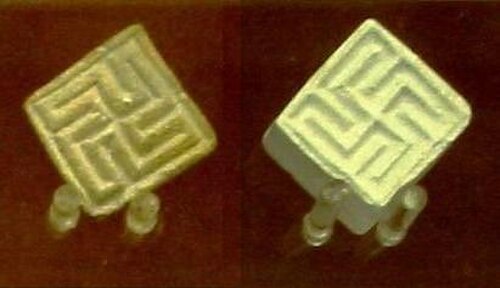
インダス渓谷の印章には、世界中の他の宗教にも見られるスワスティカが描かれているものもある。はるか後のヒンドゥー教のリンガと解釈される男根のシンボルがハラッパー遺跡で発見されている。[51] [52]インダス渓谷の印章には動物が描かれていることが多い。動物に囲まれて蓮華座を思わせる姿勢で座る角のある人物が描かれた印章の一つは、初期の発掘者によって「パシュパティ」と名付けられ、これは後のヒンドゥー教の神シヴァとルドラの異名である。[53] [54] [55] 1997年の執筆で、ドリス・メス・スリニヴァサンは「印章の人物像を『プロトシヴァ』と呼ぶ最近の研究はあまり多くなく、それによってマーシャルのプロトシヴァの特徴のパッケージ、特に3つの頭を持つことを否定している。彼女は、ジョン・マーシャルが顔であると解釈したものを人間のものではなく、牛のようで、神聖なバッファロー人間かもしれないと解釈している」と述べている。 [56] [要検証]イラヴァタム・マハデヴァンによれば、彼のインダス文字用語集『インダス文字:テキスト、コンコーダンス、表』(1977年)の記号47と48は、座った人間のような人物を表しており、南インドの神ムルガンを表している可能性がある。[57]
インダス川流域で発見された多数の小像から、ハラッパー人は豊穣を象徴する母なる女神を崇拝していたと考える学者もいる。これは今日でも田舎のヒンズー教徒の間では一般的な慣習である。[58]しかし、この見解はS.クラークによって異論を唱えられており、クラークはこの見解は多くの小像の機能と構造の説明としては不十分であると考えている。[59]
宗教的な建物や精巧な埋葬の証拠は見つかっていない。寺院があったとしても、特定されていない。[出典が必要] [60]しかし、モヘンジョ・ダロの下町にあるHR-A地区のハウス1は、寺院の可能性があると特定されている。[61]
-
![インダス川流域の印章に描かれた角のある神と一角の従者たち。角のある神はメソポタミアの標準的なテーマである。紀元前2000-1900年。イスラマバード博物館。[62][web 4][63][64]](https://img-server.japedia.wiki/wikipedia/commons/thumb/3/37/Horned_deities_on_an_Indus_Valley_seal_with_detail.jpg/500px-Horned_deities_on_an_Indus_Valley_seal_with_detail.jpg) インダス文明の印章に描かれた角のある神と一角の従者たち。角のある神はメソポタミアの標準的な主題である。紀元前2000-1900年。イスラマバード博物館。[62] [web 4] [63] [64]
インダス文明の印章に描かれた角のある神と一角の従者たち。角のある神はメソポタミアの標準的な主題である。紀元前2000-1900年。イスラマバード博物館。[62] [web 4] [63] [64] -
![角、蹄、尾を持つ人間と獣の戦いの場面。メソポタミアの雄牛男エンキドゥに例えられる。[65][66][67] インダス文明の印章。](https://img-server.japedia.wiki/wikipedia/commons/thumb/b/b8/Indus_bull-man_fighting_beast.jpg/500px-Indus_bull-man_fighting_beast.jpg) 角、蹄、尾を持つ人間と獣の戦いの場面。メソポタミアの雄牛男エンキドゥに例えられる。[65] [66] [67] インダス文明の印章。
角、蹄、尾を持つ人間と獣の戦いの場面。メソポタミアの雄牛男エンキドゥに例えられる。[65] [66] [67] インダス文明の印章。 -
ヴェーダ時代(紀元前1750年~紀元前500年頃)
ヴェーダの宗教は、ヴェーダ主義やヴェーディズムとしても知られ、ヒンドゥー教の初期段階であるヴェーダ・ヒンドゥー教や古代ヒンドゥー教とも呼ばれる[d] 。初期の古インド方言を話す初期インド・アーリア人の犠牲宗教であり、最終的には中央アジアの草原に住んでいた青銅器時代の原インド・イラン人から派生した。[注 17]
起源
.png/500px-Early_Vedic_Culture_(1700-1100_BCE).png)
ヴェーダ時代は、紀元前1200年から紀元前525年にかけてのクル王国のインド・アーリア人のヴェーダ宗教にちなんで名付けられ、 [68] [注 18]紀元前 1750年頃から紀元前500年頃まで続いた。[69] [注 19]インド・アーリア人はインド・ヨーロッパ語族の一派であり、多くの学者は中央アジアのステップ地帯のクルガン文化に起源があると考えている。[70] [71] [注 20] [注 21]実際、特定の神の名前を含む古代ヴェーダ宗教は、本質的には古代ギリシャ人、ローマ人、ペルシャ人、ゲルマン人と同じ宗教的伝統の一派であった。たとえば、ヴェーダの神ディヤウスは、インド・ヨーロッパ祖語の神*Dyēus ph 2 ter (または単に *Dyēus)の異形であり、この神からギリシャのゼウスとローマのユピテルも派生しています。同様に、ヴェーダのマヌとヤマは、インド・ヨーロッパ祖語の *Manu と *Yemo から派生しており、この神からゲルマンのマンヌスとユミルも派生しています。
インド・ヨーロッパ移住説によれば、インド・イラン人はインド・アーリア人と原イラン人の共通の祖先である。インド・イラン人は紀元前1800~1600年頃にインド・アーリア人とイラン人に分裂した。[72]
インド・アーリア人は牧畜民であり[73]、インダス文明の崩壊後に北西インドに移住した。[74] [75] [76] [注 22]インド・アーリア人はインド・イラン人の一派であり、現在のアフガニスタン北部のバクトリア・マルギアナ時代のアンドロノヴォ文化[77]に起源を持つ。 [78]この文化のルーツはさらにシンタシュタ文化にまで遡り、葬儀の供儀はリグ・ヴェーダの犠牲的な葬儀の儀式とよく似ている。[79]
インダス文明の美術には初期の神々の描写が見られるが、ヴェーダ時代のインド・アーリア人の移住に相当する時期の宗教遺物はごくわずかしか残っていない。[80]ヴェーダ初期の宗教は純粋に「手の込んだ犠牲による自然の基本的な力」の崇拝にのみ焦点を当てていたとされており、これは容易には人体模型で表現できなかった。[ 80] [81]銅の宝物文化(紀元2千年紀)に属すると思われる遺物もいくつかあり、人体模型の特徴を示唆している。[82]これらの遺物の正確な意味、さらにはそれらが属する文化や時代区分に関しても解釈はさまざまである。[82]
初期ヴェーダ時代(紀元前 1500年~1100年頃[73])には、インド・アーリア人部族が北西インドで牧畜民として暮らしていた。[83]紀元前1100年以降、鉄の導入により、インド・アーリア人部族はガンジス川平原西部に移動し、農耕生活を始めた。[73] [84] [85]原始的な国家形態が現れ、その中で最も影響力があったのはクル族とクル王国であった。 [73] [86]それは部族連合であり、紀元前1000年頃に南アジアで初めて記録された国家レベルの社会に発展した。[73]それは彼らの初期ヴェーダ時代の宗教的遺産を決定的に変え、彼らの儀式の賛美歌をヴェーダ集に集め、インド文明の中で正統派シュラウタ儀式としての地位を獲得した新しい儀式を開発し、[73]いわゆる「古典的統合」[87]または「ヒンドゥー教の統合」[3]に貢献しました。
リグヴェーダ宗教
誰が本当に知っているのか?
誰がここでそれを宣言するのか?
それはどこから生み出されたのか?この創造物はどこから来たのか?
神々はその後にこの宇宙の創造とともにやって来た。
それではそれがどこから生じたのか誰が知っているのか?
,_Adhyaya_1,_lines_1.1.1_to_1.1.9,_Sanskrit,_Devanagari.jpg/500px-1500-1200_BCE_Rigveda,_manuscript_page_sample_i,_Mandala_1,_Hymn_1_(Sukta_1),_Adhyaya_1,_lines_1.1.1_to_1.1.9,_Sanskrit,_Devanagari.jpg)
インド・アーリア人は彼らの言語[91]と宗教[92]を持ち込んだ。[93]古典期以前のインド・アーリア人とヴェーダの信仰と実践は、仮説上の原インド・ヨーロッパ語族の宗教[94]やインド・イラン語族の宗教[95]と密接に関係していた。アンソニーによれば、古インド宗教はおそらくゼラフシャン川(現在のウズベキスタン)と(現在の)イランとの接触地帯のインド・ヨーロッパ語族移民の間で生まれた。 [96]それは「古い中央アジアの要素と新しいインド・ヨーロッパ語族の要素の融合」であり[96] 、バクトリア・マルギアナ文化から「独特の宗教的信仰と実践」[95]を借用した。[95]この文化からは、インドラ神や儀式用の飲み物であるソーマなど、少なくとも383の非インド・ヨーロッパ語族の単語が借用されました。[97]アンソニーによれば、
インド・イランの力と勝利の神であるウレスラグナの多くの特質は、養子として迎えられたインドラ神に受け継がれ、インドラ神は発展中の古代インド文化の中心神となった。インドラ神は250の賛歌の題材となり、リグ・ヴェーダの4分の1を占めた。インドラ神は他のどの神よりも、BMAC宗教から借用されたと思われる興奮剤(おそらくエフェドラ由来)であるソーマと関連づけられていた。インドラ神の存在が目立つようになったのは、古代インド語話者特有の特徴であった。[78]
リグ・ヴェーダの言語である古期インド語で書かれた最古の碑文は、インド北西部やパキスタンではなく、ミタンニ王国があったシリア北部で発見されている。[98]ミタンニ王は古期インド語の王位名を名乗り、馬に乗ることや馬車を運転することには古期インド語の専門用語が使われた。[98]リグ・ヴェーダの中心概念である「宇宙の秩序と真実」を意味する古期インド語の「r'ta 」もミタンニ王国で使われていた。[98]また、インドラを含む古期インドの神々もミタンニ王国で知られていた。[99] [100] [101]
彼らの宗教は、紀元前 1100年頃ガンジス平原に移住して定住農民となり、さらに発展し[73] [102] [103]、北インドの土着文化との融合が進んだ。[87]後期ヴェーダ時代のバラモン文化は、ヤクシャ教などの現地の宗教と共存し[87] [104] [web 5]、それ自体が「インド・アーリア人とハラッパー人の文化と文明の複合体」の産物であった。[21] [注5]デビッド・ゴードン・ホワイトは、ヴェーダ宗教が部分的にインダス文明に由来することを「明確に実証した」他の3人の主流学者を引用している。[105] [注5]
ヴェーダ

その典礼は、リグ・ヴェーダ、サマ・ヴェーダ、ヤジュル・ヴェーダの3つのヴェーダ・サンヒターに保存されている。ヴェーダのテキストはエリート層のテキストであり、必ずしも一般的な考えや慣習を表しているわけではない。[108]これらのうち、リグ・ヴェーダは最も古く、紀元前 1500年から1200年頃に作曲された賛美歌集である。[109] [110] [78]他の2つは、実際の犠牲の遂行のための儀式の詳細を追加している。アタルヴァ・ヴェーダには、紀元前1000年以前の作品も含まれている可能性がある。この時代に家庭の儀式や民間魔術に関連する資料が含まれている。
これらのテキストは、紀元前 1 千年紀初期に編纂されたブラフマナに集められた、正統実践に関する膨大な注釈とともに、パッラヴァ朝およびグプタ朝の時代が到来する紀元 4 世紀までは口頭伝承のみで伝えられ、それ以降は文書と口頭伝承の組み合わせによって伝えられてきました。
ヒンドゥー教のサンスカーラ
古代にまで遡る。ヴェーダ、ブラフマナ、グリヤスートラ、ダルマスートラ、スムリティなどの文献には、儀式、儀礼、習慣が記されている。[111]
ヴェーダの最も古い文献はリグ・ヴェーダ[112]であり、ヴェーダの聖職者の犠牲の儀式で使われる詩的な賛歌を集めたものである。リグ・ヴェーダの賛歌の多くは火の儀式(アグニホートラ)と、特に神へのソーマの捧げ物(ソーマヤグナ)に関するものである。ソーマは、犠牲の火であるアグニと同様に、酔わせるものであると同時に神そのものである。王家の馬の犠牲(アシュヴァメーダ)は、ヤジュル・ヴェーダの中心的な儀式である。
リグ・ヴェーダの神々は、ほとんどが擬人化された概念であり、2つのカテゴリーに分類されます。一方は、気象神インドラ(神々の王でもある)、アグニ(「火」)、ウシャ(「夜明け」)、スーリヤ(「太陽」)、アパス(「水」)などの自然の神であるデーヴァであり、他方は、ミトラ(「契約」)、アリヤマン(客、友情、結婚の守護神)、バガ(「分け前」) 、ヴァルナ、至高のアスラ(またはアーディティヤ)などの道徳的概念の神であるアスラです。リグ・ヴェーダのデーヴァは、アスラの多くを含むほとんどの神にさまざまに適用されますが、デーヴァは若い神として特徴付けられ、アスラは年長の神(pūrve devāḥ)です。後のヴェーダのテキストでは、「アスラ」は悪魔を意味するようになりました。
リグ・ヴェーダには10のマンダラ(「書」)がある。家族の書(RV書2~7)、書8、「ソーマ・マンダラ」(RV9)、およびより新しい書1と10では、言語と文体に大きな違いがある。古い書は、インド・イランの共通宗教と多くの側面を共有しており、以前の共通インド・ヨーロッパの伝統を再構築するための重要な情報源となっている。特にRV8はアヴェスターとの顕著な類似性があり、[113]アフガニスタンの動植物への言及、[114]例えばラクダ(úṣṭra- =アヴェスター語の uštra )への言及がある。ヴェーダ語サンスクリット語の中心的な宗教用語の多くは、他のインド・ヨーロッパ語族の宗教用語と同義語があります(deva:ラテン語deus、hotar:ゲルマン語の神、asura:ゲルマン語のansuz、yajna:ギリシア語のhagios、brahman:北欧語のBragiまたはラテン語のflamenなど)。アヴェスターでは、アスラ(アフラ)は善であり、デーヴァ(ダエーヴァ)は悪であると考えられており、リグ・ヴェーダとはまったく逆です。
宇宙の秩序
ヴェーダの倫理は、サティヤとリタの概念に基づいています。サティヤは絶対者に根ざした統合の原理です。[115]リタはサティヤの表現であり、宇宙とその中のすべてのものの運営を規制し、調整します。[116]リタに従えば進歩が可能になりますが、違反すると罰せられます。パニカールは次のように述べています。
Ṛta はすべてのものの究極の基盤です。それは「至高」ですが、静的な意味で理解されるべきではありません。...それはすべてのものに内在する根源的なダイナミズムの表現です.... [117]
「ダルマ」という用語は、バラモン教の思想ではすでに使われており、そこでは「ルタ」の一側面として考えられていた。[118]「ルタ」という用語は、最古のヴェーダ(インド・アーリア語)およびゾロアスター教(イラン語)の聖典以前のインド・イラン人の宗教である原インド・イラン宗教からも知られている。アシャ(asha) [発音? ](アシャ)は、ヴェーダ語の「リタ」に対応するアヴェスター語の用語である。[119]
ウパニシャッド

紀元前9世紀と8世紀には、最初期のウパニシャッドが作られた。[120]ウパニシャッドは古典的ヒンズー教の理論的基礎を形成し、ヴェーダーンタ(ヴェーダの結論)として知られている。[121]古いウパニシャッドは儀式に対する攻撃をますます激しくしたが、これらの儀式には哲学的、寓話的な意味も与えられている。後期のウパニシャッドの中には、儀式に対する融通の精神が見られるものもある。ヴェーダの哲学的賛歌に見られる、神の数を1つの原理に減らす傾向は、ウパニシャッドで顕著になった。[122]
ウパニシャッドは一元論的な枠組みを提唱していると考えられることもあるが、ブライアン・ブラックやアンドリュー・ニコルソンなどの学者は、ブリハダラニヤカ・ウパニシャッドやチャンドグヤ・ウパニシャッドのような初期のウパニシャッドには哲学的に多様なテーマが存在していたことを指摘し、これは不当な仮定であると主張している。[123] [124]ウパニシャッドの思想はバガヴァッド・ギーターにおいて有神論的な枠組みに統合された。[125]
バラモン教
,_Sanskrit,_Southern_Grantha_script,_sample_i.jpg/500px-1863_CE_palm_leaf_manuscript,_Jaiminiya_Aranyaka_Gana,_Samaveda_(unidentified_layer_of_texts),_Sanskrit,_Southern_Grantha_script,_sample_i.jpg)
バラモン教は、バラモン教またはバラモンヒンドゥー教とも呼ばれ、ヴェーダ宗教から発展し、非ヴェーダの宗教的思想を取り入れ、インド亜大陸北西部からガンジス川流域に広がる地域に広がった。 [126]バラモン教にはヴェーダ全集だけでなく、ダルマスートラやダルマシャーストラなどのヴェーダ後の文献も含まれており、社会の司祭階級(バラモン)の重要性が強調された。[126]儀式の重視とバラモンの優位性は、クル・パンカラ王国で発達したイデオロギーとして発展し、クル・パンカラ王国の崩壊後、より広い領域に広がった。[73]ヤクシャ教などの地元の宗教と共存した。[87] [104] [web 5]
鉄器時代のインドでは、紀元前10世紀から6世紀にかけて、さまざまなインド・アーリア部族の初期の王国と後期ハラッパー文化の残党からマハージャナパダが生まれました。この時代には、ヴェーダのマントラ部分がほぼ完成し、多数の流派 (シャカ) に組織されたヴェーダ僧侶の繁栄した産業によって、バラモン教などの釈義文学が発達しました。これらの流派は、ヴェーダのマントラ部分を固定版に編集し、その後の2千年間は 口伝のみで保存されました。
第二次都市化とバラモン教の衰退(紀元前600年~200年頃)
ウパニシャッドとシュラマナ運動
仏教とジャイナ教は、シュラマナの伝統とみなされる多くのインド哲学のうちの 2 つです。
正統的な儀式を伴うバラモン教は、紀元前7世紀から6世紀にかけてのインドの都市化の進行と、アケメネス朝によるインダス川の征服(紀元前535年頃)に始まった外国からの刺激の流入の結果として、挑戦を受けた可能性がある。[80] [127]仏教、ジャイナ教、地元の民衆カルトなど、新しい禁欲主義または沙門運動が起こり、確立された宗教的正統性に挑戦した。[80] [127]さまざまな神々の擬人化された描写は、ヴェーダ教の権威の低下の結果として、紀元前1千年紀の中頃に再開されたようだ。[80]
ジャイナ教の提唱者であるマハーヴィーラ(紀元前 549年頃-477年頃)と仏教の開祖である釈迦(紀元前 563年頃-483年)は、この運動の最も著名な象徴でした。[128]ハインリッヒ・ツィンマーによると、ジャイナ教と仏教は、サーンキヤとヨーガも含まれるヴェーダ以前の遺産の一部です。
[ジャイナ教]はバラモン・アーリア人の起源ではなく、インド北東部のはるかに古いアーリア人以前の上流階級の宇宙論と人類学を反映しており、ヨガ、サンキヤ、仏教などの他の非ヴェーダのインドのシステムと同じ古風な形而上学的思索の土壌に根ざしています。[129] [注 23]
シュラマナの伝統は、ヒンドゥー教の特徴となった生と死の輪廻の概念、輪廻の概念、解放の概念を部分的に生み出しました。[注 24]
プラットは、オルデンバーグ(1854年 - 1920年)、ノイマン(1865年 - 1915年)、ラダクリシュナン(1888年 - 1975年)は仏教の経典がウパニシャッドの影響を受けていたと信じていたが、ラ・ヴァレ・プッサンは影響はなかったと考えており、「エリオットと他の何人かは、いくつかの点で仏陀はウパニシャッドと真っ向から対立していたと主張している」と指摘している。[131] [注 25]
マウリヤ帝国
マウリヤ朝時代には、サンスクリット語の古典 スートラやシャーストラ文学が早くから開花し、ヴェーダーンガの「ヴェーダ周縁」分野の学術的解説が行われました。しかし、この時代、インドの大部分を支配していたアショーカ王は仏教を後援し、グプタ朝時代まで仏教は主流の宗教でもありました。
バラモン教の衰退
衰退

第二次都市化期のヴェーダ後期には、バラモン教が衰退した。[133] [134] [注 26]ヴェーダ時代の終わりには、ヴェーダの言葉の意味は不明瞭になり、「固定された音の連続」[135] [注 27]で、魔法の力を持ち、「目的を達成するための手段」であると認識されていた。[注 28]都市の成長により、地方のバラモンの収入と後援が脅かされ、仏教が台頭し、アレクサンダー大王のインド遠征(紀元前 327-325 年)、仏教を取り入れたマウリヤ朝(紀元前 322-185 年)の拡大、サカ族の侵略と北西インド支配 (紀元前 2 世紀-紀元後 4 世紀) により、バラモン教は存在の重大な脅威に直面した。[136]後期の文献の中には、北西インド(初期の文献では「アーリヤヴァルタ」の一部とみなされていた)が、おそらく侵略のせいで「不浄」とさえ見なされているものもある。
ヴェーダ儀式の存続
聖職者エリートの宗教的伝統としてのヴェーダ教は、後期鉄器時代にはジャイナ教や仏教などの他の伝統によって周縁化されたが、中世にはミーマーンサー学派によって新たな権威を獲得し、ヒンズー教の他のすべてのアスティカ伝統と同様に、ヴェーダ教は作者がおらず(アパウルシェヤトヴァ)、永遠であるとみなされた。歴史的ヴェーダ宗教、あるいはヴェーダ教の最後に生き残った要素はシュラウタの伝統であり、古代ヴェーダ宗教の多くの主要な要素に従っており、南インドで顕著であり、タミル・ナードゥ州、ケーララ州、カルナタカ州、アーンドラ・プラデーシュ州にコミュニティがあるが、ウッタル・プラデーシュ州、マハラシュトラ州、その他の州の一部にもコミュニティがある。これらのグループの中で最もよく知られているのはケーララ州のナンブディリ族であり、その伝統はフリッツ・スタールによって特に文書化されている。[137] [138] [139]
ヒンドゥー教の統合と古典ヒンドゥー教(紀元前200年頃~紀元1200年頃)
初期ヒンドゥー教(紀元前200年頃~紀元後320年頃)
ヒンドゥー教の総合


バラモン教の衰退は、新しいサービスの提供[145]と、東ガンジス平原の非ヴェーダのインド・アーリア人の宗教的遺産と地元の宗教的伝統の統合によって克服され、現代のヒンドゥー教が生まれました。[136] [web 6] [87] [146] [73] [126]紀元前500年[3] - 200年[13]から紀元後 300年頃にかけて、「ヒンドゥー教の統合」が発展し[3] [13] 、シュラマ教と仏教の影響[13] [29]と、出現しつつあったバクティの伝統が、スムリティ文献を通じてバラモン教の枠組みに統合されました。[30] [13]この統合は、仏教とジャイナ教の成功の圧力を受けて生まれました。[31]
エンブリーによれば、ヴェーダ宗教と並んで、いくつかの他の宗教的伝統が存在していた。これらの土着の宗教は「最終的にヴェーダ宗教の広い覆いの下に居場所を見つけた」[147] 。バラモン教が衰退し[注26]、仏教やジャイナ教と競争しなければならなくなったとき[注29]、民衆宗教は自らを主張する機会を得た。[147]エンブリーによれば、
バラモン教徒自身も、異端運動の挑戦に応える手段として、ある程度この発展を奨励していたようだ。同時に、土着宗教の間では、ヴェーダの権威に対する共通の忠誠心が、多様な神々と宗教的慣習の中で、薄いながらも重要な統一の糸となっていた。[147]
この「新しいバラモン教」は、超自然的な力とバラモンが提供できる実践的な助言に惹かれた支配者たちの心をとらえ、[145]バラモン教の影響力が復活し、紀元前数世紀のヒンドゥー教の古典時代以来、インド社会を支配してきました。[136]これはサンスクリット化のプロセスに反映されており、「亜大陸中の社会の多くの階層の人々が、自分たちの宗教的および社会的生活をバラモン教の規範に適応させる傾向がありました」。[web 2]これは、地元の神々をサンスクリット語のテキストの神々と同一視する傾向に反映されています。[web 2]
スムリティ
バラモンの同化と統合の対応は、この時期に形成されたスムリティ文献に反映されています。 [148]紀元前200年から紀元後100年までのスムリティ文献はヴェーダの権威を宣言しており、ヴェーダの受容は、ヴェーダを拒否した異端派に対してヒンドゥー教を定義するための中心的な基準となりました。[149]古典的なヒンドゥー教の基本的な考え方と実践のほとんどは、新しいスムリティ文献に由来しています。[注 30]
ヒンドゥー教の6つのダルシャナのうち、ミーマーンサーとヴェーダーンタは「主にヴェーダのシュルティの伝統に根ざしており、スムリティのようにシュルティに直接基づくスマートな正統的な思想の流れを発展させているという意味で、スマルタ学派と呼ばれることもあります。」 [ 150 ] [検証]ヒルテバイテルによると、「ヒンドゥー教の統合はバクティの印の下で行われます。」[150]この成果を確定させるのはバガヴァッドギーターです。 [150]その結果は、スマルタと呼ばれるかもしれない「普遍的な成果」です。[150]それはシヴァとヴィシュヌを「機能的には補完的だが、存在論的には同一」と見なします。[150]
スムリティに属するサンスクリット語の主要叙事詩であるラーマーヤナとマハーバーラタは、紀元前数世紀から紀元後数世紀にかけて長期間にわたって編纂された。[web 7]これらには、古代インドの統治者や戦争に関する神話的な物語が含まれており、宗教的および哲学的な論文が散りばめられている。後期のプラーナは、神と女神、人間との関わり、ラークシャサとの戦いについての物語を語っている。バガヴァッド・ギーターは、「ヒンドゥー教の統合」の「成果を封印」し、[151]バラモン教とシュラマン教の考えを有神論的信仰と統合した。[151] [152] [153] [web 8]
ヒンドゥー哲学の流派
紀元後数世紀には、サーンキヤ学派、ヨーガ学派、ニヤーヤ学派、ヴァイシェーシカ学派、プルヴァ・ミーマーンサー学派、ヴェーダーンタ学派など、ヒンドゥー哲学のいくつかの学派が正式に体系化されました。[154]
サンガム文学
サンガム文学(紀元前300年 - 紀元後400年)は、サンガム時代に書かれたもので、タミル語で書かれた古典文学の大部分は世俗的なものです。それでも、パトゥッパトゥとパリパタルなど、神への個人的な信仰が信仰詩の形で書かれた作品がいくつかあります。ヴィシュヌ、シヴァ、ムルガンが言及されています。したがって、これらの作品は、後世に大きな注目を集めることになる 大規模なバクティ運動に先立つ、一神教のバクティの伝統の最も古い証拠です。
インドとアフリカの貿易
ローマ帝国の時代には、インドと東アフリカの間で貿易が行われており、ザンジバル、ジンバブエ、マダガスカル、ケニアの沿岸部、スワヒリ海岸に少数のインド人が存在していたという考古学的証拠があるが[155] [156]、ヒンドゥー教への改宗は行われなかった。[156] [157]
中東(レバント)のヒンズー教徒の植民地
アルメニアの歴史家ゼノブ・グラク(紀元300年 - 350年)は、「紀元前2世紀には、ヴァン湖の西、ユーフラテス川上流のタロン県にインディアンの植民地があった。インディアンはそこに高さ約18フィートと22フィートの神々の像を収めた2つの寺院を建てた」と述べている。[158]
インドの「黄金時代」(グプタ朝およびパッラヴァ朝時代)(西暦 320 年~ 650 年頃)

この時期には、権力が集中化され、近距離貿易の成長、法的手続きの標準化、識字率の一般的な普及が進んだ。[159]大乗仏教は栄えたが、正統派バラモン文化はグプタ朝の庇護によって活性化し始めた。 [160]グプタ朝はヴィシュヌ派であった。[161]バラモンの地位は強化され、[159]グプタ朝後期には、ヒンドゥー教の神々を祀る最初のヒンドゥー寺院が出現した。 [159] [注 31]グプタ朝の治世中に最初のプラーナが書かれ、[32] [注 6]これは「文化変容を遂げる前の文字を持たない部族グループと部族グループの間に主流の宗教的思想を広める」ために使用された。[32]グプタ朝は、新たに出現したプラーナ宗教を庇護し、王朝の正当性を求めた。[161]その結果生まれたプラーナ文献のヒンドゥー教は、ダルマシャストラやスムリティの初期のバラモン教とは大きく異なっていた。[32]
PSシャルマによれば、「グプタ朝とハルシャ朝は、厳密に知的な観点から見ると、インド哲学の発展において最も輝かしい時代である」とされており、ヒンドゥー教と仏教の哲学が並んで栄えた。[162]無神論的唯物論の学派である チャールヴァカは、 8世紀以前に北インドで台頭した。 [163]
グプタ朝とパッラヴァ朝
グプタ朝時代(4世紀から6世紀)には学問が開花し、ヒンドゥー哲学の古典派が出現し、医学、獣医学、数学から占星術、天文学、天体物理学まで幅広いテーマのサンスクリット古典文学が一般的に生まれました。有名なアーリヤバータとヴァラーハミヒラはこの時代のものです。グプタ朝は強力な中央政府を確立し、ある程度の地方統制も可能にしました。グプタ朝の社会はヒンドゥー教の信仰に従って秩序づけられていました。これには厳格なカースト制度、つまり階級制度が含まれていました。グプタ朝のリーダーシップのもとで築かれた平和と繁栄により、科学的、芸術的な努力を追求することが可能になりました。
パッラヴァ朝(4世紀から9世紀)は、北のグプタ朝と並んで、インド亜大陸南部でサンスクリットの保護国でした。パッラヴァ朝の治世には、グランタと呼ばれる文字で書かれた最初のサンスクリット語の碑文が見られました。パッラヴァ朝はドラヴィダ建築を用いて、マハーバリプラム、カンチプラムなどの非常に重要なヒンズー教寺院やアカデミーを建設しました。また、彼らの統治下では、カーリダサと同じくらい有名な偉大な詩人が誕生しました。
パッラヴァ朝初期には、東南アジアやその他の国々との様々なつながりがありました。そのため、中世には、ヒンドゥー教は、西はアフガニスタン(カブール)から東は東南アジアのほぼ全域(カンボジア、ベトナム、インドネシア、フィリピン)を含む、いわゆる大インドと呼ばれるアジアの多くの王国で国教となり、15世紀までにはほぼすべての地域で仏教とイスラム教に取って代わられました。[164] [165] [166]
さまざまな神々に寺院を捧げる習慣が流行し、それに続いて芸術的な寺院建築や彫刻が作られるようになりました (ヴァーストゥ・シャーストラを参照)。


バクティ
この時期にバクティ運動が勃興した。バクティ運動は、南インドのタミル・ナードゥ州でヴァイシュナヴァ・アルヴァール(3世紀から9世紀)[167]とサイヴァ・ナーヤナール(4世紀から10世紀)[168]によって始まったバクティの急速な発展であり、12世紀から18世紀までにインド全土にバクティの詩と信仰を広めた。 [169] [168] [170]
東南アジアへの進出
-
 東南アジアにおけるヒンドゥー教の拡大
 -
-
 バリ島で最も神聖なヒンドゥー教寺院、プラ・ブサキ
ヒンドゥー教の影響は1世紀にはすでにインドネシア諸島に及んでいた。 [171]この頃、インドは東南アジア諸国に強い影響を及ぼし始めた。インドとビルマ南部、シャム中部と南部、カンボジア南部、ベトナム南部は貿易路で結ばれ、沿岸部には数多くの都市化された集落が築かれた。
したがって、千年以上にわたり、インドのヒンドゥー教/仏教の影響は、この地域のさまざまな国に一定の文化的統一をもたらした主な要因でした。パーリ語、サンスクリット語、インドの文字は、上座部仏教、大乗 仏教、バラモン教、ヒンドゥー教とともに、直接の接触だけでなく、ラーマーヤナやマハーバーラタ叙事詩などの聖典やインド文学を通じても伝わりました。
5 世紀から 13 世紀にかけて、東南アジアには非常に強力なインドの植民地帝国が存在し、ヒンドゥー教と仏教の建築と芸術の創造が極めて活発になりました。南のシュリー ヴィジャヤ帝国と北の クメール帝国が影響力を競いました。
ランカスカ(サンスクリット語で「輝く土地」を意味するランカ 、至福を意味するスッカ)は、マレー半島にあった古代ヒンズー教の王国です。この王国は、オールド・ケダ集落とともに、おそらくマレー半島に築かれた最古の領土拠点です。伝承によると、この王国は2世紀に築かれ、マレーの伝説では、ランカスカはケダに築かれ、後にパタニに移ったとされています。
5世紀から15世紀にかけて、インドネシアのスマトラ島を中心とする海洋帝国であったシュリー・ヴィジャヤ王国は、サイレンドラ朝と呼ばれる統治者の家系のもとで大乗仏教と密教を採用しました。シュリー・ヴィジャヤ王国はインドのチョーラ朝統治者との対立により衰退しました。マジャパヒト王国はシンガサリ王国の後継者となりました。マジャパヒト王国は東南アジアの海洋における最後かつ最大のヒンドゥー教帝国の一つでした。
扶南はアンコール以前の カンボジア王国で、メコン川デルタの周囲に位置していた。おそらくオーストロアジア語族のモン・クメール人移住者によって建国された。2人の中国使節カン・タイとチュー・インの報告によると、この国はカウンディニャという名のインドのバラモンによって建国された。カウンディニャは西暦1世紀に夢の中で、寺院から魔法の弓を取ってクメールの女王ソーマを倒すようにとの指示を受けた。ナーガ族の王の娘ソーマはカウンディニャと結婚し、彼らの家系が扶南の王朝となった。この神話には、インドのバラモンと、当時この地域の住民が宗教的に尊敬していたコブラの神性を、両方とも正当に証明するという利点があった。
チャンパ王国(中国の記録ではリンイー王国)は、およそ 192 年から 1697 年まで、現在のベトナム南部と中央部を支配していました。チャンパ族の支配的な宗教はヒンズー教であり、その文化はインドの影響を強く受けていました。
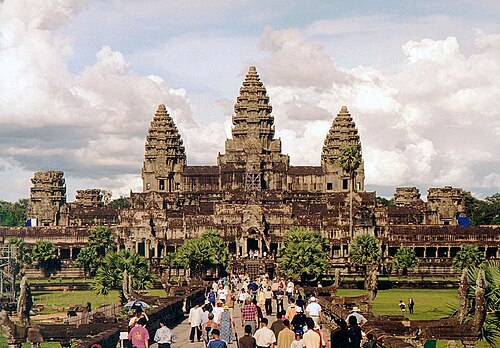
その後、9 世紀から 13 世紀にかけて、大乗仏教とヒンドゥー教を信仰するクメール王国が東南アジア半島の大部分を支配しました。クメール王国の統治下で、カンボジアと隣国のタイに 900 以上の寺院が建てられました。アンコールはこの発展の中心であり、寺院群と都市組織は 100 万人ほどの都市住民を支えられるほどでした。世界最大の寺院群であるアンコール ワットは、ヴィシュヌヴァルダン王によって建てられました。
後期古典ヒンドゥー教 – プラーナヒンドゥー教 (紀元 650 年~ 1200 年頃)
.jpg/500px-Teli_ka_Mandir_(15702266503).jpg)
グプタ朝の終焉とハルシャ朝の崩壊後、インドでは権力が分散化しました。いくつかの大王国が出現し、「無数の従属国」が生まれました。[173] [注 32]これらの王国は封建制度によって統治されました。小王国は大王国の保護に依存していました。「偉大な王は遠く離れており、崇高で神格化されていました」[173]このことはタントラ 曼荼羅にも反映されており、曼荼羅の中心として王を描いていることもあります。[174]
中央権力の崩壊は、宗教の地域化と宗教間の対立にもつながった。[175] [注 33]地方のカルトと言語が強化され、「バラモンの儀式的なヒンズー教」[175]の影響は減少した。[175]農村と信仰の運動が、シャイヴァ教、ヴァイシュナヴィズム、バクティ、タントラとともに勃興したが[175]、「宗派集団は発展の始まりに過ぎなかった」。[175]宗教運動は、地方領主からの承認を得るために競争しなければならなかった。[175]仏教は8世紀以降その地位を失い、インドで姿を消し始めた。[175]これは、8世紀の宮廷でのプージャ儀式の変化に反映され、ヒンズー教の神々が「最高位の皇帝神」として仏陀に取って代わった。[注 34]
プラーナヒンドゥー教
.jpg/500px-Krishna_and_the_Gopis_(herdsmaids).jpg)
ダルマシャーストラのバラモン教とスムリティは、プラーナの作曲家たちの手によって根本的な変化を遂げ、その結果、プラーナのヒンドゥー教が勃興した。 [32]「それは、宗教的な天空を闊歩する巨像のように、すぐに既存のすべての宗教を覆い隠すようになった」。[178]プラーナのヒンドゥー教は、「両極的な考えやカルトの伝統を吸収し統合しながら成長し拡大した複合的な信仰体系」であった。[178]それは、その民衆的基盤、その神学と宗派の多元性、そのタントラの外観、そしてバクティの中心的位置によって、ヴェーダのスマールタのルーツとは区別された。[178] [注 7]
中世初期のプラーナは、文化変容を遂げつつあった文字を持たない部族社会に、宗教的主流の思想を広めるために書かれた。[32]グプタ朝の崩壊とともに、未開の土地がバラモンに大量に贈られ、[37] [179]王が所有する土地の有益な農業開発を確実にするため、また新しい支配階級に地位を与えるためでもあった。[37]バラモンはインド全土に広がり、異なる宗教や思想を持つ地元の氏族と交流した。[37]バラモンはプラーナを使って、それらの氏族を農耕社会とそれに伴う宗教や思想に組み込んだ。[37]フラッドによれば、「プラーナの宗教に従うバラモンは、スムリティに基づいた崇拝をするスマータ、またはプラーナに基づいたパウラニカとして知られるようになった。」[180]地方の首長や農民はヴァルナに吸収され、「新しいクシャトリヤとシュードラに対する支配」を維持するために使用されました。[181]

バラモン教の集団は、地元の僧侶などの地元のサブグループを組み込むことで拡大した。[37]これはまた、バラモン内部の階層化につながり、一部のバラモンは他のバラモンよりも低い地位にあった。[37]カースト制度は、シュラマニズムの宗派よりも、新しいプラーナのヒンズー教でうまく機能した。[181]プラーナの文献には、新しいクシャトリヤに地位を与える広範な系図が記載されている。[181]仏教の神話では、政府は選出された支配者と人々との間の契約として描かれている。[181]そして、仏教のチャッカヴァッティ[注 35]は「クシャトリヤやラージプートに掲げられた征服のモデルとは異なる概念であった」。 [181]
多くの地元の宗教や伝統がプラーナのヒンドゥー教に同化されました。ヴィシュヌとシヴァが、シャクティ/デーヴァとともに主要な神として登場しました。[183] ヴィシュヌは、ナラヤナ、ジャガンナート、ヴェンカテーシュワラなどのカルトを「その他多数」を包含しました。[183] ナス:
ヴィシュヌの化身であるマツヤ、クルマ、ヴァラハ、そしておそらくヌルシマも、特定の人気のトーテムシンボルや創造神話、特にイノシシに関連するものを取り入れるのに役立ちました。これらは文字が存在しない神話によく浸透しており、クリシュナやバララーマなどは、2人の人気の牧畜と農業の神を中心とした地元のカルトや神話を取り入れるのに役立ちました。[184]
グプタ王朝以降のインドにおけるバラモン教からパウラン派ヒンドゥー教への変容は、文化変容の過程によるものであった。プラーナは、文化変容の過程にある文字を持たない部族社会において、宗教的主流を確立するのに役立った。バラモン教とダルマシャーストラの教義はプラーナの著者の手によって根本的に変化し、その結果、以前のすべての伝統を凌駕する主流の「ヒンドゥー教」が台頭した。[37]
バクティ運動

ラーマとクリシュナは、強力なバクティの伝統の中心となり、特にバガヴァタ・プラーナに表現されています。クリシュナの伝統は、数多くのナーガ、ヤクシャ、丘や木を基盤としたカルトを包含しました。[185]シヴァは、ブーテシュワラ、ハタケシュワラ、チャンデーシュワラなど、地元の神の名前にイサまたはイシュワラを接尾辞として付けることによって、地元のカルトを吸収しました。 [183] 8世紀の王族の間では、プージャで仏陀の代わりにヒンドゥー教の神々が使われるようになりました。[注 34]これは、仏陀がヴィシュヌの化身とされた時期でもあります。[186]
記録に残る最初のバクティ運動は、最初の3人のヴィシュヌ派アルヴァルによって創設されました。伝統的に、アルヴァルは紀元前4200年から紀元前2700年の間に生きたと考えられていますが、[187] [188]一部の文献では紀元前4200年から5世紀初頭までの範囲としています。伝統的な年代はマハーバーラタとバガヴァタ・プラーナの時代のシュカの時代までとされており、最初の4人(ポイガイ・アルヴァル、ブータット・アルヴァル、ペヤルヴァル、ティルマリサイ・アルヴァル)はドヴァパラ・ユガの出身で、ナンマルヴァル、マドゥラカヴィ・アルヴァルなどはカリ・ユガに属します。[189]シュカの年代は遅くとも紀元前200年頃とされています。[190]したがって、最初の3人のアルヴァルも遅くとも紀元前200年頃と考えられています。ヴィシュヌ派の信者であった12人のアルヴァルと、シヴァ派の信者であった63人のナヤナールが、タミル・ナードゥ州における初期のバクティ運動を育みました。
12 世紀、カルナータカ州では、バクティ運動がヴィラシャイヴァ運動の形をとりました。これは、リンガヤット派またはシヴァバクタ派を創設したヒンズー教の改革者バサヴァンナに触発されたものです。この時期に、ヴァチャナと呼ばれるカンナダ語文学詩の独自の土着形式が生まれました。
アドヴァイタ・ヴェーダーンタ


初期のアドヴァイタ派のゴーダパダ(6世紀から7世紀)は仏教の影響を受けた。[192] [193] [194] [195]ゴーダパダは、究極の現実は純粋意識(ヴィジュニャプティ・マートラ)[196]であり、「世界の本質は四角い否定である」という仏教の教義を引き継いだ。 [196]ゴーダパダは「[両方の教義]をマンドゥキヤ・ウパニシャッドの哲学に織り込み、それはシャンカラによってさらに発展した」。[193]ゴーダパダはまた、ナーガールジュナの中観哲学から仏教の「アジャータ」の概念を引き継いだ。[194] [195]ゴーダパダはブラフマ・スートラを無視していたようで、反対派が用いた論争用語であるゴーダパダのマーヤーヴァーダ[197] [注 36] をバダラヤナのブラフマ・スートラに読み込み、「それに古典的な場所を与え」[197] 、ブラフマ・スートラの現実的な傾向に対抗することに成功したのはシャンカラであった。[197]
シャンカラ(紀元8世紀)は、彼の生前にすでに存在していたアドヴァイタ・ヴェーダーンタの見解を統合し体系化した学者であった。[198] [199] [200] [web 13]シャンカラは、人間の最も内なる自己(アートマン)と全世界の超自然的な力(ブラフマン)が一体である統一された現実を唱えた。形や物体の変化する多様性を最終的な現実として認識することは、ブラフマンの不変の究極の現実を覆い隠す「幻想」であるマーヤと見なされている。[201] [202] [203] [204]
シャンカラはアドヴァイタ・ヴェーダーンタの歴史において比類のない地位を占めているが、インドにおけるシャンカラの初期の影響力は疑わしい。[205] 11世紀まで、ヴェーダーンタ自体は周辺的な学派であり、[206] 10世紀までシャンカラ自身もアドヴァイタの主要な代表者と考えられていた年上の同時代人マンダナ・ミシュラの影に隠れていた。[207] [208]
何人かの学者は、シャンカラとアドヴァイタ・ヴェーダーンタの歴史的名声と文化的影響力が高まったのは、数世紀後のイスラムの侵略とそれに続くインドの荒廃の時代になってからであり、[205] [209] [210]それは、ヴィディヤーラニヤ(14世紀)の努力によるものだと示唆している。ヴィディヤーラニヤは、シャンカラを「勝利した征服者のようにインド全土にディグヴィジャヤ(普遍的征服)を通じて教えを広めた神聖な民衆の英雄」にするための伝説を創作した。 [211] [212]
シャンカラの地位は19世紀と20世紀にさらに確立され、新ヴェーダーンタ派と西洋の東洋学者はアドヴァイタ・ヴェーダーンタを「ヒンドゥー教を一つの宗教的伝統にまとめる神学的なつながり」として高めた。[213]アドヴァイタ・ヴェーダーンタは、ヒンドゥー教の精神性の模範的な例としてインド文化の内外で広く受け入れられており、[132]シャンカラは、ほとんどのヒンドゥー教徒がアドヴァイタ・ヴェーダーンタを信奉していないにもかかわらず、「ヒンドゥー教と文化の象徴的な代表者」となった。[214]
ペルシャとメソポタミアとの接触
ヒンドゥー教と仏教の宗教的および世俗的な学問が組織的にペルシャに初めて伝わったのは6世紀、サーサーン朝のホスロー1世(531-579)が医師のボルズヤを特使として派遣し、インド人と中国人の学者をゴンディシャープールのアカデミーに招いたときだった。ブルズーはサンスクリット語のパンチャタントラを翻訳した。彼のパフラヴィー語版はイブン・アル・ムカッファによって『カーリーラとディムナ』または『ビドパイの寓話』という題でアラビア語に翻訳された。[215]
アッバース朝の統治下では、当時の広大なイスラム帝国において、バグダードはグンデシャプールに代わり最も重要な学問の中心地となり、イスラムの伝統と学者が栄えた。ヒンドゥー教の学者たちは、バグダードで開催された科学と数学の会議に招待された。[216]
中世および近世(西暦1200年~1850年頃)
イスラム時代
-
![カーシー・ヴィシュワナート寺院はデリーのスルタン・クトゥブ・ウッディーン・アイバクの軍隊によって破壊された。[217]](https://img-server.japedia.wiki/wikipedia/commons/thumb/e/eb/Benares-_The_Golden_Temple%2C_India%2C_ca._1915_%28IMP-CSCNWW33-OS14-66%29.jpg/500px-Benares-_The_Golden_Temple%2C_India%2C_ca._1915_%28IMP-CSCNWW33-OS14-66%29.jpg) カーシー・ヴィシュワナート寺院はデリーのスルタン・クトゥブ・ウッディーン・アイバクの軍隊によって破壊された。[217]
カーシー・ヴィシュワナート寺院はデリーのスルタン・クトゥブ・ウッディーン・アイバクの軍隊によって破壊された。[217]
![カーシー・ヴィシュワナート寺院はデリーのスルタン・クトゥブ・ウッディーン・アイバクの軍隊によって破壊された。[217]](https://img-server.japedia.wiki/wikipedia/commons/thumb/e/eb/Benares-_The_Golden_Temple,_India,_ca._1915_(IMP-CSCNWW33-OS14-66).jpg/500px-Benares-_The_Golden_Temple,_India,_ca._1915_(IMP-CSCNWW33-OS14-66).jpg)
インド亜大陸におけるイスラム教徒の征服は13世紀から18世紀にかけて起こった。ゴール朝の統治者ムハンマドは1192年にインドにおけるイスラム支配の基礎を築き、[218] 1202年までにベンガルまで支配を拡大した。ゴール朝はすぐに1206年にデリー・スルタン朝へと発展し、マムルーク朝へと移行した。[219] [220]この歴史的期間中、仏教は衰退し、[221]インド亜大陸で宗教的緊張と紛争の事例があった。一部の記録は襲撃、財産の押収、および一部のヒンドゥー教徒の家族の奴隷化の事件を示している。[222] [223]さらに、一部のヒンドゥー教徒が自由を確保するためなど、さまざまな状況下でイスラム教に改宗した可能性があることを示唆する記録もあった。[224] [225]戦争と征服の期間の間には、協力と融合の期間がありました。ほとんどのインドのコミュニティでは、ヒンドゥー教徒とイスラム教徒の関係は調和していました。[226]イスラム教徒やヒンドゥー教徒の王によって宗教に基づいて人々が追放されることはなく、特定の宗教を絶滅させようとする試みもありませんでした。[226]
16世紀にはムガル帝国が建国された。ムガル帝国の統治下で、インドは比較的安定し繁栄した時代を経験した。[227] [228] [229]ムガル帝国は一般に宗教的寛容さで知られており、[230] [231] [232] [233]芸術や文学を積極的に後援した。領土の支配をめぐってムガル帝国とラージプートの間で宗教紛争が起こった例もあった。特にアウラングゼーブは非イスラム教徒に対する宗教的不寛容政策と寺院の破壊で知られた。[web 14] [234]
イスラム教徒による南アジア征服の影響と結果は、依然として精査と多様な視点の対象となっている。ウィル・デュラントは、イスラム教徒によるインド征服を歴史上特に激動の時代と特徴づけている。彼は、この征服は著しい暴力と動乱を特徴としており、内部分裂、仏教やジャイナ教などの宗教の影響などの要因が一因であると考えている。アラン・ダニエルーは、暴力は宗教的聖戦の名の下に正当化されることが多かったとして、イスラム教徒の支配者を批判した。[235]トーマス・アーノルド卿やデ・レイシー・オリアリーなどの他の人々は、イスラム教が武力と剣によって広められたという見解を「不合理」と批判した。[236]アイラ・ラピダスによると、イスラム地域での強制改宗の例はあったものの、比較的まれであった。イスラム教徒の征服者は一般に、改宗を強制するのではなく、支配力を及ぼそうとしたため、イスラム教への改宗の大部分は自発的な性質のものであった。[237] [236]
バクティ・ヴェーダーンタ
ラーマーヌジャ、マドゥヴァ、チャイタニヤなどの教師たちは、バクティ運動を、11世紀までは周辺的な思想学派に過ぎなかったヴェーダーンタの文献的伝統と連携させ、[206]アドヴァイタの抽象的な概念を拒否し、反対しました。代わりに、彼らは、より身近なアヴァターラ、特にクリシュナとラーマへの感情的で情熱的な信仰を促進しました。 [238] [239] [ページが必要]
ヒンズー教の統一
ニコルソンによれば、12世紀から16世紀の間にすでに「一部の思想家は、ウパニシャッド、叙事詩、プラーナ、そして後から「6つの体系」(サッダルサナ)として知られている主流のヒンドゥー哲学の学派の多様な哲学的教えを、単一の全体として扱い始めた」[242] [注37]マイケルズは、後のナショナリズムに先立つ歴史化が出現し、ヒンドゥー教と過去を称賛する考えが明確に示されたと指摘している。[243]
何人かの学者は、シャンカラとアドヴァイタ・ヴェーダーンタの歴史的名声と文化的影響は、この時期に意図的に確立されたと示唆している。[205] [209] [210] ヴィディヤーラニヤ(14世紀)はマダヴァとしても知られ、シャンカラの信奉者であったが、高尚な哲学が広く受け入れられる魅力を持たなかったシャンカラを「勝利した征服者のようにインド全土にディグヴィジャヤ(普遍的征服)を通じて教えを広めた神聖な民間の英雄」に変える伝説を創作した。[ 211] [212]ヴィディヤーラニヤは『サヴァダルサナサングラハ』 (「すべての見解の要約」)の中で、シャンカラの教えをすべてのダルシャナの頂点として提示し、他のダルシャナはシャンカラの教えに収斂する部分的な真実として提示した。[211]ヴィディヤーラニヤは王室の支援を受け、[244]彼の後援と組織的な努力により、シャンカラは価値観を結集する象徴としての地位を確立し、シャンカラのヴェーダーンタ哲学の歴史的、文化的影響を広め、シャンカラとアドヴァイタ・ヴェーダーンタの文化的影響力を拡大するために僧院(マタ)を設立しました。[205]
東ガンジス川とスーリヤ川の州
東ガンガーとスーリヤはヒンドゥー教の政体であり、11世紀から16世紀半ばまで現在のオリッサ州(歴史的にはカリンガとして知られている)の大部分を支配していた。13世紀から14世紀にかけて、インドの大部分がイスラム勢力の支配下にあったとき、独立したカリンガはヒンドゥー教、哲学、芸術、建築の拠点となった。東ガンガーの支配者は宗教と芸術の偉大な後援者であり、彼らが建てた寺院はヒンドゥー建築の傑作の一つと考えられている。 [web 15] [web 16]
近世(1500年頃~1850年頃)
ヴィジャヤナガル王国がイスラム教徒の支配者によって陥落したことで、デカン高原におけるヒンドゥー教の帝国防衛は終焉を迎えた。しかし、ムガル帝国(1526年 - 1857年)の勢力拡大に乗じて、 1674年から1818年にかけての マラーター王国の統治下で、ヒンドゥー教は再び政治的威信を高めた。
ヴィジャヤナガル王国
ヴィジャヤナガル帝国は、ホイサラ朝、カーカティーヤ朝、[246]、パンディヤ朝[247 ]の政治的後継者として始まったサンガマ朝[245]のハリハラ1世とその兄弟ブッカ・ラーヤ1世によって1336年に建国された。この帝国は、13世紀末までに南インド諸国がイスラムの侵略を防ごうとした試みの集大成として台頭した。ある物語によると、帝国の創設者ハリハラ1世とブッカ・ラーヤ1世は、カンピリの首長に仕える兄弟だった。カンピリがイスラム教徒の侵略で陥落した後、彼らはデリーに連れて行かれ、イスラム教に改宗した。彼らはデリーのスルタンの家臣としてカンピリに送り返された。彼らは地域で権力を獲得した後、ヴィディヤラニヤに接近し、ヒンドゥー教に改宗させた。[248]

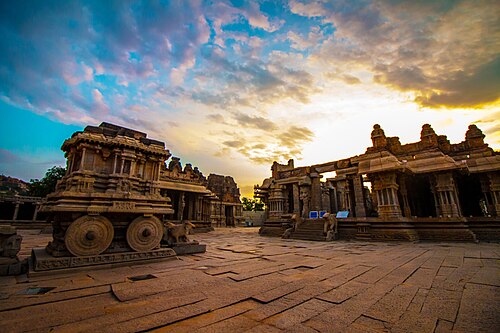
ヴィジャヤナガル朝の皇帝たちは、外国人の著作からもわかるように、あらゆる宗教や宗派に寛容であった。[249]王たちは、ゴブラハマナ・プラティパラナチャリヤ(文字通り「牛とバラモンの守護者」)やヒンドゥラヤスラトラナ(文字通り「ヒンドゥー教の信仰の擁護者」)などの称号を使用し、ヒンドゥー教を保護する意図を示していたが、同時に宮廷の儀式や服装はイスラム教徒の信仰に忠実であった。[250]帝国の創設者であるハリハラ1世とブッカ・ラーヤ1世は、敬虔なシヴァ教徒(シヴァの崇拝者)であったが、ヴィディヤーラニヤを守護聖人とするシュリンゲリのヴィシュヌ派に援助を与え、ヴァラハ(イノシシ、ヴィシュヌの化身)を紋章とした。[251]考古学的発掘調査の4分の1以上で、「王族地区」からそう遠くないところに「イスラム地区」が発見された。中央アジアのティムール朝の貴族たちもヴィジャヤナガルにやって来た。後のサルヴァ王とトゥルヴァ王は信仰上はヴィシュヌ派であったが、ハンピのヴィルパクシャ(シヴァ)やティルパティのヴェンカテーシュワラ(ヴィシュヌ)の足元を崇拝した。クリシュナデーヴァラヤ王のサンスクリット語作品『ジャンバヴァティ・カリャナム』は、ヴィルパクシャ・カルナタ・ラージャ・ラークシャ・マニ(「カルナタ帝国の守護の宝石」)と呼ばれている。[252]王たちはウドゥピのマドヴァチャリヤの二元論の聖者を庇護した。[253]
この時期にはバクティ(信仰心)運動が活発で、当時の有名なハリダサ(信仰深い聖者)が関わっていました。12世紀のヴィラシャイヴァ運動と同様に、この運動は、何百万もの人々の生活に浸透したもう一つの強い信仰心の流れを示しました。ハリダサは、ヴィヤーサクタとダサクタという2つのグループを代表しており、前者はヴェーダ、ウパニシャッド、その他のダルシャナに精通していることが求められ、一方ダサクタは、カンナダ語を通じてマドヴァチャリアのメッセージを信仰の歌(デーヴァラナーマとキルタナ)の形で人々に伝えただけでした。マドヴァチャリアの哲学は、ナラハリティルタ、ジャヤティルタ、シュリーパダラヤ、ヴィヤサティルタ、ヴァディラジャティルタなどの著名な弟子たちによって広められました。 [254]ヴァディラジャティルタ、プランダラダサ(カルナーティック音楽の父[255] [注 38])、カナカダサ[256]のグル(教師)であるヴィヤサティルタは、クリシュナデーヴァラヤ王の信仰を集めました。[257] [258] [259]王はこの聖者を自分のクラデヴァタ(家族の神)とみなし、著作の中で彼を称えました。[web 17]この時期に、初期カルナーティック音楽のもう一人の偉大な作曲家であるアンナマチャリヤが、現在のアーンドラプラデーシュ州にあるティルマラ-ティルパティでテルグ語で数百のキルタナを作曲しました。[260]
ヴィジャヤナガル王国は、ヒンドゥー教を統一の要素として推進することで、地域主義を超越した南インドの歴史における画期的な出来事を創り出した。帝国は、ヴィジャヤナガル王国軍が一貫して勝利を収めたクリシュナ・デーヴァラヤの統治時代に最盛期を迎えた。帝国は、かつてスルタン国の支配下にあった北部デカンの地域と、カリンガを含む東部デカンの領土を併合し、同時に南部のすべての従属国に対する支配を維持した。[261]クリシュナ・デーヴァ・ラーヤの時代には、多くの重要な記念碑が完成または発注された。
ヴィジャヤナガル王国は、タリコータの戦い(1565年)での敗北後、衰退した。タリコータの戦いでアリヤ・ラーマ・ラーヤが亡くなった後、ティルマラ・デーヴァ・ラーヤがアラヴィドゥ朝を始め、破壊されたハンピに代わる新しい首都ペヌコンダを建設し、ヴィジャヤナガル王国の残骸を再建しようとした。[262]ティルマラは1572年に退位し、王国の残骸を3人の息子に分割し、1578年に亡くなるまで宗教的な生活を追求した。アラヴィドゥ朝の後継者がこの地域を統治したが、帝国は1614年に崩壊し、最後の残骸はビージャープール・スルタン朝などとの継続的な戦争により1646年に終焉した。[263] [264] [265]この期間中、南インドのより多くの王国が独立し、ヴィジャヤナガル王国から分離した。これらには、マイソール王国、ケラディ・ナヤカ、マドゥライのナヤク、タンジョールのナヤク、チトラドゥルガのナヤカ、ギンギーのナヤク王国が含まれ 、これらはすべて独立を宣言し、その後数世紀にわたって南インドの歴史に大きな影響を与えました。[266]
ヴィジャヤナガル王国による寺院の改修
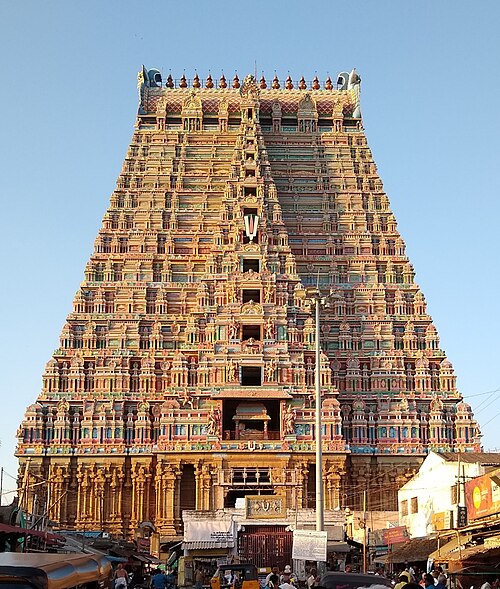
ヴィジャヤナガル王国は古代タミラカムの多くの古代寺院を改修し、シュリーランガム・ランガナータスワーミ・ペルマル寺院、マドゥライ・ミーナクシ・アンマン寺院、カララガール寺院、ラジャゴパーラスワーミ寺院、マンナルグディなどの寺院に多大な貢献をしました。
ヴィジャヤナガル帝国の支配下にあったシュリーランガム・ランガナータスワーミ・ペルマル寺院は、 200年以上にわたって安定を保ち、修復、最初の一連の要塞化、マンダパの増築が行われました。[268]マハー・ヴィシュヌ像とマハラクシュミ像が再設置され、この場所は1371年にヴィジャヤナガル帝国の指揮官でブッカ1世の息子であるクマラ・カンパナの統治下で再びヒンズー教の寺院になりました。[269] 14世紀最後の10年間に、ヴィジャヤナガル帝国の支配者から柱廊のある控えの間が贈られました。15世紀には、彼らは後庭の屋根を純金の板で覆い、続いて寺院に一連の新しい社殿、マンダパ、ゴプラを増築するための資金を調達しました。[269]ナヤカ族は寺院の町と7つのプラカラを強化しました。現在、この寺院はインド最大の寺院群であり、世界でも最大級の宗教施設の一つです。[267] [270]これらの建造物のいくつかは、何世紀にもわたって改修、拡張、再建され、生きた寺院となっています。スリランガム寺院は、世界最大の現役ヒンドゥー教寺院の一つとして挙げられることが多いです。 [271] [272]
ムガル帝国時代
ムガル帝国インドの国教はイスラム教であり、ハナフィー派の法学が優先された。ヒンドゥー教はバーブルとフマーニュンの統治下では依然として抑圧されていた。北インドのアフガニスタンの統治者シェール・シャー・スリーは比較的抑圧的ではなかった。ヒンドゥー教は、ヒンドゥー教の統治者ヘーム・ヴィクラマーディティヤがアグラとデリーでアクバルを破り、デリーのプラーナ・キラーで「ラージャビシャケ」または戴冠式を行った後、ヒンドゥー教徒の「ヴィクラマーディティヤ」としてデリーから統治を開始した1553年から1556年の3年間の統治の間に前面に出てきた。しかし、ムガル帝国の歴史においては、臣民は自らが選んだ宗教を実践する自由が時折あったものの、収入のあるカーフィール(健康な成人男性)は、ジズヤ(ジズヤ料)を支払う義務があり、それが彼らのズィンミーとしての地位を意味していた。

ムガル帝国の皇帝フマーユーンの息子で、シンド人の王妃ハメード・バヌ・ベーグムの後継者であるアクバルは、インドとイスラムの伝統について広い視野を持っていました。アクバル皇帝の宗教に関する最も異例な考えの 1 つは、イスラム教、ゾロアスター教、ヒンズー教、ジャイナ教、キリスト教の折衷的な混合であるディン・イ・イラーヒ(神への信仰) でした。皇帝が亡くなるまで、それは国教であると宣言されていました。しかし、これらの行動はイスラム教の聖職者、特にスーフィーのシャイク、アルフ・サニ・アフマド・シルヒンディーからの強い反対に遭いました。アクバルは非イスラム教徒に対する人頭税を廃止し、他の宗教哲学の考えを受け入れ、あらゆる宗教による公の礼拝を容認し、他の信仰に関心を寄せたが、これは相当な宗教的寛容の姿勢を示しており、正統派イスラム教徒の反対派にとっては棄教に等しいものであった。アクバルの帝国拡大は、多くのヒンドゥー教国家を家臣として獲得したが、その多くはヒンドゥー教ラージプートであった。ラージプートの家臣は宗教問題の実行において半自治権を維持した。この時期に多くのヒンドゥー教ラージプートの家臣が、ムガル帝国の家臣であるヒンドゥー教ラージプートのオルチャ国によって、オルチャのチャトゥルブージ寺院やラクシュミ寺院など、記念碑的なヒンドゥー教寺院を建設した。[273]
アクバルの息子ジャハーンギールはラージプートの血を引いており、母親がヒンズー教徒だったこともあり、宗教的穏健派であった。彼の2人のヒンズー教徒の王妃(マハラニ・マーンバイとマハラニ・ジャガット)の影響により、宗教的穏健派は国家政策の中心であり続け、その方針は、血統的にはラージプートが75% 、ムガル帝国が25%未満であった息子の皇帝シャー・ジャハーンにも引き継がれた。
宗教的正統性は、シャー・ジャハーンの息子で後継者であり敬虔なスンニ派イスラム教徒であったアウラングゼーブの治世中にのみ重要な役割を果たした。アウラングゼーブは他の信仰に対して前任者よりも比較的寛容ではなく、ジズヤ税の導入、ヒンズー教徒への関税の倍増とイスラム教徒への関税の廃止、ヒンズー教寺院の破壊、一部の非イスラム寺院の建設と修復の禁止、マラーター王国の支配者サンバージー[274] [275]と第9代シク教のグルであるグル・テグ・バハドゥル[234]の処刑など、前任者の多元主義の遺産を放棄した政策で論争と批判の対象となっており、彼の治世中にイスラム教の機関と学者の数と重要性が増大した。彼はインド亜大陸に残っていた非イスラム教勢力、つまりパンジャブのシク教徒の国、最後に残った独立したヒンドゥー教徒のラージプート族、マラーター王国の反乱者、そしてデカンのシーア派イスラム王国に対して多くの軍事作戦を指揮した。彼はまた、外国人キリスト教宣教師によるヒンドゥー教徒とイスラム教徒への公然の布教活動を帝国から事実上撲滅したが、彼らは隣接地域(つまり彼の支配下外の地域)、つまり現在のケーララ州、タミル・ナードゥ州、ゴア州では引き続き活動を成功させた。コンカンのヒンドゥー教徒はマラーター族に、パンジャブ、カシミール、北インドのヒンドゥー教徒はシク教徒に、ラージャスターン州と中央インドのヒンドゥー教徒はラージプート族に支援された。
マラーター王国
ヒンドゥー教徒のマラーター族は、北インドのイスラム教徒ムガル帝国の支配者によるこの地域への侵略に抵抗した。野心的な指導者チャトラパティ・シヴァージー・マハラジの指揮下で、 マラーター族は南東のビジャプールのイスラム教徒のスルタンから解放され、より攻撃的になり、ムガル帝国の領土を頻繁に襲撃し始めた。マラーター族は、シヴァージーが1680年に死去するまでに、インド中部の大半に勢力を広げ、征服していた。その後、バラモンの首相(ペーシュワー)の有能な指導の下、マラーター王国は最盛期を迎え、ペーシュワーの所在地であるプネーは、ヒンドゥー教の学問と伝統の中心地として開花した。最盛期の帝国は、南はタミル・ナードゥ州[276]から、北は現在のカイバル・パフトゥンクワ州[277] [注 39]であるペシャーワル、東はベンガルまで広がっていた。 [web 18]
-

-
![アヒリヤー・ガートはバラナシのガートの一部で、その多くはマラーター族によって建設された[279]](https://img-server.japedia.wiki/wikipedia/commons/thumb/0/04/Ahilya_Ghat_by_the_Ganges%2C_Varanasi.jpg/500px-Ahilya_Ghat_by_the_Ganges%2C_Varanasi.jpg) アヒリヤー・ガートはバラナシのガートの一部で、その多くはマラーター族によって建設された[279]
アヒリヤー・ガートはバラナシのガートの一部で、その多くはマラーター族によって建設された[279]
![アヒリヤー・ガートはバラナシのガートの一部で、その多くはマラーター族によって建設された[279]](https://img-server.japedia.wiki/wikipedia/commons/thumb/0/04/Ahilya_Ghat_by_the_Ganges,_Varanasi.jpg/500px-Ahilya_Ghat_by_the_Ganges,_Varanasi.jpg)
ネパール王国
最後のゴルカリ王であるプリトビ・ナラヤン・シャー王は、北インドがイスラムのムガル帝国の支配者によって支配されていたため、新たに統一されたネパール王国をアサル・ヒンドゥスタン(「ヒンズー教徒の真の土地」)と自称した。この宣言は、彼の統治下でヒンズー教の社会規範ダルマシャーストラを施行し、彼の国をヒンズー教徒が居住できる場所とするために行われた。彼はまた、北インドをムグラン(ムガル人の国)と呼び、この地域をイスラム教徒の外国人が侵入した地域と呼んだ。[280]
After the Gorkhali conquest of Kathmandu valley, King Prithvi Narayan Shah expelled the Christian Capuchin missionaries from Patan and revisioned Nepal as Asal Hindustan ("real land of Hindus").[281] The Hindu Tagadharis, a Nepalese Hindu socio-religious group, were given the privileged status in the Nepalese capital thereafter.[282][283] Since then Hinduisation became the significant policy of the Kingdom of Nepal.[281] Professor Harka Gurung speculates that the presence of Islamic Mughal rule and Christian British rule in India had compelled the foundation of Brahmin Orthodoxy in Nepal for the purpose building a haven for Hindus in the Kingdom of Nepal.[281]
Early colonialism

The Goa Inquisition was the office of the Christian Inquisition acting in the Indian city of Goa and the rest of the Portuguese empire in Asia. Francis Xavier, in a 1545 letter to John III, requested for an Inquisition to be installed in Goa. It was installed eight years after the death of Francis Xavier in 1552. Established in 1560 and operating until 1774, this highly controversial institution was aimed primarily at Hindus and wayward new converts.[285]
The Battle of Plassey would see the emergence of the British as a political power; their rule later expanded to cover much of India over the next hundred years, conquering all of the Hindu states on the Indian subcontinent,[286] with the exception of the Kingdom of Nepal. While the Maratha Empire remained the preeminent power in India, making it the last remaining Hindu empire,[287] until their defeat in the Third Anglo-Maratha War which left the East India Company in control of most of India; as noted by acting Governor-General Charles Metcalfe, after surveying and analyzing the conditions in India, in 1806 wrote: "India contains no more than two great powers, British and Mahratta."[288][289] During this period, Northeastern India was divided into many kingdoms, most notable being the Kingdom of Manipur, which ruled from their seat of power at Kangla Palace and developed a sophisticated Hindu Gaudiya Vaishnavism culture, later the kingdom became a princely state of the British.[290][291][292] The Kingdom of Mysore was defeated in the Fourth Anglo-Mysore War by the British East India Company, leading to the reinstatement of the Hindu Wadiyar dynasty in Mysore as a princely states.[293] In 1817, the British went to war with the Pindaris, raiders who were based in Maratha territory, which quickly became the Third Anglo-Maratha War, and the British government offered its protection to the mainly Hindu Rajput rulers of Rajputana from the Pindaris and the Marathas.[294] The mainly Hindu Palaiyakkarar states emerged from the fall of the Vijayanagara Empire, and were a bastion of Hindu resistance; and managed to weather invasions and survive till the advent of the British.[web 19] From 1799 to 1849, the Sikh Empire, ruled by members of the Sikh religion, emerged as the last major indigenous power in the Northwest of the Indian subcontinent under the leadership of Maharaja Ranjit Singh.[295][296] After the death of Ranjit Singh, the empire weakened, alienating Hindu vassals and Wazirs, and leading to the conflict with the British East India Company, marked the downfall of the Sikh Empire, making it the last area of the Indian subcontinent to be conquered by the British. The entire subcontinent fell under British rule (partly indirectly, via princely states) following the Indian Rebellion of 1857.
Modern Hinduism (after c. 1850 CE)

With the onset of the British Raj, the colonization of India by the British, there also started a Hindu Renaissance in the 19th century, which profoundly changed the understanding of Hinduism in both India and the west.[299] Indology as an academic discipline of studying Indian culture from a European perspective was established in the 19th century, led by scholars such as Max Müller and John Woodroffe. They brought Vedic, Puranic and Tantric literature and philosophy to Europe and the United States. Western orientalist searched for the "essence" of the Indian religions, discerning this in the Vedas,[300] and meanwhile creating the notion of "Hinduism" as a unified body of religious praxis[132] and the popular picture of 'mystical India'.[132][299] This idea of a Vedic essence was taken over by Hindu reform movements as the Brahmo Samaj, which was supported for a while by the Unitarian Church,[301] together with the ideas of Universalism and Perennialism, the idea that all religions share a common mystic ground.[302] This "Hindu modernism", with proponents like Vivekananda, Aurobindo, Rabindranath and Radhakrishnan, became central in the popular understanding of Hinduism.[303][304][305][306][132]
Hindu revivalism

During the 19th century, Hinduism developed a large number of new religious movements, partly inspired by the European Romanticism, nationalism, scientific racism and esotericism (Theosophy) popular at the time (while conversely and contemporaneously, India had a similar effect on European culture with Orientalism, "Hindoo style" architecture, reception of Buddhism in the West and similar). According to Paul Hacker, "the ethical values of Neo-Hinduism stem from Western philosophy and Christianity, although they are expressed in Hindu terms".[307]
These reform movements are summarised under Hindu revivalism and continue into the present.
- Swaminarayan establishes the Swaminarayan Sampradaya sect around 1800.[308]
- Brahmo Samaj is a social and religious movement founded in Kolkata in 1828 by Raja Ram Mohan Roy. He was one of the first Indians to visit Europe and was influenced by western thought. He died in Bristol, England. The Brahmo Samaj movement thereafter resulted in the Brahmo religion in 1850 founded by Debendranath Tagore — better known as the father of Rabindranath Tagore.[309]
- Ramakrishna and his pupil Swami Vivekananda led reform in Hinduism in the late 19th century. Their ideals and sayings have inspired numerous Indians as well as non-Indians, Hindus as well as non-Hindus.[310]
- Arya Samaj ("Society of Nobles") is a Hindu reform movement in India that was founded by Swami Dayananda in 1875. He was a sannyasin (renouncer) who believed in the infallible authority of the Vedas. Dayananda advocated the doctrine of karma and reincarnation, and emphasised the ideals of brahmacharya (chastity) and sanyasa (renunciation). Dayananda claimed to be rejecting all non-Vedic beliefs altogether. Hence the Arya Samaj unequivocally condemned idolatry, animal sacrifices, ancestor worship, pilgrimages, priestcraft, offerings made in temples, the caste system, untouchability and child marriages, on the grounds that all these lacked Vedic sanction. It aimed to be a universal church based on the authority of the Vedas. Dayananda stated that he wanted 'to make the whole world Aryan', i.e. he wanted to develop missionary Hinduism based on the universality of the Vedas. To this end, the Arya Samaj started Shuddhi movement in the early 20th century to bring back to Hinduism people converted to Islam and Christianity, set up schools and missionary organisations, and extended its activities outside India.[311][312][313]
Reception in the West
An important development during the British colonial period was the influence Hindu traditions began to form on Western thought and new religious movements. An early champion of Indian-inspired thought in the West was Arthur Schopenhauer who in the 1850s advocated ethics based on an "Aryan-Vedic theme of spiritual self-conquest", as opposed to the ignorant drive toward earthly utopianism of the superficially this-worldly "Jewish" spirit.[314] Helena Blavatsky moved to India in 1879, and her Theosophical Society, founded in New York in 1875, evolved into a peculiar mixture of Western occultism and Hindu mysticism over the last years of her life.
The sojourn of Swami Vivekananda to the World Parliament of Religions in Chicago in 1893 had a lasting effect. Vivekananda founded the Ramakrishna Mission, a Hindu missionary organisation still active today.
In the early 20th century, Western occultists influenced by Hinduism include Maximiani Portaz – an advocate of "Aryan Paganism" – who styled herself Savitri Devi and Jakob Wilhelm Hauer, founder of the German Faith Movement. It was in this period, and until the 1920s, that the swastika became a ubiquitous symbol of good luck in the West before its association with the Nazi Party became dominant in the 1930s.
Hinduism-inspired elements in Theosophy were also inherited by the spin-off movements of Ariosophy and Anthroposophy and ultimately contributed to the renewed New Age boom of the 1960s to 1980s, the term New Age itself deriving from Blavatsky's 1888 The Secret Doctrine.
Influential 20th-century Hindus were Ramana Maharshi, B. K. S. Iyengar, Paramahansa Yogananda, Prabhupada (founder of ISKCON), Sri Chinmoy, Swami Rama and others who translated, reformulated and presented Hinduism's foundational texts for contemporary audiences in new iterations, raising the profiles of Yoga and Vedanta in the West and attracting followers and attention in India and abroad.
Contemporary Hinduism
Hinduism is followed by around 1.1 billion people in India.[web 20] Other significant populations are found in Nepal (21.5 million), Bangladesh (13.1 million), and the Indonesian island of Bali (3.9 million).[web 21] The majority of the Vietnamese Cham people also follow Hinduism, with the largest proportion in Ninh Thuận province.[web 22]
Neo-Hindu movements in the West
In modern times Smarta-views have been highly influential in both the Indian[web 23] and western[web 24] understanding of Hinduism via Neo-Vedanta. Vivekananda was an advocate of Smarta-views,[web 24] and Radhakrishnan was himself a Smarta-Brahman.[315][316] According to iskcon.org,
Many Hindus may not strictly identify themselves as Smartas but, by adhering to Advaita Vedanta as a foundation for non-sectarianism, are indirect followers.[web 23]
Influential in spreading Hinduism to a western audience were Swami Vivekananda, Paramahansa Yogananda, A. C. Bhaktivedanta Swami Prabhupada (Hare Krishna movement), Sri Aurobindo, Meher Baba, Maharishi Mahesh Yogi (Transcendental Meditation), Jiddu Krishnamurti, Sathya Sai Baba, Mother Meera, among others.
Hindutva
In the 20th century, Hinduism also gained prominence as a political force and a source for national identity in India. With origins traced back to the establishment of the Hindu Mahasabha in the 1910s, the movement grew with the formulation and development of the Hindutva ideology in the following decades; the establishment of Rashtriya Swayamsevak Sangh (RSS) in 1925; and the entry, and later success, of RSS offshoots Jana Sangha and Bharatiya Janata Party (BJP) in electoral politics in post-independence India.[317] Hindu religiosity plays an important role in the nationalist movement.[318][note 40][note 41]
Besides India, the idea of Hindu nationalism and Hindutva can also be seen in the other areas with good population of Hindus, such as in Nepal, Bangladesh, Sri Lanka and Malaysia.[web 25][319][320] In the modern world, the Hindu identity and nationalism is encouraged by many organisations as per their areas and territories. In India, Sangh Parivar is the umbrella organisation for most of the Hindu nationalist organisations, including that of Rashtriya Swayamsevak Sangh, Bharatiya Janata Party, Vishva Hindu Parishad, etc.[321][322] The other nationalist organisations include Siva Senai (Sri Lanka), Nepal Shivsena, Rastriya Prajatantra Party, Hindu Prajatantrik Party, (Nepal) Bangabhumi (Bangladesh) and HINDRAF (Malaysia).
-
 Rashtriya Swayamsevak Sangh in India
 -
 Saffron Flag of Hinduism in India
See also
Notes
- ^ There is no exact dating possible for the beginning of the Vedic period. Witzel mentions a range between 1900 and 1400 BCE.[10] Flood mentions 1500 BCE.[11]
- ^ Lockard (2007, p. 50): "The encounters that resulted from Aryan migration brought together several very different peoples and cultures, reconfiguring Indian society. Over many centuries a fusion of Aryan and Dravidian occurred, a complex process that historians have labeled the Indo-Aryan synthesis." Lockard: "Hinduism can be seen historically as a synthesis of Aryan beliefs with Harappan and other Dravidian traditions that developed over many centuries."
- ^ Hiltebeitel (2007, p. 12): "A period of consolidation, sometimes identified as one of 'Hindu synthesis', 'Brahmanic synthesis', or 'orthodox synthesis', takes place between the time of the late Vedic Upanishads (c. 500 BCE) and the period of Gupta imperial ascendency (c. 320–467 CE)."
- ^ See also:
- J. H. Hutton (1931), in Ghurye (1980, pp. 3–4)[subnote 1]
- Zimmer (1951, pp. 218–219)
- Tyler (1973), India: An Anthropological Perspective, Goodyear Publishing Company. In: Sjoberg (1990, p. 43).[subnote 2]
- Sjoberg (1990)
- Flood (1996, p. 16)
- Vijay Nath (2001)
- Werner (2005, pp. 8–9)
- Lockard (2007, p. 50)
- Hiltebeitel (2007)
- Hopfe & Woodward (2008, p. 79)[subnote 3]
- Samuel (2010)
- ^ a b c See:
- White (2006, p. 28): "[T]he religion of the Vedas was already a composite of the indo-Aryan and Harappan cultures and civilizations."
- Gombrich (1996, pp. 35–36): "It is important to bear in mind that the Indo-Aryans did not enter an uninhabited land. For nearly two millennia they and their culture gradually penetrated India, moving east and south from their original seat in the Punjab. They mixed with people who spoke Munda or Dravidian languages, who have left no traces of their culture beyond some archaeological remains; we know as little about them as we would about the Indo-Aryans if they had left no texts. In fact we cannot even be sure whether some of the archaeological finds belong to Indo-Aryans, autochthonous populations, or a mixture. It is to be assumed – though this is not fashionable in Indian historiography – that the clash of cultures between Indo-Aryans and autochtones was responsible for many of the changes in Indo-Aryan society. We can also assume that many – perhaps most – of the indigenous population came to be assimilated into Indo-Aryan culture.
- ^ a b The date of the production of the written texts does not define the date of origin of the Puranas (Johnson 2009, p. 247). They may have existed in some oral form before being written down (Johnson 2009, p. 247).
- ^ a b Michaels (2004, p. 38): "The legacy of the Vedic religion in Hinduism is generally overestimated. The influence of the mythology is indeed great, but the religious terminology changed considerably: all the key terms of Hinduism either do not exist in Vedic or have a completely different meaning. The religion of the Veda does not know the ethicised migration of the soul with retribution for acts (karma), the cyclical destruction of the world, or the idea of salvation during one's lifetime (jivanmukti; moksa; nirvana); the idea of the world as illusion (maya) must have gone against the grain of ancient India, and an omnipotent creator god emerges only in the late hymns of the rgveda. Nor did the Vedic religion know a caste system, the burning of widows, the ban on remarriage, images of gods and temples, Puja worship, Yoga, pilgrimages, vegetarianism, the holiness of cows, the doctrine of stages of life (asrama), or knew them only at their inception. Thus, it is justified to see a turning point between the Vedic religion and Hindu religions." See also Halbfass 1991, pp. 1–2
- ^ University of Oslo: "During the period following Ashoka, until the end of the 7th century AD, the great gift ceremonies honoring the Buddha remained the central cult of Indian imperial kingdoms".[web 1]
- ^ Samuel (2010, p. 76): "Certainly, there is substantial textual evidence for the outward expansion of Vedic-Brahmanical culture." Samuel (2010, p. 77): "[T]he Buddhist sutras describe what was in later periods a standard mechanism for the expansion of Vedic-Brahmanical culture: the settlement of Brahmins on land granted by local rulers." See also Vijay Nath (2001).
Samuel (2010, p. 199): "By the first and second centuries CE, the Dravidian-speaking regions of the south were also increasingly being incorporated into the general North and Central Indian cultural pattern, as were parts at least of Southeast Asia. The Pallava kingdom in South India was largely Brahmanical in orientation although it included a substantial Jain and Buddhist population, while Indic states were also beginning to develop in Southeast Asia."
- ^ Larson (1995, p. 81): "Also, the spread of the culture of North India to the South was accomplished in many instances by the spread of Buddhist and Jain institutions (monasteries, lay communities, and so forth). The Pallavas of Kanci appear to have been one of the main vehicles for the spread of specifically Indo-Brahmanical or Hindu institutions in the South, a process that was largely completed after the Gupta Age. As Basham has noted, "the contact of Aryan and Dravidian produced a vigorous cultural synthesis, which in turn had an immense influence on Indian civilization as a whole."
- ^ Flood (1996, p. 129): "The process of Sanskritization only began to significantly influence the south after the first two centuries CE and Tamil deities and forms of worship became adapted to northern Sanskrit forms."
- ^ Wendy Doniger: "If Sanskritization has been the main means of connecting the various local traditions throughout the subcontinent, the converse process, which has no convenient label, has been one of the means whereby Hinduism has changed and developed over the centuries. Many features of Hindu mythology and several popular gods—such as Ganesha, an elephant-headed god, and Hanuman, the monkey god—were incorporated into Hinduism and assimilated into the appropriate Vedic gods by this means. Similarly, the worship of many goddesses who are now regarded as the consorts of the great male Hindu gods, as well as the worship of individual unmarried goddesses, may have arisen from the worship of non-Vedic local goddesses. Thus, the history of Hinduism can be interpreted as the interplay between orthoprax custom and the practices of wider ranges of people and, complementarily, as the survival of features of local traditions that gained strength steadily until they were adapted by the Brahmans."[web 2] Vijay Nath (2001, p. 31): "Visnu and Siva, on the other hand, as integral components of the Triad while continuing to be a subject of theological speculation, however, in their subsequent "avataras" began to absorb countless local cults and deities within their folds. The latter were either taken to represent the multiple facets of the same god or else were supposed to denote different forms and appellations by which the god came to be known and worshipped. Thus, whereas Visnu came to subsume the cults of Narayana, Jagannatha, Venkateswara and many others, Siva became identified with countless local cults by the sheer suffixing of Isa or Isvarato the name of the local deity, e.g., Bhutesvara, Hatakesvara, Chandesvara."
- ^ Wendy Doniger: "The process, sometimes called 'Sanskritization', began in Vedic times and was probably the principal method by which the Hinduism of the Sanskrit texts spread through the subcontinent and into Southeast Asia. Sanskritization still continues in the form of the conversion of tribal groups, and it is reflected in the persistence of the tendency among some Hindus to identify rural and local deities with the gods of the Sanskrit texts."[web 2]
- ^ Different periods are designated as "classical Hinduism":
- Smart (2003, p. 52) calls the period between 1000 BCE and 100 CE "pre-classical". It is the formative period for the Upanishads and Brahmanism[subnote 4] Jainism and Buddhism. For Smart, the "classical period" lasts from 100 to 1000 CE, and coincides with the flowering of "classical Hinduism" and the flowering and deterioration of Mahayana-buddhism in India.
- For Michaels (2004, pp. 36, 38), the period between 500 BCE and 200 BCE is a time of "Ascetic reformism", whereas the period between 200 BCE and 1100 CE is the time of "classical Hinduism", since there is "a turning point between the Vedic religion and Hindu religions".
- Muesse (2003, p. 14) discerns a longer period of change, namely between 800 BCE and 200 BCE, which he calls the "Classical Period". According to Muesse, some of the fundamental concepts of Hinduism, namely karma, reincarnation and "personal enlightenment and transformation", which did not exist in the Vedic religion, developed in this time.
- Stein (2010, p. 107) The Indian History Congress, formally adopted 1206 CE as the date medieval India began.
- ^ Doniger 2010, p. 66: "Much of what we now call Hinduism may have had roots in cultures that thrived in South Asia long before the creation of textual evidence that we can decipher with any confidence. Remarkable cave paintings have been preserved from Mesolithic sites dating from c. 30,000 BCE in Bhimbetka, near present-day Bhopal, in the Vindhya Mountains in the province of Madhya Pradesh."[subnote 5]
- ^ Jones & Ryan 2006, p. xvii: "Some practices of Hinduism must have originated in Neolithic times (c. 4000 BCE). The worship of certain plants and animals as sacred, for instance, could very likely have very great antiquity. The worship of goddesses, too, a part of Hinduism today, may be a feature that originated in the Neolithic."
- ^ Mallory 1989, p. 38f. The separation of the early Indo-Aryans from the Proto-Indo-Iranian stage is dated to roughly 1800 BCE in scholarship.
- ^ Michaels (2004, p. 33): "They called themselves arya ('Aryans', literally 'the hospitable', from the Vedic arya, 'homey, the hospitable') but even in the Rgveda, arya denotes a cultural and linguistic boundary and not only a racial one."
- ^ There is no exact dating possible for the beginning of the Vedic period. Witzel (1995, pp. 3–4) mentions a range between 1900 and 1400 BCE. Flood (1996, p. 21) mentions 1500 BCE.
- ^ Allchin & Erdosy (1995): "There has also been a fairly general agreement that the Proto-Indoaryan speakers at one time lived on the steppes of Central Asia and that at a certain time they moved southwards through Bactria and Afghanistan, and perhaps the Caucasus, into Iran and India-Pakistan (Burrow 1973; Harmatta 1992)."
- ^ Kulke & Rothermund (1998): "During the last decades intensive archaeological research in Russia and the Central Asian Republics of the former Soviet Union as well as in Pakistan and northern India has considerably enlarged our knowledge about the potential ancestors of the Indo-Aryans and their relationship with cultures in west, central and south Asia. Previous excavations in southern Russia and Central Asia could not confirm that the Eurasian steppes had once been the original home of the speakers of Indo-European language."
- ^ The Aryan migration theory has been challenged by some researchers (Michaels 2004, p. 33, Singh 2008, p. 186), due to a lack of archaeological evidence and signs of cultural continuity (Michaels 2004, p. 33), hypothesizing instead a slow process of acculturation or transformation (Michaels 2004, p. 33, Flood 1996, pp. 30–35). Nevertheless, linguistic and archaeological data clearly show a cultural change after 1750 BCE (Michaels 2004, p. 33), with the linguistic and religious data clearly showing links with Indo-European languages and religion (Flood 1996, p. 33). According to Singh 2008, p. 186, "The dominant view is that the Indo-Aryans came to the subcontinent as immigrants."
- ^ Zimmer's point of view is supported by other scholars, such as:
- Smart (1964, pp. 27–32)[130]
- Belvakar & Ranade (1974, pp. 81, 303–409)[130]
- ^ Flood (2008, pp. 273–274): "The second half of the first millennium BCE was the period that created many of the ideological and institutional elements that characterise later Indian religions. The renouncer tradition played a central role during this formative period of Indian religious history ... Some of the fundamental values and beliefs that we generally associate with Indian religions in general and Hinduism, in particular, were in part the creation of the renouncer tradition. These include the two pillars of Indian theologies: samsara – the belief that life in this world is one of suffering and subject to repeated deaths and births (rebirth); moksa/nirvana – the goal of human existence."
- ^ King (1999) notes that Radhakrishnan was a representative of Neo-Vedanta,[132] which had a specific understanding of Indian religions: "The inclusivist appropriation of other traditions, so characteristic of neo-Vedanta ideology, appears on three basic levels. First, it is apparent in the suggestion that the (Advaita) Vedanta philosophy of Sankara (c. eighth century CE) constitutes the central philosophy of Hinduism. Second, in an Indian context, neo-Vedanta philosophy subsumes Buddhist philosophies in terms of its own Vedantic ideology. The Buddha becomes a member of the Vedanta tradition, merely attempting to reform it from within. Finally, at a global level, neo-Vedanta colonises the religious traditions of the world by arguing for the centrality of a non-dualistic position as the philosophia perennis underlying all cultural differences."
- ^ a b Michaels (2004, p. 38): "At the time of upheaval [500–200 BCE], many elements of the Vedic religion were lost".
- ^ Klostermaier 2007, p. 55: "Kautas, a teacher mentioned in the Nirukta by Yāska (ca. 500 BCE), a work devoted to an etymology of Vedic words that were no longer understood by ordinary people, held that the word of the Veda was no longer perceived as meaningful "normal" speech but as a fixed sequence of sounds, whose meaning was obscure beyond recovery."
- ^ Klostermaier: "Brahman, derived from the root bŗh = to grow, to become great, was originally identical with the Vedic word, that makes people prosper: words were the principal means to approach the gods who dwelled in a different sphere. It was not a big step from this notion of "reified speech-act" to that "of the speech-act being looked at implicitly and explicitly as a means to an end". Klostermaier 2007, p. 55 quotes Madhav M. Deshpande (1990), Changing Conceptions of the Veda: From Speech-Acts to Magical Sounds, p. 4.
- ^ Hiltebeitel (2007, p. 13): "The emerging self-definitions of Hinduism were forged in the context of continuous interaction with heterodox religions (Buddhists, Jains, Ajivikas) throughout this whole period, and with foreign people (Yavanas, or Greeks; Sakas, or Scythians; Pahlavas, or Parthians; and Kusanas, or Kushans) from the third phase on [between the Mauryan empire and the rise of the Guptas].
- ^ Larson (2009, p. 185): "[I]n contrast to the sruti, which Hindus, for the most part, pay little more than lip service to."
- ^ Michaels (2004, p. 40) mentions the Durga temple in Aihole and the Visnu Temple in Deogarh. Michell (1977, p. 18) notes that earlier temples were built of timber, brick and plaster, while the first stone temples appeared during the period of Gupta rule.
- ^ Michaels (2004, p. 41):
- In the east the Pala Empire (770–1125 CE),
- in the west and north the Gurjara-Pratihara (7th–10th century),
- in the southwest the Rashtrakuta Dynasty (752–973),
- in the Dekkhan the Chalukya dynasty (7th–8th century),
- and in the south the Pallava dynasty (7th–9th century) and the Chola dynasty (9th century).
- ^ McRae (2003): This resembles the development of Chinese Chán during the An Lu-shan rebellion and the Five Dynasties and Ten Kingdoms Period (907–960/979), during which power became decentralised end new Chán-schools emerged.
- ^ a b Inden (1998, p. 67): "Before the eighth century, the Buddha was accorded the position of universal deity and ceremonies by which a king attained to imperial status were elaborate donative ceremonies entailing gifts to Buddhist monks and the installation of a symbolic Buddha in a stupa ... This pattern changed in the eighth century. The Buddha was replaced as the supreme, imperial deity by one of the Hindu gods (except under the Palas of eastern India, the Buddha's homeland) ... Previously the Buddha had been accorded imperial-style worship (puja). Now as one of the Hindu gods replaced the Buddha at the imperial centre and pinnacle of the cosmo-political system, the image or symbol of the Hindu god comes to be housed in a monumental temple and given increasingly elaborate imperial-style puja worship."
- ^ Thapar (2003, p. 325): The king who ruled not by conquest but by setting in motion the wheel of law.
- ^ The term "mayavada" is still being used, in a critical way, by the Hare Krshnas. See[web 9][web 10][web 11][web 12]
- ^ The tendency of "a blurring of philosophical distinctions" has also been noted by Burley (2007, p. 34). Lorenzen locates the origins of a distinct Hindu identity in the interaction between Muslims and Hindus (Lorenzen 2006, pp. 24–33), and a process of "mutual self-definition with a contrasting Muslim other" which started well before 1800 (Lorenzen 2006, pp. 26–27). Both the Indian and the European thinkers who developed the term "Hinduism" in the 19th century were influenced by these philosophers (Nicholson 2010, p. 2)
- ^ Owing to his contributions to carnatic music, Purandaradasa is known as Karnataka Sangita Pitamaha. (Kamat, Saint Purandaradasa)
- ^ Many historians consider Attock to be the final frontier of the Maratha Empire.[278]
- ^ This conjunction of nationalism and religion is not unique to India. The complexities of Asian nationalism are to be seen and understood in the context of colonialism, modernization and nation-building. See, for example, Anagarika Dharmapala, for the role of Theravada Buddhism in Sri Lankese struggle for independence (McMahan 2008), and D. T. Suzuki, who conjuncted Zen to Japanese nationalism and militarism, in defense against both western hegemony and the pressure on Japanese Zen during the Meiji Restoration to conform to Shinbutsu Bunri (Sharf 1993, Sharf 1995).
- ^ Rinehart (2004, p. 198): Neo-Vedanta also contributed to Hindutva ideology, Hindu politics and communalism. Yet, Rinehart emphasises that it is "clear that there isn't a neat line of causation that leads from the philosophies of Rammohan Roy, Vivekananda and Radhakrishnan to the agenda of ... militant Hindus."
- ^ See:
- "Oldest religion":
- Fowler (1997, p. 1): "probably the oldest religion in the world"
- Gellman & Hartman (2011): "Hinduism, the world's oldest religion"
- Stevens (2001, p. 191): "Hinduism, the oldest religion in the world"
- Sarma (1987, p. [page needed]): the "oldest living religion"
- The "oldest living major religion" in the world.[323](Klostermaier 2007, p. 1)
- Laderman (2003, p. 119): "world's oldest living civilisation and religion"
- Turner & 1996-B, p. 359): "It is also recognized as the oldest major religion in the world."
See also:- Urreligion, Shamanism, Animism, Ancestor worship for some of the oldest forms of religion
- Sarnaism and Sanamahism, Indian Tribal religions connected to the earliest migrations into India
- Australian Aboriginal mythology, one of the oldest surviving religions in the world.
- "Oldest religion":
- ^ Among its roots are the Vedic religion (Flood 1996, p. 16) of the late Vedic period and its emphasis on the status of Brahmans (Samuel 2010, pp. 48–53), but also the religions of the Indus Valley civilisation (Narayanan 2009, p. 11, Lockard 2007, p. 52, Hiltebeitel 2007, p. 3, Jones & Ryan 2006, p. xviii), the Sramana (Gomez 2013, p. 42) or renouncer traditions (Flood 1996, p. 16) of east India (Gomez 2013, p. 42), and "popular or local traditions" (Flood 1996, p. 16).
- ^ More specifically, between c. 500 (Hiltebeitel 2007, p. 12) - 200 (Larson 2009) BCE and c. 300 CE (Hiltebeitel 2007, p. 12) in or after the period of the Second Urbanisation, and during the early classical period of Hinduism (200 BCE – 300 CE) (Hiltebeitel 2007, p. 12, Larson 2009).
- ^ a b Scholars such as Jan Gonda have used the term ancient Hinduism, distinguishing it from "recent Hinduism".
Jamison & Witzel (1992, p. 3) use the term "Vedic Hinduism," but state:"... to call this period Vedic Hinduism is a contradictio in terminis since Vedic religion is very different from what we generally call Hindu religion – at least as much as Old Hebrew religion is from medieval and modern Christian religion. However, Vedic religion is treatable as a predecessor of Hinduism".
Michaels (2004, p. 38) also emphasizes the differences: "The legacy of the Vedic religion in Hinduism is generally overestimated. The influence of the mythology is indeed great, but the religious terminology changed considerably: all the key terms of Hinduism either do not exist in Vedic or have a completely different meaning. The religion of the Veda does not know the ethicised migration of the soul with retribution for acts (karma), the cyclical destruction of the world, or the idea of salvation during one's lifetime (jivanmukti; moksa; nirvana); the idea of the world as illusion (maya) must have gone against the grain of ancient India, and an omnipotent creator god emerges only in the late hymns of the rgveda. Nor did the Vedic religion know a caste system, the burning of widows, the ban on remarriage, images of gods and temples, Puja worship, Yoga, pilgrimages, vegetarianism, the holiness of cows, the doctrine of stages of life (asrama), or knew them only at their inception. Thus, it is justified to see a turning point between the Vedic religion and Hindu religions."
See also Halbfass (1991, pp. 1–2)
Encyclopedia Britannica, Vedic religion: "It [Vedic religion] takes its name from the collections of sacred texts known as the Vedas. Vedism is the oldest stratum of religious activity in India for which there exist written materials. It was one of the major traditions that shaped Hinduism."
The Encyclopædia Britannica, Brahmanism, further explains that from the Vedic religion emerged Brahmanism, a religious tradition of ancient India. It states, "Brahmanism emphasized the rites performed by, and the status of, the Brahman, or priestly, class as well as speculation about Brahman (the Absolute reality) as theorized in the Upanishads (speculative philosophical texts that are considered to be part of the Vedas, or scriptures)."
From Brahmanism developed Hinduism, when it was synthesized, around the start of the Common Era, with the non-Vedic Indo-Aryan religious heritage of the eastern Ganges plain and with local religious traditions; see Witzel 1995; Hiltebeitel 2002; Welbon 2004; Bronkhorst 2007; Samuel 2010.
Subnotes
- ^ Ghurye: He [Hutton] considers modern Hinduism to be the result of an amalgam between pre-Aryan Indian beliefs of Mediterranean inspiration and the religion of the Rigveda. "The Tribal religions present, as it were, surplus material not yet built into the temple of Hinduism".[18]
- ^ Tyler, in India: An Anthropological Perspective (1973), p. 68, as quoted by Sjoberg, calls Hinduism a "synthesis" in which the Dravidian elements prevail: "The Hindu synthesis was less the dialectical reduction of orthodoxy and heterodoxy than the resurgence of the ancient, aboriginal Indus civilization. In this process the rude, barbaric Aryan tribes were gradually civilised and eventually merged with the autochthonous Dravidians. Although elements of their domestic cult and ritualism were jealously preserved by Brahman priests, the body of their culture survived only in fragmentary tales and allegories embedded in vast, syncretistic compendia. On the whole, the Aryan contribution to Indian culture is insignificant. The essential pattern of Indian culture was already established in the third millennium B.C., and ... the form of Indian civilization perdured and eventually reasserted itself."[19]
- ^ Hopfe & Woodward (2008, p. 79): "The religion that the Aryans brought with them mingled with the religion of the native people, and the culture that developed between them became classical Hinduism."
- ^ Smart (2003, pp. 52, 83–86) distinguishes "Brahmanism" from the Vedic religion, connecting "Brahmanism" with the Upanishads.
- ^ 30,000 BCE is incorrect; this must be 8,000 BCE.[45][46][47][48][49]
References
- ^ Brodd 2003.
- ^ a b c Lockard 2007, p. 50.
- ^ a b c d e f g h i j k Hiltebeitel 2007, p. 12.
- ^ Samuel 2010, p. 193.
- ^ a b c d Flood 1996, p. 16.
- ^ Narayanan 2009, p. 11.
- ^ Osborne 2005, p. 9.
- ^ Welbon 2004.
- ^ Michaels 2004, pp. 32–36.
- ^ Witzel 1995, pp. 3–4.
- ^ Flood 1996, p. 21.
- ^ Michaels 2004, p. 38.
- ^ a b c d e f g h i j Larson 2009.
- ^ a b c Michaels 2004.
- ^ Larson 1995, pp. 109–111.
- ^ Stein 2010, p. 107.
- ^ Tripathi, Ram Prasad (1956). Some Aspects of Muslim Administration. Central Book Depot. p. 24. Archived from the original on 14 November 2023. Retrieved 23 December 2023.
- ^ Ghurye 1980, p. 4.
- ^ Sjoberg 1990, p. 43.
- ^ Samuel 2010, pp. 41–42.
- ^ a b White 2006, p. 28.
- ^ a b Gomez 2013, p. 42.
- ^ Doniger 2010, p. 66.
- ^ Jones & Ryan 2006, p. xvii.
- ^ Narayanan 2009, p. 11; Lockard 2007, p. 52; Hiltebeitel 2007, p. 3; Jones & Ryan 2006, p. xviii.
- ^ Tiwari 2002, p. v; Lockard 2007, p. 52; Zimmer 1951, pp. 218–219; Larson 1995, p. 81.
- ^ Tiwari 2002, p. v.
- ^ Fuller 2004, p. 88.
- ^ a b Cousins 2010.
- ^ a b Hiltebeitel 2007, p. 13.
- ^ a b Vijay Nath 2001, p. 21.
- ^ a b c d e f g h Vijay Nath 2001, p. 19.
- ^ Samuel 2010, pp. 193–228.
- ^ Raju 1992, p. 31.
- ^ Samuel 2010, pp. 193–228, 339–353, specifically pp. 76–79 and p. 199.
- ^ Samuel 2010, p. 77.
- ^ a b c d e f g h i Vijay Nath 2001.
- ^ Vijay Nath 2001, pp. 31–34.
- ^ Flood 1996, pp. 128, 129, 148.
- ^ Gombrich 2006, p. 36.
- ^ a b Deutsch & Dalvi 2004, pp. 99–100.
- ^ Smart 2003.
- ^ Muesse 2003.
- ^ Flood 1996.
- ^ a b Mathpal, Yashodhar (1984). Prehistoric Painting of Bhimbetka. Abhinav Publications. p. 220. ISBN 9788170171935. Archived from the original on 23 December 2023. Retrieved 23 December 2023.
- ^ a b Tiwari, Shiv Kumar (2000). Riddles of Indian Rockshelter Paintings. Sarup & Sons. p. 189. ISBN 9788176250863. Archived from the original on 23 December 2023. Retrieved 23 December 2023.
- ^ a b Rock Shelters of Bhimbetka (PDF). UNESCO. 2003. p. 16. Archived (PDF) from the original on 9 April 2020. Retrieved 19 October 2020.
- ^ a b Mithen, Steven (2011). After the Ice: A Global Human History, 20,000–5000 BC. Orion. p. 524. ISBN 978-1-78022-259-2. Archived from the original on 23 December 2023. Retrieved 23 December 2023.
- ^ a b Javid, Ali; Jāvīd, ʻAlī; Javeed, Tabassum (2008). World Heritage Monuments and Related Edifices in India. Algora Publishing. p. 19. ISBN 978-0-87586-484-6. Archived from the original on 23 December 2023. Retrieved 23 December 2023.
- ^ United Nations Educational, Scientific, and Cultural Organization. (5 July 2003). World Heritage Nomination: Rock Shelters of Bhimbetka. UNESCO. https://whc.unesco.org/uploads/nominations/925.pdf Archived 9 April 2020 at the Wayback Machine
- ^ Basham 1967.
- ^ Simoons, Frederick J. (1998). Plants of life, plants of death. p. 363.
- ^ Ranbir Vohra (2000). The Making of India: A Historical Survey. M. E. Sharpe. p. 15.
- ^ Bongard-Levin, Grigoriĭ Maksimovich (1985). Ancient Indian Civilization. Arnold-Heinemann. p. 45.
- ^ Rosen 2006, p. 45.
- ^ Srinivasan 1997, p. [page needed].
- ^ Mahadevan, Iravatham (2006). A Note on the Muruku Sign of the Indus Script in light of the Mayiladuthurai Stone Axe Discovery. harappa.com. Archived from the original on 4 September 2006.
- ^ Feuerstein, Georg; Kak, Subhash; Frawley, David (2001). In Search of the Cradle of Civilization:New Light on Ancient India. Quest Books. p. 121. ISBN 0-8356-0741-0.
- ^ Clark, Sharri R. (2007). The social lives of figurines: recontextualizing the third millennium BC terracotta figurines from Harappa, Pakistan (PhD). Harvard.
- ^ Thapar, Romila, Early India: From the Origins to 1300, London, Penguin Books, 2002
- ^ McIntosh, Jane (2008). The Ancient Indus Valley: New Perspectives. ABC-CLIO. p. 84,276
- ^ Jarrige, Catherine; Gerry, John P.; Meadow, Richard H., eds. (1992). South Asian Archaeology, 1989: Papers from the Tenth International Conference of South Asian Archaeologists in Western Europe, Musée National Des Arts Asiatiques-Guimet, Paris, France, 3–7 July 1989. Prehistory Press. p. 227. ISBN 978-1-881094-03-6. Archived from the original on 23 December 2023. Retrieved 23 December 2023.
An anthropomorphic figure has knelt in front of a fig tree, with hands raised in respectful salutation, prayer or worship. This reverence suggests the divinity of its object, another anthropomorphic figure standing inside the fig tree. In the ancient Near East, the gods and goddesses, as well as their earthly representatives, the divine kings and queens functioning as high priests and priestesses, were distinguished by a horned crown. A similar crown is worn by the two anthropomorphic figures in the fig deity seal. Among various tribal people of India, horned head-dresses are worn by priests on sacrificial occasions.
- ^ Art of the First Cities: The Third Millennium B.C. from the Mediterranean to the Indus. Metropolitan Museum of Art. 2003. ISBN 978-1-58839-043-1. Archived from the original on 23 December 2023. Retrieved 23 December 2023.
- ^ The Indus Script. Text, Concordance And Tables Iravathan Mahadevan. p. 139.
- ^ Littleton, C. Scott (2005). Gods, Goddesses, and Mythology. Marshall Cavendish. p. 732. ISBN 978-0-7614-7565-1. Archived from the original on 23 December 2023. Retrieved 23 December 2023.
- ^ Marshall 1996, p. 389.
- ^ Singh, Vipul. The Pearson Indian History Manual for the UPSC Civil Services Preliminary Examination. Pearson Education India. p. 35. ISBN 9788131717530. Archived from the original on 23 December 2023. Retrieved 23 December 2023.
- ^ Singh 2008, p. 185.
- ^ Michaels 2004, p. 32.
- ^ Anthony 2007.
- ^ Mukherjee et al. 2011.
- ^ Anthony 2007, p. 408.
- ^ a b c d e f g h i Witzel 1995.
- ^ Michaels 2004, p. 33.
- ^ Flood 1996, pp. 30–35.
- ^ Hiltebeitel 2007, p. 5.
- ^ Anthony 2007, pp. 410–411.
- ^ a b c Anthony 2007, p. 454.
- ^ Anthony 2007, pp. 375, 408–411.
- ^ a b c d e Paul, Pran Gopal; Paul, Debjani (1989). "Brahmanical Imagery in the Kuṣāṇa Art of Mathurā: Tradition and Innovations". East and West. 39 (1/4): 111–143, especially 112–114, 115, 125. JSTOR 29756891.
- ^ Krishan, Yuvraj; Tadikonda, Kalpana K. (1996). The Buddha Image: Its Origin and Development. Bharatiya Vidya Bhavan. pp. ix–x. ISBN 978-81-215-0565-9. Archived from the original on 23 December 2023. Retrieved 23 December 2023.
- ^ a b Shaw, Ian; Jameson, Robert (2008). A Dictionary of Archaeology. John Wiley & Sons. p. 248. ISBN 978-0-470-75196-1. Archived from the original on 23 December 2023. Retrieved 23 December 2023.
- ^ Samuel 2010, pp. 41–48.
- ^ Samuel 2010, pp. 41–93.
- ^ Stein 2010, pp. 48–49.
- ^ Samuel 2010, pp. 61–93.
- ^ a b c d e Samuel 2010.
- ^ Kramer 1986, pp. 34–.
- ^ David Christian (1 September 2011). Maps of Time: An Introduction to Big History. University of California Press. p. 18. ISBN 978-0-520-95067-2. Archived from the original on 23 December 2023. Retrieved 8 September 2018.
- ^ Singh 2008, pp. 206–.
- ^ Samuel 2010, pp. 53–56.
- ^ Flood 1996, p. 30.
- ^ Hiltebeitel 2007, pp. 5–7.
- ^ Woodard, Roger D. (18 August 2006). Indo-European Sacred Space: Vedic and Roman Cult. University of Illinois Press. p. 242. ISBN 978-0-252-09295-4.
- ^ a b c Beckwith 2009, p. 32.
- ^ a b Anthony 2007, p. 462.
- ^ Anthony 2007, pp. 454–455.
- ^ a b c Anthony 2007, p. 49.
- ^ Anthony 2007, p. 50.
- ^ Flood 2008, p. 68.
- ^ Melton & Baumann 2010, p. 1412.
- ^ Samuel 2010, pp. 48–51, 61–93.
- ^ Hiltebeitel 2007, pp. 8–10.
- ^ a b Basham 1989, pp. 74–75.
- ^ White 2003, p. 28.
- ^ Sahoo, P. C. (1994). "On the Yṻpa in the Brāhmaṇa Texts". Bulletin of the Deccan College Research Institute. 54/55: 175–183. ISSN 0045-9801. JSTOR 42930469.
- ^ Bonnefoy, Yves (1993). Asian Mythologies. University of Chicago Press. pp. 37–39. ISBN 978-0-226-06456-7. Archived from the original on 23 December 2023. Retrieved 23 December 2023.
- ^ Singh 2008, p. 184.
- ^ Flood 1996, p. 37.
- ^ Witzel 1995, p. 4.
- ^ Pandey, Rajbali, Hindu Samskaras (Motilal Banarasidass, 1969)
- ^ Fisher, Mary Pat (2008). Living Religions (7th ed.). Upper Saddle River: Pearson Education. p. 77.
- ^ J. C. Tavadia, Vishva Bharati (1950), Indo-Iranian Studies: I, Santiniketan
- ^ (RV 8.5; 8.46; 8.56)
- ^ Krishnananda. Swami. A Short History of Religious and Philosophic Thought in India. Divine Life Society. p. 21
- ^ Holdrege 2004, p. 215.
- ^ Panikkar 2001, pp. 350–351.
- ^ Day, Terence P. (1982). The Conception of Punishment in Early Indian Literature. Ontario: Wilfrid Laurier University Press. pp. 42–45. ISBN 0-919812-15-5.
- ^ Duchesne-Guillemin 1963, p. 46.
- ^ Neusner 2009, p. 183.
- ^ Melton & Baumann 2010, p. 1324.
- ^ Mahadevan, T. M. P (1956), Sarvepalli Radhakrishnan (ed.), History of Philosophy Eastern and Western, George Allen & Unwin Ltd, p. 57
- ^ Black, Brian (2007). Character of the Self in Ancient India, The: Priests, Kings, and Women in the Early Upanisads. State University of New York Press. pp. 29–44. ISBN 978-0-7914-8052-6.
- ^ Nicholson 2010, p. 25.
- ^ Fowler, Jeaneane D. (1 February 2012). The Bhagavad Gita: A Text and Commentary for Students. Sussex Academic Press. pp. xxii–xxiii. ISBN 978-1-84519-346-1.
- ^ a b c Heesterman 2005, pp. 9552–9553.
- ^ a b Flood 1996, p. 82.
- ^ Neusner 2009, p. 184.
- ^ Zimmer 1989, p. 217.
- ^ a b Crangle 1994, p. 7.
- ^ Pratt, James Bissett (1996). The Pilgrimage of Buddhism and a Buddhist Pilgrimage. Asian Educational Services. p. 90. ISBN 978-81-206-1196-2. Archived from the original on 23 December 2023. Retrieved 13 February 2016.
- ^ a b c d e King 1999.
- ^ Michaels 2004, pp. 37–39.
- ^ Bronkhorst 2017, p. 363.
- ^ Klostermaier 2007, p. 55.
- ^ a b c Bronkhorst 2016, pp. 9–10.
- ^ Staal, J. F. (1961). Nambudiri Veda Recitations Gravenhage.
- ^ Staal, J. F. (1983). Agni: The Vedic ritual of the fire altar. 2 vols. Berkeley.
- ^ Staal, Frits (1988), Universals: studies in Indian logic and linguistics, Chicago: University of Chicago Press, ISBN 0-226-76999-2
- ^ Singh 2008, pp. 436–438.
- ^ Osmund Bopearachchi, "Emergence of Viṣṇu and Śiva Images in India: Numismatic and Sculptural Evidence" Archived 5 April 2022 at the Wayback Machine, 2016.
- ^ Srinivasan 1997, p. 215.
- ^ Osmund Bopearachchi. (2016). "Emergence of Viṣṇu and Śiva Images in India: Numismatic and Sculptural Evidence". Archived 23 November 2017 at the Wayback Machine
- ^ Kulke & Rothermund 2004, p. 73.
- ^ a b Bronkhorst 2015, p. 2.
- ^ Bronkhorst 2007.
- ^ a b c Embree 1988, p. 277.
- ^ Larson 2009, p. 185.
- ^ Hiltebeitel 2007, p. 14.
- ^ a b c d e Hiltebeitel 2002.
- ^ a b c Hiltebeitel 2007, p. 20.
- ^ Scheepers 2000.
- ^ Raju 1992, p. 211.
- ^ Radhakrishnan & Moore 1967, p. xviii–xxi
- ^ Jones & Ryan 2008, pp. 10–12.
- ^ a b W. H. Ingrams (1967), Zanzibar: Its History and Its People, ISBN 978-0714611020, Routledge, pp. 33–35
- ^ Prabha Bhardwaj, "Hindus Stand Strong In Ancient Tanzania", Archived 2 October 2018 at the Wayback Machine Hinduism Today (1996)
- ^ Majumdar, R. C. (1968). The History and Culture of the Indian People. Vol. II: The Age of Imperial Unity. pp. 633–634.
- ^ a b c Michaels 2004, p. 40.
- ^ Nakamura 2004, p. 687.
- ^ a b Thapar 2003, p. 325.
- ^ Sharma, Peri Sarveswara (1980). Anthology of Kumārilabhaṭṭa's Works. Delhi, Motilal Banarsidass. p. 5.
- ^ Bhattacharya 2011, p. 65.
- ^ Cœdès 1968.
- ^ Pande 2006.
- ^ "The spread of Hinduism in Southeast Asia and the Pacific". Encyclopædia Britannica Online. Archived from the original on 16 January 2020. Retrieved 19 June 2021.
- ^ Andrea Nippard. "The Alvars" (PDF). Archived from the original (PDF) on 3 December 2013. Retrieved 20 April 2013.
- ^ a b Embree 1988, p. 342.
- ^ Flood 1996, p. 131.
- ^ Andrea Nippard. "The Alvars" (PDF). Archived from the original (PDF) on 3 December 2013. Retrieved 20 April 2013.
- ^ Jan Gonda, The Indian Religions in Pre-Islamic Indonesia and their survival in Bali, in Handbook of Oriental Studies. Section 3 Southeast Asia, Religions, p. 1, at Google Books, pp. 1–54
- ^ K. D. Bajpai (2006). History of Gopāchala. Bharatiya Jnanpith. p. 31. ISBN 978-81-263-1155-2.
- ^ a b Michaels 2004, p. 41.
- ^ White 2000, pp. 25–28.
- ^ a b c d e f g Michaels 2004, p. 42.
- ^ Sara Schastok (1997), The Śāmalājī Sculptures and 6th Century Art in Western India, BRILL, ISBN 978-9004069411, pp. 77–79, 88
- ^ Bryant 2007, pp. 111–119.
- ^ a b c Vijay Nath 2001, p. 20.
- ^ Thapar 2003, pp. 325, 487.
- ^ Flood 1996, p. 113.
- ^ a b c d e Thapar 2003, p. 487.
- ^ Kuwayama 1976, p. 405: "It is not therefore possible to attribute these pieces to the Hindu Shahi period. They should be attributed to the Shahi period before the Hindu Shahis originated by the Brahman wazir Kallar, that is, the Turki Shahis."
Kuwayama 1976, p. 407: "According to the above sources, Brahmanism and Buddhism are properly supposed to have coexisted especially during the 7th-8th centuries A.D. just before the Muslim hegemony. The marble sculptures from eastern Afghanistan should not be attributed to the period of the Hindu Shahis but to that of the Turki Shahis." - ^ a b c Vijay Nath 2001, p. 31.
- ^ Vijay Nath 2001, pp. 31–32.
- ^ Vijay Nath 2001, p. 32.
- ^ Holt, John. The Buddhist Visnu. Columbia University Press, 2004, p. 12, 15 "The replacement of the Buddha as the 'cosmic person' within the mythic ideology of Indian kingship, as we shall see shortly, occurred at about the same time the Buddha was incorporated and subordinated within the Brahmanical cult of Maha Vishnu."
- ^ S. M. Srinivasa Chari, "Philosophy and Theistic Mysticism of the Āl̲vārs", Motilal Banarsidass, ISBN 9788120813427, p. 10
- ^ "Śrībhāṣyam: Catuḥsūtryātmakaḥ", by Rāmānuja, Raghunath Damodar Karmarkar, p.18, original from the University of Michigan
- ^ Jean Filliozat. Religion, Philosophy, Yoga: A Selection of Articles. Motilal Banarsidass. p. 23.
- ^ van Buitenen 2013, pp. 6: "ca. 200 BC is a likely date"..
- ^ Johannes de Kruijf and Ajaya Sahoo (2014), Indian Transnationalism Online: New Perspectives on Diaspora, ISBN 978-1472419132, p. 105, Quote: "In other words, according to Adi Shankara's argument, the philosophy of Advaita Vedanta stood over and above all other forms of Hinduism and encapsulated them. This then united Hinduism; ... Another of Adi Shankara's important undertakings which contributed to the unification of Hinduism was his founding of a number of monastic centers."
- ^ Sharma 2000, pp. 60–64.
- ^ a b Raju 1992, pp. 177–178.
- ^ a b Renard 2010, p. 157.
- ^ a b Comans 2000, pp. 35–36.
- ^ a b Raju 1992, p. 177.
- ^ a b c Sharma 2000, p. 64.
- ^ Nakamura 2004, p. 678.
- ^ Sharma 1962, p. vi.
- ^ Comans 2000, p. 163.
- ^ Menon, Y. K. (January 2004). The Mind of Adi Shankaracharya. Repro Knowledgcast Ltd. ISBN 817224214X.
- ^ Campagna, Federico. Technic and Magic: The Reconstruction of Reality. Bloomsbury. p. 124. ISBN 1-350-04402-4.
- ^ Shankara, Adi. Nirguna Manasa Puja: Worship of the Attributeless. Society of Abidance in Truth. p. vii.
- ^ Paranjpe, Anand C (2006). Self and Identity in Modern Psychology and Indian Thought. Springer Science & Business Media. p. 214. ISBN 978-0-306-47151-3.
- ^ a b c d Hacker 1995, p. 29–30.
- ^ a b Nicholson 2010, p. 157; 229 note 57.
- ^ King 2002, p. 128.
- ^ Roodurmum 2002, pp. 33–34.
- ^ a b Blake Michael 1992, p. 60–62 with notes 6, 7 and 8.
- ^ a b Nicholson 2010, pp. 178–183.
- ^ a b c Hacker 1995, p. 29.
- ^ a b Kulke & Rothermund 1998, p. 177.
- ^ King 2001, p. 129.
- ^ King 2001, p. 129–130.
- ^ Rodríguez Adrados, Francisco; de Blois, Lukas; van Dijk, Gert-Jan (2006). Mnemosyne, Bibliotheca Classica Batava: Supplementum. Brill. pp. 707–708. ISBN 978-90-04-11454-8.
- ^ O'Malley, Charles Donald (1970). The History of Medical Education: An International Symposium Held February 5–9, 1968. University of California Press. p. 352. ISBN 978-0-520-01578-4.
- ^ Eaton 2000.
- ^ Nizami, K. A. (1970). Mohammad Habib; Khaliq Ahmad Nizami (eds.). Foundation of the Delhi Sultanat. A Comprehensive History of India: The Delhi Sultanat (A.D. 1206-1526). Vol. 5 (Second ed.). The Indian History Congress / People's Publishing House. OCLC 31870180. Archived from the original on 17 January 2023. Retrieved 23 December 2023.
- ^ Sen, Sailendra (2013). A Textbook of Medieval Indian History. Primus Books. pp. 68–102. ISBN 978-9-38060-734-4.
- ^ Chapman, Graham. "Religious vs. regional determinism: India, Pakistan and Bangladesh as inheritors of empire." Shared space: Divided space. Essays on conflict and territorial organization (1990): 106-134.
- ^ Gaborieau 1985.
- ^ Eaton (2006), p. 11: "In 1562 Akbar abolished the practice of enslaving the families of war captives; his son Jahangir banned sending of slaves from Bengal as tribute in lieu of cash, which had been the custom since the 14th century. These measures notwithstanding, the Mughals actively participated in slave trade with Central Asia, deporting [Hindu] rebels and subjects who had defaulted on revenue payments, following precedents inherited from Delhi Sultanate" (emphasis added?).
- ^ Wink 1991, pp. 14–16, 172–174, etc.
- ^ Sharma, Hari (1991), The real Tipu: a brief history of Tipu Sultan, Rishi publications, p. 112
- ^ P. Hardy (1977), "Modern European and Muslim explanations of conversion to Islam in South Asia: A preliminary survey of the literature", Journal of the Royal Asiatic Society of Great Britain & Ireland, Volume 109, Issue 02, pp. 177–206
- ^ a b Gier, Nicholas F. (2014), The Origins of Religious Violence: An Asian Perspective, Lexington Books, p. 9, ISBN 978-0-7391-9223-8, archived from the original on 23 December 2023, retrieved 23 December 2023: 'Quite apart from Akbar, most Indian medieval communities experienced harmonious relations, as Stuart Gordon explains: "No Muslim or Hindu enclaves were seized; populations were not expelled on the basis of religion. No prince publicly committed himself and all of his resources to the annihilation of the Other. Both Hindus and Muslims were routinely and without comment recruited into all the armies of the period."'
- ^ Smith, Stephanie Honchell (1 August 2023). "Aurangzeb: Mughal Emperor". The Ohio State University. Retrieved 25 February 2024.
- ^ Kanwal, Fariha. "Mughal Rulers' (1526-1707) Religious Tolerance Policy and its Impacts on the Society of Sub-Continent". ANNALS OF SOCIAL SCIENCES AND PERSPECTIVE. Retrieved 25 February 2024.
- ^ "The majestic Mughal Empire: The rise and fall of India's most powerful dynasty". History Skills. Retrieved 25 February 2024.
- ^ Kinra, Rajeev (1 April 2020). "Revisiting the History and Historiography of Mughal Pluralism". Reorient. 5 (2). doi:10.13169/reorient.5.2.0137. Retrieved 2 March 2024.
- ^ "MUGHALS AND THE RELIGIOUS MOVEMENTS". Proquest. September 2012. Retrieved 2 March 2024.
- ^ Akhtar, Awais. "Religious Policy of Emperor Shahjahan (1627-1658AD)" (PDF). Journal of Indian Studies.
- ^ Giordan, Giuseppe (15 July 2019). Annual Review of the Sociology of Religion. Volume 10 (2019). Verlag Ferdinand Schöningh. p. 278. ISBN 978-90-04-40126-6. Retrieved 10 March 2024.
- ^ a b Ayalon 1986, p. 271.
- ^ Dipak Basu; Victoria Miroshnik (7 August 2017). India as an Organization: Volume One: A Strategic Risk Analysis of Ideals, Heritage and Vision. Springer. pp. 52ff. ISBN 978-3-319-53372-8. Archived from the original on 23 December 2023. Retrieved 26 December 2018.
- ^ a b Munir, Hassam (12 May 2018). "Did Islam Spread by the Sword? A Critical Look at Forced Conversions". Yaqeen Institute. Archived from the original on 14 November 2023. Retrieved 20 September 2023.
- ^ Lapidus, Ira M. (2014). A History of Islamic Societies (3rd ed.). Cambridge University Press. doi:10.1017/CBO9781139048828. ISBN 9780521514309. Archived from the original on 3 May 2022.
- ^ Basham 1999
- ^ J. T. F. Jordens, "Medieval Hindu Devotionalism" in Basham 1999
- ^ Mishra, Patit Paban (2012). "Rāmānuja (ca. 1077 – ca. 1157)". In Juergensmeyer, Mark; Roof, Wade Clark (eds.). Encyclopedia of Global Religion. doi:10.4135/9781412997898.n598. ISBN 9780761927297.
- ^ Stoker 2011.
- ^ Nicholson 2010, p. 2.
- ^ Michaels 2004, p. 44.
- ^ Cynthia Talbot (2001), Precolonial India in Practice: Society, Region, and Identity in Medieval Andhra, Oxford University Press, ISBN 978-0-19-513661-6, pp. 185–187, 199–201
- ^ M. Srinivasachariar, History of Classical Sanskrit Literature, p. 211
- ^ Eaton 2006, pp. 28–29.
- ^ Nilakanta Sastri, K. A. (2002) [1955]. A history of South India from prehistoric times to the fall of Vijayanagar. New Delhi: Indian Branch, Oxford University Press. p. 239. ISBN 0-19-560686-8.
- ^ Blake Michael 1992, p. 26.
- ^ From the notes of Duarte Barbosa (Kamath 2001, p. 178)
- ^ Wagoner, Phillip B. (November 1996). "Sultan among Hindu Kings: Dress, Titles, and the Islamicization of Hindu Culture at Vijayanagara". The Journal of Asian Studies. 55 (4): 851–880. doi:10.2307/2646526. JSTOR 2646526. S2CID 163090404.
- ^ Kamath 2001, p. 177.
- ^ Fritz & Michell 2001, p. 14.
- ^ Kamath 2001, pp. 177–178.
- ^ Shiva Prakash. "Kannada". In Ayyappapanicker (1997), pp. 192, 194–196.
- ^ Iyer 2006, p. 93.
- ^ Shiva Prakash 1997, p. 196.
- ^ Shiva Prakash 1997, p. 195.
- ^ Kamath 2001, p. 178.
- ^ Nilakanta Sastri 1955, p. 324.
- ^ Kamath 2001, p. 185.
- ^ World and Its Peoples: Eastern and Southern Asia. Marshall Cavendish Corporation. p. 337
- ^ Chatterjee & Eaton 2006, pp. 100–101.
- ^ Kamath 2001, p. 174.
- ^ Vijaya Ramaswamy (2007). Historical Dictionary of the Tamils. Scarecrow Press. pp. Li–Lii. ISBN 978-0-8108-6445-0. Archived from the original on 23 December 2023. Retrieved 5 January 2019.
- ^ Chatterjee & Eaton 2006, pp. 101–115.
- ^ Kamath 2001, pp. 220, 226, 234.
- ^ a b "Sri Ranganathaswamy Temple, Srirangam" Archived 16 May 2022 at the Wayback Machine, UNESCO
- ^ Michell 1995, pp. 73–74.
- ^ a b Michell 1995, pp. 76–77.
- ^ Mittal & Thursby 2005, p. 456.
- ^ Vater 2010, p. 40.
- ^ Jones 2004, p. 4.
- ^ Busch, Allison (2011). Poetry of Kings: The Classical Hindi Literature of Mughal India. Oxford University Press. p. 29. ISBN 978-0-19-976592-8. Archived from the original on 23 December 2023. Retrieved 23 December 2023.
- ^ Mehta 2005, p. 47.
- ^ Bhattacherje, S. B. (1 May 2009). Encyclopaedia of Indian Events & Dates. Sterling. pp. A80–A81. ISBN 978-81-207-4074-7. Archived from the original on 23 December 2023. Retrieved 6 March 2012.
- ^ Mehta 2005, p. 204.
- ^ Sen, Sailendra Nath (24 January 2019). An Advanced History of Modern India. Macmillan India. ISBN 978-0-230-32885-3. Archived from the original on 23 December 2023. Retrieved 23 December 2023 – via Google Books.
- ^ Bharatiya Vidya Bhavan, Bharatiya Itihasa Samiti, Ramesh Chandra Majumdar – The History and Culture of the Indian People: The Maratha supremacy[page needed]
- ^ Diana Eck, Banaras: City of Light, ISBN 978-0691020235, Princeton University Press
- ^ Naraharinath, Yogi; Acharya, Baburam (2014). Badamaharaj Prithivi Narayan Shah ko Divya Upadesh (2014 reprint ed.). Kathmandu: Shree Krishna Acharya. pp. 4, 5. ISBN 978-99933-912-1-0.
- ^ a b c Harka Gurung Archived 17 April 2010 at the Wayback Machine; The Dalit context
- ^ Dharam Vir (1988). Education and Polity in Nepal: An Asian Experiment. Northern Book Centre. p. 65. ISBN 978-81-85119-39-7. Archived from the original on 1 October 2020. Retrieved 2 March 2019.
- ^ Borgström, Bengt-Erik (1980). The patron and the panca: village values and pancayat democracy in Nepal. Vikas House. p. 11. ISBN 978-0-7069-0997-5. Archived from the original on 23 December 2023. Retrieved 23 December 2023.
- ^ Bethencourt, Francisco (1992). "The Auto da Fe: Ritual and Imagery". Journal of the Warburg and Courtauld Institutes. 55. The Warburg Institute: 155–168. doi:10.2307/751421. JSTOR 751421. S2CID 192167324.
- ^ "Goa Inquisition and massacre of Native Hindus by Portuguese | Sanskriti - Hinduism and Indian Culture Website". 29 April 2014. Archived from the original on 3 October 2023. Retrieved 12 August 2023.
- ^ Naravane 2014, p. 38.
- ^ J. N. Sarkar (1919), Shivaji and his Times
- ^ John William Kaye, ed. (1855). Selections from the papers of Lord Metcalfe; late governor-general of India, governor of Jamaica, and governor-general of Canada. London: Smith, Elder and Co.
- ^ Panigrahi, D. N. Charles Metcalfe In India: Ideas And Administration 1806–35. Munshiram Manoharlal Publishers. ISBN 978-81-215-0365-5. Archived from the original on 23 December 2023. Retrieved 23 December 2023.
- ^ Williams 2004, pp. 83–84; the other major classical Indian dances are: Bharatanatyam, Kathak, Odissi, Kathakali, Kuchipudi, Chau, Satriya, Yaksagana, and Bhagavata Mela
- ^ Reginald Massey 2004, p. 177.
- ^ Ragini Devi 1990, pp. 175–180.
- ^ Naravane 2014, pp. 178–181.
- ^ Black 2006, p. 78.
- ^ Gulcharan Singh, "Maharaja Ranjit Singh and the Principles of War", USI Journal, July 1981, Vol. 111 Issue 465, pp. 184–192
- ^ Grewal, J. S. (1990). "Chapter 6: The Sikh empire (1799–1849)". The Sikhs of the Punjab. The New Cambridge History of India. Cambridge University Press. Archived from the original on 16 February 2012. Retrieved 26 December 2018.
- ^ Georg, Feuerstein (2002). The Yoga Tradition. Delhi: Motilal Banarsidass. p. 600.
- ^ Clarke 2006, p. 209.
- ^ a b King 2002.
- ^ King 2002, p. 118.
- ^ Jones & Ryan 2006, p. 114.
- ^ King 2002, pp. 119–120.
- ^ King 2002, p. 123.
- ^ Muesse 2011, pp. 3–4.
- ^ Doniger 2010, p. 18.
- ^ Jouhki 2006, pp. 10–11.
- ^ Woodhead, Linda (2016). Religions of the Modern World. Routledge. pp. 57, 58. ISBN 978-0-415-85881-6.
The term 'Neo Hinduism' has been applied to reformed Hinduism by Paul Hacker and others. According to Hacker, the ethical values of Neo-Hinduism stem from Western philosophy and Christianity, although they are expressed in Hindu terms.
- ^ Williams, Raymond Brady. (2001). An introduction to Swaminarayan Hinduism. Cambridge, UK: Cambridge University Press. ISBN 0-521-65422-X. OCLC 43615520.
- ^ Farquhar, J. N. (1915). Modern religious movements in India. Robarts – University of Toronto. New York: Macmillan.
- ^ Banhatti, G. S. (1995). Life and philosophy of Swami Vivekananda. New Delhi: Atlantic. ISBN 81-7156-291-4. OCLC 499226506.
- ^ Saxenab, Gulshan Swarup (1990). Arya Samaj movement in India, 1875–1947 (1st ed.). New Delhi, India: Commonwealth Publishers. ISBN 81-7169-045-9. OCLC 21563139.
- ^ Barrier, Norman G. (May 1967). "The Arya Samaj and Congress Politics in the Punjab, 1894–1908". The Journal of Asian Studies. 26 (3): 363–379. doi:10.2307/2051414. ISSN 0021-9118. JSTOR 2051414. S2CID 154569230.
- ^ Benichou, Lucien D. (2000). From autocracy to integration: political developments in Hyderabad State, 1938–1948. Chennai: Orient Longman. ISBN 81-250-1847-6. OCLC 44504036.
- ^ "Fragments for the history of philosophy", Parerga and Paralipomena, Volume I (1851).
- ^ Fort 1998, p. 179.
- ^ Minor 1987, p. 3.
- ^ Ram-Prasad, C (2003). "Contemporary political Hinduism". In Flood, Gavin (ed.). The Blackwell Companion to Hinduism. Blackwell Publishing. pp. 526–550. ISBN 0-631-21535-2.
- ^ Rinehart 2004, pp. 196–197.
- ^ "Sri Lankan Tamil nationalists seek alliance with India's Hindu-chauvinist BJP". World Socialist Web Site. 3 March 2021. Archived from the original on 23 May 2021. Retrieved 23 May 2021.
- ^ Shamshad, Rizwana (2 October 2017). "Bengaliness, Hindu nationalism and Bangladeshi migrants in West Bengal, India". Asian Ethnicity. 18 (4): 433–451. doi:10.1080/14631369.2016.1175918. ISSN 1463-1369. S2CID 147606595.
- ^ Frederiksen, Bodil Folke; Wilson, Fiona (4 February 2014). Ethnicity, Gender and the Subversion of Nationalism. Routledge. ISBN 978-1-135-20566-9. Archived from the original on 7 February 2023. Retrieved 5 June 2021.
- ^ Valiani, A. (11 November 2011). Militant Publics in India: Physical Culture and Violence in the Making of a Modern Polity. Springer. ISBN 978-0-230-37063-0. Archived from the original on 23 December 2023. Retrieved 23 December 2023.
- ^ Merriam-Webster (2000), Merriam-Webster's Collegiate Encyclopedia, Merriam-Webster, p. 751
Sources
Printed sources
- Allchin, Frank Raymond; Erdosy, George (1995), The Archaeology of Early Historic South Asia: The Emergence of Cities and States, Cambridge University Press, ISBN 978-0-521-37695-2, retrieved 25 November 2008
- Anthony, David W. (2007), The Horse The Wheel And Language. How Bronze-Age Riders From the Eurasian Steppes Shaped The Modern World, Princeton University Press
- Ayalon, David (1986), Studies in Islamic History and Civilisation, BRILL, ISBN 978-965-264-014-7
- Ayyappapanicker, ed. (1997), Medieval Indian Literature:An Anthology, Sahitya Akademi, ISBN 81-260-0365-0
- Basham, Arthur Llewellyn (1967), The Wonder That was India
- Basham, Arthur Llewellyn (1989), The Origins and Development of Classical Hinduism, Oxford University Press, ISBN 978-0-19-507349-2, archived from the original on 23 December 2023, retrieved 23 December 2023
- Basham, Arthur Llewellyn (1999), A Cultural History of India, Oxford University Press, ISBN 978-0-19-563921-6
- Beckwith, Christopher I. (2009), Empires of the Silk Road, Princeton University Press, ISBN 978-0-691-13589-2
- Belvakar, S. K.; Ranade, R. D. (1974) [1927], History of Indian philosophy
- Bhattacharya, Ramkrishna (2011). Studies on the Carvaka/Lokayata. Anthem Press. ISBN 978-0-85728-433-4.
- Black, Jeremy (2006). A Military History of Britain: from 1775 to the Present. Westport, Conn.: Greenwood Publishing Group. ISBN 978-0-275-99039-8. Archived from the original on 23 December 2023. Retrieved 23 December 2023.
- Blake Michael, R. (1992), The Origins of Vīraśaiva Sects, Motilal Banarsidass, ISBN 978-81-208-0776-1
- Brodd, Jeffrey (2003), World Religions, Winona, MN: Saint Mary's Press, ISBN 978-0-88489-725-5
- Bronkhorst, Johannes (2007), Greater Magadha: Studies in the Culture of Early India, BRILL, ISBN 9789004157194
- Bronkhorst, Johannes (2015), "The historiography of Brahmanism", in Otto; Rau; Rupke (eds.), History and Religion:Narrating a Religious Past, Walter deGruyter
- Bronkhorst, Johannes (2016), How the Brahmains Won, BRILL, archived from the original on 29 December 2020, retrieved 27 May 2020
- Bronkhorst, Johannes (2017), "Brahmanism: Its place in ancient Indian society", Contributions to Indian Sociology, 51 (3): 361–369, doi:10.1177/0069966717717587, S2CID 220050987, archived from the original on 23 December 2023, retrieved 23 December 2023
- Bryant, Edwin (2007), Krishna: A Sourcebook, Oxford University Press, ISBN 978-0-19-514892-3
- Burley, Mikel (2007), Classical Samkhya and Yoga: An Indian Metaphysics of Experience, Taylor & Francis
- Chatterjee, Indrani; Eaton, Richard M., eds. (2006), Slavery and South Asian History, Indiana University Press, ISBN 978-0-253-34810-4
- Clarke, Peter Bernard (2006), New Religions in Global Perspective, Routledge, ISBN 978-0-7007-1185-7
- Cœdès, George (1968). The Indianized States of Southeast Asia. Translated by Susan Brown Cowing. Honolulu: University of Hawaii Press. ISBN 978-0-8248-0368-1.
- Comans, Michael (2000), The Method of Early Advaita Vedānta: A Study of Gauḍapāda, Śaṅkara, Sureśvara, and Padmapāda, Delhi: Motilal Banarsidass
- Cousins, L.S. (2010), "Buddhism", The Penguin Handbook of the World's Living Religions, Penguin, ISBN 978-0-14-195504-9, archived from the original on 23 December 2023, retrieved 23 December 2023
- Crangle, Edward Fitzpatrick (1994), The Origin and Development of Early Indian Contemplative Practices, Otto Harrassowitz Verlag
- Deutsch, Eliot; Dalvi, Rohit (2004), The essential Vedanta. A New Source Book of Advaita Vedanta, World Wisdom
- Ragini Devi (1990). Dance Dialects of India. Motilal Banarsidass. ISBN 978-81-208-0674-0.
- Doniger, Wendy (2010), The Hindus: An Alternative History, Oxford University Press, ISBN 978-0-19-959334-7, archived from the original on 23 December 2023, retrieved 23 December 2023
- Duchesne-Guillemin, Jacques (Summer 1963), "Heraclitus and Iran", History of Religions, 3 (1): 34–49, doi:10.1086/462470, S2CID 62860085
- Eaton, Richard M. (2000). "Temple Desecration and Indo-Muslim States". Journal of Islamic Studies. 11 (3): 283–319. doi:10.1093/jis/11.3.283.
- Eaton, Richard M. Introduction. In Chatterjee & Eaton (2006).
- Embree, Ainslie T. (1988), Sources of Indian Tradition. Volume One. From the beginning to 1800 (2nd ed.), Columbia University Press, ISBN 978-0-231-06651-8, archived from the original on 23 December 2023, retrieved 23 December 2023
- Flood, Gavin D. (1996), An Introduction to Hinduism, Cambridge University Press, ISBN 978-0-521-43878-0, archived from the original on 23 December 2023, retrieved 13 February 2016
- Flood, Gavin (2008), The Blackwell Companion to Hinduism, John Wiley & Sons
- Fort, Andrew O. (1998), Jivanmukti in Transformation: Embodied Liberation in Advaita and Neo-Vedanta, SUNY Press
- Fowler, Jeaneane D. (1997), Hinduism: Beliefs and Practices, Sussex Academic Press
- Fritz, John M.; Michell, George, eds. (2001), New Light on Hampi: Recent Research at Vijayanagara, Marg, ISBN 978-81-85026-53-4
- Fuller, C. J. (2004), The Camphor Flame: Popular Hinduism and Society in India, Princeton, NJ: Princeton University Press, ISBN 978-0-691-12048-5
- Gaborieau, Marc (June 1985), "From Al-Beruni to Jinnah: Idiom, Ritual and Ideology of the Hindu-Muslim Confrontation in South Asia", Anthropology Today, 1 (3): 7–14, doi:10.2307/3033123, JSTOR 3033123
- Gellman, Marc; Hartman, Thomas (2011), Religion For Dummies, John Wiley & Sons
- Ghurye, Govind Sadashiv (1980), The Scheduled Tribes of India, Transaction Publishers, ISBN 978-1-4128-3885-6, archived from the original on 23 December 2023, retrieved 23 December 2023
- Gombrich, Richard F. (1996), Theravāda Buddhism. A Social History from Ancient Benares to Modern Colombo, London: Routledge, ISBN 978-0-415-07585-5
- Gombrich, Richard F. (2006), Theravada Buddhism. A Social History from Ancient Benares to Modern Colombo (Second ed.), London and New York: Routledge, ISBN 978-1-134-21718-2
- Gomez, Luis O. (2013), Buddhism in India. In: Joseph Kitagawa, "The Religious Traditions of Asia: Religion, History, and Culture", Routledge, ISBN 978-1-136-87590-8, archived from the original on 3 July 2023, retrieved 13 February 2016
- Hacker, Paul (1995), Philology and Confrontation: Paul Hacker on Traditional and Modern Vedanta, SUNY Press, ISBN 978-0-7914-2582-4
- Halbfass, Wilhelm (1991), Tradition and Reflection, SUNY Press, ISBN 978-0-7914-0361-7, archived from the original on 23 December 2023, retrieved 23 December 2023
- Heesterman, Jan (2005), "Vedism and Brahmanism", in Jones, Lindsay (ed.), The Encyclopedia of Religion, vol. 14 (2nd ed.), Macmillan Reference, pp. 9552–9553, ISBN 0-02-865733-0
- Hiltebeitel, Alf (2002), Hinduism. In: Joseph Kitagawa, "The Religious Traditions of Asia: Religion, History, and Culture", Routledge, ISBN 978-1-136-87597-7, archived from the original on 11 January 2023, retrieved 13 February 2016
- Hiltebeitel, Alf (2007), Hinduism. In: Joseph Kitagawa, "The Religious Traditions of Asia: Religion, History, and Culture". Digital printing 2007, Routledge, ISBN 978-1-136-87590-8, archived from the original on 3 July 2023, retrieved 13 February 2016
- Holdrege, Barbara A. (2004). "Dharma". In Mittal, S.; Thursby, G. (eds.). The Hindu World. New York: Routledge. pp. 213–248. ISBN 0-415-21527-7.
- Hopfe, Lewis M.; Woodward, Mark R. (2008), Religions of the World, Pearson Education, ISBN 978-0-13-606177-9, archived from the original on 23 December 2023, retrieved 13 February 2016
- Inden, Ronald (1998), "Ritual, Authority, And Cycle Time in Hindu Kingship", in J.F. Richards (ed.), Kingship and Authority in South Asia, New Delhi: Oxford University Press
- Iyer, Panchapakesa A.S. (2006). Karnataka Sangeeta Sastra. Chennai: Zion Printers.
- Jamison, Stephanie; Witzel, Michael (1992). "Vedic Hinduism" (PDF). Harvard University. Retrieved 4 August 2018.
- Johnson, W.J. (2009), A Dictionary of Hinduism, Oxford University Press, ISBN 978-0-19-861025-0
- Jones, Constance; Ryan, James D. (2006), Encyclopedia of Hinduism, Infobase Publishing, ISBN 978-0-8160-7564-5, archived from the original on 3 July 2023, retrieved 23 December 2023
- Jones, Constance; Ryan, James D. (2008), Encyclopedia of Hinduism, Fact on file, ISBN 978-0-8160-7336-8
- Jones, Victoria (2004). Wonders of the World Dot-to-Dot. New York: Sterling Publishing Co., Inc. ISBN 1-4027-1028-3.
- Jouhki, Jukka (2006), "Orientalism and India" (PDF), J@rgonia (8), ISBN 951-39-2554-4, ISSN 1459-305X, archived (PDF) from the original on 25 May 2017, retrieved 23 September 2015
- Kamath, Suryanath U. (2001) [1980], A concise history of Karnataka: from pre-historic times to the present, Bangalore: Jupiter books, LCCN 80905179, OCLC 7796041
- Khanna, Meenakshi (2007), Cultural History of Medieval India, Berghahn Books
- King, Richard (1999), "Orientalism and the Modern Myth of "Hinduism"", NUMEN, 46 (2): 146–185, doi:10.1163/1568527991517950, S2CID 45954597
- King, Richard (2001), Orientalism and Religion: Post-Colonial Theory, India and "The Mystic East", Taylor & Francis e-Library
- King, Richard (2002), Orientalism and Religion: Post-Colonial Theory, India and "The Mystic East", Routledge
- Klostermaier, Klaus K. (2007), A Survey of Hinduism: Third Edition, SUNY Press, ISBN 978-0-7914-7082-4, archived from the original on 23 December 2023, retrieved 23 December 2023
- Kramer, Kenneth (1986), World scriptures: an introduction to comparative religions, Paulist Press, ISBN 978-0-8091-2781-8, archived from the original on 23 December 2023, retrieved 23 September 2015 – via Google Books; via Internet Archive
- Kulke, Hermann; Rothermund, Dietmar (1998), High-resolution analysis of Y-chromosomal polymorphisms reveals signatures of population movements from central Asia and West Asia into India, Routledge, ISBN 978-0-415-15482-6, archived from the original on 23 December 2023, retrieved 25 November 2008
- Kulke, Hermann; Rothermund, Dietmar (2004), A History of India, Routledge, ISBN 978-0-415-32920-0, archived from the original on 23 December 2023, retrieved 23 December 2023
- Kuwayama, Shoshin (1976). "The Turki Śāhis and Relevant Brahmanical Sculptures in Afghanistan". East and West. 26 (3/4): 375–407. ISSN 0012-8376. JSTOR 29756318.
- Laderman, Gary (2003), Religion and American Cultures: An Encyclopedia of Traditions, Diversity, and Popular Expressions, ABC-CLIO, ISBN 978-1-57607-238-7
- Larson, Gerald (1995), India's Agony Over Religion, SUNY Press, ISBN 978-0-7914-2411-7, archived from the original on 11 January 2023, retrieved 5 October 2020
- Larson, Gerald James (2009), Hinduism. In: "World Religions in America: An Introduction", pp. 179-198, Westminster John Knox Press, ISBN 978-1-61164-047-2, archived from the original on 23 December 2023, retrieved 13 February 2016
- Lockard, Craig A. (2007), Societies, Networks, and Transitions. Volume I: to 1500, Cengage Learning, ISBN 978-0-618-38612-3, archived from the original on 3 July 2023, retrieved 13 February 2016
- Lorenzen, David N. (2006), Who Invented Hinduism: Essays on Religion in History, Yoda Press, ISBN 9788190227261, archived from the original on 23 December 2023, retrieved 13 February 2016
- Mallory, J.P. (1989), In Search of the Indo-Europeans: Language, Archaeology, and Myth, London: Thames & Hudson, p. 38f
- Marshall, John (1996) [1931], Mohenjo Daro and the Indus Civilisation (reprint ed.), Asian Educational Services, ISBN 9788120611795, archived from the original on 23 December 2023, retrieved 23 December 2023
- Reginald Massey (2004). India's Dances: Their History, Technique, and Repertoire. Abhinav Publications. ISBN 978-81-7017-434-9. Archived from the original on 23 December 2023. Retrieved 23 December 2023.
- McMahan, David L. (2008), The Making of Buddhist Modernism, Oxford University Press, ISBN 978-0-19-518327-6
- McRae, John (2003), Seeing Through Zen. Encounter, Transformation, and Genealogy in Chinese Chan Buddhism, The University Press Group Ltd, ISBN 978-0-520-23798-8
- Mehta, Jaswant Lal (2005). Advanced Study in the History of Modern India 1707–1813. Sterling. ISBN 978-1-932705-54-6.
- Melton, Gordon J.; Baumann, Martin (2010), Religions of the World: A Comprehensive Encyclopedia of Beliefs and Practices, (6 volumes) (2nd ed.), ABC-CLIO, ISBN 978-1-59884-204-3, archived from the original on 23 December 2023, retrieved 13 February 2016
- Michaels, Axel (2004), Hinduism. Past and present, Princeton, New Jersey: Princeton University Press
- Michell, George (1977), The Hindu Temple: An Introduction to Its Meaning and Forms, University of Chicago Press, ISBN 978-0-226-53230-1, archived from the original on 23 December 2023, retrieved 23 December 2023
- Michell, George (1995). Architecture and art of southern India: Vijayanagara and Successor states, Volume 1, Issue 6. Cambridge: Cambridge University Press. ISBN 0-521-44110-2.
- Minor, Rober Neil (1987), Radhakrishnan: A Religious Biography, SUNY Press
- Misra, Amalendu (2004), Identity and Religion: Foundations of Anti-Islamism in India, SAGE
- Mittal, Sushil; Thursby, G. R. (2005). The Hindu World. New York: Routelge. ISBN 0-203-67414-6. Archived from the original on 23 December 2023. Retrieved 23 December 2023.
- Muesse, Mark William (2003), Great World Religions: Hinduism, archived from the original on 27 December 2013, retrieved 15 June 2013
- Muesse, Mark W. (2011), The Hindu Traditions: A Concise Introduction, Fortress Press
- Mukherjee, Namita; Nebel, Almut; Oppenheim, Ariella; Majumder, Partha P. (December 2001), "High-resolution analysis of Y-chromosomal polymorphisms reveals signatures of population movements from central Asia and West Asia into India", Journal of Genetics, 80 (3): 125–35, doi:10.1007/BF02717908, PMID 11988631, S2CID 13267463
- Nakamura, Hajime (2004) [1950], A History of Early Vedanta Philosophy. Part Two (reprint ed.), Delhi: Motilal Banarsidass Publishers
- Naravane, M.S. (2014), Battles of the Honorourable East India Company, A.P.H. Publishing Corporation, ISBN 9788131300343
- Narayanan, Vasudha (2009), Hinduism, The Rosen Publishing Group, ISBN 978-1-4358-5620-2, archived from the original on 3 July 2023, retrieved 13 February 2016
- Nath, Vijay (2001), "From 'Brahmanism' to 'Hinduism': Negotiating the Myth of the Great Tradition", Social Scientist, 29 (3/4): 19–50, doi:10.2307/3518337, JSTOR 3518337
- Neusner, Jacob (2009), World Religions in America: An Introduction, Westminster John Knox Press, ISBN 978-0-664-23320-4, archived from the original on 23 December 2023, retrieved 13 February 2016
- Nicholson, Andrew J. (2010), Unifying Hinduism: Philosophy and Identity in Indian Intellectual History, Columbia University Press, ISBN 978-0-231-52642-5
- Nilakanta Sastri, K. A. (1955) [reissued 2002]. A history of South India from prehistoric times to the fall of Vijayanagar. New Delhi: Indian Branch, Oxford University Press. ISBN 978-0-19-560686-7.
- Osborne, E (2005), Accessing R.E. Founders & Leaders, Buddhism, Hinduism and Sikhism Teacher's Book Mainstream, Folens Limited
- Pande, Govind Chandra, ed. (2006). India's Interaction with Southeast Asia. History of Science, Philosophy and Culture in Indian Civilization, vol. 1, part 3. Delhi: Centre for Studies in Civilizations. ISBN 9788187586241.
- Panikkar, Raimundo (2001). The Vedic Experience: Mantramañjari. Bangalore: Motilal Banarsidass. ISBN 81-208-1280-8.
- Radhakrishnan, S.; Moore, C. A. (1967), A Sourcebook in Indian Philosophy, Princeton University Press, ISBN 978-0-691-01958-1
- Raju, P. T. (1992), The Philosophical Traditions of India, Delhi: Motilal Banarsidass Publishers
- Renard, Philip (2010), Non-Dualisme. De directe bevrijdingsweg, Cothen: Uitgeverij Juwelenschip
- Rinehart, Robin (2004), Contemporary Hinduism: Ritual, Culture, and Practice, ABC-CLIO
- Roodurmum, Pulasth Soobah (2002), Bhāmatī and Vivaraṇa Schools of Advaita Vedānta: A Critical Approach, Delhi: Motilal Banarsidass Publishers Private Limited
- Rosen, Steven (2006), Essential Hinduism, Greenwood Publishing Group, ISBN 978-0-275-99006-0, archived from the original on 23 December 2023, retrieved 23 December 2023
- Samuel, Geoffrey (2010), The Origins of Yoga and Tantra. Indic Religions to the Thirteenth Century, Cambridge University Press
- Sarma, D. S. (1987) [1953], "The nature and history of Hinduism", in Morgan, Kenneth W. (ed.), The Religion of the Hindus, Ronald Press, pp. 3–47, ISBN 978-8120803879
- Scheepers, Alfred (2000). De Wortels van het Indiase Denken. Olive Press.
- Sharf, Robert H. (August 1993), "The Zen of Japanese Nationalism", History of Religions, 33 (1): 1–43, doi:10.1086/463354, S2CID 161535877, archived from the original on 29 December 2020, retrieved 23 September 2015
- Sharf, Robert H. (1995), Whose Zen? Zen Nationalism Revisited (PDF), archived (PDF) from the original on 2 February 2019, retrieved 23 September 2015
- Sharma, B. N. Krishnamurti (2000), History of the Dvaita School of Vedānta and Its Literature: From the Earliest Beginnings to Our Own Times, Motilal Banarsidass Publishers, ISBN 9788120815759, archived from the original on 23 December 2023, retrieved 23 December 2023
- Sharma, Chandradhar (1962). Indian Philosophy: A Critical Survey. New York: Barnes & Noble.
- Singh, Upinder (2008), A History of Ancient and Early Medieval India: From the Stone Age to the 12th Century, Pearson Education India, ISBN 978-81-317-1120-0
- Sjoberg, Andree F. (1990), "The Dravidian Contribution to the Development of Indian Civilization: A Call for a Reassessment", Comparative Civilizations Review, 23: 40–74, archived from the original on 4 March 2016, retrieved 13 February 2015
- Smart, Ninian (1964), Doctrine and argument in Indian Philosophy, George Allen and Unwin
- Smart, Ninian (1993), "THE FORMATION RATHER THAN THE ORIGIN OF A TRADITION", DISKUS, 1 (1): 1, archived from the original on 2 December 2013
- Smart, Ninian (2003), Godsdiensten van de wereld (The World's religions), Kampen: Uitgeverij Kok
- Smith, Vincent A. (1999) [1908], The early history of India (3rd ed.), Oxford University Press
- Srinivasan, Doris Meth (1997), Many Heads, Arms and Eyes: Origin, Meaning and Form in Multiplicity in Indian Art, Brill, ISBN 978-9004107588, archived from the original on 20 January 2023, retrieved 4 February 2022
- Stein, Burton (2010), A History of India, Second Edition (PDF), Wiley-Blackwell, archived from the original (PDF) on 14 January 2014
- Stevens, Anthony (2001), Ariadne's Clue: A Guide to the Symbols of Humankind, Princeton University Press
- Stoker, Valerie (2011). "Madhva (1238-1317)". Internet Encyclopedia of Philosophy. Archived from the original on 12 October 2016. Retrieved 2 February 2016.
- Thapar, Romila (1978), Ancient Indian Social History: Some Interpretations (PDF), Orient Blackswan, archived (PDF) from the original on 14 February 2015, retrieved 14 February 2015
- Thapar, Romula (2003), The Penguin History of Early India: From the Origins to AD 1300, Penguin Books India, ISBN 978-0-14-302989-2, archived from the original on 23 December 2023, retrieved 23 December 2023
- Tiwari, Shiv Kumar (2002), Tribal Roots of Hinduism, Sarup & Sons
- Turner, Jeffrey S. (1996b), Encyclopedia of relationships across the lifespan, Greenwood Press
- van Buitenen, J.A.B. (2013). The Bhagavadgita in the Mahabharata. University of Chicago Press. ISBN 978-0-226-21902-8. Archived from the original on 23 December 2023. Retrieved 23 December 2023.
- Vater, Tom (2010). Moon Spotlight Angkor Wat. USA: Perseus Books Group. ISBN 978-1-59880-561-1.
- Welbon, Guy (2004). "Hindu Beginnings. Assessing the Period 1000 BCE to 300 CE" (PDF). Education About Asia, Volume 9, Number 2.
- Werner, Karel (2005), A Popular Dictionary of Hinduism, Routledge, ISBN 978-1-135-79753-9, archived from the original on 23 December 2023, retrieved 23 December 2023
- White, David Gordon (2000), Introduction. In: David Gordon White (ed.), "Tantra in Practice", Princeton University Press
- White, David Gordon (2003). Kiss of the Yogini. Chicago: University of Chicago Press. ISBN 0-226-89483-5.
- White, David Gordon (2006), Kiss of the Yogini: "Tantric Sex" in its South Asian Contexts, University of Chicago Press, ISBN 978-0-226-02783-8, archived from the original on 23 December 2023, retrieved 23 December 2023
- Williams, Drid (2004). "In the Shadow of Hollywood Orientalism: Authentic East Indian Dancing" (PDF). Visual Anthropology. 17 (1): 69–98. doi:10.1080/08949460490274013. S2CID 29065670. Archived from the original (PDF) on 4 March 2016. Retrieved 5 August 2016.
- Wink, Andre (1991), Al-Hind: the Making of the Indo-Islamic World, Volume 1, Brill Academic, ISBN 978-9004095090
- Witzel, Michael (1995), "Early Sanskritization: Origin and Development of the Kuru state" (PDF), Electronic Journal of Vedic Studies, 1 (4): 1–26, archived from the original (PDF) on 11 June 2007
- Zimmer, Heinrich (1951), Philosophies of India, Princeton University Press
- Zimmer, Heinrich (1989), Philosophies of India (reprint ed.), Princeton University Press
Web sources
- ^ a b "University of Oslo, The Mauryan Empire, study course" (PDF). Archived (PDF) from the original on 18 April 2016. Retrieved 13 February 2015.
- ^ a b c d e f Wendy Doniger. Other sources: the process of "Sanskritization" Archived 26 April 2015 at the Wayback Machine, Encyclopædia Britannica.
- ^ "Tribal Religions of India". Overview of World Religions. PHILTAR, Division of Religion and Philosophy, University of Cumbria. Archived from the original on 25 May 2017. Retrieved 19 January 2015.
- ^ "Image of the seal with horned deity". columbia.edu. Archived from the original on 1 December 2021. Retrieved 31 March 2021.
- ^ a b "yaksha". Encyclopædia Britannica. Archived from the original on 29 April 2015. Retrieved 23 June 2022.
- ^ "Vedic religion". Encyclopædia Britannica. Archived from the original on 25 December 2019. Retrieved 27 May 2020.
It [Vedic religion] takes its name from the collections of sacred texts known as the Vedas. Vedism is the oldest stratum of religious activity in India for which there exist written materials. It was one of the major traditions that shaped Hinduism.
- ^ "Itihasas". ReligionFacts. Archived from the original on 25 March 2014. Retrieved 1 October 2011.
- ^ Arthur Llewellyn Basham, "Hinduism – The Bhagavad Gita" Archived 30 April 2015 at the Wayback Machine, Encyclopædia Britannica
- ^ Giri, Swami B. V. "Mayavada and Buddhism – Are They One and the Same?". Gaudya Touchstone. Archived from the original on 6 July 2017. Retrieved 13 November 2013.
- ^ Mayavada Philosophy Archived 14 February 2017 at the Wayback Machine harekrishnatemple.com
- ^ The Mayavada School Archived 14 December 2016 at the Wayback Machine harekrsna.com
- ^ Gaura Gopala Dasa, The Self-Defeating Philosophy of Mayavada Archived 15 December 2018 at the Wayback Machine
- ^ Neil Dalal (2021), "Shankara", Archived 27 January 2022 at the Wayback Machine, Stanford Encyclopedia of Philosophy
- ^ "Aurangzeb: Religious Policies". Manas Group, UCLA. Archived from the original on 12 December 2012. Retrieved 26 June 2011.
- ^ "Ganga dynasty". Encyclopædia Britannica. Archived from the original on 27 April 2020. Retrieved 7 January 2020.
- ^ "Odisha". Encyclopædia Britannica. Archived from the original on 15 October 2019. Retrieved 7 January 2020.
- ^ Pujar, Narahari S.; Rao, Shrisha; Raghunandan, H. P. "Sri Vyasa Tirtha". Dvaita. Archived from the original on 28 March 2016. Retrieved 31 December 2006.
- ^ "History of Andaman & Nicobar". andamanonline.in. Archived from the original on 15 December 2014. Retrieved 12 July 2013.
- ^ "The polegars of South India". Archived from the original on 15 July 2011.
- ^ "India – The World Factbook". cia.gov. 21 June 2022. Archived from the original on 18 March 2021. Retrieved 24 January 2021.
- ^ "Peringatan". Archived from the original on 23 December 2023. Retrieved 23 December 2023.
- ^ "Vietnam". State.gov. 22 October 2002. Archived from the original on 9 August 2019. Retrieved 17 June 2014.
- ^ a b "Heart of Hinduism: The Smarta Tradition". iskcon.org. Archived from the original on 13 November 2013. Retrieved 13 November 2013.
- ^ a b "Hinduism". Hinduism Guide. Archived from the original on 9 September 2016. Retrieved 13 November 2013.
- ^ Gill, Peter. "Indian Hindu Nationalism's Nepali Cousin". thediplomat.com. Archived from the original on 23 May 2021. Retrieved 23 May 2021.
Further reading
- Majumdar, R. C.; Raychauduri, H. C.; Datta, Kaukinkar (1960), An Advanced History of India, Macmillan and Company, ISBN 0-333-90298-X, archived from the original on 6 February 2009, retrieved 22 October 2017
- Benjamin Walker Hindu World: An Encyclopaedic Survey of Hinduism, (Two Volumes), Allen & Unwin, London, 1968; Praeger, New York, 1968; Munshiram Manohar Lal, New Delhi, 1983; HarperCollins, New Delhi, 1985; Rupa, New Delhi, 2005, ISBN 81-291-0670-1.
- Basham, A. L. (1967), The Wonder That was India
- Gangooly, J. C. (1860). Life and religion of the Hindoos, United States: Crosby, Nichols, Lee and Company
External links

Wikimedia Commons has media related to History of Hinduism.
- "History of Hinduism". World History Encyclopedia.
- "History of Hinduism". Encarta. 31 October 2002. Archived from the original on 29 October 2009. Retrieved 25 November 2005.
- "The history of Hinduism (article)". Khan Academy.