
Loading article…
中華人民共和国 | |
|---|---|
| 国歌: 「義勇軍の行進」 | |
 中華人民共和国の位置 | |
| 資本 | 北京 北緯39度55分 東経116度23分 / 北緯39.917度 東経116.383度 / 39.917; 116.383 |
| 市町村境界で最大の都市 | 重慶[a] |
| 都市人口が最大の都市 | 上海 |
| 公用語 | 標準中国語 (事実上)[2] |
| 簡体字 | |
| 民族グループ (2020年)[3] | |
| 宗教 (2023年)[4] | |
| 異名 | 中国語 |
| 政府 | マルクス・レーニン主義の一党独裁社会主義共和国 |
| 習近平 | |
• プレミア | 李強 |
• 議会議長 | 趙楽吉 |
• 政治協商会議委員長[c] | 王滬寧 |
• 副社長 | ハン・ジェン |
| 立法府 | 全国人民代表大会[d] |
| 形成 | |
| 紀元前 2070年頃 | |
• 最初の帝国王朝 | 紀元前221年 |
• 中華民国の成立 | 1912年1月1日 |
| 1945年10月24日[e] | |
| 1949年10月1日 | |
• 最初の憲法 | 1954年9月20日 |
• 現憲法 | 1982年12月4日 |
| 1999年12月20日 | |
| エリア | |
• 合計 | 9,596,961 km 2 (3,705,407 平方マイル) [f] [8] ( 3位 / 4位) |
• 水 (%) | 2.8 [5] |
| 人口 | |
• 2023年の推定 |  1,409,670,000 [9] (第2位) 1,409,670,000 [9] (第2位) |
• 密度 | 145 [10] /km 2 (375.5/平方マイル) ( 83位) |
| GDP (購買力平価) | 2024年推定 |
• 合計 |  35兆2910億ドル[g] [11] ( 1位) 35兆2910億ドル[g] [11] ( 1位) |
• 一人当たり | 25,015ドル[11] ( 73位) |
| GDP (名目) | 2024年推定 |
• 合計 | 18兆5,330億ドル[11] (第2位) |
• 一人当たり | 13,136ドル[11] ( 68位) |
| ジーニ (2020) |  37.1 [12] 37.1 [12]中程度の不平等 |
| HDI (2022) | 0.788 [13]最高 (75位) |
| 通貨 | 人民元(元/¥) [h] ( CNY ) |
| タイムゾーン | UTC +8 (中部標準時) |
| 日付形式 | YMD |
| ドライブを続ける | |
| 呼び出しコード | |
| ISO 3166 コード | CN |
| インターネットTLD | |

.svg/500px-National_Emblem_of_the_People's_Republic_of_China_(2).svg.png)
中国[i]、正式には中華人民共和国(PRC)[j]は、東アジアの国です。人口は14億を超え、インドに次いで世界で2番目に人口の多い国であり、世界人口の17.4%を占めています。中国は5つのタイムゾーンに相当する範囲にまたがり、陸地では14か国と国境を接しています。[k]面積は約960万平方キロメートル(3,700,000平方マイル)で、総面積では世界で3番目に大きい国です。 [l]この国は33の省レベルの行政区分に分かれており、22の省、[m] 5つの自治区、4つの直轄市、2つの半自治特別行政区があります。北京は国の首都であり、上海は都市面積が最も多い都市であり、最大の金融センターです。
中国は文明発祥の地の一つと考えられている。この地域に最初に人が定住したのは旧石器時代で、紀元前2千年紀後半には黄河流域に最古の王朝国家が出現した。紀元前8世紀から紀元前3世紀にかけて周王朝の権威が崩壊し、それに伴い行政や軍事の技術、文学、哲学、歴史学が生まれた。紀元前221年、中国は初めて皇帝のもとで統一された。任命された非世襲の役人が貴族の代わりに郡を統治し始め、秦、漢、唐、元、明、清など2千年以上にわたる皇帝王朝の幕開けとなった。火薬と紙の発明、シルクロードの開拓、万里の長城の建設により、言語、伝統、建築、哲学、技術を含む中国文化は栄え、近隣諸国や遠方の国々に大きな影響を与えました。しかし、中国は19世紀後半、一連の不平等条約によって国土の一部をヨーロッパのさまざまな列強に割譲し始めました。
数十年にわたる闘争の後、1911年の革命で君主制が打倒され、翌年中華民国(ROC)が樹立された。北洋政府発足時の国は不安定で、軍閥時代を通じて最終的に分裂したが、国民党(KMT)が国を統一するために北伐を行ったことで終結した。中国内戦は1927年に国民党軍がライバルの中国共産党(CCP)のメンバーを粛清したときに始まり、CCPは国民党率いる国民政府と散発的に戦闘を続けた。1937年の日本帝国による侵略の後、国民党とCCPは一時的に休戦し、日本に対する統一戦線を張った。日中戦争は最終的に中国の勝利に終わったが、南京大虐殺などの残虐行為は国に永続的な影響を及ぼした。 1945年の日本との戦争の終結後すぐに、国民党と中国共産党の敵対行為が再開された。1949年、復活した共産党は国土の大半を掌握し、中華人民共和国を宣言して国民党政府を台湾島に撤退させた。国は分裂し、双方が中国の唯一の正当な政府であると主張した。土地改革の実施後、中華人民共和国による共産主義実現のさらなる試みは失敗に終わった。大躍進政策は、数百万人の中国人が死亡した大中国飢饉の主な原因であり、その後の文化大革命は、毛沢東主義ポピュリズムに特徴付けられる社会的混乱と迫害の時代であった。中ソ分裂後、 1972年の上海コミュニケは、米国との関係正常化を促進することとなった。 1978年に中国共産党内の改革派が主導して始まった経済改革により、中国は社会主義計画経済から資本主義市場経済へと移行し、著しい経済成長が促進された。これに伴う民主化と自由化の推進運動は、 1989年の天安門事件と虐殺以降、停滞した。
中国は中国共産党が率いる単一政党の社会主義共和国である。中国は国連安全保障理事会の常任理事国5か国のうちの1つであり、 1971年に中国の国連代表は中華人民共和国から中華人民共和国に変更された。中国は、 AIIB、シルクロード基金、新開発銀行、RCEPなど、いくつかの多国間および地域組織の創設メンバーである。また、 BRICS、G20、APEC、SCO、東アジアサミットのメンバーでもある。世界経済の約5分の1を占める中国経済は、購買力平価でのGDPでは世界最大、名目GDPでは世界第2位、民主主義、人権、宗教の自由の指標では順位が低いものの、世界第2位の経済大国である。中国は最も急速に成長している主要経済国の一つであり、世界最大の製造国および輸出国であると同時に、世界第2位の輸入国でもある。中国は核兵器国であり、軍人数で世界最大の常備軍と世界第2位の防衛予算を有する。大国であり地域大国であり、新興超大国と言われている。中国は料理と文化で知られ、59のユネスコ世界遺産を有し、その数はどの国よりも2番目に多い。
語源

「China」という単語は16世紀から英語で使われているが、この時期に中国人自身によって使われてはいなかった。その語源はポルトガル語、マレー語、ペルシア語を経て、古代インドで使われていたサンスクリット語のCīnaに遡る。[16]「China」は、ポルトガルの探検家ドゥアルテ・バルボサの1516年の日記をリチャード・イーデンが1555年に翻訳した[n]ものに登場している。[o] [16]バルボサの用法はペルシア語のChīn ( چین )に由来し、これはサンスクリット語のCīna ( चीन )に由来している。[21] Cīnaは、マハーバーラタ(紀元前5世紀)やマヌ法典(紀元前2世紀)など、初期のヒンドゥー教の聖典で初めて使用された。 [22] 1655年、マルティーノ・マルティーニは、中国という単語は秦王朝(紀元前221-206年)の名前に由来していると示唆した。[23] [22]インドの資料ではこの王朝より前に使用されているが、この由来は今でもさまざまな資料で示されている。[24]サンスクリット語の語源は議論の余地がある。[16]他の提案としては、イェランや荊州または楚の国の名前が挙げられる。 [22] [25]
現代国家の正式名称は「中華人民共和国」(簡体字:中华人民共和国、繁体字:中華人民共和國、ピンイン:Zhōnghuá rénmín gònghéguó)である。短縮形は「中国」(中国、中國、Zhōngguó)で、zhōng(「中央」)とguó(「国家」)から成り、この用語は西周王朝時代にその王領地を指して発展した。[p] [q]清朝時代の国家の同義語として公式文書で使用された。[28]中国という名称は英語で「Middle Kingdom」とも翻訳されている。[29]中国は、中華民国や中華人民共和国の特別行政区と区別するために「中国本土」または「大陸」と呼ばれることがある。[30] [31] [32] [33]
歴史
先史時代

考古学的証拠は、初期の人類が225万年前に中国に住んでいたことを示している。[34]火を使用していたホモ・エレクトスである北京原人の化石[35]は、68万~78万年前のものとされている。[36]ホモ・サピエンスの化石化した歯(12万5000~8万年前のもの)は、阜岩洞窟で発見されている。[37]中国の原文字は、紀元前6600年頃の賈湖、 [38]紀元前6000年頃の大麦地、 [39]紀元前5800~5400年の大地湾、紀元前5千年紀の半坡に存在していた。一部の学者は、賈湖の文字(紀元前7千年紀)が最古の中国語の表記体系を構成していたと示唆している。 [38]
初期の王朝統治

中国の伝統的な歴史学によれば、夏王朝は紀元前3千年紀後半に成立し、中国の政治史全体の基礎をなすとされる王朝サイクルの始まりとなった。近代になって、夏の史実性はますます精査されるようになったが、その理由の1つは、夏の最古の記録が崩壊の年代から数千年後に書かれたことである。1958年、考古学者は青銅器時代初期に存在した二里頭文化に属する遺跡を発見した。それ以来、それらは歴史的な夏の遺跡であると特徴付けられているが、この概念はしばしば否定されている。[40] [41] [42]伝統的に夏の後継となった商王朝は、同時代の文書記録と議論の余地のない考古学的証拠の両方が存在する最も古い王朝である。[43]商は紀元前11世紀まで黄河流域の大部分を支配し、最も古い証拠は紀元前 1300年頃まで遡ります。[44]甲骨文字は紀元前 1250年頃のものと証明されていますが、一般的にはかなり古いと考えられており、[45] [46]最も古い中国語の表記法を表しており、[47]現代の漢字の直接の祖先です。[48]
商は周によって倒され、周は紀元前11世紀から5世紀まで統治したが、天子の中央集権は封建領主たちによって徐々に侵食された。弱体化した周からは最終的にいくつかの君主国が出現し、300年にわたる春秋時代を通じて絶えず戦争を繰り広げた。紀元前5世紀から3世紀の戦国時代までに、7つの主要な強国が残っていた。[49]
中国帝国
秦と漢
紀元前221年、秦が他の6つの国を征服し、中国を再統一し、専制政治の支配体制を確立した後、戦国時代は終わりました。秦の政王は自らを秦王朝の皇帝と宣言し、統一された中国の最初の皇帝になりました。彼は秦の法家改革、特に漢字、測定、道路幅、通貨の標準化を施行しました。彼の王朝はまた、広西、広東、ベトナム北部の越族を征服しました。[50]秦王朝はわずか15年しか続かず、始皇帝の死後すぐに崩壊しました。[51] [52]
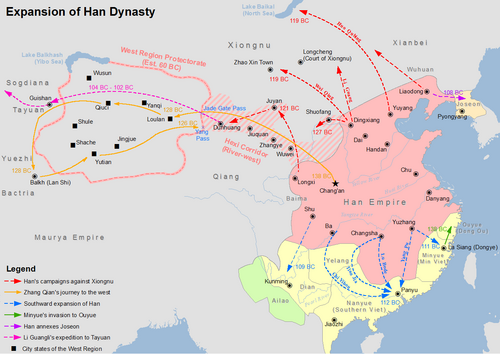
皇帝の蔵書庫が焼かれるなど広範囲に及ぶ反乱の後、[r]漢王朝が紀元前206年から紀元後220年まで中国を統治し、その民衆の間に現代の漢民族という民族名に今も記憶されている文化的アイデンティティを生み出した。[51] [52]漢は帝国の領土を大幅に拡大し、軍事作戦は中央アジア、モンゴル、朝鮮、雲南に達し、広東と北ベトナムは南越から奪還された。漢が中央アジアとソグディアナに関与したことで、ヒマラヤを越えてインドに至る以前の道に代わるシルクロードの陸路が確立された。漢の中国は次第に古代世界最大の経済大国となった。[54]漢は当初地方分権化を図り、秦の法家哲学を公式に放棄して儒教を採用したが、秦の法家制度と政策は漢政府とその後継者によって引き続き採用された。[55]
三国時代、晋、南北朝
漢王朝の終焉後、三国時代として知られる争いの時代が続き、その終わりに魏は金王朝によってあっという間に倒された。金は発達障害のある皇帝の即位により内戦に陥り、五夷が反乱を起こして十六州として中国北部を統治した。鮮卑は北魏として統一し、孝文帝は先代のアパルトヘイト政策を覆し、国民に徹底的な中国化を強制した。南部では、将軍の劉裕が金の退位を確保し、劉宋が王位を継承した。これらの国のさまざまな後継者は南北朝として知られるようになり、最終的に2つの地域は581年に隋によって再統一された。 [要出典]
隋、唐、宋
隋は中国全土で漢の勢力を回復し、農業、経済、科挙制度を改革し、大運河を建設し、仏教を後援した。しかし、公共事業への徴兵と朝鮮北部での戦争の失敗が広範囲にわたる不安を引き起こし、隋は急速に衰退した。[56] [57] 続く唐と宋の時代では、中国の経済、技術、文化は黄金時代に入った。[58]唐王朝は西域とシルクロードの支配を維持し、[59]メソポタミアやアフリカの角まで商人を連れて行き、[60]首都長安を国際的な都市中心地にした。しかし、 8世紀の安史山の乱で荒廃し弱体化した。 [61] 907年、地方の軍知事が統制不能となり、唐は完全に崩壊した。宋王朝は960年に分離独立の状況を終わらせ、宋と遼王朝の勢力均衡をもたらした。宋は世界史上初めて紙幣を発行した政府であり、発達した造船業と海上貿易に支えられた常設海軍を設立した最初の中国国家でもあった。[62]
10世紀から11世紀にかけて、中国の人口は2倍の約1億人に増加したが、これは主に中国中部と南部での稲作の拡大と豊富な食糧余剰の生産によるものである。宋代には、唐の仏教の発展に応じて儒教が復活し、 [63]哲学と芸術が栄え、風景画と磁器は新たなレベルの複雑さを帯びた。[64]しかし、宋軍の軍事的弱さは金朝に見抜かれた。1127年、宋の徽宗皇帝と首都汴京は金宋戦争で占領された。宋の残党は中国南部に撤退した。[65]
元

モンゴルによる中国征服は、 1205年にチンギス・ハーンが西夏に遠征したことから始まった。 [66]チンギス・ハーンは金の領土にも侵攻した。[67] 1271年、モンゴルの指導者フビライ・ハーンは元王朝を建国し、 1279年に宋王朝の最後の残党を征服した。モンゴルの侵攻前、宋の人口は1億2千万人だったが、1300年の国勢調査の時点では6千万人に減少していた。[68]農民の朱元璋が1368年に元を倒し、洪武帝として明王朝を建国した。明王朝の元で、中国はもう一つの黄金時代を迎え、世界最強の海軍の一つを発達させ、芸術と文化が栄える中、豊かで繁栄した経済を築いた。この時期に鄭和提督はインド洋全域を巡る明の財宝航海を率いて東アフリカにまで到達した。[69]
ミン
明朝初期、中国の首都は南京から北京に移された。資本主義の萌芽とともに、王陽明などの哲学者が個人主義や四職業平等の概念で新儒教を批判・拡張した。[70]学者官僚層は税不買運動において産業と商業の支援勢力となり、飢饉や日本による朝鮮侵略(1592-1598)および後金の侵略に対する防衛と相まって国庫の枯渇を招いた。[71] 1644年、北京は李自成率いる農民反乱軍の連合軍に占領された。崇禎帝は市が陥落すると自殺した。当時、明の将軍である呉三桂と同盟を組んでいた満州族の清朝は、李氏朝鮮の短命だった舜朝を倒し、その後北京を占領し、清朝の新しい首都となった。[72]
清

1644年から1912年まで続いた清王朝は、中国最後の皇帝王朝であった。明清交代(1618-1683)では2500万人の命が失われたが、清朝は中国の皇帝の権力を回復し、芸術の新たな開花をもたらしたように見えた。[73]南明の終焉後、ジュンガル・ハン国のさらなる征服により、モンゴル、チベット、新疆が帝国に加わった。[74]一方、中国の人口増加は再開し、すぐに加速し始めた。近代以前の中国の人口は、北宋時代(960-1127年)と清時代(1700-1830年頃)の2回急増を経験したことは一般に認められている。[75]清盛期までに中国はおそらく世界で最も商業化された国となり、帝政中国は18世紀末までに第二次商業革命を経験した。[76]その一方で、清初期の廃金政策や異端審問に代表される思想統制など、農業を重視し商業を抑制する政策によって反清感情を抑圧する目的で中央集権的な専制政治が強化され、社会的、技術的な停滞を引き起こした。[77] [78]
清朝の崩壊

19世紀半ば、イギリス、フランスとのアヘン戦争により、中国は賠償金の支払い、条約港の開港、外国人の治外法権の承認、そして「不平等条約」と呼ばれる最初の条約である1842年の南京条約に基づく香港の英国への割譲を余儀なくされた[79]。日清戦争(1894-1895)の結果、清は朝鮮半島における影響力を失い、台湾は日本に割譲された[80]。清朝は国内不安も経験し始め、特に白蓮華の乱、 1850年代から1860年代にかけて中国南部を荒廃させた太平天国の乱(失敗に終わった)、北西部でのドンガンの乱(1862-1877)で数千万人が死亡した。 1860年代の自立強化運動の当初の成功は、1880年代と1890年代の一連の軍事的敗北によって挫折した。[81]
19世紀には、大規模な中国人離散が始まった。移住による損失に加えて、1876年から1879年にかけて900万から1300万人が死亡した華北飢饉などの紛争や災害が続いた。[82]光緒帝は1898年に近代立憲君主制を確立するための改革案を起草したが、この計画は西太后によって阻止された。1899年から1901年にかけての不運な排外義和団の乱により、王朝はさらに弱体化した。西太后は後期清朝改革として知られる改革プログラムを後援したが、 1911年から1912年の辛亥革命により清王朝は終焉し、中華民国が樹立された。 [ 83]最後の皇帝である溥儀は1912年に退位した。[84]
共和国の樹立と第二次世界大戦
1912年1月1日、中華民国が樹立され、国民党の孫文が臨時大総統に就任した。[85] 1912年3月、元清の将軍で1915年に自らを中華皇帝と称した袁世凱が大総統に就任した。民衆の非難と自身の北洋軍の反対に直面し、彼は退位を余儀なくされ、1916年に共和国を再建した。[86] 1916年に袁世凱が死去した後、中国は政治的に分裂した。北京を拠点とする政府は国際的に承認されていたが、実質的に無力であり、地方の軍閥が領土のほとんどを支配していた。[87] [88]この時期、中国は第一次世界大戦に参加し、広範囲にわたる民衆蜂起(五四運動)を経験した。[89]
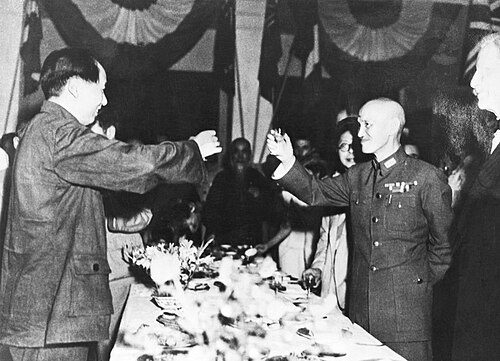
1920年代後半、蒋介石率いる国民党は、北伐として総称される一連の巧みな軍事・政治工作により、自らの支配下に国を統一することに成功した。[90] [91]国民党は首都を南京に移し、孫文の三民主義で中国を近代的な民主国家に変えるという政治的発展の中間段階である「政治的後見」を実施した。[92] [93]国民党は北伐中に中国共産党と短期間同盟を結んだが、1927年に蒋介石が上海で共産党とその他の左翼勢力を暴力的に弾圧し、中国内戦が始まったことで同盟は崩壊した。[94]中国共産党は1931年11月、江西省瑞金で国の一部を中国ソビエト共和国(江西ソビエト)と宣言した。 1934年に江西省のソビエトが国民党軍によって壊滅させられたため、中国共産党は長征を開始し、陝西省の延安に移転した。1949年に中国内戦の大規模な戦闘が終わるまで、ここは共産党の拠点となった。
1931年、日本は満州を侵略し占領した。1937年には中国の他の地域を侵略し、第二次世界大戦の戦場となった日中戦争(1937年~1945年)を引き起こした。この戦争により、国民党と中国共産党は不安定な同盟関係を余儀なくされた。日本軍は民間人に対して数多くの戦争残虐行為を犯し、2千万人もの中国民間人が死亡した。 [95]日本軍の占領下、南京だけで推定4万~30万人の中国人が虐殺された。 [96]中国は、英国、米国、ソ連とともに、国連宣言で連合国の「四大国」として認められた。[97] [98]他の3大国とともに、中国は第二次世界大戦の4大同盟国の一つであり、後に戦争の主たる勝者の一つとみなされた。[99] [100] 1945年の日本の降伏後、澎湖島を含む台湾は中国の管理下に置かれたが、この引き渡しの正当性については議論の余地がある。[101]
中華人民共和国
中国は勝利を収めたものの、戦争で荒廃し財政的に疲弊していた。国民党と共産党の間の不信感は続き、内戦が再開した。1947年に憲法による統治が確立されたが、不安定な状況が続いたため、中華民国憲法の多くの条項は中国本土では実施されなかった。[101]その後、中国共産党は中国本土の大半を支配し、中華民国政府は台湾に撤退した。
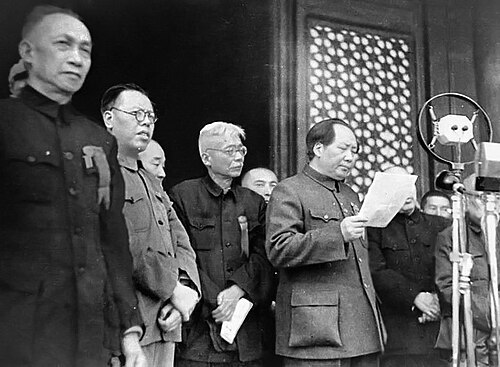
1949年10月1日、中国共産党主席の 毛沢東は北京の天安門広場で正式に中華人民共和国の建国を宣言した。[103] 1950年、中国は中華人民共和国から海南島を奪い取り[104]、チベットを併合した。[105]しかし、残存する国民党軍は1950年代を通じて中国西部で反乱を起こし続けた。 [106]中国共産党は、農民と元小作人による100万から200万人の地主の処刑を国家が容認したことを含む土地改革運動を通じて、農民の間で人気を固めた。 [107]中国は当初ソ連と緊密に同盟を結んでいたが、2つの共産主義国の関係は徐々に悪化し、中国は独立した産業システムと独自の核兵器を開発するに至った。[108]
中国の人口は1950年の5億5000万人から1974年には9億人に増加した。 [109]しかし、理想主義的な大規模工業化プロジェクトである大躍進政策により、 1959年から1961年の間に1500万から5500万人が死亡し、そのほとんどは飢餓によるものだった。 [110] [111] 1964年、中国は最初の原子爆弾を爆発させた。[112] 1966年、毛沢東とその同盟者は文化大革命を開始し、1976年に毛沢東が死去するまで10年間続いた政治的非難と社会的混乱を引き起こした。1971年10月、中華人民共和国は中華人民共和国に代わって国連に加盟し、安全保障理事会の常任理事国となった。[113]
改革と現代史

毛沢東の死後、四人組は華国鋒によって逮捕され、文化大革命の責任を問われた。文化大革命は非難され、数百万人が名誉回復された。 1978年に鄧小平が権力を握り、党の最高幹部で影響力のある「八大長老」とともに大規模な政治・経済改革を実施した。政府は統制を緩め、公社は徐々に解体された。[114]農業集団化は解体され、農地は民営化された。対外貿易が主要な焦点となる一方で、特別経済区(SEZ)が創設された。非効率な国有企業(SOE)は再編され、一部は閉鎖された。これは中国の計画経済からの移行を示すものであった。[115]中国は1982年12月4日に現在の憲法を採択した。 [116]
1989年には天安門広場で 抗議活動が起こり、その後全国に広がった。[117] 趙紫陽は抗議活動に同情したため自宅軟禁され、江沢民が後任となった。江沢民は経済改革を続け、多くの国有企業を閉鎖し、「鉄飯碗」(終身在職権)を削減した。 [118] [119] [120]この間、中国の経済は7倍に成長した。[118] イギリス領香港とポルトガル領マカオは、それぞれ1997年と1999年に一国二制度の原則に基づく特別行政区として中国に復帰した。中国は2001年に世界貿易機関に加盟した。 [118]

2002年の第16回中国共産党大会で、胡錦濤が江沢民の後を継いで総書記に就任した。[118]胡錦濤のもと、中国は高い経済成長を維持し、イギリス、フランス、ドイツ、日本を追い抜いて世界第2位の経済大国となった。[121]しかし、成長は国の資源と環境に深刻な影響を与え、[122] [123]大きな社会的混乱を引き起こした。[124] [125] 習近平は、 2012年の第18回中国共産党大会で胡錦濤の後を継いで最高指導者となった。習近平は権力の座に就いて間もなく、大規模な反汚職取り締まりを開始し、[126] 2022年までに200万人以上の役人を起訴した。[127]習近平は在任中、経済・政治改革の開始以来見られなかった権力を強化した。[128]
地理

中国の地形は広大で多様であり、乾燥した北部のゴビ砂漠やタクラマカン砂漠から、より湿潤な南部の亜熱帯林まで広がっています。ヒマラヤ山脈、カラコルム山脈、パミール高原、天山山脈が中国を南アジアや中央アジアの大部分から隔てています。長江と黄河はそれぞれ世界で3番目と6番目に長い川で、チベット高原から人口密度の高い東海岸まで流れています。太平洋に沿った中国の海岸線は14,500 km (9,000 マイル) の長さで、渤海、黄海、東シナ海、南シナ海に囲まれています。中国はカザフスタン国境を通じてユーラシアステップとつながっています。
中国の領土は、北緯 18度から54度、東経 73度から135度の間に位置しています。中国の地理的中心は、国の中心記念碑によって示されており、北緯35度50分40.9秒 東経103度27分7.5秒 / 北緯35.844694度 東経103.452083度 / 35.844694; 103.452083 (中国の地理的中心) にあります。中国の風景は、その広大な領土全体で大きく変化に富んでいます。東部の黄海と東シナ海の海岸沿いには、広大で人口密度の高い沖積平野が広がり、北部の内モンゴル高原の端には広い草原が広がっています。中国南部は丘陵と低い山脈が大部分を占め、中央東部には中国の二大河川である黄河と長江のデルタ地帯がある。その他の主要河川には西川、メコン川、ブラマプトラ川、アムール川などがある。西部にはヒマラヤ山脈をはじめとする主要な山脈が連なる。北部のより乾燥した地形にはタクラマカン砂漠やゴビ砂漠など高原が広がる。世界最高峰のエベレスト(8,848メートル)は中国とネパールの国境にある。[129]中国で最も低い地点、そして世界で3番目に低い地点はトルファン盆地にあるアイディン湖の干上がった湖底(-154メートル)である。[130]
気候
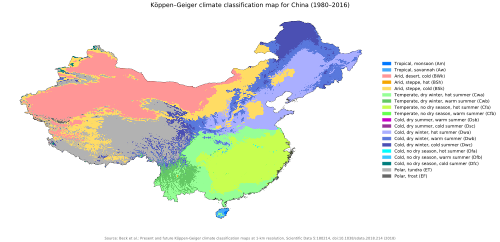
中国の気候は主に乾季と雨季が支配的で、冬と夏の気温差が顕著です。冬は高緯度地域から吹く北風が冷たく乾燥しており、夏は低緯度沿岸地域から吹く南風が暖かく湿っています。[132]
中国における大きな環境問題は、砂漠、特にゴビ砂漠の継続的な拡大である。[133] [134] 1970年代から植えられた防護林によって砂嵐の頻度は減少したが、長期にわたる干ばつと不適切な農業慣行により、毎年春になると中国北部を砂嵐が襲い、日本や韓国を含む東アジアの他の地域に広がっている。水質、浸食、汚染管理は、中国と他国との関係において重要な問題となっている。ヒマラヤの氷河が溶けると、何億人もの人々が水不足に陥る可能性がある。[135]学者によると、中国の気候変動を1.5℃(2.7℉)に抑えるためには、炭素回収を行わない石炭火力発電を2045年までに段階的に廃止する必要がある。 [136]現在の政策では、中国の温室効果ガス排出量はおそらく2025年にピークに達し、2030年までに2022年のレベルに戻るだろう。しかし、このような経路では依然として気温が3℃上昇することになる。[137]
中国の農業生産性に関する政府の公式統計は、補助的な政府レベルでの生産量が誇張されているため、信頼できないと考えられている。[138] [139]中国の大部分は農業に非常に適した気候であり、同国は米、小麦、トマト、ナス、ブドウ、スイカ、ほうれん草、その他多くの作物の世界最大の生産国となっている。[140] 2021年には、世界の永久草地と牧草地の12%、世界の耕作地の8%が中国に属していた。[141]
生物多様性

中国は17のメガダイバーシティ国の一つであり[142]、世界の主要な生物地理区である旧北区とインドマラヤ区の2つに位置している。ある尺度によれば、中国には34,687種以上の動物と維管束植物が生息しており、ブラジルとコロンビアに次いで世界で3番目に生物多様性に富んだ国となっている。[143]中国は生物多様性条約の締約国であり[144]、中国の国家生物多様性戦略と行動計画は2010年に条約に受理された。[145]
中国には少なくとも551種の哺乳類(世界第3位)[146] 、 1,221種の鳥類(第8位)[147] 、 424種の爬虫類(第7位)[148]、333種の両生類(第7位)[149]が生息している。中国の野生生物は世界最大の人口を抱える国の一つと生息地を共有しており、その強い圧力にさらされている。少なくとも840種の動物が絶滅の危機に瀕しており、生息地の破壊、汚染、食用、毛皮、漢方薬目的の密猟などの人間の活動が主な原因となっている。[150]絶滅危惧種の野生生物は法律で保護されており、2005年現在[update]、中国には2,349以上の自然保護区があり、総面積は1億4,995万ヘクタールで、中国の陸地面積全体の15%を占めている。[151]野生動物のほとんどは中国東部と中部の中心的な農業地域から排除されましたが、南部と西部の山岳地帯では状況が改善しました。[152] [153]バイジは2006年12月12日に絶滅が確認されました。[154]
中国には32,000種を超える維管束植物があり、[155]多様な森林タイプが生息している。北部では寒帯針葉樹林が優勢で、ヘラジカやツキノワグマなどの動物種や120種を超える鳥類が生息している。[156]湿潤針葉樹林の下層には竹林があることがある。高山帯のジュニパーやイチイの林では、竹の代わりにシャクナゲが生い茂っている。中国中部と南部では亜熱帯林が優勢で、多数の希少固有種を含む植物種が高密度に生息している。熱帯雨林と季節雨林は雲南省と海南省に限られているが、中国で見つかる動物と植物の4分の1が生息している。[156]中国には10,000種を超える菌類が記録されている。 [ 157]
環境

2000年代初頭、中国は急速な工業化により環境悪化と汚染に悩まされてきた。 [158] [159] 1979年の環境保護法などの規制はかなり厳格であるが、施行は不十分で、急速な経済発展を優先して無視されることも多い。[160]中国は大気汚染による死者数がインドに次いで2番目に多く、約100万人が死亡している。[161] [162]中国はCO2排出国としてランク付けされているが、[163]一人当たりのCO2排出量はわずか8トンで、米国(16.1)、オーストラリア(16.8)、韓国(13.6)などの先進国よりも大幅に低い。[ 164 ]中国 の温室効果ガス排出量は世界最大である。[164] 2022年に中国生態環境部によって飲用に適していると評価された中国の全国表層水はわずか87.9%であった。[165]
中国は汚染の取り締まりを優先し、2010年代には大気汚染が大幅に減少した。[166] 2020年、中国政府は、2030年までに排出量のピークに達し、パリ協定に沿って2060年までにカーボンニュートラルを達成するという目標を発表した。[167] Climate Action Trackerによると、これにより予想される地球の気温上昇は0.2~0.3度低下し、「Climate Action Trackerが推定した最大の単一削減」となる。[167]
中国は再生可能エネルギーとその商業化において世界有数の投資国であり、2022年には5,460億ドルを投資している。 [168]中国は再生可能エネルギー技術の大手メーカーであり、地域規模の再生可能エネルギープロジェクトに多額の投資を行っている。[169] [168]中国は長い間、石炭などの非再生エネルギー源に大きく依存してきたが、近年、再生可能エネルギーの導入が大幅に増加しており、その割合は2016年の26.3%から2022年には31.9%に増加している。 [170] 2023年には、中国の電力の60.5%が石炭(世界最大の生産国)、13.2%が水力(最大)、9.4%が風力(最大)、6.2%が太陽エネルギー(最大)、4.6%が原子力(第2位)、3.3%が天然ガス(第5位)、2.2%がバイオエネルギー(最大)であり、合計で中国のエネルギーの31%が再生可能エネルギー源から供給される。[171]中国は再生可能エネルギーを重視しているにもかかわらず、世界の石油市場と深く結びついており、2022年にはインドに次いでロシア原油の最大の輸入国となっている。[172] [173]
政治地理学
中国は、陸地面積ではロシアに次いで世界第3位の国であり、総面積では世界第3位または第4位の国である。[s]中国の総面積は、一般的に約9,600,000 km 2 (3,700,000平方マイル)とされている。[174]具体的な面積の数字は、ブリタニカ百科事典[14]によると9,572,900 km 2 (3,696,100平方マイル)であり、国連人口年鑑[6]およびワールドファクトブック[5]によると9,596,961 km 2 (3,705,407平方マイル)である。
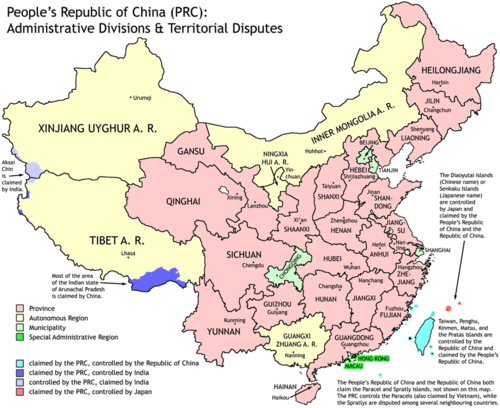
中国は、陸上の国境を合わせて世界最長の22,117km(13,743マイル)の国境を接しており、海岸線は鴨緑江(アムノック川)の河口からトンキン湾まで約14,500km(9,000マイル)に及んでいる。[5]中国は14カ国と国境を接し、東アジアの大部分を占め、東南アジアではベトナム、ラオス、ミャンマー、南アジアではインド、ブータン、ネパール、パキスタン、アフガニスタン、中央アジアではタジキスタン、キルギスタン、カザフスタン、内アジアと北東アジアではロシア、モンゴル、北朝鮮と国境を接している。南西と南はバングラデシュとタイとわずかに隔てられており、日本、フィリピン、マレーシア、インドネシアなどいくつかの海上隣国と接している。[175]
中国は14の近隣国のうち12カ国と陸上国境を解決しており、そのほとんどで実質的な妥協を追求してきた。[176] [177] [178]中国は現在、インド[179]およびブータンと陸上国境を争っている。[180]中国はさらに、尖閣諸島や南シナ海諸島全体など、東シナ海と南シナ海の領土をめぐって複数の国と海洋紛争に巻き込まれている。[181] [182]
政府と政治
中華人民共和国は、マルクス・レーニン主義を標榜する中国共産党(CCP)が統治する一党独裁国家である。このため、中国は共産党が統治する数少ない国の一つとなっている。中国憲法では、中華人民共和国は「労働者階級が主導し、労働者と農民の同盟に基づく人民民主独裁によって統治される社会主義国家である」と規定され、国家機関は「民主集中制の原則を実行する」[183] 、「中国の特色ある社会主義の特徴は、中国共産党の指導である」[184]とされている。
中国は公式には自らを民主主義と称しており、「社会主義協議民主主義」 [185]や「全過程人民民主主義」 [186 ]などの用語を使用している。しかし、この国は一般的に権威主義的な一党独裁国家であり、[187] [188]多くの分野で世界で最も厳しい規制が課されており、特に報道の自由、集会の自由、社会組織の自由な結成、宗教の自由、インターネットへの自由なアクセスに対する規制が厳しい。[189]エコノミスト・インテリジェンス・ユニットの民主主義指数では、中国は一貫して「権威主義体制」として最低ランクにランクされており、2023年には167カ国中148位にランクされている。 [190]他の情報源によると、中国を「権威主義的」と呼ぶだけでは、中国政府に存在する複数の協議メカニズムを十分に説明していないとのことである。 [ 191 ]
中国共産党

中国共産党の規約によれば、最高機関は5年ごとに開催される全国代表大会である。 [192]全国代表大会は中央委員会を選出し、中央委員会は党の政治局、政治局常務委員会、そして国の最高指導部である総書記(党首)を選出する。 [192]総書記は国家と政府に対する最終的な権力と権限を持ち、非公式の最高指導者として機能する。[193]現在の総書記は習近平であり、2012年11月15日に就任した。 [194]地方レベルでは、地方政府の共産党委員会書記は地方政府レベルよりも上位であり、省レベルの共産党委員会書記は知事よりも上位であり、市の共産党委員会書記は市長よりも上位である。[195]中国共産党は、中国の状況に適合したマルクス主義によって公式に指導されている。[196]
政府
中国政府は中国共産党の単独支配下にある。[197]中国共産党は政府機関の人事権を握っており、政府高官の大半は中国共産党員である。[197]
全国人民代表大会(NPC)は、約3,000人の議員を擁し、憲法上は「国家権力の最高機関」であるが[183] 、「ゴム印」機関とも呼ばれている。[198] NPCは毎年開催され、NPC常務委員会はNPC代表から選出された約150人で構成され、2か月ごとに開催される。[198]選挙は間接的で多元的ではなく、すべてのレベルの指名は中国共産党によって管理されている。[186] NPCは中国共産党が支配しており、中国共産党の指導を維持するという条件で、他の8つの小政党が名目上の代表権を持っている。 [199]
国家主席は全国人民代表大会によって選出される。国家主席は儀礼上の国家代表ではあるが、憲法上の国家元首ではない。現国家主席は習近平であり、中国共産党総書記、中央軍事委員会主席を兼ねているため、中国の最高指導者であり、軍隊の最高司令官である。政府の長は首相であり、現職は李強である。首相は国家主席によって正式に指名され、その後全国人民代表大会によって選出され、通常は政治局常務委員会(PSC)の2番目または3番目のメンバーである。首相は、4人の副首相、国務委員、各省庁および委員会の長で構成される中国の内閣である国務院を主宰する。 [183] 中国人民政治協商会議(CPPCC)は、中国共産党を支援するために非共産党の声を集めることを目的とした中国の「統一戦線」体制において重要な政治諮問機関である。人民代表大会と同様に、CPPCCはさまざまな部門に存在し、CPPCC全国委員会の議長は政治委員会第4位の委員である王滬寧が務めている。 [200]
中国の統治は、政治的な中央集権化の度合いが高いが、経済的な地方分権化も著しいという特徴がある。[201] : 7 政策手段や政策プロセスは、より広範囲に適用される前に地方でテストされることが多く、実験とフィードバックを伴う政策となる。[202] : 14 一般的に、中央政府の指導部は具体的な政策を起草することを控え、代わりに非公式のネットワークや現地訪問を利用して、地方の政策実験やパイロットプログラムの方向性を変更したり、変更を提案したりする。 [ 203] : 71 典型的なアプローチは、地方レベルで政策が策定された後、中央政府の指導部が正式な政策、法律、規制の起草を開始するというものである。[203] : 71
行政区分
中華人民共和国は憲法上、23の省、[u]、 5つの自治区(それぞれに少数民族が指定されている)、4つの直轄市(総称して「中国本土」と呼ばれる)および香港とマカオの特別行政区に分かれた単一国家である。 [204]中華人民共和国は、台湾島を台湾省、金門島と馬祖島を福建省の一部、中華民国が管理する南シナ海の島々を海南省と広東省の一部とみなしているが、これらの領土はすべて中華民国( ROC)によって統治されている。[205] [33]地理的には、中国本土の31の省区はすべて、華北、東北中国、華東、華南中、中国南西部、中国北西部の6つの地域に分類できる。[206]

外交関係

中華人民共和国は179の国連加盟国と外交関係を結び、174に大使館を置いている。2024年現在[update]、中国は世界最大級の外交ネットワークを有している。[207] 1971年、中華人民共和国は中華民国(ROC)に代わり、国連における中国の唯一の代表、および国連安全保障理事会の常任理事国5か国のうちの1か国となった。[208] 中国は、G20、[209] SCO、[ 210 ]東アジアサミット、 [ 211 ] APECなどの政府間組織のメンバーである。[212]中国はかつて非同盟運動のメンバーでありリーダーでもあり、現在も自らを発展途上国の代弁者とみなしている。[213]中国はブラジル、ロシア、インド、南アフリカとともに新興主要経済国BRICSグループの一員であり、 2011年4月に同グループの第3回公式サミットを主催した。 [214]
中国は公式には「一つの中国」原則を堅持しており、これは中国という名の主権国家は中国によって代表され、台湾はその中国の一部であるという見解である。[215]台湾の特異な地位により、中国を承認する国々はそれぞれ異なる独自の「一つの中国」政策を堅持することとなった。一部の国は台湾に対する中国の主張を明確に承認しているが、米国や日本を含む他の国々は主張を認めるにとどまっている。 [215]中国当局は、特に武器販売に関して、外国が台湾に外交的接近を行った際に何度も抗議している。[216] [217 ] 1971年に国連で中華人民共和国が中華人民共和国に取って代わって以来、ほとんどの国が中華人民共和国を承認から中華人民共和国に切り替えている。 [218 ]

現在の中国の外交政策の多くは、周恩来首相の平和共存五原則に基づいていると伝えられており、イデオロギーの違いにかかわらず国家間の外交関係を促進する「統一性のない調和」という概念によっても推進されている。[219]この政策により、中国はスーダン、[220]北朝鮮、イランなど、西側諸国から危険で抑圧的と見なされている国を支援または緊密な関係を維持することになった可能性がある。[221]中国とミャンマーの緊密な関係には、同国の政権だけでなく、アラカン軍を含む少数民族反乱グループへの支援も含まれている。[223]中国はロシアと緊密な政治、経済、軍事関係にあり、 [224]両国は国連安全保障理事会でしばしば一致して投票する。[225] [226] [227]中国と米国の関係は複雑で、深い貿易関係があるが、政治的な違いも大きい。[228]
2000年代初頭以来、中国は貿易と二国間協力のためにアフリカ諸国と関わる政策をとってきた。 [229] [230] [231]中国は欧州連合と広範かつ高度に多様な貿易関係を維持しており、物品の最大の貿易相手国となっている。[232]中国は中央アジア[233]と南太平洋での影響力を増大させている。 [234]中国はASEAN諸国[235]や南米の主要経済国[236]と強い貿易関係を持ち、ブラジル、チリ、ペルー、ウルグアイ、アルゼンチンなどにとって最大の貿易相手国である。[237]
2013年、中国は年間500億~1000億ドル規模の資金を投じた大規模な世界インフラ構築計画である一帯一路構想を開始した。 [238]一帯一路は近代史上最大級の開発計画の一つとなり得る。[239]過去6年間で大幅に拡大し、2020年4月現在[update]、138カ国と30の国際機関が参加している。外交関係の強化に加え、特に東アフリカやヨーロッパにつながる海のシルクロードなど、効率的な輸送ルートの構築に重点が置かれている。しかし、この計画の下で行われた融資の多くは持続不可能であり、中国は債務国から債務救済を求める声を数多く受けている。[240] [241]
軍隊

人民解放軍(PLA)は世界で最も強力な軍隊の一つと考えられており、ここ数十年で急速に近代化してきました。[242]一部の国から技術窃盗の疑いもかけられています。[243] [244] [245] 2024年以降、陸軍(PLAGF)、海軍(PLAN)、空軍(PLAAF)、ロケット軍(PLARF)の4つの軍種で構成されています。また、航空宇宙軍、サイバースペース軍、情報支援部隊、統合兵站支援部隊の4つの独立した部隊があり、最初の3つは解散した戦略支援部隊(PLASSF)から分離されました。[246]約220万人の現役兵員は世界最大です。 PLAは世界第3位の核兵器備蓄を保有しており、[247] [248]トン数では世界第2位の海軍です。[249]中国の2023年の公式軍事予算は2240億ドル(1兆5500億元)で世界第2位だが、SIPRIの推計ではその年の実際の支出は2960億ドルで、世界の軍事費の12%を占め、同国のGDPの1.7%を占めている。[250] SIPRIによると、2012年から2021年までの中国の軍事費は平均して年間2150億ドル、GDPの1.7%で、年間7340億ドル、GDPの3.6%の米国に次ぐ規模となっている。[251]人民解放軍は党と国家の中央軍事委員会(CMC)によって指揮されている。公式には2つの別々の組織であるが、2つのCMCは指導部の交代期間を除いてメンバーが同一であり、実質的に1つの組織として機能する。CMCの議長が人民解放軍の最高司令官である。[252]
社会政治問題と人権

中国の人権状況は、裁判なしの拘留、自白の強制、拷問、基本的人権の制限、死刑の過度の使用など、広範な公民権侵害を主張し、外国政府、外国報道機関、非政府組織から大きな批判を集めている。[189] [253]フリーダム・ハウスは設立以来、世界の自由度調査で中国を「自由ではない」と評価しており、[189]アムネスティ・インターナショナルは重大な人権侵害を記録している。[ 253]中国憲法は、国民の「基本的権利」には、言論の自由、報道の自由、公正な裁判を受ける権利、信教の自由、普通選挙、財産権が含まれると規定している。しかし、実際には、これらの規定は、国家による刑事訴追に対する十分な保護を与えていない。[254] [255]中国はLGBTの権利に関して限定的な保護しか与えていない。[256]
政府の政策や中国共産党に対する批判はある程度容認されているが、政治的な発言や情報の検閲は世界でも最も厳しいものの一つであり、集団行動を阻止するために日常的に行われている。[257]中国はまた、世界で最も包括的かつ洗練されたインターネット検閲体制を有しており、多数のウェブサイトがブロックされている。[258]政府は「社会の安定」に対する潜在的な脅威とみなされる民衆の抗議やデモを抑圧している。[259]中国はさらに、国内に住む人々の社会的統制の手段として、カメラ、顔認識ソフトウェア、センサー、個人技術の監視などによる大規模なスパイネットワークを使用している。[260]

中国は、多数の少数民族が居住するチベットと新疆ウイグル自治区において、大規模な弾圧と人権侵害を行っていると頻繁に非難されており[262] [263] [264] 、警察による暴力的な取り締まりや宗教弾圧も含まれている[265] [266]。2017年以来、中国政府は新疆ウイグル自治区で厳しい弾圧を行っており、約100万人のウイグル人やその他の少数民族や宗教的少数派が、被収容者の政治的思考、アイデンティティ、宗教的信念を変えることを目的として、収容所に拘留されている[267] 。西側諸国の報告によると、これらの施設では政治的教化、拷問、身体的・精神的虐待、強制不妊手術、性的虐待、強制労働が日常的に行われている。[268] 2020年のフォーリン・ポリシーの報告書によると、中国のウイグル人に対する扱いは国連のジェノサイドの定義を満たしており、[269]一方、別の国連人権高等弁務官事務所の報告書では、人道に対する罪の定義を満たす可能性があると述べている。[270]中国当局はまた、特に2020年に国家安全法が可決されて以来、香港での反対意見を取り締まっている。 [271]
.jpg/500px-Hong_Kong_anti-extradition_bill_protest_(48108594957).jpg)
ピュー研究所は2017年と2020年に、中国政府による宗教規制の厳しさを世界最高レベルにランク付けしたが、中国における宗教関連の社会的敵意は深刻度が低いと評価した。[272] [273]世界奴隷指数は、2016年には380万人以上(人口の0.25%)が人身売買、強制労働、強制結婚、児童労働、国家が課す強制労働の被害者を含む「現代の奴隷状態」で暮らしていると推定している。国家が課す労働による再教育(労教)制度は2013年に正式に廃止されたが、その慣行がどの程度停止したかは明らかではない。[274]はるかに大規模な労働による改革(労改)制度には、労働刑務所工場、拘置所、再教育キャンプが含まれる。労働研究財団は2008年6月に、こうした施設が約1,422あると推定したが、この数字はおそらく過小評価されていると警告した。[275]
政府に対する国民の見解
中国における政治的な懸念としては、貧富の差の拡大や政府の腐敗などが挙げられる。[276]それにもかかわらず、国際調査では、中国国民が政府に高い満足度を示している。[201] : 137 こうした見方は、一般的に、中国国民の大部分が享受できる物質的な快適さと安全性、そして政府の注意力と対応力に起因している。[201] : 136 世界価値観調査(2022年)によると、中国人回答者の91%が政府に大きな信頼を寄せている。[201] : 13 2020年7月に発表されたハーバード大学の調査によると、国民の政府に対する満足度は2003年以降上昇しており、中国政府は調査史上かつてないほど効果的で有能であると評価されている。[277]
経済
中国は名目GDPで世界第2位の経済大国であり[278] 、購買力平価(PPP)では世界最大である。 [279] 2022年現在、名目GDPで中国は世界経済の約18%を占めている。 [280]中国は世界で最も急速に成長している主要経済国の一つであり[281] 、 1978年の経済改革導入以来、経済成長はほぼ一貫して6%を超えている。[282]世界銀行によると、中国のGDPは1978年の1500億ドルから2022年には17.96兆ドルに増加した。 [283]一人当たり名目GDPでは64位であり、上位中所得国となっている。[284]世界の大企業500社のうち、135社が中国に本社を置いている。[285]少なくとも2024年時点で、中国は世界第2位の株式市場と先物市場、そして第3位の債券市場を有している。[286] : 153 [update]
中国は、東アジアと世界の歴史を通じて、世界有数の経済大国でした。過去2千年間のほとんどの間、同国は世界最大級の経済大国であり、[287]その間、繁栄と衰退のサイクルを経験してきました。[54] [288] 1978年に経済改革が始まって以来、中国は高度に多様化した経済に発展し、国際貿易において最も重要なプレーヤーの1つになりました。競争力のある主要セクターには、製造、小売、鉱業、鉄鋼、繊維、自動車、発電、グリーンエネルギー、銀行、電子機器、通信、不動産、電子商取引、観光などがあります。中国には、世界最大の10の証券取引所のうち3つがあります[289] ―上海、香港、深セン― ―これらを合わせると、2020年10月時点で時価総額は15.9兆ドルを超えます。[290]世界で最も競争力のある金融センターのトップ10のうち4つ(上海、香港、北京、深セン)が中国にあり、これは2020年世界金融センター指数で他のどの国よりも多い。[291][update]

現代中国は、国家資本主義や党国家資本主義の例としてよく挙げられる。[293] [294]エネルギー生産や重工業などの戦略的な「柱」部門では国家が優位に立っているが、民間企業も大幅に拡大し、2008年には民間企業が約3000万社に上った。[295] [296] [297]公式統計によると、中国のGDPの60%以上を民営企業が占めている。[298]
中国は、過去100年間世界最大だった米国を追い抜いて、2010年以来、世界最大の製造国となっている。 [299] [300]米国立科学財団によると、中国は2012年以来、ハイテク製造国でも第2位となっている。[301]中国は米国に次ぐ第2位の小売市場である。[302]中国は電子商取引で世界をリードしており、2021年には世界市場シェアの37%以上を占めている。 [303]中国は電気自動車の消費と生産で世界をリードしており、2022年現在、世界のプラグイン電気自動車(BEVとPHEV)の半分を製造・購入している。[304]中国はまた、電気自動車用のバッテリーとバッテリーのいくつかの重要な原材料の主要生産国である。[305][update]
観光
中国は2019年に6,570万人の海外からの訪問者を受け入れ[306]、2018年には世界で4番目に訪問者が多い国でした。 [306]また、国内観光も非常に盛んで、2019年には中国人観光客が国内を60億回旅行したと推定されています。[307]中国はイタリアに次いで世界で2番目に多い世界遺産(56 )を擁しており、最も人気のある観光地の一つです(アジア太平洋地域では1位)。
富
.jpg/500px-20045-Shanghai-Pano_(cropped).jpg)
中国は2021年に世界の総富の17.9%を占め、米国に次いで世界で2番目に高い[308]中国は歴史上どの国よりも多くの人々を極度の貧困から救いました[309] [310] — 1978年から2018年の間に、中国は8億人の極度の貧困を削減しました。[201] :23 1990年から2018年まで、1日あたり1.90ドル未満の収入(2011 PPP )で生活する中国の人口の割合は66.3%から0.3%に減少し、1日あたり3.20ドル未満の収入で生活する割合は90.0%から2.9%に減少し、1日あたり5.50ドル未満の収入で生活する割合は98.3%から17.0%に減少しました。[311]
1978年から2018年まで、平均生活水準は26倍になった。[312]中国の賃金は過去40年間で大幅に増加しており、実質(インフレ調整済み)賃金は1978年から2007年の間に7倍に増加した。[313]一人当たり所得も大幅に増加しており、中華人民共和国が建国された1949年当時、中国の一人当たり所得は世界平均の5分の1であったが、現在では一人当たり所得は世界平均に匹敵している。[312]中国の発展は非常に不均等である。主要都市と沿岸地域は、農村部や内陸地域に比べてはるかに繁栄している。[314]経済格差は大きく、[315]経済改革後急速に拡大したが、[316] 2010年代には大幅に減少した。[317]世界銀行によると、2020年の中国のジニ係数は0.371だった。[12]
2024年3月現在、中国は億万長者の総数と百万長者の総数[update]で米国に次いで世界第2位であり、億万長者は473人[318] 、百万長者は620万人[308]である。クレディ・スイスの世界富裕層レポートによると、2019年に中国は米国を抜いて、少なくとも11万ドルの純個人資産を持つ人の数が最も多い国となった。[319] [320] 2021年1月現在、中国には85人の女性億万長者がおり、これは世界全体の3分の2を占めている。[321]中国は2015年以来、世界最大の中流階級人口を抱えており、[322]中流階級は2024年までに5億人に増加する。[323][update]
世界経済における中国
中国は2001年からWTOに加盟しており、世界最大の貿易大国である。[324] 2016年までに、中国は124カ国にとって最大の貿易相手国となった。[325]中国は2013年に輸出入の合計で世界最大の貿易国となり、また世界最大の商品輸入国となり、海運のドライバルク市場の約45%を占めた。[326] [327]
中国の外貨準備高は2024年3月時点で3兆2460億米ドルに達し[update]、世界最大となっている。[328] 2022年、中国は世界最大の対内直接投資(FDI)受入国の一つとなり、1800億米ドルを誘致したが、そのほとんどは香港からのものと推測されている。[329] 2021年、中国の外貨送金は530億米ドルで、世界第2位の送金受入国となった。[330]中国は海外への投資も行っており、2023年の対外直接投資総額は1479億米ドルに達している。 [331]また、中国企業による外国企業の大規模な買収も数多く行われている。[332]
経済学者たちは、中国政府による通貨介入により人民元が過小評価され、中国に不当な貿易上の優位性を与えていると主張している。 [333]中国はまた、大量の偽造品を製造していることでも広く批判されている。[334] [335]米国政府はまた、中国が知的財産権を尊重せず、スパイ活動を通じて知的財産を盗んでいると主張している。[336]ハーバード大学の経済複雑性指数は、2020年に中国の輸出の複雑さを世界第17位にランク付けし、2010年の24位から上昇した。[337]
中国政府は、国際通貨制度の弱点を認識し、米ドルへの依存から脱却するために人民元の国際化を推進してきた。 [338]人民元はIMFの特別引出権の構成要素であり、2023年時点で世界で4番目に取引量の多い通貨である[update]。[339]しかし、人民元が完全に交換可能な通貨になるには至らない資本規制のせいもあり、国際貿易量ではユーロ、米ドル、日本円に大きく遅れをとっている。[340]
科学技術
歴史的
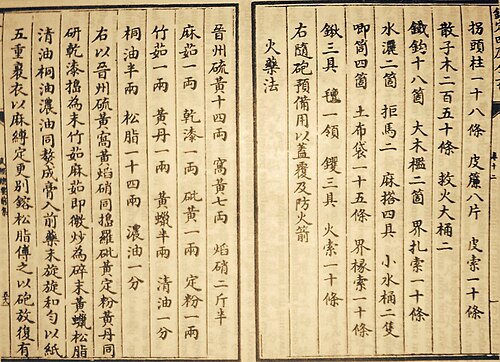
中国は明朝まで科学技術の世界的リーダーだった。[341]製紙、印刷、羅針盤、火薬(四大発明)など、古代および中世の中国の発見と発明は、東アジア、中東、後にヨーロッパに広まった。中国の数学者は負の数を初めて使用した。[342] [343] 17世紀までに、西洋世界は科学技術の進歩で中国を追い抜いた。[344]この近世の大分岐の原因は、学者の間で議論され続けている。[345]
19世紀にヨーロッパの植民地勢力と日本帝国に度重なる軍事的敗北を喫した後、中国の改革派は自立運動の一環として近代科学技術の推進を始めた。1949年に共産党が政権を握ると、科学研究が中央計画の一部であったソ連のモデルに基づいて科学技術を組織化する努力がなされた。 [346] 1976年に毛沢東が死去した後、科学技術は四つの近代化の一つとして推進され、[347]ソ連風の学術制度は徐々に改革されていった。[348]
現代
文化大革命の終結以来、中国は科学研究に多額の投資を行っており[349] 、研究開発費で米国に急速に追いついています。[350] [351]中国は2023年に公式にGDPの約2.6%を研究開発に費やし、総額は約4,585億ドルに達しました。[352]世界知的所有権指標によると、中国は2018年と2019年に米国よりも多くの出願を受けており、2021年には特許、実用新案、商標、意匠、クリエイティブ商品の輸出で世界第1位になりました。[353] [354] [355]中国は2023年に世界イノベーション指数で12位にランクされ、2013年の35位から大幅に向上しました。[356] [357] [358] 中国のスーパーコンピューターは世界最速のコンピューターの一つです。[359] [v]最先端の半導体やジェットエンジンの開発に向けた取り組みは遅れや挫折に見舞われている。[360] [361]
中国は科学、技術、工学、数学(STEM)を重視した教育システムを開発している。 [362]中国の学術出版機関は2016年に世界最大の科学論文出版社となった。 [363] [364] [365] 2022年、中国は主要科学雑誌に掲載された論文のシェアを測るネイチャーインデックスで米国を追い抜いた。[366] [367]
宇宙計画

中国の宇宙計画は1958年にソ連からの技術移転を受けて始まった。しかし、中国が初の衛星を打ち上げたのは1970年の東方紅1号で、これにより中国は単独で衛星を打ち上げた5番目の国となった。[368]
2003年、中国は楊利偉氏による神舟5号の宇宙飛行により、世界で3番目に独自に人間を宇宙に送った国となった。2023年現在、女性2人を含む18人の中国人が宇宙を旅している。2011年、中国は初の宇宙ステーション試験機「天宮1号」を打ち上げた。[369] 2013年、中国の無人探査車「玉兔」が嫦娥3号ミッションの一環として月面着陸に成功した。[370]
2019年、中国は月の裏側に探査機「嫦娥4号」を着陸させた最初の国となった。[371] 2020年、嫦娥5号は月のサンプルを地球に持ち帰ることに成功し、中国は単独でこれを成し遂げた3番目の国となった。[372] 2021年、中国は火星に探査機を着陸させた3番目の国となり、火星に探査車(朱容)を配備した2番目の国となった。 [373]中国は2022年11月3日、低軌道上に独自のモジュール式宇宙ステーション「天宮」を完成させた。 [374] [375] [376] 2022年11月29日、中国は天宮に乗って軌道上で初の乗組員引き継ぎを実施した。[377] [378]
2023年5月、中国は2030年までに人類を月に着陸させる計画を発表した。[379]そのために、中国は現在、月面到達可能な超重量級ロケット「長征10号」、新型有人宇宙船、有人月面着陸船を開発している。[380] [381]
中国は2024年5月3日に嫦娥6号を送り、月の裏側にあるアポロ盆地から初の月サンプルリターンを行った。[382]これは中国の2回目の月サンプルリターンミッションであり、最初のミッションは4年前に嫦娥5号が月の表側から達成した。 [383]また、月面の赤外線分光法を実施し、月面上の嫦娥6号着陸機を撮影するために、金探と呼ばれる中国のローバーも搭載した。 [384]着陸機、上昇機、ローバーの組み合わせは、2024年6月1日22時23分UTCに着陸する前に、周回機と帰還機から分離された。 2024年6月1日に月面に着陸した。[385] [386] 2024年6月3日23時38分UTCにアセンダーは月周回軌道に打ち上げられ、着陸機が収集したサンプルを運び、その後、月周回軌道にドッキングする前に別のロボットランデブーを完了した。その後、サンプルコンテナはリターナーに移され、 2024年6月に内モンゴルに着陸し、中国の裏側地球外サンプルリターンミッションを完了した。
インフラストラクチャー
数十年にわたるインフラブームを経て、[387]中国は数多くの世界をリードするインフラプロジェクトを生み出してきました。例えば、世界最大の高速鉄道網、[388]最多の超高層ビル、[389]世界最大の発電所(三峡ダム)、[390]世界最多の衛星を搭載した全地球衛星航法システムなどです。[391]
通信
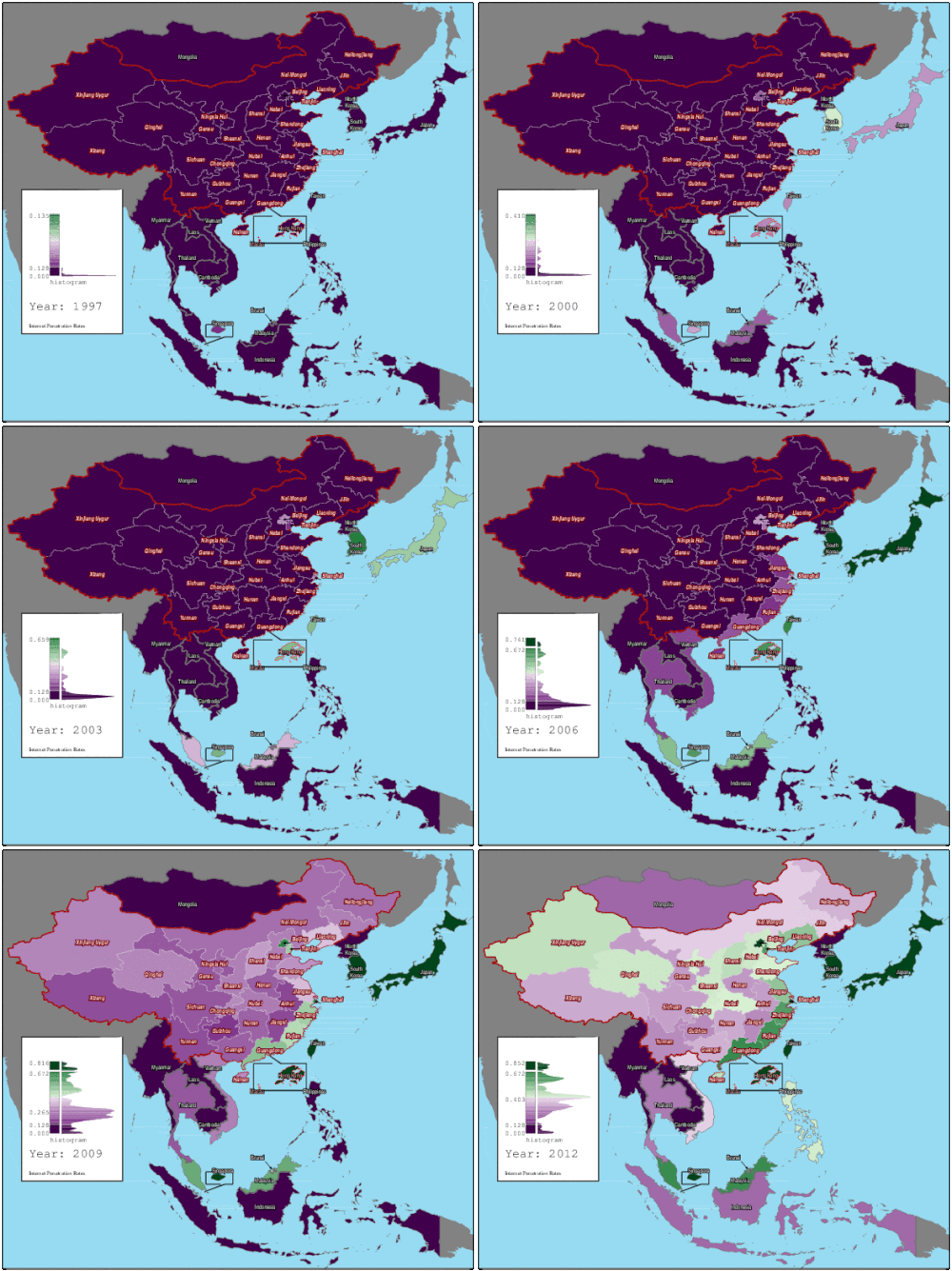
中国は世界最大の通信市場であり、現在、アクティブな携帯電話の数はどの国よりも多く、2023年2月時点で17億人を超える加入者を抱えています。インターネットとブロードバンドのユーザー[update]数も最大で、2023年12月時点でインターネットユーザーは10億9000万人を超えています[392]。これは中国の人口の約77.5%に相当します。[393] 2018年までに、中国の4Gユーザー数は10億人を超え、世界全体の40%を占めました。[394]中国は5Gで急速な進歩を遂げており、2018年後半までに、中国は大規模な商用5G試験を開始しました。[395] 2023年12月時点で、中国の5Gユーザーは8億1000万人を超え、338万の基地局が設置されています。[396][update][update]
中国移動、中国聯通、中国電信は、中国の3大モバイル・インターネットプロバイダーである。中国電信だけでも、1億4500万人以上のブロードバンド加入者と3億人のモバイルユーザーにサービスを提供している。中国聯通の加入者は約3億人で、最大の中国移動は2018年時点で9億2500万人のユーザーを抱えている[update]。[397] 3社の4G基地局を合わせると、中国国内に340万カ所以上ある。[398]中国の通信会社数社、特にファーウェイとZTEは、中国軍のためにスパイ活動を行っているとして告発されている。[399]
中国は独自の衛星ナビゲーションシステム「北斗」を開発し、 2012年にアジア全域で商用ナビゲーションサービスを開始した[400]。また、2018年末までに世界的なサービスも開始した[401]。北斗はGPSとGLONASSに続く、3番目の完成した全地球航法衛星となった[402] 。
輸送

.jpg/500px-CR400BF-Z-0312@BJI_(20231009152047).jpg)
1990年代後半以降、中国の全国道路網は国道と高速道路のネットワークの構築を通じて大幅に拡大しました。2022年には、中国の高速道路の総延長は177,000 km(110,000マイル)に達し、世界最長の高速道路システムになりました。 [403]中国は世界最大の自動車市場を有しており、[404] [405]自動車の販売と生産の両方で米国を上回っています。2023年現在、中国は台数で世界最大の自動車輸出国です。[406] [407]中国の道路網の急速な成長の副作用は、交通事故の大幅な増加です。[408]都市部では、自動車の普及が進んでいるにもかかわらず、自転車は依然として一般的な交通手段であり、2023年現在[update]、中国には約2億台の自転車があります。[409]
国有企業である中国国家鉄道集団公司が運営する中国の鉄道は、世界でも有数の混雑度を誇り、2006年には世界の線路のわずか6%で世界の鉄道輸送量の4分の1を扱っていた。 [410] 2023年現在[update]、中国の鉄道総延長は159,000 km (98,798 mi)で、世界で2番目に長いネットワークとなっている。 [411]特に世界最大の年間人間の移動が行われる春節休暇中は、鉄道は膨大な需要を満たすのに苦労している。 [412]中国の高速鉄道(HSR)システムは、2000年代初頭に建設が開始された。2023年末までに、中国の高速鉄道は専用線だけで45,000 km (27,962 mi)に達し、世界最長のHSRネットワークとなった。 [413]北京〜上海線、北京〜天津線、成都〜重慶線の最高速度は時速350キロメートル(217マイル)で、世界最速の従来型高速鉄道サービスとなっている。2019年の年間乗客数は23億人を超え、世界で最も混雑している。[414]このネットワークには、世界最長のHSR路線である北京〜広州高速鉄道と、世界最長の鉄道橋を3つ持つ北京〜上海高速鉄道が含まれる。[415]最高速度431キロメートル/時(268マイル)の上海リニアモーターカーは、世界最速の商用列車サービスである。[416] 2000年以降、中国の都市における高速輸送システムの成長は加速している。[417] 2023年12月現在、55の中国の都市で都市大量輸送システムが運用されている。[418] 2020年現在、中国は世界で5番目に長い地下鉄システムを誇っており、上海、北京、広州、成都、深センのネットワークが最大です。 [update][update]
中国の民間航空産業は主に国営で、中国政府は中国の航空会社の大半の株式を過半数保有している。2018年に市場シェアの71%を占めた中国のトップ3の航空会社はすべて国有である。過去数十年で航空旅行は急速に拡大し、乗客数は1990年の1660万人から2017年には5億5120万人に増加した。[419] 2024年には中国には約259の空港が存在することになる。[420]
中国には2,000以上の河川港と海港があり、そのうち約130が外国船舶に開放されている。[421]コンテナ港の取扱量上位50位のうち15位が中国にあり、その中で最も取扱量が多いのは上海港で、世界でも最も取扱量の多い港である。[422]中国の内陸水路は世界で6番目に長く、総延長は27,700km(17,212マイル)である。[423]
給水と衛生
中国の水供給と衛生インフラは、急速な都市化、水不足、汚染、公害などの課題に直面している。[424]水供給と衛生に関する共同監視プログラムによると、 2015年の時点で中国の農村人口の約36%が依然として改善された衛生設備を利用できていない。 [425] [更新が必要]進行中の南北水供給プロジェクトは、北部の水不足を緩和することを目的としている。[426]
人口統計
.jpg/500px-China_Population_Density,_2000_(6171905307).jpg)
2020年の中国国勢調査によると、人口は約1,411,778,724人だった。14歳以下が約17.95%、15歳から59歳が63.35%、60歳以上が18.7%だった。[427] 2010年から2020年までの平均人口増加率は0.53%だった。[427]
人口増加への懸念から、中国は1970年代に2人っ子制限を実施し、1979年にはさらに厳しい1家族1人っ子の制限を主張し始めた。しかし、1980年代半ばから、この厳しい制限が不評だったことから、中国は特に農村部でいくつかの大きな例外を認め始め、1980年代半ばから2015年まで実質的に「1.5」人っ子政策が行われた。少数民族も一人っ子制限の対象外となった。[428]この政策の次の大きな緩和は2013年12月に施行され、片方の親が一人っ子の場合、家族は2人の子供を持つことが許可された。[429] 2016年、一人っ子政策は二人っ子政策に置き換えられた。[430]人口の高齢化により、 2021年5月31日に3人っ子政策が発表され、 [430] 2021年7月には、すべての家族規模の制限とそれを超過した場合の罰則が撤廃された。[431] 2023年の合計特殊出生率は1.09と報告され、世界で最も低いランクにある。[432] 2023年には、国家統計局は、人口が2021年から2022年にかけて85万人減少すると推定しており、これは1961年以来初の減少である。[433]
ある学者グループによると、一人っ子制限は人口増加[434]や総人口にほとんど影響を与えなかった。[435]しかし、これらの学者は異議を唱えられている。[436]この政策は、伝統的な男児優遇とともに、出生時の性比の不均衡に寄与した可能性がある。 [437] [438] 2020年の国勢調査では、男性が総人口の51.2%を占めていることが判明した。[439]しかし、中国の性比は、男性が人口の51.8%を占めていた1953年よりもバランスが取れている。[440]
男児を好む文化的傾向と一人っ子政策が相まって、中国では女児孤児が過剰となり、1990年代から2007年頃にかけて、アメリカ人や他の外国人の親による(主に女児の)赤ちゃんの養子縁組が活発に行われた。[441] しかし、中国政府による規制強化により、2007年と2015年には外国人による養子縁組が大幅に減少した。 [442]
都市化

中国はここ数十年で著しく都市化が進んでいる。都市部に住む人口の割合は、1980年の20%から2023年には66%以上に増加する。[443] [444] [445]中国には人口100万人以上の都市が160以上あり、[ 446] 2021年現在、重慶、上海、北京、成都、広州、深セン、天津、西安、蘇州、鄭州、武漢、杭州、臨沂、石家荘、東莞、青島、長沙の17のメガシティ(人口1000万人以上の都市)が含まれる。[449]重慶、上海、北京、成都の常住人口は合計2000万人を超える。[450]上海は中国で最も人口の多い都市圏であり[451] [452]、重慶は中国最大の市であり、中国で唯一、常住人口が3000万人を超える都市である。[453]以下の表の数字は2020年の国勢調査によるもので、行政上の市域内の都市人口の推定値に過ぎない。市町村全体の人口については別の順位が存在している。出稼ぎ労働者の「流動人口」が大きいため、都市部での国勢調査の実施は困難である。[454]以下の数字には長期滞在者のみが含まれている。 [update]
民族グループ

中国は56の異なる民族を法的に認めており、これらが中華民族を構成している。これらの民族のうち最大のものは漢民族で、全人口の91%以上を占めている。[427]漢民族は世界最大の単一民族[458]であり、チベット、新疆、[459] 臨夏、[460]西双版納などの自治州を除くすべての地域で他の民族を上回っている。[461] 2020年の国勢調査によると、少数民族は中国の人口の10%未満を占めている。[427] 2010年の国勢調査と比較すると、漢民族の人口は60,378,693人、つまり4.93%増加し、55の少数民族を合わせた人口は11,675,179人、つまり10.26%増加した。[427] 2020年の国勢調査では、中国本土に居住する外国人は合計845,697人であることが記録された。[462]
言語

中国には292もの現存する言語がある。 [463]最も一般的に話されている言語は、シナ・チベット語族のシナ語派に属し、これには北京語(人口の80%が話している)[464] [465]とその他の中国語の変種:晋語、呉語、閩語、客家語、越語、湘語、贛語、回族語、平語、分類されていない図化語(邵州図化語と湘南図化語)が含まれる。[466]チベット語、チャン語、ナシ語、イ語を含むチベット・ビルマ語派の言語は、チベット高原と雲南・貴州高原全体で話されている。中国南西部の他の少数民族言語には、タイ・カダイ語族のチワン語、タイ語、トン語、スイ語、モン・ミエン語族のミャオ語、ヤオ語、オーストロアジア語族のワ語などがある。中国北東部と北西部では、地元の民族グループがアルタイ語族の満州語、モンゴル語、およびいくつかのテュルク系言語(ウイグル語、カザフ語、キルギス語、サラール語、西ユグル語)を話している。[467] [468]朝鮮語は北朝鮮との国境沿いで母国語として話されている。新疆ウイグル自治区西部のタジク人の言語であるサリコリ語はインド・ヨーロッパ語族である。大陸の少数の人口を含む台湾の先住民族はオーストロネシア語族の言語を話す。[469]
標準中国語は北京語をベースにした中国語の一種で、中国の国語であり、事実上の公用語である。[2]異なる言語的背景を持つ人々の間で共通語として使用されている。 [470] [471]中国の自治区では、新疆ウイグル自治区のウイグル語など、他の言語が共通語として機能することもあり、新疆ウイグル自治区では、ウイグル語での政府サービスが憲法で保証されている。[472] [473]
宗教

[474] [475] [476] [477]
■ 中国の民間宗教(儒教、道教、中国仏教のグループを含む)
■ 仏教 全般
■ イスラム教
■ 少数民族の土着宗教
■ モンゴルの民間宗教
■ ツングースと満州族のシャーマニズムの影響を受けた中国東北部の民間宗教、広く分布する山人道
中国の憲法では信教の自由が保障されている(第2章第36条)が、正式な認可を受けていない宗教団体は国家による迫害の対象となる可能性がある。[183] 中国政府は公式には無神論者である。国内の宗教問題および宗教問題は、統一戦線工作部の管轄下にある国家宗教事務局によって監督されている。[478]
数千年にわたり、中国文明はさまざまな宗教運動の影響を受けてきた。儒教、道教、仏教(中国仏教)を含む「三教」は歴史的に中国文化の形成に重要な役割を果たしており、[ 479] [480]商周王朝初期にまで遡る伝統的宗教の神学的、精神的枠組みを豊かにしている。三教と他の伝統によって形作られた中国の民間宗教[481]は、周囲の自然の神々や人間集団の祖先の原理、礼儀の概念、文化的英雄など、「生成のエネルギー」を意味するキャラクターである神への忠誠で構成されており、その多くは中国の神話や歴史に登場します。[482]民間宗教で最も人気のあるカルトには、天の神の化身であり、中国民族の2人の神聖な祖師の1人である黄帝、[483] [484] 媽祖(海の女神)、[483] 関帝(戦争と商売の神)、財神(繁栄と富の神)、盤古など、多くのカルトがあります。21世紀の最初の数十年間、中国政府は民間カルトの復活に取り組んできました。民間カルトを「民間信仰」(教義的な宗教とは異なるカテゴリ)として正式に認識し、[485]それらを「高度にキュレーションされた」民間宗教の形に再構築することが多かったです。 [486]また、仏教の国内外での推進にも取り組んでいました。[487]中国には、中国の民間信仰の神々や仏教の悟りを開いた存在を表現した世界で最も高い宗教像が数多く存在しており、その中で最も高いのは河南省の泉寺大仏である。

中国における宗教の所属に関する統計は、宗教の定義が複雑で多様であることと、中国の宗教的伝統が拡散的であることから、収集が難しい。学者らは、中国では3つの教義と地元の民間宗教の慣習の間に明確な境界がないと指摘している。[ 479]中国の宗教またはその潮流の一部は、神の創造性は完全に超越的ではなく、世界、特に人間に内在していると考えているため、非神論的かつ人道主義的であると定義することもできる。 [489] 2010年代から2020年代初頭にかけて行われた信頼性の高い人口統計分析をまとめた2023年に発表された研究によると、中国人口の70%が中国の民間宗教を信じている、または実践しており、そのうち、非排他的なアプローチで、33.4%が仏教徒、19.6%が道教徒、17.7%が他の種類の民間宗教の信者であると考えられる。[4]残りの人口のうち、25.2%は完全な無神論者または無神論者、2.5%はキリスト教の信者、1.6%はイスラム教の信者です。[4]中国の民間宗教には、宋王朝以降に出現したさまざまな救済主義の教義組織運動も含まれています。[490]中国には独自の土着宗教を維持する少数民族もいますが、特定の民族グループに特徴的な主要な宗教には、チベット人、モンゴル人、ユグル人の間でチベット仏教、[491]回族、ウイグル族、カザフ族、[472]キルギス人、および国の北部と北西部の他の民族の間でイスラム教があります。
教育
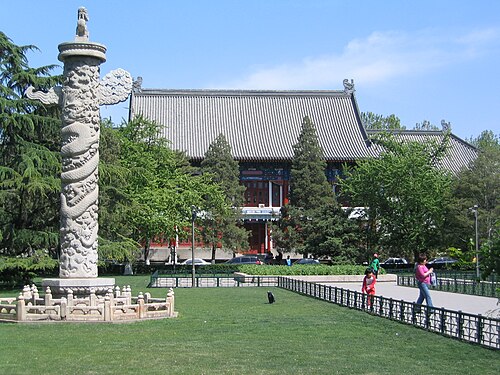
中国の義務教育は、小学校と中学校で構成されており、合わせて6歳から15歳までの9年間です。[494]中国の全国大学入学試験である高考は、ほとんどの高等教育機関への入学の前提条件です。職業教育は、中等教育と高等教育のレベルで利用できます。 [495]毎年、1,000万人以上の中国の学生が職業大学を卒業しています。[496] 2023年には、約91.8%の学生が3年制の高等中学校で教育を継続し、中学校卒業生の60.2%が高等教育に入学しました。[497]
中国は世界最大の教育システムを有しており、[498] 2023年には498,300校以上の学校に約2億9,100万人の生徒と1,892万人の常勤教師が在籍する見込みです。 [499]年間教育投資は2003年の500億米ドル未満から2020年には8,170億米ドル以上に増加しました。 [500] [501]しかし、教育支出には不平等が残っています。2010年、北京市の中学生1人あたりの年間教育支出は20,023円でしたが、最も貧しい省の一つである貴州省ではわずか3,204円でした。[502]中国の識字率は、1949年のわずか20%、1979年の65.5%から[503]、2020年には15歳以上の人口の97%に劇的に増加しました。[504]
2023年現在[update]、中国には3,074以上の大学があり、中国本土には4,760万人以上の学生が在籍しており、世界最大の高等教育システムを有しています。[505] [506] 2023年現在、中国はトップ大学の数が[update]世界で最も多い国です。[507] [508]現在、世界で最も注目されている3つの大学ランキング( ARWU + QS + THE)を合わせた複合ランキングシステムである2023年トップ大学総合ランキングによると、中国はトップ200大学のリストにおける代表数で米国と英国に次ぐ存在です。 [509]タイムズ・ハイヤー・エデュケーションの世界大学ランキング[510]とQS世界大学ランキングによると、中国にはアジアと新興経済国で最高ランクの大学が2つ(清華大学と北京大学)あります。[511]これらの大学は、総合的かつ最先端の教育を提供する中国の一流大学の連合であるC9リーグのメンバーです。[512]
健康

国家衛生委員会は、地方委員会のカウンターパートとともに、国民の健康ニーズを監督している。[513]公衆衛生と予防医学への重点は、1950年代初頭以来、中国の保健政策の特徴となっている。共産党は愛国衛生運動を開始し、衛生状態の改善、およびいくつかの病気の治療と予防を目的とした。中国で以前蔓延していたコレラ、腸チフス、猩紅熱などの病気は、この運動によってほぼ根絶された。[514]
1978年に鄧小平が経済改革を開始した後、農村部で提供されていた無料の公共医療サービスの多くは消滅したものの、栄養状態の改善により中国国民の健康は急速に改善した。中国の医療は大部分が民営化され、質が大幅に向上した。2009年、政府は1240億ドル相当の3年間の大規模な医療提供イニシアチブを開始した。[515]このキャンペーンの結果、2011年までに中国の人口の95%が基本的な健康保険に加入するようになった。[516] 2022年までに中国は医薬品の主要な生産国および輸出国としての地位を確立し、 2017年には医薬品有効成分の約40%を生産した。 [517]
2023年現在[update]、出生時の平均寿命は78歳を超えています。[518] : 163 2021年現在[update]、乳児死亡率は1000人中5人です。[519]どちらも1950年代から大幅に改善しています。[w]栄養失調によって引き起こされる状態である発育阻害率は、1990年の33.1%から2010年の9.9%に低下しました。[522]健康の大幅な改善と高度な医療施設の建設にもかかわらず、中国では、広範囲にわたる大気汚染による呼吸器疾患、[523]数億人の喫煙者、[524]都市部の若者の肥満の増加など、いくつかの新たな公衆衛生問題を抱えています。 [525] [526] 2010年、中国では大気汚染により120万人が早死にしました。[527]中国のメンタルヘルスサービスは不十分です。[528]中国の人口の多さと都市の人口密度は、2003年のSARSのような深刻な病気の流行につながったが、その後大部分封じ込められた。[529] COVID -19パンデミックは2019年12月に武漢で初めて確認された。 [530] [531]パンデミックにより、政府はウイルスを完全に根絶することを目的とした厳格な公衆衛生対策を実施することになったが、この目標は最終的に政策に対する抗議を受けて2022年12月に放棄された。[532] [533]
文化と社会


古代から、中国文化は儒教の影響を強く受けてきた。そして、中国文化は東アジアと東南アジアに大きな影響を与えてきた。[535]中国の王朝時代の大部分において、社会的地位向上の機会は、漢王朝に起源を持つ権威ある科挙で優秀な成績を収めることによって得られていた。 [536]科挙の文学的重視は、書道、詩、絵画は舞踊や演劇よりも高度な芸術形式であるという信念など、中国における文化的洗練の一般的な認識に影響を与えた。中国文化は長い間、深い歴史感覚と、主に内向きの国家観を強調してきた。[537]試験と実力主義の文化は、今日でも中国で非常に高く評価されている。[538]

今日、中国政府は、伝統的な中国文化の多くの要素を中国社会に不可欠なものとして受け入れている。中国ナショナリズムの台頭と文化大革命の終結により、伝統的な中国の芸術、文学、音楽、映画、ファッション、建築のさまざまな形態が活発に復活し、[540] [541]特に民俗芸術とバラエティアートは、国内だけでなく世界中で関心を集めている。[542]外国メディアへのアクセスは依然として厳しく制限されている。[543]
建築
中国建築は中国で数千年にわたって発展し、日本、韓国、モンゴルを含む東アジアの建築の発展に永続的な影響を及ぼし続けています。[544] [545] [546] [ 547 ] また、マレーシア、シンガポール、インドネシア、スリランカ、タイ、ラオス、カンボジア、ベトナム、フィリピンなどの東南アジアと南アジアの建築にも若干の影響を与えています。 [ 548] [549]
中国建築の特徴は、左右対称、囲まれたオープンスペースの使用、風水(例えば、方向階層)、[550]水平方向の強調、そして様々な宇宙論的、神話的、あるいは一般的に象徴的な要素への言及である。中国建築は伝統的に、塔から宮殿に至るまで、構造物をタイプによって分類している。[551] [547]
中国の建築は、その建造物が皇帝のために建てられたのか、庶民のために建てられたのか、あるいは宗教的な目的のために建てられたのかなど、地位や所属によって大きく異なります。中国建築のその他のバリエーションは、南部の高床式住宅、北西部のヤオドン建築、遊牧民のパオ建築、北部の四合院建築など、異なる地理的地域や異なる民族的遺産に関連する地方特有のスタイルで表されます。[552]
文学

中国文学は、周王朝の文学的伝統にそのルーツを持っています。[553]中国の古典は、暦、軍事、占星術、本草学、地理学など、幅広い思想と主題を網羅しています。 [554]最も重要な初期の作品の中には、四書五経の一部である易経と書経があります。これらのテキストは、王朝時代を通じて国家が後援した儒教カリキュラムの基礎でした。詩経から受け継がれた中国の古典詩は、唐代に開花しました。李白と杜甫は、それぞれロマン主義とリアリズムを通じて詩界の分岐点を開いた。中国の歴史学は『史記』に始まり、中国における歴史学の伝統全体は『二十四史』と呼ばれ、中国の神話や民間伝承とともに中国のフィクションの広大な舞台を設定した。[555]明朝の急成長する市民階級に後押しされ、中国の古典フィクションは、水滸伝、三国志演義、西遊記、紅楼夢を含む四大小説に代表される歴史、都市、神と悪魔のフィクションのブームに発展した。[556]金庸や梁愼生の武侠フィクションとともに、[557]中国の影響圏で大衆文化の永続的な源泉であり続けている。[558]
清朝末期の新文化運動をきっかけに、中国文学は一般市民向けの中国語の書き言葉で新しい時代を迎えた。胡適と魯迅は近代文学の先駆者であった。[559]文化大革命後、霧詩、傷跡文学、ヤングアダルト小説、マジックリアリズムの影響を受けた玄文文学など、さまざまな文学ジャンルが生まれた。玄文文学の作家である莫言は2012年にノーベル文学賞を受賞した。[ 561 ]
音楽
中国音楽は、伝統音楽から現代音楽まで、非常に多様な音楽を網羅している。中国音楽の歴史は、帝政以前にまで遡る。中国の伝統楽器は、伝統的に八音と呼ばれる8つのカテゴリーに分類されていた。中国オペラは、数千年の歴史を持つ中国のミュージカルの一種で、北京オペラや広東オペラなどの地域的なスタイルがある。[562]中国ポップ(Cポップ)には、マンダロポップや広東ポップが含まれる。中国ヒップホップや香港ヒップホップが人気となっている。[563]
ファッション
漢服は中国の漢民族の歴史的な衣服である。チャイナドレスは中国の女性に人気の衣装である。[564]漢服運動は現代でも人気があり、漢服の復活を目指している。[565] 中国ファッションウィークは中国で唯一の全国レベルのファッションフェスティバルである。[566]
シネマ
映画は1896年に初めて中国に導入され、最初の中国映画である『定君山』は1905年に公開されました。[567]中国は2016年以来、世界最多の映画スクリーン数を誇ります。[568]中国は2020年に最大の映画市場になりました。[569] [570] 2023年時点で中国で最も興行収入の高い映画トップ3は、 『長津湖の戦い』 (2021年)、『戦狼2』(2017年)、『Hi, Mom』[update] (2021年)でした。[571]
料理

中国料理は、数千年にわたる料理の歴史と地理的多様性を活かした非常に多様な料理であり、その中でも最も影響力のあるものは「八大料理」として知られ、四川料理、広東料理、江蘇料理、山東料理、福建料理、湖南料理、安徽料理、浙江料理が含まれる。[572]中国料理は、調理法と食材の多様さで知られている。 [573]中国の主食は、北東部と南部では米、北部では小麦ベースのパンや麺である。豆腐や豆乳などの豆製品は、依然として人気のあるタンパク源である。豚肉は現在、中国で最も人気のある肉であり、国の肉消費量の約4分の3を占めている。[574]また、ベジタリアンの仏教料理と豚肉を含まないイスラムの中国料理もある。中国料理は、海に近く気候が穏やかなため、魚介類や野菜の種類が豊富である。香港料理やアメリカの中華料理など、中国料理から派生した料理が中国系移民の間で生まれています。
スポーツ
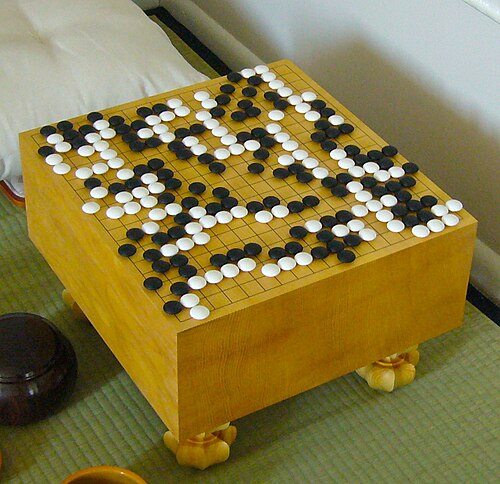
中国は最も古いスポーツ文化を持つ国の一つである。弓術(shèjiàn )は西周の時代に行われていたという証拠がある。剣術(jiànshù)やサッカーとゆるやかな関連がある競技である蹴球( cuju)[575]も中国の初期の王朝にまで遡る。[576]
中国文化では体力づくりが広く重視されており、気功や太極拳などの朝の体操が広く実践されており、[577]商業ジムや個人のフィットネスクラブも人気を集めている。[578]中国で最も人気のある観戦スポーツはバスケットボールである。[579]中国バスケットボール協会とアメリカプロバスケットボール協会も中国国民の間で大きな支持を得ており、中国生まれの選手やNBA行きの選手、ヤオ・ミンや易建聯などの全国的に有名な選手が高く評価されている。[580]中国のプロサッカーリーグは中国スーパーリーグとして知られ、東アジア最大のサッカー市場である。[581]その他の人気スポーツには、武術、卓球、バドミントン、水泳、スヌーカーなどがある。 中国には膨大な数の自転車愛好家がおり、2012年の時点で推定4億7千万台の自転車がある[update]。[582]中国は世界最大のeスポーツ市場を持っています。[583]ドラゴンボートレース、モンゴル式レスリング、競馬など、多くの伝統的なスポーツも人気があります。[584]
中国は1932年からオリンピックに参加しているが、中華人民共和国として参加したのは1952年からである。中国は2008年に北京で夏季オリンピックを開催し、選手らは48個の金メダルを獲得した。これはその年の参加国の中で最多の数字である。[585]中国はまた、 2012年の夏季パラリンピックで最多のメダルを獲得し、合計231個、うち金メダル95個を獲得した。[586] [587] 2011年には、深センで2011年夏季ユニバーシアードが開催された。中国は2013年に天津で東アジア競技大会、2014年に南京でユースオリンピックを開催した。南京は、通常のオリンピックとユースオリンピックの両方を開催した最初の国である。北京と近隣の都市である張家口は、2022年冬季オリンピックを共同で開催し、北京は夏季オリンピックと冬季オリンピックの両方を開催する初の二重オリンピック都市となった。[588] [589]
参照
注記
- ^重慶市の規模は オーストリアとほぼ同じである。ワシントン大学のカム・ウィン・チャン教授は、重慶市の地位は市というより省に近いと主張した。[1]
- ^ 以下の称号を持つ中国の 最高指導者:
- ^ 中国人民政治協商会議議長
- ^ 中国人民政治協商会議は立法府の上院ではないが、諮問機関として存在している。しかし、通常大会が開催されていない間は、国会機能の多くは全国人民代表大会常務委員会によって行われている。
- ^ 中国本土では中華民国として加盟。国連代表は1971年10月25日に中華人民共和国に変更され、1971年11月15日から国連で中国を代表し始めた。
- ^ 国連の中国本土の数字で、香港、マカオ、台湾は含まれない。[6]また、トランスカラコルム地帯(5,180 km 2 (2,000 平方マイル))、アクサイチン(38,000 km 2 (15,000 平方マイル))およびインドと係争中のその他の地域も含まれない。ブリタニカ百科事典によると、中国の総面積は9,572,900 km 2 (3,696,100 平方マイル)とされている。[7]
- ^ GDPの数字には台湾、香港、マカオは含まれません。
- ^ 香港ドルは香港とマカオで使用され、マカオパタカはマカオでのみ使用されます。
- ^ 中国語:中国;ピンイン: Zhōngguó
- ^ 中国語:中华人民共和国;ピンイン: Zhōnghua rénmín gònghéguó
- ^中国とパキスタンの国境はインドと争われており、インドは カシミール地方全体を自国の領土であると主張している。中国はロシアと並んで陸上国境が最も長い国である。
- ^ 米国に対する総面積の順位は、両国の総面積の測定方法によって異なります。詳細については、面積別の国と従属国の一覧を参照してください。次の 2 つの主要な情報源は、中国と米国の総面積の推定範囲を示しています。
- ブリタニカ百科事典によれば、中国は総面積9,572,900 km 2でロシアとカナダに次いで世界で3番目に大きい国であり、[7]アメリカ合衆国は9,525,067 km 2で4番目に大きい国である。[14]
- CIAワールドファクトブックでは、中国は総面積9,596,960 km 2でロシア、カナダ、米国に次いで4番目に大きい国とされており、 [ 5]米国は9,833,517 km 2で3番目に大きい国とされている。[15]
特に、ブリタニカ百科事典は米国の面積(沿岸水域と領海を除く)を9,525,067 km 2としているが、これはどちらの資料の中国の面積よりも小さい。[14]そのため、沿岸水域と領海を含めた面積がどちらの国の方が大きいかは不明である。
国連統計部の米国の数字は9,833,517 km 2 (3,796,742 平方マイル)で、中国は9,596,961 km 2 (3,705,407 平方マイル)である。これらは CIAワールド ファクトブックの数字とほぼ一致しており、同様に米国の沿岸水域と領海が含まれていますが、中国の沿岸水域と領海は含まれていません。 [詳細すぎる? ] - ^ 係争中の台湾省を除く。§ 行政区分を参照。
- ^ 「... この次には偉大な中国があり、その王は世界で最も偉大な王子であると考えられており、サントア・ライアと呼ばれています。」[17] [18]
- ^ 「… 偉大なる中華王国」[19](ポルトガル語:… O Grande Reino da China …)。[20]
- ^ この文字が現存する最も古い使用例は、青銅製の祭器「和尊」であり、周によって征服された商の直轄地のみを指しているようである。[26]
- ^ Its meaning "Zhou's royal demesne" is attested from the 6th-century BC Classic of History, which states "Huangtian bestowed the lands and the peoples of the central state to the ancestors" (皇天既付中國民越厥疆土于先王).[27]
- ^ Owing to Qin Shi Huang's earlier policy involving the "burning of books and burying of scholars", the destruction of the confiscated copies at Xianyang was an event similar to the destructions of the Library of Alexandria in the west. Even those texts that did survive had to be painstakingly reconstructed from memory, luck, or forgery.[53] The Old Texts of the Five Classics were said to have been found hidden in a wall at the Kong residence in Qufu. Mei Ze's "rediscovered" edition of the Book of Documents was only shown to be a forgery in the Qing dynasty.
- ^ According to the Encyclopædia Britannica, the total area of the United States, at 9,522,055 km2 (3,676,486 sq mi), is slightly smaller than that of China. Meanwhile, the CIA World Factbook states that China's total area was greater than that of the United States until the coastal waters of the Great Lakes was added to the United States' total area in 1996. From 1989 through 1996, the total area of US was listed as 9,372,610 km2 (3,618,780 sq mi) (land area plus inland water only). The listed total area changed to 9,629,091 km2 (3,717,813 sq mi) in 1997 (with the Great Lakes areas and the coastal waters added), to 9,631,418 km2 (3,718,711 sq mi) in 2004, to 9,631,420 km2 (3,718,710 sq mi) in 2006, and to 9,826,630 km2 (3,794,080 sq mi) in 2007 (territorial waters added).
- ^ China's border with Pakistan and part of its border with India falls in the disputed region of Kashmir. The area under Pakistani administration is claimed by India, while the area under Indian administration is claimed by Pakistan.
- ^ The People's Republic of China claims the islands of Taiwan and Penghu, which it does not control, as its disputed 23rd province, i.e. Taiwan Province; along with Kinmen and Matsu Islands as part of Fujian Province. These are controlled by the Taipei-based Republic of China (ROC). See § Administrative divisions for more details.
- ^ Some of the chips used were not domestically developed until Sunway TaihuLight in 2016. China has not submitted newer entries to TOP500 amid tensions with the United States.
- ^ The national life expectancy at birth rose from about 31 years in 1949 to 75 years in 2008,[520] and infant mortality decreased from 300 per thousand in the 1950s to around 33 per thousand in 2001.[521]
References
- ^ "The world's biggest cities: How do you measure them?". BBC. 29 January 2012. Retrieved 2024-08-08.
- ^ a b Adamson, Bob; Feng, Anwei (27 December 2021). Multilingual China: National, Minority and Foreign Languages. Routledge. p. 90. ISBN 978-1-0004-8702-2.
Despite not being defined as such in the Constitution, Putonghua enjoys de facto status of the official language in China and is legislated as the standard form of Chinese.
- ^ "Main Data of the Seventh National Population Census". Stats.gov.cn. Archived from the original on 2021-05-11. Retrieved 2021-07-25.
- ^ a b c 2023 approximations of the statistics from the China Family Panel Studies (CFPS) of the year 2018, as contained in the following analyses:
- "Measuring Religion in China" (PDF). Pew Research Center. 30 August 2023. Archived (PDF) from the original on 2023-09-09."Measuring Religions in China". 30 August 2023. Archived from the original on 2023-09-30. A compilation of statistics from reliable surveys held throughout the 2010s and early 2020s, with an emphasis on the CFPS 2018.
- Wenzel-Teuber, Katharina (2023). "Statistics on Religions and Churches in the People's Republic of China – Update for the Year 2022" (PDF). Religions & Christianity in Today's China. XIII. China Zentrum: 18–44. ISSN 2192-9289. Archived (PDF) from the original on 2023-06-23.
- Zhang, Chunni; Lu, Yunfeng; He, Sheng (2021). "Exploring Chinese folk religion: Popularity, diffuseness, and diversities" (PDF). Chinese Journal of Sociology. 7 (4). SAGE Publications: 575–592. doi:10.1177/2057150X211042687. ISSN 2057-150X. Archived (PDF) from the original on 2023-10-15.
- ^ a b c d "China". The World Factbook (2024 ed.). Central Intelligence Agency. Retrieved 2013-11-23. (Archived 2013 edition.)
- ^ a b "Demographic Yearbook—Table 3: Population by sex, rate of population increase, surface area and density" (PDF). UN Statistics. 2007. Archived from the original (PDF) on 2010-12-24. Retrieved 2010-07-31.
- ^ a b "China". Encyclopædia Britannica. Archived from the original on 2019-07-27. Retrieved 2017-12-04.
- ^ "Total surface area as of 19 January 2007". United Nations Statistics Division. Archived from the original on 2023-12-03. Retrieved 2024-03-28.
- ^ Master, Farah (17 January 2024). "China's population drops for second year, with record low birth rate". Reuters. Retrieved 2024-01-17.
- ^ "Population density (people per km2 of land area)". IMF. Archived from the original on 2015-05-16. Retrieved 2015-05-16.
- ^ a b c d "World Economic Outlook Database, April 2024 Edition. (China)". International Monetary Fund. 16 April 2024. Archived from the original on 2024-05-01. Retrieved 2024-04-16.
- ^ a b "Gini index – China". World Bank. Archived from the original on 2024-03-19. Retrieved 2022-05-24.
- ^ "Human Development Report 2023/24" (PDF). United Nations Development Programme. 13 March 2024. Archived (PDF) from the original on 2024-03-13. Retrieved 2024-03-13.
- ^ a b c "United States". Encyclopædia Britannica. Archived from the original on 2015-05-28. Retrieved 2017-12-04.
- ^
 This article incorporates text from this source, which is in the public domain: "United States". The World Factbook (2024 ed.). Central Intelligence Agency. Retrieved 2016-07-03. (Archived 2016 edition.)
- ^ a b c "China". Oxford English Dictionary. Archived from the original on 2023-07-12. Retrieved 2024-03-28.ISBN 0-1995-7315-8
- ^ Eden, Richard (1555), Decades of the New World, p. 230 Archived 11 August 2023 at the Wayback Machine.
- ^ Myers, Henry Allen (1984). Western Views of China and the Far East, Volume 1. Asian Research Service. p. 34.
- ^ Barbosa, Duarte (1918). Dames, Mansel Longworth (ed.). The Book of Duarte Barbosa. Vol. II. London: Asian Educational Services. p. 211. ISBN 978-8-1206-0451-3.
- ^ Barbosa, Duarte (1946). Augusto Reis Machado (ed.). Livro em que dá Relação do que Viu e Ouviu no Oriente. Lisbon: Agência Geral das Colónias. Archived from the original on 2008-10-22.. (in Portuguese)
- ^ "China Archived 2011-09-21 at the Wayback Machine". The American Heritage Dictionary of the English Language (2000). Boston and New York: Houghton-Mifflin.
- ^ a b c Wade, Geoff. "The Polity of Yelang and the Origin of the Name 'China' Archived 2017-11-17 at the Wayback Machine". Sino-Platonic Papers, No. 188, May 2009, p. 20.
- ^ Martino, Martin, Novus Atlas Sinensis, Vienna 1655, Preface, p. 2.
- ^ Bodde, Derk (1986). "The state and empire of Ch'in". In Denis Twitchett; Michael Loewe (eds.). The Cambridge History of China: Volume 1, The Ch'in and Han Empires, 221 BC – AD 220. Cambridge University Press. p. 20. doi:10.1017/CHOL9780521243278.003. ISBN 978-0-521-24327-8. Archived from the original on 2023-04-11. Retrieved 2017-09-09.
- ^ Yule, Henry (1866). Cathay and the Way Thither. Asian Educational Services. pp. 3–7. ISBN 978-81-206-1966-1.
- ^ Chen Zhi (9 November 2004). "From Exclusive Xia to Inclusive Zhu-Xia: The Conceptualisation of Chinese Identity in Early China". Journal of the Royal Asiatic Society. 14 (3): 185–205. doi:10.1017/S135618630400389X. JSTOR 25188470. S2CID 162643600.
- ^ 《尚書》, 梓材. (in Chinese)
- ^ Wilkinson, Endymion (2000). Chinese History: A Manual. Harvard-Yenching Institute Monograph No. 52. Harvard University Asia Center. p. 132. ISBN 978-0-6740-0249-4.
- ^ Tang, Xiaoyang; Guo, Sujian; Guo, Baogang (2010). Greater China in an Era of Globalization. Lanham, MD: Rowman & Littlefield Publishers. pp. 52–53. ISBN 978-0-7391-3534-1.
- ^ "Two 'Chinese' flags in Chinatown 美國唐人街兩面「中國」國旗之爭". BBC. Archived from the original on 2020-12-02. Retrieved 2020-11-05.
- ^ "Chou Hsi-wei on Conflict Zone". Deutsche Welle. Archived from the original on 2021-04-16. Retrieved 2020-11-05.
So-called 'China', we call it 'Mainland', we are 'Taiwan'. Together we are 'China'.
- ^ "China-Taiwan Relations". Council on Foreign Relations. Archived from the original on 2020-07-26. Retrieved 2020-11-05.
- ^ a b "What's behind China-Taiwan tensions?". BBC News. 6 November 2015. Archived from the original on 2015-11-07. Retrieved 2022-11-10.
- ^ Ciochon, Russell; Larick, Roy (1 January 2000). "Early Homo erectus Tools in China". Archaeology. Archived from the original on 2020-01-06. Retrieved 2012-11-30.
- ^ "The Peking Man World Heritage Site at Zhoukoudian". UNESCO. Archived from the original on 2016-06-23. Retrieved 2013-03-06.
- ^ Shen, G.; Gao, X.; Gao, B.; Granger, De (March 2009). "Age of Zhoukoudian Homo erectus determined with (26)Al/(10)Be burial dating". Nature. 458 (7235): 198–200. doi:10.1038/nature07741. PMID 19279636. S2CID 19264385.
- ^ Rincon, Paul (14 October 2015). "Fossil teeth place humans in Asia '20,000 years early'". BBC News. Archived from the original on 2017-08-17. Retrieved 2015-10-14.
- ^ a b Rincon, Paul (17 April 2003). "'Earliest writing' found in China". BBC News. Archived from the original on 2012-03-20. Retrieved 2020-01-14.
- ^ Qiu Xigui (2000) Chinese Writing English translation of 文字學概論 by Gilbert L. Mattos and Jerry Norman Early China Special Monograph Series No. 4. Berkeley: The Society for the Study of Early China and the Institute of East Asian Studies, University of California, Berkeley. ISBN 978-1-5572-9071-7
- ^ Tanner, Harold M. (2009). China: A History. Hackett Publishing. pp. 35–36. ISBN 978-0-8722-0915-2.
- ^ "Bronze Age China". National Gallery of Art. Archived from the original on 2013-07-25. Retrieved 2013-07-11.
- ^ China: Five Thousand Years of History and Civilization. City University of HK Press. 2007. p. 25. ISBN 978-9-6293-7140-1.
- ^ Pletcher, Kenneth (2011). The History of China. Britannica Educational Publishing. p. 35. ISBN 978-1-6153-0181-2.
- ^ Fowler, Jeaneane D.; Fowler, Merv (2008). Chinese Religions: Beliefs and Practices. Sussex Academic Press. p. 17. ISBN 978-1-8451-9172-6.
- ^ Boltz, William G. (February 1986). "Early Chinese Writing". World Archaeology. 17 (3, Early Writing Systems): 420–436 (436). doi:10.1080/00438243.1986.9979980. JSTOR 124705.
- ^ Keightley, David N. (Autumn 1996). "Art, Ancestors, and the Origins of Writing in China". Representations. 56 (Special Issue: The New Erudition): 68–95 [68]. doi:10.2307/2928708. JSTOR 2928708. S2CID 145426302.
- ^ Hollister, Pam (1996). "Zhengzhou". In Schellinger, Paul E.; Salkin, Robert M. (eds.). International Dictionary of Historic Places: Asia and Oceania. Fitzroy Dearborn Publishers. p. 904. ISBN 978-1-8849-6404-6.
- ^ Allan, Keith (2013). The Oxford Handbook of the History of Linguistics. Oxford University Press. p. 4. ISBN 978-0-1995-8584-7.
- ^ "Warring States". Encyclopædia Britannica. 15 September 2023. Archived from the original on 2024-01-19. Retrieved 2024-03-28.
- ^ Sima Qian, Translated by Burton Watson. Records of the Grand Historian: Han Dynasty I, pp. 11–12. ISBN 0-2310-8165-0.
- ^ a b Bodde, Derk. (1986). "The State and Empire of Ch'in", in The Cambridge History of China: Volume I: the Ch'in and Han Empires, 221 B.C. – A.D. 220. Edited by Denis Twitchett and Michael Loewe. Cambridge: Cambridge University Press. ISBN 0-5212-4327-0.
- ^ a b Lewis, Mark Edward (2007). The Early Chinese Empires: Qin and Han. Belknap Press. ISBN 978-0-6740-2477-9.
- ^ Cotterell, Arthur (2011). The Imperial Capitals of China. Pimlico. pp. 35–36.
- ^ a b Dahlman, Carl J.; Aubert, Jean-Eric (2001). China and the Knowledge Economy: Seizing the 21st Century (Report). WBI Development Studies. Herndon, VA: World Bank Publications. ERIC ED460052.
- ^ Goucher, Candice; Walton, Linda (2013). World History: Journeys from Past to Present – Volume 1: From Human Origins to 1500 CE. Routledge. p. 108. ISBN 978-1-1350-8822-4.
- ^ Lee, Ki-Baik (1984). A new history of Korea. Harvard University Press. p. 47. ISBN 978-0-6746-1576-2.
- ^ Graff, David Andrew (2002). Medieval Chinese warfare, 300–900. Routledge. p. 13. ISBN 0-4152-3955-9.
- ^ Adshead, S. A. M. (2004). T'ang China: The Rise of the East in World History. Palgrave Macmillan. p. 54. doi:10.1057/9780230005518_2. ISBN 9780230005518.
- ^ Nishijima, Sadao (1986). "The Economic and Social History of Former Han". In Twitchett, Denis; Loewe, Michael (eds.). Cambridge History of China: Volume I: the Ch'in and Han Empires, 221 B.C. – A.D. 220. Cambridge University Press. pp. 545–607. doi:10.1017/CHOL9780521243278.012. ISBN 978-0-5212-4327-8.
- ^ Bowman, John S. (2000). Columbia Chronologies of Asian History and Culture. Columbia University Press. pp. 104–105.
- ^ China: Five Thousand Years of History and Civilization. City University of HK Press. 2007. p. 71. ISBN 978-9-6293-7140-1.
- ^ Paludan, Ann (1998). Chronicle of the Chinese Emperors. Thames & Hudson. p. 136. ISBN 0-5000-5090-2.
- ^ Huang, Siu-Chi (1999). Essentials of Neo-Confucianism: Eight Major Philosophers of the Song and Ming Periods. Greenwood. p. 3. ISBN 978-0-3132-6449-8.
- ^ "Northern Song dynasty (960–1127)". Metropolitan Museum of Art. Archived from the original on 2017-10-10. Retrieved 2013-11-27.
- ^ Gernet, Jacques (1962). Daily Life in China on the Eve of the Mongol Invasion, 1250–1276. Stanford University Press. p. 22. ISBN 978-0-8047-0720-6. OCLC 1029050217.
- ^ May, Timothy (2012). The Mongol Conquests in World History. Reaktion. p. 1211. ISBN 978-1-8618-9971-2.
- ^ Weatherford, Jack (2004). "Tale of Three Rivers". Genghis Khan and the Making of the Modern World. Random House. p. 95. ISBN 978-0-6098-0964-8.
- ^ Ho, Ping-ti (1970). "An Estimate of the Total Population of Sung-Chin China". Études Song. 1 (1): 33–53.
- ^ Rice, Xan (25 July 2010). "Chinese archaeologists' African quest for sunken ship of Ming admiral". The Guardian. Archived from the original on 2016-12-27. Retrieved 2020-01-16.
- ^ "Wang Yangming (1472–1529)". Internet Encyclopedia of Philosophy. Archived from the original on 2013-11-09. Retrieved 2013-12-09.
- ^ 论明末士人阶层与资本主义萌芽的关系. 8 April 2012. Archived from the original on 2015-09-09. Retrieved 2015-09-02.
- ^ "Qing dynasty". Britannica. Archived from the original on 2018-03-09. Retrieved 2022-11-10.
- ^ Roberts, John M. (1997). A Short History of the World. Oxford University Press. p. 272. ISBN 0-1951-1504-X.
- ^ Fletcher, Joseph (1978). "Ch'ing Inner Asia c. 1800". In John K. Fairbank (ed.). The Cambridge History of China. Vol. 10, Part 1. Cambridge University Press. p. 37. doi:10.1017/CHOL9780521214476.003. ISBN 978-1-1390-5477-5.
- ^ Deng, Kent (2015). China's Population Expansion and Its Causes during the Qing Period, 1644–1911 (PDF). p. 1. Archived (PDF) from the original on 2024-03-09. Retrieved 2023-08-28.
- ^ Rowe, William (2010). China's Last Empire – The Great Qing. Harvard University Press. p. 123. ISBN 9780674054554.
- ^ 中国通史·明清史. 九州出版社. 2010. pp. 104–112. ISBN 978-7-5108-0062-7.
- ^ 中华通史·第十卷. 花城出版社. 1996. p. 71. ISBN 978-7-5360-2320-8.
- ^ Embree, Ainslie; Gluck, Carol (1997). Asia in Western and World History: A Guide for Teaching. M.E. Sharpe. p. 597. ISBN 1-5632-4265-6.
- ^ "Sino-Japanese War (1894–1895)". Encyclopædia Britannica. Archived from the original on 2021-09-20. Retrieved 2022-01-16.
- ^ Enhan (李恩涵), Li (2004). 近代中國外交史事新研. 臺灣商務印書館. p. 78. ISBN 978-9-5705-1891-7.
- ^ "Dimensions of need – People and populations at risk". Food and Agriculture Organization of the United Nations. 1995. Archived from the original on 2023-10-30. Retrieved 2013-07-03.
- ^ Xiaobing, Li (2007). A History of the Modern Chinese Army. University Press of Kentucky. pp. 13, 26–27. ISBN 978-0-8131-2438-4.
- ^ "The abdication decree of Emperor Puyi (1912)". Chinese Revolution. 4 June 2013. Archived from the original on 2023-04-10. Retrieved 2021-05-29.
- ^ Tamura, Eileen (1997) China: Understanding Its Past. Volume 1. University of Hawaii Press ISBN 0-8248-1923-3 p.146
- ^ Haw, Stephen (2006). Beijing: A Concise History. Taylor & Francis. p. 143. ISBN 0-4153-9906-8.
- ^ Elleman, Bruce (2001). Modern Chinese Warfare. Routledge. p. 149. ISBN 0-4152-1474-2.
- ^ Hutchings, Graham (2003). Modern China: A Guide to a Century of Change. Harvard University Press. p. 459. ISBN 0-6740-1240-2.
- ^ Panda, Ankit (5 May 2015). "The Legacy of China's May Fourth Movement". The Diplomat. Archived from the original on 2024-02-22. Retrieved 2024-03-28.
- ^ Zarrow, Peter (2005). China in War and Revolution, 1895–1949. Routledge. p. 230. ISBN 0-4153-6447-7.
- ^ Leutner, M. (2002). The Chinese Revolution in the 1920s: Between Triumph and Disaster. Routledge. p. 129. ISBN 0-7007-1690-4.
- ^ Tien, Hung-Mao (1972). Government and Politics in Kuomintang China, 1927–1937. Vol. 53. Stanford University Press. pp. 60–72. ISBN 0-8047-0812-6.
- ^ Zhao, Suisheng (2000). China and Democracy: Reconsidering the Prospects for a Democratic China. Routledge. p. 43. ISBN 0-4159-2694-7.
- ^ Apter, David Ernest; Saich, Tony (1994). Revolutionary Discourse in Mao's Republic. Harvard University Press. p. 198. ISBN 0-6747-6780-2.
- ^ "Nuclear Power: The End of the War Against Japan". BBC. Archived from the original on 2015-11-28. Retrieved 2013-07-14.
- ^ "Judgement: International Military Tribunal for the Far East" Archived 4 August 2018 at the Wayback Machine. Chapter VIII: Conventional War Crimes (Atrocities). November 1948. Retrieved 4 February 2013.
- ^ "The Moscow Declaration on general security". Yearbook of the United Nations 1946–1947. United Nations. 1947. p. 3. OCLC 243471225. Archived from the original on 2015-05-18. Retrieved 2015-04-25.
- ^ "Declaration by United Nations". United Nations. Archived from the original on 2017-05-25. Retrieved 2015-06-20.
- ^ Hoopes, Townsend, and Douglas Brinkley FDR and the Creation of the U.N. (Yale University Press, 1997)
- ^ Gaddis, John Lewis (1972). The United States and the Origins of the Cold War, 1941–1947. Columbia University Press. pp. 24–25. ISBN 978-0-2311-2239-9.
- ^ a b Tien, Hung-mao (1991). "The Constitutional Conundrum and the Need for Reform". In Feldman, Harvey (ed.). Constitutional Reform and the Future of the Republic of China. M.E. Sharpe. p. 3. ISBN 978-0-8733-2880-7. Archived from the original on 2024-03-28. Retrieved 2024-03-28.
- ^ 李丹青. "What's behind the founding ceremony of the PRC?". www.chinadaily.com.cn. Archived from the original on 2023-02-18.
- ^ Westcott, Ben; Lee, Lily (30 September 2019). "They were born at the start of Communist China. 70 years later, their country is unrecognizable". CNN. Archived from the original on 2019-12-15.
- ^ "Red Capture of Hainan Island". The Tuscaloosa News. 9 May 1950. Archived from the original on 2023-08-10.
- ^ "The Tibetans" (PDF). University of Southern California. Archived from the original (PDF) on 2013-10-16. Retrieved 2013-07-20.
- ^ Garver, John W. (1997). The Sino-American alliance: Nationalist China and American Cold War strategy in Asia. M.E. Sharpe. p. 169. ISBN 978-0-7656-0025-7. Archived from the original on 2024-03-28. Retrieved 2013-07-20.
- ^ Busky, Donald (2002). Communism in History and Theory. Greenwood Publishing Group. p. 11. ISBN 978-0-2759-7733-7. Archived from the original on 2024-03-28. Retrieved 2024-03-28.
- ^ "A Country Study: China". loc.gov. Archived from the original on 2016-06-12. Retrieved 2017-10-03.
- ^ Holmes, Madelyn (2008). Students and teachers of the new China: thirteen interviews. McFarland. p. 185. ISBN 978-0-7864-3288-2. Archived from the original on 2024-03-28. Retrieved 2024-03-28.
- ^ Mirsky, Jonathan (9 December 2012). "Unnatural Disaster". The New York Times. Archived from the original on 2012-12-11. Retrieved 2012-12-07.
- ^ Holmes, Leslie (2009). Communism: A Very Short Introduction. Oxford University Press. p. 32. ISBN 978-0-1995-5154-5.
Most estimates of the number of Chinese dead are in the range of 15 to 30 million.
- ^ "1964: China's first atomic bomb explodes". china.org.cn. Archived from the original on 2023-03-22. Retrieved 2023-02-18.
- ^ Kao, Michael Y. M. (1988). "Taiwan's and Beijing's Campaigns for Unification". In Feldman, Harvey; Kao, Michael Y. M.; Kim, Ilpyong J. (eds.). Taiwan in a Time of Transition. Paragon House. p. 188.
- ^ Hamrin, Carol Lee; Zhao, Suisheng (15 January 1995). Decision-making in Deng's China: Perspectives from Insiders. M.E. Sharpe. ISBN 978-0-7656-3694-2. Archived from the original on 2024-03-28. Retrieved 2023-05-16.
- ^ Hart-Landsberg, Martin; Burkett, Paul (March 2005). China and Socialism: Market Reforms and Class Struggle. Monthly Review Press. ISBN 978-1-5836-7123-8.
- "Review". Monthly Review. 28 February 2001. Archived from the original on 2009-01-05. Retrieved 2008-10-30.
- ^ "Primary Source Document with Questions (DBQs) CONSTITUTION OF THE PEOPLE ' S REPUBLIC OF CHINA (1982)" (PDF). Columbia College.
- ^ Harding, Harry (December 1990). "The Impact of Tiananmen on China's Foreign Policy". National Bureau of Asian Research. Archived from the original on 2014-04-04. Retrieved 2013-11-28.
- ^ a b c d "Jiang Zemin, who guided China's economic rise, dies". Associated Press. 30 November 2022. Archived from the original on 2023-04-03. Retrieved 2022-11-30.
- ^ "China Gets Down to Business at Party Congress". Los Angeles Times. 13 September 1997. Archived from the original on 2022-10-18. Retrieved 2020-01-12.
- ^ Vogel, Ezra (2011). Deng Xiaoping and the Transformation of China. Belknap Press. p. 682. ISBN 978-0-6747-2586-7.
- ^ Orlik, Tom (16 November 2012). "Charting China's Economy: A Decade Under Hu Jintao". The Wall Street Journal. Archived from the original on 2016-12-21. Retrieved 2023-05-16.
- ^ Carter, Shan; Cox, Amanda; Burgess, Joe; Aigner, Erin (26 August 2007). "China's Environmental Crisis". The New York Times. Archived from the original on 2012-01-16. Retrieved 2012-05-16.
- ^ Griffiths, Daniel (16 April 2004). "China worried over pace of growth". BBC News. Archived from the original on 2020-11-18. Retrieved 2006-04-16.
- ^ China: Migrants, Students, Taiwan Archived 27 December 2016 at the Wayback Machine UC Davis Migration News January 2006
- ^ Cody, Edward (28 January 2006). "In Face of Rural Unrest, China Rolls Out Reforms". The Washington Post. Archived from the original on 2017-10-14. Retrieved 2020-01-18.
- ^ "China's anti-corruption campaign expands with new agency". BBC News. 20 March 2018. Archived from the original on 2019-09-24. Retrieved 2019-09-13.
- ^ Marquis, Christopher; Qiao, Kunyuan (15 November 2022). Mao and Markets: The Communist Roots of Chinese Enterprise. Yale University Press. doi:10.2307/j.ctv3006z6k. ISBN 978-0-3002-6883-6. JSTOR j.ctv3006z6k. S2CID 253067190.
- ^ Wingfield-Hayes, Rupert (23 October 2022). "Xi Jinping's party is just getting started". BBC News. Archived from the original on 2023-03-17. Retrieved 2022-10-23.
- ^ "Nepal and China agree on Mount Everest's height". BBC News. 8 April 2010. Archived from the original on 2018-07-12. Retrieved 2020-01-18.
- ^ "Lowest Places on Earth". National Park Service. 28 February 2015. Archived from the original on 2015-02-07. Retrieved 2013-12-02.
- ^ Beck, Hylke E.; Zimmermann, Niklaus E.; McVicar, Tim R.; Vergopolan, Noemi; Berg, Alexis; Wood, Eric F. (30 October 2018). "Present and future Köppen-Geiger climate classification maps at 1-km resolution". Scientific Data. 5: 180214. Bibcode:2018NatSD...580214B. doi:10.1038/sdata.2018.214. PMC 6207062. PMID 30375988.
- ^ Regional Climate Studies of China. Springer. 2008. p. 1. ISBN 978-3-5407-9242-0. Archived from the original on 2024-03-28. Retrieved 2024-03-28.
- ^ Waghorn, Terry (7 March 2011). "Fighting Desertification". Forbes. Archived from the original on 2017-07-29. Retrieved 2020-01-21.
- ^ "Beijing hit by eighth sandstorm". BBC News. 17 April 2006. Archived from the original on 2009-01-01. Retrieved 2020-01-21.
- ^ Reilly, Michael (24 November 2008). "Himalaya glaciers melting much faster". NBC News. Archived from the original on 2020-10-23. Retrieved 2011-09-21.
- ^ China's New Growth Pathway: From the 14th Five-Year Plan to Carbon Neutrality (PDF) (Report). Energy Foundation China. December 2020. p. 24. Archived from the original (PDF) on 2021-04-16. Retrieved 2020-12-16.
- ^ Lui, Swithin (19 May 2022). "Guest post: Why China is set to significantly overachieve its 2030 climate goals". Carbon Brief. Archived from the original on 2022-05-23. Retrieved 2022-05-24.
- ^ Chow, Gregory (2006) Are Chinese Official Statistics Reliable? CESifo Economic Studies 52. 396–414. 10.1093/cesifo/ifl003.
- ^ Liu G, Wang X, Baiocchi G, Casazza M, Meng F, Cai Y, Hao Y, Wu F, Yang Z (October 2020). "On the accuracy of official Chinese crop production data: Evidence from biophysical indexes of net primary production". Proceedings of the National Academy of Sciences. 117 (41): 25434–25444. Bibcode:2020PNAS..11725434L. doi:10.1073/pnas.1919850117. PMC 7568317. PMID 32978301.
- ^ "Countries by commodity". FAOSTAT. Archived from the original on 2020-06-29. Retrieved 2020-01-16.
- ^ World Food and Agriculture – Statistical Yearbook 2023. Rome: Food and Agriculture Organization of the United Nations. 2023. doi:10.4060/cc8166en. ISBN 978-9-2513-8262-2. Archived from the original on 2023-12-15. Retrieved 2023-12-13.
- ^ Williams, Jann (10 December 2009). "Biodiversity Theme Report". Environment.gov.au. Archived from the original on 2011-08-11. Retrieved 2010-04-27.
- ^ Countries with the Highest Biological Diversity Archived 26 March 2013 at the Wayback Machine. Mongabay.com. 2004 data. Retrieved 24 April 2013.
- ^ "Country Profiles – China". Convention on Biological Diversity. Archived from the original on 2023-12-09. Retrieved 2012-12-09.
- ^ "translation: China Biodiversity Conservation Strategy and Action Plan. Years 2011–2030" (PDF). Convention on Biological Diversity. Archived (PDF) from the original on 2022-10-09. Retrieved 2012-12-09.
- ^ IUCN Initiatives – Mammals – Analysis of Data – Geographic Patterns 2012 Archived 12 May 2013 at the Wayback Machine. IUCN. Retrieved 24 April 2013. Data does not include species in Taiwan.
- ^ Countries with the most bird species Archived 16 February 2013 at the Wayback Machine. Mongabay.com. 2004 data. Retrieved 24 April 2013.
- ^ Countries with the most reptile species Archived 16 February 2013 at the Wayback Machine. Mongabay.com. 2004 data. Retrieved 24 April 2013.
- ^ IUCN Initiatives – Amphibians – Analysis of Data – Geographic Patterns 2012 Archived 12 May 2013 at the Wayback Machine. IUCN. Retrieved 24 April 2013. Data does not include species in Taiwan.
- ^ Top 20 countries with most endangered species IUCN Red List Archived 24 April 2013 at the Wayback Machine. 5 March 2010. Retrieved 24 April 2013.
- ^ "Nature Reserves". China Internet Information Center. Archived from the original on 2010-11-15. Retrieved 2013-12-02.
- ^ Turvey, Samuel (2013). "Holocene survival of Late Pleistocene megafauna in China: a critical review of the evidence". Quaternary Science Reviews. 76: 156–166. Bibcode:2013QSRv...76..156T. doi:10.1016/j.quascirev.2013.06.030.
- ^ Lander, Brian; Brunson, Katherine (2018). "Wild Mammals of Ancient North China". The Journal of Chinese History. 2 (2). Cambridge University Press: 291–312. doi:10.1017/jch.2017.45. S2CID 90662935.
- ^ Turvey, Samuel (2008). Witness to Extinction: How we failed to save the Yangtze River dolphin. Oxford University Press.
- ^ Countries with the most vascular plant species Archived 12 January 2014 at the Wayback Machine. Mongabay.com. 2004 data. Retrieved 24 April 2013.
- ^ a b China (3 ed.). Rough Guides. 2003. p. 1213. ISBN 978-1-8435-3019-0. Archived from the original on 2024-03-28. Retrieved 2024-03-28.
- ^ Conservation Biology: Voices from the Tropics. John Wiley & Sons. 2013. p. 208. ISBN 978-1-1186-7981-4. Archived from the original on 2024-03-28. Retrieved 2024-03-28.
- ^ Ma, Xiaoying; Ortalano, Leonard (2000). Environmental Regulation in China. Rowman & Littlefield. p. 1. ISBN 978-0-8476-9399-3. Archived from the original on 2024-03-28. Retrieved 2024-03-28.
- ^ "China acknowledges 'cancer villages'". BBC News. 22 February 2013. Archived from the original on 2024-03-21. Retrieved 2013-02-23.
- ^ Soekov, Kimberley (28 October 2012). "Riot police and protesters clash over China chemical plant". BBC News. Archived from the original on 2016-04-10. Retrieved 2020-01-18.
- ^ "Is air quality in China a social problem?". Center for Strategic and International Studies. ChinaPower Project. 15 February 2016. Archived from the original on 2020-03-26. Retrieved 2020-03-26.
- ^ "Ambient air pollution: A global assessment of exposure and burden of disease". World Health Organization. Archived from the original on 2016-09-28. Retrieved 2018-04-28.
- ^ Chestney, Nina (10 June 2013). "Global carbon emissions hit record high in 2012". Reuters. Archived from the original on 2013-11-19. Retrieved 2013-11-03.
- ^ a b "Each Country's Share of CO2 Emissions". Union of Concerned Scientists. August 2020. Archived from the original on 2019-10-15. Retrieved 2020-10-30.
- ^ "2022 State of Ecology & Environment Report Review". China Water Risk. 21 July 2023. Archived from the original on 2024-01-17. Retrieved 2024-01-02.
- ^ Jayaram, Kripa; Kay, Chris; Murtaugh, Dan (14 June 2022). "China Reduced Air Pollution in 7 Years as Much as US Did in Three Decades". Bloomberg News. Archived from the original on 2023-11-07. Retrieved 2024-01-13.
- ^ a b "China going carbon neutral before 2060 would lower warming projections by around 0.2 to 0.3 degrees C". Climate Action Tracker. 23 September 2020. Archived from the original on 2024-02-11. Retrieved 2020-09-27.
- ^ a b Schonhardt, Sara (30 January 2023). "China Invests $546 Billion in Clean Energy, Far Surpassing the U.S." Scientific American. Archived from the original on 2023-05-19. Retrieved 2023-05-19.
- ^ Meng, Meng (5 January 2017). "China to plow $361 billion into renewable fuel by 2020". Reuters. Archived from the original on 2023-07-27. Retrieved 2018-05-28.
- ^ Maguire, Gavin (23 November 2022). "Column: China on track to hit new clean & dirty power records in 2022". Reuters. Archived from the original on 2023-04-16. Retrieved 2023-05-15.
- ^ "Global Electricity Review 2024: Analysis of key power sector emitters in 2023". Ember. 8 May 2024. Retrieved 2024-05-21.
- ^ Perkins, Robert (7 October 2022). "Russian seaborne crude exports slide to 12-month low as EU ban, price caps loom". S&P Global. Archived from the original on 2022-10-14.
- ^ International Energy Agency (24 February 2022). "Oil Market and Russian Supply – Russian supplies to global energy markets". IEA. Archived from the original on 2023-01-16. Retrieved 2022-04-27.
- ^ Ma, Jin Shuang; Liu, Quan Riu (February 1998). "The Present Situation and Prospects of Plant Taxonomy in China". Taxon. 47 (1). Wiley: 67–74. doi:10.2307/1224020. JSTOR 1224020.
- ^ Wei, Yuwa (2014). "China and ITS Neighbors". Willamette Journal of International Law and Dispute Resolution. 22 (1). Willamette University College of Law: 105–136. JSTOR 26210500.
- ^ "Groundless to view China as expansionist, says Beijing after PM Modi's Ladakh visit". India Today. 3 July 2020. Archived from the original on 2023-08-10. Retrieved 2020-08-13.
- ^ Fravel, M. Taylor (1 October 2005). "Regime Insecurity and International Cooperation: Explaining China's Compromises in Territorial Disputes". International Security. 30 (2): 46–83. doi:10.1162/016228805775124534. S2CID 56347789.
- ^ Fravel, M. Taylor (2008). Strong Borders, Secure Nation: Cooperation and Conflict in China's Territorial Disputes. Princeton University Press. ISBN 978-0-6911-3609-7.
- ^ "India-China dispute: The border row explained in 400 words". BBC News. 14 December 2022. Archived from the original on 2022-04-20. Retrieved 2023-05-16.
- ^ "Bhutan wants a border deal with China: Will India accept?". BBC News. 26 April 2023. Archived from the original on 2023-05-15. Retrieved 2023-05-16.
- ^ "China denies preparing war over South China Sea shoal". BBC News. 12 May 2012. Archived from the original on 2020-02-07. Retrieved 2020-01-16.
- ^ "How uninhabited islands soured China-Japan ties". BBC News. 27 November 2013. Archived from the original on 2018-07-10. Retrieved 2020-01-16.
- ^ a b c d "Constitution of the People's Republic of China". National People's Congress. 20 November 2019. Archived from the original on 2023-07-02. Retrieved 2021-03-20.
- ^ Wei, Changhao (11 March 2018). "Annotated Translation: 2018 Amendment to the P.R.C. Constitution (Version 2.0)". NPC Observer. Archived from the original on 2018-12-22. Retrieved 2019-08-22.
- ^ Jia, Qinglin (1 January 2013). "The Development of Socialist Consultative Democracy in China". Qiushi. Archived from the original on 2017-03-09. Retrieved 2018-05-13.
- ^ a b "Democracy". Decoding China. Heidelberg University. 4 February 2021. Archived from the original on 2022-08-16. Retrieved 2022-08-22.
- ^ Ringen, Stein (2016). The Perfect Dictatorship: China in the 21st Century. Hong Kong University Press. p. 3. ISBN 978-9-8882-0893-7.
- ^ Qian, Isabelle; Xiao, Muyi; Mozur, Paul; Cardia, Alexander (21 June 2022). "Four Takeaways From a Times Investigation Into China's Expanding Surveillance State". The New York Times. Archived from the original on 2023-01-16. Retrieved 2022-07-23.
- ^ a b c "Freedom in the World 2024: China". Freedom House. 2024. Retrieved 2024-04-05.
- ^ "Where democracy is most at risk". The Economist. 14 February 2024. ISSN 0013-0613. Archived from the original on 2024-02-14. Retrieved 2024-02-15.
- ^ Laikwan, Pang (2024). One and All: The Logic of Chinese Sovereignty. Stanford, CA: Stanford University Press. p. 1. ISBN 978-1-5036-3881-5.
- ^ a b Ruwitch, John (13 October 2022). "China's major party congress is set to grant Xi Jinping a 3rd term. And that's not all". NPR. Archived from the original on 2022-10-14. Retrieved 2022-10-15.
- ^ Hernández, Javier C. (25 October 2017). "China's 'Chairman of Everything': Behind Xi Jinping's Many Titles". The New York Times. Archived from the original on 2017-10-25. Retrieved 2020-01-14.
Mr. Xi's most important title is general secretary, the most powerful position in the Communist Party. In China's one party system, this ranking gives him virtually unchecked authority over the government.
- ^ Phillips, Tom (24 October 2017). "Xi Jinping becomes most powerful leader since Mao with China's change to constitution". The Guardian. Archived from the original on 2017-10-24. Retrieved 2017-10-24.
- ^ Lawrence, Susan V.; Lee, Mari Y. (24 November 2021). "China's Political System in Charts: A Snapshot Before the 20th Party Congress". Congressional Research Service. Archived from the original on 2022-06-16. Retrieved 2022-12-20.
- ^ "Xi reiterates adherence to socialism with Chinese characteristics". Xinhua News Agency. 5 January 2013. Archived from the original on 2016-02-01. Retrieved 2020-01-14.
- ^ a b Ma, Josephine (17 May 2021). "Party-state relations under China's Communist Party: separation of powers, control over government and reforms". South China Morning Post. Archived from the original on 2023-05-28. Retrieved 2023-06-23.
- ^ a b "How China is Ruled: National People's Congress". BBC News. Archived from the original on 2020-04-13. Retrieved 2009-07-14.
- ^ "China: Nipped In The Bud – Background". Human Rights Watch. Archived from the original on 2021-04-16. Retrieved 2021-03-18.
- ^ Tiezzi, Shannon (4 March 2021). "What Is the CPPCC Anyway?". The Diplomat. Archived from the original on 2024-03-28. Retrieved 2022-08-21.
- ^ a b c d e Jin, Keyu (2023). The New China Playbook: Beyond Socialism and Capitalism. Viking. ISBN 978-1-9848-7828-1.
- ^ Heilmann, Sebastian (2018). Red Swan: How Unorthodox Policy-Making Facilitated China's Rise. The Chinese University of Hong Kong Press. ISBN 978-9-6299-6827-4.
- ^ a b Brussee, Vincent (2023). Social Credit: The Warring States of China's Emerging Data Empire. Palgrave MacMillan. ISBN 978-9-8199-2188-1.
- ^ "Administrative Division". State Council of the People's Republic of China. 26 August 2014. Archived from the original on 2022-07-09. Retrieved 2022-12-19.
- ^ Chang, Bi-yu (2015). Place, Identity, and National Imagination in Post-war Taiwan. Routledge. pp. 35–40, 46–60. ISBN 978-1-3176-5812-2. Archived from the original on 2024-03-28. Retrieved 2024-03-28.
- ^ Brown, Kerry (2013). Contemporary China. Macmillan International Higher Education – University of Sydney. p. 7. ISBN 978-1-1372-8159-3. Archived from the original on 2020-11-03.
- ^ "Global Diplomacy Index – Country Rank". Lowy Institute. Archived from the original on 2024-02-25. Retrieved 2024-02-26.
- ^ Chang, Eddy (22 August 2004). "Perseverance will pay off at the UN". The Taipei Times. Archived from the original on 2007-08-06.
- ^ "About G20". G20. Archived from the original on 2023-08-25. Retrieved 2023-07-04.
- ^ "Riyadh joins Shanghai Cooperation Organization as ties with Beijing grow". Reuters. 29 March 2023. Archived from the original on 2023-10-11. Retrieved 2023-11-22.
- ^ "EAS Participating Countries". East Asia Summit. Archived from the original on 2023-09-23. Retrieved 2023-07-04.
- ^ "About APEC". Asia-Pacific Economic Cooperation. September 2021. Archived from the original on 2024-03-21. Retrieved 2023-07-04.
- ^ "China says communication with other developing countries at Copenhagen summit transparent". People's Daily. 21 December 2009. Archived from the original on 2009-12-22. Retrieved 2019-01-31.
- ^ "Bric summit ends in China with plea for more influence". BBC News. 14 April 2011. Archived from the original on 2024-02-25. Retrieved 2011-10-24.
- ^ a b Drun, Jessica (28 December 2017). "One China, Multiple Interpretations". Center for Advanced China Research. Archived from the original on 2020-03-09. Retrieved 2023-01-11.
- ^ "Taiwan's Ma to stopover in US: report". Agence France-Presse. 12 January 2010. Archived from the original on 2015-09-09.
- ^ Macartney, Jane (1 February 2010). "China says US arms sales to Taiwan could threaten wider relations". The Times. Archived from the original on 2023-07-12. Retrieved 2020-01-18.
- ^ Hale, Erin (25 October 2021). "Taiwan taps on United Nations' door, 50 years after departure". Al Jazeera. Archived from the original on 2023-01-29. Retrieved 2023-01-11.
- ^ Keith, Ronald C. China from the inside out – fitting the People's republic into the world. PlutoPress. pp. 135–136.
- ^ Timothy Webster (17 May 2013). "China's Human Rights Footprint in Africa". Case Western Reserve University School of Law. pp. 628 and 638. Archived from the original on 2024-02-29. Retrieved 2024-03-28.
- ^ Martel, William C. (29 June 2012). "An Authoritarian Axis Rising?". The Diplomat. Archived from the original on 2013-12-16.
- ^ Maria Siow (27 March 2021). "Could Myanmar's ethnic armed groups turn the tide against the junta, with a little help from Beijing?". South China Morning Post. Archived from the original on 2023-11-27. Retrieved 2023-11-27.
- ^ DAVID BREWSTER (8 November 2022). "How China, India and Bangladesh could be drawn into Myanmar's conflict". Lowy Institute. Archived from the original on 2024-02-24. Retrieved 2024-03-28.
- ^ Davidson, Helen (16 March 2022). "How close are China and Russia and where does Beijing stand on Ukraine?". The Guardian. Archived from the original on 2022-03-22. Retrieved 2023-01-11.
- ^ "Energy to dominate Russia President Putin's China visit". BBC News. 5 June 2012. Archived from the original on 2024-02-14. Retrieved 2020-01-16.
- ^ Gladstone, Rick (19 July 2012). "Friction at the U.N. as Russia and China Veto Another Resolution on Syria Sanctions". The New York Times. Archived from the original on 2022-01-01. Retrieved 2012-11-15.
- ^ "Xi Jinping: Russia-China ties 'guarantee world peace'". BBC News. 23 March 2013. Archived from the original on 2024-01-20. Retrieved 2013-03-23.
- ^ Martin, Eric; Monteiro, Ana (7 February 2023). "US-China Goods Trade Hits Record Even as Political Split Widens". Bloomberg News. Archived from the original on 2023-05-02. Retrieved 2023-05-16.
- ^ McLaughlin, Abraham (30 March 2005). "A rising China counters US clout in Africa". The Christian Science Monitor. Archived from the original on 2007-08-16. Retrieved 2020-01-18.
- ^ Lyman, Princeton (21 July 2005). "China's Rising Role in Africa". Council on Foreign Relations. Archived from the original on 2007-07-15. Retrieved 2007-06-26.
- ^ Politzer, Malia (6 August 2008). "China and Africa: Stronger Economic Ties Mean More Migration". Migration Policy Institute. Archived from the original on 2023-12-02. Retrieved 2013-01-26.
- ^ Timsit, Annabelle (15 February 2021). "China dethroned the US as Europe's top trade partner in 2020". Quartz. Archived from the original on 2023-10-02. Retrieved 2021-03-18.
- ^ Wolff, Stefan (24 May 2023). "How China is increasing its influence in central Asia as part of global plans to offer an alternative to the west". The Conversation. Archived from the original on 2024-03-03. Retrieved 2024-03-28.
- ^ Owen Greene; Christoph Bluth (9 February 2024). "China's increasing political influence in the south Pacific has sparked an international response". The Conversation. Archived from the original on 2024-03-03. Retrieved 2024-03-28.
- ^ "ASEAN Statistical Yearbook 2022" (PDF). ASEAN. December 2022. Archived (PDF) from the original on 2023-05-16. Retrieved 2023-05-16.
- ^ "The U.S. and China Are Battling for Influence in Latin America, and the Pandemic Has Raised the Stakes". Time. 4 February 2021. Archived from the original on 2024-03-23. Retrieved 2021-03-28.
- ^ Garrison, Cassandra (14 December 2020). "In Latin America, a Biden White House faces a rising China". Reuters. Archived from the original on 2023-11-08. Retrieved 2021-03-28.
- ^ Dollar, David (October 2020). "Seven years into China's Belt and Road". Brookings. Archived from the original on 2023-05-30. Retrieved 2020-12-01.
- ^ Cai, Peter. "Understanding China's Belt and Road Initiative". Lowy Institute. Archived from the original on 2022-09-01. Retrieved 2020-11-30.
- ^ Kynge, James; Sun, Yu (30 April 2020). "China faces wave of calls for debt relief on 'Belt and Road' projects". Financial Times. Archived from the original on 2022-12-10. Retrieved 2022-10-28.
- ^ Broadman, Harry G. (2007). Africa's Silk Road: China and India's New Economic Frontier. World Bank. hdl:10986/7186. ISBN 978-0-8213-6835-0. Archived from the original on 2024-03-28. Retrieved 2024-03-28.
- Wolf D. Hartmann; Wolfgang Maennig; Run Wang (2017). Chinas neue Seidenstraße Kooperation statt Isolation - der Rollentausch im Welthandel. Frankfurter Allgemeine Buch. p. 59. ISBN 978-3-9560-1224-2.
- Hernig, Marcus (2018). Die Renaissance der Seidenstrasse : der Weg des chinesischen Drachens ins Herz Europas. FinanzBuch Verlag (FBV). p. 112. ISBN 978-3-9597-2138-7.
- de Wilt, Harry (17 December 2019). "Is 'One Belt, One Road' a China Crisis for North Sea Main Ports?". World Cargo News. 17. Archived from the original on 2023-10-18. Retrieved 2023-10-16.
- Santevecchi, Guido (November 2019). "Di Maio e la Via della Seta: «Faremo i conti nel 2020», siglato accordo su Trieste". Corriere della Sera. 5. Archived from the original on 2023-10-18. Retrieved 2024-03-28.
- ^ Maizland, Lindsay (5 February 2020). "China's Modernizing Military". Council on Foreign Relations. Archived from the original on 2022-08-14. Retrieved 2022-08-14.
- ^ "Russia up in arms over Chinese theft of military technology". Nikkei Asia. Archived from the original on 2024-02-08. Retrieved 2024-02-01.
- ^ "Chinese Spy Sentenced to 20 Years for Trying to Steal US Aviation Trade Secrets". NBC New York. 17 November 2022. Archived from the original on 2024-02-01. Retrieved 2024-02-01.
- ^ "Office of Public Affairs | Chinese National Admits to Stealing Sensitive Military Program Documents From United Technologies | United States Department of Justice". www.justice.gov. 19 December 2016. Archived from the original on 2024-02-01. Retrieved 2024-02-01.
- ^ "Chinese PLA embraces a new system of services and arms: Defense spokesperson - China Military". eng.chinamil.com.cn. Archived from the original on 2024-04-20. Retrieved 2024-04-20.
- ^ "Which Countries Have the Most Nuclear Weapons?". Visual Capitalist. 30 September 2021. Archived from the original on 2023-08-10. Retrieved 2021-11-27.
- ^ "Chinese Nuclear Program". Atomic Heritage Foundation. 19 July 2018. Archived from the original on 2020-08-06. Retrieved 2024-03-28.
- ^ Lendon, Brad (6 March 2021). "Analysis: China has built the world's largest navy. Now what's Beijing going to do with it?". CNN. Archived from the original on 2022-08-10. Retrieved 2022-08-14.
- ^ "Trends in Military Expenditure 2023" (PDF). Stockholm International Peace Research Institute. April 2024. Archived (PDF) from the original on 2024-05-15. Retrieved 2024-04-22.
- ^ "SIPRI Military Expenditure Database". Stockholm International Peace Research Institute. Archived from the original on 2022-11-08. Retrieved 2024-03-28.
- ^ "What China's New Central Military Commission Tells Us About Xi's Military Strategy". Asia Society. Archived from the original on 2022-12-21. Retrieved 2022-12-21.
- ^ a b "China". Amnesty International. Archived from the original on 2023-05-15. Retrieved 2023-05-15.
- ^ Sorman, Guy (2008). Empire of Lies: The Truth About China in the Twenty-First Century. Encounter Books. pp. 46, 152. ISBN 978-1-5940-3284-4. Archived from the original on 2024-03-28. Retrieved 2024-03-28.
- ^ "China: Events of 2021". World Report 2022: China. Human Rights Watch. 2 December 2021. Archived from the original on 2023-05-17. Retrieved 2023-05-15.
- ^ "For China's LGBTQ community, safe spaces are becoming harder to find". NBC News. 13 June 2023. Archived from the original on 2024-01-19. Retrieved 2023-08-08.
- ^ King, Gary; Pan, Jennifer; Roberts, Margaret E. (May 2013). "How Censorship in China Allows Government Criticism but Silences Collective Expression" (PDF). American Political Science Review. 107 (2): 326–343. doi:10.1017/S0003055413000014. S2CID 53577293. Archived (PDF) from the original on 2022-10-09. Retrieved 2015-03-06.
Our central theoretical finding is that, contrary to much research and commentary, the purpose of the censorship program is not to suppress criticism of the state or the Communist Party.
- ^ "Freedom on the Net: 2022". Freedom House. 2022. Archived from the original on 2023-01-23. Retrieved 2023-05-15.
- ^ Christian Göbel and Lynette H. Ong, "Social unrest in China." Long Briefing, Europe China Research and Academic Network (ECRAN) (2012) p 18 Archived 16 January 2021 at the Wayback Machine. Chatham House
- ^ Qian, Isabelle; Xiao, Muyi; Mozur, Paul; Cardia, Alexander (21 June 2022). "Four Takeaways From a Times Investigation Into China's Expanding Surveillance State". The New York Times. Archived from the original on 2023-01-16. Retrieved 2024-03-28.
- ^ "Uighurs: 'Credible case' China carrying out genocide". BBC News. 8 February 2021. Archived from the original on 2021-02-08. Retrieved 2021-02-08.
- ^ Anna Morcom (June 2018). "The Political Potency of Tibetan Identity in Pop Music and Dunglen". Himalaya. 38. Royal Holloway, University of London. Archived from the original on 2021-10-02. Retrieved 2021-10-18.
- ^ "Dalai Lama hits out over burnings". BBC. 7 November 2011. Archived from the original on 2019-11-03. Retrieved 2024-03-28.
- ^ Asat, Rayhan; Yonah Diamond (15 July 2020). "The World's Most Technologically Sophisticated Genocide Is Happening in Xinjiang". Foreign Policy. Archived from the original on 2024-03-28. Retrieved 2024-03-28.
- ^ Hatton, Celia (27 June 2013). "China 'moves two million Tibetans'". BBC News. Archived from the original on 2024-02-29. Retrieved 2013-06-27.
- ^ "Fresh unrest hits China's Xinjiang". BBC News. 29 June 2013. Archived from the original on 2024-01-20. Retrieved 2013-06-29.
- ^ Graham-Harrison, Emma; Garside, Juliette (24 November 2019). "'Allow no escapes': leak exposes reality of China's vast prison camp network". The Guardian. Archived from the original on 2024-03-14. Retrieved 2020-01-18.
- ^ Khatchadourian, Raffi (5 April 2021). "Surviving the Crackdown in Xinjiang". The New Yorker. Archived from the original on 2021-04-10. Retrieved 2023-03-19.
- ^ "China Suppression Of Uighur Minorities Meets U.N. Definition Of Genocide, Report Says". NPR. 4 July 2020. Archived from the original on 2020-10-19. Retrieved 2020-09-28.
- ^ Cumming-Bruce, Nick; Ramzy, Austin (31 August 2022). "U.N. Says China May Have Committed 'Crimes Against Humanity' in Xinjiang". The New York Times. Archived from the original on 2022-09-01. Retrieved 2022-09-01.
- ^ "Hong Kong national security law: What is it and is it worrying?". BBC News. 28 June 2022. Archived from the original on 2020-05-28. Retrieved 2022-08-12.
- ^ "3. Middle East still home to highest levels of restrictions on religion, although levels have declined since 2016". Pew Research Center. 15 July 2019. Archived from the original on 2024-01-06. Retrieved 2024-01-06.
- ^ "3. Small changes in median scores for government restrictions, social hostilities involving religion in 2020". Pew Research Center. 29 November 2022. Archived from the original on 2024-01-06. Retrieved 2024-01-02.
- ^ "China". Global Slavery Index. 2016. Archived from the original on 2016-07-06. Retrieved 2018-03-13.
- ^ "Laogai Handbook: 2007–2008" (PDF). Laogai Research Foundation. 2008. Archived (PDF) from the original on 2023-12-25. Retrieved 2024-03-28.
- ^ "China sounds alarm over fast growing gap between rich and poor". Associated Press. 11 May 2002. Archived from the original on 2014-06-10. Retrieved 2013-02-01.
- ^ Zhao, Suisheng (2023). The dragon roars back: transformational leaders and dynamics of Chinese foreign policy. Stanford University Press. p. 163. ISBN 978-1-5036-3088-8.
- ^ Kollewe, Justin McCurry Julia (14 February 2011). "China overtakes Japan as world's second-largest economy". The Guardian. Archived from the original on 2019-07-19. Retrieved 2019-07-08.
- ^ "GDP PPP (World Bank)". World Bank. 2018. Archived from the original on 2019-02-19. Retrieved 2019-02-18.
- ^ "World Economic Outlook Database, April 2023". International Monetary Fund. April 2023. Archived from the original on 2023-04-13. Retrieved 2023-05-16.
- ^ "Overview". World Bank. Archived from the original on 2020-09-30. Retrieved 2020-09-13.
- ^ "GDP growth (annual %) – China". World Bank. Archived from the original on 2022-05-31. Retrieved 2018-05-25.
- ^ "GDP (current US$) – China". World Bank. Archived from the original on 2019-09-06. Retrieved 2023-07-07.
- ^ "GDP PPP (World Bank)". World Bank. 2018. Archived from the original on 2019-09-02. Retrieved 2019-02-18.
- ^ "Global 500". Fortune Global 500. Archived from the original on 2023-01-16. Retrieved 2023-08-03.
- ^ Curtis, Simon; Klaus, Ian (2024). The Belt and Road City: Geopolitics, Urbanization, and China's Search for a New International Order. New Haven and London: Yale University Press. doi:10.2307/jj.11589102. ISBN 978-0-3002-6690-0. JSTOR jj.11589102.
- ^ Maddison, Angus (2007). Contours of the World Economy 1–2030 AD: Essays in Macro-Economic History. Oxford University Press. p. 379. ISBN 978-0-1916-4758-1. Archived from the original on 2024-03-28. Retrieved 2024-03-28.
- ^ "Angus Maddison. Chinese Economic Performance in the Long Run. Development Centre Studies" (PDF). p. 29. Archived (PDF) from the original on 2022-10-09. Retrieved 2017-09-15.
- ^ "Top 10 Largest Stock Exchanges in the World By Market Capitalization". ValueWalk. 19 February 2019. Archived from the original on 2019-05-15. Retrieved 2019-11-28.
- ^ "China's Stock Market Tops $10 Trillion First Time Since 2015". Bloomberg L.P. 13 October 2020. Archived from the original on 2020-10-31. Retrieved 2020-10-28.
- ^ "The Global Financial Centres Index 28" (PDF). Long Finance. September 2020. Archived (PDF) from the original on 2022-10-09. Retrieved 2020-09-26.
- ^ "World Bank World Development Indicators". World Bank. Archived from the original on 2014-12-20. Retrieved 2014-12-08.
- ^ Pearson, Margaret; Rithmire, Meg; Tsai, Kellee S. (1 September 2021). "Party-State Capitalism in China". Current History. 120 (827): 207–213. doi:10.1525/curh.2021.120.827.207.
- ^ Pearson, Margaret M.; Rithmire, Meg; Tsai, Kellee S. (1 October 2022). "China's Party-State Capitalism and International Backlash: From Interdependence to Insecurity". International Security. 47 (2): 135–176. doi:10.1162/isec_a_00447.
- ^ John Lee. "Putting Democracy in China on Hold". The Center for Independent Studies. 26 July 2008. Retrieved 16 July 2013.
- ^ "China Is a Private-Sector Economy". Bloomberg Businessweek. 22 August 2005. Archived from the original on 2008-02-13. Retrieved 2010-04-27.
- ^ "Microsoft Word – China2bandes.doc" (PDF). OECD. Archived from the original (PDF) on 2008-10-10. Retrieved 2010-04-27.
- ^ Hancock, Tom (30 March 2022). "China Crackdowns Shrink Private Sector's Slice of Big Business". Bloomberg News. Archived from the original on 2024-03-28. Retrieved 2023-04-13.
- ^ Marsh, Peter (13 March 2011). "China noses ahead as top goods producer". Financial Times. Archived from the original on 2022-12-10. Retrieved 2020-01-18.
- ^ Levinson, Marc (21 February 2018). "U.S. Manufacturing in International Perspective" (PDF). Federation of American Scientists. Archived (PDF) from the original on 2022-10-09.
- ^ "Report – S&E Indicators 2018". nsf.gov. Archived from the original on 2023-09-23. Retrieved 2019-07-08.
- ^ Shane, Daniel (23 January 2019). "China will overtake the US as the world's biggest retail market this year". CNN. Archived from the original on 2024-04-25. Retrieved 2019-02-18.
- ^ Cameron, Isabel (9 August 2022). "China continues to lead global ecommerce market with over $2 trillion sales in 2022". Charged. Archived from the original on 2023-12-02. Retrieved 2023-05-19.
- ^ Baraniuk, Chris (11 October 2022). "China's electric car market is booming but can it last?". BBC News. Retrieved 2023-04-13.
- ^ "China Dominates the Global Lithium Battery Market". Institute for Energy Research. 9 September 2020. Retrieved 2021-03-28.
- ^ a b "UNWTO World Tourism Barometer and Statistical Annex, December 2020 | World Tourism Organization". UNWTO World Tourism Barometer (English Version). 18 (7): 1–36. 18 December 2020. doi:10.18111/wtobarometereng.2020.18.1.7.
- ^ Liang, Xinlu (19 August 2021). "How has China's travel industry been hurt by the coronavirus pandemic, and when will tourism recover?". South China Morning Post. Retrieved 2023-05-16.
- ^ a b Shorrocks, Anthony; Davies, James; Lluberas, Rodrigo (2022). Global Wealth Databook 2022 (PDF). Credit Suisse Research Institute.
- ^ "China lifting 800 million people out of poverty is historic: World Bank". Business Standard India. Press Trust of India. 13 October 2017. Retrieved 2019-02-22.
- ^ Four Decades of Poverty Reduction in China: Drivers, Insights for the World, and the Way Ahead. World Bank Publications. 2022. p. ix. ISBN 978-1-4648-1878-3.
By any measure, the speed and scale of China's poverty reduction is historically unprecedented.
- ^ "Is China Succeeding at Eradicating Poverty?". Center for Strategic and International Studies. 23 October 2020. Retrieved 2021-03-28.
- ^ a b Bergsten, C. Fred (2022). The United States vs. China: The Quest for Global Economic Leadership. Polity Press. ISBN 978-1-5095-4735-7.
- ^ "Rising Wages: Has China Lost Its Global Labor Advantage?". iza.org. Retrieved 2019-02-21.
- ^ King, Stephen (2 February 2016). "China's path to tackling regional inequality". Financial Times.
- ^ Duggan, Jennifer (12 January 2013). "Income inequality on the rise in China". Al Jazeera. Archived from the original on 2013-07-22. Retrieved 2020-01-14.
- ^ Tobin, Damian (29 June 2011). "Inequality in China: Rural poverty persists as urban wealth balloons". BBC News. Retrieved 2020-01-14.
- ^ "Just how Dickensian is China?". The Economist. 2 October 2021. Retrieved 2023-05-15.
- ^ "Forbes World's Billionaires List: The Richest People in the World 2023". Forbes. Retrieved 2023-05-15.
- ^ Khan, Yusuf (22 October 2019). "China has overtaken the US to have the most wealthy people in the world | Markets Insider". Business Insider. Retrieved 2019-11-12.[permanent dead link]
- ^ Dawkins, David (21 October 2019). "China Overtakes U.S. In Global Household Wealth Rankings 'Despite' Trade Tensions – Report". Forbes. Retrieved 2019-11-12.
- ^ Chen, Qin (27 March 2021). "China is now home to two-thirds of the world's top women billionaires, four times more than the US, Hurun research institute reveals". South China Morning Post. Retrieved 2021-03-28.
- ^ Zheping, Huang (14 October 2015). "China's middle class has overtaken the US's to become the world's largest". Quartz. Retrieved 2019-06-22.
- ^ Zuo, Mandy (3 March 2024). "China's middle-income population passes 500 million mark, state-owned newspaper says". South China Morning Post. Retrieved 2024-05-21.
- ^ He, Laura (13 January 2023). "China's exports plunge as global demand weakens, but trade with Russia hits record high". CNN. Retrieved 2023-05-19.
- ^ Desjardins, Jeff (27 April 2016). "Four Maps Showing China's Rising Dominance in Trade". Visual Capitalist. Retrieved 2019-12-04.
- ^ Monaghan, Angela (10 January 2014). "China surpasses US as world's largest trading nation". The Guardian. Retrieved 2019-12-04.
- ^ Paris, Costas (27 April 2021). "China's Imports of Commodities Drive a Boom in Dry-Bulk Shipping". The Wall Street Journal. Retrieved 2021-04-29.
- ^ "China forex reserves rise to $3.246 trln in March". Reuters. 7 April 2024. Retrieved 2024-05-21.
- ^ "China Foreign Investment Posts Record Slump as Covid Zero Ended". Bloomberg News. 19 January 2023. Retrieved 2023-05-15.
- ^ "With $87 billion, India beats China as top remittance recipient in 2021". India Today. 21 July 2022. Retrieved 2023-05-15.
- ^ Chow, Loletta (5 February 2024). "Overview of China outbound investment of 2023". Ernst & Young. Retrieved 2024-05-21.
- ^ "Being eaten by the dragon". The Economist. 11 November 2010.
- ^ He, Laura (4 June 2021). "China's stronger currency means difficult choices for Beijing". CNN Business. CNN. Retrieved 2022-07-27.
- ^ "Intellectual Property Rights" (PDF). Asia Business Council. Carnegie Endowment for International Peace. September 2005. Archived from the original (PDF) on 2010-03-26. Retrieved 2012-01-13.
- ^ "MIT CIS: Publications: Foreign Policy Index". MIT Center for International Studies. Archived from the original on 2007-02-14. Retrieved 2010-05-15.
- ^ "China theft of technology is biggest law enforcement threat to US, FBI says". The Guardian. 6 February 2020. Retrieved 2022-12-19.
- ^ Hancock, Tom (26 January 2023). "The US Hasn't Noticed That China-Made Cars Are Taking Over the World". Bloomberg News. Retrieved 2023-05-16.
- ^ Huang, Yukon (Fall 2013). "Does Internationalizing the RMB Make Sense for China?" (PDF). Cato Journal. Retrieved 2014-07-28.
- ^ Kawate, Iori (23 December 2023). "China's yuan rises to 4th most used currency in global settlements". Nikkei Asia. Retrieved 2024-05-21.
- ^ "RMB now 8th most widely traded currency in the world". Society for Worldwide Interbank Financial Telecommunication. Archived from the original on 2015-11-05. Retrieved 2013-10-10.
- ^ Tom (1989), 99; Day & McNeil (1996), 122; Needham (1986e), 1–2, 40–41, 122–123, 228.
- ^ "In Our Time: Negative Numbers". BBC News. 9 March 2006. Retrieved 2013-06-19.
- ^ Struik, Dirk J. (1987). A Concise History of Mathematics. New York: Dover Publications. pp. 32–33. "In these matrices we find negative numbers, which appear here for the first time in history."
- ^ Chinese Studies in the History and Philosophy of Science and Technology. Vol. 179. Kluwer Academic Publishers. 1996. pp. 137–138. ISBN 978-0-7923-3463-7.
- ^ Frank, Andre (2001). "Review of The Great Divergence". Journal of Asian Studies. 60 (1): 180–182. doi:10.2307/2659525. JSTOR 2659525.
- ^ Yu, Q. Y. (1999). The Implementation of China's Science and Technology Policy. Greenwood Publishing Group. p. 2. ISBN 978-1-5672-0332-5.
- ^ Vogel, Ezra F. (2011). Deng Xiaoping and the Transformation of China. Harvard University Press. p. 129. ISBN 978-0-6740-5544-5.
- ^ DeGlopper, Donald D. (1987). "Soviet Influence in the 1950s". China: a country study. Library of Congress.
- ^ Jia, Hepeng (9 September 2014). "R&D share for basic research in China dwindles". Chemistry World. Archived from the original on 2015-02-19. Retrieved 2020-01-21.
- ^ Normile, Dennis (10 October 2018). "Surging R&D spending in China narrows gap with United States". Science. Retrieved 2019-02-20.
- ^ "China Has Surpassed the U.S. in R&D Spending, According to New National Academy of Arts and Sciences Report – ASME". asme.org. Retrieved 2020-10-26.
- ^ "China's R&D expenditure exceeds 3.3 trln yuan in 2023: minister". State Council of the People's Republic of China. 5 March 2024. Retrieved 2024-05-21.
- ^ Dutta, Soumitra; Lanvin, Bruno; Wunsch-Vincent, Sacha; León, Lorena Rivera; World Intellectual Property Organization (2021). Global Innovation Index 2021: Tracking Innovation Through the COVID-19 Crisis (14th ed.). World Intellectual Property Organization. doi:10.34667/tind.44315. ISBN 978-9-2805-3249-4.
- ^ "World Intellectual Property Indicators: Filings for Patents, Trademarks, Industrial Designs Reach Record Heights in 2018". wipo.int. Retrieved 2020-05-10.
- ^ "China Becomes Top Filer of International Patents in 2019". wipo.int. Retrieved 2020-10-26.
- ^ Dutta, Soumitra; Lanvin, Bruno; Wunsch-Vincent, Sacha; León, Lorena Rivera; World Intellectual Property Organization (9 December 2023). Global Innovation Index 2023, 15th Edition. WIPO. doi:10.34667/tind.46596. ISBN 978-9-2805-3432-0. Retrieved 2023-10-17.
- ^ Dutta, Soumitra; Lanvin, Bruno; Wunsch-Vincent, Sacha; León, Lorena Rivera; World Intellectual Property Organization (2022). Global Innovation Index 2022: What Is the Future of Innovation Driven Growth?. Global Innovation Index (15th ed.). World Intellectual Property Organization. doi:10.34667/tind.46596. ISBN 978-9-2805-3432-0. Retrieved 2022-09-29.
- ^ "Global Innovation Index". INSEAD Knowledge. 28 October 2013. Archived from the original on 2021-09-02. Retrieved 2021-09-02.
- ^ "China retakes supercomputer crown". BBC News. 17 June 2013. Retrieved 2013-06-18.
- ^ Zhu, Julie (14 December 2022). "Exclusive: China readying $143 billion package for its chip firms in face of U.S. curbs". Reuters. Retrieved 2022-12-23.
- ^ Day, Lewin (28 July 2020). "80 Years From Invention, China Is Struggling With Jet Engines". HackADay Insider.
- ^ Colvin, Geoff (29 July 2010). "Desperately seeking math and science majors". CNN Business. Archived from the original on 2010-10-17. Retrieved 2012-04-09.
- ^ Orszag, Peter R. (12 September 2018). "China is Overtaking the U.S. in Scientific Research". Bloomberg News. Archived from the original on 2019-02-20. Retrieved 2019-02-19.
- ^ Tollefson, Jeff (18 January 2018). "China declared world's largest producer of scientific articles". Nature. 553 (7689): 390. Bibcode:2018Natur.553..390T. doi:10.1038/d41586-018-00927-4.
- ^ Koshikawa, Noriaki (8 August 2020). "China passes US as world's top researcher, showing its R&D might". Nikkei Asia. Retrieved 2022-06-08.
- ^ Baker, Simon (19 May 2023). "China overtakes United States on contribution to research in Nature Index". Nature. doi:10.1038/d41586-023-01705-7. PMID 37208516.
- ^ Hawkins, Amy (24 May 2023). "China overtakes US in contributions to nature and science journals". The Guardian. ISSN 0261-3077. Retrieved 2024-09-23.
- ^ Long, Wei (25 April 2000). "China Celebrates 30th Anniversary of First Satellite Launch". Space daily. Archived from the original on 2016-05-15.
- ^ Amos, Jonathan (29 September 2011). "Rocket launches Chinese space lab". BBC News. Retrieved 2012-05-20.
- ^ Rincon, Paul (14 December 2013). "China lands Jade Rabbit robot rover on Moon". BBC News. Retrieved 2014-07-26.
- ^ Lyons, Kate. "Chang'e 4 landing: China probe makes historic touchdown on far side of the moon". The Guardian. Archived from the original on 2019-01-03. Retrieved 2019-01-03.
- ^ "Moon rock samples brought to Earth for first time in 44 years". The Christian Science Monitor. 17 December 2020. Retrieved 2021-02-23.
- ^ "China succeeds on country's first Mars landing attempt with Tianwen-1". NASASpaceFlight.com. 15 May 2021. Retrieved 2021-05-15.
- ^ China 'N Asia Spaceflight [@CNSpaceflight] (3 November 2022). "Official completion time of #Mengtian relocation is 01:32UTC" (Tweet). Retrieved 2022-11-03 – via Twitter.
- ^ Skibba, Ramin. "China Is Now a Major Space Power". Wired. Retrieved 2022-11-04.
- ^ "Celestial second fiddle no more, China completes its space station". Washington Post. Retrieved 2022-11-24.
- ^ "Chinese astronauts meet in space for historic crew handover". Spaceflight Now. Retrieved 2022-12-16.
- ^ Woo, Ryan; Liangping, Gao (30 November 2022). "Chinese astronauts board space station in historic mission". Reuters. Retrieved 2022-12-16.
- ^ Wang, Vivian (29 May 2023). "China Announces Plan to Land Astronauts on Moon by 2030". The New York Times.
- ^ Jones, Andrew (6 March 2022). "China wants its new rocket for astronaut launches to be reusable". Space.com. Retrieved 2023-10-05.
- ^ Jones, Andrew (17 July 2023). "China sets out preliminary crewed lunar landing plan". spacenews.com. Retrieved 2023-07-24.
- ^ Jones, Andrew [@AJ_FI] (25 April 2023). "China's Chang'e-6 sample return mission (a first ever lunar far side sample-return) is scheduled to launch in May 2024, and expected to take 53 days from launch to return module touchdown. Targeting southern area of Apollo basin (~43º S, 154º W)" (Tweet) – via Twitter.
- ^ Jones, Andrew (10 January 2024). "China's Chang'e-6 probe arrives at spaceport for first-ever lunar far side sample mission". SpaceNews. Retrieved 2024-01-10.
- ^ Jones, Andrew (6 May 2024). "China's Chang'e-6 is carrying a surprise rover to the moon". SpaceNews. Archived from the original on 2024-05-08. Retrieved 2024-05-08.
- ^ Jones, Andrew (1 June 2024). "Chang'e-6 lands on far side of the moon to collect unique lunar samples". SpaceNews. Retrieved 2024-06-01.
- ^ Yu, Seger [@SegerYu] (1 June 2024). "落月时刻 2024-06-02 06:23:15.861" (Tweet) (in Chinese) – via Twitter.
- ^ Qu, Hongbin. "China's infrastructure builds foundation for growth". HSBC. Archived from the original on 2022-05-28. Retrieved 2020-12-01.
- ^ "China has built the world's largest bullet-train network". The Economist. 13 January 2017. Retrieved 2020-09-13.
- ^ "Countries or Jurisdictions Ranked by Number of 150m+ Completed Buildings". The Skyscraper Center. Retrieved 2020-11-30.
- ^ "Three Gorges Dam: The World's Largest Hydroelectric Plant". United States Geological Survey. Retrieved 2020-12-01.
- ^ Gao, Ryan Woo (12 June 2020). "China set to complete Beidou network rivalling GPS in global navigation". Reuters. Retrieved 2020-12-01.
- ^ "The 50th Statistical Report on China's Internet Development". CNNIC. August 2023.
- ^ "China Internet Overview". China Internet Watch. 29 March 2024. Retrieved 2024-05-21.
- ^ "China breaks 1B 4G subscriber mark". Mobile World Live. 22 January 2018. Retrieved 2019-02-23.
- ^ Woyke, Elizabeth. "China is racing ahead in 5G. Here's what that means". MIT Technology Review. Retrieved 2019-02-21.
- ^ Zuo, Mandy (29 March 2024). "China's 5G market set to expand, fuel economic growth as tech solidifies status as pillar industry". South China Morning Post. Retrieved 2024-05-21.
- ^ "Blog: China operator H1 2018 scorecard". Mobile World Live. 21 August 2018. Retrieved 2019-02-23.
- ^ "China ranked in top 5 for 4G penetration". TechNode. 8 November 2018. Retrieved 2019-02-23.
- ^ Engleman, Eric (8 October 2012). "Huawei, ZTE Provide Opening for China Spying, Report Says". Bloomberg News. Retrieved 2012-10-26.
- ^ "China's Beidou GPS-substitute opens to public in Asia". BBC News. 27 December 2012. Retrieved 2012-12-27.
- ^ "China Is Building a $9 Billion Rival to the American-Run GPS". Bloomberg News. 26 November 2018. Retrieved 2019-02-21.
- ^ Elmer, Keegan (3 August 2020). "China promises state support to keep BeiDou satellite system at cutting edge". South China Morning Post. Retrieved 2020-08-22.
- ^ "多我国高速公路通车里程稳居世界第一" [China's expressway mileage ranks first in the world]. State Council of the People's Republic of China. 23 November 2023. Retrieved 2024-05-21.
- ^ "China overtakes US as world's biggest car market". The Guardian. 8 January 2010. Retrieved 2023-06-07.
- ^ Ho, Patricia Jiayi (12 January 2010). "China Overtakes U.S. to Become Largest Auto Market". The Wall Street Journal. Retrieved 2023-06-06.
- ^ Harley, Michael. "China Overtakes Japan As The World's Biggest Exporter Of Passenger Cars". Forbes. Retrieved 2023-06-06.
- ^ "China overtakes Japan as world's top car exporter". BBC News. 19 May 2023. Retrieved 2023-06-06.
- ^ "Road Traffic Accidents Increase Dramatically Worldwide". Population Reference Bureau. Archived from the original on 2017-10-10. Retrieved 2013-11-16.
- ^ "China has 200 million bicycles in use: industry association". China Daily. 17 September 2023. Retrieved 2024-05-21.
- ^ "Chinese Railways Carry Record Passengers, Freight". Xinhua. 21 June 2007.
- ^ "中国国家铁路集团有限公司2023年统计公报" [China State Railway Group Co., Ltd. Statistical Bulletin 2023] (in Chinese). 1 March 2024. Archived from the original on 2024-04-08. Retrieved 2024-04-08.
- ^ "China's trains desperately overcrowded for Lunar New Year". The Seattle Times. 22 January 2009.
- ^ "China's operating high-speed railway hits 45,000 km". People's Daily. 9 April 2024. Retrieved 2024-04-22.
- ^ 陈子琰. "China's railways report 3.57b passenger trips in 2019". China Daily. Retrieved 2021-03-10.
- ^ "China opens world's longest high-speed rail route". BBC. 26 December 2012. Retrieved 2012-12-26.
- ^ Jones, Ben (7 December 2022). "Flying without wings: The world's fastest trains". CNN Travel. Retrieved 2023-05-16.
- ^ Areddy, James T. (10 November 2013). "China's Building Push Goes Underground". The Wall Street Journal. Retrieved 2013-11-16.
- ^ "China's urban rail transit trips skyrocket 130% in December 2023". China Daily. 13 January 2024. Retrieved 2024-05-21.
- ^ Du, Harry (26 September 2018). "How is Commercial Aviation Propelling China's Economic Development?". ChinaPower Project. Retrieved 2023-12-17.
- ^ "China adds 43 civil transport airports in 5 years". State Council of the People's Republic of China. 18 February 2021. Retrieved 2023-05-16.
- ^ "China's Global Network of Shipping Ports Reveal Beijing's Strategy". VOA. 13 September 2021. Retrieved 2022-09-15.
- ^ "The Top 50 Container Ports". World Shipping Council. Washington, D.C. Retrieved 2022-07-14.
- ^ "Waterways – The World Factbook". The World Factbook. Central Intelligence Agency. Retrieved 2022-07-14.
- ^ Hook, Leslie (14 May 2013). "China: High and dry: Water shortages put a brake on economic growth". Financial Times. Archived from the original on 2022-12-10. Retrieved 2013-05-15.
- ^ "Website of the Joint Monitoring Program for Water Supply and Sanitation" (PDF). JMP (WHO and UNICEF). Archived from the original (PDF) on 4 March 2016. Retrieved 14 February 2016.
- ^ Freeman, Carla. "Quenching the Dragon's Thirst: The South-North Water Transfer Project—Old Plumbing for New China?" (PDF). Woodrow Wilson International Center for Scholars. Retrieved 2023-05-16.
- ^ a b c d e "Communiqué of the Seventh National Population Census (No. 2)". National Bureau of Statistics of China. 11 May 2021. Archived from the original on 2021-05-11. Retrieved 2021-05-11.
- ^ Kızlak, Kamuran (21 June 2021). "Çin'de üç çocuk: Siz yapın, biz bakalım" [Three children in China: You do it, we'll see]. BirGün (in Turkish). Archived from the original on 2022-08-16.
- ^ "China formalizes easing of one-child policy". USA Today. 28 December 2013. Retrieved 2023-05-16.
- ^ a b Birtles, Bill (31 May 2021). "China introduces three-child policy to alleviate problem of ageing population". ABC News. Retrieved 2021-05-31.
- ^ Cheng, Evelyn (21 July 2021). "China scraps fines, will let families have as many children as they'd like". CNBC. Retrieved 2022-04-29.
- ^ Qi, Liyan (19 August 2023). "China's Fertility Rate Dropped Sharply, Study Shows". The Wall Street Journal. Retrieved 2023-12-12.
- ^ Ng, Kelly (17 January 2023). "China's population falls for first time since 1961". BBC News. Retrieved 2023-01-17.
- ^ Feng, Wang; Yong, Cai; Gu, Baochang (2012). "Population, Policy, and Politics: How Will History Judge China's One-Child Policy?" (PDF). Population and Development Review. 38: 115–129. doi:10.1111/j.1728-4457.2013.00555.x. Archived from the original (PDF) on 2019-06-06. Retrieved 2018-05-16.
- ^ Whyte, Martin K.; Wang, Feng; Cai, Yong (2015). "Challenging Myths about China's One-Child Policy" (PDF). The China Journal. 74: 144–159. doi:10.1086/681664. PMC 6701844. PMID 31431804. Archived (PDF) from the original on 2022-10-09.
- ^ Goodkind, Daniel (2017). "The Astonishing Population Averted by China's Birth Restrictions: Estimates, Nightmares, and Reprogrammed Ambitions". Demography. 54 (4): 1375–1400. doi:10.1007/s13524-017-0595-x. PMID 28762036. S2CID 13656899.
- ^ Parry, Simon (9 January 2005). "Shortage of girls forces China to criminalize selective abortion". The Daily Telegraph. Archived from the original on 2022-01-10. Retrieved 2012-10-22.
- ^ "Chinese facing shortage of wives". BBC News. 12 January 2007. Retrieved 2009-03-23.
- ^ "Communiqué of the Seventh National Population Census (No. 4)". National Bureau of Statistics of China. 11 May 2021. Retrieved 2023-05-16.
- ^ "Chinese mainland gender ratios most balanced since 1950s: census data". Xinhua News Agency. 20 October 2011. Archived from the original on 2011-09-11. Retrieved 2023-05-19.
- ^ The Chinese Adoption Effect by Diane Clehane, Vanity Fair, August 2008 Issue. Last access 31 August 2024.
- ^ Adoption in China: Past, Present and Yet to Come by Margaret Gyznar, Georgia Journal of International and Comparative Law, 17 May 2017. See pages 40-42. Last access 31 August 2024.
- ^ "Urban population (% of total)". World Bank. Retrieved 2018-05-28.
- ^ "Where China's future will happen". The Economist. 16 April 2014. Retrieved 2023-02-18.
- ^ "Statistical communiqué of the People's Republic of China on the 2023 national economic and social development". National Bureau of Statistics of China. Retrieved 2024-03-07.
- ^ FlorCruz, Jaime A. (20 January 2012). "China's urban explosion: A 21st century challenge". CNN. Retrieved 2015-02-18.
- ^ Wong, Maggie Hiufu. "Megacities and more: A guide to China's most impressive urban centers". CNN. Retrieved 2020-10-26.
- ^ 张洁. "Chongqing, Chengdu top new first-tier cities by population". China Daily. Retrieved 2021-11-03.
- ^ "17 Chinese cities have a population of over 10 million in 2021". www.ecns.cn. Retrieved 2022-05-31.
- ^ 孙迟. "China's inland rides waves of innovation, new opportunities". global.chinadaily.com.cn. Retrieved 2022-05-31.
Chengdu and Chongqing are now two of the only four cities (the other two are Beijing and Shanghai) in China with populations of more than 20 million.
- ^ Demographia (March 2013). Demographia World Urban Areas (PDF) (9th ed.). Archived from the original (PDF) on 2013-05-01.
- ^ OECD Urban Policy Reviews: China 2015. OECD. 18 April 2015. p. 37. doi:10.1787/9789264230040-en. ISBN 978-9-2642-3003-3.
- ^ 2015年重庆常住人口3016.55万人 继续保持增长态势 (in Chinese). Chongqing News. 28 January 2016. Archived from the original on 29 January 2016. Retrieved 13 February 2016.
- ^ Francesco Sisci. "China's floating population a headache for census". The Straits Times. 22 September 2000.
- ^ Ministry of Housing and Urban-Rural Development of the People's Republic of China(MOHURD) (2021). 中国城市建设统计年鉴2020 [China Urban Construction Statistical Yearbook 2018] (in Chinese). Beijing: China Statistic Publishing House.
- ^ August 2018 (PDF). Hong Kong Monthly Digest of Statistics (Report). Census and Statistics Department. August 2018. p. 4.
- ^ Chongqing Statistics Bureau (2019). 重庆统计年鉴2019 [Chongqing Statistical Yearbook 2019] (in Chinese). Beijing: China Statistic Publishing House. p. 613. ISBN 978-7-5037-8854-3.
- ^ Lilly, Amanda (7 July 2009). "A Guide to China's Ethnic Groups". The Washington Post. Archived from the original on 2013-12-09. Retrieved 2023-05-19.
- ^ China's Geography: Globalization and the Dynamics of Political, Economic, and Social Change. Rowman & Littlefield Publishers. 2011. p. 102. ISBN 978-0-7425-6784-9.
- ^ Zhang, Bo; Druijven, Peter; Strijker, Dirk (17 September 2017). "A tale of three cities: negotiating ethnic identity and acculturation in northwest China". Journal of Cultural Geography. 35 (1). University of Groningen: 44–74. doi:10.1080/08873631.2017.1375779. ISSN 0887-3631.
The major Muslim groups in Linxia are the Hui and the Dongxiang, accounting for 31.6% and 26.0% of the population, respectively, while the Han group makes up 39.7% (The Sixth National Census).
- ^ "Ecosystem services and management of Long Forest created by Dai Indigenous People in Xishuangbanna, China". Open Case Studies. University of British Columbia. Retrieved 2024-02-23.
- ^ "Communiqué of the Seventh National Population Census (No. 8)". National Bureau of Statistics of China. 11 May 2021. Retrieved 2023-04-22.
- ^ Languages of China – from Lewis, M. Paul (ed.), 2009. Ethnologue: Languages of the World, Sixteenth edition. Dallas, Tex.: SIL International.
- ^ "Over 80 percent of Chinese population speak Mandarin". People's Daily Online. Retrieved 2023-09-15.
- ^ Kaplan, Robert B.; Baldauf, Richard B. (2008). Language Planning and Policy in Asia: Japan, Nepal, Taiwan and Chinese characters. Multilingual Matters. p. 42. ISBN 978-1-8476-9095-1.
- ^ Chinese Academy of Social Sciences (2012), Zhōngguó yǔyán dìtú jí (dì 2 bǎn): Hànyǔ fāngyán juǎn 中国语言地图集(第2版):汉语方言卷 [Language Atlas of China (2nd edition): Chinese dialect volume], Beijing: The Commercial Press, p. 8, ISBN 978-7-100-07054-6
- ^ Li Yang (17 November 2015). "Yugur people and Sunan Yugur autonomous county". China Daily. Retrieved 2024-02-23.
- ^ "Yugur, Saragh in China". Joshua Project. Retrieved 2024-02-23.
- ^ "Languages". 2005. Gov.cn. Retrieved 31 May 2015.
- ^ "Law of the People's Republic of China on the Standard Spoken and Written Chinese Language (Order of the President No.37)". Chinese Government. 31 October 2000. Archived from the original on 2013-07-24. Retrieved 2013-06-21.
For purposes of this Law, the standard spoken and written Chinese language means Putonghua (a common speech with pronunciation based on the Beijing dialect) and the standardized Chinese characters.
- ^ Rough Guide Phrasebook: Mandarin Chinese. Rough Guides. 2011. p. 19. ISBN 978-1-4053-8884-9.
- ^ a b nl:Lode Vanoost [in Dutch] (10 March 2024). "Op bezoek bij de Oeigoeren in Xinjiang" [Visiting the Uyghurs in Xinjiang]. DeWereldMorgen. Archived from the original on 2024-04-04.
- ^ Dwyer, Arienne M. (2005). The Xinjiang Conflict: Uyghur Identity, Language Policy, and Political Discourse. East-West Center Washington. pp. 43–44. ISBN 978-1-9327-2828-6.
- ^ Dumortier, Brigitte (2002). "Religions en Chine" (Map). Atlas des religions. Croyances, pratiques et territoires. Atlas/Monde (in French). Autrement. ISBN 2-7467-0264-9. Archived from the original on 2017-04-27. p. 34.
- ^ "Religions in China" (Map). Narody Vostochnoi Asii [Ethnic Groups of East Asia]. 1965. Archived from the original on 2017-04-27. Zhongguo Minsu Dili [Folklore Geography of China], 1999; Zhongguo Dili [Geography of China], 2002.
- ^ Gao 高, Wende 文德, ed. (1995). "Religions in China" (Map). 中国少数民族史大辞典 [Chinese Dictionary of Minorities' History] (in Chinese). Jilin Education Press (吉林教育出版社). Archived from the original on 2017-04-27.
- ^ Yin 殷, Haishan 海山; Li 李, Yaozong 耀宗; Guo 郭, Jie 洁, eds. (1991). "Religions in China" (Map). 中国少数民族艺术词典 [Chinese Minorities' Arts Dictionary] (in Chinese). National Publishing House (民族出版社). Archived from the original on 2017-04-27.
- ^ "国家宗教事务局" [National Religious Affairs Administration] (in Chinese). Chinese Government.
- ^ a b Yao, Xinzhong (2010). Chinese Religion: A Contextual Approach. London: A&C Black. ISBN 978-1-8470-6475-2. pp. 9–11.
- ^ Miller, James (2006). Chinese Religions in Contemporary Societies. ABC-CLIO. ISBN 978-1-8510-9626-8. p. 57.
- ^ Tam Wai Lun, "Local Religion in Contemporary China", in Xie, Zhibin (2006). Religious Diversity and Public Religion in China. Ashgate Publishing. ISBN 978-0-7546-5648-7. p. 73.
- ^ Teiser, Stephen F. (1996), "The Spirits of Chinese Religion" (PDF), in Donald S. Lopez Jr. (ed.), Religions of China in Practice, Princeton, NJ: Princeton University Press, archived (PDF) from the original on 2022-10-09. Extracts in The Chinese Cosmos: Basic Concepts.
- ^ a b Laliberté, André (2011). "Religion and the State in China: The Limits of Institutionalization". Journal of Current Chinese Affairs. 40 (2): 3–15. doi:10.1177/186810261104000201. S2CID 30608910. p. 7.
- ^ Sautman, Barry (1997). "Myths of Descent, Racial Nationalism and Ethnic Minorities in the People's Republic of China". In Dikötter, Frank (ed.). The Construction of Racial Identities in China and Japan: Historical and Contemporary Perspectives. University of Hawaii Press. ISBN 978-9-6220-9443-7. pp. 80–81.
- ^ Wang, Xiaoxuan (2019). "'Folk Belief', Cultural Turn of Secular Governance and Shifting Religious Landscape in Contemporary China". In Dean, Kenneth; Van der Veer, Peter (eds.). The Secular in South, East, and Southeast Asia. Global Diversities. Palgrave Macmillan Cham. pp. 137–164. doi:10.1007/978-3-319-89369-3_7. ISBN 978-3-0300-7751-8. S2CID 158975292.
- ^ Johnson, Ian (21 December 2019). "China's New Civil Religion". The New York Times. Archived from the original on 2020-04-19.
- ^ Ashiwa, Yoshiko; Wank, David L. (2020). The Chinese State's Global Promotion of Buddhism (PDF) (Report). The Geopolitics of Religious Soft Power. Berkley Center, Georgetown University. Archived (PDF) from the original on 2021-02-16.
- ^ "Daoism – World Religions". Florida State College at Jacksonville.
- ^ Adler, Joseph A. (2011). The Heritage of Non-Theistic Belief in China (PDF). (Conference paper) Toward a Reasonable World: The Heritage of Western Humanism, Skepticism, and Freethought. Archived (PDF) from the original on 2022-10-09.
- ^ Broy, Nikolas (2015). "Syncretic Sects and Redemptive Societies. Toward a New Understanding of 'Sectarianism' in the Study of Chinese Religions" (PDF). Review of Religion and Chinese Society. 2 (4): 145–185. doi:10.2307/2059958. JSTOR 2059958. S2CID 162946271. p. 158.
- ^ "Menjumpai etnis Yugur di atas ketinggian 3.830 mdpl puncak Bars Snow". Antara News (in Indonesian). 10 June 2021. Retrieved 2024-02-23.
Bedanya lagi, Yugur memeluk agama Buddha Tibet, sedangkan Uighur beragama Islam. Konon, Yugur merupakan orang-orang Uighur yang beragama Buddha yang melarikan diri ke Gansu sejak Kerajaan Khaganate Uighur tumbang pada tahun 840 Masehi.
- ^ "Peking University". Times Higher Education (THE). 18 September 2020. Retrieved 2020-12-09.
- ^ "Overall Ranking, Best Chinese Universities Rankings – 2019". shanghairanking.com. Archived from the original on 2020-03-30. Retrieved 2020-12-09.
- ^ "Compulsory Education Law of the People's Republic of China". Ministry of Education. 23 July 2009. Archived from the original on 2022-03-19. Retrieved 2021-11-03.
- ^ "Statistical report on China's educational achievements in 2022". Ministry of Education. 3 April 2023. Retrieved 2023-12-17.
- ^ "Zheng Yali: vocational education entering a new development stage". Ministry of Education of the People's Republic of China. 23 March 2021. Archived from the original on 2023-01-28. Retrieved 2021-11-03.
- ^ "MOE press conference presents China's educational achievements in 2023". Ministry of Education of the People's Republic of China. 4 March 2024. Retrieved 2024-03-23.
- ^ "China Case Study: Situation Analysis of the Effect of and Response to COVID-19 in Asia" (PDF). UNICEF. August 2021. p. 21. Archived (PDF) from the original on 2022-10-09. Retrieved 2021-11-03.
- ^ "MOE press conference presents China's educational achievements in 2023". Ministry of Education of the People's Republic of China. 4 March 2024. Retrieved 2024-03-23.
- ^ "In Education, China Takes the Lead". The New York Times. 16 January 2013. Retrieved 2023-06-17.
- ^ "MOE releases 2020 Statistical Bulletin on Educational Spending". Ministry of Education. 7 May 2021. Archived from the original on 2023-03-21. Retrieved 2021-11-03.
- ^ Roberts, Dexter (4 April 2013). "Chinese Education: The Truth Behind the Boasts". Bloomberg News. Archived from the original on 2013-04-06. Retrieved 2023-06-17.
- ^ Galtung, Marte Kjær; Stenslie, Stig (2014). 49 Myths about China. Rowman & Littlefield. p. 189. ISBN 978-1-4422-3622-6.
- ^ "Literacy rate, adult total (% of people ages 15 and above) - China". World Bank. Retrieved 2022-10-04.
- ^ "MOE press conference presents China's educational achievements in 2023". Ministry of Education of the People's Republic of China. 4 March 2024. Retrieved 2024-03-23.
- ^ Zou, Shuo (3 December 2020). "China's higher education system is world's largest, officials say". China Daily. Retrieved 2021-11-03.
- ^ "ShanghaiRanking's Academic Ranking of World Universities 2023 Press Release". ShanghaiRanking. 15 August 2023. Retrieved 2023-12-26.
- ^ "U.S. News Unveils 2022–2023 Best Global Universities Rankings". U.S. News & World Report. 25 October 2022. Retrieved 2023-12-26.
- ^ "Country Analysis | Aggregate Ranking of Top Universities 2023". UNSW Research. Retrieved 2023-12-26.
- ^ "World University Rankings 2023". Times Higher Education World University Rankings. 4 October 2022. Retrieved 2023-05-16.
- ^ "QS World University Rankings 2023: Top Global Universities". Top Universities. Retrieved 2022-06-09.
- ^ "Eastern stars: Universities of China's C9 League excel in select fields". Times Higher Education World University Rankings. 17 February 2011. Retrieved 2023-05-16.
- ^ "What we do". National Health Commission. Retrieved 2023-12-17.
- ^ "Peking University of Health Sciences". 14 December 2015. Retrieved 2023-06-09.
- ^ Lawrence, Dune; Liu, John (22 January 2009). "China's $124 Billion Health-Care Plan Aims to Boost Consumption". Bloomberg News. Archived from the original on 2013-10-29. Retrieved 2020-01-16.
- ^ Liu, Yuanli (1 November 2011). "China's Health Care Reform: Far From Sufficient". The New York Times. Retrieved 2023-05-16.
- ^ "The great medicines migration". Nikkei Asia. 5 April 2022. Retrieved 2023-05-16.
- ^ Li, David Daokui (2024). China's World View: Demystifying China to Prevent Global Conflict. New York, NY: W. W. Norton & Company. ISBN 978-0-3932-9239-8.
- ^ "Mortality rate, infant (per 1,000 live births) – China". World Bank. Retrieved 2013-10-28.
- ^ "Life expectancy increases by 44 years from 1949 in China's economic powerhouse Guangdong". People's Daily. 4 October 2009.
- ^ "China's Infant Mortality Rate Down". 11 September 2001. China.org.cn. Retrieved 3 May 2006.
- ^ Stone, R. (2012). "Despite Gains, Malnutrition Among China's Rural Poor Sparks Concern". Science. 336 (6080): 402. doi:10.1126/science.336.6080.402. PMID 22539691.
- ^ McGregor, Richard (2 July 2007). "750,000 a year killed by Chinese pollution". Financial Times. Archived from the original on 2022-12-10. Retrieved 2007-07-22.
- ^ Tatlow, Didi Kirsten (10 June 2010). "China's Tobacco Industry Wields Huge Power". The New York Times. Archived from the original on 2022-01-01. Retrieved 2020-01-16.
- ^ "Serving the people?". 1999. Bruce Kennedy. CNN. Retrieved 17 April 2006.
- ^ "Obesity Sickening China's Young Hearts". 4 August 2000. People's Daily. Retrieved 17 April 2006.
- ^ Wong, Edward (1 April 2013). "Air Pollution Linked to 1.2 Million Premature Deaths in China". The New York Times. Archived from the original on 2022-01-01. Retrieved 2020-01-14.
- ^ "Chinese mental health services falling short: report". China Plus. 25 February 2019.
- ^ "China's latest SARS outbreak has been contained, but biosafety concerns remain". 18 May 2004. World Health Organization. Retrieved 17 April 2006.
- ^ "The Epidemiological Characteristics of an Outbreak of 2019 Novel Coronavirus Diseases (COVID-19) – China, 2020" (PDF). China CDC Weekly. 2: 1–10. 20 February 2020. Archived (PDF) from the original on 2020-02-22 – via Chinese Center for Disease Control and Prevention.
- ^ Novel Coronavirus Pneumonia Emergency Response Epidemiology Team (17 February 2020). "The Epidemiological Characteristics of an Outbreak of 2019 Novel Coronavirus Diseases (COVID-19) in China". China CDC Weekly 中华流行病学杂志 (in Chinese). 41 (2): 145–151. doi:10.3760/cma.j.issn.0254-6450.2020.02.003. PMID 32064853. S2CID 211133882.
- ^ Che, Chang; Chien, Amy Chang; Stevenson, Alexandra (7 December 2022). "What Has Changed About China's 'Zero Covid' Policy". The New York Times.
- ^ "China abandons key parts of zero-Covid strategy after protests". BBC News. 7 December 2022. Retrieved 2023-06-30.
- ^ Centre, UNESCO World Heritage. "Temple of Heaven: an Imperial Sacrificial Altar in Beijing". UNESCO World Heritage Centre. Retrieved 2023-02-18.
- ^ Bader, Jeffrey A. (6 September 2005). "China's Role in East Asia: Now and the Future". Brookings Institution. Retrieved 2023-05-16.
- ^ China: Understanding Its Past. University of Hawaii Press. 1997. p. 29.
- ^ Jacques, Martin (19 October 2012). "A Point of View: What kind of superpower could China be?". BBC News. Retrieved 2012-10-21.
- ^ "Historical and Contemporary Exam-driven Education Fever in China" (PDF). KEDI Journal of Educational Policy. 2 (1): 17–33. 2005. Archived from the original (PDF) on 2015-03-01.
- ^ Centre, UNESCO World Heritage. "Fenghuang Ancient City". UNESCO World Heritage Centre. Retrieved 2023-02-19.
- ^ ""China: Traditional arts". Library of Congress – Country Studies". Library of Congress Country Studies. July 1987. Archived from the original on 2005-02-26. Retrieved 2011-11-01.
- ^ "China: Cultural life: The arts". Encyclopædia Britannica. Retrieved 2011-11-01.
- ^ "China: Folk and Variety Arts". Library of Congress Country Studies. July 1987. Archived from the original on 2004-11-14. Retrieved 2011-11-01.
- ^ Kuo, Lily (13 March 2013). "Why China is letting 'Django Unchained' slip through its censorship regime". Quartz. Archived from the original on 2013-05-14. Retrieved 2013-07-12.
- ^ Goodrich, L. Carrington (2007). A Short History of the Chinese People (Third ed.). Sturgis Press. ISBN 978-1-4067-6976-0.
- ^ Formichi, Chiara (2013). Religious pluralism, state and society in Asia. Routledge. ISBN 978-1-1345-7542-8.
- ^ Robin W. Winks; Alaine M. Low (2001). Historiography. Oxford University Press. ISBN 978-0-1915-4241-1.
- ^ a b Cartwright, Mark. "Ancient Chinese Architecture". World History Encyclopedia. Retrieved 2023-02-19.
- ^ Bandaranayake, Senake (1974). Sinhalese monastic architecture: the viháras of Anurádhapura. Brill. ISBN 9-0040-3992-9.
- ^ Nithi Sathāpitānon; Brian Mertens (2012). Architecture of Thailand: a guide to traditional and contemporary forms. Didier Millet. ISBN 978-9-8142-6086-2.
- ^ Tuobin; 托宾 Toibin, Colm (2021). Bu lu ke lin = Brooklyn (in Chinese). Bo,Li, 柏栎 (Di 1 ban ed.). Shang hai yi wen chu ban she you xian gong si. ISBN 978-7-5327-8659-6.
- ^ Itō, Chūta; 伊藤忠太 (2017). Zhongguo jian zhu shi. Yizhuang Liao, 廖伊庄 (Di 1 ban ed.). 中国画报出版社. ISBN 978-7-5146-1318-6.
- ^ 徐怡涛. (2010). Zhong guo jian zhu. Xu yi tao, 徐怡涛. Gao deng jiao yu chu ban she. ISBN 978-7-0402-7421-9.
- ^ 中国文学史概述. jstvu.edu.cn. Archived from the original on 2015-07-22. Retrieved 2015-07-18.
- ^ "The Canonical Books of Confucianism – Canon of the Literati". 14 November 2013. Archived from the original on 2014-02-02. Retrieved 2014-01-14.
- ^ Guo, Dan. 史传文学与中国古代小说. 明清小说研究 (April 1997). Archived from the original on 2015-07-22. Retrieved 2015-07-18.
- ^ 第一章 中国古典小说的发展和明清小说的繁荣. nbtvu.net.cn. Archived from the original on 2015-10-15. Retrieved 2015-07-18.
- ^ 金庸作品从流行穿越至经典. Baotou News. 12 March 2014. Archived from the original on 2015-07-22. Retrieved 2015-07-18.
- ^ 四大名著在日、韩的传播与跨文化重构. Journal of Northeast Normal University (Philosophy and Social Sciences) (June 2010). Retrieved 2015-07-18.
- ^ 新文化运动中的胡适与鲁迅 (in Chinese (China)). CCP Hangzhou Party School Paper (中共杭州市委党校学报). April 2000. Archived from the original on 2015-07-22. Retrieved 2015-07-18.
- ^ 魔幻现实主义文学与"寻根"小说". literature.org.cn (in Chinese (China)). February 2006. Archived from the original on 2015-07-23. Retrieved 2015-07-18.
- ^ "莫言:寻根文学作家" (in Chinese (China)). Dongjiang Times (东江时报). 12 October 2012. Archived from the original on 2015-07-22. Retrieved 2015-07-18.
- ^ "A Brief History of Chinese Opera". ThoughtCo. Retrieved 2020-09-14.
- ^ "Why Chinese rappers don't fight the power". BBC. Retrieved 2021-11-23.
- ^ "Qipao | dress". Encyclopædia Britannica. Retrieved 2020-09-14.
- ^ "Current and Former EXO Members Are Some of China's Most Expensive Singers". JayneStars.com. Retrieved 2020-09-14.
- ^ Xingxin, Zhu (19 September 2023). "China fashion week struts its stuff". China Daily.
- ^ Hays, Jeffrey. "Early history of chinese film". factsanddetails.com. Retrieved 2020-09-14.
- ^ Brzeski, Patrick (20 December 2016). "China Says It Has Passed U.S. as Country With Most Movie Screens". The Hollywood Reporter. Retrieved 2016-12-21.
- ^ Tartaglione, Nancy (15 November 2016). "China Will Overtake U.S. In Number Of Movie Screens This Week: Analyst". Deadline Hollywood. Retrieved 2016-11-15.
- ^ PricewaterhouseCoopers. "Strong revenue growth continues in China's cinema market". PwC. Archived from the original on 2020-03-03. Retrieved 2020-09-14.
- ^ "内地总票房排名" [All-Time Domestic Box Office Rankings]. China Box Office (in Chinese). Archived from the original on 2020-02-16. Retrieved 2020-03-02.
- ^ "Eight Major Cuisines". chinese.cn. 2 June 2011. Archived from the original on 2015-09-12. Retrieved 2015-07-17.
- ^ 中国美食成外国网友"噩梦" 鸡爪内脏鱼头不敢吃. Xinhua News Agency. 23 September 2013. Archived from the original on 2013-09-26. Retrieved 2015-07-17.
- ^ "China's Hunger For Pork Will Impact The U.S. Meat Industry". Forbes. 19 June 2013. Retrieved 2020-01-18.
- ^ Historical Dictionary of Soccer. Scarecrow Press. 2011. p. 2. ISBN 978-0-8108-7188-5.
- ^ "Sport in Ancient China". JUE LIU (刘珏) (The World of Chinese). 31 August 2013. Archived from the original on 2017-10-10. Retrieved 2014-06-28.
- ^ Thornton, E. W.; Sykes, K. S.; Tang, W. K. (2004). "Health benefits of Tai Chi exercise: Improved balance and blood pressure in middle-aged women". Health Promotion International. 19 (1): 33–38. doi:10.1093/heapro/dah105. PMID 14976170.
- ^ "China health club market – Huge potential & challenges". China Sports Business. 1 July 2011. Retrieved 2012-07-31.
- ^ 2014年6岁至69岁人群体育健身活动和体质状况抽测结果发布. Wenzhou People's Government. 7 August 2014. Archived from the original on 2015-11-09. Retrieved 2015-11-23.
- ^ Beech, Hannah (28 April 2003). "Yao Ming". Time. Archived from the original on 2011-07-05. Retrieved 2007-03-30.
- ^ 足球不给劲观众却不少 中超球市世界第9亚洲第1. Sohu Sports. 14 July 2013. Retrieved 2015-07-17.
- ^ "Bike-Maker Giant Says Fitness Lifestyle Boosting China Sales". Bloomberg News. 17 August 2012. Retrieved 2012-09-08.
- ^ Kharpal, Arjun (15 July 2022). "China remains the world's largest e-sports market despite gaming crackdown". CNBC.
- ^ Qinfa, Ye. "Sports History of China" Archived 3 March 2009 at the Wayback Machine. About.Com. Retrieved 21 April 2006.
- ^ "China targets more golds in 2012". BBC Sport. 27 August 2008. Retrieved 2011-11-27.
- ^ "Medal Count". London2012.com. Archived from the original on 2012-08-30. Retrieved 2012-09-09.
- ^ "China dominates medals; U.S. falls short at Paralympics". USA Today. 9 September 2012. Retrieved 2013-06-19.
- ^ "Beijing: The world's first dual Olympic city". olympics.com. Retrieved 2022-02-06.
- ^ "Beijing 2022 Winter Games Olympics – results & video highlights". International Olympic Committee. 23 February 2018. Retrieved 2018-02-23.
Sources
 This article incorporates text from a free content work. Licensed under CC BY-SA IGO 3.0 (license statement/permission). Text taken from World Food and Agriculture – Statistical Yearbook 2023, FAO, FAO.
Further reading
External links
China at Wikipedia's sister projects
 Definitions from Wiktionary
 Media from Commons
 News from Wikinews
 Quotations from Wikiquote
 Resources from Wikiversity
 Travel information from Wikivoyage
Government
- The Central People's Government of People's Republic of China (in English)
General information
- China at a Glance from People's Daily
- China at the Encyclopædia Britannica
- Country profile – China at BBC News
- China. The World Factbook. Central Intelligence Agency.
- China, People's Republic of from UCB Libraries GovPubs
Maps
- Google Maps—China
 Wikimedia Atlas of the People's Republic of China
 Geographic data related to China at OpenStreetMap
35°N 103°E / 35°N 103°E / 35; 103