
Loading article…
中華民国 | |
|---|---|
| 国歌: 中華民国歌 Zhōnghua Mínguó Guógē 「中華民国国歌」 | |
.svg/500px-ROC_Taiwan_(orthographic_projection).svg.png) .svg/500px-Republic_of_China_(orthographic_projection).svg.png) | |
| 資本 | 台北[a] [2] 北緯25度4分 東経121度31分 / 北緯25.067度 東経121.517度 / 25.067; 121.517 |
| 最大の都市 | 新北市 |
| 公用語 | 標準中国語[b] [5] [6] [7] |
| 公式スクリプト | 繁体字中国語[8] |
| 国語[c] | |
| 民族グループ (2016年)[12] | |
| 宗教 (2020年)[13] | |
| 異名 | 台湾人[14] |
| 政府 | 単一半大統領制共和国[15] [16] |
• 社長 | ライ・チンテ |
• 副社長 | シャオ・ビキム |
• 行政院長/首相 | チョ・ジョンタイ |
• 立法院議長 | ハン・クオユ |
• 司法院院長 | 徐宗利 |
| 立法府 | 立法院[g] |
| 設立 | |
• 中華民国建国宣言 | 1912年1月1日 |
| 1945年10月25日 | |
| 1949年12月7日 | |
| エリア | |
• 合計 | 36,197 km 2 (13,976平方マイル) [17] [14] |
| 人口 | |
• 2022年7月1日推定 |  23,894,394 [18] ( 56位) 23,894,394 [18] ( 56位) |
• 2010年国勢調査 | 23,123,866 [19] |
• 密度 | 650/km 2 (1,683.5/平方マイル) ( 17位) |
| GDP (購買力平価) | 2023年推定 |
• 合計 |  1兆6,850億ドル[20] ( 20位) 1兆6,850億ドル[20] ( 20位) |
• 一人当たり | 72,485ドル[20] ( 15位) |
| GDP (名目) | 2023年推定 |
• 合計 |  7519.3億ドル[20](21位) 7519.3億ドル[20](21位) |
• 一人当たり | 32,339ドル[20] ( 30日) |
| ジーニ (2022) |  34.2 [21] 34.2 [21]中程度の不平等 |
| HDI (2021) | 0.926 [h] [22]非常に高い (19位) |
| 通貨 | 新台湾ドル(NT$) ( TWD ) |
| タイムゾーン | UTC +8 (国内標準時) |
| ISO 3166 コード | 台湾 |
| インターネットTLD | .tw、.台灣、.台湾[23] |


台湾[II] [ i]正式には中華民国(ROC)[I] [j]は、東アジアの国[27]である。[m]台湾本島はフォルモサとも呼ばれ、北西太平洋の東シナ海と南シナ海の間に位置し、北西に中華人民共和国(PRC)、北東に日本、南にフィリピンがある。面積は35,808平方キロメートル(13,826平方マイル)で、東部3分の2は山脈、西部3分の1は平野が広がり、都市化の進んだ人口が集中している。中華民国が管理する地域全体は168の島々[n]で構成され、総面積は36,193平方キロメートル(13,974平方マイル)に及ぶ。[17] [39]最大の都市圏は台北(首都)、新北市、基隆によって形成されている。台湾は人口約2,390万人を擁し、最も人口密度の高い国の一つです。
台湾には少なくとも2万5000年前から人が住んでいる。台湾原住民の祖先は約6000年前にこの島に定住した。17世紀には、オランダの植民地の下で大規模な漢民族の移民が始まり、台湾史上初の漢民族が多数を占める国家である東寧王国の下でも続いた。この島は1683年に中国の清朝に併合され、1895年に大日本帝国に譲渡された。1912年に清朝を倒した中華民国は、 1945年の日本の降伏後に台湾の統治権を取得した。日本は1952年に台湾の主権を放棄した。国共内戦が直ちに再開された結果、中国本土は共産党軍に奪われ、中華人民共和国が樹立され、中華民国中央政府は1949年に台湾へ逃亡した。それ以来、中華民国の実効管轄権は台湾、澎湖諸島、および小さな島々 に限定されている。
1960年代初頭、台湾は「台湾の奇跡」と呼ばれる急速な経済成長と工業化の時代に入った。[40] 1980年代後半から1990年代初頭にかけて、中華民国は戒厳令下の一党独裁国家から多党制民主主義国家へと移行し、 1996年以降は民主的に選出された大統領が誕生した。台湾の輸出志向の工業経済は、名目GDPで世界第21位、PPPで第20位であり、鉄鋼、機械、電子機器、化学品の製造が中心となっている。台湾は先進国である。[41] [42]公民権、[43]医療、[44]人材開発の面で高い評価を得ている。[h] [22]
台湾の政治的地位は議論の的となっている。[49]中華民国は創設メンバーであるにもかかわらず、1971年に国連メンバーが中華人民共和国を承認することに投票して以来、国連メンバーとして中国を代表していない。[50]中華民国は、1991年に中国共産党を反逆集団と見なすことをやめ、中国本土に対する中国の支配を認めるまで、中国とその領土の唯一の正当な代表であると主張し続けた。 [51]中華人民共和国は台湾の領有権を主張しており、中華人民共和国を承認する国々との外交関係の樹立を拒否している。台湾は、193の国連加盟国のうち11か国とローマ教皇庁と正式な外交関係を維持している。[52]他の多くの国も、事実上の大使館や領事館として機能する代表事務所や機関を通じて非公式の外交関係を維持している。中華人民共和国が参加している国際機関は、台湾の加盟を拒否するか、非国家ベースでの参加を認めているかのどちらかである。国内では、最終的な中国統一を支持し汎中国的アイデンティティを推進する政党と、正式な国際承認を望み台湾のアイデンティティを推進する政党との間で主要な政治的対立があるが、21世紀には双方とも支持を広げるために立場を緩和している。[53] [54]
語源
島の名前
王大元は『道義之略』(1349年)で、琉球島、あるいは澎湖島に最も近い島の一部を指す名称として「琉球」を使用した。[55]他の文献では、この名称は琉球諸島全般、あるいは特に沖縄を指して使用された。琉球という名称は琉球の日本語形である。この名称は『隋書』 (636年)やその他の初期の著作にも登場するが、これらの言及が琉球、台湾、あるいはルソン島を指すのかについては学者の間でも意見が一致していない。[56]
フォルモサ(福爾摩沙)という名前は1542年にポルトガルの 船乗りが地図にIlha Formosa(ポルトガル語で「美しい島」)と記したことに由来する。 [57] [58]フォルモサという名前は最終的に「ヨーロッパの文献で他のすべての名前に取って代わり」[59]、20世紀まで英語圏で一般的に使われ続けた。[60]
1603年、中国の探検艦隊が台湾の「大園」と呼ばれる場所に停泊した。これは「台湾」の異形である。[61] [62] [63] 17世紀初頭、オランダ東インド会社はゼーランディア砦(現在の安平)に商業拠点を設立し、沿岸の砂州を「台有庵」と呼んだ。 [64]これは、近くの台湾原住民部族、おそらくタイヴォア人を指す彼らの民族名に由来している。[65]この名前は、砂州と近くの地域(台南)の名前として中国語でも採用された。現代の「台湾」という言葉は、この用法に由来しており、中国の歴史的記録では、さまざまな音訳(大員、大圓、大灣、臺員、臺圓または臺窩灣)で書かれている。現在の台南にあたる地域は、ヨーロッパの植民者と中国人移民の両方にとって最初の恒久的な居住地であった。この集落は島の最も重要な貿易の中心地となり、1887 年まで首都として機能しました。
現在の中国語名(臺灣 / 台灣)の使用は、清朝時代の1684年に現在の台南を中心とする台湾府の設立とともに公式に使用されました。その急速な発展により、台湾本土全体が最終的に「台湾」として知られるようになりました。[66] [67] [68] [69]
国名および管轄区域名
この国の英語での正式名称は「中華民国」である。中華民国が1912年に建国されて間もなく、まだ中国本土に位置していた頃、政府は自らを指すのに「中国」(Zhōngguó、中國)という短縮形を使用していた。これは「中央」または「中間」を意味する「zhōng 」と「国家」を意味する「guó」を組み合わせたものである。 [o]この用語は周王朝時代に王領を指して発展し、[p]東周時代には洛邑(現在の洛陽)周辺の地域を指し、後には中国の中原を指し、清時代には時折国家の同義語として使用されるようになった。[71]共和国の名称は、1905年の党綱領に由来しており、中国革命の4つの目標は「満州族の支配者を追放し、中華を復興し、共和国を樹立し、人民に土地を平等に分配する」ことであると述べている。[III]革命指導者の孫文は、革命が成功したときの新しい国の仮称として 中華民国という名前を提案した。
1950年代から60年代にかけて中華民国政府が台湾に撤退した後、共産主義中国(または「赤い中国」)と区別するために、一般的に「国民党中国」(または「自由中国」)と呼ばれていました。[73]その後数十年にわたり、中華民国は本島にちなんで「台湾」と呼ばれるようになりました。混乱を避けるため、台湾の中華民国政府は2005年から正式名称の横に「台湾」を付けるようになりました。 [74]中華民国政府の出版物では、名称は「中華民国(台湾)」、「中華民国/台湾」、または「台湾(中華民国)」と表記されています。[75] [76] [77]
「台湾地域」は、台湾島、澎湖、金門、馬祖、および中華民国が実効支配するその他の地域を指すものと定義された[78] 。一方、「大陸地域」は、台湾地域外で中国共産党の支配下にある中華民国領土を指す。[79]
中華民国は中華人民共和国(PRC)との妥協策として、ほとんどの国際フォーラムや組織に「チャイニーズタイペイ」という名称で参加している。例えば、オリンピックやAPECにもこの名称で参加している。[80]中国は台湾政府を指すのに「台湾当局」という呼称を使うことがある。[81]
歴史

植民地時代以前
台湾は後期更新世にアジア大陸と繋がっていたが、約1万年前に海面が上昇した。[82] 2万年から3万年前の人骨や旧石器時代の遺物が発見されている。[83] [84]人骨の研究により、彼らはフィリピンのネグリト人に似たオーストラロ・パプア人であったことが示唆された。 [85]旧石器時代の台湾人は3万年前に琉球諸島に定住した可能性が高い。 [86]焼畑農業の慣行は少なくとも1万1千年前に始まった。[87]
長浜文化の石器は台東と鵝鑾鼻で発見されている。考古学的遺物によると、当初は狩猟採集民であったが、徐々に集中的な漁業に移行した。[88] [89]苗栗県で発見された独特の王興文化は、当初は採集民であったが、狩猟に移行した。[90]
約6000年前、台湾には大本坑文化の農民が定住した。彼らはおそらく現在の中国南東部から来たと思われる。[91]これらの文化は現代の台湾先住民の祖先であり、オーストロネシア語族の創始者である。[92] [93]フィリピンとの貿易は紀元前2千年紀初頭から続いており、台湾の翡翠はフィリピンの翡翠文化で使用されていた。[94] [95]
大本坑文化は、島中の様々な文化に引き継がれ、その中には大湖文化や英埔文化などがあり、元山文化は稲作が特徴的であった。鉄は、中国や東南アジア海域との貿易の影響を受けた鳥宋文化などの文化に現れた。[96] [97]平原先住民族は主に壁で囲まれた恒久的な村落に住み、農業、漁業、狩猟を基本とした生活を送っていた。[98]彼らは伝統的に母系社会であった。[98]
植民地時代初期(1683年まで)
澎湖諸島には1171年までに漢民族の漁師が住み、1225年に澎湖は晋江に併合された。[99] [100] [101] [102]元朝は1281年に澎湖を正式に同安県の管轄下に組み入れた。[102]明朝は15世紀に海上禁止令の一環として澎湖から撤退し、この禁止令は16世紀後半まで続いた。[103] 1349年、王大院は台湾を訪れた最初の記録を残した。[104] [105] 1590年代までに、少数の福建省の中国人が台湾南西部で土地を耕作し始めた。[106] 17世紀初頭までに、約1,500~2,000人の中国人が台湾南部の海岸に一時的に居住または滞在しており、その多くは季節的な漁業のためであったが、自給自足の農業や貿易も行っていた。[107] [105] 1603年、陳棣は反倭寇遠征で台湾を訪れ、台湾原住民に関する記録を残した。[62]
1591年、日本は台湾との朝貢を求める書簡を届けるために使節を派遣したが、書簡を届ける指導者が見つからず帰国した。1609年、日本の探検隊が台湾調査のために派遣された。原住民に襲撃された後、彼らは捕虜を何人か連れて帰国した。1616年、13隻の日本艦隊が台湾に派遣されたが、嵐のため1隻だけが台湾に到着し、日本に帰国したと推定されている。[108] [109]

1624年、オランダ東インド会社(VOC)は、海岸の小島である台有安(現在の台南)にゼーランディア砦を建設した。 [110] [69]低地は11の先住民族の首長国によって占領され、そのうちのいくつかはミダグ王国を含むオランダの支配下に入った。[69] [111]オランダ人が到着したとき、台湾南西部にはすでに1,500人近くの中国人が頻繁に訪れていた。[107] VOCは中国人農民に移住してオランダの支配下の土地を耕作するよう奨励し、1660年代までには3万から5万人の中国人が島に住んでいた。[112] [113]農民のほとんどは地元消費用の米と輸出用の砂糖を栽培し、一部の移民は輸出用の鹿狩りに従事した。[114] [115] [116]
1626年、スペイン帝国は台湾北部を貿易拠点として占領し、最初は基隆に、1628年には淡水にサント・ドミンゴ砦を建設した。[117] [118]この植民地は1642年に最後のスペイン砦がオランダ軍に陥落するまで続いた。[119]その後、オランダ軍は南に進軍し、西部の平原にある何百もの村を制圧した。[119]

1644年に北京で明王朝が崩壊した後、鄭成功は永暦帝に忠誠を誓い、中国南東部の海岸沿いで清王朝を攻撃した。[120] 1661年、清の圧力が高まる中、鄭成功は厦門の基地から台湾に軍を移動させ、翌年オランダ人を追放した。オランダ人は1664年に基隆の北の要塞を奪還したが、1668年に現地人の抵抗に直面して島を去った。[121] [122]
鄭政権は東寧王国として知られ、打倒された明への忠誠を宣言しながらも、独立して統治した。[123] [124] [125] [126]しかし、鄭景が三藩の乱に参加するために中国に戻ったことが、1683年の清による台湾侵攻と占領への道を開いた。[127] [128]
清朝統治(1683年~1895年)

1683年に鄭成功の孫が施浪提督率いる艦隊に敗れた後、清朝は1684年5月に正式に台湾を併合し、鄭成功のもと行政所在地(現在の台南)を首都として保持しながら、台湾を福建省の県とした。 [129] [130] [131]
清朝政府は統治期間を通じて台湾への移住を制限しようとした。台湾の人口が多すぎると紛争につながると考えていたためである。東寧王国の敗北後、台湾の人口の大半は中国本土に送還され、公式の人口は1万人の兵士を含めてわずか5万人となった。公式の制限にもかかわらず、台湾の役人は中国本土から移住者を募り、1711年までに年間数万人が台湾に到着した。許可制度は1712年に公式に記録されているが、1684年にはすでに存在していた可能性が高い。その制限には、中国本土に財産を持ち、台湾に家族がおり、妻や子供が同伴していない者のみ入国を許可するというものがあった。男性移住者の多くは地元の原住民女性と結婚した。18世紀を通して制限は緩和され、1732年には家族で台湾への移住が許可された。[132] [133] 1811年までに、台湾には200万人以上の漢民族が移住し、利益の出る砂糖と米の生産産業が中国本土への輸出を支えた。[134] [135] [136] 1875年、台湾への入国制限は撤廃された。[137]

3つの県は名目上は西部平原全体を覆っていたが、実際の支配はより狭い範囲に限られていた。入植者が大甲河を越えて行くには政府の許可が必要だった。清朝の統治は、不法な渡河と入植が続いたため、18世紀を通して西部平原一帯に拡大した。[138]台湾原住民は、清朝によって、漢文化を取り入れた同化原住民とそうでない非同化原住民に分類された。清朝は彼らを統治したり服従させたりすることはほとんどなかった。台湾が併合されたとき、46の原住民村が清朝の支配下にあったが、これはおそらく東寧王国から受け継いだものと思われる。乾隆初期には、税を納める同化村が93村、非同化村が61村あった。 1722年の朱一貴の入植者反乱への対応として、54の石碑が国境の境界を示すために使用され、原住民と入植者の分離が公式政策となった。入植者の侵入が続いたため、18世紀後半には石碑は4回変更された。1766年には、北部と南部に1人ずつ、原住民問題担当副知事が任命された。[139]
清朝が台湾を統治した200年間、平原部原住民が政府に反乱を起こすことはほとんどなく、山岳部原住民は清朝統治の最後の20年間まで放置されていた。清朝時代に起きた100回以上の反乱のほとんどは、林爽文の乱など漢人移民によって引き起こされた。[140] [141]反乱の頻度は、「三年に一反、五年に一反」(三年一反、五年一亂)という一般的なことわざに由来しており、主に1820年から1850年までの期間を指している。[142] [143] [144]
19世紀を通じて、台湾に駐在していた多くの役人が積極的な植民地化政策を求めた。1788年、台湾知事楊廷立は、カバラン族が所有する土地を主張するウー・シャという名の入植者の努力を支援した。1797年、ウー・シャは地方政府からの財政支援を受けて入植者を募集することができたものの、土地を正式に登録することはできなかった。1800年代初頭、地方の役人は、土地を放置すると海賊行為が起こると強調して、皇帝にこの地域を正式に編入するよう説得した。[145] 1814年、一部の入植者は原住民の土地を借りる権利を偽造して台湾中部の植民地化を試みた。2年後、彼らは政府軍によって追い出された。地方の役人は引き続きこの地域の植民地化を主張したが、無視された。[146]

1874年に日本が台湾南部の原住民の領土を侵略し、清政府が彼らを追い出すための賠償金を支払わざるを得なくなった後、清朝はより積極的な植民地政策を採用した。 [147]台湾の行政は新しい県、町、郡で拡大された。台湾内陸部へのアクセスを容易にするために山道が建設された。1875年に台湾への入国制限は廃止され、大陸に入植者募集機関が設立されたが、入植を促進する努力はすぐに終了した。[148] 1884年、清仏戦争中に台湾北部の基隆が占領されたが、フランス軍はそれ以上内陸に進軍することができず、1885年の澎湖での勝利は戦争が終わるとすぐに疫病と撤退をもたらした。劉明川の下で植民地化の努力が再開された。1887年、台湾は省に昇格した。 1893年、台北は恒久的な首都となった。劉備は台湾の農産物からの収入を増やそうとしたが、税金を増やさないようにという外国からの圧力に阻まれた。土地改革が実施され、収入は増えたが、それでも期待には及ばなかった。[149] [150] [151]劉備の統治下では電灯、鉄道、電信線、蒸気船、産業機械などの近代技術が導入されたが、これらのプロジェクトのいくつかは結果がまちまちだった。先住民族を正式に征服するキャンペーンは、ムクゴガン族とムスブトゥヌ族の激しい抵抗により、軍の3分の1を失うことで終わった。劉備はこれらの費用のかかるプロジェクトに対する批判により、1891年に辞任した。[152] [153] [129] [154]
清朝末期には、西部平原は農地として完全に開発され、約250万人の中国人移住者が住んでいた。山岳地帯は依然として先住民族の支配下で大部分が自治権を有していた。清朝統治の大半において国家による土地収奪が行われなかったため、先住民族の土地喪失は比較的緩やかなペースで進んだ。[155] [156]
日本統治(1895年~1945年)
日清戦争(1894-1895)で清が敗戦した後、下関条約により台湾とその付属島嶼および澎湖諸島が日本に割譲された。[157]清国国民として留まることを望む住民は2年間の猶予期間内に中国本土へ移住しなければならなかったが、それが実現可能であると考える者はほとんどいなかった。[158]猶予期間満了前に4,000人から6,000人が国を離れ、その後の混乱の間に20万人から30万人が追随したと推定される。[159] [135] [160] 1895年5月25日、親清派の高官らが差し迫った日本による統治に抵抗するため、台湾民主国を宣言した。日本軍は台南の首都に入城し、1895年10月21日にこの抵抗を鎮圧した。[161]最初の戦闘で約6,000人の住民が死亡し、日本統治の最初の年には約14,000人が死亡した。さらに1898年から1902年にかけて12,000人の「匪賊反乱者」が殺害された。[162] [163] [164]その後の日本に対する反乱(1907年の北埔蜂起、1915年のタパニ事件、 1930年の武者事件)は失敗に終わったが、日本統治への反対を示した。

植民地時代は、鉄道やその他の交通網の拡張、広範な衛生システムの構築、正式な教育システムの確立、首狩りの慣行の廃止などにより、島の工業化に重要な役割を果たしました。[165] [166]台湾の資源は日本の発展を支援するために使用されました。砂糖などの換金作物の生産が大幅に増加し、その結果、広大な地域が米の生産から転用されました。[167] 1939年までに、台湾は世界第7位の砂糖生産国になりました。[168]
漢民族と原住民は二級、三級国民と分類され、政府や企業の名誉ある地位に就くことはできなかった。[169]統治の最初の10年間に漢民族ゲリラを鎮圧した後、日本政府は山岳地帯に住む原住民に対して血なまぐさい作戦を展開し、1930年の武者変で頂点に達した。[170]左翼運動に参加した知識人や労働者も逮捕され、虐殺された(例えば、蒋渭水や渡辺正之助)。[171] 1935年頃、日本は島全体の同化計画を開始した。[172]中国語の新聞とカリキュラムは廃止された。台湾の音楽と演劇は非合法化された。伝統的な台湾の信仰を抑圧するのと並行して、国教である神道が推進された。 1940年からは家族も日本式の姓を名乗ることが義務付けられたが、1943年までに実際に名乗ったのはわずか2%だった。 [172] 1938年までに309,000人の日本人が台湾に居住していた。[173]
第二次世界大戦中、台湾は海軍と空軍の基地として開発され、農業、工業、商業は衰退した。[174] [175]空襲とそれに続くフィリピン侵攻は台湾から開始された。日本海軍は台湾の港湾で頻繁に活動し、そのシンクタンク「南方打撃群」は台北帝国大学に拠点を置いていた。高雄や基隆などの軍事基地や産業中心地は連合軍の激しい爆撃の標的となり、日本軍が建設した工場、ダム、輸送施設の多くが破壊された。[176] [175] 1944年10月、台湾でアメリカの空母と日本軍の間で台湾航空戦が行われた。20万人以上の台湾人が日本軍に従軍し、3万人以上の死傷者が出た。[177]婉曲的に「慰安婦」と呼ばれた2,000人以上の女性が日本軍の性奴隷にされた。[178]
日本の降伏後、ほとんどの日本人居住者は追放された。[179]
中華民国(1945年~現在)

台湾が日本統治下にあった間に、1911年の辛亥革命を受けて1912年1月1日に中国大陸で中華民国が建国された。[180]中央政府の権力は軍閥政治(1915年~28年)、日本による侵略(1937年~45年)、国共内戦(1927年~49年)に応じて盛衰を繰り返したが、最も強かったのは中国の大部分が国民党(KMT)の支配下となった南京の10年間(1927年~37年)であった。[181]第二次世界大戦中、1943年のカイロ宣言は、日本が台湾と澎湖諸島を中華民国に返還することを明記した。[182] [183] この条項は後に1945年のポツダム宣言[184]でも繰り返され、日本は降伏文書の中でこれを履行することに同意した。[185] [186] 1945年10月25日、日本は台湾を中華民国に引き渡し、サンフランシスコ講和条約において日本は台湾に対する領有権を正式に放棄したが、誰に引き渡したかは明記しなかった。[187] [188] [189] [190] [q]同年、日本と中華民国は平和条約に署名した。[191]
当初は中国の政権の復活と三民主義に熱狂的だった台湾人だが、高官職から排除されていること、大陸で憲法が制定された後も地方選挙が延期されていること、島外への貴重品の密輸、政府の運営する独占企業への企業の没収、 1945年から1949年にかけてのハイパーインフレなどに対して不満が高まっていった。[192] [193] [194] [195] 1947年2月28日の民間人射殺事件をきっかけに島全体が騒乱に陥り、現在では二・二八事件と呼ばれている事件で軍の力で鎮圧された。[196] [197]死者数は1万8千人から3万人と推定されている。[198] [199] [200]魏涛明が後に陳氏の後任となり、魏涛明は島民の多くを再任し、企業を再び民営化することで、以前の失政を正そうと努力した。[201]
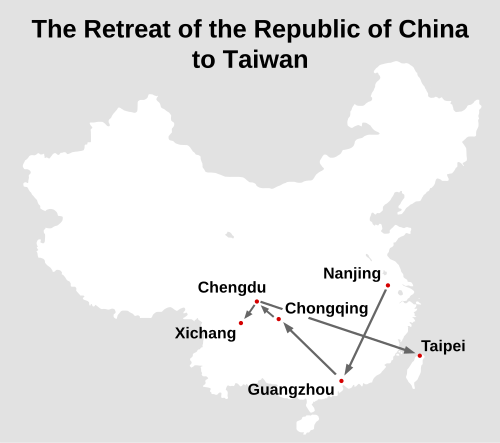
第二次世界大戦の終結後、中国内戦が再開した。1949年の一連の中国共産党の攻勢により、4月23日に首都南京が占領され、続いて中国本土の国民党が敗北した。共産党は10月1日に中華人民共和国を建国した。 [202] 1949年12月7日、蒋介石は 国民党政府を台湾に避難させ、台北を中華人民共和国の臨時首都とした。 [203]兵士、与党国民党のメンバー、知識人やビジネスエリートを中心に約200万人が台湾に避難し、以前の人口約600万人に加わった。これらの人々とその子孫は台湾で「外省人」として知られるようになった。中華人民共和国政府は多くの国宝と中国の金と外貨準備の多くを台北に持ち帰った。[204] [205] [206]金のほとんどは兵士の給料の支払いに使われ、[207]一部は台湾のインフレを遅らせるための物価安定プログラムの一環として新台湾ドルの発行に使われた。 [208] [209]
1949年に中国本土の支配権を失った後、中華民国は台湾と澎湖諸島(中華民国台湾)、福建省の一部(中華民国福建)(具体的には金門島、烏丘島(現在は金門島の一部)、馬祖諸島、南シナ海の2つの主要な島)を支配下に置いた。中華民国はまた、海南島全体、浙江省の一部(具体的には大陳諸島と宜江山諸島) 、チベット、青海、新疆、雲南の一部も短期間支配下に置いた。共産党は1950年に海南島を占領し、1955年の第一次台湾海峡危機の際に大陳諸島と宜江山諸島を占領し、 1958年には中国北西部で中華民国反乱を鎮圧した。中華民国軍は1950年代にビルマとタイに侵攻し、1961年に共産党に敗れた。国民党は中国本土の支配権を失って以来、中国本土(チベットを含む)、台湾(澎湖を含む)、外モンゴル、およびその他の小領土を含むと定義した「全中国」に対する主権を主張し続けている。
戒厳令時代(1949年~1987年)

1949年5月に台湾に布告された戒厳令[210]は1987年まで施行され[210] [211]、政治的反対勢力を抑圧するために使用された。白色テロとして知られるこの時期には、反国民党または親共産主義者とみなされたために14万人が投獄または処刑された。[212]多くの市民が中国共産党との実際のつながりまたはその疑いで逮捕、拷問、投獄または処刑された。これらの人々は主に知識階級や社会的エリート層であったため、一世代の政治的・社会的指導者が消滅した。
朝鮮戦争の勃発後、ハリー・S・トルーマン米大統領は中華民国と中華人民共和国の敵対行為を防ぐため、台湾海峡に米第七艦隊を派遣した。 [213]米国はまた、米中相互防衛条約と1955年の台湾決議を可決し、 1951年から1965年の間に国民党政権に多額の援助を与えた。[214]米国の援助により、1952年までに台湾の物価は安定した。 [215]国民党政府は、中国本土では効果的に施行されたことのない多くの法律や土地改革を実施した。 [216]アメリカの援助や農村再建合同委員会などのプログラムにより経済発展が促進され、農業部門がその後の成長の基盤となった。土地改革と農業開発計画の相乗効果により、1952年から1959年にかけて農業生産は年平均4%増加した。[217]政府はまた、輸入代替工業化政策を実施し、輸入品を国内で生産しようとした。[218]この政策は繊維、食品、その他の労働集約型産業の発展を促進した。[219]
国共内戦が続く中、政府は台湾全土に軍事要塞を築いた。1950年代には退役軍人たちが太魯閣峡谷を通る中部横貫道路を建設した。1958年の第二次台湾海峡危機の際には、ナイキ・ハーキュリーズミサイルが台湾全土のミサイル砲台に追加された。[220] [221]

1960年代から1970年代にかけて、中華民国は国民党の党果体制の下で権威主義的な一党独裁政権を維持しつつ、経済は工業化と技術志向へと移行した。 [222]この急速な経済成長は台湾の奇跡と呼ばれ、農業、軽工業、重工業の順に重点を置く戦略に従って起こった。[223] 輸出志向の工業化は、輸出に対する税の還付、輸入制限の撤廃、複数為替レートから単一為替レートへの移行、新台湾ドルの切り下げによって達成された。[224] 中山高速道路、桃園国際空港、台中港、金山原子力発電所などのインフラプロジェクトが開始され、台湾南部の鉄鋼、石油化学、造船業の台頭により、高雄は台北と同等の特別市へと変貌を遂げた。[225] 1970年代、台湾はアジアで2番目に急速に成長する経済となった。[226] GDPの実質成長率は平均10%を超えた。[227] 1978年には、税制優遇措置と安価でよく訓練された労働力の組み合わせにより、海外の中国人、米国、日本から19億ドルを超える投資が集まった。[228] 1980年までに、対外貿易は年間390億ドルに達し、4,650万ドルの黒字を生み出した。[223]香港、シンガポール、韓国とともに、台湾はアジア四大虎の一つとして知られるようになった。
冷戦のため、1970年代まで西側諸国と国連の大半は中華民国を中国の唯一の正統な政府とみなしていた。最終的に、特に台湾が国連から追放された後、大半の国は中華人民共和国を外交承認国に切り替えた。1970年代まで、中華民国政府は戒厳令を敷き、あらゆる政治的反対派を厳しく弾圧し、メディアを統制していたため、西側諸国の批評家からは非民主的とみなされていた。国民党は新党の結成を認めず、競争的な民主的選挙は存在しなかった。[229] [230] [231] [232] [233]
1970年代後半から1990年代にかけて、台湾は政治・社会改革を経て民主主義国家へと変貌を遂げた。[234] [235] 蒋介石の息子である蒋経国は1972年から首相を務め、1978年に総統に就任した。彼は「本生人」(日本降伏前の台湾住民とその子孫)にさらなる権限を委譲しようとした。[236]民主化運動家である唐外が反対派として台頭した。1979年、人権デーに高雄で高雄事件が発生した。抗議活動は当局によって急速に鎮圧されたが、台湾の反対派を団結させた主要な出来事とみなされている。[237]
1984年、蒋経国は李登輝を副総統に選出した。 1986年に国民党に対抗する台湾初の野党として民主進歩党(DPP)が(違法に)結成されると、蒋経国は新党結成を認めると発表した。[238] 1987年7月15日、蒋経国は台湾本島の戒厳令を解除した。[239] [240]
民主主義への移行

1988年に蒋経国が死去した後、李登輝は台湾出身者として初めて中華民国総統となった。[241]李登輝政権は民主化の時期を迎え、反共臨時条項が廃止され、憲法追加条項が導入された。[242] [243]議会代表は台湾地区のみに割り当てられ、[244]台湾はローカリゼーションの過程を経、汎中華的な視点よりも台湾の文化と歴史が推進され[245]同化政策は多文化主義の支持に置き換えられた。[246] 1996年、李登輝は初の総統直接選挙で再選された。[247]李登輝政権下では、彼と彼の政党はともに「黒金」政治として知られるようになった汚職論争に巻き込まれた。 [248] [249] [250]
2000年、民進党の陳水扁が国民党以外の初の総統に選出された。[251]しかし、陳は立法府の過半数を欠いていた。野党の国民党は他の政党と泛藍連立を組み、民進党主導の泛緑連立をわずかに上回った。[252]泛藍連立は中国による最終的な統一を望み、泛緑連立は台湾の独立を望むという二極政治が台湾で生まれた。
陳氏が台湾海峡の「両岸に一国ずつ」と発言したことで、2002年に両岸関係は悪化した。 [253]彼は両岸関係に関する初の国民投票を推し進め、 [254] [255]国家統一会議の終結を求めた。[256]国営企業は社名から「中国」という語句を削除し、「台湾」という語句を含めるようになった。[257] 2008年には、台湾が国連に加盟すべきかどうかを問う国民投票が行われた。 [258]この行為は、現状維持を支持する穏健派有権者や、両岸経済関係にある有権者を遠ざけた。また、中国本土との緊張や米国との意見の相違も生み出した。[259]陳政権は、経済成長の鈍化、立法の行き詰まり、汚職捜査に対する国民の懸念にも悩まされた。[260] [261] [259]
.jpg/500px-%E5%A4%AA%E9%99%BD%E8%8A%B1%E5%AD%B8%E9%81%8B_IMG_5932_(13822412824).jpg)
国民党の候補者馬英九は、 「相互非否認」政策の下、経済成長の促進と中国とのより良い関係を掲げ、 2008年の総統選挙に勝利した。 [258]馬政権下で、台湾と中国は直行便と貨物輸送を開始した。[262]中国政府は、毎年開催される世界保健総会から台湾を締め出すよう要求しないという異例の決定さえ下した。[263]馬はまた、白色テロについて公式に謝罪した。[264] [265]しかし、中国とのより緊密な経済関係は、その政治的影響に対する懸念を引き起こした。[266] [267] 2014年、大学生が立法院を占拠し、ひまわり学生運動として知られるようになった運動で両岸サービス貿易協定の批准を阻止した。この運動は新勢力党などの青年系第三政党を生み出し、2016年の総統選挙と立法府選挙での民進党の勝利に貢献したとみられており[268]、後者では台湾史上初めて民進党が立法府で過半数を占めた。[269] 2024年1月、与党民主進歩党の頼清徳氏が台湾の総統選挙で勝利した。[270]しかし、2004年以来初めて台湾の同時立法府選挙で過半数を獲得した政党はなく、民主進歩党(DPP)が51議席、国民党(KMT)が52議席、台湾人民党(TPP)が8議席を獲得した。[271]
地理

中華民国が支配する土地は168の島々[n]から成り、総面積は36,193平方キロメートル(13,974平方マイル)である。[17] [39] [i]歴史的にフォルモサと呼ばれた主な島は、この面積の99パーセントを占め、面積は35,808平方キロメートル(13,826平方マイル)で、中国本土の南東海岸から台湾海峡を挟んで約180キロメートル(112マイル)のところにある。北は東シナ海、東はフィリピン海、南はルソン海峡、南西は南シナ海に面している。より小さな島には、台湾海峡の澎湖諸島、中国沿岸に近い金門島、馬祖島、烏丘島、および南シナ海の島々のいくつかがある。
台湾本島は傾斜した断層ブロックで、東海岸に平行に5つの険しい山脈が連なる東部3分の2と、台湾の人口の大半が住む西部3分の1の平坦または緩やかな起伏のある平野とのコントラストが特徴である。標高3,500メートルを超える山がいくつかあり、最も高い玉山の標高は3,952メートル(12,966フィート)で、台湾は世界で4番目に高い島となっている。これらの山脈を形成した地殻変動の境界は現在も活動しており、島では多くの地震が発生している。台湾海峡には 多くの海底活火山もある。
台湾には、江南亜熱帯常緑樹林、南シナ海諸島、南台湾モンスーン雨林、台湾亜熱帯常緑樹林の4つの陸上生態区があります。[272]東部の山岳地帯は森林が密集しており、多様な野生生物が生息しています。一方、西部と北部の低地では土地利用が集中しています。2019年の森林景観完全性指数の平均スコアは6.38/10で、172カ国中世界76位でした。[273]
気候
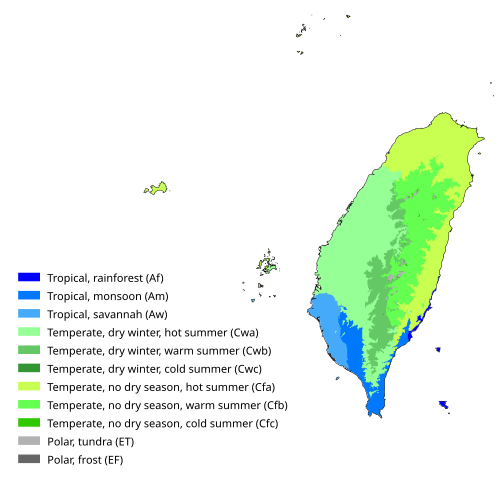
台湾は北回帰線上に位置し、その一般的な気候は海洋性熱帯気候である。[14]北部と中部は亜熱帯、南部は熱帯、山岳地帯は温帯である。[274]島全体の年間平均降水量は2,600ミリメートル(100インチ)で、雨季は5月から6月の夏の東アジアモンスーンの開始と同時に起こる。[275] 6月から9月までは島全体が高温多湿の天候となる。台風は7月、8月、9月に最も多く発生する。[275]冬(11月から3月)の間、北東部では雨が降り続けるが、島の中央部と南部はおおむね晴れである。
気候変動により、過去100年間で台湾の平均気温は1.4℃(2.5℉)上昇しており、これは世界全体の気温上昇の2倍に相当します。[276]台湾政府の目標は、 2005年比で2030年までに炭素排出量を20%削減し、2050年までに50%削減することです。2005年から2016年の間に炭素排出量は0.92%増加しました。[277]
地質学

台湾島は、西と北の揚子江プレート、北東の沖縄プレート、東と南のフィリピン変動帯の間の複雑な地殻構造地域に位置している。島の地殻上部は主に一連の地塊から成り、そのほとんどはユーラシアプレートとフィリピン海プレートの先駆者の衝突によって形成された古い島弧である。これらは、フィリピン海プレートの残骸の下に沈み込む際にユーラシアプレートの一部が剥離した結果としてさらに隆起し、このプロセスにより台湾の地殻はより浮力を持つようになった。[278]
台湾の東部と南部は、ルソン火山弧の北ルソントラフ部分と南中国との活発な衝突によって形成された複雑な帯状地帯であり、ルソン弧とルソン前弧の付加部分がそれぞれ台湾の東部海岸山脈とそれに平行する内陸の縦谷を形成している。[279]
台湾の主要な地震断層は、さまざまな地層の間の縫合帯に対応しており、大きな地震を引き起こしてきた。1999年9月21日には、「921地震」として知られるマグニチュード7.3の地震が発生し、2,400人以上が死亡した。USGSによる台湾の地震危険度マップでは、島の9/10が最も危険度が高いと示されている。[280]
政府と政治
政府

中華民国政府は、1947年の中華民国憲法と三民主義に基づいて設立されました。三民主義では、中華民国は「人民によって人民のために統治される、人民の民主共和国となる」と規定されています。[281] 1990年代には、追加条項として総称される大幅な改訂が行われました。政府は、行政院(内閣)、立法院(議会)、司法院、監察院(監査機関)、考試院(公務員試験機関) の5つの機関(院)に分かれています。
.jpg/500px-%E8%B3%B4%E6%B8%85%E5%BE%B7%E7%B8%BD%E7%B5%B1_(cropped).jpg)
国家元首および軍の最高司令官は総統であり、副総統と同一の公認候補として最大2期4年の任期で一般投票により選出される。総統は行政院の委員を内閣に任命するが、その中には正式には行政院院長である首相も含まれる。委員は政策と行政の責任を負っている。[281]
主な立法機関は一院制の立法院で、113議席を有する。73議席は小選挙区から一般投票で選出され、34議席は参加政党が別途政党名簿投票で得た全国投票の割合に基づいて選出され、6議席は2つの3議席の原住民選挙区から選出される。議員の任期は4年である。もともと一院制の国民大会は常設の憲法制定会議および選挙人団として議会の機能を果たしていたが、国民大会は2005年に廃止され、憲法改正の権限は国民投票によって立法院と共和国のすべての有権者に移譲された。[281] [282]

総統は議会の承認を必要とせず総統によって選出され、総統も総統も拒否権を持たない。[281]歴史的に中華民国は強権的な一党政治によって支配されてきた。この遺産により、現在、行政権限は総統ではなく総統のオフィスに集中している。[283]
司法院は最高司法機関である。憲法やその他の法律や法令を解釈し、行政訴訟を審理し、公務員を懲戒する。司法院長と副院長、および13人の裁判官は大法官会議を構成する。[284]彼らは立法院の同意を得て総統によって指名・任命される。最高裁判所である最高裁判所は、民事部と刑事部で構成され、それぞれが裁判長1人と陪席判事4人で構成され、全員終身任命される。1993年、憲法紛争の解決、政党の活動の規制、民主化プロセスの加速を目的として、独立した憲法裁判所が設立された。陪審による裁判はないが、公正な公開裁判を受ける権利は法律で保護され、実際に尊重されており、多くの事件は複数の裁判官によって審理されている。[281]
監察院は行政の行動を監視する監視機関である。欧州連合の会計検査院や米国の政府監査院のような常設の行政調査委員会と考えることができる。 [281]また、国家人権委員会の責任も負っている。
考試院は公務員の資格認定を担当する機関で、王朝時代の中国で採用されていた科挙制度をモデルにしている。欧州連合の欧州人事選考局や米国の人事管理局に例えられる。 [281] 2019年に規模が縮小され、廃止を求める声もある。[285] [286]
憲法
憲法は中華民国がまだ中国大陸を統治していた時代に国民党によって起草された。[287] 1970年代後半に始まった政治改革により、1987年に戒厳令が解除され、台湾は1990年代初頭に複数政党制の民主主義国家へと変貌した。この民主主義への移行の憲法上の根拠は、憲法の補則に徐々に築かれていった。これらの条項は、中国大陸の統治を目的とした憲法の一部を停止し、台湾地区と大陸地区の人民関係法で定義された台湾地区の住民の統治と政治的権利の保証に適合した条項に置き換えた。[288]
1947年憲法では国境は明確に規定されておらず、憲法裁判所は1993年の解釈でこの境界を定めることを拒否し、この問題は行政院と立法院で解決すべき政治問題であるとみなした。[289] 1947年憲法には、チベットやモンゴルの旗を含む旧清朝領土の代表者に関する条項が含まれていた。[290] [291] [292]中華民国は1945年の中ソ友好同盟条約に署名した後、1946年にモンゴルを独立国として承認したが、1949年に台湾に撤退した後、中国本土に対する主張を維持するために条約を破棄した。[293] 1990年代の追加条項では国境は変更されなかったが、モンゴルとチベットの代表者に関する条項は停止された。中華民国は2002年にモンゴルのパスポートの受け入れを開始し、台湾地区と大陸地区の人民の関係を定める法律から外モンゴルに関する条項を削除した。[294] 2012年に大陸委員会は、外モンゴルは1947年に中華民国の領土の一部ではなかったことを明確にする声明を発表した。[295]行政院のモンゴル・チベット事務委員会は2017年に廃止された。
主要キャンプ
台湾の政治情勢は、両岸関係、すなわち台湾が中国や中華人民共和国とどう関わるべきかという点において、2つの大きな陣営に分かれている。泛緑連合(民主進歩党など)は独立派、泛藍連合(国民党など)は統一派である。[296]両陣営の穏健派は中華民国を主権独立国家とみなしているが、泛緑連合は中華民国を台湾と同義とみなし、[297]泛藍連合の穏健派は中華民国を中国と同義とみなしている。[298]これらの立場は、中華人民共和国の反国家分裂法を背景に形成された。同法は、正式な台湾独立に対して「非平和的手段」の使用を脅かしている。[299]中華民国政府はこれを台湾への軍事侵攻を意味すると理解している。[300]

泛緑連合は、独立派の民主進歩党、台湾建設党、緑の党が中心となっている。彼らは台湾が中国の一部であるという考えに反対し、幅広い外交承認と、最終的には正式な台湾独立宣言を求めている。[301] 2007年9月、当時の与党であった民進党は、中国とは別のアイデンティティを主張する決議を承認し、「普通の国」のための新しい憲法の制定を求めた。また、正式名称である「中華民国」を廃止せずに、「台湾」を国名として一般的に使用することを求めた。 [302]台湾独立運動の勃興後、「台湾」という名称がますます頻繁に使用されるようになった。[259]陳水扁元総統など、連合の一部のメンバーは、「台湾はすでに独立した主権国家」であり、中華民国は台湾と同じであるため、独立を宣言する必要はないと主張している。[303]李登輝も総統就任前と在任中は国民党員であったが、同様の見解を持ち、台湾化運動を支持していた。[304]台北社会党と台湾統一党[305]は、民進党の保守的な姿勢に不満を持つ独立支持派の有権者を取り込むために、民進党よりも積極的な路線をとっている。
統一派の国民党、人民党、新党からなる泛藍連合は、一般的に1992年コンセンサスの精神を支持している。国民党は中国は一つであると主張したが、中華人民共和国と中華人民共和国は「中国」の意味について異なる解釈をしている。彼らは中国との最終的な統一を支持している。[306]独立に関しては、泛藍連合の主流は現状維持であり、即時の統一は拒否している。[307] [308]馬英九総統は、自身の任期中に統一も独立宣言も行わないと述べた。[309] [310]泛藍連合のメンバーの中には、経済関係の改善に重点を置いて中華人民共和国との関係改善を目指す者もいる。[311]
国民的アイデンティティ

台湾の人口のおよそ 84 パーセントは、1683 年から 1895 年の間に移住した漢民族の子孫です。また、1940 年代後半から 1950 年代前半に中国本土から移住した漢民族の子孫もかなりの割合を占めています。共通の文化的起源と、ライバル関係にある中華人民共和国と中国人民共和国の間の敵意により、国家アイデンティティは政治的な意味合いを持つ論争の的となっています。
民主改革と戒厳令の解除以来、台湾の明確なアイデンティティはしばしば政治論争の中心となっている。その受け入れは台湾を中国本土と区別するものとなり、したがって台湾の法的独立に向けた合意形成への一歩とみなされるかもしれない。[313]泛緑党は主に台湾のアイデンティティを支持している(ただし「中国人」は文化遺産とみなされる可能性がある)。一方、泛青党は主に中国のアイデンティティを支持している(「台湾人」は地域的/離散的中国人アイデンティティである)。[306]国民党は近年この立場を軽視し、現在では台湾のアイデンティティを中国のアイデンティティの一部として支持している。[314] [315]
1990年代初頭以降、台湾人としての認識は大幅に増加したが、中国人としての認識は低いレベルにまで落ち込み、両方としての認識も減少している。1992年には、回答者の17.6%が台湾人、25.5%が中国人、46.4%が両方、10.5%が無回答であった。2021年6月には、63.3%が台湾人、2.6%が中国人、31.4%が両方、2.7%が無回答であった。[312] 2009年7月にGlobal Views Survey Research Centerが台湾で実施した調査では、回答者の82.8%が中華人民共和国と中華人民共和国はそれぞれ独自に発展している別々の国であると考えているが、80.2%は中華人民共和国の一員であると考えていることが示された。[316]
世論
国内世論は現状維持を好んでいるが、独立支持の感情は1994年以来着実に高まっている。2021年6月の年次世論調査では、現状維持と決定延期を支持する人が28.2%、現状維持を無期限に支持する人が27.5%、現状維持と独立への動きを支持する人が25.8%、現状維持と統一への動きを支持する人が5.9%、無回答が5.7%、できるだけ早く独立を支持する人が5.6%、できるだけ早く統一を支持する人が1.5%であった。[317] 2018年の国民投票では、2020年夏季オリンピックで台湾の選手が「台湾」名義で競技するべきかどうかを問う質問があったが、可決されなかった。ニューヨークタイムズ紙は、この失敗の原因を、名称変更により「中国の圧力」により台湾が禁止される可能性があると警告するキャンペーンのせいだとした。[318]
最大の泛藍政党である国民党は、統一を最終目標として掲げ、無期限の現状維持を支持している。しかし、短期的には中国との統一を支持していない。そのような見通しは党員や国民の大半にとって受け入れがたいものとなるためである。[319]国民党主席で中華民国元総統の 馬英九は、民主主義、台湾に近いレベルの経済発展、公平な富の分配を、統一が実現するために中国が満たさなければならない条件として挙げている。[320]馬は、両岸関係は二つの中国でも二つの国家でもないと述べた。それは特別な関係である。さらに、両岸の主権問題は現時点では解決できないと述べた。[321]
最大の泛緑の党である民主進歩党は公式には独立を求めているが、短期的にも中期的にも独立も実現しそうにないため、事実上は現状維持を支持している。[322] 2017年、台湾の頼英首相は「台湾独立を主張する政治活動家」であると述べたが、台湾はすでに中華民国という独立国であるため、[323] [324] [325] [326] [327]独立を宣言する必要はないと述べた。[328]
外交関係と国際的地位
.svg/500px-Countries_recognizing_the_Republic_of_China_(Taiwan).svg.png)
中華民国(台湾)
台湾と正式な関係を持つ国
中国と正式な関係を持ち、台湾と非公式な関係を持つ国
台湾の政治的、法的地位は論争の的となっている。中華人民共和国(PRC)は、台湾は中国の領土であり、1949年に中華人民共和国が中華民国政府に取って代わり、中国の唯一の合法的な政府となったと主張している。[81]しかし、中華民国は独自の通貨、広く受け入れられているパスポート、郵便切手、インターネットTLD、軍隊、独立して選出された大統領を擁する憲法を持っている。[329]中国本土に対する領有権を正式に放棄したわけではないが、中華民国政府の出版物は、この歴史的主張をますます軽視している。[330]
1928年まで、中華民国の外交政策は内部の統一性の欠如によって複雑化していた。競合する権力の中心がいずれも正当性を主張していたのだ。しかし、北洋政府が国民党に敗北し、中華民国が広く外交的に承認されるようになったことで、この状況は変わった。[331]国民党が台湾に撤退した後、ほとんどの国、特に西側諸国は中華人民共和国との正式な関係を維持し続けた。ただし、 1950年に中華人民共和国を承認したイギリスは例外だった[332]。しかし、承認は徐々に弱まり、1970年代には多くの国が中華人民共和国への承認に切り替えた。1971年10月25日、国連決議2758号が賛成76票、反対35票、棄権17票で採択され、中華人民共和国を国連における中国の唯一の代表として承認した。[333] [334]
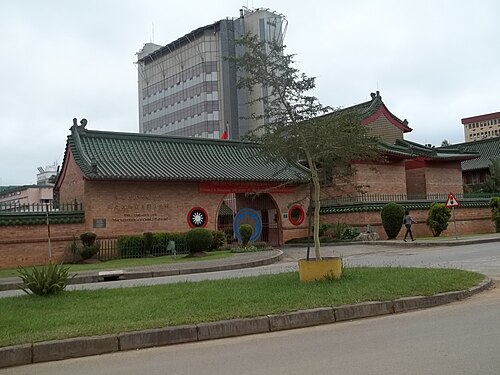
中華人民共和国は中華民国と外交関係を持ついかなる国とも外交関係を持つことを拒否し、外交関係を持つすべての国に台湾に対する権利主張を表明することを要求している。[335] [336]その結果、中華民国と公式の外交関係を維持しているのは国連加盟国11カ国とローマ教皇庁のみとなった。[52]中華民国は、台北経済文化代表処(TECRO)と呼ばれる事実 上の大使館や領事館、および「台北経済文化事務所」(TECO)と呼ばれる支所を通じて他国と非公式の関係を維持している。TECROとTECOはどちらも中華民国の「非公式商業団体」であり、外交関係の維持、領事サービスの提供、中華民国の国益への奉仕を担当している。[337]
1954年から1979年まで、米国は相互防衛条約で台湾とパートナー関係にあった。米国は今でも台湾の主要な支援国の一つであり、 1979年に可決された台湾関係法を通じて、中華民国軍への武器販売と軍事訓練の提供を継続している。[338]中国は、米国の関与が地域の安定を阻害すると考えている。[339] [340]米国の公式見解は、中国は「台湾に対して武力や武力行使の脅迫を行わない」ことが期待されており、中華民国は「両岸関係のあらゆる側面を管理する上で慎重を期す」ことになっている。両国とも「台湾の地位を一方的に変更する」ような行動や発言を控えることになっている。[341]台湾は公式には主要な非NATO同盟国に分類されていないが、少なくとも2003年以来、米国によって事実上そのように扱われている。 [342]
台湾は、2016年以降、蔡英文政権の新南向政策の下、南アジアおよび東南アジア諸国との経済関係の緊密化を目指し、台湾との正式な外交関係がほとんどないにもかかわらず、投資や人的交流に関する協力を強化してきた。[343] [344]この政策により、台湾は同地域からの移民や留学生の増加を受け入れている。[345]しかし、奨学金制度[346]や一部の労働産業で東南アジア人、特にインドネシア人が搾取されているというスキャンダルがいくつかあり、この政策[347] [348]だけでなくインドネシアと台湾の関係にも打撃を与えている。[349] [350]
中国との関係

台湾の大陸委員会(MAC)は中国との関係を担当し、中国の台湾事務弁公室(TAO)は台湾との関係を担当しています。交流は、1991年に設立された台湾の海峡交流基金会(SEF)と中国の海峡両岸関係協会(ARATS)という民間組織を通じて行われています。
中華人民共和国の「一つの中国」原則は、台湾と中国本土はともに中国の一部であり、中華人民共和国が中国の唯一の合法的な政府であるとしている。[50]この原則は、中華人民共和国が独立した主権国家として正式に承認されることを阻止または軽減することを目指しており、[351] [352]これは、台湾が「チャイニーズ・タイペイ」などの名称で非国家メンバーとして多くの国際フォーラムに参加することを意味している。 中華人民共和国は、香港で採用されている「一国二制度」を台湾との平和的統一のモデルとして提案した。[353] [354]中華人民共和国は平和的統一を目指しているが、武力の使用を排除していない。[355] [324]中華人民共和国の反国家分裂法に概説されている台湾が法的に独立を宣言するなどの事態が発生した場合、軍事衝突の可能性[356] [357] [358]があるため、政治環境は複雑である。福建省沿岸には相当数の軍隊が駐留しており、中国軍は台湾の防空識別圏(ADIZ)に出撃している。[359] [360] [325]
1992年11月、ARATSとSEFは、後に1992年コンセンサスとして知られる会議を開催した。SEFは、双方が中国は一つしかないことに同意したが、中国の定義(中華人民共和国対中華人民共和国)については意見が一致しなかったと発表した。一方、ARATSは、両者が「一つの中国」の原則に同意したが、SEF声明でなされた定義に関する相違点については言及しなかったと発表した。[361] 2019年、蔡英文は1992年コンセンサスを拒否した。[362]彼女は、この用語は北京ですでに「一国二制度」と定義されているため、1992年コンセンサスについてこれ以上話す必要はないと述べた。[363]
国際イベントや組織への参加
中華民国は国連の創設メンバーであり、 1971年まで安全保障理事会やその他の国連機関で中国の議席を保持していたが、決議2758によって追放され、中華人民共和国に取って代わられた。中華民国は現在、国連の正式メンバーでもオブザーバーの地位も持っていない。1993年以来、中華人民共和国は国連に加盟を請願しているが、その申請は委員会の段階を越えることができていない。[364] [365] 「一つの中国」政策のため、米国を含むほとんどの国連加盟国は、中華人民共和国との外交関係が悪化することを恐れて、中華人民共和国の政治的地位の問題について議論することを望んでいない。[366]
中華民国政府は、国連関連組織だけでなく、国連システム外の組織にも重点を移した。[367]政府は1997年から世界保健機関(WHO)への参加を模索したが、[368] [369] 2009年に北京との合意に達し、「中華台北」の名でオブザーバーとして参加するまで、その努力は拒否された。[370] [371] 2017年、台湾は再びオブザーバーとしての立場でさえWHOから排除され始めた。[372]この排除は、 COVID-19の流行中に多くのスキャンダルを引き起こした。[373] [374]

1979年に国際オリンピック委員会(IOC)が承認した名古屋決議は、オリンピックなど中国も参加する国際イベントで中華民国が「チャイニーズタイペイ」の名称を使用する妥協案を示した。[375] [376] [377] IOC憲章では、中華民国国旗はオリンピックの公式会場や集会では掲揚できない。[378]中華民国はまた、アジア太平洋経済協力フォーラム(1991年以降)と世界貿易機関(2002年以降)にそれぞれ「チャイニーズタイペイ」と「台湾、澎湖、金門、馬祖独立関税地域」の名称で参加している。[379] [380]中華民国はアジア開発銀行の創設メンバーであったが、1986年の中国の台頭以降は「中国台北」の名称で参加している。中華人民共和国は世界スカウト機構など中華人民共和国が参加していない組織に「中国」として参加することができる。
中華民国は、国際的に認知されていないため、1991年に組織が設立されて以来、代表されていない国家および人民機構(UNPO)のメンバーであり、政府資金による組織である台湾民主基金(TFD)が「台湾」の名称で代表しています。[381] [382]
軍隊

中華民国軍は、 1924年に孫文が国民党による中国統一を目指して広東省で設立した国民革命軍を起源とする。人民解放軍が国共内戦に勝利すると、国民革命軍の多くは政府とともに台湾に撤退した。1947年の中華民国憲法により、国民革命軍は中華民国軍に改編され、政党の軍隊ではなく国軍となった。降伏して中国本土に残った部隊は解散するか、人民解放軍に編入された。
1949年から1970年代にかけて、台湾軍の主な任務は国家栄誉計画を通じて「中国本土を奪還する」ことだった。中華人民共和国の相対的な力が大幅に増大したため、この任務は攻撃から移行し、中華民国軍は伝統的に優勢であった陸軍から空軍と海軍に重点を移し始めた。軍の統制も文民政府の手に移った。[383] [384]
中華民国は1990年代から一連の兵力削減計画を開始し、1997年の45万人から2001年の38万人にまで軍隊を縮小した。[385] 2021年現在[update]、軍隊の総兵力は21万5000人に制限されており、兵員数は90パーセントが志願兵である。[386] 18歳に達する適格男性は引き続き普遍的に徴兵されるが、削減努力の一環として、多くの者に代替サービスを通じて徴兵要件を満たす機会が与えられている。[387]台湾は2013年に義務的な兵役を4か月に短縮したが、2024年には兵役を1年に延長する。 [388] [389]軍の予備役兵は、2022年時点で30万人の第1波予備役を含め約250万人である[update]。[390]台湾の国防費は1999年にGDPの3%を下回り、21世紀の最初の20年間は減少傾向にあった。[391] [392]中華民国政府はGDPの約2%を国防費に費やしたが、提案されたGDPの3%まで支出を増やすことはできなかった。[393] [394] [395] 2022年に台湾は翌年の国防費として予測GDPの2.4%を提案したが、引き続き3%を下回った。[396]
.jpg/500px-05.25_%E7%B8%BD%E7%B5%B1%E8%A6%96%E5%B0%8E%E6%BC%A2%E5%85%8933%E8%99%9F%E6%BC%94%E7%BF%92_(34750802021).jpg)
中華民国と米国は1954年に米中相互防衛条約に署名し、米国台湾防衛司令部を設立した。1979年に米国が中国と外交関係を樹立するまで、約3万人の米軍が台湾に駐留していた。[397]相当量の軍事装備が米国から購入されており、台湾関係法によって法的に保証され続けている。[338]フランスとオランダも中華民国に軍事兵器や装備を販売していたが、1990年代に中国の圧力によりほぼ完全に停止した。[398] [399]
台湾関係法やその他の条約には、たとえ侵略があったとしても米国が台湾を防衛するという保証はない。[400]ジョー・バイデン米大統領は2021年と2022年に何度か、中国が台湾に侵攻しようとすれば米国が介入すると述べた。[401] [402] [403] [404]しかし、ホワイトハウス当局者は米国の台湾政策は変わっていないと主張した。[405] [406] 1996年に署名された日米安全保障共同宣言は、日本がいかなる対応にも関与することを示唆している可能性がある。しかし、日本は、この条約で言及されている「日本周辺地域」に台湾が含まれるかどうかを明記することを拒否している。[407]オーストラリア・ニュージーランド・米国安全保障条約(ANZUS条約)は、オーストラリアなど他の米国同盟国が関与する可能性があることを意味している可能性がある。[408] [409]これは中国との経済関係を損なうリスクがあるが、[410]台湾をめぐる紛争はより大きな連合による中国への経済封鎖につながる可能性がある。[411] [412] [413] [414] [415]
LGBTの権利
2017年5月24日、憲法裁判所は、当時の婚姻法は同性カップルの結婚の権利を否定しており、憲法に違反しているとの判決を下した。同裁判所は、立法院が2年以内に台湾の婚姻法の適切な改正を可決しない場合、台湾で同性婚が自動的に合法となると判決を下した。[416]しかし、 2018年の国民投票では、有権者は同性婚に圧倒的に反対し、小学校の教科書から同性愛に関する内容を削除することを支持した。ニューヨークタイムズによると、国民投票の質問は「保守的なキリスト教徒やその他のグループが主導する、資金が豊富で高度に組織化されたキャンペーン」の対象となり、誤情報が使用された。[318]それでも、同性婚反対票は裁判所の判決には影響せず、2019年5月17日、台湾の議会は同性婚を合法化する法案を承認し、アジアで初めて同性婚を合法化した国となった。[417] [418] [419]
台湾では毎年、台湾プライドイベントが開催されている。これは現在、東アジア最大のLGBT集会の記録を保持しており、イスラエルのテルアビブプライドに匹敵する。[420]このイベントには20万人以上が参加する。[421]
行政区分
1947年の憲法によれば、中華民国の領土は「既存の国境」に従っている。[422]中華民国は、法律上、憲法上、省特別市(地方行政のためにさらに区に分割される)、省レベルのチベット地区に分かれている。各省は市と県に細分化され、さらに郷と県直轄市に分割され、各市には選出された市長と市議がおり、県と職務を分担している。一部の行政区は、標準行政区とは異なる程度の自治権を持つ固有の行政区である。さらに、区、市、郷はさらに村と町に分割されている。省は「簡素化」されており、もはや機能していない。[423]同様に、中国の内モンゴルを表すモンゴル国旗も存在していたが[292]、2006年に廃止され、中華民国は1946年の憲法に定められている通り、2002年にモンゴル(台湾では旧外モンゴル)の承認を再確認した。 [424] [425] [426]
台湾は省が機能していないため、実質的には 22 の地方自治体に分かれており、各地方自治体には選出されたリーダーが率いる自治機関と選出された議員による立法機関があります。地方政府の任務には、社会サービス、教育、都市計画、公共建設、水管理、環境保護、交通、公共安全などがあります。
1949年に中華民国が台湾に撤退した際、中華民国が主張する領土は35の省、12の直轄市、1の特別行政区、2の自治区であった。しかし、撤退以来、中華民国が実効支配しているのは台湾省と福建省の一部の島嶼のみである。中華民国はまた、南シナ海紛争諸島の一部であるスプラトリー諸島のプラタス諸島と太平島も実効支配している。これらは台湾撤退後、高雄市の管理下に置かれた。 [427]
- 注記
- ^ abcdef 選挙で選ばれた行政機関と選挙で選ばれた立法評議会を有する。
- ^ abc 地方事務を管理し、上級機関から委託された任務を遂行するために任命された地区管理者がいます。
- ^ 地方事務を管理し、上級機関から委託された任務を遂行するために選出された村長がいる。
経済
.jpeg/500px-Sun_Down_(250260941).jpeg)
20世紀後半の台湾の急速な工業化と急成長は「台湾の奇跡」と呼ばれている。台湾は香港、韓国、シンガポールとともに「アジア四大虎」の一つである。2022年10月現在、台湾は名目GDPで世界第21位の経済大国である。[428]
2001年以降、農業はGDPの2%未満を占め、1951年の32%から減少しました。[429]近隣諸国の韓国や日本とは異なり、台湾経済は大企業グループではなく中小企業によって支配されています。 [430]伝統的な労働集約型産業は着実に海外に移転され、より多くの資本と技術集約型産業がそれらを置き換えています。台湾ではハイテクサイエンスパークが次々と設立されています。
今日、台湾はダイナミックで資本主義的な輸出主導型経済を持ち、投資と対外貿易への政府の関与は徐々に減少している。この傾向に沿って、いくつかの大規模な政府所有の銀行と産業企業が民営化されている。[431]輸出は工業化の主な推進力となっている。貿易黒字は大きく、台湾は世界最大の外貨準備保有国の一つであり続けている。[432] 2022年の台湾の総貿易額は9070億米ドルに達した。この年の輸出と輸入はともに過去最高を記録し、それぞれ4795億2000万米ドルと4276億米ドルに達した。[433]中国、米国、日本は台湾の3大貿易相手国であり、総貿易の40%以上を占めている。[434]
1990年代初頭以来、台湾と中国の経済関係は広範囲に及んでいる。2002年、中国は米国を抜いて初めて台湾最大の輸出市場となった。[435]中国はまた、対外直接投資の最重要ターゲットでもある。[436] 1991年から2022年までに、台湾企業から中国に2000億ドル以上が投資されている。[437]中国には約4,200の台湾企業があり、24万人以上の台湾人が中国で働いている。[438] [439]台湾経済はこの状況から恩恵を受けているが、台湾は中国本土経済への依存度が高まっているという見方もある。[440]一方で、台湾と中国本土の緊密な経済関係により、人民解放軍による台湾への軍事介入は非常にコストがかかり、そのため可能性が低くなると主張する人もいる。 [441]
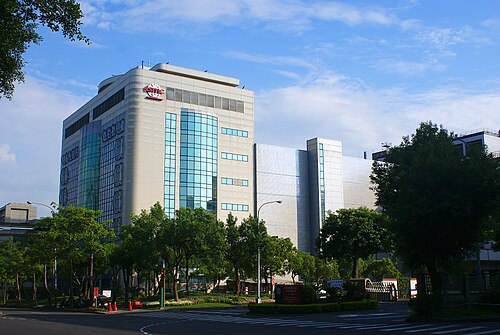
1980年代以降、台湾を拠点とする多くのテクノロジー企業が世界中に進出してきた。[442]台湾は先端チップのサプライチェーンにおいて重要な役割を担っている。主要半導体産業における台湾の台頭は、主に台湾積体電路製造(TSMC)と聯合微電子(UMC)によるところが大きい。[443] TSMCは1987年2月21日に設立され、2021年12月時点で時価総額は台湾のGDPの約90%に相当した。[444]同社は時価総額で世界第9位の企業であり[445] 、インテルやサムスンを上回り世界最大の半導体製造企業でもある。[446]台湾のハイテク輸出と世界の半導体におけるもう一つの大手企業であるUMCは、それほど先端的ではない半導体プロセスやシリコンウエハーをめぐってアメリカのグローバルファウンドリーズなどと競合している。 [447]台湾に本社を置く他の有名な国際テクノロジー企業には、パソコンメーカーのエイサー社やエイスース社、電子機器製造大手のフォックスコン社などがある。[448]
輸送

台湾交通部は、台湾の交通網を統括する内閣レベルの機関である。台湾の民間交通は、スクーターの広範な使用によって特徴付けられる。2019年3月には、登録台数が1,386万台となり、自動車の2倍となった。[449]高速道路と鉄道は両方とも、人口の大半が居住する沿岸部に集中しており、1,619 km (1,006 mi)の高速道路がある。台湾の鉄道は主に旅客サービスに使用されており、台湾鉄路管理局(TRA) は島の周囲に環状ルートを運行し、台湾高速鉄道(THSR) は西海岸で高速サービスを運行している。都市交通システムには、台北地下鉄、高雄地下鉄、桃園地下鉄、新北地下鉄、台中地下鉄がある。
主要空港は台湾桃園空港、高雄空港、台北松山空港、台中空港など。現在、台湾の旅客航空会社は7社あり、そのうち最大の2社はチャイナ エアラインとエバー航空である。国際港は基隆港、台北港、蘇澳港、台中港、高雄港、安平港、花蓮港の7つである。[450]高雄港は台湾で最も多くの貨物を取り扱っており、2021年の台湾全体の取扱量の58.6%を占める約4億4千万トンの貨物を取り扱った。[451]貨物トン数では台中(18.6%)、台北(12%)、基隆(8.7%)がこれに続いている。
人口統計
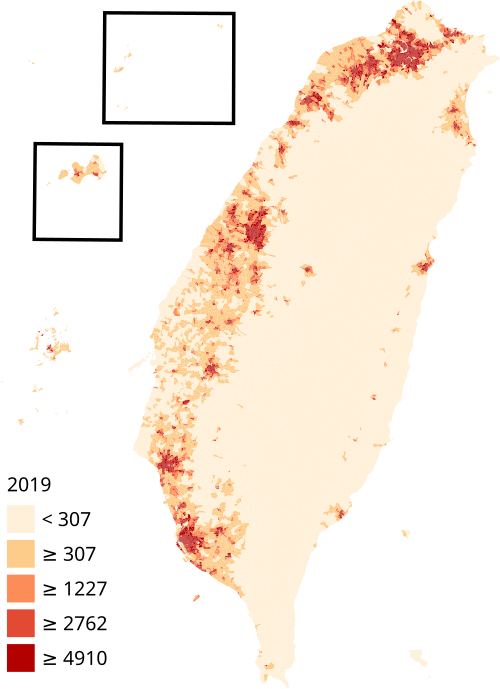
台湾の人口は約2,340万人で[452] 、そのほとんどが台湾島に居住している。残りは澎湖島(101,758人)、金門島(127,723人)、馬祖島(12,506人)などの離島に居住している[453]。
最大の都市と郡
以下の数字は、2019年3月時点の人口上位20の行政区の推定値です。都市圏全体の人口を考慮すると順位は異なります(そのようなランキングでは、台北・基隆都市圏が圧倒的に最大の人口密集地です)。数字は各都市の戸籍数を反映しており、実際の居住者数とは異なる場合があります。
民族グループ
中華民国政府の報告によると、人口の95パーセントは漢民族である。[454]また、2.4パーセントの先住民族オーストロネシア人と、主に中国と東南アジアからの新移民が2.6パーセントいる。 [455]
台湾の漢民族のほとんどは、福建省南部の沿岸地域に居住するホクロ族と広東省東部に居住する客家の子孫である。ホクロ族と客家の移民は17世紀から18世紀にかけて大量に到着した。現在、ホクロ族の子孫は台湾の人口の約70%を占めている。[14]客家の子孫は人口の約15%を占める。もう一つの少数民族は外生人と呼ばれ、1940年代に中国から到着した人々、またはその子孫である。[456]遺伝子研究によると、ホクロ族と客家人はオーストロネシア人と漢人の混血であることが示唆されている。[457]
台湾原住民族は約584,000人で、政府は16のグループを認定している。[458]アミ族、タイヤル族、ブヌン族、カナカナブ族、カバラン族、パイワン族、プユマ族、ルカイ族、サイシャット族、サアロア族、サキザヤ族、セデック族、サオ族、タロク族、ツオウ族は主に島の東半分に住んでおり、ヤミ族は蘭嶼に住んでいます。[459] [ 460 ]
言語

福建語または閩南語
中華民国には法的に定められた公用語はない。ビジネスや教育では北京語が主な言語であり、国民の大多数が話している。表記には繁体字中国語が使われている。 [461]
台湾の人口の約70%は福建省のホクロ族に属し、台湾語の福建語を母国語としている。[462]人口の約14〜18%を占める客家人は客家語を話す。学校では北京語が教授言語であり、テレビやラジオでも主に使用されているが、1990年代に使用制限が撤廃されて以来、特に北京語以外の中国語が台湾の公共生活で復活している。[461]
フォルモサ語は主に台湾の先住民族によって話されている。中国語やシナ・チベット語族ではなく、オーストロネシア語族に属し、ラテンアルファベットで表記される。[463]先住民族の少数民族の間では、中国語の使用が増えるにつれてフォルモサ語の使用は減少している。[461]現存する14の言語のうち、5つは消滅しつつあると考えられている。[464]
五四運動以来、中華民国では中国語の書き言葉が古典中国語に取って代わり、主流の書き言葉となった。1970年代に文体が中国語と古典中国語の統合されたスタイル(文白合一行文)に移行する改革が行われるまで、古典中国語は政府の文書で広く使用され続けた。[465] [466] 2005年1月1日、行政院は、公式文書の書き方に関する長年の慣例を縦書きから横書きに変更した。宗教的または文化的儀式などの正式な場面や儀式では、古典中国語が単独で使用されることもある。例えば、中華民国国歌(中華民国國歌)は古典中国語で書かれている。ほとんどの政府、法律、司法の公式文書や裁判所の判決では、中国語と古典中国語を組み合わせたスタイルが使用されている。[467]多くの法律文書は依然として一般の人々に理解されにくい古典中国語で書かれているため、台湾人のグループは、中華民国の法律文書により多くの中国語を導入することを望んで、法言語運動を立ち上げました。 [ 468]
台湾は公式には多言語国家である。台湾の国語は「台湾の先住民族が使用する自然言語と台湾手話」と法的に定義されている。[9]
宗教
中華民国憲法は、人々の宗教の自由と信仰の実践を保護している。[469] [470] 政府は宗教の自由を尊重しており、台湾は国際IDEAの宗教の自由に関する世界民主主義状態指数で高い評価を得ている。[471]
2005年の国勢調査では、5大宗教は仏教、道教、一貫道、プロテスタント、ローマカトリックであると報告されている。[472]ピュー研究所によると、2020年の台湾の宗教構成は[473] 、民間信仰が43.8% 、仏教が21.2% 、その他(道教を含む)が15.5%、無宗教が13.7%、キリスト教が5.8%、イスラム教が1%と推定されている。台湾原住民は、キリスト教徒を自称する人々の注目すべきサブグループを構成している。[474]台湾には17世紀から回族の小さなイスラム教徒コミュニティが存在する。 [475]
儒教は中国と台湾の文化の基盤となっています。台湾人の大多数は通常、儒教の世俗的な道徳的教えと、彼らが所属する宗教を組み合わせています。
2019年現在、台湾には15,175の宗教施設[update]があり、およそ1,572人の住民に1つの礼拝所がある計算になる。12,279の寺院が道教と仏教に捧げられており、道教寺院は9,684 、仏教寺院は2,317あった。[476]キリスト教には2,845の教会がある。[476]平均して、1平方キロメートルあたり1つの寺院、教会(教会)、または宗教施設がある。台湾の宗教と宗教施設の密度は世界でも有数である。[477] [478]
人口のかなりの割合が無宗教である。台湾は国家による差別が少なく、宗教や信念の自由を一般的に高く評価しているため、2018年の思想の自由報告書で共同第1位にランクされている。[479] [480]一方、台湾のインドネシア人移民労働者コミュニティ(推定258,084人)は、地元の雇用主や政府による宗教的制限を経験している。[481] [482]
教育

台湾は、社会経済的地位を向上させる手段として教育を重視する儒教のパラダイムを堅持していることでよく知られている。[484] [485]多額の投資と教育に対する文化的価値の認識により、資源の乏しいこの国は、世界の教育ランキングで常に上位に躍り出た。台湾は、読解力、数学、科学においてトップクラスの成績を収めている国の一つである。2015年、国際学習到達度調査(PISA)によるテストで、台湾の学生は数学、科学、読解力において世界最高の成績を収め、平均スコアは519点であった。OECD平均は493点で、台湾は世界第7位であった。[486] [487] [488]
台湾の教育制度は、比較的高い試験結果と、世界でも有数の高学歴労働力を生み出しながら台湾の経済発展を促進する上で重要な役割を果たしていることで高く評価されている。[489] [490]台湾は大学進学率の高さでも高く評価されており、大学合格率は1980年代以前の約20%から1996年には49%に上昇し、2008年以降は95%を超えており、アジアで最も高い水準にある。[491] [492] [493]国の高い大学進学率によって高度なスキルを持つ労働力が生み出され、台湾は世界で最も高学歴の国の一つとなっており、台湾の高校生の68.5%が大学に進学している。[494]台湾では国民の高等教育修了者の割合が高く、25~64歳の台湾人の45%が学士号以上を取得しているのに対し、経済協力開発機構(OECD)加盟国の平均は33%である。[493] [495]
一方、教育制度は学生に過度のプレッシャーをかけ、創造性を遠ざけ、過剰教育を受けた大学卒業生を過剰に供給していると批判されている。その結果、多くの卒業生が、大学院卒レベルの仕事の不足により失業または不完全雇用に直面している。 [496] [485]台湾の大学はまた、台湾の21世紀の急速に変化する労働市場の要件と需要を完全に満たすことができないと批判されており、現代の台湾の労働市場の需要に適合しない、自己評価の過剰教育を受けた多数の卒業生間のスキルのミスマッチを理由に挙げている。[497]台湾政府は、この労働力の供給と需要の不一致に適切に対処していないと批判されている。[491] [498]
台湾経済は主に科学技術に基づいているため、労働市場では就職活動で競争力を得るために、特に科学や工学に関連した何らかの高等教育を修了した人材が求められている。現在の台湾の法律では就学年数は9年間と定められているが、中学校卒業生の95%が高等職業学校、大学、短期大学、専門学校、その他の高等教育機関に進学する。[494] [499]多くの台湾の学生は、試験に備えて問題解決のスキルと知識を向上させるために予備校( buxiban )に通っている。 [500] [501]
2015年に「中国製造2025」が発表されて以来、その使命を支えるために台湾の半導体産業の優秀な人材を採用するための積極的なキャンペーンの結果、3,000人以上の半導体エンジニアが中国本土に流出し[502]、台湾の「頭脳流出」の懸念が高まった。[503] [504]
2020年現在[update]、台湾の識字率は99.03パーセントである。 [505]
健康

現在の医療制度は国民健康保険(NHI)として知られ、1995年に導入された。NHIは医療資金の支出を一元化する単一支払者の強制社会保険制度である。この制度はすべての国民に医療への平等なアクセスを約束しており、人口カバー率は2004年末までに99パーセントに達した。[506] NHIは主に給与税に基づく保険料で賄われ、自己負担の共同支払と政府の直接資金で補われている。[507] [508] [509]低所得世帯、退役軍人、百歳以上の高齢者、3歳未満の子供、および重篤な病気は共同支払が免除される。障害者は共同支払が減額され、低所得世帯は100パーセントの保険料カバーを維持している。
プログラムの初期段階では、支払いシステムは主に出来高払いでした。ほとんどの医療提供者は民間部門で運営されており、医療提供側で競争市場を形成しています。しかし、多くの医療提供者は、不必要なサービスを提供することでシステムを利用していました。損失の増加とコスト抑制の必要性に直面して、NHIは2002年に支払いシステムを出来高払いから、一種の前払い支払いシステムである全体予算に変更しました。
国民皆保険制度の導入により、台湾の低所得者層の健康格差は縮小した。最近発表された調査によると、無作為に選ばれた病院で調査を受けた3,360人の患者のうち、75.1%の患者が病院のサービスに「非常に満足」し、20.5%が「まあまあ」と答えた。サービスやケアに「満足していない」または「まったく満足していない」と答えた患者はわずか4.4%だった。[510]
台湾の疾病管理当局は、台湾疾病予防管理センター(CDC)である。 2003年3月のSARS流行時には、347人の感染が確認された。流行中、CDCと地方政府は公共交通機関、娯楽施設、その他の公共エリアに監視ステーションを設置した。2003年7月に完全に封じ込められて以来、SARSの感染者は出ていない。[511] SARSの教訓により、2004年に国家衛生指揮センターが設立され、その中に中央流行疫情指揮センター(CECC)が含まれている。CECCは、 COVID-19を含む流行に対する台湾の取り組みにおいて中心的な役割を果たしてきた。
2019年の乳児死亡率は1,000出生あたり4.2人で、1万人あたり医師数は20人、病床数は71床でした。[512] [513] 2020年の出生時の平均寿命は、男性が77.5歳、女性が83.9歳です。[514]
文化
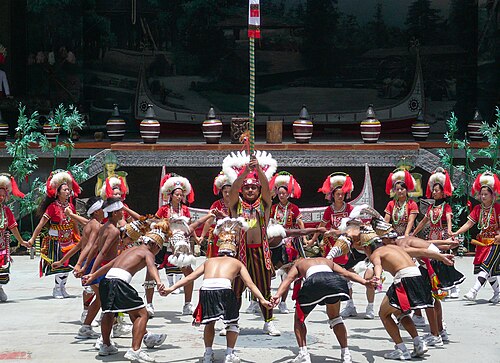
台湾の文化は、大多数の伝統的な中国文化、原住民文化、日本の文化的影響、伝統的な儒教の信仰、そしてますます増えている西洋の価値観の要素を取り入れた、さまざまな源からのハイブリッドな混合です。
戒厳令時代、国民党は台湾で公式の中国伝統文化を推進し、共産主義中国ではなく中華民国が中国文化の真の正統性を代表していることを強調した。[515]政府は文化大革命中に中国共産党が引き起こした文化破壊に反対し、台湾で中国文化ルネッサンス運動と呼ばれる運動を開始した。台湾と海外で中国文化を促進するために中国文化総会が設立された。これは国民党による台湾の文化発展のための最初の体系的な計画だった。台湾での中国文化ルネッサンス運動により、例えば繁体字中国語の継続的な使用など、中国文化のいくつかの側面が中国本土よりもよく保存されるようになった。友好的で礼儀正しいことで知られる台湾人の行動には儒教の影響が見られる。[516]

戒厳令の解除は民主化の時代を迎え、言論と表現の自由により台湾文学とマスメディアが台湾で繁栄した。台湾憲法は「言論、教育、執筆、出版」を保護している。[517] 2022年、エコノミスト・インテリジェンス・ユニットの民主主義指数は、台湾をアジアとオーストラリアで2番目に高い民主主義スコアを持つ国にランク付けした。 [518] フリーダム・ハウスは台湾をアジアで2番目に自由な場所にランク付けした。 [519] [520]一方、CIVICUSは台湾とニュージーランドをアジア太平洋地域で唯一の「開かれた」国と評価した。[521] [522]中国が香港を掌握し、言論と抗議の自由を制限した後、2019年から2022年にかけて36,789人の香港住民が台湾に移住した。平均して年間約9,000人の移民である。 2018年、台湾にはわずか4,000人の香港移民がいた。[523]
台湾の政治的地位をめぐる論争が続いていることを反映して、政治は台湾の文化的アイデンティティの概念と発展、特に中国文化との関係において役割を果たし続けている。[524]近年、台湾の多文化主義という概念が比較的政治的でない代替的な見方として提唱されており、これにより、台湾の人々が共有する集合的な意味体系と思考や行動の慣習的パターンとして台湾文化を再定義する取り組みに中国本土やその他の少数民族を含めることが可能になった。[525] アイデンティティ政治は、100年以上にわたる中国本土からの政治的分離とともに、料理や音楽を含む多くの分野で独特の伝統を生み出してきた。
芸術
著名なクラシック音楽家としては、バイオリニストのチョー・リャン・リン、ピアニストのチン・ユン・フー、リンカーン・センター室内楽協会の芸術監督ウー・ハンなどがいます。その他のミュージシャンとしては、テレサ・テン、ジェイ・チョウ、メイデイなどのグループ、歌手フレディ・リム率いるヘビーメタルバンドのクトニックなどがあり、「アジアのブラック・サバス」と呼ばれています。 [526] [527]
台湾映画は世界中の映画祭で様々な国際賞を受賞しています。台湾のアン・リー監督は、 『グリーン・デスティニー』、『イージー・ブレイク』 、 『ブロークバック・マウンテン』 、『ライフ・オブ・パイ』 、 『ラスト、コーション』など、高い評価を受けた映画を監督してきました。その他の有名な台湾の監督には、ツァイ・ミンリャン、エドワード・ヤン、ホウ・シャオシェンなどがいます。台湾は1962年以来、金馬映画祭と金馬賞を主催しています。
国立故宮博物院には、中国の青銅器、玉器、書道、絵画、磁器など65万点以上が収蔵されており、世界でも有数の中国美術品コレクションの一つとされている。[528]
大衆文化
カラオケは台湾で非常に人気があり、KTVとして知られています。[529] KTVビジネスはホテルのようなスタイルで運営されており、ゲストの数に応じて小部屋や宴会場を貸し出しています。多くのKTV施設はレストランやビュッフェと提携して、包括的で手の込んだ夜のイベントを開催しています。台湾を巡回するツアーバスには、主にカラオケを歌うためのテレビがいくつか搭載されています。
台湾には24時間営業のコンビニエンスストアが密集しており、金融機関や政府機関に代わって駐車料金、公共料金、交通違反の罰金、クレジットカードの支払いなどのサービスを提供している。[530]ファミリーマートなどのチェーン店では、一部の店舗で衣類のランドリーサービスを提供しており、[531]台湾鉄道と台湾高速鉄道のチケットは、セブンイレブン、ファミリーマート、Hi-Life 、OK で購入できる。[532] [533]
料理
台湾の料理の歴史は曖昧で、移住や植民地化のパターンと複雑に結びついています。台湾の地元料理や国際料理は、その歴史も含めて政治的に論争の的となっています。有名な台湾料理には、台湾牛肉麺、瓜包、ちまき、コンバ、台湾フライドチキン、牡蠣春雨、三杯酢、愛玉ゼリーなどがあります。[534] 1980年代に台湾で生まれたタピオカティーは、現在では世界的に人気があります。 [535] 2014年、ガーディアン紙は台湾の夜市を「世界最高の屋台市場」と呼びました。 [536]ミシュランガイドは2018年に台湾のレストランのレビューを開始しました。[537]
スポーツ

野球は台湾の国民的スポーツとみなされており、人気の高い観戦スポーツである。[538]男子チームは2022年にU-12、U-15、U-18、U-23、ベースボール5の大会を含むすべてのレベルの野球でトップ3のメダルを獲得し、野球史上唯一のチームとなった。[539]台湾の男子野球チームと女子野球チームは、2023年3月現在、 WBSCランキングで世界第4位と世界第3位である。台湾のベースボール5チームは、 2023年8月に世界第1位に到達した。台湾のプロ野球は、 1989年に中国プロ野球リーグ(CPBL)が設立されたことから始まった。[540] 2021年現在、CPBLには5つのチームがあり、平均観客数は1試合あたり約4,000人である。[541]一部のエリート選手は、メジャーリーグベースボール(MLB)や日本プロ野球(NPB)などの海外のプロチームと契約しました。 2022年のMLBシーズン時点で、元投手の王建明や陳維銀など16人の台湾人MLB選手がいます。野球のバリエーションに関しては、台湾には強力な女子ソフトボールチームもあります。チャイニーズタイペイ女子ソフトボール代表チームは現在、WBSCランキングで世界第3位にランクされています。チームは2022年ワールドゲームズで銅メダルを獲得しました。[542]
バスケットボールは台湾のもう一つの主要なスポーツである。[543] Pリーグ+とT1リーグは台湾の2つのプロバスケットボールリーグである。[544] [545]セミプロの スーパーバスケットボールリーグ(SBL)も2003年からプレーしている。 [546]その他のチームスポーツにはバレーボールとサッカーがある。台湾はコーフボールでも主要な競争相手である。[547]
台湾は「チャイニーズ・タイペイ」の名で国際スポーツ団体やイベントに参加している。台湾は過去に、 2009年高雄ワールドゲームズ、 2009年夏季デフリンピック、 2017年台北夏季ユニバーシアードなど、複数のスポーツイベントを主催してきた。 [548]台北市と新北市は2025年夏季ワールドマスターズゲームズを開催する。[549]花蓮は2026年国際子どもゲームズを開催する。[550]台湾が毎年開催するその他の主要なスポーツイベントには以下のものがある。
- 台北マラソン(マラソン)
- 新北市万錦市マラソン(マラソン)
- 台北オープン(バドミントン)
- U-12 ベースボールワールドカップ(野球)
- ウィリアム・ジョーンズ・カップ(バスケットボール)
- ツール・ド・台湾(自転車ロードレース)

テコンドーは1966年に軍事訓練のために台湾に導入され、台湾では成熟した成功した格闘技となった。 [551]台湾の選手が獲得した最初の2つのオリンピック金メダルは、このスポーツのものである。2004年のオリンピックでは、陳時新と朱牧延がそれぞれ女子フライ級と男子フライ級で金メダルを獲得した。その後のテコンドー選手たちは台湾のテコンドー文化を強化してきた。
バドミントン、テニス、卓球、ゴルフなど、他の個人競技でも優れた台湾人選手が多数いる。バドミントンにおける台湾の強さは、 BWFワールドランキングでほとんどの週を世界第1位の女子シングルス選手として過ごした戴子穎と、BWFワールドツアーでの同胞の選手たちによって実証されている。[552] [553]台湾は卓球においても長い歴史をもって国際的に強い存在感を示している。5回オリンピックに出場した荘志遠は、台湾の選手の中でオリンピックに最も多く出場した。[554]ヤニ・ツェンは、男女を通じて史上最年少で5つのメジャー大会で優勝したゴルフ選手であり、 2011年から2013年まで109週連続で女子世界ゴルフランキングで1位にランクされた。[555] [556] [557]テニスでは、謝淑薇が国内で最も成功した女性テニス選手である。[558] [559]
カレンダー
標準的なグレゴリオ暦は、ほとんどの目的で使用されています。年は、中華民国が建国された1912年に始まる民国紀元システムで示されることが多い。2024年は民国113年(民國113年)である。中国語では東アジアの日付形式が使用されています。[560] 1929年の標準化以前は、中国暦が公式に使用されていました。これは太陰太陽暦システムであり、旧正月、元宵節、端午節などの伝統的な祭りに使用されています。[561]
参照

注記
- ^ 中華民国憲法では法的な首都は定められていないが、台北が中華民国の正式な政府所在地となっている。[1]
- ^ 標準中国語としての北京語[3]方言中国語(ほとんどの場面で使用)古典中国語(正式な儀式や式典、宗教的または文化的儀式、公文書、法律および裁判所の判決、司法文書で使用)[4]
- ^ 台湾の国語は法的に「台湾の先住民族が使用する自然言語および台湾手話」と定義されている。[9]
- ^ abcd 指定されていないが、法的定義を満たしている。
- ^俗に「台湾語」とも呼ばれ、 福建語の一種と考えられています。
- ^ 漢民族の数字には先住民族と漢民族の混血も含まれる。
- ^ 三院制の議会は法律上は存続しているが、国民大会(選挙人団)は2005年に事実上停止され、監察院(上院)は1993年に事実上の議院としての機能を停止し、立法院(下院)が事実上の一院制の議院となった。
- ^ ab UNDPがまとめたHDI年次報告書には、台湾はもはや国連加盟国ではないため含まれておらず、また、UNDPが中国のデータを計算する際には中華人民共和国の一部として含められていない。[45]台湾統計局は、 UNDPの2010年の方法論に基づいて2021年のHDIを0.926と計算しており、[46] [47] 、 2022年のUNDP報告書では、台湾は2021年に世界で19位となる。[22] [48]
- ^ ab 「台湾」の範囲については、現在、4つの地政学的定義がある。
- ^ 語源については下記を参照。
- ^ ベルウッドの定義:「東南アジア島嶼国には、台湾、フィリピン、ブルネイ、東マレーシア(ボルネオ島北部)のサラワク州とサバ州、およびニューギニア島西側のインドネシア諸島すべてが含まれます。」
- ^ ロバート・ブラスト:「西部の主要な島嶼群には、広大なインドネシア諸島、またはマレー諸島、その北にあるより小さくてコンパクトなフィリピン諸島、さらに北の北緯 22 度から 25 度、中国沿岸から約 150 キロメートルのところにある台湾島 (フォルモサ) が含まれます。これらの島嶼群は、島嶼 (または島) 東南アジアを構成しています。」
- ^ 台湾を東アジアの一部に含めるという従来の定義にもかかわらず、台湾が東南アジア海域地域に含まれるかどうかについては多少のばらつきがある。ピーター・ベルウッドやロバート・ブラストなどの一部の学者は[28] [k] [l]、定義の中で台湾を東南アジアの一部に含めている。
- ^ ab台湾の 行政院および地方政府の公式データによると、台湾地域は合計168の自然発生した島々で構成されている。
注:尖閣諸島(標準中国語では「釣魚島」または「釣魚台」として知られる)は、東シナ海の8つの島と小島からなる群島であり、日本が実効支配しており、中華人民共和国と中華人民共和国(台湾)が台湾の一部として領有権を争っています。日本は尖閣諸島を琉球諸島の一部として統治しています。
- ^これは 「guó」の現在の意味ですが、古代中国語(発音は/*qʷˤək/のようなもの)[70]では、中国人の城壁で囲まれた都市とそこから支配できる地域を意味していました。[71]
- ^ その使用は 6 世紀の歴史書で証明されており、「黄天は中央国家の土地と人民を先祖に与えた」(皇天既付中國民越厥疆土上の先王)と述べられている。[72]
- ^ 主権が中華民国に移譲されたかどうかについては解釈が分かれている。中華民国は、第二次世界大戦の連合国に代わって、一般命令第1号に基づいて台湾を統治した。中華民国による台湾併合の一方的な発表については連合国の間で意見が分かれたが、同時に台湾は中華民国の省として設立された。日本は後に1952年のサンフランシスコ条約で台湾と澎湖諸島に対する領有権を放棄した。 「復帰記念日」、「台湾未確定説」、「台湾の政治的地位」、および1943年のカイロ宣言を参照。
- ^ 台湾地域または台閩地域(中国語:臺閩地區、直訳すると「台湾・福建地域」)としても知られる
- ^ 中国本土地域は中国本土、チベット、(旧)外モンゴルから構成される。
- ^ 特別市、市、県直轄市はすべて市(中国語:市;文字通り「都市」)と呼ばれます。
- ^ 名目上、州政府は廃止された
- ^ 憲法上は自由地域と同じ構造だが、現在は異なる構造で中国共産党の管理下にある。
- ^ 特別市や県直轄市と区別するために、市(中国語:市)または省直轄市(中国語:省管轄市)と呼ばれることもある。
- ^郷には、農村 郷(中国語:鄉)と都市郷(中国語:鎮)の2種類があります。
- ^ 地方の町村はcūn (中国語:村) と呼ばれ、他の管轄区域の村はlǐ (中国語:里)と呼ばれます。
母国語の言葉
References
Citations
- ^ "Since the implementation of the Act Governing Principles for Editing Geographical Educational Texts (地理敎科書編審原則) in 1997, the guiding principle for all maps in geographical textbooks was that Taipei was to be marked as the capital with a label stating: "Location of the Central Government"". 4 December 2013. Archived from the original on 1 November 2019.
- ^ "Interior minister reaffirms Taipei is ROC's capital". Taipei Times. 5 December 2013. Archived from the original on 14 April 2019. Retrieved 7 December 2013.
- ^ "推動雙語國家政策問題研析". ly.gov.tw (in Chinese). 23 July 2013. Archived from the original on 1 June 2022. Retrieved 2 June 2021.
- ^ "法律統一用語表-常見公文用語說明" (PDF) (in Chinese). Archived from the original (PDF) on 2 June 2021. Retrieved 2 June 2021.
- ^ "Chapter 2: People and Language". The Republic of China Yearbook 2012. Government Information Office. 2012. p. 24. ISBN 978-986-03-4590-2. Archived from the original on 14 October 2013. Retrieved 18 December 2013.
- ^ Government Information Office (2010). "Chapter 2: People and Language" (PDF). The Republic of China Yearbook 2010. 中華民國政府出版品. p. 42. ISBN 978-986-02-5278-1. Archived from the original (PDF) on 5 August 2011.
- ^ Liao, Silvie (2008). "A Perceptual Dialect Study of Taiwan Mandarin: Language Attitudes in the Era of Political Battle". In Chan, Marjorie K. M.; Kang, Hana (eds.). Proceedings of the 20th North American Conference on Chinese Linguistics (NACCL-20) (PDF). Vol. 1. The Ohio State University. p. 393. ISBN 978-0-9824715-0-0. Archived from the original (PDF) on 24 December 2013.
- ^ "行政院第3251次院會決議". ey.gov.tw (in Chinese). December 2011. Archived from the original on 25 May 2021. Retrieved 25 May 2021.
- ^ a b 國家語言發展法. law.moj.gov.tw (in Chinese). Archived from the original on 11 November 2020. Retrieved 22 May 2019.
- ^ "Hakka Basic Act". law.moj.gov.tw. Archived from the original on 13 February 2019. Retrieved 22 May 2019.
- ^ "Indigenous Languages Development Act". law.moj.gov.tw. Archived from the original on 13 February 2019. Retrieved 22 May 2019.
- ^ The Republic of China Yearbook 2016. Executive Yuan, R.O.C. 2016. p. 10. ISBN 978-986-04-9949-0. Archived from the original on 6 August 2020. Retrieved 31 May 2020.
Ethnicity: 70 percent Hoklo; 15 percent Hakka 10–15 percent mainlanders; 2 percent indigenous Austronesian peoples
- ^ a b "Religious Composition by Country, 2010–2050". Pew Research Center's Religion & Public Life Project. 2 April 2015. Archived from the original on 21 December 2019.
- ^ a b c d "Taiwan". The World Factbook. United States Central Intelligence Agency. Archived from the original on 9 January 2021. Retrieved 6 May 2019.
- ^ Kucera, Ondrej (1 July 2006). "Is Taiwan a Presidential System?". China Perspectives (in French). 2006 (4). doi:10.4000/chinaperspectives.1036. ISSN 1996-4617. S2CID 152497908. Archived from the original on 19 May 2024. Retrieved 19 June 2023.
- ^ "Taiwan - Chiang Kai-shek's Government, Democratization, and Constitutional Reforms". Britannica. Archived from the original on 19 June 2023. Retrieved 19 June 2023.
- ^ a b c "TAIWAN SNAPSHOT". Archived from the original on 15 March 2020. Retrieved 15 March 2020.
- ^ "Population of Taiwan as of July 2022". Archived from the original on 27 April 2020. Retrieved 12 August 2022.
- ^ "General Statistical analysis report, Population and Housing Census" (PDF). National Statistics, ROC (Taiwan). Archived from the original (PDF) on 26 December 2016. Retrieved 26 November 2016.
- ^ a b c d "World Economic Outlook Database, October 2023 Edition. (Taiwan)". International Monetary Fund. 10 October 2023. Archived from the original on 17 November 2023. Retrieved 10 October 2023.
- ^ "Table 4. Percentage Share of Disposable Income by Quintile Group of Households and Income Inequality Indices". Statistical Bureau. Retrieved 8 September 2024.
- ^ a b c "國情統計通報(第 195 號)" (PDF). Directorate General of Budget, Accounting and Statistics, Executive Yuan, Taiwan (ROC). 14 October 2021. Archived (PDF) from the original on 11 February 2023. Retrieved 11 February 2023.
- ^ "ICANN Board Meeting Minutes". ICANN. 25 June 2010. Archived from the original on 7 July 2010. Retrieved 25 June 2010.
- ^ "Laws and Regulations Regarding Mainland Affairs". mac.gov.tw. Mainland Affairs Council, Executive Yuan. 17 September 2020. Archived from the original on 28 September 2021. Retrieved 23 September 2021.
Article 2: The following terms as used in this Act are defined below.
1. "Taiwan Area" refers to Taiwan, Penghu, Kinmen, Matsu, and any other area under the effective control of the Government. - ^ "Taiwan Relations Act". ait.org.tw. American Institute in Taiwan. 30 March 2022. Archived from the original on 19 August 2022. Retrieved 14 December 2022.
...Section. 15. For purposes of this Act- 2. the term "Taiwan" includes, as the context may require, the islands of Taiwan and the Pescadores (Penghu).
- ^ "Geography". Penghu County Government. Archived from the original on 9 December 2022. Retrieved 14 December 2022.
Penghu locates on the Taiwan Strait between China and Taiwan in Asia. It is the only island county of Taiwan... The utmost west isle (of Penghu) is also the utmost west boundary of Taiwan.
- ^ Multiple sources:
- Kort, Michael (2005). The Handbook Of East Asia. Lerner Publishing Group. p. 7. ISBN 978-0-7613-2672-4. Retrieved 26 June 2022.
South Korea is another emerging economic powerhouse, as is the Republic of China (ROC), a small country that occupies the island of Taiwan in the shadow of its enormous and hostile mainland neighbor, the PRC.
- Fell, Dafydd (2018). Government and Politics in Taiwan. Routledge. p. 305. ISBN 978-1-317-28506-9.
Moreover, its status as a vibrant democratic state has earned it huge international sympathy and a generally positive image.
- Campbell, Matthew (7 January 2020). "China's Next Crisis Brews in Taiwan's Upcoming Election". Bloomberg Businessweek. No. 4642. pp. 34–39. Archived from the original on 24 September 2020. Retrieved 24 September 2020.
Much has changed in Taiwan since Chiang's day, but this liminal quality has never really gone away. By almost any functional standard, it's a sovereign country
- Carolan, Christopher (May 2000). "The "Republic of Taiwan": Legal-Historical Justification for a Taiwanese Declaration of Independence" (PDF). New York University Law Review. 75 (2): 429–468. Archived (PDF) from the original on 25 March 2022. Retrieved 17 March 2022.
These six criteria demonstrate that under international law Taiwan merits recognition as an independent state and as such is already a de facto state.
- Zagoria, Donald S. (30 October 2003). Breaking the China-Taiwan Impasse. ABC-CLIO. pp. 68–. ISBN 978-0-313-05755-7. OCLC 1058389524.
Taiwan possesses all of the elements of a sovereign state: a legitimate government, population, and a well-defined territory. The fact is that the People's Republic of China (PRC), while claiming sovereignty over Taiwan, has never ruled Taiwan since the PRC's establishment in 1949. Thus, Taiwan is in fact a sovereign country from our perspective.
- Kort, Michael (2005). The Handbook Of East Asia. Lerner Publishing Group. p. 7. ISBN 978-0-7613-2672-4. Retrieved 26 June 2022.
- ^ Bellwood, Peter S. (2017). First islanders: prehistory and human migration in Island Southeast Asia (First ed.). Wiley Blackwell. ISBN 9781119251552.
- ^ "國情簡介-土地" [Country profile-Territories] (in Chinese (Taiwan)). Executive Yuan. 2022. Archived from the original on 4 March 2022.
臺灣本島及其21個附屬島嶼面積共3萬5886.8623平方公里。
[The main island of Taiwan and its 21 associated islands have a total area of 35,886.8623 square kilometers.] - ^ "Measure of the area". Penghu County Government. 2022. Archived from the original on 28 December 2021. Retrieved 9 March 2022.
- ^ "澎湖縣各行政區域島嶼簡介" (in Chinese (Taiwan)). Kun Shan University. 2022. Archived from the original on 1 July 2020.
澎湖群島原為64個島嶼組成,經2005年澎湖縣政府重新進行澎湖群島島嶼數量清查,係由90座大小島嶼所組成。
[The Penghu Archipelago was conventionally considered to comprise 64 islands. In 2005, the Penghu County Government re-scrutinized the total number of islands in the archipelago, which consists of 90 islands of varying sizes.] - ^ "自然環境" [Natural Environment] (PDF). 金門縣第四期(104–107年)離島綜合建設實施方案 (in Chinese (Taiwan)). National Development Council, Executive Yuan: 44. 23 December 2014. Archived (PDF) from the original on 19 March 2022. Retrieved 10 March 2022.
金門縣總面積151平方公里,除大金門本島外,尚包括小金門、大膽、二膽、東碇、北碇等17個島嶼。西距廈門外港約10海浬,東距臺灣約150海浬,為一典型大陸型島嶼。
[The total area of Kinmen County is 151 square kilometers. In addition to the main island of Kinmen, the county also includes Xiaokinmen, Dadan, Erdan, Dongding and Beiding for a total of 17 islands. It is about 10 nautical miles away from the Port of Xiamen to the west and 150 nautical miles away from Taiwan to the east. It is a typical continental island.] - ^ "About Kinmen". Kinmen County Government. 8 December 2017. Archived from the original on 2 March 2022.
- ^ "金門的地理與歷史概說" [The overview of geography and history of Kinmen] (PDF). 第四章 金門的地理、歷史與總體經濟分析 (in Chinese (Taiwan)). National Taiwan Normal University: 131–134. 20 February 2006. Archived (PDF) from the original on 25 March 2022. Retrieved 10 March 2022.
- ^ Guy Plopsky (22 February 2017). "Taiwan's Cold War Fortresses". The Diplomat. Archived from the original on 16 April 2021. Retrieved 9 March 2022.
- ^ "連江縣志 地理志" (in Chinese (Taiwan)). 馬祖資訊網. 12 May 2011. Archived from the original on 19 March 2022. Retrieved 9 March 2022.
馬祖列島所涵括的36座島嶼分屬四鄉,各鄉除了包括有聚落發展的較大島嶼外,還轄有數座無人島礁。
[Matsu islands encompass 36 Islands which are divided into four townships. In addition to the larger islands with inhabitants, each township also has numerous uninhabited islands and reefs] - ^ Lung Tsun-Ni (龍村倪) (1998). 東沙群島-東沙島紀事集錦 (in Chinese (Taiwan)). 臺灣綜合研究院. p. 13. ISBN 957-98189-0-8. Archived from the original on 30 January 2009.
東沙島為東沙群島唯一島嶼
[Pratas Island is the only island in the Pratas Islands] - ^ "Limits in the Seas – No. 127 Taiwan's Maritime Claims" (PDF). United States Department of State. 15 November 2005. Archived (PDF) from the original on 15 July 2020.
The Pratas Reef lies 230 miles to the southwest of the southern tip of Taiwan. It consists of an island in the mouth of a semicircular shoal open to the west.
- ^ a b Economic Development R.O.C (Taiwan) (Report). National Development Council (Taiwan). p. 4. Archived from the original on 7 November 2021. Retrieved 6 November 2021.
- ^ Gold (1985).
- ^ World Bank Country and Lending Groups Archived 11 January 2018 at the Wayback Machine, World Bank. Retrieved 10 July 2018.
- ^ "IMF Advanced Economies List. World Economic Outlook, April 2016, p. 148" (PDF). Archived from the original (PDF) on 21 April 2016.
- ^ Keoni Everington (1 March 2024). "Taiwan rated 2nd freest in Asia by Freedom House, 7th in world". Taiwan News. Retrieved 15 May 2024.
- ^ Yao, Grace; Cheng, Yen-Pi; Cheng, Chiao-Pi (5 November 2008). "The Quality of Life in Taiwan". Social Indicators Research. 92 (2): 377–404. doi:10.1007/s11205-008-9353-1. S2CID 144780750.
a second place ranking in the 2000 Economist's world healthcare ranking
- ^ "Human Development Report 2020: Reader's Guide". United Nation Development Program. 2020. Archived from the original on 16 April 2021. Retrieved 12 March 2021.
- ^ "What is the human development index (HDI)? How are relevant data queried?" (PDF). Directorate General of Budget, Accounting and Statistics, Executive Yuan, Taiwan (ROC). Archived (PDF) from the original on 12 June 2021. Retrieved 14 March 2021.
- ^ "人類發展指數(Human Development Index, HDI)" (PDF) (in Chinese (Taiwan)). Directorate General of Budget, Accounting and Statistics, Executive Yuan, Taiwan (ROC). 6 January 2011. Archived from the original (PDF) on 14 April 2021.
- ^ "National Statistics, Republic of China (Taiwan)". Directorate General of Budget, Accounting and Statistics, Executive Yuan, Taiwan (ROC). 14 October 2022. Archived from the original on 16 October 2022. Retrieved 18 March 2018.
- ^ Horton, Chris (9 November 2021). "The World Is Fed Up With China's Belligerence". The Atlantic. Archived from the original on 9 November 2021.
- ^ a b Wood, Richard (27 November 2021). "What is behind the China-Taiwan dispute?". Nine News. Archived from the original on 27 November 2021. Retrieved 27 November 2021.
Experts agree a direct conflict is unlikely, but as the future of self-ruled Taiwan increasingly becomes a powder keg, a mishap or miscalculation could lead to confrontation while Chinese and American ambitions are at odds.
- ^ Han Cheung (25 April 2021). "Taiwan in Time: The 'communist rebellion' finally ends". Taipei Times. Archived from the original on 22 October 2021.
...Most importantly, with the repeal of the temporary provisions, the Chinese Communist Party would no longer be seen as a rebel group. "From now on, we will see the Chinese Communist Party as a political entity that controls the mainland region and we will call them the 'mainland authorities' or the 'Chinese Communist authorities'," President Lee said during the press conference
- ^ a b "Nauru switches diplomatic recognition from Taiwan to China". ABC News. Associated Press. 15 January 2024. Archived from the original on 15 January 2024. Retrieved 15 January 2024.
- ^ Fell, Dafydd (2006). Party Politics in Taiwan. Routledge. p. 85. ISBN 978-1-134-24021-0.
- ^ Achen, Christopher H.; Wang, T. Y. (2017). "The Taiwan Voter: An Introduction". In Achen, Christopher H.; Wang, T. Y. (eds.). The Taiwan Voter. University of Michigan Press. pp. 1–25. doi:10.3998/mpub.9375036. ISBN 978-0-472-07353-5. pp. 1–2.
- ^ Thompson (1964), p. 166.
- ^ Thompson (1964), p. 163.
- ^ "Chapter 3: History" (PDF). The Republic of China Yearbook 2011. Government Information Office, Republic of China (Taiwan). 2011. p. 46. Archived from the original (PDF) on 14 May 2012.
- ^ "Ilha Formosa: the Emergence of Taiwan on the World Scene in the 17th Century". National Palace Museum. Archived from the original on 14 April 2018. Retrieved 12 April 2018.
- ^ Davidson (1903), p. 10: "A Dutch navigating officer named Linschotten [sic], employed by the Portuguese, so recorded the island in his charts, and eventually the name of Formosa, so euphonious and yet appropriate, replaced all others in European literature."
- ^ see for example:
- Campbell, William (1915). Sketches from Formosa. Marshall Brothers. OL 7051071M.
- Campbell (1903)
- Davidson (1903)
- ^ Thompson 1964, p. 178.
- ^ a b Jenco, Leigh K. (2020). "Chen Di's Record of Formosa (1603) and an Alternative Chinese Imaginary of Otherness". The Historical Journal. 64: 17–42. doi:10.1017/S0018246X1900061X.
- ^ "閩海贈言". National Central Library (in Chinese). pp. 21–29. Archived from the original on 28 March 2023. Retrieved 7 January 2023.
- ^ Valentijn (1903), p. 52.
- ^ Mair, Victor H. (2003). "How to Forget Your Mother Tongue and Remember Your National Language". Pīnyīn.info. Archived from the original on 13 December 2014. Retrieved 5 April 2018.
The true derivation of the name "Taiwan" is actually from the ethnonym of a tribe in the southwest part of the island in the area around Ping'an. As early as 1636, a Dutch missionary referred to this group as Taiouwang. From the name of the tribe, the Portuguese called the area around Ping'an as Tayowan, Taiyowan, Tyovon, Teijoan, Toyouan, and so forth. Indeed, already in his ship's log of 1622, the Dutchman Cornelis Reijersen referred to the area as Teijoan and Taiyowan.
- ^ 蔡玉仙; et al., eds. (2007). 府城文史 (in Chinese). Tainan City Government. ISBN 978-986-00-9434-3.
- ^ Shih Shou-chien, ed. (2003). 福爾摩沙 : 十七世紀的臺灣、荷蘭與東亞 [Ilha Formosa: the Emergence of Taiwan on the World Scene in the 17th Century] (in Chinese). Taipei: National Palace Museum. ISBN 978-957-562-441-5.
- ^ Kato, Mitsutaka (2007) [1940]. 昨日府城 明星台南: 發現日治下的老臺南 (in Chinese). Translated by 黃秉珩. 臺南市文化資產保護協會. ISBN 978-957-28079-9-6.
- ^ a b c Oosterhoff, J.L. (1985). "Zeelandia, a Dutch colonial city on Formosa (1624–1662)". In Ross, Robert; Telkamp, Gerard J. (eds.). Colonial Cities: Essays on Urbanism in a Colonial Context. Springer. pp. 51–62. ISBN 978-90-247-2635-6.
- ^ Baxter-Sagart.
- ^ a b Wilkinson, Endymion (2000), Chinese History: A Manual, Harvard-Yenching Institute Monograph No. 52, Harvard University Asia Center, p. 132, ISBN 978-0-674-00249-4, archived from the original on 4 April 2024, retrieved 25 July 2023
- ^ 《尚書》, 梓材. (in Chinese)
- ^ Garver, John W. (April 1997). The Sino-American Alliance: Nationalist China and American Cold War Strategy in Asia. M.E. Sharp. ISBN 978-0-7656-0025-7.
- ^ BBC 中文網 (29 August 2005). "論壇:台總統府網頁加注"台灣"" [Forum: Adding "Taiwan" to the website of Taiwan's Presidential Office] (in Traditional Chinese). BBC 中文網. Archived from the original on 12 June 2018. Retrieved 12 March 2007.
台總統府公共事務室陳文宗上周六(7月30日)表示,外界人士易把中華民國(Republic of China),誤認為對岸的中國,造成困擾和不便。公共事務室指出,為了明確區別,決定自周六起於中文繁體、简化字的總統府網站中,在「中華民國」之後,以括弧加注「臺灣」。[Chen Wen-tsong, Public Affairs Office of Taiwan's Presidential Office, stated last Saturday (30 July) that outsiders tend to mistake the Chung-hua Min-kuo (Republic of China) for China on the other side, causing trouble and inconvenience. The Public Affairs Office pointed out that in order to clarify the distinction, it was decided to add "Taiwan" in brackets after "Republic of China" on the website of the Presidential Palace in traditional and simplified Chinese starting from Saturday.]
- ^ "Office of President of the Republic of China (Taiwan)". Office of President of the Republic of China (Taiwan). Archived from the original on 26 July 2010. Retrieved 15 July 2015.
- ^ "About Taiwan". Taiwan.gov.tw. Archived from the original on 17 November 2021. Retrieved 16 June 2020.
- ^ "President Tsai interviewed by BBC". Office of the President of the Republic of China (Taiwan). 18 January 2020. Retrieved 16 June 2020.
Well, the idea is that we don't have a need to declare ourselves an independent state. We are an independent country already and we call ourselves the Republic of China (Taiwan)
- ^ "Act Governing Relations between the People of the Taiwan Area and the Mainland Area". R.O.C LAWS & REGULATIONS DATABASE, MINISTRY OF JUSTICE. 8 June 2022. Archived from the original on 27 January 2019. Retrieved 19 July 2024.
- ^ "Enforcement Rules for the Act Governing Relations between Peoples of the Taiwan Area and the Mainland Area". R.O.C LAWS & REGULATIONS DATABASE, MINISTRY OF JUSTICE. 30 May 2018. Archived from the original on 11 July 2024. Retrieved 19 July 2024.
- ^ "No need to avoid Xi at APEC, Taiwan envoy says after rare encounter". Reuters. 21 November 2022.
- ^ a b "White Paper—The One-China Principle and the Taiwan Issue". Embassy of the PRC in the Kingdom of Norway. The Taiwan Affairs Office and The Information Office of the State Council. 21 February 2000. Archived from the original on 28 November 2021. Retrieved 27 November 2021.
As we have already said, Taiwan is an inalienable part of Chinese territory and, after replacing the government of the Republic of China in 1949, the government of the PRC has become the sole legal government of China, enjoying and exercising sovereignty over the whole of China, including Taiwan.
- ^ Rosemary Gillespie; Rosemary G. Gillespie; D. A. Clague (2009). Encyclopedia of Islands. University of California Press. p. 904. ISBN 978-0-520-25649-1.
- ^ Bagyo Prasetyo; Titi Surti Nastiti; Truman Simanjuntak (2021). AUSTRONESIAN DIASPORA: A New Perspective. UGM PRESS. p. 125. ISBN 978-602-386-202-3.
- ^ Olsen, John W.; Miller-Antonio, Sari (1992). "The Palaeolithic in Southern China". Asian Perspectives. 31 (2): 152. hdl:10125/17011. Archived from the original on 16 April 2024. Retrieved 15 May 2024.
- ^ Hung, Hsiao-chun (2017). "Neolithic Cultures in Southeast China, Taiwan, and Luzon". First Islanders: Prehistory and Human Migration in Island Southeast Asia. By Bellwood, Peter. Wiley-Blackwell. pp. 232–240. ISBN 978-1-119-25154-5. Archived from the original on 18 June 2024. Retrieved 15 May 2024.
In Taiwan, the only known Paleolithic burial recovered so far comes from the Xiaoma cave complex in the southeast of the island, this being an adult male buried in a crouched posture about 4000 bce. My research with Matsumura suggests that this individual was of Australo‐Papuan affinity, most closely related with Negrito populations in the Philippines.
pp. 234–235. - ^ Kaifu, Yousuke; Fujita, Masaki; Yoneda, Minoru; Yamasaki, Shinji (2015). "Pleistocene Seafaring and Colonization of the Ryukyu Islands, Southwestern Japan". In Kaifu, Yousuke; Izuho, Masami; Goebel, Ted; Sato, Hiroyuki; Ono, Akira (eds.). Emergence and Diversity of Modern Human Behavior in Paleolithic Asia. Texas A&M University Press. pp. 345–361. ISBN 978-1-62349-276-2.
- ^ Li, Paul Jen-kuei (2011). 台灣南島民族的族群與遷徙 [The Ethnic Groups and Dispersal of the Austronesian in Taiwan] (Revised ed.). 前衛出版社 [Avanguard Publishing House]. pp. 46, 48. ISBN 978-957-801-660-6. 根據張光直(1969)...9,000BC起...大量種植稻米的遺跡 [Chang, Kwang-chih (1969): ...traces of slash-and-burn agriculture since 9,000 BC... remains of rice cultivation]
- ^ Jiao 2007, pp. 89–90.
- ^ Liu, Yichang (2009). "Changbin Culture". Encyclopedia of Taiwan. Archived from the original on 3 May 2014.
- ^ Liu, Yichang (2009). "Wangxing Culture". Encyclopedia of Taiwan. Archived from the original on 18 April 2013. Retrieved 6 May 2012.
- ^ Jiao (2007), pp. 91–94.
- ^ Diamond, Jared M (2000). "Taiwan's gift to the world" (PDF). Nature. 403 (6771): 709–710. Bibcode:2000Natur.403..709D. doi:10.1038/35001685. PMID 10693781. S2CID 4379227. Archived from the original (PDF) on 16 September 2006.
- ^ Fox, James J (2004). Current Developments in Comparative Austronesian Studies (PDF). Symposium Austronesia. The Australian National University. Archived (PDF) from the original on 30 August 2013. Retrieved 1 April 2012.
- ^ Bellwood, Peter; Hung, Hsiao-chun; Iizuka, Yoshiyuki (2011). "Taiwan Jade in the Philippines: 3,000 Years of Trade and Long-distance Interaction". In Benitez-Johannot, Purissima (ed.). Paths of Origins: The Austronesian Heritage in the Collections of the National Museum of the Philippines,the Museum Nasional Indonesia,and the Netherlands Rijksmuseum voor Volkenkunde. Australian National University: ArtPostAsia. pp. 35–37, 41. hdl:1885/32545. ISBN 978-971-94292-0-3.
- ^ Iizuka, Yoshiyuki, H. C. Hung, and Peter Bellwood. "A Noninvasive Mineralogical Study of Nephrite Artifacts from the Philippines and Surroundings: The Distribution of Taiwan Nephrite and the Implications for the Island Southeast Asian Archaeology." Scientific Research on the Sculptural Arts of Asia (2007): 12–19.
- ^ Jiao (2007), pp. 94–103.
- ^ Li 2019, pp. 26–27.
- ^ a b 認識平埔族 (in Chinese). Institute of Ethnology, Academia Sinica. 2012. Archived from the original on 9 June 2012. Retrieved 15 September 2012.
- ^ Liu 2012, p. 170-171.
- ^ Hsu (1980), p. 6.
- ^ Wills (2006), p. 86.
- ^ a b "歷史沿革". 澎湖縣政府全球資訊網. Penghu County Government. 13 July 2017. Archived from the original on 1 March 2021.
- ^ Wills (2006), p. 88.
- ^ Rubinstein 1999, p. 86.
- ^ a b Shepherd, John R. (1993). Statecraft and Political Economy on the Taiwan Frontier, 1600–1800. Stanford University Press. pp. 7–8. ISBN 978-0-8047-2066-3. Reprinted Taipei: SMC Publishing, 1995.
- ^ Hsu 1980, p. 10.
- ^ a b Andrade (2008), Chapter 6 Note 5.
- ^ Clulow, Adam (13 September 2013). Statecraft and Spectacle in East Asia: Studies in Taiwan-Japan Relations. Routledge. ISBN 9781317986256. Archived from the original on 30 April 2024. Retrieved 6 December 2023.
- ^ Li 2019, p. 50.
- ^ Wills (2006), p. 89.
- ^ Campbell, William (1903). Formosa Under the Dutch: Described from Contemporary Records, with Explanatory Notes and a Bibliography of the Island. Kegan Paul, Trench, Trubner. pp. 6–7. ISBN 978-957-638-083-9.
- ^ Andrade 2008, Chapter 6.
- ^ Wills (2006), p. 98.
- ^ Koo, Hui-wen (2015). "Weather, Harvests, and Taxes: A Chinese Revolt in Colonial Taiwan". The Journal of Interdisciplinary History. 46 (1): 39–59. doi:10.1162/JINH_a_00795. JSTOR 43829712.
- ^ Andrade, Tonio (2006). "The Rise and Fall of Dutch Taiwan, 1624–1662: Cooperative Colonization and the Statist Model of European Expansion". Journal of World History. 17 (4): 429–450. doi:10.1353/jwh.2006.0052. JSTOR 20079399. S2CID 162203720.
- ^ Koo, Hui-wen (2011). "Deer Hunting and Preserving the Commons in Dutch Colonial Taiwan". The Journal of Interdisciplinary History. 43 (2): 185–203. doi:10.1162/JINH_a_00211. JSTOR 41291189. S2CID 145423135.
- ^ "Fort San Domingo". Tamsui Historical Museum. 3 July 2018. Archived from the original on 10 June 2024. Retrieved 30 October 2020.
Fort San Domingo, located at the hilltop overlooking Tamsui River estuary, was established by the Spanish in 1628.
- ^ Convicts or Conquistadores? Spanish Soldiers in the Seventeenth-Century Pacific By Stephanie J. Mawson Archived 3 June 2018 at the Wayback Machine AGI, México, leg. 25, núm. 62; AGI, Filipinas, leg. 8, ramo 3, núm. 50; leg. 10, ramo 1, núm. 6; leg. 22, ramo 1, núm. 1, fos. 408 r −428 v ; núm. 21; leg. 32, núm. 30; leg. 285, núm. 1, fos. 30 r −41 v .
- ^ a b Wills (2006), p. 91.
- ^ Yan Xing. 臺南與鄭成功 [Tainan and Zheng Chenggong (Koxinga)]. Tainan Literature and History Research Database. National Museum of Taiwan History. Retrieved 12 February 2021. 這時成功意志堅决,便單獨倡導拒滿復明運動,以金,厦兩島爲根據地地,不斷地向閩,浙東南一進攻,奉永明王永曆正朔 ... 于永曆十一年(清順治十四年公元一六五七年)受永水明王封為延平王 [Then Chenggong (Koxinga) resolutely and independently advocated for the movement to resist the Manchus and restore Ming, with bases in Kinmen and Xiamen continuously attacked southeastern Min (Fujian) and Zhejiang, pledged to serve the Youngli emperor of Ming ... in 1657 was conferred the title King of Yanping by the Yong Ming emperor].
- ^ Wills, John E. (2001). The Dutch Reoccupation of Chi-lung, 1664–1668. University of California. ISBN 978-0-936127-09-5.
- ^ Shepherd 1993, p. 95.
- ^ 2020–2021 Taiwan at a Glance (PDF). Ministry of Foreign Affairs, Republic of China (Taiwan). September 2020. p. 14. ISBN 978-986-5447-15-1. Archived (PDF) from the original on 9 April 2023.
- ^ Andrade (2008), Preface Note 1: "Second, this book is also about how Taiwan first came under Chinese political control, thanks to the Ming loyalist regime of Zheng Chenggong."
- ^ Wills (2006), pp. 94–95.
- ^ Struve, Lynn (1988). "The Southern Ming". In Mote, Frederic W.; Twitchett, Denis (eds.). Cambridge History of China, Volume 7, The Ming Dynasty, 1368–1644. Cambridge University Press. pp. 641–725. ISBN 978-0-521-24332-2. pp. 722–725.
- ^ Hang, Xing (2010). Between Trade and Legitimacy, Maritime and Continent: The Zheng Organization in Seventeenth-Century East Asia (PhD). University of California, Berkeley. Archived from the original on 23 February 2022. Retrieved 24 December 2022.
- ^ Hang, Xing (2016). "Contradictory Contingencies: The Seventeenth-Century Zheng Family and Contested Cross-Strait Legacies". American Journal of Chinese Studies. 23: 173–182. JSTOR 44289147.
- ^ a b Ballantine (1952), p. 15.
- ^ Wong 2017, p. 189-190.
- ^ Twitchett 2002, p. 146.
- ^ Wong 2017, pp. 193–194.
- ^ Ye 2019, p. 51.
- ^ Stafford, Charles; Shepherd, John Robert (September 1994). "Statecraft and Political Economy on the Taiwan Frontier 1600–1800". Man. 29 (3): 750. doi:10.2307/2804394. JSTOR 2804394.
- ^ a b Davidson (1903), p. 561.
- ^ Ballantine (1952), p. 16.
- ^ Wong 2017, p. 194.
- ^ Ye 2019, p. 47-49.
- ^ Ye 2019, p. 50-55.
- ^ Ye 2019, p. 106.
- ^ van der Wees, Gerrit. "Has Taiwan Always Been Part of China?". The Diplomat. Archived from the original on 1 December 2020. Retrieved 1 December 2020.
- ^ Skoggard, Ian A. (1996). The Indigenous Dynamic in Taiwan's Postwar Development: The Religious and Historical Roots of Entrepreneurship. M.E. Sharpe. ISBN 978-1-56324-846-7. OL 979742M. p. 10
- ^ 三年小反五年大亂. 台灣海外網 (in Chinese (Taiwan)). Archived from the original on 13 April 2022.
{{cite web}}: CS1 maint: unfit URL (link) - ^ 民變 [Civil Strife]. Encyclopedia of Taiwan (台灣大百科). Taiwan Ministry of Culture. Archived from the original on 10 March 2021. Retrieved 28 February 2021. 臺灣有「三年一小反,五年一大反」之謠。但是根據研究,這句俗諺所形容民變迭起的現象,以道光朝(1820-1850)的三十多年間為主 [The rumor of "every three years a small uprising, five years a large rebellion" circulated around Taiwan. According to research, the repeated commotions described by this idiom occurred primarily during the 30-year period between 1820 and 1850.].
- ^ Ye 2019, p. 56-57.
- ^ Ye 2019, p. 58-61.
- ^ Ye 2019, pp. 61–62.
- ^ Ye 2019, pp. 63–64.
- ^ Ye 2019, pp. 64–65.
- ^ Gordon 2007, pp. 161–162.
- ^ Rubinstein 1999, pp. 187–190.
- ^ Rubinstein 1999, p. 191.
- ^ Ye 2019, p. 65.
- ^ Davidson (1903), pp. 247, 620.
- ^ Ye 2019, p. 1, 10, 174.
- ^ Rubinstein 1999, p. 177.
- ^ "Treaty of Peace between China and Japan (Treaty of Shimonoseki)" (PDF). Ch'ing Dynasty Treaties and Agreements Preserved by the Ministry of Foreign Affairs of the Republic of China (Taiwan). National Palace Museum. 17 April 1895. Archived from the original (PDF) on 17 April 2021. 中國將管理下開地方之權並將該地方所有堡壘軍器工廠及一切屬公物件永遠讓於日本 ... 台湾全岛及所有附属各岛屿 ... 澎湖列岛 [China shall yield to Japan in perpetuity the rights to administer the following regions as well as all fortresses, munition factories, and public properties thereof ... the entire island of Taiwan and all appertaining islands ... Penghu archipelago].
- ^ Shiba, Ryōtarō (1995). Taiwan kikō: kaidō o yuku yonjū 台湾紀行: 街道をゆく〈40〉 (in Japanese). Asahi Shinbunsha. ISBN 978-4-02-256808-3.
- ^ Wang 2006, p. 95.
- ^ Rubinstein 1999, p. 208.
- ^ Morris, Andrew (2002). "The Taiwan Republic of 1895 and the failure of the Qing modernizing project". In Corcuff, Stéphane (ed.). Memories of the future: national identity issues and the search for a new Taiwan. M.E. Sharpe. pp. 3–24. ISBN 978-0-7656-0792-8.
- ^ Rubinstein 1999, p. 207.
- ^ Chang 2003, p. 56.
- ^ "History of Taiwan". Windows on Asia. Asian Studies Center, Michigan State University. Archived from the original on 1 September 2006. Retrieved 3 December 2014.
- ^ Hsu, Mutsu (1991). Culture, Self and Adaptation: The Psychological Anthropology of Two Malayo-Polynesian Groups in Taiwan. Institute of Ethnology, Academia Sinica. ISBN 978-957-9046-78-7.
- ^ Chou, Chuing Prudence; Ho, Ai-Hsin (2007). "Schooling in Taiwan". In Postiglione, Gerard A.; Tan, Jason (eds.). Going to school in East Asia. Greenwood Publishing Group. pp. 344–377. ISBN 978-0-313-33633-1. Archived from the original on 19 April 2010.
- ^ Ballantine (1952), p. 39.
- ^ "History". The Republic of China Yearbook 2001. Government Information Office. 2001. Archived from the original on 27 October 2003.
- ^ Ballantine (1952), p. 48.
- ^ Tierney, Robert (2010). Tropics of Savagery: The Culture of Japanese Empire in Comparative Frame. University of California Press. pp. 8–9. ISBN 978-0-520-94766-5.
- ^ 吕, 正惠 (18 November 2014). 吕正惠:战后台湾左翼思想状况漫谈一——日本剥削下的台湾社会. 观察者. Archived from the original on 14 September 2017. Retrieved 9 June 2017.
- ^ a b Tsai, Chintang (2011). "Kominka Movement". Encyclopedia of Taiwan. Archived from the original on 31 July 2013. Retrieved 25 August 2013.
- ^ Grajdanzev, A. J. (1942). "Formosa (Taiwan) Under Japanese Rule". Pacific Affairs. 15 (3): 311–324. doi:10.2307/2752241. JSTOR 2752241.
- ^ Ballantine (1952), p. 110.
- ^ a b Ballantine (1952), p. 47.
- ^ "Shu LinKou Air Station: World War II: U.S. Bombing Raids on Linkou and Taiwan". Shulinkou Air Station Taiwan. 10 October 2019. Archived from the original on 16 June 2011. Retrieved 1 April 2012.
- ^ Cheung, Han (16 September 2018). "Taiwan in Time: Abandoned by the rising sun". Taipei Times.
- ^ Hou, Elaine (14 August 2013). "Protesters demand justice from Japan on 'comfort women' (update)". Focus Taiwan. Archived from the original on 25 June 2020.
- ^ Morris, Andrew D. (30 July 2015). Japanese Taiwan: Colonial Rule and its Contested Legacy. Bloomsbury Publishing. pp. 115–118. ISBN 978-1-4725-7674-3. Archived from the original on 16 August 2024. Retrieved 25 July 2023.
- ^ China: Five Thousand Years of History and Civilization. City University Of Hong Kong Press. 2007. p. 116. ISBN 978-962-937-140-1. Archived from the original on 10 April 2023. Retrieved 9 September 2014.
- ^ Roy, Denny (2003). Taiwan: A Political History. Cornell University Press. pp. 55, 56. ISBN 978-0-8014-8805-4.
- ^ "Cairo Communiqué, December 1, 1943". Birth of the Constitution of Japan. National Diet Library. Archived from the original on 26 July 2017. Retrieved 29 November 2021.
It is their purpose that Japan shall be stripped of all the islands in the Pacific which she has seized or occupied since the beginning of the first World War in 1914, and that all the territories Japan has stolen from the Chinese, such as Manchuria, Formosa, and The Pescadores, shall be restored to the Republic of China.
- ^ Ballantine (1952), p. 162: "United States Government replied on this point as follows: ... Cairo Declaration provided that Manchuria, Formosa, and the Pescadores, shall be restored to the Republic of China".
- ^ "Potsdam Declaration". The Atomic Heritage Foundation. The Atomic Heritage Foundation and the National Museum of Nuclear Science & History. Archived from the original on 30 November 2021. Retrieved 29 November 2021.
The terms of the Cairo Declaration shall be carried out and Japanese sovereignty shall be limited to the islands of Honshu, Hokkaido, Kyushu, Shikoku and such minor islands as we determine.
- ^ "Japanese Instrument of Surrender". The National Archives Foundation. The National Archives. Archived from the original on 30 November 2021. Retrieved 29 November 2021.
We hereby undertake for the Emperor, the Japanese Government and their successors to carry out the provisions of the Potsdam Declaration in good faith
- ^ Ballantine (1952), p. 58.
- ^ "Far East (Formosa and the Pescadores)". Hansard. 540 (cc1870–4). 4 May 1955. Archived from the original on 18 October 2017. Retrieved 1 September 2010.
The sovereignty was Japanese until 1952. The Japanese Treaty came into force, and at that time Formosa was being administered by the Chinese Nationalists, to whom it was entrusted in 1945, as a military occupation.
- ^ Charney, Jonathan I.; Prescott, J. R. V. (2000). "Resolving Cross-Strait Relations Between China and Taiwan". American Journal of International Law. 94 (3): 453–477. doi:10.2307/2555319. JSTOR 2555319. S2CID 144402230.
After occupying Taiwan in 1945 as a result of Japan's surrender, the Nationalists were defeated on the mainland in 1949, abandoning it to retreat to Taiwan.
- ^ "Treaty of Peace with Japan" (PDF). United Nations Treaties Collection. The United Nations. Archived (PDF) from the original on 29 September 2017. Retrieved 29 November 2021.
- ^ Alagappa, Muthiah (2001). Taiwan's presidential politics. M.E. Sharpe. p. 265. ISBN 978-0-7656-0834-5. Archived from the original on 16 August 2024. Retrieved 25 July 2023.
- ^ "Treaty of Peace between the Repuiblic of China and Japan" (PDF). United Nations Treaties Collection. The United Nations. Archived (PDF) from the original on 9 December 2021. Retrieved 29 November 2021.
- ^ Makinen & Woodward (1989): "Yet, the Chinese Nationalist government attempted to isolate Taiwan from the mainland inflation by creating it as an independent currency area. And during the later stages of the civil war it was able to end the hyperinflation on Taiwan, something it was unable to do on the mainland despite two attempts."
- ^ "Formosa in transition". The World Today. Vol. 4, no. 5. Royal Institute of International Affairs. 1948. p. 213.
- ^ Ballantine (1952), p. 59.
- ^ United States (1949), p. 923-925.
- ^ "China: Snow Red & Moon Angel". Time. 7 April 1947. Archived from the original on 11 January 2007.
- ^ Shackleton, Allan J. (1998). Formosa Calling: An Eyewitness Account of Conditions in Taiwan during the February 28th, 1947 Incident (PDF). Taiwan Publishing Company. OCLC 40888167. Archived from the original (PDF) on 5 February 2011. Retrieved 18 December 2014.
- ^ Ballantine (1952), p. 63.
- ^ United States (1949), p. 932.
- ^ "Taiwan takes first steps to explain 1947 massacre". United Press International. 28 February 1991. Archived from the original on 30 January 2022. Retrieved 30 January 2022.
- ^ Ballantine (1952), p. 64-65.
- ^ Kubek, Anthony (1963). How the Far East was lost: American policy and the creation of Communist China. Intercontex Publishers (England) Limited. ISBN 978-0-85622-000-5.
- ^ Huang, Fu-san (2010). 臺灣簡史-麻雀變鳳凰的故事 [A Brief History of Taiwan: A Sparrow Transformed into a Phoenix] (in Chinese). Government Information Office, Republic of China. Archived from the original on 29 April 2011. Retrieved 13 September 2009.
1949年,國民政府退守臺灣後,以臺北為戰時首都
- ^ "Taiwan Timeline – Retreat to Taiwan". BBC News. 2000. Archived from the original on 24 June 2009. Retrieved 21 June 2009.
- ^ Dunbabin, J.P.D. (2008). The Cold War. Pearson Education. p. 187. ISBN 978-0-582-42398-5.
In 1949 Chiang Kai-shek had transferred to Taiwan the government, gold reserve, and some of the army of his Republic of China.
- ^ Ng, Franklin (1998). The Taiwanese Americans. Greenwood Publishing Group. p. 10. ISBN 978-0-313-29762-5. Archived from the original on 16 August 2024. Retrieved 25 July 2023.
- ^ Yang, Lavai (July 2011). "Taiwan's Love Affair with Gold". Taiwan Panorama. Translated by Williams, Scott. Archived from the original on 28 March 2023. Retrieved 5 February 2023.
- ^ "Money Value of the New Taiwan Currency". Taiwan Today. 1 June 1954. Archived from the original on 16 August 2024. Retrieved 5 February 2023.
- ^ Li, Shih-hui (2005). "The Currency Conversion in Postwar Taiwan: Gold Standard from 1949 to 1950". The Kyoto Economic Review. 74 (2): 191–203. doi:10.11179/KER.74.191.
- ^ a b 三、 台灣戒嚴令 [III. Decree to establish martial law in Taiwan] (in Chinese). National Archives Administration, National Development Council. 2 October 2009. Archived from the original on 10 October 2012. Retrieved 15 September 2017.
- ^ "28 February 1947 – Taiwan's Holocaust Remembered – 60th Commemoration". New Taiwan, Ilha Formosa. 2007. Archived from the original on 31 October 2018. Retrieved 2 July 2009.
- ^ "Taiwan president apologises for 'white terror' era". Reuters. Archived from the original on 1 April 2019. Retrieved 2 July 2009.
- ^ US Department of Defense (1950). "Classified Teletype Conference, dated 27 June 1950, between the Pentagon and General Douglas MacArthur regarding authorization to use naval and air forces in support of South Korea. Papers of Harry S. Truman: Naval Aide Files". Truman Presidential Library and Museum. p. 1 and 4. Archived from the original on 19 April 2006. Retrieved 9 March 2006.
Page 1: In addition 7th Fleet will take station so as to prevent invasion of Formosa and to insure that Formosa not be used as base of operations against Chinese mainland." Page 4: "Seventh Fleet is hereby assigned to operational control CINCFE for employment in following task hereby assigned CINCFE: By naval and air action prevent any attack on Formosa, or any air or sea offensive from Formosa against mainland of China.
- ^ Jacoby, Neil H. (January 1966). "An Evaluation of U.S. Economic Aid to Free China, 1951–1965" (PDF). A.I.D. Discussion Paper. United States Agency for International Development. Archived (PDF) from the original on 28 March 2023. Retrieved 15 May 2022.
- ^ Makinen & Woodward 1989: "It was the fiscal regime change on Taiwan, as in the European episodes, that finally brought price stability. It was the aid policy that brought the budget to near balance, and when the aid programme reached its full proportions in 1952, prices stabilized."
- ^ "The Land Reform Movement in China". Taiwan Today. 1 June 1951. Archived from the original on 5 February 2023. Retrieved 5 February 2023.
- ^ Ralph Clough, "Taiwan under Nationalist Rule, 1949–1982," in Roderick MacFarquar et al., ed., Cambridge History of China, Vol 15, The People's Republic Pt 2 (Cambridge: Cambridge University Press, 1991), p. 837
- ^ Liu, Da-Nien; Shih, Hui-Tzu (4 December 2013). "The Transformation of Taiwan's Status Within the Production and Supply Chain in Asia". Brookings. Archived from the original on 12 June 2018. Retrieved 6 January 2021.
- ^ Zhu, Tianbiao (2006). "Rethinking Import-substituting Industrialization: Development Strategies and Institutions in Taiwan and China". Research Paper 2006/076. UNU-WIDER. Archived from the original on 5 February 2023. Retrieved 5 February 2023.
- ^ Smura, Tomasz (17 October 2016). "In the shadow of Communistic missiles – Air and Missile Defence in Taiwan". Casimir Pulaski Foundation. Archived from the original on 10 January 2023. Retrieved 10 January 2023.
- ^ Halperin, M.H. (1966). "Memorandum RM-4900-ISA (Abridged), The 1958 Taiwan Straits Crisis: A Documented History (U)" (PDF). RAND Corporation. Archived (PDF) from the original on 20 December 2022. Retrieved 10 January 2023.
- ^ "Taiwan Timeline – Cold war fortress". BBC News. 2002. Archived from the original on 1 April 2019. Retrieved 2 July 2009.
- ^ a b Hsü (1982), p. 173.
- ^ Wu, Tsong-Min (2016). "From Economic Controls to Export Expansion in Postwar Taiwan: 1946–1960". RIETI. Archived from the original on 5 February 2023. Retrieved 5 February 2023.
- ^ Hsü (1982), p. 174.
- ^ "China: Chiang Kai-shek: Death of the Casualty". Time. 14 April 1975. p. 3. Archived from the original on 20 December 2009.
- ^ Wu, Rong-i; Cheng, Cheng-mount (1 June 2002). "Going Up". Taiwan Today. Archived from the original on 5 February 2023. Retrieved 5 February 2023.
- ^ Hsü (1982), pp. 175, 176.
- ^ Sun, Yat-sen; Julie Lee Wei; Ramon Hawley Myers; Donald G. Gillin (1994). Julie Lee Wei; Ramon Hawley Myers; Donald G. Gillin (eds.). Prescriptions for saving China: selected writings of Sun Yat-sen. Hoover Press. p. 36. ISBN 978-0-8179-9281-1. Archived from the original on 16 August 2024. Retrieved 25 July 2023.
The party first applied Sun's concept of political tutelage by governing through martial law, not tolerating opposition parties, controlling the public media, and using the 1947 constitution drawn up on the China mainland to govern. Thus, much of the world in those years gave the government low scores for democracy and human rights but admitted it had accomplished an economic miracle.
- ^ Chao, Linda; Ramon Hawley Myers (1997). Democracy's new leaders in the Republic of China on Taiwan. Hoover Press. p. 3. ISBN 978-0-8179-3802-4. Archived from the original on 16 August 2024. Retrieved 25 July 2023.
Although this party [the KMT] had initiated a democratic breakthrough and guided the democratic transition, it had also upheld martial law for thirty-six years and severely repressed political dissent and any efforts to establish an opposition party. ... How was it possible that this party, so hated by opposition politicians and long regarded by Western critics as a dictatorial, Leninist-type party, still remained in power?
- ^ Fung (2000), p. 67: "Nanjing was not only undemocratic and repressive but also inefficient and corrupt. ... Furthermore, like other authoritarian regimes, the GMD sought to control people's mind."
- ^ Fung (2000), p. 85: "The response to national emergency, critics argued, was not merely military, it was, even more important, political, requiring the termination of one-party dictatorship and the development of democratic institutions."
- ^ Copper, John Franklin (2005). Consolidating Taiwan's democracy. University Press of America. p. 8. ISBN 978-0-7618-2977-5. Archived from the original on 16 August 2024. Retrieved 25 July 2023.
Also, the "Temporary Provisions" (of the Constitution) did not permit forming new political parties, and those that existed at this time did not seriously compete with the Nationalist Party. Thus, at the national level the KMT did not permit competitive democratic elections.
- ^ Chou, Yangsun; Nathan, Andrew J. (1987). "Democratizing Transition in Taiwan". Maryland Series in Contemporary Asian Studies. 1987 (3). Archived from the original on 12 January 2023. Retrieved 12 January 2023.
- ^ Ko, Jim W. (2004). "Cold War Triumph – Taiwan Democratized in Spite of U.S. Efforts". Case Western Reserve Journal of International Law. 36 (1): 137–181. Archived from the original on 11 March 2023. Retrieved 12 January 2023.
- ^ Richard Kagan. Taiwan's Statesman: Lee Teng-hui and Democracy in Asia. Naval Institute Press, 2014. p. 91-93. ISBN 978-1-61251-755-1
- ^ "Out with the old". BBC News. 2002. Archived from the original on 23 February 2019. Retrieved 30 October 2009.
- ^ "Taiwan President to Propose End to Island's Martial Law". The Washington Post. 8 October 1986. Archived from the original on 28 March 2023. Retrieved 12 January 2023.
- ^ Southerl, Daniel (15 July 1987). "After 38 Years, Taiwan Lifts Martial Law". The Washington Post. Archived from the original on 28 March 2023. Retrieved 10 December 2022.
- ^ "Compensation Act for Wrongful Trials on Charges of Sedition and Espionage during the Martial Law Period". Laws and Regulations Database of the Republic of China (Taiwan). Retrieved 10 December 2022.
if the case took place in Kinmen, Matsu, Dongsha and Nansha, the term "martial law period" refers to the period of time from December 10, 1948 to November 6, 1992.
- ^ "Taiwan Leader Chiang Dies; Pushed Reform". Los Angeles Times. 14 January 1988. Archived from the original on 14 January 2023. Retrieved 14 January 2023.
- ^ Chiou, C.L. (1993). "The 1990 National Affairs Conference and the future of democracy in Taiwan". Bulletin of Concerned Asian Scholars. 25 (1): 17–33. doi:10.1080/14672715.1993.10408343.
- ^ Tang, Dennis Te-chung (1999). Constitutional Reforms in Taiwan in the 1990s (PDF). 5th World Congress of the International Association of Constitutional Law. Erasmus University. Archived (PDF) from the original on 14 January 2023. Retrieved 14 January 2023.
- ^ Leng, Shao-chuan; Lin, Cheng-yi (1993). "Political Change on Taiwan: Transition to Democracy?". The China Quarterly. 136 (136): 805–839. doi:10.1017/S0305741000032343. JSTOR 655592. S2CID 154907110.
- ^ Chang, Bi-yu (2004). "From Taiwanisation to De-sinification". China Perspectives. 56 (6). doi:10.4000/chinaperspectives.438.
- ^ Klöter, Henning (2004). "Language Policy in the KMT and DPP eras". China Perspectives. 56 (6). doi:10.4000/chinaperspectives.442.
- ^ Richburg, Keith B. (24 March 1996). "China Fails to Sway Election in Taiwan". The Washington Post. Archived from the original on 28 March 2023. Retrieved 14 January 2023.
- ^ Ching, Heng-wei (22 May 2000). "Lee Teng-hui and the workings of the political machine". Taipei Times. Archived from the original on 14 January 2023. Retrieved 14 January 2023.
- ^ Fell, Dafydd (2005). "Political and Media Liberalization and Political Corruption in Taiwan" (PDF). The China Quarterly. 184 (184): 875–893. doi:10.1017/S0305741005000548. JSTOR 20192543. S2CID 153762560. Archived (PDF) from the original on 11 July 2022. Retrieved 16 January 2023.
- ^ Chung, Lawrence (30 July 2020). "Lee Teng-hui, a controversial figure hailed as Taiwan's "father of democracy"". South China Morning Post. Archived from the original on 14 January 2023. Retrieved 14 January 2023.
- ^ "39% – A-bian wins – just". Taipei Times. 19 March 2000. Archived from the original on 14 January 2023. Retrieved 14 January 2023.
- ^ Huang, Tong-yi (2002). "Taiwan's 2001 Elections and Its Ongoing Democratic Consolidation". American Journal of Chinese Studies. 9 (1): 43–57. JSTOR 44288689.
- ^ Rigger, Shelley (2003). "Taiwan in 2002: Another Year of Political Droughts and Typhoons". Asian Survey. 43 (1): 41–48. doi:10.1525/as.2003.43.1.41.
- ^ "Controversial victory for Chen". Taipei Times. 21 March 2004. Archived from the original on 14 January 2023. Retrieved 14 January 2023.
- ^ "President Chen's Interview by the Washington Post". The Office of the President. 30 March 2004. Archived from the original on 16 August 2024. Retrieved 14 January 2023.
- ^ "Taiwan scraps unification council". BBC News. 27 February 2006. Archived from the original on 9 April 2022. Retrieved 9 June 2017.
- ^ "State-run firms begin name change". Taipei Times. 10 February 2007. Archived from the original on 16 August 2024. Retrieved 18 January 2023.
- ^ a b Lam, Willy (28 March 2008). "Ma Ying-jeou and the Future of Cross-Strait Relations". China Brief. 8 (7). Archived from the original on 13 April 2008.
- ^ a b c Wong, Edward (12 March 2008). "Taiwan's Independence Movement Likely to Wane". The New York Times. Archived from the original on 1 July 2017. Retrieved 20 February 2017.
- ^ "The Nationalists are back in Taiwan". The Economist. 23 March 2008. Archived from the original on 16 November 2018.
- ^ "Straitened times: Taiwan looks to China". Financial Times. 25 March 2008. Archived from the original on 29 March 2008. Retrieved 2 April 2012.
- ^ "Going Straight Ahead". Taiway Today. 1 December 2009. Archived from the original on 11 February 2023. Retrieved 18 January 2023.
- ^ "WHO invites "Chinese Taipei" to WHA". Taipei Times. 30 April 2009. Archived from the original on 31 January 2023. Retrieved 18 January 2023.
- ^ Gluck, Caroline (16 July 2008). "Taiwan sorry for white terror era". BBC News. Archived from the original on 3 April 2012. Retrieved 2 April 2012.
- ^ Stolojan, Vladimir; Guill, Elizabeth (2017). "Transitional Justice and Collective Memory in Taiwan: How Taiwanese Society is Coming to Terms with Its Authoritarian Past". China Perspectives. 2017/2 (2 (110)): 27–35. doi:10.4000/chinaperspectives.7327. JSTOR 26380503.
- ^ Mearsheimer, John J. (25 February 2014). "Say Goodbye to Taiwan". The National Interest. Archived from the original on 29 June 2021. Retrieved 18 January 2023.
- ^ Ho, Ming-sho (2015). "Occupy Congress in Taiwan: Political Opportunity, Threat, and the Sunflower Movement". Journal of East Asian Studies. 15 (1): 69–97. doi:10.1017/S1598240800004173.
- ^ Ho, Ming-sho. "The Activist Legacy of Taiwan's Sunflower Movement". Carnegie Endowment for International Peace. Archived from the original on 16 August 2024. Retrieved 4 March 2021.
- ^ Chow, Jermyn (17 January 2016). "Historic change as KMT loses long-held Parliament majority". The Straits Times. Archived from the original on 1 November 2022. Retrieved 1 November 2022.
- ^ "Photos: Taiwan holds closely watched presidential and parliamentary polls". Al Jazeera. Archived from the original on 15 January 2024. Retrieved 15 January 2024.
- ^ "No party gets majority in Legislature; KMT wins most seats – Focus Taiwan". Focus Taiwan – CNA English News. 13 January 2024. Archived from the original on 4 February 2024. Retrieved 15 January 2024.
- ^ Dinerstein, Eric; et al. (2017). "An Ecoregion-Based Approach to Protecting Half the Terrestrial Realm". BioScience. 67 (6): 534–545. doi:10.1093/biosci/bix014. PMC 5451287. PMID 28608869.
- ^ Grantham, H. S.; et al. (2020). "Anthropogenic modification of forests means only 40% of remaining forests have high ecosystem integrity – Supplementary Material". Nature Communications. 11 (1): 5978. Bibcode:2020NatCo..11.5978G. doi:10.1038/s41467-020-19493-3. PMC 7723057. PMID 33293507.
- ^ Exec. Yuan (2014), p. 44.
- ^ a b Exec. Yuan (2014), p. 45.
- ^ "Climate of Taiwan". USA Today. Archived from the original on 29 July 2021. Retrieved 18 September 2020.
- ^ Yi Ling Roy Ngerng (19 August 2020). "Is Taiwan Doing Enough to Address Climate Change in The Hottest Summer Ever?". CommonWealth Magazine. Archived from the original on 6 July 2021. Retrieved 18 September 2020.
- ^ Anderson, Megan (2001). "Taiwan". University of Arizona. Archived from the original on 5 December 2010. Retrieved 1 August 2010.
- ^ Clift, Schouten and Draut (2003) in Intra-Oceanic Subduction Systems: Tectonic and Magmatic Processes, ISBN 1-86239-147-5 p84–86
- ^ "USGS seismic hazard map of Eastern Asia". Seismo.ethz.ch. Archived from the original on 3 March 2000. Retrieved 30 May 2011.
- ^ a b c d e f g "Chapter 4: Government". The Republic of China Yearbook. Government Information Office, Republic of China (Taiwan). 2011. pp. 55–65. Archived from the original (PDF) on 12 May 2008.
- ^ "Taiwan assembly passes changes". BBC News. 7 June 2005. Archived from the original on 23 February 2019. Retrieved 9 June 2005.
- ^ Jayasuriya, Kanishka (1999). Law, capitalism and power in Asia. Routledge. p. 217. ISBN 978-0-415-19743-4.
- ^ . Article 5 – via Wikisource.
- ^ Wang, Yang-yu; Kao, Evelyn (10 December 2019). "Legislature passes revised law to shrink Examination Yuan". Central News Agency. Archived from the original on 19 February 2020. Retrieved 19 February 2020.
- ^ Yang, Mien-chieh; Chung, Jake. "Examination Yuan at odds with self". Taipei Times. Archived from the original on 17 April 2021. Retrieved 10 March 2021.
- ^ Ginsburg, Tom (2003). Judicial review in new democracies. Cambridge University Press. p. 111. ISBN 978-0-521-52039-3.
- ^ Yeh, Jiunn-rong (2016). The Constitution of Taiwan. Bloomsbury. pp. 3–4. ISBN 978-1-84946-512-0.
- ^ Chang, Ming-hsuan; Mazzetta, Matthew. "DPP lawmakers seek removal of 'national unification' from Constitution". Central News Agency (Taiwan). No. 3 September 2020. Archived from the original on 28 March 2021. Retrieved 8 March 2021.
- ^ "蒙古不是中華民國固有之疆域". 自由時報 Liberty Times. Archived from the original on 3 February 2021. Retrieved 6 February 2021.
- ^ "Constitution of the Republic of China (Taiwan)". Archived from the original on 23 October 2020. Retrieved 14 February 2021.
- ^ a b Yin-t'ang Chang (1933). The Economic Development and Prospects of Inner Mongolia (Chahar, Suiyuan, and Ningsia). Commercial Press, Limited. p. 62.
- ^ Clark, Keith Allan II (3 September 2018). "Imagined Territory: The Republic of China's 1955 Veto of Mongolian Membership in the United Nations". Journal of American-East Asian Relations. 25 (3): 263–295. doi:10.1163/18765610-02503003. S2CID 240274376.
- ^ "Taiwan 'embassy' changes anger China". BBC News. 26 February 2002. Archived from the original on 26 May 2004. Retrieved 14 February 2021.
- ^ "Mongolia not within national boundary under ROC Constitution: MAC". Central News Agency (Taiwan). 21 May 2012. Archived from the original on 17 April 2021. Retrieved 8 March 2021.
- ^ Lin, Gang; Wu, Weixu (2017). "The Transition of Party System in Taiwan: Divergence or Convergence?". China Review. 17 (3): 141–166. JSTOR 44371801.
- ^ Mo, Yan-chih; Chung, Jake (10 October 2011). "Tsai affirms recognition of the ROC". Taipei Times.
... Democratic Progressive Party (DPP) Chairperson Tsai Ing-wen ... said the ROC was Taiwan and Taiwan was the ROC ...
- ^ Shih, Hsiao-kuang; Xie, Dennis (20 June 2020). "KMT task force unveils four pillars for stable, peaceful cross-strait relations". Taipei Times. Retrieved 20 June 2020.
... the KMT and the Chinese Communist Party (CCP) ... acknowledge that there is 'one China,' with each side having its own interpretation of what 'China' means.
- ^ Shi, Jiangtao (20 September 2022). "Beijing may use Anti-Secession Law to seek Taiwan reunification, Wang says". South China Morning Post. Archived from the original on 14 March 2023. Retrieved 7 June 2023.
The 2005 Anti-Secession Law provides a legal framework for Beijing to use non-peaceful means to guard against pro-independence forces in Taiwan.
- ^ "The Official Position of the Republic of China (Taiwan) on the People's Republic of China's Anti-Secession (Anti-Separation) Law". Mainland Affairs Council. 29 March 2005. Archived from the original on 8 June 2023. Retrieved 7 June 2023.
[The intention of the 'Anti-Secession Law' is] to establish a legal basis for the military invasion of Taiwan: Through the 'Anti-Secession Law', China has changed its Taiwan policy from a mere political statement to a legal basis, paving the way for an invasion of Taiwan.
- ^ "Taiwan Flashpoint: Independence Debate". BBC News. BBC. Archived from the original on 2 April 2019. Retrieved 6 March 2021.
- ^ "Taiwan party asserts separate identity from China". The Associated Press. 30 September 2007. Archived from the original on 11 February 2023. Retrieved 18 January 2023.
- ^ Crisis Group (6 June 2003). "Taiwan Strait I: What's Left of 'One China'?". International Crisis Group. Archived from the original on 9 July 2008. Retrieved 29 May 2009.
- ^ Shirk, Susan L. (2007). China: Fragile Superpower. Oxford University Press. ISBN 978-0-19-530609-5.
- ^ "讓全球綠黨的願景在台灣實現,守護公平正義的最佳第三勢力". The News Lens. 27 December 2019. Archived from the original on 27 June 2023. Retrieved 19 January 2023.
台灣綠黨是最早表態支持蔡總統連任的小黨,護台抗中、反紅禦韓的立場鮮明,頻頻出戰,讓綠黨被對手批評是小綠、側翼,甚至還被柯文哲羞辱是比皇帝還著急的太監。
- ^ a b Pares, Susan (24 February 2005). A political and economic dictionary of East Asia. Routledge. p. 267. ISBN 978-1-85743-258-9.
The Pan-Blue coalition on the whole favours a Chinese nationalist identity and policies supporting reunification and increased economic links with the People's Republic of China.
- ^ Huang, Chin-Hao; James, Patrick (2014). "Blue, Green or Aquamarine? Taiwan and the Status Quo Preference in Cross-Strait Relations". The China Quarterly. 219 (219): 670–692. doi:10.1017/S0305741014000745. JSTOR 24740633. S2CID 40724777.
- ^ Cho, Young Chul; Ahn, Mun Suk (2017). "Taiwan's international visibility in the twenty-first century: A suggestive note". International Journal. 72 (1): 79–90. doi:10.1177/0020702017692608. JSTOR 26414076. S2CID 151892075.
- ^ Ko, Shu-Ling (8 October 2008). "Ma refers to China as ROC territory in magazine interview". Taipei Times. Archived from the original on 3 June 2009. Retrieved 8 October 2008.
- ^ "Taiwan and China in 'special relations': Ma". China Post. 4 September 2008. Archived from the original on 6 September 2008. Retrieved 11 September 2008.
- ^ Smith, Courtney Donovan (21 June 2022). "How pro-China is the KMT now?". Taiwan News. Archived from the original on 29 January 2023. Retrieved 29 January 2023.
- ^ a b "Taiwanese / Chinese Identity(1992/06~2021/06)". Election Study Center. National Chengchi University. Archived from the original on 6 March 2021. Retrieved 27 October 2021.
- ^ Shambaugh, David L. (2006). Power shift. University of California Press. pp. 179–183. ISBN 978-0-520-24570-9.
- ^ Okazaki, Hisahiko (30 December 2008). "No sign of a 'peace agreement'". Japan Times. Archived from the original on 14 July 2012. Retrieved 15 July 2009.
For one thing, I believe there is recognition that the awareness of Taiwanese identity is now irreversible. The KMT government did things like rename the "Taiwan Post" to "Chunghwa Post" as soon as it came in. But it did not take much time to perceive that it would cause a backlash among the Taiwan populace. The cross-strait exchanges have also brought about opposition demonstrations from time to time. This appears to be one of the reasons for the abrupt decline in the approval rating of the Ma administration.
- ^ "10 Questions: Ma Ying-jeou". Time. 10 July 2006. Archived from the original on 24 October 2007. Retrieved 15 July 2009.
I am Taiwanese as well as Chinese.
- ^ "Survey on President Ma's Approval Rating and Cross-Strait Relations After First Year of Direct Flights" (PDF). Global Views Survey Research Center. 24 July 2009. Archived from the original (PDF) on 29 April 2011. Retrieved 3 December 2014.
- ^ "Taiwan Independence vs. Unification with the Mainland". Election Study Center, National Chengchi University. Archived from the original on 26 October 2021. Retrieved 27 October 2021.
- ^ a b Horton, Chris (26 November 2018). "Taiwan Asked Voters 10 Questions. It Got Some Unexpected Answers. (Published 2018)". The New York Times.
- ^ Devlin, Kat; Huang, Christine (12 May 2020). "In Taiwan, Views of Mainland China Mostly Negative". Pew Research Center's Global Attitudes Project. Archived from the original on 16 June 2021. Retrieved 5 August 2022.
- ^ Enav, Peter (16 May 2008). "Unification with China unlikely 'in our lifetimes': president-elect". China Post. Archived from the original on 16 June 2009. Retrieved 13 June 2009.
'It is very difficult for us to see any unification talks even in our lifetimes,' Ma said. 'Taiwanese people would like to have economic interactions with the mainland, but obviously they don't believe their political system is suitable for Taiwan.'
- ^ "Impulsa Taiwan la reconciliación". El Sol de México (in Spanish). 2 September 2008. Archived from the original on 4 March 2016. Retrieved 9 June 2009.
Esencialmente, no definiríamos la relación a través del estrecho de Taiwan como una relación de dos países o dos Chinas, porque nuestra Constitución no lo permite. Nosotros definiríamos está relación como una relación muy especial, ya que la Constitución nuestra, igual que la Constitución de China continental, no permite la existencia de otro país dentro del territorio.
- ^ "Taiwan Flashpoint: Independence debate". BBC News. 2009. Archived from the original on 18 April 2009. Retrieved 4 April 2012.
Since neither outcome looks likely in the short or even medium term, it is perhaps not surprising that opinion polls suggest most Taiwanese people want things to stay as they are, with the island's ambiguous status unresolved.
- ^ Chapman, Alex (14 November 2021). "China's media mouthpiece issues thinly-veiled warning to Australia amid tension over Taiwan". 7News. Archived from the original on 13 November 2021. Retrieved 14 November 2021.
Taiwan says it is an independent country and will defend itself if China attacks.
- ^ a b "China-Taiwan tensions: We will not bow to Beijing pressure, says leader". BBC News. BBC. 10 October 2021. Archived from the original on 10 October 2021. Retrieved 10 October 2021.
- ^ a b "Luftraumverletzungen in Taiwan: Es geht um Einschüchterung" [Airspace intrusion in Taiwan: It's about intimidation]. Schweizer Radio und Fernsehen (in Swiss High German). 5 October 2021. Archived from the original on 16 August 2024. Retrieved 10 October 2021.
- ^ Grant, Stan (10 October 2021). "For China's Xi Jinping, attacking Taiwan is about identity – that's what makes it so dangerous". ABC News. Australian Broadcasting Corporation. Archived from the original on 9 October 2021. Retrieved 10 October 2021.
- ^ dpa (13 October 2021). "China: Manöver sollen Druck auf Taiwan und USA verstärken" [China: Maneuvers intended to increase pressure on Taiwan and the USA]. Süddeutsche Zeitung (in German).
Ohnehin versteht sich Taiwan längst selbst als unabhängig.
[In any case, Taiwan has long seen itself as independent.] - ^ "Taiwanese premier's independence stance incurs Beijing's wrath". TODAYonline. 28 September 2017. Archived from the original on 6 October 2017. Retrieved 6 October 2017.
- ^ "Taiwan flashpoint: Introduction – Present status". BBC. 2009. Archived from the original on 5 December 2020. Retrieved 6 December 2020.
But Taiwan's leaders say it is clearly much more than a province, arguing that it is a sovereign state. It has its own constitution, democratically-elected leaders, and 400,000 troops in its armed forces.
- ^ Chang, Bi-yu (2015). Place, Identity, and National Imagination in Post-war Taiwan. University of London: Routledge. pp. 35–40, 46–60. ISBN 978-1-317-65812-2.
- ^ "Countries – China". US Department of State, Office of the Historian. Archived from the original on 15 April 2021. Retrieved 28 May 2009.
- ^ Wolf, David C. 'To Secure a Convenience': Britain Recognizes China – 1950 Archived 15 December 2023 at the Wayback Machine. Journal of Contemporary History, vol. 18, no. 2, 1983, pp. 299–326. JSTOR.
- ^ Eyal Propper. "How China Views its National Security," The Israel Journal of Foreign Affairs, May 2008.
- ^ "General Assembly, 26th session: 1976th plenary meeting, Monday, 25 October 1971, New York (A/PV.1976)". United Nations Digital Library. 1974. p. 41. Archived from the original on 15 February 2020. Retrieved 28 October 2021.
- ^ Henckaerts, Jean-Marie (1996). The international status of Taiwan in the new world order. Martinus Nijhoff Publishers. pp. 96–97. ISBN 978-90-411-0929-3.
- ^ Lee, Tzu-wen (1996). "The International Legal Status of the Republic of China on Taiwan". UCLA Journal of International Law and Foreign Affairs. 1 (2): 351–392. JSTOR 45302055.
- ^ Pajtinka, Erik (2017). "Between Diplomacy and Paradiplomacy: Taiwan's Foreign Relations in Current Practice". Journal of Nationalism, Memory & Language Politics. 11 (1). Matej Bel University: 39–57. doi:10.1515/jnmlp-2017-0003. S2CID 158957023.
- ^ a b Yates, Stephen J. (16 April 1999). "The Taiwan Relations Act After 20 Years: Keys to Past and Future Success". The Heritage Foundation. Archived from the original on 22 July 2009. Retrieved 19 July 2009.
- ^ "China: US spat over Taiwan could hit co-operation". Agence France-Presse. 2 February 2010. Archived from the original on 6 February 2010. Retrieved 17 July 2014.
- ^ "Obama to push ahead on Taiwan frigate sales despite Chinese anger". CNBC. Reuters. 14 December 2015. Archived from the original on 29 May 2017. Retrieved 15 September 2017.
- ^ Kelly, James A. (21 April 2004). "Overview of US Policy Towards Taiwan" (Press release). United States Department of State. Archived from the original on 14 October 2019. Retrieved 17 July 2014.
- ^ Kan, Shirley (December 2009). Taiwan: Major U.S. Arms Sales Since 1990. DIANE Publishing. p. 52. ISBN 978-1-4379-2041-3. Archived from the original on 16 August 2024. Retrieved 22 November 2023.
- ^ Sana Hashmi (5 February 2021). "Perfecting Taiwan's New Southbound Policy". The Diplomat. Archived from the original on 25 January 2023.
- ^ "Southbound Policy options discussed". Taipei Times. 30 August 2021. Archived from the original on 25 January 2023. Retrieved 25 January 2023.
- ^ Ralph Jennings (28 February 2019). "Illegal immigration disrupt Taiwan's economic shift away from China and towards Southeast Asia". South China Morning Post. Archived from the original on 4 May 2021. Retrieved 25 January 2023.
- ^ Mimi Leung (7 January 2019). "Indonesia suspends student internships to Taiwan". University World News. Archived from the original on 25 January 2023. Retrieved 25 January 2023.
- ^ Kyodo (29 August 2019). "Migrant worker's death at hands of Taiwan police highlights failings in labour system". South China Morning Post. Archived from the original on 21 October 2023.
A combination of factors – rules of employment, limited education, poor Chinese-language skills and corruption – have long made such workers targets of abuse, leading foreign governments to express concern about their citizens employed in Taiwan.
- ^ Ja Ian Chong (10 April 2019). "Taiwan's New Southbound Policy: Accomplishments and Perceptions". East-West Center. National University of Singapore. Archived from the original on 25 January 2023. Retrieved 25 January 2023.
- ^ Chou, Bryan (5 November 2020). "Taiwan, Indonesia Spar Over Migrant Worker Fees". The News Lens. Archived from the original on 25 January 2023. Retrieved 25 January 2023.
- ^ "Perbudakan ABK di Taiwan Mendapat Perhatian Khusus Dewan" [ABK slavery in Taiwan Receives Special Attention from the Council]. People's Representative Council (in Indonesian). 7 February 2017. Archived from the original on 25 January 2023. Retrieved 25 January 2023.
- ^ Huang, Jing (2017). "Xi Jinping's Taiwan Policy: Boxing Taiwan In with the One-China Framework". In Dittmer, Lowell (ed.). Taiwan and China: Fitful Embrace (1st ed.). University of California Press. pp. 239–248. JSTOR 10.1525/j.ctt1w76wpm.
- ^ Shattuck, Thomas J. (2020). "The Race to Zero?: China's Poaching of Taiwan's Diplomatic Allies". Orbis. 64 (2): 334–352. doi:10.1016/j.orbis.2020.02.003. PMC 7102519. PMID 32292214.
- ^ Chao, Chien-Min (1987). ""One Country, Two Systems": A Theoretical Analysis". Asian Affairs: An American Review. 14 (2): 107–124. doi:10.1080/00927678.1987.10553643. JSTOR 30172037.
- ^ Lin, Gang (2016). "Beijing's New Strategies toward a Changing Taiwan" (PDF). Journal of Contemporary China. 25 (99): 321–335. doi:10.1080/10670564.2015.1104863. S2CID 155357074. Archived (PDF) from the original on 17 December 2022. Retrieved 17 December 2022.
- ^ Chung, Lawrence (27 September 2014). "'One country, two systems' right formula for Taiwan, Xi Jinping reiterates". South China Morning Post. Archived from the original on 12 April 2015. Retrieved 14 April 2015.
- ^ Molloy, Shannon (13 October 2021). "Proof China has been practising for years for a war that would spark mass global conflict". News.com.au. Archived from the original on 13 October 2021. Retrieved 13 October 2021.
- ^ Martin, Peter (10 November 2021). "U.S. Lawmakers' Visit to Taiwan Tests Detente With China". Bloomberg. Archived from the original on 12 November 2021. Retrieved 13 November 2021.
- ^ Yahoo News Staff (13 November 2021). "'Inconceivable': Peter Dutton warns of major China move". Yahoo News. Yahoo. Archived from the original on 13 November 2021. Retrieved 13 November 2021.
- ^ "Liancheng / Lianfeng Airbase – Chinese Military Forces". Federation of American Scientists. Archived from the original on 23 August 2021. Retrieved 7 June 2009.
In March 2000 it was reported that the PLA Air Force was deploying new air-defense missiles [possibly batteries of Russian-made S-300 missiles] opposite Taiwan at the coastal cities of Xiamen and Shantou, and at Longtian, near Fuzhou.
- ^ "2004 National Defense Report" (PDF). ROC Ministry of National Defense. 2004. Archived (PDF) from the original on 28 November 2021. Retrieved 27 November 2021.
- ^ "China/Taiwan: Evolution of the "One China" Policy—Key Statements from Washington, Beijing, and Taipei". www.everycrsreport.com. Archived from the original on 16 August 2024. Retrieved 7 January 2022.
- ^ "President Tsai issues statement on China's President Xi's "Message to Compatriots in Taiwan"". Office of the President, ROC (Taiwan). 2 January 2019. Archived from the original on 22 May 2023. Retrieved 4 July 2023.
- ^ "Taiwan's President, Defying Xi Jinping, Calls Unification Offer "Impossible"". The New York Times. 5 January 2019. Archived from the original on 5 January 2019. Retrieved 4 July 2023.
- ^ Hickey, Dennis V. (1997). "U.S. Policy and Taiwan's Bid to Rejoin the United Nations". Asian Survey. 37 (11): 1031–1043. doi:10.2307/2645739. JSTOR 2645739.
- ^ Winkler, Sigrid (20 June 2012). "Taiwan's UN Dilemma: To Be or Not To Be". The Brookings Institution. Archived from the original on 31 March 2020. Retrieved 16 November 2022.
- ^ Tkacik, John (13 May 2009). "John Tkacik on Taiwan: Taiwan's 'undetermined' status". Taipei Times. Archived from the original on 2 May 2019. Retrieved 28 May 2009.
- ^ Li, Chien-pin (2006). "Taiwan's Participation in Inter-Governmental Organizations: An Overview of Its Initiatives". Asian Survey. 46 (4): 597–614. doi:10.1525/as.2006.46.4.597. JSTOR 10.1525/as.2006.46.4.597. Archived from the original on 24 September 2023. Retrieved 19 September 2023.
- ^ "Minister Chiu leads our WHA delegation to actively hold bilateral talks with delegations from other nations. This event has been the most successful medical-related diplomatic record over the past years". Ministry of Health and Welfare. 18 June 2014. Archived from the original on 10 February 2015. Retrieved 27 January 2015.
- ^ "ROC urges world public to support WHO bid". Taiwan Info. 3 May 2002. Archived from the original on 10 February 2015. Retrieved 27 January 2015.
- ^ Reid, Katie (18 May 2009). "Taiwan hopes WHO assembly will help boost its profile". Reuters. Archived from the original on 15 October 2013. Retrieved 11 June 2013.
- ^ "Taiwan delegation to participate in WHA". Taiwan Today. 14 May 2010. Archived from the original on 19 January 2012. Retrieved 2 January 2015.
- ^ David Green (18 May 2018). "WHO Bows to China Pressure, Contravenes Human Rights in Refusing Taiwan Media". international.thenewslens.com. Retrieved 31 March 2020.
- ^ Davidson, Helen (30 March 2020). "Senior WHO adviser appears to dodge question on Taiwan's Covid-19 response". The Guardian.
- ^ Blanchard, Ben (24 January 2020). "Parties unite over Taiwan's exclusion from WHO anti-virus planning". Reuters. Retrieved 31 March 2020.
- ^ Brownell, Susan (14 June 2008). "Could China stop Taiwan from coming to the Olympic Games?". History News Network. Retrieved 26 August 2014.
- ^ Catherine K. Lin (5 August 2008). "How 'Chinese Taipei' came about". Taipei Times.
- ^ "Taiwan insists on 'Chinese Taipei'". China Post. 25 July 2008. Archived from the original on 29 June 2017. Retrieved 28 May 2009.
- ^ "Taiwan flags in Salt Lake ruffle a few feelings". The Deseret News. 10 February 2002. Archived from the original on 8 October 2018. Retrieved 19 January 2012.
- ^ Chu, Ming-chin Monique (2016). "No Need to Beg China? Taiwan's Membership of the Asia-Pacific Economic Cooperation as a Contested State" (PDF). The China Quarterly. 225 (225): 169–189. doi:10.1017/S030574101500171X. JSTOR 24743040. S2CID 155769358.
- ^ "Separate Customs Territory of Taiwan, Penghu, Kinmen and Matsu (Chinese Taipei) and the WTO". World Trade Organization. Retrieved 7 June 2009.
- ^ "Taiwan". UNPO. Archived from the original on 23 December 2008. Retrieved 7 May 2009.
- ^ "About TFD". TFD. Archived from the original on 18 March 2008.
- ^ Fravel, M. Taylor (2002). "Towards Civilian Supremacy: Civil-Military Relations in Taiwans's Democratization" (PDF). Armed Forces & Society. 29 (1): 57–84. doi:10.1177/0095327X0202900104. S2CID 146212666. Archived from the original (PDF) on 12 February 2020.
- ^ "Committed to Taiwan". The Wall Street Journal. 26 April 2001. Retrieved 28 May 2009.
- ^ "Taiwan Yearbook 2004". Government Information Office, Republic of China. Archived from the original on 6 January 2012. Retrieved 28 May 2009.
- ^ "ROC National Defense Report 2021" (PDF). Ministry of National Defense, R.O.C. October 2021. pp. 64, 116. Retrieved 27 August 2022.
- ^ "Asia-Pacific | Military alternative in Taiwan". BBC News. 1 May 2000. Retrieved 28 May 2009.
- ^ "Taiwan cuts compulsory military service to 4 months". taiwantoday.tw. 2 January 2012. Retrieved 27 August 2022.
- ^ "Taiwan to extend conscription to one year, citing rising China threat". Reuters. 27 December 2022. Retrieved 28 December 2022.
- ^ "Relax rules to boost reservist numbers: lawmakers". Taipei Times. 27 February 2022. Retrieved 27 August 2022.
- ^ "SIPRI Military Expenditure Database". SIPRI. Retrieved 28 December 2022.
- ^ Li, Steven X. (2020). Why So Little? The Curious Case of Taiwan's Defense Spending (PhD). University of Washington. Retrieved 27 August 2022.
- ^ "US report critical of Taiwan's defenses". Taipei Times. 8 May 2013. Retrieved 27 August 2022.
- ^ "Defense budget fails to meet Tsai campaign pledge". Taipei Times. 16 July 2018. Retrieved 27 August 2022.
- ^ "Opinion: Taiwan Must Come to its Own Defense". The News Lens. 1 December 2017. Retrieved 27 August 2022.
- ^ "Taiwan increases defense budget by 13.9% for 2023, rising to 2.4% of GDP". Taiwan News. 25 August 2022. Retrieved 27 August 2022.
- ^ Shortall, Dominick; Johnson, Jesse (28 October 2020). "Once unimaginable, some now debating return of U.S. forces to Taiwan". The Japan Times. Retrieved 6 January 2021.
- ^ Cabestan, Jean-Pierre (2001). "France's Taiwan Policy: A Case of Shopkeeper Diplomacy" (PDF). CERI. Retrieved 5 June 2009.
By excluding the French companies from the bidding lists of many contract, Peking wanted above all to stop a growing trend ... to disregard its objections and interests in the Taiwan issue. ... In spite of the ban of arms sales to Taiwan approved by the French government in January 1994, discreet and small-sized deals have continued to be concluded since then.
- ^ "Taiwan trying to shore up weapons support". USA Today. 24 September 2004. Retrieved 28 May 2009.
- ^ "China Threat to Attack Taiwan Alarms Asia". Associated Press. 14 March 2005. Archived from the original on 11 April 2005.
- ^ "Full transcript of ABC News' George Stephanopoulos' interview with President Joe Biden". ABC News. 19 August 2021. Retrieved 29 August 2022.
- ^ "CNN Presidential Town Hall With President Joe Biden". CNN. 21 October 2021. Retrieved 29 August 2022.
- ^ "Remarks by President Biden and Prime Minister Kishida Fumio of Japan in Joint Press Conference". The White House. 23 May 2022. Retrieved 29 August 2022.
- ^ "President Joe Biden: The 2022 60 Minutes Interview". CBS News. 18 September 2022. Retrieved 28 December 2022.
- ^ "White House walks back Biden Taiwan defense claim for third time in 9 months". New York Post. 23 May 2022. Retrieved 24 May 2022.
- ^ "Biden's Taiwan Comments Raise Questions About US Stance". VOA. 19 September 2022. Retrieved 28 December 2022.
- ^ Kapstein, Ethan B.; Michael Mastanduno (1999). Unipolar politics. Columbia University Press. p. 194. ISBN 978-0-231-11309-0.
The Japanese leadership openly split on whether a crisis in Taiwan was included in the geographic expression "area surrounding Japan." In the event, Japan refused to stipulate the contingencies under which it would provide rear area support for U.S. forces or even the geographic scope of the "area surrounding Japan". ... The two sides have not articulated clearly what the alliance stands for, nor who it is defined to protect against.
- ^ Tow, William (2005). "ANZUS: Regional versus Global Security in Asia?". International Relations of the Asia-Pacific. 5 (2): 197–216. doi:10.1093/irap/lci113.
- ^ Seidel, Jamie (31 October 2021). "China reacts to Peter Duttons 'jaw-dropping' promise to defend Taiwan". news.com.au. Nationwide News. Retrieved 13 November 2021.
The Republic of China autocracy-turned-democracy didn't surrender to the Communist Party uprising during the 1949 civil war. It has no intention of doing so now. Now Taipei's own defence minister, Chiu Kuo-cheng, says his country is prepared to defend itself alone, if necessary. "The country must rely on itself," he told media Thursday. "If any friends or other groups can help us, then we're happy to have it. But we cannot completely depend on it."
- ^ "China and Taiwan: flashpoint for a war". The Sydney Morning Herald. 14 July 2004. Retrieved 13 June 2009.
- ^ Mirski, Sean. "Stranglehold: The Context, Conduct and Consequences of an American Naval Blockade of China". Carnegie Endowment for International Peace. Journal Of Strategic Studies. Retrieved 15 January 2021.
- ^ Lague, David; Kang Lim, Benjamin (30 April 2019). "China's fear of an American blockade". Reuters. Retrieved 15 January 2021.
- ^ Axe, David. "To Defeat China In War, Strangle Its Economy: Expert". Forbes. Retrieved 15 January 2021.
- ^ Williams (29 September 2020). "After "the War that Never Was"—The Real Beginning". U.S. Naval Institute. Retrieved 15 January 2021.
- ^ Mehra, Jyotsna. "The Australia-India-Japan-US Quadrilateral: Dissecting the China Factor". Observer Research Foundation. Retrieved 15 January 2021.
- ^ Wu, J. R. (24 May 2017). "Taiwan court rules in favor of same-sex marriage, first in Asia". Reuters.
- ^ "Taiwan gay marriage: Parliament legalises same-sex unions". BBC. 17 May 2019. Archived from the original on 17 May 2019.
- ^ "Taiwan legalizes same-sex marriage in historic first for Asia". CNN. 17 May 2019.
- ^ Steger, Isabella (17 May 2019). "In a first for Asia, Taiwan legalized same-sex marriage—with caveats". Quartz.
- ^ Watt, Louise (31 October 2020). "Taiwan hosts biggest in-person LGBTQ Pride event of post-Covid 2020". NBC News. Retrieved 24 May 2022.
- ^ Lin, Sean (27 October 2019). "Thousands join Taiwan's 17th LGBT Pride parade". Taipei Times. Retrieved 15 January 2024.
- ^ Article 4 of the constitution
- ^ "Taiwan Provincial Government Official Website". Archived from the original on 29 January 2019. Retrieved 21 October 2018.
- ^ "Mongolian office to ride into Taipei by end of the year", Taipei Times, 11 October 2002, archived from the original on 10 February 2009, retrieved 5 February 2008
- ^ "Mongolian office to ride into Taipei by end of the year". Taipei Times. 11 October 2002. Archived from the original on 10 February 2009. Retrieved 28 May 2009.
In October 1945, the people of Outer Mongolia voted for independence, gaining the recognition of many countries, including the Republic of China. (...) Due to a souring of relations with the Soviet Union in the early 1950s, however, the ROC revoked recognition of Outer Mongolia, reclaiming it as ROC territory. {...} Long a province of China, Mongolia declared its independence in 1921 with Soviet backing. After the Ministry of the Interior's recent decision to exclude Mongolia from the official ROC map, on 3 Oct, the Ministry of Foreign Affairs announced that Taiwan recognizes Mongolia as an independent country – 81 years after Mongolia declared its independence.
- ^ "有關外蒙古是否為中華民國領土問題說明新聞參考資料" [Reference materials about the territory of the Republic of China excluding Outer Mongolia] (PDF) (in Chinese (Taiwan)). Mainland Affairs Council. Retrieved 22 May 2012.
- ^ "World: Asia-Pacific Analysis: Flashpoint Spratly". BBC. 14 February 1999.
- ^ "World Economic Outlook Database". International Monetary Fund. April 2023. Retrieved 11 April 2023.
- ^ "US-Taiwan FTA would have limited impact". bilaterals.org. Archived from the original on 10 May 2006. Retrieved 28 May 2009.
- ^ "SMEs Serve as the Backbone of Taiwan's Stable Economic Development". Ministry of Economic Affairs, R.O.C. 28 October 2022. Retrieved 5 February 2023.
- ^ Her, Kelly (12 January 2005). "Privatization Set in Motion". Taiwan Review. Archived from the original on 30 April 2011. Retrieved 5 June 2009.
- ^ "Reserves of foreign exchange and gold". World Fact Book. CIA. 4 September 2008. Archived from the original on 13 June 2007. Retrieved 3 January 2011.
Rank 5 Taiwan $274,700,000,000 31 December 2007
- ^ "Taiwan exports hit high in 2022 despite weakness in 2nd half". Focus Taiwan. 7 January 2023. Retrieved 5 February 2023.
- ^ "Trade Statistices". The Bureau of Foreign Trade, MOEA. Retrieved 5 February 2023.
- ^ Tung, Chen-yuan (2005). "Trade Relations between Taiwan and China". In Luo, Jing (ed.). China Today: An Encyclopedia of Life in the People's Republic. Greenwood Press. pp. 625–628.
- ^ Kuo, Anthony; Kao, Ming-Sung (23 April 2018). "Taiwan's FDI: Why Outflows are Greater than Inflows". taiwaninsight.org. Retrieved 5 February 2023.
- ^ "Statistics". Investment Commission, Ministry of Economic Affairs. Archived from the original on 5 February 2023. Retrieved 5 February 2023.
- ^ Chang, Hannah (8 July 2021). "Taiwan businesses: Exiting China not an option amid struggle for survival". CommonWealth Magazine. Retrieved 5 February 2023.
- ^ Chase, Steven (29 September 2022). "Fraying ties? More Taiwanese people are leaving successful careers in China to return home". The Globe and Mail. Retrieved 5 February 2023.
- ^ DoIT 2008, p. 5 "Although used-to-be-hostile tension between Taiwan and China has been eased to a certain degree, Taiwan should seek to maintain stable relation with China while continuing to protect national security, and avoiding excessive "Sinicization" of Taiwanese economy. Strategies to avoid excessive "Sinicization" of the Taiwanese economy could include efforts to increase geographic diversity of overseas Taiwanese employment, diversifying Taiwan's export markets and investment. "
- ^ "What's behind China-Taiwan tensions?". BBC News. 2 August 2022. Retrieved 5 February 2023.
Some Taiwanese people worry their economy is now dependent on China. Others believe that closer business ties make Chinese military action less likely, because of the cost to China's own economy.
- ^ Feigenbaum, Evan A. (2020). "Historical Context of Taiwan's Technological Success". Assuring Taiwan's Innovation Future. Carnegie Endowment for International Peace. pp. 5–9.
- ^ How Taiwan Created TSMC, 6 December 2020, retrieved 23 May 2022
- ^ Mak, Robyn (17 December 2021). "Breakingviews – TSMC can fix Taiwan's stalled green transition". Reuters. Retrieved 20 June 2022.
- ^ "TSMC (TSM) – Market capitalization". companiesmarketcap.com. Retrieved 20 May 2022.
- ^ "TSMC Announces Intention to Build and Operate an Advanced Semiconductor Fab in the United States". Taiwan Semiconductor Manufacturing Company Limited. Retrieved 23 May 2022.
- ^ LaPedus, Mark (9 September 2009). "GlobalFoundries to give UMC a run for its money". EETimes. Retrieved 22 May 2022.
- ^ "What is Foxconn? Only the world's No. 1 contract electronics maker". Chicago Tribune. 27 July 2017. Retrieved 27 May 2022.
- ^ 交通部統計查詢網. stat.motc.gov.tw (in Chinese). Archived from the original on 5 March 2016. Retrieved 6 May 2019.
- ^ "2018 Annual Report of the Maritime and Port Bureau, MOTC" (PDF) (in Chinese). Maritime and Port Bureau, MOTC. p. 33. Retrieved 5 October 2022.
- ^ "Port throughput soars to record". Taipei Times. Central News Agency. 15 February 2022. Retrieved 5 October 2022.
- ^ Exec. Yuan (2014), p. 36.
- ^ "Number of Villages, Neighborhoods, Households and Resident Population". MOI Statistical Information Service. Archived from the original on 29 March 2014. Retrieved 2 February 2014.
- ^ "PEOPLE". Government Portal of the Republic of China (Taiwan). 21 February 2024. Retrieved 21 February 2024.
- ^ 2021–2022 Taiwan at a Glance (PDF). Ministry of Foreign Affairs, Republic of China (Taiwan). October 2021. p. 16. ISBN 978-986-5447-31-1.
- ^ Yan, Margaret Mian (2006). Introduction to Chinese Dialectology. LINCOM Europa. p. 169. ISBN 978-3-89586-629-6.
- ^ Lo, Yun-Hua (2021). "Detecting Genetic Ancestry and Adaptation in the Taiwanese Han People". Molecular Biology and Evolution. 38 (10): 4149–4165. doi:10.1093/molbev/msaa276. PMC 8476137. PMID 33170928. Retrieved 18 October 2022. Quote: "Notably, we identified considerable proportions of ISEA ancestry (also carried by many Austronesian-speaking populations in high proportions) in most individuals of Taiwanese Han (average 15%, range 0.1–62%). The mixed ancestries observed in the Taiwanese Han could be attributed to either population mixture or shared ancestry before the divergence of descendent populations."
- ^ "原住民人口數統計資料". Council of Indigenous Peoples (in Chinese). 20 December 2010. Retrieved 31 January 2023.
- ^ "Indigenous People". MOI Statistical Information Service. February 2012. Archived from the original on 20 June 2017. Retrieved 14 April 2012.
- ^ "An Overview of Taiwan's Indigenous Groups". Government Information Office. 2006. Archived from the original on 11 April 2012. Retrieved 14 April 2012.
- ^ a b c "Chapter 2: People and Language" (PDF). The Republic of China Yearbook 2011. Government Information Office, Republic of China (Taiwan). Archived from the original (PDF) on 14 May 2012.
- ^ "Taiwan". Ethnologue.
Principal languages
- ^ "Official documents issued in Aboriginal languages". Taipei Times. Retrieved 20 July 2017.
- ^ Zeitoun, Elizabeth; Yu, Ching-Hua. "The Formosan Language Archive: Linguistic Analysis and Language Processing" (PDF). Computational Linguistics and Chinese Language Processing. 10 (2): 168. Archived from the original (PDF) on 20 July 2011. Retrieved 4 August 2012.
- ^ Tsao, Feng-fu (2000). "The language planning situation in Taiwan". In Baldauf, Richard B.; Kaplan, Robert B. (eds.). Language planning in Nepal, Taiwan, and Sweden. Vol. 115. Multilingual Matters. pp. 60–106. ISBN 978-1-85359-483-0. pages 75–76.
- ^ Cheong, Ching (2001). Will Taiwan break away: the rise of Taiwanese nationalism. World Scientific. p. 187. ISBN 978-981-02-4486-6.
- ^ "法律統一用語表-常見公文用語說明" (PDF) (in Chinese). Archived from the original (PDF) on 2 June 2021. Retrieved 2 June 2021.
- ^ "《法律白話文運動》掀起一場法律革命" (in Chinese). 4 February 2018. Retrieved 9 July 2021.[permanent dead link]
- ^ "Taiwan to host regional religious freedom forum". Taipei Times. 18 November 2020. Retrieved 28 February 2023.
- ^ . Chapter II, Article 13 – via Wikisource.
The people shall have freedom of religious belief
- ^ "Freedom of religion, Scale". World Bank. 2020. Retrieved 19 March 2023.
- ^ "Taiwan Yearbook 2006". Government of Information Office. 2006. Archived from the original on 8 July 2007. Retrieved 1 September 2007.
- ^ "Religious Composition by Country, 2010–2050". Pew Research Center. 2 April 2015. Retrieved 19 May 2019.
- ^ Stainton, Michael (2002). "Presbyterians and the Aboriginal Revitalization Movement in Taiwan". Cultural Survival Quarterly 26.2, 5 May 2010. Retrieved 3 December 2014.
- ^ Athena Tacet (31 December 2014). "Islam in Taiwan: Lost in tradition". Al Jazeera.
- ^ a b "表23各宗教教務概況" (in Chinese). Retrieved 2 June 2021.
- ^ Steven Crook (15 May 2020). "Highways and Byways: Bastions of the Unity Sect". Taipei Times. Retrieved 16 May 2024.
Few countries can match Taiwan's density of religions and religious buildings.
- ^ Michelle Yun (25 August 2018). "Dragons and steamed buns at Taiwan's temple-like church". The Jakarta Post. Agence France-Presse. Retrieved 16 May 2024.
Taiwan embraces freedom of religion and has one of the highest densities of temples in the world, with close to 70 percent of the population believers in Taoism, Buddhism, and Chinese folk traditions.
- ^ Scott Morgan (1 November 2018). "Taiwan highly-ranked as good place to live as an atheist: report". Taiwan News. Retrieved 28 February 2023.
- ^ Halpin, Hayley (28 October 2018). "These are the best and worst countries in the world to be an atheist". journal.ie. Retrieved 2 November 2018.
- ^ Tampubolon, Manotar (16 August 2019). "Violations of Religious Freedom of Indonesian Migrant Workers in Taiwan". International Conference on Civilisation Dialogue 2019. University of Malaya: 18 – via Universitas Kristen Indonesia Institutional Repository.
- ^ Sampurna, Rizki Hegia (31 December 2019). "Accommodating Religious Practices in the Workplace: The Case of Indonesian Workers in Taiwan". Society. 7 (2). University of Bangka Belitung: 159–172. doi:10.33019/society.v7i2.93. S2CID 214260850.
- ^ "QS World University Rankings – 2023". QS Quacquarelli Symonds Limited. Retrieved 27 October 2022.
- ^ Prudence Chou, Chuing (2014). "A matter of trust: shadow education in Taiwan". OpenEdition. doi:10.4000/ries.3800.
- ^ a b "Fears over over-education in Taiwan". The Australian. 3 September 2012.
- ^ "PISA – Results in Focus" (PDF). OECD. p. 5.
- ^ "Chinese Taipei Student performance (PISA 2015)". OECD. Retrieved 19 August 2019.
- ^ Kiersz, Andy (16 December 2016). The latest ranking of top countries in math, reading, and science is out – and the US didn't crack the top 10.
- ^ "TIMSS Math 2003" (PDF).
- ^ "TIMSS Science 2003" (PDF).
- ^ a b Chou, Chuing (12 November 2014). "Education in Taiwan: Taiwan's Colleges and Universities".
- ^ Wiese, Elizabeth (7 May 2015). "Taiwan's problem? Too many college graduates, too few machinists". USA Today. Retrieved 19 August 2019.
- ^ a b Hsueh, Chia-Ming (5 August 2018). "Higher Education Crisis in Taiwan". Inside Higher Ed. Retrieved 19 August 2019.
- ^ a b Sechiyama, Kaku (2013). Patriarchy in East Asia: A Comparative Sociology of Gender. Brill Publishers. p. 254. ISBN 978-90-04-23060-6.
- ^ "5 mil. Taiwanese hold degrees from higher education institutions". China Post. 13 March 2016. Archived from the original on 19 March 2022. Retrieved 19 August 2019.
- ^ Lee, Pearl (13 April 2015). University degrees: Mindset shift needed. The Straits Times. Archived from the original on 18 January 2017. Retrieved 15 January 2017.
- ^ "Taiwan's higher education enrolment starts a downward slide". ICEF Monitor. 16 August 2016.
- ^ Sui, Cindy (23 September 2013). "The draw of blue collar jobs in Taiwan". BBC News.
- ^ Taiwan Country: Strategic Information and Developments. International Business Publications. 2012. p. 25. ISBN 978-1-4387-7570-8.
- ^ "Over 70% of Taiwanese parents send kids to English bushibans". Invest in Taiwan, Department of Investment Services. 2 September 2005. Archived from the original on 8 June 2008. Retrieved 28 May 2009.
- ^ C. Smith, Douglas (1997). Middle education in the Middle Kingdom. Greenwood Publishing Group. p. 119. ISBN 978-0-275-95641-7.
- ^ Ihara, Kensaku (3 December 2020). "Taiwan loses 3,000 chip engineers to 'Made in China 2025'". Nikkei Asia. Retrieved 11 November 2020.
- ^ Kyng, James (4 December 2020). "Taiwan's brain drain: semiconductor engineers head to China". ft.com. The Financial Times. Archived from the original on 10 December 2022. Retrieved 11 November 2020.
- ^ Strong, Matthew (1 October 2020). "Taiwan's 'Godfather of DRAM' leaves China". taiwannews.com. Retrieved 11 November 2020.
- ^ 國人教育水準. gender.ey.gov.tw (in Chinese). Retrieved 3 October 2021.
- ^ Fanchiang, Cecilia."New IC health insurance card expected to offer many benefits" Archived 6 June 2008 at the Wayback Machine, Taiwan Journal, 2 January 2004 Accessed 28 March 2008
- ^ "Premium Contribution". National Health Insurance Administration. Archived from the original on 7 August 2022. Retrieved 7 August 2022.
- ^ "How Premiums Are Calculated". National Health Insurance Administration. Archived from the original on 7 August 2022. Retrieved 7 August 2022.
- ^ "Copayments". National Health Insurance Administration. Archived from the original on 7 August 2022. Retrieved 7 August 2022.
- ^ "Taiwanese Hospital Public Satisfaction Poll" (in Chinese). Taiwan Department of Health. October 2004. Archived from the original on 21 September 2009.
- ^ "Center for Disease Control". Taiwan CDC. 18 July 2006. Archived from the original on 7 August 2016.
- ^ "Statistics of Medical Care Institution's Status & Hospital Utilization 2019". 17 July 2020.
- ^ "Infant mortality rate". Archived from the original on 17 August 2020. Retrieved 16 August 2020.
- ^ "Taiwan". 12 August 2020.
- ^ 陳鐵健; 黃鐵炫 (1992). 《蔣介石與中國文化》 (in Chinese). 中華書局. p. 122.
- ^ "Keeping traditional Chinese culture alive". BBC. 13 October 2011.
- ^ "The Constitution of the Republic of China (Taiwan)".
- ^ Ho, Kelly (3 February 2023). "Hong Kong falls to 88th in int'l democracy index as think tank cites civil service exodus". Hong Kong Free Press.
- ^ "Taiwan Provides Powerful Lessons on Democratic Resilience". The Diplomat. 27 January 2022.
- ^ "China-Taiwan: Joseph Wu defends US Speaker Pelosi's visit". BBC. 5 August 2022.
- ^ "'Under attack': Report says repression of rights persists in Asia". Al Jazeera. 8 December 2021. Retrieved 16 March 2023.
- ^ Ni, Vincent (13 December 2021). "US appears to cut video feed of Taiwanese minister at summit". The Guardian.
- ^ Jong, Woon Wei (30 March 2023). "Are Hong Kong immigrants welcome in Taiwan?". thinkchina.sg. Lianhe Zaobao. Retrieved 21 November 2023.
- ^ Yip 2004, pp. 230–248; Makeham 2005, pp. 2–8; Chang 2005, p. 224
- ^ Hsiau 2005, pp. 125–129; Winckler 1994, pp. 23–41
- ^ Hunt, Katie (13 January 2016). "Meet Freddy Lim, the death metal star running for political office in Taiwan". CNN.
- ^ McVeigh, Tracy (26 December 2015). "Taiwan's heavy metal star rallies fans to run for parliament on anti-China platform". The Observer – via The Guardian.
- ^ "Museum". MSN Encarta. Archived from the original on 28 October 2009.
- ^ "KTV: A Space for Sharing". taiwantoday.tw. 1 June 2011.
- ^ American Chamber of Commerce in Taipei. "Convenience Stores Aim at Differentiation". Taiwan Business Topics. 34 (11). Archived from the original on 16 May 2008.
- ^ "FamilyMart rolls out laundry service in Taiwan". Taiwan News. 24 January 2019.
- ^ "TRA tickets collectable at stores". taipeitimes.com. 5 December 2011.
- ^ "台灣高鐵 Taiwan High Speed Rail". en.thsrc.com.tw. Retrieved 5 April 2021.
- ^ Nguyen-Okwu, Leslie (6 March 2019). "16 Dishes That Define Taiwanese Food". Eater. Archived from the original on 13 April 2020.
- ^ Wong, Maggie Hiufu (29 April 2020). "The rise of bubble tea, one of Taiwan's most beloved beverages". CNN.
- ^ Gillan, Audrey (17 May 2014). "Taiwan, home to the best street food markets in the world". The Guardian. Archived from the original on 16 May 2020.
- ^ Sontag, Elazar (25 August 2020). "Michelin Announces 2020 Stars for Taiwan". Eater. Archived from the original on 26 September 2020.
- ^ Hwang, Dong-Jhy; Chiu, Wei-Cheng (October 2010). "Sport and National Identity in Taiwan: Some Preliminary Thoughts" (PDF). East Asian Sport Thoughts. Vol. 1. Archived from the original (PDF) on 20 June 2022. Retrieved 20 June 2022.
- ^ 藍, 宗標 (13 November 2022). "五人制世界盃奪下季軍 各級中華隊都進前3創紀錄". 聯合新聞網 (in Chinese). 聯合線上公司.
- ^ "Taiwan in Time: The beleaguered big league". Taipei Times. 13 March 2022.
- ^ "About CPBL". CPBL. Retrieved 20 June 2022.
- ^ Yen, William (14 July 2022). "Taiwan women bag World Games softball bronze". Focus Taiwan. Retrieved 1 January 2023.
- ^ Wang, Audrey (1 June 2008). "A Passion for Hoops". The Taiwan Review. Archived from the original on 15 February 2012. Retrieved 8 April 2012.
- ^ Long Po-an; William Yen; Joseph Yeh (14 February 2021). "New league a fresh start for pro basketball". Taipei Times. Central News Agency.
- ^ "Kaohsiung Aquas drop Herobears in thrilling T1 opener". Taipei Times. Central News Agency. 29 November 2021.
- ^ "SBL to tip off tomorrow for men's, women's teams". Taipei Times. 6 January 2023.
- ^ "Netherlands Retains World Youth Korfball Champion; Taiwan is on the Way to the World". Reuters Newswire. 8 November 2008. Archived from the original on 3 February 2012.
- ^ Chen, Christie (30 August 2017). "UNIVERSIADE: Foreign athletes praise Taipei's efforts as host city". Focus Taiwan. Archived from the original on 25 May 2018.
- ^ "2025 New Taipei & New Taipei City World Masters Games welcome you: Sports program released". International Masters Games Association (IMGA). 27 June 2022. Retrieved 1 January 2023.
- ^ 王, 燕華 (17 July 2024). "申辦成功!花蓮取得2026國際少年運動會主辦權 各國選手將齊聚". udn.com. Retrieved 18 July 2024.
- ^ "Fighting Adversity:Taiwan's Taekwondo Community Looks to Innovate". Taiwan Panorama. April 2011. Retrieved 20 June 2022.
- ^ Goh, ZK. "Meet Tai Tzu-ying, Chinese Taipei's Badminton Star". Who is Tai Tzu-ying. Olympic Channel Services S.L. Retrieved 29 July 2020.
- ^ "BWF World Rankings". Rankings. Badminton World Federation. Retrieved 29 July 2020.
- ^ "Participations by athlete". olympedia.org. Retrieved 20 June 2022.
- ^ "At Only 22, Tseng Wins Fifth Major". The New York Times. Associated Press. 1 August 2011.
- ^ "Victorious Tseng takes No. 1 ranking". Taipei Times. Agence France-Presse. 14 February 2011.
- ^ "Stacy Lewis wins, now No. 1 in world". ESPN. Associated Press. 17 March 2013.
- ^ "Su-Wei Hsieh". wtatennis.com. Retrieved 21 June 2022.
- ^ "Hsieh & Peng: Co-Doubles No.1s". WTA. 10 May 2014.
- ^ "Chinese (Traditional Han, Taiwan) (zh-Hant-TW)". IBM Knowledge Center. Retrieved 8 May 2019.
- ^ "Holidays and Festivals in Taiwan". Government Information Office, ROC. Archived from the original on 9 October 2009. Retrieved 28 May 2009.
Works cited
- Andrade, Tonio (2008). How Taiwan Became Chinese. Gutenberg-e E-book. Columbia University Press. ISBN 978-0-231-50368-6.
- Bird, Michael I; Hope, Geoffrey; Taylor, David (2004). "Populating PEP II: the dispersal of humans and agriculture through Austral-Asia and Oceania" (PDF). Quaternary International. 118–119: 145–163. Bibcode:2004QuInt.118..145B. doi:10.1016/s1040-6182(03)00135-6. Archived from the original (PDF) on 12 February 2014.
- Chang, Mau-kuei (2003), On the Origins and Transformation of Taiwanese National Identity
- Chang, Maukuei (2005). "The Movement to Indigenize to Social Sciences in Taiwan: Origin and Predicaments". In Makeham, John; Hsiau, A-chin (eds.). Cultural, Ethnic, and Political Nationalism in Contemporary Taiwan: Bentuhua. Palgrave Macmillan. ISBN 978-1-4039-7020-6.
- Davidson, James W. (1903). The Island of Formosa, Past and Present : history, people, resources, and commercial prospects: tea, camphor, sugar, gold, coal, sulphur, economical plants, and other productions. Macmillan. OL 6931635M.
- DoIT (2008). "2008 White Paper on Taiwan Industrial Technology" (PDF). Department of Industrial Technology. Archived from the original (PDF) on 29 April 2011.
- Exec. Yuan (2014). The Republic of China Yearbook 2014 (PDF). Executive Yuan, R.O.C. ISBN 978-986-04-2302-0.
- Fenby, Jonathan (2009). The Penguin History of Modern China: The Fall and Rise of a Great Power, 1850–2009. Penguin Books. ISBN 978-0-7139-9832-0.
- Fung, Edmund S. K. (2000). In search of Chinese democracy: civil opposition in Nationalist China, 1929–1949. Cambridge modern China series. Cambridge University Press. ISBN 978-0-521-77124-5.
- Gold, Thomas B. (1985). State and Society in the Taiwan Miracle. M.E. Sharpe. ISBN 978-1-317-45940-8.
- Gordon, Leonard H.D. (2007), Confrontation Over Taiwan, Lexington Books
- Hill, Catherine; Soares, Pedro; Mormina, Maru; Macaulay, Vincent; Clarke, Dougie; Blumbach, Petya B.; Vizuete-Forster, Matthieu; Forster, Peter; Bulbeck, David; Oppenheimer, Stephen; Richards, Martin (January 2007). "A Mitochondrial Stratigraphy for Island Southeast Asia". The American Journal of Human Genetics. 80 (1): 29–43. doi:10.1086/510412. PMC 1876738. PMID 17160892.
- Hsiau, A-Chin (2005). "The Indigenization of Taiwanese Literature: Historical Narrative, Strategic Essentialism, and State Violence". In Makeham, John; Hsiau, A-chin (eds.). Cultural, Ethnic, and Political Nationalism in Contemporary Taiwan: Bentuhua. Palgrave Macmillan. ISBN 978-1-4039-7020-6.
- Hsu, Wen-hsiung (1980). "From Aboriginal Island to Chinese Frontier: The Development of Taiwan before 1683". In Knapp, Ronald G. (ed.). China's Island Frontier: Studies in the Historical Geography of Taiwan. The University of Hawaii. pp. 3–28. hdl:10125/62865. ISBN 978-0-8248-8005-7.
- Jiao, Tianlong (2007). The Neolithic of southeast China: cultural transformation and regional interaction on the coast. Cambria Press. ISBN 978-1-934043-16-5.
- Li, Xiaobing (2019). The history of Taiwan. Greenwood.
- Liu, Yingsheng (2012), The Taiwan Strait between the Twelfth and Sixteenth Centuries and the Maritime Route to Luzon, Harrassowitz Verlag
- Makeham, John (2005). "Indigenization Discourse in Taiwanese Confucian Revivalism". In Makeham, John; Hsiau, A-chin (eds.). Cultural, Ethnic, and Political Nationalism in Contemporary Taiwan: Bentuhua. Palgrave Macmillan. ISBN 978-1-4039-7020-6.
- Makinen, Gail E.; Woodward, G. Thomas (1989). "The Taiwanese hyperinflation and stabilization of 1945–1952". Journal of Money, Credit and Banking. 21 (1): 90–105. doi:10.2307/1992580. JSTOR 1992580.
- Rubinstein, Murray A. (1999), Taiwan: A New History, East Gate Books
- Thompson, Lawrence G. (1964). "The earliest eyewitness accounts of the Formosan aborigines". Monumenta Serica. 23: 163–204. doi:10.1080/02549948.1964.11731044. JSTOR 40726116.
- Twitchett, Denis (2002), The Cambridge History of China 9 Volume 1
- Valentijn, François (1903) [First published 1724 in Oud en Nieuw Oost-Indiën]. "History of the Dutch Trade". In Campbell, William (ed.). Formosa under the Dutch: described from contemporary records, with explanatory notes and a bibliography of the island. Kegan Paul. pp. 25–75. ISBN 978-957-638-083-9. OCLC 644323041.
- Wang, Gabe T. (2006), China and the Taiwan Issue: Impending War at Taiwan Strait, University Press of America
- Wills, John E. Jr. (2006). "The Seventeenth-century Transformation: Taiwan under the Dutch and the Cheng Regime". In Rubinstein, Murray A. (ed.). Taiwan: A New History (expanded ed.). M.E. Sharpe. pp. 84–106. ISBN 978-0-7656-1495-7.
- Winckler, Edwin (1994). Harrell, Stevan; Huang, Chun-chieh (eds.). Cultural Policy in Postwar Taiwan. Cultural Change in Postwar Taiwan ( 10–14 April 1991; Seattle). Westview Press. ISBN 978-0-8133-8632-4.
- Wong, Young-tsu (2017), China's Conquest of Taiwan in the Seventeenth Century: Victory at Full Moon, Springer
- Wong, Tin (2022), Approaching Sovereignty over the Diaoyu Islands, Springer
- Ye, Ruiping (2019), The Colonisation and Settlement of Taiwan, Routledge
- Yip, June (2004). Envisioning Taiwan: Fiction, Cinema and the Nation in the Cultural Imaginary. Duke University Press. ISBN 978-0-8223-3357-9.
- Ballantine, Joseph (1952). Formosa: A Problem for United States Foreign Policy. The Brookings Institution.
- United States (1949). United States relations with China, with special reference to the period 1944–1949, based on the files of the Department of State. U.S. Government Printing Office.
- Hsü, Immanuel Chung-yueh (1982). China Without Mao: The Search for a New Order. Oxford University Press.
- Zhang, Yufa (1998), Zhonghua Minguo shigao 中華民國史稿, Lian jing (聯經), ISBN 957-08-1826-3.
Further reading
- "Taiwan Flashpoint". BBC News. 2005.
- Bush, R.; O'Hanlon, M. (2007). A War Like No Other: The Truth About China's Challenge to America. Wiley. ISBN 978-0-471-98677-5.
- Bush, R. (2006). Untying the Knot: Making Peace in the Taiwan Strait. Brookings Institution Press. ISBN 978-0-8157-1290-9.
- Carpenter, T. (2006). America's Coming War with China: A Collision Course over Taiwan. Palgrave Macmillan. ISBN 978-1-4039-6841-8.
- Clark, Cal; Tan, Alexander C. (2012). Taiwan's Political Economy: Meeting Challenges, Pursuing Progress. Lynne Rienner Publishers. ISBN 978-1-58826-806-8.
- Cole, B. (2006). Taiwan's Security: History and Prospects. Routledge. ISBN 978-0-415-36581-9.
- Copper, John Franklin (2019). Taiwan: Nation-state or province?. Routledge.
- Copper, J. (2006). Playing with Fire: The Looming War with China over Taiwan. Praeger Security International General Interest. ISBN 978-0-275-98888-3.
- Copper, John F, ed. (1993). Historical dictionary of Taiwan. Scarecrow Press. ISBN 978-0-8108-2608-3.
- Federation of American Scientists; et al. (2006). "Chinese Nuclear Forces and US Nuclear War Planning" (PDF).
- Feuerwerker, Albert (1968). The Chinese Economy, 1912–1949. University of Michigan Press.
- Fravel, M. Taylor (2002). "Towards Civilian Supremacy: Civil-military Relations in Taiwan's Democratization". Armed Forces & Society. 29 (1): 57–84. doi:10.1177/0095327x0202900104. S2CID 146212666.
- Kuo, Shirley W.Y.; Ranis, Gustav (2020). The Taiwan Success Story: Rapid Growith With Improved Distribution In The Republic Of China, 1952–1979. Routledge.
- Lasater, Martin L. (2019). The Taiwan Issue in Sino-American Strategic Relations. Routledge.
- Selby, Burnard (March 1955). "Formosa: The Historical Background". History Today. 5 (3): 186–194.
- Shirk, S. (2007). China: Fragile Superpower: How China's Internal Politics Could Derail Its Peaceful Rise. Oxford University Press. ISBN 978-0-19-530609-5.
- Tsang, S. (2006). If China Attacks Taiwan: Military Strategy, Politics and Economics. Routledge. ISBN 978-0-415-40785-4.
- Tucker, N.B. (2005). Dangerous Strait: the US-Taiwan-China Crisis. Columbia University Press. ISBN 978-0-231-13564-1.
External links
Republic of China at Wikipedia's sister projects
 Definitions from Wiktionary
 Media from Commons
 News from Wikinews
 Quotations from Wikiquote
 Texts from Wikisource
 Textbooks from Wikibooks
 Resources from Wikiversity
 Travel information from Wikivoyage
Overviews and data
- Taiwan. The World Factbook. Central Intelligence Agency.
- Taiwan from UCB Libraries GovPubs (archived)
- Taiwan country profile – BBC News
- Background Note: Taiwan – US Department of State
- Taiwan's 400 years of history. New Taiwan, Ilha Formosa.
- Key Development Forecasts for Taiwan from International Futures
- Chinese Taipei. OECD.
 Wikimedia Atlas of Taiwan
Government agencies
- Office of the Government
- Office of the President
- Executive Yuan
- Judicial Yuan
- Control Yuan
- Examination Yuan
- Ministry of Foreign Affairs
- Republic of China (Taiwan) Embassies and Missions Abroad
- Taiwan, The Heart of Asia. Archived 23 December 2016 at the Wayback Machine. Tourism Bureau. Republic of China (Taiwan).
24°N 121°E / 24°N 121°E / 24; 121