
Loading article…
タイ王国
| |
|---|---|
| 国歌: เพลงชาติไทย プレン チャット タイ 「タイ国歌」 | |
.svg/500px-Thailand_(orthographic_projection).svg.png)  | |
| 資本 そして最大の都市 | バンコク[i] 北緯13度48分 東経100度33分 / 北緯13.800度 東経100.550度 / 13.800; 100.550 |
| 公用語 | タイ語[1] |
話し言葉 | 中部タイ語、イサーン語、ランナー(北部タイ)、ダンブロ(南部タイ)、カレン語、パッタニ・マレー語、バンコク・マレー語、潮州語、福建語 |
| 民族グループ |
|
| 宗教 (2018年国勢調査)[2] | |
| 異名 | タイ語 |
| 政府 | 単一議会制立憲君主制 |
• モナーク | ワチラロンコーン(ラーマ10世) |
• 首相 | パトンターン・シナワット |
| 立法府 | 国会 |
• 上院 | 上院 |
• 下院 | 衆議院 |
| 形成 | |
• スコータイ王国 | 1238–1438 |
• アユタヤ王国 | 1351–1767 |
• トンブリー王国 | 1767–1782 |
| 1782年4月6日 | |
• 立憲君主制 | 1932年6月24日 |
• 現憲法 | 2017年4月6日 |
| エリア | |
• 合計 | 513,120 km 2 (198,120 平方マイル) ( 50 位) |
• 水 (%) | 0.4 (2,230 km 2 ) |
| 人口 | |
• 2024年の推定 |  65,975,198 [3] ( 22位) 65,975,198 [3] ( 22位) |
• 2010年国勢調査 | 64,785,909 [4] ( 21日) |
• 密度 | 132.1/km 2 (342.1/平方マイル) ( 88位) |
| GDP (購買力平価) | 2024年推定 |
• 合計 |  1兆6,440億ドル[5](23位) 1兆6,440億ドル[5](23位) |
• 一人当たり | 23,401ドル[5] ( 74位) |
| GDP (名目) | 2024年推定 |
• 合計 | 5488億9000万ドル[5] ( 26位) |
• 一人当たり | 7,812ドル[5] ( 88位) |
| ジーニ (2021) |  35.1 [6] 35.1 [6]中程度の不平等 |
| HDI (2022) | 0.803 [7]非常に高い (66位) |
| 通貨 | タイバーツ(฿) ( THB ) |
| タイムゾーン | UTC +7 ( ICT ) |
| 日付形式 | 年/月/日 ( BE ) |
| ドライブを続ける | 左 |
| 呼び出しコード | +66 |
| ISO 3166 コード | TH |
| インターネットTLD | |
| |



タイ王国は[a]正式にはタイ王国、歴史的にはシャム(1939年までの正式名称)[b]として知られ、東南アジアのインドシナ半島にある国です。人口は約6,600万人[8]で、面積は513,115平方キロメートル(198,115平方マイル)です。[9]タイは北西にミャンマー、北東と東にラオス、南東にカンボジア、南にタイランド湾とマレーシア、南西にアンダマン海と国境を接しています。また、南東にベトナム、南西にインドネシアとインドと海上で国境を接しています。バンコクは州都であり最大の都市です。[10]
タイ人は6世紀から11世紀にかけて中国南西部から東南アジア大陸へ移住した。モン、クメール王国、マレー諸国などのインド化した王国がこの地域を支配し、互いに敵対していたンゴエンヤン王国、スコータイ王国、ランナー王国、アユタヤ王国などのタイ諸国と競争した。ヨーロッパ人との接触は1511年にポルトガルの外交使節団がアユタヤに派遣されたことで始まり、アユタヤは15世紀末までに地域の大国となった。アユタヤは18世紀に最盛期を迎えたが、ビルマ・シャム戦争で滅ぼされた。タークシン大王はすぐに分裂した領土を再統一し、短命ではあったが自らが唯一の王となったトンブリー王国(1767年 - 1782年)を建国した。 1782年、現チャクリー王朝の初代君主であるプッタヨートファ・チュラローク(ラーマ1世)が王位を継承した。西洋帝国主義のアジア時代を通じて、シャムは地域で唯一外国勢力による植民地化を免れた国であったが、不平等条約で領土、貿易、法的譲歩を強いられることが多かった。 [11]シャムの政治体制はチュラロンコーン(ラーマ5世)の統治する1868~1910年の間に中央集権化され、近代的な単一絶対君主制へと変貌した。第一次世界大戦では、シャムは不平等条約を改正するという政治的決断により連合国側についた。1932年の無血革命の後、シャムは立憲君主制となり、正式国名をタイに変更し、第二次世界大戦では日本の同盟国となった。 1950年代後半、サリット・タナラット率いる軍事クーデターにより、王室は歴史的に影響力のある政治の役割を復活させた。冷戦中、タイは米国の主要同盟国となり、1977年に解散したSEATO加盟国として地域で反共産主義の役割を果たした。
タイでは、1970年代半ばから1990年代の短い議会制民主主義の期間を除けば、民主主義と軍政が定期的に切り替わってきた。2000年代以降、タイでは2度首相に選ばれたタクシン ・シナワットの支持者と反対者の間で政治的対立が続いており、その結果2度のクーデター(2006年と2014年)が発生した。同時に現憲法が制定され、2019年のタイ総選挙後は名目上は民主的な政府が誕生し、2020年から2021年には、前例のない王室改革の要求を含む大規模な民主化運動が行われた。2019年以降は名目上は議会制立憲君主制となっているが、実際には憲法の構造的利点により軍が引き続き政治に影響を与えている。[12]
タイは世界情勢における中堅国であり、 ASEANの創設メンバーである。タイの経済規模は東南アジアで2番目、購買力平価では世界で23番目、一人当たり名目GDPでは91位である。タイは新興工業国に分類され、製造業、農業、観光業が主要産業となっている。[13] [14]
語源
タイ[c]は、 1939年以前は部外者からシャムとして知られていた。[d]ジョージ・コーデスによると、タイ語でタイ語(ไทย) は「自由人」を意味し、「タイ社会に農奴として取り囲まれている原住民とタイ人を区別している」。[15] : 197 チット・プミサックによると、タイ語 ( ไท ) は単に「人々」または「人間」を意味する。彼の調査によると、一部の農村地域では、人々を表す通常のタイ語khon (คน) の代わりに「タイ」という言葉が使用されていた。 [16]ミシェル・フェルリュスによると、民族名 Thai-Tai (または Thay-Tay) は、語源*k(ə)ri:「人間」から派生したと思われる。[e] [18]
タイ人はしばしば丁寧な形のプラテート タイ(タイ語: ประเทศไทย )を使って自分の国を指します。彼らは、より口語的な用語であるムアン タイ(タイ語: เมืองไทย ) または単にタイ語も使用します。ムアンという言葉は、古風には都市国家を指しますが、一般的には地域の中心としての都市や町を指すのに使用されます。ラチャ・アナチャク・タイ(タイ語: ราชอาณาจักรไทย)は、「タイ王国」または「タイ王国」を意味します。語源的には、その構成要素はratcha (サンスクリット語: राजन् , rājan、「王、王室、王国」)、ana- (パーリ語 āṇā、「権威、命令、権力」、同じ意味のサンスクリット語आज्ञा、ājñāに由来)、および-chak (サンスクリット語のचक्र cakra-「車輪」から、権力と統治の象徴)。タイ国歌(タイ語: เพลงชาติ ) は、愛国心が強い 1930 年代にルアン・サラヌプラパンによって書かれ、タイ国家をprathet Thai (タイ語:ประเทศไทย)。国歌の最初の行は次のとおりです:プラテート タイ ルアム ルアト ヌエア チャット チュエア タイื้อไทย) 、「タイは血と肉の上に成り立っている」。[19]
旧称のシャムは、サンスクリット語のश्याम ( śyāma、「暗い」) [16]またはMon ရာမည ( rhmañña 、「よそ者」)に由来している可能性があり、おそらくシャン語やアッサム語と同じ語源です。[20]シャマという言葉は、おそらく本当の起源ではなく、本来の意味から意図的に逸脱したものです。[21] [22]別の説では、この名前は中国人がこの地域を「西安」と呼んだことに由来しています。[f] [23] : 8 古代クメール人は、現在のタイ中部にある古代都市ナコーンパトムを取り囲むチャオプラヤー川西部の渓谷に定住した人々を指してシャムという言葉を使用していました。これはおそらく、シャムとも呼ばれるクリシュナ神の名前に由来していると思われます。13世紀のワット・スリ・チュム碑文には、スコータイ王国初期にプラ・マハ・テーラ・スリ・サッタクリシュナ神の都市(ナコーンパトム)のプラ・パトムマチェディを修復するために来たと記されています。[24]
_of_Siam_Signature_(English).svg/500px-King_Mongkut_(Rama_IV)_of_Siam_Signature_(English).svg.png)
モンクット王(在位1851-1868年)の署名には、 SPPM(ソムデット・プラ・ポラメントラ・マハ)Mongkut Rex Siamensium(モンクット、シャム王)と記されている。この国の最初の国際条約での使用により、シャムという名称は公式な地位を獲得し、1939年6月24日にタイに改名された。[25] タイは1946年から1948年まで短期間シャムに改名されたが、その後再びタイに戻った。[要出典]
歴史
先史時代と起源
現在のタイには、2万年前から現在に至るまで人間が継続的に居住していた証拠がある。 [26] : 4 稲作の最古の証拠は紀元前2000年のものである。[27] : 4 考古学的調査により、現在のタイを構成する地域は海の玉の道に参加していたことが判明している。この交易ネットワークは紀元前2000年から紀元後1000年までの3000年間存在した。 [28] [29] [30] [31]青銅は紀元前 1250~1000年頃に出現した。[27] : 4 タイ北東部のバンチアンの遺跡は、現在、東南アジアで最古の銅と青銅の生産の中心地として知られている。[32]鉄は紀元前500年頃に出現した。[27] : 5 扶南王国は当時(紀元前2世紀)最初の、そして最も強力な東南アジアの王国でした。[26] : 5 モン族は6世紀にドヴァラヴァティ公国とハリプンチャイ王国を建国しました。クメール族は9世紀にアンコールを中心とするクメール帝国を建国しました。 [26] : 7 マラッカ海峡の貿易を支配するマレー国家タンブラリンガは10世紀に勃興しました。[26] : 5 インドシナ半島は扶南王国の時代からクメール帝国の時代までインドの文化と宗教の影響を強く受けました。 [33]
タイ人はタイ族に属し、共通の言語的ルーツを持つ。[34] : 2 中国の年代記でタイ族について初めて言及されているのは紀元前6世紀である。タイ族の起源については多くの仮説があるが、タイの歴史家であるデイビッド・K・ワイアットは、現在ラオス、タイ、ミャンマー、インド、中国に住んでいるタイ族の祖先は、 5世紀から8世紀の間にディエンビエンフー地域から来たと主張した。[34] : 6 タイ人は、当時モン族とクメール族が住んでいた6世紀から11世紀にかけて、徐々に現在のタイに移住し始めた。[35]このように、タイ文化はインド、モン族、クメール文化の影響を受けた。[36] : 203 タイ族はこの地域の様々な民族・文化グループと混ざり合い、その結果、現在のタイ人の多くのグループが生まれた。[g]遺伝学的証拠は、民族言語学ではタイ人の起源を正確に予測できないことを示唆している。[37] [38] [39] スジット・ウォンテスは、タイ人は人種や民族ではなく、文化グループであると主張した。[40]
フランスの歴史家ジョルジュ・コデスによれば、「タイ人がインド遠方史に初めて登場するのは、11世紀にチャンパ王国の碑文学にシヤム族の奴隷や戦争捕虜について記されているとき」であり、「12世紀には、アンコールワットの浅浮彫に、戦士の一団がシヤム族として描かれている」という。 [15] : 190–191, 194–195 ただし、チャム王国の記述では、シヤム族の起源や彼らがどの民族に属していたかについては示されていない。 [41]シヤム族の起源と民族性は不明のままで、一部の文献では、シヤム族はシャン族、ブルー族、またはブラウ族を指すと示唆している。[41] [42]しかし、14世紀以前の東南アジア大陸の資料では、主に「シヤム」という語が民族名として使われており、クメール、チャム、バガン、モンとは異なる別の文化圏に属する人々を指していました。これは、中国の資料では「西安」が地名として使われていることとは対照的です。[41]
初期のタイ同盟都市: (紀元前691年 - 紀元13世紀)

.png/500px-Location_Lanna_(under_King_Tilok).png)
理論上、タイ・カダイ語を話す人々は、早くも紀元前12世紀に揚子江流域の中央部に形成された。一部のグループは後に南の広西に移住した。[43]しかし、紀元前333年から11世紀にかけて広西における中国の影響力に対する数世紀の血なまぐさい戦いの後、数十万人のタイ族が殺害され、 [44] : 5 [45] : 193, 239–249 そのため、タイ族は川に沿って南西に移動し、低い峠を越えて東南アジア北部の山岳地帯や現在のインドのアッサムの川の谷に移住し始めた。[46] [47]いくつかの証拠は、タイ族の祖先が雲南省から南西に大挙して移住したのは1253年のモンゴルの大理侵攻の後であることを示唆しているが、一般には受け入れられていない。[48] : 38
タイ族が先住民族を倒して新しい地域の新勢力として台頭すると、現在のベトナム北西部のディエンビエンフーから東南アジア高原からインド北東部にかけて、いくつかのタイ都市国家が建設された。[49] [50] [51]いくつかの年代記にあるシムハナヴァティ伝説によると、タイ北部の最初のタイ都市国家であるシンハナヴァティは7世紀頃に発見された。[52] : 5, 9 しかし、いくつかの現代の地質学および考古学の研究によると、その中心であるヨノク・ナハパンは紀元前691年から紀元後545年まで遡り、[52] : 7 [53] [54] [55]これは、現在のミャンマー北東部にあるタイのもう一つの連邦公国であるシャン州が設立された時期とほぼ一致する。[56] [57] [58] [59]東のムアン・スア(ルアンパバーン)も同様に支配した。 [60] [61] 545年の地震によりシンガナヴァティがチェンセーン湖の下に沈んだ後、[53] [55] [62]生存者は・プルークシャに新たな首都を築き、王国はさらに93年間存続した。[63]
シンガナヴァティに加え、タイ族と関係の深いと考えられるもう一つの北部の公国、ンゴエンヤンが、シンガナヴァティの後継として、638年にラヴァチャッカラジ王によって建国されやはりウィエン・プルークシャ(現在のチェンライ県メーサイ郡)を拠点としていた [ 23 ] : 8 1262年 にマンラーイ王によってその本拠地がチェンマイに移され、ランナー王国の建国とみなされた。マンラーイは周辺地域を統一し、メコン川の東と北に政治的同盟を通じて国家のネットワークも構築した。彼の王朝はその後2世紀にわたって継続的に王国を統治した。[23] : 8 ランナーは領土を南に拡大し、 1292年にドヴァラヴァティのモン・ハリプンチャイを併合した。 [64] : 208
10世紀後半には、タイ族はさらに南下し、現在のタイ中部北部に移住し始めた。[65] : 46–9, 83–6 1100年代頃、ソンクウェ、サワンカローク、チャカンラオなど、この地域のいくつかの都市はタイ族によって支配され、最終的に、7世紀以来チェンラとクメールの影響下にあった既存のラヴォのモン族に対して数回の戦いを開始し、こうして1238年にチャオプラヤー川上流域にタイ族の独立国家、スコータイ王国が建国された。 [34] : 52–3
タイ族と既存の少数民族との間の最も古い衝突は、4世紀半ば、 シンガナヴァティの支配者カラットが、ヨノクの地位をウモンガセラ(現在のファン)のコム王に強制的に奪われたときに記録されています。彼はその後、ヴィエンシートゥアン(เวียงศรีทวง、現在のメーサイ県ウィアンパンカム)に逃げましたが、息子のプロームがヨノクを奪還し、コム王をウモンガセラから追放するまで、毎年ヨノクに貢物を送らなければなりませんでした。[66] [67] [68] プロームはまた、軍隊を南に進軍させてチャカンラオを敵から占領し、ソンクワエの都市を建設しました。[66]一部の歴史家は、ラヴォの首都ロッブリーがかつてプロムに占領されたと主張している。[66]対照的に、タイ族は王族間の結婚を通じてシャムのモン族との関係を確立した。[65] : 46–9, 83–6
モン王国とラヴォ王国: (西暦 5 世紀 - 西暦 13 世紀)


周知のとおり、現在のタイ人は、20世紀半ばに国名がタイに改名される以前はシャム人と呼ばれていました。[16] 21世紀に発表されたいくつかの遺伝子研究では、いわゆるシャム人(中央タイ)はモン族起源である可能性があることが示唆されています。その理由は、彼らの遺伝子プロファイルは、中国南部のタイ族よりもミャンマーのモン族に近いためです。[37]また、 8世紀から10世紀頃に北方からタイ族が到着した後、文化的拡散によって後にタイ族になったと考えられます。 [51] [69] [70]これは言語にも反映されており、中央タイ語の語彙の半分以上は、モン語のほか、パーリ語やサンスクリット語から派生または借用されています。[69] [71]さらに、タイのラーンナーのジナカラマリ年代記では、ドヴァラヴァティのモン族ハリプンジャヤが占領した南部地域をシャム・プラデーシュ(文字通り「シャム人の土地」 )と呼んでおり、これは古代シャム人とタイ中部のモン族がおそらく同じ民族言語グループであったことを示している。[72]
シャム人について言及している最古の証拠は、扶南のアンコール・ボレイ(K.557およびK.600)で発見された、紀元661年の石碑文であり、奴隷の名前は「サヤムの女性奴隷」を意味する「Ku Sayam」(Kuはアンコール以前の時代に女性奴隷を指す接頭辞)と記載されている。また、チェンラのバヴァヴァルマン2世の治世中の682年に書かれたタケオの碑文(K.79)にも「シャム・ノーベル:Sāraṇnoya Poña Sayam」と記載されており、これは英語に転写されて「サヤム(シャム)と呼ばれるポニャ(貴族階級)に与えられた水田」となった。[73]宋の『暹堯紀璽』(960年 - 1279年)には、シャム人がタイ中西部に定住し、彼らの国がシアン国(中国語:暹國)と呼ばれていたことが示されている。一方、東部平原はラヴォのモン族(中国語:羅渦國)に属していたが、[74]後に7世紀から9世紀頃にチェンラとクメールの覇権下に陥落した。 [75]北部のハリプンジャヤや北東部のいくつかの都市国家も含むこれらのモン族の政治実体は、総称してドヴァラヴァティと呼ばれている。しかし、シャムのモン王国とラヴォ王国は後に王族の婚姻により合併し、14世紀半ばにアユタヤ王国となった。 [74]一方、パノムルンとピマーイを中心とする南西部のイサーン諸侯国は、後にボロマラチャティラート2世(在位1424-1448年)の治世中にシャムのアユタヤに忠誠を誓った。 [76]イサーン地方の残りの主要都市国家は、スコータイ王ラーム・カムヘンの死後、双子都市のムアン・スア(ルアンパバーン)とヴィエンチャン・ヴィエンカム(ビエンチャン)が独立した後、1353年頃にラーンサーンとなった。[77] : 51
7世紀頃のワット・クッド・テー碑文(K.1105)によると、東のモン族国家ラヴォがチェンラ族の影響を強く受けていた時期に、西のシャムのモン族もチェンラ族との王族婚姻関係を樹立した。サムブカ(ศามภูกะ、現在のラーチャブリー県)の王子シュリ・チャカタムがイサナヴァルマン1世の王女と結婚し、2つのマンダラが同盟を結んだ。[78]チェンラ族が扶南を包囲し、中心をアンコールに移した後、シャムのモン族とアンコール族は最終的に軍を進軍させ、ジャヤーヴァルマン7世の治世中の1201年にチャンパ王国のヴィジャヤを攻撃したとチョーディン碑文(C.3)に記録されている。[79]
スコータイ王国(1238年~14世紀)
13世紀初頭のクメール王国とパガン王国の衰退後、その跡地には様々な国家が栄えた。タイ族の領土は現在のインド北東部から現在のラオス北部、マレー半島にまで広がった。[34] : 38–9 13世紀には、タイ族はドヴァラヴァティ王国とラヴォ王国の中心地から南部のナコンシータマラートまで定住していた。しかし、タイ族の到来に関する詳細な記録は残っていない。[34] : 50–1
1240年頃、地元のタイ族の支配者であったポー・クン・バン・クラン・ハオが民衆を結集し、クメール族に反乱を起こした。彼は後に1238年にスコータイ王国の初代国王に即位した。 [34] : 52–3 主流のタイの歴史家は、スコータイをタイ人の最初の王国としている。スコータイが最も拡大したのはラーム・カムヘーン王(在位1279-1298)の治世中であった。しかし、それは主にスコータイに忠誠を誓った地元の領主たちのネットワークであり、スコータイに直接支配されたわけではなかった。 [34] : 55–6 彼はタイ文字を発明したと信じられており、タイの陶磁器は彼の時代に重要な輸出品であった。スコータイはマハー・タンマラチャ1世(1347-1368) の治世中に上座部 仏教を受け入れた。
アユタヤ王国(1351-1767)
最も広く受け入れられている起源のバージョンによると、アユタヤ王国は、ウートーンを初代王として、それ以前の近隣のラヴォ王国とスワンナプーム王国から興った。アユタヤは、マンダラ制度の下、アユタヤ王に忠誠を誓う自治公国と属国の寄せ集めであった。[80] : 355 当初の拡大は、征服と政略結婚によって行われた。15世紀末までに、アユタヤはクメール王国を3度侵略し、首都アンコールを略奪した。[81] : 26 アユタヤはその後、クメール王国に代わって地域的な勢力となった。スコータイの絶え間ない干渉により、事実上アユタヤの属国となり、最終的に王国に編入された。ボロマトライロッカナートは20世紀まで続く官僚制度改革をもたらし、サクディナと呼ばれる社会階層制度を創設した。この制度では、男性の平民が1年に6か月間、強制労働者として徴用された。 [82] : 107 アユタヤはマレー半島に興味を持っていたが、中国の明王朝の支援を受けたマラッカ王国を征服することはできなかった。[26] : 11, 13
ヨーロッパとの接触と貿易は、 1511年にポルトガル公アフォンソ・デ・アルブケルケの使節が派遣された16世紀初頭に始まった。ポルトガルは同盟国となり、ラーマ・ティボディ2世に兵士を譲渡した。[83] 17世紀には、ポルトガルに続いてフランス、オランダ、イギリスが続いた。チェンマイとモン族の覇権をめぐる争いで、アユタヤはビルマ王国と対立した。タビンシュエフティとバインナウンの治世中の1540年代に始まったタウングー王朝との数回の戦争は、最終的に1570年に首都が占領されて終結した。[82] : 146–7 その後、ビルマへの従属期間が短期間続いたが、1584年にナレースワンが独立を宣言した。 [23] : 11
アユタヤ王はその後、代々の治世を通じてヨーロッパ諸国との関係改善に努めた。特にナライ王の治世(1656-1688年)には、ヨーロッパの旅行者の一部がアユタヤを中国やインドと並ぶアジアの大国とみなし、王国は特に繁栄した。[27] : ix しかし、ナライ王の治世後期に増大したフランスの影響力は民族主義的な感情と衝突し、最終的には1688年のシャム革命につながった。[82] : 185–6 しかし、全体的な関係は安定しており、フランス人宣教師たちは依然としてキリスト教の布教活動に積極的だった。[82] : 186
血なまぐさい王朝争いの時代を経て、アユタヤはシャムの「黄金時代」と呼ばれる時代に入りました。これは、芸術、文学、学問が栄えた18 世紀第 2 四半期の比較的平和な時代です。1715 年頃から始まったカンボジアの支配権をめぐる阮朝との争いを除けば、外国との戦争はほとんどありませんでした。王国の最後の 50 年間は血なまぐさい継承危機に見舞われ、何代にもわたって宮廷の役人や有能な将軍が粛清されました。1765 年には、ビルマ軍 4 万人が北と西から侵攻しました。 [84] : 250 新しいアラウンパヤ王朝の支配下にあるビルマ人は、1759年までに急速に台頭し、新たな地方勢力となった。14か月に及ぶ包囲の後、首都の壁は陥落し、1767年4月に街は焼き払われた。[85] : 218
トンブリー王国(1767年 - 1782年)

戦争後、首都とその領土の多くは混乱状態に陥った。旧首都はビルマ軍に占領され、サクワンブリー、ピッサヌローク、ピマーイ、チャンタブリー、ナコーンシータマラートの領主を含む5人の地方指導者が自らを領主と宣言した。有能な軍事指導者であるチャオ・タクは、伝説的なチャンタブリーの略奪を皮切りに、征服権によって領主の座に就いた。チャンタブリーを拠点として、チャオ・タクは軍隊と資源を調達し、チャオプラヤー川を遡って艦隊を派遣し、トンブリーの砦を占領した。同年、チャオ・タクはアユタヤ陥落からわずか7か月後にビルマからアユタヤを奪還した。[86]
チャオ・タクはその後、自らをタークシンと称し、同年トンブリーを臨時首都と宣言した。また、他の軍閥を素早く鎮圧した。彼の軍はビルマ、ラオス、カンボジアと戦争し、 1775年にビルマ軍をラーンナーから追い出し、 1778年にビエンチャン を占領し、1770 年代にはカンボジアに親タイ派の王を据えようとした。彼の晩年には、彼の「狂気」が原因とされるクーデターが起こり、最終的にタークシンとその息子たちは、長年の盟友チャオ・プラヤ・チャクリー将軍(後のラーマ1世)によって処刑された。彼は、 1782年4月6日にチャクリー王朝の初代国王となり、ラタナコーシン王国を建国した。 [要出典]
ラタナコーシン王国と近代化(1782年 - 1932年)
ラーマ1世(1782–1809)の治世下、ラタナコーシンはビルマの攻撃を首尾よく防御し、ビルマの侵略を終わらせた。彼はまた、ラオスとカンボジアの大部分に宗主権を確立した。[87] 1821年、イギリス人のジョン・クロウファードがシャムとの新しい貿易協定の交渉に派遣されたが、これは19世紀のシャム政治を支配する問題の最初の兆候であった。[88]バンコクは、第一次英緬戦争でイギリスが勝利した後、1826年にバーニー条約に署名した。[82] : 281 イギリスがバンコク侵攻を開始すると誤って信じていたビエンチャンのアヌーウォンは、1826年にラオスの反乱を起こしたが、これは鎮圧された。[82] : 283–5 ビエンチャンは破壊され、その結果、多くのラオス人がコラート高原に移住させられた。 [82] : 285–6 バンコクはベトナムとも数回戦争を繰り広げ、シャムはカンボジアに対する覇権を取り戻すことに成功した。[82] : 290–2
19世紀後半から、シャムは領土内の少数民族を植民地として支配しようとした。[82] : 308 西洋列強がシャムに及ぼす潜在的な脅威を認識したモンクット王(1851-1868)の治世中、彼の宮廷は緊張を緩和するために英国政府と直接接触した。[82] : 311 香港総督ジョン・ボウリング卿率いる英国使節団は、西洋諸国との多くの不平等条約の最初のものとなるボウリング条約の調印につながった。しかし、これはシャムに貿易と経済の発展をもたらした。[89]マラリアによるモンクットの予期せぬ死により、未成年のチュラロンコーン王が統治することになり、ソムデット・チャオプラヤ・スリ・スリウォン(チュアン・ブンナーク)が摂政を務めた。[82] : 327
チュラロンコーン(在位1868-1910)は中央集権化を進め、枢密院を設置し、奴隷制度と賦役制度を廃止した。 1874年の前宮危機により、さらなる改革の試みは行き詰まった。[82] : 331–3 1870年代と1880年代に、彼は北部の保護領を王国本土に組み入れ、後に北東部と南部の保護領に拡大した。[82] : 334–5 1888年に彼は12のクロムを設立したが、これは現在の省庁に相当した。[82] : 347 1893年の危機は、フランスがメコン川東側のラオス領土を要求したことによって引き起こされた。[82] : 350–3 タイは東南アジアで唯一、西洋諸国の植民地化を受けていない国である。[90]その理由の一つは、1896年にイギリスとフランスがチャオプラヤー渓谷を緩衝国とすることで合意したことである。[91]シャムは20世紀になってようやく、治外法権を含むボーリング条約以降の不平等条約をすべて再交渉することができた。モントン制度の出現は、近代タイ国民国家の誕生を象徴するものである。 [ 82] : 362–3 1905年、古代パタニ地域、ウボンラチャタニ、プレーで、地方領主の権力を鈍らせようとする試みに反対する反乱が起こったが、失敗に終わった。[82] : 371–3
1912年の宮廷反乱は、西洋教育を受けた軍将校らがシャム王政を打倒しようとしたが失敗した。[82] : 397 ワチラーウット王(在位1910-1925年)は、統治期間中ずっとプロパガンダを展開し、[82] : 402 タイ国家の理念を推進した。[82] : 404 1917年、シャムは連合国側で第一次世界大戦に参加した。[82] : 407 戦後、シャムはパリ講和会議に議席を持ち、課税の自由と治外法権の撤回を獲得した。[82] : 408
立憲君主制、第二次世界大戦、冷戦(1932年~1975年)

1932年に無血革命が起こり、プラチャディポックは国初の憲法を発布せざるを得なくなり、何世紀にもわたる封建的絶対君主制に終止符が打たれた。大恐慌による経済的困難、米価の急落、公共支出の大幅な削減が重なり、貴族の間で不満が高まった。[26] : 25 1933年、絶対君主制の復活を目指した反革命蜂起が発生したが、失敗した。 [82] : 446–8 プラチャディポックと政府との対立は最終的に退位に至った。政府はスイスに留学していたアナンダ・マヒドンを新国王に選んだ。[82] : 448–9
その後10年ほどで、カーナ・ラトサドンの軍部がシャムの政治を支配するようになった。 1938年に首相となったプレーク・ピブーンソンクラームは政治的弾圧を開始し、公然と反王政の立場をとった。[82] : 457 彼の政府はナショナリズムと西洋化、反中国、反フランスの政策を採用した。[26] : 28
1939年、国名を「シャム」から「タイ」に変更する法令が制定された。1941年、タイはヴィシー・フランスと短期間紛争を起こし、その結果、タイはラオスとカンボジアの領土を獲得した。[82] : 462
1941年12月8日、大日本帝国はタイへの侵攻を開始し、ピブーン首相が休戦を命じる直前に戦闘が勃発した。日本は自由通行を許可され、12月21日、タイと日本は秘密議定書を伴う軍事同盟に調印し、日本政府はタイの失地回復を支援することに同意した。[92]その後、タイ政府は米国と英国に宣戦布告した。[82] : 465 植民地マレーがタイ軍の直接の脅威にさらされていた英国は同様の対応をしたが、米国は宣戦布告を拒否し、タイの宣戦布告を無視した。[93] : 66 タイ政府と日本占領に反対するため、タイ国内外で自由タイ運動が展開された。 [82] : 465–6 1945年に戦争が終わった後、タイは連合国との戦争状態を終わらせる正式な協定に調印した。
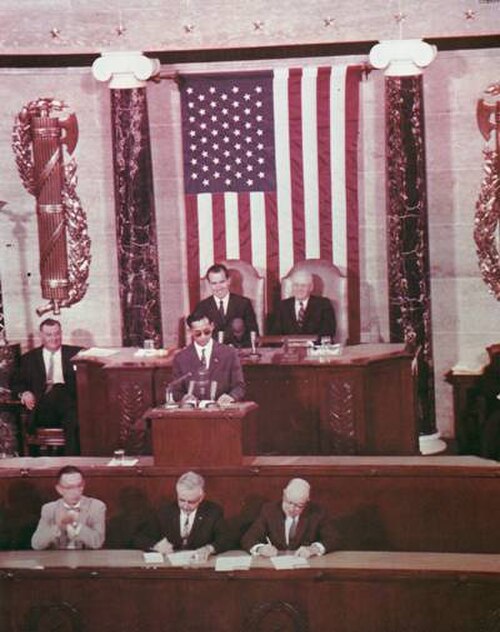
1946年6月、若きアナンダ国王が不審な状況下で死亡しているのが発見された。弟のプミポン・アドゥンヤデートが王位に就いた。タイは1954年に東南アジア条約機構(SEATO)に加盟し、米国の積極的な同盟国となった。 [82] : 493 サリット・タナラット陸軍元帥は1957年にクーデターを起こし、カーナ・ラトサドンを政界から追放した。彼の統治(首相在任期間1959年~1963年)は独裁的で、国王の神のような地位と、政府の忠誠心を国王に向けることによって自らの正当性を築いた。[82] : 511 彼の政府は国のインフラと教育を改善した。[82] : 514 米国が1961年にベトナム戦争に参戦した後、米国がタイを保護することを約束する秘密協定が結ばれた。[82] : 523
この時期、タイ社会の近代化と西洋化が進んだ。農村住民が成長する都市で仕事を求め、急速な都市化が起きた。農村の農民は階級意識を持ち、タイ共産党に共感した。[82] : 528 経済発展と教育により、バンコクや他の都市で中産階級が台頭した。[82] : 534 1971年10月、タノム・キティカチョーン(首相在任期間1963~1973年)の独裁政権に反対する大規模なデモが発生し、民間人の犠牲者が出た。[82] : 541–3 プミポン国王は、サニャ・ダルマサクティ(首相在任期間1973–1975年)を後任に任命した。これは、1932年以来初めて国王がタイの政治に直接介入した事例となった。[94]この事件の余波は、短命の議会制民主主義となり、[94]しばしば「民主主義が開花した時代」(ยุคประชาธิปไตยเบ่งบาน)と呼ばれるようになった。[要出典]
現代史
サイゴン陥落後、絶え間ない騒乱と不安定さ、そして共産党による政権奪取への恐怖から、一部の極右団体は左翼学生を共産主義者と決めつけるようになった。[82] : 548 このことが1976年10月のタマサート大学虐殺にまで発展した。 [82] : 548–9 その日のクーデターでタイに新たな極右政権が誕生し、メディア、役人、知識人を弾圧し、共産主義の反乱を煽った。翌年、別のクーデターでより穏健な政権が樹立され、1978年に共産主義戦闘員に恩赦が与えられた。[95]
インドシナ難民危機、ベトナム国境襲撃、経済的困難に後押しされ、プレーム・ティンスーラノンダが1980年から1988年まで首相となった。共産党は1983年までに反乱を放棄した。プレームの首相制は「半民主主義」と呼ばれた。なぜなら議会は下院議員全員が選挙で選ばれ、上院議員全員が任命されたからである。1980年代には国王による政治介入も増加し、1981年と1985年にプレームに対するクーデターが2度起こったが失敗に終わった。1988年、タイは1976年以来初めて選挙で選ばれた首相を擁立した。[96]
1991年のクーデターの指導者であり、首相に就任しないと発言していたスチンダー・クラプラヨーン[97]は、 1992年の総選挙後に多数派連合政府によって首相に指名された。これによりバンコクで民衆デモが起こり、軍による血なまぐさい弾圧で終わった。プミポン国王はこれに介入して恩赦法に署名し、スチンダーは辞任した[98]。
1997年のアジア通貨危機はタイで発生し、同国の40年にわたる経済成長に終止符を打った。[99] : 3 チュアン・リークパイ政権は不評な条項付きのIMF融資を受けた。 [100]
2004年のインド洋地震と津波は主に南部を襲い、プーケット、パンガー、ラノン、クラビ、トラン、サトゥーンで約5,400人が死亡し、数千人が依然として行方不明となっている。[101]
タクシン・シナワット首相率いるポピュリストのタイ愛国党は2001年から2006年まで政権を握った。彼の政策は農村部の貧困削減に成功し[102]、国内で国民皆保険制度を導入した[103] 。しかしタクシンは、自分と農村部の貧困層に有利になるように中流階級を破壊している腐敗したポピュリストとみなされた。彼はまた、2004年以降激化したタイ南部の反乱への対応をめぐって批判に直面した。さらに、農村部の貧困層に対する彼の提言はプミポン国王の提言と真っ向から対立し、タイで有力な勢力である王党派の怒りを買った。これに対して王党派は、タクシンと彼の「顧問団がフィンランドに集まり、王政打倒を企てた」という作り話をでっち上げ、それ以外はまだ人気があったタクシンに対する反対を劇的に拡大した。一方、タクシン首相の2期目には、民主人民連合(PAD)が主導する大規模な反タクシン派デモが始まった。ついに事態は頂点に達し、軍部はタクシンを追い出すことを決意した。タイ軍部は1970年代に民主主義が誕生した際に権力の座から追い出されたが、タイの民主主義は依然として軍部と王室の暗黙の同意に基づいている。王室と軍部は民主的に選ばれたリーダーが行き過ぎたと同意すると、協力してリーダーを追い出す。今回のケースでは、軍部はまず国王にタクシンを追い出す許可を求めたが、許可は得られなかった。しかしその後、国王はタクシンが軍部を率いるという選択を拒否し、クーデターを望む軍部リーダーが権力を握ることを許した。1その後 、軍部は2006年にクーデターでタクシン派の政党を解散させ、100人以上の党幹部を政治から追放した。クーデター後、軍事政権が樹立され、1年間続いた。[104] [105]

民主主義への回帰は、国民の積極的な参加を必要としたプロセスだった。国民は頻繁に政府庁舎を襲撃し、軍はまたしてもクーデターを起こすと脅した。[104]最終的に、2007年にタクシン派の人民の力党(PPP)が率いる文民政権が選出された。PADが主導した別の抗議活動はPPPの解散で終わり、民主党が代わりに連立政権を率いた。タクシン派の反独裁民主統一戦線(UDD)は2009年と2010年に抗議活動を行い、後者は軍の暴力的な弾圧で70人以上の民間人の死者を出した。[106]
2011年の総選挙後、ポピュリスト 政党タイ貢献党が過半数を獲得し、タクシンの妹インラック・シナワットが首相に就任した。与党がタクシンに有利となる恩赦法案を提案した後、人民民主改革委員会は再び反シナワット抗議デモを組織した[107]。[108]インラックは議会を解散し、総選挙が予定されたが、憲法裁判所によって無効とされた。この危機は2014年の別のクーデターで終結した[109]。
その後、プラユット・チャンオチャ将軍率いる軍事政権である国家平和秩序評議会が2019年まで国を率いた。市民的および政治的権利が制限され、国王不敬罪事件が急増した。政敵や反対派は「態度矯正」キャンプに送られた。[110]これはファシズムの台頭を示していると学者は述べた。[111]タイ国王の中で最も長く在位していたプミポン国王は2016年に亡くなり、息子のワチラロンコンが王位に就いた。タイの現憲法の国民投票と採択は軍事政権下で行われた。[h]軍事政権はまた、将来の政府を自らが定めた20年間の国家戦略「ロードマップ」に縛り付け、国を軍主導の民主主義に事実上閉じ込めた。[113] 2019年、軍事政権は3月に総選挙を実施することに合意した。[110]プラユット氏は、選挙不正の疑惑が浮上する中、下院におけるパラン・プラチャラート党連合と軍事政権が任命した上院の支持を得て首相職を継続した。 [114] 2020年から2021年にかけての民主化運動は、 2014年のクーデターをきっかけに王室大権が拡大し、王室が支援するタイ王国軍の民主化と経済の後退、民主化を訴える新未来党の解散、 2019年総選挙と現政治体制への不信、ワンチャラーム・サトサクシット氏を含む政治活動家の強制失踪や死亡、政治汚職スキャンダルなどによって引き起こされ、[115] [116]王室改革を求める前例のない要求が高まり、国内に共和主義の意識が高まった。 [117 ]
2023年5月、タイの改革派野党である進歩主義の前進党(MFP)とポピュリストのタイ貢献党が総選挙で勝利し、プラユット・チャンオチャ首相を支持した王党派・軍政党が権力を失った。[119] 2023年8月22日、ポピュリストのタイ貢献党のスレッタ・タヴィシンがタイの新首相に就任し、タイ貢献党の億万長者代表タクシン・シナワットは数年の自主亡命生活を経てタイに帰国した。[120]タヴィシンはその後、2024年8月14日に憲法裁判所によって「重大な倫理違反」を理由に首相の職を解かれた。 [121]
地理

タイは総面積513,120平方キロメートル(198,120平方マイル)で、総面積では50番目に大きい国です。[1]
タイはいくつかの明確な地理的地域から成り、一部は県群に対応している。国の北部はタイ高原の山岳地帯で、最高地点はタノン・トンチャイ山脈のドイ・インタノンで、海抜2,565メートル(8,415フィート)である。北東部のイサーンはコラート高原で構成され、東はメコン川に接している。国の中央部は主に平坦なチャオプラヤー川の渓谷で占められており、タイ湾に流れ込んでいる。タイ南部は狭いクラ地峡で構成され、マレー半島に広がっている。[要出典]
チャオプラヤー川とメコン川は、タイの農村部にとって欠かせない水路です。工業規模の農作物生産には、両方の川とその支流が利用されています。タイ湾は 320,000 平方キロメートル (124,000 平方マイル) の広さがあり、チャオプラヤー川、メークロン川、バーンパコン川、タピ川が流れ込んでいます。南部地域とクラ地峡の海岸沿いの澄んだ浅瀬のおかげで、観光業に貢献しています。タイ湾の東岸はタイの工業中心地で、サッタヒップには王国最高の深水港があり、最も忙しい商業港であるレムチャバンがあります。[要出典]
プーケット、クラビ、ラノン、パンガー、トラン、およびその島々はすべてアンダマン海沿岸に位置している。[要出典]
気候

タイの気候は季節的な特徴を持つモンスーン風(南西モンスーンと北東モンスーン)の影響を受けています。[122] : 2 国土の大部分はケッペンの熱帯サバナ気候に分類されます。[123]南部の大部分と東部の東端は熱帯モンスーン気候です。南部の一部は熱帯雨林気候でもあります。
タイの一年は3つの季節に分かれています。[122] : 2 最初は雨季または南西モンスーン季(5月中旬から10月中旬)で、インド洋からの南西の風によって引き起こされます。[122] : 2 降雨は熱帯収束帯(ITCZ)と熱帯低気圧によってももたらされ、[122] : 2 8月と9月が一年で最も雨の多い時期です。[122] : 2 この国の年間平均降雨量は1,200〜1,600 mm(47〜63インチ)です。[122] : 4 冬または北東モンスーン季は10月中旬から2月中旬に続きます。[122] : 2 タイの大部分は乾燥した気候で気温は穏やかです。[122] : 2, 4 夏またはモンスーン前の季節は2月中旬から5月中旬まで続きます。[122] : 3 内陸に位置し緯度が高いため、タイの北部、北東部、中央部、東部では温暖な気候が長く続き、3月から5月にかけては気温が40 °C (104 °F) に達することもあります。 [122] : 3 一方、冬には地域によっては0 °C (32 °F) 近くまたはそれ以下になることもあります。[122] : 3 タイ南部は年間を通じて穏やかな気候で、海洋の影響により日中および季節による気温の変化が少ないのが特徴です。[122] : 3 特に10月から11月にかけては雨量が豊富です。[122] : 2
タイは気候変動の影響を最も受けやすい10カ国のうちの1つであり、特に海面上昇や異常気象に対して非常に脆弱である。 [124] [125]
生物多様性と保全

タイの国立公園は、生態学的に重要な自然資源や独特の美しさ、あるいは特別な重要性を持つ動植物が存在する地域と定義されている。タイの保護地域には、156の国立公園、58の野生生物保護区、67の狩猟禁止地域、120の森林公園が含まれる。これらはタイ国土の約31%を占める。[127]
これらの公園は、天然資源環境省(MNRE)の国立公園・野生生物・植物保護局(DNP)によって管理されています。
タイは、2016年の国際環境パフォーマンス指数(EPI)で180カ国中91位と、平凡ながらも改善しつつある成績を収めている。タイの成績が最も悪い(すなわち最高順位)環境分野は、大気質(167)、農業の環境影響(106)、気候とエネルギー部門(93)で、後者は主に生産kWhあたりのCO2排出量が高いためである。タイは、水資源管理(66)と衛生(68)で最高(すなわち最低順位)の成績を収めているが、将来的には大幅な改善が期待されている。[128] [129]タイの2019年の森林景観完全性指数の平均スコアは6.00/10で、172カ国中世界88位にランクされている。[130]
この国の国のシンボルであるゾウの個体数は、1850年の10万頭から推定2,000頭にまで減少した。[126]密猟者は長い間、象牙や皮のためにゾウを狩ってきたが、現在では肉のために狩る人も増えている。[131]若いゾウは観光地や作業動物として捕獲されることが多く、虐待されているとの訴えもある。 [132] 1989年に政府はゾウの伐採への利用を禁止したため、多くのゾウの飼い主が家畜を観光産業に転用するようになった。[133 ]
保護されている種の密猟は依然として大きな問題である。トラ、ヒョウ、その他の大型ネコ科動物は毛皮目的で狩猟されている。多くは薬効があるとされる肉のために養殖または狩猟されている。このような取引は違法であるが、バンコクの有名なチャトチャック市場は今も絶滅危惧種の販売で知られている。[134]野生動物をペットとして飼う習慣は、ツキノワグマ、マレーグマ、シロテテナガザル、エボシテナガザル、ビントロングなどの種に影響を与えている。[135]
政治と政府
1932年以前、タイの国王は封建制または絶対君主でした。スコータイ王国の時代、国王はダルマラージャ、つまり「ダルマに従って統治する王」と見なされていました。政治体制は、地方領主によって統治される貢納者のネットワークでした。現代の絶対君主制と国家は、チュラロンコーンが分権化された保護領制度を単一国家に変えたときに確立されました。1932年6月24日、カーナ・ラツァドン(人民党)は無血革命を実行し、立憲君主制の始まりを示しました。
タイには1932年以来20の憲法と憲章があり、最新の現行憲法である2017年憲法もその1つである。すべての憲法は、政治は立憲君主制の枠組みの中で行われると定めているが、事実上の政府形態は軍事独裁から選挙による民主主義まで多岐にわたる。[136] [137]タイの現在の政府形態は部分的に民主主義であり部分的に独裁であり、それを説明するのに多くの用語が使われている。[i]タイは世界で4番目に多くのクーデターを経験している。 [143] 1932年から2009年までの「83年間のうち55年間、軍人または元軍人がタイを率いてきた」。[144]直近では、国家平和秩序評議会と自称する軍事政権が2014年から2019年まで国を統治した。

政府は3つの部門に 分かれています。
- 立法府:国会は間接選挙で選出される200名の議員からなる上院と、選挙で選出される500名の議員からなる下院から構成される。直近の選挙は2023年の総選挙である。現在、タイ貢献党率いる連立政権が多数派を占めている。2024年のタイ上院選挙は、現憲法下で行われた初の上院選挙であり、「世界で最も複雑な選挙」と批判されている。[145]上院は、ブムジャイタイ党所属の上院議員が多数派を占めているとされる。[146]
- 行政部門は、タイ政府の長である首相と、最大35名の閣僚で構成される。首相は国会で選出される。現在の憲法では、首相は選挙前に政党が指名した候補者から選ばれると定められている。現在の首相は、タイ貢献党所属のパトンターン・シナワットである。
- 司法は行政と立法府から独立しているはずであるが、司法の判決は既存の法律ではなく政治的配慮に基づいているのではないかと疑われている。[147]
1946年から1980年代にかけて、軍部と官僚階級の貴族が政党を完全にコントロールしていた。[148] : 16 タイ の政党のほとんどは短命である。[149] : 246 1992年から2006年の間、タイは二大政党制であった。[149] : 245 その後の憲法では、単一政党が議会で過半数を獲得できない複数政党制が作られた。
タイの国家元首は世襲君主である。現在のタイ国王はワチラロンコン(ラーマ10世)で、2016年10月から君主として君臨している。国王の権限は憲法によって制限されており、国王は主に象徴的な名目上の存在である。しかし、すべての憲法は慣習的な王室の裁定に道を開くため、国王は依然として時折タイの政治に介入する。ダンカン・マッカーゴやフェデリコ・フェラーラなど、タイ国外の学者の中には、政治の舞台裏で「ネットワーク君主制」を通じて君主が憲法外の役割を果たしていると指摘する者もいる。 [150]王室は、国民の王室に対する態度が代々異なるにもかかわらず、厳しい不敬罪法により保護されている。 [151] [152]
国王は不敬罪法により保護されており、批判者は3年から15年の懲役刑に処せられる。[153] 2014年のクーデター後、タイは国の歴史上最も多くの不敬罪囚を抱えた。 [154] [155] タイの人権状況は、 2014年以来、フリーダム・ハウス・インデックスで「自由ではない」と評価されている。 [156] 2024年8月7日、タイ憲法裁判所は、不敬罪法の改正案が憲法秩序を脅かすとして、 2023年の議会選挙の勝利者、前進党とそのすべての指導者に対し、政治活動を禁止した。[157]エコノミスト誌は、この動きを「ローファー」の一例として批判し、2020年に前身政党である未来前進党が解散したことを、「タイの保守勢力の連合(君主主義者、軍隊、少数の実業家を含む)がいかにして反対派を抑圧しようとしたか」の最新の例として指摘した。[157] [158]
タイの2024年世界自由度報告書によると、タイの地位は、競争的な議会選挙と、かつての主要野党による新しい政権連合の形成により、不自由から部分的に自由へと改善されたが、選挙で選ばれていない上院議員が最多票を得た政党を排除した。[159]
行政区分
タイは単一国家であり、行政サービスは国家政府組織法(BE 2534、 1991年)によって中央、州、地方の3つのレベルに分かれている。タイは76の県(จังหวัด、チャンワット)[160]で構成されており、これらは第一レベルの行政区画である。また、首都バンコクとパタヤの2つの特別統治区もある。バンコクは県レベルであるため、しばしば県として数えられる。各県は郡(อำเภอ、アムポー)に分かれ、郡はさらに小郡(ตำบล、タムボン)に分かれている。各県の県都(ムアン)の名前は県名と同じである。例えば、チェンマイ県(チャンワット・チェンマイ)の県都はムアンチェンマイまたはチェンマイである。県と郡の行政官である県知事と郡長は中央政府によって任命される。[161]タイの県は、資料によっては4つから6つの地域に分けられることもある。
タイの州を表示するクリック可能な地図

外交関係

シャムとタイの外交のやり方は、長い間「風に吹かれて曲がる竹」と評されてきた。つまり、その政策は「常にしっかりと根付いているが、生き残るためには風が吹く方向にも柔軟に対応できる」[162]、つまり順応性があり実利的である。独立を確保するために、どの大国にも支配されないように、一つの大国を他の大国と対立させようとした。[163]
冷戦中、タイは共産主義の拡大を阻止しようと米国に加わり、SEATO同盟への参加、韓国とベトナムへの遠征隊の派遣、米国への基地使用の申し出などを行った。タイは東南アジア諸国連合(ASEAN)の創設メンバー5カ国のうちの1つであり、当初は共産主義に対する防衛を目的としていた。ベトナム戦争の終結はタイの外交政策の転換点となり、その後タイは共産主義の中国および共産主義となった隣国との関係改善を目指した。タイはASEANの積極的なメンバーであり、ASEAN内での影響力発揮を目指している。タイは他のメンバーとますます緊密な関係を築き、経済、貿易、銀行、政治、文化問題における地域協力を進めている。[164]
2000年代、タイは国際舞台で積極的な役割を果たし、国際機関や地域機関に全面的に参加した。タイは主要な非NATO同盟国であり、米国の特別301報告書の優先監視リストに載っている。東ティモールがインドネシアから独立したとき、タイは国際平和維持活動に軍隊を派遣した。[165]国際関係を強化する努力の一環として、タイは米州機構(OAS)[166]や欧州安全保障協力機構(OSCE) [167]などの地域組織に働きかけてきた。
タクシン・シナワット首相の時代には、中国、オーストラリア、バーレーン、インド、米国との自由貿易協定交渉が開始された。タクシンはタイを地域のリーダーとして位置づけようとし、貧しい近隣諸国でさまざまな開発プロジェクトを開始した。さらに物議を醸したのは、彼がビルマ独裁政権と緊密で友好的な関係を築いたことだ。 [168]タイは米国主導のイラク侵攻に参加し、 2004年9月まで人道支援部隊を派遣した。 [169]タイはまた、アフガニスタンの復興活動に軍隊を派遣した。[170]
2009年4月、カンボジアとタイの国境紛争により、国境近くにあるカンボジアのプレアヴィヒア・ヒンドゥー寺院の900年前の遺跡のすぐ隣の地域に軍隊が侵入した。 [171] [172]
2014年のクーデター後、タイは中国にさらに傾倒した。[173]中国の影響力の拡大と資本流入により、多くの譲歩の後、一部の国会議員は中国による「経済植民地化」を懸念した。[174]
2023年のイスラエルとハマスの軍事衝突の際、タイの首相は当初、イスラエルに対する攻撃を強く非難し、イスラエル政府と国民に深い哀悼の意を表すると述べたが[175]、その後政府は立場を変え、タイはこの紛争で中立の立場を取ったと発表した。[176]この紛争で28人のタイ人が死亡した。[177]
軍隊

タイ王国軍(กองทัพไทย; RTGS : Kong Thap Thai ) は、タイ王国の軍隊を構成します。タイ王国陸軍(กองทัพบกไทย)、タイ海軍(กองทัพเรือไทย)、およびタイ空軍(กองทัพอาก)で構成されています。 าศไทย)。また、さまざまな民兵組織も組み込まれています。[要出典]
タイ国軍は、現役兵力30万6千人と予備役兵力24万5千人を擁している。[178]タイ国軍のトップ(จอมทัพไทย、チョムタップタイ)は国王であるが、[179]この地位は名目上のものである。国軍はタイ国防省によって管理されており、国防大臣(タイ内閣の一員)がトップを務め、タイ王国国軍本部が指揮を執り、タイ国防軍司令官がトップを務める。[180]タイの年間防衛予算は、2005年の19億8千万米ドルから2016年には58億8千万米ドルへとほぼ3倍となり、GDPの約1.4%を占めている。[181] 2015年9月のクレディ・スイスの報告書によると、タイは軍事力指数で世界第16位にランクされました。[182]
.jpg/500px-Exercise_Cope_Tiger_(cropped).jpg)
軍はまた、ロヒンギャ族をマレーシアやインドネシアに護送するなどの人道的任務も担っており、[183]インドシナ難民危機の際に難民の安全と福祉を確保することなどである。[184]
憲法によれば、軍隊に勤務することはすべてのタイ国民の義務である。[185]タイでは、21歳以上の男性に対して依然として徴兵制度が採用されている。彼らは、領土防衛学生としての予備役訓練の期間と教育レベルに応じて、さまざまな期間の現役勤務を強いられる。3年以上の予備役訓練を修了した者は、完全に免除される。この慣行は長い間批判されており、一部のメディアはその有効性と価値に疑問を呈している。[186] [187]徴兵された人々は、上級将校の使用人[188]や軍協同組合の店員になることが多いとされている。 [189] [190] 2020年3月に発表された報告書で、アムネスティ・インターナショナルは、タイ軍の徴兵された人々は軍当局によって組織的に隠蔽された制度化された虐待に直面していると非難した。[191]
批評家は、タイ軍の主な目的は外部の脅威ではなく内部の脅威に対処することであると指摘した。[192] 国内治安作戦司令部はタイ軍の政治部門と呼ばれ、文民官僚機構と社会的、政治的機能が重複している。また、反民主主義の使命も持っている。[192]軍はまた、人身売買の告発や[193]高級将校の昇進における縁故主義など、数多くの汚職事件で悪名高い。 [194]軍は政治に深く根ざしている。最近では、任命された上院議員には100人以上の現役軍人と退役軍人が含まれている。[195]
2024年世界平和指数によると、タイは世界で75番目に平和な国です。[196]
経済
.jpeg/500px-Bangkok_(251385359).jpeg)
タイの経済は輸出に大きく依存しており、輸出は国内総生産(GDP)の3分の2以上を占めています。タイは年間1,050億米ドル以上の商品とサービスを輸出しています。[1]主な輸出品には、自動車、コンピューター、電化製品、米、繊維製品、履物、水産物、ゴム、宝石などがあります。 [1]
タイは新興経済国であり、新興工業国と見なされています。タイの2017年のGDPは1兆2,360億米ドル(購買力平価ベース)でした。[202]タイはインドネシアに次いで東南アジアで2番目に大きな経済大国です。タイは東南アジアの富の分布の中で中間に位置し、一人当たりGDPではシンガポール、ブルネイ、マレーシアに次いで4番目に豊かな国です。
タイは、ラオス、ミャンマー、カンボジアといった近隣の発展途上国にとってのアンカー経済として機能している。タイ国家経済社会開発委員会(NESDB)によると、2014年第3四半期のタイの失業率は0.84%だった。[203]
2017年、タイ経済はインフレ調整後で3.9%成長し、2016年の3.3%から上昇し、2012年以来最も速い成長を記録した。[204]特にCOVID-19パンデミック中の公共支出の増加により、当局はタイの公的債務上限をGDPの60%から70%に引き上げた。[205] 2024年現在[update]、タイは生産性の低さ、教育水準の低さ、家計債務の高さ、民間投資の低さ、経済成長の鈍化に悩まされており、[206] [207]経済研究グループは、構造改革が行われない場合、今後数十年間のGDP成長率は年間2%を下回ると予測している。[208]
所得と富の格差

タイ人の成人一人当たりの富の中央値は2016年に1,469ドルで、[209] : 98 2010年の605ドルから増加した。[209] : 34 2016年、タイは人間開発指数で87位、不平等調整済みHDIで70位にランクされた。[210]
2017年のタイの世帯収入の中央値は月額26,946バーツであった。[211] : 1 上位20%の世帯が全収入の45.0%を占め、下位20%の世帯が占める割合は7.1%であった。[211] : 4 1 人当たり月額5,344バーツ未満の収入がある下位40%の人は2,690万人であった。[212] : 5 2013~2014年のタイ政治危機の際の調査によると、反政府派のPDRC(32%)は月収5万バーツ以上であるのに対し、親政府派のUDD(27%)は月収1万~2万バーツであった。[213] : 7
2014年、クレディ・スイスは、タイはロシアとインドに次いで世界で3番目に不平等な国であると報告した。[214]上位10%の富裕層が国の資産の79%を保有している。[214]上位1%が資産の58%を保有している。[214]タイの最も裕福な50世帯の純資産総額はGDPの30%を占めている。[214] タイ銀行は、2006年から2016年の間にタイの上位5%の企業が国内の企業収益の85%を占め、国内企業のわずか6%が輸出産業で、それが国のGDPの60%を占めていると報告した。[215]
2016年には581万人が貧困状態にあり、「貧困に近い」者も含めると1160万人(人口の17.2%)に上る。[212] : 1 各地域の総人口に対する貧困者の割合は、東北部で12.96%、南部で12.35%、北部で9.83%であった。[212] : 2 2017年には、1400万人が社会福祉を申請した(年収10万バーツ未満が条件)。[214] 2023年第1四半期のタイの家計負債は14.6兆バーツで、GDPの89.2%を占め、1世帯当たりの平均負債は約50万バーツであった。[216] 2016年には、国内に3万人のホームレスがいたと推定されている。[217]
輸出と製造
タイの経済は輸出に大きく依存しており、輸出は国内総生産(GDP)の3分の2以上を占めています。タイは年間1,050億米ドル以上の商品とサービスを輸出しています。[1]主な輸出品には、自動車、コンピューター、電化製品、米、繊維製品、履物、水産物、ゴム、宝石などがあります。 [1]
主要産業としては、電気機器、部品、コンピュータ部品、自動車などがある。1997~1998年のアジア通貨危機からのタイの回復は、さまざまな要因の中でも主に輸出に依存していた。2012年現在[update]、タイの自動車産業は東南アジア最大、世界第9位である。[218] [219] [220]タイの自動車産業は年間150万台近くの自動車を生産しており、そのほとんどは商用車である。[220]
タイで製造される車両のほとんどは、主に日本とアメリカの外国メーカーによって開発され、ライセンス供与されている。タイの自動車産業は、多くの製品の市場を見つけるためにASEAN自由貿易協定(AFTA)を利用している。タイでは、日本の5社、米国の2社、インドのタタの計8社のメーカーがピックアップトラックを製造している。[221] 2012年の時点で、2ドアピックアップトラックに対する税率が乗用車の17~50%に対してわずか3~12%と優遇されているため、タイは米国に次いで世界で2番目にピックアップトラックの消費国となっている。[222] 2014年には、ピックアップトラックはタイの新車販売全体の42%を占めた。[221]
観光


観光業はタイ経済の約6%を占めている。パンデミック以前、国連世界観光機関がまとめた世界観光ランキングによると、タイは世界で8番目に訪問者が多い国だった。2019年、タイはイギリスやドイツを上回り、3,980万人の海外観光客を受け入れ[223] 、国際観光収入は605億米ドルで第4位となった。
世界観光機関によると、2013年に東南アジアで最も多くの観光客が訪れた国はタイだった。タイのGDP12兆バーツに直接貢献する観光収入の推定値は、9%(1兆バーツ)(2013年)から16%の範囲である。[224]観光の間接的な影響を含めると、タイのGDPの20.2%(2.4兆バーツ)を占めると言われている。[225] : 1
アジア人観光客は主にバンコクとその周辺の歴史的、自然的、文化的名所を目的にタイを訪れます。西洋人観光客はバンコクとその周辺地域だけでなく、南部のビーチや島々を訪れる人も多くいます。北部は多様な少数民族や森林に覆われた山々があり、トレッキングやアドベンチャー旅行の主要目的地となっています。観光客が最も少ないのはイサーンです。外国人観光客に対応するため、主要な観光地に事務所と緊急電話番号を持つ独立した観光警察が設置されました。[226]
世界旅行ツーリズム協議会によると、タイは医療ツーリズムの支出額で世界第5位の国であり、2018年には250万人以上の観光客が訪れ[227]、アジアでは第1位となっている。[228]この国は性別適合手術(SRS)と美容整形手術の増加で人気がある。2010年から2012年にかけて、医療ツーリズムの観光客の90%以上がSRSのためにタイを訪れた。[229]
タイの売春と性観光も事実上経済の一部を形成している。観光客を誘致するために、タイをエキゾチックな国として宣伝するキャンペーンが行われている。[230] 2003年に発表された推計によると、売春と性観光は年間43億ドル、タイ経済の約3%を占めている。[231]観光客の収入の少なくとも10%は性産業に費やされていると考えられている。[232]
農業と天然資源

タイの労働力の49%は農業に従事している。[233]これは1980年の70%から減少している。 [233]米はタイで最も重要な作物であり、タイは長い間世界最大の米輸出国であったが、最近インドとベトナムに遅れをとった。[234]タイはメコン川流域のどの州よりも耕作地の割合が高く、27.25%である。[235]耕作地の約55%が米の生産に使用されている。[236]
農業は、労働集約的で移行的な方法から、より工業化され競争力のある部門への移行を経験してきました。[233] 1962年から1983年の間に、農業部門は平均して年間4.1%成長し、1983年から2007年の間も2.2%の成長を続けました。 [233] GDPに対する農業の相対的な貢献は減少している一方で、商品やサービスの輸出は増加しています。
Furthermore, access to biocapacity in Thailand is lower than world average. In 2016, Thailand had 1.2 global hectares[237] of biocapacity per person within its territory, a little less than world average of 1.6 global hectares per person.[238] In contrast, in 2016, they used 2.5 global hectares of biocapacity – their ecological footprint of consumption. This means they use about twice as much biocapacity as Thailand contains, resulting in a deficit.[237]
Informal economy
.jpg/500px-Train_Night_Market_Ratchada_(34079339800).jpg)
Thailand has a diverse and robust informal labour sector—in 2012, it was estimated that informal workers comprised 62.6% of the Thai workforce. The Ministry of Labour defines informal workers to be individuals who work in informal economies and do not have employee status under a given country's Labour Protection Act (LPA). The informal sector in Thailand has grown significantly over the past 60 years over the course of Thailand's gradual transition from an agriculture-based economy to becoming more industrialised and service-oriented.[239] Between 1993 and 1995, ten per cent of the Thai labour force moved from the agricultural sector to urban and industrial jobs, especially in the manufacturing sector. It is estimated that between 1988 and 1995, the number of factory workers in the country doubled from two to four million, as Thailand's GDP tripled.[240] While the Asian Financial Crisis that followed in 1997 hit the Thai economy hard, the industrial sector continued to expand under widespread deregulation, as Thailand was mandated to adopt a range of structural adjustment reforms upon receiving funding from the IMF and World Bank. These reforms implemented an agenda of increased privatisation and trade liberalisation in the country, and decreased federal subsidisation of public goods and utilities, agricultural price supports, and regulations on fair wages and labour conditions.[241] These changes put further pressure on the agricultural sector, and prompted continued migration from the rural countryside to the growing cities. Many migrant farmers found work in Thailand's growing manufacturing industry, and took jobs in sweatshops and factories with few labour regulations and often exploitative conditions.[242]
Those that could not find formal factory work, including illegal migrants and the families of rural Thai migrants that followed their relatives to the urban centres, turned to the informal sector to provide the extra support needed for survival—under the widespread regulation imposed by the structural adjustment programs, one family member working in a factory or sweatshop made very little. Scholars argue that the economic consequences and social costs of Thailand's labour reforms in the wake of the 1997 Asian Financial Crisis fell on individuals and families rather than the state: as the country's labour market became increasingly deregulated, the burden and responsibility of providing an adequate livelihood shifted from employers and the state to the workers themselves, whose families had to find jobs in the informal sector to make up for the losses and subsidise the wages being made by their relatives in the formal sector. The weight of these economic changes hit migrants and the urban poor especially hard, and the informal sector expanded rapidly as a result.[241]

Today, informal labour in Thailand is typically broken down into three main groups: subcontracted/self employed/home-based workers, service workers (including those that are employed in restaurants, as street vendors, masseuses, taxi drivers, and as domestic workers), and agricultural workers. Not included in these categories are those that work in entertainment, nightlife, and the sex industry. Individuals employed in these facets of the informal labour sector face additional vulnerabilities, including recruitment into circles of sexual exploitation and human trafficking.[239] A 2012 study found that 64% of informal workers had not completed education beyond primary school. Many informal workers are also migrants, only some of which have legal status in the country. Because the informal labour sector is not recognised under the Labour Protection Act (LPA), informal workers are much more vulnerable to exploitation and unsafe working conditions. While some Thai labour laws provide minimal protections to domestic and agricultural workers, they are often weak and difficult to enforce. Furthermore, Thai social security policies fail to protect against the risks many informal workers face, including workplace accidents and compensation as well as unemployment and retirement insurance. Many informal workers are not legally contracted for their employment, and many do not make a living wage.[239] Tens of thousands of migrants from neighboring countries face exploitation in a few industries,[243] especially in fishing where slave-like conditions have been reported.[244]
Science and technology
Thailand ranked 43rd in the Global Innovation Index in 2023.[245] The Ministry of Higher Education, Science, Research and Innovation and its agencies oversees the development of science, technology, and research in Thailand. According to the National Research Council of Thailand, the country devoted 1.1% of its GDP to the research and development of science in 2019, with over 166,788 research and development personnel in full-time equivalent that year.[246][247]
Infrastructure
Transportation

The State Railway of Thailand (SRT) operates all of Thailand's national rail lines. Krung Thep Aphiwat Central Terminal and Bangkok (Hua Lamphong) are the main termini of intercity routes. Phahonyothin and ICD Lat Krabang are the main freight terminals. As of 2024[update] SRT had 4,507 km (2,801 mi) of track, all of it meter gauge. Nearly all is single-track (2,847.1 km), although some important sections around Bangkok are double (1,089.9 km or 677.2 mi) or triple-tracked (107 km or 66 mi) and there are plans to extend this.[248][249] Rail transport in Bangkok includes long-distance services, and some daily commuter trains running from and to the outskirts of the city during the rush hour, but passenger numbers have remained low. There are also four rapid transit rail systems in the capital: the BTS Skytrain, MRT, SRT Red Lines and the Airport Rail Link.[citation needed]
Thailand has 390,000 kilometres (240,000 miles) of highways.[250] As of 2017[update], Thailand has over 462,133 roads and 37 million registered vehicles, 20 million of them motorbikes.[251] A number of undivided two-lane highways have been converted into divided four-lane highways. Within the Bangkok Metropolitan Region, there are a number of controlled-access highways. There are 4,125 public vans operating on 114 routes from Bangkok alone.[252] Other forms of road transport includes tuk-tuks, taxis — with over 80,647 registered taxis nationwide as of 2018,[253] vans (minibus), motorbike taxis and songthaews.
As of 2012[update], Thailand has 103 airports with 63 paved runways, in addition to 6 heliports. The busiest airport in the country is Bangkok's Suvarnabhumi Airport.[254]
In Bangkok, there were two failed rapid rail projects Lavalin Skytrain and Bangkok Elevated Road and Train System, before Mass Rapid Transit Master Plan in Bangkok Metropolitan Region was endorsed by the cabinet on 27 September 1994 and implemented from 1995 to the present.[255]
Energy
75% of Thailand's electrical generation is powered by natural gas in 2014.[256] Coal-fired power plants produce an additional 20% of electricity, with the remainder coming from biomass, hydro, and biogas.[256]
Thailand produces roughly one-third of the oil it consumes. It is the second largest importer of oil in Southeast Asia. Thailand is a large producer of natural gas, with reserves of at least 10 trillion cubic feet. After Indonesia, it is the largest coal producer in Southeast Asia, but must import additional coal to meet domestic demand.[citation needed]
Demographics
Ethnic groups
of Thailand
(2015 estimate by The World Factbook)[1]
Thai (97.5%)
Burmese (1.3%)
other (1.1%)
unspecified (0.1%)
Thailand has an estimated population of 65,975,198 as of July 2024;[257] Thailand's first census in 1909 found the population to be 8.2 million.[258] Thailand's population is largely rural, concentrated in the rice-growing areas of the central, northeastern and northern regions. About 44.2% of Thailand's population lived in urban areas as of 2010[update], slowly increasing from 29.4% in the 1990 census and 31.1% in the 2000 census.[259]
Thailand's government-sponsored family planning program resulted in a dramatic decline in population growth from 3.1% in 1960 to around 0.4% today. In 1970, an average of 5.7 people lived in a Thai household; in 2022, the average Thai household size was 3 people.[260] Now Thailand is an aged society, with more than 20% of its population aged over 60, and has low birth rate, posing economic challenges.[261]
Ethnic groups
.jpg/500px-Thailand_(272021437).jpg)
As of 2010, Thai people make up the majority of Thailand's population (95.9%). The remaining 4.1% of the population are Burmese (2.0%), others (1.3%), and unspecified (0.9%).[1]
According to genetic research, the present-day Thai people were divided into three groups: the northern group (Khon Mueang) are closely related to the Tai ethnic groups in southern China, the northeastern group (Isan people) are mixed Tai and several Austroasiatic-speaking ethnic groups, while the central and southern groups (formerly called Siamese) strongly share genetic profiles with the Mon people.[37][38][39]
According to the Royal Thai Government's 2011 Country Report to the UN Committee responsible for the International Convention for the Elimination of All Forms of Racial Discrimination, available from the Department of Rights and Liberties Promotion of the Thai Ministry of Justice,: 3 62 ethnic communities are officially recognized in Thailand. Twenty million Central Thai (together with approximately 650,000 Khorat Thai) made up approximately 20,650,000 (34.1 per cent) of the state's population of 60,544,937[262] at the time of completion of the Mahidol University Ethnolinguistic Maps of Thailand data (1997).[263]
The 2011 Thailand Country Report provides population numbers for mountain peoples ('hill tribes') and ethnic communities in the Northeast and is explicit about its main reliance on the Mahidol University Ethnolinguistic Maps of Thailand data.[263] Thus, though over 3.288 million people in the Northeast alone could not be categorised, the population and percentages of other ethnic communities c. 1997 are known for all of Thailand and constitute minimum populations. In descending order, the largest (equal to or greater than 400,000) are a) 15,080,000 Lao (24.9 per cent) consisting of the Thai Lao (14 million) and other smaller Lao groups, namely the Thai Loei (400–500,000), Lao Lom (350,000), Lao Wiang/Klang (200,000), Lao Khrang (90,000), Lao Ngaew (30,000), and Lao Ti (10,000); b) six million Khon Muang (9.9 per cent, also called Northern Thais); c) 4.5 million Pak Tai (7.5 per cent, also called Southern Thais); d) 1.4 million Khmer Leu (2.3 per cent, also called Northern Khmer); e) 900,000 Malay (1.5%); f) 500,000 Nyaw (0.8 per cent); g) 470,000 Phu Thai (0.8 per cent); h) 400,000 Kuy/Kuay (also known as Suay) (0.7 per cent), and i) 350,000 Karen (0.6 per cent).: 7–13 Thai Chinese, those of significant Chinese heritage, are 14% of the population, while Thais with partial Chinese ancestry comprise up to 40% of the population.[264] Thai Malays represent 3% of the population, with the remainder consisting of Mons, Khmers and various "hill tribes".[citation needed]
Increasing numbers of migrants from neighbouring Myanmar, Laos, and Cambodia, as well as from Nepal and India, have pushed the total number of non-national residents to around 3.5 million as of 2009[update], up from an estimated 2 million in 2008.[265] Some 41,000 Britons and 20,000 Australians live in Thailand.[266][267]
Population centres
Language
The official language of Thailand is Thai, a Kra–Dai language closely related to Lao, Shan in Myanmar, and numerous smaller languages spoken in an arc from Hainan and Yunnan south to the Chinese border. It is the principal language of education and government and spoken throughout the country.[268] The standard is based on the dialect of the central Thai people, and it is written in the Thai alphabet, an abugida script that evolved from the Khmer alphabet.[269] Sixty-two languages were recognised by the Royal Thai Government.[270] For the purposes of the national census, four dialects of Thai exist; these partly coincide with regional designations, such as Southern Thai and Northern Thai.[268]
The largest of Thailand's minority languages is the Lao dialect of Isan spoken in the northeastern provinces. In the far south, Kelantan-Pattani Malay is the primary language of Malay Muslims. Varieties of Chinese are also spoken by the large Thai Chinese population, with the Teochew dialect best-represented. Numerous tribal languages are also spoken, including many Austroasiatic languages such as Mon, Khmer, and Mlabri; Austronesian languages such as Cham, Moken and Urak Lawoi'; Sino-Tibetan languages like Lawa, Akha, and Karen; and other Tai languages such as Phu Thai, and Saek. Hmong is a member of the Hmong–Mien languages, which is now regarded as a language family of its own.[271][268]
Religion
The country's most prevalent religion is Theravada Buddhism, which is an integral part of Thai identity and culture. Active participation in Buddhism is among the highest in the world. Thailand has the second-largest number of Buddhists in the world after China.[272] According to the 2018 National Statistical Office data, 93.46% of the country's population self-identified as Buddhists.[2]
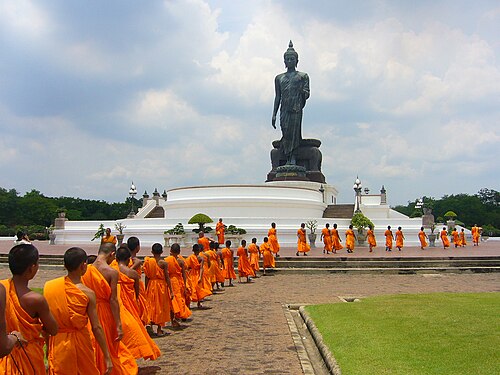
Muslims constitute the second largest religious group in Thailand, comprising 5.37% of the population in 2018.[2] Islam is concentrated mostly in the country's southernmost provinces: Pattani, Yala, Satun, Narathiwat, and part of Songkhla Chumphon, which are predominantly Malay, most of whom are Sunni Muslims. Christians represented 1.13% of the population in 2018, with the remaining population consisting of Hindus and Sikhs, who live mostly in the country's cities. There is also a small but historically significant Jewish community in Thailand dating back to the 17th century.[citation needed]
The constitution does not name an official state religion, and provides for freedom of religion. There have been no widespread reports of societal abuses or discrimination based on religious belief or practice.[273] Thai law officially recognizes five religious groups: Buddhists, Muslims, Brahmin-Hindus, Sikhs, and Christians.[274] However, some laws are inspired from Buddhist practices, such as banning alcohol sales on religious holidays.[275]
Education

In 1995, as minister of education, Sukavich Rangsitpollaid out his plans for educational reform in Thailand. The goal of education reform is to realize the potential of Thai people to develop themselves for the better quality of life and to develop the nation for peaceful co-existence in the world community.[276] The reform was considered a landmark movement after nearly 100 years of education under the previous system.[277]
Thailand's youth literacy rate was 98.1% in 2015.[278] Education is provided by a well-organised school system of kindergartens, primary, lower secondary and upper secondary schools, numerous vocational colleges, and universities. Education is compulsory up to and including age 14, while the government is mandated to provide free education through to age 17. The establishment of reliable and coherent curricula for its primary and secondary schools is subject to rapid changes. Issues concerning university entrance has been in constant upheaval for a number of years. The country is also one of the few that still mandates uniform up to the university years, which is still a subject of ongoing debate.[279]
In 2013, the Ministry of Information and Communication Technology announced that 27,231 schools would receive classroom-level access to high-speed internet.[280] However, the country's educational infrastructure was still underprepared for online teaching, as smaller and more remote schools were particularly hindered by COVID-19 restrictions.[281]
The number of higher education institutions in Thailand has grown over the past decades to 156 officially. The two top-ranking universities in Thailand are Chulalongkorn University and Mahidol University.[282] Thai universities' research output is still relatively low, even though the country's journal publications increased by 20% between 2011 and 2016.[283] Recent initiatives, such as the National Research University[284] and Graduate research intensive university: VISTEC, are designed to strengthen Thailand's national research universities.[citation needed]
The private sector of education is well developed and significantly contributes to the overall provision of education. Thailand has the second highest number of English-medium private international schools in Southeast Asian Nations.[285] Cram schools are especially popular for university entrance exams.[286]
Students in ethnic minority areas score consistently lower in standardised national and international tests.[287][288][289] This is likely due to unequal allocation of educational resources, weak teacher training, poverty, and low Thai language skill, the language of the tests.[287][290][291] As of 2020[update], Thailand was ranked 89th out of 100 countries globally for English proficiency.[292]
Thailand is the third most popular study destination in ASEAN. The number of international degree students in Thailand increased by 9.7 times between 1999 and 2012, from 1,882 to 20,309 students. Most of international students come from neighbor countries[285] like China, Myanmar, Cambodia and Vietnam.[293]
Health

Thailand ranks world's sixth, and Asia's first in the 2019 Global Health Security Index of global health security capabilities in 195 countries,[294] making it the only developing country on the world's top ten. Thailand had 62 hospitals accredited by Joint Commission International.[295] In 2002, Bumrungrad became the first hospital in Asia to meet the standard.[citation needed]
Health and medical care is overseen by the Ministry of Public Health (MOPH), with total national expenditures on health amounting to 4.3 per cent of GDP in 2009. Non-communicable diseases form the major burden of morbidity and mortality, while infectious diseases including malaria and tuberculosis, as well as traffic accidents, are also important public health issues.[citation needed]
In December 2018 the interim parliament voted to legalise the use of cannabis for medical reasons, making Thailand the first Southeast Asian country to allow the use of medical cannabis.[296]
Culture

Thai culture and traditions incorporate influences from India, China, Cambodia, and the rest of Southeast Asia. Thailand's national religion, Theravada Buddhism, is central to modern Thai identity. Thai Buddhism has evolved over time to include many regional beliefs originating from Hinduism, animism, as well as ancestor worship. The official calendar in Thailand is based on the Eastern version of the Buddhist Era (BE). Thai identity today is a social construct of the Phibun regime in the 1940s.[297][298][299]
Several ethnic groups mediated change between their traditional local culture, national Thai, and global cultural influences. Overseas Chinese also form a significant part of Thai society, particularly in and around Bangkok. Their successful integration into Thai society has allowed them to hold positions of economic and political power. Thai Chinese businesses prosper as part of the larger bamboo network.[300]

Respect for elderly and superiors (by age, position, monks, or certain professions) is Thai mores. As with other Asian cultures, respect towards ancestors is an essential part of Thai spiritual practice. Thais have a strong sense of social hierarchy, reflecting in many classes of honorifics. Elders have by tradition ruled in family decisions or ceremonies. Wai is a traditional Thai greeting, and is generally offered first by a person who is younger or lower in social status and position. Older siblings have duties to younger ones. Thais have a strong sense of hospitality and generosity.[301]
Taboos in Thai culture include touching someone's head or pointing with the feet, as the head is considered the most sacred and the foot the lowest part of the body.[302]
Art
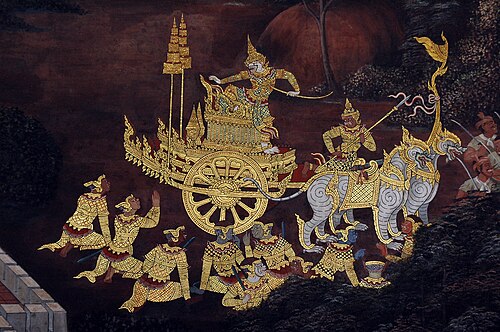
The origins of Thai art were very much influenced by Buddhist art and by scenes from the Indian epics. Traditional Thai sculpture almost exclusively depicts images of the Buddha, being very similar with the other styles from Southeast Asia. Traditional Thai paintings usually consist of book illustrations, and painted ornamentation of buildings such as palaces and temples. Thai art was influenced by indigenous civilisations of the Mon and other civilisations. By the Sukothai and Ayutthaya period, Thai had developed into its own unique style and was later further influenced by the other Asian styles, mostly by Sri Lankan and Chinese. Thai sculpture and painting, and the royal courts provided patronage, erecting temples and other religious shrines as acts of merit or to commemorate important events.[303]
Traditional Thai paintings showed subjects in two dimensions without perspective. The size of each element in the picture reflected its degree of importance. The primary technique of composition is that of apportioning areas: the main elements are isolated from each other by space transformers. This eliminated the intermediate ground, which would otherwise imply perspective. Perspective was introduced only as a result of Western influence in the mid-19th century. Monk artist Khrua In Khong is well known as the first artist to introduce linear perspective to Thai traditional art.[304]
The most frequent narrative subjects for paintings were or are: the Jataka stories, episodes from the life of the Buddha, the Buddhist heavens and hells, themes derived from the Thai versions of the Ramayana and Mahabharata, and scenes of daily life. Some of the scenes are influenced by Thai folklore instead of following strict Buddhist iconography.[303]
Architecture

Architecture is the preeminent medium of the country's cultural legacy and reflects both the challenges of living in Thailand's sometimes extreme climate as well as, historically, the importance of architecture to the Thai people's sense of community and religious beliefs. Influenced by the architectural traditions of many of Thailand's neighbours, it has also developed significant regional variation within its vernacular and religious buildings.[citation needed]
The Ayutthaya Kingdom movement was one of the most fruitful and creative periods in Thai architecture. Architecture in the Ayutthaya period is designed to display might and riches so it has great size and appearance. The temples in Ayutthaya seldom built eaves stretching from the masterhead. The dominant feature of this style is sunlight shining into buildings. During the latter part of the Ayutthaya period, architecture was regarded as a peak achievement that responded to the requirements of people and expressed the gracefulness of Thainess.[305]
Buddhist temples in Thailand are known as "wats", from the Pāḷi vāṭa, meaning an enclosure: a temple has an enclosing wall that divides it from the secular world. Wat architecture demonstrates many differences in layout and style, but they all adhere to the same principles.[306]
Literature
Thai literature has had a long history. Even before the establishment of the Sukhothai Kingdom there existed oral and written works.[citation needed]
During the Sukhothai Kingdom, most literary works were written in simple prose with certain alliteration schemes. Major works include King Ram Khamhaeng Inscription describing life at the time, which is considered the first literary work in Thai script, but some historians questioned its authenticity.[307] Trai Phum Phra Ruang, written in 1345 by King Maha Thammaracha I, expounds Buddhist philosophy based on a profound and extensive study with reference to over 30 sacred texts and could be considered the nation's first piece of research dissertation.[308]

During the Ayutthaya Kingdom, new poetic forms were created, with different rhyme schemes and metres. It is common to find a combination of different poetic forms in one poetic work. Lilit Yuan Phai is a narrative poem describing the war between King Borommatrailokkanat of Ayutthaya and Prince Tilokaraj of Lan Na. One literary work is Kap He Ruea composed by Prince Thammathibet in the nirat tradition. Traditionally, the verse is sung during the colourful royal barge procession and has been the model for subsequent poets to emulate. The same prince also composed the greatly admired Kap Ho Khlong on the Visit to Than Thongdaeng and Kap Ho Khlong Nirat Phrabat.[309] The Thonburi period produced Ramakien, a verse drama contributed by King Taksin the Great. The era marked the revival of literature after the fall of Ayutthaya.[citation needed]
During the 18th century Rattanakosin period, which still fought with the Burmese, many of the early Rattanakosin works deal with war and military strategy. Some examples are Nirat Rop Phama Thi Tha Din Daeng, Phleng Yao Rop Phama Thi Nakhon Si Thammarat. In the performing arts, perhaps the most important dramatic achievement is the complete work of Ramakian by King Rama I. In addition, There were also verse recitals with musical accompaniment, such as Mahori telling the story of Kaki, Sepha relating the story of Khun Chang Khun Phaen. Other recitals include Sri Thanonchai. The most important Thai poet in this period was Sunthorn Phu, known as "the bard of Rattanakosin" (Thai: กวีเอกแห่งกรุงรัตนโกสินทร์). Sunthorn Phu is best known for his epic poem Phra Aphai Mani, a versified fantasy-adventure novel, a genre of Siamese literature known as nithan kham klon (Thai: นิทานคำกลอน).[309]
Some of the most well-known modern Thai writers include Kukrit Pramoj, Kulap Saipradit, (penname Siburapha), Suweeriya Sirisingh (penname Botan), Chart Korbjitti, Prabda Yoon and Duanwad Pimwana.[310]
Music and dance

Aside from folk and regional dances (southern Thailand's Menora and Ramwong, for example), the two major forms of Thai classical dance drama are Khon and Lakhon nai. In the beginning, both were exclusively court entertainments and it was not until much later that a popular style of dance theatre, likay, evolved as a diversion for common folk.[311]
Folk dance forms include dance theater forms like likay, numerous regional dances (ram), the ritual dance ram muay, and homage to the teacher, wai khru. Both ram muay and wai khru take place before all traditional muay Thai matches. The wai is also an annual ceremony performed by Thai classical dance groups to honor their artistic ancestors.[citation needed]
Thai classical music is synonymous with those stylised court ensembles and repertoires that emerged in their present form within the royal centers of Central Thailand some 800 years ago. These ensembles, while being influenced by older practices are today uniquely Thai expressions. While the three primary classical ensembles, the Piphat, Khrueang sai and Mahori differ in significant ways, they all share a basic instrumentation and theoretical approach. Each employs small ching hand cymbals and krap wooden sticks to mark the primary beat reference. Thai classical music has had a wide influence on the musical traditions of neighboring countries.[citation needed]
Entertainment
Thai films are exported and exhibited in Southeast Asia.[312] Thai cinema has developed its own unique identity and is now being internationally recognized.[313] Films such as Ong-Bak: Muay Thai Warrior (2003) and Tom-Yum-Goong (2005), starring Tony Jaa, feature distinctive aspects of Thai martial arts "Muay Thai".
Thai horror has always had a significant cult following. Shutter (2004) was one of the best-known Thai horror movies and was recognized worldwide.[314] The Thai heist thriller film Bad Genius (2017) was one of the most internationally successful Thai films; it broke Thai film earning records in several Asian countries,[315] Bad Genius won in 12 categories at the 27th Suphannahong National Film Awards, and also won the Jury Award at the 16th New York Asian Film Festival with a worldwide collection of more than $42 million.[316]
Thailand television dramas, known as Lakorn, have become popular in Thailand and regionally.[317] Many dramas tend to have a romantic focus, such as Khluen Chiwit, U-Prince, Ugly Duckling, The Crown Princess and teen dramas television series, such as 2gether: The Series, The Gifted, Girl From Nowhere, Hormones: The Series.[citation needed]
The entertainment industries are estimated to have directly contributed $2.1 billion in gross domestic product (GDP) to the Thai economy in 2011. They also directly supported 86,600 jobs.[318] Amongst several Dance-pop artists who have made internationally successful can be mentioned "Lisa" Lalisa Manobal,[319] Violette Wautier,[320] and Tata Young.
Cuisine
Thai cuisine is one of the most popular in the world.[321] Thai food blends five fundamental tastes: sweet, spicy, sour, bitter, and salty. Common ingredients include garlic, lemongrass, kaffir lime, galangal, turmeric, coriander, and coconut milk.[322][323][324][325][326] Each region of Thailand has its specialities: kaeng khiao wan (green curry) in the central region, som tam (green papaya salad) in the northeast, khao soi in the north, and massaman curry in the south.[citation needed]
In 2017, seven Thai dishes appeared on a list of the "World's 50 Best Foods"— an online worldwide poll by CNN Travel. Thailand had more dishes on the list than any other country. They were: tom yam goong (4th), pad Thai (5th), som tam (6th), massaman curry (10th), green curry (19th), Thai fried rice (24th) and nam tok mu (36th).[327] Two desserts were also listed in CNN's 50 Best Desserts Around The World: mango sticky rice and tub tim krob.[328]
The staple food in Thailand is rice, particularly jasmine rice, which forms part of almost every meal. Thailand is a leading exporter of rice, and Thais consume over 100 kg of milled rice per person per year.[329] Thailand is also the world leader in edible insect industry[330] and well known for its street food; Bangkok is sometimes called the street food capital of the world.[331][332]
Units of measurement
Thailand generally uses the metric system, but traditional units of measurement for land area are used, and imperial units of measurement are occasionally used for building materials. Years are numbered as B.E. (Buddhist Era) in educational settings, civil service, government, contracts, and newspaper datelines. However, in banking, and increasingly in industry and commerce, standard Western year (Christian or Common Era) counting is the standard practice.[333]
Sports
.jpeg/500px-Muay_Thai_Fight_Us_Vs_Burma_(80668065).jpeg)
Muay Thai (lit. "Thai boxing") is a combat sport that uses stand-up striking along with various clinching techniques. Muay Thai became widespread internationally in the late-20th to 21st century. Famous practitioners include Buakaw Banchamek, Samart Payakaroon, Dieselnoi Chor Thanasukarn and Apidej Sit-Hirun. Buakaw Banchamek has probably brought more international interest in Muay Thai than any other fighter.[334]
Association football has overtaken Muay Thai as the most widely followed sport in Thailand. The Thailand national football team has played the AFC Asian Cup six times and reached the semifinals in 1972. The country has hosted the Asian Cup twice, in 1972 and in 2007. The 2007 edition was co-hosted together with Indonesia, Malaysia and Vietnam. Another widely enjoyed pastime, and once a competitive sport, is kite flying.[citation needed]
Volleyball is rapidly growing as one of the most popular sports. The women's team has often participated in the World Championship, World Cup, and World Grand Prix Asian Championship. They have won the Asian Championship twice and Asian Cup once. By the success of the women's team, the men's team has been growing as well.[citation needed]
Takraw is a sport native to Thailand, in which the players hit a rattan ball and are only allowed to use their feet, knees, chest, and head to touch the ball. Sepak takraw is a form of this sport which is similar to volleyball. A rather similar game but played only with the feet is buka ball.[citation needed]
Snooker has enjoyed increasing popularity in Thailand in recent years, with interest in the game being stimulated by the success of Thai snooker player James Wattana in the 1990s.[335] Other notable Thai players include Ratchayothin Yotharuck, Noppon Saengkham and Dechawat Poomjaeng.[336]
Rugby is also a growing sport in Thailand with the Thailand national rugby union team rising to be ranked 61st in the world.[337] Thailand became the first country in the world to host an international 80 welterweight rugby tournament in 2005.[338] The national domestic Thailand Rugby Union (TRU) competition includes several universities as well as local sports clubs like the British Club of Bangkok, the Southerners Sports Club and the Royal Bangkok Sports Club.[citation needed]
Thailand has been called the golf capital of Asia.[339] The country attracts a large number of golfers from Japan, Korea, Singapore, South Africa, and Western countries.[340] The growing popularity of golf, especially among the middle classes and immigrants, is evident as there are more than 200 world-class golf courses nationwide,[341] and some of them are chosen to host PGA and LPGA tournaments, such as Amata Spring Country Club, Alpine Golf and Sports Club, Thai Country Club, and Black Mountain Golf Club.[citation needed]
Basketball is a growing sport in Thailand, especially on the professional sports club level. The Chang Thailand Slammers won the 2011 ASEAN Basketball League Championship.[342] The Thailand national basketball team had its most successful year at the 1966 Asian Games where it won the silver medal.[343]
Other sports in Thailand are slowly growing as the country develops its sporting infrastructure. The success in sports like weightlifting and taekwondo at the last two summer Olympic Games has demonstrated that boxing is no longer the only medal option for Thailand.[citation needed]

The well-known Lumpinee Boxing Stadium originally sited at Rama IV Road near Lumphini Park hosted its final Muay Thai boxing matches on 8 February 2014 after the venue first opened in December 1956. From 11 February 2014, the stadium will relocate to Ram Intra Road, due to the new venue's capacity.[344] Thammasat Stadium is a multi-purpose stadium in Bangkok, currently used mostly for football matches. It was built for the 1998 Asian Games. Rajamangala National Stadium is the biggest sporting arena in Thailand, with a capacity of 65,000. The stadium was built in 1998 for the 1998 Asian Games and is the home stadium of the Thailand national football team.[citation needed]
See also
.svg/500px-Asia_(orthographic_projection).svg.png)
Notes
- ^ /ˈtaɪlænd, -lənd/, TYE-land, -lənd; Thai: ประเทศไทย, RTGS: Prathet Thai, pronounced [pratʰêːt tʰaj]
- ^ /saɪˈæm, ˈsaɪæm/, sye-AM, SYE-am; Thai: สยาม, RTGS: sayam, pronounced [sajǎːm]; also spelled Siem, Syâm, or Syâma
- ^ Thai: ประเทศไทย, RTGS: Prathet Thai, pronounced [pratʰêːt tʰaj]
- ^ Thai: สยาม, RTGS: sayam, pronounced [sajǎːm]; also spelled Siem, Syâm, or Syâma
- ^ Through the following chain: *kəri: > *kəli: > *kədi:/*kədaj > *di:/*daj > *dajA (Proto-Southwestern Tai) > tʰajA2 (in Siamese and Lao) or > tajA2 (in the other Southwestern and Central Tai languages classified by Li Fangkuei).[17] Ferlus work is based on simple rules of phonetic change observable in the Sinosphere and studied for the most part by William H. Baxter (1992).
- ^ "Ayutthaya emerged as a dominant centre in the late 14th century. The Chinese called this region Xian, which the Portuguese converted into Siam."
- ^ See #Ethnic groups section.
- ^ The 2016 Thai constitutional referendum was held on 7 August 2016. Its ratification was held on 6 April 2017.[112]
- ^ Such as: "constitutional dictatorship" or "parliamentary dictatorship,"[138] " military coup regime,"[139] "semicivilian" or "semi-elected,"[140] "managed democracy,"[141] and "guided democracy."[142]
References
- ^ a b c d e f g h "Thailand" Archived 10 June 2021 at the Wayback Machine, The World Factbook.
- ^ a b c d "Population by religion, region and area, 2018". NSO. Archived from the original on 24 April 2021. Retrieved 9 March 2021.
- ^ "Population statistics of the civil registration (monthly)".
- ^ (in Thai) National Statistics Office, "100th anniversary of population censuses in Thailand: Population and housing census 2010: 11th census of Thailand" Archived 12 July 2012 at the Wayback Machine. popcensus.nso.go.th.
- ^ a b c d "World Economic Outlook Database, April 2024 Edition. (Thailand)". imf.org. International Monetary Fund. 16 April 2024. Archived from the original on 16 April 2024. Retrieved 16 April 2024.
- ^ "Gini Index". World Bank. Archived from the original on 27 July 2018. Retrieved 12 August 2021.
- ^ "Human Development Report 2023/2024" (PDF). United Nations Development Programme. 13 March 2024. Archived (PDF) from the original on 13 March 2024. Retrieved 13 March 2024.
- ^ "Multiple Factors Behind Thailand's Birth Rate Decline, Experts Say". Voice of America. 23 March 2024. Retrieved 6 July 2024.
- ^ "Land Area". The Government Public Relations Department. Retrieved 1 June 2024.
- ^ "Capital City". The Government Public Relations Department. Retrieved 1 June 2024.
- ^ Nuchkoom Smith, Nucharee; Smith, Robert Brian (1 October 2019). "Has Thailand learnt any Lessons from the Bowring Treaty and the Treaty of Amity?" (PDF). Athens Journal of Law. 5 (4): 405–418. doi:10.30958/ajl.5-4-3. ISSN 2407-9685. S2CID 211453326. Archived (PDF) from the original on 11 May 2022. Retrieved 17 April 2022.
- ^ *Abuza, Zachary (27 September 2021). "Thailand's Constitutional Dictatorship Weathers the Storm". The Diplomat. Retrieved 14 March 2022.
- Glassman, Jim (2020). "Lineages of the Authoritarian State in Thailand: Military Dictatorship, Lazy Capitalism and the Cold War Past as Post-Cold War Prologue". Journal of Contemporary Asia. 50 (4): 571–592. doi:10.1080/00472336.2019.1688378. S2CID 211436855.
- Bandow, Doug (3 December 2020). "Thailand's Military Is Getting Ready for Another Crackdown". Foreign Policy. Retrieved 14 March 2022.
- ^ Thailand and the World Bank Archived 16 December 2005 at the Wayback Machine, World Bank on Thailand country overview.
- ^ The Guardian, Country profile: Thailand Archived 23 May 2010 at the Wayback Machine, 25 April 2009.
- ^ a b Cœdès, George (1968). Walter F. Vella (ed.). The Indianized States of Southeast Asia. Trans. Susan Brown Cowing. University of Hawaii Press. ISBN 978-0-8248-0368-1.
- ^ a b c Phumisak, Chit (1992). ความเป็นมาของคําสยาม ไทย, ลาว และขอม และลักษณะทางสังคมของชื่อชนชาติ: ฉบับสมบูรณ์ เพิ่มเติม ข้อเท็จจริงว่าด้วยชนชาติขอม [Etymology of Siam, Thai, Lao, Khmer] (in Thai). Samnakphim Sayām. ISBN 978-974-85729-9-4. Archived from the original on 28 March 2024. Retrieved 31 December 2021.
- ^ Ferlus, Michel (2009). Formation of Ethnonyms in Southeast Asia Archived 19 November 2016 at the Wayback Machine. 42nd International Conference on Sino-Tibetan Languages and Linguistics, November 2009, Chiang Mai, 2009, p.3.
- ^ Pain, Frédéric (2008). "An Introduction to Thai Ethnonymy: Examples from Shan and Northern Thai". Journal of the American Oriental Society. 128 (4): 641–662. JSTOR 25608449.
- ^ Panyasuppakun, Kornrawee (8 August 2017). "Patriotism remixed". Bangkok Post. Retrieved 1 June 2024.
- ^ Barend Jan Terwiel, Chaichuen Khamdaengyodtai, Shan Manuscripts. Franz Steiner, 2003, p. 9.
- ^ Eliot, Charles (1921). The Project Gutenberg EBook of Hinduism and Buddhism, An Historical Sketch, Vol. 3 (of 3) [EBook #16847]. London: Routledge & Kegan Paul Ltd. pp. Ch. xxxvii 1, citing in turn Footnote 189: The name is found on Champan inscriptions of 1050 CE and according to Gerini appears in Ptolemy's Samarade = Sâmaraṭṭha. See Gerini, Ptolemy, p. 170. But Samarade is near Bangkok and there can hardly have been Thais there in Ptolemy's time, and Footnote 190: So too in Central Asia Kustana appears to be a learned distortion of the name Khotan, made to give it a meaning in Sanskrit.
- ^ Klikauer, Thomas (2008), Klikauer, Thomas (ed.), "Distorted Communication I: Classifications", Management Communication: Communicative Ethics and Action, London: Palgrave Macmillan UK, pp. 55–73, doi:10.1057/9780230583238_4, ISBN 978-0-230-58323-8, archived from the original on 28 March 2024, retrieved 2 January 2024
- ^ a b c d Baker, Christopher; Phongpaichit, Pasuk (2014). A History of Thailand. Singapore: C.O.S Printers Pte Ltd. ISBN 978-1-107-42021-2.
- ^ "จารึกวัดศรีชุม" [Wat Sri Chum Inscription] (in Thai). Princess Maha Chakri Sirindhorn Anthropology Centre. Archived from the original on 28 August 2023. Retrieved 29 August 2023.
- ^ Thailand (Siam) History, CSMngt-Thai. Archived 24 April 2015 at the Wayback Machine
- ^ a b c d e f g Barbara Leitch LePoer (1989). Thailand: A Country Study. Federal Research Division, Library of Congress.
- ^ a b c d e Baker, Chris; Phongpaichit, Pasuk (2017). A History of Ayutthaya. Cambridge University Press. ISBN 978-1-107-19076-4. Archived from the original on 28 March 2024. Retrieved 15 December 2020.
- ^ Tsang, Cheng-hwa (24 January 2008). "Recent advances in the Iron Age archaeology of Taiwan". Bulletin of the Indo-Pacific Prehistory Association. 20. doi:10.7152/bippa.v20i0.11751 (inactive 5 August 2024). ISSN 1835-1794.
{{cite journal}}: CS1 maint: DOI inactive as of August 2024 (link) - ^ Turton, M. (2021). Notes from central Taiwan: Our brother to the south. Taiwan's relations with the Philippines date back millennia, so it's a mystery that it's not the jewel in the crown of the New Southbound Policy. Taiwan Times.
- ^ Everington, K. (2017). Birthplace of Austronesians is Taiwan, capital was Taitung: Scholar. Taiwan News.
- ^ Bellwood, P., H. Hung, H., Lizuka, Y. (2011). Taiwan Jade in the Philippines: 3,000 Years of Trade and Long-distance Interaction. Semantic Scholar.
- ^ Higham, Charles; Higham, Thomas; Ciarla, Roberto; Douka, Katerina; Kijngam, Amphan; Rispoli, Fiorella (10 December 2011). "The Origins of the Bronze Age of Southeast Asia". Journal of World Prehistory. 24 (4): 227–274. doi:10.1007/s10963-011-9054-6. S2CID 162300712. Archived from the original on 11 May 2021. Retrieved 10 February 2018 – via Researchgate.net.
- ^ Thailand. History Archived 2 April 2012 at the Wayback Machine. Encyclopædia Britannica
- ^ a b c d e f g Wyatt, David K. (1984). Thailand: A Short History. New Haven: Yale University Press. ISBN 978-0-300-03054-9.
- ^ E. Jane Keyes; James A. Hafner; et al. (2018). "Thailand: History". Encyclopædia Britannica. Archived from the original on 24 June 2021. Retrieved 4 April 2018.
- ^ Keyes, Charles F. (1997). "Cultural Diversity and National Identity in Thailand". In Michael E. Brown; Sumit Ganguly (eds.). Government policies and ethnic relations in Asia and the Pacific. MIT Press. pp. 197–232. ISBN 9780262522458.
- ^ a b c Kutanan, Wibhu; Liu, Dang; Kampuansai, Jatupol; Srikummool, Metawee; Srithawong, Suparat; Shoocongdej, Rasmi; Sangkhano, Sukrit; Ruangchai, Sukhum; Pittayaporn, Pittayawat; Arias, Leonardo; Stoneking, Mark (2021). "Reconstructing the Human Genetic History of Mainland Southeast Asia: Insights from Genome-Wide Data from Thailand and Laos". Mol Biol Evol. 38 (8): 3459–3477. doi:10.1093/molbev/msab124. PMC 8321548. PMID 33905512.
- ^ a b Wibhu Kutanan; Jatupol Kampuansai; Metawee Srikummool; Daoroong Kangwanpong; Silvia Ghirotto; Andrea Brunelli; Mark Stoneking (2016). "Complete mitochondrial genomes of Thai and Lao populations indicate an ancient origin of Austroasiatic groups and demic diffusion in the spread of Tai-Kadai languages". Human Genetics. 136 (1): 85–98. doi:10.1007/s00439-016-1742-y. hdl:11858/00-001M-0000-002C-0639-D. PMC 5214972. PMID 27837350. Archived from the original on 18 January 2024.
- ^ a b Wibhu Kutanan; Jatupol Kampuansai; Andrea Brunelli; Silvia Ghirotto; Pittayawat Pittayaporn; Sukhum Ruangchai; Roland Schröder; Enrico Macholdt; Metawee Srikummool; Daoroong Kangwanpong; Alexander Hübner; Leonardo Arias Alvis; Mark Stoneking (2017). "New insights from Thailand into the maternal genetic history of Mainland Southeast Asia". European Journal of Human Genetics. 26 (6): 898–911. doi:10.1038/s41431-018-0113-7. hdl:21.11116/0000-0001-7EEF-6. PMC 5974021. PMID 29483671. Archived from the original on 18 January 2024. Retrieved 19 January 2024.
- ^ "ชนชาติไทย 'ไม่ใช่' คนไทย โดย สุจิตต์ วงษ์เทศ". Matichon. Archived from the original on 20 February 2024. Retrieved 20 February 2024.
- ^ a b c Smith, John (2019). State, Community, and Ethnicity in Early Modern Thailand, 1351–1767 (PhD thesis). University of Michigan. hdl:2027.42/151629. Archived from the original on 28 March 2024. Retrieved 5 April 2023.
- ^ Juntanamalaga, Preecha (1 June 1988). "Thai or Siam?". Names. 36 (1): 69–84. doi:10.1179/nam.1988.36.1-2.69. ISSN 1756-2279. Archived from the original on 28 March 2024. Retrieved 5 April 2023.
- ^ Chamberlain, James R. (2016). "Kra-Dai and the Proto-History of South China and Vietnam". Journal of the Siam Society. 104: 27–77. Archived from the original on 3 January 2023. Retrieved 18 January 2024.
- ^ Baker, Chris (2002), "From Yue To Tai" (PDF), Journal of the Siam Society, 90 (1–2): 1–26, archived (PDF) from the original on 4 March 2016, retrieved 3 May 2018
- ^ Taylor, Keith W. (1991), The Birth of Vietnam, University of California Press, ISBN 978-0-520-07417-0, archived from the original on 7 July 2023, retrieved 1 November 2020
- ^ Baker & Phongpaichit 2017, p. 26.
- ^ Evans, Grant (2002), A Short History of Laos: The Land in Between (PDF), Allen & Unwin, ISBN 978-1-86448-997-2, archived (PDF) from the original on 29 February 2024, retrieved 18 January 2024.
- ^ Du, Yuting; Chen, Lufan (1989). "Did Kublai Khan's Conquest of the Dali Kingdom Give Rise to the Mass Migration of the Thai People to the South?" (PDF). Journal of the Siam Society. 77 (1c). Archived (PDF) from the original on 9 September 2020. Retrieved 18 January 2024.
The Thai people in the north as well as in the south did not in any sense "migrate en masse to the south" after Kublai Khan's conquest of the Dali Kingdom
- ^ Jumsai, M.L. Manich (5 August 1967). History of Laos. Chalermnit. ISBN 978-974-7390-21-6.
- ^ Ratanavongsa, Prince Phetsarath (1978). The Iron Man of Laos. Dalley Book Service, Inc.
- ^ a b Pittayaporn, Pittayawat (2014). Layers of Chinese Loanwords in Proto-Southwestern Tai as Evidence for the Dating of the Spread of Southwestern Tai Archived 27 June 2015 at the Wayback Machine. MANUSYA: Journal of Humanities, Special Issue No 20: 47–64.
- ^ a b "Wiang Nong Lom Cultural Heritage" (PDF). Fine Arts Department of Thailand. 2023. Archived from the original (PDF) on 21 January 2024. Retrieved 21 January 2024.
- ^ a b "เมืองโยนก นครในตำนานล้านนา" (in Thai). Fine Arts Department of Thailand. 2022. Archived from the original on 18 January 2024. Retrieved 18 January 2024.
- ^ พิเศษ เจียจันทร์พงษ์ (28 January 2022). "พระเจ้าพรหมมหาราช ในตำนานล้านนา นัยสำคัญของกษัตริย์สืบสายทางธรรม VS สายเลือด". silpa-mag.com (in Thai). Archived from the original on 23 January 2024. Retrieved 23 January 2024.
- ^ a b ""รอยเลื่อนแม่จัน" กับ "โยนกเชียงแสน" ตำนานที่อาจมีอายุมากกว่า 1,800 ปี". Manager Daily (in Thai). 24 April 2020. Archived from the original on 18 January 2024.
- ^ Du & Chen (1989), p. 38
- ^ Hou Hanshu vol. 5 Archived 8 October 2023 at the Wayback Machine "九年春正月,永昌徼外蠻夷及撣國重譯奉貢。"
- ^ Hou Hanshu vol. 6 Archived 8 October 2023 at the Wayback Machine txt: "十二月,永昌徼外撣國遣使貢獻。"
- ^ Hou Hanshu vol. 7 Archived 8 October 2023 at the Wayback Machine txt: "十二月,日南徼外葉調國、撣國遣使貢獻。"
- ^ Maha Sila Viravond. "HISTORY OF LAOS" (PDF). Refugee Educators' Network. Archived from the original (PDF) on 3 April 2020. Retrieved 29 December 2017.
- ^ M.L. Manich. "HISTORY OF LAOS (includlng the hlstory of Lonnathai, Chiangmai)" (PDF). Refugee Educators' Network. Archived from the original (PDF) on 8 October 2021. Retrieved 29 December 2017.
- ^ Wood, Spencer H.; Wood, Layle R.; Ziegler, Alan D. (2 November 2015). "Natural degradation of earthworks, trenches, walls and moats, Northern Thailand". Journal of Field Archaeology. 40 (6): 675–694. doi:10.1080/00934690.2015.1103645. ISSN 0093-4690. S2CID 32414373. Archived from the original on 18 January 2024. Retrieved 18 January 2024.
- ^ "ตามหาเมืองเงินยาง ตอน 3". finearts.go.th (in Thai). Archived from the original on 3 November 2023. Retrieved 10 November 2023.
- ^ Coedès, George (1968). Walter F. Vella (ed.). The Indianized States of Southeast Asia. trans.Susan Brown Cowing. University of Hawaii Press. ISBN 978-0-8248-0368-1.
- ^ a b Thepthani, Phra Borihan (1953). Thai National Chronicles: the history of the nation since ancient times (in Thai). S. Thammasamakkhi. Archived from the original on 5 November 2023. Retrieved 5 November 2023.
- ^ a b c สงบ สุริยินทร์ (30 December 2022). "เมืองลพบุรีเป็นของไทยเมื่อใด?". silpa-mag.com (in Thai). Archived from the original on 25 December 2023. Retrieved 25 December 2023.
- ^ โรม บุนนาค (7 April 2023). "๒ มหาราชของคนไทยก่อนเกิดประเทศไทย! ๒ เมืองหลวงเป็นอำเภอและจังหวัดในปัจจุบัน!!". Manager Daily (in Thai). Archived from the original on 19 January 2024. Retrieved 19 January 2024.
- ^ "ประวัติของจังหวัดเชียงราย" [History of Chiang Rai Province] (in Thai). Chiang Rai Provincial Administrative Organization. 2024. Archived from the original on 21 January 2024. Retrieved 21 January 2024.
- ^ a b องค์ บรรจุน (10 December 2022). "ค้นหาร่องรอยภาษามอญ ในภาคอีสานของไทย". silpa-mag.com (in Thai). Archived from the original on 16 January 2024. Retrieved 17 January 2024.
- ^ สุจิตต์ วงษ์เทศ (9 August 2018). "สุจิตต์ วงษ์เทศ : ชาวนอกอยู่ภาคใต้ คนเมืองในอยู่ภาคกลาง" (in Thai). Matichon. Archived from the original on 26 January 2024. Retrieved 26 January 2024.
- ^ Baker, Christopher (2014). A history of Thailand. Melbourne, Australia: Cambridge University Press. pp. 3–4. ISBN 978-1-316-00733-4.
- ^ พระรัตนปัญญาเถระ (1958). "ชินกาลมาลีปกรณ์" (in Thai). Fine Arts Department of Thailand. Archived from the original on 28 March 2024. Retrieved 17 January 2024.
- ^ "จาก "เสียม (สยาม)" สู่ "ไถ (ไทย)": บริบทและความหมายในการรับรู้ของชาวกัมพูชา". silpa-mag.com (in Thai). March 2009. Archived from the original on 23 December 2023. Retrieved 23 December 2023.
- ^ a b "เส้นทางศรีวิชัย : เครือข่ายทางการค้าที่ยิ่งใหญ่ที่สุดในทะเลใต้ยุคโบราณ ตอน ราชวงศ์ไศเลนทร์ที่จัมบิ (ประมาณ พ.ศ.1395–1533) (ตอนจบ)". Manager Daily (in Thai). 1 December 2023. Archived from the original on 23 December 2023. Retrieved 23 December 2023.
- ^ [1] Archived 28 August 2009 at the Wayback Machine
- ^ สุจิตต์ วงษ์เทศ (4 December 2023). "คนโคราช ไม่ใช่ "ลาว" แล้วคนโคราชเป็นใคร? มาจากไหน?". silpa-mag.com (in Thai). Archived from the original on 18 January 2024. Retrieved 19 January 2024.
- ^ Wyatt, David K. (2003). Thailand: A Short History. Yale University Press. ISBN 978-0-300-08475-7.
- ^ เพ็ญสุภา สุขคตะ (17 November 2022). "พระนางจามเทวี จารึกศรีวิชัย สายสัมพันธ์ขอมเจนละ-จามปา ในมุมมองของ ผศ.พงศ์เกษม สนธิไทย" (in Thai). Matichon. Archived from the original on 16 January 2024. Retrieved 17 January 2024.
- ^ "Corpus of the Inscriptions of Campā: C. 3 Lintel from Phan Rang". New York University. Archived from the original on 16 January 2024. Retrieved 17 January 2024.
- ^ Higham, Charles (1989). The Archaeology of Mainland Southeast Asia. Cambridge University Press. ISBN 0-521-27525-3. Archived from the original on 28 March 2024. Retrieved 6 September 2009.
- ^ เกษตรศิริ, ชาญวิทย์ (2005). อยุธยา: ประวัติศาสตร์และการเมือง. โรงพิมพ์มหาวิทยาลัยธรรมศาสตร์. ISBN 978-974-91572-7-5.
- ^ a b c d e f g h i j k l m n o p q r s t u v w x y z aa ab ac ad ae af ag ah ai aj ak al am Wyatt, David K. (2013). Thailand: A Short History [ประวัติศาสตร์ไทยฉบับสังเขป] (in Thai). Translated by ละอองศรี, กาญจนี. มูลนิธิโครงการตำราสังคมศาสตร์และมนุษยศาสตร์, มูลนิธิโตโยต้าประเทศไทย. ISBN 978-616-7202-38-9.
- ^ "Ayutthaya history Foreign Settlements". Archived from the original on 6 July 2020. Retrieved 24 May 2020.
- ^ Harvey, G E (1925). History of Burma. London: Frank Cass & Co. Ltd.
- ^ Ruangsilp, Bhawan (2007). Dutch East India Company Merchants at the Court of Ayutthaya: Dutch Perceptions of the Thai Kingdom c. 1604–1765. Leiden, Netherlands: Koninklijke Brill NV. ISBN 978-0-300-08475-7. Archived from the original on 28 June 2023. Retrieved 20 November 2009.
- ^ จรรยา ประชิตโรมรัน. (2548). สมเด็จพระเจ้าตากสินมหาราช. สำนักพิมพ์แห่งจุฬาลงกรณ์มหาวิทยาลัย. หน้า 55
- ^ Nolan, Cathal J. (2002). The Greenwood Encyclopedia of International Relations: S-Z by Cathal J. Nolan. Greenwood Publishing. ISBN 978-0-313-32383-6. Archived from the original on 28 March 2024. Retrieved 21 November 2015.
- ^ Hwa, Cheng Siok (1971). "The Crawford Papers – A Collection of Official Records relating to the Mission of Dr. John Crawfurd sent to Siam by the Government of India in the year 1821". Journal of Southeast Asian Studies. 3 (2): 324–325. doi:10.1017/S0022463400019421 (inactive 26 August 2024).
{{cite journal}}: CS1 maint: DOI inactive as of August 2024 (link) - ^ "Ode to Friendship, Celebrating Singapore – Thailand Relations: Introduction". National Archives of Singapore. 2004. Archived from the original on 3 March 2007. Retrieved 24 April 2007.
- ^ "King, country and the coup". The Indian Express. Mumbai. 22 September 2006. Archived from the original on 14 May 2011. Retrieved 3 November 2011.
- ^ Declaration between Great Britain and France with regard of the Kingdom of Siam and other matters Archived 31 March 2017 at the Wayback Machine London. 15 January 1896. Treaty Series. No. 5
- ^ Werner Gruhl, Imperial Japan's World War Two, 1931–1945 Archived 28 March 2024 at the Wayback Machine, Transaction Publishers, 2007 ISBN 978-0-7658-0352-8
- ^ Fine, Herbert A. (1965). "The Liquidation of World War II in Thailand". Pacific Historical Review. 34 (1): 65–82. doi:10.2307/3636740. ISSN 0030-8684. JSTOR 3636740.
- ^ a b "The 1973 revolution and its aftermath". Encyclopædia Britannica. Archived from the original on 11 April 2019. Retrieved 23 August 2019.
- ^ "Thailand ..Communists Surrender En Masse". Ottawa Citizen. 2 December 1982. Archived from the original on 1 April 2020. Retrieved 8 August 2023.
- ^ "Partial democracy and the search for a new political order". Encyclopædia Britannica. Archived from the original on 23 March 2018. Retrieved 11 March 2018.
- ^ "Asw". Human Rights Watch. Archived from the original on 10 December 2022. Retrieved 8 August 2023.
- ^ Thailand: The massacre in Bangkok (PDF) (Report). Amnesty International. October 1992. Archived (PDF) from the original on 10 August 2023. Retrieved 8 August 2023.
- ^ Warr, Peter (2007). Thailand Beyond the Crisis. Routledge Curzon. ISBN 978-1-134-54151-5.
- ^ "Thailand Letter of Intent, November 25, 1997". imf.org. Archived from the original on 2 January 2024. Retrieved 2 January 2024.
- ^ "Concerns arise over warning systems as Boxing Day marks 19 years since 2004 tsunami". nationthailand. 26 December 2023. Retrieved 19 May 2024.
- ^ "Thailand Economic Monitor, November 2005" (PDF). Archived from the original (PDF) on 2 September 2009. Retrieved 19 February 2010.
- ^ Na Ranong, Viroj, Na Ranong, Anchana, Universal Health Care Coverage: Impacts of the 30-Baht Health Care Scheme on the Rural Poor in Thailand, TDRI Quarterly Review, September 2006
- ^ a b Phongpaichit, Pasuk (December 2008). "Thailand: Fighting Over Democracy". Economic and Political Weekly. 43 (50): 18–21 – via JSTOR.
- ^ Connors, Michael K. (28 November 2008). "Thailand-Four elections and a coup". Australian Journal of International Affairs. 62 (4): 478, 483–484. doi:10.1080/10357710802480717. ISSN 1035-7718. S2CID 154415628. Archived from the original on 11 August 2023. Retrieved 8 August 2023.
- ^ Erawan EMS Center, รายชื่อผู้เสียชีวิตจากสถานการณ์การชุมนุมของกลุมนปช. Archived 6 March 2012 at the Wayback Machine
- ^ "PDRC leaders jailed for terrorism, insurrection over street rallies". Bangkok Post. Archived from the original on 3 January 2024. Retrieved 3 January 2024.
- ^ "Protests as Thailand senators debate amnesty bill". The Guardian. 11 November 2013. Archived from the original on 3 December 2013. Retrieved 10 April 2019.
- ^ Prasirtsuk, Kitti (2015). "Thailand in 2014: Another Coup, a Different Coup?". Asian Survey. 55 (1): 200–206. doi:10.1525/as.2015.55.1.200. ISSN 0004-4687. JSTOR 10.1525/as.2015.55.1.200. Retrieved 3 June 2024.
- ^ a b Beech, Hannah (8 February 2019). "Thailand's King Rejects His Sister's Candidacy for Prime Minister". The New York Times. ISSN 0362-4331. Archived from the original on 13 February 2019. Retrieved 11 February 2019.
- ^ Taylor, James (1 September 2021). "Thailand's new right, social cleansing and the continuing military–monarchy entente". Asian Journal of Comparative Politics. 6 (3): 253–273. doi:10.1177/2057891120980835. ISSN 2057-8911. S2CID 234182253. Archived from the original on 18 November 2021. Retrieved 18 November 2021.
- ^ Thai King Signs Military-Backed Constitution Archived 10 April 2019 at the Wayback Machine, NPR, 6 April 2017
- ^ Montesano, Michael J. (2019). "The Place of the Provinces in Thailand's Twenty-Year National Strategy: Toward Community Democracy in a Commercial Nation?" (PDF). ISEAS Perspective. 2019 (60): 1–11. Archived (PDF) from the original on 13 September 2020. Retrieved 23 August 2020.
- ^ "Thailand election results delayed as allegations of cheating grow". Australia: ABC News. 25 March 2019. Archived from the original on 26 March 2019. Retrieved 26 March 2019.
- ^ "Thai protesters stage biggest anti-government demonstration in years". France 24. 16 August 2020. Archived from the original on 23 September 2020. Retrieved 20 September 2020.
- ^ "Thailand: youthful protesters break the kingdom's biggest political taboo". Financial Times. London. 27 August 2020. Archived from the original on 10 December 2022.
- ^ "[Full statement] The demonstration at Thammasat proposes monarchy reform". Prachatai English. 11 August 2020. Archived from the original on 20 August 2020. Retrieved 23 August 2020.
- ^ Cunningham, Philip J. "An unexpectedly successful protest". Bangkok Post. Archived from the original on 8 November 2020. Retrieved 24 September 2020.
- ^ Rasheed, Zaheena. "'Impressive victory': Thai opposition crushes military parties". Al Jazeera. Archived from the original on 25 August 2023. Retrieved 1 September 2023.
- ^ "Srettha Thavisin elected Thailand PM as Thaksin returns from exile". Al Jazeera. Archived from the original on 1 September 2023. Retrieved 1 September 2023.
- ^ Wongcha-um, Panu; Setboonsarng, Chayut. "Thai court dismisses PM Srettha over cabinet appointment". Reuters. Retrieved 14 August 2024.
- ^ a b c d e f g h i j k l m "The Climate of Thailand" (PDF). Thai Meteorological Department. Archived from the original (PDF) on 1 August 2016. Retrieved 18 August 2016.
- ^ Dr. Susan L. Woodward (1997–2014). "Tropical Savannas". Biomes of the World. S. L. Woodward. Archived from the original on 19 December 2013. Retrieved 23 February 2014.
- ^ Overland, Indra et al. (2017) Impact of Climate Change on ASEAN International Affairs: Risk and Opportunity Multiplier Archived 28 July 2020 at the Wayback Machine, Norwegian Institute of International Affairs (NUPI) and Myanmar Institute of International and Strategic Studies (MISIS).
- ^ "Report: Flooded Future: Global vulnerability to sea level rise worse than previously understood". climatecentral.org. 29 October 2019. Archived from the original on 4 September 2022. Retrieved 5 September 2022.
- ^ a b "Thailand's Elephants". Thai Elephant Conservation Center. Archived from the original on 5 March 2015. Retrieved 3 March 2015.
- ^ "Five New National Parks in Thailand". The Government Public Relations Department. 6 August 2019. Retrieved 4 January 2022.[permanent dead link]
- ^ "2016 Report". EPI Report. Archived from the original on 4 February 2016. Retrieved 17 December 2016.
- ^ EPI (2016): Thailand Archived 27 December 2016 at the Wayback Machine
- ^ Grantham, H. S.; et al. (2020). "Anthropogenic modification of forests means only 40% of remaining forests have high ecosystem integrity – Supplementary Material". Nature Communications. 11 (1): 5978. Bibcode:2020NatCo..11.5978G. doi:10.1038/s41467-020-19493-3. ISSN 2041-1723. PMC 7723057. PMID 33293507.
- ^ "Poaching for meat poses new extinction risk to Thai elephants". The Guardian. Associated Press. 26 January 2012. Archived from the original on 5 February 2018. Retrieved 4 February 2018.
- ^ Hile, Jennifer (6 October 2002). "Activists Denounce Thailand's Elephant "Crushing" Ritual". National Geographic Today. Archived from the original on 18 February 2007. Retrieved 7 June 2007.
- ^ Stiles, Daniel. The Elephant and Ivory Trade in Thailand (PDF) (Report). Traffic Southeast Asia. pp. 1–2.
- ^ Teena Amrit Gill (18 February 1997). "Endangered Animals on Restaurant Menus". Albion Monitor/News. Archived from the original on 16 May 2007. Retrieved 7 June 2007.
- ^ "Thai Forests: Dept. National Parks, Wildlife & Plants". Thai Society for the Conservation of Wild Animals. Archived from the original on 26 November 2014.
- ^ "A list of previous coups in Thailand". Associated Press. 19 September 2006. Archived from the original on 16 October 2007. Retrieved 25 April 2010.
- ^ "Raw Data: List of Recent Coups in Thailand's History". Fox News. 19 September 2006. Archived from the original on 6 July 2008. Retrieved 25 April 2010.
- ^ Abuza, Zachary (27 September 2021). "Thailand's Constitutional Dictatorship Weathers the Storm". The Diplomat. Retrieved 14 March 2022.
- ^ Glassman, Jim (2020). "Lineages of the Authoritarian State in Thailand: Military Dictatorship, Lazy Capitalism and the Cold War Past as Post-Cold War Prologue". Journal of Contemporary Asia. 50 (4): 571–592. doi:10.1080/00472336.2019.1688378. Retrieved 14 March 2022.
- ^ "Thailand: Freedom in the World 2021 Country Report". Freedom House. Retrieved 28 April 2022.
- ^ "Prem Tinsulanonda's Legacy—and the Failures of Thai Politics Today". Council on Foreign Relations. Retrieved 28 April 2022.
- ^ "Election observers call still-partial Thai vote count flawed". AP NEWS. 27 March 2019. Retrieved 28 April 2022.
- ^ สถิติที่ไม่น่าภูมิใจเมื่อไทยติดอันดับที่ 4 ประเทศที่มีการรัฐประหารบ่อยที่สุดในโลก. Siam Intelligence (in Thai). Archived from the original on 6 April 2018. Retrieved 6 April 2018.
- ^ Gray, Denis D. (22 August 2015). "Deadly bombing in military-ruled Thailand adds to mounting woes in one-time 'Land of Smiles'". U.S. News & World Report. Associated Press. Archived from the original on 22 August 2015. Retrieved 23 August 2015.
- ^ "A guide to Thailand's next Senate and 'the most complicated election in the world'". 17 April 2024. Retrieved 22 April 2024.
- ^ ""มงคล สุระสัจจะ"ผงาดนั่ง "ประธานวุฒิสภา" คนใหม่ ด้วยมติสว.ท่วมท้น 159 คะแนน". thansettakij (in Thai). 23 July 2024. Retrieved 23 July 2024.
- ^ "Thailand's juristocracy". 17 May 2014. Archived from the original on 5 September 2015.
- ^ Teehankee, Julio; Tiulegenov, Medet; Wang, Yi-ting; Ciobanu, Vlad; Lindberg, Staffan I. "Party System in South and Southeast Asia: A Thematic Report Based on Data 1900–2012". V-Dem Thematic Report Series, No. 2, October 2013.
- ^ a b Croissant, Aurel; Völkel, Philip (21 December 2010). "Party system types and party system institutionalization: Comparing new democracies in East and Southeast Asia". Party Politics. 18 (2). doi:10.1177/1354068810380096. S2CID 145074799.
- ^ McCargo, Duncan, "Network monarchy and legitimacy crises in Thailand", The Pacific Review, volume 18, issue 4, December 2005
- ^ Head, Jonathan (5 December 2007). "Why Thailand's king is so revered". BBC News. Archived from the original on 17 February 2009. Retrieved 17 October 2015.
- ^ Denby, Kenneth. "Thai protests: The king who made himself a gift to republicans". The Times. Archived from the original on 31 July 2021. Retrieved 31 July 2021.
- ^ Champion, Paul (25 September 2007). "Professor in lese majeste row". Reuters. Archived from the original on 13 October 2007.
- ^ 2014 coup marks the highest number of lèse-majesté prisoners in Thai history Archived 1 May 2019 at the Wayback Machine. Prachatai.
- ^ "Thailand jails man for 35 years for insulting the monarchy on Facebook Archived 23 April 2018 at the Wayback Machine". The Independent. 10 June 2017.
- ^ "Thailand". freedomhouse.org. 5 January 2018. Archived from the original on 14 April 2018. Retrieved 3 May 2018.
- ^ a b "Thailand's top court tramples over the country's democracy". The Economist. 7 August 2024. Archived from the original on 16 August 2024. Retrieved 17 August 2024.
- ^ "Banning the opposition won't save Thailand's unpopular regime". The Economist. 7 August 2024. Archived from the original on 16 August 2024. Retrieved 17 August 2024.
- ^ "Thailand: Freedom in the World 2024 Report". freedomhouse.org. 29 February 2024. Archived from the original on 2 June 2024. Retrieved 29 February 2024.
- ^ "ประกาศกรมการปกครอง เรื่อง แจ้งข้อมูลทางการปกครอง" (PDF). กรมการปกครอง (in Thai). 13 March 2020. Archived from the original (PDF) on 20 May 2021. Retrieved 4 March 2018.
- ^ "LOCAL PERSONNEL ADMINISTRATION B.E. 2542 (1999)" (PDF). Department of Local Administration (DLA). Archived (PDF) from the original on 1 August 2019. Retrieved 11 December 2017.
- ^ Chivvis, Christopher S.; Marciel, Scot; Geaghan‑Breiner, Beatrix (26 October 2023). "Thailand in the Emerging World Order". Carnegie Endowment for International Peace. Retrieved 19 May 2024.
- ^ "The bamboo breaks: Thailand's diplomatic challenge". The Strategist. 10 September 2021. Archived from the original on 26 May 2022. Retrieved 27 April 2022.
- ^ Rakson, Katsamaporn (July–December 2018). "Investigating Thailand's self-perception in the regional context towards ASEAN". Veridian E-Journal, Silpakorn University. 11 (5): 568–578. Archived from the original on 10 August 2023. Retrieved 9 August 2023.
- ^ Chieocharnpraphan, Thosaphon (2015). "Strategic Partnership Between Australia and Thailand: A Case Study of East Timor". IAFOR Journal of Politics, Economics & Law. 2. doi:10.22492/ijpel.2.1.04. Archived from the original on 1 January 2024. Retrieved 1 January 2024.
- ^ OAS (1 August 2009). "OAS – Organization of American States: Democracy for peace, security, and development". OAS – Organization of American States. Archived from the original on 1 January 2024. Retrieved 1 January 2024.
- ^ "Thailand attends 2023 OSCE Asian Conference with aim to further promote Asia-Europe cooperation". กระทรวงการต่างประเทศ. Archived from the original on 1 January 2024. Retrieved 1 January 2024.
- ^ 'Thaksin to face charges over Burma telecom deal. ICT News, 2 August 2007
- ^ "Thai troops join Iraq force – Sep. 4, 2003". CNN. 4 September 2003. Archived from the original on 28 March 2024. Retrieved 20 December 2021.
- ^ "ภาพเก่าเล่าตำนาน : ทหารช่างไทย...ไปทำอะไร...ในอัฟกานิสถาน โดย พลเอก นิพัทธ์ ทองเล็ก". Matichon Online (in Thai). Archived from the original on 20 January 2024. Retrieved 1 January 2024.
- ^ The Telegraph, Troops from Thailand and Cambodia fight on border Archived 23 May 2010 at the Wayback Machine, 3 April 2009
- ^ Bloomberg, Thai, Cambodian Border Fighting Stops, Thailand Says Archived 14 October 2007 at the Wayback Machine
- ^ Prashanth Parameswaran. (2014). Thailand Turns to China Archived 27 April 2022 at the Wayback Machine. The Diplomat. Retrieved 3 January 2018.
- ^ "MPs warned of an economic colony as opposition zeroed in on Thailand's impaired relationship with China". Thai Examiner. 28 February 2020. Archived from the original on 19 October 2020. Retrieved 6 November 2020.
- ^ @Thavisin (7 October 2023). "In light of today's tragic incident..." (Tweet) – via Twitter.
- ^ "Israel-Palestine war: Thailand adopts neutral stance". nationthailand. 9 October 2023. Archived from the original on 16 October 2023. Retrieved 15 October 2023.
- ^ "คนไทยในอิสราเอลตายเพิ่ม 4 รวมเป็น 28 คน เร่งอพยพกลับไทย". Thai PBS (in Thai). Archived from the original on 16 October 2023. Retrieved 15 October 2023.
- ^ "Thailand Military Strength". Global Firepower. Archived from the original on 8 February 2015. Retrieved 15 December 2014.
- ^ Chapter 2 of the 2007 Constitution of Thailand
- ^ "_cf63a28daf.jpg (3194×2055)". กองบัญชาการกองทัพไทย (in Thai). Archived from the original on 1 January 2024. Retrieved 2 January 2024.
- ^ "World Bank Open Data". World Bank Open Data. Archived from the original on 26 May 2023. Retrieved 3 January 2024.
- ^ O’Sullivan, Michael; Subramanian, Krithika (17 October 2015). The End of Globalization or a more Multipolar World? (Report). Credit Suisse AG. Archived from the original on 15 February 2018. Retrieved 14 July 2017.
- ^ "Thailand Offers Persecuted Rohingya Little Hope". Human Rights Watch. 31 July 2019. Archived from the original on 9 June 2020. Retrieved 27 May 2020.
- ^ Battlefield Bangkok: The Royal Thai Army 2000–2014. Dean Wilson. 4 April 2015. ISBN 9781326046767. Archived from the original on 28 March 2024. Retrieved 1 July 2020.
- ^ Chapter 4 of the 2007 Constitution of Thailand
- ^ "Let's stop forcing boys to be soldiers" (Opinion). The Nation. 29 August 2018. Archived from the original on 28 August 2018. Retrieved 29 August 2018.
- ^ "Do away with conscription" (Opinion). Bangkok Post. 24 March 2018. Archived from the original on 28 March 2024. Retrieved 29 August 2018.
- ^ "Prawit denies servant for officer policy". Bangkok Post. 18 July 2018. Archived from the original on 28 March 2024. Retrieved 18 July 2018.
- ^ "Ex-private stands firm after being harassed online for criticising military". Pratchatai English. 3 November 2017. Archived from the original on 7 November 2017. Retrieved 4 November 2017.
- ^ "Conscripts aren't servants" (Opinion). Bangkok Post. 19 July 2018. Archived from the original on 28 March 2024. Retrieved 20 July 2018.
- ^ "Weeks after Korat massacre, Amnesty report describes conscript abuses". Bangkok Post. Reuters. 23 March 2020. Archived from the original on 28 March 2024. Retrieved 23 March 2020.
- ^ a b "Thailand's Deep State—The Military". Asia Sentinel. 14 November 2017. Archived from the original on 14 November 2017. Retrieved 15 November 2017.
- ^ "Thai Navy Accused of Involvement in Smuggling Rohingya Muslims". 19 July 2013. Archived from the original on 29 September 2020. Retrieved 27 May 2020.
- ^ ""บิ๊กติ๊ก"ตั้งลูก ติดยศทหาร อ้างให้งานทำ". Post Today. 16 April 2016. Archived from the original on 20 June 2019. Retrieved 29 August 2018.
- ^ "Thai Junta Fills Senate with Military, Police Officers". benarnews. Archived from the original on 26 September 2020. Retrieved 26 May 2020.
- ^ "2024 Global Peace Index" (PDF).
- ^ รายได้ประชาชาติของประเทศไทย พ.ศ. ๒๕๕๙ แบบปริมาณลูกโซ่ (in Thai). Office of the National Economic and Social Development Board. Archived from the original on 26 April 2018. Retrieved 23 April 2018.
- ^ a b c d ภาวะเศรษฐกิจไทยไตรมาสที่สี่ ทั้งปี 2560 และแนวโน้มปี 2561 (in Thai). Office of the National Economic and Social Development Board. 2018. Archived from the original on 27 April 2018. Retrieved 23 April 2018.
- ^ a b ภาวะสังคมไทยไตรมาสสี่และภาพรวม ปี 2560 (PDF) (in Thai). Office of the National Economic and Social Development Board. Archived from the original (PDF) on 26 April 2018. Retrieved 23 April 2018.
- ^ ข้อมูลหนี้สาธารณะคงค้าง (in Thai). Public Debt Management Office. Archived from the original on 26 April 2018. Retrieved 18 February 2018.
- ^ เสรีวรวิทย์กุล, ชนาภรณ์; รุ่งเจริญกิจกุล, ภูริชัย (July 2011). ฐานะทางการเงินของภาคครัวเรือนและผลของความมั่งคั่งต่อการบริโภค (PDF) (in Thai). Bank of Thailand. Archived from the original (PDF) on 10 October 2021. Retrieved 24 April 2018.
- ^ "GDP (PURCHASING POWER PARITY)". Central Intelligence Agency. Archived from the original on 30 December 2020. Retrieved 25 January 2019.
- ^ "NESDB: Thailand facing unemployment problem". Pattaya Mail. 25 November 2014. Archived from the original on 4 January 2015. Retrieved 4 January 2015.
- ^ "CThailand's GDP grows at fastest pace in 5 years in 2017". Nikkei Asian. Archived from the original on 6 March 2020. Retrieved 15 May 2020.
- ^ "Thailand raises public debt ceiling to fight COVID-19 outbreak". Reuters. 20 September 2021. Archived from the original on 21 April 2023. Retrieved 21 April 2023.
- ^ Allan, Juan (3 April 2024). "Thailand's economy lags behind peers with protracted recovery - Thailand Business News". www.thailand-business-news.com. Retrieved 24 July 2024.
- ^ Warr, Peter. "Thailand's economy remains beset by low productivity and slow growth". East Asia Forum. Retrieved 24 July 2024.
- ^ "Kiatnakin Phatra Research: Potential growth rate below 2%". Bangkok Post. Retrieved 24 July 2024.
- ^ a b Global Wealth Report 2016. Zurich: Credit Suisse AG. November 2016. Archived from the original on 15 May 2017. Retrieved 1 July 2017.
- ^ "Table 3: Inequality-adjusted Human Development Index". Human Development Report Office, United Nations Development Programme. Archived from the original on 29 January 2016. Retrieved 25 April 2018.
- ^ a b บทสรุปผู้บริหาร การสำรวจภาวะเศรษฐกิจและสังคมของครัวเรือน พ.ศ. 2560 (PDF) (in Thai). National Statistical Office. Archived from the original (PDF) on 26 April 2018. Retrieved 25 April 2018.
- ^ a b c รายงานการวิเคราะห์สถานการณ์ความยากจนและความเหลื่อมล้าในประเทศไทย ปี 2559 (PDF) (in Thai). Office of the National Economic and Social Development Board. 2016. Archived from the original (PDF) on 26 April 2018. Retrieved 24 April 2018.
- ^ "Profile of the Protestors: A Survey of Pro and Anti-Government Demonstrators in Bangkok on November 30, 2013" (PDF). Asia Foundation. December 2013. Archived from the original (PDF) on 26 April 2018. Retrieved 24 April 2018.
- ^ a b c d e พงศ์พิพัฒน์ บัญชานนท์ (18 June 2017). ยิ่งนานยิ่งถ่าง ช่องว่างทางรายได้ ปัญหาใหญ่ที่รอ คสช. แก้. BBC News ไทย (in Thai). BBC Thailand. Archived from the original on 14 May 2018. Retrieved 25 April 2018.
- ^ "แบงก์ชาติวิจัย "ไม่แข่ง-ยิ่งแพ้" เมื่อบริษัทใหญ่ 5% ครองรายได้ 85%". Prachachat (in Thai). Archived from the original on 21 April 2023. Retrieved 21 April 2023.
- ^ "Thai household debt surges, reaching a 16-year climax". Bangkok Post. Archived from the original on 28 March 2024. Retrieved 21 April 2023.
- ^ สสส. เผยสถานการณ์คนไร้บ้าน ทั่วประเทศกว่า 3 หมื่นคน. posttoday.com (in Thai). 16 June 2017. Archived from the original on 7 November 2018. Retrieved 25 April 2018.
- ^ Santivimolnat, Santan (18 August 2012). "2-million milestone edges nearer". Bangkok Post.
- ^ Languepin, Olivier (3 January 2013). "Thailand poised to Surpass Car Production target". Thailand Business News. Archived from the original on 15 January 2013. Retrieved 20 January 2013.
- ^ a b "Production Statistics". OICA (International Organization of Motor Vehicle Manufacturers). Archived from the original on 6 November 2013. Retrieved 26 November 2012.
- ^ a b Takahashi, Toru (27 November 2014). "Thailand's love affair with the pickup truck". Nikkei Asian Review. Archived from the original on 3 January 2015. Retrieved 4 January 2015.
- ^ Finlay, Steve (6 July 2012). "Pickup Trucks Reign in Thailand". Ward's. Archived from the original on 5 June 2019. Retrieved 5 June 2019.
- ^ "UNWTO World Tourism Barometer and Statistical Annex, December 2020 | World Tourism Organization". UNWTO World Tourism Barometer (English Version). 18 (7): 1–36. 18 December 2020. doi:10.18111/wtobarometereng.2020.18.1.7. S2CID 241989515.
- ^ "Government moves to head off tourist fears". Bangkok Post. 24 August 2015. Retrieved 24 August 2015.
- ^ Travel and Tourism, Economic Impact 2014: Thailand (PDF) (2014 ed.). London: World Travel & Tourism Council. 2014. Archived from the original (PDF) on 19 March 2015. Retrieved 10 March 2015.
- ^ Tourist Police in Thailand Archived 3 July 2008 at the Wayback Machine. Amazing-Thailand.com. Retrieved 16 September 2010.
- ^ "Medical Tourism in Thailand". MyMediTravel. Archived from the original on 18 February 2019. Retrieved 17 February 2019.
- ^ "Medical Tourism Report". WTTC. Archived from the original on 16 May 2020. Retrieved 15 May 2020.
- ^ Chokrungvaranont, Prayuth, Gennaro Selvaggi, Sirachai Jindarak, Apichai Angspatt, Pornthep Pungrasmi, Poonpismai Suwajo, and Preecha Tiewtranon. "The Development of Sex Reassignment Surgery in Thailand: A Social Perspective". The Scientific World Journal. Hindawi Publishing Corporation, 2014. Web. 23 March 2017.
- ^ Ocha, Witchayanee. "Transsexual emergence: gender variant identities in Thailand". Culture, Health & Sexuality14.5 (2012): 563–575. Web.
- ^ Thailand mulls legal prostitution. Archived 8 July 2011 at Wikiwix The Age, 26 November 2003
- ^ Martin, Lorna (25 January 2006). "Paradise Revealed". Taipei Times. Archived from the original on 2 December 2014. Retrieved 29 January 2015.
- ^ a b c d e Henri Leturque and Steve Wiggins 2010. Thailand's progress in agriculture: Transition and sustained productivity growth Archived 27 April 2011 at the Wayback Machine. London: Overseas Development Institute
- ^ International Grains Council. "Grain Market Report (GMR444)" Archived 2 July 2014 at the Wayback Machine, London, 14 May 2014. Retrieved 13 June 2014.
- ^ "CIA World Factbook – Greater Mekong Subregion". Central Intelligence Agency. Archived from the original on 26 March 2014. Retrieved 3 November 2011.
- ^ "Rice Around The World. Thailand". Irri.org. Archived from the original on 27 March 2008. Retrieved 25 April 2010.
- ^ a b "Country Trends". Global Footprint Network. Archived from the original on 8 August 2017. Retrieved 9 October 2019.
- ^ Lin, David; Hanscom, Laurel; Murthy, Adeline; Galli, Alessandro; Evans, Mikel; Neill, Evan; Mancini, Maria Serena; Martindill, Jon; Medouar, Fatime-Zahra; Huang, Shiyu; Wackernagel, Mathis (2018). "Ecological Footprint Accounting for Countries: Updates and Results of the National Footprint Accounts, 2012–2018". Resources. 7 (3): 58. doi:10.3390/resources7030058.
- ^ a b c Kongtip, Pornpimol et al. "Informal Workers in Thailand: Occupational Health and Social Security Disparities". New solutions : a journal of environmental and occupational health policy : NS 25.2 (2015): 189–211. PMC. Web. 12 March 2018.
- ^ Bales, Kevin (1999). Disposable People : New Slavery in the Global Economy. University of California Press. ISBN 9780520217973 – via Internet Archive.
- ^ a b Guille, Howard (2014). "Reforming Asian Labor Systems: Economic Tensions and Worker Dissent". Asian Studies Review. 39.
- ^ Warunsiri, Sasiwimon (2011). "The Role of Informal Sector in Thailand" (PDF). Research Institute for Policy Evaluation and Design. Archived from the original (PDF) on 11 April 2019. Retrieved 22 April 2018.
- ^ Coorlim, Leif (20 June 2014). "U.S. human trafficking report drops four nations to lowest tier". CNN. Archived from the original on 23 May 2022. Retrieved 23 May 2022.
- ^ "Trafficked into slavery on Thai trawlers to catch food for prawns". The Guardian. 10 June 2014. Archived from the original on 16 May 2022. Retrieved 23 May 2022.
- ^ WIPO (10 December 2023). Global Innovation Index 2023, 15th Edition. World Intellectual Property Organization. doi:10.34667/tind.46596. ISBN 9789280534320. Archived from the original on 22 October 2023. Retrieved 28 October 2023.
- ^ "Research and development expenditure (% of GDP)". World Bank. Archived from the original on 19 May 2019. Retrieved 14 May 2020.
- ^ "Results of survey on R&D expenditure and manpower in 2019 announced". Office of National Higher Education Science Research and Innovation Policy Council |. Archived from the original on 25 October 2022. Retrieved 25 October 2022.
- ^ Thongkamkoon, Chaiwat (17 November 2017). "25601124-RaiwalDevOTP.pdf" (PDF). Office of Transport and Traffic Policy and Planning. Retrieved 3 January 2024.[permanent dead link]
- ^ Thongkamkoon, Chaiwat. "PowerPoint Presentation" (PDF). Thailand Board of Investment. Archived (PDF) from the original on 3 January 2024. Retrieved 3 January 2024.
- ^ Janssen, Peter (23 January 2017). "Thailand's expanding state 'threatens future growth'". Nikkei Asian Review. Archived from the original on 24 November 2021. Retrieved 23 January 2017.
- ^ "Life and death on Thailand's lethal roads". BBC News. 19 January 2017. Archived from the original on 15 October 2019. Retrieved 17 June 2022.
- ^ Mahittirook, Amornrat (7 November 2016). "Public vans likely to offer 10% fare cut". Bangkok Post. Archived from the original on 28 March 2024. Retrieved 7 November 2016.
- ^ "The meter is ticking" (Opinion). Bangkok Post. 14 November 2018. Archived from the original on 6 June 2020. Retrieved 14 November 2018.
- ^ "Bangkok Suvarnabhumi Airport – FNM2024". Retrieved 19 May 2024.
- ^ เส้นทางปรับแผนรถไฟฟ้า. Mass Rapid Transit Master Plan in Bangkok Metropolitan Region website (in Thai). Office of Transport and Traffic Policy and Planning. Archived from the original on 2 January 2011. Retrieved 16 January 2012.
- ^ a b "International Index of Energy Security Risk" (PDF). Institute for 21st Century Energy. 2013. Archived from the original (PDF) on 4 January 2015. Retrieved 14 September 2014.
- ^ "สถิติประชากรทางการทะเบียนราษฎร".
- ^ "The Population of Thailand from 1909 to 2000". National Statistical Office (Thailand). Archived from the original on 10 August 2023. Retrieved 10 August 2023.
- ^ "20230512163226_54316.pdf" (PDF). National Statistical Office. 2012. p. 12. Archived (PDF) from the original on 1 January 2024. Retrieved 2 January 2024.
- ^ "Average Household Size in Thailand". hub.arcgis.com. Archived from the original on 14 December 2023. Retrieved 14 December 2023.
- ^ Singh, Akanksha (3 June 2024). "Thailand's aging population hits consumption and economic growth - Thailand Business News". www.thailand-business-news.com. Retrieved 24 July 2024.
- ^ "Population total – Thailand". World Bank Group. Archived from the original on 13 October 2016. Retrieved 12 October 2016.
- ^ a b Ethnolinguistic Maps of Thailand (PDF) (in Thai). Office of the National Culture Commission. 2004. Archived from the original (PDF) on 9 October 2016. Retrieved 8 October 2016.
- ^ Luangthongkum, Theraphan (2007). "The Position of Non-Thai Languages in Thailand". Language, Nation and Development in Southeast Asia: 191.
- ^ Thailand: Burmese migrant children missing out on education. IRIN Asia. 15 June 2009. Archived 27 February 2012 at the Wayback Machine
- ^ McGeown, Kate (14 December 2006). "Hard lessons in expat paradise". BBC News. Archived from the original on 9 June 2011. Retrieved 1 March 2015.
- ^ "Speech to the Australian-Thai Chamber of Commerce". Australian Minister for Foreign Affairs and Trade. 3 July 2008. Archived from the original on 12 June 2019. Retrieved 12 November 2019.
- ^ a b c Lewis, M. Paul (2009). Ethnologue : languages of the world (16th ed.). Dallas, Texas: SIL International. pp. 529–533, 829–831. ISBN 978-1-55671-216-6.
- ^ Hartmann, John F. (1986), The spread of South Indic scripts in Southeast Asia, p. 8
- ^ "CERD/C/THA/1-3" (PDF). 5 October 2011. Archived from the original (PDF) on 9 October 2016. Retrieved 13 April 2024.
- ^ "Thailand | Ethnologue Free". Ethnologue (Free All). Archived from the original on 9 March 2023. Retrieved 12 April 2024.
- ^ "The Global Religious Landscape". Pew Research Center. December 2012. Archived from the original on 28 August 2014. Retrieved 5 November 2018.
- ^ United States Bureau of Democracy, Human Rights and Labor. Thailand: International Religious Freedom Report 2007 Archived 10 November 2019 at the Wayback Machine. The article incorporates text from this source, which is in the public domain.
- ^ "2018 Report on International Religious Freedom: Thailand". US Department of State. Archived from the original on 8 December 2022. Retrieved 28 June 2021.
- ^ "No alcohol sales today – Makha Bucha Day". Thaiger. 8 February 2020. Archived from the original on 28 March 2024. Retrieved 31 July 2021.
- ^ "Education Reform at the Ministry of Education Thailand". elibrary.ksp.or.th. Archived from the original on 27 September 2023. Retrieved 8 October 2023.
- ^ "The Thailand Educational Reform Project" (PDF). backoffice.onec.go.th. Archived (PDF) from the original on 7 November 2023. Retrieved 8 October 2023.
- ^ "Thailand-Youth literacy rate". knoema. Archived from the original on 4 March 2021. Retrieved 13 May 2020.
- ^ Boonyatus, Jeerapa (28 June 2023). "Voices of students on school rules and uniforms". Thai PBS World.
- ^ "Thailand Provides 27,231 Schools With Internet". 11 March 2013. Archived from the original on 16 July 2014. Retrieved 30 January 2015.
- ^ "Covid hinders education again". Bangkok Post. Retrieved 10 August 2021.
- ^ "University Ranking". topuniversities. Archived from the original on 26 December 2020. Retrieved 13 May 2020.
- ^ Buasuwan, Prompilai (2018). "Rethinking Thai higher education for Thailand 4.0". Asian Education and Development Studies. 7 (2). emerald: 157–173. doi:10.1108/AEDS-07-2017-0072.
- ^ ""9 มหาวิทยาลัยวิจัยแห่งชาติ" มีสถาบันไหนในไทยบ้างที่ถูกยกให้เป็นสถาบันที่เด่นด้านวิจัย". Sanook. 20 March 2020. Archived from the original on 6 October 2020. Retrieved 13 May 2020.
- ^ a b "Education in Thailand". WENR. 6 February 2018. Archived from the original on 19 September 2020. Retrieved 13 May 2020.
- ^ Charassangsomboon, Varissara (17 September 2018). "Exclusive: Thailand's plan to fight inequality in education". GovInsider. Retrieved 3 June 2024.
- ^ a b Draper, John (2012), "Revisiting English in Thailand", Asian EFL Journal, vol. 14, no. 4, pp. 9–38, ISSN 1738-1460, archived from the original on 12 March 2014
- ^ OECD (2013), Structural Policy Country Notes: Thailand (PDF), OECD, archived (PDF) from the original on 12 March 2014
- ^ Khaopa, Wannapa (12 December 2012). "Thai students drop in world maths and science study". The Nation. Archived from the original on 12 March 2014.
- ^ Draper, John (12 December 2011). "Solving Isaan's education problem". The Isaan Record. Archived from the original on 26 February 2013.
- ^ Draper, John (21 February 2014). "PISA Thailand regional breakdown shows inequalities between Bangkok and Upper North with the rest of Thailand". The Isaan Record. Archived from the original on 12 March 2014.
- ^ "English skills drop again". Bangkok Post. Retrieved 10 August 2021.
- ^ "สถิติอุดมศึกษา Higher Education Statistics 2558–2560" (PDF). Office of The higher Education Commission. Archived from the original (PDF) on 25 October 2021. Retrieved 13 May 2020.
- ^ "2019 Global Health Security Index". GHS INDEX. Archived from the original on 3 August 2020. Retrieved 15 May 2020.
- ^ "Search for JCI-Accredited Organizations". JCI. Archived from the original on 1 October 2020. Retrieved 15 May 2020.
- ^ Olam, Kocha; Goldschmidt, Debra (25 December 2018). "Thailand approves medical marijuana". CNN. Archived from the original on 26 December 2018. Retrieved 26 December 2018.
- ^ Wongworakul, Eve (21 December 2020). "History of Pad Thai as a Symbol of Nationalism in Thailand". arcgis.com. Archived from the original on 10 May 2024. Retrieved 9 May 2024.
- ^ Reynolds, E. Bruce (2004). "Phibun Songkhram and Thai Nationalism in the Fascist Era". European Journal of East Asian Studies. 3 (1). Brill: 99–134. doi:10.1163/1570061033004686. JSTOR 23615170. Archived from the original on 10 May 2024. Retrieved 9 May 2024 – via jstor.com.
- ^ Thepboriruk, Kanjana Hubik (August 2019). "Dear Thai Sisters: Propaganda, Fashion, and the Corporeal Nation under Phibunsongkhram" (PDF). Southeast Asian Studies. 8 (2): 233–258. Archived (PDF) from the original on 10 May 2024. Retrieved 9 May 2024.
- ^ Murray L Weidenbaum (1996). The Bamboo Network: How Expatriate Chinese Entrepreneurs are Creating a New Economic Superpower in Asia. Martin Kessler Books, Free Press. pp. 4–8. ISBN 978-0-684-82289-1.
- ^ "Thai Hospitality: Its Reputation and Culture | MMH in Asia Master Class in Bangkok". blogs.cornell.edu. Archived from the original on 1 January 2024. Retrieved 2 January 2024.
- ^ Smutkupt, Suriya (1976). A Descriptive Study of Thai Nonverbal Communication (Thesis). Portland State University. pp. 4, 31–32. doi:10.15760/etd.2584. Archived from the original on 18 February 2024. Retrieved 13 April 2024.
- ^ a b "Buddhist Arts of Thailand" (PDF). Archived (PDF) from the original on 11 December 2019. Retrieved 4 December 2019.
- ^ PCL, Post Publishing. "Wat Borommaniwat". Bangkok Post.
- ^ "โครงการจักทำองค์ความรู้ด้านการสำรวจสถาปัตยกรรมเพื่อการอนุรักษ์โบราณสถาน" (PDF). Fine Arts Department, Ministry of Culture(Thailand). Archived from the original (PDF) on 13 December 2019. Retrieved 13 December 2019.
- ^ "วัด" (PDF). Archived from the original (PDF) on 17 June 2020. Retrieved 13 December 2019.
- ^ Terwiel, Barend Jan (January 2007). Using Ockham's Razor with respect to the Ram Khamhaeng Controversy. "Breaking the Bonds" Hamburg 24–26 November 2006. Archived from the original on 30 May 2022. Retrieved 8 December 2017.
- ^ "Thai literature". Encyclopædia Britannica. Archived from the original on 19 October 2020. Retrieved 11 May 2020.
- ^ a b "Culture Overview : Literature and Performances". thaiembassy.
- ^ Scrima, Andrea (April 2019). "Duanwad Pimwana and Mui Poopoksakul with Andrea Scrima". The Brooklyn Rail. Retrieved 7 April 2019.
- ^ "Thai Traditional Dances – Dance costume Thailand". Thai to Siam. Archived from the original on 3 February 2020. Retrieved 12 May 2020.
- ^ "Expanding the Asean screen". Bangkok Post. Archived from the original on 10 February 2023. Retrieved 10 May 2020.
- ^ "Thai films get in on the action". The Hollywood Reporter. 3 April 2007. Archived from the original on 11 September 2020. Retrieved 10 May 2020.
- ^ Scheck, Frank (24 March 2008). ""Shutter" a bland horror remake". Reuters. Archived from the original on 15 September 2020. Retrieved 10 May 2020.
- ^ "'Thai wave' in showbiz poised for big splash in China". NIKKEI Asian Review. Archived from the original on 3 June 2020. Retrieved 10 May 2020.
- ^ "From Singapore to Malaysia: Markets Leading the Expansion of Southeast Asian Cinema". The Hollywood Reporter. 16 May 2019. Archived from the original on 11 September 2020. Retrieved 10 May 2020.
- ^ "Thailand's 'lakorn' soap operas come to PH". Philippine Daily Inquirer. 3 July 2018. Archived from the original on 3 June 2020. Retrieved 10 May 2020.
- ^ "The economic contribution of the film and television industries in Thailand" (PDF). Oxford Economics. Archived (PDF) from the original on 3 June 2020. Retrieved 10 May 2020.
- ^ "7 Rising Style Stars to Watch in 2020". VOGUE. 25 December 2019. Archived from the original on 3 June 2020. Retrieved 11 May 2020.
- ^ "Universal Music Group ดัน วิโอเลต วอเทียร์ เป็นศิลปินสากลเต็มตัว เปิดตัวแรง! จนเพลงจากอัลบั้ม Glitter and Smoke ติดท็อปชาร์ตถึง 12 ประเทศ | HITZ THAILAND". hitz.teroradio.com. 23 June 2020. Retrieved 10 September 2024.
- ^ "A Brief History on Pad Thai | Rice Bowl Deluxe". Rice Bowl Deluxe. 20 December 2021. Archived from the original on 1 January 2024. Retrieved 2 January 2024.
- ^ "Phad Thai Diplomacy: Get To Know The Best Thai Restaurants Outside Thailand". MICHELIN Guide. Archived from the original on 1 January 2024. Retrieved 1 January 2024.
- ^ "Thai Lemongrass – What is it and how is it used in Thai food?". 9 June 2021. Archived from the original on 1 January 2024. Retrieved 1 January 2024.
- ^ "Galangal as a Thai Food Ingredient". thaicookbook.tv. Archived from the original on 1 January 2024. Retrieved 1 January 2024.
- ^ "Turmeric as a Thai Food Ingredient". thaicookbook.tv. Archived from the original on 1 January 2024. Retrieved 1 January 2024.
- ^ "Coriander / Cilantro Leaves as a Thai Food Ingredient". thaicookbook.tv. Archived from the original on 1 January 2024. Retrieved 1 January 2024.
- ^ Tim Cheung (12 July 2017). "Your pick: World's 50 best foods". CNN. Archived from the original on 8 July 2017. Retrieved 5 May 2018.
- ^ "Mango Sticky Rice & Tub Tim Krob Listed in CNN's 50 Best Desserts Around The World". Buriram Times. 27 December 2018. Archived from the original on 1 January 2019. Retrieved 23 April 2022.
- ^ "World Rice Statistics Online Query Facility". International Rice Research Institute (IRRI). FAO. 2013. Archived from the original on 26 April 2016. Retrieved 30 January 2016.
- ^ Board, Jack (18 August 2019). "Food of the future? Five-star edible insects served up as Thailand gets creative with bug business". Channel News Asia (CNA). Archived from the original on 19 August 2019. Retrieved 19 August 2019.
- ^ "The 10 best street food cities in the world, per VirtualTourist.com, Frommer's". Daily News. New York. Agence France-Presse. Archived from the original on 1 December 2017. Retrieved 17 July 2022.
- ^ "The Hairy Bikers' Asian Adventure, Thailand – Bangkok and the Central Plains" (Video). BBC. Archived from the original on 4 December 2017. Retrieved 17 July 2022.
- ^ "Weights and measures in Thailand". Cockatoo.com. 17 December 1923. Archived from the original on 10 October 2017. Retrieved 25 April 2010.
- ^ "Top 10 Muay Thai Fighters You Should Know". muaythaicitizen. 5 July 2017. Archived from the original on 7 May 2020. Retrieved 11 May 2020.
- ^ Hodgson, Guy (18 April 1993). "Snooker: A storm coming in from the East: Thailand doesn't boast many world-beating sportsmen. But over the next fortnight James Wattana might just become one". The Independent. London. Archived from the original on 2 April 2015. Retrieved 25 January 2015.
- ^ Goyder, James (11 January 2014). "South East Asians proving high earners on the tables". The National (Abu Dhabi). Archived from the original on 15 March 2015. Retrieved 25 January 2015.
- ^ "International Rugby Board – THAILAND". World Rugby. Archived from the original on 28 September 2011. Retrieved 25 April 2010.
- ^ The Nation Archived 25 April 2011 at the Wayback Machine, 19 July 2005
- ^ "Golf in Thailand by". Golfasia.com. Archived from the original on 1 May 2010. Retrieved 25 April 2010.
- ^ Nualkhair, Chawadee (10 July 2009). "Thailand woos foreign golfers with sun, sand traps". Reuters. Archived from the original on 15 July 2009. Retrieved 25 April 2010.
- ^ "Why to book with golf2thailand.com : Thailand Golf Courses Thailand Golf Packages". Golf2thailand.com. Archived from the original on 15 June 2006. Retrieved 25 April 2010.
- ^ "Chang Thailand Slammers – AirAsia ASEAN Basketball League". aseanbasketballleague.com. Archived from the original on 5 June 2012. Retrieved 2 June 2012.
- ^ "Thailand Basketball". best-basketball-tips.com. 18 May 2012. Archived from the original on 1 May 2012. Retrieved 2 June 2012.
- ^ "End of an era for Muay Thai at Lumpini". Bangkok Post. 6 February 2014. Archived from the original on 10 October 2017. Retrieved 6 February 2014.
Further reading
- Chachavalpongpun, Pavin, ed. (2020). Routledge Handbook of Contemporary Thailand. Routledge. ISBN 9781138558410. OCLC 1110657073.
- Cooper, Robert George (2008). Culture Shock! Thailand: A Survival Guide to Customs and Etiquette. Marshall Cavendish Editions. ISBN 9789814828772. OCLC 1101343921.
- London, Ellen (2008). Thailand Condensed: 2000 Years of History & Culture. Marshall Cavendish Editions. ISBN 9789812615206.
- Lonely Planet's Best of Thailand. Lonely Planet guidebooks. Footscray, Vic.: Lonely Planet. 2020. OCLC 1312080896.
- Mishra, Patit Paban (2010). The History of Thailand. Greenwood. OCLC 548555562.
- Moore, Frank J., ed. (1974). Thailand: Its People, Its Society, Its Culture. HRAF Press. OCLC 722730.
- Wyatt, David K. (2003). Thailand: A Short History. Yale University Press. ISBN 9780300084757. OCLC 53392823.
- Zawacki, Benjamin (2021). Thailand: Shifting ground between the US and a rising China (2nd ed.). Bloomsbury. OCLC 1232148433.
External links
Thailand at Wikipedia's sister projects
 Definitions from Wiktionary
 Media from Commons
 News from Wikinews
 Quotations from Wikiquote
 Texts from Wikisource
 Textbooks from Wikibooks
 Resources from Wikiversity
 Travel information from Wikivoyage
Government
- Thaigov.go.th – Government of Thailand
- Chief of State and Cabinet Members (archived 10 December 2008)
- Mfa.go.th – Ministry of Foreign Affairs
- Thailand Internet information – National Electronics and Computer Technology Center
- Ministry of Culture (archived 28 April 2015)
General information
- Thailand. The World Factbook. Central Intelligence Agency.
- Thailand entry in Library of Congress Country Studies. 1987
- Thailand from UCB Libraries GovPubs (archived 7 February 2009)
- Thailand at Curlie
- Thailand from the BBC News
- Thailand Encyclopædia Britannica entry
 Wikimedia Atlas of Thailand
- Longdo Map – Thailand maps in English and Thai
- Key Development Forecasts for Thailand from International Futures
- 2010 Thailand population census by Economic and Social statistics Bureau (archived 16 January 2013)
Travel
- Tourism Authority of Thailand – official tourism website
Other
- Thailand Country Fact Sheet from the Common Language Project (archived 31 July 2014)
- Southeast Asia Visions. "Browse the Southeast Asia Visions Collection". Cornell University Library.
15°N 101°E / 15°N 101°E / 15; 101